Category: Politics

  • MIL-OSI Global: As mountain glaciers melt, risk of catastrophic flash floods rises for millions − World Day for Glaciers carries a reminder

    Source: The Conversation – USA – By Suzanne OConnell, Harold T. Stearns Professor of Earth Science, Wesleyan University

    Imja Lake, a glacial lake in the Mount Everest region of Nepal, began as meltwater ponds in 1962 and now contains 90 million cubic meters of water. Its water level was lowered to protect downstream communities. Alton Byers

    In mountain ranges around the world, glaciers are melting as global temperatures rise. Europe’s Alps and Pyrenees lost 40% of their glacier volume from 2000 to 2023. These and other icy regions have provided freshwater for people living downstream for centuries – almost 2 billion people rely on glaciers today. But as glaciers melt faster, they also pose potentially lethal risks.

    Water from the melting ice often drains into depressions once occupied by the glacier, creating large lakes. Many of these expanding lakes are held in place by precarious ice dams or rock moraines deposited by the glacier over centuries.

    Too much water behind these dams or a landslide into the lake can break the dam, sending huge volumes of water and debris sweeping down the mountain valleys, wiping out everything in the way.

    These risks and the loss of freshwater supplies are some of the reasons the United Nations declared 2025 the International Year of Glaciers’ Preservation and March 21 the first World Day for Glaciers. As an Earth scientist and a mountain geographer, we study the impact that ice loss can have on the stability of the surrounding mountain slopes and glacial lakes. We see several reasons for increasing concern.

    Erupting ice dams and landslides

    Most glacial lakes began forming over a century ago as a result of warming trends since the 1860s, but their abundance and rates of growth have risen rapidly since the 1960s.

    Many people living in the Himalayas, Andes, Alps, Rocky Mountains, Iceland and Alaska have experienced glacial lake outburst floods of one type or another.

    A glacial lake outburst flood in the Himalayas in October 2023 damaged more than 30 bridges and destroyed a 200-foot-high (60-meter) hydropower plant. Residents had little warning. By the time the disaster was over, more than 50 people had died.

    Juneau, Alaska, has been hit by several flash floods in recent years from a glacial lake dammed by ice on an arm of Mendenhall Glacier. Those floods, including in 2024, were driven by a melting glacier that slowly filled a basin below it until the basin’s ice dam broke.

    Scientists investigate flooding from Mendenhall Glacier’s Suicide Basin.

    Avalanches, rockfalls and slope failures can also trigger glacial lake outburst floods. These are growing more common as frozen ground known as permafrost thaws, robbing mountain landscapes of the cryospheric glue that formerly held them together. These slides can create massive waves when they plummet into a lake. The waves can then rupture the ice dam or moraine, unleashing a flood of water, sediment and debris.

    That dangerous mix can rush downstream at speeds of 20-60 mph (30-100 kph), destroying homes and anything else in its path.

    The casualties of such an event can be staggering. In 1941, a huge wave caused by a snow and ice avalanche that fell into Laguna Palcacocha, a glacial lake in the Peruvian Andes, overtopped the moraine dam that had contained the lake for decades. The resulting flood destroyed one-third of the downstream city of Huaraz and killed between 1,800 and 5,000 people.

    Teardrop-shaped Lake Palcacocha, shown in this satellite view, has expanded in recent decades. The city of Huaraz, Peru, is just down the valley to the right of the lake.
    Google Earth, data from Airbus Data SIO, NOAA, U.S. Navy, NGA, GEBCO

    In the years since, the danger there has only increased. Laguna Palcacocha has grown to more than 14 times its size in 1941. At the same time, the population of Huaraz has risen to over 120,000 inhabitants. A glacial lake outburst flood today could threaten the lives of an estimated 35,000 people living in the water’s path.

    Governments have responded to this widespread and growing threat by developing early warning systems and programs to identify potentially dangerous glacial lakes. Some governments have taken steps to lower water levels in the lakes or built flood diversion structures, such as walls of rock-filled wire cages, known as gabions, that divert floodwaters from villages, infrastructure or agricultural fields.

    Where the risks can’t be managed, communities have been encouraged to use zoning that prohibits building in flood-prone areas. Public education has helped build awareness of the flood risk, but the disasters continue.

    Flooding from inside and thawing permafrost

    The dramatic nature of glacial lake outburst floods captures headlines, but those aren’t the only risks. As scientists expand their understanding of how the world’s icy regions interact with global warming, they are identifying a number of other phenomena that can lead to similarly disastrous events.

    Englacial conduit floods, for instance, originate inside of glaciers, commonly those on steep slopes. Meltwater can collect inside massive systems of ice caves, or conduits. A sudden surge of water from one cave to another, perhaps triggered by the rapid drainage of a surface pond, can set off a chain reaction that bursts out of the ice as a full-fledged flood.

    An englacial conduit flood begins in the Himalayas. Elizabeth Byers.

    Thawing mountain permafrost can also trigger floods. This permanently frozen mass of rock, ice and soil has been a fixture at altitudes above 19,685 feet (6,000 meters) for millennia.

    Freezing helps keep mountains together. But as permafrost thaws, even solid rock becomes less stable and is more prone to breaking, while ice and debris are more likely to become detached and turn into destructive and dangerous debris flows. Thawing permafrost has been increasingly implicated in glacial lake outburst floods because of these new sources of potential triggers.

    In 2017, nearly a third of the solid rock face of Nepal’s 29,935-foot (6,374-meter) Saldim Peak collapsed and fell onto the Langmale glacier below. Heat generated by the friction of rock falling through air melted ice, creating a slurry of rock, debris and sediment that plummeted into Langmale glacial lake below, resulting in a massive flood.

    A glacial outburst flood in Barun Valley started when nearly one-third of the face of Saldim Peak in Nepal fell onto Langmale Glacier and slid into a lake. The top image shows the mountain in 2016. The lower shows the same view in 2017.
    Elizabeth Byers (2016), Alton Byers (2017)

    These and other forms of glacier-related floods and hazards are being exacerbated by climate change.

    Flows of ice and debris from high altitudes and the sudden appearance of meltwater ponds on a glacier’s surface are two more examples. Earthquakes can also trigger glacial lake outburst floods. Not only have thousands of lives been lost, but billions of dollars in hydropower facilities and other structures have also been destroyed.

    Impermanent frost. Nepali Times.

    A reminder of what’s at risk

    The International Year of Glaciers’ Preservation and World Day for Glaciers are reminders of the risks and also of who is in harm’s way.

    The global population depends on the cryosphere – the 10% of the Earth’s land surface that’s covered in ice. But as more glacial lakes form and expand, floods and other risks are rising. A study published in 2024 counted more than 110,000 glacial lakes around the world and determined 10 million people’s lives and homes are at risk from glacial lake outburst floods.

    The U.N. is encouraging more research into these regions. It also declared 2025 to 2034 the “decade of action in cryospheric sciences.” Scientists on several continents will be working to understand the risks and find ways to help communities respond to and mitigate the dangers.

    Suzanne OConnell receives funding from The National Science Foundation

    Alton C. Byers does not work for, consult, own shares in or receive funding from any company or organization that would benefit from this article, and has disclosed no relevant affiliations beyond their academic appointment.

    ref. As mountain glaciers melt, risk of catastrophic flash floods rises for millions − World Day for Glaciers carries a reminder – https://theconversation.com/as-mountain-glaciers-melt-risk-of-catastrophic-flash-floods-rises-for-millions-world-day-for-glaciers-carries-a-reminder-251707

    MIL OSI – Global Reports

  • MIL-OSI Global: Donald Trump’s nonstop news-making can be exhausting, making it harder for people to scrutinize his presidential actions

    Source: The Conversation – USA – By Jennifer Mercieca, Professor of Communication and Journalism, Texas A&M University

    President Donald Trump calls on reporters during a news conference at the White House on Jan. 30, 2025. Chip Somodevilla/Getty Images

    Like many other news organizations, The Associated Press maintains a “live updates” page, which posts the latest from the Trump administration in a ticker tape-like live scroll, with multiple updates per hour, 12 hours a day.

    President Donald Trump has kept the ticker busy.

    “Trump is moving with light speed and brute force to break the existing order and reshape America at home and abroad,” an Associated Press reporter wrote on Feb. 22, 2025.

    Many Americans find the amount and pace of news exhausting, confusing and overwhelming.

    “How do you push back against a tidal wave?” political communication expert Dannagal Young wrote of this media phenomenon on Feb. 21. “You can’t.”

    I study the relationship between communication and democracy. I teach university classes on propaganda, presidential communication and the dark arts of communication, and I’m the author of an award-winning 2020 book on Trump’s communication strategies.

    Deliberately overwhelming people with a flood of news content is a propaganda strategy used by authoritarians like Russian President Vladimir Putin to distort reality and prevent people from clearly evaluating their government’s actions.

    President Donald Trump’s official ‘Truth’ account is seen on a mobile phone.
    Beata Zawrzel/NurPhoto via Getty Images

    Trump communicates more than ‘The Great Communicator’

    When Ronald Reagan’s first term as president began in 1981, several prominent political scientists noted in an analysis that a “week scarcely goes by without at least one major news story devoted to coverage of a radio or TV speech, an address to Congress, a speech to a convention, a press conference, a news release, or some other presidential utterance.”

    It’s hard to believe that Reagan’s presidential communication only attracted one major news story per week, especially since he is often called “the Great Communicator.”

    The 1980s had a slower, pre-digital news environment than that of the current day, to be sure. But Trump is also simply generating a lot more news content than Reagan did.

    Today, Trump’s frequent press conferences, news releases, social media posts and other appearances and offhand remarks generate a constant flow of new stories and social media posts each day. The proliferation of cellphones and social media allows many people to follow the news throughout the day. People, in return, expect the president and other politicians to talk to the public constantly and often berate them when they fail to meet that expectation and go silent.

    In fact, Trump is generating a lot more media content in his second term than he did in his first.

    Trump’s intensified communication strategy

    Reagan averaged about 5.8 news conferences per year. Trump averaged 22 per year in his first term, according to data collected by a nonpartisan group at the University of California Santa Barbara called the American Presidency Project. Former President Joe Biden averaged 9.25 per year.

    Trump has already had 18 press gaggles or press conferences since taking office in January 2025.

    A news analysis conducted by National Journal White House reporter George Condon showed that Trump has already answered more than 1,000 questions from reporters since he returned to office, which is nearly five times more questions than he answered at this point in his first presidency.

    Trump has also made a lot of news by issuing almost 90 executive orders, which he has used both as a strategy for exercising executive power over issues like foreign aid and as a strategy for attracting media coverage.

    Reagan issued 50 executive orders in his first year in office in 1981. Trump issued 72 executive orders within his first 30 days in 2025. That’s more executive orders than any previous president has issued in their first month over the last 40 years, including himself. He only issued 33 at this point in his first term in 2017.

    Trump’s media strategy in his second term appears to intensify the approach he used in his first term. During Trump’s first term, according to The New York Times, “Mr. Trump told top aides to think of each presidential day as an episode in a television show in which he vanquishes rivals.”

    As former Trump aide and current host of the show “War Room” Steve Bannon said in 2018, “The real opposition is the media. And the way to deal with them is to flood the zone with shit.”

    In 2025, in order to win the day’s news coverage, Trump is flooding the media with an unrelenting tidal wave of news content to dominate and vanquish the zone.

    This strategy is evident in the Oval Office executive order signing events. Trump literally makes news by signing a large piece of paper in front of cameras and reporters. These events are carefully staged political theater for media consumption in which Trump casts himself as the nation’s hero protecting it from foreign invasions, diversity programs or paper straws.

    Many of Trump’s executive orders are facing legal challenges, and some have been shot down by federal judges. Nonetheless, it is the spectacle of signing the orders that I, as a communications scholar, believe is designed to win the day – they are effective at generating news coverage and making Trump look powerful.

    “Trump, as we know from this first month, is the most news-making person to occupy the Oval Office I’ve ever seen,” said New York Times Executive Editor Joe Kahn on Feb. 27.

    President Donald Trump and Tesla CEO Elon Musk speak to reporters in front of a red Model S Tesla vehicle outside the White House on March 11, 2025.
    Pool Image/Associated Press

    A strategy of control

    Media scholar Marshall McLuhan famously argued in 1964 that “The medium is the message.” Likewise, with Trump, the communication strategy is the message.

    Communication is a tool. It can be used to promote democracy or to erode it. Any politician’s communication strategy reveals, at least in part, how they think about governing, power and democracy. Some political leaders communicate in ways that encourage people to ask questions and use their reason and critical thinking skills to evaluate public policies.

    Other political leaders use communication in undemocratic ways to manipulate and coerce, preventing citizens from using their reason and critical thinking skills to evaluate policies.

    What does Trump’s tidal wave of news content say about how he thinks about governing, power and democracy?

    As a media and governing strategy, I think that creating an unrelenting tidal wave of content is designed to enable Trump to attract and keep the nation’s attention on himself and – in the process, drown out other voices.

    This method overwhelms the media and exhausts many Americans who cannot easily absorb so much information at once.

    And the tidal wave strategy prevents the public from scrutinizing the president’s actions – because no one can push back against a tidal wave.

    Jennifer Mercieca does not work for, consult, own shares in or receive funding from any company or organization that would benefit from this article, and has disclosed no relevant affiliations beyond their academic appointment.

    ref. Donald Trump’s nonstop news-making can be exhausting, making it harder for people to scrutinize his presidential actions – https://theconversation.com/donald-trumps-nonstop-news-making-can-be-exhausting-making-it-harder-for-people-to-scrutinize-his-presidential-actions-250733

    MIL OSI – Global Reports

  • MIL-OSI Global: Fires, wars and bureaucracy: The tumultuous journey to establish the US National Archives

    Source: The Conversation – USA – By Elizabeth Call, University Archivist, RIT Libraries and Archives, Rochester Institute of Technology

    The 1952 procession to deliver the Declaration of Independence and Constitution from the Library of Congress to the National Archives included military guards and a tank. National Archives

    Some of the United States’ most important historical documents, including the Declaration of Independence, the Constitution, the Bill of Rights and the Emancipation Proclamation, are housed in the U.S. National Archives. Beyond these high-profile items, it also preserves lesser-known but no less vital records, such as national park master plans, polar exploration documents and the records of all U.S. veterans. Together, these materials stand as a testament to the country’s commitment to preserving its history.

    While these crucial documents in U.S. history now have a home in the National Archives, the road to establishing this institution was paved with catastrophic losses and bureaucratic inertia.

    Creating the National Archives required decades of advocacy by historians, politicians and government officials. The National Archives was not simply an administrative convenience – it was a necessity born from repeated disasters that underscored the fragility of government records. And with President Donald Trump’s firing of the head archivist in February 2025, as well as the loss of several high-level archives staff members, the organization faces a new era of uncertainty.

    Documentary heritage – the recorded memory of a nation that preserves its cultural, historical and legal legacy – is essential for a country as it safeguards its identity, informs its governance and ensures that future generations can understand and learn from the past.

    I am a university archivist with two decades of experience in the library and archives field. I oversee the preservation and accessibility of historical records at Rochester Institute of Technology, advocate for inclusivity, and engage in national conversations on the evolving role of archives in the digital age.

    Understanding the precarious nature of historical records, it’s clear to me that maintaining, staffing and funding the National Archives is a necessary safeguard against the destruction of the nation’s documentary heritage.

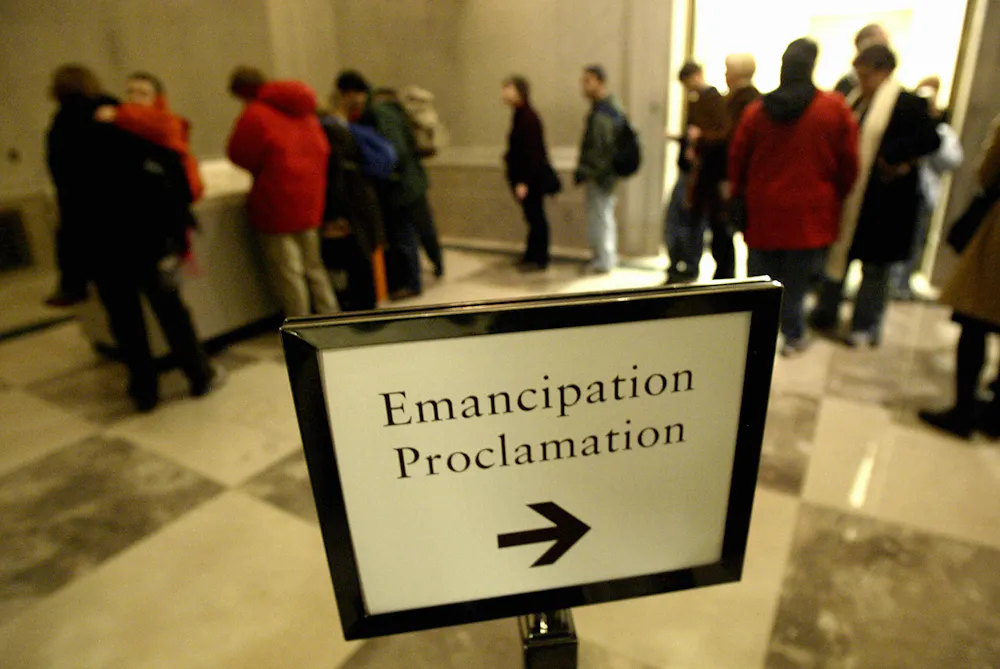
    People line up to view the original Emancipation Proclamation on Martin Luther King Jr. Day, Jan. 19, 2004, at the National Archives building in Washington, D.C.
    Tim Sloan/AFP-Getty Images

    Destroyed by fire

    The idea of preserving the government’s records dates back to the country’s founding. Charles Thomson, secretary of the Continental Congress during the American Revolution and then secretary of Congress under the Articles of Confederation, recognized the need for proper storage of the Congress’ records.

    But the young nation lacked the money and infrastructure to act. Many of the Continental Congress’ records were kept by Thomson himself for years, and while some were later transferred to the Department of State, others were lost.

    Throughout the 19th and early 20th centuries, fires repeatedly ravaged federal records. Fires were very common in the 19th century due to a combination of highly flammable building materials, open frames used for lighting and heating, and the lack of modern fire safety measures such as sprinklers and fire-resistant construction.

    In 1800, a blaze destroyed the War Department’s archives, a loss that severely hampered government operations. In 1810, Congress authorized better housing for government records, but the law was never fully executed. Instead, different parts of the government, from the Department of State to the Department of Treasury, continued maintaining their own records.

    The Treasury Department suffered fires in 1801 and again in 1833, further erasing crucial financial records. The Patent Office, home to invaluable documentation of American innovation, burned in 1877, having already been damaged by an 1836 fire.

    Storage at the federal Office of Indian Affairs in 1935.
    National Archives Foundation

    One of the most devastating losses occurred in 1921 when a fire at the Department of Commerce destroyed nearly all records from the 1890 federal census. This loss had far-reaching consequences, particularly for genealogical and demographic research.

    Fires weren’t the only threat to the government’s records.

    “It is a matter of common report that during the civil war, great quantities of documents stored in the Capitol were thrown away to make quarters for soldiers,” Historian and founding member of the American Historical Association J. Franklin Jameson noted in a 1911 Washington Post article.

    “At a later date,” he added, “the archives of the House of Representatives were systematically looted for papers having a market value because of their autographs.”

    Jameson spent decades lobbying Congress for a centralized repository. His persistence, coupled with the advocacy of key officials, laid the groundwork for future action.

    A bound copy of George Washington’s account of expenses while commander in chief of the Continental Army.
    National Archives and Records Administration

    These repeated disasters illuminated a glaring issue: The federal government lacked a centralized, protected repository to safeguard its records.

    Finding a home

    Momentum for a dedicated archives building gained traction in the late 19th century. In 1903, a bipartisan bill passed Congress giving the OK to purchase land in Washington, D.C., for a Hall of Records.

    But the legislation didn’t lead to any action. Government records remained scattered, vulnerable and neglected. That same year, Congress authorized that any records not needed for daily business be transferred to the Library of Congress.

    In 1912, President William H. Taft issued executive order 1499, aptly named Disposal of Useless Papers, requiring agencies to consult the librarian of Congress before disposing of documents.

    This established a formal review process for government document disposal, but agencies still discarded records, often haphazardly, until stricter records management laws were enacted.

    In 1926, Congress passed the Public Buildings Act, authorizing construction of an archives facility in Washington, D.C. Departing president Herbert Hoover laid the cornerstone of the new building on Feb. 20, 1933. He then deposited facsimiles of the Declaration of Independence and the Constitution, an American flag and daily newspapers from that day underneath the cornerstone.

    Growth and standardization

    President Franklin D. Roosevelt, who took office two weeks later, was himself a meticulous record-keeper. He understood the importance of historical preservation. Roosevelt kept all of his personal and presidential records and books in a fire-safe space he built on his Hyde Park, New York, property, which he donated to the government after he died. This building and the materials inside became part of the National Archives as the first U.S. presidential library.

    The National Archives, an independent agency, was officially established under Roosevelt in the 1934 National Archives Act. The head archivist was to be appointed by the president. The first archivist, Robert D.W. Connor, took office that year with a mandate to organize, preserve and make accessible the nation’s records.

    Initially, the National Archives was simply a building – an impressive neoclassical structure in Washington, D.C., that opened in 1935. The very first records deposited there came from three World War I-era regulatory agencies – the U.S. Food Administration, the Sugar Equalization Board and the U.S. Grain Corporation.

    Initially, the Archives lacked a formalized records management program. There were no clear guidelines on what to keep and what to discard, so agencies made their own decisions. This led to inconsistent preservation.

    The creation of the first federal records administration program in 1941, together with the 1943 Records Disposal Act, codified things. These policies granted the National Archives authority to establish a structured approach to determining which records held historical value and should be preserved, while allowing for the responsible disposal of other documents.

    A 1950 law gave the National Archives more power to decide what should be kept and what could be discarded, creating a more organized and accountable system for preserving the nation’s history.

    As the volume of records increased and their formats changed, the archives adapted. By 2014, amendments to the Federal Records Act explicitly included electronic records, recognizing the shift toward digital documentation.

    Stacks at the National Archives in Washington in 1950, where rare photographs and national records are ordered and stored.
    Three Lions/Getty Images

    Ensuring accountability

    Beyond mere storage, the National Archives plays a vital role in upholding democracy.

    It ensures transparency by preserving government accountability, preventing manipulation or loss of records that could distort historical truth. The National Archives also provides public access to documents that shape civic awareness and historical knowledge, from the Declaration of Independence to declassified government files.

    In an era of digital misinformation and contested narratives, the National Archives stands as a guardian of primary sources. Its existence reminds the nation that history is not a matter of convenience, but a cornerstone of informed governance.

    Elizabeth Call is a member of the Society of American Archivists.

    ref. Fires, wars and bureaucracy: The tumultuous journey to establish the US National Archives – https://theconversation.com/fires-wars-and-bureaucracy-the-tumultuous-journey-to-establish-the-us-national-archives-250857

    MIL OSI – Global Reports

  • MIL-OSI Russia: School of International Cooperation Opens at HSE

    Translartion. Region: Russians Fedetion –

    Source: State University Higher School of Economics – State University Higher School of Economics –

    © Higher School of Economics

    School of International Cooperation created in the structure Faculty of World Economy and World Politics (FMEiMP) Vyshki. The school launches, promotes and implements programs of additional education and professional retraining, corporate education programs and international intensive trainings for working specialists and managers interacting with foreign government officials and businessmen, as well as foreign entrepreneurs, students and scientists.

    Dean of the Faculty of World Economy and International Relations Anastasia Likhacheva, opening the presentation, emphasized that the main task of the school is to implement projects in the interests of the country, to promote Russian interests in the international arena. “There is no single formula for what key opens the hearts of partners. We are glad that our faculty is creating a platform that will unite enthusiasts of international cooperation,” said Anastasia Likhacheva.

    Senior Director of the National Research University Higher School of Economics Andrey Lavrov noted that last year, during the elections of the Academic Council, a formula was developed that reflects the essence of the current HSE: a university for the development of all of Russia, open to the world. He called international cooperation a priority for HSE and the Faculty of World Economy and International Relations. Andrey Lavrov is confident that the opening of the School of International Cooperation will help to realize the most ambitious goals of developing additional professional education at the National Research University Higher School of Economics. “The development of adult education is an area where we can achieve great success. I am very glad that you have become pioneers in the new wave of development of additional professional education at HSE, congratulations,” Andrey Lavrov said, addressing the heads of the faculty.

    “It’s nice to be pioneers,” Anastasia Likhacheva responded. She recalled that HSE began its turn to the East many years ago (700 students currently study Chinese at HSE) and expressed hope that the school will contribute to the development of Russian-Chinese cooperation.

    Minister-Counselor of the Chinese Embassy in Russia Zhao Wei read out a greeting from the Ambassador Extraordinary and Plenipotentiary of China Zhang Hanhui, in which he congratulated HSE on the opening of the School of International Cooperation. HSE was described as a leader in the field of innovation development and a university that makes an invaluable contribution to the formation of the international agenda. In her congratulatory letter, the Ambassador emphasized the role of the Academic Director of the Faculty of World Economy and International Relations Sergey Karaganov in strengthening HSE ties with leading universities in China and developing bilateral cooperation.

    Zhang Hanhui noted in his congratulatory letter: China and Russia have common positions in solving international problems and forming a fair world order. “I am convinced that the school will become the foundation for training new types of specialists with cross-cultural competence and skills in solving international problems. I hope that the establishment of the school will contribute to deepening Chinese-Russian cooperation in personnel training and strengthening cooperation with the countries of the Global South,” he emphasized.

    According to FMEiMP research professor Fyodor Lukyanov, the university and faculty do not move at the mercy of the winds, but strive to create and strengthen these winds themselves. Now, he added, the world is in an amazing state, when what was impossible yesterday is obvious today, and tomorrow will be completely different from what we imagine. The professor noted: international cooperation is necessary in any situation in the world, it should be strengthened and supported. Now it is important to create new connections, while maintaining the old ones. “Support for the implementation of international cooperation projects, learning it throughout life – this is what we need to exist in, this is such an environment,” said Fyodor Lukyanov.

    Now, he believes, the quality of expertise is extremely important, since no high-level manager operates in a vacuum, but operates in an environment with a large volume of events and trends, where when making decisions, not only knowledge is important, but also intuition, which develops, among other things, thanks to knowledge.

    The head of the School of International Cooperation, Deputy Dean of the Faculty of World Economy and International Relations for Continuing Education Yulia Belous noted: the school offers a wide range of continuing education programs, winter and summer schools for different categories of students.

    The training programs are divided into four levels. The first one is “Starting a Career — Key to a Career” — for students and young professionals with 1 to 3 years of work experience. Next comes the “New Facets” stage — training in new skills for professionals with 3 to 5 years of experience, then “Time to Act” — for foreign professionals and those who need to enter a foreign market. And finally, the fourth level is strategic sessions for managers with leading experts in international relations, global economics, orientalists and regional experts who create a vision of the principles of work in eastern markets, the foundation for effective operations and competition with existing players. They are aimed at obtaining practice-oriented knowledge for work in different countries and regions.

    Head of the professional retraining program of the Faculty of World Economy and International Relations “Eastern Perspective: Strategy and Tactics for Building a Business» Natalia Guseva noted that the program is aimed at developing an effective strategy for working in the East, understanding the specifics of business and entrepreneurship in these countries, as well as the practice of doing business in India, China, Japan and South Korea. This is a three-week program that involves developing one’s own projects.

    A 10-day intensive programme has also already been formed. program for foreign entrepreneurs who want to work in Russia. They will learn about the peculiarities of the Russian financial and tax system, the specifics of business cooperation with Russia, and will gain an understanding of the cultural characteristics and values of Russia and its peoples. This is a program in which leading speakers and experts will speak.

    Deputy Executive Director – Director of Strategic Partnerships at Innopraktika Anastasia Pavlenko spoke about the program for transferring competencies in the field of digitalization of public administration to African countries – an important international initiative that is being implemented Center for African Studies HSE University with the support of Innopraktika. She emphasized that Russia is currently one of the world leaders in the field of digitalization of the public sector, and the experience of overcoming sanctions pressure and repelling a large number of cyberattacks seems valuable for friendly countries, with which Russia is ready to exchange knowledge in this area.

    Also in her speech, Anastasia Pavlenko mentioned the direction of Innopraktika’s activities to support the entry of private high-tech companies – “national champions” – into the foreign market and the promotion of their solutions in friendly countries. In conclusion, she drew attention to the high potential of international cooperation in the development of education, science and culture.

    Deputy Director of the HSE Center for African Studies Polina Slyusarchuk added: the center held a series of workshops with experts and scientists from different African countries. One of the programs is dedicated to food security of countries and regions, within its framework, participants are invited not only to study the problem, but also to propose ways to solve it. The center also created a program of additional professional education on running a practical business on the continent.

    Director General of the Russian International Affairs Council Ivan Timofeev noted: the concept of international cooperation is very broad and includes economic, scientific, military-technical and cultural interaction, each of which has its own characteristics. It is important to understand how different aspects of interaction, from chess to sensitive technologies, can be used as a country’s soft power, how to integrate their various elements into foreign policy.

    “Your project is not an adventure, it is an initiative based on the ecosystem and human capital of HSE. Your programs will be in great demand,” Ivan Timofeev is confident.

    Head of the Center for Educational Solutions and Work with Universities of the TMH Corporate University (TMH Group) Alexander Belyashin congratulated the faculty on the opening of the school. He said that in the modern world, educational partnership is an integral part of international cooperation and the opening of such an institute as the HSE School of International Cooperation is an excellent and timely decision. In turn, TMH JSC has been preparing and developing the company’s engineering potential for several years and this year, together with the Tashkent State Transport University, it created a scientific and educational center in Uzbekistan, on the basis of which it is planned to train design engineers and process engineers in joint master’s programs and additional professional education programs. He noted the high potential of the School of International Cooperation, where not only general problems will be studied, but also specific cases of bilateral and multilateral interaction.

    Vice President of the Vyzov Foundation Elena Eremenko spoke about the Vyzov Foundation Prize, the international track “SCIENCE. DIALOGUE. TRUST”, within the framework of which an international assembly, seminars and scientific breakfasts on “scientific diplomacy” are held. Elena Eremenko also emphasized the desire to continue intellectual cooperation with the FMEIP on the “scientific diplomacy” track and in the line of interaction with students.

    Roscongress Foundation Supervisory Board Member Dimitrios Velanis recalled that even during the most difficult periods of international relations, for example in the early 1980s, during the period of sanctions imposed on the USSR after the introduction of troops into Afghanistan, businesses, including those from Western countries, found opportunities to work in the Soviet Union.

    Head of Corporate Programs for Universities at SberUniversity Natalia Konshina spoke about the case of training advanced engineering schools of Russian universities. Together with the head of the School of International Cooperation, they presented possible areas of cooperation on the international track – risks and barriers in international scientific and technical cooperation.

    Anna Bessmertnaya, Chairperson of the Commission on Foreign Economic Cooperation with Partners from China of the Moscow Chamber of Commerce and Industry, spoke about trends in training personnel for Russian-Chinese cooperation and the “Start Your Business with Moscow” project for young specialists.

    The presentation of the School of International Cooperation was also attended by the head of the program “International cooperation in the context of global reassembly» HSE University, Deputy Head of the Department of International Relations of the Faculty of World Economy and World Politics of HSE University Dmitry Novikov. He spoke about the relevance and features of the program, its advantages.

    Please note: This information is raw content directly from the source of the information. It is exactly what the source states and does not reflect the position of MIL-OSI or its clients.

    MIL OSI Russia News

  • MIL-OSI United Kingdom: UK Reaffirms Support for Ukraine, Emphasizes Ceasefire and Accountability Amid Ongoing Conflict: UK Statement to the OSCE

    Source: United Kingdom – Executive Government & Departments

    Speech

    UK Reaffirms Support for Ukraine, Emphasizes Ceasefire and Accountability Amid Ongoing Conflict: UK Statement to the OSCE

    UK Military Advisor, Lt Col Joby Rimmer, says Ukraine’s long-term security depends on a multifaceted approach of immediate ceasefire efforts, robust security arrangements, and economic and humanitarian support.

    Thank you, Mr Chair. As we reaffirm our unwavering support for Ukraine in defending its territorial integrity and right to exist, we continue to emphasise the importance of its freedom, sovereignty, and independence. These principles are critical to securing Ukraine’s long-term prosperity and security and are paramount to ensuring stability and peace in the region.

    Recent efforts to achieve a ceasefire have rightly dominated the strategic narrative. The meeting on March 11 between the USA and Ukraine in the Kingdom of Saudi Arabia was promising. We applaud Ukraine’s commitment to an immediate ceasefire, which is an essential step towards a comprehensive, just, and lasting peace in line with the Charter of the United Nations. A ceasefire is not only a cessation of hostilities but also a foundation for rebuilding trust and fostering long-term stability.

    Although we don’t have the full details from the dialogue between the USA and Russia yesterday, we understand that Putin has repeated his ‘Yes but No’ approach to a ceasefire, expressing concerns regarding the monitoring of the line of conflict and Ukraine’s ability to mobilise and re-arm in the interim. Russia’s demand for the complete cessation of provision of foreign military aid and intelligence to Kyiv is likely to prevent rapid progress. We repeat that any ceasefire must be respected, and that robust and credible security arrangements are necessary to ensure that Ukraine can deter and defend against any renewed acts of aggression.

    The UK welcomes the proposed agreement on a cessation of kinetic strikes on energy infrastructure, but again, we call on Russia to fully reciprocate by explicitly agreeing to a ceasefire in all areas and implementing it completely. Should Russia fail to agree to such a ceasefire, we remain prepared to impose further costs, including additional sanctions, caps on oil prices, and increased support for Ukraine. The use of extraordinary revenues stemming from immobilised Russian Sovereign Assets will also be considered.

    The devastating impact of the war continues. Russian attacks on civilians and civilian infrastructure are deeply alarming. The destruction of homes, schools, hospitals, and other critical infrastructure has caused immense suffering and displacement. A Russian attack on Pokrovsk on March 17 severely injured three children. A Russian drone attack on a hospital in Kharkiv Oblast caused a 1500 square yard building fire, and the subsequent assault targeted rescue workers. On March 8, a coordinated strike on apartment buildings in Dobropillia killed 11 people and injured 30. We must emphasise the importance of accountability for these actions and reaffirm our commitment again to work together to achieve a durable peace.

    In conclusion, Ukraine’s long-term prosperity and security depend on a multifaceted approach that includes immediate ceasefire efforts, robust security arrangements, economic and humanitarian support, and accountability for actions taken during the conflict. By standing together with Ukraine, we can achieve a durable peace and ensure that Ukraine remains democratic, free, strong and prosperous. The path to peace and prosperity is challenging, but it is achievable. Thank you, Mr Chair.

    Updates to this page

    Published 19 March 2025

    MIL OSI United Kingdom

  • MIL-OSI United Kingdom: UK Emergency Medical Team ends 5-month deployment in Lebanon

    Source: United Kingdom – Executive Government & Departments

    World news story

    UK Emergency Medical Team ends 5-month deployment in Lebanon

    UK Emergency Medical Team (UK-EMT) ends their 5-month deployment in Lebanon, the British Embassy held a workshop today for local and international partners.

    UK EMT Workshop hosted by British Embassy Beirut

    Partners focused on exploring opportunities to maintain and build capacity at the Turkish Hospital in Saida, building on lessons from the UK-EMT deployment. The workshop was attended by British Chargé D’Affaires and Development Director, Victoria Dunne; UK-Med Team Lead, Mr. Andres Gonzales Rodriguez; Turkish Hospital Director, Mrs Mona Teryaki; and Senior Advisor to the Minister of Public Health, Dr Nadeen Hilal.

    In November 2024, the UK-EMT arrived in Lebanon to attend to injured civilians caught up in the conflict and train Lebanese health workers in specialised burn treatment skills. The team, made up of medical staff from the NGO UK-Med and Interburns, had deployed in response to a call for assistance from the Lebanese Ministry of Public Health to the international community. The deployment of medical professionals from the UK to emergencies and humanitarian crises around the world is funded by the UK’s Foreign, Commonwealth and Development Office. 

    The UK-EMT shared their achievements and challenges in providing burns and trauma services at the Turkish hospital and suggested steps to ensure continuity of burns treatment and physiotherapy. The event highlighted how international NGOs like UK-Med can provide life-saving assistance in a crisis context while also improving Lebanon’s capacity to provide these specialised services in the longer term.  

    Charge D’Affaires and Development Director Victoria Dunne said:  

    The conflict in Lebanon brought intolerable suffering to so many, with homes destroyed and innocent civilians caught up in the crossfire. The UK is pleased to have been able to deploy such valuable expertise to assist Lebanon in a time of crisis. 

    Over the past 5 months, the UK medical team have managed to deliver urgently needed treatment to the most vulnerable and those with life-changing injuries, whilst imparting skills to Lebanese physiotherapist to use in the long-term.  We hope today’s workshop sets out a road map to sustain the Turkish Hospital in Saida and its burns rehabilitation expertise with the support of our local and international partners.  

    We are proud of our ongoing partnership and cooperation with Lebanon and international partners and what we have achieved in the last year – mobilising over $50m for the most vulnerable across the country.

    UK-Med Senior Operations Manager and Team Lead for the UK EMT in Lebanon, Andres Gonzalez Rodriguez said:  

    Since November 2024, UK-EMT has provided specialised physiotherapy care focussed on burn rehabilitation in partnership with Interburns in the Turkish Trauma and Emergency Hospital, Saida. Several training sessions for physiotherapists were held with the Lebanese Order of Physiotherapists and Interburns for staff, including improving protocols and securing vital equipment. 

    As our mission ends, UK-EMT remains committed to supporting sustainable medical capacity in Lebanon through knowledge transfer and strengthened local healthcare system.

    Senior Advisor to the Minister of Public Health Dr Nadeen Hilal said:

    The Turkish Hospital’s journey may be considered as a blueprint. Its evolution from an emergency recipient to a hub of localized expertise and burn standard of excellence demonstrates how targeted interventions can respond to national health priorities. The lessons learned here, in burns care, trauma management, and multidisciplinary collaboration, must inspire replication across Lebanon’s hospitals, addressing diverse needs such as maternal health and chronic disease management.

    Updates to this page

    Published 19 March 2025

    MIL OSI United Kingdom

  • MIL-OSI United Kingdom: Spotlight shines on local heroes at annual Mayor’s Awards

    Source: City of Winchester

    Community contributions from across the Winchester district have been recognised during the annual Mayor of Winchester’s awards.

    The ceremony took place in Winchester Guildhall on Thursday 13 March, when a total of 54 award certificates were presented to 71 local individuals, groups and businesses.   

    Among those recognised were: the Rotary Club of Bishop’s Waltham; Jean Browne; Hampshire Swifts; Winchester Young Carers; Winchester Go LD; Gary Munday from Swan Samba; Alan Marlow from Winchester Ramblers; Connect Winchester Community Bus; The Soberton and Newtown Conservation Group; Danny Dubois; Tuesday’s Place in King’s Worthy; Citizens Advice Winchester; Kathy East from Lanterns Nursery School; GrOws (Green Owslebury); Keith Leaman; Natalie March; Anne Collins, Parish Clerk serving Durley and Upham PCs; Wilfred’s Café in Droxford and Meon Valley; Jenny Webb from South Wonston Community Café.

    Swanmore Accredited Community Support Officer (ACSO) Gary McCulloch was presented with an award.

    Mr McCulloch, who has been in the role for five years and works in Swanmore and Owslebury, said: “I was really shocked and humbled to be amongst so many well deserving people from all across the district. Myself and my fellow ACSO Sarah work filling the gaps and taking care of what are often little things; people can see they’re being listened to. If I can solve a problem, it’s good for the local community.  

    “I truly believe that my job is the best there is and I thoroughly enjoy every minute of it. I would like to say a huge thank you to everyone who took the time to nominate me.”

    The Mayor of Winchester Cllr Russell Gordon-Smith said: “The annual Mayor of Winchester Community Awards is one of the most important events in the Mayor’s calendar, and it’s a way to acknowledge and celebrate the quite invaluable work carried out by many community-spirited residents and business of all ages, from all walks of life.

    “It has been heartwarming to see just how many kind and compassionate people there are in our district. I was so impressed by the humbling and inspirational achievements, which included three remarkable instances of lives being saved by quick thinking and well-trained individuals, taking charge of emergency situations; in one case a fourteen-year girl had set in motion a rescue attempt.

    “I offer my profound thanks and admiration to every award recipient, for all that they have done and will no doubt continue to do for our community across the Winchester district.”  

    MIL OSI United Kingdom

  • MIL-OSI: Orezone Gold Announces Full Exercise of Over-Allotment Option

    Source: GlobeNewswire (MIL-OSI)

    NOT FOR DISTRIBUTION TO U.S. NEWS WIRE SERVICES OR DISSEMINATION IN THE UNITED STATES.

    VANCOUVER, British Columbia, March 19, 2025 (GLOBE NEWSWIRE) — Orezone Gold Corporation (TSX: ORE, OTCQX: ORZCF) (the “Company” or “Orezone”) announces that Canaccord Genuity Corp., the sole underwriter and bookrunner for the Company’s previously announced C$35 million bought deal financing that closed on March 13, 2025 (the “Offering”), has now fully exercised their over-allotment option (the “Over-Allotment Option”) under the Offering to acquire an additional 6,402,450 common shares of the Company (the “Shares”) at a price of C$0.82 per Share for additional gross proceeds of C$5,250,009. The issuance and purchase of the additional 6,402,450 Shares closed earlier today.

    The Company intends to use the net proceeds from the Over-Allotment Option to accelerate both stage 2 of the hard rock expansion and additional exploration at its Bomboré Gold Mine, as well as for working capital and general corporate purposes, as further described in the Company’s short form prospectus dated March 7, 2025.

    The securities referred to in this news release have not been, nor will they be, registered under the United States Securities Act of 1933, as amended (the “U.S. Securities Act”), and may not be offered or sold within the United States absent U.S. registration or an applicable exemption from the U.S. registration requirements. This news release does not constitute an offer for sale of securities, nor a solicitation for offers to buy any securities in the United States, nor in any other jurisdiction in which such offer, solicitation or sale would be unlawful.

    About Orezone Gold Corporation

    Orezone Gold Corporation (TSX: ORE OTCQX: ORZCF) is a West African gold producer engaged in mining, developing, and exploring its flagship Bomboré Gold Mine in Burkina Faso. The Bomboré mine achieved commercial production on its oxide operations on December 1, 2022, and is now focused on its staged hard rock expansion that is expected to materially increase annual and life-of-mine gold production from the processing of hard rock mineral reserves. Orezone is led by an experienced team focused on social responsibility and sustainability with a proven track record in project construction and operations, financings, capital markets and M&A.

    The technical report entitled Bomboré Phase II Expansion, Definitive Feasibility Study is available on SEDAR+ and the Company’s website.

    Contact Information

    Patrick Downey
    President and Chief Executive Officer

    Kevin MacKenzie
    Vice President, Corporate Development and Investor Relations

    Tel: 1 778 945 8977 / Toll Free: 1 888 673 0663
    info@orezone.com / www.orezone.com

    For further information please contact Orezone at +1 (778) 945-8977 or visit the Company’s website at www.orezone.com.

    Cautionary Note Regarding Forward-Looking Statements

    This press release contains certain information that may constitute “forward-looking information” within the meaning of applicable Canadian securities laws and “forward-looking statements” within the meaning of applicable U.S. securities laws (together, “forward-looking statements”). Forward-looking statements are frequently characterized by words such as “plan”, “expect”, “project”, “intend”, “believe”, “anticipate”, “estimate”, “potential”, “possible” and other similar words, or statements that certain events or conditions “may”, “will”, “could”, or “should” occur.  Forward-looking statements in this press release include, but are not limited to, statements regarding the use of proceeds of the Over-Allotment Option.

    All such forward-looking statements are based on certain assumptions and analyses made by management in light of their experience and perception of historical trends, current conditions and expected future developments, as well as other factors management and the qualified persons believe are appropriate in the circumstances.

    All forward-looking statements are subject to a variety of risks and uncertainties and other factors that could cause actual events or results to differ materially from those projected in the forward-looking statements including, but not limited to, delays caused by pandemics, terrorist or other violent attacks (including cyber security attacks), the failure of parties to contracts to honour contractual commitments, unexpected changes in laws, rules or regulations, or their enforcement by applicable authorities; social or labour unrest; changes in commodity prices; unexpected failure or inadequacy of infrastructure, the possibility of unanticipated costs and expenses, accidents and equipment breakdowns, political risk, unanticipated changes in key management personnel and general economic, market or business conditions, the failure of exploration programs, including drilling programs, to deliver anticipated results and the failure of ongoing and uncertainties relating to the availability and costs of financing needed in the future, and other factors described in the Company’s most recent annual information form and management discussion and analysis filed on SEDAR+. Readers are cautioned not to place undue reliance on forward-looking statements.

    Although the forward-looking statements contained in this press release are based upon what management of the Company believes are reasonable assumptions, the Company cannot assure investors that actual results will be consistent with these forward-looking statements. These forward-looking statements are made as of the date of this press release and are expressly qualified in their entirety by this cautionary statement. Subject to applicable securities laws, the Company does not assume any obligation to update or revise the forward-looking statements contained herein to reflect events or circumstances occurring after the date of this press release.

    The MIL Network

  • MIL-OSI: XBP Europe Holdings, Inc. Reports Fourth Quarter and Full Year 2024 Results

    Source: GlobeNewswire (MIL-OSI)

    Full Year 2024 Highlights

    • Revenue of $142.8 million, decrease of 8.0% year-over-year
    • Gross margin of 26.8%, a 110 bps increase year-over-year
    • Operating profit of $3.5 million, an increase of $2.4 million year-over-year
    • Approximately $25M of ACV in active ramp, resulting in an incremental step-up in margin contribution in the second half of 2024
    • Signed an exclusive, non-binding LOI to acquire Exela Technologies BPA, LLC, a potentially transformational deal that could expand XBP Europe’s revenue to ~$1 billion annually

    Fourth Quarter 2024 Highlights

    • Revenue of $35.6 million, decrease of 7.5% year-over-year and increase of 0.7% sequentially
    • Gross margin of 28.3%, a 480 bps increase year-over-year and 440 bps decrease sequentially
    • Operating profit of $1.0 million, an increase of $3.4 million year-over-year and a decrease of $1.5 million sequentially
    • Net loss of $2.7 million includes $0.5 million of FX losses, an improvement of $2.4 million year-over-year and $0.1 million sequentially

    LONDON and SANTA MONICA, Calif., March 19, 2025 (GLOBE NEWSWIRE) — XBP Europe Holdings, Inc. (“XBP Europe” or “the Company”) (NASDAQ: XBP), a pan-European integrator of bills, payments, and related solutions and services seeking to enable the digital transformation of its clients, announced today its financial results for the quarter and full year ended December 31, 2024.

    “We ended 2024 with growing momentum, as we continued to ramp our recently awarded contracts, leading to improving profitability and operating metrics. We are excited about our organic growth trajectory in 2025 and we continue to work towards a potential acquisition of Exela Technologies BPA, LLC in 2025 so that we can benefit from global scale,” said Andrej Jonovic, Chief Executive Officer of XBP Europe.

    Full Year Highlights

    • Revenue: Total Revenue for 2024 was $142.8 million, a decline of 8.0% year-over-year, primarily due to completion of projects, lower volumes, and client contract ends, offset by positive impact of newly won business.
      • Bills & Payments segment revenue was $101.9 million, a decline of 7.8% year-over-year, primarily attributable to completion of one-time projects, lower volumes, and client contract end, offset by the positive impact of newly won business.
      • Technology segment revenue was $40.9 million, a decrease of 8.5% year-over-year, largely due to a lower volume of licenses sold, offset by a drop in technology implementation and professional services revenue.
    • Operating Profit: Operating Profit was $3.5 million, an increase of $2.4 million compared to 2023. This improvement was driven primarily by higher gross margins coupled with SG&A cost optimizations. Our operating expenses include costs associated with accelerated migration to the cloud.
    • Net Loss: Net loss from continuing operations was $6.5 million, compared with a net loss from continuing operations of $5.6 million in 2023. The year-over-year increase was primarily driven by higher income tax expense and interest expense, offset by higher operating profit and lower related party interest expense.
    • Adjusted EBITDA(1): Adjusted EBITDA from Continuing Operations was $13.4 million, a decrease of $2.4 million or 15.1% compared to 2023. Adjusted EBITDA margin was 9.4%, a decrease of 80 basis points from 10.2% in 2023.
    • Capital Expenditures: Capital expenditures were 1.2% of revenue compared to 1.7% of revenue in 2023, with the decrease primarily due to lower purchases of PP&E.
    • Adequate Liquidity: The Company’s cash and cash equivalents totaled $12.1 million as of December 31, 2024.

    Other Highlights:

    • Pending Acquisition: As announced on March 4, 2025, XBP Europe has entered into an exclusive, non-binding letter of intent with Exela Technologies, Inc. to acquire Exela Technologies BPA, LLC (“BPA”), a leading provider of business process automation solutions. The closing of the acquisition will be subject to BPA completing a corporate reorganization which is expected to create a sustainable capital structure with a substantially deleveraged balance sheet. If completed, the acquisition will expand XBP Europe’s revenue to more than $1 billion from $145 million on a pro forma basis for the twelve months ending September 30, 2024. The parties have agreed to act in good faith to negotiate definitive agreements, complete due diligence, undertake necessary regulatory approvals, and seek any necessary approvals, including from XBP Europe’s shareholders. Accordingly, there can be no assurance that a definitive agreement will be entered into or that the proposed transaction will be consummated. Readers are cautioned that those portions of the LOI that describe the proposed transaction are non-binding. XBP Europe only intends to announce additional details regarding the proposed transaction if and when a definitive agreement is executed.

    Segment Revenue and Profitability:

      Three months ended December 31, 2024
      Bills & Payments   Technology   Total
    Revenue, net $ 25,851   $ 9,794   $ 35,645
    Cost of revenue 20,460   5,108   25,568
    Segment Gross Profit 5,391   4,686   10,077
               
      Three months ended December 31, 2023
      Bills & Payments   Technology   Total
    Revenue, net $ 27,368   $ 11,165   $ 38,533
    Cost of revenue 24,203   5,270   29,472
    Segment Gross Profit 3,165   5,895   9,061
      Twelve months ended December 31, 2024
      Bills & Payments   Technology   Total
    Revenue, net $ 101,850   $ 40,922   $ 142,772
    Cost of revenue 85,454   19,059   104,513
    Segment Gross Profit 16,396   21,863   38,259
               
      Twelve months ended December 31, 2023
      Bills & Payments   Technology   Total
    Revenue, net $ 110,458   $ 44,719   $ 155,177
    Cost of revenue 95,572   19,738   115,310
    Segment Gross Profit 14,886   24,981   39,867
               

    Below is the note referenced above:

    (1)   Adjusted EBITDA is a non-GAAP measure. A reconciliation of Adjusted EBITDA is attached to this release.

    Supplemental Investor Presentation
    An investor presentation relating to our fourth quarter and full year 2024 performance is available at investors.xbpeurope.com. This information has also been furnished to the SEC in a current report on Form 8-K.

    About Non-GAAP Financial Measures
    This press release includes constant currency, EBITDA and Adjusted EBITDA, each of which is a financial measure that is not prepared in accordance with U.S. generally accepted accounting principles (“GAAP”). XBP Europe believes that the presentation of these non-GAAP financial measures will provide useful information to investors in assessing our financial performance, results of operations and liquidity and allows investors to better understand the trends in our business and to better understand and compare our results. XBP Europe’s board of directors and management use constant currency, EBITDA and Adjusted EBITDA to assess XBP Europe’s financial performance, because it allows them to compare XBP Europe’s operating performance on a consistent basis across periods by removing the effects of XBP Europe’s capital structure (such as varying levels of debt and interest expense, as well as transaction costs resulting from the combination with CF Acquisition Corp. VIII. on November 29, 2023). Adjusted EBITDA also seeks to remove the effects of restructuring and related expenses and other similar non-routine items, some of which are outside the control of our management team. Restructuring expenses are primarily related to the implementation of strategic actions and initiatives related to right sizing of the business. All of these costs are variable and dependent upon the nature of the actions being implemented and can vary significantly driven by business needs. Accordingly, due to that significant variability, we exclude these charges since we do not believe they truly reflect our past, current or future operating performance. The constant currency presentation excludes the impact of fluctuations in foreign currency exchange rates. We calculate constant currency revenue on a constant currency basis by converting our current-period local currency revenue using the exchange rates from the corresponding prior-period and compare these adjusted amounts to our corresponding prior period reported results. XBP Europe does not consider these non-GAAP measures in isolation or as an alternative to liquidity or financial measures determined in accordance with GAAP. A limitation of these non-GAAP financial measures is that they exclude significant expenses and income that are required by GAAP to be recorded in XBP Europe’s financial statements. In addition, they are subject to inherent limitations as they reflect the exercise of judgments by management about which expenses and income are excluded or included in determining these non-GAAP financial measures and therefore the basis of presentation for these measures may not be comparable to similarly-titled measures used by other companies. These non-GAAP financial measures are not required to be uniformly applied, are not audited and should not be considered in isolation or as substitutes for results prepared in accordance with GAAP. Net loss is the GAAP measure most directly comparable to the non-GAAP measures presented here. For reconciliation of the comparable GAAP measures to these non-GAAP financial measures, see the schedules attached to this release.

    Forward-Looking Statements
    This press release contains certain “forward-looking statements” within the meaning of the United States Private Securities Litigation Reform Act of 1995, Section 27A of the Securities Act of 1933, as amended (the “Securities Act”), and Section 21E of the Exchange Act, including certain financial forecasts and projections. All statements other than statements of historical fact contained in this press release, including statements as to future results of operations and financial position, revenue and other metrics planned products and services, business strategy and plans, objectives of management for future operations of XBP Europe, market size and growth opportunities, competitive position and technological and market trends, are forward-looking statements. Some of these forward-looking statements can be identified by the use of forward-looking words, including “may,” “should,” “expect,” “intend,” “will,” “estimate,” “anticipate,” “believe,” “predict,” “plan,” “targets,” “projects,” “could,” “would,” “continue,” “forecast” or the negatives of these terms or variations of them or similar expressions. All forward-looking statements are subject to risks, uncertainties, and other factors which could cause actual results to differ materially from those expressed or implied by such forward-looking statements. All forward-looking statements are based upon estimates, forecasts and assumptions that, while considered reasonable by XBP Europe and its management, as the case may be, are inherently uncertain and many factors may cause the actual results to differ materially from current expectations which include, but are not limited to: (1) the outcome of any legal proceedings that may be instituted against XBP Europe or others and any definitive agreements with respect thereto; (2) the inability to meet the continued listing standards of Nasdaq or another securities exchange; (3) the risk that the business combination disrupts current plans and operations of XBP Europe and its subsidiaries; (4) the inability to recognize the anticipated benefits of the business combination, which may be affected by, among other things, competition, the ability of XBP Europe and its subsidiaries to grow and manage growth profitably, maintain relationships with customers and suppliers and retain its management and key employees; (5) costs related to the business combination; (6) changes in applicable laws or regulations; (7) the possibility that XBP Europe or any of its subsidiaries may be adversely affected by other economic, business and/or competitive factors; (8) risks related to XBP Europe’s potential inability to achieve or maintain profitability and generate cash; (9) the impact of the COVID-19 pandemic, including any mutations or variants thereof, and its effect on business and financial conditions; (10) volatility in the markets caused by geopolitical and economic factors; (11) the ability of XBP Europe to retain existing clients; (12) the potential inability of XBP Europe to manage growth effectively; (13) the ability to recruit, train and retain qualified personnel, and (14) other risks and uncertainties set forth in the sections entitled “Risk Factors” and “Cautionary Note Regarding Forward-Looking Statements” in the Annual Reports on Form 10-K filed on April 1, 2024 and, our subsequent quarterly reports on Form 10-Q and our current reports on Form 8-K as filed with the Securities and Exchange Commission (the “SEC”). These filings identify and address other important risks and uncertainties that could cause actual events and results to differ materially from those contained in the forward-looking statements. Nothing in this press release should be regarded as a representation by any person that the forward-looking statements set forth herein will be achieved or that any of the contemplated results of such forward-looking statements will be achieved. Readers should not place undue reliance on forward-looking statements, which speak only as of the date they are made. XBP Europe gives no assurance that either XBP Europe or any of its subsidiaries will achieve its expected results. XBP Europe undertakes no duty to update these forward-looking statements, except as otherwise required by law.

    About XBP Europe
    XBP Europe is a pan-European integrator of bills, payments and related solutions and services seeking to enable digital transformation of its more than 2,000 clients. The Company’s name – ‘XBP’ – stands for ‘exchange for bills and payments’ and reflects the Company’s strategy to connect buyers and suppliers, across industries, including banking, healthcare, insurance, utilities and the public sector, to optimize clients’ bills and payments and related digitization processes. The Company provides business process management solutions with proprietary software suites and deep domain expertise, serving as a technology and services partner for its clients. Its cloud-based structure enables it to deploy its solutions across the European market, along with the Middle East and Africa. The physical footprint of XBP Europe spans 15 countries and 32 locations and a team of approximately 1,500 individuals. XBP Europe believes its business ultimately advances digital transformation, improves market wide liquidity by expediting payments, and encourages sustainable business practices. For more information, please visit: www.xbpeurope.com.

    For more XBP Europe news, commentary, and industry perspectives, visit: https://www.xbpeurope.com/
    And please follow us on social:
    X: https://X.com/XBPEurope
    LinkedIn: https://www.linkedin.com/company/xbp-europe/

    The information posted on XBP Europe’s website and/or via its social media accounts may be deemed material to investors. Accordingly, investors, media and others interested in XBP Europe should monitor XBP Europe’s website and its social media accounts in addition to XBP Europe’s press releases, SEC filings and public conference calls and webcasts.

    Investor and/or Media Contacts:
    investors@xbpeurope.com

     
    XBP Europe Holdings, Inc.
    Consolidated Balance Sheets
    For the years ended December 31, 2024 and 2023
    (in thousands of United States dollars except share and per share amounts)
               
      December 31, 
      2024      2023
    ASSETS            
    Current assets            
    Cash and cash equivalents $ 12,099   $ 6,537
    Accounts receivable, net of allowance for credit losses of $1,198 and $1,183, respectively   19,810     30,238
    Inventories, net   3,823     4,045
    Prepaid expenses and other current assets   4,228     6,550
    Current assets held for sale   1,378     2,497
    Total current assets   41,338     49,867
    Property, plant and equipment, net of accumulated depreciation of $40,325 and $39,876, respectively   11,272     12,811
    Operating lease right-of-use assets, net   4,805     5,206
    Goodwill   21,666     22,823
    Intangible assets, net   1,121     1,498
    Deferred income tax assets   7,026     6,811
    Other noncurrent assets   817     705
    Noncurrent assets held for sale       3,018
    Total assets $ 88,045   $ 102,739
               
    LIABILITIES AND STOCKHOLDERS’ DEFICIT            
    LIABILITIES            
    Current liabilities            
    Accounts payable $ 12,553   $ 13,281
    Related party payables   5,443     13,012
    Accrued liabilities   17,993     23,850
    Accrued compensation and benefits   16,482     16,267
    Customer deposits   277     323
    Deferred revenue   6,870     6,004
    Current portion of finance lease liabilities   12     91
    Current portion of operating lease liabilities   1,734     1,562
    Current portion of long-term debts   4,958     3,863
    Current liabilities held for sale   2,443     3,818
    Total current liabilities   68,765     82,071
    Related party notes payable   1,451     1,542
    Long-term debt, net of current maturities   23,966     12,763
    Finance lease liabilities, net of current portion       23
    Pension liabilities   10,339     12,208
    Operating lease liabilities, net of current portion   3,271     3,785
    Other long-term liabilities   1,599     1,635
    Noncurrent liabilities held for sale       1,280
    Total liabilities $ 109,391   $ 115,307
                 
               
    STOCKHOLDERS’ DEFICIT            
    Preferred stock, par value of $0.0001 per share; 10,000,000 shares authorized; none issued and outstanding as of December 31, 2024 and December 31, 2023, respectively      
    Common Stock, par value of $0.0001 per share; 200,000,000 shares authorized; 30,166,102 shares issued and outstanding as of December 31, 2024 and December 31, 2023, respectively   30     30
    Additional paid in capital   1,611    
    Accumulated deficit   (23,705)     (11,339)
    Accumulated other comprehensive loss:            
    Foreign currency translation adjustment   474     (1,416)
    Unrealized pension actuarial gains, net of tax   244     157
    Total accumulated other comprehensive loss   718     (1,259)
    Total stockholders’ deficit   (21,346)     (12,568)
    Total liabilities and stockholders’ deficit $ 88,045   $ 102,739
               
    XBP Europe Holdings, Inc.
    Consolidated Statements of Operations
    For the years ended December 31, 2024 and 2023
    (in thousands of United States dollars except share and per share amounts)
               
      Year ended December 31, 
      2024      2023
    Revenue, net $ 142,408   $ 154,943
    Related party revenue, net   364     234
    Cost of revenue (exclusive of depreciation and amortization)   104,467     115,234
    Related party cost of revenue   47     76
    Selling, general and administrative expenses (exclusive of depreciation and amortization)   26,525     31,173
    Related party expense   5,101     4,633
    Depreciation and amortization   3,160     2,944
    Operating profit   3,472     1,117
    Other expense (income), net            
    Interest expense, net   6,232     5,035
    Related party interest expense, net   90     1,971
    Foreign exchange losses, net   2,520     599
    Changes in fair value of warrant liability   (43)     (597)
    Pension income, net   (1,705)     (929)
    Net loss before income taxes   (3,622)     (4,962)
    Income tax expense   2,911     606
    Net loss from continuing operations   (6,533)     (5,568)
    Net loss from discontinued operations, net of income taxes   (5,833)     (5,479)
    Net loss $ (12,366)   $ (11,047)
    Loss per share:           
    Basic and diluted – continuing operations $ (0.22)   $ (0.25)
    Basic and diluted – discontinued operations   (0.19)     (0.24)
    Basic and diluted $ (0.41)   $ (0.49)
               
    XBP Europe Holdings, Inc.
    Consolidated Statements of Cash Flows
    For the years ended December 31, 2024 and 2023
    (in thousands of United States dollars)
               
      Years ended December 31, 
      2024      2023
    Cash flows from operating activities          
    Net loss $ (12,366)   $ (11,047)
    Adjustments to reconcile net loss to net cash used in operating activities:           
    Depreciation   2,965     3,467
    Amortization of intangible assets   750     384
    Debt issuance cost amortization   216    
    Impairment of goodwill   87    
    Credit loss expense   16     343
    Changes in fair value of warrant liability   (43)     (597)
    Stock-based compensation expense   1,611    
    Unrealized foreign currency losses (gains)   2,428     (616)
    Change in deferred income taxes   (247)     (422)
               
    Change in operating assets and liabilities          
    Accounts receivable   9,568     5,990
    Inventories   240     (58)
    Prepaid expense and other assets   2,297     2,123
    Accounts payable   (365)     (2,417)
    Related party payables   (8,446)     (843)
    Accrued expenses and other liabilities   (4,848)     2,629
    Deferred revenue   1,099     67
    Customer deposits   (189)     (538)
    Net cash used in operating activities   (5,227)     (1,535)
               
    Cash flows from investing activities           
    Purchase of property, plant and equipment   (1,263)     (2,330)
    Cash paid for costs of fulfilling a contract       (339)
    Additions to internally developed software   (447)    
    Net cash used in investing activities   (1,710)     (2,669)
               
    Cash flows from financing activities           
    Borrowings under secured borrowing facility       87,635
    Principal repayment on borrowings under secured borrowing facility   (79)     (91,662)
    Borrowings under 2024 Term Loan A Facility   3,834    
    Borrowings under 2024 Term Loan B Facility   11,360    
    Borrowings under 2024 Revolving Credit Facility   15,352    
    Cash paid for debt issuance costs   (1,527)    
    Principal payments on 2024 Term Loan A Facility   (383)    
    Principal payments on 2024 Term Loan B Facility   (1,136)    
    Principal payments on long-term obligations   (15,270)     (920)
    Proceeds from Secured Credit Facility   930     223
    Principal payments on finance leases   (635)     (786)
    Proceeds from Business Combination, net of transaction expenses       5,205
    Net cash provided by (used in) financing activities   12,446     (305)
    Effect of exchange rates on cash and cash equivalents     (308)     3,941
    Net increase (decrease) in cash and cash equivalents   5,201     (568)
               
    Cash and equivalents, beginning of period, including cash from discontinued operations   6,905     7,473
    Cash and equivalents, end of period, including cash from discontinued operations $ 12,106   $ 6,905
               
    Supplemental cash flow data:            
    Income tax payments, net of refunds received   567     1,059
    Interest paid         3,429     1,798
               
    XBP Europe Holdings, Inc.
    Schedule 1: Reconciliation of Adjusted EBITDA and constant currency revenues
         
    Reconciliation of Non-GAAP Financial Measures to GAAP Measures    
             
    Non-GAAP constant currency revenue reconciliation      
        Twelve Months ended December 31, 
    ($ in thousands)   2024   2023
    Revenues, as reported (GAAP)   142,772   155,177
    Foreign currency exchange impact (1)   (1,055)   – 
    Revenues, at constant currency (Non-GAAP)   141,717   155,177
             
    Reconciliation of Adjusted EBITDA from Continuing Operations             
        Year Ended December 31, 
    (dollars in thousands)   2024      2023
    Net loss from continuing operations   $ (6,533)   $ (5,568)
    Income tax expense     2,911     606
    Interest expense including related party interest expense, net     6,322     7,006
    Depreciation and amortization     3,160     2,944
    EBITDA from continuing operations     5,860     4,988
    Restructuring and related expenses (2)     1,879     5,053
    Employee litigation matter (3)     1,283     1,431
    Related party management fee and royalties (4)         1,330
    Foreign exchange losses, net     2,520     599
    Non-cash equity compensation (5)     1,611    
    Changes in fair value of warrant liability     (43)     (597)
    Transaction Fees (6)     280     2,970
    Adjusted EBITDA from continuing operations   $ 13,390   $ 15,774
                 

    (1)   Constant currency excludes the impact of foreign currency fluctuations and is computed by applying the average exchange rates for the year ended December 31, 2023, to the revenues during the corresponding period in 2024.
    (2)   Adjustment represents costs associated with restructuring, including employee severance and vendor and lease termination costs.
    (3)   Represents litigation settlement and associated expenses incurred in connection with the Company subsidiary litigation.
    (4)   Primarily represents management fee incurred in exchange for services, which included provision of legal, human resources, corporate finance, and marketing support. The management services agreement was terminated in connection with the Business Combination and was replaced by the related party service fee pursuant to the Services Agreement which reduced the fee and modified the services provided.
    (5)   Represents the non-cash charges to restricted stock units and options.
    (6)   Represents transaction costs incurred as part of the Business Combination.

         
    Reconciliation of Adjusted EBITDA from Discontinued Operations    
        Year Ended December 31, 
    (dollars in thousands)   2024      2023
    Net loss from discontinued operations, net of income taxes   $ (5,833)   $ (5,479)
    Income tax expense        
    Interest expense, net     145     189
    Depreciation and amortization     555     907
    EBITDA from discontinued operations     (5,133)     (4,383)
    Restructuring and related expenses (7)     38     187
    Related party service fees and royalties         25
    Impairment of goodwill     87    
    Foreign exchange losses (gains), net     211     (5)
    Adjusted EBITDA from discontinued operations   $ (4,797)   $ (4,176)
                 

    (7)   Adjustment represents costs associated with restructuring related to employee severance.

    Source: XBP Europe Holdings, Inc.

    The MIL Network

  • MIL-OSI: Kingsoft Cloud Announces Unaudited Fourth Quarter and Fiscal Year 2024 Financial Results; First Time Operating Margin Profitable with Accelerated Growing Revenue of AI Cloud

    Source: GlobeNewswire (MIL-OSI)

    BEIJING, March 19, 2025 (GLOBE NEWSWIRE) — Kingsoft Cloud Holdings Limited (“Kingsoft Cloud” or the “Company”) (NASDAQ: KC and HKEX: 3896), a leading cloud service provider in China, today announced its unaudited financial results for the fourth quarter and fiscal year ended December 31, 2024.

    Fourth Quarter Financial Highlights

    • Total Revenues reached RMB2,232.1 million (US$305.8 million)1, increased by 29.6% year-over-year from RMB1,722.5 million in the same quarter of 2023. Our business has experienced accelerated and high-quality growth and our revenue structure is well-balanced.
    • Gross profit was RMB426.0 million (US$58.4 million), representing a significant increase of 68.3% from RMB253.1 million in the same quarter of 2023. Our profitability has been fundamentally improved.
    • NonGAAP EBITDA2 was RMB359.7 million (US$49.3 million), compared with RMB-27.7 million in the same quarter of 2023. NonGAAP EBITDA margin was 16. 1%, compared with -1.6% in the same quarter of 2023.
    • Operating loss was RMB43.5 million (US$6.0 million), compared with operating loss of RMB342.7 million in the same quarter of 2023.
    • NonGAAP Operating profit (loss) turned profit for the first time, achieving RMB24.4 million (US$3.3 million), compared with RMB-187.6 million in the same quarter of 2023. NonGAAP Operating profit (loss) margin was 1. 1%, compare with -10.9% in the same quarter of 2023.

    Mr. Tao Zou, Chief Executive Officer of Kingsoft Cloud, commented, “We are very pleased to close Fiscal Year 2024 with historically strong financial performance. This quarter, we recorded positive nonGAAP operating profit (loss)for the first time, demonstrating our unwavering execution of the ‘High- quality, Sustainable Development Strategy’. Driven by the growing popularity of AI applications, we firmly believe that AI will continue to penetrate into various verticals, improving the efficiency of daily life. This quarter the gross billing of AI business increased by triple-digit year-over-year to RMB474 million. Both our public cloud and enterprise cloud businesses are harnessing the vast potential of AI cloud computing. Meanwhile, we have seen strong growth in demand from our ecosystem. Revenue from Xiaomi and Kingsoft Group increased by 76% year-over-year. We are well on track to build cutting- edge cloud infrastructure and technology to support our ecosystem and expand into the broader AI industry.”

    Mr. Henry He, Chief Financial Officer of Kingsoft Cloud, added, “We are very pleased to highlight several significant achievements. First, we achieved profitability in non-GAAP operating profit for the first time since our inception in 2012, demonstrating our strong execution of our high-quality and sustainable development strategy in the past two years. Second, our revenue has been growing for three consecutive quarters year-over-year, and this quarter we achieved a high-speed growth rate of 30% in total revenue, reaching RMB2,232.1 million. Third, gross billing of our Al cloud business increased by around 500% year-over-year to RMB474 million, accounting for as high as 34% of our public cloud revenue. This marks a three-digit year-on-year growth or six consecutive quarters. Fourth, last December, our shareholders approved revenue from connected-party of Xiaomi and Kingsoft Group for next three years of RMB11.3 billion, around 10 times over the revenue of 2023, providing solid support for Company’s revenue and profit growth. We believe we are well on track to meet the ecosystem’s fast-growing demands and build a solid cloud infrastructure to support its AI development. Notably, in this quarter, we are thrilled to report that revenue from Xiaomi and Kingsoft Group increased by 76% year-over-year, validating the effectiveness of our ecosystem strategy.”

    Fourth Quarter 2024 Financial Results

    Total Revenues reached RMB2,232.1 million (US$305.8 million), increased by 29.6% year-over-year from RMB1,722.5 million in the same quarter of 2023 and increased by 18.4% quarter-over-quarter from RMB1,885.6 million in the third quarter of 2024. The year-over-year increase was mainly due to the expanded revenue from Xiaomi and Kingsoft Ecosystem and AI related customers, incremental demands and more projects delivered from enterprise cloud approaching year-end.

    • Revenues from public cloud services were RMB1,409.8 million (US$193.1 million), increased by 34.0% from RMB1,052.0 million in the same quarter of 2023 and increased by 19.9% from RMB1, 175.5 million last quarter. The year-over-year increase was mainly due to the growth of AI demands.

    ______________________
    1 This announcement contains translations of certain Renminbi (RMB) amounts into U.S. dollars (US$) at a specified rate solely for the convenience of the reader. Unless otherwise noted, the translation of RMB into US$ has been made at RMB7.2993 to US$1.00, the noon buying rate in effect on December 31, 2024 as certified for customs purposes by the Federal Reserve Bank of New York.

    2 Non-GAAP EBITDA is defined as non-GAAP net loss excluding interest income, interest expense, income tax expense (benefit) and depreciation and amortization, and we define Non-GAAP EBITDA margin as Non-GAAP EBITDA as a percentage of revenues. See “Use of Non-GAAP Financial Measures” set forth at the end of this press release.

    • Revenues from enterprise cloud services were RMB822.3 million (US$112.7 million), representing an increase of 22.7% from RMB670.3 million in the same quarter of 2023 and an increase of 15.8% from RMB710.0 million last quarter. We keep focusing in selected verticals such as public services cloud, state-owned assets cloud, healthcare, financial services and private enterprise services, enhance our solutions with AI capabilities and take profitability and sustainability of the enterprise cloud projects as our priorities.
    • Other revenues were nil this quarter.

    Cost of revenues was RMB1,806.2 million (US$247.4 million), representing an increase of 22.9% from RMB1,469.3 million in the same quarter of 2023, which was in-line with our revenue expansion. IDC costs decreased by 2.6% year-over-year from RMB740.4 million to RMB721.5 million (US$98.8 million) this quarter. The decrease was in line with the scale down of our CDN services and our strict control over procurement costs. Depreciation and amortization costs increased from RMB146.9 million in the same quarter of 2023 to RMB343.1 million (US$47.0 million) this quarter. The increase was mainly due to the depreciation of newly acquired servers which were related to AI business. Solution development and services costs increased by 10.8% year-over-year from RMB502.9 million in the same quarter of 2023 to RMB557.0 million (US$76.3 million) this quarter. The increase was mainly due to the solution personnel expansion of Camelot. Fulfillment costs and other costs were RMB102.4 million (US$14.0 million) and RMB82.2 million (US$11.3 million) this quarter.

    Gross profit was RMB426.0 million (US$58.4 million), representing a significant increase of 68.3% from RMB253.1 million in the same quarter of 2023, demonstrating our improvements in revenue quality and structure, as well as strict cost control. Gross margin was 19. 1%, compared with 14.7% in the same period in 2023. NonGAAP gross profit3 was RMB427.7 million (US$58.6 million), compared with RMB262.5 million in the same period in 2023. NonGAAP gross margin3 was 19.2%, compared with 15.2% in the same period in 2023. The significant improvement of our gross profit and margin was mainly due to our strategic adjustment of revenue mix, expansion of AI revenues, optimized enterprise cloud project selection and efficient cost control measures.

    Total operating expenses were RMB469.5 million (US$64.3 million), decreased by 21.2% from RMB595.9 million in the same quarter last year and decreased by 67.6% from RBM1,447.1 million last quarter. Among which:

    Selling and marketing expenses were RMB115.8 million (US$15.9 million), decreased by 8.4% from RMB126.5 million in the same period in 2023 and decreased by 4.4% from RMB121.1 million last quarter, the decrease was due to the decrease of share-based compensation.

    General and administrative expenses were RMB179.5 million (US$24.6 million), decreased by 39.0% from RMB294.2 million in the same period in 2023 and slightly increased by 5.4% from RMB170.4 million last quarter. The year-over-year decrease was mainly due to the decrease of credit loss expense.

    Research and development expenses were RMB174.2 million (US$23.9 million), decreased by 0.6% from RMB175.2 million in the same period in 2023 and 26.2% from RMB235.9 million last quarter. The decrease was mainly due to the decrease of share-based compensation.

    Operating loss was RMB43.5 million (US$6.0 million), compared with operating loss of RMB342.7 million in the same quarter of 2023 and RMB1,143.8 million last quarter. The improvement was mainly due to the increase of gross profit and our strict expenses control. NonGAAP operating profit (loss)4 was RMB24.4 million (US$3.3 million), compared with operating loss of RMB187.6 million in the same quarter last year and RMB140.2 million last quarter. Our non-GAAP operating profit (loss) turned breakeven for the first time and verified our high quality and sustainable development strategy.

    Net loss was RMB200.6 million (US$27.5 million), compared with net loss of RMB286.8 million in the same quarter of 2023 and RMB1,061.1 million last quarter. NonGAAP net loss5 was RMB70.3 million (US$9.6 million), narrowed down compared with RMB250.4 million in the same quarter of 2023 and RMB236.7 million last quarter. The improvement was mainly due to the revenue quality increase, revenue mix adjustment, strict costs control and expenses control.
    ______________________
    3 Non-GAAP gross profit is defined as gross profit excluding share-based compensation allocated in the cost of revenues and we define Non-GAAP gross margin as Non-GAAP gross profit as a percentage of revenues. See “Use of Non-GAAP Financial Measures” set forth at the end of this press release.

    4 Non-GAAP operating loss is defined as operating loss excluding share-based compensation, impairment of long-lived assets and amortization of intangible assets and we define Non-GAAP operating loss margin as Non-GAAP operating loss as a percentage of revenues. See “Use of Non-GAAP Financial Measures” set forth at the end of this press release.

    5 Non-GAAP net loss is defined as net loss excluding share-based compensation, impairment of long-lived assets and foreign exchange (gain) loss, and we define Non-GAAP net loss margin as Non-GAAP net loss as a percentage of revenues. See “Use of Non-GAAP Financial Measures” set forth at the end of this press release.

    NonGAAP EBITDA6 was RMB359.7 million (US$49.3 million), compared with RMB-27.7 million in the same quarter of 2023 and RMB185.4 million last quarter. NonGAAP EBITDA margin was 16. 1%, compared with -1.6% in the same quarter of 2023 and 9.8% last quarter. The increase was mainly due to the expansion in gross profit and our strict control over costs and expenses.

    Basic and diluted net loss per share was RMB0.05 (US$0.01), compared with RMB0.08 in the same quarter of 2023 and RMB0.29 last quarter.

    Cash and cash equivalents were RMB2,648.8 million (US$362.9 million) as of December 31, 2024, compared with RMB1,617.9 million as of September 30, 2024. The increase was mainly due to the increased cash receipts from operating activities and the increase in bank loan drawdowns.

    Fiscal Year 2024 Financial Results

    Total Revenues reached RMB7,785.2 million (US$1,066.6 million), representing an increase of 10.5% from RMB7,047.5 million in 2023. The increase was due to the strong demands from AI business and enterprise cloud projects increase, while partially offset by our proactive scale-down of CDN services within public cloud services.

    • Revenues from public cloud services were RMB5,007.3 million (US$686.0 million), representing an increase of 14.3% from RMB4,381.7 million in 2023.
    • Revenues from enterprise cloud services were RMB2,777.8 million (US$380.6 million), representing an increase of 4.3% from RMB2,664.0 million in 2023.
    • Other revenues were RMB0.1 million (US$0.02 million).

    ______________________
    6
    Non-GAAP EBITDA is defined as Non-GAAP net loss excluding interest income, interest expense, income tax expense (benefit) and depreciation and amortization, and we define Non-GAAP EBITDA margin as Non-GAAP EBITDA as a percentage of revenues. See “Use of Non-GAAP Financial Measures” set forth at the end of this press release.

    Cost of revenues was RMB6,444.3 million (US$882.9 million), representing a slight increase of 4.0% from RMB6, 197.3 million in 2023. Among which:

    IDC costs decreased by 9.9% to RMB2,892.1 million (US$396.2 million) from RMB3,211.2 million in 2023. The decrease was in line with our cost control measures adjustment of CDN services. Depreciation and amortization costs were RMB1,090.1 million (US$149.3 million), compared with RMB774.0 million in 2023, mainly due to the depreciation of new acquired servers related to AI business. Fulfillment costs were RMB235.7 million (US$32.3 million), representing an increase of 2.7% from RMB229.5 million in 2023. The increase was in line with enterprise cloud projects increase. Solution development and services costs were RMB1,993.1 million (US$273.1 million) in 2024, compared with RMB1,804.8 million in 2023. The increase was mainly due to the revenue expansion of Camelot business.

    Gross profit increased by 57.7% to RMB1,340.9 million (US$183.7 million) in 2024, from RMB850.2 million in 2023. Gross margin increased to 17.2%, from 12. 1% in 2023. NonGAAP gross profit increased to RMB1,357.8 million (US$186.0 million) in 2024, from RMB859.9 million in 2023. NonGAAP gross margin increased to 17.4% in 2024 from 12.2% in 2023. Such increases were primarily because of the optimization of revenue mix and our effective cost controls.

    Selling and marketing expenses were RMB479.4 million (US$65.7 million), compared with RMB460.2 million in 2023. The increase was mainly due to the increase of share-based compensation.

    General and administrative expenses were RMB834.9 million (US$114.4 million), compared with RMB1,060.0 million in 2023. The decrease was mainly due to the decrease of credit loss expense.

    Research and development expenses were RMB846.0 million (US$115.9 million), compared with RMB784.8 million in 2023. The increase was mainly due to the rise in personnel-related expenses.

    Impairment of longlived assets was RMB919.7 million (US$126.0 million), mainly attributable to impairment of long-lived assets dedicated to assets of low-margin services.

    Operating loss was RMB1,739.0 million (US$238.2 million), compared with RMB2, 108.6 million in 2023. NonGAAP operating loss was RMB431.3 million (US$59.1 million), significantly narrowed compared with RMB1,092.8 million in 2023. NonGAAP operating loss margin was 5.5%, significantly improved from 15.5% in 2023.

    Net loss was RMB1,979.0 million (US$271.1 million), significantly narrowed from net loss of RMB2, 183.6 million in 2023.

    NonGAAP net loss was RMB825.3 million (US$113.1 million), compared with Non-GAAP net loss of RMB1,291.1 million in 2023.

    NonGAAP EBITDA was RMB638.9 million (US$87.5 million), compared with RMB-265.1 million in 2023. NonGAAP EBITDA margin was 8.2%, compared with -3.8% in 2023.

    Basic and diluted net loss per share was RMB0.54 (US$0.07), compared with RMB0.61 in 2023.

    Outstanding ordinary shares were 3,687,690,772 as of December 31, 2024, equivalent to about 245,846,051 ADSs.

    Conference Call Information

    Kingsoft Cloud’s management will host an earnings conference call on Wednesday, March 19, 2025 at 8:15 am, U.S. Eastern Time (8:15 pm, Beijing/Hong Kong Time on the same day).

    Participants can register for the conference call by navigating to https://register-conf.media-server.com/register/BIc315136cafe94825b98dca6b37795790. Once preregistration has been completed, participants will receive dial-in numbers, direct event passcode, and a unique access PIN.

    To join the conference, simply dial the number in the calendar invite you receive after preregistering, enter the passcode followed by your PIN, and you will join the conference instantly.

    Additionally, a live and archived webcast of the conference call will also be available on the Company’s investor relations website at http://ir.ksyun.com.

    Use of NonGAAP Financial Measures

    The unaudited condensed consolidated financial information is prepared in conformity with accounting principles generally accepted in the United States of America (“U.S. GAAP”). In evaluating our business, we consider and use certain non-GAAP measures, Non-GAAP gross profit, Non-GAAP gross margin, Non-GAAP operating loss, Non-GAAP operating loss margin, Non-GAAP EBITDA, Non-GAAP EBITDA margin, Non-GAAP net loss and Non-GAAP net loss margin, as supplemental measures to review and assess our operating performance. The presentation of these non-GAAP financial measures is not intended to be considered in isolation or as a substitute for the financial information prepared and presented in accordance with U.S. GAAP. We define Non- GAAP gross profit as gross profit excluding share-based compensation allocated in the cost of revenues, and we define Non-GAAP gross margin as Non-
    GAAP gross profit as a percentage of revenues. We define Non-GAAP operating loss as operating loss excluding share-based compensation, impairment of long-lived assets and amortization of intangible assets, and we define Non-GAAP operating loss margin as Non-GAAP operating loss as a percentage of revenues. We define Non-GAAP net loss as net loss excluding share-based compensation, foreign exchange (gain) loss and impairment of long-lived assets, and we define Non-GAAP net loss margin as Non-GAAP net loss as a percentage of revenues. We define Non-GAAP EBITDA as Non-GAAP net loss excluding interest income, interest expense, income tax expense (benefit) and depreciation and amortization, and we define Non-GAAP EBITDA margin as Non-GAAP EBITDA as a percentage of revenues. We present these non-GAAP financial measures because they are used by our management to evaluate our operating performance and formulate business plans. We also believe that the use of these non-GAAP measures facilitates investors’ assessment of our operating performance.

    These non-GAAP financial measures are not defined under U.S. GAAP and are not presented in accordance with U.S. GAAP. These non-GAAP financial measures have limitations as analytical tools. One of the key limitations of using these non-GAAP financial measures is that they do not reflect all items of income and expense that affect our operations. Further, these non-GAAP measures may differ from the non-GAAP information used by other companies, including peer companies, and therefore their comparability may be limited.

    We compensate for these limitations by reconciling these non-GAAP financial measures to the nearest U.S. GAAP performance measure, all of which should be considered when evaluating our performance. We encourage you to review our financial information in its entirety and not rely on a single financial measure.

    Exchange Rate Information

    This press release contains translations of certain RMB amounts into U.S. dollars at specified rates solely for the convenience of readers. Unless otherwise noted, all translations from RMB to U.S. dollars, in this press release, were made at a rate ofRMB7.2993 to US$1.00, the noon buying rate in effect on December 31, 2024 as certified for customs purposes by the Federal Reserve Bank of New York.

    Safe Harbor Statement

    This announcement contains forward-looking statements. These statements are made under the “safe harbor” provisions of the U.S. Private Securities Litigation Reform Act of 1995. These forward-looking statements can be identified by terminology such as “will,” “expects,” “anticipates,” “future,” “intends,” “plans,” “believes,” “estimates” and similar statements. Among other things, the Business Outlook, and quotations from management in this announcement, as well as Kingsoft Cloud’s strategic and operational plans, contain forward-looking statements. Kingsoft Cloud may also make written or oral forward-looking statements in its periodic reports to the U.S. Securities and Exchange Commission (“SEC”), in its annual report to shareholders, in press releases and other written materials and in oral statements made by its officers, directors or employees to third parties. Statements that are not historical facts, including but not limited to statements about Kingsoft Cloud’s beliefs and expectations, are forward-looking statements. Forward-looking statements involve inherent risks and uncertainties. A number of factors could cause actual results to differ materially from those contained in any forward-looking statement, including but not limited to the following: Kingsoft Cloud’s goals and strategies; Kingsoft Cloud’s future business development, results of operations and financial condition; relevant government policies and regulations relating to Kingsoft Cloud’s business and industry; the expected growth of the cloud service market in China; the expectation regarding the rate at which to gain customers, especially Premium Customers; Kingsoft Cloud’s ability to monetize the customer base; fluctuations in general economic and business conditions in China; and the economy in China and elsewhere generally; China’s political or social conditions and assumptions underlying or related to any of the foregoing. Further information regarding these and other risks is included in Kingsoft Cloud’s filings with the SEC. All information provided in this press release and in the attachments is as ofthe date of this press release, and Kingsoft Cloud does not undertake any obligation to update any forward-looking statement, except as required under applicable law.

    About Kingsoft Cloud Holdings Limited

    Kingsoft Cloud Holdings Limited (NASDAQ: KC and HKEX:3896) is a leading cloud service provider in China. With extensive cloud infrastructure, cutting-edge cloud-native products based on vigorous cloud technology research and development capabilities, well-architected industry-specific solutions and end-to-end fulfillment and deployment, Kingsoft Cloud offers comprehensive, reliable and trusted cloud service to customers in strategically selected verticals.

    For more information, please visit: http://ir.ksyun.com.

    For investor and media inquiries, please contact:
    Kingsoft Cloud Holdings Limited
    Nicole Shan
    Tel: +86 (10) 6292-7777 Ext. 6300
    Email: kscir@kingsoft.com

    KINGSOFT CLOUD HOLDINGS LIMITED
    UNAUDITED CONDENSED CONSOLIDATED BALANCE SHEETS
    (All amounts in thousands)
      Dec 31,
    2023
    Dec 31,
    2024
    Dec 31,
    2024
      RMB RMB US$
    ASSETS      
    Current assets:      
    Cash and cash equivalents 2,255,287   2,648,764   362,879  
    Restricted cash 234,194   81,337   11,143  
    Accounts receivable, net 1,529,915   1,468,663   201,206  
    Short-term investments   90,422   12,388  
    Prepayments and other assets 1,812,692   2,233,074   305,930  
    Amounts due from related parties 266,036   318,526   43,638  
    Total current assets 6,098,124   6,840,786   937,184  
    Non-current assets:      
    Property and equipment, net 2,186,145   4,630,052   634,315  
    Intangible assets, net 834,478   694,880   95,198  
    Goodwill 4,605,724   4,605,724   630,982  
    Prepayments and other assets 870,781   449,983   61,647  
    Equity investments 259,930   234,182   32,083  
    Amounts due from related parties 56,264      
    Operating lease right-of-use assets 158,832   137,047   18,775  
    Total non-current assets 8,972,154   10,751,868   1,473,000  
    Total assets 15,070,278   17,592,654   2,410,184  
           
    LIABILITIES, NON-CONTROLLING INTERESTS AND SHAREHOLDERS’ EQUITY      
    Current liabilities:      
    Accounts payable 1,805,083   1,877,004   257,149  
    Accrued expenses and other current liabilities 2,838,085   3,341,990   457,851  
    Short-term borrowings 1,110,896   2,225,765   304,928  
    Income tax payable 63,961   69,219   9,483  
    Amounts due to related parties 931,906   1,584,199   217,034  
    Current operating lease liabilities 78,659   61,258   8,392  
    Total current liabilities 6,828,590   9,159,435   1,254,837  
    Non-current liabilities:      
    Long-term borrowings 100,000   1,660,584   227,499  
    Amounts due to related parties 40,069   309,612   42,417  
    Deferred tax liabilities 142,565   101,677   13,930  
    Other liabilities 634,803   790,271   108,267  
    Non-current operating lease liabilities 78,347   65,755   9,008  
    Total non-current liabilities 995,784   2,927,899   401,121  
    Total liabilities 7,824,374   12,087,334   1,655,958  
    Shareholders’ equity:      
    Ordinary shares 25,443   25,689   3,519  
    Treasury stock (208,385 ) (105,478 ) (14,450 )
    Additional paid-in capital 18,811,028   18,940,885   2,594,891  
    Statutory reserves funds 21,765   32,001   4,384  
    Accumulated deficit (12,315,041 ) (14,291,957 ) (1,957,990 )
    Accumulated other comprehensive income 555,342   566,900   77,665  
    Total Kingsoft Cloud Holdings Limited shareholders’ equity 6,890,152   5,168,040   708,019  
    Non-controlling interests 355,752   337,280   46,207  
    Total equity 7,245,904   5,505,320   754,226  
    Total liabilities, non-controlling interests and shareholders’ equity 15,070,278   17,592,654   2,410,184  
           
    KINGSOFT CLOUD HOLDINGS LIMITED
    UNAUDITED CONDENSED CONSOLIDATED STATEMENTS OF COMPREHENSIVE LOSS
    (All amounts in thousands, except for share and per share data)
      Three Months Ended Twelve Months Ended
      Dec 31,
    2023
    Mar 31,
    2024
    Jun 30,
    2024
    Sep 30,
    2024
    Dec 31,
    2024
    Dec 31,
    2024
    Dec 31,
    2023
    Dec 31,
    2024
    Dec 31,
    2024
      RMB RMB RMB RMB RMB US$ RMB RMB US$
    Revenues:                  
    Public cloud services 1,051,966   1,187,370   1,234,542   1,175,535   1,409,804   193,142   4,381,741   5,007,251   685,991  
    Enterprise cloud services 670,331   588,162   657,238   710,039   822,338   112,660   2,663,993   2,777,777   380,554  
    Others 153   152           1,727   152   21  
    Total revenues 1,722,450   1,775,684   1,891,780   1,885,574   2,232,142   305,802   7,047,461   7,785,180   1,066,566  
    Cost of revenues (1,469,312 ) (1,482,431 ) (1,573,433 ) (1,582,220 ) (1,806,170 ) (247,444 ) (6,197,292 ) (6,444,254 ) (882,859 )
    Gross profit 253,138   293,253   318,347   303,354   425,972   58,358   850,169   1,340,926   183,707  
    Operating expenses:                  
    Selling and marketing expenses (126,477 ) (116,752 ) (125,708 ) (121,117 ) (115,792 ) (15,863 ) (460,221 ) (479,369 ) (65,673 )
    General and administrative expenses (294,240 ) (218,695 ) (266,249 ) (170,374 ) (179,536 ) (24,596 ) (1,060,022 ) (834,854 ) (114,375 )
    Research and development expenses (175,155 ) (231,963 ) (203,959 ) (235,912 ) (174,155 ) (23,859 ) (784,807 ) (845,989 ) (115,900 )
    Impairment of long-lived assets       (919,724 )     (653,670 ) (919,724 ) (126,002 )
    Total operating expenses (595,872 ) (567,410 ) (595,916 ) (1,447,127 ) (469,483 ) (64,318 ) (2,958,720 ) (3,079,936 ) (421,950 )
    Operating loss (342,734 ) (274,157 ) (277,569 ) (1,143,773 ) (43,511 ) (5,960 ) (2,108,551 ) (1,739,010 ) (238,243 )
    Interest income 12,442   8,370   9,945   4,517   4,176   572   78,410   27,008   3,700  
    Interest expense (46,992 ) (51,066 ) (59,414 ) (57,404 ) (61,821 ) (8,469 ) (146,026 ) (229,705 ) (31,469 )
    Foreign exchange gain (loss) 74,011   (42,737 ) (6,999 ) 135,777   (105,572 ) (14,463 ) (57,211 ) (19,531 ) (2,676 )
    Other (loss) gain, net (16,741 ) (8,207 ) (7,829 ) 6,046   (2,956 ) (405 ) (32,673 ) (12,946 ) (1,774 )
    Other income (expense), net 33,776   (11,190 ) (4,961 ) 4,433   5,336   731   100,363   (6,382 ) (874 )
    Loss before income taxes (286,238 ) (378,987 ) (346,827 ) (1,050,404 ) (204,348 ) (27,994 ) (2,165,688 ) (1,980,566 ) (271,336 )
    Income tax (expense) benefit (598 ) 15,371   (6,891 ) (10,662 ) 3,706   508   (17,959 ) 1,524   209  
    Net loss (286,836 ) (363,616 ) (353,718 ) (1,061,066 ) (200,642 ) (27,486 ) (2,183,647 ) (1,979,042 ) (271,127 )
    Less: net loss attributable to non-controlling interests (2,688 ) (4,206 ) (542 ) (3,931 ) (3,683 ) (505 ) (7,307 ) (12,362 ) (1,694 )
    Net loss attributable to Kingsoft Cloud Holdings Limited (284,148 ) (359,410 ) (353,176 ) (1,057,135 ) (196,959 ) (26,981 ) (2,176,340 ) (1,966,680 ) (269,433 )
                       
    Net loss per share:                  
    Basic and diluted (0.08 ) (0.10 ) (0.10 ) (0.29 ) (0.05 ) (0.01 ) (0.61 ) (0.54 ) (0.07 )
    Shares used in the net loss per share computation:                  
    Basic and diluted 3,570,915,939   3,614,662,846   3,649,307,331   3,655,882,906   3,710,632,202   3,710,632,202   3,558,354,940   3,658,088,876   3,658,088,876  
    Other comprehensive (loss) income, net of tax of nil:                  
    Foreign currency translation adjustments (67,636 ) 20,704   (530 ) (112,296 ) 103,658   14,201   102,241   11,536   1,580  
    Comprehensive loss (354,472 ) (342,912 ) (354,248 ) (1,173,362 ) (96,984 ) (13,285 ) (2,081,406 ) (1,967,506 ) (269,547 )
    Less: Comprehensive loss attributable to non-controlling interests (2,662 ) (4,247 ) (570 ) (3,900 ) (3,667 ) (502 ) (7,334 ) (12,384 ) (1,697 )
    Comprehensive loss attributable to Kingsoft Cloud Holdings Limited shareholders (351,810 ) (338,665 ) (353,678 ) (1,169,462 ) (93,317 ) (12,783 ) (2,074,072 ) (1,955,122 ) (267,850 )
                       
    KINGSOFT CLOUD HOLDINGS LIMITED
    RECONCILIATION OF GAAP AND NON-GAAP RESULTS
    (All amounts in thousands, except for percentage)
      Three Months Ended Twelve Months Ended
      Dec 31,
    2023
    Mar 31,
    2024
    Jun 30,
    2024
    Sep 30,
    2024
    Dec 31,
    2024
    Dec 31,
    2024
    Dec 31,
    2023
    Dec 31,
    2024
    Dec 31,
    2024
      RMB RMB RMB RMB RMB US$ RMB RMB US$
    Gross profit 253,138 293,253 318,347 303,354 425,972 58,358 850,169 1,340,926 183,707
    Adjustments:                  
    – Share-based compensation expenses (allocated in cost of revenues) 9,330 5,814 5,076 4,252 1,726 236 9,757 16,868 2,311
    Adjusted gross profit (Non-GAAP Financial Measure) 262,468 299,067 323,423 307,606 427,698 58,594 859,926 1,357,794 186,018
                       
    KINGSOFT CLOUD HOLDINGS LIMITED
    RECONCILIATION OF GAAP AND NON-GAAP RESULTS
    (All amounts in thousands, except for percentage)
      Three Months Ended Twelve Months Ended
      Dec 31,
    2023
    Mar 31,
    2024
    Jun 30,
    2024
    Sep 30,
    2024
    Dec 31,
    2024
    Dec 31,
    2023
    Dec 31,
    2024
    Gross margin 14.7 % 16.5 % 16.8 % 16.1 % 19.1 % 12.1 % 17.2 %
    Adjusted gross margin (Non-GAAP Financial Measure) 15.2 % 16.8 % 17.1 % 16.3 % 19.2 % 12.2 % 17.4 %
                   
    KINGSOFT CLOUD HOLDINGS LIMITED
    RECONCILIATION OF GAAP AND NON-GAAP RESULTS
    (All amounts in thousands, except for percentage)
      Three Months Ended Twelve Months Ended
      Dec 31,
    2023
    Mar 31,
    2024
    Jun 30,
    2024
    Sep 30,
    2024
    Dec 31,
    2024
    Dec 31,
    2024
    Dec 31,
    2023
    Dec 31,
    2024
    Dec 31,
    2024
      RMB RMB RMB RMB RMB US$ RMB RMB US$
    Net Loss (286,836 ) (363,616 ) (353,718 ) (1,061,066 ) (200,642 ) (27,486 ) (2,183,647 ) (1,979,042 ) (271,127 )
    Adjustments:                  
    – Share-based compensation expenses 110,437   103,595   45,649   40,423   24,774   3,394   181,645   214,441   29,378  
    – Foreign exchange (gain) loss (74,011 ) 42,737   6,999   (135,777 ) 105,572   14,463   57,211   19,531   2,676  
    – Impairment of long-lived assets       919,724       653,670   919,724   126,002  
    Adjusted net loss (Non-GAAP Financial Measure) (250,410 ) (217,284 ) (301,070 ) (236,696 ) (70,296 ) (9,629 ) (1,291,121 ) (825,346 ) (113,071 )
    Adjustments:                  
    – Interest income (12,442 ) (8,370 ) (9,945 ) (4,517 ) (4,176 ) (572 ) (78,410 ) (27,008 ) (3,700 )
    – Interest expense 46,992   51,066   59,414   57,404   61,821   8,469   146,026   229,705   31,469  
    – Income tax expense (benefit) 598   (15,371 ) 6,891   10,662   (3,706 ) (508 ) 17,959   (1,524 ) (209 )
    – Depreciation and amortization 187,542   223,146   305,304   358,540   376,100   51,525   940,482   1,263,090   173,043  
    Adjusted EBITDA (Non-GAAP Financial Measure) (27,720 ) 33,187   60,594   185,393   359,743   49,285   (265,064 ) 638,917   87,532  
    – (Gain) loss on disposal of property and equipment   (23,821 )   (10,667 ) (10,137 ) (1,389 ) 22,996   (44,625 ) (6,114 )
    Excluding loss or gain on disposal of property and equipment, normalized Adjusted EBITDA (27,720 ) 9,366   60,594   174,726   349,606   47,896   (242,068 ) 594,292   81,418  
                       
    KINGSOFT CLOUD HOLDINGS LIMITED
    RECONCILIATION OF GAAP AND NON-GAAP RESULTS
    (All amounts in thousands, except for percentage)
      Three Months Ended Twelve Months Ended
      Dec 31,
    2023
    Mar 31,
    2024
    Jun 30,
    2024
    Sep 30,
    2024
    Dec 31,
    2024
    Dec 31,
    2024
    Dec 31,
    2023
    Dec 31,
    2024
    Dec 31,
    2024
      RMB RMB RMB RMB RMB US$ RMB RMB US$
    Operating loss (342,734 ) (274,157 ) (277,569 ) (1,143,773 ) (43,511 ) (5,960 ) (2,108,551 ) (1,739,010 ) (238,243 )
    Adjustments:                  
    – Share-based compensation expenses 110,437   103,595   45,649   40,423   24,774   3,394   181,645   214,441   29,378  
    – Impairment of long-lived assets       919,724       653,670   919,724   126,002  
    – Amortization of intangible assets 44,656   43,517   43,415   43,460   43,104   5,905   180,459   173,496   23,769  
    Adjusted operating (loss) profit (Non-GAAP Financial Measure) (187,641 ) (127,045 ) (188,505 ) (140,166 ) 24,367   3,339   (1,092,777 ) (431,349 ) (59,094 )
    – (Gain) loss on disposal of property and equipment   (23,821 )   (10,667 ) (10,137 ) (1,389 ) 22,996   (44,625 ) (6,114 )
    Excluding loss or gain on disposal of property and equipment, normalized Adjusted operating (loss) profit (187,641 ) (150,866 ) (188,505 ) (150,833 ) 14,230   1,950   (1,069,781 ) (475,974 ) (65,208 )
                       
    KINGSOFT CLOUD HOLDINGS LIMITED
    RECONCILIATION OF GAAP AND NON-GAAP RESULTS
    (All amounts in thousands, except for percentage)
      Three Months Ended Twelve Months Ended
      Dec 31,
    2023
    Mar 31,
    2024
    Jun 30,
    2024
    Sep 30,
    2024
    Dec 31,
    2024
    Dec 31,
    2023
    Dec 31,
    2024
    Net loss margin -16.7 % -20.5 % -18.7 % -56.3 % -9.0 % -31.0 % -25.4 %
    Adjusted net loss margin (Non-GAAP Financial Measure) -14.5 % -12.2 % -15.9 % -12.6 % -3.1 % -18.3 % -10.6 %
    Adjusted EBITDA margin (Non-GAAP Financial Measure) -1.6 % 1.9 % 3.2 % 9.8 % 16.1 % -3.8 % 8.2 %
    Normalized Adjusted EBITDA margin -1.6 % 0.5 % 3.2 % 9.3 % 15.7 % -3.4 % 7.6 %
    Adjusted operating (loss) profit margin (Non-GAAP Financial Measure) -10.9 % -7.2 % -10.0 % -7.4 % 1.1 % -15.5 % -5.5 %
    Normalized Adjusted operating (loss) profit margin -10.9 % -8.5 % -10.0 % -8.0 % 0.6 % -15.2 % -6.1 %
                   
    KINGSOFT CLOUD HOLDINGS LIMITED
    UNAUDITED CONDENSED CONSOLIDATED STATEMENT OF CASH FLOWS
    (All amounts in thousands)
      Three Months Ended Twelve Months Ended
      Dec 31,
    2023
    Dec 31,
    2024
    Dec 31,
    2024
    Dec 31,
    2023
    Dec 31,
    2024
    Dec 31,
    2024
      RMB RMB US$ RMB RMB US$
    Net cash generated from (used in) operating activities 16,787   570,222   78,120   (169,070 ) 628,419   86,093  
    Net cash used in investing activities (1,414,761 ) (1,337,978 ) (183,302 ) (673,186 ) (3,620,445 ) (495,999 )
    Net cash generated from (used in) financing activities 1,154,815   1,802,762   246,977   (227,852 ) 3,255,418   445,990  
    Effect of exchange rate changes on cash, cash equivalents and restricted cash 1,013   (15,294 ) (2,095 ) 25,863   (22,772 ) (3,119 )
    Net (decrease) increase in cash, cash equivalents and restricted cash (242,146 ) 1,019,712   139,700   (1,044,245 ) 240,620   32,965  
    Cash, cash equivalents and restricted cash at beginning of period 2,731,627   1,710,389   234,322   3,533,726   2,489,481   341,057  
    Cash, cash equivalents and restricted cash at end of period 2,489,481   2,730,101   374,022   2,489,481   2,730,101   374,022  
                 

    The MIL Network

  • MIL-OSI United Kingdom: Changes to cost limits for Child Abduction and Wardship

    Source: United Kingdom – Government Statements

    News story

    Changes to cost limits for Child Abduction and Wardship

    We are making changes to the default cost limit for Child Abduction and Wardship for new applications submitted to the LAA from Monday 17th March 2025.

    Cost Update for Child Abduction and Wardship

    When reviewing current costs limitation for Child Abduction and Wardship it has been agreed following consultation and feedback that the cost limit for the substantive certificate will increase from £5000 to £25000. Our review of the data shows the costs incurred on these cases far exceed the current default cost limitation of £5000. Child Abduction and Wardship commonly involve a foreign element and costs on these cases can quicker escalate, meaning that costs incurred can frequently exceed the standard £5000 cost limit. These certificates are regularly granted to include representation at the final hearing, and this change will allow providers to focus on the case rather seeking to amend the costs limit of the certificate.

    What changes will you see?

    When granting an initial application, CCMS will grant a cost limit of £25,000 for the cases listed in the table below.

    It will apply to the following proceedings only:

    Proceedings
    CH001 – Child Abd/Custody – free – High Court
    CH003 – App for wardship – High Court
    CH002- App – Child Abduction/Custody Act 1985 – High Court

    Existing Scope and Proceeding limitations will continue to apply.

    Implementation Date

    This will be effective from Monday 17th March 2025. New applications started and submitted from Monday 17th March 2025 will have the new standard cost limit of £25,000.

    What’s Next?

    This is part of a continuous journey towards creating a more accessible Legal Aid system and reducing the administrative burden on provider and ourselves. Currently under consideration are ideas such as:

    • Including reviewing how we could make greater use of our backdating facilities
    • Reviewing the current cost limits in non-Family proceedings

    We’d be happy to hear from you with any ideas you have as well, so please do let us know.

    FAQs

    Why are we doing this? To ease access to the Justice system by applying modern, reflective limitations to certificates and to free up caseworker time by reducing time spent on lower risk, repetitive amendments. This will allow us to focus more on higher risk applications and claims. It is also about evolving our relationship with our providers where we seek to explore how we can give them more responsibility for decisions taken on the cases they work on.
    What will it look like? Applications will be submitted as normal, but the default costs limit will be £25,000 on application started and submitted from Monday 17th March 2025.
    How will Delegated Functions work? There will be no change on applications under Delegated Functions, the new limitations only apply from the issuing of the Substantive amendment.
    How will it be brought in? Communication and guidance will go out to both caseworkers and providers in advance of the changes going live.
    How will current cases for child abduction and wardship be affected? Existing certificates for child abduction and wardship will remain at their current cost limit. Once that limit has been met and there is further work to undertake, then a fresh amendment to increase costs should be submitted. The further work that needs to be undertaken should justify the cost limit that is being sought, as per standard practice.
    Does this apply to enforcement and appeal proceedings for child abduction and wardship? No, the standard cost limit for enforcement and appeal for child abduction and wardship will remain the same. This change to £25,000.00 is only applicable to the three specific proceedings mentioned above.
    Why doesn’t this apply to enforcement and appeal proceedings? The evidence based on average claim costs for the specific standalone proceedings for enforcement and appeal proceedings, didn’t justify the cost limit being increased to £25,000.00.
    Does this affect solicitor bills? Yes.  The change allows solicitors more freedom to undertake work that their case load requires, rather than having to spend their time seeking upfront permission for costs on applications submitted from the 17th March 2025.  Please note that all costs will still be subject to an assessment of reasonableness at the point of assessment. Providers will still be responsible for checking the public funding certificate to ensure that they are covered for the work they are undertaking.
    Is this for paper and CCMS? Yes, this process will be applied to paper applications.

    Updates to this page

    Published 19 March 2025

    MIL OSI United Kingdom

  • MIL-OSI Russia: Final of the International Competition: the country’s tourist code was discussed at the State University of Management

    Translartion. Region: Russians Fedetion –

    Source: State University of Management – Official website of the State –

    On March 19, 2025, the State University of Management hosted the in-person stage of the III International Competition “Tourism Code of My Country, City, Town, District – PRO-tourism”, one of the co-organizers of which is our university.

    Delegations from 88 subjects of the Russian Federation and more than ten foreign countries came to Moscow to defend their projects before experts, including representatives of the State University of Management. More than 2,000 applications were submitted for the correspondence stage of the competition, of which 543 projects were selected to reach the in-person defense.

    The Vice-Rector of the State University of Management Dmitry Bryukhanov addressed the audience with a welcoming speech.

    “It is no coincidence that our university has become the venue for the international competition, because the State University of Management is one of the key venues for the implementation of Eurasian integration, we host the secretariat of the Eurasian Network University, in whose work we take an active part. In addition, projects will be presented within the framework of the competition, namely, the State University of Management is the leader in project-based learning and has been approved as a federal innovation platform for the implementation of the project “Interregional Educational and Methodological Center for Project-Based Learning, Project-Based Learning as a Technology of Practical Training,” shared Dmitry Yuryevich.

    Advisor to the rector’s office of the State University of Management, head of the department of state and municipal administration Sergei Chuev noted the importance of love for the Motherland and instilling a sense of patriotism in the younger generation.

    “The theme of the competition is directly related to the work of our department, because without a city, a village, a district, a country and love for them, it is impossible to imagine effective government, either state or municipal. We will do everything we can to promote the development of patriotic feelings. During the SVO, we especially acutely understand that ours is better than someone else’s. Our department is one of the largest at the university, and we will be glad to see you, your children and students among our students,” concluded Sergey Vladimirovich.

    The next speaker was Sergey Kochnev, General Director of the ANO Institute for Local Communities Development, who spoke about the history of the creation of the Russia Territory of Development platform, the dynamics of its development and existing projects.

    “This year, more than two million people voted for the best projects at the All-Russian competition “My Entry Group”, which originated within the walls of the State University of Management from the diploma work of one student. The “Architectural Battle of Ideas” is gaining popularity, within the framework of which we send expeditions to cities to develop solutions for improvement. This year, we were invited to visit the UAE and have already outlined the task that we have to complete. By the way, it is receiving a clear technical assignment from a city or district that is the most difficult part of forming an expedition. No less popular is the project “Ideas that Transform Cities”. Participation of children from a young age in such competitions and projects allows them to feel their involvement, show love for their small homeland and help make it better,” shared Sergey Kochnev.

    After the grand opening, the Boiling Point auditorium of the State University of Management hosted the defense of projects in 47 nominations of participants in 4 age categories: 10-13 years; 14-17 years; 18-35 years; 36 years.

    In parallel, an educational program “Methods and technologies for developing the tourist potential of municipalities of the Russian Federation” was organized for scientific leaders and accompanying persons. A guest from Serbia, Igor Babich, spoke at the scientific seminar.

    At the end of the day, Associate Professor of the Department of State and Municipal Administration Irina Milkina presented letters of gratitude to the heads of the contestants for their scientific support.

    The in-person final of the International Competition was held simultaneously at three venues: GUU, MSU and HSE, the largest of which is our university.

    The organizer of the III International Competition “Tourism Code of My Country, City, Town, District – PRO-tourism” is the Institute for Local Communities Development. The co-organizers of the Competition are the Commission for Territorial Development, Urban Environment and Infrastructure of the Public Chamber of the Russian Federation, the Association of Public Associations “National Council of Youth and Children’s Associations of Russia”, the Center for Children’s and Youth Tourism, Local History and Organization of Recreation and Health Improvement for Children of the Federal State Budgetary Educational Institution of Additional Education FTsDO of the Ministry of Education of the Russian Federation, the All-Russian Assembly for Territorial Development and Public Self-Government, the Project and Educational Laboratory of Urban Development of the State University of Management, and the Center for Network Economy Research of the Lomonosov Moscow State University.

    The award ceremony for the winners and prize winners of the competition will take place on March 20 as part of the International Tourism and Hospitality Industry Exhibition “MITT” at Crocus Expo.

    Subscribe to the TG channel “Our GUU” Date of publication: 03/19/2025

    Please note: This information is raw content directly from the source of the information. It is exactly what the source states and does not reflect the position of MIL-OSI or its clients.

    MIL OSI Russia News

  • MIL-OSI Asia-Pac: CE meets Guangdong Governor

    Source: Hong Kong Information Services

    Chief Executive John Lee today met Governor of Guangdong Province Wang Weizhong at Government House to discuss strengthening Hong Kong’s co-operation with Guangdong and promoting high-quality development in the Greater Bay Area (GBA).

    Welcoming Mr Wang and his delegation, Mr Lee said the Hong Kong Special Administrative Region Government attaches importance to the work on Hong Kong’s integration into the overall national development.

    He noted that shortly after the establishment of the current-term Government, the Steering Group on Integration into National Development was set up to take forward and provide a steer from the top level on the work of serving the GBA development.

    Mr Lee said Guangdong and Hong Kong are adjacent to each other and interdependent, and have shared an all-round, deep and multidisciplinary co-operative relationship for many years.

    With the strong support from the central authorities, the two places have worked with one mind to promote co-operation in finance, innovation and technology, logistics, healthcare and other fields to achieve fruitful results.

    Mr Lee highlighted Guangdong’s issuance of offshore renminbi local government bonds in Hong Kong for the first time in September last year.

    He said the initiative not only further strengthened Hong Kong’s position as a global offshore RMB business hub, but also promoted the GBA in better serving as the driving force for high-quality development.

    Welcoming more Mainland local governments to issue offshore RMB bonds and green bonds in Hong Kong, Mr Lee stressed that the city will continue to leverage its advantages in connecting with the international financial system and providing professional services, contributing to the country’s promotion of high-level financial opening up.

    The Chief Executive said the Hong Kong SAR Government will continue to actively maintain close co-operation with the Guangdong People’s Government, with a view to enhancing the innovation capabilities and influence of the GBA as a region with economic development advantages, as well as achieving complementarity and collaborative development among Guangdong, Hong Kong and Macau.

    It also aims to align with national development strategies and leverage Hong Kong’s unique advantages of being backed by the motherland and connected to the world under the “one country, two systems” principle to deepen international exchanges and co-operation, and better integrate into the overall national development.

    Chief Secretary Chan Kwok-ki, Secretary for Constitutional & Mainland Affairs Erick Tsang, Director of the Chief Executive’s Office Carol Yip and Commissioner for the Development of the Greater Bay Area Maisie Chan also attended the meeting.

    MIL OSI Asia Pacific News

  • MIL-OSI China: AI innovates China’s education landscape

    Source: People’s Republic of China – State Council News

    BEIJING, March 19 — Picture this: the classroom blackboard is replaced with a big screen, and students click on learning tablets to answer questions instead of writing with pencils. AI makes it a reality, offering novel learning pathways for Chinese students and bridging the urban-rural digital divide.

    At a middle school in Guiyang, capital of southwest China’s Guizhou Province, English teacher Zeng Xing found AI had become a game changer during her 17 years of teaching, thanks to a smart classroom system developed by Chinese AI giant iFLYTEK.

    Zeng assigns exercises to her students via teaching tablets in the classroom, and students can instantly submit their answers on their personal learning tablets. Simultaneously, the big screen at the front of the classroom shows the detailed answers of every student.

    By analyzing results with AI and big data, the system enables Zeng to deliver tailored instructions that address the specific needs of each student. “We can now quickly identify students’ weaknesses and make teaching plans accordingly, which is far more efficient than before,” she said.

    The smart classroom system also enables students to improve their speaking skills through personalized, interactive dialogues sourced from a vast database of English movies, news and poetry. AI can evaluate students’ pronunciation and provide feedback, helping them speak more accurately and with greater confidence.

    “AI has created opportunities for basic education in remote areas like Guizhou,” said Huang Hui, head of the middle school in Guizhou Province, where complex terrain and challenging transportation systems limit educational resources.

    AI-powered tools play a very important role in helping bridge urban-rural education gaps through expanding teaching resources and improving accessibility, Huang added.

    Besides improving the effectiveness of classroom learning, AI also enriches students’ extracurricular experiences.

    At Tsinghua University Primary School, students participate in AI-assisted physical activities during break time. By simply waving their hands, they can activate smart sports equipment to track their exercise duration and frequency.

    In addition to basic education, AI also has a significant impact on higher education. As Chinese AI assistant DeepSeek gains popularity, many colleges and universities have announced its integration into their server systems.

    Colleges and universities, as innovation hubs and talent incubators, should actively embrace new technologies and take on a leading role, said Wang Lei, professor at Beijing Normal University’s School of Government.

    “When conducting scientific research, tasks like project design, mass data collection and literature collation are time-intensive,” said Qian Minghui, who works at the Renmin University of China. “Using DeepSeek with a dedicated document database can greatly improve efficiency. It acts as a research assistant and is even able to help provide research clues and identify suitable partners.”

    The AI-led technological revolution brings major opportunities for education, China’s Minister of Education Huai Jinpeng told Xinhua during an interview on the sidelines of the national legislature’s annual session.

    He revealed that China will release a white paper on AI education in 2025 to help equip students with enhanced literacy and skills for the digital and AI era.

    Starting from the upcoming fall semester, primary and secondary schools in Beijing will offer at least eight class hours of AI instruction per academic year to students to nurture future-oriented and innovative talent.

    Despite AI’s advantages in transforming education, it also raises concerns about data security, privacy and academic integrity.

    “It is crucial that we establish policies on AI usage, enhance technological oversight, and strengthen ethics education for teachers and students,” said Tang Liang, deputy director of the information center at the Beijing Academy of Educational Sciences.

    MIL OSI China News

  • MIL-OSI Banking: Chang Yong Rhee: Sustainability challenges in Korea

    Source: Bank for International Settlements

    I. Introduction

    Ladies and gentlemen, distinguished guests, I am Rhee Changyong, Governor of the Bank of Korea.

    It is an honor to join the Global Engagement & Empowerment Forum (GEEF) to discuss building a sustainable future. I sincerely thank Yonsei University President Yun Dongseob, former U.N. Secretary-General Ban Ki-moon, and everyone who made this event possible. I am also pleased to reconnect with former World Bank President Jim Yong Kim after my time in Washington, D.C.

    Over the years, the GEEF has brought together global leaders, international organizations, businesses, and stakeholders to explore solutions for achieving the United Nations’ Sustainable Development Goals (SDGs). I hope this forum continues driving practical solutions to today’s sustainability challenges.

    I am here to share Korea’s perspective on these issues. Some people say, “The Governor of the Bank of Korea is overstepping his bounds,” because I speak on social issues beyond monetary policy. Discussing the SDGs today may reinforce that perception. While central bankers debate their role in such discussions, sustainability challenges directly impact our economy and daily lives. For this reason, I cannot remain indifferent-not just as a central bank governor, but also as a citizen.

    Sustainability takes many forms, but today I will focus on two urgent challenges for Korea’s economy. The first is climate change, a global crisis affecting everyone. The second is our declining birth rate and aging population, a challenge that is especially severe in Korea.

    II. Climate Change

    There is global and domestic consensus that human activities drive global warming and reducing carbon emissions is essential. However, Korea faces significant resistance to accelerating carbon reduction due to its heavily export-oriented economy dominated by high-carbon manufacturing industries. Strengthening emission reduction policies and environmental regulations raises concerns about export companies losing competitiveness. Thus, balancing urgent carbon reduction with sustaining industrial competitiveness has become a central issue.

    However, climate change should not be viewed solely from the perspective of export industries. It is a crisis directly affecting our daily lives and quality of life. We are already experiencing more extreme heat waves, frequent flooding, and the gradual disappearance of familiar fruits and vegetables. Our summer rainfalls used to be predictable, but not anymore. If Los Angeles can experience massive wildfires, what is stopping Korea from experiencing similar disasters? Climate change is not distant-it is occurring now, and its impacts are unavoidable.

    Air quality is a clear example. Last week, I visited Cape Town, South Africa, for a BIS meeting. While it was winter in Korea, it was summer there, with warm weather, a refreshing sea breeze, and remarkably clean air. Within days, I realized, “This is truly clean air.” Upon returning to Incheon Airport, I immediately felt a headache-not just from the flood of emails about economic and political concerns, but also from the noticeably poorer air quality. Korea’s air quality has improved recently, but after experiencing cleaner air in Washington, D.C., I can clearly sense the difference. As someone sensitive to lung health after experiencing long COVID, this difference is especially noticeable. Although conditions have improved, fine dust remains a serious issue.

    Statistically, the cost of deteriorating air quality is undeniable. Over the past 15 years, diagnoses of atopic dermatitis and allergic rhinitis have doubled, and cases of heat exhaustion have quadrupled, now totaling 4,000. Climate change directly threatens our health, making the challenges of protecting public health increasingly severe as temperatures rise and pollution worsens.

    Another example is the increased frequency of sudden downpours, repeatedly flooding Seoul’s Gangnam Station area, one of Korea’s wealthiest neighborhoods, submerging numerous luxury vehicles over the past several years. Beyond property damage, the human toll has been devastating. Just two years ago, 14 people tragically lost their lives when an underpass collapsed after 500mm of rain fell in thirteen days. Observing these intense summer storms reminds me of tropical squalls typically seen in Thailand or South America.

    The Korea Meteorological Administration now classifies rainfall exceeding 50mm per hour or 90mm over three hours as “extreme heavy rain,” conditions responsible for 80% of flood damage. These extreme events have more than doubled since the 1970s. Given these dramatic changes, it is unclear whether our current flood prevention infrastructure-such as dams, embankments, and drainage systems-can handle the intensifying conditions. About 20% of national river embankments are already rated as “inadequate” or “poor,” and projections suggest half of Korea’s dams may fail to prevent flooding by 2040. We must proactively strengthen infrastructure now to withstand growing climate challenges.

    Third, climate change is disrupting our food supply. Last year, I faced criticism from agricultural stakeholders after suggesting apple imports due to soaring prices (Im et al., 2024). Initially, I anticipated resistance primarily from traditional apple-growing regions like Daegu and North Gyeongsang Province. However, apple production areas are gradually shifting northward. Apple cultivation in Daegu-Gyeongbuk has decreased by nearly half compared to 30 years ago. Once grown nationwide, except for the southern coast and Jeju Island, projections suggest high-quality apples will only be viable in Gangwon Province’s mountainous areas by the 2030s, due to rapid climate change (Rural Development Administration, 2022). Within a decade, importing apples will likely become a necessity rather than controversial.

    The fishing industry faces similar disruptions. Pollack, once a staple in Korea, has nearly vanished from local waters, with catches below one ton since 2019. Traditional species like croaker and anchovies are declining, while warmer-water species like yellowtail and mackerel are increasing. Korea’s fishing industry must rapidly adapt by modernizing vessels, gear, and aquaculture techniques to match the changing marine ecosystem.

    While countless examples exist, the core message is clear. Climate change is not just a challenge for export industries-it already deeply impacts our daily lives and various domestic sectors. Thus, addressing climate change and reducing carbon emissions is not a matter of choice-it is an urgent necessity.

    Although the government has initiated policy efforts, substantial progress remains necessary. First, Korea’s Green Taxonomy (K-Taxonomy) must align with international standards to clearly define “environmentally friendly” activities, signaling strong support for carbon reduction. Second, carbon pricing must be more realistic. Last April, the global average carbon price was approximately $30 per ton, reaching $60 per ton in the EU, compared to only $6 per ton in Korea. At this price, companies find it more economical to buy emission credits than reduce emissions, undermining carbon reduction targets. Third, structural improvements to Korea’s Emissions Trading System (K-ETS) are needed. Gradually reducing the 90% free allocation rate and tightening the emissions cap will create stronger market incentives for effective emissions trading.

    The Bank of Korea is also increasing its efforts by conducting financial stress tests on climate-related risks. Financial institutions traditionally manage risks like loan defaults and real estate fluctuations, but climate-driven risks introduce unexpected tail risks not yet fully considered. Events like Los Angeles’ wildfires or Australia’s six-month wildfire crisis in 2019 are not distant threats. They serve as warnings for Korea. Severe localized climate damage could cause significant financial losses for households and businesses, destabilizing financial institutions and spreading shocks throughout the economy.

    Thus, the Bank of Korea actively researches climate risks’ impacts on our industries and financial system, conducting stress tests with financial institutions under various scenarios. Next Tuesday, we will present these climate stress test results at a joint conference with the Financial Supervisory Service.

    Bank of Korea employees are also committed to reducing carbon emissions through research (Kim et al., 2024) and daily practices. Believing even small actions matter, we have adopted eco-friendly measures such as using recycled-paper business cards, reducing plastic use, turning off unused lights, and implementing license plate-based driving restrictions.

    III. Ultra Low Fertility and an Aging Population

    Beyond climate change, one of the most pressing sustainability challenges is our demographic crisis-an aging population combined with extremely low fertility rates. Korea’s total fertility rate slightly rose to 0.75 in 2024 from 0.72 in 2023. Although this small uptick is welcome, a fertility rate of 0.75 remains a national emergency. If this trend continues, Korea faces an irreversible population crisis that threatens economic stability and social cohesion.

    Some people suggest that population decline might have benefits, such as reduced pollution, lower energy consumption, and higher GDP per capita, possibly enhancing quality of life. However, this view dangerously oversimplifies the issue. A fertility rate of 0.75 leads not to gradual decline but rapid demographic collapse, undermining economic and social stability. By contrast, the OECD average fertility rate of 1.4 results in a more manageable and sustainable population decline.

    The difference between fertility rates of 0.75 and 1.4 significantly impacts economic growth prospects. At 0.75, Korea’s population would shrink from 51.7 million to 30 million in 50 years, just 58% of today’s figure, declining annually by 1.1%. In contrast, at a rate of 1.4, the population decline is less severe, reaching 43 million-83% of today’s level-with an annual drop of 0.4%. From a purely demographic standpoint, the difference in GDP growth between these two scenarios would amount to 0.4 percentage points annually. But the true cost goes beyond this simple calculation. A declining youth population, crucial for innovation, entrepreneurship, and economic dynamism, would severely undermine Korea’s long-term growth potential. According to a recent Bank of Korea study, Korea’s potential growth rate, currently around 2%, may approach near 0% by the late 2040s (Lee et al., 2024). If the fertility rate remains at 0.75, Korea will inevitably face prolonged negative economic growth after 2050. Conversely, at 1.4, Korea could maintain positive economic growth well into the future.

    Beyond GDP, persistently low fertility will create substantial fiscal strain, increasing the burden on younger generations. As the elderly population surges, spending on pensions, healthcare, and elder care will rise significantly. According to the National Assembly Budget Office (2025), Korea’s national debt-to-GDP ratio, currently 46.9%, is projected to reach 182% within 50 years if fertility remains at 0.75. If fertility improves to 1.4, the ratio would increase more slowly, reaching 163%. The burden on young Koreans will become particularly overwhelming. Currently, four working-age individuals support each elderly person. At a fertility rate of 0.75, this ratio will decline to one-to-one within 50 years. At 1.4, however, it remains more manageable, easing strain on future generations.

    Moreover, economic instability from demographic shifts increases society’s vulnerability to populism. Stagnant growth exacerbates income inequality, deepens generational and class divides, and fuels political polarization. Politicians and governments may resort to populist fiscal policies, such as direct cash handouts and temporary welfare measures, providing short-term relief without addressing underlying issues. Such policies risk creating a cycle of fiscal inefficiency and mounting national debt, exacerbating rather than resolving the core problems.

    To preserve economic sustainability, decisive action must be taken urgently. If Korea’s fertility rate remains critically low without significant expansion of the workforce through foreign labor, the country risks chronic negative growth, soaring debt, and escalating social tensions. Avoiding this scenario requires raising the fertility rate to a more viable level. Completely reversing population decline may be unrealistic since many advanced economies face similar demographic challenges, but Korea cannot afford to remain passive. At a minimum, we must strive to reach the OECD average fertility rate of 1.4.

    Why has Korea’s fertility rate fallen so drastically? The answer lies in structural barriers discouraging young people from marriage and parenthood. Bank of Korea studies indicate young Koreans delay or forgo marriage and childbirth due to intense competition and anxieties over employment, housing, and childcare. Young people today face fierce competition for scarce, high-quality jobs, making career stability difficult. Simultaneously, soaring housing prices make homeownership seem unattainable. Under these pressures, raising children is more than challenging-it is an overwhelming financial and emotional burden.

    A major driver of this crisis is the extreme concentration of population and economic activity in the Seoul metropolitan area. A recent Bank of Korea study analyzing fertility trends in 35 OECD countries identified Korea’s urban concentration as among the highest globally, pinpointing it as a key factor behind the country’s ultra-low fertility (Hwang et al., 2023). Over 50% of Korea’s GDP, population, and jobs are concentrated in the Seoul metropolitan area-much higher than 5% in the U.S. and Germany, 10-20% in the U.K. and Italy, 20-30% in France, and 30% in Japan. While Korea’s rapid economic development-the “Miracle on the Han River”-transformed the country into an economic powerhouse, it also centralized infrastructure, talent, and opportunities in Seoul. Consequently, young people continue migrating to the capital for career prospects, draining vitality from regional economies and pushing many toward demographic extinction.

    Korea’s highly competitive university entrance system further reinforces the population concentration in the Seoul metropolitan area. Admission to prestigious universities is considered essential-not only for stable employment but also for social status and marriage prospects. This fuels intense competition for limited spots at elite universities, overwhelmingly located in Seoul. Private education has become critical, prompting families to relocate to Seoul’s affluent areas like Gangnam-gu, known for high-quality private educational infrastructure. Many parents unable to afford homeownership instead rely on costly rental housing to secure educational advantages. This strategy appears justified, as students from Seoul account for 32% of admissions to Seoul National University (SNU), despite representing only 16% of school-age population. More strikingly, students from Gangnam-gu alone constitute 12% of SNU admissions, three times the district’s 4% share of school-age residents (Chung et al., 2024). Relocating to Gangnam-gu is thus seen as essential for top university admission, intensifying Seoul’s population density, raising housing prices, and worsening the fertility crisis.

    Korea’s university admission system is excessively competitive by any standard. Parents sacrifice their quality of life and retirement savings, investing considerable resources to secure their children’s admission to elite universities. Paradoxically, this intense pursuit of academic success imposes a heavy cost on both parents and children. From as early as kindergarten, students experience relentless pressure and burnout, depriving them of childhood joys and a healthy adolescence.

    Korea’s critically low fertility rate (0.75), extreme population concentration in the Seoul metropolitan area, and overheated university competition seem like separate issues but are deeply interconnected. Left unresolved, these challenges-drastic population decline, persistent negative economic growth, escalating social tensions, and diminishing opportunities for youth-will push Korea toward an unsustainable tipping point. Addressing these structural issues simultaneously is challenging, yet the urgency demands bold action. Recognizing this, the Bank of Korea recently proposed two policy suggestions: foster a limited number of regional hub cities and implement a “regional proportional admission system” for universities.

    First, to effectively reduce the extreme population concentration in the Seoul metropolitan area, we must strategically develop a small number of regional hub cities. Over the past two decades, regional development policies have been introduced to address this imbalance. However, due to political challenges and efforts to evenly distribute resources nationwide, these initiatives have been too fragmented to meaningfully curb Seoul’s dominance.

    According to Bank of Korea research, the optimal approach-given Korea’s land area and population-is to concentrate substantial investments in two to six carefully selected regional hub cities. Targeted, large-scale investment in critical infrastructure, such as healthcare, education, and cultural amenities, is essential to providing a quality of life comparable to Seoul, thus effectively attracting and retaining residents (Chung et al., 2023, 2024). Pursuing this focused strategy will rebalance population distribution, revitalize regional economies-including surrounding smaller cities-and achieve sustainable national development.

    In parallel, bold reforms to Korea’s college admissions system are essential. The Bank of Korea has proposed a “regional proportional admission system,” where universities voluntarily allocate admissions based on each region’s proportion of high school seniors (Chung et al., 2024). Despite multiple revisions to university entrance system, excessive competition in university admissions remains unresolved. BOK’s new proposal seeks to enhance universities’ autonomy in admissions while strongly requiring balanced regional representation-a crucial step to address extreme competition. Adopting this system offers several benefits. First, it reduces the disproportionate influence of socioeconomic factors such as parental wealth and private education, thus significantly enhancing social mobility. Second, dispersing admissions competition from Seoul would ease demographic pressures, stabilize housing prices, and improve fertility rates. Third, attracting students from diverse regions promotes mutual understanding, social cohesion, and reduces regional disparities.

    This proposal does not require government intervention or legal amendments, relying instead on the willingness and initiative of leading universities. In Korea, there remains a strong belief that selecting students based solely on academic scores is the fairest, leading resistance to this proposal. Some universities argue they already implement regional proportional admissions for roughly 15% of their freshmen. However, such limited quotas can stigmatize these students and have insufficient impact on demographic or housing pressures in Seoul. To be effective, regional proportional admissions must be applied to most incoming students’ admissions. In many advanced nations, regional diversity in admissions is widely accepted and encouraged. I believe Dr. Jim Yong Kim, joining us today and a former president of Dartmouth College, understands this issue well. He could highlight how Korea’s test score-based admissions approach is an exception globally, and how this reform could realistically occur through proactive leadership at major universities.

    In my view, allowing universities greater flexibility in evaluating applicants-under regional proportional requirements-would better acknowledge and fairly recognize diverse talents. Human talent is far too diverse to be measured by academic tests alone. Yet, Korea’s current admissions system prioritizes a narrow skillset: memorization, quick mathematical calculations, and rapid text summarization under time pressure. These skills, overly rewarded by standardized exams, limit the range of recognized talents. I happen to possess these particular skills and was a major beneficiary of Korea’s college admission system. However, if asked to write a creative essay over a week, I might not have excelled. Today, elite university students often share certain defining characteristics such as a personality that diligently follows instructions without rebellion, a willingness to endure 15 years of repetitive study from kindergarten, an IQ high enough to handle the academic workload, but not so high as to question or challenge its purpose.

    When Korea’s primary goal was catching up with more advanced nations, the current educational system was beneficial in developing individuals who excelled at following orders and carrying out assigned tasks. However, with Korea now at the forefront of global technological competition, we need people unafraid to explore new frontiers, bringing diverse backgrounds and innovative thinking. Additionally, we must foster an environment that encourages collaboration, creativity, and meaningful interaction. It is time for universities to broaden their evaluation criteria and nurture diverse talents by implementing regional proportional admissions.

    The challenges highlighted today-climate change and demographic crisis-pose critical threats and require urgent action. Korea has achieved remarkable economic progress, joining the ranks of advanced nations. Now we must focus on enhancing individual well-being, ensuring prosperity and happiness for all citizens. Through bold decisions, we can develop vibrant, youth-friendly, green regional hubs that combat climate change and support marriage and childbirth. The Bank of Korea remains fully committed to securing a sustainable, prosperous future for upcoming generations.

    Thank you for your time and attention.

    This speech was prepared with the assistance of Sanghun Park and Joonki Min from the Office of Sustainable Growth, and Inro Lee and Inkyung Yoo from the Economic Research Institute.

    References

    Kim J. Y., Ryu G. B., Hwang J. H., Kim H. J., Kim H. N., Lee H. A., and Sim S. B. 2024. “The Impact of Climate Change Risks on the Real Economy: Analysis by Climate Response Scenarios.” BOK Issue Note No. 2024-30, Bank of Korea.

    Rural Development Administration. 2022. “Prediction of Changes in Cultivation Areas for Six Major Fruits Considering Climate Change Scenarios.” Press Release.
    Lim W. J., Lee D. J., Lee Y. S., and Park C. H. 2024. “Characteristics and Implications of Korea’s Price Levels: A Comparison with Major Countries.” BOK Issue Note No. 2024-14, Bank of Korea.

    Chung M. S., Kim E. J., Lee H. S., Hong S. J., and Lee D. R. 2023. “Interregional Population Migration and Regional Economy.” BOK Issue Note No. 2023-29, Bank of Korea.

    Chung M. S., Lee Y. H., Yoo J. S., and Kim E. J. 2024. “Analysis of Regional Economic Growth Factors and Balanced Development Focused on Hub Cities.” BOK Issue Note No. 2024-15, Bank of Korea.

    Chung J. W., Lee D. W., and Kim H. J. 2024. “Adressing Social Issues Steming from Excessive Competition in College Admissions.” BOK Issue Note No. 2024-26, Bank of Korea.

    Hwang I. D., Nam Y. M., Sund W., Shim S. R., Yeom J., Lee B. J., Lee H. R., Chung J. W., Cho T. H., Choi Y. J., Hwang S. W., and Son M. K. 2023. “Lowest-low Fertility and Super-aged Society: Causes and Impacts of the Extreme Population Structure, and Policy Options.” In-Depth Analysis, Korea Economy Outlook, Bank of Korea.

    Lee E. K., Chun D. M., Kim J. W., and Lee D. J. 2024. “Potential Growth Rate of the Korean Economy and Future Outlook.” BOK Issue Note No. 2024-33, Bank of Korea.

    Lim W. J., Lee D. J., Lee Y. S., and Park C. H. 2024. “Characteristics and Implications of Korea’s Price Levels: A Comparison with Major Countries.” BOK Issue Note No. 2024-14, Bank of Korea.

    National Assembly Budget Office. 2025. “2025-2072 NABO Long-Term Fiscal Outlook.”

    MIL OSI Global Banks

  • MIL-OSI: ibex Kicks Off Global Employee-Driven Charitable Initiative for 2025

    Source: GlobeNewswire (MIL-OSI)

    WASHINGTON, March 19, 2025 (GLOBE NEWSWIRE) — ibex (NASDAQ: IBEX), a leading global provider of business process outsourcing (BPO) and AI-powered customer engagement technology solutions, today announced the official launch of its 2025 ibex Cares™ campaign, which empowers employees to select and support local charities in their communities, fostering meaningful connections, and creating lasting positive impact where they live and work.

    In its eighth year, ibex Cares™ spans multiple countries and supports a diverse range of causes, from healthcare and environmental conservation to animal welfare and youth development.

    “Thanks to the exceptional generosity of our global workforce, ibex Cares™ has a meaningful impact in our communities and reflects our company’s unwavering commitment to social responsibility,” said Paul Inson, Chief People Officer at ibex. “What makes this program truly special is that it’s driven by our employees, who choose causes close to their hearts and actively work to improve the lives of their neighbors, colleagues, and communities. This grassroots approach to charitable giving has created a powerful ripple effect of positive change across our global footprint.”

    The 2025 ibex Cares™ campaign kicked off recently in the U.S. with a fundraiser that helped raise $25,000 for the Wounded Warrior Project®. ibex volunteer efforts to support veterans nationwide are ongoing.

    In Jamaica, more than 320 ibex employees came together on Sunday, February 16th, to participate in the Sigma Run 2025, organized by Sagicor Foundation. According to Sagicor, the Sigma Run had a record turnout of more than 30,000 registrants and raised more than JAM $128 million for the Kingston Public Hospital, Father Ho Lung and Friends Foundation, and Sir John Golding Rehabilitation Centre.  

    Other ibex Cares™ initiatives around the globe include:

    • Nicaragua: Establishing a merchandise program selling ibex-branded items to benefit MoviCancer, a non-governmental organization (NGO) fighting cancer in Central and Latin America.
    • Honduras: Coordinating in-kind donations for Asociación Rescate Animal Independiente, an animal rescue network that works to improve the lives of abused and abandoned animals.
    • Jamaica: Raising funds for the Jamaica Cancer Society through the sale of ibex Cares™ merchandise.
    • Philippines: Supporting numerous charitable organizations including the Philippines Eagle Foundation, a non-profit organization dedicated to saving the endangered Philippine Eagle and its rainforest habitat, as well as the Albert Schweitzer Familienwerk Foundation Philippines, which assists vulnerable populations including children, women, and disabled individuals.
    • Pakistan: Engaging in various charitable initiatives by providing volunteer hours, donating items like wheelchairs and organizing blood drives. The supported organizations include the Sundas Foundation, an NGO assisting patients with thalassemia and other blood disorders, and Dar-ul-Sukun, which works to empower abandoned children and marginalized individuals with disabilities.

    As ibex continues to grow, the company remains dedicated to expanding its charitable impact and fostering a culture of giving back across its global operations.

    About ibex
    ibex delivers innovative business process outsourcing (BPO), smart digital marketing, online acquisition technology, and end-to-end customer engagement solutions to help companies acquire, engage and retain valuable customers. Today, ibex operates a global CX delivery center model consisting of approximately 30 operations facilities around the world, while deploying next generation technology to drive superior customer experiences for many of the world’s leading companies across retail, e-commerce, healthcare, fintech, utilities and logistics.

    ibex leverages its diverse global team of over 30,000 employees together with industry-leading technology, including the AI-powered ibex Wave iX solutions suite, to manage nearly 175 million critical customer interactions, adding over $2.2B in lifetime customer revenue each year and driving a truly differentiated customer experience. To learn more, visit our website at ibex.co and connect with us on LinkedIn.

    Media Contact:
    Dan Burris
    Daniel.Burris@ibex.co

    A photo accompanying this announcement is available at https://www.globenewswire.com/NewsRoom/AttachmentNg/74f20cc6-52b6-42c8-a483-a7d1499bc0f3

    The MIL Network

  • MIL-OSI: AFWERX and SpaceWERX Select Rise8 for Program Year 2025 STRATFI under U.S. Air Force SBIR to Enable Rapid, Continuous Delivery of Mission-Critical Applications

    Source: GlobeNewswire (MIL-OSI)

    TAMPA, Fla., March 19, 2025 (GLOBE NEWSWIRE) — Rise8 announces its selection for the SpaceWERX Strategic Funding Increase (STRATFI) under the U.S. Air Force’s Small Business Innovation Research (SBIR) program. Rise8 will support the U.S. Space Force, Space Systems Command to enable rapid, continuous delivery of its mission-critical applications by establishing a continuous Authorization to Operate (cATO) pipeline for third-party applications on Warp Core. Warp Core is the USSF Data as a Service (DaaS) platform for data ingestion, processing, normalization, analysis, and visualization across the global space enterprise.

    “Deploying a cATO pipeline on the Warp Core platform will unlock the full potential of development opportunities with significant mission impact, increased deployment frequency, and reduced lead time,” said Bryon Kroger, CEO and founder of Rise8. “We’re honored by our selection as a STRATFI awardee and look forward to helping the U.S. Space Force maximize current technology investments while increasing flexibility, speed, and reliability for continuous delivery of valuable software users love.”

    The STRATFI program is designed to help advance successful solutions from Phase II SBIR projects to Phase III, full-scale deployment. Previously, Rise8 was awarded a Phase II SBIR focused on developing pathways to production and a Phase I contract with SpaceWERX. The full list of STRATFI awardees can be found here.

    To learn more about how Rise8 delivers elite software development for government customers, visit https://www.rise8.us/.

    About Rise8
    Rise8 provides elite software development for critical missions, revolutionizing the way government agencies and companies build, deploy, and utilize critical software. Rise8 is a Service-Disabled Veteran-Owned Small Business (SDVOSB) with headquarters in Tampa, FL, and a fully remote workforce. Learn more at https://www.rise8.us/ and on LinkedIn, and X.

    About AFRL
    The Air Force Research Laboratory is the primary scientific research and development center for the Department of the Air Force. AFRL plays an integral role in leading the discovery, development, and integration of affordable warfighting technologies for our air, space and cyberspace force. With a workforce of more than 12,500 across nine technology areas and 40 other operations across the globe, AFRL provides a diverse portfolio of science and technology ranging from fundamental to advanced research and technology development. For more information, visit afresearchlab.com.

    About AFWERX
    As the innovation arm of the DAF and a directorate within the Air Force Research Laboratory, AFWERX brings cutting-edge American ingenuity from small businesses and start-ups to address the most pressing challenges of the DAF. AFWERX employs approximately 370 military, civilian and contractor personnel at four hubs and sites executing an annual $1.4 billion budget. Since 2019, AFWERX has executed over 6,200 new contracts worth more than $4.7 billion to strengthen the U.S. defense industrial base and drive faster technology transition to operational capability. For more information, visit: afwerx.com.

    About SpaceWERX
    As the innovation arm of the U.S. Space Force and a unique division within AFWERX, SpaceWERX inspires and empowers collaboration with innovators to accelerate capabilities and shape our future in space. Headquartered in Los Angeles, SpaceWERX employs 40 military, civilian and contractor personnel executing an annual $457 million budget. Additionally, SpaceWERX partners with Space Systems Command’s Commercial Space Office (COMSO) as a collaborative program. Since it was aligned under AFRL in Aug. 2021, SpaceWERX has executed 1,106 contracts worth more than $897 million to strengthen the U.S. defense industrial base and drive faster technology transition to operational capability. For more information, visit: spacewerx.us.

    The views expressed are those of Rise8 and do not necessarily reflect the official policy or position of the U.S. Space Force, the Department of the Air Force, the Department of Defense, or the U.S. government.

    Media Contact:
    Casey Dell’Isola
    REQ for Rise8
    rise8@req.co

    The MIL Network

  • MIL-OSI United Kingdom: Latest update on Clade Ib mpox

    Source: United Kingdom – Executive Government & Departments

    News story

    Latest update on Clade Ib mpox

    The UK Health Security Agency (UKHSA) latest updates on Clade Ib mpox.

    Updates on clade Ib mpox case numbers are published on the UKHSA data dashboard

    Latest update

    Clade I mpox no longer considered a high consequence infectious disease

    Clade Ia and Ib mpox will no longer be classified as a high consequence infectious disease (HCID) following a review of available evidence by the Advisory Committee on Dangerous Pathogens, the UK Health Security Agency has confirmed today.

    This decision has been taken because the evidence related to this clade no longer meets the criteria for an HCID, which includes having a high mortality rate and a lack of available interventions.

    However, the decision should not be interpreted as clade I mpox no longer being of any public health consequence. The disease is still a public health emergency of international concern as defined by the WHO.

    Sexual and close physical contact is the main way that mpox spreads.

    There have been no reported deaths from mpox in the UK to date, and vaccination is available for higher risk contacts, healthcare workers, and those who are most at risk.

    Emma Richards, Incident Director at the UK Health Security Agency, said:

    There is now firm evidence of vaccine effectiveness and a low mortality rate for cases of clade I mpox, alongside heightened clinical awareness of symptoms, and access to rapid diagnostic testing and safe therapies with emerging evidence of efficacy.

    This change does not alter our overall public health response and we remain committed to preventing the spread of clade I mpox within the UK.

    While mpox infection is mild for many, it can cause severe symptoms including unusual rashes and blisters, a fever and headache.

    The majority of people who have presented with symptoms report close physical contact, including massages, or sex prior to developing symptoms. It’s important people who have travelled to affected countries in Africa remain alert to the risks and seek medical advice if necessary.

    All 4 UK Chief Medical Officers have agreed to accept the recommendation.

    There have been no cases of clade Ia mpox in the UK, and only a small number of cases of clade Ib mpox. Most of these cases have appeared in returning travellers from affected areas in Africa with the others being household contacts of a case.

    There has been no community transmission of clade I mpox within the UK and the risk to the population remains low.

    In the context of the outbreak in parts of Africa, we expect to see the occasional imported case of clade Ib mpox in the UK.

    Previous

    13 February 2025

    A new case of clade Ib mpox has been detected in England, the UK Health Security Agency (UKHSA) can confirm. 

    The case was detected in London and the individual is now under specialist care at the Royal Free Hospital High Consequence Infectious Diseases unit. They had recently returned from Uganda, where there is currently community transmission of clade Ib mpox. The UKHSA and NHS will not be disclosing any further details about the individual.

    The risk to the UK population remains low. In the context of the outbreak in parts of Africa, we expect to see the occasional imported case of clade Ib mpox in the UK.

    This is the eighth case of clade Ib mpox confirmed in England since October 2024. This case has no links to the previous cases identified in England.

    Close contacts of the case are being followed up by UKHSA and partner organisations. Contacts will be offered testing and vaccination where needed to prevent further infections and they will be advised on any necessary further care if they have symptoms or test positive.

    Dr Merav Kliner, Incident Director at UKHSA, said:

    The risk to the UK population remains low. Close contacts have been identified and offered appropriate advice in order to reduce the chance of further spread.

    Clade Ib mpox has been circulating in several countries in Africa in recent months. Imported cases have been detected in a number of countries including Belgium, Canada, France, Germany, Sweden and the United States.

    There has been extensive planning undertaken to ensure healthcare professionals are equipped and prepared to respond to confirmed cases.

    Further updates on clade Ib mpox case numbers will be published on the following page: Confirmed cases of mpox clade Ib in United Kingdom.

    Previous

    27 January 2025

    Another case of clade Ib mpox has been detected, bringing the total number of confirmed cases since October 2024 to 7, the UK Health Security Agency (UKHSA) can confirm.

    The individual had recently travelled to Uganda. The risk to the UK population remains low.

    The UKHSA and NHS will not be disclosing any further details about the individual.

    Professor Susan Hopkins, Chief Medical Adviser at UKHSA, said:

    The risk to the UK population remains low. Close contacts have been identified and offered appropriate advice in order to reduce the chance of further spread.

    20 January 2025

    A new case of clade Ib mpox has been detected in England, the UK Health Security Agency (UKHSA) can confirm.  

    The case was detected in East Sussex and the individual is now under specialist care at Guy’s and St Thomas’ NHS Foundation Trust. They had recently returned from Uganda, where there is currently community transmission of clade Ib mpox. The UKHSA and NHS will not be disclosing any further details about the individual. 

    The risk to the UK population remains low. In the context of the outbreak in parts of Africa, we expect to see the occasional imported case of clade Ib mpox in the UK. 

    This is the sixth case of clade Ib mpox confirmed in England since October 2024. This case has no links to the previous cases identified in England.

    Close contacts of the case are being followed up by UKHSA and partner organisations. Contacts will be offered testing and vaccination where needed to prevent further infections and they will be advised on any necessary further care if they have symptoms or test positive. 

    Dr Meera Chand, Deputy Director at UKHSA, said: 

    It is thanks to clinicians rapidly recognising the symptoms and the work of our specialist laboratory that we have been able to detect this new case.

    The risk to the UK population remains low following this sixth case, and we are working rapidly to trace close contacts and reduce the risk of any potential spread.

    Clade Ib mpox has been circulating in several countries in Africa in recent months. Imported cases have been detected in a number of countries including Belgium, Canada, France, Germany, Sweden and the United States. 

    There has been extensive planning undertaken to ensure healthcare professionals are equipped and prepared to respond to any further confirmed cases.

    29 November 2024

    A new case of clade Ib mpox has been detected in England, the UK Health Security Agency (UKHSA) can confirm.  

    The case was detected in Leeds and the individual is now under specialist care at Sheffield Teaching Hospitals NHS Foundation Trust. They had recently returned from Uganda, which is seeing community transmission of clade Ib mpox. The UKHSA and NHS will not be disclosing any further details about the individual. 

    The risk to the UK population remains low. We expect to see the occasional imported case of clade Ib mpox in the UK. 

    This is the fifth case of clade Ib mpox confirmed in England in recent weeks. This case has no links to the previous cases identified. All 4 previous cases were from the same household and all have now fully recovered.  

    Close contacts of the case are being followed up by UKHSA and partner organisations. Any contacts will be offered testing and vaccination as needed and advised on any necessary further care if they have symptoms or test positive. 

    Professor Susan Hopkins, Chief Medical Adviser at UKHSA, said: 

    It is thanks to clinicians rapidly recognising the symptoms and our diagnostics tests that we have been able to detect this new case. 

    The risk to the UK population remains low following this fifth case, and we are working rapidly to trace close contacts and reduce the risk of any potential spread. In accordance with established protocols, investigations are underway to learn how the individual acquired the infection and to assess whether there are any further associated cases. 

    Clade Ib mpox has been widely circulating in the Democratic Republic of Congo (DRC), Burundi, Rwanda, Uganda and Kenya in recent months. Imported cases have been detected in Canada, Sweden, India, Thailand and Germany. 

    There has been extensive planning underway to ensure healthcare professionals are equipped and prepared to respond to any further confirmed cases.

    6 November 2024

    One further case of clade Ib mpox has been detected in a household contact of the first case, the UK Health Security Agency (UKSHA) can confirm.  

    This brings the total number of confirmed cases to 4, all of which belong to the same household. 

    The patient is currently under specialist care at Guy’s and St Thomas’ NHS Foundation Trust in London. The risk to the UK population remains low. 

    The patient has been isolating since identified as a contact of the first case and no additional contact tracing is required. 

    Professor Susan Hopkins, Chief Medical Adviser at UKHSA, said: 

    Mpox is very infectious in households with close contact and so it is not unexpected to see further cases within the same household. 

    The overall risk to the UK population remains low. We are working with partners to make sure all contacts of the cases are identified and contacted to reduce the risk of further spread.

    Contacts of cases are being followed up by UKHSA and partner organisations. All contacts will be offered testing and vaccination as needed and advised on any necessary further care if they have symptoms or test positive. 

    There has been extensive planning underway to ensure healthcare professionals are equipped and prepared to respond to any further confirmed cases.

    4 November 2024

    Two cases of clade Ib mpox have been detected in household contacts of the first case, the UK Health Security Agency (UKSHA) can confirm. This brings the total number of confirmed cases to 3.

    The 2 patients are currently under specialist care at Guy’s and St Thomas’ NHS Foundation Trust in London. The risk to the UK population remains low.

    There has been extensive planning underway to ensure healthcare professionals are equipped and prepared to respond to any further confirmed cases.

    Professor Susan Hopkins, Chief Medical Adviser at UKHSA, said:

    Mpox is very infectious in households with close contact and so it is not unexpected to see further cases within the same household.

    The overall risk to the UK population remains low. We are working with partners to make sure all contacts of the cases are identified and contacted to reduce the risk of further spread.

    Contacts of all 3 cases are being followed up by UKHSA and partner organisations. All contacts will be offered testing and vaccination as needed and advised on any necessary further care if they have symptoms or test positive.

    30 October 2024

    The UK Health Security Agency (UKHSA) has detected a single confirmed human case of clade Ib mpox. The risk to the UK population remains low.

    This is the first detection of this clade of mpox in the UK. It is different from mpox clade II that has been circulating at low levels in the UK since 2022, primarily among gay, bisexual and other men-who-have-sex-with-men (GBMSM).

    UKHSA, the NHS and partner organisations have well tested capabilities to detect, contain and treat novel infectious diseases, and while this is the first confirmed case of mpox clade Ib in the UK, there has been extensive planning underway to ensure healthcare professionals are equipped and prepared to respond to any confirmed cases.

    The case was detected in London and the individual has been transferred to the Royal Free Hospital High Consequence Infectious Diseases unit. They had recently travelled to countries in Africa that are seeing community cases of clade Ib mpox. The UKHSA and NHS will not be disclosing any further details about the individual.

    Close contacts of the case are being followed up by UKHSA and partner organisations. Any contacts will be offered testing and vaccination as needed and advised on any necessary further care if they have symptoms or test positive.

    UKHSA is working closely with the NHS and academic partners to determine the characteristics of the pathogen and further assess the risk to human health. While the existing evidence suggests mpox clade Ib causes more severe disease than clade II, we will continue to monitor and learn more about the severity, transmission and control measures. We will initially manage clade Ib as a high consequence infectious disease (HCID) whilst we are learning more about the virus.

    Professor Susan Hopkins, Chief Medical Adviser at UKHSA, said:

    It is thanks to our surveillance that we have been able to detect this virus. This is the first time we have detected this clade of mpox in the UK, though other cases have been confirmed abroad.

    The risk to the UK population remains low, and we are working rapidly to trace close contacts and reduce the risk of any potential spread. In accordance with established protocols, investigations are underway to learn how the individual acquired the infection and to assess whether there are any further associated cases.

    Health and Social Care Secretary Wes Streeting, said:

    I am extremely grateful to the healthcare professionals who are carrying out incredible work to support and care for the patient affected.

    The overall risk to the UK population currently remains low and the government is working alongside UKHSA and the NHS to protect the public and prevent transmission.

    This includes securing vaccines and equipping healthcare professionals with the guidance and tools they need to respond to cases safely.

    We are also working with our international partners to support affected countries to prevent further outbreaks.

    Steve Russell, NHS national director for vaccination and screening, said:

    The NHS is fully prepared to respond to the first confirmed case of this clade of mpox.

    Since mpox first became present in England, local services have pulled out all the stops to vaccinate those eligible, with tens of thousands in priority groups having already come forward to get protected, and while the risk of catching mpox in the UK remains low, if required the NHS has plans in place to expand the roll out of vaccines quickly in line with supply.

    Clade Ib mpox has been widely circulating in the Democratic Republic of Congo (DRC) in recent months and there have been cases reported in Burundi, Rwanda, Uganda, Kenya, Sweden, India and Germany.

    Clade Ib mpox was detected by UKHSA using polymerase chain reaction (PCR) testing.

    Common symptoms of mpox include a skin rash or pus-filled lesions which can last 2 to 4 weeks. It can also cause fever, headaches, muscle aches, back pain, low energy and swollen lymph nodes.

    The infection can be passed on through close person-to-person contact with someone who has the infection or with infected animals and through contact with contaminated materials. Anyone with symptoms should continue to avoid contact with other people while symptoms persist.

    The UK has an existing stock of mpox vaccines and last month announced further vaccines are being procured to support a routine immunisation programme to provide additional resilience in the UK. This is in line with more recent independent JCVI advice.

    Working alongside international partners, UKHSA has been monitoring clade Ib mpox closely since the outbreak in DRC first emerged, publishing regular risk assessment updates.

    The wider risk to the UK population remains low.

    UKHSA has published its first technical briefing on clade I mpox which provides further information on the current situation and UK preparedness and response.

    MIL OSI United Kingdom

  • MIL-OSI Russia: ArtMasters Championship: Show Your Creativity

    Translartion. Region: Russians Fedetion –

    Source: State University of Management – Official website of the State –

    The State University of Management invites students to take part in the 6th season of the National Open Championship of Creative Competencies ArtMasters in the main age category from 18 to 35 years.

    The aim of the Championship is to select and support the best young representatives of creative professions, create favorable conditions for revealing their potential and develop professional competencies in the cultural industry.

    The Championship participants will compete in 20 creative competencies:

    “Architectural Environment Designer”; “Industrial Engineering”; “Creative Producer”; “UX/UI Web Designer”; “Graphic Designer”; “Virtual World Designer”; “Theater and Film Playwright”; “Clip Director”; “Popular Music Composer”; “Copywriter”; “Media Composer”; “Motion Designer”; “Film and TV Camera Operator”; “Editing Director”; “Sound Designer”; “Computer Game Writer”; “Photographer”; “Design Artist”; “Make-up Artist”; “Costume Designer”.

    The championship is held in 3 stages:

    The selection stage (from March 4 to May 23, 2025) is implemented in absentia and includes electronic registration of the participant on the Championship website, submission and assessment of his portfolio, online testing in the participant’s personal account; The qualification stage (from May 24 to June 23, 2025) consists of the participants completing a practical task and an absentee assessment of the results of its implementation in their personal account on the Championship website; The final stage (from July 14 to September 30, 2025) includes the sequential completion of the following modules: correspondence module, in-person completion of the practical task, a ceremonial meeting of the finalists.

    The winners of the Championship receive cash certificates that can be used for educational purposes, the purchase of professional equipment, materials, tools and software, and the implementation of their own creative project.

    The winners of the Championship also have the opportunity to do an internship and subsequently find employment in a large partner company, use the equipment necessary for creative implementation within the framework of the partnership program, and integrate their final works into existing projects in the creative industries.

    The award ceremony for the winners of the Championship in the main age category is scheduled to take place on September 30, 2025 at the State Academic Bolshoi Theater of Russia in Moscow.

    Subscribe to the TG channel “Our GUU” Date of publication: 03/19/2025

    Please note: This information is raw content directly from the source of the information. It is exactly what the source states and does not reflect the position of MIL-OSI or its clients.

    MIL OSI Russia News

  • MIL-OSI Canada: Government of Canada and City of Toronto collaborate to build more homes in Toronto

    Source: Government of Canada News (2)

    Toronto, Ontario, March 19, 2025 — Today, the Government of Canada and the City of Toronto announced investments to build more homes and address encampments.

    Building for Toronto

    The federal government announced up to $2.55 billion in low-cost loans through the Apartment Construction Loan Program (ACLP) to help build more than 4,800 rental units, including at least 1,000 affordable rental units. The City of Toronto will provide approximately $234.83 million in estimated value of City benefits for these affordable and purpose-built rental homes. This ambitious partnership will drive down the cost of building by providing low-cost federal financing, conditional on the City of Toronto providing relief on development charges, fees and property taxes, to help build more homes, faster.

    Today’s announcement is in addition to the recent $975 million investment, which includes $325 million from the Government of Canada, to accelerate the delivery of Waterfront Toronto’s revitalization plan that will contribute to creating over 14,000 new homes along Toronto’s Waterfront at Quayside and Ookwemin Minising.

    Responding to homelessness

    The Government of Canada and the City of Toronto also announced their continued commitment to supporting people experiencing unsheltered homelessness, particularly in encampments. Under the Unsheltered Homelessness and Encampments Initiative (UHEI), the federal government is providing $25.8 million over two years and the City of Toronto will contribute $400 million.

    Under Reaching Home’s Designated Communities stream, the federal government is also allocating an additional $62.7 million to the City of Toronto through Budget 2024 funding, which is helping service providers in Toronto prevent and reduce homelessness.

    MIL OSI Canada News

  • MIL-OSI: Bullet Blockchain and Sailo Technologies Partner to Set a New Standard in Bitcoin ATM Security and Fraud Prevention

    Source: GlobeNewswire (MIL-OSI)

    LAS VEGAS, March 19, 2025 (GLOBE NEWSWIRE) — Bullet Blockchain, Inc. (“Bullet Blockchain” or the “Company”), (OTC: BULT), a pioneering BaaS company at the forefront of blockchain and Bitcoin ATM technologies, announced today the finalization of its exclusive partnership with Sailo Technologies CY Ltd. (“Sailo Technologies” or “SailoTech”). This collaboration designates Bullet as the exclusive provider of advanced cybersecurity solutions for the Bitcoin ATM industry across the United States.

    Initially announced December 2024, this exclusive strategic partnership introduces a first-of-its-kind, cutting-edge cybersecurity solution for crypto wallets—designed to combat the growing threat of crypto wallet fraud in the rapidly expanding Bitcoin ATM industry. Sailo Technologies, a leader in cryptographic security, has partnered with Bullet Blockchain to integrate next-generation security solutions into Bitcoin ATMs. This collaboration aims to enhance security, prevent fraud, and create a seamless transaction experience for cryptocurrency users worldwide.

    Enhancing Bitcoin ATM Security Through Innovation

    As Bitcoin ATMs grow in popularity, security vulnerabilities remain a critical concern. Attackers continue to exploit weaknesses in transaction protocols, increasing fraud-related incidents. Recognizing this, Bullet Blockchain and Sailo Technologies have joined forces to implement cutting-edge cryptographic protections designed to prevent fraud, secure transactions, and build trust in Bitcoin ATM usage.

    “Bitcoin ATMs are a crucial access point for the crypto economy, but security gaps put users at unnecessary risk,” said Ehud Tal, CEO and Co-founder of Sailo Technologies. “By integrating advanced cryptographic security into these machines, we are not just improving security—we are setting a new industry standard.”

    Through this partnership, Sailo Technologies’ next-generation security solutions will be integrated into Bullet Blockchain’s licensed Bitcoin ATM network, providing enhanced fraud prevention, transaction monitoring, and wallet security.

    “This partnership isn’t just about upgrading security—it’s about redefining the Bitcoin ATM experience,” said Simon Rubin, CEO of Bullet Blockchain. “By combining Bullet’s deep industry expertise with Sailo Technologies’ advanced cybersecurity solutions, we’re creating a safer, more seamless way for users to interact with cryptocurrency.”

    What This Means for Bitcoin ATM Users

    With this advanced security rollout, starting with Bullet’s ATMs, participating Bitcoin ATM operators and their users will benefit from:

    • Stronger Security – Transactions protected by next-gen cryptographic technology
    • Enhanced Fraud Prevention – Advanced security measures to block unauthorized access
    • Safer Bitcoin ATMs – Reduced risks of theft and fraudulent activity
    • Protection Against Crypto Wallet Exploits – Safeguarding personal and transactional data

    By proactively addressing security risks, Bullet Blockchain and Sailo Technologies are reinforcing trust in Bitcoin ATMs and ensuring safer, more reliable cryptocurrency transactions nationwide.

    Bullet Blockchain’s Intellectual Property

    Bullet Blockchain continues to advance its licensing initiatives, offering operators and manufacturers a variety of partnership models including transaction-based fees and revenue-sharing opportunities centered around its intellectual property. Now, with its exclusive partnership with SailoTech to provide advanced cybersecurity solutions for Bitcoin ATMs, the value proposition for operators and manufacturers partnering with Bullet has become even stronger—beyond just Bullet’s ownership of key Bitcoin ATM patents.

    As previously announced, Bullet Blockchain acquired First Bitcoin Capital LLC, gaining ownership of an intellectual property portfolio that includes two Bitcoin ATM patents. By virtue of its subsidiary, First Bitcoin Capital LLC, Bullet Blockchain holds the exclusive rights to U.S. Patent Nos. US9135787B1 (“Bitcoin kiosk/ATM device and system integrating enrollment protocol and method of using the same”) and US10332205B1 (“Bitcoin kiosk/ATM device and system and method of using the same”). These patents remain critical technologies for the operation and security of Bitcoin ATMs and their networks.

    About Sailo Technologies

    Based in Cyprus, Sailo Technologies is a leading cybersecurity firm dedicated to delivering cutting-edge solutions for the protection of digital assets. Their advanced offering focus on securing cryptocurrency transactions and ensuring the integrity and safety of users’ worldwide. Sailo Technologies is a leading cybersecurity company specializing in security-agnostic service solutions for financial blockchain transactions. Its technology is designed to make transactions transparent only between the participants, much like standard financial transactions. Our real-time algorithm works without any manipulation of private currencies or chains, and no off-chain/on-chain bridges. The Sailo Technologies protocol allows customers to prevent tracking, currency theft, hacking, and other cyber-attacks.

    About Bullet Blockchain 

    Headquartered in Las Vegas, Nevada, Bullet Blockchain Inc. – common stock is publicly traded on the OTC Markets under the symbol (BULT) – is a diversified software development and BaaS company, specializing in blockchain technologies and Web 3.0, and through its wholly owned subsidiary, First Bitcoin Capital LLC, the owner and licensor of two Bitcoin ATM patents. Bullet Blockchain’s Bitcoin ATMs are operated by licensed third-party operators within the jurisdictions in which they reside. Bullet Blockchain is committed to driving the innovations needed to shape the future of digital and blockchain-related platforms through digital technology and decentralized blockchain solutions. Management is dedicated to rapid growth and increasing the shareholders’ value. 

    Shareholders, potential investors, and others should note that we announce material events and material financial information to our shareholders and the public using our website and the social media addresses listed below, as well as in our OTC Markets’ disclosures, press releases, public conference calls, and webcasts. We also use social media to communicate with our email subscribers and the public about Bullet Blockchain, services, and other related information. It is possible that the information we post on social media could be deemed to be material information. Therefore, we encourage shareholders, the media, and others interested in Bullet Blockchain to review the information we post on Bullet Blockchain’s social media channels listed below. This list may be updated from time to time. 

    Follow us at: 

    Forward-Looking Statements: 

    Statements in this press release that are not statements of historical or current fact constitute “forward-looking statements.” Such forward-looking statements involve known and unknown risks, uncertainties, and other unknown factors that could cause the Company’s actual operating results to be materially different from any historical results or from any future results expressed or implied by such forward-looking statements. In addition to these factors, actual future performance, outcomes, and results may differ materially because of more general factors, including (without limitation) general industry and market conditions and growth rates, economic conditions, and governmental and public policy changes. The forward-looking statements included in this press release represent the Company’s views as of the date of this press release, and these views could change at some point in the future. However, the Company specifically disclaims any obligation to do so. These forward-looking statements should not be relied upon as representing the Company’s views as of any date subsequent to the date of the press release. In addition to statements that explicitly describe these risks and uncertainties, readers are urged to consider statements that contain terms such as “believes,” “belief,” “expects,” “expect,” “intends,” “intend,” “anticipate,” “anticipates,” “plans,” “plan,” to be uncertain and forward-looking. 

    Contact us: contact@BulletBlockchain.com

    The MIL Network

  • MIL-OSI: Reliance Global Group Launches RELI Auto Leasing—Delivering ANY Vehicle to ANY Location in the United States

    Source: GlobeNewswire (MIL-OSI)

    LAKEWOOD, NJ, March 19, 2025 (GLOBE NEWSWIRE) — Reliance Global Group, Inc. (Nasdaq: RELI) (“Reliance”, “we” or the “Company”) today announced the launch of RELI Auto Leasing, a groundbreaking service that enables RELI Exchange Agency Partners to seamlessly offer vehicle leasing to their clients while earning commissions on both the lease and the residual insurance policy. This innovative initiative reinforces the Company’s commitment to expanding revenue opportunities for agency partners while maintaining a strong focus on insurance services.

    Home and auto policies are the core products of personal lines insurance. When clients seek a new vehicle, their insurance agent is often part of the discussion, advising on coverage options and facilitating policy transitions. After a vehicular accident, clients often look toward their insurance agent to discuss how to approach their replacement vehicle. Using our newly launched RELI Auto Leasing, insurance agents can now connect clients to vehicle leasing options without stepping outside their core business.

    “One of the most important aspects of RELI Auto Leasing, is that our agency partners can earn more commissions without becoming trained in auto leasing. Instead, the agency partner seamlessly connects their clients with our trusted leasing partners from within their agent dashboard,” said Ezra Beyman, Chairman and CEO of Reliance Global Group. “This initiative is a game-changer for independent agents, enabling them to offer an added service without losing focus on their core insurance business. By incorporating auto leasing into client conversations, agents not only enhance their value proposition but also unlock new revenue streams that complement their existing insurance offerings. The leasing pricing is both competitive and convenient, making it an attractive choice for clients exploring vehicle lease options. Our agency partners have provided outstanding feedback on our advanced Insurtech white-labelled quoting engine and CRM, positioning RELI Exchange as the obvious choice as an insurance partner. We believe this additional path of revenue for our agency partners furthers our positive differentiator in the insurance industry.”

    Clients benefit from a wide selection of vehicles, all available for delivery anywhere in the U.S., offering unmatched convenience. Whether seeking a new lease or upgrading a current vehicle, clients are now able to enjoy a streamlined process with guidance from a trusted insurance advisor. By bridging the gap between auto leasing and insurance, RELI Exchange empowers agency partners to deepen client relationships, foster long-term loyalty, and generate additional income—without added complexity.

    Moshe Fishman, Director of Insurtech and Operations said, “RELI Auto Leasing is another win for our RELI Exchange Agency Partners, enabling them to strengthen their client relationships while earning additional commissions. When consumers are in the market for a new car, they often overlook how the make and model of their new car can impact their auto insurance premium. When clients include their RELI Exchange agency partner in the car buying process, they can project the effect that each car will have to their insurance premium. This proactive approach eliminates the surprise that happens all too often in the industry when someone gets a new car, only to learn later that their insurance premium increased far more than anticipated. We are proud that RELI Exchange agency partners are adding even more peace of mind to their clients.”

    “Our vision for RELI Exchange has always been to maximize opportunities for our agency partners by providing a comprehensive suite of solutions aligned with their business model,” added Mr. Beyman. “RELI Auto Leasing is another step in our commitment to innovation—empowering independent agents to compete on a national scale through technology and strategic partnerships. As we continue expanding our ecosystem, we remain dedicated to delivering cutting-edge tools and services that drive success for our partners while enhancing the customer experience.”

    About Reliance Global Group, Inc.

    Reliance Global Group, Inc. (NASDAQ: RELI) is an InsurTech pioneer, leveraging artificial intelligence (AI), and cloud-based technologies, to transform and improve efficiencies in the insurance agency/brokerage industry. The Company’s business-to-business InsurTech platform, RELI Exchange, provides independent insurance agencies an entire suite of business development tools, enabling them to effectively compete with large-scale national insurance agencies, while reducing back-office cost and burden. The Company’s business-to-consumer platform, 5minuteinsure.com, utilizes AI and data mining, to provide competitive online insurance quotes within minutes to everyday consumers seeking to purchase auto, home, and life insurance. In addition, the Company operates its own portfolio of select retail “brick and mortar” insurance agencies which are leaders and pioneers in their respective regions throughout the United States, offering a wide variety of insurance products. Further information about the Company can be found at https://www.relianceglobalgroup.com.

    Forward-Looking Statements

    This press release contains forward-looking statements within the meaning of the “safe harbor” provisions of the Private Securities Litigation Reform Act of 1995. Statements other than statements of historical facts included in this press release may constitute forward-looking statements and are not guarantees of future performance, condition or results and involve a number of risks and uncertainties. In some cases, forward-looking statements can be identified by terminology such as “may,” “should,” “potential,” “continue,” “expects,” “anticipates,” “intends,” “plans,” “believes,” “estimates,” and similar expressions and include statements such as the Company having built a best-in-class InsurTech platform, making RELI Exchange an even more compelling value proposition and further accelerating growth of the platform, rolling out several other services in the near future to RELI Exchange agency partners, building RELI Exchange into the largest agency partner network in the U.S., the Company moving in the right direction and the Company’s highly scalable business model driving significant shareholder value. Actual results may differ materially from those in the forward-looking statements as a result of a number of factors, including those described from time to time in our filings with the Securities and Exchange Commission and elsewhere ,and risks and uncertainties related to the Company’s ability to generate the revenue anticipated and the ability to build the RELI Exchange into the largest agency partner network in the U.S., and the other factors described in the Company’s Annual Report on Form 10-K for the fiscal year ended December 31, 2023, as the same may be updated from time to time. The foregoing review of important factors that could cause actual events to differ from expectations should not be construed as exhaustive and should be read in conjunction with statements that are included herein and elsewhere, including the risk factors included in the Company’s Annual Report on Form 10-K for the fiscal year ended December 31, 2023, the Company’s Quarterly Reports on Form 10-Q, the Company’s Current Reports on Form 8-K and subsequent filings with the Securities and Exchange Commission. The Company undertakes no duty to update any forward-looking statement made herein. All forward-looking statements speak only as of the date of this press release.

    Contact:
    Crescendo Communications, LLC
    Tel: +1 (212) 671-1020
    Email: RELI@crescendo-ir.com

    The MIL Network

  • MIL-OSI: Standard Lithium Appoints Karen G. Narwold to the Board of Directors

    Source: GlobeNewswire (MIL-OSI)

    VANCOUVER, British Columbia, March 19, 2025 (GLOBE NEWSWIRE) — Standard Lithium Ltd. (“Standard Lithium” or the “Company”) (TSXV:SLI) (NYSE American:SLI), a leading near-commercial lithium company, is pleased to announce the appointment of Karen G. Narwold, NACD.DC as an independent member of its board of directors.

    Robert Cross, Non-Executive Chairman of the Board of Directors, commented, “The Standard Lithium Board is excited to welcome Karen as an independent director. Karen brings over 30 years of executive leadership experience within the manufacturing and chemicals space, including most recently as Chief Administrative Officer, General Counsel and Corporate Secretary at Albemarle Corporation. Her significant experience in legal, governance, regulatory and government affairs and operational matters will be invaluable as Standard Lithium seeks to develop its world class projects across the Smackover.”

    “Karen is an accomplished senior executive with an impressive breadth of experience that will be a significant addition to Standard’s board,” said David Park, Chief Executive Officer and Director of Standard Lithium. “Her leadership at Albemarle was critical as they transformed into a global leader in lithium production, and we expect her experience will be crucial as Standard Lithium seeks to do the same.”

    Ms. Narwold brings over 30 years of experience leading legal, compliance, external affairs, governance, human resources and corporate development functions for multinational companies. Prior to her service at Albemarle, from which she retired in 2023, Ms. Narwold served as Vice President and Strategic Counsel of Barzel Industries, and as Vice President, General Counsel, Human Resources and Corporate Secretary for GrafTech International. Ms. Narwold currently serves on the Board of Directors for Ingevity Corporation, where she is a member of the Audit Committee and the Chair of the Sustainability & Safety Committee.

    Ms. Narwold is NACD Directorship Certified® and holds a Bachelor of Arts in political science from the University of Connecticut and a Juris Doctor from the University of Connecticut School of Law.

    About Standard Lithium Ltd.

    Standard Lithium is a leading near-commercial lithium development company focused on the sustainable development of a portfolio of large, high-grade lithium-brine properties in the United States. The Company prioritizes projects characterized by the highest quality resources, robust infrastructure, skilled labor, and streamlined permitting. Standard Lithium aims to achieve sustainable, commercial-scale lithium production via the application of a scalable and fully integrated Direct Lithium Extraction (“DLE”) and purification process. The Company’s flagship projects are located in the Smackover Formation, a world-class lithium brine asset, focused in Arkansas and Texas. In partnership with global energy leader Equinor, Standard Lithium is advancing the South West Arkansas project, a greenfield project located in southern Arkansas, and actively exploring promising lithium brine prospects in East Texas. Additionally, the Company is advancing the Phase 1A project in partnership with LANXESS Corporation, a brownfield development project located in southern Arkansas. Standard Lithium also holds an interest in certain mineral leases in the Mojave Desert in San Bernardino County, California.

    Standard Lithium trades on both the TSX Venture Exchange (the “TSXV”) and the NYSE American under the symbol “SLI”. For more information on Standard Lithium, please visit the Company’s website at www.standardlithium.com.

    Investor and Media Inquiries

    Chris Lang
    Standard Lithium Ltd.
    +1 604 409 8154
    investors@standardlithium.com

    Neither the TSXV nor its Regulation Services Provider (as that term is defined in policies of the TSXV) accepts responsibility for the adequacy or accuracy of this release. This news release may contain certain “forward-looking statements” within the meaning of the United States Private Securities Litigation Reform Act of 1995 and “forward looking information” within the meaning of applicable Canadian securities laws. When used in this news release, the words “anticipate”, “believe”, “estimate”, “expect”, “target, “plan”, “forecast”, “may”, “will”, “schedule” and other similar words or expressions identify forward-looking statements or information. These forward-looking statements or information may relate to intended development timelines, future prices of commodities, accuracy of mineral or resource exploration activity, reserves or resources, outcomes of commercialization, regulatory or government requirements or approvals, the reliability of third party information, continued production of lithium chloride solutions, consistent ongoing lithium recovery quantities, continued access to mineral properties or infrastructure, fluctuations in the market for lithium and its derivatives, changes in exploration costs and government regulation in Canada and the United States, and other factors or information. Such statements represent the Company’s current views with respect to future events and are necessarily based upon a number of assumptions and estimates that, while considered reasonable by the Company, are inherently subject to significant business, economic, competitive, political and social risks, contingencies and uncertainties. Many factors, both known and unknown, could cause results, performance or achievements to be materially different from the results, performance or achievements that are or may be expressed or implied by such forward-looking statements or information. The Company does not intend, and does not assume any obligation, to update these forward-looking statements or information to reflect changes in assumptions or changes in circumstances or any other events affecting such statements and information other than as required by applicable laws, rules and regulations.

    The MIL Network

  • MIL-OSI Africa: Violence in South Sudan is rising again: what’s different this time, and how to avoid civil war

    Source: The Conversation – Africa – By Jan Pospisil, Associate Professor at the Centre for Peace and Security, Coventry University

    A rise in political tensions in South Sudan and an escalation of violence in the Upper Nile State have raised fears of a return to civil war in the world’s youngest nation. In early March 2025, neighbouring Uganda sent troops to South Sudan on the request of the government, and was involved in aerial bombardments.

    South Sudan’s opposition groups took issue with the Ugandan intervention, and stopped taking part in discussions to create a joint military system in the country. These developments risk unravelling the 2018 power-sharing deal between President Salva Kiir, and First Vice-President Riek Machar and other opposition leaders. This deal brought a halt to a five-year civil war. Jan Pospisil, who has researched South Sudan’s political transition, unpacks the drivers of growing discontent.

    What’s the current situation in South Sudan?

    In early March 2025, the White Army, a Nuer community militia, launched attacks against units of the South Sudan People’s Defence Forces in Nasir County, Upper Nile State.

    This sparked fierce fighting. Nearly 50 people have been killed so far and many more wounded. The White Army claims it acted in self-defence. The militia group defends the Nuer community, one of country’s major ethnolinguistic groups.

    This outbreak of violence follows patterns of conflict from 2024 and years before. But it has spiralled out of control. The government’s response – including aerial bombardments with the support of the Ugandan army and arrests of leading opposition figures – has inflamed tensions.

    This conflict can be traced back to historical tensions between the Nuer and Dinka communities, worsened by the 1991 split of the Sudanese People’s Liberation Movement (SPLM), a political party.

    After the split, Riek Machar established a Nuer-dominated faction called SPLM-Nasir. It broke away from the John Garang-led SPLM, which was said to be Dinka-dominated. The split led to years of infighting.

    The White Army itself emerged during this period in the 1990s. It was primarily concerned with Nuer community defence and cattle raiding. It has never been controlled by any political entity.

    Machar has tried but never succeeded to command all Nuer militias, including the White Army.

    The White Army’s independence remains crucial in understanding the current situation in South Sudan. Many statements – often deliberately to discredit the opposition – conflate White Army actions with South Sudan’s opposition strategy. Such statements downplay the existing grievances in Nasir County.

    What’s different this time compared to the outbreak of civil war in 2013?

    When South Sudan’s civil war erupted in 2013, Nasir was engulfed in violence. Government troops – largely of Dinka origin – perceived the Nuer-majority town as enemy territory. Their attacks were often an attempt to take revenge for the atrocities committed by the White Army against Dinka civilians in the 1990s. Nuer fighters retaliated in kind. This trapped civilians in cycles of violence. By August 2014, Nasir was deserted, its infrastructure in ashes.

    The White Army’s recent attacks appear to be motivated by a series of provocations rather than any centralised political directive.

    Clashes erupted in mid-February 2025 when White Army members attacked soldiers collecting firewood. Four soldiers died and at least 10 civilians were injured by retaliatory shelling from the army.

    This incident heightened animosities, resulting in violent attacks. In March 2025, army forces suffered a humiliating defeat. This embarrassed the government – it looked like the national army was unable to control a community militia. This provoked a crackdown, and the White Army pushed back.

    The White Army seized Nasir and parts of the Wec Yar Adiu army barracks on 4 March.

    A planned evacuation of army troops via a UN peacekeeping helicopter on 7 March was disrupted when an exchange of fire led to casualties. At least 27 soldiers died, including Nasir army commander Majur Dak, a Dinka from neighbouring Jonglei State, and a UN peacekeeping crew member.

    In response, the SPLM-led government has moved to scapegoat the opposition.

    Several opposition figures, including oil minister Puot Kang Chol and opposition chief of staff Gabriel Duop Lam, were arrested.

    The government’s narrative suggests that the opposition orchestrated the White Army attacks as part of a broader destabilisation effort in the country.

    However, this ignores the fact that the White Army has historically acted independently. The arrests appear to be an opportunistic move to weaken the opposition, rather than a genuine attempt to address the root causes of the violence.

    What can be done to avoid a return to war?

    The path to stability lies in dialogue and sustained community demobilisation.

    The government needs to refrain from randomly arresting opposition figures because it feels humiliated. And it needs to stop indiscriminate attacks against civilians, such as aerial bombardments, in Nasir County.

    At the same time, community leaders, particularly those with influence over White Army factions, should be engaged in negotiations to de-escalate the situation.

    The coming rainy season, expected to start in April, provides a natural window for such efforts. Logistical challenges will make large-scale armed operations more difficult. This period could allow for confidence-building measures on the ground between Nuer communities and the army.

    And internationally?

    The international community has responded to the unfolding crisis with condemnations of the violence in Nasir. However, there has been little action.

    The UN mission in South Sudan has called for restraint from all sides but has largely failed to acknowledge the complex, independent nature of White Army mobilisation. The head of the UN mission should clearly call out the arrests of opposition figures as unbased and a threat to the transition process.

    The lack of such statements risks reinforcing government narratives that justify the use of heavy military force. The UN and international actors must emphasise the need for de-escalation, while also advocating for political solutions that address underlying grievances.

    – Violence in South Sudan is rising again: what’s different this time, and how to avoid civil war
    – https://theconversation.com/violence-in-south-sudan-is-rising-again-whats-different-this-time-and-how-to-avoid-civil-war-252395

    MIL OSI Africa

  • MIL-OSI Global: Violence in South Sudan is rising again: what’s different this time, and how to avoid civil war

    Source: The Conversation – Africa – By Jan Pospisil, Associate Professor at the Centre for Peace and Security, Coventry University

    A rise in political tensions in South Sudan and an escalation of violence in the Upper Nile State have raised fears of a return to civil war in the world’s youngest nation. In early March 2025, neighbouring Uganda sent troops to South Sudan on the request of the government, and was involved in aerial bombardments.

    South Sudan’s opposition groups took issue with the Ugandan intervention, and stopped taking part in discussions to create a joint military system in the country. These developments risk unravelling the 2018 power-sharing deal between President Salva Kiir, and First Vice-President Riek Machar and other opposition leaders. This deal brought a halt to a five-year civil war. Jan Pospisil, who has researched South Sudan’s political transition, unpacks the drivers of growing discontent.

    What’s the current situation in South Sudan?

    In early March 2025, the White Army, a Nuer community militia, launched attacks against units of the South Sudan People’s Defence Forces in Nasir County, Upper Nile State.

    This sparked fierce fighting. Nearly 50 people have been killed so far and many more wounded. The White Army claims it acted in self-defence. The militia group defends the Nuer community, one of country’s major ethnolinguistic groups.

    This outbreak of violence follows patterns of conflict from 2024 and years before. But it has spiralled out of control. The government’s response – including aerial bombardments with the support of the Ugandan army and arrests of leading opposition figures – has inflamed tensions.

    This conflict can be traced back to historical tensions between the Nuer and Dinka communities, worsened by the 1991 split of the Sudanese People’s Liberation Movement (SPLM), a political party.

    After the split, Riek Machar established a Nuer-dominated faction called SPLM-Nasir. It broke away from the John Garang-led SPLM, which was said to be Dinka-dominated. The split led to years of infighting.

    The White Army itself emerged during this period in the 1990s. It was primarily concerned with Nuer community defence and cattle raiding. It has never been controlled by any political entity.

    Machar has tried but never succeeded to command all Nuer militias, including the White Army.

    The White Army’s independence remains crucial in understanding the current situation in South Sudan. Many statements – often deliberately to discredit the opposition – conflate White Army actions with South Sudan’s opposition strategy. Such statements downplay the existing grievances in Nasir County.

    What’s different this time compared to the outbreak of civil war in 2013?

    When South Sudan’s civil war erupted in 2013, Nasir was engulfed in violence. Government troops – largely of Dinka origin – perceived the Nuer-majority town as enemy territory. Their attacks were often an attempt to take revenge for the atrocities committed by the White Army against Dinka civilians in the 1990s. Nuer fighters retaliated in kind. This trapped civilians in cycles of violence. By August 2014, Nasir was deserted, its infrastructure in ashes.

    The White Army’s recent attacks appear to be motivated by a series of provocations rather than any centralised political directive.

    Clashes erupted in mid-February 2025 when White Army members attacked soldiers collecting firewood. Four soldiers died and at least 10 civilians were injured by retaliatory shelling from the army.

    This incident heightened animosities, resulting in violent attacks. In March 2025, army forces suffered a humiliating defeat. This embarrassed the government – it looked like the national army was unable to control a community militia. This provoked a crackdown, and the White Army pushed back.

    The White Army seized Nasir and parts of the Wec Yar Adiu army barracks on 4 March.

    A planned evacuation of army troops via a UN peacekeeping helicopter on 7 March was disrupted when an exchange of fire led to casualties. At least 27 soldiers died, including Nasir army commander Majur Dak, a Dinka from neighbouring Jonglei State, and a UN peacekeeping crew member.

    In response, the SPLM-led government has moved to scapegoat the opposition.

    Several opposition figures, including oil minister Puot Kang Chol and opposition chief of staff Gabriel Duop Lam, were arrested.

    The government’s narrative suggests that the opposition orchestrated the White Army attacks as part of a broader destabilisation effort in the country.

    However, this ignores the fact that the White Army has historically acted independently. The arrests appear to be an opportunistic move to weaken the opposition, rather than a genuine attempt to address the root causes of the violence.

    What can be done to avoid a return to war?

    The path to stability lies in dialogue and sustained community demobilisation.

    The government needs to refrain from randomly arresting opposition figures because it feels humiliated. And it needs to stop indiscriminate attacks against civilians, such as aerial bombardments, in Nasir County.

    At the same time, community leaders, particularly those with influence over White Army factions, should be engaged in negotiations to de-escalate the situation.

    The coming rainy season, expected to start in April, provides a natural window for such efforts. Logistical challenges will make large-scale armed operations more difficult. This period could allow for confidence-building measures on the ground between Nuer communities and the army.

    And internationally?

    The international community has responded to the unfolding crisis with condemnations of the violence in Nasir. However, there has been little action.

    The UN mission in South Sudan has called for restraint from all sides but has largely failed to acknowledge the complex, independent nature of White Army mobilisation. The head of the UN mission should clearly call out the arrests of opposition figures as unbased and a threat to the transition process.

    The lack of such statements risks reinforcing government narratives that justify the use of heavy military force. The UN and international actors must emphasise the need for de-escalation, while also advocating for political solutions that address underlying grievances.

    This research is supported by the Peace and Conflict Resolution Evidence Platform (PeaceRep), funded by UK International Development from the UK government. However, the views expressed are those of the author and do not necessarily reflect the UK government’s official policies. Any use of this work should acknowledge the author and the Peace and Conflict Resolution Evidence Platform.

    ref. Violence in South Sudan is rising again: what’s different this time, and how to avoid civil war – https://theconversation.com/violence-in-south-sudan-is-rising-again-whats-different-this-time-and-how-to-avoid-civil-war-252395

    MIL OSI – Global Reports

  • MIL-OSI Global: Trump’s phone call with Putin fails to deliver ceasefire – here’s what could happen next

    Source: The Conversation – UK – By Stefan Wolff, Professor of International Security, University of Birmingham

    After more than two hours on the phone on Tuesday, March 17, the US president, Donald Trump, and his Russian counterpart, Vladimir Putin, agreed agreed only to confidence-building measures, not a ceasefire between Ukraine and Russia. The two leaders came away from the call having agreed on a limited prisoner exchange, a suspension of attacks on energy infrastructure, and the creation of working groups to explore further steps towards a ceasefire and ultimately a peace agreement.

    A less charitable way of looking at the outcome of the second call between the two presidents since Trump returned to the White House would be that the ball is now back in America’s court. Putin made it crystal clear to Trump that he is not (yet) in the mood for any compromise.

    This is hardly surprising given recent events.

    The US has pressured Ukraine mercilessly into accepting a proposal for a 30-day ceasefire, which Trump hoped Russia would also agree to. But apart from a vague statement by Trump that he might consider sanctions against Russia, he has so far seemed unwilling to contemplate putting any meaningful equivalent pressure on Putin.


    Sign up to receive our weekly World Affairs Briefing newsletter from The Conversation UK. Every Thursday we’ll bring you expert analysis of the big stories in international relations.


    On the ground, Russia has gained the upper hand in the Kursk region where Ukrainian troops have ceded most of the territory they captured after a surprise offensive last summer. Once Putin’s forces, assisted by thousands of North Korean soldiers, have succeeded in driving the Ukrainians out of Russia, Kyiv will have lost its most valuable bargaining chip in negotiations with Moscow.

    Meanwhile, Russia has also made further gains on the frontlines inside Ukraine especially in parts of Kherson and Zaporizhzhia. These are two of the four regions (the other two are Donetsk and Luhansk) that Putin has claimed for Russia in their entirety since sham referendums in September 2022, despite not yet having full control of them.

    If Russia were to capture yet more Ukrainian territory, Putin would probably find it even easier to convince Trump that his demands are reasonable. The fact that Trump already hinted at a “dividing of assets”, including the nuclear power plant at Zaporizhzhia – Europe’s largest before its forced shutdown in September 2022 – is a worrying indication of how far the Russian president has already pushed the envelope.

    Ukraine war: territory occupied by Russia as at March 18 2025.
    Institute for the Study of War

    But a deal solely between Russia and the US is not going to work. In that sense, time is not only on Putin’s side but also on Zelensky’s.

    The Russian readout of the call between the two presidents claimed that they had discussed “the complete cessation of foreign military assistance and the provision of intelligence information to Kyiv” as a key condition for moving forward – something that Trump subsequently denied in an interview with Fox. This means that, for now, Kyiv is likely to continue to receive US aid.

    Europe at the ready

    Perhaps more importantly in the long term, Europe is also doubling down on support for Ukraine. While Trump and Putin were discussing a carve-up of Ukraine over the phone, the president of the European Commission, Ursula von der Leyen, left no doubt on where the EU stands.

    In a speech at the Royal Danish Military Academy foreshadowing the publication of the commission’s Readiness 2030 white paper on bolstering European defences, she recommitted to developing European “capabilities to have credible deterrence” against a hostile Russia.

    A few hours later, the German parliament passed a multi-billion Euro package that loosens the country’s tight borrowing rules to enable massive investments in defence. This follows announcements of increased defence elsewhere on the continent, including in the UK, Poland, and by the EU itself.

    Meanwhile, the UK and France are leading efforts to assemble a coalition of the willing to help Ukraine. Representatives of the 30-member group gathered in London on March 15 for further talks.

    Afterwards, the UK prime minister, Keir Starmer, released a statement saying that Ukraine’s western partners “will keep increasing the pressure on Russia, keep the military aid flowing to Ukraine and keep tightening the restrictions on Russia’s economy”.

    Undoubtedly, these measures would be more effective if they had Washington’s full buy-in – but they send a strong signal to both the Kremlin and the White House that Ukraine is not alone in its fight against Russia’s continuing aggression.

    Putin’s options

    Putin, meanwhile, may have time on his side in the short term – but he should take note of this. Russian manpower and firepower may dwarf that of Ukraine, but it would be no match for a Ukraine backed by such a coalition of the willing.

    Putin’s apparent plan to drag Trump into the minutiae of negotiating a comprehensive deal may eventually backfire in more ways than one. For a start, really detailed discussions will test the US president’s notoriously short attention span.

    But this will also buy time for Ukraine and its supporters to strengthen Kyiv’s position in future negotiations. And it will continue to strain – but not immediately break – Russia’s economy.

    For now, Trump’s efforts to end the war in Ukraine have stalled. He is attempting to broker a complex ceasefire deal that involves separate agreements with Kyiv and Moscow, pressure on Nato allies, and an attempt to drive a wedge between Russia and China. It’s not clear how this will succeed or indeed where it will end.

    The only certainty is that they are not bringing a just and stable peace for Ukraine any closer.

    Stefan Wolff is a past recipient of grant funding from the Natural Environment Research Council of the UK, the United States Institute of Peace, the Economic and Social Research Council of the UK, the British Academy, the NATO Science for Peace Programme, the EU Framework Programmes 6 and 7 and Horizon 2020, as well as the EU’s Jean Monnet Programme. He is a Trustee and Honorary Treasurer of the Political Studies Association of the UK and a Senior Research Fellow at the Foreign Policy Centre in London.

    Tetyana Malyarenko does not work for, consult, own shares in or receive funding from any company or organisation that would benefit from this article, and has disclosed no relevant affiliations beyond their academic appointment.

    ref. Trump’s phone call with Putin fails to deliver ceasefire – here’s what could happen next – https://theconversation.com/trumps-phone-call-with-putin-fails-to-deliver-ceasefire-heres-what-could-happen-next-252417

    MIL OSI – Global Reports

  • MIL-OSI United Kingdom: Greens repeat call for UK to suspend all arms exports to Israel

    Source: Green Party of England and Wales

    Reacting to the resumption of attacks by Israeli forces on Gaza, Ellie Chowns, MP for North Herefordshire and Green Party Foreign Affairs spokesperson, said: 

    “As Israel returns to its bombardment of Gaza, hundreds more lives have been lost. Families, children, entire communities – gone in an instant. This is horrific. Each of these lives mattered. Each of these deaths was preventable.

    “The UK cannot remain complicit while bombs rain down on civilians. The government must act now: we must use all diplomatic means necessary to secure an immediate ceasefire and suspend all arms exports to the Israeli military including components of the F-35 Joint Strike Fighter, which evidence suggests have been used in ways that violate international law and exacerbate the humanitarian crisis. There can be no justification for continuing to supply arms while international law is being violated and humanitarian catastrophe unfolds.

    “The people of Gaza are not only facing bombardment – they are also being starved. The blockade is preventing essential food, water, and medical aid from reaching those in desperate need. The UK government must demand the full and immediate flow of humanitarian aid into Gaza and apply real diplomatic pressure to make that happen.

    “We also repeat our call for the release of the hostages still held in Gaza. The families of those hostages deserve to see their loved ones return home.

    “For too long, the UK has failed to take the necessary steps towards justice and peace. We must formally recognise the State of Palestine – a vital step towards a future based on equality, dignity, and the rule of law.

    “The cycle of violence will not end without justice. There must be accountability for war crimes, an end to the occupation, and a real commitment to peace. The UK government must make a stronger stand now, before more lives are lost.”

    MIL OSI United Kingdom

  • MIL-OSI United Kingdom: UN Human Rights Council 58: UK Statement for Interactive Dialogue with the Group of Experts on Belarus

    Source: United Kingdom – Executive Government & Departments

    Speech

    UN Human Rights Council 58: UK Statement for Interactive Dialogue with the Group of Experts on Belarus

    UK Statement for the Interactive Dialogue with the Group of Experts on Belarus. Delivered by the UK’s Human Rights Ambassador, Eleanor Sanders.

    Thank you, Experts, for your report.

    We continue to condemn human rights violations and the systematic repression of fundamental freedoms in Belarus.

    We share your concern over the more than 1,200 political prisoners who are denied a fair trial, held in inhumane conditions, subject to ill-treatment, and denied adequate medical care. We acknowledge the pardoning of over 250 political prisoners since July 2024. However, arrests and political repression continue.

    The reported increase of digital surveillance in Belarus, which has further restricted civil society and freedom of expression in both online and physical spaces, is troubling. As your report notes, the regime’s repression extends beyond its own borders. The UK condemns reports of trials in absentia of Belarusian nationals.

    On 27 January, the UK imposed new sanctions on six individuals and three entities, targeting leaders of institutions responsible for serious human rights violations and companies in the Belarusian defence sector supporting Russia’s war of aggression in Ukraine.

    We stand with the Belarusian people and their right to live in a genuinely free and democratic environment, without fear or oppression.

    Experts, how can we best demonstrate solidarity with those facing trials in absentia?

    Updates to this page

    Published 19 March 2025

    MIL OSI United Kingdom

  • MIL-OSI United Kingdom: ESFA Update: 19 March 2025

    Source: United Kingdom – Executive Government & Departments

    Correspondence

    ESFA Update: 19 March 2025

    Latest information and actions from the Education and Skills Funding Agency for academies, schools, colleges, local authorities and further education providers.

    Applies to England

    Documents

    Details

    Latest for further education

    Article Title
    Information Transfer of Education and Skills Funding Agency (ESFA) functions to the Department for Education (DfE)
    Information National Insurance contributions grants
    Information Update on adult skills funding for 2025 to 2026
    Information 16 to 19 funding allocation statements for 2025 to 2026
    Information Applications for cohort 5 of the Teacher Mentoring Programme are open
    Information Training provider apprenticeship service account
    Reminder Framework certificates must be claimed by 31 March 2025

    Latest information for academies

    Article Title
    Information Transfer of Education and Skills Funding Agency (ESFA) functions to the Department for Education (DfE)
    Information National Insurance contributions grants
    Information Pupil premium funding rates for 2025 to 2026
    Information Pupil premium allocations for 2024 to 2025 financial year – quarter 4 update
    Information 16 to 19 funding allocation statements for 2025 to 2026
    Reminder Framework certificates must be claimed by 31 March 2025
    Events and webinars Academy finance professionals March power hour – Financial Benchmarking and Insights Tool
    Events and webinars Q&A drop-in sessions – academies chart of accounts and automation
    Events and webinars Risk protection arrangement (RPA) members only – summer fetes
    Events and webinars RPA members only – stress

    Latest information for local authorities

    Article Title
    Action Data collection – centrally employed adult education staff
    Information Transfer of Education and Skills Funding Agency (ESFA) functions to the Department for Education (DfE)
    Information National Insurance contributions grants
    Information Pupil premium funding rates for 2025 to 2026
    Information Pupil premium allocations for 2024 to 2025 financial year – quarter 4 update 
    Information Update on adult skills funding for 2025 to 2026
    Information 16 to 19 funding allocation statements for 2025 to 2026
    Reminder Framework certificates must be claimed by 31 March 2025
    Events and webinars Risk protection arrangement (RPA) members only – summer fetes
    Events and webinars RPA members only – stress

    Updates to this page

    Published 19 March 2025

    Sign up for emails or print this page

    MIL OSI United Kingdom

  • MIL-OSI Russia: The government has extended the decision to cancel the accrual of increased penalties for late payments for housing and communal services

    Translartion. Region: Russians Fedetion –

    Source: Government of the Russian Federation – An important disclaimer is at the bottom of this article.

    The government has extended until the end of 2026 the specifics of calculating and paying penalties and fines for late payment of housing and communal services (HCS) without reference to the increased key rate of the Bank of Russia. A resolution on this has been signed.

    In 2025 and 2026, the calculation of penalties and fines will be based on the Bank of Russia’s key rate of 9.5% per annum, which was in effect on February 27, 2022. The decision applies to legal relations that arose from January 1, 2025.

    According to the Housing Code, the amount of the penalty for incomplete and untimely payment for housing and communal services is determined taking into account the key rate of the Central Bank on the day of actual payment from the amount not paid on time for each day of delay. At the current key rate, the maximum amount of the penalty would be disproportionate to the payments of citizens for housing and communal services, therefore, the rate value that was in effect before the increase will be used for the calculation.

    A similar procedure for calculating increased penalties for late payments in the sphere of housing and communal services was in effect in 2022, 2023 and 2024. The federal law extending the powers of the Government to establish such features of regulating housing relations in 2025–2026 was signed in early 2025.

    The document will be published.

    Please note: This information is raw content directly from the source of the information. It is exactly what the source states and does not reflect the position of MIL-OSI or its clients.

    MIL OSI Russia News