Category: Politics

  • MIL-OSI Global: Why is water different colors in different places?

    Source: The Conversation – USA – By Courtney Di Vittorio, Assistant Professor of Engineering, Wake Forest University

    Crater Lake in Oregon looks brilliant blue because its water comes from melting snow and is extremely pure. CST Tami Beduhn, NOAA Ship Fairweather/Flickr, CC BY

    Curious Kids is a series for children of all ages. If you have a question you’d like an expert to answer, send it to curiouskidsus@theconversation.com.


    Why is water different colors in different places? – Gina T., age 12, Portland, Maine


    What do you picture when you think of water? An icy, refreshing drink? A crystal-blue ocean stretching to the horizon? A lake reflecting majestic mountains? Or a small pond that looks dark and murky?

    You would probably be more excited to swim in some of these waters than in others. And the ones that seem cleanest would probably be the most appealing. Whether or not you realize it, you are applying concepts in physics, biology and chemistry to decide whether you should leap in.

    The color of water offers information about what’s in it. As an engineer who studies water resources, I think about how I can use the color of water to help people understand how polluted lakes and beaches are, and whether they are safe for swimming and fishing.

    Light and the color of water

    Drinking water normally looks clear, but ponds, rivers and oceans are filled with floating particles. They may be tiny fragments of dirt, rock, plant material or other substances.

    These particles are often carried into the water during storms. Any rainfall that hits the ground and doesn’t go into the soil becomes runoff, flowing downhill until it reaches an open body of water and picking up loose materials along the way.

    Particles in water interact with radiation from the Sun shining on the water’s surface. The particles can either absorb this radiation or reflect it in a different direction – a process known as scattering. What we see with our eyes is the fraction of radiation that is scattered back out of the water’s surface. It strongly affects how water looks to us, including its color.
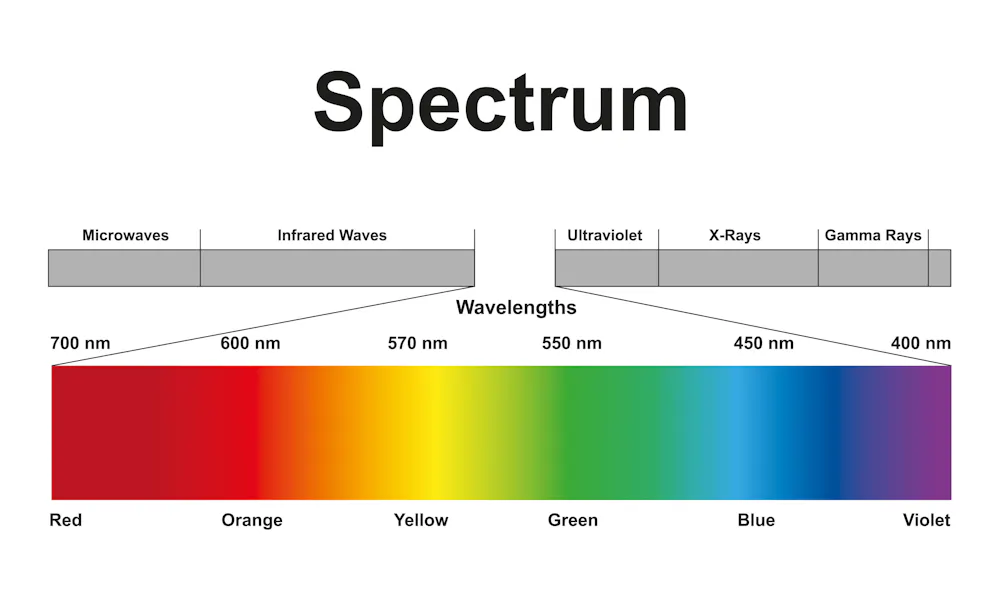
    Visible light forms just a small part of the electromagnetic spectrum, which includes all types of electromagnetic radiation. Within the visible range, different wavelengths of light produce different colors.
    Ali Damouh/Science Photo Library, via Getty Images

    Depending on the properties of the particles in our water sample, they will absorb and scatter radiation at different wavelengths. The light’s wavelength determines the color we see with our eyes.

    Waters that contain lots of sediment – such as the Missouri River, nicknamed the “Big Muddy” – backscatter light across the yellow to red range. This makes the water appear orange and muddy.

    Cleaner, more pure water backscatters light in the blue range, which makes it look blue. One famous example is Crater Lake in Oregon, which lies in a volcanic crater and is fed by rain and snow, without any streams to carry sediment into it.

    Deep waters like Crater Lake look dark blue, but shallow waters that are very clear, such as those around many Caribbean islands, can appear light blue or turquoise. This happens because light reflects off the white, sandy bottom.

    When water contains a lot of plant material, chlorophyll – a pigment plants make in their leaves – will absorb blue light and backscatter green light. This often happens in areas that contain a lot of runoff from highly developed areas, such as Lake Okeechobee in Florida. The runoff contains fertilizer from farms and lawns, which is made of nutrients that cause plant growth in the water.

    Finally, some water contains a lot of material called color-dissolved organic matter – often from decomposing organisms and plants, and also human or animal waste. This can happen in forested areas with lots of animal life, or in heavily populated areas that release wastewater into streams and rivers. This material mostly absorbs radiation and backscatters very little light across the spectrum, so it makes the water look very dark.

    Bad blooms

    Scientists expect water in nature to contains sediments, chlorophyll and organic matter. These substances help to sustain all living organisms in the water, from tiny microbes to fish that we eat. But too much of a good thing can become a problem.

    For example, when water contains a lot of nutrients and heats up on bright sunny days, plant growth in the water can get out of control. Sometimes it causes harmful algal blooms – plumes of toxic algae that can make people very sick if they swim in the water or eat fish that came from it.

    When water bodies become so polluted that they threaten fish and plants, or humans who drink the water, state and federal laws require governments to clean them up. The color of water can help guide these efforts.

    Engineering professor Courtney Di Vittorio and her students collect water samples from High Rock Lake in North Carolina to assess its water quality.

    My students and I collect water samples at High Rock Lake, a popular spot for swimming, boating and fishing in central North Carolina. Because of high chlorophyll levels, algal blooms are occurring there more often. Residents and visitors are worried that these blooms will become harmful.

    Using satellite photos of the lake and our sampling data, we can produce water quality maps. State officials use the maps to track chlorophyll levels and see how they change in space and time. This information can help them warn the public when there are algal blooms and develop new rules to make the water cleaner.


    Hello, curious kids! Do you have a question you’d like an expert to answer? Ask an adult to send your question to CuriousKidsUS@theconversation.com. Please tell us your name, age and the city where you live.

    And since curiosity has no age limit – adults, let us know what you’re wondering, too. We won’t be able to answer every question, but we will do our best.


    Courtney Di Vittorio receives funding from the North Carolina Attorney General’s Office Environmental Enhancement Grant Program (award WFU021PRE1) to collect data at High Rock Lake, NC. She is affiliated with the Yadkin Riverkeepers, an environmental advocacy not-for-profit group, and the North Carolina Lake Management Society.

    ref. Why is water different colors in different places? – https://theconversation.com/why-is-water-different-colors-in-different-places-243895


    MIL OSI – Global Reports

  • MIL-OSI Global: Who are Ismaili Muslims and how do their beliefs relate to the Aga Khan’s work?

    Source: The Conversation – USA – By Shariq Siddiqui, Assistant Professor of Philanthropic Studies, Indiana University

    Prince Karim Aga Khan at an event on Oct. 2, 2019, in London. Max Mumby/Indigo/Getty Images

    Prince Karim Aga Khan, who died on Feb. 4, 2025, served as the religious leader of Ismaili Muslims around the world since being appointed as the 49th hereditary imam in 1957. He came to be known around the world for his enormous work on global development issues and other philanthropic work.

    The Ismaili community considers the imam a direct descendant of the Prophet Muhammad. Ismaili Muslims are considered to be a branch of Shiite Islam. They constitute the second-largest community within the Shiite sect.

    An estimated 15 million Ismaili Muslims live in 35 countries, across all parts of the world. In the U.S., with around 40,000 Ismailis, Texas has the largest concentration of the community.

    As a scholar of Muslim philanthropy, I have long been impressed by the philanthropic and civic engagement of the Ismailis.

    Ismaili religious beliefs

    Following the death of the Prophet in A.D. 632, differences emerged over who should have both political and spiritual control over the Muslim community. A majority chose Abu Bakr, one of the Prophet’s closest companions, while a minority put their faith in his son-in-law and cousin, Ali. Those Muslims who put their faith in Abu Bakr came to be called Sunni, and those who believed in Ali came to be known as Shiite.

    Like other Shiite sects, Ismailis believe that Ali should have been selected as the successor of the Prophet Muhammad. They also believe that he should have been followed by Ali’s two sons – the grandsons of Muhammad through his daughter Fatima.

    The key difference among other Shiites and Ismailis lies in their lineage of imams. While they agree with the first six imams, Ismailis believe that Imam Ismail ibn Jafar was the rightful person to be the seventh imam, while the majority of Shiites, known as Twelvers, believe that Imam Musa al-Kazim, Ismail’s younger brother, was the true successor. They both agree that Ali was the first imam and on the next five imams, who are direct descendant of Ali and Fatima.

    The Ismaili sect split into two branches in 1094. Aga Khan was the leader of the Nizari branch, which believes in a living imam or leader. The second branch – Musta’lian Tayyibi Ismailis – believes that its 21st imam went into “concealment”; in his physical absence, a vicegerent or “da’i mutlaq” acts as an authority on his behalf.

    Like all Muslims, Ismailis believe that God sent his revelation to the Prophet Muhammad through Archangel Gabriel. However, they differ on other interpretations of the faith. According to the Ismailis, for example, the Quran conveys allegorical messages from God, and it is not the literal word of God. They also believe Muhammad to be the living embodiment of the Quran. Ismailis are strongly encouraged to pray three times a day, but it is not required.

    Ismailis believe in metaphorical, rather than literal, fasting. Ismailis believe that the esoteric meaning of fasting involves a fasting of the soul, whereby they attempt to purify the soul simply by avoiding sinful acts and doing good deeds.

    In terms of “Zakat,” or charity – the third pillar of Islam, which Muslims are required to follow – Ismailis differ in two ways. They give it to the leader of their faith, Aga Khan, and believe that they have to give 12.5% of their income versus 2.5%.

    Pluralism and its embrace

    Ismaili history has a strong connection to pluralism – part of their philosophy of embracing difference. The Fatimid Empire that ruled over parts of North Africa and the Middle East from 909 to 1171 is said to have been a “golden age of Ismaili thought.”

    It was a pluralistic community, in which Shiite and Sunni Muslims, as well as Christian and Jewish communities, worked together for the success of the flourishing empire, under the rule of the Ismaili imams.

    In the modern period, Ismailis have sought to further pluralism within their own communities by arguing that pluralism goes beyond tolerance and requires people to actively engage across differences and actively embrace difference as a strength. For example, Eboo Patel, an Ismaili American, has established the nonprofit Interfaith America as a way to further pluralism among faith communities.

    The Aga Khan’s philanthropic work

    Prince Karim Aga Khan established the Aga Khan Development Network and Aga Khan Foundation in 1967.

    Some 53 nurses and 98 midwives from Ghazanfar Institute of Health Sciences, supported by The Aga Khan University in Karachi, Pakistan, and the United States Agency for International Development, attend a graduation ceremony in Kabul, Afghanistan, on March 29, 2009.
    Massoud Hossaini AFP via Getty Images

    The network supports health care, housing, education and rural economic development in underprivileged areas. The foundation is one of nine agencies of the network that focuses on philanthropy. The Aga Khan Development Network has hospitals serving the poor in several parts of the world. The Aga Khan Medical University in Karachi, Pakistan, is considered to be a leading medical school globally.

    While previous imams or leaders also led charity and development projects, the Aga Khan was the first to create a formal, global philanthropic foundation.

    The Aga Khan Foundation operates in countries with Ismaili populations or historical connections to the Ismaili community, such as Afghanistan, Egypt, India, Kenya, Kyrgyzstan, Madagascar, Mozambique, Pakistan, Portugal, Syria, Tajikistan, Tanzania and Uganda. The foundation also has offices in Australia, Canada, the United Kingdom and the United States, focusing primarily on raising funds and advocating for the foundation.

    According to the foundation, in 2023 it served over 20 million people through 23,310 civil society partner organizations.

    The Ismaili community will now be led by the Aga Khan’s eldest son, Rahim Al-Hussaini, as the 50th imam. He has been actively involved with the Aga Khan Development Network and is expected to continue the important philanthropic and development work of his global community.

    Shariq Siddiqui does not work for, consult, own shares in or receive funding from any company or organization that would benefit from this article, and has disclosed no relevant affiliations beyond their academic appointment.

    ref. Who are Ismaili Muslims and how do their beliefs relate to the Aga Khan’s work? – https://theconversation.com/who-are-ismaili-muslims-and-how-do-their-beliefs-relate-to-the-aga-khans-work-249318

    MIL OSI – Global Reports

  • MIL-OSI Global: Cutting funding for science can have consequences for the economy, US technological competitiveness

    Source: The Conversation – USA – By Chris Impey, University Distinguished Professor of Astronomy, University of Arizona

    National Institutes of Health indirect costs, which are under the knife, go toward managing laboratories and facilities. Fei Yang/Moment via Getty Images

    America has already lost its global competitive edge in science, and funding cuts proposed in early 2025 may further a precipitous decline.

    Proposed cuts to the federal agencies that fund scientific research could undercut America’s global competitiveness, with negative impacts on the economy and the ability to attract and train the next generation of researchers.

    I’m an astronomer, and I have been a senior administrator at the University of Arizona’s College of Science. Because of these roles, I’m invested in the future of scientific research in the United States. I’m worried funding cuts could mean a decline in the amount and quality of research published – and that some potential discoveries won’t get made.

    The endless frontier

    A substantial part of U.S. prosperity after World War II was due to the country’s investment in science and technology.

    Vannevar Bush founded the company that later became Raytheon and was the president of the Carnegie Institution. In 1945, he delivered a report to President Franklin D. Roosevelt called The Endless Frontier.

    In this report, Bush argued that scientific research was essential to the country’s economic well-being and security. His advocacy led to the founding of the National Science Foundation and science policy as we know it today. He argued that a centralized approach to science funding would efficiently distribute resources to scientists doing research at universities.

    The National Science Foundation awards funding to many research projects and early career scientists. Pictured are astronomers from the LIGO collaboration, which won a Nobel Prize.
    AP Photo/Andrew Harnik

    Since 1945, advances in science and technology have driven 85% of American economic growth. Science and innovation are the engines of prosperity, where research generates new technologies, innovations and solutions that improve the quality of life and drive economic development.

    This causal relationship, where scientific research leads to innovations and inventions that promote economic growth, is true around the world.

    The importance of basic research

    Investment in research and development has tripled since 1990, but that growth has been funded by the business sector for applied research, while federal investment in basic research has stagnated. The distinction matters, because basic research, which is purely exploratory research, has enormous downstream benefits.

    Quantum computing is a prime example. Quantum computing originated 40 years ago, based on the fundamental physics of quantum mechanics. It has matured only in the past few years to the point where quantum computers can solve some problems faster than classical computers.

    Basic research into quantum physics has allowed quantum computing to develop and advance.
    AP Photo/Ross D. Franklin

    Worldwide, basic research pays for itself and has more impact on economic growth than applied research. This is because basic research expands the shared knowledge base that innovators can draw on.

    For example, a biotech advocacy firm calculated that every dollar of funding to the National Institutes of Health generates US$2.46 in economic activity, which is why a recent cut of $9 billion to its funding is so disturbing.

    The American public also values science. In an era of declining trust in public institutions, more than 3 in 4 Americans say research investment is creating employment opportunities, and a similar percentage are confident that scientists act in the public’s best interests.

    Science superpower slipping

    By some metrics, American science is preeminent. Researchers working in America have won over 40% of the science Nobel Prizes – three times more than people from any other country. American research universities are magnets for scientific talent, and the United States spends more on research and development than any other country.

    But there is intense competition to be a science superpower, and several metrics suggest the United States is slipping. Research and development spending as a percentage of GDP has fallen from a high of 1.9% in 1964 to 0.7% in 2021. Worldwide, the United States ranked 12th for this metric in 2021, behind South Korea and European countries.

    In number of scientific researchers as a portion of the labor force, the United States ranks 10th.

    Metrics for research quality tell a similar story. In 2020, China overtook the United States in having the largest share of the top 1% most-cited papers.

    China also leads the world in the number of patents, and it has been outspending the U.S. on research in the past few decades. Switzerland and Sweden eclipse the United States in terms of science and technology innovation. This definition of innovation goes beyond research in labs and the number of scientific papers published to include improvements to outcomes in the form of new goods or new services.

    Among American educators and workers in technical fields, 3 in 4 think the United States has already lost the competition for global leadership.

    Threats to science funding

    Against this backdrop, threats made in the beginning of President Donald Trump’s second term to science funding are ominous.

    Trump’s first wave of executive orders caused chaos at science agencies as they struggled to interpret the directives. Much of the anxiety involved excising language and programs relating to diversity, equity and inclusion, or DEI.

    The National Science Foundation is particularly in the crosshairs. In late January 2025, it froze the routine review and approval of grants and new expenditures, impeding future research, and has been vetting grants to make sure they comply with orders from the U.S. president.

    The National Institutes of Health announced on Feb. 7, 2024 a decision to limit overhead rates to 15% which sent many researchers reeling though it has since been temporarily blocked by a judge. The National Institutes of Health is the world’s largest funder of biomedical research, and these indirect costs provide support for the operation and maintenance of lab facilities. They are essential for doing research.

    The new administration has proposed deeper cuts. The National Science Foundation has been told to prepare for the loss of half of its staff and two-thirds of its funding. Other federal science agencies are facing similar threats of layoffs and funding cuts.

    The impact

    Congress already failed to deliver on its 2022 commitment to increase research funding, and federal funding for science agencies is at a 25-year low.

    As the president’s proposals reach Congress for approval or negotiation, they will test the traditionally bipartisan support science has held. If Congress cuts budgets further, I believe the impact on job creation, the training of young scientists and the health of the economy will be substantial.

    Deep cuts to agencies that account for a small fraction – just over 1% – of federal spending will not put a dent in the soaring budget deficit, but they could irreparably harm one of the nation’s most valuable enterprises.

    Chris Impey has received funding from NASA, the National Science Foundation, and the Howard Hughes Medical Institute.

    ref. Cutting funding for science can have consequences for the economy, US technological competitiveness – https://theconversation.com/cutting-funding-for-science-can-have-consequences-for-the-economy-us-technological-competitiveness-249568

    MIL OSI – Global Reports

  • MIL-OSI Global: The biggest threat in the Ontario election isn’t Donald Trump, it’s voter disengagement

    Source: The Conversation – Canada – By Mark Winfield, Professor, Environmental and Urban Change, York University, Canada

    Ontario Premier Doug Ford has justified his early election call on the need to respond to United States President Donald Trump’s threat to impose 25 per cent tariffs on Canadian imports.

    While the threat of tariffs on all Canadian imports has been paused — although Trump has since slapped levies on all steel and aluminum imports into the U.S. — Ontario voters need to reflect more than ever on the province’s circumstances and the performance of its government as they prepare to head to the polls next week.

    The Ford government’s approach to the environment and climate change, as well as its policies on a range of other issues like housing, health care and education, is best understood in the context of its overall “market populist” approach to governance.

    Several defining features of this model have emerged over the past six and a half years under Ford’s rule.

    Unaffordable proposals

    First, issues that require long-term perspectives on environmental, social and economic costs — like climate change — have tended to be disregarded. To the extent that the government has provided any sort of long-term vision, it has been focused on grandiose infrastructure projects.

    That includes a proposal to bury the Highway 401 highway in Toronto — an undertaking with a potential cost of anywhere between $60 and over $200 billion. But even that expense would pale in comparison to a recent proposal for a 10,000-megawatt nuclear power plant near Wesleyville, between Toronto and Kingston.

    The costs for the project based on recent experiences in the U.S., could easily top the $200 billion mark as well.

    The Ford government’s drive to “get it done” has also, at times, invoked a near-Trumpian disdain for democratic norms and limits on executive authority. This has been illustrated by, among other things, the first invocation of the notwithstanding clause of the Canadian Charter of Rights and Freedoms in Ontario history.


    Read more:
    Doug Ford uses the notwithstanding clause for political benefit


    Power has been increasingly concentrated in the premier’s office. Provisions for public participation, transparency and accountability under the guise of eliminating red tape in decision-making processes have been systemically eliminated.

    Processes for the meaningful environmental and economic review of major projects have suffered the same fate.

    Another defining issue is the Ford government’s approach to managing the province’s finances, with even the consistently pro-business Fraser Institute raising concerns.

    The disregard of financial responsibility has perhaps been most powerfully demonstrated by issuing of $200 rebates to Ontario residents. These are expected to cost to the provincial treasury more than $3 billion.

    Fewer revenue streams

    The Ford government has also displayed a willingness to eliminate billions a year in stable, long-term revenue streams, like vehicle licencing fees and fuel taxes. Major long-term costs and liabilities have been embedded at the same time, especially in relation to questionable infrastructure projects.

    All of this has taken place amid ongoing crises, attributed to provincial underfunding in areas like schools and post-secondary institutions, affordable (especially rental) housing and health care.

    In the longer term, liabilities are accumulating from the government’s failure to deal with the impacts of a changing climate.

    A final feature of the government’s market populist governance model has been an approach to decision-making based on connections, access and political whim rather than evidence or analysis.

    This pattern was perhaps most evident during the $8.3 billion Greenbelt land removal scandal involving well-connected developers. But the same pattern extends to the energy, for-profit health and resource extraction sectors as well.

    The province’s major opposition parties ran unsuccessfully in the 2022 election on the basis of platforms emphasizing adherence to what had been thought to be core principles in Ontario politics — moderation, managerial competence, and basic democratic values.

    Opposition parties

    This time, all three have turned to more populist themes.

    Liberal Leader Bonnie Crombie promises even more tax cuts than Ford. The NDP proposes to remove tolls from the 407 highway at an unknown cost to the provincial treasury and other programs.

    Even the Green Party, which has previously drawn praise for the content and imagination of its platforms, has picked up on populist themes, with an emphasis on affordability and a Ford-topping promise — and likely an even more ambitious — to build two million new homes.

    Vulnerabilities for the Ford government abound. Recent polling suggests that despite the apparently strong Conservative lead, Ford himself is deeply unpopular, particularly among women voters. Sixty per cent of Ontario residents think the province is on the “wrong track.”

    The early election call itself is widely seen as costly, unjustified and opportunistic. The distraction of the election may well have weakened the province’s immediate capacity to deal with the Trump administration.


    Read more:
    An unnecessary Ontario election won’t help Canada deal with Donald Trump


    Questions and investigations around the Greenbelt land removal scandal and the government’s relationship with the land-development industry continue to close in on the premier’s office amid an ongoing RCMP investigation.

    Crises around housing, education, health care and electricity continue to deepen.

    Ontario’s Bill 23 eliminated or weakened many housing development regulations, including site plan controls, which kept the natural environment safe from the negative effects of poorly controlled development.
    THE CANADIAN PRESS/Nathan Denette

    Still disengaged?

    In calling an early election, the Ford government has provided Ontario voters with an unexpected opportunity to reflect on its record, and the potential paths forward for the province.

    Hopefully Ontario voters will engage more deeply with these questions than they did in the 2022 election, which had the lowest voter turnout in the province’s history.

    Three years ago, the government emerged with an overwhelming majority in the legislature on the basis of the ballots of less than 18 per cent of the province’s eligible voters. The stakes are far too high in 2025 for a repeat of that level of disengagement.

    Mark Winfield receives funding from the Social Sciences and Humanities Research Council of Canada. This chapter summarizes the contents of the author’s contribution to three new volumes on Ontario politics (The Politics of Ontario, 2nd ed,( UTP 2024); Ontario Since Confederation: A Reader (UTP 2025); and Against the People (Fernwood 2025)

    ref. The biggest threat in the Ontario election isn’t Donald Trump, it’s voter disengagement – https://theconversation.com/the-biggest-threat-in-the-ontario-election-isnt-donald-trump-its-voter-disengagement-249528

    MIL OSI – Global Reports

  • MIL-OSI Europe: Cost of living and the environment are top concerns of young people, survey finds

    Source: European Union 2

    An EP survey of EU citizens aged 16-30 shows social media is their main information source, and that the majority are also aware of the risks of online disinformation.

    Rising prices and the cost of living are a concern for 40% of the 16-30 year-olds who took part in the latest Eurobarometer Youth Survey published on Monday. One third of respondents said they believed the EU should focus its attention on the environment and climate change over the next five years, while 31% believe the economic situation and job creation should be a priority.

    Almost three in ten (29%) want the EU to prioritise social protection, welfare and access to healthcare. More than one in five respondents highlighted education and training (27%), housing (23%) and the EU’s defence and security (21%) as important priorities for the EU. European defence is of particular concern for young people in Czechia (36%), Poland (33%), and Estonia (32%).

    Roberta Metsola said: “Listening to young Europeans and their concerns is vital for politicians, policy-makers and European democracy. Young people today are worried about rising prices, climate change, security and their chances of finding a good job. These are concerns that we must address in every decision we take and every law that we pass. Otherwise, we risk losing a generation to disillusionment.”


    Social media outrun TV as main source of information

    Social media is the top source of information on political and social issues for 42% of respondents aged 16-30, with television being the second most-popular source (39%). The preference for TV is particularly noticeable among those aged 25-30. This age bracket is also more likely to use online news platforms and radio than 16-18 year-olds. Younger participants (16-18) rely more on social media (45%) than 25-30 year-olds (39%), and trust friends, family or colleagues for information (29% compared to 23%).

    “The information landscape is rapidly changing. With most young people predominantly getting their news from social media, politicians and social media platforms have a particular responsibility to fight increasing disinformation,” President Metsola added.

    TV also remains the leading source of information for young people in Portugal (53%), Italy (52%), Slovenia (45%), and France (43%). Online press and/or news platforms and radio are sources of information for 26% of the younger participants and 16% of their older counterparts. In the 2021 edition of the survey, the main sources of news were social media and news websites (each of which was mentioned by 41% of respondents).


    Instagram and TikTok are the most used social media for news

    Instagram is the top platform for obtaining political and social news among young people (47%), followed by TikTok (39%). X (formerly Twitter) is only used by 21% of young people, the survey shows.


    Young people are aware of their exposure to disinformation

    A significant majority (76%) of young people believed they had previously been exposed to disinformation and fake news.

    In nine EU countries, more than half of respondents report having been exposed to disinformation ‘often’ or ‘very often’, with the highest proportions from Malta (59%), Hungary (58%), Greece (57%), Luxembourg (55%), and Belgium (54%). By contrast, the share of those who believe they have never been exposed to disinformation and fake news is the highest in Romania (19%) followed by Bulgaria (11%).

    70% of the participants in the survey were confident they could recognise disinformation. Respondents from Malta and Croatia were the most confident in their ability to recognise disinformation, while those from Austria, Germany and Slovenia felt the least confident.

    Background

    The Eurobarometer Youth Survey was carried out by Ipsos between 25 September and 3 October 2024 in all 27 EU member states. A total of 25,863 young people aged 16-30 were surveyed via Computer-Assisted Web Interviewing (CAWI) using online panels. The results were weighted according to the proportion of this age group within each EU country.

    The full results can be found here.


    Young people discuss EU action at EYE2025

    Insights from the Eurobarometer Youth Survey provide a detailed understanding of the political participation of young Europeans and their needs and concerns. These findings will help ensure that Parliament’s flagship youth event,EYE2025, addresses topics that matter most to the EU’s young generation.

    Registration for EYE2025 is open until 21 February. From 13-14 June 2025, the EYE will bring together thousands of young people from across the EU and beyond to debate, exchange views, and contribute to shaping Europe’s future in Parliament’s Strasbourg premises.

    MIL OSI Europe News

  • MIL-OSI United Kingdom: Thames river rage drama ends with huge fine

    Source: United Kingdom – Executive Government & Departments

    Boat-owner that caused Kingston Regatta incident charged more than £4,000. Video evidence shows disgraceful behaviour on the water.

    Boat-owner fined for “disgraceful” behaviour during Thames regatta

    An appalling incident of river rage on the River Thames at Kingston-upon-Thames in July 2024 has ended with £4,334.54 in fines, compensation and costs at Staines magistrates’ court on 28 January 2025.

    The perpetrator had navigated his boat dangerously and used abusive language at other river users. He was also found guilty of obstructing a boat race and interfering with the safety of persons gathered, failing to comply with a harbour master’s notice, and failing to register his boat for use on the Thames.  

    Scott Keen, of Morden, Surrey, steered his boat, Barney McGrew, along the Thames into a closed area of the river being used for Kingston Amateur Regatta, an event established in 1852, narrowly avoiding colliding with and swamping rowers.  

    Foul-mouth tirade

    The court heard how Keen was advised by an umpire that the river ahead was closed and he should return to a navigation channel. He ignored the request and continued past the umpire, cutting across the racing line and narrowly missing one of the boats, which had to take last-minute evasive action to avoid a collision. His cruiser than caught the anchor rope of a race stake boat, before he stopped and launched a foul-mouthed tirade against participants, yelling that ‘they did not own the (expletive) water.’  

    His actions and the way he navigated his vessel endangered the safety of those present at the Regatta, included young scullers in rowing boats. An eyewitness captured the full extent of the drama on a mobile phone. 

    Environment Agency officers carried out a detailed investigation into the incident and discovered that Barney McGrew was also an unregistered vessel. Keen was invited to a voluntary interview but failed to attend. A summons was subsequently issued for his appearance at Staines magistrates’ court on 28 January 2025. Again, he failed to attend. 

    Incident ‘was a disgrace’

    Maria Herlihy, operations manager at the Environment Agency and harbour master of the Thames, said:

    “This incident was a disgrace. Keen showed no regard for the safety of other river users and could easily have caused a tragedy. Quite frankly, it was no surprise to discover that his boat was unregistered, and we are happy with the court result.

    “We hope that this serves as a clear warning to all – anti-social and dangerous behaviour on our rivers will not be tolerated, and we will take robust action to deal with those who disregard the rules and regulations for boating on the River Thames.” 

    The magistrates fined Keen the maximum penalty of £1,000 for interfering with the boat race and navigating his boat without due care and attention. The court explained that it used its discretion to go outside the sentencing guidelines to deal with the matter robustly.

    The court heard the incident was shocking in its totality, with clear criminality that endangered the safety of other people, including the young people involved in the regatta.

    The court also complimented the Environment Agency’s investigation, and the evidence submitted.  

    Also charged in court, on the same day, for separate and unrelated incidents was Paul Campbell of West Molesey, who was found guilty in his absence of having not registered his boat, Enigma, for 2024 and failing to comply with directions to move his vessel from its location at West Molesey riverbank. He received a total of £2024.24 in fines, compensation and costs to be paid within 28 days.

    Ms Herlihy added:

    “As these prosecutions show, we have no hesitation in bringing offenders to court who avoid their obligations and responsibilities to lawful river users. Just one day in court has resulted in more than £6,000 of fines and compensation, which should serve as a major deterrent.” 

    Last year’s crackdown on unregistered vessels in the Thames resulted in 40 boaters having to pay a combined total of over £55,000 for their offences. 

    Renewal invitation letters for 2025 registrations on the River Thames were sent in November last year to everyone that registered their boat in 2024, and owners were encouraged to register early to ensure their boats were compliant by 1 January when the new season began.  

    The Environment Agency’s approach to non-registration on the Thames has changed – boat owners are given ample opportunity to register their boat. However, once a summons has been issued, it won’t stop court proceedings, even if the boat owner subsequently pays their registration fee. 

    Similar to excise duty for road vehicles, boat registration fees allow the Environment Agency to manage and maintain more than 600 miles of inland waterways across England, keeping them open and safe for thousands of boaters to enjoy. 

    Boats can be registered by calling 03708 506 506 or going to River Thames: boat registration and application forms – GOV.UK (www.gov.uk)

    Ends 

    • Owners of powered or non-powered boats, including paddleboards, must register their boats annually with the Environment Agency for use on the non-tidal River Thames.  

    • Boat registration on the Thames starts on 1 January every year. Any boats found on the water after that date, without having registered, may be liable to a fine. 

    • In mid-September 2024, during a river-wide census, Environment Agency officers recorded the locations of 10,890 boats on the river. 

    • Scott Keen, on Barney McGrew, was charged with: 

    1. On 13 July 2024, being the master of the vessel Barney McGrew, in the vicinity of Ravens Ait and Kingston Bridge on the River Thames, Keen failed to comply with a harbour master’s notice, contrary to section 84 of the Thames Conservancy Act 1932 – found guilty in absence and fined £50. 

    2. On 13 July 2024, being the master of the vessel Barney McGrew, in the vicinity of Ravens Ait and Kingston Bridge on the River Thames, Keen navigated his vessel in a manner as would risk obstructing impeding or interfering with such boat race regatta or function or endangering the safety of persons assembling on the river or preventing or interfering with the maintenance of order thereon, contrary to byelaw 52 and 86(a) of the Thames Navigation Licensing & General Byelaws 1993 – found guilty in absence and fined £1,000. 

    3. On 13 July 2024, being the master of the vessel Barney McGrew, in the vicinity of Ravens Ait and Kingston Bridge on the River Thames, Keen used abusive, threatening and language towards officials and volunteers involved in the regatta and conducted himself in a threatening or offensive manner contrary to 63(a) and 86(a) of the Thames Navigation Licensing & General Byelaws 1993 – found guilty in absence and fined £440. 

    4. On 13 July 2024, being the master of the vessel Barney McGrew, in the vicinity of Ravens Ait and Kingston Bridge on the River Thames, Keen failed to navigate with care and caution and at such a speed and in such a manner as not to endanger the lives of others of cause injury to person or endanger the safety of or cause damage to other vessels or any moorings or to the banks of the Thames or other property, contrary to section 97 of the Thames Conservancy Act 1932 – found guilty in absence and fined £1,000. 

    5. On 17 July 2024, at Riverside Walk, near Kingston-upon-Thames, being the owner or master of a vessel named Barney McGrew, Keen failed to register the vessel with the Environment Agency in accordance with article 4(1)(a) of the Environment Agency (Inland Waterways) Order 2010, contrary to article 18(1)(a) of the Environment Agency (Inland Waterways) Order 2010 – found guilty in absence and fined £220. 

    A total of £2,710 in fines, £275 costs, £265.54 compensation and a £1,084 victim surcharge. A grand total £4,334.53. 

    • Paul David Campbell on Enigma, was found guilty in absence of the following charges 

    • Not registering his vessel Enigma, contrary to article 4(1) and article 18(1) of the Inland Waterway Order 2010. 

    • Failure to adhere to an officer’s directions to move, byelaw 58, Thames Navigation and General Byelaws 1993. 

    • He received £440 in fines – £220 for each charge – £275 costs, £1,593.40 compensation and £176 victim surcharge. Total: £2,024.24   

    Contact us:

    Journalists only – 0800 141 2743 or communications_se@environment-agency.gov.uk

    Both cases were heard at Staines magistrates’ court on 28 January 2025.

    Updates to this page

    Published 17 February 2025

    MIL OSI United Kingdom

  • MIL-OSI: NANO Nuclear Energy Strengthens Intellectual Property Portfolio with Four New Patent Applications

    Source: GlobeNewswire (MIL-OSI)

    Protections Surrounding Key Enabling ALIP Technology Adds to NANO Nuclear’s Stable of Granted or Acquired Patents and Patent Applications

    New York, N.Y., Feb. 17, 2025 (GLOBE NEWSWIRE) — NANO Nuclear Energy Inc. (NASDAQ: NNE) (“NANO Nuclear” or “the Company”), a leading advanced nuclear energy and technology company focused on developing clean energy solutions, today announced that it has filed four new separate utility patent applications with the United States Patent and Trademark Office (USPTO) related to NANO Nuclear’s Annular Linear Induction Pump (ALIP) technology.

    The ALIP technology, a thermal management and distribution system which is based on electromagnetic (rather than mechanical) pumps, is a core technology in the development of advanced molten-salt and liquid-metal nuclear reactors. By utilizing a time-varying magnetic field, ALIPs enable the movement of conductive fluids without mechanical components, reducing wear and maintenance requirements while increasing efficiency.

    The ALIP technology, acquired by NANO Nuclear last year and part of its suite of energy systems, is considered a key-enabling technology for the development of advanced nuclear reactors, not only for NANO Nuclear’s microreactors in development but as a third-party commercial opportunity for other advanced nuclear reactor systems.

    In addition to enhancing energy conversion cycles, optimizing thermal management, and ensuring operational longevity in high-temperature applications across the energy, propulsion, and industrial sectors, applications of the ALIP technology extend beyond nuclear energy to space power and propulsion systems, industrial cooling systems, and defense applications, positioning NANO Nuclear at the forefront of emerging high-performance fluid control markets.

    A U.S. Department of Energy’s Small Business Innovation Research (SBIR) Phase III project is ongoing to refine the ALIP technology, led by inventor and NANO Nuclear’s Head of Thermal Hydraulics and Space Program Dr. Carlos O. Maidana, with a view to separately commercialize the technology as a component for liquid metal and all molten salt-based nuclear reactors.

    Figure 1 – NANO Nuclear Energy’s Annular Linear Induction Pump (ALIP) technology cross-sectional visualization.

    “The development and eventual commercialization of the ALIP technology is essential for advancing next-generation nuclear reactor solutions,” said Carlos O. Maidana, Ph.D., Head of Thermal Hydraulics and Space Program of NANO Nuclear Energy. “Filing these utility patents highlights our commitment to leading the charge in next-generation technologies that are critical to the ongoing evolution of advanced energy systems. I’m pleased to have housed these inventions within NANO Nuclear and to lead the team to progress and refine this technology.”

    The newly filed patent applications include:

    1. Patent Application # 19/030,148, titled “Integrated platform and method for optimizing an electromagnetic pump,” relates to the development of software for the design of annular linear induction pumps.
    2. Patent Application # 19/030,130, titled “Electromagnetic pump system and method for moving conducting fluid,” relates to the design of the next generation of annular linear induction pumps.
    3. Patent Application # 19/030,098, titled “Electromagnetic pump and method for manufacturing the same,” relates to the advanced manufacturing of annular linear induction pumps.
    4. Patent Application # 19/030,068, titled “Cooling system for electromagnetic pump system,” relates to the design of a micro-channel cooling system, using advanced manufacturing methods, for annular linear induction pumps operating at very high temperature.

    These intellectual properties are expected to provide enhanced component life span and operation metrics in all advanced molten-salt and liquid-metal reactors, including NANO Nuclear’s KRONOS MMR, LOKI MMR, and ODIN portable microreactor, all of which are currently in development.

    “The filing of these additional utility patents further bolsters our intellectual property portfolio and helps to ensure the protection of our progress in developing this key enabling technology,” said James Walker, Chief Executive Officer and Head of Reactor Development of NANO Nuclear Energy. “We believe that the ALIP technology will be instrumental in the development and optimization of the next generation of advanced nuclear reactors, and I’m pleased with the progress Dr. Maidana has overseen through the SBIR Phase III program. We look forward to continuing our progress with ALIP with a view towards including in it our own microreactors in development as well as seeking to separately commercialize it as soon as possible.”

    About NANO Nuclear Energy, Inc.

    NANO Nuclear Energy Inc. (NASDAQ: NNE) is an advanced technology-driven nuclear energy company seeking to become a commercially focused, diversified, and vertically integrated company across five business lines: (i) cutting edge portable and other microreactor technologies, (ii) nuclear fuel fabrication, (iii) nuclear fuel transportation, (iv) nuclear applications for space and (v) nuclear industry consulting services. NANO Nuclear believes it is the first portable nuclear microreactor company to be listed publicly in the U.S.

    Led by a world-class nuclear engineering team, NANO Nuclear’s reactor products in development include “ZEUS”, a solid core battery reactor, and “ODIN”, a low-pressure coolant reactor, each representing advanced developments in clean energy solutions that are portable, on-demand capable, advanced nuclear microreactors. NANO Nuclear is also developing patented stationary KRONOS MMR Energy System and space focused, portable LOKI MMR.

    Advanced Fuel Transportation Inc. (AFT), a NANO Nuclear subsidiary, is led by former executives from the largest transportation company in the world aiming to build a North American transportation company that will provide commercial quantities of HALEU fuel to small modular reactors, microreactor companies, national laboratories, military, and DOE programs. Through NANO Nuclear, AFT is the exclusive licensee of a patented high-capacity HALEU fuel transportation basket developed by three major U.S. national nuclear laboratories and funded by the Department of Energy. Assuming development and commercialization, AFT is expected to form part of the only vertically integrated nuclear fuel business of its kind in North America.

    HALEU Energy Fuel Inc. (HEF), a NANO Nuclear subsidiary, is focusing on the future development of a domestic source for a High-Assay, Low-Enriched Uranium (HALEU) fuel fabrication pipeline for NANO Nuclear’s own microreactors as well as the broader advanced nuclear reactor industry.

    NANO Nuclear Space Inc. (NNS), a NANO Nuclear subsidiary, is exploring the potential commercial applications of NANO Nuclear’s developing micronuclear reactor technology in space. NNS is focusing on applications such as the LOKI MMR system and other power systems for extraterrestrial projects and human sustaining environments, and potentially propulsion technology for long haul space missions. NNS’ initial focus will be on cis-lunar applications, referring to uses in the space region extending from Earth to the area surrounding the Moon’s surface.

    For more corporate information please visit: https://NanoNuclearEnergy.com/

    For further NANO Nuclear information, please contact:
    Email: IR@NANONuclearEnergy.com
    Business Tel: (212) 634-9206

    PLEASE FOLLOW OUR SOCIAL MEDIA PAGES HERE:

    NANO Nuclear Energy LINKEDIN
    NANO Nuclear Energy YOUTUBE
    NANO Nuclear Energy X PLATFORM

    Cautionary Note Regarding Forward Looking Statements

    This news release and statements of NANO Nuclear’s management in connection with this news release contain or may contain “forward-looking statements” within the meaning of Section 21E of the Securities Exchange Act of 1934, as amended, and the Private Securities Litigation Reform Act of 1995. In this context, forward-looking statements mean statements related to future events, which may impact our expected future business and financial performance, and often contain words such as “expects”, “anticipates”, “intends”, “plans”, “believes”, “potential”, “will”, “should”, “could”, “would” or “may” and other words of similar meaning. In this press release, forward-looking statements include those related to (i) the anticipated benefits to NANO Nuclear of the patent applications described herein and (ii) the future prospects for the ALIP technology generally as part of NANO Nuclear’s reactors in development or via separate commercialization. These and other forward-looking statements are based on information available to us as of the date of this news release and represent management’s current views and assumptions. Forward-looking statements are not guarantees of future performance, events or results and involve significant known and unknown risks, uncertainties and other factors, which may be beyond our control. For NANO Nuclear, particular risks and uncertainties that could cause our actual future results to differ materially from those expressed in our forward-looking statements include but are not limited to the following: (i) risks related to our U.S. Department of Energy (“DOE”) or related state or non-U.S. nuclear fuel licensing submissions, (ii) risks related the development of new or advanced technology and the acquisition of complimentary technology or businesses, including difficulties with design and testing, cost overruns, regulatory delays, integration issues, securing intellectual property protection, and the development of competitive technology, (iii) our ability to obtain contracts and funding to be able to continue operations, (iv) risks related to uncertainty regarding our ability to technologically develop and commercially deploy a competitive advanced nuclear reactor or other technology in the timelines we anticipate, if ever, (v) risks related to the impact of U.S. and non-U.S. government regulation, policies and licensing requirements, including by the DOE and the U.S. Nuclear Regulatory Commission, including those associated with the recently enacted ADVANCE Act, and (vi) similar risks and uncertainties associated with the operating an early stage business a highly regulated and rapidly evolving industry. Readers are cautioned not to place undue reliance on these forward-looking statements, which apply only as of the date of this news release. These factors may not constitute all factors that could cause actual results to differ from those discussed in any forward-looking statement, and NANO Nuclear therefore encourages investors to review other factors that may affect future results in its filings with the SEC, which are available for review at www.sec.gov and at https://ir.nanonuclearenergy.com/financial-information/sec-filings. Accordingly, forward-looking statements should not be relied upon as a predictor of actual results. We do not undertake to update our forward-looking statements to reflect events or circumstances that may arise after the date of this news release, except as required by law.

    Attachment

    The MIL Network

  • MIL-OSI: 3D Systems’ Co-founder & Chief Technology Officer for Regenerative Medicine, Chuck Hull, Elected to the National Academy of Engineering

    Source: GlobeNewswire (MIL-OSI)

    ROCK HILL, S.C., Feb. 17, 2025 (GLOBE NEWSWIRE) — Today, 3D Systems (NYSE: DDD) announced Charles (Chuck) Hull, its co-founder and chief technology officer for regenerative medicine, has been elected to the National Academy of Engineering (NAE). Election to the NAE is among the highest professional distinctions accorded to an engineer. Academy membership honors those who have made outstanding contributions in at least one of the following categories: “engineering practice, research, or education,” “pioneering of new and developing fields of technology, major advancements in traditional fields of engineering, or development/implementation of innovative approaches to engineering education,” or “engineering leadership of one or more major endeavors.” NAE members are among the world’s most accomplished engineers from business, academia, and government. Mr. Hull is being honored for the invention of 3D printing and the subsequent development of the additive manufacturing industry. 

    “It is humbling to be elected to this academy of distinguished engineers,” said Mr. Hull. “I’m honored and excited to serve and work alongside such outstanding professionals to advance the positive impact engineering has on our world.”

    Mr. Hull pioneered the development of 3D printing while Vice President of Engineering at UVP, Inc. (now Analytik Jena), a manufacturer of ultraviolet light sources. His work on fusing UV resins into 3D structures for prototyping led to the creation of the first 3D-printed part, an eye wash cup, in 1983 using Stereolithography (SLA). He patented this technology and subsequently co-founded 3D Systems in 1986, launching the first commercial 3D printer, the SLA-1, and thus establishing the 3D printing industry.

    Mr. Hull’s groundbreaking invention has earned him numerous accolades. In October of 2023, he received the National Medal of Technology and Innovation (NMTI) from President Joe Biden. Established in 1980, the NMTI is the United States’ highest honor for technological achievement, awarded by the President of the United States for outstanding contributions to America’s economic, environmental, and social well-being. Mr. Hull was inducted into the National Inventors Hall of Fame (2014) and received the European Inventor Award (2014) for his transformative impact. His contributions have also been recognized with the Manufacturing Leadership Lifetime Achievement Award (2016), the ASME’s designation of the SLA-1 as a Historic Mechanical Engineering Landmark, and The Economist’s 2013 Innovation Award. With 85 US patents and numerous international patents in ion optics and 3D printing, Mr. Hull’s legacy as an inventor is firmly established.

    “On behalf of the entire 3D Systems team, it is my pleasure to extend our deepest congratulations to Chuck for this honor,” said Dr. Jeffrey Graves, president & CEO, 3D Systems. “His pioneering work has revolutionized manufacturing and profoundly impacted healthcare delivery. Chuck’s invention of Stereolithography not only launched an entire industry but also sparked the proliferation of numerous applications for 3D printing technologies. Whether we look at aerospace, personalized healthcare solutions, AI infrastructure, or the automotive industry, 3D printing is playing a significant role in how these industries innovate. Thanks to Chuck’s groundbreaking initial innovation with SLA, we are transforming manufacturing and patient care for a better future.”

    Mr. Hull is among 128 new members and 22 international members in the NAE Class of 2025. Elected by their peers, the ballot for this class was set in December and the final vote took place in January. He and his class will be formally inducted during the NAE’s Annual Meeting on October 5, 2025.

    Forward-Looking Statements
    Certain statements made in this release that are not statements of historical or current facts are forward-looking statements within the meaning of the Private Securities Litigation Reform Act of 1995. Forward-looking statements involve known and unknown risks, uncertainties and other factors that may cause the actual results, performance or achievements of the company to be materially different from historical results or from any future results or projections expressed or implied by such forward-looking statements. In many cases, forward-looking statements can be identified by terms such as “believes,” “belief,” “expects,” “may,” “will,” “estimates,” “intends,” “anticipates” or “plans” or the negative of these terms or other comparable terminology. Forward-looking statements are based upon management’s beliefs, assumptions, and current expectations and may include comments as to the company’s beliefs and expectations as to future events and trends affecting its business and are necessarily subject to uncertainties, many of which are outside the control of the company. The factors described under the headings “Forward-Looking Statements” and “Risk Factors” in the company’s periodic filings with the Securities and Exchange Commission, as well as other factors, could cause actual results to differ materially from those reflected or predicted in forward-looking statements. Although management believes that the expectations reflected in the forward-looking statements are reasonable, forward-looking statements are not, and should not be relied upon as a guarantee of future performance or results, nor will they necessarily prove to be accurate indications of the times at which such performance or results will be achieved. The forward-looking statements included are made only as of the date of the statement. 3D Systems undertakes no obligation to update or review any forward-looking statements made by management or on its behalf, whether as a result of future developments, subsequent events or circumstances or otherwise, except as required by law.

    About 3D Systems
    More than 35 years ago, 3D Systems brought the innovation of 3D printing to the manufacturing industry. Today, as the leading additive manufacturing solutions partner, we bring innovation, performance, and reliability to every interaction – empowering our customers to create products and business models never before possible. Thanks to our unique offering of hardware, software, materials, and services, each application-specific solution is powered by the expertise of our application engineers who collaborate with customers to transform how they deliver their products and services. 3D Systems’ solutions address a variety of advanced applications in healthcare and industrial markets such as medical and dental, aerospace & defense, automotive, and durable goods. More information on the company is available at www.3dsystems.com.

    Investor Contact: investor.relations@3dsystems.com
    Media Contact: press@3dsystems.com

    A photo accompanying this announcement is available at https://www.globenewswire.com/NewsRoom/AttachmentNg/d059ac89-1e4b-4118-b82f-04fa9bed475a

    The MIL Network

  • MIL-OSI Europe: ASIA/MYANMAR – Funeral ceremony in the birthplace: ten suspects arrested in connection with the murder of Father Donald Martin Ye Naing Win

    Source: Agenzia Fides – MIL OSI

    Monday, 17 February 2025

    Archdiocese of Mandalay

    Yangon (Agenzia Fides) – More than 5,000 people, despite the dangers and general violence, gathered in the village of Pyin Oo Lwin to pay their last respects to Catholic priest Donald Martin Ye Naing Win, who was brutally murdered on February 14 in his parish of Our Lady of Lourdes in the Archdiocese of Mandalay (see Fides, 15/2/2025). The mountain village of Pyin Oo Lwin is the birthplace of Father Donald, where his family lives. There, priests, religious, faithful gathered around the Archbishop of Mandalay, Marco Tin Win, in the Catholic Church of the Assumption of the Virgin Mary to celebrate the funeral mass and offer consolation to Father Donald’s family, who attended the funeral mass. The moving participation of the people, according to Fides sources present at the celebration, set the scene for the Mass during which the Archbishop read the message of the Apostolic Nunciature in Yangon and the condolences of the Bishops’ Conference of Myanmar, which express deep and sincere solidarity with the local population (see Fides, 17/2/2025).Archbishop Marco Tin Win, who presided over the Eucharist, urged the faithful to wake up, “because violence only brings death and destruction, it is always a defeat”, and he made a heartfelt appeal “to all armed groups and actors involved in the conflict to lay down their weapons and take a path of peace and reconciliation”. He then entrusted Father Donald, his family and the entire community present to the loving hands of the Virgin Mary: “May Our Lady accompany him to paradise and protect all under her mantle, giving comfort and hope,” said the Archbishop.The local community is asking about the reasons for the senseless murder of a priest who devoted himself with ardour to others. According to local sources, Father Donald was particularly involved in organizing educational work for children and young people in the area around his parish of Our Lady of Lourdes, where he was the first parish priest and where about 40 Catholic families live. Faced with civil war, violence and displacement, schools are closed, there are no teachers and only informal classes given voluntarily by priests, religious and catechists ensure a minimum level of continuity in the education of children and young people.The area is controlled by the People’s Defence Force (PDF), which is fighting against the military junta. The leadership of these forces has been asked to investigate the armed groups that attacked and murdered the priest. The militias, meanwhile, have arrested ten men from the village of Kan Gyi Taw, where Father Donald was murdered. The People’s Defense Forces, according to Fides sources, are themselves interested in identifying and punishing the culprits and have transferred those arrested to a court set up by the People’s Defense Force in the areas currently defined as “liberated areas”, that is, not under the control of the Burmese government. (PA) (Agenzia Fides, 17/2/2025)
    Share:

    MIL OSI Europe News

  • MIL-OSI United Kingdom: New funding to help create the next generation of aviators and boost the economy

    Source: United Kingdom – Executive Government & Departments

    Latest round of Reach for the Sky programme awarded £810,000 to 16 organisations across the UK.

    • £810,000 of new government funding to help young people start a career in aviation by breaking down barriers to opportunity
    • with the air transport and aerospace sector contributing £20 billion to the UK economy, investment in the next generation of professionals will secure long-term economic growth and deliver on the government’s Plan for Change
    • Reach for the Sky scheme has now provided £2.3 million to 37 organisations, reaching 100,000 people across the country, from Cornwall to Carlisle

    The Aviation Minister has today (17 February 2025) launched the latest round of funding to encourage more young people into a career in aviation, helping to secure long term economic growth and ensuring the sector has the workforce needed for the future.

    Now in its third round, the government’s Reach for the Sky programme will see £810,000 awarded to 16 organisations across the UK, from Cornwall to Newcastle.

    The successful scheme, which totals £2.3 million, has now delivered funding to 37 outreach organisations and reached 100,000 people across the country.

    Supporting young people to pursue careers such as pilots, navigators and controllers also aligns with the government’s ambition to go further and faster to kickstart growth. As part of the drive to build up aviation capacity at Heathrow and across the sector – from increased travel options to more UK homegrown aviation jobs – expansion in the sector plays a crucial part in unlocking economic prosperity.

    Reach for the Sky aims to break down barriers to opportunity and form the next generation of aviators, particularly by supporting young people from disadvantaged backgrounds who may not have considered a career in the sector before.

    Funding will help organisations deliver events, interactive workshops, taster days, mentorship schemes and educational initiatives with schools, universities and career professionals.

    Aviation Minister, Mike Kane, said:

    As part of our Plan for Change, we are breaking down barriers to opportunity so that every young person has the chance to pursue their dreams.  

    Programmes like Reach for the Sky turn ambition into reality, helping to inspire young people and introducing them to the benefits of a career in the skies.  

    I look forward to seeing the achievements of the next generation of aviators.

    With Office for National Statistics (ONS) data showing that young people from disadvantaged households are more likely to feel they do not have as much of a chance in life, programmes like Reach for the Sky help break down barriers to opportunity and expand horizons for underserved, hard-to-reach groups.

    This year’s recipients of the DfT-funded scheme include SaxonAir, The King’s Trust and Employers and Educators, amongst others.

    SaxonAir, who have been successful in previous rounds, offer a range of scholarships, volunteering programmes and events for people of all backgrounds.

    One of their main initiatives is the INSPIRE programme, delivered in partnership with Business In The Community (BITC) at West Earlham Infant School. It aims to make the aviation industry inclusive for individuals of all ages, abilities, and backgrounds.

    The initiative is already making a tangible difference, with teachers at West Earlham Infant School in Norwich reporting a surge in enthusiasm for aviation among pupils following a recent visit.

    Hannah Colledge, HR and Wellbeing Coordinator at SaxonAir, said: 

    Our INSPIRE Outreach Programme is designed to spark a passion for aviation from as young as 5 years old offering tailored activities that align with different age groups and connect appropriately to the curriculum.

    With support from the Reach for the Sky funding, we can extend our reach, ensuring that young people from all backgrounds have the chance to experience aviation firsthand.

    By breaking down barriers and bringing aviation opportunities to underrepresented communities, we are reinforcing our commitment to a more diverse and inclusive aviation sector.

    Graham, the father of a student at Aylsham High School, Norwich, said:

    [My son] really enjoyed the INSPIRE event and loved the opportunity to see what goes on behind the scenes in the aviation industry. His ambition is to be a pilot, but this event opened his eyes into other possibilities of work with and around aircraft. Thank you for providing him with this rare opportunity.

    Education and Employers Charity helps young people discover their future by bringing inspiration from the world of work into school. Reach for the Sky funding helps them connect aviation professionals with young people to deliver careers events and provide training across the UK.

    Speaking about one of these events, a pupil at Ealing Fields High School, Josh from London said:

    I’ve wanted to be a pilot for a long time and the opportunity to listen to a pilot tell his story and career path was really impactful. At the end I was lucky enough to speak to him 1:1 and this really helped me with my questions. Since meeting with him I’ve made the most of opportunities and even visited a flight simulator. The talk was so impactful.

    The Civil Aviation Authority (CAA) is responsible for delivering the Reach for the Sky programme on behalf of DfT.

    Sophie Jones, Head of Organisational Capability and STEM Sponsor at the CAA, said:

    The aerospace sector provides many jobs and opportunities for development, and with the innovation and growth currently taking place, it is all the more vital for young people to join the industry.

    The Reach for the Sky Challenge fund provides support for outreach programmes that inspire the next generation, from all backgrounds, to pursue careers in aviation and aerospace, ensuring that the UK continues to be at the forefront of innovation and development.

    As the UK’s aviation regulator, we are proud to inspire the next generation’s journey into this fantastic industry through our STEM programme, funded by the Department for Transport.

    Aviation, Europe and technology media enquiries

    Media enquiries 0300 7777 878

    Switchboard 0300 330 3000

    Updates to this page

    Published 17 February 2025

    MIL OSI United Kingdom

  • MIL-OSI Global: Amish voters for Trump? The Amish and the religion factor in Republican electoral politics

    Source: The Conversation – France – By Daniele Curci, PhD Candidate in International and American History, University of Florence

    On November 5, 2024, as millions of Americans headed to the polls, billionaire Elon Musk posted a video on his social media platform X depicting a caravan of Amish individuals travelling via horse and buggy to vote for Donald Trump. The following day, in response to a post expressing gratitude to the Amish for their contribution to Trump’s victory, Musk wrote: “The Amish may very well save America! Thank goodness for them. And let’s keep the government out of their lives.” Musk’s tweets underscore the growing prominence of religion in US politics and the Republican party’s efforts to integrate the Amish into its electorate.

    The Amish and their vote in US history

    The Amish are a Protestant religious community rooted in early European Anabaptist movements. They accept technological advancements selectively, adhering to a distinct way of life marked by simple living, plain dress and a focus on community, distinguishing between what strengthens their social bonds and what might compromise their spiritual path. The Amish are a tiny minority in the US: in 2022, there were approximately 373,620 individuals in a population of around 330 million–slightly more than one in 1,000 Americans. They are predominantly concentrated in the election swing states of Pennsylvania and Ohio, which partly explains Republicans’ interest in courting their support.

    Traditionally, the Amish mainly abstain from voting unless they feel compelled to protect their religious freedoms, preserve their way of life or address critical moral issues. Historically, such instances of electoral participation have occurred only three times.

    The first instance dates back to the 1896 presidential election, when the Republican nominee, William McKinley, campaigned on a platform centred on industrial corporate interests. These interests diverged significantly from those of the Amish, who aligned instead with Democrat William Bryan’s policies advocating for small farmers and the defense of rural America.

    Amish political engagement resurfaced during the 1960 presidential election, which featured Republican Richard Nixon vs Democrat John F. Kennedy. The Amish viewed Kennedy as an ally of the Catholic church, an institution they viewed as intolerant. Consequently, they supported Nixon, a Quaker, whom they saw as a defender of a Protestant America.

    The most recent instances of notable Amish participation occurred amid the presidential election campaigns of Republican George W. Bush in 2000 and 2004. This phenomenon, dubbed “Bush Fever,” saw unprecedented Amish voter turnout. In 2000, 1,342 out of 2,134 registered Amish voters in Lancaster County, Pennsylvania–which has one of the largest Amish communities in the US–cast ballots, achieving a turnout rate of 63%. By 2004, Amish voter registration had increased by 169%, with 21% of eligible adults being registered. This mobilization was spearheaded by Chet Beiler, the son of Amish parents who left the community when he was three. Leveraging his heritage and fluency in Pennsylvania German, a traditional language spoken in many Amish communities, Beiler developed a voter registration strategy targeting the Amish to support Bush’s re-election campaign.

    The religious factor in US politics

    To understand the Republican party’s interest in the Amish, one must examine the increasing centrality of religion in US politics. This phenomenon persists despite a growing number of Americans identifying as non-religious or less religious.

    In the US political context, religion extends beyond faith to encompass cultural identity and social cohesion. Scholars often describe this phenomenon as “Christianism,” a form of nationalism that is bound together by a belonging to Christianity and that emerges, as a form of reaction, within the culture wars. Consequently, a political platform emphasizing Christian principles and rural values has the potential to galvanize segments of the electorate. This dynamic is exemplified by Musk’s tweets about the Amish. Within some parts of the Republican electorate, the Amish are perceived as “guardians of lost values,” embodying a vision of an untainted rural America defined by traditional family structures and an agrarian work ethic. This narrative has been further amplified by Amish PAC, a political action committee established in Virginia in 2016 to rally support for Trump through religiously framed identity politics that advocate for traditional values and oppose abortion rights.

    The influence of religion within the Republican party is further underscored by the ascendancy of the Christian right, a political movement that emerged in the late 1970s. Though not a monolithic entity, it is composed of individuals–primarily evangelical Christians–seeking to shape US politics based on a conservative interpretation of biblical principles and societal values.

    Legislation and the Amish

    Some Republicans have advocated for legislation favourable to the Amish, such as former US representative Bob Gibbs, who won election in the Amish-dominated congressional district of Holmes County, Ohio. In December 2021, Gibbs introduced legislation to allow people with specific religious beliefs such as the Amish, who view photography as a form of idolatry, to be exempt from a requirement of possessing identification documents featuring their photographs “to purchase a firearm from a federally licensed firearms dealer.” In the same month, Gibbs also proposed another bill to benefit the Amish, which would have allowed them to opt out of social security and Medicare wage deductions if they were employed by non-Amish-owned companies.

    Earlier in 2021, the conservative-majority Supreme Court resolved a longstanding dispute between the Amish of Lenawee County, Michigan and local authorities, ruling in favour of the Amish. The issue at the heart of the case concerned wastewater management. Following their religious principles, the Amish typically avoid using modern inventions such as septic systems, and the Amish in Lenawee County used a management method considered noncompliant by health officials. This case followed similar ones involving other Amish communities in Ohio, Minnesota and Pennsylvania. Legal disputes such as these could be leading the Amish to form a more positive view of the Republican party and Trump, both for their advocacy of “less government” and for positioning themselves as defenders of religious freedom.

    The Amish and the 2024 presidential election

    According to the online news source Anabaptist World, media reports suggested that the 2024 presidential election saw a surge in voter registrations among the Amish in Pennsylvania, allegedly contributing to Trump’s victory in the state. The alleged surge was reportedly driven by a reaction to federal legal actions against an Amish farmer accused of selling raw dairy products across state lines, which resulted in cases of Escherichia (E.) coli.

    However, official data from Lancaster County–where the principal Amish settlement in Pennsylvania is located–challenge claims of a massive Amish turnout. The increase in Trump’s vote share in the state, from 48.84% in 2020 to 50.37% in 2024, primarily occurred in urban and suburban areas. For example, by the time the Associated Press declared that Trump had won Pennsylvania, his vote share in Philadelphia had improved by three percentage points. Key suburban counties such as Bucks, Monroe and Northampton, which former president Joe Biden won in 2020, had swung in his favour. And the Republican had also performed better in the Philadelphia-area suburbs of Delaware and Chester counties. These regions, with few Amish residents, experienced substantial shifts, while districts with larger Amish populations saw only modest gains for Trump.

    While the Amish did not become a significant component of Trump’s electoral coalition, voters in some Amish communities may have grown more sympathetic to his candidacy. More importantly, members of the religious group serve as a potent symbol of mobilization and propaganda for the Republican party amid the intensifying polarization of US politics.

    Daniele Curci ne travaille pas, ne conseille pas, ne possède pas de parts, ne reçoit pas de fonds d’une organisation qui pourrait tirer profit de cet article, et n’a déclaré aucune autre affiliation que son organisme de recherche.

    ref. Amish voters for Trump? The Amish and the religion factor in Republican electoral politics – https://theconversation.com/amish-voters-for-trump-the-amish-and-the-religion-factor-in-republican-electoral-politics-247869

    MIL OSI – Global Reports

  • MIL-OSI Global: How Thailand’s TV lesbian romances captured a global audience

    Source: The Conversation – UK – By Eva Cheuk-Yin Li, Lecturer in Sociology (Media & Cultural Studies Team), Lancaster University

    While dramas about male same-sex romance (known as “boys’ love”, or BL) have been popular in Asia since 2010, “girls’ love” (GL) dramas are only now seeing a meteoric rise in popularity – and they are coming out of Thailand.

    On January 23 2025, Thailand became the first country in south-east Asia to legalise same-sex marriage. Although the country is often imagined as a “gay paradise”, Thai society remains largely conservative and homophobia is still commonplace. Against this social backdrop, the rise of LGBTQ+ storytelling is intriguing – perhaps revealing the emergence of more tolerant and progressive attitudes.

    In Thailand, these BL and GL dramas are known as series “Y”, an industry estimated to be worth 3 billion baht (approximately £72 million) in 2024. Thailand’s GL dramas now reshaping sapphic storytelling and bringing it to the mainstream.

    Besides the central romance plotline, GL stories often explore pertinent issues such as family expectations and societal pressure, coming-out struggles, and age and class differences. Adding depth to the narrative, these issues chime with young queer audiences seeking more realistic, relatable experiences.


    Looking for something good? Cut through the noise with a carefully curated selection of the latest releases, live events and exhibitions, straight to your inbox every fortnight, on Fridays. Sign up here.


    A hub for BL series since the mid-2010s, Thailand only produced its first full-length GL series in 2022. Despite investor doubts, the producer of a then-small production house financed a pioneering series called Gap, telling the story of an office romance between a royal-descendant CEO and a junior member of staff.

    Airing on domestic TV and later uncut on YouTube with multilingual subtitles, Gap amassed over 850 million views by January 2025, proving a global appetite for queer women-oriented stories. By February 2025, more than 20 GL series had aired, with at least 30 more in production.

    Trailer of Gap (2022), Thailand’s first full-length GL series.

    Series like Blank, 23.5, The Secret of Us, Affair, and The Loyal Pin illustrate the genre’s growing popularity, with uncut versions available on platforms like YouTube and Netflix, complete with subtitles in various languages such as English, Korean, Vietnamese, Spanish, Portuguese and Turkish.

    Thailand’s GL dramas have adopted successful practices from their BL counterparts: adapting novels, scouting and training actors, incorporating product placement, hosting fan events and appearing on variety shows. One notable practice is the making of khu-jin (imagined couple), where celebrities perform same-sex intimate moments on stage or social media to serve fans’ fantasies.

    “Shipping” culture – the practice of imagining or supporting a romantic relationship between fictional or real individuals – is pivotal to GL’s success. The two Gap leads, Freen Sarocha and Becky Armstrong have created the “FreenBecky” ship, and each have more than four million Instagram followers. Actresses of other “ships” such as LingOrm, EngLot, and FayeYoko, command similarly devoted followings. Their fan meetings across Asia regularly draw tens of thousands, blending fiction and reality to create an immersive fan ecosystem.

    Celebrating Girls Love

    As we discussed in our recent research, Thai GL series also emphasises joy and resilience, unlike the tragic endings often seen in western LGBTQ+ narratives. US-produced content has been criticised for the “bury your gays trope”, where LGBTQ+ characters are frequently killed off in tragic or unnecessary ways.

    Another objection is “dead lesbian syndrome”, where lesbian and bisexual characters are even more likely to be killed on screen. Notorious examples include Killing Eve and The 100.

    In contrast, Thai GL stories celebrate love and acceptance, despite the challenges experienced by protagonists. Series like Gap, The Secret of Us, and Mate feature grand wedding finales with the blessing of parents and friends, portraying queer love overcoming obstacles and thriving.

    GL series also speak directly to the queer women’s community. Many actresses, such as Engfa Waraha in Show Me Love and Petrichor, and Faye Malisorn in Blank, are openly queer or vocal queer allies.

    Although many GL series have male directors, love scenes are respectful, focusing on sensuality and desire rather than being graphic and exploitative. This contrasts with films such as Blue is the Warmest Colour, in which love scenes were criticised as being exploitative, and where actresses have reported problematic practices during filming.

    Opportunities and challenges

    From their inception, Thai GL dramas have aired locally but have quickly been made available on streaming platforms with multilingual subtitles for a global audience. Social media platforms amplify their reach, with production houses curating trends and fostering interactive fan experiences.

    Recognising the potential for cultural export, the Thai government has partnered with BL and GL production companies to promote Thai culture and products. It is unusual for governments to embrace queer culture as a vehicle for soft power, which highlights the growing cultural and economic significance of these series. Though this development has sparked concerns over the intentions behind such support, it signals a future where queer narratives hold global, cultural and political relevance.

    Despite its success, GL entertainment faces challenges. Many series are still adaptations of novels, limiting thematic diversity. While themes like schoolyard dramas and sweet romances such as Love Senior, Unlock Your Love, and Us prevail, some series are pushing boundaries with themes like disability (Pluto), supernatural power (Reverse 4 You), and crime (Petrichor).

    GL romances provide a vital space for queer women’s stories, connecting audiences across borders through global visibility and fan culture. Most remarkably, this shift isn’t coming from Hollywood.

    As the genre evolves, it holds the potential to continue redefining representation and amplifying underrepresented voices. It’s not just reshaping how queer women’s stories are told and viewed globally, it’s proving to be commercially viable and culturally transformative.

    In the face of rising global reactionary politics and growing hatred against the LGBTQ+ community following Trump’s re-election, Thai GL series offers not only a safe escape and fantasy, but also a sense of solidarity through their worldwide fandom.

    The authors do not work for, consult, own shares in or receive funding from any company or organisation that would benefit from this article, and have disclosed no relevant affiliations beyond their academic appointment.

    ref. How Thailand’s TV lesbian romances captured a global audience – https://theconversation.com/how-thailands-tv-lesbian-romances-captured-a-global-audience-248261

    MIL OSI – Global Reports

  • MIL-OSI Global: Why did life evolve to be so colourful? Research is starting to give us some answers

    Source: The Conversation – UK – By Jonathan Goldenberg, Postdoctoral Researcher in Evolutionary Biology, Lund University

    Jonathan Goldenberg, CC BY-NC-ND

    Picture a primordial Earth: a world of muted browns, greys and greens. Fast forward to today, and Earth teems with a kaleidoscope of colours. From the stunning feathers of male peacocks to the vivid blooms of flowers, the story of how Earth became colourful is one of evolution. But how and why did this explosion of colour happen? Recent research is giving us clues into this part of Earth’s narrative.

    The journey towards a colourful world began with the evolution of vision, which initially developed to distinguish light from dark over 600 million years ago. This ability probably arose in early organisms, like single-celled bacteria, enabling them to detect changes in their environment, such as the direction of sunlight. Over time, more sophisticated visual systems evolved and allowed organisms to perceive a broader spectrum of light.

    For example, trichromatic vision – the ability to detect three distinct wavelengths such as red, green and blue – originated approximately 500-550 million years ago. This coincided with the “Cambrian explosion” (about 541 million years ago), which marked a rapid diversification of life, including the development of advanced sensory systems like vision.

    The first animals with trichromatic vision were arthropods (a group of invertebrates that includes insects, spiders and crustaceans). Trichromatic vision emerged 420-500 million years ago in vertebrates. This adaptation helped ancient animals to navigate their environments and detect predators or prey in ways that monochromatic vision could not.

    Fossil evidence from trilobites, extinct marine arthropods that roamed the seas over 500 million years ago, suggests they had compound eyes. This means eyes with multiple small lenses, each capturing a fraction of the visual field, which combine to form a mosaic image. These eyes could detect multiple wavelengths, providing an evolutionary advantage in dim marine environments by enhancing the animal’s visibility and motion detection.

    Boyd’s forest dragon blends in with its habitat.
    Jonathan Goldenberg, CC BY-NC-ND

    The stage was set: organisms could see a colourful world before they became colourful themselves.

    The first burst of conspicuous colour came from plants. Early plants began producing colourful fruits and flowers, such as red, yellow, orange, blue and purple, to attract animals to help plants with seed dispersal and pollination.

    Analytical models based on present-day plant variation suggest that colourful fruits, which appeared roughly 300-377 million years ago, co-evolved with seed-dispersing animals, such as early relatives of mammals. Flowers and their pollinators emerged later, around 140-250 million years ago. These innovations marked a turning point in Earth’s palette.

    The rise of flowering plants (angiosperms) in the Cretaceous period, over 100 million years ago, brought an explosion of colour, as flowers evolved brighter and more vibrant hues than seeds to attract pollinators like bees, butterflies and birds.

    Conspicuous colouration in animals emerged less than 140 million years ago. Before, animals were mostly muted browns and greys. This timeline suggests that colour evolution was not inevitable, shaped instead by ecological and evolutionary factors, which could have led to different outcomes under different circumstances.

    Vibrant colours often evolved as a kind of signalling to attract mates, deter predators, or establish dominance. Sexual selection probably played a strong role in driving these changes.

    Dinosaurs provide some of the most striking evidence of early animal colouration.
    Fossilised melanosomes (pigment-containing cell structures called organelles) in feathered dinosaurs like Anchiornis reveal a vivid red plumage.

    These feathers probably served display purposes, signalling fitness to mates or intimidating rivals. Similarly, the fossilised scales of a green and black ten million-year-old snake fossil suggest early use of colour for signalling or camouflage.

    This snake, a juveline Bornean keeled green pit viper comes in a variety of colours.
    Jonathan Goldenberg, CC BY-NC-ND

    The evolution of colour is not always straightforward. Take poison frogs, for instance. These small amphibians display striking hues of blue, yellow, or red, not to attract mates but to warn predators of their toxicity, a phenomenon known as aposematism.

    But some of their close relatives, equally toxic, blend into their environments. So why evolve bright warning signals when camouflage could also deter predators? The answer lies in the local predator community and the cost of producing colour. In regions where predators learn to associate vibrant colours with toxicity, conspicuous coloration is an effective survival strategy. In other contexts, blending in may work.

    Clownfish lure other fish to anemone with their bright colours.
    Jonathan Goldenberg, CC BY-NC-ND

    Unlike many mammals, which have dichromatic vision and see fewer colours, most primates including humans have trichromatic vision, enabling us to perceive a broader range of hues, including reds. This probably helped our ancestors locate fruit in forests and likely played a role in social signalling. We see flowers differently from pollinators like bees, which can detect ultraviolet patterns invisible to us, highlighting how colour is tailored to a species’ ecological needs.

    A world still changing

    Earth’s palette isn’t static. Climate change, habitat loss, and human influence are
    altering the selective pressures on colouration, potentially reshaping the visual landscape of the future. For example, some fish species exposed to polluted waters are losing their vibrant colours, as toxins disrupt pigment production or visual communication.

    As we look to the past, the story of Earth’s colours is one of gradual transformation punctuated by bursts of innovation. From the ancient seas where trilobites first saw the world in colour to the dazzling displays of modern birds and flowers, life on Earth has been painting its canvas for over half a billion years.

    What will the next chapter of this vibrant story hold?

    Jonathan Goldenberg receives funding from the European Union’s Horizon Europe research and innovation program under the Marie Skłodowska-Curie grant agreement No. 101126636.

    ref. Why did life evolve to be so colourful? Research is starting to give us some answers – https://theconversation.com/why-did-life-evolve-to-be-so-colourful-research-is-starting-to-give-us-some-answers-247136

    MIL OSI – Global Reports

  • MIL-OSI Global: What does the US public think about sending troops to foreign wars? Here’s what the evidence shows

    Source: The Conversation – UK – By Dafydd Townley, Teaching Fellow in International Security, University of Portsmouth

    The US public’s commitment to sending its sons and daughters to war has declined in recent years. Polls suggest that US involvement in modern conflicts is more likely to be viewed as mistaken than in the early and middle parts of the 20th century. Today, around 47% of Americans consider the Iraq war a mistake, and 43% feel the same about the war in Afghanistan.

    Recent announcements by the US president, Donald Trump, about the possibility of using US forces as part of his Gaza strategy is unlikely to improve those figures.

    On February 4, Trump proposed that the US effectively take control of the Gaza Strip and rebuild the area into what he has called the riviera of the Middle East.

    When he was asked at a press conference whether he would be willing to use US troops to secure the region, Trump answered that “as far as Gaza is concerned, we’ll do what is necessary. If it’s necessary, we’ll do that. We’re going to take over that piece that we’re going to develop it”.

    Trump walked back on that initial claim of the use of military personnel just days later, stating that the US military force would be unnecessary. “The Gaza Strip would be turned over to the United States by Israel at the conclusion of fighting,” adding that “No soldiers by the U.S. would be needed! Stability for the region would reign!” But others have suggested a US military presence would have to be involved.

    Putting US troops on the ground would fly in the face of current American public opinion. In a survey taken on February 12, only a quarter of those polled supported the prospect of US troops being sent to the region, and just over half (52%) of Republicans disapproved of the plan.

    Less than 25% of Americans supported the US taking ownership of the Gaza Strip, while 62% showed opposition to it. Less than half (46%) of Republican voters polled expressed support while only 10% of Democrats showed any kind of enthusiasm for the initiative, according to the poll.

    Of those polled, the majority said they opposed all of Trump’s plans to expand US-controlled territory, whether that was the Panama Canal, Greenland, Canada, or Gaza.

    The lack of support from the US public in deploying troops overseas has been constant since the withdrawal from Afghanistan in 2021 – and the American public appears to be questioning US military involvement in world affairs more generally.

    In a poll taken by foreign policy thinktank Defense Priorities in February 2024, 56% of respondents were “very worried” or “somewhat worried” that the presence of US troops in Syria could escalate into a broader conflict in the region. Of those that opposed a US military presence in Syria, 66% felt that it was a waste of resources.

    And just last September, a Pew Research Center poll revealed that 75% of those polled were worried about the Israel-Hamas conflict expanding in the region and US troops becoming more directly involved.

    Recruitment ad for the US Marines.

    This lack of public support for US military involvement abroad, as well as the poor recent record of recruitment into the military, may be informing Trump’s negotiations in both Gaza, and over the Ukraine war.


    Read more:
    US kicks off debate on conscription as other Nato members introduce drafts


    While the US public shows high levels of respect for those who serve in the military, around 80% of American teenagers are not interested in military service, while 55% of adults and 67% of parents are not likely to recommend it as a career to teenagers.

    The US has tried numerous recent initiatives, including offering substantial bonuses to entice recruits to join up, but without much success. The army, navy and air force all failed to reach their target recruitment numbers in 2023.

    This week Trump opened early discussions with Vladimir Putin, and latterly Kyiv, over proposals for a Ukraine peace deal. In a meeting with European defense ministers in Brussels on February 12, the new US defense secretary Pete Hegseth ruled out the participation of US troops in any peacekeeping mission in Ukraine, although in an interview with the Wall Street Journal on February 13 vice-president JD Vance did not rule out using the military.

    Hegseth also said that the US was planning to pull back from its role in European security, sparking high levels of concern from many European leaders.

    Some Republican senators have not been particularly supportive of Trump’s Ukraine proposals, especially those that have backed Ukraine over the last three years.

    In an interview, Senate armed services chair, Roger Wicker, said that “there are good guys and bad guys in this war, and the Russians are the bad guys. They invaded, contrary to almost every international law, and they should be defeated. And Ukraine is entitled to the promises that the world made to it.” Republican Senator Mike Rounds joined Wicker in demanding that: “Russia be recognised for the aggressor that they are.”

    There’s a similar level of concern on Trump’s Gaza plan – even from Trump’s close allies in the party. Rand Paul, the libertarian senator for Kentucky, suggested this idea flew in the face of Trump’s foreign policy proposals espoused during the campaign.

    “I thought we voted for America First. We have no business contemplating yet another occupation to doom our treasure and spill our soldiers’ blood,” he wrote on X.

    It is unlikely that the majority of Republican voters would be supportive of Trump’s Gaza initiative (or sending troops to Ukraine). This is partly because of the demands that it would make on the federal government – but also because of the necessity of using armed forces to implement it.

    Trump’s recent controversial executive orders have barely damaged his early job approval ratings. But the deployment of armed forces to Gaza or Ukraine runs counter to a long-term significant decline in public support for US overseas military intervention and that might be a step too far for many voters.

    Dafydd Townley does not work for, consult, own shares in or receive funding from any company or organisation that would benefit from this article, and has disclosed no relevant affiliations beyond their academic appointment.

    ref. What does the US public think about sending troops to foreign wars? Here’s what the evidence shows – https://theconversation.com/what-does-the-us-public-think-about-sending-troops-to-foreign-wars-heres-what-the-evidence-shows-249419

    MIL OSI – Global Reports

  • MIL-OSI Global: Heat pumps have a cosiness problem

    Source: The Conversation – UK – By Aimee Ambrose, Professor of Energy Policy, Member of Fuel Poverty Evidence and Trustee of the Fuel Poverty Research Network, Sheffield Hallam University

    How we keep warm at home accounts for 17% of the UK’s greenhouse gas emissions. The UK cannot reach net zero emissions, and end its contribution to climate change, without ending its reliance on natural gas as the dominant source of heating.

    As elsewhere in Europe, heat pumps (which use electricity to draw heat out of the air or ground and circulate it indoors) are regarded as the best way to reduce carbon emissions. But are people ready to ditch their gas boilers?

    My colleagues and I spent three years researching what people need, want and expect from their heating systems by asking 300 people in eight settlements across the UK, Finland, Sweden and Romania about their experiences of trying to keep warm at home. These memories ranged from as early as 1945 to the present day.

    Among the four countries we studied, the uptake of heat pumps is most sluggish in the UK and Romania. In Sweden, heat pumps are an established technology, used to heat homes outside of dense urban areas that tend to be served by heat networks, where a boiler is shared by multiple dwellings and heat pumped to each home through pipes.

    Successive oil crises accelerated the roll-out of electric heating in Sweden during the 1970s. Our participants credited widespread trust in the Swedish government at the time for the successful adoption of heat pumps.

    Relatively low trust in the government makes it more difficult to increase heat pump uptake in the UK, a problem shared by Romania, where, low trust in the government follows decades of communist rule during which energy could be cut off to maintain supply to industries.

    When coal was king and stoves were guilt-free

    We found that there were strong attachments to high-carbon fuels in many of the communities we studied – even where people were committed to a future with low-carbon energy.

    In former coalfields, such as Rotherham in south Yorkshire and Jiu Valley in south-west Romania, people spoke wistfully of the coal industry which provided jobs, housing and plentiful fuel for heating and cooking, except during industrial disputes. The coal fire was where most of our participants let their minds linger.

    The subsequent move to natural gas heating for most UK households, which started in the 1960s, failed to evoke the same enthusiasm. People did acknowledge the benefits of being able to heat the whole home evenly with gas central heating and remembered feeling glad to no longer have to clean out the grate, but this was a less remarkable era in home heating. Participants talked about it in less detail, for less time and with less enthusiasm.

    Many of our Finnish participants, despite having heat pumps or connection to a district heating network, wanted to continue burning wood at home. This treasured practice brought a sense of wellbeing. The intense pleasure of the fireside created a sense of homeliness and enabled cultural traditions such as cooking on a wood fire, plus the multi-sensory experience of a wood-fired sauna.

    Some participants worried about being considered an “environmental criminal” for driving a diesel car, but regarded burning wood as more socially acceptable. Outside of cities, plots of woodland are inherited in some families. Gathering firewood was a ritual many enjoyed and didn’t want to give up.

    Nice, but not sustainable.
    Skylines/Shutterstock

    More affluent participants in the UK also valued their wood burning stoves – a growing trend essentially borrowed from Scandinavian neighbours. Those we interviewed in Sweden also prized their wood burners but usually only in the homes or cabins where they holidayed.

    Thermal delight

    In 1979, US architect Lisa Heschong’s concept of “thermal delight” held that building designers were forgetting the importance of enabling pleasure through heat. Our research participants had not forgotten, however, and confirmed that we seek the most joyous route to warming our bodies.

    While the necessary speed of the net zero transition entails a clean sweep that substitutes fossil-fuelled heating for low-carbon, electric alternatives, our research shows that this may be unappealing to many households.

    The people we met wanted heating options to reflect different needs and preferences. Our participants valued central heating for bringing their houses to a consistent temperature, but this did not preclude a desire for the radiant heat of the log burner on some days. They also wanted the option of plugging in a portable, electric heater when they only needed to heat one room.

    They enjoyed the contrast between the intense warmth of the fireside and a cool bedroom and many regarded an even heat throughout the home as “uninviting” – something that met their needs but not their desires. The experience of different eras of home heating had taught them the value of flexibility and variety, which makes a “clean sweep” to electric heating unattractive.

    These findings do not mean that heat pumps are doomed. Indeed, heat pumps have a lot to offer in terms of reducing heating emissions. What we found does indicate a need for multiple ways to heat the home within scenarios for reaching net zero emissions.

    The transition from coal to gas heating is within living memory in the UK.
    AstroStar/Shutterstock

    Partly, this calls for innovation in home heating technology. There is really no place for burning solid fuels in a net zero future, but a concerted effort between heating researchers, designers and technologists could create a beautiful heat source that acts as a focal point, and offers something akin to the multi-sensory joy of the fireside.

    The findings also indicate the need to change how heating transitions are talked about by the government and energy companies. Away from an implacable duty to switch heating sources and the need for efficiency, and towards the joy and abundance of a heat source that (in the case of heat pumps) offers four times the heat output for the same energy input as a gas boiler.

    The best way to sell the low-carbon heating transition is locally, where the kinds of attachments and allegiances to heat that we have uncovered are best appreciated and understood. Local authorities are typically best placed to do that.


    Don’t have time to read about climate change as much as you’d like?

    Get a weekly roundup in your inbox instead. Every Wednesday, The Conversation’s environment editor writes Imagine, a short email that goes a little deeper into just one climate issue. Join the 40,000+ readers who’ve subscribed so far.


    Aimee Ambrose receives funding from The Collaboration for the Humanities and Social Sciences in Europe (CHANSE) and The Arts and Humanities Research Council (AHRC).

    ref. Heat pumps have a cosiness problem – https://theconversation.com/heat-pumps-have-a-cosiness-problem-249529

    MIL OSI – Global Reports

  • MIL-OSI USA: ‘For You’: What to Know About News on TikTok

    Source: US State of Connecticut

    Last time you scrolled the “For You” page on TikTok, did you get a video about current events? Politics? Breaking news?

    If you’re one of the 63% of teens or 33% of adults in the U.S. who uses TikTok, you probably have. But where did it come from? Who created it? And should you believe what it told you?

    As a communication researcher who has studied news content on social media for over a decade, I can share three crucial things to know about news you get on TikTok: What videos count as news, how they got to you, and what you should do when you see them.

    These are three of what media researchers know as the “5 C’s” of news literacy: content, circulation and consumption. While they can be applied to any kind of news use, they are especially important for TikTok, where anyone can create content, and the algorithm decides what we see.

    First C: Content

    TikTok is full of user-generated content – content that is created by other users on the app rather than official news organizations – so it’s important to think about what is in your feed. This means knowing what is actually news and what is something else, like opinion or advertising.

    Any user can post their opinion, whether or not it’s backed up by any proof. TikTok has some rules about what cannot be posted, such as content that is considered inappropriate for minors or harmful content like harassment or hate speech. Still, anyone can post their own ideas about anything, including current events. This means that just because a video is on the app doesn’t make it true.

    TikTok has become a major player in advertising, with ad revenues in the U.S. alone expected to reach over US$13 billion in 2026. TikTok does its best to make videos that have been boosted with paid advertising look like any other content. You may have seen videos that seem like “real” content – uncompensated thoughts from an individual user – only to discover that they’re part of a paid brand partnership.

    However, the platform does have rules about ads and gives some clues for identifying paid posts. Look for a “sponsored” or “ad” label near the video’s caption or username. Another thing to look for is what’s called a “call-to-action” in the caption, like “tap the link to learn more!”

    TikTok doesn’t have specific rules for sharing news, and it doesn’t separate news from other categories of information, like opinion, comedy or video blogs. Journalists at reputable news outlets, on the other hand, must follow certain standards.

    For one, journalists will vet and cite their sources. That means they will share who they interviewed or what expert gave them their information, and that they’ve done research to make sure it’s a trustworthy source in the first place. They and their publication’s editors will also verify or fact-check content to make sure it’s true. So a video that shares news content should state where the information is from and link to that source.

    Second C: Circulation

    If you didn’t search for a TikTok video, it probably found you. By now, regular social media users know that TikTok has an algorithm that decides what content to show them. Algorithms are equations that learn what you like and decide how to recommend more of the same content to you.

    On TikTok, you can click on “Share” and then “Why this video” to learn more about why a video was recommended for you. Usually, it’s because you’ve watched, liked or commented on similar content, searched for related topics or followed similar accounts. Recommendations also include videos that were posted recently near you and topics that are popular where you live.

    The most important thing to remember is that each TikTok user is getting their own customized feed of content based on their behavior. Unlike in the past, when more of our news came from mainstream media – such as reading the same city newspaper or watching the same local news – now we may not know what news someone else is getting. If you see a lot of content about the same topic, that’s likely because of the algorithm customizing your feed, not necessarily because it’s the most important topic in the news.

    Third C: Consumption

    You probably know about “fake news” – what researchers usually call misinformation – and that there is a lot of it online. Social media apps know it too, and have tried different ways to keep it from spreading, like using fact-checkers to flag problematic content.

    However, my team’s own research shows that these fact-checking programs may not be very successful. Some apps, like Facebook and Instagram, are even stopping fact-checking programs altogether. While TikTok doesn’t allow disinformation campaigns that are intended to deceive people, the app doesn’t prohibit people from sharing information that is simply inaccurate.

    That means, beyond the clues you already read about above, you will need to develop your own skills in judging what’s real on TikTok.

    First, think about your own opinions and biases. We all have them! Even news organizations can have biases, meaning some of them tend to report news from a certain political viewpoint.

    The more you engage with content you already agree with, the more you will get of it, and the stronger your opinions can become about it. Instead, think about what other viewpoints exist and search for content from their side. One way to do this is to seek out content from reputable news organizations across the political spectrum.

    Second, pay attention to where you get information. Is all your news coming from social media? Research shows that Americans who rely on social media as their main source of news are less knowledgeable than those who get news from almost any other news source. In a 2020 study, they couldn’t answer as many questions about current events like Donald Trump’s impeachment and the COVID-19 pandemic, for example, and were more likely to come across conspiracy theories. Pick a news website or two and sign up for their alerts instead.

    Finally, continue to evaluate the content on your “For You” page. You don’t need to stop using TikTok, but do keep looking for those clues about whether information is credible: Who is it from? Is it a journalist, a news organization? Or maybe it was a news influencer, someone who has a large following on social media for sharing current events but who is not necessarily a journalist. Do they cite and link to sources?

    If you can’t find this information, you should search about the topic online. If you don’t find any reputable news organizations reporting on it, you may want to think again about trusting it and sharing it.

    Originally published in The Conversation.

    MIL OSI USA News

  • MIL-OSI United Kingdom: The PCA’s Annual Tied Tenant Survey 2025 reaches the halfway point

    Source: United Kingdom – Government Statements

    50% of 1200 tied tenants have now been interviewed as part of the The PCA’s Annual Tied Tenant Survey 2025.

    The PCA’s Annual Tied Tenant Survey 2025 has now reached the halfway point with 50% of the target of 1200 tied tenants already interviewed. The independent research company, Ipsos, has engaged with tied tenants from the six pub companies operating within the Pubs Code (Admiral, Greene King, Marston’s, Punch, Star and Stonegate).

    Fiona Dickie, Pubs Code Adjudicator, said “The survey allows us to understand the views and opinions of tied tenants on important topics, such as their relationship with their pub company and their understanding of their Pubs Code rights. Gathering these insights from tied tenants is important as it allows for comparisons between the pub companies and helps to inform the work we carry out in the coming year. I would like to encourage any tied tenant who has the opportunity to participate, to do so. If you get a call from Ipsos, please take part as your voice can make a real difference.”

    The survey is expected to remain open until approximately mid-March.

    Updates to this page

    Published 17 February 2025

    MIL OSI United Kingdom

  • MIL-OSI Global: What Canada can learn from the European Union about dealing with chaos and crises

    Source: The Conversation – Canada – By Jörg Broschek, Professor and Laurier Research Chair, Political Science, Wilfrid Laurier University

    As United States President Donald Trump continues to threaten Canada’s economic and political sovereignty, some observers have floated the idea of Canada becoming a member of the European Union.

    Since there is no feasible pathway to EU membership in the short term, current efforts rightly focus on strengthening Canada’s existing trade relationships, most notably through the Canada-European Union Comprehensive Economic and Trade Agreement.

    But something else is often overlooked: Canada should also learn from the EU how to cope with the monumental challenges ahead. Europe is not only less vulnerable than Canada due to its geographic position and economic power, it’s also more resilient.

    Three goals

    Unlike “Team Canada,” “Europe United” has already crafted a multi-pronged policy framework to encounter the risks arising from a fundamentally changing geopolitical environment over the long term. The EU also has a more robust institutional framework for intergovernmental co-operation.

    Under the leadership of President Ursula von der Leyen, the European Commission has launched a cascade of relatively coherent policies aimed at facilitating three broad goals: decarbonization, economic sovereignty and national security.

    Key pillars of this new policy framework are the European Green Deal of 2019, the European Industrial Strategy of 2020, the European Economic Security Strategy of 2023 and the 2024 European Defence Industrial Strategy.

    These policy initiatives have been continuously updated, fine-tuned and aligned with each other. They have created an umbrella that enables the EU and its member states to simultaneously promote the green transition, strengthen the internal market and domestic industries as well as reduce economic and security risks.

    The geopolitical and industrial changes in the EU resemble what used to exist in Canada as well: national policies — the conscious, nation-building initiatives of successive federal governments.

    But Canada has lost the ability to plan strategically for the long term and now responds to every crisis in a reactive, punctuated manner. In doing so, Canadian officials address symptoms without tackling root causes.

    EU architecture

    The institutional architecture of the EU also furnishes governments with more capacity to collaborate. In all federal systems, most policies are largely shared, which is why intergovernmental co-ordination is important to buttress and consolidate such innovations.


    Read more:
    Canada-U.S. history provides lessons on how Canada can deal with a hostile Donald Trump


    Notably, the Council of the European Union plays a key role for co-ordinating and negotiating policies, in addition to its function as the main decision-making body (together with the European Parliament).

    It is composed of ministers of the EU member states. Accordingly, it works in different configurations, depending on the portfolio. The head of governments themselves meet regularly through a separate institution, the European Council.

    In Canada, by contrast, federal intergovernmental institutions are fragile or don’t even exist, even though they’re comparatively strong on the municipal level.

    Municipalities co-ordinate through the Federation of Canadian Municipalities (FCM), which was established in 1901. But it was not until 2004 that provinces and territories established the Council of the Federation. This body, however, has remained weak, with very little administrative support.

    What’s even more striking is that there is no formalized, institutionalized framework at all at the federal level. The First Ministers’ Conference meetings are held at the discretion of the prime minister. In their communique following a Council of the Federation meeting in November 2023, premiers complained that “the prime minister has not convened a full in-person First Ministers’ Meeting since December 2018 despite repeated requests from premiers.

    Widespread tariffs against Canada may be on hold until March, but there is no way back. As Canadians experience their very own “Zeitenwende” — the end of an era — in the wake of Trump’s desire to absorb Canada into the U.S., the country’s leaders should draw two lessons from the EU.

    All-encompassing approach needed

    On the policy level, Canada does need a new “national policy,” as I have argued previously.

    More than 40 years ago, the Macdonald Commission paved the way for a major transformative shift in Canadian policy-making, including free trade with the U.S. But since the global financial crisis of 2007-2008, it has become increasingly clear that this model of socioeconomic development is outdated.

    Yet the model has never been replaced. Unlike the EU, Canadians have comforted themselves with patchwork policies instead of crafting a new, all-encompassing approach.

    The challenges the EU and Canada face are similar, but Canada needs to find its own response. Forging a new model will require mobilizing and aligning key sectors like trade, infrastructure and industrial policy in a coherent manner.

    On the institutional level, Canada must — finally — institutionalize Team Canada. It’s a positive development that First Ministers’ Conference meetings have resumed, but an ad hoc approach to intergovernmental collaboration is no longer sufficient.

    Team Canada may work under pressure when facing a short-term threat. Without a stronger institutional foundation, however, Canada won’t be able to consolidate a new national policy over the long term.

    The EU has accomplished a remarkable resurgence, despite all remaining difficulties. Rather than chasing the idea of joining the EU, Canada should use the European example as a road map for enhancing its policy and governance capacities.

    Jörg Broschek receives funding from the Social Sciences and Humanities Research Council of Canada (SSHRC).

    ref. What Canada can learn from the European Union about dealing with chaos and crises – https://theconversation.com/what-canada-can-learn-from-the-european-union-about-dealing-with-chaos-and-crises-249462

    MIL OSI – Global Reports

  • MIL-OSI Global: Canadian immigrants are overqualified and underemployed — reforms must address this

    Source: The Conversation – Canada – By Marshia Akbar, Director of the BMO Newcomer Workforce Integration Lab and Research Lead on Labour Migration at the CERC Migration and Integration Program at TMU, Toronto Metropolitan University

    Canada’s labour market struggles are not caused by the number of newcomers, but by systemic issues such as underemployment and skills-job mismatches. (Shutterstock)

    Recent immigration reforms in Canada have cut international student and temporary resident numbers, restricted work permits for them and their spouses and aim to reduce permanent resident admissions by 21 per cent in 2025, with further cuts ahead.

    Such changes are aimed to avoid competition with local unemployed Canadians at a time of rising unemployment. However, these changes may eventually intensify dysfunctions in the Canadian labour market.

    With an overall unemployment rate of 6.6 per cent and a youth unemployment rate of 13.6 per cent alongside a worsening housing crisis, these policies reflect growing pressures.

    However, blaming newcomers — particularly international students and their spouses — for job shortages overlooks deeper structural issues in the labour market. Canada’s labour market struggles are not caused by the number of newcomers, but by systemic issues such as underemployment and skills-job mismatches.

    Unemployment and underemployment

    While rising unemployment is affecting everyone, newcomers have been hit especially hard. In 2024, the unemployment rate for immigrants hit 11 per cent — more than double the 5.6 per cent rate for Canadian-born workers.

    Underemployment is also a persistent issue for immigrants. In 2021, only 44 per cent of immigrants who had arrived in Canada within the previous decade were employed in jobs matching their education level, compared to 64 per cent of Canadian-born workers aged 25 to 34.

    The over-education rate — the proportion of university graduates working in jobs for which they are over-qualified despite holding a bachelor’s degree or higher — was 26.7 per cent for immigrants, more than double the 10.9 per cent rate for Canadian-born workers in 2021.

    Immigrants, particularly those with foreign credentials, are significantly more likely to experience these job-education mismatches compared to Canadian-born workers.

    Approximately two thirds of recent immigrants held a degree from a foreign institution. The over-education rate for these immigrants was 24 per cent higher than that of younger Canadian-born workers.

    Under-employment experienced by many newcomers is largely driven by employers favouring Canadian experience — despite such preferences being illegal in Ontario — and relying on referral networks, which often disadvantage newcomers.

    Hiring managers frequently undervalue international credentials, even when assessed by organizations like World Education Services. Many employers struggle to assess foreign work experience. Some also perceive a lack of familiarity with Canadian workplace norms as a hiring risk.

    Ultimately, hiring managers tend to choose the less risky option, as a bad hire can reflect poorly on them. An exceptional hire, on the other hand, doesn’t necessarily bring them equivalent rewards.

    International experience is undervalued

    International graduates with Canadian degrees generally achieve better labour market outcomes than those educated entirely overseas, experiencing higher earnings and improved job matches.

    However, many still face significant barriers, primarily due to employers’ preference for specific Canadian experience and biases in assessing their skills.

    Although many international students (277,400 in 2018) gain Canadian work experience during their studies and develop soft skills — often in low-paying, customer-facing roles such as accommodation and food services, retail, hospitality or tourism — this experience is often dismissed as irrelevant to professional roles.

    This creates a paradox: employers require Canadian experience for entry-level positions in their field, yet without prior experience, graduates struggle to get hired in the first place.

    In addition, employers often lack clarity about international graduates’ visa statuses, work permit durations and future stays in Canada. Constantly changing policies exacerbate this confusion, deterring employers from hiring.

    A path forward

    Canada’s long-term competitiveness is hindered not by immigration, but by systemic labour market discrimination and inefficiencies that prevent skilled newcomers from fully contributing to the economy.

    Eliminating biases related to Canadian work experience and soft skills is key to ensuring newcomers can find fair work. The lack of recognition of foreign talent has a detrimental effect on the Canadian economy by under-utilizing valuable human capital.

    To build a more inclusive labour market, a credential recognition system should support employers in assessing transferable skills and experience to mitigate perceived hiring risks related to immigrants.

    For international students, enhanced career services at educational institutions are critical. Strengthening partnerships between universities, colleges and employers can expand internships, co-op placements and mentorship programs, providing students with relevant Canadian work experience before graduation.

    Such collaboration is also key to implementing employer education initiatives that address misconceptions about hiring international graduates and highlight their contributions to the workforce.

    Artificial Intelligence (AI) can also play a role in reducing hiring biases and improving job matching for new immigrants and international graduates. Our recent report, which gathered insight from civil society, the private sector and academia, highlights the following AI-driven solutions:

    • Tools like Toronto Metropolitan University’s AI resume builder, Mogul AI, and Knockri can help match skills to roles, neutralize hiring bias and promote equity.

    • Wage subsidies and AI tools can encourage equitable hiring, while AI-powered programs can help human resources recognize and reduce biases.

    • Tools like the Toronto Region Immigrant Employment Council Mentoring Partnership, can connect newcomers with mentors, track their skills and match them to employer needs.

    Harnessing AI-driven solutions, alongside policy reforms and stronger employer engagement, can help break down hiring barriers so Canada can fully benefit from the skills and expertise of its immigrant workforce.

    Marshia Akbar receives funding from the Social Sciences and Humanities Research Council of Canada (SSHRC).

    Anna Triandafyllidou receives funding from the Social Sciences and Humanities Research Council of Canada (SSHRC), the Tri-Agency of Research Councils, Canada and Horizon Europe framework program of the European Commission.

    ref. Canadian immigrants are overqualified and underemployed — reforms must address this – https://theconversation.com/canadian-immigrants-are-overqualified-and-underemployed-reforms-must-address-this-247974

    MIL OSI – Global Reports

  • MIL-OSI Global: Namibia’s Shark Island: Europe’s push for green hydrogen risks compromising sites of colonial genocide

    Source: The Conversation – Canada – By Rosanna Carver, Postdoctoral Research Fellow, University of Victoria

    An aerial view of Shark Island and the town of Lüderitz in Namibia. (Black Court Studios)

    In September 2025, Namibia will host the Global African Hydrogen Summit. The Namibian government has ambitions to turn the country into a leading producer of green hydrogen for export to markets in Europe and elsewhere. However, the lands and waters now regarded as being essential to Europe’s energy transition are tied to traumatic memories of colonial violence; especially the ocean, which is the final resting place for thousands of Namibians.

    As countries around the world transition to renewable energy, an inconspicuous peninsula in Namibia known as Shark Island is positioned to play a key role in the production of so-called “green” hydrogen, which is a proposed alternative to fossil fuels.

    However, the peninsula and its waters are at risk of being compromised by proposed port expansions to support the transportation of green hydrogen. Shark Island, near the town of Lüderitz, is now a campsite for tourists.

    But Shark Island is also called Death Island, and it was a concentration camp and a site of genocide during German colonial rule from 1884 to 1915. The concentration camp has since been destroyed, leaving little evidence of the violence that occurred there. However, recent international investigations highlight what many Namibians have known and worked on for generations.

    Germany’s colonization and genocide

    In 1884, German colonizer Adolf Lüderitz annexed Namibia, intending to finance colonial rule through minerals. Between 1904 and 1908, German colonial forces killed approximately 100,000 people (80 per cent of the Herero and half of the Nama population). The genocide also affected the ǂNukhoen and the ǂAonin communities.

    During the genocide, those who were not immediately killed were sent to concentration camps, where they were forced to perform manual labour, such as working on railways and harbours. This occurred across Namibia, including on the coast: in Swakopmund and Lüderitz alone, more than 1,550 Nama died.

    The research agency Forensic Architecture has digitally reconstructed the camps and identified evidence of burial places. On Shark Island, they demonstrate that the port expansion “poses further imminent risk to the site.”

    Attention has been given to the land-based component of green hydrogen projects including the multinational joint venture, Hyphen Energy. But the ocean, which Namibia’s development projects also interact with, is often overlooked as a space of memory, justice and relations. This is in part due to colonial and apartheid histories that erased or excluded people from the coasts and oceans.

    During colonial rule, German colonizers incarcerated Namibians offshore aboard ships. They also threw the bodies of those who had died in the concentration camp into the ocean. The local saying “the sea will take you” highlights how the ocean is involuntarily tied to memories of death and trauma.

    Namibians have not forgotten the violence that occurred on the land and at sea. Local groups are restoring grave sites and establishing memorials. The discussion of recognition, justice and equitable rights and access to the coast and ocean are important for Namibia’s communities and the decedents of those killed during the genocide.

    Waves of energy colonialism

    Green hydrogen has a central role in global decarbonization ambitions. Namibia is considered an “export production site” for Europe’s future hydrogen economy. This is due to its solar and wind potential, and access to the ocean.

    Hydrogen can only be produced in Namibia if the infrastructure exists to enable it. For example, hydrogen requires the industrial and transportation infrastructure to get it to international markets. To meet these demands, the Namibian Ports Authroity is proposing port expansions in the city of Walvis Bay and Lüderitz, where expansion could have implications for Shark Island and its waters.

    Campaigners in Namibia are demanding the government and industry halt the expansion plans on Shark Island, and meaningfully engage with reconciliation. Among them is the Windhoek-based Black Court Studio, where Natache Iilonga, co-author of this article, is the creative director.

    These proposed developments signal the continued European dominance in Namibia’s blue and green economy projects. They enable energy colonialism, where the push for green energy continues colonial injustices. European countries and industry perpetuate ecological, social and cultural harm to satisfy their own climate change agendas.

    Projects and partnerships between Namibia and European countries like Germany are emblematic of (neo)colonial power relations. While these projects propose to foster co-operation, they also continue to dispossess communities from their lands and waters, and erase environmental and cultural relations.

    Through “development assistance,” the German government and non-governmental organizations continue to influence economic projects in Namibia, while avoiding discussion of meaningful reparations for colonial crimes.


    Read more:
    Germany’s genocide in Namibia: deal between the two governments falls short of delivering justice


    The land and ocean are not merely passive witnesses to colonial violence. Black Court Studio incorporates the ocean as a dynamic participant in the conversation about these violent histories, and justice and healing. Through community exercises and counter-mapping, the studio explores people’s socio-cultural relations with the ocean.

    Together, the studio’s interventions are beginning to resituate previously erased and forgotten connections with Shark Island. This work also highlights cultural and spiritual relations with the ocean that persist despite this dispossession.

    Namibia’s ocean and coasts are not empty spaces to be exploited for the benefit of Europe’s energy future. A deeper understanding of histories, and present day connections, provide lessons for meaningful reconciliation.

    Natache Iilonga is a practicing architect with Iilonga Architects Inc and the co-founder of Black Court Studios Namibia.

    Rosanna Carver does not work for, consult, own shares in or receive funding from any company or organisation that would benefit from this article, and has disclosed no relevant affiliations beyond their academic appointment.

    ref. Namibia’s Shark Island: Europe’s push for green hydrogen risks compromising sites of colonial genocide – https://theconversation.com/namibias-shark-island-europes-push-for-green-hydrogen-risks-compromising-sites-of-colonial-genocide-239549

    MIL OSI – Global Reports

  • MIL-OSI United Kingdom: PM call with Prime Minister Støre of Norway: 17 February 2025

    Source: United Kingdom – Executive Government & Departments

    The Prime Minister spoke to the Prime Minister of Norway Jonas Gahr Støre this morning.

    The Prime Minister spoke to the Prime Minister of Norway Jonas Gahr Støre this morning. 

    The Prime Minister began by setting out his aims for the informal meeting of European leaders taking place later today in Paris to discuss the situation in Ukraine. 

    Ensuring Ukraine is in the strongest possible position is paramount, and they both agreed that all international leaders must come together to ensure Euro-Atlantic security.

    The Prime Minister reiterated that this is a once in a generation moment for our national security and there could be no talks about Ukraine, without Ukraine.

    The leaders agreed to stay in touch.

    Updates to this page

    Published 17 February 2025

    MIL OSI United Kingdom

  • MIL-OSI United Kingdom: Press release: PM call with Prime Minister Støre of Norway: 17 February 2025

    Source: United Kingdom – Prime Minister’s Office 10 Downing Street

    The Prime Minister spoke to the Prime Minister of Norway Jonas Gahr Støre this morning.

    The Prime Minister spoke to the Prime Minister of Norway Jonas Gahr Støre this morning. 

    The Prime Minister began by setting out his aims for the informal meeting of European leaders taking place later today in Paris to discuss the situation in Ukraine. 

    Ensuring Ukraine is in the strongest possible position is paramount, and they both agreed that all international leaders must come together to ensure Euro-Atlantic security.

    The Prime Minister reiterated that this is a once in a generation moment for our national security and there could be no talks about Ukraine, without Ukraine.

    The leaders agreed to stay in touch.

    Updates to this page

    Published 17 February 2025

    MIL OSI United Kingdom

  • MIL-OSI United Kingdom: Eric Morecambe’s personal collection comes back to his home district to be displayed in Lancaster City Museums Previously unseen sketches and gags by comedy great Eric Morecambe, together with his personal ..

    Source: City of Lancaster

    Previously unseen sketches and gags by comedy great Eric Morecambe, together with his personal items have come back to his home district.

    At a recent, prestigious auction The Lancaster City Museums team was delighted to acquire items from the comedy legend’s personal collection – thanks to local donations.

    Eric Morecambe was a leading figure in British comedy, boasting a lengthy career. In a 2002 BBC poll, he was recognised as one of the top 40 Greatest Britons, surpassing notable figures like David Beckham and Henry VIII. He derived his stage name from his hometown, Morecambe.

    Forty years after his passing in 1984, a wide array of items from the family home he shared with his wife, Joan, were auctioned off, offering an intimate look into the public and private life of a man who, alongside his comedy partner Ernie Wise, entertained millions over the years.

    Lancaster City Museums faced stiff competition from high-profile bidders like Robbie Williams, who purchased Eric’s iconic glasses and pipe for £20,000.

    But, thanks to generous donations from local residents, who contribute to a fund for acquiring and maintaining items in the collection, the museum successfully bought a selection of papers from Eric’s private study. 

    The items include Eric’s school reports featuring some candid remarks from his mother on the back, Eric’s license to perform as a child entertainer which was issued by the Morecambe and Heysham Council, as well as previously unseen documents, all handwritten by Eric, which contained numerous gag and sketch ideas, including an opening sketch for the Morecambe and Wise Show.

    Councillor Nick Wilkinson, Lancaster City Council’s Cabinet member with responsibility for theatres, museums and visitor information, said: “We are delighted to welcome Eric Morecambe’s treasured objects back to his home town, where they will take pride of place in our museum.

    “These items, deeply rooted in his legacy, offer a unique glimpse into the life of a comedy legend who brought joy to millions and we are proud to provide a space where visitors can connect with the man behind the laughter.”

    Eric’s license for being a child entertainer and one of his school reports are now on display at the Lancaster Maritime Museum and it is hoped that the remaining items will be exhibited in the future so that people can remind themselves just what a comedic legend this local hero was.

    Last updated: 17 February 2025

    MIL OSI United Kingdom

  • MIL-Evening Report: Hamas, PIJ slam Israel’s ‘barbaric’ raid on Palestinians at Ofer Prison

    Asia Pacific Report

    Two Palestinian resistance groups have condemned “the brutal assault” on prisoners at Ofer Prison, saying it was “barbaric criminal behaviour that reflects the fascist and terrorist nature of” Israel.

    In the joint statement, Hamas and Palestine Islamic Jihad (PIJ) called the attack a “miserable attempt” by Israel “to restore its shattered prestige”, reports Al Jazeera.

    They called on the world to expose “these inhuman crimes against the prisoners”, which “blatantly violate all international conventions and norms”.

    The statement called on the international community to intervene to protect the “prisoners, stop criminal violations against them, document them and work to hold the criminal occupation leaders accountable”.

    The statement came after Palestinian authorities said Israeli forces had raided a section of Ofer Prison, west of Ramallah in the occupied West Bank, and assaulted detainees.

    “Prisoners were beaten and sprayed with gas,” the Palestinian Prisoners Media Office said.

    Persistent serious allegations of torture and abuse of Palestinian prisoners — many who have not been charged or are held on administrative detention — and beatings right up until the release of detainees under the ceasefire have been made over all six exchange events so far.

    Medical director severely tortured
    Last week, lawyers representing Kamal Adwan Hospital’s medical director Dr Hussam Abu Safiya met him for the first time since he was detained by Israeli forces in north Gaza last December 27.

    He told them he was severely tortured with electric shocks and was being denied needed medication.


    Lawyer spells out torture allegations over Israeli detention of doctor.  Video: Al Jazeera

    Samir Al-Mana’ama, a lawyer with the Al Mazan Center for Human Rights, described his brutal torture in a failed attempt to “extract a confession” from him in an interview with Al Jazeera.

    Al-Mana’ama said Dr Abu Safiya suffered from “an enlarged heart muscle and from high blood pressure” and was beaten up and refused treatment for the heart condition.

    Transferred to Ofter Prison on January 9, he was held in solitary confinement for 25 days and interrogated nonstop by the Israeli army, Israeli intelligence and police, the lawyer added.

    There was “no legal justification” for Abu Safia’s arrest and no evidence against him, the lawyer said.

    Since the interview, Israeli authorities said he was being held under an “unlawful combatant” law — despite his status as a civilian doctor — stripping him of any rights as a detainee.

    Al Jazeera’s Nour Odeh, reporting from Amman in Jordan, said the doctor was one of hundreds of medical workers taken from Gaza by Israeli forces to the notorious Sde Teiman detention camp and other Israeli military prisons.

    MIL OSI AnalysisEveningReport.nz

  • MIL-OSI Europe: Press release – MPs and MEPs meet to discuss economic, budgetary, and social concerns

    Source: European Parliament 3

    The annual European Parliamentary Week will take place on Monday and Tuesday, bringing MEPs together with MPs from member states and EU candidate countries.

    European Parliament President Roberta Metsola will open the event on Monday at 14.30, together with the Marshals of Poland’s Sejm and Senate, Szymon Hołownia and Małgorzata Kidawa-Błońska, respectively.

    Over the event’s two days, participants will discuss the overarching economic, budgetary, and social issues facing Europe and will delve more specifically into the following themes:

    The economic and monetary affairs committee meeting will focus on:

    • The future of Banking Union and Capital Markets Union;
    • Creating an ecosystem for European investments.

    The employment and social affairs committee meeting will focus on:

    • AI and the labour market with a focus on changing working condition;
    • The role of social and employment policies in the EU’s reviewed economic governance framework.

    The budgetary affairs committee meeting will focus on:

    • Bridging the competitiveness gap: how to increase synergies between the national budgets and the post-2027 Multiannual Financial Framework;
    • European Public Goods: how to identify and finance them?

    All relevant information including the participants, programme and the livestream links can be found here.

    MIL OSI Europe News

  • MIL-OSI United Kingdom: GB Energy & Grangemouth show ‘You can’t trust Labour’

    Source: Scottish National Party

    ‘You can’t trust Labour’. It was an oft made comment during the latter year’s of Tony Blair’s premiership; particularly because of his role in dragging the UK into the Iraq war on the basis of a lie.

    But it took six years for that phrase to become common usage. With the current Westminster Labour government of Keir Starmer it’s only taken six months.

    And recently we saw an example which explains why trust in Keir Starmer’s Labour party has nosedived.

    Before the 2024 election Labour promised that Aberdeen would get 1,000 jobs from hosting the GB Energy headquarters; but now the appointed boss of GB Energy says it will only create 200 jobs in five years.

    The GB Energy boss who won’t even be working in Aberdeen but Manchester! So much for a ‘headquarters’ in Aberdeen.

    These revelations have been followed more recently by news that Grangemouth’s refinery is to close after 100 years.

    Again, another example of how Labour can’t be trusted.

    Before the election Labour, along with Keir Starmer and Anas Sarwar, promised to save the jobs:

    Now it’s scenes of Anas Sarwar repeatedly pleading that he’s powerless because it’s a private company…

    …a private company Labour will financially support when it comes to a football stadium in England and a refinery in Belgium!

    And it was Westminster who tied their own hands when it gave Grangemouth to the private sector:

    Is it any wonder that even Grangemouth’s own Labour MP sounds like he doesn’t trust Labour?

    Even a letter he wrote to Starmer was signed by only one other Scottish Labour MP. So much for Scottish Labour MPs standing up for Scotland.

    But those two examples are just the tip of the iceberg when it comes to Labour promises.

    Take the WASPI women pensioners; betrayed so often by the Tories and now by Labour. As leader of the opposition, Starmer promised to “do something about it”, saying he understood their anger at having “the goalposts moved”.

    In 2020 he railed against the two-child cap on child benefits. In the days running up to the election Scots were told to vote Labour to end child poverty.

    Yet just after the election he suspended seven Labour MPs for voting with the SNP to scrap the cap on child benefit and tackle child poverty.

    Then there’s the winter fuel payment for pensioners. In the run up to voting in July 2024 Starmerrailed against the Tories about how pensioners suffered under the Tories and promised them security.

    Safely in Downing Street his government announced a cut to pensioners’ winter fuel payments despite research by his own party that it could cause 4,000 deaths.

    And what about National Insurance?

    Labour’s manifesto specifically pledged that they would not raise national insurance. In her budget Rachel Reeves increased employer national insurance – a policy that will hit those employing lower paid workers the hardest, charities, GPs and care homes.

    You would think such a level of untrustworthy behaviour would be more than enough after seven months; but there’s more that specifically affects Scotland.

    In the July 2024 election Anas Sarwar expressly promised that Scottish Labour ‘would put Scotland at the heart of Starmer’s government‘; and ‘stand up to Keir Starmer and defend Scotland’s interests‘.

    Instead, as a group, Scottish Labour MPs have meekly voted for cutting the winter fuel payment, keeping the two-child benefit, and failing to support WASPI women.

    And there’s a range of issues where that group of MPs have been subdued when it comes to putting Scotland at the heart of Starmer’s government.

    In August 2024 Rachel Reeves pulled funding for an £800 million computer at Edinburgh University with a Labour source saying the project made “little strategic sense.”

    Yet by January Keir Starmer was announcing that his government had arranged £14 billion of investment in various AI projects.

    At the end of January Rachel Reeves announced her plans for growth in the UK … which amounted to a concentration of UK government assistance between the cities hosting the UK’s two elitist universities.

    The absence for similar assistance for Scotland was notable despite claiming it would deliver to “all corners of the UK“:

    Take CCS, or Carbon Capture & Storage; since the 2014 independence referendum the North East of Scotland has been repeatedly promised that Westminster would invest millions in it.

    Rachel Reeves eventually announced funding for Carbon Capture & Storage … in Teesside and Merseyside. No Scottish Labour MP or MSP has even mentioned this slap in the face to Scotland.

    Is it any wonder Scots believe Anas Sarwar doesn’t stand up to Keir Starmer. It’s no wonder Scottish Labour’s vote is at its lowest level in three years.

    And what is Anas Sarwar’s latest move as we approach a Scottish election year? To say he is open to ‘good ideas’ from Nigel Farage’s Reform party.

    A party that would like to abolish the Scottish Parliament and privatise the NHS. The party of Brexit which has increased the cost-of-living creating less money for public services.

    And Anas Sarwar’s latest gambit just raises more questions about trust in Labour. He’s now pledging to protect SNP policies like free tuition, free prescriptions and the Scottish Child Payment.

    After months of accusing the SNP government of ’18 years of failure’ he’s now saying it has been 18 years of “successes”.

    But why should anyone trust what many see as a panicked announcement by Anas Sarwar?

    On several occasions Labour’s Holyrood group of MSPs have voted against SNP government budgets which contained those policies. Even now they are not supporting the SNP budget containing those policies.

    A previous Scottish Labour leader notoriously called those policies a ‘something for nothing‘ culture which should end.

    Anas Sarwar’s health spokesperson, Jackie Baillie, is on record as saying prescription charges should “absolutely” be abolished.

    As for tuition fees it was only in February 2024 that Sarwar’s finance spokesperson, Michael Marra, said backdoor tuition fees, like endowments, would have to be considered.

    Shortly after Labour MSPs voted with the Tories in Holyrood against free tuition.

    And let’s not forget the behaviour of Anas Sarwar’s boss, Keir Starmer. In 2020 he promised Labour members in the party leadership election that he would “support the abolition of tuition fees”.

    Yet by September 2023 he claimed it would be ‘impossible‘ to abolish tuition fees … despite the fact that is the reality in Scotland.

    And let’s not forget which party first introduced tuition fees – whose policy they ultimately are.

    Just weeks before the 1997 election Tony Blair pledged: “Labour has no plans to introduce tuition fees for higher education.”

    A year after taking power, Blair went ahead and introduced tuition fees.

    It all just shows how the people of Scotland don’t and can’t trust any promise by Scottish Labour. Like a branch office they will always follow their bosses in Westminster.

    There’s only one party that Scots can trust to stand up and speak for Scotland. Speak out about Westminster ignoring your communities when it comes to investment. To vote for the benefit of Scotland’s pensioners, families and workers – the SNP.

    MIL OSI United Kingdom

  • MIL-OSI United Kingdom: First astronaut with a disability cleared for space station mission

    Source: United Kingdom – Executive Government & Departments

    John McFall has been cleared to become the first person with a physical disability to take part in a mission to the International Space Station (ISS).

    John McFall

    The former Paralympian and surgeon has been medically certified to undertake a long-duration mission, the European Space Agency has announced.

    John, who lost his leg in a motorbike accident when he was 19, was selected to take part in ESA’s Fly! Feasibility study in 2022, to look at the challenges of getting an astronaut with a disability to the ISS.

    The study concluded in late 2024 and successfully demonstrated it is technically feasible to fly someone with a physical disability, like John’s, on a six-month mission to the ISS as a fully integrated crew member.  The end of the feasibility study marks the start of the next phase: Fly! Mission Ready. 

    John McFall said:

    It’s great that we can say after a huge amount of work in the last 18 months that we have demonstrated that it’s technically possible for someone with a disability like mine to fly on a long duration mission. And now we’re progressing to the next phase and what we want to do is realise that opportunity to fly, so moving forward, we’re moving into the Mission Ready phase.

    The Mission Ready phase is an important step in moving forward to realise a potential flight opportunity. This phase will include looking at hardware certification and moving further down that process. We’re going to be looking at what potential science could be conducted on the International Space Station should I get the opportunity to fly and importantly we’re looking towards medical certification for me to fly on a long duration mission.

    One of the roles of an astronaut is to do important science in microgravity whilst working in space and it’s really my hope that if I get the chance to fly we realise what we do in space, the things we learn, the problems we solve, the technology that we develop has a trickle-down effect and benefits people here on earth in wider society.

    This progression to the Mission Ready phase is a really important milestone in the history of human spaceflight.

    Liz Johns, Interim Head of Space Exploration at the UK Space Agency, said:

    It is fantastic to see that John and the team at ESA have proved it is technically possible for someone with a physical disability like his to live and work on the International Space Station.   

    This is ground-breaking work that no other space agency has done before. Now we are looking forward to supporting John during the next phase: Fly! Mission Ready. This is an essential step towards the first long-term mission for an astronaut with a physical disability.

    Daniel Neuenschwander, ESA Director of Human and Robotic Exploration, said there were three main elements of the Mission Ready phase; the type of scientific research activities that would be conducted on a mission; the qualification of the prosthesis and the medical certification.  

    John is currently taking part in ESA Astronaut Reserve training at the European Astronaut Centre in Germany, along with the UK’s Meganne Christian. Rosemary Coogan graduated from astronaut basic training in April 2024 and is currently training with NASA in the US.

    Updates to this page

    Published 17 February 2025

    MIL OSI United Kingdom

  • MIL-OSI United Kingdom: Speech: Prime Minister Keir Starmer’s article in the Telegraph: 17 February 2025

    Source: United Kingdom – Prime Minister’s Office 10 Downing Street

    Prime Minister Keir Starmer’s article in the Telegraph on Ukraine.

    We are facing a once-in-a-generation moment for the collective security of our continent. This is not only a question about the future of Ukraine – it is existential for Europe as a whole.

    Securing a lasting peace in Ukraine that safeguards its sovereignty for the long term is essential if we are to deter Putin from further aggression in the future.

    To achieve it, Europe and the United States must continue to work closely together – and I believe the UK can play a unique role in helping to make this happen, just as we did this past week in stepping in to convene and chair the Ukraine Defence Contact Group.

    First, Europe must step up further to meet the demands of its own security. So I am heading to Paris with a very clear message for our European friends. We have got to show we are truly serious about our own defence and bearing our own burden. We have talked about it for too long – and president Trump is right to demand that we get on with it.

    As European nations, we must increase our defence spending and take on a greater role in Nato. Non-US Nato nations have already increased defence spending by 20 per cent in the past year, but we must go further.

    Russia is still waging war and Ukraine is still fighting for its freedom, which is why we must not relent in our efforts to get the kit Ukrainians need for their fighters on the front line. While the fighting continues, we must put Ukraine in the strongest possible position ahead of any talks.

    The UK is ready to play a leading role in accelerating work on security guarantees for Ukraine. This includes further support for Ukraine’s military, where the UK has already committed £3 billion a year until at least 2030. But it also means being ready and willing to contribute to security guarantees to Ukraine by putting our own troops on the ground if necessary.

    I do not say that lightly. I feel very deeply the responsibility that comes with potentially putting British servicemen and women in harm’s way. But any role in helping to guarantee Ukraine’s security is helping to guarantee the security of our continent, and the security of this country.

    The end of this war, when it comes, cannot merely become a temporary pause before Putin attacks again.

    But second, while European nations must step up in this moment – and we will – US support will remain critical and a US security guarantee is essential for a lasting peace, because only the US can deter Putin from attacking again. So I will be meeting president Trump in the coming days and working with him and all our G7 partners to help secure the strong deal we need.

    We must be clear that peace cannot come at any cost. Ukraine must be at the table in these negotiations, because anything less would accept Putin’s position that Ukraine is not a real nation.

    President Zelensky and the Ukrainian people have shown the most extraordinary resilience and made such great sacrifices in the defence of their nation. We cannot have another situation like Afghanistan, where the US negotiated directly with the Taliban and cut out the Afghan government. I feel sure that president Trump will want to avoid this too.

    While Nato membership may take time, we should continue to support Ukraine’s irreversible path to joining the alliance.

    We should also show greater strength in applying economic pressure. Putin’s economy is feeling the strain – he is worried about his energy revenues and his financial sector.

    Working together, the US, Europe and all our G7 allies should seek to go further on the oil price cap, the Shadow Fleet, the sanctioning of oil giants, and going after those banks that are enabling the evasion of sanctions.

    These crucial days ahead will determine the future security of our continent. As I will say in Paris, peace comes through strength. But the reverse is also true. Weakness leads to war.

    This is the moment for us all to step up, and the UK will do so because it is the right thing to do for the values and freedoms we hold dear, and because it is fundamental to our own national security.

    Updates to this page

    Published 17 February 2025

    MIL OSI United Kingdom

  • MIL-OSI United Kingdom: US embassy urged to correct JD Vance lies about buffer zones

    Source: Scottish Greens

    Nobody should be harassed when accessing healthcare.

    Scottish Green MSP Gillian Mackay has written to the US Ambassador to the UK, Jane D Hartley, urging her to issue a statement correcting the record after Vice President JD Vance’s misinformation about safe access zones in Scotland.

    Ms Mackay introduced the bill that secured 200 metre wide safe access zones, or buffer zones, around abortion service providers to stop the intimidating anti-choice protests that were taking place across Scotland. Private prayer at home has never been impacted by this Act.

    In a speech last week, VP Vance claimed that people in Scotland were told that private prayer in their own homes would be against the law within a safe access zone and that people were encouraged to report anyone they thought guilty of “thought crime.” This has never been true.

    Ms Mackay said:

    “What JD Vance said about my Safe Access Zones Act was completely wrong. He either knows nothing about it and chose to speak about it anyway or he knew exactly what he was doing and was happy to lie about it.

    “Either way, he has misrepresented the bill and spread dangerous misinformation about the laws in Scotland, and that needs to be corrected.

    “I hope that the US embassy will correct the record both for Mr Vance and, more importantly, for the millions of people who will have seen his false and grossly misleading claims.”

    Ms Mackay added:

    “The politics that JD Vance and Donald Trump represent are everything I’m against. They have eroded and undermined reproductive rights and pursued a racist and far right agenda.

    “They have shown a total disregard for the truth, whether it is the conspiracy theories they have peddled about the 2020 election or the misleading claims that have been made about my Act. It is time for political leaders everywhere to stand up to them.”

    Text of Gillian Mackay’s letter to the US embassy.

    Dear Ambassador Hartley

    I am writing to you following Vice President JD Vance’s claims that people in Scotland were told that private prayer in their own homes would be against the law within a safe access zone and that people were encouraged to report anyone they thought guilty of “thought crime.” This is not true.

    It was my Act that established safe access zones in the first place, in order to stop the intimidation and harassment which was taking place outside abortion service providers across Scotland.

    The letter that VP Vance referenced does not mention private prayer and does not suggest it would be criminalised. Nobody in Scotland has been arrested for privately praying in their own home.

    This was something that was scrutinised a lot in the committee process and I would have expected the Vice President to familiarise himself with the background before speaking about it.

    As the US government’s representative in the UK, I urge you to correct the record and release a statement making clear that nobody is at risk of arrest for private prayer in their home and never has been, and clarifying that what VP Vance said does not represent the views of the US Embassy.

    Yours sincerely

    Gillian Mackay MSP

    MIL OSI United Kingdom

  • MIL-OSI United Kingdom: Fatal accident at Bourneview footpath crossing, Kenley

    Source: United Kingdom – Executive Government & Departments

    Investigation into a fatal accident involving a child at Bourneview footpath crossing, Kenley, London Borough of Croydon, 23 January 2025.

    Bourneview footpath crossing (courtesy of British Transport Police).

    At around 08:04 on 23 January 2025, a child was struck by a train and fatally injured while crossing the railway on Bourneview footpath crossing, situated between Whyteleafe and Kenley in the London Borough of Croydon.  The train involved was travelling at about 50 mph (80 km/h) at the time of the accident.

    Bourneview footpath crossing provides access for pedestrians between two residential areas of Kenley. The crossing has gates on either side of the railway and is provided with signage which instructs users how to cross.  

    Our investigation will determine the sequence of events that led to the accident and will include consideration of:

    • the factors which may have affected the decisions and actions of the child as they used the crossing
    • any previous incidents at Bourneview footpath crossing and how these may be relevant to this accident
    • the management of risk at this crossing and Network Rail’s wider strategy for assessing and mitigating risks at footpath crossings
    • any relevant underlying factors

    Our investigation is independent of any investigation by the railway industry or by the industry’s regulator, the Office of Rail and Road.

    We will publish our findings, including any recommendations to improve safety, at the conclusion of our investigation. This report will be available on our website.

    You can subscribe to automated emails notifying you when we publish our reports.

    Updates to this page

    Published 17 February 2025

    MIL OSI United Kingdom