Category: Politics

  • MIL-OSI USA: Chairman Mast Delivers Opening Remarks at HFAC Roundtable with Families of Hostages Held by Hamas

    Source: US House Committee on Foreign Affairs

    Media Contact 202-226-8467

    WASHINGTON, D.C. – Today, House Foreign Affairs Committee Chairman Brian Mast delivered opening remarks at a bipartisan roundtable with family members of hostages being held by Hamas following the horrific October 7th terrorist attacks on Israel.

    WATCH HERE

    -Remarks as delivered –

    Good morning. Thank you for taking the time to be with us today.

    I have some formal remarks to give, but I think – given what occurred yesterday with the return of Marc Fogel and what will occur today – I think it puts us all in a little bit more hopeful light. We know that we are in a different time, a different place, and a different commitment on behalf of the United States of America than what we’ve experienced in the past. I think that’s something that gives every single one of us hope. It should give us all hope. It gives me more hope because I do know the commitment of President Trump, and his commitment is that we don’t leave our men behind.

    I want to thank you all for being here today. And, formally, I do want to congratulate President Trump for securing the release of Marc Fogel from Russian captivity. As I just stated, President Trump has a commitment of leaving no man behind. It’s important to reflect on that. President Trump is showing that when an Americans are being wrongfully detained abroad, the U.S. government will move Heaven and Earth to get them back. That is a stark difference from what Marc had experienced before that.  

    We know that we have Americans and our allies being detained abroad by Hamas in Gaza. I welcome you families who have come here to D.C. to share your stories with us.

    I think we all know that there was a bit of a blizzard that took place last night here in Washington and there were questions by a number of individuals – shouldn’t we cancel this roundtable? How can we expect people to come in for this with the snow on the ground? And the response to everybody that had a question was simple: How could we say to any one of you that have individuals being detained in unfathomable conditions that we can’t do something simply because of a little white powder on the ground? And I thought it was just a interesting place to really put in to perspective how we take things for granted in our First World situation that we live in each and every day, that are nothing, nothing compared to what your families have had to go through.  

    I can only imagine the pain that you and your loved ones, who are held hostage, are experiencing. I can’t put myself into that situation and I pray to God I never have to.

    Sixteen months after the brutal October 7 massacre, Hamas still holds dozens of innocent people hostage in Gaza, including six Americans.

    We remember each one of them, and we will not rest until they are all safely brought home and Hamas is eradicated.

    Today, we will have the opportunity to hear from the family members of six hostages being held by Hamas.

    We have Ronen Neutra with us – Orna Neutra, Ilana Gritzewsky, Moshe Lavi, Daniel Lifshitz, Gal Dalal, and Ilay David. Thank you all for being with us today. And you will all have the opportunity to introduce yourselves more thoroughly.

    Congress and the world must hear from each of you because there are individuals in Washington and across the globe who will deny, and they will whitewash, and they will simply ignore what has taken place. It’s up to us to make sure that does not take place.

    They will make excuses for the terrorists who raped and slaughtered 1,200 innocent Israelis and Americans on October 7th. They will make excuses for the animals who continue to hold Americans hostages in Gaza right now as we speak.

     There is no path to ending this conflict without the release of hostages. The purpose of our meeting today is to keep their freedom at the top of the agenda. We need to bring them home now.

    MIL OSI USA News

  • MIL-OSI USA: Governor Phil Scott Announces Departure of Tax Commissioner Craig Bolio, Appoints Bill Shouldice as Tax Commissioner

    Source: US State of Vermont

    Montpelier, Vt – Governor Phil Scott today announced Commissioner Craig Bolio will be leaving his role leading the Department of Taxes at the end of the week and has named Bill Shouldice as the new commissioner of the Department of Taxes.

    Bolio joined the Tax Department in 2011 and was appointed commissioner in 2019. During his time at the Department of Taxes, Bolio prioritized improving accessibility and outcomes for Vermonters when interfacing with the Department.

    “Craig has been an effective leader at the Department of Taxes and a valuable member of my team,” said Governor Phil Scott. “As commissioner, he has helped us navigate through many challenges we’ve faced as a state. I’m appreciative of his service to the Tax Department and wish him well.”

    “My 14 years with the Vermont Department of Taxes has been an immensely rewarding and fulfilling experience. I’ve had the luxury of being able to serve in a number of different roles at Tax, and it has been the honor of a lifetime to serve the last five as Commissioner,” said Commissioner Bolio. “I thank Governor Scott for his trust in me and our Department to help Vermonters navigate the frequently complicated, sometimes scary, but ultimately necessary world of taxes. I know the team at Tax will continue to thrive as they move forward.”

    Bill Shouldice IV, a lifelong Vermonter, will serve as the next commissioner of the Department of Taxes. Shouldice most recently served as President and CEO of The Vermont Teddy Bear Company. Prior to that, Shouldice served as the president and CEO of The Vermont Country Store. He also served as secretary of the Agency of Commerce and Community Development under Governor Howard Dean. Shouldice’s first job was working at his mother’s business, The Country Store, which was located for many years on Main Street in Montpelier before closing its doors in the early 2000s.

    “Bill has a strong background in leadership both in the private sector and in government as well,” said Governor Phil Scott. “I believe his experience will be an asset to the Tax Department as we continue our efforts to make Vermont more affordable.”

    “It is an honor to serve the great state of Vermont. I am fortunate to take over a department that has been well run by dedicated employees.  That allows me, my team and the rest of Governor Scott’s cabinet to focus on what matters most to Vermonters: a stable and predictable state that is affordable for this and future generations,” said Shouldice.

    Shouldice earned his Bachelor of Science in political science from Merrimack College. He also attended the John F. Kennedy School of Government for Senior Executives in State and Local Government at Harvard University. His appointment is effective February 18, 2025.

    ###

    MIL OSI USA News

  • MIL-Evening Report: A new report card shows inequality in Australia isn’t as bad as in the US – but we’re headed in the wrong direction

    Source: The Conversation (Au and NZ) – By Cameron Allen, Senior Research Fellow, Monash University

    Shutterstock

    It’s hard to remember a time the United States seemed as tense and divided as it does today. That should serve as a stark reminder of just how important it is to monitor the health of our own nation.

    Today, our new report card on Australia’s progress will be launched in Canberra. It assesses progress on 80 economic, social and environmental targets and models a range of policy shifts that could boost progress.

    We find that progress on more than half of these targets has either stagnated or is going backwards. And growing inequalities threaten the wellbeing of many Australians.

    Our report comes on the heels of America’s own State of the Nation report, which puts the US near the bottom of global rankings on inequality, violence, trust and polarisation.

    The situation in Australia is not yet as dire. However, our results signal a need to start thinking long-term and take bold action on inequality to avoid a similar fate.

    Not an A+ student overall

    Our report draws on the 17 UN Sustainable Development Goals (SDGs) to select a broad and balanced set of 80 economic, social and environmental indicators.

    Each of our indicators can be grouped under one of these 17 goals and includes a 2030 target. We use this target to evaluate progress and allocate “traffic lights” that tell us about the direction in which the country is moving.

    We also benchmark Australia against peer nations from the OECD, including the US.

    The overall outlook for Australia is mixed. We aren’t completely on track to meet any of the 17 SDGs. And on some indicators, Australia is actually going backwards, away from the target.

    Many areas of concern centre on increasing inequality. These include:

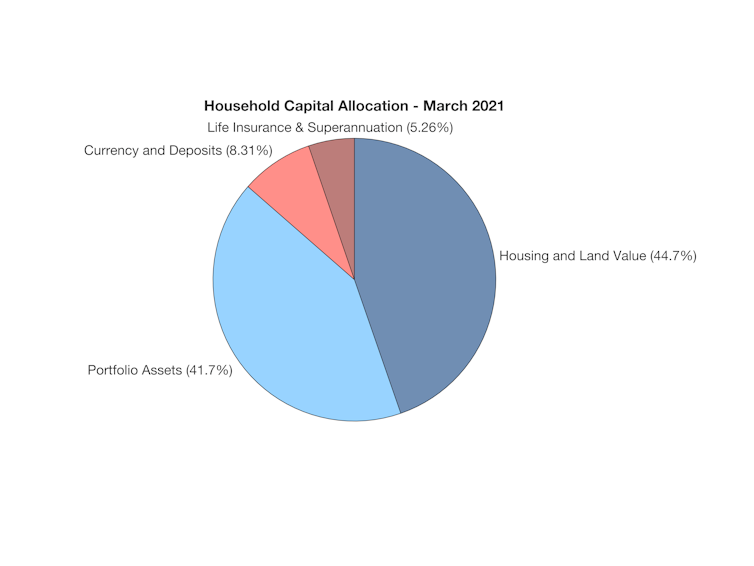
    • a 30% decline in the share of wealth held by the bottom 40% of Australians since 2004
    • almost 20% of Australians living in financial stress
    • over 40% of lower-income renter households living in housing stress
    • household debt levels now exceed Australia’s annual gross domestic product (GDP).

    There are also some broader economic concerns. Australia’s level of investment in innovation is nearly 40% below OECD averages. Economic complexity – which measures the sophistication and diversity of what our economy produces – has fallen behind Honduras, Armenia and Uganda.

    And there’s been a rapid decline in education outcomes for students from lower socio-economic groups.

    Shining in some areas

    On the other hand, Australia is on track and actually leading our peers in life expectancy, road fatalities, tertiary education, water efficiency and government debt.

    We’re also above average on closing gender gaps in both income and political representation. Australia also has very low homicide rates and high feelings of safety and trust compared to our peers.

    Australia has made some progress on gender equality.
    Andrii Zastrozhnov/Shutterstock

    In some key areas, Australia is actually trending rapidly towards SDG targets.

    The gender gap in superannuation, for example, has fallen from 53% in 2014 to 21% in 2021.

    The share of renewable electricity in our national energy grid has climbed to 35% and greenhouse gas emissions are steadily falling.

    And rates of unemployment, underemployment and youth unemployment have all declined to within or closer to SDG target levels of below 5-6%.

    How does the US compare?

    America’s State of the Nation report, which tracks progress on a range of similar measures to our report, paints a bleak picture.

    There are only four measures where the US performs in the top 20% of high-income countries – economic output, productivity, years of education and long-term unemployment.

    Compared to Australia, the US outperforms us on average per-capita income, investments in research and development and knowledge-based capital, economic complexity, household debt and broadband connection speeds.

    But despite their apparent economic success, mental health and life satisfaction have deteriorated. Social connections are fraying with increased social isolation, polarisation and eroding trust.

    Tragically, suicide rates, fatal overdoses and shootings have increased.

    Far worse on some measures

    In areas where Australia is also trending backwards, things in the US are often far worse.

    Income and wealth inequality, for example, are much higher in the US. The top 1% of Americans hold around 35% of wealth – compared to 24% for the top 1% of Australians.

    US welfare payments are almost 90% below the poverty line and the poverty rate is 30% higher than in Australia. Yet US government debt as a share of GDP is almost double that of Australia.

    This stark contrast suggests America’s approach to pursuing material prosperity is undermining social wellbeing, with rising inequalities fuelling social tensions and polarisation.

    Bold action needed

    For the first time, our new report models two future scenarios for Australia, exploring policies that reverse negative trends and accelerate progress towards SDG targets by 2050.

    Our modelling shows that with increased policy ambition, Australia can halve poverty and reduce income inequality by a third. We can also boost health, education and productivity, improve biodiversity, and deliver net-zero greenhouse gas emissions.

    To do it, we’d need to increase public investment by around 7% a year over 10 years in key areas such as education and health, disaster resilience, sustainable food, energy and urban systems and the natural environment.

    Our modelling shows that with these measures, Australia could achieve 90% of our Sustainable Development Goal targets by 2050.

    Without them, our future prosperity is projected to stagnate and decline by 2050, reaching just 55% progress towards our targets and with GDP around A$300 billion lower than our more ambitious scenario.

    There’s a famous aphorism that in the long run, economic productivity is almost everything. The social fissures in the US despite a strong economy would suggest otherwise.

    Australia should take note and take action to ensure the long-term sustainable prosperity of our nation.

    Cameron Allen receives funding from the Australian Research Council.

    John Thwaites is Chair of Monash Sustainable Development Institute and Climateworks Centre which receive funding for research, education and action projects from the Commonwealth and state governments as well as from philanthropy and industry. He is a former Deputy Premier of Victoria (1999 – 2007)

    ref. A new report card shows inequality in Australia isn’t as bad as in the US – but we’re headed in the wrong direction – https://theconversation.com/a-new-report-card-shows-inequality-in-australia-isnt-as-bad-as-in-the-us-but-were-headed-in-the-wrong-direction-249579

    MIL OSI AnalysisEveningReport.nz

  • MIL-OSI Europe: Answer to a written question – Ukraine’s ban on the Ukrainian Orthodox Church of the Moscow Patriarchate – E-001881/2024(ASW)

    Source: European Parliament

    The Constitution of Ukraine, as well as related legislation, provides for the right to freedom of religion and belief, as stipulated in the European Convention on Human Rights[1] and the Charter of Fundamental Rights of the European Union[2].

    The Commission has taken note of Ukrainian Parliament’s adoption on 20 August 2024 of the law of Ukraine ‘On the protection of the constitutional order in the field of activities of religious organisations’, which prohibits the activities of religious organisations affiliated with the Russian Orthodox Church in Ukraine, on the grounds of national security and prevention of foreign interference from Russia.

    The right to freedom of religion and belief is an integral part of the fundamental rights chapter in Ukraine’s accession process. In the Enlargement report issued on 30 October 2024[3], the Commission assessed that in general Ukrainian authorities protect this freedom, and that incidents of hate speech and intimidation based on religion are rare. No infringements of religious rights were reported in government-controlled territories of Ukraine.

    The Commission will continue closely monitoring the application of the right to freedom of religion and belief in Ukraine and report on this as appropriate.

    • [1] https://www.echr.coe.int/documents/d/echr/convention_eng
    • [2] https://eur-lex.europa.eu/legal-content/EN/TXT/PDF/?uri=CELEX:12012P/TXT OJEU C 326 of 26.10.2012.
    • [3] SWD(2024) 699 final.
    Last updated: 12 February 2025

    MIL OSI Europe News

  • MIL-OSI Europe: Answer to a written question – Challenges and prospects for European space policy financing, institutional cooperation and harmonisation of standards in a strategic sector – E-002284/2024(ASW)

    Source: European Parliament

    The services offered by Galileo[1], Copernicus[2], and in the future by the Infrastructure for Resilience, Interconnectivity and Security by Satellite (IRIS2)[3] are crucial to the competitiveness of the EU and its Member States and to delivering on EU priorities including security and defence.

    Guaranteed funding is essential to maintain, upgrade, and reinforce the EU’s space assets. The Commission has started to develop, within the 2021-2027 multiannual financial framework , new funding mechanisms for space: through the CASSINI initiative[4] promoting the leverage of private capital for the growth and scale up of start-ups and small and medium enterprises; or, in the case of IRIS2, through a public-private partnership in the form of a concession agreement with industry[5]. In the next multiannual financial framework, new funding approaches may be considered.

    The European Space Agency (ESA) is a trusted partner for EU space initiatives and already assigned by the Commission with important tasks notably, for the implementation of Galileo, the European Geostationary Navigation Overlay Service[6], Copernicus and IRIS2.

    The Commission will assess the future role of ESA and other actors, considering the increased needs of the space sector in the evolving geopolitical landscape. The Commission — ESA integrated team for the IRIS2 implementation is a useful blueprint.

    The upcoming EU Space Law aims to establish a single market for space, ensuring resilience, safety, and sustainability in space activities.

    This new set of rules for the EU and global players accessing the single market will provide clarity for the industry and it will boost the European space industry’s competitiveness and position the EU as a global standards-setter in innovative markets.

    • [1] https://defence-industry-space.ec.europa.eu/eu-space/galileo-satellite-navigation_en
    • [2] https://www.copernicus.eu/en
    • [3] https://defence-industry-space.ec.europa.eu/eu-space/iris2-secure-connectivity_en
    • [4] https://defence-industry-space.ec.europa.eu/eu-space/entrepreneurship_en
    • [5] https://defence-industry-space.ec.europa.eu/commission-takes-next-step-deploy-iris2-secure-satellite-system-2024-12-16_en
    • [6] https://www.euspa.europa.eu/eu-space-programme/egnos
    Last updated: 12 February 2025

    MIL OSI Europe News

  • MIL-OSI Europe: Answer to a written question – Situation of Can Atalay, imprisoned MP in Türkiye – E-002154/2024(ASW)

    Source: European Parliament

    The Commission is aware of Mr Can Atalay’s case as attested by the Country Enlargement Report published in October 2024[1]. As stated in the report, although the principle of separation of powers and judicial independence is enshrined in the Türkiye’s Constitution and other legislative provisions, politicisation nevertheless increased.

    In many instances, as in Mr Atalay’s case, lower courts ignored or delayed the implementation of the Constitutional Court’s rulings. According to the report, the Turkish Constitutional Court ruled that the right to vote and be elected and the right to personal security and liberty of Mr Atalay had been violated.

    Since Mr Atalay’s arrest in April 2022, the Commission has been monitoring the developments of his case. The EU Delegation to Ankara is following up on the imprisonment conditions of Mr Atalay through its contacts with his colleagues, lawyers, and other stakeholders. However, it has not been possible to visit him in prison.

    As stated in the Joint Communication on EU-Türkiye relations of November 2023, dialogue on the rule of law and fundamental rights and freedoms remains an integral part of the EU-Türkiye relationship[2]. The Commission will continue monitoring the situation of fundamental rights and the rule of law in Türkiye.

    • [1] https://neighbourhood-enlargement.ec.europa.eu/turkiye-report-2024_en
    • [2] https://neighbourhood-enlargement.ec.europa.eu/joint-communication-european-council-state-play-eu-turkiye-political-economic-and-trade-relations-0_en
    Last updated: 12 February 2025

    MIL OSI Europe News

  • MIL-OSI Europe: Answer to a written question – Mexican national security strategy under government headed by President Sheinbaum – E-002686/2024(ASW)

    Source: European Parliament

    The fight against organised crime is a shared challenge and priority for the EU and Mexico. The EU closely follows the Mexican government’s new security strategy,

    As indicated in the reply to your Question E -002382/2024 from 31 October 2024, the EU remains committed to cooperating with and supporting Mexico to address security and drug trafficking, notably through the programme of the EU with Latin America and the Caribbean against Transnational Organised Crime EL PACCTO[1] and the Cooperation Program between Latin America, the Caribbean and the EU on drug policy COPOLAD[2].

    The EU makes use of the appropriate tools to ensure a sound management of EU funds at all stages of the project management cycle, notably through monitoring and evaluation.

    Reinforcing EU-Mexico cooperation in the fight against firearms trafficking is also a shared priority. The EU seeks to improve international cooperation of law enforcement services.

    The EU has been encouraging Mexico to increase its involvement in the operational actions of the European Multiplatform against criminal threats (EMPACT) firearms and of the network of Police Specialized in Arms Trafficking (red ARCO), which is part of the EU programme El PACCTO.

    Regarding allegations that a percentage of firearms seized in Mexico is originating from EU Member States, the Commission underlines that it has no access to the operations of exportation, as it is a national competence. EU law governing the export of firearms for civilian use[3] has safeguards to ensure legal transactions.

    The EU recently adopted a recast Regulation that introduces, inter alia, more safeguards such as the issue of a user statement regarding the final use, the need for a proof of receipt and the possibility to carry out post-shipment checks.

    • [1] https://elpaccto.eu/en/
    • [2] https://copolad.eu/en/
    • [3] Regulation (EU) No 258/2012.
    Last updated: 12 February 2025

    MIL OSI Europe News

  • MIL-OSI Europe: Answer to a written question – Evaluation of EU aid to Algeria against the backdrop of the persecution of Christians there – E-002610/2024(ASW)

    Source: European Parliament

    Respect for human rights and fundamental freedoms is inscribed in the Algerian Constitution and constitutes a key element of EU-Algeria relations, as enshrined in the Association Agreement[1] and reinforced in the Partnership Priorities[2].

    Human rights and fundamental freedoms, including freedom of religion or belief, are addressed during the regular EU-Algeria political, security and human rights dialogue.

    The EU financial assistance to Algeria does not entail direct transfer of funds to Algerian public authorities. The EU finances projects implemented in the country by international organisations, European public bodies and development agencies, private companies and civil society organisations.

    The EU financial assistance is framed by programming documents[3] and all projects are subject to monitoring missions during their implementation and to audits ensuring that funds are used to the agreed purpose and according to the agreed procedures.

    • [1] https://eur-lex.europa.eu/legal-content/EN/ALL/?uri=CELEX%3A22005A1010%2801%29
    • [2] https://www.consilium.europa.eu/en/press/press-releases/2017/03/13/eu-algeria/
    • [3] Multiannual Indicative Programme (MIP) 2021-2027: https://neighbourhood-enlargement.ec.europa.eu/document/download/18c0dcae-9074-40e0-a8ca-765abb44b281_en
    Last updated: 12 February 2025

    MIL OSI Europe News

  • MIL-OSI Europe: Answer to a written question – Ineffectual Commission and Catalan regional government funding for Morocco – E-002622/2024(ASW)

    Source: European Parliament

    EU funding is subject to specific rules and regulations, in respect of sound financial management, which ensure oversight and accountability.

    Particular attention is given to the respect of fundamental values, human rights, democracy and rule of law. Assistance can be suspended in the event of the degradation of fundamental values.

    The Commission conducts regular monitoring and evaluation of funded programs to assess their impact, effectiveness and compliance with EU values and principles.

    The Commission involves civil society organisations (CSOs) in the design, implementation and monitoring of EU-funded programmes and projects since CSOs play a crucial role in promoting democratic values and transparency.

    The EU has also established solid mechanisms, such as continuous follow-ups, audits and verifications, to ensure transparency and accountability in the use of EU funds.

    As a key multilateral actor, the EU is committed to achieving the United Nations Sustainable Development Goals[1], which include reducing poverty and inequality worldwide, including in non-EU regions.

    Furthermore, the EU has established partnerships with countries in its Southern Neighbourhood to advance joint priorities, such as peace, stability, economic prosperity, upholding democratic values and human rights, notably working together with Member States through the Team Europe initiative and with special focus on gender issues (Gender Action Plan III[2]).

    By acting together, recognising the growing interdependence, the EU also aims at turning common challenges into opportunities. By investing in these regions, the EU promotes its own economic interests for instance by increasing trade and creating opportunities for European businesses, while ensuring mutual benefits for partner countries.

    • [1] https://sdgs.un.org/goals
    • [2] https://international-partnerships.ec.europa.eu/system/files/2021-01/join-2020-17-final_en.pdf

    MIL OSI Europe News

  • MIL-OSI Europe: Highlights – European Parliamentary Week 2025 – 17 and 18 February at the European Parliament – Committee on Employment and Social Affairs

    Source: European Parliament

    The European Parliamentary Week (EPW) 2025, co-organised by the European Parliament, the Polish Seijm and the Polish Senate, will take place on 17 and 18 February 2025 at the European Parliament in Brussels. The event brings together parliamentarians from the EU, candidate and observer countries to discuss economic, budgetary and social matters. As part of the event, the EMPL committee is organising two interparliamentary committee meetings in the afternoon of the 17 February (16.20-19.20 CET).

    The first session will be on AI and the labour market with a focus on changing working conditions with the participation of Executive Vice-President Roxana Mînzatu and the second session will be on the role of social and employment policies in the EU’s reviewed economic governance.

    On the second day, two plenary sessions will cover “The Improvement of EU’s competitiveness through the single market, innovation policy, better regulation and quality jobs” with Mario Draghi as key speaker and the lessons learned from “The first national plans under the revised Economic Governance Framework”.

    MIL OSI Europe News

  • MIL-OSI Europe: Answer to a written question – Appointment of Spain’s State Secretary for Communication – E-002748/2024(ASW)

    Source: European Parliament

    The Commission is not in a position to comment on political appointments in Member States.

    Protecting media freedom and pluralism is a priority for the Commission, which has taken measures to curb the abusive use of Strategic Lawsuits Against Public Participation (SLAPP) through a directive[1] and a recommendation[2], enhanced the safety of journalists through a recommendation[3] and adopted the European Media Freedom Act[4].

    Most provisions of the European Media Freedom Act shall apply from 8 August 2025, with the aim amongst other to protect journalists against interference.

    Ensuring a swift and effective implementation of the Act will be a priority for the Commission in the coming months, as it will be the ensuring a correct implementation of the anti-SLAPP Directive.

    The Commission will also continue monitoring Member States’ actions to put in practice the recommendation on the protection, safety and empowerment of journalists and the recommendation on protecting journalists and human rights defenders who engage in public participation from manifestly unfounded or abusive court proceedings and will use this information in future reports on the Rule of Law[5].

    • [1] https://eur-lex.europa.eu/legal-content/EN/TXT/?uri=celex%3A32024L1069
    • [2] https://eur-lex.europa.eu/legal-content/EN/TXT/?uri=OJ%3AL%3A2022%3A138%3ATOC
    • [3] https://digital-strategy.ec.europa.eu/en/library/recommendation-protection-safety-and-empowerment-journalists
    • [4] https://eur-lex.europa.eu/legal-content/EN/TXT/?uri=OJ:L_202401083
    • [5] https://commission.europa.eu/strategy-and-policy/policies/justice-and-fundamental-rights/upholding-rule-law/rule-law/annual-rule-law-cycle_en#rule-of-law-report
    Last updated: 12 February 2025

    MIL OSI Europe News

  • MIL-OSI Europe: Answer to a written question – Andalusian government blocking construction of provincial centres for victims of sexual violence. – E-001877/2024(ASW)

    Source: European Parliament

    The availability of appropriately equipped and easily accessible rape crisis or sexual violence referral centres is a key element of the specialist support that victims of sexual violence will be entitled to under the recently adopted Directive (EU) 2024/1385[1].

    In line with the standards of the Istanbul Convention[2], the directive requires that these centres exist in sufficient number and be adequately spread over the territory of each Member State.

    The Commission will closely monitor compliance with these requirements in the context of the transposition of the Istanbul Convention and of the directive, for which implementation workshops will start in 2025.

    Spain has allocated Next Generation EU funds for the construction of these centres. In particular, the Recovery and Resilience Plan (RRP) for Spain[3], under Component 22, Investment 4, includes a target with number 327 related to the creation of 52 24-hour comprehensive care services for victims of sexual violence. The satisfactory fulfilment of this target of the plan will be assessed in the context of the 7th payment claim of the RRP.

    The Commission remains committed to monitoring the effective use of EU funds allocated under the RRP and to ensuring full compliance with the newly adopted EU legislation on combating violence against women and domestic violence.

    • [1] https://eur-lex.europa.eu/eli/dir/2024/1385/oj/eng
    • [2] Council of Europe Convention on preventing and combating violence against women and domestic violence Istanbul, 11.V.2011.
    • [3] https://commission.europa.eu/business-economy-euro/economic-recovery/recovery-and-resilience-facility/country-pages/spains-recovery-and-resilience-plan_en
    Last updated: 12 February 2025

    MIL OSI Europe News

  • MIL-OSI Europe: Answer to a written question – Clarification on the alignment of regulatory restructuring with EU legislation – E-003023/2024(ASW)

    Source: European Parliament

    The Commission remains vigilant to any legislative developments that may negatively impact the legal standards of independence of national regulatory authorities set out in EU law, in its role as guardian of the Treaties.

    The European Media Freedom Act[1] (EMFA) foresees that national regulatory authorities must be subject to the requirements set out in Article 30 of the Audiovisual Media Services Directive[2] (AVMSD).

    This Article requires Member States to ensure the independence of such national authorities, firstly by ensuring that they are legally distinct and functionally independent of their respective governments, or any other public or private entity, and secondly ensuring that they exercise their powers impartially and transparently.

    Pursuant to the Digital Services Act[3] (DSA), Member States shall ensure that their Digital Services Coordinators perform their tasks under the DSA in an impartial, transparent and timely manner.

    The 2024 country chapter for Slovakia states that ‘a legal framework and autonomous budget permit the Council for Media Services to operate autonomously’[4].

    Any changes to the current framework should aim to strengthen the independence of the national regulatory authorities, in line with the requirements set out in AVMSD and referred to in EMFA.

    In particular, the potential changes to the structure of the Council, aimed at transforming it from a collegiate body to a single-person body, should not affect the possibility for the Council to exercise its powers impartially and transparently and not to seek or take instructions from any other body in relation to the exercise of its tasks, while ensuring that the appointment and dismissal procedures guarantee the requisite degree of independence of the Council.

    • [1] Regulation (EU) 2024/1083 of the European Parliament and of the Council of 11 April 2024 establishing a common framework for media services in the internal market and amending Directive 2010/13/EU (European Media Freedom Act), OJ L, 2024/1083, 17.4.2024, https://eur-lex.europa.eu/eli/reg/2024/1083
    • [2] Directive (EU) 2018/1808 of the European Parliament and of the Council of 14 November 2018 amending Directive 2010/13/EU concerning the provision of audiovisual media services (Audiovisual Media Services Directive), OJ L 303, 28.11.2018, p. 69-92, https://eur-lex.europa.eu/eli/dir/2018/1808/oj/eng
    • [3] Regulation (EU) 2022/2065 of the European Parliament and of the Council of 19 October 2022 on a Single Market for Digital Services and amending Directive 2000/31/EC (Digital Services Act), OJ L 277, 27.10.2022, p. 1-102, https://eur-lex.europa.eu/eli/reg/2022/2065/oj/eng
    • [4] 2024 Rule of law report, https://commission.europa.eu/publications/2024-rule-law-report-communication-and-country-chapters_en
    Last updated: 12 February 2025

    MIL OSI Europe News

  • MIL-OSI USA: Lummis Statement on the Nomination of Brian Nesvik to Serve as Director of U.S. Fish and Wildlife Service

    US Senate News:

    Source: United States Senator for Wyoming Cynthia Lummis

    February 12, 2025

    WASHINGTON, D.C. – Senator Cynthia Lummis (R-WY) released the following statement praising the selection of former Wyoming Game and Fish Department Director Brian Nesvik to serve as Director of the United States Fish and Wildlife Service. 

    “President Trump has made a great decision in nominating Wyoming’s own Brian Nesvik to serve as Director of the United States Fish and Wildlife Service,” said Lummis. “Brian has spent his entire career serving the people of Wyoming and working alongside outfitters, hunters, landowners, fishermen, and anyone else who loves the great outdoors. That attitude and passion for balancing wildlife conservation and recreational access will serve him well in this important role. I look forward to working to get Brian confirmed as soon as possible.”

    MIL OSI USA News

  • MIL-OSI USA: Kaine & Cruz Introduce Bipartisan Bill to Reunite Separated Korean American Families

    US Senate News:

    Source: United States Senator for Virginia Tim Kaine

    WASHINGTON, D.C. – Today, U.S. Senators Tim Kaine (D-VA) and Ted Cruz (R-TX), members of the Senate Foreign Relations Committee, introduced the Korean American Divided Families National Registry Act, bipartisan legislation to help reunite Korean Americans who have been separated from their relatives in North Korea since the Korean War. For Korean Americans who have immigrated to the U.S. since the war, there is no official channel to reunite with family members still in North Korea.

    “There are countless heartbreaking stories of Koreans being torn apart from their family members during the Korean War. Today, many of them are proud Virginians who still dream of one day reuniting with their loved ones,” said Kaine. “That’s why I’m introducing this bipartisan legislation to help facilitate the reunification of Korean Americans with their relatives.”

    Cruz said, “Reuniting Korean-Americans with their loved ones should be a humanitarian imperative. I am proud to work with Sen. Kaine in introducing and advancing this bill, and to work toward reuniting Americans with family members who have long suffered and are suffering today under the North Korean regime.”

    Specifically, the Korean American Divided Families National Registry Act would:

    • Create a national registry through the State Department’s Office of the Special Envoy on North Korean Human Rights Issues with information regarding divided Korean American families and their relatives in North Korea.
    • Allow the U.S. government to access the registry to facilitate in person or virtual opportunities for living and willing family members to meet.
    • Encourage dialogue between the U.S. and North Korea.

    Virginia is home to the sixth largest Korean American population in the country. Last year in Centreville, Kaine met with Korean Americans who have been separated since the Korean War.

    The legislation is cosponsored by U.S. Senators Chris Coons (D-DE), Pete Ricketts (R-NE), and Mark Kelly (D-AZ). Companion legislation is being introduced in the U.S. House of Representatives by U.S. Representatives Suhas Subramanyam (D-VA-10) and Young Kim (R-CA-40).

    Full text of the bill is available here.

    MIL OSI USA News

  • MIL-Evening Report: Stan’s Invisible Boys carries the tradition of real, gritty Aussie teen drama, while smashing it into something new

    Source: The Conversation (Au and NZ) – By Damien O’Meara, Lecturer, School of Media and Communication, RMIT University

    Stan

    Stan’s new series Invisible Boys follows four young gay men as they understand and explore their identities while living in Geraldton, a regional town in Western Australia.

    Charlie Roth (Joseph Zada), Zeke Calogero (Aydan Clafiore), Kade “Hammer” Hammersmith (Zach Blampied) and Matt Jones (Joe Klocek) represent four very different young men. Yet they share the experience of feeling invisible because of their sexuality.

    An adaptation of Holden Sheppard’s novel of the same name, the story challenges linear narratives of progress and typical ideals of queer life. It also shows how such mentalities can lead gay and bisexual men growing up in regional Australia to feel invisible, as they often don’t fit the neat narratives associated with “progress”.

    Invisible Boys is an example of what my colleague Whitney Monaghan and I have termed a queer storyworld, which centres LGBTQIA+ stories, communities and issues in complex and nuanced ways.


    Read more:
    We studied two decades of queer representation on Australian TV, and found some interesting trends


    Aussie teen drama is gritty and real

    Australian teen drama found international success in the 1990s. Series such as Heartbreak High (1994–99) and Sweat (1996) included underrepresented stories of cultural diversity and diverse sexuality, and were promoted with reference to their “gritty” themes.

    The terms “gritty” and “real” have become key markers of the Aussie teen drama. Journalist Grace Back notes how Heartbreak High’s appeal lay in its characters having to “grapple with gritty issues”.

    Similarly, Janine Kelly from the Australian Children’s Television Foundation describes More Than This (2022) as a “real, gritty and powerful series [that] reflects the diversity of the suburban Australian public-school environment.”

    The trailer for Invisible Boys features a review describing the show as “powerful, topical and all too real”, placing it alongside the bold teen dramas that have come before.

    But I’d argue no previous teen drama has been quite as truthful in its representation of some young gay and bisexual men’s experiences.

    Sexual desire in the gay teen narrative

    Invisible Boys is set in 2017, against the backdrop of the highly visible and divisive same-sex marriage survey.

    The show examines how gay teen sex manifests in environments that often aren’t very visible. In the first five minutes, we see 17-year-old Charlie attempting to have sex at a beat – a public space where gay men seek anonymous sexual intimacy.

    Later, an inciting incident occurs when Charlie uses an app to arrange a sexual encounter with an older married man in his home, before being caught by his wife.

    Joseph Zada plays Charlie, a young gay man living in Geraldton.
    Stan

    Invisible Boys examines how the sexual desires of gay and bisexual men do not hibernate in the face of oppression.

    Research shows some older gay adolescents (under 18) seek out and have positive experiences of sex with older men. That these experiences exist means they should have a place in teen dramas, to examine and drive important conversations.

    Queer as Folk (1999–2000) faced criticism for its underage sex storyline from the broader public and the LGBTQIA+ community alike, wherein the series opens with 15-year-old Nathan (Charlie Hunnam) seeking and finding a sexual partner on the gay scene in Manchester.

    However, this story was based in something real: the oppressive Section 28 laws in England that made it illegal for gay and bisexual men under 18 to explore their sexuality. This drove them to spaces where they could remain anonymous.

    Invisible Boys tackles the reality of gay and bisexual life in a regional town. Other teen series in other markets, such as Heartstopper (2022–), present a somewhat normative view of queer teen life under banners of “love is love”. And while this story is true for some, it has been told.

    Invisible Boys gives audiences something that will challenge their worldview.
    Stan

    Challenging gay respectability politics

    Respectability politics is the view that “marginalised groups must demonstrate that they adhere to normative values before they will be accepted or granted rights by dominant groups”. We see this in the dominance of homonormative representation in Australian TV, which sees heterosexual norms being applied to LGBTQIA+ people – as well as in its exclusion of gay sex.

    Invisible Boys challenges the dominance of gay respectability politics in the teen drama genre.

    While older Australian series such as Dance Academy (2010–13) (admittedly aimed at younger teen audiences) explored queer sexuality through chaste kisses and teen angst, primetime series such as Please Like Me (2013–16) and In Our Blood (2022) made headway by telling complex, intimate stories of gay men.

    Similarly, the horny gay teen isn’t hidden away in Invisible Boys – nor are his choices always comfortable.

    A sign for streamers and Australian TV

    Streaming services have often struggled to nail Australia’s television sensibility. Netflix’s Tidelands (2018) was criticised for not quite capturing what made Australian series appealing, while Stan’s Eden (2021) was met with similar critiques.

    More recently, Prime Video’s Deadloch (2023–) and the Netflix reboot of Heartbreak High (2022–24) have signalled a shift to something more suited to local viewers.

    Yet the creators of Heartbreak High made certain decisions that stood out to local viewers, such as not including school uniforms (likely to appeal to a global audience). Invisible Boys does not dilute the specificity of regional Aussie experiences.

    The series challenges the way gay adolescence is often understood by broader communities.
    Stan

    In the tradition of iconic teen dramas from 1970s and 1990s, such as Class of ‘74 (1974–75), the original Heartbreak High (1994–99), and Sweat (1996), the series is willing to go there by tackling the inconvenient truths of teenage life.

    As someone who grew up gay in regional Australia, it feels like an authentic representation of my own experience. There’s something universal about Charlie, Zeke, Kade and Matt’s stories of not fitting in, and of being invisible to be safe.

    Most striking is the way the series captures the complicated mix of joy and fear – the clash of opportunity and consequence – that accompanies becoming visibly gay in these environments.

    Invisible Boys is streaming on Stan.

    Damien O’Meara does not work for, consult, own shares in or receive funding from any company or organisation that would benefit from this article, and has disclosed no relevant affiliations beyond their academic appointment.

    ref. Stan’s Invisible Boys carries the tradition of real, gritty Aussie teen drama, while smashing it into something new – https://theconversation.com/stans-invisible-boys-carries-the-tradition-of-real-gritty-aussie-teen-drama-while-smashing-it-into-something-new-248126

    MIL OSI AnalysisEveningReport.nz

  • MIL-Evening Report: Nocturnal basking and deep diving may not be enough to keep crocodiles cool in a warming world

    Source: The Conversation (Au and NZ) – By Kaitlin Barham, Wildlife ecology researcher, The University of Queensland

    Australia Zoo

    Crocodiles are hardy creatures, capable of adjusting their behaviour to cope with the heat of the tropics. But there’s a limit to their endurance.

    Our new research shows the average body temperature of estuarine (saltwater) crocodiles in Far North Queensland has risen steadily over the past 15 years. The peaks align with heatwaves during El Niño events.

    We tagged and tracked 203 crocodiles in the Steve Irwin Wildlife Reserve on Cape York Peninsula, to find out how they respond to rising temperatures. We know from our previous research that crocodiles can change their behaviour to quickly cool down, and might do this by diving deeper, seeking shade or hauling themselves out onto the riverbank at night.

    We found hot crocodiles displayed more of these cooling behaviours, but this was not always enough to keep their body temperature under control. Crocodile diving performance decreased at body temperatures above 31–33°C. This could compromise other behaviours necessary for feeding, fleeing or reproducing.

    Crocodile researchers gathered around a trap site by the Wenlock River, Queensland.
    Australia Zoo

    How do crocs keep cool?

    Crocodiles, like other reptiles, are “ectotherms”. This means their bodies heat up or cool down depending on the temperature of the surrounding environment.

    They can’t control or adjust their own internal thermostat like birds or mammals. Instead, they regulate their body temperature by moving to a more comfortable place.

    On hot nights the water stays warm, but the air cools down. So crocodiles will move onto the river bank at night to cool off. We call this “nocturnal basking”.

    During the day, they might dive down really deep where it’s a bit cooler. Or they might lie on the bank in the shade with their mouth gaping wide, or sit in a cool freshwater creek.

    Last year, we published research using data from thumb-sized temperature loggers implanted under the crocodile’s skin. By tracking when their body temperatures rose or fell rapidly, we were able to record “active cooling” and “active warming” periods during the day and night.

    Active warming tended to occur on winter afternoons, and was likely achieved through basking in the sun on riverbanks and sand flats.

    Active cooling was more common on hot summer nights. We think the crocodiles were either taking advantage of cool night air through nocturnal basking, or spending time in shady spots along the river.

    But there’s a limit to how much warming crocodiles can take. Previous research has shown crocodiles have shorter dives at body temperatures above 32-33°C. This can reduce their ability to hunt for food or seek shelter.

    How will crocs cope with climate change?

    In our new research, we wanted to find out if crocodiles can reduce their exposure to high temperatures through active cooling behaviour.

    With the help of Australia Zoo’s croc team, we tagged and tracked 203 wild estuarine crocodiles in the Wenlock and Ducie rivers of the Steve Irwin Wildlife Reserve, between 2008 and 2023.

    During this time, the average air temperature in Far North Queensland rose by 0.08–0.30°C. Top temperatures peaked during El Niño events (2010 and 2016), whereas minimum temperatures peaked during La Niña events (2020–23).

    We collected data on crocodile body temperature, daily distance travelled and diving behaviour. Then we compared it to local air temperatures.

    We found body temperatures increased alongside rising air temperatures and peaked during El Niños such as the summer of 2015–16.

    Almost all crocodiles spent time cooling during heatwaves. The hottest crocodiles switched almost exclusively to cooling behaviours, rather than warming behaviours. But in many cases their body temperatures still exceeded 32–34°C and their diving performance suffered.

    Even when summer air temperatures rocketed to 40°C, crocodiles were able to limit their body temperature to 34°C. This feat demonstrates impressive resilience to heat.

    Crocodile researchers on the Wenlock River, Queensland.
    Australia Zoo

    What’s next for Queensland’s crocs?

    While most estuarine crocodiles in Queensland are found in the north of the state, the occasional vagrant makes its way south below its natural range into more populated areas.

    This includes the crocodile spotted around Inskip Point near K’gari (Fraser Island) on the Sunshine Coast just last week.

    The crocodile population has grown since hunting was banned in 1974. So it is reasonable to wonder about the possibility of a southern expansion as warming continues. But there is currently no evidence to suggest Queensland’s crocodile population is moving south, or that this will become a concern in the near future with a warming climate.

    Our new research shows crocodiles in the tropics are responding to higher temperatures. However, very little is known about how crocodiles in the southern, cooler part of their range behave in response to these conditions. This information could help to more effectively manage crocodiles and protect the general public.

    Crocodiles are remarkably resilient predators that have evolved to survive in tropical conditions. Our research suggests they have the capacity to buffer themselves against the worst of the heat our current climate throws at them, without leaving their local river system.

    But the trajectory of future climate change, coupled with the new findings, suggests crocodiles might struggle in a warmer world.

    Kaitlin Barham receives funding from the Australian Research Council. The Holsworth Wildlife Research Endowment – Equity Trustees Charitable Foundation & the Ecological Society of Australia funded travel to the field site for this research. She is affiliated with The University of Queensland.

    Craig E. Franklin receives funding from the Australian Research Council and Wildlife Warriors. He is affiliated with The University of Queensland.

    Ross Dwyer has been funded by grants from the Australian Research Council and the Queensland government for crocodile research in wild and captive environments. He is affiliated with The University of the Sunshine Coast.

    ref. Nocturnal basking and deep diving may not be enough to keep crocodiles cool in a warming world – https://theconversation.com/nocturnal-basking-and-deep-diving-may-not-be-enough-to-keep-crocodiles-cool-in-a-warming-world-248655

    MIL OSI AnalysisEveningReport.nz

  • MIL-OSI United Nations: 13 children killed in the West Bank since year began: UNICEF

    Source: United Nations 2

    Humanitarian Aid

    The UN Children’s Fund (UNICEF) has voiced deep alarm at the growing number of children killed, injured and displaced in the occupied West Bank, as violence continues to escalate. 

    In a statement issued by Edouard Beigbeder, UNICEF’s Regional Director for the Middle East and North Africa, the agency called for “the immediate cessation of armed activity across the occupied West Bank”.

    A 10-year-old Palestinian boy died from gunshot wounds last Friday and two days later, a woman who was eight months pregnant was reportedly shot and killed in Nur Shams camp, resulting in the loss of her unborn baby.

    The violence, which has intensified in recent weeks, has left families in mourning and communities in distress.

    Sharp increase in child fatalities

    According to UNICEF, 13 Palestinian children have been killed in the West Bank since the beginning of 2025.

    Seven of these deaths occurred after 19 January, following a large-scale military operation in the north of the territory. Among the casualties was a two-year-old whose pregnant mother was also injured in the shooting.

    The numbers reflect a worrying trend. Since 7 October 2023, 195 Palestinian children and three Israeli children have been killed in the West Bank, including East Jerusalem.

    “There has been a 200 per cent increase in the number of Palestinian children killed in the territory over the past 16 months as compared to the 16 months prior,” Mr. Beigbeder explained.

    Devastation in refugee camps

    The humanitarian situation has worsened in areas such as Jenin, Tulkarem and Tubas Governorates, where airstrikes, demolitions and the use of explosive weapons have severely damaged essential infrastructure.

    Many communities, particularly in refugee camps, have been cut off from basic services, with water and electricity supplies disrupted.

    Thousands of families have been displaced due to military operations, including in Jenin, Nur Shams, Tulkarem and al-Faraa Camps.

    The deteriorating security situation has made daily life increasingly difficult, particularly for children.

    Education under threat

    The education of children has been severely disrupted, with nearly 100 schools affected.

    Teachers and students in conflict-hit areas face significant risks in attending classes, heightening concerns over long-term psychological and social impacts.

    Many children require urgent mental health and psychosocial support due to their exposure to violence, displacement and the loss of loved ones.

    UNICEF has called for greater resources to address these growing needs.

    Call for protection

    “UNICEF condemns all acts of violence against children,” said Mr. Beigbeder. “All civilians, including every child without exception, must be protected.

    “Humanitarian organizations must have safe and unfettered access to deliver life-saving assistance and protection services to children and their families,” he continued.

    UNICEF emphasised the urgent need for a lasting political solution, backed by the international community, to secure a peaceful and stable future for all children in the region.

    The agency “stands ready to work with partners to address both the immediate and long-term needs of affected children and families in the West Bank, including East Jerusalem,” Mr. Beigbeder concluded.

    MIL OSI United Nations News

  • MIL-OSI USA: Governor Stein Announces Additional Team Members

    Source: US State of North Carolina

    Headline: Governor Stein Announces Additional Team Members

    Governor Stein Announces Additional Team Members
    lsaito

    Raleigh, NC

    Today, Governor Stein announces additional staff as he continues to grow his team committed to building a safer, stronger North Carolina. 

    Adam Chandler, Policy Director 

    Adam Chandler is a native of Burlington, North Carolina, and a 12-year veteran of the U.S. Department of Justice, where he served most recently as Associate Deputy Attorney General and Chief of Staff to the Deputy Attorney General. Adam previously practiced at the Department as an appellate attorney, specializing in antitrust law, and served as a speechwriter for two attorneys general. He graduated from Yale Law School; the University of Oxford, where he studied as a Rhodes Scholar; and Duke University.   

    Kindl Detar, Senior Policy Advisor 

    Kindl Detar previously served as a Special Deputy Attorney General and the Director of the Public Protection Section at the North Carolina Department of Justice. Prior to her state government service, she worked at Foundation For The Carolinas and Robinson Bradshaw. Kindl is a graduate of the University of North Carolina at Chapel Hill and the University of Pennsylvania School of Law. A native of Concord, she resides in Charlotte with her husband and three children.

    Sadie Weiner, Senior Advisor 

    Sadie Weiner has worked in state and federal government and campaigns for almost two decades. She served in the Office of Governor Roy Cooper first as Communications Director and most recently as Director of External Affairs. Previously, Weiner was the Communications Director of the Democratic Senatorial Campaign Committee (DSCC), supporting campaigns across the country and picking up two Senate seats. She was also the Communications Director for U.S. Senator Kay Hagan in both her Senate office and her re-election campaign. Weiner lives in Raleigh with her husband and two children. 

    Awo Eni, Digital Director 

    Awo Eni returns to North Carolina after working on Cheri Beasley’s campaign for Senate in 2022 as the Deputy Digital Director. She most recently served as Director of Digital Content on Senator Sherrod Brown’s campaign for re-election in Ohio. Awo is a proud British-born Nigerian-American immigrant who calls Texas home. She is a graduate of the University of North Texas. 

    Liz Doherty, Policy Advisor 

    Liz Doherty joins the Stein Administration as a policy advisor in the Governor’s office. Prior to this role, she served as a policy advisor to Governor Roy Cooper and held various campaign roles, including as Governor Cooper’s communications director in 2020. She also serves as a board member on the NC Council for Women and completed a Master’s of Public Policy from the Duke University Sanford School in 2023.  

    Rania Hassan, Policy Analyst 

    Rania Hassan is a policy analyst in the Office of Governor Josh Stein. She previously worked as policy assistant and analyst in the Office of Governor Roy Cooper. She graduated from NC State University with a B.S. in Environmental Science and a minor in Environmental Policy and Justice. 

    Madhu Vulimiri, Senior Advisor for Health & Families Policy  

    Madhu Vulimiri joins the Governor’s Office from the North Carolina Department of Health and Human Services, where she served as the Deputy Director for the Division of Child and Family Well-Being overseeing nutrition programs that support children and families. Prior to that, she led cross-agency priority initiatives at NCDHHS, including in the COVID-19 response, in chief of staff and senior strategy roles to the Chief Deputy Secretary of NCDHHS and at NC Medicaid. She earned her Bachelor of Science in Public Health from the University of North Carolina-Chapel Hill, where she was a Morehead-Cain Scholar, and her Master of Public Policy from Duke University, where she was a Margolis Scholar in Health Policy and Management. 

    Elena Ashburn, Senior Advisor for Education Policy 

    Elena Ashburn joins the policy team after serving as an area superintendent in the Wake County Public School System, where she led 17,000 students in 23 schools. She began her career in education as a Teach For America teacher and later served as a middle and high school principal. Elena earned a doctorate in educational leadership from UNC Chapel Hill and was named the North Carolina Wells Fargo Principal of the Year in 2021.  

    Jonathan Moch, Senior Advisor for Climate & Energy Policy 

    Jonathan Moch was most recently Science and Technology Policy Advisor for the Office of the Special Presidential Envoy for Climate and Office of Global Change in the U.S. Department of State, where he designed, negotiated, and implemented international climate and energy initiatives and agreements. Prior to the State Department, he was an interdisciplinary Postdoctoral Fellow with joint appointments in Harvard’s engineering, public health, and government schools. Jonathan holds a Ph.D. in Earth and Planetary Sciences with a secondary field in Science, Technology and Society, a master’s in Environmental Science and Engineering from Harvard University, and an undergraduate degree from Princeton University. 

    P.J. Connelly, Director of the Governor’s Eastern North Carolina Office 

    P.J. Connelly will serve as the Director of the Governor’s Eastern North Carolina Office. He served in this role for former Governor Roy Cooper from 2022 to 2024. Prior to that, Connelly served North Carolina’s rural communities through the Governor’s Hometown Strong Initiative. He also served as Assistant Director of Boards and Commissions in the Office of the Governor from 2017 to 2019. Connelly is from New Bern, North Carolina. 

    Feb 12, 2025

    MIL OSI USA News

  • MIL-OSI USA: Prominent Civil Rights Attorney James Walker Jr., to be Featured on N.C. Highway Historical Marker

    Source: US State of North Carolina

    Headline: Prominent Civil Rights Attorney James Walker Jr., to be Featured on N.C. Highway Historical Marker

    Prominent Civil Rights Attorney James Walker Jr., to be Featured on N.C. Highway Historical Marker
    jejohnson6

    James Robert Walker Jr., a prominent civil rights attorney from northeastern North Carolina, soon will be recognized with a North Carolina Highway Historical Marker.

    The marker commemorating Walker will be dedicated during a ceremony at the New Ahoskie Missionary Baptist Church (410 West Hayes St., Ahoskie, N.C.) on Saturday, Feb. 22 at 1 p.m. The marker will be installed at the intersection of U.S. 13 and N.C. 42 in Ahoskie.

    Born in 1924 as the first of eight children, Walker grew up in Ahoskie, in a family of educators with advanced degrees and the grandson of a preacher. He served in World War II and earned his bachelor’s degree from North Carolina College, now North Carolina Central University, after being honorably discharged from the United States Army.

    Walker later became the first of two Black graduates from any program at UNC-Chapel Hill, having graduated from its law school in 1952. He returned to his native northeastern North Carolina and became a grassroots civil rights attorney, namely waging battles in the realm of voting rights across a six-county area (Halifax, Northampton, Warren, Bertie, Hertford, Gates).

    Walker was the principal organizer and president of the Eastern Council on Community Affairs. This group advocated for Black representation in local and state governing bodies, including town councils and state legislatures. It also opposed bills for school separation or segregation.

    Walker became the first Black member of UNC-Chapel Hill’s Dialectic and Philanthropic Societies, the school’s debating and literacy society, and the oldest student organization on the campus. The state’s NAACP also recognized him with its Distinguished Service Award for his efforts in civil rights. In 1961, he was the keynote speaker for the National Lawyers Guild in Detroit, Michigan, and in 1978, was named Lawyer of the Year by the same organization.

    Walker died in 1997.

    For more information about the historical markers, please visit https://www.dncr.nc.gov/blog/2024/07/10/james-walker-jr-1924-1997-96, or call (919) 814-6625.  

    The Highway Historical Marker Program is a collaboration between the N.C. departments of Natural and Cultural Resources and Transportation.

    About the North Carolina Department of Natural and Cultural Resources
    The N.C. Department of Natural and Cultural Resources (DNCR) manages, promotes, and enhances the things that people love about North Carolina – its diverse arts and culture, rich history, and spectacular natural areas. Through its programs, the department enhances education, stimulates economic development, improves public health, expands accessibility, and strengthens community resiliency.
    The department manages over 100 locations across the state, including 27 historic sites, seven history museums, two art museums, five science museums, four aquariums, 35 state parks, four recreation areas, dozens of state trails and natural areas, the North Carolina Zoo, the State Library, the State Archives, the N.C. Arts Council, the African American Heritage Commission, the American Indian Heritage Commission, the State Historic Preservation Office, the Office of State Archaeology, the Highway Historical Markers program, the N.C. Land and Water Fund, and the Natural Heritage Program. For more information, please visit www.dncr.nc.gov.
    Feb 12, 2025

    MIL OSI USA News

  • MIL-OSI USA: Statement from Attorney General Alan Wilson on today’s arguments on the Fetal Heartbeat Act before the SC Supreme CourtRead More

    Source: US State of South Carolina

    (COLUMBIA, S.C.) – Attorney General Wilson released the following statement following the oral arguments today before the South Carolina Supreme Court on the state’s Fetal Heartbeat Act:


    “This is the third time my office has gone to the state Supreme Court to fight to uphold our state’s Fetal Heartbeat Act. The legislature’s intent was clear—to protect life once a heartbeat is detected. We thank the justices for their attention and thoughtful questions and look forward to their ruling. I will always fight to uphold the sanctity of life.”

    MIL OSI USA News

  • MIL-Evening Report: Do parties win elections because of their leaders, or in spite of them? History shows it’s a bit of both

    Source: The Conversation (Au and NZ) – By Pandanus Petter, Postdoctoral Research Fellow, School of Politics and International Relations, Australian National University

    The upcoming federal election will see the incumbent Labor prime minister, Anthony Albanese, face off against Liberal opposition leader, Peter Dutton. We’ll likely see a strong focus on the personal qualities and performance of the two leaders.

    We tend to think a popular leader can win an election for their party while an unpopular one can lose it. Much of the commentary on the Coalition’s 2022 election loss, for example, centred on the widespread dislike of Scott Morrison.

    But how much do party leaders actually affect their party’s vote share, and ultimately, the outcome of an election? We looked at 40 years of opinion polling to find out.

    Our research

    Opinion polls in Australia have been conducted since the 1940s, but it was not until the 1980s that they began to regularly ask questions about leader satisfaction and voting intention. In recent decades, the proliferation of polls has seen a greater consistency in question wording and protocols.

    We have been analysing the polling data on government popularity and responsiveness in Australia. This enables us to track and compare leaders over an extended period.

    We’ve crunched the numbers on voter intention and leader satisfaction from September 1985 until December 2024.

    We can cross-reference these statistics to show which prime ministers and opposition leaders were a net benefit to their party (more popular than their party overall) and which were a net drag (less popular than their party).

    Prime ministers: who helped and who hindered?

    By this measure, the prime minister who provided the most electoral benefit to their party was Kevin Rudd between 2007 and 2010.

    Rudd achieved some of the highest levels of voter satisfaction recorded since the early Bob Hawke years, averaging 60% satisfaction, a 14-point net benefit for his party.


    His popularity declined considerably just before his replacement by Julia Gillard in 2010, and never fully recovered when he became prime minister again in 2013.

    John Howard ranks second, with Morrison and Albanese (so far) sharing third place in terms of satisfaction. However, there’s a larger difference between Albanese’s personal popularity and his party’s vote intention.

    Morrison’s tenure in office was skewed by the COVID pandemic, which saw a “rally around the flag” effect, seeing a spike in voters’ trust in government.

    Paul Keating comes at the bottom of the list. His personal popularity trailed his party’s by eight percentage points on average, with an upset victory in 1993 not enough to win over the public to defeat a resurgent Howard in 1996.

    Similiarly, Tony Abbott, although party leader when the Coalition returned to power after the Rudd-Gillard-Rudd years, was consistently less popular than his party – by seven points in opposition and four as prime minister.

    What about opposition leaders?

    Among opposition leaders, Rudd again tops the list. He was more popular than Labor overall in the year prior to winning the election in December 2007, peaking at 65.5% satisfaction.

    Mark Latham comes in second, perhaps surprisingly. This is due, at least in part, to the unpopularity of the Coalition government at the time.

    The opposition leader who represents the greatest drag on their party was Andrew Peacock in the late 1980s, in what was his second incarnation as Liberal leader.


    Overall, prime ministers have a greater impact on their party’s fortunes than opposition leaders. This is expected as incumbency has advantages, with prime ministers usually given more opportunity for media attention, greater recognition with the public, and hopefully a record of achievements in government to point to.

    Prime ministers register a net gain to their party of about four percentage points, compared with minus three points for opposition leaders.

    Labor leaders show a net gain to their party of two points, compared to minus four points for their Liberal counterparts.

    The personalisation of politics

    Since at least the 1970s, political leaders have attracted increasing attention in democratic elections around the world.

    This trend has not been restricted to countries with presidential systems, such as the United States. It’s also playing out in parliamentary systems such as Australia’s and the United Kingdom’s. This is despite the fact voters elect local members to parliament, rather than voting for the prime minister directly.


    Read more:
    Strong political leaders are electoral gold – but the trick is in them knowing when to stand down


    This profound shift in democratic politics has been based on several social changes.

    First, the rise of television, and more recently social media, has provided the visual images that direct voters’ attention towards the leader.

    While television’s heyday has passed – in both the 2019 and 2022 elections, the Australian Election Study surveys show more people followed the election on the internet than on television – visual images of the leaders dominate the media, both traditional and social.

    Second, party de-alignment has seen voters moving away from their traditional party loyalties, with the personalities of the leaders filling this gap.

    In the 1960s, around one in ten voters said they did not identify with a party, compared with one in four in the 2022 election.

    Third, the unprecedented expansion in university education has produced critical voters who are more volatile in their voting than any groups in the past.

    One factor that can sway their vote is policies, but another is the leader they find most competent.

    What does this mean for the next election?

    For Australian voters, leaders matter, rightly or wrongly, for evaluating the performance of a government and choosing which party to vote for.

    As we close in on an election in 2025, voters will be looking to Albanese and Dutton. In the chart below, we can see that while on average Dutton has been only marginally beneficial for his party compared with Albanese, this gap has narrowed in the latter half of 2024.


    Although Albanese started at a historically very strong position, it appears his popularity began to decline in May 2023. The defeat of the Voice to Parliament Referendum in November sped up the decline.

    Dutton received a short-term boost after the result, after which his popularity declined and then has steadily built over time. Current projections indicate the next election will likely be close-run.

    It also appears the two current leaders, whatever their other merits, have fallen short of the levels reached by the most popular prime ministers and opposition leaders of the past.

    Albanese’s early popularity has waned, while the Coalition and Dutton’s fortunes rise in step with one another.

    This reflects a return to a normal vote share for the party after their loss in 2022. While it may prove problematic for the government, it doesn’t necessarily indicate a meteoric increase in Dutton’s personal popularity.

    Pandanus Petter is employed at the Australian National University with funding from The Australian Research Council.

    Ian McAllister receives funding from the Australian Research Council.

    ref. Do parties win elections because of their leaders, or in spite of them? History shows it’s a bit of both – https://theconversation.com/do-parties-win-elections-because-of-their-leaders-or-in-spite-of-them-history-shows-its-a-bit-of-both-248868

    MIL OSI AnalysisEveningReport.nz

  • MIL-OSI Africa: Nigeria to Host 32nd Afreximbank Annual Meetings from 23 to 28 June 2025

    Source: Africa Press Organisation – English (2) – Report:

    ABUJA, Nigeria, February 12, 2025/APO Group/ —

    The Federal Government of Nigeria and Afreximbank (www.Afreximbank.com) have signed the Host Country Agreement for the 32nd Afreximbank Annual Meetings (AAM) in Abuja, Nigeria, from 23-28 June 2025.

    Afreximbank Annual Meetings is one of the most anticipated gatherings on the African continent, featuring high-level policy discussions, presentations, and side events on issues pertinent to the socio-economic development of Africa as well as business networking sessions that drive integration through trade and investments.

    The 32nd Afreximbank Annual Meetings in June 2025 is expected to be the largest gathering of Global Africa in the Bank’s Annual Meetings history, bringing together over 6,000 delegates including Heads of State, government officials, captains of industry, businesspeople, decision-makers, academics, respected experts and advisors from Africa, the CARICOM region and globally.

    Commenting on the significance of the agreement, H.E. Wale Edun, the Honourable Minister of Finance and Coordinating Minister of the Economy for Nigeria, emphasised Nigeria’s strong partnership with Afreximbank and its commitment to fostering trade and economic growth for Africa and beyond.

    He said: “Nigeria is honoured to host the 2025 Afreximbank Annual Meetings, which will serve as a critical platform to drive discussions on trade financing, economic growth, and investment opportunities across Africa.” He added: “This event is a testament to our commitment to strengthening Africa’s financial sector and positioning Nigeria as a hub for economic transformation.”

    Professor Benedict Oramah, President and Chairman of the Board of Directors, Afreximbank, said: “We greatly appreciate the Federal Government of Nigeria’s acceptance to host the 2025 Afreximbank Annual Meetings, which demonstrates our united determination to accelerating Africa’s economic growth and development.

    “The Government of Nigeria has been a steadfast partner and a strong backbone of the Bank. It has consistently responded positively to capital calls, injecting significant equity into the Bank even when the economic environment seemed challenging; removing regulatory hurdles that would otherwise inhibit the Bank’s business in Nigeria, and being at the forefront of rallying continental support for the Bank.”

     “This year’s theme, ‘Building the Future on Decades of Resilience,’ reflects the progress that we have made over the past three decades and the bold steps that are imperative to navigate the increasingly complex global landscape. The African Continental Free Trade Area (AfCTA) has given our continent an unrivalled opportunity to deliver sustainable economic transformation that will propel Africa’s economic growth and raise living standards and prosperity for all Africans.

    “Afreximbank Annual Meetings will provide a platform to reflect on our journey, celebrate contributions, and chart a path forward that reinforces our continent’s economic independence and global influence. We look forward to welcoming and meeting stakeholders from across Africa and other parts of the world to Abuja for this prestigious event.”

    Prof. Oramah noted that Nigeria’s unwavering support to Afreximbank has been the primary driver of the Bank’s strong continental impact. “The impact on the Nigerian economy is equally palpable. Being the largest recipient of the Bank’s trade and development finance, Nigeria has attracted cumulative disbursements of about US$52 billion in addition to being the first beneficiary of several flagship transformative projects being executed by the Bank such as the African Medical Centre of Excellence (AMCE), African Quality Assurance Centre (AQAC), Afreximbank African Trade Centre (AATC), among others.

    This year’s event comes on the backdrop of the highly successful 2024 AAM, held in Nassau, The Bahamas and attended by over 4,000 delegates, including over 20 Heads of State, government ministers, high-level dignitaries, global experts, and world-renowned celebrities and artists.

    Afreximbank was established when the shareholders held their first General Meeting in Abuja, Nigeria in October 1993. Today, Nigeria is Afreximbank’s second-largest shareholder.

    MIL OSI Africa

  • MIL-OSI United Nations: Security Council: Syrian leaders urged to prioritise inclusive transition

    Source: United Nations 4

    By Vibhu Mishra

    Peace and Security

    The UN Special Envoy for Syria on Wednesday called on the country’s caretaker authorities to make the transition to democratic rule inclusive, warning that transparency, rule of law and fair elections – particularly for women taking part – remain key concerns.

    Briefing ambassadors in the Security Council, Geir Pedersen acknowledged commitments made by interim president Ahmad Al-Sharaa but stressed that Syrians across the country expect tangible actions.

    “All Syrians I met…stressed to me how much they want institutional appointments, the transitional government, the provisional legislative body, the national dialogue process and any preparatory committees, and these need to be credible and inclusive,” he said.

    He added that Syrian women, in particular, seek more than protection.

    They want meaningful participation in decision-making or appointments in key positions, based on their qualifications, [and] to participate in transitional institutions, so that their perspectives are considered, including on issues related to the status and rights of Syrian women.”

    Security and economic risks

    The fragile security situation continues to threaten political progress, Mr. Pedersen warned, citing ongoing hostilities in the northeast, including daily clashes, artillery exchanges, and airstrikes that are impacting civilians and infrastructure.

    A recent wave of car bombings in residential areas has caused significant casualties.

    While welcoming initial dialogue between caretaker authorities and the Kurdish-led Syrian Democratic Forces (SDF) in the northeast, he urged the United States, Türkiye, and regional and national actors to work together on “genuine compromises” that enable peace and stability.

    It is crucial that all doors remain open to ensuring the inclusion of all parts of Syria and all key constituencies within the political transition,” he added.

    Concerns are also growing over economic stability against a backdrop of sanctions, widespread poverty and sudden donor cuts to humanitarian aid.

    Mr. Pedersen urged sanctioning states to consider easing restrictions in critical sectors such as energy and finance, noting that many Syrians will measure progress not only by political reforms but by the price of food, access to electricity and employment opportunities.

    Worsening humanitarian crisis

    As political talks continue, the humanitarian situation in Syria remains dire, with more than 70 per cent of the population in need assistance.

    Joyce Msuya, Assistant Secretary-General for UN aid coordination, emphasised that humanitarians are scaling up efforts to deliver aid despite challenges.

    Fresh fighting, particularly in the north, has displaced over 25,000 people from Manbij near the restive Turkish border area and attacks continue to hinder efforts to repair Tishreen Dam, a vital source of water and electricity for hundreds of thousands. In addition, explosive ordinance continues to pose a threat to civilians and hamper humanitarian efforts.

    All parties must take constant care to spare civilians and civilian infrastructure in the course of military actions,” Ms. Msuya stressed.

    Assistant Secretary-General Msuya briefing the Security Council.

    Aid delivery

    The UN has been scaling up aid deliveries despite immense logistical challenges, having reached over 3.3 million people with food assistance since late November, following rapid gains made by opposition forces in against Assad regime-controlled areas.

    Cross-border operations from Türkiye remain a lifeline, with 94 trucks carrying food, medical supplies, and other essential aid arriving in Syria last month – more than triple the amount delivered during the same period last year.

    However, funding shortfalls remain a major constraint.

    Ms. Msuya noted that dozens of health facilities are at risk of closure, while water and sanitation services have already been suspended in displacement camps, affecting more than 635,000 people.

    Furthermore, the recent suspension of US funding for aid programmes – which accounted for over a quarter of the humanitarian response budget in 2024 – have added to the uncertainty.

    “Delays or suspension of funding will affect whether vulnerable people can access essential services,” Ms. Msuya warned.

    Refugees weigh return

    Increasing numbers of Syrian refugees are considering returning home, the deputy relief chief said.

    Since December, approximately 270,000 Syrians have returned from neighbouring countries. A recent UN survey found that more than a quarter of refugees intend to return within the next year – a notable increase from previous years.

    Ms. Msuya stressed that sustainable, safe, and dignified returns require major investments in livelihoods, health services, education and infrastructure.

    Now is the time to invest in Syria’s future,” she said, underscoring the need to ensure protection of civilians, facilitate flow of aid and a peaceful transition.

    “Alongside the most critical lifesaving support, we must sustain and restore critical health, water, and other services that can enable people to rebuild their lives and livelihoods.”

    MIL OSI United Nations News

  • MIL-OSI Global: German party leaders are united against immigration – but there is little evidence for a key part of their argument

    Source: The Conversation – UK – By Dominic Afscharian, Research Officer of Comparative Public Policy, University of Tübingen

    As Germany elects its next Bundestag, migration remains one of the most important issues to voters. But politicians are not debating how to attract the 288,000 migrants the country needs every year to maintain its workforce. Rather, parties struggle over who can promise the most deportations and the tightest border controls.

    Anti-immigrant sentiment has profoundly reshaped Germany’s political landscape. It is connected to the surge of the far-right Alternative for Germany (AfD), as well as the rightward shift of the Christian Democrats and Liberals, and the social democrat SPD under current chancellor Olaf Scholz.

    Even the Greens and the Left party were internally conflicted on the matter, ultimately leading the anti-immigration BSW to split off from the Left.

    One of the most prominent areas of anti-migrant sentiment is social policy. Migrants are depicted as the culprit behind problems with minimum income protection, child benefits, the education system and even dentist appointments.

    At the centre of the debate is the notion of “welfare magnetism”. This is the idea that migrants are drawn to Germany by its generous welfare system. Actors like the AfD and Christian Democratic chancellorship-hopeful Friedrich Merz refer to it more pointedly as “Sozialtourismus” – welfare tourism.

    Welfare magnetism: what does the evidence say?

    For decades, politicians in Germany have suspected welfare as a “pull factor” for migrants, especially those living in poverty. Parties have proposed and implemented the same solution again and again: welfare exclusions. In 2006 and 2016, EU migrant citizens were excluded from two major social assistance schemes for their first five years in Germany.

    Aside from normalising anti-immigrant sentiment, this achieved very little. In a major research project on the interplay between migration and social policy that ran from 2019 to 2024, we could find no evidence that introducing these exclusions led to declining migrant numbers.

    Generally, most research finds that welfare magnetism is an overstated idea. Analyses of various countries, including Germany, find no evidence of welfare take-up being a significant driver of (large-scale) migration.

    Even researchers promoting the idea struggle to produce convincing evidence. Their findings are often limited to hyper-specific scenarios, such as migration between border towns of two US states.

    While immigration economist George Borjas claims that “differences in welfare benefits generate strong magnetic effects” he himself calls the empirical evidence “relatively weak”, and notes that “there may well be alternative stories that explain the evidence”.


    Want more politics coverage from academic experts? Every week, we bring you informed analysis of developments in government and fact check the claims being made.

    Sign up for our weekly politics newsletter, delivered every Friday.


    In one study, researchers claimed to find “some of the first causal evidence on the welfare magnet hypothesis” in Denmark. Yet they analysed a case in which many of the immigrants in question were also excluded from the labour market and where their belongings were (partially) confiscated upon entering the country.

    Under these circumstances, the researchers found that radically cutting welfare benefits by up to 50% could lead asylum seekers – who were migrating either way – to choose a different country of destination. As the researchers point out, “most newly arrived refugees have very limited job opportunities and therefore no alternative to welfare benefits”.

    A major driving force of international migration is conflict. If refugees fleeing war are given no alternative option of sustaining a living than receiving benefits – and if these benefits are then cut – the refugees in question may seek asylum elsewhere. This, however, has little to do with a “pull effect” and is a far cry from anything that could be considered welfare tourism.

    When confronted with the research, centrist politicians argue that regardless of how big a threat welfare magnetism actually is, people are afraid of it. To beat the far right, politicians feel obliged to copy their arguments.

    But research shows this approach does not work. By copying the far right, mainstream parties normalise instead of weakening the fringes. Far-right parties will always be able to make more extreme demands than the mainstream – there is no point in trying to beat them on their own turf.

    Policies that link migration and welfare can also make situations in already struggling areas worse. In our forthcoming research, we identified such problems in Germany.

    In Nordstadt, a deprived neighbourhood in Dortmund, many migrants face poor living conditions as economic disadvantages overlap with welfare exclusions. Many cannot afford proper housing and healthcare, and have to accept exploitative working conditions.

    Social assistance could provide help, yet excluding migrants from federally funded welfare schemes means that municipalities are largely left to deal with these challenges.

    Working with the far right

    Despite the lack of evidence for welfare tourism, the current political trajectory suggests that anti-immigrant sentiment will thrive further in Germany. Recent acts of violence by asylum seekers, including a fatal stabbing in Aschaffenburg, led the far-right AfD – accompanied by mainstream parties – to immediately push for restrictive immigration policy reforms.

    In a watershed moment for German politics, the Christian Democrats subsequently broke with a postwar taboo, voting with the AfD in favour of border closures and similar measures. Merz was harshly criticised for cooperating with the AfD, and his immigration bill ultimately failed.

    But, notably, hardly any party openly opposed his anti-immigration positions as such. The dispute was primarily about his cooperation with the AfD and less about disagreement over policy substance.

    This was evident in the first televised debate between Scholz and Merz, where competition over who was tougher on migrants took up a significant portion of the run time.

    Rarely have German elections seen a list of lead candidates so unequivocally united in characterising migrants as a threat. However, political tides may shift. Some of these candidates will unavoidably lose – and, perhaps, parties will shift gear once in opposition or government responsibility.

    Dominic Afscharian has previously received funding from the German Federal Ministry of Labour and Social Affairs under the FIS research grant. This article has followed from the associated project “Freedom of Movement and Social Policy in Historical and International Comparison (FuS)”. He currently works for the Zentrum für neue Sozialpolitik in Berlin, Germany, which was not involved in the genesis of this article.

    Martin Seeleib-Kaiser has previously received funding from the German Federal Ministry of Labour and Social Affairs under the FIS research grant. This article has followed from the associated project “Freedom of Movement and Social Policy in Historical and International Comparison (FuS)”.

    ref. German party leaders are united against immigration – but there is little evidence for a key part of their argument – https://theconversation.com/german-party-leaders-are-united-against-immigration-but-there-is-little-evidence-for-a-key-part-of-their-argument-249074

    MIL OSI – Global Reports

  • MIL-OSI USA: Kennedy: President Trump is prosecuting wasteful spending

    US Senate News:

    Source: United States Senator John Kennedy (Louisiana)

    Watch Kennedy’s comments here.

    WASHINGTON – Sen. John Kennedy (R-La.) celebrated the Trump administration’s effort to expose wasteful spending within the federal government in a speech on the Senate floor.

    Key excerpts of the speech are below:

    “I want to make a brief comment about the continuing saga that our new president is doing, in my judgment, a good job of prosecuting here in Washington. I am talking about his audits of federal government spending and all of the wasteful spending—I call it spending porn—that he is finding.”

    . . .

    “The battle lines are drawn. Some of my colleagues have decided to support the bureaucracy and the spending porn over the American taxpayer. . . . That is their right.

    “It is not against the law or unconstitutional to be foolish in America, but these are the same people . . . who chose to support illegal immigration over the rule of law. These are the same people who have chosen to support teachers’ unions over parents and kids. These are the same people who have chosen to support criminals over cops and victims. These are the same people who have chosen to support transgender athletes over women’s sports. These are the same people who have chosen to support Hamas over Israel.

    “They think they are winning. Maybe in this town they are—if you listen to a lot of the pundits up here, if you listen to a lot of the members of the ‘wokerati’ in Washington—but they are not winning in America. The justice stick is coming, and I am very proud to be a part of that effort.”

    Watch Kennedy’s full speech here.

    MIL OSI USA News

  • MIL-Evening Report: To achieve real growth, the NZ government needs to relax the rules around housing

    Source: The Conversation (Au and NZ) – By James Graham, Senior Lecturer in Economics, University of Sydney

    Ufuk Zivana/Shutterstock

    Prime Minister Christopher Luxon wants New Zealand to “go for growth”.

    But his plan, focused on reforming foreign investment, planning and competition laws, as well as boosting the tourism and mining sectors, is hampered by a fundamental reality of New Zealand’s economy: much of the country’s capital is tied up in unproductive (and expensive) housing.

    While this issue is not new, with New Zealand’s economy once described as “a housing market with bits tacked on”, the solution may lie in making housing more readily available through deregulation and policy reform. This would free up capital for drivers of growth such as infrastructure and business investment.


    Pie chart of household capital allocation.
    Household capital allocation March, 2021. Data source: RBNZ Household Balance Sheet.
    Author provided

    The temptation of housing

    Rapidly growing house prices over the past two decades have provided strong incentives to direct investment to the housing market.

    On average, the price of a typical house has grown by around 8% per year, far outpacing household income growth. For example, in 2005 the median house price was roughly five times the average household income. By the middle of the pandemic house values had ballooned to nine times the average income.

    Soaring prices have made residential investment extremely profitable for a long time. This means savings and investments have tended to flow into residential property rather than other productive sectors of the economy.

    Constraints on housing supply

    The problem is that in recent decades additional residential investment has not led to a substantial increase in new homes.

    Local and central government rules and regulations have long hampered the construction of new houses. Instead, more investment in real estate has generally led to even higher prices.

    As concerning as this is, it does not mean investments in housing have been misplaced. Rather, high prices and profits are what the market required in order to encourage those willing to build (few that there are) despite the costs, delays and uncertainties associated with bureaucratic battles with councils, planners and local NIMBY groups.

    Banning property speculation might have kept prices down and reallocated investment to other productive uses. But in the absence of those speculators, the supply constraints would not have been any looser. Lower prices mean lower returns over building costs, leading to even fewer houses built.

    Shifting capital out of the housing market in this way would not have benefited the country – we might have produced more and goods and services but fewer homes in which to live.

    Chirstopher Luxon speaks in parliament.
    Christopher Luxon is pushing forward his plan for growth focused on reforming foreign investment, planning and competition laws, as well as boosting the tourism and mining sectors.
    Hagen Hopkins/Getty Images

    Reforming housing supply

    Fortunately, New Zealand has made meaningful progress on housing supply recently. For example, Auckland and Lower Hutt changed zoning laws in the 2010s making it easier to build, and Wellington City has recently followed suit.

    These changes have led to local construction booms and, crucially, lower house prices and rents.

    More recently, central governments of both stripes introduced policies like the National Policy Statement on Urban Development, Medium Density Residential Standards, and housing growth targets for local councils.

    These reforms make it easier to build, reduce house prices and mean less investment capital is required for each new house built. So these policies have the dual benefit of improving housing affordability and freeing up capital for other productive sectors of the economy.

    As prices come down, New Zealanders will no longer need to pour nine times their income into a home.

    That will free up funds for investments in new bridges and tunnels, small businesses, and exciting new startups that will help drive innovation and generate the long-run growth we seek.

    New Zealand need not give up its housing dreams in order to get business moving. Rather, it can do both.

    All that requires is for local and central government to continue to let people build the housing they want so that we can free up the capital our infrastructure and businesses need.

    The Conversation

    James Graham has received research funding from the Australian Housing and Urban Research Institute and is a member of Sydney YIMBY.

    ref. To achieve real growth, the NZ government needs to relax the rules around housing – https://theconversation.com/to-achieve-real-growth-the-nz-government-needs-to-relax-the-rules-around-housing-249000

    MIL OSI AnalysisEveningReport.nz

  • MIL-OSI USA: Fischer Reintroduces EV Legislation to Ensure Fairness on the Roads

    US Senate News:

    Source: United States Senator for Nebraska Deb Fischer
    to support nationwide infrastructure investments and promote fairness among drivers. The Fair Sharing of Highways and Roads for Electric Vehicles (Fair SHARE) Act would ensure that electric vehicles (EVs) pay into the Highway Trust Fund (HTF) to support the construction and maintenance of U.S. roads and bridges.
    Gasoline-powered cars pay into the HTF through the gas tax, but as of now, EVs do not contribute to the HTF at all. However, the average EV is significantly heavier than its gas-powered counterpart due to the weight of large EV batteries. The Fair SHARE Act would require additional investment in the HTF for EVs with heavier batteries to account for the road damage and increased maintenance costs they cause.
    In addition to Senator Fischer, the legislation is cosponsored by U.S. Senators Cynthia Lummis (R-Wyo.) and Pete Ricketts (R-Neb.). U.S. Representative Dusty Johnson (S.D.–AL) introduced identical companion legislation in the House.
    “EVs can weigh up to three times as much as gas-powered cars, creating more wear and tear on our roads and bridges. It’s only fair that they pay into the Highway Trust Fund just like other cars do. The Fair SHARE Act will require EVs to pay their fair share for the upkeep of America’s infrastructure,” said Senator Fischer. 
    “EV drivers use our highways just as much as gas-powered vehicles,  yet they are currently exempt from paying into the Highway Trust Fund because the Biden administration wanted to score points with its radical climate change base. The days of liberal elites in their expensive EV’s getting a free pass are over; they are contributing to wear and tear on our roads, and they should be forced to pay their fair share in repairs just like the rest of us,” said Senator Lummis.
    “EVs are heavier than other consumer vehicles, and increase the wear and tear on our roads. EV drivers also don’t pay a gas tax like other drivers do,” said Senator Ricketts. “That’s wrong. This bill ensures Americans fueling their vehicles are not forced to pay for EV drivers.” 
    “The Highway Trust Fund is on the road to insolvency,” said Congressman Johnson. “It’s time to consider real changes and ensure EVs pay their fair share to maintain our roads and bridges. I’m grateful for Senator Fischer’s leadership on this bill that will undoubtedly create a more stable Highway Trust Fund, ensuring the government can continue to make meaningful investments in our road infrastructure needs.”
    “All Americans benefit from a robust and safe transportation system. When it comes to paying for the maintenance and expansion of our road network, no one should get a free ride,” said American Trucking Associations Senior Vice President of Legislative Affairs Henry Hanscom.  “The trucking industry makes up just four percent of the vehicles on our nation’s highways, yet we pay nearly half the tab into the federal Highway Trust Fund—all while moving over 70 percent of the domestic freight tonnage. Clearly trucks are doing their part to invest in the nation’s infrastructure, and it is reasonable to expect electric vehicles to do the same. As fuel efficiency rises and adoption rates for alternative fuels accelerate, we must find long-term, sustainable, and equitable sources of revenue for the HTF. We commend Senator Deb Fischer and Congressman Dusty Johnson for leading this effort to ensure that electric vehicles are paying their fair share.”
    “For nearly 70 years, purchasers of gasoline, diesel, gasohol, liquified natural gas and liquified petroleum gas have supported the maintenance and improvement of the nation’s roads and bridges. The lone exception to this user-fairness principle remains vehicles powered by electricity.  Thankfully, Senator Fischer and Representative Johnson have introduced the Fair SHARE Act to correct this oversight and improve mobility for all Americans,” said American Road & Transportation Builders Association President and CEO Dave Bauer.   
    “This measure will provide a sustainable, long-term revenue stream to the Highway Trust Fund, allowing the construction employers to maintain and rebuild our nation’s roads and bridges. The legislation will close a loophole for electric vehicles, which currently do not currently contribute to the Fund. Instead of giving them a free ride, this measure simply asked electric vehicle users to take part in the same user-pay approach that enabled the U.S. to build and maintain the highway network,” said Associated General Contractors of America CEO Jeff Shoaf. 
    “It is imperative that all vehicles share the responsibility of maintaining our roadways.  Senator Fischer’s Fair SHARE Act will ensure that by requiring EVs to contribute to the Highway Trust Fund, we can ensure that essential transportation infrastructure remains safe and accessible to everyone without any unfair burden placed upon any specific type of vehicle,” said National Association of County Engineers Executive Directors Kevan Stone.Full List of Stakeholder Support:
    American Trucking Associations, American Road and Transportation Builders Association, American Society of Civil Engineers, Associated General Contractors of America, National Association of Counties, National Association of County Engineers, and National League of Cities. 
    Background:The HTF supports over 90 percent of federal highway aid to states. The HTF was meant to befunded primarily by the federal gas tax. However, since the gas tax was last raised in 1993, the HTF faces insolvency due to more fuel-efficient vehicles on the roads, leading to reduced fuel consumption.
    EVs are not subject to the gas tax and do not contribute to the HTF. Furthermore, their heavy batteries (up to triple the weight of gas-powered cars) lead to more extensive road wear, causing more maintenance and greater costs.
    Senator Fischer’s legislation would fix this discrepancy by implementing a fee at the manufacturer level at the point of sale of EVs. This ensures that every vehicle on the road is paying into the HTF and supporting critical repairs to America’s infrastructure.
    Click 

    MIL OSI USA News

  • MIL-OSI USA: Defense Secretary Pete Hegseth Holds Media Availability in Stuttgart, Germany

    Source: United States Department of Defense

    DEFENSE SECRETARY HEGSETH: How’s it going everybody? Sir. Good to see you. It’s been a great day, really. Any day we can spend with the troops from the very early morning of PT with some high speed guys and gals to two COCOMs that are right in the front lines of advancing American interests. Proud to be here today.

    Just an impressive display of what Americans are doing in far flung places for the American people, so proud to be here for sure. I think we have a local — where’s our local reporter? I’d like to go first to our local.

    Q: Thank you so much. So —

    DEFENSE SECRETARY HEGSETH: Where are you from?

    Q: I’m from Suddeutsche Zeitung. That’s the second biggest newspaper in Germany.

    DEFENSE SECRETARY HEGSETH: Well, it’s my favorite now.

    Q: And you are visiting Africom as one of your first points in your duty. Does that mean that the American strategic aims in Africa are going to change?

    DEFENSE SECRETARY HEGSETH: Well, I think it’s a reflection of the importance of that command as well as EUCOM. We spent this morning at EUCOM, as well; made sense to come to both if we’re here in Germany.

    But it’s also a reflection that, you know, the PRC’s intentions are pernicious, not just in their part of the world, but also in South America and on the African continent. And America’s posture there along with allies and partners is going to matter about contesting that space. So, it certainly remains a priority.

    You saw the strike in Somalia on February 1st. That — as we talked to the command, that’s a reflection also of pushing decision authority down, untying the hands of war fighters who in the previous administration made multiple requests and were often denied for that kind of kinetic action, or the decision had to be made at the White House when it should be made at the four star level or at the Secretary of Defense level more quickly based on the ability to degrade the enemy.

    So, this is a very important part of the world for us. The President feels that way, as well, and we’re honored to be here. Thank you.

    Q: Mr. Secretary, are you planning to cut the number of American forces in Europe, shift to the Pacific and focus on China?

    DEFENSE SECRETARY HEGSETH: There are no plans right now in the making to cut anything.

    There is an understanding that we’re going to review force posture across the world, right. President Trump’s planning assumptions are different in many ways, or at least strategic assumptions than Joe Biden’s were. We certainly don’t want to plan on the back of the withdrawal from Afghanistan and what happened on October 7th and the war that was unleashed in Ukraine.

    You have to manage and mitigate those things by coming alongside your friends in Israel, ensuring their defense and peacefully resolving the conflict in Ukraine. But those shouldn’t define how we orient and with hopefully a rapid peace deal in Ukraine, which the President is committed to delivering, we can then review force posture and encourage as we’re going to — you’re going to see tomorrow in Ukraine and — or at the Ukraine Contact Group and the NATO ministerial, we’re going to have straight talk with our friends.

    This kind of urgency of this moment requires friends talking to friends about capabilities, about leadership, about stepping up, about burden sharing and the incentives to say the European continent deserves to be free from any aggression.

    But it ought be those in the neighborhood, investing the most in that collective — individual and collective defense. That’s common sense. As the President talks a lot about, common sense is you defend your neighborhood and the Americans will come alongside you in helping in that defense. If and when that happens, and I believe it will because of President Trump, most NATO countries are already close to 2 percent.

    We believe that needs to be higher. The president has said 5 percent. I think he’s right. That’s a reflection of a need to invest on the continent. If and when that happens through investments in the defense industrial base, as well, then yes, America as the leader of the free world defending American interests is going to need to make sure we’re focused properly on the Communist Chinese and their ambitions in the Indo-Pacific, and as I mentioned before, around the world.

    So, we would be remiss in not reviewing force posture everywhere, but it would be the wrong planning assumption to say, oh, America is abandoning something or America is leaving. No, America is smart to observe, plan, prioritize and project power where we need to deter conflict. We don’t want conflict with China.

    We don’t want — the President has ran on being a peace president, and he’s delivered that. But being strong, peace through strength is how you deter that, and we want to posture for that just like we believe the Europeans alongside our support need to on the continent, as well.

    Q: Is China the biggest threat to the United States?

    DEFENSE SECRETARY HEGSETH: Well, right now, the biggest threat was securing our own border, which we are addressing rapidly. And I’m proud of what NORTHCOM has done and the Defense Department has done is shifting there. You don’t have a country if you don’t have borders, as the President has pointed out. And we’ve been defending other people’s borders for a long time; time to defend ours. So we’re sealing that border. We continue to do that. But as far as external threats, there’s just no doubt the communist Chinese ambitions are robust. Their view of the world is quite different than ours. And whoever carries that mantle is going to set the tone for the 21st century.

    UNKNOWN: Christine —

    Q: You made the point to do PT with tenth group this morning on very little sleep. Why was it so important for you to do this? And tell us about the workout?

    DEFENSE SECRETARY HEGSETH: I did do PT with the troops this morning. Listen, it’s not that long ago that I was right there with them. I probably — no offense, General — I probably connect more with those guys than I do with four-star Generals. But now I get the chance of working with four stars and others who are committed to the troops.

    But when I can get down, do push ups and deadlifts with the troops, and just hear from them, what’s working, what isn’t, how do you see your mission set, I love that. So there was never a doubt. even though we got in at 2:00 in the morning, that we were getting up a couple hours later to go do PT. It’s a reminder that — you guys — the press in Washington might think I’m young, but in military terms, I’m old.

    And that showed this morning with these young guys who ran circles around me in that parking lot.

    UNKNOWN: We’ll [Inaudible] then Zach.

    DEFENSE SECRETARY HEGSETH: Go ahead.

    Q: Thanks for doing this. Uh, you mentioned earlier that President Trump wants, uh, NATO countries to spend 5 percent of their GDP on defense. Do you think the US should also spend 5 percent of its GDP on defense?

    DEFENSE SECRETARY HEGSETH: Well, I think the US needs to spend more than the Biden administration was willing to, who historically underinvested in the capabilities of our military. So the president is committed, as he was in the first term, to rebuilding America’s military by investing. And you’re going to see that in the conversations on Capitol Hill.

    We’ve already been intimately involved with the folks on HASC and SASC and appropriations, talking about the capabilities we’re going to need, not just next year and the year after that or for the next four years, but for power projection going forward and then the reforms needed to make sure that every dollar goes further.

    Now at a minimum, we should not go below 3 percent. That’s a view I know the President shares. But as far as going forward in that, those are decisions he will make based on my consultations with him. Listen, any defense secretary would be lying if they said they didn’t want more. You always want more.

    But we live in fiscally constrained times where we need to be responsible with taxpayer dollars. We’re $37 trillion in debt. That’s a national security liability, as well. So, we’re going to work with Capitol Hill. The President is going to lead the way on making sure the troops have the resources they need and that we truly rebuild our military just like President Trump did in the first term.

    Q: And President Biden — President Biden vowed against sending US troops into Ukraine. Would you be open to sending US troops into Ukraine to track weapons shipments?

    DEFENSE SECRETARY HEGSETH: We are not sending US troops to Ukraine.

    Q: You talked about wanting to welcome Elon Musk and DOGE into the Pentagon potentially in the next few weeks. Do you expect him to start unilaterally cutting programs and contracts the way he’s done at USAID and other agencies? And are there any limits or supervision you’d want to place on his team, given his conflicts of interest [Inaudible]?

    DEFENSE SECRETARY HEGSETH: Well, we’ve been in touch with — I’ve been in touch with Elon Musk, who’s a great patriot, interested in advancing the America First agenda, knows that President Trump got 77 million votes and a mandate from the American people. And part of that is bringing actual businesslike efficiency to government; hence, what DOGE is doing.

    Uh, we’ve been talking to them, in partnership with them. And as I said on social media, we welcome DOGE to the Pentagon, and I hope to welcome Elon to the Pentagon very soon and his team, working in collaboration with us. There are waste, redundancies and headcounts in headquarters that need to be addressed.

    There’s just no doubt. Look at a lot of the climate programs that have been pursued at the Defense Department. The Defense Department is not in the business of climate change, solving the global thermostat. We’re in the business of deterring and winning wars. So, things like that we want to look for to find efficiencies and many others – the way we acquire weapons, system procurement.

    There’s plenty of places where we want the keen eye of DOGE, but we’ll do it in coordination. We’re not going to do things that are to the detriment of American operational or tactical capabilities. There’s just — President Trump is committed to delivering the best possible military. The Defense Department is not USAID. USAID has got a lot of problems that I talked about with the troops, pursuing globalist agendas that don’t have a connection to America First.

    That’s not the Defense Department, but we’re also not perfect, either. So where we can find billions of dollars — and he’s right to say billions — inside the Defense Department, every dollar we save there is a dollar that goes to warfighters, and that’s good for the American people.

    Q: [Inaudible] Mr. Secretary, Since we’re here at AFRICOM, I have a question about Africa. Now when you served, you fought jihadists in the Middle East, and there’s a lot of jihadists in Africa, whether it’s ISIS, al-Qaida, al-Shabab, go on and on. How do you plan to handle that threat?

    I’m not saying put troops on the ground in Africa to fight them, but are you concerned that there could be some sort of cell that might be plotting attacks against other parts of the world, trying to recruit soldiers because it’s Africa with a growing population? How concerned are you about the jihadist threat in Africa today?

    DEFENSE SECRETARY HEGSETH: Definitely concerned. I mean, anybody of our — anybody of my generation that served in Iraq and Afghanistan or have been a part of post-9-11 understands the threat of global jihad, especially the desire to export that against our allies in Europe or Israel or certainly the United States of America. So the counterterrorism threat focused on those who would seek to do us harm is of the highest priority, which is why you saw what AFRICOM did so well in that strike in Somalia.

    Where we see those growing, plotting or planning with increased capabilities we will strike. And that pertains to Islamist organizations all across the continent. But it also — we have to work with partners and allies. I mean, foreign internal defense and security force assistance — I was with Green Berets this morning.

    You know, we think of Green Berets in the context of post-9-11, right – kicking down doors, and they’re really good at that. But what they’re best at is doing security force assistance and foreign internal defense where they work with local security forces to build up their capabilities so that it’s indigenous forces fighting Islamists because they want to secure their country, as well.

    And AFRICOM is very directly committed to doing that. That’s a mission very much worth resourcing. I mean Africa is very much the front lines of a fight from Islamists. You’ve got Christian populations that are under siege in Africa and have been ignored for far too long and American interests there. It matters a great deal. And Islamists — we’re not going to allow them to maintain a foothold, especially to try to strike at America.

    UNKNOWN: We’re going to finish up with two questions from these two [Inaudible].

    DEFENSE SECRETARY HEGSETH: Ok. One more here and then here.

    Q: John Barrowman, Stars and Stripes. Also related to AFRICOM and Somalia, during the end of President Trump’s first term, he elected to pull forces out of Somalia and switched to more of a rotational concept.

    President Biden sent troops back in there on a full time basis. What’s your vision going forward for Somalia? Do you want to maintain troops there continuously, or are you looking more towards pulling them back?

    DEFENSE SECRETARY HEGSETH: Well, I mean, I’m going to listen to the commanders on the ground, first and foremost, as is the President.

    And he’s charged me with, hey, give me your best advice, but also keep your ear to the ground of what’s most effective. But he’s also been very clear that we’re not trying to have American boots all over the globe. Where we can do counterterrorism effectively over the horizon, that’s the preference. But we’ll review the force posture there and with the generals doing the heavy lifting and take it into consideration, no doubt.

    But thankfully, we have the intelligence capabilities to do the kind of strike that we saw, and we believe we can do more of that.

    UNKNOWN: Last question.

    Q: So — so you renamed the name of Fort Liberty into Fort Bragg, and you honored the private first class who lost his life while liberating Germany. What does that mean for the US forces?

    DEFENSE SECRETARY HEGSETH: Well, first, it means Bragg is back. It means the legacy of an institution that generations of Americans have mobilized through and served at is back.

    I mean, it’s a shame what was done to vets, service members, their families who were born there, deployed out of there, lived there, gave there — I was with airborne troops here, some of which spent 25 years at Fort Bragg and never called it Fort Liberty because it wasn’t Fort Liberty, it’s Fort Bragg.

    And so I was honored to be able to put my signature on that. By the way, with the support of the President of the United States who set the tone on this and said, I want Fort Bragg back.

    And we’re honored to support a private first class who received a Purple Heart and the Silver Star at the battle of the bulge. We’re honoring a private first class and I’m proud that we have a Marine corporal as the vice president of the United States too. Junior enlisted have never seen better days. But it’s about that legacy.

    It’s about the connection to the community, to those who served. And we’re not, as the President has said and I’ve said as well, we’re not done there. There are other bases that have been renamed that erodes that very same legacy. There’s a reason I said Bragg and Benning when I walked into the Pentagon on day one.

    But it’s not just Bragg and Benning. There are a lot of other service members that have connections and we’re going to do our best to restore it. It’s an honor to do so. Thank you all for your time. Appreciate it. Thank you. Thank you. Thank you. Thank you.

    MIL OSI USA News

  • MIL-OSI USA: Welch Statement Opposing Jamieson Greer for U.S. Trade Representative

    US Senate News:

    Source: United States Senator Peter Welch (D-Vermont)

    WASHINGTON, D.C. – U.S. Senator Peter Welch (D-Vt.) today voted against advancing the nomination of Jamieson Greer in the Senate Finance Committee, President Trump’s nominee to be the United States Trade Representative (USTR) and expressed his opposition: 
    “Nobody will win this trade war. President Trump’s tariffs, threatened and announced, have already caused chaos and pain in Vermont. The Trump Trade War will only hurt businesses, farmers, and raise prices for working families—from the food on their table to their energy costs.  
    “The U.S. Trade Representative must be ready to push back against President Trump’s draconian impulses to unilaterally impose tariffs, which will lead to international political dysfunction and tax Vermont families. We can work together, in a good faith effort, to hold bad actors accountable with our trade allies, but we cannot do it alone. I do not have confidence that Mr. Greer will prioritize the ‘Do No Harm’ trade policy approach Americans need now—we can’t afford a rubber stamp for President Trump’s chaotic economic priorities.” 
    During Greer’s nomination hearing last week, Senator Welch demanded answers on the impact of the Trump Trade War on American businesses and consumers and outlined the cost of Trump’s new proposed tariffs for Vermont industries. Senator Welch took to the Senate floor to blast the proposed tariffs and shared stories from Vermonters about how President Trump’s economic policies will impact their family, farm, and community.  

    MIL OSI USA News