Category: Politics

  • MIL-OSI: Mitsubishi HC Capital America Shares Predictions for 2025 in the Equipment Finance Industry

    Source: GlobeNewswire (MIL-OSI)

    CHICAGO, Jan. 30, 2025 (GLOBE NEWSWIRE) — With the start of a year that is expected to have less inflation, monetary easing and more economic growth, Mitsubishi HC Capital America, the largest non-bank, non-captive finance provider in North America, has outlined six key predictions that are likely to play a significant role in shaping the equipment finance industry in 2025.

    “The convergence of economic shifts and technological advancements in 2024 has created a unique financing landscape for 2025,” said Brian Rosa, President of Commercial Finance for Mitsubishi HC Capital America. “While many organizations may take a measured approach initially, we’re seeing that those who strategically leverage financing solutions – particularly for technology and sustainability initiatives – are positioning themselves for significant growth.”

    1. Banks pull back on small business lending

    Recent Federal Reserve data shows bank lending to small businesses dropped by 18% in 2024. However, the U.S. Chamber of Commerce reports 60% of small businesses plan to make significant capital investments in 2025, up from 42% two years ago.

    This divergence creates both challenges and opportunities for small businesses looking to secure financing in 2025. Small business owners should partner with independent lenders for creative and flexible financing options to stay competitive and thrive in the new year.

    2. AI and supercomputing needs will need financing support

    Much like the infinite nature of the scale that supercomputing projects offer the world, financing these projects feels equally as infinite. Large scale computing projects involving AI or cloud computing will become more frequent and larger in 2025 and in the years to come. Driven by hyperscalers and other large companies, these projects require a significant amount of time, capital and energy to complete. “Financing models that can support project completion and scale as the project grows will be a necessary lever for tech companies to support these projects,” adds Rosa.

    3. Technology enables new financing models and competitive advantage

    “Advancements in technology are revolutionizing equipment financing through enhanced usage analytics and “as-a-service” models,” explains Rosa. “Advanced IoT and telematics now provide real-time analytics and insights, enabling both financing providers and customers to make faster, more informed decisions about equipment utilization.”

    This technology allows lenders to develop more competitive rates based on actual usage patterns, while creating new opportunities for usage-based financing structures. Beyond basic implementation, organizations that can creatively apply these technological capabilities to develop innovative financing solutions will gain a competitive edge. The winners, he says, will be those who can leverage these tools to identify market trends faster and develop flexible financing arrangements that align with true operational needs.

    4. High inventory levels will make rentals attractive

    The flexibility of short-term leases and equipment rental opportunities are helping organizations take advantage of higher inventory levels and use new technology without a large payment or significant operating expense.

    Rosa explains, “Short-term leases provide organizations with more flexibility, and the financing landscape is evolving to support this trend.” He further says that the increasing popularity of these financing models will help organizations more accurately budget for a project, allowing them to buy the equipment they need without restricting their up-front cash flow. With an increase in demand for projects and an influx of equipment that is available, Rosa projects it will be less expensive and more flexible for companies to rent equipment.

    5. Business case for sustainability remains strong

    In recent years, both U.S. and Canadian governments and corporations have pulled back on sustainability initiatives. However, the business case for sustainability remains strong and we expect corporations to continue to fund sustainability programs, says Rosa.

    He adds, “Prioritizing sustainability initiatives that have a direct business case will aid organizations in making an impact not just on the world, but also their bottom line. From financing electric vehicle projects to supporting more sustainable manufacturing in supply chains, environmentally friendly investments will drive shareholder returns on clean energy targets.”

    6. Shifting Political Dynamics in the U.S. and Canada
    New leadership in the U.S. with talks of international tariffs, along with a very fluid political environment in Canada, will impact both countries in 2025, predicts Rosa. He expects governments in both countries to take a cautious approach to determine the next steps with rate cuts as economic data is released.

    “Organizations that position themselves to take advantage of new regulations or seize new opportunities quickly will be well suited in 2025,” Rosa anticipates.

    About Mitsubishi HC Capital America

    Mitsubishi HC Capital America is a commercial finance company that has extensive capabilities throughout North America with its affiliate, Mitsubishi HC Capital Canada, combining a consultative approach and expansive digital platform to help organizations of all sizes accelerate growth. With $7.5 billion in assets and more than 800 employees, the company is the largest non-captive, non-bank commercial finance company in North America. Mitsubishi HC Capital America partners with equipment manufacturers, dealers, and distributors, as well as end customers, in providing customized financial solutions, including transportation and commercial finance. Dedicated to improving the communities where it operates, the company is committed to the United Nations Sustainable Development Goals. Visit Mitsubishi HC Capital America for more information.
    The MIL Network

  • MIL-OSI Global: Bird flu cases surging in UK but risk to humans remains low

    Source: The Conversation – UK – By Ed Hutchinson, Professor, MRC-University of Glasgow Centre for Virus Research, University of Glasgow

    Avian influenza control zones have been put in place in England, Scotland and Wales to control the virus’s spread among birds. AlanMorris/ Shutterstock

    A human case of bird flu has recently been detected in England. This news comes just days after restrictions were put in place to curb the virus’s spread among wild birds and poultry in England and Scotland.

    Although cases of bird flu are surging among birds in the UK, the risk of the virus spreading to humans still remains extremely low. A bit of context about influenza explains why health protection agencies think this is the case.

    There are many different influenza viruses out there. They’re all related, but each specialises in infecting different types of animals.

    Each winter, humans have to deal with three different types of seasonal influenza virus – H1N1, H3N2 and influenza B viruses. Meanwhile, birds, particularly shore birds and waterfowl, contend with a huge number of their own influenza viruses.

    Most of these avian influenza viruses only afflict birds with minor infections of the airway or gut. But a small set cause more serious illness. These are called highly pathogenic avian influenza viruses (HPAIVs).

    Among the HPAIVs, the H5N1 strains stand out. H5N1 bird flu, which is largely a disease of wild birds, has been notorious since the late 1990s for causing major die-offs of poultry worldwide – and for occasionally causing serious illness in humans. Viruses evolve rapidly, and in 2020 H5N1 evolved so it could spread more aggressively in wild birds.

    The resulting outbreak tore through bird populations globally, including devastating die-offs in seabird colonies when the virus arrived in the UK in 2021. As it spread, the virus also caused outbreaks in farmed birds.

    All outbreaks ebb and flow. After mid-2023, cases of H5N1 subsided in the UK. However, the virus never fully disappeared – and in autumn 2024, cases in wild birds started increasing again. It’s very hard to keep wild birds and farmed birds apart, and infections in poultry farms soon followed.

    In the UK, the threat of H5N1 to birds is tracked through ongoing surveillance. In response to these rising cases, avian influenza prevention zones have recently been declared for England, Scotland and now Wales. These restrictions aim to reduce the risk of farmed birds getting infected. Anyone keeping birds in England, Scotland and Wales will be required to take additional measures to prevent their birds being infected – including keeping birds under cover in regions facing the greatest risk.

    Wild birds spread the virus to domestic poultry.
    Andrew M. Allport/ Shutterstock

    These prevention zones are an important intervention. But given the current outbreak’s scale in wild birds, these measures will at best only reduce the ongoing risk to farmed birds, rather than eliminating it.

    What does this outbreak mean for humans?

    Despite the serious problems H5N1 is causing for birds, the risk to humans is still very low. Because each virus is closely adapted to a particular host species, it’s really hard for bird flu to infect a human.

    When infections do occur, this is normally only in people who have close contact with birds – and even then it’s an unusual event. The recent case of bird flu in a poultry worker in England is almost certainly an example of this sort of “spillover” infection.

    It’s good to hear the affected person is currently well and that antiviral drugs – which work against these viruses – have been offered to others who may have been exposed. The control measures announced over the weekend will help reduce the risk of other people who work with poultry getting infected.

    If you don’t have close contact with either wild or farmed birds, your chances of being infected are very low indeed. Still, if you come across any dead birds (particularly waterfowl), it’s important to avoid handling them. Try to prevent pets from scavenging bird carcasses and avoid feeding pets raw bird meat from non-commercial sources. Sightings of dead or sick birds can be reported to health protection agencies.

    Because influenza viruses are killed quickly by heat, there should be no risk to the public from eating properly-cooked eggs or poultry. The UK outbreak may also cause temporary difficulties in accessing free-range eggs and an increase in egg prices – things that have already been seen in the US, which is also experiencing a major H5N1 outbreak.

    Is bird flu a problem anywhere else?

    What’s happening in the UK is just one part of an ongoing global H5N1 outbreak.

    In some regions, strains of the virus have managed to spread beyond wild birds and infect mammals as well. In South America, H5N1 is causing devastating outbreaks in seals and sea lions. In the US, it has managed to adapt to dairy cattle and is being shed in their milk.

    There have also been reported human infections. In the US, numerous farm workers have caught H5N1 from cattle, so far with relatively mild symptoms. There have also been two cases of severe illness in the US and Canada in people who caught a slightly different strain of H5N1 from birds, one of which sadly led to the patient’s death.

    These cases underscore the potential risks of H5N1 infections. But because human infections are so rare, how likely each strain of H5N1 is to cause severe disease in humans is still unclear. We also need to be on the lookout for any signs that any H5N1 strain anywhere might gain the ability to spread between humans. This would be an exceptionally unusual event – but to minimise the risk of future influenza pandemics, it’s crucial situations like this are carefully monitored.

    Nothing has been reported which suggests human-to-human transmission has occurred anywhere during the current outbreak. In the UK we have good surveillance for detecting any signs of this if it did. If wider spread did occur, the reserves of vaccines and antiviral drugs that we have in the UK would give us opportunities to intervene.

    For now, bird flu remains a very real problem, but is primarily a problem for birds. By intervening now to protect farmed birds, we hope that we can keep it that way.

    Ed Hutchinson receives funding from the Wellcome Trust and UKRI, including through the Flu:TrailMap-One Health consortium which is working to respond to the H5N1 outbreak. He has unpaid positions on the board of the European Scientific Working group on Influenza and other respiratory viruses (ESWI) and as a scientific adviser to PinPoint Medical.

    ref. Bird flu cases surging in UK but risk to humans remains low – https://theconversation.com/bird-flu-cases-surging-in-uk-but-risk-to-humans-remains-low-248350

    MIL OSI – Global Reports

  • MIL-OSI Global: Red Sea crisis: supply chain issues set to continue despite Gaza ceasefire

    Source: The Conversation – UK – By Gokcay Balci, Lecturer in Sustainable Freight Transport and Logistics, University of Leeds

    A large container ship passing through the Suez Canal in Egypt. byvalet / Shutterstock

    The world’s major shipping companies say they won’t be sending vessels back to the Red Sea any time soon despite a pledge by Iran-backed Houthi militants in Yemen not to attack them as long as the ceasefire in Gaza holds.

    French shipping and logistics company CMA CGM said in a statement on January 25 that the improved stability was “a positive but fragile sign” for the industry, and that it would continue to prioritise alternative routes.

    Since November 2023, one month after the war in Gaza began, the Houthis have launched missile and drone attacks against roughly 190 commercial and naval ships in the Red Sea’s Bab al-Mandab Strait. The group claims to have carried out attacks on vessels connected with Israel, or heading to its ports, in solidarity with Palestinians in the Gaza Strip. Though this has not always been the case.

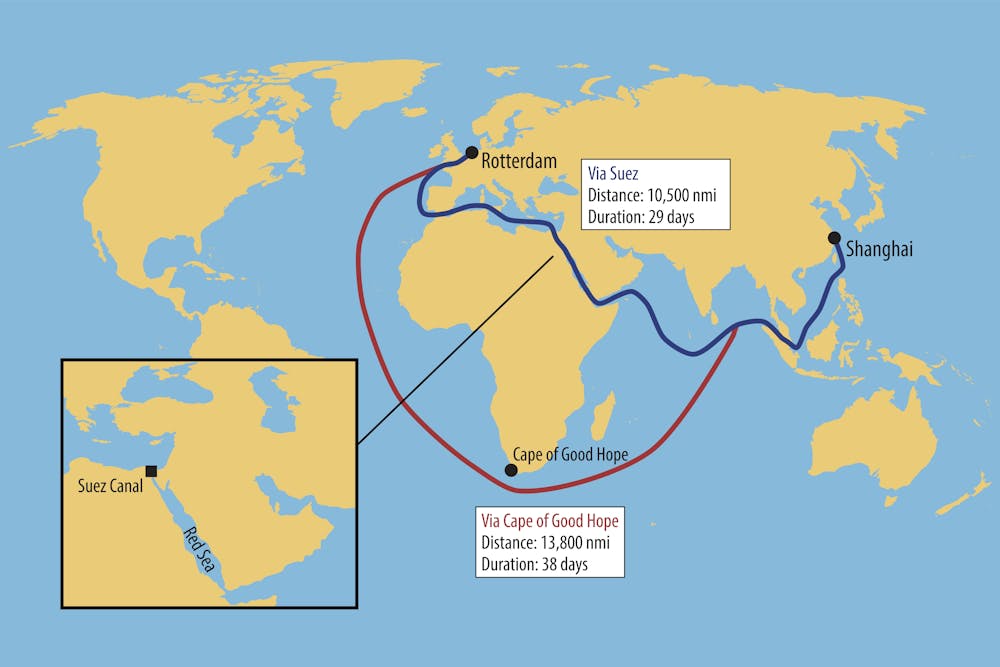
    These attacks have prompted many shipping companies to stop using the Red Sea – a route that around 12% of global trade usually passes through – and divert around the southern tip of Africa. This route adds more than 7,000 nautical miles on to a typical round-trip voyage. The number of commercial ships using the Suez Canal to pass between the Mediterranean and the Red Sea plummeted from over 26,000 in 2023 to 13,200 in 2024.

    Supply chains have had to deal with higher shipping costs, product delivery delays, and increased carbon emissions as a result of this diversion. The Gaza ceasefire gave some hope that the disruption would finally end. But shipping lines will not hurry back to the region until long-term security is guaranteed.

    Since November 2023, shipping companies have been diverting their vessels around the southern tip of Africa to avoid the Red Sea.
    Dimitrios Karamitros / Shutterstock

    During the early stages of the crisis, moving a container from Shanghai in China to Europe cost approximately 250% more than before the war in Gaza began. This was largely due to increased fuel costs and higher insurance premiums. Freight rates (the price companies pay to transport goods) remained high throughout 2024, despite some fluctuations.

    The cost of moving a 40-foot container from Shanghai to Rotterdam in the Netherlands, for example, surged from around US$4,400 on average in January to above US$8,000 by August. This had dropped to US$4,900 at the end of the year.

    It is too early to say whether these costs will be passed on to consumers in the form of higher prices – full transmission through the supply chain to consumer prices can take upwards of 12 months. But some estimates suggest global consumer prices could rise by 0.6% on average in 2025 as these increased shipping costs filter through the supply chain.

    Diverting around southern Africa also resulted in delays in the delivery of many goods and components. The proportion of container ships that arrived on schedule dropped from 60% on average worldwide in 2023 to about 50% throughout 2024. This created congestion at ports because ships often arrived at their destination later than planned, resulting in further delivery delays.

    Unreliable transit times are a significant issue for supply chains because they make it difficult for businesses to plan inventory and coordinate production schedules. Indeed, several vehicle manufacturers, including Tesla and Volvo, temporarily suspended manufacturing in early 2024 due to a lack of components. And food supply chains, including those for avocados, tea and coffee, were also affected by delays.

    Since then, many companies have adapted by increasing their safety stock levels and transporting cargo using alternative modes of transport like air and rail. Some European firms have also adopted a strategy called “nearshoring”, where they source products from regions closer to home such as Turkey and Morocco instead of relying on suppliers in Asia.

    Increased emissions

    The longer route around southern Africa requires that ships travelling between Europe and Asia use around 33% more fuel on average than they would use by travelling through the Red Sea at the same speed.

    Over the past decade, most shipping companies have employed a “slow steaming” policy to economise on fuel use and minimise their carbon emissions. But diverted ships have been travelling around 5% faster than usual in an attempt to minimise delays. The increased vessel speeds will have caused the associated emissions toll to rise – large container vessels require 2.2% more fuel for every 1% increase in speed.

    More data is required to determine the precise amount of additional emissions caused by diverting shipping away from the Red Sea. But estimates suggest that approximately 13.6 million tonnes of CO₂ were emitted by ships rerouted from the Red Sea between December 2023 and April 2024 – equivalent to the carbon emissions of nine million cars over the same period. If ships continue to avoid the region, the increased emissions could amount to 41 million extra tonnes of CO₂ per year.

    Some cargo has also shifted from sea transport to air freight, which has a far greater environmental footprint. Shipping a kilogram of product by long-haul air freight generates at least 50 times more CO₂ emissions on average than container shipping.

    Carbon emissions have increased due to the diversion of vessels around southern Africa.
    David G40 / Shutterstock

    Before returning to the Suez Canal, container lines will want to see a prolonged period of stability around the Red Sea. This is due, in part, to safety and security concerns related to the crew, cargo and the ship.

    But shipping companies also have operational challenges to keep in mind associated with the scheduling of port calls and voyages. Shipping lines will find it difficult to switch back to the longer route around Africa immediately if attacks in the Red Sea resume.

    And, at least for now, the situation in the Bab al-Mandab Strait remains unpredictable. In a televised speech on January 20, Houthi leader Abdul-Malik al-Houthi warned: “We have our finger on the trigger.”

    With other disruptions continuing to affect global shipping, such as port strikes, low water levels in the Panama Canal and extreme weather events, supply chain issues are likely to continue throughout 2025.

    Gokcay Balci does not work for, consult, own shares in or receive funding from any company or organisation that would benefit from this article, and has disclosed no relevant affiliations beyond their academic appointment.

    ref. Red Sea crisis: supply chain issues set to continue despite Gaza ceasefire – https://theconversation.com/red-sea-crisis-supply-chain-issues-set-to-continue-despite-gaza-ceasefire-248469

    MIL OSI – Global Reports

  • MIL-OSI Global: If we listen to how Gen Z really feel about democracy they might stop telling us they prefer authoritarianism

    Source: The Conversation – UK – By Melissa Butcher, Professor Emeritus, Social and Cultural Geography, Royal Holloway University of London

    New research from broadcaster Channel 4 reveals a troubling trend towards support for authoritarianism among young people in the UK. The report “Gen Z: Trends, Truth and Trust” found that 52% of the 2,000 13-27 year olds surveyed would agree that “the UK would be better with a strong leader in charge who does not have to bother with Parliament and elections”.

    This correlates with a 2023 study from pro-democracy organisation Open Society Foundations, which found 42% of young people in its global sample felt military rule was a good way of running a country. Other research has found a disillusionment with democracy among young people.

    These are trends to be worried about. But Gen Z are not somehow inherently anti-democratic. Understanding why these trends are happening is vital if young people are to participate in democracy.

    At Cumberland Lodge, an education charity that uses dialogue to address social division and conflict, I’m working with colleagues and young people on a nationwide youth and democracy network to re-think what politics in the UK could look like.

    Hearing Gen Z

    Our team has conducted 12 discussion groups with 101 young people around the country, looking at what stops them getting involved with democratic practices and institutions. Using this research as a starting point, we are now working with a core group of young people to develop their capacities to engage with, and re-imagine democracy.

    What we are learning is that young people’s disengagement is not necessarily a sign of apathy or anti-democratic tendencies. The young people we are working with want to engage with politics, but they feel a vast sense of distrust. They see politicians as prioritising their own and corporate interests over public good, and willing to break promises on issues that affect young people’s lives.

    Feeling unsupported by their political system makes young people feel vulnerable – especially in the face of a multitude of global crises. In their lifetime, the world has lurched from a global financial crisis to a worldwide pandemic and to war in Europe. They have to navigate housing shortages, a lack of mental health support, the climate emergency, artificial intelligence and changing identity and social roles.

    A perception of an “elite” system that is supposed to work for everyone, but excludes or even actively works against the sectors of society most affected by these crises, harms young people’s trust in democracy.

    Gen Z deal with an onslaught of information about a rapidly changing world.
    DimaBerlin/Shutterstock

    But a shift towards support for authoritarianism is by no means inevitable. The Open Society Foundations study found that 86% of young people surveyed still wanted to live in a democracy.

    In Channel 4’s research, too, 73% of Gen Z think democracy is a “very” or “fairly good” way of governing the UK. And young people want to learn about democracy and the democratic process.

    Our youth and democracy network shows young people are not apathetic. Many want to get involved. They want a better, fairer world. They see the shortcomings of the current system and imagine something better.

    Getting young people involved

    To enable this to happen, political and media literacy is crucial for providing young people with necessary knowledge and confidence. Investment in education on democracy is necessary, as many young people in our network wanted to engage but felt overwhelmed and uncertain about where to start. Liam in Sunderland said:

    Most people our age aren’t educated on [democracy and politics]. It’s restricted knowledge. We’re given the impression that we can’t do anything about it anyway, so just don’t worry.

    Young people want representatives who understand and engage with the day-to-day realities of their lives, rather than seeing Gen Z as a photo opportunity, as Chloe from Liverpool argued.

    They’ll come here and they’ll speak to us, but they’re not coming there to listen; they’re coming here so they can go back to wherever they came from and be like ‘oh I spoke to a young person’.

    Many of the young people in our youth network are calling for reform of the political system in order to facilitate these changes: a new voting system, or an exploration of forms of direct democracy.

    But importantly, what we have seen in this research over the last year, is that young people can shift how they view power. We think of democracy as more than just systems of governance, but it’s also how we organize, how we communicate with each other, how we mobilise around social issues, and how we build consensus.

    In this sense democracy is not solely something external and out of reach but something that can emerge when young people come together.

    By working to improve democratic education and to put a system in place that listens to and engages with young people, politicians can help Gen Z re-imagine a democracy that gives them a future. At that point, they might stop telling researchers that they prefer authoritarianism.

    Melissa Butcher is a member of the Green Party.

    ref. If we listen to how Gen Z really feel about democracy they might stop telling us they prefer authoritarianism – https://theconversation.com/if-we-listen-to-how-gen-z-really-feel-about-democracy-they-might-stop-telling-us-they-prefer-authoritarianism-248628

    MIL OSI – Global Reports

  • MIL-OSI Global: Trump inviting influencers to White House press briefings is likely to usher in a new era of fake news

    Source: The Conversation – UK – By Steven Buckley, Lecturer in Digital Media Sociology., City St George’s, University of London

    Just over a week after Donald Trump was sworn in as 47th president of the United States, his new press secretary, Karoline Leavitt, appeared in the James S. Brady press briefing room to preside over her first media conference. Pulling up a chart that showed Americans’ declining trust in traditional, or what she called “legacy”, media outlets, Leavitt announced that henceforth, “independent journalists, podcasters, social media influencers and content creators” would be welcome at press briefings.

    Leavitt said that seats formerly reserved for White House officials would be available to these independent journalists, and invited people to apply online for White House press accreditation. It has since been reported that the White House has received more than 7,400 applications.

    In principle, broadening the range of media outlets allowed into White House press briefings is a good idea. There’s no doubt that the media consumption habits of the American public are changing fast. But the way Trump and his communications team handled press briefings in his first term raises some concerns.

    During that first term between 2017 and 2021, Trump and his White House communications team tended to favour reporters from friendly media outfits such as Fox News. Early in his administration, a number of reporters from what were perceived as “hostile” organisations were banned from “the huddle” – the informal gatherings around Trump’s press secretary that followed more formal briefings.

    Fringe organisations such as Breitbart News and the One America News network carried Trump’s message faithfully and got disproportionately favourable access. This week, Breitbart was one of two online media outlets (alongside the widely respected news website Axios) that Leavitt selected to ask the first questions at her debut press briefing.

    It’s not just their friendly disposition towards Trump but their reach that makes social media influencers appealing to the incoming president. Their primary purpose at the press briefings would be to help generate positive messages and content to feed to Trump’s Maga base – which are then promoted on platforms such as Elon Musk’s X (formerly Twitter).

    Recent research suggests that X has adjusted its algorithm to boost right-wing content as well as posts by Musk himself. A clear example has been Musk promoting the former Fox News host turned online influencer and Trump campaign surrogate Tucker Carlson’s online show.

    Undermining public regard for journalism

    But there may be another, insidious function of inviting these influencers to the White House press briefing room. Their presence beside professional journalists from traditional media outlets is likely to undermine public regard for journalism in general. This could sow even greater mistrust in the US media, which is already at record lows.

    In recent years, there has been a gradual blurring of lines between traditional and digital media. But while research consistently shows, across a wide cross-section of countries and within those countries, traditional media is still more trusted than new media, this is not to say that all new media outlets should be excluded. Many of these organisations and individuals have a track record of holding power to account.

    Bellingcat – a coalition of researchers, investigators and citizen journalists – typically uses open-source information to uncover important stories of public interest. Individual journalists such as Taylor Lorenz, who covers the tech and creator industry, and Ken Klippenstein, who is well known for getting hold of internal government documents, are also good examples of journalists who produce quality reports from outside the traditional mainstream.

    It should ideally be journalists such as these, with track records for solid and impartial reporting, who are invited into the White House fold – although there’s every chance they would get the same sort of treatment as reporters such as CNN’s Jim Acosta, whom Trump famously branded an “enemy of the people” when refusing to answer a question from him in 2018.

    Acosta, incidentally, has just left CNN after the network moved him to the midnight “graveyard” slot. Shortly after signing off from his final CNN broadcast on January 28, Acosta appeared on his own Substack feed to announce he would go it alone.

    It seems unlikely, though, that he will be awarded one of the coveted new independent media accreditations, given Trump’s recent attack on him. Celebrating Acosta’s apparent relegation by CNN, Trump took to his TruthSocial media site to call him “one of the worst and most dishonest reporters in journalistic history, a major sleazebag”.

    Polarised media, divided audiences

    It’s likely that America’s news media will only become more polarised during this second Trump administration, including an increasingly toxic mix of content creators dominating social media platforms. And now that Mark Zuckerberg has decided to remove Meta’s factchecking mechanism in favour of “community moderation”, research suggests this is likely to incentivise political messages which polarise and provoke rather than inform people.


    Read more:
    What Meta’s move to community moderation could mean for misinformation


    We’ve already seen that the incoming president was more than willing to use lawsuits to intimidate journalists. Trump recently won a legal case over ABC when its journalist George Stephanopoulos defamed him by falsely saying he had been found liable for rape.

    This, combined with Trump’s threat to sue the Des Moines Register and its pollster Ann Selzer over their allegations of election interference, are likely to increase the chilling effect on free speech. Legal threats such as these may serve to discourage close scrutiny of his second administration.

    Meanwhile, the steady rise in prominence of partisan influencers using increasingly dangerous language is only likely to lead to the American public having less faith in the institutions that are critical to a functioning democracy – the press included.

    Steven Buckley does not work for, consult, own shares in or receive funding from any company or organisation that would benefit from this article, and has disclosed no relevant affiliations beyond their academic appointment.

    ref. Trump inviting influencers to White House press briefings is likely to usher in a new era of fake news – https://theconversation.com/trump-inviting-influencers-to-white-house-press-briefings-is-likely-to-usher-in-a-new-era-of-fake-news-247410

    MIL OSI – Global Reports

  • MIL-OSI Canada: Funding helps build resilient communities through stronger climate adaptation

    Source: Government of Canada regional news

    The Community Emergency Preparedness Fund is administered through the Union of BC Municipalities (UBCM), and funds projects that support local governments and First Nations to better prepare for disasters and reduce risks from hazards in a changing climate.

    Communities throughout British Columbia will receive more than $19 million from the Community Emergency Preparedness Fund as follows.

    Funding is divided into three categories:

    • Category 1 (C1): Foundational activities (risk mapping, risk assessments, planning)
    • Category 2 (C2): Non-structural activities (land-use planning, community education, purchase of eligible equipment)
    • Category 3 (C3): Small-scale structural activities

    Canal Flats – C3: Phase 1 dike improvement project
    Amount: $400,000

    Clearwater – C2: Improvements for stormwater management
    Amount: $138,000

    Comox Valley Regional District – C2: Extreme-weather equipment
    Regional partners: Comox, Courtenay, Cumberland, K’ómoks First Nation
    Amount: $100,000

    Coquitlam – C1: Disaster-risk reduction planning
    Amount: $150,000

    Cranbrook – C3: Gold Creek dam replacement
    Amount: $5 million

    Creston – C1: Hazard, risk and vulnerability assessment
    Amount: $150,000

    Delta – C1: Mason drainage pump station design
    Amount: $150,000

    Fraser-Fort George Regional District – C1: Regional heat and drought threat assessment/mapping; C2: Partner engagement to improve hazard-resilient development
    Regional partners: Prince George, McBride, Mackenzie, Valemount, Lheidli-T’enneh First Nation, McLeod Lake Indian Band
    Amount: $716,876

    Hope – C1: Hazard identification and risk mapping
    Amount: $150,000

    Invermere – C3: Toby Dike upgrades
    Amount: $810,000

    Kamloops – C1: Watershed climate change adaptation planning
    Amount: $150,000

    Keremeos – C1: Hazard, risk and vulnerability analysis
    Amount: $49,800

    Kitasoo Xai’xais Nation – C1: Climate adaptation planning
    Amount: $77,200

    Kwikwetlem First Nation – C1: Flood-mitigation project design
    Amount: $145,190

    Lake Country – C1: Climate change hazard, risk and vulnerability assessment
    Amount: $150,000

    Lower Similkameen Indian Band – C1: Hazard risk and vulnerability planning
    Amount: $49,800

    Lumby – C1: Lumby industrial area dike planning
    Amount: $150,000

    Merritt – C2: Bulk bags for flood response; C3: Voght Street overland water pumping station
    Amount: $4.8 million

    Nelson – C1: Community preparation for extreme temperatures
    Amount: $95,280.00

    Okanagan-Similkameen Regional District – C2: Tiger Dam trailers for emergency flood response
    Regional Partners: Osoyoos, Keremeos, Lower Similkameen Indian Band
    Amount: $600,000

    Oliver – C1: Hazard, risk and vulnerability assessment
    Amount: $50,000

    Osoyoos – C1: Hazard, risk and vulnerability assessment
    Amount: $49,150

    Osoyoos Indian Band – C1: Hazard, risk and vulnerability assessment
    Amount: $50,000

    Peace River Regional District – C1: Hazard assessment, mapping and risk management
    Regional Partners: Blueberry River First Nations, Chetwynd, Dawson Creek, Doig River First Nation, Pouce Coupe, Tumbler Ridge, Hudson’s Hope, Saulteau First Nations, Taylor, Halfway River First Nation, West Moberly First Nations
    Amount: $1.35 million

    Pemberton – C1: Arn Canal pumping station design
    Amount: $60,000

    Richmond – C2: Flood protection and rain gauge monitoring stations
    Amount: $150,000

    Sema:th First Nation (Sumas) – C3: Floodwater conveyance project
    Amount: $195,440

    Skeetchestn Indian Band – C1: Flood-mitigation planning
    Amount: $89,500

    Sḵwx̱wú7mesh Úxwumixw (Squamish Nation) – C1: Assessment for tree planting to reduce extreme-heat hazards
    Amount: $148,722

    SnPink’tn (Penticton Indian Band) – C1: Hazard, risk and vulnerability planning
    Amount: $60,650

    Sooke – C1: Climate adaptation and natural hazard-risk assessment
    Amount: 150,000

    Strathcona Regional District – C1: Port McNeill climate change infrastructure impact assessment; Gold River Road to Tsa’xana Road slope stability assessment; C2 Tsunami and flood-mitigation public information and education; C3: Cortes Kw’as Park and Road flood mitigation
    Regional partners: Mount Waddington Regional District, Mowachaht/Muchalaht First Nation, Nuchatlaht First Nation, Port McNeill, Tahsis, Zeballos
    Amount: $354,960

    Stswecem’c Xgat’tem First Nation (Canoe Creek) – C1: Extreme-weather planning
    Amount: $105,000

    Tlowitsis Nation – C1: Risk mapping, assessment and planning; C2: sub-regional road map, public engagement and workshops
    Amount: $296,700

    Vancouver – C1: Streets network seismic and flooding risk assessment – Phase 1; C2: Extreme-weather mitigation equipment
    Amount: $300,000

    Vanderhoof – C3: Riverbank erosion mitigation
    Amount: $59,410

    West Kelowna – C1: Pike and Capri roads diking design
    Amount: $150,000

    Whispering Pines/Clinton Indian Band – C1: Heat-impact mitigation planning
    Amount: $36,700

    Xwémalhkwu (Homalco) – C1: Wetland restoration design; C2: Public education project; C3: Willow Creek watershed resilience, culvert replacement
    Amount: $1.54 million

    MIL OSI Canada News

  • MIL-OSI Global: Why I loved the new Mussolini drama – by an expert in Italian fascism

    Source: The Conversation – UK – By John Foot, Professor of Modern Italian History, University of Bristol

    As a historian who has studied and taught courses on Italian fascism, I have spent many hours watching footage and listening to the speeches of dictator Benito Mussolini, who ruled over the country from 1922 to 1943.

    So I was rather excited to be asked to review the new Sky Atlantic TV series M: Son of the Century. The series focuses on the rise of Italian fascism and its consolidation in power from 1919 to 1925. Watching all eight parts in one sitting, I was astounded above all by the performance by well-known Italian actor Luca Marinelli.

    Marinelli is on screen for almost the entire eight hours of the series – often in close up and looking straight at the camera. It is an extraordinary tour-de-force performance. Physically, Marinelli inhabits the role much as Robert De Niro did in Raging Bull, putting on a lot of weight in order to play this part; the resemblance to the dictator is uncanny.


    Looking for something good? Cut through the noise with a carefully curated selection of the latest releases, live events and exhibitions, straight to your inbox every fortnight, on Fridays. Sign up here.


    But there is much more. We are confronted with a torrent of words, speeches and internal monologues, many of which have been drawn directly from Mussolini’s journalism and speeches. Here Marinelli captures the precision and charismatic nature of Mussolini’s speech, but also the brutality of many of the concepts he was expressing.

    There is a great deal of baroque Italian swearing too, and Marinelli powerfully portrays the uncouth son-of-a-blacksmith and his range of expressions with relish. I would be amazed if this actor does not win awards for the role. It is an astonishing performance.

    Director Joe Wright’s series is based on Antonio Scurati’s best-selling Italian historical novel of the same name. Scurati’s approach to Mussolini’s story draws on historical work and documents, but importantly tells the story with the flair of an experienced and successful novelist.

    This and the other three books in Scurati’s series about Mussolini have provoked controversy among Italian historians of fascism, not least for some of the historical inaccuracies, but also for what they considered a “dumbing-down” of history. However, others have defended the books as a new way of understanding and disseminating history, and the books have been wildly popular with general audiences.

    Wright’s series adapts the first book. Its starts when Mussolini formed the first fascist movement in 1919 and inspired the “blackshirt” squads who used violence to crush the trade union and socialist movement. It covers events in 1922 when Mussolini led the fascist insurrection that brought him to power, known as the March on Rome. And, it ends with his famous speech by in parliament, which marked the beginnings of the consolidation of Mussolini’s dictatorship in 1925.

    This is a complicated story, but the scriptwriters and director have done an exemplary job in bringing this history to a wider audience. Unsurprisingly, they have often simplified the past, or altered events to fit the narrative. This paring down of events generally works well in bringing this period to life, but, of course, historians of the period will notice the numerous times that episodes deviate from what really happened.

    For instance, certain figures close to Mussolini who play a central role in the series are used almost as symbols and as ways of understanding the dictator. Above all, this technique uses is used to elevate Margherita Sarfatti, the writer, journalist and lover of Mussolini who was a key figure in inventing and spreading the cult of dictator.

    In Wright’s drama, Sarfatti is depicted as a kind of spin doctor, as someone he turns to in times of difficulty and as an inspiration for his political strategy. Her role is overplayed in the series, but this is done to increase the clarity of storytelling and provide a sharp narrative.

    The tone of the series shifts constantly between darkness and extreme violence to occasional comedy and farce. This is a tricky balance to pull off, but it generally works. Anyone watching will have their views on which parts lapse into bad taste and which do not, and the risks of glamorising or playing down shocking and tragic events.

    Certainly, there were moments which jarred, especially the farcical telling of the March on Rome in 1922. Wright and the scriptwriters, correctly in my opinion, place the violence of fascism at the centre of the story, and it rarely pulls its punches in this regard.

    It is impossible to ignore the contemporary relevance of this series, and it is clearly intended as a warning. Democracy, this series tells us, is extremely fragile. At one point Mussolini turns to the camera and says: “Democracy is beautiful. It even allows you the possibility of destroying it.”

    With the victory of Trump and the political rise of Elon Musk, the pertinence, prescience and power of this film has deepened. There is even a discussion at one point of the meaning and role of the “Roman salute” in terms its use during fascism, something which has been much debated in the light of Musk’s own recent controversial “hand gesture”.

    But the ultimate finger of blame is pointed at those who enabled Mussolini’s rise and who tolerated his incendiary language and the violence of his followers. The series ends starkly, with the word “silence”. Those who did nothing were just as responsible as those who supported the rise of this brutal dictator.

    John Foot does not work for, consult, own shares in or receive funding from any company or organisation that would benefit from this article, and has disclosed no relevant affiliations beyond their academic appointment.

    ref. Why I loved the new Mussolini drama – by an expert in Italian fascism – https://theconversation.com/why-i-loved-the-new-mussolini-drama-by-an-expert-in-italian-fascism-248358

    MIL OSI – Global Reports

  • MIL-OSI Global: Central India’s indigenous forests are falling victim to bullets and bulldozers

    Source: The Conversation – UK – By Bulbul Prakash, PhD Candidate in Politics, University of Manchester

    The state of Chhattisgarh in India’s tribal heartland has been the epicentre of a violent conflict for more than 30 years. This struggle has pit a Maoist-inspired group called the Naxalites, who are fighting for the rights of marginalised tribal communities, against the Indian government, which has deployed security forces to suppress the insurgency. More than 11,600 people have been killed in the conflict since 2000.

    At the same time, Chhattisgarh is also grappling with the pressures of rapid industrialisation. Large-scale mining and infrastructure projects are threatening both the land and livelihoods of the state’s indigenous (or Adivasi in Sanskrit) communities.

    Around 44% of the region’s land area is covered by dense forests. These forests are home to vital plant and animal species such as Mahua and Sal trees. However, these forests are being damaged. Trees are being ravaged by gunfire, animals are being killed by explosions, and the fragile ecosystem that sustains people and wildlife in Chhattisgarh is gradually crumbling.

    Soni Sori, an Adivasi activist, has shared images with me that have been taken by Adivasis in the forests of Chhattisgarh. The photos highlight the damage being caused by gunfire, explosions and shelling.

    Bullets tear through bark, while explosions strip it away, leaving trees vulnerable to pests and disease. Shrapnel and shock waves from blasts also sever branches or trunks, which further weakens the trees and causes long-term damage.

    Fresh bullet wounds on a Sal tree in Chhattisgarh.
    Soni Sori, CC BY-NC-ND

    The destruction of Mahua and Sal trees has had a particularly devastating impact on women from Adivasi communities.

    The Mahua tree, which is often called the “tree of life” by locals, provides an essential lifeline for many Adivasi women. Its flowers are fermented to make alcohol, which offers a crucial source of income when it is sold in local markets.

    When men are drawn into Naxal movements or caught in the state’s counterinsurgency efforts, women often step in and use the income from Mahua flowers and oil to fund their children’s education, sustain their families, and repay debts.

    In the town of Dantewada in southern Chhattisgarh, locals even hold a special ceremony where they “marry” the Mahua tree, honouring its life-sustaining role in their community.

    Sal trees, which form much of Chhattisgarh’s forest cover, play a crucial role in stabilising the soil. Their loss leads to erosion and increases the risk of floods and landslides. Climate change, and the increasingly erratic rainfall it brings, has compounded these risks.

    An unexploded mortar shell partially buried in Chhattisgarh.
    Soni Sori, CC BY-NC-ND

    The loss of essential resources like Mahua trees will only exacerbate food insecurity and economic hardship, pushing Adivasis further into poverty. The average annual income of Adivasi households in Chhattisgarh was just ₹53,610 (around £505) in 2022 – well below the national agricultural household average of ₹122,616.

    The conflict in Chhattisgarh is also harming the region’s wildlife. In December, a female sloth bear was killed by an improvised explosive device planted by Maoist rebels in the forests of Dantewada. The bear’s two orphaned cubs starved to death shortly after.

    This was the first recorded death of a wild animal from such an explosion in Bastar district, though livestock and pets have been victims of similar blasts in the past.

    One month earlier, in central Chhattisgarh’s Udanti-Sitanadi Tiger Reserve, a five-year-old elephant calf sustained critical injuries from a suspected bomb explosion. These incidents reflect a disturbing pattern within the conflict, where wildlife is becoming a victim of the violence.

    March of industrialisation

    Industrialisation has exacerbated these challenges. Chhattisgarh is rich in mineral resources. Between 2023 and 2024, the state produced nearly 50 million tonnes of limestone, 44 million tonnes of iron ore, and over 1 million tonnes of bauxite. However, widespread mining is fuelling further deforestation and environmental degradation.

    Between 2001 and 2023, the state lost 53,500 hectares of forest, with large-scale mining operations contributing significantly to the loss. In the Hasdeo region of northern Chhattisgarh, the Parsa East Kete Basen coal mine has led to the felling of almost 82,000 trees, spread across two phases of mining. Between 2012 and 2018, 50,000 trees were felled, with more than 31,800 more trees cut down since then.

    With continued political support for mineral extraction, government approvals, and the involvement of commercial mining giants, more deforestation is expected over the coming years.

    This deforestation is, unsurprisingly, harming the region’s wildlife. The latest census by the National Tiger Conservation Authority, which was carried out in 2022, revealed a sharp and alarming decline in Chhattisgarh’s tiger population.

    At that time, there were only 17 tigers remaining in the state – a dramatic fall from 46 in 2014. Conservationists fear that the figure could now be even lower, as the situation continues to deteriorate.

    This decline is largely due to habitat destruction. But it has probably been made worse by the Maoist insurgency in regions such as northern Chhattisgarh, which is home to the Achanakmar Tiger Reserve, as well as the Indravati Tiger Reserve in the south-western part of the state.

    The insurgency has hindered conservation efforts. The use of explosives in the forests disrupts the behaviour of tigers, while also making it more difficult for conservationists to monitor and protect them.

    What was once a lush and bio-diverse environment is rapidly becoming a wasteland. But the loss of these trees and wildlife in Chhattisgarh represents more than simply the depletion of natural resources. It symbolises the erosion of culture, identity, and a way of life for Chhattisgarh’s Indigenous people.

    Bulbul Prakash is supported by The University of Manchester through the ‘Future of the Academy Studentship’ for her doctoral research. The author would like to acknowledge the invaluable contribution of Adivasi activist Soni Sori, who shared firsthand images taken by Adivasi community members in the forests of Chhattisgarh, which illustrate the environmental damage caused by ongoing conflict.

    ref. Central India’s indigenous forests are falling victim to bullets and bulldozers – https://theconversation.com/central-indias-indigenous-forests-are-falling-victim-to-bullets-and-bulldozers-246272

    MIL OSI – Global Reports

  • MIL-OSI Global: Most of Britain’s peat bogs could stop forming new peat as the climate changes – new study

    Source: The Conversation – UK – By Jonathan Ritson, Research Fellow, Geography, University of Manchester

    Joe Dunckley / shutterstock

    By the 2080s, climate change will mean most of Britain’s peatlands could be too dry to form new peat. That’s the stark warning from a new academic study my colleagues and I just published in the Journal of Applied Ecology.

    Peat bogs are found in areas where there is lots of rain but poor drainage. These vital ecosystems are relied upon to deliver drinking water, host rare plant and bird life and to mitigate the risk of floods by slowing rainwater as it heads downstream.

    Perhaps most importantly, peatlands also sequester huge amounts of carbon. That’s because peat is made of the remnants of plants accumulated over hundreds or thousands of years. Waterlogged conditions mean the plants don’t fully decompose, so the carbon they’re made of is kept in the ground and isn’t released into the atmosphere. Peat can be several metres deep so all that plant matter adds up – per square metre, a typical British peat bog stores far more carbon than a tropical rainforest.

    As peat needs very wet conditions to form, our study first mapped out the temperature and rainfall conditions under which this has occurred in the UK in the past. We then took the Met Office’s UK climate projections and looked at where these conditions would continue to occur by the 2080s. The results were, quite frankly, shocking.

    Although small pockets of favourable conditions may still be present in Wales, and larger ones in Scotland, the outlook for England is dismal, with barely any areas continuing to be suitable for peat formation due to increasing temperatures and lower summer rainfall.

    UK peatlands. The large red patch at the top of mainland Scotland is the Flow Country.
    James Hutton Institute / Biogeochemistry

    In the “Flow Country” of northern Scotland, a bog so big it has been designated a Unesco world heritage site, the area in which we might expect peatlands to thrive is likely to be reduced by at least 50% even in the best-case climate scenario. This scenario of mild warming is, unfortunately, unlikely to happen. More extreme scenarios of peatland degradation are increasingly realistic.

    We still don’t know exactly what this will mean for the peatlands in places like Exmoor or Dartmoor in southern England, however we do know that life will become more and more challenging for these precious ecosystems. Not experiencing the temperature and rainfall that caused peat formation in the first place could mean they start to emit the carbon currently stored, as this is reliant on them staying wet and boggy.

    Peatlands are naturally resilient and aren’t going to disappear overnight (the Peak District in northern England was heavily degraded for over a century, yet still hosts many metres of peat soils). But conservation and restoration work is going to be ever more necessary if we are to preserve these landscapes as carbon sinks rather than sources.

    More money for conservation

    One ray of light in all this is that the challenging conditions in England could actually unlock more money for conservation efforts. The UK Peatland Code is a climate finance initiative that allows landowners to generate income from peatland restoration by selling carbon credits. The number of credits they can claim is based on the difference in avoided emissions from a “do nothing” scenario in which they do no restoration.

    Our new results show that doing nothing could be even worse than previously thought, meaning more carbon finance may be unlocked. Perversely, bad news for England’s peatlands could bring about the money needed to save them.

    Thankfully, through measures such as the government’s Nature for Climate scheme and ongoing investment in fundamental peatland science, the UK has something of a head start in peatland restoration. Techniques that were once trialled in small areas are now being rolled out across whole landscapes.

    Gully blocking to raise peatland water tables and limit carbon loss, as part of the GGR-Peat project at the National Trust High Peak Estate.
    Jonathan Ritson

    The Great North Bog initiative, as one example, has linked together restoration organisations, researchers and landowners to deliver restoration across four national parks and three national landscapes. This is truly the scale that is needed if the UK is serious about meeting its climate targets.

    More will be required, however, as huge swathes of peatland remain in a degraded state. While bleak messages like those in our new study could lead to resignation about the effects of climate change, there is an alternative way of looking at it: we must show how bad things could get if we don’t do anything, and then see this as a call to action.

    Jonathan Ritson has received funding from charities delivering peatland restoration.

    ref. Most of Britain’s peat bogs could stop forming new peat as the climate changes – new study – https://theconversation.com/most-of-britains-peat-bogs-could-stop-forming-new-peat-as-the-climate-changes-new-study-248515

    MIL OSI – Global Reports

  • MIL-OSI Global: Canada’s electric vehicle industry is facing existential threats — here’s how it can still flourish

    Source: The Conversation – Canada – By Charles Conteh, Professor of Public Policy and Administration, Department of Political Science, Brock University

    The electric vehicle (EV) industry has been one of the most defining technological trends of the past decade, transforming the automotive sector while fuelling advancements in manufacturing.

    Yet after billions of taxpayer dollars have been invested, the EV industry in Canada is facing headwinds. Chief among these are the trade tariff threats from U.S. President Donald Trump.

    For a country with an automotive sector that exports 91 per cent of its parts to the U.S., the threats feel existential. They may also be seen as a betrayal of the centuries-long economic and cultural partnership between two neighbours sharing one of the world’s longest and most porous borders.

    Adding to these international headwinds are three other obstacles within the EV industry: high costs, limited battery range and sparse battery charging infrastructure. These concerns continue to affect firms here in Canada, with the likes of Stellantis juggling high inventory, slow sales and falling revenue.

    These challenges have sparked skepticism about the future of EVs in Canada and whether the federal and provincial governments’ multi-billion-dollar investments in the industry are wise.

    As researchers who study Canada and other countries’ innovation policy initiatives amid breakneck changes in technologies and markets, we argue that Canada has every reason to ratchet up its commitments in the months and years ahead.

    Along with artificial intelligence, EV represents the emergent frontier of advanced manufacturing in the digital age. Winners of this innovation race will stand to dominate the global market for the foreseeable future.

    The case for staying the course

    Despite current challenges, EVs remain the future of the automotive sector. Even conservative estimates suggest that by 2040, around three-quarters of new car sales will be fully electric globally.

    Canada’s position in the EV industry is stronger than recent news coverage indicates. The country ranked first among 30 countries in a 2024 EV battery supply chain report, outperforming even China.

    This ranking reflects Canada’s vast reserves of critical minerals essential for EV battery production and its burgeoning battery manufacturing sector.

    Over the past few years, Canada has attracted significant investments from manufacturers like Umicore, Northvolt and Volkswagen-owned PowerCo.

    Canada has reasons to be optimistic about EV and energy storage demand. While concerns about U.S. protectionism loom, Canada’s commitment to zero-emission vehicles ensures fiscal incentives and policies that will likely boost short-term demand.

    On the environmental, social and governance front, Canada outperforms many of its global competitors in battery manufacturing. Though by no means perfect, the country’s climate change policy ambitions, clean electricity grid and commitment to sustainable mining position it as a global leader in the EV space.

    Advanced manufacturing

    Canada’s robust innovation ecosystem for advanced manufacturing is another key strength. A prime example is the Ontario Vehicle Innovation Network (OVIN).

    OVIN commercializes advanced automotive technologies and manages the development, testing, piloting and uptake of transportation and infrastructure technologies. It operates seven regional technology development sites across Ontario, including in Waterloo, Hamilton, Windsor-Essex, Durham and Toronto.

    By serving as a bridge between government, industry and researchers, OVIN has become a model for multi-level governance, with projects jointly funded by the federal and provincial governments and close working relationships with municipalities.

    As the EV industry navigates economic and policy challenges, initiatives like OVIN are crucial for driving long-term growth and competitiveness.

    The road ahead

    While Canada’s automotive innovation ecosystem is generally robust, it requires some calibration to overcome current challenges and claim the next frontier of the global EV race.

    In particular, Canada needs to consolidate its EV innovation ecosystem by integrating the upstream of its domestic supply chain assets with the downstream of its technology commercialization and adoption.

    In other words, this means getting more critical minerals to market and making sure a substantial portion of the materials mined in Canada are processed and used domestically to build batteries and vehicles, so the entire EV production cycle benefits Canada’s economy.

    Such an endeavour will require Canada to establish the right policies, regulations and financial support to tap into its vast reserves of critical minerals to supply the country’s battery plants.

    It is the presence of these reserves that made Canada attractive to the automakers in the first place. Leveraging them wisely will be critical for the country’s long-term success in the EV industry.

    Charles Conteh receives funding from the Social Sciences and Humanities Research Council of Canada.

    Tia Henstra does not work for, consult, own shares in or receive funding from any company or organisation that would benefit from this article, and has disclosed no relevant affiliations beyond their academic appointment.

    ref. Canada’s electric vehicle industry is facing existential threats — here’s how it can still flourish – https://theconversation.com/canadas-electric-vehicle-industry-is-facing-existential-threats-heres-how-it-can-still-flourish-248103

    MIL OSI – Global Reports

  • MIL-OSI United Nations: Statement attributable to the Spokesperson for the Secretary-General – on Myanmar

    Source: United Nations secretary general

    Four years since the military seized power and arbitrarily detained members of the democratically elected Government on 1 February 2001, the situation in Myanmar continues to deteriorate, with devastating consequences for civilians.
     
    The Secretary-General condemns all forms of violence and calls on all parties to the conflict to exercise maximum restraint, uphold human rights and international humanitarian law, and prevent further incitement of violence and intercommunal tensions. He reiterates his concern regarding the military’s stated intention to hold elections amid intensifying conflict, including aerial bombardment and widespread human rights violations and without conditions that permit the people of Myanmar to freely and peacefully exercise their political rights, including safety and security. 
     
    Over 19.9 million people in Myanmar – more than one-third of its population – need humanitarian assistance, compared to one million before the military took over four years ago. Unimpeded access must be assured to enable the UN and its partners to continue to deliver humanitarian assistance and essential services.
     
    The Secretary-General renews his calls for greater cooperation among all stakeholders to bring an end to the hostilities and help the people of Myanmar forge a path towards an inclusive democratic transition and return to civilian rule.  The Secretary-General also appeals to countries in the region to grant access to safety and protection for those fleeing conflict and persecution and for the international community to provide greater support to countries, including Bangladesh, hosting refugees from Myanmar.
     
    The Secretary-General’s Special Envoy, Julie Bishop, remains actively engaged with all stakeholders, in close cooperation with ASEAN, in the search of a Myanmar-led resolution to the crisis. 
     
    A viable future for Myanmar must ensure safety, accountability, and opportunity for all its communities, including the Rohingya, and address the root causes of conflict, discrimination and disenfranchisement in all its forms. The Secretary-General reaffirms the unwavering support of the United Nations to the people of Myanmar in these efforts.
     

    MIL OSI United Nations News

  • MIL-OSI USA: On Senate Floor, Shaheen Condemns Trump Administration Order to Stop all Federal Funding for Grants and Loans, Shares Granite Staters’ Stories to Detail Impact of Decision on Families, Seniors and Businesses

    US Senate News:

    Source: United States Senator for New Hampshire Jeanne Shaheen
    (Washington, DC) – U.S. Senator Jeanne Shaheen (D-NH), a senior member of the U.S. Senate Appropriations Committee, spoke on the Senate floor to condemn the Trump administration’s order to take away federal grants and loans that families, seniors and small businesses in all 50 states rely on for critical, often life-saving services. Shaheen illustrated the chaos caused by the extreme order by sharing the stories of many Granite Staters she has heard from in the past two days. Click here to watch the Senator’s full speech. 
    Key quotes from Senator Shaheen: 
    “This is a decision that does not lower costs, it does not create jobs, it does not enhance public safety or keep our communities safe. It’s a decision that actually will hurt people in my state of New Hampshire and too many across the country who rely on services that are now in jeopardy.” 
    “People in our states can’t get the housing that they’re counting on. If they can’t get their funding, that means more people are forced to live in their cars, on the streets. It means more people can’t get the help they need with substance use disorders or finding work. It means more people are stuck without permanent housing. And these are veterans, they’re families, they’re victims of domestic violence – they’re all placed at risk because of this order.” 
    “Another of my constituents, Kathleen, lives in housing for seniors. She has debilitating medical issues that make it hard for her to leave her home. She gets all of her food from a local food bank. She called my office because she’s worried that if this funding stops, she’ll be on the street, and she doesn’t know where her meals will come from. That’s what this order and these cuts are threatening.” 
    “Common sense calls for all of us to work on a bipartisan basis to help our constituents and put an end to the chaos that has been created by this administration in only its second week. I hope we can do that.” 
    On Monday, the Trump administration’s Office of Management and Budget (OMB) announced a sweeping executive order pausing almost all forms of federal assistance to states, nonprofits, non-governmental organizations and more. Senator Shaheen immediately condemned the move and emphasized the impact it will have on communities. The full list that agencies were directed to review encompasses over 2,600 assistance programs, including Supplemental Nutrition Assistance (SNAP), Women, Infants and Children (WIC), community health centers, the Community Development Block Grant (CDBG), transportation and highway funding, energy assistance programs, water infrastructure funding, State Opioid Targeted Response grants, GI Bill, veteran compensation for service connected disabilities, Section 8 vouchers, school breakfast and lunch, Title I education grants, Temporary Assistance for Needy Families (TANF) and Head Start. 

    MIL OSI USA News

  • MIL-OSI Security: Federal Courts Authorize IRS “John Doe” Summonses to Trident Trust Entities

    Source: United States Attorneys General 2

    Summonses Are for Records Relating to U.S. Taxpayers Who May Have Used Network of Offshore Service Providers to Hide Assets and Evade Taxes

    The U.S. District Court for the Northern District of Georgia entered an order earlier this week authorizing the IRS to serve John Doe summonses on TT (USA) Holdings Inc.; Trident Corporate Services Inc. and Trident Fund Services Inc., entities that are members of a multinational group of affiliated companies generally operating under the trade name “Trident Trust” and collectively referred to as the “Trident Trust Group.”

    Separately, on Dec. 18, 2024, the U.S. District Court for the District of South Dakota entered an order, unsealed on Jan. 21, authorizing service of a similar John Doe summons on Trident Trust Company (South Dakota) Inc. The United States also previously obtained approval in the U.S. District Court for the Southern District of New York for the IRS to serve John Doe summonses on a different affiliate entity of the Trident Trust Group, as well as to third party financial service companies, banks and courier services that may have information about Trident Trust Group’s U.S. taxpayer clients.

    The United States is not alleging that any of the entities engaged in wrongdoing. Rather, the IRS uses John Doe summonses to obtain information about possible violations of internal revenue laws by individuals whose identities are unknown. These summonses seek information about U.S. individuals who may have used the Trident Trust Group’s services to underreport their worldwide income and conceal their ownership of certain foreign assets that U.S. individuals are required to report to the U.S. government.

    “The Justice Department and the IRS are dedicated to unearthing tax evasion that uses foreign bank accounts and offshore shell corporations,” said Deputy Assistant Attorney General David A. Hubbert of the Justice Department’s Tax Division. “We will use the many tools available to us, including John Doe summonses like the ones authorized by the courts here, to ensure that taxpayers are fully meeting their responsibilities.”

    Federal law requires certain individual taxpayers, including all U.S. citizens and residents with gross annual income above the reporting threshold, to pay taxes on all income earned worldwide. They must also disclose certain foreign financial accounts, assets and controlled foreign corporations. Failure to report these offshore arrangements can result in serious civil and criminal consequences.

    The government’s petitions allege that Trident Trust Group is an offshore service provider operating in nearly 30 countries worldwide, and it has provided corporate, trust and fund administration services for over 40 years. The petitions further allege that Trident Trust Group offers services that enable offshore account and entity concealment, like mail forwarding and retention, and ready-to-use “shelf” companies. For example, the petitions allege that Trident Trust Group personnel have listed themselves as the founders, directors and officers of thousands of Panamanian companies to help their U.S. clients potentially conceal their interests in and income from those foreign entities.

    A declaration from an IRS revenue agent that accompanied the petitions alleges that at least nine U.S. taxpayers used Trident Trust Group’s services to avoid compliance with U.S. tax laws. The declaration further alleges that the IRS learned of this noncompliance through the Offshore Voluntary Disclosure Program, a program that allowed U.S. taxpayers to voluntarily disclose foreign accounts or entities used to evade tax in exchange for settling their civil liabilities on fixed terms.

    These orders authorize the IRS to issue summonses to TT (USA) Holdings Inc.; Trident Corporate Services Inc.; Trident Fund Services Inc. and Trident Trust Company (South Dakota) Inc seeking information about U.S. taxpayer clients who may have used the services of the entities and the broader Trident Trust Group to establish, maintain, operate or control any foreign financial account or other foreign asset; any foreign corporation, company, trust, foundation or other legal entity or any foreign or domestic financial account or other asset in the name of such foreign entity from 2014 through 2023. By obtaining these records, the IRS expects to be able to identify clients of the Trident Trust Group to investigate whether they potentially used the group’s services to avoid or evade federal taxes.

    Additional information about the Tax Division and its enforcement efforts may be found on the division’s website.

    Tax Division Attorneys Christina T. Lanier and Brij B. Patnaik are handling the case in the U.S. District Court for the District of South Dakota; and they, along with Elisabeth K. Kryska of the Tax Division, are handling the case in the Northern District of Georgia. Assistant U.S. Attorney Anthony J. Sun for the Southern District of New York is handling the case in the U.S. District Court for the Southern District of New York.

    MIL Security OSI

  • MIL-OSI NGOs: Joint Statement by humanitarian, development and human rights organisations in Lebanon: We need a Permanent Ceasefire and a Just Recovery

    Source: Oxfam –

    We, the undersigned organisations operating in Lebanon, urgently call on parties to abide by their commitments towards a permanent ceasefire in Lebanon and appeal to the international community to ensure the respect and full implementation of the temporary ceasefire agreement, now being extended until February 18th 2025.

    While the temporary ceasefire remains in effect and has been extended, we express deep concern about the numerous reported violations that continue to weaken the agreement.. Over 800 violations by Israeli forces[1] and at least one violation by Hezbollah[2] have been reported. As of January 23, 2025 violations by Israeli forces have included indiscriminate ground and air attacks, killing at least 30 people, since November 27, 2024, bringing the total number of people killed by Israeli forces since October 8, 2023 to 4,285, including 241 health care workers, and 17,200 wounded[3]. On Sunday January 26, 2025, alone, Israeli military forces killed 24 individuals, including six women and a Lebanese soldier, and injured 134 including 12 children in the South of Lebanon[4]. Thousands of people, including women and children, older people and people with disabilities have been uprooted from their homes, cut off from food, healthcare and education and exposed to hugely traumatic events – with, so far, no accountability for the destruction or indiscriminate killing.

    This agreement represents a step towards implementing UN Security Resolution 1701 and included a “phased withdrawal of the Israeli Defense Forces south of the Blue Line and the parallel deployment of the Lebanese Armed Forces (LAF) south of the Litani river” that “should not exceed 60 days”.[5] There is still an opportunity to transform temporary undertakings into longer term commitments.

    While many are attempting to return to their homes, hundreds of thousands of people still face the grim reality of either not being able to return because of ongoing Israeli forces’ ground occupation or because of the scale of destruction. Israeli forces have razed entire villages and destroyed agricultural lands and vital infrastructure, including hospitals and schools. Lands are contaminated by unexploded ordnance posing threats to life and risks for the reconstruction efforts.

    As human rights and humanitarian organisations, we will continue supporting all affected people with emergency assistance, recovery and reconstruction[6], but the humanitarian crisis remains severe. Plans for recovery and reconstruction have begun amidst a lingering socio-economic crisis and skyrocketing poverty rates, with nearly one Third of children in Lebanon facing crisis levels of hunger[7]. The economic losses due to the conflict are estimated at 8.5 billion USD[8], and Lebanon desperately needs support for its recovery. The consequences of this destruction will be felt in Lebanon for years to come, and yet again, with no accountability.

    As humanitarian and human rights organisations involved in the immediate relief, early recovery and reconstruction efforts in Lebanon, we urgently call for:

    1. Immediate, Unconditional and Definitive Ceasefire in Lebanon and the Region:
    • The international community to take every step possible, including through diplomatic and political leverage, to ensure an immediate and definitive ceasefire in Lebanon. The temporary and conditional agreement must allow for a transition to a permanent ceasefire.
    • The international community must also ensure the respect and implementation  of the pause in hostilities in Gaza and an end to excessive use of force in the West Bank, acknowledging that this is essential to protect civilians and prevent further escalation and regional spillover.

    1. Unconditional Humanitarian Access and Scaling Up Assistance:
    • Ensure rapid, unhindered access to conflict-affected areas and safeguard humanitarian facilities and personnel across the country.
    • Fully fund the humanitarian flash appeal to address the acute needs across Lebanon to enable the provision of immediate, flexible funding for gender, age and disability responsive humanitarian responses, including cash assistance, safe shelter, and healthcare.
    • Support reconstruction efforts through grants, not loans, and fund early warning and early action and anticipatory action to mitigate further shocks.

    1. Inclusive Recovery Focusing on Social Cohesion:
    1. Supporting Local and National NGOs in Response Planning and Implementation:
    • Increase financial and logistical support to local and national NGOs[9], including women’s rights and women-led organizations, and ensure these are at the forefront of responding to the crisis and receive direct, timely and flexible funding to meet growing needs.

    1. Halt the Transfer of Arms to Conflict Parties:
    • Suspend immediately the transfer of all weapons, parts, munitions, and ammunition to parties to the armed conflict when there is a risk they might be used to commit or facilitate violations of IHL and IHRL and other further grave violations in Lebanon and the region.

    1. Accountability and Respect for International Law:

    There is cautious optimism following recent political developments, including the appointments of both President and Prime Minister. However, meaningful international support is critical to fulfill the aspirations of the people in Lebanon for sustainable peace and justice. It is the persistent failure to seek accountability for violations that has fuelled cycles of violence now affecting the entire region. The time for action is now to ensure a just recovery and lasting peace in Lebanon and the region.

    MIL OSI NGO

  • MIL-OSI Global: From chatbot to sexbot: What lawmakers can learn from South Korea’s AI hate-speech disaster

    Source: The Conversation – Canada – By Jul Parke, PhD Candidate in Media, Technology & Culture, University of Toronto

    The chatbot Iruda began expressing hateful views after some users “trained” it with toxic language. Here a newer version of Iruda is shown. (Scatter Lab)

    As artificial intelligence technologies develop at accelerated rates, the methods of governing companies and platforms continue to raise ethical and legal concerns.

    In Canada, many view proposed laws to regulate AI offerings as attacks on free speech and as overreaching government control on tech companies. This backlash has come from free speech advocates, right-wing figures and libertarian thought leaders.

    However, these critics should pay attention to a harrowing case from South Korea that offers important lessons about the risks of public-facing AI technologies and the critical need for user data protection.

    In late 2020, Iruda (or “Lee Luda”), an AI chatbot, quickly became a sensation in South Korea. AI chatbots are computer programs that simulate conversation with humans. In this case, the chatbot was designed as a 21-year-old female college student with a cheerful personality. Marketed as an exciting “AI friend,” Iruda attracted more than 750,000 users in under a month.

    But within weeks, Iruda became an ethics case study and a catalyst for addressing a lack of data governance in South Korea. She soon started to say troubling things and express hateful views. The situation was accelerated and exacerbated by the growing culture of digital sexism and sexual harassment online.

    Making a sexist, hateful chatbot

    Scatter Lab, the tech startup that created Iruda, had already developed popular apps that analyzed emotions in text messages and offered dating advice. The company then used data from these apps to train Iruda’s abilities in intimate conversations. But it failed to fully disclose to users that their intimate messages would be used to train the chatbot.

    The problems began when users noticed Iruda repeating private conversations verbatim from the company’s dating advice apps. These responses included suspiciously real names, credit card information and home addresses, leading to an investigation.

    The chatbot also began expressing discriminatory and hateful views. Investigations by media outlets found this occurred after some users deliberately “trained” it with toxic language. Some users even created user guides on how to make Iruda a “sex slave” on popular online men’s forums. Consequently, Iruda began answering user prompts with sexist, homophobic and sexualized hate speech.

    This raised serious concerns about how AI and tech companies operate. The Iruda incident also raises concerns beyond policy and law for AI and tech companies. What happened with Iruda needs to be examined within a broader context of online sexual harassment in South Korea.

    A pattern of digital harassment

    South Korean feminist scholars have documented how digital platforms have become battlegrounds for gender-based conflicts, with co-ordinated campaigns targeting women who speak out on feminist issues. Social media amplifies these dynamics, creating what Korean American researcher Jiyeon Kim calls “networked misogyny.”

    South Korea, home to the radical feminist 4B movement (which stands for four types of refusal against men: no dating, marriage, sex or children), provides an early example of the intensified gender-based conversations that are commonly seen online worldwide. As journalist Hawon Jung points out, the corruption and abuse exposed by Iruda stemmed from existing social tensions and legal frameworks that refused to address online misogyny. Jung has written extensively on the decades-long struggle to prosecute hidden cameras and revenge porn.

    Beyond privacy: The human cost

    Of course, Iruda was just one incident. The world has seen numerous other cases that demonstrate how seemingly harmless applications like AI chatbots can become vehicles for harassment and abuse without proper oversight.

    These include Microsoft’s Tay.ai in 2016, which was manipulated by users to spout antisemitic and misogynistic tweets. More recently, a custom chatbot on Character.AI was linked to a teen’s suicide.

    Chatbots — that appear as likeable characters that feel increasingly human with rapid technology advancements — are uniquely equipped to extract deeply personal information from their users.

    These attractive and friendly AI figures exemplify what technology scholars Neda Atanasoski and Kalindi Vora describe as the logic of “surrogate humanity” — where AI systems are designed to stand in for human interaction but end up amplifying existing social inequalities.

    AI ethics

    In South Korea, Iruda’s shutdown sparked a national conversation about AI ethics and data rights. The government responded by creating new AI guidelines and fining Scatter Lab 103 million won ($110,000 CAD).

    However, Korean legal scholars Chea Yun Jung and Kyun Kyong Joo note these measures primarily emphasized self-regulation within the tech industry rather than addressing deeper structural issues. It did not address how Iruda became a mechanism through which predatory male users disseminated misogynist beliefs and gender-based rage through deep learning technology.

    Ultimately, looking at AI regulation as a corporate issue is simply not enough. The way these chatbots extract private data and build relationships with human users means that feminist and community-based perspectives are essential for holding tech companies accountable.

    Since this incident, Scatter Lab has been working with researchers to demonstrate the benefits of chatbots.

    Canada needs strong AI policy

    In Canada, the proposed Artificial Intelligence and Data Act and Online Harms Act are still being shaped, and the boundaries of what constitutes a “high-impact” AI system remain undefined.

    The challenge for Canadian policymakers is to create frameworks that protect innovation while preventing systemic abuse by developers and malicious users. This means developing clear guidelines about data consent, implementing systems to prevent abuse, and establishing meaningful accountability measures.

    As AI becomes more integrated into our daily lives, these considerations will only become more critical. The Iruda case shows that when it comes to AI regulation, we need to think beyond technical specifications and consider the very real human implications of these technologies.

    Join us for a live ‘Don’t Call Me Resilient’ podcast recording with Jul Parke on Wednesday, February 5 from 5-6 p.m. at Massey College in Toronto. Free to attend. RSVP here.

    Jul Parke receives funding from the Department of Canadian Heritage and the Social Sciences and Humanities Council of Canada.

    ref. From chatbot to sexbot: What lawmakers can learn from South Korea’s AI hate-speech disaster – https://theconversation.com/from-chatbot-to-sexbot-what-lawmakers-can-learn-from-south-koreas-ai-hate-speech-disaster-247152

    MIL OSI – Global Reports

  • MIL-OSI United Kingdom: Situation in Eastern DRC: UK statement

    Source: United Kingdom – Executive Government & Departments

    The UK has issued a statement following the occupation of Goma in Eastern DRC by M23 and Rwandan Defence Forces (RDF).

    An FCDO spokesperson said:

    “The UK condemns the occupation of Goma and other territories in eastern DRC by M23 and Rwandan Defence Forces (RDF) as an unacceptable breach of DRC’s sovereignty and the UN Charter which poses a fundamental risk to regional stability.

    “The UK calls for the immediate withdrawal of all RDF from Congolese territory. On 26 January, the Foreign Secretary told President Kagame that an attack on Goma would provoke a strong response from the international community. On 29 January, Lord Collins made clear to the Rwandan High Commissioner that Rwanda’s actions in eastern DRC were unacceptable and expressed deep concern at reports of M23 and RDF advancing through South Kivu towards Bukavu.

    “The humanitarian situation, already dire before M23 and RDF’s latest offensive, is now critical. More than 800,000 people in the area who were prioritised for support may no longer receive vital food and nutritional assistance. The UK calls on all parties to immediately cease hostilities, facilitate humanitarian access, and return to inclusive diplomatic talks. Their engagement in good faith in African-led processes will be key. There can be no military solution.

    “The UK is actively considering next steps, alongside international partners, including the possibility of a review of all UK support to Rwanda.”

    Media enquiries

    Email newsdesk@fcdo.gov.uk

    Telephone 020 7008 3100

    Contact the FCDO Communication Team via email (monitored 24 hours a day) in the first instance, and we will respond as soon as possible.

    Updates to this page

    Published 30 January 2025

    MIL OSI United Kingdom

  • MIL-OSI USA: Warren Warns Hegseth Against Going After Former Joint Chiefs Chairman General Milley, Demands Reinstatement of Pentagon Watchdog

    US Senate News:

    Source: United States Senator for Massachusetts – Elizabeth Warren
    January 30, 2025
    “I am concerned that the removal of the Senate-confirmed IG will result in waste, fraud, and abuse of taxpayer funds, undermine accountability, and open the door to an unprecedented politicization of the Defense Department and the armed forces.”
    Text of Letter (PDF) 
    Washington, D.C. – U.S. Senator Elizabeth Warren (D-Mass.), Ranking Member on the Senate Armed Service Subcommittee on Personnel, wrote to Secretary of Defense Pete Hegseth with concerns following the removal of the Department of Defense (DoD) Inspector General (IG), Robert Storch. Senator Warren urged Secretary Hegseth to request President Trump rescind the decision to remove the IG and called out his abuse of power. 
    Mr. Storch was one of over a dozen IG’s that were reportedly fired by President Trump in an illegal “Friday night purge.” Before the president can fire an inspector general, he must provide notice to Congress within 30 days prior, including providing “substantial rationale” for the removal. Congress received no notice, and as of today, has not received a rationale. 
    In written responses to Senator Warren, Secretary Hegseth committed “to protecting the DoD IG’s independence.” During his confirmation hearing, he promised to be a “change agent” who would make sure that “[l]eaders—at all levels—will be held accountable.” These commitments will be impossible without an independent Inspector General. 
    “[N]ow that the IG has been removed, and less than 72 hours after your swearing in ceremony, you appear to be abusing your power to weaponize the government against the President’s political enemies,” wrote Senator Warren. 
    Senator Warren also wrote with concerns that Secretary Hegseth reportedly is stripping four-star General Mark Milley, the former chairman of the joint chiefs of staff, of his security detail and clearance, as well as directing the acting IG to conduct a review board to demote him. Members of Congress already asked the DoD IG to investigate this issue in 2022. After the IG reviewed “hundreds of pages of documents, including classified and unclassified records,” the IG concluded that “further inquiry…is not warranted.” 
    Retired General Milley is also among several officials provided security due to continued threats to his life from Iran.
    “It is reckless that your actions could pave the way for Iran’s revenge. Any reopening of General Milley’s administratively determined retired grade requires prior notice to Congress, due process for General Milley, and in the case of any redetermination, the advice and consent of the Senate,” said Senator Warren.
    “I am concerned that the removal of the Senate-confirmed IG will result in waste, fraud, and abuse of taxpayer funds, undermine accountability, and open the door to an unprecedented politicization of the Defense Department and the armed forces,” concluded Senator Warren. 

    MIL OSI USA News

  • MIL-OSI United Kingdom: Employment prospects for neurodiverse people set to be boosted with launch of new expert panel

    Source: United Kingdom – Executive Government & Departments

    People who are neurodiverse will benefit from better employment prospects and more inclusive workplaces thanks to the work and advice of a new expert panel launched today [Wednesday 29 January].

    • An independent panel of academics with expertise and experiences of neurodiversity will advise government on improving job chances for neurodiverse people
    • Just 31% of people with a neurodiversity condition in employment compared to 54.7% of disabled people overall  
    • Panel launch is part of the government’s Plan for Change to support more people into work, boost living standards and grow the economy  

    The panel – headed up by Professor Amanda Kirby and comprising of leading academics in the neurodiversity field – will develop recommendations for ministers this summer, as part of the government’s Plan for Change, which will put money back into people’s pockets, boost living standards, and drive economic growth.  

    The latest employment figures demonstrate the stark reality for many, with the employment rate for disabled people with autism at 31% compared to 54.7% for all disabled people – highlighting a significant gap for some neurodiverse people.  

    The work of the panel will focus on what actions employers can take to foster a more inclusive workplace but also what actions the government can introduce to break down barriers to opportunity for people with a neurodiverse condition, such as autism. 

    Minister for Social Security and Disability, Sir Stephen Timms, said:  

    For too long disabled people and those with a neurodiversity condition have been left behind, ignored, and not given the support they need to get into work.  

    As part of our Plan for Change, we will turn this around, and with the expertise of these leading academics we will achieve our mission of supporting neurodivergent people into the workplace and reaching our 80% employment rate ambition.

    Building on and broadening previous neurodiversity work, the panel met for the first time to begin work on supporting the Government’s drive to improve the employment experiences of neurodivergent people.  

    Chair of the Academic Panel, Professor Amanda Kirby, said:

    I am delighted to chair this panel in what I see is an important and essential piece of work considering how we can drive forward neuroinclusive practices in workplaces to maximise the potential of all and make this become ‘business as usual’

    This panel follows the launch of the Keep Britain Working review, led by Sir Charlie Mayfield, to explore how businesses and government can collaborate to unlock disabled talent.  

    The latest figures show the disability inactivity rate was 41.7% in Q3 2024, compared to 14.7% for non-disabled people. Improving the employment prospect of disabled people and helping them achieve independence is at the heart of the government’s health and disability reforms.   

    Building on our Get Britain Working White Paper, the government will bring forward proposals in the spring to reform the welfare system to help people who can work secure employment.  

    The government will work closely with charities, disabled people and people with health conditions to ensure their voices are at the centre of any policy changes which affect them and to move beyond a binary system of fit or not fit to work.  

    Updates to this page

    Published 30 January 2025

    MIL OSI United Kingdom

  • MIL-OSI United Kingdom: The role of AI in the future of women’s health

    Source: United Kingdom – Executive Government & Departments

    Minister of State for Women’s Health, Baroness Merron, spoke at the Responsible AI: Women and Healthcare Conference 2025, in London.

    I am absolutely delighted to be able to join you today, and I know I am amongst a very wide range of diverse voices and contributors here.

    I want to say thank you for making the time to be here today and to take part, and for sharing your insight on an issue which has the potential to hugely impact for good. I might add, hugely impact our health system for many decades to come. Let me tell you, I’ve just come from speaking in the Chamber about osteoporosis, and I was asked a question by a Peer about the role of AI so I was very glad to be able to say I’m actually on my way to a conference to address this very point.

    So, I say that because I want you to know how relevant this is in Parliament, and there is rightly a push for progress in the way that we are all committed to.

    Since coming into government, we haven’t, and I haven’t, shied away from recognising the huge challenges that we’ve got to address in our health system, and I’m firmly of the view that our health service can only address the challenges of the future and indeed, the challenges of today, if we use the technologies of tomorrow.

    It’s no good looking to the technologies of the past, and we are absolutely committed to delivering the digital transformation that potentially brings these benefits to life.

    We know about the important point about health inequalities, that there are those for whom the NHS hasn’t been there when they need it, even though it should have been. So, as we look to build an NHS that’s fit for the future, it has to be about improvement for everybody, not just a select group.

    It should not matter about what is your age, your ethnicity, your wealth, your religion, your sex, or where you live. We have to work together to create a Britain, I believe, where everybody can live a healthier life for longer.

    A key part of this has to be and must be women’s health to ensure that women are not sidelined in any way and, because that simply creates a negative effect on millions of lives, both directly but indirectly as well.

    We know that women live a greater proportion of their lives in ill health and disability, and 60% of women in this country feel their health issues are not taken seriously. I know that women’s voices are often not heard, and I believe that’s to the detriment not just of the care that’s given, but also to our healthcare system.

    So, for many, when this is combined with other factors like their ethnicity, or the area that they live in, it leads to even worse outcomes. Now that is a challenge to take on and to take it on fully, and we will do that. So, as we speak today, we know we’re on the brink of a technological revolution in healthcare and in many other areas.

    AI will drive incredible amounts of change in our country, and we do have the opportunity to harness it, to turbocharge growth and to boost the quality of lives for all, including women.

    So, we as a government are throwing our full support behind this because AI, as I referred to earlier, is the technology of today. It’s already being deployed in our economy. It’s already revolutionising the delivery of services, including public services, and very much changing how we deliver healthcare.

    So, I don’t need to explain to all of you, because you will explain it better to me about how AI can make a transformational difference to the health of our country.

    However, we have to bear in mind the experience of the past. We do know of instances in the past where not enough care has been taken with new technologies, and we’ve seen the damage that can do. So AI, without doubt opens doors to exciting and very real new possibilities, but we do need to build public confidence and trust that AI is being used responsibly, it’s being used safely and effectively for everyone, and I do think there is a job of work to be done there.

    Without enough care, AI could potentially, in a not good way, incorporate all the same biases that have plagued our healthcare system for too long. There is already evidence of AI healthcare technologies working more effectively for men than for women.

    So, for conditions such as liver disease and kidney disease, algorithms have been hailed as the best without accounting for this absolutely crucial point, and not enough of the patient data used to train these models has been from women. So that means that the AI models have translated the biases from our existing clinical methods into their own approaches.

    So there needs to be much greater attention to developing technologies responsibly, and inclusively that don’t leave women or indeed any other part of our population behind. By perpetuating these biases that may in part be a product of who is in the room developing these new technologies, possibly. Women are significantly underrepresented in the AI sector, as is commonly the case in other technology sectors.

    One study suggested, I noted, that only a quarter of the AI workforce is female, and I have no doubt that having more women in the room, as we have today, would do a huge amount to help. Although, I do have to say it is not all the responsibility of women to ensure the woman’s perspective. Not at all.

    So, as we look to AI, we need to ensure that 51% of our population must be worked with and for. This is not a minority group. We are a majority group and with particular healthcare needs. So, by taking steps to eliminate bias in healthcare AI, we will build trust, and I do think trust is so important, to build trust in this next wave of healthcare technologies and ensure that digital solutions can work for everyone.

    We are, in government, committed to providing that support and enabling your efforts to come to fruition. We have supported the delivery of the Standing Together recommendations, which is a crucial piece of work developing standards for AI data sets, ensuring that they do reflect the diversity of the patient population and mean that we can see products that work for everybody.

    With the National Institute for Health and Care Research, we are making sure that the UK research community incorporates sex and gender into its research, supporting the crucial work in the research inclusion strategy and finalising a sex and gender policy framework for funders through the Medical Science, Sex and Gender Equity Project. But there is, of course, so much more to do and so much further that we can go to help you achieve the goal of making AI in healthcare work for everyone.

    We will stand by your side in this crucial endeavour, and we are committed to enabling your efforts and finding ways to do that, because I believe it’s only with your expertise and your insight that the potential for digital transformation can be fully realised because what we want to see is faster diagnosis. We want to see better treatment. We want more efficient care to every person across the country.

    It is thanks to your advocacy and to your knowledge and your initiative that we will ensure that we learn the lessons from the past, and we will make sure that nobody is left out as we look to the future.

    So, let me thank you again for attending the conference today. I know that together we have the ability to achieve great things and making sure that the digital health revolution is one that’s embraced, that is safe and is fair for everyone, and will unlock the benefits of AI to improve the health of the nation.

    I am looking forward to that. So, thank you very much.

    Updates to this page

    Published 30 January 2025

    MIL OSI United Kingdom

  • MIL-OSI USA: Federal Courts Authorize IRS “John Doe” Summonses to Trident Trust Entities

    Source: US State of North Dakota

    Summonses Are for Records Relating to U.S. Taxpayers Who May Have Used Network of Offshore Service Providers to Hide Assets and Evade Taxes

    The U.S. District Court for the Northern District of Georgia entered an order earlier this week authorizing the IRS to serve John Doe summonses on TT (USA) Holdings Inc.; Trident Corporate Services Inc. and Trident Fund Services Inc., entities that are members of a multinational group of affiliated companies generally operating under the trade name “Trident Trust” and collectively referred to as the “Trident Trust Group.”

    Separately, on Dec. 18, 2024, the U.S. District Court for the District of South Dakota entered an order, unsealed on Jan. 21, authorizing service of a similar John Doe summons on Trident Trust Company (South Dakota) Inc. The United States also previously obtained approval in the U.S. District Court for the Southern District of New York for the IRS to serve John Doe summonses on a different affiliate entity of the Trident Trust Group, as well as to third party financial service companies, banks and courier services that may have information about Trident Trust Group’s U.S. taxpayer clients.

    The United States is not alleging that any of the entities engaged in wrongdoing. Rather, the IRS uses John Doe summonses to obtain information about possible violations of internal revenue laws by individuals whose identities are unknown. These summonses seek information about U.S. individuals who may have used the Trident Trust Group’s services to underreport their worldwide income and conceal their ownership of certain foreign assets that U.S. individuals are required to report to the U.S. government.

    “The Justice Department and the IRS are dedicated to unearthing tax evasion that uses foreign bank accounts and offshore shell corporations,” said Deputy Assistant Attorney General David A. Hubbert of the Justice Department’s Tax Division. “We will use the many tools available to us, including John Doe summonses like the ones authorized by the courts here, to ensure that taxpayers are fully meeting their responsibilities.”

    Federal law requires certain individual taxpayers, including all U.S. citizens and residents with gross annual income above the reporting threshold, to pay taxes on all income earned worldwide. They must also disclose certain foreign financial accounts, assets and controlled foreign corporations. Failure to report these offshore arrangements can result in serious civil and criminal consequences.

    The government’s petitions allege that Trident Trust Group is an offshore service provider operating in nearly 30 countries worldwide, and it has provided corporate, trust and fund administration services for over 40 years. The petitions further allege that Trident Trust Group offers services that enable offshore account and entity concealment, like mail forwarding and retention, and ready-to-use “shelf” companies. For example, the petitions allege that Trident Trust Group personnel have listed themselves as the founders, directors and officers of thousands of Panamanian companies to help their U.S. clients potentially conceal their interests in and income from those foreign entities.

    A declaration from an IRS revenue agent that accompanied the petitions alleges that at least nine U.S. taxpayers used Trident Trust Group’s services to avoid compliance with U.S. tax laws. The declaration further alleges that the IRS learned of this noncompliance through the Offshore Voluntary Disclosure Program, a program that allowed U.S. taxpayers to voluntarily disclose foreign accounts or entities used to evade tax in exchange for settling their civil liabilities on fixed terms.

    These orders authorize the IRS to issue summonses to TT (USA) Holdings Inc.; Trident Corporate Services Inc.; Trident Fund Services Inc. and Trident Trust Company (South Dakota) Inc seeking information about U.S. taxpayer clients who may have used the services of the entities and the broader Trident Trust Group to establish, maintain, operate or control any foreign financial account or other foreign asset; any foreign corporation, company, trust, foundation or other legal entity or any foreign or domestic financial account or other asset in the name of such foreign entity from 2014 through 2023. By obtaining these records, the IRS expects to be able to identify clients of the Trident Trust Group to investigate whether they potentially used the group’s services to avoid or evade federal taxes.

    Additional information about the Tax Division and its enforcement efforts may be found on the division’s website.

    Tax Division Attorneys Christina T. Lanier and Brij B. Patnaik are handling the case in the U.S. District Court for the District of South Dakota; and they, along with Elisabeth K. Kryska of the Tax Division, are handling the case in the Northern District of Georgia. Assistant U.S. Attorney Anthony J. Sun for the Southern District of New York is handling the case in the U.S. District Court for the Southern District of New York.

    MIL OSI USA News

  • MIL-OSI United Kingdom: Revolutionising Tactical Communications Security in Defence

    Source: United Kingdom – Executive Government & Departments

    Case study

    Revolutionising Tactical Communications Security in Defence

    Funded by DASA, PhoenixC4i, delivers game-changing antenna technology that reduces radio frequency (RF) footprint to enhance stealth and safety

    • Innovative clip-on antenna technology reduces RF footprint by up to 80%, enhancing operational security
    • Successfully deployed with over 75 units purchased by the British Army for evaluation
    • Cost-effective solution providing significant tactical advantage in electronic warfare environments

    Picture this scenario: armoured vehicles move through contested terrain. The mission is complex, with multiple units coordinating across a battlefield that spans tens of miles. But there’s a catch: every radio transmission needed to coordinate these forces could become a beacon for enemy targeting systems. Units face a difficult challenge between maintaining communications with one another and potentially revealing their positions to the adversaries hunting them, particularly when static.

    Stealth by design: DarkSky Clip-On Antenna

    From individual soldier radios to armoured vehicles and headquarters command posts, military forces rely on tactical Ultra High Frequency (UHF) antennas for communications. But these systems broadcast signals in all directions, making them easier to detect. Recent conflicts have provided stark evidence of how devastating electronic warfare can be, with forces suffering significant losses when their communications are detected and targeted.

    PhoenixC4i’s DASA-funded solution is elegantly simple: a clip-on antenna that directs radio signals only where needed, like a spotlight rather than a floodlight. This not only makes communications harder to detect but also improves signal quality. Whether mounted on vehicles, command posts, or carried by soldiers, the system improves survivability with minimal training required.

    DarkSky in action

    “We developed the DarkSky Clip-On Antenna after realising that existing systems were unable to effectively reduce the detectable signal,” explains Douglas Celerier, founder of PhoenixC4i. “Our solution needed to be ultra-portable, easy to train and versatile enough to be deployed on different platforms, such as vehicles, masts or soldier platforms.”

    Revolutionising Tactical Communications Security in Defence

    Benefits for Defence:

    • improve link quality for robust HQ-to-HQ communications
    • doubling the baseline communication range
    • extending links within the network, particularly to isolated nodes
    • providing better quality links to enhance data performance reducing up to 80% unwanted RF signature in identified directions: reducing
      • vulnerability of intercept
      • susceptibility to disruption from jamming or co-site interference
    • easily retrofitting to existing UHF comms systems with low system and network impact

    Impact and implementation

    On completion of their DASA project, the British Army purchased 75 DarkSky Clip-On Antennas for evaluation. The PhoenixC4i innovation offers a cost-effective solution for protecting static vehicles, headquarters, and infantry radio communications.

    Beyond the British Army’s purchase, PhoenixC4i also secured significant contracts, including several units for UK MOD specialist users. The system has proven its worth in multiple trials, including WESSEX Storm and MARWORKS, and is being considered for frameworks such as SERAPIS and humanitarian support to Ukraine.

    “When the tactical antenna system was first designed, it was based on a mesh network where the signals all supported each other,” says Celerier. “However, in reality, it doesn’t work like that – small groups go out with long links between organisational units. The DarkSky Clip-On Antenna supports actual operational requirements while keeping users covert.”

    DASA and PhoenixC4i: On the same wavelength

    The journey from innovative idea to battlefield-ready technology requires more than just engineering talent – it needs the right support. Since 2020, DASA’s expertise has transformed PhoenixC4i’s initial concept into a field-tested reality.

    “Working with DASA has provided multiple advantages,” notes Celerier. “The DASA team are always available to assist with everything from admin, commercial, technical direction or helping to open doors to the right customers for our technology. Their support has allowed PhoenixC4i to expand and employ additional personnel.”

    The results speak for themselves. What began as antenna modelling in a workshop in Gloucester has evolved into technology tested by British forces, with PhoenixC4i expanding both their team and their ambitions.

    “We’ve created something that’s not only innovative but also practical and affordable,” says Celerier.

    A growing defence portfolio

    The DarkSky Clip-On Antenna is just one part of PhoenixC4i’s growing defence innovation portfolio. Through continued DASA support, the company has been funded to develop technologies including:

    SPARTACUS: Tactical Deception Made Simple

    This electronic warfare system creates convincing radio signatures that protect forces by generating digital ‘decoys’. The system can simulate various military assets while remaining simple enough for rapid deployment.

    Infrared Heat-Mat: Digital Camouflage Evolution

    Using advanced materials including silicone and graphene, these heat mats replicate thermal signatures of vehicles and personnel to add clutter and degrade adversary sensor capabilities.

    Clever Clutter: Small Units, Big Impact

    Available in portable and larger variants, these units create confusion across infrared, visual, and audio spectrums. The technology is cost-effective and requires minimal training, making it ideal for rapid deployment.

    D-DIAB: Integrated Deception at the Push of a Button

    The ‘Digital Deception in a Box’ combines radio frequency and infrared deception in a single, trailer-mounted unit. It can simulate an entire headquarters location while keeping personnel safely away from harm.

    DarkSky, bright future

    Building on the success of the DarkSky Clip-On Antenna, PhoenixC4i continues to work with DASA on other electronic warfare solutions, including the SPARTACUS RF deception system and IR heatmat capabilities. These developments demonstrate the ongoing value of DASA’s support in bringing innovative defence solutions to market.

    The success of the DarkSky Clip-On Antenna proves that innovative SMEs, with the right support, can deliver critical capabilities to defence users. As electronic warfare continues to evolve, solutions like the DarkSky Clip-On Antenna can play an important role in protecting military communications and ensuring operational success.

    Updates to this page

    Published 30 January 2025

    MIL OSI United Kingdom

  • MIL-OSI Canada: B.C. helps fruit growers prepare for extreme weather

    Source: Government of Canada regional news

    New funding is available to help tree-fruit growers prepare their orchards for extreme weather so people can continue to enjoy the B.C. peaches, cherries and apples that so many farming families and communities depend on.

    “Last summer, British Columbians saw almost no local cherries available and missed out on having delicious Okanagan peaches to enjoy,” said Lana Popham, Minister of Agriculture and Food. “We know these climate impacts will continue, which is why we’re helping growers with a new program so their crops and businesses become more resilient in the face of increasingly challenging growing conditions.”

    The new $5-million Tree Fruit Climate Resiliency program will help fund things such as protective covers, energy-efficient heaters and wind machines to help during periods of extreme cold, as well as canopy sprinklers and shade protection to help ward off the effects of extreme heat. The program also is open to applications for innovative projects to support industry resiliency.

    “The Okanagan is home to B.C.’s iconic tree-fruit sector and through my conversations with growers, I know how hard it has been for them to deal with the effects of extreme heat and extreme cold,” said Harwinder Sandhu, parliamentary secretary for agriculture and MLA for Vernon-Lumby. “Climate change is a real challenge for our farming communities and this new program will help growers with projects and equipment that support their farms’ profitability, resiliency and sustainable food production for the years ahead.”

    Multiple growers may also jointly apply for a project that benefits more than one producer, such as a wind machine that could be used on multiple properties.

    “As one of B.C.’s largest cherry producers, we are seeing an increasingly volatile climate stretching the ability of growers to adapt,” said David Geen, CEO of Jealous Fruits Ltd. “Climate mitigation strategies, such as frost-control materials, installation of wind machines, and researching and developing hardier genetics and varieties can all contribute to a more stable cherry industry. It is great that the B.C. government is listening to grower concerns and providing funding for these industry endeavours.” 

    The program was developed with input from the B.C.Fruit Growers Association and the B.C. Cherry Association. The program was announced in August 2024 as one part of government’s efforts to help tree-fruit growers through challenges faced by their industry.

    “We greatly appreciate the B.C. government’s commitment to supporting tree-fruit growers with the new $5-million Tree Fruit Climate Resiliency program. This funding is a significant step toward helping us prepare our orchards for the challenges posed by extreme weather, ensuring that families and communities can continue to enjoy our locally grown peaches, cherries, and apples,” said Deep Brar, vice-president, B.C. Fruit Growers’ Association, and a tree-fruit grower. “The climate has been exceptionally tough on our growers for the past few years, with devastating impacts from heat domes and cold snaps. We look forward to working closely with the government and other stakeholders to ensure the tree fruit industry in British Columbia remains strong and sustainable for generations to come.”

    Quick Facts:

    • The $5-million program will provide 80% cost-share funding for eligible projects up to a maximum of $100,000 per farm business.
    • Applications are being accepted and will continue until funds are fully committed.
    • Ministry of Agriculture and Food staff are available to answer questions regarding eligible activities, costs and/or the application process.
    • Applicants can contact AgriServiceBC@gov.bc.ca with questions about the program or to receive support in developing their applications.
    • The program builds on the extreme-weather-preparedness program and offers specific support to tree-fruit producers following several years of extreme weather that severely affected peach, pear, plum, cherry and apple producers.

    Learn More:

    Program and application information are available here: https://www2.gov.bc.ca/gov/content/industry/agriculture-seafood/programs/tree-fruit-climate-resiliency-program

    Additional support for B.C. Fruit growers was announced in August: https://news.gov.bc.ca/releases/2024AF0035-001295

    MIL OSI Canada News

  • MIL-OSI Security: Defense News: Maritime Industrial Base Program Holds Change of Office

    Source: United States Navy

    Acting Assistant Secretary of the Navy for Research, Development, and Acquisition (ASN(RD&A)) Dr. Brett Seidle presided over the ceremony, marking an important program milestone and transition in leadership for this critical program.

    “Jay Stefany’s leadership in establishing and developing the Maritime Industrial Base (MIB) Program has been instrumental in positioning this team to revitalize America’s shipbuilding capabilities, building off of the Navy’s previous success, and expanding and integrating the portfolio” said Siedle. “Both as the Principal Civilian Deputy and as the longest-serving Acting Assistant Secretary of the Navy for Research Development and Acquisition, he has been at the forefront of developing the strategy and securing industrial base investments to meet our submarine and shipbuilding imperatives. His vision and dedication have laid the foundation for the largest Department of Defense industry revitalization plan since World War II.”

    The MIB Program, established in September 2024 amid growing global strategic competition, is a Direct Reporting Program Manager charged with strengthening America’s maritime manufacturing capabilities by managing and executing industrial base investments across six lines of efforts: 1) supplier development; 2) workforce development; 3) advanced manufacturing technology; 4) strategic outsourcing; 5) shipbuilder infrastructure; and 6) government oversight.

    The MIB program was formed to address critical needs in naval shipbuilding and restore America’s shipbuilding and repair capacity, which has atrophied to a third of what it was three decades ago. By 2028, the Navy must deliver one Columbia-class ballistic missile submarine and two Virginia-class attack submarines annually while simultaneously constructing over 10 different classes of surface ships—making the program vital to national security.

    The MIB program’s efforts are inclusive of over 1,100 investment initiatives across 37 states, engaging with thousands of suppliers responsible for building and sustaining maritime platforms and systems, — and represents a nationwide effort to rebuild America’s maritime strength.

    As the first DRPM-MIB, Stefany was responsible for expanding, integrating, and operationalizing the new organization and its multi-billion-dollar portfolio. Prior to this role, he served the Principal Civilian Deputy to the Assistant Secretary of the Navy for Research, Development and Acquisition from 2019-2024, including serving as the Acting Secretary of the Navy from January 2021 to December 2023. As the Acting Assistant Secretary, Mr. Stefany managed policy and programs for Navy and Marine Corps research, acquisition, and sustainment across shipbuilding, aviation, space, and weapon systems. Under his current leadership as the MIB Program Manager, the program has overseen industrial base investments supporting shipbuilding and

    repair for surface ships, aircraft carriers, and submarines while developing a unified approach to critical strategic acquisition and sustainment initiatives.

    “It has been an honor to establish and lead the Maritime Industrial Base Program during this critical time in our nation’s history,” Stefany said during the ceremony. “The dedication of the men and women working to rebuild America’s industrial might has been extraordinary. Their efforts ensure our Navy and Marine Corps have the ships, submarines, and systems needed to maintain our maritime superiority, deter aggression, and if necessary, decisively win any fight. The work we do here directly strengthens our national security and preserves our way of life.”

    Sermon brings extensive experience in industrial base management to his new role. Most recently, he served as Executive Director for Program Executive Office Strategic Submarines, where he played a pivotal role in overseeing the Columbia-class ballistic missile submarine acquisition and revitalizing the Submarine Industrial Base. In this role, he helped establish and lead the Navy’s Submarine Industrial Base program from October 2021 to September 2024, addressing the most significant submarine recapitalization effort in 50 years.

    Under his leadership, the SIB program tackled the challenges of delivering one Columbia-class ballistic missile submarine and two Virginia-class attack submarines annually by 2028—a fivefold increase in submarine construction. His experience managing a portfolio of approximately $130 billion in acquisition and sustainment programs, and his success in industrial base revitalization provides the foundation to focus Navy efforts, resources, and advocacy on solving enterprise-wide challenges the Navy faces.

    “I am honored to take on this critical role and continue to build off of the progress we’ve made over the last several years,” Sermon said. “Through focused collaboration between the Navy, industry, and educational institutions, we will ensure America remains at the forefront of innovation and defense. The work we do here directly supports our National Defense Strategy and is foundational to fixing U.S. shipbuilding and in-service readiness. I look forward to working with our dedicated team and partners to ensure the Navy’s industrial base is prepared for the challenges ahead,” said Sermon.

    MIL Security OSI

  • MIL-OSI Security: Defense News: Five Broward Residents to Enlist During Florida Panthers Game

    Source: United States Navy

    SUNRISE, Fla. – Navy Chief Information Officer (CHINFO) Rear Adm. Ryan Perry, a Fort Lauderdale native, will administer the oath of enlistment to five Broward County residents during the Florida Panthers game against the L.A. Kings on January 29, 2025, at Amerant Bank Arena.

    “They jumped at the opportunity,” said Electronics Technician (Nuclear) 2nd Class Robert Logozzo, attached to Navy Talent Acquisition Group Miami, who will accompany the future Sailors. “They recognized it as a once-in-a-lifetime chance and are excited to create lasting memories as they make life-changing decisions. The community’s support is truly appreciated.”

    The ceremony, set to take place before the pregame activities, is part of Perry’s ongoing visit to his hometown. So far, his engagement has included meetings with members of legislature and non-profit organizations. The trip, which runs through January 30th, is focused on raising Navy awareness, promoting its 250th anniversary, and supporting local recruiting efforts.

    NTAG Miami has 38 recruiting locations throughout South Florida, Puerto Rico, and the Virgin Islands, with a shared mission to recruit the highest caliber Sailors to meet the needs of the fleet.

    Don’t know what Navy Sailors do? Check out navy.com/careers-benefits/careers to explore more about the 150+ jobs they do!

    MIL Security OSI

  • MIL-OSI Africa: Secretary-General’s remarks to the Ambassadorial-Level meeting of the Peacebuilding Commission [as delivered]

    Source: United Nations – English

    t is a pleasure to be here with you today.

    I wish to start by congratulating the Member States that have recently been elected to the Peacebuilding Commission.

    I also congratulate Brazil for leading the PBC during its 18th session and welcome Germany’s candidacy for the chair of the 19th session.

    Excellencies,

    Our world is in trouble. 

    We see spreading conflicts and widening geopolitical divisions.

    We face a deepening climate crisis and widening inequalities.

    We are confronting the proliferation of weapons and the spread of disinformation.

    All of this and more makes the work of the Peacebuilding Commission more critical than ever.

    I want to salute the Commission for its vital advisory role to the Security Council, including in the context of UN mission transitions.

    I also recognize your important convening role within the UN and beyond – engaging civil society, the private sector, international and regional organizations, and financial institutions.

    Now we have the chance to consolidate and expand that work. 

    The Pact for the Future charts a course to reforming international cooperation – including by prioritizing prevention, mediation and peacebuilding.

    It seeks to break siloes by advancing coordination with regional organizations, developing innovative approaches and fostering the full participation of women, youth and marginalized groups in peace processes.

    And, fundamentally, the Pact calls for strengthening the Peacebuilding Commission.
    This year’s Review of the Peacebuilding Architecture offers an opportunity to further advance these efforts and strengthen the role of the PBC – namely its relationship with the Security Council.

    My recent report on Peacebuilding and Sustaining Peace lays out concrete suggestions around inflection points where the Commission can help catalyze national efforts.

    This includes working to fully empower the Commission to mobilize political and financial support for nationally-owned peacebuilding and prevention strategies.

    As the review unfolds, I encourage the Commission to draw on its rich experience to guide deliberations at the General Assembly and Security Council – with actionable recommendations towards strengthening the peacebuilding architecture and transforming people’s lives.

    Excellencies,

    This brings me to a vital issue: financing.

    The General Assembly’s approval of assessed contributions to the Peacebuilding Fund marks an important step.

    But it is still a far cry from the “quantum leap” of $500 million per year that is needed.

    As many Member States have highlighted, voluntary contributions remain paramount – and I encourage countries to provide additional support to the Fund.

    Given the urgent and expanding needs for peacebuilding support, I trust that the Review of the Peacebuilding Architecture will further examine how to ensure the predictability, adequacy and sustainability of the Fund – including by exploring innovative financing mechanisms, public-private partnerships and blended funding models.

    Excellencies,

    We must never waver in our commitment to pursue, achieve and sustain peace.

    The Peacebuilding architecture – consisting of the Peacebuilding Commission, the Peacebuilding Support Office and the Peacebuilding Fund – working together with UN Country Teams, are essential tools to help translate aspirations into reality.

    I look forward to continuing to work with you all to strengthen our peacebuilding architecture and help build a world of peace and prosperity for all largely thanks to your precious intervention.

    Thank you very much. 

    MIL OSI Africa

  • MIL-OSI Canada: Increasing access to affordable child care

    There continues to be growing demand for affordable child-care spaces across Alberta. Alberta’s government continues to support growth in the child-care sector, through the licensing of new child-care programs and upgrading our current facilities. 

    Alberta’s government and the Government of Canada are investing $53 million over two years in the Building Blocks Capital Grant Program to encourage the creation of new child-care spaces. The funds will help Alberta’s child-care providers create more affordable, high-quality spaces where Alberta families need them most.

    The grant will provide non-profit and public child-care providers the capital to build, expand, upgrade and make repairs to their existing facilities. These improvements must support the creation of new child-care spaces.

    “The new Building Blocks grant will help achieve the Alberta government’s goal of creating 42,500 new child-care spaces by March 2026. This funding will help non-profit and public child-care providers make their programs more inclusive, create new child-care spaces and meet the diverse needs of their communities, while maintaining the high-quality care parents deserve and expect.”  

    Matt Jones, Minister of Jobs, Economy and Trade

    “Every family deserves access to high-quality, affordable child care no matter where they live. Through the Building Blocks Capital Grant Program, we’re making it easier for non-profit and public providers to build, expand or improve their facilities and create new spots so that more families get off of waitlists and into child care close to home.”

    Jenna Sudds, federal minister of Families, Children and Social Development

    Funding will prioritize the creation of new child-care spaces in high-need areas, such as areas with limited or no child-care options, or underserved communities and communities with barriers to access. Alberta’s rural and remote communities will be a top priority for funding.

    “This $53-million investment is a significant step forward in meeting the growing need for high-quality, affordable and accessible child care across Alberta. This investment will help child-care providers create more spaces, improve their facilities and give families more options and support in communities that need it most.”

    Nick Parkinson, president and CEO, YMCA of Northern Alberta

    The Building Blocks program will offer two grant streams: major capital and minor capital projects.

    • Major capital grants: For projects that cost $500,000 or more and may include new construction of a child-care facility, building expansions, substantial upgrades and the purchase, assembly, installation and delivery of a modular building structure.
    • Minor capital grants: For projects that cost less than $500,000 and may include interior and exterior renovations, upgrades, repairs, refurbishment or improvements without changes to the structure in a new or existing building.

    Alberta’s government will start accepting applications on Jan. 30 for the Building Blocks Capital Grant Program and eligibility requirements are available online.

    This grant builds on the province’s December 2024 Inclusive Spaces Program Grant announcement, which incentivizes existing licensed child-care facilities to become more inclusive. The Inclusive Spaces Program Grant is open to all licensed providers – facilities, preschools and family day home agencies, and supports equipment, resources and minor renovations. Through these investments, programs can become more accessible, improve their quality and expand their operations.

    Alberta’s government will continue to work with communities and child-care providers to support the creation of accessible and affordable spaces in every corner of the province.

    Quick facts

    • Under the Canada-Alberta Canada-Wide Early Learning and Child Care Agreement, Alberta has committed to creating up to 68,700 child-care spaces by March 2026.
      • At least 42,500 of these spaces must be public or non-profit.
    • The Building Blocks grant will provide access to capital for non-profit and public child-care providers, offering full-time child care for children kindergarten age or younger.
      • Facilities that create child-care spaces for visible minorities, children with disabilities or families who work non-standard hours are also eligible to apply.
    • The Inclusive Spaces Program Grant 2024-25 applications intake closes Jan. 31.

    Related information

    • Building Blocks Capital Grant Program
    • Federal-provincial child care agreement
    • Inclusive Spaces Program Grant

    MIL OSI Canada News

  • MIL-OSI USA: Gov. Kemp Unveils Plan to Tackle Tort Reform and Stabilize Insurance Costs for Hardworking Georgians

    Source: US State of Georgia

    ATLANTA – Today Governor Brian P. Kemp, joined by Lieutenant Governor Burt Jones, Speaker Jon Burns, Commissioner John King and leaders from industries across Georgia, unveiled his tort reform package that levels the playing field in our courtrooms, bans hostile foreign powers from taking advantage of consumers and legal proceedings, aims to stabilize insurance costs for businesses and consumers, increases transparency and fairness, and ensures Georgia continues to be the best place to live, work, and raise a family.

    “As I said in my State of the State address earlier this month, our legal environment is draining family bank accounts and hurting job creators of all sizes in nearly every industry in our state,” said Governor Brian Kemp. “After months of listening to our citizens, businesses, and stakeholders across the spectrum, it is clear the status quo is unacceptable, unsustainable, and jeopardizes our state’s prosperity in the years to come. This tort reform package protects the rights of all Georgians to have access to our civil justice system, and ensures that those who have been wronged receive justice and are made whole. I look forward to working with our partners in the General Assembly to pass this comprehensive and commonsense package, and achieve meaningful progress on this important issue during this legislative session.”

    “My position on this important issue has always been the same,” said Lt. Governor Burt Jones. “If we want to continue to be the No. 1 state in which to do business, we must foster a business-friendly climate. We have to work together to ensure that we put families and consumers first by tackling the hidden costs we all pay thanks to Georgia’s current tort laws. I look forward to working with those in the General Assembly to move these bills through the legislative process.”

    “For a long time now, I’ve said that Georgia’s legal climate amounts to a hidden tax on families and small businesses, driving up costs and threatening our long-term future,” said Commissioner John King. “That’s the message we’ve heard across the entire state, too. The plan Governor Kemp is rolling out today will tackle a failed status quo, level the playing field in our courtrooms, and help ensure Georgia’s long-term prosperity and security. I’m all-in to help him get it across the finish line.”

    “For an unprecedented eleven consecutive years, Georgia has been named the Number One Place to do Business,” said Speaker of the House Jon Burns. “Because of Governor Kemp’s leadership and efforts to maintain that designation, we have heard from countless businesses of every size across the state about the issues they are facing—and the consensus is clear. Our current legal environment is in need of common-sense reform. The House is looking forward to working alongside Governor Kemp and stakeholders throughout Georgia to balance the scales of justice in our courtrooms and return stability to our insurance markets—all while respecting the rights of our citizens with legitimate claims to be made whole.”

    These much-needed reforms strike the right balance by protecting every Georgian’s constitutional right to civil justice while also bringing Georgia more in line with the legal environments of our neighboring states that we compete with for jobs and investment. 

    Below are the specific policy areas addressed by the legislation:

    • Reevaluates the Standard for Negligent Security Liability (“Premises Liability”): Ensures businesses should only be liable for what they directly control. If signed into law, the legislation would hold property owners liable for failures to keep their property safe for their customers and the public, but protect establishments for simply opening their doors and employing hardworking Georgians in communities and neighborhoods that need them.
    • Truthful Calculation of Medical Damages in Personal Injury Cases  (“Phantom Damages”): Requires the plaintiff to only seek damages in the amount actually paid (or will be paid in the future) for a medical bill, rather than the inflated amount that is currently introduced in evidence – ensuring Georgians who are successful in their litigation are made whole, and have their costs covered, while protecting consumers from inflated costs being passed on to them. 
    • Eliminates the Ability to Arbitrarily Anchor Pain and Suffering Damages to a Jury (“Anchoring”): Prohibits the use of anchoring tactics by attorneys in closing arguments so the jury can use their own discretion—rather than artificial benchmarks like the cost of fighter jets, or the number of miles a truck drove, or the salary of a professional athlete—all of which are real examples from cases. 
      • This bill does NOT place ANY limit on the jury’s discretion. In fact, the Governor’s legislation protects the jury’s decision making from irrelevant and improper arguments from counsel – empowering the jury to decide an award amount on their own.
    • Bifurcated Trials: Permits a party in a case to move for bifurcation of the trial, so that liability must be established before the jury hears evidence detailing the extent of the plaintiff’s damages. This clarifies important procedure in the courtroom and gives both sides of a case the same opportunity to have their arguments heard.
    • Allow a Jury to Know Whether the Plaintiff Wore Their Seatbelt (“Admissible Seatbelt Evidence”): Remove the current exclusion from the evidence code that prevents the defendant from showing evidence the plaintiff was not wearing his or her seatbelt in an auto accident. Allowing admission of seatbelt evidence at trial may be used by the defense to mitigate damages, particularly where the plaintiff’s failure to use this essential safety feature results in significantly worse injuries for the plaintiff.  
    • Eliminate Double Recovery of Attorney’s Fees: Closes an important loophole that allowed plaintiff’s counsel to recover their fees twice for the same lawsuit. Courts will remain able to award attorney fees—but only once.
    • Eliminate Plaintiff Dismissal During Trial: Amends the timeline for voluntary dismissals – putting an end to the practice of plaintiffs dismissing a case and refilling in or “cherry pick” a more favorable jurisdiction to them after the defense has already racked up the cost of preparing and beginning the trial.
    • Motion to Dismiss Timing Changes: Changes the civil practice act to allow a defendant to file a motion to dismiss in lieu of an answer – cutting down unnecessary discovery expenses while a motion to dismiss is pending.
    • Reforming and Bringing Transparency to Third Party Litigation Funding
      • First, the legislation bans hostile foreign adversaries from using our litigation climate to undermine our vital security and economic interests – protecting Georgia businesses and consumers from foreign actors who may fund litigation to obtain trade secrets or advance their own political interests against the interests of the citizens of this state.
      • Second, the legislation protects consumers from predatory lenders that want to take advantage of litigants in vulnerable situations by prohibiting litigation funders from having any input into the litigation strategy or from taking the plaintiff’s whole recovery and making sure plaintiffs are aware of their rights.
      • Third, increases transparency for all parties—the courts, opposing litigants, and the plaintiffs themselves.

    Above all, Governor Kemp’s tort reform package puts families and consumers first by tackling the hidden costs we all pay thanks to Georgia’s current tort laws. 

    You can watch the Governor unveiling this plan here.

    MIL OSI USA News

  • MIL-OSI United Kingdom: Environmental Improvement Plan rapid review

    Source: United Kingdom – Executive Government & Departments

    Statement of key findings from the Environmental Improvement Plan rapid review launched on 30 July 2024.

    Applies to England

    Documents

    Details

    This statement from Defra’s Secretary of State, Steve Reed, provides an update on the rapid review of the Environmental Improvement Plan (EIP) launched on 30 July 2024. It sets out key strategic findings from the rapid review and plans for revising the EIP.

    Updates to this page

    Published 30 January 2025

    Sign up for emails or print this page

    MIL OSI United Kingdom

  • MIL-OSI United Kingdom: Solensia 7 mg/ml Solution for Injection for Cats

    Source: United Kingdom – Executive Government & Departments

    VMD response to concerns raised following media reports of serious adverse events in cats administered Solensia.

    The VMD is aware of media reports and concerns, including those raised on social media, following cases of serious adverse events in cats administered Solensia 7 mg/ml Solution for Injection for Cats.

    Solensia 7 mg/ml Solution for Injection for Cats is an authorised injectable veterinary medicinal product containing the active substance frunevetmab. It is indicated for the alleviation of pain associated with osteoarthritis in cats.

    The VMD assesses the safety, quality and efficacy of veterinary medicines before and after authorisation to ensure that the benefit-risk balance remains positive.  The VMD’s Pharmacovigilance team monitors all reports of suspected adverse events (both adverse reactions and lack of efficacy reports) from authorised veterinary medicinal products that are submitted to the VMD from veterinary professionals and from animal owners.

    The Veterinary Medicines Regulations also requires Marketing Authorisation Holders (MAHs) to monitor and report on the benefit-risk of their veterinary medicines on a continuous basis, including reporting adverse events within 30 days of awareness. All reports received by the VMD are evaluated and where appropriate, actions based on available data may be taken – for example adding additional warnings on the packaging or changing the way a product is used.

    We would like to reassure veterinary professionals and cat owners that we are constantly reviewing adverse event report data to ensure that the overall benefits of each UK licensed veterinary medicine product, when used in accordance with its labelling, outweighs the risks posed by their potential adverse events.

    As with any veterinary medicinal product marketed in the UK, Solensia has been subject to continuous monitoring since it was first authorised in February 2021.

    No medicine is 100% risk free. The VMD does not publish specific adverse event data, however information on adverse events that have been known to occur following administration of a particular product are summarised in sections 3.6/4.6 of the Summary of Product Characteristics (SPC).

    About the SPC

    The SPC is a document describing the properties and the officially approved conditions of use of a medicine. The SPC and associated product information are updated as new information is available, and the latest version of an SPC can be found on our publicly available Product Information Database. 

    Product information also physically  accompanies every authorised veterinary medicinal product when marketed and it is important for veterinary professionals to ensure that this information is reviewed prior to administering the product.  A rolling 6-month list of Summary of Product Characteristic (SPC) changes for veterinary medicines can be found on the Connect monthly medicines update page Vet practice & supply.

    The SPC and associated product information for Solensia, including a list of Post Authorisation Assessments that have occurred since the products were first authorised, can be found on this database.

    Following monitoring of pharmacovigilance data, the latest update to the adverse event section of the product information resulted in the addition of the adverse event anaphylaxis; (Solensia 7 mg/ml Solution for Injection for Cats – SPC change – GOV.UK).

    The following adverse events were already listed in the product information: alopecia, dermatitis, pruritus, injection site reaction (e.g. pain and alopecia) and skin disorders (e.g. skin scab, skin sore).

    Reporting incidence rate

    Based on Periodic Safety Update Report data that has been received for Solensia since authorisation, the incidence of adverse events in animals was 0.0025.[i]

    This means that according to the data the VMD has received, fewer than 3 animals have experienced a suspected adverse event for every 1000 doses of Solensia sold.

    This includes reports where more than one product was used, reports when the product was used off-label, that is using a medicine in a way that is not specified on the product’s label, or reports where, on further evaluation, there were other reasons for the adverse reaction occurring. We will continue to review data as it is received, and further data-led actions will be taken if appropriate.

    Jurisdictions

    There may be differences in the data that appears on product information in different jurisdictions. Each jurisdiction follows specific legislation and guidelines which regulate the safety information to be included on the veterinary medicine label and information leaflet during the authorisation process and the procedures to change this label as necessary, once the medicine is placed on the market and following analysis of post-marketing pharmacovigilance data.

    The current Veterinary Medicines Regulations can be found here: The Veterinary Medicines Regulation 2013 (legislation.gov.uk). The GB legislation is similar to that of comparative European countries.  

    How to report

    The reporting of adverse events is critical to increasing the volume of data available for ongoing monitoring in order to protect animal health, public health and the environment, and we strongly encourage reporting of adverse events by both veterinary professionals and animal owners.

    To report an adverse event, we would advise veterinary professionals to contact the Marketing Authorisation Holder/MAH (pharmaceutical company) for the product and animal owners to contact their veterinary practice and/or the MAH for the product.

    A MAH’s contact details can be found:

    • within the product information that comes with a medicine
    • by searching for the product on the Product information Database
    • on the MAH’s website

    Further information

    Important information for veterinary surgeons (PDF, 105 KB, 2 pages)

    The VMD does not give individual clinical advice, for advice on individual cases we would advise veterinary professionals to contact the MAH.

    The VMD cannot help with complaints or concerns regarding the conduct of veterinary surgeons, including the way an animal has been treated using veterinary medicines. These concerns should be addressed to the Royal College of Veterinary Surgeons (RCVS).

    Pharmacovigilance updates are published on gov.uk at  Urgent safety updates for veterinary-medicines; this also includes any updates involving non-veterinary medicines used in animals.

    To receive these pharmacovigilance updates via email, please click on the ‘Get emails about this page’ button. In addition, changes to authorisations most relevant to vets are published monthly in the Vet Record (the official journal of the British Veterinary Association).


    [i] Incidence of adverse events is rounded to 4 decimal places and is calculated by dividing the number of doses of a product sold during the period by the number of animals experiencing a suspected adverse event.

    Updates to this page

    Published 30 January 2025

    MIL OSI United Kingdom

  • MIL-OSI USA: Senator Murray Continues Raising Alarm On Illegal Trump Admin Attempt to Freeze Federal Funding, Ongoing Lack of Clarity for Panicked Families and Communities

    US Senate News:

    Source: United States Senator for Washington State Patty Murray
    Murray: “The Trump administration’s half-hearted steps yesterday to clean up this massive mess they have made just affirms two things—one: they are still illegally withholding federal funds that are law; and two: this is an administration whose sheer incompetence, combined with their bad intentions and willful disregard of the law, is creating mass panic and chaos, and hurting people everywhere.”
    Murray lays out how funding freeze is still hurting Head Start providers, rental assistance, community health centers, hurting Tribes in Washington state
    ***VIDEO HERE***
    Washington, D.C. – This morning, at a press conference with Democratic Leader Chuck Schumer (D-NY) and U.S. Senators Martin Heinrich (D-NM) and Gary Peters (D-MI), Senator Patty Murray (D-WA), Vice Chair of the Senate Appropriations Committee, once again spoke out forcefully to raise the alarm over the illegal, sweeping Office of Management and Budget (OMB) memo issued by the Trump administration on Monday night that directed agencies to freeze vast swaths of federal funding passed into law by Congress.
    Yesterday morning—just hours after the OMB memo was issued—Murray joined Leader Schumer and Senators Merkley, Klobuchar, Murphy, Kim, and King for a press conference hammering the Trump administration for the unprecedented and dangerous move, and highlighting the mass panic and confusion it was already creating for families, businesses, nonprofits, towns, and communities in every part of the country. Immediately after the OMB memo became public Monday night, Murray and House Appropriations Committee Ranking Member Rosa DeLauro sent a letter to Acting OMB Director Matthew J. Vaeth raising the alarm on President Trump’s unlawful executive orders and the new memoranda. A fact sheet on the issue of the impoundment is available HERE.
    Senator Murray’s remarks, as delivered, are below and video is HERE:
    “While a judge has put this illegal move to freeze federal grants on hold for a very few short days, as Senator Schumer talked about, the threat, and the chaos, and the panic remain.
    “And, let’s be clear, the Trump administration’s half-hearted steps yesterday to clean up this massive mess they have made just affirms two things—one: they are still illegally withholding federal funds that are law; and two: this is an administration whose sheer incompetence, combined with their bad intentions and willful disregard of the law, is creating mass panic and chaos, and hurting people everywhere.
    “Their explanations have created no clarity or certainty for many panicked families, businesses, nonprofits, towns, and states. And they don’t actually change the basic fact that Trump is holding up funding our communities are counting on—and funding that is law.
    “Because first off, there are lots of programs they are saying won’t be affected when that is not what organizations across the country are experiencing.
    “Just one example: yesterday, Head Start providers were locked out of their reimbursement portal—meaning folks that are taking care of our youngest kids were suddenly not sure how they were going to keep the doors open or pay their teachers and staff.
    “Rental assistance—the payment system for housing authorities was down yesterday, I checked again with my staff this morning; it is still down.
    “And beyond that, there is just a long list of programs still left completely on the chopping block. Programs that help red states and blue states alike.
    “Meanwhile, a Tribe back in my home state of Washington told me just a little bit ago that they are having to determine if they need to lay off 400 people.
    “Community Health Centers have been having difficulty drawing down their federal funds. Sometimes they are the only providers, especially in our rural or remote communities. It is the end of the month, they need to make payroll!
    “There are real patients to consider here as clinics have to think about whether they have the funds to cover services because of this illegal move. 
    “Funding for firefighters—you know what doesn’t stop when federal funding stops? Fires! I mean the list goes on, and on. The calls are coming in, and the chaos—I am here to tell you—has not died down this morning.
    “There is really only one solution here in the Senate, and that is for all of us—all of us—to stand up and say ‘enough.’ To demand President Trump revoke these reckless orders and recognize Congress—Congress—has the power of the purse.
    “We will fight this in the courts, yes, but President Trump needs to back down from this reckless order that is hurting Americans and just follow the law as Congress wrote it.
    “This kind of freeze is going to hurt their states just as much, if not more. This is not a red or blue issue.
    “So, as Leader Schumer has said, we are going to keep sounding the alarm and pointing out who President Trump is hurting. We are going to listen to folks back home and raise their stories for everyone to hear.
    “None of us were elected to hurt people or sow chaos. We are elected to help people and solve problems. I hope every Member of Congress works with us to make clear, and work to tell President Trump: the law is the law. Work to tell him that Congress is a co-equal branch of government and the executive is there to execute the laws Congress has written. “The White House needs to stop hurting the American people.”

    MIL OSI USA News