Category: Politics

  • MIL-OSI Asia-Pac: Ministry of Mines Organizes One-Day Workshop on Study on State Best Practices in Mining in Collaboration with FIMI

    Source: Government of India

    Posted On: 23 OCT 2024 2:51PM by PIB Delhi

    The Ministry of Mines, in collaboration with the Federation of Indian Mineral Industries (FIMI) successfully organized a one-day workshop on Study on State Best Practices in Mining, in Delhi today. It was attended by representatives of 20 States and from mining industry. This interactive workshop aimed at building an understanding on various initiatives & policy reforms undertaken by the States. The objective of the study is to assess and identify the different best practices that State governments have implemented/ adopted within their jurisdictions and showcase how other States can replicate/ adopt these practices to further improve mining sector growth. This Study will complement the on-going work of the Ministry to develop a State Mining Index, the Framework of which was issued to the States in September for data submission.

    The Secretary, Ministry of Mines, Govt. of India, Shri V. L. Kantha Rao was the Chief Guest at the inaugural session of the workshop. In his keynote address, Shri Rao emphasized the crucial role of States in fostering a strong regulatory environment by introducing innovative policies, initiatives, and administrative measures that drive impactful and sustainable progress of the sector. Emphasizing the active participation of States being important in successful completion of study, he encouraged the representatives from the States to share the information on best practices undertaken/ adopted by them.

    ****

    ST

    (Release ID: 2067303) Visitor Counter : 48

    MIL OSI Asia Pacific News

  • MIL-OSI Asia-Pac: Union Food and Consumer Affairs Minister Shri Pralhad Joshi launches retail of Bharat Chana Dal Phase – II in Delhi-NCR by flagging off mobile vans

    Source: Government of India

    Union Food and Consumer Affairs Minister Shri Pralhad Joshi launches retail of Bharat Chana Dal Phase – II in Delhi-NCR by flagging off mobile vans

    Chana Dal at MRP Rs.70 per kg and Chana Whole at Rs.58 per kg is made available to consumers from 3 lakh ton of Chana stock

    Government of India committed towards ensuring availability of essential food items to consumers at affordable prices: Shri Pralhad Joshi

    Posted On: 23 OCT 2024 1:38PM by PIB Delhi

    Union Minister of Consumer Affairs, Food and Public Distribution & New and Renewable Energy, Shri Pralhad Joshi, launched the retail of Bharat Chana Dal Phase – II in Delhi-NCR by flagging off mobile vans of NCCF, NAFED and Kendriya Bhandar here today, in the presence of Ministers of State, Shri B.L. Verma and Smt. Nimuben Jayantibhai Bambhaniya.

    In Phase – II of Bharat Chana Dal, 3 lakh tons of Chana stock from the price stabilisation buffer is being converted to Chana Dal and Chana Whole for retail sale to consumers at MRP of Rs.70 per kg and Rs.58 per kg, respectively. Apart from Chana, the government had also expanded the Bharat brand to Moong and Masur Dals. The Bharat Moong Dal is retailed at Rs.107 per kg, Bharat Moong Sabut at Rs.93 per kg and Bharat Masur Dal at Rs.89 per kg. The resumption of Bharat Chana Dal at this time will enhance the supplies to consumers of Delhi-NCR in this festive season.

    While interacting with media persons during the event, Shri Joshi stated that the initiative is an affirmation of the Government of India’s commitment to ensuring the availability of essential food to the consumers at affordable prices. Direct interventions through retail sale of basic food items such as rice, atta, dals and onion have also helped in maintaining stable price regime.

    The Centre has taken various policy measures to ensure availability of pulses. In order to encourage domestic production, the government has raised the MSP of pulses year after year, and also announced the policy to procure Tur, Urad and Masur without ceiling for 2024-25 season. During Kharif 2024-25 sowing season, NCCF and NAFED had conducted awareness campaigns, seed distribution and pre-registration of farmers for assured procurement, and the same activities are being continued in upcoming Rabi sowing season. To augment domestic production and facilitate seamless import, the government has allowed duty free import of Tur, Urad, Masur and Chana till 31st March, 2025 and Yellow Peas import till 31st December, 2024. Enhanced area coverage of Kharif pulses this year, together with continuous inflow of imports have led to declining trend in the prices of most pulses since July, 2024. The retail prices of Tur dal, Urad dal, Moong dal and Masur dal have either declined or remained stable during the past three months.

    In respect of vegetables, the government had procured 4.7 lakh tonnes onions from the rabi crop for price stabilisation buffer through NCCF and NAFED. The government started the disposal of onions from the buffer from 5th September, 2024 and till date, 1.15 lakh tonnes has been disposed. NCCF has disposed onions in 77 centres across 21 States and NAFED in 43 centres in 16 States. To augment the pace of disposal, bulk transportation of onions by rail rakes have been adopted for the first time. NCCF had transported 1,600 MT (42 BCN wagons i.e. approximately 53 trucks) by Kanda Express from Nashik which arrived at Delhi on 20th October, 2024. NAFED has also arranged the transportation of 800 – 840 MT of onions to Chennai by rail rake. The rail rake to Chennai has left Nashik on 22nd October, 2024.

    Indent for shipments by rail rake to Lucknow and Varanasi has been placed by NCCF. The Department of Consumer affairs has also requested Indian Railways to allow transportation of onion rakes from Nashik to multiple locations across the North-eastern region which would include (i) NJP: New Jalpaiguri (Siliguri), (ii) DBRG- Dibrugarh, (iii) NTSK- New Tinsukia, and (iv) CGS: Changsari. This will ensure wider availability of onions in different regions of India ensuring its availability at a very reasonable price to consumers.

    ***

    Nihi Sharma

    (Release ID: 2067286) Visitor Counter : 105

    MIL OSI Asia Pacific News

  • MIL-OSI Economics: The Crypto Game of Lazarus APT: Investors vs. Zero-days

    Source: Securelist – Kaspersky

    Headline: The Crypto Game of Lazarus APT: Investors vs. Zero-days

    Introduction

    Lazarus APT and its BlueNoroff subgroup are a highly sophisticated and multifaceted Korean-speaking threat actor. We closely monitor their activities and quite often see them using their signature malware in their attacks — a full-feature backdoor called Manuscrypt. According to our research, Lazarus has been employing this malware since at least 2013 and we’ve documented its usage in 50+ unique campaigns targeting governments, diplomatic entities, financial institutions, military and defense contractors, cryptocurrency platforms, IT and telecommunication operators, gaming companies, media outlets, casinos, universities, and even security researchers — the list goes on.

    On May 13, 2024, our consumer-grade product Kaspersky Total Security detected a new Manuscrypt infection on the personal computer of a person living in Russia. Since Lazarus rarely attacks individuals, this piqued our interest and we decided to take a closer look. We discovered that prior to the detection of Manuscrypt, our technologies also detected exploitation of the Google Chrome web browser originating from the website detankzone[.]com. On the surface, this website resembled a professionally designed product page for a decentralized finance (DeFi) NFT-based (non-fungible token) multiplayer online battle arena (MOBA) tank game, inviting users to download a trial version. But that was just a disguise. Under the hood, this website had a hidden script that ran in the user’s Google Chrome browser, launching a zero-day exploit and giving the attackers complete control over the victim’s PC. Visiting the website was all it took to get infected — the game was just a distraction.

    We were able to extract the first stage of the attack — an exploit that performs remote code execution in the Google Chrome process. After confirming that the exploit was based on a zero-day vulnerability targeting the latest version of Google Chrome, we reported our findings to Google the same day. Two days later, Google released an update and thanked us for discovering this attack.

    Acknowledgement for finding CVE-2024-4947 (excerpt from the security fixes included into Chrome 125.0.6422.60)

    Having notified Google about the discovered vulnerability, we followed responsible vulnerability disclosure policy and refrained from sharing specific details in public, giving users sufficient time to apply the patch. This approach is also intended to prevent further exploitation by threat actors. Google took additional steps by blocking detankzone[.]com and other websites linked to this campaign, ensuring that anyone attempting to access these sites — even without our products — would be warned of their malicious nature.

    While we respected Google’s request for a set disclosure period, on May 28, 2024, Microsoft published a blog post titled “Moonstone Sleet emerges as new North Korean threat actor with new bag of tricks,” which partially revealed our findings. According to the blog, Microsoft had also been tracking the campaign and associated websites since February 2024. However, their analysis overlooked a key point in the malicious campaign: the presence of the browser exploit and the fact that it was a high-severity issue — a zero-day. In this report, we explore in great detail the vulnerabilities exploited by the attackers and the game they used as bait (spoiler alert: we had to develop our own server for this online game).

    The exploit

    The website used by the attackers as a cover for their campaign was developed in TypeScript/React, and one of its index.tsx files contained a small piece of code that loads and executes the Google Chrome exploit.

    Website facade and the hidden exploit loader

    The exploit contains code for two vulnerabilities: the first is used to gain the ability to read and write Chrome process memory from the JavaScript, and the second is used to bypass the recently introduced V8 sandbox.

    First vulnerability (CVE-2024-4947)

    The heart of every web browser is its JavaScript engine. The JavaScript engine of Google Chrome is called V8 — Google’s own open-source JavaScript engine. For lower memory consumption and maximum speed, V8 uses a fairly complex JavaScript compilation pipeline, currently consisting of one interpreter and three JIT compilers.

    V8’s JavaScript compilation pipeline

    When V8 starts to execute JavaScript, it first compiles the script into bytecode and executes it using the interpreter called Ignition. Ignition is a register-based machine with several hundred instructions. While executing bytecode, V8 monitors the program’s behavior, and may JIT-compile some functions for better performance. The best and fastest code is produced by TurboFan, a highly optimizing compiler with one drawback — the code generation takes too much time. Still, the difference in performance between Ignition and TurboFan was so significant that a new non-optimizing JIT compiler was introduced in 2021 called Sparkplug, which compiles bytecode into equivalent machine code almost instantly. Sparkplug-generated code runs faster than the interpreter, but the performance gap between Sparkplug- and TurboFan-generated code was still big. Because of this, in Chrome 117 (released in Q4 2023), the developers introduced a new optimizing compiler, Maglev, whose goal is to generate good enough code fast enough by performing optimizations based solely on feedback from the interpreter. CVE-2024-4947 (issue 340221135) is the vulnerability in this new compiler.

    To understand this vulnerability and how it was exploited, let’s take a look at the code the attackers used to trigger it.

    Code used by the attackers to trigger CVE-2024-4947

    We can see in this code that it first accesses the exported variable exportedVar of the moduleImport module and then creates the emptyArray array and the arrHolder dictionary. However, it seems that no real work is done with them, they are just returned by the function trigger. And then something interesting happens – the f function is executed until it returns “true”. However, this function returns “true” only if it can set the exported variable moduleImport.exportedVar to the “3.79837e-312” value, and if an exception occurs because of this, the f function returns “false”. How could it be that executing the same expression moduleImport.exportedVar = 3.79837e312; should always return “false” until it returns “true”?

    Bytecode produced by the Ignition interpreter for “moduleImport.exportedVar = 3.79837e-312;”

    If we take a look at the bytecode produced for this expression by Ignition and at the code of the SetNamedProperty instruction handler, which is supposed to set this variable to the “3.79837e-312” value, we can see that it will always throw an exception — according to the ECMAScript specification, storing in a module object is always an error in JavaScript.

    JIT code produced by Maglev for “moduleImport.exportedVar = 3.79837e-312;”

    But if we wait until this bytecode has been executed enough times and V8 decides to compile it using the Maglev compiler, we’ll see that the resulting machine code doesn’t throw an exception, but actually sets this property somewhere in the moduleImport object. This happens due to a missing check for storing to module exports — which is the CVE-2024-4947 vulnerability (you can find the fix here). How do attackers exploit it? To answer this, we need to understand how JavaScript objects are represented in memory.

    Structure of JS objects

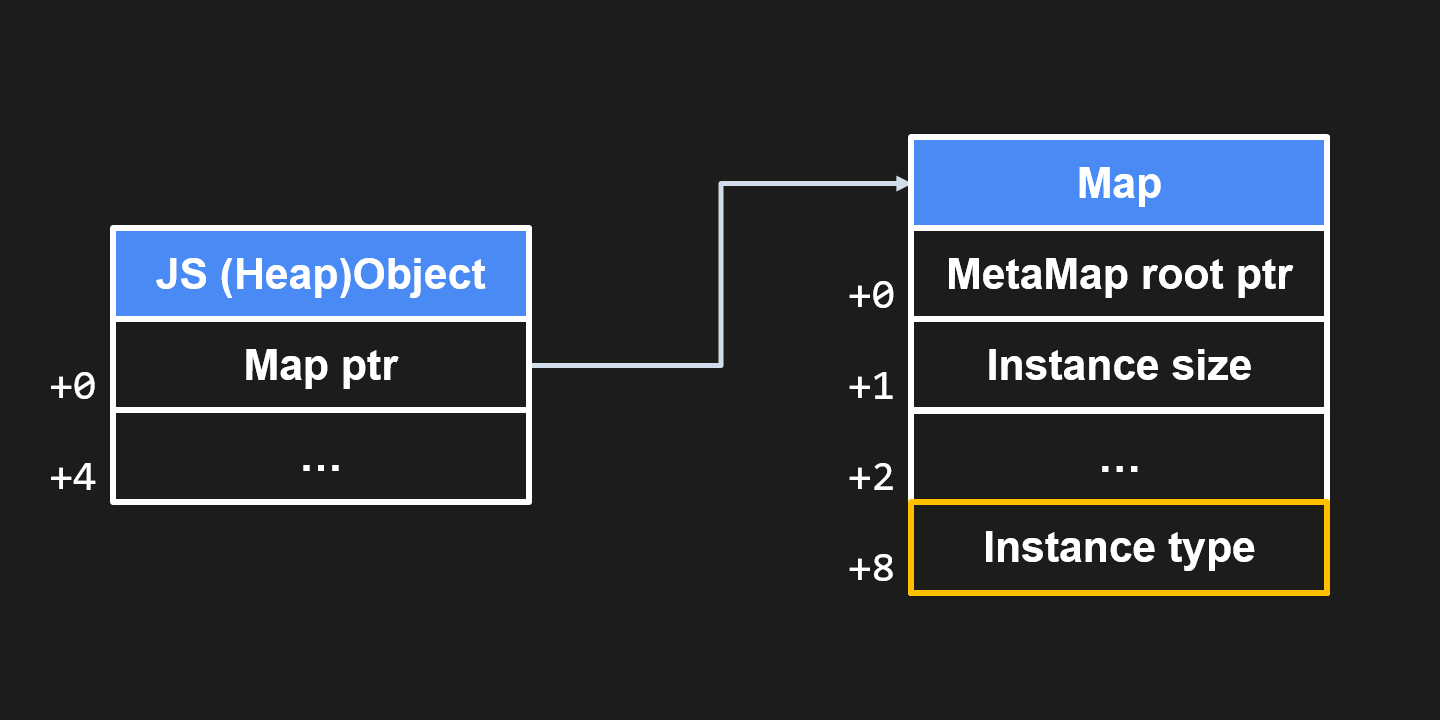
    All JS objects begin with a pointer to a special object called Map (also known as HiddenClass) which stores meta information about the object and describes its structure. It contains the object’s type (stored at a +8 offset), number of properties, and so on.

    Structure of the “moduleImport” JS object

    The moduleImport module is represented in memory as a JSReceiver object, which is the most generic JS object and is used for types for which properties can be defined. It includes a pointer to the array of properties ( PropertyArray) which is basically a regular JS object of the FixedArray type with its own Map. If in the expression moduleImport.exportedVar = 3.79837e312; moduleImport was not a module but a regular object, the code would set the property #0 in that array, writing at a +8 offset; however, since it is a module and there is a bug, the code sets this property, writing at a +0 offset, overwriting the Map object with the provided object.

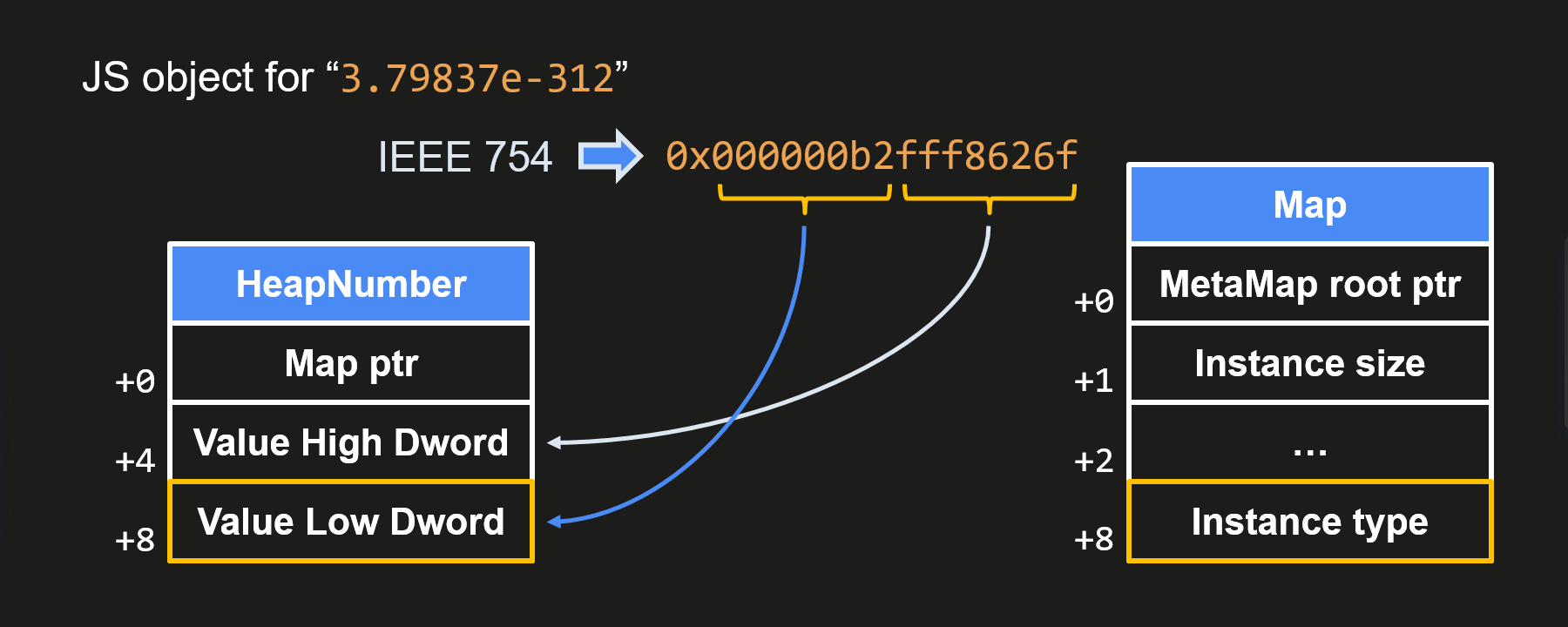
    Structure of the “3.79837e-312” number JS object

    Since 3.79837e-312 is a floating-point number, it is converted to a 64-bit value (according to the IEEE 754 standard) and stored in a HeapNumber JS object at a +4 offset. This allows the attackers to set their own type for the PropertyArray object and cause a type confusion. Setting the type to 0xB2 causes V8 to treat the PropertyArray as a PropertyDictionary, which results in memory corruption because the PropertyArray and PropertyDictionary objects are of different sizes and the kLengthAndHashOffset field of the PropertyDictionary falls outside the bounds of the PropertyArray.

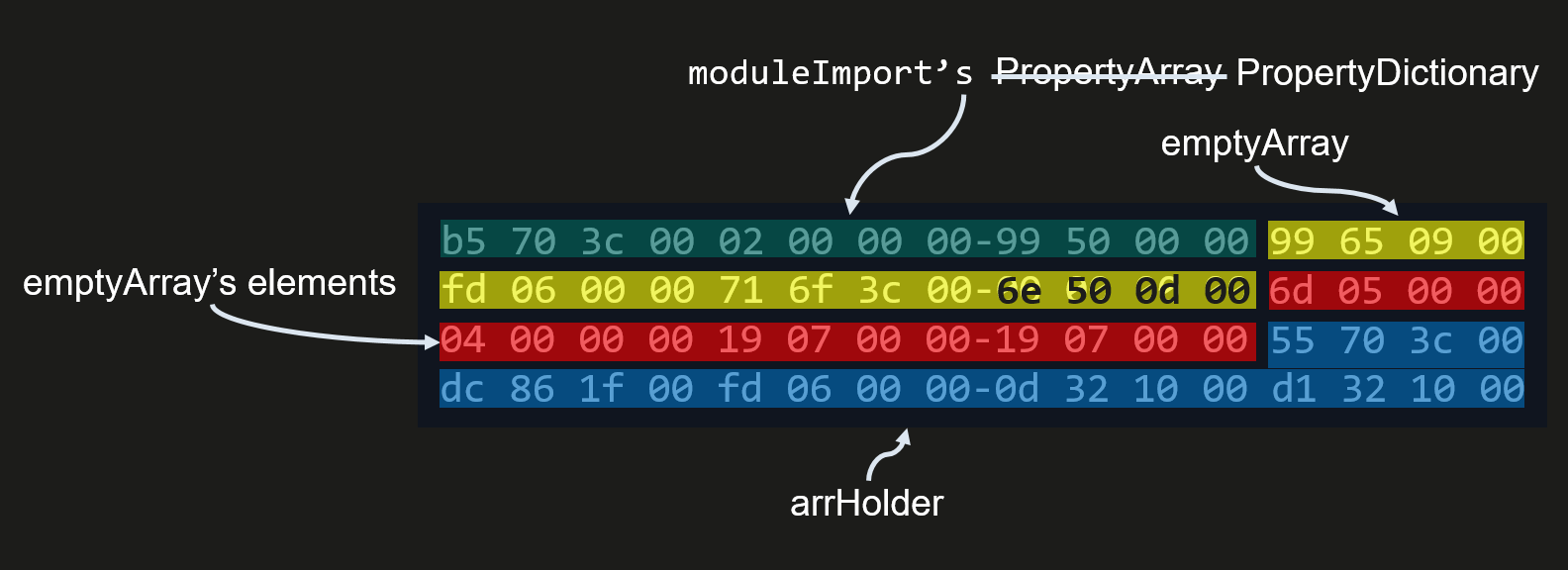
    Now the attackers need to get the right memory layout and corrupt something useful. They defragment the heap and perform the actions that you can see in the trigger function.

    Memory layout created by the “trigger” function

    What happens in this function is the following:

    1. It accesses the exported module variable moduleImport.exportedVar to allocate moduleImport’s PropertyArray.
    2. It creates an emptyArray with two elements.
    3. Removing elements from this array reallocates the object that is used for storing the elements and sets emptyArray’s length to 0. This is an important step because in order to overwrite emptyArray’s length with PropertyDictionary’s hash, the length/hash must be equal to 0.
    4. The trigger function creates the arrHolder dictionary with two objects. This step follows the creation of the emptyArray to allow the pointers of these two objects to be accessed and overwritten when the length of emptyArray is corrupted. The first object, xxarr: doubleArray is used to construct a primitive for getting the addresses of JS objects. The second object, xxab: fakeArrayBuffer is used to construct a primitive for getting read/write access to the whole address space of the Chrome process.
    5. Next, the trigger function executes the f function until it is compiled by Maglev, and overwrites the type of the PropertyArray so it is treated as a PropertyDictionary object.
    6. Executing new WeakRef(moduleImport) triggers the calculation of PropertyDictionary’s hash, and the length of emptyArray is overwritten with the hash value.
    7. The trigger function returns emptyArray and arrHolder containing objects that can be overwritten with emptyArray.

    After this, the exploit again abuses Maglev, or rather the fact that it optimizes the code based on the feedback collected by the interpreter. The exploit uses Maglev to compile a function that loads a double value from an array obtained using arrHolder.xxarr. When this function is compiled, the attackers can overwrite the pointer to an array obtained using arrHolder.xxarr via emptyArray[5] and use this function to get the addresses of JS objects. Similarly, the attackers use arrHolder.xxab to compile a function that sets specific properties and overwrites the length of another ArrayBuffer-type object along with the pointer to its data (backing_store_ptr). This becomes possible when the pointer to the object accessible via arrHolder.xxab is replaced via emptyArray[6] with a pointer to the ArrayBuffer. This gives the attackers read and write access to the entire address space of the Chrome process.

    Second vulnerability (V8 sandbox bypass)

    At this point, the attackers can read and write memory from JavaScript, but they need an additional vulnerability to bypass the newly introduced V8 (heap) sandbox. This sandbox is purely software-based and its main function is to isolate the V8 memory (heap) in such a way that attackers cannot access other parts of the memory and execute code. How does it do this? You may have noticed that all the pointers in the previous section are 32 bits long. This is not because we’re talking about a 32-bit process. It’s a 64-bit process, but the pointers are 32 bits long because V8 uses something called pointer compression. The pointers are not stored in full, but just as their lower parts, or they could also be seen as a 32-bit offset from some “base” address. The upper part (the “base” address) is stored in CPU registers and added by the code. In this case, attackers should not be able to obtain real pointers from the isolated memory and have no way to obtain addresses for the stack and JIT-code pages.

    To bypass the V8 sandbox, the attackers used an interesting but very common vulnerability associated with interpreters — we have previously seen variations of this vulnerability in multiple virtual machine implementations. In V8, regular expressions are implemented using its own interpreter, Irregexp, with its own set of opcodes. The Irregexp VM is completely different from Ignition, but it is also a register-based VM.

    Examples of vulnerable code in Irregexp VM instruction handlers

    The vulnerability is that the virtual machine has a fixed number of registers and a dedicated array for storing them, but the register indexes are decoded from the instruction bodies and are not checked. This allows attackers to access the memory outside the bounds of the register array.

    Malicious Irregexp VM bytecode for reading the memory outside of the register array bounds

    Coincidentally, the pointers to output_registers and output_register_count are located right next to the register array. This allows the attackers to read and write the memory outside of the V8 sandbox with the help of the SUCCEED opcode. Attackers use this to overwrite JIT’ed code with shellcode and execute it.

    This issue (330404819) was submitted and fixed in March 2024. It is unknown whether it was a bug collision and the attackers discovered it first and initially exploited it as a 0-day vulnerability, or if it was initially exploited as a 1-day vulnerability.

    Shellcode

    At this point, the attackers need additional vulnerabilities to escape the Chrome process and gain full access to the system. In the best practices of sophisticated attackers, they run a validator in the form of a shellcode that collects as much information as possible and sends it to the server to decide whether to provide the next stage (another exploit) or not. This decision is made based on the following information: CPUID information (vendor, processor name, etc), whether it’s running on a VM or not, OS version and build, number of processors, tick count, OS product type, whether it’s being debugged or not, process path, file version info of system modules, file version info of process executable, and SMBIOS firmware table.

    By the time we analyzed the attack, the attackers had already removed the exploit from the decoy website, preventing us from easily obtaining the next stage of the attack. At Kaspersky, we possess technologies that have allowed us to discover and help to fix a huge number of 0-day privilege escalation vulnerabilities exploited by sophisticated attackers in various malware campaigns over the years; however, in this particular case we would have to wait for the next attack in order to extract its next stage. We’ve decided to not wait, preferring to let Google fix the initial exploit used to perform the remote code execution in Google Chrome.

    List of in-the-wild 0-days caught and reported by Kaspersky over the past 10 years

    Social activity

    What never ceases to impress us is how much effort Lazarus APT puts into their social engineering campaigns. For several months, the attackers were building their social media presence, regularly making posts on X (formerly Twitter) from multiple accounts and promoting their game with content produced by generative AI and graphic designers.

    Attackers’ accounts on X

    One of the tactics used by the attackers was to contact influential figures in the cryptocurrency space to get them to promote their malicious website and most likely to also compromise them.

    Attackers’ attempts to contact crypto-influencers

    The attackers’ activity was not limited to X — they also used professionally designed websites with additional malware, premium accounts on LinkedIn, and spear phishing through email.

    The game

    Malicious website offering to download a beta version of the game

    What particularly caught our attention in this attack was that the malicious website attacking its visitors using a Google Chrome zero-day was inviting them to download and try a beta version of a computer game. As big computer games fans ourselves, we immediately wanted to try it. Could the attackers have developed a real game for this campaign? Could this be the first computer game ever developed by a threat actor? We downloaded detankzone.zip and it looked legit: the 400 MB-archive contained a valid file structure of a game developed in Unity. We unpacked the game’s resources and found “DeTankZone” logos, HUD elements, and 3D model textures. Debugging artifacts indicated that the game had been compiled by the attackers. We decided to give it a spin.

    Start menu of the DeTankZone game

    After an intro with the game’s logo, we are greeted with a typical online gaming start menu, asking us to enter valid account credentials to access the game. We tried to log in using some common account names and passwords, and then tried to register our own account through the game and the website — but nothing worked.

    Is that really all this game has to offer? We started reverse engineering the game’s code and discovered that there was more content available beyond this start menu. We found the code responsible for communication with the game server and started reverse engineering that as well. The game was hardcoded to use the server running at “api.detankzone[.]com,” which clearly wasn’t working. But we really wanted to check this game out! What to do? We decided to develop our own game server, of course.

    First, we discovered that the game uses the Socket.IO protocol to communicate with the server, so we chose the pythonsocketio library to develop our own server. We then found a function with a list of all supported command names (event names) and reverse engineered how they are obfuscated. After that, we reverse engineered how the data was encoded: it turned out to be a JSON encrypted with AES256 and encoded with Base64. For the AES key it uses the string “Full Stack IT Service 198703Game”, while the string “MatGoGameProject” is used for the IV. We hoped that this information might reveal the identities of the game’s developers, but a Google search yielded no results. Finally, we reverse engineered the data format for a couple of commands, implemented them on our server, and replaced the server URL with the address of our own server. Success! After all this we were able to log into the game and play with the bots!

    Screenshot from the game running with our custom server

    Yes, it turned out to be a real game! We played it for a bit and it was fun — it reminded us of some shareware games from the early 2000s. Definitely worth the effort. The textures look a little tacky and the game itself closely resembles a popular Unity tutorial, but if Lazarus had developed this game themselves, it would have set a new bar for attack preparation. But no — Lazarus stayed true to themselves. It turns out that the source code for this game was stolen from its original developers.

    The original game

    DeFiTankLand (DFTL) – the original game

    We found a legitimate game that served as a prototype for the attacker’s version – it’s called DeFiTankLand (DFTL). Studying the developers’ Telegram chat helped us build a timeline of the attack. On February 20, 2024, the attackers began their campaign, advertising their game on X. Two weeks later, on March 2, 2024, the price of the DeFiTankLand’s currency, DFTL2 coin, dropped, and the game’s developers announced on their Telegram that their cold wallet had been hacked and $20,000 worth of DFTL2 coins had been stolen. The developers blamed an insider for this. Insider or not, we suspect that this was the work of Lazarus, and that before stealing the coins they first stole the game’s source code, modified all the logos and references to DeFiTankLand, and used it to make their campaign more credible.

    Conclusions

    Lazarus is one of the most active and sophisticated APT actors, and financial gain remains one of their top motivations. Over the years, we have uncovered many of their attacks on the cryptocurrency industry, and one thing is certain: these attacks are not going away. The attackers’ tactics are evolving and they’re constantly coming up with new, complex social engineering schemes. Lazarus has already successfully started using generative AI, and we predict that they will come up with even more elaborate attacks using it. What makes Lazarus’s attacks particularly dangerous is their frequent use of zero-day exploits. Simply clicking a link on a social network or in an email can lead to the complete compromise of a personal computer or corporate network.

    Historically, half of the bugs discovered or exploited in Google Chrome and other web browsers have affected its compilers. Huge changes in the code base of the web browser and the introduction of new JIT compilers inevitably lead to a large number of new vulnerabilities. What can end users do about this? While Google Chrome continues to add new JIT compilers, there is also Microsoft Edge, which can run without JIT at all. But it’s also fair to say that the newly introduced V8 sandbox might be very successful at stopping bugs exploitation in compilers. Once it becomes more mature, exploiting Google Chrome with JIT may be as difficult as exploiting Microsoft Edge without it.

    Indicators of Compromise

    Exploit
    B2DC7AEC2C6D2FFA28219AC288E4750C
    E5DA4AB6366C5690DFD1BB386C7FE0C78F6ED54F
    7353AB9670133468081305BD442F7691CF2F2C1136F09D9508400546C417833A

    Game
    8312E556C4EEC999204368D69BA91BF4
    7F28AD5EE9966410B15CA85B7FACB70088A17C5F
    59A37D7D2BF4CFFE31407EDD286A811D9600B68FE757829E30DA4394AB65A4CC

    Domains
    detankzone[.]com
    ccwaterfall[.]com

    MIL OSI Economics

  • MIL-OSI Banking: Committee on Market Access holds third thematic session on supply chain resilience

    Source: WTO

    Headline: Committee on Market Access holds third thematic session on supply chain resilience

    The moderator of the session, Mr Iain Fifer of the United Kingdom, emphasized the critical role of trade data in analyzing and enhancing the resilience of supply chains. He noted the challenges in gathering reliable, timely and relevant data, and underlined how such information can inform decision-making.
    Thailand highlighted logistical challenges related to train freight routes from Thailand to Europe. While rail transport is faster than ocean freight and cheaper than air freight, it faces significant obstacles such as customs clearance issues at multiple borders, a lack of harmonized standards, and higher costs compared to sea freight. Additionally, it stressed how limitations in rail infrastructure add complexity.
    China emphasized the importance of multilateral and bilateral trade frameworks, such as those supported by the WTO, in ensuring smooth supply chain operations. It underscored technological advances, particularly in big data and green energy, as key influencers of the development of global supply chains. China also announced the upcoming release of its Global Supply Chain Connectivity Index at the second China International Supply Chain Expo in November 2024. The document will provide a quantitative assessment of the resilience and stability of global supply chains.
    India focused on the three fundamental pillars of supply chains — production, logistics and markets. It also underlined the importance of digital infrastructure in bolstering supply chain resilience. Additionally, India discussed initiatives such as the Unified Logistics Interface Platform and the PM Gati Shakti National Master Plan, which utilize geospatial data to enhance infrastructure connectivity and logistics efficiency.
    The United States introduced its newly established Supply Chain Center within the Department of Commerce, designed to enhance supply chain resilience. The unit’s “Scale” tool assesses risks across sectors of the US economy by evaluating more than 40 indicators of criticality, vulnerability and resiliency in supply chains. The tool provides an in-depth view of current risks to better inform policy decisions, the United States underlined.
    Switzerland presented an initiative led by the Organisation for Economic Cooperation and Development (OECD) aimed at improving the transparency and resilience of medical supply chains. The initiative was prompted by the supply shortages experienced during the COVID-19 pandemic. Switzerland’s project involves a monitoring mechanism designed to increase visibility in global medical supply chains and address future disruptions through international cooperation and the use of advanced technologies such as artificial intelligence.
    In his conclusion, the moderator emphasized the importance of data design and collection in creating a comprehensive understanding of various supply chains. He stressed that data sharing and collaboration were central themes of the discussion, noting that swift and accurate exchange of information between stakeholders and governments is essential. Additionally, he acknowledged the significant analytical work required after data collection and pointed out that once data analysis is completed, it must be effectively utilized to guide policymaking. The session also featured examples of ongoing policy initiatives shaped by data-driven projects.
    The interim Chair of the Market Access Committee, Ms Nicola Waterfield of Canada, expressed appreciation for the presentations and highlighted the importance of the discussions. She also announced that the Committee’s next formal meeting is scheduled for 19-20 November 2024.

    Share

    MIL OSI Global Banks

  • MIL-OSI Video: How do Governance Reforms Promote Economic Growth and Social Inclusion?

    Source: International Monetary Fund – IMF (video statements)

    Governance reforms can boost growth, reduce poverty and inequality, and accelerate a country’s transition to higher income status. Sustained efforts with high-level political support to strengthen the anti-corruption and governance frameworks are essential for success.

    https://www.youtube.com/watch?v=eCm2ahmceLc

    MIL OSI Video

  • MIL-OSI Video: Iraq, Gaza/UNSCO, Lebanon & other topics – Daily Press Briefing (22 Oct 2024) | United Nations

    Source: United Nations (Video News)

    Noon briefing by Farhan Haq, Deputy Spokesperson for the Secretary-General.

    Highlights:
    -BRICS
    -Iraq
    -Gaza/UNSCO
    -Occupied Palestinian Territory
    -Gaza/UN Development Programme
    -The UN Interim Force in Lebanon
    -Lebanon/Humanitarian
    -Yemen
    -Sudan
    -Ukraine
    -Security Council/Ukraine
    -Cuba
    -Haiti
    -Democratic Republic of the Congo

    BRICS
    I can confirm that the Secretary-General is once again attending the BRICS summit, which this year takes place in Kazan, in the Russian Federation.

    Iraq
    In a statement issued today, the Secretary-General congratulates the Kurdistan Region of Iraq and its people on the holding of parliamentary elections on 20 October, which took place in a calm and peaceful manner. He further commends the efforts of the Independent High Electoral Commission (IHEC), supported by the United Nations Assistance Mission for Iraq (UNAMI), in the preparations and conduct of these elections.
    As the Kurdistan Region of Iraq awaits the final results, the Secretary-General encourages all political leaders and segments of society to continue to maintain a peaceful atmosphere and urges political actors to resolve any electoral disputes through established legal channels and to complete the electoral process by forming an inclusive government as soon as possible. He reiterates the commitment of the United Nations to support Iraq’s efforts to consolidate democratic gains and build a prosperous future for the people of Iraq.

    Gaza/UNSCO
    Tor Wennesland, the UN Special Coordinator for the Middle East Peace Process, visited Gaza today, where he saw firsthand the continued immense destruction and profound suffering of the people.
    He said he met with UN staff and Palestinian NGOs in Gaza, whose tireless efforts are admirable. He heard directly from them about the alarming security and humanitarian situation across the Strip, particularly in northern Gaza. The challenges faced by the people of Gaza, including serious violations of international humanitarian law, are enormous, with urgent needs for food, medical supplies, and protection.
    Mr. Wennesland said that a significant increase in the entry of humanitarian assistance and an improvement in security is urgently required.  He reiterated the Secretary-General’s repeated call for an immediate ceasefire and the unconditional release of all hostages held by Hamas. He calls on all relevant parties to urgently pursue these goals.

    Gaza/UN Development Programme
    The UN Development Programme (UNDP) says that one year into the Gaza war, the humanitarian crisis has reached a catastrophic level – with unprecedented casualties, widespread destruction and severe food insecurity.
    The war has had a severe impact on critical sectors such as education, healthcare, social services, the economy and the environment, UNDP says in a new report. Educational institutions have suffered significant losses, with numerous casualties among students and educators and the widespread destruction of schools. The healthcare system is nearing collapse, facing critical shortages in medical supplies and widespread malnutrition, particularly among children.
    Economic projections indicate that the gross domestic product (GDP) of the State of Palestine contracted by 35.1 per cent in 2024 compared with a no-war scenario, with unemployment potentially rising to 49.9 per cent. By the end of 2024, the Human Development Index (HDI) in the State of Palestine may fall to 0.643, a level not seen since human development calculations began in 2004.
    Poverty in the State of Palestine is projected to rise to 74.3 per cent in 2024, affecting 4.1 million people, including 2.61 million people who are newly impoverished. The full report is online.

    Full Highlights: https://www.un.org/sg/en/content/ossg/noon-briefing-highlight?date%5Bvalue%5D%5Bdate%5D=22+October+2024

    https://www.youtube.com/watch?v=gfpt8lR-1Oc

    MIL OSI Video

  • MIL-OSI China: Xi underscores BRICS’ role in building multipolar world, driving globalization

    Source: People’s Republic of China – State Council News

    KAZAN, Russia, Oct. 23 — The BRICS mechanism is a pillar in promoting a multipolar world and fostering an inclusive economic globalization, said Chinese President Xi Jinping on Tuesday as leaders gathered in Kazan for the 16th BRICS Summit.

    Xi made the remarks while meeting with Russian President Vladimir Putin ahead of the leaders’ formal meetings. He noted that BRICS is the world’s most important platform for solidarity and cooperation between emerging markets and developing countries.

    He also voiced his hope to have in-depth discussions with Putin and other leaders participating in the summit on the future development of the BRICS mechanism, so as to secure more opportunities for the Global South.

    Putin thanked China for its support during Russia’s presidency of BRICS, stressing that Russia is ready to closely cooperate with China to ensure the success of the first BRICS Summit after its expansion and bolster BRICS cooperation.

    Kazan, the capital of Tatarstan and the fifth-largest city in Russia, holds historical and cultural significance. Xi told Putin during their meeting that around 400 years ago, the Great Tea Road that connected the two countries went past Kazan, through which tea leaves from China’s Wuyi Mountain region found their way into many Russian households.

    The city is also home to Kazan Federal University, where notable figures like the Russian writer Leo Tolstoy and Russian revolutionary leader Vladimir Lenin studied.

    Russian fighter jets escorted Xi’s plane before its landing at the Kazan International Airport around noon on Tuesday. Guards of honor lined both sides of a red carpet to salute Xi, while Russian youths in traditional attire offered him a warm welcome.

    Kazan Mayor Ilsur Metshin, one of the Russian officials who greeted Xi at the airport, told Xinhua that the city is honored to host the Chinese president.

    During the three-day summit, Xi will attend small- and large-scale leaders’ meetings and the BRICS Plus leaders’ dialogue. He will also have in-depth exchanges with leaders of other countries on the current international situation, BRICS cooperation, the development of the BRICS mechanism and important issues of common concern, according to Chinese Foreign Ministry Spokesperson Mao Ning.

    GREATER BRICS

    Observers see the BRICS Summit as an opportunity for Global South countries to voice their needs.

    Victoria Fedosova, deputy director of the Institute for Strategic Research and Forecasts of the Russian Peoples’ Friendship University, said the very dynamic development of BRICS and the growth in its membership reflect a demand for a platform to address global issues.

    “The BRICS mechanism has enormous potential in adjusting the imbalances in global development accumulated over the last 80 years,” said Fedosova.

    The New Development Bank (NDB) is a flagship project of BRICS cooperation. As the first multilateral development bank established by emerging economies, the NDB, headquartered in Shanghai, provides financing support for infrastructure development, clean energy, environmental protection, and the building of cyber infrastructure across BRICS countries.

    Dilma Rousseff, president of the NDB who is also in Kazan, told Putin during a meeting on Tuesday that the summit is “very important.”

    BRICS has emerged as “the core of this multipolar world” alongside other global and regional organizations, said British author and political commentator Carlos Martinez. “It is essential to move away from the dominance of Western voices and allow countries from the Global South to have a meaningful say in international relations.”

    “BRICS, with its focus on inclusivity and equality, serves as a shining star of this new type of international relations,” he said.

    Zukiswa Roboji, a researcher at Walter Sisulu University in South Africa, said that BRICS has “undoubtedly made notable strides in recent years,” offering emerging economies easier access to financial resources and better opportunities for trade, investment and development.

    Experts also highlighted China’s role in BRICS cooperation and development. Timirkhan Alishev, vice rector for International Affairs at Kazan Federal University, told Xinhua that all initiatives introduced by China are rooted in multilateralism, fostering communication and dialogue on multiple levels.

    “We see China puts a lot of efforts into developing BRICS,” said Alishev, adding that there are no preconditions for BRICS cooperation as one can begin dialogue on equal footing with everyone.

    STRONGER APPEAL

    The term BRIC was initially coined in 2001 by Jim O’Neill, former chief economist at Goldman Sachs, as an investment concept referring to emerging market economies of Brazil, Russia, India and China. With South Africa’s inclusion in 2010, BRICS officially took shape.

    Following last year’s expansion, the BRICS grouping now represents approximately 30 percent of global GDP, nearly half of the world’s population, and one-fifth of global trade.

    “Measured by GDP, the BRICS countries have already surpassed the G7 in importance,” said Rousseff in a recent interview with Xinhua.

    One of the key priorities of Russia’s BRICS chairmanship is integrating the new members into the BRICS framework, according to the official website. Other areas of practical cooperation include boosting trade and direct investment, as well as fostering a balanced and equitable transition to a low-carbon economy.

    As BRICS’ influence grows, its appeal has strengthened. Over 30 countries like Thailand, Malaysia, Türkiye and Azerbaijan have either formally applied for or expressed interest in its membership, while many other developing countries are seeking deeper cooperation with the group.

    “Joining BRICS will benefit Thailand in many ways, including advancing cooperation with other developing countries and increasing its influence in the international arena,” said Tang Zhimin, director of China ASEAN Studies at the Bangkok-based Panyapiwat Institute of Management.

    BRICS “has become an engine of growth for the world economy and plays an important role in global policymaking,” Tang added.

    MIL OSI China News

  • MIL-OSI USA: Administrator Samantha Power at a Press Gaggle in Siem Reap

    Source: USAID

    ADMINISTRATOR SAMANTHA POWER: Good afternoon, everyone. Thank you for coming. Thanks also to our partners from the Cambodian government who have joined us here today. 

    This is my fourth trip to Cambodia, but it is my first trip to Cambodia as USAID Administrator. But, maybe more significant than that, it is the first trip to Cambodia ever by the USAID Administrator, despite decades of investments that USAID has made in economic development, health development, food security, and the like. So, I feel really personally privileged to be back in a country that I find incredibly beautiful, filled with such warm and hospitable people who have welcomed me many times over the years. To now get to come back as USAID Administrator, it’s a great privilege. 

    I had the chance to tour a tuberculosis screening clinic here at the Svay Thom Pagoda. Over the past five years, USAID’s Community Mobilization Initiatives to End TB, which we have called COMMIT, has helped Cambodia make remarkable progress preventing, detecting, and treating tuberculosis. And, I got to see this screening effort, at least in one of them, up close. 

    In the past 20 years, Cambodia has cut the rate of tuberculosis in this country by almost half, and the country is no longer on the World Health Organization’s list of the 30 highest TB Burden Countries. That is genuine progress. But, of course, the fight against TB is not over. An estimated 54,000 Cambodians contract TB still every year, and about a third of TB cases go undetected. 

    So, to help Cambodia meet its goal of ending TB in this country by 2030, I am pleased today to announce a new five year initiative, which we will call COMMIT II, the second phase of our investment here. We will start with an initial $4 million investment for the first year of the program, with additional funding to come. 

    I want to stress that this is one of the largest local direct awards that USAID has ever given to a local Cambodian organization. We think it’s extremely important to invest directly in Cambodian organizations that are doing the work out in their communities to advance the health and the interests of the Cambodian people. 

    Through this program, COMMIT II, we will work directly with local communities to improve TB screening, diagnosis, and TB preventive therapy. We will focus especially on identifying and treating the cases that are currently going undetected. And, we know that getting at these undetected cases is the key to preventing the spread of this terrible disease. 

    Our work together, that of USAID with the Cambodian people, that of USAID with the Cambodian health ministry, is really just one example of the productive health partnership that has developed over the last decades. And it is also, I think, reflective of what is a deepening partnership between the United States and Cambodia, and between the American people and the Cambodian people. 

    I’d like to say a word about malaria as well. Over the past decade, the U.S. has invested $87 million to support Cambodia’s efforts to eliminate malaria. These efforts, led by the Cambodian people, have been a stunning success, with Cambodia registering zero malaria deaths since 2017 and now on track to completely eliminate malaria as soon as next year. 

    We have also supported Cambodia’s efforts to make childbirth safer for mothers and for infants. Since 2005, Cambodia has reduced maternal deaths by 67 percent, infant deaths by 71 percent, and deaths of children under five by 81 percent. 

    The United States and the American people also stood with the Cambodian people during the COVID-19 pandemic, delivering 3.3 million vaccines and providing $16 million in other support. 

    We are really gratified now that Cambodia has become a new partner in the U.S. Global Health Security Strategy, which aims at making sure that Cambodia has the infrastructure to have the surveillance capacity in communities, the lab equipment and testing equipment that it needs in order to prevent, detect, and respond to future health threats. 

    Now we are supporting Cambodia taking on another urgent health threat, and this is one that – while I know the press has covered TB in the past, has covered the incredible progress made against malaria – this may be a harm and a form of illness that even the press has not yet given significant coverage to. And, this issue is lead poisoning, and specifically the lead poisoning of children. 

    Lead poisoning slows a child’s brain development. It harms their bodies, and it can even kill children. Lead poisoning affects an estimated six million children here in Cambodia. That’s over 70 percent of all kids in this country. 

    Taking on this global menace of lead poisoning is extremely important to USAID. It is an urgent priority for the United States government as a whole, and Cambodia has already made itself a really important partner in this effort. Cambodia was one of just 26 founding member countries in a brand new Partnership for a Lead-Free Future that we just launched in September at the UN General Assembly. And, we are really thankful to the Cambodian Health Ministry and to the government for stepping forward and being a leader in raising its hand and committing itself to eliminating lead poisoning for children here in Cambodia.

    Lead poisoning, unlike a lot of other diseases, is really hard to detect. It is tough to know also what the source of lead poisoning is. Is it spices? Is it paint? Is it the recycling of batteries that is causing lead poisoning? 

    Today, which as it happens, is part of international Lead Poisoning Prevention Week, I am pleased to announce that USAID will support Cambodia’s first-ever national survey to evaluate the levels of lead and other heavy metals in the blood levels of children and pregnant women. We will also look together at the level of lead in products in Cambodian stores. And, we will together work to understand how prevalent lead is in the environment. To be clear, understanding where lead poisoning is coming from here in Cambodia is absolutely critical to preventing it going forward. 

    USAID will also work together with the Royal Government of Cambodia and with UNICEF to take steps to mitigate lead exposure by raising awareness and developing policies and regulations that will prevent future exposure. Together, I am confident that just as we have on malaria and TB and just as we did on COVID-19, together we will make progress against this invisible threat.

    USAID stands ready to support the doctors, the teachers, the parents, the government officials and the citizens who want to rid their communities of lead poisoning once and for all. This partnership matters a great deal to the United States. We see how far it can go, and we are very satisfied with the progress that we have seen in the health sector, and eager to learn from it, to see how we can propel progress in other sectors as well. 

    And with that, I am happy to take your questions. Thank you.

    QUESTION: My name is Chamna. I am from Cambodianess, a news outlet based in Siem Reap and Phnom Penh, ma’am. So, ma’am, my first question is that you know, as the first USAID Administrator to Cambodia, visited Cambodia for two days, can you give us, like, a brief activity that you have done and also you will do tomorrow?

    And, the second question is that, why do you choose Siem Reap, one of the cultural provinces of Cambodia, to visit, ma’am? And, also the third question, I was informed that you will visit Prime Minister Hun Manet tomorrow. So, what do you hope to communicate with the Prime Minister, ma’am?

    ADMINISTRATOR POWER: That’s a lot of questions. So, let me start with why did I come to Siem Reap. This is my third trip to Siem Reap. Once a person has come to Siem Reap once, they always insist on coming back. And, any tourist who has come if they haven’t come back, it is only because it is so far away. But, for me, when I knew I was coming to Cambodia, I’ve had such beautiful connections with the people of this town in my previous visits, such rich conversations. And again, the privilege for me is now to come as USAID Administrator and to actually see the work that we have been doing as the United States, as the American people, with the Cambodian people in communities, you know, in a manner that is not only advancing the U.S.-Cambodian partnership, but touching real lives. And so, just as the Cambodian people have touched me over the years, I felt I had to come back.

    And in terms of the content of the visit – my visit follows on, of course, the visit of Secretary [Lloyd] Austin, our Secretary of Defense. We believe really strongly in the United States in what we call the three Ds – diplomacy, defense, and development – because the three Ds reflect the needs, in a way, of all individuals, which is to be physically secure, to be free, to express oneself, and to live as one chooses and as one, and to raise children in a manner where you can imagine them fulfilling their dreams. 

    And then, of course, to develop economically. And we think that, you know, an enhanced security partnership of the kind that Secretary Austin discussed with more exchanges and more familiarity between us, more diplomatic engagement, and these really significant development investments will hopefully support those incredible Cambodians who are doing work to build a brighter Cambodia for the next generation. And, of course, young people are at the heart of Cambodia’s economic progress, and will be at the heart of its progress in strengthening its institutions, its governance, the rule of law, et cetera. 

    My visit will include, yes, a meeting with Prime Minister. I’m very much looking forward to that. I already had the chance in January of this year to meet with the Prime Minister in Davos when he attended, and I attended, the World Economic Forum. But, of course, now we have had a chance, over many more months, to work on shared challenges like strengthening global health security; to initiate new partnerships like the new partnership to combat lead poisoning. And, I look forward to talking about what more can be done, recognizing that we all want to see Cambodia’s economy continue to grow. He has been very specific, of course, about Cambodia – wanting Cambodia to become an upper middle-income country by 2030. We, as USAID, want to understand how we can be catalytic in supporting certain sectors, and so hearing directly from him about his priorities now deeper into his tenure as Prime Minister will be very important. 

    And, of course, we recognize as well that non-governmental organizations, community-based organizations, civil society organizations, that those organizations who are in the community have such an important role to play as well in delivering services like we saw being delivered, in screening tuberculosis, or in educating the community, but also in rooting out corruption and exposing those forces that get in the way of Cambodia’s economy reaching its full potential, and above all, the Cambodian people benefiting as much as they should from all that Cambodia offers and all that young people are investing in that economy. So, I will see the Prime Minister. 

    I will, of course, later today – I can’t come to Siem Reap without seeing some of Angkor Wat. I will engage with individuals outside of government who are looking at, you know, what more can be done, again, to strengthen freedom and governance and the rule of law in this country. And, you know, I’m really looking forward to learning. On every trip, I learned so much, and Cambodia has changed really so much since my last visit to this country, which was back in 2012. Even just driving around, I can see so many of the changes. But again, my privilege is to be here as USAID Administrator and to talk to our incredible team about what more we can do to accelerate the progress in support of Cambodian leaders, inside and outside ministries.

    QUESTION: Okay, ma’am. Also, my second question has two parts, of course. Now, you’re touring the TB, you know, let’s say, progress. How to eliminate them, how to make the system better. So, what are the development[s] that you see so far back then, back there, when you tour the, you know, the mechanism, and also, what are the challenges that still remain? That, you know, when you talk to the expert, they say, there are many challenges out there that needs to be done. That is the first part of the question. 

    And, the second part of the question can be cultural, again, because I see doctors, I see, you know, organization experts, but, at the same time, they are working on health. But, they are not in the clinic. They are not in the hospital. They are in a pagoda, which is a sanctuary for Cambodia, so Buddhism for hundreds of years. So, when you see, you know, expert, modern, expert, modern equipment coming together with old people in the sanctuary of Cambodian religion, how do you make of the situation?

    ADMINISTRATOR POWER: Well, and this is really important, I think, to stress what is so significant about what Cambodians are doing here, is that they are coming to the people. They are bringing the equipment to diagnose whether TB is present in a person to a more central location than the people would otherwise be able to access. So, normally, this very sophisticated X-ray equipment, and the computers that process the X-rays to diagnose whether somebody is likely to have TB, these individuals would have to go very, very far [to access]. 

    And, what USAID, in partnership with the Cambodian Ministry of Health and with this non-governmental organization that has been at the forefront, what we have done together is come up with activities that are designed to move the diagnosis and, ultimately, the treatment closer to the people. And, that is what you saw here, is a large group of individuals who were told that if you come to this place at this time, you won’t have to drive miles and miles in order to get the X-rays. And so, everyone here either had some symptom of TB, or had someone in their family who had some symptom. So, in their mind, they were worried, “Maybe, would I?” but maybe they weren’t worried enough to drive so far. Maybe they couldn’t afford a bus fare, or, you know, they didn’t have a motorbike in order to be able to make it that far. 

    And so, among the people who are here, I’m sure, are people whose TB cases would have gone undetected if we had relied on the old way of doing things. And so, this is really a partnership that looks at the data, sees that a third of TB cases in Cambodia go undetected, and so we have to fix that. If Cambodia is to reach its goal of getting rid of TB by 2030, that is going to require detecting all the cases of TB so that TB then isn’t spread in communities. And, mobile clinics, mobile health workers, mobile screening is going to be a big part of that solution. 

    And, you know, I think that when one seeks out meeting places, gathering places, one looks and here again, we as the United States and as USAID, we defer entirely to the Cambodian Ministry of Health about where best to situate these mobile screening, this equipment. We may invest the resources to purchase this equipment, but fundamentally, when it comes to respecting Cambodian culture, we are the guests of the Cambodian people. We are the guests of the Cambodian Government, and we take their lead and follow their guidance about how best to, again, meet people where they are likely to feel comfortable traveling to and sitting for some time as they go through the different stages of diagnosis, you know, starting, of course, with with the X-ray. But then, if they are deemed, if it is deemed possible that they have TB, going further, and then even waiting for a couple hours to get the formal diagnosis, then the counseling that is going to come. That is a long afternoon. It’s a lot to ask of particularly elderly people, who are among those who gathered. And so to do so in a manner that is culturally sensitive, but that also allows the individuals who come the comfort of not being out in the blazing sun for the entire day. I’m assuming that is why this location was chosen.

    QUESTION: Okay, so my final question is not related to TB or but it’s more like related to your, let’s say, journalism career. So, in Cambodia right now, a lot of young people are interested in journalism, if not you know the media subject. And also, you said that you were a former journalist working in many countries and zones, and now you are a diplomat, so it’s like a career transition. So, just a message for young people in Cambodia, how does journalism help shape, you know, a person’s career in the future? I mean, after they do journalism, of course.

    ADMINISTRATOR POWER: I think journalism is an incredibly important form of civic participation. All of you are bringing to your communities news and facts and often vital information that citizens need to learn. For example, when journalists cover a local happening like this in Siem Reap that there was a gathering where people were able to get TB screening and diagnosis right here, somebody reads that or they see that on the news, and then they think to themselves, “Oh, I haven’t been feeling that well. Maybe I will go and find a screening facility. Or I will ask someone if they know when next this kind of gathering is going to happen, this kind of screening, mobile screening is going to be available.” That’s an example of the kind of good that a journalist can do for their community. 

    Obviously, they’re also in countries where corruption has been an issue. Journalism can be extremely important in also helping law enforcement know where corruption is happening so that it can be rooted out. The Cambodian government really wants to continue to grow the economy. All of us would like to see more American investment in Cambodia. Journalists have a really vital role to play in shining a spotlight on the kinds of things that might need to change in order for that investment to come at a faster clip than it has up to this point. 

    So, you know, I look back on my journalism career, and I feel grateful that I had that chance to be a journalist. I feel grateful to have made some small contribution, I hope, through my journalism. But, the other thing that young people should know as they think about their careers is, if you’re a curious person, journalism is incredible. Look at you. You’ve asked that’s your sixth question. You’re clearly a very, very curious person. But, journalism is incredible because you just get to go around and ask questions, any question that comes into your mind. You can actually earn a living asking questions and learning. And so, you get to perform something that hopefully helps your community grow and progress, while also yourself satisfying the kinds of questions that you’ve had maybe since you were a small child. So, I think it’s a great career. 

    The more that Cambodia can strengthen its checks and balances, where it has more and more independent institutions, that will give investors confidence. And journalists, over time, will become more and more independent, and will be a very important source of sunlight on all the developments in Cambodia, helping it progress into a more stable and prosperous society.

    MIL OSI USA News

  • MIL-OSI: Roper Technologies announces third quarter financial results

    Source: GlobeNewswire (MIL-OSI)

    SARASOTA, Fla., Oct. 23, 2024 (GLOBE NEWSWIRE) — Roper Technologies, Inc. (Nasdaq: ROP) reported financial results for the third quarter ended September 30, 2024. The results in this press release are presented on a continuing operations basis.

    Third quarter 2024 highlights

    • Revenue increased 13% to $1.76 billion; organic revenue increased 4%
    • GAAP DEPS increased 6% to $3.40; adjusted DEPS increased 7% to $4.62
    • GAAP net earnings increased 6% to $368 million; adjusted net earnings increased 7% to $499 million
    • Adjusted EBITDA increased 10% to $717 million
    • Operating cash flow was $755 million; adjusted operating cash flow increased 17%

    “Our portfolio of market-leading technology businesses delivered another solid quarter, highlighted by 13% total revenue growth, 10% EBITDA growth, and 15% free cash flow growth,” said Neil Hunn, Roper Technologies’ President and CEO. “We are, again, increasing our full year guidance to the high end of the range, supported by our third quarter results, the continued expansion of our recurring revenue base, and improving demand for our businesses’ mission critical solutions.”

    “During the third quarter, we completed the acquisition of Transact Campus, which has been combined with our CBORD business. This acquisition adds another high-quality vertical software business to our portfolio with highly compelling value creation opportunities for our shareholders. We remain well positioned to execute our disciplined and process-driven capital deployment strategy, with significant M&A firepower and a robust pipeline of acquisition opportunities,” concluded Mr. Hunn.

    Updating 2024 guidance

    Roper now expects full year 2024 adjusted DEPS of $18.21 – $18.25, compared to previous guidance of $18.10 – $18.25. The Company increased its full year total revenue growth outlook to 13%+ and continues to expect organic revenue growth of approximately 6%.

    For the fourth quarter of 2024, the Company expects adjusted DEPS of $4.70 – $4.74.

    The Company’s guidance excludes the impact of unannounced future acquisitions or divestitures.

    Conference call to be held at 8:00 AM (ET) today

    A conference call to discuss these results has been scheduled for 8:00 AM ET on Wednesday, October 23, 2024. The call can be accessed via webcast or by dialing +1 800-836-8184 (US/Canada) or +1 646-357-8785, using conference call ID 50829. Webcast information and conference call materials will be made available in the Investors section of Roper’s website (http://www.ropertech.com) prior to the start of the call. The webcast can also be accessed directly by using the following URL https://event.webcast. Telephonic replays will be available for up to two weeks and can be accessed by dialing +1 646-517-4150 with access code 50829#.

    Use of non-GAAP financial information

    The Company supplements its consolidated financial statements presented on a GAAP basis with certain non-GAAP financial information to provide investors with greater insight, increase transparency and allow for a more comprehensive understanding of the information used by management in its financial and operational decision-making. Reconciliation of non-GAAP measures to their most directly comparable GAAP measures are included in the accompanying financial schedules or tables. The non-GAAP financial measures disclosed by the Company should not be considered a substitute for, or superior to, financial measures prepared in accordance with GAAP, and the financial results prepared in accordance with GAAP and reconciliations from these results should be carefully evaluated.

    Minority interests

    Following the sale of a majority stake in its industrial businesses to CD&R, Roper holds a minority interest in Indicor. The fair value of Roper’s equity investment in Indicor is updated on a quarterly basis and reported as “equity investments gain, net.” Roper also holds a minority interest in Certinia, a leading provider of professional services automation software. The Company’s investment is accounted for under the equity method and its proportionate share of earnings or loss associated with this investment is reported as “equity investments gain, net.” Roper makes non-GAAP adjustments for the impacts associated with these investments.

    Table 1: Revenue and adjusted EBITDA reconciliation ($M)
    (from continuing operations)
      Q3 2023   Q3 2024   V %
    GAAP revenue $ 1,563     $ 1,765     13 %
               
    Components of revenue growth          
    Organic         4 %
    Acquisitions         9 %
    Foreign exchange         %
    Revenue growth         13 %
               
    Adjusted EBITDA reconciliation          
    GAAP net earnings $ 346     $ 368      
    Taxes   97       99      
    Interest expense   42       68      
    Depreciation   9       9      
    Amortization   182       197      
    EBITDA $ 676     $ 741     10 %
               
    Restructuring-related expenses associated with the
    Syntellis (’23) and Transact (’24) acquisitions
      9       9      
    Transaction-related expenses for completed
    acquisitions
      5       5      
    Financial impacts associated with the minority
    investments in Indicor & Certinia A
      (34 )     (37 )    
    Gain on sale of non-operating assets   (3 )          
    Adjusted EBITDA $ 652     $ 717     10 %
    % of revenue   41.7 %     40.7 %   (100 bps)
                       
    Table 2: Adjusted net earnings reconciliation ($M)
    (from continuing operations)
      Q3 2023   Q3 2024   V %
    GAAP net earnings $ 346     $ 368     6 %
    Restructuring-related expenses associated with the
    Syntellis (’23) and Transact (’24) acquisitions
      7       7      
    Transaction-related expenses for completed
    acquisitions
      4       4      
    Financial impacts associated with the minority
    investments in Indicor & Certinia A
      (28 )     (29 )    
    Gain on sale of non-operating assets   (3 )          
    Amortization of acquisition-related intangible
    assets B
      140       149      
    Adjusted net earnings $ 465     $ 499     7 %
               
    Table 3: Adjusted DEPS reconciliation
    (from continuing operations)
      Q3 2023   Q3 2024   V %
    GAAP DEPS $ 3.21     $ 3.40     6 %
    Restructuring-related expenses associated with the
    Syntellis (’23) and Transact (’24) acquisitions
      0.06       0.07      
    Transaction-related expenses for completed
    acquisitions
      0.03       0.03      
    Financial impacts associated with the minority
    investments in Indicor & Certinia A
      (0.26 )     (0.27 )    
    Gain on sale of non-operating assets   (0.02 )          
    Amortization of acquisition-related intangible
    assets B
      1.30       1.38      
    Adjusted DEPS $ 4.32     $ 4.62     7 %
               
    Table 4: Adjusted cash flow reconciliation ($M)
    (from continuing operations)
      Q3 2023   Q3 2024   V %
    Operating cash flow $ 631     $ 755     20 %
    Taxes paid in period related to divestiture   16            
    Adjusted operating cash flow $ 647     $ 755     17 %
    Capital expenditures   (13 )     (23 )    
    Capitalized software expenditures   (9 )     (13 )    
    Adjusted free cash flow $ 625     $ 719     15 %
               
    Table 5: Forecasted adjusted DEPS reconciliation
    (from continuing operations)
      Q4 2024   FY 2024
      Low end   High end   Low end   High end
    GAAP DEPS C $ 3.29   $ 3.33   $ 12.64   $ 12.68
    Restructuring-related expenses associated
    with the Transact acquisition
              0.07     0.07
    Transaction-related expenses for
    completed acquisitions
              0.05     0.05
    Financial impacts associated with the
    minority investments in Indicor & Certinia A
    TBD   TBD   TBD   TBD
    Amortization of acquisition-related
    intangible assets B
      1.41     1.41     5.45     5.45
    Adjusted DEPS $ 4.70   $ 4.74   $ 18.21   $ 18.25
                   

    Footnotes:

    A. Adjustments related to the financial impacts associated with the minority investments in Indicor & Certinia as shown below ($M, except per share data). Forecasted results do not include any potential impacts associated with our minority investments in Indicor or Certinia, as these potential impacts cannot be reasonably predicted. These impacts will be excluded from all non-GAAP results in future periods.
                       
        Q3 2023A   Q3 2024A     Q4 2024E   FY 2024E
      Pretax $ (34 )   $ (37 )     TBD   TBD
      After-tax $ (28 )   $ (29 )     TBD   TBD
      Per share $ (0.26 )   $ (0.27 )     TBD   TBD
                       
    B. Actual results and forecast of estimated amortization of acquisition-related intangible assets as shown below ($M, except per share data). These adjustments are taxed at 21%.
                       
        Q3 2023A   Q3 2024A     Q4 2024E   FY 2024E
      Pretax $ 177     $ 189       $ 193   $ 745
      After-tax $ 140     $ 149       $ 153   $ 588
      Per share $ 1.30     $ 1.38       $ 1.41   $ 5.45
                       
    C. Forecasted GAAP DEPS do not include any potential impacts associated with our minority investments in Indicor or Certinia. These impacts will be excluded from all non-GAAP results in future periods.
       

    Note: Numbers may not foot due to rounding.

    About Roper Technologies

    Roper Technologies is a constituent of the Nasdaq 100, S&P 500, and Fortune 1000. Roper has a proven, long-term track record of compounding cash flow and shareholder value. The Company operates market leading businesses that design and develop vertical software and technology enabled products for a variety of defensible niche markets. Roper utilizes a disciplined, analytical, and process-driven approach to redeploy its excess capital toward high-quality acquisitions. Additional information about Roper is available on the Company’s website at http://www.ropertech.com.

    Contact information:
    Investor Relations
    941-556-2601
    investor-relations@ropertech.com

    The information provided in this press release contains forward-looking statements within the meaning of the federal securities laws. These forward-looking statements may include, among others, statements regarding operating results, the success of our internal operating plans, and the prospects for newly acquired businesses to be integrated and contribute to future growth, profit and cash flow expectations. Forward-looking statements may be indicated by words or phrases such as “anticipate,” “estimate,” “plans,” “expects,” “projects,” “should,” “will,” “believes,” “intends” and similar words and phrases. These statements reflect management’s current beliefs and are not guarantees of future performance. They involve risks and uncertainties that could cause actual results to differ materially from those contained in any forward-looking statement. Such risks and uncertainties include our ability to identify and complete acquisitions consistent with our business strategies, integrate acquisitions that have been completed, realize expected benefits and synergies from, and manage other risks associated with, acquired businesses, including obtaining any required regulatory approvals with respect thereto. We also face other general risks, including our ability to realize cost savings from our operating initiatives, general economic conditions and the conditions of the specific markets in which we operate, including risks related to labor shortages and rising interest rates, changes in foreign exchange rates, difficulties associated with exports, risks associated with our international operations, cybersecurity and data privacy risks, including litigation resulting therefrom, risks related to political instability, armed hostilities, incidents of terrorism, public health crises (such as the COVID-19 pandemic) or natural disasters, increased product liability and insurance costs, increased warranty exposure, future competition, changes in the supply of, or price for, parts and components, including as a result of the current inflationary environment and ongoing supply chain constraints, environmental compliance costs and liabilities, risks and cost associated with litigation, potential write-offs of our substantial intangible assets, and risks associated with obtaining governmental approvals and maintaining regulatory compliance for new and existing products. Important risks may be discussed in current and subsequent filings with the SEC. You should not place undue reliance on any forward-looking statements. These statements speak only as of the date they are made, and we undertake no obligation to update publicly any of them in light of new information or future events.

    Roper Technologies, Inc.      
    Condensed Consolidated Balance Sheets (unaudited)    
    (Amounts in millions)      
           
      September 30, 2024   December 31, 2023
    ASSETS:      
           
    Cash and cash equivalents $ 269.6     $ 214.3  
    Accounts receivable, net   821.2       829.9  
    Inventories, net   129.0       118.6  
    Income taxes receivable   43.0       47.7  
    Unbilled receivables   130.3       106.4  
    Other current assets   199.2       164.5  
    Total current assets   1,592.3       1,481.4  
           
    Property, plant and equipment, net   132.8       119.6  
    Goodwill   19,267.2       17,118.8  
    Other intangible assets, net   9,212.7       8,212.1  
    Deferred taxes   35.9       32.2  
    Equity investments   878.6       795.7  
    Other assets   433.2       407.7  
    Total assets $ 31,552.7     $ 28,167.5  
           
    LIABILITIES AND STOCKHOLDERS’ EQUITY:      
           
    Accounts payable $ 155.8     $ 143.0  
    Accrued compensation   248.5       250.0  
    Deferred revenue   1,671.0       1,583.8  
    Other accrued liabilities   468.4       446.5  
    Income taxes payable   47.0       40.4  
    Current portion of long-term debt, net   699.0       499.5  
    Total current liabilities   3,289.7       2,963.2  
           
    Long-term debt, net of current portion   7,677.6       5,830.6  
    Deferred taxes   1,649.9       1,513.1  
    Other liabilities   420.0       415.8  
    Total liabilities   13,037.2       10,722.7  
           
    Common stock   1.1       1.1  
    Additional paid-in capital   2,976.9       2,767.0  
    Retained earnings   15,661.4       14,816.3  
    Accumulated other comprehensive loss   (107.4 )     (122.8 )
    Treasury stock   (16.5 )     (16.8 )
    Total stockholders’ equity   18,515.5       17,444.8  
    Total liabilities and stockholders’ equity $ 31,552.7     $ 28,167.5  
           
    Roper Technologies, Inc.          
    Condensed Consolidated Statements of Earnings (unaudited)        
    (Amounts in millions, except per share data)        
                   
      Three months ended
    September 30,
      Nine months ended
    September 30,
        2024       2023       2024       2023  
    Net revenues $ 1,764.6     $ 1,563.4     $ 5,162.1     $ 4,564.3  
    Cost of sales   542.9       467.1       1,566.1       1,382.3  
    Gross profit   1,221.7       1,096.3       3,596.0       3,182.0  
                   
    Selling, general and administrative expenses   725.1       650.2       2,123.9       1,899.6  
    Income from operations   496.6       446.1       1,472.1       1,282.4  
                   
    Interest expense, net   67.7       42.4       188.4       114.6  
    Equity investments gain, net   (37.4 )     (33.9 )     (93.6 )     (98.7 )
    Other (income) expense, net   (0.9 )     (5.0 )     0.9       0.1  
                   
    Earnings before income taxes   467.2       442.6       1,376.4       1,266.4  
                   
    Income taxes   99.3       97.0       289.4       275.5  
                   
    Net earnings from continuing operations   367.9       345.6       1,087.0       990.9  
                   
    Loss from discontinued operations, net of tax         (2.9 )           (4.1 )
    Gain on disposition of discontinued operations,
    net of tax
            4.5             8.4  
    Net earnings from discontinued operations         1.6             4.3  
                   
    Net earnings $ 367.9     $ 347.2     $ 1,087.0     $ 995.2  
                   
    Net earnings per share from continuing
    operations:
                 
    Basic $ 3.43     $ 3.23     $ 10.15     $ 9.30  
    Diluted $ 3.40     $ 3.21     $ 10.06     $ 9.23  
                   
    Net earnings per share from discontinued
    operations:
                 
    Basic $     $ 0.02     $     $ 0.04  
    Diluted $     $ 0.02     $     $ 0.04  
                   
    Net earnings per share:              
    Basic $ 3.43     $ 3.25     $ 10.15     $ 9.34  
    Diluted $ 3.40     $ 3.23     $ 10.06     $ 9.27  
                   
    Weighted average common shares outstanding:              
    Basic   107.2       106.7       107.1       106.5  
    Diluted   108.1       107.6       108.0       107.3  
                                   
    Roper Technologies, Inc.    
    Selected Segment Financial Data (unaudited)
    (Amounts in millions; percentages of net revenues)
                                   
      Three months ended September 30,   Nine months ended September 30,
        2024       2023       2024       2023  
      Amount   %   Amount   %   Amount   %   Amount   %
    Net revenues:                              
    Application Software $ 984.4       $ 803.4       $ 2,811.4       $ 2,335.1    
    Network Software   367.1         364.1         1,102.1         1,076.7    
    Technology Enabled
    Products
      413.1         395.9         1,248.6         1,152.5    
    Total $ 1,764.6       $ 1,563.4       $ 5,162.1       $ 4,564.3    
                                   
                                   
    Gross profit:                              
    Application Software $ 672.8   68.3 %   $ 557.7   69.4 %   $ 1,939.6   69.0 %   $ 1,609.2   68.9 %
    Network Software   311.8   84.9 %     310.7   85.3 %     935.9   84.9 %     914.0   84.9 %
    Technology Enabled
    Products
      237.1   57.4 %     227.9   57.6 %     720.5   57.7 %     658.8   57.2 %
    Total $ 1,221.7   69.2 %   $ 1,096.3   70.1 %   $ 3,596.0   69.7 %   $ 3,182.0   69.7 %
                                   
                                   
    Operating profit*:                              
    Application Software $ 259.8   26.4 %   $ 206.9   25.8 %   $ 750.5   26.7 %   $ 601.3   25.8 %
    Network Software   166.0   45.2 %     164.4   45.2 %     492.1   44.7 %     465.0   43.2 %
    Technology Enabled
    Products
      141.1   34.2 %     137.1   34.6 %     424.0   34.0 %     391.7   34.0 %
    Total $ 566.9   32.1 %   $ 508.4   32.5 %   $ 1,666.6   32.3 %   $ 1,458.0   31.9 %
                                   
    * Segment operating profit is before unallocated corporate general and administrative expenses and enterprise-wide stock-based compensation. These expenses were $70.3 and $62.3 for the three months ended September 30, 2024 and 2023, respectively, and $194.5 and $175.6 for the nine months ended September 30, 2024 and 2023, respectively.
     
    Roper Technologies, Inc.  
    Condensed Consolidated Statements of Cash Flows (unaudited)
    (Amounts in millions)
      Nine months ended
    September 30,
        2024       2023  
    Cash flows from operating activities:      
    Net earnings from continuing operations $ 1,087.0     $ 990.9  
    Adjustments to reconcile net earnings from continuing operations to cash flows from operating activities:      
    Depreciation and amortization of property, plant and equipment   27.9       26.3  
    Amortization of intangible assets   573.8       532.8  
    Amortization of deferred financing costs   7.0       7.7  
    Non-cash stock compensation   112.9       99.2  
    Equity investments gain, net   (93.6 )     (98.7 )
    Income tax provision   289.4       275.5  
    Changes in operating assets and liabilities, net of acquired businesses:      
    Accounts receivable   82.8       25.8  
    Unbilled receivables   (17.1 )     (15.3 )
    Inventories   (8.3 )     (11.2 )
    Accounts payable   (7.2 )     12.1  
    Other accrued liabilities   (1.7 )     (72.0 )
    Deferred revenue   24.5       18.6  
    Cash taxes paid for gain on disposal of business         (16.4 )
    Cash income taxes paid, excluding tax associated with gain on disposal of
    business
      (383.1 )     (335.6 )
    Other, net   (23.3 )     (24.0 )
    Cash provided by operating activities from continuing operations   1,671.0       1,415.7  
    Cash used in operating activities from discontinued operations         (2.4 )
    Cash provided by operating activities   1,671.0       1,413.3  
           
    Cash flows from (used in) investing activities:      
    Acquisitions of businesses, net of cash acquired   (3,464.1 )     (1,970.1 )
    Capital expenditures   (39.2 )     (37.8 )
    Capitalized software expenditures   (33.4 )     (28.7 )
    Distributions from equity investment   9.5       25.3  
    Other, net   (1.0 )     0.6  
    Cash used in investing activities from continuing operations   (3,528.2 )     (2,010.7 )
    Cash provided by disposition of discontinued operations         2.0  
    Cash used in investing activities   (3,528.2 )     (2,008.7 )
           
    Cash flows from (used in) financing activities:      
    Proceeds from senior notes   2,000.0        
    Payments of senior notes   (500.0 )     (700.0 )
    Borrowings under revolving line of credit, net   565.0       910.0  
    Debt issuance costs   (24.7 )      
    Cash dividends to stockholders   (241.1 )     (217.5 )
    Proceeds from stock-based compensation, net   88.1       99.3  
    Treasury stock sales   14.5       11.6  
    Other   (0.1 )     (0.1 )
    Cash provided by financing activities   1,901.7       103.3  
    (Continued)
           
    Roper Technologies, Inc.  
    Condensed Consolidated Statements of Cash Flows (unaudited) – Continued
    (Amounts in millions)
      Nine months ended
    September 30,
        2024       2023  
    Effect of exchange rate changes on cash   10.8       (1.2 )
           
    Net increase (decrease) in cash and cash equivalents   55.3       (493.3 )
           
    Cash and cash equivalents, beginning of period   214.3       792.8  
           
    Cash and cash equivalents, end of period $ 269.6     $ 299.5  
           

    The MIL Network

  • MIL-OSI: YieldMax™ ETFs Announces Distributions on MSTY (175.64%), AIYY (100.45%), SQY (70.37%), YMAX (67.11%), YMAG (14.96%) and Others

    Source: GlobeNewswire (MIL-OSI)

    CHICAGO and MILWAUKEE and NEW YORK, Oct. 23, 2024 (GLOBE NEWSWIRE) — YieldMax™ today announced distributions for the YieldMax™ ETFs listed in the table below.

    ETF
    Ticker
    1
    ETF Name Reference Asset Distribution
    per Share
    Distribution Frequency Distribution Rate2,4,5 30-Day
    SEC
    Yield
    3
    Ex-Date &
    Record Date
    Payment
    Date
    YMAX YieldMax™ Universe Fund of Option Income ETFs Multiple $0.2268 Weekly 67.11% 62.93% 10/24/2024 10/25/2024
    YMAG YieldMax™ Magnificent 7 Fund of Option Income ETFs Multiple $0.0545 Weekly 14.96% 50.85% 10/24/2024 10/25/2024
    MSTY YieldMax™ MSTR Option Income Strategy ETF MSTR $4.1981 Every 4 Weeks 175.64% 0.00% 10/24/2024 10/25/2024
    YQQQ   YieldMax™ Short N100 Option Income Strategy ETF N100 $0.3550 Every 4 Weeks 24.82% 3.63% 10/24/2024 10/25/2024
    AMZY YieldMax™ AMZN Option Income Strategy ETF AMZN $0.7632 Every 4 Weeks 50.32% 3.27% 10/24/2024 10/25/2024
    APLY YieldMax™ AAPL Option Income Strategy ETF AAPL $0.3428 Every 4 Weeks 24.35% 3.17% 10/24/2024 10/25/2024
    AIYY YieldMax™ AI Option Income Strategy ETF AI $0.7241 Every 4 Weeks 100.45% 3.76% 10/24/2024 10/25/2024
    DISO YieldMax™ DIS Option Income Strategy ETF DIS $0.5146 Every 4 Weeks 40.88% 3.41% 10/24/2024 10/25/2024
    SQY YieldMax™ SQ Option Income Strategy ETF SQ $1.0201 Every 4 Weeks 70.37% 3.44% 10/24/2024 10/25/2024
    SMCY YieldMax™ SMCI Option Income Strategy ETF SMCI $5.3541 Every 4 Weeks _ _ 10/24/2024 10/25/2024
    Scheduled for next week: TSLY CRSH GOOY YBIT OARK XOMO SNOY TSMY


    The performance data quoted above represents past performance. Past performance does not guarantee future results. The investment return and principal value of an investment will fluctuate so that an investor’s shares, when sold or redeemed, may be worth more or less than their original cost and current performance may be lower or higher than the performance quoted above. Performance current to the most recent month-end can be obtained by calling 
    (833) 378-0717.

    Note: DIPS, FIAT, CRSH and YQQQ are hereinafter referred to as the “Short ETFs”.

    Distributions are not guaranteed.   The Distribution Rate and 30-Day SEC Yield are not indicative of future distributions, if any, on the ETFs. In particular, future distributions on any ETF may differ significantly from its Distribution Rate or 30-Day SEC Yield. You are not guaranteed a distribution under the ETFs. Distributions for the ETFs (if any) are variable and may vary significantly from period to period and may be zero. Accordingly, the Distribution Rate and 30-Day SEC Yield will change over time, and such change may be significant.

    Investors in the Funds will not have rights to receive dividends or other distributions with respect to the underlying reference asset(s).

    1  All YieldMax™ ETFs (except YMAX, YMAG and ULTY) have a gross expense ratio of 0.99%. YMAX and YMAG have a Management Fee of 0.29% and Acquired Fund Fees and Expenses of 0.99% for a gross expense ratio of 1.28%. “Acquired Fund Fees and Expenses” are indirect fees and expenses that the Fund incurs from investing in the shares of other investment companies, namely other YieldMax™ ETFs. ULTY has a gross expense ratio of 1.24% but the investment adviser has agreed to a 0.10% fee waiver through at least February 28, 2025.

    2  The Distribution Rate shown is as of close on October 22, 2024. The Distribution Rate is the annual distribution rate an investor would receive if the most recent distribution, which includes option income, remained the same going forward. The Distribution Rate is calculated by annualizing an ETF’s Distribution per Share and dividing such annualized amount by the ETF’s most recent NAV. The Distribution Rate represents a single distribution from the ETF and does not represent its total return. Distributions may also include a combination of ordinary dividends, capital gain, and return of investor capital, which may decrease an ETF’s NAV and trading price over time. As a result, an investor may suffer significant losses to their investment. These Distribution Rates may be caused by unusually favorable market conditions and may not be sustainable. Such conditions may not continue to exist and there should be no expectation that this performance may be repeated in the future.

    3  The 30-Day SEC Yield represents net investment income, which excludes option income, earned by such ETF over the 30-Day period ended September 30. 2024, expressed as an annual percentage rate based on such ETF’s share price at the end of the 30-Day period. As of such date, the ULTY subsidized and unsubsidized 30-Day SEC Yields were 0.00% and 0.00%, respectively. The subsidized yield reflects fee waivers in effect while the unsubsidized yield does not adjust for any fee waivers in effect.

    4  Each ETF’s strategy (except those of the Short ETFs) will cap potential gains if its reference asset’s shares increase in value, yet subjects an investor to all potential losses if the reference asset’s shares decrease in value. Such potential losses may not be offset by income received by the ETF. Each Short ETF’s strategy will cap potential gains if its reference asset decreases in value, yet subjects an investor to all potential losses if the reference asset increases in value. Such potential losses may not be offset by income received by the ETF.

    5  As of the date hereof, distributions for the following ETFs have included return of investor capital: TSLY, OARK, APLY, AMZY, NVDY, GOOY, JPMO, XOMO, PYPY, CONY, DISO, FBY, MSFO, NFLY, SQY, AMDY, MRNY, AIYY, MSTY, ULTY, YMAX, YMAG, YBIT, SNOY, CRSH, GDXY and FIAT. For additional information, please visit http://www.YieldMaxETFs.com/TaxInfo.

    Each Fund has a limited operating history and while each Fund’s objective is to provide current income, there is no guarantee the Fund will make a distribution. Distributions are likely to vary greatly in amount.

    Standardized Performance

    For YMAX, click here. For YMAG, click here. For TSLY, click here. For OARK, click here. For APLY, click here. For NVDY, click here. For AMZY, click here. For FBY, click here. For GOOY, click here. For NFLY, click here. For CONY, click here. For MSFO, click here. For DISO, click here. For XOMO, click here. For JPMO, click here. For AMDY, click here. For PYPY, click here. For SQY, click here. For MRNY, click here. For AIYY, click here. For MSTY, click here. For ULTY, click here. For YBIT, click here. For CRSH, click here. For GDXY, click here. For SNOY, click here. For ABNY, click here. For FIAT, click here. For DIPS, click here. For BABO, click here. For YQQQ, click here. For TSMY, click here. For SMCY, click here. For PLTY, click here

    Prospectuses

    Click here.

    Before investing you should carefully consider the Fund’s investment objectives, risks, charges and expenses. This and other information are in the prospectus. Please read the prospectuses carefully before you invest.

    There is no guarantee that any Fund’s investment strategy will be properly implemented, and an investor may lose some or all of its investment in any such Fund.

    Tidal Financial Group is the adviser for all YieldMax™ ETFs and ZEGA Financial is their sub-adviser.

    THE FUND, TRUST, AND SUB-ADVISER ARE NOT AFFILIATED WITH ANY UNDERLYING REFERNCE ASSET.

    Risk Disclosures (applicable to all YieldMax ETFs referenced above, except the Short ETFs)

    YMAX and YMAG generally invest in other YieldMax™ ETFs. As such, these two Funds are subject to the risks listed in this section, which apply to all the YieldMax™ ETFs they may hold from time to time.

    Investing involves risk. Principal loss is possible.

    Call Writing Strategy Risk. The path dependency (i.e., the continued use) of the Fund’s call writing strategy will impact the extent that the Fund participates in the positive price returns of the underlying reference asset and, in turn, the Fund’s returns, both during the term of the sold call options and over longer time periods.

    Counterparty Risk. The Fund is subject to counterparty risk by virtue of its investments in options contracts. Transactions in some types of derivatives, including options, are required to be centrally cleared (“cleared derivatives”). In a transaction involving cleared derivatives, the Fund’s counterparty is a clearing house rather than a bank or broker. Since the Fund is not a member of clearing houses and only members of a clearing house (“clearing members”) can participate directly in the clearing house, the Fund will hold cleared derivatives through accounts at clearing members.

    Derivatives Risk. Derivatives are financial instruments that derive value from the underlying reference asset or assets, such as stocks, bonds, or funds (including ETFs), interest rates or indexes. The Fund’s investments in derivatives may pose risks in addition to, and greater than, those associated with directly investing in securities or other ordinary investments, including risk related to the market, imperfect correlation with underlying investments or the Fund’s other portfolio holdings, higher price volatility, lack of availability, counterparty risk, liquidity, valuation and legal restrictions.

    Options Contracts. The use of options contracts involves investment strategies and risks different from those associated with ordinary portfolio securities transactions. The prices of options are volatile and are influenced by, among other things, actual and anticipated changes in the value of the underlying instrument, including the anticipated volatility, which are affected by fiscal and monetary policies and by national and international political, changes in the actual or implied volatility or the reference asset, the time remaining until the expiration of the option contract and economic events.

    Distribution Risk. As part of the Fund’s investment objective, the Fund seeks to provide current income. There is no assurance that the Fund will make a distribution in any given period. If the Fund does make distributions, the amounts of such distributions will likely vary greatly from one distribution to the next.

    High Portfolio Turnover Risk. The Fund may actively and frequently trade all or a significant portion of the Fund’s holdings.

    Liquidity Risk. Some securities held by the Fund, including options contracts, may be difficult to sell or be illiquid, particularly during times of market turmoil.

    Non-Diversification Risk. Because the Fund is “non-diversified,” it may invest a greater percentage of its assets in the securities of a single issuer or a smaller number of issuers than if it was a diversified fund.

    New Fund Risk. The Fund is a recently organized management investment company with no operating history. As a result, prospective investors do not have a track record or history on which to base their investment decisions.

    Price Participation Risk. The Fund employs an investment strategy that includes the sale of call option contracts, which limits the degree to which the Fund will participate in increases in value experienced by the underlying reference asset over the Call Period.

    Single Issuer Risk. Issuer-specific attributes may cause an investment in the Fund to be more volatile than a traditional pooled investment which diversifies risk or the market generally. The value of the Fund, which focuses on an individual security (ARKK, TSLA, AAPL, NVDA, AMZN, META, GOOGL, NFLX, COIN, MSFT, DIS, XOM, JPM, AMD, PYPL, SQ, MRNA, AI, MSTR, Bitcoin ETP, GDX®, SNOW, ABNB, BABA, TSM, SMCI, PLTR), may be more volatile than a traditional pooled investment or the market as a whole and may perform differently from the value of a traditional pooled investment or the market as a whole.

    Inflation Risk. Inflation risk is the risk that the value of assets or income from investments will be less in the future as inflation decreases the value of money. As inflation increases, the present value of the Fund’s assets and distributions, if any, may decline.

    Risk Disclosures (applicable only to BABO and TSMY)

    Currency Risk: Indirect exposure to foreign currencies subjects the Fund to the risk that currencies will decline in value relative to the U.S. dollar. Currency rates in foreign countries may fluctuate significantly over short periods of time for a number of reasons, including changes in interest rates and the imposition of currency controls or other political developments in the U.S. or abroad.

    Depositary Receipts Risk: The securities underlying BABO and TSMY are American Depositary Receipts (“ADRs”). Investment in ADRs may be less liquid than the underlying shares in their primary trading market.

    Foreign Market and Trading Risk: The trading markets for many foreign securities are not as active as U.S. markets and may have less governmental regulation and oversight.

    Foreign Securities Risk: Investments in securities of non-U.S. issuers involve certain risks that may not be present with investments in securities of U.S. issuers, such as risk of loss due to foreign currency fluctuations or to political or economic instability, as well as varying regulatory requirements applicable to investments in non-U.S. issuers. There may be less information publicly available about a non-U.S. issuer than a U.S. issuer. Non-U.S. issuers may also be subject to different regulatory, accounting, auditing, financial reporting and investor protection standards than U.S. issuers.

    Risk Disclosures (applicable only to GDXY)

    Risk of Investing in Foreign Securities. The Fund is exposed indirectly to the securities of foreign issuers selected by GDX®’s investment adviser, which subjects the Fund to the risks associated with such companies. Investments in the securities of foreign issuers involve risks beyond those associated with investments in U.S. securities.

    Risk of Investing in Gold and Silver Mining Companies. The Fund is exposed indirectly to gold and silver mining companies selected by GDX®’s investment adviser, which subjects the Fund to the risks associated with such companies.

    The Fund invests in options contracts based on the value of the VanEck Gold Miners ETF (GDX®), which subjects the Fund to some of the same risks as if it owned GDX®, as well as the risks associated with Canadian, Australian and Emerging Market Issuers, and Small-and Medium-Capitalization companies.

    Risk Disclosures (applicable only to YBIT)

    YBIT does not invest directly in Bitcoin or any other digital assets. YBIT does not invest directly in derivatives that track the performance of Bitcoin or any other digital assets. YBIT does not invest in or seek direct exposure to the current “spot” or cash price of Bitcoin. Investors seeking direct exposure to the price of Bitcoin should consider an investment other than YBIT.

    Bitcoin Investment Risk: The Fund’s indirect investment in Bitcoin, through holdings in one or more Underlying ETPs, exposes it to the unique risks of this emerging innovation. Bitcoin’s price is highly volatile, and its market is influenced by the changing Bitcoin network, fluctuating acceptance levels, and unpredictable usage trends.

    Digital Assets Risk: Digital assets like Bitcoin, designed as mediums of exchange, are still an emerging asset class. They operate independently of any central authority or government backing and are subject to regulatory changes and extreme price volatility. Potentially No 1940 Act Protections. As of the date of this Prospectus, there is only a single eligible Underlying ETP, and it is an investment company subject to the 1940 Act.

    Bitcoin ETP Risk: The Fund invests in options contracts that are based on the value of the Bitcoin ETP. This subjects the Fund to certain of the same risks as if it owned shares of the Bitcoin ETP, even though it does not. Bitcoin ETPs are subject, but not limited, to significant risk and heightened volatility. An investor in a Bitcoin ETP may lose their entire investment. Bitcoin ETPs are not suitable for all investors. In addition, not all Bitcoin ETPs are registered under the Investment Company Act of 1940. Those Bitcoin ETPs that are not registered under such statute are therefore not subject to the same regulations as exchange traded products that are so registered.

    Risk Disclosures (applicable only to the Short ETFs)

    Investing involves risk. Principal loss is possible.

    Price Appreciation Risk. As part of the Fund’s synthetic covered put strategy, the Fund purchases and sells call and put option contracts that are based on the value of the underlying reference asset. This strategy subjects the Fund to certain of the same risks as if it shorted the underlying reference asset, even though it does not. By virtue of the Fund’s indirect inverse exposure to changes in the value of the underlying reference asset, the Fund is subject to the risk that the value of the underlying reference asset increases. If the value of the underlying reference asset increases, the Fund will likely lose value and, as a result, the Fund may suffer significant losses.

    Put Writing Strategy Risk. The path dependency (i.e., the continued use) of the Fund’s put writing (selling) strategy will impact the extent that the Fund participates in decreases in the value of the underlying reference asset and, in turn, the Fund’s returns, both during the term of the sold put options and over longer time periods.

    Purchased OTM Call Options Risk. The Fund’s strategy is subject to potential losses if the underlying reference asset increases in value, which may not be offset by the purchase of out-of-the-money (OTM) call options. The Fund purchases OTM calls to seek to manage (cap) the Fund’s potential losses from the Fund’s short exposure to the underlying reference asset if it appreciates significantly in value. However, the OTM call options will cap the Fund’s losses only to the extent that the value of the underlying reference asset increases to a level that is at or above the strike level of the purchased OTM call options. Any increase in the value of the underlying reference asset to a level that is below the strike level of the purchased OTM call options will result in a corresponding loss for the Fund. For example, if the OTM call options have a strike level that is approximately 100% above the then-current value of the underlying reference asset at the time of the call option purchase, and the value of the underlying reference asset increases by at least 100% during the term of the purchased OTM call options, the Fund will lose all its value. Since the Fund bears the costs of purchasing the OTM calls, such costs will decrease the Fund’s value and/or any income otherwise generated by the Fund’s investment strategy.

    Counterparty Risk. The Fund is subject to counterparty risk by virtue of its investments in options contracts. Transactions in some types of derivatives, including options, are required to be centrally cleared (“cleared derivatives”). In a transaction involving cleared derivatives, the Fund’s counterparty is a clearing house rather than a bank or broker. Since the Fund is not a member of clearing houses and only members of a clearing house (“clearing members”) can participate directly in the clearing house, the Fund will hold cleared derivatives through accounts at clearing members.

    Derivatives Risk. Derivatives are financial instruments that derive value from the underlying reference asset or assets, such as stocks, bonds, or funds (including ETFs), interest rates or indexes. The Fund’s investments in derivatives may pose risks in addition to, and greater than, those associated with directly investing in securities or other ordinary investments, including risk related to the market, imperfect correlation with underlying investments or the Fund’s other portfolio holdings, higher price volatility, lack of availability, counterparty risk, liquidity, valuation and legal restrictions.

    Options Contracts. The use of options contracts involves investment strategies and risks different from those associated with ordinary portfolio securities transactions. The prices of options are volatile and are influenced by, among other things, actual and anticipated changes in the value of the underlying reference asset, including the anticipated volatility, which are affected by fiscal and monetary policies and by national and international political, changes in the actual or implied volatility or the reference asset, the time remaining until the expiration of the option contract and economic events.

    Distribution Risk. As part of the Fund’s investment objective, the Fund seeks to provide current income. There is no assurance that the Fund will make a distribution in any given period. If the Fund does make distributions, the amounts of such distributions will likely vary greatly from one distribution to the next.

    High Portfolio Turnover Risk. The Fund may actively and frequently trade all or a significant portion of the Fund’s holdings.

    Liquidity Risk. Some securities held by the Fund, including options contracts, may be difficult to sell or be illiquid, particularly during times of market turmoil.

    Non-Diversification Risk. Because the Fund is “non-diversified,” it may invest a greater percentage of its assets in the securities of a single issuer or a smaller number of issuers than if it was a diversified fund.

    New Fund Risk. The Fund is a recently organized management investment company with no operating history. As a result, prospective investors do not have a track record or history on which to base their investment decisions.

    Price Participation Risk. The Fund employs an investment strategy that includes the sale of put option contracts, which limits the degree to which the Fund will participate in decreases in value experienced by the underlying reference asset over the Put Period.

    Single Issuer Risk. Issuer-specific attributes may cause an investment in the Fund to be more volatile than a traditional pooled investment which diversifies risk or the market generally. The value of the Fund, for any Fund that focuses on an individual security (e.g., TSLA, COIN, NVDA), may be more volatile than a traditional pooled investment or the market as a whole and may perform differently from the value of a traditional pooled investment or the market as a whole.

    Inflation Risk. Inflation risk is the risk that the value of assets or income from investments will be less in the future as inflation decreases the value of money. As inflation increases, the present value of the Fund’s assets and distributions, if any, may decline.

    Risk Disclosures (applicable only to YQQQ)

    Index Overview. The Nasdaq 100 Index is a benchmark index that includes 100 of the largest non-financial companies listed on the Nasdaq Stock Market, based on market capitalization.

    Index Level Appreciation Risk. As part of the Fund’s synthetic covered put strategy, the Fund purchases and sells call and put option contracts that are based on the Index level. This strategy subjects the Fund to certain of the same risks as if it shorted the Index, even though it does not. By virtue of the Fund’s indirect inverse exposure to changes in the Index level, the Fund is subject to the risk that the Index level increases. If the Index level increases, the Fund will likely lose value and, as a result, the Fund may suffer significant losses. The Fund may also be subject to the following risks: innovation and technological advancement; strong market presence of Index constituent companies; adaptability to global market trends; and resilience and recovery potential.

    Index Level Participation Risk. The Fund employs an investment strategy that includes the sale of put option contracts, which limits the degree to which the Fund will benefit from decreases in the Index level experienced over the Put Period. This means that if the Index level experiences a decrease in value below the strike level of the sold put options during a Put Period, the Fund will likely not experience that increase to the same extent and any Fund gains may significantly differ from the level of the Index losses over the Put Period. Additionally, because the Fund is limited in the degree to which it will participate in decreases in value experienced by the Index level over each Put Period, but has significant negative exposure to any increases in value experienced by the Index level over the Put Period, the NAV of the Fund may decrease over any given time period. The Fund’s NAV is dependent on the value of each options portfolio, which is based principally upon the inverse of the performance of the Index level. The Fund’s ability to benefit from the Index level decreases will depend on prevailing market conditions, especially market volatility, at the time the Fund enters into the sold put option contracts and will vary from Put Period to Put Period. The value of the options contracts is affected by changes in the value and dividend rates of component companies that comprise the Index, changes in interest rates, changes in the actual or perceived volatility of the Index and the remaining time to the options’ expiration, as well as trading conditions in the options market. As the Index level changes and time moves towards the expiration of each Put Period, the value of the options contracts, and therefore the Fund’s NAV, will change. However, it is not expected for the Fund’s NAV to directly inversely correlate on a day-to-day basis with the returns of the Index level. The amount of time remaining until the options contract’s expiration date affects the impact that the value of the options contracts has on the Fund’s NAV, which may not be in full effect until the expiration date of the Fund’s options contracts. Therefore, while changes in the Index level will result in changes to the Fund’s NAV, the Fund generally anticipates that the rate of change in the Fund’s NAV will be different than the inverse of the changes experienced by the Index level.

    YieldMax™ ETFs are distributed by Foreside Fund Services, LLC. Foreside is not affiliated with Tidal Financial Group, YieldMax™ ETFs or ZEGA Financial.

    © 2024 YieldMax™ ETFs

    The MIL Network

  • MIL-OSI: Starget Pharma and Cancer Focus Fund Announce $5.1 Million Investment to Support Phase 1b Clinical Trial of Novel Peptide Radioligand for Precision Cancer Therapy

    Source: GlobeNewswire (MIL-OSI)

    • Starget’s Smart Targeted Radioligand (STR) Theranostics Enable Precise Targeted Delivery of Highly Focused Molecular Radiation Directly to Cancer Cells while Minimizing Damage to Healthy Tissues
    • Lead Program DOTAPTR-58 Was Developed Using Starget’s Proprietary Peptide Backbone Dynamics Platform that Leverages Backbone Cyclic Innovations and In-Silico AI to Rapidly Design Highly Specific Ligands

    TEL AVIV, Israel and HOUSTON, Oct. 23, 2024 (GLOBE NEWSWIRE) — Starget Pharma (Starget), a clinical stage biotechnology company developing precision peptide radioligand therapies, and Cancer Focus Fund, LP, a unique investment fund established in collaboration with The University of Texas MD Anderson Cancer Center (MD Anderson) to provide funding and clinical expertise to advance promising clinical therapies, today announced a $5.1 million investment from Cancer Focus Fund to support a Phase 1b clinical trial of Starget’s lead theranostic, DOTA-PTR-58. The trial will target tumors overexpressing somatostatin receptor type 3 (SSTR-3), including sarcomas, neuroendocrine tumors (NET), melanoma, and hepatocellular carcinomas. The trial will be conducted at MD Anderson and other centers and will begin enrolling patients in early 2025.

    Targeted theranostic radiotherapy combines diagnostic imaging with targeted treatment to provide personalized care for advanced metastatic cancers. Using patient data, theranostics precisely targets tumor cells, delivering localized radiotherapy that can either generate diagnostic images or directly destroy cancer cells. This approach offers greater precision and a wider therapeutic window than conventional radiation therapy.

    “This investment validates the potential of our smart targeted radioligands to provide safer and more effective therapies for challenging cancers,” said Sigal Kalmanson Cusnir, CEO of Starget Pharma. “Our Backbone Dynamics technology enables us to transform peptides into next-generation radiopharmaceuticals with enhanced properties. We look forward to collaborating with MD Anderson on this Phase 1b trial of DOTA-PTR-58, a first-in-class theranostic that has demonstrated both safety and tumor uptake in early studies. We believe our proprietary technology offers significant advantages over existing radioligand therapies, particularly for advanced cancer patients with limited options.”

    Starget’s Backbone Dynamics technology is an innovative peptide radioligand drug design platform that uses proprietary backbone cyclization to create molecules with enhanced stability, selectivity, and pharmacokinetics. The platform accelerates the design of new radioligand candidates, facilitating the rapid development of cancer therapies with enhanced efficacy and safety.

    “Starget Pharma’s novel STR technology exemplifies the potential cancer breakthroughs we seek to support,” said Ross Barrett, a founder and Managing Partner of Cancer Focus Fund. “Recent successes with peptide-based radioligands have begun to realize the promise of this approach, and Starget’s proprietary Backbone Dynamics technology further advances these gains by enhancing peptide diversity and optimizing candidate selection for a variety of difficult-to-treat cancers.”

    Jordi Rodón, MD, PhD, Associate Professor of Investigational Cancer Therapeutics at MD Anderson, will serve as Principal Investigator of the Phase 1b trial.

    About DOTA-PTR-58 and SSTR-3
    DOTA-PTR-58 is a first-in-class superagonist radioligand with sub-nanomolar affinity targeting selective somatostatin receptor type 3 (SSTR-3), a receptor highly expressed across multiple tumor types including sarcoma, melanoma, NET and hepatocellular carcinomas. Unlike the more commonly used target SSTR-2, SSTR-3 shows lower expression in normal tissues, offering a broader therapeutic window. DOTA-PTR-58 comprises a theranostic pair: Imaging with a Ga-68 isotope and therapy with a Lu-177 isotope. A follow-on program will include Imaging with a Ga-68 isotope and therapy with an Ac-225 isotope. The molecule demonstrates high in vivo tumor uptake and internalization, selectivity and significant antitumor activity.

    About Starget Pharma
    Starget Pharma is a clinical stage company developing a pipeline of radiotherapy programs generated using its proprietary Backbone Dynamics peptide platform that leverages backbone cyclic innovations and in-silico AI to rapidly design highly specific Smart Targeted Radioligands (STRs) that deliver focused radiation for the imaging and treatment of cancer. These STR’s are designed to engage novel and validated tumor-specific targets with either alpha or beta isotopes. Starget’s lead program targets SSTR-3, a somatostatin receptor that is overexpressed in tumor cells compared to healthy tissues and has enhanced cell internalization compared to other tumor targets. First-in-human data has demonstrated promising safety and good tumor uptake. A Phase 1b trial is expected to begin in early 2025 at MD Anderson and other centers. Beyond its lead program, Starget has a robust pipeline encompassing novel tumor targets and isotopes, offering first-in-class and best-in-class potential for a variety of metastatic cancers. For more information, visit stargetpharma.com.

    About Cancer Focus Fund
    The Cancer Focus Fund LP is a unique investment fund established in collaboration with The University of Texas MD Anderson Cancer Center (MD Anderson). The fund provides investment support to advance promising cancer therapies that are close to being tested in humans or are in early clinical development, as well as the clinical trial expertise and infrastructure of MD Anderson and strategic partners Ochsner Health System Precision Cancer Therapies Program New Orleans and the LSU Feist Weiller Cancer Center Shreveport. The Fund’s objective is to leverage this unique combination to provide investors with superior risk-adjusted returns. In collaboration with partner MD Anderson, the Cancer Focus Fund provides both capital and translational research expertise with the goal of accelerating the development of novel cancer therapies that result in better outcomes for patients while generating returns for investors.

    Disclosures
    The University of Texas MD Anderson Cancer Center’s relationship with Cancer Focus Fund, and all research conducted at MD Anderson related to Cancer Focus Fund, has been identified as an institutional financial conflict of interest by MD Anderson’s Institutional Conflict of Interest Committee and therefore is managed under an Institutional Conflict of Interest Management and Monitoring Plan.

    Contacts

    Starget Pharma
    Corporate:
    Sigal Kalmanson Cusnir
    Chief Executive Officer
    sigal@stargetpharma.com

    Media:
    ir@stargetpharma.com

    Cancer Focus Fund
    Corporate:
    Ross Barrett
    Managing Partner
    ross@cancerfocusfund.com

    Media:
    Barbara Lindheim
    BLL Partners for Cancer Focus Fund
    blindheim@bllbiopartners.com
    +1 917 355-9234

    The MIL Network

  • MIL-OSI Africa: Environmental, Social and Governance Disclosure is Critical for Africa’s Sustainable Development — African Development Bank Group (AfDB) Vice-President (VP) Quaynor at Inaugural Africa Environmental, Social and Governance (ESG) Forum

    Source: Africa Press Organisation – English (2) – Report:

    ABIDJAN, Ivory Coast, October 23, 2024/APO Group/ —

    “The importance of ESG disclosure for attracting finance for sustainable development in Africa cannot be overstated. It is no longer an optional add-on; it is a necessity if Africa is to thrive and not just survive in the 21st century,” stated Solomon Quaynor, African Development Bank Group (www.AfDB.org) Vice-President in opening the inaugural Africa ESG Forum today in Abidjan, Côte d’Ivoire.

    The two-day event, jointly organised by the African Development Bank, the Multilateral Cooperation Center for Development Finance (MCDF) (http://apo-opa.co/4eQY1bJ), and Making Finance Work for Africa (MFW4A) takes place under the theme Building a Sustainable Finance Ecosystem for Africa: A Collaborative Approach for ESG Disclosure.

    The forum aims to catalyze collaboration and knowledge sharing on ESG issues, paving the way for the establishment of a centralised Africa ESG Information Disclosure Hub and embedding ESG principles into the continent’s development strategies.

    MFW4A is a platform for African governments, the private sector, and development partners to coordinate financial sector development across the continent. Its secretariat is hosted by the African Development Bank Group.

    Quaynor, the Bank Group’s Vice president for Private Sector, Infrastructure & Industrialization emphasized the urgency of adopting robust ESG practices. “Achieving sustainable development requires substantial financial investments which will not come without trust, transparency, and accountability,” he said. He also highlighted that Africa faces low awareness of ESG’s importance, inadequate infrastructure for data collection, and inconsistent policy engagement. Fragmented ESG disclosure standards could lead to Africa being excluded from global capital markets that increasingly prioritise sustainability.

    Quaynor noted, “By facilitating better data availability and promoting best practices, we can enhance stakeholder engagement and foster greater trust between investors and businesses. This is essential for building a sustainable finance ecosystem that benefits everyone.”

    Frederic Wiltmann, Head of Project Team at MCDF, elaborated on its work to support sustainable investment. “We now have several capacity-building programs focused on facilitating trade financing, connectivity infrastructure development, and environmental and social safeguards,” he said. “One of the pillars involves establishing this Disclosure Hub initiative, and today’s forum serves as a launch for this capacity-building program, of which we hope the Disclosure Hub will be one of the major outputs.”

    Opening-day sessions featured discussion of the development of an African ESG taxonomy and an overview of the global landscape of ESG disclosure. “Despite the challenges we face, there are many opportunities for Africa to lead in sustainability reform, and the establishment of the Sustainability Centre of Excellence is critical for driving the adoption of international standards,” said Lebogang Senne, Technical Director of the Pan African Federation of Accountants. PAFA’s board in August 2024 approved the establishment of a Centre of Excellence to accelerate the Africa-wide adoption and implementation of the IFRS Sustainability Disclosure Standards of the International Sustainability Standards Board (ISSB).

    In a session titled, Perspectives from Sustainable Finance Initiatives, Wakesho Sonje of ICEA LION GROUP said The Nairobi Declaration for Sustainable Insurance is driving ESG integration in Africa’s insurance sector, with 219 members across 36 countries committed to sustainable principles and SDGs. She also highlighted that innovative products like parametric insurance are being developed to address climate-related risks and protect vulnerable communities. Additionally, initiatives like the African Development Bank’s Africa Climate Risk Insurance Facility for Adaptation (ACRIFA) are partnering to achieve similar goals, she said.  

    Nearly one hundred delegates attended physically with a further 400 online sharing insights and posing questions to the speakers, reflecting strong commitment to addressing the critical role of Environmental, Social, and Governance (ESG) disclosure in fostering sustainable development across the continent.

    Day 2 will feature engaging discussions on the challenges and opportunities in ESG reporting in Africa with insights from industry leaders. Additionally, sessions will focus on investor expectations for ESG reporting, including a panel discussion featuring representatives from various financial institutions.

    MIL OSI Africa

  • MIL-OSI: Fidelity D & D Bancorp, Inc. Reports Third Quarter 2024 Financial Results

    Source: GlobeNewswire (MIL-OSI)

    DUNMORE, Pa., Oct. 23, 2024 (GLOBE NEWSWIRE) — Fidelity D & D Bancorp, Inc. (NASDAQ: FDBC) and its banking subsidiary, The Fidelity Deposit and Discount Bank, announced its unaudited, consolidated financial results for the three and nine-month periods ended September 30, 2024.

    Unaudited Financial Information

    Net income for the quarter ended September 30, 2024 was $5.0 million, or $0.86 diluted earnings per share, compared to $5.3 million, or $0.93 diluted earnings per share, for the quarter ended September 30, 2023.  The $0.3 million decline in net income resulted primarily from the $1.0 million increase in non-interest expenses coupled with a $0.4 million increase in the provision for credit losses on unfunded loan commitments and $0.2 million increase in the provision for credit losses on loans. This was partially offset by a $0.8 million increase in net interest income and a $0.7 million increase in non-interest income.

    For the nine months ended September 30, 2024, net income was $15.0 million, or $2.59 diluted earnings per share, compared to $17.7 million, or $3.11 diluted earnings per share, for the nine months ended September 30, 2023.  The $2.7 million, or 15%, decline in net income stemmed from the $2.0 million higher non-interest expenses and $1.6 million reduction in net interest income partially offset by the increase of $0.8 million in non-interest income.

    “Our third quarter results reflect strong balance sheet growth, increased capital levels, liquidity, and non-interest income,” stated Daniel J. Santaniello, President and Chief Executive Officer. “Q3 also reflected an increase in net interest margin. We remain focused, disciplined and thoughtful as we execute on our strategic plan. The Fidelity Bankers continue to demonstrate exemplary efforts and Fidelity Bank is well positioned for the future and committed to our clients, shareholders, and the communities we serve.”

    Consolidated Third Quarter Operating Results Overview

    Net interest income was $15.4 million for the third quarter of 2024, a 5% increase over the $14.6 million earned for the third quarter of 2023.  The $0.8 million increase in net interest income resulted from the increase of $3.6 million in interest income primarily due to a $71.0 million increase in the average balance of interest-earning assets and a 50 basis point increase in fully-taxable equivalent (“FTE”) yield. The loan portfolio had the biggest impact, producing a $3.7 million increase in FTE interest income from $122.8 million in higher quarterly average balances and an increase of 50 basis points in FTE loan yield. Slightly offsetting the higher interest income, a $2.8 million increase in interest expense was due to a 55 basis point increase in the rates paid on interest-bearing deposits coupled with a $94.4 million quarter-over-quarter increase in average deposit balances. 

    The overall cost of interest-bearing liabilities was 2.70% for the third quarter of 2024, an increase of 53 basis points from the 2.17% for the third quarter of 2023.  The cost of funds increased 45 basis points to 2.08% for the third quarter of 2024 from 1.63% for the third quarter of 2023. The FTE yield on interest-earning assets was 4.68% for the third quarter of 2024, an increase of 50 basis points from the 4.18% for the third quarter of 2023.  The Company’s FTE (non-GAAP measurement) net interest spread was 1.98% for the third quarter of 2024, a decrease of 3 basis points from the 2.01% recorded for the third quarter of 2023.  FTE net interest margin increased to 2.70% for the three months ended September 30, 2024 from 2.63% for the same 2023 period due to allocation of better performing interest earning assets, which led to a 7 basis point margin improvement.

    The provision for credit losses on loans was $0.7 million coupled with a provision for credit losses on unfunded loan commitments of $0.1 million for the third quarter of 2024. For the three months ended September 30, 2024, the provision for credit losses on loans increased $0.2 million compared to the three months ended September 30, 2023. The increase in the provision for credit losses on loans was due to growth in the loan portfolio of $67.0 million in the third quarter of 2024 compared to growth of $16.1 million in the same quarter of 2023, specifically in the commercial loan portfolio. For the three months ended September 30, 2024, the provision for credit losses on unfunded loan commitments increased $0.4 million compared to the three months ended September 30, 2023. The increase in the provision for credit losses on unfunded commitments was due to a growth in the unfunded commitments reserve of $135 thousand in the third quarter of 2024 compared to a reduction of $275 thousand in the same quarter of 2023, specifically in commercial construction commitments.

    Total non-interest income increased $0.7 million, or 15%, to $5.0 million for the third quarter of 2024 compared to $4.3 million for the third quarter of 2023. The increase in non-interest income was primarily attributable to an additional $0.1 million service charges on commercial loans, $0.1 million higher fees from trust fiduciary activities, $0.1 million more in financial services revenue, and fees from commercial loans with interest rate hedges increased $0.1 million.

    Non-interest expenses increased $1.0 million, or 8%, for the third quarter of 2024 to $13.8 million from $12.8 million for the same quarter of 2023. The increase in non-interest expenses was primarily due to $0.9 million higher salaries and benefits expense from higher salaries related to new hires and banker incentives. There were also increases in professional services of $0.1 million and PA shares tax of $0.1 million.

    The provision for income taxes increased $0.2 million during the third quarter of 2024 primarily due to less tax credits compared to the third quarter of 2023.

    Consolidated Year-To-Date Operating Results Overview

    Net interest income was $45.5 million for the nine months ended September 30, 2024 compared to $47.1 million for the nine months ended September 30, 2023.  The $1.6 million, or 3%, reduction was the result of interest expense growing faster than interest income.  On the asset side, the loan portfolio caused interest income growth by producing $9.5 million more in interest income primarily from an increase of 47 basis points in FTE loan yields on $97.4 million in higher average balances.  On the funding side, total interest expense increased by $11.6 million primarily due to an increase in interest expense paid on deposits of $12.0 million from an 86 basis point higher rate paid on a $97.1 million larger average balance of interest-bearing deposits, partially offset by a decrease in interest expense on borrowings of $0.4 million for the nine months ended September 30, 2024 compared to the same period in 2023.

    The overall cost of interest-bearing liabilities was 2.60% for the nine months ended September 30, 2024 compared to 1.79% for the nine months ended September 30, 2023.  The cost of funds increased 66 basis points to 1.99% for the nine months ended September 30, 2024 from 1.33% for the same period of 2023. The FTE yield on interest-earning assets was 4.59% for the nine months ended September 30, 2024, an increase of 47 basis points from the 4.12% for year-to-date September 30, 2023.  The Company’s FTE (non-GAAP measurement) net interest spread was 1.99% for the nine months ended September 30, 2024, a decrease of 34 basis points from the 2.33% recorded for the same period of 2023.  FTE net interest margin decreased by 16 basis points to 2.70% for the nine months ended September 30, 2024 from 2.86% for the same 2023 period due to the increase in rates paid on interest-bearing liabilities growing at a faster pace than the yields on interest-earning assets.

    The provision for credit losses on loans was $1.1 million and the provision for credit losses on unfunded loan commitments was $0.2 million for the nine months ended September 30, 2024. For the nine months ended September 30, 2024, the provision for credit losses on loans decreased $0.3 million compared to the nine months ended September 30, 2023. The decrease in the provision for credit losses on loans was due to a reduction in net charge-offs. For the nine months ended September 30, 2024, the provision for credit losses on unfunded loan commitments increased $0.3 million compared to the nine months ended September 30, 2023. The increase in the provision for credit losses on unfunded commitments was due to a higher growth in unfunded loan commitments, specifically commercial construction commitments.

    Total non-interest income for the nine months ended September 30, 2024 was $14.2 million, an increase of $0.8 million, or 7%, from $13.4 million for the nine months ended September 30, 2023.  The increase was primarily due to $0.5 million in additional trust fiduciary fees and $0.2 million higher fees from financial services.  During the first nine months of 2023, the Company recorded a write-down associated with a branch closure reducing non-interest income. In the third quarter of 2023, the Company received $0.3 million in recoveries from acquired charged-off loans, offsetting the increase in other income. Additionally, the Company experienced a decrease of $0.2 million in fees from commercial loans with interest rate hedges compared to the first nine months of 2023.

    Non-interest expenses increased to $41.1 million for the nine months ended September 30, 2024, an increase of $2.0 million, or 5%, from $39.1 million for the nine months ended September 30, 2023.  The increase in non-interest expenses was primarily due to the $2.0 million increase in salaries and benefits expense coupled with increases in professional fees of $0.3 million and PA shares tax of $0.3 million for the nine months ended September 30, 2024 compared to the same period in 2023. The increases were partially offset by $0.4 million less in fraud losses and $0.2 million less advertising and marketing expenses. 

    The provision for income taxes decreased $0.2 million during the nine months ended September 30, 2024 compared to the same period in 2023 primarily due to lower income before taxes. 

    Consolidated Balance Sheet & Asset Quality Overview

    The Company’s total assets had a balance of $2.6 billion as of September 30, 2024, an increase of $0.1 billion, from $2.5 billion as of December 31, 2023. The increase resulted from $107.9 million in growth in the loans and leases portfolio during the nine months ended September 30, 2024. Cash and cash equivalents increased $8.2 million and the investment portfolio decreased by $8.5 million. The decline in the investment portfolio was primarily due to $16.7 million in paydowns partially offset by an $8.4 million increase in market value of available-for-sale securities. As of September 30, 2024, the market value of held-to-maturity securities also increased by $6.0 million compared to December 31, 2023, with $22.2 million in unrealized losses. During the same time period, total liabilities increased $95.0 million, or 4%. Deposit growth of $184.1 million was utilized to pay down $92.0 million in short-term borrowings. The Company experienced an increase of $98.7 million in money market deposits and an increase of $96.1 million in certificate of deposits due to promotional rates offered as a result of market competition. The growth in these products was partially offset by a decrease of $10.8 million in checking and savings account balances as of September 30, 2024. As of September 30, 2024, the ratio of insured and collateralized deposits to total deposits was approximately 75%.

    Shareholders’ equity increased $17.8 million, or 9%, to $207.3 million at September 30, 2024 from $189.5 million at December 31, 2023. The increase was caused by retained earnings improvement from net income of $15.0 million, partially offset by $6.6 million in cash dividends paid to shareholders and a $8.0 million improvement in accumulated other comprehensive income due to lower unrealized losses in the investment portfolio. At September 30, 2024, there were no credit losses on available-for-sale and held-to-maturity debt securities.  Accumulated other comprehensive income (loss) is excluded from regulatory capital ratios. The Fidelity Deposit and Discount Bank remains above well capitalized limits with Tier 1 capital at 9.30% of total average assets as of September 30, 2024.  Total risk-based capital was 14.56% of risk-weighted assets and Tier 1 risk-based capital was 13.38% of risk-weighted assets as of September 30, 2024.  Tangible book value per share was $32.55 at September 30, 2024 compared to $29.57 at December 31, 2023.  Tangible common equity was 7.19% of total assets at September 30, 2024 compared to 6.79% at December 31, 2023.

    Asset Quality

    Total non-performing assets were $7.6 million, or 0.29% of total assets, at September 30, 2024, compared to $3.3 million, or 0.13% of total assets, at December 31, 2023. Past due and non-accrual loans to total loans were 0.62% at September 30, 2024, compared to 0.46% at December 31, 2023. Net charge-offs to average total loans were 0.02% at September 30, 2024, compared to 0.04% at December 31, 2023. 

    About Fidelity D & D Bancorp, Inc. and The Fidelity Deposit and Discount Bank

    Fidelity D & D Bancorp, Inc. has built a strong history as trusted financial advisor to the clients served by The Fidelity Deposit and Discount Bank (“Fidelity Bank”).  Fidelity Bank continues its mission of exceeding client expectations through a unique banking experience. It operates 21 full-service offices throughout Lackawanna, Luzerne, Lehigh and Northampton Counties and a Fidelity Bank Wealth Management Office in Schuylkill County. Fidelity Bank provides a digital banking experience online at http://www.bankatfidelity.com, through the Fidelity Mobile Banking app, and in the Client Care Center at 1-800-388-4380. Additionally, the Bank offers full-service Wealth Management & Brokerage Services, a Mortgage Center, and a full suite of personal and commercial banking products and services. Part of the Company’s vision is to serve as the best bank for the community, which was accomplished by having provided over 5,980 hours of volunteer time and over $1.4 million in donations to non-profit organizations directly within the markets served throughout 2023. Fidelity Bank’s deposits are insured by the Federal Deposit Insurance Corporation up to the full extent permitted by law.

    Non-GAAP Financial Measures

    The Company uses non-GAAP financial measures to provide information useful to the reader in understanding its operating performance and trends, and to facilitate comparisons with the performance of other financial institutions. Management uses these measures internally to assess and better understand our underlying business performance and trends related to core business activities.  The Company’s non-GAAP financial measures and key performance indicators may differ from the non-GAAP financial measures and key performance indicators other financial institutions use to measure their performance and trends. Non-GAAP financial measures should be supplemental to GAAP used to prepare the Company’s operating results and should not be read in isolation or relied upon as a substitute for GAAP measures.  Reconciliations of non-GAAP financial measures to GAAP are presented in the tables below.

    Interest income was adjusted to recognize the income from tax exempt interest-earning assets as if the interest was taxable, fully-taxable equivalent (FTE), in order to calculate certain ratios within this document.  This treatment allows a uniform comparison among yields on interest-earning assets.  Interest income was FTE adjusted, using the corporate federal tax rate of 21% for 2024 and 2023.

    Forward-looking statements

    Certain of the matters discussed in this press release constitute forward-looking statements for purposes of the Securities Act of 1933, as amended, and the Securities Exchange Act of 1934, as amended, and as such may involve known and unknown risks, uncertainties and other factors which may cause the actual results, performance or achievements of the Company to be materially different from future results, performance or achievements expressed or implied by such forward-looking statements.  The words “expect,” “anticipate,” “intend,” “plan,” “believe,” “estimate,” and similar expressions are intended to identify such forward-looking statements.

    The Company’s actual results may differ materially from the results anticipated in these forward-looking statements due to a variety of factors, including, without limitation:

    • local, regional and national economic conditions and changes thereto;
    • the short-term and long-term effects of inflation, and rising costs to the Company, its customers and on the economy;
    • the risks of changes and volatility of interest rates on the level and composition of deposits, loan demand, and the values of loan collateral, securities and interest rate protection agreements, as well as interest rate risks;
    • securities markets and monetary fluctuations and volatility;
    • disruption of credit and equity markets;
    • impacts of the capital and liquidity requirements of the Basel III standards and other regulatory pronouncements, regulations and rules;
    • governmental monetary and fiscal policies, as well as legislative and regulatory changes;
    • effects of short- and long-term federal budget and tax negotiations and their effect on economic and business conditions;
    • the costs and effects of litigation and of unexpected or adverse outcomes in such litigation;
    • the impact of new or changes in existing laws and regulations, including laws and regulations concerning taxes, banking, securities and insurance and their application with which the Company and its subsidiaries must comply;
    • the effect of changes in accounting policies and practices, as may be adopted by the regulatory agencies, as well as the Financial Accounting Standards Board and other accounting standard setters;
    • the effects of competition from other commercial banks, thrifts, mortgage banking firms, consumer finance companies, credit unions, securities brokerage firms, insurance companies, money market and other mutual funds and other financial institutions operating in our market area and elsewhere, including institutions operating locally, regionally, nationally and internationally, together with such competitors offering banking products and services by mail, telephone, computer and the internet;
    • the effects of economic conditions of any other pandemic, epidemic or other health-related crisis such as COVID-19 and responses thereto on current customers and the operations of the Company, specifically the effect of the economy on loan customers’ ability to repay loans;
    • the effects of bank failures, banking system instability, deposit fluctuations, loan and securities value changes;
    • technological changes;
    • the interruption or breach in security of our information systems, continually evolving cybersecurity and other technological risks and attacks resulting in failures or disruptions in customer account management, general ledger processing and loan or deposit updates and potential impacts resulting therefrom including additional costs, reputational damage, regulatory penalties, and financial losses;
    • acquisitions and integration of acquired businesses;
    • the failure of assumptions underlying the establishment of reserves for loan losses and estimations of values of collateral and various financial assets and liabilities;
    • acts of war or terrorism; and
    • the risk that our analyses of these risks and forces could be incorrect and/or that the strategies developed to address them could be unsuccessful.

    The Company cautions readers not to place undue reliance on forward-looking statements, which reflect analyses only as of the date of this release.  The Company has no obligation to update any forward-looking statements to reflect events or circumstances after the date of this release.

    For more information please visit our investor relations web site located through http://www.bankatfidelity.com. 

    Contacts:  
       
    Daniel J. Santaniello Salvatore R. DeFrancesco, Jr.
    President and Chief Executive Officer Treasurer and Chief Financial Officer
    570-504-8035 570-504-8000
    FIDELITY D & D BANCORP, INC.
    Unaudited Condensed Consolidated Balance Sheets
    (dollars in thousands)
     
    At Period End:   September 30, 2024     December 31, 2023  
    Assets                
    Cash and cash equivalents   $ 120,169     $ 111,949  
    Investment securities     559,819       568,273  
    Restricted investments in bank stock     3,944       3,905  
    Loans and leases     1,795,548       1,686,555  
    Allowance for credit losses on loans     (19,630 )     (18,806 )
    Premises and equipment, net     36,057       34,232  
    Life insurance cash surrender value     57,672       54,572  
    Goodwill and core deposit intangible     20,576       20,812  
    Other assets     41,778       41,667  
                     
    Total assets   $ 2,615,933     $ 2,503,159  
                     
    Liabilities                
    Non-interest-bearing deposits   $ 549,710     $ 536,143  
    Interest-bearing deposits     1,792,796       1,622,282  
    Total deposits     2,342,506       2,158,425  
    Short-term borrowings     25,000       117,000  
    Secured borrowings     6,323       7,372  
    Other liabilities     34,843       30,883  
    Total liabilities     2,408,672       2,313,680  
                     
    Shareholders’ equity     207,261       189,479  
                     
    Total liabilities and shareholders’ equity   $ 2,615,933     $ 2,503,159  
    Average Year-To-Date Balances:   September 30, 2024     December 31, 2023  
    Assets                
    Cash and cash equivalents   $ 51,707     $ 35,462  
    Investment securities     556,559       597,359  
    Restricted investments in bank stock     3,961       4,212  
    Loans and leases     1,722,655       1,635,286  
    Allowance for credit losses on loans     (19,169 )     (18,680 )
    Premises and equipment, net     35,418       32,215  
    Life insurance cash surrender value     55,963       54,085  
    Goodwill and core deposit intangible     20,679       20,977  
    Other assets     41,854       44,180  
                     
    Total assets   $ 2,469,627     $ 2,405,096  
                     
    Liabilities                
    Non-interest-bearing deposits   $ 524,238     $ 558,962  
    Interest-bearing deposits     1,673,443       1,586,527  
    Total deposits     2,197,681       2,145,489  
    Short-term borrowings     39,873       49,860  
    Secured borrowings     7,009       7,489  
    Other liabilities     31,724       29,881  
    Total liabilities     2,276,287       2,232,719  
                     
    Shareholders’ equity     193,340       172,377  
                     
    Total liabilities and shareholders’ equity   $ 2,469,627     $ 2,405,096  
    FIDELITY D & D BANCORP, INC.
    Unaudited Condensed Consolidated Statements of Income
    (dollars in thousands)
     
        Three Months Ended     Nine Months Ended  
        Sep. 30, 2024     Sep. 30, 2023     Sep. 30, 2024     Sep. 30, 2023  
    Interest income                                
    Loans and leases   $ 24,036     $ 20,502     $ 68,685     $ 59,223  
    Securities, interest-bearing cash and other     3,263       3,176       10,278       9,772  
                                     
    Total interest income     27,299       23,678       78,963       68,995  
                                     
    Interest expense                                
    Deposits     (11,297 )     (8,488 )     (31,697 )     (19,713 )
    Borrowings and debt     (571 )     (551 )     (1,775 )     (2,136 )
                                     
    Total interest expense     (11,868 )     (9,039 )     (33,472 )     (21,849 )
                                     
    Net interest income     15,431       14,639       45,491       47,146  
                                     
    Net benefit (provision) for credit losses on loans     (675 )     (525 )     (1,075 )     (1,380 )
    Net benefit (provision) for credit losses on unfunded loan commitments     (135 )     275       (225 )     100  
    Non-interest income     4,979       4,325       14,167       13,349  
    Non-interest expense     (13,840 )     (12,784 )     (41,146 )     (39,066 )
                                     
    Income before income taxes     5,760       5,930       17,212       20,149  
                                     
    (Provision) benefit for income taxes     (793 )     (590 )     (2,252 )     (2,407 )
    Net income   $ 4,967     $ 5,340     $ 14,960     $ 17,742  
        Three Months Ended  
        Sep. 30, 2024     Jun. 30, 2024     Mar. 31, 2024     Dec. 31, 2023     Sep. 30, 2023  
    Interest income                                        
    Loans and leases   $ 24,036     $ 22,516     $ 22,133     $ 21,406     $ 20,502  
    Securities, interest-bearing cash and other     3,263       3,523       3,492       3,434       3,176  
                                             
    Total interest income     27,299       26,039       25,625       24,840       23,678  
                                             
    Interest expense                                        
    Deposits     (11,297 )     (10,459 )     (9,941 )     (9,232 )     (8,488 )
    Borrowings and debt     (571 )     (463 )     (741 )     (707 )     (551 )
                                             
    Total interest expense     (11,868 )     (10,922 )     (10,682 )     (9,939 )     (9,039 )
                                             
    Net interest income     15,431       15,117       14,943       14,901       14,639  
                                             
    Net benefit (provision) for credit losses on loans     (675 )     (275 )     (125 )     (111 )     (525 )
    Net benefit (provision) for credit losses on unfunded loan commitments     (135 )     (140 )     50       65       275  
    Non-interest income (loss)     4,979       4,615       4,572       (1,944 )     4,325  
    Non-interest expense     (13,840 )     (13,616 )     (13,689 )     (12,804 )     (12,784 )
                                             
    Income before income taxes     5,760       5,701       5,751       107       5,930  
                                             
    (Provision) benefit for income taxes     (793 )     (766 )     (694 )     361       (590 )
    Net income   $ 4,967     $ 4,935     $ 5,057     $ 468     $ 5,340  
    FIDELITY D & D BANCORP, INC.
    Unaudited Condensed Consolidated Balance Sheets
    (dollars in thousands)
     
    At Period End:   Sep. 30, 2024     Jun. 30, 2024     Mar. 31, 2024     Dec. 31, 2023     Sep. 30, 2023  
    Assets                                        
    Cash and cash equivalents   $ 120,169     $ 78,085     $ 72,733     $ 111,949     $ 110,471  
    Investment securities     559,819       552,495       559,016       568,273       576,688  
    Restricted investments in bank stock     3,944       3,968       3,959       3,905       3,800  
    Loans and leases     1,795,548       1,728,509       1,697,299       1,686,555       1,647,552  
    Allowance for credit losses on loans     (19,630 )     (18,975 )     (18,886 )     (18,806 )     (18,757 )
    Premises and equipment, net     36,057       35,808       34,899       34,232       32,625  
    Life insurance cash surrender value     57,672       57,278       54,921       54,572       54,226  
    Goodwill and core deposit intangible     20,576       20,649       20,728       20,812       20,897  
    Other assets     41,778       42,828       44,227       41,667       49,318  
                                             
    Total assets   $ 2,615,933     $ 2,500,645     $ 2,468,896     $ 2,503,159     $ 2,476,820  
                                             
    Liabilities                                        
    Non-interest-bearing deposits   $ 549,710     $ 527,572     $ 537,824     $ 536,143     $ 549,741  
    Interest-bearing deposits     1,792,796       1,641,558       1,678,172       1,622,282       1,602,018  
    Total deposits     2,342,506       2,169,130       2,215,996       2,158,425       2,151,759  
    Short-term borrowings     25,000       98,120       25,000       117,000       124,000  
    Secured borrowings     6,323       7,237       7,299       7,372       7,439  
    Other liabilities     34,843       30,466       28,966       30,883       28,190  
    Total liabilities     2,408,672       2,304,953       2,277,261       2,313,680       2,311,388  
                                             
    Shareholders’ equity     207,261       195,692       191,635       189,479       165,432  
                                             
    Total liabilities and shareholders’ equity   $ 2,615,933     $ 2,500,645     $ 2,468,896     $ 2,503,159     $ 2,476,820  
    Average Quarterly Balances:   Sep. 30, 2024     Jun. 30, 2024     Mar. 31, 2024     Dec. 31, 2023     Sep. 30, 2023  
    Assets                                        
    Cash and cash equivalents   $ 41,991     $ 58,351     $ 54,887     $ 42,176     $ 33,238  
    Investment securities     554,578       551,445       563,674       558,423       598,604  
    Restricted investments in bank stock     3,965       3,983       3,934       3,854       3,763  
    Loans and leases     1,763,254       1,707,598       1,696,669       1,664,905       1,640,411  
    Allowance for credit losses on loans     (19,323 )     (19,171 )     (19,013 )     (19,222 )     (18,812 )
    Premises and equipment, net     36,219       35,433       34,591       33,629       31,746  
    Life insurance cash surrender value     57,525       55,552       54,796       54,449       54,110  
    Goodwill and core deposit intangible     20,602       20,677       20,759       20,844       20,930  
    Other assets     41,734       42,960       40,871       46,028       44,346  
                                             
    Total assets   $ 2,500,545     $ 2,456,828     $ 2,451,168     $ 2,405,086     $ 2,408,336  
                                             
    Liabilities                                        
    Non-interest-bearing deposits   $ 522,827     $ 530,048     $ 519,856     $ 533,663     $ 548,682  
    Interest-bearing deposits     1,702,187       1,670,211       1,647,615       1,616,826       1,607,793  
    Total deposits     2,225,014       2,200,259       2,167,471       2,150,489       2,156,475  
    Short-term borrowings     37,220       28,477       53,952       48,490       37,595  
    Secured borrowings     6,429       7,269       7,335       7,412       7,470  
    Other liabilities     31,999       30,734       32,434       30,745       29,638  
    Total liabilities     2,300,662       2,266,739       2,261,192       2,237,136       2,231,178  
                                             
    Shareholders’ equity     199,883       190,089       189,976       167,950       177,158  
                                             
    Total liabilities and shareholders’ equity   $ 2,500,545     $ 2,456,828     $ 2,451,168     $ 2,405,086     $ 2,408,336  
    FIDELITY D & D BANCORP, INC.
    Selected Financial Ratios and Other Financial Data
     
        Three Months Ended  
        Sep. 30, 2024     Jun. 30, 2024     Mar. 31, 2024     Dec. 31, 2023     Sep. 30, 2023  
    Selected returns and financial ratios                                        
    Basic earnings per share   $ 0.87     $ 0.86     $ 0.88     $ 0.08     $ 0.94  
    Diluted earnings per share   $ 0.86     $ 0.86     $ 0.88     $ 0.08     $ 0.93  
    Dividends per share   $ 0.38     $ 0.38     $ 0.38     $ 0.38     $ 0.36  
    Yield on interest-earning assets (FTE)*     4.68 %     4.58 %     4.52 %     4.36 %     4.18 %
    Cost of interest-bearing liabilities     2.70 %     2.58 %     2.51 %     2.36 %     2.17 %
    Cost of funds     2.08 %     1.96 %     1.93 %     1.79 %     1.63 %
    Net interest spread (FTE)*     1.98 %     2.00 %     2.01 %     2.00 %     2.01 %
    Net interest margin (FTE)*     2.70 %     2.71 %     2.69 %     2.66 %     2.63 %
    Return on average assets     0.79 %     0.81 %     0.83 %     0.08 %     0.88 %
    Pre-provision net revenue to average assets*     1.05 %     1.00 %     0.96 %     0.03 %     1.02 %
    Return on average equity     9.89 %     10.44 %     10.71 %     1.10 %     11.96 %
    Return on average tangible equity*     11.02 %     11.72 %     12.02 %     1.26 %     13.56 %
    Efficiency ratio (FTE)*     65.33 %     66.47 %     67.56 %     63.74 %     65.01 %
    Expense ratio     1.41 %     1.47 %     1.50 %     2.43 %     1.39 %
        Nine months ended  
        Sep. 30, 2024     Sep. 30, 2023  
    Basic earnings per share   $ 2.61     $ 3.13  
    Diluted earnings per share   $ 2.59     $ 3.11  
    Dividends per share   $ 1.14     $ 1.08  
    Yield on interest-earning assets (FTE)*     4.59 %     4.12 %
    Cost of interest-bearing liabilities     2.60 %     1.79 %
    Cost of funds     1.99 %     1.33 %
    Net interest spread (FTE)*     1.99 %     2.33 %
    Net interest margin (FTE)*     2.70 %     2.86 %
    Return on average assets     0.81 %     0.99 %
    Pre-provision net revenue to average assets*     1.00 %     1.19 %
    Return on average equity     10.34 %     13.64 %
    Return on average tangible equity*     11.57 %     15.52 %
    Efficiency ratio (FTE)*     66.44 %     62.33 %
    Expense ratio     1.46 %     1.43 %
    Other financial data   At period end:  
    (dollars in thousands except per share data)   Sep. 30, 2024     Jun. 30, 2024     Mar. 31, 2024     Dec. 31, 2023     Sep. 30, 2023  
    Assets under management   $ 942,190     $ 906,861     $ 900,964     $ 876,287     $ 799,968  
    Book value per share   $ 36.13     $ 34.12     $ 33.41     $ 33.22     $ 29.04  
    Tangible book value per share*   $ 32.55     $ 30.52     $ 29.80     $ 29.57     $ 25.37  
    Equity to assets     7.92 %     7.83 %     7.76 %     7.57 %     6.68 %
    Tangible common equity ratio*     7.19 %     7.06 %     6.98 %     6.79 %     5.89 %
    Allowance for credit losses on loans to:                                        
    Total loans     1.09 %     1.10 %     1.11 %     1.12 %     1.14 %
    Non-accrual loans   2.77x     2.75x     5.31x     5.68x     6.24x  
    Non-accrual loans to total loans     0.39 %     0.40 %     0.21 %     0.20 %     0.18 %
    Non-performing assets to total assets     0.29 %     0.28 %     0.15 %     0.13 %     0.14 %
    Net charge-offs to average total loans     0.02 %     0.03 %     0.01 %     0.04 %     0.04 %
                                             
    Fidelity Bank Capital Adequacy Ratios                                        
    Total risk-based capital ratio     14.56 %     14.69 %     14.68 %     14.57 %     14.69 %
    Common equity tier 1 risk-based capital ratio     13.38 %     13.52 %     13.47 %     13.32 %     13.51 %
    Tier 1 risk-based capital ratio     13.38 %     13.52 %     13.47 %     13.32 %     13.51 %
    Leverage ratio     9.30 %     9.30 %     9.15 %     9.08 %     9.17 %

    * Non-GAAP Financial Measures – see reconciliations below

    FIDELITY D & D BANCORP, INC.
    Reconciliations of Non-GAAP Financial Measures to GAAP
     
    Reconciliations of Non-GAAP Measures to GAAP   Three Months Ended  
    (dollars in thousands, except per share data)   Sep. 30, 2024     Jun. 30, 2024     Mar. 31, 2024     Dec. 31, 2023     Sep. 30, 2023  
    FTE net interest income (non-GAAP)                                        
    Interest income (GAAP)   $ 27,299     $ 26,039     $ 25,625     $ 24,840     $ 23,678  
    Adjustment to FTE     775       751       747       664       700  
    Interest income adjusted to FTE (non-GAAP)     28,074       26,790       26,372       25,504       24,378  
    Interest expense (GAAP)     11,868       10,922       10,682       9,939       9,039  
    Net interest income adjusted to FTE (non-GAAP)   $ 16,206     $ 15,868       15,690       15,565       15,339  
                                             
    Efficiency Ratio (non-GAAP)                                        
    Non-interest expenses (GAAP)   $ 13,840     $ 13,616     $ 13,689     $ 12,804     $ 12,784  
                                             
    Net interest income (GAAP)     15,431       15,117       14,943       14,901       14,639  
    Plus: taxable equivalent adjustment     775       751       747       664       700  
    Non-interest income (GAAP)     4,979       4,615       4,572       (1,944 )     4,325  
    Less: (Loss) gain on sales of securities                       (6,467 )      
    Net interest income (FTE) plus adjusted non-interest income (non-GAAP)   $ 21,185     $ 20,483     $ 20,262     $ 20,088     $ 19,664  
    Efficiency ratio (non-GAAP) (1)     65.33 %     66.48 %     67.56 %     63.74 %     65.01 %
    (1) The reported efficiency ratio is a non-GAAP measure calculated by dividing non-interest expense by the sum of net interest income, on an FTE basis, and adjusted non-interest (loss) income.                                        
                                             
    Tangible Book Value per Share/Tangible Common Equity Ratio (non-GAAP)                                        
    Total assets (GAAP)   $ 2,615,933     $ 2,500,645     $ 2,468,896     $ 2,503,159     $ 2,476,820  
    Less: Intangible assets     (20,576 )     (20,649 )     (20,728 )     (20,812 )     (20,897 )
    Tangible assets     2,595,357       2,479,996       2,448,168       2,482,347       2,455,923  
    Total shareholders’ equity (GAAP)     207,261       195,692       191,635       189,479       165,432  
    Less: Intangible assets     (20,576 )     (20,649 )     (20,728 )     (20,812 )     (20,897 )
    Tangible common equity     186,685       175,043       170,907       168,667       144,535  
                                             
    Common shares outstanding, end of period     5,736,025       5,735,728       5,735,732       5,703,636       5,696,351  
    Tangible Common Book Value per Share   $ 32.55     $ 30.52     $ 29.80     $ 29.57     $ 25.37  
    Tangible Common Equity Ratio     7.19 %     7.06 %     6.98 %     6.79 %     5.89 %
                                             
    Pre-Provision Net Revenue to Average Assets                                        
    Income before taxes (GAAP)   $ 5,760     $ 5,701     $ 5,751     $ 107     $ 5,930  
    Plus: Provision for credit losses     810       415       75       47       250  
    Total pre-provision net revenue (non-GAAP)     6,570       6,116       5,826       154       6,180  
    Total (annualized) (non-GAAP)   $ 26,423     $ 24,600     $ 23,432     $ 609     $ 24,517  
                                             
    Average assets   $ 2,500,545     $ 2,456,828     $ 2,451,168     $ 2,405,086     $ 2,408,336  
    Pre-Provision Net Revenue to Average Assets (non-GAAP)     1.05 %     1.00 %     0.96 %     0.03 %     1.02 %
    Reconciliations of Non-GAAP Measures to GAAP   Nine months ended  
    (dollars in thousands)   Sep. 30, 2024     Sep. 30, 2023  
    FTE net interest income (non-GAAP)                
    Interest income (GAAP)   $ 78,963     $ 68,995  
    Adjustment to FTE     2,272       2,186  
    Interest income adjusted to FTE (non-GAAP)     81,235       71,181  
    Interest expense (GAAP)     33,472       21,849  
    Net interest income adjusted to FTE (non-GAAP)   $ 47,763     $ 49,332  
                     
    Efficiency Ratio (non-GAAP)                
    Non-interest expenses (GAAP)   $ 41,146     $ 39,066  
                     
    Net interest income (GAAP)     45,491       47,146  
    Plus: taxable equivalent adjustment     2,272       2,186  
    Non-interest income (GAAP)     14,167       13,349  
    Net interest income (FTE) plus non-interest income (non-GAAP)   $ 61,930     $ 62,681  
    Efficiency ratio (non-GAAP) (1)     66.44 %     62.33 %
    (1) The reported efficiency ratio is a non-GAAP measure calculated by dividing non-interest expense by the sum of net interest income, on an FTE basis, and adjusted non-interest (loss) income.                
                     
    Pre-Provision Net Revenue to Average Assets                
    Income before taxes (GAAP)   $ 17,212     $ 20,149  
    Plus: Provision for credit losses     1,300       1,280  
    Total pre-provision net revenue (non-GAAP)   $ 18,512     $ 21,429  
    Total (annualized) (non-GAAP)   $ 24,661     $ 28,650  
                     
    Average assets   $ 2,469,627     $ 2,405,100  
    Pre-Provision Net Revenue to Average Assets (non-GAAP)     1.00 %     1.19 %

    The MIL Network

  • MIL-OSI: Stifel Reports Third Quarter 2024 Results

    Source: GlobeNewswire (MIL-OSI)

    ST. LOUIS, Oct. 23, 2024 (GLOBE NEWSWIRE) — Stifel Financial Corp. (NYSE: SF) today reported net revenues of $1.2 billion for the three months ended September 30, 2024, compared with $1.0 billion a year ago. Net income available to common shareholders was $149.2 million, or $1.34 per diluted common share, compared with $58.8 million, or $0.52 per diluted common share for the third quarter of 2023. Non-GAAP net income available to common shareholders was $166.3 million, or $1.50 per diluted common share for the third quarter of 2024.

    Ronald J. Kruszewski, Chairman and Chief Executive Officer, said “The third quarter represented our second highest quarterly net revenue, an increase of 17%, while earnings per share increased 150%. Through the first three quarters of 2024, net revenue was up 13% to a record $3.6 billion, driven by continued growth in Global Wealth, improvement in our Institutional business, and the stabilization of net interest income. Our financial results illustrate the strength of the Stifel franchise and our ability to capitalize on improving market conditions. Momentum in our business continues to build and we anticipate further upside to both the top and bottom lines in the fourth quarter and in 2025.”

    Highlights

    • The Company reported net revenues of $1.2 billion, the second best revenue quarter in its history, driven by higher investment banking revenues, asset management revenues, and transactional revenues, partially offset by lower net interest income.
    • Non-GAAP net income available to common shareholders of $1.50 per diluted common share was negatively impacted by elevated provisions for legal matters of $0.10 per diluted common share (after-tax).
    • Investment banking revenues increased 66% over the year-ago quarter, driven by higher capital raising and advisory revenues.
      • Capital raising revenues increased 114% over the year-ago quarter.
      • Advisory revenues increased 41% over the year-ago quarter.
    • Record asset management revenues, up 15% over the year-ago quarter.
    • Record client assets of $496.3 billion, up 20% over the year-ago quarter.
    • Recruited 28 financial advisors during the quarter, including 13 experienced employee advisors.
    • Non-GAAP pre-tax margin of 19.2% as the Company maintained its focus on expense discipline, while continuing to invest in the business.
    • Annualized return on tangible common equity (ROTCE) (5) of 20%.
    • Tangible book value per common share (7) of $33.62, up 12% from prior year.
    Financial Summary (Unaudited)
    (000s) 3Q 2024 3Q 2023 9m 2024 9m 2023
    GAAP Financial Highlights:      
    Net revenues $ 1,224,668   $ 1,045,051   $ 3,605,638   $ 3,202,565  
    Net income (1) $ 149,185   $ 58,840   $ 459,413   $ 332,091  
    Diluted EPS (1) $ 1.34   $ 0.52   $ 4.16   $ 2.91  
    Comp. ratio   58.6 %   58.7 %   58.8 %   58.7 %
    Non-comp. ratio   23.7 %   30.8 %   22.8 %   25.7 %
    Pre-tax margin   17.7 %   10.5 %   18.4 %   15.6 %
    Non-GAAP Financial Highlights:      
    Net revenues $ 1,225,351   $ 1,045,028   $ 3,606,330   $ 3,202,539  
    Net income (1)(2) $ 166,270   $ 67,413   $ 506,186   $ 364,937  
    Diluted EPS (1) (2) $ 1.50   $ 0.60   $ 4.58   $ 3.20  
    Comp. ratio (2)   58.0 %   58.0 %   58.0 %   58.0 %
    Non-comp. ratio (2)   22.8 %   30.2 %   22.1 %   24.9 %
    Pre-tax margin (3)   19.2 %   11.8 %   19.9 %   17.1 %
    ROCE (4)   13.7 %   5.8 %   14.4 %   10.4 %
    ROTCE (5)   19.5 %   8.5 %   20.7 %   15.1 %
    Global Wealth Management (assets and loans in millions)  
    Net revenues $ 827,116   $ 768,558   $ 2,418,751   $ 2,283,934  
    Pre-tax net income $ 301,703   $ 298,449   $ 891,624   $ 914,462  
    Total client assets $ 496,298   $ 412,458      
    Fee-based client assets $ 190,771   $ 150,982      
    Bank loans (6) $ 20,633   $ 20,435      
    Institutional Group        
    Net revenues $ 372,401   $ 256,888   $ 1,114,498   $ 867,025  
    Equity $ 222,459   $ 144,764   $ 646,570   $ 508,371  
    Fixed Income $ 149,942   $ 112,124   $ 467,928   $ 358,654  
    Pre-tax net income/ (loss) $ 41,797   ($ 27,804 ) $ 127,719   ($ 5,671 )
    Global Wealth Management
     

    Global Wealth Management reported record net revenues of $827.1 million for the three months ended September 30, 2024 compared with $768.6 million during the third quarter of 2023. Pre-tax net income was $301.7 million compared with $298.4 million in the third quarter of 2023.

    Highlights

    • Recruited 28 financial advisors during the quarter, including 13 experienced employee advisors, with total trailing 12 month production of $10.5 million.
    • Client assets of $496.3 billion, up 20% over the year-ago quarter.
    • Fee-based client assets of $190.8 billion, up 26% over the year-ago quarter.

    Net revenues increased 8% from a year ago:

    • Transactional revenues increased 16% over the year-ago quarter reflecting an increase in client activity.
    • Asset management revenues increased 15% over the year-ago quarter due to higher asset values and net new assets.
    • Net interest income decreased 11% from the year-ago quarter driven by changes in deposit mix, partially offset by higher yields on the investment portfolio and lending growth.

    Total Expenses:

    • Compensation expense as a percent of net revenues increased to 48.7% primarily as a result of higher compensable revenues.
    • Provision for credit losses decreased from the year-ago quarter primarily as a result of lower provisions in the real estate sector compared to the year-ago quarter, partially offset by growth in the loan portfolio.
    • Non-compensation operating expenses as a percent of net revenues increased to 14.8% primarily as a result of higher litigation-related expenses, partially offset by revenue growth over the year-ago quarter.
    Summary Results of Operations
    (000s) 3Q 2024 3Q 2023
    Net revenues $ 827,116   $ 768,558  
    Transactional revenues   192,727     165,547  
    Asset management   382,309     333,088  
    Net interest income   240,825     269,431  
    Investment banking   6,217     3,895  
    Other income   5,038     (3,403 )
    Total expenses $ 525,413   $ 470,109  
    Compensation expense   403,205     359,325  
    Provision for credit losses   5,287     9,992  
    Non-comp. opex   116,921     100,792  
    Pre-tax net income $ 301,703   $ 298,449  
    Compensation ratio   48.7 %   46.8 %
    Non-compensation ratio   14.8 %   14.4 %
    Pre-tax margin   36.5 %   38.8 %
    Institutional Group
     

    Institutional Group reported net revenues of $372.4 million for the three months ended September 30, 2024 compared with $256.9 million during the third quarter of 2023. Institutional Group reported pre-tax net income of $41.8 million for the three months ended September 30, 2024 compared with pre-tax net loss of $27.8 million in the third quarter of 2023.

    Highlights

    Investment banking revenues increased 66% from a year ago:

    • Advisory revenues increased from the year-ago quarter driven by higher levels of completed advisory transactions.
    • Fixed income capital raising revenues more than doubled over the year-ago quarter primarily driven by higher bond issuances.
    • Equity capital raising revenues increased significantly over the year-ago quarter driven by higher volumes.

    Fixed income transactional revenues increased 17% from a year ago:

    • Fixed income transactional revenues increased from the year-ago quarter driven by improved client engagement and volatility.

    Equity transactional revenues increased 4% from a year ago:

    • Equity transactional revenues increased from the year-ago quarter primarily driven by an increase in equities trading commissions.

    Total Expenses:

    • Compensation expense as a percent of net revenues decreased to 60.3% primarily as a result of higher revenues.
    • Non-compensation operating expenses as a percent of net revenues decreased to 28.5% primarily as a result of revenue growth and expense discipline.
    Summary Results of Operations
    (000s) 3Q 2024 3Q 2023
    Net revenues $ 372,401   $ 256,888  
    Investment banking   236,965     142,991  
    Advisory   136,857     97,272  
    Fixed income capital raising   49,364     24,670  
    Equity capital raising   50,744     21,049  
    Fixed income transactional   78,974     67,439  
    Equity transactional   48,824     46,930  
    Other   7,638     (472 )
    Total expenses $ 330,604   $ 284,692  
    Compensation expense   224,556     192,638  
    Non-comp. opex.   106,048     92,054  
    Pre-tax net income/(loss) $ 41,797   ($ 27,804 )
    Compensation ratio   60.3 %   75.0 %
    Non-compensation ratio   28.5 %   35.8 %
    Pre-tax margin   11.2 %   (10.8 %)
    Other Matters
     

    Highlights

    • During the third quarter, the Company’s 4.25% Senior Notes matured resulting in the retirement of the $500.0 million outstanding balance.
    • The Company repurchased $20.2 million of its outstanding common stock during the third quarter.
    • Weighted average diluted shares outstanding decreased primarily as a result of share repurchases. The Company has repurchased 3.7 million shares under its share repurchase program since the third quarter of 2023.
    • The Board of Directors declared a $0.42 quarterly dividend per share payable on September 17, 2024 to common shareholders of record on September 3, 2024.
    • The Board of Directors declared a quarterly dividend on the outstanding shares of the Company’s preferred stock payable on September 17, 2024 to shareholders of record on September 3, 2024.
      3Q 2024 3Q 2023
    Common stock repurchases    
    Repurchases (000s) $20,222 $118,810
    Number of shares (000s) 249 1,886
    Average price $81.23 $63.00
    Period end shares (000s) 102,313 103,120
    Weighted average diluted shares outstanding (000s) 110,994 113,195
    Effective tax rate 26.8% 37.7%
    Stifel Financial Corp. (8)    
    Tier 1 common capital ratio 15.0% 13.9%
    Tier 1 risk based capital ratio 17.9% 16.9%
    Tier 1 leverage capital ratio 11.3% 10.8%
    Tier 1 capital (MM) $4,159 $3,914
    Risk weighted assets (MM) $23,184 $23,219
    Average assets (MM) $36,813 $36,356
    Quarter end assets (MM) $38,935 $37,878
    Agency Rating Outlook
    Fitch Ratings BBB+ Stable
    S&P Global Ratings BBB Stable
     

    Conference Call Information

    Stifel Financial Corp. will host its third quarter 2024 financial results conference call on Wednesday, October 23, 2024, at 9:30 a.m. Eastern Time. The conference call may include forward-looking statements.

    All interested parties are invited to listen to Stifel’s Chairman and CEO, Ronald J. Kruszewski, by dialing (866) 409-1555 and referencing conference ID 7408307. A live audio webcast of the call, as well as a presentation highlighting the Company’s results, will be available through the Company’s web site, http://www.stifel.com. For those who cannot listen to the live broadcast, a replay of the broadcast will be available through the above-referenced web site beginning approximately one hour following the completion of the call.

    Company Information

    Stifel Financial Corp. (NYSE: SF) is a financial services holding company headquartered in St. Louis, Missouri, that conducts its banking, securities, and financial services business through several wholly owned subsidiaries. Stifel’s broker-dealer clients are served in the United States through Stifel, Nicolaus & Company, Incorporated, including its Eaton Partners and Miller Buckfire & Co., LLC business divisions; Keefe, Bruyette & Woods, Inc.; and Stifel Independent Advisors, LLC; in Canada through Stifel Nicolaus Canada Inc.; and in the United Kingdom and Europe through Stifel Nicolaus Europe Limited. The Company’s broker-dealer affiliates provide securities brokerage, investment banking, trading, investment advisory, and related financial services to individual investors, professional money managers, businesses, and municipalities. Stifel Bank and Stifel Bank & Trust offer a full range of consumer and commercial lending solutions. Stifel Trust Company, N.A. and Stifel Trust Company Delaware, N.A. offer trust and related services. To learn more about Stifel, please visit the Company’s website at http://www.stifel.com. For global disclosures, please visit http://www.stifel.com/investor-relations/press-releases.

    A financial summary follows. Financial, statistical and business-related information, as well as information regarding business and segment trends, is included in the financial supplement. Both the earnings release and the financial supplement are available online in the Investor Relations section at http://www.stifel.com/investor-relations.

    The information provided herein and in the financial supplement, including information provided on the Company’s earnings conference calls, may include certain non-GAAP financial measures. The definition of such measures or reconciliation of such measures to the comparable U.S. GAAP figures are included in this earnings release and the financial supplement, both of which are available online in the Investor Relations section at http://www.stifel.com/investor-relations.

    Cautionary Note Regarding Forward-Looking Statements

    This earnings release contains certain statements that may be deemed to be “forward-looking statements” within the meaning of Section 27A of the Securities Act of 1933 and Section 21E of the Securities Exchange Act of 1934. All statements in this earnings release not dealing with historical results are forward-looking and are based on various assumptions. The forward-looking statements in this earnings release are subject to risks and uncertainties that could cause actual results to differ materially from those expressed in or implied by the statements. Factors that may cause actual results to differ materially from those contemplated by such forward-looking statements include, among other things, the following possibilities: the ability to successfully integrate acquired companies or the branch offices and financial advisors; a material adverse change in financial condition; the risk of borrower, depositor, and other customer attrition; a change in general business and economic conditions; changes in the interest rate environment, deposit flows, loan demand, real estate values, and competition; changes in accounting principles, policies, or guidelines; changes in legislation and regulation; other economic, competitive, governmental, regulatory, geopolitical, and technological factors affecting the companies’ operations, pricing, and services; and other risk factors referred to from time to time in filings made by Stifel Financial Corp. with the Securities and Exchange Commission. For information about the risks and important factors that could affect the Company’s future results, financial condition and liquidity, see “Risk Factors” in Part I, Item 1A of the Company’s Annual Report on Form 10-K for the year ended December 31, 2023. Forward-looking statements speak only as to the date they are made. The Company disclaims any intent or obligation to update forward-looking statements to reflect circumstances or events that occur after the date the forward-looking statements are made.

    Summary Results of Operations (Unaudited)
     
      Three Months Ended   Nine Months Ended
    (000s, except per share amounts) 9/30/2024 9/30/2023 % Change 6/30/2024 % Change 9/30/2024 9/30/2023 % Change
    Revenues:                
    Commissions $ 183,445 $ 165,075 11.1   $ 183,317 0.1   $ 552,238 $ 499,983   10.5  
    Principal transactions   137,089   114,841 19.4     153,574 (10.7 )   429,677   336,063   27.9  
    Investment banking   243,182   146,887 65.6     233,281 4.2     690,412   525,591   31.4  
    Asset management   382,616   333,127 14.9     380,757 0.5     1,130,849   968,960   16.7  
    Other income   18,705   459 nm     16,180 15.6     39,835   (940 ) nm  
    Operating revenues   965,037   760,389 26.9     967,109 (0.2 )   2,843,011   2,329,657   22.0  
    Interest revenue   510,823   505,198 1.1     498,152 2.5     1,515,803   1,439,532   5.3  
    Total revenues   1,475,860   1,265,587 16.6     1,465,261 0.7     4,358,814   3,769,189   15.6  
    Interest expense   251,192   220,536 13.9     247,329 1.6     753,176   566,624   32.9  
    Net revenues   1,224,668   1,045,051 17.2     1,217,932 0.6     3,605,638   3,202,565   12.6  
    Non-interest expenses:                
    Compensation and benefits   718,065   613,287 17.1     722,719 (0.6 )   2,120,479   1,880,144   12.8  
    Non-compensation operating expenses   289,945   322,335 (10.0 )   268,319 8.1     822,916   821,724   0.1  
    Total non-interest expenses   1,008,010   935,622 7.7     991,038 1.7     2,943,395   2,701,868   8.9  
    Income before income taxes   216,658   109,429 98.0     226,894 (4.5 )   662,243   500,697   32.3  
    Provision for income taxes   58,153   41,268 40.9     61,600 (5.6 )   174,869   140,645   24.3  
    Net income   158,505   68,161 132.5     165,294 (4.1 )   487,374   360,052   35.4  
    Preferred dividends   9,320   9,321 (0.0 )   9,321 (0.0 )   27,961   27,961   0.0  
    Net income available to common shareholders $ 149,185 $ 58,840 153.5   $ 155,973 (4.4 ) $ 459,413 $ 332,091   38.3  
    Earnings per common share:                
    Basic $ 1.43 $ 0.55 160.0   $ 1.50 (4.7 ) $ 4.41 $ 3.09   42.7  
    Diluted $ 1.34 $ 0.52 157.7   $ 1.41 (5.0 ) $ 4.16 $ 2.91   43.0  
    Cash dividends declared per common share $ 0.42 $ 0.36 16.7   $ 0.42 0.0   $ 1.26 $ 1.08   16.7  
    Weighted average number of common shares outstanding:          
    Basic   103,966   106,068 (2.0 )   104,150 (0.2 )   104,135   107,580   (3.2 )
    Diluted   110,994   113,195 (1.9 )   110,285 0.6     110,457   114,170   (3.3 )
    Non-GAAP Financial Measures (9)
     
      Three Months Ended Nine Months Ended
    (000s, except per share amounts) 9/30/2024 9/30/2023 9/30/2024 9/30/2023
    GAAP net income $ 158,505   $ 68,161   $ 487,374   $ 360,052  
    Preferred dividend   9,320     9,321     27,961     27,961  
    Net income available to common shareholders   149,185     58,840     459,413     332,091  
             
    Non-GAAP adjustments:        
    Merger-related (10)   17,950     13,771     43,925     46,301  
    Restructuring and severance (11)   1,261         11,222      
    Provision for income taxes (12)   (2,126 )   (5,198 )   (8,374 )   (13,455 )
    Total non-GAAP adjustments   17,085     8,573     46,773     32,846  
    Non-GAAP net income available to common shareholders $ 166,270   $ 67,413   $ 506,186   $ 364,937  
             
    Weighted average diluted shares outstanding   110,994     113,195     110,457     114,170  
             
    GAAP earnings per diluted common share $ 1.42   $ 0.60   $ 4.42   $ 3.15  
    Non-GAAP adjustments   0.16     0.08     0.42     0.29  
    Non-GAAP earnings per diluted common share $ 1.58   $ 0.68   $ 4.84   $ 3.44  
             
    GAAP earnings per diluted common share available to common shareholders $ 1.34   $ 0.52   $ 4.16   $ 2.91  
    Non-GAAP adjustments   0.16     0.08     0.42     0.29  
    Non-GAAP earnings per diluted common share available to common shareholders $ 1.50   $ 0.60   $ 4.58   $ 3.20  
    GAAP to Non-GAAP Reconciliation (9)
     
      Three Months Ended Nine Months Ended
    (000s) 9/30/2024 9/30/2023 9/30/2024 9/30/2023
    GAAP compensation and benefits $ 718,065   $ 613,287   $ 2,120,479   $ 1,880,144  
    As a percentage of net revenues   58.6 %   58.7 %   58.8 %   58.7 %
    Non-GAAP adjustments:        
    Merger-related (10)   (6,101 )   (7,171 )   (17,398 )   (22,947 )
    Restructuring and severance (11)   (1,261 )       (11,222 )    
    Total non-GAAP adjustments   (7,362 )   (7,171 )   (28,620 )   (22,947 )
    Non-GAAP compensation and benefits $ 710,703   $ 606,116   $ 2,091,859   $ 1,857,197  
    As a percentage of non-GAAP net revenues   58.0 %   58.0 %   58.0 %   58.0 %
             
    GAAP non-compensation expenses $ 289,945   $ 322,335   $ 822,916   $ 821,724  
    As a percentage of net revenues   23.7 %   30.8 %   22.8 %   25.7 %
    Non-GAAP adjustments:        
    Merger-related (10)   (11,166 )   (6,623 )   (25,835 )   (23,380 )
    Non-GAAP non-compensation expenses $ 278,779   $ 315,712   $ 797,081   $ 798,344  
    As a percentage of non-GAAP net revenues   22.8 %   30.2 %   22.1 %   24.9 %
    Total adjustments $ 19,211   $ 13,771   $ 55,147   $ 46,301  
    Footnotes
     
    (1) Represents available to common shareholders.
    (2) Reconciliations of the Company’s GAAP results to these non-GAAP measures are discussed within and under “Non-GAAP Financial Measures” and “GAAP to Non-GAAP Reconciliation.”
    (3) Non-GAAP pre-tax margin is calculated by adding total non-GAAP adjustments and dividing it by non-GAAP net revenues. See “Non-GAAP Financial Measures” and “GAAP to Non-GAAP Reconciliation.”
    (4) Return on average common equity (“ROCE”) is calculated by dividing annualized net income applicable to common shareholders by average common shareholders’ equity or, in the case of non-GAAP ROCE, calculated by dividing non-GAAP net income applicable to commons shareholders by average common shareholders’ equity.
    (5) Return on average tangible common equity (“ROTCE”) is calculated by dividing annualized net income applicable to common shareholders by average tangible shareholders’ equity or, in the case of non-GAAP ROTCE, calculated by dividing non-GAAP net income applicable to common shareholders by average tangible common equity. Tangible common equity, also a non-GAAP financial measure, equals total common shareholders’ equity less goodwill and identifiable intangible assets and the deferred taxes on goodwill and intangible assets. Average deferred taxes on goodwill and intangible assets was $77.9 million and $67.4 million as of September 30, 2024 and 2023, respectively.
    (6) Includes loans held for sale.
    (7) Tangible book value per common share represents shareholders’ equity (excluding preferred stock) divided by period end common shares outstanding. Tangible common shareholders’ equity equals total common shareholders’ equity less goodwill and identifiable intangible assets and the deferred taxes on goodwill and intangible assets.
    (8) Capital ratios are estimates at time of the Company’s earnings release, October 23, 2024.
    (9) The Company prepares its Consolidated Financial Statements using accounting principles generally accepted in the United States (U.S. GAAP). The Company may disclose certain “non-GAAP financial measures” in the course of its earnings releases, earnings conference calls, financial presentations and otherwise. The Securities and Exchange Commission defines a “non-GAAP financial measure” as a numerical measure of historical or future financial performance, financial position, or cash flows that is subject to adjustments that effectively exclude, or include, amounts from the most directly comparable measure calculated and presented in accordance with U.S. GAAP. Non-GAAP financial measures disclosed by the Company are provided as additional information to analysts, investors and other stakeholders in order to provide them with greater transparency about, or an alternative method for assessing the Company’s financial condition or operating results. These measures are not in accordance with, or a substitute for U.S. GAAP, and may be different from or inconsistent with non-GAAP financial measures used by other companies. Whenever the Company refers to a non-GAAP financial measure, it will also define it or present the most directly comparable financial measure calculated and presented in accordance with U.S. GAAP, along with a reconciliation of the differences between the non-GAAP financial measure it references and such comparable U.S. GAAP financial measure.
    (10) Primarily related to charges attributable to integration-related activities, signing bonuses, amortization of restricted stock awards, debentures, and promissory notes issued as retention, additional earn-out expense, and amortization of intangible assets acquired. These costs were directly related to acquisitions of certain businesses and are not representative of the costs of running the Company’s on-going business.
    (11) The Company recorded severance costs associated with workforce reductions in certain of its foreign subsidiaries.
    (12) Primarily represents the Company’s effective tax rate for the period applied to the non-GAAP adjustments.

    Media Contact: Neil Shapiro (212) 271-3447 | Investor Contact: Joel Jeffrey (212) 271-3610 | http://www.stifel.com/investor-relations

    The MIL Network

  • MIL-OSI United Kingdom: expert reaction to MHRA and NICE news on donanemab for Alzheimer’s disease

    Source: United Kingdom – Executive Government & Departments

    Scientists comment on MHRA saying ‘Donanemab licensed for treatment of Alzheimer’s disease in some adults’, and NICE draft guidance saying ‘Donanemab does not currently demonstrate value for the NHS’.

    Prof Andrew Doig, Professor of Biochemistry, University of Manchester, said

    “Donanemab is a new drug for Alzheimer’s Disease (AD) which tackles the build-up of a form of amyloid-β in the brain, the likely root cause of AD. It is an antibody that is administered through a needle inserted into a vein. Donanemab was tested with a clinical trial on about 2000 people with early-stage AD, run over 18 months.

    “Donanemab shows real benefit to patients with mild AD by slowing down cognitive decline. The benefits are small, however, and there are concerns with the drug. Firstly, donanemab is not a cure for AD and it does not reverse, or even halt, the disease. All it does is to slow down the rate at which the disease progresses, as measured by loss of memory and other cognitive skills. In effect, patients who take donanemab see a delay to their loss of brain function by around six months. Secondly, carrying out a diagnosis to see who is eligible to take donanemab can only be carried out by a PET scan, similar an MRI scan, or by analysing cerebrospinal fluid, carried out by a lumbar puncture. These diagnosis methods are expensive and can be unpleasant for patients, so are not routinely available. Genetic tests to check that a patient is eligible for the drug are also useful. Thirdly, there is a small, but real risk, that donanemab can cause swelling or bleeding in the brain. About a quarter of patients in the trial showed evidence of this. Finally, the cost of the drug is very high, as is the cost of administering the drugs, as it requires regular MRI scans. Given the small benefits and high costs of the drug, NICE has not approved donanemab. NHS resources are limited (e.g. MRI machines) and are better spent elsewhere.

    “This decision will be disappointing for patients and carers who are living with the burden of this horrible disease that has no cure. Nevertheless, there is hope. Better diagnostic methods are in development, such as a simple blood test, which would mean that PET scans or lumbar punctures are not needed. Donanemab has not been ruled out forever and this decision could change. We will continue to track how well it works over longer time periods. Costs may also come down. In addition, many other AD therapies, such as other antibodies are on the way. Some of them are likely to work better than donanemab and could be approved.

    “Donanemab and other related drugs have shown that it is possible to slow cognitive decline caused by AD. They therefore point the way to a future where AD can be treated, bringing benefit to millions of people.”


    Prof B. Paul Morgan, UK Dementia Research Institute Cardiff, Cardiff University, said:

    “NICE has reached the decision that the Alzheimer’s drug Donanemab, despite having a modest effect on rate of disease progression, does not clear the clinical benefit and cost-effectiveness hurdles for approval for use in the NHS.  The drug requires monthly infusions and carries significant risk of side effects, necessitating very close monitoring using imaging and other expensive tests.

    “The decision is not surprising in that it closely mirrors that made for another Alzheimer’s drug, Lecanemab, in August.  Both drugs are monoclonal antibodies that target amyloid, the main component of the plaques that develop in the brain in Alzheimer’s disease. They differ subtly in that Lecanemab targets the soluble form of amyloid to prevent plaque formation while Donanemab targets amyloid aggregates in plaques. Nevertheless, both efficiently clear amyloid and have a similar slowing effect on progression of cognitive decline in patients. Both also share the same risks, notably an increase in inflammation in brain blood vessels that can lead to bleeding in the brain. 

    “The decision will be a disappointment to Alzheimer’s sufferers and their carers. It means that there are no disease-modifying drugs for Alzheimer’s currently approved in the UK. The decision also highlights the problems with the amyloid-targeting drugs – eye-wateringly expensive, difficult to administer and potentially harmful. Balancing these against a modest impact on the disease, the decision made by NICE is understandable.  These drugs are already in use in the US and elsewhere, albeit at lower than predicted uptake, and more will be learned from their wider use.  In particular, improvements in patient selection and monitoring may tip the balance in the future.

    “The final lesson from these disappointments is that we need better drugs for Alzheimer’s disease, moving beyond the focus on amyloid clearance and targeting other aspects of the disease that may provide better, safer and affordable routes to effective therapy of this awful disease.”


    Prof Rob Howard, Professor of Old Age Psychiatry, University College London (UCL), said:

    “NICE have made the correct and responsible decision that donanemab treatment within the NHS cannot be considered to represent a cost-effective use of resources. Importantly, the estimated potential value-based benefits of donanemab to patients with dementia and their families were between only a fifth and a sixth of the actual costs of buying and administering the treatment.

    “Although there is considerable uncertainty about both the meaningfulness of the very small benefits seen with treatment and any longer term effects beyond the 18 months of data collected in the pivotal trials, NHS access to these new drugs would not have made an appreciable difference to the experience of patients and families affected by dementia. 

    We have well-established drug treatments and psychosocial interventions for Alzheimer’s disease that are already available to people with dementia within the NHS but are not universally accessed. Our priority now should be to ensure that everyone with dementia who might benefit from these cost-effective interventions and adequately resourced adult social care services is able to access them. It would be unhelpful if the conversation about how we adequately fund NHS and social care for people with dementia was distracted by the issue of these new drugs. We should thank NICE for their leadership and clarity in this regard.”


    Prof Siddharthan Chandran, Director of the UK Dementia Research Institute, said: 

    “These first drugs are just the opening chapter for Alzheimer’s treatments. Today’s MHRA approval of donanemab is another step towards a future where we can begin to offer treatments to people affected by dementia. In this case, NICE’s initial recommendation is that the benefits of the drug are not significant enough to make it cost effective, which means it will not be available to patients on the NHS. This will be disappointing to many. However, I do believe we are at a pivotal moment in our research mission to develop better, safer treatments.

    “This is a long journey and is only possible because of long-term investment in research that underpins the identification and development of new treatments. The MRC-funded UK Dementia Research Institute is at the forefront of research into dementias, and working together with our many partners from patient charities, leading UK universities, the NHS and industry we are hopeful that major advances in diagnostics and treatments are ahead of us.”


    Prof Charles Marshall, Clinical Senior Lecturer and Honorary Consultant Neurologist, Queen Mary University of London (QMUL), said:

    “This will be very disappointing news for people affected by Alzheimer’s who are desperate for something that can slow the course of the disease. Hopefully, future developments will allow the introduction of treatments like this in the NHS. For this we will need investment in modernised dementia clinics that can deliver diagnosis and treatment appropriately, as well as evidence that Donanemab continues to slow Alzheimer’s disease over a longer time period, which could make it cost effective. We need NHS patients to be involved in generating this evidence so that we can see how effective Donanemab might be if used widely in the UK.”


    Prof Tara Spires-Jones, Director of the Centre for Discovery Brain Sciences at the University of Edinburgh, Group Leader in the UK Dementia Research Institute, and President of the British Neuroscience Association said:

    “While people living with dementia and their loved ones will undoubtedly be disappointed by the decision not to fund this new treatment on the NHS, the good news that new treatments can slow disease even a small amount is hopeful.  New research is bringing us closer to treatments that should be safer and more effective. This decision on the amyloid targeting drug donanemab is not a surprise as it is consistent with the recent recommendations for lecanemab, a very similar drug.  Donanemab is an antibody that removes amyloid pathology from the brain. This is not a cure. The treatment slows disease progression modestly but does not stop or reverse symptoms.  The treatment also comes with potentially serious side effects of brain swelling and brain bleeding.”


    Prof Tom Dening, Professor of Dementia Research, School of Medicine, University of Nottingham, said:

    “Given the MHRA and NICE positions previously stated on lecanemab, these decisions in relation to donanemab are hardly surprising. My personal position stands more with NICE, because I think that we don’t do enough to support people with dementia after they get a diagnosis, and the expensive monoclonal antibodies are a bit of a distraction from the main issue, which is to help people live the best lives they can with the diagnosis.”

    Professor Fiona Carragher, Chief Policy and Research Officer at Alzheimer’s Society, said: 

    “Disease-modifying therapies like donanemab and lecanemab offer a new horizon of hope in the fight against dementia. MHRA’s approval of donanemab marks another milestone in this journey, but it comes alongside a draft NICE decision not to recommend donanemab for use on the NHS. While this is disheartening, we respect the decision of the regulator. 

    “In other diseases like cancer, treatments have become more effective, safer and cheaper over time and we hope to see similar progress in dementia. 

    “With around 20 Alzheimer’s disease drugs in late-stage clinical trials, more drugs will be submitted for approval within the next few years. 

    “New treatments are an important catalyst for change, but they are only one piece of the puzzle. While preparing for the future, we must not lose sight of the million people living with dementia in the UK today – a third of whom don’t have a diagnosis. 

    “We need to see significant government investment to bring about radical change so that everyone with dementia in the UK can get an early and accurate diagnosis. Without this, people won’t be able to access existing treatments and interventions to help manage their symptoms today or be ready for the disease slowing treatments of tomorrow.” 


    Hilary Evans-Newton, Chief Executive at Alzheimer’s Research UK, said:

    “Today’s announcement marks another frustrating setback for people affected by Alzheimer’s disease. We finally have two new treatments licensed in Britain for Alzheimer’s, but it’s incredibly disappointing that NHS patients in England and Wales won’t receive them. While these drugs are not cures and come with risk of side effects, trials show they are the first treatments to slow the decline in memory and thinking skills linked to Alzheimer’s, rather than just alleviating symptoms.

    “NICE’s recent interim decisions on lecanemab and donanemab highlight uncertainty about their benefits compared to the significant costs of delivering them in the NHS. Yet dementia remains the UK’s leading cause of death, and without action, an ageing population means more families will be affected, driving up NHS costs through emergency admissions and care.

    “NHS England has identified nearly 30 other dementia treatments that could be available by 2030, giving the government and NHS a crucial opportunity to transform how dementia is treated – just as Labour pledged in their manifesto. But we still haven’t heard from Health Secretary Wes Streeting on how he plans to break the deadlock we’re facing, where research is delivering new treatments but they remain out of reach for NHS patients. We’ve written to the Health Secretary again, calling for his leadership to bring together NICE, NHS England and industry so that people with dementia in the UK aren’t left behind.

    “Today’s decision also risks signalling that the UK is no longer a good place to launch new dementia treatments. Although the UK has a strong history in dementia research, it currently hosts just 7% of global dementia trials and under 3% of participants in phase 3 trials for dementia worldwide live here. How the government tackles these challenges will show if they’re serious about bringing innovation to the NHS and cutting the red tape that is limiting people’s access to research and innovative medicines.”

    MHRA decision and NICE draft guidance on donanemab for Alzheimer’s disease was published at 10:00am UK time Wednesday 22nd October 2024. 

    https://www.nice.org.uk/guidance/indevelopment/gid-ta11221

    Declared interests

    Prof Andrew Doig: Andrew Doig is a Professor of Biochemistry at the University of Manchester. He is a founder and director of PharmaKure, a spin-out company working on diagnostics and drugs for Alzheimer’s Disease and other neurodegenerative conditions.

    Prof Rob Howard: I don’t have any relevant CoIs.

    Prof Charles Marshall: I have no relevant conflicts to declare.

    Prof Siddharthan Chandran: Siddharthan is the academic lead of Neurii, a £5M partnership to deliver patient focused digital health solutions for dementia, part funded by Eisai. The UK Dementia Research Institute holds partnerships with charities (BHF, Alzheimer’s Research UK, Alzheimer’s Society and LifeArc), and industry (Lilly, Eisai, Astex, SPARC and Ono).

    Hilary Evans-Newton No COI.

    Prof Tom Dening: No COI.

    Professor Fiona Carragher: No conflicts of interest.

    Prof Tara Spires-Jones: I have no conflicts with this study but have received payments for consulting, scientific talks, or collaborative research over the past 10 years from AbbVie, Sanofi, Merck, Scottish Brain Sciences, Jay Therapeutics, Cognition Therapeutics, Ono, and Eisai. I am also Charity trustee for the British Neuroscience Association and the Guarantors of Brain and serve as scientific advisor to several charities and non-profit institutions.

    For all other experts, no reply to our request for DOIs was received.

    MIL OSI United Kingdom

  • MIL-OSI USA: Rep. Rose Announces Changes to Senior District Staff

    Source: United States House of Representatives – Congressman John Rose (TN-06)

    COOKEVILLE, TN—Today, U.S. Representative John Rose (TN-06) announced two key changes to his Tennessee staff. Ray Render, who has served as Deputy District Director since 2019, has been promoted to District Director. Rep. Rose is also pleased to welcome back Leah Grider to the team as Deputy Chief of Staff.

    Rep. Rose released the following statement:

    Ray Render and Leah Grider have shown up for the good people of Tennessee’s 6th Congressional District every day since joining my team,” Rep. Rose said.They both reflect the best of Tennessee, and I have no doubt they will continue to work diligently to meet the needs of our constituents, from East Nashville to East Tennessee.”

    About Ray Render

    Ray Render was born and raised in Madison, Tennessee, where he graduated from Madison High School in 1985. He later earned a Bachelor of Science in Industrial Engineering from Tennessee Technological University in 1989. In 1993, he completed a Master of Business Administration from Belmont University.

    Following a long career at Bridgestone, Ray took on the role of Deputy District Director for Rep. Rose in 2019. At that time, he served those living in the western counties of Tennessee’s 6th Congressional District, including Robertson, Sumner, and Wilson. In 2023, when a significant section of eastern Davidson County was added to the 6th district and Robertson County was removed from the district due to redistricting by the state legislature, he ensured relationships with all new stakeholders were formed. From Madison to Lebanon to Gallatin, Ray is known by local elected officials, business owners, civic leaders, and other constituents as someone who can be counted on to help. 

    Ray’s community involvement extends far beyond his official duties. In fact, his dedication to service earned him the of title of 2023 Wilsonian of the Year. He is involved with Leadership Wilson, Leadership Middle Tennessee, Wilson Rides, Habitat for Humanity, Compassionate Hands and Various Chambers of Commerce. Most recently, Ray served as president of the Mt. Juliet Breakfast Rotary Club.

    About Leah Grider

    Grider, a Smith County native, spent more than four years serving the 6th District from the Washington, D.C. office. Her new role for Team Rose will be based in Tennessee, primarily serving counties on the eastern end of the district, including Cumberland, Putnam, Fentress Pickett, and Scott. 

    Leah was raised in Carthage and is a graduate of Smith County High School. She is also an alumna of Tennessee Technological University, where she earned a Bachelor of Science in Business Administration and Accounting.

    Prior to her work with Representative Rose, Bane worked as an Economic Development Planner for the Upper Cumberland Development District (UCDD), where she collaborated with elected officials, key stakeholders and community leaders from across Tennessee’s Sixth Congressional District in both banking and economic development job roles.

    MIL OSI USA News

  • MIL-OSI: UP Fintech Announces Pricing of Follow-on Public Offering of American Depositary Shares

    Source: GlobeNewswire (MIL-OSI)

    SINGAPORE, Oct. 23, 2024 (GLOBE NEWSWIRE) — UP Fintech Holding Limited (Nasdaq: TIGR) (“UP Fintech” or the “Company”), a leading online brokerage firm focusing on global investors, today announced the pricing of a public offering of 15,000,000 American Depositary Shares (“ADSs”), each representing 15 Class A ordinary shares of the Company, at a public offering price of US$6.25 per ADS. The underwriters will have an option to purchase up to an aggregate of 2,250,000 additional ADSs from the Company at the public offering price, less underwriting discounts and commissions, exercisable within 20 days from the date of the prospectus supplement.

    The ADS offering is expected to close on October 24, 2024, subject to customary closing conditions.

    The Company expects to use the net proceeds of approximately US$90.0 million from the ADS offering for strengthening the Company’s capital base and furthering the Company’s business development initiatives.

    Deutsche Bank AG, Hong Kong Branch, China International Capital Corporation Hong Kong Securities Limited and US Tiger Securities, Inc. are acting as the joint bookrunners for the proposed ADS offering.

    The ADS offering has been made pursuant to an automatic shelf registration statement on Form F-3 filed with the United States Securities and Exchange Commission (the “SEC”) and is available on the SEC’s website at http://www.sec.gov. The ADS offering has been made only by means of a prospectus supplement and an accompanying prospectus included in the Form F-3. The Form F-3 and the prospectus supplement are available on the SEC’s website at http://www.sec.gov. The final prospectus supplement will be filed with the SEC and will be available on the SEC’s website at: http://www.sec.gov. When available, copies of the final prospectus supplement and the accompanying prospectus may be obtained by contacting Deutsche Bank AG, Hong Kong Branch, Level 60, International Commerce Centre, 1 Austin Road West, Kowloon, Hong Kong; China International Capital Corporation Hong Kong Securities Limited 29/F, One International Finance Centre, 1 Harbour View Street, Central, Hong Kong; or, US Tiger Securities, Inc., 437 Madison Avenue, 27th Floor, New York, NY 10022, United States of America.

    This announcement shall not constitute an offer to sell, or a solicitation of an offer to buy, the securities described herein, nor shall there be any offer, solicitation or sale of these securities in any state or jurisdiction in which such an offer, solicitation or sale would be unlawful prior to registration or qualification under the securities laws of any such state or jurisdiction.

    About UP Fintech Holding Limited

    UP Fintech Holding Limited is a leading online brokerage firm focusing on global investors. The Company’s proprietary mobile and online trading platform enables investors to trade in equities and other financial instruments on multiple exchanges around the world. The Company offers innovative products and services as well as a superior user experience to customers through its “mobile first” strategy, which enables it to better serve and retain current customers as well as attract new ones. The Company offers customers comprehensive brokerage and value-added services, including trade order placement and execution, margin financing, IPO subscription, ESOP management, investor education, community discussion and customer support. The Company’s proprietary infrastructure and advanced technology are able to support trades across multiple currencies, multiple markets, multiple products, multiple execution venues and multiple clearinghouses.

    For more information on the Company, please visit: https://ir.itigerup.com.

    Safe Harbor Statement

    This announcement contains forward-looking statements. These statements are made under the “safe harbor” provisions of the U.S. Private Securities Litigation Reform Act of 1995. These forward-looking statements can be identified by terminology such as “may,” “might,” “aim,” “likely to,” “will,” “expects,” “anticipates,” “future,” “intends,” “plans,” “believes,” “estimates” and similar statements or expressions. Among other statements, the business outlook and quotations from management in this announcement, the Company’s strategic and operational plans and expectations regarding growth and expansion of its business lines, and the Company’s plans for future financing of its business contain forward-looking statements. The Company may also make written or oral forward-looking statements in its periodic reports to the U.S. Securities and Exchange Commission (“SEC”) on Forms 20−F and 6−K, in its annual report to shareholders, in press releases and other written materials and in oral statements made by its officers, directors or employees to third parties, including the earnings conference call. Statements that are not historical facts, including statements about the Company’s beliefs and expectations, are forward-looking statements. Forward-looking statements involve inherent risks and uncertainties. A number of factors could cause actual results to differ materially from those contained in any forward-looking statement, including but not limited to the following: the Company’s ability to effectively implement its growth strategies; trends and competition in global financial markets; changes in the Company’s revenues and certain cost or expense accounting policies; and governmental policies and regulations affecting the Company’s industry and general economic conditions in China, Singapore and other countries. Further information regarding these and other risks is included in the Company’s filings with the SEC, including the Company’s annual report on Form 20-F filed with the SEC on April 22, 2024. All information provided in this press release and in the attachments is as of the date of this press release, and the Company undertakes no obligation to update any forward-looking statement, except as required under applicable law. Further information regarding these and other risks is included in the Company’s filings with the SEC.

    For investor and media inquiries please contact:

    Investor Relations Contact
    UP Fintech Holding Limited
    Email: ir@itiger.com

    The MIL Network

  • MIL-OSI: Lloyds Bank PLC: 2024 Q3 Interim Management Statement

    Source: GlobeNewswire (MIL-OSI)

    LONDON, Oct. 23, 2024 (GLOBE NEWSWIRE) —

    Lloyds Bank plc
    Q3 2024 Interim Management Statement
    23 October 2024

    Member of the Lloyds Banking Group

    FINANCIAL REVIEW

    Income statement

    The Group’s profit before tax for the first nine months of 2024 was £3,927 million, 27 per cent lower than the same period in 2023. This was driven by lower net interest income and higher operating expenses, partly offset by a lower impairment charge. Profit after tax was £2,727 million (nine months to 30 September 2023 £3,975 million).

    Total income for the first nine months of 2024 was £12,613 million, a decrease of 8 per cent on the same period in 2023. Within this, net interest income of £9,378 million was 10 per cent lower on the prior year, driven by a lower margin. The lower margin reflected anticipated headwinds due to deposit churn and asset margin compression, particularly in the mortgage book as it refinances in a lower margin environment. These factors were partially offset by benefits from higher structural hedge earnings as balances are reinvested in the higher rate environment.

    Other income amounted to £3,235 million in the nine months to 30 September 2024 compared to £3,268 million in the same period in 2023, with improved UK Motor Finance performance, reflecting growth following the acquisition of Tusker in the first quarter of 2023, increased fleet size and higher average rental value, partially offset by the impact of changes to commission arrangements with Scottish Widows.

    Operating expenses of £8,392 million were 13 per cent higher than in the prior year. This includes the impacts of higher operating lease depreciation, largely as a result of fleet growth, the depreciation of higher value vehicles and declines in used electric car prices, alongside higher ongoing strategic investment, accelerated severance charges and inflationary pressure. It also includes c.£0.1 billion relating to the sector-wide change in the charging approach for the Bank of England Levy taken in the first quarter. In the nine months to 30 September 2024, the Group recognised remediation costs of £118 million (nine months to 30 September 2023: £127 million), largely in relation to pre-existing programmes, with no further charges in respect of the FCA review of historical motor finance commission arrangements. The FCA confirmed in September 2024 its intention to set out next steps in its review in May 2025, including its assessment of the outcome of the Judicial Review and Court of Appeal decisions involving other market participants; the Group will assess the impact, if any, of these decisions.

    The impairment charge was £294 million compared with a £881 million charge in the nine months to 30 September 2023. The decrease reflects a larger credit from improvements to the Group’s economic outlook in the first half of the year, notably house price growth and through changes to the severe downside scenario methodology. The charge also benefitted from strong portfolio performance, a large debt sale write-back, and a release in Commercial Banking from loss rates used in the model. Asset quality remains strong with resilient credit performance.

    Balance sheet

    Total assets were £4,207 million higher at £609,612 million at 30 September 2024 compared to £605,405 million at 31 December 2023. Financial assets at amortised cost were £15,406 million higher at £503,477 million compared to £488,071 million at 31 December 2023 with increases in reverse repurchase agreements of £11,128 million and loans and advances to customers of £7,355 million, partly offset by a reduction in loans and advances to banks of £2,919 million. The increase in reverse repurchase agreements and the decrease in cash and balances at central banks by £17,984 million to £39,925 million reflected a change in the mix of liquidity holdings. The increase in loans and advances to customers included growth in UK mortgages, UK Retail unsecured loans, credit cards and the European retail business, partly offset by government-backed lending repayments in Commercial Banking. Financial assets at fair value through other comprehensive income were £5,032 million higher reflecting a change in the mix of liquidity holdings. Other assets increased by £1,864 million to £28,925 million, driven by higher settlement balances and higher operating lease assets reflecting continued motor finance growth.

    Total liabilities were £4,390 million higher at £569,364 million compared to £564,974 million at 31 December 2023. Customer deposits at £446,311 million have increased by £4,358 million since the end of 2023, driven by inflows to limited withdrawal and fixed term savings products, partly offset by a reduction in current account balances and an expected significant outflow in Commercial Banking. In addition, repurchase agreements at £41,370 million have increased by £3,668 million since the end of 2023. Debt securities in issue at amortised cost decreased by £7,369 million to £45,080 million at 30 September 2024. Amounts due to fellow Lloyds Banking Group undertakings increased by £1,510 million to £4,442 million at 30 September 2024. Other liabilities increased by £3,042 million to £12,926 million, driven by higher settlement balances.

    Total equity was £40,248 million at 30 September 2024 was broadly stable compared to £40,431 million at 31 December 2023, with the profit for the period largely offset by interim dividends of £3.4 billion, pension revaluations and movements in the cash flow hedging reserve.

    FINANCIAL REVIEW (continued)

    Capital

    The Group’s common equity tier 1 (CET1) capital ratio reduced to 13.6 per cent at 30 September 2024 (31 December 2023: 14.4 per cent). This largely reflected profit for the period, offset by the payment of interim ordinary dividends, the accrual for foreseeable ordinary dividends and an increase in risk-weighted assets.

    The Group’s total capital ratio reduced to 19.8 per cent (31 December 2023: 20.5 per cent). The issuance of AT1 and Tier 2 capital instruments was more than offset by the reduction in CET1 capital, the reduction in eligible provisions recognised through Tier 2 capital, the impact of regulatory amortisation and foreign exchange on Tier 2 capital instruments and the increase in risk-weighted assets.

    Risk-weighted assets have increased by £2,350 million to £184,910 million at 30 September 2024 (31 December 2023: £182,560 million). This reflects the impact of Retail lending growth, Retail secured CRD IV model updates and other movements, partly offset by optimisation including capital efficient securitisation activity.

    The Group’s UK leverage ratio reduced to 5.3 per cent (31 December 2023: 5.6 per cent). This reflected both the reduction in the total tier 1 capital position and an increase in the leverage exposure measure, principally related to the increase in securities financing transactions and other balance sheet movements.

     
    CONDENSED CONSOLIDATED INCOME STATEMENT (UNAUDITED)
     
      Nine
    months ended
    30 Sep
    2024
    £m
        Nine
    months ended
    30 Sep
    2023
    £m
     
           
    Net interest income 9,378     10,432  
    Other income 3,235     3,268  
    Total income 12,613     13,700  
    Operating expenses (8,392 )   (7,457 )
    Impairment (294 )   (881 )
    Profit before tax 3,927     5,362  
    Tax expense (1,200 )   (1,387 )
    Profit for the period 2,727     3,975  
           
    Profit attributable to ordinary shareholders 2,454     3,708  
    Profit attributable to other equity holders 256     249  
    Profit attributable to equity holders 2,710     3,957  
    Profit attributable to non-controlling interests 17     18  
    Profit for the period 2,727     3,975  
     
    CONDENSED CONSOLIDATED BALANCE SHEET (UNAUDITED)
     
      At 30 Sep
    2024

    £m
        At 31 Dec
    2023
    £m
     
               
    Assets          
    Cash and balances at central banks 39,925     57,909  
    Financial assets at fair value through profit or loss 1,990     1,862  
    Derivative financial instruments 2,926     3,165  
    Loans and advances to banks 5,891     8,810  
    Loans and advances to customers 440,479     433,124  
    Reverse repurchase agreements 43,879     32,751  
    Debt securities 12,569     12,546  
    Due from fellow Lloyds Banking Group undertakings 659     840  
    Financial assets at amortised cost 503,477     488,071  
    Financial assets at fair value through other comprehensive income 32,369     27,337  
    Other assets 28,925     27,061  
    Total assets 609,612     605,405  
               
    Liabilities          
    Deposits from banks 3,474     3,557  
    Customer deposits 446,311     441,953  
    Repurchase agreements 41,370     37,702  
    Due to fellow Lloyds Banking Group undertakings 4,442     2,932  
    Financial liabilities at fair value through profit or loss 4,964     5,255  
    Derivative financial instruments 3,583     4,307  
    Debt securities in issue at amortised cost 45,080     52,449  
    Other liabilities 12,926     9,884  
    Subordinated liabilities 7,214     6,935  
    Total liabilities 569,364     564,974  
               
    Equity          
    Share capital 1,574     1,574  
    Share premium account 600     600  
    Other reserves 2,904     2,395  
    Retained profits 29,667     30,786  
    Ordinary shareholders’ equity 34,745     35,355  
    Other equity instruments 5,428     5,018  
    Non-controlling interests 75     58  
    Total equity 40,248     40,431  
    Total equity and liabilities 609,612     605,405  
    ADDITIONAL FINANCIAL INFORMATION
     

    1.  Basis of presentation

    This release covers the results of Lloyds Bank plc together with its subsidiaries (the Group) for the nine months ended 30 September 2024.

    Accounting policies

    The accounting policies are consistent with those applied by the Group in its 2023 Annual Report and Accounts

    2.  Capital

    The Group’s Q3 2024 Interim Pillar 3 Disclosures can be found at http://www.lloydsbankinggroup.com/investors/financial-downloads.html.

    3.  UK economic assumptions

    Base case and MES economic assumptions

    The Group’s base case scenario is for a slow expansion in GDP and a modest rise in the unemployment rate alongside small gains in residential and commercial property prices. Following a reduction in inflationary pressures, cuts in UK Bank Rate are expected to continue during 2024 and 2025. Risks around this base case economic view lie in both directions and are largely captured by the generation of alternative economic scenarios.

    The Group has taken into account the latest available information at the reporting date in defining its base case scenario and generating alternative economic scenarios. The scenarios include forecasts for key variables as of the third quarter of 2024. Actuals for this period, or restatements of past data, may have since emerged prior to publication and have not been included, including specifically in the Quarterly National Accounts release of 30 September 2024. The Group’s approach to generating alternative economic scenarios is set out in detail in note 19 to the financial statements for the year ended 31 December 2023. For September 2024, the Group continues to judge it appropriate to include a non-modelled severe downside scenario for ECL calculations as explained in note 12 of the Group’s 2024 Half-Year news release.

    UK economic assumptions – base case scenario by quarter

    Key quarterly assumptions made by the Group in the base case scenario are shown below. Gross domestic product is presented quarter-on-quarter. House price growth, commercial real estate price growth and CPI inflation are presented year-on-year, i.e. from the equivalent quarter in the previous year. Unemployment rate and UK Bank Rate are presented as at the end of each quarter.

    At 30 September 2024 First
    quarter
    2024
    %
      Second
    quarter
    2024
    %
      Third
    quarter
    2024
    %
      Fourth
    quarter
    2024
    %
    First
    quarter
    2025
    %
    Second
    quarter
    2025
    %
    Third
    quarter
    2025
    %
    Fourth
    quarter
    2025
    %
                     
    Gross domestic product 0.7   0.6   0.3   0.3 0.3 0.3 0.4 0.4
    Unemployment rate 4.3   4.2   4.3   4.5 4.6 4.7 4.8 4.8
    House price growth 0.4   1.8   5.3   3.1 3.2 3.6 2.4 2.0
    Commercial real estate price growth (5.3 ) (4.7 ) (2.5 ) 0.3 1.4 1.9 1.6 1.7
    UK Bank Rate 5.25   5.25   5.00   4.75 4.50 4.25 4.00 4.00
    CPI inflation 3.5   2.1   2.1   2.7 2.4 2.9 2.7 2.3
                           

    ADDITIONAL FINANCIAL INFORMATION (continued)

    3.  UK economic assumptions (continued)

    UK economic assumptions – scenarios by year

    Key annual assumptions made by the Group are shown below. Gross domestic product and CPI inflation are presented as an annual change, house price growth and commercial real estate price growth are presented as the growth in the respective indices within the period. Unemployment rate and UK Bank Rate are averages for the period.

    At 30 September 2024 2024
    %
      2025
    %
      2026
    %
      2027
    %
      2028
    %
      2024-2028
    average
    %
                 
    Upside            
    Gross domestic product 1.2   2.4   1.9   1.5   1.4   1.7  
    Unemployment rate 4.2   3.3   2.8   2.7   2.8   3.1  
    House price growth 3.5   4.6   7.1   6.4   5.1   5.3  
    Commercial real estate price growth 1.6   9.0   4.2   1.8   0.7   3.4  
    UK Bank Rate 5.06   5.08   5.16   5.34   5.58   5.24  
    CPI inflation 2.6   2.7   2.4   2.8   2.8   2.7  
                 
    Base case            
    Gross domestic product 1.1   1.3   1.5   1.5   1.5   1.4  
    Unemployment rate 4.3   4.7   4.7   4.5   4.5   4.5  
    House price growth 3.1   2.0   1.0   1.5   2.1   2.0  
    Commercial real estate price growth 0.3   1.7   2.1   0.7   0.3   1.0  
    UK Bank Rate 5.06   4.19   3.63   3.50   3.50   3.98  
    CPI inflation 2.6   2.6   2.1   2.2   2.1   2.3  
                 
    Downside            
    Gross domestic product 1.0   (0.3 ) 0.4   1.3   1.5   0.8  
    Unemployment rate 4.4   6.5   7.3   7.3   7.1   6.5  
    House price growth 2.9   (0.2 ) (6.1 ) (5.8 ) (2.9 ) (2.5 )
    Commercial real estate price growth (0.7 ) (6.2 ) (1.7 ) (1.9 ) (1.9 ) (2.5 )
    UK Bank Rate 5.06   3.11   1.48   0.96   0.65   2.25  
    CPI inflation 2.6   2.6   1.9   1.5   1.1   2.0  
                 
    Severe downside            
    Gross domestic product 0.9   (2.0 ) (0.1 ) 1.1   1.4   0.2  
    Unemployment rate 4.6   8.6   9.9   9.9   9.7   8.5  
    House price growth 2.3   (2.5 ) (13.5 ) (12.6 ) (8.3 ) (7.1 )
    Commercial real estate price growth (2.7 ) (16.5 ) (6.5 ) (6.5 ) (5.1 ) (7.6 )
    UK Bank Rate – modelled 5.06   1.83   0.23   0.06   0.02   1.44  
    UK Bank Rate – adjusted1 5.13   3.67   2.55   2.16   1.88   3.08  
    CPI inflation – modelled 2.6   2.6   1.5   0.7   0.1   1.5  
    CPI inflation – adjusted1 2.6   3.5   1.8   1.3   0.9   2.0  
                 
    Probability-weighted            
    Gross domestic product 1.1   0.8   1.1   1.4   1.4   1.2  
    Unemployment rate 4.3   5.2   5.4   5.3   5.3   5.1  
    House price growth 3.1   1.7   (0.7 ) (0.6 ) 0.5   0.8  
    Commercial real estate price growth 0.1   (0.3 ) 0.7   (0.5 ) (0.8 ) (0.1 )
    UK Bank Rate – modelled 5.06   3.90   3.10   2.95   2.92   3.59  
    UK Bank Rate – adjusted1 5.07   4.08   3.33   3.15   3.11   3.75  
    CPI inflation – modelled 2.6   2.6   2.0   2.0   1.8   2.2  
    CPI inflation – adjusted1 2.6   2.7   2.1   2.1   1.9   2.3  
                             

    1 The adjustment to UK Bank Rate and CPI inflation in the severe downside is considered to better reflect the risks to the Group’s base case view in an economic environment where the risks of supply and demand shocks are seen as more balanced.

    ADDITIONAL FINANCIAL INFORMATION (continued)

    4.  Loans and advances to customers and expected credit loss allowance

    At 30 September 2024 Stage 1
    £m
        Stage 2
    £m
        Stage 3
    £m
        POCI
    £m
        Total
    £m
        Stage 2
    as % of
    total
      Stage 3
    as % of
    total
                               
    Loans and advances to customers
                               
    UK mortgages 271,138     28,389     4,545     6,949     311,021     9.1   1.5
    Credit cards 13,429     2,620     262         16,311     16.1   1.6
    Loans and overdrafts 8,839     1,374     173         10,386     13.2   1.7
    UK Motor Finance 14,390     2,314     119         16,823     13.8   0.7
    Other 16,702     513     150         17,365     3.0   0.9
    Retail 324,498     35,210     5,249     6,949     371,906     9.5   1.4
    Small and Medium Businesses 26,393     3,430     1,303         31,126     11.0   4.2
    Corporate and Institutional Banking 37,564     2,306     637         40,507     5.7   1.6
    Commercial Banking 63,957     5,736     1,940         71,633     8.0   2.7
    Other1 260                 260      
    Total gross lending 388,715     40,946     7,189     6,949     443,799     9.2   1.6
    ECL allowance on drawn balances (764 )   (1,228 )   (1,106 )   (222 )   (3,320 )        
    Net balance sheet carrying value 387,951     39,718     6,083     6,727     440,479          
                               
    Customer related ECL allowance (drawn and undrawn)
                               
    UK mortgages 86     321     339     222     968          
    Credit cards 207     351     129         687          
    Loans and overdrafts 170     242     111         523          
    UK Motor Finance2 169     105     68         342          
    Other 15     18     42         75          
    Retail 647     1,037     689     222     2,595          
    Small and Medium Businesses 138     190     160         488          
    Corporate and Institutional Banking 126     125     259         510          
    Commercial Banking 264     315     419         998          
    Other                          
    Total 911     1,352     1,108     222     3,593          
                               
    Customer related ECL allowance (drawn and undrawn) as a percentage of loans and advances to customers
                               
    UK mortgages     1.1     7.5     3.2     0.3          
    Credit cards 1.5     13.4     49.2         4.2          
    Loans and overdrafts 1.9     17.6     64.2         5.0          
    UK Motor Finance 1.2     4.5     57.1         2.0          
    Other 0.1     3.5     28.0         0.4          
    Retail 0.2     2.9     13.1     3.2     0.7          
    Small and Medium Businesses 0.5     5.5     12.3         1.6          
    Corporate and Institutional Banking 0.3     5.4     40.7         1.3          
    Commercial Banking 0.4     5.5     21.6         1.4          
    Other                          
    Total 0.2     3.3     15.4     3.2     0.8          
                                         

    1 Contains central fair value hedge accounting adjustments.

    2 UK Motor Finance includes £170 million relating to provisions against residual values of vehicles subject to finance leases.

    FORWARD-LOOKING STATEMENTS

    This document contains certain forward-looking statements within the meaning of Section 21E of the US Securities Exchange Act of 1934, as amended, and section 27A of the US Securities Act of 1933, as amended, with respect to the business, strategy, plans and/or results of Lloyds Bank plc together with its subsidiaries (the Lloyds Bank Group) and its current goals and expectations. Statements that are not historical or current facts, including statements about the Lloyds Bank Group’s or its directors’ and/or management’s beliefs and expectations, are forward-looking statements. Words such as, without limitation, ‘believes’, ‘achieves’, ‘anticipates’, ‘estimates’, ‘expects’, ‘targets’, ‘should’, ‘intends’, ‘aims’, ‘projects’, ‘plans’, ‘potential’, ‘will’, ‘would’, ‘could’, ‘considered’, ‘likely’, ‘may’, ‘seek’, ‘estimate’, ‘probability’, ‘goal’, ‘objective’, ‘deliver’, ‘endeavour’, ‘prospects’, ‘optimistic’ and similar expressions or variations on these expressions are intended to identify forward-looking statements. These statements concern or may affect future matters, including but not limited to: projections or expectations of the Lloyds Bank Group’s future financial position, including profit attributable to shareholders, provisions, economic profit, dividends, capital structure, portfolios, net interest margin, capital ratios, liquidity, risk-weighted assets (RWAs), expenditures or any other financial items or ratios; litigation, regulatory and governmental investigations; the Lloyds Bank Group’s future financial performance; the level and extent of future impairments and write-downs; the Lloyds Bank Group’s ESG targets and/or commitments; statements of plans, objectives or goals of the Lloyds Bank Group or its management and other statements that are not historical fact and statements of assumptions underlying such statements. By their nature, forward-looking statements involve risk and uncertainty because they relate to events and depend upon circumstances that will or may occur in the future. Factors that could cause actual business, strategy, targets, plans and/or results (including but not limited to the payment of dividends) to differ materially from forward-looking statements include, but are not limited to: general economic and business conditions in the UK and internationally; acts of hostility or terrorism and responses to those acts, or other such events; geopolitical unpredictability; the war between Russia and Ukraine; the conflicts in the Middle East; the tensions between China and Taiwan; political instability including as a result of any UK general election; market related risks, trends and developments; changes in client and consumer behaviour and demand; exposure to counterparty risk; the ability to access sufficient sources of capital, liquidity and funding when required; changes to the Lloyds Bank Group’s or Lloyds Banking Group plc’s credit ratings; fluctuations in interest rates, inflation, exchange rates, stock markets and currencies; volatility in credit markets; volatility in the price of the Lloyds Bank Group’s securities; tightening of monetary policy in jurisdictions in which the Lloyds Bank Group operates; natural pandemic and other disasters; risks concerning borrower and counterparty credit quality; risks affecting defined benefit pension schemes; changes in laws, regulations, practices and accounting standards or taxation; changes to regulatory capital or liquidity requirements and similar contingencies; the policies and actions of governmental or regulatory authorities or courts together with any resulting impact on the future structure of the Lloyds Bank Group; risks associated with the Lloyds Bank Group’s compliance with a wide range of laws and regulations; assessment related to resolution planning requirements; risks related to regulatory actions which may be taken in the event of a bank or Lloyds Bank Group or Lloyds Banking Group failure; exposure to legal, regulatory or competition proceedings, investigations or complaints; failure to comply with anti-money laundering, counter terrorist financing, anti-bribery and sanctions regulations; failure to prevent or detect any illegal or improper activities; operational risks including risks as a result of the failure of third party suppliers; conduct risk; technological changes and risks to the security of IT and operational infrastructure, systems, data and information resulting from increased threat of cyber and other attacks; technological failure; inadequate or failed internal or external processes or systems; risks relating to ESG matters, such as climate change (and achieving climate change ambitions) and decarbonisation, including the Lloyds Bank Group’s or the Lloyds Banking Group’s ability along with the government and other stakeholders to measure, manage and mitigate the impacts of climate change effectively, and human rights issues; the impact of competitive conditions; failure to attract, retain and develop high calibre talent; the ability to achieve strategic objectives; the ability to derive cost savings and other benefits including, but without limitation, as a result of any acquisitions, disposals and other strategic transactions; inability to capture accurately the expected value from acquisitions; and assumptions and estimates that form the basis of the Lloyds Bank Group’s financial statements. A number of these influences and factors are beyond the Lloyds Bank Group’s control. Please refer to the latest Annual Report on Form 20-F filed by Lloyds Bank plc with the US Securities and Exchange Commission (the SEC), which is available on the SEC’s website at http://www.sec.gov, for a discussion of certain factors and risks. Lloyds Bank plc may also make or disclose written and/or oral forward-looking statements in other written materials and in oral statements made by the directors, officers or employees of Lloyds Bank plc to third parties, including financial analysts. Except as required by any applicable law or regulation, the forward-looking statements contained in this document are made as of today’s date, and the Lloyds Bank Group expressly disclaims any obligation or undertaking to release publicly any updates or revisions to any forward-looking statements contained in this document whether as a result of new information, future events or otherwise. The information, statements and opinions contained in this document do not constitute a public offer under any applicable law or an offer to sell any securities or financial instruments or any advice or recommendation with respect to such securities or financial instruments.

    CONTACTS

    For further information please contact:

    INVESTORS AND ANALYSTS

    Douglas Radcliffe
    Group Investor Relations Director
    020 7356 1571
    douglas.radcliffe@lloydsbanking.com

    Nora Thoden
    Director of Investor Relations – ESG
    020 7356 2334
    nora.thoden@lloydsbanking.com

    Tom Grantham
    Investor Relations Senior Manager
    07851 440 091
    thomas.grantham@lloydsbanking.com

    Sarah Robson
    Investor Relations Senior Manager
    07494 513 983
    sarah.robson2@lloydsbanking.com

    CORPORATE AFFAIRS

    Grant Ringshaw
    External Relations Director
    020 7356 2362
    grant.ringshaw@lloydsbanking.com

    Matt Smith
    Head of Media Relations
    07788 352 487
    matt.smith@lloydsbanking.com

    Copies of this News Release may be obtained from:
    Investor Relations, Lloyds Banking Group plc, 25 Gresham Street, London EC2V 7HN
    The statement can also be found on the Group’s website – http://www.lloydsbankinggroup.com

    Registered office: Lloyds Bank plc, 25 Gresham Street, London EC2V 7HN
    Registered in England No. 2065

    This information is provided by RNS, the news service of the London Stock Exchange. RNS is approved by the Financial Conduct Authority to act as a Primary Information Provider in the United Kingdom. Terms and conditions relating to the use and distribution of this information may apply. For further information, please contact rns@lseg.com or visit http://www.rns.com.

    The MIL Network

  • MIL-OSI United Kingdom: Crime news: procurement process for 2025 Standard Crime Contract

    Source: United Kingdom – Executive Government & Departments

    The second stage of the procurement process opens for delivery of criminal legal aid services from Wednesday 1 October 2025.

    Stage 2 of the crime procurement process is now open. It closes on 30 April 2025. Tenders submitted in this stage will have contracts commence on 1 October 2025 and will be able to join the duty rotas from January 2026.

    If you have submitted a bid in Stage 1 you should not tender Stage 2. Anyone who tendered in Stage 1 will be notified of the outcome in mid-December 2024.

    Tenders received after Thursday 1 May 2025 will be opened on the 1st working day of each month following their submission commencing from 1 July 2025 and, where successful, the contract will commence no later than three months after processing began.

    How do I tender?

    Tenders must be submitted using the LAA’s eTendering system.

    For full details of the procurement process please read the Application Guide which is available at Crime Contract 2025 Tender – GOV.UK (www.gov.uk)

    Updates to this page

    Published 23 October 2024

    MIL OSI United Kingdom

  • MIL-OSI: United Community Banks, Inc. Reports Third Quarter Results

    Source: GlobeNewswire (MIL-OSI)

    GREENVILLE, S.C. , Oct. 23, 2024 (GLOBE NEWSWIRE) — United Community Banks, Inc. (NYSE: UCB) (United) today announced net income for the 2024 third quarter of $47.3 million and pre-tax, pre-provision income of $74.2 million. The result included the previously announced strategic decision to sell $318 million in manufactured housing loans, which negatively impacted the quarter by $21.4 million after-tax, or $0.18 per share. Diluted earnings per share of $0.38 for the quarter represented a decrease of $0.01, or 3%, from the third quarter a year ago and a decrease of $0.16, or 30%, from the second quarter of 2024.

    On an operating basis, United’s diluted earnings per share of $0.57 was up 27% from the year-ago quarter. The primary drivers of the increased earnings per share year-over-year were higher net interest income and a lower provision for credit losses. The $0.57 result includes a $9.9 million Hurricane Helene related loan loss provision to increase the reserve on $383 million of loans in nine North Carolina counties impacted by the hurricane to 3.5% of loans.

    United’s return on assets was 0.67%, or 1.01% on an operating basis. Return on common equity was 5.20% and return on tangible common equity on an operating basis was 11.17%. On a pre-tax, pre-provision basis, operating return on assets was 1.50% for the quarter. At quarter-end, tangible common equity to tangible assets was 8.93%, up 15 basis points from the second quarter of 2024.

    Chairman and CEO Lynn Harton stated, “We continue to focus on growth and the third quarter saw the return of modest loan and strong deposit growth. Excluding the sale of our manufactured housing portfolio, announced in early September, loan balances were up 1.5% annualized. Customer deposits, which exclude brokered deposits, were up $262 million, or 5% annualized. Our balance sheet remains highly liquid and our internal capital generation rate is running well in excess of our current capital needs. We maintained robust capital ratios with our preliminary CET1 moving to 13.1% and we opportunistically redeemed $8 million of relatively expensive Trust Preferred securities. The increase in liquidity and capital place us in a great position to take advantage of growth opportunities as we move into 2025.”

    Mr. Harton continued, “We elected to sell our manufactured housing loan book, a business that was part of our Reliant Bancorp, Inc. acquisition in January of 2022, as a natural conclusion of our exit from the business, as we ceased originating loans in the third quarter of 2023. The transaction reduces our risk profile and allows us to allocate capital to other growth opportunities.”

    United’s net interest margin decreased four basis points to 3.33% from the second quarter. The average yield on United’s interest-earning assets was down four basis points to 5.55%, while its cost of interest-bearing liabilities decreased two basis points, leading to the four-basis point reduction in net interest margin. Net charge-offs were $23.7 million, or 0.52% of average loans, during the quarter, up 26 basis points compared to the second quarter of 2024 due to transaction-related losses resulting from the sale of our manufactured housing portfolio. NPAs were 42 basis points relative to total assets, down one basis point from the second quarter.

    Mr. Harton concluded, “We are pleased with our operating performance this quarter, but we were also reminded this quarter of the importance of community. Many of our employees, customers, and communities have been impacted by the recent hurricanes. We are actively involved in the recovery process through volunteer hours and financial support and will be ready to lead the rebuilding process, when and as needed. Many thanks to our employees throughout the company that have responded, in sometimes heroic ways, to support each other and our customers.”

    Third Quarter 2024 Financial Highlights:

    • Net income of $47.3 million and pre-tax, pre-provision income of $74.2 million
    • EPS down 3% compared to third quarter 2023 on a GAAP basis and up 27% on an operating basis; compared to second quarter 2024, EPS down 30% on a GAAP basis and down 2% on an operating basis
    • The GAAP results were impacted by the decision to sell the manufactured housing loan book at a $21.4 million after-tax loss, or $0.18, approximately one year after making the strategic decision to cease originations
    • Return on assets of 0.67%, or 1.01% on an operating basis
    • Pre-tax, pre-provision return on assets of 1.50% on an operating basis
    • Return on common equity of 5.20%
    • Return on tangible common equity of 11.17% on an operating basis
    • A provision for credit losses of $14.4 million, which includes $9.9 million to establish a special reserve for expected credit losses from Hurricane Helene
    • Net charge-offs of $23.7 million, or 52 basis points as a percent of average loans, which included $11.0 million, or 24 basis points, of transaction-related losses from the sale of our manufactured housing portfolio
    • Nonperforming assets of 0.42% of total assets, down one basis point compared to June 30, 2024
    • Loan production of $1.2 billion
    • Customer deposits were up $262 million from the second quarter, with most of the growth in NOW and money market deposits
    • Net interest margin of 3.33% decreased by four basis points from the second quarter mostly due to lower purchased loan accretion, the sale of our manufactured housing portfolio, and changing composition of our earning assets and interest-bearing liabilities
    • Mortgage closings of $239 million compared to $211 million a year ago; mortgage rate locks of $306 million compared to $304 million a year ago
    • Noninterest income was down $28.5 million on a linked quarter basis with $27.2 million due to losses from the sale of manufactured housing loans. The remaining decrease was primarily driven by the mark on our mortgage servicing rights asset.
    • Noninterest expenses decreased by $4.0 million compared to the second quarter on a GAAP basis and were up $0.3 million on an operating basis
    • Efficiency ratio of 65.5%, or 57.4% on an operating basis
    • Maintained robust capital ratios with preliminary CET1 increasing to 13.1% and opportunistically redeemed $8 million of relatively expensive Trust Preferred securities
    • Quarterly common dividend of $0.24 per share declared during the quarter, up 4% year-over-year

    Conference Call
    United will hold a conference call on Wednesday, October 23, 2024 at 11 a.m. ET to discuss the contents of this press release and to share business highlights for the quarter. Participants can pre-register for the conference call by navigating to https://dpregister.com/sreg/10193157/fd9f74293a. Those without internet access or unable to pre-register may dial in by calling 1-866-777-2509. Participants are encouraged to dial in 15 minutes prior to the call start time. The conference call also will be webcast and can be accessed by selecting “Events and Presentations” under “News and Events” within the Investor Relations section of the company’s website, http://www.ucbi.com.

    UNITED COMMUNITY BANKS, INC.
    Selected Financial Information
    (In thousands, except per share data)
      2024   2023     Third
    Quarter
    2024-
    2023
    Change
        For the Nine Months
    Ended September 30,
         YTD
    2024-
    2023
    Change
     
        Third
    Quarter
          Second
    Quarter
          First
    Quarter
          Fourth
    Quarter
          Third
    Quarter
            2024       2023    
    INCOME SUMMARY                                                        
    Interest revenue $ 349,086     $ 346,965     $ 336,728     $ 338,698     $ 323,147             $ 1,032,779     $ 898,409          
    Interest expense 139,900     138,265     137,579     135,245     120,591             415,744     284,097          
    Net interest revenue 209,186     208,700     199,149     203,453     202,556       3 %   617,035     614,312       %
    Provision for credit losses 14,428     12,235     12,899     14,626     30,268             39,562     74,804          
    Noninterest income 8,091     36,556     39,587     (23,090 )   31,977       (75 )   84,234     98,573       (15 )
    Total revenue 202,849     233,021     225,837     165,737     204,265       (1 )   661,707     638,081       4  
    Noninterest expenses 143,065     147,044     145,002     154,587     144,474       (1 )   435,111     416,686       4  
    Income before income tax expense 59,784     85,977     80,835     11,150     59,791           226,596     221,395       2  
    Income tax expense 12,437     19,362     18,204     (2,940 )   11,925       4     50,003     47,941       4  
    Net income 47,347     66,615     62,631     14,090     47,866       (1 )   176,593     173,454       2  
    Non-operating items 29,385     6,493     2,187     67,450     9,168             38,065     21,444          
    Income tax benefit of non-operating items (6,276 )   (1,462 )   (493 )   (16,714 )   (2,000 )           (8,231 )   (4,775 )        
    Net income – operating(1) $ 70,456     $ 71,646     $ 64,325     $ 64,826     $ 55,034       28     $ 206,427     $ 190,123       9  
    Pre-tax pre-provision income(5) $ 74,212     $ 98,212     $ 93,734     $ 25,776     $ 90,059       (18 )   $ 266,158     $ 296,199       (10 )
    PERFORMANCE MEASURES                                                        
    Per common share:                                                        
    Diluted net income – GAAP $ 0.38     $ 0.54     $ 0.51     $ 0.11     $ 0.39       (3 )   $ 1.43     $ 1.44       (1 )
    Diluted net income – operating(1) 0.57     0.58     0.52     0.53     0.45       27     1.67     1.58       6  
    Cash dividends declared 0.24     0.23     0.23     0.23     0.23       4     0.70     0.69       1  
    Book value 27.68     27.18     26.83     26.52     25.87       7     27.68     25.87       7  
    Tangible book value(3) 19.66     19.13     18.71     18.39     17.70       11     19.66     17.70       11  
    Key performance ratios:                                                        
    Return on common equity – GAAP(2)(4) 5.20 %   7.53 %   7.14 %   1.44 %   5.32 %           6.61 %   6.69 %        
    Return on common equity – operating(1)(2)(4) 7.82     8.12     7.34     7.27     6.14             7.76     7.35          
    Return on tangible common equity – operating(1)(2)(3)(4) 11.17     11.68     10.68     10.58     9.03             11.18     10.65          
    Return on assets – GAAP(4) 0.67     0.97     0.90     0.18     0.68             0.85     0.86          
    Return on assets – operating(1)(4) 1.01     1.04     0.93     0.92     0.79             0.99     0.95          
    Return on assets – pre-tax pre-provision – operating(1)(4)(5) 1.50     1.54     1.40     1.33     1.44             1.48     1.60          
    Net interest margin (fully taxable equivalent)(4) 3.33     3.37     3.20     3.19     3.24             3.30     3.41          
    Efficiency ratio – GAAP 65.51     59.70     60.47     66.33     61.32             61.76     58.06          
    Efficiency ratio – operating(1) 57.37     57.06     59.15     59.57     57.43             57.84     55.07          
    Equity to total assets 12.45     12.35     12.06     11.95     11.85             12.45     11.85          
    Tangible common equity to tangible assets(3) 8.93     8.78     8.49     8.36     8.18             8.93     8.18          
    ASSET QUALITY                                                        
    Nonperforming assets (“NPAs”) $ 114,960     $ 116,722     $ 107,230     $ 92,877     $ 90,883       26     $ 114,960     $ 90,883       26  
    Allowance for credit losses – loans 205,290     213,022     210,934     208,071     201,557       2     205,290     201,557       2  
    Allowance for credit losses – total 215,517     224,740     224,119     224,128     219,624       (2 )   215,517     219,624       (2 )
    Net charge-offs 23,651     11,614     12,908     10,122     26,638             48,173     42,121          
    Allowance for credit losses – loans to loans 1.14 %   1.17 %   1.15 %   1.14 %   1.11 %           1.14 %   1.11 %        
    Allowance for credit losses – total to loans 1.20     1.23     1.22     1.22     1.21             1.20     1.21          
    Net charge-offs to average loans(4) 0.52     0.26     0.28     0.22     0.59             0.35     0.32          
    NPAs to total assets 0.42     0.43     0.39     0.34     0.34             0.42     0.34          
    AT PERIOD END ($ in millions)                                                        
    Loans $ 17,964     $ 18,211     $ 18,375     $ 18,319     $ 18,203       (1 )   $ 17,964     $ 18,203       (1 )
    Investment securities 6,425     6,038     5,859     5,822     5,701       13     6,425     5,701       13  
    Total assets 27,373     27,057     27,365     27,297     26,869       2     27,373     26,869       2  
    Deposits 23,253     22,982     23,332     23,311     22,858       2     23,253     22,858       2  
    Shareholders’ equity 3,407     3,343     3,300     3,262     3,184       7     3,407     3,184       7  
    Common shares outstanding (thousands) 119,283     119,175     119,137     119,010     118,976           119,283     118,976        

    (1) Excludes non-operating items as detailed on Non-GAAP Performance Measures Reconciliation on next page. (2) Net income less preferred stock dividends, divided by average realized common equity, which excludes accumulated other comprehensive income (loss). (3) Excludes effect of acquisition related intangibles and associated amortization. (4) Annualized. (5) Excludes income tax expense and provision for credit losses.

    UNITED COMMUNITY BANKS, INC.
    Non-GAAP Performance Measures Reconciliation
    (in thousands, except per share data)
      2024   2023   For the Nine Months Ended
    September 30,
        Third
    Quarter
          Second
    Quarter
          First
    Quarter
          Fourth
    Quarter
          Third
    Quarter
          2024       2023  
                                             
    Noninterest income reconciliation                                        
    Noninterest income (GAAP) $ 8,091     $ 36,556     $ 39,587     $ (23,090 )   $ 31,977     $ 84,234     $ 98,573  
    Loss on sale of manufactured housing loans 27,209                     27,209      
    Gain on lease termination         (2,400 )           (2,400 )    
    Bond portfolio restructuring loss             51,689              
    Noninterest income – operating $ 35,300     $ 36,556     $ 37,187     $ 28,599     $ 31,977     $ 109,043     $ 98,573  
                                             
    Noninterest expense reconciliation                                        
    Noninterest expenses (GAAP) $ 143,065     $ 147,044     $ 145,002     $ 154,587     $ 144,474     $ 435,111     $ 416,686  
    Loss on FinTrust (goodwill impairment)     (5,100 )               (5,100 )    
    FDIC special assessment     764     (2,500 )   (9,995 )       (1,736 )    
    Merger-related and other charges (2,176 )   (2,157 )   (2,087 )   (5,766 )   (9,168 )   (6,420 )   (21,444 )
    Noninterest expenses – operating $ 140,889     $ 140,551     $ 140,415     $ 138,826     $ 135,306     $ 421,855     $ 395,242  
                                             
    Net income to operating income reconciliation                                        
    Net income (GAAP) $ 47,347     $ 66,615     $ 62,631     $ 14,090     $ 47,866     $ 176,593     $ 173,454  
    Loss on sale of manufactured housing loans 27,209                     27,209      
    Bond portfolio restructuring loss             51,689              
    Gain on lease termination         (2,400 )           (2,400 )    
    Loss on FinTrust (goodwill impairment)     5,100                 5,100      
    FDIC special assessment     (764 )   2,500     9,995         1,736      
    Merger-related and other charges 2,176     2,157     2,087     5,766     9,168     6,420     21,444  
    Income tax benefit of non-operating items (6,276 )   (1,462 )   (493 )   (16,714 )   (2,000 )   (8,231 )   (4,775 )
    Net income – operating $ 70,456     $ 71,646     $ 64,325     $ 64,826     $ 55,034     $ 206,427     $ 190,123  
                                             
    Net income to pre-tax pre-provision income reconciliation                                        
    Net income (GAAP) $ 47,347     $ 66,615     $ 62,631     $ 14,090     $ 47,866     $ 176,593     $ 173,454  
    Income tax expense 12,437     19,362     18,204     (2,940 )   11,925     50,003     47,941  
    Provision for credit losses 14,428     12,235     12,899     14,626     30,268     39,562     74,804  
    Pre-tax pre-provision income $ 74,212     $ 98,212     $ 93,734     $ 25,776     $ 90,059     $ 266,158     $ 296,199  
                                             
    Diluted income per common share reconciliation                                        
    Diluted income per common share (GAAP) $ 0.38     $ 0.54     $ 0.51     $ 0.11     $ 0.39     $ 1.43     $ 1.44  
    Loss on sale of manufactured housing loans 0.18                     0.18      
    Bond portfolio restructuring loss             0.32              
    Gain on lease termination         (0.02 )           (0.02 )    
    Loss on FinTrust (goodwill impairment)     0.03                 0.03      
    FDIC special assessment         0.02     0.06         0.01      
    Merger-related and other charges 0.01     0.01     0.01     0.04     0.06     0.04     0.14  
    Diluted income per common share – operating $ 0.57     $ 0.58     $ 0.52     $ 0.53     $ 0.45     $ 1.67     $ 1.58  
                                             
    Book value per common share reconciliation                                        
    Book value per common share (GAAP) $ 27.68     $ 27.18     $ 26.83     $ 26.52     $ 25.87     $ 27.68     $ 25.87  
    Effect of goodwill and other intangibles (8.02 )   (8.05 )   (8.12 )   (8.13 )   (8.17 )   (8.02 )   (8.17 )
    Tangible book value per common share $ 19.66     $ 19.13     $ 18.71     $ 18.39     $ 17.70     $ 19.66     $ 17.70  
                                             
    Return on tangible common equity reconciliation                                        
    Return on common equity (GAAP) 5.20 %   7.53 %   7.14 %   1.44 %   5.32 %   6.61 %   6.69 %
    Loss on sale of manufactured housing loans 2.43                     0.82      
    Bond portfolio restructuring loss             4.47              
    Gain on lease termination         (0.22 )           (0.07 )    
    Loss on FinTrust (goodwill impairment)     0.46                 0.16      
    FDIC special assessment     (0.07 )   0.23     0.86         0.05      
    Merger-related and other charges 0.19     0.20     0.19     0.50     0.82     0.19     0.66  
    Return on common equity – operating 7.82     8.12     7.34     7.27     6.14     7.76     7.35  
    Effect of goodwill and other intangibles 3.35     3.56     3.34     3.31     2.89     3.42     3.30  
    Return on tangible common equity – operating 11.17 %   11.68 %   10.68 %   10.58 %   9.03 %   11.18 %   10.65 %
                                             
    Return on assets reconciliation                                        
    Return on assets (GAAP) 0.67 %   0.97 %   0.90 %   0.18 %   0.68 %   0.85 %   0.86 %
    Loss on sale of manufactured housing loans 0.31                     0.10      
    Bond portfolio restructuring loss             0.57              
    Gain on lease termination         (0.03 )           (0.01 )    
    Loss on FinTrust (goodwill impairment)     0.06                 0.02      
    FDIC special assessment     (0.01 )   0.03     0.11         0.01      
    Merger-related and other charges 0.03     0.02     0.03     0.06     0.11     0.02     0.09  
    Return on assets – operating 1.01 %   1.04 %   0.93 %   0.92 %   0.79 %   0.99 %   0.95 %
                                             
    Return on assets to return on assets- pre-tax pre-provision reconciliation                                        
    Return on assets (GAAP) 0.67 %   0.97 %   0.90 %   0.18 %   0.68 %   0.85 %   0.86 %
    Income tax (benefit) expense 0.19     0.29     0.27     (0.04 )   0.18     0.25     0.25  
    Provision for credit losses 0.21     0.18     0.19     0.21     0.45     0.19     0.38  
    Loss on sale of manufactured housing loans 0.40                     0.13      
    Bond portfolio restructuring loss             0.75              
    Gain on lease termination         (0.04 )           (0.01 )    
    Loss on FinTrust (goodwill impairment)     0.08                 0.03      
    FDIC special assessment     (0.01 )   0.04     0.15         0.01      
    Merger-related and other charges 0.03     0.03     0.04     0.08     0.13     0.03     0.11  
    Return on assets – pre-tax pre-provision – operating 1.50 %   1.54 %   1.40 %   1.33 %   1.44 %   1.48 %   1.60 %
                                             
    Efficiency ratio reconciliation                                        
    Efficiency ratio (GAAP) 65.51 %   59.70 %   60.47 %   66.33 %   61.32 %   61.76 %   58.06 %
    Loss on sale of manufactured housing loans (7.15 )                   (2.25 )    
    Gain on lease termination         0.60             0.21      
    Loss on FinTrust (goodwill impairment)     (2.07 )               (0.73 )    
    FDIC special assessment     0.31     (1.05 )   (4.29 )       (0.24 )    
    Merger-related and other charges (0.99 )   (0.88 )   (0.87 )   (2.47 )   (3.89 )   (0.91 )   (2.99 )
    Efficiency ratio – operating 57.37 %   57.06 %   59.15 %   59.57 %   57.43 %   57.84 %   55.07 %
                                             
    Tangible common equity to tangible assets reconciliation                                        
    Equity to total assets (GAAP) 12.45 %   12.35 %   12.06 %   11.95 %   11.85 %   12.45 %   11.85 %
    Effect of goodwill and other intangibles (3.20 )   (3.24 )   (3.25 )   (3.27 )   (3.33 )   (3.20 )   (3.33 )
    Effect of preferred equity (0.32 )   (0.33 )   (0.32 )   (0.32 )   (0.34 )   (0.32 )   (0.34 )
    Tangible common equity to tangible assets 8.93 %   8.78 %   8.49 %   8.36 %   8.18 %   8.93 %   8.18 %
    UNITED COMMUNITY BANKS, INC.
    Loan Portfolio Composition at Period-End
      2024   2023    
    Linked
    Quarter
    Change
         
    Year over
    Year
    Change
     
     (in millions)   Third
    Quarter
          Second
    Quarter
          First
    Quarter
          Fourth
    Quarter
          Third
    Quarter
         
    LOANS BY CATEGORY                                
    Owner occupied commercial RE $ 3,323     $ 3,297     $ 3,310     $ 3,264     $ 3,279     $ 26     $ 44  
    Income producing commercial RE   4,259       4,058       4,206       4,264       4,130     201     129  
    Commercial & industrial   2,313       2,299       2,405       2,411       2,504     14     (191 )
    Commercial construction   1,785       2,014       1,936       1,860       1,850     (229 )   (65 )
    Equipment financing   1,603       1,581       1,544       1,541       1,534     22     69  
    Total commercial   13,283       13,249       13,401       13,340       13,297     34     (14 )
    Residential mortgage   3,263       3,266       3,240       3,199       3,043     (3 )   220  
    Home equity   1,015       985       969       959       941     30     74  
    Residential construction   189       211       257       302       399     (22 )   (210 )
    Manufactured housing   2       321       328       336       343     (319 )   (341 )
    Consumer   188       183       180       181       180     5     8  
    Other   24       (4 )           2           28     24  
    Total loans $ 17,964     $ 18,211     $ 18,375     $ 18,319     $ 18,203     $ (247 )   $ (239 )
                                                       
    LOANS BY MARKET                                                  
    Georgia $ 4,470     $ 4,411     $ 4,356     $ 4,357     $ 4,321     $ 59     $ 149  
    South Carolina   2,782       2,779       2,804       2,780       2,801     3     (19 )
    North Carolina   2,586       2,591       2,566       2,492       2,445     (5 )   141  
    Tennessee   1,848       2,144       2,209       2,244       2,314     (296 )   (466 )
    Florida   2,423       2,407       2,443       2,442       2,318     16     105  
    Alabama   996       1,021       1,068       1,082       1,070     (25 )   (74 )
    Commercial Banking Solutions   2,859       2,858       2,929       2,922       2,934     1     (75 )
    Total loans $ 17,964     $ 18,211     $ 18,375     $ 18,319     $ 18,203     $ (247 )   $ (239 )
    UNITED COMMUNITY BANKS, INC.                                    
    Credit Quality                                    
    (in thousands)                                    
          2024                        
        Third
    Quarter
      Second
    Quarter
      First
    Quarter
                           
    NONACCRUAL LOANS                                    
    Owner occupied RE   $ 7,783     $ 4,820     $ 2,310                          
    Income producing RE     31,222       34,285       29,186                          
    Commercial & industrial     28,856       17,335       20,134                          
    Commercial construction     7,356       6,854       1,862                          
    Equipment financing     9,123       8,341       8,829                          
    Total commercial     84,340       71,635       62,321                          
    Residential mortgage     21,851       18,473       16,569                          
    Home equity     4,111       3,779       4,984                          
    Residential construction     118       163       1,244                          
    Manufactured housing     1,808       20,356       19,797                          
    Consumer     152       72       54                          
    Total nonaccrual loans     112,380       114,478       104,969                          
    OREO and repossessed assets     2,580       2,244       2,261                          
    Total NPAs   $ 114,960     $ 116,722     $ 107,230                          
          2024  
        Third Quarter   Second Quarter   First Quarter
    (in thousands)   Net Charge-
    Offs
        Net Charge-
    Offs to
    Average Loans
    (1)
        Net Charge-
    Offs
      Net Charge-
    Offs to
    Average
    Loans
    (1)
      Net Charge-
    Offs
      Net Charge-
    Offs to
    Average
    Loans
    (1)
    NET CHARGE-OFFS (RECOVERIES) BY CATEGORY                            
    Owner occupied RE   $ (184 )     (0.02 )%   $ 163       0.02 %   $ 202       0.02 %
    Income producing RE     1,409       0.13       2,968       0.29       205       0.02  
    Commercial & industrial     4,577       0.79       1,281       0.22       3,906       0.65  
    Commercial construction     36       0.01       (48 )     (0.01 )     20        
    Equipment financing     5,268       1.32       5,502       1.42       6,362       1.66  
    Total commercial     11,106       0.33       9,866       0.30       10,695       0.32  
    Residential mortgage     32             (107 )     (0.01 )     (16 )      
    Home equity     36       0.01       (27 )     (0.01 )     (54 )     (0.02 )
    Residential construction     111       0.22       26       0.04       119       0.17  
    Manufactured housing     11,556       28.51       1,150       1.43       1,569       1.90  
    Consumer     810       1.74       706       1.57       595       1.33  
    Total   $ 23,651       0.52     $ 11,614       0.26     $ 12,908       0.28  
                                 
    (1)Annualized.                            
    UNITED COMMUNITY BANKS, INC.
    Consolidated Balance Sheets (Unaudited)
    (in thousands, except share and per share data)   September 30,
    2024
      December 31,
    2023
    ASSETS        
    Cash and due from banks   $ 202,644     $ 200,781  
    Interest-bearing deposits in banks     537,395       803,094  
    Cash and cash equivalents     740,039       1,003,875  
    Debt securities available-for-sale     4,023,455       3,331,084  
    Debt securities held-to-maturity (fair value $2,060,729 and $2,095,620, respectively)     2,401,877       2,490,848  
    Loans held for sale     49,800       33,008  
    Loans and leases held for investment     17,964,099       18,318,755  
    Allowance for credit losses – loans and leases     (205,290 )     (208,071 )
    Loans and leases, net     17,758,809       18,110,684  
    Premises and equipment, net     396,696       378,421  
    Bank owned life insurance     345,703       345,371  
    Goodwill and other intangible assets, net     975,117       990,087  
    Other assets     681,636       613,873  
    Total assets   $ 27,373,132     $ 27,297,251  
    LIABILITIES AND SHAREHOLDERS’ EQUITY        
    Liabilities:        
    Deposits:        
    Noninterest-bearing demand   $ 6,222,518     $ 6,534,307  
    NOW and interest-bearing demand     5,951,900       6,155,193  
    Money market     6,301,956       5,600,587  
    Savings     1,113,168       1,207,807  
    Time     3,490,399       3,649,498  
    Brokered     173,161       163,219  
    Total deposits     23,253,102       23,310,611  
    Long-term debt     316,363       324,823  
    Accrued expenses and other liabilities     396,987       400,292  
    Total liabilities     23,966,452       24,035,726  
    Shareholders’ equity:        
    Preferred stock; $1 par value; 10,000,000 shares authorized; 3,662 shares Series I issued and
    outstanding; $25,000 per share liquidation preference
        88,266       88,266  
    Common stock, $1 par value; 200,000,000 shares authorized,
    119,282,762 and 119,010,319 shares issued and outstanding, respectively
        119,283       119,010  
    Common stock issuable; 588,296 and 620,108 shares, respectively     12,661       13,110  
    Capital surplus     2,707,266       2,699,112  
    Retained earnings     668,965       581,219  
    Accumulated other comprehensive loss     (189,761 )     (239,192 )
    Total shareholders’ equity     3,406,680       3,261,525  
    Total liabilities and shareholders’ equity   $ 27,373,132     $ 27,297,251  
    UNITED COMMUNITY BANKS, INC.
    Consolidated Statements of Income (Unaudited)
        Three Months Ended
    September 30,
      Nine Months Ended
    September 30,
    (in thousands, except per share data)     2024       2023       2024       2023  
    Interest revenue:                
    Loans, including fees   $ 291,574     $ 273,781     $ 867,152     $ 760,696  
    Investment securities, including tax exempt of $1,713, $1,722, $5,133 and $5,563, respectively     52,997       44,729       149,496       125,775  
    Deposits in banks and short-term investments     4,515       4,637       16,131       11,938  
    Total interest revenue     349,086       323,147       1,032,779       898,409  
                     
    Interest expense:                
    Deposits:                
    NOW and interest-bearing demand     43,401       35,613       133,522       80,809  
    Money market     56,874       46,884       160,883       105,430  
    Savings     672       868       2,065       2,108  
    Time     35,202       33,368       107,925       75,464  
    Deposits     136,149       116,733       404,395       263,811  
    Short-term borrowings     27       189       87       3,186  
    Federal Home Loan Bank advances                       5,761  
    Long-term debt     3,724       3,669       11,262       11,339  
    Total interest expense     139,900       120,591       415,744       284,097  
    Net interest revenue     209,186       202,556       617,035       614,312  
    Provision for credit losses     14,428       30,268       39,562       74,804  
    Net interest revenue after provision for credit losses     194,758       172,288       577,473       539,508  
                     
    Noninterest income:                
    Service charges and fees     10,488       10,315       30,372       28,791  
    Mortgage loan gains and other related fees     3,520       6,159       17,830       17,264  
    Wealth management fees     6,338       6,451       19,037       17,775  
    Net (losses) gains from sales of other loans     (25,700 )     2,688       (22,867 )     6,909  
    Lending and loan servicing fees     3,512       2,985       11,050       9,979  
    Securities losses, net                       (1,644 )
    Other     9,933       3,379       28,812       19,499  
    Total noninterest income     8,091       31,977       84,234       98,573  
    Total revenue     202,849       204,265       661,707       638,081  
                     
    Noninterest expenses:                
    Salaries and employee benefits     83,533       81,173       254,336       236,121  
    Communications and equipment     12,626       10,902       36,534       31,654  
    Occupancy     11,311       10,941       33,466       31,024  
    Advertising and public relations     2,041       2,251       6,401       6,914  
    Postage, printing and supplies     2,477       2,386       7,376       7,305  
    Professional fees     6,432       7,006       18,464       19,670  
    Lending and loan servicing expense     2,227       2,697       6,068       7,546  
    Outside services – electronic banking     4,433       2,561       10,163       8,646  
    FDIC assessments and other regulatory charges     5,003       4,314       17,036       12,457  
    Amortization of intangibles     3,528       4,171       11,209       11,120  
    Merger-related and other charges     2,176       9,168       6,420       21,444  
    Other     7,278       6,904       27,638       22,785  
    Total noninterest expenses     143,065       144,474       435,111       416,686  
    Income before income taxes     59,784       59,791       226,596       221,395  
    Income tax expense     12,437       11,925       50,003       47,941  
    Net income     47,347       47,866       176,593       173,454  
    Preferred stock dividends, net of discount on repurchases     1,573       832       4,719       4,270  
    Earnings allocated to participating securities     272       259       988       939  
    Net income available to common shareholders   $ 45,502     $ 46,775     $ 170,886     $ 168,245  
                     
    Net income per common share:                
    Basic   $ 0.38     $ 0.39     $ 1.43     $ 1.44  
    Diluted     0.38       0.39       1.43       1.44  
    Weighted average common shares outstanding:                
    Basic     119,818       119,506       119,736       116,925  
    Diluted     119,952       119,624       119,827       117,084  
    UNITED COMMUNITY BANKS, INC.
    Average Consolidated Balance Sheets and Net Interest Analysis
    For the Three Months Ended September 30,
          2024       2023  
    (dollars in thousands, fully taxable equivalent (FTE))   Average Balance   Interest   Average Rate   Average Balance   Interest   Average Rate
    Assets:                        
    Interest-earning assets:                        
    Loans, net of unearned income (FTE)(1)(2)   $ 18,051,741     $ 291,164       6.42 %   $ 18,055,402     $ 273,800       6.02 %
    Taxable securities(3)     6,182,164       51,284       3.32       5,933,708       43,007       2.90  
    Tax-exempt securities (FTE)(1)(3)     361,359       2,292       2.54       368,148       2,313       2.51  
    Federal funds sold and other interest-earning assets     505,792       5,440       4.28       538,039       5,093       3.76  
    Total interest-earning assets (FTE)     25,101,056       350,180       5.55       24,895,297       324,213       5.17  
                             
    Noninterest-earning assets:                        
    Allowance for credit losses     (215,008 )             (209,472 )        
    Cash and due from banks     206,995               225,831          
    Premises and equipment     399,262               367,217          
    Other assets(3)     1,615,468               1,568,824          
    Total assets   $ 27,107,773             $ 26,847,697          
                             
    Liabilities and Shareholders’ Equity:                        
    Interest-bearing liabilities:                        
    Interest-bearing deposits:                        
    NOW and interest-bearing demand   $ 5,797,845       43,401       2.98     $ 5,285,513       35,613       2.67  
    Money market     6,342,455       56,874       3.57       5,622,355       46,884       3.31  
    Savings     1,126,774       672       0.24       1,301,047       868       0.26  
    Time     3,465,980       34,560       3.97       3,473,191       31,072       3.55  
    Brokered time deposits     50,364       642       5.07       209,119       2,296       4.36  
    Total interest-bearing deposits     16,783,418       136,149       3.23       15,891,225       116,733       2.91  
    Federal funds purchased and other borrowings     1,899       27       5.66       44,164       189       1.70  
    Federal Home Loan Bank advances     11                                
    Long-term debt     323,544       3,724       4.58       324,770       3,669       4.48  
    Total borrowed funds     325,454       3,751       4.59       368,934       3,858       4.15  
    Total interest-bearing liabilities     17,108,872       139,900       3.25       16,260,159       120,591       2.94  
                             
    Noninterest-bearing liabilities:                        
    Noninterest-bearing deposits     6,239,926               6,916,272          
    Other liabilities     391,574               435,592          
    Total liabilities     23,740,372               23,612,023          
    Shareholders’ equity     3,367,401               3,235,674          
    Total liabilities and shareholders’ equity   $ 27,107,773             $ 26,847,697          
                             
    Net interest revenue (FTE)       $ 210,280             $ 203,622      
    Net interest-rate spread (FTE)             2.30 %             2.23 %
    Net interest margin (FTE)(4)             3.33 %             3.24 %

    (1) Interest revenue on tax-exempt securities and loans includes a taxable-equivalent adjustment to reflect comparable interest on taxable securities and loans. The FTE adjustment totaled $1.09 million and $1.07 million, respectively, for the three months ended September 30, 2024 and 2023. The tax rate used to calculate the adjustment was 25% in 2024 and 26% in 2023, reflecting the statutory federal income tax rate and the federal tax adjusted state income tax rate.
    (2) Included in the average balance of loans outstanding are loans on which the accrual of interest has been discontinued and loans that are held for sale.
    (3) Unrealized gains and losses on AFS securities, including those related to the transfer from AFS to HTM, have been reclassified to other assets. Pretax unrealized losses of $295 million in 2024 and $430 million in 2023 are included in other assets for purposes of this presentation.
    (4) Net interest margin is taxable equivalent net interest revenue divided by average interest-earning assets.

    UNITED COMMUNITY BANKS, INC.
    Average Consolidated Balance Sheets and Net Interest Analysis
    For the Nine Months Ended September 30,
          2024       2023  
    (dollars in thousands, fully taxable equivalent (FTE))   Average Balance   Interest   Average Rate   Average Balance   Interest   Average Rate
    Assets:                        
    Interest-earning assets:                        
    Loans, net of unearned income (FTE)(1)(2)   $ 18,187,790     $ 866,502       6.36 %   $ 17,377,210     $ 760,802       5.85 %
    Taxable securities(3)     5,988,368       144,363       3.21       5,982,615       120,212       2.68  
    Tax-exempt securities (FTE)(1)(3)     363,692       6,876       2.52       386,499       7,470       2.58  
    Federal funds sold and other interest-earning assets     559,786       18,256       4.36       490,703       13,103       3.57  
    Total interest-earning assets (FTE)     25,099,636       1,035,997       5.51       24,237,027       901,587       4.97  
                             
    Non-interest-earning assets:                        
    Allowance for loan losses     (214,372 )             (186,428 )        
    Cash and due from banks     210,982               249,411          
    Premises and equipment     392,561               347,514          
    Other assets(3)     1,613,118               1,518,503          
    Total assets   $ 27,101,925             $ 26,166,027          
                             
    Liabilities and Shareholders’ Equity:                        
    Interest-bearing liabilities:                        
    Interest-bearing deposits:                        
    NOW and interest-bearing demand   $ 5,913,566       133,522       3.02     $ 4,891,214       80,809       2.21  
    Money market     6,092,649       160,883       3.53       5,349,265       105,430       2.64  
    Savings     1,159,982       2,065       0.24       1,341,033       2,108       0.21  
    Time     3,535,343       106,199       4.01       2,936,873       65,856       3.00  
    Brokered time deposits     50,343       1,726       4.58       280,293       9,608       4.58  
    Total interest-bearing deposits     16,751,883       404,395       3.22       14,798,678       263,811       2.38  
    Federal funds purchased and other borrowings     2,001       87       5.81       98,884       3,186       4.31  
    Federal Home Loan Bank advances     5                   166,355       5,761       4.63  
    Long-term debt     324,414       11,262       4.64       324,737       11,339       4.67  
    Total borrowed funds     326,420       11,349       4.64       589,976       20,286       4.60  
    Total interest-bearing liabilities     17,078,303       415,744       3.25       15,388,654       284,097       2.47  
                             
    Noninterest-bearing liabilities:                        
    Noninterest-bearing deposits     6,306,919               7,226,096          
    Other liabilities     394,323               393,048          
    Total liabilities     23,779,545               23,007,798          
    Shareholders’ equity     3,322,380               3,158,229          
    Total liabilities and shareholders’ equity   $ 27,101,925             $ 26,166,027          
                             
    Net interest revenue (FTE)       $ 620,253             $ 617,490      
    Net interest-rate spread (FTE)             2.26 %             2.50 %
    Net interest margin (FTE)(4)             3.30 %             3.41 %
                             

    (1) Interest revenue on tax-exempt securities and loans includes a taxable-equivalent adjustment to reflect comparable interest on taxable securities and loans. The FTE adjustment totaled $3.22 million and $3.18 million, respectively, for the nine months ended September 30, 2024 and 2023. The tax rate used to calculate the adjustment was 25% in 2024 and 26% in 2023, reflecting the statutory federal income tax rate and the federal tax adjusted state income tax rate.
    (2) Included in the average balance of loans outstanding are loans on which the accrual of interest has been discontinued and loans that are held for sale.
    (3) Unrealized gains and losses on AFS securities, including those related to the transfer from AFS to HTM, have been reclassified to other assets. Pretax unrealized losses of $320 million in 2024 and $413 million in 2023 are included in other assets for purposes of this presentation.
    (4) Net interest margin is taxable equivalent net-interest revenue divided by average interest-earning assets.

    About United Community Banks, Inc.
    United Community Banks, Inc. (NYSE: UCB) is the financial holding company for United Community, a top 100 U.S. financial institution that is committed to improving the financial health and well-being of its customers and the communities it serves. United Community provides a full range of banking, wealth management and mortgage services. As of September 30, 2024, United Community Banks, Inc. had $27.4 billion in assets, 202 offices across Alabama, Florida, Georgia, North Carolina, South Carolina, and Tennessee, as well as a national SBA lending franchise and a national equipment lending subsidiary. In 2024, United Community became a 10-time winner of J.D. Power’s award for the best customer satisfaction among consumer banks in the Southeast region and was recognized as the most trusted bank in the Southeast. In 2023, United was named by American Banker as one of the “Best Banks to Work For” for the seventh consecutive year and was recognized in the Greenwich Excellence and Best Brands Awards, receiving 15 awards that included national honors for overall satisfaction in small business banking and middle market banking. Forbes has also consistently listed United Community as one of the World’s Best Banks and one of America’s Best Banks. Additional information about United can be found at ucbi.com.

    Non-GAAP Financial Measures
    This press release, including the accompanying financial statement tables, contains financial information determined by methods other than in accordance with generally accepted accounting principles, or GAAP. This financial information includes certain operating performance measures, which exclude merger-related and other charges that are not considered part of recurring operations, such as “noninterest income – operating”, “noninterest expense – operating”, “operating net income,” “pre-tax, pre-provision income,” “operating net income per diluted common share,” “operating earnings per share,” “tangible book value per common share,” “operating return on common equity,” “operating return on tangible common equity,” “operating return on assets,” “return on assets – pre-tax, pre-provision – operating,” “return on assets – pre-tax, pre-provision,” “operating efficiency ratio,” and “tangible common equity to tangible assets.” These non-GAAP measures are included because United believes they may provide useful supplemental information for evaluating United’s underlying performance trends. These measures should be viewed in addition to, and not as an alternative to or substitute for, measures determined in accordance with GAAP, and are not necessarily comparable to non-GAAP measures that may be presented by other companies. To the extent applicable, reconciliations of these non-GAAP measures to the most directly comparable measures as reported in accordance with GAAP are included with the accompanying financial statement tables.

    Caution About Forward-Looking Statements
    This press release contains “forward-looking statements” within the meaning of Section 27A of the Securities Act of 1933, as amended, and Section 21E of the Securities Exchange Act of 1934, as amended. In general, forward-looking statements usually may be identified through use of words such as “may,” “believe,” “expect,” “anticipate,” “intend,” “will,” “should,” “plan,” “estimate,” “predict,” “continue” and “potential,” or the negative of these terms or other comparable terminology. Forward-looking statements are not historical facts and represent management’s beliefs, based upon information available at the time the statements are made, with regard to the matters addressed; they are not guarantees of future performance. Actual results may prove to be materially different from the results expressed or implied by the forward-looking statements. Forward-looking statements are subject to numerous assumptions, risks and uncertainties that change over time and could cause actual results or financial condition to differ materially from those expressed in or implied by such statements. Factors that could cause or contribute to such differences include, but are not limited to general competitive, economic, political and market conditions. Further information regarding additional factors which could affect the forward-looking statements contained in this press release can be found in the cautionary language included under the headings “Cautionary Note Regarding Forward-Looking Statements” and “Risk Factors” in United’s Annual Report on Form 10-K for the year ended December 31, 2023, and other documents subsequently filed by United with the United States Securities and Exchange Commission (“SEC”).

    Many of these factors are beyond United’s ability to control or predict. If one or more events related to these or other risks or uncertainties materialize, or if the underlying assumptions prove to be incorrect, actual results may differ materially from the forward-looking statements. Accordingly, shareholders and investors should not place undue reliance on any such forward-looking statements. Any forward-looking statement speaks only as of the date of this communication, and United undertakes no obligation to update or revise any forward-looking statements, whether as a result of new information, future events or otherwise, except as required by law. New risks and uncertainties may emerge from time to time, and it is not possible for United to predict their occurrence or how they will affect United.

    United qualifies all forward-looking statements by these cautionary statements.

    For more information:
    Jefferson Harralson
    Chief Financial Officer
    (864) 240-6208
    Jefferson_Harralson@ucbi.com

    The MIL Network

  • MIL-OSI: Stock Yards Bancorp Reports Third Quarter Earnings of $29.4 Million or $1.00 Per Diluted Share

    Source: GlobeNewswire (MIL-OSI)

    LOUISVILLE, Ky., Oct. 23, 2024 (GLOBE NEWSWIRE) — Stock Yards Bancorp, Inc. (NASDAQ: SYBT), parent company of Stock Yards Bank & Trust Company, with offices in Louisville, central, eastern and northern Kentucky, as well as the Indianapolis, Indiana and Cincinnati, Ohio metropolitan markets, today reported earnings of $29.4 million, or $1.00 per diluted share, for the third quarter ended September 30, 2024. This compares to net income of $27.1 million, or $0.92 per diluted share, for the third quarter of 2023. Continued strong loan growth and net interest margin expansion fueled third quarter operating results.


    (dollar amounts in thousands, except per share data) 3Q24
      2Q24
      3Q23
    Net income $ 29,360     $ 27,598     $ 27,092  
    Net income per share, diluted   1.00       0.94       0.92  
           
    Net interest income $ 64,979     $ 62,022     $ 61,315  
    Provision for credit losses(1)   4,325       1,300       2,775  
    Non-interest income   24,797       23,655       22,896  
    Non-interest expenses   48,452       49,109       46,702  
           
    Net interest margin   3.33 %     3.26 %     3.34 %
    Efficiency ratio(2)   53.92 %     57.26 %     55.38 %
    Tangible common equity to tangible assets(3)   8.79 %     8.42 %     7.69 %
    Annualized return on average assets(4)   1.39 %     1.35 %     1.38 %
    Annualized return on average equity(4)   12.83 %     12.64 %     13.26 %


    “Stock Yards delivered the best third quarter in our history, highlighted by strong loan demand and production, solid contributions from our non-interest income revenue sources and linked quarter net interest margin expansion,” commented James A. (Ja) Hillebrand, Chairman and Chief Executive Officer. “Total loans increased $661 million, or 12%, over the last 12 months, with $207 million of growth generated during the third quarter. We experienced growth within all loan categories and across all markets. Deposit balances expanded $323 million, or 5%, over the past 12 months, with balances growing $157 million, or 2%, during the third quarter. Deposit growth was also spread across all markets, enhanced by strategic time deposit marketing efforts. We continue to focus on organic growth, while avoiding brokered deposits and improving our funding position, which is contributing meaningfully to our net interest margin expansion.”

    “Non-interest revenue once again contributed to our strong operating results for the third quarter of 2024, led by expansion in several categories,” Hillebrand continued. “Treasury management fees continued to benefit from customer base growth and increased transaction volume. WM&T income was boosted by estate fees and solid market conditions. In addition, mortgage, brokerage and card income all posted meaningful contributions. As previously mentioned, we are encouraged by our net interest margin improvement and prospects for continued expansion. Third quarter net interest margin expanded seven basis points on the linked quarter, boosted by substantial loan growth, higher interest earning asset yields and a moderating cost of funds expansion.”

    As of September 30, 2024, the Company had $8.44 billion in assets, $6.28 billion in loans and $6.73 billion in total deposits. The Company’s combined enterprise, which encompasses 72 branch offices across three contiguous states, will continue to benefit from a diversified geographic footprint.

    Key factors contributing to the third quarter of 2024 results included:

    • Total loans increased $661 million, or 12%, over the last 12 months, while growing $207 million, or 3%, on the linked quarter. Broad based loan growth during the quarter included increases in all markets and across all loan categories, with Construction Land & Development (CL&D) growth of $88 million posting the largest gain. The yield earned on loans increased to 6.17% for the third quarter of 2024, benefiting primarily from significant average loan balance growth.
    • Deposit balances expanded $323 million, or 5%, over the last 12 months, with the deposit mix continuing to shift from non-interest bearing and low interest-bearing deposits into higher cost deposits. Non-interest-bearing demand accounts declined $207 million, or 12%, while interest-bearing deposits grew $530 million, or 11%, led by time deposit growth. On the linked quarter, total deposits expanded $157 million, or 2%. Non-interest-bearing demand accounts increased $26 million, or 2%, while total interest-bearing deposit accounts increased $131 million, or 3%.
    • Net interest income increased $3.7 million, or 6%, for the third quarter of 2024 compared to the third quarter a year ago, with net interest margin compressing one basis point to 3.33%. On the linked quarter, net interest income increased $3.0 million, or 5%, while net interest margin expanded 7 basis points to 3.33%.
    • Provision for credit loss expense(1) of $4.3 million was recorded for the third quarter of 2024, primarily attributed to strong loan growth and deterioration within the Federal Reserve Bank’s unemployment rate forecast used in the CECL allowance model. Traditional credit quality statistics remained strong for the quarter.
    • Non-interest income increased $1.9 million, or 8%, over the third quarter of 2023. WM&T income expanded $901,000, or 9%, to $10.9 million, with strong estate fees and improved market conditions more than offsetting a decline in net new business expansion. Treasury management fees grew $304,000, or 12%, over the last 12 months to a record $2.9 million. Card income increased $213,000, or 4% over the third quarter of 2023 consistent with increased transaction volume. Other non-interest income increased $315,000 over the third quarter of 2023, mainly due to increased swap fees collected.
    • Total non-interest expenses increased $1.8 million, or 4%, during the third quarter of 2024 compared to the third quarter of 2023, and decreased $657,000, or 1%, on the linked quarter. Overall, non-interest expenses continued to track closely to management expectations.
    • Tangible common equity per share(3) was $24.58 on September 30, 2024, compared to $23.22 on June 30, 2024, and $20.17 on September 30, 2023.

    Hillebrand concluded, “In September, we were one of only 30 banks in the U.S. to be named a “Sm-All Star” in Piper Sandler’s annual list of top-performing small-cap banks and thrifts in its “Class of 2024.” This elite annual list reflects the top banks in the industry across various metrics including growth, profitability, credit quality and capital strength. We are honored to be recognized by Piper Sandler as one of the top performing community banks in the nation, a testament to the solid foundation we have built to generate long term growth. Being named to this prestigious group is a noteworthy recognition of the hard work and dedication of the entire Stock Yards team.” Stock Yards Bancorp has been named to Piper Sandler’s Sm-All Stars list six times in 2008, 2011, 2019, 2020, 2022 and 2024.

    Results of Operations – Third Quarter 2024, Compared with Third Quarter 2023

    Net interest income, the Company’s largest source of revenue, increased by $3.7 million, or 6%, to $65.0 million. Strong organic loan growth and correlating interest income expansion contributed to net interest income growth.

    • Total interest income increased by $16.8 million, or 19%, to $105.7 million.
      • Interest income and fees on loans increased $17.5 million, or 22%, over the prior year quarter. Consistent with the $688 million, or 13%, increase in average loans and interest rate expansion, the average quarterly yield earned on loans increased 51 basis points over the past 12 months to 6.17%.
      • Interest income on securities decreased $1.1 million, or 13%, compared to the third quarter of 2023. While average securities balances have declined $235 million, or 14%, over the past 12 months, the rate earned on securities improved three basis points to 2.07%. Over the past 12 months, cash flows from investment portfolio maturities and pay downs have been utilized to fund loan growth and in lieu of redeployment into the portfolio.
      • Interest income on overnight funds increased $306,000, or 19%, consistent with the $24 million quarter over prior year quarter average balance increase.
         
    • Total interest expense increased $13.1 million, or 48%, to $40.7 million, as the cost of interest-bearing liabilities increased 68 basis points to 2.84%. For the sixth consecutive linked quarter end, the pace of expansion of total interest-bearing liability costs has slowed.
      • Interest expense on deposits increased $12.6 million over the past 12 months, as the overall cost of interest- bearing deposits increased to 2.68% in the third quarter of 2024 from 1.88% in the third quarter of 2023. Interest expense expansion was spread over most deposit categories, with time deposits and money market interest expense expanding the most at $5.5 million and $4.1 million, respectively.
      • Interest expense on Federal Home Loan Bank (FHLB) advances increased $292,000, or 6%, with the cost of funds declining 37 basis points to 4.49%. Consistent with third quarter investment securities maturities, the Bank relied less on overnight advances during the third quarter of 2024.

    For the third quarter of 2024, consistent with strong loan growth, a deterioration in unemployment rate projections and a slight increase in net charge-offs, offset by a reduction in specific reserves and other factors within the CECL allowance model, the Company recorded provision expense (1) of $4.3 million for loans. In addition, no provision expense for off balance sheet exposures was recorded. For the third quarter of 2023, the Company recorded $2.3 million in provision expense for loans and $475,000 of provision expense for off balance sheet exposures associated with expansion of C&LD and Commercial & Industrial (C&I) lines of credit.

    Non-interest income increased $1.9 million, or 8%, to $24.8 million compared to the third quarter of 2023.

    • WM&T income ended the third quarter of 2024 at $10.9 million, increasing $901,000, or 9%, over the third quarter of 2023. Despite positive equity market performance and strong estate fee revenue, WM&T income was muted by negative net new business.
    • Compared to the third quarter of 2023, treasury management fees increased $304,000, or 12%, to a record $2.9 million. The consistent treasury management growth has been driven by strong transaction volume, organic growth, modified fee schedules, strong foreign exchange income and new product sales.
    • Card income increased $213,000, or 4%, over the third quarter of 2023. Credit card interchange income and annual merchant incentives drove credit card income to a record $1.7 million. In addition, debit card income also posted growth over the prior period.
    • Other non-interest income, which includes swap fees, letter of credit fees and OREO activity, increased by $315,000. While swap fee income was strong in the third quarter of 2024, the Company’s Insurance Captive, which was not renewed in 2024, contributed approximately $302,000 to other non-interest income in the third quarter of 2023.

    Non-interest expenses, which tracked closely with management expectations, increased $1.8 million, or 4%, compared to the third quarter of 2023, to $48.5 million.

    • Compensation and benefits expense increased $2.3 million, or 9%, compared to the third quarter of 2023, consistent with annual merit-based increases and increased bonus levels, partially offset by lower health insurance claims.
    • Technology and communication expenses, which include computer software amortization, equipment depreciation and expenditures related to investments in technology needed to maintain and improve the quality of customer delivery channels, information security and internal resources, increased $264,000, or 6%, consistent with software upgrades and increased compliance-related expense.
    • Card processing expense increased $208,000, or 13%. Debit card interchange expense increased $103,000 while credit card expense increased $105,000, consistent with transaction growth and fraud mitigation efforts.
    • Amortization of investments in tax credit partnerships declined $323,000 compared to the third quarter of 2023. Effective January 1, 2024, the Bank adopted ASU 2023-02 and began booking tax credit amortization expense for all income tax credit projects as a component of tax expense via the proportional amortization method.
    • Other non-interest expenses declined $831,000, or 31%, compared to the third quarter of 2023, primarily due to modifications made to the corporate credit card reward program and significant declines in check and card losses, as well as the Company’s strategic decision to exit its Insurance Captive, which contributed $275,000 in expense to the third quarter of 2023.

    Financial Condition – September 30, 2024, Compared with September 30, 2023

    Total assets increased $534 million, or 7%, year over year to $8.44 billion.

    Total loans increased $661 million, or 12%, to $6.28 billion, with growth spread across all categories and markets. Total line of credit usage ended at 43.2% as of September 30, 2024, compared to 38.8% as of September 30, 2023, boosted by increased CL&D and C&I line usage. C&I line of credit usage expanded to 31.8% as of period end.

    Total investment securities decreased $229 million, or 16%, year over year. The overall portfolio yield was 2.07% for the third quarter of 2024, compared to 2.04% for the third quarter of 2023. Over the past 12 months, cash flows from the investment portfolio have been utilized to fund loan growth and provide liquidity in lieu of redeployment.

    Total deposits increased $323 million, or 5%, over the past 12 months, with the deposit mix continuing to shift from non-interest bearing and low interest-bearing deposits into higher cost deposits. Non-interest-bearing demand accounts declined $207 million, or 12%, while interest-bearing deposits grew $530 million, or 11%, led by $313 million of time deposit growth and $174 million of growth in money market balances.

    Non-performing loans totaled $17 million, or 0.27% of total loans outstanding on September 30, 2024, compared to $17 million, or 0.31% of total loans outstanding on September 30, 2023. The ratio of allowance for credit losses to loans ended at 1.36% on September 30, 2024, compared to 1.39% on September 30, 2023.

    As of September 30, 2024, the Company continued to be “well-capitalized,” the highest regulatory capital rating for financial institutions, with all capital ratios experiencing meaningful growth. Total equity to assets(3) was 11.07% and the tangible common equity ratio(3) was 8.79% on September 30, 2024, compared to 10.21% and 7.69% on September 30, 2023, respectively.

    In August 2024, the board of directors increased the quarterly cash dividend to $0.31 per common share. The dividend was paid October 1, 2024, to shareholders of record as of September 16, 2024.

    No shares have been purchased since 2020, and approximately 741,000 shares remain eligible for repurchase under the current buy-back plan, which expires in May 2025.

    Results of Operations – Third Quarter 2024, Compared with Second Quarter 2024

    Net interest margin improved seven basis points on the linked quarter to 3.33%, boosted by strong loan growth, higher interest earning asset yields and a slow-down in cost of funds expansion.

    Net interest income increased $3.0 million, or 5%, over the prior quarter to $65.0 million.

    • Total interest income increased $5.4 million, or 5%.
      • Interest income, including fees, on loans increased $5.7 million, or 6%. Average loans increased $201 million, or 3%, and the corresponding yield earned increased 11 basis points to 6.17%.
    • Total interest expense increased $2.5 million, or 6%.
      • Interest expense on deposits increased $2.4 million, or 8%, led by a $76 million increase in average interest-bearing deposits concentrated within the time and money market categories.

    The Company recorded $4.3 million in provision for credit losses on loans(1) and no credit loss expense for off-balance sheet exposures during the third quarter of 2024. During the second quarter of 2024, the Company recorded $1.3 million in provision for credit losses, which included a $1.1 million provision for credit losses on loans and $225,000 of credit loss expense for off-balance sheet exposures.

    Non-interest income increased $1.1 million, or 5%, on the linked quarter, with increases in nearly every category.

    Non-interest expenses decreased $657,000 to $48.5 million, as increases in compensation expense were more than offset by decreases in employee benefits, marketing and business development and technology and communication expenses.

    Financial Condition – September 30, 2024, Compared with June 30, 2024

    Total assets increased $122 million, or 1%, on the linked quarter to $8.44 billion.

    Total loans expanded $207 million, or 3%, on the linked quarter, led by increases in nearly every loan category. Total line of credit usage was 43.2% as of September 30, 2024, compared to 41.1% as of June 30, 2024. C&I line of credit usage totaled 31.8% as of September 30, 2024, compared to 30.8% as of June 30, 2024.

    Total deposits increased $157 million, or 2%, on the linked quarter. Non-interest-bearing demand accounts increased $26 million, or 2%, while total interest-bearing deposit accounts increased $131 million, or 3%. Time deposits increased by $119 million and money market balances increased by $82 million on the linked quarter.

    About the Company

    Louisville, Kentucky-based Stock Yards Bancorp, Inc., with $8.44 billion in assets, was incorporated in 1988 as a bank holding company. It is the parent company of Stock Yards Bank & Trust Company, which was established in 1904. The Company’s common shares trade on The Nasdaq Stock Market under the symbol “SYBT.”

    This report contains forward-looking statements under the Private Securities Litigation Reform Act that involve risks and uncertainties. Although the Company’s management believes the assumptions underlying the forward-looking statements contained herein are reasonable, any of these assumptions could be inaccurate. Therefore, there can be no assurance the forward-looking statements included herein will prove to be accurate. Factors that could cause actual results to differ from those discussed in forward-looking statements include, but are not limited to: economic conditions both generally and more specifically in the markets in which the Company and its banking subsidiary operates; competition for the Company’s customers from other providers of financial services; changes in, or forecasts of, future political and economic conditions, inflation and efforts to control it; government legislation and regulation, which change and over which the Company has no control; changes in interest rates; material unforeseen changes in liquidity, results of operations, or financial condition of the Company’s customers; and other risks detailed in the Company’s filings with the Securities and Exchange Commission, all of which are difficult to predict and many of which are beyond the control of the Company. Refer to Stock Yards’ Annual Report on Form 10-K for the year ended December 31, 2023, as well as its other filings with the SEC for a more detailed discussion of risks, uncertainties and factors that could cause actual results to differ from those discussed in the forward-looking statements.

                           
    Stock Yards Bancorp, Inc. Financial Information (unaudited)
    Third Quarter 2024 Earnings Release
    (In thousands unless otherwise noted)
                           
      Three Months Ended   Nine Months Ended
      September 30,   September 30,
    Income Statement Data 2024   2023   2024   2023
                           
    Net interest income, fully tax equivalent (5) $ 65,064     $ 61,437     $ 187,344     $ 185,757  
    Interest income:                      
    Loans $ 95,689     $ 78,234     $ 271,547     $ 219,329  
    Federal funds sold and interest bearing due from banks (1,946 )   (1,640 )   (6,199 )   (4,885 )
    Mortgage loans held for sale 47     55     152     173  
    Federal Home Loan Bank stock 663     499     1,601     939  
    Investment securities 7,377     8,497     23,072     26,129  
    Total interest income 105,722     88,925     302,571     251,455  
    Interest expense:                      
    Deposits 33,997     21,360     97,486     51,940  
    Securities sold under agreements to repurchase 937     597     2,639     1,429  
    Federal funds purchased 120     157     395     504  
    Federal Home Loan Bank advances 5,209     4,917     13,469     10,613  
    Subordinated debentures 480     579     1,511     1,653  
    Total interest expense 40,743     27,610     115,500     66,139  
    Net interest income 64,979     61,315     187,071     185,316  
    Provision for credit losses (1) 4,325     2,775     7,050     7,750  
    Net interest income after provision for credit losses 60,654     58,540     180,021     177,566  
    Non-interest income:                      
    Wealth management and trust services 10,931     10,030     32,497     29,703  
    Deposit service charges 2,314     2,272     6,630     6,622  
    Debit and credit card income 5,083     4,870     14,688     14,064  
    Treasury management fees 2,939     2,635     8,389     7,502  
    Mortgage banking income 1,112     814     3,077     2,882  
    Net investment product sales commissions and fees 915     791     2,580     2,345  
    Bank owned life insurance 634     569     1,817     1,677  
    Gain (loss) on sale of premises and equipment (59 )   302     (39 )   75  
    Other 928     613     2,084     2,933  
    Total non-interest income 24,797     22,896     71,723     67,803  
    Non-interest expenses:                      
    Compensation 25,534     23,379     74,389     67,382  
    Employee benefits 4,629     4,508     15,591     14,622  
    Net occupancy and equipment 3,775     3,821     11,264     11,234  
    Technology and communication 4,500     4,236     14,463     12,706  
    Debit and credit card processing 1,845     1,637     5,402     4,762  
    Marketing and business development 1,438     1,357     4,109     4,236  
    Postage, printing and supplies 901     938     2,740     2,701  
    Legal and professional 968     1,049     3,268     2,665  
    FDIC insurance 1,095     937     3,368     2,851  
    Capital and deposit based taxes 825     629     2,128     1,875  
    Intangible amortization 1,052     1,167     3,155     3,519  
    Amortization of investments in tax credit partnerships     323         970  
    Other 1,890     2,721     6,645     8,293  
    Total non-interest expenses 48,452     46,702     146,522     137,816  
    Income before income tax expense 36,999     34,734     105,222     107,553  
    Income tax expense 7,639     7,642     22,377     23,749  
    Net income $ 29,360     $ 27,092     $ 82,845     $ 83,804  
                           
    Net income per share – Basic $ 1.00     $ 0.93     $ 2.83     $ 2.87  
    Net income per share – Diluted 1.00     0.92     2.82     2.86  
    Cash dividend declared per share 0.31     0.30     0.91     0.88  
                           
    Weighted average shares – Basic 29,299     29,223     29,277     29,208  
    Weighted average shares – Diluted 29,445     29,336     29,396     29,347  
                           
              September 30,
    Balance Sheet Data             2024   2023
                           
    Investment securities             $ 1,236,744     $ 1,465,463  
    Loans             6,278,133     5,617,084  
    Allowance for credit losses on loans             85,343     78,075  
    Total assets             8,437,280     7,903,430  
    Non-interest bearing deposits             1,508,203     1,714,918  
    Interest bearing deposits             5,217,870     4,687,889  
    Federal Home Loan Bank advances             325,000     350,000  
    Accumulated other comprehensive income (loss)             (75,273 )   (127,905 )
    Stockholders’ equity             934,094     806,918  
                           
    Total shares outstanding             29,414     29,323  
    Book value per share (3)             $ 31.76     $ 27.52  
    Tangible common equity per share (3)             24.58     20.17  
    Market value per share             61.99     39.29  
                           
    Stock Yards Bancorp, Inc. Financial Information (unaudited)
    Third Quarter 2024 Earnings Release
                           
      Three Months Ended
      Nine Months Ended
      September 30,
      September 30,
    Average Balance Sheet Data 2024   2023   2024   2023
                           
    Federal funds sold and interest bearing due from banks $ 148,818     $ 124,653     $ 153,755     $ 132,421  
    Mortgage loans held for sale 4,862     7,112     5,230     7,333  
    Investment securities 1,424,815     1,659,888     1,498,092     1,710,838  
    Federal Home Loan Bank stock 31,193     27,290     27,364     22,663  
    Loans 6,174,309     5,486,262     5,986,366     5,337,493  
    Total interest earning assets 7,783,997     7,305,205     7,670,807     7,210,748  
    Total assets 8,384,605     7,805,154     8,262,017     7,660,658  
    Non-interest bearing deposits 1,510,515     1,731,724     1,508,947     1,796,586  
    Interest bearing deposits 5,047,771     4,509,411     5,026,185     4,468,160  
    Total deposits 6,558,286     6,241,135     6,535,132     6,264,746  
    Securities sold under agreements to repurchase 156,865     127,063     156,392     120,740  
    Federal funds purchased 8,480     11,776     9,585     13,857  
    Federal Home Loan Bank advances 461,141     401,630     392,609     305,220  
    Subordinated debentures 26,806     26,606     26,802     26,508  
    Total interest bearing liabilities 5,701,063     5,076,486     5,611,573     4,934,485  
    Accumulated other comprehensive income (loss) (88,362 )   (112,329 )   (94,560 )   (107,374 )
    Total stockholders’ equity 910,274     810,710     883,267     796,172  
                           
    Performance Ratios                      
    Annualized return on average assets (4) 1.39 %   1.38 %   1.34 %   1.46 %
    Annualized return on average equity (4) 12.83 %   13.26 %   12.53 %   14.07 %
    Net interest margin, fully tax equivalent 3.33 %   3.34 %   3.26 %   3.44 %
    Non-interest income to total revenue, fully tax equivalent 27.59 %   27.15 %   27.69 %   26.74 %
    Efficiency ratio, fully tax equivalent (2) 53.92 %   55.38 %   56.56 %   54.35 %
                           
    Capital Ratios                      
    Total stockholders’ equity to total assets (3)             11.07 %   10.21 %
    Tangible common equity to tangible assets (3)             8.79 %   7.69 %
    Average stockholders’ equity to average assets             10.69 %   10.39 %
    Total risk-based capital             12.73 %   12.71 %
    Common equity tier 1 risk-based capital             11.16 %   11.17 %
    Tier 1 risk-based capital             11.52 %   11.57 %
    Leverage             10.05 %   9.80 %
                           
    Loan Segmentation                      
    Commercial real estate – non-owner occupied             $ 1,686,448     $ 1,508,615  
    Commercial real estate – owner occupied             949,538     945,122  
    Commercial and industrial             1,379,293     1,251,027  
    Residential real estate – owner occupied             783,337     696,162  
    Residential real estate – non-owner occupied             381,051     350,386  
    Construction and land development             674,918     480,120  
    Home equity lines of credit             236,819     203,184  
    Consumer             143,684     143,703  
    Leases             16,760     14,710  
    Credit cards             26,285     24,055  
    Total loans and leases             $ 6,278,133     $ 5,617,084  
                           
    Asset Quality Data                      
    Non-accrual loans             $ 16,288     $ 17,227  
    Modifications to borrowers experiencing financial difficulty                  
    Loans past due 90 days or more and still accruing             870     1  
    Total non-performing loans             17,158     17,228  
    Other real estate owned             10     427  
    Total non-performing assets             $ 17,168     $ 17,655  
    Non-performing loans to total loans             0.27 %   0.31 %
    Non-performing assets to total assets             0.20 %   0.22 %
    Allowance for credit losses on loans to total loans             1.36 %   1.39 %
    Allowance for credit  losses on loans to average loans             1.43 %   1.46 %
    Allowance for credit losses on loans to non-performing loans             497 %   453 %
    Net (charge-offs) recoveries $ (1,137 )   $ (1,935 )   $ (606 )   $ (2,156 )
    Net (charge-offs) recoveries to average loans (6) -0.02 %   -0.04 %   -0.01 %   -0.04 %
                           
    Stock Yards Bancorp, Inc. Financial Information (unaudited)  
    Third Quarter 2024 Earnings Release  
                                 
      Quarterly Comparison
    Income Statement Data 9-30-24   6-30-24   3-31-24   12-31-23   9-30-23
                                 
    Net interest income, fully tax equivalent  (5) $ 65,064     $ 62,113     $ 60,167     $ 62,112     $ 61,437  
    Net interest income $ 64,979     $ 62,022     $ 60,070     $ 62,016     $ 61,315  
    Provision for credit losses (1) 4,325     1,300     1,425     6,046     2,775  
    Net interest income after provision for credit losses 60,654     60,722     58,645     55,970     58,540  
    Non-interest income:                            
    Wealth management and trust services 10,931     10,795     10,771     10,099     10,030  
    Deposit service charges 2,314     2,180     2,136     2,244     2,272  
    Debit and credit card income 5,083     4,923     4,682     5,374     4,870  
    Treasury management fees 2,939     2,825     2,625     2,531     2,635  
    Mortgage banking income 1,112     1,017     948     823     814  
    Loss on sale of securities             (44 )    
    Net investment product sales commissions and fees 915     800     865     860     791  
    Bank owned life insurance 634     595     588     576     569  
    Gain (loss) on sale of premises and equipment (59 )   20         (105 )   302  
    Other 928     500     656     2,059     613  
    Total non-interest income 24,797     23,655     23,271     24,417     22,896  
    Non-interest expenses:                            
    Compensation 25,534     24,634     24,221     24,494     23,379  
    Employee benefits 4,629     5,086     5,876     3,829     4,508  
    Net occupancy and equipment 3,775     3,819     3,670     5,150     3,821  
    Technology and communication 4,500     4,894     5,069     4,612     4,236  
    Debit and credit card processing 1,845     1,811     1,746     1,719     1,637  
    Marketing and business development 1,438     1,596     1,075     1,754     1,357  
    Postage, printing and supplies 901     913     926     903     938  
    Legal and professional 968     1,185     1,115     1,293     1,049  
    FDIC insurance 1,095     1,161     1,112     1,060     937  
    Capital and deposit based taxes 825     673     630     601     629  
    Intangible amortization 1,052     1,051     1,052     1,167     1,167  
    Amortization of investments in tax credit partnerships             324     323  
    Other 1,890     2,286     2,469     3,107     2,721  
    Total non-interest expenses 48,452     49,109     48,961     50,013     46,702  
    Income before income tax expense 36,999     35,268     32,955     30,374     34,734  
    Income tax expense 7,639     7,670     7,068     6,430     7,642  
    Net income $ 29,360     $ 27,598     $ 25,887     $ 23,944     $ 27,092  
                                 
                                 
    Net income per share – Basic $ 1.00     $ 0.94     $ 0.89     $ 0.82     $ 0.93  
    Net income per share – Diluted 1.00     0.94     0.88     0.82     0.92  
    Cash dividend declared per share 0.31     0.30     0.30     0.30     0.30  
                                 
    Weighted average shares – Basic 29,299     29,283     29,250     29,226     29,223  
    Weighted average shares – Diluted 29,445     29,383     29,361     29,331     29,336  
                                 
      Quarterly Comparison
    Balance Sheet Data 9-30-24   6-30-24   3-31-24   12-31-23   9-30-23
                                 
    Cash and due from banks $ 108,825     $ 85,441     $ 71,676     $ 94,466     $ 79,538  
    Federal funds sold and interest bearing due from banks 144,241     118,910     88,547     171,493     113,499  
    Mortgage loans held for sale 4,822     6,438     6,462     6,056     6,535  
    Investment securities 1,236,744     1,342,354     1,379,212     1,471,016     1,465,453  
    Federal Home Loan Bank stock 29,419     31,462     24,675     16,236     26,241  
    Loans 6,278,133     6,070,963     5,849,715     5,771,038     5,617,084  
    Allowance for credit losses on loans 85,343     82,155     80,897     79,374     78,075  
    Goodwill 194,074     194,074     194,074     194,074     194,074  
    Total assets 8,437,280     8,315,325     8,123,128     8,170,102     7,903,430  
    Non-interest bearing deposits 1,508,203     1,482,514     1,481,217     1,548,624     1,714,918  
    Interest bearing deposits 5,217,870     5,086,724     5,127,863     5,122,124     4,687,889  
    Securities sold under agreements to repurchase 149,852     152,948     162,528     152,991     113,894  
    Federal funds purchased 6,442     10,029     9,961     12,852     11,518  
    Federal Home Loan Bank advances 325,000     400,000     200,000     200,000     350,000  
    Subordinated debentures 26,806     26,806     26,806     26,740     26,641  
    Accumulated other comprehensive income (loss) (75,273 )   (94,980 )   (95,054 )   (92,798 )   (127,905 )
    Stockholders’ equity 934,094     894,535     874,711     858,103     806,918  
                                 
    Total shares outstanding 29,414     29,388     29,393     29,329     29,323  
    Book value per share (3) 31.76     $ 30.44     $ 29.76     $ 29.26     $ 27.52  
    Tangible common equity per share (3) 24.58     23.22     22.50     21.95     20.17  
    Market value per share 61.99     49.67     48.91     51.49     39.29  
                                 
    Capital Ratios                            
    Total stockholders’ equity to total assets (3) 11.07 %   10.76 %   10.77 %   10.50 %   10.21 %
    Tangible common equity to tangible assets (3) 8.79 %   8.42 %   8.36 %   8.09 %   7.69 %
    Average stockholders’ equity to average assets 10.86 %   10.65 %   10.56 %   10.07 %   10.39 %
    Total risk-based capital 12.73 %   12.62 %   12.69 %   12.56 %   12.71 %
    Common equity tier 1 risk-based capital 11.16 %   11.07 %   11.11 %   11.04 %   11.17 %
    Tier 1 risk-based capital 11.52 %   11.43 %   11.49 %   11.43 %   11.57 %
    Leverage 10.05 %   9.95 %   9.82 %   9.62 %   9.80 %
                                 
    Stock Yards Bancorp, Inc. Financial Information (unaudited)   
    Third Quarter 2024 Earnings Release   
                                 
      Quarterly Comparison
    Average Balance Sheet Data 9-30-24   6-30-24   3-31-24   12-31-23   9-30-23
                                 
    Federal funds sold and interest bearing due from banks $ 148,818     $ 158,512     $ 153,990     $ 258,950     $ 124,653  
    Mortgage loans held for sale 4,862     6,204     4,629     5,305     7,112  
    Investment securities 1,424,815     1,491,865     1,578,401     1,618,799     1,659,888  
    Federal Home Loan Bank stock 31,193     29,735     21,121     20,519     27,290  
    Loans 6,174,309     5,973,801     5,808,924     5,676,193     5,486,262  
    Total interest earning assets 7,783,997     7,660,117     7,567,065     7,579,766     7,305,205  
    Total assets 8,384,605     8,246,735     8,153,364     8,116,569     7,805,154  
    Non-interest bearing deposits 1,510,515     1,515,708     1,500,602     1,663,962     1,731,724  
    Interest bearing deposits 5,047,771     4,971,804     5,058,743     5,025,240     4,509,411  
    Total deposits 6,558,286     6,487,512     6,559,345     6,689,202     6,241,135  
    Securities sold under agreement to repurchase 156,865     147,327     164,979     130,148     127,063  
    Federal funds purchased 8,480     10,127     10,161     13,606     11,776  
    Federal Home Loan Bank advances 461,141     441,484     274,451     205,435     401,630  
    Subordinated debentures 26,806     26,806     26,794     26,706     26,606  
    Total interest bearing liabilities 5,701,063     5,597,548     5,535,128     5,401,135     5,076,486  
    Accumulated other comprehensive income (loss) (88,362 )   (99,640 )   (95,747 )   (125,843 )   (112,329 )
    Total stockholders’ equity 910,274     878,233     861,029     817,682     810,710  
                                 
    Performance Ratios                            
    Annualized return on average assets (4) 1.39 %   1.35 %   1.28 %   1.17 %   1.38 %
    Annualized return on average equity (4) 12.83 %   12.64 %   12.09 %   11.62 %   13.26 %
    Net interest margin, fully tax equivalent 3.33 %   3.26 %   3.20 %   3.25 %   3.34 %
    Non-interest income to total revenue, fully tax equivalent 27.59 %   27.58 %   27.89 %   28.22 %   27.15 %
    Efficiency ratio, fully tax equivalent (2) 53.92 %   57.26 %   58.68 %   57.80 %   55.38 %
                                 
    Loans Segmentation                            
    Commercial real estate – non-owner occupied $ 1,686,448     $ 1,652,614     $ 1,609,483     $ 1,561,689     $ 1,508,615  
    Commercial real estate – owner occupied 949,538     943,013     931,973     907,424     945,122  
    Commercial and industrial 1,379,293     1,356,970     1,293,696     1,307,128     1,251,027  
    Residential real estate – owner occupied 783,337     749,870     723,234     708,893     696,162  
    Residential real estate – non-owner occupied 381,051     365,846     360,958     358,715     350,386  
    Construction and land development 674,918     586,820     532,183     531,324     480,120  
    Home equity lines of credit 236,819     223,304     212,443     211,390     203,184  
    Consumer 143,684     151,221     145,022     145,340     143,703  
    Leases 16,760     17,258     16,619     15,503     14,710  
    Credit cards 26,285     24,047     24,104     23,632     24,055  
    Total loans and leases $ 6,278,133     $ 6,070,963     $ 5,849,715     $ 5,771,038     $ 5,617,084  
                                 
    Asset Quality Data                            
    Non-accrual loans $ 16,288     $ 17,371     $ 13,984     $ 19,058     $ 17,227  
    Modifications to borrowers experiencing financial difficulty                  
    Loans past due 90 days or more and still accruing 870     186     106     110     1  
    Total non-performing loans 17,158     17,557     14,090     19,168     17,228  
    Other real estate owned 10     10     10     10     427  
    Total non-performing assets $ 17,168     $ 17,567     $ 14,100     $ 19,178     $ 17,655  
    Non-performing loans to total loans 0.27 %   0.29 %   0.24 %   0.33 %   0.31 %
    Non-performing assets to total assets 0.20 %   0.21 %   0.17 %   0.23 %   0.22 %
    Allowance for credit losses on loans to total loans 1.36 %   1.35 %   1.38 %   1.38 %   1.39 %
    Allowance for credit losses on loans to average loans 1.38 %   1.38 %   1.39 %   1.40 %   1.42 %
    Allowance for credit losses on loans to non-performing loans 497 %   468 %   574 %   414 %   453 %
    Net (charge-offs) recoveries $ (1,137 )   $ 183     $ 348     $ (4,472 )   $ (1,935 )
    Net (charge-offs) recoveries to average loans (6) -0.02 %   0.00 %   0.01 %   -0.08 %   -0.04 %
                                 
    Other Information                            
    Total WM&T assets under management (in millions) $ 7,317     $ 7,479     $ 7,496     $ 7,160     $ 6,670  
    Full-time equivalent employees 1,068     1,051     1,062     1,075     1,056  
                                 
    (1) – Detail of Provision for credit losses follows:
      Quarterly Comparison
    (in thousands) 9-30-24   6-30-24   3-31-24   12-31-23   9-30-23
    Provision for credit losses – loans $ 4,325     $ 1,075     $ 1,175     $ 5,771     $ 2,300  
    Provision for credit losses – off balance sheet exposures     225     250     275     475  
    Total provision for credit losses $ 4,325     $ 1,300     $ 1,425     $ 6,046     $ 2,775  
                                 
    (2) – The efficiency ratio, a non-GAAP measure, equals total non-interest expenses divided by the sum of net interest income (FTE) and non-interest income.
      Quarterly Comparison
    (Dollars in thousands) 9-30-24   6-30-24   3-31-24   12-31-23   9-30-23
    Total non-interest expenses  (a) $ 48,452     $ 49,109     $ 48,961     $ 50,013     $ 46,702  
                                 
    Total net interest income, fully tax equivalent $ 65,064     $ 62,113     $ 60,167     $ 62,112     $ 61,437  
    Total non-interest income 24,797     23,655     23,271     24,417     22,896  
    Total revenue – Non-GAAP (b) 89,861     85,768     83,438     86,529     84,333  
                                 
    Efficiency ratio – Non-GAAP (a/b) 53.92 %   57.26 %   58.68 %   57.80 %   55.38 %
                                 
    (3) – The following table provides a reconciliation of total stockholders’ equity in accordance with GAAP to tangible stockholders’ equity, a non-GAAP disclosure. Bancorp provides the tangible book value per share, a non-GAAP measure, in addition to those defined by banking regulators, because of its widespread use by investors as a means to evaluate capital adequacy:
      Quarterly Comparison
    (In thousands, except per share data) 9-30-24   6-30-24   3-31-24   12-31-23   9-30-23
    Total stockholders’ equity – GAAP (a) $ 934,094     $ 894,535     $ 874,711     $ 858,103     $ 806,918  
    Less: Goodwill (194,074 )   (194,074 )   (194,074 )   (194,074 )   (194,074 )
    Less: Core deposit and other intangibles (17,149 )   (18,201 )   (19,252 )   (20,304 )   (21,471 )
    Tangible common equity – Non-GAAP (c) $ 722,871     $ 682,260     $ 661,385     $ 643,725     $ 591,373  
                                 
    Total assets – GAAP (b) $ 8,437,280     $ 8,315,325     $ 8,123,128     $ 8,170,102     $ 7,903,430  
    Less: Goodwill (194,074 )   (194,074 )   (194,074 )   (194,074 )   (194,074 )
    Less: Core deposit and other intangibles (17,149 )   (18,201 )   (19,252 )   (20,304 )   (21,471 )
    Tangible assets – Non-GAAP (d) $ 8,226,057     $ 8,103,050     $ 7,909,802     $ 7,955,724     $ 7,687,885  
                                 
    Total stockholders’ equity to total assets – GAAP (a/b) 11.07 %   10.76 %   10.77 %   10.50 %   10.21 %
    Tangible common equity to tangible assets – Non-GAAP (c/d) 8.79 %   8.42 %   8.36 %   8.09 %   7.69 %
                                 
    Total shares outstanding (e) 29,414     29,388     29,393     29,329     29,323  
                                 
    Book value per share – GAAP (a/e) $ 31.76     $ 30.44     $ 29.76     $ 29.26     $ 27.52  
    Tangible common equity per share – Non-GAAP (c/e) 24.58     23.22     22.50     21.95     20.17  
                                 
    (4) – Return on average assets equals net income divided by total average assets, annualized to reflect a full year return on average assets. Similarly, return on average equity equals net income divided by total average equity, annualized to reflect a full year return on average equity.
                                 
    (5) – Interest income on a FTE basis includes the additional amount of interest income that would have been earned if investments in certain tax-exempt interest earning assets had been made in assets subject to federal, state and local taxes yielding the same after-tax income.
                                 
    (6) – Quarterly net (charge-offs) recoveries to average loans ratios are not annualized.
                                 
    Contact: T. Clay Stinnett
      Executive Vice President,
      Treasurer and Chief Financial Officer
      (502) 625-0890
       

    The MIL Network

  • MIL-OSI: TC Energy provides results of Series 9 Shares conversion elections

    Source: GlobeNewswire (MIL-OSI)

    CALGARY, Alberta, Oct. 23, 2024 (GLOBE NEWSWIRE) — News Release – TC Energy Corporation (TSX, NYSE: TRP) (TC Energy or the Company) today announced that 1,297,203 of its 18,000,000 fixed rate Cumulative Redeemable First Preferred Shares, Series 9 (Series 9 Shares) have been elected for conversion on a one-for-one basis into floating rate Cumulative Redeemable First Preferred Shares, Series 10 (Series 10 Shares) effective on Oct. 30, 2024. As a result, on Oct. 30, 2024, TC Energy will have 16,702,797 Series 9 Shares and 1,297,203 Series 10 Shares issued and outstanding. The Series 9 Shares and Series 10 Shares will be listed on the Toronto Stock Exchange under the symbols TRP.PR.E and TRP.PR.L, respectively.

    About TC Energy
    We’re a team of 7,000+ energy problem solvers working to safely move, generate and store the energy North America relies on. Today, we’re delivering solutions to the world’s toughest energy challenges – from innovating to deliver the natural gas that feeds LNG to global markets, to working to reduce emissions from our assets, to partnering with our neighbours, customers and governments to build the energy system of the future. It’s all part of how we continue to deliver sustainable returns for our investors and create value for communities.

    TC Energy’s common shares trade on the Toronto (TSX) and New York (NYSE) stock exchanges under the symbol TRP. To learn more, visit us at TCEnergy.com.

    FORWARD-LOOKING INFORMATION
    This release contains certain information that is forward-looking and is subject to important risks and uncertainties (such statements are usually accompanied by words such as “anticipate”, “expect”, “believe”, “may”, “will”, “should”, “estimate”, “intend” or other similar words). Forward-looking statements in this document are intended to provide TC Energy security holders and potential investors with information regarding TC Energy and its subsidiaries, including management’s assessment of TC Energy’s and its subsidiaries’ future plans and financial outlook. All forward-looking statements reflect TC Energy’s beliefs and assumptions based on information available at the time the statements were made and as such are not guarantees of future performance. As actual results could vary significantly from the forward-looking information, you should not put undue reliance on forward-looking information and should not use future-oriented information or financial outlooks for anything other than their intended purpose. We do not update our forward-looking information due to new information or future events, unless we are required to by law. For additional information on the assumptions made, and the risks and uncertainties which could cause actual results to differ from the anticipated results, refer to the most recent Quarterly Report to Shareholders and Annual Report filed under TC Energy’s profile on SEDAR+ at http://www.sedarplus.ca and with the U.S. Securities and Exchange Commission at http://www.sec.gov.

    -30-

    Media Inquiries:
    Media Relations
    media@tcenergy.com
    403-920-7859 or 800-608-7859

    Investor & Analyst Inquiries:
    Gavin Wylie / Hunter Mau
    investor_relations@tcenergy.com
    403-920-7911 or 800-361-6522

    PDF available: http://ml.globenewswire.com/Resource/Download/8176a791-9dfe-4ecf-857e-4d3bc758dbf6

    The MIL Network

  • MIL-OSI United Kingdom: Firm shut down for falsely offering ‘early resolution’ to IVA debt solutions

    Source: United Kingdom – Executive Government & Departments

    Firm offered advice on early resolution to customers’ IVA debt solutions despite not being licensed to provide financial or debt advice

    • McKenzie Jones Associates charged fees to help end customers’ IVAs early 

    • The company promised full refunds if IVAs did not reach an early solution – but investigators found no evidence that refunds were made 

    • Investigation found the firm had taken almost £55,000 in fees for this service, but a lack of company records prevented its full financial position from being uncovered 

    A company which claimed to help customers reach an early resolution to their Individual Voluntary Arrangements (IVAs), but instead exposed them to the risk of their debt solution failing, has been closed down. 

    McKenzie Jones Associates, which was last registered to an address in Kent Road, Formby, near Liverpool, was wound up at the High Court in Manchester on 22 October 2024. 

    The company sent unsolicited letters to people who had an IVA, which led to offers to help secure an early resolution to the debt solution for a fee.

    IVAs are legally-binding agreements with creditors to pay all or part of a person’s debts, and usually last about five years. 

    Sales staff for the company told customers it would refund the fee if it did not achieve an early resolution of their IVAs. 

    The company also falsely advised customers that their IVA supervisors – the Insolvency Practitioners administering their debt solutions – must place the IVAs on hold and suggested that customers should refuse to speak to their IVA supervisors if they contacted them.

    However McKenzie Jones Associates was not registered with the Financial Conduct Authority to provide debt advice, and their advice exposed customers to the risk of their IVAs failing.

    David Usher, Chief Investigator at the Insolvency Service, said

    McKenzie Jones Associates took advantage of people in debt to offer them a solution that was unlikely to work and gave advice which jeopardised the success of their IVAs. 

    The Insolvency Service has powers to remove companies that operate against the public interest. 

    We will shut down businesses that prey on people facing tough times and protect the public from further financial harm. 

    The company generated custom by sending letters to people listed on the Individual Insolvency Register, inviting them to call a freephone number to discuss ‘financially beneficial information’. 

    Those who responded were offered help to encourage their IVA Supervisors to propose an early resolution of the IVA, known as a ‘Paid to Date’ solution, to their creditors. 

    Sales staff for McKenzie Jones Associates advised customers that they would use ‘new government legislation’ to help them exit their IVA. But investigators found this ‘legislation’ was in fact guidance for Insolvency Practitioners on specific considerations for recommending a Paid to Date solution. 

    One customer was told that she would be debt free in six months if she used the company’s services. 

    But in reality the likelihood of such an early resolution was very low. 

    The firm typically charged a £450 fee, paid over six instalments of £75.

    Their customer records showed 424 files related to Paid to Date, and investigators found that the company had received at least £54,900 from clients under the Paid to Date scheme, but had made no provision to pay refunds. 

    None of the customers who responded to the investigation had benefited from the services offered by the company or received a refund. 

    And as the firm’s directors failed to maintain or hand over all the company’s books, investigators were unable to establish the true financial position of the company, including the full amount it had received under the scheme, or the amount McKenzie Jones Associates had refunded – if any – to clients.

    They were also unable to verify the accuracy of accounts filed for the periods ending 31 December 2020 and 31 December 2021, or confirm whether receipts of £128,996 and payments from £129,046 in McKenzie Jones Associates’ bank accounts were legitimate business transactions. 

    McKenzie Jones Associates ceased trading in April 2023. 

    The Official Receiver was appointed by the court as liquidator of the company. All enquiries concerning the affairs of McKenzie Jones Associates should be made to the Official Receiver of the Public Interest Unit: 16th Floor, 1 Westfield Avenue, Stratford, London, E20 1HZ. Email: piu.or@insolvency.gov.uk.

    Further Information

    Updates to this page

    Published 23 October 2024

    MIL OSI United Kingdom

  • MIL-OSI Russia: Marat Khusnullin took part in the XXV International Housing Congress

    Translation. Region: Russian Federation –

    Source: Government of the Russian Federation – An important disclaimer is at the bottom of this article.

    Previous news Next news

    Marat Khusnullin took part in the plenary session “Strategy for the Development of the Real Estate Market”, which was held within the framework of the XXV International Housing Congress

    Deputy Prime Minister Marat Khusnullin took part in the plenary session “Strategy for the Development of the Real Estate Market”, which was held as part of the XXV International Housing Congress.

    “This year we are completing the national project “Housing and Urban Environment”, and quite successfully, having exceeded all plans. If we take analytics from 1991, the rate of housing commissioning has exceeded – in terms of per capita – the Soviet Union. I consider this our common great achievement. Another achievement is that we have promoted the mortgage market. Today, the mortgage portfolio amounts to 27 trillion rubles. Mortgages today make up 10% of GDP. Considering that the share five years ago was at the level of 2-3%, such a jump in five years is a breakthrough. At present, the mortgage sector remains a serious issue, which we are dealing with in a comprehensive manner. We also have mortgage programs in new and Far Eastern regions, programs for the IT sector and rural mortgages,” said Marat Khusnullin.

    As the Deputy Prime Minister noted, the provision of citizens with housing in the amount of 29 square meters per person has also increased by now. At the same time, according to the President’s instruction, this criterion will be gradually increased to 33 square meters by 2030 and to 36–37 square meters by 2036.

    According to the Deputy Prime Minister, the formation of a new national project, “Infrastructure for Life,” is also nearing completion. According to plans, it will allow for a more comprehensive approach to all issues, linking social, transport, and engineering infrastructure, as well as housing development and job creation.

    Please note: This information is raw content directly from the source of the information. It is exactly what the source states and does not reflect the position of MIL-OSI or its clients.

    MIL OSI Russia News

  • MIL-OSI New Zealand: Mindful Money – Use your KiwiSaver for climate action

    Source: Mindful Money

    On International Day of Climate Action 2024, New Zealand charity Mindful Money is calling on Kiwis to drive climate action with their investments’. Most of us want to do our bit to help avoid climate chaos. A crucial – and easy – step that Kiwis can take is to reduce the emissions that result from their KiwiSaver and other investments.

    Mindful Money is highlighting three actions that Kiwis can take to reduce the emissions financed by their investments.

    Climate action 1: Avoid funding the fossil fools

    Everyone with a KiwiSaver fund has the power to ensure their money doesn’t fuel climate change. There is over a billion dollars of KiwiSaver funds invested in hard core climate polluters that are still increasing their emissions, instead of transitioning to renewable energy.

    Mindful Money Co-CEO Barry Coates explained: “This year’s Climate Action Day comes at a time when floods, fires, lethal heat and cyclones are devastating the lives of millions of vulnerable people, and wreaking havoc on our oceans, glaciers, forests and species. Kiwis can reduce their own contribution by choosing not to invest in the companies causing the most damage.”

    The highest emissions are from the major coal, oil and gas companies that have made billions of dollars in profits while denying the problem and delaying and obstructing climate policy. A mere 57 oil, gas, coal and cement producers are directly linked to 80% of the world’s global fossil CO2 emissions since the 2015 Paris climate agreement.

    The public companies, Shell, ExxonMobil, Chevron, BP and TotalEnergies were the five largest emitters between 2016 and 2022.

    New Zealanders still invest large amounts in these fossil fools. Analysis by Mindful Money across all 376 KiwiSaver funds shows that $3.75 billion was invested in fossil fuel companies at end March 2024. More than a third of that was invested in the companies that are still expanding their production, instead of transitioning to renewable energy.

    Investors in fossil fuel expanders are also taking financial risks from future declines in demand for fossil fuels and stranded assets – the reserves and production infrastructure that will become worthless as renewable energy replaces fossil fuels.

    Barry Coates commented: “Surveys show that 71% of Kiwis want to avoid fossil fuels companies in their investment funds. But most KiwiSaver funds invest in fossil fuels, including those the companies that are still expanding their production. Everyone with a KiwiSaver or some kind of investment can play their part in cutting off investment into the worst climate polluters.”

    ACTION (estimated 15 minutes): Members of the public can go to Mindful Money’s website to find out if their KiwiSaver fund is invested in these companies. It’s quick, easy and free to check your fund, and then find a fund that is better for the climate. https://mindfulmoney.nz/kiwisaver/checker/

    Climate action 2: Don’t fall for the greenwashing

    Over half of Kiwis surveyed are concerned about greenwashing – misleading claims that companies or funds are ‘climate friendly’ or ‘green’ or ‘sustainable’. There has been growing international pressure on companies and funds that make empty promises in order to boost their profits, but little action in New Zealand.

    The EU, UK and other governments are introducing rules on green claims by companies and funds to prevent greenwashing, and regulators are taking action. The Australian Securities and Investment Commission (ASIC) has taken 47 regulatory actions against greenwashing over the past 15 months. 

    There have been three court cases including a fine of $14 million for global fund manager, Vanguard. New Zealand’s Financial Markets Authority (FMA) has repeatedly warned they will take action against misleading claims but has yet to take action. Meanwhile KiwiSaver and investment funds are still claiming green credentials while investing in the fossil fools.

    Barry Coates commented: “It is not surprising the New Zealand public is concerned about greenwashing. Most funds in New Zealand claim to use some form of Environmental, Social and Governance (ESG) management in their investment. But these ESG claims are not consistent with investment portfolios that contain companies destroying the world’s climate and facing huge financial risks.”

    “The New Zealand government is still failing to tackle greenwashing by the providers of KiwiSaver and other funds whose claims are not backed up by their actual investments. Investors need to take action themselves to ensure that their investments are not adding fuel to the climate fire.”

    Without government action in New Zealand, the responsibility for avoiding greenwash falls on individual investors. It is now easy for members of the public to get free information about the reality of where their money goes. Mindful Money’s website not only shows the fossil fuel investments for all KiwiSaver and investment funds, but identifies those that are still expanding their production.

    ACTION: Those with KiwiSaver and investment funds should call on their fund providers to provide evidence of their ESG or sustainability claims, including specifics about the companies they invest in. Information provided by the fund providers can be checked out with the investment listing on Mindful Money. http://www.mindfulmoney.nz/kiwisaver/checker/  

    Climate Action 3: Add your voice for change

    International cooperation in the form of a Fossil Fuel Treaty is needed to stop the major fossil fuel companies from blocking progress towards investment in renewable energy. International treaties have been developed to phase out other forms of harmful products, including landmines and nuclear weapons. The  Fossil Fuel Non-Proliferation Treaty is being proposed to manage a global transition to a safe and affordable energy future for all.  It has been endorsed by 14 governments (not including New Zealand) and thousands of leaders from across civil society and local government, including Wellington City Council and Kāpiti Coast District Council.

    ACTION: Members of the public are encouraged to work with organisations, networks, faiths, academic institutions and Councils to support the treaty, and to sign the treaty themselves. https://fossilfueltreaty.org/

    Barry Coates concluded: “The Treaty is important to focus government attention on the fossil fuel industry. For the third year in a row, the next climate summit in December 2024 will be held in a country producing oil and gas (Azerbaijan). Fossil fuel lobbyists will again be given privileged access. The Fossil Fuel Treaty is a way to bring the issues of fossil fuel phaseout into the climate negotiations.”

    Notes:

    International Climate Day of Action is on Thursday 24th October. It is a time for citizens around the world to consider the actions they can take to help avoid the worsening climate crisis.

    Mindful Money’s Fund Checker enables members of the public to check the investments in their KiwiSaver and investment funds. It is quick, easy and free.
    https://mindfulmoney.nz/kiwisaver/checker/

    The research report ‘In Transition or in denial’ explains the categorisation of fossil fuel companies into those transitioning to renewable energy and those still expanding their oil and gas production. 

    https://mindfulmoney.nz/learn/fossil-fuel-investment-in-transition-or-in-denial/

    The Mindful Money Fund Finder helps members of the public to find a fund that aligns with their values. https://mindfulmoney.nz/kiwisaver/finder/

    The website provides a list of funds that do not invest in fossil fuel companieshttps://mindfulmoney.nz/invest-climate-action/fossil-free-funds/

    Research on capital expenditure by the major coal, oil and gas companies is published by the international research institute, InfluenceMap. 

    This week, a greenwashing action has been launched against the world’s largest fund manager, BlackRock. 
    The complaint to the French financial regulator shows the US investment giant’s so-called “sustainable” funds have poured over a billion dollars into fossil fuel expanders, including ExxonMobil, Shell, TotalEnergies, Chevron and BP. 

    International research shows the large passive funds that are claiming to invest sustainably are still investing in the oil and gas companies that are expanding their production. 70% of the 430 ‘sustainable’ passive funds analysed by international researcher Reclaim Finance were exposed to companies expanding their fossil fuels. These included big oil and gas developers (e.g. ExxonMobil, TotalEnergies, Shell) and big coal developers (e.g. Adani, Mitsubishi, Glencore). 
    Greenwash can take different forms. Some funds claim to be green by investing in the fossil fuel companies and then influencing them towards sustainability. 
    But the latest progress report from the umbrella engagement forum, Climate Action 100+, shows continued empty promises and little action. Only one of 37 major oil and gas companies subject to engagement is making adequate progress towards net zero. Seven years after Climate Action 100+ was formed, most of the coal, oil and gas companies are still expanding their oil and gas production instead of transitioning to renewable energy. 
    The only New Zealand case on greenwashing has been a civil case. Consumer NZ, the Environmental Law Initiative (ELI) and Lawyers for Climate Action New Zealand Inc (LCANZI) are seeking declarations from the High Court that Z Energy has breached the Fair Trading Act by misleading New Zealanders with its public messaging that it is“getting out of the petrol business” and it is “well on track to achieving [its] carbon reduction targets” when in fact its emissions have been increasing. 

    MIL OSI New Zealand News

  • MIL-OSI: Morris State Bancshares Announces Quarterly Earnings and Declares Fourth Quarter Dividend

    Source: GlobeNewswire (MIL-OSI)

    DUBLIN, Ga., Oct. 23, 2024 (GLOBE NEWSWIRE) — Morris State Bancshares, Inc. (OTCQX: MBLU) (the “Company”), the parent of Morris Bank, today announced net income of $5.4 million for the quarter ending September 30, 2024, representing an increase of $124 thousand, or 2.34%, compared to net income of $5.3 million for the quarter ended June 30, 2024. Year over year the Company’s net income increased $954 thousand, or 21.23%, compared to net income of $4.5 million for the quarter ended September 30, 2023. The Company’s quarterly net earnings rose due to sustained loan growth, higher loan yields, an increase in noninterest-bearing deposit accounts, and some stabilization in the cost of funds. These factors combined to strengthen the bank’s net interest margin, bringing it to 4.10%.

    “We had a solid third quarter. Our core earnings engine remains strong as reflected by the growth in our net interest income. In the third quarter, we generated net interest income of $14.0 million, which was $428 thousand above the June 30, 2024, level of $13.6 million and $1.1 million above the September 30, 2023 level of $12.9 million,” said Spence Mullis, Chairman and CEO. “The Federal Reserve’s reduction in the Fed funds rate, combined with robust growth in noninterest-bearing balances, has contributed to stabilizing our cost of funds. Despite continued payoffs of larger loans, we continue to fund a good volume of new loans and previously unfunded commitments driving our loan balances slightly higher.”

    The net interest margin was 4.10% for the third quarter of 2024 compared to 4.02% for the second quarter of 2024 and 3.94% for the third quarter of 2023. The average yield on earning assets grew nine basis points from 5.96%, as of June 30, 2024, to 6.05%, while the Company’s cost of funds increased two basis points from 2.16% to 2.18% during the same period.

    Total deposits declined during the quarter by $16.6 million, or 1.37%, which included a $24 million reduction in brokered money market deposits. However, non-interest-bearing deposits increased $21.5 million, or 7.19% during the quarter, helping to bolster the net interest margin. The bank took down $15.0 million in borrowings from the Federal Home Loan Bank during the third quarter of 2024 to help fund new loan demand and offset the reduction in brokered deposits. Loans increased $6.3 million, or an annualized 2.36% during the third quarter, slowing from the second quarter’s annualized growth of 7.24%. Management anticipates steady loan demand in the fourth quarter as political uncertainty eases in November, providing customers with greater clarity to advance their growth strategies.

    The bank’s reserve as a percentage of total loans was 1.30% for September 30, 2024, as compared to 1.30% for June 30, 2024, and 1.32% as of September 30, 2023. The Company’s adversely classified index increased slightly from 6.04% as of June 30, 2024, to 6.15% as of September 30, 2024. The bank’s efficiency ratio increased slightly from 58.36% as of June 30, 2024, to 58.90% as of September 30, 2024.

    The Company’s total shareholders’ equity increased 2.35% to $190.6 million as of September 30, 2024, as compared to $186.2 million as of June 30, 2024. Tangible book value per share increased to $16.97 as of September 30, 2024, a 2.66% increase from $16.53 per share on June 30, 2024.  On October 16, 2024, the board of directors approved its fourth quarter dividend of $0.092 per share payable on or about December 15th to all shareholders of record as of November 15th. 

    Forward-looking Statements

    Certain statements contained in this release may not be based on historical facts and are forward-looking statements. These forward-looking statements may be identified by their reference to a future period or periods or by the use of forward-looking terminology such as “anticipate,” “believe,” “estimate,” “expect,” “may,” “might,” “will,” “would,” “could” or “intend.” We caution you not to place undue reliance on the forward-looking statements contained in this news release, in that actual results could differ materially from those indicated in such forward-looking statements as a result of a variety of factors, including, among others, the business and economic conditions; risks related to the integration of acquired businesses and any future acquisitions; changes in management personnel; interest rate risk; ability to execute on planned expansion and organic growth; credit risk and concentrations associated with the Company’s loan portfolio; asset quality and loan charge-offs; inaccuracy of the assumptions and estimates management of the Company makes in establishing reserves for probable loan losses and other estimates; lack of liquidity; impairment of investment securities, goodwill or other intangible assets; the Company’s risk management strategies; increased competition; system failures or failures to prevent breaches of our network security; changes in federal tax law or policy; the impact of recent and future legislative and regulatory changes; and increases in capital requirements. We undertake no obligation to update these forward-looking statements to reflect events or circumstances that occur after the date of this news release. 

                 
    MORRIS STATE BANCSHARES, INC.
    AND SUBSIDIARIES
                                     
    Consolidating Balance Sheet
                                     
            September 30,   June 30,           September 30,      
              2024       2024     Change   % Change     2023     Change   % Change
            (Unaudited)   (Unaudited)           (Unaudited)        
    ASSETS                                
                                     
    Cash and due from banks       $ 48,180,615     $ 43,688,884     $ 4,491,731     10.28 %   $ 36,373,555     $ 11,807,060     32.46 %
    Federal funds sold         11,932,122       14,624,710       (2,692,588 )   -18.41 %     8,695,149       3,236,973     37.23 %
    Total cash and cash equivalents         60,112,737       58,313,594       1,799,143     3.09 %     45,068,704       15,044,033     33.38 %
                                     
    Interest-bearing time deposits in other banks         100,000       100,000           0.00 %     100,000           0.00 %
    Securities available for sale, at fair value         6,299,609       7,669,642       (1,370,033 )   -17.86 %     3,879,531       2,420,078     0.00 %
    Securities held to maturity, at cost (net of CECL Reserve)         224,532,603       227,532,821       (3,000,218 )   -1.32 %     244,837,916       (20,305,313 )   -8.29 %
    Federal Home Loan Bank stock, restricted, at cost         1,740,300       1,027,800       712,500     69.32 %     1,727,100       13,200     0.76 %
    Loans, net of unearned income         1,088,132,851       1,081,790,223       6,342,628     0.59 %     1,049,730,890       38,401,961     3.66 %
    Less-allowance for credit losses         (14,179,392 )     (14,109,191 )     (70,201 )   0.50 %     (13,860,420 )     (318,972 )   2.30 %
    Loans, net         1,073,953,459       1,067,681,032       6,272,427     0.59 %     1,035,870,470       38,082,989     3.68 %
                                       
    Bank premises and equipment, net         12,912,111       13,051,972       (139,861 )   -1.07 %     13,325,846       (413,735 )   -3.10 %
    ROU assets for operating lease, net         854,808       945,268       (90,460 )   -9.57 %     1,216,601       (361,793 )   -29.74 %
    Goodwill         9,361,704       9,361,704           0.00 %     9,361,704           0.00 %
    Intangible assets, net         1,422,326       1,508,214       (85,888 )   -5.69 %     1,765,877       (343,551 )   -19.45 %
    Other real estate and foreclosed assets         39,755       43,408       (3,653 )   -8.42 %     3,567,309       (3,527,554 )   -98.89 %
    Accrued interest receivable         6,640,617       6,421,999       218,618     3.40 %     5,585,081       1,055,536     18.90 %
    Cash surrender value of life insurance         15,022,374       14,915,967       106,407     0.71 %     14,613,337       409,037     2.80 %
    Other assets         22,311,520       21,721,225       590,295     2.72 %     25,711,989       (3,400,469 )   -13.23 %
    Total Assets       $ 1,435,303,923     $ 1,430,294,646     $ 5,009,277     0.35 %   $ 1,406,631,465       28,672,458     2.04 %
                                     
                                     
    LIABILITIES AND SHAREHOLDERS’ EQUITY                                
                                     
    Deposits:                                
    Non-interest bearing       $ 320,503,732     $ 298,997,994     $ 21,505,738     7.19 %   $ 316,825,603       3,678,129     1.16 %
    Interest bearing         876,274,737       914,360,430       (38,085,693 )   -4.17 %     862,167,812       14,106,925     1.64 %
              1,196,778,469       1,213,358,424       (16,579,955 )   -1.37 %     1,178,993,415       17,785,054     1.51 %
                                       
    Other borrowed funds         34,009,138       18,998,904       15,010,234     79.01 %     42,132,633       (8,123,495 )   -19.28 %
    Lease liability for operating lease         854,808       945,268       (90,460 )   -9.57 %     1,216,601       (361,793 )   -29.74 %
    Accrued interest payable         2,114,956       1,730,280       384,676     22.23 %     979,913       1,135,043     115.83 %
    Accrued expenses and other liabilities         10,938,057       9,038,821       1,899,236     21.01 %     10,056,934       881,123     8.76 %
                                       
    Total liabilities         1,244,695,428       1,244,071,697       623,731     0.05 %     1,233,379,496       11,315,932     0.92 %
                                     
    Shareholders’ Equity:                                
    Common stock         10,688,223       10,688,223           0.00 %     2,179,210       8,509,013     390.46 %
    Paid in capital surplus         34,867,691       34,729,351       138,340     0.40 %     41,548,417       (6,680,726 )   -16.08 %
    Retained earnings         131,085,914       132,061,494       (975,580 )   -0.74 %     116,705,941       14,379,973     12.32 %
    Current year earnings         15,660,043       10,213,197       5,446,846     53.33 %     13,404,804       2,255,239     16.82 %
    Accumulated other comprehensive income (loss)         1,582,952       1,648,392       (65,440 )   -3.97 %     2,148,509       (565,557 )   -26.32 %
    Treasury Stock, at cost 91,878         (3,276,328 )     (3,117,708 )     (158,620 )   5.09 %     (2,734,912 )     (541,416 )   19.80 %
    Total shareholders’ equity         190,608,495       186,222,949       4,385,546     2.35 %     173,251,969       17,356,526     10.02 %
                                     
    Total Liabilities and Shareholders’ Equity       $ 1,435,303,923     $ 1,430,294,646       5,009,277     0.35 %   $ 1,406,631,465       28,672,458     2.04 %
                                     
    MORRIS STATE BANCSHARES, INC.
    AND SUBSIDIARIES
                                         
    Consolidating Statement of Income
    for the Three Months Ended
                                         
                September 30,   June 30,           September 30,
                 
                  2024     2024   Change   % Change     2023     Change   % Change
                (Unaudited)   (Unaudited)           (Unaudited)        
    Interest and Dividend Income:                                    
    Interest and fees on loans           $ 18,630,690   $ 17,879,134   $ 751,556     4.20 %   $ 15,803,711     $ 2,826,979     17.89 %
    Interest income on securities             1,825,236     1,837,396     (12,160 )   -0.66 %     2,051,695       (226,459 )   -11.04 %
    Income on federal funds sold             163,624     156,184     7,440     4.76 %     216,377       (52,753 )   -24.38 %
    Income on time deposits held in other banks             338,433     590,205     (251,772 )   -42.66 %     302,545       35,888     11.86 %
    Other interest and dividend income             21,031     64,639     (43,608 )   -67.46 %     43,630       (22,599 )   -51.80 %
    Total interest and dividend income             20,979,014     20,527,558     451,456     2.20 %     18,417,958       2,561,056     13.91 %
                                         
    Interest Expense:                                    
    Deposits             6,671,982     6,568,679     103,303     1.57 %     5,109,712       1,562,270     30.57 %
    Interest on other borrowed funds             309,265     389,629     (80,364 )   -20.63 %     455,105       (145,840 )   -32.05 %
    Interest on federal funds purchased                                         0.00 %
    Total interest expense             6,981,247     6,958,308     22,939     0.33 %     5,564,817       1,416,430     25.45 %
                                         
    Net interest income before provision for loan losses             13,997,767     13,569,250     428,517     3.16 %     12,853,141       1,144,626     8.91 %
    Less-provision for credit losses             252,021     272,419     (20,398 )   -7.49 %     (33,351 )     285,372     -855.66 %
    Net interest income after provision for credit losses             13,745,746     13,296,831     448,915     3.38 %     12,886,492       859,254     6.67 %
                                         
    Noninterest Income:                                    
    Service charges on deposit accounts             576,751     535,847     40,904     7.63 %     532,598       44,153     8.29 %
    Other service charges, commissions and fees             399,839     397,787     2,052     0.52 %     399,587       252     0.06 %
    Gain on sales of foreclosed assets                         0.00 %               0.00 %
    Gain on sales of premises and equipment                 141     (141 )   -100.00 %               0.00 %
    Increase in CSV of life insurance             106,407     102,828     3,579     3.48 %     97,005       9,402     9.69 %
    Other income             23,002     355,155     (332,153 )   -93.52 %     7,681       15,321     199.47 %
    Total noninterest income             1,105,999     1,391,758     (285,759 )   -20.53 %     1,036,871       69,128     6.67 %
                                         
    Noninterest Expense:                                    
    Salaries and employee benefits             4,794,940     4,650,704     144,236     3.10 %     4,374,087       420,853     9.62 %
    Occupancy and equipment expenses, net             592,165     536,330     55,835     10.41 %     599,714       (7,549 )   -1.26 %
    Loss on sales and calls of securities                 265     (265 )   0.00 %               0.00 %
    Loss on Sales of premises and equipment                         0.00 %     54,269       (54,269.0 )   0.00 %
    Loss on sales of foreclosed assets             2,065         2,065     0.00 %     320,110       (318,045 )   0.00 %
    Other expenses             3,752,517     3,860,188     (107,671 )   -2.79 %     3,837,844       (85,327 )   -2.22 %
    Total noninterest expense             9,141,687     9,047,487     94,200     1.04 %     9,186,024       (44,337 )   -0.48 %
                                         
    Income Before Income Taxes             5,710,058     5,641,102     68,956     1.22 %     4,737,339       972,719     20.53 %
    Provision for income taxes             263,212     318,723     (55,511 )   17.42 %     244,258       18,954     7.76 %
                                           
    Net Income           $ 5,446,846   $ 5,322,379     124,467     2.34 %   $ 4,493,081       953,765     21.23 %
                                         
                                         
    Earnings per common share:                                    
    Basic           $ 0.51   $ 0.50     0.01     2.43 %   $ 0.42       0.09     21.00 %
    Diluted           $ 0.51   $ 0.50     0.01     2.00 %   $ 0.42       0.09     21.43 %
                                         
    Per share amounts for September 30, 2023 and previous quarters have been adjusted to reflect the April 22, 2024 5-for-1 stock dividend.
                                         
                 Quarter Ending
                     
                September 30, June 30, September 30,
                  2024       2024       2023  
    Dollars in thousand       (Unaudited) (Unaudited) (Unaudited)
                     
    Per Share Data        
    Basic Earnings per Common Share     $ 0.51     $ 0.50     $ 0.42  
    Diluted Earnings per Common Share       0.51       0.50       0.42  
    Dividends per Common Share       0.092       0.092       0.088  
    Book Value per Common Share       17.99       17.56       16.37  
    Tangible Book Value per Common Share     16.97       16.53       15.32  
                     
    Average Diluted Shared Outstanding       10,602,348       10,611,811       10,582,485  
    End of Period Common Shares Outstanding     10,596,345       10,605,080       10,582,494  
                     
                     
    Annualized Performance Ratios (Bank Only)      
    Return on Average Assets         1.65%       1.73%       1.45%  
    Return on Average Equity         12.37%       13.12%       11.37%  
    Equity/Assets           13.23%       13.18%       12.79%  
    Yield on Earning Assets         6.05%       5.96%       5.48%  
    Cost of Funds           2.18%       2.16%       1.69%  
    Net Interest Margin         4.10%       4.02%       3.94%  
    Efficiency Ratio           58.90%       58.36%       62.24%  
                     
    Credit Metrics              
    Allowance for Loan Losses to Total Loans     1.30%       1.30%       1.32%  
    Adversely Classified Assets to Tier 1 Capital        
    plus Allowance for Loan Losses       6.15%       6.04%       7.00%  
                     
    Per share amounts for September 30, 2023 and previous quarters have been adjusted to reflect the April 22, 2024 5-for-1 stock dividend.

    The MIL Network

  • MIL-OSI: Voters Express Growing Concerns About Deepfake Technology Ahead of 2024 Elections: Global Survey Reveals Rising Fears

    Source: GlobeNewswire (MIL-OSI)

    RESTON, Va., Oct. 23, 2024 (GLOBE NEWSWIRE) — As the 2024 U.S. elections approach, a new survey by Regula, a global leader in identity verification solutions, reveals growing voter concerns about hyper-realistic fake content. Many respondents worry that deepfakes could manipulate public opinion, undermine trust in the media, and jeopardize the integrity of election results.

    Given the evolution of AI-generated content into highly sophisticated tools of deception, voters and institutions feel uncertain about the upcoming wave of fake news.

    Image: Regula’s Deepfake Trends study reveals growing fears as deepfakes threaten to distort our perception of reality

    Key highlights from the new “Deepfake Trends 2024” survey include:

    • 33% of U.S. respondents say the media is most at risk from deepfakes, fearing fake news reports and interviews that could mislead the public.
    • 28% of Americans and 34% of Germans worry that deepfakes could directly manipulate political elections, spreading fabricated content designed to influence voter behavior.
    • In Mexico, a stunning 48% of people believe their media is vulnerable to deepfake corruption, the highest among surveyed nations.
    • The threat isn’t limited to elections—35% of U.S. respondents fear that AI-generated content could disrupt courtrooms with fake evidence, a concern shared by 27% of Germans.
    • Interestingly, for Singapore, which recently passed a law banning digitally manipulated content of candidates during elections, the largest concern about deepfakes lies in Healthcare. 35% of respondents worry that deepfakes could impersonate medical professionals or spread false medical advice, potentially leading to harmful health outcomes.
    • In the United Arab Emirates, the biggest concern (34% of respondents) is the use of deepfakes to create fake social media posts, messages, or videos, which could damage personal reputations and relationships.

    “We’ve reached a tipping point where voters and institutions alike can no longer trust what they see or hear. Deepfakes are becoming so sophisticated that we must equip ourselves with the tools and skills needed to detect and combat this new wave of disinformation. It’s crucial to remember that when overwhelmed by information, we often switch to autopilot, making us more vulnerable to manipulation. That’s why building digital literacy is essential—always question what you see, double-check before sharing, and protect your personal data. Strengthen your online security and stay informed on the latest AI developments—this is how we safeguard ourselves,” says Henry Patishman, Executive VP of Identity Verification Solutions at Regula.

    Find more insights on deepfake fraud and businesses in the survey report. Read the full version on our website.

    *The research was initiated by Regula and conducted by Sapio Research in August 2024 using an online survey of 575 business decision-makers across the Financial Services (including Traditional Banking and FinTech), Crypto, Technology, Telecommunications, Aviation, Healthcare, and Law Enforcement sectors. The respondent geography included Germany, Mexico, the UAE, the US, and Singapore.

    About Regula

    Regula is a global developer of forensic devices and identity verification solutions. With our 30+ years of experience in forensic research and the largest library of document templates in the world, we create breakthrough technologies in document and biometric verification. Our hardware and software solutions allow over 1,000 organizations and 80 border control authorities globally to provide top-notch client service without compromising safety, security or speed. Regula was repeatedly named a Representative Vendor in the Gartner® Market Guide for Identity Verification.

    Learn more at http://www.regulaforensics.com.

    Contact:

    Kristina – ks@regulaforensics.com

    A photo accompanying this announcement is available at https://www.globenewswire.com/NewsRoom/AttachmentNg/7fcf6b3b-4ff4-404b-b2be-b36d7925a403

    The MIL Network

  • MIL-Evening Report: Kanak leader Christian Tein’s jailing in France overturned in new legal twist

    Asia Pacific Report

    France’s Supreme Court has overturned a judgment imprisoning pretrial in mainland France Kanak pro-independence leader Christian Tein, who is widely regarded as a political prisoner, reports Libération.

    Tein, who is head of the CCAT (Field Action Coordination Unit) in New Caledonia was in August elected president of the main pro-independence umbrella group Kanak and Socialist National Liberation Front (FLNKS).

    He has been accused by the French authorities of “masterminding” the violence that spread across New Caledonia in May.

    The deadly unrest is estimated to have caused €2.2 billion (NZ$3.6 billion) in infrastructural damage, resulting in the destruction of nearly 800 businesses and about 20,000 job losses.

    In this new legal twist, the jailing in mainland France of Tein and another activist, Steve Unë, was ruled “invalid” by the court.

    “On Tuesday, October 22, the Court of Cassation in Paris overturned the July 5 ruling of the investigating chamber of the Noumea Court of Appeal, which had confirmed his detention in mainland France,” reports NC la 1ère TV.

    “The Kanak independence activist, imprisoned in Mulhouse since June, will soon have to appear before a judge again who will decide his fate,” the report said.

    Kanak activists’ cases reviewed
    The court examined the appeal of five Kanak pro-independence activists — including Tein – who had challenged their detention in mainland France on suspicion of having played a role in the unrest in New Caledonia, reports RFI News.

    This appeal considered in particular “the decision by the judges in Nouméa to exile the defendants without any adversarial debate, and the conditions under which the transfer was carried out,” according to civil rights attorney François Roux, one of the defendants’ lawyers.

    “Many of them are fathers, cut off from their children,” the lawyer said.

    The transfer of five activists to mainland France at the end of June was organised overnight using a specially chartered plane, according to Nouméa public prosecutor Yves Dupas, who has argued that it was necessary to continue the investigations “in a calm manner”.

    Roux has denounced the “inhumane conditions” in which they were transported.

    “They were strapped to their seats and handcuffed throughout the transfer, even to go to the toilet, and they were forbidden to speak,” he said.

    Left-wing politicians in France have also slammed the conditions of detainees, who they underline were deported more than 17,000 km from their home for resisting “colonial oppression”.

    Another legal twist over arrested Kanaks . . . Christian Tein wins Supreme Court appeal. Image: APR screenshot Libération

    Total of seven accused
    A total of seven activists from the CCAT separatist coalition are accused by the French government of orchestrating deadly riots earlier this year and are currently incarcerated – the five in various prisons in France and two in New Caledonia itself.

    They are under investigation for, among other things, complicity in attempted murder, organised gang theft with a weapon, organised gang destruction of another person’s property by a means dangerous to people and participation in a criminal association with a view to planning a crime.

    Two CCAT activists who were initially imprisoned have since been placed under house arrest in mainland France.

    Tein, born in 1968, has consistently denied having incited violence, claiming to be a political prisoner.

    MIL OSI AnalysisEveningReport.nz

  • MIL-OSI Africa: Quality of life continues to slide in South Africa’s key economic province, Gauteng – new survey

    Source: The Conversation – Africa – By Christian Hamann, Researcher, Gauteng City-Region Observatory

    The Gauteng City-Region, which has long been South Africa’s economic engine, is in decline. The region contributes about 35% of the country’s total economic output, and is home to more than 15 million people, about 25% of the country’s population of 62 million people.

    Many in the province have come from far and wide hoping to “make it” in the land of opportunity. Yet both the media and the public raise critical questions about its future amid decaying infrastructure, poor delivery of basic government services, and a steady uptick in violent crime.

    New research from the Gauteng City-Region Observatory (GCRO) reveals that development outcomes in the province are declining. The GCRO is an independent institute that produces research and analysis to inform decision making and policy in the Gauteng City-Region. It is a partnership between the Gauteng provincial government, the University of the Witwatersrand, the University of Johannesburg, and organised local government (Salga-Gauteng).

    The GCRO constructs a multidimensional index of wellbeing that combines 33 variables into one measure, known as the Quality of Life Index, from survey data that has been collected every two to three years since 2009.

    This includes measures of health, safety, life satisfaction, socio-economic status, public services, satisfaction with government, and social and political participation. The latest index (2023/24) shows that quality of life in Gauteng has fallen to its lowest level ever since the survey began in 2009. This suggests that the wellbeing of many households has been compromised by the complex and interconnected global challenges, known as the polycrisis, that have emerged since the COVID-19 pandemic.

    The composition of the GCRO Quality of Life Index. GCRO Quality of Life 7 Survey (2023/24)

    Many of these challenges are linked to the local governance crisis, characterised by unstable political party coalitions. The interaction of complex crises amplifies harmful effects, profoundly affecting quality of life.

    A governance crisis emerged in South Africa in the wake of state capture, marked by a stark decline in the provision of quality public services. So, the government has struggled to shield citizens from the worst impacts of the polycrisis. Households face an acute convergence of global and local crises, reflected in health, economic instability, societal unrest, climate challenges, and rising safety concerns.

    The research

    The 7th Quality of Life Survey involved 13,795 adult residents of Gauteng. Respondents were randomly sampled in every ward of the province. Data was collected by a team of fieldworkers from 28 August 2023 to 16 April 2024. The data is made freely available, and is used by government, academics and civil society. The findings inform policy and strategic planning by government entities across the Gauteng City-Region.

    The latest survey results paint a complex picture about the quality of life in Gauteng. Some of the most significant findings which relate to the challenges that household face, and the ways people respond to challenges, are highlighted below. The list of crises includes concerns about public service delivery, satisfaction with government, safety, poverty, and overall quality of life.

    Unreliable service delivery

    Basic services in Gauteng are characterised by interruptions to supply, inadequate coverage and quality problems. While most residents have access to water, electricity, sanitation and refuse removal, satisfaction with these levels has declined substantially since the previous survey in 2020/21.

    The latest survey shows that only 61% of respondents were satisfied with their sanitation, only 60% perceived their water as always clean, and only 64% were satisfied with their refuse removal. These are all lower than in the past when satisfaction ranged between 70% and 75%. The impact, for example, is that those who do not have weekly refuse removal are more likely to dump their rubbish in public spaces or burn it – causing various environmental challenges.

    Gauteng households use various resources at their disposal to deal with the impacts of unreliable services. For instance, one in seven households (15%) are now generating some or all their own electricity, compared to 4% in 2017/18. This is partly related to the unreliability of electricity provision, and growing efforts to gain independence from the “grid”. But the unreliability and cost of electricity have varied impacts, depending on household income.

    Declining satisfaction with government

    Only a fifth (21%) of respondents were satisfied with the performance of the national government. A similar proportion (22%) of respondents were satisfied with the performance of provincial and local governments. Satisfaction for all these spheres has declined by between 15 and 20 percentage points since 2017/18.

    The effect of dissatisfaction with government is increasing disengagement. Just over half of respondents (54%) felt that politics was a waste of time, and 57% said that South Africa was a failed state. When the survey was conducted, before the 2024 provincial elections, 21% of respondents said they were not planning to vote. Thus, government dissatisfaction and disengagement helps to understand the low voter turnout during the elections.

    Poverty

    While poverty rates measured in 2023/24 have improved from their peak during the pandemic, the recovery is partial. Sixteen percent of respondents lived below the food poverty line of R760 per month (about US$43). This remains higher than pre-pandemic levels (it was 12% in 2017/18). It shows that a large portion of Gauteng’s households have struggled to meet their basic needs for a long time.

    South Africa’s welfare systems remain a lifeline for many households. The proportion of respondents that benefited from any kind of social grant (including child support and old age pensions has increased steadily from 30% in 2011 to just over 50% in 2023/24.

    Low-income households are also less likely to recover from shocks because they lack financial safety nets, and cannot afford to replace public services with costly private alternatives.

    Safety concerns

    Another kind of problem experienced by respondents is insecurity as a result of crime and violence. A fifth of respondents (21%) said that they had been the victim of crime in the last year. This was a two percentage point increase from 2020/21, when lockdowns reduced crime levels. The proportion of respondents who said that the crime situation had worsened was also higher (increasing from 43% in 2020/21 to 48% in 2023/24).

    Much larger proportions of respondents felt unsafe in their homes, and when walking in their neighbourhood in the daytime or at night. For example, in 2023/24, 81% of respondents felt unsafe walking in their area at night, compared to 75% in 2020/21. The effect is that 62% of respondents in 2023/24 were dissatisfied with the security services provided by the government, compared to 54% in 2020/21.

    Overall quality of life is lower

    Overall, in the latest index quality of life reached its lowest point yet since the index was first calculated. The 2023/24 value was calculated at 59.5 out of 100, compared to 61.4 in 2020/21 and a high of 63.9 in 2017/18.

    GCRO Quality of Life Index changes over time. GCRO Quality of Life 7 Survey (2023/24)

    Most of the dimensions declined, suggesting that the wellbeing of many households has been adversely affected by the interplay between the governance crisis and the polycrisis. Households’ ability to navigate these challenges is strongly shaped by inequality, which remains very high.

    The 2023/24 quality of life report shows that the Gauteng City-Region grapples with a series of wicked problems. Public and private sector leaders, along with civil society, need to assess the current situation and collaborate on innovative solutions to enhance the quality of life of all residents in the City-Region.

    Shannon Arnold, a junior researcher at the Gauteng City-Region Observatory, contributed to the research and this article.

    – Quality of life continues to slide in South Africa’s key economic province, Gauteng – new survey
    https://theconversation.com/quality-of-life-continues-to-slide-in-south-africas-key-economic-province-gauteng-new-survey-241714

    MIL OSI Africa

  • MIL-OSI China: Over 15,000 charity organizations registered in China

    Source: People’s Republic of China – State Council News

    BEIJING, Oct. 23 — China has over 15,000 registered charity organizations, a three-fold increase compared to five years ago, the country’s Ministry of Civil Affairs announced Wednesday.

    A total of 2,062 charitable trusts have been registered with the government, 15 times the figure from five years ago, the ministry said at a press conference.

    From 2018 to 2020, the critical period of China’s poverty eradication campaign, the country’s charity organizations spent approximately 50 billion yuan (about 7 billion U.S. dollars) annually on poverty alleviation, especially on supporting people living in poverty in the country’s less-developed areas, according to the ministry.

    Since 2023, nearly 6 billion yuan worth of charitable donations have been raised to aid people affected by earthquakes, floods and other natural disasters across the country, the ministry said.

    MIL OSI China News