Category: Politics

  • MIL-OSI Russia: China Ready to Raise Level of Strategic Interaction with Russia — Chinese Foreign Minister

    Translation. Region: Russian Federal

    Source: People’s Republic of China in Russian – People’s Republic of China in Russian –

    An important disclaimer is at the bottom of this article.

    Source: People’s Republic of China – State Council News

    KUALA LUMPUR, July 10 (Xinhua) — China is willing to work with Russia to continuously raise the level of China-Russia strategic cooperation to protect the security and development interests of both countries, Chinese Foreign Minister Wang Yi said in Kuala Lumpur on Thursday.

    Wang Yi, who is also a member of the Politburo of the CPC Central Committee, made the statement during a meeting with Russian Foreign Minister Sergei Lavrov.

    The Chinese diplomat noted that the heads of the two states maintain strategic communication, guiding the sustainable and long-term development of Chinese-Russian relations in the context of changes unseen in a century.

    Last month, Wang Yi recalled, the two heads of state held a telephone conversation and loudly voiced China and Russia’s positions on regional and international hot spot issues.

    Noting that China and Russia are important dialogue partners of the Association of Southeast Asian Nations (ASEAN), Wang Yi stressed that the two countries should strengthen strategic coordination on the platform of East Asia cooperation, uphold an open and inclusive regional cooperation architecture with ASEAN at the center, adhere to the correct development vector of the East Asia Summit and the ASEAN Regional Forum, and promote further consensus-building on development within the framework of the East Asia cooperation mechanism, making it an important engine and positive force for global development.

    S. Lavrov, for his part, stated that under the strategic leadership of the heads of the two states, Russia and China maintain close coordination and cooperation, demonstrating the global and strategic significance of bilateral relations. According to him, this is especially important in the current conditions.

    Both countries support ASEAN’s central role in regional cooperation and are committed to maintaining peace and stability in the Asia-Pacific region, Lavrov continued, stressing that Russia and China should remain vigilant against attempts by some major powers to sow discord and provoke confrontation in the region.

    He assured that Russia will fully support China’s chairmanship of the Shanghai Cooperation Organization and is ready to jointly plan further high-level exchanges and cooperation in various fields, and strengthen communication and interaction in a format such as BRICS.

    The parties also exchanged views on the Iranian nuclear issue. S. Lavrov outlined in detail Russia’s position and considerations on this issue.

    Wang Yi stressed that force does not bring peace, pressure does not solve problems, and only negotiations and dialogue are the only right path. According to the diplomat, China appreciates Iran’s commitment not to seek to develop nuclear weapons and respects its legitimate right as a party to the Treaty on the Non-Proliferation of Nuclear Weapons to peaceful uses of nuclear energy.

    As permanent members of the UN Security Council and important participants in the Joint Comprehensive Plan of Action on the Iranian nuclear program, China and Russia should further strengthen strategic coordination, advance the political and diplomatic settlement of the Iranian nuclear issue, jointly uphold the international nuclear non-proliferation regime, and promote an early achievement of peace and stability in the Middle East, Wang Yi said.

    In addition, the parties exchanged views on the Palestinian-Israeli conflict and other international and regional hot spot issues of mutual interest. –0–

    Please note: This information is raw content obtained directly from the source of the information. It is an accurate report of what the source claims and does not necessarily reflect the position of MIL-OSI or its clients.

    .

    MIL OSI Russia News

  • MIL-OSI Russia: Member of the Standing Committee of the Politburo of the CPC Central Committee Stresses the Importance of Dialogue, Cooperation at the Ministerial Meeting of the Global Dialogue among Civilizations

    Translation. Region: Russian Federal

    Source: People’s Republic of China in Russian – People’s Republic of China in Russian –

    An important disclaimer is at the bottom of this article.

    Source: People’s Republic of China – State Council News

    BEIJING, July 10 (Xinhua) — Cai Qi, a member of the Standing Committee of the Political Bureau of the Communist Party of China (CPC) Central Committee and a member of the Secretariat of the CPC Central Committee, attended and delivered a keynote speech at the opening ceremony of the ministerial meeting of the Global Dialogue among Civilizations on Thursday, calling for more active promotion of dialogue and cooperation among world civilizations.

    Chinese President Xi Jinping sent a congratulatory message to the event participants, which was read at the opening ceremony by Li Shulei, member of the Politburo of the CPC Central Committee and head of the Publicity Department of the CPC Central Committee.

    In his speech, Cai Qi pointed out that the Global Civilization Initiative, put forward by President Xi Jinping more than two years ago, has received a warm and positive response from the international community.

    Cai Qi noted that this initiative is rooted in the best traditional culture of China. Its key essence is to strive for the common while preserving differences, which echoes the cultural concepts of many countries around the world.

    The member of the Standing Committee of the Politburo of the CPC Central Committee stressed that the path to world peace and development is long and difficult. He called for jointly strengthening research on the diversity of development models, actively promoting the protection of cultural heritage and the development of cultural affairs, strengthening cultural and humanitarian exchanges, and promoting the construction of a diverse and multidimensional global network of dialogue and cooperation among civilizations.

    The ministerial meeting on the theme of “Preserving the Diversity of Human Civilizations for World Peace and Development” was jointly organized by the Publicity Department of the CPC Central Committee and the International Liaison Department of the CPC Central Committee.

    UN Secretary-General António Guterres also sent a congratulatory message to the event, which attracted more than 600 guests from some 140 countries and regions.

    Former heads of state and government of Indonesia, Namibia, Japan and Belgium spoke at the opening ceremony. –0–

    Please note: This information is raw content obtained directly from the source of the information. It is an accurate report of what the source claims and does not necessarily reflect the position of MIL-OSI or its clients.

    .

    MIL OSI Russia News

  • MIL-OSI USA: Speaker Appoints Strong to Serve on Commission Dedicated to Holding China Accountable

    Source: United States House of Representatives – Representative Dale Strong (Alabama)

    WASHINGTON—Today, Speaker Mike Johnson appointed Representative Dale Strong to serve as a Commissioner on the Congressional-Executive Commission on China (CECC).  

    “I am proud to be appointed to the CECC as a Commissioner this Congress. The Chinese Communist Party is relentless in its efforts to undermine America, not just through open confrontation but by exploiting our laws, infiltrating our institutions, and using covert tactics to weaken our economy and security from within,” said Representative Dale Strong. “This commission plays a critical role in shining a light on abuses and holding the Chinese government accountable.”

    “For 25 years, the Congressional-Executive Commission on China has done vital work to hold the Chinese Communist Party accountable and educate the western world about their abuse of human rights and the rule of law,” said Speaker Johnson. “I am honored to appoint my friend Dale Strong to serve on the Commission to continue carrying out this longstanding, bipartisan priority and to ensure that the CCP’s abuses do not go unchecked.”

    BACKGROUND:  

    Congress created the CECC in 2000 with the mandate to monitor the rule of law in China and to provide transparency and accountability on the actions of the Chinese government.

    The Commission submits an annual report to Congressional leadership and the President to inform U.S. policy decisions. The CECC holds formal hearings and roundtables with academics, government officials, business representatives, and other experts to gather information for the report. Most recently, the CECC has reported on China’s use of forced labor, proliferation of mass biometric surveillance systems, cultural and religious suppression, and imprisonment of political dissidents.  

    The bipartisan group is composed of 23 members: nine Senators, nine members of the House of Representatives, and five senior Administration officials appointed by the President.

    ### 

    MIL OSI USA News

  • MIL-OSI Canada: Federal government extends Employment Insurance temporary measure to help workers impacted by U.S. tariffs

    Source: Government of Canada News

    July 10, 2025                 Gatineau, Quebec                Employment and Social Development Canada 

    Tariffs imposed on Canadian goods by the United States and other trading partners continue to hurt Canadian workers and employers. In response, the federal government introduced measures to support workers with timely and reliable access to Employment Insurance (EI) benefits, particularly those in sectors and regions heavily impacted by US tariffs.

    Today, the Honourable Patty Hajdu, Minister of Jobs and Families and Minister responsible for the Federal Economic Development Agency for Northern Ontario, and the Honourable John Zerucelli, Secretary of State (Labour), announced the extension of the temporary adjustment to EI regional unemployment rates until October 11, 2025.

    This decision continues to reduce the hours required to qualify for regular benefits to no higher than 630 hours and increases the weeks of entitlement by up to four additional weeks.

    The Government continues to be engaged in negotiations on a broader trading arrangement with the United States with a primary focus on getting the best deal for Canadian workers and businesses. At the same time, it is equally important to help affected Canadian workers access the income support they need during this difficult and uncertain time.

    MIL OSI Canada News

  • MIL-OSI Security: Leader of Mexican Sex Trafficking Organization Sentenced to 188 Months in Prison

    Source: United States Department of Justice (Human Trafficking)

    Defendant is the Last Member of a Family-Run Sex Trafficking Ring to be Sentenced

    Earlier today, at the federal courthouse in Brooklyn, Hugo Hernandez-Velazquez was sentenced by United States District Judge William F. Kuntz to 188 months’ imprisonment for sex trafficking multiple victims by force, fraud, and coercion.  The defendant was extradited from Mexico to the United States in February 2021.  He pleaded guilty to one count of sex trafficking in April 2023.  Hernandez-Velazquez will be deported to Mexico after completing his sentence.

    Joseph Nocella, Jr., United States Attorney for the Eastern District of New York and Ricky J. Patel, Special Agent in Charge, Homeland Security Investigations, New York (HSI New York), announced the sentence.

    “For years, the defendant and his siblings operated an illegal, abusive, and exploitative sex trafficking operation that stripped victims of their dignity and subjected them to inhumane violence,” stated United States Attorney Nocella.  “It is my hope that the prosecution of their tormentors and the punishment meted out will provide a measure of closure for the brave survivors who assisted the investigation and will help them on their path to healing.”

    “For nearly a decade, the defendant and his family oversaw a vicious sex trafficking campaign wrought with violence, manipulation, coercion, and outright force against women whom they lured into romantic relationships through false promises of love and support,” stated HSI Special Agent in Charge Patel.  “Every day, victims are targeted for human trafficking and other vile forms of exploitation and abuse, often at the hands of their own spouses or purported caretakers.  Today’s sentencing is no doubt a direct result of the bravery of each survivor who courageously spoke up.  Together with our partners, HSI is unflinchingly committed to investigating and vigorously pursuing anyone, anywhere, who sexually exploits the very individuals they claim to care for.”

    Mr. Nocella commended HSI New York’s Trafficking in Persons Unit for leading the investigation of the Hernandez-Velazquez Sex Trafficking Organization; thanked the HSI Mexico City Attaché Office, the Department of Justice’s Office of International Affairs, the U.S. Department of State, Interpol, International Affairs Department of the Attorney General’s Office in Mexico, the Law Enforcement Unit of the State of Tlaxcala Attorney General’s Office, Interpol Mexico, and the New York City Police Department for their assistance; and praised the government of Mexico for its role in advancing bilateral anti-trafficking enforcement efforts.  Mr. Nocella also acknowledged the non-governmental victim service providers and advocates for their dedicated efforts to restore and improve the lives of survivors of trafficking and their families.

    Between approximately 2001 and 2009, the defendant and his siblings, Ernesto, Giovanni and Arcelia Hernandez-Velazquez, ran the Hernandez-Velazquez Sex Trafficking organization (the family organization) based in Mexico.  The family organization used force, fraud, and coercion to cause young women in Mexico to engage in prostitution in the United States.  Members of the family organization lured victims into romantic relationships through false promises of love and support.  The victims were pressured to travel to the United States with promises of a better life with their trafficker.  Once smuggled into the United States, the victims were forced to engage in prostitution.  The family organization maintained a base in Queens, New York, where victims would reside while they were forced to work in New York and other states, including Alabama, Connecticut, Florida, Georgia, Louisiana, Maryland, Massachusetts, Mississippi, New Jersey, New York, North Carolina, Pennsylvania, Rhode Island, South Carolina, Tennessee, and Virginia.  The defendant subjected his victims to physical beatings, forced abortions, and threats. The defendant also threatened violence to the victims’ families to force the victims to continue prostituting on his behalf.

    Judge Kuntz previously sentenced Hernandez-Velazquez’s siblings who also pleaded guilty to sex trafficking: Ernesto Hernandez-Velazquez and Giovanni Hernandez-Velazquez were each sentenced to 210 months’ imprisonment; and Arcelia Hernandez-Velazquez, who pleaded guilty to a Mann Act Violation, was sentenced to time served after approximately 60 months in U.S. custody.

    The investigation, prosecution, bilateral enforcement action, and extradition of the defendant from Mexico was coordinated through the U.S.-Mexico Bilateral Human Trafficking Enforcement Initiative.  Since 2009, the Departments of Justice and Homeland Security have collaborated with Mexican law enforcement counterparts in a Bilateral Human Trafficking Enforcement Initiative to dismantle human trafficking networks operating across the U.S.-Mexico border, bring human traffickers to justice, restore the rights and dignity of human trafficking victims, and reunite victims with their children.  These efforts have resulted in successful prosecutions in both Mexico and the United States, including U.S. federal prosecutions of over 175 defendants in multiple cases in Georgia, New York, Florida, and Texas, in addition to numerous Mexican federal and state prosecutions of associated sex traffickers. 

    The government’s case is being handled by the Office’s Human Trafficking and Civil Rights Section.  Assistant United States  Attorney Erin Reid is in charge of the prosecution.

    The Defendant:

    HUGO HERNANDEZ-VELAZQUEZ (also known as “Norberto Hernandez Velasquez” and “La Gallina”)
    Age:  48
    Mexico

    Defendants Previously Sentenced:

    ERNESTO HERNANDEZ-VELAZQUEZ (also known as “Chapas”)
    Age:  45
    Queens, New York

    GIOVANNI HERNANDEZ-VELAZQUEZ
    Age:  37
    Mexico

    ARCELIA HERNANDEZ-VELAZQUEZ (also known as “La Gordis”)
    Age:  46
    Queens, New York

    E.D.N.Y. Docket No. 19-CR-306 (S-1) (WFK)

    MIL Security OSI

  • MIL-OSI Security: Two Johnstown Residents Each Sentenced to Eight Years or More of Prison for Trafficking Crack Cocaine

    Source: United States Bureau of Alcohol Tobacco Firearms and Explosives (ATF)

    JOHNSTOWN, Pa. – Two residents of Johnstown, Pennsylvania, were sentenced in federal court on their convictions of conspiracy to distribute and possess with the intent to distribute crack cocaine, Acting United States Attorney Troy Rivetti announced today.

    The sentences imposed by United States District Judge Marilyn J. Horan were:

    Defendant Age Sentence
    Kevin Johnson 39 100 months in prison, to be followed by four years of supervised release
    Daniel Culmer 58 96 months in prison, to be followed by six years of supervised release

    According to information presented to the Court, from in and around March 2021 to July 2021, in the Western District of Pennsylvania, Johnson conspired to distribute and possess with intent to distribute 28 grams or more of a mixture of crack cocaine. From in and around April 2021 to July 2021, Culmer conspired to distribute and possess with intent to distribute a quantity of a mixture of crack. Johnson and Culmer were intercepted on a federal wiretap obtaining quantities of the drugs that they distributed to others. At the time of his offense, Culmer was on supervised release for a prior federal conviction in 2018 in the Western District of Pennsylvania for distributing heroin.

    Assistant United States Attorney Maureen Sheehan-Balchon prosecuted this case on behalf of the government.

    Acting United States Attorney Rivetti commended the Federal Bureau of Investigation’s Laurel Highlands Resident Agency and Homeland Security Investigations for the investigation that led to the successful prosecution of the defendants. Additional agencies participating in this investigation include the Bureau of Alcohol, Tobacco, Firearms and Explosives, Internal Revenue Service–Criminal Investigation, United States Postal Inspection Service, Pennsylvania Office of Attorney General, Pennsylvania State Police, Cambria County District Attorney’s Office, Indiana County District Attorney’s Office, Cambria County Sheriff’s Office, Cambria Township Police Department, Indiana Borough Police Department, Johnstown Police Department, Upper Yoder Township Police Department, Richland Police Department, Ferndale Police Department, and other local law enforcement agencies.

    This prosecution is part of an Organized Crime Drug Enforcement Task Forces (OCDETF) investigation. OCDETF identifies, disrupts, and dismantles the highest-level drug traffickers, money launderers, gangs, and transnational criminal organizations that threaten the United States by using a prosecutor-led, intelligence-driven, multi-agency approach that leverages the strengths of federal, state, and local law enforcement agencies against criminal networks.

    MIL Security OSI

  • MIL-OSI: TrustCo to Release Second Quarter 2025 Results on July 21, 2025; Conference Call on July 22, 2025

    Source: GlobeNewswire (MIL-OSI)

    GLENVILLE, N.Y., July 10, 2025 (GLOBE NEWSWIRE) — TrustCo Bank Corp NY (TrustCo, Nasdaq: TRST) today announced that it will release second quarter 2025 results after the market close on July 21, 2025. Results are released on the 21st of the reporting months (January, April, July and October), or on the next day that equity markets are open if the 21st falls on a Friday, weekend or holiday. A conference call to discuss the results will be held at 9:00 a.m. Eastern Time on July 22, 2025. Those wishing to participate in the call may dial toll-free for the United States at 1-833-470-1428, and for Canada at 1-833-950-0062, Access code 258501.   A replay of the call will be available for thirty days by dialing toll-free for the United States at 1-866-813-9403, Access code 410483.

    The call will also be audio webcast at https://events.q4inc.com/attendee/979003710, and will be available for one year. The earnings press release will be posted on the Company’s Investor Relations website at: https://trustcobank.q4ir.com/corporate-overview/corporate-profile/default.aspx. Other information, including the Company’s most recent annual report, proxy statement and filings with the Securities and Exchange Commission can also be found at this website.

    TrustCo Bank Corp NY is a $6.3 billion savings and loan holding company and through its subsidiary, Trustco Bank, operates 136 offices in New York, New Jersey, Vermont, Massachusetts, and Florida. For more information, visit www.trustcobank.com.

    In addition, the Bank’s Wealth Management Department offers a full range of investment services, retirement planning and trust and estate administration services.

    The common shares of TrustCo are traded on The NASDAQ Global Select Market under the symbol TRST.

    Forward-Looking Statements

    All statements in this news release that are not historical are forward-looking statements within the meaning of the “safe harbor” provisions of the Private Securities Litigation Reform Act of 1995. Forward-looking statements can be identified by words such as “anticipate,” “intend,” “plan,” “goal,” “seek,” “believe,” “project,” “estimate,” “expect,” “strategy,” “future,” “likely,” “may,” “should,” “will” and similar references to future developments, results or periods. TrustCo wishes to caution readers not to place undue reliance on any such forward-looking statements, which speak only as of the date made, and such forward-looking statements are subject to factors and uncertainties that could cause actual results to differ materially for TrustCo from the views, beliefs and projections expressed in such statements. Examples of these include, but are not limited to: volatility in financial markets and the soundness of other financial institutions; U.S. government shutdowns, credit rating downgrades, or failure to increase the debt ceiling; changes in interest rates; the effects of inflation and inflationary pressures and changes in monetary and fiscal policies and laws, including changes in the Federal funds target rate by, and interest rate policies of, the Federal Reserve Board; ongoing armed conflicts (including the Russia/Ukraine conflict and the conflict in Israel and surrounding areas); the risks and uncertainties under the heading “Risk Factors” in our most recent annual report on Form 10-K and, if any, in our subsequent quarterly reports on Form 10-Q; the other financial, operational and legal risks and uncertainties detailed from time to time in TrustCo’s cautionary statements contained in its filings with the Securities and Exchange Commission; and the effect of all of such items on our operations, liquidity and capital position, and on the financial condition of our borrowers and other customers. The forward-looking statements contained in this news release represent TrustCo management’s judgment as of the date of this news release. TrustCo disclaims, however, any intent or obligation to update forward-looking statements, either as a result of future developments, new information or otherwise, except as may be required by law.

    Subsidiary: Trustco Bank

    Contact:     Robert Leonard
    Executive Vice President
    (518) 381-3693
         

    The MIL Network

  • MIL-OSI: MKS Named by Time as One of America’s Best Mid-Sized Companies

    Source: GlobeNewswire (MIL-OSI)

    ANDOVER, Mass., July 10, 2025 (GLOBE NEWSWIRE) — MKS Inc. (NASDAQ: MKSI), (“MKS”), a global provider of enabling technologies that transform our world, was recognized today as one of America’s Best Mid-Sized Companies for 2025 by Time and Statista, Inc.

    “It is a great honor for MKS to be recognized as one of our nation’s best mid-sized companies,” said John T.C. Lee, President and Chief Executive Officer of MKS. “To provide our customers with the most advanced technology, products and services, we rely on the best talent in the industry and a supportive environment to drive innovation. We are especially proud that employee satisfaction played a pivotal role in our selection for this award, as it not only reflects our values but also fuels our overall business success. This recognition is the result of tremendous effort by our team.”

    The list of Best Mid-Sized Companies was determined based on three categories: employee satisfaction, revenue growth, and sustainability transparency, using more than 15 different criteria.

    About MKS 

    MKS Inc. (NASDAQ: MKSI) enables technologies that transform our world. We deliver foundational technology solutions to leading edge semiconductor manufacturing, electronics and packaging, and specialty industrial applications. We apply our broad science and engineering capabilities to create instruments, subsystems, systems, process control solutions and specialty chemicals technology that improve process performance, optimize productivity and enable unique innovations for many of the world’s leading technology and industrial companies. Our solutions are critical to addressing the challenges of miniaturization and complexity in advanced device manufacturing by enabling increased power, speed, feature enhancement, and optimized connectivity. Our solutions are also critical to addressing ever-increasing performance requirements across a wide array of specialty industrial applications. Additional information can be found at www.mks.com.

    Contacts:
    Bill Casey
    Vice President, Marketing
    Telephone: +1 (630) 995-6384
    Email: press@mksinst.com

    Kelly Kerry, Partner
    Kekst CNC
    Email: kerry.kelly@kekstcnc.com

    The MIL Network

  • MIL-OSI USA: Lee Defends Religious Freedom in Football Game Prayer Case

    US Senate News:

    Source: United States Senator for Utah Mike Lee

    WASHINGTON – U.S. Senator Mike Lee (R-UT) led an amicus brief today to protect Americans from religious discrimination by state governments. Senator Lee filed the brief to defend free speech and religious observance from infringement by government entities as part of the case Cambridge Christian School v. Florida High School Athletic Association.

    “When the government blocks Christian schools from praying before their own football games, something is very wrong,” said Senator Mike Lee. “Even after the Supreme Court has repeatedly warned about the dangers of expansive definitions of government speech, some lower courts are creating new loopholes and ignoring protections for freedom of speech and religion. This overstep represents a serious danger to even private expressions of faith, and must be overturned. I pray the Supreme Court grants this case, corrects the lower court’s error, and upholds the First Amendment.”

    Joining Senator Lee in filing the amicus brief are U.S. Senators Ted Budd (R-NC), John Cornyn (R-TX), Kevin Cramer (R-ND), Ted Cruz (R-TX), Josh Hawley (R-MO), James Lankford (R-OK), Ashley Moody (R-FL), Eric Schmitt (R-MO), Rick Scott (R-FL), and Tim Scott (R-SC), as well as U.S. Representatives Lauren Boebert (R-CO), John McGuire (R-VA), Andy Ogles (R-TN), Keith Self (R-TX), and Daniel Webster (R-FL).

    Background

    Cambridge Christian School was set to play another Christian high school in the Florida state football championship game. Both schools wished to begin their game with prayer over the loudspeaker, but the Florida High School Athletic Association (FHSAA) refused their request – despite allowing it three years prior.

    The FHSAA originally argued that the prayer might have been viewed as a government endorsement of religion. After realizing that defense failed under controlling precedent, they changed their tune. The FHSAA now argues that the prayer would have qualified as “government speech,” giving them the right to deny the request. The Eleventh Circuit accepted this argument despite countless instances of private, non-government speech occurring over the loudspeaker at these football games.

    The court essentially backdoored in a new way to silence Americans by allowing the government to reclassify speech whenever it sees fit.

    The Establishment Clause, Free Speech Clause, and Free Exercise Clauses are meant to work together to prevent the government from impinging on freedom of religion. But actors who are hostile to religion exploit the government-speech doctrine to undermine the constitutional rights of religious persons and groups. As Justice Samuel Alito has noted, that doctrine is “susceptible to dangerous misuse” and courts “must exercise great caution before extending government-speech precedents.” This decision by the Eleventh Circuit is one of those dangerous extensions.

    Senator Lee’s amicus brief argues:

    • The Eleventh Circuit erred in its application of the government-speech doctrine, thus creating a loophole for government to stifle private speech.
    • The Eleventh Circuit’s misclassification of the speech of private actors as government speech would (a) chill otherwise protected speech, and (b) cause confusion as to what is and is not government speech.  
    • The Supreme Court should adopt an analytical framework to resolve these types of disputes.

    Read the full text of the amicus brief here.

    MIL OSI USA News

  • MIL-OSI USA: US Department of Labor moves to prevent illegal immigrants from utilizing taxpayer-funded workforce programs

    Source: US Department of Labor

    WASHINGTON – The U.S. Department of Labor’s Employment and Training Administration today announced new guidance to ensure illegal immigrants are not allowed access to federal workforce development resources and related grants. Coinciding with similar measures being taken across the federal government, this announcement is the department’s latest effort to carry out President Trump’s executive order 14218, Ending Taxpayer Subsidization of Open Borders.

    Under this guidance, all grantees funded through the Workforce Innovation and Opportunity Act and related programs must verify valid work authorization before providing participant-level services. This action replaces the Biden Administration’s guidance that incentivized illegal immigration and reinforces the department’s commitment to ensuring taxpayer-funded workforce resources remain focused on strengthening the American workforce.

    “America’s workforce is stronger than ever under President Trump’s leadership because he is committed to upholding the rule of law and putting American workers first,” said U.S. Secretary of Labor Lori Chavez-DeRemer. “Our updated guidance makes clear that taxpayer-funded workforce services are reserved for individuals who are authorized to work in the United States, as required by federal law. By ensuring these programs serve their intended purpose, we’re protecting good-paying jobs for American workers and reaffirming this Administration’s commitment to securing our borders and ending illegal immigration.” 

    This guidance directs the public workforce development system to update all policies and procedures to verify work authorization and maintain proper documentation in participant case files. This ensures employers can have confidence that partnering with the workforce system will help them hire workers who are both equipped with the skills to succeed and have the necessary approval to work in the United States.

    The guidance applies to programs including WIOA Title I Adult, Dislocated Worker, Youth programs (including statewide employment and training services funded by the Governor reserve), WIOA National Dislocated Worker Grants, Wagner-Peyser Act Employment Service, Reentry Employment Opportunities and other programs authorized under Section 169 of WIOA, YouthBuild, the National Farmworker Jobs Program, and the Senior Community Service Employment Program. 

    MIL OSI USA News

  • MIL-OSI USA: Welch Speaks on the Anniversary of Vermont Floods 

    US Senate News:

    Source: United States Senator Peter Welch (D-Vermont)

    Welch’s Disaster AID Act filed on the anniversaries of Vermont’s July 2023 and July 2024 floods    
    WASHINGTON, D.C. – U.S. Senator Peter Welch (D-Vt.) commemorated the anniversaries of the July 2023 and July 2024 floods today from the Senate Floor. Senator Welch also urged Congress to take up his Disaster Assistance Improvement and Decentralization (AID) Act, new legislation filed this morning that would cut red tape at FEMA and empower state and local governments to access recovery assistance when it is needed. The Disaster AID Act will support hazard mitigation efforts, make the delivery of disaster aid more efficient and effective, provide technical assistance to small towns, and expedite funding for disaster response. 
    “We had back-to-back floods in 2023 and 2024, doing about a billion dollars-worth of damage. By the end of last year, every county in Vermont—all 14 counties—were hit by flooding. That billion dollars in damages affected homes, it affected businesses, it affected farms,” said Senator Welch. “We’re far from alone in Vermont in having suffered enormous damage from wild weather events… This type of wild weather event can hit any one of our states at any time of its own choosing, and all of our states have been affected at one time or another.”  
    “So, my hope is that we can come together as a Congress to fix FEMA so that its capacity to help our communities—when they have been hurt so hard through no fault of their own—that they’ll be able to get the capacity to make decisions, act, and get their community back on its feet.” 
    Watch Senator Welch’s speech below: 

    Over the course of consecutive summers in July 2023 and July 2024, Vermont experienced severe storms which caused catastrophic flooding, washouts, and mudslides. Homes, farms, businesses, and public infrastructure were destroyed, and communities were left reeling. In the immediate aftermath of the destruction, FEMA provided lifesaving on-the-ground assistance, working with local organizations and the state. In the long-term, however, FEMA’s response has not met the needs of communities.    
    Many of Vermont’s towns operate with limited resources and lack the administrative capacity needed to navigate the complex web of federal disaster assistance—especially in the aftermath of a brutal flood. FEMA has failed to provide necessary support and burdensome FEMA policies have slowed or blocked communities from accessing federal funds. Towns were not empowered to capitalize on their understanding of conditions on the ground. To make matters worse, under the Trump Administration, communities must now contend with uncertain federal funding streams, including for reimbursement of projects already approved and under way.   
    Last week, Senator Welch visited with Vermonters in communities across the state that were impacted by the July 2023 and July 2024 floods—including in Killington, Ludlow, Weston, Barre and Montpelier.  He will travel across northern Vermont in the coming weeks. 
    Senator Welch has been outspoken in opposing any attempt by the Trump Administration to dismantle FEMA. Earlier this year, Senator Welch published a guest essay in The New York Times entitled: “Don’t Kill FEMA. Fix It.” In his piece, Senator Welch outlined why President Trump’s actions to undermine and potentially dissolve FEMA are misguided—but also committed to working to reform the agency’s long-term recovery process.   
    In December 2024, Senator Welch helped shape and pass a comprehensive disaster aid package, which delivered more than $100.4 billion of relief for states like Vermont recovering from climate disasters. The disaster aid package contained many of Senator Welch’s top priorities for the State: dedicated help for Vermont’s flood-impacted farmers, flexible spending through the Community Development Block Grant-Disaster Relief fund, money for FEMA’s Disaster Relief Fund, and support for businesses, among many other important provisions.    
    Learn more about Senator Welch’s work by visiting his website or by following him on social media. 

    MIL OSI USA News

  • MIL-OSI Analysis: What is the ‘Seven Mountain Mandate’ and how is it linked to political extremism in the US?

    Source: The Conversation – USA (3) – By Art Jipson, Associate Professor of Sociology, University of Dayton

    People pray before Republican vice presidential nominee J.D. Vance at a town hall hosted by Lance Wallnau on Sept. 28, 2024, in Monroeville, Pa. AP Photo/Rebecca Droke

    Vance Boelter, who allegedly shot Melissa Hortman, a Democratic Minnesota state representative, and her husband, Mark Hortman, on June 14, 2025, studied at Christ for the Nations Institute in Dallas. The group is a Bible school linked to the New Apostolic Reformation, or NAR.

    The NAR is a loosely organized but influential charismatic Christian movement that shares similarities with Pentecostalism, especially in its belief that God actively communicates with believers through the Holy Spirit. Unlike traditional Pentecostalism, however, the organization emphasizes modern-day apostles and prophets as authoritative leaders tasked with transforming society and ushering in God’s kingdom on Earth. Prayer, prophecy and worship are defined not only as acts of devotion but as strategic tools for advancing believers’ vision of government and society.

    After the shooting, the Christ for the Nations Institute issued a statement “unequivocally” denouncing “any and all forms of violence and extremism.” It stated: “Our organization’s mission is to educate and equip students to spread the Gospel of Jesus Christ through compassion, love, prayer, service, worship, and value for human life.”

    But the shooting has drawn attention to the school and the larger Christian movement it belongs to. One of the most important aspects of NAR teachings today is what is called “the Seven Mountain Mandate.”

    The Seven Mountain Mandate calls on Christians to gain influence, or “take dominion,” over seven key areas of culture: religion, family, education, government, media, business and the arts.

    With over three decades of experience studying extremism, I offer a brief overview of the history and core beliefs of the Seven Mountain Mandate.

    ‘Dominion of Christians’

    The Seven Mountain concept was originally proposed in 1975 by evangelical leader Bill Bright, the founder of Campus Crusade for Christ. Now known as “Cru,” the Campus Crusade for Christ was founded as a global ministry in 1951 to promote Christian evangelism, especially on college campuses.

    United by a shared vision to influence society through Christian values, Bright partnered with Loren Cunningham, the founder of Youth With A Mission, a major international missionary training and outreach organization, in the 1970s.

    The Seven Mountain Mandate was popularized by theologian Francis Schaeffer, who linked it to a larger critique of secularism and liberal culture. Over time, it evolved.

    C. Peter Wagner, a former seminary professor who helped organize and name the New Apostolic Reformation, is often regarded as the theological architect of the group. He developed it into a call for dominion. In his 2008 book “Dominion! How Kingdom Action Can Change the World,” he urged Christians to take authoritative control of cultural institutions.

    For Wagner, “dominion theology” – the idea that Christians should have control over all aspects of society – was a call to spiritual warfare, so that God’s kingdom would be “manifested here on earth as it is in heaven.”

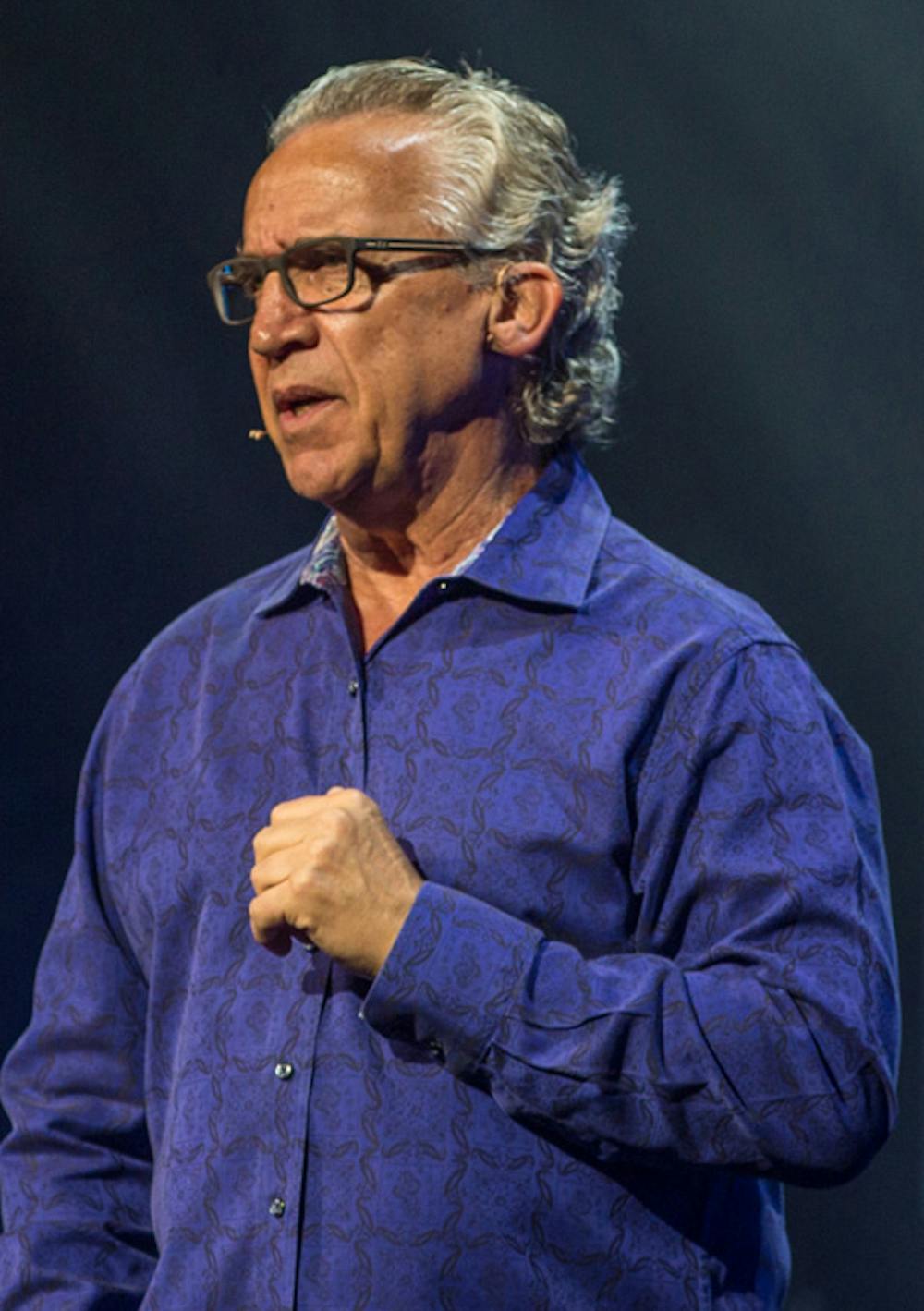
    Bill Johnson.
    Doctorg via Wikimedia Commons

    Since 1996, Bill Johnson, a senior leader of Bethel Church, and Johnny Enlow, a self-described prophet and Seven Mountain advocate, among others, have taken the original idea of the Seven Mountain Mandate and reshaped it into a more aggressive, political and spiritually militant approach. Spiritual militancy reflects an aggressive, us-vs.-them mindset that blurs the line between faith and authoritarianism, promoting dominion over society in the name of spiritual warfare.

    Their version doesn’t just aim to influence culture; it frames the effort as a spiritual battle to reclaim and reshape the nation according to their vision of God’s will.

    Lance Wallnau, another Christian evangelical preacher, televangelist, speaker and author, has promoted dominion theology since the early 2000s. During the 2020 U.S. presidential election, Wallnau, along with several prominent NAR figures, described Donald Trump as anointed by God to reclaim the “mountain” of government from demonic control.

    In their book “Invading Babylon: The 7 Mountain Mandate,” Wallnau and Johnson explicitly call for Christian leadership as the only antidote to perceived moral decay and spiritual darkness.

    The beliefs

    Sometimes referred to as Seven Mountains of Influence or Seven Mountains of Culture, the seven mountains are not neutral domains but seen as battlegrounds between divine truth and demonic deception.

    Adherents believe that Christians are called to reclaim these areas through influence, leadership and even, if necessary, the use of force and to confront demonic political forces, as religion scholar Matthew Taylor demonstrates in his book “The Violent Take It By Force.”

    Diverse perspectives and interpretations surround the rhetoric and actions associated with the New Apostolic Reformation. Some analysts have pointed out how the NAR is training its followers for an active confrontation. Other commentators have said that the rhetoric calling for physical violence is anti-biblical and should be denounced.

    NAR-aligned leaders have framed electoral contests as struggles between “godly” candidates and those under the sway of “satanic” influence.

    Similarly, NAR prophet Cindy Jacobs has repeatedly emphasized the need for “spiritual warfare” in schools to combat what she characterizes as “demonic ideologies” such as sex education, LGBTQ+ inclusion or discussions of systemic racism.

    In the NAR worldview, cultural change is not merely political or social but considered a supernatural mission; opponents are not simply wrong but possibly under the sway of demonic influence. Elections become spiritual battles.

    This belief system views pluralism as weakness, compromise as betrayal, and coexistence as capitulation. Frederick Clarkson, a senior research analyst at Political Research Associates, a progressive think tank based in Somerville, Massachusetts, defines the Seven Mountain Mandate as “the theocratic idea that Christians are called by God to exercise dominion over every aspect of society by taking control of political and cultural institutions.”

    The call to “take back” the culture is not metaphorical but literal, and believers are encouraged to see themselves as soldiers in a holy war to dominate society. Some critics argue that NAR’s call to “take back” culture is about literal domination, but this interpretation is contested.

    Many within the movement see the language of warfare as spiritually focused on prayer, evangelism and influencing hearts and minds. Still, the line between metaphor and mandate can blur, especially when rhetoric about “dominion” intersects with political and cultural action. That tension is part of an ongoing debate both within and outside the movement.

    Networks that spread the beliefs

    This belief system is no longer confined to the margins. It is spread widely through evangelical churches, podcasts, YouTube videos and political networks.

    It’s hard to know exactly how many churches are part of the New Apostolic Reformation, but estimates suggest that about 3 million people in the U.S. attend churches that openly follow NAR leaders.

    At the same time, the Seven Mountain Mandate doesn’t depend on centralized leadership or formal institutions. It spreads organically through social networks, social media – notably podcasts and livestreams – and revivalist meetings and workshops.

    André Gagné, a theologian and author of “American Evangelicals for Trump: Dominion, Spiritual Warfare, and the End Times,” writes about the ways in which the mandate spreads by empowering local leaders and believers. Individuals are authorized – often through teachings on spiritual warfare, prophetic gifting, and apostolic leadership – to see themselves as agents of divine transformation in society, called to reclaim the “mountains,” such as government, media and education, for God’s kingdom.

    This approach, Gagné explains, allows different communities to adapt the action mandate to their unique cultural, political and social contexts. It encourages individuals to see themselves as spiritual warriors and leaders in their domains – whether in business, education, government, media or the arts.

    Small groups or even individuals can start movements or initiatives without waiting for top-down directives. The only recognized authorities are the apostles and prophets running the church or church network the believers attend.

    The framing of the Seven Mountain Mandate as a divinely inspired mission, combined with the movement’s emphasis on direct spiritual experiences and a specific interpretation of scripture, can create an environment where questioning the mandate is perceived as challenging God’s authority.

    Slippery slope

    These beliefs have increasingly fused with nationalist rhetoric and conspiracy theories.

    The ‘Appeal to Heaven’ flags symbolize the belief that people have the right to appeal directly to God’s authority when they think the government has failed.
    Paul Becker/Becker1999 via Flickr, CC BY

    A powerful example of NAR political rhetoric in action is the rise and influence of the “Appeal to Heaven” flags. For those in the New Apostolic Reformation, these flags symbolize the belief that when all earthly authority fails, people have the right to appeal directly to God’s authority to justify resistance.

    This was evident during the Jan. 6, 2021, Capitol insurrection, when these flags were prominently displayed.

    To be clear, its leaders are not calling for violence but rather for direct political engagement and protest. For some believers, however, the calls for “spiritual warfare” may become a slippery slope into justification for violence, as in the case of the alleged Minnesota shooter.

    Understanding the Seven Mountain Mandate is essential for grasping the dynamics of contemporary efforts to align government and culture with a particular vision of Christian authority and influence.

    Art Jipson does not work for, consult, own shares in or receive funding from any company or organization that would benefit from this article, and has disclosed no relevant affiliations beyond their academic appointment.

    ref. What is the ‘Seven Mountain Mandate’ and how is it linked to political extremism in the US? – https://theconversation.com/what-is-the-seven-mountain-mandate-and-how-is-it-linked-to-political-extremism-in-the-us-260034

    MIL OSI Analysis

  • MIL-OSI NGOs: Nigeria: Violence and widespread displacement leave Benue facing a humanitarian disaster

    Source: Amnesty International –

    • At least 510,182 internally displaced people (IDPs) across Benue state
    • Dire conditions in IDP camps
    • Children and pregnant women amongst most vulnerable

    The Nigerian authorities must take urgent steps to avert a humanitarian catastrophe in the central state of Benue where attacks by gunmen have displaced at least 500,000 people, many of whom are languishing in squalid camps without access to sufficient water, poor sanitation, food and healthcare, Amnesty International said today.

    In the most recent attack on 14 June, gunmen raided the town of Yelewata, killing more than 100 people and forcing over 3,941 more to flee their homes. The smell of decomposing bodies hung in the air during a visit to the affected community by Amnesty International in the aftermath of the attacks. Signs of the recent violence were unmistakable with bullet shells littering the ground, and mass graves that had been newly dug to bury the dead.

    Survivors were seen carrying bags of grain, bundles of firewood and other household items as they sought safety and shelter in camps for internally displaced persons (IDP). According to interviews with IDPs in Gwer West, Agatu, Ukum, Kwande, Logo, Guma and Makurdi IDP camps, as well as a makeshift IDP camp at Makurdi Modern Market, communities who come under attack are often left to fend for themselves with security forces only arriving long after the gunmen had left.

    “The Nigerian authorities have failed the people of Benue state again and again. Rampant attacks by gunmen have deprived thousands of people of their rights to life, physical integrity, liberty, freedom of movement and access to livelihoods. Survivors of these harrowing attacks face the fresh torment of being displaced in overcrowded, unhygienic camps where disease runs rampant and essentials such as  food and clean water are scarce,” said Isa Sanusi, Director of Amnesty International Nigeria.

    “The situation risks creating a humanitarian disaster, which the authorities must urgently address by ensuring that people’s essential needs are met by providing desperately needed aid.”

    Besides interviews with IDPs, Amnesty International also spoke to camps officials, medical workers and non-governmental organizations in the affected areas. It found that communities across Benue state, including Gwer West, Gwer-East, Agatu, Apa, Ukum, Kwande, Logo,and Guma, continue to face a brutal pattern of violence.

    This is typically unleashed at night, although daytime attacks also occur, with gunmen systematically overrunning villages, using firearms to carry out indiscriminate or targeted killings from a distance. This is accompanied by brutal close-range violence with machetes and knives used to inflict grievous injuries, including hand amputations.

    The Nigerian authorities have failed the people of Benue state again and again.

    Isa Sanusi, Director of Amnesty International Nigeria

    Misery of the IDP camps

    As of 31 December 2024, an estimated 500,182 people had fled to IDPs camps in Benue state to escape years of attacks by gunmen. More than 10,000 additional people have been displaced since the start of 2025 following attacks on communities in Gwer West, Agatu, Ukum (Gbagir), Kwande (Anwase), Logo, and Guma (Yelewata, Agan, and Gbajimba), among others.

    Amnesty International’s visits to IDP camps reveal wholly inadequate shelter, exposing IDPs to harsh weather, overcrowding, and heightened risks of disease, as well as gender-based violence, including rape and domestic violence.

    Access to healthcare is also a major challenge in the IDP camps with a lack of treatment for the most common diseases and ailments, such as malaria, typhoid, and stomach ulcers. According to a camp official, births occur almost daily in the IDP camps, with many pregnant women requiring medical attention but also contracting infections because of inadequate hygiene facilities.

    An IDP told Amnesty International: “If we don’t get drugs, we just sit and watch the sick person helplessly.”

    Many children are unable to exercise their right to an education in the camps.

    “Our children no longer go to school and there are no arrangements by the authorities to teach children in the IDP camp. The government should bring an end to insecurity in our local government area and Benue state. Before that, provide us with food and proper shelter at the IDP camps,” an IDP told Amnesty International.

    A camp official told Amnesty International that a makeshift school built in one of the camps had been shut down for over three years because camp authorities could not continue paying ad-hoc teachers their stipends. 

    There are hundreds of minors who fled their homes due to attacks and now live without parental care. The children were separated from their families while fleeing attacks on their villages and communities. The authorities have been unable to provide these vulnerable children with a safe place to live and essential services. Two female IDPs told Amnesty International:

    The authorities’ persistent failure to hold suspected perpetrators to account is fueling a cycle of impunity that is making everyone feel unsafe. Authorities must now end the growing culture of impunity for these attacks.

    Isa Sanusi

    “When we arrived, they [my children] left. I do not know where they have gone. I can’t speak with them; I don’t have a phone….I have 8 children and because we do not have enough space here in the IDP camp, many of them have left me and I do not know where they are.”

    Amnesty International is calling on the Nigerian authorities to take immediate steps to provide sufficient and accessible humanitarian support to the survivors of these attacks. Authorities must take steps to domesticate and effectively implement the African Union Convention for the Protection and Assistance of Internally Displaced Persons within the country’s legal system.

    “The authorities’ persistent failure to hold suspected perpetrators to account is fueling a cycle of impunity that is making everyone feel unsafe. Authorities must now end the growing culture of impunity for these attacks.”

    “We call on the authorities to ensure that all people displaced because of the attacks in Benue state are provided with adequate relief, including protection, shelter, food, clean water, sanitation and healthcare. Authorities must ensure that all people who have suffered losses from the crisis are also provided with adequate compensation,” said Isa Sanusi.

    Background

    Amnesty International Nigeria has been monitoring the escalating bandit attacks and clashes between herders and farmers in Benue state since 2016. In 2020, the organization investigated the authorities’ failure to protect rural communities from attacks, and in 2025, it investigated the mounting death toll and looming humanitarian crisis amid unchecked attacks by armed groups.

    Nigeria is state party to a number of treaties that guarantee the human rights of everybody in the country regardless of the circumstances. This includes the UN International Covenant on Economic, Social and Cultural Rights and the African Charter on Human and Peoples’ Rights which requires Nigerian authorities to ensure equal access to amongst others the rights to housing, health, food, water, sanitation and education.

    MIL OSI NGO

  • MIL-OSI NGOs: UK: DWP’s ‘unhealthy obsession’ with AI discriminates against people with disabilities

    Source: Amnesty International –

    Report finds DWPs use of AI traps disabled people, those in poverty and the digitally excluded in ‘bureaucratic limbo’ 

    The report highlights how intrusive data practices have led to disproportionate monitoring of disadvantaged communities  

    ‘Have some form of sort of compassion, make the forms and things easier’ – Claimant 

    ‘While people struggle to make ends meet and put food on the table due to inadequate social security, the DWP is still spending millions of pounds on costly, experimental systems designed to profile and surveil claimants’ – Imogen-Richmond Bishop 

    People with disabilities, limited digital skills, digital illiteracy, serious health concerns, or living in poverty are being pushed into bureaucratic limbo and subjected to immense stress caused by the Department for Work and Pensions (DWP) unchecked roll-out of technologies, Amnesty International said today in a new report. 

    The 67-page report, “Too Much Technology, Not Enough Empathy”, exposes how the DWP’s constant cycle of testing, deploying, and withdrawing costly artificial intelligence (AI) and digital systems for Universal Credit and Personal Independence Payment (PIP) has created an inaccessible and exclusionary social security system – disproportionately harming the most marginalised.  

    The tech-driven systems for applications and management are causing relentless dehumanisation and psychological distress for people already struggling to meet their basic needs. These systems are accompanied by intrusive data collection, resulting in excessive surveillance and profiling of disadvantaged groups – contributing to the emergence of an all-seeing state.  

    Prime Minister Keir Starmer has called for the UK to become an ‘AI superpower,’ with plans to accelerate AI across the public sector in a bid to boost economic growth.   

    Imogen-Richmond Bishop, Amnesty International Researcher on Technology, Economic, Social and Cultural Rights, said: 

    “The DWP’s mission to reduce ‘costs’ is an unhealthy obsession and overreliance on flawed technology. But urgent questions remain: Is the tech rollout truly cost-effective – or simply cutting corners at the expense of vulnerable people? 

    “With the UK’s National Audit Office expressing serious doubts about these technologies, it’s deeply concerning that while people struggle to make ends meet and put food on the table due to inadequate  social security, the DWP is still spending millions of pounds on costly, experimental systems designed to profile and surveil claimants,”. 

    ‘Dehumanising and discriminatory’ 

    The report follows Amnesty’s earlier publication this year, ‘Social Insecurity’, which found the UK’s social security system to be “consciously cruel”, with widespread dehumanisation and discrimination. It revealed significant barriers to access:   

    Digital exclusion is not fixed. People may experience it to varying degrees, and it can fluctuate based on factors such as living conditions, education, health, and income. 

    Furthermore, limited access to digital technologies, including the internet or internet connected devices, and their affordability are key factors contributing to digital exclusion caused by the DWP’s systems. Language barriers and excessively long wait times on telephone services offered for UC claimants add a strain, often resulting in significant psychological stress. 

    For one of the claimants interviewed by Amnesty, literacy level, gender, and socio-economic status all represented barriers to her being able to access services online. 

    One claimant told Amnesty: “Have some form of sort of compassion, make the forms and things easier. I mean, I’m quite illiterate. I mean, a lot of women are, are men of my age, can’t use them […] So they’re stuffed. They send me. Letters on my phone. I can’t open them. So I ring up. I can’t open it. I haven’t got an iPad. I can’t afford an iPad.” 

    Imogen Richmond-Bishop added: 

    “The DWP’s experimentation with tech systems has reduced people to data points, where the success of a claim often depends more on fitting into rigid digital categories than actual eligibility.  

    “Technology in this instance has oversimplified people’s complex realities by creating narrow and opaque processing that demeans people’s needs especially when they are unable to get the support from a human case worker that they need. 

    “The DWP’s data collection practices are alarmingly invasive and deeply opaque. Requiring applicants to surrender vast amounts of sensitive personal data – including health, disability, housing, marital status, and detailed financial records like bank statements – raises serious red flags. This excessive data harvesting calls into question the proportionality, legality, and fairness of how information is collected, processed and potentially exploited.”   

    The UK must ensure AI doesn’t contribute to human rights violations and Amnesty is calling for: 

    The report interviewed 783 people between October 2024 to January 2025. 

    MIL OSI NGO

  • MIL-OSI United Nations: Human Rights Committee Holds Emergency Meeting with States Parties as the United Nations’ Financial Crisis Threatens its Survival

    Source: United Nations – Geneva

    The Human Rights Committee today held an emergency meeting with States parties to discuss the financial challenges of the United Nations and the Committee’s future.

    Committee Chairperson Changrok Soh, in opening remarks, said the Committee’s ability to fulfil its mandate was under serious threat. Austerity measures had been imposed on it that jeopardised not just its current work, but the very future of the Committee itself.

    The Committee’s most pressing concern was the cancellation of its third session this year, Mr. Soh said. This was the first time in its 50-year history that such a cancellation had occurred. Losing a session meant serious delays in reviewing State party reports and in deciding on individual complaints of Covenant violations. Many victims had already waited years for justice. Now, they would wait even longer, he said.

    Mr. Soh appealed to States parties to help the Committee find a solution. The Committee needed States’ political will, financial commitment, and concrete support — not only to help it find a way to hold its third session this year, but also to strengthen the system for the future.

    In the ensuing discussion, States parties expressed support for the Committee and the treaty body system, and concern regarding the financial crisis and the cancellation of the third session. They called on the Committee to come up with new, sustainable, cost-effective solutions to address the structural issues underpinning the situation, while maintaining its work and integrity.

    Concluding the meeting, Mr. Soh said that treaty bodies were not receiving enough funding for their core work. They were doing their best in terms of rationalisation and increasing efficiency, but as allocated resources declined, support for the treaty bodies’ work diminished, creating a vicious cycle.

    To address this situation, special measures were needed, such as utilising voluntary contributions transparently, he said. Without a properly functioning treaty body system, human rights protections would weaken around the world. Decisive and urgent action was needed to protect the treaty body system and human rights around the world, he concluded.

    Speaking in the meeting were representatives of the Office of the United Nations High Commissioner for Human Rights, as well as Japan, Spain, Serbia, Egypt, Croatia, Colombia, Russian Federation, Costa Rica, Islamic Republic of Iran and France.

    The Human Rights Committee’s one hundred and forty-fourth session is being held from 23 June to 17 July 2025. All the documents relating to the Committee’s work, including reports submitted by States parties, can be found on the session’s webpage . Meeting summary releases can be found here . The webcast of the Committee’s public meetings can be accessed via the UN Web TV webpage.

    The Committee will next meet in public at 3 p.m. on Tuesday 15 July to hear the progress report of the Special Rapporteur on follow-up to the Committee’s concluding observations.

    Opening Statements by Committee Experts

    CHANGROK SOH, Committee Chair, said the Committee had convened the emergency meeting to discuss a single, urgent issue: “The financial challenges of the United Nations and the future of the Human Rights Committee.” The Committee came before States today with a profound sense of urgency.

    All members of the Human Rights Committee were deeply honoured to take enormous responsibility for monitoring the implementation of the Covenant. They took this duty very seriously. But today, its ability to fulfil this mandate was under serious threat. The austerity measures imposed on the Committee jeopardised not just its current work, but the very future of the Committee itself.

    These were truly unprecedented times — for the Committee and for the entire treaty body system. The Committee’s most pressing concern was the cancellation of its third session this year, scheduled for October and November, as announced by the Office of the High Commissioner for Human Rights. This was the first time in the Committee’s 50-year history that such a cancellation had occurred. 

    The cancellation put the Committee in a very difficult position. Its rules of procedure required it to meet three times a year. This was a fundamental obligation under the Committee’s mandate and indispensable to the effectiveness of its work. If it lost a session, nearly eight months would pass without a single meeting in Geneva. This meant serious delays in reviewing State party reports and in deciding on individual complaints of Covenant violations. Many victims had already waited years for justice. Now, they would wait even longer. Every delay weakened the Committee’s recommendations, diminished their impact, and undermined their ability to prevent further violations.

    The Committee recognised that the United Nations’ financial crisis was serious, and that the Secretariat was doing its best under the current constraints. But it was clear that the rules and structures of the system were too rigid to cope with situations like this. For example, in early June, during the Treaty Body Chairs’ meeting, several Chairs explored the possibility of mobilising emergency funding to hold autumn sessions. However, they were told that this was not possible, as treaty bodies were required to rely exclusively on the regular budget to carry out their mandated activities. This rule was intended to safeguard the Committee’s independence. But it made little sense if, in practice, it prevented it from functioning at all when the regular budget fell short. The Covenant clearly obliged the Secretary-General to ensure that the Committee could carry out its work. If the current approach blocked the fulfilment of that obligation, then it needed to change.

    The Committee therefore appealed to States parties to help it find a solution. Open and frank communication with the States parties was crucial because, ultimately, it was in States’ interest to ensure that the treaty bodies could continue their vital work, even in difficult times. The Committee needed States’ political will, financial commitment, and concrete support — not only to help it find a way to hold its third session this year, but also to strengthen the system for the future. 

    The Committee monitored the fundamental rights of individuals in 174 States parties — as part of the approximately 1,400 treaty obligations regularly reviewed by the treaty bodies. This was a remarkable early warning and accountability system — one that States parties created. The Committee urged States to ensure that this system could continue to function effectively. If not, what alternative was available?

    This should not be treated as a one-time problem. If this unprecedented cancellation were allowed to be “normalised”, it would set a dangerous precedent. Each time the United Nations faced a funding shortfall, the credibility and effectiveness of the treaty body system, a core pillar of the United Nations’ human rights architecture, would erode further.

    There was growing global pushback against human rights, especially the very rights the Committee was mandated to protect. This was not the moment to weaken United Nations human rights mechanisms. On the contrary, the world needed this remarkable early warning and accountability system now more than ever. 

    The Committee called on States to do three things. First, support the Committee — even at this late stage — in finding a solution to hold its third session this year, and commit to holding all three regular sessions in 2026. Second, allow voluntary contributions from States to be used transparently and responsibly to support the Committee’s work, while fully preserving the independence and impartiality of the treaty bodies. Third, help the Committee function effectively by fulfilling reporting obligations, engaging with the Committee in dialogue, and supporting its work financially and politically, both now and in the long term.

    Statements and Questions by States Parties 

    In the ensuing dialogue, many States expressed appreciation for the ongoing efforts of the Committee and the treaty bodies and their firm commitment to the treaty bodies, which were a cornerstone of the international human rights system. The Committee, they said, made significant contributions to upholding civil and political rights around the world.

    Several speakers expressed deep concern about the financial crisis, which was affecting the mandates of all treaty bodies, the Human Rights Council and Special Procedures, among other mechanisms in the United Nations system. This situation had serious implications for these bodies’ important work.

    One speaker said that their country had increased contributions to the treaty body system and was paying its dues on time, and had also increased unearmarked financial contributions to the Office of the High Commissioner. The speaker said that the country would work to strengthen the capacity of the Secretariat through its contributions.

    Some speakers said treaty bodies needed to work to harmonise their working methods. Cooperation between treaty bodies could lead to solutions to backlogs in individual communications. The Committee had a backlog of over 1,000 individual communications. One speaker asked if the Committee had assessed additional measures to address its backlog.

    Many speakers expressed dismay that the Committee’s third session for the year was to be cancelled, and called for an urgent, mitigating solution to be found to hold the Committee’s third session in November. Without this session, the Committee’s backlog of cases would only increase. Was this issue related to the ordinary budget or to liquidity? One speaker suggested using new technologies and virtual meetings to hold the third session. The Committee needed to come up with new, sustainable, cost-effective solutions to address the structural issues underpinning the situation, while maintaining its work and integrity. 

    Some speakers commended the UN80 initiative and the United Nations’ efforts to address evolving global challenges. However, some speakers said that austerity measures implemented through the UN80 initiative should not affect the work of the treaty bodies and the international human rights system.

    One speaker said it was worth exploring the Chair’s proposal regarding the use of voluntary contributions to facilitate the Committee’s third session, provided that there were no legal barriers to this solution and that the independence and impartiality of the Committee were not affected. The speaker commended the Committee’s efforts to find a solution.

    Another speaker said that their country had attempted to fund one of the treaty bodies’ mandates directly but had been told that funding could only come from the regular budget. If a voluntary funding scheme for the Committee was established, it needed to be established for all the treaty bodies and other mechanisms receiving funds from the regular budget. The speaker said that their country would support solutions proposed by States, while working within the norms of the United Nations’ system.

    A speaker said that one State had traditionally contributed significantly to the funding of the human rights system; the reasons for its sudden cessation of funding needed to be examined. States were the owners of the treaty body system.

    One speaker said multilingualism needed to be an essential value of the treaty bodies; it should not be sacrificed to achieve budgetary austerity.

    Responses by Committee Experts and Others

    A Committee Expert said States were authors of the Covenant and the Optional Protocol on individual communications. The harmonisation of working methods related to individual communications began around three years ago, both formally and informally. There was no resistance from the Committee in this regard. The Human Rights Committee received the largest number of individual communications, given the broad scope of the Covenant. It was proud of its record in dealing with these communications. Delays in issuing decisions on communications affected the relevance and legitimacy of the decisions that the Committee adopted. The Committee had had only three days this session to assess individual communications, while it had had a full week previously.

    The Secretariat had exerted efforts to maintain its staff in the financial crisis. The Committee had a human resources issue; there was a lack of staff to assess individual complaints, prepare draft decisions, and assess follow-up to the Committee’s decisions. The issue of resources needed to be addressed; simply freeing up time in sessions to assess individual communications would not fix the backlog.

    Digitisation was a long-standing structural issue for the Committee. The system that the Committee worked with was not sufficiently digitised.

    Another Committee Expert said the Committee welcomed States’ support and was encouraged by their presence in the dialogue. The Committee received over half of all the individual communications received by the treaty body system. If the Secretariat could not prepare individual cases for assessment, the Committee could not assess them. Without sufficient pre-sessional working time, the Committee’s backlog would only increase. Diplomats in Geneva understood the complexities of the treaty body system. They needed to mobilise with colleagues in New York to support treaty bodies’ efficiency.

    This was the first time that the Committee had organised a special, focused meeting, and it had been very successful. It would be helpful to have annual meetings with States, as well as emergency meetings to discuss urgent issues.

    One Committee Expert proposed that the Committee use digital technologies to hold the third session remotely. A decision on this issue needed to be taken rapidly. However, this was not a solution to the structural problems the Committee faced. The Committee needed to take slow steps forward in this situation.

    Another Committee Expert said that the young generation was questioning the capacity of the human rights system to protect human rights, in the context of the recent increase in violations of human rights and international humanitarian law around the world. The Committee was witnessing the emergence of new challenges, including in relation to climate change and artificial intelligence. It was considering how to address these challenges while preserving human rights. The Committee’s objective was not to level accusations at States; it was to accompany them on their journey toward achieving the best implementation of their commitments. Member States needed to support the Committee now, in the same manner as they had supported it for decades.

    A Committee Expert thanked States parties for their support to the international human rights system. States had created the Committee, recognising the need to monitor and protect civil and political rights. The Committee had an enormous workload and required appropriate financial resources, so that the Secretariat could hire necessary human resources to facilitate its work. The Expert called on States to take initiatives to address the crisis. Solutions needed to address the overall structural crisis over the long term.

    CHANGROK SOH, Committee Chair, said the Committee would present a proposal to States regarding the use of voluntary contributions for holding the third session, but only States could approve this. Mr. Soh expressed support for the idea of holding annual meetings with States parties.

    The Committee met online during the COVID-19 pandemic. It found that these meetings were not effective for various reasons, including time difference and limitations on dialogue and interpretation. The treaty body Chairs had discussed this issue, but had decided that online meetings were not an effective option. However, the Committee would continue to use digital technology, including artificial intelligence, to increase the efficiency of its work.

    WAN-HEA LEE, Chief, Civil, Political, Economic, Social and Cultural Rights Section, Human Rights Council and Treaty Mechanisms Division, Office of the United Nations High Commissioner for Human Rights , said that, in the past, the Office of the High Commissioner had reduced the working time of pre-sessional working groups to manage the financial crisis. The working group for the third session had been cancelled.

    In the past, the treaty bodies had been facing a liquidity crisis. Dues were being paid, but did not reach the treaty bodies in a timely manner. However, it was not an issue of liquidity anymore. The budget of the Office of the High Commissioner for Human Rights for this year had been cut, and the situation had moved from a liquidity to a financial crisis. The financial outlook for next year was also not bright.

    DINA ROSSBACHER, Office of the United Nations High Commissioner for Human Rights , said that there was a structural problem in terms of the processing of decisions related to individual communications. The formula adopted by Member States regarding the processing of individual communications had not been fully adopted and this had been exacerbated by the financial crisis. The Committee had taken several steps to address the situation, including efforts to align working methods and increase the efficiency of processing individual communications. Last year, the Committee adopted a record number of decisions on communications – over 450. However, the large backlog remained, and the situation remained urgent.

    Statements and Questions by States Parties

    States expressed support for the work of the Committee, the treaty bodies and the human rights system. It was the responsibility of States to support the work of the Committee, one speaker said.

    Speakers said creative initiatives were needed to address the financial situation, including digital meetings. One State expressed support for the Committee’s efforts to harmonise and increase efficiency for its work.

    One speaker said the Committee needed to further consider the cultural diversity of States in preparing its concluding observations. If the Committee did not consider challenges such as terrorism and unilateral coercive measures, its recommendations would be considered irrelevant to the realities on the ground in some countries. The speaker called on the Committee to prepare a general comment on the impact of unilateral coercive measures on civil and political rights.

    Responses by a Committee Expert

    A Committee Expert said the treaty bodies were implementing innovative methods to review States parties. The Committee on the Elimination of Discrimination against Women had this year conducted a special, informal meeting in Fiji to review States parties in the region. This initiative was funded by States parties, and could be a model for other Committees to follow. The application of simplified procedures to individual communications would not be sufficient for fully addressing the Committee’s backlog.

    Closing Remarks

    CHANGROK SOH, Committee Chair, said treaty bodies were at the core of the human rights architecture. However, the Committee’s third session would not happen without extraordinary measures, and this trend would continue if the Committee continued to rely on the United Nations’ regular budget. Less than five per cent of the United Nations’ regular budget was allocated to the Office of the High Commissioner for Human Rights. The treaty body system was not receiving enough funding for its core work. It was doing its best in terms of rationalisation and increasing efficiency. But as allocated resources declined, support diminished, creating a vicious cycle.

    To address this situation, special measures were needed, such as utilising voluntary contributions transparently. Without a properly functioning treaty body system, human rights protections would weaken around the world. Decisive and urgent action was needed to protect the treaty body system and human rights around the world.

    ____________

    This document is produced by the United Nations Information Service at Geneva and is intended for public information; it is not an official document.
    The English and French versions of our news releases are different because they are the product of two separate coverage teams that work independently.

    CCPR25.017E

    MIL OSI United Nations News

  • MIL-OSI Europe: Answer to a written question – Protection of the Holy Monastery of Sinai – E-002184/2025(ASW)

    Source: European Parliament

    The EU and the EU Delegation in Cairo are aware of and closely monitoring the developments following the Ismailia Court of Appeals’ ruling linked to the legal status of Saint Catherine’s Monastery in Sinai.

    In a meeting called by the Arab Republic of Egypt’s Foreign Ministry, the Egyptian authorities assured Member States’ Ambassadors and the EU Head of Delegation in Cairo that the Egyptian government remains fully committed to preserving the monastery’s religious, historical, and spiritual status.

    The Egyptian authorities reaffirmed that the monks’ access to the site will not be affected by the court ruling. This matter is also subject to ongoing direct negotiations between the Greek and Egyptian governments.

    The EU, and its Member States, will continue to follow this matter and the commitments made by the government of Egypt.

    Last updated: 10 July 2025

    MIL OSI Europe News

  • MIL-OSI Europe: Answer to a written question – Closure of the Monastery of St Catherine in Sinai and violation of religious freedoms by the Egyptian authorities – E-002164/2025(ASW)

    Source: European Parliament

    The EU and the EU Delegation in Cairo are aware of and continue to monitor the recent developments in Egypt after the Ismailia Court of Appeals issued a ruling linked to the legal status of Saint Catherine’s Monastery in Sinai.

    In a meeting called by the Arab Republic of Egypt’s Foreign Ministry, the Egyptian authorities assured Member States’ Ambassadors and the EU Head of Delegation in Cairo that the Egyptian government remains fully committed to preserving the monastery’s religious, historical, and spiritual status, adding that the current status of the area around Saint Catherine’s Monastery is untouchable. It was reaffirmed that the monks’ access to the site will not be affected by the court ruling.

    The EU welcomes the commitments of the governments of Greece and Egypt to work together towards safeguarding the rights of Saint Catherine’s Monastery and awaits any new developments with regard to its legal status.

    The EU will continue to follow the situation closely and await the result of the discussions between the Egyptian and Greek Authorities, insisting on the necessity to preserve the monastery’s religious, historical, and spiritual status, in accordance with the United Nations Educational, Scientific and Cultural Organisation World Heritage Convention[1].

    • [1] United Nations Educational, Scientific and Cultural Organisation World Heritage convention website, Saint Catherine Monastery: https://whc.unesco.org/en/list/954/.
    Last updated: 10 July 2025

    MIL OSI Europe News

  • MIL-OSI Europe: Answer to a written question – EU potentially reestablishing relations with Russia – P-002380/2025(ASW)

    Source: European Parliament

    Russia’s unprovoked war of aggression against Ukraine is a blatant violation of international law including the United Nations (UN) Charter, goes against the EU’s objective to strengthen the multilateral rules-based order and is a threat to all countries, not just to Europe.

    The EU condemns in the strongest possible terms Russia’s war of aggression against Ukraine. Russia must remain isolated internationally and, with its political leadership, held fully accountable for the violations of international law and international humanitarian law it has committed.

    Russia’s full-scale invasion of Ukraine on 24 February 2022 marked a fundamental turning point in EU-Russia relations. The EU’s wartime approach towards Russia consists of isolating Russia internationally; imposing restrictive measures; ensuring accountability; supporting EU’s neighbours and helping partners worldwide to address the global consequences of the war; working closely together with the North Atlantic Treaty Organisation and partners; enhancing the EU’s resilience; supporting civil society, human rights defenders and independent media[1].

    As long as Russia continues to violate international law including the UN Charter and wages a war of aggression against Ukraine, there can be no return to normal relations.

    Since Russia started its war of aggression against Ukraine, the EU’s diplomatic engagement with Russia is being kept to minimum. The priority of any contact with Russia is to deliver the call to stop its illegal aggression and the violation of the UN Charter, and respect Ukraine’s independence, sovereignty and territorial integrity.

    • [1] https://www.eeas.europa.eu/delegations/ukraine/foreign-affairs-council-defence-press-remarks-high-representative-josep-borrell_en.
    Last updated: 10 July 2025

    MIL OSI Europe News

  • MIL-OSI Europe: Answer to a written question – Balanced development clause for islands and mountain areas – E-002132/2025(ASW)

    Source: European Parliament

    As per the communication ‘The road to the next multiannual financial framework’[1] from 11 February 2025, the Commission’s proposal for the next multiannual financial framework will ensure a simpler, more focused and more impactful budget aligned with EU priorities.

    The future budget will aim for a strengthened cohesion and growth policy, with regions at the centre, as underscored in the Commission’s political guidelines[2], and continue to actively support islands and mountain areas, considering their specific needs and challenges, notably in terms of economic development, adaptation to climate change, connectivity, migration and demographic transition.

    At the core of this modernised budget will be a national and regional partnership plan for each country with key reforms and investments, focusing on EU’s joint priorities, including promoting economic, social and territorial cohesion, and designed and implemented in partnership with national, regional, and local authorities to address their specificities.

    A place-based approach remains essential to respond to the unique challenges faced by the regions and territories. By combining key investments and reforms within one plan, it will be possible to address these challenges in a way that is more targeted and comprehensive.

    This approach will mix specific investments, legislative and regulatory levers, and technical support, to ensure rapid and effective deployment of funds aligned to local needs and European priorities.

    The plan’s single rulebook, wide eligibility scope and large financial toolbox, enabling the use of leverage through financial instruments, will help reduce the administrative burden for beneficiaries and allow for the design of more effective measures, tailored to the needs of each territory.

    • [1] https://commission.europa.eu/document/download/6d47acb4-9206-4d0f-8f9b-3b10cad7b1ed_en?filename=Communication%20on%20the%20road%20to%20the%20next%20MFF_en.pdf.
    • [2] https://commission.europa.eu/document/download/e6cd4328-673c-4e7a-8683-f63ffb2cf648_en.

    MIL OSI Europe News

  • MIL-OSI Europe: Answer to a written question – Bloody Sunday: massacres in Ukraine and Gaza – P-001544/2025(ASW)

    Source: European Parliament

    Concerning Ukraine, the Council has not discussed the issue of the use of cluster munitions by Russia in the attacks of 13 April 2025. The EU recognises the humanitarian goals of the Convention on Cluster Munitions and remains steadfast in its commitment to promoting the protection of civilians from the devastating impacts of explosive remnants of war, including cluster munitions.

    The EU is concerned by the impact on civilian populations of the indiscriminate use of cluster munitions, including the use of cluster munitions by Russia in its unjustified war of aggression against Ukraine in blatant violation of international law, including the UN Charter.

    Concerning Gaza, the EU deplores the breakdown of the ceasefire, which has caused a large number of civilian casualties in recent air strikes. It also deplores the refusal of Hamas to hand over the remaining hostages.

    The EU has called for an immediate return to the full implementation of the ceasefire-hostage release agreement[1]. Israel is bound by international humanitarian law (IHL) and applicable norms of international human rights law (IHRL), including, as an occupying power, the obligation to protect the population under occupation.

    The EU has called on Israel to adhere strictly to the rules and principles of IHL and IHRL governing the use of force and the conduct of hostilities, including humanity, necessity, distinction and proportionality[2].

    The most recent EU-Israel Association Council, held on 24 February 2025, served as institutional framework for political dialogue and cooperation under the EU-Israel Association Agreement.

    At this meeting, the EU also recalled that, pursuant to Article 2 of the Association Agreement, relations between the European Union and Israel must based on respect for human rights and democratic principles[3].

    Furthermore, following the discussion at the meeting of the Foreign Affairs Council on 20 May 2025, the High Representative announced the launch of a review of Israel’s compliance with Article 2 of the Association Agreement[4].

    No decision has yet been taken by the Council on the Commission proposal[5] of 26 March 2025 regarding the extension of the EU-Israel Action Plan.

    • [1] https://www.consilium.europa.eu/media/viyhc2m4/20250320-european-council-conclusions-en.pdf
    • [2] https://data.consilium.europa.eu/doc/document/ST-6511-2025-INIT/en/pdf
    • [3] https://data.consilium.europa.eu/doc/document/ST-6511-2025-INIT/en/pdf
    • [4] https://www.consilium.europa.eu/en/meetings/fac/2025/05/20/
    • [5] https://data.consilium.europa.eu/doc/document/ST-7603-2025-INIT/en/pdf

    MIL OSI Europe News

  • MIL-OSI USA: Risch Introduces Bill to Ban Radical Gender Ideology in Schools

    US Senate News:

    Source: United States Senator for Idaho James E Risch

    WASHINGTON – U.S. Senator Jim Risch (R-Idaho) today introduced the Say No to Indoctrination Act to codify President Trump’s executive order preventing taxpayer dollars from funding radical gender ideology in K-12 schools.

    “Schools should prepare our children for the future, not promote radical gender ideology,” said Risch.“The Say No to Indoctrination Act puts an end to woke education practices in K-12 schools and makes President Trump’s common-sense policy permanent.”

    Senator Risch’s bill is cosponsored by U.S. Senators Mike Crapo (R-Idaho), Ted Budd (R-N.C.), Josh Hawley (R-Mo.), Roger Marshall (R-Kansas), Eric Schmitt (R-Mo.), Tommy Tuberville (R-Ala.) and has received support from Concerned Women for America and American Principles Project.

    “Children should not be radicalized, indoctrinated or taught gender ideology in public elementary or secondary schools funded by federal tax dollars,” Crapo said. “This legislation places commonsense guardrails around the use of these dollars in public education, which will ensure schools are providing foundational instruction in subjects like mathematics and reading rather than divisive concepts of gender ideology.”

    “For far too long, radical left-wing ideology has preyed on K-12 students in our nation’s school systems. It’s high time we put a stop to these woke lesson plans that take advantage of children and undermine parental rights. I am proud to join Senator Risch and my colleagues to prevent taxpayer dollars from funding public schools that teach gender ideology,” said Budd.

    “As American students lag behind globally in math, reading, and writing, the last thing our taxpayer-funded teachers and schools should be doing is teaching radical leftist nonsense like so-called gender theory,” said Marshall. “I’m proud to support this legislation to codify President Trump’s executive order, and ensure our children’s education is focused on meaningful, future-ready skills, not woke ideology.

    “Parents send their kids to school to learn the skills they need to succeed later in life, not to be indoctrinated with radical gender ideology. There are only two genders—male and female, and not a single penny of federal funds should go to schools that teach anything different,” said Schmitt.

    “Our children go to school to be educated, not indoctrinated,” said Tuberville. “I’ve always said that education is the key to unlocking opportunity. But under Joe Biden, Democrats turned our children’s classrooms into woke propaganda HQ. Schools should focus on teaching kids to read, write, and do math. I’m proud to join my colleagues in introducing the Say No to Indoctrination Act to get woke politics out of the classroom.”

    The Say No to Indoctrination Act codifies the Executive Order President Trump issued on January 20, 2025, declaring that no taxpayer dollars be sent to K-12 schools that teach or promote radical gender ideology.

    Risch has long fought to eradicate radical gender ideology. In May, Risch introduced the Protecting Minors in Federal Health Plans Act, which would prohibit Federal Employee Health Benefits (FEHB) plans from covering gender transitions for minors. Risch also introduced the Dismantle DEI Act to codify President Trump’s executive order terminating Diversity, Equity, and Inclusion programs and initiatives.

    MIL OSI USA News

  • MIL-OSI Canada: Engagement begins to support implementation of Infrastructure Projects Act

    Public engagement is open to support implementation of the Infrastructure Projects Act, which aims to get shovels in the ground quicker for critical projects that people need in their communities.

    The act received royal assent in May 2025.

    First Nations, members of the public and interest-holders, such as municipalities, business organizations, environmental groups and construction partners, are invited to share their thoughts on the development of two key parts of the legislation over the summer:

    1. Provincially significant projects criteria – a regulation to establish the minimum criteria for projects to be designated as provincially significant, so they can access streamlining tools that will help reach decisions quicker.
    2. Qualified professional certifications – a regulation to develop a qualified professional-reliance model to create permitting efficiencies, while maintaining accountability and high standards.

    Methods of engagement will include:

    • online surveys;
    • opportunities to provide written submissions;
    • meetings; and
    • advisory groups.

    In addition, engagement on the expedited environmental-assessment process is planned to start in fall 2025.

    For more information and to get to involved, visit: https://engage.gov.bc.ca/infrastructure

    Learn More:

    To read the news release about the introduction of the legislation, visit: https://news.gov.bc.ca/releases/2025PREM0018-000403

    To read the Infrastructure Projects Act, visit:
    https://www.leg.bc.ca/parliamentary-business/overview/43rd-parliament/1st-session/bills/3rd_read/gov15-3.htm

    MIL OSI Canada News

  • MIL-OSI Canada: Regional health councils give Albertans a voice

    Albertans want a health care system that reflects where they live and adapts to the unique needs of their communities. As part of the province’s health care refocus, Alberta’s government committed to strengthening community voices by providing more opportunities for Albertans to bring forward their local priorities and offer input on how to improve the system. 

    The regional advisory councils, made up of 150 members from 71 communities, will advise Alberta’s four health ministries and the newly refocused health agencies: Primary Care Alberta, Acute Care Alberta, Assisted Living Alberta and Recovery Alberta. Each council will explore solutions to local challenges and identify opportunities for the health system to better support community decision-making.

    “By hearing first-hand community feedback directly, we can build a system that is more responsive, more inclusive and ultimately more effective for everyone. I am looking forward to hearing the councils’ insights, perspectives and solutions to improve health care in all corners of our province.”

    Adriana LaGrange, Minister of Primary and Preventative Health Services

    “Regional advisory councils will strengthen acute care by giving communities a direct voice. Their insights will help us address local needs, improve patient outcomes and ensure timely access to hospital services.”

    Matt Jones, Minister of Hospital and Surgical Health Services

    “A ‘one-size-fits-all’ approach does not address unique regional needs when it comes to mental health and addiction challenges. These councils will help us hear directly from communities, allowing us to tailor supports and services to meet the needs of Albertans where they are.”

    Rick Wilson, Minister of Mental Health and Addiction

    “Every community has unique needs, especially when it comes to seniors and vulnerable populations. These regional advisory councils will help us better understand those needs and ensure that assisted living services are shaped by the people who rely on them.”

    Jason Nixon, Minister of Assisted Living and Social Services

    Members include Albertans from all walks of life, health care workers, community leaders, Indigenous and municipal representatives, and others with a strong tie to their region. About one-third of members work in health care, and more than half of the council chairs are health professionals. Almost one-quarter are elected municipal officials, including 10 serving as chairs or vice-chairs. Ten councils also include a representative from a local health foundation.

    Council members will share local and regional perspectives on health care services, planning and priorities to help ensure decisions reflect the realities of their communities. By engaging with residents, providers and organizations, they will gather feedback, identify challenges and bring forward ideas that may not otherwise reach government.

    Through collaboration and community-informed solutions, members will help make the health system more responsive, accessible and better able to meet the needs of Albertans across the province.

    “As Primary Care Alberta works to improve access to primary health care services and programs across Alberta, we are grateful to have the opportunity to tap into a dedicated group of community leaders and representatives. These people know their communities and local needs, and we look forward to learning from their experiences and knowledge as we shape the future of primary care in Alberta.”

    Kim Simmonds, CEO, Primary Care Alberta

    “The regional advisory councils will help to bring forward the voices of patients, families and front-line providers from every corner of Alberta. Their insights will help us plan smarter and deliver care that’s timely, effective and truly local. We look forward to working closely with them to strengthen hospital and surgical services across the province.”

    Dr. Chris Eagle, interim CEO, Acute Care Alberta

    “Nobody understands the health care challenges unique to a community better than the people who live there. The regional health advisory councils are made up of those living and working on the front lines across the province, ensuring we are getting the perspective of Albertans most affected by our health care system.”

    Dr. Sayeh Zielke, CEO, Assisted Living Alberta

    “Alongside Recovery Alberta’s staff and physician team, these regional advisory councils will build upon the high standard of mental health, addiction and correctional health services delivered in Alberta.”

    Kerry Bales, CEO, Recovery Alberta

    Indigenous Advisory Council

    Alberta’s government continues to work directly with Indigenous leaders across the province to establish the Indigenous Advisory Council to strengthen health care services for First Nation, Métis and Inuit communities.

    With up to 22 members, including Indigenous health care workers, community leaders and individuals receiving health care services, the council will represent diverse perspectives across Alberta. Members will provide community perspectives about clinical service planning, capital projects, workforce development and cultural integration in health care.

    Related information

    • Advisory councils – Health
    • Terms of Reference: Regional Advisory Councils
    • Member Handbook

    Related news

    • Ensuring a successfully refocused health system (Nov. 18, 2024)
    • Get involved in Alberta’s health advisory councils (April 16, 2024)

    MIL OSI Canada News

  • MIL-OSI USA: Attorney General Alan Wilson announces $720 million settlement with eight opioid drug makersRead More

    Source: US State of South Carolina

    (COLUMBIA, S.C.) – Attorney General Alan Wilson today announced approximately $720 million nationwide in settlements with eight drug makers that manufactured opioid pills and worsened the nationwide opioid crisis. Based on the overwhelming participation by attorneys general across the country, all eight defendants have agreed to proceed with a sign-on period for local governments. South Carolina could receive up to $10 million in all. 

    “The opioid epidemic has devastated tens of thousands of families in South Carolina and across the country, and we’ve been working for years to hold the companies responsible for it accountable,” said Attorney General Wilson. “The money from these settlements, along with other settlements we’ve announced before, will go toward opioid treatment programs and efforts to prevent future victims of opioid addiction.”

    The eight defendants and the total amount they will pay in funds to address the opioid crisis as part of the deal are:  

    • Mylan (now part of Viatris): $284,447,916 paid over nine years 
    • Hikma: $95,818,293 paid over one to four years 
    • Amneal: $71,751,010 paid over 10 years 
    • Apotex: $63,682,369 paid in a single year 
    • Indivior: $38,022,450 paid over four years 
    • Sun: $30,992,087 paid over one to four years 
    • Alvogen: $18,680,162 paid in a single year 
    • Zydus: $14,859,220 paid in a single year 

    (Note: The dollar amounts listed don’t equal exactly $720M – this is the maximum amount if states get all the abatement payments and take cash in lieu of pharmaceutical products (medication-assisted treatment.))

    In addition to these abatement payments, several of the settlements allow states to receive free pharmaceutical products or cash in lieu of these products. Additionally, seven of the companies (not including Indivior) are prohibited from promoting or marketing opioids and opioid products, making or selling any product that contains more than 40 mg of oxycodone per pill, and are required to put in place a monitoring and reporting system for suspicious orders. Indivior has agreed not to manufacture or sell opioid products for the next 10 years, but it will be able to continue marketing and selling medications to treat opioid use disorder.  

    The settlements were negotiated by North Carolina, California, Colorado, Illinois, New York, Oregon, Tennessee, Utah, and Virginia.  

    MIL OSI USA News

  • MIL-OSI USA: Office of the Governor – News Release – Gov. Green Signed 313 Bills Into Law

    Source: US State of Hawaii

    Governor Josh Green, M.D., took action on 313 of the 321 bills enrolled during the 2025 regular session of the Hawai‘i State Legislature. Of those, Governor Green conducted 13 bill signing ceremonies to bring together community leaders and stakeholders to discuss and highlight impactful legislation. Lieutenant Governor Sylvia Luke led efforts for broadband access and expanded Preschool Open Doors through two bill signing ceremonies as acting governor.

    Significant milestones during this legislative bill signing session include the enactment of the state budget:

    On June 30, Governor Green signed House Bill 300 (Act 250, SLH 2025), the executive biennium budget, which appropriates $19.8 billion across all means of financing in fiscal year 2026 and $19.7 billion in fiscal year 2027. It includes $10.53 billion in general funds in fiscal 2026 and $10.58 billion in fiscal 2027.

    CIP funding within the budget comprises $3.3 billion across all means of financing in fiscal 2026 and $2.3 billion in fiscal year 2027. General obligation bonds to support statewide construction projects allocates $1.4 billion for fiscal 2026 and $432 million for fiscal 2027.

    Governor Green line-item vetoed $110 million across the fiscal biennium, representing less than half a percent of the roughly $40 billion state budget. These reductions demonstrate fiscal prudence in maintaining a stabilized state budget amid emerging federal funding uncertainty.

    Additional key legislation enacted includes:

    On May 27, Governor Green signed Senate Bill 1396 (Act 96, SLH 2025) into law, establishing the nation’s first Green Fee to combat the ever-evolving climate crisis that threatens the state. Guided by recommendations from the Climate Advisory Team (CAT), established by Governor Green, comprehensive climate and community-based policies identified the need for a sustainable funding source to support climate resiliency. Dialogue between key stakeholders and the tourism industry contributed to a collaborative effort to find solutions to safeguard the environment.

    The signing of this bill strengthens infrastructure and funds initiatives through the revenue generated by a 0.75% increase to the transient accommodation tax. Revenues will fund environmental stewardship, climate and hazard mitigation and sustainable tourism.

    On May 30, Governor Green signed Senate Bill 1300 (Act 139, SLH 2025), expanding access to free school meals for Hawai‘i public school students. The legislation aims to eliminate barriers for students experiencing food insecurity, allowing keiki to focus on learning and extracurricular activities. Beginning in the 2025-26 school year, free school meals will be available to all qualifying students under the National School Lunch Program. The following school year, eligibility will expand to include ‘ohana with income below 300% of the federal poverty level. The act appropriates $3.3 million to the Department of Education over the two school years to subsidise free school meals.

    On June 30, Governor Green signed House Bill 1483 (Act 243, SLH 2025), strengthening legislation relating to fireworks crimes and increasing the criminal penalties for violators. These newly enacted provisions aim to safeguard Hawai‘i residents and communities by setting stronger deterrences and implementing additional regulatory measures to support the prosecution of fireworks-related crimes.

    To further enhance enforcement, the legislation works to streamline the judicial process by amending the traffic and emergency period infractions adjudication system to include fireworks infractions. The addition shall expedite the handling of the high-volume fireworks violation and reduce the burden on the courts.

    On July 7, Governor Green signed Senate Bill 1044 (Act 296, SLH 2025), reactivating the Hawaiʻi Hurricane Relief Fund (HHRF) to provide insurance coverage in scenarios where the private market fails to do so. To provide additional insurance coverage options, the bill enhances the powers of the Hawaiʻi Property Insurance Association (HPIA) and establishes the Condominium Loan Program to help buildings remain insurable, and mandates the Insurance Commissioner to conduct a comprehensive study aimed at developing sustainable strategies for market stabilization.

    On July 8, Governor Green signed House Bill 1001 (Act 301, SLH 2025), establishing the Maui Wildfires Settlement Trust Fund to support the funding for the claims of settlement arising from the 2023 Maui wildfires. The bill appropriates $807.5 million to support the state’s portion of the total $4.037 billion settlement agreement. This funding provides timely compensation for survivors as an alternative to lengthy litigation.

    To prioritize victims and their families, provisions in Act 301 specify that property and casualty insurance companies can only recover payments made to a policyholder through a statutory lien.

    Additionally, Governor Green signed House Bill 1064 (Act 302, SLH 2025), effectuating the Phase Three report provided by the Fire Safety Research Institute, to improve the state’s fire preparedness and response following the 2023 Maui wildfires. The recommendations provided intent to set improvements to the Office of the State Fire Marshal.

    Under Act 302, the Office of the State Fire Marshal is transferred to the Department of Law Enforcement and is to be led by the State Fire Marshal, the first in the state in nearly 46 years. The measure establishes roles, duties and discretionary authority for both the Office and the State Fire Marshal. To further integrate this role into the state, organizational structure amendments clarify responsibility and reporting requirements for the State Fire Marshal and the State Fire Council.

    Part of the State Fire Marshal’s responsibility is to provide centralized analysis of fire occurrences from across the state using the annual records submitted by each county’s fire chief. The legislation establishes the biennial statistical report requirement to keep the public informed and to provide the legislature with reports regarding the office’s operations.

    Governor Green signed more than 300 additional bills, separate from the public bill signing ceremonies.

    “This legislative session delivered many important wins, and I’m deeply grateful to the Hawai‘i State Legislature for championing measures that serve our people and protect our ‘āina,” said Governor Green. “At the same time, we faced real challenges, especially the uncertainty of federal funding, which put critical lifelines for our communities at risk.”

    It was the foresight and resilience of our communities — and our willingness to listen — that helped move many of these bills across the finish line. I remain committed to advocating for key administrative priorities, including housing, homelessness, healthcare, wellness and resilience, and climate action. Together, we will continue to build a stronger, healthier and more sustainable future for all of Hawai‘i.”

    MIL OSI USA News

  • MIL-OSI Europe: Press release – Human rights violations in Dubai, Central African Republic and Syria

    Source: European Parliament

    On Thursday, Parliament adopted three emergency resolutions on Dubai, the Central African Republic, and Syria.

    Ryan Cornelius’ case in Dubai

    Parliament calls for the immediate and unconditional release of Ryan Cornelius, a 71-year-old British citizen detained in Dubai, in the United Arab Emirates (UAE), since 2008. They denounce his inhumane conditions of detention and urge the UAE to abolish the practice of debt-related imprisonment and to respect international human rights standards.

    They also point out that the assets seized in this particular case exceed by far the debt owed and demand that Ryan Cornelius be granted an enforceable right to compensation and other remedies, in accordance with international law. Originally sentenced to 10 years on charges of alleged fraud, Ryan Cornelius’ sentence was extended by another 20 years under Dubai Law 37 of 2009, applied retroactively and in violation of international legal standards.

    MEPs call on the UK government, the EU Special Representative for Human Rights and the EU Delegation to the United Arab Emirates to raise this issue in all bilateral contacts with the authorities and note that the UN Working Group on Arbitrary Detention has declared this imprisonment illegal, citing lack of due process, forced confessions and refusal of a lawyer.

    The resolution was adopted by 511 votes in favour, 50 against, and 75 abstentions. For more details, the full version will be available here. (10/07/25)

    MIL OSI Europe News

  • MIL-OSI Security: 71-Year-Old Repeat Felon Sentenced to 15 Months for Defrauding Taxpayer-Funded Program

    Source: United States Department of Justice (National Center for Disaster Fraud)

                WASHINGTON DC –Geary Simon, 71, of the District of Columbia, was sentenced today to 15 months in prison for defrauding the STAY DC rental housing assistance program out of more than $38,500 and for being a felon in possession of a firearm, announced U.S. Attorney Jeanine Ferris Pirro.

                Simon, aka “Robert Sutton,” pleaded guilty on Nov. 18, 2024, to one count of wire fraud in connection with a presidentially declared disaster or emergency and to one count of possession of a firearm by a prohibited person. In addition to the 15-month prison sentence, U.S. District Judge Dabney L. Friedrich ordered Simon to serve three years of supervised release and to pay restitution to the D.C. government of $38,560.

                According to court documents, Simon obtained $38,560 from the city government program called Stronger Together by Assisting You D.C., known as STAY DC. The program was intended to provide financial assistance during the Covid pandemic to help tenants cover housing and utility expenses due to a loss of income. In April 2021, the District allocated $352 million in federal relief funds for the program. Applicants applied for funds from the STAY DC program via an online portal operated by the D.C. Department of Human Services

                Simon applied to the program on June 22, 2021. In his application, Simon claimed that he was a tenant who rented a property in the District at 2433 H Street, NW; that his landlord was “Robert Sutton;” and that Simon owed “Robert Sutton” $72,000 in past due rent. All of the statements were false. Simon was not a tenant at that address; “Robert Sutton” was not Simon’s landlord; Simon did not owe “Robert Sutton” the sum of $72,000 in unpaid rent; and the phone number and email address that Simon provided for “Robert Sutton” were for a phone number and email account that Simon created and controlled.

                Unaware of the fraud, DC-DHS granted Simon’s application and issued Simon a check for $38,560 that DC-DHS would not otherwise have approved. Simon deposited the check into an account in the name of “The Geary Stephen Simon 2016 Irrevocable Trust.”

                Simon used the taxpayer-backed relief funds to pay private school tuition and to satisfy his court-ordered child support obligations.

                On March 14, 2024, law enforcement executed a search warrant at Simon’s home. Officers recovered two firearms. Simon has two prior felony convictions, including a conviction for carrying a pistol without a license. By virtue of the prior felonies, Simon was prohibited from possessing any firearms under federal law.

                This case was investigated by the FBI Washington Field Office. It is being prosecuted by Assistant U.S. Attorney John W. Borchert.


    24cr284

    MIL Security OSI

  • MIL-OSI Security: 71-Year-Old Repeat Felon Sentenced to 15 Months for Defrauding Taxpayer-Funded Program

    Source: United States Department of Justice (National Center for Disaster Fraud)

                WASHINGTON DC –Geary Simon, 71, of the District of Columbia, was sentenced today to 15 months in prison for defrauding the STAY DC rental housing assistance program out of more than $38,500 and for being a felon in possession of a firearm, announced U.S. Attorney Jeanine Ferris Pirro.

                Simon, aka “Robert Sutton,” pleaded guilty on Nov. 18, 2024, to one count of wire fraud in connection with a presidentially declared disaster or emergency and to one count of possession of a firearm by a prohibited person. In addition to the 15-month prison sentence, U.S. District Judge Dabney L. Friedrich ordered Simon to serve three years of supervised release and to pay restitution to the D.C. government of $38,560.

                According to court documents, Simon obtained $38,560 from the city government program called Stronger Together by Assisting You D.C., known as STAY DC. The program was intended to provide financial assistance during the Covid pandemic to help tenants cover housing and utility expenses due to a loss of income. In April 2021, the District allocated $352 million in federal relief funds for the program. Applicants applied for funds from the STAY DC program via an online portal operated by the D.C. Department of Human Services

                Simon applied to the program on June 22, 2021. In his application, Simon claimed that he was a tenant who rented a property in the District at 2433 H Street, NW; that his landlord was “Robert Sutton;” and that Simon owed “Robert Sutton” $72,000 in past due rent. All of the statements were false. Simon was not a tenant at that address; “Robert Sutton” was not Simon’s landlord; Simon did not owe “Robert Sutton” the sum of $72,000 in unpaid rent; and the phone number and email address that Simon provided for “Robert Sutton” were for a phone number and email account that Simon created and controlled.

                Unaware of the fraud, DC-DHS granted Simon’s application and issued Simon a check for $38,560 that DC-DHS would not otherwise have approved. Simon deposited the check into an account in the name of “The Geary Stephen Simon 2016 Irrevocable Trust.”

                Simon used the taxpayer-backed relief funds to pay private school tuition and to satisfy his court-ordered child support obligations.

                On March 14, 2024, law enforcement executed a search warrant at Simon’s home. Officers recovered two firearms. Simon has two prior felony convictions, including a conviction for carrying a pistol without a license. By virtue of the prior felonies, Simon was prohibited from possessing any firearms under federal law.

                This case was investigated by the FBI Washington Field Office. It is being prosecuted by Assistant U.S. Attorney John W. Borchert.


    24cr284

    MIL Security OSI

  • MIL-OSI Russia: China, Japan Can Build Constructive, Stable Relations to Meet New Era: Chinese FM

    Translation. Region: Russian Federal

    Source: People’s Republic of China in Russian – People’s Republic of China in Russian –

    An important disclaimer is at the bottom of this article.

    Source: People’s Republic of China – State Council News

    KUALA LUMPUR, July 10 (Xinhua) — China and Japan can jointly advance strategic and mutually beneficial China-Japan relations and strive to build constructive and stable bilateral ties that meet the requirements of the new era, Chinese Foreign Minister Wang Yi said in Kuala Lumpur on Thursday.

    Wang Yi, who is also a member of the Politburo of the CPC Central Committee, made the statement during a meeting with Japanese Foreign Minister Takeshi Iwaya.

    Noting that China and Japan are important neighbors, Wang Yi noted that the significance of their interstate relations goes far beyond bilateral relations.

    As the Chinese diplomat recalled, this year marks the 80th anniversary of the victory in the Chinese People’s War of Resistance Against Japanese Aggression and the World Anti-Fascist War, and this is an important opportunity to soberly assess history and pave the way for the future.

    China hopes that Japan will learn profound lessons from history and adhere to the path of peaceful development, Wang continued, adding that on this basis, bilateral relations can inject greater certainty and new impetus into the development of the region and the world as a whole.

    The head of the Chinese Foreign Ministry stated that China’s policy towards Japan always maintains stability and continuity. He expressed hope that the Japanese side will form an objective and correct perception of China and adhere to a positive and rational policy towards China.

    Wang Yi recalled that the four Sino-Japanese political documents contain clear provisions on the Taiwan issue. Japan must strictly abide by them, ensure that words correspond to deeds, and maintain the political basis of interstate relations, the head of the Chinese Foreign Ministry emphasized.

    Takeshi Iwaya, for his part, noted that recently a number of positive results have been achieved in relations between Japan and China, which demonstrated the proper state of bilateral ties. The two countries, the head of the Japanese Foreign Ministry pointed out, need to further strengthen communication, reduce differences, expand cooperation and promote the stable development of strategic and mutually beneficial Japanese-Chinese relations.

    Speaking about the Taiwan issue, Takeshi Iwaya assured that Japan has not changed its position set out in the 1972 Japan-China Joint Statement.

    Noting that this year marks the 80th anniversary of the end of World War II, Takeshi Iwaya said Japan intends to take history seriously, look to the future and continue on the path of peaceful development.

    He added that Japan looks forward to working with China to strengthen exchanges at all levels and advance cooperation in various fields. –0–

    Please note: This information is raw content obtained directly from the source of the information. It is an accurate report of what the source claims and does not necessarily reflect the position of MIL-OSI or its clients.

    .

    MIL OSI Russia News

  • MIL-OSI USA: AG Labrador Wins at Idaho Supreme Court Over Taxpayer Misuse Investigation

    Source: US State of Idaho

    Home Newsroom AG Labrador Wins at Idaho Supreme Court Over Taxpayer Misuse Investigation

    BOISE — Attorney General Raúl Labrador won a unanimous Idaho Supreme Court victory affirming his authority to investigate alleged misuse of government grants issued to charitable organizations in the state of Idaho. The Court reversed the ruling that blocked the Attorney General from obtaining information from 19 grant recipients. The Court affirmed his authority to issue civil investigative demands (CIDs) under the Idaho Charitable Assets Protection Act (“ICAPA”), the Idaho Charitable Solicitation Act (“ICSA”), and the Idaho Consumer Protection Act. Under this investigative authority, the Attorney General may issue CIDs to any person who he has “reason to believe” possesses relevant information regarding a suspected violation of ICAPA and ICSA.  “The Idaho Supreme Court unanimously confirmed we have full authority to investigate potential misuse of charitable funds and to seek information from anyone who may have relevant knowledge,” said Attorney General Labrador. “We have worked cooperatively with many entities throughout this process. Those who have worked with us understand that our goal is not to punish grant recipients but to ensure taxpayer funds were used according to state law. We will continue to defend the investigative powers the Legislature has entrusted our office.” In 2021, the Idaho Legislature established the Community Partner Grant Program using American Rescue Plan Act funds provided by Congress to help states address COVID-19’s impact on school-aged children, including learning loss. The Legislature appropriated a total of $72 million—$36 million in 2021 and $36 million in 2022—with specific restrictions requiring the funds be used only for in-person educational and enrichment activities serving children ages 5 through 13. In 2023, Attorney General Labrador received reports alleging certain grant funds were improperly used contrary to statutory requirements. He issued Civil Investigative Demands to grant recipients and others who the Attorney General believed might have knowledge of the alleged misuse of charitable funds.  The Court determined that grant funds fit within the statutory definition of charitable donations, giving the Attorney General clear authority to seek information under Idaho’s charitable protection laws. The Court ruled that the Attorney General can demand information from anyone he has reason to believe possesses relevant knowledge about suspected violations. The Court held that a single request for information within one of the 35 investigative demands was overbroad and remanded it to the district court, while upholding the Attorney General’s authority to seek relevant information. The Court declined to award attorney fees.
    Idaho Supreme Court Opinion Here. 

    MIL OSI USA News