NewzIntel.com

    • Checkout Page
    • Contact Us
    • Default Redirect Page
    • Frontpage
    • Home-2
    • Home-3
    • Lost Password
    • Member Login
    • Member LogOut
    • Member TOS Page
    • My Account
    • NewzIntel Alert Control-Panel
    • NewzIntel Latest Reports
    • Post Views Counter
    • Privacy Policy
    • Public Individual Page
    • Register
    • Subscription Plan
    • Thank You Page

Category: Politics

  • MIL-OSI: Employers Holdings, Inc. Appoints Michael Pedraja as its Next CFO

    Source: GlobeNewswire (MIL-OSI)

    RENO, Nev., Oct. 09, 2024 (GLOBE NEWSWIRE) — Employers Holdings, Inc. (NYSE: EIG), a leading provider of workers’ compensation insurance, is pleased to announce that Michael Pedraja will join the company as Executive Vice President and Chief Financial Officer (Designate), effective February 3, 2025. He will assume the role of Executive Vice President and Chief Financial Officer effective on or about March 31, 2025.

    Mr. Pedraja succeeds outgoing Executive Vice President, Chief Financial Officer, Michael Paquette, who will retire in March 2025.

    Mr. Pedraja has more than 30-years of experience as a corporate financial services leader in various insurance-related roles.

    “With a proven track record in financial leadership and a deep understanding of the insurance industry, Michael will be instrumental in driving our strategic goals, optimizing our financial operations, and helping to shape the next phase of the Company’s transformation,” said Katherine Antonello, President and Chief Executive Officer of Employers Holdings, Inc.

    As Chief Financial Officer, Mr. Pedraja will serve as a member of Employers Holdings’ executive leadership team and will be charged with leading the financial and investor relations functions of the business.

    Most recently, he served as Group Chief Financial Officer for Ariel Re Services, a leading reinsurance underwriter. His professional career spans roles from Senior Vice President and Treasurer of The Allstate Corporation to insurance-focused Investment Banker at Aon Securities, Barclays and Credit Suisse. Mr. Pedraja received a bachelor’s degree in accounting from DePaul University.

    “The team has a done a wonderful job in solidifying EMPLOYERS as America’s small business insurance specialist,” said Mr. Pedraja. “It is an honor to partner with Kathy and the leadership team to further that position while profitably growing the business and driving shareholder value.”

    About EMPLOYERS

    Employers Holdings, Inc. (NYSE: EIG), is a holding company with subsidiaries that are specialty providers of workers’ compensation insurance and services (collectively “EMPLOYERS®”) focused on small and mid-sized businesses engaged in low-to-medium hazard industries. EMPLOYERS leverages over a century of experience to deliver comprehensive coverage solutions that meet the unique needs of its customers. Drawing from its long history and extensive knowledge, EMPLOYERS empowers businesses by protecting their most valuable asset – their employees – through exceptional claims management, loss control, and risk management services, creating safer work environments.

    EMPLOYERS is also proud to offer Cerity®, which is focused on providing digital-first, direct-to-consumer workers’ compensation insurance solutions with fast, and affordable coverage options through a user-friendly online platform.

    EMPLOYERS operates throughout the United States, apart from four states that are served exclusively by their state funds. Insurance is offered through Employers Insurance Company of Nevada, Employers Compensation Insurance Company, Employers Preferred Insurance Company, Employers Assurance Company, and Cerity Insurance Company, all rated A – (Excellent) by A.M. Best. Not all companies do business in all jurisdictions. EIG Services, Inc., and Cerity Services, Inc., are subsidiaries of Employers Holdings, Inc. EMPLOYERS® is a registered trademark of EIG Services, Inc., and Cerity® is a registered trademark of Cerity Services, Inc. For more information, please visit http://www.employers.com and http://www.cerity.com.

    Forward-Looking Statements

    In this press release, the Company and its management discuss and make statements based on currently available information regarding their intentions, beliefs, current expectations, and projections of, among other things, the Company’s future performance, economic or market conditions, including current levels of inflation, changes in interest rates, labor market expectations, catastrophic events or geo-political conditions, legislative or regulatory actions or court decisions, business growth, retention rates, loss costs, claim trends and the impact of key business initiatives, future technologies and planned investments. Certain of these statements may constitute “forward-looking” statements as that term is defined in the Private Securities Litigation Reform Act of 1995. Forward-looking statements can be identified by the fact that they do not relate strictly to historical or current facts and are often identified by words such as “may,” “will,” “could,” “would,” “should,” “expect,” “plan,” “anticipate,” “target,” “project,” “intend,” “believe,” “estimate,” “predict,” “potential,” “pro forma,” “seek,” “likely,” or “continue,” or other comparable terminology and their negatives. The Company and its management caution investors that such forward-looking statements are not guarantees of future performance. Risks and uncertainties are inherent in the Company’s future performance. Factors that could cause the Company’s actual results to differ materially from those indicated by such forward-looking statements include, among other things, those discussed or identified from time to time in the Company’s public filings with the Securities and Exchange Commission (SEC), including the risks detailed in the Company’s Quarterly Reports on Form 10-Q and the Company’s Annual Reports on Form 10-K. Except as required by applicable securities laws, the Company undertakes no obligation to publicly update or revise any forward-looking statements, whether as a result of new information, future events, or otherwise.

    Media Contact:

    Kimberly Eye
    Vice President, Marketing & Communications
    keye@employers.com

    Investor Relations Contact:
    Michael Paquette
    Executive Vice President, Chief Financial Officer
    mpaquette@employers.com

    The MIL Network –

    January 23, 2025
  • MIL-OSI Security: United States to Provide Php28M in Humanitarian Aid, Logistics Support for Super Typhoon Julian Response

    Source: United States INDO PACIFIC COMMAND

    MANILA, Philippines  –  

    In response to a request from the Philippine government, the United States government intends to provide Php28 million ($500,000) in humanitarian supplies and logistical support to communities affected by Super Typhoon Julian in Northern Luzon.

    Through this funding, the United States Agency for International Development (USAID) will provide emergency shelter and water, sanitation, and hygiene support for more than 4,000 households, or 16,000 people, in typhoon-affected areas.

    Since October 7, the U.S. Department of Defense has mobilized multiple military assets to provide logistics support to the Armed Forces of the Philippines and the Office of Civil Defense in transporting humanitarian supplies from Manila to Batanes.

    “My heart goes out to everyone affected by Super Typhoon Julian, especially those living in the most devastated areas, including hard-to-reach Batanes,” U.S. Ambassador MaryKay Carlson said.  “The United States is working closely with our Filipino friends, partners, and allies to provide life-saving assistance to enable those in disaster areas to recover as quickly as possible.” 

    This assistance builds on the U.S. government’s previous support to Philippine government’s disaster response efforts, such as during the massive flooding in Mindanao in February and Super Typhoon Carina in July. 

     Since 2010, the U.S. government has invested Php21.8 billion ($388 million) for disaster response, preparedness, and early recovery in the Philippines.  USAID works year-round to help communities build resilience in preparing for, and responding to, the increasing frequency and intensity of natural disasters.

    MIL Security OSI –

    January 23, 2025
  • MIL-OSI USA: Unprecedented Response to Hurricane Helene Continues as State, Local and Federal Resources Work to Help those Impacted in Western North Carolina

    Source: US State of North Carolina

    Headline: Unprecedented Response to Hurricane Helene Continues as State, Local and Federal Resources Work to Help those Impacted in Western North Carolina

    Unprecedented Response to Hurricane Helene Continues as State, Local and Federal Resources Work to Help those Impacted in Western North Carolina
    mseets
    Wed, 10/09/2024 – 16:03

    Today, Governor Roy Cooper held a briefing with FEMA Administrator Deanne Criswell to provide updates on North Carolina’s unprecedented response to Hurricane Helene. They were joined by Adjutant General of the North Carolina National Guard Major General Todd Hunt, North Carolina Director of Emergency Management Will Ray, NCDOT Secretary Joey Hopkins, NCDHHS Secretary Kody Kinsley and NCDEQ Secretary Mary Penny Kelley to share an update as response and recovery operations continue in Western North Carolina. 

    “Hurricane Helene was a powerful reminder of nature’s might, but it also revealed the unbreakable spirit of our people,” said Governor Cooper. “In the face of adversity, we have seen neighbors helping neighbors, volunteers stepping up, and first responders risking their lives to ensure our safety. This has been a massive, unprecedented state, local and federal response and I am grateful to all of those working tirelessly. Your bravery and selflessness embody the very essence of our community.”

    Goods and services continue to flow into impacted communities through state, federal and local partners.  The North Carolina National Guard and the Joint Task Force- North Carolina have assisted thousands of people who needed rescue, evacuation and other assistance.

    North Carolina National Guard and Military Response

    More than 3,000 Soldiers and Airmen are now working in Western North Carolina. Joint Task Force- North Carolina, the task force led by the North Carolina National Guard is made up of Soldiers and Airmen from 12 different states, two different XVIII Airborne Corps units from Ft. Liberty, a unit from Ft. Campbell’s 101st Airborne Division, and numerous civilian entities are working side-by-side to get the much-needed help to the citizens in western North Carolina.

    National Guard and military personnel are operating more than 40 helicopters and more than 1,200 specialized vehicles in Western North Carolina to facilitate these missions. The U.S. Army Corps of Engineers is helping to assess water and wastewater plants and dams. Residents can track the status of the public water supply in their area through a website launched on Saturday.

    FEMA Assistance

    More than $60 million in FEMA Individual Assistance funds have been paid so far to Western NC disaster survivors and more than 134,000 people have registered for Individual Assistance. Approximately 2,600 people are now housed in hotels through FEMA’s Transitional Sheltering Assistance. Federal partners have delivered approximately 9.78 million liters of water and approximately 7.7 million meals in North Carolina to support both responders and people living in the affected communities.

    More than 900 FEMA staff are in the state to help with the western North Carolina relief effort. In addition to search and rescue and providing commodities, they are meeting with disaster survivors in shelters and neighborhoods to provide rapid access to relief resources. They can be identified by their FEMA logo apparel and federal government identification.

    The Major Disaster Declaration requested by Governor Cooper and granted by President Biden now includes 27 North Carolina counties (Alexander, Alleghany, Ashe, Avery, Buncombe, Burke, Caldwell, Catawba, Clay, Cleveland, Gaston, Haywood, Henderson, Jackson, Lincoln, Macon, Madison, McDowell, Mecklenburg, Mitchell, Polk, Rutherford, Swain, Transylvania, Watauga, Wilkes and Yancey) and the Eastern Band of Cherokee Indians.

    North Carolinians can apply for Individual Assistance by calling 1-800-621-3362 from 7am to 11pm daily or by visiting www.disasterassistance.gov, or by downloading the FEMA app. FEMA may be able to help with serious needs, displacement, temporary lodging, basic home repair costs, personal property loss or other disaster-caused needs.

    Help from Other States

    More than 1,300 responders from 35 state and local agencies have performed 118 missions supporting the response and recovery efforts through the Emergency Management Assistance Compact (EMAC). This includes public health nurses, emergency management teams supporting local governments, veterinarians, teams with search dogs and more.

    Beware of Misinformation

    North Carolina Emergency Management and local officials are cautioning the public about false Helene reports and misinformation being shared on social media. NCEM has launched a fact versus rumor response webpage to provide factual information in the wake of this storm. FEMA also has a rumor response webpage.

    Food, Water and Commodity Points of Distribution

    Efforts continue to provide food, water and basic necessities to residents in affected communities, using both ground resources and air drops from the NC National Guard. More than 20,000 hot meals a day are being prepared and served by mobile kitchens. Food, water and commodity points of distribution are open throughout western North Carolina. For information on these sites in your community, visit your local emergency management and local government social media and websites or visit ncdps.gov/Helene.

    Missing Persons

    To report a missing person or request non-emergency support, please call NC 211 or 1-888-892-1162 if calling from out-of-state. NC 211 also has a registry page for missing persons and welfare check requests.

    Shelters

    A total of 17 shelters are open in Western North Carolina serving 715 people and 102 pets.

    Storm Damage Cleanup

    If your home has damages and you need assistance with clean up, please call Crisis Cleanup for access to volunteer organizations that can assist you at 844-965-1386.

    Power Outages

    Across Western North Carolina, more than 86,000 customers remain without power as of Tuesday, down from a peak of more than 1 million. Overall power outage numbers will fluctuate up and down as power crews temporarily take circuits or substations offline to make repairs and restore additional customers.

    Road Closures

    Travel remains dangerous, with hundreds of roads closed. Many of these roads are primary routes connecting the region. As connectivity and reporting measures improve, these number may increase.

    NCDOT is asking people to avoid unnecessary travel to or in Western North Carolina. NCDOT has posted at ncdot.gov an interstate detour map for travelers to avoid western N.C. NCDOT currently has more than 2,100 employees and 1,100 pieces of equipment working on approximately 4,700 damaged road sites.

    Fatalities

    Eighty-nine storm-related deaths have been confirmed in North Carolina by the Office of Chief Medical Examiner. We expect that this number will continue to rise over the coming days. The North Carolina Office of the Chief Medical Examiner will continue to confirm numbers twice daily. If you have an emergency or believe that someone is in danger, please call 911. To report that you have been unable to reach a person in Western North Carolina, please call 211.

    Volunteers and Donations

    Due to dangerous road conditions and the need to maintain open routes for emergency operations, travel to Western North Carolina is strongly discouraged. Instead, consider the following options for donations and volunteer opportunities:

    • If you would like to donate to the North Carolina Disaster Relief Fund, visit nc.gov/donate. Donations will help to support local nonprofits working on the ground.
    • For information on volunteer opportunities, please visit nc.gov/volunteernc

    Additional Assistance

    There is no right or wrong way to feel in response to the trauma of a hurricane. If you have been impacted by the storm and need someone to talk to, call or text the Disaster Distress Helpline at 1-800-985-5990. Help is also available to anyone, anytime in English or Spanish through a call, text or chat to 988. Learn more at 988Lifeline.org.

    If you are seeking a representative from the North Carolina Joint Information Center, please email ncempio@ncdps.gov or call 919-825-2599.

    For general information, access to resources, or answers to frequently asked questions, please visit ncdps.gov/helene.

    If you are seeking information on resources for recovery help for a resident impacted from the storm, please email IArecovery@ncdps.gov.

    ###

    Oct 9, 2024

    MIL OSI USA News –

    January 23, 2025
  • MIL-OSI USA: Donating, Volunteering amid the New Mexico Fires and Floods

    Source: US Federal Emergency Management Agency

    Headline: Donating, Volunteering amid the New Mexico Fires and Floods

    Donating, Volunteering amid the New Mexico Fires and Floods

    After every major disaster — no less after the South Fork and Salt Fires and flooding — people come together to help. A couple of popular ways to do this is to make a donation and to volunteer your time. To make the most of your contributions and your valuable time, it’s important for New Mexicans to follow guidelines for donating and volunteering responsibly,  

    Cash is Best 

    Financial contributions to recognized disaster relief organizations are the fastest, most flexible and most effective method of donating. Organizations on the ground know what items and quantities are needed, often buy in bulk with discounts and, if possible, purchase through businesses local to the disaster, which supports economic recovery. 

    Cash, check or online donations offer voluntary agencies the most flexibility in obtaining the most-needed resources. Many charities specialize in providing relief in disaster areas, yet they face significant financial barriers to getting their staff, equipment, and supplies into impacted areas. 

    Your donation helps put experienced disaster responders on the ground and gives them the tools they need to help New Mexico residents recover. 

    More than $2 million has been donated to the Community Foundation of Lincoln County that’s being used to assist residents impacted by the fires and floods with immediate needs. In addition, the Community Foundation of Southern New Mexico has raised more than $1 million and has already distributed more than $350,000 to non-governmental organizations and communities in Lincoln, Otero, Rio Arriba and San Juan counties including the Mescalero Apache Reservation. These funds will provide financial resources to support immediate and long-term recovery needs. 

    Monetary donations can be made to the Community Foundation of Southern New Mexico by visiting their website  Greatest Needs Impact Fund for Lincoln & Otero (fcsuite.com). In addition, donations can be made to the Community Foundation of Lincoln County by visiting their website, The Shelter Fund | Community Foundation Of Lincoln County | Ruidoso (cfolc.org). 

    Beware of Bogus Solicitations  

    Unscrupulous solicitors for phony scam charities may play on your sympathy for your New Mexico neighbors whose homes and property have been damaged in the fires and floods. Be wary of any solicitation that may come to you by phone, letter, email or a face-to-face visit.

    Under New Mexico law, charitable organizations existing, operating, or soliciting in the state must register with the New Mexico Department of Justice and file annual reports with the Attorney General’s office. You can check to see if a charity is registered with the state by visiting https://secure.nmag.gov/CharitySearch/.

    In-Kind Donations 

    Yes, many kinds of donated items are needed. However, without thoughtful planning, donated goods can further burden a community that is already in crisis. Knowing what is needed, where it is needed and getting it there at the right time are the keys to successful donating. Critical needs change rapidly. Before collecting, confirm the need:

    • Not everything is needed. Used clothing is never needed.  
    • Bulk donations are best. Pallet loads of a single item, sorted, and boxed. 
    • Timing is important. Too soon or too late and no one wins. 
    • Transportation needs to be worked-out. How will it get to where it is needed? 

    If you have questions about in-kind donations or to make an in-kind donation, email fema-ruidoso-wildfires-val@fema.dhs.gov and nmvoad@nvoad.org. 

    Voluntary Agencies Active in New Mexico

    FEMA’s Voluntary Agency Liaisons (VALs) in New Mexico serve as an important link between FEMA programs and community partners. They have engaged with nearly 200 affiliates of the National Voluntary Organizations Active in Disaster (VOADs), non-profits, government, faith-and community-based organizations to identify survivor resources, unmet needs, and provide critical information on FEMA and it’s programs. The VALs have also identified more than 170 survivor resources being provided from local, state, national VOADs as well as faith- and community-based organizations and government entities. 

    The VALs have also been working with State Disaster Case Management (DCM) to assist with identifying survivor resources in Lincoln, Otero, Rio Arriba, San Juan counties and the Mescalero Apache Reservation, as well as connections to other agencies to assist with unmet needs. Lastly, the FEMA VALs have been coordinating with the Village of Ruidoso and local stakeholders in Lincoln County to develop a Community Organization Active in Disaster (COAD) and Long-Term Recovery Group (LTRG) that will help assist with long-term recovery efforts for individuals and households with disaster-related, unmet needs. 

    The numerous operations VALs have coordinated in this disaster include:

    • The American Red Cross sheltered nearly 800 New Mexicans and distributed 17,331 meals and 18,846 snacks to people. They also distributed 7,983 clean-up kits and other emergency supply items to 588 households.
    • Twenty-six donation centers and points of distribution (PODs) in Lincoln County, Mescalero, and surrounding counties were identified. The Salvation Army assisted with more than 11 donation centers and PODs in areas affected by the fires and floods. It also managed donation warehouses in Roswell and Ruidoso Downs and distributed more than 130,000 relief items and supplies to impacted families. 
    • More than 5,100 individual volunteers affiliated with Voluntary Organizations Active in Disaster (VOAD) such as the American Red Cross, Samaritan’s Purse, Team Rubicon, and Southern Baptists Disaster Relief have contributed more than 110,000 hours to the response and recovery. Nearly 30 local, regional, state, and national organizations have reported volunteers and volunteer hours to FEMA and the Village of Ruidoso. 
    • Samaritan’s Purse, Team Rubicon, Southern Baptists Disaster Relief, and other local faith-based groups assisted nearly 400 households with flood and fire cleanup, content recovery, debris removal, etc. 

    How to Volunteer 

    Volunteers can expect to be called on to work in a variety of disaster relief situations. Nonprofits and volunteers often distribute bottled water and nonperishable food; help demolish homes and businesses damaged in the disaster, and clear out fallen trees and other debris. 

    Rule Number One: Do Not Self-Deploy 

    Do not just “show up” to volunteer. Trusted organizations operating in New Mexico’s affected areas know where volunteers are needed. Depending on the current phase of the fires and flooding, volunteers can be extremely helpful to ensure citizens can return to their new normal. By working with an established nonprofit organization, the appropriate safety, training and skills are considered. 

    And remember, recovery lasts a lot longer than media attention. There will be volunteers needed in parts of New Mexico for many months — perhaps many years. 

    Here’s How You Can Help 

    If you have items to donate, time to volunteer in support of a nonprofit, or cash to give and have questions, email fema-ruidoso-wildfires-val@fema.dhs.gov and nmvoad@nvoad.org. 

    FEMA wants to help you help others. 

    To find a list of trusted organizations, additional information on donations, volunteering and other resources, visit National Voluntary Organizations Active in Disaster. 

    angela.ambroise
    Wed, 10/09/2024 – 19:24

    MIL OSI USA News –

    January 23, 2025
  • MIL-OSI USA: Reps. Weber, Roy Demand Action from Biden-Harris Admin to Prevent Non-Citizens on Voter Rolls

    Source: United States House of Representatives – Congressman Randy Weber (14th District of Texas)

    Washington, D.C. – Today, U.S. Reps. Randy Weber (TX-14) and Chip Roy (TX-21) led a group of Texas Republican lawmakers in calling on the Biden-Harris Administration to immediately provide the necessary data to protect the integrity of Texas elections and ensure that only U.S. citizens are registered to vote in the State of Texas. The letter to the Director of U.S. Citizenship and Immigration Services (USCIS) follows Texas Secretary of State Jane Nelson’s request for citizenship verification data and the federal government’s failure to meet the deadline for providing this crucial information.

    In recent weeks, Governor Greg Abbott announced the removal of 6,500 potential noncitizens from Texas voter rolls, highlighting the critical need for further verification before the upcoming election. The federal government has thus far failed to comply with an urgent request made by the State of Texas for access to USCIS data, which is crucial in verifying voter eligibility.

    Other Texas Republicans who signed the letter include Reps. Lance Gooden (TX-5), August Pfluger (TX-11), Ronny Jackson (TX-13), Troy Nehls (TX-22), John Carter (TX-31), Beth Van Duyne (TX-24), Pete Sessions (TX-17),  Brian Babin (TX-36),  Keith Self (TX-3), Wesley Hunt (TX-38), Pat Fallon (TX-4), Morgan Luttrell (TX-8).

    “The Harris-Biden administration’s refusal to provide Texas with crucial information is a clear dereliction of duty,” said Rep. Weber. “They’re turning a blind eye to noncitizens influencing our elections, and they even killed the SAVE Act, which would have barred noncitizens from voting. Federal law prohibits noncitizens from voting, so why won’t they hand over the voter rolls Texas needs to keep our elections clean? My Texas Republican colleagues and I demand they release the information without delay.”

    “Texas has a duty to prevent noncitizens from voting. The Biden-Harris administration is trying to prevent that for the same reason they fought the SAVE Act (H.R. 8281): they want noncitizens — especially illegal aliens — to vote,” said Rep. Roy. “Public confidence in elections is a necessary cornerstone of any representative government. That confidence must be earned through diligence and transparency.”

    “This election is the most important election of my lifetime,” said Rep. Nehls. “The federal government must provide Texas’s Secretary of State, Secretary Nelson, with USCIS citizenship data to ensure non-citizens are not registered to vote in the Lone Star State. I’m proud to join my Texas colleagues in urging the Director of USCIS to expeditiously provide Secretary Nelson with this critical information to ensure the integrity of our elections.”

    “Regrettably, we live in a time where Democrats, in order to cling to power, will break any law, violate any precedent, and utterly disregard the safety and well-being of the American people,” said Rep. Van Duyne. “Democrats have openly stated they want more mass illegal immigration because they need the populations in failing blue states.  While Biden and Harris have inflicted open border policies on our nation, Texas is, once again, working to do what is right by trying to make sure non-citizens are not allowed to vote and our states’ election integrity is preserved.”

    “Ensuring American elections are decided by Americans is of the utmost importance,” said Rep. Sessions. “It is pressing that the federal government fulfill their role and provide information for Texas to verify their voter rolls. I am proud to stand alongside my Texas colleagues.”

    “It’s outrageous that the Biden-Harris administration has refused Texas Secretary of State Jane Nelson’s request for citizenship data from the U.S. Citizenship and Immigration Services agency,” said Rep. Self.  “It is their duty.  It is what they were created for—it’s in the agency’s name. Texans are tired of this lawless administration. USCIS must hand over the data immediately—no delays, no excuses.”

    “Democrats have consistently put illegal immigrants over American citizens, this includes allowing and encouraging them to cross our border and vote in our elections,” said Rep. Jackson. “There are far too many vulnerabilities in our election system, so I am proud to sign this letter and remain dedicated to doing everything I can to ensure we have safe and secure elections in Texas and beyond.” 

    “The Biden administration doesn’t seem to have a desire to ensure the very basic level of election security is met by verifying that only Americans vote in America’s elections,” Rep. Carter. “The Biden’s administration’s failure to provide the requested information to Texas is unacceptable. The American people deserve a free, fair and secure election and I hope the Biden administration will work with the state to ensure that’s the case.”

    Read the letter here. 

    MIL OSI USA News –

    January 23, 2025
  • MIL-OSI USA: Murphy Seeks DOT Guidance To Improve Roadway Safety And Address Traffic Fatalities In Letter To Secretary Buttigieg

    US Senate News:

    Source: United States Senator for Connecticut – Chris Murphy

    October 09, 2024

    HARTFORD—U.S. Senator Chris Murphy (D-Conn.) on Wednesday sent a letter to U.S. Secretary of Transportation Pete Buttigieg asking for details on the Department of Transportation’s (DOT) efforts to improve roadway safety. Murphy referenced the recent tragic deaths of Connecticut Trooper First Class Aaron Pelletier and ConnDOT worker Andrew DiDomenico, as well as his own Walk Across Connecticut, where he saw dangerous driving conditions firsthand. Expressing concern over rising traffic fatalities in Connecticut, Murphy requested additional information on specific measures being implemented, strategies to address dangerous driving behaviors, and how federal and state governments can collaborate to enhance roadway safety.

    “There were 169 traffic fatalities in Connecticut during the first half of 2024,” Murphy wrote. “This year, Connecticut has also been devastated by several high-profile roadway fatalities. In May, Connecticut Trooper First Class Aaron Pelletier was struck and killed in the line of duty while working at a traffic stop on Interstate 84. In July, a Connecticut Department of Transportation worker, Andrew DiDomenico, died after being struck by a vehicle on Interstate 91. While these two accidents garnered significant attention across the state, there are many more families dealing with the pain of losing a loved one in a traffic accident.”

    Murphy continued: “My office and I regularly hear from constituents about roadway safety. The primary issues identified are drivers traveling at high speed, ignoring traffic signs, and driving while distracted.  During my annual walk across Connecticut, I spoke with a group of road construction workers who told me that they are noticing an uptick in dangerous driving behavior. I also regularly meet with a group of middle school children who advise me on a range of policy issues, and in our conversations these students regularly who tell me how reckless driving can make their walk to school scary and more dangerous. While I understand there is no perfect policy solution or initiative that will eliminate traffic accidents completely, I am writing to inquire what more can be done to protect people on our roadways and seek your Department’s expert opinion on best practices to decrease roadway fatalities.”

    Full text of the letter is available HERE and below:

    Dear Secretary Buttigieg,

    I am writing to inquire about the Department of Transportation’s work on highway safety. Unfortunately, as you are aware, there were 169 traffic fatalities in Connecticut during the first half of 2024. This year, Connecticut has also been devastated by several high-profile roadway fatalities. In May, Connecticut Trooper First Class Aaron Pelletier was struck and killed in the line of duty while working at a traffic stop on Interstate 84. In July, a Connecticut Department of Transportation worker, Andrew DiDomenico, died after being struck by a vehicle on Interstate 91. While these two accidents garnered significant attention across the state, there are many more families dealing with the pain of losing a loved one in a traffic accident.

    My office and I regularly hear from constituents about roadway safety. The primary issues identified are drivers traveling at high speed, ignoring traffic signs, and driving while distracted.  During my annual walk across Connecticut, I spoke with a group of road construction workers who told me that they are noticing an uptick in dangerous driving behavior. I also regularly meet with a group of middle school children who advise me on a range of policy issues, and in our conversations these students regularly who tell me how reckless driving can make their walk to school scary and more dangerous.

    While I understand there is no perfect policy solution or initiative that will eliminate traffic accidents completely, I am writing to inquire what more can be done to protect people on our roadways and seek your Department’s expert opinion on best practices to decrease roadway fatalities. To that end, I am requesting your answers and input on the following questions:

    1. What specific measures is the Department of Transportation implementing under the National Roadway Safety Strategy to address the alarming rise in traffic fatalities, particularly in Northeast states like Connecticut?
    2. What strategies are being developed to combat issues such as high-speed driving, ignoring traffic signs, and distracted driving? Are there any new initiatives on these issues forthcoming?
    3. Has there been an increase in accidents involving young or less experienced drivers? What targeted programs or campaigns does the Department plan to introduce to improve their safety on the roads?
    4. How is the Department of Transportation engaging with local communities, such as schools and construction sites, to gather insights on roadway safety concerns and to promote safer driving practices?
    5. How can state governments like Connecticut better collaborate with the federal government to enhance roadway safety and address specific local concerns?
    6. What additional actions can Congress take to better enable your agency to address this issue?

    Thank you for your attention to this important matter. I look forward to continuing to work with you to build safer roadways that improve safety and the travel experience for the American people.

    Sincerely,

    MIL OSI USA News –

    January 23, 2025
  • MIL-OSI Global: Hurricane Milton: Flooded industrial sites and toxic chemical releases are a silent, growing threat

    Source: The Conversation – USA – By James R. Elliott, Professor of Sociology, Rice University

    An industrial storage tank overturned by Hurricane Helene in Asheville, N.C., shows the power of fast-moving floodwater. Sean Rayford/Getty Images

    Hundreds of industrial facilities with toxic pollutants are in Hurricane Milton’s path as it heads toward Florida, less than two weeks after Hurricane Helene flooded communities across the Southeast.

    Milton, expected to make landfall as a major hurricane late on Oct. 9, is bearing down on boat and spa factories along Florida’s west-central coast, along with the rubber, plastics and fiberglass manufacturers that supply them. Many of these facilities use tens of thousands of registered contaminants each year, including toluene, styrene and other chemicals known to have adverse effects on the central nervous system with prolonged exposure.

    Farther inland, hundreds more manufacturers that use and house hazardous chemicals onsite lie along the Interstate 4 and Interstate 75 corridors and their feeder roads. And many are in the path of the storm’s intense winds and heavy rainfall.

    Black dots indicate facilities in EPA’s 2022 Toxic Release Inventory within Hurricane Milton’s projected impact zone.
    Rice University Center for Coastal Futures and Adaptive Resilience, CC BY-ND

    Helene’s heavy rainfall in late September 2024 flooded industrial sites across the Southeast. A retired nuclear power plant just south of Cedar Key, Florida, was flooded by Helene’s storm surge.

    In disasters like these, the industrial damage can unfold over days, and residents may not hear about releases of toxic chemicals into water or the air until days or weeks later, if they find out at all.

    Yet pollution releases are common.

    After Hurricane Ian broadsided Florida’s western coast in 2022, runoff that included hazardous materials from damaged storage tanks and local fertilizer mining facilities, in addition to millions of gallons of wastewater, was visible from space, spilling across the coastal wetlands into the Gulf of Mexico. A year earlier, Hurricane Ida triggered more than 2,000 reported chemical spills.

    During Hurricane Harvey in 2017, floodwater surrounded chemical facilities near Houston. Some caught fire as cooling systems failed, releasing huge volumes or pollutants into the air. Emergency responders and residents, who didn’t know what risks they might face, blamed the chemicals for causing respiratory illnesses.

    Many types of toxic material can spread, settle and change the long-term health and environmental safety of surrounding communities – often with little notice to residents. Our team of environmental sociologists and anthropologists has mapped hazardous industrial sites across the country and paired them with hurricanes’ projected impact maps to help communities hold nearby facilities accountable.

    Major polluters on Gulf Coast at high risk”

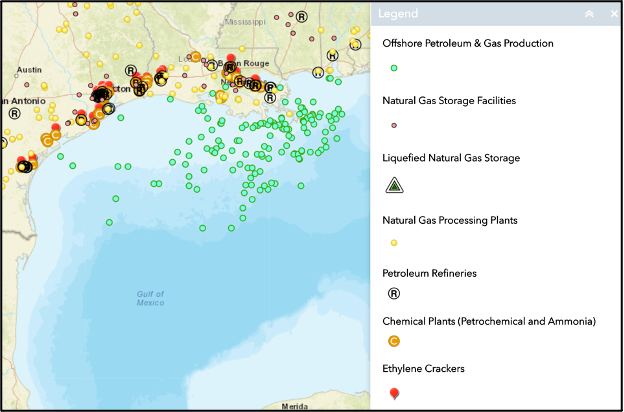
    The risks from industrial facilities are most obvious along the U.S. Gulf Coast, where many major petrochemical complexes are clustered in harm’s way. These refineries, factories and storage facilities are often built along rivers or bays for easy shipping access.

    But those rivers can also bring storm surge flooding that can raise the ocean by several feet during hurricanes. The storm surge from Helene was over 10 feet above ground level in Florida’s Big Bend and over 6 feet in Tampa Bay. With Milton, forecasters warning of a 10- to 15-foot storm surge at Tampa Bay.

    A boom surrounds flooded railcars to try to contain leaks at a chemical plant in Braithwaite, La., after Hurricane Isaac in 2012.
    AP Photo/David J. Phillip

    A recent study found evidence of two to three times more pollution releases during hurricanes in the Gulf of Mexico than during normal weather from 2005 to 2020.

    The effects of these pollution releases fall disproportionately on low-income communities and people of color, further exacerbating environmental health risks.

    Why residents may not hear about toxic releases

    The statistics are disconcerting, yet they get little attention. That is because hazardous releases remain largely invisible due to limited disclosure requirements and scant public information. Even emergency responders often don’t know exactly which hazardous chemicals they are facing in emergency situations.

    The U.S. Environmental Protection Agency requires major polluters to file only very general information about chemicals and on-site risks in their risk management plans. Some large-scale fuel storage facilities, such as those holding liquefied natural gas, are not even required to do that.

    These risk management plans outline “worst-case” scenarios and are supposed to be publicly accessible. But, in reality, we and others have found them difficult to access, heavily redacted and housed in federal reading rooms with limited access. The reason local officials and national scientific review panels often give for the secrecy is to protect the facilities from terrorist attack.

    Oil storage tanks and industrial facilities line the Houston Ship Channel, which is vulnerable to storm surge from Gulf of Mexico hurricanes.
    AP Photo/David J. Phillip

    Adding to this opacity is the fact that many states – including those along the Gulf – suspend restrictions on pollution releases during emergency declarations. Meanwhile, real-time incident notifications from the National Response Center – the federal government’s repository for all chemical discharges into the environment – typically lag by a week or more,

    We believe this limited public information on rising chemical threats from our changing climate should be front-page news every hurricane season. Communities should be aware of the risks of hosting vulnerable industrial infrastructure, particularly as rising global temperatures increase the risk of extreme downpours and powerful hurricanes.

    Mapping the risks nationwide to raise awareness

    To help communities understand their risks, our team at Rice University’s new Center for Coastal Futures and Adaptive Resilience investigates how industrial communities in flood-prone areas nationwide can better adapt to such threats, socially as well as technologically.

    Our interactive map shows where elevated future flood risks threaten to inundate major polluters that we identify using the EPA’s Toxic Release Inventory.

    The U.S. has several hot spots with clusters of flood-prone polluters. Houston’s Ship Channel, Chicago’s waterfront steel industries and the harbors at Los Angeles and New York/New Jersey are among the biggest.

    Three of the biggest hot spots, where large numbers of industrial facilities with toxic materials face elevated future flood risks, are in the Northeast, the northwestern Gulf Coast and the southern end of the Great Lakes.
    Rice University Center for Coastal Futures and Adaptive Resilience, CC BY-ND

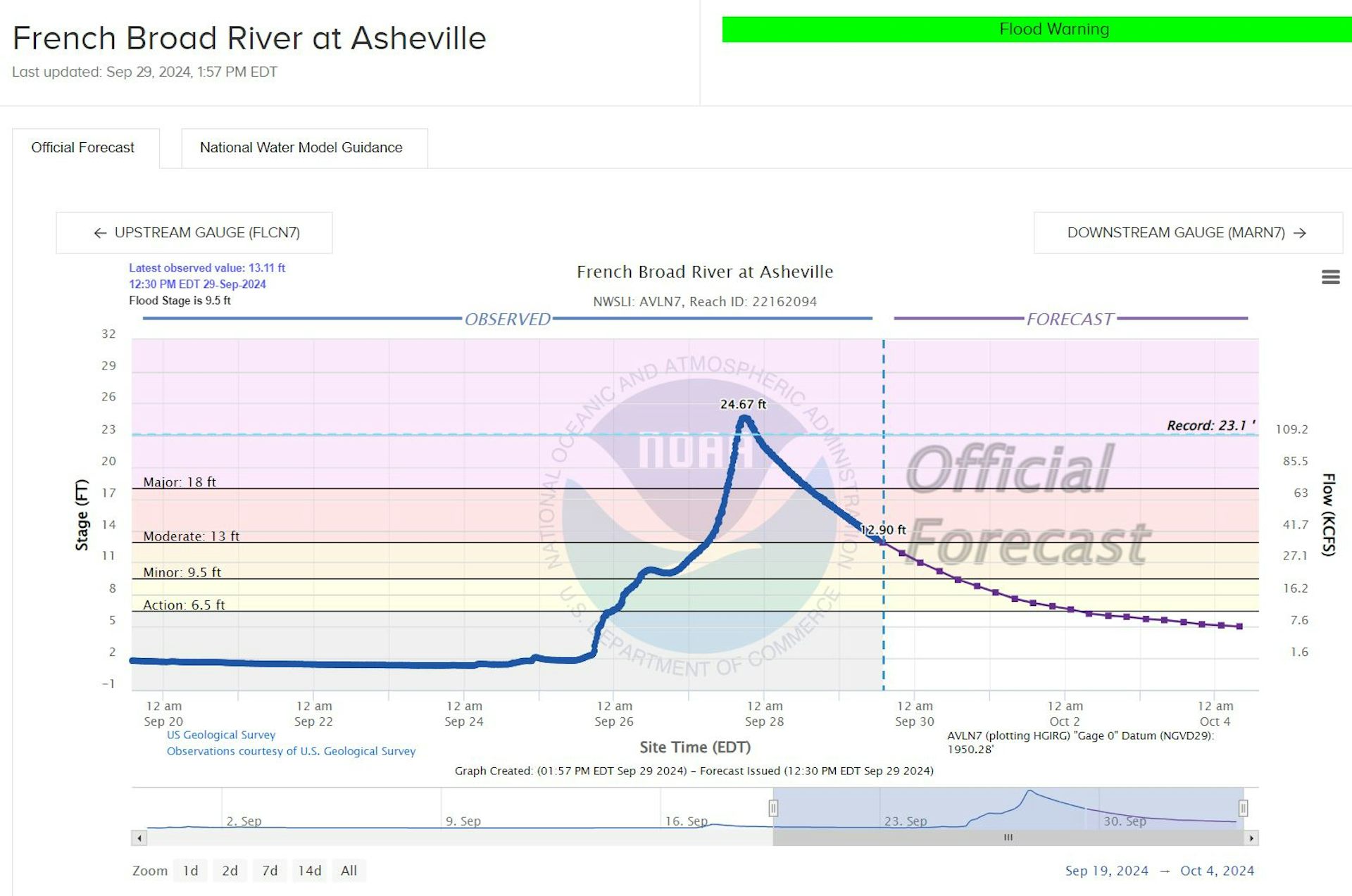
    But, as Helene revealed, there can also be great concern in less obvious spots. Inland, particularly in the mountains, runoff can quickly turn normally tame rivers into fast-rising torrents. The French Broad River at Asheville, North Carolina, rose about 12 feet in 12 hours during Helene and set a new flood stage record.

    When hurricanes and tropical storms are headed for the U.S., our interactive maps show where major polluters are located in the storm’s projected cone of impact. The maps identify hazardous flood-prone facilities down to the address, anywhere in the country.

    Knowledge is the first step

    Knowing where these sites are located is only the first step. Often, it’s up to communities themselves, many of them already overexposed and historically underserved, to raise concerns and demand strategies for mitigating the health, economic and environmental risks that industrial sites at risk of flooding and other damage can pose.

    These discussions can’t wait until a disaster is on the way. By knowing where these risks may be, communities can take steps now to build a safer future.

    This article, originally published Sept. 30, has been updated with Hurricane Milton.

    James R. Elliott receives funding from the National Science Foundation and the National Renewable Energy Lab.

    Dominic Boyer receives funding from the National Science Foundation, NOAA and Texas Sea Grant.

    Phylicia Lee Brown has nothing to disclose.

    – ref. Hurricane Milton: Flooded industrial sites and toxic chemical releases are a silent, growing threat – https://theconversation.com/hurricane-milton-flooded-industrial-sites-and-toxic-chemical-releases-are-a-silent-growing-threat-239977

    MIL OSI – Global Reports –

    January 23, 2025
  • MIL-Evening Report: In Vogue: the 90s was a boom time for Australian fashion and faces. What happened?

    Source: The Conversation (Au and NZ) – By Sasha Sarago, First Nations Cultural Innovation Lead – Beauty and Technology, Charles Sturt University

    The In Vogue: The 90s series transports audiences back to the glamour and grandeur of a transformative decade for fashion. Set against the backdrop of New York, London and Paris, the series explores the rise of supermodels, designer powerhouses and fashion’s global influence. But the fashion scene in Australia – a country that was also enjoying a meteoric rise in international success at the time – does not crack a mention.

    The 1990s marked a golden era for fashion. Supermodels like Linda Evangelista, Naomi Campbell, Cindy Crawford and Christy Turlington became style icons. Designers like Tom Ford, Jean-Paul Gaultier, and John Galliano pushed the boundaries of fashion creating moments that defined the times and influenced everything from pop culture to politics.

    Even though Australia may not have had the runway clout of Paris or New York, the nation was making significant strides in fashion during the same period. Australian designers’ and models’ distinct styles were impressive – giving fashion heavyweights a run for their money.

    So, what went wrong?

    The 90s turned the fashion industry upside down.

    Australian designers, international success

    In the 1990s, Australian designer houses such as Alannah Hill, Collette Dinnigan, Akira Isogawa and Sass & Bide signified Australia’s “coming of age” in fashion, with each designer bringing a unique flair and Australian sensibility to the international market.

    Alannah Hill created a whimsical aesthetic with an edgy twist. Her designs, worn by celebrities Nicole Kidman, Helena Christensen and Courtney Love, earned her a cult following. Business skyrocketed from her Chapel Street boutique in Melbourne to the department stores Selfridges and Browns in London and Bergdorf Goodman and Henri Bendel in Fifth Avenue, New York City.

    In 1996, Collette Dinnigan gained worldwide acclaim as the first Australian designer to showcase her collection at Paris Fashion Week. Dinnigan’s delicate lace dresses and couture craftsmanship found a spotlight at London’s Victoria & Albert Museum’s Fashion in Motion exhibition. Striking while the iron was hot, Dinnigan secured a lingerie collaboration with Marks & Spencer.

    Collette Dinnigan’s designs were celebrated in a 2015 retrospective exhibition.
    4Susie/Shutterstock

    Akira Isogawa, known for his blend of Japanese and Western aesthetics shared his first collection in 1994. He has presented subsequent collections in Paris bi-annually, a legacy sustained since 1998. Innovative from the jump, he turned early constraints to strengths. When the budget for his first big show didn’t stretch to shoes, he sent models down the runway in little red socks. The fashion statement helped him eventually secure more than 50 retail partners.

    Sass & Bide, founded in 1999 by friends Sarah-Jane Clarke and Heidi Middleton, brought a youthful, urban energy from London’s Portobello Road Markets back to Australian shores. Their signature brand quickly gained popularity and was acquired by Myer in a A$42.3 million two-part deal. Australia was no longer a disconnected island but a wild card in the global fashion ecosystem.

    Australian faces and Elaine George’s Vogue cover

    Australian designers weren’t the only superstars gaining fashion fame.

    By the time the supermodel phenomenon etched itself into the fashion zeitgeist, Australian model and businesswoman Elle Macpherson (known then as The Body) was already well known. Australian models Sarah Murdoch, Kristy Hinze, Kate Fisher and Alyssa Sutherland would follow.

    Sarah Murdoch (nee O’Hare, pictured with Anneliese Seubert and Emma Balfour in 1996) graced Australian catwalks in the 90s.
    Patrick Riviere/Getty

    Magazine cover models throughout the 90s showed sun-kissed “girl next door” charm. The exception was Emma Balfour, often touted as Australia’s androgynous counterpart to Kate Moss’s grunge-bohemian look.

    But 1993 produced a turning point in Australia’s beauty paradigm. It was the year Elaine George, Australia’s first Aboriginal fashion model, arrived on the cover of Vogue Australia magazine, making fashion history. Elaine’s presence highlighted the Australian fashion industry’s prioritisation of Eurocentric beauty ideals.

    First Nations beauty and fashion talent urgently needed celebrating. But Vogue’s Australian readers had to wait until October 2000 until Torres Strait Islander singer-songwriter and actress Christine Anu was featured on the cover. The gap showed the stain of underrepresentation and inequity within Australian fashion’s reputation had remained.

    The 2000s, when fashion got much faster

    While the 1990s were a period of optimism and growth for Australian fashion, the momentum failed to continue into the 2000s. Several factors contributed to this decline.

    One of the most significant changes was the rise of fast fashion in the early 2000s. Brands like Zara, H&M and Forever 21 began dominating the global market with affordable, quickly produced garments.

    This shift left many independent designers, including those from Australia, struggling to compete. The slow, meticulous craftsmanship that had defined Australian designers in the 90s could not keep up with the fast-fashion cycle.

    Another challenge was the lack of sustained support for the Australian fashion industry. Unlike New York, London or Paris, which had well-established fashion infrastructures, Australia’s fashion scene was still relatively young. There was no long-term strategy to nurture emerging talent or to promote Australian fashion on a global scale. Many designers either relocated abroad or found it difficult to maintain the same level of success they had achieved in the 90s.

    A new Renaissance?

    The story of Australian fashion in the 1990s is one of promise, yet ultimately missed opportunity. Today, Australia has a chance to enter a new renaissance fuelled by digital innovation and its unique cultures.

    The rise of digital fashion enables Australian designers to break free from the constraints of traditional fashion markets. With virtual clothing (simulated for real wear or digital realms), AI-powered design tools and metaverse runways, Australian creatives can harness technology to showcase their work globally.

    The championing of Indigenous models, designers and multicultural identity is essential. This inclusivity could position Australia as sustainable and ethical fashion innovator and present a compelling alternative to the fast-fashion giants.

    Sasha Sarago does not work for, consult, own shares in or receive funding from any company or organisation that would benefit from this article, and has disclosed no relevant affiliations beyond their academic appointment.

    – ref. In Vogue: the 90s was a boom time for Australian fashion and faces. What happened? – https://theconversation.com/in-vogue-the-90s-was-a-boom-time-for-australian-fashion-and-faces-what-happened-240784

    MIL OSI Analysis – EveningReport.nz –

    January 23, 2025
  • MIL-OSI Economics: IADC Nigeria Chapter Hosts HSE Awards & Technical Session

    Source: International Association of Drilling Contractors – IADC

    Headline: IADC Nigeria Chapter Hosts HSE Awards & Technical Session

    The 2024 IADC Nigeria Chapter HSE Awards and Technical Session was held on 13 September. Chapter Chairman Mr. Chuks Enwereji discussed workplace stress during the event’s safety moment. He then delivered an update on the state of the Nigeria Oil & Gas industry, providing valuable insights into the current landscape. 

    A special mention was given to the Petroleum Training Institute (PTI) IADC Student Chapter, the first of its kind in Nigeria. The chairman celebrated the presence of students from the PTI Student Chapter, recognizing the importance of nurturing future talent. Since its inception, the PTI IADC Student Chapter has organized several initiatives, including technical sessions and inter-level drilling quiz competitions, demonstrating their passion for industry excellence. The PTI Student Chapter extended its deepest gratitude to both IADC Headquarters and the IADC Nigeria Chapter for their continuous support.

    Guest speakers delivered thought-provoking presentations. Mrs. Ihuoma Okorie, CEO of Clintas Energy Resources Limited, addressed the critical topic “Competency Training in the Oil & Gas Industry.” Engr. Mercy Ntuk, HSSE Lead at Unitech Drilling Company Limited, followed with an engaging session on the topic “Developing and Sustain Competency in Critical Roles.” 

    The Chapter honored Member companies that actively participated in the 2023 Incident Statistics Program (ISP), with their reports meticulously analyzed by the HSE Committee. A total of ten companies submitted their 2023 reports, and after careful review, Shelf Drilling Offshore Services Limited emerged as the top performer for their exemplary safety practices. The following companies were recognized:

    • Aviam Offshore Engineering Company Limited
    • Charlvon Limited
    • Depthwize Nigeria Limited
    • Geoplex Drillteq Limited
    • Ocean Deep Drilling ESV Nigeria Limited
    • Pacific International Drilling West Africa Limited
    • Selective Marine Oil and Gas Limited
    • OES Energy Services
    • Unitech Drilling Company Limited
    • Shelf Drilling Nigeria Limited

    The 2024 HSE Awards & Technical Session was a resounding success, bringing together key industry stakeholders, government and regulatory agencies, and directors of  Member companies. It was a vibrant and interactive event filled with enriching presentations, valuable insights, and a strong sense of collaboration within the industry.

    MIL OSI Economics –

    January 23, 2025
  • MIL-OSI Economics: Washington, D.C., Updates for October 2024

    Source: International Association of Drilling Contractors – IADC

    Headline: Washington, D.C., Updates for October 2024

    U.S. House of Representatives Passes Key Legislation Before Campaign Season

    Congress overwhelmingly passed a funding bill last week to avert a government shutdown on September 30th, the end of the U.S. government’s fiscal year. The spending package, negotiated by the House and Senate, would fund the government at current levels through December 20, 2024, setting up another spending fight right before the holidays. The House and Senate have adjourned and will not return to the Capitol until after the elections in November.

    But before they headed back to their districts and states for the final campaign stretch, the House of Representatives approved a number of energy, environment and natural resources bills that will see Senate action when they return.

    The House advanced H.R. 7073, the “Next Generation Pipelines Research and Development Act,” by a vote of 373-41. The bill, out of the Science, Space and Technology Committee, would increase federal research and collaborations related to pipelines.

    During floor debate, bipartisan members heralded the importance of improving aging pipelines that are becoming more prone to malfunction and leaks. Sponsor Representative Randy Weber (R-Texas) said the bill would help the Department of Energy adopt a “new and more modern approach to pipeline research development.” Rep. Zoe Lofgren (D-Calif.), the Science Committee’s ranking member, called the bill “much-needed harm-reduction legislation.”

    The House also advanced H.R. 7370, the “Geothermal Energy Opportunity Act,” from Rep. John Curtis (R-Utah). The bill would establish a deadline for the Interior Department to process geothermal power project applications.

    The House even cleared firebrand Rep. Alexandria Ocasio-Cortez’s H.R. 7422, the “Geothermal Cost-Recovery Authority Act,” so the Interior Department can seek reimbursement from companies to offset the cost of permitting and hire third-party experts to review permits. “At a time when permitting is a contentious word in Washington, this bill shows that both parties can come together around common-sense approaches,” Ocasio-Cortez said.

    Also passed was H.R. 6474, from Rep. Michelle Steel (R-Calif.), which would expedite permitting for geothermal projects in regions with recent energy development or environmental impact studies.

    And a final bill was passed, H.R. 5509, the “Electronic Permitting Modernization Act,” from Rep. Katie Porter (D-Calif.), which would require the Interior Department to modernize its electronic permitting system and expand online options for permits.

    MIL OSI Economics –

    January 23, 2025
  • MIL-OSI Economics: Trade Policy Review: Malawi

    Source: World Trade Organization

    The following documents are available:

    Secretariat report

    A detailed report written independently by the WTO Secretariat.

    Government report

    A policy statement by the government of the member under review.

    From the meeting

    The Secretariat and Government reports are discussed by the WTO’s full membership in the Trade Policy Review Body (TPRB).

    Concluding remarks

    Background

    Trade Policy Reviews are an exercise, mandated in the WTO agreements, in which member countries’ trade and related policies are examined and evaluated at regular intervals. Significant developments that may have an impact on the global trading system are also monitored. All WTO members are subject to review, with the frequency of review depending on the country’s size.

    Share

    MIL OSI Economics –

    January 23, 2025
  • MIL-OSI Economics: US gives USD 600,000 to strengthen trade expertise in developing economies and LDCs

    Source: World Trade Organization

    This new contribution will support developing economies and LDCs in deepening their understanding of WTO agreements and strengthening their ability to engage in trade negotiations at the WTO.

    The United States Ambassador to the WTO, María Pagán, said: “The United States is committed to supporting capacity building activities that strengthen local communities through inclusive, sustainable, and resilient economic growth. Our longstanding commitment to the Global Trust Fund is an important element of our global effort toward supporting sustainable development. We value the work the WTO’s ITTC carries out under the Global Trust Fund and believe it is an excellent example of tangible collaboration and cooperation that supports implementation of the WTO framework of agreements.”

    Welcoming this contribution, WTO Director-General Ngozi Okonjo-Iweala, said: “The longstanding and consistent support of the United States continues to play a vital role in making the WTO’s technical assistance work possible. By equipping government officials from our developing members and observers better use global trade opportunities, these capacity building activities ultimately lead to better livelihoods for their citizens. We appreciate this generous donation to the Global Trust Fund.”

    To date, nearly 3,000 activities have been organized under the Global Trust Fund over the past two decades.

    MIL OSI Economics –

    January 23, 2025
  • MIL-OSI Economics: Ecuador formally accepts Agreement on Fisheries Subsidies

    Source: World Trade Organization

    Director-General Okonjo-Iweala said: “I warmly welcome Ecuador’s formal acceptance of the Agreement on Fisheries Subsidies. As one of the largest tuna exporters in the world and the proud steward of the Galapagos islands, Ecuador stands to gain immensely from this global commitment to curb harmful fisheries subsidies. This Agreement will not only preserve marine biodiversity but will also secure long-term economic opportunities for the nation.”

    Ambassador Valencia said: “It is an honour to present, on behalf of Ecuador, the instrument of acceptance of the Agreement on Fisheries Subsidies, the first WTO instrument that promotes trade regulations while considering the sustainability of the oceans. The acceptance of this Agreement reaffirms Ecuador’s and its government’s firm commitment to promoting the achievement of Sustainable Development Goal 14.6, protecting the life cycles of marine populations, improving the living conditions of citizens who depend on fishing activities—particularly the most economically vulnerable communities—and promoting transparency by prohibiting subsidies to harmful activities such as illegal, unreported, and unregulated fishing.”

    Ecuador’s instrument of acceptance brings to 84 the total number of WTO members that have formally accepted the Agreement. Twenty-seven more formal acceptances are needed for the Agreement to come into effect. The Agreement will enter into force upon acceptance by two-thirds of the membership.

    Adopted by consensus at the WTO’s 12th Ministerial Conference (MC12), held in Geneva on 12-17 June 2022, the Agreement on Fisheries Subsidies sets new, binding, multilateral rules to curb harmful subsidies, which are a key factor in the widespread depletion of the world’s fish stocks. In addition, the Agreement recognizes the needs of developing economies and least-developed countries and establishes a fund to provide technical assistance and capacity building to help them implement the obligations.

    The Agreement prohibits subsidies for illegal, unreported and unregulated (IUU) fishing, for fishing overfished stocks, and for fishing on the unregulated high seas.

    Members also agreed at MC12 to continue negotiations on outstanding issues, with a view to adopting additional provisions that would further enhance the disciplines of the Agreement.

    The full text of the Agreement can be accessed here. The list of members that have deposited their instruments of acceptance is available here. Information for members on how to accept the Protocol of Amendment is available here.

    Share

    MIL OSI Economics –

    January 23, 2025
  • MIL-OSI Economics: DDG Ellard urges swift action on fisheries subsidies to aid Pacific sustainability goals

    Source: WTO

    Headline: DDG Ellard urges swift action on fisheries subsidies to aid Pacific sustainability goals

    Thank you, and good afternoon, distinguished excellencies and to all.
    I appreciate the invitation to engage with you on the pressing environmental challenges confronting the Pacific region, and how a multilateral approach can help tackle those challenges and foster sustainable solutions. 
    Severely affected by the triple planetary crisis of climate change, biodiversity loss, and pollution, the Pacific Islands have a unique understanding of how trade and trade policy can contribute to addressing these challenges. And that’s why I’m so pleased that this discussion is taking place at the WTO.
    Trade is vital for climate adaptation and resilience, because it facilitates the development and dissemination of adaptation technologies, improves access to essential goods and services during climate shocks, and fosters synergies between climate finance and trade aid to bolster supply chains and trade-related infrastructure.
    The participation and leadership of the Pacific Islands at the WTO in addressing environmental challenges is commendable, including through Fiji’s role as a co-coordinator of the Dialogue on Plastics Pollution and Environmentally Sustainable Plastics Trade (DPP).
    I encourage you to continue bringing forward your interests in the Committee on Trade and Environment, as well as in other environmental initiatives at the WTO to ensure that trade policy supports your adaptation and energy transition efforts.
    Let me now turn to the issue of fisheries subsidies.
    I visited the Pacific in 2022 just as two important and complementary events coincided:
    the adoption of the Agreement on Fisheries Subsidies at MC12, and   
    the adoption of the 2050 Strategy for the Blue Pacific Continent by the Pacific Islands Forum Leaders.
    There are many synergies between these two historic achievements, paving the way toward a sustainable, prosperous, and resilient Pacific region.
    As the 2050 Strategy underscores, the Pacific islands countries are the custodians of nearly 20% of the earth’s surface, including vast swaths of ocean.  During my visits to the Pacific, I have witnessed firsthand how the ocean is central not only to the economies of the region, but also to the core identity of its people. Therefore, it is particularly fitting that, through the 2050 Strategy, all Pacific governments have committed to collective action to improve the health of the ocean and prevent the over-exploitation of its resources.
    As we know, the Western and Central Pacific Ocean is home to one of the world’s largest fisheries, supplying more than half of the world’s tuna from predominantly sustainable stocks. However, the sustainability of fishery resources in the Pacific and worldwide, is threatened by harmful subsidies, which total around USD 22 billion annually.
    The WTO Agreement on Fisheries Subsidies is a decisive response to these challenges. It prohibits subsidies to vessels involved in illegal, unreported, and unregulated (IUU fishing), and to fishing in the unregulated high seas. It also restricts subsidies for activities affecting overfished stocks, unless they are implemented to rebuild the stocks to a biologically sustainable level. By enhancing transparency and enforcing these rules, the Agreement promises significant benefits for fishing communities across the region, aligning with the Blue Pacific Strategy.
    However, this potential will be realized only when the Agreement enters into force, which requires ratification by 2/3 of our 166 Members. To date, we have received 83 out of the 111 instruments of acceptance, and our goal is to hit the required target by the end of the year. The process for acceptance is well under way in many WTO Members, and I strongly urge those who have not yet ratified – including in the Pacific, where fisheries are so vital – to do so as soon as possible.
    I should emphasize that ratification unlocks access to the technical assistance and capacity-building from the WTO Fish Fund. We have more than USD 12 million in the bank, in addition to resources provided by the FAO and the World Bank, our partners in the Fund. This Fund will help developing and LDC Members implement the Agreement and improve their fisheries management – the Fund demonstrates the commitment to work closely with developing Members and LDCs every step of the way.
    But we know our negotiating work is not done.  I encourage Members to constructively engage on the ongoing negotiations on fisheries subsidies contributing to overcapacity and overfishing – Fish 2 – which, together with Fish 1, would constitute comprehensive disciplines to fully meet UN SDG 14.6.  As you know, although WTO Members have not reached an agreement on these provisions yet, they did make significant progress, and we are very close. The four-year sunset clause in Fish 1, initially proposed by the Pacific region, creates a powerful incentive to conclude these negotiations quickly. 
    While the current text may not be ideal or perfect for all, most developing and developed Members believe that it would improve the status quo, perhaps with a few adjustments that are well socialized with the Membership.
    The latest version of the new disciplines circulated by the Chair of the negotiations is a balanced approach.  On one hand, it contains strong disciplines on the largest fishers and subsidizers, as well as those engaged in distant water fishing.    
    On the other hand, the text exempts small-scale and artisanal fishing from its disciplines, as well as least developed Members and small fishing nations. It also includes a review clause to assess the effectiveness of disciplines, with the possibility to amend the Agreement later.
    Sustainable fisheries are crucial for the livelihoods of those who depend on them. The adoption and entry into force of both WTO fisheries agreements will therefore go a long way to helping Pacific nations fulfil the commitments in 2050 Strategy.
    I know we can count on the Pacific and all Members for their continued deep and earnest engagement. At this point, concluding Fish 2 will require significant commitment at the highest political level, to complete negotiations on Fish 2, and to ensure the ratification and entry into force of Fish 1. And so much is at stake, for our ocean, the fish, and those whose livelihood depends on them.  Whether we can finish our work is completely in Members’ – your – hands. 
    Thank you.

    Share

    MIL OSI Economics –

    January 23, 2025
  • MIL-OSI USA: Malliotakis Calls for Federal Prosecution of Post Office Vandal

    Source: United States House of Representatives – Congresswoman Nicole Malliotakis (NY-11)

    (STATEN ISLAND, NY) – Congresswoman Nicole Malliotakis today released the following statement after the individual responsible for vandalizing the Great Kills Post Office boxes was arrested:

    “Following yesterday’s vandalism of post office boxes at the Great Kills Post Office, I contacted both the United States Postal Service as well as the NYPD so the boxes could be repainted and the perp pursued. I’m thankful to the NYPD for the quick apprehension of the vandal responsible for this graffiti who has also been previously arrested for defacing other businesses and neighborhoods across Staten Island. We urge the District Attorney to prosecute him to the fullest extent, and would like to see the U.S. Department of Justice prosecute him federally as well, as it’s a felony to willfully damage government property under 18 U.S.C. § 1361. Graffiti not only diminishes the quality of life for all residents, but if gone unpunished, will eventually lead to more serious acts of vandalism and disorder in our community. We continue to work with our government partners to have the boxes restored to their original condition and ensure other acts of vandalism are deterred through strong enforcement and greater vigilance.”

    MIL OSI USA News –

    January 23, 2025
  • MIL-OSI: Blue Hill Doubles Down on Cloak of Secrecy and Unanswered Questions

    Source: GlobeNewswire (MIL-OSI)

    Blue Hill’s Inability to Address Questions About How It Would Pay for or Complete an Acquisition Further Adds to Uncertainty, Risk and Doubt About Its Preliminary Indication of Interest

    Territorial Reiterates Board’s Unanimous Recommendation that Shareholders Vote FOR Hope Bancorp Merger

    Visit http://www.TerritorialandHopeCombination.com for More Information

    HONOLULU, Oct. 09, 2024 (GLOBE NEWSWIRE) — Territorial Bancorp Inc. (NASDAQ: TBNK) (“Territorial”) issued the following statement regarding the presentation released today by Blue Hill Advisors (“Blue Hill”):

    For the fourth time, Blue Hill has failed to address questions that are fundamental in any bank M&A transaction – How will you pay for it? How will you obtain regulatory approval? How will you close it? What are the assurances that you can do all of the above?

    Blue Hill’s inability to address these questions further compounds the concerns associated with Blue Hill’s illusory, non-binding and highly conditional preliminary indication of interest.

    • Blue Hill’s claims about “capital support” and AUM are not committed financing. If Blue Hill is so capable of backing its preliminary indication of interest, why won’t it show proof of financing or even a financing commitment? Why won’t Blue Hill show us the cash? Without financing, Blue Hill’s preliminary indication of interest is simply not real.
    • Blue Hill has provided no information to validate or support its claims that it could obtain the multiple regulatory approvals needed to buy control of a bank. In fact, Blue Hill’s lack of information all but ensures that regulatory applications would be rejected as soon as they were submitted:
      • The identity of many of Blue Hill’s supposed investors remains a hidden secret as does the management team it would put in place to run the Company. Why is Blue Hill refusing to disclose the names of its investors and proposed management team? What is Blue Hill hiding? No regulator – state or federal – would allow an anonymous entity – much less “discrete” secret investors – to gain control of a bank that is responsible for overseeing $1.57 billion1 in deposits.
      • Blue Hill hasn’t provided any information about how it or its investors would address safety and soundness issues regarding interest rate risk, liquidity, capital and earnings, which are paramount to regulators.
      • No information has been provided about Blue Hill’s claimed M&A record, including which companies were involved in those transactions and whether or not they were successful – or went bankrupt.
      • Blue Hill repeatedly names Allan Landon in its materials. However, Mr. Landon is not a stated investor. What is Mr. Landon’s role in Blue Hill’s transaction?
    • Blue Hill has provided no information to give assurance that it understands the regulatory review process. In fact, its own statements make clear that Blue Hill has a fundamentally failed understanding of what it will take to obtain regulatory approval.
      • Purchasing a bank is a complex process. The takeover of an entire bank, as Blue Hill is seeking, is likely a controlled acquisition. The coordinated efforts of six individuals, even if “discrete” would likely be viewed as a group that is “acting in concert.”
      • Blue Hill has not previously applied for — nor secured — regulatory approvals for any transaction of this size based on information it has provided to Territorial.
      • Blue Hill far underplays the significant obstacles it faces in achieving regulatory approvals on a timely basis, if at all.
    • Blue Hill’s belief that it can complete the 70% tender offer it proposed is close to fantasy.
      • Territorial has an approximately 50% retail shareholder base and a highly fragmented institutional investor base.
      • Given these facts, why should anyone believe what Blue Hill is claiming? Once again, where is the documentation to support Blue Hill’s assertions?

    Additional considerations that are important for Territorial shareholders to know:

    • Territorial shareholders will not immediately receive any payment for their shares while any transaction with Blue Hill is sitting in regulatory limbo. Income taxes and the impact of the regulatory delays on time-value-of-money mean that the net value of Blue Hill’s preliminary indication of interest, if completed, would be substantially less than what it has proposed.
    • Blue Hill has provided no assurances that it wouldn’t reduce its proposed value if the Hope Bancorp, Inc. (NASDAQ: HOPE) merger agreement was terminated or following its unspecified “due diligence.” Indeed, Blue Hill has explicitly stated that its indication of interest is “non-binding.”
    • If Blue Hill is so confident in its ability to gain regulatory approval, complete a tender offer and close a transaction, Blue Hill could provide assurances to the Territorial Board and shareholders through a legally binding “hell or highwater” commitment. Yet, once again, Blue Hill is all talk, and no substance.
    • Blue Hill is simply not credible. It was only formed in 2023, has offices in a residential home (which is for rent) and is withholding material information.
    • As a standalone, monoline, one- to four-family loan focused bank, Territorial faces substantial business and regulatory risks – even in a declining interest rate environment. The Company has been operating at a loss over multiple quarters; loan growth is flat; and revenues are declining. These and other factors led to the Board’s decision to reduce the Territorial dividend as well as enter into an agreement with Hope Bancorp. While these challenges would be addressed by the Hope Bancorp merger, Blue Hill offers nothing to deal with these challenges if the Hope Bancorp agreement is terminated. Indeed, with Blue Hill and its undisclosed “discrete” investors, Board and management team, Territorial’s challenges could worsen.

    The Territorial Board continues to unanimously recommend that Territorial shareholders vote FOR the merger with Hope Bancorp and all related proposals.

    The combination with Hope Bancorp provides compelling value for Territorial shareholders. The merger is structured as a 100% tax free, stock-for-stock transaction under which Territorial shareholders will receive 0.8048 shares of Hope Bancorp common stock for each share of Territorial common stock they own. This per share consideration represents an approximately 25% premium2 to Territorial’s closing stock price just prior to the merger announcement. In addition, the transaction has strong implied transaction multiples across all relevant metrics, including earnings per share and adjusted tangible book value per share.

    With Hope Bancorp, Territorial will become a larger, more diversified, more resilient business with increased resources to invest and grow, resulting in increased value for Territorial’s shareholders. Territorial shareholders will also realize a 1000% increase in their dividend. For Territorial stakeholders, the merger also provides meaningful benefits. As stated publicly:

    • Upon close of the transaction, Territorial will continue to operate under the Territorial name.
    • Local branches and operations will be led by local teams, which means Territorial’s customers can benefit from additional choices and rely on the same people they know and respect.
    • Employees will continue to receive competitive compensation and benefits and will have additional career opportunities. 
    • Territorial’s legacy of community support and investment will continue.

    Territorial and Hope Bancorp have initiated the process for all regulatory approvals, and the companies continue on the path to close the transaction by the end of 2024.

    Your Vote is Important

    Territorial Shareholders are Urged to Vote FOR the Hope Bancorp Merger TODAY.

    Voting is quick and easy.
    Vote well in advance of the Special Meeting on November 6, 2024 at 8:30 a.m. HST.

    Call toll-free:
    (888) 742-1305
    Banks and brokers should call:
    (516) 933-3100
    Email: info@laurelhill.com
    Electronically: http://www.proxyvote.com


    About Us

    Territorial Bancorp Inc., headquartered in Honolulu, Hawaiʻi, is the stock holding company for Territorial Savings Bank. Territorial Savings Bank is a state-chartered savings bank which was originally chartered in 1921 by the Territory of Hawaiʻi. Territorial Savings Bank conducts business from its headquarters in Honolulu, Hawaiʻi, and has 28 branch offices in the state of Hawaiʻi. For additional information, please visit https://www.tsbhawaii.bank.

    Additional Information about the Hope Merger and Where to Find It

    In connection with the proposed Hope Merger, Hope has filed with the U.S. Securities and Exchange Commission (the “SEC”) a Registration Statement on Form S-4, containing the Proxy Prospectus, which has been mailed or otherwise delivered to Territorial’s stockholders on or about August 29, 2024, as supplemented September 12, 2024. Hope and Territorial may file additional relevant materials with the SEC. INVESTORS AND STOCKHOLDERS ARE URGED TO READ THE PROXY PROSPECTUS, AND ANY OTHER RELEVANT DOCUMENTS THAT ARE FILED OR FURNISHED OR WILL BE FILED OR FURNISHED WITH THE SEC, AS WELL AS ANY AMENDMENTS OR SUPPLEMENTS TO THOSE DOCUMENTS, CAREFULLY AND IN THEIR ENTIRETY BECAUSE THEY CONTAIN OR WILL CONTAIN IMPORTANT INFORMATION ABOUT THE PROPOSED TRANSACTION AND RELATED MATTERS. You may obtain any of the documents filed with or furnished to the SEC by Hope or Territorial at no cost from the SEC’s website at http://www.sec.gov.

    Forward-Looking Statements

    Some statements in this news release may constitute forward-looking statements within the meaning of Section 27A of the Securities Act of 1933, as amended, and Section 21E of the Securities Exchange Act of 1934, as amended. These forward-looking statements relate to, among other things, expectations regarding the low-cost core deposit base, diversification of the loan portfolio, expansion of market share, capital to support growth, strengthened opportunities, enhanced value, geographic expansion, and statements about the proposed transaction being immediately accretive. Forward-looking statements include, but are not limited to, statements preceded by, followed by or that include the words “will,” “believes,” “expects,” “anticipates,” “intends,” “plans,” “estimates” or similar expressions. With respect to any such forward-looking statements, Territorial Bancorp claims the protection provided for in the Private Securities Litigation Reform Act of 1995. These statements involve risks and uncertainties. Hope Bancorp’s actual results, performance or achievements may differ significantly from the results, performance or achievements expressed or implied in any forward-looking statements. The closing of the proposed transaction is subject to regulatory approvals, the approval of Territorial Bancorp stockholders, and other customary closing conditions. There is no assurance that such conditions will be met or that the proposed merger will be consummated within the expected time frame, or at all. If the transaction is consummated, factors that may cause actual outcomes to differ from what is expressed or forecasted in these forward-looking statements include, among things: difficulties and delays in integrating Hope Bancorp and Territorial Bancorp and achieving anticipated synergies, cost savings and other benefits from the transaction; higher than anticipated transaction costs; deposit attrition, operating costs, customer loss and business disruption following the merger, including difficulties in maintaining relationships with employees and customers, may be greater than expected; and required governmental approvals of the merger may not be obtained on its proposed terms and schedule, or without regulatory constraints that may limit growth. Other risks and uncertainties include, but are not limited to: possible further deterioration in economic conditions in Hope Bancorp’s or Territorial Bancorp’s areas of operation or elsewhere; interest rate risk associated with volatile interest rates and related asset-liability matching risk; liquidity risks; risk of significant non-earning assets, and net credit losses that could occur, particularly in times of weak economic conditions or times of rising interest rates; the failure of or changes to assumptions and estimates underlying Hope Bancorp’s or Territorial Bancorp’s allowances for credit losses; potential increases in deposit insurance assessments and regulatory risks associated with current and future regulations; the outcome of any legal proceedings that may be instituted against Hope Bancorp or Territorial Bancorp; the risk that any announcements relating to the proposed transaction could have adverse effects on the market price of the common stock of either or both parties to the proposed transaction; and diversion of management’s attention from ongoing business operations and opportunities. For additional information concerning these and other risk factors, see Hope Bancorp’s and Territorial Bancorp’s most recent Annual Reports on Form 10-K. Hope Bancorp and Territorial Bancorp do not undertake, and specifically disclaim any obligation, to update any forward-looking statements to reflect the occurrence of events or circumstances after the date of such statements except as required by law.

    Investor / Media Contacts:
    Walter Ida
    SVP, Director of Investor Relations
    808-946-1400
    walter.ida@territorialsavings.net


    1 As of Jun 30, 2024
    2 Based on Territorial and Hope Bancorp’s closing prices as of Apr 26, 2024 (day before merger announcement)

    The MIL Network –

    January 23, 2025
  • MIL-OSI: CORRECTION – HPH Announces Changes to the Board of Directors

    Source: GlobeNewswire (MIL-OSI)

    TGUANGZHOU, China, Oct. 09, 2024 (GLOBE NEWSWIRE) — he board of directors (the “Board”) of Highest Performances Holdings Inc. (NASDAQ: HPH) (“HPH” or the “Company”), today announced a correction to its press release disseminated on October 1, 2024 which announced changes to the board of directors. The original statement regarding the professional experience of the newly appointed Chairperson is entirely replaced and changed to the following: “Since June 2023, Ms. Hang Suong Nguyen has served as the Vice President of WEALTH WILL LIMITED, overseeing operational strategies and driving the company’s capital deployment and growth in multiple emerging markets. Prior to that, from late 2018 until May 2023, she held the position of Sales Director at Trustwell Far East Pte. Ltd., where she was responsible for formulating and executing sales strategies, managing the sales team, analyzing market demands, maintaining customer relationships, and expanding business channels, making significant contributions to the company’s cross-border business. Ms. Nguyen obtained her Bachelor’s degree in International Business from Vietnam National University in 2008 and her Master’s degree in Business Administration from Hanoi University of Science and Technology in 2009.” The rest of the press release remains unchanged. The updated press release follows.

    October 1, 2024 (GLOBE NEWSWIRE) — the board of directors (the “Board”) of Highest Performances Holdings Inc. (NASDAQ: HPH) (“HPH” or the “Company”), today announced the appointment of Ms. Hang Suong Nguyen (“Ms. Nguyen”) as the new chairwoman of the Board, effective from September 30, 2024. Ms. Nguyen will succeed Mr. Chin Hua Peh, who will continue to serve as a director of the Company.

    Ms. Hang Suong Nguyen, Director and the Chairwoman of the Board

    Since June 2023, Ms. Hang Suong Nguyen has served as the Vice President of WEALTH WILL LIMITED, overseeing operational strategies and driving the company’s capital deployment and growth in multiple emerging markets. Prior to that, from late 2018 until May 2023, she held the position of Sales Director at Trustwell Far East Pte. Ltd., where she was responsible for formulating and executing sales strategies, managing the sales team, analyzing market demands, maintaining customer relationships, and expanding business channels, making significant contributions to the company’s cross-border business. Ms. Nguyen obtained her Bachelor’s degree in International Business from Vietnam National University in 2008 and her Master’s degree in Business Administration from Hanoi University of Science and Technology in 2009.

    The Board also announces that Mr. Jidong Luo has decided to resign from the Board as director and chairman of the audit committee due to personal reasons, effective from September 30, 2024.

    The Board has also appointed the following individuals to new roles of the Company, effective from September 30, 2024:

    Dr. Lihong Zhai, as independent director and the chairman of the audit committee;

    Ms. Min Zhou, as independent director and the chairwoman of the nominating and governance Committee; and

    Ms. Yingying Li, as independent director and the chairwoman of the compensation committee.

    Ms. Min Zhou, Independent Director and the Chairwoman of the Nominating and Governance Committee

    Ms. Min Zhou has been an executive director of Tian Ruixiang Holdings Ltd (NASDAQ “TIRX”) since April 2024. Prior to this role, Ms. Zhou worked as an investment manager at Huobi Capital from September 2021 to September 2022, where she developing investment plans and agreements for participating in the negotiation and trading of investment projects. She has rich experience in supervising the operation and development of investment projects. From September 2016 to June 2021, Ms. Zhou was the business development manager of Delta Insurance Brokerage Co. , Ltd. Ms. Zhou has extensive experience in ensuring compliance with securities laws and regulations, protecting shareholders’ interests, as well as participating in the formulation of company strategy and supervising management implementation to promote the company’s long-term development and enhance shareholder value. Ms. Zhou graduated from Hunan University with a bachelor’s degree in mechanical automation.

    Ms. Yingying Li, Independent Director and the Chairwoman of the Compensation Committee

    Since 2022, Ms. Yingying Li has served as the OEM cotton product director at Qinshu (Shanghai) Trading Co., Ltd. From July 2021 to October 2022, Ms. Li served as the general manager of the Product Planning Department at Shanghai Metersbonwe Fashion Co., Ltd., where she had extensive experience in leading the planning team to collect, sort, analyze fashion trends, and develop product strategies based on brand positioning and annual business goals. She also had experience in preparing planning proposals, themes, and quarterly development timetables. From October 2017 to June 2021, Ms. Li served as the manager of the Product Planning Department at E-Land Group. She had extensive experience in leading the planning, design, and production teams in conducting product sketch review, sample review at selection meetings, and pricing work to ensure product completion. Ms. Li graduated from Donghua University with a Master’s degree in textile engineering.

    Following the foregoing changes, our Board consists of eight directors, three of which are independent directors, and is chaired by Ms. Nguyen. Our current directors as of the date of this press release are as follows:

    Name   Position
    Hang Suong Nguyen·   Chairwoman of the board
    Yinan Hu   Vice-Chairman and Chief Executive Officer
    Youjie Kong   Director
    Yong Ren   Director
    Chin Hua Peh   Director
    Lihong Zhai   Independent Director and the Chairman of Audit Committee
    Min Zhou   Independent Director and the Chairwoman of Nominating and Governance Committee
    Yingying Li   Independent Director and the Chairwoman of Compensation Committee
         

    Mr. Yinan Hu, vice-chairman and chief executive officer of HPH, commented: “We would like to extend our warmest welcome to Ms. Nguyen, our new Chairwoman. Ms. Nguyen brings a wealth of industry experience, outstanding leadership, and sharp market insight. I believe her joining will bring new development ideas and opportunities to the Company. Under her leadership, the Company is sure to make great strides in its journey to transform into an intelligent service provider for families and businesses, achieving our mission and making new leaps forward. At the same time, we sincerely thank the outgoing Board member for his valuable contributions to the Company. Together, we will ensure a smooth transition and maintain the momentum of our growth.”

    Ms. Hang Suong Nguyen, chairwoman of HPH, said: “As HPH embarks on its journey of transforming into an intelligent service provider for families and businesses, I look forward to working closely with the Board and management to actively drive the Company’s innovation. By fully leveraging the power of technology, we will build an AI-driven service platform that offers comprehensive and personalized solutions for families and businesses, while also creating greater value for shareholders.”

    Forward-looking Statements
    This press release contains forward-looking statements as defined by the Private Securities Litigation Reform Act of 1995. Forward-looking statements include statements concerning plans, objectives, goals, strategies, future events or performance, and underlying assumptions and other statements that are other than statements of historical facts. When HPH uses words such as “may”, “will”, “intend”, “should”, “believe”, “expect”, “anticipate”, “project”, “estimate” or similar expressions that do not relate solely to historical matters, it is making forward-looking statements. Forward-looking statements are not guarantees of future performance and involve risks and uncertainties that may cause the actual results to differ materially from HPH’s expectations discussed in the forward-looking statements. These statements are subject to uncertainties and risks including, but not limited to, the following: HPH’s ability to obtain proceeds from the Agreement; HPH’s goals and strategies; HPH’s future business development; product and service demand and acceptance; changes in technology; economic conditions; the growth of the third-party wealth management industry in China; reputation and brand; the impact of competition and pricing; government regulations; fluctuations in general economic and business conditions in China and the international markets HPH serves and assumptions underlying or related to any of the foregoing and other risks contained in reports filed by HPH with the Securities and Exchange Commission. For these reasons, among others, investors are cautioned not to place undue reliance upon any forward-looking statements in this press release. Additional factors are discussed in HPH’s filings with the U.S. Securities and Exchange Commission, which are available for review at http://www.sec.gov. HPH undertakes no obligation to publicly revise these forward-looking statements to reflect events or circumstances that arise after the date hereof.

    Highest Performances Holdings Inc.

    The MIL Network –

    January 23, 2025
  • MIL-OSI United Kingdom: Israel must ensure that humanitarian workers can operate safely: UK statement at the UN Security Council

    Source: United Kingdom – Executive Government & Departments

    Statement by Ambassador Barbara Woodward, UK Permanent Representative to the UN, at the UN Security Council meeting on the situation in the Middle East.

    Location:
    United Nations, New York
    Delivered on:
    9 October 2024 (Transcript of the speech, exactly as it was delivered)

    We too wish to extend our congratulations to Tom Fletcher on his appointment as the Emergency Relief Coordinator and again to pay tribute to Martin Griffiths for his outstanding service and to thank Joyce Msuya for her leadership over this period of transition.

    Now more than ever we need strong voices to speak up for the humanitarian community and we look forward to working with Tom Fletcher and his team.

    President, this week marked a sobering milestone. We are now one year on from the events of 7 October 2023 and Hamas’s brutal terrorist attack against Israel; the darkest day in Jewish history since the Holocaust. As my Prime Minister has said, we honour those lost and continue in our determination to ensure the return of those still held hostage.

    Sadly, the anguish did not end on the 7th of October. Each and every day since then, we have seen civilians suffer on a dreadful scale.

    We call upon Hamas and Israel to agree a ceasefire deal which would see the release of the hostages, more aid entering Gaza, and an opportunity to begin the work of reconstruction and progress towards a Palestinian state. We also call upon Hamas to stop endangering civilians.

    With the conflict now having spread into Lebanon, we reiterate our call for an immediate ceasefire between Lebanese Hizbollah and Israel, and for diplomacy to take the place of violence.

    President, while we continue to push for regional de-escalation, it is vital that we do not lose sight of the continuing humanitarian crisis in Gaza.

    Almost 42,000 people have been killed, according to Palestinian health officials. The majority of critical civilian infrastructure is damaged or destroyed. And civilians live in constant fear of air strikes. More women and children have now been killed this year in Gaza than in any other global conflict in the last two decades.

    Despite Israel’s commitment to flood Gaza with aid, the number of humanitarian trucks entering Gaza last month was the lowest we have seen since the start of the year. This is unacceptable and must be addressed immediately.

    Restrictions imposed by Israel have also led to the significant drops in the flow of commercial goods, and these shortages are driving looting and attacks on aid convoys. 

    Humanitarian aid is therefore not reaching those who need it most, particularly in northern Gaza, which is at risk of being completely cut off. As winter approaches, it is critical that Israel takes action to change this. 

    As we have repeatedly said in this Council, Israel must do much more to avoid civilian casualties and ensure the UN and its humanitarian partners can operate safely and effectively.  

    We are concerned by any efforts to undermine the UN or UNRWA, which plays an indispensable role.

    The UK fully supports the Secretary General, UNRWA and the wider UN as they seek to secure peace through diplomacy and help the people of the Middle East. That is why my government restored funding to UNRWA, to support its vital work and to implement the recommendations of the Colonna Report.

    President, what the people of Gaza need more than anything is an immediate ceasefire. We urge Israel and Hamas to return to the table and secure a deal which would achieve this.

    As my Prime Minister has said, the United Kingdom will not falter in our pursuit of peace and our determination to secure a better future for the region.

    Updates to this page

    Published 9 October 2024

    MIL OSI United Kingdom –

    January 23, 2025
  • MIL-OSI USA: Baldwin Brings Home Nearly $190,000 to Support Economic Development in Northeast Wisconsin

    US Senate News:

    Source: United States Senator for Wisconsin Tammy Baldwin
    WISCONSIN – Today, U.S. Senator Tammy Baldwin (D-WI) announced she helped deliver nearly $190,000 to support small businesses, local jobs, and economic development in Oconto and Sheboygan counties. The funding comes through the U.S. Department of Agriculture’s (USDA) Rural Business Development Grants Program which was funded by the Baldwin-backed 2024 annual government funding bill.
    “Moving our Made in Wisconsin economy forward means investing in every corner of our state to create economic opportunity for families,” said Senator Baldwin. “I am proud to go to bat for Wisconsin and deliver funding that will help create jobs, grow local businesses, and build a stronger future for our state.”
    The following projects received funding:
    Sheboygan County Economic Development Corp: $99,000 to establish a revolving loan fund to serve small rural businesses in Sheboygan County. The project will serve at least ten businesses.
    Oconto County Economic Development Corp: $90,000 to provide technical assistance to small, rural businesses located in Oconto County. Assistance will be targeted for those located in the villages of Suring and Lena. At least ten businesses will be served with this assistance, creating five and saving another five jobs.

    MIL OSI USA News –

    January 23, 2025
  • MIL-OSI USA: Sorensen Calls on Congress to Return to Washington to Help Impacted Americans and Pass Disaster Relief

    Source: United States House of Representatives – Congressman Eric Sorensen (IL-17)

    WASHINGTON, DC – Today, Congressman Eric Sorensen (IL-17), the only meteorologist in Congress, is calling on Congress to return to Washington to help impacted Americans and pass much-needed disaster relief as Hurricane Milton makes landfall in Florida and in the aftermath of Hurricane Helene.    

    “As a meteorologist for over two decades, I have witnessed up-close massive floods, tornados, hurricanes, derechos, and other extreme weather events that have destroyed homes, shuttered businesses, and harmed livelihoods. With Milton and Helene, we are seeing these types of hurricanes intensify at a more rapid pace, leaving us with little time to prepare for the road to recovery,” said Sorensen. “Congress has the responsibility to be good neighbors, step in, and help those communities across the country that are struggling to rebuild in the aftermath of natural disasters, including right here in Illinois. I am calling on Speaker Johnson to bring the House back into session, set partisan politics aside, and do the work that the people sent us here to do: help impacted Americans by making sure FEMA and the Small Business Administration have disaster relief funds.”

    While the Federal Emergency Management Agency (FEMA) has stated they have enough funding to meet the needs of Hurricane Helene and Milton victims, the severity of Milton may prevent FEMA from assisting other disaster relief efforts across the nation.  

    In addition to supporting small businesses, the U.S. Small Business Administration (SBA) can issue loans to help homeowners and businesses recover after a disaster. According to the SBA, they have only a few weeks of funding left. 

    Last month, Congress set aside an additional $20 billion for disaster relief in a short-term government funding package through December 20, 2024. Damage from these storms could be in the hundreds of billions of dollars.  

    Congressman Eric Sorensen serves on the House Committee on Agriculture and the House Committee on Science, Space, and Technology. Prior to serving in Congress, Sorensen was a local meteorologist in Rockford and the Quad Cities for nearly 20 years. His district includes Illinois’ Quad Cities, Rockford, Peoria, and Bloomington-Normal.

    ###

    MIL OSI USA News –

    January 23, 2025
  • MIL-OSI New Zealand: Health – GP closures regrettable, get ready for more

    Source: GenPro

    Recent closures of general practices and calls for unprofitable GPs to run cafes to stay afloat are more evidence that communities are paying the price from years of government underfunding of primary health care.

    “While the list of reasons for the closures of Hataitai Medical Practice and North Taranaki’s Parklands Medical Centre could differ, we know there are two common themes – that many general practices are financially unsustainable and struggle to recruit and retain staff,” said Dr Angus Chambers, Chair of the General Practice Owners Association (GenPro).

    “These two symptoms are a direct consequence of a 20-year-old funding model which has not kept pace with the costs of running a general practice and the changing health needs in our communities.”

    More than 2000 Wellington patients will have to find a new doctor next year after the 40-year-old Haitaitai practice closes, and not enough clinical staff can be found to keep open the Parklands centre in Bell Block, so it is closing and merging with another practice seven kilometres away.

    “The closures were announced in the same week we learned that a committee established by Health New Zealand-Te Whatu Ora allegedly told a struggling GP practice to set up a café inside the clinic to bring in extra cash.

    “Closures and desperate measures do nothing to improve and treat the health needs of our patients and keep the doors open on clinics providing medical, urgent and mental health care,” Dr Chambers said.

    A recent survey by General Practice New Zealand, which represents the bulk of primary health organisations, found that more than 60 percent of PHOs had clinics in their networks facing closure, 61 percent were reducing services, and all were restricting patient access. Among reasons given were financial pressures and burnout and retention of GPs.

    “GenPro’s own survey in August also showed that financial pressures were weighing on general practices, with 83 percent concerned about their financial viability.

    “Hardly a month goes by without an announcement of a GP clinic shutting its doors, closures of after-hours services, cessation of new patient enrolments, or some other reduction in scope of services. Regretfully, I predict more of these closures and reductions are on the way unless something changes.”

    “The funding model is based on health attendances from the last millennium, which was a vastly different health environment. Our inability to negotiate funding – because it’s imposed by the government – is the key reason that funding is not keeping pace with rising costs, and general practices are therefore closing.

    “GenPro has lodged a complaint with the Commerce Commission about our inability to have effective input into the decisions crucial to achieving the best outcomes for our patients.
     
    “The government must as a matter of urgency increase its support of primary healthcare, overhaul the current out-of-date funding model, and help increase the supply of medical professionals into primary healthcare,” Dr Chambers said.

    “GenPro, which represents half of all general practices in Aotearoa, is ready to work with the Minister and Commissioner to develop the solutions needed,” Dr Chambers said.

    MIL OSI New Zealand News –

    January 23, 2025
  • MIL-OSI Australia: The new fashion: clothes that help combat rising temperatures

    Source: University of South Australia

    10 October 2024

    A team of international researchers has developed a natural fabric that urban residents could wear to counter rising temperatures in cities worldwide, caused by buildings, asphalt, and concrete.

    As heatwaves become more prominent, cooling textiles that can be incorporated into clothes, hats, shoes and even building surfaces provide a glimpse into a future where greenhouse gas-emitting air conditioners may no longer be needed in our cities.

    Engineers from Zhengzhou University and the University of South Australia say the wearable fabric is designed to reflect sunlight and allow heat to escape, while blocking the sun’s rays and lowering the temperature. They have described the textiles in the latest issue of Science Bulletin.

    The fabric promises to bring relief to millions of city dwellers experiencing warmer and more uncomfortable temperatures caused by global climate change and fewer green spaces.

    UniSA visiting researcher Yangzhe Hou says the fabric leverages the principle of radiative cooling, a natural process where materials emit heat into the atmosphere, and ultimately into space.

    “Unlike conventional fabrics that retain heat, these textiles are made of three layers that are engineered to optimise cooling,” Hou says.

    The upper layer, made of polymethyl pentene fibres, allows heat to radiate effectively. The middle layer, composed of silver nanowires, enhances the fabric’s reflectivity, preventing additional heat from reaching the body. The bottom layer, made of wool, directs heat away from the skin, ensuring that wearers remain cool, even in the hottest urban environments.

    “In our experiment, when placed vertically, the fabric was found to be 2.3°C cooler than traditional textiles, and up to 6.2°C cooler than the surrounding environment when used as a horizontal surface covering.

    “The fabric’s ability to passively reduce temperatures offers a sustainable alternative to conventional air conditioning, providing energy savings and reducing the strain on power grids during heatwaves.”

    Zhengzhou University researchers Jingna Zhang and Professor Xianhu Liu say the technology not only addresses the immediate problem of urban heat islands, but also contributes to broader efforts to mitigate climate change and move towards more sustainable urban living.

    It is hoped the technology could be adapted for even broader applications, including construction material, outdoor furniture and urban planning.

    While the fabric holds significant promise, researchers say the current production process is costly, and the long-term durability of the textiles needs further investigation and government support before it can be commercialised.

    “Whether consumers are willing to pay more for wearable fabrics depend on the cooling effect, durability, comfort and their environmental awareness,” the researchers say.

    …………………………………………………………………………………………………………………………

    Media contact: Candy Gibson M: +61 434 605 142 E: candy.gibson@unisa.edu.au

    Researcher contacts:

    UniSA: PhD candidate Yangzhe Hou E: houyy013@mymail.unisa.edu.au
    Zhengzhou University: Jingna Zhang E: 15138757891@163.com; Professor Xianhu Liu E: xianhu.liu@zzu.edu.cn

    Other articles you may be interested in

    MIL OSI News –

    January 23, 2025
  • MIL-OSI Canada: Government advances Made-in-Canada sustainable investment guidelines and mandatory climate disclosures to accelerate progress to net-zero emissions by 2050

    Source: Government of Canada News

    News release

    The federal government is leading the world with a bold climate plan to grow our economy and reach net-zero emissions by 2050. Achieving this goal will require between $125 billion and $140 billion in investment into Canada every year. As a cornerstone of Canada’s net-zero economic plan, the federal government’s $93 billion suite of major economic tax credits are already available to help attract this investment.

    October 9, 2024 – Toronto, Ontario – Department of Finance Canada

    The federal government is leading the world with a bold climate plan to grow our economy and reach net-zero emissions by 2050. Achieving this goal will require between $125 billion and $140 billion in investment into Canada every year. As a cornerstone of Canada’s net-zero economic plan, the federal government’s $93 billion suite of major economic tax credits are already available to help attract this investment.

    Beyond incentives to attract investment to Canada, investors need robust and transparent guidelines to credibly classify their investments into the clean economy on the path to net-zero. That is why in the 2023 Fall Economic Statement and Budget 2024, the government committed to develop a sustainable finance taxonomy identifying “green” and “transition” investments and to expand the coverage of mandatory climate disclosure requirements to private companies. Moving forward with these commitments is essential for market certainty, for Canada to unlock net-zero investments, and to uphold the Paris climate target of limiting global warming to 1.5°C above pre-industrial levels.

    Today in Toronto at the Principles for Responsible Investment conference, the Honourable Chrystia Freeland, Deputy Prime Minister and Minister of Finance, announced:

    • A plan to deliver Made-in-Canada sustainable investment guidelines; and,
    • Mandatory climate-related financial disclosures for large, federally incorporated private companies.

    The Made-in-Canada sustainable investment guidelines will become an important, voluntary tool for investors, lenders, and other stakeholders navigating the global race to net-zero by credibly identifying “green” and “transition” economic activities. These guidelines will provide the certainty needed to accelerate the flow of private capital into sustainable activities across the Canadian economy. From building electric vehicle batteries, to generating clean energy, to decarbonizing emissions-intensive heavy industries, these guidelines will identify job-creating activities in a way that is scientifically credible and aligned with limiting global temperature rise to 1.5°C above pre-industrial levels. The Canadian taxonomy will be developed and governed by an external, third-party organization(s).

    To attract more private capital into Canada’s largest corporations and ensure Canadian businesses can continue to effectively compete as the world races towards net-zero, the government is also moving forward with mandating climate-related financial disclosures for large, federally incorporated private companies. These disclosures will help investors better understand how large businesses are thinking about and managing risks related to climate change, ensuring that capital allocation aligns with the realities of a net-zero economy. Specifically, the government intends to bring forward amendments to the Canada Business Corporations Act that will require these disclosures. The government will launch a regulatory process to determine the substance of these disclosure requirements and the size of private federal corporations that would be subject to them. As small- and medium-sized businesses will not be subject to the requirements, the government is considering ways to encourage those businesses to voluntarily release climate disclosures, if they wish.

    The federal government is ready to work with provincial and territorial partners to ensure broad disclosure coverage across the Canadian economy. The government will seek to harmonize its regulations with those that will be required from public companies by securities regulators. More details will be released in due course.

    These two sustainable finance initiatives will mobilize further private sector capital towards activities essential to building a net-zero economy. More private sector capital will enable businesses to grow the economy, create more good-paying jobs for Canadians, and boost their resiliency against the risks posed by climate change.

    In addition to these announcements, today, the federal government successfully issued an additional $2 billion in green bonds, through a re-opening of Canada’s second green bond issued in February.

    Together, today’s progress is about building a flourishing Canadian sustainable finance industry and sending a clear signal to corporate boards and shareholders, at home and around the world, that Canada is their trusted partner for putting private capital to work in the race to net-zero.

    Quotes

    “In the 21st century, a competitive economy is a net-zero economy. We are seizing Canada’s economic advantages to attract investment and ensure Canadian workers benefit their fair share in the global race to net-zero. Today’s release of a path for Made-in-Canada sustainable investment guidelines and climate disclosures from large companies will accelerate the flow of private capital into Canada, in turn growing our economy, creating good jobs, and advancing our progress to net-zero emissions by 2050.”

    The Honourable Chrystia Freeland, Deputy Prime Minister and Minister of Finance

    “Building a cleaner economy is not only an environmental imperative, it is a major economic opportunity. The development of a sustainable investment taxonomy, paired with heightened transparency on climate disclosures, amounts to an important stepping stone for Canada on the path towards that cleaner economy. These initiatives will help mobilize needed private sector financial flows to build a cleaner economy and give investors who are looking for the sustainable option the clear direction they seek.”

    The Honourable Steven Guilbeault, Minister of Environment and Climate Change

    “Canadian workers and businesses are already attracting historic investment in areas such as clean energy, critical minerals, and electric vehicles, and seeing the associated benefits for job creation and economic growth. With changes announced today, investors will have more certainty that companies are taking real and serious action to address the climate crisis and drive down emissions, while building a strong economy.”

    The Honourable Jonathan Wilkinson, Minister of Energy and Natural Resources

    “Fighting climate change as well as protecting the economy and Canadians from the costs of climate inaction is a priority for our government. It’s important to send a clear signal to Canadian companies and organizations that climate risks and opportunities are critical to integrate into corporate culture and decision making, and that’s what we’re doing.”

    The Honourable François-Philippe Champagne, Minister of Innovation, Science and Industry

    “Creating a financial system that is sustainable and globally competitive is essential for Canada’s economic future. In order to compete both at home and abroad, we are moving forward with sustainable investment guidelines and mandatory climate disclosures to help provide credibility, accountability, and transparency in the marketplace. These are essential conditions for investors and companies to fill the investment gap necessary to meet the climate challenge while seizing generational opportunities for clean prosperity.”

    Ryan Turnbull, Parliamentary Secretary to the Deputy Prime Minister and Minister of Finance and to the Minister of Innovation, Science and Industry

    Quick facts

    • In Budget 2024, the federal government committed to provide an update by the end of 2024 on the development of Made-in-Canada sustainable investment guidelines, in recognition that promoting credible climate investment and combatting greenwashing are critical to fostering investor confidence and mobilizing the private investment Canada needs to achieve net-zero by 2050. 

    • In the 2023 Fall Economic Statement, the federal government committed to develop options for making climate disclosures mandatory, as part of expanding mandatory climate disclosures across the Canadian economy. It also first announced the government’s commitment to developing a Made-in-Canada taxonomy. 

    • The development of a Made-in-Canada sustainable finance taxonomy and regulations to require climate disclosures from large companies builds on the important work done by the Sustainable Finance Action Council.

    • The federal government is investing over $160 billion in its net-zero economic plan, including through a $93 billion suite of tax credits for major economic investments in:

      • Carbon capture, utilization, and storage;
      • Clean technology;
      • Clean hydrogen;
      • Clean technology manufacturing;
      • Clean electricity; and,
      • Electric vehicle (EV) supply chains.
    • In addition to tax credits for major economic investments, the federal government is attracting net-zero private sector investment by:

      • Catalyzing private investment in low-carbon projects, technologies, businesses, and supply chains through the $15 billion Canada Growth Fund, which has already invested over $2 billion across eight deals, including three novel Carbon Contracts for Difference;
      • Leveraging at least $20 billion from the Canada Infrastructure Bank to build major clean electricity and clean growth infrastructure projects;
      • Securing Canada’s advantage as the world’s supplier of choice for critical minerals and the clean technologies they enable, by further developing supply chains through a $3.8 billion Critical Minerals Strategy; and,
      • Building more clean, affordable, and reliable power, and supporting innovation in electricity grids, including offshore wind, through the $3 billion recapitalization of the Smart Renewables and Electrification Pathways Program.
    • The third-party, arm’s-length organization(s) will further develop and implement the taxonomy.

    • The Department of Finance, Environment and Climate Change Canada, and Innovation, Science and Economic Development Canada will work together to make the required legislative and regulatory changes for mandatory climate disclosures.

    Related products

    Associated links

    Contacts

    Media may contact:

    Katherine Cuplinskas
    Deputy Director of Communications
    Office of the Deputy Prime Minister and Minister of Finance
    Katherine.Cuplinskas@fin.gc.ca

    Media Relations
    Department of Finance Canada
    mediare@fin.gc.ca
    613-369-4000

    General enquiries:

    Phone: 1-833-712-2292
    TTY: 613-369-3230
    E-mail: financepublic-financepublique@fin.gc.ca

    Stay Connected

    MIL OSI Canada News –

    January 23, 2025
  • MIL-OSI Canada: Government advances Made-in-Canada sustainable investment guidelines to accelerate progress to net-zero emissions by 2050

    Source: Government of Canada News

    Backgrounder

    The Government of Canada supports the development of voluntary Made-in-Canada sustainable investment guidelines (otherwise known as a taxonomy) that would categorize investments based on scientifically determined eligibility criteria that are consistent with the goal of reaching net-zero emissions by 2050 and limiting global temperature rise to 1.5°C above pre-industrial levels.

    October 9, 2024

    The Government of Canada supports the development of voluntary Made-in-Canada sustainable investment guidelines (otherwise known as a taxonomy) that would categorize investments based on scientifically determined eligibility criteria that are consistent with the goal of reaching net-zero emissions by 2050 and limiting global temperature rise to 1.5°C above pre-industrial levels.

    This is a high standard that will be important for building and maintaining the credibility of a Canadian taxonomy, which will mobilize private capital for low- or non-emitting activities with a “green” category.

    Importantly, the Canadian taxonomy would also establish a “transition” category to identify, and boost funding for, scientifically credible pathways to rapidly decarbonize Canada’s emissions-intensive sectors. Canada’s leadership in the transition aspect of taxonomy will be a notable and valuable contribution to the international dialogue on transition finance.

    The development of the metrics-based Canadian taxonomy would first focus on the following sectors for the Canadian economy: electricity, transportation, buildings, agriculture and forestry, manufacturing, and extractives, including mineral extraction and processing, and natural gas. A taxonomy for two to three priority sectors will be released within 12 months of the arm’s-length, third-party organization(s) beginning its work.

    Once finalized, the Canadian taxonomy would be available for entities such as financial institutions, lenders, and companies to use on a voluntary basis. It would not be mandatory.

    Details of the Canadian Taxonomy

    This backgrounder outlines the government’s expectations for the development and implementation of the Canadian taxonomy, including:

    1. Guiding Principles
    2. Defining green and transition investments
    3. Priority Sectors
    4. Company-level expectations
    5. Governance and Funding

    Background on Taxonomy

    To close the climate financing gap, financial market participants, including banks, insurers, pension plans and asset managers, have indicated that they need clarity about what economic activities are considered “green” or “transition.” A taxonomy is a tool that can provide this clarity by promoting a shared understanding or classification system that defines or categorizes these activities.

    Like the proposed Canadian taxonomy, many international taxonomies also use detailed eligibility criteria, anchored in climate science, to support the taxonomy’s credibility among international investors. These eligibility criteria often involve the use of performance-based metrics and thresholds to demonstrate what economic activities are aligned with pathways to limiting global temperature rise to 1.5°C above pre-industrial levels, in line with the Paris Agreement. These taxonomies likewise aim to preserve interoperability with other jurisdictions to reflect the global nature of financial and capital markets.

    A taxonomy supports a wide range of use cases. For example, taxonomies can be used to set standards for classifying climate-related financial instruments (e.g., bonds or loans), and/or to evaluate the green or transition credentials of financial instruments and issuers.
    The aim of the Canadian taxonomy would be to mobilize investment in support of Canada’s net-zero transition by enabling investors to understand and communicate which key activities and investments will deliver a Canadian net-zero economy.

    Over 40 jurisdictions worldwide are developing or have implemented taxonomies, which generally are calibrated to a particular country’s domestic economic reality and priorities. This is an opportunity to develop a Made-in-Canada taxonomy that aligns with Canada’s net-zero pathways and drives transformational investments within Canada’s economy that will also create good-paying, sustainable jobs.

    The Sustainable Finance Action Council (SFAC), which was composed of 25 of Canada’s leading deposit-taking institutions, insurance companies, and pension funds, was launched by the Government of Canada in May 2021 to help lead the Canadian financial sector towards integrating sustainable finance into standard industry practice. The SFAC’s recommendations on taxonomy, including its Taxonomy Roadmap Report, have been important inputs for informing the Government of Canada’s next steps on taxonomy. The Government of Canada thanks the SFAC for its advice on taxonomy and its valuable contribution to building a sustainable finance market in Canada throughout its mandate, which concluded on March 31, 2024.

    i. Guiding Principles

    The Canadian taxonomy would be developed and maintained in accordance with the following principles (Guiding Principles), which draw from the recommendations of the SFAC and international organizations, as well as from international taxonomy precedents.

    These Guiding Principles are intended to ensure that the Canadian taxonomy fulfills its objective of being a credible and usable tool for financial market participants and others to identify green and transition investments.

    Guiding Principles

    • Usable

      Mobilize capital toward the net-zero transition.

    • Credible

      Clear, rigorous, and credible science-based criteria that align with limiting global temperature rise to 1.‍5°C above pre-industrial levels, with no or low overshoot and all relevant emissions scopes considered.​ Any activity which receives the green or transition taxonomy label must be scientifically defensible as being aligned with this.

    • Comprehensive

      Cover transition and green activities that make a material positive contribution to climate change mitigation, addressing high-emitting sectors.

    • Interoperable

      Be interoperable and broadly compatible with other major science-based taxonomies and frameworks globally, while reflecting Canada’s own economic context.

    • Transparent

      A governance structure that is transparent, efficient, adaptive, and results-oriented; safeguards scientific integrity; and engages with key stakeholders, including provincial and territorial governments, civil society, financial market participants, industry, and Indigenous partners.

    • Dynamic

      A built-in review process to ensure the Canadian taxonomy is updated as the landscape evolves.

    • Holistic

      Do-No-Significant-Harm criteria addressing environmental, social, and Indigenous objectives.

    ii. Defining green and transition investments

    At a high level, the Canadian taxonomy would define which economic activities are green or transition in line with SFAC recommendations, as follows:

    • Green: low-or zero-emitting activities, such as green hydrogen, solar, and wind energy generation, or those that enable them, such as electricity transmission lines and hydrogen pipelines; and,
    • Transition: decarbonizing emission-intensive activities that are critical for sectoral transformation and consistent with a net-zero, 1.5°C transition pathway, such as installing lower-emitting (electric) furnaces to produce steel.

    Activities are expected to be classified according to a categorization framework to be confirmed and operationalized. The figure below shows an example of such a framework proposed by the SFAC.

    SFAC Taxonomy Roadmap Report Categorization Framework

    For clarity, in this framework:

    Green activities are expected to be those that:

    • Do not have material scope 1 and 2 emissions;
    • Have low or zero downstream scope 3 emissions; and,
    • Sell into or benefit from markets that are expected to grow in the global
      net-zero transition.

    Transition activities are expected to be those that:

    • Have material scope 1 and 2 emissions but make significant emission reductions;
    • Have low or zero scope 3 emissions; and,
    • Do not create carbon lock-in and path dependency.

    As well as activities that:

    • Have material scope 3 emissions but significantly reduce their scope 1 and
      2 emissions;
    • Do not face immediate demand-side risk (i.e., market contraction); and,
    • Have lifespans proportionate to when global demand for their products is expected to decline.

    iii. Priority Sectors

    The initial phase of taxonomy development would focus on developing eligibility criteria for the following priority sectors. A taxonomy for two to three priority sectors will be released within 12 months of the arm’s-length, third-party organization(s) beginning its work. The final determination of eligible activities would rest with the third-party organization(s) which will develop, implement, and maintain the Canadian taxonomy, and align with the guiding principles, including scientific credibility and alignment with limiting global warming to 1.5°C:

    Electricity, which could include activities related to low- and zero-emitting electricity generation, electricity storage, and grid infrastructure improvements.

    Transportation, which could include low- and zero-emitting passenger and freight transportation activities in a variety of transportation modes (e.g., road, rail, marine transport) as well as enabling infrastructure (e.g., electric vehicle charging).

    Buildings, which could include the construction and operation of high-performance buildings, the retrofitting of buildings to improve their performance, and the installation of equipment to reduce the emissions of buildings and their occupants.

    Agriculture and Forestry, which could include the sustainable production of crops and livestock, activities to decarbonize agricultural production, and the planting, sustainable management, and restoration of forests.

    Heavy Industry:

    These important sectors of the Canadian economy have been prioritized based on the following criteria:

    • Anticipated future levels of green and transition investment opportunity, including as assessed by market participants;
    • Importance of their decarbonization for decarbonizing the Canadian economy, based on current sectoral emissions and projections of future emission reductions; and
    • Economic significance to Canada, including current levels of investment and economic activity.

    Further below is a list of examples of activities within these sectors that may be eligible for a green or transition taxonomy label, subject to the development of activity-specific performance criteria and Do-No-Significant-Harm requirements.

    iv. Company-level expectations

    The Government of Canada supports the adoption of net-zero targets, credible transition plans, and robust climate disclosures by Canadian companies. These are key infrastructure elements of a robust sustainable finance market and are essential to achieving net-zero goals, fostering transparency, and enabling informed decision-making.

    The Government of Canada has committed to moving towards mandatory climate-related financial disclosures across a broad spectrum of the Canadian economy. Mandatory disclosure requirements are already in place for federal Crown corporations and federally regulated financial institutions. The Government of Canada intends to bring forward amendments to the Canada Business Corporations Act to enable climate-related financial disclosure requirements for large, federally incorporated private companies.

    The Government of Canada encourages the developers of the taxonomy to consider including these company-level requirements as part of the eligibility criteria for green and transition labelling in the Canadian taxonomy, in line with SFAC’s recommendations.

    Potential Company-Level Actions for Taxonomy Users

    • Net-Zero Targets

      A commitment to reach net-zero emissions by 2050 or earlier, usually with interim targets.​

    • Credible Transition Plans

      A strategy that lays out the company’s targets, actions, and/or resources for its transition toward a lower-carbon economy, including actions such as reducing its greenhouse gas emissions.​

    • Robust Climate Disclosure

      The provision of information about a company’s climate-related governance, risk management, strategy, and metrics and targets.​

    v. Governance and Funding

    Developing a taxonomy requires significant climate science and sectoral expertise and engagement with stakeholders, including financial market participants, industry, civil society, governments, regulators, and Indigenous partners. In addition, good governance practices are needed to oversee the development and implementation of a Canadian taxonomy that safeguards scientific integrity and meets market needs. The guiding principle of scientific credibility will ensure that the taxonomy’s green and transition labels are only applied to activities that are in line with the goal of limiting global warming to 1.5°C with no or limited overshoot.

    The Canadian taxonomy would be developed, implemented, and maintained at arm’s length to the Government of Canada by an organization or organizations external-to-government.

    The final determination of guiding principles, eligible activities, priority sectors and company-level expectations would rest with the external-to-government organization.

    The Government of Canada would contribute funding to support the technical work to develop the eligibility criteria for the taxonomy.

    Examples of Potential Taxonomy Eligible Activities

    Under the Canadian taxonomy, a range of economic activities that contribute to Canada’s net-zero transition will be eligible for a “green” or “transition” label, which, for example, could be used in the context of labelled bond issuances. Not all economic activities will be eligible.

    Through a survey of international taxonomies, the following examples of activities in priority sectors that may be eligible for a green and/or transition label were identified. These examples are in no way intended to direct the work of the arm’s length organization or organizations who will develop, implement, and maintain the Canadian taxonomy, who would make final determinations with respect to the inclusion of and criteria for these example activities, in line with the guiding principles, including alignment with limiting global warming to 1.5°C. As such, these examples should be considered indicative only, not prescriptive.

    It is expected that activity-specific performance criteria would be developed for each activity included in the Canadian taxonomy along, with Do-No-Significant-Harm requirements, to define the circumstances under which that activity would be eligible for green or transition labelling. That is, only some forms of a given activity might be eligible while other forms of the same activity might be ineligible. Some forms of an eligible activity may be green-eligible while other forms would be transition-eligible. As such, the examples below show activities that may  be eligible, subject to activity-specific criteria and Do-No-Significant-Harm requirements.

    These examples are not intended to be exhaustive. The international taxonomies surveyed to identify these examples reflect the economic and net-zero transition needs of other jurisdictions, which may be different from those of Canada, so it is to be expected that the Canadian taxonomy could break new ground and include sub-sectors or activities not covered in these examples. For example, it could include green and transition activities in the agricultural sector such as certain forms of crop and livestock agriculture.

    In consideration of Canada’s economic makeup, the taxonomy could potentially include activities that significantly reduce the emissions of existing natural gas production and/or the emissions associated with a limited buildout of existing production sites. The technical drafters may also consider a broad range of possible eligibility criteria for existing natural gas production, such as the displacement of more polluting fuels internationally, provided they are aligned with limiting global temperature rise to 1.5°C above pre-industrial levels. Based on the Guiding Principles, the Government does not anticipate new natural gas production to be eligible. The final determination of eligible activities across all sectors will be made by the arms length, external organization(s).

    In the electricity sector, examples of potentially eligible green or transition activities include:

    • Co-generation of heating or cooling and electricity from solar energy;
    • Electricity generation from bioenergy;
    • Electricity generation using concentrated solar power (CSP) technology;
    • Electricity generation from geothermal energy;
    • Electricity generation from hydropower;
    • Electricity generation from ocean energy technologies;
    • Electricity generation using solar photovoltaic technology;
    • Electricity generation from wind power;
    • Storage of electricity; and,
    • Transmission and distribution of electricity.

    In the transportation sector, examples of potentially eligible green or transition activities include:

    • Low carbon transport infrastructure, such as electric vehicle charging.
    • Zero-emission and low-emission operations of the following modes of transportation:
      • Air transport, including ground handling operations;
      • Freight transport by road;
      • Inland water transport;
      • Road passenger transport;
      • Sea and coastal water transport;
      • Railway transport; and,
      • Urban and suburban passenger land transport.

    In the buildings sector, examples of potentially eligible green or transition activities include:

    • Acquisition and ownership of low-emitting and energy-efficient buildings;
    • Construction of low-emitting and energy-efficient new buildings;
    • Installation of energy efficiency equipment;
    • Installation of renewable energy technologies; and,
    • Renovation of existing buildings to reduce emissions and/or improve energy efficiency.

    In the agriculture and forestry sectors, examples of potentially eligible green or transition activities include:Footnote 1

    • Afforestation;
    • Conservation, restoration, and maintenance of natural forests; and,
    • Sustainable forest management.

    In the heavy industry sector, examples of potentially eligible green or transition activities include:

    • The low-emission or energy-efficient manufacturing of:
      • Aluminum;
      • Basic chemicals, such as ammonia, aromatics BTX, carbon black, chlorine, nitric acid, and soda ash;
      • Cement;
      • Hydrogen;
      • Iron and steel; and,
      • Plastics in primary form.
    • The manufacturing of:
      • Batteries;
      • Energy efficiency equipment for buildings, such as energy-efficient appliances and light sources, energy-efficient HVAC systems, heat pumps, and energy-efficient building automation and control systems;
      • Equipment for the production of hydrogen through electrolysis;
      • Low-carbon technologies for household sector;
      • Low-carbon technologies for transport, such as low-carbon vehicles that meet transportation sector criteria; and,
      • Renewable energy technologies.
    • The mining of:Footnote 2
      • Copper;
      • Iron ore;
      • Lithium; and,
      • Nickel.

    Footnotes

    Footnote 1

    The list of examples for this sector is limited as some existing green and transition taxonomies, such as the EU taxonomy, do not address agricultural activities. Developing credible eligibility criteria to help drive decarbonization in the agriculture sector could be a priority in Canadian taxonomy development.

    Return to footnote 1 referrer

    Footnote 2

    It is possible that the Canadian taxonomy would include a broader range of minerals based on Canada’s mineral resources and transition needs, which are laid out, for example, in the Canadian Critical Minerals Strategy.

    Return to footnote 2 referrer

    MIL OSI Canada News –

    January 23, 2025
  • MIL-OSI Security: Defense News: SECNAV Del Toro As-Written Remarks at the San Francisco Fleet Week Senior Leaders Seminar

    Source: United States Navy

    Introduction/Thank you

    Good afternoon, everyone! It is an honor to be here onboard USS Tripoli (LHA 7) for the start of San Francisco Fleet Week and this Senior Leader Seminar.

    Mr. Loeven, thank you for inviting me for this wonderful occasion and for providing me with the opportunity to say a few words.

    Captain Harrington, thank you for hosting us here on your ship—this incredible instrument of American naval power and a phenomenal example of our Navy-Marine Corps team.

    Representative Garamendi, it’s wonderful to see you. Thank you for joining us, and for your steadfast partnership and advocacy for our Sailors and Marines in Congress.

    Ambassador Romualdez, it is wonderful to see you. Thank you for your ongoing efforts to strengthen the critical partnership between our nations.

    Lieutenant General Cederholm, thank you for your leadership and guidance of our Marines and Sailors at One MEF.

    Vice Admiral Downey, Ms. Forbes, Mr. Wunderman, Mr. Vaca, and Mr. Gonzales, thank you for being part of the panel in a few minutes to discuss how the Bay Area can work with us to restore our national maritime industry.

    To the rest of our distinguished guests and panelists in later sessions, thank you for coming.

    It truly is wonderful to be back here in San Francisco.

    San Francisco holds a special place in my heart—when I was a student at the Naval Postgraduate School in Monterey, my wife Betty and I would often make the drive up to the city with our kids.

    History

    This city’s rich maritime and naval history and tradition is worth celebrating, not just annually during Fleet Week, but yearlong.

    San Francisco Bay once hosted an extensive Naval presence from Port Chicago to Treasure Island, and two major Naval shipyards—Hunters Point and Mare Island.

    Mare Island Naval Shipyard was the first U.S. Navy base established on the Pacific coast and, in the middle of last century, was the only shipyard on the West Coast that built nuclear submarines.

    In fact, the first commanding officer of Mare Island Naval Shipyard—indeed the man hand selected by the 22nd Secretary of the Navy, James Dobbin to establish the shipyard—was also our Navy’s first Admiral, and our first Hispanic-American Admiral, David Glasgow Farragut.

    I think he’s a little more famous for his service during the Civil War, but I would submit that his work creating a basing and repair station on the West Coast for the Navy had nearly as profound an impact on the future of our Navy and our Nation.

    And during World War I, the Union Iron Works Shipyard south of the Embarcadero built cruisers, submarines, and battleships and during World War II, nearly two thirds of Liberty and Victory ships were built in the Bay area.

    On a more somber note, I was most recently here in July for the 80th commemoration of the Port Chicago Disaster.

    If any of you are unfamiliar with the story, 258 African-American Sailors were wrongfully and shamefully labeled as criminals for refusing to work in unsafe conditions during World War II.

    Thanks to the work of my General Counsel, Mr. Sean Coffey, and his military assistant Captain Justin Pilling, I was able to make the decision in July to set aside the court martial results of all Sailors convicted as part of the Port Chicago incident.

    That action was about more than correcting the historical record.

    It was and is a resounding affirmation of the values we, as Americans, hold dear—justice, equality, and the right to a safe workplace.

    The legacy of the Port Chicago Sailors should inspire us all to be more vigilant, to speak truth to power, and to never give up on the pursuit of liberty and justice.

    San Francisco has long been a key part of our nation’s maritime industry—and our naval heritage.

    And while we don’t currently build naval ships here, our relationships with industry here and academic partnerships through the Naval Postgraduate School are integral to developing the fleet of the future.

    World Today

    The world our nation faces today is much different than when I was sworn in as Secretary of the Navy in August 2021, much less during my career on active duty or the end of World War II.

    In Europe, the unprovoked and illegal Russian invasion of Ukraine continues—and is now well into its third year.

    This conflict poses a direct threat to European security and the principles of democracy and sovereignty upon which our international order is built.

    In July, we, alongside our NATO allies, convened in Washington to reaffirm our unwavering support for Ukraine.

    We stand united in our commitment to helping Ukraine defend its sovereignty and territorial integrity, recognizing that their struggle is not just for their own freedom but for the preservation of democracy worldwide.

    Beyond the European theater, for the first time since World War II, we face a comprehensive maritime power—our pacing challenge—in the Indo-Pacific.

    The People’s Republic of China continues to assert its unlawful maritime claims through its naval, coast guard, and maritime militia forces.

    I can assure you that the PRC is watching the ongoing conflicts in Europe and the Red Sea closely and drawing valuable lessons for its own strategic ambitions.

    In the Red Sea and Gulf of Aden, we have been working tirelessly alongside our NATO allies and Middle Eastern partners to protect innocent civilian mariners and commercial shipping from Iranian-aligned Houthi attacks.

    Following the October 7th attacks in Israel one year ago this week, our Navy and Marine Corps were swiftly deployed to the region, forming a formidable and integrated force capable of responding to any threat.

    Carrier Air Wing Three, our “Battle Axe,” played a pivotal role in protecting civilian mariners, deploying over sixty air-to-air missiles and over 420 air-to-surface weapons.

    The Bataan Amphibious Ready Group, with the embarked 26th Marine Expeditionary Unit, made significant contributions by deterring hostile Houthi attacks and preventing the conflict from escalating throughout the region.

    Our warships, including the Carney, Mason, Gravely, Laboon, Thomas Hudner, and Eisenhower, have demonstrated exceptional performance under fire, successfully deterring and defeating missile and drone attacks targeting innocent maritime shipping.

    And last week, Cole and Bulkeley—the latter of which I had the honor and privilege to construct and commission as her first commanding officer—launched interceptors in defense of Israel from nearly 200 Iranian ballistic missiles.

    As President Biden said, “Our support for Israel’s security is ironclad. We unequivocally condemn this brazen attack by Iran.”

    The actions of our ships and their crews echo the valiant and heroic legacies of their namesakes.

    Vice Admiral John D. Bulkeley, the namesake of the ship I commissioned, was awarded the Medal of Honor for bringing Douglas MacArthur through Japanese controlled waters in a PT boat to safety in the dark early days of World War II.

    As a destroyer skipper in the Mediterranean later in the war, he spotted a pair of German ships that threatened to overwhelm the group of vulnerable coastal vessels he was assigned to protect.

    Despite being outnumbered and outgunned, and with just one of his destroyer’s main guns operable, Bulkeley charged into close action and sank both German ships without losing a single one of his sailors.

    As he later said of his actions on that day in 1944, and I quote, “What else could I do? You engage, you fight, you win. That was the reputation of our Navy then, and in the future.”

    Ladies and gentlemen, that is still the reputation of our Navy and Marine Corps—and it will remain our reputation because of the brave men and women who have chosen, in this era of accelerating change and uncertainty, to serve our country.

    They truly have earned our deepest respect and gratitude.

    Their exceptional service and courage in the face of danger represents the absolute best of our Navy, Marine Corps, and indeed our Nation.

    And if anyone is inspired to join the Navy or Marine Corps, I’m happy to administer the oath right here!

    Maritime Statecraft

    Last fall, at Harvard University’s John F. Kennedy School of Government, I set out a vision for a new Maritime Statecraft to guide our nation through an era of intense strategic competition.

    This comprehensive approach extends beyond traditional naval diplomacy and maritime competition, encompassing a whole-of-government effort to build robust U.S. and allied maritime power, both commercial and naval.

    Maritime Statecraft recognizes that great naval power requires the solid foundation of a thriving commercial maritime industry.

    Investing in economic development, trade, education, science, innovation, and climate diplomacy can enhance our global competitiveness and support our maritime industry.

    A cornerstone of Maritime Statecraft is the revitalization of U.S. commercial shipping and shipbuilding.

    By restoring the competitiveness of these sectors, we can not only improve the cost-effectiveness of naval shipbuilding but also strengthen our national economy and maritime capabilities.

    To achieve this goal, I have worked tirelessly with cabinet leaders across the administration to raise awareness and advocate for long-term solutions to the Navy’s challenges.

    The solutions to many of our Navy’s most pressing issues lie in renewing the health of our nation’s broader seapower ecosystem.

    A significant step in this direction was our creation of the Government Shipbuilder’s Council.

    This interagency body brings together representatives from the Maritime Administration (MARAD), Coast Guard, National Oceanic and Atmospheric Administration (NOAA), and even the Army to address common ship construction and maintenance challenges.

    Furthermore, we have catalyzed multiple White House-led interagency processes on both naval and commercial shipbuilding, involving the National Security Council, National Economic Council, and various departments across the Executive Branch. These efforts aim to identify and implement effective strategies for strengthening our maritime capabilities.

    In addition, my team is working closely with Congress to revitalize existing authorities and create new incentives for building and flagging commercial ships in the United States.

    By investing in domestic shipbuilding, we can support our naval shipbuilding efforts, create jobs, and boost our domestic manufacturing base.

    And as part of Maritime Statecraft, it is essential to forge strong partnerships with local governments, suppliers, and leaders.

    These collaborations will be instrumental in revitalizing our nation’s maritime industry.

    By working closely with local officials, we can identify and address the specific challenges and opportunities, including potential infrastructure improvements, streamlining regulatory processes, and attracting investment to support shipbuilding, repair, and maritime-related industries.

    I have long advocated for the restoration and expansion of some of our nation’s smaller, dormant, and underutilized shipyards as part of the effort to rebuild our maritime industrial capacity, and nowhere is that more applicable than here in San Francisco.

    We are confident that these initiatives will yield significant returns for naval shipbuilding and sealift.

    By adopting a holistic approach to Maritime Statecraft, we can position the United States to maintain its global leadership and safeguard our national interests.

    Conclusion

    As we move to the panel, I want to leave you with one question.

    The theme for this session is “Reimagining the American Maritime Industry.”

    At the heart of the matter the question I would ask us to ponder today, this week, and moving into our shared future is:

    “How can the Bay Area and the Navy work together to restore the comprehensive maritime power of the United States?”

    Whether through workforce development, improving and increasing maritime infrastructure, partnerships in the technology sector and with academia, or revitalizing dormant or underutilized shipyards, the Navy is prepared to work alongside you, to partner with you, and to succeed together.

    Thank you for joining us today, and may God grant the Navy, the Marine Corps, San Francisco, and indeed our Nation fair winds and following seas.

    MIL Security OSI –

    January 23, 2025
  • MIL-OSI Russia: To visit the Russian agro-industrial exhibition “Golden Autumn”

    MILES AXLE Translation. Region: Russian Federation –

    Source: Government of the Russian Federation – An important disclaimer is at the bottom of this article.

    On October 10, at the 26th Russian agro-industrial exhibition “Golden Autumn”, Mikhail Mishustin will speak at the plenary session “Russian Agro-Industrial Industry – 2030: Ways to Achieve Technological Leadership” and present state awards to workers in the agro-industrial complex.

    The event will be attended by Deputy Prime Minister Dmitry Patrushev and Minister of Agriculture Oksana Lut.

    ***

    The Russian agro-industrial exhibition “Golden Autumn” is the main business event in the agro-industrial complex. The largest agricultural forum has been held by the Ministry of Agriculture of Russia annually since 1999. The exhibition is timed to coincide with the Day of Agricultural and Processing Industry Workers, which is celebrated annually on the second Sunday of October.

    Please note: This information is raw content directly from the source of the information. It is exactly what the source states and does not reflect the position of MIL-OSI or its clients.

    Please note; This information is raw content directly from the information source. It is accurate to what the source is stating and does not reflect the position of MIL-OSI or its clients.

    http://government.ru/annuncements/52946/

    MIL OSI Russia News –

    January 23, 2025
  • MIL-OSI Security: Defense News: Secretary of the Navy Emphasizes Strategic Partnerships and Maritime Dominance at San Francisco Fleet Week

    Source: United States Navy

    San Francisco, CA – October 9, 2024 – Secretary of the Navy Carlos Del Toro delivered keynote remarks at the Senior Leader Seminar aboard USS Tripoli during San Francisco Fleet Week today.

    In his opening remarks, Secretary Del Toro underscored the historical significance of San Francisco to the U.S. Navy and the nation’s maritime heritage. He emphasized the need to revitalize the American maritime industry to meet the challenges of a complex global security environment, marked by the ongoing conflict in Ukraine, China’s assertive actions in the Indo-Pacific, and threats to maritime security in the Red Sea.

    “The world our nation faces today is much different than when I was sworn in as Secretary of the Navy,” said Secretary Del Toro. “We face a comprehensive maritime power – our pacing challenge – in the Indo-Pacific. The People’s Republic of China continues to assert its unlawful maritime claims, and we must be prepared to respond.”

    The Secretary commended the bravery and professionalism of U.S. Navy and Marine Corps personnel who have been deployed to deter aggression and protect freedom of navigation around the world. He cited recent examples of successful naval operations, including the defense of Israel from Iranian missile attacks and the ongoing efforts to safeguard commercial shipping in the Red Sea.

    “The actions of our ships and their crews echo the valiant and heroic legacies of their namesakes,” said the Secretary, drawing inspiration from the courage of naval heroes like Vice Admiral John D. Bulkeley. “Ladies and gentlemen, that is still the reputation of our Navy and Marine Corps – and it will remain our reputation because of the brave men and women who have chosen to serve our country.”

    Secretary Del Toro outlined his vision for Maritime Statecraft, a comprehensive approach that extends beyond traditional naval power to encompass a whole-of-government effort to strengthen the U.S. maritime industry. He stressed the importance of investing in domestic shipbuilding, fostering innovation, and building strong partnerships with local governments and industry leaders.

    “Maritime Statecraft recognizes that great naval power requires the solid foundation of a thriving commercial maritime industry,” emphasized the Secretary. “By restoring the competitiveness of these sectors, we can not only improve the cost-effectiveness of naval shipbuilding but also strengthen our national economy and maritime capabilities.”

    The Secretary’s remarks set the stage for a dynamic panel discussion moderated by Ms. Emily Desai, Senior Deputy Director for Strategic Program Planning and External Affairs at the Governor’s Office of Business and Economic Development. The panel featured Vice Adm. James Downey, Commander of Naval Sea Systems Command; Ms. Elaine Forbes, Director of the Port of San Francisco; Mr. Jim Wunderman, CEO of the Bay Area Council; Mr. Sal Vaca, Founder of Richmond Build; and Mr. Robert Gonzales of Mare Island Dry Dock. The panelists explored ways in which the Bay Area can contribute to the revitalization of the American maritime industry, including workforce development, infrastructure improvements, and technological innovation.

    Congressman John Garamendi, representing California’s 8th District, delivered closing remarks, reinforcing the importance of collaboration between government, industry, and local communities to ensure a strong and prosperous maritime sector. He commended the Secretary’s leadership in advancing Maritime Statecraft and pledged his continued support for initiatives to strengthen America’s sea power.

    The Senior Leader Seminar served as a powerful call to action, emphasizing the critical link between a robust maritime industry and national security. By fostering collaboration and innovation, the U.S. Navy and its partners are working to ensure that America remains a global maritime leader in the 21st century.

    MIL Security OSI –

    January 23, 2025
  • MIL-OSI Security: Eight Charged in $68M Social Adult Day Care and Home Health Care Scheme

    Source: United States Attorneys General

    An indictment was unsealed today in Brooklyn, New York, charging eight defendants for their alleged roles in a scheme to defraud Medicaid of approximately $68 million through the operation of two social adult day cares and a home health care financial intermediary that were paying kickbacks and bribes for services that were not provided.

    According to court documents, Zakia Khan, 53, of Brooklyn, and Ahsan Ijaz, 27, of Brooklyn, owned two social adult day cares, Happy Family Social Adult Day Care Center Inc. (Happy Family) and Family Social Adult Day Care Center Inc. (Family Social), and a financial intermediary, Responsible Care Staffing Inc. (Responsible Care), for the New York Medicaid Consumer Directed Personal Assistance Services Program (CDPAP), which permits family members of Medicaid recipients to receive payment for assisting Medicaid recipients with activities of daily living. Beginning in approximately October 2017, in exchange for kickbacks and bribes, marketers Elaine Antao, 45, also known as Aleena, of Brooklyn, Omneah Hamdi, 61, of Brooklyn, and Manal Wasef, 44, of Brooklyn, allegedly referred Medicaid recipients to Happy Family, Family Social, and/or Responsible Care. The marketers in turn allegedly paid kickbacks and bribes to Medicaid recipients for social adult day care and CDPAP services that Happy Family, Family Social, and Responsible Care billed to Medicaid but were not provided or were induced by kickbacks and bribes. Ansir Abassi, 38, also known as Zaib Abassi and Ansir Zaib, of Brooklyn, and Amran Hashmi, 53, of Brooklyn, allegedly managed Happy Family and Family Social and the marketers. To carry out the kickback scheme, Khan, Antao, Ijaz, Abassi, and Hamdi allegedly used business entities to launder the fraud proceeds and generate the cash used to pay kickbacks and bribes. Seema Memon, 30, of Brooklyn, an employee of Happy Family who was previously charged by complaint on July 1, was also indicted.

    “As alleged in the indictment, these defendants orchestrated a years-long scheme to defraud Medicaid of tens of millions of dollars for social adult day care and home care services for seniors that they did not provide,” said Principal Deputy Assistant Attorney General Nicole M. Argentieri, head of the Justice Department’s Criminal Division. “The defendants allegedly paid cash bribes and kickbacks to recruiters and Medicaid recipients as part of a scheme to enrich themselves at the expense of vital programs for senior citizens. Today’s charges make clear that the Criminal Division will not tolerate schemes that brazenly steal from federal health care programs.”

    “Social adult day care and home health services are meant to help seniors, but as alleged, the defendants allegedly turned their businesses into a brazen cash grab of millions of dollars from the Medicaid program,” said U.S. Attorney Breon Peace for the Eastern District of New York. “My office is committed to investigating and prosecuting those who plunder taxpayer-funded, federal health care programs dollars while purporting to offer health care services.” 

    “HHS-OIG is committed to working with our law enforcement partners to investigate allegations that bribes and kickbacks are paid with Medicaid monies,” said Special Agent in Charge Naomi Gruchacz of the Department of Health and Human Services Office of Inspector General (HHS-OIG). “Individuals and entities that participate in the federal health care system are required to obey the laws meant to preserve the integrity of program funds and the provision of appropriate, quality services to patients.”

    “The crimes outlined in this indictment took advantage of a network that offers essential health care and other services to those in need,” said Interim Commissioner Thomas G. Donlon of the New York City Police Department (NYPD). “Let it be clear: anyone who attempts to profit by defrauding the system will face consequences, as these schemes drain already limited resources and deprive beneficiaries of crucial funds. I commend our NYPD investigators and federal law enforcement partners for their successful and continued collaboration.”

    “As alleged, the defendants saw nothing beyond the dollar signs associated with their crimes, and in turn defrauded the U.S. government of $68 million in welfare funds meant for one of our country’s most vulnerable populations,” said Special Agent in Charge William S. Walker of Homeland Security Investigations (HSI) New York. “Today’s announcement underscores the HSI New York El Dorado Task Force’s unrelenting focus on dismantling and disrupting financial fraud schemes that exploit the American public and hurt our economy.”

    Khan is charged with conspiracy to commit health care fraud, three counts of health care fraud, conspiracy to defraud the United States and to pay and receive health care kickbacks, paying health care kickbacks, conspiracy to commit money laundering, and money laundering. If convicted, she faces a maximum penalty of 20 years in prison for each count of conspiracy to commit money laundering and money laundering, 10 years in prison for each count of conspiracy to commit health care fraud, health care fraud, and paying health care kickbacks, and five years in prison for conspiracy to defraud the United States and to pay and receive health care kickbacks.

    Abassi, Antao, Hamdi, and Ijaz are charged with conspiracy to commit health care fraud, conspiracy to defraud the United States and to pay and receive health care kickbacks, conspiracy to commit money laundering, and money laundering. If convicted, they face a maximum penalty of 20 years in prison for each count of conspiracy to commit money laundering and money laundering, 10 years in prison for conspiracy to commit health care fraud, and five years in prison for conspiracy to defraud the United States and to pay and receive health care kickbacks.

    Hashmi is charged with conspiracy to commit health care fraud, three counts of health care fraud, conspiracy to defraud the United States and to pay and receive health care kickbacks, and paying health care kickbacks. If convicted, he faces a maximum penalty of 10 years in prison for each count of conspiracy to commit health care fraud, health care fraud, and paying health care kickbacks, and five years in prison for conspiracy to defraud the United States and to pay and receive health care kickbacks.

    Memon is charged with conspiracy to commit health care fraud, conspiracy to defraud the United States and to pay and receive health care kickbacks, and paying health care kickbacks. If convicted, she faces a maximum penalty of 10 years in prison for each count of conspiracy to commit health care fraud and paying health care kickbacks and five years in prison for conspiracy to defraud the United States and to pay and receive health care kickbacks.

    Wasef is charged with conspiracy to commit health care fraud and conspiracy to defraud the United States and to pay and receive health care kickbacks. If convicted, she faces a maximum penalty of 10 years in prison for conspiracy to commit health care fraud and five years in prison for conspiracy to defraud the United States and to pay and receive health care kickbacks.

    HHS-OIG, NYPD, and HSI are investigating the case.

    Trial Attorney Patrick J. Campbell of the Criminal Division’s Fraud Section is prosecuting the case. Assistant U.S. Attorney Tanisha R. Payne for the Eastern District of New York is assisting with forfeiture matters.

    The Fraud Section leads the Criminal Division’s efforts to combat health care fraud through the Health Care Fraud Strike Force Program. Since March 2007, this program, currently comprised of nine strike forces operating in 27 federal districts, has charged more than 5,400 defendants who collectively have billed federal health care programs and private insurers more than $27 billion. In addition, the Centers for Medicare & Medicaid Services, working in conjunction with HHS-OIG, are taking steps to hold providers accountable for their involvement in health care fraud schemes. More information can be found at http://www.justice.gov/criminal-fraud/health-care-fraud-unit.

    An indictment is merely an allegation. All defendants are presumed innocent until proven guilty beyond a reasonable doubt in a court of law.

    MIL Security OSI –

    January 23, 2025
  • MIL-OSI New Zealand: Local alcohol policy: Freeze on new liquor stores happening now

    Source: Auckland Council

    From Monday 16 September, 24 areas including Auckland’s city centre, will be subject to a freeze on the opening of new off-licences as Auckland’s local alcohol policy starts coming into effect. Pubs, bars and clubs will also need to carry out new practices designed to help keep customers safer. 

    The policy was voted for unanimously by councillors at a Governing Body meeting on 29 August this year. Councillor Josephine Bartley, chair of Auckland’s Regulatory and Safety Committee, says limiting the number of liquor stores in our neighbourhoods is something communities have asked for and is a step forward in creating a thriving, healthy and safe Tāmaki Makaurau.

    “When I grew up, my cousins and I could walk up to our neighbourhood shops and at the time, they consisted of a bakery, lawnmower shop, dairy, and a fish and chip shop. Today the same neighbourhood shops consist of a takeaway, dairy and a heavily branded liquor store. Children today are faced with liquor stores in their neighbourhoods and town centres like it’s a normal thing.

    “These communities have been crying out for change – wanting to see better for their neighbourhoods by objecting to new liquor stores opening up. They have said enough is enough!

    “The freeze aims to put a stop to new liquor stores opening in areas where alcohol is having a negative impact on peoples’ health, or there is already a high number of liquor stores in the area.”

    What changes today?

    From Monday 16 September, the District Licensing Committee (DLC) must consider the local alcohol policy when it’s assessing applications to open new off-licence premises, such as liquor stores, bottle shops and supermarkets selling alcohol. The policy recommends that applications to open off-licences in the city centre, as well as 23 other suburbs across Auckland, should be refused. These areas already have a high number of liquor stores and experience higher levels of alcohol-related harm.

    Rob Abbott, Principal Specialist Alcohol Licensing at Auckland Council says that new stores in the 24 areas subject to the freeze would need to meet a very high threshold for the DLC to consider granting a licence.

    “The local alcohol policy says that applications to open new off-licence premises, like bottle shops, in one of the 24 ‘freeze’ areas should be refused due to the high number of existing bottle shops in the area, and as these areas see higher instances of alcohol impacting on peoples’ health and safety. The DLC has to take this into consideration when it’s assessing applications. There would have to be a very, very good reason for a new licence to be granted.”

    ‘New’ off-licences are shops that have not been licensed to sell alcohol within the past six months. Existing stores in the areas can keep trading. This includes when ownership of a store is being transferred to another person, or when the licence comes up for renewal – as long as it continues to meet the required conditions.

    Outside of the 24 areas, applications for new off-licences in neighbourhood centres face a ‘rebuttable presumption’. Rob explains that this means it will also be tougher to open a new off-licence in other areas of Auckland.

    “There are over 400 neighbourhood centres across Auckland – they’re usually areas with rows of shops. The local alcohol policy will also make it more difficult to open a new off-licence in these areas,” he says.

    From September 16, the DLC will also assess applications for new alcohol licences and renewal of existing licences, to decide if they should have special conditions put on them. This will apply to off-licence premises, as well as pubs, bars and clubs, and includes requirements for them to do things like keep an incident register; display information on transport, such as taxis, to help customers get home safely; have CCTV; and train staff to a certain standard. 

    For more information on the local alcohol policy, visit OurAuckland or read the policy on the Auckland Council website.

    MIL OSI New Zealand News –

    January 23, 2025
  • MIL-OSI USA: Case Condemns Misinformation On Federal Disaster Relief For Current And Pending Disasters

    Source: United States House of Representatives – Congressman Ed Case (Hawai‘i – District 1)

    (Washington, DC) – U.S. Representative Ed Case (D-HI-01), a member of the U.S. House Appropriations Committee’s Subcommittee on Homeland Security with authority over the budget of the Federal Emergency Management Agency (FEMA) and other federal disaster relief efforts, today condemned deliberate misinformation that FEMA and related disaster assistance is being diverted from current and pending disasters to other sources.

    “Not only is this misinformation fully inaccurate, but it is deliberately harming people and communities in most need of relief by leading them to believe incorrectly that they cannot access critical and available federal assistance,” said Case, whose own state of Hawai‘i continues to be critically impacted by the Maui wildfires of August 2023.

    “In fact, Congress just approved and the President just signed into law an additional $20 billion for FEMA’s Disaster Relief Fund (DRF), the federal government’s main channel of disaster relief, and all of those funds have been delivered to FEMA. These funds will fully continue FEMA’s disaster assistance efforts for all of Maui, recent Hurricane Helene and pending Hurricane Milton and other federally declared disasters until they require further replenishment.”

    Case noted that in North Carolina alone, which was heavily impacted by Hurricane Helene on September 27th of this year, FEMA continues full efforts on the ground along with some two thousand other federal employees. He further noted that on Maui, FEMA and other federal partners have now provided approximately $3 billion in Maui wildfire efforts and continues its assistance with ongoing DRF funding.

    FEMA’s DRF is the principal fund for immediate and ongoing disaster relief to affected communities. In the recent Continuing Resolution, which continued federal government funding into current Fiscal Year (FY) 2025 commencing October 1st and was passed by Congress and signed into law by the President on September 26th, the DRF, which was running low, was re-funded at $20 billion. Additionally, although federal government funding was continued through December 20, 2024 to allow for completion of the FY 2025 appropriations process and funding for most federal departments was prorated only through that date, Congress specifically authorized a full FY 2025 funding of $20 billion for the DRF and the money is fully available to FEMA.

    “The misinformation that FEMA does not have available federal disaster relief, and that these monies have instead been diverted to ‘illegal immigrants’, Ukraine, and elsewhere, is completely false,” said Case. “Not only do the perpetrators and amplifiers know that it is false, not only are they making these statements for political purposes, but they are also deliberately harming the people and communities who most need this assistance as they are effectively being told it’s useless to seek assistance when they most need it.”

    The Administrator of FEMA, Deanne Criswell, has called the misinformation a “truly dangerous narrative,” adding that it’s not just inconvenient, it is actively hindering disaster relief efforts by “creating this fear of trying to reach out and help us or register to help.”

    To counter misinformation, FEMA has also launched a Hurricane Rumor Response webpage, which you can view here: https://www.fema.gov/disaster/current/hurricane-helene/rumor-response

    U.S. Representative Chuck Edwards, a Republican representing one of the districts most heavily impacted by Helene, also issued a press release dispelling misinformation from “untrustworthy sources trying to spark chaos,” assuring people that Hurricane Helene was not geoengineered by the government, FEMA is not turning away donations, FEMA has not diverted disaster response funding to the border or foreign aid, FEMA is not going to run out of money and FEMA cannot seize property or land, among other things.

    Case continued: “To be clear, there are areas where disaster assistance is running dangerously low, in particular Small Business Administration loan relief, and it is also very clear that even the $20 billion of new appropriations into the DRF will not be sufficient to indefinitely continue disaster assistance to Maui, the communities affected by Helene and Milton and other impacted communities across the country. 

    “This is why I have joined colleagues on my House Appropriations Committee and otherwise in strongly advocating for an emergency supplemental disaster relief package to be passed as soon as Congress reconvenes this November after the elections.  My full efforts are devoted to passage of that package and to continued relief for Maui and all other communities affected by disasters.”

    ###

    MIL OSI USA News –

    January 23, 2025
←Previous Page
1 … 1,768 1,769 1,770 1,771 1,772 … 1,899
Next Page→
NewzIntel.com

NewzIntel.com

MIL Open Source Intelligence

  • Blog
  • About
  • FAQs
  • Authors
  • Events
  • Shop
  • Patterns
  • Themes

Twenty Twenty-Five

Designed with WordPress