Category: Politics

  • MIL-OSI Russia: The city has put 12 non-residential premises in the center of the capital up for auction

    MIL OSI Translation. Region: Russian Federation –

    Source: Moscow Government – Government of Moscow –

    The city has put 12 non-residential premises in buildings located in the central districts of the capital up for auction. Bid campaigns will be completed between September 25 and November 11, depending on the lot selected. This was reported by the press service of the capital Department of Competition Policy.

    “The presented objects are located in basements or ground floors of buildings. Their cost will be determined during auctions that will be held from October 4 to November 20, depending on the lot. All premises have a free functional purpose, so the winners of the auction will be able to open pick-up points, beauty salons, shops and other service institutions in them,” the press service said.

    11 premises are connected to the main utility systems: electricity, sewerage and water supply, one – only to water supply.

    Five non-residential premises are located in buildings located in Presnensky district, two objects per house in Khamovniki and Basmanny district, and one more in buildings in the districts Meshchansky, Arbat and Zamoskvorechye.

    The area of the premises ranges from 11.8 to 402 square meters. Registration on the digital trading platform is required to participate in the auction. “RoselTorg” and enhanced qualified electronic signature.

    The capital regularly puts up for auction properties for commercial use. As before reported Sergei Sobyanin, since 2014, sales of city real estate have increased 13 times. Commercial buildings and premises, parking spaces, plots for the construction of private houses or land for shops, service centers, cafes and restaurants are sold and leased at auctions. Non-stationary retail facilities are also offered.

    Moscow is a city that develops entrepreneurship. The capital puts various properties up for auction, and the showcase of the offered objects is Moscow investment portal. In the section “Property from the city” All necessary information about the lots is published: photographs, documentation, conditions and form of implementation. Here you can also take a 3D tour of the objects. You can participate in city auctions remotely – the entire procedure takes place online.

    Development of electronic services for business corresponds to the objectives of the national project “Digital Economy”. You can find out more about it and other national projects implemented in Moscow Here.

    Please note: This information is raw content directly from the source of the information. It is exactly what the source states and does not reflect the position of MIL-OSI or its clients.

    Please note; This information is raw content directly from the information source. It is accurate to what the source is stating and does not reflect the position of MIL-OSI or its clients.

    http://vvv.mos.ru/nevs/item/144397073/

    EDITOR’S NOTE: This article is a translation. Apologies should the grammar and or sentence structure not be perfect.

    MIL OSI Russia News

  • MIL-OSI United Kingdom: Change to approach for mock-ups for VMD assessment

    Source: United Kingdom – Government Statements

    Changes to when the VMD requires submission of veterinary medicine labelling mock-ups for assessment.

    From 1 October, the VMD has revised requirements for submission of mock-ups.

    The changes outlined below are being adopted with the common objective of reducing administrative burden and introducing efficiencies to application procedures.

    Applicants remain responsible for ensuring the labelling and package leaflet for product in the marketplace comply with the approved QRD and principles set out in VMD’s Product Literature Standard.

    Procedures requiring mock-up assessment

    The VMD will continue to review and approve mock-ups for new product applications, including variation extension applications that result in a stand-alone marketing authorisation (MA), prior to those products being placed on the market.

    The VMD will also review mock-ups for the following variation procedures:

    • G.I.15.z Variation Requiring Assessment (VRA) applied for in the following scenarios:

      • to introduce mock-ups for the first time prior to marketing where not submitted at the end of a new MA procedure
      • to facilitate joint assessment of mock-ups between VMD and HPRA following granting of a new MA
      • to assess significant changes to the design or layout of the mock-ups that are unrelated to the summary of product characteristics (SPC)
    • G.I.18 VRA to align product information to the latest QRD template

    What mock-ups do you need to submit

    Mock-ups for all approved pack sizes need to be submitted for assessment prior to their first marketing.

    Procedures no longer requiring mock-up assessment

    The VMD will not routinely assess new mock-ups or annotate existing mock-ups for other variation categories, however, may request these on a case-by-case basis where we consider that the overall design and readability could be significantly affected.

    If this is the case, the procedure will be closed with a condition, and you will need to submit a separate G.I.15z variation to facilitate review of the mock-ups.

    Mock-ups for ongoing applications

    The VMD will continue to assess mock-ups for applications that are ongoing as of 1 October where these have been requested. If you have received a request to submit mock-ups, please continue to submit these for VMD review.

    Contact

    For any queries relating to this news item, please email postmaster@vmd.gov.uk.

    Updates to this page

    Published 25 September 2024

    MIL OSI United Kingdom

  • MIL-OSI Europe: EU Blue Card will promote highly qualified labour immigration

    Source: Government of Sweden

    EU Blue Card will promote highly qualified labour immigration – Government.se

    Please enable javascript in your browser

    Ministers on this page who have changed areas of responsibility

    Between 18 October 2022 and 10 September 2024 he was Minister for International Development Cooperation and Foreign Trade.

    Ministers on this page who have changed areas of responsibility

    Between 18 October 2022 and 10 September 2024 he was Minister for International Development Cooperation and Foreign Trade.

    Press release from Ministry of Justice

    Published

    The Government has presented a government bill to the Riksdag with proposals aimed at improving Sweden’s ability to attract and retain highly qualified workers.

    “The rules regarding highly qualified workers must be improved. Sweden must be an attractive country for highly qualified workers, and employers in highly qualified professional sectors must be sure that they can get the workers they need in time. This is an important part of the Government’s efforts to strengthen Sweden’s competitiveness,” says Minister for Migration Johan Forssell.

    The proposals are aimed at implementing the new Blue Card Directive, which replaces the 2009 Blue Card Directive. An EU Blue Card is a combined residence and work permit that can be granted to foreign workers who have an employment contract for highly qualified positions in Sweden and who meet other conditions.

    In the bill, the Government proposes the legislative amendments needed to implement the new Blue Card Directive. The proposals aim to improve the ability to attract and retain highly qualified workers and facilitate their mobility within the EU, and include the following:

    • lowering the salary threshold to be granted an EU Blue Card and lowering the required period of employment to 6 months;
    • making more categories of workers eligible for an EU Blue Card;
    • expanding the possibilities of switching from other types of residence permit to an EU Blue Card; and
    • making it possible to switch to another highly qualified position without applying for a new EU Blue Card.

    It is proposed that the legislative amendments enter into force on 1 January 2025.

    Press contact

    Ministers on this page who have changed areas of responsibility

    Between 18 October 2022 and 10 September 2024 he was Minister for International Development Cooperation and Foreign Trade.

    Ministers on this page who have changed areas of responsibility

    Between 18 October 2022 and 10 September 2024 he was Minister for International Development Cooperation and Foreign Trade.

    MIL OSI Europe News

  • MIL-OSI Russia: Tatyana Golikova: Within the framework of new national projects, the Government will continue to work on modernizing children’s healthcare

    MIL OSI Translation. Region: Russian Federation –

    Source: Government of the Russian Federation – An important disclaimer is at the bottom of this article.

    Deputy Prime Minister Tatyana Golikova welcomed the participants of the first All-Russian forum “Children’s Health – Russia’s National Priority”.

    Dear colleagues!

    Today, the first All-Russian forum “Children’s Health – Russia’s National Priority” begins its work in Moscow. And I wholeheartedly welcome the participants, organizers, and guests of this major professional event.

    Tatyana Golikova greeted the participants of the first All-Russian forum “Children’s Health – Russia’s National Priority”

    For leading scientists and doctors from different regions of the country, this is an opportunity to discuss a wide range of issues, exchange experiences, and outline new paths for joint activities.

    Your forum is taking place in a significant year for the country – the Year of the Family.

    We pay special attention to preserving and improving children’s health. It is important that every child has access to medical care, no matter where they live – in the city or in the countryside. Families and parents of children must be confident that the state will always provide them with help and support, surround them with attention. To this end, within the framework of new national projects, the Government will continue to work on modernizing children’s healthcare, strengthening the medical infrastructure, updating the material and technical base of perinatal centers, children’s clinics and hospitals, as well as creating a healthy environment around children, developing healthy lifestyle skills in them.

    Particular attention will be paid to the introduction of modern technologies for the prevention, diagnosis, treatment and medical rehabilitation of children, the creation of new drugs designed for convenient and comfortable administration by the child.

    I am confident that discussions of the medical and scientific community, experts of various profiles will allow us to develop specific measures that will help the modern development of children’s healthcare, maintaining the health of millions of our young citizens.

    I wish all participants fruitful work, constructive communication and success.

    Please note: This information is raw content directly from the source of the information. It is exactly what the source states and does not reflect the position of MIL-OSI or its clients.

    Please note; This information is raw content directly from the information source. It is accurate to what the source is stating and does not reflect the position of MIL-OSI or its clients.

    http://government.ru/nevs/52790/

    EDITOR’S NOTE: This article is a translation. Apologies should the grammar and or sentence structure not be perfect.

    MIL OSI Russia News

  • MIL-OSI Europe: Written question – Mismatch between ambitious targets and demand and investment needs for hydrogen – E-001730/2024

    Source: European Parliament

    Question for written answer  E-001730/2024
    to the Commission
    Rule 144
    Beatrice Timgren (ECR), Charlie Weimers (ECR), Dick Erixon (ECR)

    The EU’s plan to invest billions of euro[1] in boosting renewable hydrogen fuel is being questioned by a recent European Court of Auditors report. The report highlights a mismatch between the ambitious targets set by the Commission and the actual demand and investment needs for hydrogen, suggesting that the strategy is politically driven rather than based on robust analysis.

    In light of this, the following questions arise:

    • 1.Reassessment and risk mitigation: According to the report, actual demand for hydrogen is expected to be significantly lower than the Commission’s targets, necessitating a reassessment and adjustment of the hydrogen strategy to reflect realistic market demand projections. Considering the Court’s warning about the EU’s high-risk exposure, what steps are being taken to mitigate these risks and ensure a balanced approach?
    • 2.Taxpayer protection: What measures are in place to protect taxpayers from potential financial losses if significant investments in hydrogen and projects like Northvolt do not yield the expected returns?[2][3]
    • 3.Climate benefit evaluation: How does the Commission evaluate the actual climate benefits of producing green steel and batteries (using imported raw materials) in Sweden compared to other potential green initiatives?[4][5]

    Submitted: 17.9.2024

    • [1] ‘For the 2021-2027 period, total EU funding for hydrogen-related projects is currently estimated at EUR 18.8 billion, mostly funded by the Recovery and Resilience Facility.’ Special report 11/2024 on the EU’s industrial policy on renewable hydrogen: https://www.eca.europa.eu/ECAPublications/SR-2024-11/SR-2024-11_EN.pdf.
    • [2] https://ec.europa.eu/commission/presscorner/detail/en/ip_24_224.
    • [3] https://www.eib.org/en/projects/all/20220461.
    • [4] https://www.eib.org/en/press/all/2024-015-eib-and-nib-to-provide-eur371-million-with-investeu-backing-for-h2-green-steel-s-large-scale-production-of-steel-with-minimal-carbon-footprint.
    • [5] https://www.eib.org/fr/projects/all/20200902.
    Last updated: 25 September 2024

    MIL OSI Europe News

  • MIL-OSI Translation: Collected abusive signatures. The Federal Chancellery has filed a criminal complaint

    MIL OSI Translation. Region: Italy –

    Source: Switzerland – Federal Chancellery

    Federal Chancellery

    Berne, 25.09.2024 – The Federal Chancellery has filed today a criminal complaint raised by the Public Ministry of the Confederation for the purpose of electoral fraud. The plainte is directed towards you. The ways of previous joints in plain text indicate that the signatures that the authorities ont declared are not valid pourraient avoir have been falsified.

    The Federal Chancellery has now filed a criminal complaint against the inconvenience of forgery of signatures in the context of popular initiatives in 2022. She completed these plain ones with two reprises bringing new ways of life. The signals come from the same time in the same canton. The second plain text deposited today by the Federal Chancellery brings the suspects here if they are produced this year in the largest cantons and therefore the authors appear to be different.

    The Federal Chancellery will report the suspect cases here in the object of the second plainte lors du contrôle et du dépouillement des lists de signatures. After 2022, the process of in-depth checks includes previously declared signatures not valid for municipalities. Also note the elements that indicate the forgeries, for example of different writings for several signatures of one person and the same person.

    The plaint contains also these signals of falsification that from cantons or communes, and in a particular case, it is common. Les signalements portent parfois sur une seule signature; the plupart, on those dizaines.

    In total, the plain door on the environment 950 signatures powerfully falsified coming from six cantons, for five popular initiatives. The most frequent reasons here reveal the soupcons and conduisent to invalidate the signatures are, other than the different writings for more signatures of one single person and the same person, incorrect dates of naissance, badly spelled names, incorrect or invented addresses Lists of signatures here satisfy the legal requirements. According to the ongoing procedure, the Federal Chancellery will not provide information on the file.

    For the last few weeks, new abusive practices have been discovered. The Federal Chancellery exploits all the possibilities it provides to protect the integrity of the signature collection process. Outside the criminal court, to know the grounds for suspects, it is necessary to prevent and improve the proceedings.

    The chancelier of the Confédération will convene a permanent round table to ensure that those who propose and ask for signatures are committed to respecting the rules of transparency and behavior required to prevent falsifications. An in-depth monitoring of the collection and control processes of the signatures is to help you find them in place. The Federal Chancellery will also contact the scientific community to examine the technical solutions to prevent abuse and fraud in the collection of signatures.

    Address for envoi de questions

    Urs BrudererChef ai Section Communication058 483 99 69urs.bruderer@bk.admin.ch

    Author

    Federal Chancelleryhttps://www.bk.admin.ch/bk/fr/home.html

    EDITOR’S NOTE: This article is a translation. Apologies should the grammar and/or sentence structure not be perfect.

    MIL Translation OSI

  • MIL-OSI Europe: Written question – Does the Commission see it as urgent to adopt an ambitious family policy to tackle the demographic challenge? – E-001728/2024

    Source: European Parliament

    Question for written answer  E-001728/2024
    to the Commission
    Rule 144
    Mathilde Androuët (PfE)

    In her State of the Union address[1], and in the political guidelines for 2024-2029[2], Ursula von der Leyen raised the issue of ‘skills and labour shortages’. One of the remedies she proposes to address these shortages is ‘legal immigration’, an idea already put forward in the Pact on Migration and Asylum[3]. The ‘shortages’ concerned largely stem from the demographic decline we are seeing. It is hitting many European regions very hard[4].

    Yet unless they are torrential in nature, the European Economic and Social Committee emphasised back in 2011 that ‘[m]igration inflows […] would not be sufficient in themselves, since immigrants do not necessarily settle in areas where the birth-rate is low’, and that ‘immigration requires active pursuit of integration policies in order to avoid inter-community problems’[5]. What is more, the unemployment rate among immigrants from outside Europe is significantly higher than it is among those in other categories[6].

    As part of a long-term recovery strategy for Europe’s demography, does the Commission not consider it a priority to adopt, as a matter of urgency, ambitious family policies, as already advocated by the EESC back in 2007?

    Submitted: 17.9.2024

    • [1] 2023 State of the Union address by President Ursula von der Leyen – European Commission – 13 September 2023.
    • [2] Europe’s Choice – Political Guidelines for the next European Commission 2024-2029 – 18 July 2024.
    • [3] Pact on Migration and Asylum – European Commission – https://commission.europa.eu/strategy-and-policy/priorities-2019-2024/promoting-our-european-way-life/migration-and-asylum/pact-migration-and-asylum_en.
    • [4] Ninth report on economic, social and territorial cohesion – EESC – 30 May 2024.
    • [5] Opinion of the European Economic and Social Committee on ‘The role of family policy in relation to demographic change with a view to sharing best practices among Member States’ – OJ 2011/C 218/02.
    • [6] Immigrants and descendants of immigrants – INSEE – 11 April 2023.
    Last updated: 25 September 2024

    MIL OSI Europe News

  • MIL-OSI Europe: Written question – Are measures that make flying less accessible justified by a hypothetical benefit for the climate? – E-001732/2024

    Source: European Parliament

    Question for written answer  E-001732/2024
    to the Commission
    Rule 144
    Mathilde Androuët (PfE)

    According to the European Commission, fares for flights within the EU were on average 20 to 30 % higher last summer than before the COVID-19 pandemic[1]. This price hike calls into question how accessible flying is as a means of transport, especially in the coming years with the reform of the EU emissions trading system[2], included in the Fit for 55 package[3], and the announced reform of the Energy Taxation Directive[4].

    Airlines for Europe indicates that compliance with these new rules could cost European airlines 13 to 14 times more in 2030 than in 2019[5]. However, according to calculations by the Intergovernmental Panel on Climate Change (IPCC), flights departing from Europe account for 0.3 % of global greenhouse gas emissions, with approximately half being generated by flights within the EU[6]. While taxing this sector would prevent a 0.002 °C increase in temperature in 2100, it would bring about very damaging indirect consequences (job losses and relocation).

    Does the Commission consider that this hypothetical and derisory ‘benefit for the climate’ justifies the adoption of self-punitive social and economic measures?

    Submitted: 17.9.2024

    • [1] Airline fares in EU 20-30 % higher this summer than in 2019 – The Brussels Times – 10 November 2023.
    • [2] Fit for 55: European Parliament adopts key laws to reach the 2030 climate target – European Parliament press release – 18 April 2024.
    • [3] Fit for 55 package: Council reaches general approaches relating to emissions reductions and their social impacts – Ministry of the Ecological Transition and Territorial Cohesion – 29 June 2022.
    • [4] Belgium issues ultimatum over energy tax reform – Euronews – 22 April 2024.
    • [5] The European Green Deal and the Fit For 55 Package – AirlinesForEurope – 11 December 2023.
    • [6] IPCC, 6th Assessment Report, Summary for Policymakers, p. 28.
    Last updated: 25 September 2024

    MIL OSI Europe News

  • MIL-OSI Europe: Ignazio Cassis in Central Asia: Speech on the occasion of the Swiss National Day

    Source: Switzerland – Department of Foreign Affairs in English

    Bischkek, Swiss Embassy, 03.07.2024 – Speech by H.E. Federal Councilor Ignazio Cassis, Head of the Federal Department of Foreign Affairs (FDFA) – check against delivery

    Benvenuto a tutti
    Bienvenue à tous et toutes
    Ich heisse alle recht herzlich willkommen

    Добро пожаловать!

    Кош келиңиздер!
     
    I would like to welcome you all to our celebration of the Swiss National Day – one month in advance, indeed, but this is the only way to catch you all here!

    This is a very special occasion that I am privileged to share with you today:
    This year, we are also celebrating the 30th anniversary of development cooperation between our countries; and the centenary of the Kara Kyrgyz Autonomous Oblast, the new beginning of the modern Kyrgyz Republic.

    A few years after that beginning, Swiss travellers started to visit your country:
    Notably the writer and photographer Ella Maillart, who is honoured in the karakul museum, and the alpinist Lorenz Saladin, who climbed Khan Tengri.
    Today, I have had the pleasure to discover a bit of your beautiful country and its many similarities with mine.  

    • We both have stunning nature and impressive mountains.
    • We are both rather small and landlocked countries;
    • We both have larger neighbours.

    Geographic, natural, cultural, ethnic, religious, and linguistic diversity has been a key asset and factor for success for Switzerland as it is for the Kyrgyz Republic.

    Our relations are fruitful and strong.
    In 2023, Switzerland was the biggest export partner of the Kyrgyz Republic.
    We have regular high-level meetings, including political consultations, and now, my visit to Bishkek.

    It was about time to come here, to strengthen our relations.

    The team at your Embassy in Switzerland and at the Swiss Embassy in Bishkek invest countless hours in nurturing our bilateral relations.

    Not to forget the personal link of friendship between our countries:

    I would like here to recognise some of my compatriots who live in Kyrgyzstan – thank you for promoting Switzerland by your presence.

    I would also like to acknowledge the role of Kyrgyzstani citizens in Switzerland in strengthening links of friendship.

    Dear Guests
    In international fora, Kyrgyzstan and Switzerland support each other.
    The most obvious example is our collaboration within the World Bank and International Monetary Fund boards.
    Yesterday, I attended the constituency meeting in Dushanbe, with participation of the Kyrgyz Republic.
    It showed me how strong our links are.

    Switzerland will stay committed to its development cooperation with the Kyrgyz Republic. We will continue to work together in the future.
    We should continue supporting the private sector, local governance and the water-energy sector, to the extent allowed by today’s trying circumstances.

    Speaking of circumstances, the stability and prosperity of our two countries strongly depend on the global balance of power.

    As a neutral country, Switzerland is a traditional partner for peace and dialogue.
    To fulfil this responsibility my country hosted the first Summit on Peace in Ukraine two weeks ago.
    We have launched a broadly supported process, where voices from all corners of the globe can discuss their ideas and points of view.
    The path to peace is long and challenging but it is in the interest of everyone – including Switzerland and Kyrgyzstan – to commit to this ambition.
    Both our countries thrive in peace, as will Ukraine and Russia when a “comprehensive, just and lasting peace” has been achieved.
     
    Ladies and Gentlemen
    On all anniversaries, it is customary to make wishes – and I have three wishes for your exceptional country:

    • May Kyrgyzstan navigate the difficult international context successfully, grounded in its neutrality.
    • May the Kyrgyz Republic and the Republic of Tajikistan soon find a good and equitable way to resolve the outstanding border issues.
    •  May the Swiss support in the water, health, economic and local governance sectors help make my first two wishes come true!

    Чоң рахмат!
    I wish you all a wonderful anniversary evening.
    Thank you!


    Address for enquiries

    FDFA Communication
    Federal Palace West Wing
    CH-3003 Bern, Switzerland
    Tel. Press service: +41 58 460 55 55
    E-mail: kommunikation@eda.admin.ch
    Twitter: @SwissMFA


    Publisher

    Federal Department of Foreign Affairs
    https://www.eda.admin.ch/eda/en/home.html

    MIL OSI Europe News

  • MIL-OSI United Kingdom: Population and migration statistics 2023 published25 September 2024 ​​​​Statistics Jersey have today released population and migration statistics including:a provisional estimate of the resident Jersey population at the end of 2023a revision of the estimate of the… Read more

    Source: Channel Islands – Jersey

    25 September 2024

    ​​​​

    Statistics Jersey have today released population and migration statistics including:

    • a provisional estimate of the resident Jersey population at the end of 2023

    • a revision of the estimate of the resident Jersey population at the end of 2022

    • new experimental statistics breaking population and migration statistics down by eligibility for Control of Housing and Work Law status (Registered, Licensed, Entitled for Work, Entitled)1

    • new experimental statistics breaking population and migration statistics down by self-declared nationality1

    Summary

    The resident population at the end of 2023 is provisionally estimated to be 103,650, an increase of 350 people from the end of 2022.​

    There were more deaths than births in 2023 for the second year in a row, resulting in a negative natural change of -110. More people inwardly migrated than outwardly migrated during 2023 leading to net migration of +470 people. 

    In the five-year period 2018 to 2023:

    • the number of over 64-year-olds grew by 12%

    • the number of under 16-year-olds fell by 5%

    • the number of working age people (16 to 64 years old) was relatively stable (fell by 1%)

    Although relatively stable in size, this report shows that the working age population would have fallen every year since 2012 by an average of 230 people each ​year without migration.

    ​The report provides detailed experimental statistics by eligibility for Control of Housing and Work Law statuses.1​ Over the five-year period 2018 to 2023:​

    • the number of people with Registered status decreased by 15%

    • the number of people with Licensed status increased by 38%

    • the number of people with Entitled for work status decreased by 4%

    • the number of people with Entitled status increased by 2%

    ​The self-reported nationalities of the resident population are also presented as experimental statistics in the report.1 Over the five-year period from 2018 to 2023:

    • the number of people with a European nationality decreased by 7% from 16,740 to 15,610

    • the number of people with a rest of world nationality (excluding Jersey, British, and European) increased by 150% from 1,720 to 4,300 people

    Statistics Jersey have produced these population and migration statistics using administrative data (data that is already held by government for running public services). See report for detailed data sources and methods, linked below.

    Population and migration statistics 2023​

    1Experimental statistics are considered to be in the testing phase. The statistics potentially have a wider degree of uncertainty and should be interpreted with care. Publishing experimental statistics gives an opportunity to involve potential users an​d stakeholders in assessing their quality and suitability, while still providing useful information for users. You can read more in the​guidance and interpretation of experimental statistics policy linked below.

    guidance and interpretation of experimental statistics policy

    MIL OSI United Kingdom

  • MIL-OSI Asia-Pac: India’s Coal Imports See Marginal Increase Amid Surge in Coal-based Power Generation

    Source: Government of India (2)

    Posted On: 25 SEP 2024 2:01PM by PIB Delhi

    India, endowed with the fifth-largest coal reserves in the world, stands as the second-largest consumer of coal, driven by a rapidly growing economy. However, the current consumption landscape reveals a critical need for imports, particularly for coking coal and high-grade thermal coal, which are not sufficiently available within domestic reserves. This shortfall necessitates imports to support key industries, including steel.

    Coal imports during April-July period of FY 2024-25 experienced a marginal increase of 0.9%, reaching 90.51 million tonnes (MT) compared to 89.68 MT in the previous year. Notably, non-coking coal imports increased by 2% during this timeframe, while coking coal imports declined by 2.6%. In July 2024 alone, coal imports rose by 15.9%, reaching 21.81 MT compared to 18.82 MT in July 2023.

    Despite a notable growth of 10.18% in coal-based power generation from April 2024 to July 2024 compared to the same period last year, imports for blending purposes decreased by 8.2% during the same period. This decline underscores India’s steadfast commitment to achieving self-sufficiency in coal production and reducing reliance on imports. Increase in coal import for power sector is attributed to the substantial quantity of coal import by imported coal-based power plants (designed to utilize imported coal only) i.e. 17.69 MT during this period, up from 10.12 MT in the corresponding timeframe last year. Additionally, coal imports by the non-regulated sector saw a significant decline of 11%, falling from 50.53 MT to 44.97 MT during the same time frame.

    Moreover, coal production during the April-July 2024 period demonstrated a commendable increase, reaching 321.40 MT compared to 293.35 MT in the same period of FY 2023-24, marking a growth of 9.56%. This upward trend reflects the government’s ongoing efforts to streamline coal usage and enhance domestic production capabilities.

    The Ministry of Coal continues to implement strategic initiatives aimed at bolstering coal production and improving availability. These efforts are not only focused on safeguarding foreign reserves but also on enhancing the nation’s energy security. The proactive measures taken by the government to increase domestic coal output will ultimately reduce dependence on imports and contribute to the overall sustainability of India’s energy landscape. In conclusion, while the dynamics of coal imports present certain challenges, the Indian government’s strategic focus on increasing coal production and curbing coal import reflects a positive outlook for the country’s energy future. The commitment to achieving self-sufficiency in coal production is vital for maintaining economic growth and ensuring energy security in the coming years.

    *****

    ST

    (Release ID: 2058551) Visitor Counter : 49

    MIL OSI Asia Pacific News

  • MIL-OSI Asia-Pac: Ministry of Textiles introduces Quality Control Order for Medical Textiles to enhance Public Health and Safety

    Source: Government of India

    Posted On: 25 SEP 2024 1:35PM by PIB Delhi

    The Ministry of Textiles in a landmark initiative to strengthen public health and safety, has notified the Medical Textiles (Quality Control) Order, 2023. The Quality Control Order (QCO) is set to take effect on October 1, 2024. This regulation establishes stringent quality standards for critical medical textile products, including sanitary napkins, baby diapers, reusable sanitary pads, and dental bibs.

    The introduction of mandatory certifications under this QCO is aimed at ensuring that these products consistently meet essential quality benchmarks. Compliance with these standards will be legally required, with non-compliance potentially leading to fines and other penalties. Recognizing the challenges faced by small-scale enterprises, particularly Self-Help Groups (SHGs), the government has exempted them from the requirements of this QCO.

    Disposable Sanitary napkins and baby diapers are essential consumer products that play a vital role in safeguarding human health and the environment while disposing of them. Consequently, it is crucial that all mandatory testing related to public safety and satisfaction is incorporated into their manufacturing and import processes. The notified specifications (IS 5404:2019 for sanitary napkins and IS 17509:2021 for disposable baby diapers) cover critical performance criteria such as pH levels, hygiene testing, bacterial and fungal bioburden, biocompatibility evaluations, and biodegradability. Notably, there is a strong emphasis on testing for phthalate levels in baby diapers, as these chemicals can pose risks to both the users and the environment.

    The implementation of the QCO is part of the government’s comprehensive strategy to enhance the quality and safety of essential consumer products. Following the enforcement date of the regulations, all products falling under this QCO will require a  Bureau of Indian Standards (BIS) license for manufacturing, importing, distributing, selling, hiring, leasing, storing, or displaying products for sale. This crucial measure is designed to ensure that widely used products adhere to the highest safety standards, safeguarding both children and adults.

    ***

    VN

    (Release ID: 2058537) Visitor Counter : 89

    MIL OSI Asia Pacific News

  • MIL-OSI Asia-Pac: ’Make in India’ illustrates the collective resolve of 140 crore Indians: Prime Minister

    Source: Government of India

    ’Make in India’ illustrates the collective resolve of 140 crore Indians: Prime Minister

    Compliments all those who are tirelessly working to make this movement a success over the last decade

    Posted On: 25 SEP 2024 11:33AM by PIB Delhi

    The Prime Minister, Shri Narendra Modi has hailed the completion of 10 Years Of Make In India initiative. Shri Modi underlined that ‘Make in India’ illustrates the collective resolve of 140 crore Indians to transform the nation into a manufacturing and innovation powerhouse. He reiterated the government’s commitment to encouraging ‘Make in India’ through all possible ways. 

    The Prime Minister posted on X:

    “Today, we mark 10 Years Of Make In India. I compliment all those who are tirelessly working to make this movement a success over the last decade. ‘Make in India’ illustrates the collective resolve of 140 crore Indians to make our nation a powerhouse of manufacturing and innovation. It’s noteworthy how exports have risen in various sectors, capacities have been built, and thus, the economy has been strengthened. 

    The Government of India is committed to encouraging ‘Make in India’ through all possible ways. India’s strides in reforms will also continue. Together, we will build an Atmanirbhar and Viksit Bharat!“

    ***

    MJPS/TS/SKS

    (Release ID: 2058478) Visitor Counter : 7

    MIL OSI Asia Pacific News

  • MIL-OSI Asia-Pac: Union Parliamentary Affairs Minister, Shri Kiren Rijiju highlights significant achievements of Ministry of Parliamentary Affairs in the first 100 days of new Government

    Source: Government of India (2)

    Posted On: 25 SEP 2024 3:11PM by PIB Delhi

    Union Minister of Parliamentary Affairs and Minority Affairs,Shri Kiren Rijiju  today addressed a press conference at CGO Complex,New Delhi  on 100 days’ achievements of the Ministry of Parliamentary  Affairs and Minority Affairs .The Minister spoke of the following initiatives while highlighting the achievements of Ministry of Parliamentary Affairs:-

    1. National eVidhan Application – NeVA2.0
    2. NeVA Mobile App Version 2.0
    3. National Youth Parliament Scheme (NYPS) Portal 2.0
    4. National Youth Parliament Competition for Eklavya Model Residential Schools
    5. Subordinate Legislation Management System (SLMS)
    6. Consultative Committees Management System (CCMS)

    Minister gave details of key features of the above initiatives:

     National e-Vidhan Application (NeVA) 2.0 Portal- for ‘Digital State Legislatures’

    NeVA, a  Mission Mode Project based on the theme ‘One Nation- One Application’  for Digital Legislatures was launched in March, 2020 to transform all State Legislatures into ‘Digital House’, thereby enabling them to transact their entire parliamentary work on digital platform in paperless mode. So far, 25 State Legislatures have signed MoU to implement the project. Funds have been released to 22 Legislatures out of which 14 Houses have already implemented the project and have gone Live on NeVA platform. During last 3 months, Ministry of Parliamentary Affairs has taken many new initiatives on this project like Content translation from one language to other in 13 languages using Bhashini API, Modification in Members interface and New design, look and feel of the software etc. Assam Vidhan Sabha has also been onboarded NeVA on 12th August, 2024. It was inaugurated by CM, Assam. Further the projects for two new States-Rajasthan and MP have been sanctioned.  Search Engine Optimization (SEO) for NeVA has also been developed for increasing its visibility. During this period NeVA Cloud Infrastructure has also been augmented for ensuring glitch free Sessions of Assemblies and Councils.

    Neva 2.0 Mobile App

    Dashboard count for Notices, Questions, Bills, Committee Reports and Members etc. has been created. Detailed Bio profile of Members has also been introduced besides new feature of Agenda with provision of Today, Previous and Upcoming items.

    National Youth Parliament Scheme 2.0

    Ministry is organizing Youth Parliaments Competitions in various educational institutions of the country since 1966 with a view to strengthen the roots of democracy, inculcate healthy habits of discipline, develop tolerance of divergent views and to familiarize the students with the parliamentary functioning and procedures.  This covers Delhi Schools, KVs, JNVs and Colleges/ Universities. On 26th November, 2019, to enhance the outreach, NYPS portal- a completely digital initiative was launched by Hon’ble President. It was opened to all educational institutions to participate and get certificate. Now Revamped  NYPS 2.0 portal has been launched on 11th September, 2024 permits, apart from all educational institutions, groups/ individuals also to participate in the programme and get certificate. Now any one can participate in this program and get certificate.

    National Youth Parliament Competition for Eklavya Model Residential Schools (EMRSs)

    Earlier EMRSs were not included under National Youth Parliament Competition. A new Scheme exclusively for EMRSs has been launched on 11th September, 2024.This new scheme of National Youth Parliament Competition for Eklavya Model Residential Schools in collaboration with National Education Society for Tribal Students (NESTS) has been introduced with a view to strengthen the roots of democracy in the tribal areas of the country, to develop tolerance of divergent views and inculcate healthy habits of discipline among tribal students and familiarize them with the parliamentary functioning and procedures. Entire tribal students’ community will be the beneficiaries of the scheme

    Committee on Subordinate Legislation Management System

    This new initiative has been launched on 11th September, 2024. Earlier it was an offline process. It is Digital mechanism to deal with framing and laying, monitoring and review of Subordinate Legislation.This will impact Govt. Depts., Legislators and public at large.

    Consultative Committees Management System

    Digital mechanism to automate all processes and procedures relating to meetings of consultative committees was also launched on 11th September, 2024. This will impact Govt. Depts., Legislators and ultimately the public at large.

     Minister also stated that under Swachhta Hi Seva Abhiyan 2024, Ministry of Parliamentary Affairs, besides undertaking different activities, organized Mass Cleanliness Drive on 23 September, 2024 with Shramdaan for Swachhata under Swachhata Hi Seva (SHS) Jan Andolan to achieve the objective of clean India. To imbibe the spirit of Swachhata amongst students, an Essay writing competition was held in the Kerala Education Society Sr. Sec. School, R. K. Puram, New Delhi on the theme of SHS 2024 “Swabhaav Swachhata, Sanskar Swachhata” wherein around 120 students from different classes participated and winners were awarded with cash prizes and certificates. In line with the campaign, a tree plantation drive was also undertaken under ‘Ek Ped Maa Ke Naam Abhiyan’ in the same school premises. A mass Cleanliness drive was also undertaken in the same school, besides its park and on the road in front of the school. Students of the School also participated in the drive with full enthusiasm.

    ***

    SS/KC/PRK

    (Release ID: 2058580) Visitor Counter : 45

    MIL OSI Asia Pacific News

  • MIL-OSI Asia-Pac: SB co-ordinates management of passenger and vehicular flows during Mainland’s National Day Golden Week

    Source: Hong Kong Government special administrative region

    SB co-ordinates management of passenger and vehicular flows during Mainland’s National Day Golden Week
    SB co-ordinates management of passenger and vehicular flows during Mainland’s National Day Golden Week
    ******************************************************************************************

         The Security Bureau (SB) held an interdepartmental meeting today (September 25) to co-ordinate the management of the passenger and vehicular flows at various land boundary control points (BCPs) during the Mainland’s National Day Golden Week to properly prepare for the passenger traffic during the long holiday. The interdepartmental meeting was chaired by the Secretary for Security, Mr Tang Ping-keung. Joining him were representatives from the Culture, Sports and Tourism Bureau (CSTB), the Hong Kong Police Force (Police), the Immigration Department (ImmD), Hong Kong Customs and the Transport Department.           “The Hong Kong Special Administrative Region Government is closely monitoring the operation of the land BCPs during the Mainland’s National Day Golden Week. Relevant government departments will maintain close liaison and co-ordinate with one another to properly manage the passenger and vehicular flows, providing an orderly and smooth clearance experience for members of the public and visitors to Hong Kong. The SB will activate the Emergency Monitoring and Support Centre in a timely manner to closely monitor and co-ordinate the public order situation at various BCPs and facilitate interdepartmental follow-up actions where necessary to respond promptly to various kinds of emergencies,” Mr Tang said.           To ensure smooth and orderly operation of the land BCPs during the Mainland’s National Day Golden Week, relevant government departments will strengthen manpower as well as co-ordination of transport and cross-boundary services at various BCPs, including strengthening crowd management and increasing transport frequency. To cope with the anticipated heavy traffic during the festive period, relevant departments of BCPs have minimised leave for frontline officers for the flexible deployment and operation of extra clearance counters and kiosks for easing passenger and vehicular flows. Additional security guards will also be deployed at individual BCPs to provide crowd management support.           In addition, the Inter-departmental Joint Command Centre set up by Customs, the Police, the ImmD and other departments will be activated during the Mainland’s National Day Golden Week to monitor the real-time situation at various control points. The relevant departments will also maintain close liaison with the CSTB and Mainland counterparts, take timely contingency actions to flexibly deploy manpower at the BCPs and open more e-Channels and counters to facilitate passenger movement and vehicular flow, where necessary, to ensure smooth operation of the land control points.           The Emergency Transport Co-ordination Centre of the Transport Department will also operate 24 hours a day to closely monitor the traffic conditions and public transport services of different districts, including various BCPs and major stations, disseminate the latest traffic information through various channels and implement response measures where appropriate. If necessary, the Police will make appropriate traffic arrangements according to the actual circumstances, including arranging public transport to use the designated dedicated lane on San Sham Road to travel to Lok Ma Chau/Huanggang Port.           Members of the public and visitors can check the estimated waiting time at each land BCP via the Immigration mobile application to plan and arrange their itineraries. The ImmD will also upload the daily arrival figures for each control point to its website (www.immd.gov.hk).           Relevant government departments will continue to maintain close communication and co-ordination regarding passenger flow at the land BCPs during the Mainland’s National Day Golden Week, with a view to providing high-quality passenger clearance services for members of the public and visitors to Hong Kong.

     
    Ends/Wednesday, September 25, 2024Issued at HKT 17:56

    NNNN

    MIL OSI Asia Pacific News

  • MIL-OSI Economics: From 12 to 21: how we discovered connections between the Twelve and BlackJack groups

    Source: Securelist – Kaspersky

    Headline: From 12 to 21: how we discovered connections between the Twelve and BlackJack groups

    While analyzing attacks on Russian organizations, our team regularly encounters overlapping tactics, techniques, and procedures (TTPs) among different cybercrime groups, and sometimes even shared tools. We recently discovered one such overlap: similar tools and tactics between two hacktivist groups – BlackJack and Twelve, which likely belong to a single cluster of activity.

    In this report, we will provide information about the current procedures, legitimate tools, and malware used by the BlackJack group, and demonstrate their similarity to artifacts found in Twelve’s attacks. We will also analyze another recently discovered activity that has much in common with the activity of the potential cluster.

    Who are BlackJack?

    BlackJack is a hacktivist group that emerged at the end of 2023, targeting companies based in Russia. In their Telegram channel, the group states that it aims to find vulnerabilities in the networks of Russian organizations and government institutions.

    As of June 2024, BlackJack has publicly claimed responsibility for over a dozen attacks. Our telemetry also contains information on other unpublicized attacks, where indicators suggest BlackJack’s involvement.

    The group only uses freely available and open-source software, such as the SSH client PuTTY or the wiper Shamoon, which has been available on GitHub for several years. This confirms that the group operates as hacktivists and lacks the resources typical of large APT groups.

    Wiper – Shamoon

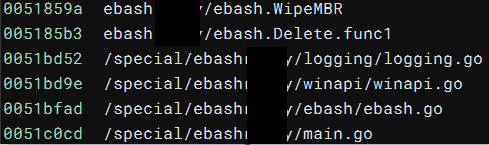
    BlackJack uses a version of the Shamoon wiper written in Go in their attacks. Static analysis helped us extract the following characteristic strings:

    Strings from the wiper

    During our research, we found Shamoon samples in the following locations:

    Ransomware – LockBit

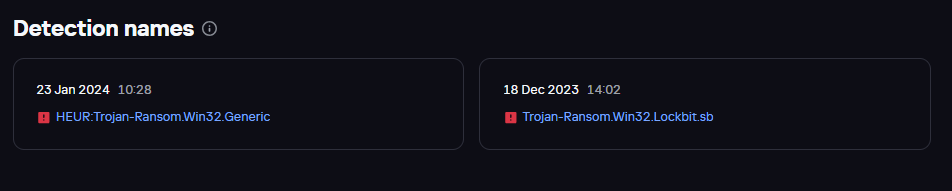
    In addition to the wiper, BlackJack also uses a leaked version of the LockBit ransomware to harm their victims.

    Verdicts with which BlackJack’s version of LockBit was detected, source: Kaspersky Threat Intelligence Portal (TIP)

    We found the ransomware in the same directories as the wiper:

    The network directories for placing the malware were not chosen at random. This allows the attackers to spread their samples across the victim’s infrastructure and later place them in C:ProgramData for further execution in the system.

    To launch LockBit, the attackers use scheduled tasks containing the following command line (the 32-character password may vary depending on the host or victim):

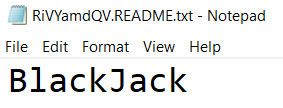
    The ransom note only contains the name of the group:

    Contents of the LockBit ransom note

    This confirms that the group is not aiming for financial gain, but rather to cause damage to the compromised organization.

    Ngrok

    To maintain persistent access to compromised victim resources, the attackers use tunneling with the common ngrok utility. We found the utility and its configuration file in the following directories:

    Paths Description
    Archive containing executable and configuration files.
    Ngrok executable file.
    Configuration file containing an authentication token and other information.

    Here is a list of commands related to ngrok execution:

    Commands Description
    Ngrok authentication process.
    Launches the ngrok.exe process and creates a TCP tunnel on port 3389 (RDP).
    Alternative for creating a TCP tunnel on port 3389 (RDP).
    Creates a UDP tunnel on port 3389 (RDP).

    Radmin, AnyDesk, PuTTY

    To ensure remote access to the system, BlackJack installs various remote access tools (RATs). Judging by the incidents we studied, the attackers initially attempted to use the Radmin utility, but all the external connections we observed were made through AnyDesk.

    During the RAT installation, the attackers created the following services:

    Service name Launch commands
    Radmin Server V3
    raddrvv3
    AnyDesk Service

    Additionally, the popular SSH client PuTTY was used to connect to certain hosts within the infrastructure.

    Connection with the Twelve group

    The malware and legitimate tools described above significantly overlap with the arsenal of the hacktivist group Twelve. This group also relies on publicly available software and does not use proprietary tools in its attacks.

    Most of the connections and overlaps between the two groups were discovered through Kaspersky Security Network (KSN) telemetry and Kaspersky Threat Intelligence solutions. KSN telemetry is anonymized data from users of our products who have consented to share and process this information.

    Malware sample similarities

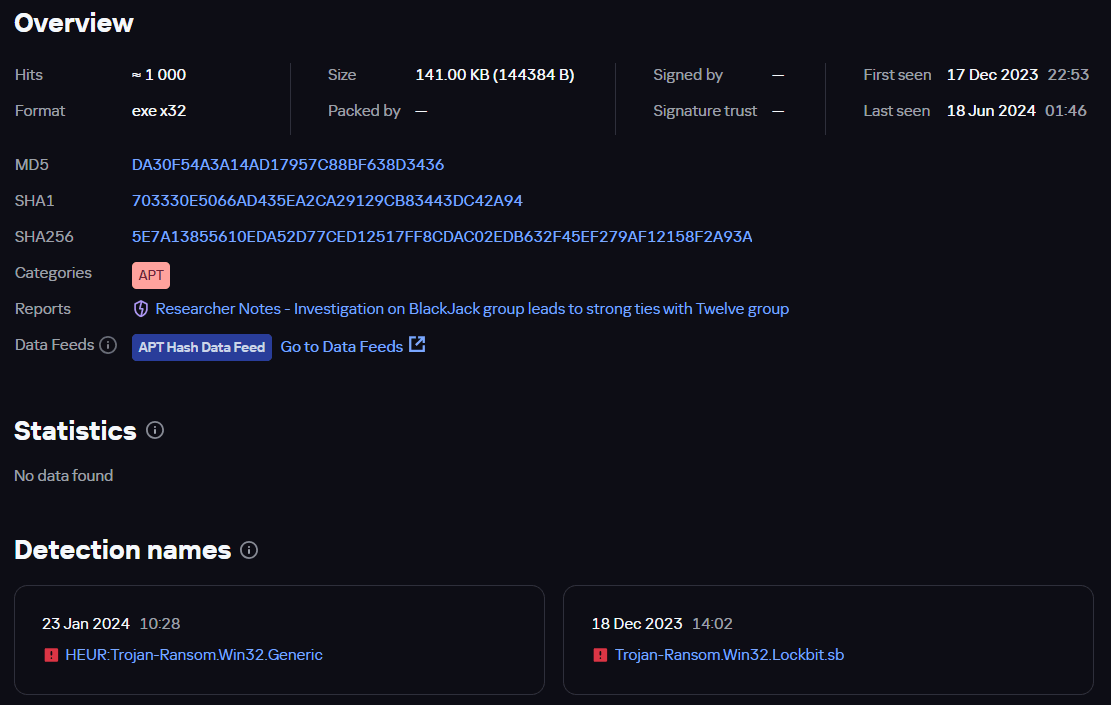
    Let’s first examine the similarities between the ransomware and wiper samples from the BlackJack and Twelve groups. Below is the information from the Kaspersky Threat Intelligence Portal (TIP) on the LockBit ransomware file discovered while investigating the BlackJack attacks:

    BlackJack file information

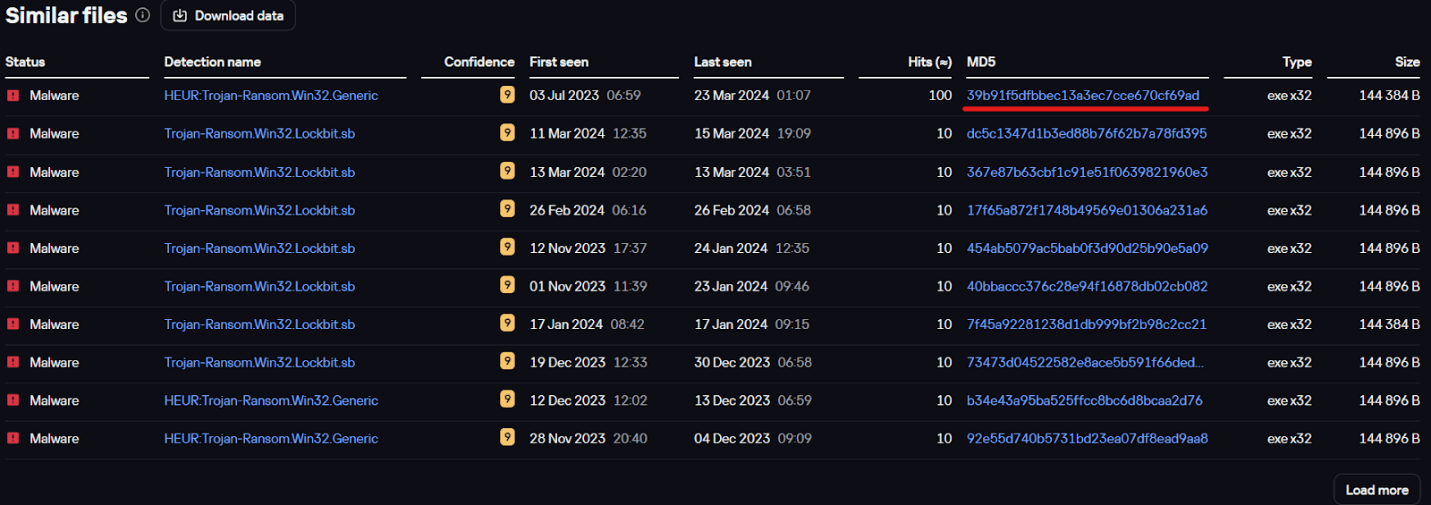
    The sample is named bj.exe, presumably an abbreviation for the BlackJack group. Among other things, the TIP page shows a list of similar files compiled using the Similarity technology, which identifies files with similar patterns. Although the sample used by the hacktivists was created with the leaked LockBit builder, Similarity first identifies the most closely related files. Note the first hash in the list: 39B91F5DFBBEC13A3EC7CCE670CF69AD.

    List of similar files

    Checking this hash on the Threat Intelligence Portal reveals that it was mentioned in our recent investigation into the Twelve group.

    This suggests that the two groups use similar LockBit samples. Additionally, analysis of the configuration of the two samples (BlackJack and Twelve) showed that their exclusion lists (files, directories, and extensions to leave unencrypted) are identical.

    Just like the BlackJack’s LockBit sample, the Twelve group’s ransomware also has a list of similar files.

    List of similar files

    Upon checking one of them (underlined in red on the screenshot), we found that the file was also named bj.exe. This means that it is another instance of the BlackJack group’s ransomware, further indicating that the two groups use nearly identical LockBit samples.

    Below is a list of paths where LockBit samples were found during the investigation of incidents related to the BlackJack and Twelve groups:

    BlackJack Twelve
    [DOMAIN]netlogon [DOMAIN]netlogon
    C:ProgramData C:ProgramData
    Sysvoldomainscripts

    Summing up the ransomware analysis, we can draw the following conclusions:

    • Both groups use similar LockBit ransomware samples;
    • The paths where these samples were found are almost identical.

    Let’s continue searching for further connections.

    Wiper reuse

    The study of wiper samples from incidents involving the BlackJack and Twelve groups also revealed similarities between them.

    Both wipers overwrite the MBR record with almost identical placeholder strings:

    MBR placeholder of the BlackJack wiper

    MBR placeholder of the Twelve wiper

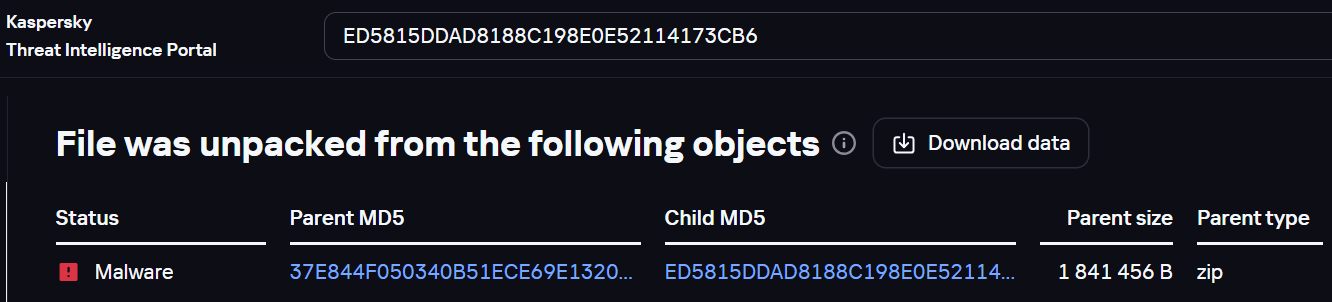
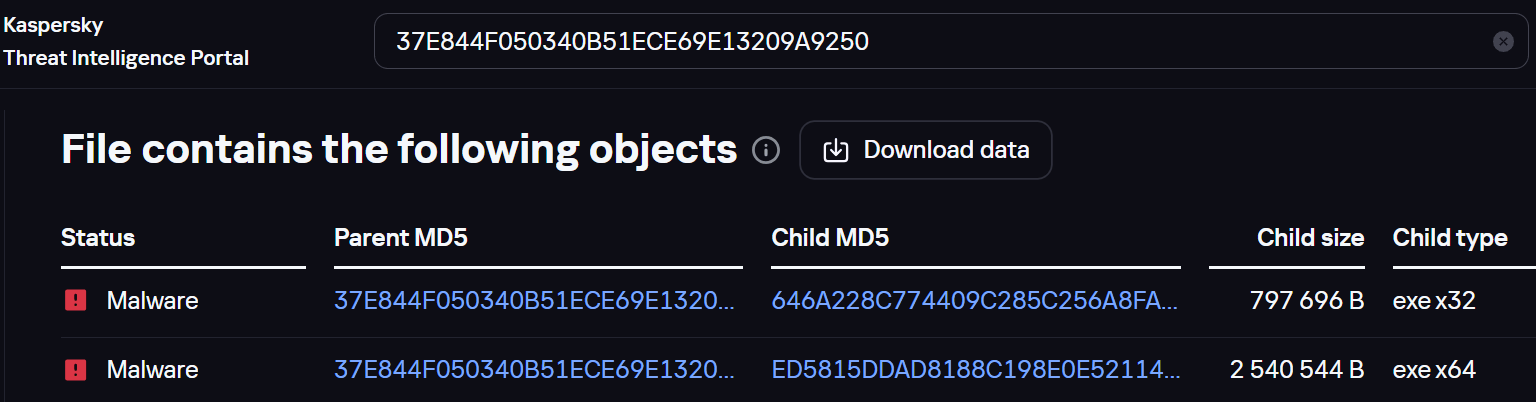
    By analyzing the BlackJack wiper on the Threat Intelligence Portal, we found that in some cases it was extracted from the following archive:

    Information about the archive containing the BlackJack wiper

    Examining the archive, we found the Chaos ransomware – 646A228C774409C285C256A8FAA49BDE:

    Ransomware file in the archive

    Moreover, this file was mentioned in our report on the Twelve group. That is, malware from both groups is distributed in the same archive.

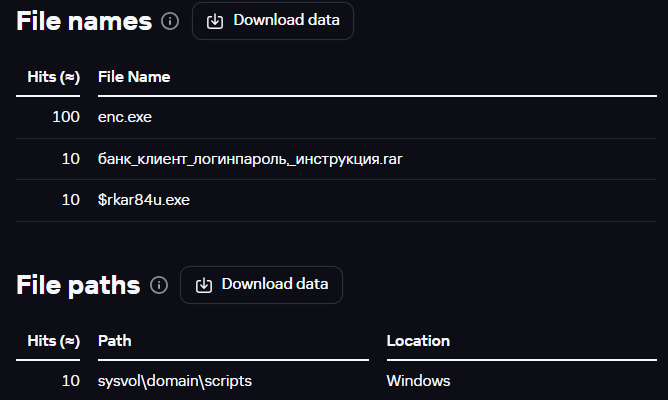
    Checking the file names and paths, we discovered a familiar network directory sysvoldomainscript.

    File names and paths

    In addition, during our investigation of attacks carried out by the Twelve group, we also found the use of Shamoon-based wipers. Moreover, according to KSN data, a specific variant of Shamoon, which was involved in BlackJack group attacks, was also seen in some Twelve attacks.

    Similar to the analysis of the LockBit ransomware, we decided to study the paths where the wipers were found in incidents related to the BlackJack and Twelve groups. As you can see from the table below, these paths are identical:

    BlackJack Twelve
    Sysvoldomainscripts Sysvoldomainscripts
    [DOMAIN]netlogon [DOMAIN]netlogon
    C:ProgramData C:ProgramData

    Summing up the analysis of the Shamoon wiper, we can confidently say that both groups use it or its components in their attacks and place them in identical directories. Moreover, the version of Shamoon that became available as a result of the leak was written in C#, whereas the variants of this wiper used in the BlackJack and Twelve attacks were rewritten in Go, further supporting the connection between these groups.

    Familiar commands and utilities

    In addition to the connections identified through analyzing the malware samples, we also discovered overlaps in the commands and tools used by both groups.

    Below are the commands found in the BlackJack and Twelve group attacks.

    Creating scheduled tasks:

    BlackJack Twelve

    Clearing event logs:

    BlackJack Twelve

    As you can see, apart from the names of the executable files, the commands are identical.

    The list of publicly available utilities used by the groups also partially overlaps:

    BlackJack Twelve
    Mimikatz
    PsExec
    Ngrok
    PuTTY
    XenAllPasswordPro
    Radmin
    AnyDesk
    Mimikatz
    PsExec
    Ngrok
    PuTTY
    XenAllPasswordPro
    chisel
    BloodHound
    adPEAS
    PowerView
    RemCom
    CrackMapExec
    WinSCP

    New activity

    During our research, we also discovered another activity that closely resembles the ones described above. At this point, we cannot definitively determine which specific group is responsible for this activity; however, the malware samples and procedures clearly indicate that the source is the activity cluster under investigation.

    The similarities we found are listed below:

    1. The discovered wiper contains the characteristic strings we saw in the Twelve and BlackJack wipers and also creates a similar MBR record.
    2. The wiper is spread through the sysvol network directory and saved using a scheduled task, which copies it to that same C:ProgramData directory.
    3. As in the BlackJack and Twelve attacks, before wiping data with the wiper, the attackers launch the ransomware ( enc.exe), which is also copied from the network folder to C:ProgramData:
    4. As in Twelve group attacks, the execution of the wiper, as well as copying the wiper and ransomware from the network directory to the C:ProgramData folder, are performed using scheduled tasks:
    Unknown threat Twelve

    Also during the investigation of this activity, various artifacts and procedures were discovered that we had not seen in the BlackJack and Twelve attacks:

    1. Using the PowerShell cmdlet GetMpPreference to gather information about disabled Windows Defender features.
    2. Creating scheduled tasks:
      Task name Command line Description
      run1 Executing the wiper from the
      C:ProgramData folder
      def Collecting information about disabled
      Windows Defender features
    3. Using WMIExec for lateral movement into the root directory.

    Victims

    The mentioned malware samples, utilities, and command lines were found in the infrastructures of government, telecommunications, and industrial companies in Russia.

    Attribution

    Based on our research, we cannot be sure that the same actors are behind the activities of both groups. However, we suspect that the BlackJack and Twelve groups are part of a unified cluster of hacktivist activity aimed at organizations located in Russia.

    Conclusion

    In this study, we demonstrated that the BlackJack and Twelve groups have similar targets and use similar malware, distributing and executing it using the same methods. At the same time, they are not interested in financial gain but aim to inflict maximum damage on target organizations by encrypting, deleting, and stealing data and resources.

    Indicators of compromise

    Wiper – Shamoon

    ED5815DDAD8188C198E0E52114173CB6                    wip.exe/wiper.exe
    5F88A76F52B470DC8E72BBA56F7D7BB2               letsgo.exe

    Ransomware – LockBit

    DA30F54A3A14AD17957C88BF638D3436                 bj.exe
    BF402251745DF3F065EBE2FFDEC9A777                  bj.exe

    File paths

    Sysvoldomainscriptswip.exe
    [DOMAIN]netlogonwip.exe
    C:ProgramDatawip.exe
    Sysvoldomainscriptsbj.exe
    [DOMAIN]netlogonbj.exe
    C:ProgramDatabj.exe
    C:ProgramDataletsgo.exe
    [DOMAIN]SYSVOL[DOMAIN]SCRIPTSletsgo.exe
    C:ProgramDataenc.exe
    [DOMAIN]SYSVOL[DOMAIN]SCRIPTSenc.exe
    C:Users[USER]Downloadsngrok-v3-stable-windows-amd64.zip
    C:Program FilesWindows Media Playerngrok.exe
    C:Users[USER]AppDataLocalngrokngrok.yml

    Scheduled task names

    copy
    run1
    go2
    im
    def

    MIL OSI Economics

  • MIL-OSI Translation: Abusive signature collections: Federal Chancellery files complaint

    MIL OSI Translation. Region: Italy –

    Source: Switzerland – Federal Chancellery

    Federal ChancelleryBern, 25.09.2024 – The Federal Chancellery has today filed a criminal complaint against unknown persons with the Office of the Attorney General of Switzerland on suspicion of electoral fraud. The evidence included in the complaint indicates that the signatures declared invalid by the authorities may have been forged. The Federal Chancellery had already filed a criminal complaint against unknown persons in 2022 for suspected forgery of signatures collected for popular initiatives. This complaint was supplemented twice with new evidence; in this case, the reports came from a single canton. Today’s criminal complaint, however, includes suspicious cases that were observed in various cantons this year and for which it is assumed that different perpetrators were involved. The criminal complaint includes suspicious cases that the Federal Chancellery came across when checking the lists and counting the signatures. As part of the in-depth checks that have been carried out since 2022, the Federal Chancellery also takes into account signatures that municipalities have already declared invalid. In this way, it was able to identify anomalies that suggest forgery, such as different handwritings in the case of multiple signatures from the same person. The complaint groups together fifteen reports of forgery brought to the attention of the Federal Chancellery by municipalities and cantons and, in one case, by a private individual. Some of these reports concern individual signatures, but most concern a double-digit number of signatures. In total, it involves around 950 suspected forged signatures from six cantons and collected for five different popular initiatives. In addition to the aforementioned different handwritings in the case of multiple signatures from the same person, the most common reasons for suspected forgery and invalidation are incorrect dates of birth, misspelled names, incorrect or non-existent addresses, and lists of signatures that do not meet the legal requirements. In view of the ongoing proceedings, the Federal Chancellery is not providing further details on the complaint. In recent weeks, new cases involving abusive methods of collecting signatures have been discovered. Since then, the Federal Chancellery has been using all available means to protect the integrity of the signature collection process. In addition to reporting suspicious cases for criminal prosecution, it is focusing on prevention and improving processes. The Federal Chancellor will soon convene a permanent round table to ensure that signature providers and buyers commit to transparency and conduct rules to prevent forgery. More detailed monitoring of the signature collection and control processes is currently being implemented. The Federal Chancellery has also contacted the scientific community to explore technical solutions to protect the signature collection process from abuse and fraud. Address for enquiriesUrs BrudererHead of the Communications Section058 483 99 69urs.bruderer@bk.admin.chPublished byFederal Chancelleryhttps://www.bk.admin.ch/bk/it/home.html

    EDITOR’S NOTE: This article is a translation. Apologies should the grammar and/or sentence structure not be perfect.

    MIL Translation OSI

  • MIL-OSI United Kingdom: School-based nurseries funding round to launch next month

    Source: United Kingdom – Executive Government & Departments

    The first stage of the government’s plan to deliver 3,000 nurseries by upgrading spare spaces in primary schools will begin next month.

    The first stage of the government’s plan to deliver 3,000 nurseries by upgrading spare spaces in primary schools will begin next month, Education Secretary Bridget Phillipson announced today. 

    From next month, schools will be invited to bid for a share of £15 million capital funding, with capacity in the programme to deliver up to 300 new or expanded nurseries in this first round.

    Schools will need to demonstrate how their proposals will respond to need in their local area, supporting the 2025 expansion of government-funded hours of childcare and early education for working parents to 30 hours a week.

    Funding will be allocated to successful schools in Spring 2025 to support delivery for the first cohort of places.

    This is the first step to delivering the government’s ambition for 3,000 new nurseries in primary schools, and long-term plan to make early years education and childcare more widely available, accessible, and high quality.

    Currently, availability of early years provision is not evenly distributed across the country, with the most disadvantaged areas often experiencing the lowest access to provision.

    To ensure the programme is delivered in a way that will benefit all parents and children, the department will use the first phase to take learnings for future years and better understand how we can best support underserved and poorer areas.

    Schools will be able to express interest for future phases of the programme to help assess demand in different parts of the country, and the department will engage with the sector on the most appropriate model to extend the programme across the country in its second phase. 

    The government has urged schools interested in bidding for the first round to start discussing with their local authorities, governing organisations and wider stakeholders to consider pupil place planning, local childcare sufficiency and next steps for setting up and running new or expanded nurseries. 

    Guidance to support schools will be issued at the date of launch.

    DfE media enquiries

    Central newsdesk – for journalists 020 7783 8300

    Updates to this page

    Published 25 September 2024

    MIL OSI United Kingdom

  • MIL-OSI United Kingdom: Helping to prevent domestic homicides and suicides

    Source: Scottish Government

    Review process will ensure lessons are learned from each case.

    Legislative proposals to help reduce the number of domestic homicides and suicides in Scotland have been published in Parliament.

    If passed by MSPs, the Criminal Justice Modernisation and Abusive Domestic Behaviour Reviews (Scotland) Bill, would require a robust new review process to take place following the death of a partner, ex-partner, or child where abuse is known or suspected.

    The reviews will ensure justice, health, social care, local government and third sector agencies identify and agree any areas for change and improvement so further deaths may be prevented.

    Those with direct experience of domestic abuse and families who have been bereaved because of such abuse overwhelmingly backed the plans for this national multi-agency review model during a public consultation.

    The model, informed by the work of a Scottish Government-led multi-agency Taskforce, is a key part of the new Bill. 

    As the Bill was published, an information board at a previously unmarked memorial cairn in Holyrood Park was installed by Historic Environment Scotland. The cairn, built in memorial to domestic homicide victim Margaret Hall, who was murdered by her husband in 1720, was visited by Justice Secretary Angela Constance and partners involved in developing the review model.

    Elsewhere, the new Bill proposes measures to modernise the justice sector through greater use of digital technology, including evidence-sharing, and efficient processes. It will make permanent a number of temporary measures put in place during the COVID pandemic which have improved how the criminal justice system works and which have support to become permanent measures. The reforms include allowing more ‘virtual’ attendance at criminal courts, electronic signing and sending of documents in criminal cases and increasing the maximum level of fiscal fines that can be imposed.

    Justice Secretary Angela Constance said:

    “One death involving domestic abuse is one too many. While overall homicide rates are falling, there remains a significant number of victims who are killed by a partner or ex-partner, with the vast majority being women.

    “Our plans for a new review process will ensure agencies across justice, health, social care, local government and the third sector are working together to identify what lessons can be learned following known or suspected domestic abuse deaths. I hope that identifying what needs to improve will mean there are fewer deaths of this kind. Ultimately, however, the change we need to see will only happen when those who perpetrate domestic abuse – the majority of whom are men – change their actions and behaviour.

    “This is a dual-purpose Bill and some of the criminal justice measures included are already delivering better outcomes and experiences for those using justice services, so it is right that we look to make them permanent. The Bill, which is backed by justice partners including the Crown Office and Procurator Fiscal Service and the Scottish Courts and Tribunals Service, also supports greater use of digital technology, which will modernise the justice system even further.”

    Fiona Drouet, founder and CEO of EmilyTest, said:

    “The introduction of domestic homicide and suicide reviews marks a critical step forward in Scotland. These reviews will help us better understand the warning signs so often missed before a tragedy. They will be crucial in helping to prevent so many avoidable deaths, whether by murder or suicide.

    “I am privileged to have been invited to chair the Domestic Abuse Related Suicide Task and Finish Group under the Taskforce, helping to ensure that lessons are learned and precious lives are not lost. Through the support and expertise of my depute chair, Sarah Dangar, and the wider group, I am confident we will ensure meaningful lessons are learned.”

    Kate Wallace, Chief Executive at Victim Support Scotland, said:

    “The Domestic Homicide and Suicide Review offers a unique opportunity for lessons to be learned from homicides and suicides within the context of domestic abuse in Scotland, so that we can help ensure these types of crimes can be prevented. 

    “We welcome the opportunity to bring forward legislation which will embed this entirely new approach for Scotland, and fully acknowledge the work and collective efforts required to address the unique issues inherent to this type of crime. We welcome these progressive measures, especially how victims will be considered within the legislation.”

    Background

    Criminal Justice Modernisation and Abusive Domestic Behaviour Reviews (Scotland) Bill

    The Domestic Homicide and Suicide Review Model is being developed by the Scottish Government’s Domestic Homicide and Suicide Review Taskforce, Model Development Subgroup and ‘Task and Finish’ Groups.

    The commitment to developing a domestic homicide review model is within the Equally Safe Delivery Plan.

    Domestic Homicide Reviews: Consultation Analysis

    For further information about the cairn, contact Historic Environment Scotland – communications@hes.scot; 07721 959 962

    MIL OSI United Kingdom

  • MIL-OSI Russia: Sobyanin spoke about the opening of the second fish market in Moscow in the North-West Administrative Okrug

    MIL OSI Translation. Region: Russian Federation –

    Source: Moscow Government – Government of Moscow –

    The second fish market in Moscow has opened in Mitino.

    “The success of the festival

    “Moscow is on the wave. Fish week” inspired us to create the first fish market – in Kosino-Ukhtomsky. During its operation, more than a million buyers visited it. Seeing such a demand for fresh, high-quality fish and seafood, we decided to open a second market – in Mitino. Its area is over four thousand square meters. And with the onset of warm weather next spring, we will additionally open a terrace,” – said Sergei Sobyanin.

    The new market has a branded corner called “Moscow – on the Wave,” for which a special menu has been developed.

    The open kitchen of the new market is twice as big as in Kosino-Ukhtomsky. Products purchased at the market will be cooked for free. And on the master class sites, guests can learn how to cook fish and seafood dishes.

    Please note: This information is raw content directly from the source of the information. It is exactly what the source states and does not reflect the position of MIL-OSI or its clients.

    Please note; This information is raw content directly from the information source. It is accurate to what the source is stating and does not reflect the position of MIL-OSI or its clients.

    https://vvv.mos.ru/major/themes/11821050/

    EDITOR’S NOTE: This article is a translation. Apologies should the grammar and or sentence structure not be perfect.

    MIL OSI Russia News

  • MIL-OSI Asia-Pac: Text of the Vice-President’s address at the 2nd edition of Uttar Pradesh International Trade Show at Gautam Buddha Nagar, Uttar Pradesh

    Source: Government of India

    सभी को नमस्कार, 

    The largest state of the Union is blossoming and flourishing under his dynamic governance. Yogiji has turned out to be a game changer for this state, and that will help the nation. I am particularly amazed at his 24×7 watchdog governance. 

    Personally, for me, this is an absolute delight to be at the inaugural ceremony of the second edition of UP International Trade Show 2024. I had the good occasion to go around and see for myself. There could not be a greater assurance for a man like me that all is well, things are on the right track. What I witnessed was beyond my concept, imagination, and dream. I felt I was in the most developed country in the world.

     This is indeed a very well-thought-out platform that not only showcases what is there in India, in Uttar Pradesh, it affords an opportunity for people to snatch those opportunities, to be in touch with the best minds, the artisans, the skilled workers, the products, and personally flourish. My congratulations to the Honourable Chief Minister for being so thoughtful, farsighted, and practical.

     The beginning was made for the first edition by the Honourable President of India, Smt. Droupadi Murmu Ji and in this context, it is my absolute privilege to be part of the second. We are indeed very happy that the trade show will significantly showcase Vietnam as a partner country. As one of Southeast Asia’s robust economies, Vietnam has an impressive GDP of 435 billion US dollars, and we look forward to witnessing their exceptional products and innovative manufacturing practices but I can assure them, they are in the right place, their participation will enormously benefit them and their people to fully exploit their talent and connect with the best artisans and economic potential.

     Friends, this will also be an occasion to get a feel for the rich cultural heritage of Vietnam. They will, ofcourse, everyone will feel the rich heritage of Uttar Pradesh and Bharat, but we will also get a feel for the rich heritage of Vietnam. I had the occasion to have a look at it, full display through captivating traditional music and what a similarity there was with Indian instruments. I am sure there will be enough for them to carry home. The dance performances, it was enriching.

    And it is a state which, in the last few years, is seeing the happiness factor rising. When the happiness factor rises, your appetite is functional.

     My friends from Uttar Pradesh and all over the country who are here will have the occasion to indulge in authentic Vietnamese cuisine. Renowned for its unique flavours, when we look at Vietnam, the savoury delights of Pho and its spring rolls to the mouth-watering Banh Mi, our palates will be treated to a culinary journey. I have had the occasion to know about them and taste them.

    This, in a sense, is a natural partnership if we go into a historical perspective, will surely foster cultural and economic challenges collectively. The exchanges will be rewarding, further enhancing our bilateral relations and strengthening the resolve for a greater role for the Global South in international affairs. 

    It was the visionary leadership of Prime Minister Narendra Modi, that at the G20 platform, he brought on the international radar, the voice of Global South. This is an important event, their participation is memorable, and I am sure they will carry happy memories of this event.

    The exhibition — the scale, the display, the technological penetration, the cultural wealth, each district’s products. I instructed my team that they will, at the micro level, handle each store, each product, so that the nation comes to know it through Sansad TV. Mr. Chief Minister will seek your cooperation. My team will be here this evening. 

    Friends, the synergy between the Prime Minister of India, his vision, coupled with the Honourable Chief Minister of Uttar Pradesh, Yogi’s execution, sharp execution, execution which has no accommodation for corruption, no tolerance for inefficiency, this has transformed Uttar Pradesh into Uttam Pradesh. The sustained efforts of Yogiji are leading to another milestone development and achievement, soothing to the entire nation, Uttar Pradesh is fast becoming Udyam Pradesh of the country. 

    This venue is very soothing for development. This venue was also witness to the recently concluded SEMICON India 2024 conference, where the Honourable Prime Minister outlined India’s vision of making the semiconductor industry, and that is going to be the foundation of Viksit Bharat. The conference was a crucial step towards realising India’s goal of becoming a global hub for semiconductor manufacturing.

     Let me, friends, come to the state of the nation, the state of Bharat. For ages, India has been the cradle of civilisation, a crucible of innovation, and a global hub of learning. Our Vedas are a gold mine of knowledge and information. India takes pride in being one of the oldest civilisations with 5,000 years of civilisational ethos. We lost our way somewhere in between, but now we are on our way to regaining it  and that too fast enough to be a beacon for the planet in several ways in this century. 

    Nothing can be more satisfying for me to note than that in this regaining, the largest state of the union, under the leadership of Yogi Adityanath, is playing with the straight bat on the front foot to deliver for the nation. Look at a decade ago; the scenario was alarmingly worrisome. The economy was staggering, and the mood of the nation was shaky. From every aspect, governance was challenging for the citizens but what a 360-degree change, soothingly. 

    The last decade is marked by unprecedented transformation — a transformation for the better. Bharat has emerged as the most buoyant economy in the world. It is now the favourite global destination for investment and opportunity, with an ecosystem of hope and possibility all-pervasive in India. Undoubtedly, we are set to regain our pristine glory. India is now a global happening place, and Uttar Pradesh is bubbling with activity. Activity in every sector: infrastructure, growth, industry, and innovation. 

    Today, Bharat is a near 4 trillion dollar economy that has 8% growth prospects for decades to come,  world institutions have analysed. In 2 years, our economy will march ahead of that of Japan and Germany to be the world’s third-largest economy. Incremental infrastructure growth is reflected in 8 new airports annually. The Honourable Chief Minister has indicated the scenario here. Unbelievable achievement! Look at the express highways, virtually doubling, and the state will be on the global map when it comes to the world-class largest airport in Jewar.

     It’s a state where dreams are fructified into ground realities. That’s what I’ve seen. Every 2 years, 3 or 4 metro systems are getting added. Friends, there is daily laying of 28 km of highways and 12 km of railway tracks. In PM Modi’s third term, historic term, 12 new industrial zones are taking shape to boost manufacturing. The nation is fully geared to tap the benefits of artificial intelligence, of electric mobility, green hydrogen, space, and semiconductors. For want of time, I am not focusing on it, but we are among the few countries focusing on the green hydrogen mission, quantum computing. We are in single digits when it comes to the exploitation of 6G technology commercially.

     The journey towards Viksit Bharat is well on track. It will fructify in 2047, if not earlier. The mood of the nation is now one of hope and possibility, with accolades pouring in from global institutions. 

    I have had a long political career, having been elected to Parliament in 1989 and a minister in 1990. The World Bank and IMF are praising us to heights, and rightly so. 

    Based on factual premise, our digitisation and technological penetration is turning out to be a global model for emulation. A decade of Make in India initiative has yielded significant results. Following successes in agriculture and services, India is now poised for manufacturing growth. State governments, UP being in the lead, are competing to attract investments by improving business conditions. 

    Sir, nothing is more important for investment than law and order. Law and order defines democracy and the Chief Minister of Uttar Pradesh, Yogi Adityanath defines law and order. It is in this soothing ecosystem that UP has emerged as an MSME hub by leveraging the sector strengths to create a robust supply chain.

    Technology has enabled greater participation from skilled youth in tier two town and rural areas. 

    Imagine skill mapping, skill mapping during challenging, daunting days of COVID-19. You did it. 

    Bharat is now frog leaping from Make in India to conceptualise, design and make in India. We are having our own concept of evolution. We are engaged in design and Make in India. It is encouraging to see multinationals and Indian companies getting in a synergetic stance. They are establishing innovation centres nationwide. Uttar Pradesh is a shining example of it, the defence corridor being one. 

    Micro, small and medium enterprises are much beyond their nomenclature, as I said earlier. This segment is the spine of the economy and a major contributor of human resource employment. 

    Coming to Uttar Pradesh, I state, with that kind of history, cultural background was plagued with law and order challenges, and atmosphere of fear. 

    Not long ago, growth prospects were all time low. And this state now is a beacon of progress and development. The long, long dark tunnel was negotiated with great speed by the Honourable Chief Minister. And there is great light at the end of the tunnel. The tunnel is much behind. From the tunnel, the dark tunnel, the state is on the expressway. 

    On the way to take a flight for higher economy on the largest airport that is coming up in Jewar. The state is full of hope and possibility. The transformation is unbelievable. Normally, people would not undertake it. They would get adjusted to the status quo. Because the challenge was really very, very, very, very daunting. 

    In a sense, there is a complete makeover of Uttar Pradesh. You are regaining its pristine glory in every sense. Because the governance exemplifies transparency, accountability, worth emulation, the kind of handholding of the entrepreneur. 

    And corruption is a word unheard in Uttar Pradesh. Power corridors are fully sanitised. Decisions are fast-tracked and duly tracked. 

    The state is now turning out to be a great strength to the nation. In phenomenal economic upsurge and unprecedented infrastructure growth in the nation, the largest state of Uttar Pradesh is now an asset and a major contributor unlike a scenario that existed a few years ago. 

    Uttar Pradesh aspires and rightly so, and why not? To reach the target of $1 trillion economy by 2027 and will be mightily adding to the dream of Prime Minister Modi to his $5 trillion economy by 2027. As rightly focused by the Honourable Chief Minister, Uttar Pradesh’s advantages include fertile land, young population, religious tourism, and MSMEs. And look at the size of MSMEs. 

    Some countries in the world may not have that population. As you have a number of units, the massive focus on infrastructure, one has to see to believe it. It’s easier to say that yes, six new expressways are being added. 

    It takes time, planning, execution, and funds. This is happening. All this has a Yogi multiplier, Yogi effect, Yogi impact. 

    Noida contributes 10% of U.P. GDP, I’m told, is crucial for economic growth in the industrial base, IT sector, and upcoming projects like Jewar Airport and Film City. But this city has emerged as one of the leading habitations at a global level. The kind of talent that is there in Noida, I know for sure, I come from the legal profession. 

    It’s becoming a favourite destination. Uttar Pradesh, no longer a sleeping giant, no longer a state with a promise. It’s a state in action with its vast resources, burgeoning population, and strategic location. It’s a growth engine in itself, and tied to the larger growth engine of the nation to take the nation forward. 

    I am particularly impressed by the inclusive growth in the country under Prime Minister Modi’s vision. He believes in a plateau kind of a growth. Everyone has to rise in every sector, every social element. U.P. is in line with it. 

    The trade show focuses on a great opportunity for everyone for boosting MSMEs, promoting geographical indications, and GI products. It was with utmost reluctance that I moved fast. Otherwise, one geographical indicator was good enough to take a few hours. Because it has enormous potential of opportunities. What I saw today was not an exhibition. I saw a basket of opportunities for all. 

    This event, friends, aligns with Prime Minister Modi’s vision of an Atma Nirbhar Bharat and embraces the motto, local to global. 

    India’s progress is evident in various sectors. But this is the right epicentre to take it to the next level, local to global. First it was vocal for local, now local to global. 

    I wouldn’t take long, but India is on the rise as never before. The rise is unstoppable. If I quickly take you, metro services have expanded from five cities to 23. 

    We have the world’s second largest metro network. The number of cities with airports has doubled from 70 to 140. India is now the largest connected nation globally with over 800 million broadband users. Digital technologies have enabled initiatives like housing for 170 million, health coverage for 60 million, and loans for 58 million small businesses annually. India records the highest digital financial transactions globally with 13 billion transactions per month. The country boasts the world’s third largest startup ecosystem with 107 unicorns and the third largest purchasing power in the world. 

    The semiconductor industry, which is very critical. It was here that the beginning was made by the Honourable Prime Minister. It is poised by 2026 to surpass 55 billion. I have no doubt this century belongs to Bharat. This century rightly belongs to Bharat. And that being the situation, let us all get together, ladies and gentlemen, because along with Bharat, we are witnessing a new dawn of Uttar Pradesh, a future where the nation stands tall as a global leader in trade, innovation, and cultural heritage. Chief Minister Yogi Adityanath has painstakingly brought about 360 degree improvement. Not easy. I feel tasked. He brought it about in law and order, in development, in cultural revolution, in giving skill to the people, and in bringing happiness to the people. The vision of Prime Minister Modi and passion of Chief Minister Yogi Adityanath are in synergy, preparing this transformation towards the grand mission of a Viksit Bharat by 2047. I have no doubt that this trade show will be a beacon of opportunity, collaboration, and success in our journey ahead. 

    And friends, I conclude by an appeal. एक बहुत बड़ा महायज्ञ भारत में हो रहा है, यह महायज्ञ विकसित भारत के लिए हो रहा है। यह महायज्ञ की पूर्ण आहुति आजादी की शताब्दी का जब महोत्सव होगा तब होगी। इसमें हर किसी को आहुति देनी है और आहुति देने के लिए संकल्प की आवश्यकता है की हम भारतीय हैं, भारतीयता हमारी पहचान है, राष्ट्रवाद हमारा धर्म है। We can never put self or political interest over nationalism.


    Thank you so much.


    ****

    JK/RC/SM

    MIL OSI Asia Pacific News

  • MIL-OSI Asia-Pac: Union MoS for Health and Family Welfare, Shri Prataprao Jadhav Presides over 69th Foundation Day Celebrations of AIIMS New Delhi

    Source: Government of India

    Union MoS for Health and Family Welfare, Shri Prataprao Jadhav Presides over 69th Foundation Day Celebrations of AIIMS New Delhi

    AIIMS New Delhi is a pioneer in the field of medical education, research and healthcare in India whose legacy of excellence continues to inspire medical institutions worldwide: Shri Jadhav

    “AIIMS continuous unchallenged status of being ranked number one among medical institutions of India for the seventh consecutive year is a remarkable achievement”

    AIIMS New Delhi now serves as the National Resource Centre of the National Medical College Network of the Union Health Ministry

    In the last 2 years, inpatient beds in AIIMS have increased by more than 30%, Intensive care and operation theatre services by nearly 40%

    Posted On: 25 SEP 2024 2:49PM by PIB Delhi

    AIIMS New Delhi is a pioneer in the field of medical education, research and healthcare in India whose legacy of excellence continues to inspire medical institutions worldwide.” This was stated by Union Minister of State for Health and Family Welfare, Shri Prataprao Ganpatrao Jadhav as he presided over the 69th Foundation Day ceremony of the All India Institute of Medical Sciences (AIIMS), New Delhi, today.

    Speaking on the occasion, Shri Jadhav said, “AIIMS New Delhi has achieved remarkable milestones and is determined to achieve its goal of being one of the top-ranked medical institutions in the world.” Highlighting that for the seventh consecutive year since the National Institute Ranking Framework (NIRF), AIIMS New Delhi has been ranked number one among medical institutions of India, the Union Minister said, “this Institute’s continuous unchallenged status is a remarkable achievement.”


    He informed that AIIMS New Delhi now serves as the National Resource Centre of the National Medical College Network (NMCN) of the Ministry of Health and Family welfare. This has enabled linkages with more than 100 medical colleges for enhancing undergraduate, postgraduate and continuing medical education. “This objective is being facilitated by the creation of a National Learning Management & Information System, SAKSHYAM, which was launched last year”, he said.


    Shri Jadhav highlighted that AIIMS New Delhi has established a Centre of Excellence for development of artificial intelligence in healthcare. Created by MOHFW, this centre is expected to deliver AI based solutions for evaluation of chest x-rays, early detection of diabetic retinopathy, and identification of skin lesions, among other tools, for enhancing national programs. He noted that “AIIMS is set to be the biggest robotic surgery skill training centre with 2 state-of-the-art robotic surgery equipment dedicated for training of surgeons.”


    It was informed that over 900 extramural research projects are being funded by national and international agencies, amounting to a total grant of nearly Rs. 200 crores while AIIMS itself has funded over 240 intramural research projects apart from providing travel fellowships to students, residents, PhD scholars, and staff to participate in national and international conferences. AIIMS Delhi has also started the Centre for Medical Innovation & Entrepreneurship as a Bio-Incubator under the BIRAC – BioNEST Scheme.

    Shri Jadhav said that AIIMS has planned for building a new hostel complex with 2200 rooms, with an estimated cost of approximately Rs 900 crores. He also highlighted new academic facilities that were added recently such as the Mother and Child Block, Surgery Block and the National Centre of Ageing which are fully functional now. Over the last 2 years, the inpatient beds have increased by more than 30%, Intensive care and operation theatre services by nearly 40%. These new facilities will improve the ability of AIIMS to cater to the huge clinical demand. AIIMS has also been entrusted with the responsibility to operationalize the Central Armed Police Forces Institute of Medical Sciences (CAPFIMS) at Maidangarhi.

    The Union Minister kicked off the Foundation Day celebration by officially inaugurating an exhibition showcasing the innovative research and projects undertaken by various departments at AIIMS. He also took a tour of the exhibition.

    The Union Minister also inaugurated the awards ceremony, recognizing the achievements of students and staff with medals and book prizes. Awards were also given for outstanding contributions to the Institute Day Exhibition, celebrating excellence in research and innovation.

    AIIMS New Delhi has undertaken various IT initiatives and has developed various softwares in-house for a wide range of services. The SANTUSHT portal enables patients to register their grievances online, track the status, and provide feedback regarding the resolution. To increase transparency and to maintain the trust that the patients have in AIIMS, realtime dashboards have been developed and made available to the public. The management of IT infrastructure and network has also been digitized for prompt resolution of any hardware or network issues. Triage Register for Emergency Department is a web application which helps to keep the record of patient’s Disease Condition, Medical Examination and improves patient safety by ensuring timely cross-consultation by various departments. The Union Minister launched these digital initiatives during the event. He also inaugurated a fire station at AIIMS which will have a manpower of 6 men. It is the first such station exclusively for any medical institute.

    Prof. M Srinivas, Director, AIIMS New Delhi said “AIIMS has already received NABH certification for some of its blocks and centers and is in the process of NABH certification of all the centers including the main hospital. He highlighted that NABL accreditation of all laboratories in a phased manner is under process. He also informed that AIIMS has also been the forerunner in the implementation of Ayushman Bharat Digital Mission (ABDM). “It has overcome various challenges and has been a role model for the country by creating more than 7 lakh ABHA IDs and more than 20 lakh scan and share tokens”, he said.


    Background:

    Established in 1956, AIIMS was created with the vision of providing high-quality medical education and comprehensive healthcare services. The institute was established as part of a larger effort to address the critical need for well-trained healthcare professionals in India. Recognizing the challenges in healthcare access and quality, the Indian government aimed to create an institution that would set benchmarks in medical training and patient care.

    From its inception, AIIMS has been a pioneer in developing innovative medical practices and cutting-edge research. Its comprehensive approach includes a focus on preventive, curative, and rehabilitative care, making it a model for medical institutions across the country. Over the decades, AIIMS has evolved to become not just a premier medical college, but also a leading research center, contributing significantly to advances in various fields of medicine.

    Importance of AIIMS in National Healthcare

    AIIMS, New Delhi, has played a pivotal role in shaping India’s healthcare landscape. Here are some key aspects of its importance:

    1. Quality Medical Education: AIIMS has been instrumental in training thousands of medical professionals who have gone on to serve in various capacities across the country. Its rigorous academic programs ensure that students receive not only theoretical knowledge but also practical training, enabling them to provide high-quality care to patients.
    2. Research and Innovation: The institute is known for its cutting-edge research in various fields, including cardiology, oncology, and neuroscience. AIIMS researchers have made significant contributions to medical science, often translating their findings into real-world applications that benefit patients.
    3. Public Health Initiatives: AIIMS has actively engaged in public health outreach programs, focusing on preventive care and health education. These initiatives aim to improve healthcare access for marginalized communities, aligning with the government’s goals to promote health equity.
    4. National Health Policies: AIIMS has served as an advisory body to the government on various health policies and programs. Its research findings and expert recommendations have influenced health policy decisions, ensuring that they are evidence-based and aligned with the needs of the population.
    5. Response to Health Crises: During health emergencies, such as the COVID-19 pandemic, AIIMS played a crucial role in managing care, conducting research, and providing guidance on best practices. Its leadership in crisis management has been vital in safeguarding public health.

    ***

    MV

    HFW/MoS AIIMS Foundation Day/25th September 2024/2

    (Release ID: 2058569) Visitor Counter : 118

    MIL OSI Asia Pacific News

  • MIL-OSI Asia-Pac: Seva Se Seekhen Program Empowering Youth and Fostering Culture of Compassion and Service in Community

    Source: Government of India

    Seva Se Seekhen Program Empowering Youth and Fostering Culture of Compassion and Service in Community

    MY Bharat’s “Seva Se Seekhen” Initiative Gains Momentum in 24 States; Over 1700 MY Bharat Volunteers Engage in Healthcare Support across 319 Hospitals

    “Through Seva se Seekhen program, our young MY Bharat volunteers are gaining invaluable experience while contributing to the well-being of our nation” – Dr. Mansukh Mandaviya

    Posted On: 25 SEP 2024 2:54PM by PIB Delhi

    In a significant move to engage India’s youth and bolster healthcare services, the Department of Youth Affairs, Ministry of Youth Affairs and Sports has launched the “Seva Se Seekhen” program under the MY Bharat initiative. Launched on September 17, 2024, this nationwide volunteering initiative aims to provide hands-on learning experiences for young people while offering crucial assistance to patients in hospitals.


    (Chhattisgarh)

    Talking about the program, Union Minister of Youth Affairs & Sports and Labour & Employment, Dr. Mansukh Mandaviya, commented, “This program exemplifies our commitment to nurturing a culture of seva while addressing the needs of patients across India. Through this program, our young MY Bharat volunteers are gaining invaluable experience while contributing to the well-being of our nation.”


    (Rajasthan)

    As part of the program, MY Bharat volunteers are being deployed across 700 locations, including both government hospitals and those empanelled under the Pradhan Mantri Jan Arogya Yojana (PM-JAY). With each hospital hosting 10-20 volunteers, the initiative targets not only to improve patient services but also to raise awareness of the Ayushman Bharat Pradhan Mantri Jan Arogya Yojana (AB-PMJAY). Volunteers assist with a variety of tasks, from helping patients access basic healthcare services to managing outpatient department (OPD) counters, operating information desks, and supporting PM-JAY documentation.


    (Gujarat)

    The “Seva Se Seekhen” program has seen swift progress since its launch, with 861 hospitals already onboarded on the MY Bharat portal. These facilities have generated 304 Experiential Learning Programmes and 2,649 volunteering opportunities.

    Currently, 1732 volunteers are active across 319 hospitals in 24 states and union territories. Leading the charge, Gujarat has deployed 273 volunteers across 33 hospitals, followed closely by Rajasthan, Haryana, Tamil Nadu, and Uttar Pradesh, with a strong presence of volunteers supporting critical healthcare services.


    (Odisha)

    By engaging youth in such meaningful work, the “Seva Se Seekhen” program is expected to promote a culture of service and responsibility. It also seeks to boost the utilization of PM-JAY services, thereby enhancing healthcare accessibility for underprivileged communities. The success of this initiative will have long-lasting impacts, fostering a new generation of socially responsible leaders and reinforcing the importance of public service.

    As MY Bharat continues to expand its reach and the “Seva Se Seekhen” program grows, the initiative promises to bring a transformative shift in both healthcare support and youth empowerment across India.

    *****

    Himanshu Pathak

    (Release ID: 2058571) Visitor Counter : 136

    MIL OSI Asia Pacific News

  • MIL-OSI Translation: Briefing on maintaining peace and security in Ukraine (FR)

    MIL OSI Translation. Government of the Republic of France statements from French to English –

    Source: Switzerland – Department of Foreign Affairs in English

    Federal Department of Foreign Affairs

    Bern, 09.24.2024 – Address by Federal Councilor Ignazio Cassis, Head of the Federal Department of Foreign Affairs (FDFA) – Check against delivery

    Mr. President, Mr. Secretary-General, Dear colleagues, Ladies and Gentlemen,

    I thank Slovenia for its initiative. It is crucial that this Council continues to reflect on ways to restore peace and end the Russian war against Ukraine. And this, in the presence of Ukraine; I welcome the presence of President Zelenskiy here.

    I firmly believe in the importance of respecting the United Nations Charter, international humanitarian law, as well as the application of the Geneva Conventions, whose 75th anniversary we are celebrating this year.

    And yet, despite all the tools established after World War II, we have not succeeded in silencing the guns. We have not been able to prevent countless civilians from suffering the consequences.

    Ladies and Gentlemen

    So far, this Council has not assumed its responsibility. After 1000 days of war, we still have not found a diplomatic solution.

    Why are we unable to agree on the way forward to restore peace? Have we lost the common grammar of peace?

    If I hold my position as Minister, it is because I believe in the power of politics in the service of the common good. Politics must always challenge the maxim of the strategist von Clausewitz that: “war is the mere continuation of politics by other means.” And the UN is politics.

    Excellencies,

    Making peace takes courage.

    By organising the first Peace Summit in Ukraine last June, Switzerland had the audacity to place peace on the international agenda, and this in the midst of war.

    Countries from five continents gathered near Lucerne to discuss three key issues essential to building peace: • Nuclear security; • Food security; and • The humanitarian dimension of the conflict.

    The joint Bürgenstock communiqué, signed by a majority of participants representing the entire world, has helped to ease certain blockages revealed by the war in Ukraine and to restore a beginning of trust between us.

    This first step towards peace must not be left without follow-up. It is now essential to continue this dialogue also with Russia.

    Only pragmatic diplomacy can get us out of this impasse, which has already cost too many lives.

    Ladies and Gentlemen,

    While peace must be our priority, the reconstruction of Ukraine is also a collective responsibility. A lasting peace will also depend on well-prepared reconstruction. From the beginning of the conflict, Switzerland laid the foundations for this reconstruction with the Lugano Conference.

    One of our priorities is humanitarian demining. We are currently investing $120 million to demine civilian and agricultural areas in Ukraine. The Ukraine Mine Action Conference, co-organized by Switzerland and Ukraine on October 17-18 in Switzerland, will discuss the needs and solutions for this action.

    Ukraine is about to face its third winter of war. It is our duty to finally offer the Ukrainian people a spring of peace.

    Thank you.

    Address for inquiries

    FDFA CommunicationFederal Palace West WingCH-3003 Bern, SwitzerlandTel. Press service: 41 58 460 55 55E-mail: kommunikation@eda.admin.chTwitter: @SwissMFA

    Publisher

    Federal Department of Foreign Affairshttps://www.eda.admin.ch/eda/en/home.html

    EDITOR’S NOTE: This article is a translation. Apologies should the grammar and/or sentence structure not be perfect.

    MIL Translation OSI

  • MIL-OSI: SCOR Investment Partners unveils second vintage of High-Income Infrastructure Debt Strategy

    Source: GlobeNewswire (MIL-OSI)

    PRESS RELEASE | September 25, 2024 N° 02- 2024

    SCOR Investment Partners unveils second vintage of High-Income Infrastructure Debt Strategy

    SCOR Investment Partners announces the launch of SCORLUX High Income Infrastructure Loans II, a sub-fund of SCORLUX SICAV-RAIF.

    The fund marks the second vintage of SCOR Investment Partners’ multi-investor high-income infrastructure debt strategy, following the successful deployment of its inaugural fund, SCORLUX High Income Infrastructure Loans.

    The new fund offers flexible and innovative unitranche or junior/mezzanine secured debt solutions to infrastructure projects or companies. It provides investors with a diversified portfolio, offering attractive risk-adjusted returns for a sub-investment grade profile.

    SCORLUX High Income Infrastructure Loans II will invest in strategically important infrastructure sectors for EU countries, including renewable energy, digital infrastructure and transportation networks. The fund will also support initiatives related to decarbonization, energy efficiency and green mobility.

    In line with SCOR Investment Partners’ sustainable investment philosophy, the fund’s investments will focus on financing low-carbon activities and those with a positive environmental contribution, such as circular economy initiatives and pollution prevention. SCORLUX High Income Infrastructure Loans II is classified as Article 9 under the European Sustainable Finance Disclosure Regulation (SFDR) and has been granted the LuxFLAG Environment Applicant label. 

    A European Long-Term Investment Fund (ELTIF) and accessible to institutional investors, the fund has already secured an investment commitment of EUR 100 million from the SCOR Group, ensuring strong alignment of interest, and is targeting a total fund size of EUR 500 million.

    Paola Basentini, Head of Infrastructure Debt at SCOR Investment Partners, commented: “Following the success of our first high-income infrastructure debt vintage, we are proud to offer investors access to a new, carefully selected, portfolio of diversified investments. These investments will provide attractive returns while contributing effectively to the energy transition”.

    Louis Bourrousse, CEO of SCOR Investment Partners, added: “We have been an active player in infrastructure debt since 2013. With our second-vintage high-income infrastructure debt fund, we offer access to a valuable niche market that would otherwise be difficult to reach. Our infrastructure team leverages its proven sourcing skills and strong track record to deploy this new fund.”

    With EUR 2.4 billion of investments completed across 80 infrastructure debt transactions since 2013, SCOR Investment Partners’ infrastructure team has been a pioneer in offshore wind, fiber networks, and sustainable datacenters investing. The team focuses on building well-diversified portfolios through secured project structures based on stable, predictable, and generally inflation-protected cash flows.

    – End –

    CONTACTS

    About SCOR Investment Partners

    Financing the sustainable development of societies, together.

    SCOR Investment Partners is the asset management company of the SCOR Group. Created in 2008 and accredited by the Autorité des Marches financiers, the French financial market regulatory body, in May 2009 (no. GP09000006). SCOR Investment Partners has more than 80 employees and is structured around seven management desks: Fixed Income, Corporate Loans, Infrastructure Loans, Direct Real Estate, Real Estate Loans, Insurance-Linked Securities and Fund Selection. Since 2012, SCOR Investment Partners has given institutional investors access to some of the investment strategies developed for the SCOR Group. Assets managed for outside investors totaled EUR 7.6 billion as of June 30, 2024. As of that same date, SCOR Investment Partners had total assets under management of EUR 20.5 billion (including undrawn commitments).

    Visit the SCOR Investment Partners website at: www.scor-ip.com

    This advertising communication, intended exclusively for journalists and professionals of the press and media, is produced for informational purposes only and should not be construed as an offer, solicitation, invitation, or recommendation to purchase any service or investment product.

    Before making any final investment decision, you must read all regulatory documents of the Fund, available free of charge upon request, from the Sales & Marketing team of SCOR Investment Partners SE.

    All content published by the SCOR group since January 1, 2024, is certified with Wiztrust. You can check the authenticity of this content at wiztrust.com.

    Attachment

    The MIL Network

  • MIL-OSI Submissions: Economy – KOF Economic Forecast, autumn 2024: Lack of recovery in Europe clouds prospects for the Swiss economy

    Source: KOF Economic Institute

    The economic recovery in Switzerland and internationally is sluggish. The KOF expects real sports-adjusted gross domestic product (GDP) to increase by 1.1% in 2024. Weak investment is holding back growth, while the pharmaceutical industry is providing a boost. Sports-adjusted GDP will increase by 1.6% in 2025 and 1.7% in 2026. The main reason for the gloomy outlook is the economic weakness in Europe – for instance in Germany, Switzerland’s most important trading partner.

    Export industry suffers from lack of demand from abroad – domestic consumption provides support

    The economic recovery in Switzerland is progressing more slowly than expected. The lack of stimulus from abroad in particular prevent the Swiss economy to fully utilise its production potential in the forecast period. The euro area is struggling to gain momentum. Above all, there are no signs of a significant economic recovery in Germany. In addition, momentum in the USA will slow in the near future. As a result, the Swiss export industry is suffering, particularly the tech industry, while the pharmaceutical industry is one of the few positive exceptions. Swiss exports in total (goods and services) will virtually stagnate until spring and only pick up speed after the first quarter of 2025.

    The weakness in equipment investment remains pronounced. It is only towards the end of the year that they will develop a little more momentum. Bright spots in Switzerland are the solid development of the labour market and the easing of inflation. Private consumption continues to support the economic development and public consumer spending is also making a positive growth contribution this year. Public consumer spending will remain stable over the remainder of the forecast period.

    GDP growth will be less dynamic in the years ahead

    According to the KOF forecast, real Swiss GDP will increase by an annual average of 1.1% this year if major sporting events such as the European Championships in Germany and the Olympic Games in Paris are excluded (1.5% including sporting events). Next year, GDP growth will be 1.6% after adjusting for sporting events (1.2% including sporting events). In its current forecast, the KOF extends the forecast period to 2026 and assumes that GDP will increase by 1.7% (excluding sporting events; 2.1% including sport events) in 2026, a similar rate to the previous year.

    Employment continues to grow – higher real wages allow scope for additional spending

    Employment growth will continue at a solid pace not only in the short term, but also over the next two years. The KOF expects employment to increase by 1% in 2025. This growth is slightly below the medium-term average rate. For 2026, job growth is expected to be almost as high at 1.1%. The unemployment rate will tend to rise slightly but steadily over the forecast period. However, with rates of 2.7% and 2.8% (according to SECO) and 4.6% and 4.7% (according to ILO) in 2025 and 2026, unemployment will not rise at an above-average rate.

    After two years of declines, real wages will rise again this and in the next two years, allowing scope for additional spending. These developments, the solid labour market and high population growth mean that private consumption will remain an important pillar of the Swiss economic development. Depending on how the 13th AHV is financed, it could also provide a small boost to private consumption towards the end of the forecast period.

    Inflation decreases below 1% – further interest rate cuts by the SNB expected

    Inflation will continue to weaken in the forecast period, so that inflation is likely to be 1.2% this year and 0.7% in each of the next two years. While prices for goods and energy have fallen, price increases for services are above average. In view of the disinflationary trend, the Swiss National Bank (SNB) will lower its key interest rates further. The KOF anticipates an interest rate cut of 25 basis points in September and a further cut of the same magnitude in December, bringing the key interest rate down to 0.75%.

    Significant forecast risks due to geopolitical conflicts – Swiss franc could appreciate

    In view of the geopolitical tensions in various regions of the world, the risks to the forecast are currently considerable. The war in Ukraine, but especially the conflict in the Middle East, could have a strong impact on both economic development and inflation if it escalates further. The supply and prices of energy commodities could react strongly. The exchange rate of the Swiss franc is likely to react to a further escalation with an appreciation.

    MIL OSI – Submitted News

  • MIL-OSI Video: UN Chief at the SDG Moment 2024 | United Nations

    Source: United Nations (Video News)

    Secretary-General António Guterres today (24 Sep) said the Sustainable Development Goals (SDGs) “are facing massive headwinds,” as “crashing debt and inefficient tax systems are starving investments in health, education and food in many developing countries.”

    Speaking at an SDG Moment event, Guterres said the goals “represent a bold vision, a commitment to a better, healthier, safer and more prosperous and sustainable future,” but acknowledged that “more than four out of five SDG targets are off track.”

    He stressed that “the world has the wealth, the technology, and the know how to achieve the SDGs.”

    “Crashing debt and inefficient tax systems,” the Secretary-General said, “are starving investments in health, education and food in many developing countries.” The Pact for the Future, he added “includes support for the SDG stimulus and global financial architecture reform to help ease the debt crisis.”

    Guterres said, “it is time for a rapid and just phase out of fossil fuels and the rapid and smart scale up of renewables to drive sustainable development, energy security, and economic prosperity.”

    He also emphasized that “we must fairly and sustainably meet the global demand for critical minerals that can power the renewables revolution,” and added that “protecting development gains from climate upheaval is also critical.”

    Also speaking at the event, Canadian Prime Minister Justin Trudeau said, “climate change is hitting absolutely everything around us. The costs of extreme weather impacts are going through the roof, the changes to migrations, the pressures on communities, on countries, that’s going to come from a changing planet and a change in climate are going to be massive challenges that we have to meet. The way we used to do things is no longer going to serve humanity the way it did before. We have to start shifting long-term, and that means understanding that taking real, concrete action on climate change is not something that is expensive to do now, or difficult to do now, because it’s moral. It’s actually the cheapest way of making sure we have a better future.”

    Building on the momentum from the 2023 SDG Summit and the outcomes of the Summit of the Future, the fourth SDG Moment aimed to highlight inspiring examples of progress from around the world and emphasize the role of political leadership, SDG investment, and global partnerships in achieving food systems transformation, the renewable energy shift, and expanded digital connectivity.
    —————

    The Sustainable Development Goals – the roadmap to a better future for all – are off track. However, the SDG Moment 2024, taking place Tuesday 24 September, will show that dramatic progress is still possible between now and 2030 if the world comes together to act with decisiveness and determination to reach our shared destination by 2030.

    The path to 2030 must be driven by just and inclusive transitions. Convened by UN Secretary-General António Guterres, the SDG Moment 2024 will demonstrate that transformation is not only possible but essential. It will spotlight the role of just transitions in reshaping food systems to alleviate hunger while preserving nature, advancing the renewable energy revolution for a path to net-zero emissions, and ensuring that digital connectivity empowers youth, women, older people, and persons with disabilities. These transitions are vital to secure a more sustainable and equitable future and the SDG Moment 2024 will emphasize the importance of quality education, skills development, and access to decent work as pillars of the 2030 Agenda.

    About the SDG Moment 2024
    Building on the momentum from the 2023 SDG Summit and the outcomes of the Summit of the Future, the fourth SDG Moment will highlight inspiring examples of progress from around the world and emphasize the role of political leadership, SDG investment, and global partnerships in achieving food systems transformation, the renewable energy shift, and expanded digital connectivity. The Moment will also explore how enhanced social protection and decent work opportunities can ensure these transitions drive poverty eradication, reduce inequalities, and empower women and young people.

    The event will bring together high-level Government representatives alongside inspiring advocacy from youth leaders, businesses, academia, and UN agencies.

    https://www.youtube.com/watch?v=z3XpkmsPehc

    MIL OSI Video

  • MIL-OSI USA News: FACT SHEET: Biden-⁠ Harris Administration Announces New Investments to Protect Freshwater Resources, Enhance Drought and Climate  Resilience

    Source: The White House

    Our nation’s lakes, rivers, streams, estuaries, and wetlands are fundamental to the health, prosperity, and resilience of our communities and are held sacred by many Tribal Nations. They are not only the sources of clean drinking water that flows into the taps of our homes, but are also economic drivers supporting jobs and outdoor recreation across the nation. By absorbing and storing carbon, our nation’s waterways and wetlands – and the forests, grasslands, and farmlands they nourish – also play a critical role in the fight against climate change.

    Since Day One, the Biden-Harris Administration has worked to secure clean water for all communities, protect our vital freshwater resources, and mitigate the impacts of drought. Given that communities often acutely experience the climate crisis through water-related impacts – from floods and droughts to polluted drinking sources and waterways – this Administration is making historic investments through President Biden’s Investing in America agenda to protect, conserve, and restore our freshwater basins and ecosystems.

    Meanwhile, many Republicans in Congress continue to deny the very existence of climate change and remain committed to repealing the President’s Inflation Reduction Act – the biggest climate protection bill ever – which would undermine the health, safety, and economic vitality of their own constituents.

    Today, during Climate Week, the White House is announcing new funding and whole-of-government initiatives that build upon its ambitious freshwater agenda and help restore and conserve our freshwater resources and address climate impacts felt across the nation:

    • Investing in Long-Term Colorado River Basin Resilience: The Biden-Harris Administration is leading a comprehensive effort to make Western communities more resilient to climate change and address the ongoing megadrought across the region, including the Colorado River Basin, by harnessing the full resources of President Biden’s historic Investing in America agenda. The Administration’s investments in the Lower Colorado River Basin bridge the immediate need for water conservation while moving toward improved system efficiency and more durable long-term solutions. Overall, the funding for long-term water conservation initiatives in the Lower Basin is expected to save more than 1 million acre-feet of water, putting the Basin on a path to a more resilient and sustainable water future.
      • The Department of the Interior’s Bureau of Reclamation is announcing the execution of the first three contracts for long-term water conservation under the Lower Colorado Basin System Conservation and Efficiency Program. Totaling approximately $107 million, taken together these first three projects – all with the Gila River Indian Community in the Lower Colorado River Basin of Arizona – will provide over 73,000 acre-feet of water conservation to support the sustainability of Lake Mead while also helping ensure long-term water resilience for the Community. The Bureau of Reclamation is also working on the companion program for the Upper Basin, which will provide additional water savings for the Basin’s long-term sustainability.
      • The Bureau of Reclamation is working with the following sponsors in the Lower Colorado Basin to negotiate water conservation contracts for ten additional proposed projects, including:
        • City of Phoenix
        • City of Tucson
        • Coachella Valley Water District
        • Salt River Valley Water Users’ Association & Salt River Project Agricultural Improvement and Power District
        • San Diego County Water Authority
        • Southern Nevada Water Authority
        • The Metropolitan Water District of Southern California
        • Town of Gilbert
    • The Department of the Interior’s Bureau of Reclamation is also signing agreements with the Imperial Irrigation District and the Bard Water District in partnership with the Metropolitan Water District in California to ensure the conservation of up to 717,100acre-feet of water by 2026. This water will remain in Lake Mead in an effort to benefit the Colorado River System and its users.
    • Investing in Indian Country: The Department of the Interior’s Bureau of Reclamation has announced historic Tribal water infrastructure investments totaling over $1.2 billion through the Bipartisan Infrastructure Law, Inflation Reduction Act, Reclamation Water Settlement funding, and annual appropriations. This includes a new investment of $9.4 million for Tribal drought relief and technical assistance projects that will restore wetlands, improve irrigation efficiency, and support groundwater monitoring.
    • Reconnecting Waterways and Restoring Aquatic Ecosystems: With over $3 billion in funding for ecosystem restoration and fish passage projects, the Investing in America agenda is helping secure cleaner rivers, safer communities, greater recreational opportunities, and improved fish and wildlife habitat, driving change across the landscape for people, communities, species, and ecosystems.
      • The Administration is announcing a suite of 10 transformational fish passage projects that to date have received over $150 million from eight Federal agencies. When completed, these fish passage and aquatic connectivity projects – located in communities from Maine to Ohio to California – will reconnect nearly 5,000 miles of rivers and streams across the United States. Reconnecting waterways allows natural functions to be restored in freshwater systems, improving their climate resilience and water quality, and therefore their ability to protect communities from catastrophic floods, droughts, catastrophic wildfire, and water pollution. Improving fish passage and reconnecting aquatic systems is one of the most effective ways to help conserve vulnerable species, while building safer infrastructure for communities and improving climate resilience. To date, the Administration has spent over $970 million on more than 600 fish passage projects in 45 states across the country.
      • The Department of the Interior today is announcing an additional $92 million in new resources from the Bureau of Reclamation’s WaterSMART Aquatic Ecosystem Restoration Program to help restore important salmon and other native fish habitat across the West. These projects, when complete, will provide increased water quality, floodplain stability, and drought resiliency.
    • Collaborating with Stakeholders to Protect Freshwater Systems: At a Climate Week NYC event focused on the Global Freshwater Challenge, White House Council on Environmental Quality Chair Brenda Mallory announced a doubling of new partners in the America the Beautiful Freshwater Challenge – a nationwide initiative to protect, restore, and reconnect 8 million acres of wetlands and 100,000 miles of our nation’s rivers and streams by 2030. Over 100 members from across the country initially signed on to support freshwater restoration in their communities. That number has now more than doubled to over 211, including 14 states, 16 Tribal entities, 27 local governments, and 79 private sector members.

    Today’s announcements build on recent actions that deliver on the Biden-Harris Administration’s commitment to ensuring safe drinking water, including providing approximately $1 billion in funding to bring safe, clean water to Tribal communities; finalizing the first-ever standard to protect communities from toxic “forever chemicals,” along with rulemakings to hold polluters responsible for PFAS cleanup and to enhance safeguards against dangerous chemical spills in our nation’s waters; and continuing to deliver on President Biden’s goal to replace every lead pipe in America in the next decade. The Department of the Interior has invested more than $6.95 billion to fund over 831 Western water projects through the Bipartisan Infrastructure Law and the Inflation Reduction Act; the Environmental Protection Agency has leveraged more than $9 billion in the last two years alone to communities across the West; and other agencies from the Department of Agriculture to the U.S. Army Corps of Engineers continue to make investments that increase water availability, reduce water use, and enhance resilience.

    ###

    MIL OSI USA News

  • MIL-OSI New Zealand: Health – Minister of Health announcement on Fetal Alcohol Spectrum Disorder (FASD) welcomed by advocates

    Source: Alcohol Healthwatch

    Minister of Health announcement on Fetal Alcohol Spectrum Disorder (FASD) welcomed by advocates
    The Minister of Health Hon Dr Shane Reti addressed the FASD Symposium in Auckland today and announced a further $4.85 million dollar investment in the FASD work programme.
    The Minister announced three actions today:
    – Undertaking an FASD prevalence study, to understand the true nature of the challenge FASD presents in New Zealand
    – Growing FASD awareness and capacity across communities and a range of health, disability, and social services
    – Supporting initiatives that promote alcohol-free pregnancies and reduce the stigma of FASD.
    This was welcomed warmly by conference attendees with a standing ovation from some of the audience.
    The first day of the two-day symposium was well attended by over 150 people including many with living experience of FASD, people working across whānau, iwi, community, government and research areas with a focus on FASD support and preventing alcohol harm.
    Alcohol Healthwatch Executive Director, host of the two day FASD Symposium welcomes the Minister’s announcement.
    “We’ve been steady advocates for action on FASD for many years, and we are delighted to hear from the Minister about further action since his April announcement. The Minister cited that three to five children are born with FASD every day, and this creates a burden to Aotearoa New Zealand” says Andrew.
    “We look forward to seeing these actions for the benefit of people with FASD and their carers receiving much-needed support. There’s still more to do, including looking at some wider alcohol policy changes to help prevent FASD and other alcohol harms, the estimated cost of alcohol harm being a staggering $9.1 billion dollars annually, including an estimated $4.8 billion dollars for FASD alone.”
    The Minister’s address was also welcomed by Chief Children’s Commissioner, Dr Claire Achmad, who also made a keynote address at the symposium.
    “Progress in funding and joined-up, systemic change has been a long time coming for mokopuna with FASD and their whānau, and there’s still a long way to go. But together with the earlier Government commitment this year, today’s funding announcement is a positive step,” says Claire.
    Dr Achmad acknowledged the commitment and tireless advocacy of health practitioners, researchers and FASD experts, including those with living experience, as they work together to make meaningful change for people with FASD and their whānau and communities, so they can flourish in their lives.

    MIL OSI New Zealand News

  • MIL-OSI Submissions: UN Political Declaration on antimicrobial resistance essential step, but concrete action from governments now critical

    Source: Médecins Sans Frontières

    AMR remains a leading cause of death worldwide nearly a decade after UN member states agreed to make it a priority.

    Geneva/New York, 25 September 2024 – Ahead of the second-ever United Nations (UN) High Level Meeting on antimicrobial resistance* (AMR) tomorrow, where world leaders will come together to agree on commitments to advance the global response to AMR, Médecins Sans Frontières/Doctors Without Borders (MSF) called on governments to take swift, bold action to translate this political declaration into meaningful progress against drug resistance. 

    Headway against AMR since the first declaration nearly a decade ago has been inadequate and inequitable, with low- and middle-income countries – and humanitarian contexts, in particular – least equipped to respond despite bearing the highest burdens of drug-resistant infection. 

    Drawing on years of experience tackling drug resistance around the world, MSF urged governments to build on the commitments made and take an ambitious set of follow-on steps to empower those most affected by AMR to prevent, detect, and respond to it. AMR is a leading cause of death worldwide, and contributed to 4.95 million deaths in 2019 alone, with recent estimates showing the threat is still growing at alarming rates, possibly contributing to 8.2 million deaths annually by 2050.

    “We are seeing staggering rates of drug-resistant infections in many of the low-resource and humanitarian settings where we work, in large part because healthcare workers don’t have what they need to prevent, detect, and respond to AMR,” said Dr Christos Christou, International President of MSF. 

    “The UN Political Declaration on antimicrobial resistance is a welcome step towards strengthening the global AMR response and expresses important aspirations for global equity and solidarity. Considering the magnitude of the challenge of AMR though, and how few of the hardest-hit countries have been able to fund and implement national action plans, the declaration text should have been much more concrete and ambitious. 
    “The declaration must now go beyond words on paper: governments must not only enact and be accountable to the commitments they’ve made, but they must also build on and refine them to ensure low-resource and humanitarian settings are no longer left behind.”

    People in low- and middle-income countries experience the highest rates of AMR and infectious diseases globally, but are the least likely to have access to healthcare, including the medicines, vaccines, and diagnostics they need. In humanitarian settings, other factors compound the AMR crisis. Conflicts or natural disasters, for example, can result in traumatic injuries that can easily become infected and force people to take refuge in overcrowded settings where resistant bacteria can spread easily.

    In the political declaration, governments acknowledged the importance of addressing AMR in humanitarian settings like those in which MSF works, as well as several issues that MSF has highlighted as key priorities in responding to AMR. However, the commitments made to address these issues should have been bolder and more precisely calibrated to address global inequities. MSF recommends that governments build on and refine these commitments in the following ways:

    The declaration’s commitment to include affected communities and humanitarian organisations in the governance of platforms and mechanisms to address AMR must now be put into practice. Only by ensuring the inclusive participation of these groups in global AMR initiatives can an effective roadmap for reaching the most underserved settings take shape. 

    For example, if established, the proposed Independent Panel on Evidence for Action Against AMR must adhere to principles of impartiality, transparency, and accountability to all countries, and prioritise research in and for communities most affected by AMR. 
    This is important, because communities in conflict-affected, fragile and humanitarian settings are more vulnerable to AMR, but evidence needed to inform the response in these settings is acutely lacking.
    The declaration recognizes the need for strengthening laboratory capacity and commits to “improve access to diagnosis and care,” but this broad commitment must be made more specific and precise in follow-on agreements and accountability frameworks to ensure expanded and equitable availability of quality-assured microbiology laboratories. Access to microbiology laboratories is a critical foundation for preventing, detecting and controlling AMR more effectively, but many places with high rates of AMR do not have quality laboratories.
    The commitment to increased international financing and technical assistance to enable low- and middle-income countries to implement national action plans to address AMR must result in stronger and more ambitious funding, as the currently proposed US$100 million to see 60 per cent of countries achieve funded plans to tackle AMR by 2030 is not sufficient to address a health issue of this magnitude.
    The commitment to ensure timely and equitable access to affordable medical tools, including antimicrobials and diagnostic tests, must translate into concrete action. The significant global gaps in access to medical tools must be tracked and quantified to guide efforts to achieve more equitable access, and resources allocated accordingly for both access strategies and antimicrobial stewardship programs. 
    Furthermore, when governments provide funding for research and development for new antimicrobials, they should prioritise public and nonprofit initiatives, as these facilitate access, stewardship, and collaborative approaches to research. Funders must also attach upfront conditions ensuring equitable global access to any resulting medical tools into agreements when providing the “push” and “pull” funding called for in the declaration.

    “To effectively combat AMR globally, governments must address the significant discrepancies in the amount of evidence for action available in high-income and low-resource settings,” said Dušan Jasovský, Antimicrobial Resistance Pharmacist with the MSF Access Campaign. 

    “This means that the Independent Panel on Evidence for Action Against AMR proposed in the declaration must prioritise research in communities most affected by AMR, which are often in humanitarian or low-resource settings where there is currently the least evidence to guide action. This panel is in a great position to inform a response to drug resistance in the hardest-hit areas based on interventions that work, but to do so it must operate with transparency, accountability, and impartiality, backed by ambitious financial means of implementation, and in close collaboration with affected communities.”

    *AMR — when microbes like bacteria, viruses, and fungi evolve and survive despite the antimicrobial medicines, such as antibiotics, used against them — can make medical care less effective and much more difficult, prolonged, and costly for patients and treatment providers.

    MSF is a leading actor in preventing, detecting, and responding to AMR in humanitarian settings, with infection prevention and control, and stewardship initiatives across multiple contexts and 50 sites with planned or existing access to diagnostic microbiology in 20 countries worldwide. MSF has developed an interdisciplinary approach to addressing AMR which includes targeted training and support for infection prevention and control, and antimicrobial stewardship, and in some cases also efforts to provide access to microbiology lab-based diagnosis.

    MSF Australia was established in 1995 and is one of 24 international MSF sections committed to delivering medical humanitarian assistance to people in crisis. In 2022, more than 120 project staff from Australia and New Zealand worked with MSF on assignment overseas. MSF delivers medical care based on need alone and operates independently of government, religion or economic influence and irrespective of race, religion or gender. For more information visit msf.org.au

    MIL OSI – Submitted News