Category: Politics

  • MIL-OSI Canada: Canada rescinds digital services tax to advance broader trade negotiations with the United States

    Source: Government of Canada News

    June 29, 2025 – Ottawa, Ontario – Department of Finance Canada

    Canada’s new government is engaged in complex negotiations on a new economic and security partnership with the United States, focused on getting the best deal for Canadian workers and businesses. Prime Minister Carney has been clear that Canada will take as long as necessary, but no longer, to achieve that deal.

    To support those negotiations, the Minister of Finance and National Revenue, the Honourable François-Philippe Champagne, announced today that Canada would rescind the Digital Services Tax (DST) in anticipation of a mutually beneficial comprehensive trade arrangement with the United States. Consistent with this action, Prime Minister Carney and President Trump have agreed that parties will resume negotiations with a view towards agreeing on a deal by July 21, 2025.  

    The DST was announced in 2020 to address the fact that many large technology companies operating in Canada may not otherwise pay tax on revenues generated from Canadians. Canada’s preference has always been a multilateral agreement related to digital services taxation. While Canada was working with international partners, including the United States, on a multilateral agreement that would replace national digital services taxes, the DST was enacted to address the aforementioned taxation gap.

    The June 30, 2025 collection will be halted, and Minister Champagne will soon bring forward legislation to rescind the Digital Services Tax Act.

    MIL OSI Canada News

  • MIL-OSI China: Flexible programs build diverse talent pool

    Source: People’s Republic of China – State Council News

    A student (L) talks with an employer during a campus job fair held at Qinghai College of Architectural Technology in Xining, northwest China’s Qinghai Province, April 23, 2025. [Photo/Xinhua]

    A new academic trend is gaining ground in universities across China. Students are increasingly spending their evenings and weekends pursuing micro-majors, which are short-duration educational programs designed to empower them with practical skills needed in the job market.

    Such programs constitute a key step in enhancing graduate employability and align the higher education system with the country’s economic needs, the Ministry of Education said.

    In a recent guideline aimed at improving public welfare, the central government called on universities to deepen the integration of industry and education by developing micro-major programs that target skills in high demand.

    Guo Peng, director of the ministry’s Department of Development Planning, said in early June that the guideline supports universities in establishing micro-major programs to strengthen students’ employment and entrepreneurial capabilities.

    Unlike traditional academic programs, micro-majors are nondegree programs comprising three to 10 courses. They feature flexible schedules, shorter terms and curriculums centered around knowledge that is interdisciplinary, advanced and practical.

    In March, the ministry launched a plan aimed at accelerating the trend and establishing 1,000 micro-major programs nationwide. The objective was to create an innovative talent pool that can quickly adapt to industrial shifts.

    Universities across the country have responded to the new trend.

    This month, Jiangnan University in Jiangsu province started enrollment for 19 new micro-majors for the 2025 academic year. These include eclectic programs such as embodied artificial intelligence and robotics, Chinese liquor, biopharmaceuticals and entrepreneurial design.

    Classes are held in the evenings, over the weekends, or during condensed short terms to avoid conflict with primary studies. Upon finishing a micro-major program, students receive a certificate, but it has no bearing on their GPA, the university said.

    In Shanghai, 33 institutes have established 298 micro-majors focused on emerging industries such as the digital, green and low-altitude economies, according to the municipal education bureau.

    Wang Haoxu, a student majoring in international communication at Tsinghua University in Beijing, has registered for a micro-major in public health to build cross-disciplinary skills.

    As a student of liberal arts, Wang said he wants to pursue fields that intersect with science and technology to enhance his scope of employment in the future. “Having a cross-disciplinary background may also lead to a higher salary,” he added.

    Most micro-major programs are practice-oriented, according to Wang. For example, a program on nutrition and health offers immediately applicable lessons on healthier eating, while another on global health and governance uses case studies to inculcate a problem-solving framework.

    “Public health is a practice-oriented discipline. Much of the knowledge we acquire in theory can be applied in practice,” he said, adding that the program is more about building a foundational literacy that is useful in the real world.

    One of the most appealing features of such programs is that they give students a competitive edge, Wang said. “If I enter the media industry, the (additional) knowledge will give me an advantage over students from the same major and help me form my own unique strengths.”

    Beyond career prospects, Wang has discovered unexpected parallels between the two disciplines he has chosen. The public health program’s strong emphasis on evaluation is similar to the focus on effectiveness in international communication, he said.

    International communication students are sometimes required to provide policy advice to government departments on issues such as public opinion management.

    “If you don’t understand the entire process and the regulatory logic of the medical field, it’s very difficult to give targeted recommendations,” Wang said.

    The new trend is also breaking down the wall between campus and society.

    Since 2023, Soochow University in Suzhou, a city in Jiangsu, has opened some of its micro-majors to the public. The educational leadership-plus program is offered for free to primary and secondary school teachers in western China to build up the regional teaching workforce. The university’s precision radiology program is open to undergraduate students of nine other universities to foster collaboration.

    Yan Changjie, director of the academic affairs office at Yangzhou University in Jiangsu, said the traditional process of establishing a new academic major may take years from application to the first graduating class, by which time the industry may have already changed.

    “Micro-majors are nimble. Those with positive feedback are expected to supplement a traditional degree and could even be developed into a full-fledged major,” Yan said.

    Fan Xiudi, director of the Education Evaluation Research Center at Tongji University in Shanghai, said the programs are a necessary and practical way for universities and enterprises to provide more diverse options for college students and other members of the public.

    Although micro-majors can’t substitute for traditional degree programs, they represent a way for higher education to serve national needs and are bound for greater development in the future, she added.

    However, Fan warned that institutions must focus on quality, rather than simply follow a trend.

    “These programs should be diverse and constantly adjusted to meet the real needs of students and professionals,” she said. “If micro-majors focus more on quality and flexibility, they will gain broader recognition and have a positive impact.”

    MIL OSI China News

  • MIL-OSI USA: PREPARED REMARKS: Sanders on The Worst Bill in Modern U.S. History

    US Senate News:

    Source: United States Senator for Vermont – Bernie Sanders

    WASHINGTON, June 29 – Sen. Bernie Sanders (I-Vt.) today gave remarks on the floor of the Senate opposing President Trump’s “Big, Beautiful Bill” which is a gift to the billionaire class while causing massive pain for working families.

    Sanders remarks, as prepared for delivery, are below and can be watched HERE:

    M. President: President Trump’s so-called “Big, Beautiful Bill,” now on the floor of the Senate, is the most dangerous piece of legislation in the modern history of our country. It is a gift to the billionaire class, while causing massive pain for low income and working class Americans.

    Actually though, M. President, I’m wrong. This is not a gift to the billionaire class. They paid for it.

    This bill is an absolute reflection of a corrupt campaign finance system that allows billionaires to buy elections. And when billionaires spend hundreds of billions of dollars trying to elect a president, or a senator or a member of Congress, they’re not making that investment just for the fun of it. They want something in return. This legislation is what they are getting in return.

    So what is in this bill they invested in?

    Well, if you are in the top 1%, you and the class you represent will receive a $975 billion tax break – at a time when the richest people in this country have never had it so good.

    Further, if you are among the wealthiest 0.2%, you will be able to pay zero taxes on your $30 million inheritance. All of you folks out there who are waiting to inherit at least $30 million, today is a good day for you. Collectively, you will receive approximately $211 billion in tax breaks. For the top 0.2%, congratulations. You hit the jackpot.

    If you are a large corporation and you want to throw workers out on the street and replace them with artificial intelligence or you want to shift your profits to the Cayman Islands or other tax havens, you are going to get a $918 billion tax break. Congratulations to the CEOs of large, profitable corporations.

    But while the rich and large corporations make out like bandits in this bill, what does it do for low-income and working families? Let me say a few words on that.

    If you are concerned about health care, this bill throws over 16 million people off of the health insurance they have, according to the Congressional Budget Office, by cutting Medicaid and the Affordable Care Act by over $1.1 trillion.

    In other words, the top 1% are getting a $975 billion tax break, and that is coming directly from throwing 16 million people off of the health insurance they have.

    This bill, for the first time, forces millions of Medicaid recipients who make as little as $16,000 a year to pay a $35 co-payment each time they visit a doctor’s office.
    What is the impact of all of that?

    This is not my view — this is what the Yale School of Public Health and the University of Pennsylvania determined based on a study that they did. And this is the result. It is almost so horrific, so grotesque, that it is difficult to speak about. But they estimate that if this bill goes through with all of these cuts in health care — if 16 million people are thrown off the health care they have — over 50,000 Americans will die unnecessarily every year.

    Fifty thousand Americans will die unnecessarily in order to give tax breaks to billionaires who don’t need them. In other words, this bill is literally a death sentence for low-income and working-class Americans.

    Further, if this legislation is enacted, rural hospitals all over the country that are already struggling are going to shut down or aren’t going to be able to provide the level of services they do today. In other words, this bill would be a disaster for rural America.

    It would also make massive cuts to community health centers and nursing homes, who are very heavily dependent on Medicaid funding.

    The bottom line is that this legislation is the most significant attack on the health care needs of the American people in our country’s history. 

    We already have a health care system which is broken and dysfunctional, and instead of addressing it — instead of doing what every other major country on Earth does: guarantee health care to all people — we are throwing 16 million people off the health insurance they have. But it’s not just health care.

    The future of America rests with our children. And yet, in a nation which now has the highest rate of childhood poverty of almost any major country on Earth, this bill wipes out nutrition assistance for millions of hungry kids in America.

    We are literally taking food out of the mouths of hungry kids to give tax breaks to Mr. Bezos, Mr. Musk, Mr. Zuckerberg and the other multi-billionaires.

    If we understand that if we’re going to compete effectively in the global economy, we need to have the best education system in the world, this bill makes $350 billion in cuts in education with the result that working class kids will find it much harder to get the higher education they need to succeed in life.

    If you are concerned about the existential threat of climate change, this bill decimates investments in energy efficiency and sustainable energy like wind and solar and moves us in exactly the wrong direction when it comes to energy.

    If you are concerned about our role in never-ending wars, this bill makes a bad situation even worse by handing out another $150 billion to the Pentagon – a 15% increase in an already bloated Pentagon budget.

    We don’t have enough money to feed hungry children. We don’t have enough money to make sure that people continue to have the health care that they need. We don’t have enough money to make sure that kids can get a decent education. But somehow, the military industrial complex is going to get another $150 billion.

    M. President: In my view, nobody in the Senate or the House should vote for this legislation. And I applaud all of the Democrats for voting against it. And I want to congratulate two Republicans — Senator Paul and Senator Tillis for voting against it — for different reasons than I have.

    But I do find it interesting that when one of those senators, Senator Tillis, voted against it because he thought it was not a good bill for the people of his home state, North Carolina, suddenly the President of the United States went after him in a very vicious way. And today, he announced that he will not be seeking reelection.

    It appears now that the Republican Party has really become the party of the cult of the individual. The only thing you have to do now as a Republican is say, “I agree with President Trump,” “I love President Trump,” “President Trump is right all of the time.” Hey, that’s all you have to do now to be a good Republican.

    There was a day when Republicans and Democrats understood that they were elected by their constituents. There was an understanding that they were elected to represent their constituents and not simply to pay homage and bow down to every wish and whim of the president.

    M. President, during the vote-a-rama, I will be offering several amendments which I hope will win support.

    At a time when 22% of our nation’s seniors are trying to survive on less than $15,000 a year, my first amendment would fundamentally improve their lives in two significant ways:

    Number one, it would cut the price of prescription drugs under Medicare in half by making sure that our nation’s seniors don’t pay more than the Europeans or Canadians pay for the same exact drugs.

    And number two, with those savings, we’re going to expand Medicare to cover dental, vision and hearing. In other words, instead of throwing people off of health care, we’re going to expand Medicare to provide a number of services that seniors desperately need and want.

    Secondly, at a time of massive wealth and inequality, my second amendment would eliminate the $211 billion estate tax break for the top 0.2% that is included in this bill.

    And lastly, at a time when we spend more on the military than the next nine nations combined, at a time when the Pentagon cannot account for trillions of dollars in assets, we are going to end the provision that allows the Pentagon to receive another $150 billion.

    The bottom line, Mr. President, is this country faces many crises — a high rate of childhood poverty, kids going hungry, an education system in deep trouble and a health care system that is completely broken. And in virtually every single area, this bill takes us in precisely the wrong direction.

    When the wealthiest people in this country have never ever had it so good, it is totally insane to be offering them $1 trillion in tax breaks so that we can cut health care, education and nutrition.

    This bill is not what the American people want, and I hope very much we can defeat it.
    MIL OSI USA News

  • MIL-OSI USA: PREPARED REMARKS: Sanders on The Worst Bill in Modern U.S. History

    US Senate News:

    Source: United States Senator for Vermont – Bernie Sanders

    WASHINGTON, June 29 – Sen. Bernie Sanders (I-Vt.) today gave remarks on the floor of the Senate opposing President Trump’s “Big, Beautiful Bill” which is a gift to the billionaire class while causing massive pain for working families.

    Sanders remarks, as prepared for delivery, are below and can be watched HERE:

    M. President: President Trump’s so-called “Big, Beautiful Bill,” now on the floor of the Senate, is the most dangerous piece of legislation in the modern history of our country. It is a gift to the billionaire class, while causing massive pain for low income and working class Americans.

    Actually though, M. President, I’m wrong. This is not a gift to the billionaire class. They paid for it.

    This bill is an absolute reflection of a corrupt campaign finance system that allows billionaires to buy elections. And when billionaires spend hundreds of billions of dollars trying to elect a president, or a senator or a member of Congress, they’re not making that investment just for the fun of it. They want something in return. This legislation is what they are getting in return.

    So what is in this bill they invested in?

    Well, if you are in the top 1%, you and the class you represent will receive a $975 billion tax break – at a time when the richest people in this country have never had it so good.

    Further, if you are among the wealthiest 0.2%, you will be able to pay zero taxes on your $30 million inheritance. All of you folks out there who are waiting to inherit at least $30 million, today is a good day for you. Collectively, you will receive approximately $211 billion in tax breaks. For the top 0.2%, congratulations. You hit the jackpot.

    If you are a large corporation and you want to throw workers out on the street and replace them with artificial intelligence or you want to shift your profits to the Cayman Islands or other tax havens, you are going to get a $918 billion tax break. Congratulations to the CEOs of large, profitable corporations.

    But while the rich and large corporations make out like bandits in this bill, what does it do for low-income and working families? Let me say a few words on that.

    If you are concerned about health care, this bill throws over 16 million people off of the health insurance they have, according to the Congressional Budget Office, by cutting Medicaid and the Affordable Care Act by over $1.1 trillion.

    In other words, the top 1% are getting a $975 billion tax break, and that is coming directly from throwing 16 million people off of the health insurance they have.

    This bill, for the first time, forces millions of Medicaid recipients who make as little as $16,000 a year to pay a $35 co-payment each time they visit a doctor’s office.
    What is the impact of all of that?

    This is not my view — this is what the Yale School of Public Health and the University of Pennsylvania determined based on a study that they did. And this is the result. It is almost so horrific, so grotesque, that it is difficult to speak about. But they estimate that if this bill goes through with all of these cuts in health care — if 16 million people are thrown off the health care they have — over 50,000 Americans will die unnecessarily every year.

    Fifty thousand Americans will die unnecessarily in order to give tax breaks to billionaires who don’t need them. In other words, this bill is literally a death sentence for low-income and working-class Americans.

    Further, if this legislation is enacted, rural hospitals all over the country that are already struggling are going to shut down or aren’t going to be able to provide the level of services they do today. In other words, this bill would be a disaster for rural America.

    It would also make massive cuts to community health centers and nursing homes, who are very heavily dependent on Medicaid funding.

    The bottom line is that this legislation is the most significant attack on the health care needs of the American people in our country’s history. 

    We already have a health care system which is broken and dysfunctional, and instead of addressing it — instead of doing what every other major country on Earth does: guarantee health care to all people — we are throwing 16 million people off the health insurance they have. But it’s not just health care.

    The future of America rests with our children. And yet, in a nation which now has the highest rate of childhood poverty of almost any major country on Earth, this bill wipes out nutrition assistance for millions of hungry kids in America.

    We are literally taking food out of the mouths of hungry kids to give tax breaks to Mr. Bezos, Mr. Musk, Mr. Zuckerberg and the other multi-billionaires.

    If we understand that if we’re going to compete effectively in the global economy, we need to have the best education system in the world, this bill makes $350 billion in cuts in education with the result that working class kids will find it much harder to get the higher education they need to succeed in life.

    If you are concerned about the existential threat of climate change, this bill decimates investments in energy efficiency and sustainable energy like wind and solar and moves us in exactly the wrong direction when it comes to energy.

    If you are concerned about our role in never-ending wars, this bill makes a bad situation even worse by handing out another $150 billion to the Pentagon – a 15% increase in an already bloated Pentagon budget.

    We don’t have enough money to feed hungry children. We don’t have enough money to make sure that people continue to have the health care that they need. We don’t have enough money to make sure that kids can get a decent education. But somehow, the military industrial complex is going to get another $150 billion.

    M. President: In my view, nobody in the Senate or the House should vote for this legislation. And I applaud all of the Democrats for voting against it. And I want to congratulate two Republicans — Senator Paul and Senator Tillis for voting against it — for different reasons than I have.

    But I do find it interesting that when one of those senators, Senator Tillis, voted against it because he thought it was not a good bill for the people of his home state, North Carolina, suddenly the President of the United States went after him in a very vicious way. And today, he announced that he will not be seeking reelection.

    It appears now that the Republican Party has really become the party of the cult of the individual. The only thing you have to do now as a Republican is say, “I agree with President Trump,” “I love President Trump,” “President Trump is right all of the time.” Hey, that’s all you have to do now to be a good Republican.

    There was a day when Republicans and Democrats understood that they were elected by their constituents. There was an understanding that they were elected to represent their constituents and not simply to pay homage and bow down to every wish and whim of the president.

    M. President, during the vote-a-rama, I will be offering several amendments which I hope will win support.

    At a time when 22% of our nation’s seniors are trying to survive on less than $15,000 a year, my first amendment would fundamentally improve their lives in two significant ways:

    Number one, it would cut the price of prescription drugs under Medicare in half by making sure that our nation’s seniors don’t pay more than the Europeans or Canadians pay for the same exact drugs.

    And number two, with those savings, we’re going to expand Medicare to cover dental, vision and hearing. In other words, instead of throwing people off of health care, we’re going to expand Medicare to provide a number of services that seniors desperately need and want.

    Secondly, at a time of massive wealth and inequality, my second amendment would eliminate the $211 billion estate tax break for the top 0.2% that is included in this bill.

    And lastly, at a time when we spend more on the military than the next nine nations combined, at a time when the Pentagon cannot account for trillions of dollars in assets, we are going to end the provision that allows the Pentagon to receive another $150 billion.

    The bottom line, Mr. President, is this country faces many crises — a high rate of childhood poverty, kids going hungry, an education system in deep trouble and a health care system that is completely broken. And in virtually every single area, this bill takes us in precisely the wrong direction.

    When the wealthiest people in this country have never ever had it so good, it is totally insane to be offering them $1 trillion in tax breaks so that we can cut health care, education and nutrition.

    This bill is not what the American people want, and I hope very much we can defeat it.

    MIL OSI USA News

  • MIL-OSI Australia: Reports

    Source: New places to play in Gungahlin

    Viewing reports

    You can access most pre-filled, pre-generated and on demand reports.

    To view reports available to you:

    • select Reports and forms then Reports
    • scroll to the relevant report type
      • Pre-filled reports for the financial year
      • Pre-generated reports
      • On demand reports 
    • select the relevant report from the list. For certain reports you may need to enter additional identifiers or use predictive search to generate and review the report.

    Pre-filled and pre-generated reports

    The reports provide current and historical information that’s regularly updated.

    The reports available are:

    More information about each report is available in the Help content within Online services for agents.

    On demand reports

    The on-demand reports can be generated as needed. The client information in the report will be current as at the time of request.

    ‘Download’ status will display when the report is available to be downloaded. Reports may not be available until the following day. The reports are available for 7 days from the request time. After 7 days have passed the report status will change to ‘Failed time out’ and the report will need to be re-ordered.

    The reports can be downloaded and filtered to suit your information needs.

    You can also watch our videos on:

    Client nominations report

    The client nominations report provides a list of pending client nominations relating to client-to-agent linking.

    Once this report has been requested, you’ll be able to download it in real-time.

    The report displays this information

    Heading

    Description

    Name

    Entity name

    ABN1

    Client identifier

    Expiry date

    Nomination expiry date

    Income tax lodgment status report (current year plus previous 3 years)

    When the report request has been successfully completed a download hyperlink will be displayed. You can filter the report by the following before downloading:

    • All clients
    • Not lodged
    • Lodged
    • Not necessary.
    The report displays this information

    Heading

    Description

    Tax file number

    Client identifier

    Client type

    Entity type, for example, company or superannuation fund

    Client name

    Entity name

    Substituted accounting period (SAP)

    The end month of the client’s reporting year, e.g. 31 December – Early Balancer, 31 August – Late Balancer

    Lodgment code

    Lodgment channel, e.g. digital, paper or blank if not lodged or lodgment isn’t required

    Current year status

    Lodgment status of the return, i.e. received, not received, return not necessary or lodgment status unavailable

    Due date

    Lodgment due date for the current year

    Flexible lodgment eligibility current year

    ‘Y’ if Disaster Support arrangements are applicable to the return

    Status for each of 3 previous years

    Lodgment status of each return

    Flexible lodgment eligibility for each of the 3 previous years

    ‘Y’ if Disaster Support arrangements apply to the return

    Last year lodged

    The last year an income tax lodgment was received.

    Outstanding activity statement report (current and previous 3 years)

    The Outstanding activity statement report:

    The report shows this information

    Heading

    Description

    Client name

    Entity name

    Client type

    Entity type, e.g. company or superannuation fund

    Australian business number

    Client identifier

    Client account number

    Activity statement account number

    Client account type

    Integrated client account or GST Joint Venture account

    Client account status

    Status of the account type, e.g. active

    RAN

    The registered agent number linked to the account

    TFN

    Tax file number

    WPN

    Withholder payer number if the entity isn’t eligible for an ABN and has PAYG withholding obligations

    Destination

    Client, Practice or No preferences set

    Delivery channel

    ECI (digital), Paper or myGov

    Activity statement frequency

    Annually, monthly or quarterly

    DIN

    The unique document identification number for the activity statement

    Status

    New or held

    Hold reason

    Reason activity statement has been held, if applicable.

    HDEF – deferred imports data

    HIAC – incorrect address code

    HOBG – obligation data error

    HREG – registration data error

    HUNT – untraceable

    Type

    Form type, e.g. annual GST return, business activity statement, quarterly PAYG instalment notice

    Name

    Form name, e.g. Form A, Form R

    PAYG and/or GST instalment amount

    ATO calculated instalment amount for forms R, S and T

    Period start date

    Start date of activity statement period

    Period end date

    End date of activity statement period

    Due date

    Legislative concessional or deferred lodgment due date of form

    Status

    Active or blank for each role type, i.e. for GST, PAYGI, FTC, FBT, DGST, WET, LCT

    Flexible lodgment eligibility

    ‘Y’ if Disaster Support arrangements are applicable to the form

    Account balance

    Activity statement account balance at the time of report request

    Payment reference number

    Unique payment reference number for the account type

    Email address

    Account email address

    Postal address

    Account postal address

    Reminder issue date

    Indicates the employer was issued a lodgment reminder for the activity statement and the date of issue.

    Treatment type (Finalised or Unfinalised)

    The action the ATO will take at the Expected Treatment Date if the activity statement remains outstanding.

    Finalised:

    • Amounts we have on record will be added to the client’s integrated account
    • The activity statement will be finalised in ATO systems and considered lodged.

    Unfinalised:

    • Amounts we have on record will be added to the client’s integrated account
    • The activity statement will remain outstanding. The client must lodge to complete their reporting obligation.

    Expected treatment date

    Proposed date treatment will be applied.

    ATO processed date

    Actual date treatment was applied. This will only appear when a treatment type has been applied and the activity statement remains outstanding (Treatment type = Unfinalised). Once an activity statement is finalised in ATO systems, it will no longer be displayed on this report.

    MIL OSI News

  • MIL-OSI Australia: Client reports

    Source: New places to play in Gungahlin

    You can view and download the following client reports:

    • Pre-filling reports – provides income and expense related information reported to us by various organisations
      • Reports for the 2009–25 financial years will be available to download via Browser view, CSV or HTML
      • For your clients with a compromised TFN, you can access pre-fill for the 2022–25 financial years
    • Pre-generated reports – provides historical and current information reports for your client, including  
      • Client account running balance
      • Year to date interest summary
      • Year to date revenue product summary
      • Family trust elections (FTE) and interposed entity elections (IEE) (tax agents)
      • PAYG instalments
      • STP – View income statements (tax agents)
      • Shares and units records (tax agents)
      • Reported transactions

    Reports can also be accessed from Reports and forms.

    To view:

    • select a client
    • select Lodgments then Client reports
    • at Pre-filled report select the relevant year or scroll to Pre-generated reports and select the relevant report.

    Reports can be viewed in your browser and downloaded in HTML, XML or CSV. You can download multiple reports at once by opening multiple windows and tabs.

    You can also view our View and print Single Touch Payroll income statement video.

    MIL OSI News

  • MIL-OSI Global: RFK Junior is stoking fears about vaccine safety. Here’s why he’s wrong – and the impact it could have

    Source: The Conversation – Global Perspectives – By Julie Leask, Professor, School of Public Health, University of Sydney

    The United States used to be a leader in vaccine research, development and policymaking. Now US Secretary of Health Robert F. Kennedy Jr is undermining the country’s vaccine program at the highest level and supercharging vaccine skepticism.

    Two weeks ago, RFK Jr sacked the entire Advisory Committee on Immunization Practices responsible for reviewing the latest scientific evidence on vaccines. RFK Jr alleged conflicts of interest and hand-picked a replacement panel.

    On Wednesday, RFK Jr announced the US would stop funding the global vaccine alliance, Gavi, because he claimed that “when the science was inconvenient today, Gavi ignored the science”. RFK Jr questioned the safety of COVID vaccines for pregnant women, as well as the diphtheria, tetanus and pertussis vaccine.

    On Thursday, when the new Advisory Committee on Immunization Practices met, the person who first drew RFK Jr into vaccine scepticism, Lyn Redwood, shared disproved claims about a chemical called thimerosal in flu vaccines being harmful.

    The undermining of regulation, advisory processes and funding changes will have global impacts, as debunked claims are given new levels of apparent legitimacy. Some of these impacts will be slow and insidious.

    So what should we make of these latest claims and funding cuts?

    Thiomersal is a distraction

    Thiomersal (thimerosal in the the US) is a safe and effective preservative that prevents bacterial and fungal contamination of the vaccine contained in a multi-dose vial. It’s a salt that contains a tiny amount of mercury in a safe form.

    Thiomersal is no longer used as a preservative in any vaccines routinely given in Australia. But it’s still used in the Q fever vaccine.

    Other countries use multi-dose vials with thiomersal when single-dose vials are too expensive.

    In the US, just 4% of adult influenza vaccines contain thiomersal. So focusing on removing vaccines containing thimerosal is a distraction for the committee.

    COVID vaccines in pregnancy prevent severe illness

    On Wednesday, RFK criticised Gavi’s encouragement of pregnant women to receive COVID-19 vaccines.

    A COVID-19 infection before and during pregnancy can increase the risk of miscarriage two- to four-fold, even if it’s only a mild infection.

    Conversely, there is good evidence vaccination during pregnancy is safe and can reduce the chance of hospitalisation of pregnant people and of infants by passing antibodies through the placenta.

    In Australia, pregnant people who have never received a primary COVID-19 vaccine are recommended to have one. However, they are not generally recommended to have booster unless they have underlying risk conditions or prefer to have one. This is due to population immunity.

    COVID-19 vaccine advice should adapt to changes in disease risk and vaccine benefit. It doesn’t mean previous decisions were wrong, nor that vaccine boosters are unsafe.

    RFK’s criticism of COVID-19 vaccines in pregnancy may influence choices individuals make in other countries, even when unvaccinated pregnant women are encouraged to consider vaccination.

    The diphtheria, tetanus and pertussis vaccine is safe

    RFK Jr also questioned the safety of the combined diphtheria, tetanus and pertussis (DTP) vaccine as he announced the withdrawal of US funding support for Gavi.

    In the early 2000s, three community-based observational studies reported a possible association between increased chance of death in infants and use of the DTP vaccine.

    A few subsequent studies also reported associations, with higher risk in girls, prompting a World Health Organization (WHO) review of safety.

    Real world studies are complicated and the data can be difficult to interpret correctly. Often, the very factors that influence whether someone gets vaccinated can also be associated with other health risks.

    When the WHO committee reviewed all the studies on DTP safety in 2014, it did not indicate serious adverse events. It concluded there was substantial evidence against these claims.

    What will de-funding Gavi mean for vaccination rates?

    Gavi, the vaccine alliance, supports vaccine purchasing in low-income countries.

    The US has historically accounted for 13% of all donor funds.

    However, RFK Jr said Gavi needed to re-earn the public trust and “consider the best science available” before the US would contribute funding again.

    Gavi predicted in March that the impact of US funding cuts could result in one million deaths through missed vaccines.

    Could something like this happen in Australia?

    Australia is fortunate to be buffered from these impacts.

    Our vaccine advisory body, the Australian Technical Advisory Group on Immunisation, has people with deep expertise in vaccination. We have robust decision processes that weigh evidence critically and make careful recommendations to government.

    Our governments remain committed to vaccination. The federal government released the National Immunisation Strategy in mid-June with a comprehensive plan to continue to strengthen our program.

    The federal government also announced A$386 million to support the work of Gavi from 2026 to 2030.

    All of this keeps our vaccine policies strong, preventing disease and increasing life expectancy here and overseas.

    But to mitigate the possible influence of the US in Australia, our governments, health professionals and the public need to be ready to rapidly tackle the misinformation, distortions and half-truths RFK Jr cleverly packages – with quality information.

    Julie Leask receives research funding from NHMRC, WHO, US CDC, NSW Ministry of Health. She received funding from Sanofi for travel to an overseas meeting in 2024. She has consulting fees from RTI International and the Task Force for Global Health.

    Catherine Bennett has received honoraria for contributing to independent advisory panels for Moderna and AstraZeneca, and has received NHMRC, VicHealth and MRFF funding for unrelated projects. She was the health lead on the Independent Inquiry into the Australian Government COVID-19 Response .

    ref. RFK Junior is stoking fears about vaccine safety. Here’s why he’s wrong – and the impact it could have – https://theconversation.com/rfk-junior-is-stoking-fears-about-vaccine-safety-heres-why-hes-wrong-and-the-impact-it-could-have-259986

    MIL OSI – Global Reports

  • MIL-OSI Global: RFK Junior is stoking fears about vaccine safety. Here’s why he’s wrong – and the impact it could have

    Source: The Conversation – Global Perspectives – By Julie Leask, Professor, School of Public Health, University of Sydney

    The United States used to be a leader in vaccine research, development and policymaking. Now US Secretary of Health Robert F. Kennedy Jr is undermining the country’s vaccine program at the highest level and supercharging vaccine skepticism.

    Two weeks ago, RFK Jr sacked the entire Advisory Committee on Immunization Practices responsible for reviewing the latest scientific evidence on vaccines. RFK Jr alleged conflicts of interest and hand-picked a replacement panel.

    On Wednesday, RFK Jr announced the US would stop funding the global vaccine alliance, Gavi, because he claimed that “when the science was inconvenient today, Gavi ignored the science”. RFK Jr questioned the safety of COVID vaccines for pregnant women, as well as the diphtheria, tetanus and pertussis vaccine.

    On Thursday, when the new Advisory Committee on Immunization Practices met, the person who first drew RFK Jr into vaccine scepticism, Lyn Redwood, shared disproved claims about a chemical called thimerosal in flu vaccines being harmful.

    The undermining of regulation, advisory processes and funding changes will have global impacts, as debunked claims are given new levels of apparent legitimacy. Some of these impacts will be slow and insidious.

    So what should we make of these latest claims and funding cuts?

    Thiomersal is a distraction

    Thiomersal (thimerosal in the the US) is a safe and effective preservative that prevents bacterial and fungal contamination of the vaccine contained in a multi-dose vial. It’s a salt that contains a tiny amount of mercury in a safe form.

    Thiomersal is no longer used as a preservative in any vaccines routinely given in Australia. But it’s still used in the Q fever vaccine.

    Other countries use multi-dose vials with thiomersal when single-dose vials are too expensive.

    In the US, just 4% of adult influenza vaccines contain thiomersal. So focusing on removing vaccines containing thimerosal is a distraction for the committee.

    COVID vaccines in pregnancy prevent severe illness

    On Wednesday, RFK criticised Gavi’s encouragement of pregnant women to receive COVID-19 vaccines.

    A COVID-19 infection before and during pregnancy can increase the risk of miscarriage two- to four-fold, even if it’s only a mild infection.

    Conversely, there is good evidence vaccination during pregnancy is safe and can reduce the chance of hospitalisation of pregnant people and of infants by passing antibodies through the placenta.

    In Australia, pregnant people who have never received a primary COVID-19 vaccine are recommended to have one. However, they are not generally recommended to have booster unless they have underlying risk conditions or prefer to have one. This is due to population immunity.

    COVID-19 vaccine advice should adapt to changes in disease risk and vaccine benefit. It doesn’t mean previous decisions were wrong, nor that vaccine boosters are unsafe.

    RFK’s criticism of COVID-19 vaccines in pregnancy may influence choices individuals make in other countries, even when unvaccinated pregnant women are encouraged to consider vaccination.

    The diphtheria, tetanus and pertussis vaccine is safe

    RFK Jr also questioned the safety of the combined diphtheria, tetanus and pertussis (DTP) vaccine as he announced the withdrawal of US funding support for Gavi.

    In the early 2000s, three community-based observational studies reported a possible association between increased chance of death in infants and use of the DTP vaccine.

    A few subsequent studies also reported associations, with higher risk in girls, prompting a World Health Organization (WHO) review of safety.

    Real world studies are complicated and the data can be difficult to interpret correctly. Often, the very factors that influence whether someone gets vaccinated can also be associated with other health risks.

    When the WHO committee reviewed all the studies on DTP safety in 2014, it did not indicate serious adverse events. It concluded there was substantial evidence against these claims.

    What will de-funding Gavi mean for vaccination rates?

    Gavi, the vaccine alliance, supports vaccine purchasing in low-income countries.

    The US has historically accounted for 13% of all donor funds.

    However, RFK Jr said Gavi needed to re-earn the public trust and “consider the best science available” before the US would contribute funding again.

    Gavi predicted in March that the impact of US funding cuts could result in one million deaths through missed vaccines.

    Could something like this happen in Australia?

    Australia is fortunate to be buffered from these impacts.

    Our vaccine advisory body, the Australian Technical Advisory Group on Immunisation, has people with deep expertise in vaccination. We have robust decision processes that weigh evidence critically and make careful recommendations to government.

    Our governments remain committed to vaccination. The federal government released the National Immunisation Strategy in mid-June with a comprehensive plan to continue to strengthen our program.

    The federal government also announced A$386 million to support the work of Gavi from 2026 to 2030.

    All of this keeps our vaccine policies strong, preventing disease and increasing life expectancy here and overseas.

    But to mitigate the possible influence of the US in Australia, our governments, health professionals and the public need to be ready to rapidly tackle the misinformation, distortions and half-truths RFK Jr cleverly packages – with quality information.

    Julie Leask receives research funding from NHMRC, WHO, US CDC, NSW Ministry of Health. She received funding from Sanofi for travel to an overseas meeting in 2024. She has consulting fees from RTI International and the Task Force for Global Health.

    Catherine Bennett has received honoraria for contributing to independent advisory panels for Moderna and AstraZeneca, and has received NHMRC, VicHealth and MRFF funding for unrelated projects. She was the health lead on the Independent Inquiry into the Australian Government COVID-19 Response .

    ref. RFK Junior is stoking fears about vaccine safety. Here’s why he’s wrong – and the impact it could have – https://theconversation.com/rfk-junior-is-stoking-fears-about-vaccine-safety-heres-why-hes-wrong-and-the-impact-it-could-have-259986

    MIL OSI – Global Reports

  • MIL-OSI Global: Could we live with a nuclear-armed Iran? Reluctantly, yes

    Source: The Conversation – Global Perspectives – By Benjamin Zala, Senior Lecturer, Politics & International Relations, Monash University

    As the ceasefire between Israel and Iran seems to be holding for now, it is important to reflect on whether this whole episode was worth the risks.

    Wider escalation was (and remains) possible, and we do not know whether Iran will seek a nuclear weapon with renewed vigour in the future.

    So, could we live with a nuclear-armed Iran, if it does indeed continue to pursue a bomb?

    Is an Iranian bomb an existential threat?

    The conventional wisdom, at least in the Western world, is that an Iranian nuclear weapon would pose an existential threat to Israel, and possibly the United States as well.

    Israeli Prime Minister Benjamin Netanyahu said his country’s strikes on Iran’s nuclear facilities were aimed at rolling back “the Iranian threat to Israel’s very survival”.

    White House press secretary Karoline Leavitt described an Iranian bomb as “an existential threat, not just to Israel, but to the United States, and to the entire world”.

    The same mantra has been repeated by leaders in Europe, at the G7 meeting, and in Australia.

    Iran, of course, did not yet possess a nuclear weapon when the strikes occurred, as the UN nuclear watchdog attested. The strikes were aimed at preventing Iran from being able to do so in the future – a prospect seen by Israel and the US as simply “unthinkable”.

    But if Iran had built a nuclear weapon before the Israeli and US strikes – or manages to do so in the future – would this pose an existential threat to Israel or the US?

    The answer is no. And for a very simple reason: nuclear deterrence works.

    Why deterrence works

    If Iran had a monopoly on nuclear weapons, it would be different. But it does not.

    Israel has maintained a robust nuclear arsenal for more than half a century. Every authoritative assessment of global nuclear weapons stockpiles includes Israel’s roughly 90 nuclear warheads.

    The Israeli government officially neither confirms nor denies the existence of its nuclear arsenal. But thanks to leaks from inside the Israeli nuclear program – as well as the best assessments from around the world – we can be quite sure they exist. It also explains why Israel has never signed the Nuclear Non-proliferation Treaty – it can’t without giving up this stockpile.

    The US, of course, has been nuclear-armed since 1945 and openly maintains an inventory of thousands of nuclear warheads. These provide a deterrent against nuclear attacks on the United States.

    Washington also provides extended nuclear deterrence guarantees to over 30 states, including members of NATO, Japan, South Korea and Australia. It does not need to provide this for Israel given the Israeli arsenal. But if there was ever any doubt about Israel’s stockpile, it certainly could.

    After 80 years of living with nuclear weapons, we know the deterrent effect of assured nuclear retaliation is very powerful. It deterred both the Soviets and Americans from using nuclear weapons against each other through multiple Cold War crises. It has deterred both India and Pakistan from using them in multiple standoffs, including quite recently. It has deterred both North Korea and the US from striking each other.

    Similarly, Iran would no doubt be deterred from using a nuclear weapon by a certain Israeli or American response.

    Iranian leaders have called for the destruction of Israel, and the chants of “death to Israel” and “death to America” are a common occurrence at rallies held by supporters of the regime.

    But beneath the fiery rhetoric lies a truism: no Iranian leader would destroy Israel with a nuclear weapon if it came at the expense of the destruction of Iran.

    In the history of the nation-state, not a single one has ever knowingly committed suicide. Not for any reason – ideological, religious, political or any other. All nations value survival over everything else because this allows for the achievement of other goals, such as power and prosperity.

    Further, Iran is ruled by a brutally authoritarian, theocratic regime. And for authoritarian regimes, staying in power is the number one priority. There is no staying in power the day after a nuclear exchange.

    Not a panacea

    This does not mean an Iranian nuclear weapon would be a welcome development. Far from it.

    Every new nuclear-armed state provides another opportunity for miscalculation or accident. It adds extra stress to an already fragile non-proliferation regime.

    In addition, nuclear deterrence is not just and can be considered ethically questionable. It may not even be sustainable over the longer term.

    There is no doubt the existence of over 12,000 nuclear weapons globally poses a potentially existential risk to all of humanity.

    But the idea that a nuclear-armed Iran would pose a unique risk to Israel or the United States simply does not stand up to scrutiny. If we can live with a nuclear-armed North Korea, nuclear-armed Pakistan, and for that matter, a nuclear-armed Israel, we can live, however reluctantly, with a nuclear-armed Iran.

    Regardless of whether the current proposed ceasefire between Israel and Iran holds, the military operation initiated by Israel and bolstered by the United States was extremely dangerous and unnecessary, based on both countries’ justification.

    The regime in Tehran is brutal, authoritarian, openly antisemitic and worthy of our disdain. But there is no evidence it is suicidal.

    The claim an Iranian nuclear bomb would pose an existential threat to Israel or the United States and justifies unilateral, preventive military attacks makes no sense.

    It is time to stop repeating it.

    Benjamin Zala has received funding from the Stanton Foundation, a US philanthropic group that funds nuclear research. He is an honorary fellow at the University of Leicester on a project that is funded by the European Research Council.

    ref. Could we live with a nuclear-armed Iran? Reluctantly, yes – https://theconversation.com/could-we-live-with-a-nuclear-armed-iran-reluctantly-yes-259905

    MIL OSI – Global Reports

  • MIL-OSI Global: Could we live with a nuclear-armed Iran? Reluctantly, yes

    Source: The Conversation – Global Perspectives – By Benjamin Zala, Senior Lecturer, Politics & International Relations, Monash University

    As the ceasefire between Israel and Iran seems to be holding for now, it is important to reflect on whether this whole episode was worth the risks.

    Wider escalation was (and remains) possible, and we do not know whether Iran will seek a nuclear weapon with renewed vigour in the future.

    So, could we live with a nuclear-armed Iran, if it does indeed continue to pursue a bomb?

    Is an Iranian bomb an existential threat?

    The conventional wisdom, at least in the Western world, is that an Iranian nuclear weapon would pose an existential threat to Israel, and possibly the United States as well.

    Israeli Prime Minister Benjamin Netanyahu said his country’s strikes on Iran’s nuclear facilities were aimed at rolling back “the Iranian threat to Israel’s very survival”.

    White House press secretary Karoline Leavitt described an Iranian bomb as “an existential threat, not just to Israel, but to the United States, and to the entire world”.

    The same mantra has been repeated by leaders in Europe, at the G7 meeting, and in Australia.

    Iran, of course, did not yet possess a nuclear weapon when the strikes occurred, as the UN nuclear watchdog attested. The strikes were aimed at preventing Iran from being able to do so in the future – a prospect seen by Israel and the US as simply “unthinkable”.

    But if Iran had built a nuclear weapon before the Israeli and US strikes – or manages to do so in the future – would this pose an existential threat to Israel or the US?

    The answer is no. And for a very simple reason: nuclear deterrence works.

    Why deterrence works

    If Iran had a monopoly on nuclear weapons, it would be different. But it does not.

    Israel has maintained a robust nuclear arsenal for more than half a century. Every authoritative assessment of global nuclear weapons stockpiles includes Israel’s roughly 90 nuclear warheads.

    The Israeli government officially neither confirms nor denies the existence of its nuclear arsenal. But thanks to leaks from inside the Israeli nuclear program – as well as the best assessments from around the world – we can be quite sure they exist. It also explains why Israel has never signed the Nuclear Non-proliferation Treaty – it can’t without giving up this stockpile.

    The US, of course, has been nuclear-armed since 1945 and openly maintains an inventory of thousands of nuclear warheads. These provide a deterrent against nuclear attacks on the United States.

    Washington also provides extended nuclear deterrence guarantees to over 30 states, including members of NATO, Japan, South Korea and Australia. It does not need to provide this for Israel given the Israeli arsenal. But if there was ever any doubt about Israel’s stockpile, it certainly could.

    After 80 years of living with nuclear weapons, we know the deterrent effect of assured nuclear retaliation is very powerful. It deterred both the Soviets and Americans from using nuclear weapons against each other through multiple Cold War crises. It has deterred both India and Pakistan from using them in multiple standoffs, including quite recently. It has deterred both North Korea and the US from striking each other.

    Similarly, Iran would no doubt be deterred from using a nuclear weapon by a certain Israeli or American response.

    Iranian leaders have called for the destruction of Israel, and the chants of “death to Israel” and “death to America” are a common occurrence at rallies held by supporters of the regime.

    But beneath the fiery rhetoric lies a truism: no Iranian leader would destroy Israel with a nuclear weapon if it came at the expense of the destruction of Iran.

    In the history of the nation-state, not a single one has ever knowingly committed suicide. Not for any reason – ideological, religious, political or any other. All nations value survival over everything else because this allows for the achievement of other goals, such as power and prosperity.

    Further, Iran is ruled by a brutally authoritarian, theocratic regime. And for authoritarian regimes, staying in power is the number one priority. There is no staying in power the day after a nuclear exchange.

    Not a panacea

    This does not mean an Iranian nuclear weapon would be a welcome development. Far from it.

    Every new nuclear-armed state provides another opportunity for miscalculation or accident. It adds extra stress to an already fragile non-proliferation regime.

    In addition, nuclear deterrence is not just and can be considered ethically questionable. It may not even be sustainable over the longer term.

    There is no doubt the existence of over 12,000 nuclear weapons globally poses a potentially existential risk to all of humanity.

    But the idea that a nuclear-armed Iran would pose a unique risk to Israel or the United States simply does not stand up to scrutiny. If we can live with a nuclear-armed North Korea, nuclear-armed Pakistan, and for that matter, a nuclear-armed Israel, we can live, however reluctantly, with a nuclear-armed Iran.

    Regardless of whether the current proposed ceasefire between Israel and Iran holds, the military operation initiated by Israel and bolstered by the United States was extremely dangerous and unnecessary, based on both countries’ justification.

    The regime in Tehran is brutal, authoritarian, openly antisemitic and worthy of our disdain. But there is no evidence it is suicidal.

    The claim an Iranian nuclear bomb would pose an existential threat to Israel or the United States and justifies unilateral, preventive military attacks makes no sense.

    It is time to stop repeating it.

    Benjamin Zala has received funding from the Stanton Foundation, a US philanthropic group that funds nuclear research. He is an honorary fellow at the University of Leicester on a project that is funded by the European Research Council.

    ref. Could we live with a nuclear-armed Iran? Reluctantly, yes – https://theconversation.com/could-we-live-with-a-nuclear-armed-iran-reluctantly-yes-259905

    MIL OSI – Global Reports

  • MIL-Evening Report: Fiji’s Dr Prasad unveils $4.8b budget as deficit widens

    By Kaya Selby, RNZ Pacific journalist

    The Fiji government is spending big on this year’s budget.

    The country’s Deputy Prime Minister and Minister for Finance, Biman Prasad, unveiled a FJ$4.8 billion (about NZ$3.5 billion) spending package, complete with cost of living measures and fiscal stimulus, to the Fijian Parliament on Friday.

    This is about F$280 million more than last year, with the deficit widening to around $886 million.

    Dr Prasad told Parliament that his government had guided the country to a better economic position than where he found it.

    “When we came into office we were in a precarious economic crossroad . . . our first priority was to restore macroeconomic stability, rebuild trust in policymaking institutions, and chart a path towards sustainable and inclusive growth.”

    The 2025/2026 budget consisted of a spending increase across almost every area, with education, the largest area of spending, up $69 million to $847 million overall.

    The health sector received $611.6 million, the Fijian Roads Authority $388 million, and the Police force $240.3 million, all increases.

    A package of cost of living measures costing the government $800 million has also been announced. This includes a value-added tax (VAT) cut from 15 percent to 12.5 percent on goods and services.

    Various import duties, which firms pay for goods from overseas, have been cut, such as  chicken pieces and parts (from 42 to 15 percent) and frozen fish (from 15 to 0 percent).

    A subsidy to reduce bus fares by 10 percent was announced, alongside a 3 percent increase in salaries for civil servants, both beginning in August.

    Drastic international conditions
    In a news conference, Dr Prasad said that responding to difficult global economic shocks was the primary rationale behind the budget.

    “This is probably one of the most uncertain global economic environments that we have gone through. There has been no resolution on the tariffs by the United States and the number of countries, big or small,” he said.

    “We have never had this kind of interest in Fiji from overseas investors or diaspora, and we are doing a lot more work to get our diaspora to come back.”

    When asked why the VAT was cut, reducing government revenue and widening the deficit, Dr Prasad said there was a need to encourage consumer spending.

    “If the Middle East crisis deepens and oil prices go up, the first thing that will be affected will be the supply chain . . . prices could go up, people could be affected more.”

    On building resilience from global shocks, Dr Prasad said the budget would reduce Fiji’s reliance on tourism, remittances, and international supply chains, by building domestic industry.

    “It kills two birds in one [stone]. It addresses any big shock we might get . . .  plus it also helps the people who would be affected.”

    In their Pacific Economic Update, the World Bank projected economic growth of 2.6 percent in 2025, after a slump from 7.5 percent in 2023 to 3.8 percent in 2024.

    Senior World Bank economist Ekaterine Vashakmadze told RNZ that Fiji was an interesting case.

    “Fiji is one of the countries that suffered the sharpest shock [post-covid] . . .  because tourism stopped.”

    “On the other hand, Fiji was one of the first countries in the Pacific to recover fully in terms of the output to pre-pandemic level.”

    Deficit too high — opposition
    Opposition members have hit out at the government over the scale of the spend, and whether it would translate into outcomes.

    Opposition MP Alvick Maharaj, in a statement to local media outlet Duavata News, referred to the larger deficit as “deeply troubling”.

    “The current trajectory is concerning, and the government must change its fiscal strategy to one that is truly sustainable.”

    “The way the budget is being presented, it’s like the government is trying to show that in one year Fiji will become a developed country.”

    MP Ketal Lal on social media called the budget “a desperate cloak for scandal” designed to appeal to voters ahead of elections in 2026.

    “This is what happens when a government governs by pressure instead of principle. The people have been crying out for years. The Opposition has consistently raised concerns about the crushing cost of living but they only act when it becomes politically necessary. And even then, it’s never enough.”

    He also pointed out, regarding the 3 percent increase in civil servants salaries, that someone earning $30,000 a year would only see a pay increase of $900 per year.

    This article is republished under a community partnership agreement with RNZ.

    MIL OSI AnalysisEveningReport.nz

  • MIL-Evening Report: Fiji’s Dr Prasad unveils $4.8b budget as deficit widens

    By Kaya Selby, RNZ Pacific journalist

    The Fiji government is spending big on this year’s budget.

    The country’s Deputy Prime Minister and Minister for Finance, Biman Prasad, unveiled a FJ$4.8 billion (about NZ$3.5 billion) spending package, complete with cost of living measures and fiscal stimulus, to the Fijian Parliament on Friday.

    This is about F$280 million more than last year, with the deficit widening to around $886 million.

    Dr Prasad told Parliament that his government had guided the country to a better economic position than where he found it.

    “When we came into office we were in a precarious economic crossroad . . . our first priority was to restore macroeconomic stability, rebuild trust in policymaking institutions, and chart a path towards sustainable and inclusive growth.”

    The 2025/2026 budget consisted of a spending increase across almost every area, with education, the largest area of spending, up $69 million to $847 million overall.

    The health sector received $611.6 million, the Fijian Roads Authority $388 million, and the Police force $240.3 million, all increases.

    A package of cost of living measures costing the government $800 million has also been announced. This includes a value-added tax (VAT) cut from 15 percent to 12.5 percent on goods and services.

    Various import duties, which firms pay for goods from overseas, have been cut, such as  chicken pieces and parts (from 42 to 15 percent) and frozen fish (from 15 to 0 percent).

    A subsidy to reduce bus fares by 10 percent was announced, alongside a 3 percent increase in salaries for civil servants, both beginning in August.

    Drastic international conditions
    In a news conference, Dr Prasad said that responding to difficult global economic shocks was the primary rationale behind the budget.

    “This is probably one of the most uncertain global economic environments that we have gone through. There has been no resolution on the tariffs by the United States and the number of countries, big or small,” he said.

    “We have never had this kind of interest in Fiji from overseas investors or diaspora, and we are doing a lot more work to get our diaspora to come back.”

    When asked why the VAT was cut, reducing government revenue and widening the deficit, Dr Prasad said there was a need to encourage consumer spending.

    “If the Middle East crisis deepens and oil prices go up, the first thing that will be affected will be the supply chain . . . prices could go up, people could be affected more.”

    On building resilience from global shocks, Dr Prasad said the budget would reduce Fiji’s reliance on tourism, remittances, and international supply chains, by building domestic industry.

    “It kills two birds in one [stone]. It addresses any big shock we might get . . .  plus it also helps the people who would be affected.”

    In their Pacific Economic Update, the World Bank projected economic growth of 2.6 percent in 2025, after a slump from 7.5 percent in 2023 to 3.8 percent in 2024.

    Senior World Bank economist Ekaterine Vashakmadze told RNZ that Fiji was an interesting case.

    “Fiji is one of the countries that suffered the sharpest shock [post-covid] . . .  because tourism stopped.”

    “On the other hand, Fiji was one of the first countries in the Pacific to recover fully in terms of the output to pre-pandemic level.”

    Deficit too high — opposition
    Opposition members have hit out at the government over the scale of the spend, and whether it would translate into outcomes.

    Opposition MP Alvick Maharaj, in a statement to local media outlet Duavata News, referred to the larger deficit as “deeply troubling”.

    “The current trajectory is concerning, and the government must change its fiscal strategy to one that is truly sustainable.”

    “The way the budget is being presented, it’s like the government is trying to show that in one year Fiji will become a developed country.”

    MP Ketal Lal on social media called the budget “a desperate cloak for scandal” designed to appeal to voters ahead of elections in 2026.

    “This is what happens when a government governs by pressure instead of principle. The people have been crying out for years. The Opposition has consistently raised concerns about the crushing cost of living but they only act when it becomes politically necessary. And even then, it’s never enough.”

    He also pointed out, regarding the 3 percent increase in civil servants salaries, that someone earning $30,000 a year would only see a pay increase of $900 per year.

    This article is republished under a community partnership agreement with RNZ.

    MIL OSI AnalysisEveningReport.nz

  • MIL-Evening Report: Cities are heating up the planet – how they can do more to fight climate change

    Source: The Conversation (Au and NZ) – By Anna Hurlimann, Associate Professor in Urban Planning, The University of Melbourne

    Quality Stock Arts/Shutterstock

    Cities have a central role to play tackling climate change. They contribute 67–72% of the greenhouse gas emissions which are heating up the planet.

    At the same time, cities are increasingly at risk from global warming. Flood, fire and drought are affecting everything from the cost of insuring homes and businesses, through to impacts on health and safety.

    This is critical given 90% of Australians live in urban areas. Globally, cities are home to more than four billion people.

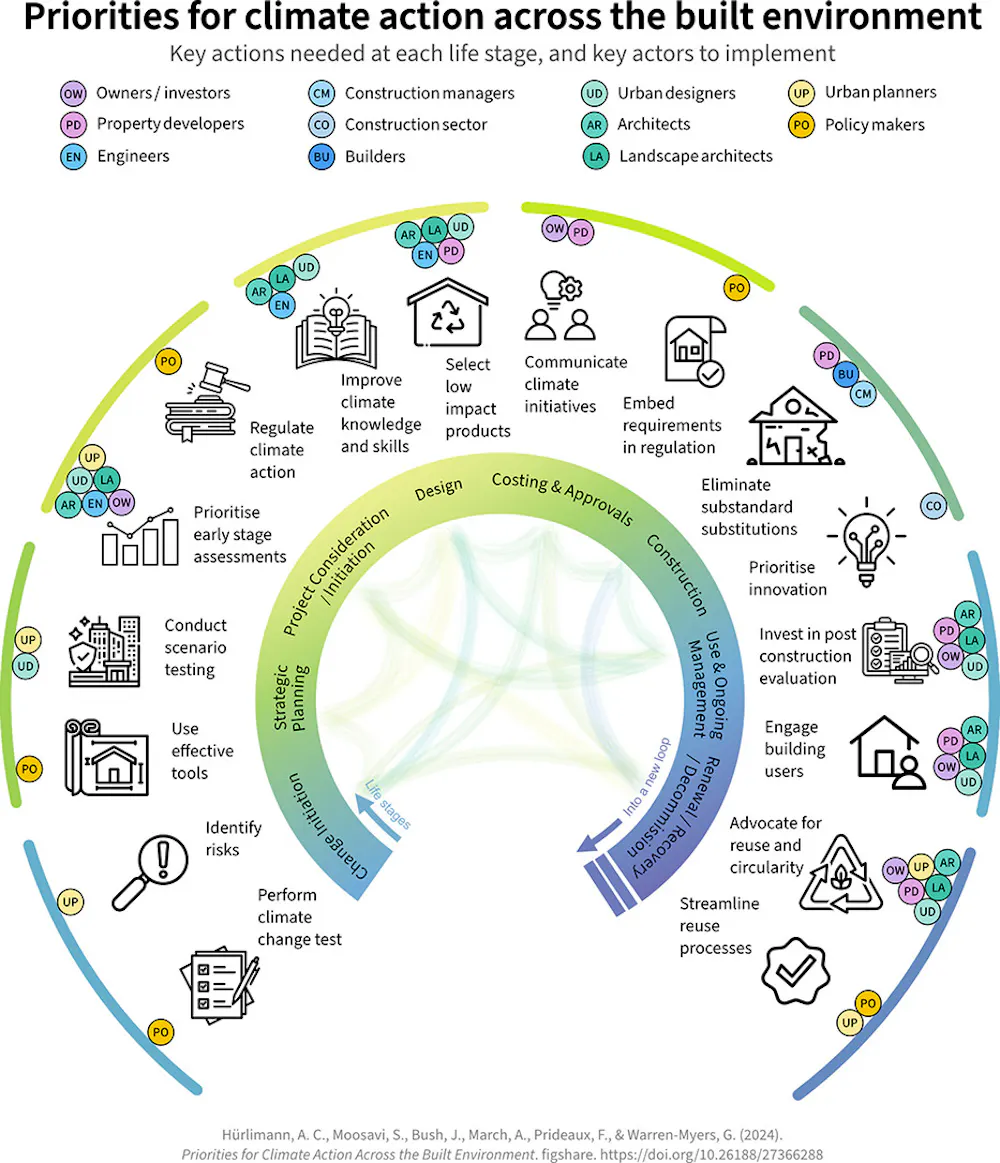
    Our new study identifies 16 priority actions to address climate change in the construction and management of cities.

    Building smarter

    Climate change must be a key consideration when designing, building and managing our cities. The emissions generated need to be minimised and eventually eliminated.

    We must build in locations, and in ways, that reduce climate risks. But policies governing how our cities are designed and constructed don’t achieve this.

    A recent study of three local government areas identified only limited action on adaptation and mitigation. Other research has found few urban development policies include carbon reduction goals that meet international targets.

    The National Housing Accord will see more than one million houses built by 2029. These new homes must address the climate challenge.

    16 areas for priority action

    The priority areas in our new study were informed by interviews with more than 150 stakeholders working in urban planning, architecture, landscape architecture, urban design, sustainability, construction and property.

    Priority areas for minimising damaging emissions generated by cities.
    CC BY

    The actions they identified cover the entire life cycle of the built environment.

    One of the first barriers to overcome is the perceived lack of agency among industry professionals to initiate or demand climate action. They perceive others, such as property owners or clients, to have more influence.

    Climate change risks should be identified in the early stages of planning new developments, backed up by effective tools to make risk identification and action easier:

    There were areas that were identified as being flood prone or risk prone. But there was no strategy to deal with what happens to those areas – An urban planner

    Once specific projects are being considered it is important to prioritise early stage climate assessments, supported by policies which mandate climate action:

    Everyone has good intentions but without big formal legislation around it, everyone’s just sort of making their way in the dark – A construction industry professional

    In the design stage, steps to improve the climate knowledge and skills of the workforce beyond disciplinary boundaries is critical. The selection of low-impact products and materials will also help ensure design is more climate responsive.

    Climate action must be embedded in all stages of design and construction of Australian cities.
    GagliardiPhotography/Shutterstock

    The highest number of hurdles to climate action were found to occur during the costing and approvals stage. Participants spoke of a highly competitive building industry. If climate change initiatives introduced at an earlier stage aren’t required by law, they are likely to be cut.

    unless there’s something in it for them in terms of return on investment, it’s going to be hard to get them to do it, unless we make them – An urban planner

    During the construction phase, product and material substitutions that have detrimental environmental impact should be eliminated. Innovation should be encouraged:

    If you want to push the envelope a little bit in terms of using recycled materials […] that’s a bit of a barrier. To push innovation is difficult – A landscape architect

    Post-construction

    Once construction is complete and buildings and public spaces are being used, it is important to invest in a thorough evaluation process. Building users should be involved to ensure buildings are maintained for optimal climate outcomes:

    [We] tried to achieve the six star rating […] the client has to maintain it [the building] for a year, and that’s when things start to fall off – An architect

    When it comes to area upgrades or building renewals, advocating for reuse and materials circularity is important. But the custom of demolishing and building anew, is hard to shift:

    The reuse of the existing building obviously generates significantly less waste and involves less material. So, design decisions and strategic decisions around using existing buildings is really important – An urban designer

    Working together

    This is a time of significant change in our urban areas.

    We need to make sure climate action is embedded in every stage of decision making. This may mean more efficient use, and reuse, of the existing built stock. This will require an overhaul of policies regarding building retrofits, and a change in mindsets.

    The priority actions to address climate change in cities can be implemented across a range of levels for:

    • individual professionals – pursue development of their climate change skills, including opportunities provided by professional associations

    • professional practices – review internal processes to ensure climate action is mainstreamed across projects, and in company decision making

    • universities teaching built environment professional degrees – embed climate change knowledge, skills, and competencies across the curriculum

    • governments at all levels – review policy settings to mandate mitigation and adaption.

    By addressing these actions, we can collectively work towards achieving our emission reduction targets and making sure our cities minimise climate change risks.

    Anna Hurlimann received funding for the research reported in this article from the Australian Research Council – Discovery Grant DP200101378, with co-chief investigators Georgia Warren-Myers, Alan March, Sareh Moosavi and Judy Bush. She is a member of the Planning Institute of Australia.

    Sareh Moosavi received funding for the research reported in this article from the Australian Research Council – Discovery Grant DP200101378, with co-chief investigators Anna Hurlimann, Georgia Warren-Myers, Alan March, and Judy Bush.

    ref. Cities are heating up the planet – how they can do more to fight climate change – https://theconversation.com/cities-are-heating-up-the-planet-how-they-can-do-more-to-fight-climate-change-259391

    MIL OSI AnalysisEveningReport.nz

  • MIL-OSI Submissions: Gaza: Deadly Israeli-US supply distribution scheme must be dismantled and siege lifted – MSF

    Source: Médecins Sans Frontières (MSF)

    28 June, Gaza: The Israeli-US food distribution scheme in Gaza, launched one month ago, is degrading Palestinians by design, forcing them to choose between starvation or risking their lives for minimal supplies. With over 500 people killed and nearly 4,000 wounded while seeking food, this scheme is slaughter masquerading as humanitarian aid and must be immediately dismantled. Médecins Sans Frontières (MSF) calls on the Israeli authorities and their allies to lift the siege on food, fuel, medical, and humanitarian supplies and to revert to the pre-existing principled humanitarian system, coordinated by the UN.

    This disaster has been orchestrated by the Israeli-US proxy operating under the name Gaza Humanitarian Foundation (GHF). The way supplies are distributed forces thousands of Palestinians, who have been starved by an over 100 day-long Israeli siege, to walk long distances to reach the four distribution sites and fight for scraps of food supplies. These sites hinder women, children, the elderly, and people with disabilities from accessing aid and people are killed and wounded in the chaotic process. Yet each renewed atrocity now happens with barely a shrug, let alone condemnation, from an international community seemingly resigned to its role in allowing and perpetuating a campaign consistent with patterns of genocide. This cannot be allowed to continue.

    “The four distribution sites, all located in areas under the full control of Israeli forces after people had been forcibly displaced from there, are the size of football fields surrounded by watch points, mounds of earth and barbed wire. The fenced entrance gives only one access point in or out,” says Aitor Zabalgogeazkoa, MSF emergency coordinator in Gaza. “GHF workers drop the pallets and the boxes of food and open the fences, allowing thousands in all at once to fight down to the last grain of rice.

    “If people arrive early and approach the checkpoints, they get shot. If they arrive on time, but there is an overflow and they jump over the mounds and the wires, they get shot,” says Zabalgogeazkoa. “If they arrive late, they shouldn’t be there because it is an ‘evacuated zone’, they get shot.”

    Every day, MSF teams see patients who have been killed or wounded trying to get food at one of these sites.

    “A lot of people were getting directly shot at. This is not aid – it’s a death trap,” says Hani Abu Soud, a community member at Al-Mawasi primary healthcare centre. “They were going to kill us one by one.  We were hungry, we were just trying to feed our children. What else can I do?  A bag of lentils costs around 30-40 shekels [€6 – €10]”.

    “We do not have that kind of money. Death has become cheaper than survival.”

    As the distributions have continued, medical teams have noticed a stark increase in the number of patients with gunshot wounds. In the MSF field hospital in Deir Al-Balah the number of patients with gunshot wounds increased by 190 per cent the week of 8 June, compared to the week before. The still barely functioning hospitals in Gaza are devastated; running on minimal supplies of pain relief, anaesthetic and blood. Fully functioning hospitals would struggle to cope with such a high number of trauma patients flooding emergency rooms every day.

    Injured patients seek help at basic healthcare clinics or field hospitals, since larger hospitals better equipped to provide treatment for violent trauma have been damaged by Israel’s attacks on healthcare facilities, with many no longer functioning. The MSF clinic in Al Mawasi, which is not typically equipped to treat trauma patients, has received 423 people wounded from the distribution sites since 7 June.  Ten or more patients with violent injuries arrive from distribution sites each day. These injuries require immediate life-saving treatment, like blood transfusions or surgery, that our medical teams cannot provide in a basic healthcare clinic. Patients are referred to the few remaining hospitals still functioning like Nasser hospital, but with healthcare so scarce, MSF has received reports of people wounded at aid distribution sites dying from their injuries before they can receive treatment.

    With no food in the tent he shared with his family, seventeen-year-old Ashraf went to a distribution site on 23 June. “I told him it was too dangerous. He said he wanted to get something for his sister,” says Hanan, Ashraf’s mother. “Thirty minutes later he called me, crying for help. He had been shot. This ‘aid’ is soaked in blood.”

    Ashraf was being treated at Al Mawasi basic healthcare clinic.

    Aid must not be controlled by a warring party to further its military objectives. The Israeli authorities have used a deliberate tactic of food deprivation against Palestinians in Gaza. They have weaponised food supply by denying it to people, then by limiting it to a trickle, in a complete violation of international humanitarian law. Humanitarian principles exist to enable the facilitation of aid to those who need it most, with dignity. Aid must be delivered at scale, consistent with these principles. The people of Gaza are in vital and immediate need of the re-establishment of a genuine aid system, and a sustained ceasefire, for their very survival.

    MSF is an international, medical, humanitarian organisation that delivers medical care to people in need, regardless of their origin, religion, or political affiliation. MSF has been working in Haiti for over 30 years, offering general healthcare, trauma care, burn wound care, maternity care, and care for survivors of sexual violence. MSF Australia was established in 1995 and is one of 24 international MSF sections committed to delivering medical humanitarian assistance to people in crisis. In 2022, more than 120 project staff from Australia and New Zealand worked with MSF on assignment overseas. MSF delivers medical care based on need alone and operates independently of government, religion or economic influence and irrespective of race, religion or gender. For more information visit msf.org.au  

    MIL OSI – Submitted News

  • MIL-OSI Submissions: Gaza: Deadly Israeli-US supply distribution scheme must be dismantled and siege lifted – MSF

    Source: Médecins Sans Frontières (MSF)

    28 June, Gaza: The Israeli-US food distribution scheme in Gaza, launched one month ago, is degrading Palestinians by design, forcing them to choose between starvation or risking their lives for minimal supplies. With over 500 people killed and nearly 4,000 wounded while seeking food, this scheme is slaughter masquerading as humanitarian aid and must be immediately dismantled. Médecins Sans Frontières (MSF) calls on the Israeli authorities and their allies to lift the siege on food, fuel, medical, and humanitarian supplies and to revert to the pre-existing principled humanitarian system, coordinated by the UN.

    This disaster has been orchestrated by the Israeli-US proxy operating under the name Gaza Humanitarian Foundation (GHF). The way supplies are distributed forces thousands of Palestinians, who have been starved by an over 100 day-long Israeli siege, to walk long distances to reach the four distribution sites and fight for scraps of food supplies. These sites hinder women, children, the elderly, and people with disabilities from accessing aid and people are killed and wounded in the chaotic process. Yet each renewed atrocity now happens with barely a shrug, let alone condemnation, from an international community seemingly resigned to its role in allowing and perpetuating a campaign consistent with patterns of genocide. This cannot be allowed to continue.

    “The four distribution sites, all located in areas under the full control of Israeli forces after people had been forcibly displaced from there, are the size of football fields surrounded by watch points, mounds of earth and barbed wire. The fenced entrance gives only one access point in or out,” says Aitor Zabalgogeazkoa, MSF emergency coordinator in Gaza. “GHF workers drop the pallets and the boxes of food and open the fences, allowing thousands in all at once to fight down to the last grain of rice.

    “If people arrive early and approach the checkpoints, they get shot. If they arrive on time, but there is an overflow and they jump over the mounds and the wires, they get shot,” says Zabalgogeazkoa. “If they arrive late, they shouldn’t be there because it is an ‘evacuated zone’, they get shot.”

    Every day, MSF teams see patients who have been killed or wounded trying to get food at one of these sites.

    “A lot of people were getting directly shot at. This is not aid – it’s a death trap,” says Hani Abu Soud, a community member at Al-Mawasi primary healthcare centre. “They were going to kill us one by one.  We were hungry, we were just trying to feed our children. What else can I do?  A bag of lentils costs around 30-40 shekels [€6 – €10]”.

    “We do not have that kind of money. Death has become cheaper than survival.”

    As the distributions have continued, medical teams have noticed a stark increase in the number of patients with gunshot wounds. In the MSF field hospital in Deir Al-Balah the number of patients with gunshot wounds increased by 190 per cent the week of 8 June, compared to the week before. The still barely functioning hospitals in Gaza are devastated; running on minimal supplies of pain relief, anaesthetic and blood. Fully functioning hospitals would struggle to cope with such a high number of trauma patients flooding emergency rooms every day.

    Injured patients seek help at basic healthcare clinics or field hospitals, since larger hospitals better equipped to provide treatment for violent trauma have been damaged by Israel’s attacks on healthcare facilities, with many no longer functioning. The MSF clinic in Al Mawasi, which is not typically equipped to treat trauma patients, has received 423 people wounded from the distribution sites since 7 June.  Ten or more patients with violent injuries arrive from distribution sites each day. These injuries require immediate life-saving treatment, like blood transfusions or surgery, that our medical teams cannot provide in a basic healthcare clinic. Patients are referred to the few remaining hospitals still functioning like Nasser hospital, but with healthcare so scarce, MSF has received reports of people wounded at aid distribution sites dying from their injuries before they can receive treatment.

    With no food in the tent he shared with his family, seventeen-year-old Ashraf went to a distribution site on 23 June. “I told him it was too dangerous. He said he wanted to get something for his sister,” says Hanan, Ashraf’s mother. “Thirty minutes later he called me, crying for help. He had been shot. This ‘aid’ is soaked in blood.”

    Ashraf was being treated at Al Mawasi basic healthcare clinic.

    Aid must not be controlled by a warring party to further its military objectives. The Israeli authorities have used a deliberate tactic of food deprivation against Palestinians in Gaza. They have weaponised food supply by denying it to people, then by limiting it to a trickle, in a complete violation of international humanitarian law. Humanitarian principles exist to enable the facilitation of aid to those who need it most, with dignity. Aid must be delivered at scale, consistent with these principles. The people of Gaza are in vital and immediate need of the re-establishment of a genuine aid system, and a sustained ceasefire, for their very survival.

    MSF is an international, medical, humanitarian organisation that delivers medical care to people in need, regardless of their origin, religion, or political affiliation. MSF has been working in Haiti for over 30 years, offering general healthcare, trauma care, burn wound care, maternity care, and care for survivors of sexual violence. MSF Australia was established in 1995 and is one of 24 international MSF sections committed to delivering medical humanitarian assistance to people in crisis. In 2022, more than 120 project staff from Australia and New Zealand worked with MSF on assignment overseas. MSF delivers medical care based on need alone and operates independently of government, religion or economic influence and irrespective of race, religion or gender. For more information visit msf.org.au  

    MIL OSI – Submitted News

  • MIL-OSI New Zealand: Northland Regional Council News – 30 June 2025

    Source: Northland Regional Council

    NOMINATIONS FOR NRC OPEN 04 JULY
    People keen to stand for one of nine places on the Northland Regional Council at this year’s local body elections in October can get their nominations in from Friday 04 July until noon on Friday 01 August 2025.
    Anyone aged 18 and over can stand for election provided they’re a New Zealand citizen, enrolled on the Parliamentary electoral roll and are nominated by two electors whose names appear on the electoral roll within the constituency the candidate is standing for.
    Printed nomination forms and a candidate handbook will be available from 04 July from any regional council office, by phoning (0800) 002 004, from www.nrc.govt.nz or by downloading from esp.electionservices.co.nz/lge2025/NRC
    SECOND FEEDBACK PERIOD ON NAVIGATION SAFETY BYLAW
    Northlanders now have a further chance to have their say on Northland Regional Council’s Navigation Safety Bylaw, which sets the rules for keeping people safe on the water.
    After a first feedback period during May, the council is now running a second feedback period, recognising the need to provide more detail on key proposals and ensure there is sufficient time for people to have their say.
    The provisions in the draft bylaw remain the same, with key proposals including a new requirement to carry two forms of communication on a vessel; amending the requirements for wearing a lifejacket; and removing a clause prohibiting wind-powered board sports in the Ruakākā and Waipū estuaries.
    The feedback period runs until Monday 28 July. More detail can be found at www.nrc.govt.nz/bylawreview

    MIL OSI New Zealand News

  • MIL-OSI New Zealand: Northland News – Nominations for Northland Regional Council open 04 July

    Source: Northland Regional Council

    People keen to stand for one of nine places on the Northland Regional Council at this year’s local body elections in October can get their nominations in from Friday 04 July.
    Dale Ofsoske, the council’s Electoral Officer, says nominations open on Friday 04 July and close at noon on Friday 01 August 2025.
    Mr Ofsoske says anyone aged 18 and over can stand for election provided they’re a New Zealand citizen and enrolled on the Parliamentary electoral roll.
    “You must also be nominated by two electors whose names appear on the electoral roll within the respective constituency that a candidate is standing for.”
    Mr Ofsoske warns against leaving the lodgement of nomination papers to the last minute.
    “Should a nomination paper be lodged late on the morning nominations close, and be incorrectly completed or ineligible nominators are provided, there may be insufficient time to correct the situation and the nomination paper could be invalidated.”
    Mr Ofsoske says in the regional council’s case seven general councillors will be elected from seven general constituencies (one from each) and two councillors elected from a region-wide Māori constituency (Te Raki).
    The general constituencies are Far North, Coastal Central, Coastal South, Kaipara, Mid North, Whangārei Central and Bay of Islands-Whangaroa.
    Mr Ofsoske says printed nomination forms and a candidate handbook will be available from 04 July from any regional council office, by phoning (0800) 002 004, from www.nrc.govt.nz or by downloading from esp.electionservices.co.nz/lge2025/NRC 

    MIL OSI New Zealand News

  • MIL-OSI New Zealand: Hong Kong: National Security Law analysis shows vast majority unjustly arrested

    Source: Amnesty International


    More than 80% of people convicted under Hong Kong’s National Security Law (NSL) have been wrongly criminalized and should never have been charged in the first place, according to new research by Amnesty International published on the fifth anniversary of the law being enacted.


    The organization’s analysis of 255 individuals targeted under national security legislation in Hong Kong since 30 June 2020 also showed that bail was denied in almost 90% of cases where charges were brought, and that those denied bail were forced to spend an average of 11 months in detention before facing trial.


    “Five years after the enactment of the National Security Law, our alarming findings show that the fears we raised about this law in 2020 have been realized. The Hong Kong government must stop using the pretext of ‘national security’ to punish legitimate expression,” Amnesty International’s China Director Sarah Brooks said.


    “This draconian law, and the other national security legislation it spawned, has corroded key legal safeguards that once formed the foundation for protecting human rights and the rule of law in Hong Kong. The result has been a devastation of Hongkongers’ ability to express themselves without fear of arrest.”


    Amnesty’s briefing paper analyses patterns in arrests, bail decisions and prosecutions under the NSL and other national security legislation. In particular, the research highlights three major concerns: the criminalization of the legitimate exercise of the human right to freedom of expression, the low bail grant rates in these cases, and the de facto long-term incarceration of most accused.


    The analysis found that of the 78 concluded cases under the NSL at least 66 (84.6%) involved legitimate expression that should not have been criminalized according to international standards, with no evidence of violent conduct or incitement.


    When concluded cases under Article 23 and pre-Article 23 “sedition” offences are also counted, at least 108 out of a total of 127 cases (85%) involved similarly legitimate forms of expression which were unjustly prosecuted. These cases fall well short of the high threshold required for criminalization under international standards.


    Meanwhile, according to Amnesty’s data, the courts denied bail in 129 national security cases, or 89% of those in which individuals were charged.


    Among the 129 cases where bail was denied, the average length of detention was 328 days. Fifty-two cases (40.3%) involved detentions lasting one year or more before trial or a guilty plea.


    “In five years, the National Security Law has transformed Hong Kong from a city of tolerance and open debate into a city of repression and self-censorship. Our analysis shows that Hong Kong’s national security framework is not just a flagrant violation of international human rights standards on paper but that authorities misuse it to target opposition voices and foster an environment of fear,” Sarah Brooks said.


    “This research demonstrates that the vast majority of those charged with national security offences have acted entirely within their rights. Meanwhile, prosecutors have continued to bring cases under this flawed national security architecture and appealed the rare acquittals awarded by courts. Other governments should step up and use their influence to urgently press the Hong Kong and Chinese authorities to repeal the law.


    “In the interim, the Hong Kong government should stop applying national security legislation immediately. At the very least they need to reinstate the presumption of bail in favour of release pending trial. No one should be made to languish in jail simply for exercising their right to freedom of expression.”


    Background


    Since the imposition of the NSL on 30 June 2020, the human rights landscape in Hong Kong has deteriorated at an alarming pace. Civil society has been effectively dismantled, while long-standing rights — including the rights to freedom of expression, peaceful assembly and association — have been severely curtailed.


    Amnesty International’s analysis covered the cases of 255 individuals who, between 30 June 2020 and 31 May 2025, were arrested for and/or charged with any offences under the NSL; Part 1 and 2 of the city’s Crimes Ordinance that define the colonial-era offence of “sedition”; and the Article 23 law (also known as the Safeguarding National Security Ordinance), which replaced Part 1 and 2 of the Crimes Ordinance when it entered into force on 23 March 2024.


    Amnesty International sent its briefing to the Hong Kong government, which dismissed the findings as a “distortion of the reality” and said the NSL “has restored the enjoyment of rights and freedoms” in Hong Kong.

    MIL OSI New Zealand News

  • MIL-OSI USA: Myth vs. Fact: The One Big Beautiful Bill

    US Senate News:

    Source: US Whitehouse
    While Democrats spend the day launching desperate, hollow attacks in a last-ditch effort to block President Trump’s One Big Beautiful Bill, the FACTS speak for themselves.
    MYTH: The One Big Beautiful Bill is “just a tax break for billionaires.”FACT: The One Big Beautiful Bill delivers the largest middle- and working-class tax cut in U.S. history. The President’s legislation will put more than $10,000 a year back in the pockets of typical hardworking families. This is the most pro-growth, pro-worker, pro-family legislation ever crafted.
    MYTH: The One Big Beautiful Bill “takes from the poor to give to the rich.”FACT: The lowest-income workers receive the largest percentage tax cuts. The One Big Beautiful Bill delivers the largest tax cut in history for working-and -middle class Americans.
    MYTH: The One Big Beautiful Bill “makes life more unaffordable.”FACT: The bill delivers bigger paychecks, expanding take-home pay by over $10,000 per year for a typical family.
    MYTH: The One Big Beautiful Bill “hurts low-income families.”FACT: The One Big Beautiful Bill is the most pro-family legislation ever crafted. It will deliver bigger paychecks, giving more than a $10,000 boost annually to everyday families. We are also expanding Opportunity Zones, expanding childcare access, increasing the child tax credit, and creating newborn savings accounts.
    MYTH: The One Big Beautiful Bill “is just a handout to corporations.”FACT: This bill drives a Blue-Collar BOOM with tax relief for workers, support for small businesses, and investments in American manufacturing. The One Big Beautiful Bill delivers the largest middle- and working-class tax cut in U.S. history.
    MYTH: The One Big Beautiful Bill “leaves American workers behind.”FACT: This is the most pro-American worker bill in history. The One Big Beautiful Bill boosts pay for millions—and with no tax on tips or overtime, those working hourly and service jobs receive additional tax relief.
    MYTH: The One Big Beautiful Bill “hurts small businesses.”FACT: The One Big Beautiful Bill will make the Trump Tax Cuts permanent, including the small business deduction—helping Main Street grow and hire. Failure to pass this legislation would result in a $4 trillion tax hike.
    MYTH: The One Big Beautiful Bill “kicks American families off Medicaid.”FACT: As the President has said numerous times, there will be no cuts to Medicaid. The One Big Beautiful Bill protects and strengthens Medicaid for those who rely on it—pregnant women, children, seniors, people with disabilities, and low-income families—while eliminating waste, fraud, and abuse. The One Big Beautiful Bill removes illegal aliens, enforces work requirements, and protects Medicaid for the truly vulnerable.
    MYTH: The One Big Beautiful Bill “cuts Medicare.”FACT: Medicare has not been touched in this bill— absolutely nothing in the bill reduces spending on Medicare benefits. This legislation does not make a single cut to welfare programs—it safeguards and protects these programs for all eligible Americans.
    MYTH: The One Big Beautiful Bill “will close rural hospitals.”FACT: Rural hospitals comprise just 7% of all hospital spending on Medicaid, illustrating that they have not benefited from the massive increase in waste, fraud, and abuse under the Biden administration. By strengthening Medicaid, we are making more resources available for vulnerable populations and safety net providers, like rural hospitals. We are expanding rural hospital protection, providing targeted funds for rural care, and giving states flexibility to support local providers.
    MYTH: “People will literally die” from the One Big Beautiful Bill — “and millions will be kicked off their healthcare.”FACT: This is one of the most egregious, deranged attacks from the Left peddling fear over the facts. The One Big Beautiful Bill protects eligible Americans on federal welfare – including Medicaid. By strengthening the integrity of Medicaid by eliminating waste, fraud, and abuse, its resources can be refocused on providing better care for those whom the program was designed to serve: pregnant women, children, people with disabilities, low-income seniors, and other vulnerable low-income families.
    MYTH: The One Big Beautiful Bill “will hurt people with disabilities.”FACT: The One Big Beautiful Bill protects and strengthens Medicaid for Americans with disabilities. Rest assured, those with disabilities receiving Medicaid will receive no loss or change in coverage.
    MYTH: The One Big Beautiful Bill “punishes vulnerable Americans with work requirements to receive their benefits.”FACT: Not true. The 20-hour weekly work requirement applies only to able-bodied adults without young children and promotes dignity, stability, and better health outcomes for families. The One Big Beautiful Bill restores the dignity of work with historically bipartisan work requirements for able-bodied Americans. We are implementing commonsense, Clinton-era work, volunteer, education, or training requirements with broad bipartisan support.
    MYTH: “There’s no fraud in Medicaid — Republicans are just taking coverage away from vulnerable populations.”FACT: In the last 10 years, CMS admitted that improper payments for Medicaid have exceeded HALF A TRILLION dollars. In just the past year, taxpayers spent $56 billion on benefits for able-bodied adults abusing the system—and over a million illegal aliens are receiving free health care on the backs of taxpayers. The One Big Beautiful Bill removes illegal aliens, enacts work requirements for able-bodied adults, and protects Medicaid for the truly vulnerable.
    MYTH: “SNAP work requirements are unnecessary.”FACT: Only 28% of able-bodied adults on SNAP work. The One Big Beautiful Bill promotes work, responsibility, and restores SNAP to serve the truly needy. SNAP enrollment remains high even in a strong economy, including millions of able-bodied adults who could work. In fact, almost three-quarters of able-bodied adults without dependents on SNAP have no earned income. The mission of the program has failed. SNAP was intended to be temporary help for those who encounter tough times—we are strengthening this program to serve those who need it most.
    MYTH: “Illegal aliens don’t get federal benefits.”FACT: Illegals burden taxpayers with billions in costs for free health care and welfare benefits. The One Big Beautiful Bill ends Medicaid and SNAP fraud and ensures these programs serve only eligible Americans.
    MYTH: The One Big Beautiful Bill “doesn’t actually end taxes on Social Security.”FACT: The One Big Beautiful Bill delivers historic tax relief to seniors, with a new tax deduction that, combined with other deductions, ensures the average Social Security beneficiary will pay zero taxes on Social Security.
    MYTH: The One Big Beautiful Bill “increases the deficit.”FACT: The One Big Beautiful Bill reduces deficits by over $2 trillion by increasing economic growth and cutting waste, fraud, and abuse across government programs at an unprecedented rate. This legislation delivers historic levels of mandatory savings. President Trump’s pro-growth economic formula will reduce the deficit, increase wages, deliver American jobs, and drive down the cost of living.
    MYTH: “But the CBO says….”FACT: The Crooked Budget Office has a terrible record with its predictions and hasn’t earned the attention the media gives it. The CBO misreads the economic consequences of not extending the Trump Tax Cuts. The One Big Beautiful Bill delivers real savings that will unleash our economy and prevent the largest tax hike in history, resulting in historic prosperity, while lowering the debt burden.
    MYTH: “There’s too much ‘pork’ in this bill.”FACT: There’s no pork in the bill. Every single provision in the One Big Beautiful Bill is a campaign promise the American people elected President Trump to deliver. The only new spending in the bill is to secure the homeland of the United States and save American sovereignty — which is fully paid for by increased visa fees on foreigners.
    MYTH: “The One Big Beautiful Bill won’t strengthen national security.”FACT: The One Big Beautiful Bill delivers on President Trump’s Peace Through Strength agenda by funding the Golden Dome missile defense system and modernizing our military to prioritize lethality and readiness. It fully equips our war fighters with the resources they need while modernizing and revolutionizing our equipment and technology.
    MYTH: The One Big Beautiful Bill “helps ‘Big Oil’ and locks up U.S. energy resources.”FACT: Quite the opposite. It unleashes American energy, refills the Strategic Petroleum Reserve, and repeals the Green New Scam policies. The One Big Beautiful Bill unleashes clean, American-made energy and will reduce the cost of living for Americans nationwide.
    MYTH: “Manufacturing jobs will still go overseas.”FACT: The One Big Beautiful Bill delivers 100% expensing for new domestic factories, revitalizes Opportunity Zones, and incentivizes companies to keep jobs in America.
    MYTH: The One Big Beautiful Bill “neglects rural America.”FACT: This bill invests in rural communities, expands market access, and delivers historic support to farm families. The One Big Beautiful Bill provides the certainty America’s farm families need to continue operating and producing the affordable, safe, and abundant supply of food, fuel, and fiber that our nation relies on.
    MYTH: “SNAP is being gutted and cutting food stamps for families, causing them to go hungry.”FACT: The One Big Beautiful Bill protects and strengthens SNAP. Right now, almost three-quarters of able-bodied adults without dependents on SNAP have no earned income and the fraud rate is high. The mission of the program has failed: SNAP was intended to be temporary help for those who encounter tough times. Now, it’s become so bloated that it is leaving fewer resources for those who truly need help. We are committed to preserving SNAP for the truly needy.
    MYTH: “Republicans are shutting Democrats out of the legislative process.”FACT: This is not a partisan bill—Democrats shut themselves out by supporting higher taxes, open borders, and giveaways to illegal immigrants. The One Big Beautiful Bill delivers on Republican promises to lower taxes, secure the border, cut spending, and put Americans first.
    MYTH: The One Big Beautiful Bill “border package is not necessary since President Trump has secured the border.”FACT: We must ensure that the invasion we witnessed as a nation under Joe Biden and Kamala Harris never happens again. The One Big Beautiful Bill’s historic investment in our border security ensures we permanently secure our border and protect our homeland by finishing the border wall, hiring 10,000 new ICE officers, and funding efforts to stop the flow of fentanyl.

    MIL OSI USA News

  • MIL-OSI USA: McCaul, McGovern Introduce Bipartisan Resolution Commemorating His Holiness the Dalai Lama’s 90th Birthday as “A Day of Compassion”

    Source: United States House of Representatives – Congressman Michael McCaul (10th District of Texas)

    WASHINGTON  Today, U.S. Congressman Michael McCaul (R-Texas) — chairman emeritus of the House Committee on Foreign Affairs — introduced a resolution alongside Rep. Jim McGovern (D-Mass.) designating July 6th, 2025, as “A Day of Compassion” in honor of His Holiness the 14th Dalai Lama’s 90th birthday. 

    “Despite having faced persecution, oppression, and unspeakable violence at the hands of the CCP, His Holiness the Dalai Lama has maintained inner peace and continues to preach compassion — inspiring not only his own people, but the entire world,” said Rep. McCaul. “I was honored to meet him in Dharamsala last year to voice the U.S. government’s support for the people of Tibet, emphasize the friendship between our two peoples, and learn more of his courageous, peaceful, and sacrificial leadership. Ahead of His Holiness’s 90th birthday, I am proud to introduce this resolution calling for ‘A Day of Compassion’ and affirming Tibetans’ fundamental human rights as we look forward to the day the Dalai Lama and his people can return to their homeland in peace.”

    “His Holiness the Dalai Lama is an inspiration to millions of people around the world, including to me,” said Rep. McGovern. “His teachings on religious tolerance, non-violent responses to conflict and violent extremism, and peace-building are both timeless and urgently needed in our present circumstances. He has been a passionate advocate for the freedom and dignity for the Tibetan people. It is appropriate for Congress to honor the 14th Dalai Lama and his countless accomplishments on his 90th birthday. May his next one be celebrated in Lhasa.” 

    “This resolution expresses a wonderful, bipartisan recognition that His Holiness the Dalai Lama stands as a global icon of compassion and honors his lifelong commitment to strive for peace and justice for his homeland and the people of Tibet,” said International Campaign for Tibet (ICT) President Tencho Gyatso. “Swift passage of this resolution led by HFAC Chairman Emeritus McCaul and Congressman McGovern, will bring joy and inspiration to all those celebrating the Dalai Lama’s 90th birthday, and perhaps most critically, provide hope and inspiration to the Tibetan people in Tibet for whom even a simple public acknowledgement of the Dalai Lama’s birthday remains a dangerous act.”

    The resolution is co-signed by Representatives Joe Wilson (R-S.C.), Mike Lawler (R-N.Y.), Raja Krishnamoorthi (D-Ill.), Jamie Raskin (D-Md.), Janice Schakowsky (D-Ill.), and Young Kim (R-Calif.).

    Background:

    This resolution designates July 6, 2025, as “A Day of Compassion” to honor the upcoming 90th birthday of His Holiness the 14th Dalai Lama and recognize his lifelong commitment to peace, nonviolence, human rights, and the preservation of Tibetan culture. It reaffirms bipartisan U.S. support for the Tibetan people’s right to self-determination, opposes Chinese government interference in Tibetan practices, and expresses deep respect for the Dalai Lama’s moral leadership and humanitarian contributions to the international community.

    To read the full resolution text, click here.

    ###

    MIL OSI USA News

  • MIL-OSI USA: McCaul Statement on U.S. Strikes on Iranian Nuclear Sites

    Source: United States House of Representatives – Congressman Michael McCaul (10th District of Texas)

    WASHINGTON – U.S. Congressman Michael McCaul (R-Texas) — chairman emeritus of the House Committee on Foreign Affairs — released the following statement on the United States’ successful strikes on Iranian nuclear facilities.

    “The United States government has long maintained that Iran must never acquire a nuclear weapon. Today, President Trump backed that commitment with decisive action — demonstrating the kind of leadership that does what it takes to protect American lives.

    “President Trump gave the Iranian regime every chance to pursue diplomacy and spare their people further devastation. Instead, they chose to escalate their nuclear ambitions — announcing a new enrichment site just last week.

    “Make no mistake: If Iran were to obtain nuclear weapons, the regime would pose an existential threat not only to Israel, which they call the ‘little Satan,’ but especially to the United States, their so-called ‘great Satan.’ Only the U.S. military — the most capable in the world — could neutralize that threat.

    “Without leaving any boots on the ground in Iran, this limited, targeted operation sent a powerful message of deterrence that I hope and believe will lead to greater peace across the region. Iran, its proxies, and any enemy of the United States should think twice the next time they intend to harm our nation — because President Trump means what he says.

    “May God bless the brave men and women of our armed forces who executed these strikes, and may God bless the United States of America.”

    ###

    MIL OSI USA News

  • MIL-OSI Australia: Major milestone for Canberra’s first light rail bridge

    Source: Australian National Party


    As part of ACT Government’s ‘One Government, One Voice’ program, we are transitioning this website across to our . You can access everything you need through this website while it’s happening.


    Released 18/06/2025

    Construction is set to begin on Canberra’s first light rail bridge, a major milestone in connecting the city to Commonwealth Park and Acton Waterfront.

    The new rail bridge – spanning Parkes Way between the existing Commonwealth Avenue road bridges – has been designed to carry two fully loaded light rail vehicles at once – the equivalent of about 70 cars.

    The new bridge will be a vital connection between the city, Commonwealth Park and the Acton Waterfront, forming a key piece of infrastructure for the future light rail network.

    Bridge piling works for the foundations will begin in late June, paving the way for the installation of massive steel girder frames later in the year, using an 800-tonne crane stationed in the Parkes Way median – a significant engineering feat.

    To ensure piling works can be undertaken safely, Parkes Way will be closed under Commonwealth Avenue in both directions between Coranderrk Street and the Glenloch Interchange from 8pm on Friday 27 June until 5am on Monday 30 June, and potentially from 8pm on Friday 4 July until 5am on Monday 7 July.

    Traffic controls and signage will be put in place to safely direct motorists along alternative routes.

    Eastbound traffic will be directed along either Caswell Drive or Lady Denman Drive, while westbound traffic will be diverted across Commonwealth Avenue.

    Works have been scheduled to take place over weekends to minimise the impact to Canberra’s road network. Public transport may experience some delays during these works.

    Additional road closures will be required in the coming months as construction continues on this vital asset.

    The community will be notified in advance about any potential impacts and traffic changes.

    We apologise for any inconvenience and thank you for your patience and understanding.

    More details on road changes and other impacts relating to the construction of light rail are available on the online construction impacts map.

    To view the map and stay up to date visit https://www.builtforcbr.act.gov.au/travel-impacts.

    – Statement ends –

    Infrastructure Canberra | Media Releases

    «ACT Government Media Releases | «Directorate Media Releases

    MIL OSI News

  • MIL-OSI New Zealand: DOC’s Jobs for Nature legacy

    Source: NZ Department of Conservation

    Date:  30 June 2025

    Sia says, “Jobs for Nature projects have had a positive impact on the environment, restoring over 6000 ha of wetland, which has improved wildlife habitat, water quality and flood control capability, and have worked toward restoring six priority waterways, such as the Rangitata and Whanganui Rivers, among many other amazing results for our land, water, and species.”

    “As the Department’s work with Jobs for Nature comes to an end this month, the programme has been successful for the thousands who’ve gained valuable experience and achieved great things for nature.”

    Launched to turbo-boost nature-based employment through COVID-19, the $1.2 billion multi-agency programme employed people whose livelihoods were impacted through the pandemic, enabling them to stay local and support their families and communities.

    This support also benefitted regional economies reliant on tourism. In South Westland for example, the Jobs for Nature programme redeployed tourism workers from 40 businesses, keeping essential skills vital for economic recovery in the community.

    Sia says, “We estimate Jobs for Nature projects will return more than $1.97 billion in environmental, social and economic benefits over 30 years.

    “Jobs for Nature has stood up a new generation of conservationists who have upskilled and trained in critical ranger skills including pest control, planting, and landscape restoration.”

    When surveyed, 91 project partners identified as being whānau, hapū or iwi, and a further 63 said they have strong engagement with whānau, hapū or iwi.

    “Jobs for Nature supported Māori to work in their communities, contribute directly to improving the health of the whenua.”

    While government funding ends on 30 June 2025, there is an ongoing legacy, with just over 20 percent of projects (46) intending to develop businesses and continue their mahi.

    “We’ve seen tangible benefits for iwi, communities and nature. It’s demonstrated that when we take action for nature, it can bounce back,” Sia says.

    Background information

    Jobs for Nature (JFN) was a $1.2 billion programme set up in response to COVID-19 to create both nature-based employment opportunities and enduring environmental benefits.

    It ran from July 2020 to June 2025 and was administered by five government agencies. The Department of Conservation Te Papa Atawhai (DOC) allocated $485.3 million over 225 projects across Aotearoa New Zealand.

    Over five years, since 2020, the programme has improved biodiversity, increased environmental protection and supported better access to nature for future generations:

    • 8.4 million hours of conservation work was enabled, including more than 2.3 million hectares of pest control (animal and plant) and 5 million plantings.
    • Targeted support was provided for threatened species and ecosystems, including the Threatened – Nationally Critical kākāriki karaka/orange-fronted parakeet.
    • Restoration of six priority freshwater waterways was accelerated to protect and improve their biodiversity.
    • Over 6,000 hectares of wetland was restored, improving wildlife habitat, water quality, flood control and more.
    • Over 1,000 cultural heritage and recreational sites were maintained and improved, retaining our connection to nature and identity.
    • Local resilience to climate change impacts was increased.

    The programme also enabled iwi, hapū and whānau to realise their aspirations for the environment:

    • 90 Māori collective entities received funding totalling nearly $135 million, allowing them to have a greater influence in local decision making and delivery.
    • When surveyed, 91 project partners identified as being whānau, hapū or iwi, and a further 63 said they have strong engagement with whānau, hapū or iwi.
    • 93 projects included work on Māori land, improving the whenua for the future.

    *Data as at March, 2025.

    Contact

    For media enquiries contact:

    Email: media@doc.govt.nz

    MIL OSI New Zealand News

  • MIL-OSI NGOs: Giant baby Musk float in march for tax justice at UN summit in Sevilla: ‘Make rich polluters pay’

    Source: Greenpeace Statement –

    Sevilla, Spain – Greenpeace activists joined a civil society march today for Global Economic Justice, with a giant float of a baby Elon Musk holding a chainsaw threatening planet Earth. As the 4th International Conference on Financing for Development (FfD4) starts tomorrow in Sevilla, campaigners are calling on world leaders to advance commitments for new and fair global tax and debt rules, and to hold fossil fuel polluters accountable for climate and nature damages.[1] [2]

    The conference opens against a backdrop of intensifying conflicts, geopolitical tensions, rising inequality, and accelerating climate and environmental breakdown. The outcome document, the Compromiso de Sevilla, released ahead of the conference, does not go far enough. It delivers on some promises on international tax cooperation and encouraging taxes on environmental contamination and pollution. However, bold language on sovereign debt architecture reform was weakened by Global North governments during the negotiations, and the agreement falls short on responding to the urgency of the climate, nature and social crises.[3]

    Fred Njehu, Greenpeace Africa’s Global Political Lead for the Fair Share campaign,[4] said: “Sevilla is a rare opportunity for global economic justice and for urgent conversations on how billionaires and corporate polluters should pay their fair share of taxes to fund climate action, nature protection and social programmes. World leaders need to listen to what the public wants and deliver a tax system that works for all.”

    Eva Saldaña, Executive Director of Greenpeace Spain and Portugal, said: “Multilateral cooperation is key to addressing global threats and resource gaps for global climate and economic justice. It must not become an excuse for more powerful governments, in the Global North or elsewhere, to water down ambition. We must put people over greed and listen to the voices rising from the streets – in Seville and all over the world. All governments must actively support the UN Tax Convention process and pursue real solutions to the debt crisis, so that we can finally begin to transfer resources away from polluters and the super-rich for the wellbeing of all people and especially for those who are suffering the most from the climate emergency.”

    Greenpeace demands reforms in international tax cooperation and public financing for sustainable development. Specifically: 

    • Endorsement of the UN Tax Convention process for just and equitable global tax rules, that make the super-rich pay their fair share and make corporate polluters, such as the fossil fuel industry, pay for their climate damages.
    • Explicit commitments from governments – via the Global Solidarity Levies Task Force, and beyond – to remove fossil fuel production subsidies and introduce progressive taxes and fines on fossil fuel corporations, and other high emitting sectors. This builds on the FfD4 outcomes document’s endorsement of “taxes on environmental contamination and pollution.” The revenues should be used to pay for domestic climate action and international climate finance support  – in particular action to support communities to respond and recover from climate disasters.

    Rebecca Newsom, Global Political Lead for Greenpeace International’s Stop Drilling, Start Paying campaign, said: “While fossil fuel-driven floods, storms, wildfires and droughts increasingly hit communities around the world, people are crying out for their governments to tax oil, gas and coal corporations to pay for climate-related loss and damage. So what are political leaders waiting for? They must seize the opportunity of Sevilla to make polluters pay – or face growing public anger for continuing to let dirty industries off the hook.”

    Hanen Keskes, Campaigns Lead at Greenpeace Middle East North Africa, said: “This is not the time to lack ambition as civil society is calling for urgent debt relief and structural reform. The burden of debt is undermining the most vulnerable countries’ ability to respond to climate, nature and social crises. Governments must show that they are ready to build a fairer and more sustainable future – one rooted in justice, not extraction.”

    ENDS

    Members of the Greenpeace delegation in Seville are available for interviews in Spanish, English, German, and Swahili.

    Photos and Videos can be downloaded via Greenpeace Media Library and will be updated throughout the conference. 

    Notes:

    [1] Greenpeace Spain’s float of Elon Musk measures 2 metres wide by 3.5 –  4 metres high.

    [2] The Fourth International Conference on Financing for Development (FFD4) is a once-in-a-decade opportunity to reform financing at all levels, including to support reform of the international financial architecture. FFD4 Conference will be held in FIBES Sevilla Exhibition and Conference Centre (30 June – 3 July 2025)

    [3] The Compromiso de Sevilla: Outcome | FFD4

    Contacts in Seville:

    Tal Harris, Global Media Lead – Stop Drilling Start Paying campaign, Greenpeace International. +41-782530550, [email protected]  

    Begoña Rodríguez, Media Lead – Climate Responsibility Team, Greenpeace Spain & Portugal. +34 605248097, [email protected]

    Additional contacts: 

    Christine Gebeneter, EU Communication lead, Greenpeace CEE based in Austria, +43 664 8403807, [email protected] 

    Lee Kuen, Global Comms Lead – Fair Share campaign, Greenpeace International. +601112527489, [email protected]

    Greenpeace International Press Desk, +31 (0)20 718 2470 (available 24 hours), [email protected]

    MIL OSI NGO

  • MIL-OSI USA: Statement from Senator Thom Tillis

    US Senate News:

    Source: United States Senator for North Carolina Thom Tillis
    WASHINGTON, D.C. – Today, North Carolina U.S. Senator Thom Tillis issued the following statement:
    “It has been a blessing to go on a journey from living in a trailer park and making minimum wage as a young man to having the honor of serving as U.S. Senator for North Carolina. 
    “I am proud of my career in public service, including hard-fought victories like passing historic tax reform as North Carolina Speaker, and working in the Senate to help pass the Tax Cuts and Jobs Act and confirm three conservative Supreme Court justices and counting.  
    “What I’m most proud of are the bipartisan victories: passing the first-in-the-nation eugenics compensation as Speaker, and working across the aisle in the Senate to pass the largest investment in mental health in American history, passing the Respect for Marriage Act and monumental infrastructure investments, and reestablishing the Senate NATO Observer Group. Sometimes those bipartisan initiatives got me into trouble with my own party, but I wouldn’t have changed a single one.  
    “In Washington over the last few years, it’s become increasingly evident that leaders who are willing to embrace bipartisanship, compromise, and demonstrate independent thinking are becoming an endangered species.  
    “Democrats recently lost two such leaders who were dedicated to making the Senate more of a functional and productive legislative body. They got things done. But they were shunned after they courageously refused to cave to their party bosses to nuke the filibuster for the sake of political expediency. They ultimately retired and their presence in the Senate chamber has been sorely missed every day since. 
    “It underscores the greatest form of hypocrisy in American politics. When people see independent thinking on the other side, they cheer. But when those very same people see independent thinking coming from their side, they scorn, ostracize, and even censure them. 
    “Too many elected officials are motivated by pure raw politics who really don’t give a damn about the people they promised to represent on the campaign trail. After they get elected, they don’t bother to do the hard work to research the policies they seek to implement and understand the consequences those policies could have on that young adult living in a trailer park, struggling to make ends meet. 
    “As many of my colleagues have noticed over the last year, and at times even joked about, I haven’t exactly been excited about running for another term. That is true since the choice is between spending another six years navigating the political theatre and partisan gridlock in Washington or spending that time with the love of my life Susan, our two children, three beautiful grandchildren, and the rest of our extended family back home. It’s not a hard choice, and I will not be seeking re-election. 
    “I am beyond grateful for the friends I’ve made over the years in North Carolina and our nation’s capital, as well as my amazing staff who are among the very best the Senate has to offer.  
    “I still look forward to continuing to serve North Carolina over the next 18 months. I look forward to solely focusing on producing meaningful results without the distraction of raising money or campaigning for another election. I look forward to having the pure freedom to call the balls and strikes as I see fit and representing the great people of North Carolina to the best of my ability.” 

    MIL OSI USA News

  • MIL-OSI United Kingdom: Further details on welfare reforms published ahead of Second Reading

    Source: United Kingdom – Executive Government & Departments

    Press release

    Further details on welfare reforms published ahead of Second Reading

    New details on the Government’s welfare reforms will be published today (Monday 30 June 2025) ahead of Second Reading of the Universal Credit and Personal Independence Payment Bill on Tuesday.

    • Terms of reference for the first comprehensive review of the Personal Independence Payment (PIP) assessment in a decade to be published today.
    • Comes alongside draft regulations for the new Right to Try Guarantee – enshrining protections in law for disabled people and people with health conditions who want to try work.
    • Reforms to deliver greater certainty, independence, and dignity for disabled people, while ensuring the system is fair, sustainable, and fit for the future as part of the Plan for Change.

    New details on the government’s welfare reforms will be published today (Monday 30 June 2025) ahead of Second Reading of the Universal Credit (UC) and PIP Bill on Tuesday.

    The terms of reference for the first ever comprehensive review of the PIP assessment in over a decade will be published today. The review – led by Minister for Social Security and Disability Sir Stephen Timms – will ensure the system is fair, supportive and reflects the realities of modern life.

    It will be co-produced with disabled people, the organisations that represent them, and MPs with the core objective of delivering better experiences and better outcomes for disabled people and people with health conditions.

    The review aims to respond to the changing picture of population health over the last decade including the rising prevalence of long-term health conditions and disability in the working-age population.

    Monthly PIP awards have more than doubled since the pandemic, rising from 13,000 to 34,000 – a rate of around 1,000 new claims per day, or the population of Leicester every year. Much of this increase is driven by mental health conditions with awards for anxiety and depression having tripled from 2,500 per month in 2019 to 8,200 in 2023.

    To better help those with mental ill health, the government has recruited more than 6,700 extra mental health workers since July while rolling out more access to occupational health services and developing digital resources, so employers better support their staff’s mental wellbeing.

    Many people have also reported poor experiences with the assessment process. The current system often fails to reflect the real-world impact of disability on daily life and is no longer fit for purpose – making reform urgent and essential.

    Alongside the review, draft regulations for the new Right to Try Guarantee will be laid in Parliament. This will, for the first time, enshrine in law the right for people receiving health and disability benefits to try work without fear of reassessment. This includes disabled people and people with health conditions – such as those recovering from illness – who want to return to work now their health has improved.

    This responds directly to concerns raised by disabled people and people with health conditions – 37% of whom say they want to work but are held back by fear of losing their benefits according to a DWP survey.

    Fixing the broken welfare system this government inherited is central to breaking down barriers to opportunity and driving up living standards – delivering on the government’s Plan for Change. The government’s reforms will ensure disabled people have the support they need to live independently, with dignity, and will unlock opportunities to get into work without facing the prospect of losing the help they need.

    Work and Pensions Secretary Liz Kendall said:

    We must build a welfare system that provides security for those who cannot work and the right support for those who can. Too often, disabled people feel trapped – worried that if they try to work, they could lose the support they depend on.

    That is why we are taking action to remove those barriers, support disabled people to live with dignity and independence, and open routes into employment for those who want to pursue it.

    This is about delivering a fairer, more compassionate system as part of our Plan for Change which supports people to thrive, whatever their circumstances.

    The Government will also set out details today of the changes they intend to make to the Bill as part of the government’s welfare reforms. The Government has listened to MPs who support the principle of reform but are worried about the pace of change for those already supported by the social security system.

    That’s why ministers have confirmed that as part of the Bill:

    • All existing PIP recipients will remain on the current system and the proposed changes to eligibility as part of the bill will only apply to new claims from November 2026.
    • 200,000 individuals in the Severe Conditions Criteria group – individuals with the most severe, lifelong conditions who are unlikely to recover – will not be called for a UC reassessment.
    • All existing recipients of the UC health element and new customers with 12 months or less to live or who meet the Severe Conditions Criteria will see their standard allowance combined with their Limited Capability for Work Related Activity (LCWRA) rise at least in line with inflation every year from 2026/27 to 2029/30.

    Nearly 4 million households will receive an income boost with the main rate of UC set to increase above inflation every year for the next four years – estimated to be worth £725 by 2029/30 for a single household aged 25 or over. This is around £250 higher than an inflation only increases.

    The Bill will also rebalance UC rates by reducing the health element for new UC claims to the equivalent of £50 per week from April 2026, fixing a system which incentivises people to define themselves as incapable of work by paying health element recipients more than double the standard amount.

    These reforms will be also underpinned by a significant investment in employment support. Funding will be brought forward to accelerate tailored employment, health and skills support to help disabled people and those with health conditions get into work as part of our Pathways to Work guarantee.

    £300 million will be brought forward over the next three years, increasing total employment support by £2.2 billion over four years – upholding our commitment to spend £1 billion per year by the end of the decade.

    This investment will accelerate the pace of new planned investment in employment support programmes, building on and learning from successes such as the Connect to Work programme, which already provides disabled people and people with health conditions with one-to-one support at the point when they feel ready to work.

    And for people whose health challenges make it difficult to find or stay in work, our initiative in partnership with the NHS, WorkWell, will offer personalised support to help individuals manage their health while preparing for or returning to employment. This will build on progress already made to get 384,000 people into work since this government entered office and will come alongside fundamental reforms to patient support as part of the landmark 10 Year Health Plan.

    Health professionals will be on hand to connect people with services like physiotherapy, mental health support, and more. They will also be supported by a dedicated employment adviser who understands their specific health needs and guide them every step of the way.

    For too long, meaningful reform to our welfare system has been ducked and delayed – stunting productivity, slowing down growth and ultimately holding British people and our country back. The government is taking decisive action and the difficult decisions needed to restore trust and faith in the system, providing opportunities for those who can work, and security for those who cannot.

    Further information

    • The UC and PIP Bill is scheduled for Second Reading in the House of Commons Parliament on Tuesday 1 July 2025.
    • The UC and PIP Bill legislates for:
    • A new additional eligibility requirement for the daily living component of PIP so that from November 2026 new claimants must score a minimum of 4 points must be scored on at least one daily living activity to be eligible for the daily living component.
    • Rebalancing of UC health and standard elementsincluding reducing the health top-up for new claims to £50 per week from April 2026.
    • Ensure that all existing recipients of the UC health element – and any new claimant meeting the Severe Conditions Criteria and/or that has their claims considered under the Special Rules for End of Life (SREL) – will receive the higher UC health payment after April 2026.
    • Increasing the UC standard allowance above inflation for the next four years – worth an estimated £725 by 2029/30 for a single adult aged 25 or over.
    • Exemptions from reassessment for those with the most severe, lifelong conditions.
    • The Government has also confirmed that it will amend the Bill at Commons Committee stage to:
    • Provide protection for existing PIP claimants—ensuring they remain on the current system and are unaffected by new eligibility rules.
    • For all existing recipients of the UC health element – and any new claimant meeting the Severe Conditions Criteria and/or that has their claims considered under the Special Rules for End of Life (SREL) – the LCWRA rate for this group will now be uprated each year this Parliament to ensure their combined rate of the Universal Credit standard allowance and LCWRA is protected in real terms.
    • The Bill currently includes a 13-week transitional period for the PIP changes, but this will be superseded by long-term protections for existing claimants.
    • The Terms of reference for the PIP review, draft regulations for the Right to Try Guarantee, the draft amendment to the Bill which will enact the change to PIP, and analysis of poverty impacts will be published later today.
    • The DWP work aspirations survey can be found here: Work aspirations and support needs of health and disability customers: Interim findings – GOV.UK; PDF, 1.2MB
    • Latest data published last week shows almost one-in-four adults in England have common mental health conditions – and that adults with problem debt and those out of work are far more likely to experience mental health conditions.
    • To better help those with mental ill health, the government is boosting access to support, with more than 6,700 extra mental health workers since July, marking a significant milestone towards its goal of 8,500 by the end of this Parliament.
    • It has also started rolling out more access to occupational health services and developing digital resources so employers can better support their staff’s mental wellbeing as part of its drive to get people back to health and back to work.

    Updates to this page

    Published 30 June 2025

    MIL OSI United Kingdom

  • MIL-OSI United Kingdom: Upgrading national grid to power AI future to be tackled at AI Energy Council

    Source: United Kingdom – Executive Government & Departments

    Press release

    Upgrading national grid to power AI future to be tackled at AI Energy Council

    The Technology and Energy Secretaries will chair the second meeting of the AI Energy Council today.

    AI Energy Council helping to power new AI breakthroughs.

    • Second meeting to focus on bringing the energy grid up to speed to power the next wave of AI breakthroughs.
    • Major tech and energy companies to attend, following £2 billion to accelerate the use of AI in boosting productivity and growth across the UK.
    • Comes in addition to reforming the connections process so data centres can quickly get up and running – increasing investment and speeding up breakthroughs using AI.

    The energy demands to drive the processing power needed for new waves of AI breakthroughs, and the future energy needs of the wider AI sector will be on the agenda as the AI Energy Council gathers today (30 June).

    With energy providers, tech companies, energy regulator Ofgem and the National Energy System Operator (NESO) convening, this second meeting will discuss how to work together to forecast how much energy will be needed to deliver a twenty-fold increase in compute capacity over the next 5 years.

    Compute represents the key building block of AI development. It captures the vital resources which make AI models work, such as the processing power which allows them to be trained on data and process information. By increasing the UK’s capacity, it will give scientists and AI companies from across the UK access to the systems they need for their cutting-edge research – making the next big breakthrough from personalised medical treatments, more sustainable air travel, or developing new tools in the fight against climate change.

    The meeting is also expected to cover which sectors are likely to quickly adopt AI and how this could drive significant shifts in energy demand. Discussions will focus on what assumptions need to be made to accurately forecast that demand, ensuring the energy system is prepared for AI

    Chaired by the Technology and Energy Secretaries, the meeting comes hot on the heels of the UK government announcing £2 billion to deliver the AI Opportunities Action Plan.

    The Action Plan serves as a blueprint to turbocharge the use of AI, whether it’s in hospitals to help diagnose patients more quickly, in schools to help with lesson planning so teachers have more time in front of the whiteboard, or delivering new AI Growth Zones which will unlock scores of new investment and jobs to revitalize local communities and deliver the economic growth driving the government’s Plan for Change.

    Secretary of State for Science, Innovation, and Technology, Peter Kyle said:

    Giving our researchers and innovators access to the processing power they need will not only maintain our standing as the world’s third-biggest AI power, but put British expertise at the heart of the AI breakthroughs which will improve our lives, modernise our public services, and spark the economic growth which is the cornerstone of our Plan for Change.

    We are clear-eyed though on the need to make sure we can power this golden era for British AI through responsible, sustainable energy sources. Today’s talks will help us drive forward that mission, delivering AI infrastructure which will benefit communities up and down the country for generations to come without ever compromising on our clean energy superpower ambitions.

    Secretary of State for Energy Security and Net Zero, Ed Miliband said:

    We are making the UK a clean energy superpower, building the homegrown energy this country needs to get bills down for good and create new jobs as part of our Plan for Change.

    Bringing together the biggest players in AI and energy will help us discuss the role AI can play an important role in building a new era of clean electricity for our country, and meeting the power demands of new technology as we build a clean power system for families and businesses.

    With energy providers, tech companies, energy regulator Ofgem and the National Energy System Operator (NESO) convening today, they’ll discuss how to work together to forecast how much energy will be needed to deliver this twenty-fold increase in compute capacity over the next 5 years. The meeting is also expected to cover which sectors are likely to quickly adopt AI and how this could drive significant shifts in energy demand. 

    The meeting will consider the future energy needs of the AI sector more widely, as the government also continues to move forward with its plans to roll out AI Growth Zones across the country. These hotbeds of AI development will unlock billions in investment and deliver scores of new jobs across the country, with communities throughout the UK having already expressed an interest in being home to future growth zone sites. 

    Since establishing the AI Energy Council in January, government has been deepening its work both Ofgem and the National Energy System Operator (NESO) to deliver fundamental reforms to the UK’s connections process. Once final signoffs from Ofgem are in place, this could mean more than 400GW of additional capacity is freed up from the grid connection queue – turbocharging the AI projects which are vital to economic growth. 

    Further Information

    The Technology and Energy Secretary are joined at today’s meeting by representatives of:

    • Google
    • Microsoft
    • Amazon Web Services
    • Equinix
    • Brookfield
    • ARM
    • Advanced Research and Invention Agency (ARIA)
    • National Energy System Operator (NESO)
    • Ofgem
    • National Grid
    • Energy Networks Association
    • Scottish Power
    • Nuclear Industry Association
    • EDF Energy
    • International Energy Agency

    DSIT media enquiries

    Email press@dsit.gov.uk

    Monday to Friday, 8:30am to 6pm 020 7215 3000

    Updates to this page

    Published 30 June 2025

    MIL OSI United Kingdom

  • MIL-OSI United Kingdom: Reforms to Building Safety Regulator to accelerate housebuilding

    Source: United Kingdom – Executive Government & Departments

    Press release

    Reforms to Building Safety Regulator to accelerate housebuilding

    Reforms to the Building Safety Regulator bring new leadership, investment and process to accelerate housebuilding

    • New Fast Track Process to enhance the review of newbuild applications, unblock delays and boost sector confidence   

    • Measures will help delivery of 1.5 million safe, high-quality homes and speed up remediation  

    • Reforms pave the way for the creation of a single construction regulator, as recommended by the Grenfell Tower Inquiry

    Delays to building new high-rise homes will be unblocked through a new package of reforms to the Building Safety Regulator (BSR) announced today. These reforms, which include a new Fast Track Process, changes to leadership and fresh investment, aim to support the delivery of 1.5 million safe, high-quality homes and take early steps toward establishing a single construction regulator – a key recommendation from the Grenfell Tower Inquiry. 

    Andy Roe KFSM has been appointed as non-executive chair of a new board of the Ministry of Housing, Communities and Local Government (MHCLG) to take on the functions of the BSR as part of initial steps towards creating a single construction regulator.   

    Andy brings a wealth of experience in safety regulation and leadership from his previous role as Commissioner of London Fire Brigade and he will be supported by a new Chief Executive Officer for the BSR, Charlie Pugsley.   

    Alex Norris, Minister for Building Safety, said:  

    “The establishment of the Building Safety Regulator has been fundamental to centralising safety in the construction process and it’s time to take the next steps to build on that precedent and create a system that works for the sector whilst keeping residents and their safety at the heart of the process.   

    “That’s why we’re announcing a package of reforms to the BSR today to enhance operations, reduce delays, and unlock the homes this country desperately needs – delivering on our Plan for Change.”  

    This new organisational structure reflects the government’s commitment to prioritising building safety in its drive to build 1.5m new homes, and builds on the strong foundation created by the HSE in establishing the BSR, which has played a pivotal role in placing raising safety standards across the sector.   

    To support industry in achieving the government’s ambitious housebuilding targets, the BSR is also introducing a new Fast Track Process which will bring building inspector and engineer capacity directly into the BSR to enhance the processing and review of existing newbuild cases and remediation decisions. This will respond to concerns in the sector around delays whilst crucially keeping building and residents’ safety at the core of the process.   

    Alongside these improvements, long-term investment in the capacity of the BSR is being bolstered with the addition of over 100 new members of staff to support with enhancing operations, reducing delays and supporting progress towards building 1.5m safe, high-quality homes as part of our Plan for Change.       

    Andy Roe, non-exec Chair of the BSR, said:   

    “The creation of the new Building Safety Regulator was a watershed moment for housing and construction in this country.    

    “However, it is also clear that the BSR processes’ need to continue to evolve and improve, to ensure that it plays its part in enabling the homes this country desperately needs to be built.   

    “I look forward to working with colleagues both in industry and the BSR to tackle the current issues and delays head on and help get those homes built safely.”   

    HSE Chair, Sarah Newton said:  

     “Setting up an entirely new regulator has been complex and huge progress has been made in a short space of time.   

    “Protecting residents and making sure there is never another tragedy like Grenfell has been our priority throughout this process. We wish the new BSR team well in this most important mission.  

    “We are very proud of the work we have done to establish the BSR. It was always an option that once the new regulator was established that it would move out of HSE to enable the Government to implement the Grenfell Public Inquiry recommendations and we will work hard to enable the smooth transition to the next stage.”   

    Notes to editors: 

    • Government and the BSR are also working constructively with the sector to help industry meet the BSR’s requirements and demonstrate compliance with the law to reduce the number of rejected and unsuccessful applications.   

    • The Health and Safety Executive (HSE) is Britain’s national regulator for workplace health and safety. We are dedicated to protecting people and places, and helping everyone lead safer and healthier lives.  

    • The Building Safety Regulator (BSR) is an independent body established by the Building Safety Act, 2022 and is part of HSE. The government asked HSE to establish BSR in the wake of the Grenfell Tower disaster and following recommendations in the ‘Building a Safer Future’ report by Dame Judith Hackitt.  

    • A new arm’s length body to MHCLG is being established with the intention for this to take on the functions of the BSR from the Health and Safety Executive (HSE) in due course. Andy Roe has been appointed to a shadow board pending its establishment as Executive Agency.  

    • BSR regulates the safe design, construction and occupation of higher-risk buildings in England and provides oversight for the safety and standards of all buildings, promoting competence across industry.

    Updates to this page

    Published 30 June 2025

    MIL OSI United Kingdom

  • MIL-OSI USA: SBA Relief Still Available to New York Small Businesses and Private Nonprofits Affected by Excessive Rain

    Source: United States Small Business Administration

    ATLANTA – The U.S. Small Business Administration (SBA) is reminding small businesses and private nonprofit (PNP) organizations in New York of the July 28 deadline to apply for low interest federal disaster loans to offset economic losses caused by excessive winds and rain occurring Aug. 19-20, 2024.  

    The disaster declaration covers the New York counties of Albany, Fulton, Hamilton, Montgomery, Rensselaer, Saratoga, Schenectady, Warren and Washington.

    Under this declaration SBA’s Economic Injury Disaster Loan (EIDL) program is available to small businesses, small agricultural cooperatives, nurseries and PNPs with financial losses directly related to the disaster. The SBA is unable to provide disaster loans to agricultural producers, farmers, or ranchers, except for small aquaculture enterprises.

    EIDLs are available for working capital needs caused by the disaster and are available even if the small business or PNP did not suffer any physical damage. The loans may be used to pay fixed debts, payroll, accounts payable, and other bills not paid due to the disaster.

    “Through a declaration by the U.S. Secretary of Agriculture, SBA provides critical financial assistance to help communities recover,” said Chris Stallings, associate administrator of the Office of Disaster Recovery and Resilience at the SBA. “We’re pleased to offer loans to small businesses and private nonprofits impacted by these disasters.”  

    The loan amount can be up to $2 million with interest rates as low as 4% for small businesses and 3.25% for PNPs, with terms up to 30 years. Interest does not accrue, and payments are not due until 12 months from the date of the first loan disbursement. The SBA sets loan amounts and terms based on each applicant’s financial condition.

    To apply online visit sba.gov/disaster. Applicants may also call SBA’s Customer Service Center at (800) 659-2955 or email disastercustomerservice@sba.gov for more information on SBA disaster assistance. For people who are deaf, hard of hearing, or have a speech disability, please dial 7-1-1 to access telecommunications relay services.

    The deadline to return economic injury applications is July 28, 2025.

    ###

    About the U.S. Small Business Administration

    The U.S. Small Business Administration helps power the American dream of business ownership. As the only go-to resource and voice for small businesses backed by the strength of the federal government, the SBA empowers entrepreneurs and small business owners with the resources and support they need to start, grow or expand their businesses, or recover from a declared disaster. It delivers services through an extensive network of SBA field offices and partnerships with public and private organizations. To learn more, visit www.sba.gov. 

    MIL OSI USA News

  • MIL-OSI USA: Additional Mississippi Counties Designated Under Amended Presidential Disaster Declaration for Public Assistance

    Source: United States Small Business Administration

    ATLANTA – In response to an amended Presidential disaster declaration, the U.S. Small Business Administration (SBA) announced the availability of low interest federal disaster loans to private nonprofit (PNP) organizations in one additional Mississippi county affected by the severe storms and flooding occurring Mar. 14-15, 2025.

    The amended declaration covers the newly designated county of Montgomery.

    Under this declaration, PNPs providing non-critical services of a governmental nature who suffered financial losses directly related to the disaster are eligible to apply for both physical damage loans and Economic Injury Disaster Loans (EIDLs) from the SBA. Examples of eligible non-critical PNP organizations include, but are not limited to, food kitchens, homeless shelters, museums, libraries, community centers, schools, and colleges.

    PNPs may borrow up to $2 million to repair or replace damaged or destroyed real estate, machinery and equipment, inventory, and other business assets. Applicants may also be eligible for a loan increase of up to 20% of their physical damages, as verified by the SBA, for mitigation purposes.

    EIDLs are for working capital needs caused by the disaster and are available even if the PNP did not suffer any physical damage. The loans may be used to pay fixed debts, payroll, accounts payable, and other bills not paid due to the disaster.

    “SBA loans help eligible small businesses and private nonprofits cover operating expenses after a disaster, which is crucial for their recovery,” said Chris Stallings, associate administrator of the Office of Disaster Recovery and Resilience at the SBA. “These loans not only help business owners get back on their feet but also play a key role in sustaining local economies in the aftermath of a disaster.”  

    The interest rate can be as low as 3.625%, with terms up to 30 years. Interest does not begin to accrue, and monthly payments are not due until 12 months from the date of the initial disbursement. The SBA sets loan amounts and terms based on each applicant’s financial condition.

    To apply online visit sba.gov/disaster. Applicants may also call the SBA’s Customer Service Center at (800) 659-2955 or email disastercustomerservice@sba.gov for information on SBA disaster assistance. For people who are deaf, hard of hearing, or have a speech disability, please dial 7-1-1 to access telecommunications relay services.

    The filing deadline to submit applications for physical property damage is July 22, 2025. The deadline to submit economic injury applications is Feb. 23, 2026.

    ###

    About the U.S. Small Business Administration

    The U.S. Small Business Administration helps power the American dream of business ownership. As the only go-to resource and voice for small businesses backed by the strength of the federal government, the SBA empowers entrepreneurs and small business owners with the resources and support they need to start, grow or expand their businesses, or recover from a declared disaster. It delivers services through an extensive network of SBA field offices and partnerships with public and private organizations. To learn more, visit www.sba.gov. 

    MIL OSI USA News