Category: Politics

  • MIL-OSI United Kingdom: Landmark mine water heat scheme goes live in Wales

    Source: United Kingdom – Executive Government & Departments

    Press release

    Landmark mine water heat scheme goes live in Wales

    Wales’ first commercial mine water heat scheme goes live in Ammanford to provide low-carbon heat to a nearby industrial site.

    Heat exchangers being installed into the treatment lagoons.

    Previously untapped heat from a mine water treatment scheme in Wales is now being harnessed to provide low-carbon heating for a nearby business.

    Reducing carbon emissions from traditional fossil fuel heating remains a significant challenge in the fight against climate change.

    Wales, with its industrial heritage and coal mining past, has recognised the potential of mine water heat, through its Heat Strategy for Wales, as a viable option to support a just transition to renewables.

    As part of this commitment, the Mining Remediation Authority identified an opportunity for low-carbon heat recovery at our Lindsay treatment scheme near Ammanford, Carmarthenshire, as part of our work to map areas of Wales most suited for mine water heat schemes, which was commissioned by the Welsh Government.

    Landmark mine water heat scheme goes live in Wales

    We operate more than 80 treatment schemes across Great Britain and at Lindsay we pump and treat an average of 25 litres of mine water per second – nearly enough to fill an Olympic-sized swimming pool every day.

    This process removes approximately 28 kilograms of iron each day, preventing it from entering local watercourses, protecting the Ffrwd Brook, which flows into the River Loughor, safeguarding aquatic ecosystems and contributing to cleaner, healthier rivers in the region.

    Now, for the first time in Wales, the heat from mine water is being harnessed to provide secure, low-carbon heating at an industrial site.

    The mine water is naturally warm due to geothermal energy from the earth’s crust and heat retained from its time circulating through underground rock layers and former coal mines.

    Working in collaboration with local business Thermal Earth Ltd, the renewable heat project secured funding through Innovate UK’s New Innovators in Net Zero Industry, South West Wales initiative.

    Constructed in just two weeks, the innovative project utilises heat exchangers submerged in one of the settlement ponds at the Lindsay scheme to recover heat from mine water, which is then transferred to a nearby industrial unit to supply low-carbon heating and hot water, and is predicted to save 17.5 tonnes of CO2 per year.

    How the Lindsay scheme cleans water and also provides heat

    Andrew Simpson, head of Innovation, By-Products and Services at the Mining Remediation Authority, said:

    It’s been incredibly rewarding to see this forward-thinking project, transforming part of our mining legacy into a source of clean, renewable heat.

    It’s a powerful example of how innovation, collaboration and technical expertise can work together to deliver real-world solutions to the climate challenge.

    This scheme demonstrates how Wales’ industrial heritage can be repurposed to support a low-carbon future.

    By unlocking the potential of mine water heat, we’re not only reducing emissions but also creating a blueprint for sustainable energy that can be replicated across the country.

    We hope this success inspires others to explore the untapped potential of mine water heat as a reliable, renewable energy source.

    Nick Salini, managing director of Thermal Earth Ltd, said:

    Completion of this demonstration project marks a monumental step forward in sustainable energy innovation.

    By harnessing the untapped thermal energy from mine water, we’re not only pioneering the first commercial use of heat from a mine water treatment scheme in Wales but also redefining what’s possible for renewable heating.

    Thermal Earth’s heat pump system

    Since establishing Thermal Earth in 2006, Mr Salini has been a strong advocate for sustainable heating solutions. Growing up in Ammanford, a town with a long mining history, he recognised the potential of abandoned mine water as a heat source.

    By completing this demonstration system, Thermal Earth has successfully converted its facility away from liquefied petroleum gas, reducing dependence on fossil fuels and showcasing the possibilities of innovative renewable solutions.

    Mr Salini added:

    This project wouldn’t have been possible without the collaboration of the team at the Mining Remediation Authority and Innovate UK, who shared our ambition to turn the Lindsay site into a sustainable asset. Together, we have proven that innovation can thrive with collaboration.

    We hope this project is just the beginning. This model can be scaled and replicated to provide local communities with heat networks offering low-cost heating for residents and businesses, with the potential to create jobs within the green economy.

    Welsh Government Cabinet Secretary for Economy, Energy and Planning, Rebecca Evans, said:

    This innovative project is a perfect example of how Wales is turning its industrial heritage into sustainable solutions. By harnessing heat from former mine workings, we’re not just reducing carbon emissions but creating new economic opportunities in our communities.

    The mine water maps, commissioned by the Welsh Government, recognised the significant role mine water heat can play in our journey to net zero. This scheme demonstrates what’s possible and creates a model that could be replicated across Great Britain, utilising local expertise and supply chains.

    This is exactly the kind of collaborative approach that will help us build a more sustainable, prosperous Wales for future generations.

    Heat exchangers being installed into the treatment lagoons.

    The Lindsay scheme has been successfully treating mine water since 2003 and the pioneering the concept of adding heat recovery features to treatment sites is part of our wider geothermal energy research.

    This new development follows the success of the privately-funded project at Lanchester Wines warehouses, which has been successfully using mine water to provide low-carbon space heating since 2018, and the Gateshead scheme, the UK’s first large-scale mine water heat network, which began providing heat to homes and businesses in March 2023.

    The Thermal Earth scheme serves as a powerful operational demonstrator, showcasing another innovative way to access mine water heat and inspiring confidence in future projects across Wales and Great Britain.

    It is hoped that the data from the scheme will help build investor confidence and encourage other organisations to explore this technology, furthering knowledge-sharing within the sector.

    For media enquiries contact the community response team

    Email communityresponse@miningremediation.gov.uk

    Telephone 0800 288 4211

    For emergency media enquiries (out of hours) call: 0800 288 4242.
    Only urgent media calls will be attended to.

    Updates to this page

    Published 27 May 2025

    MIL OSI United Kingdom

  • MIL-OSI Economics: Ida Wolden Bache: Norges Bank’s management of the Government Pension Fund Global

    Source: Bank for International Settlements

    Thank you for the opportunity to talk about Norges Bank’s management of the Government Pension Fund Global (GPFG).

    The investment objective of the GPFG is to achieve the highest possible return at an acceptable level of risk. In 2024, returns were high but lower than the return on the benchmark index against which our performance is measured. The Executive Board emphasises the importance of assessing the performance of the GPFG over long periods and is satisfied that the return over time has been higher than the return on the benchmark index.

    We are in a period of global transition. The framework for global trade and cooperation is in play, and the security policy landscape is changing. This has resulted in substantial volatility in the return on the GPFG’s investments so far in 2025.

    I have three key messages today:

    First, the experience from previous periods of turbulence, as well as the strengthening of Norges Bank’s work on geopolitical risk in recent years, makes the management of the GPFG better equipped to face the current uncertainty.

    Second, the GPFG has a financial objective. Active ownership is about managing risk and creating economic value over time.

    Third, the energy transition provides investment opportunities. We continue to build a portfolio of renewable energy infrastructure assets and have increased the number of such investments over the past year.

    Let me begin with the ability to face new uncertainty.

    The Ministry of Finance determines the investment strategy and the benchmark index, and significant strategic decisions are endorsed by the Storting (Norwegian parliament). The equity allocation is 70 percent, and risk is reduced by broad diversification, across regions, sectors and individual companies. The return of the GPFG tracks the benchmark index closely.

    Equity investments have been important for the GPFG’s performance. At the end of 2024, the cumulative return on the GPFG amounted to over NOK 11 000 billion since inception, of which equity investments accounted for almost NOK 10 000 billion. In order to achieve this return, we have had to withstand several periods of substantial falls in value.

    The repricing of technology stocks after 2000, the financial crisis and the outbreak of the pandemic come to mind. Crises do not repeat themselves. Each crisis is unique and difficult to foresee. Nevertheless, being able to follow the GPFG’s investment strategy through periods of turbulence is a strength.

    The Executive Board is responsible for ensuring that Norges Bank Investment Management (NBIM) has the systems, resources and expertise needed to monitor, assess and manage the risk resulting from geopolitical conditions.

    In recent years, NBIM’s management of this risk has been strengthened. The scenario analysis and stress testing are part of this. NBIM has built up more expertise and improved internal coordination. The Bank also participates in meetings of the Contact Forum established by the Ministry of Finance for the exchange of information on international matters. All of this enhances contingency preparedness, but contingency planning entails continuous work.

    Let me now turn to active ownership. As owner, we have expectations towards the boards of directors of the GPFG’s investee companies. The expectations are described in expectation documents that cover different environmental, social and governance issues. The expectations are principles-based and are publicly available.

    Active ownership is about risk management and creating long-term economic value. Climate risk is one example of this. In our opinion, companies that address risks associated with climate change will perform better over time. As a long-term owner of almost all listed companies, it is in the GPFG’s own-interest to have an orderly energy transition.

    The energy transition also creates investment opportunities. The mandate provides for investing some of the GPFG in unlisted renewable energy infrastructure. These are active investment decisions that are subject to the same requirements for risk and return as the GPFG’s other investments.

    In 2024 and so far in 2025, the Bank has made more investments in unlisted renewable energy infrastructure than previously. The new investments include solar and onshore wind projects in Portugal and Spain and offshore wind projects in the UK, Denmark and Germany. The Bank has also invested in a fund that includes early-stage renewable projects. This fund will invest in different types of technology and across various regions.

    The Executive Board has established a framework for unlisted investments that emphasises that also this part of the GPFG’s management must be cost-efficient and responsible.  High transparency and reporting standards are required.

    Let me conclude. Norges Bank’s management of the GPFG is based on a clear mandate and a framework that has proven robust over time. If we consider that adjustments to the mandate are needed, we are conscious of our responsibility as adviser to the Ministry of Finance.

    We welcome the Ministry’s appointment of an external expert group that will review the GPFG’s investment strategy. Such reviews further develop the management of the GPFG, and we will of course make ourselves available to the group if they so wish.

    With that, I will pass you to Nicolai Tangen.

    MIL OSI Economics

  • MIL-OSI Global: Why Alberta’s push for independence pales in comparison to Scotland’s in 2014

    Source: The Conversation – Canada – By Piers Eaton, PhD Candidate in Political Science, L’Université d’Ottawa/University of Ottawa

    One day after the Liberal Party secured their fourth consecutive federal election victory, Alberta Premier Danielle Smith tabled legislation to change the signature threshold needed to put citizen-proposed constitutional questions on the ballot. She lowered it from the current 600,000 signatures to 177,000.

    Since the pro-independence Alberta Prosperity Project already claims to have 240,000 pledges in support of an Albertan sovereignty referendum, the change clears a path to a separation referendum.

    In 2014, Scottish voters went to the polls on a similar question to the one proposed by the Alberta Prosperity Project, but asking voters whether they wanted to regain their independence from Britain. Although the Scottish “Yes” campaign was defeated, it garnered 45 per cent of the vote, far exceeding what most thought was possible at the start of the campaign.

    The 2014 Scottish referendum injected a huge amount of enthusiasm into the Scottish separatist parties, with the largest, the Scottish National Party (SNP) — which led the fight for the Yes side — soaring from 20,000 members in 2013 to more than 100,000 months after the referendum.

    While the Yes campaign did not achieve its goals and the Scottish historical context is very different from Alberta’s, there are still important lessons about how people can be won over to the cause of independence. Albertan separatists don’t seem to be heading down the same path.

    Timeline

    Smith has suggested that if the necessary signatures were collected, that she would aim to hold a referendum in 2026. But the Alberta Prosperity Project’s Jeffrey Rath suggested the group would push Smith to allow a referendum before the end of 2025, giving the referendum a maximum of seven months of official campaigning.

    The broad ground rules of the Scottish referendum were established in the Edinburgh Agreement in October 2012. On March 2013, the SNP-led Scottish government announced the date of the independence referendum — Sept. 18, 2014. The long campaign period allowed a wide variety of grassroots campaign groups to organize in favour of independence.

    While Alberta separatism is less likely to be buoyed by artist collectives and Green Party activists like Scottish independence was, a longer independence campaign would allow a variety of members of Albertan society to make the case for independence.

    Dennis Modry, a co-leader of the Alberta Prosperity Project, recently told CBC News that the initial signature threshold of 600,000 was not all bad, as it would “get (us) closer to the referendum plurality as well.” That remark suggested Modry sees value having more time to campaign before a referendum is held.

    In this regard, he and Rath seem to be sounding different notes.

    Leadership

    Hints that the Alberta Prosperity Project is already divided raises broader questions of leadership. In 2014, the Scottish Yes side had a clear and undisputed leader — First Minister Alex Salmond, head of the SNP.

    The late Salmond led the SNP to back-to-back electoral victories in Scotland, including the only outright majority ever won in the history of the Scottish parliament in 2011.

    Salmond was able to speak in favour of independence in debates and to answer, with democratic legitimacy, specific questions about what the initial policy of an independent Scotland would be.

    The SNP government published a report, Scotland’s Future, that systematically sought to assuage skeptics. Its “frequently asked questions” (FAQ) section answered 650 potential questions about independence. The Alberta Prosperity Project, on the other hand, only answers 74 questions in its FAQ.

    Whereas Salmon’s rise to the leadership of the Scottish independence movement was done in full public view and according to party rules, the Alberta Prosperity Project’s leadership structure is far murkier.

    The organization claims there “is no prima facie leader of the APP, but there (is) a management team which is featured on the website https://albertaprosperityproject.com/about-us/.” Follow that link, however, and no names or management structures are listed.

    Clarity and democracy

    While independence always involves some unknowns, clear leadership can provide answers about where a newly independent nation might find stability. The Yes Scotland campaign promised independence within Europe, meaning Scotland would retain access to the European Union’s common market.

    By contrast, the Alberta Prosperity Project isn’t clear on the fundamental question of whether a sovereign Alberta should remain independent or attempt to join the United States as its 51st state.

    Despite the claim on its website that “the objective of the Alberta Prosperity Project is for Alberta to become a sovereign nation, not the 51st state of the USA,” the organization backed Rath’s recent trip to Washington, D.C. to gauge support for Albertan integration into the U.S.

    Rath has also said that becoming a U.S. territory is “probably the best way to go.”

    Rath in an interview with Rachel Parker, an Alberta-based independent journalist. (Rachel Parker’s YouTube channel)

    The 2014 referendum in Scotland was called a “festival of democracy”, and even anti-independence forces agreed the referendum had been good for democracy.

    It took time and leadership to put forward a positive case for independence, one that voters could decide upon with confidence.

    Alberta could learn from Scotland and strengthen its democracy by holding a referendum based on legitimate leadership, reasonable timelines, diverse voices and clear aims. Or it could lurch into a rushed campaign, with divided leaders of dubious legitimacy, arguing for unclear outcomes — and end up, no matter which side wins, weakening its democracy in the process.

    Piers Eaton does not work for, consult, own shares in or receive funding from any company or organisation that would benefit from this article, and has disclosed no relevant affiliations beyond their academic appointment.

    ref. Why Alberta’s push for independence pales in comparison to Scotland’s in 2014 – https://theconversation.com/why-albertas-push-for-independence-pales-in-comparison-to-scotlands-in-2014-256838

    MIL OSI – Global Reports

  • Paraguay’s President Pena to hold bilateral talks with PM Modi during state visit

    Source: Government of India

    Source: Government of India (4)

    Paraguay President Santiago Pena Palacios will pay a state visit to India at the invitation of Prime Minister Narendra Modi from June 2 to 4. This will be Pena’s first visit to India and marks only the second-ever visit by a Paraguayan President to the country, the Ministry of External Affairs (MEA) said in a statement.

    During his visit, Pena is scheduled to hold bilateral talks with Prime Minister Modi on June 2 in New Delhi. The discussions will focus on reviewing the full spectrum of bilateral relations, covering key sectors such as trade, agriculture, health, pharmaceuticals, and information technology. Prime Minister Modi is also set to host a lunch in honour of the visiting dignitary, the MEA said.

    He is expected to meet President Droupadi Murmu, who will host a ceremonial banquet in his honour. Pena will also be called on by Vice-President Jagdeep Dhankhar and External Affairs Minister Dr S. Jaishankar, the MEA added.

    The Paraguayan President will be accompanied by a high-level delegation comprising ministers, senior officials, and business representatives. His itinerary includes a visit to Mumbai before returning to Paraguay on June 4.

    India and Paraguay established diplomatic relations on 13 September 1961 and have since enjoyed warm and friendly ties. The two countries have developed strong cooperation in various sectors and share common positions on numerous global issues, including United Nations reforms, climate change, renewable energy, and the fight against terrorism.

    Paraguay has emerged as an important trading partner for India in the Latin American region. Several Indian companies, particularly in the automobile and pharmaceutical sectors, operate in Paraguay. Likewise, Paraguayan firms—often through joint ventures—have a presence in India, contributing to the strengthening of economic relations.

    While in Mumbai, President Pena is scheduled to meet Maharashtra’s political leadership and engage with key representatives from the business, industry, start-up, and technology sectors.

  • MIL-OSI: NANO Nuclear Energy Announces Pricing of $105 Million Private Placement of Common Stock

    Source: GlobeNewswire (MIL-OSI)

    The offering includes primary participation from fundamental institutional investors, including a leading long-only mutual fund and a preeminent global investment manager

    Company total cash position expected to be over $200 million following closing

    New York, N.Y., May 27, 2025 (GLOBE NEWSWIRE) — NANO Nuclear Energy Inc. (NASDAQ: NNE) (“NANO Nuclear” or “the Company”), a leading advanced nuclear energy and technology company, today announced that it has entered into a definitive securities purchase agreement with institutional investors for the purchase and sale of 3,888,889 shares of common stock in a private placement at a purchase price of $27.00 per share, for total gross proceeds of $105 million.

    Participants in the private placement include several fundamental institutional investors, including a leading long-only mutual fund and a preeminent global investment manager.

    The closing of the offering is expected to occur on or about May 28, 2025, subject to the satisfaction of customary closing conditions.

    With the anticipated net proceeds from the private placement, NANO Nuclear would have over $200 million in cash on hand, which it expects to use to more readily advance its cutting-edge micro nuclear reactors and auxiliary nuclear energy-related businesses, as well as to seek complimentary acquisitions and drive growth towards initial revenue generation.

    Titan Partners Group, a division of American Capital Partners, is acting as the sole placement agent for the offering.

    The securities issued in the private placement described above have not been registered under the Securities Act of 1933, as amended, and may not be offered or sold in the United States absent registration or an applicable exemption from registration requirements. NANO Nuclear has agreed to file a resale registration statement with the SEC for purposes of registering the resale of the shares of common stock issued in connection with the private placement.

    This press release shall not constitute an offer to sell or the solicitation of an offer to buy nor shall there be any sale of these securities in any state or jurisdiction in which such offer, solicitation, or sale would be unlawful prior to registration or qualification under the securities laws of any such state or jurisdiction.

    For more corporate information please visit: https://NanoNuclearEnergy.com/

    About NANO Nuclear Energy, Inc.

    NANO Nuclear Energy Inc. (NASDAQ: NNE) is an advanced technology-driven nuclear energy company seeking to become a commercially focused, diversified, and vertically integrated company across five business lines: (i) cutting edge portable and other microreactor technologies, (ii) nuclear fuel fabrication, (iii) nuclear fuel transportation, (iv) nuclear applications for space and (v) nuclear industry consulting services. NANO Nuclear believes it is the first portable nuclear microreactor company to be listed publicly in the U.S.

    Led by a world-class nuclear engineering team, NANO Nuclear’s reactor products in development include patented KRONOS MMR™ Energy System, a stationary high-temperature gas-cooled reactor that is in construction permit pre-application engagement U.S. Nuclear Regulatory Commission (NRC) in collaboration with University of Illinois Urbana-Champaign (U. of I.), “ZEUS”, a solid core battery reactor, and “ODIN”, a low-pressure coolant reactor, and the space focused, portable LOKI MMR, each representing advanced developments in clean energy solutions that are portable, on-demand capable, advanced nuclear microreactors.

    Advanced Fuel Transportation Inc. (AFT), a NANO Nuclear subsidiary, is led by former executives from the largest transportation company in the world aiming to build a North American transportation company that will provide commercial quantities of HALEU fuel to small modular reactors, microreactor companies, national laboratories, military, and DOE programs. Through NANO Nuclear, AFT is the exclusive licensee of a patented high-capacity HALEU fuel transportation basket developed by three major U.S. national nuclear laboratories and funded by the Department of Energy. Assuming development and commercialization, AFT is expected to form part of the only vertically integrated nuclear fuel business of its kind in North America.

    HALEU Energy Fuel Inc. (HEF), a NANO Nuclear subsidiary, is focusing on the future development of a domestic source for a High-Assay, Low-Enriched Uranium (HALEU) fuel fabrication pipeline for NANO Nuclear’s own microreactors as well as the broader advanced nuclear reactor industry.

    NANO Nuclear Space Inc. (NNS), a NANO Nuclear subsidiary, is exploring the potential commercial applications of NANO Nuclear’s developing micronuclear reactor technology in space. NNS is focusing on applications such as the LOKI MMR system and other power systems for extraterrestrial projects and human sustaining environments, and potentially propulsion technology for long haul space missions. NNS’ initial focus will be on cis-lunar applications, referring to uses in the space region extending from Earth to the area surrounding the Moon’s surface.

    For more corporate information please visit: https://NanoNuclearEnergy.com/

    For further information, please contact:

    Email: IR@NANONuclearEnergy.com
    Business Tel: (212) 634-9206

    PLEASE FOLLOW OUR SOCIAL MEDIA PAGES HERE:

    NANO Nuclear Energy LINKEDIN
    NANO Nuclear Energy YOUTUBE
    NANO Nuclear Energy TWITTER

    Cautionary Note Regarding Forward Looking Statements

    This news release and statements of NANO Nuclear’s management in connection with this news release or related events contain or may contain “forward-looking statements” within the meaning of Section 21E of the Securities Exchange Act of 1934, as amended, and the Private Securities Litigation Reform Act of 1995. In this context, forward-looking statements mean statements (including statements related to the closing, and the anticipated benefits to the Company, of the private placement described herein) related to future events, which may impact our expected future business and financial performance, and often contain words such as “expects”, “anticipates”, “intends”, “plans”, “believes”, “potential”, “will”, “should”, “could”, “would” or “may” and other words of similar meaning. These forward-looking statements are based on information available to us as of the date of this news release and represent management’s current views and assumptions. Forward-looking statements are not guarantees of future performance, events or results and involve significant known and unknown risks, uncertainties and other factors, which may be beyond our control. For NANO Nuclear, particular risks and uncertainties that could cause our actual future results to differ materially from those expressed in our forward-looking statements include but are not limited to the following: (i) risks related to our U.S. Department of Energy (“DOE”) or related state or non-U.S. nuclear fuel licensing submissions, (ii) risks related the development of new or advanced technology and the acquisition of complimentary technology or businesses, including difficulties with design and testing, cost overruns, regulatory delays, integration issues and the development of competitive technology, (iii) our ability to obtain contracts and funding to be able to continue operations, (iv) risks related to uncertainty regarding our ability to technologically develop, gain registered intellectual property protection for, and commercially deploy a competitive advanced nuclear reactor or other technology in the timelines we anticipate, if ever, (v) risks related to the impact of U.S. and non-U.S. government regulation, policies and licensing requirements, including by the DOE and the U.S. Nuclear Regulatory Commission, including those associated with the recently enacted ADVANCE Act, and (vi) similar risks and uncertainties associated with the operating an early stage business a highly regulated and rapidly evolving industry. Readers are cautioned not to place undue reliance on these forward-looking statements, which apply only as of the date of this news release. These factors may not constitute all factors that could cause actual results to differ from those discussed in any forward-looking statement, and NANO Nuclear therefore encourages investors to review other factors that may affect future results in its filings with the SEC, which are available for review at www.sec.gov and at https://ir.nanonuclearenergy.com/financial-information/sec-filings. Accordingly, forward-looking statements should not be relied upon as a predictor of actual results. We do not undertake to update our forward-looking statements to reflect events or circumstances that may arise after the date of this news release, except as required by law.

    The MIL Network

  • MIL-OSI: Indonesia Energy Provides Update on Operations and Reserves and Planned Drilling During the Remainder of 2025

    Source: GlobeNewswire (MIL-OSI)

    2024 investments in seismic and other work and Kruh contract extension increased reserves at Kruh Block by over 60%

    JAKARTA, INDONESIA AND DANVILLE, CA, May 27, 2025 (GLOBE NEWSWIRE) — Indonesia Energy Corporation (NYSE American: INDO) (“IEC”), an oil and gas exploration and production company focused on Indonesia, today provided an update on IEC’s planned drilling activity for the second half of 2025.

    During 2024, IEC scaled back drilling activity at its Kruh Block asset and invested in seismic and other exploration work intended to maximize the prospects for new drilling. With that work now completed, new drilling is expected to commence at Kruh Block in the second half of 2025, as IEC plans to drill at least one new well this year as part of its multi-year program to drill 18 new wells at Kruh Block.

    In its recently filed Annual Report on Form 20-F, IEC updated its proved gross reserves at Kruh Block, noting that IEC’s proved reserves increased over 60% to approximately 3.3 million barrels as a result of the additional seismic and other work conducted in 2024 and the 5-year contract extension granted in late 2023 by the Indonesian government.

    Mr. Frank Ingriselli, IEC’s President, commented “We are pleased that our investments in Kruh Block and the 3D seismic work we have now completed resulted in a 60% increase in our proved gross reserves (even without any additional drilling activity). After attending meetings with the technical and operating teams in Jakarta and meetings with the drilling and operating teams in Sumatra, we are finalizing the drilling plans for later this year. With a successful result from our next well, we are hopeful that a further increase in reserves will be forthcoming. We believe our seismic data in hand will make our drilling even more effective and help us maximize the returns from this important asset”

    More information regarding IEC’s planned drilling activities and reserve details for the Kruh Block and the Citarum Block can be found in IEC’s Annual Report on Form 20-F which was filed last month with the Securities and Exchange Commission and is available on IEC’s website at: https://ir.indo-energy.com/sec-filings/

    About Indonesia Energy Corporation Limited

    Indonesia Energy Corporation Limited (NYSE American: INDO) is a publicly traded energy company engaged in the acquisition and development of strategic, high growth energy projects in Indonesia. IEC’s principal assets are its Kruh Block (63,000 acres) located onshore on the Island of Sumatra in Indonesia and its Citarum Block (195,000 acres) located onshore on the Island of Java in Indonesia. IEC is headquartered in Jakarta, Indonesia and has a representative office in Danville, California. For more information on IEC, please visit www.indo-energy.com.

    Cautionary Statement Regarding Forward-Looking Statements

    All statements in this press release, and related statements of Indonesia Energy Corporation Limited (“IEC”) and its representatives and partners that are not based on historical fact are “forward-looking statements” within the meaning of the Private Securities Litigation Reform Act of 1995 and the provisions of Section 27A of the Securities Act of 1933, as amended, and Section 21E of the Securities Exchange Act of 1934, as amended (the “Acts”). In particular, the words “could,” “estimates,” “believes,” “hopes,” “expects,” “intends,” “on-track”, “plans,” “anticipates,” or “may,” and similar conditional expressions are intended to identify forward-looking statements within the meaning of the Acts and are subject to the safe harbor created by the Acts. Any statements made in this news release other than those of historical fact, about an action, event or development, are forward-looking statements. In this press release, forward-looking statements include, without imitation those related to IEC’s future drilling plans at Kruh Block. While management has based any forward-looking statements contained herein on its current expectations, the information on which such expectations were based may change. These forward-looking statements rely on a number of assumptions concerning future events and are subject to a number of significant risks, uncertainties, and other factors, many of which are outside of the IEC’s control, that could cause actual results to materially and adversely differ from such statements. Such risks, uncertainties, and other factors include, but are not necessarily limited to, those set forth in the Risk Factors section of the Company’s annual report on Form 20-F for the fiscal year ended December 31, 2024, filed on April 29, 2025, and other filings with the Securities and Exchange Commission (SEC). Copies are of such documents are available on the SEC’s website, www.sec.gov and IEC’s website at https://ir.indo-energy.com/sec-filings/. IEC undertakes no obligation to update these statements for revisions or changes after the date of this release, except as required by law.

    Company Contact:

    Frank C. Ingriselli
    President, Indonesia Energy Corporation Limited
    Frank.Ingriselli@Indo-Energy.com

    The MIL Network

  • MIL-OSI: Siebert Financial Corp. Announces Preliminary Inclusion in the Russell Index

    Source: GlobeNewswire (MIL-OSI)

    NEW YORK and MIAMI, May 27, 2025 (GLOBE NEWSWIRE) — Siebert Financial Corp. (NASDAQ: SIEB) announced it has been included in the 2025 Preliminary Russell U.S. Indexes reconstitution, effective after the U.S. market closing on May 23, 2025. The newly reconstituted indexes take effect after U.S. markets close on June 27.

    “We’re honored by this recognition,” said Gloria E. Gebbia, majority shareholder and board member of Siebert. “Our inclusion in the Russell Index reflects the strategic progress we’ve made to grow our relevance for the next generation of investors. Siebert today is not only stronger, we’re bolder in how we innovate and how we aim to build lasting value.”

    Russell indexes are widely used by investment managers and institutional investors for index funds and as benchmarks for active investment strategies. As of June 2024, approximately $10.6 trillion in assets are benchmarked against the Russell U.S. Indexes, which are maintained by FTSE Russell, a leading global index provider.

    About Siebert Financial Corp.
    Siebert is a diversified financial services company and has been a member of the NYSE since 1967 when Muriel Siebert became the first woman to own a seat on the NYSE and the first to head one of its member firms.

    Siebert operates through its subsidiaries Muriel Siebert & Co., LLC, Siebert AdvisorNXT, LLC, Park Wilshire Companies, Inc., RISE Financial Services, LLC, Siebert Technologies, LLC, and StockCross Digital Solutions, Ltd, and Gebbia Media LLC. Through these entities, Siebert provides a full range of brokerage and financial advisory services, including securities brokerage, investment advisory and insurance offerings, securities lending, and corporate stock plan administration solutions, in addition to entertainment and media productions. For over 55 years, Siebert has been a company that values its clients, shareholders, and employees. More information is available at www.siebert.com.

    About FTSE Russell

    FTSE Russell is a global index leader that provides innovative benchmarking, analytics and data solutions for investors worldwide. FTSE Russell calculates thousands of indexes that measure and benchmark markets and asset classes in more than 70 countries, covering 98% of the investable market globally. FTSE Russell index expertise and products are used extensively by institutional and retail investors globally. Approximately $18.1 trillion is benchmarked to FTSE Russell indexes. Leading asset owners, asset managers, ETF providers and investment banks choose FTSE Russell indexes to benchmark their investment performance and create ETFs, structured products and index-based derivatives. A core set of universal principles guides FTSE Russell index design and management: a transparent rules-based methodology is informed by independent committees of leading market participants. FTSE Russell is focused on applying the highest industry standards in index design and governance and embraces the IOSCO Principles. FTSE Russell is also focused on index innovation and customer partnerships as it seeks to enhance the breadth, depth and reach of its offering.

    For more information, visit FTSE Russell.

    Cautionary Note Regarding Forward-Looking Statements
    The statements contained in this press release that are not historical facts, including statements about our beliefs and expectations, are “forward-looking statements” within the meaning of the U.S. Private Securities Litigation Reform Act of 1995. Forward-looking statements include statements preceded by, followed by, or that include the words “may,” “could,” “would,” “should,” “believe,” “expect,” “anticipate,” “plan,” “estimate,” “target,” “project,” “intend” and similar words or expressions. In addition, any statements that refer to expectations, projections, or other characterizations of future events or circumstances are forward-looking statements.

    These forward-looking statements, which reflect beliefs, objectives, and expectations as of the date hereof, are based on the best judgment of the management of Siebert. All forward-looking statements speak only as of the date on which they are made. Such forward-looking statements are subject to certain risks, uncertainties and assumptions relating to factors that could cause actual results to differ materially from those anticipated in such statements, including, without limitation, the following: economic, social and political conditions, global economic downturns resulting from extraordinary events; securities industry risks; interest rate risks; liquidity risks; credit risk with clients and counterparties; risk of liability for errors in clearing functions; systemic risk; systems failures, delays and capacity constraints; network security risks; competition; reliance on external service providers; new laws and regulations affecting Siebert’s business; net capital requirements; extensive regulation, regulatory uncertainties and legal matters; failure to maintain relationships with employees, customers, business partners or governmental entities; the inability to achieve synergies or to implement integration plans; and other consequences associated with risks and uncertainties detailed in Part I, Item 1A – Risk Factors of Siebert’s Annual Report on Form 10-K for the year ended December 31, 2024, and Siebert’s filings with the SEC.

    Siebert cautions that the foregoing list of factors is not exclusive, and new factors may emerge, or changes to the foregoing factors may occur that could impact its business. Siebert undertakes no obligation to publicly update or revise these statements, whether as a result of new information, future events, or otherwise, except to the extent required by the federal securities laws.

    Media Contact
    Deborah Kostroun, Zito Partners
    deborah@zitopartners.com
    +1 (201) 403-8185

    The MIL Network

  • MIL-OSI: Zeo Energy Corp. Reports Fourth Quarter and Full Year 2024 Financial Results

    Source: GlobeNewswire (MIL-OSI)

    NEW PORT RICHEY, Fla., May 27, 2025 (GLOBE NEWSWIRE) — Zeo Energy Corp. (Nasdaq: ZEO) (“Zeo”, “Zeo Energy”, or the “Company”), a leading Florida-based provider of residential solar and energy efficiency solutions, today reported financial results for the fourth quarter and full year ended December 31, 2024.

    Recent Financial and Operational Highlights

    • Reported $73.2 million of revenue in 2024 despite pricing challenges from a prolonged, higher interest rate environment
    • Reported $2.0 million of adjusted EBITDA in 2024, driven by the Company’s flexible operating model and disciplined cost management
    • Completed the integration of Lumio’s assets, which were acquired in November 2024 as part of Zeo’s market expansion plan
    • Secured $4.0 million in December to develop a year-round sales force and expand market presence, accelerating the Company’s growth trajectory heading into the second half of 2025
    • Achieved 6th straight year of positive adjusted EBITDA

    Management Commentary
    “While 2024 was a challenging year for the solar business as a whole, we are entering 2025 with a sense of renewed optimism around the opportunities ahead,” said Zeo Energy Corp. CEO Tim Bridgewater. “In a consolidating market, we remain positioned to acquire compelling renewable energy assets at attractive valuations to fuel our growth and gain market share over the intermediate term. Our November transaction with Lumio is an example of our ability to identify targets that offer Zeo accretive value with improved geographic and strategic positioning.

    “Financially, thanks to our continued focus on efficiency as well as the flexibility in our operating model, we drove our sixth straight year of positive adjusted EBITDA. At the same time, our topline performance largely stabilized quarter-over-quarter, which was encouraging to see as we move through our traditionally slower seasons with limited sales in Q4 and Q1. As of today, our expanded recruitment initiatives remain on target as we begin our peak summer sales season in the second quarter of 2025. Put together, we believe we have the right strategy to operate sustainably today and to thrive over the long term.”

    Full Year 2024 Financial Results

    Results compare the full year ended December 31, 2024 to the full year ended December 31, 2023.

    • Total revenue was $73.2 million in 2024, a 33.2% decrease from $109.7 million in 2023. The decrease was primarily due to higher interest rates creating a challenging environment for residential solar sales throughout 2024.
    • Gross profit decreased to $34.4 million (47.0% of total revenue) in 2024 from $49.8 million (45.4% of total revenue) in 2023. The decrease in gross profit was driven in part by the decrease in sales compared to the prior period. The improvement in gross profit as a percentage of revenue was the result of improved operational efficiencies in labor, a reduction in materials costs, and an increase in sales volume from our internal sales teams.
    • Net loss was $9.9 million in 2024 compared to net income of $4.8 million in the comparable 2023 period. The decrease was primarily due to stock compensation, increased headcount, and costs incurred as a result of becoming a public company.
    • Adjusted EBITDA, a non-GAAP measurement of operating performance reconciled below, remained positive, but decreased to $2.0 million (2.7% of total revenue) in 2024 from $7.0 million (6.4% of total revenue) in 2023. The decrease was primarily due to higher interest rates creating a challenging environment for residential solar sales in 2024.

    Fourth Quarter 2024 Financial Results

    Results compare the 2024 fourth quarter ended December 31, 2024 to the 2024 fourth quarter ended December 31, 2023.

    • Total revenue was $18.6 million in Q4 2024, an 18.9% decrease from $23.0 million in the comparable 2023 period. The decrease was primarily due to higher interest rates creating a challenging environment for residential solar direct sales throughout 2024.
    • Gross profit decreased to $11.2 million (60.1% of total revenue) in Q4 2024 from $12.7 million (55.1% of total revenue) in the comparable 2023 period. The decrease was driven in part by the decrease in sales compared to the prior period. The improvement in gross profit as a percentage of revenue was the result of improved operational efficiencies in labor and a reduction in materials costs.
    • Net loss for Q4 2024 was $1.1 million compared to $1.6 million in the comparable 2023 period. The improvement was primarily related to a $0.7 million tax benefit.
    • Adjusted EBITDA, a non-GAAP measurement of operating performance reconciled below, increased to $3.1 million (16.8% of total revenue) in Q4 2024 from approximately $(0.9) million (4.1% of total revenue) in the comparable 2023 period. The change was primarily related to a $3.0 million change in depreciation and amortization.

    For more information, please visit the Zeo Energy Corp. investor relations website at investors.zeoenergy.com.

    About Zeo Energy Corp.

    Zeo Energy Corp. is a Florida-based regional provider of residential solar, distributed energy, and energy efficiency solutions. Zeo focuses on high-growth markets with limited competitive saturation. With its differentiated sales approach and vertically integrated offerings, Zeo, through its Sunergy Solar business unit, serves customers who desire to reduce high energy bills and contribute to a more sustainable future. For more information on Zeo Energy Corp., please visit www.zeoenergy.com.

    Non-GAAP Financial Measures

    Adjusted EBITDA
    Zeo Energy defines Adjusted EBITDA, a non-GAAP financial measure, as net income (loss) before interest and other expenses, net, income tax expense, and depreciation and amortization, as adjusted to exclude stock-based compensation. Zeo utilizes Adjusted EBITDA as an internal performance measure in the management of the Company’s operations because the Company believes the exclusion of these non-cash and non-recurring charges allows for a more relevant comparison of Zeo’s results of operations to other companies in the industry. Adjusted EBITDA should not be viewed as a substitute for net loss calculated in accordance with GAAP, and other companies may define Adjusted EBITDA differently.

    The following table provides a reconciliation of net income (loss) to Adjusted EBITDA for the periods presented:

               
      Year Ended December 31,     Quarter Ended December 31,
        2024     2023     2024     2023
    Net income (loss)   $ (9,872,358 )     $ 4,845,069       $ (1,135,513 )     $ (1,596,773 )
    Adjustment:                              
    Other income, net     (233,151 )       183,401         (44,822 )       190,383  
    Change in fair value of warrant liabilities     (69,000 )               759,000         0  
    Interest expense     333,539         110,857         39,282         47,937  
    Income tax benefit     (988,802 )               (753,450 )       0  
    Stock compensation     7,951,248                 849,430         0  
    Depreciation and amortization     4,836,538         1,841,874         3,423,464         410,392  
                                   
    Adjusted EBITDA     1,958,014         6,981,201         3,137,391         (948,061 )
     

    Adjusted EBITDA Margin

    Zeo Energy defines Adjusted EBITDA margin, a non-GAAP financial measure, expressed as a percentage, as the ratio of Adjusted EBITDA to revenue, net. Adjusted EBITDA margin measures net income (loss) before interest and other expenses, net, income tax expense, depreciation and amortization, as adjusted to exclude stock-based compensation and is expressed as a percentage of revenue. In the table above, Adjusted EBITDA is reconciled to the most comparable GAAP measure, net income (loss). Zeo utilizes Adjusted EBITDA margin as an internal performance measure in the management of the Company’s operations because the Company believes the exclusion of these non-cash and non-recurring charges allows for a more relevant comparison of the Company’s results of operations to other companies in Zeo’s industry.

    The following table sets forth Zeo’s calculations of Adjusted EBITDA margin for the periods presented:

               
      Year Ended December 31,     Quarter Ended December 31,  
      2024     2023     2024     2023  
    Total Revenue $ 73,244,083       $ 109,691,001       $ 18,647,750       $ 22,985,981    
    Adjusted EBITDA   1,958,014         6,981,201         3,137,391         (948,061 )  
    Adjusted EBITDA margin   2.7   %     6.4   %     16.8   %     (4.1 ) %
                                   

    Forward-Looking Statements

    This news release contains certain forward-looking statements within the meaning of section 27A of the Securities Act of 1933, as amended (the “Securities Act”), and Section 21E of the Exchange Act of 1934, as amended, that are based on beliefs and assumptions and on information currently available to the Company. Such statements may include, but are not limited to, statements that refer to projections, forecasts, or other characterizations of future events or circumstances, including any underlying assumptions. The words “anticipate,” “intend,” “plan,” “goal,” “seek,” “believe,” “project,” “estimate,” “expect,” “strategy,” “future,” “likely,” “may,” “should,” “will,” and similar references to future periods may identify forward-looking statements, but the absence of these words does not mean that a statement is not forward-looking. Forward-looking statements may include, for example, statements about the future financial performance of the Company; the ability to effectively consolidate the assets of Lumio and produce the expected results; changes in the Company’s strategy, future operations, financial position, estimated revenues and losses, projected costs, prospects, the ability to raise additional funds, and plans and objectives of management. These forward-looking statements are based on information available as of the date of this news release, and current expectations, forecasts, and assumptions, and involve a number of judgments, risks, and uncertainties. Accordingly, forward-looking statements should not be relied upon as representing the Company’s views as of any subsequent date, and the Company does not undertake any obligation to update such forward-looking statements to reflect events or circumstances after the date they were made, whether as a result of new information, future events, or otherwise, except as may be required under applicable securities laws. You should not place undue reliance on these forward-looking statements. As a result of a number of known and unknown risks and uncertainties, the Company’s actual results or performance may be materially different from those expressed or implied by these forward-looking statements. Some factors that could cause actual results to differ include: (i) the outcome of any legal proceedings that may be instituted against the Company or others; (ii) the Company’s success in retaining or recruiting, or changes required in, its officers, key employees, or directors; (iii) the Company’s ability to maintain the listing of its common stock and warrants on Nasdaq; (iv) limited liquidity and trading of the Company’s securities; (v) geopolitical risk and changes in applicable laws or regulations, including tariffs or trade restrictions; (vi) the possibility that the Company may be adversely affected by other economic, business, and/or competitive factors; (vii) operational risk; (viii) litigation and regulatory enforcement risks, including the diversion of management time and attention and the additional costs and demands on the Company’s resources; (ix) the Company’s ability to effectively consolidate the assets of Lumio and produce the expected results; and (x) other risks and uncertainties, including those included under the heading “Risk Factors” in the Company’s Annual Report on Form 10-K filed with the U.S. Securities and Exchange Commission (the “SEC”) for the year ended December 31, 2023 and in its subsequent periodic reports and other filings with the SEC.

    In light of the significant uncertainties in these forward-looking statements, you should not regard these statements as a representation or warranty by the Company, its respective directors, officers or employees or any other person that the Company will achieve its objectives and plans in any specified time frame, or at all. The forward-looking statements in this news release represent the views of the Company as of the date of this news release. Subsequent events and developments may cause that view to change. However, while the Company may elect to update these forward-looking statements at some point in the future, there is no current intention to do so, except to the extent required by applicable law. You should, therefore, not rely on these forward-looking statements as representing the views of the Company as of any date subsequent to the date of this news release.

    Zeo Energy Corp. Contacts

    For Investors:
    Tom Colton and Greg Bradbury
    Gateway Group
    ZEO@gateway-grp.com

    For Media:
    Zach Kadletz
    Gateway Group
    ZEO@gateway-grp.com

    -Financial Tables to Follow-

     
    ZEO ENERGY CORP.
    CONDENSED CONSOLIDATED BALANCE SHEET
     
        As of December 31,   As of December 31,
          2024       2023  
    Assets            
    Current assets            
    Cash and cash equivalents   $ 5,634,115     $ 8,022,306  
    Accounts receivable, including $191,662 and $396,488 from related parties, net of allowance for credit losses of $1,165,336 and $862,580, as of December 31, 2024 and 2023, respectively     10,186,543       2,905,205  
    Inventories     872,470       350,353  
    Contract assets     64,202       4,915,064  
    Prepaid expenses and other current assets     2,131,345       40,403  
    Total current assets     18,888,675       16,233,331  
    Other assets     314,426       62,140  
    Property, equipment and other fixed assets, net     2,475,963       2,289,723  
    Right of use operating lease assets     1,268,139       1,135,668  
    Right of use financing lease assets     447,012       583,484  
    Intangibles, net     7,571,156       771,028  
    Related party note receivable     3,000,000        
    Goodwill     27,010,745       27,010,745  
    Total assets   $ 60,976,116     $ 48,086,119  
                 
    Liabilities, mezzanine equity and stockholders� (deficit) equity            
    Current liabilities            
    Accounts payable   $ 2,780,885     $ 4,699,855  
    Accrued expenses and other current liabilities, including $3,359,101 and $2,415,966 with related parties at December 31, 2024 and 2023, respectively     8,540,188       4,646,365  
    Current portion of long-term debt     291,036       294,398  
    Current portion of obligations under operating leases     583,429       539,599  
    Convertible promissory note     2,440,000        
    Contract liabilities, including $2,000 and $1,160,848 with related parties as of December 31, 2024 and 2023, respectively     203,607       5,223,518  
    Total current liabilities     14,969,609       15,522,151  
    Obligations under operating leases, non-current     799,385       636,414  
    Obligations under financing leases, non-current     348,807       479,271  
    Warrant liabilities     1,449,000        
    Long-term debt     496,623       825,764  
    Total liabilities     18,063,424       17,463,600  
                 
    Commitments and contingencies (Note 14)            
                 
    Redeemable noncontrolling interests            
    Convertible preferred units     16,130,871        
    Class B Units     115,693,900        
                 
    Stockholders’ (deficit) equity            
    Class V common stock, $0.0001 par value, 100,000,000 authorized shares; 35,230,000 and 33,730,000 shares issued and outstanding as of December 31, 2024, and December 31, 2023, respectively     3,523       3,373  
    Class A common stock, $0.0001 par value, 300,000,000 authorized shares; 13,252,964 and no shares issued and outstanding as of December 31, 2024, and December 31, 2023, respectively     1,326        
    Additional paid in capital     14,523,963       31,152,491  
    Accumulated deficit     (103,440,891 )     (533,345 )
    Total stockholders’ (deficit) equity     (88,912,079 )     30,622,519  
    Total liabilities, redeemable noncontrolling interests and stockholders’ (deficit) equity   $ 60,976,116     $ 48,086,119  
                 
     
    ZEO ENERGY CORP.
    CONDENSED CONSOLIDATED STATEMENTS OF OPERATIONS
     
      Year Ended December 31,   3 Months Ended December 31,
      2024   2023    2024   2023
    Revenue, net $ 51,088,065     $ 94,226,149     $ 14,630,831     $ 7,521,129  
    Related party revenue, net   22,156,018       15,464,852       4,016,919       15,464,852  
    Total revenue   73,244,083       109,691,001       18,647,750       22,985,981  
    Operating costs and expenses:                      
    Cost of goods sold (exclusive of depreciation and amortization shown below)   38,021,519       59,436,674       7,216,364       10,190,953  
    Depreciation and amortization   4,836,538       1,841,874       3,423,464       410,392  
    Sales and marketing   19,587,073       30,324,059       3,408,698       10,510,080  
    General and administrative   21,628,725       12,949,067       5,734,727       3,233,009  
    Total operating expenses   84,073,855       104,551,674       19,783,253       24,344,434  
    (Loss) income from operations   (10,829,772 )     5,139,327       (1,135,503 )     (1,358,453 )
    Other (expenses) income, net:                      
    Other income, net   233,151       (183,401 )     44,822       (190,383 )
    Change in fair value of warrant liabilities   69,000             (759,000 )      
    Interest expense   (333,539 )     (110,857 )     (39,282 )     (47,937 )
    Total other income (expense), net   (31,388 )     (294,258 )     (753,460 )     (238,320 )
    Net (loss) income before taxes   (10,861,160 )     4,845,069       (1,888,963 )     (1,596,773 )
    Income tax benefit   988,802             753,450        
    Net (loss) income   (9,872,358 )     4,845,069       (1,135,513 )     (1,596,773 )
    Net (loss) attributable to Sunergy Renewables LLC prior to the Business Combination   (523,681 )     4,845,069             (1,596,773 )
    Net (loss) income subsequent to the Business Combination   (9,348,677 )           (1,135,513 )      
    Net (loss) income attributable to redeemable non-controlling interests   (6,679,788 )           (700,167 )      
    Net (loss) income attributable to Class A common stock $ (2,668,889 )   $     $ (435,346 )   $  
                           
    Basic and diluted net (loss) income per common unit $ (0.48 )   $     $ (0.04 )   $  
    Weighted average units outstanding, basic and diluted   5,546,925             11,057,312        
                           
     
    ZEO ENERGY CORP.
    CONDENSED CONSOLIDATED STATEMENTS OF CASH FLOWS
     
      Year Ended December 31,
      2024   2023
    Cash Flows from Operating Activities          
    Net (loss) income $ (9,872,358 )   $ 4,845,069  
    Adjustment to reconcile net (loss) income to cash (used in) provided by operating activities          
    Depreciation and amortization   4,836,538       1,841,874  
    Gain on disposal of asset   (91,684 )      
    Change in fair value of warrant liabilities   (69,000 )      
    Provision for credit losses   2,815,633       1,531,223  
    Noncash operating lease expense   705,293       550,425  
    Stock based compensation expense   7,951,248        
    Deferred tax asset   (997,702 )      
    Changes in operating assets and liabilities:          
    Accounts receivable   (8,785,973 )     (3,475,661 )
    Accounts receivable due from related parties   204,826       (396,488 )
    Inventories   (131,898 )     (63,207 )
    Contract assets   4,850,862       (4,795,309 )
    Prepaids and other current assets   (1,757,354 )     61,852  
    Other assets   (13,795 )      
    Due from related party         (104,056 )
    Accounts payable   (2,512,834 )     4,501,798  
    Accrued expenses and other current liabilities   (1,140,780 )     1,536,287  
    Accrued expenses and other current liabilities due to related parties   943,135       2,415,996  
    Contract liabilities   (3,861,063 )     2,913,623  
    Contract liabilities due to related parties   (1,158,848 )     1,160,848  
    Operating lease payments   (630,963 )     (547,140 )
    Net cash (used in) provided by operating activities   (8,716,717 )     11,977,134  
               
    Cash flows from Investing Activities          
    Purchases of property, equipment and other assets   (369,137 )     (1,034,666 )
    Investment in related party   (3,000,000 )      
    Lumio asset purchase   (4,000,000 )      
    Net cash used in investing activities   (7,369,137 )     (1,034,666 )
               
    Cash flows from Financing Activities          
    Proceeds from the issuance of debt         311,029  
    Principal payment of finance lease liabilities   (118,416 )     (84,678 )
    Proceeds from private placement   2,716,000        
    Proceeds from the issuance of convertible preferred stock, net of transaction costs   9,221,649        
    Repayments of debt   (332,503 )     (241,423 )
    Proceeds from convertible promissory note, net of debt issuance costs   2,440,000        
    Dividends paid to Convertible preferred units   (139,067 )      
    Distributions to members   (90,000 )     (5,173,396 )
    Net cash provided by (used in) financing activities   13,697,663       (5,188,468 )
               
    Net (decrease) increase in cash and cash equivalents   (2,388,191 )     5,754,000  
    Cash and cash equivalents, beginning of period   8,022,306       2,268,306  
    Cash and cash equivalents, end of the period $ 5,634,115     $ 8,022,306  
               
    Supplemental Cash Flow Information          
    Cash paid for interest $ 124,488     $ 103,421  
    Accrual of distribution to owners $     $ 325,000  
    Cash paid for income taxes $     $  
    Noncash finance lease expense $ 136,472     $ 98,881  
               
    Non-cash transactions          
    Right-of-use assets obtained in exchange for operating lease liabilities $ 837,764     $  
    Deferred equity issuance costs $ 2,769,039     $  
    Issuance of Class A common stock to vendors $ 891,035     $  
    Issuance of Class A common stock to backstop investors $ 1,569,463     $  
    Preferred dividends $ 9,275,795     $  
               

    The MIL Network

  • MIL-OSI Asia-Pac: S&P, Moody’s affirm HK’s credit rating

    Source: Hong Kong Information Services

    The Hong Kong Special Administrative Region Government today said that both S&P and Moody’s gave positive evaluations of Hong Kong’s credit profile, including substantial fiscal buffers and foreign exchange reserves, a strong external balance sheet, and high per-capita income levels.

    The statement was made in response to the S&P and Moody’s reports today on maintaining Hong Kong’s AA+ and Aa3 credit rating respectively.

    S&P also affirmed Hong Kong’s stable outlook, while Moody’s upgraded the outlook from negative to stable.

    The Hong Kong SAR Government pointed out that the recent affirmations of Hong Kong’s credit ratings by Fitch, S&P and Moody’s, all with stable outlooks, demonstrate the city’s resilience in maintaining stability amid increasing global economic and financial uncertainties.

    Recent data has further underscored the robustness of Hong Kong’s financial system. Bank deposits have continued to grow, capital markets remain active, and the initial public offering (IPO) market is thriving.

    For example, IPO fundraising in Hong Kong has exceeded $76 billion so far this year, more than seven times the amount raised during the same period last year, and nearly 90% of the total raised in all of last year.

    The Hong Kong SAR Government noted that both S&P and Moody’s have highlighted its substantial fiscal reserves. It has implemented a series of measures to maintain a robust fiscal situation despite pressures on public finances following the pandemic.

    Furthermore, the 2025-26 Budget outlined a reinforced fiscal consolidation programme, focusing primarily on expenditure control, supplemented by revenue generation, to gradually restore balance to government accounts.

    The Operating Account is expected to be largely balanced in this financial year, and will return to a surplus in the next financial year of 2026-27.

    The Capital Account primarily involves capital works expenditure, which represents investments for the future, such as the Northern Metropolis development. Therefore, the Hong Kong SAR Government will make flexible use of market resources, such as public-private partnerships and increasing the scale of bond issuances, to fast-track the related projects.

    Even if so, the level of deficit in the Capital Account will gradually decrease starting from the 2026-27 financial year.

    Overall, after counting the proceeds from bond issuances, the Consolidated Accounts will return to a surplus in the 2028-29 financial year. Over the next five years, fiscal reserves are projected to remain at a level well above $500 billion.

    Hong Kong’s economy saw robust growth in the first quarter of this year. While the tariff war continues to affect the global economy, the recent easing in international trade tensions has slightly alleviated external unfavourable factors and uncertainties.

    Meanwhile, the Mainland continues to advance high-level opening up, with steady economic growth supported by ample policy room and tools to address and resolve various risks and challenges.

    With breakthroughs and expedited developments in technology innovation, green transformation and the digital economy, the Mainland offers the greatest backing for Hong Kong’s economic development.

    Looking ahead, the Hong Kong SAR Government is confident in addressing external challenges while seizing new opportunities in this evolving landscape.

    It remains committed to leveraging Hong Kong’s institutional advantages under the “one country, two systems” framework, reinforcing and enhancing its status as an international financial, shipping and trade centre.

    At the same time, it will make great strides to promote Hong Kong’s development as an international innovation and technology centre. These factors will drive high-quality, sustainable economic and social development.

    MIL OSI Asia Pacific News

  • MIL-Evening Report: Could a bold anti-poverty experiment from the 1960s inspire a new era in housing justice?

    Source: The Conversation (Au and NZ) – By Deyanira Nevárez Martínez, Assistant Professor of Urban and Regional Planning, Michigan State University

    Model Cities staff in front of a Baltimore field office in 1971. Robert Breck Chapman Collection, Langsdale Library Special Collections, University of Baltimore, CC BY-NC-ND

    In cities across the U.S., the housing crisis has reached a breaking point. Rents are skyrocketing, homelessness is rising and working-class neighborhoods are threatened by displacement.

    These challenges might feel unprecedented. But they echo a moment more than half a century ago.

    In the 1950s and 1960s, housing and urban inequality were at the center of national politics. American cities were grappling with rapid urban decline, segregated and substandard housing, and the fallout of highway construction and urban renewal projects that displaced hundreds of thousands of disproportionately low-income and Black residents.

    The federal government decided to try to do something about it.

    President Lyndon B. Johnson launched one of the most ambitious experiments in urban policy: the Model Cities Program.

    As a scholar of housing justice and urban planning, I’ve studied how this short-lived initiative aimed to move beyond patchwork fixes to poverty and instead tackle its structural causes by empowering communities to shape their own futures.

    Building a great society

    The Model Cities Program emerged in 1966 as part of Johnson’s Great Society agenda, a sweeping effort to eliminate poverty, reduce racial injustice and expand social welfare programs in the United States.

    Earlier urban renewal programs had been roundly criticized for displacing communities of color. Much of this displacement occurred through federally funded highway and slum clearance projects that demolished entire neighborhoods and often left residents without decent options for new housing.

    So the Johnson administration sought a more holistic approach. The Demonstration Cities and Metropolitan Development Act established a federal framework for cities to coordinate housing, education, employment, health care and social services at the neighborhood level.

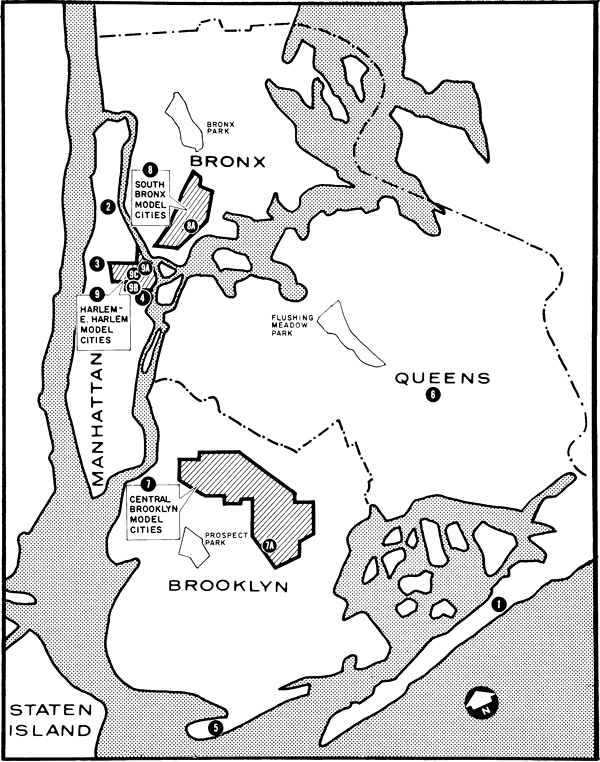
    New York City neighborhoods designated for revitalization with funding from the Model Cities Program.
    The City of New York, Community Development Program: A Progress Report, December 1968.

    To qualify for the program, cities had to apply for planning grants by submitting a detailed proposal that included an analysis of neighborhood conditions, long-term goals and strategies for addressing problems.

    Federal funds went directly to city governments, which then distributed them to local agencies and community organizations through contracts. These funds were relatively flexible but had to be tied to locally tailored plans. For example, Kansas City, Missouri, used Model Cities funding to support a loan program that expanded access to capital for local small businesses, helping them secure financing that might otherwise have been out of reach.

    Unlike previous programs, Model Cities emphasized what Johnson described as “comprehensive” and “concentrated” efforts. It wasn’t just about rebuilding streets or erecting public housing. It was about creating new ways for government to work in partnership with the people most affected by poverty and racism.

    A revolutionary approach to poverty

    What made Model Cities unique wasn’t just its scale but its philosophy. At the heart of the program was an insistence on “widespread citizen participation,” which required cities that received funding to include residents in the planning and oversight of local programs.

    The program also drew inspiration from civil rights leaders. One of its early architects, Whitney M. Young Jr., had called for a “Domestic Marshall Plan” – a reference to the federal government’s efforts to rebuild Europe after World War II – to redress centuries of racial inequality.

    Civil rights activist Whitney M. Young Jr. helped shape the vision of the Model Cities Program.
    Bettmann/Getty Images

    Young’s vision helped shape the Model Cities framework, which proposed targeted systemic investments in housing, health, education, employment and civic leadership in minority communities. In Atlanta, for example, the Model Cities Program helped fund neighborhood health clinics and job training programs. But the program also funded leadership councils that for the first time gave local low-income residents a direct voice in how city funds were spent.

    In other words, neighborhood residents weren’t just beneficiaries. They were planners, advisers and, in some cases, staffers.

    This commitment to community participation gave rise to a new kind of public servant – what sociologists Martin and Carolyn Needleman famously called “guerrillas in the bureaucracy.”

    A Model Cities staffer discusses the program to a group of students gathered at Denver’s Metropolitan Youth Education Center in 1970.
    Bill Wunsch/The Denver Post via Getty Images

    These were radical planners – often young, idealistic and deeply embedded in the neighborhoods they served. Many were recruited and hired through new Model Cities funding that allowed local governments to expand their staff with community workers aligned with the program’s goals.

    Working from within city agencies, these new planners used their positions to challenge top-down decision-making and push for community-driven planning.

    Their work was revolutionary not because they dismantled institutions but because they reimagined how institutions could function, prioritizing the voices of residents long excluded from power.

    Strengthening community ties

    In cities across the country, planners fought to redirect public resources toward locally defined priorities.

    A mobile dentist office in Baltimore.
    Robert Breck Chapman Collection, Langsdale Library Special Collections, University of Baltimore, CC BY-NC-ND

    In some cities, such as Tucson, the program funded education initiatives such as bilingual cultural programming and college scholarships for local students. In Baltimore, it funded mobile health services and youth sports programs.

    In New York City, the program supported new kinds of housing projects called vest-pocket developments, which got their name from their smaller scale: midsize buildings or complexes built on vacant lots or underutilized land. New housing such as the Betances Houses in the South Bronx were designed to add density without major redevelopment taking place – a direct response to midcentury urban renewal projects, which had destroyed and displaced entire neighborhoods populated by the city’s poorest residents. Meanwhile, cities such as Seattle used the funds to renovate older apartment buildings instead of tearing them down, which helped preserve the character of local neighborhoods.

    The goal was to create affordable housing while keeping communities intact.

    An Atlanta neighborhood identified as a candidate for street paving and home rehabilitation as part of the Model Cities Program.
    Georgia State University Special Collections

    What went wrong?

    Despite its ambitious vision, Model Cities faced resistance almost from the start. The program was underfunded and politically fragile. While some officials had hoped for US$2 billion in annual funding, the actual allocation was closer to $500 million to $600 million, spread across more than 60 cities.

    Then the political winds shifted. Though designed during the optimism of the mid-1960s, the program started being implemented under President Richard Nixon in 1969. His administration pivoted away from “people programs” and toward capital investment and physical development. Requirements for resident participation were weakened, and local officials often maintained control over the process, effectively marginalizing the everyday citizens the program was meant to empower.

    In cities such as San Francisco and Chicago, residents clashed with bureaucrats over control, transparency and decision-making. In some places, participation was reduced to token advisory roles. In others, internal conflict and political pressure made sustained community governance nearly impossible.

    Critics, including Black community workers and civil rights activists, warned that the program risked becoming a new form of “neocolonialism,” one that used the language of empowerment while concentrating control in the hands of white elected officials and federal administrators.

    A legacy worth revisiting

    Although the program was phased out by 1974, its legacy lived on.

    In cities across the country, Model Cities trained a generation of Black and brown civic leaders in what community development leaders and policy advocates John A. Sasso and Priscilla Foley called “a little noticed revolution.” In their book of the same name, they describe how those involved in the program went on to serve in local government, start nonprofits and advocate for community development.

    It also left an imprint on later policies. Efforts such as participatory budgeting, community land trusts and neighborhood planning initiatives owe a debt to Model Cities’ insistence that residents should help shape the future of their communities. And even as some criticized the program for failing to meet its lofty goals, others saw its value in creating space for democratic experimentation.

    A housing meeting takes place at a local Model Cities field office in Baltimore in 1972.
    Robert Breck Chapman Collection, Langsdale Library Special Collections, University of Baltimore, CC BY-NC-ND

    Today’s housing crisis demands structural solutions to structural problems. The affordable housing crisis is deeply connected to other intersecting crises, such as climate change, environmental injustice and health disparities, creating compounding risks for the most vulnerable communities. Addressing these issues through a fragmented social safety net – whether through housing vouchers or narrowly targeted benefit programs – has proven ineffective.

    Today, as policymakers once again debate how to respond to deepening inequality and a lack of affordable housing, the lost promise of Model Cities offers vital lessons.

    Model Cities was far from perfect. But it offered a vision of how democratic, local planning could promote health, security and community.

    Deyanira Nevárez Martínez is a trustee of the Lansing School District Board of Education and is currently a candidate for the Lansing City Council Ward 2.

    ref. Could a bold anti-poverty experiment from the 1960s inspire a new era in housing justice? – https://theconversation.com/could-a-bold-anti-poverty-experiment-from-the-1960s-inspire-a-new-era-in-housing-justice-253706

    MIL OSI AnalysisEveningReport.nz

  • MIL-OSI United Kingdom: New Director and Deputy Head of the Attorney General’s Office appointed

    Source: United Kingdom – Executive Government & Departments

    News story

    New Director and Deputy Head of the Attorney General’s Office appointed

    Douglas Wilson KC (Hon) OBE, Director General of the Attorney General’s Office, is pleased to announce Michael Padfield has been appointed Director and Deputy Head of the AGO.

    Michael Padfield

    Douglas Wilson KC (Hon) OBE, Director General of the Attorney General’s Office (AGO), is pleased to announce that Michael Padfield has been appointed Director and Deputy Head of the AGO following an open and fair recruitment process across the Civil Service.

    Michael started his career as a commercial lawyer in the City of London before joining the litigation team in the Treasury Solicitor’s Department in 2014.

    Since then, he has worked as a lawyer in a number of roles within the Government Legal Department, including in the Home Office and His Majesty’s Treasury, before first joining the AGO in 2020 then becoming Head of the Domestic Law Team in 2021.

    Michael was appointed General Counsel in the Prime Minister’s Office in No10 in the autumn of 2023, a role which is staffed from AGO.  Michael has been a member of the Executive Board at AGO since 2021.  

    Commenting on the appointment, Douglas Wilson KC (Hon) OBE said:

    I’m absolutely delighted to announce Michael as Director at the AGO and my deputy.  Michael is a great lawyer and a strong leader who brings considerable experience of working on the hardest legal problems in government. He is a trusted adviser to the Law Officers and to other Ministers, and has a wide network in No10 and across Whitehall.

    I look forward to working together with Michael to support the Law Officers and lead the AGO in making law and politics work together at the heart of the UK constitution.

    Updates to this page

    Published 27 May 2025

    MIL OSI United Kingdom

  • MIL-OSI USA: UConn Has Record-Breaking Cohort for Gilman Scholars

    Source: US State of Connecticut

    A record-breaking 31 UConn students have been awarded a Gilman Scholarship in the latest cohort of the prestigious academic award. The award is congressionally funded through the Bureau of Education and Cultural Affairs at the State Department.

    The funding supports expanding student participation in study abroad programs and encourages travel to diverse locations around the globe, along with intensive language study and internship experiences.

    The 31 UConn students, who will study in 14 different countries, will receive a total of nearly $94,000 in scholarship funds through the Gilman program. A total of 40 UConn students have earned Gilman awards in the last two cohorts, this one and October 2024, for a total of more than $121,500 in scholarship funding.

    Students applying for Gilman Scholarships work with advisors in UConn’s Office of National Scholarships & Fellowships (ONSF) and Experiential Global Learning (EGL). Rachel Gleicher, an advisor in EGL, and Michael Cunningham, assistant director of ONSF and UConn’s Fulbright program advisor, are UConn’s two Gilman certifying advisors.

    “We are very excited that the Gilman program has selected so many UConn students this cycle,” says Cunningham. “It’s a testament to the quality of our students and to the hard work that they put into their applications.”

    Upon their return from studying abroad, each Gilman Scholar is required to complete a service project in their campus or home community with the goal of sharing the value of participation in study abroad and promoting the scholarship to prospective students. Applications are reviewed with consideration for the proposed follow-up service project.

    “We are so proud of these students for staying determined and focused on their study abroad goals,” says Gleicher. “Amid uncertain times, with federal funding freezes and broader uncertainty, they remained committed to their aspirations. Now more than ever, it is crucial to ensure students are aware of the funding opportunities available to them.”

    Eligibility for the Gilman Scholarship requires undergraduate students to be Pell Grant-eligible United States citizens who plan to study abroad for academic credit through a program approved by their home institution. Supporting students with high financial need provides access to students who are historically underrepresented in study abroad, including first-generation college students, STEM majors, ethnic and racial minority students, students with disabilities, LGBTQ+ students, and others who experience barriers to participation.

    Students from underrepresented areas of the U.S. are also considered during the application process and this year there are recipients from all 50 states.

    The following UConn students were selected as Gilman Scholars in this cycle, and they are listed with the location of where they will study as part of the program:

    Carina Adams-Szabo ’27 (CLAS), a psychology and political science major from Greenwich, who will be studying neuroscience this summer in Salamanca, Spain.

    Ashley Barragan ’27 (NUR), a nursing major who will be studying at the University of Dublin Summer Applied Research for Nursing Practice in Dublin, Ireland.

    Rhys Brauer ’27 (CLAS), a psychological sciences major, who will be studying neuroscience this summer in Salamanca.

    Brooke Catellier ’26 (CAHNR), an allied health major, who will be studying the Mediterranean diet and Tuscan cuisine in Florence, Italy, this summer.

    Kylene Chino ’26 (CLAS), a human rights and political science major, who will be studying in the fall at the Pusan National University in Shanghai, China.

    Jaiyliah Cochran ’25 (CLAS), a microbiology major, who will be studying field ecology this summer in Limpopo Province, South Africa.

    Mia Dansby ’26 (BUS), a management major, who will be studying this summer at ISI in Florence.

    Andrea D’Oleo ’27 (NUR), a nursing major from East Hartford, who will be studying in the Dublin Summer Applied Research Program for Nursing Practice in Ireland.

    Danyelix Echevarria Figueroa ’28 (ACES), a pre-teaching major from New Britain, who will study next spring at the University of Grenda in Grenda, Spain.

    Dahiana Fernandez-Ramirez ’26 (CLAS), a psychological sciences major, who will be studying this fall at ISI Florence.

    Adiriana Garcia Vazquez ’25 (CLAS), a cognitive science major from Bridgeport, who will be studying this fall at the Interdisciplinary Ethnography Field School in Mauritius.

    Hannah Ginste ’26 (CLAS), a communications major, who will be doing a summer internship in London.

    Jessica Glowacki ’25 (CLAS), a biological sciences major who will be studying field ecology this summer in Limpopo Province, South Africa.

    Emma Hazard ’27 (CAHNR), a diagnostic genetic sciences major, who will be studying the Mediterranean diet and Tuscan cuisine in Florence this summer.

    Danecia Henry ’28 (BUS), a management major from New Haven, will be studying in the summer at Camino de Santiago in Spain.

    Ty’Laisha Huff ’27 (NUR), a nursing major from Hartford, will be studying at the Dublin Summer Applied Research Program for Nursing Practice in Ireland.

    Layan Jahaf ’28 (CLAS), a political science and Arabic and Islam civics major, who will be studying this fall in London.

    Dee Jerome ’26 (CAHNR), an allied health sciences major from Bridgeport, who will be studying this summer in Accra, Ghana.

    Evelyn Pazan ’27 (CLAS), a finance and German major, who will be studying during the 2025-26 academic year at the University of Mannheim in Germany.

    Danielle Phillips ’27 (CLAS), an individualized major in industrial and labor relations from Bridgeport, who will be studying this summer at the Intercultural Leadership Program in Strasbourg, France.

    Jocelyn Ramirez ’26 (BUS), a management major from New Haven, who will be studying this summer at ISI.

    Jamie Ross ’27 (CLAS), a physiology and neurobiology major, who will be studying next winter in Barcelona, Spain.

    Ellie Sanders ’27 (CAHNR), a nutritional sciences major from West Cornwall, who will be studying the Mediterranean diet and Tuscan cuisine in Florence this summer.

    Fabio Silveira ’26 (CLAS), a pathobiology major, who will be studying neuroscience this summer in Salamanca, Spain.

    Amber Szymanski ’26 (CLAS), a political science and human rights major, who will be studying this fall at the Pusan National University in Busan, South Korea.

    Angel Uchupailla ’26 (CAHNR), an allied health major from Stamford, who will be studying this winter in Rome.

    Lyric Vargas ’27 (CLAS), a political science and psychological science major, who will be studying this fall at the University of Lisbon in Portugal.

    Erica Wong ’26 (CLAS), a political science and urban and community studies major, who will be studying this fall at Fudan University in Shanghai, China.

    Morgan Xu ’26 (ENG), a materials science and engineering major from Chesire, who will be studying this fall at the National University of Singapore.

    Ada Yeung ’27 (CLAS), an individualized major, who will be studying next spring at Fudan University.

    Maggie Zheng ’27 (BUS), an accounting major, who will be studying next spring at Fudan University.

    MIL OSI USA News

  • MIL-OSI: BIO-key and Runlevel Secure First Major IAM Deployment with a National Bank in Mozambique; Extends Growing List of Banking Customers

    Source: GlobeNewswire (MIL-OSI)

    LISBON, Portugal and HOLMDEL, N.J., May 27, 2025 (GLOBE NEWSWIRE) — BIO-key International, Inc. (NASDAQ: BKYI), a global leader in Identity and Access Management (IAM) solutions featuring Identity-Bound Biometrics (IBB), today announced a strategic partnership with Runlevel, a specialized cybersecurity solutions provider, as well as the partnership’s first customer deployment. Runlevel focuses on Portuguese-speaking African countries (“Países Africanos de Língua Oficial Portuguesa or “PALOP”) and Timor-Leste in Asia.

    Runlevel joins BIO-key’s Channel Alliance Partner (CAP) program as a Value-Added Reseller (VAR) for businesses and government institutions in PALOP countries and Timor-Leste, which face increasing cybersecurity challenges. The Runlevel partnerships marks the beginning of a broader effort to expand adoption of BIO-key solutions across the region, ensuring financial institutions, government agencies and enterprises can benefit from secure, scalable and compliant digital identity solutions. In support of BIO-key’s solutions, Runlevel will provide pre-sales consulting, deployment support and technical training tailored to regulatory requirements in PALOP and Timor-Leste.

    Partnership’s First Major Deployment
    BIO-key and Runlevel have already secured their first customer in the region — a National Bank in Mozambique — which is deploying a comprehensive suite of BIO-key’s biometric-based IAM solutions.

    This deployment highlights the growing need for robust IAM solutions in the partnership’s territories and reinforces BIO-key’s position as a trusted cybersecurity partner within the global financial sector.

    The deployment includes the following BIO-key solutions:

    • PortalGuard On-Prem
    • Highly secure IAM platform with Multi-factor Authentication (MFA)
    • Single Sign-On (SSO) capabilities.

    Miguel Guerreiro, Managing Partner at Runlevel, commented, “Runlevel is committed to delivering cutting-edge security solutions that address the unique challenges faced by customers in PALOP and Timor-Leste. Partnering with BIO-key enables us to provide advanced IAM technologies that enhance cybersecurity, streamline authentication, and ensure compliance. Securing our first major deal together is a strong validation of this partnership and demonstrates the critical need for robust identity security solutions in the financial sector.”

    Alex Rocha, International Managing Director at BIO-key, added, “Runlevel is an ideal partner to expand BIO-key’s reach into Portuguese speaking markets. Their deep knowledge of the local cybersecurity landscape and strong relationships with key enterprises and public institutions make them a perfect fit for delivering BIO-key’s IAM solutions. Securing our first project together with a National Bank in Mozambique confirms the demand we believe exists for advanced IAM solutions in these regions and adds to BIO-key’s growing presence in the financial sector. Together, we are committed to supporting customers with secure, scalable, and regulation-compliant authentication technologies.”

    About Runlevel (www.runlevel.pt)
    Runlevel is a specialized cybersecurity solutions provider focusing on Portuguese-speaking African countries (PALOP) and Timor-Leste. The company delivers advanced IT security, infrastructure, and compliance solutions, helping organizations navigate the evolving cybersecurity landscape with best-in-class technology and expert consulting services.

    About BIO-key International, Inc. (www.BIO-key.com)
    BIO-key is revolutionizing authentication and cybersecurity with biometric-centric, multi-factor identity and access management (IAM) software securing access for over forty million users. BIO-key allows customers to choose the right authentication factors for diverse use cases, including phoneless, tokenless, and passwordless biometric options. Its cloud-hosted or on-premise PortalGuard IAM solution provides cost-effective, easy-to-deploy, convenient, and secure access to computers, information, applications, and high-value transactions.

    BIO-key Safe Harbor Statement
    All statements contained in this press release other than statements of historical facts are “forward-looking statements” as defined in the Private Securities Litigation Reform Act of 1995 (the “Act”). The words “estimate,” “project,” “intends,” “expects,” “anticipates,” “believes” and similar expressions are intended to identify forward-looking statements. Such forward-looking statements are made based on management’s beliefs, as well as assumptions made by, and information currently available to, management pursuant to the “safe-harbor” provisions of the Act. These statements are not guarantees of future performance or events and are subject to risks and uncertainties that may cause actual results to differ materially from those included within or implied by such forward-looking statements. These risks and uncertainties include factors set forth under the caption “Risk Factors” in our Annual Report on Form 10-K for the year ended December 31, 2024 and other filings with the SEC. Readers are cautioned not to place undue reliance on these forward-looking statements, which speak only as of the date made. Except as required by law, we undertake no obligation to disclose any revision to these forward-looking statements, whether as a result of new information, future events, or otherwise.

    Investor Contacts
    William Jones, David Collins
    Catalyst IR
    BKYI@catalyst-ir.com or 212-924-9800

    The MIL Network

  • MIL-OSI: LIS Technologies Inc. Appoints Leading Regulatory Expert Julie Olivier as its Regulatory Affairs and Licensing Director

    Source: GlobeNewswire (MIL-OSI)

    Oak Ridge, Tennessee, May 27, 2025 (GLOBE NEWSWIRE) — LIS Technologies Inc. (“LIST” or “the Company”), a proprietary developer of advanced laser technology and the only USA-origin and patented laser uranium enrichment company, today announced that it has appointed Julie Olivier as its Regulatory Affairs and Licensing Director.

    Julie Olivier brings more than twenty‑five years of experience across the commercial energy sector, with primary focus on the nuclear fuel cycle and ash management at coal sites. Her expertise covers environmental protection, facility siting, decommissioning, waste management, risk assessment, security, material control and accountability, quality assurance, performance improvement, emergency preparedness, and chemical safety.

    “This is a really exciting time for the nuclear industry and the US government’s commitment to build back nuclear, including a robust domestic fuel supply chain, suggests that it is only the beginning,” said Julie Olivier, Director of Regulatory Affairs and Licensing of LIS Technologies Inc. “I am delighted to join LIST at this pivotal moment for the Company amidst the nation’s nuclear renaissance. The future of this technology is bright, and I am very excited to help steer it through the licensing process and toward commercialization.”

    Figure 1 – LIS Technologies Inc. Appoints Julie Olivier as its Director of Regulatory Affairs and Licensing.

    Ms. Olivier began her career as a Safety Analyst at the DOE’s West Valley Demonstration Project before spending nine years at the Nuclear Regulatory Commission in Fuel Cycle Safety and Safeguards, New Nuclear Licensing, and the Chairman’s Office. She later became the Regulatory Affairs Manager for Global Laser Enrichment, then Nuclear Fleet Licensing Manager at Duke Energy, where she was promoted to Director within the Coal Combustion Products team. Most recently, she consulted on advanced‑nuclear facility siting and licensing for the Tennessee Valley Authority.

    As Regulatory Affairs Manager, Ms. Olivier secured the NRC’s first license for a uranium laser‑enrichment technology. She holds a Six Sigma Lean Green Belt, a B.S. in Chemistry from the University of New Orleans, and an M.S. in Environmental Engineering from Virginia Tech.

    “We are very pleased to welcome Julie to this critical role in the future of LIST,” said Christo Liebenberg, CEO and Co-Founder of LIS Technologies Inc. “Her depth of experience will be essential as we strengthen our engagement with government, regulatory stakeholders and to help move our CRISLA technology to the next stage of development, while also preparing for commercial deployment. I look forward to working with her as we advance our leadership in U.S. domestic uranium enrichment.”

    About LIS Technologies Inc.

    LIS Technologies Inc. (LIST) is a USA based, proprietary developer of a patented advanced laser technology, making use of infrared lasers to selectively excite the molecules of desired isotopes to separate them from other isotopes. The Laser Isotope Separation Technology (L.I.S.T) has a huge range of applications, including being the only USA-origin (and patented) laser uranium enrichment company, and several major advantages over traditional methods such as gas diffusion, centrifuges, and prior art laser enrichment. The LIST proprietary laser-based process is more energy-efficient and has the potential to be deployed with highly competitive capital and operational costs. L.I.S.T is optimized for LEU (Low Enriched Uranium) for existing civilian nuclear power plants, High-Assay LEU (HALEU) for the next generation of Small Modular Reactors (SMR) and Microreactors, the production of radioisotopes isotopes for medical and scientific research, and the production of stable isotopes with applications in quantum computing manufacturing for semiconductor technologies. The Company employs a world class nuclear technical team working alongside leading nuclear entrepreneurs and industry professionals, possessing strong relationships with government and private nuclear industries.

    In Dec 2024, LIS Technologies Inc. was selected as one of six domestic companies to participate in the Low-Enriched Uranium (LEU) Enrichment Acquisition Program. This initiative allocates up to $3.4 billion overall, with contracts lasting for up to 10 years. Each awardee is slated to receive a minimum contract of $2 million.

    For more information please visit: LaserIsTech.com

    For further information, please contact:
    Email: info@laseristech.com
    Telephone: 800-388-5492
    Follow us on X Platform
    Follow us on LinkedIn

    Forward Looking Statements

    This news release contains “forward-looking statements” within the meaning of Section 21E of the Securities Exchange Act of 1934, as amended, and the Private Securities Litigation Reform Act of 1995. In this context, forward-looking statements mean statements related to future events, which may impact our expected future business and financial performance, and often contain words such as “expects”, “anticipates”, “intends”, “plans”, “believes”, “will”, “should”, “could”, “would” or “may” and other words of similar meaning. These forward-looking statements are based on information available to us as of the date of this news release and represent management’s current views and assumptions. Forward-looking statements are not guarantees of future performance, events or results and involve known and unknown risks, uncertainties and other factors, which may be beyond our control. For LIS Technologies Inc., particular risks and uncertainties that could cause our actual future results to differ materially from those expressed in our forward-looking statements include but are not limited to the following which are, and will be, exacerbated by any worsening of global business and economic environment: (i) risks related to the development of new or advanced technology, including difficulties with design and testing, cost overruns, development of competitive technology, loss of key individuals and uncertainty of success of patent filing, (ii) our ability to obtain contracts and funding to be able to continue operations and (iii) risks related to uncertainty regarding our ability to commercially deploy a competitive laser enrichment technology, (iv) risks related to the impact of government regulation and policies including by the DOE and the U.S. Nuclear Regulatory Commission; and other risks and uncertainties discussed in this and our other filings with the SEC. Only after successful completion of our Phase 2 Pilot Plant demonstration will LIS Technologies be able to make realistic economic predictions for a Commercial Facility. Readers are cautioned not to place undue reliance on these forward-looking statements, which apply only as of the date of this news release. These factors may not constitute all factors that could cause actual results to differ from those discussed in any forward-looking statement. Accordingly, forward-looking statements should not be relied upon as a predictor of actual results. We do not undertake to update our forward-looking statements to reflect events or circumstances that may arise after the date of this news release, except as required by law.

    Attachment

    The MIL Network

  • MIL-OSI: authID Announces its 2025 Board of Directors Nominees Ahead of Annual Meeting

    Source: GlobeNewswire (MIL-OSI)

    Highly Qualified New Board Nominees Will Strengthen authID’s mission to Drive Growth and Value Creation for Shareholders

    2025 Annual Meeting to be Held on June 26, 2025

    DENVER, May 27, 2025 (GLOBE NEWSWIRE) — authID® (Nasdaq: AUID)(“authID” or the “Company”), a leading provider of biometric identity verification and authentication solutions, is nominating four highly qualified executives to the Board of Directors (the “Board”), in addition to the nomination of existing directors, included within the 2025 Proxy Statement filed on May 16, 2025. The 2025 Annual Meeting will be held virtually on June 26, 2025, at 10.00 a.m. EDT. 

    The following new Board nominees will be up for election at the Company’s 2025 Annual Meeting:

    Further information about each nominee is included at the end of this release.

    “authID is fortunate to nominate these talented business leaders to our Board,” said Rhon Daguro, authID’s Chief Executive Officer. “Their willingness to serve demonstrates their belief in our mission to deliver market-leading biometric identity authentication solutions in an increasingly AI-driven world. We look forward to benefitting from their leadership as we continue to focus on driving growth and creating value for shareholders.”

    “With AI evolving rapidly and cybersecurity more critical than ever, biometrics will play a foundational role in shaping our digital future,” said Krish Venkataraman, former President of Dataiku, Co-President/Board member of KnowBe4 (prior ticker: KNBE), and CFO of Socure. “authID has taken a truly differentiated approach to biometrics—one that is well-suited for rapid adoption by large enterprises. I’m deeply impressed by what this talented team of identity and fraud prevention experts has achieved in such a short time, and I’m excited to support their continued growth by joining the Board.”

    “I’ve been fortunate to partner with forward-looking tech companies over the years, and I believe that authID can surpass my expectations for innovation and vision,” said Ram Menghani, Past President of NEC Enterprise Communication Technologies. “They can not only compete but transcend other players in bringing biometric assurance to public and private sector organizations and be a truly great global partner for companies like mine who need the confidence of knowing who is behind each and every device. I look forward to helping authID grow and flourish in its next stage of development by joining the Board.”

    “Like the leadership team at authID, I have worked for decades in cybersecurity, so we share the same vision for safeguarding the enterprise, while protecting user privacy,” said Nick Shevelyov, Founder of vCSO.ai. “I am excited to join the Board as I feel they are the right organization at the right time to provide the best of biometric identity security to a market that absolutely requires security and compliance as the cloud continues to expand not only enterprise opportunities but also enterprise risks.”

    “I have placed my confidence in authID’s technology for many years and now we see that authID is expanding its global presence,” said Stephen J. Garchik, President of SJM Partners. “authID’s biometric identity platform is helping an increasing number of organizations securely manage identities across borders and verticals, while maintaining compliance with international laws. I am delighted for the opportunity to join the Board and help the Company in the next phase of its journey.”

    At the meeting, proposals will be submitted to elect directors, ratify the appointment of auditors and ratify an increase in the shares allocated to the 2024 Equity Incentive Plan.

    In addition to recommending the new Board nominees, authID is proposing the election of six of the current directors. Thomas Szoke, Founder and Chief Technology Officer (CTO), will step down as a director at the meeting, in order to focus on his role as CTO to continue enhancing the Company’s technology.

    “On behalf of the Board, I want to thank Tom for his significant contributions to authID as a board director,” added Daguro. “Fortunately, authID will continue to benefit from Tom’s visionary direction and strategic contributions in his continuing critical role as authID’s CTO.”

    Annual Meeting

    The Company has filed its Proxy Statement with the SEC, which explains all the proposals and provides other information about the Company, and is mailing the Notice of Meeting, the Proxy Statement and additional materials related to the Annual Meeting to stockholders. Stockholders who hold their shares through brokerage accounts will receive the materials via their brokers, either through the mail, or electronically depending on their communication preferences.

    The meeting will be held via a webcast. To join the webcast, investors must register in advance here: authID 2025 Annual Meeting Registration. Participants are advised to pre-register with a validated email address. Registrants will receive a confirmation email and calendar notice to add the meeting to your calendar. During the call, attendees will be invited to ask questions through the Q&A option in the Meeting webcast portal.

    Stockholders will be able to view the materials electronically at the Company’s Investor Relations site at 2024 Annual Reports or at www.investorvote.com/AUID.

    Stockholders will also be able to vote electronically, in accordance with the instructions provided in the materials each will receive. Stockholders are encouraged to vote by proxy ahead of the meeting, whether or not they plan to attend the meeting, to ensure their votes are counted.

    Director Nominee Biographies

    Stephen J. Garchik

    Mr. Garchik has been associated with authID for approximately 10 years as a major investor and supporter and now holder of 10% of the outstanding common stock. Since 1997, Mr. Garchik has been President of SJM Partners, a real estate development, design and construction, leasing and management company. SJM Partners owns over 40 retail, commercial and residential properties. Mr. Garchik has over 40 years of management and business experience and serves on the board of several non-profit institutions. He holds a Bachelor of Science and M.B.A. degree from the Wharton School at the University of Pennsylvania. Mr. Garchik’s extensive experience provides authID’s Board with a valuable perspective regarding business management, operations and strategy, in addition to a broad range of business connections.

    Ram Menghani

    Mr. Menghani has been Past President of NEC Enterprise Communications from 2020 to 2025 and is executive advisor to NEC, having joined NEC Corporation of America in 2001, serving in various roles in product management and development. He has over 30 years of global leadership experience in unified communications, product innovation, and digital transformation. Mr. Menghani’s track record includes forging partnerships with major tech players like Microsoft and Oracle, modernizing legacy systems into cloud-based models, and guiding startups to successful exits. Mr. Menghani has deep expertise in product strategy, global markets, and digital innovation and brings his global high tech business partnerships and scaling expertise to the Board.

    Nicholas “Nick” Shevelyov

    Mr. Shevelyov is a cybersecurity executive with 30 years of experience who served as Chief Security and Privacy Officer and later as Chief Information Officer at Silicon Valley Bank from 2007 to 2021. He led key initiatives in cybersecurity strategy, cloud transformation, and modern software delivery there. Mr. Shevelyov was an early design partner to industry leaders like Palo Alto Networks, Zscaler, and FireEye. In 2021, he published “Cyber War…and Peace” and founded and serves as CEO of vCSO.ai, a cybersecurity advisory firm supporting organizations such as Group 42, the Audubon Society, and multiple cybersecurity product companies. He also serves on the Bay Area CSO Council and Cofense boards. Mr. Shevelyov has a bachelor’s degree in Economics from San Francisco State University and an MBA from University of San Francisco School of Management. Mr. Shevelyov’s CSO experience and expertise will provide authID with invaluable insight and experience in relation to its core activities as well as connections in the cybersecurity industry.

    Shrikrishna “Krish” Venkataraman

    Mr. Venkataraman is a seasoned technology and Wall Street executive with a strong track record of leading IPOs, strategic sales, and large-scale corporate transformations. He represents a new generation of multi-disciplinary executives, having served in roles including President, CFO, COO, CAO, and public/private board member. Beyond traditional finance responsibilities — treasury, controllership, M&A, and investor relations — he has led sales, HR, IT, legal, and operations teams with a strong focus on IT and cybersecurity governance. Mr. Venkataraman served as President of Daitaku a leading AI firm, from 2023 to April 2025. Prior to that from 2022 to 2023 he was the Chief Financial Officer of Socure Inc. Mr. Venkataraman served as Co-President and Chief Financial Officer of KnowBe4 Inc. (Formerly Nasdaq: KNBE) a global security platform offering human risk management, from 2018 to 2022 and for a subsequent year as a Board member. Earlier in his career, he held leadership roles at Dealogic Lehman Brothers, NYSE Euronext, American Express, and Deloitte Consulting. Krish holds a B.S. from Carnegie Mellon University and an MBA from Cornell University’s Johnson Graduate School of Management. He brings his high-tech finance expertise to help authID with strategic deals, strategic capital, and generally in matters of corporate finance. 

    About authID Inc.

    authID (Nasdaq: AUID) ensures enterprises “Know Who’s Behind the Device™” for every customer or employee login and transaction through its easy-to-integrate, patented biometric identity platform. authID powers biometric identity proofing in 700ms, biometric authentication in 25ms, and account recovery with a fast, accurate, user-friendly experience. With our ground-breaking PrivacyKey™ solution, authID provides a 1-to-1-billion false match rate, while storing no biometric data. authID stops fraud at onboarding, blocks deepfakes, prevents account takeover, and eliminates password risks and costs, through the fastest, most frictionless, and most accurate user identity experience demanded by today’s digital ecosystem.

    For further information please visit authid.ai

    Investor Relations Contacts
    authID Investor Relations
    investor-relations@authID.ai

    Media Contacts
    Walter Fowler
    1-631-334-3864
    wfowler@nexttechcomms.com

    The MIL Network

  • MIL-OSI: New Study Reveals Agriculture as Largest, Most Resource-Intensive Industry on Earth

    Source: GlobeNewswire (MIL-OSI)

    BOSTON, May 27, 2025 (GLOBE NEWSWIRE) — RA Capital Management’s Planetary Health Team and The Nature Conservancy have released a groundbreaking analysis that exposes agriculture as the most resource-intensive industry on Earth: it’s the leading contributor to methane emissions, a key driver of water pollution, and it uses roughly half of viable land on Earth. As agriculture is often viewed in silos, its $15T scale and opportunity are often overlooked. The just-released Agriculture Map by RA Capital Management’s Planetary Health team and The Nature Conservancy calls for a systems-level approach to address the urgent risks and transformative opportunities within agriculture through innovation, incentives to change, and direct investment.

    A Media Snippet accompanying this announcement is available in this link.

    The Agricultural Map highlights:

    • Agriculture’s massive footprint means high ROI for broader adoption of best practices: optimizing global yields of staple grains, fruits, and vegetables would allow the world to produce the same amount of food with much less land – freeing up a land area the size of Mexico (~3x the size of Texas).
    • Agriculture produces more methane (a potent greenhouse gas) than any other human activity: Cattle alone produce as much methane as oil, coal, and bioenergy; rice paddies produce more methane than the natural gas industry.
    • Agriculture consumes more water than any other human activity and also causes the most water pollution. Investment in on-field and edge-of-field systems can significantly improve water quality and use. 
    • Fertilizer is important for optimizing crop yields, but fertilizer runoff causes hundreds of billions of dollars worth of losses each year, mostly due to impacts on commercial fishing, tourism, and property values, and creates aquatic dead zones the size of the United Kingdom.

    “Agriculture is the backbone of our global economy, but it’s also the most resource-intensive and environmentally demanding industry on Earth. If we are serious about tackling climate change, water pollution, and food security, we must rethink how we grow, produce, and manage our resources. Sustainable solutions are not just an option – they are a necessity to transform agriculture into a cleaner, more efficient, and resilient industry that can feed the world for generations to come,” noted Kyle Teamey, managing partner, RA Capital Planetary Health.

    Details within the Agriculture Map provide decision-makers with the knowledge they need to navigate the future of agriculture, from sustainable investment strategies to policy reform and innovation in farming technologies. The findings challenge conventional wisdom and call for urgent and coordinated attention from businesses, investors, governments, and philanthropic organizations. The map is a culmination of extensive research led by RA Capital and The Nature Conservancy. It combines proprietary data analysis with a systems-level approach to visualize and communicate the scale and interconnectedness of global agriculture’s planetary impacts while highlighting a range of potential solutions for select problems.

    “The environmental and human health challenges posed by the food system are well-understood in some circles but making this information material and actionable to stakeholders can be a real challenge,” said Stephen Wood, Senior Scientist of Agriculture and Food Systems at The Nature Conservancy. “This map makes it possible for non-experts to quickly understand the scope and scale of the problem, as well as the solutions.”

    The full map is available for download at Agriculture: Hiding in Plain Sight

    About RA Capital Management 

    Founded in 2004, RA Capital Management is a multi-stage investment manager dedicated to evidence-based investing in public and private healthcare, life sciences, and planetary health companies. RA Capital creates and funds innovative companies, from private seed rounds to public follow-on financings, allowing management teams to drive value creation from inception through commercialization and beyond. RA Capital’s knowledge engine is guided by its TechAtlas internal research division, and Raven, RA Capital’s healthcare incubator, offers entrepreneurs and innovators a collaborative and comprehensive platform to explore the novel and the re-imagined. RA Capital has more than 150 employees and over $10 billion in assets under management. 

    RA Capital’s Planetary Health team focuses on creating and funding companies that commercialize scalable, profitable solutions to reduce emissions, increase resource availability, and restore environmental quality, because solutions that heal the planet will yield both healthy people and healthy profits. 

    About The Nature Conservancy

    The Nature Conservancy is a global conservation organization dedicated to conserving the lands and waters on which all life depends. Guided by science, we create innovative, on-the-ground solutions to our world’s toughest challenges so that nature and people can thrive together. We are tackling climate change, conserving lands, waters and oceans at an unprecedented scale, providing food and water sustainably and helping make cities more sustainable. The Nature Conservancy is working to make a lasting difference around the world in 81 countries and territories (40 by direct conservation impact and 41 through partners) through a collaborative approach that engages local communities, governments, the private sector, and other partners. To learn more, visit nature.org or follow @nature_press on X.

    Media Contact:

    Alex Banat for RA Capital

    racapital@v2comms.com

    The MIL Network

  • MIL-OSI: Ascent Solar Technologies Signs Master Services Agreement to Provide NOVI Space with Rollable PV Array Blankets for Launch in 2026

    Source: GlobeNewswire (MIL-OSI)

    THORNTON, Colo., May 27, 2025 (GLOBE NEWSWIRE) — Ascent Solar Technologies (“Ascent” or the “Company”) (Nasdaq: ASTI), the leading U.S. innovator in the design and manufacturing of featherweight, flexible thin-film photovoltaic (PV) solutions, today announced the signing of a Master Services Agreement with NOVI Space, Inc. (“NOVI”), a Virginia-based space company that develops and operates AI-powered satellites with their TRL-9 edge computing technology.

    Ascent has been contracted to provide rollable PV array blankets to NOVI to deliver real-time Earth Observation insights directly from space. NOVI plans to utilize the Company’s lightweight, rollable solar technology in their AI edge processing constellation, scheduled for launch in early 2026. As part of the supply agreement, NOVI will provide Ascent with solar array operational performance data from orbit. This allows the Company to rapidly iterate and validate product enhancements for future missions and continue to build upon years of R&D and specialty engineering for products suitable to thrive in the rigors of space.

    “Having a high technology readiness level isn’t enough assurance for discerning space operators, a challenge that Ascent can uniquely address with our thin-film photovoltaic production solutions,” said Paul Warley, CEO of Ascent Solar Technologies. “The ability to reliably deliver power on shorter installation timelines removes solar arrays as a barrier to completion for mission schedules, allowing constellations of spacecraft to be completed sooner. Ascent combines both high TRL and MRL with mission-enabling features, helping partners like NOVI to do more, faster and with greater confidence.”

    Ascent has the capabilities to deliver mission-optimized solar array solutions based on CIGS PV products already developed with spaceflight heritage. Its high-maturity CIGS PV products in manufactured in its 5MW production facility in Thornton, CO enables delivery of arrays in just 6-8 weeks, versus market competition that typically struggles to meet aggressive delivery schedules and strives for 9–12-month lead times. Ascent’s recent pair of orders received for spaceflight hardware assemblies are on schedule to be completed and delivered by the Company this summer.

    “We are glad to have found a partner in Ascent that is able to provide plug and play arrays for our current bus, enabling NOVI to launch its first set of commercial satellites in Q1 of 2026. We look forward to incorporating Ascent’s new, rollable technology into our constellation,” said Scott Steffan, CRO and Co-Founder of NOVI Space, Inc.

    About Ascent Solar Technologies, Inc.

    Backed by 40 years of R&D, 15 years of manufacturing experience, numerous awards, and a comprehensive IP and patent portfolio, Ascent Solar Technologies, Inc. is a leading provider of innovative, high-performance, flexible thin-film solar panels for use in environments where mass, performance, reliability, and resilience matter. Ascent’s photovoltaic (PV) modules have been deployed on space missions, multiple airborne vehicles, agrivoltaic installations, in industrial/commercial construction as well as an extensive range of consumer goods, revolutionizing the use cases and environments for solar power. Ascent Solar’s research and development center and 5-MW nameplate production facility is in Thornton, Colorado. To learn more, visit https://www.ascentsolar.com.

    About NOVI:

    NOVI is a Space AI infrastructure and compute company. In addition to providing the space industry with TRL 9, flight-proven OBCs, NOVI is developing and deploying a constellation of multi-sensor edge-processing satellites for EO, coupled to a full-stack data, algorithm, and intelligence management platform named VISTAsat™. This is an innovative space AI marketplace that provides open-access to our growing satellite network, and enables commercial companies, governments and developers to harness real-time space-based sensors, processors and intelligence, further changing the cost paradigm to drive innovation, create new use-cases and redefine how industries leverage EO.

    Forward-Looking Statements

    Statements in this press release that are not statements of historical or current fact constitute “forward-looking statements” including statements about the financing transaction, our business strategy, and the potential uses of the proceeds from the transaction. Such forward-looking statements involve known and unknown risks, uncertainties and other unknown factors that could cause the company’s actual operating results to be materially different from any historical results or from any future results expressed or implied by such forward-looking statements. We have based these forward-looking statements on our current assumptions, expectations, and projections about future events. In addition to statements that explicitly describe these risks and uncertainties, readers are urged to consider statements that contain terms such as “will,” “believes,” “belief,” “expects,” “expect,” “intends,” “intend,” “anticipate,” “anticipates,” “plans,” “plan,” to be uncertain and forward-looking. No information in this press release should be construed as any indication whatsoever of our future revenues, stock price, or results of operations. The forward-looking statements contained herein are also subject generally to other risks and uncertainties that are described from time to time in the company’s filings with the Securities and Exchange Commission including those discussed under the heading “Risk Factors” in our most recently filed reports on Forms 10-K and 10-Q.

    Ascent Solar Media Contact

    Spencer Herrmann
    FischTank PR
    ascent@fischtankpr.com

    The MIL Network

  • MIL-Evening Report: Plea for UN intervention over illegal PNG loggers ‘stealing forests’

    RNZ Pacific

    A United Nations committee is being urged to act over human rights violations committed by illegal loggers in Papua New Guinea.

    Watchdog groups Act Now! and Jubilee Australia have filed a formal request to the UN Committee on the Elimination of Racial Discrimination to consider action at its next meeting in August.

    “We have stressed with the UN that there is pervasive, ongoing and irreparable harm to customary resource owners whose forests are being stolen by logging companies,” Act Now! campaign manager Eddie Tanago said.

    He said these abuses were systematic, institutionalised, and sanctioned by the PNG government through two specific tools: Special Agriculture and Business Leases (SABLs) and Forest Clearing Authorities (FCAs) — a type of logging licence.

    “For over a decade since the Commission of Inquiry into SABLs, successive PNG governments have rubber stamped the large-scale theft of customary resource owners’ forests by upholding the morally bankrupt SABL scheme and expanding the use of FCAs,” Tanago said.

    He said the government had failed to revoke SABLs that were acquired fraudulently, with disregard to the law or without landowner consent.

    “Meanwhile, logging companies have made hundreds of millions, if not billions, in ill-gotten gains by effectively stealing forests from customary resource owners using FCAs.”

    Abuses hard to challenge
    The complaint also highlights that the abuses are hard to challenge because PNG lacks even a basic registry of SABLs or FCAs, and customary resource owners are denied access to information to the information they need, such as:

    • The existence of an SABL or FCA over their forest;
    • A map of the boundaries of any lease or logging licence;
    • Information about proposed agricultural projects used to justify the SABL or FCA;
    • The monetary value of logs taken from forests; and
    • The beneficial ownership of logging companies — to identify who ultimately profits from illegal logging.

    “The only reason why foreign companies engage in illegal logging in PNG is to make money,” he said, adding that “it’s profitable because importing companies and countries are willing to accept illegally logged timber into their markets and supply chains.”

    ACT NOW campaigner Eddie Tanago . . . “demand a public audit of the logging permits – the money would dry up.” Image: Facebook/ACT NOW!/RNZ Pacific

    “If they refused to take any more timber from SABL and FCA areas and demanded a public audit of the logging permits — the money would dry up.”

    Act Now! and Jubilee Australia are hoping that this UN attention will urge the international community to see this is not an issue of “less-than-perfect forest law enforcement”.

    “This is a system, honed over decades, that is perpetrating irreparable harm on indigenous peoples across PNG through the wholesale violation of their rights and destroying their forests.”

    This article is republished under a community partnership agreement with RNZ.

    MIL OSI AnalysisEveningReport.nz

  • MIL-OSI United Kingdom: “Stop the excuses and time wasting and just pay up” – pension injustices must be put right

    Source: Party of Wales

    Plaid Cymru calls on the Labour Welsh Government to act on historical pension injustices and support victims of these scandals. 

    In a motion to be debated in the Senedd on Wednesday (21 May 2025), Plaid Cymru has called on the Labour Welsh Government to ‘make the case for action’ on historical pension injustices. Labour’s response was to ‘delete’ the calls. 

    The Plaid Cymru motion notes the significant and long-standing pension injustices, and the inaction of successive UK Governments to rights these wrongs. The motion also calls on the Welsh Government to make representations to the UK Government on these issues. 

    Three examples of pension injustices are highlighted in the motion; 1950s women who have been denied justice by UK Labour, workers from Allied Steel and Wire who have not received the pensions they are owed, and the British Coal staff who were excluded from the Miners Pensions Scheme. 

    Supporters of the motion, such as John Benson, will be in attendance on the day of the debate, to show support for the Plaid Cymru motion, and solidarity with other individuals and groups who have been victims of such injustices.  

    Mr Benson worked for Allied Steel and Wire for 41 years, before finding out in 2002 that he was set to lose his job and pension, to which he had contributed to for 20 years. The situation left Mr Benson ‘on the verge of a nervous breakdown’.  

    John Benson, who has campaigned for years in an attempt to right this injustice on behalf of the Allied Steel and Wire workers, said: 

    “The UK Government had assured us these pensions were safe and fully protected by the law no matter what difficulties their employer faced. How wrong we were to have trusted UK Ministers, as we were lied too, and stitched up for playing by the rules.   

    “Plaid Cymru have been with us from day one, and have never ever given up on us. 

    “The truth is clear for everyone to see: we were robbed of our promised pensions, the UK Government are guilty of the biggest social injustice this country has ever known. It’s about time a Minister stood up in the House of Commons, and told the decent men and women who worked at ASW: ‘we apologise on behalf of all those Ministers past and present who have betrayed the trust you gave them, and will finally pay you the pensions you were promised in full’. 

    “Back date these pensions to when they were due to be paid, plus compensation for all the heartache and suffering it has caused the families. In other words, stop the excuses and time wasting, and just pay up.”  

    Plaid Cymru spokesperson on Finance, Heledd Fychan MS said: 

    “Whether it’s 1950s women, British Coal workers, or ASW staff, both the Conservatives and Labour have rejected their calls for justice. We have come to expect Conservative Governments turning their back on our communities, but these communities will feel betrayed seeing a Labour government reject their calls. 

    “That is the only word to describe Labour’s attitude towards these groups – betrayal. They claimed to stand by our working communities, they claimed to stand with 1950s women. But just as with the workers of Port Talbot, Labour Governments in Cardiff Bay and Westminster have turned their backs on them and have let these injustices remain unresolved. 

    “Plaid Cymru’s position is clear – those affected by pension injustices deserve their calls answered, and deserve justice for the trauma they were forced to endure. Unlike this Labour Government in Wales, that are happy to stay quiet in the face of such injustice, Plaid Cymru will always stand up for those wronged by Westminster’s neglectful attitude towards working communities.” 

    MIL OSI United Kingdom

  • India committed to peace and progress, says PM Modi in Gandhinagar

    Source: Government of India

    Source: Government of India (4)

    Prime Minister Narendra Modi on Tuesday reiterated India’s commitment to peace, progress, and the welfare of all citizens, while addressing a large public gathering at Mahatma Mandir in Gandhinagar. The Prime Minister inaugurated development projects worth ₹5,536 crore as part of the 20-year celebration of Gujarat’s Urban Growth Story.

    The Prime Minister said that India has always extended a hand of friendship and support in times of crisis, yet often faced violent responses in return. Addressing the youth, he urged them to understand how the country has been systematically undermined over the decades.

    Referring to the Indus Waters Treaty, which has recently been put in abeyance, the Prime Minister highlighted concerns regarding water management in Jammu and Kashmir. He said that although dams were constructed, proper maintenance, including desilting and gate operations, was neglected for six decades. As a result, storage capacity dropped drastically, with reservoirs functioning at only 2 to 3 percent of their full potential. He asserted that every Indian has a rightful claim to access water and that while no drastic step has been taken, initial corrective measures have now begun.

    Reaffirming India’s peaceful approach, the Prime Minister said, “We seek no hostility with anyone. India desires peace and prosperity, not only for itself but for the entire world.” He underlined the government’s firm determination to ensure national progress and improve the quality of life for every citizen.

    The Prime Minister noted that May 26 marks the anniversary of his first swearing-in ceremony as Prime Minister in 2014. At that time, India ranked 11th in the global economy. He spoke of the numerous challenges the country has faced since then, including the COVID-19 pandemic, border tensions, and natural disasters. Despite these hurdles, he said India had moved up to become the world’s fourth-largest economy, showcasing the country’s resilience and developmental strides.

    The Prime Minister also recalled his roots in Gujarat, acknowledging the values and lessons he imbibed from his upbringing. He expressed gratitude to citizens for their continued faith in him and reaffirmed his commitment to working tirelessly for their welfare.

    Congratulating the Gujarat government for its sustained focus on urban development, Prime Minister Modi praised the state’s initiative -Gujarat Urban Growth Story- launched in 2005, which now completes two decades. He said that the Gujarat Government had not only celebrated its achievements but also used the learnings of the past to prepare a roadmap for the future. The newly unveiled strategy, he said, reflects a clear and structured vision to ensure sustainable urban progress for the next generation.

  • India retains forecast of above average monsoon rains

    Source: Government of India

    Source: Government of India (4)

    India is likely to see above average monsoon rains for the second straight year in 2025, the government said on Tuesday, retaining the forecast it gave last month.

    The monsoon is expected to total 106% of the long-term average this year, said M. Ravichandran, secretary in the Ministry of Earth Sciences.

    The India Meteorological Department defines average or normal rainfall as ranging between 96% and 104% of a 50-year average of 87 cm (35 inches) for the four-month season from June to September.

    (Reuters)

  • MIL-OSI: Purpose Investments Inc. Announces Final May 2025 Distribution Rate for Purpose High Interest Savings Fund, Purpose US Cash Fund, Purpose Cash Management Fund, and Purpose USD Cash Management Fund

    Source: GlobeNewswire (MIL-OSI)

    TORONTO, May 27, 2025 (GLOBE NEWSWIRE) — Purpose Investments Inc. announced today the final May 2025 distribution rates for Purpose High Interest Savings Fund, Purpose US Cash Fund, Purpose Cash Management Fund, and Purpose USD Cash Management Fund.

    The following table reflects the final distribution amounts for the month of May. Ex-distribution date is May 28, 2025.

    Open-End Fund Ticker Symbol Final distribution per unit Record Date Payable Date Distribution Frequency
    Purpose USD Cash Management Fund – ETF Units MNU.U US $0.3531 05/28/2025 06/03/2025 Monthly
    Purpose Cash Management Fund – ETF Units MNY $0.2373 05/28/2025 06/03/2025 Monthly
    Purpose High Interest Savings Fund – ETF Units PSA $0.1070 05/28/2025 06/03/2025 Monthly
    Purpose US Cash Fund – ETF Units PSU.U US $0.3495 05/28/2025 06/03/2025 Monthly
               

    About Purpose Investments Inc.

    Purpose Investments Inc. is an asset management company with more than $23 billion in assets under management. Purpose Investments has an unrelenting focus on client-centric innovation, and offers a range of managed and quantitative investment products. Purpose Investments is led by well-known entrepreneur Som Seif and is a division of Purpose Unlimited, an independent technology-driven financial services company.

    For further information please contact:
    Keera Hart
    Keera.Hart@kaiserpartners.com
    905-580-1257

    Commissions, trailing commissions, management fees and expenses all may be associated with investment fund investments. Please read the prospectus and other disclosure documents before investing. Investment funds are not covered by the Canada Deposit Insurance Corporation or any other government deposit insurer. There can be no assurance that the full amount of your investment in a fund will be returned to you. If the securities are purchased or sold on a stock exchange, you may pay more or receive less than the current net asset value. Investment funds are not guaranteed, their values change frequently and past performance may not be repeated.

    The MIL Network

  • MIL-OSI Europe: Irish Customs seize over 4000 illegally imported e-bikes in OLAF-led crackdown

    Source: European Anti-Fraud Offfice

    Press release no 14/2025
    PDF version

    On 20 May 2025 and over the following days, Irish customs authorities seized over 4000 electric bikes and a number of e-scooters worth €4,5 million illegally imported into the European Union during targeted searches at two warehouses. The operation followed coordinated efforts by the European Anti-Fraud Office (OLAF) to identify and disrupt fraudulent import schemes involving e-commerce warehouses across the EU. 

    The seizures form part of a wider action led by OLAF and supported by multiple EU Member States, targeting the unlawful import and sale of electric bikes and scooters. OLAF provided national authorities with evidence of fraud techniques used to avoid import duties, anti-dumping and countervailing duties, and VAT. Countervailing duties are a specific form of duty that the governments impose in order to protect domestic producers by countering the negative impact of import subsidies. 

    Methods observed by OLAF include false declarations of goods, unauthorised removal from customs transit procedures, and fabricated claims that goods had left the EU. Once inside the EU, the products were delivered to e-commerce warehouses and sold to consumers without proper VAT payments, giving the perpetrators an unfair competitive advantage. 

    OLAF plays a key role in disrupting these complex fraud networks. Thanks to the coordinated approach, Irish customs authorities were able to carry out their successful action. In this case, the estimated loss in unpaid import duties alone is €2.3 million. 

    OLAF Director-General Ville Itälä said: “This case highlights the value of close cooperation between OLAF and Member State authorities in protecting the EU’s financial interests, ensuring fair competition, and safeguarding the integrity of the single market. By working closely with Member States, OLAF helps ensure that those who try to exploit EU rules are identified and stopped. Together, we are making it clear that such abuse will not go unchecked.” 

    For more details, see the press release of the Irish Customs Authorities.

    OLAF mission, mandate and competences:
    OLAF’s mission is to detect, investigate and stop fraud with EU funds.    

    OLAF fulfils its mission by:
    •    carrying out independent investigations into fraud and corruption involving EU funds, so as to ensure that all EU taxpayers’ money reaches projects that can create jobs and growth in Europe;
    •    contributing to strengthening citizens’ trust in the EU Institutions by investigating serious misconduct by EU staff and members of the EU Institutions;
    •    developing a sound EU anti-fraud policy.

    In its independent investigative function, OLAF can investigate matters relating to fraud, corruption and other offences affecting the EU financial interests concerning:
    •    all EU expenditure: the main spending categories are Structural Funds, agricultural policy and rural development funds, direct expenditure and external aid;
    •    some areas of EU revenue, mainly customs duties;
    •    suspicions of serious misconduct by EU staff and members of the EU institutions.

    Once OLAF has completed its investigation, it is for the competent EU and national authorities to examine and decide on the follow-up of OLAF’s recommendations. All persons concerned are presumed to be innocent until proven guilty in a competent national or EU court of law.

    For further details:

    Pierluigi CATERINO
    Spokesperson
    European Anti-Fraud Office (OLAF)
    Phone: +32(0)2 29-52335  
    Email: olaf-media ec [dot] europa [dot] eu (olaf-media[at]ec[dot]europa[dot]eu)
    https://anti-fraud.ec.europa.eu
    LinkedIn: European Anti-Fraud Office (OLAF)
    Bluesky: euantifraud.bsky.social

    If you’re a journalist and you wish to receive our press releases in your inbox, please leave us your contact data.

    MIL OSI Europe News

  • Bharat, the Sutradhar

    Source: Government of India

    Source: Government of India (4)

    At the WAVES Summit earlier this month, the icons of an industry that once framed itself as the voice of India stood still for a moment, not on a set, not in a scene, but in real time. Khans and Kapoors, studio heads and screenwriters, streaming moguls and old-guard directors — all of them under one roof, hosted not by a production house, but by a government they had, not long ago, considered creatively toxic. The man whose rise to power had been declared the death of free speech in India was now sharing the stage with them, gently inviting creators to tell the story of Bharat to the world — and in doing so, nudging them to first listen to Bharat themselves.

    But WAVES is not the story. It is only the stage.

    The real story lies in what led up to this moment: a quiet, sometimes uncomfortable, but wholly inevitable civilisational shift. A rewriting of the grammar of Indian storytelling. For decades, a small coterie dictated what stories would be told about India — often from the vantage point of metro privilege, Western awards circuits, or elite anxieties. The India that reached our screens was often broken, mocked, exoticised, or aestheticised. The India of slums, scams, and spiritual contradictions. Tradition was treated as burden, faith as fanaticism, and the village as either comic relief or backwardness. For years, audiences were fed a single narrative: that they had no choice but to accept what was being offered — that they were too unsophisticated to expect more.

    But Bharat — patient, poetic Bharat — was listening. Watching. And then it chose.

    It began, as all awakenings do, not with fireworks, but with quiet exits. Audiences stopped showing up. The Friday buzz started fading. And then, the economy of choice — powered by the democratisation of platform thanks to social media — transformed the whole content consumption experience. Viewers discovered that they were no longer bound to whatever landed in the multiplex. They had access to stories that hadn’t passed through the old gatekeepers. Stories that didn’t need to beg for distribution or approval. Stories that simply spoke — in dialects they understood, with values they recognised, and emotions they had lived.

    Narrative Reimagining: From India to Bharat, there has been a change in the stories we tell, the heroes we celebrate, and the India we portray.

    The Stories We Tell. The Heroes We Celebrate. The India We Portray. In the last decade, something subtle yet seismic has shifted in Indian cinema. We are no longer merely telling stories about India. We are beginning to speak as Bharat.

    For too long, the global gaze shaped our storytelling — a cinematic self-consciousness that chased validation from Western film festivals or mimicked Western narrative forms. The India that appeared on screens abroad was either exotic and spiritual or broken and begging for sympathy — poverty porn, partition pain, or palace love stories.

    But today, there’s a slow, confident move from India-as-imagined-by-others to Bharat-as-felt-by-itself. We are witnessing a shift from victimhood to valour — where the once-forgotten warriors of our soil, from Rani Durgavati to Veer Savarkar, are being reclaimed as cinematic protagonists.

    There is a visible shift –
    From metro gaze to mandir towns, where stories now unfold in Ayodhya, Kashi, Bastar, and Bhuj, without apology.
    From mimicry to myth-making, where homegrown philosophies, epics, and aesthetics are stepping forward as source material, not backdrop.

    Cinema is slowly catching up — from mytho-scientific films to historical epics, from women-led entrepreneurship stories to narratives anchored in Kashi, Kedarnath, and Kanyakumari. This is not nostalgia. It is civilisational reclaim. And through cinema — our most powerful export — we are reimagining ourselves and inviting the world to see a new Bharat: rooted, radiant, and ready.

    We stopped exporting sympathy. We started inviting the world to witness a civilisation coming into consciousness — not as a wounded past, but as a living, luminous future. Shrinking the colonial-leftist gaze that showcased India as land of suffering, spiritual detachment, and economic decay, we have slowly and steadily decided to chose civilisational pride over postcolonial pity, and replace cinematic self-pity with cinematic self-respect.

    We have now begun to see ourselves not as a country waiting to be explained, but as a civilisation finally choosing how to be shown.

    And that is how and why the old guard began to flounder. The industry that had once dictated taste — with its boy-meets-girl montages and designer depression — has found itself gasping. Friday releases have dried up. Cinemas play reruns. Star-studded films have crashed at the box office. Bollywood, as we knew it, is experiencing an identity crisis. And which is why the presence of erstwhile ‘Lords’ of the industry at the recently concluded WAVES summit in Mumbai is a story in itself.

    In 2015, Aamir Khan remarked that his wife no longer felt safe in India — a moment that revealed not just his personal fears, but a deeper cultural disconnect. It wasn’t just about intolerance. It was about entitlement. The idea that cultural authority could be claimed, not earned.

    Fast forward to WAVES 2025, and Aamir is back on stage — praising government support, urging for theatres in every corner of India. Not because he changed. But because Bharat did. And he knows it.

    The stars are no longer in the sky. They are on the ground. Because their castles have crashed. They now stand at the shore, waiting — not just for a comeback, but for newer waves. Pun very much intended.

    WAVES 2025, in that sense, wasn’t just a summit. It was a reckoning. The very actors, studios, and production houses that once scoffed at tradition were now attending a government-backed cultural platform with folded hands. And the irony was not lost on anyone. But this wasn’t revenge. It was realignment.

    Prime Minister Modi’s address didn’t speak of censorship or surveillance. He spoke of story. He invoked the Natyashastra. He reminded us that even our gods sing and dance. He urged creators to dream big, to tell the one billion untold stories of Bharat to the world.

    No diktats. Just direction. A gentle, civilisational nudge. Because Bharat, long silenced, is now narrating. It is no longer the subject of someone else’s script. It is the sutradhar — the narrator, the conscience, the cultural compass. It is not waiting to be validated. It is speaking in its own rhythm, its own language, its own light.

    The world doesn’t need a rebranded India. It needs to meet Bharat — as it has always been, and as it is now willing to show itself. The script is being rewritten, many many frames at a time.


    (Harsha Bhat is a versatile writer, journalist, and content strategist with over a decade of experience in storytelling, editing, and campaign curation. Currently working as a freelance writer and content strategist, Harsha has a proven track record of delivering impactful content for diverse platforms, including political campaigns, cultural heritage initiatives, and reputed publications like Swarajya Magazine and South First. Her editorial expertise spans conceptualizing special editions, managing newsroom operations, and mentoring aspiring writers. Notable accomplishments include spearheading acclaimed editorial campaigns like the Kashi and Ayodhya urban rejuvenation stories and publishing the transformative biography From Manjunath to Manjamma (HarperCollins, 2023).

    She holds M.A. in Linguistics from University of Mumbai and a graduate in Journalism (BMM) from St. Xavier’s College, Harsha blends creativity with analytical depth to craft compelling narratives. Beyond writing, Harsha is a sought-after speaker and panelist at literary events and a passionate advocate for linguistic and cultural diversity. As a skilled journalist and cultural chronicler, Harsha’s work delves into heritage, politics, and community-driven stories. Harsha Bhat continues to inspire through stories that bridge tradition and modernity, championing meaningful narratives that leave a lasting impact.)

  • MIL-OSI Russia: Immersive Museum on Red Square to Tell About WWII Events — Moscow Mayor

    Translation. Region: Russian Federal

    Source: Moscow Government – Government of Moscow –

    An immersive museum will be open on Red Square from June 21 to 24. Sergei Sobyanin spoke about this in his telegram channel.

    “The exhibition will occupy more than 16 thousand square meters. It will be dedicated to the 80th anniversary of the Victory Parade. Residents and guests of the capital will be shown how Moscow met the soldiers and celebrated the victory,” the Mayor of Moscow wrote.

    Source: Sergei Sobyanin’s Telegram channel @mos_sobyanin 

    The exhibition will recreate the historic Fountain of Victors for the first time. It will help visitors immerse themselves in the events of June 1945. Its appearance will fully correspond to the structure installed on Red Square 80 years ago.

    Visitors to the museum will be able to learn more about the Great Patriotic War. The exhibition includes several thematic areas, including “Moscow Meets Victory”, the Victory Train “We Are from Berlin”, the Victors’ Park and a theatre stage. Civilian and military equipment from those times will also be displayed here.

    More than 300 volunteers will help Muscovites and guests of the capital get their bearings. The museum will be open for four days, admission is free.

    Please note: This information is raw content directly from the source of the information. It is exactly what the source states and does not reflect the position of MIL-OSI or its clients.

    Please Note; This Information is Raw Content Directly from the Information Source. It is access to What the Source Is Stating and Does Not Reflect

    https: //vv.mos.ru/mayor/tkhemes/12854050/

    MIL OSI Russia News

  • MIL-OSI China: S. Korean police ban ex-PM, ex-deputy PM from leaving country

    Source: People’s Republic of China – State Council News

    South Korea’s police banned former Prime Minister Han Duck-soo, and Choi Sang-mok, former deputy prime minister for economic affairs, for alleged insurrection charges, multiple media outlets said on Tuesday.

    Han and Choi have been under investigation as suspects of insurrection and prevented from leaving the country in the middle of this month.

    The police special investigative unit summoned Han and Choi as well as Lee Sang-min, former interior minister who was prohibited from leaving the country last December, for questioning on Monday.

    The three former government officials were suspected of being involved in the botched martial law bid by former President Yoon Suk-yeol, who was removed from office in April.

    MIL OSI China News

  • MIL-OSI China: China ready to expand economic, trade cooperation with Cambodia

    Source: People’s Republic of China – State Council News

    Chinese Premier Li Qiang said Tuesday that China is ready to work with Cambodia to promote trade and investment liberalization and facilitation, so as to further expand economic and trade cooperation.

    Li made the remarks in his meeting with Cambodian Prime Minister Hun Manet on the sidelines of the ASEAN (the Association of Southeast Asian Nations)-China-GCC (the Gulf Cooperation Council) Summit.

    Li said that Chinese President Xi Jinping has lately paid a historic visit to Cambodia, during which both sides jointly announced the building of an all-weather China-Cambodia community with a shared future in the new era.

    China-Cambodia relations have once again taken the lead in building a community with a shared future for mankind, and the ironclad friendship between the two countries has been further deepened, he added.

    China stands ready to work with Cambodia to follow through on the outcomes of Xi’s visit, strengthen high-level exchanges, deepen political mutual trust, make good use of the China-Cambodia Intergovernmental Coordination Committee, and steadily advance practical cooperation across various fields, Li said.

    The Chinese premier called on China and Cambodia to respond to external uncertainties with the certainty of building a China-Cambodia community with a shared future, jointly promote their economic development and safeguard their common interests.

    China is willing to work with Cambodia to accelerate the synergy between high-quality Belt and Road cooperation and Cambodia’s Pentagonal Strategy, speed up the implementation of the cooperation plans for the Industrial Development Corridor and the Fish and Rice Corridor, and create more new highlights of cooperation and foster new areas for growth, Li noted.

    Encouraging more Chinese enterprises to invest in Cambodia, China is willing to strengthen cooperation with Cambodia in such areas as infrastructure, digital economy, advanced manufacturing and clean energy, he said.

    China and Cambodia have achieved positive results in recent joint efforts to combat cross-border crimes, Li said, calling for stronger and more effective measures to safeguard the safety and security of the two peoples.

    At present, the international situation is becoming more turbulent and chaotic, Li noted.

    China is willing to work with Cambodia and other countries in the region to strengthen solidarity and cooperation, jointly oppose unilateralism and power politics, safeguard international fairness and justice, uphold the multilateral trading system and maintain the stable and smooth flow of industrial and supply chains, so as to inject more positive energy into world peace, stability, prosperity and development, he said. 

    MIL OSI China News

  • MIL-OSI Economics: Financial regulation and growth: what should be the European policy priorities?

    Source: Bank for International Settlements

    There is no compelling evidence that tighter prudential regulations after the Great Financial Crisis have had a disproportionate impact on banks’ lending capacity or the macroeconomy. However, there is scope to improve certain aspects of the current framework. In particular, authorities could consider simplifying some requirements and rebalancing the combination of across-the-board regulations and tailored supervisory actions in favour of the latter. There is also a clear public policy case to strengthen the regulation of non-bank providers of financial services by introducing adequate entity-specific requirements.

    In Europe, it would be worthwhile to explore the extent to which the complexity of the institutional framework for banking regulation could impose excessive compliance costs on European banks. However, the main policy priority for fostering the efficiency and profitability of the industry remains promoting an integrated banking system. This requires removing political obstacles for cross-border consolidation and taking more decisive steps to complete the banking union.

    MIL OSI Economics

  • MIL-OSI Russia: The i.moscow platform has won the Digital Leaders award for the third time

    Translation. Region: Russian Federal

    Source: Moscow Government – Government of Moscow –

    The capital hosted an award ceremony for the best projects in the field of digitalization and online services. The Moscow Innovation Cluster platform was awarded the Digital Leaders prize for the third time. This year, it became a laureate in one of the key nominations — “Platform of the Year”.

    Platform I. Moskov has been operating since 2019. It provides support in seven key areas, such as Investments, Demand and Cooperation, Startup Support, Grants and Loans, Infrastructure, Patenting, and Projects for the Metropolis.

    For Moscow innovators, research teams, companies and individual entrepreneurs, the platform offers over 50 digital services that help, among other things, establish partnerships with enterprises from other regions. In 2024, the range of support measures offered was expanded by launching three new services: Startup Showcase, TechnoMarket and Path to IPO.

    The Digital Leaders Award has been presented since 2020 and provides an opportunity to confirm leadership in the digital world, declare your achievements and gain recognition among leading companies and specialists. The expert council includes representatives of science, innovation and digitalization, business and government bodies, as well as authoritative public figures.

    Digital Leaders has been a platform for companies to showcase breakthrough solutions and industry leaders to share their experiences for several years now. Its main goal is to become a guide in the world of digital change, promoting best practices in the market.

    The nominations include: “Digital Leader of the Year”, “Best Digital Transformation of the Year”, “Global Breakthrough in Business Digitalization”, “Solution of the Year”, “Platform of the Year”, “Development of the Year”, “Company of the Year”, “Technology of the Year”.

    Moscow Innovation Cluster promotes the creation of conditions for the implementation of priority areas of scientific and technical development in the capital – the development and implementation of modern technologies, ensuring scientific, technical and industrial cooperation, effective interaction of all participants in the city’s innovative ecosystem. The cluster includes organizations from 87 regions of Russia. Developers and high-tech businesses have access to over 50 digital services and services from the city. The project is supervised by the capital Department of Entrepreneurship and Innovative Development.

    Demand for the Moscow Innovation Cluster’s online platform has grown 2.5 times in a yearTech companies can find space to work with city service

    Get the latest news quicklyofficial telegram channel the city of Moscow.

    Please note: This information is raw content directly from the source of the information. It is exactly what the source states and does not reflect the position of MIL-OSI or its clients.

    Please Note; This Information is Raw Content Directly from the Information Source. It is access to What the Source Is Stating and Does Not Reflect

    https: //vv.mos.ru/nevs/ite/154384073/

    MIL OSI Russia News

  • MIL-OSI Russia: About 440 residents began inspecting apartments in a new building under the renovation program in Vykhino-Zhulebino

    Translation. Region: Russian Federal

    Source: Moscow Government – Government of Moscow –

    In Vykhino-Zhulebino, about 440 residents of two old buildings have begun to inspect apartments in a building erected under the renovation program on Tashkentskaya Street. This was reported by the Deputy Mayor of Moscow for Urban Development Policy and Construction Vladimir Efimov.

    “The new building transferred for settlement in the Vykhino-Zhulebino district is located at 15 Tashkentskaya Street. About 440 residents of buildings 2 and 3 of building 20 on Samarkandsky Boulevard will move into it. To make the move more comfortable for Muscovites, an information center for resettlement has been opened. It is located on the first floor of the new building, previously transferred for participants in the renovation program, in building 15/1 on Samarkandsky Boulevard. There, specialists will help residents use the super service “Moving under the renovation program”, and will also answer all their questions. In total, 60 old houses are to be resettled in the Vykhino-Zhulebino district. More than 14 thousand city residents will receive new apartments,” said Vladimir Efimov.

    The residential complex is located near the Yugo-Vostochnaya metro station. There are also educational institutions, a sports club, shops, beauty salons and healthcare facilities nearby.

    “The new building on Tashkentskaya Street was erected using prefab technologies. Thanks to this, the construction period was reduced by five months. It includes 218 apartments with a total area of over 13 thousand square meters. Four of them were equipped for people with limited mobility with disabilities – they made wide corridors and doorways, and handrails were provided in the bathrooms. For the convenience of residents, elevators were installed in the entrances, a concierge room and a storage room for strollers and bicycles were equipped,” added the Minister of the Moscow Government, head of the capital’s Department of Urban Development Policy

    Vladislav Ovchinsky.

    Near the house, a children’s and sports playground with a safe rubber surface, as well as a recreation area for city residents, were arranged. CCTV cameras and lights were also installed in the yard.

    According to Ekaterina Solovieva, Minister of the Moscow Government, head of the capital’s Department of City Property, on May 12, more than 270 Muscovites from house 20, building 2 on Samarkandsky Boulevard, as well as 165 people from the neighboring five-story building – the third building of the same house, began to inspect apartments in the new building on Tashkentskaya Street. The city offered all participants in the program comfortable apartments with improved finishing and the necessary equipment – plumbing and lighting fixtures. This will allow future new residents to save time and not spend money on repairs before moving.

    Earlier Sergei Sobyanin told, that another 131 sites for the construction of houses were included in the renovation program.

    The renovation program was approved in August 2017. It concerns about a million Muscovites and provides for the resettlement of 5,176 houses. At one time, Sergei Sobyanin ordered to increase the pace of implementation of the renovation program twice as much.

    Moscow is one of the leaders among regions in terms of construction volumes. High rates of housing construction correspond to the goals and initiatives of the national project “Infrastructure for life”.

    Get the latest news quicklyofficial telegram channel the city of Moscow.

    Please note: This information is raw content directly from the source of the information. It is exactly what the source states and does not reflect the position of MIL-OSI or its clients.

    Please Note; This Information is Raw Content Directly from the Information Source. It is access to What the Source Is Stating and Does Not Reflect

    https: //vv.mos.ru/nevs/ite/154362073/

    MIL OSI Russia News