Category: Politics

  • MIL-OSI USA: State Landmarks Illuminated in Honor of Memorial Day

    Source: US State of New York

    Official websites use ny.gov

    A ny.gov website belongs to an official New York State government organization.

    Secure ny.gov websites use HTTPS

    A lock icon or https:// means you’ve safely connected to a ny.gov website. Share sensitive information only on official, secure websites.

    May 26, 2025

    Albany, NY

    Sixteen Landmarks To Be Lit Statewide at Governor’s Direction To Honor and Mourn Members of the U.S. Military Who Died in Service

    Governor Kathy Hochul today announced that landmarks across New York State will be illuminated red, white, and blue tonight, May 26, in observance of Memorial Day.

    “Every year on Memorial Day we remember those who have fallen and mourn the ultimate sacrifice they made to protect their fellow citizens,” Governor Hochul said. “Their bravery and commitment to fight for and uphold our nation’s freedoms will never be forgotten — we will always be grateful for their service.”

    The landmarks to be lit in recognition of Memorial Day include:

    • One World Trade Center

    • Governor Mario M. Cuomo Bridge

    • Kosciuszko Bridge

    • The H. Carl McCall SUNY Building

    • State Education Building

    • Alfred E. Smith State Office Building

    • Empire State Plaza

    • State Fairgrounds – Main Gate & Expo Center

    • Niagara Falls

    • The “Franklin D. Roosevelt” Mid-Hudson Bridge

    • Grand Central Terminal – Pershing Square Viaduct

    • Albany International Airport Gateway

    • Lake Placid Olympic Center

    • MTA LIRR – East End Gateway at Penn Station

    • Fairport Lift Bridge over the Erie Canal

    • Moynihan Train Hall

    You are leaving the official State of New York website.

    The State of New York does not imply approval of the listed destinations, warrant the accuracy of any information set out in those destinations, or endorse any opinions expressed therein. External web sites operate at the direction of their respective owners who should be contacted directly with questions regarding the content of these sites.

    Visit Site

    MIL OSI USA News

  • MIL-OSI: Enhans Joins Palantir’s Startup Fellowship as Korea’s Sole AI-Native Startup

    Source: GlobeNewswire (MIL-OSI)

    SEOUL, KOREA, May 26, 2025 (GLOBE NEWSWIRE) — Enhans, a South Korean startup specializing in vertical commerce AI agents, has been selected for the Startup Fellowship organized by Palantir Technologies. Among 25 companies chosen worldwide, Enhans is the only participant from Korea. This selection recognizes the company’s technical leadership, strong execution capabilities, and potential to lead the next generation of AI-native companies.

    Palantir, a software company headquartered in Denver, Colorado, is known for solving some of the world’s most complex data challenges in collaboration with government agencies and Fortune 500 companies across sectors such as manufacturing and finance. Through its platforms, Foundry and the Artificial Intelligence Platform (AIP), Palantir enables real-time data integration, analysis, and operational decision-making at scale. The company describes its mission as launching a new wave of “AI-native unicorns.”

    This ‘Startup Fellowship 000’ includes 25 promising startups selected worldwide, with Enhans standing as the sole participant from South Korea. Palantir introduced the program with the statement, “The future is here. Launching a wave of AI-native unicorns,” and shared the following message with Enhans: “Being selected into the Startup Fellowship is an incredible accomplishment and a pivotal moment in the startup journey.”

    Through this batch, Enhans will collaborate closely with Palantir engineers to enhance its vertical AI agents built on the Large Action Model (LAM), by integrating them with Palantir’s platforms, Foundry and the Artificial Intelligence Platform (AIP). At the end of the program in late June, Enhans will present its AIP-powered product in a showcase event attended by Palantir leadership, Fortune 50 executives, and global investors. Beyond technical integration, the collaboration is expected to help Enhans validate its global scalability and lay the groundwork for future strategic partnerships.

    Seunghyun Lee, CEO of Enhans, emphasized the strategic significance of the collaboration. “This fellowship is not only a validation of our technology, but a global recognition of our capacity to drive disruptive innovation in enterprise AI,” he said.

    He continued, “Through this collaboration with Palantir, we intend to present real-world AI use cases that redefine how commerce operates and establish a new global standard for execution-focused agent technologies.”

    Enhans’s participation highlights the growing demand for AI systems that not only interpret data, but also act on it. As digital commerce continues to increase in speed and complexity, autonomous agents capable of adaptive decision-making are becoming essential infrastructure across global markets.

    Media Contact

    Company: Enhans

    Contact: SukYeon Jung

    Email: sukyeon@enhans.ai

    Website: https://www.enhans.ai/

    SOURCE: Enhans

    The MIL Network

  • MIL-OSI Canada: Celebrating Canadian Citizenship: Diversity, Resilience and a Shared Future

    Source: Government of Canada News

    Statement

    Ottawa, May 26, 2025—The Honourable Lena Metlege Diab, Minister of Immigration, Refugees and Citizenship, issued the following statement today to mark the start of Citizenship Week, which runs from May 26 to June 1, 2025:

    “Each year, Citizenship Week offers our country an occasion to reflect on the meaning of citizenship. Canada is a mosaic that includes Canadians of all backgrounds and cultures, and that holds at its centre the histories of Indigenous Peoples and our commitment to reconciliation. This week, and every week, we embrace the shared rights and responsibilities that come with Canadian citizenship and remember the common values that define us as Canadians. We also take this moment to recognize that our diversity is our strength and to collectively recommit to building a better future for all who live here.

    “As Minister of Immigration, Refugees and Citizenship, a proud Lebanese Canadian, and the daughter of immigrants, taking this week to celebrate our newest citizens is especially meaningful to me.

    “It takes incredible courage to face the challenges and uncertainty of a new place, and to seek better opportunities and security for one’s family. As Canadians, it is our responsibility to continue to highlight the value that immigration brings to Canada, and to protect the inherent rights and dignity of those who seek to call it home.

    “I encourage people across the country to attend one of the many citizenship ceremonies open to the public this week. Being part of this important milestone in someone’s life is an honour and a privilege.

    “Every day across the country, Canadians find ways to show pride in their citizenship and exercise their rights as citizens, whether through volunteering in their communities, speaking up on issues of importance, learning our official languages, voting in elections, or celebrating national milestones. Each individual act is an affirmation of all there is to celebrate about being Canadian.

    “To those becoming citizens this week: your stories, your skills, and your decision to make this country home strengthen our nation, and your contributions and resilience will help carry us all forward.

    “This Citizenship Week, let us come together in celebration of our shared Canadian identity and all that unites us.”

    For further information (media only), please contact:

    Renée LeBlanc Proctor
    Press Secretary
    Minister’s Office
    Immigration, Refugees and Citizenship Canada
    Renee.Proctor@cic.gc.ca

    Media Relations
    People and Communications Sector
    Immigration, Refugees and Citizenship Canada
    613-952-1650
    media@cic.gc.ca

    MIL OSI Canada News

  • MIL-OSI NGOs: Greenpeace Calls for Global Recognition and Urgent Actions at the First Global Congress of Indigenous Peoples and Local Communities from the 3 Forest Basins

    Source: Greenpeace Statement –

    Brazzaville, Republic of Congo — May 26, 2025 — Greenpeace is delighted to support and endorse the first World Congress of Indigenous Peoples and Local Communities of Forest Basins, scheduled for May 26-30, 2025 in Brazzaville, Republic of Congo. This historic gathering brings together indigenous leaders, community representatives, conservationists and international allies determined to defend the planet’s most critical forest ecosystems.

    Villagers of Lokolama welcome the international Expedition Team on their arrival. A team from Greenpeace Africa are working with local partners to conduct scientific research in the village of Lokolama, 45 km from Mbandaka. The team aim to identify the presence of tropical peatlands in the region, and to measure its depth. © Kevin McElvaney / Greenpeace

    Forests across the Amazon, Congo and Borneo-Mekong–Papua-Southeast Asia are cradles of biodiversity and cultural heritage. These critical ecosystems hold the key to the planet’s climate stability—yet they are under relentless threat from deforestation, illegal logging, land grabbing, and extractive industries. Indigenous Peoples and Local Communities have been the true custodians of these lands for generations, harnessing ancient knowledge and sustainable practices that are vital in the fight against climate change and biodiversity loss.

    Bonaventure Bondo, Forest Campaigner for the Congo Basin at Greenpeace Africa, declared:

    “Indigenous peoples and Local Communities are the guardians of the world’s remaining forest. In the Congo Basin, they implement local solution-based initiatives to protect forests and preserve biodiversity using their traditional knowledge. This Congress is a call to the World: Recognize and co-power Indigenous Peoples and Local Communities to lead the way in sustainably protecting our forestsfor their well-being and the future of the entire planet.”

    Romulo Batista, Senior Campaigner at Greenpeace Brazil, emphasized:

    In the Amazon, Indigenous Peoples protect millions of hectares of forest in their demarcated and undemarcated territories. Global leaders and international financiers should respect their territories and invest in their solutions, not in agribusiness and mining activities that threaten and invade their lands, forests and rivers.”

    Amos Sumbung, Forest Campaigner at Greenpeace Southeast Asia (Indonesia), insisted:

    “In Southeast Asia, our forests are being ripped apart faster than ever. The largest remaining forest  in this region is Papua – Indonesia, which should not be destroyed and should be defended at all costs.  Indigenous leadership is the only way to stop this destruction. This gathering must be a turning point—where Indigenous Peoples and Local Communities voices are heard, and their rights are prioritized in global climate policies.”

    As a staunch supporter of environmental justice and the rights of Indigenous Peoples, Greenpeace urges the global community and calls on governments, international organizations, and civil society to:

    • Recognize and uphold the tenure rights of Indigenous Peoples and Local Communities.
    • Ensure direct access to finance for  Indigenous Peoples and Local Communities to lead and scale up their own forest solutions initiatives.
    • Incorporate Indigenous knowledge into climate and biodiversity science and policies at all levels.
    • Commit to concrete actions that protect both forests and the cultures that depend on them.

    Together, we can build a future where forests thrive, biodiversity flourishes, and Indigenous Peoples are co-powered as stewards of the planet.The future of the planet depends on the guardianship of its Indigenous peoples and Local Communities. Greenpeace stands with them in demanding urgent actions.

    Contacts:

    Raphael Mavambu, Media and Communications, [email protected], Greenpeace Africa

    Tracy Makheti, Global Digital & Engagement Lead, [email protected], Greenpeace Africa

    MIL OSI NGO

  • MIL-OSI Africa: What’s on the cybersecurity horizon: Kaspersky shares cybersecurity trends for the Middle East, Turkiye and Africa

    Source: Africa Press Organisation – English (2) – Report:

    JOHANNESBURG, South Africa, May 26, 2025/APO Group/ —

    At its annual Cyber Security Weekend for the Middle East, Turkiye and Africa (META) region, Kaspersky (www.Kaspersky.co.za) Global Research and Analysis Team presented cybersecurity trends, including ransomware, advanced persistent threats (APTs), supply chain attacks, mobile threats, AI and IoT developments.

    Kaspersky experts constantly track highly sophisticated attacks. Specifically, they are monitoring 25 APT groups currently active in the META region, including well-known ones such as SideWinder, Origami Elephant, and MuddyWater. The rise of creative exploits for mobile and further development of techniques aimed at evading detection are among the trends Kaspersky is seeing in these targeted attacks.

    On a broader level, the first quarter of 2025 showed that Turkiye and Kenya had the highest number of users affected by web incidents (online threats) – 26.1% and 20.1% respectively. They were followed by Qatar (17.8%), Nigeria (17.5%) and South Africa (17.5%).

    Ramsomware remains one of the most destructive cyberthreats. According to Kaspersky data, the share of users affected by ransomware attacks increased by 0.02 p.p to 0.44% from 2023 to 2024 globally. In the Middle East the growth is 0.07 p.p. to 0.72%, in Africa: 0.01 p.p. growth to 0.41%, in Turkiye 0,06 p.p. growth to 0.46%. Attackers often don’t distribute this type of malware on a mass scale, but prioritise high-value targets, which reduces the overall number of incidents. While ransomware is not increasing largely, that doesn’t mean that it becomes less dangerous.

    In the Middle East ransomware affected a higher share of users due to rapid digital transformation, expanding attack surfaces and varying levels of cybersecurity maturity. Ransomware is less prevalent in Africa due to lower levels of digitisation and economic constraints, which reduce the number of high-value targets. However, as countries like South Africa and Nigeria expand their digital economies, ransomware attacks are on the rise, particularly in the manufacturing, financial and government sectors. Limited cybersecurity awareness and resources leave many organisations vulnerable, though the smaller attack surface means the region remains behind global hotspots.

    Ransomware trends

    • AI tools are increasingly being used in ransomware development, as demonstrated by FunkSec, a ransomware group that emerged in late 2024 and quickly gained notoriety by surpassing established groups like Cl0p and RansomHub with multiple victims claimed in December alone. Operating under a Ransomware-as-a-Service (RaaS) model, FunkSec employs double extortion tactics — combining data encryption with exfiltration — targeting sectors such as government, technology, finance, and education in Europe and Asia. The group’s heavy reliance on AI-assisted tools sets it apart, with its ransomware featuring AI-generated code, complete with flawless comments, likely produced by Large Language Models (LLMs) to enhance development and evade detection. Unlike typical ransomware groups demanding millions, FunkSec adopts a high-volume, low-cost approach with unusually low ransom demands, further highlighting its innovative use of AI to streamline operations.
    • In 2025, ransomware is expected to evolve by exploiting unconventional vulnerabilities, as demonstrated by the Akira gang’s use of a webcam (http://apo-opa.co/4kgMYLu) to bypass endpoint detection and response systems and infiltrate internal networks. Attackers are likely to increasingly target overlooked entry points like IoT devices, smart appliances or misconfigured hardware in the workplace, capitalising on the expanding attack surface created by interconnected systems. As organisations strengthen traditional defenses, cybercriminals will refine their tactics, focusing on stealthy reconnaissance and lateral movement within networks to deploy ransomware with greater precision, making it harder for defenders to detect and respond in time.
    • The proliferation of LLMs tailored for cybercrime will further amplify ransomware’s reach and impact. LLMs marketed on the dark web lower the technical barrier to creating malicious code, phishing campaigns and social engineering attacks, allowing even less skilled actors to craft highly convincing lures or automate ransomware deployment. As more innovative concepts such as RPA (Robotic Process Automation) (http://apo-opa.co/3YXevJq) and LowCode (http://apo-opa.co/3YZwrmB), which provide an intuitive, visual, AI-assisted drag-and-drop interface for rapid software development, are quickly adopted by software developers, we can expect ransomware developers to use these tools to automate their attacks as well as new code development, making the threat of ransomware even more prevalent.

    “Ransomware is one of the most pressing cybersecurity threats facing organisations today, with attackers targeting businesses of all sizes and across every region, including META. Ransomware groups continue to evolve by adopting techniques, such as developing cross-platform ransomware, embedding self-propagation capabilities and even using zero-day vulnerabilities that were previously affordable only for APT actors. There is also a shift toward exploiting overlooked entry points — including IoT devices, smart appliances, and misconfigured or outdated workplace hardware. These weak spots often go unmonitored, making them prime targets for cybercriminals,” said Sergey Lozhkin, Head of META and APAC regions in Global Research and Analysis Team at Kaspersky. “To stay secure, organisations need a layered defense: up-to-date systems, network segmentation, real-time monitoring, robust backups, and continuous user education”.

    Kaspersky encourages organisations to follow these best practices to safeguard their assets:

    • Always keep software updated on all the devices you use to prevent attackers from exploiting vulnerabilities and infiltrating your network.
    • Focus your defense strategy on detecting lateral movements and data exfiltration to the Internet. Pay special attention to outgoing traffic to detect cybercriminals’ connections to your network. Set up offline backups that intruders cannot tamper with. Make sure you can access them quickly when needed or in an emergency.
    • Provide your SOC team with access to the latest threat intelligence and regularly upskill them with professional training. Use the latest Threat Intelligence (http://apo-opa.co/4mxFxRu) information to stay aware of the actual Tactics, Techniques, and Procedures (TTPs) used by threat actors.
    • Enable ransomware protection for all endpoints. There is a free Kaspersky Anti-Ransomware Tool for Business (http://apo-opa.co/4kbrz6f) that shields computers and servers from ransomware and other types of malware, prevents exploits and is compatible with already installed security solutions.

    To protect the company against a wide range of threats, use solutions from the Kaspersky Next (http://apo-opa.co/4mPmnqL) product line that provide real-time protection, threat visibility, investigation and response capabilities of EDR and XDR for organisations of any size and industry. Depending on your current needs and available resources, you can choose the most relevant product tier and easily migrate to another one if your cybersecurity requirements are changing.

    MIL OSI Africa

  • MIL-OSI Africa: Rock art and tomb discoveries in Morocco reveal ancient connections to the wider world

    Source: The Conversation – Africa – By Hamza Benattia, Prehistory, Universitat de Barcelona

    When people think of ancient burials in North Africa, they often picture Egypt’s pyramids and monuments. But new discoveries show that north-western Africa also has a deep and fascinating prehistoric past.

    Map of the Tangier Peninsula and main sites mentioned. H Benattia.

    Morocco’s Tangier Peninsula is particularly interesting. The peninsula sits at Africa’s north-western edge, where the Mediterranean Sea meets the Atlantic Ocean. At just 14 kilometres from Europe across the Strait of Gibraltar, this area has long been a natural crossroads between continents and cultures.

    I’m an archaeologist and PhD student who specialises in north Africa’s later prehistoric periods, between 3800 BC and 500 BC. My research explores how ancient communities responded to environmental changes, and how they moved and connected with other communities across regions.

    The assumption to date has been that the Tangier Peninsula was uninhabited and isolated in late prehistoric times. As part of my PhD research I wanted to explore whether this was true, or whether the area had simply been overlooked by previous archaeological work.

    Through the Kach Kouch and Tahadart Archaeological Projects, we studied both the Atlantic and Mediterranean zones of the peninsula.

    Team members Arnau Pou, Andrea González and Eusebio Medina taking measurements at a cist burial.

    Our goal was to revisit the region using modern archaeological methods and technologies, including radiocarbon dating. To understand how this region may have been connected to the wider world in prehistoric times, we used Geographic Information System software to model possible ancient communication routes and surveyed the landscape through satellite and drone imagery. At a later stage, alongside a team of early career Moroccan archaeologists from the National Institute of Archaeology and Heritage, we carried out field surveys and excavations.

    What we discovered exceeded all expectations. Far from being empty and isolated, the Tangier Peninsula is filled with evidence that people lived, died and held ceremonies there over thousands of years.

    Our hope is that our findings will reframe north-western Africa as a cultural crossroads that has connected regions for thousands of years. This region could reshape our understanding of later prehistory across the Atlantic and Mediterranean worlds.

    A prehistoric ritual and funerary landscape

    Our study, published in African Archaeological Review, presents the discovery of dozens of new archaeological sites, including prehistoric burials, rock art sites and standing stones.

    Distribution of rock art. H Benattia.

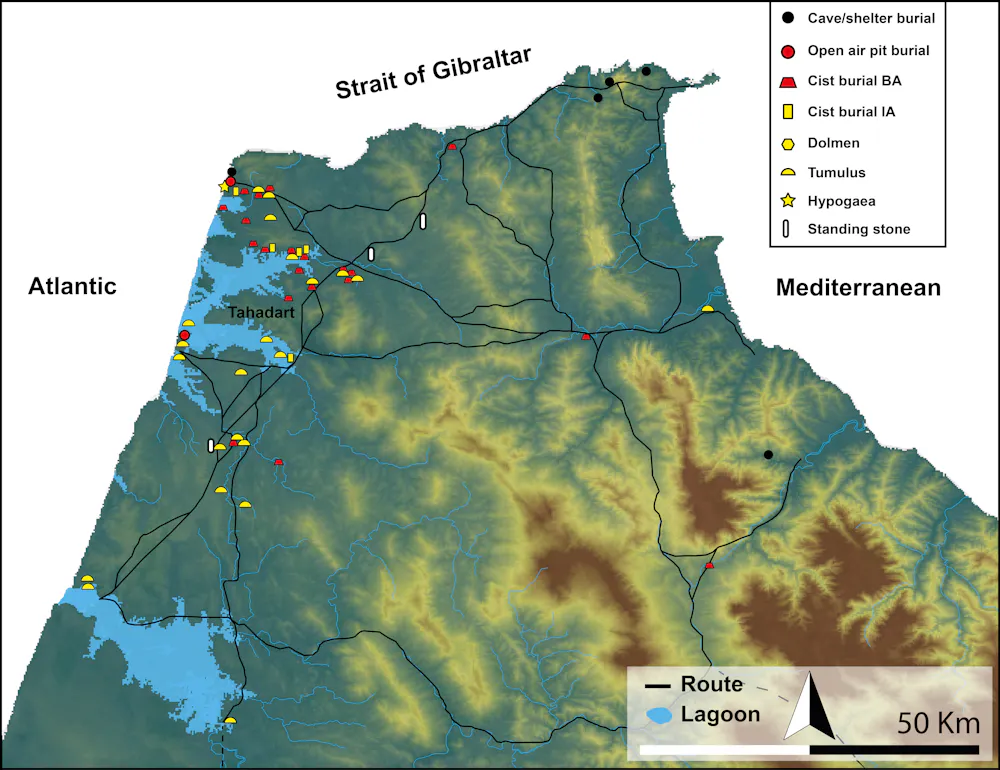
    Distribution of burials, standing stones and communication routes. H Benattia.

    Until now, research on rock art and burials in north Africa focused on areas like the Nile Valley, the Sahara or the Atlas Mountains. Our discoveries reveal that Morocco’s north-western coast was a major cultural hub in the Bronze Age, over 4,000 years ago.

    The diversity of burial practices, ritual sites, symbolic rock art and unique megalithic monuments reflect a rich prehistoric heritage that transcends modern geographic, political and cultural boundaries. It also highlights the longstanding exchanges and contacts of this region with the Mediterranean, the Atlantic and the Sahara.

    One of the most remarkable sites we excavated is at Daroua Zaydan, near modern-day Tangier. There we uncovered a cist burial, a small stone chamber made from four upright stone slabs covered by a larger stone slab. A crescent-shaped arrangement of stones likely marked the access to the burial chamber.

    Excavation process of the Daroua Zaydan cist burial.

    Although the grave had been looted in the past, we recovered several human bones outside the cist. One of them was radiocarbon dated to 2118–1890 BC. This date aligns with similar burial traditions across the Strait of Gibraltar in Iberia, and with Early Bronze Age settlement activity at Kach Kouch, about 65km south-east of Daroua Zaydan.

    Cist cemeteries had been documented in the region before, but most were excavated during the early to mid-20th century. At the time, archaeologists didn’t have the methods that can now shed light on important details such as how they were built and when they were used. Daroua Zaydan marks the first radiocarbon-dated cist burial in north-west Africa.

    Monuments, ritual deposits and Atlantic connections

    Our findings suggest the existence of a complex prehistoric ritual landscape at the Tangier Peninsula. This landscape was likely connected to other areas of the Atlantic and Mediterranean through a shared ritual and symbolic “language”.

    Ballintober type sword recovered from the bed of the river Loukkos and currently held at the Staatliche Museen zu Berlin. Claudia Plamp.

    One clue is a Bronze Age sword found in the 1920s in the Loukkos river. It was likely made in Britain or Ireland and may have arrived in Africa through Atlantic exchange networks. The sword was likely deliberately thrown to the river — a ritual practice documented along rivers in Atlantic Europe. This suggests that communities in northern Morocco were part of a broader cultural and symbolic world that connected the late prehistoric Atlantic.

    The stone circle at Mzoura. H Benattia.

    Another example is the stone circle at Mzoura, made up of 176 standing stones. This site, excavated in the 1930s, is unique in north Africa. But it closely resembles other stone circles in Atlantic Europe like Stonehenge. During our fieldwork we also discovered new standing stones and rock art, located along prehistoric communication routes. This suggests they may have been used as territorial markers or ritual sites.

    Dotted composition at Ghar el Manzla. Enhanced with DStretch.

    Before our research, a single painted rock shelter, that of Magara Sanar, was known in north-western Morocco. We have now documented 17 painted and 5 engraved rock shelters.

    The variety of symbols and scenes includes dotted patterns, geometric lines and human-shaped figures. They suggest strong links to Iberian, Atlantic and Saharan prehistoric art.

    Human-shaped figures and dotted composition at Ghar Dchar Alouch. Enhanced with DStretch.

    Why this matters

    Looted cist burial at Oued Ksiar.

    Our research does more than just fill a blank spot on the archaeological map. It opens up new avenues for archaeological exploration in the region. The Tangier Peninsula is home to a rich and largely undocumented late prehistoric heritage. It deserves more attention from researchers, policymakers and the wider public.

    Further protection measures are necessary as the region is undergoing rapid urban development. Tourism is growing and there’s been extensive looting. We hope our work will lead to more archaeological investigations, including new excavations and radiocarbon dating of key sites.

    – Rock art and tomb discoveries in Morocco reveal ancient connections to the wider world
    – https://theconversation.com/rock-art-and-tomb-discoveries-in-morocco-reveal-ancient-connections-to-the-wider-world-256931

    MIL OSI Africa

  • MIL-OSI Africa: Do you live near a dam holding mine waste? 6 questions to ask

    Source: The Conversation – Africa – By Charles MacRobert, Associate Professor, Stellenbosch University

    Mining is essential to modern lifestyles. Copper, iron and other mined products are vital to the products many people take for granted, like electronic devices. Being able to buy these goods quite easily may give a person a false sense of how difficult it is to extract the elements they’re made of.

    Mining involves the removal of mineral-rich rock from the ground and processing it to extract the high-value minerals. Depending on the mineral, this quantity can be as low as a few grams in a tonne of rock.

    For example, removing a tiny quantity of platinum from rock requires finely grinding the rock. The fine material that remains once the platinum is removed is known as tailings.

    Every mining operation produces tailings. This can be coarse, like instant coffee granules, or fine, like cocoa powder. Tailings are typically mixed with water to form a liquid slurry that can be pumped and transported easily.

    Slurry is kept in specially designed tailings dams. The designs are unique and depend on what is being mined and the local area.

    Unfortunately, the history of mining is stained with examples of poorly managed dams that collapse, spilling the slurry, which is sometimes toxic. This can cause serious environmental, social and economic damage.

    Kafue River before contamination by copper mine waste. De Agostini/Getty Images

    One such mine disaster happened in February 2025 in Zambia at the Sino-Metals Leach Zambia copper mine. Over 50 million litres of toxic waste flowed over the dam’s wall into the Mwambashi River. From there it flowed into one of the largest and longest Zambian rivers, the Kafue.

    The pollution travelled further than 100km from the dam, contaminating the river, and killing fish and livestock on nearby farms. The Zambian government had to shut down municipal water to the city of Kitwe to protect residents from consuming the polluted water.

    This should not have happened, because steps have been taken to ensure proactive management of dams. In 2020, the Global Industry Standard on Tailings Management introduced a new set of safety measures and standards.

    Many mines are proactively embracing these standards. This enhances community trust in tailings dams. But other mines are not engaging with communities that might be affected by dams. Or communities may feel unsure what to ask the mines.

    We are geotechnical engineers who have studied tailings dam collapses. Here, we outline six questions people living near mines should ask mine management to ensure they understand the key hazards and risks in their communities.

    1. How far will the slurry flow?

    Each tailings dam has a zone of influence. This is determined by analysing what would happen if the slurry breached the dam walls and started to flow out. It is an estimate of the area which would be swamped by tailings if the dam failed.

    Generally, tailings disasters have caused significant damage up to a distance of 5km from the dam. If the tailings slurry gets into a river, it can flow hundreds of kilometres downstream.


    Read more: Burst mining dam in South Africa: what must be done to prevent another disaster


    Zones of influence are often determined for extreme events, like once in a lifetime storms or large earthquakes. But zones of influence could also include places affected by dust or water pollution from the mine.

    If you can see a tailings dam from where you live or work you should consider yourself within the zone of influence.

    2. Who is responsible for the dam?

    Clearly defined roles and responsibilities for day-to-day operation should be in place in every mine. There should be suitably qualified engineers appointed to carry out monitoring and maintenance of the dam. There need to be enough qualified people to cope with the size of the dam.

    The management structure should set out how day-to-day issues related to the tailings dam are discussed between workers on the ground in mines and top management, and how solutions are found. Mines should also keep audit and inspection reports on their tailings dams, and records should be kept over the long term (because tailings dams are often operational for several decades).

    3. What about the environment?

    Mines should have plans to reduce the impact that tailings dams have on the environment. These would have been informed by public participation. The plans must state what monitoring is in place to measure the impacts of dust and water (groundwater and surface water).

    The true extent of impacts only becomes apparent once the mine starts operating. So, the public should hold mines accountable for commitments made. Mines should satisfy communities that monitoring is continuing to identify and track the dam’s environmental impacts.

    Closure plans should also be continuously communicated to mining-affected communities. This will assure the community that when the miners leave, they won’t be left with a dangerous dam near their homes, with no one to look after it.

    4. Will the tailings dam be safe when it rains?

    A common way that tailings dams fail is when water or slurry washes over the dam sidewalls. This washes away the support. It is known as overtopping, and can happen in storms or if too much tailing is pumped into the dam.

    Overtopping is best managed by keeping the water a certain distance below the dam wall. Mine management must measure this regularly and control how much tailing they pump to the dam. Their task is to make sure that even in a severe storm the level will stay well below the top of the dam wall.

    5. Has the dam always behaved as expected?

    Small failure incidents such as sloughs, slides and bulges where dam walls move but no slurry is released can occur. Mines should investigate and report these, detailing likely causes and mitigation measures implemented.

    Publicly available satellite imagery can easily show where mine tailings dams are becoming unstable. Mines should be transparent and provide explanations for these to avoid any speculation over whether the dam is stable or not.

    6. What alterations have been made?

    Sometimes dams must be changed to accommodate changes in mining or the extraction process. These changes could include how fast the dam is being built, moving the position of the dam wall, or placing material at the base of the wall to stabilise it.

    The unexpected consequences of alterations to a tailings dam could be water seeping out and creating damp spots, leading to dam walls sagging or cracking. If left unchecked this can lead to structural failure.

    When substantial changes are made to a dam’s design, mines need to demonstrate that sufficient consideration has gone into making these changes.

    – Do you live near a dam holding mine waste? 6 questions to ask
    – https://theconversation.com/do-you-live-near-a-dam-holding-mine-waste-6-questions-to-ask-256517

    MIL OSI Africa

  • MIL-OSI Global: Rock art and tomb discoveries in Morocco reveal ancient connections to the wider world

    Source: The Conversation – Africa – By Hamza Benattia, Prehistory, Universitat de Barcelona

    When people think of ancient burials in North Africa, they often picture Egypt’s pyramids and monuments. But new discoveries show that north-western Africa also has a deep and fascinating prehistoric past.

    Morocco’s Tangier Peninsula is particularly interesting. The peninsula sits at Africa’s north-western edge, where the Mediterranean Sea meets the Atlantic Ocean. At just 14 kilometres from Europe across the Strait of Gibraltar, this area has long been a natural crossroads between continents and cultures.

    I’m an archaeologist and PhD student who specialises in north Africa’s later prehistoric periods, between 3800 BC and 500 BC. My research explores how ancient communities responded to environmental changes, and how they moved and connected with other communities across regions.

    The assumption to date has been that the Tangier Peninsula was uninhabited and isolated in late prehistoric times. As part of my PhD research I wanted to explore whether this was true, or whether the area had simply been overlooked by previous archaeological work.

    Through the Kach Kouch and Tahadart Archaeological Projects, we studied both the Atlantic and Mediterranean zones of the peninsula.

    Our goal was to revisit the region using modern archaeological methods and technologies, including radiocarbon dating. To understand how this region may have been connected to the wider world in prehistoric times, we used Geographic Information System software to model possible ancient communication routes and surveyed the landscape through satellite and drone imagery. At a later stage, alongside a team of early career Moroccan archaeologists from the National Institute of Archaeology and Heritage, we carried out field surveys and excavations.

    What we discovered exceeded all expectations. Far from being empty and isolated, the Tangier Peninsula is filled with evidence that people lived, died and held ceremonies there over thousands of years.

    Our hope is that our findings will reframe north-western Africa as a cultural crossroads that has connected regions for thousands of years. This region could reshape our understanding of later prehistory across the Atlantic and Mediterranean worlds.

    A prehistoric ritual and funerary landscape

    Our study, published in African Archaeological Review, presents the discovery of dozens of new archaeological sites, including prehistoric burials, rock art sites and standing stones.

    Until now, research on rock art and burials in north Africa focused on areas like the Nile Valley, the Sahara or the Atlas Mountains. Our discoveries reveal that Morocco’s north-western coast was a major cultural hub in the Bronze Age, over 4,000 years ago.

    The diversity of burial practices, ritual sites, symbolic rock art and unique megalithic monuments reflect a rich prehistoric heritage that transcends modern geographic, political and cultural boundaries. It also highlights the longstanding exchanges and contacts of this region with the Mediterranean, the Atlantic and the Sahara.

    One of the most remarkable sites we excavated is at Daroua Zaydan, near modern-day Tangier. There we uncovered a cist burial, a small stone chamber made from four upright stone slabs covered by a larger stone slab. A crescent-shaped arrangement of stones likely marked the access to the burial chamber.

    Although the grave had been looted in the past, we recovered several human bones outside the cist. One of them was radiocarbon dated to 2118–1890 BC. This date aligns with similar burial traditions across the Strait of Gibraltar in Iberia, and with Early Bronze Age settlement activity at Kach Kouch, about 65km south-east of Daroua Zaydan.

    Cist cemeteries had been documented in the region before, but most were excavated during the early to mid-20th century. At the time, archaeologists didn’t have the methods that can now shed light on important details such as how they were built and when they were used. Daroua Zaydan marks the first radiocarbon-dated cist burial in north-west Africa.

    Monuments, ritual deposits and Atlantic connections

    Our findings suggest the existence of a complex prehistoric ritual landscape at the Tangier Peninsula. This landscape was likely connected to other areas of the Atlantic and Mediterranean through a shared ritual and symbolic “language”.

    One clue is a Bronze Age sword found in the 1920s in the Loukkos river. It was likely made in Britain or Ireland and may have arrived in Africa through Atlantic exchange networks. The sword was likely deliberately thrown to the river — a ritual practice documented along rivers in Atlantic Europe. This suggests that communities in northern Morocco were part of a broader cultural and symbolic world that connected the late prehistoric Atlantic.

    Another example is the stone circle at Mzoura, made up of 176 standing stones. This site, excavated in the 1930s, is unique in north Africa. But it closely resembles other stone circles in Atlantic Europe like Stonehenge. During our fieldwork we also discovered new standing stones and rock art, located along prehistoric communication routes. This suggests they may have been used as territorial markers or ritual sites.

    Before our research, a single painted rock shelter, that of Magara Sanar, was known in north-western Morocco. We have now documented 17 painted and 5 engraved rock shelters.

    The variety of symbols and scenes includes dotted patterns, geometric lines and human-shaped figures. They suggest strong links to Iberian, Atlantic and Saharan prehistoric art.

    Why this matters

    Our research does more than just fill a blank spot on the archaeological map. It opens up new avenues for archaeological exploration in the region. The Tangier Peninsula is home to a rich and largely undocumented late prehistoric heritage. It deserves more attention from researchers, policymakers and the wider public.

    Further protection measures are necessary as the region is undergoing rapid urban development. Tourism is growing and there’s been extensive looting. We hope our work will lead to more archaeological investigations, including new excavations and radiocarbon dating of key sites.

    Hamza Benattia, director of the Tahadart Archaeological Project, received funding from the National Institute of Archaeology and Heritage of Morocco (INSAP), the Prehistoric Society Research Fund, the Stevan B. Dana Grant of the American Society of Overseas Research, the Mediterranean Archaeological Trust Grant, the Barakat Trust Early Career Award, the Centre Jacques Berque Research Grant, the Institute of Ceutan Studies Research Fund and the University of Castilla La Mancha.

    ref. Rock art and tomb discoveries in Morocco reveal ancient connections to the wider world – https://theconversation.com/rock-art-and-tomb-discoveries-in-morocco-reveal-ancient-connections-to-the-wider-world-256931

    MIL OSI – Global Reports

  • MIL-OSI Global: Do you live near a dam holding mine waste? 6 questions to ask

    Source: The Conversation – Africa – By Charles MacRobert, Associate Professor, Stellenbosch University

    Mining is essential to modern lifestyles. Copper, iron and other mined products are vital to the products many people take for granted, like electronic devices. Being able to buy these goods quite easily may give a person a false sense of how difficult it is to extract the elements they’re made of.

    Mining involves the removal of mineral-rich rock from the ground and processing it to extract the high-value minerals. Depending on the mineral, this quantity can be as low as a few grams in a tonne of rock.

    For example, removing a tiny quantity of platinum from rock requires finely grinding the rock. The fine material that remains once the platinum is removed is known as tailings.

    Every mining operation produces tailings. This can be coarse, like instant coffee granules, or fine, like cocoa powder. Tailings are typically mixed with water to form a liquid slurry that can be pumped and transported easily.

    Slurry is kept in specially designed tailings dams. The designs are unique and depend on what is being mined and the local area.

    Unfortunately, the history of mining is stained with examples of poorly managed dams that collapse, spilling the slurry, which is sometimes toxic. This can cause serious environmental, social and economic damage.

    One such mine disaster happened in February 2025 in Zambia at the Sino-Metals Leach Zambia copper mine. Over 50 million litres of toxic waste flowed over the dam’s wall into the Mwambashi River. From there it flowed into one of the largest and longest Zambian rivers, the Kafue.

    The pollution travelled further than 100km from the dam, contaminating the river, and killing fish and livestock on nearby farms. The Zambian government had to shut down municipal water to the city of Kitwe to protect residents from consuming the polluted water.

    This should not have happened, because steps have been taken to ensure proactive management of dams. In 2020, the Global Industry Standard on Tailings Management introduced a new set of safety measures and standards.

    Many mines are proactively embracing these standards. This enhances community trust in tailings dams. But other mines are not engaging with communities that might be affected by dams. Or communities may feel unsure what to ask the mines.

    We are geotechnical engineers who have studied tailings dam collapses. Here, we outline six questions people living near mines should ask mine management to ensure they understand the key hazards and risks in their communities.

    1. How far will the slurry flow?

    Each tailings dam has a zone of influence. This is determined by analysing what would happen if the slurry breached the dam walls and started to flow out. It is an estimate of the area which would be swamped by tailings if the dam failed.

    Generally, tailings disasters have caused significant damage up to a distance of 5km from the dam. If the tailings slurry gets into a river, it can flow hundreds of kilometres downstream.


    Read more:
    Burst mining dam in South Africa: what must be done to prevent another disaster


    Zones of influence are often determined for extreme events, like once in a lifetime storms or large earthquakes. But zones of influence could also include places affected by dust or water pollution from the mine.

    If you can see a tailings dam from where you live or work you should consider yourself within the zone of influence.

    2. Who is responsible for the dam?

    Clearly defined roles and responsibilities for day-to-day operation should be in place in every mine. There should be suitably qualified engineers appointed to carry out monitoring and maintenance of the dam. There need to be enough qualified people to cope with the size of the dam.

    The management structure should set out how day-to-day issues related to the tailings dam are discussed between workers on the ground in mines and top management, and how solutions are found. Mines should also keep audit and inspection reports on their tailings dams, and records should be kept over the long term (because tailings dams are often operational for several decades).

    3. What about the environment?

    Mines should have plans to reduce the impact that tailings dams have on the environment. These would have been informed by public participation. The plans must state what monitoring is in place to measure the impacts of dust and water (groundwater and surface water).

    The true extent of impacts only becomes apparent once the mine starts operating. So, the public should hold mines accountable for commitments made. Mines should satisfy communities that monitoring is continuing to identify and track the dam’s environmental impacts.

    Closure plans should also be continuously communicated to mining-affected communities. This will assure the community that when the miners leave, they won’t be left with a dangerous dam near their homes, with no one to look after it.

    4. Will the tailings dam be safe when it rains?

    A common way that tailings dams fail is when water or slurry washes over the dam sidewalls. This washes away the support. It is known as overtopping, and can happen in storms or if too much tailing is pumped into the dam.

    Overtopping is best managed by keeping the water a certain distance below the dam wall. Mine management must measure this regularly and control how much tailing they pump to the dam. Their task is to make sure that even in a severe storm the level will stay well below the top of the dam wall.

    5. Has the dam always behaved as expected?

    Small failure incidents such as sloughs, slides and bulges where dam walls move but no slurry is released can occur. Mines should investigate and report these, detailing likely causes and mitigation measures implemented.

    Publicly available satellite imagery can easily show where mine tailings dams are becoming unstable. Mines should be transparent and provide explanations for these to avoid any speculation over whether the dam is stable or not.

    6. What alterations have been made?

    Sometimes dams must be changed to accommodate changes in mining or the extraction process. These changes could include how fast the dam is being built, moving the position of the dam wall, or placing material at the base of the wall to stabilise it.

    The unexpected consequences of alterations to a tailings dam could be water seeping out and creating damp spots, leading to dam walls sagging or cracking. If left unchecked this can lead to structural failure.

    When substantial changes are made to a dam’s design, mines need to demonstrate that sufficient consideration has gone into making these changes.

    The authors do not work for, consult, own shares in or receive funding from any company or organisation that would benefit from this article, and have disclosed no relevant affiliations beyond their academic appointment.

    ref. Do you live near a dam holding mine waste? 6 questions to ask – https://theconversation.com/do-you-live-near-a-dam-holding-mine-waste-6-questions-to-ask-256517

    MIL OSI – Global Reports

  • MIL-OSI Europe: Christine Lagarde: Earning influence: lessons from the history of international currencies

    Source: European Central Bank

    Speech by Christine Lagarde, President of the ECB, at an event on Europe’s role in a fragmented world organised by Jacques Delors Centre at Hertie School in Berlin, Germany

    Berlin, 26 May 2025

    Over the past 80 years, the global economy thrived on a foundation of openness and multilateralism – underpinned by US leadership. By championing a rules-based international system and anchoring the dollar as the world’s reserve currency, the United States set the stage for trade to flourish and finance to expand.

    This global order proved immensely beneficial to the European Union, whose founding liberal principles aligned seamlessly with it. But today it is fracturing.

    Multilateral cooperation is being replaced by zero-sum thinking and bilateral power plays. Openness is giving way to protectionism. There is even uncertainty about the cornerstone of the system: the dominant role of the US dollar.

    All else equal, this fracturing can pose risks for Europe. Our economy is deeply integrated into the global trading system, with exports accounting for close to one-fifth of our value added and supporting 30 million jobs.

    Any change in the international order that leads to lower world trade or fragmentation into economic blocs will be detrimental to our economy.

    But – with the right policy responses – there could also be opportunities. The changing landscape could open the door for the euro to play a greater international role.

    Today, the euro is the second global currency, accounting for around 20% of foreign exchange reserves, compared with 58% in the case of the US dollar. Increasing the international role of the euro can have positive implications for the euro area.

    It would allow EU governments and businesses to borrow at a lower cost, helping boost our internal demand at a time when external demand is becoming less certain.

    It would insulate us from exchange rate fluctuations, as more trade would be denominated in euro, protecting Europe from more volatile capital flows.

    It would protect Europe from sanctions or other coercive measures.

    In short, it would allow Europe to better control its own destiny – giving us some of what Valéry Giscard d’Estaing called the “exorbitant privilege” 60 years ago.

    So, how likely is this change to happen? History suggests that it is far from guaranteed. The euro will not gain influence by default – it will have to earn it.

    For the euro to increase its global status, history tells us that we need to build on three foundations – each of them critical for success.

    First, Europe must ensure it has a solid and credible geopolitical foundation by maintaining a steadfast commitment to open trade and underpinning it with security capabilities.

    Second, we must reinforce our economic foundation to make Europe a top destination for global capital, enabled by deeper and more liquid capital markets.

    Third, we must bolster our legal foundation by defending the rule of law – and by uniting politically so that we can resist external pressures.

    Before we explore each of these three foundational components, let us observe what recent history can teach us.

    Shifts in the global currency landscape

    Shifts in the global currency landscape are not unprecedented in monetary history. There have been previous episodes where the world’s leading reserve currency issuer has taken steps that have called that leadership into question, without ultimately jeopardising it.

    For example, the US dollar took over from the pound sterling as the world’s leading reserve currency in the mid-1920s, with its share in foreign exchange reserves rising to 64% by 1931. But this leading position did not stop the United States taking measures to unilaterally change the international monetary order.

    For instance, in 1933 President Roosevelt suspended gold convertibility to fight the deflationary forces of the Great Depression. He dismissed European demands for fixed exchange rates with the argument that “the sound internal economic system of a nation is a greater factor in its well-being than the price of its currency”.[1]

    Then again in the 1970s President Nixon ended the Bretton Woods system by unilaterally suspending dollar convertibility to gold and imposing a 10% import tariff.

    Faced with growing imbalances between US current account deficits and the surpluses of western Europe and Japan, Treasury Secretary John Connally declared that “no longer can considerations of friendship, or need, or capacity justify the United States carrying so heavy a share of the common burdens.”[2]

    On both occasions, there was a decline in the standing of the US dollar as a foreign reserve currency. In the 1930s, it fell from over 60% to around 20% of global foreign exchange reserves. In the 1970s, it fell from about 70% to 50% two decades later.

    But on neither occasion was there a robust alternative currency that could take over at short notice. In the 1930s, the pound sterling was already declining, while in the 1970s the Deutsche Mark and the Yen were backed by markets that were too small.

    So, instead, investors flocked to gold. The share of gold in foreign reserves increased by about 20 percentage points in the 1930s to 97% and almost doubled to 60% in the 1970s.[3]

    Today, there is a key difference compared with previous eras. With the euro as the world’s second-largest currency, there is another international currency alongside the dollar. But this has not yet convinced investors.

    Over recent years, the dollar’s share in global foreign exchange reserves has fallen, with its current level of 58% being the lowest since 1994. In parallel, central banks have been accumulating gold at a record pace – almost matching the levels seen during the Bretton Woods era.[4] The share of gold in global foreign reserves[5] has reached around 20%, surpassing that of the euro.[6]

    As previously mentioned, we can identify three essential foundations for international currency usage, without which a currency cannot succeed on the global stage. And in each case, we can see that Europe has many of the key ingredients for success, but we need to bring them together to reinforce the foundations. Action is in order.

    The geopolitical foundation

    The starting point is a credible geopolitical foundation – which rests on both a country’s role in global trade and the strength of its military alliances.

    A currency’s exposure to trade is especially important, as it provides the initial pathway to wider international use. In the mid-1920s, for example, the dollar overtook the pound sterling as the leading form of trade credit before it became the leading reserve currency.[7]

    Once a currency captures a larger share of trade invoicing, its role in international banking and finance, and ultimately as a reserve asset, becomes self-reinforcing. Higher demand for the currency enhances its role as a store of value and further encourages investors to hold it.[8]

    As a major actor in global trade, Europe already has a key ingredient of a strong geopolitical foundation, creating the potential for a virtuous circle of euro internationalisation to unfold.

    The EU has the largest network of trade agreements in the world. Europe is the number one trading partner for 72 countries, which together represent almost 40% of world GDP.[9] And this status is reflected in the share of the euro as an invoicing currency, which stands at around 40%, more than double its share as a reserve currency.

    Europe can press home this advantage by continuing to forge new trade agreements. And we should make clear that we support a win-win approach to trade, ensuring that we are the most attractive partner to make deals with.

    The ECB can also help make the euro more attractive for euro-denominated trade. We are working on a potential digital euro and pursuing initiatives to enhance cross-border payments in euro, which could potentially facilitate international cross-border transactions in the future.

    And by extending swap and repo lines to key partners, we safeguard against euro liquidity shortages abroad disrupting the smooth transmission of our monetary policy – which in turn encourages those partners to transact more in euro.

    But there is a limit to how much a currency can grow simply by virtue of being open to trade. In fact, the euro’s share of global export invoicing is already as large as that of the US dollar, but we are not closing the gap in reserve currency status.

    This is because investors – and especially official investors – also seek geopolitical assurance in another form: they invest in the assets of regions that are reliable security partners and can honour alliances with hard power. So a credible geopolitical foundation must also rest on robust military partnerships.

    This dual strength is essentially what we can learn from the US dollar’s dominance. It is not just a product of economic fundamentals but it is also powerfully reinforced by US security guarantees. These guarantees not only deepen trade ties[10], but have been shown to boost a currency’s share in foreign reserves by up to 30 percentage points.[11]

    We are now seeing a major shift in Europe towards rebuilding our hard power, with important initiatives underway at the national and EU levels. And we should be clear that following through with this effort is a precondition for the euro to become more widely used.

    The economic foundation

    Trade and military power are important for establishing demand for an international currency. But to satisfy this demand, investors need appropriate assets to invest in.

    This is why a strong economic foundation – one that provides opportunities for growth and opportunities to invest in growth – is equally essential.

    There is a virtuous circle between growth, capital markets and international currency usage. Growth generates robust rates of return, which make investors want to hold assets in a particular currency. And capital markets provide investment opportunities and channel funds back into growth.

    At the same time, if capital markets provide a sufficient supply of “safe assets”, investors can hedge their exposures efficiently. When a shock hits and riskier investments lose value, safer assets rise in value. That provides a complete ecosystem for investments in the currency.

    The US dollar’s rise to dominance in the interwar period was certainly driven by this virtuous circle. The development of US capital markets boosted growth – with each 1 percentage point increase in market capitalisation yielding 0.5 percentage points more growth[12] – while simultaneously establishing the foundation for dollar dominance. The depth and liquidity of the US Treasury market in turn provided an efficient hedge for investors.

    Europe has all the elements it needs to produce a similar cycle. But so far, we have not been able to put all the pieces together.

    Despite our large single market, we have fallen behind the US in terms of growth performance and market returns. Since 2000, US labour productivity per hour has grown twice as much as in the euro area, mainly driven by the tech sector, and US markets have delivered returns that are around five times as high as those of European markets.[13]

    Despite our large savings, we have made little progress in integrating our capital markets to channel more of our funds into growth. 60% of household equity investment goes into home country markets even though there may be greater opportunities abroad.

    And despite our strong aggregate fiscal position – our debt-to-GDP ratio is 89%, compared with 124% in the United States – we provide relatively few safe assets. Recent estimates suggest that outstanding sovereign bonds rated at least AA are just below 50% of GDP in the EU and above 100% in the US.[14]

    The conclusion for Europe is clear: if we truly want to see the global status of the euro grow, we must first reform our domestic economy.

    That means moving forwards with the priorities identified in recent reports: completing the Single Market, enabling start-ups, reducing regulation and building the savings and investment union. And it means avoiding a piecemeal approach, where we make progress where it is easy and dither where it is hard, else we will never kick-start the positive cycle.

    Moreover, in this new geopolitical landscape, the case for acting in a European way has never been stronger.

    Each individual country of course needs to make sure that its national policies support growth. But we also need to be mindful of self-defeating fragmentation. For example, we all agree that Europe needs to build up its strategic industries to avoid excessive dependencies – as Mario Draghi and Enrico Letta emphasised in their recent reports. But we will not succeed if we have 27 different policies for these industries.

    Nowadays there are also more policy goals that qualify as European public goods, notably strengthening European defence. But due to the free-rider problem, defence is a good that is likely to be undersupplied. Moreover, joining forces to procure equipment and develop new technologies – leading to economies of scale and more interoperability – will result in greater operational effectiveness than if all 27 Member States go it alone.

    Economic logic tells us that public goods need to be jointly financed. And this joint financing could provide the basis for Europe to gradually increase its supply of safe assets.

    The legal foundation

    Geopolitical strength and faster growth can go a long way towards strengthening the euro’s international role. But maintaining demand for the currency will also depend on our ability to uphold a robust legal and institutional foundation.

    Ultimately, currencies achieve and maintain their reserve status if the institutions and policies backing them consistently safeguard investor confidence in their long-term value.[15]

    For example, historically, the US dollar’s pre-eminence has rested on the strength and stability of US fiscal and monetary institutions. The Federal Reserve System’s credible commitment to controlling inflation, combined with the unparalleled liquidity of the US Treasury market, created a perception of minimal sovereign risk. This made the dollar a safe haven during global economic turbulence and recessions.[16]

    Since 1970, there have been 34 instances of simultaneous sovereign debt and financial crises globally, but the US has remained immune to such “twin crises”.[17]

    However, when doubts emerge about the stability of the legal and institutional framework, the impact on currency use is undeniable.

    These doubts have materialised in the form of highly unusual cross-asset correlations since 2 April this year, with the US dollar and US Treasuries experiencing sell-offs even as equities fell. The same doubts are also cited by investors who are turning to gold: two-fifths say they are doing so as a hedge against rising geopolitical risk.[18]

    Given this context, the EU has a legitimate reason to turn its commitment to predictable policymaking and the rule of law into a comparative advantage.

    This commitment is baked into how the EU works. The positive side of our often slow and complicated decision-making processes is that checks and balances are always respected. We have also enshrined into law the independence of our key institutions, like the ECB, in ways that are hard for politicians to threaten.

    But relying on the fact that our bureaucratic systems are hard to change is not enough. In the current geopolitical environment, we are facing increasing external pressures to take actions that jeopardise the rule of law. And we will only be able to resist these pressures if we are more politically united and able to speak with a single voice.

    As we potentially enter a renewed era of great power rivalry, with countries being asked to take sides, we are likely to find ourselves under pressure to make decisions that are not necessarily in our own interest.

    But if we take this opportunity to unite and, preferably, to reform our institutional structure by enabling more qualified majority voting in areas where a single veto has often held back the collective interests of the 26 other countries, that would enable us to act decisively as a united Europe. We would then be in a much stronger position to defend and uphold our values and, as a result, to defend and uphold global confidence in our currency.

    Conclusion

    Let me conclude.

    In the history of the international monetary system, there are moments when the foundations that once seemed unshakeable begin to shift.

    The Belgian-American economist Robert Triffin described this with great clarity. He observed that nations’ confidence in the international monetary system depends on the reliability of the reserve currency, which, in his words, is “highly dependent on individual countries’ decisions”.

    But moments of change can also be moments of opportunity. The ongoing changes create the opening for a “global euro moment”.

    This is a prime opportunity for Europe to take greater control of its own destiny. But this is not a privilege that will simply be given to us. We have to earn it.

    MIL OSI Europe News

  • MIL-OSI China: Moody’s affirming ratings offers positive reflection of Chinese economic prospects: ministry

    Source: People’s Republic of China – State Council News

    Moody’s affirming ratings offers positive reflection of Chinese economic prospects: ministry

    BEIJING, May 26 — Moody’s decision to affirm China’s A1 ratings on Monday is a positive reflection of the improving prospects for the country’s economy, the Chinese Ministry of Finance said.

    Since the fourth quarter of last year, the Chinese government has implemented a series of macroeconomic policies, economic indicators have improved, market expectations and confidence have stabilized, and the medium and long-term sustainability of debt has improved, the ministry said.

    The global economy is facing multiple risks and challenges, including insufficient momentum, escalating geopolitical conflicts, and a volatile international economic and trade order, leading to increased uncertainty in regard to economic performance, it noted.

    Against this backdrop, China’s economy has secured a strong start, with high-quality development trending positively. Production and consumption demand are steadily rising, and the stability and coordination of economic operations are improving, demonstrating strong resilience and vibrant dynamism, it said.

    Moving forward, a series of incremental and existing policies will work in concert to provide solid support for high-quality economic development, the ministry said.

    Regardless of changes in the external environment, China will remain confident and focused, concentrating on managing its own affairs well, it noted.

    MIL OSI China News

  • MIL-OSI Russia: Alexey Likhachev became an Honorary Doctor of SPbPU

    Translation. Region: Russian Federal

    Source: Peter the Great St Petersburg Polytechnic University – Peter the Great St Petersburg Polytechnic University –

    A solemn ceremony of presenting the mantle and diploma of the Honorary Doctor of SPbPU to the General Director of the State Corporation Rosatom Alexey Likhachev took place at Peter the Great St. Petersburg Polytechnic University.

    The ceremonial event opened with the performance of the Polytechnic University anthem by the SPbPU youth choir “Polyhymnia”.

    It is especially gratifying that this important event is taking place in the year of the 80th anniversary of the Russian nuclear industry, to the development of which Polytechnicians made a significant contribution. Such names as Abram Fedorovich Ioffe, Isaak Konstantinovich Kikoin, Abram Isaakovich Alikhanov, Yuliy Borisovich Khariton, Nikolay Leonidovich Dukhov are inscribed in gold letters in the history of the development of Russian science. Today, Polytechnic University and Rosatom, under the leadership of Alexey Evgenievich, closely cooperate for the benefit of the development of Russian nuclear technologies: both in education and in science. By order of Rosatom, our Institute of Power Engineering annually graduates more than 250 specialists in the field of nuclear energy, thermal power engineering, electric power engineering and power engineering. Together with Rosatom, we are successfully implementing the project of the advanced engineering school “Digital Engineering”, acting in the interests of the technological leadership of our country, – emphasized the rector of SPbPU, academician of the Russian Academy of Sciences Andrey Rudskoy.

    The members of the SPbPU Academic Council unanimously voted to award the title to Alexey Likhachev on April 28 this year. The Scientific Secretary of the Polytechnic University Dmitry Karpov presented the new honorary doctor.

    If we try to pick three key words that would define the spirit of modern scientific and technological development in Russia, these words should be: professionalism, leadership and Victory. And these are the words that come to mind when we talk about the State Corporation Rosatom. For the Polytechnic University, whose history is closely connected with the nuclear project, participation in the development of nuclear energy is one of the key, strategic areas of work. And scientific and industrial cooperation with the national leader in several related industries at once is a great honor and responsibility for the university, – noted Dmitry Karpov.

    Cooperation between the Rosatom State Corporation and SPbPU, which is one of the flagship universities and its long-term strategic partner, is actively developing. This is a significant amount of work carried out by the Institute of Mechanical Engineering, Materials and Transport, the Institute of Power Engineering, the Physics and Mechanical Engineering Institute, the Advanced Engineering School “Digital Engineering” and other university structures. This is significant international cooperation, in particular, in the interests of the Turkish and Egyptian nuclear energy. This is the training of specialists in a wide range of engineering and technical areas of training – primarily in nuclear, energy, mechanical engineering and construction specialties. This is a cell of the Rosatom Student Council, whose activists participate in organizing meetings with representatives of the corporation’s enterprises, technical tours of production facilities, strategic sessions as part of the university’s career events and other activities. In the context of the 80th anniversary of the nuclear industry, about 40 events are planned at the Polytechnic University, covering more than 4,000 people.

    Dmitry Karpov named several completed projects. An optimal design of a vibrating screen for cleaning drilling mud was developed by order of NPO Centrotech. The project was a real breakthrough in the industry: with a target vibration acceleration of 7 g, engineers from PISh SPbPU designed a product that exceeded these parameters in just six months. The results of digital modeling were confirmed from the first factory test of the prototype – the vibration acceleration was 8.2 g. The product and its modifications have been successfully used for many years now.

    A digital twin of the VVER-1000 fuel assembly with an anti-debris filter and mixing grids was developed by order of JSC TVEL. Due to digital design and additive manufacturing, the filtration efficiency has been increased tenfold, and the created models, virtual test benches and testing grounds will significantly reduce costs and improve the quality and speed of further developments.

    At the request of the Mayak production association, for the first time in engineering practice, the architecture of a highly adequate multiphysical digital model of a furnace for vitrification of high-level radioactive waste has been developed.

    By order of JSC TsKBM, key proprietary technological equipment for the ODU-150 hydrogen production unit was developed. The design solutions of the created key hydrogen technology devices are the starting point in the development of a new generation of equipment and future medium- and large-tonnage devices for the hydrogen, petrochemical, and nitrogen industries.

    At the request of the composite division of Rosatom, a technology for the production of filaments from continuous carbon fiber was developed, and the customer received pilot equipment. On the official website of the corporation, this installation is listed among the most important achievements of Rosatom in 2024.

    At the enterprise of the State Corporation Rosatom — JSC Proryv — the URANIA data and process management system for computational and experimental scientific research was put into operation. It is based on the CML-Bench® Digital Platform — an in-house development of the Engineering Center of our university.

    In 2023, under the leadership of Alexey Evgenievich, the State Corporation approved the Unified Digital Strategy, which became the most important step towards accelerating the digital transformation of the industry, including ensuring import substitution. In this regard, Dmitry Karpov noted that specialists from SPbPU and the All-Russian Research Institute of Experimental Physics developed the national GOST “Computer models and modeling. Digital twins of products. General provisions” – the world’s first document regulating the relevant activities.

    The scale of the projects of the State Corporation Rosatom is truly astounding. And it is quite obvious that the management of such a system is the lot of rare leaders and true professionals. This entire vast field – from the development and implementation of advanced technologies, solving the most complex multidisciplinary problems of the world level to the transfer of unique competencies and the organization of expert discussion platforms – all this and much more became possible, including thanks to the personal professionalism and leadership of Alexey Evgenievich. Perhaps, being a leader is destiny. Destiny to be born in Arzamas-75 – Sarov, the city-forming enterprise of which is the Russian Federal Nuclear Center. And, having gone the way of an engineer, politician, adviser and Deputy Minister of Economic Development of Russia, still to head the State Atomic Energy Corporation Rosatom. And to become a leader, ensuring its brilliant victories, – emphasized Dmitry Karpov.

    Students in the uniform of the Polytechnic University of the early 20th century brought in a doctoral robe and cap, the Polyhymnia choir performed the Gaudeamus anthem. Andrei Rudskoi presented Alexei Evgenievich with a book about honorary doctors of the Polytechnic University, which has a page dedicated to the CEO of the state corporation Rosatom.

    It is a great honor for me to receive this title from one of the leading technical universities in the country, which stands at the origins of the Russian engineering school. St. Petersburg Polytechnic University is a forge of personnel for the nuclear industry, and we highly value the contribution of its teachers, scientists and students to the development of advanced technologies. I am confident that our partnership will continue to contribute to breakthrough achievements in nuclear energy, medicine and new materials, – said Alexey Likhachev in his response speech.

    Alexey Likhachev also met with students studying at the Institute of Power Engineering. He spoke about the development of the State Corporation’s systemic cooperation with universities, how contacts with students are built, and shared Rosatom’s corporate values. The Polytechnicians spoke about the activities of the Rosatom student council cell, asked questions about the prospects for the development of nuclear science and the training of personnel for the corporation’s high-tech projects.

    You are the future not only of Rosatom and the nuclear industry, but of the entire country. It is you who will manage enterprises, represent the industry on the international stage and develop our technological power. Therefore, such meetings with students are of particular value: we get to know each other better and understand to whom we are transferring responsibility for the future, Alexey Likhachev emphasized.

    Please note: This information is raw content directly from the source of the information. It is exactly what the source states and does not reflect the position of MIL-OSI or its clients.

    MIL OSI Russia News

  • MIL-OSI New Zealand: Reducing Harm and Saving Lives: Safer Boating Forum Recreational Craft Strategy 2023-2025

    Source: Maritime New Zealand

    The Safer Boating Forum (Forum) is launching its new Recreational Craft Strategy 2023-2025 to reduce harm and save lives, as part of the 10th annual Safer Boating Week.

    The Safer Boating Forum is a network representing a cross-section of national and regional government agencies, local body groups, organisations and the marine industry, involved in promoting recreational boating safety in New Zealand.

    Sharyn Forsyth, Chair of the Forum, says the strategy launch on October 17 is a significant achievement that will reduce harm among the two million recreational craft users in New Zealand each year.

    “The aim of this strategy is to reduce harm and ultimately to save lives,” says Sharyn. “It’s a big step forward for the 26 organisations in the forum, which have collaborated on the strategy, as it focuses on interventions that are informed by intelligence and insights. The Strategy will increase alignment between the Forum members and the wider water safety sector to focus on the primary causes of harm and working in partnership to find effective solutions.”

    Over the next two years the strategy aims to influence significant year-on-year increases in recreational craft users using lifejackets, carrying two forms of waterproof communication, and checking the marine forecast. It also aims to reduce per capita preventable fatalities by 25 percent by 2025.

    “I’m excited that we can launch this strategy today as I know it will help the sector take the right steps towards reducing harm among recreational craft users,” says Sharyn.

    Over the past 10 years, 18 people on average have died in recreational craft incidents annually. The majority of these fatalities occur when small craft under six metres suddenly capsize and those on-board have little time to put their life jackets on. Failure to wear a life jacket, or wearing of an ill-fitted life jacket, is the number one cause of death in recreational crafts.

    People taking to the water on unseaworthy craft, in unsuitable weather conditions, and without adequate equipment are also significant contributing factors to harm.

    Peter Busfield, Executive Director NZ Marine Industry Association says “removing unseaworthy craft from circulation is vital”.

    “Boating is a way of life for two million New Zealanders and it is important they know the importance of having a seaworthy boat with the correct safety equipment on board. The education and promotion campaigns the Forum delivers are key to getting this message through. As part of our communications strategy we’re looking to gain the support of boating and marine retailers to deliver safety messages so people come home safe from a day out on the water,” says Peter.

    An agency that often sees the impact of what happens on the water is CoastGuard.

    CEO, Callum Gillespie of Coastguard NZ, says having the strategy will help the sector work together to achieve the same goals: “This strategy shows that as a sector we are aligned and working together to reduce harm”.

    “We all want to see the numbers of preventable incidents of injury and death reduced; everyone in the forum wants people on the water to be able to come home safe.”

    The strategy is a practical piece of work that spreads right from national regulatory action through to local council bylaws.

    Pete Thomas, Deputy Harbour Master Northland Regional Council and Forum leadership group member, added that strategy initiatives would shape a consistent approach to council bylaws.

    “Across the motu, there are different bylaws regarding life jacket wearing and this can be confusing for the public. The Forum is committed to encouraging regional councils to strengthen bylaws and make life jacket wearing compulsory, especially for craft under six meters,” says Pete.

    A key component of the new strategy is its work to understand the needs of different communities and water users.

    Dr Ngahuia Mita, Forum Kaihautū (leader) says the strategy will reduce harm by coordinating work to understand where improvements can be made and promoting collaboration.

    “We know Māori and Pacific communities are over represented in fatalities and the Forum needs to work in partnership with these communities to develop effective solutions together.”

    Dr Ngahuia says it is important we have conversations with communities so we know how to ensure safety is at the front of mind.

    The Forum’s Recreational Craft Strategy supports the outcome in the Water Safety NZ Water Sector Safety Strategy and supports Maritime NZ’s strategy. Daniel Gerrard, CEO of Water Safety NZ, has welcomed the development.

    “As a sector it’s essential we’re all travelling in the same direction and working together effectively. We’re talking with similar people and encouraging them to be safe in the water, so it’s paramount that we are joined up and working as one,” says Daniel.

    MIL OSI New Zealand News

  • MIL-OSI New Zealand: Safer Boating Week: A plea to everyone hitting the water

    Source: Maritime New Zealand

    Come home safe.

    Maritime NZ and its Safer Boating Forum partners want every recreational craft user to put steps in place to ensure they return home from their time on the water with good memories, not injuries, or, even worse, fatalities.

    MNZ and the Safer Boating Forum, want everyone who heads out to come home safe.

    Safer Boating Week is about getting safety to the forefront of the minds of recreational craft users as they start flocking to the water.

    Maritime NZ’s 2022 Recreational Fatal Accidents report states that last year 17 people died tragically, or were reported missing and never found.

    “This is a sobering statistic, and one the Safer Boating Forum and our members are dedicated to bringing down,” Sharyn Forsyth, Chair of the Safer Boating Forum, says.

    “Our Forum members span right across the recreational craft space, from jet boating through to stand up paddle boarding, and each activity has its own risks to manage.

    “Through Maritime NZ’s community grant funding, organisations all over the country are running programmes to bring down instances of harm.

    “In 2022 we saw fatal incidents occurring on powerboats, dinghies, kayaks and jet skis, and it is important a targeted approach is taken to preventing harm on recreational crafts.”

    Almost all of these fatal incidents occurred one nautical mile from shore, or on lakes and rivers.

    “It doesn’t matter whether you are close to shore, tragedy can strike anywhere and that is why it is critical to prepare before heading out onto the water,” Maritime NZ Harm Prevention Lead – Recreational Craft Victoria Slade says.

    “If you’re planning to head out on the water make sure to check the marine forecast, take two forms of waterproof communication to call for help, and always wear a properly fitting lifejacket.”

    Thirteen of the 17 fatalities occurred when people were capsized or thrown overboard, which is why it is very important to wear a properly fitting life jacket.

    “New Zealand is an island nation and conditions can quickly change. A day can start calm, causing a false sense of security. This has especially been the case for users of low powered or human powered vessels,” Victoria Slade says.

    Canoers and kayakers represented nearly a third of those who died in recreational craft incidents in 2022.

    “Just because you are going out in a small vessel near to shore doesn’t mean you are immune to risks. The weather can change quickly so you need to regularly assess the weather conditions and head back to shore if conditions change. Smaller crafts such as kayaks can easily capsize in larger waves and be battered by high winds which can make situations very dangerous,” Victoria Slade says.

    “Of the 17 people who died or went missing in recreational accidents in 2022, 16 of those were male. The ‘she’ll be right’ attitude of a lot of NZ males needs to be left at home when heading out onto the water. Remember, your family needs you home safely.”

    For more information about how to plan before you head out, ways to be safe on the water, how to maintain your boat, and how to safely use different types of recreational crafts saferboating.org.nz

    Come home safe. Kia Mataara.

    Key water user and 2022 fatality report statistics:

    • 2022: 17 deaths (spread across 16 incidents)
      • The 17 fatal accidents that occurred in 2022 placed that year approximately at the 10 year average of 18 deaths
    • Of those who died in recreational craft incidents last year:
      • 17 of the 16 people were male
      • The median age was 53 years old
      • 12 were not wearing a lifejacket when they entered the water
      • 12 of 17 people died in spring and summer
      • All fatalities occurred in a vessel that was 6m or less in length
    •  nine deaths of the 17 were due to a capsize, a further four was overboard
    • Basic vessel type:
      • six deaths on a Kayak/Canoe
      • five deaths on a dinghy
      • four deaths on a power boat
    • Only seven percent of those surveyed say they create detailed plans of their trip. 31% don’t do any planning at all.
    • Things considered before and during trips to ensure saftey:
      • 42% have lifejackets
      • 38% know/ check the forecast
      • 11% have a phone

    Note to editors:

    The Safer Boating Forum (Forum) is a network representing a crosssection of national and regional government agencies, local body groups, organisations and the marine industry, involved in promoting recreational boating safety in Aotearoa New Zealand.
    The purpose of the Forum is to work together to develop and implement a recreational strategy for Aotearoa to support agreed safety policy, communications, education, compliance and regulation activities.
    Maritime NZ leads the Forum and works with Forum members to coordinate safe boating activities.

    Maritime New Zealand
    Auckland Transport
    Coastguard New Zealand
    Drowning Prevention Auckland
    Environment Canterbury
    Greater Wellington Regional Council
    Insurance Council of NZ
    Jet Boating New Zealand
    Kiwi Association of Sea Kayakers
    Metservice
    New Zealand Marine Industry Association
    New Zealand Police
    New Zealand Search and Rescue Council
    New Zealand Sport Fishing Council
    New Zealand Underwater Association
    NZ Stand Up Paddling
    Northland Regional Council
    Queenstown Lakes District Council
    Rowing New Zealand
    Surf Lifesaving New Zealand
    Swimming New Zealand
    Te Manatu Waka
    Waikato Regional Council
    Waka Ama New Zealand
    Water Safety New Zealand
    Yachting New Zealand

    MIL OSI New Zealand News

  • MIL-OSI Economics: Klaas Knot: A true treasure – why we need diversity and inclusion in the financial industry

    Source: Bank for International Settlements

    Welcome dear colleagues! Welcome to the conference and welcome to our renovated building.

    After several years of construction, De Nederlandsche Bank returned a few months ago to this updated version of our historic home. It is not only energy-efficient and sustainable, but also – quite unusual for a central bank – partially open to the public: on the ground floor, visitors can walk in to have a coffee, work, study, or simply look around.

    Look at our extensive art collection – as you can do later today – or visit the vault where we used to store our gold bars and our money. Now we call it the New Treasury and use it as an exhibition space where visitors can learn more about our role and responsibilities and explore our collection of historic banknotes, with a lot of European pre-euro examples. I hope you take the opportunity to visit the exhibition. 

    Of course I am convinced that the introduction of the euro was a positive change – I am the president of the Dutch Central Bank, after all – but despite everything we gained in this monetary union, we also lost something.

    In our banknotes we lost colour, individuality, diversity. Because the pre-euro banknotes all tell their own story. Of national identity, cultural heritage, time and place. They differ in colour, imagery, size; even in the feel of the paper.

    The Italian lira, with historic painters and sculptors: ornate and expressive.
    The German mark, with scientists and writers: inventive and efficient.
    The Dutch guilder, with colourful birds and sunflowers: bold and modernist.

    To name only a few.

    These banknotes remind us that diversity is not disorder.

    It is depth.
    It is opportunity.
    It is strength.

    The banknotes remind us that it is never one person, one idea that makes us strong.

    Our strength as nations, as the European Community, as financial institutions, is always the product of a flock of ideas, a blend of people, a collection of perspectives. 

    At De Nederlandsche Bank, our vision is ‘connected and diverse’. We believe that to safeguard financial stability and promote sustainable prosperity, we must reflect the society we serve – one that is increasingly complex, international, and indeed, diverse. That is why we aim for a workforce that mirrors the richness of our society.

    Diversity for us is sometimes broad and visible: diversity in gender, age and cultural heritage. But it can also be less visible: diversity in physical and mental ability, sexual orientation, faith, background, education. We don’t pursue diversity for appearances sake. We pursue it because it sharpens our thinking, deepens our dialogue, and improves our decision-making. Complex challenges – like climate risk, digital transformation, and geopolitical uncertainty – demand diverse perspectives. 

    That is not an abstract mission, but a commitment to tangible goals. We are aiming for full gender balance in our workforce and leadership by 2028.

    We are not there yet, we hope to hit our target if we can continue improving by 2% per year. Currently, women make up 43% of DNB’s management, and we are still working on this. We are using the updated definitions from the Dutch Statistical Office to improve cultural representation, with the aim of having 26% of our employees and managers come from a migrant background.

    We have achieved this on the work floor, but not yet in management, where the figure is currently just over 13%; so this is also a work in progress.

    We are making all this happen by translating our ambition for diversity and inclusion into our policies and daily work processes.

    And by keeping track of our progress. We believe – obviously – that data drives progress. What gets measured, gets managed.

    So we have established a Diversity Board to guide and accelerate our progress, and we measure our progress with a Diversity Dashboard. Recently, we published our Out & Proud Statement, in which we explicitly express our support for LGTBIQ+ inclusion and speak out against intolerance. Because there is a world to be gained, and in some cases, regained when it comes to LGTBIQ+ inclusion.

    I am saddened to see that LGTBIQ+ inclusion has declined in recent years in European countries and across the world. Statistics show decreasing support for LGTBIQ+ inclusion – also among younger people.

    We are seeing more frequent physical, verbal and online violence, and politicians are rolling back previously attained rights for LGBTIQ+ couples.This declining support and safety affects LGTBIQ+ people throughout society, including those working at central banks and other financial institutions.

    For our employees to reach their full potential, for them to make the best contribution to our work and mission and – not least – for us to fulfil our potential as an employer, our employees must feel safe, must be able to express themselves. That’s why we have to work together to become – and stay – diverse and inclusive organisations. And that requires the involvement of all of us.

    At DNB, we encourage this by empowering our internal networks, like Young DNB, DNB Pride, DNB International, Blended and Female Capital, but we also try hard to involve every employee outside those networks. Because only by involving everyone can we ensure that every colleague – regardless of who they are – feels seen, heard and valued.

    This is my call to action to you today:

    let’s talk, let’s exchange experiences, let’s exchange ideas to make this happen. For instance by ensuring that – where that is not already happening – we create space for internal networks, for LGBTIQ+ employee resource groups. And, even better, let’s create an international network for these groups, so they can strengthen each other, and by doing so, strengthen our organisations.

    Do you know what this is?

    After the introduction of the euro, we shredded all those beautiful old banknotes. We packed the shreds in small bags, which we handed out as souvenirs to visitors of DNB. One of our doormen used to say, with a big wink and a smile: “It’s a jigsaw puzzle.”

    But of course there is a lesson here: creating a diverse and inclusive workplace is a human-made jigsaw puzzle that we can only put together through human-made solutions.

    We have to look for and connect the diversity of our people. We have to ensure that human uniqueness is not just tolerated, but treasured in our financial institutions.

    Because only then can we truly claim to be resilient. Only then can we speak credibly in the public debate. Only then we can see the full picture: a financial sector that not only serves society – but represents it. 

    And our banknotes?

    There is good news on that front: the European Central Bank is preparing to introduce a new generation of euro banknotes. The ECB is consciously seeking to reflect more of the identities, histories and cultures of the people who use them.

    So once more – I hope – the designs will be colourful, representative and diverse. Because diversity does not weaken unity, it strengthens it. Not only in the European Union, not only in the financial sector, but for all of us.

    MIL OSI Economics

  • MIL-OSI Economics: Sabine Mauderer: Price stability and climate change

    Source: Bank for International Settlements

    Check against delivery 

    1 Introduction 

    Ladies and gentlemen. 

    I am delighted to have the opportunity to open this conference today.

    I am sure, we all agree: climate change alters the environment in which central banks operate. 

    According to the NGFS long-term scenarios, unmitigated climate change leads to losses in global GDP of almost 15 % by 2050 – relative to a scenario without climate change. This is a conservative estimate, as it does not yet account for key risks, such as sea level rise and climate tipping points.

    Given the context of this conference, there is no need to give you any further examples about the relevance of climate change. Instead, allow me to briefly recap why and how we as central bankers need to deal with climate change: In doing so, I will focus on some of the most important aspects. 

    2 Physical impacts and climate policies

    Let me turn to the two dimensions of what we call “climate change” for short: the impacts of climate change itself, and the effects of our attempts to mitigate it. 

    Central banks monitor both dimensions because of their relevance for output and prices. This is why I highly appreciate that the impacts of physical risk and transition risk on inflation are at the core of today’s conference. 

    Let’s start with physical risks. 

    In addition to the consequences of gradual shifts in temperature patterns or sea level rise, acute physical risks such as hurricanes, droughts or floods can damage the economy, with impacts lasting beyond the short-term. As the timing, location and magnitude of such shocks are largely unpredictable, central banks are on high alert. 

    In theory, the direction of price developments depends on the balance between supply and demand. Severe weather events could affect either side. Supply-side disruptions tend to cause higher prices whereas a reduction in demand tends to entail lower prices. 

    Without pre-empting the work presented at this conference: As outlined in a recent technical paper by the NGFS1, the emerging empirical work on the linkage between weather shocks and inflation suggests that the upward pressure from the supply side dominates, for instance, for agricultural production.

    One key finding is that food prices tend to rise in the aftermath of a weather shock – associated with negative supply impacts – with some spillovers into overall inflation.2 Moreover, the specific nature of the shock matters, with nonlinear inflationary effects being documented in the case of heatwaves.

    The type of damages can differ as well: while heatwaves tend to impact labour and agricultural productivity, leaving the capital stock unaffected, severe storms tend to impair infrastructure, housing, and the capital stock of an economy.3

    There is also the second dimension – transition risk. Many jurisdictions have committed to decarbonise their economies. This goes hand in hand with substantial structural changes that can also pose risks for price stability. 

    But the picture emerging here is more mixed: the impact of a green transition on inflation depends on its drivers and how it unfolds in the economy. 

    Moreover, short and long-run effects can differ.

    What are these drivers? Let me briefly elaborate. 

    Depending on the policy mix, the pace of technological progress, changes in preferences and the role of international trade relations4 – to mention just a few main aspects – the transition will affect the supply and demand side of the economy in multiple ways. 

    Hence there is no straightforward answer to the question whether inflationary or disinflationary effects will dominate. A higher carbon price, for example, makes carbon intensive products and businesses more expensive. As a result, consumer price inflation may rise in the short-term. 

    Over the medium to long run, however, higher costs of brown products will make it more attractive to shift to greener production processes – and invest in innovative green technologies. 

    Green innovations, efficiency gains and maturing technologies, together with an increasing usage of clean energy, can drive energy costs and prices down over time.5 Therefore, inflationary pressures are likely to remain contained in the medium to long run, especially in the event of an orderly transition with predictable carbon prices.

    Along the way, central banks will have to make sure that inflation expectations remain well-anchored, as maintaining price stability is their core mandate.

    Accelerating the green transition is up to our governments, but price stability and a sound financial system are important facilitators of this process.

    3 Conclusion

    Ladies and gentlemen. 

    Our economies are facing multidimensional, unprecedented structural changes. The green transition is just one aspect. 

    At the current juncture, the approaching threats of climate change are overshadowed by other topics. We are all witnessing the shift in attention to artificial intelligence, tariffs and trade wars, and the rising geopolitical uncertainties.

    The many unknowns associated to these topics make strategic long-term decisions particularly challenging for policymakers, firms and households alike. 

    Yet, climate change is and remains an urgent issue that involves answering complicated questions. The physical principles of climate change have not changed. Climate change will not simply disappear if we try to ignore it.

    But we will get closer to a solution every day – if we tackle these questions courageously and analytically. 

    Events like this conference are important to keep the attention on the problem and to improve our understanding of climate risks.

    In this spirit, I wish you a successful and productive discussion.


    MIL OSI Economics

  • MIL-OSI Russia: IMF Executive Board Concludes 2025 Article IV Consultation with New Zealand

    Source: IMF – News in Russian

    May 26, 2025

    Washington, DCMay 26, 2025: The Executive Board of the International Monetary Fund (IMF) concluded the Article IV consultation [1] with New Zealand on May 19, 2025.

    Tight monetary policy has helped bring inflation back to target, but at the expense of growth. Real GDP contracted by 0.5 percent y/y in 2024, as investment fell by 4.1 percent y/y, household consumption stagnated. The slowdown has been particularly pronounced in interest-rate-sensitive sectors including retail trade, construction, and manufacturing. The financial sector remains resilient despite rising non-performing loans. A recovery in external demand and improved terms of trade have helped narrow the current account deficit to 6.2 percent of GDP, though it remains above long-term trends. Despite a challenging economic backdrop, the government delivered modest fiscal consolidation in FY2023/24, with the primary deficit narrowing to 2.4 percent of GDP. Tight monetary policy helped bring inflation within the Reserve Bank of New Zealand (RBNZ)’s 1–3 percent target band in 2024Q3, after 13 consecutive quarters, with headline inflation reaching 2.5 percent y/y in 2025Q1. The RBNZ has thus eased the Official Cash Rate (OCR) several times since August 2024, bringing it closer to the neutral rate.

    The return of inflation to target is enabling monetary policy easing and a return to growth. Inflation is forecast to remain within the target band, allowing monetary policy to gradually move to a neutral stance. Real GDP is projected to expand by 1.4 percent y/y in 2025, with monetary policy easing providing a boost to consumption and investment. Growth is expected to accelerate to 2.7 percent y/y in 2026, as the lagged impact of lower interest rates is fully realized. Fiscal policy is expected to continue to balance needed medium-term consolidation with growth considerations. The government’s broad-based structural reform agenda is aimed at boosting medium-term productivity growth, including via reforms to attract foreign investment, enhance competition, reduce regulatory burdens, accelerate housing supply growth, and progress toward closing of the infrastructure gap.

    Risks to the outlook are tilted to the downside. Downside risks stem from a softer-than-expected recovery due to elevated global uncertainty and a weak labor market or the occurrence of a natural disaster. Upside risks include a stronger rebound in growth due to faster-than-expected monetary policy transmission. As a small open economy, New Zealand is vulnerable to trade disruptions, geoeconomic fragmentation, or a global economic slowdown.


    Executive Board Assessment[2]

    Executive Directors agreed with the thrust of the staff appraisal. They welcomed that the economy is showing signs of a nascent recovery and that inflation has returned to the Reserve Bank of New Zealand’s target, after a prolonged period of significant price pressures. Noting the country’s exposure to trade and investment shocks, Directors underscored the importance of maintaining prudent policies to safeguard macroeconomic stability and implementing ambitious structural reforms to address medium‑ and long‑term economic challenges.

    Directors commended the role of monetary policy in helping bring inflation back to target. They agreed that the current monetary policy easing is appropriate and should continue until reaching a neutral level, while remaining data‑dependent and responsive to economic conditions. Directors welcomed the expanded macroprudential toolbox and concurred that macroprudential tools should continue to be used to address financial risks that may emerge as policy rates are reduced.

    Directors agreed that fiscal policy should focus on growth‑friendly, medium‑term consolidation, while supporting the most vulnerable. They called for comprehensive revenue reforms that enhance efficiency and incentivize long‑term investment. Directors also encouraged the authorities to pursue expenditure reforms, including to the pension system, that are grounded in a cost‑benefit analysis.

    Directors agreed that financial stability risks are contained and recommended that household and financial balance sheets continue to be monitored closely. They welcomed progress in key reforms, notably the Depositor Compensation Scheme and the Deposit Takers Act. Directors noted the authorities’ efforts to increase banking competition and emphasized that prudential settings should remain adequately calibrated to guard against financial stability risks. Given housing shortages, they called for improving affordability and expanding housing supply and welcomed the reform efforts around resource management in these areas.

    Directors commended ongoing structural reforms to overcome slow productivity growth and boost long‑term growth. They welcomed the authorities’ plans to boost competition and innovation, reduce barriers to overseas financing, and deepen capital markets. Investing in infrastructure and enhancing resilience to natural disasters will also be needed.

    It is expected that the next Article IV Consultation with New Zealand will be held on the standard 12‑month cycle.


    [1] Under Article IV of the IMF’s Articles of Agreement, the IMF holds bilateral discussions with members, usually every year. A staff team visits the country, collects economic and financial information, and discusses with officials the country’s economic developments and policies. On return to headquarters, the staff prepares a report, which forms the basis for discussion by the Executive Board.

    [2] At the conclusion of the discussion, the Managing Director, as Chair of the Board, summarizes the views of Executive Directors, and this summary is transmitted to the country’s authorities. An explanation of any qualifiers used in summings up can be found here: http://www.IMF.org/external/np/sec/misc/qualifiers.htm .

    Table 1. New Zealand: Main Economic Indicators, 2021-30

    (Annual percent change, unless otherwise indicated)

    2021

    2022

    2023

    2024

    2025

    2026

    2027

    2028

    2029

    2030

    Est.

    Projections

    NATIONAL ACCOUNTS

    Real GDP (production)

    5.7

    2.9

    1.8

    -0.5

    1.4

    2.7

    2.7

    2.2

    2.2

    2.2

    Domestic demand

    10.0

    4.5

    -0.8

    -0.8

    1.8

    2.6

    2.4

    2.1

    2.1

    2.0

    Private consumption

    7.9

    4.1

    1.0

    0.2

    1.0

    3.1

    3.0

    2.4

    2.4

    2.3

    Public consumption

    7.9

    5.2

    0.8

    0.0

    0.5

    0.5

    0.5

    0.7

    0.8

    0.8

    Investment

    17.2

    4.1

    -5.4

    -4.1

    2.4

    3.2

    2.7

    2.3

    2.1

    2.1

    Public

    6.2

    3.6

    10.2

    0.5

    0.3

    2.3

    2.5

    2.8

    2.8

    2.8

    Private

    12.6

    4.3

    -3.2

    -6.5

    1.9

    3.5

    2.7

    2.1

    1.7

    1.8

    Private business

    14.5

    7.3

    -2.2

    -5.0

    2.6

    3.5

    2.8

    2.1

    1.6

    1.6

    Dwelling

    8.6

    -2.3

    -5.6

    -10.1

    0.0

    3.6

    2.3

    2.4

    2.1

    2.4

    Inventories (contribution to growth, percent)

    1.4

    0.0

    -1.4

    0.2

    0.2

    0.0

    0.0

    0.0

    0.0

    0.0

    Net exports (contribution to growth, percent)

    -4.8

    -1.6

    2.6

    0.3

    0.3

    -0.1

    0.0

    0.0

    0.0

    0.0

    Real gross domestic income

    5.0

    2.3

    1.1

    0.3

    2.9

    3.1

    2.8

    2.4

    2.3

    2.3

    Investment (percent of GDP)

    25.0

    26.3

    24.2

    23.1

    23.4

    23.4

    23.3

    23.2

    23.1

    23.1

    Public

    5.7

    5.9

    6.5

    6.4

    6.3

    6.2

    6.2

    6.2

    6.2

    6.2

    Private

    19.4

    20.4

    17.8

    16.7

    17.1

    17.2

    17.1

    17.0

    16.9

    16.8

    Savings (gross, percent of GDP)

    19.0

    17.1

    17.3

    16.9

    18.3

    18.8

    19.0

    19.2

    19.4

    19.6

    Public

    -3.5

    -4.2

    -3.5

    -4.4

    -5.1

    -3.9

    -2.5

    -1.4

    -0.4

    0.0

    Private

    22.5

    21.3

    20.9

    21.3

    23.4

    22.7

    21.5

    20.6

    19.9

    19.6

    Potential output

    1.5

    1.9

    2.2

    2.2

    2.2

    2.2

    2.2

    2.2

    2.2

    2.2

    Output gap (percent of potential)

    1.8

    2.7

    2.4

    -0.3

    -1.1

    -0.6

    -0.1

    0.0

    0.0

    0.0

    LABOR MARKET

    Employment

    2.2

    1.7

    3.3

    -0.1

    0.7

    1.5

    2.0

    1.7

    1.3

    1.5

    Unemployment (percent of labor force, ann. average)

    3.8

    3.3

    3.7

    4.7

    5.3

    5.2

    4.7

    4.3

    4.5

    4.4

    Wages (nominal percent change)

    3.8

    6.5

    7.0

    4.6

    4.3

    3.9

    3.3

    3.3

    3.0

    3.0

    PRICES

    Terms of trade index (goods and services, % change)

    -1.0

    -3.1

    -3.4

    2.9

    1.9

    1.3

    0.5

    0.4

    0.2

    0.1

    Consumer prices (avg, % change)

    3.9

    7.2

    5.7

    2.9

    2.4

    2.3

    2.2

    2.0

    2.0

    2.0

    GDP deflator (avg, % change)

    3.0

    5.8

    5.1

    3.6

    3.2

    2.8

    2.2

    2.2

    2.2

    2.1

    MACRO-FINANCIAL

    Official cash rate (policy rate, percent, avg)

    0.3

    2.2

    5.2

    4.7

    3.6

    3.3

    3.3

    3.3

    3.3

    3.3

    Credit to the private sector (percent change)

    6.1

    4.3

    0.1

    1.6

    3.2

    5.6

    4.5

    4.0

    3.9

    4.0

    Interest payments (percent of disposable income)

    5.3

    6.3

    8.5

    8.1

    7.3

    7.2

    7.0

    6.9

    6.9

    6.9

    Household savings (percent of disposable income)

    3.6

    3.3

    2.7

    2.5

    2.4

    2.3

    2.9

    3.6

    4.4

    5.1

    Household debt (percent of disposable income)

    174

    173

    168

    166

    160

    160

    159

    158

    157

    157

    GENERAL GOVERNMENT (percent of GDP) 1/

    Revenue

    37.6

    38.8

    37.0

    38.7

    37.6

    37.5

    37.5

    37.7

    37.9

    38.0

    Expenditure

    40.0

    43.3

    40.9

    41.9

    43.1

    42.3

    40.5

    39.7

    38.8

    38.0

    Net lending/borrowing

    -2.5

    -4.4

    -3.9

    -3.2

    -5.5

    -4.8

    -3.1

    -2.0

    -0.9

    0.0

    Operating balance

    -0.3

    -2.2

    -1.7

    -0.7

    -3.0

    -2.5

    -0.8

    0.1

    1.1

    1.9

    Cyclically adjusted primary balance 2/

    -2.8

    -4.2

    -3.7

    -3.4

    -3.6

    -2.9

    -1.4

    -0.2

    1.1

    2.0

    Gross debt

    46.0

    48.6

    45.8

    48.4

    53.2

    56.4

    59.0

    58.8

    57.5

    55.1

    Net debt

    10.6

    17.0

    19.0

    19.8

    23.5

    26.4

    28.0

    28.6

    28.0

    26.4

    Net worth

    94.6

    102.0

    96.3

    94.4

    87.1

    81.3

    77.3

    74.8

    73.5

    73.0

    BALANCE OF PAYMENTS

    Current account (percent of GDP)

    -6.0

    -9.2

    -6.9

    -6.2

    -5.1

    -4.6

    -4.3

    -3.9

    -3.7

    -3.5

    Export volume

    -2.3

    -0.5

    11.0

    4.1

    3.9

    3.9

    4.1

    4.0

    4.2

    4.2

    Import volume

    14.5

    4.7

    -0.4

    2.4

    2.0

    3.5

    3.2

    3.3

    3.4

    3.4

    Net international investment position (percent of GDP)

    -47.9

    -52.5

    -51.3

    -49.4

    -52.1

    -54.0

    -55.8

    -57.3

    -58.6

    -59.6

    Gross official reserves (bn US$)

    16.4

    13.7

    14.8

    23.2

    MEMORANDUM ITEMS

    Nominal GDP (bn NZ$)

    353

    385

    413

    427

    448

    472

    496

    518

    540

    564

    Percent change

    9.0

    9.2

    7.1

    3.4

    4.9

    5.5

    4.9

    4.4

    4.4

    4.3

    Nominal GDP per capita (US$)

    48,845

    47,819

    48,360

    48,448

    47,158

    49,022

    50,472

    51,643

    53,044

    54,378

    Real gross national disposable income per capita (NZ$)

    54,586

    55,293

    54,662

    53,632

    54,724

    55,635

    56,458

    57,044

    57,611

    58,081

    Percent change

    3.7

    1.3

    -1.1

    -1.9

    2.0

    1.7

    1.5

    1.0

    1.0

    0.8

    Population (million)

    5.1

    5.1

    5.2

    5.3

    5.4

    5.5

    5.5

    5.6

    5.7

    5.8

    US$/NZ$ (average level)

    0.708

    0.636

    0.614

    0.605

    Nominal effective exchange rate

    109.9

    106.5

    105.0

    104.9

    Real effective exchange rate

    107.6

    105.5

    105.7

    106.1

    Sources: Authorities’ data and IMF staff estimates and projections.

    1/ Fiscal year.

    2/ In percent of potential GDP.

    IMF Communications Department
    MEDIA RELATIONS

    PRESS OFFICER: Pemba Sherpa

    Phone: +1 202 623-7100Email: MEDIA@IMF.org

    https://www.imf.org/en/News/Articles/2025/05/23/pr25159-imf-executive-board-concludes-2025-article-iv-consultation-with-new-zealand

    MIL OSI

    MIL OSI Russia News

  • MIL-OSI Canada: Parliamentary secretary’s statement on Anti-Racism Awareness Week

    Source: Government of Canada regional news

    Jessie Sunner, parliamentary secretary for anti-racism initiatives, has released the following statement in recognition of Anti-Racism Awareness Week, May 26 to June 1, 2025: 

    “Today marks the beginning of Anti-Racism Awareness Week in British Columbia — an important time to reflect on the work we have done and what we still need to do to confront racism in all its forms.

    “Racism, whether overt or subtle, systemic or interpersonal, continues to harm individuals and communities throughout our province. It affects access to education, health care, employment and justice. It erodes trust in systems and in one’s sense of belonging.

    “One person acting alone cannot eradicate racism, nor can it be done overnight. That is why each and every one of us must commit to being actively anti-racist every day, in every aspect of our lives.

    “As government, we are committed to fighting racism in all its forms and have taken significant strides to dismantle it. We are coming up on the one-year anniversary of the launch of the Racist Incident Helpline, and we have already seen it have a tremendous impact, with 94% of callers saying their needs have been met.

    “We continue to stand with communities affected by hate. So far, the Anti-Hate Community Support Fund has helped 36 organizations with over $500,000 to repair damage and improve safety at places like cultural centres and places of worship. At the same time, work is ongoing to address deeper issues of racism through regular meetings to shape the Anti-Racism Action Plan and continued research, under the Anti-Racism Data Act, into the systemic barriers facing Indigenous and racialized people throughout B.C.

    “We know this is just the beginning. There is still much work ahead to dismantle the deep-rooted systems of racism and build a just, inclusive and safe province for everyone.

    “Being anti-racist is a year-round commitment, not just something confined to one week. I encourage everyone to explore how they can be anti-racist, whether that’s by attending cultural events, learning through workshops, or having honest and open discussions with your loved ones and colleagues. By marking Anti-Racism Awareness Week in our own meaningful ways, we take steps together toward building a province where everyone feels valued, respected and seen.”

    MIL OSI Canada News

  • MIL-OSI Banking: KDCA and SK bioscience forge ahead to shield South Korea against future pandemic influenza threats, says GlobalData

    Source: GlobalData

    KDCA and SK bioscience forge ahead to shield South Korea against future pandemic influenza threats, says GlobalData

    Posted in Pharma

    South Korea has launched the Priority Infectious Disease Pandemic Preparedness Rapid R&D Support Program, led by the Korea Disease Control and Prevention Agency (KDCA) in collaboration with SK bioscience. This proactive initiative is expected to significantly strengthen and prepare the nation against emerging influenza threats, says GlobalData, a leading data and analytics company.

    This government-led initiative focuses on developing vaccines against avian influenza that are identified as high-risk candidates for future pandemics. SK bioscience has demonstrated technological capabilities by manufacturing vaccines for global partners and successfully launching its own COVID-19 vaccine.

    SK bioscience’s portfolio includes the WHO-prequalified SkyCellflu Quadrivalent and Skycellflu, both domestically developed cell-cultured influenza vaccines, and SKYCovione, South Korea’s first homegrown COVID-19 vaccine. It is the only domestic company to have commercialized cell-culture-based vaccines for both influenza and COVID-19 with significant strengths in vaccine development.

    Chilamula Srija, Pharma Analyst at GlobalData, comments: “The experiences with the COVID-19 pandemic underscored the risk of dependence on international supply chains for essential medical resources. By investing in domestic R&D, South Korea aims for greater autonomy and to ensure timely access to life-saving vaccines for its citizens in future emergencies.”

    According to GlobalData’s Pharmaceutical Intelligence Center, SK bioscience is expected to initiate a Phase I/II study for an avian influenza vaccine in H2 2026. Ilyang Pharmaceutical Co Ltd is another domestic company in Phase III trials targeting Influenza A Virus, H1N1, and H3N2 subtypes.

    KDCA and the Coalition for Epidemic Preparedness Innovations (CEPI) collaborated in May 2024 to accelerate vaccine development and other biological countermeasures against public health threats. This partnership underscores the commitment to global health security and the rapid response to a broad spectrum of high priority infectious diseases, including Middle East Respiratory Syndrome (MERS), Ebola, mpox.

    SK bioscience has previously collaborated with KDCA, notably winning the most bids in the government’s 2023-24 national flu vaccination program. Other companies such as GC Pharma, Ilyang Pharmaceutical, Boryung Corp., and Korea Vaccine also contributed millions of doses to support national immunization efforts.

    Chilamula concludes: “With a robust vaccine pipeline, national collaboration, and advanced manufacturing capabilities, SK bioscience is poised to lead the nation’s next-generation pandemic preparedness strategy. By encouraging domestic companies, South Korea is preparing to face future pandemics and positioning the country as a global leader in pandemic readiness while reducing reliance on foreign pharmaceutical giants.”

    MIL OSI Global Banks

  • MIL-OSI Asia-Pac: Ingrid Yeung visits Shenzhen

    Source: Hong Kong Information Services

    Secretary for the Civil Service Ingrid Yeung today led officials from the Civil Service Bureau (CSB) and the Digital Policy Office (DPO) on a duty visit to Shenzhen together with a delegation of the Legislative Council Panel on Public Service.

    They went to learn about the use of artificial intelligence (AI) by relevant local organisations to assist in handling government administrative work.

    The officials first visited the Government Services & Data Management Bureau of the Shenzhen Municipality in Futian District to learn about the introduction and application of “AI digital employees”.

    They also stopped by the Shenzhen Government Service Center to learn about the hotline 12345 and its technological application, then toured the Shenzhen Intermediate People’s Court and an innovation and technology company to learn how the AI-Enhanced Adjudication Assisting System is used and how AI assists in enhancing legal services respectively.

    Mrs Yeung said that with the assistance of the DPO, the CSB endeavours to drive the adoption of management measures and digitalisation among bureaus and departments to reprioritise and reorganise their work, capitalise on technological solutions and streamline work processes, thereby not only enhancing work efficiency and providing convenience to the public but also optimising the use of civil service manpower resources.

    The departments are actively promoting e-government services and AI, and many of them have successfully developed their own AI systems for data processing, statistics, traffic management and environmental detection, and more. They also use big data to analyse weather data, and the kiosks for self-service applications have been well received by the public.

    HKPilot, a large language model version of a generative AI document processing copilot application self-developed by the Hong Kong Generative AI Research & Development Center (HKGAI) established under the InnoHK research clusters, is currently being piloted within the Government. It helps reduce the manpower required for handling general document processing tasks in the longer term.

    The HKGAI will also develop a number of applications for different areas of public affairs, such as the legal-related “LexiHK”, to further integrate the application of generative AI into government affairs.

    MIL OSI Asia Pacific News

  • MIL-OSI: eSports Betting Sites: Thunderpick Named the Best eSports Bookie in the US

    Source: GlobeNewswire (MIL-OSI)

    New York City, NY, May 26, 2025 (GLOBE NEWSWIRE) —

    The world of competitive gaming has exploded in popularity, and with it, eSports betting has become a top choice for US bettors.

    Among the many platforms vying for attention, Thunderpick stands out for its robust offerings and user-friendly interface. With a strong focus on eSports markets and competitive odds, it caters directly to fans of games like CS:GO, League of Legends, and Dota 2.

    JOIN THE TOP-RANKED ESPORT BETTING SITE: THUNDERPICK

    Whether you’re a casual viewer or a seasoned bettor, Thunderpick delivers an experience designed to match your level of involvement. 

    Backed by a secure platform and exciting promotions, it’s quickly becoming a favorite across the US.

    Why Thunderpick Stands Out for US eSports Bettors

    Thunderpick is purpose-built for the modern eSports enthusiast, making it a top choice for players in the United States. The platform supports a wide variety of eSports titles, from globally dominant games like Counter-Strike and Dota 2 to emerging favorites such as Valorant and Overwatch 2. This diversity ensures bettors can always find the matchups they care about.

    One of Thunderpick’s core strengths lies in its intuitive betting interface, which makes it simple to place single bets, accumulators, and even live wagers with just a few clicks. Real-time match updates and dynamic odds make in-play betting especially engaging, adding a strategic layer to the excitement of watching your favorite teams compete.

    US players will appreciate the sleek, mobile-optimized design that works flawlessly on both iOS and Android devices. Whether you’re at home or on the move, Thunderpick makes it easy to keep up with the action. The site’s speed and responsiveness ensure you never miss a betting opportunity, even in fast-paced games.

    Beyond its technical features, Thunderpick also excels in offering promotions tailored to eSports fans. Its generous welcome bonus, reload offers, and seasonal competitions help players get more value from every wager. These rewards can be especially enticing during major tournaments like The International or the League of Legends World Championship.

    Thunderpick also maintains a strong commitment to responsible gaming, offering tools like deposit limits and self-exclusion for users who want more control over their betting habits. Combined with SSL encryption and a well-regarded reputation, this creates a trustworthy and secure environment.

    GET 100% MATCH WELCOME BONUS UP TO $600 AT THUNDERPICK

    Getting Started at the Top eSports Betting Sites in the US

    Signing up with Thunderpick is fast, simple, and optimized for US users. The process starts by visiting the Thunderpick website or downloading the mobile app, available for both iOS and Android. From there, you’ll be prompted to create an account using your email address and a secure password.

    1. Register Your Account: Visit the Thunderpick website and click the “Sign Up” and enter your email, username, and password.
    2. Verify Your Email: Check your inbox for a verification link and confirm your identity.
    3. Deposit Funds: Head to the cashier section and choose from a range of US-friendly payment methods like credit cards, Skrill, or other eWallets.
    4. Claim Your Bonus: Make your first deposit to activate the 100% match welcome bonus up to $600.
    5. Place Your First Bet: Browse the eSports section, select your game and odds, and confirm your wager.

    From registration to first bet, the entire process takes just minutes. Thunderpick’s user dashboard is clean and well-organized, helping new users feel right at home. It also offers betting guides and FAQs to support less experienced players.

    Once your account is active, you can explore a vast array of betting markets across different eSports titles.

    Best Games to Bet on at US eSports Sites

    eSports betting thrives on the popularity and competitive nature of the games themselves. In the US, bettors gravitate toward certain titles that consistently offer engaging action and well-established professional leagues.

    At the top of the list is Counter-Strike: Global Offensive (CS:GO), known for its balanced gameplay and international tournaments like ESL and BLAST Premier. Thunderpick offers a rich menu of betting markets for CS:GO, including match winner, map handicap, and total rounds.

    League of Legends (LoL) is another standout title. With major events like the LCS and the World Championship, it provides numerous betting opportunities and high viewer engagement. Thunderpick supports various markets, including first blood, total kills, and tower takedowns.

    Dota 2, backed by Valve and home to the massive prize pool of The International, is a mainstay in US eSports betting. Thunderpick offers comprehensive coverage, with options for outright winners, individual maps, and series length.

    Valorant, a relatively new entry from Riot Games, has quickly built a competitive scene. Events like VCT Masters attract thousands of bettors, and Thunderpick covers them in detail with markets like spike defusals and headshot percentages.

    For those who enjoy tactical gameplay, Rainbow Six Siege and StarCraft II provide unique mechanics and deep strategies. Thunderpick includes these games, ensuring niche fans are not left behind.

    Thunderpick Mobile eSports Betting Experience

    Mobile betting has become a critical feature for US users, and Thunderpick excels in delivering a smooth, reliable experience across devices. The mobile-optimized version of the site doesn’t require a separate app, offering instant access through any browser on iOS or Android. This web-based approach ensures users can start betting without lengthy downloads or installations.

    The mobile interface mirrors the desktop site in both design and functionality, preserving intuitive navigation and lightning-fast performance. Thunderpick’s responsive layout adjusts seamlessly to different screen sizes, so every feature, from game selection to account settings, is always within easy reach.

    One standout mobile feature is live betting. Real-time odds updates and in-play options remain fully accessible, even on smaller screens. This is ideal for users who want to place strategic bets while watching matches on Twitch or YouTube on the same device.

    Bonuses and Rewards at Top eSports Sites in the United States

    In the competitive eSports betting market, bonuses and ongoing promotions play a pivotal role in attracting and retaining US users. Thunderpick sets itself apart by offering a comprehensive suite of rewards tailored specifically to eSports fans.

    At sign-up, users are welcomed with a 100% match bonus up to $600. This generous welcome offer allows new bettors to double their initial deposit, providing a strong starting bankroll for exploring the site’s wide range of eSports markets.

    But Thunderpick doesn’t stop at the initial bonus. The platform regularly runs reload promotions, offering extra value for repeat deposits. These reloads often align with major eSports events, giving users extra motivation to stay engaged.

    Loyalty is rewarded through Thunderpick’s tiered VIP program. This system offers cashback, exclusive promotions, and early access to new features or events. US players who bet frequently on games like CS:GO or Dota 2 can unlock high-tier benefits faster than on most competitor sites.

    Thunderpick also hosts seasonal tournaments and leaderboard contests, where users compete for cash prizes and bonus credits. These events encourage ongoing participation and create a community-driven betting atmosphere.

    Ready to Join the Best US eSports Betting Sites?

    Thunderpick has earned its reputation as one of the best eSports betting sites for US players, thanks to its focus on game variety, mobile performance, and player rewards. Whether you’re betting on CS:GO or exploring new titles like Valorant, the platform delivers seamless access and top-tier functionality.

    Its mobile site makes on-the-go betting easy, while robust bonuses ensure players get real value from their activity. Security is baked into every feature, with advanced protections that keep user data and funds safe.

    Thunderpick doesn’t just serve eSports fans, it elevates the entire experience. From intuitive design to real-time odds and community engagement tools, it’s clear why this brand leads the US market.

    If you’re ready to dive into the world of eSports betting, Thunderpick offers a secure, rewarding, and exciting platform to get started.

    Editorial Note

    This article is provided solely for informational and entertainment purposes. Nothing within should be interpreted as legal, financial, or professional advice. Readers should carry out their own research before participating in any gambling activities or signing up with any online casinos mentioned. 

    Gambling Caution

    Online gambling comes with financial risks and may lead to addictive behavior or monetary loss. We urge all readers to gamble responsibly. If you or someone you know is struggling with gambling, professional help is available. The National Council on Problem Gambling (NCPG) can be contacted at 1-800-522-4700 or visited online at www.ncpgambling.org.

    21+ only. It is up to each individual to verify whether online gambling is permitted under their local, state, or federal laws. Neither the publisher, the authors, nor any syndication partners condone or support unlawful gambling. Participation in online gambling is done at the reader’s own discretion and risk.

    Affiliate Transparency

    This article may include affiliate links. If you click on a link and make a purchase or register, a commission may be earned, at no extra cost to you.

    Syndication and Liability Disclaimer

    Any third-party publishers, media platforms, or syndication partners that republish this content do so understanding that it is meant for informational purposes only. These entities are not responsible for the legality, accuracy, or interpretation of the material.

    Contact Data

    Thunderpick

    https://thunderpick.io

    support@thunderpick.io

    #1517, Hamchako, Nzwani, Comoros COM1010

    Attachment

    The MIL Network

  • PM Modi inaugurates development projects worth over Rs 53,400 crore in Bhuj

    Source: Government of India

    Source: Government of India (4)

    Prime Minister Narendra Modi on Monday laid the foundation stone, inaugurated, and dedicated multiple development projects worth over Rs 53,400 crore to the nation in Bhuj, Gujarat. Addressing the gathering, he extended greetings to the people of Kutch and paid respects to revolutionaries and martyrs, especially freedom fighter Shyamji Krishna Varma, while acknowledging the resilience and contributions of Kutch’s sons and daughters.

    PM Modi also paid homage to Ashapura Mata, recognizing her divine presence and blessings on Kutch. Reflecting on his strong bond with the region, he recalled his frequent visits and how Kutch shaped his life, including the transformative moment when Narmada River waters reached the area. The PM praised the unwavering determination of farmers and highlighted that his experience in the region helped drive its development.

    Recalling the devastating earthquake that once cast doubts on Kutch’s future, PM Modi expressed faith in its revival, which the people achieved. “Today, Kutch is a major hub for trade, commerce, and tourism,” he said, announcing projects worth over ₹50,000 crore aimed at infrastructure and economic growth, contributing to India’s emergence as a global blue economy and green energy leader.

    Highlighting Kutch as the world’s largest green energy hub, the prime minister stressed the future role of green hydrogen as a fuel powering vehicles and streetlights. He announced a new green hydrogen plant at Kandla—one of India’s three designated green hydrogen hubs—using entirely “Made in India” technology. PM Modi also pointed to Kutch’s solar revolution, with one of the world’s largest solar projects underway at the Khavda complex.

    Reaffirming the government’s commitment to affordable electricity, PM Modi cited the PM Surya Ghar Muft Bijli Yojana, benefiting lakhs in Gujarat. He emphasized coastal economic significance, citing Dhola Vira and Lothal’s heritage, and detailed the government’s port-led development vision. Ports in Kutch handle nearly one-third of India’s maritime trade, with Kandla and Mundra ports expanding capacity and connectivity. PM Modi inaugurated shipping facilities and announced a special maritime development fund, stressing shipbuilding’s role in employment generation.

    The prime minister praised Kutch’s heritage as a growth driver, noting industries like textiles, food processing, ceramics, and salt production. He celebrated traditional crafts such as Kutch embroidery and Ajrakh printing, which now has a Geographical Indication (GI) tag, supporting tribal artisans. He also mentioned Union Budget provisions supporting leather and textile sectors.

    Paying tribute to farmers, the PM recalled past groundwater crises and how the canal from Kevadiya to Modkuba transformed agriculture. Produce like mangoes, dates, pomegranates, cumin, and dragon fruit now reach global markets. Once a region of forced migration, Kutch today offers local youth employment, reflecting growing prosperity.
    PM Modi emphasized youth employment and tourism’s potential, citing the growing popularity of Rann Utsav, the UNESCO-recognized Smriti Van memorial, and Dhordo village’s international tourism recognition. He encouraged a Beach Festival in Mandvi during Rann Utsav and mentioned the upcoming Namo Bharat Rapid Rail between Ahmedabad and Bhuj to boost tourism.

    Marking May 26 as the anniversary of his oath in 2014, the PM noted India’s rise from the 11th to the 4th largest economy. Contrasting India’s tourism-driven outlook with Pakistan’s support for terrorism, he reiterated a zero-tolerance policy against terrorism. PM Modi highlighted Operation Sindoor, describing it as a mission to eradicate terrorism and protect humanity, and recounted the Indian Armed Forces’ precise strikes on terrorist hideouts after the Pahalgam attacks, stunning the world.

    The prime minister also praised the bravery of Bhuj women who rebuilt the airbase within 72 hours during the 1971 war under Pakistani attack. He emphasized India’s fight against terrorism sponsors, not people, and urged Pakistan’s citizens to reconsider their government’s support of terrorism, warning of the dangerous consequences.

    Reaffirming India’s path toward development, peace, and prosperity, PM Modi expressed confidence that Kutch’s spirit will inspire India’s progress as a developed nation. He extended wishes for Ashadhi Beej, the Kutchi New Year, and congratulated Kutch for its remarkable growth.

    Chief Minister Bhupendrabhai Patel and Union Minister Manohar Lal were among the dignitaries present.

  • MIL-OSI Canada: Procurement Ombud Supports Increased Use of Negotiated Requests for Proposals (NRFPs)

    Source: Government of Canada News (2)

    Ottawa, Ontario – May 26, 2025

    As part of his commitment to provide solutions to longstanding procurement issues, the Procurement Ombud released a new Knowledge Deepening and Sharing study on the benefits of Negotiated Requests for Proposals (NRFPs) for government contracts.

    Unlike traditional tendering formats which follow a rigid process with very limited flexibility, NRFPs allow suppliers to negotiate some aspects of the contract (i.e., proposed solution or approach to the work and the associated bid price) after proposals have been submitted and evaluated.

    Widely used by many Canadian provinces and municipalities and other countries, the NRFP format has proven to be a promising alternative to traditional procurement processes. Due to its flexibility, it has contributed to improved competition, better solutions and the achievement of Best Value procurements.

    As the traditional tendering format used in federal procurement continues to create significant challenges for both government entities and bidders, the report calls for senior procurement officials to consider using NRFPs in certain contexts (e.g., more complex procurements) as a way to simplify procurement processes, make them more cost-effective for taxpayers and increase competition.

    MIL OSI Canada News

  • MIL-OSI USA: Fischer, Smith Reintroduce Bipartisan Legislation to Enhance Awareness of Federal Mental Health Grant Opportunities

    US Senate News:

    Source: United States Senator for Nebraska Deb Fischer
    U.S. Senators Deb Fischer (R-Neb.) and Tina Smith (D-Minn.) this week reintroduced the Achieving Thorough Transparency & Accessibility for Information Navigation (ATTAIN) on Mental Health Act. This bipartisan legislation would create a user-friendly online dashboard to assist applicants in identifying federal grants that support mental health and address substance use.
    “Every person deserves equal access to mental health care services, but many rural communities in Nebraska are still being left behind. This bipartisan legislation takes a crucial step forward by bridging this gap and bringing vital services to those who need them most,” said Fischer.
    “In Minnesota and across the country, too many people don’t have access to the mental or behavioral health care they need. This bipartisan legislation will improve access to mental health care by making it faster and easier for organizations to apply for mental health grant funding. I’ll be working to move it forward with my colleagues on both sides of the aisle so that people can get the health care they need, when they need it,” said Smith.
    Background:The ATTAIN Mental Health Act would establish an interactive, web-based dashboard for potential applicants from a variety of sectors across our communities — such as state and local educational agencies, nonprofits, faith and community-based organizations, mental health treatment facilities, municipal governments, tribal governments, and first responders. The dashboard would provide organizations with the ability to review eligibility and status information for mental health and substance use grant funding across multiple federal agencies. The legislation would task the U.S. Department of Health and Human Services (HHS) with developing this online tool in a collaborative interagency effort.
    The legislation has been endorsed by the Fraternal Order of Police (FOP), the National Association of Social Workers (NASW), the First Responders Foundation, At Ease USA, the National Alliance on Mental Illness (NAMI), and the American Psychiatric Association (APA).
    Read the full text of the bill 
    here.

    MIL OSI USA News

  • MIL-OSI: Apollo Capital Comments on MediPharm Labs’ Failure to Respond to Reasonable Offer to Ensure Fair, Lawful and Transparent 2025 Annual Meeting

    Source: GlobeNewswire (MIL-OSI)

    MediPharm Labs Board Continues to Obstruct the Appointment and Oversight of an Independent Chair

    Failure to Appoint an Independent Chair to Oversee the Election of Directors at the Annual Meeting Prevents Shareholders from Exercising their Legal Right to Hold the Current Board Accountable for their Epic Failures

    Board Made No Attempt to Engage with Apollo Capital; Instead Resorted to Continued Campaign of Misdirection and Character Assassination Aimed to Undermine Shareholders Demanding Change

    Shareholders Deserve the Opportunity to Elect New Leaders in a Lawful and Fair Election

    Apollo Capital Reiterates Commitment to Transparent Election Process for the Benefit of All Shareholders

    URGES SHAREHOLDERS TO DISREGARD MEDIPHARM LABS’ GREEN PROXY CARD AND VOTE THE GOLD PROXY CARD “FOR” APOLLO CAPITAL’S SIX DIRECTOR NOMINEES

    TORONTO, May 23, 2025 (GLOBE NEWSWIRE) — Apollo Technology Capital Corporation (“Apollo Capital”) which together with its affiliates and associates collectively is one of the largest shareholders of MediPharm Labs Corp. (TSX: LABS) (OTCQB: MEDIF) (FSE: MLZ) (“MediPharm Labs”, or the “Company”), owning approximately 3% of the Company’s common stock, today announced that MediPharm Labs’ Board of Directors (the “Board”) did not respond to Apollo Capital’s “With Prejudice” offer to the Board to ensure the rights of shareholders are protected in connection with the Company’s upcoming 2025 Annual and Special Meeting of Shareholder to be held on June 16, 2025 (the “Annual Meeting”).

    Apollo Capital distributed the offer to MediPharm Labs counsel on May 21, 2025 – seeking to ensure a lawful and fair election overseen by an independent Chair in order to protect the rights of shareholders at the Annual Meeting. The offer, which Apollo Capital shared publicly, was unilaterally ignored by MediPharm Labs’ Board, who made no attempts whatsoever to engage with representatives of Apollo Capital.

    Apollo Capital Chairman and CEO Regan McGee commented, “MediPharm Labs and its Board continue to demonstrate their utter disregard for the rights of shareholders, preferring to further entrench themselves rather than honour their fiduciary duty to act in shareholders’ best interests. Apollo Capital’s offer was made in good faith to take the necessary steps to do right by MediPharm Labs shareholders, and it is damning that the Board would put its own personal interests ahead of the law and the interests of Company shareholders.

    “The record needs to be set straight after all the misleading, defamatory and demonstrably untrue statements from the MediPharm Labs Board. Outside of MediPharm Labs, all litigation that I am involved in is related to each other. It is effectively one litigation and was initiated by me in order to protect shareholders from a small group of rogue board members who I sued for breaching their fiduciary duties. Tellingly, but not surprisingly, the MediPharm Labs Board wants to suggest that this is somehow a bad thing!

    “The Company’s attempts to villainize me are merely a feeble attempt to misdirect shareholders away from legitimate concerns regarding their staggering mismanagement of MediPharm Labs, which they have yet to answer for.”

    To be clear, MediPharm Labs’ Board is obviously trying to confuse the shareholders into thinking that it is a bad thing that board members who breach their fiduciary duties should be sued and held accountable.

    Now, let’s shine the spotlight back on what matters – your investment.

    Apollo Capital’s nominees know how to build successful businesses, know how to get deals done, and know how to raise money.

    In response to the Company’s allegations against one of Apollo Capital’s nominees for election to the Company’s Board, Regan McGee, Apollo Capital encourages shareholder to understand the facts regarding Mr. McGee and one of his businesses, Nobul Technologies Inc. (“Nobul”):

    • Nobul was named to the prestigious 2023 Deloitte Technology Fast 500™, which ranks the 500 fastest-growing technology companies across North America. The recognition further validates Nobul’s impact at a continental scale, placing it among the elite group of companies that are shaping the future of tech through extraordinary financial performance, sustained growth, and breakthrough innovation.
    • Nobul topped the 2022 Deloitte Technology Fast 50™, earning the #1 spot with an astounding four-year revenue growth rate of 72,944%—the highest of any Canadian company on the list. The Fast 50 recognizes the country’s most transformative and innovative technology companies based solely on audited financial performance. Nobul’s top placement highlights its unmatched ability to deploy capital efficiently, scale rapidly, and deliver exceptional returns.
    • Nobul has been recognized on CNBC’s Upstart 100, a list of the world’s most promising venture-backed startups. Selected from global nominees, Nobul stood out as a high-growth disruptor.
    • Regan McGee invented the Real Estate Marketplace Method and System (Patent # 12,260465) issued by the US Patent Office on March 25, 2025.   The patent incorporates Artificial Intelligence/Machine Learning Matching Algorithms for Consumers, Real Estate Agents and Properties, as well as Blockchain to facilitate secure, traceable Real Estate processes.
    • Regan McGee founded Nobul when he was in a hospital rehabilitation centre recovering from a severe spinal cord injury and learning how to walk again; Refusing to be slowed down by being disabled, he is tenacious, willing to put in the hard work, and he never gives up.

    The Board’s attempts to malign the business acumen and character of Regan McGee and Apollo Capital’s nominees are a pathetic distraction from the fact that the MediPharm Labs Board has presided over the catastrophic destruction of 99% of shareholder value.

    Apollo Capital is focused on what matters – protecting MediPharm Labs shareholders’ investment.

    Apollo Capital asks shareholders to consider the dire state of MediPharm Labs:

    • MediPharm Labs is on track to run out of money by November 2025 – a mere six months from now.
    • No one on MediPharm Labs’ slate of Board Members has ever built anything of note.

    Apollo Capital’s highly experienced director nominees – John Fowler, Alan D. Lewis, David Lontini, Demetrios Mallios, Regan McGee, and Scott Walters – will implement much-needed business and governance reforms in their first 100 days, including:

    • Slashing executive and Board compensation and suspending all equity/cash awards until a new performance-aligned structure is in place.
    • Eradicating the eye-watering $1,200,000 per year blown on travel and “other expenses”.
    • Implementing an immediate spending lockdown by freezing all non-essential, discretionary expenditures.
    • Beginning a revenue quality and margin analysis by assessing the sustainability, growth, and profitability of each business line.
    • Launching zero-based budgeting by rebuilding the company’s cost structure from the ground up based on necessity and ROI.
    • Restoring transparent shareholder communication, including:
      • Regular interactive earnings calls
      • A comprehensive Investor Day within the first 100 days
      • Open channels for shareholder feedback and dialogue
    • Implementing a new executive compensation plan directly tied to performance against key operational and financial targets.

    Shareholders can visit www.CureMediPharm.com, to sign up for important campaign updates.

    To access Apollo Capital’s Circular and related proxy materials, including a proxy or voting instruction form, visit SEDAR+ at www.sedarplus.ca.

    Contacts

    For Shareholders:
    Carson Proxy
    North American Toll-Free Phone: 1-800-530-5189
    Local or Text Message: 416-751-2066 (collect calls accepted)
    E: info@carsonproxy.com

    For Media:
    CureMediPharm@gasthalter.com

    Legal Disclosures

    Information in Support of Public Broadcast Exemption under Canadian Law

    In connection with the Annual Meeting, Apollo Capital has filed an amended and restated dissident information circular (the “Circular”) in compliance with applicable corporate and securities laws. Apollo Capital has provided in, or incorporated by reference into, this press release the disclosure required under section 9.2(4) of NI 51-102 – Continuous Disclosure Obligations (“NI 51-102”) and the corresponding exemption under the Business Corporations Act (Ontario), and has filed the Circular, available under MediPharm’s profile on SEDAR+ at www.sedarplus.ca. The Circular contains disclosure prescribed by applicable corporate law and disclosure required under section 9.2(6) of NI 51-102 in respect of Apollo Capital’s director nominees, in accordance with corporate and securities laws applicable to public broadcast solicitations. The Circular is hereby incorporated by reference into this press release and is available under MediPharm’s profile on SEDAR+ at www.sedarplus.ca. The registered office of the Company is 151 John Street, Barrie, Ontario, Canada L4N 2L1.

    SHAREHOLDERS OF MEDIPHARM ARE URGED TO READ THE CIRCULAR CAREFULLY BECAUSE IT CONTAINS IMPORTANT INFORMATION. Investors and shareholders are able to obtain free copies of the Circular and any amendments or supplements thereto and further proxy circulars at no charge under MediPharm’s profile on SEDAR+ at www.sedarplus.ca. In addition, shareholders are also able to obtain free copies of the Circular and other relevant documents by contacting Apollo Capital’s proxy solicitor, Carson Proxy Advisors Ltd. (“Carson Proxy”) at 1-800-530-5189, local (collect outside North America): 416-751-2066 or by email at info@carsonproxy.com.

    Proxies may be revoked in accordance with subsection 110(4) of the Business Corporations Act (Ontario) by a registered shareholder of Company shares: (a) by completing and signing a valid proxy bearing a later date and returning it in accordance with the instructions contained in the accompanying form of proxy; (b) by depositing an instrument in writing executed by the shareholder or by the shareholder’s attorney authorized in writing; (c) by transmitting by telephonic or electronic means a revocation that is signed by electronic signature in accordance with applicable law, as the case may be: (i) at the registered office of the Company at any time up to and including the last business day preceding the day the Annual Meeting or any adjournment or postponement of the Annual Meeting is to be held, or (ii) with the chair of the Annual Meeting on the day of the Annual Meeting or any adjournment or postponement of the Annual Meeting; or (d) in any other manner permitted by law. In addition, proxies may be revoked by a non-registered holder of Company shares at any time by written notice to the intermediary in accordance with the instructions given to the non-registered holder by its intermediary. It should be noted that revocation of proxies or voting instructions by a non-registered holder can take several days or even longer to complete and, accordingly, any such revocation should be completed well in advance of the deadline prescribed in the form of proxy or voting instruction form to ensure it is given effect in respect of the Annual Meeting.

    The costs incurred in the preparation and mailing of any circular or proxy solicitation by Apollo Capital and any other participants named herein will be borne directly and indirectly by Apollo Capital. However, to the extent permitted under applicable law, Apollo Capital intends to seek reimbursement from the Company of all expenses incurred in connection with the solicitation of proxies for the election of its director nominees at the Annual Meeting.

    This press release and any solicitation made by Apollo Capital is, or will be, as applicable, made by such parties, and not by or on behalf of the management of the Company. Proxies may be solicited by proxy circular, mail, telephone, email or other electronic means, as well as by newspaper or other media advertising and in person by managers, directors, officers and employees of Apollo Capital who will not be specifically remunerated therefor. In addition, Apollo Capital may solicit proxies by way of public broadcast, including press release, speech or publication and any other manner permitted under applicable Canadian laws, and may engage the services of one or more agents and authorize other persons to assist it in soliciting proxies on their behalf.

    Apollo Capital has entered into an agreement with Carson Proxy Advisors (“Carson Proxy”) for solicitation and advisory services in connection with the solicitation of proxies for the Meeting, for which Carson Proxy will receive a fee not to exceed $250,000, together with reimbursement for reasonable and out-of-pocket expenses. Apollo Capital has also engaged Gasthalter & Co. LP (“G&Co”) to act as communications consultant to provide Apollo Capital with certain communications, public relations and related services, for which G&Co will receive a minimum fee of US$75,000 in addition to a performance fee of US$250,000 in the event that Apollo Capital’s nominees make up a majority of the Board following the Annual Meeting, plus excess fees, related costs and expenses.

    No member of Apollo Capital nor any of their associates or affiliates has or has had any material interest, direct or indirect, in any transaction since the beginning of the Company’s last completed financial year or in any proposed transaction that has materially affected or will or would materially affect the Company or any of the Company’s affiliates. No member of Apollo Capital nor any of their associates or affiliates has any material interest, direct or indirect, by way of beneficial ownership of securities or otherwise, in any matter to be acted upon at the Annual Meeting, other than setting the number of directors, the election of directors, the appointment of auditors and the approval of the ordinary resolution approving, among other things, the Company’s amended and restated equity incentive plan dated May 8, 2025 and the unallocated awards available thereunder.

    Cautionary Statement Regarding Forward-Looking Statements

    This press release contains forward‐looking statements. All statements contained in this filing that are not clearly historical in nature or that necessarily depend on future events are forward‐looking, and the words “anticipate,” “believe,” “expect,” “estimate,” “plan,” and similar expressions are generally intended to identify forward‐looking statements. These statements are based on current expectations of Apollo Capital and currently available information. They are not guarantees of future performance, involve certain risks and uncertainties that are difficult to predict, and are based upon assumptions as to future events that may not prove to be accurate. All forward-looking statements contained herein are made only as of the date hereof and Apollo Capital disclaims any intention or obligation to update or revise any such forward-looking statements to reflect events or circumstances that subsequently occur, or of which Apollo Capital hereafter becomes aware, except as required by applicable law.

    The MIL Network

  • MIL-OSI: Atlantic Petroleum – Result of the Annual General Meeting 23rd May 2025

    Source: GlobeNewswire (MIL-OSI)

    Tórshavn, Faroe Islands, 2025-05-23 (GLOBE NEWSWIRE) — Today P/F Atlantic Petroleum (NASDAQ OMX: ATLA DKK) held the Annual General Meeting in Tórshavn, Faroe Islands.

    • Petur Even Djurhuus was elected Chairman of the Meeting.
    • The Chairman of the Board presented the Board of Director’s and management’s statement of the Company’s activity during 2024.
    • The audited Annual Accounts were presented and approved by the General Meeting.
    • The General Meeting approved the remuneration to the Board in A: 2024 and B: 2025.
    • It was decided to carry forward the result from 2024 to the next year.
    • According to the Articles of Association all Members of the Board are up for election for a period of one year, namely: Ben Arabo, Mourits Joensen and Mark T. Højgaard. The board proposed for the election as board members: Ben Arabo, Mourits Joensen and Mark T. Højgaard. The General Meeting elected the board members proposed by the Board.
    • As proposed it was decided to elect P/F Januar løggilt grannskoðaravirki, Óðinshædd 13, 100 Tórshavn, as auditors, for the period until the next Annual General Meeting.

    The Board constituted itself with Ben Arabo as Chairman and Mourits Joensen as Deputy Chairman.

    Further Details:

    Further details can be obtained from Mark T. Højgaard, (markh@petroleum.fo). This announcement will be available, together with other information about Atlantic Petroleum, on the Company’s website: www.petroleum.fo.

    Announcement no.6/2025

    Issued 23-05-2025

    P/F Atlantic Petroleum
    Lucas Debesargøta 8
    P.O. Box 1228
    FO-110 Tórshavn
    Faroe Islands

    Website: www.petroleum.fo

    The MIL Network

  • MIL-OSI NGOs: Dedicated health professionals improve care for people on Kiribati

    Source: Médecins Sans Frontières –

    Life in Kiribati, an island nation in the central Pacific Ocean, is influenced by its remote location, high disease burden and the worsening impacts of climate change. The country’s healthcare system is under immense strain. With health workforce shortages, Kiribati relies on skilled and dedicated members of the community to provide care on the outer islands.

    In the heart of Abaiang island, a northern atoll of Kiribati, Batiua (pronounced Besiwa) has been the sole medical assistant for six years, serving a community of 6,000 people with limited resources. Medical assistants are nurses with additional training in medical conditions and treatment pathways who can treat patients with the support of trained physicians.

    Alongside doctors from Médecins Sans Frontières (MSF), Batiua provides essential healthcare, helping to tackle issues like malnutrition, infectious diseases, and pregnancy complications.

    MSF midwife Esther Karume teaches local community members in Abaiang how to test for high blood pressure. Non-communicable diseases such as diabetes and hypertension are common. Kiribati, April 2025.
    Victor Caringal/MSF

    Today, patients greet Batiua when they walk into the clinic, a small single-storey cement structure surrounded by coconut trees. Here at the primary healthcare centre, she examines the first patient of the day and translates the patient’s I-Kiribati language to English for the MSF doctor. Batiua is the main focal point for all the patients, while the doctor supports in the diagnosis and treatment plan and provides guidance in patient care.

    Nurses and medical assistants employed by the Ministry of Health and Medical Services provide valuable community-level care within Kiribati’s healthcare system. They play a vital role in their villages, where there are not enough staff and a high disease burden.

    MSF’s medical professionals have been supporting Ministry of Health and Medical Services nurses in Abaiang since 2024.

    “We focus our energies here as there is a high incidence of referrals for maternal care from outer islands to Tungaru Central hospital on the main island of Tarawa. We identified the need to support the medical assistants and nurses by implementing the community-based model of care,” says MSF medical coordinator Kiera Sargeant. This means women will be able to receive care closer to home.

    A villager sits in shade in Abaiang. The high heat and humidity is consistent through days and nights on Abaiang.
    Victor Caringal/MSF

    In 2024, MSF screened 888 women for non-communicable diseases in Abaiang. A quarter of the women had diabetes, with almost 20 per cent having hypertensive disorders in pregnancy. More than 60 per cent showed signs of obesity.

    Among the 514 children screened nine per cent had had recent diarrhoea, emphasising the ongoing challenges related to water and sanitation.

    Kiribati’s high burden of disease

    Of the five patients waiting their turn for Batiua, three are pregnant women and two are children accompanied by their mothers.

    When it is 10-month-old Gianna’s turn to be examined, Rutii, her mother, crouches beside her.

    “Our doctor says her chest sounds better than yesterday, an improvement from when she arrived the day before,” says Batiua.

    Rutii nods and smiles. “My baby, Gianna had high fever; she had difficulty to breathe. And she wasn’t eating well,” recalls Rutii. “The MSF doctor and the medical assistant asked me to admit the baby immediately. I was very worried. Now she is much better. She has started to eat.”

    The impact of climate change makes children and adults more susceptible to non-communicable and communicable diseases.

    Disruptions in food systems exacerbate malnutrition risks, which can lead to overweight and obesity, increasing the risk of non-communicable disease, including pregnancy-induced hypertension and gestational diabetes. This is in part due to over-reliance on hyper-processed foods and lack of arable land due to erosion, and high salinity of soil and water.
     

    A child receives antibiotics by Batiua, a medical attendant two days after being admitted at the PHC. This was the last dose that the PHC had.
    Pratistha Koirala/MSF

    More than 15 per cent of children in Kiribati under five years of age are stunted, 3.5 per cent of children under five years of age are affected by wasting, and 90 per cent of children live in food poverty, meaning they have limited access to a diverse and nutritious diet.

    Malnutrition makes children more susceptible to infectious diseases and other illnesses. “Children are affected more as it directly impacts the growth,” says Batiua.

    Growing preference for imported, processed food, and reduced ability to grow food locally are some of the contributors to malnutrition and many non-communicable diseases in Kiribati. Extreme weather conditions and rising sea levels threaten agricultural production and livelihoods.

    The climate crisis is a health crisis

    Most patients at the clinics on the outer island of Abaiang are women.

    While Kiribati has some of the highest burdens of disease in the Pacific region, it has one of the lowest rates of access to primary healthcare, increasing the vulnerability of pregnant women and children. MSF is helping women have safer pregnancies by working with local health workers to help diagnose and treat diabetes and hypertension in pregnant women.

    Any cases, including high-risk pregnancies, that are not treatable at the clinic are referred to the Tungaru Central hospital in the capital, Tarawa, via a two- to four-hour boat trip or a flight which leaves once or twice a week.

    The local staff of Médecins Sans Frontières Kiribati waits for water testing equipment to be unloaded as the airplane lands in the outer island of Abaiang. Abaiang is an atoll just north of Tarawa, the main island of Kiribati, with around 6,000 inhabitants. Teirio, the main island of Abaiang, is about 30 km long. There is no running water, no electricity, no restaurants; and the airfield is a gravel strip in the forest. There are 18 villages in Abaiang, 16 of which are on Teiro.
    Pratista Koirala/MSF

    “Transporting a critical patient is always a challenge,” says Diana, the nurse at Takarano clinic on the north of the island. A single nurse or medical assistant is responsible for each clinic.

    “It’s a big relief to the island when we have MSF’s doctor Joseph, as he has more medical knowledge,” says Batiua with a smile.

    For the people of Kiribati, the climate crisis is a daily health threat. Rising sea levels contaminate freshwater, increasing diarrhoeal diseases, while extreme weather disrupts food supply, worsening malnutrition. Warmer temperatures fuel mosquito-borne illnesses like dengue, and heat stress impacts those with heart disease and diabetes, as well as pregnant women. These challenges, combined with limited healthcare access, create a worsening cycle of poor health.

    Improving access to clean water

    Accessing clean, safe water is a daily challenge for people in Kiribati. Shallow groundwater, which is contaminated with seawater, rubbish and other waste, is the main drinking water. The limited access to potable water supply at the clinic poses a significant challenge, affecting both patient care and clinic sanitation. With no running water on the island, the health clinics rely on rainwater or water carried from nearby homes.

    The Ministry of Health and Medical Services is making efforts to secure a water supply. MSF has also been working with the ministry to test the quality of water in the groundwater table on the island and looking at how this correlates with health conditions such as hypertension or diarrhoea in pregnancy.

    “We’re also working on geo-mapping the various water wells so the community has more information about the water quality in each well and can make healthier choices about where they get their water,” says Kiera.

    The primary sources of freshwater are underground freshwater lenses and rainwater harvesting. Groundwater wells can be salty or contaminated by bacteria.

    Remote island logistics

    Kiribati faces unique geographical challenges that impact nearly every aspect of daily life, including healthcare, transportation and waste management. Spread across 33 atolls and reef islands, the country’s vast distances and limited infrastructure make it difficult to transport essential medical supplies, access specialised healthcare, and manage waste effectively. Many outer islands rely on infrequent boat or air transport for critical supplies, and delays can lead to medicine shortages and limited healthcare access. Meanwhile, the lack of proper waste disposal infrastructure poses environmental and health risks, with medical waste often accumulating in unsafe conditions.

    Médecins Sans Frontières wash supervisor Mila Tirikai pours sample well water in whirl-pakc theo-bag for faecal coliform test. The sample water is interacted with growth medium which them is poured into a compartment bag for incubation. By using different testing methods like the one in the picture, sample water is tested for conductivity (used for conversion to TDS and salinity), pH, turbidity, iron and potassium.
    Pratistha Koirala/MSF

    The remote location, high disease burden and worsening effects of climate change continue to place immense strain on Kiribati’s healthcare system. With a growing population facing increasing health challenges—including malnutrition, non-communicable diseases, and limited access to clean water—the need for sustained medical support is critical.

    MSF’s partnership with the Ministry of Health and Medical Services aims to provide medical care to people, strengthen pharmacy management and improve sanitation efforts. Working in collaboration with medical professionals at all levels, tertiary to grassroots, has been one of the key pillars of the collaboration. Nurses and medical assistants like Batiua find joy in helping people.

    “My mission in life is to eradicate malnutrition in Abaiang, especially among children under five,” she says.

    MIL OSI NGO

  • MIL-OSI United Kingdom: Bluetongue virus restricted zone to be extended to all of England on 1 July 2025

    Source: United Kingdom – Executive Government & Departments 2

    Press release

    Bluetongue virus restricted zone to be extended to all of England on 1 July 2025

    The bluetongue virus (BTV) restricted zone is being extended to cover the whole of England, ending movement restrictions for animals.

    The  Bluetongue Virus restricted zone will be extended from 1 July 2025 to cover the whole of England, ending movement restrictions for animals and allowing farmers to move cattle, sheep, all ruminants, camelids, throughout England without movement tests.

    Bluetongue virus (BTV-3) is primarily transmitted by midge bites and affects cattle, goats, sheep, goats, deer and camelids such as llamas and alpacas. The impacts on susceptible animals can vary greatly – but in most cases seen since September 2024 clinical signs have been mild and animals have recovered.

    The decision to extend the zone follows consultation between industry and scientists recognising that the area of England where disease has been found is now too large for movement restrictions to remain an effective and proportionate way of controlling the disease. 

    Many areas of England are now affected by BTV and safe and effective vaccines are available. Bluetongue serotype 3 (BTV-3) vaccines are now available and farmers are strongly encouraged to discuss their use with their private vet as vaccination is the most effective way to protect livestock from bluetongue.  

    This new approach is in alignment with the approach taken throughout the EU. This will also allow a renewed focus on resources on higher priority disease risks, which now presents a greater risk to industry, such as Foot and Mouth Disease and African Swine Fever.

    UK Chief Veterinary Officer Christine Middlemiss said: 

    Through movement controls we have slowed the westerly spread of bluetongue until vaccines are available. We are now moving away from government imposed movement controls which are costly and disruptive to farming particularly those within the zones. An all-England restriction zone will allow livestock farmers currently impacted by burdensome restrictions to be on equal footing with rest of England. 

    We encourage all farmers and keepers to discuss the use of BTV-3 vaccines to protect their herds and flocks with their private vet as this is the most effective way of protecting susceptible species. 

    I urge all livestock keepers to report suspect disease. It is especially important to remember that foot and mouth disease and bluetongue can have similar clinical presentation.

    BTV is a notifiable disease. Farmers should continue to monitor their animals frequently for clinical signs and report suspicion of disease immediately, they should also make sure their animals and land are registered with APHA so keepers can be kept informed and animals easily located

    Suspicion of BTV in animals in England must be reported to the Animal and Plant Health Agency on 03000 200 301. 

    In Wales, suspected disease should be reported to the Animal and Plant Health Agency on 03003 038 268. 

    In Scotland, you should contact your local Field Services Office if you suspect bluetongue. In Northern Ireland please report to the DAERA Helpline on 0300 200 7840 or by contacting the local DAERA Direct Veterinary Office. 

    Restrictions on the freezing of germinal products within the restricted zone will remain

    Guidance for livestock owners on how to spot and report the disease can be found here: Bluetongue: news, information and guidance for livestock keepers – GOV.UK

    Updates to this page

    Published 23 May 2025

    MIL OSI United Kingdom

  • MIL-OSI Canada: Minister Sidhu advances trade and represents Canada in Ecuador

    Source: Government of Canada News

    May 23, 2025 – Ottawa, Ontario – Global Affairs Canada

    The Honourable Maninder Sidhu, Minister of International Trade, will represent the Government of Canada in Quito at the inauguration of President Daniel Noboa.

    Canada and Ecuador share a strong and growing relationship, which will benefit from the bilateral free trade agreement that is on track for timely ratification. Minister Sidhu will relay Canada’s congratulations to President Noboa and his government for their election victory on April 13. On the margins of the inauguration, Minister Sidhu will engage with regional leaders to discuss Canada’s role as a stable and reliable business partner for Latin America.

    While in Quito, Minister Sidhu will meet with representatives from Canadian mining companies, in particular to discuss critical minerals and infrastructure opportunities in Ecuador. He will speak with Ecuadorian business leaders about deepening trade and investment through the Canada-Ecuador Free Trade Agreement. 

    MIL OSI Canada News

  • MIL-OSI USA: Following Deadly Shooting at Capital Jewish Museum, Rep. Sherrill Urges DHS and DOJ to Dedicate Additional Resources to Combat Antisemitic Attacks and Threats

    Source: United States House of Representatives – Congresswoman Mikie Sherrill (NJ-11)

    WASHINGTON, DC — In the wake of the May 21st shooting of two Israeli Embassy staffers outside the Capital Jewish Museum in Washington, D.C., Representative Mikie Sherrill (NJ-11) today sent a letter to Secretary of Homeland Security Noem and Attorney General Bondi urging immediate action and additional federal resources to protect Jewish communities, houses of worship, and nonprofit organizations.

    In her letter, Rep. Sherrill detailed several recent violent antisemitic attacks, including the May 21st shooting, the April 13th arson attack on Pennsylvania Governor Josh Shapiro’s residence following a Passover celebration, and incidents in her New Jersey Congressional District such as the firebombing of Temple Ner Tamid and the vandalism of Oheb Shalom Synagogue.

    The May 21st attack came just one day after the Capital Jewish Museum received a grant from the District of Columbia’s Safe and Secure DC Grant Program to cover the costs of security officers at the museum, highlighting the critical need for additional funding to protect houses of worship and nonprofit organizations.

    “On the night of May 21, 2025, Yaron Lischinsky and Sarah Lynn Milgrim, two staffers from the Israeli Embassy in Washington, DC, were horrifically shot and killed outside the Capital Jewish Museum,” wrote Rep. Sherrill. “While details from the shocking attack are still emerging, the suspect’s antisemitic motivations highlight the threat of violence against Jewish Americans and residents across the United States. This attack was an assault on the core values and ideals of our nation – particularly the right to religious expression and to practice one’s faith without fear of violence – and we must take every effort to prevent it from happening again. In the wake of this violence and yet another devastating antisemitic attack in our country, I write to urge you to dedicate additional resources at the Department of Justice (DOJ) and Department of Homeland Security (DHS) to protect houses of worship and nonprofit organizations and to combat the significant rise in antisemitic attacks and threats nationwide.”

    Read the full letter here or below:

    Dear Secretary Noem and Attorney General Bondi,  

    On the night of May 21, 2025, Yaron Lischinsky and Sarah Lynn Milgrim, two staffers from the Israeli Embassy in Washington, D.C., were horrifically shot and killed outside the Capital Jewish Museum. While details from the shocking attack are still emerging, the suspect’s antisemitic motivations highlight the threat of violence against Jewish Americans and residents across the United States. This attack was an assault on the core values and ideals of our nation – particularly the right to religious expression and to practice one’s faith without fear of violence – and we must take every effort to prevent it from happening again.

    In the wake of this violence and yet another devastating antisemitic attack in our country, I write to urge you to dedicate additional resources at the Department of Justice (DOJ) and Department of Homeland Security (DHS) to protect houses of worship and nonprofit organizations and to combat the significant rise in antisemitic attacks and threats nationwide. Over the past two years, our country has seen a concerning number of high-profile instances of antisemitic violence. It is vital that your departments ensure there are sufficient resources focused on preventing and investigating these violent crimes. Specifically, I ask that you surge funding from your departments to ensure that synagogues, faith-based organizations, and nonprofits have the resources to put necessary security measures in place and that law enforcement is prepared and able to investigate antisemitic violence and other hate crimes across the country.

    In addition to the heinous attack in Washington, on the night of April 13, 2025, an arsonist set fire to the residence of Pennsylvania Governor Josh Shapiro. The fire was reportedly set only hours after Governor Shapiro hosted more than two dozen people commemorating the first night of Passover. The suspected arsonist reportedly sought to kill Governor Shapiro over his stated support for Israel. Such a brazen assault on one of our states’ governors highlights the ever-present risk of antisemitism and violence to all Jewish Americans.

    In my own Congressional District, Jewish houses of worship have come under these same types of hateful, antisemitic attacks. This January, the Oheb Shalom Synagogue in South Orange, New Jersey was vandalized with antisemitic threats. In 2023, Temple Ner Tamid in Bloomfield, New Jersey was firebombed by an individual with a molotov cocktail in a brazen antisemitic attack.

    As antisemitic violence and threats have increased, I remain concerned that synagogues, Jewish faith-based organizations, and nonprofits are under-resourced for the heightened threats that they face. I urge you to take whatever actions you can to ensure that the programs that support these organizations are properly resourced and staffed. One such program, DHS’s Nonprofit Security Grant Program, offsets the cost of physical security enhancements for religious, educational, and nonprofit community institutions, including Jewish organizations. Synagogues and schools have been targeted with vandalism, destruction, and violent attacks by extremists who seek to strike fear into congregations and civil society leaders. This funding will help to keep Americans safe from antisemitic and extremist attacks, and allow communities of faith to practice in peace.

    I also urge you to ensure that initiatives to combat, investigate, and prosecute hate crimes are fully staffed and resourced. As President Trump has slashed budgets and staffing across the Executive Branch – including for the FBI staff who track and combat domestic terrorism – I am concerned that initiatives within your departments meant to combat antisemitism and other hate crimes will be left unable to address the rising threat that we face today. Specifically, it is vital that DOJ maintains its focus on investigating and prosecuting antisemitic violence across the country. However, prosecutions alone will not reduce antisemitic violence across America. For that reason, it is important that the DOJ continues programs designed to research and address hate crimes like antisemitism in our communities. Activities authorized by the Khalid Jabara & Heather Heyer NO HATE Act and the Matthew Shepard James Byrd, Jr. Hate Crimes Prevention Act, as well as the Community Relations Service, Community Approaches to Advancing Justice Grants, and continued research into domestic extremism and radicalization, are vital tools to allow the federal government to combat the rising tide of antisemitic violence. I urge you to maintain and expand funding for these programs.

    Our country faces a crisis of antisemitic violence and threats that show no signs of abating. It is vital that the federal government take urgent action to protect Jewish communities, prosecute perpetrators of antisemitic hate crimes, and support community programs to counter antisemitism. Jewish Americans face the severe threat of antisemitic violence every day, and it is long past time that the U.S. federal government prioritizes their safety. 

    ###

    MIL OSI USA News