Category: Politics

  • MIL-OSI USA: Importers Agree to Pay $6.8M to Resolve False Claims Act Liability Relating to Voluntary Self-Disclosure of Unpaid Customs Duties

    Source: US State of California

    Manchester, New Hampshire, based Global Plastics LLC (Global Plastics) and Melville, New York, based Marco Polo International LLC (Marco Polo), both subsidiaries of MGI International LLC, have agreed to pay $6.8 million to resolve their civil liability under the False Claims Act for knowingly failing to pay customs duties on certain plastic resin imported from the People’s Republic of China (PRC). In connection with the settlement, the United States acknowledged that MGI International and its subsidiaries took a number of significant steps entitling them to credit for cooperating with the government.

    To enter goods into the United States, an importer must declare, among other things, the country of origin of the goods, the value of the goods, whether the goods are subject to duties, and the amount of duties owed. U.S. Customs and Border Protection (CBP) collects applicable duties.

    In 2024, MGI and its subsidiaries disclosed to CBP and the U.S. Attorney’s Office for the District of New Hampshire that, beginning in May 2019, Global Plastics and Marco Polo failed to declare the correct country of origin and value on certain entries of plastic resin products manufactured in the PRC and, as a result, failed to pay the proper duties owed to CBP.   

    “The Department will pursue those who gain an unfair trade advantage in U.S. markets, including those who knowingly evade or underpay duties owed on foreign imports,” said Assistant Attorney General Brett A. Shumate of the Justice Department’s Civil Division. “As today’s settlement reflects, when importers fail to pay customs duties owed, they can mitigate the consequences by making timely self-disclosures, cooperating with investigations, and taking appropriate remedial measures.”

    “Companies doing business in the United States must play by the rules, including paying full custom duties owed for imports,” said Acting U.S. Attorney Jay McCormack for the District of New Hampshire. “This resolution demonstrates that when companies self-disclose misconduct, cooperate fully with the government’s investigation, and take meaningful corrective action, they can receive credit for those admissions. We will continue to hold accountable those who attempt to avoid paying what they owe to the federal government, while also recognizing responsible corporate behavior.”

    “When companies use unfair trade practices and fraudulent methodologies to avoid paying customs duties, it robs the American people of revenue and undermines our economy,” said acting Executive Assistant Commissioner Susan S. Thomas of the Office of Trade, U.S. Customs and Border Protection. “I am proud that CBP was able to work with the Department of Justice to help ensure a level playing field for law abiding businesses.”

    MGI cooperated with the United States’ investigation by, among other things: making a timely voluntary self-disclosure of the potential violations; performing a thorough and independent internal investigation;  preserving, collecting, and disclosing facts not known to the government but relevant to its investigation; conducting an analysis of potential damages that was shared with the government; and implementing appropriate remedial actions, including disciplining personnel and making improvements to compliance procedures. As a result, MGI, Global Plastics, and Marco Polo received credit under the Department’s guidelines for taking disclosure, cooperation, and remediation into account in False Claims Act settlements.

    This resolution obtained in this matter was the result of a coordinated effort between the Civil Division’s Commercial Litigation Branch, Fraud Section and the U.S. Attorney’s Office for the District of New Hampshire, with assistance from the CBP’s Office of Chief Counsel.

    This matter was handled by Assistant United States Attorney Raphael Katz of the District of New Hampshire and Senior Trial Counsel Art J. Coulter of the Civil Division’s Commercial Litigation Branch, Fraud Section.

    The claims resolved by the settlement are allegations only, and there has been no determination of liability.

    MIL OSI USA News

  • MIL-OSI Security: Importers Agree to Pay $6.8M to Resolve False Claims Act Liability Relating to Voluntary Self-Disclosure of Unpaid Customs Duties

    Source: United States Attorneys General

    Manchester, New Hampshire, based Global Plastics LLC (Global Plastics) and Melville, New York, based Marco Polo International LLC (Marco Polo), both subsidiaries of MGI International LLC, have agreed to pay $6.8 million to resolve their civil liability under the False Claims Act for knowingly failing to pay customs duties on certain plastic resin imported from the People’s Republic of China (PRC). In connection with the settlement, the United States acknowledged that MGI International and its subsidiaries took a number of significant steps entitling them to credit for cooperating with the government.

    To enter goods into the United States, an importer must declare, among other things, the country of origin of the goods, the value of the goods, whether the goods are subject to duties, and the amount of duties owed. U.S. Customs and Border Protection (CBP) collects applicable duties.

    In 2024, MGI and its subsidiaries disclosed to CBP and the U.S. Attorney’s Office for the District of New Hampshire that, beginning in May 2019, Global Plastics and Marco Polo failed to declare the correct country of origin and value on certain entries of plastic resin products manufactured in the PRC and, as a result, failed to pay the proper duties owed to CBP.   

    “The Department will pursue those who gain an unfair trade advantage in U.S. markets, including those who knowingly evade or underpay duties owed on foreign imports,” said Assistant Attorney General Brett A. Shumate of the Justice Department’s Civil Division. “As today’s settlement reflects, when importers fail to pay customs duties owed, they can mitigate the consequences by making timely self-disclosures, cooperating with investigations, and taking appropriate remedial measures.”

    “Companies doing business in the United States must play by the rules, including paying full custom duties owed for imports,” said Acting U.S. Attorney Jay McCormack for the District of New Hampshire. “This resolution demonstrates that when companies self-disclose misconduct, cooperate fully with the government’s investigation, and take meaningful corrective action, they can receive credit for those admissions. We will continue to hold accountable those who attempt to avoid paying what they owe to the federal government, while also recognizing responsible corporate behavior.”

    “When companies use unfair trade practices and fraudulent methodologies to avoid paying customs duties, it robs the American people of revenue and undermines our economy,” said acting Executive Assistant Commissioner Susan S. Thomas of the Office of Trade, U.S. Customs and Border Protection. “I am proud that CBP was able to work with the Department of Justice to help ensure a level playing field for law abiding businesses.”

    MGI cooperated with the United States’ investigation by, among other things: making a timely voluntary self-disclosure of the potential violations; performing a thorough and independent internal investigation;  preserving, collecting, and disclosing facts not known to the government but relevant to its investigation; conducting an analysis of potential damages that was shared with the government; and implementing appropriate remedial actions, including disciplining personnel and making improvements to compliance procedures. As a result, MGI, Global Plastics, and Marco Polo received credit under the Department’s guidelines for taking disclosure, cooperation, and remediation into account in False Claims Act settlements.

    This resolution obtained in this matter was the result of a coordinated effort between the Civil Division’s Commercial Litigation Branch, Fraud Section and the U.S. Attorney’s Office for the District of New Hampshire, with assistance from the CBP’s Office of Chief Counsel.

    This matter was handled by Assistant United States Attorney Raphael Katz of the District of New Hampshire and Senior Trial Counsel Art J. Coulter of the Civil Division’s Commercial Litigation Branch, Fraud Section.

    The claims resolved by the settlement are allegations only, and there has been no determination of liability.

    MIL Security OSI

  • MIL-OSI: Descope Achieves FedRAMP High Authorization

    Source: GlobeNewswire (MIL-OSI)

    LOS ALTOS, Calif., July 23, 2025 (GLOBE NEWSWIRE) — Descope, the drag & drop external IAM platform, today announced that it has achieved Federal Risk and Authorization Management Program (FedRAMP) High Authorization. This marks a significant step in the company’s mission to provide frictionless, secure authentication and identity management for US government agencies and all other organizations requiring FedRAMP High authorized software.

    Descope is now listed on the FedRAMP Marketplace, making it accessible to federal agencies, contractors, system integrators, and other organizations requiring FedRAMP High authorized software as a fully vetted, secure, and compliant IAM solution. Descope achieved FedRAMP High Authorization through the Palantir FedStart program, which provides companies access to Palantir’s proven secure software development infrastructure, cloud expertise, and deep government accreditation experience.

    The Descope no-code / low-code external IAM platform helps organizations easily create, modify, and manage identity journeys for their users, business customers, partners, and AI agents using visual workflows. Hundreds of organizations like GoFundMe, Databricks, GoodRx, and Navan use Descope to enhance customer experience, help prevent account takeover, and get a 360-degree view of their customer and machine identities.

    As federal agencies look to modernize identity management for citizens and partners as well as align with cybersecurity initiatives mandating phishing-resistant MFA, Descope delivers a flexible no-code / low-code solution to easily create and modify user journeys including login, signup, MFA, SSO, and fine-grained access control. The Descope Agentic Identity Hub also provides a suite of developer tools to add authentication and scope-based access control for AI agents, APIs, and MCP servers.

    “Descope was founded to help organizations easily provide frictionless and secure authentication experiences to their end users and other external stakeholders,” said Slavik Markovich, Co-Founder and CEO of Descope. “We are delighted to achieve FedRAMP High Authorization and look forward to helping government agencies deliver seamless and omnichannel G2C user experiences, meet MFA regulatory mandates, and securely adopt agentic AI with identity guardrails.”

    About Descope

    Descope is a drag & drop platform to help organizations manage all their external identities. Our no-code / low-code external IAM solution helps organizations create, modify, and secure authentication and authorization journeys for end users, business customers, partner applications, and APIs / AI agents. Hundreds of businesses use Descope to improve customer experience, prevent account takeover, and get a 360-degree view of their customer and machine identities.

    Media Contact

    Erica Anderson
    Offleash for Descope
    descope@offleashpr.com

    The MIL Network

  • MIL-OSI Analysis: Gene editing technology could be used to save species on the brink of extinction

    Source: The Conversation – UK – By Cock Van Oosterhout, Professor of Evolutionary Genetics, University of East Anglia

    Earth’s biodiversity is in crisis. An imminent “sixth mass extinction” threatens beloved and important wildlife. It also threatens to reduce the amount of genetic diversity – or variation – within species.

    This variation in genes within a species is crucial for their ability to adapt to changes in the environment or resist diseases. Genetic variation is therefore crucial for species’ long term survival.

    Traditional conservation efforts – such as protected areas, measures to prevent poaching, and captive breeding – remain essential to prevent extinction. But even when these measures succeed in boosting population numbers, they cannot recover genetic diversity that has already been lost. The loss of a unique gene variant can take thousands of years of evolution before it is recovered by a lucky mutation.

    In a new paper in Nature Reviews Biodiversity, an international team of geneticists and wildlife biologists argues that the survival of some species will depend on gene editing, along with more traditional conservation actions. Using these advanced genetic tools, like those already revolutionising agriculture and medicine, can give endangered species a boost by adding genetic diversity that isn’t there.

    Genetic engineering is not new. Plant breeders have used it for decades to develop crops with traits to boost disease resistance and drought tolerance. Around 13.5% of the world’s arable land grows genetically modified crops. Gene-editing tools such as Crispr are also being used in “de-extinction” projects that aim to recreate extinct animals.

    The Dallas-based company Colossal Laboratory & Biosciences has attracted headlines for its efforts to bring back the woolly mammoth, dodo and dire wolf. In de-extinction, the DNA of a living relative species is edited (changed) to approximate the extinct species’ most charismatic traits.

    For example, to “resurrect” a woolly mammoth, Colossal’s researchers plan to splice mammoth genes (recovered from ancient remains) into the genome of the Asian elephant to produce a cold-hardy, hairy elephant-mammoth hybrid. Colossal recently engineered grey wolf pups with 20 gene edits from the extinct dire wolf’s DNA.

    Colossal edited grey wolves to have traits from extinct dire wolves.
    Colossal

    The “Jurassic Park”-style revival of long-gone creatures has attracted considerable attention and funding, which has accelerated the development of genome engineering techniques. These same genome editing tools can be used for conservation of existing and endangered species. If we can edit a mouse to have mammoth hair, or edit a wolf to resemble a dire wolf, why not edit an endangered bird’s genome to make it more resilient to disease and climate change?

    Museum specimens

    Using DNA from historical specimens, scientists can identify important genetic variants that a species has lost. Many museums hold century-old skins, bones, or seeds – a genomic time capsule of past diversity. With genome editing, it is possible to reintroduce these lost variants into the wild gene pool.

    By restoring genetic variation, species can be fortified against emerging diseases and environmental change. A sharp decline in population numbers is called a “bottleneck”. During a bottleneck, inbreeding and genetic drift lead to the random loss of genetic diversity. Harmful mutations can also increase in frequency. Such “genomic erosion” compromises the health of individuals and can make populations more prone to extinction.

    If we can pinpoint a particularly damaging mutation that has become widespread in the population or a variant that has been lost, we could replace it in a few individuals using gene editing. Aided by natural selection, the healthy variant would gradually spread in the population.

    If a threatened species lacks genes that it desperately needs to survive new conditions, why not borrow them from a close relative that already has those traits? Known as facilitated adaptation, this could help wildlife cope with threats such as climate change.

    In agriculture, such cross-species gene transfers are routine. Tomatoes have been engineered with a mustard plant gene to tolerate cold, and chestnut trees got a wheat gene for disease resistance. There is no reason why such techniques cannot be expanded to animals.

    These genetic interventions can complement, but never replace traditional conservation measures. Habitat protection, control of invasive predators, captive breeding programmes, and other on-the-ground action remain absolutely necessary. Importantly, gene editing only makes sense if the target population has recovered in numbers enough (often through conservation), to allow natural selection to do its job.

    Measuring the risk of extinction

    Gene-edited animals or plants wouldn’t have a chance if released into a barren habitat or a poaching hotspot. Genomic tools can give an extra edge to species that are already being saved from immediate threats, equipping them for adaptive evolution in the future.

    Climate zones are shifting, new diseases are spreading, and once-isolated populations are cut off in small fragments of habitat. Without intervention, even intensive habitat management might not prevent a wave of extinctions.

    However, a strategy of gene editing also comes with significant risks and unknowns. One technical concern is off-target effects – Crispr and other gene-editing techniques might make unintended DNA changes in addition to the intended edit. In other words, you attempt to insert a disease-resistance gene, but accidentally disrupt another gene in the process. Similarly, a gene may have more than one function, which is known as pleiotropy.

    Especially in less-well studied species, we may not be aware of all those functions or pleiotropic effects. Regulatory inertia and public scepticism may also present big obstacles – these issues have historically limited the rollout of genetically modified (GM) organisms, particularly in agriculture.

    There are also evolutionary and ecological uncertainties. A deliberate gene edit might have knock-on effects on how the species evolves over time. For instance, if one individual is given a highly beneficial gene that spreads rapidly, it could replace all the other gene variants at that location in the genome (the full complement of DNA in the organism’s cell). This is known as a “selective sweep”, and it inadvertently reduces the genetic diversity in that region of the genome.

    Some critics argue that the narrative of a genetic quick fix could distract from the root causes of biodiversity loss. If people believe we can simply “edit” a species to save it, will that undermine the urgency to protect habitats or cut carbon emissions? Portraying extinction as reversible might seed false hope and reduce the motivation for tough environmental action.

    Conservation efforts, strong environmental policies and legal protections remain indispensable. So do habitat restoration, climate action and reducing the impact made on the environment by humans.

    Nevertheless, genome engineering is a new tool in the conservation toolbox. It’s one that –given the right assistance and environmental encouragement – can help save species from extinction.


    Get your news from actual experts, straight to your inbox. Sign up to our daily newsletter to receive all The Conversation UK’s latest coverage of news and research, from politics and business to the arts and sciences.

    Cock Van Oosterhout receives funding from the Royal Society for conservation genomics work on threatened bird species in Mauritius, and a donation by the Colossal Foundation for conservation genomic research on the pink pigeon. He is member of the Conservation Genetics Specialist Group of the IUCN (International Union for Conservation of Nature).

    ref. Gene editing technology could be used to save species on the brink of extinction – https://theconversation.com/gene-editing-technology-could-be-used-to-save-species-on-the-brink-of-extinction-261419

    MIL OSI Analysis

  • MIL-OSI Analysis: Physically restricting mental health patients can often harm them – my new study suggests compassion could change that

    Source: The Conversation – UK – By Daniel Lawrence, Senior Lecturer in Forensic Psychology, Cardiff Metropolitan University

    Restrictive practices in mental health settings – such as physical restraint and seclusion – are meant to be a last resort, used only when patients pose a risk to themselves or others.

    In 2021 and 2022 alone, NHS England reported that 6,600 mental health patients were subjected to physical restraint, and 4,500 to seclusion. Figures such as these have led numerous experts and policymakers to conclude that restrictive practices are overused in mental health inpatient settings.

    The consequences can be devastating. Restrictive practices are associated with trauma, worsening mental health, and even death. For decades, clinicians, researchers and policymakers have called for their reduction. Progress, however, remains painfully slow.

    For the past five years, I have been researching the use of restrictive practices in mental health services and exploring how to reduce them. My new research demonstrates the importance of using compassion to support staff to promote the dignity and wellbeing of patients as a priority.

    Restrictive practices have a long history that predates the development of asylums and psychiatry as a medical discipline. The use of legislation to detain people on the basis of their mental health in England, for example, dates back to at least the 14th century. Early examples of restrictive practices included patients being bound and beaten with rods in order to “restore sanity”.

    During the first three decades of the 19th century, mechanical restraints such as straitjackets, chains and restraint chairs and confining patients in locked rooms were widely accepted methods of controlling violent people in British asylums. But in the 1830s, some clinicians recognised the moral and ethical problems with using such practices, and a campaign began to abolish them.

    The UN has long recognised restrictive practices in mental healthcare as a human rights issue. In 2008, the UN’s special rapporteur on torture stated that methods such as solitary confinement violate articles 14 and 15 of the Convention on the Rights of Persons with Disabilities, which protect against arbitrary detention and cruel, inhuman or degrading treatment.

    This stance was reaffirmed in 2021 when the UN declared that restrictive practices breach the fundamental rights of patients. This underscores the urgent need for reform in mental healthcare systems worldwide.

    Harmful effect

    Research shows that restrictive practices may not only harm patients but contradict the goals of mental healthcare. Many mental health problems stem from traumatic experiences that leave people feeling powerless, unsafe and distressed. Using methods that reinforce these feelings can worsen the very issues services aim to address.

    In extreme incidents, people have died as a result of restrictive practices use.

    In my research, I have developed a theoretical model identifying core factors that perpetuate the use of restrictive practices in mental health services. These include the emotional challenges faced by staff working in high-stress environments, and how these challenges influence their decision-making.

    Mental health wards can be highly stressful environments, with frequent incidents of aggression. In such settings, staff can often feel anxious and hyper-vigilant, which can make it harder for them to respond to patients with compassion.

    Research shows that threat-based emotions like fear and anger are linked to a greater likelihood of using restrictive measures. So, this cycle perpetuates the use of these harmful practices.

    Compassion may hold the key

    Using restrictive practices to control or remove people who are perceived as a threat can provide staff with a sense of immediate safety, which may inadvertently reinforce their use. To address this, I wanted to explore whether supporting staff to manage their emotions more effectively could reduce their reliance on restrictive practices, and foster a more compassionate approach to care.

    As part of my research, I introduced compassion-focused support groups for staff in several forensic mental health wards, advocating for a more empathetic and patient-centred approach. These groups tried to equip participants with skills to better manage challenging emotional experiences while fostering greater compassion for both themselves and the people in their care.

    The aim was to help staff cultivate an inner sense of safety, reducing their reliance on restrictive practices as a means of managing their own feelings of threat. This intervention was encouraging, leading to reductions in the use of restrictive practices in some conditions – demonstrating the potential of using compassionate care for these purposes.

    My study was the first of its kind – bur these initial results highlight the need for further research into how the emotional management of staff influences care decisions. The journey toward change is slow, but it is possible. Compassion may hold the key to addressing a deeply entrenched issue that has shaped the treatment of mental health patients for centuries.


    Get your news from actual experts, straight to your inbox. Sign up to our daily newsletter to receive all The Conversation UK’s latest coverage of news and research, from politics and business to the arts and sciences.

    Daniel Lawrence is affiliated with the Labour Party.

    ref. Physically restricting mental health patients can often harm them – my new study suggests compassion could change that – https://theconversation.com/physically-restricting-mental-health-patients-can-often-harm-them-my-new-study-suggests-compassion-could-change-that-244782

    MIL OSI Analysis

  • MIL-OSI Analysis: Grandparent care: women from poorer backgrounds help out most with childcare

    Source: The Conversation – UK – By Giorgio Di Gessa, Lecturer in Data Science, UCL

    szefei/Shutterstock

    Grandparents play a pivotal role in family life. They are often a vital part of the childcare puzzle, stepping in to look after their grandchildren while parents are at work or busy. And there’s a lot of grandparent care taking place.

    In England, around half of all grandparents provide care for their grandchildren when the parents are not around. And the percentage of grandparents providing care is even higher when they have grandchildren aged 16 and under, who are more likely to require supervision, care, and support from an adult when the parents are busy at work or unavailable. In this case, 66% of grandparents help out.

    I used data from the English Longitudinal Study of Ageing, to analyse the caring roles of over 5,000 grandparents. I used data collected in 2016-17 to assess how often grandparents looked after their grandchildren, the activities they did with them, and why they helped out. I also discovered that there are clear gender and socioeconomic patterns. Further analysis of data from 2018-19 showed that providing care as a grandparent can affect wellbeing.

    I found that in England, among grandparents who looked after grandchildren, 45% of grandparents spent at least one day a week looking after their young grandchildren. They did so consistently throughout the year, with 8% doing so almost daily. Approximately one in three grandparents provided care to their grandchildren during school holidays.

    Around 25% of grandparents who looked after their grandchildren were still working. Most grandparents reported having overall good physical health.

    And most grandparents who cared for their grandchildren also lived relatively close to them – less than half an hour away from their closest grandchild – and had at least one grandchild aged under six years old.

    Most of the grandparents in the study who cared for grandchildren – 80% – mentioned that they played or took part in leisure activities with their grandchildren. Around half said that they frequently cooked for them and helped with picking them up and dropping them off from schools and nurseries. And although it was less common, grandparents also helped with homework and taking care of their grandchildren when they were not feeling well.

    About three grandparents in four (76%) said that their motivation for helping out was to give their grandchildren’s parents some time out from childcare responsibilities. A similar percentage – 70% – said they wanted to provide some economic support, either by offering financial assistance or by allowing parents to go to work.

    Just over half of grandparents (52%) said that being able to provide emotional support was what drove their motivation to provide grandchild care: they wanted to feel engaged with young people and help their grandchildren develop. But 17% say that they felt obliged to help out, and found it difficult to refuse.

    The grandmother’s role

    But while we tend to talk about “grandparents” as a group, grandmothers and grandfathers often experience and approach caregiving in distinctly different ways.

    In particular, when examining the specific activities undertaken with their grandchildren, there are clear gender distinctions. I found that grandmothers were more likely than grandfathers to engage in hands-on tasks: preparing meals, helping with homework, caring for grandchildren when they are sick, and doing school pick-ups.

    Grandfathers were less likely to do hands-on caring activities, such as school pickups.
    Rawpixel.com/Shutterstock

    Grandfathers, while also involved, tended to participate less in these activities. This is the case even among grandparent couples who lived together and jointly cared for their grandchildren.

    The role of wealth

    The extent and nature of grandparental care is also closely linked to grandparents’ socioeconomic status. For example, grandparents with fewer financial resources tended to offer childcare more regularly than their wealthier counterparts.

    Socioeconomic disparities also shape the nature of caregiving tasks. Less affluent grandparents were more likely to engage in hands-on activities, such as cooking meals and taking their grandchildren to and from school. In contrast, grandparents with more education were more likely than those with less education to help with homework frequently.

    The reasons for providing care also varied according to grandparents’ socioeconomic status. Grandparents with greater financial resources and higher levels of education were more likely to report providing childcare to help parents manage work and other responsibilities, as well as to offer emotional support to their grandchildren. Conversely, those with fewer financial resources were more likely to feel obliged to help or to struggle to refuse caregiving duties.

    Grandparent wellbeing

    What grandparents do with their grandchildren and why they have an active role in caring for them can also affect their wellbeing in complex ways. Grandparents who often took part in fun or enriching activities with their grandchildren, such as leisure activities or helping with homework, tended to report higher wellbeing compared to their peers who did not look after grandchildren.

    However, grandparents who cared for their grandchildren when they were sick or who had them stay overnight without parents tended to report, over time, lower wellbeing.

    Motivations also matter for grandparents’ wellbeing. Grandparents had a higher quality of life if they cared for their grandchildren because they wanted to help them develop as people, or to feel engaged with young people. However, grandparents who felt obliged to help, perhaps due to family pressure or lack of alternatives, experienced lower wellbeing.

    In short, these findings remind us that behind the broad label of “grandparenting” lies a diverse world of individuals whose involvement in caring for grandchildren – how often they care, what they do, and why – is closely linked to and varies with gender norms and socioeconomic status.

    Also, the meaning behind grandparenting and the type of interactions shared with grandchildren seems to matter for grandparents’ wellbeing. Overall, these insights suggest that these caring responsibilities may contribute to the reinforcement or even deepening of existing gender, socioeconomic and health inequalities among older adults.


    Get your news from actual experts, straight to your inbox. Sign up to our daily newsletter to receive all The Conversation UK’s latest coverage of news and research, from politics and business to the arts and sciences.

    Giorgio Di Gessa does not work for, consult, own shares in or receive funding from any company or organisation that would benefit from this article, and has disclosed no relevant affiliations beyond their academic appointment.

    ref. Grandparent care: women from poorer backgrounds help out most with childcare – https://theconversation.com/grandparent-care-women-from-poorer-backgrounds-help-out-most-with-childcare-253168

    MIL OSI Analysis

  • MIL-OSI Analysis: Congress has a chequered history of overseeing US intelligence and national security

    Source: The Conversation – UK – By Luca Trenta, Associate Professor in International Relations, Swansea University

    Tonya Ugoretz, a top FBI intelligence analyst, was placed on administrative leave in June. The FBI has not said why. But the decision came around the time she refused to endorse what was reportedly a thinly sourced report accusing China of interfering in the 2020 US presidential election in favour of Joe Biden.

    At the Bureau, loyalty tests and polygraph checks have also allegedly become routine as part of a crackdown on news leaks. When approached by the New York Times about the matter, the FBI declined to comment and cited “personnel matters and internal deliberations”.

    The situation does not seem to be much different at the CIA. In May, agency director John Ratcliffe ordered a review of the intelligence community’s earlier conclusion that Russia had interfered in the 2016 presidential campaign on behalf of Donald Trump. The conclusion, Ratcliffe contends, was unwarranted and imposed by political pressure – a claim that has been rejected by one of the report’s leading authors.

    The intelligence community has reportedly also been under pressure to substantiate Trump’s claims that the recent military strikes on Iran had obliterated its nuclear sites. This is despite mixed evidence regarding the extent of their success. These examples suggest a growing politicisation of intelligence and national security in the US.

    Researchers and observers have highlighted the detrimental effect of this process. When intelligence is conducted by ideologues that are screened for loyalty, it often becomes more about pleasing the leader than collecting accurate information and preventing failure.

    Less attention has been paid to the permissive attitude of Congress. Many Republicans in Congress have taken an unquestioning attitude toward the claims made by the president and other officials, allowing intelligence agencies to pursue Trump’s agenda unimpeded.

    While Trump and Patel’s focus on personal loyalty when it comes to intelligence is new, partisan influence in congressional oversight is not. In fact, Congress has a long history of supporting the intelligence priorities of the governing administration.

    For much of the cold war, Congress was not involved – and did not want to be involved – in matters of intelligence. This view was expressed by former CIA legal counsel, Walter Pforzheimer, during an interview in 1988. Reflecting on the early days of oversight, he stated: “It wasn’t that we were attempting to hide anything. Our main problem was we couldn’t get them [Congress] to sit still and listen.”

    This quote isn’t entirely true. In research from 2023, I showed that Congress was more involved than was generally believed. The US-backed 1954 coup in Guatemala, which deposed the democratically elected president, Jacobo Árbenz, is a case in point. Leading members of Congress were “in the know” and others pushed Dwight Eisenhower’s administration to be even more aggressive.

    But Congress took on a more active role in intelligence matters in the 1970s. Following a series of public revelations about the CIA’s behaviour, a select committee was established in 1975 and exposed abuses by intelligence agencies including the surveillance of US citizens, experiments with drugs and involvement in assassinations.

    In the wake of this, Congress established intelligence committees with oversight duties. The idea was that the CIA would present a document signed by the president to notify congressional committees of its intentions.

    However, the system ran into trouble in the 1980s, and partisanship and politicisation were part of the story. The Ronald Reagan administration’s support for the “contra” rebels in Nicaragua made intelligence a matter of severe partisan conflict.

    Removing Nicaragua’s government

    When Reagan took office in 1981, one of the primary foreign policy priorities for his administration was removing the Sandinista National Liberation Front from power in Nicaragua. The administration saw the Sandinistas as a threat to the region and – in Reagan’s black-and-white thinking – as puppets of Communist Moscow and Havana.

    The administration sought to convince Congress that its aims were limited. The aim, or so CIA director William Casey told the intelligence committees, was to obstruct the transfer of weapons from Nicaragua to neighbouring El Salvador. Another left-wing guerrilla movement, the Farabundo Martí National Liberation Front, was threatening the US-supported government there.

    Initially, the policy received bipartisan support in Congress. The linchpin of this policy was the creation of an insurgent group in Nicaragua called the contras (contrarevolucionarios). It was made up of members of the previous regime’s brutal national guard, as well as other groups that had become disgruntled with the Sandinistas.

    Nicaraguan contras, who fought against the Sandinista government in Nicaragua during the 1980s.
    Tiomono / Wikimedia Commons, CC BY-NC-SA

    News stories soon made clear that the size of the contra army had radically expanded, from the 500 members discussed by Casey in his initial briefing to thousands. The contras’ stated goal of overthrowing the Sandinistas, which they ultimately failed to do, also contradicted the earlier Reagan administration’s statements to Congress.

    Democrats in Congress pushed the leadership of intelligence committees to curtail the administration’s activities. Edward Boland, chairman of the House Intelligence Committee, penned and helped to pass two amendments. The first prohibited any US government support for the purpose of overthrowing the Nicaraguan government.

    When the administration found loopholes to circumvent this, Boland’s second amendment prohibited any US funds from being spent in support of the contras. This amendment is generally understood as a first step towards the so-called Iran-Contra scandal.

    The Reagan administration illegally funded the contras behind Congress’s back by using the proceeds from secret arms sales to Iran – a state the US had been at loggerheads with since the 1979 Islamic revolution.

    The Boland amendments also helped make an intelligence and covert operations issue a matter of public debate and – more importantly – congressional votes. Republicans in Congress abandoned their oversight duties and followed the administration’s guidelines.

    Votes on contra aid became an opportunity for partisan controversy, vitriolic attacks, accusations of betrayal and large-scale influence campaigns. Instead of oversight, a deep partisan divide materialised.

    Counting on Congress? Think again

    The role of Congress is to conduct oversight. It is the role of the governing administration to keep Congress informed of intelligence matters, particularly covert operations. History shows this has often been hard to achieve.

    Congress has been complacent, complicit and often too willing to follow the government’s lead. In some cases, Congress has acted but primarily in the aftermath of major scandals or media revelations. This is called “firefighting” behaviour.

    But “firefighters” seem to now be in short supply. As much as domestic constraints on Trump’s power are decreasing, the same is happening in the context of intelligence and foreign policy.


    Get your news from actual experts, straight to your inbox. Sign up to our daily newsletter to receive all The Conversation UK’s latest coverage of news and research, from politics and business to the arts and sciences.

    Luca Trenta received funding from British Academy Grant SRG21211237.

    ref. Congress has a chequered history of overseeing US intelligence and national security – https://theconversation.com/congress-has-a-chequered-history-of-overseeing-us-intelligence-and-national-security-261120

    MIL OSI Analysis

  • MIL-OSI Analysis: Five reasons why driverless cars probably won’t take over your street any time soon

    Source: The Conversation – UK – By Seyed Toliyat, Lecturer in Business Analytics and Technology, University of Stirling

    Karolis Kavolelis/Shutterstock

    The UK government has launched a consultation on driverless cars, ahead of on-the-road trials of the vehicles next year. It has now been more than a decade since the prospect of driverless cars on public roads emerged, and prototypes and robotaxi fleets such as Waymo and Cruise replaced human drivers with artificial intelligence (AI).

    But ten years on, and with self-driving cars increasingly common in the US and China, significant obstacles still stand in their way in the UK.

    Despite rapid advances in the tech, other aspects of the driverless journey are still to catch up. Here are five key reasons why autonomous cars are unlikely to take over your local roads any time soon.

    1. Uncertainties around safety

    One of the main benefits of rolling out driverless cars is to increase traffic safety by eliminating driver errors. In the US, the National Highway Traffic Safety Administration reported in 2018 that more than 90% of serious crashes were due to human error. But there is not yet converging evidence to support the idea that AI taking over from human drivers can make roads safer.

    On the other hand, there is evidence that adverse weather conditions, road design, traffic control systems and mixed traffic (that is, human-driven and driverless cars) can degrade the performance of those vehicles. Anomalies in driving patterns and frequent rear-end crashes involving self-driving technologies could indicate the AI algorithms are still far from perfect.

    2. Regulations and legislation falling behind

    Substantial investment in research and development of self-driving technologies has led to a fast-growing and innovative industry. On the other hand, legislation and regulation processes often tend to be slower. These involve multiple stages including drafting, consultation, debate, committee reviews, voting and sometimes judicial review.

    The UK’s Automated Vehicles Act provides a framework for the deployment of driverless vehicles. But the legal codes and mechanisms are still evolving. This is also true of data privacy and cybersecurity.

    For now, there is insufficient legislation governing who can own telematics and vehicle data or how they can be used. Such a widening lag has implications for the mass rollout of driverless cars, and has a direct impact on insuring them.

    3. The insurance industry isn’t ready

    Scarce data, combined with ambiguities in legislation and regulations, means insurance companies face a new set of challenges. These include making sense of where liability lies, developing new insurance models and adapting their premiums as the types of claim evolve.

    In some countries, including the UK, the liability for levels four and five of autonomous driving (very highly automated and fully automated) is shifting from human drivers in conventional vehicles to the manufacturer. Although the insurer pays first, they can recover costs from the tech provider later.

    New risk factors such as cybersecurity further complicate the insurance landscape. Driverless cars are designed to communicate with infrastructure and even other vehicles to decide their routes and avoid collisions. This can open the door to unlawful modifications, hacking or privacy breaches.

    4. Ethical dilemmas

    Heavy traffic and the presence of other road users could lead to scenarios where a crash is inevitable. This would require programmers to design crash severity algorithms that include moral decision-making into autonomous systems. In simple terms, programmers are effectively being asked to write codes that assign value to human lives – an ethical minefield that has yet to be resolved in either academia or industry.

    This echoes the “trolley problem” (a thought experiment about killing one person to save others) but with real-world legal and moral significance. It poses further legal and regulatory questions that could further slow the progress of legislation. Complicating things further is the opaque, black-box nature of AI algorithms.

    5. Changing business models

    Technology developers such as Waymo and Zoox offer only driverless rides and don’t sell vehicles. The recent move by Tesla to launch a robotaxi service in Austin, Texas, also indicates a shift from selling cars to “mobility as a service”, even by car manufacturers.

    In some societies like the US, there is resistance among consumers to relinquishing car ownership due to higher car dependency. This mismatch between the business models of the makers of driverless cars and consumer preferences presents another significant barrier to widespread adoption.

    Even if the technical obstacles are removed, these deeply held sentiments about the nature of mobility may prevent consumers abandoning private vehicles.

    Until the technical, legal, ethical and commercial challenges are addressed, the widespread rollout of driverless vehicles will remain more of a long-term vision than an immediate reality.


    Get your news from actual experts, straight to your inbox. Sign up to our daily newsletter to receive all The Conversation UK’s latest coverage of news and research, from politics and business to the arts and sciences.

    Seyed Toliyat does not work for, consult, own shares in or receive funding from any company or organisation that would benefit from this article, and has disclosed no relevant affiliations beyond their academic appointment.

    ref. Five reasons why driverless cars probably won’t take over your street any time soon – https://theconversation.com/five-reasons-why-driverless-cars-probably-wont-take-over-your-street-any-time-soon-261040

    MIL OSI Analysis

  • MIL-OSI Analysis: 4.48 Psychosis revival: the play’s window into a mind on the edge is as brutal as ever

    Source: The Conversation – UK – By Leah Sidi, Associate Professor of Health Humanities, UCL

    Under bright lights, the audience looks at a bare stage on two planes. Below, a small stage is white and empty, occupied only by a table and two chairs. Above, a huge, slanted mirror reflects a bird’s-eye view of the stage to the audience. Three middle-aged figures enter the stage without looking at each other. One lies down, staring into the mirror. One stands and one sits. For the next 70 minutes, they will never hold one another’s gaze.

    This is the revival of Sarah Kane’s play 4.48 Psychosis. The production takes place 25 years after the original work, bringing the original cast and creative team back to the Royal Court where the play was first staged – now transferred to The Other Place, a small theatre run by the Royal Shakespeare Company.

    It replicates the staging of the original with precision. The same faces are on the same set, making the same gestures. Even the projections of the street outside show cars from the 1990s. And yet, because this is theatre, there are inevitable differences.


    Looking for something good? Cut through the noise with a carefully curated selection of the latest releases, live events and exhibitions, straight to your inbox every fortnight, on Fridays. Sign up here.


    The play is a revival and a commemoration. Kane wrote 4.48 Psychosis in the year leading up to her death by suicide in 1999 and completed it during her final stay in a psychiatric hospital. It stages the experience of a suicidal and psychotic mind breaking down.

    About a week after sending the play to her agent, Kane ended her own life. A year later, the original production was staged at the Royal Court, directed by her long-term collaborator James Macdonald and starring three young actors: Daniel Evans, Madeleine Potter and Jo McInnes. All three have returned for this revival.

    4.48 Psychosis is a highly experimental play. It contains dialogue between doctor and patient, poetry, seemingly psychotic speech, lists and quotations from literature and medical documents. In her aims for the play, Kane was both very open and very specific. She described the play in an interview at Royal Holloway University as an attempt to stage the experience of a mind breaking down:

    I’m writing a play called 4:48 Psychosis … It’s about a psychotic breakdown and what happens in a person’s mind when the barriers which distinguish between reality and different forms of imagination completely disappear … you no longer know where you stop and the world starts.

    What’s more, through an experimental style, Kane hoped to make her audience experience some of the distress experienced by the mental collapse being staged. She described this as “making form and content one”.

    How this strange work was to be staged was to be left up to future creatives. She didn’t specify how many actors should perform the work, or provide references to their age or gender. Kane believed that as a playwright, her job was to write the work, and then let directors figure it out.

    The result was that the first performance split the experience of breakdown across three actors. At times, they take on more specific roles such as a patient, a doctor, and a lover or bystander. At others, they all seem to occupy a shared mental reverie.

    Since the original production, 4.48 Psychosis has been staged in multiple ways around the world. French actor Isabelle Huppert performed the first French production largely as a monologue in 2005, with occasional lines delivered by Gérard Watkins as a psychiatrist. Recently in the UK it has been transformed into a successful opera in which a six-person ensemble and full orchestra performed the play’s “hive mind”, and has been performed in a plastic box in British Sign Language.

    When it was first performed in 2000, a year after Kane’s death, the play left a profound impression on its audiences. It was arguably one of the most brutal, head-on representations of mental illness that had ever been seen in British theatre. Reviews from that first production discuss anxieties about whether the play should be viewed as a “suicide note” – a disturbingly “real” reference to Kane’s death.

    Today, such anxieties may seem less relevant. After all, over two decades have passed since Kane’s death, and we are in a very different world when it comes to how we view disclosure of personal struggle. In a culture of mental health awareness campaigns and social media oversharing, the closeness of Kane’s suffering to her work seems less scandalous, and perhaps less unsettling.

    At times, this revival feels a bit more like a repetition, or archival reconstruction than a fresh performance. There are moments that feel dated – for example, the use of pixelated projections.

    The most compelling moments were where something original was introduced due to the more advanced ages of the actors. In my experience, the play is typically performed by a younger cast, as a rageful, energetic cry of despair. It hits differently with a cast in their fifties.

    Madeleine Potter’s resigned, ironic complaints about being mistreated by “Dr This and Dr That” gave the impression of a woman with a lifetime’s experience of inadequate mental health services. And Jo McInnes’s desperate monologue about lost love could be referencing an estranged or dead child, as much as a lover.

    These moments inserted something new into Kane’s iconic last work and underlined that mental suffering is far from being the privilege of the young. More of a slow burn than an explosive cry of anger, this return to 4.48 Psychosis explores mental torment that can persist over a lifetime, revealing it to be as relevant as ever.

    4.48 Psychosis is at The Other Place until July 27.

    Leah Sidi does not work for, consult, own shares in or receive funding from any company or organisation that would benefit from this article, and has disclosed no relevant affiliations beyond their academic appointment.

    ref. 4.48 Psychosis revival: the play’s window into a mind on the edge is as brutal as ever – https://theconversation.com/4-48-psychosis-revival-the-plays-window-into-a-mind-on-the-edge-is-as-brutal-as-ever-261430

    MIL OSI Analysis

  • MIL-OSI Canada: Minister’s statement on StatsCan release of 2024 police-reported crime statistics

    Nina Krieger, Minister of Public Safety and Solicitor General, has released the following statement in response to Statistics Canada’s release of 2024 police-reported crime statistics:

    “The newly released 2024 police-reported crime stats are encouraging. B.C.’s Crime Severity Index fell 11% last year to its lowest level in six years, marking the largest drop in the country.

    “This progress reflects the continued efforts by the B.C. government, First Nations and local governments, police services, community organizations and businesses to work together to build safer communities.

    “This reduction is also the result of focused investments in policing, mental-health and addictions supports, housing and crime-prevention initiatives. We are seeing the positive impacts of new provincial programs to strengthen public safety, such as expanded integrated response teams and targeted enforcement against repeat violent offenders and organized crime. For example, in British Columbia, violent firearm offences dropped by 20%, homicides dropped 24%, robbery dropped by 8% and mischief dropped by 4%.

    “While these results are promising, we know we have more work to do and there are specific areas where we need to renew our focus. If you are the victim of a theft or an attack, these statistics do not make you feel any safer.

    “I am committed to supporting front-line officers and community partners, addressing the root causes of crime and ensuring that there are specific areas where we need to strengthen our efforts. There is much more to do and we’re going to keep working hard to make sure people in British Columbia can build a good life in safe, healthy communities.”

    MIL OSI Canada News

  • MIL-OSI USA: Department of Energy Terminates Taxpayer-Funded Financial Assistance for Grain Belt Express

    Source: US Department of Energy

    The Department of Energy today announced the Loan Programs Office has terminated its conditional commitment for the Grain Belt Express Phase 1 project.

    Energy.gov

    July 23, 2025

    minute read time

    WASHINGTON— The Department of Energy (DOE) today announced the Loan Programs Office (LPO) has terminated its conditional commitment for the Grain Belt Express Phase 1 project, a high-voltage direct current (HVDC) transmission line intended to connect wind and solar capacity across Kansas and Missouri. The conditional commitment, which would have provided a taxpayer-funded loan guarantee of up to $4.9 billion dollars, was issued by the Biden administration in November 2024 – one of many conditional commitments that were rushed out the door in the final days of the Biden administration.

    After a thorough review of the project’s financials, DOE found that the conditions necessary to issue the guarantee are unlikely to be met and it is not critical for the federal government to have a role in supporting this project. To ensure more responsible stewardship of taxpayer resources, DOE has terminated its conditional commitment.

    DOE is conducting a review of every applicant and borrower – including the nearly $100 billion in closed loans and conditional commitments LPO made between Election Day 2024 to Inauguration Day 2025 – to ensure every single taxpayer dollar is being used to advance the best interest of the American people. This ongoing review positions LPO to move forward with a lower risk tolerance in lending practices and an uncompromising focus on expanding access to affordable, reliable and secure energy for the American people.

    DOE remains focused on advancing projects that expand American energy dominance and deliver on President Trump’s commitment to lower energy prices for the American people.

    Asa Reynolds Named Winner of the U.S. Department of Energy’s 2025 CyberForce® Conquer the Hill® Reign Competition

    MIL OSI USA News

  • MIL-OSI: RecycLiCo Partners with Lucid to Strengthen North American Domestic Supply Chain for Critical Minerals and Metals

    Source: GlobeNewswire (MIL-OSI)

    SURREY, British Columbia, July 23, 2025 (GLOBE NEWSWIRE) — RecycLiCo Battery Materials Inc. (“RecycLiCo” or the “Company”) (TSX.V: AMY | OTCQB: AMYZF | FSE: ID4), a critical minerals refining and lithium ion battery upcycling company, today announced that it, together with Lucid (NASDAQ: LCID) and other industry leaders has become a founding member of the Minerals for National Automotive Competitiveness Collaboration (MINAC), a partnership focused on accelerating the development and procurement of American-sourced critical mineral resources for use in automotive manufacturing by domestic automakers and Tier 1 suppliers. The other MINAC members are Alaska Energy Metals, Graphite One and Electric Metals.

    The MINAC members will work together to:

    • Advance domestic mineral production through the completion of offtake agreements for American critical minerals for use in American automobiles;  
    • Identify and resolve barriers, and accelerate commercialization and customer adoption;
    • Improve coordination between the mining and automotive sectors; and
    • Support the qualification and procurement of domestically produced materials by American automakers and Tier 1 suppliers.

    The partnership recognizes the value of RecycLiCo’s advanced hydrometallurgical process to recover high-purity, battery-ready materials from newly-mined domestic ore, manufacturing scrap and end-of-life batteries and its potential contribution to onshore sourcing of essential materials and the establishment of a circular supply chain.

    “The historic realignment of the global trading environment, together with governmental initiatives fostering reliance on domestic sources, has highlighted the need for the efficient recovery and refinement of critical minerals. This collaboration with Lucid and our other MINAC partners is a direct response to that need and will help us to validate and scale our technology and work closely with industry leaders,” said Richard Sadowsky, Chief Executive Officer of RecycLiCo.

    As part of the collaboration’s launch, Mr. Sadowsky will join fellow MINAC members for a roundtable and event on July 23, 2025, in Washington, D.C. alongside Arizona Governor Katie Hobbs, Alaska Senator Dan Sullivan, and Representatives Begich (AK) and Biggs (AZ).

    About RecycLiCo
    RecycLiCo Battery Materials Inc. is a critical minerals refining company specializing in the use of advanced hydrometallurgical technologies for processing mined ore and the upcycling of lithium-ion battery materials. RecycLiCo’s processes efficiently recover battery-ready lithium, cobalt, nickel, and manganese from end-of-life batteries and manufacturing scrap, supporting energy storage as well as broader industrial applications. RecycLiCo’s business focus aligns with the global demand for future-ready, responsible supply chains and the growing movement to strengthen domestic sourcing of critical materials.

    For more information, please contact:
    Paola Ashton
    PRA Communications
    Telephone: 604-681-1407
    Email: pashton@pracommunications.com

    Neither the TSX Venture Exchange nor its Regulation Services Provider (as that term is defined in the policies of the TSX Venture Exchange) accepts responsibility for the adequacy or accuracy of this release. This news release may contain “forward-looking statements”, which are statements about the future based on current expectations or beliefs. For this purpose, statements of historical fact may be deemed to be forward-looking statements. Forward–looking statements by their nature involve risks and uncertainties, and there can be no assurance that such statements will prove to be accurate or true. Investors should not place undue reliance on forward-looking statements. The Company does not undertake any obligation to update forward-looking statements except as required by law.

    The MIL Network

  • MIL-Evening Report: 2 ways cities can beat the heat: Which is best, urban trees or cool roofs?

    Source: The Conversation (Au and NZ) – By Ian Smith, Research Scientist in Earth & Environment, Boston University

    Trees like these in Boston can help keep neighborhoods cooler on hot days. Yassine Khalfalli/Unsplash, CC BY

    When summer turns up the heat, cities can start to feel like an oven, as buildings and pavement trap the sun’s warmth and vehicles and air conditioners release more heat into the air.

    The temperature in an urban neighborhood with few trees can be more than 10 degrees Fahrenheit (5.5 Celsius) higher than in nearby suburbs. That means air conditioning works harder, straining the electrical grid and leaving communities vulnerable to power outages.

    There are some proven steps that cities can take to help cool the air – planting trees that provide shade and moisture, for example, or creating cool roofs that reflect solar energy away from the neighborhood rather than absorbing it.

    But do these steps pay off everywhere?

    We study heat risk in cities as urban ecologists and have been exploring the impact of tree-planting and reflective roofs in different cities and different neighborhoods across cities. What we’re learning can help cities and homeowners be more targeted in their efforts to beat the heat.

    The wonder of trees

    Urban trees offer a natural defense against rising temperatures. They cast shade and release water vapor through their leaves, a process akin to human sweating. That cools the surrounding air and reduces afternoon heat.

    Adding trees to city streets, parks and residential yards can make a meaningful difference in how hot a neighborhood feels, with blocks that have tree canopies nearly 3 F (1.7 C) cooler than blocks without trees.

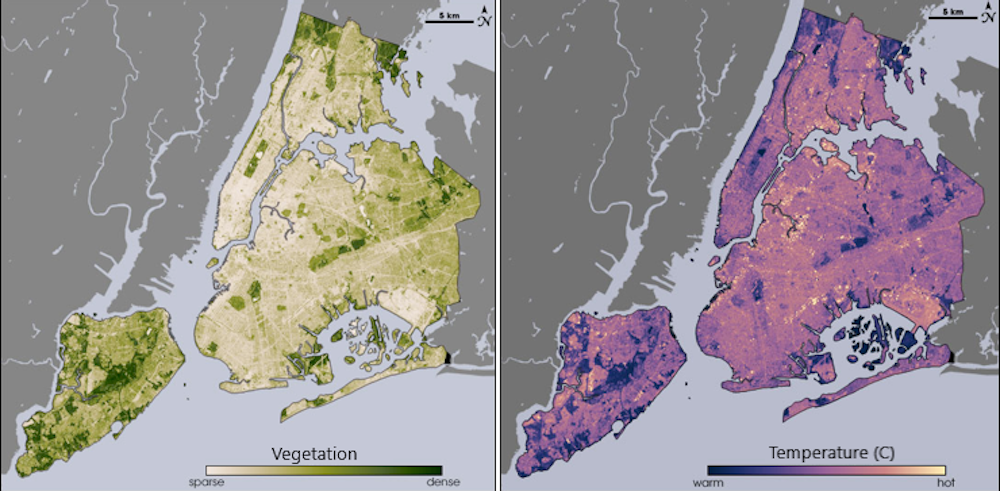
    Comparing maps of New York’s vegetation and temperature shows the cooling effect of parks and neighborhoods with more trees. In the map on the left, lighter colors are areas with fewer trees. Light areas in the map on the right are hotter.
    NASA/USGS Landsat

    But planting trees isn’t always simple.

    In hot, dry cities, trees often require irrigation to survive, which can strain already limited water resources. Trees must survive for decades to grow large enough to provide shade and release enough water vapor to reduce air temperatures.

    Annual maintenance costs – about US$900 per tree per year in Boston – can surpass the initial planting investment.

    Most challenging of all, dense urban neighborhoods where heat is most intense are often too packed with buildings and roads to grow more trees.

    How cool roofs can help on hot days

    Another option is “cool roofs.” Coating rooftops with reflective paint or using light-colored materials allows buildings to reflect more sunlight back into the atmosphere rather than absorbing it as heat.

    These roofs can lower the temperature inside an apartment building without air conditioning by about 2 to 6 F (1 to 3.3 C), and can cut peak cooling demand by as much as 27% in air-conditioned buildings, one study found. They can also provide immediate relief by reducing outdoor temperatures in densely populated areas. The maintenance costs are also lower than expanding urban forests.

    Two workers apply a white coating to the roof of a row home in Philadelphia.
    AP Photo/Matt Rourke

    However, like trees, cool roofs come with limits. Cool roofs work better on flat roofs than sloped roofs with shingles, as flat roofs are often covered by heat-trapping rubber and are exposed to more direct sunlight over the course of an afternoon.

    Cities also have a finite number of rooftops that can be retrofitted. And in cities that already have many light-colored roofs, a few more might help lower cooling costs in those buildings, but they won’t do much more for the neighborhood.

    By weighing the trade-offs of both strategies, cities can design location-specific plans to beat the heat.

    Choosing the right mix of cooling solutions

    Many cities around the world have taken steps to adapt to extreme heat, with tree planting and cool roof programs that implement reflectivity requirements or incentivize cool roof adoption.

    In Detroit, nonprofit organizations have planted more than 166,000 trees since 1989. In Los Angeles, building codes now require new residential roofs to meet specific reflectivity standards.

    In a recent study, we analyzed Boston’s potential to lower heat in vulnerable neighborhoods across the city. The results demonstrate how a balanced, budget-conscious strategy could deliver significant cooling benefits.

    For example, we found that planting trees can cool the air 35% more than installing cool roofs in places where trees can actually be planted.

    However, many of the best places for new trees in Boston aren’t in the neighborhoods that need help. In these neighborhoods, we found that reflective roofs were the better choice.

    By investing less than 1% of the city’s annual operating budget, about US$34 million, in 2,500 new trees and 3,000 cool roofs targeting the most at-risk areas, we found that Boston could reduce heat exposure for nearly 80,000 residents. The results would reduce summertime afternoon air temperatures by over 1 F (0.6 C) in those neighborhoods.

    While that reduction might seem modest, reductions of this magnitude have been found to dramatically reduce heat-related illness and death, increase labor productivity and reduce energy costs associated with building cooling.

    Not every city will benefit from the same mix. Boston’s urban landscape includes many flat, black rooftops that reflect only about 12% of sunlight, making cool roofs that reflect over 65% of sunlight an especially effective intervention. Boston also has a relatively moist growing season that supports a thriving urban tree canopy, making both solutions viable.

    Phoenix, left, already has a lot of light-colored roots, compared with Boston, right, where roofs are mostly dark.
    Imagery © Google 2025.

    In places with fewer flat, dark rooftops suitable for cool roof conversion, tree planting may offer more value. Conversely, in cities with little room left for new trees or where extreme heat and drought limit tree survival, cool roofs may be the better bet.

    Phoenix, for example, already has many light-colored roofs. Trees might be an option there, but they will require irrigation.

    Getting the solutions where people need them

    Adding shade along sidewalks can do double-duty by giving pedestrians a place to get out of the sun and cooling buildings. In New York City, for example, street trees account for an estimated 25% of the entire urban forest.

    Cool roofs can be more difficult for a government to implement because they require working with building owners. That often means cities need to provide incentives. Louisville, Kentucky, for example, offers rebates of up to $2,000 for homeowners who install reflective roofing materials, and up to $5,000 for commercial businesses with flat roofs that use reflective coatings.

    In Boston, planting trees, left, and increasing roof reflectivity, right, were both found to be effective ways to cool urban areas.
    Ian Smith et al. 2025

    Efforts like these can help spread cool roof benefits across densely populated neighborhoods that need cooling help most.

    As climate change drives more frequent and intense urban heat, cities have powerful tools for lowering the temperature. With some attention to what already exists and what’s feasible, they can find the right budget-conscious strategy that will deliver cooling benefits for everyone.

    Lucy Hutyra has received funding from the U.S. federal government and foundations including the World Resources Institute and Burroughs Wellcome Fund for her scholarship on urban climate and mitigation strategies. She was a recipient of a 2023 MacArthur Fellowship for her work in this area.

    Ian Smith does not work for, consult, own shares in or receive funding from any company or organization that would benefit from this article, and has disclosed no relevant affiliations beyond their academic appointment.

    ref. 2 ways cities can beat the heat: Which is best, urban trees or cool roofs? – https://theconversation.com/2-ways-cities-can-beat-the-heat-which-is-best-urban-trees-or-cool-roofs-260188

    MIL OSI AnalysisEveningReport.nz

  • MIL-OSI China: Urumqi ranks among China’s top summer destinations

    Source: People’s Republic of China – State Council News

    URUMQI, July 23 — Urumqi, capital of northwest China’s Xinjiang Uygur Autonomous Region, recorded 50.57 million tourist visits in the first half of 2025, making it China’s third most popular summer travel destination, said a press conference on Wednesday.

    A series of cultural and tourism events, such as traditional folk performances and performing arts festivals, have drawn tourists from around the world, according to the regional people’s government.

    The city’s tourism boom has been supported by an increasingly convenient transport network. Urumqi Tianshan International Airport, a national gateway hub, boasts annual passenger trips of 48 million and a cargo throughput of 550,000 tonnes. It operates 258 flight routes connecting over 100 cities at home and abroad.

    Last year, Xinjiang received over 300 million tourist visits, generating more than 359 billion yuan (about 50.27 billion U.S. dollars) in tourism revenue, a year-on-year increase of 21 percent.

    MIL OSI China News

  • MIL-OSI United Kingdom: PM call with President Erdoğan of Türkiye: 22 July 2025

    Source: United Kingdom – Government Statements

    Press release

    PM call with President Erdoğan of Türkiye: 22 July 2025

    The Prime Minister spoke to the President of Türkiye Recep Tayyip Erdoğan yesterday evening.

    The Prime Minister spoke to the President of Türkiye Recep Tayyip Erdoğan yesterday evening.

    The two leaders looked ahead to today’s International Defence Industry Fair in Istanbul, where their Defence Ministers have taken the next step towards signing a multi-billion-pound export deal of UK-built Typhoon jets to Türkiye. 

    The Prime Minister added that once fully finalised, this enhanced military co-operation will strengthen NATO’s collective defences and keep us safer during uncertain times, as well as sustaining 20,000 UK jobs and driving growth. 

    Turning to the Middle East, they discussed the intolerable situation in Gaza and underlined the urgent need for more aid and an urgent ceasefire, in order to pave the way for a two-state solution and a secure future for Palestinians and Israelis.

    They reiterated their concern about the recent violence in Syria, and agreed that the ceasefire must hold.

    The Prime Minister thanked the President for Türkiye’s convening role in the upcoming talks between Russia and Ukraine in Istanbul today, as well as the discussions due to take place on Iran’s nuclear programme later this week.

    Updates to this page

    Published 23 July 2025

    MIL OSI United Kingdom

  • MIL-OSI United Kingdom: Byers Gill Solar development consent decision announced

    Source: United Kingdom – Government Statements

    Press release

    Byers Gill Solar development consent decision announced

    The Byers Gill Solar application has today been granted development consent by the Department for Energy Security and Net Zero.

    Byers Gill Solar

    The application will consist of a proposed solar farm with over 50MW capacity, Solar PV modules and associated mounting structures, inverters, transformers, switch gear and control equipment, a substation, energy storage equipment and underground on and off-site cabling. 

    The application was submitted to the Planning Inspectorate for consideration by RWE Renewables UK Solar and Storage Limited on 9 February 2024 and accepted for examination on 8 March 2024.  

    Following an examination during which the public, statutory consultees and interested parties were given the opportunity to give evidence to the Examining Authority, recommendations were made to the Secretary of State on 23 April 2025.   

    This is the 96th energy application out of 160 applications examined to date and was again completed by the Planning Inspectorate within the statutory timescale laid down in the Planning Act 2008.   

    Local communities continue to be given the opportunity of being involved in the examination of projects that may affect them. Local people, the local authority and other interested parties were able to participate in this six-month examination.   

    The Examining Authority listened and gave full consideration to all local views and the evidence gathered during the examination before making its recommendation to the Secretary of State.  

    The decision, the recommendation made by the Examining Authority to the Secretary of State for Energy Security and Net Zero and the evidence considered by the Examining Authority in reaching its recommendation are publicly available on the project pages of the National Infrastructure Planning website.  

    This decision was made by Minister Miatta Fahnbulleh on behalf of the Energy Secretary’s legal authority. 

    Journalists wanting further information should contact the Planning Inspectorate Press Office, on 0303 444 5004 or 0303 444 5005 or email:   

    Press.office@planninginspectorate.gov.uk

    Updates to this page

    Published 23 July 2025

    MIL OSI United Kingdom

  • MIL-OSI Russia: “Online University Admission”: Super Service for Applicants

    Translation. Region: Russian Federal

    Source: Official website of the State –

    An important disclaimer is at the bottom of this article.

    In 2025, admission to universities for bachelor’s, specialist’s, master’s and postgraduate programs will be carried out through the “Online University Admission” service, developed by the Ministry of Education and Science of Russia, the Ministry of Digital Development, Communications and Mass Media of Russia, Rosobrnadzor and available on the “Gosuslugi” portal.

    It allows applicants to submit documents to educational and scientific organizations without a personal visit.

    What programs can I apply for?

    An applicant can apply for budgetary (including targeted) and fee-based education, full-time, part-time and correspondence, for bachelor’s and specialist’s degree programs, including programs of six universities participating in the pilot project to update the higher education system.

    Step by step instructions

    We will tell you in more detail about the procedure for submitting an application on the State Services portal.

    Step 1. Registration on the State Services portal and creation of a digital profile

    A verified account is required to submit an application.

    In your personal account, you can request your data on educational documents, individual achievements (IA), as well as information on disability, and then you will not have to enter them manually and confirm them with originals when submitting an application to a university.

    Step 2. Filling out the application for admission

    Provide information about education, benefits and special rights. Specify the desired areas of study. When applying for a bachelor’s degree, specialist degree or basic higher education, you can choose up to 5 universities and up to 5 areas in each of them, including paid education. The new service “University Selection” will help you quickly find the right university, select a specialty based on subjects and USE scores, and find out the passing scores of previous years. Specify admission priorities Attach documents confirming your individual achievements and entitlement to benefits.

    Details in the video instructions:

    Additionally, at this stage you can choose targeted training by answering “Yes” to the corresponding question on the questionnaire.

    You can find a customer for admission to targeted training on the portal “Work in Russia”.

    How to apply for targeted training, see the video instructions:

    https://guu.ru/wp-content/uploads/05_06_2025-Кака-подача-заяку на-целебное-обучение-в-вуз_17_06_2025.mp4

    Step 3. Submitting an application and tracking the status

    Please check your completed application again carefully and only then submit it.

    Please note that additional or internal entrance examinations must be registered separately.

    In addition, universities have the right to request additional documents or ask to replace copies that are difficult to read.

    Step 4: Submit consent

    This can be done immediately after submitting an application on Gosuslugi, in person at the admissions office, or by sending a letter by mail.

    You can submit consent on State Services starting with the application status “Submitted to the university”.

    If consent has been submitted, but according to the competition lists you see that you are not eligible for the required program, or your priorities have changed, you can revoke consent and submit it to another university.

    Step 5: Receive Notification of Enrollment

    Once the admission orders are published, you will receive a notification of the results.

    The video explains how to conclude an agreement if you are enrolling in a paid course.

    Any questions left?

    Find out more on the service website or ask the members of the admissions committee of the State University of Management by phone 8 (495) 371-00-55, online or in person.

    Please note: This information is raw content obtained directly from the source of the information. It is an accurate report of what the source claims and does not necessarily reflect the position of MIL-OSI or its clients.

    .

    MIL OSI Russia News

  • MIL-OSI: Greene County Bancorp, Inc. Reports Record High Net Income of $31.1 Million for the Fiscal Year Ended June 30, 2025, Announces Plans to Expand into Saratoga County

    Source: GlobeNewswire (MIL-OSI)

    CATSKILL, N.Y., July 23, 2025 (GLOBE NEWSWIRE) — Greene County Bancorp, Inc. (the “Company”) (NASDAQ: GCBC), the holding company for the Bank of Greene County and its subsidiary Greene County Commercial Bank, today reported net income for the quarter and fiscal year ended June 30, 2025. Net income for the quarter and fiscal year ended June 30, 2025 was $9.3 million, or $0.55 per basic and diluted share, and $31.1 million, or $1.83 per basic and diluted share, respectively, as compared to $6.7 million, or $0.40 per basic and diluted share, and $24.8 million, or $1.45 per basic and diluted share, for the quarter and fiscal year ended June 30, 2024, respectively. Net income increased $2.6 million, or 38.6%, when comparing the quarters ended June 30, 2025 and 2024, and increased $6.3 million, or 25.7%, when comparing the fiscal years ended June 30, 2025 and 2024.

    Highlights:

    • Net Income: $31.1 million for the fiscal year ended June 30, 2025, a new record high
    • Total Assets: $3.0 billion at June 30, 2025, a new record high
    • Net Loans: $1.6 billion at June 30, 2025, a new record high
    • Total Deposits: $2.6 billion at June 30, 2025
    • Return on Average Assets: 1.10% for the fiscal year ended June 30, 2025
    • Return on Average Equity: 14.08% for the fiscal year ended June 30, 2025

    Donald Gibson, President & CEO, stated: “I am pleased to report record high net income for the fiscal year ended June 30, 2025, marking 16 years of the past 17 years that our Company has achieved record earnings. This sustained performance is a testament to our disciplined business model, strong community partnerships and exceptional execution of our team. As we look ahead, we are excited to announce plans to expand into Saratoga County with our first branch in that market area, expanding our geographic footprint from five to six counties within New York State, and further strengthening our position as the leading economic engine of the communities we serve. Additionally, we are honored to be recognized by the Albany Business Review, first as one of the Capital Regions 11 fastest growing large companies, defined as those with revenue exceeding $100.0 million, and second, on July 17, 2025, we ranked as the number one commercial mortgage lender in New York’s Capital Region for commercial loan volume in 2024. I believe the distinction reflects our financial strength and our long-term commitment to organic growth that benefits customers, communities and shareholders alike.”

    Total consolidated assets for the Company were $3.0 billion at June 30, 2025, primarily consisting of $1.6 billion of net loans and $1.1 billion of total securities available-for-sale and held-to-maturity. Consolidated deposits totaled $2.6 billion at June 30, 2025, consisting of retail, business, municipal and private banking relationships.

    Pre-provision net income was $32.5 million for the year ended June 30, 2025 as compared to $25.5 million for the year ended June 30, 2024, an increase of $7.0 million, or 27.1%. Pre-provision net income measures the Company’s net income less the provision for credit losses. Management believes that this non-GAAP measure assists investors in comprehending the impact of the provision for credit losses on the Company’s reported results, offering an alternative view of the Company’s performance and the Company’s ability to generate income in excess of its provision for credit losses. The Company strategically managed its balance sheet by focusing on higher-yielding loans and securities, and lowering deposit rates to align with the Federal Reserve’s recent interest rate cuts. This resulted in a higher net interest margin for the year ended June 30, 2025 as compared to the year ended June 30, 2024. The Company will continue to monitor the Federal Reserve and interest rates paid on deposits, while maintaining our long-term customer relationships.

    Selected highlights for the quarter and fiscal year ended June 30, 2025 are as follows:

    Net Interest Income and Margin

    • Net interest income increased $3.8 million to $16.7 million for the three months ended June 30, 2025 from $12.9 million for the three months ended June 30, 2024. Net interest income increased $9.1 million to $60.1 million for the year ended June 30, 2025 from $51.0 million for the year ended June 30, 2024. The increase in net interest income was due to an increase in the average balance of interest-earning assets which increased $219.0 million and $170.7 million when comparing the three months and years ended June 30, 2025 and 2024, respectively, an increase in interest rates on interest-earning assets, which increased 16 basis points and 26 basis points when comparing the three months and years ended June 30, 2025 and 2024, respectively, and a decrease of 26 basis points in rates paid on interest-bearing liabilities when comparing the three months ended June 30, 2025 and 2024. The increase in net interest income was offset by increases in the average balance of interest-bearing liabilities, which increased $203.4 million and $168.3 million when comparing the three months and years ended June 30, 2025 and 2024, respectively, and an increase of 4 basis points in rates paid on interest-bearing liabilities when comparing the years ended June 30, 2025 and 2024.

      Average loan balances increased $145.9 million and $96.6 million and the yield on loans increased 18 basis points and 23 basis points when comparing the three months and years ended June 30, 2025 and 2024, respectively. The average balance of securities increased $87.0 million and $79.1 million and the yield on such securities increased 24 basis points and 36 basis points when comparing the three months and years ended June 30, 2025 and 2024, respectively. Average interest-bearing bank balances and federal funds decreased $13.8 million and $5.0 million and the yield on interest-bearing bank balances and federal funds decreased 172 basis points and 36 basis points when comparing the three months and years ended June 30, 2025 and 2024, respectively.

      The cost of NOW deposits decreased 34 basis points and 2 basis points, the cost of certificates of deposit decreased 81 basis points and 21 basis points, and the cost of savings and money market deposits decreased 1 basis point and increased 7 basis points when comparing the three months and years ended June 30, 2025 and 2024, respectively. The growth in interest-bearing liabilities was primarily due to an increase in average NOW deposits of $178.0 million and $135.1 million and an increase in average certificates of deposits of $75.0 million and $62.7 million when comparing the three months and years ended June 30, 2025 and 2024, respectively. This was partially offset by a decrease in average savings and money market deposits of $15.0 million and $22.8 million when comparing the three months and years ended June 30, 2025 and 2024, respectively. Yields on interest-earning assets increased when comparing the three months and years ended June 30, 2025 and 2024 as the Company continued to reprice assets into the higher interest rate environment. During the year ended June 30, 2025, the Company implemented a strategic reduction in deposit rates that aligns with the Federal Reserve’s rate cuts, while providing competitive financial solutions to the Company’s customers that reflect the prevailing economic conditions, while growing new relationships.

    • Net interest rate spread increased 42 basis points to 2.14% for the three months ended June 30, 2025, compared to 1.72% for the three months ended June 30, 2024. Net interest rate spread increased 22 basis points to 1.97% for the year ended June 30, 2025, compared to 1.75% for the year ended June 30, 2024.
      Net interest margin increased 40 basis points to 2.37% for the three months ended June 30, 2025, compared to 1.97% for the three months ended June 30, 2024. Net interest margin increased 21 basis points to 2.19% for the year ended June 30, 2025, compared to 1.98% for the year ended June 30, 2024. The increase in net interest rate spread and margin during the three months and year ended June 30, 2025, was due to increases in interest income on loans and securities, as they continue to reprice at higher yields and the interest rates earned on new balances were higher than the historic low levels from the prior periods.
    • Net interest income on a taxable-equivalent basis includes the additional amount of interest income that would have been earned if the Company’s investment in tax-exempt securities and loans had been subject to federal and New York State income taxes yielding the same after-tax income. Tax equivalent net interest margin was 2.67% and 2.24% for the three months ended June 30, 2025 and 2024, respectively, and was 2.47% and 2.25% for the years ended June 30, 2025 and 2024, respectively.

    Credit Quality and Provision for Credit Losses

    • Provision for credit losses amounted to a benefit of $880,000 and $151,000 for the three months ended June 30, 2025 and 2024, respectively. The benefit for the three months ended June 30, 2025 was primarily attributable to an improvement in the qualitative factors assessments on loans, partially offset by a modest deterioration in the economic forecasts used in the Current Expected Credit Loss models on loans as of June 30, 2025, and growth in securities held-to-maturity that require an allowance. Provision for credit losses amounted to a charge of $1.3 million and $766,000 for the years ended June 30, 2025 and 2024, respectively. The provision for the year ended June 30, 2025, was primarily attributable to growth in gross loans, a modest deterioration in the economic forecasts used in the Current Expected Credit Loss models on loans as of June 30, 2025 and growth in securities held-to-maturity that require an allowance, partially offset by an improvement in the qualitative factors assessments on loans. The allowance for credit losses on loans to total loans receivable was 1.24% at June 30, 2025 compared to 1.28% at June 30, 2024.
    • Loans classified as substandard and special mention totaled $45.4 million at June 30, 2025 and $48.6 million at June 30, 2024, a decrease of $3.2 million. Of the loans classified as substandard or special mention, $42.1 million were performing at June 30, 2025. There were no loans classified as doubtful or loss at June 30, 2025 or June 30, 2024.
    • Net charge-offs on loans amounted to $44,000 and $1.0 million for the three months ended June 30, 2025 and 2024, respectively, a decrease of $956,000. Net charge-offs totaled $349,000 and $1.4 million for years ended June 30, 2025 and 2024, respectively. There were no material charge-offs in any loan segment during the three months and year ended June 30, 2025.
    • Nonperforming loans amounted to $3.1 million at June 30, 2025 and $3.7 million at June 30, 2024. The activity in nonperforming loans during the period included $2.6 million in loan repayments, $128,000 in charge-offs or transfers to foreclosure, $67,000 in loans returning to performing status, and $2.1 million of loans placed into nonperforming status. At June 30, 2025, nonperforming assets were 0.10% of total assets compared to 0.13% at June 30, 2024. At June 30, 2025, nonperforming loans were 0.19% of net loans compared to 0.25% at June 30, 2024.

    Noninterest Income and Noninterest Expense

    • Noninterest income increased $46,000, or 1.2%, to $3.8 million for the three months ended June 30, 2025 compared to $3.7 million for the three months ended June 30, 2024. The increase during the three months ended June 30, 2025 was primarily due to a $128,000 increase in fee income earned on customer interest rate swap contracts. This was partially offset by a $152,000 decrease of investment services income. Noninterest income increased $1.3 million, or 9.5%, to $15.2 million for the year ended June 30, 2025 compared to $13.9 million for the year ended June 30, 2024. The increase during the year ended June 30, 2025 was primarily due to a $610,000 Employee Retention Tax Credit, an increase in fee income earned on customer interest rate swap contracts of $528,000, loan fees of $242,000, service charge account fees of $235,000, and income from bank owned life insurance of $363,000. This was partially offset by a $665,000 loss on sales of securities available-for-sale.
    • Noninterest expense increased $497,000, or 5.0%, to $10.4 million for the three months ended June 30, 2025 compared to $9.9 million for the three months ended June 30, 2024. The increase during the three months ended June 30, 2025 was primarily due to a $204,000 increase in service and data processing fees and a $170,000 increase in computer and software supplies. Noninterest expense increased $2.1 million, or 5.6%, to $39.4 million for the year ended June 30, 2025 as compared to $37.3 million for the year ended June 30, 2024. The increase during the year ended June 30, 2025 was primarily due to an increase of $579,000 in salaries and employee benefit costs, as new positions were created during the period to support the Company’s continued growth, an increase of $544,000 in service and data processing fees, an increase of $796,000 in the allowance for credit losses on unfunded commitments, due to the Company’s increased contractual obligations to extend credit, and an increase of $183,000 in occupancy expenses mostly due to repairs and maintenance on the Company’s buildings. This was partially offset by a decrease of $164,000 in legal and professional fees during the year ended June 30, 2025.

    Income Taxes

    • Provision for income taxes reflects the expected tax associated with the pre-tax income generated for the given period and certain regulatory requirements. The effective tax rate was 14.8% and 10.2% for the three months and year ended June 30, 2025, and 1.4% and 7.6% for the three months and year ended June 30, 2024, respectively. The statutory tax rate is impacted by the benefits derived from tax-exempt bond and loan income, the Company’s real estate investment trust subsidiary income, income received on the bank owned life insurance and tax credits, to arrive at the effective tax rate. The increase during the three months and year ended June 30, 2025 is primarily due to higher pre-tax income and reflects a lower mix of tax-exempt income from municipal bonds, tax advantage loans, and bank owned life insurance in proportion to pre-tax income. Additionally, the Company was able to recognize historic preservation tax credits on the Company’s wealth management center, located at 345 Main Street, in Catskill New York for the year ended June 30, 2024.

    Balance Sheet Summary

    • Total assets of the Company were $3.0 billion at June 30, 2025 and $2.8 billion at June 30, 2024, an increase of $214.8 million, or 7.6%.
    • Total cash and cash equivalents for the Company were $183.1 million at June 30, 2025 and $190.4 million at June 30, 2024. The Company has continued to maintain strong capital and liquidity positions as of June 30, 2025.
    • Securities available-for-sale and held-to-maturity increased $91.9 million, or 8.8%, to $1.1 billion at June 30, 2025 as compared to $1.0 billion at June 30, 2024. Securities purchases totaled $444.2 million during the year ended June 30, 2025, and consisted primarily of $308.5 million of state and political subdivision securities, $88.4 million of mortgage-backed securities, $24.7 million of U.S. Treasury securities, $16.7 million of collateralized mortgage obligations, and $5.9 million of corporate debt securities. Principal pay-downs and maturities during the year ended June 30, 2025 amounted to $353.5 million, primarily consisting of $258.7 million of state and political subdivision securities, $58.0 million of U.S. Treasury securities, $32.7 million of mortgage-backed securities, $2.8 million of collateralized mortgage obligations and $1.3 million of corporate debt securities. Sales during the year ended June 30, 2025 amounted to $6.7 million of U.S. Treasury securities.
    • Net loans receivable increased $127.0 million, or 8.6%, to $1.6 billion at June 30, 2025 as compared to $1.5 billion at June 30, 2024. Loan growth experienced during the year ended June 30, 2025 consisted primarily of $117.9 million in commercial real estate loans, $5.5 million in commercial loans, and $4.9 million in home equity loans.
    • Deposits totaled $2.6 billion at June 30, 2025 and $2.4 billion at June 30, 2024, an increase of $250.6 million, or 10.5%. The Company had $51.6 million and zero brokered deposits at June 30, 2025 and June 30, 2024, respectively. NOW deposits increased $192.6 million, or 10.9%, and certificates of deposits increased $89.7 million, or 64.8%, when comparing June 30, 2025 and June 30, 2024. Noninterest bearing deposits decreased $15.3 million, or 12.2%, money market deposits decreased $10.5 million, or 9.3%, and savings deposits decreased $5.9 million, or 2.3%, when comparing June 30, 2025 and June 30, 2024.
    • Borrowings amounted to $128.1 million at June 30, 2025 compared to $199.1 million at June 30, 2024, a decrease of $71.0 million. At June 30, 2025, borrowings included $74.0 million of overnight borrowings with the Federal Home Loan Bank of New York (“FHLB”), $49.9 million of Fixed-to-Floating Rate Subordinated Notes, and $4.2 million of long-term borrowings with the FHLB.
    • Shareholders’ equity increased to $238.8 million at June 30, 2025 compared to $206.0 million at June 30, 2024, resulting primarily from net income of $31.1 million and a decrease in accumulated other comprehensive loss of $6.2 million, partially offset by dividends declared and paid of $4.5 million.

    Corporate Overview

    Greene County Bancorp, Inc. is the holding company for the Bank of Greene County, and its subsidiary Greene County Commercial Bank. The Company is the leading provider of community-based banking services throughout the Hudson Valley and Capital Region of New York State. Its customers include individuals, businesses, municipalities and other institutions. Greene County Bancorp, Inc. (GCBC) is publicly traded on the Nasdaq Capital Market and is dedicated to promoting economic development and a high quality of life in the communities it serves. For more information on Greene County Bancorp, Inc., visit www.tbogc.com.

    Forward-Looking Statements

    This earnings release contains statements about future events that constitute forward-looking statements, as defined in the Private Securities Litigation Reform Act of 1995. Forward-looking statements may be identified by references to a future period or periods or by the use of the words “believe,” “expect,” “anticipate,” “intend,” “estimate,” “assume,” “will,” “should,” “could,” “plan,” and other similar terms of expressions. Forward-looking statements should not be relied on because they involve known and unknown risks, uncertainties and other factors, many of which are beyond the Company’s control. These risks, uncertainties and other factors may cause the actual results, performance or achievements expressed in, or implied by, the forward-looking statements to differ materially from those contemplated by the forward-looking statements. Factors that may cause such a difference include, but are not limited to, local, regional, national and international general economic conditions, including actual or potential stress in the banking industry, financial and regulatory changes, changes in interest rates, regulatory considerations, competition, technological developments, retention and recruitment of qualified personnel, changes in customer deposit behavior, and market acceptance of the Company’s pricing, products and services.

    The Company cautions readers not to place undue reliance on any forward-looking statements, which speak only as of the date made, and advises readers that various factors, including, but not limited to, those described above and other factors discussed in the Company’s annual and quarterly reports previously filed with the Securities and Exchange Commission, could affect the Company’s financial performance and could cause the Company’s actual results or circumstances for future periods to differ materially from those anticipated or projected.

    Unless required by law, the Company does not undertake, and specifically disclaims any obligations to, publicly release any revisions that may be made to any forward-looking statements to reflect the occurrence of anticipated or unanticipated events or circumstances after the date of such statements.

    For more information, please see our reports filed with the United States Securities and Exchange Commission (“SEC”), including our most recent annual report on Form 10-K and quarterly reports on Form 10-Q.

    Non-GAAP Measures

    In addition to presenting information in conformity with accounting principles generally accepted in the United States of America (GAAP), this news release contains financial information determined by methods other than GAAP (non-GAAP). The following measures used in this release, which are commonly utilized by financial institutions, have not been specifically exempted by the Securities and Exchange Commission (“SEC”) and may constitute “non-GAAP financial measures” within the meaning of the SEC’s rules.

    The Company has provided in this news release supplemental disclosures for the calculation of net interest margin utilizing a fully taxable-equivalent adjustment and pre-provision net income. Management believes that the non-GAAP financial measures disclosed by the Company from time to time are useful in evaluating the Company’s performance and that such information should be considered as supplemental in nature and not as a substitute for or superior to the related financial information prepared in accordance with GAAP. Our non-GAAP financial measures may differ from similar measures presented by other companies. Refer to the tables on page 9 for Non-GAAP to GAAP reconciliations.

     
    Greene County Bancorp, Inc.
    Consolidated Statements of Income, and Selected Financial Ratios (Unaudited)
                               
      At or for the Three Months   At or for the Years
      Ended June 30,   Ended June 30,
    Dollars in thousands, except share and per share data   2025     2024       2025     2024  
    Interest income $ 30,739   $ 27,328     $ 117,705   $ 103,664  
    Interest expense   14,033     14,471       57,584     52,685  
    Net interest income   16,706     12,857       60,121     50,979  
    Provision for credit losses   (880 )   (151 )     1,316     766  
    Noninterest income   3,765     3,719       15,233     13,908  
    Noninterest expense   10,394     9,897       39,372     37,302  
    Income before taxes   10,957     6,830       34,666     26,819  
    Tax provision   1,624     98       3,528     2,050  
    Net income $ 9,333   $ 6,732     $ 31,138   $ 24,769  
             
    Basic and diluted EPS $ 0.55   $ 0.40     $ 1.83   $ 1.45  
    Weighted average shares outstanding   17,026,828     17,026,828       17,026,828     17,026,828  
    Dividends declared per share (4) $ 0.09   $ 0.08     $ 0.36   $ 0.32  
             
    Selected Financial Ratios        
    Return on average assets(1)   1.28 %   1.00 %     1.10 %   0.93 %
    Return on average equity(1)   15.98 %   13.36 %     14.08 %   12.87 %
    Net interest rate spread(1)   2.14 %   1.72 %     1.97 %   1.75 %
    Net interest margin(1)   2.37 %   1.97 %     2.19 %   1.98 %
    Fully taxable-equivalent net interest margin(2)   2.67 %   2.24 %     2.47 %   2.25 %
    Efficiency ratio(3)   50.77 %   59.71 %     52.25 %   57.49 %
    Non-performing assets to total assets       0.10 %   0.13 %
    Non-performing loans to net loans       0.19 %   0.25 %
    Allowance for credit losses on loans to non-performing loans       658.37 %   516.20 %
    Allowance for credit losses on loans to total loans       1.24 %   1.28 %
    Shareholders’ equity to total assets       7.85 %   7.29 %
    Dividend payout ratio(4)       19.67 %   22.07 %
    Actual dividends paid to net income(5)       14.37 %   13.08 %
    Book value per share     $ 14.03   $ 12.10  
           
    (1) Ratios are annualized when necessary.
    (2) Interest income calculated on a taxable-equivalent basis (non-GAAP) includes the additional interest income that would have been earned if the Company’s investment in tax-exempt securities and loans had been subject to federal and New York State income taxes yielding the same after-tax income.
    (3) The efficiency ratio has been calculated as noninterest expense divided by the sum of net interest income and noninterest income.
    (4) The dividend payout ratio has been calculated based on the dividends declared per share divided by basic earnings per share. No adjustments have been made to account for dividends waived by Greene County Bancorp, MHC (“MHC”), the Company’s majority shareholder, owning 54.1% of the shares outstanding.
    (5) Dividends declared divided by net income. The MHC waived its right to receive dividends declared during the three months ended June 30, 2023, December 31, 2023, March 31, 2024, June 30, 2024, March 31, 2025 and June 30, 2025. Dividends declared during the three months ended September 30, 2023, September 30, 2024, and December 31, 2024 were paid to the MHC.
     
    Greene County Bancorp, Inc.
    Consolidated Statements of Financial Condition (Unaudited)
     
      At
    June 30, 2025
      At
    June 30, 2024
    Dollars In thousands, except share data      
    Assets      
    Cash and due from banks $ 12,788     $ 13,897  
    Interest-bearing deposits   170,290       176,498  
    Total cash and cash equivalents   183,078       190,395  
           
    Long term certificate of deposit   1,425       2,831  
    Securities available-for-sale, at fair value   356,062       350,001  
    Securities held-to-maturity, at amortized cost, net of allowance for credit losses of $548 and $483 at June 30, 2025 and June 30, 2024   776,147       690,354  
    Equity securities, at fair value   402       328  
    Federal Home Loan Bank stock, at cost   5,504       7,296  
           
    Loans receivable   1,627,406       1,499,473  
    Less: Allowance for credit losses on loans   (20,146 )     (19,244 )
    Net loans receivable   1,607,260       1,480,229  
           
    Premises and equipment, net   15,232       15,606  
    Bank owned life insurance   59,795       57,249  
    Accrued interest receivable   16,381       14,269  
    Prepaid expenses and other assets   19,323       17,230  
    Total assets $ 3,040,609     $ 2,825,788  
           
    Liabilities and shareholders’ equity      
    Noninterest bearing deposits $ 110,163     $ 125,442  
    Interest bearing deposits   2,529,672       2,263,780  
    Total deposits   2,639,835       2,389,222  
           
    Borrowings, short-term   74,000       115,300  
    Borrowings, long-term   4,189       34,156  
    Subordinated notes payable, net   49,867       49,681  
    Accrued expenses and other liabilities   33,881       31,429  
    Total liabilities   2,801,772       2,619,788  
    Total shareholders’ equity   238,837       206,000  
    Total liabilities and shareholders’ equity $ 3,040,609     $ 2,825,788  
    Common shares outstanding   17,026,828       17,026,828  
    Treasury shares   195,852       195,852  
           

    The above information is preliminary and based on the Company’s data available at the time of presentation.

    Non-GAAP to GAAP Reconciliations

    The following table summarizes the adjustments made to arrive at the fully taxable-equivalent net interest margins.

      For the three months ended
    June 30,
    For the years ended
    June 30,
    (Dollars in thousands)   2025     2024     2025     2024  
    Net interest income (GAAP) $ 16,706   $ 12,857   $ 60,121   $ 50,979  
    Tax-equivalent adjustment(1)   2,130     1,740     7,679     6,791  
    Net interest income-fully taxable-equivalent basis (non-GAAP) $ 18,836   $ 14,597   $ 67,800   $ 57,770  
             
    Average interest-earning assets (GAAP) $ 2,824,952   $ 2,605,966   $ 2,739,472   $ 2,568,756  
    Net interest margin-fully taxable-equivalent basis (non-GAAP)   2.67 %   2.24 %   2.47 %   2.25 %
                             

    (1) Interest income calculated on a taxable-equivalent basis (non-GAAP) includes the additional interest income that would have been earned if the Company’s investment in tax-exempt securities and loans had been subject to federal and New York State income taxes yielding the same after-tax income. The rate used for this adjustment was 21% for federal income taxes for the three and twelve months ended June 30, 2025 and 2024, 4.44% for New York State income taxes for the three and twelve months ended June 30, 2025 and 2024.

    The following table summarizes the adjustments made to arrive at pre-provision net income.

      For the three months ended June 30,
    (Dollars in thousands)   2025     2024  
    Net income (GAAP) $ 9,333   $ 6,732  
    Provision for credit losses   (880 )   (151 )
    Pre-provision net income (non-GAAP) $ 8,453   $ 6,581  
      For the years ended June 30,
    (Dollars in thousands)   2025     2024  
    Net income (GAAP) $ 31,138   $ 24,769  
    Provision for credit losses   1,316     766  
    Pre-provision net income (non-GAAP) $ 32,454   $ 25,535  
                 

    The above information is preliminary and based on the Company’s data available at the time of presentation.

    For Further Information Contact:
    Donald E. Gibson
    President & CEO
    (518) 943-2600
    donaldg@tbogc.com

    Nick Barzee
    SVP & CFO
    (518) 943-2600
    nickb@tbogc.com


    The MIL Network

  • MIL-OSI Submissions: Understanding the violence against Alawites and Druze in Syria after Assad

    Source: The Conversation – USA (3) – By Güneş Murat Tezcür, Professor and Director of the School of Politics and Global Studies, Arizona State University

    Bedouin fighters at Mazraa village on the outskirts of Sweida city, during clashes in southern Syria on July 18, 2025. AP Photo/Ghaith Alsayed

    In July 2025, clashes between the Druze religious minority and Sunni Arabs backed by government-affiliated forces led to hundreds of deaths in Sweida province in southern Syria. Israel later launched dozens of airstrikes in support of the Druze.

    This eruption of violence was an eerie reminder of what had unfolded in March 2025 when supporters of the fallen regime led by Bashar Assad, an Alawite, targeted security units. In retaliation, militias affiliated with the newly formed government in Damascus carried out indiscriminate killings of Alawites.

    While exact figures remain difficult to verify, more than 1,300 individuals, most of them Alawites, lost their lives. In some cases, entire families were summarily executed.

    Although the Syrian government promised an investigation into the atrocities, home invasions, kidnappings of Alawite women and extrajudicial executions of Alawite men continue.

    The violence in Sweida also bore a sectarian dimension, pitting members of a religious minority against armed groups aligned with the country’s Sunni majority.

    A key difference, however, involved the active Israeli support for the Druze and the U.S. efforts to broker a ceasefire.

    Post-Assad Syria has seen promising developments, including the lifting of international sanctions, a resurgence of civil society and the end of diplomatic isolation. There was even a limited rapprochement with the main Kurdish political party controlling northeastern Syria.

    The persistent violence targeting the Alawites and, to a more limited extent, the Druze, starkly contrasts with these trends. As a scholar of religious minorities and the Middle East, I argue that the current political situation reflects their historical persecution and marginalization.

    History of the Alawites

    The Alawites emerged as a distinct religious community in the 10th century in the region of the Latakia coastal mountains, which today make up northwestern Syria.

    Although their beliefs have some commonalities with Shiite Islam, the Alawites maintain their own unique religious leadership and rituals. Under the Ottoman regime in the late 19th century, they benefited from reforms such as the expansion of educational opportunities and economic modernization, while gaining geographical and social mobility.

    After Hafez Assad, the father of Bashar, came to power in a coup in 1970, he drew upon his Alawite base to reinforce his regime. Consequently, Alawites became disproportionately represented in the officer corps and intelligence services.

    Prior to the civil war, which began in 2011, their population was estimated at around 2 million, constituting roughly 10% of Syria’s population. During the civil war, Alawite young men fighting for the regime suffered heavy casualties. However, most Alawites remained in Syria, while Sunni Arabs and Kurds were disproportionately displaced or became refugees.

    Members of the Alawite minority gather outside the Russian air base in Hmeimim, near Latakia in Syria’s coastal region, on March 11, 2025, as they seek refuge there after violence and retaliatory killings in the area.
    AP Photo/Omar Albam

    Among Syria’s minorities, two key factors make the Alawites most vulnerable to mass violence in post-Assad Syria. The first factor is that, like the Druze, Alawites have their own distinct beliefs that deviate from Sunni Islam. Their religious practices and teachings are often described as “esoteric” and remain mostly inaccessible to outsiders.

    In my 2024 book “Liminal Minorities: Religious Difference and Mass Violence in Muslim Societies,” I categorize the Alawites and Druze in Syria alongside Yezidis in Iraq, Alevis in Turkey and Baha’is in Iran as “liminal minorities” – religious groups subject to deep-seated stigmas transmitted across generations.

    These groups are often treated as heretics who split from Islam and whose beliefs and rituals are deemed beyond the pale of acceptance. For instance, according to Alawite beliefs, Ali, the son-in-law of Prophet Muhammad, is a divine manifestation of God, which challenges the idea of strict monotheism central to Sunni Islam.

    From the perspective of Sunni orthodoxy, these groups’ beliefs have been a source of suspicion and disdain. A series of fatwas by prominent Sunni clerics from the 14th to the 19th century declared Alawites heretics.

    Resentment against the Alawites

    The second factor contributing to the Alawites’ vulnerability is the widespread perception that they were the main beneficiaries of the Assad regime, which engaged in mass murder against its own citizens. Although power remained narrowly concentrated under Assad, many Alawites occupied key positions in the security apparatus as well as the government.

    In today’s political landscape where the central government remains weak and its control over various armed groups is limited, religious stigmatization and political resentment create fertile ground for mass violence targeting the Alawites.

    The massacres of March 2025 were accompanied by sectarian hate speech, including open calls for the extermination of the Alawites, both in the streets and on social media.

    While many Sunni Muslims in Syria also perceive the Druze as heretics, they maintained a greater degree of distance from the Assad regime and were less integrated into its security apparatus.

    Nonetheless, in recent months the situation deteriorated rapidly in the Druze heartland. The Druze militias and local Bedouin tribes engaged in heavy fighting in July 2025. Unlike the Alawites, the Druze received direct military assistance from Israel, which has its small but influential Druze population. This further complicates peaceful coexistence among religious groups in post-Assad Syria.

    A sober future

    Sunni Arab identity is central to the newly formed government in Damascus, which can come at the expense of religious and ethnic pluralism. However, it has incentives to rein in arbitrary violence against the Alawites and Druze. Projecting itself as a source of order and national unity helps the government internationally, both diplomatically and economically.

    Internally, however, the new government remains fractured and lacks effective control over vast swaths of territory. While it pays lip service to transitional justice, it is also cautious about being perceived as overly lenient toward individuals associated with the Assad regime and its crimes. Meanwhile, Alawite and Druze demands for regional autonomy continue to stoke popular Sunni resentments and risk triggering further cycles of instability and violence.

    I believe that in a post-Assad Syria defined by fractured governance and episodic retribution, the Alawites as well as Druze are likely to face deepening marginalization.

    Güneş Murat Tezcür does not work for, consult, own shares in or receive funding from any company or organization that would benefit from this article, and has disclosed no relevant affiliations beyond their academic appointment.

    ref. Understanding the violence against Alawites and Druze in Syria after Assad – https://theconversation.com/understanding-the-violence-against-alawites-and-druze-in-syria-after-assad-255292

    MIL OSI

  • MIL-OSI Africa: Ambassador Gao Wenqi visits Early Childhood Development (ECD) center with United Nations Children’s Fund (UNICEF) country representative to Rwanda

    Source: APO

    On July 22, Ambassador Gao Wenqi, along with Ms. Lieke van de Wiel, UNICEF country Representative to Rwanda, visited the cross-border Early Childhood Development center in Burera District, Northern Province. They were warmly received by District Mayor MUKAMANA Soline and briefed by the ADEPE team and young parents on how the project has helped and empowered local children and families. The field trip also featured lively interactions with the kids.

    Ambassador GAO noted that as a signature tripartite cooperation project between China, UNICEF and Rwanda, the ECD project in Rwanda has made positive contributions to improving children nutrition and health, empowering education for young generations, and promoting Rwandas national strategic transformation. China will continue to work with UN agencies and the Rwandan government to support the countrys socio-economic development with more and more early harvest.

    The cooperation with the Chinese government has effectively enhanced local childrens well-being and promoted Rwandas sustainable development, the UNICEF Representative to Rwanda said. She expressed willingness to strengthen cooperation with the Embassy in the near future.

    The Early Childhood Development project is funded by the Chinese government through the Global Development and South-South Cooperation Fund and implemented by UNICEF Rwanda. It has been carried out across six districts in three provinces of the country since March 2025.

    Distributed by APO Group on behalf of Embassy of the People’s Republic of China in the Republic of Rwanda.

    Media files

    .

    MIL OSI Africa

  • MIL-OSI: FFB Bancorp Announces Second Quarter 2025 Results

    Source: GlobeNewswire (MIL-OSI)

    FRESNO, Calif., July 23, 2025 (GLOBE NEWSWIRE) — FFB Bancorp (the “Company”) (OTCQX: FFBB), the parent company of FFB Bank (the “Bank”), today reported net income of $6.04 million, or $1.94 per diluted share, for the second quarter of 2025, compared to $8.08 million, or $2.54 per diluted share, for the second quarter of 2024, and $8.10 million, or $2.55 per diluted share, for the first quarter of 2025.

    For the six months ended June 30, 2025, net income was $14.13 million, or $4.50 per diluted share, compared to $15.87 million, or $4.99 per diluted share, for the same period in 2024. All results are unaudited.

    Second Quarter 2025 Summary: As of, or for the quarter ended June 30, 2025, compared to the quarter ended June 30, 2024:

    • Operating revenue (net interest income, before the provision for credit losses, plus non-interest income) increased 11% to $27.35 million.
    • Pre-tax, pre-provision income increased 1% to $11.58 million.
    • Net income decreased 25% to $6.04 million.
    • Return on average equity (“ROAE”) was 13.75%.
    • Return on average assets (“ROAA”) was 1.59%.
    • Net interest margin contracted 22 basis points to 5.09% from 5.31%.
    • Total assets increased 2% to $1.47 billion.
    • Total portfolio of loans increased 13% to $1.09 billion.
    • Total deposits increased 6% to $1.23 billion.
    • Shareholder equity increased 17% to $173.91 million.
    • Book value per common share increased 22% to $56.87.
    • The Company’s tangible common equity ratio was 11.80%, while the Bank’s regulatory leverage capital ratio was 14.41%, and the total risk-based capital ratio was 20.61% at June 30, 2025.

    “During the quarter FFB Bank was recognized as #1 in American Banker’s top-performing public banks with under $2B in assets and #34 in S&P Global’s 100 best-performing US community banks of 2024, for bank’s under $3B in assets,” said Steve Miller, President & CEO. “This recognition is a testament to the consistent success we’ve enjoyed, and a reminder of the results we expect and continue to strive toward. As we navigate the challenges this year has brought, we’re proud to build upon our history of success.”

    “During the quarter we have made continued and timely progress on the matters outlined in our consent order, although ultimate compliance will be determined by our regulators. We are confident we can continue to address these items going forward. Although the added resource allocation to properly address the order will have near-term impacts to our performance, we feel that building a best in-class compliance and risk frame-work will enable the bank to drive results over the long-term.”

    Update on Stock Repurchase Program:

    On January 22, 2025, the Company announced that it had authorized a plan to utilize up to $15.0 million of capital to repurchase shares of the Company’s common stock. As of June 30, 2025, the Company has repurchased 133,021 shares, at an average price of $76.79, totaling $10.22 million. This represents approximately 5.33% of total shareholders’ equity at June 30, 2025. During the second quarter of 2025 the Company repurchased 91,106 shares, at an average price of $74.58, totaling $6.79 million. These purchases represent approximately 3.54% of total shareholders’ equity at June 30, 2025.

    Under the terms of the repurchase plan, the Company may repurchase shares of the Company’s common stock from time to time, through December 31, 2025, in open market purchases or privately negotiated transactions. Repurchases under the plan may also be made pursuant to a trading plan under Securities and Exchange Commission Rule 10b5-1 under the Securities Exchange Act of 1934, which would permit shares to be repurchased by the Company when the Company might otherwise be precluded from doing so because of self-imposed trading blackout periods or other regulatory restrictions. The timing, manner, price and exact amount of any repurchases by the Company will be determined at the Company’s discretion and depend on various factors including the performance of the Company’s stock price, general market and economic conditions, applicable legal and regulatory requirements, availability of funds, and other relevant factors. Through December 31, 2025, the repurchase plan may be discontinued, suspended or restarted at any time.

    Results of Operations

    Quarter ended June 30, 2025:

    Operating revenue, consisting of net interest income before the provision for credit losses and non-interest income, increased 11% to $27.35 million for the second quarter of 2025, compared to $24.73 million for the second quarter a year ago, and decreased 4% from $28.48 million for the first quarter of 2025.

    Net interest income, before the provision for credit losses, increased 5% to $18.11 million for the second quarter of 2025, compared to $17.31 million for the same quarter a year ago, and decreased 4% to $18.90 million from last quarter. “Net interest income has benefited from strong loan portfolio growth, partially offset by higher funding costs,” said Bhavneet Gill, Chief Financial Officer. “We have been able to capitalize on a higher yielding loan portfolio, but that yield was impacted by a $261,000 interest reversal as loans, totaling $11.86 million, were placed on non-accrual during the quarter.”

    The Company’s net interest margin (“NIM”) decreased by 22 basis points to 5.09% for the second quarter of 2025, compared to 5.31% for the second quarter of 2024, and decreased 26 basis points from 5.35% for the preceding quarter. “The decrease in NIM is primarily the result of an increase in deposit and borrowing interest expense, and the decrease in investment interest income. During the quarter, average non-interest bearing deposits decreased $37.67 million. The resulting shift in the deposit portfolio saw the cost of deposits increase 13 basis points,” noted Gill. “During the second quarter of 2025 we sold $48.05 million in investment securities to generate liquidity ahead of anticipated deposit outflows due to ISO partner exits. That transaction was the driver of the decrease in investment interest income in the current quarter and will result in lower investment income in future quarters.”

    The yield on earning assets was 6.18% for the second quarter of 2025, compared to 6.40% for the second quarter a year ago, and 6.31% for the previous quarter. The cost to fund earning assets increased to 1.09% for the second quarter of 2025 compared to 0.96% for the previous quarter, and 1.10% for the same quarter a year earlier. This increase is the result of an increase in brokered deposits and overnight borrowings during the quarter due to ISO deposit outflow that occurred in early June.

    Total non-interest income was $9.24 million for the second quarter of 2025, compared to $7.42 million for the second quarter of 2024, and $9.58 million for the previous quarter. The increase in non-interest income, from the second quarter of 2024, was driven by more gain on the sale of loans, higher merchant services revenue, and a reduction in loss on sale of investments. The quarter-over-quarter decrease in non-interest income was attributed to a decrease in merchant services revenue, partially offset by more gain on the sale of loans.

    Merchant services revenue increased 9% to $6.61 million for the second quarter of 2025, compared to $6.07 million from the second quarter of 2024. The increase over prior year was primarily related to higher volume across ISO partner sponsorship lines and higher gross revenue related to FFB Payments. Merchant services revenue decreased from $7.86 million when compared to the first quarter of 2025 as a result of seasonality and the loss of a significant FFB Payments direct merchant.

    During the first and second quarters of 2025, ISO Partner Sponsorship volumes included $2.78 billion and $2.56 billion in volume, respectively, for the ISO partners that were exited in the second quarter of 2025. Additionally, the first and second quarters of 2025 included ISO Partner Sponsorship revenues of $990,000 and $1.09 million, respectively, from the ISO partners that were exited in the second quarter of 2025. “These ISO exits were driven by our efforts to comply with the Consent Order and designed to ensure best in class oversight. We anticipate replacing this volume and revenue through growth in FFB Payments and with our remaining ISO partners as we move forward,” said Miller.

    Merchant ISO Processing Volumes(in thousands)
    Source   Q2 2025 Q1 2025 Q4 2024 Q3 2024 Q2 2024
    ISO Partner Sponsorship   $ 5,347,695   $ 5,007,998   $ 4,891,643   $ 4,556,868   $ 4,391,365  
    FFB Payments – Sub-ISO Merchants     20,766     21,551     22,950     24,661     24,414  
    FFB Payments – Direct Merchants     71,746     97,095     91,133     64,512     76,059  
    Total volume   $ 5,440,207   $ 5,126,644   $ 5,005,726   $ 4,646,041   $ 4,491,838  
    Merchant ISO Processing Revenues(in thousands)
    Source of Revenue   Q2 2025 Q1 2025 Q4 2024 Q3 2024 Q2 2024
    Net Revenue*:            
    ISO Partner Sponsorship   $ 2,654   $ 2,410   $ 2,535   $ 2,284   $ 2,156  
                 
    Gross Revenue:            
    FFB Payments – Sub-ISO Merchants     727     745     764     810     795  
    FFB Payments – Direct Merchants     3,228     4,709     4,262     2,476     3,117  
          3,955     5,454     5,026     3,286     3,912  
    Gross Expense:            
    FFB Payments – Sub-ISO Merchants     708     616     638     723     675  
    FFB Payments – Direct Merchants     2,179     2,558     2,511     1,766     1,989  
          2,887     3,174     3,149     2,489     2,664  
    Net Revenue:            
    FFB Payments – Sub-ISO Merchants     19     129     126     87     120  
    FFB Payments – Direct Merchants     1,049     2,151     1,751     710     1,128  
    FFB Payments Net Revenue     1,068     2,280     1,877     797     1,248  
    Net Merchant Services Income:   $ 3,722   $ 4,690   $ 4,412   $ 3,081   $ 3,404  
    *ISO Partnership Sponsorship is recognized net of expense in Merchant Services Income. FFB Payments revenues are recognized gross in Merchant Services Income and Merchant Services expenses are recognized in Non-Interest Expense.

    Total deposit fee income increased 1% to $854,000 for the second quarter of 2025, compared to $847,000 for the second quarter of 2024, and increased 1% from $849,000 for the previous quarter.

    There was a $1.45 million gain on the sale of loans during the second quarter of 2025, compared to a gain on the sale of loans of $509,000 during the second quarter 2024, and a gain on the sale of loans of $261,000 in the previous quarter. There was a $243,000 loss on the sale of investments during the second quarter of 2025, compared to a $459,000 loss recorded during the second quarter of 2024, and no loss recorded in the previous quarter. The gain on the sale of loans was the result of $16.95 million in SBA loans sold and a $31.77 million RE-multifamily loan sale package that was completed during the quarter. These sales contributed $968,000 and $482,000 in gain respectively.

    Non-interest expense increased 19% to $15.77 million for the second quarter of 2025, compared to $13.29 million for the second quarter 2024, and decreased 4% from $16.47 million from the previous quarter. The increase on a year-over-year comparison was driven by increases in salaries and employee benefits expense, and increases in other operating expense, primarily data and software related expenses and professional fees. Compared to the first quarter of 2025 the decrease in non-interest expense was attributed to a decrease in merchant services operating expenses, marketing expense, director fess, and operational losses.

    Salaries and employee benefits increased 19% to $8.00 million for the second quarter of 2025, compared to $6.72 million for the second quarter 2024. The increase year-over-year was primarily the result of expense associated with the increase in full-time employees. Full-time employees increased to 181 at June 30, 2025, compared to 147 full-time employees a year earlier, and 175 full-time employees from the previous quarter. Total salaries and employee benefits decreased 1% from $8.06 million in the previous quarter. The decrease when compared to the first quarter of 2025 is the result of a decrease in payroll tax expense and increased loan originations, partially offset by higher salary expense from additional full-time employees. Compensation related direct costs associated with loan originations offset salary and employee benefits expense upon loan origination.

    Occupancy and equipment expenses decreased 19% from a year ago, representing 2% of non-interest expense, and remained consistent with the preceding quarter. Merchant operating expense totaled $2.89 million for the second quarter of 2025, compared to $2.66 million for the second quarter of 2024 and $3.17 million for the previous quarter. The change in merchant operating expense is attributed to fluctuations in volume and revenue for the FFB Payments lines of business. Merchant operating expenses include interchange fees, chargebacks, partnership fees, and other card brand fees.

    Other operating expense increased 31% or $1.07 million to $4.53 million from a year earlier and decreased 7% or $357,000 from the previous quarter. The year-over-year increase was driven by increases of $458,000 in data and software related expense, $327,000 in professional fees, $136,000 in regulatory assessment expense, and $127,000 in marketing expense. The increase in data and software expense and professional fees, which include legal, audit, and consulting fees, are primarily due to actions taken to enhance the Company’s AML/CFT, compliance, and merchant services programs.

    The efficiency ratio was 57.15% for the second quarter of 2025, compared to 52.74% for the same quarter a year ago, and 57.83% for the preceding quarter. The efficiency ratio can fluctuate period-over-period based on changes in merchant services’ gross revenues and associated expenses. The Company also calculates an adjusted efficiency ratio where the merchant services’ gross expense, which is included in non-interest expense, is netted against merchant services’ revenue in non-interest income. The adjusted efficiency ratio was 52.14% for the second quarter of 2025, compared to 47.15% for the same quarter a year ago, and 52.54% for the previous quarter.

    “Over the last few quarters, we’ve made intentional investments in people and technology to ensure that the bank can efficiently scale moving forward, and specifically to support our payment ecosystem, product development, regional expansion, and compliance/risk management initiatives. We saw elevated legal, audit, and technology related expenses in the first half of the year mostly related to addressing the Consent Order,” said Miller.

    Six months ended June 30, 2025:

    For the six months ended June 30, 2025, operating revenue increased 15% to $55.83 million, compared to $48.34 million for the same period in 2024. For the six months ended June 30, 2025, net interest income before the provision for credit losses increased 11% to $37.01 million, compared to $33.44 million for the same period in 2024. The increase in revenue is attributed to growth in the loan portfolio, partially offset by a decrease in investment interest income, an increase in interest bearing liabilities, and the cost of funds. For the six months ended June 30, 2025, the yield on earning assets was 6.24% compared to 6.27% for the same period in 2024, while the cost to fund earning assets was 1.02% for the six months ended June 30, 2025, compared to 1.05% for the same period in 2024.

    For the six months ended June 30, 2025, non-interest income increased 26% to $18.82 million compared to $14.90 million for the same period in 2024. Deposit fee income increased 4% to $1.70 million resulting from growth in business demand deposit accounts. The year-over-year growth in non-interest income was also largely attributable to the decrease in loss on sale of investments, an increase in the gain on sale of loans, and an increase in merchant services revenue.

    For the six months ended June 30, 2025, operating expenses increased by 24% to $32.24 million from $25.99 million for the same period in 2024. Salaries and employee benefits expense increased 21% to $16.06 million as a result of the increase in FTE. There was a 21% increase in merchant services operating expenses, to $6.06 million, which represents 19% of total operating expenses for six months ended June 30, 2025. Other operating expenses increased 38% to $9.41 million due to a $711,000 increase in technology related expenses, increases of $683,000 in professional fees, and increase of $389,000 in marketing expense, and a $293,000 increase in operational losses.

    For the six months ended June 30, 2025, the efficiency ratio was 57.49%, compared to 52.85% for the same period ended June 30, 2024. The adjusted efficiency ratio was 52.34%, compared to 47.48% for the same period ended June 30, 2024.

    Balance Sheet Review

    Total assets increased 2% to $1.47 billion at June 30, 2025, compared to $1.44 billion at June 30, 2024, and decreased 6% compared to March 31, 2025.

    The total portfolio of loans increased 13%, or $122.20 million, to $1.09 billion, compared to $969.76 million at June 30, 2024, and remained consistent with the $1.09 billion reported at March 31, 2025.

    Commercial real estate loans increased 22% year-over-year to $683.74 million, representing 63% of total loans at June 30, 2025. The CRE portfolio includes approximately $254.16 million in multi-family loans originated by the Southern California team that the Company may consider selling at some point in the future for liquidity and concentration management. The multi-family portfolio includes $74.32 million in short-term bridge loans for transitional projects of multi-family properties. The short-term bridge loans are conservatively underwritten with minimum DSCR and liquidity requirements. The bank continues to market our bridge loan product in a more measured approach, keeping to our conservative underwriting standards. The real estate construction and land development loan portfolio decreased 84% from a year ago to $12.78 million, representing 1% of total loans, while residential RE 1-4 family loans totaled $17.07 million, or 2% of loans, at June 30, 2025, compared to $17.44 million one year ago.

    The commercial and industrial (C&I) portfolio increased 15% to $266.81 million, at June 30, 2025, compared to $232.79 million a year earlier, and increased 3% from $260.06 million at March 31, 2025. C&I loans represented 24% of total loans at June 30, 2025. Agriculture loans represented 10% of the loan portfolio at June 30, 2025. At June 30, 2025, the SBA, USDA, and other government agencies guaranteed loans totaled $53.36 million, or 4.9% of the loan portfolio.

    Investment securities totaled $254.18 million at June 30, 2025, compared to $345.49 million a year earlier, and decreased $59.65 million from $313.83 million at March 31, 2025. Investment securities were sold during the quarter to generate liquidity ahead of anticipated deposit outflows due to ISO partner exits. The investment portfolio consists of mortgage-backed and municipal securities, both tax exempt and taxable, treasury securities as well as other domestic debt. At June 30, 2025, the Company had a net unrealized loss position on its investment securities portfolio of $25.41 million, compared to a net unrealized loss of $24.50 million at March 31, 2025. The Company’s investment securities portfolio had an effective duration of 6.26 years at June 30, 2025, compared to 5.61 years at March 31, 2025.

    Total deposits increased 6%, or $65.69 million, to $1.23 billion at June 30, 2025, compared to $1.17 billion from a year earlier, and decreased $85.73 million from $1.32 billion at March 31, 2025. Non-interest bearing demand deposits increased 4% to $759.30 million at June 30, 2025, compared to $731.03 million at June 30, 2024, and decreased $66.10 million from $825.40 million at March 31, 2025. Non-interest bearing demand deposits represented 61% of total deposits at June 30, 2025. During the second quarter of 2025 non-interest bearing demand deposits were reduced by $111.20 million due to ISO partner exits completed in early June 2025. Certificates of deposits increased 49%, or $55.01 million, during the quarter primarily due to the addition of $51.00 million in brokered deposits that mature over the next 12 months.

    Included in non-interest bearing deposits at June 30, 2025 are $75.83 million from ISO partners for merchant reserves, $45.24 million from ISO partners for settlement, and $11.61 million in ISO partner operating accounts, totaling $132.68 million. These deposits represent 17.5% of non-interest bearing deposits and 10.7% of total deposits.

    Within the $132.68 million in ISO partner deposits retained as of June 30, 2025 are $29.56 million in deposits for ISO partners being exited in the second half of 2025. The Bank plans to replace these non-interest bearing deposits with growth from new Bank customers in its markets and from the existing ISO partners it will continue to support. In the short-term, the new deposit growth will likely be made up of a higher percentage of interest bearing deposits.

    There was $16.00 million in short-term borrowings at June 30, 2025, compared to $68.00 million at June 30, 2024, and $10.00 million at March 31, 2025. The Company primarily utilizes FHLB advances and the Federal Reserve discount window for short-term borrowings. The following table summarizes the Company’s primary and secondary sources of liquidity which were available at June 30, 2025:

    Liquidity Source
    (in thousands)
      June 30, 2025 March 31, 2025
           
    Cash and cash equivalents   $ 77,244   $ 103,071  
    Unpledged investment securities, fair value     67,952     104,732  
    FHLB advance capacity     293,198     338,036  
    Federal Reserve discount window capacity     162,755     130,590  
    Correspondent bank unsecured lines of credit     71,500     71,500  
        $ 672,649   $ 747,929  

    The total primary and secondary liquidity of $672.65 million at June 30, 2025 represents a decrease of $75.28 million in primary and secondary liquidity quarter-over-quarter. The decreases in unpledged investment securities and the FHLB advance capacity are the result of investment and loan sales that occurred during the quarter.

    Shareholders’ equity increased 17% to $173.91 million at June 30, 2025, compared to $148.64 million from a year ago, and decreased slightly from the $174.71 million reported at March 31, 2025. Book value per common share increased 22% to $56.87, at June 30, 2025, compared to $46.79 at June 30, 2024, and increased 2% from $55.52 at March 31, 2025. The tangible common equity ratio was 11.80% at June 30, 2025, compared to 10.30% a year earlier, and 11.20% at March 31, 2025. Book value improved as a result of quarterly net income and a reduction in shares outstanding through the bank’s strategic share repurchase program.

    At the Bank level, unrealized losses and gains reflected in AOCI are not included in regulatory capital. As a result, Tier-1 capital at the Bank for regulatory purposes was $222.14 million at quarter end excluding the unrealized loss. The regulatory leverage capital ratio was 14.41% for the current quarter, while the total risk-based capital ratio was 20.61%, exceeding regulatory minimums to be considered well-capitalized.

    Asset Quality

    Nonperforming assets, which consists of nonperforming loans and other real estate owned, increased to $27.23 million, or 1.85% of total assets, at June 30, 2025, compared to $15.37 million, or 0.98% of total assets, from the previous quarter. Of the $26.29 million in nonperforming loans, $10.98 million are covered by SBA guarantees. Total delinquent loans decreased to $2.86 million at June 30, 2025, compared to $19.12 million at March 31, 2025. The increase in nonperforming loans is primarily the result of two multi-family loans, which are real estate secured, totaling $10.00 million to a related group of borrowers. These loans were included in the delinquent balances for the quarter ended March 31, 2025. As a result of their non-accrual status, the balance of the loans exceeding the real estate collateral value is reserved for in the allowance for credit loss, resulting in $1.62 million of additional reserve. The Bank is working closely with the borrowers as they work through stabilization and sale of the properties.

    Past due loans 30-60 days were $1.80 million at June 30, 2025, compared to $17.53 million at March 31, 2025, and $1.05 million at June 30, 2024. There were $1.02 million past due loans from 60-90 days at June 30, 2025, compared to $1.54 million at March 31, 2025 and $175,000 in past due loans from 60-90 days a year earlier. Past due loans 90+ days at quarter end totaled $46,000 at June 30, 2025, compared to $1.05 million, at June 30, 2024. Of the $2.86 million in past due loans at June 30, 2025, $965,000 were purchased government guaranteed loans, which are guaranteed by the SBA for the full payment of the principal plus interest.

    Delinquent Loan Summary   Organic Purchased Govt. Guaranteed Total
    (in thousands)  
             
    Delinquent accruing loans 30-59 days   $ 877   $ 919   $ 1,796  
    Delinquent accruing loans 60-89 days     1,020         1,020  
    Delinquent accruing loans 90+ days         46     46  
    Total delinquent accruing loans   $ 1,897   $ 965   $ 2,862  
             
    Non-Accrual Loan Summary   Organic Purchased Govt. Guaranteed Total
    (in thousands)  
             
    Loans on non-accrual   $ 26,285   $   $ 26,285  
    Non-accrual loans with SBA guarantees     10,979         10,979  
    Net Bank exposure to non-accrual loans   $ 15,306   $   $ 15,306  

    There was a $3.16 million provision for credit losses in the second quarter of 2025, compared to $291,000 provision for credit losses in the second quarter a year ago, and a $1.16 million provision for credit losses booked in the first quarter of 2025. The provision recorded during the second quarter of 2025 is the result of changes in loan portfolio concentrations, net charge-offs recognized, and a $10.92 million increase in total non-accrual loans which were individually evaluated in the allowance for credit losses.

    The ratio of allowance for credit losses to total loans was 1.40% at June 30, 2025, compared to 1.11% a year earlier and 1.18% at March 31, 2025. The Company individually evaluates non-accrual loans in the allowance for credit losses which has resulted in carrying a higher level of reserve.

    During the second quarter of 2025 the Bank recorded $949,000 in other real estate owned (“OREO”). This OREO was the result of a loan foreclosure completed during the quarter where the bank acquired a single-family-residence property as payment through collateral. The property is in good condition and is anticipated to sell during the second half of 2025.

    “As SBA loans have historically been the primary driver of nonperforming loans, the portfolio is watched very closely. Rates have increased so rapidly over the last two years putting pressure on borrowers. A majority of the loans within the portfolio are floating rate loans tied to WSJ Prime and reset quarterly. Borrowers saw a 50bps reduction in their rates on January 1, 2025 and additional rate relief may occur during the second half of 2025,” added Miller. “The ratio of allowance for credit losses to the total, non-guaranteed, loan portfolio was 1.48%, as of June 30, 2025, and our total non-guaranteed exposure on these SBA loans is $44.61 million spread over 222 loans.”

    “We incurred net charge offs of $605,000 during the current quarter, compared to $27,000 in net recoveries in the second quarter a year ago, and $167,000 in net charge offs in the previous quarter,” said Miller. “Our loan portfolio increased 13% from a year ago with commercial real estate (“CRE”) loans representing 63% of the total loan portfolio. Within the CRE portfolio, there are $49.90 million in loans for CRE office as shown in the table below. Since the majority of our CRE office exposure is concentrated in the Central Valley, we are experiencing less volatility than city center CRE markets. Our credit metrics remain strong as we continue to maintain conservative underwriting standards.”

    (in thousands)   CRE Office Exposure of June 30, 2025
    Region   Owner-Occupied Non-Owner Occupied Total
    Central Valley   $ 24,611   $ 17,268   $ 41,879  
    Southern California     2,262     350     2,612  
    Other California     4,463     417     4,880  
    Total California     31,336     18,035     49,371  
    Out of California         524     524  
    Total CRE Office   $ 31,336   $ 18,559   $ 49,895  


    About FFB Bancorp

    FFB Bancorp, formerly Communities First Financial Corporation, a bank holding company established in 2014, is the parent company of FFB Bank, founded in 2005 in Fresno, California. As a leading SBA Lender in California’s Central Valley and one of the few direct acquiring banks in the United States, FFB Bank offers clients a range of personal and business checking accounts, payment processes, and loan programs. Among the Bank’s awards and accomplishments, it was ranked #1 on American Banker’s list of the Top 20 Publicly Traded Banks under $2 Billion in Assets for 2024. The Bank was also ranked by S&P Global as the #34 best performing US community bank under $3 billion in assets. The Company has also received recognition as part of the OTCQX Best 50 Companies for 2019, 2023, and 2024. For additional information, you can visit the Company’s website at www.ffb.bank or by contacting a representative at 559-439-0200.

    Forward Looking Statements

    This earnings release may contain forward-looking statements. Forward-looking statements provide current expectations or forecasts of future events and are not guarantees of future performance, nor should they be relied upon as representing management’s views as of any subsequent date. The forward-looking statements are based on managements’ expectations and are subject to a number of risks and uncertainties. Although management believes that the expectations reflected in such forward-looking statements are reasonable, actual results may differ materially from those expressed or implied in such statements. Risks and uncertainties that could cause actual results to differ materially include, without limitation, the Company’s ability to effectively execute its business plans; the impact of the Consent Order on our financial condition and results of operations; changes in general economic and financial market conditions; changes in interest rates, and in particular, actions taken by the Federal Reserve to try and control inflation; changes in the competitive environment; continuing consolidation in the financial services industry; new litigation or changes in existing litigation; losses, customer bankruptcy, claims and assessments; changes in banking regulations or other regulatory or legislative requirements affecting the Company’s business; international developments; the tariff strategy of the Trump administration, and its related effects on the agriculture industry and connected businesses in the Central Valley; and changes in accounting policies or procedures as may be required by the Financial Accounting Standards Board or other regulatory agencies. The Company undertakes no obligation to release publicly the results of any revisions to the forward-looking statements included herein to reflect events or circumstances after today, or to reflect the occurrence of unanticipated events. The Company claims the protection of the safe harbor for forward-looking statements contained in the Private Securities Litigation Reform Act of 1995.

    Member FDIC

    Select Financial Information and Ratios   For the Quarter Ended:   Year to Date as of:
      June 30, 2025   March 31, 2025   June 30, 2024   June 30, 2025   June 30, 2024
    BALANCE SHEET – ENDING BALANCES:                    
    Total assets   $ 1,473,927     $ 1,560,376     $ 1,443,723          
    Total portfolio loans     1,091,964       1,092,441       969,764          
    Investment securities     254,177       313,826       345,491          
    Total deposits     1,234,648       1,320,381       1,168,957          
    Shareholders equity, net     173,908       174,711       148,640          
                         
    INCOME STATEMENT DATA                    
    Operating revenue     27,349       28,476       24,729       55,825       48,340  
    Operating expense     15,768       16,467       13,285       32,235       25,986  
    Pre-tax, pre-provision income     11,581       12,009       11,444       23,590       22,354  
    Net income after tax     6,036       8,098       8,076       14,134       15,866  
                         
    SHARE DATA                    
    Basic earnings per share   $ 1.95     $ 2.56     $ 2.54     $ 4.51     $ 5.00  
    Fully diluted EPS   $ 1.94     $ 2.55     $ 2.54     $ 4.50     $ 4.99  
    Book value per common share   $ 56.87     $ 55.52     $ 46.79          
    Common shares outstanding     3,057,874       3,146,727       3,176,611          
    Fully diluted shares     3,104,067       3,175,178       3,183,844       3,139,346       3,178,974  
    FFBB – Stock price   $ 78.00     $ 76.50     $ 89.00          
                         
    RATIOS                    
    Return on average assets     1.59 %     2.14 %     2.31 %     1.86 %     2.32 %
    Return on average equity     13.75 %     18.83 %     22.89 %     16.26 %     23.08 %
    Efficiency ratio     57.15 %     57.83 %     52.74 %     57.49 %     52.85 %
    Adjusted efficiency ratio     52.14 %     52.54 %     47.15 %     52.34 %     47.48 %
    Yield on earning assets     6.18 %     6.31 %     6.40 %     6.24 %     6.27 %
    Yield on investment securities     4.13 %     4.36 %     4.60 %     4.25 %     4.54 %
    Yield on portfolio loans     6.70 %     6.81 %     6.89 %     6.75 %     6.79 %
    Cost to fund earning assets     1.09 %     0.96 %     1.10 %     1.02 %     1.05 %
    Cost of interest-bearing deposits     2.81 %     2.60 %     2.75 %     2.71 %     2.73 %
    Net Interest Margin     5.09 %     5.35 %     5.31 %     5.22 %     5.22 %
    Equity to assets     11.80 %     11.20 %     10.30 %        
    Net loan to deposit ratio     88.44 %     82.74 %     82.96 %        
    Full time equivalent employees     181       175       147          
                         
    BALANCE SHEET – AVERAGES                    
    Total assets     1,525,601       1,531,573       1,407,255       1,528,570       1,377,447  
    Total portfolio loans     1,112,380       1,076,848       954,871       1,094,712       940,216  
    Investment securities     289,127       325,699       334,416       307,312       325,117  
    Total deposits     1,281,357       1,300,550       1,199,124       1,290,901       1,164,121  
    Shareholders equity, net     176,074       174,410       141,881       175,247       138,251  
    Consolidated Balance Sheet (unaudited)   June 30, 2025   March 31, 2025   June 30, 2024
    (in thousands)      
    ASSETS            
    Cash and due from banks   $ 55,897     $ 83,033     $ 46,477  
    Interest bearing deposits in banks     21,347       20,038       26,842  
    CDs in other banks     1,722       1,724       1,683  
    Investment securities     254,177       313,826       345,491  
    Loans held for sale                  
                 
    Construction & land development     12,784       12,649       79,132  
    Residential RE 1-4 family     17,066       17,146       17,439  
    Commercial real estate     683,743       696,625       562,548  
    Agriculture     109,926       104,616       77,518  
    Commercial and industrial     266,810       260,063       232,786  
    Consumer and other     1,635       1,342       341  
    Portfolio loans     1,091,964       1,092,441       969,764  
    Deferred fees & discounts     (3,541 )     (3,946 )     (4,106 )
    Allowance for credit losses     (15,330 )     (12,913 )     (10,749 )
    Loans, net     1,073,093       1,075,582       954,909  
                 
    Non-marketable equity investments     9,809       8,890       8,440  
    Cash value of life insurance     12,594       12,496       12,211  
    Other real estate owned     949              
    Accrued interest and other assets     44,339       44,787       47,670  
    Total assets   $ 1,473,927     $ 1,560,376     $ 1,443,723  
                 
    LIABILITIES AND EQUITY            
    Non-interest bearing deposits   $ 759,300     $ 825,404     $ 731,030  
    Interest checking     75,815       109,555       75,907  
    Savings     49,657       54,686       51,052  
    Money market     183,071       218,940       184,495  
    Certificates of deposits     166,805       111,796       126,473  
    Total deposits     1,234,648       1,320,381       1,168,957  
    Short-term borrowings     16,000       10,000       68,000  
    Long-term debt     38,086       38,046       39,678  
    Other liabilities     11,285       17,238       18,448  
    Total liabilities     1,300,019       1,385,665       1,295,083  
                 
    Common stock     29,501       35,693       37,430  
    Retained earnings     162,272       156,235       129,856  
    Accumulated other comprehensive loss     (17,865 )     (17,217 )     (18,646 )
    Shareholders’ equity     173,908       174,711       148,640  
    Total liabilities and shareholders’ equity   $ 1,473,927     $ 1,560,376     $ 1,443,723  
    Consolidated Income Statement (unaudited)   Quarter ended:   Year ended:
    (in thousands)   June 30, 2025   March 31, 2025   June 30, 2024   June 30, 2025   June 30, 2024
                         
    INTEREST INCOME:                    
    Loan interest income   $ 18,582     $ 18,069     $ 16,354     $ 36,651     $ 31,726  
    Investment income     2,978       3,499       3,823       6,477       7,335  
    Int. on fed funds & CDs in other banks     270       574       316       844       572  
    Dividends from non-marketable equity     141       132       394       272       523  
    Total interest income     21,971       22,274       20,887       44,244       40,156  
                         
    INTEREST EXPENSE:                    
    Int. on deposits     3,288       2,891       3,008       6,178       5,526  
    Int. on short-term borrowings     126       31       109       158       258  
    Int. on long-term debt     451       451       464       902       929  
    Total interest expense     3,865       3,373       3,581       7,238       6,713  
    Net interest income     18,106       18,901       17,306       37,006       33,443  
    PROVISION FOR CREDIT LOSSES     3,157       1,164       291       4,321       670  
    Net interest income after provision     14,949       17,737       17,015       32,685       32,773  
                         
    NON-INTEREST INCOME:                    
    Total deposit fee income     854       849       847       1,703       1,643  
    Debit / credit card interchange income     215       191       186       407       353  
    Merchant services income     6,609       7,864       6,068       14,473       12,137  
    Gain on sale of loans     1,446       261       509       1,707       961  
    Loss on sale of investments     (243 )           (459 )     (243 )     (833 )
    Other operating income     362       410       272       772       636  
    Total non-interest income     9,243       9,575       7,423       18,819       14,897  
                         
    NON-INTEREST EXPENSE:                    
    Salaries & employee benefits     8,002       8,056       6,724       16,058       13,306  
    Occupancy expense     352       353       437       705       820  
    Merchant services operating expense     2,887       3,174       2,664       6,060       5,023  
    Other operating expense     4,527       4,884       3,460       9,412       6,837  
    Total non-interest expense     15,768       16,467       13,285       32,235       25,986  
                         
    Income before provision for income tax     8,424       10,845       11,153       19,269       21,684  
    PROVISION FOR INCOME TAXES     2,388       2,747       3,077       5,135       5,818  
    Net income   $ 6,036     $ 8,098     $ 8,076     $ 14,134     $ 15,866  
    ASSET QUALITY   June 30, 2025   March 31, 2025   June 30, 2024
    (in thousands)      
    Delinquent accruing loans 30-60 days   $ 1,796     $ 17,533     $ 1,046  
    Delinquent accruing loans 60-90 days     1,020       1,537       175  
    Delinquent accruing loans 90+ days     46       46       1,052  
    Total delinquent accruing loans   $ 2,862     $ 19,116     $ 2,273  
                 
    Loans on non-accrual   $ 26,285     $ 15,366     $ 11,250  
    Other real estate owned     949              
    Nonperforming assets   $ 27,234     $ 15,366     $ 11,250  
                 
    Delinquent 30-60 / Total Loans     0.16 %     1.60 %     0.11 %
    Delinquent 60-90 / Total Loans     0.09 %     0.14 %     0.02 %
    Delinquent 90+ / Total Loans     %     %     0.11 %
    Delinquent Loans / Total Loans     0.26 %     1.75 %     0.23 %
    Non-accrual / Total Loans     2.41 %     1.41 %     1.16 %
    Nonperforming assets to total assets     1.85 %     0.98 %     0.78 %
                 
    Year-to-date charge-off activity            
    Charge-offs   $ 772     $ 167     $  
    Recoveries                 31  
    Net charge-offs (recoveries)   $ 772     $ 167     $ (31 )
    Annualized net loan losses to average loans     0.14 %     0.06 %     (0.01 )%
                 
    CREDIT LOSS RESERVE RATIOS:            
    Allowance for credit losses   $ 15,330     $ 12,913     $ 10,749  
                 
    Total loans   $ 1,091,964     $ 1,092,441     $ 969,764  
    Purchased govt. guaranteed loans   $ 15,138     $ 16,081     $ 18,141  
    Originated govt. guaranteed loans   $ 38,224     $ 45,285     $ 41,201  
                 
    ACL / Total loans     1.40 %     1.18 %     1.11 %
    ACL / Loans less 100% govt. gte. loans (purchased)     1.42 %     1.20 %     1.13 %
    ACL / Loans less all govt. guaranteed loans     1.48 %     1.25 %     1.18 %
    ACL / Total assets     1.04 %     0.83 %     0.74 %
    SELECT FINANCIAL TREND INFORMATION   For the Quarter Ended:
      June 30, 2025 March 31, 2025 December 31, 2024 September 30, 2024 June 30, 2024
    BALANCE SHEET – PERIOD END            
    Total assets   $ 1,473,927   $ 1,560,376   $ 1,504,128   $ 1,512,241   $ 1,443,723  
    Loans held for sale                      
    Loans held for investment     1,091,964     1,092,441     1,071,079     998,222     969,764  
    Investment securities     254,177     313,826     322,186     345,428     345,491  
                 
    Non-interest bearing deposits     759,300     825,404     828,508     826,708     731,030  
    Interest bearing deposits     475,348     494,977     455,869     460,241     437,927  
    Total deposits     1,234,648     1,320,381     1,284,377     1,286,949     1,168,957  
    Short-term borrowings     16,000     10,000             68,000  
    Long-term debt     38,086     38,046     38,007     37,967     39,678  
                 
    Total equity     191,773     191,928     186,574     176,350     167,286  
    Accumulated other comprehensive loss     (17,865 )   (17,217 )   (18,182 )   (12,715 )   (18,646 )
    Shareholders’ equity     173,908     174,711     168,392     163,635     148,640  
                 
    QUARTERLY INCOME STATEMENT            
    Interest income   $ 21,971   $ 22,274   $ 22,403   $ 21,404   $ 20,887  
    Interest expense     3,865     3,373     3,591     3,617     3,581  
    Net interest income     18,106     18,901     18,812     17,787     17,306  
    Non-interest income     9,243     9,575     9,435     7,616     7,423  
    Gross revenue     27,349     28,476     28,247     25,403     24,729  
                 
    Provision for credit losses     3,157     1,164     1,671     762     291  
                 
    Non-interest expense     15,768     16,467     13,270     12,735     13,285  
    Net income before tax     8,424     10,845     13,306     11,906     11,153  
    Tax provision     2,388     2,747     3,588     3,343     3,077  
    Net income after tax     6,036     8,098     9,718     8,563     8,076  
                 
    BALANCE SHEET – AVERAGE BALANCE            
    Total assets   $ 1,525,601   $ 1,531,573   $ 1,529,439   $ 1,477,259   $ 1,704,255  
    Loans held for sale                      
    Loans held for investment     1,112,380     1,076,848     1,038,215     982,152     954,871  
    Investment securities     289,127     325,699     333,135     343,096     334,416  
                 
    Non-interest bearing deposits     812,753     850,426     838,748     822,200     758,977  
    Interest bearing deposits     468,604     450,124     460,321     432,143     440,147  
    Total deposits     1,281,357     1,300,550     1,299,069     1,254,343     1,199,124  
    Short-term borrowings     11,110     2,856     951         10,053  
    Long-term debt     38,068     38,028     37,989     39,479     39,660  
                 
    Shareholders’ equity     176,074     174,410     167,268     161,363     141,881  
    Contact: Steve Miller – President & CEO
      Bhavneet Gill – EVP & CFO
      (559) 439-0200

    The MIL Network

  • MIL-OSI USA: Pfluger, Colleagues Reintroduce Legislation to Protect American Assets From Unlawful Seizure by Foreign Governments

    Source: United States House of Representatives – Congressman August Pfluger (TX-11)

    WASHINGTON, DC — As first reported in The Blaze, Congressman August Pfluger (TX-11) and Congresswoman Terri Sewell (AL-07) reintroduced critical bipartisan, bicameral legislation to protect American companies operating abroad. The Defending American Property Abroad Act would impose retaliatory prohibitions to deter and punish any nation in the Western Hemisphere that unlawfully seizes American assets.

    The need for this legislation has been exemplified by the Mexican government’s ongoing efforts to seize a deep-water port owned by U.S.-based Vulcan Materials Company, which is in direct violation of the United States-Mexico-Canada Agreement (USMCA) governing trade between our two nations. This violation poses a direct threat to American economic interests.

    Senator Bill Hagerty (R-TN) and Senator Tim Kaine (D-VA) introduced companion legislation in the Senate.

    “American companies operating abroad should not have to fear arbitrary government actions that undermine their property rights,” said Rep. Pfluger. “The Defending American Property Abroad Act will ensure that such actions do not go unchecked and that American businesses are protected from unjust expropriation. The protection of American property rights abroad is essential for fostering economic growth and maintaining our national security. I urge my colleagues in Congress to support this critical legislation and send a clear message that the United States will not tolerate unjust actions against American companies.”

    “U.S.-based companies with operations overseas should be able to conduct business without the fear of any government asserting any wrongful actions against employees or property,” said Congresswoman Sewell. “The Defending Americans Abroad Act will ensure that the United States has the ability to thwart any threats to both national security and economic endeavors.”

    “I strongly condemn the Mexican government’s threats against Vulcan Materials Company, and I am pleased to see this bipartisan and bicameral rebuke from the United States Senate,” said Senator Hagerty. “Under the leadership of Mexico’s previous president, Andrés Manuel López Obrador, and now the current president, Claudia Sheinbaum, the Mexican government is committing a blatant theft against a major American company and, by extension, the United States itself. No nation should be allowed to bully an American firm without consequences. Our legislation will counter any attempt by the Mexican government to profit from illegal moves to expropriate, nationalize, or otherwise seize U.S. assets.”

    “The Mexican government’s unfair targeting of Vulcan Materials Company, a U.S.-based company that employs over 1,000 people in Virginia, is harmful to the relationship between our two countries and severely undermines investor confidence,” said Senator Kaine. “That’s why I’m joining my colleagues in introducing this bipartisan legislation to deter the illegal seizure of U.S. assets.”

    Key provisions of the bill include:

    ·     Prohibiting trade partners in the Western Hemisphere from engaging in certain activities, such as docking vessels and importing goods, if they have expropriated or otherwise seized property owned by American entities.

    ·     Expanding Section 301 of the Trade Act of 1974 to treat property expropriation as an unreasonable trade practice

    ·     Empowering the President to implement and enforce prohibitions against offending countries

    ·     Mandating publication of prohibited property designations in the Federal Register

    The bill is co-sponsored in the House by Representatives David Rouzer (NC-07), Aaron Bean (FL-04), Dale Strong (AL-05), Julia Brownley (CA-26), Mike Collins (GA-10), Vicente Gonzalez (TX-34), John Carter (TX-31), Addison McDowell (NC-06), Salud Carbajal (CA-24), Buddy Carter (GA-01), Barry Moore (AL-01), Gary Palmer (AL-06), Robert Aderholt (AL-04), Chuck Edwards (NC-11), Craig Goldman (TX-12), Jimmy Panetta (CA-19), John McGuire (VA-05), Tim Moore (NC-14), Tim Burchett (TN-02), Morgan Luttrell (TX-08), Maria Salazar (FL-27), Thomas Kean (NJ-07), John Rutherford (FL-05), Ben Cline (VA-06), Beth Van Duyne (TX-24), Shomari Figures (AL-02), and Greg Steube (FL-17).

    The bill is co-sponsored in the Senate by Senators Katie Britt (R-AL), Tommy Tuberville (R-AL), Roger Wicker (R-MS), Ted Budd (R-NC), Marsha Blackburn (R-TN), and Angela Alsobrooks (D-MD).

    Read the full text of the legislation here.

    Background:

    In May 2022, then-Mexican President Andrés Manuel López Obrador (AMLO) abruptly shut down Vulcan Materials Company’s operations with false claims that the firm was violating its contract, and his government subsequently waged an unceasing pressure campaign against Vulcan, including multiple lawsuits and sending military and law enforcement to its facilities.

    In December 2023, Rep. Pfluger led a bipartisan letter to the Mexican Ambassador demanding answers about Mexico’s actions against the American company.

    Earlier this year, Rep. Pfluger also led a letter commending President Trump’s commitment to this issue by protecting American industries and jobs, which was first reported in The Blaze.

    MIL OSI USA News

  • Mobile phone exports rise 127 times in a decade, says govt

    Source: Government of India

    Source: Government of India (4)

    India’s mobile manufacturing sector has witnessed an extraordinary transformation over the past decade, driven by the government’s Production Linked Incentive (PLI) Scheme and other policy reforms. Mobile phone exports from India surged from ₹1,500 crore in 2014-15 to ₹2 lakh crore in 2024-25, marking a 127-fold increase. Similarly, mobile phone production grew from ₹18,000 crore to ₹5.45 lakh crore in the same period- an unprecedented 28-fold rise.

    These figures were presented in the Lok Sabha by Union Minister of State for Electronics and Information Technology, Jitin Prasada. He highlighted the cumulative impact of targeted policy interventions such as the National Policy on Electronics (NPE) 2019 and various PLI schemes which have established a robust electronics manufacturing ecosystem in the country.

    India is now the second-largest mobile phone manufacturer in the world, a shift made possible by the PLI Scheme for Large Scale Electronics Manufacturing (LSEM), which has successfully transformed India from a net importer to a net exporter of mobile phones. The production of electronics goods in India increased from ₹1.9 lakh crore in 2014-15 to ₹11.3 lakh crore in 2024-25. Electronics exports also rose eightfold, from ₹38,000 crore to ₹3.27 lakh crore.

    The number of mobile manufacturing units in the country expanded from just 2 in 2014-15 to over 300 by 2024-25. Imports of mobile phones, which previously made up 75% of domestic demand, now constitute just 0.02%.

    The PLI Scheme for LSEM has attracted a cumulative investment of ₹12,390 crore, leading to total production worth ₹8,44,752 crore and exports valued at ₹4,65,809 crore as of June 2025. This has generated over 1.3 lakh direct jobs in the sector.

    Similarly, the PLI Scheme 2.0 for IT Hardware has brought in ₹717.13 crore in investments, resulting in production worth ₹12,195.84 crore and the creation of over 5,000 direct jobs.

    In addition to PLI, other initiatives such as the Scheme for Promotion of Manufacturing of Electronic Components and Semiconductors (SPECS), Electronics Manufacturing Clusters (EMC and EMC 2.0), and Public Procurement (Preference to Make in India) Order 2017 have further supported the sector’s growth. Tax reforms, including tariff rationalization and exemptions on basic customs duty for capital goods, along with allowing 100% FDI in electronics manufacturing, have also played a key role.

    According to industry estimates, value addition in electronics manufacturing in India now ranges between 18% and 20% across various products. In the last five years alone, the electronics manufacturing sector has received USD 4,071 million in foreign direct investment, with USD 2,802 million coming from MeitY PLI beneficiaries.

  • MIL-OSI Analysis: What Canada can learn from Australia on adequately protecting citizens at live events

    Source: The Conversation – Canada – By Sean Spence, Security Risk Management Pracitioner & Researcher, Royal Military College of Canada

    In April 2025, a man drove an SUV through a crowd of people attending a Filipino cultural festival in Vancouver, killing 11 people and injuring dozens more. In response, the British Columbia government immediately commissioned an inquiry to examine the systemic causes of the incident and whether any lessons could be learned from the tragedy.


    Read more:
    Vancouver SUV attack exposes crowd management falldowns and casts a pall on Canada’s election


    The commission came up with six recommendations based on gaps in the current municipal application and approval system for public events across the province.

    One key recommendation was that all public events should be required to complete a risk assessment. This isn’t currently happening across the province. The absence of such analysis poses a risk for public safety.

    Another recommendation was the creation of local knowledge capacity to support event organizers, particularly for small and rural events, where the expertise to conduct a basic security risk assessment is lacking.

    Forseeable tragedy?

    As I argued in August 2022, the live events industry lacks the same level of professionalism as other occupations. Many of these small event organizers are amateurs who lack the resources to properly deal with the security risks involved in holding their events.


    Read more:
    Canada could have its own Fyre Festival fiasco if it doesn’t amp up event regulations


    These factors, combined with emerging security risks, meant that the tragedy at the Lapu Lapu festival could be considered a foreseeable event given the risk realities associated with modern mass gatherings.

    The inquiry report highlighted how B.C. is lagging behind other international jurisdictions in terms of legislative pro-activeness in securing public events. This policy deficiency is actually a Canada-wide problem; the country is woefully behind other western nations when it comes to securing public events.

    My doctoral thesis examined this very issue when I compared the regulation and application process to host public events in Canada and Australia’s largest cities.

    Australia vs. Canada

    Firstly, it’s important to note that Canada is a less safe country in terms of security than Australia, all things considered equal. Canada’s porous border with the United States means more illegal firearms are entering the country, resulting in more gun violence than in Australia, where there are more restrictive gun ownership laws.

    The Lapu Lapu attack was not investigated as an act of terrorism, but in a related concern, Canada’s intelligence-gathering and national security laws place it at a counter-terrorism disadvantage compared to Australia.

    Relatively speaking, research suggests Canada’s Charter of Rights and Freedoms hinders its security services from being able to detect and investigate terrorism-related offences given the greater importance placed on individual rights compared to Australia, where there is no such Charter equivalent.

    Australia also has pro-active foreign intelligence collection capabilities to aid in its counter-terrorism efforts, while Canada’s CSIS agency only has domestic capabilities. That essentially requires it to import intelligence from its allies.

    Given these facts, it would seem plausible that Canada would be at greater risk for security threats at public events — including terrorist attacks, active shooters, etc. — than Australia.

    When I compared the data between both countries in my research, it suggested Australia has more public event regulation than Canada.

    It was quantitatively shown that Australian officials require risk assessments and other proactive measures from event organizers, including for risk mitigation, while Canadian officials are mostly concerned with reactive security response plans — in other words, determining how organizers would respond to attacks after they occurred.

    An analysis of event application documents in both countries reveal that Australian municipalities disproportionately emphasize “risk management” in approving events compared to Canadian municipalities.

    Three ways the B.C. report falls short

    The B.C. report missed out on examining several important elements.

    Firstly, it did not take a holistic, deep dive into just how vulnerable public events are to myriad security threats — like active shooters, crowd crushing and terrorist attacks — but instead focused solely on the hostile vehicle threat.

    It also failed to consider the urgency of governments to adopt policy changes in the face of emerging threats on public spaces, like drone attacks.

    Secondly, the report made no mention of the need for law enforcement to develop stronger ties to share intelligence with event organizers as a proactive measure to protect mass gathering events from violence. The Hamas attacks at a music festival in Israel in October 2023 highlight the worst outcome of such failures.


    Read more:
    How Israel underestimated Hamas’s intelligence capabilities – an expert reviews the evidence


    Lastly, there was no call for action or recommendation for the federal government to play a greater role in providing guidance to the industry and lower levels of government.

    National security is a federal issue as well as the regulation of airspace for drones. In countries such as the United Kingdom, Australia and the United States, the national government provides guidance on protecting public spaces. There is no such policy leadership in Canada.

    The B.C. findings show Canadian authorities have a lot of work to do to make public events safer for Canadians. With the FIFA World Cup coming to Canada next year, Canadian governments still have time to implement corrective actions to ensure soccer fans stay safe.

    Sean Spence provides security consulting services within the hospitality industry.

    ref. What Canada can learn from Australia on adequately protecting citizens at live events – https://theconversation.com/what-canada-can-learn-from-australia-on-adequately-protecting-citizens-at-live-events-261161

    MIL OSI Analysis

  • MIL-OSI United Kingdom: Government unveils updates to Private Fund Regime and Sound Business Practice Policy23 July 2025 The first two initiatives which will help to protect and grow Jersey’s financial services sector have been announced. The Jersey Private Fund, JPF, regime has been modernised to be better aligned with… Read more

    Source: Channel Islands – Jersey

    23 July 2025

    The first two initiatives which will help to protect and grow Jersey’s financial services sector have been announced. 

    The Jersey Private Fund, JPF, regime has been modernised to be better aligned with the needs of international professional investors. 

    Proposals to simplify the Sound Business Practice Policy, SBPP, have been published which, once approved, will streamline its application whilst a more comprehensive review of this framework is undertaken. 

    Both initiatives are part of the Competitiveness Programme and were unveiled at its launch event. 

    Jersey Private Fund 

    The Minister with responsibility for Financial Services, Deputy Ian Gorst, has signed a Ministerial Order to update the JPF. 

    Effective from 6 August 2025, the revised JPF Guide and a new statutory instrument, the Collective Investment Funds (Jersey Private Funds) Order, will come into force. 

    These changes will: 

    • remove the 50-offer / investor cap; 
    • expand the definition of professional investor; 
    • permit the listing of interests in JPFs with the Jersey Financial Services Commission’s consent; and 
    • introduce a 24-hour authorisation process for JPF applications submitted by registered Designated Service Providers.

    Jill Britton, Director General of the JFSC, said: “The updated JPF regime is a significant step, keeping Jersey’s fund offering evolving with the needs of industry. JPFs continue to be a regulated product that investors can have confidence in – these changes streamline the regime and, together with our commitment to faster authorisation, we are underscoring our commitment to excellent service.” 

    Joe Moynihan, CEO, Jersey Finance, said: “Since its launch in 2017, the JPF has become Jersey’s fastest-growing fund category, particularly well-suited to private equity, venture capital and real asset strategies. As private capital continues to evolve globally, these updates will further increase Jersey’s appeal to managers and professional investors seeking flexible and well-regulated fund solutions.” 

    Deputy Gorst said: “These revisions follow industry engagement and reflect a broader global movement toward bespoke, efficient private fund vehicles for professional investors. They provide certainty for fund promoters and reinforce Jersey’s appeal as a jurisdiction of choice for private capital.” 

    Sound Business Practice Policy 

    The SBPP, jointly developed by Government of Jersey and the JFSC, identifies ‘sensitive activities’ which require additional information or scrutiny before the JFSC consents to them. The Codes of Practice for investment business, funds service business, certified funds and trust and company businesses all require registered persons to have due regard to the SBPP. 

    The SBPP has served Jersey well in understanding and managing risk, but updates are required to ensure it remains fit for modern-day business. 

    The proposed amendments simplify its scope of application, reducing potential business frictions and delays. The “Repeal of the Control of Borrowing Framework”, recently published by the Government of Jersey, includes a review of the SBBP framework with a view to establish a more flexible risk-based approach in the medium-term. 

    Jill Britton said: “This is about modernising regulation while taking a progressive stance against financial crime. Refining the SBPP removes unnecessary complexity and enables firms to focus on what matters, identifying and managing real risk. It’s a shift toward more intelligent regulation, where the emphasis is on outcomes and accountability, not just process”. 

    Joe Moynihan added: “We welcome the simplification of the SBPP, which should have a material impact on Jersey’s competitiveness as an IFC that is very much open for high quality business. These changes, which are in response to industry feedback, are another good example of our agility as an IFC and the positive collaborative relationship there is between industry, the Government of Jersey and the JFSC.” 

    Deputy Gorst said: “This change will enable businesses to do what they already do well: determine the risk of their activity and to act accordingly. Jersey has a mature and sophisticated financial services sector, and this change acknowledges that. The simplification of the SBPP does not reduce Jersey’s commitment to combatting financial crime but rather acknowledges that the industry understand risk and allows them to take greater responsibility for managing it.” 

    Competitiveness Programme 

    The Competitiveness Progamme has brought together government, the regulator and industry with the goal of protecting Jersey’s current economic strength, while unlocking new pathways for growth over the next ten years. 

    The programme is organised around four strategic workstreams, with each designed to address a key dimension of Jersey’s competitiveness: 

    • International Tax Strategy – focusing on creating a tax framework that keeps Jersey competitive and compliant in a fast-changing global landscape. 
    • Business and Regulatory Environment – delivering practical, quick-impact improvements to ease of doing business and regulatory efficiency, while also shaping longer-term reforms. 
    • External Growth Strategy – comparing Jersey’s strengths and weaknesses, opportunities and threats, against global trends and competing jurisdictions, this stream will offer data-driven insights and targeted investment opportunities to fuel long-term, realisable international growth. 
    • Future Competitiveness and Regulation – bringing together a high-level panel of global experts to synthesise and prioritise the findings from across the workstreams, producing an independent report for Ministers. 

    At the end of this process of research and reflection, the Government will publish a final report and action plan in 2026 that will shape Jersey’s strategy into the next decade.

    These efforts align closely with other major initiatives such as Jersey Finance’s Vision2050 and the JFSC’s registry and strategic reviews, which ensures that workstreams are not happening in silos, but as part of a broader, coordinated vision. 

    For more on the Financial Services Competitiveness Programme, please see: Financial services competitiveness programme​​.

    MIL OSI United Kingdom

  • MIL-OSI United Kingdom: New fence installed at Silksworth wheeled sports park to boost safety and community use

    Source: City of Sunderland

    A brand-new fence has been installed around the wheeled sports park at Silksworth Sports Complex and Ski Slope, providing a significant boost to safety and enjoyment for local families and young people.

    The improvements come as part of a project costing £15,690 funded by Sunderland City Council’s West Area Committee. The fencing works were completed over a four-week period, and a new gate has also been installed to fully complete the improvements.

    The wheeled sports park has long been a popular hub of activity and enjoyment for the Silksworth community, attracting hundreds of users each week. However, the removal of the original fence around five years ago, due to damage and safety concerns, left the area exposed. In the years since, rising levels of motorcycle disorder and general antisocial behaviour had made the park feel unsafe, particularly for younger users and their families.

    The installation of the new fence marks a major step forward in reclaiming the space for safer community use. These improvements should provide peace of mind for parents and encouraging more children and young people to enjoy the wheeled sports park as a safe, inclusive place to play, exercise, and socialise.

    Councillor Joanne Laverick, chair of the West Area Committee at Sunderland City Council said: “We listened to the concerns of residents, and this fence is a direct response to those calls for action. By improving safety and deterring antisocial behaviour, we’re making sure the park remains a safe and welcoming space for everyone.

    “Hopefully the installation of the new fence will not only attract former users of the wheeled sports park to come back and enjoy it again but attract new users too.”

    The West Area Committee is one of the five area committees across Sunderland. Made up of local councillors, these provide residents with a greater say by working closely with their communities and drawing on local knowledge to identify priorities for their area. They also create Area Plans to support the City Plan, focusing on local needs. These plans help fund and deliver projects in partnership with local voluntary and community sector organisations.

    The new gate will further support the long-term management of the site, helping to ensure the park continues to serve as a vibrant and valued community facility.

    Councillor Beth Jones, Cabinet Member of Communities, Culture and Tourism at Sunderland City Council said: “The wheeled sports park is a valuable community asset that brings together young people and encourages healthy, active lifestyles.

    “By making this a safer place for everyone to enjoy once again, I’d like to welcome residents to get the most out of this wheeled sports park.”

    The installation of the new fence has been welcomed by riders who regularly use the sports park. Jonathan Dobson, a Sunderland resident and BMX rider for 16 years said: “The new fence has made a huge difference to the sports park. Before it was installed, you’d often find rubbish and smashed glass around the park making it unusable. But now its cleaner and I know my bag will be safe while I’m riding as there’s only one entrance.”

    Silksworth Sports Complex and Ski Slope is one of Sunderland’s most distinctive recreational destinations, offering a unique blend of natural beauty and leisure facilities managed by Everyone Active. Home to one of the UK’s few dry ski slopes, the park also features a large lake, walking trails, sports pitches, a children’s play area, and wide green spaces.

    Silksworth Sports Complex and Ski Slope is popular with families and fitness enthusiasts alike and is a key community asset in the west of the city. The park plays an important role in promoting outdoor activity, wellbeing, and social connection throughout the year.

    MIL OSI United Kingdom

  • MIL-OSI United Kingdom: Reading and much more at Leicester Libraries this summer!

    Source: City of Leicester

    FREE games, crafts, workshops and performances are on offer at all of Leicester’s libraries over the summer holidays.

    It’s all part of Story Garden, the summer reading challenge which rewards children for regular reading. Across the city, every Leicester library will host a free family fun session, which will include a range of accessible games and crafts, predominantly aimed at primary age children, but where all are welcome.

    A full rundown of where and when the fun days take place can be found at www.leicester.gov.uk/summerreadingchallenge – or you can ask at your local library.

    As well as the fun days, children can book a place on a free workshop at some libraries, with themes including Lego coding, space (in conjunction with the National Space Centre) and the environment.

    And there are free and low-cost shows at local libraries too, including:

    Check out the What’s On listings for a full rundown of what’s on where, or ask at your local library.

    Cllr Vi Dempster, assistant city mayor for libraries and community centres, said: “We’re really pleased to be able to offer lots of free or very low cost activities across the city and throughout the summer, suitable for children and young people of all ages.

    “Our summer reading challenge is always very popular, with thousands of local children getting involved – more than 6,000 children took part in the challenge last year.

    “Ebooks and audio books are included in the challenge too, so however you like to borrow books, you can take part.”

    Find out more at leicester.gov.uk/libraries.

    ENDS

    MIL OSI United Kingdom

  • MIL-OSI Russia: China Promotes High-Tech Solutions to Support People with Disabilities

    Translation. Region: Russian Federal

    Source: People’s Republic of China in Russian – People’s Republic of China in Russian –

    An important disclaimer is at the bottom of this article.

    Source: People’s Republic of China – State Council News

    BEIJING, July 23 (Xinhua) — China is exploring the use of advanced technologies such as smart bionic hands and guide robots to improve the well-being of people with disabilities so that scientific and technological progress can benefit the group, a Chinese official said Tuesday.

    Zhou Changkui, chairman of the executive council of the All-China Federation of Disabled Persons, said at a press conference that the developments were presented at a recent forum.

    He added that China will pay more attention to the development of new technologies and industries, including brain-machine interfaces, to better support people with disabilities.

    According to Zhou Changkui, the federation has jointly issued a guideline document with other government bodies to promote the use of technology to help people with disabilities. It has also collaborated with universities, research institutes and high-tech companies to promote the development of relevant technologies and industries.

    The official noted that during the upcoming 15th Five-Year Plan period (2026-2030), China will continue to promote the application of artificial intelligence and other advanced technologies to serve people with disabilities, ensuring that advanced technologies better meet their needs. -0-

    Please note: This information is raw content obtained directly from the source of the information. It is an accurate report of what the source claims and does not necessarily reflect the position of MIL-OSI or its clients.

    .

    MIL OSI Russia News

  • MIL-OSI Russia: The first project within the framework of the Global Development Initiative has been launched in Belarus

    Translation. Region: Russian Federal

    Source: People’s Republic of China in Russian – People’s Republic of China in Russian –

    An important disclaimer is at the bottom of this article.

    Source: People’s Republic of China – State Council News

    MINSK, July 23 (Xinhua) — The project “Protection of Belarus Forests: A Comprehensive Initiative for Local-Level Fire Preparedness, Prevention and Response” was launched in Minsk on Wednesday. This is the first project under the Global Development Initiative, supported by the Chinese government’s Global Development and South-South Cooperation Fund, in Belarus. The financial assistance will amount to 2 million U.S. dollars.

    The project is financed by the Global Development Fund and South-South Cooperation and is being implemented jointly with the United Nations Development Programme /UNDP/ and the Ministry of Forestry of Belarus. It envisages equipping Belarusian forestry enterprises and fire departments with the latest fire-fighting equipment and machinery, increasing the effectiveness of early warning and rapid response to forest fires, and reducing the threat of natural disasters to natural resources, life and property of citizens.

    During the ceremony, the Minister of Forestry of Belarus Alexander Kulik expressed sincere gratitude to the Government of China and UNDP for their support and cooperation. He noted that global climate change creates serious challenges in the field of forest fire protection, and for Belarus, where forests cover more than 40 percent of the country’s territory, this issue is of particular importance. He noted that the project of the Global Development Fund and South-South Cooperation will strengthen the material and technical base of the forestry of Belarus in the field of fire prevention.

    During the event, Ambassador Extraordinary and Plenipotentiary of the People’s Republic of China to Belarus Zhang Wenchuan noted that since its establishment in 2015, the Global Development and South-South Cooperation Fund has managed to significantly improve the well-being of people, strengthen the potential of recipient countries and make a significant contribution to the implementation of the UN Agenda for Sustainable Development until 2030. “I am confident that this project will become a new model of cooperation between China and Belarus in the joint implementation of the Global Development Initiative, giving new impetus to the friendship between the two countries and practical cooperation in various fields,” Zhang Wenchuan said.

    In turn, UNDP Resident Representative in Belarus Liu Renfei noted that the program welcomes the Global Development Initiative put forward by China as a contribution to accelerating the achievement of sustainable development goals by developing countries. The initiative reflects a commitment to multilateral cooperation under the auspices of the UN and South-South cooperation, and the Global Development and South-South Cooperation Fund turns these commitments into concrete results, helping developing countries implement projects in practice. This provides unique opportunities to strengthen global partnership and improve people’s lives. “UNDP cooperates with all member countries, including China, following the principles of international development, strengthening the multilateral framework and accelerating the achievement of the SDGs,” Liu Renfei summarized. -0-

    Please note: This information is raw content obtained directly from the source of the information. It is an accurate report of what the source claims and does not necessarily reflect the position of MIL-OSI or its clients.

    .

    MIL OSI Russia News

  • MIL-OSI Submissions: I teach college and report on Colorado media — there should be more professors doing the same in other states

    Source: The Conversation – USA (2) – By Corey Hutchins, Manager, Colorado College Journalism Institute, Colorado College

    Newsletters that cover a state’s media landscape are few and far between, according to a new report. iStock / Getty Images Plus

    Over the years, the crisis facing local news has meant the disappearance of reporting on the arts, politics, sports and local government.

    Newspapers have disappeared from many local communities, and the ranks of individual local journalists have plummeted over the past two decades.

    The retrenchment has also led to a loss of something else: reporters and columnists at local news organizations who decades ago regularly focused on their local media as a beat.

    There are very few of them left.

    I’m an instructor at Colorado College, where I manage the Journalism Institute. I also compulsively keep track of our state’s shifting media landscape.

    Recently, I produced a nationwide study called “Local News as a Public Good: Increasing Visibility Through University-Led Statewide Newsletters.”

    The Center for Community News at the University of Vermont solicited and published the report. The goal was to find out who is doing similar work and where.

    The Center for Community News is interested in fostering partnerships between academic programs and local newsrooms. The center is also seeking to find other ways higher-ed institutions are supporting their state’s media ecosystem — so they were especially interested in media newsletters being produced at a college or university.

    Few state-based newsletters

    The problem is, there weren’t many to track. I found just six, including my own, while researching for the report.

    Very few states, it turns out, “have a dedicated publication, site, or newsletter that regularly and independently reports on and analyzes ongoing developments in the local media scene,” the report found.

    ‘Inside the News in Colorado’ is the author’s newsletter, in which he obsessively tracks the media landscape in Colorado.
    Corey Hutchins via Substack

    My own weekly Substack newsletter is called “Inside the News in Colorado.” Each week, I report on, comment on and analyze the goings on in Colorado’s media scene. I connect local developments to what’s happening nationally, and I explore what makes the state’s local news ecosystem unique.

    My newsletter also pokes and prods, critiques and uplifts, and seeks to spark debate and a better understanding about the practice of local journalism. And it maintains a weekly running tab on the health of the state’s media landscape.

    Other newsletters across the country include NC Local, authored by Catherine Komp. The Newsroom Digest, out of the Center for Cooperative Media at Montclair State University in New Jersey, is another. Gateway Journalism Review from Southern Illinois University Carbondale’s School of Journalism, in the College of Arts and Media made the list. And Media Nation by Northeastern University professor Dan Kennedy in Massachusetts is another.

    Kennedy has been producing Media Nation for more than 20 years and writes more about national media issues. But he mixes it with plenty of local and regional happenings.

    If someone were to, say, leak an internal email from The Boston Globe, it is likely they would do so with Media Nation.

    The NC Local newsletter’s format is a mix of digestible roundups and some original reporting.

    A recurring item titled “Well Done” offers “noteworthy work from the NC news & information ecosystem.” The most-clicked links each week tend to come from a bulletin board section where Komp rounds up job postings and opportunities.

    The chunky Newsroom Digest newsletter highlights notable local journalism in New Jersey. It comes with a “Media Moves” section that introduces its audience to new local journalists and tracks newsroom personnel changes.

    While they differ in style and delivery, each is filling a gap in coverage in their state or region by reporting on an important industry: their own.

    “When I was at the (Boston) Phoenix, I think all of us at the alternative press thought big local media were a powerful local institution that ought to be held to account just like big business and everything else,” Media Nation’s Kennedy said for the report.

    Where to house the news about the news?

    I believe colleges and universities make good places to produce these kinds of state-based media newsletters.

    Journalism departments in particular are likely equipped to run them, especially if they have practitioners on the faculty. They are outside of a state’s established media organizations but also adjacent to them.

    Richard Watts, the director of the Center for Community News, commissioned the “Local News as a Public Good” study. He says there are important reasons for more newsletters consistently reporting on local media in individual states.

    “They draw attention to the key role local news plays by writing about the stories and the impact of those stories,” he said. “They help amplify and they showcase the importance of the media ecosystem for a vibrant democracy.”

    Furthermore, such newsletters can serve as the “canary in the coal mine to draw attention to media platforms in trouble, or actions by unscrupulous owners,” Watts added. “And they can share ideas and best practices across the system to help strengthen individual media platforms. And, lastly, they help create a community of stakeholders committed to the importance of a free press.”

    To that end, the Center for Community News at the University of Vermont is looking to help anyone in a higher-ed program who might be interested in launching a state-based media newsletter.

    “I think a really good person to do something like this is, first, someone who is doing more than just reporting on the industry or ecosystem,” said Komp of NC Local in the Center for Community News study.

    “It does need to be somebody who is engaging with journalists, with publishers, with journalism educators, with students, with funders, in ways that are not just reporting on what’s happening but in ways that are looking to always find solutions and address challenges.”

    Read more of our stories about Colorado.

    Corey Hutchins consults for the Center for Community News at the University of Vermont where he is working on a project to help colleges and universities create state-based media newsletters.

    ref. I teach college and report on Colorado media — there should be more professors doing the same in other states – https://theconversation.com/i-teach-college-and-report-on-colorado-media-there-should-be-more-professors-doing-the-same-in-other-states-260891

    MIL OSI