Category: Politics

  • MIL-OSI Asia-Pac: MOFA strongly refutes Chinese leader Xi’s misrepresentation of historical facts and UNGA Resolution 2758 in signed article

    Source: Republic of China Taiwan

    May 8, 2025  
    No. 144  

    In a signed article titled “Learning from History to Build Together a Brighter Future,” published in the Russian Gazette on May 7, Chinese leader Xi Jinping misrepresented historical and legal facts regarding the Cairo Declaration, the Potsdam Proclamation, and United Nations General Assembly (UNGA) Resolution 2758. His preposterous narrative, which distorted reality and deviated from the truth, constitutes a malicious attempt to deceive and mislead the international community and to erase the sovereignty of the Republic of China (Taiwan). The Ministry of Foreign Affairs (MOFA) expresses strong displeasure at and condemnation of these false claims. 
     
    MOFA reiterates that the 1943 Cairo Declaration, the Potsdam Proclamation, and other instruments with legal effect under international law all confirmed the sovereignty of the Republic of China over Taiwan. At the time, the People’s Republic of China did not even exist. How then could these instruments have “all affirmed China’s sovereignty over Taiwan”? The PRC played no role in the fight against Japan during World War II, nor was it invited to the signing of the San Francisco Peace Treaty. Therefore, the PRC is in no position to make any claim concerning “part of the postwar international order.” 
     
    The status of Taiwan, Penghu, and other islands appertaining or belonging to Taiwan was addressed during and after World War II in a series of legal instruments, including the Cairo Declaration, the Potsdam Proclamation, the Japanese Instrument of Surrender, the San Francisco Peace Treaty, and the 1952 Treaty of Peace between the ROC and Japan. Furthermore, the Potsdam Proclamation, the Japanese Instrument of Surrender, the San Francisco Peace Treaty, and the Treaty of Peace between the ROC and Japan all drew on the Cairo Declaration, which explicitly laid out a legal obligation that Taiwan and the islands appertaining or belonging to it (including the Diaoyutai Islands) should be restored to the Republic of China.
     
    MOFA also reaffirms that UNGA Resolution 2758 made no mention of Taiwan anywhere in its text and, therefore, could not have stated that Taiwan is a part of the PRC. It did not grant legal authority to the PRC to represent Taiwan or the Taiwanese people in the UN and its specialized agencies. By mischaracterizing this resolution, the Chinese government not only ignores historical facts but also violates principles of international law. China and its leaders have relentlessly tried to mislead the international community into accepting its “one China principle.” They have falsely claimed that Taiwan is part of the PRC and that the resolution has authorized China to represent Taiwan in the UN system. These are all attempts to erase the objective reality that the Republic of China (Taiwan) is a sovereign country and to terminate Taiwan’s pursuit of its legitimate right to participate in the UN system.
     
    MOFA urges the international community to oppose China’s continuing effort to distort historical facts and misrepresent UNGA Resolution 2758 in order to change the status quo that neither side of the Taiwan Strait is subordinate to the other. It calls on nations worldwide to jointly condemn China for again resorting to blatant provocations and attempting to undermine the status quo. MOFA emphasizes that the Republic of China (Taiwan) is an independent, sovereign country and that Taiwan has never been a part of the PRC. It reiterates that neither democratic Taiwan nor authoritarian China being subordinate to the other is the status quo across the Taiwan Strait and that this is a long-standing, internationally recognized, and objective fact. Only the democratically elected government of Taiwan has the right to represent the 23.5 million people of Taiwan in the UN system and the international arena. China has no right to interfere. (E)

    MIL OSI Asia Pacific News

  • MIL-OSI Asia-Pac: MOFA congratulates Holy See on election of new pope and looks forward to deepening bilateral relations

    Source: Republic of China Taiwan

    MOFA congratulates Holy See on election of new pope and looks forward to deepening bilateral relations

    Date:2025-05-09
    Data Source:Department of European Affairs

    May 9, 2025  
    No. 147  

    The Holy See on May 8 elected the 267th pontiff of the Catholic Church, Pope Leo XIV. President Lai Ching-te promptly instructed the Embassy of the ROC (Taiwan) to the Holy See to forward a congratulatory message to the new pope. In his message, President Lai extended sincere congratulations on behalf of the people, government, and Catholic community of Taiwan. He expressed confidence that the profound wisdom of Pope Leo XIV would serve as a guiding light for the Catholic Church and its 1.4 billion followers worldwide. He also reaffirmed Taiwan’s commitment to working steadfastly with the Holy See to jointly pursue peace, justice, religious freedom, unity, love, and human dignity.
     
    This year marks the 83rd anniversary of the establishment of diplomatic relations between our country and the Holy See. The two sides enjoy a solid alliance and close interactions and share the universal values of religious freedom, human rights, peace, and compassion. Taiwan will continue to engage with the Holy See in promoting exchanges and cooperation, further strengthening bilateral relations, and making even greater contributions to the world. (E)

    MIL OSI Asia Pacific News

  • MIL-OSI Asia-Pac: Foreign Minister Lin concludes successful visit to US

    Source: Republic of China Taiwan

    Foreign Minister Lin concludes successful visit to US

    Date:2025-05-10
    Data Source:Department of North American Affairs

    May 10, 2025  
    No. 152  

    Minister of Foreign Affairs Lin Chia-lung on May 10 concluded a successful three-day visit to the US state of Texas and boarded a flight back to Taiwan.
     
    On the last day of the trip, Minister Lin attended the Texas-Taiwan AI and Innovation Summit, which was organized by the Texas Association of Business (TAB), Opportunity Austin, and the Taiwan Electrical and Electronic Manufacturers’ Association (TEEMA) at the Texas State Capitol. In remarks delivered at the event, Minister Lin thanked US partners for long trusting and supporting Taiwan’s technology sector. He said that the gathering highlighted the strong partnership between Taiwan and the United States in such industries as AI, semiconductors, robotics, and energy, expressing the hope that the two countries would continue to work together in technology, capital, human resources, and other domains.
     
    Minister Lin also stressed that Taiwan and the United States enjoyed a mutually beneficial partnership in the high-tech industry. He noted that, given its complete upstream and downstream supply chains and its solid intellectual property protections, Taiwan had always been a key US partner and that together they could build even more resilient democratic supply chains. Pete Sessions, a senior member of the US House of Representatives for Texas, also spoke during the event, reaffirming democratic Taiwan as the staunchest partner of the United States in AI-related cooperation. 
     
    Minister Lin and Representative Sessions also witnessed the signing of a Taiwan-Texas economic cooperation agreement between TEEMA, TAB, and Opportunity Austin designed to facilitate two-way investment between Taiwan and the United States.
     
    During his trip, Minister Lin met with prominent political and business leaders from Texas, announced the Taiwan government’s interest in a Taiwan Tower investment and construction project in downtown Houston, and delivered his address to the Texas-Taiwan AI and Innovation Summit. Furthermore, visiting the Texas House of Representatives at the invitation of its speaker and in the company of Managing Director of the American Institute in Taiwan Washington Office Ingrid Larson, Minister Lin publicly accepted a resolution that the House had adopted in support of Taiwan.
     
    Minister Lin’s visit concluded on a successful note. The Ministry of Foreign Affairs will continue to implement a roadmap introduced by President Lai Ching-te to deepen bilateral trade relations through integrated diplomacy, underlining the diverse and robust partnership between Taiwan and the United States at all levels and across all areas. (E)

    MIL OSI Asia Pacific News

  • MIL-OSI Asia-Pac: MOFA firmly opposes terrorism, expresses deep concern over growing tensions between India and Pakistan

    Source: Republic of China Taiwan

    MOFA firmly opposes terrorism, expresses deep concern over growing tensions between India and Pakistan

    Date:2025-05-10
    Data Source:Department of East Asian and Pacific Affairs

    May 10, 2025  
    No. 153  

    Following the terrorist attack in Kashmir on April 22, tensions between India and Pakistan have escalated, eliciting international concern. 
     
    The Ministry of Foreign Affairs (MOFA) works closely with democratic partners worldwide in staunch opposition to international terrorism. It expresses firm support for all legitimate and necessary actions taken by the government of India to safeguard national security and fight terrorist forces that cross borders to attack innocent civilians.
     
    MOFA will continue to pay close attention to developments between India and Pakistan and engage in joint efforts to ensure peace and stability in the Indo-Pacific. MOFA advises Taiwan nationals to pay heed to their personal safety, leave the area of conflict as soon as possible, and seek assistance from the nearest overseas mission in the event of an emergency. (E)

    MIL OSI Asia Pacific News

  • MIL-OSI China: MOFA strongly refutes Chinese leader Xi’s misrepresentation of historical facts and UNGA Resolution 2758 in signed article

    Source: Republic of Taiwan – Ministry of Foreign Affairs

    May 8, 2025  

    No. 144  

    In a signed article titled “Learning from History to Build Together a Brighter Future,” published in the Russian Gazette on May 7, Chinese leader Xi Jinping misrepresented historical and legal facts regarding the Cairo Declaration, the Potsdam Proclamation, and United Nations General Assembly (UNGA) Resolution 2758. His preposterous narrative, which distorted reality and deviated from the truth, constitutes a malicious attempt to deceive and mislead the international community and to erase the sovereignty of the Republic of China (Taiwan). The Ministry of Foreign Affairs (MOFA) expresses strong displeasure at and condemnation of these false claims. 


    MOFA reiterates that the 1943 Cairo Declaration, the Potsdam Proclamation, and other instruments with legal effect under international law all confirmed the sovereignty of the Republic of China over Taiwan. At the time, the People’s Republic of China did not even exist. How then could these instruments have “all affirmed China’s sovereignty over Taiwan”? The PRC played no role in the fight against Japan during World War II, nor was it invited to the signing of the San Francisco Peace Treaty. Therefore, the PRC is in no position to make any claim concerning “part of the postwar international order.” 


    The status of Taiwan, Penghu, and other islands appertaining or belonging to Taiwan was addressed during and after World War II in a series of legal instruments, including the Cairo Declaration, the Potsdam Proclamation, the Japanese Instrument of Surrender, the San Francisco Peace Treaty, and the 1952 Treaty of Peace between the ROC and Japan. Furthermore, the Potsdam Proclamation, the Japanese Instrument of Surrender, the San Francisco Peace Treaty, and the Treaty of Peace between the ROC and Japan all drew on the Cairo Declaration, which explicitly laid out a legal obligation that Taiwan and the islands appertaining or belonging to it (including the Diaoyutai Islands) should be restored to the Republic of China.


    MOFA also reaffirms that UNGA Resolution 2758 made no mention of Taiwan anywhere in its text and, therefore, could not have stated that Taiwan is a part of the PRC. It did not grant legal authority to the PRC to represent Taiwan or the Taiwanese people in the UN and its specialized agencies. By mischaracterizing this resolution, the Chinese government not only ignores historical facts but also violates principles of international law. China and its leaders have relentlessly tried to mislead the international community into accepting its “one China principle.” They have falsely claimed that Taiwan is part of the PRC and that the resolution has authorized China to represent Taiwan in the UN system. These are all attempts to erase the objective reality that the Republic of China (Taiwan) is a sovereign country and to terminate Taiwan’s pursuit of its legitimate right to participate in the UN system.


    MOFA urges the international community to oppose China’s continuing effort to distort historical facts and misrepresent UNGA Resolution 2758 in order to change the status quo that neither side of the Taiwan Strait is subordinate to the other. It calls on nations worldwide to jointly condemn China for again resorting to blatant provocations and attempting to undermine the status quo. MOFA emphasizes that the Republic of China (Taiwan) is an independent, sovereign country and that Taiwan has never been a part of the PRC. It reiterates that neither democratic Taiwan nor authoritarian China being subordinate to the other is the status quo across the Taiwan Strait and that this is a long-standing, internationally recognized, and objective fact. Only the democratically elected government of Taiwan has the right to represent the 23.5 million people of Taiwan in the UN system and the international arena. China has no right to interfere. (E)

    MIL OSI China News

  • MIL-OSI China: MOFA congratulates Holy See on election of new pope and looks forward to deepening bilateral relations

    Source: Republic of Taiwan – Ministry of Foreign Affairs

    MOFA congratulates Holy See on election of new pope and looks forward to deepening bilateral relations

    • Date:2025-05-09
    • Data Source:Department of European Affairs

    May 9, 2025  

    No. 147  

    The Holy See on May 8 elected the 267th pontiff of the Catholic Church, Pope Leo XIV. President Lai Ching-te promptly instructed the Embassy of the ROC (Taiwan) to the Holy See to forward a congratulatory message to the new pope. In his message, President Lai extended sincere congratulations on behalf of the people, government, and Catholic community of Taiwan. He expressed confidence that the profound wisdom of Pope Leo XIV would serve as a guiding light for the Catholic Church and its 1.4 billion followers worldwide. He also reaffirmed Taiwan’s commitment to working steadfastly with the Holy See to jointly pursue peace, justice, religious freedom, unity, love, and human dignity.


    This year marks the 83rd anniversary of the establishment of diplomatic relations between our country and the Holy See. The two sides enjoy a solid alliance and close interactions and share the universal values of religious freedom, human rights, peace, and compassion. Taiwan will continue to engage with the Holy See in promoting exchanges and cooperation, further strengthening bilateral relations, and making even greater contributions to the world. (E)

    MIL OSI China News

  • MIL-OSI China: Foreign Minister Lin concludes successful visit to US

    Source: Republic of Taiwan – Ministry of Foreign Affairs

    Foreign Minister Lin concludes successful visit to US

    • Date:2025-05-10
    • Data Source:Department of North American Affairs

    May 10, 2025  

    No. 152  

    Minister of Foreign Affairs Lin Chia-lung on May 10 concluded a successful three-day visit to the US state of Texas and boarded a flight back to Taiwan.


    On the last day of the trip, Minister Lin attended the Texas-Taiwan AI and Innovation Summit, which was organized by the Texas Association of Business (TAB), Opportunity Austin, and the Taiwan Electrical and Electronic Manufacturers’ Association (TEEMA) at the Texas State Capitol. In remarks delivered at the event, Minister Lin thanked US partners for long trusting and supporting Taiwan’s technology sector. He said that the gathering highlighted the strong partnership between Taiwan and the United States in such industries as AI, semiconductors, robotics, and energy, expressing the hope that the two countries would continue to work together in technology, capital, human resources, and other domains.


    Minister Lin also stressed that Taiwan and the United States enjoyed a mutually beneficial partnership in the high-tech industry. He noted that, given its complete upstream and downstream supply chains and its solid intellectual property protections, Taiwan had always been a key US partner and that together they could build even more resilient democratic supply chains. Pete Sessions, a senior member of the US House of Representatives for Texas, also spoke during the event, reaffirming democratic Taiwan as the staunchest partner of the United States in AI-related cooperation. 


    Minister Lin and Representative Sessions also witnessed the signing of a Taiwan-Texas economic cooperation agreement between TEEMA, TAB, and Opportunity Austin designed to facilitate two-way investment between Taiwan and the United States.


    During his trip, Minister Lin met with prominent political and business leaders from Texas, announced the Taiwan government’s interest in a Taiwan Tower investment and construction project in downtown Houston, and delivered his address to the Texas-Taiwan AI and Innovation Summit. Furthermore, visiting the Texas House of Representatives at the invitation of its speaker and in the company of Managing Director of the American Institute in Taiwan Washington Office Ingrid Larson, Minister Lin publicly accepted a resolution that the House had adopted in support of Taiwan.


    Minister Lin’s visit concluded on a successful note. The Ministry of Foreign Affairs will continue to implement a roadmap introduced by President Lai Ching-te to deepen bilateral trade relations through integrated diplomacy, underlining the diverse and robust partnership between Taiwan and the United States at all levels and across all areas. (E)

    MIL OSI China News

  • MIL-OSI China: MOFA firmly opposes terrorism, expresses deep concern over growing tensions between India and Pakistan

    Source: Republic of Taiwan – Ministry of Foreign Affairs

    MOFA firmly opposes terrorism, expresses deep concern over growing tensions between India and Pakistan

    • Date:2025-05-10
    • Data Source:Department of East Asian and Pacific Affairs

    May 10, 2025  

    No. 153  

    Following the terrorist attack in Kashmir on April 22, tensions between India and Pakistan have escalated, eliciting international concern. 


    The Ministry of Foreign Affairs (MOFA) works closely with democratic partners worldwide in staunch opposition to international terrorism. It expresses firm support for all legitimate and necessary actions taken by the government of India to safeguard national security and fight terrorist forces that cross borders to attack innocent civilians.


    MOFA will continue to pay close attention to developments between India and Pakistan and engage in joint efforts to ensure peace and stability in the Indo-Pacific. MOFA advises Taiwan nationals to pay heed to their personal safety, leave the area of conflict as soon as possible, and seek assistance from the nearest overseas mission in the event of an emergency. (E)

    MIL OSI China News

  • MIL-OSI USA: East Asia and Pacific Subcommittee Chairwoman Kim Delivers Opening Remarks at Hearing on National Economic Security

    Source: US House Committee on Foreign Affairs

    Media Contact 202-321-9747

    WASHINGTON, D.C. – Today, House Foreign Affairs East Asia and Pacific Subcommittee Chairwoman Young Kim delivered opening remarks at a full committee hearing titled, “National Economic Security, Advancing US Interests Abroad.”

    Watch Here

    -Remarks-

    Good morning and welcome to the East Asia and the Pacific Subcommittees, national security, national economic security advancing U.S. interests abroad. In 2019, William Burns, one of our most decorated diplomats and former CIA director described the Department of State as adrift. Over the years, the department has had trouble finding its purpose as functions and authorities have been stripped away or absorbed by the National Security Council, Department of Defense, and even agencies traditionally focused on domestic issues.

    For more than 170 years, economic statecraft was led by the Department of State. This changed in 1961 when President Kennedy sought to expand the administrative state, pulling functions and authorities out of the department to create new agencies and organizations, including the United States Trade Representative, which would be responsible for conducting all US trade and investment diplomacy. The justification for pulling these trade and investment functions out of the department was to improve the government’s capacity to prioritize and support US businesses, strengthen the export performance of U.S. industry and assure fair international trade practices. However, it has effectively split our economic interests from our diplomatic priorities, which has resulted in several challenges.

    First challenge is that it has not helped to increase the ability of U.S. businesses to access foreign markets. In practice, the foreign commercial service and foreign agriculture service officers are few in number and often positioned at U.S. embassies without alignment to our foreign policy priorities. When I travel abroad, I routinely meet with FCS personnel who explain that they spend most of their time engaged in trade shows and organizing events with minimal direct work on increasing and securing market access for American businesses. Because they are siloed off from our diplomatic efforts of the Department of State, they are restricted in leveraging the other tools in our diplomatic toolkit to assist American companies.

    Second challenge is that the American market has been left susceptible to predatory foreign competition. Our ability to protect American businesses and workers has been severely hampered, leading to calls from across the country for the executive to act and repatriate entire industries and sectors. President Trump, like his predecessors, has repeatedly said that economic security, economic policy is foreign policy. Unfortunately, we have not implemented the structural reforms needed to mobilize that sentiment.

    Even President Obama asked Congress for the authority to consolidate six agencies with trade and investment functions in 2012. This request was not supported by Congress. Bipartisan administrations have independently come to the same conclusion. The current alignment of functions and agencies charged with leading our economic statecraft effort is in need of structural reform. I agree that economic security is national security, and the key question we’ll be asking today is what structural reforms are necessary to reflect this prioritization. So we intend to answer that question in our committee’s first comprehensive state authorization legislation that we will be doing in more than 20 years.

    ###

    MIL OSI USA News

  • MIL-OSI United Kingdom: IBCA Community Update, 14 May 2025

    Source: United Kingdom – Executive Government & Departments

    Correspondence

    IBCA Community Update, 14 May 2025

    Infected Blood Compensation Authority’s update that was circulated on 14 May 2025

    Documents

    Details

    Infected Blood Compensation Authority’s update that was circulated on 14 May 2025.

    Updates to this page

    Published 14 May 2025

    Sign up for emails or print this page

    MIL OSI United Kingdom

  • MIL-OSI USA: Risch Names Kimberling Insurance as May Small Business of the Month

    US Senate News:

    Source: United States Senator for Idaho James E Risch
    WASHINGTON – U.S. Senator Jim Risch, senior member and former chairman of the Senate Committee on Small Business and Entrepreneurship, announced the selection of Kimberling Insurance in Moscow as the Idaho Small Business of the Month for May 2025. Kimberling Insurance will be recognized for its contribution to Idaho in the Congressional Record of the U.S. Senate. 
    “Kimberling Insurance goes beyond selling insurance and policy plans,” said Risch. “This family business actively serves the Moscow region, enhancing the quality of life in their community. I’m proud to recognize Kimberling Insurance as the May Small Business of the Month.”
    Idaho is consistently ranked on the best places in the country to do business. Each month, Senator Risch selects an Idaho small business that exemplifies the Idaho values of hard work, entrepreneurial spirit, and exceptional commitment to community.

    MIL OSI USA News

  • MIL-OSI USA: Crapo Statement at Hearing on Trade in Critical Supply Chains

    US Senate News:

    Source: United States Senator for Idaho Mike Crapo
    Washington, D.C.–U.S. Senate Finance Committee Chairman Mike Crapo (R-Idaho) delivered the following remarks at a hearing entitled, “Critical Supply Chains.”
    As prepared for delivery:
    “Trade has the ability to increase productivity, incomes and the availability of goods.  While we talk often about how the increased supply and choice of goods that come from international trade benefit our consumers, we sometimes forget that this also benefits our producers. 
    “In fact, a majority of what we import each year is reinvested into more manufacturing, processing and farming activity.  Efficient and reliable supply chains help American businesses, farmers and workers expand their production and focus their resources on the high-value aspects of an industry.
    “The issue we must be wary about is when supply chains turn unreliable, in particular because they are controlled by countries that refuse to follow free-market rules, such as China.  As we are all aware, China continues its march toward expanding control over key resources and goods, and thus over the world’s supply chains.   
    “For example, advanced semiconductors increasingly rely on the rare earths mineral dysprosium.  Ninety-nine percent of dysprosium comes from China. 
    “This is not an isolated case where China has dominance over a strategic resource.  China controls over ninety percent of global processing for rare earths minerals and seventy percent for cobalt, which is used in batteries for electric cars, smartphones and other components.
    “The way China uses trade and investment to expand its control over resources outside its own borders is particularly concerning.  Indonesia has 40 percent of the world’s reserves for nickel, the largest of any single country.  Yet, Chinese firms control about 75 percent of Indonesia’s nickel refining capacity. 
    “We need to take a hard look at the reality of our situation and develop an aggressive strategy to counter China. 
    “Our domestic policies are at fault in some instances.  There are things we can produce efficiently here, but burdensome and unnecessary regulation stalls development of many important projects. 
    “We should not have to learn from another economic shock, like the oil embargo of the 1970s—to realize that where we have resources or potential for investment, it must be unleashed. 
    “Both sides of the aisle agree that we need a strong semiconductor industry.  In Asia, new semiconductor fabs are being built and deployed in under three years. 
    “In the United States, the semiconductor industry—one of the safest manufacturing sectors for workers—must contend with a myriad of permitting measures that provide only marginal, if any, benefit.  These permits, however, guarantee increased delays and costs, often adding years to projects. 
    “As part of its economic policy, the Trump Administration has prioritized deregulation as a means to drive economic growth, and I look forward to working with them to rationalize our regulatory system.  
    “In many other cases, geography and geology do not provide the United States with all the natural resources that we require.  Here, the fault rests mainly with the failure to develop an affirmative trade policy.  An affirmative trade policy ensures our consumers and manufacturers have access to the resources that our nation needs to be secure and independent. 
    “Here, for example, the Trump Administration was correct to exempt Canadian potash—a key nutrient for our corn and soy farmers, from recent tariffs.
    “Another key to the Administration’s economic approach is to renegotiate global trade deals, including deals that reclaim America’s lead over China.
    “Critically, these deals will be particularly useful in strengthening supply chains, if they improve market access opportunities.  Our trading partners must respect American investment and afford it the same treatment given to their own companies. 
    “Our partners must also realize that it bolsters their security when they do not inhibit access to cutting-edge American technology, like our state-of-the-art medical devices. 
    “Unfortunately, a number of trading partners use price controls, technology theft, weak intellectual property protections or unreasonable government procurement policies to keep these devices out of their markets.  Such actions only undermine the health of their own citizens, while leaving a strategic opening for China.
    “Today, we have an opportunity to consider these issues carefully.  Our four witnesses are experts on industries critical to America’s economic security.  We should encourage thoughtful debate on how to advance a trade policy that strengthens the security of our supply chains and creates opportunities for all Americans.”

    MIL OSI USA News

  • MIL-OSI USA: Governor Stein Announces Additional 330 New Jobs Coming to Wayne County Production Facility

    Source: US State of North Carolina

    Headline: Governor Stein Announces Additional 330 New Jobs Coming to Wayne County Production Facility

    Governor Stein Announces Additional 330 New Jobs Coming to Wayne County Production Facility
    lsaito

    Raleigh, NC

    Today Governor Josh Stein joined business leaders and local officials to announce a major expansion for Prolec-GE Waukesha, Inc., one of the nation’s largest manufacturers of power transformers. The company will add 330 new jobs as it invests $140 million to build a second manufacturing facility in Goldsboro.

    “Prolec GE’s expansion in North Carolina further solidifies the state as a manufacturing powerhouse across all sectors,” said Governor Josh Stein. “Our strong economy and world-class workforce continue to give businesses the confidence to keep investing in North Carolina. We’re excited about Prolec GE’s commitment to Wayne County.”

    Prolec GE Waukesha is a subsidiary of GE Prolec Transformers, Inc., a U.S. joint venture between Xignux and GE Vernova, and is headquartered in Waukesha, Wisconsin. Prolec GE Waukesha engineers, manufactures, installs, and services high-quality power transformers for investor-owned utilities, co-ops, municipalities, renewable project developers, data centers and other industrial sites. The company will build a new state-of-the-art manufacturing plant at its existing site to support the growing demand for power grid capacity in the United States. With new, sophisticated equipment, this expansion will double the Goldsboro facility’s current production volume of medium power transformers.

    “It is essential for government, industry, and community leaders to collaborate early and frequently to drive growth in the manufacturing sector,” said Juan Ignacio Garza Herrera, Xignux CEO and Prolec GE Chairman. “This $140M investment reflects our long-term commitment to creating sustainable value for North America’s energy market and our pride in energizing life and society to contribute to a better world. Our collaboration with the state of North Carolina, Wayne County, and our joint venture partner, GE Vernova, will be instrumental in helping us turn this commitment into something tangible that will benefit our customers and all those that rely on the country’s power grid.” 

    “It’s not a coincidence that another energy company is deepening its roots in North Carolina,” said Commerce Secretary Lee Lilley. “Prolec GE’s expansion is a vote of confidence in our workforce training efforts, infrastructure improvements, and recruitment tools that are attracting growing companies to every corner of the state.”

    While salaries for the new positions will vary, the average annual salary is expected to be $71,912, which exceeds the Wayne County average of $46,211. These new jobs could create a potential annual payroll impact of more than $23.7 million to the local economy.

    Prolec GE’s operation in North Carolina will be facilitated, in part, by a Job Development Investment Grant (JDIG) approved by the state’s Economic Investment Committee earlier today. Over the course of the 12-year term of this grant, the project is estimated to grow the state’s economy by $1.05 billion. Using a formula that takes into account the new tax revenues generated by the new jobs and capital investment, the JDIG agreement authorizes the potential reimbursement to the company of up to $4,696,000, spread over 12 years. State payments only occur following performance verification by the departments of Commerce and Revenue that the company has met its incremental job creation and investment targets.

    The project’s projected return on investment of public dollars is 106 percent, meaning for every dollar of potential cost to the state, the state receives $2.06 in state revenue. JDIG projects result in positive net tax revenue to the state treasury, even after taking into consideration the grant’s reimbursement payments to a given company.

    “On behalf of Wayne County, we welcome Prolec GE’s expansion. The new jobs and the investment into our county will bring economic growth and stability to Eastern NC,” said Senator Buck Newton. “The people of Wayne County will continue to support this company as it grows to its full potential insuring the equipment necessary to provide reliable energy is made in America. I am looking forward to witness the benefits this project will bring.”

    “Announcements like these happen through collaboration,” said Representative John R. Bell, IV. “With the partnership and diligence of our state and local officials, as well as the economic developers, we’re able to inject another surge of energy into our regional economy through Prolec GE’s expansion.”

    In addition to the North Carolina Department of Commerce and the Economic Development Partnership of North Carolina, other key partners in this project include the North Carolina General Assembly, the North Carolina Community College System, Wayne Community College, North Carolina Global TransPark Economic Development Region, Wayne County, Wayne County Development Alliance, North Carolina’s Southeast, and Duke Energy. 

    May 14, 2025

    MIL OSI USA News

  • MIL-OSI Global: M&S cyberattacks used a little-known but dangerous technique – and anyone could be vulnerable

    Source: The Conversation – UK – By Hossein Abroshan, Senior Lecturer, School of Computing and Information Science, Anglia Ruskin University

    The cyberattack that has targeted Marks & Spencer’s (M&S) is the latest in a growing wave of cases involving something called sim-swap fraud. While the full technical details remain under investigation, a report in the Times suggests that cyber attackers used this method to access M&S internal systems, possibly by taking control of an employee’s mobile number and convincing IT staff to reset critical login credentials.

    Sim-swap fraud is not a new phenomenon, but it is becoming increasingly dangerous
    and more prevalent. According to CIFAS, the UK’s national fraud prevention service, Sim-swap incidents have surged from under 300 in 2022 to almost 3,000 in 2023. What had been mainly a risk to cryptocurrency investors or online influencers is now much more prevalent.

    This form of cyberattack shows how major companies and ordinary people can be compromised through a tactic that exploits human factors, such as trust and how we have built our digital identities around mobile phones.

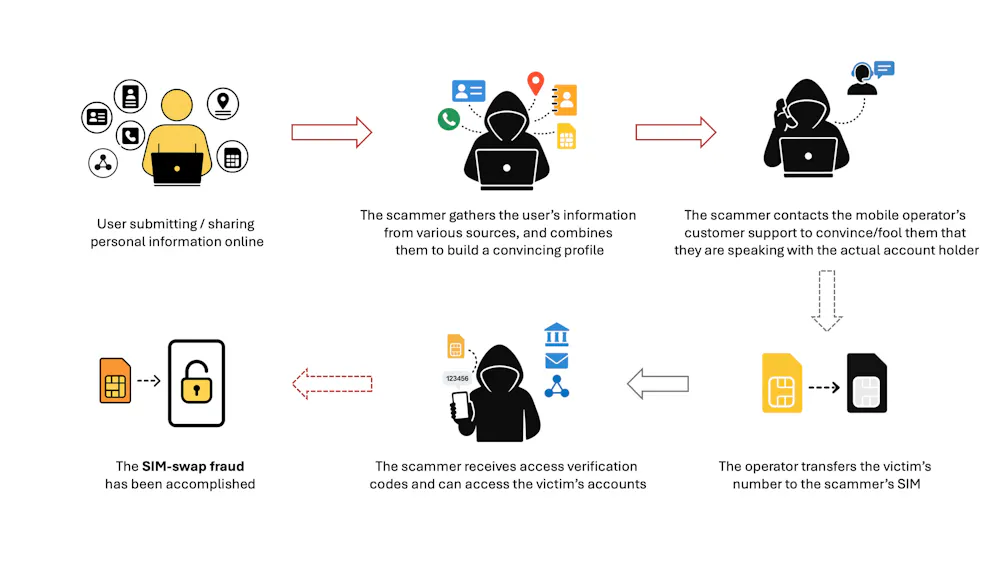
    Sim-swap fraud begins when a scammer convinces a mobile operator to transfer a victim’s number to a new sim card, or even an esim (one that’s embedded in the device), under the scammer’s control.

    This can be done over the phone, through an online chat, or even with the help of a
    bribed insider. Once the number is transferred, all calls and texts intended for the victim are redirected to the scammer. This includes those crucial verification codes used for logging into email, banking, messaging apps such as WhatsApp, and government services such as HMRC.

    This alone would be dangerous. But what makes sim-swap fraud so influential is
    that the cyber scammer often already has access to a patchwork of personal data
    about their target. That information may have been collected from data breaches,
    phishing attacks, low-reputation websites, or even the victim’s social media.

    People often underestimate the extent to which they reveal themselves online: a birthday posted on Instagram, a phone number included in a job posting, or a home address used in an online giveaway. Scammers combine this data to build a convincing profile, enough to fool a mobile operator’s customer service staff into believing they’re talking to the real account holder.

    How the sim-swap fraud works

    Once the scammer gains control of a number, the consequences are extensive.
    Attackers can access sensitive information, including personal documents and
    request and receive password reset links for the user’s other accounts. They can log in to WhatsApp or Telegram accounts, read private messages, impersonate the user, and even contact friends or family members to conduct further scams.

    The victims might see false messages posted in their names or fraudulent transactions made from their accounts. This can lead to financial loss, reputation damage, as well as emotional and mental health issues on the part of the victims.

    In the case of M&S, attackers apparently used this access to manipulate internal
    processes and gain access to sensitive systems. This highlights a broader risk:
    many companies still rely on phone numbers as a secondary verification method for
    staff, making their systems vulnerable to the same cyberattack used against
    individuals.

    How sim-Swap fraud works.
    Hossein Abroshan

    Reducing the risk

    While real-time detection of mobile number hijacking remains difficult, taking specific steps can significantly reduce the likelihood of being targeted and victimised. People should avoid sharing personal data unnecessarily, especially across multiple platforms and, very importantly, on unknown or untrusted websites.

    Many attackers don’t obtain all the necessary information from a single source. Instead, they collect it incrementally, using public profiles, marketing databases and past leaks to form a comprehensive picture.

    Being mindful of where you share your phone number, birthday or other identifiers can make it harder for others to impersonate you. It is also crucial to learn how phishing works and how to recognise it, so you will not submit your sensitive information to phishing or fake websites.

    Avoiding SMS-based authentication, where possible, is another key step. Many
    services now support authenticator apps, such as Google Authenticator, Microsoft Authenticator, Due or Authy, which are not tied to your mobile number. For mobile
    accounts themselves, setting up a unique pin or password to your account, which
    must be provided to authorise any changes, can add an extra layer of protection. This makes it harder for someone to initiate a sim swap without that code. However, users alone cannot fulfil this duty.

    Mobile network operators must strengthen identity verification practices, moving beyond basic questions about names and addresses that can be easily gathered or guessed. Banks and other financial institutions should reconsider using SMS or, at the very least, SMS-only as the default method for sensitive authentication. And companies, particularly those handling personal data or financial assets, need to train their IT and customer service teams to recognise the signs of identity based attacks.

    Sim-swap fraud is effective not because it’s highly technical, but because it exploits our trust in phone numbers for identity verification. The M&S case and similar examples show how fragile that trust can be – and why securing our mobile identities is no longer optional.

    Hossein Abroshan does not work for, consult, own shares in or receive funding from any company or organisation that would benefit from this article, and has disclosed no relevant affiliations beyond their academic appointment.

    ref. M&S cyberattacks used a little-known but dangerous technique – and anyone could be vulnerable – https://theconversation.com/mands-cyberattacks-used-a-little-known-but-dangerous-technique-and-anyone-could-be-vulnerable-256739

    MIL OSI – Global Reports

  • MIL-OSI USA: Rep. Gabe Vasquez Highlights How Republican SNAP Cuts Will Devastate New Mexico

    Source: US Representative Gabe Vasquez’s (NM-02)

    WASHINGTON, D.C. – Today, U.S. Representative Gabe Vasquez (NM-02) issued a forceful rebuke of Republican efforts to slash the Supplemental Nutrition Assistance Program (SNAP) as part of their proposed reconciliation framework, warning that the cuts would devastate working families, small businesses, and rural communities in New Mexico. The reconciliation bill would cut billions of dollars from SNAP, as well as critical health care programs, in order to give tax cuts to the ultra-wealthy. 


    “This committee has historically come together across party lines to support farmers and families. But today, I’m ashamed that we are throwing that legacy aside to gut SNAP, one of the most effective anti-hunger programs in our country,” Vasquez said during his opening remarks. “And I’m not just ashamed—I’m angry. Angry because some members of this committee are taking food off the table from the families I represent in southern New Mexico.” 

    WATCH: VASQUEZ OPENING REMARKS

    This afternoon, Vasquez reached out to his constituents to hear how SNAP cuts could impact them:

    • “My son and his partner depend on SNAP to get nutritious food. My son is a disabled veteran with medically based nutritional deficiencies. We have paid taxes all of our lives, and believe the most important priority is to provide for our veterans.” – Miriam, Quemado
    • “I’m 63, disabled, and on food stamps because my $900 a month Social Security check barely covers my bills. Last month, my rent increased by 35%, and my auto insurance increased by 11%. If I lose food stamps, I won’t be able to afford to buy food. I live in a rural area where our food bank depends on the federal government. Their shelves are empty right now, and the government has cut out assistance to food banks.” – Michelle, Deming
    • “Cuts to SNAP would have a devastating impact on my family by making it harder to afford basic groceries and forcing us to choose between food, rent, and other essentials. Reducing these benefits threatens our health, our children’s ability to focus and succeed in school, and our overall stability. It also harms local economies by pulling money out of grocery stores and small businesses. SNAP isn’t a handout, it’s a lifeline that allows families to survive with dignity, and cutting it will only increase hunger, poverty, and long-term hardship.” – Bernadine, Zuni

    Vasquez also warned that the partisan attack on SNAP threatens to derail progress on a bipartisan Farm Bill, jeopardizing key programs for New Mexico’s farmers, ranchers, and conservation efforts.

    ***

    PARA PUBLICACIÓN INMEDIATA

    13 de mayo de 2025

    Vásquez Destaca Cómo los Recortes a SNAP Devastarán a Nuevo México

    WASHINGTON, D.C. – Hoy, el Congresista Gabe Vásquez (NM-02) condenó los esfuerzos republicanos de recortar el Programa de Asistencia Nutricional Suplementaria (SNAP) como parte de su propuesta de proyecto de reconciliación, advirtiendo que estos recortes devastarían a las familias trabajadoras, los pequeños negocios y las comunidades rurales de Nuevo México. El proyecto de reconciliación recortaría miles de millones de dólares de SNAP, así como programas críticos de atención médica, con el propósito de otorgar recortes fiscales a los ultra-ricos.

    “Este comité, históricamente, ha trabajado de forma bipartidista para apoyar a nuestros agricultores y familias. Pero hoy, me avergüenza que estemos dejando de lado ese legado para desmantelar SNAP, uno de los programas contra el hambre más efectivos en nuestro país,” dijo Vásquez durante sus declaraciones iniciales. “Y no solo me siento avergonzado—estoy indignado. Indignado porque algunos miembros de este comité están quitándole la comida de la mesa a las familias que represento en el sur de Nuevo México.”

    VEA: COMENTARIOS INICIALES DEL CONGRESISTA VÁSQUEZ


    Esta tarde, el Congresista Vásquez se comunicó con sus constituyentes para escuchar cómo los recortes a SNAP podrían afectarlos:

    • “Mi hijo y su pareja dependen de SNAP para obtener alimentos nutritivos. Mi hijo es un veterano discapacitado con deficiencias nutricionales médicas. Hemos pagado impuestos toda nuestra vida y creemos que la prioridad más importante es cuidar a nuestros veteranos.” – Miriam, Quemado
    • “Tengo 63 años, estoy discapacitada y dependo de los cupones de alimentos porque mi cheque del Seguro Social de $900 al mes apenas cubre mis cuentas. El mes pasado, mi renta aumentó un 35 % y mi seguro de auto subió un 11 %. Si pierdo los cupones de alimentos, no podré comprar comida. Vivo en una zona rural donde el banco de alimentos depende del gobierno federal. Sus despensas están vacías en este momento, y el gobierno ha eliminado la asistencia para los bancos de alimentos.” – Michelle, Deming

    • “Los recortes al Programa de Asistencia Nutricional Suplementaria (SNAP) tendrán un impacto devastador en mi familia al dificultar la compra de comestibles básicos y obligarnos a elegir entre comida, renta y otras necesidades esenciales. Reducir estos beneficios pone en riesgo nuestra salud, la capacidad de nuestros hijos para concentrarse y tener éxito en la escuela, y nuestra estabilidad general. También daña las economías locales al quitar dinero de los supermercados y pequeños negocios. SNAP no es una limosna, es una línea de vida que permite a las familias sobrevivir con dignidad, y recortarlo solo aumentará el hambre, la pobreza y las dificultades a largo plazo.” – Bernadine, Zuni

    Vásquez también advirtió que este ataque partidista contra SNAP amenaza con descarrilar el progreso hacia una Ley Agrícola bipartidista, poniendo en riesgo programas clave para los agricultores, ganaderos y esfuerzos de conservación en Nuevo México.

    ###

    MIL OSI USA News

  • MIL-OSI USA: Judicial Branch Seeks $9.4 Billion in FY 2026 Budget Request

    Source: United States Courts

    Two federal judges told Congress that the Judiciary has been negatively affected by two straight years of flat funding in most accounts, and they said a 9.3 percent increase in appropriations for the upcoming fiscal year is needed to ensure that the Judiciary can perform its essential constitutional functions.

    “More than half of the branch’s accounts are operating … on funding levels that have not been adjusted since FY 2023,” said Seventh Circuit Judge Amy J. St. Eve, chair of the Budget Committee of the Judicial Conference of the United States. “An effective and efficient Judiciary is foundational to the system of government envisioned by our founders. … Adequate and consistent funding is absolutely critical to the conduct of those responsibilities.” 

    St. Eve testified (pdf) before the House Appropriations Subcommittee on Financial Services and General Government. Also testifying (pdf) was Judge Robert J. Conrad Jr., director of the Administrative Office of the U.S. Courts and secretary of the Judicial Conference. 

    The federal Judiciary is seeking $9.4 billion in discretionary funding from Congress for fiscal year 2026, according to the Judiciary’s budget request, which was made public on April 25. An additional $872 million in mandatory funding covers judicial salaries and retirement costs. 

    In written submissions that accompanied their oral testimony, Judges St. Eve and Conrad said funding is needed to maintain existing services, protect judges and courthouses, and bolster IT security. 

    St. Eve said the funding shortages are especially critical for defender services. Federal defender organizations are under a hiring freeze until at least Oct. 1. And due to insufficient funding this year, voucher payments to court-appointed private lawyers will be suspended in late July, two months before the end of the 2025 fiscal year. That will delay an estimated $93 million in payments until Oct. 1, when the new fiscal year starts. 

    “These disruptions in panel attorney payments negatively affect our panel attorneys,” St. Eve said, “potentially reducing their willingness to accept future appointments and jeopardizing the ability to provide necessary and timely representation.”  

    The Judiciary is requesting $1.8 billion for defender services, an increase of $315 million (22 percent) over the FY 2025 hard-freeze  level. This includes funding to cover the deferred payments to attorneys in the current fiscal year, St. Eve said. The request will also enable federal defender organizations to hire staff to address workload needs.

    “Fewer than 10 percent of federal defendants have the financial means to afford an attorney, and so the Judiciary’s Defender Services program provides representation in the overwhelming majority of cases,” St. Eve said. “In doing so, we not only protect that constitutional and statutory right for the accused, but we also improve the overall operation of the federal court system.”

    The judges noted that security funding has remained flat for two years, creating a growing safety threat to both judges and courthouses. For the Court Security account, the Judiciary is requesting $892 million, an increase of $142 million (19 percent) over the FY 2025 enacted level.

    Conrad cited the growing incidence of physical threats and public attacks on judges for decisions they make in the courtroom. 

    “The independence of the Judicial Branch is jeopardized when judges are threatened with harm or impeachment for their rulings,” Conrad said. “Our constitutional system depends on judges who can make decisions free from threats and intimidation. This is essential not just for the safety of judges and their families, but also to protect our democracy.” 

    The judges noted that courts have deferred significant amounts of critically needed new security systems and equipment spending in order to avoid reducing Court Security Officer staffing or the funds dedicated to protecting judges from threats and attacks.

    “This is one of the Judiciary’s accounts that is now operating at a hard freeze level for the second year in a row despite a dynamic and very active threat environment,” St. Eve said. “At a time when dozens of individuals have been criminally charged in connection with threats against judges and the U.S. Marshals Service (USMS) is taking extraordinary security measures to ensure judges’ safety, these reductions in security capabilities are extremely worrying.”

    Specific requests for security funding include: 

    • $91 million in increases for critical systems and equipment needs. This includes emergency management equipment, vehicle barriers and mobile guard booths, radios, screening equipment, as well as video management systems that enable visual monitoring of all areas of a courthouse and systems that restrict access to non-public areas like judges’ chambers.
    • An additional $4 million for the Judiciary’s Vulnerability Management Program, which serves as a resource to judges to enhance their personal security and that of their court facilities. A key function is helping judges remove personally identifiable information on the internet that can make judges vulnerable to attack. 
    • $ 7 million in new courthouse hardening funds to protect courthouses from external attacks, such as during public disturbances. 
    • An additional $2 million to add a targeted number of Court Security Office (CSO) positions to those circuits and districts that have been identified as short on CSOs relative to the approved staffing standard.

    Conrad said protecting courts from cyber-attacks also requires funding support. 

    “These attacks pose risks to our entire justice system, including civil and criminal court proceedings, law enforcement and national security investigations planned or underway, and trade secrets for businesses involved in bankruptcy proceedings or patent and trademark litigation,” Conrad said. “The Judiciary has been modernizing its cybersecurity operations and is continually strengthening its cybersecurity posture.  Sustaining these efforts and implementing additional security-related initiatives continues to require significant resources.”

    St. Eve closed by stressing the Judiciary’s commitment to containing costs. 

    “The Judiciary takes very seriously its commitment to the responsible stewardship of its funds. We have had a formal and active cost containment program in place for more than twenty years,” St. Eve said. “This cost containment mindset has become thoroughly ingrained into the Judiciary’s governance practices, and we are proud of our successes.”

    She added, “I understand that the FY 2026 budget we have put forward is a large one that requires serious investment. That is because such an investment is necessary to carry out our constitutional and statutory missions, and to support the fair, efficient, and secure administration of justice in this country.” 

    MIL OSI USA News

  • MIL-OSI USA: Statement by Commissioner Summer K. Mersinger on her Departure from the Commodity Futures Trading Commission

    Source: US Commodity Futures Trading Commission

    After careful consideration, long discussions with my family, and lots of prayers, I have decided to step down from my position as Commissioner at the Commodity Futures Trading Commission (“CFTC”) at the end of the month, to pursue new opportunities.  This decision is not easy, and it breaks my heart to leave the agency that I have grown to love so much over the last five years.  It has been a privilege to work and serve at the CFTC in both the first and the current Trump Administrations, doing my part to assist in pursuing the President’s important policies. 
    While I have spoken often of my agricultural roots, I have not spent much time talking about my upbringing.  My parents did not go to college.  They went straight from high school to the workforce. My dad worked from the early morning hours until late at night, and my mom sometimes worked two jobs to make ends meet.  We lived in a small trailer house, our family outings were church on Sunday, and the only time we ate out was when our church hosted a potluck lunch after Mass.  Despite the lack of material comforts, we never lacked love, support, or encouragement.  My parents sacrificed so that my siblings and I could live out our dreams.
    My background really is not unique or noteworthy, and I suspect many Americans share a similar life story.  I share this to explain just how grateful I am for the opportunities I have had throughout my life.  When I started answering phones for Congressman John Thune in the summer of 1999, I could not possibly imagine the career opportunities before me, and I am still in awe today.  I owe a huge debt of gratitude to my parents who worked to support my dreams, and to Majority Leader John Thune who took a chance on a small-town kid from Onida, South Dakota.
    Over the last three years as a commissioner, I have been incredibly fortunate to be surrounded by a stellar team who made me look good every day.  Thank you to Terry Arbit, Libby Mastrogiacomo, Josh Beale and Tim Achinger for sharing your brilliant legal minds and for all the hours and effort you selflessly contributed over the years. 
    Thanks to Lauren Fulks, an absolute hidden gem in the agency, who took my vision for the Energy and Environmental Markets Advisory Committee (“EEMAC”) and made it a reality, and Lillian Cardona and JonMarc Buffa for diligently working with an extraordinary team of professionals to create masterful reports from our EEMAC subcommittees. 
    A special thanks to the members of the EEMAC for their intellectual curiosity and willingness to go “off-road” in the pursuit of understanding America’s energy sector. 
    I also want to thank LaTasha Pate and Janet Schmautz for keeping the office, and the staff, running smoothly. 
    And finally, I need to say thank you to my chief of staff, Chris Lucas.  The title of chief of staff does not come close to covering all of Chris’s duties over the last few years.  Chris was the optimism to my realism, the morning person to my hatred of anything happening before 10 am, my cheerleader, and the voice of reason when I needed someone to tell me the hard truth. 
    Thank you to all my staff for working so hard on my behalf and on behalf of the CFTC and, most importantly, thank you for your willingness to tell me “No” when I needed to hear it.
    I will miss the work and my fellow commissioners, who have become close friends.  But most of all, I will miss the amazing team at the CFTC.  The talented staff at this agency are true public servants committed to fulfilling the agency’s mission.  They are the heart of the agency and of great value to the United States government. It has been an honor to both work with you and learn from you.  Thank you.
    I have always loved the following quote from A.A. Milne, and I can think of no better words to express my sentiment as I prepare to step into the next adventure in my career: 
    “How lucky am I to have something that makes saying goodbye so hard.” 

    MIL OSI USA News

  • MIL-OSI Russia: Russian delegation to discuss both political and technical issues in Istanbul – Russian presidential aide

    Translation. Region: Russian Federal

    Source: People’s Republic of China in Russian – People’s Republic of China in Russian –

    Source: People’s Republic of China – State Council News

    Moscow, May 14 /Xinhua/ — The Russian delegation at the talks scheduled for May 15 in Istanbul, Turkey, will discuss both political and technical issues, and its composition will be determined based on this, Russian presidential aide Yuri Ushakov said in an interview with Pavel Zarubin, a journalist with the All-Russian State Television and Radio Broadcasting Company.

    “The delegation will discuss both political and, I would say, a myriad of technical issues. So the composition will be determined based on this,” said Y. Ushakov in an interview, a video of which was published on Wednesday on P. Zarubin’s Telegram channel.

    The Russian presidential aide said that Russia is ready to resume direct negotiations with Ukraine, which were interrupted in 2022. “You know the president’s statement of May 11 that we are ready to begin direct negotiations in Istanbul on May 15. Or rather, not even begin, but resume the negotiations that were interrupted by the Ukrainian side at the instigation of Western colleagues and partners,” Y. Ushakov emphasized.

    Speaking to journalists in the Kremlin on the night of May 11, V. Putin proposed that the Ukrainian side resume direct negotiations, interrupted in 2022, without preconditions. It was proposed to begin the dialogue on May 15 in Istanbul. Later on May 11, Ukrainian President Volodymyr Zelensky proposed to V. Putin on the social network X to hold a personal meeting in Turkey on May 15 to resolve the Russian-Ukrainian armed conflict. He added that Ukraine also expects a full and long-term ceasefire starting on May 12. –0–

    MIL OSI Russia News

  • MIL-OSI Canada: Province helps strengthen Indigenous food security, sovereignty

    Source: Government of Canada regional news

    More than 100 Indigenous-led projects are underway in communities throughout B.C., helping to strengthen local food security and food sovereignty with another round of funding set to open.

    “Working alongside Indigenous partners is crucial to growing and maintaining our province’s food systems and part of our government’s ongoing commitment to reconciliation,” said Harwinder Sandhu, parliamentary secretary for agriculture. “These Indigenous-led projects highlight how Indigenous knowledge supports increasing local food supply and food security, especially in rural and remote communities.”

    In 2023, the New Relationship Trust (NRT) launched the $30-milllion Indigenous Food Security and Sovereignty Program and is supporting both on-reserve and off-reserve projects, such as revitalizing food harvesting and Indigenous agro-ecosystems, expanding production capacity, boosting local food processing and distribution, and growing commercial value-added enterprises.

    On Vancouver Island, Jared “Qwustenuxun” Williams, a Salish educator and traditional-foods chef who previously managed the Elders Kitchen in Cowichan Tribes, is upgrading a smokehouse into a commercial-quality kitchen that blends ancient preservation methods with modern food-safety standards.

    “Building the smokehouse has taken more time than I first expected, but that time has allowed me to really think about how to bring together traditional methods and new ideas,” said Williams. “I’m creating a modern version of the smokehouse that’s still rooted in our teachings, something that reflects both where we come from and where we’re going. I’m grateful for the support that came with patience and trust, because meaningful work doesn’t always follow a set timeline.”

    On Haida Gwaii, Indigenous-owned food supplier Haida Wild is upgrading its packaging facility with a new state-of-the-art vacuum-sealing machine that allows it to preserve its high-quality seafood longer, reduce waste and enhance distribution.

    “Haida Wild is proud to share the seafood traditions of Xaayda Gwaay | XaaydaGa Gwaay.yaay | Haida Gwaii with the world in a way that honours our people, our values and our environment,” said Leticia Hill, CEO, Haida Wild. “With support from the Indigenous Food Security and Sovereignty grant, we’ve been able to grow our operations in a sustainable way that supports our Haida fishers, creates jobs here at home and strengthens food security for the long term.”

    Another project is helping the Sts’ailes First Nation near Agassiz undertake a series of workshops, conversations, shared meals and other community events, centred around a community greenhouse, to promote traditional-food usage and ancestral practices for local use.

    “We’ve been implementing a lot of the new vegetables into our daily cafe and our catering services,” said Kandice Krista-Anne Charlie, executive officer, Sts’ailes development corporation. “It’s just the beginning. We want to evolve to rely less on ordering bulk food from commercial stores and producing that food in-house and serving it out to our people.”

    The New Relationship Trust, an independent, Indigenous-led non-profit organization, administers the program and works with Indigenous entrepreneurs, communities and businesses to identify and respond to their needs and empower them.

    “At New Relationship Trust, we recognize that strengthening sustainable food production in B.C. starts with honouring Indigenous leadership and vision for food systems rooted in both land and water,” said Walter Schneider, chief executive officer, NRT. “We’re proud to support Indigenous food producers who are driving community well-being, economic growth and food sovereignty, all while upholding their values and deep connection to the land.”

    The Province’s commitment to reconciliation with Indigenous Peoples has led to increased participation in Indigenous agriculture and food systems, which is a key part of implementing B.C.’s Declaration on the Rights of Indigenous Peoples Act.

    Quick Facts:

    • Applications opened on Tuesday, May 13, 2025, for the third and final round of $10-million funding.
    • Total funding for the Indigenous Food Security and Sovereignty Program is $30 million over three years.

    Learn More:

    Applications and more details about the program are available here: https://newrelationshiptrust.ca/apply-for-funding/sustainability-development-goals-sdg-initiatives/food-security-grants/

    To see the full list of Indigenous Food Security and Sovereignty Program funding recipients, visit: https://news.gov.bc.ca/files/IFSS_Approved_Grants_2025.pdf

    A selection of videos highlighting Indigenous food security and sovereignty projects is available here: https://newrelationshiptrust.ca/indigenous-food-security-and-sovereignty-program-highlights/

    A July 2023 news release announcing the Indigenous Food Security and Sovereignty Program is available here: https://news.gov.bc.ca/releases/2023AF0047-001230

    MIL OSI Canada News

  • MIL-OSI USA: Meeks, NY Delegation Draft Letter to VA Secretary Collins to Oppose Proposed Staffing Cuts and Budget Changes

    Source: United States House of Representatives – Congressman Gregory W Meeks (5th District of New York)

    WASHINGTON, D.C. – Congressman Gregory W. Meeks (NY-05) joined 14 of his Democratic colleagues in the New York Congressional delegation in sending a letter to Secretary Doug Collins of the U.S. Department of Veteran Affairs (VA), to strongly oppose the proposed staffing cuts and budget changes to the agency that will threaten the well-being of those who have served the nation. Standing united with his peers, Rep. Meeks demands that Secretary Collins immediately reverse course on his plans to reshape the VA to the detriment of our veterans. 

    “Veterans hospitals play a critical role in supporting individuals who served our country,” Congressman Meeks said. “These facilities are not just places for medical treatment, they serve as lifelines providing specialized care tailored to the unique needs of veterans. It is unfathomable that the Trump Administration is willing to cut the budget and scale back on the trained professionals who understand what patients are going through and can offer effective treatment to our war heroes.” 

    With plans to downsize the workforce by over 15%, proposed cuts will force veterans to withstand longer appointment wait times, benefit delays, and reduced patient-provider interactions. As healthcare, housing, and other veteran services continue to be defunded and stripped of support, these existing struggles will only be exacerbated following the implementation of Secretary Collins’ proposed changes. The lawmakers argue that these mass firings would threaten the department’s fundamental purpose—to provide veterans with timely, quality, equitable, and individual-centered healthcare, benefits, and housing resources. 

    The St. Albans VA Medical Center stands in New York’s 5th congressional district, providing veterans with primary and specialty healthcare services. Proposed cuts will threaten the accessibility of timely and comprehensive healthcare for constituents of the 5th District. Congressman Meeks condemns this looming threat and urges Secretary Collins to consider the consequences of his proposed changes to the VA to protect our veteran residents and those across the country who deserve efficient and stable support.

    A total of 15 lawmakers signed the letter. In addition to Rep. Meeks, the following members joined in signing: Representatives Yvette Clarke (NY-09), Alexandria Ocasio-Cortez (NY-14), Adriano Espaillat (NY-13), Daniel Goldman (NY-10), Timothy Kennedy (NY-26), George Latimer (NY-16), John Mannion (NY-22), Grace Meng (NY-06), Joseph Morelle (NY-25), Jerrold Nadler (NY-12), Josh Riley (NY-19), Paul Tonko (NY-20), Ritchie Torres (NY-15), and Nydia Velázquez (NY-07). 

    Full text of the letter is provided below:

    Dear Secretary Collins:

    We write as Members of the New York Congressional delegation to strongly oppose the proposed staffing cuts and benefits changes to the U.S. Department of Veterans Affairs’ (VA) that threaten the well-being of those who have bravely served our nation. This proposal would cut 80,000 employees – over 15% of the VA’s total workforce – who help provide health care, housing, and other services to our veterans,[1] including more than a quarter of whom are veterans themselves.[2] We urge you to immediately reverse course on the proposed firings and ensure that the more than 688,000 veterans in New York State receive timely care, benefits, and peace of mind.

    VHA facilities reported a total of 2,959 severe occupational staffing shortages nationwide in fiscal year 2024. New York facilities reported at least 143 severe staffing shortages.[3] New York’s VA facilities have already suffered after the dismissal of more than 1,000 probationary employees nationwide.[4]

    These shortages and firings have directly affected care quality by leading to reduced patient-provider interaction, longer wait times for appointments, delays in benefits, and increased workloads for existing staff. Ultimately, these conditions compromise the level of care veterans receive. In February, the Castle Point VA in the Hudson Valley temporarily closed due to inadequate staffing, with employees citing the federal hiring freeze as a key roadblock to getting the providers needed for the community.[5] At the Bronx VA, 20-year veteran Luke Graziani was abruptly fired weeks before his probationary period ended, leaving a vacuum in internal and external communications for the facility. While we are glad to see Mr. Graziani reinstated, the chaos and recklessness of these actions have created a widespread atmosphere of fear and instability across the state.[6]

    The PACT Act was transformational legislation that expanded eligibility for VA healthcare and benefits for veterans with toxic exposures during their military service. Since passage, over 796,000 veterans have enrolled in VA healthcare with over 4.8 million claims received.[7] To handle the surge in veterans becoming eligible for care, the VA needed to hire more employees to process claims, provide healthcare, and manage the expanded services. Cutting VA employee levels back to pre-PACT Act levels would be detrimental to veterans’ care and benefits, leading to longer wait times for appointments, claims processing, increased costs in care, and a significant decrease in mental health services.[8]

    The New York Congressional delegation has consistently fought for public, high-quality, accessible health care for our veterans. In New York, we have worked to keep facilities open, expand services, and fight for critical investments to ensure our veterans receive the care they deserve. These firings will threaten the agency’s core mission to provide quality healthcare, timely delivery of benefits, and housing resources for our veterans. It is the federal government’s responsibility to “honor the contract,” – we must honor that commitment by providing the care, benefits, and opportunities every veteran has earned through their sacrifice.

    As Members of the New York Congressional delegation, we stand united in demanding that the administration reverse course on your proposed staffing and benefits cuts that will cripple the livelihoods of our veteran constituents.

    ###

    MIL OSI USA News

  • MIL-OSI USA: ‘This Bill Will Starve Families’: In Agriculture Committee Markup, Pingree Slams GOP for Gutting Anti-Hunger Programs

    Source: United States House of Representatives – Congresswoman Chellie Pingree (1st District of Maine)

    Last night in the House Agriculture Committee markup of the partisan reconciliation bill, Congresswoman Chellie Pingree (D-Maine) spoke out against Republicans’ proposal to slash $300 billion from the Supplemental Nutrition Assistance Program (SNAP). In her opening remarks, Pingree questioned how leaving Americans with fewer tools to feed their families affordably and healthily, further straining our health care system and driving up costs for everyone, will “Make America Healthy Again.” 

    [embedded content]
    Pingree’s full opening remarks are available here and copied below.

    The Committee will reconvene today to debate amendments. Tune in live here. 

    +++

    Thank you very much, Mr. Chair. 

    I’m fortunate to have served on this committee for more than a decade. During that time, I’ve had the opportunity and the great privilege to work on bipartisan Farm Bills that are designed to strengthen our agricultural sector, to support our farmers, and to help hungry people access food. So, I am deeply disappointed that we’re sitting here tonight not doing that but debating a bill that will gut the single largest anti-hunger program in America.

    Frankly, I can’t believe we are trying to shove the Farm Bill into the reconciliation process, stripping this committee of the chance of a truly bipartisan Farm Bill. 

    And let’s not sugarcoat what this bill is. It’s a $300 billion assault on struggling families, seniors, children, and veterans, all to fund tax breaks for billionaires and corporations. 

    The average SNAP benefit is $6 a day, $6 a day. That is barely enough to buy a loaf of bread or a gallon of milk. And if this bill passes, some of the most vulnerable people in America will be denied even that. Make no mistake, this will lead to more kids going to bed hungry, more seniors skipping meals to afford their medicine, and more parents forced to sacrifice their own nutrition so their kids can eat.

     In my state, 175,000 people rely on SNAP to put food on the table, including over 36,000 children and 6,300 veterans. That’s tens of thousands of Mainers who stand to lose their benefits under this proposal. 1 in 5 children in Maine struggles with food insecurity. That’s 1 in 5. And it’s not just individuals who will suffer. The bill threatens the very businesses that keep our rural communities alive.

    More than 1,500 retailers in Maine – grocery stores, corner markets, and mom and pop shops – rely on SNAP sales to stay open. When you cut SNAP, you don’t just take food off the table, you rip the economic rug out from under those businesses in the communities they support. 

    And then there’s the unfunded mandate that this bill dumps on Maine. My Republican colleagues call this “cost shifting,” but they are forcing states to pay at least 5% – and in many cases, much more of the cost – of supporting SNAP. So, let’s just call that what it really is: a backdoor way of sending this program into a death spiral, pushing the blame for the inevitable wave of hunger and hardship under governors and state legislatures.

    It cuts programs like the National Education, Obesity and Prevention Grant program, commonly known as Snap Ed. Snap ed helps families make their SNAP dollars stretch further. It teaches people how to make nutritious meals using SNAP funds. In Maine, this program has reached nearly 20,000 people with free classes and cooking, budgeting, and healthy eating. Eliminating these services will leave families with fewer tools to feed their families affordably and healthily, further straining our health care system and driving up costs for everyone.

    Tell me, is this really making America healthy again? 

    This … bill is not about reducing “waste” or fixing “fraud” or finding errors. It’s all about sacrificing the health and well-being of the most vulnerable, most vulnerable amongst us, so that billionaires like Elon Musk can get even richer. It’s about taking food out of the hands of hungry children, cutting off lifelines to families in need, and shattering the basic safety net that millions of Americans rely on.

    We should be writing a Farm Bill that supports our local farmers, strengthens rural economies, and ensures that no one in this country goes hungry. Instead, this proposal sacrifices families and communities for short term political win. 

    So, for me tonight, I’m a no. Tomorrow I’m a no. Every day from now until whenever my Republican colleagues come to their senses and do what right is right for America and for the people who are their constituents, I will stay a no on this bill.

    Thank you. I yield back.

    ###

    MIL OSI USA News

  • MIL-OSI Asia-Pac: Remarks by CE at media session in Kuwait City (with photo)

    Source: Hong Kong Government special administrative region

    The Chief Executive, Mr John Lee, concluded the visit of the business delegation comprising representatives from Hong Kong and Mainland enterprises to Middle East together with the Chairman of the Hong Kong Trade Development Council, Dr Peter Lam; the Chairman of the Hong Kong General Chamber of Commerce, Ms Agnes Chan; and the Chairman of the Dongchao Information Technology (Shanghai) Company Limited, Mr Wang Chaoyou, in Kuwait City, Kuwait, today (May 14, Kuwait City time). Following are the remarks by Mr Lee:

    Chief Executive: Today marks the final day of our visit to Kuwait. I would like to extend my gratitude to the Kuwaiti Government for its high-level hospitality and meticulous arrangements. I am particularly grateful to the Kuwaiti Government for arranging the government team to stay at Bayan Palace. We are particularly grateful to the Acting Prime Minister for hosting the whole delegation for lunch at the Palace, leaving an unforgettable memory amongst all members of the delegation.

    Yesterday, I met with His Highness the Amir of Kuwait, followed by the meeting with His Highness the Crown Prince. And then I also met the Acting Prime Minister, who hosted a roundtable discussion attended by senior Kuwaiti officials. We share a common commitment to deepening bilateral co-operation in trade, investment and cultural exchanges.

    During our visit to Kuwait, we signed and reached 24 Memoranda of Understanding (MOUs) and co-operation agreements, spanning across trade, investment, financial services, technology, legal co-operation, customs facilitation, aviation, tertiary education, etc.

    Today is the last day of our Middle East visit. I would like to do a sum-up of my four-day visit to Kuwait and Qatar. The delegation comprised Hong Kong and Mainland business leaders. We achieved three key objectives:

    1. To strengthen government-to-government relations;
    2. To find new areas of collaboration;
    3. To make friends, and extend our network.

    The visit is successful, particularly in six areas.

    First, we strengthened relations between the Hong Kong Special Administrative Region (HKSAR) Government and the governments of Qatar and Kuwait, establishing collaborative consensus.

    Second, the visit resulted in a total of 59 MOUs and agreements, 35 in Qatar and 24 in Kuwait, spanning across diverse areas and laying a robust groundwork for multifaceted co-operation.

    Third, we deepened mutual understanding and strengthened commercial and trading networks. Delegation members have expanded their network and connections, promoting the strengths and opportunities of Hong Kong and the Mainland to partners in Qatar and Kuwait.

    Fourth, we showcased Hong Kong’s unique role under “one country, two systems” as a “super connector” and “super value-adder”, bridging global opportunities. I invited, for the first time, over 20 Mainland enterprise representatives to join the delegation, reflecting the synergy between Hong Kong and the Mainland. We together aim to provide end-to-end supply chain solutions for the Middle East and beyond.

    Fifth, we bolstered ties with Gulf Cooperation Council (GCC) member states. We created broader opportunities. Plus the two countries I have visited during my last Middle East visit, we have now visited four of the six GCC member states, representing two-thirds of the bloc and 90 per cent of its population The HKSAR Government is now actively exploring a free trade agreement with the GCC to further access this vital market.

    Sixth, we advanced people-to-people exchanges. Two days ago, I announced Qatar’s new 30-day visa-free arrangement for HKSAR passport holders. I am pleased now to further announce that the UAE (United Arab Emirates) will grant Hong Kong 30-day visa-free access starting May 15, while Oman will on the same date extend its visa-free period from 10 days to 14 days.

    In meetings with leaders and officials, I appreciated their forward-looking vision and understanding of Hong Kong’s unparalleled advantages under “one country, two systems” as a bridge between the Mainland and the world. Middle East countries are seeking diversification of risks and looking for opportunities in China and the HKSAR in order to join the tide of the global economic shift towards the East. In this, Hong Kong has boundless opportunities.

    Reporter: I just have a couple of questions for you, please. Can you talk to us about the relationship between Kuwait and Hong Kong in particular, and Kuwait and China in general? The second question is about the Memoranda of Understanding that you have signed yesterday and today. How can you describe them? And how do they benefit the relations between Kuwait and Hong Kong?

    Chief Executive: We have a very strong foundation of understanding and co-operation with Kuwait. Kuwait is the first country to sign two agreements together with Hong Kong. One is the agreement on investment protection and promotion, and another agreement is about the avoidance of double taxation. That speaks for the strong link, which has been established long ago between Hong Kong and Kuwait. We have been inspired by the Kuwait Vision 2035, which covers many areas in full alignment with what Hong Kong is doing and focusing on. The Kuwait Vision 2035 covers areas to transform Kuwait into financial centre, trading centre, infrastructure-building, human capital development, healthcare, sustainability, and also building Kuwait into a country of influence in this region and globally.

    Hong Kong has a vision very similar to Kuwait in this regard. Hong Kong is a financial centre, and is a shipping and trading centre, and we are developing Hong Kong into an I&T (innovation and technology) hub. We are quite proud of our education, because despite Hong Kong being just a city of 1 100 square kilometres, we have five universities that are within the top 100 globally, and we are quite strong in R&D (research and development), particularly a lot of our universities’ research has been graded outstanding. What we are working hard is raising Hong Kong’s profile in all this regard. Sustainability is also one of our focuses, both in what we do environmentally and also financially. We are doing a lot of green finance, and we emphasise strongly (ESG) compliance. That is where we are going, and we think there are a lot of things, because our visions just align so much together – a lot to do – and that is between Hong Kong and Kuwait. I am very thankful and grateful to His Highness, Amir of Kuwait, to meet me, and I am grateful to the Prime Minister also, to host a lunch in the palace for the whole team. Throughout all the meetings and discussions, we have very common understanding that we should co-operate more in different areas.

    Coming to the relation between China and Kuwait, China is Kuwait’s, I think, largest trade partner, and the diplomatic relations between China and Kuwait started long, long time ago, and the partnership is close and ever-rising. When I honourably saw His Highness, Amir of Kuwait, I felt his friendship, genuineness, and sincerity of building good relations between Kuwait and China. I am honoured to be able to be part of that success story. My whole team feels proud to be in that part of success story.

    Coming to the MOUs we have signed with Kuwait, both the governments and different parties, 24 agreements and MOUs, they cover a wide range of areas. Despite the very good foundation we already have, we are now formally telling people of the two places where are the main directions of co-operation both governments agree on. That helps in aligning direction, energy, focuses and also our time, because time is precious. So all of them now, these are the areas we can co-operate on and work hard on as well. That will bring returns in much shorter time, in much bigger scale. Already, I have heard some delegations forming to come to Hong Kong, so as to further continue the link. I am very positive with the overall results, and I will be seeing a lot of activities, not just between government-and-government exchange, but also business-to-business, individuals-to-individuals. And that is why I am also very thrilled to announce a lot of convenience that we have created for visa, for going through the boundary, both goods and people.

    (Please also refer to the Chinese portion of the remarks.)

    MIL OSI Asia Pacific News

  • MIL-OSI United Kingdom: Cardiff set for UK Government jobs boost to drive growth

    Source: United Kingdom – Executive Government & Departments

    Press release

    Cardiff set for UK Government jobs boost to drive growth

    Cardiff has been named as one of 13 locations where more Civil Service jobs will be moved in a boost for the local economy.

    Tŷ William Morgan House, Cardiff

    Under the shake up, government roles will be shifted outside of London to towns and cities in all four nations of the UK, delivering and developing policy closer to the communities it affects.

    The move is projected to bring £729 million worth of economic benefit to the 13 growth areas by 2030.

    Chancellor of the Duchy of Lancaster Pat McFadden, said:

    To deliver our Plan for Change, we are taking more decision-making out of Whitehall and moving it closer to communities all across the UK.

    By relocating thousands of Civil Service roles we will not only save taxpayers money, we will make this Government one that better reflects the country it serves. We will also be making sure that Government jobs support economic growth throughout the country.

    As we radically reform the state, we are going to make it much easier for talented people everywhere to join the Civil Service and help us rebuild Britain.

    Secretary of State for Wales Jo Stevens said:

    It is great news that Wales will be a major beneficiary of UK Government plans to develop policy closer to the communities it affects.

    This decision builds upon the strong presence that the UK Government already has in Wales while driving growth, boosting jobs and giving opportunity for Welsh talent to thrive.

    Currently, 9,230 civil service roles are based in Cardiff. More than 31,500 full time equivalent roles are based in Wales, with 14 major UK Government departments having a presence in the nation. 

    Thousands more government jobs will be moved to the 13 towns and cities across the UK, which have been named today.

    Government departments now will submit plans for how many roles they plan to move to each of the locations as part of the spending review.

    Changes will be introduced so talented young people from across the UK are able to progress straight from school or university into the Civil Service and rise all the way up to the most senior roles, without ever having worked in Whitehall.

    To ensure those based outside of London have equal professional growth and development opportunities, with full end-to-end careers, the Government will locate 50% of UK-based Senior Civil Servants in regional offices by 2030. 

    This will be supported by a new approach to the Fast Stream programme, which is the Civil Service graduate scheme, with at least 50% of placements offered outside of London. 

    The Prime Minister is keen to further enhance the impact of Government in places across the country, so that the Civil Service has an active presence in communities and contributes to local growth and job creation.

    The plans will see more roles working closer to frontline services, facilitating greater understanding of the real issues facing local services and people, and how central government policy can support them.

    Updates to this page

    Published 14 May 2025

    MIL OSI United Kingdom

  • MIL-OSI United Nations: Deputy Secretary-General’s opening remarks at the Member States’ briefing on Beyond GDP [as delivered]

    Source: United Nations secretary general

    Excellencies, Dear friends,

    Thank you for attending this Member State briefing on Beyond GDP.

    I am delighted to be co-leading this briefing with USG Guy Ryder, who shepherded the Summit of the Future where Member States agreed to advance this initiative.

    USG Ryder is particularly familiar with the Beyond GDP project given his earlier role as chair of the High-Level Committee on Programmes.

    That Committee brought the UN system together to develop the paper “Valuing What Counts”, which set out initial recommendations for how the UN could advance the Beyond GDP initiative.

    I am also joined by USG Junhua Li, who as head of UN DESA, will play a central role in taking this agenda forward.

    DESA is both the Secretariat for the UN Statistical Commission, and co-leads the work on Beyond GDP within the UN system, working in collaboration with UNCTAD and UNDP.

    Excellencies, ladies and gentlemen,

    My brief remarks today will address two questions about the Beyond GDP project:

    First, why do we need this project?

    And second, what is the solution?

    Let me begin with the first question.  

    In his Policy Brief on Beyond GDP, the Secretary-General emphasized what he called a “harmful anachronism” at the heart of global policymaking: that our current metrics overlook many aspects that contribute to human well-being, while valuing some activities that harm people and planet.

    Specifically, Gross Domestic Product, or GDP, is heavily relied upon as a gauge of prosperity and is the basis for numerous targets and rankings. Yet it provides an incomplete picture of the different dimensions of sustainable development.

    Every day we see the consequences of our failure to balance economic, social and environmental dimensions of development.

    The Secretary-General’s observation echoes those made by others.

    Indeed, the Beyond GDP project has a long history, dating back at least to the 1960s.

    Bobby Kennedy gave a famous speech in 1968 in which he lamented that measures of national income “count air pollution and cigarette advertising …locks for our doors…the loss of our natural wonder…and counts nuclear warheads.” Meanwhile, such measures fail to account “for the health of our children,
    the quality of their education or the joy of their play…the intelligence of our public debate or the integrity of our public officials.”

    57 years on from that speech, in a world of climate change, deteriorating ecosystems and biodiversity loss, rising conflict and food insecurity, and historic inequalities, its message feels even more urgent and necessary today.

    Let me turn then to the second question concerning the solution.

    To achieve a more balanced pattern of sustainable development, the well-being of people and the planet must be at the centre of what we measure and value.

    By promoting measures of progress that complement GDP, we can expand the data on which policy decisions and prioritizations are made, and refocus governments efforts and actions.

    Again, this solution is not entirely new – and this project has the advantage of being able to build on prior work.

    UNDP’s Human Development Index is a great example of a project that recasts how we measure progress that balances social and economic dimensions of progress.

    The Sustainable Development Goals indicator framework provides us with a rich set of measures or indicators that we can draw from.

    Individual member states have undertaken successful efforts to widen the aperture of policymakers from which we all can learn. 

    This project can also benefit from recent improvements in data collection – including on environmental accounting, monitoring time use, and subjective well-being – that increase our ability to capture what matters.

    The UN is uniquely placed to facilitate this work. 

    As the global caretaker of the sustainable development agenda, the UN is charged with promoting the three dimensions of sustainable development, and has a norm-setting role in agreeing the use of common statistics across countries.

    Indeed, SDG 17 includes a commitment to developing Beyond GDP metrics by 2030, which this project will honour.

    Let me stop here and turn to USG Ryder to elaborate on how we intend to take this forward.

    Thank you.

    [END]

    MIL OSI United Nations News

  • MIL-OSI Africa: Light is the science of the future – the Africans using it to solve local challenges

    Source: The Conversation – Africa – By Andrew Forbes, Professor, University of the Witwatersrand

    Light is all around us, essential for one of our primary senses (sight) as well as life on Earth itself. It underpins many technologies that affect our daily lives, including energy harvesting with solar cells, light-emitting-diode (LED) displays and telecommunications through fibre optic networks.

    The smartphone is a great example of the power of light. Inside the box, its electronic functionality works because of quantum mechanics. The front screen is an entirely photonic device: liquid crystals controlling light. The back too: white light-emitting diodes for a flash, and lenses to capture images.

    We use the word photonics, and sometimes optics, to capture the harnessing of light for new applications and technologies. Their importance in modern life is celebrated every year on 16 May with the International Day of Light.

    Scientists on the African continent, despite the resource constraints they work under, have made notable contributions to photonics research. Some of these have been captured in a recent special issue of the journal Applied Optics. Along with colleagues in this field from Morocco and Senegal, we introduced this collection of papers, which aims to celebrate excellence and show the impact of studies that address continental issues.

    A spotlight on photonics in Africa

    Africa’s history in formal optics stems back thousands of years, with references to lens design already recorded in ancient Egyptian writings.

    In more recent times, Africa has contributed to two Nobel prizes based on optics. Ahmed Zewail (Egyptian born) watched the ultrafast processes in chemistry with lasers (1999, Nobel Prize for Chemistry) and Serge Harouche (Moroccan born) studied the behaviour of individual particles of light, photons (2012, Nobel Prize for Physics).

    Unfortunately, the African optics story is one of pockets of excellence. The highlights are as good as anywhere else, but there are too few of them to put the continent on the global optics map. According to a 2020 calculation done for me by the Optical Society of America, based on their journals, Africa contributes less than 1% to worldwide journal publications with optics or photonics as a theme.

    Yet there are great opportunities for meeting continental challenges using optics. Examples of areas where Africans can innovate are:

    • bridging the digital divide with modern communications infrastructure

    • optical imaging and spectroscopy for improvements in agriculture and monitoring climate changes

    • harnessing the sun with optical materials for clean energy

    • bio-photonics to solve health issues

    • quantum technologies for novel forms of communicating, sensing, imaging and computing.

    The papers in the special journal issue touch on a diversity of continent-relevant topics.

    One is on using optics to communicate across free-space (air) even in bad weather conditions. This light-based solution was tested using weather data from two African cities, Alexandria in Egypt and Setif in Algeria.

    Another paper is about tiny quantum sources of quantum entanglement for sensing. The authors used diamond, a gem found in South Africa and more commonly associated with jewellery. Diamond has many flaws, one of which can produce single photons as an output when excited. The single photon output was split into two paths, as if the particle went both left and right at the same time. This is the quirky notion of entanglement, in this case, created with diamonds. If an object is placed in any one path, the entanglement can detect it. Strangely, sometimes the photons take the left-path but the object is in the right-path, yet still it can be detected.


    Read more: Quantum entanglement: what it is, and why physicists want to harness it


    One contributor proposes a cost-effective method to detect and classify harmful bacteria in water.

    New approaches in spectroscopy (studying colour) for detecting cell health; biosensors to monitor salt and glucose levels in blood; and optical tools for food security all play their part in optical applications on the continent.

    Another area of African optics research that has important applications is the use of optical fibres for sensing the quality of soil and its structural integrity. Optical fibres are usually associated with communication, but a modern trend is to use the existing optical fibre already laid to sense for small changes in the environment, for instance, as early warning systems for earthquakes. The research shows that conventional fibre can also be used to tell if soil is degrading, either from lack of moisture or some physical shift in structure (weakness or movement). It is an immediately useful tool for agriculture, building on many decades of research.

    The diverse range of topics in the collection shows how creative researchers on the continent are in using limited resources for maximum impact. The high orientation towards applications is probably also a sign that African governments want their scientists to work on solutions to real problems rather than purely academic questions. A case in point is South Africa, which has a funded national strategy (SA QuTI) to turn quantum science into quantum technology and train the workforce for a new economy.

    Towards a brighter future

    For young science students wishing to enter the field, the opportunities are endless. While photonics has no discipline boundaries, most students enter through the fields of physics, engineering, chemistry or the life sciences. Its power lies in the combination of skills, blending theoretical, computational and experimental, that are brought to bear on problems. At a typical photonics conference there are likely to be many more industry participants than academics. That’s a testament to its universal impact in new technologies, and the employment opportunities for students.

    The last century was based on electronics and controlling electrons. This century will be dominated by photonics, controlling photons.

    Professor Zouheir Sekkat of University Mohamed V, Rabat, and director of the Pole of Optics and Photonics within MAScIR of University Mohamed VI Polytechnic Benguerir, Morocco, contributed to this article.

    – Light is the science of the future – the Africans using it to solve local challenges
    – https://theconversation.com/light-is-the-science-of-the-future-the-africans-using-it-to-solve-local-challenges-256031

    MIL OSI Africa

  • MIL-OSI Global: Light is the science of the future – the Africans using it to solve local challenges

    Source: The Conversation – Africa – By Andrew Forbes, Professor, University of the Witwatersrand

    Light-based technologies have wide practical applications. Wikimedia Commons, CC BY

    Light is all around us, essential for one of our primary senses (sight) as well as life on Earth itself. It underpins many technologies that affect our daily lives, including energy harvesting with solar cells, light-emitting-diode (LED) displays and telecommunications through fibre optic networks.

    The smartphone is a great example of the power of light. Inside the box, its electronic functionality works because of quantum mechanics. The front screen is an entirely photonic device: liquid crystals controlling light. The back too: white light-emitting diodes for a flash, and lenses to capture images.

    We use the word photonics, and sometimes optics, to capture the harnessing of light for new applications and technologies. Their importance in modern life is celebrated every year on 16 May with the International Day of Light.

    Scientists on the African continent, despite the resource constraints they work under, have made notable contributions to photonics research. Some of these have been captured in a recent special issue of the journal Applied Optics. Along with colleagues in this field from Morocco and Senegal, we introduced this collection of papers, which aims to celebrate excellence and show the impact of studies that address continental issues.

    A spotlight on photonics in Africa

    Africa’s history in formal optics stems back thousands of years, with references to lens design already recorded in ancient Egyptian writings.

    In more recent times, Africa has contributed to two Nobel prizes based on optics. Ahmed Zewail (Egyptian born) watched the ultrafast processes in chemistry with lasers (1999, Nobel Prize for Chemistry) and Serge Harouche (Moroccan born) studied the behaviour of individual particles of light, photons (2012, Nobel Prize for Physics).

    Unfortunately, the African optics story is one of pockets of excellence. The highlights are as good as anywhere else, but there are too few of them to put the continent on the global optics map. According to a 2020 calculation done for me by the Optical Society of America, based on their journals, Africa contributes less than 1% to worldwide journal publications with optics or photonics as a theme.

    Yet there are great opportunities for meeting continental challenges using optics. Examples of areas where Africans can innovate are:

    • bridging the digital divide with modern communications infrastructure

    • optical imaging and spectroscopy for improvements in agriculture and monitoring climate changes

    • harnessing the sun with optical materials for clean energy

    • bio-photonics to solve health issues

    • quantum technologies for novel forms of communicating, sensing, imaging and computing.

    The papers in the special journal issue touch on a diversity of continent-relevant topics.

    One is on using optics to communicate across free-space (air) even in bad weather conditions. This light-based solution was tested using weather data from two African cities, Alexandria in Egypt and Setif in Algeria.

    Another paper is about tiny quantum sources of quantum entanglement for sensing. The authors used diamond, a gem found in South Africa and more commonly associated with jewellery. Diamond has many flaws, one of which can produce single photons as an output when excited. The single photon output was split into two paths, as if the particle went both left and right at the same time. This is the quirky notion of entanglement, in this case, created with diamonds. If an object is placed in any one path, the entanglement can detect it. Strangely, sometimes the photons take the left-path but the object is in the right-path, yet still it can be detected.


    Read more:
    Quantum entanglement: what it is, and why physicists want to harness it


    One contributor proposes a cost-effective method to detect and classify harmful bacteria in water.

    New approaches in spectroscopy (studying colour) for detecting cell health; biosensors to monitor salt and glucose levels in blood; and optical tools for food security all play their part in optical applications on the continent.

    Another area of African optics research that has important applications is the use of optical fibres for sensing the quality of soil and its structural integrity. Optical fibres are usually associated with communication, but a modern trend is to use the existing optical fibre already laid to sense for small changes in the environment, for instance, as early warning systems for earthquakes. The research shows that conventional fibre can also be used to tell if soil is degrading, either from lack of moisture or some physical shift in structure (weakness or movement). It is an immediately useful tool for agriculture, building on many decades of research.

    The diverse range of topics in the collection shows how creative researchers on the continent are in using limited resources for maximum impact. The high orientation towards applications is probably also a sign that African governments want their scientists to work on solutions to real problems rather than purely academic questions. A case in point is South Africa, which has a funded national strategy (SA QuTI) to turn quantum science into quantum technology and train the workforce for a new economy.

    Towards a brighter future

    For young science students wishing to enter the field, the opportunities are endless. While photonics has no discipline boundaries, most students enter through the fields of physics, engineering, chemistry or the life sciences. Its power lies in the combination of skills, blending theoretical, computational and experimental, that are brought to bear on problems. At a typical photonics conference there are likely to be many more industry participants than academics. That’s a testament to its universal impact in new technologies, and the employment opportunities for students.

    The last century was based on electronics and controlling electrons. This century will be dominated by photonics, controlling photons.

    Professor Zouheir Sekkat of University Mohamed V, Rabat, and director of the Pole of Optics and Photonics within MAScIR of University Mohamed VI Polytechnic Benguerir, Morocco, contributed to this article.

    The authors do not work for, consult, own shares in or receive funding from any company or organisation that would benefit from this article, and have disclosed no relevant affiliations beyond their academic appointment.

    ref. Light is the science of the future – the Africans using it to solve local challenges – https://theconversation.com/light-is-the-science-of-the-future-the-africans-using-it-to-solve-local-challenges-256031

    MIL OSI – Global Reports

  • MIL-OSI USA: Ciscomani Hosts Send Off Ceremony for U.S. Service Academy Appointees

    Source: United States House of Representatives – Congressman Juan Ciscomani (Arizona)

    TUCSON, AZ — U.S. Congressman Juan Ciscomani honored more than 20 students from across Arizona’s 6th Congressional District for achieving one of our country’s most prestigious academic honors: an appointment to a United States Service Academy. 

    “You are the best of the best and the brightest of the bright,” Ciscomani told the students Friday at a “send-off” reception he hosted to recognize their achievement. “We celebrate your success and take great comfort in knowing that you are our country’s next generation of military leaders.” 

    Each of the students received an appointment to a service academy from Ciscomani after competing in a rigorous and highly selective nomination process. Each student was interviewed by a members of selection board who then recommended their nomination to the congressman and were invited to apply for admission to a service academy. They then had to be accepted by a service academy. 

    “It’s easier to get into an Ivy League university than it is a service academy,” Ciscomani told the students

    Joining the students at the reception were their proud parents, the selection board and members of The Friday Pilots, a local group of retired military pilots who meet for lunch every Friday. 

    “We’re passing the torch from one generation of military leaders to the next,” Ciscomani said. “Our country is a land of liberty because of the bravery and sacrifice of people like The Friday Pilots. It will remain a land of liberty because of students like this.”  

    Each of the students received a Certificate of Congressional Recognition and a challenge coin from Ciscomani, as well as a challenge coin from The Friday Pilots. Additional photos of the event can be viewed here.  

    “Nominating these outstanding high school students to one of our nation’s prestigious service academies is truly one of my greatest honors as a member of Congress,” said Ciscomani. “These young men and women represent the very best our community has to offer and have repeatedly demonstrated exceptional leadership qualities, academic excellence and a heartfelt commitment to serving our great nation. Their patriotism and dedication are an inspiration, and I look forward to seeing all their great contributions as the next generation of military leaders.” 

    Ciscomani congratulates the following students for their appointments: 

    • Aleksandria Gabbard, Marana High School, U.S. Naval Academy 

    • Brodie Hendrick, Arizona State University Prep Digital and Falcon Foundation Scholarship recipient, U.S. Air Force Academy 

    • Sonia Donkeng, Mica Mountain High School, U.S. Air Force Academy 

    • Kyle Dowe, Catalina Foothills High School, U.S. Naval Academy 

    • Jose Chafin, Walden Grove High School, U.S. Merchant Marine Academy 

    • Nathan Poulton, Mountain View High School, U.S. Air Force Academy 

    • Mason Rustand, Sabino High School, U.S. Military Academy 

    • Hector Lepley, Tombstone High School, U.S. Merchant Marine Academy 

    • Collin Skaret, Marana High School, U.S. Air Force Academy Prep School 

    • Conner Swigert, Home School, U.S. Air Force Academy 

    • Andres Taylor, Marana High School, U.S. Merchant Marine Academy 

    • Austin Thompson, Basis Oro Valley High School and Falcon Foundation Scholarship recipient, U.S. Air Force Academy 

    • Luke Villareal, Mountain View High School, U.S. Naval Academy 

    • Nathan Whitworth, Buena High School, U.S. Merchant Marine Academy 

    • Gavin Yewell, Canyon Del Oro High School and Falcon Foundation Scholarship recipient, U.S. Air Force Academy 

    • Gavin Dean, Pusch Ridge Christian Academy, U.S. Military Academy 

    • Emma Lindsey, Catalina Foothills High School and Falcon Foundation Scholarship recipient, U.S. Air Force Academy 

    • Hayden Picton, Pusch Ridge Christian Academy, U.S. Air Force Academy 

    • Isabella Gorkowski, Bishop Gorman High School, U.S. Naval Academy 

    • Ethan Venghaus, Kwajalein High School U.S. Marshall Islands, U.S. Military Academy 

    ### 

    MIL OSI USA News

  • MIL-OSI United Kingdom: Labour’s values are worth less than the paper they are printed on

    Source: Scottish Greens

    Scottish Greens react to Sarwar backing anti-migrant policies

    Scottish Labour leader Anas Sarwar has backed Keir Starmer’s anti-migrant policy announcements in a move that will “damage Scottish public services” according to Scottish Greens Co-Leader Lorna Slater.

    During a visit to Larkhall, the Scottish Labour leader told journalists, “I think right across the board we need to see our net migration figures come down,” and “I do support the Prime Minister in wanting to reform our immigration system. I do think we have to control our borders.”

    On Monday, the Prime Minister Keir Starmer said, “we risk becoming an island of strangers” in an Enoch Powell-esque speech and asserted that all migrants should “speak English”.

    Reacting to Sarwar’s comments, Scottish Greens Co-Leader Lorna Slater said:

    “Anas Sarwar promised to ‘stand up to Keir Starmer’ ahead of last year’s election, but time and again he’s defended the cynical and cruel actions of this UK Labour Government, against the interests of Scotland.

    “From cutting the winter fuel payment for pensioners, to abandoning WASPI women, and now throwing migrant workers under the bus, this Labour government has proven that they will do just about anything to pander to the far-right and Anas Sarwar will back them all the way.

    “Anas Sarwar must surely know that these latest anti-migrant policies will only serve to damage Scottish public services and legitimise the hateful rhetoric of Nigel Farage.

    “People across the country can see that Scottish Labour’s values are worth less than the paper they are printed on. Sarwar has once again failed Scotland.”

    MIL OSI United Kingdom

  • MIL-OSI United Kingdom: Preston’s Mayor, Councillor Phil Crowe, bids farewell

    Source: City of Preston

    14 May 2025

    Today, Councillor Philip Crowe, the 696th Mayor of Preston, steps down from his role, making way for Councillor Sue Whittam, who will proudly take on the title of Madam Mayor. 

    “It’s been an honour and a privilege to serve as Mayor of Preston.” 

    To mark the occasion, Councillor Crowe will address fellow councillors and guests at the Mayor Making ceremony in the Council Chamber at Preston Town Hall. 

    Reflecting on his time as Mayor, Councillor Crowe has shared many memorable highlights, from unveiling the Feathers McGraw statue and opening the new Animate Leisure Complex, to meeting famous faces like Nick Park and Paddy McGuinness, and attending the unforgettable Radio 2 in the Park event, where he made a guest appearance on stage in front of thousands with Radio 2 DJ Sara Cox.

    Speaking fondly about that weekend, Councillor Crowe said: 

    “That was brilliant — I was dying to see the Pet Shop Boys. We were taken to this huge tent, filled with screens, surrounded by police, fire and rescue, the ambulance service, and Preston City Council.  

    “Then the head of security announced, ‘Ladies and gentlemen, the Mayor and Mayoress of Preston,’ and everyone stood up. It was incredible.” 

    Throughout his mayoral year, Councillor Crowe has championed several charities, including Furniture for Education Worldwide (FEW), Let’s Grow Preston, and Disability Equality North West.

    He is especially proud of his ongoing work with FEW in The Gambia. 

    Reflecting on his time as Mayor, Councillor Crowe said: 

    “Every day has brought a new highlight. The number of people who volunteer in Preston is phenomenal. In addition to my mayoral duties, I’m also honoured to serve as Honorary President of St Catherine’s Hospice, which alone has more than 600 volunteers.” 

    Though his mayoral chapter is ending, Councillor Crowe will continue to serve as a councillor and remain committed to supporting his community. 

    Councillor Crowe added: 

    “I never imagined becoming a councillor, let alone the Mayor. It’s been an honour and a privilege to represent the city I love.”


    MIL OSI United Kingdom

  • MIL-OSI United Kingdom: Cllr Carmine Grimshaw appointed new Lord Mayor of Manchester

    Source: City of Manchester

    Miles Platting and Newton Heath councillor Carmine Grimshaw has been appointed the new Lord Mayor of Manchester following a meeting of the full today (14 May). 

    A lifelong Mancunian, Carmine’s journey from the streets of Ancoats to the halls of local government is a testament to his dedication, resilience, and unwavering commitment to the community.  

    Born and raised in Ancoats, Carmine grew up in a close-knit family, experiencing first hand the transformative changes in the city. He attended Saint Michael’s RC Primary School and later Saint Luke’s Secondary School in Beswick before embarking on his career as a sewing machine mechanic.  

    Following the closure of his employer Raffles & Co in the 1980s, he transitioned into street trading, earning his license in 1983 and becoming a familiar presence on Thomas Street in what is now known as the Northern Quarter. His advocacy for fellow traders led to the formation of the Manchester Street Traders Association in 1990, reinforcing his commitment to safeguarding local businesses.  

    Throughout the years, Carmine has continually worked to support Manchester’s communities. His tenure as chair of the A-5 Off-Licence Forum shows his concerns for responsible licensing and community safety.

    He and his twin brother Brian opened a convenience store in Newton Heath in 1993. The ambitious move was made possible with the help of their friend and former Lord Mayor the late Cllr Hugh Barrett and was a further nod to his service to the local community.  

    In 2012, his passion for civic engagement led him to public office, where he has tirelessly represented the residents of Miles Platting and Newton Heath for more than a decade. His leadership on various committees, including the Neighbourhoods and Communities Committee and the Licensing Policy Committee, has been instrumental in shaping policies that benefit Manchester’s citizens.  

    Throughout his tenure as Lord Mayor, Carmine will have the support of Lady Mayoress, Elaine Grimshaw and a Consort, Councillor June Hitchen. 

    Carmine is the proud father of twin sons, Carmine and Louis, along with youngest son, Jack, as well as three grandchildren, Zara and twins Honey and Rico. 

    MIL OSI United Kingdom