NewzIntel.com

    • Checkout Page
    • Contact Us
    • Default Redirect Page
    • Frontpage
    • Home-2
    • Home-3
    • Lost Password
    • Member Login
    • Member LogOut
    • Member TOS Page
    • My Account
    • NewzIntel Alert Control-Panel
    • NewzIntel Latest Reports
    • Post Views Counter
    • Privacy Policy
    • Public Individual Page
    • Register
    • Subscription Plan
    • Thank You Page

Category: Renewable Energy

  • MIL-OSI USA: Volcano Watch — The nose knows (and so did HVO gas instrumentation…eventually)

    Source: US Geological Survey

    Volcano Watch is a weekly article and activity update written by U.S. Geological Survey Hawaiian Volcano Observatory scientists and affiliates.

    A USGS scientist aims the viewfinder of an infrared spectrometer to measure the chemistry of volcanic gas on the last day of the Nāpau eruption, September 20, 2024. USGS photo by P. Nadeau.

    It was indeed a dark and stormy night when the eruption started on September 15, 2024. So much so that when we had conflicting geophysical data (tremor and increased infrasound, but no changes in tilt), our webcams were no help. The poor weather meant that cameras couldn’t see anything, and the southerly wind direction on that rainy night also meant that none of the HVO gas monitoring stations could detect whether there was eruptive degassing or not.

    But you know who could tell there was degassing? Residents of Volcano. Community members in more than one part of Volcano took to social media to report sulfurous odors and burning smells. 

    Still, some HVO staff members living in the area reported only smelling the burning, without sulfur. Their gas badges (used for situational awareness and safety, not precise volcanic gas measurements) didn’t register SO2 (sulfur dioxide) above background. Many times, winds that blow from the East Rift Zone towards Volcano may bring residual H2S (hydrogen sulfide) from the inactive Puʻuʻōʻō area, and H2S can be especially prevalent during rainy periods, like that dark and stormy night in September. So even amidst community reports of sulfur smells, we couldn’t be completely sure if there was an eruption.

    Thankfully, the weather cleared in the morning (September 16). HVO confirmed that there had been a small fissure eruption west of Puʻuʻōʻō, and we were no longer restricted to people’s noses to indicate whether there was eruptive degassing or not. The SO2 emission rate was measured to be only about 300 tonnes per day (t/d), which is consistent with the absence of eruptive activity. 

    It seemed like the eruption might be over, but by the next morning (September 17), it was in full force again, and SO2 emissions had climbed to nearly 12,000 t/d. Winds had also switched to the right direction (from the north) for one of our East Rift Zone gas monitoring stations to detect a whiff of the SO2 as well. Emissions then decreased to about 3,500 t/d by that afternoon as the lava fountaining weakened. Emissions were similar, around 2,000 t/d, the next morning, September 18. 

    Again, activity seemed to be waning until later on the 18th, when things escalated once more, which was reflected in increasing SO2 emissions. That afternoon, HVO scientists were measuring the plume with an ultraviolet (UV) camera that can see SO2 when the imagery began to show a more intense plume. 

    At that point, gas scientists recognized that changes were occurring and switched back to more reliable UV spectrometer measurements, which revealed a progressive increase in SO2 emission rate over the course of the afternoon. In conjunction with the opening of new fissures and the development of ‘lava falls’ cascading over Nāpau Crater rim, emissions increased from 5,000 t/d at about 3:30 p.m. to roughly 12,000 t/d at 5:00 p.m., when it became too late to continue UV-based measurements.

    With the fissures and lava falls still going strong, SO2 emissions were around 30,000 t/d the morning of September 19. 

    Yet just one day later, the eruption was over, with SO2 emissions down to only 800 t/d as of late morning on September 20. Luckily, HVO gas scientists were able to measure gases from the last gasp of lava earlier that morning using an infrared spectrometer, which measures the chemistry of erupted gas. The gases were low in carbon dioxide (CO2), and therefore derived from magma that previously lost CO2 while in the shallow magma plumbing system before eruption. This is very similar to other Kīlauea East Rift Zone eruptions and to recent Kīlauea summit eruptions. 

    A final SO2 emission rate measured on September 21, after the eruption had ended, showed that just under 100 t/d of SO2 were being emitted from the inactive fissures. By two days later, SO2 emissions from the Nāpau fissures were undetectable on Chain of Craters Road. 

    Even though HVO was ultimately able to track the variable gas emissions throughout the Nāpau eruption with our UV spectrometer, a UV camera, permanent stations, and an infrared spectrometer, we know we weren’t the first to sniff the gases from the Nāpau eruption – that honor still goes to the residents of Volcano!

    Volcano Activity Updates

    Kīlauea has been erupting intermittently within the summit caldera since December 23, 2024. Its USGS Volcano Alert level is WATCH.

    The summit eruption at Kīlauea volcano that began in Halemaʻumaʻu crater on December 23 continued over the past week, with one eruptive episode. Episode 11 was active from the night of February 25 until the morning of February 26. Kīlauea summit has been inflating since episode 11 ended, suggesting that another eruptive episode is possible. Sulfur dioxide emission rates are elevated in the summit region during active eruption episodes. No unusual activity has been noted along Kīlauea’s East Rift Zone or Southwest Rift Zone. 

    Mauna Loa is not erupting. Its USGS Volcano Alert Level is at NORMAL.

    Three earthquakes were reported felt in the Hawaiian Islands during the past week: a M3.4 earthquake 14 km (8 mi) S of Volcano at 0 km (0 mi) depth on Feb. 27 at 3:33 a.m. HST, a M3.3 earthquake 16 km (9 mi) W of Kailua-Kona at 14 km (8 mi) depth on Feb. 23 at 9:31 p.m. HST, and a M2.7 earthquake 13 km (8 mi) NNE of Hawaiian Ocean View at 9 km (5 mi) depth on Feb. 20 at 7:36 a.m. HST.

    HVO continues to closely monitor Kīlauea and Mauna Loa.

    Please visit HVO’s website for past Volcano Watch articles, Kīlauea and Mauna Loa updates, volcano photos, maps, recent earthquake information, and more. Email questions to askHVO@usgs.gov.

    MIL OSI USA News –

    February 28, 2025
  • MIL-OSI Canada: Budget 2025: Meeting the challenge

    Source: Government of Canada regional news (2)

    MIL OSI Canada News –

    February 28, 2025
  • MIL-OSI: Sunrun Reports Fourth Quarter and Full Year 2024 Financial Results

    Source: GlobeNewswire (MIL-OSI)

    Cash Generation of $34 million in Q4 after safe harbor equipment purchases, third consecutive quarter of positive Cash Generation

    Paid down $132 million of recourse debt in Q4 with excess cash

    Cash Generation guidance of $200 million to $500 million in 2025

    Cash Generation guidance of $40 to $50 million in Q1

    Net Earning Assets increased to $6.8 billion, including $947 million of Total Cash

    Storage Capacity Installed of 392 Megawatt hours in Q4, exceeding high-end of guidance range and representing 78% year-over-year growth, as storage attachment rates reach 62%

    Solar Energy Capacity Installed of 242 Megawatts in Q4, within the guidance range, reaching 7.5 Gigawatts of Networked Solar Energy Capacity

    SAN FRANCISCO, Feb. 27, 2025 (GLOBE NEWSWIRE) — Sunrun (Nasdaq: RUN), the nation’s leading provider of clean energy as a subscription service, today announced financial results for the fourth quarter and full year ended December 31, 2024.

    “We are growing, generating meaningful cash, increasing our book value of deployed systems, and paying down debt. We are poised to further improve our operating and financial results, and deliver a very strong 2025 with meaningful Cash Generation. Our actions to optimize our product mix, prioritize the highest value geographies and routes to market and an intense focus on cost as we grow have resulted in the highest Net Subscriber Values Sunrun has ever reported,” said Mary Powell, Sunrun’s Chief Executive Officer. “We are improving in every dimension we control – focusing on fast, effective execution, delivering strong financial and operating results, gaining share in a disciplined way, while building a long-term foundation of valuable grid resources.”

    “In the fourth quarter, we again set new margin records and delivered the third consecutive quarter of Cash Generation. We continue to execute well in the capital markets, raising more than $4 billion in asset-level debt and tax equity financing during 2024, and more than $800 million in non-recourse debt financing year-to-date. We have extended our runway of tax equity commitments and term sheets, including $1.3 billion added year-to-date,” said Danny Abajian, Sunrun’s Chief Financial Officer. “We have a strong balance sheet with no near-term corporate debt maturities and have paid down recourse parent debt by $186 million since March, including a $132 million paydown using excess cash in Q4. As we increase our Cash Generation, we will continue to further pay down parent recourse debt and are committed to a capital allocation strategy beyond this initial de-leveraging period that drives significant shareholder value.”

    Fourth Quarter Updates

    • Storage Attachment Rates Reach 62%: Customer Additions with storage grew more than 50% during the quarter compared to the prior-year period. Storage attachment rates on installations reached 62% in Q4, up from 45% in the prior-year period, with 392 Megawatt hours installed during the quarter. Sunrun has installed more than 156,000 solar and storage systems, representing over 2.5 Gigawatt hours of stored energy capacity.
    • Continued Strong Capital Markets Execution: In January 2025, Sunrun priced a $629 million securitization of residential solar and battery systems. The securitization is Sunrun’s thirteenth securitization since 2015 and first issuance in 2025. The oversubscribed transaction was structured with three separate classes of A rated notes, only two of which were publicly offered. The weighted average spread of the notes was 197 basis points, which was an improvement of approximately 38 basis points from our prior securitization in September. Similar to prior transactions, Sunrun raised additional capital in a subordinated non-recourse financing, which increased the cumulative advance rate to above 80% as measured against the initial Contracted Subscriber Value of the portfolio.
    • Paying Down Recourse Debt: We continue to pay down parent recourse debt. During the fourth quarter, we repurchased $125.5 million in principal of our 2026 Convertible Notes. As of December 31, 2024 we had only $7.7 million outstanding of these notes, which we may repurchase in 2025. Since March 31, 2024 we have paid down recourse debt by $186 million, by repurchasing our 2026 Convertible Notes and reducing borrowings under our recourse Working Capital Facility. We have also increased our Total Cash balance by $164 million and grown Net Earning Assets by $1.5 billion. We expect to further pay down our recourse debt in 2025 by $100 million or more. Aside from the $7.7 million outstanding of our 2026 Convertible Notes, we have no recourse debt maturities until March 2027. Over time we will explore further capital allocation options to maximize shareholder value, based on market conditions and our long-term outlook.
    • Improving Grid Stability with Virtual Power Plants: During 2024, Sunrun’s virtual power plants (VPPs) successfully supported power grids across the country with a combined instantaneous peak of nearly 80 megawatts—a capacity greater than many traditional fossil-fuel power plants. These innovative programs leveraged Sunrun’s fleet of residential solar and battery systems—the largest in America—empowering customers to generate, store, and share their own solar energy. In 2024, more than 20,000 Sunrun customers participated in 16 virtual power plant programs across nine states and territories. From California and Texas to Puerto Rico and New England, the customers’ batteries supplied on-demand, stored solar energy to augment power resources during hundreds of critical energy events.

    Key Operating Metrics

    In the fourth quarter of 2024, Customer Additions were 32,932 including 30,709 Subscriber Additions. As of December 31, 2024, Sunrun had 1,048,842 Customers, including 889,186 Subscribers. Customers grew 12% in the fourth quarter of 2024 compared to the fourth quarter of 2023.

    Annual Recurring Revenue from Subscribers was approximately $1.6 billion as of December 31, 2024. The Average Contract Life Remaining of Subscribers was 17.6 years as of December 31, 2024.

    Subscriber Value was $55,811 in the fourth quarter of 2024, a 11% increase compared to the fourth quarter of 2023. Creation Cost was $36,634 in the fourth quarter of 2024, a 1% decrease compared to the fourth quarter of 2023.

    Net Subscriber Value was $19,177 in the fourth quarter of 2024. Total Value Generated was $589 million in the fourth quarter of 2024. On a pro-forma basis assuming a 7.3% discount rate, consistent with capital costs observed in the quarter, Subscriber Value was $50,998 and Net Subscriber Value was $14,364 in the fourth quarter of 2024.

    Gross Earning Assets as of December 31, 2024, were $17.8 billion. Net Earning Assets were $6.8 billion, which included $947 million in Total Cash, as of December 31, 2024.

    Cash Generation was $34.2 million in the fourth quarter of 2024, the third consecutive quarter of positive Cash Generation.

    Storage Capacity Installed was 392.0 Megawatt hours in the fourth quarter of 2024, a 78% increase compared to the fourth quarter of 2023.

    Solar Energy Capacity Installed was 242.4 Megawatts in the fourth quarter of 2024, a 7% increase compared to the fourth quarter of 2023. Included in this figure is 232.0 Megawatts of Solar Energy Capacity Installed for Subscribers in the fourth quarter of 2024, an 11% increase compared to the fourth quarter of 2023.

    Networked Solar Energy Capacity was 7,531 Megawatts as of December 31, 2024. Included in this figure is 6,436 Megawatts of Networked Solar Energy Capacity for Subscribers as of December 31, 2024.

    Networked Storage Capacity was 2.5 Gigawatt hours as of December 31, 2024.

    The solar energy systems we deployed in Q4 are expected to offset the emission of 4.8 million metric tons of CO2 over the next thirty years. Over the last twelve months ended December 31, 2024, Sunrun’s systems are estimated to have offset 4.0 million metric tons of CO2.

    Outlook

    Cash Generation is expected to be in a range of $40 million to $50 million in the first quarter of 2025.

    For the full-year 2025, Cash Generation is expected to be in a range of $200 million to $500 million.

    Storage Capacity Installed is expected to be in a range of 265 to 275 Megawatt hours in the first quarter of 2025, representing approximately 30% growth year over year at the midpoint.

    Solar Energy Capacity Installed is expected to be in a range of 170 to 180 Megawatts in the first quarter of 2025, representing approximately flat year over year growth at the midpoint.

    For the full-year 2025, the Company expects robust growth in Storage Capacity Installed year over year, and Solar Energy Capacity Installed is expected to be approximately flat year over year.

    Fourth Quarter 2024 GAAP Results

    Total revenue was $518.5 million in the fourth quarter of 2024, up $1.9 million, or 0%, from the fourth quarter of 2023. Customer agreements and incentives revenue was $388.6 million, an increase of $67.0 million, or 21%, compared to the fourth quarter of 2023. Solar energy systems and product sales revenue was $129.9 million, a decrease of $65.1 million, or 33%, compared to the fourth quarter of 2023. The increasing mix of Subscribers results in less upfront revenue recognition, as revenue is recognized over the life of the Customer Agreement, which is typically 20 or 25 years.

    Total cost of revenue was $421.0 million, a decrease of 13% year-over-year. Total operating expenses were $652.6 million, a decrease of 9% year-over-year, on a pro-forma basis to exclude a non-cash goodwill impairment, which was incurred in the fourth quarter of 2024.

    Net loss attributable to common stockholders was $2,813.7 million, or $12.51 per basic and diluted share for the fourth quarter of 2024. Pro forma to exclude non-cash impairment charges, results in non-GAAP net income of $360.9 million or $1.41 per diluted share for the fourth quarter of 2024.

    Full Year 2024 GAAP Results

    Total revenue was $2,037.7 million in the full year 2024, down $222.1 million, or 10%, from the full year 2023. Customer agreements and incentives revenue was $1,505.2 million, an increase of $318.5 million, or 27%, compared to the full year 2023. Solar energy systems and product sales revenue was $532.5 million, a decrease of $540.6 million, or 50%, compared to the full year 2023.

    Total cost of revenue was $1,709.2 million, a decrease of 18% year-over-year. Total operating expenses were $2,610.8 million, a decrease of 15% year-over year, on a pro-forma basis to exclude non-cash goodwill impairment, which was incurred in both the full year 2023 and full year 2024.

    During the year, Sunrun recorded a non-cash goodwill impairment charge of approximately $3.1 billion. Due to the decline in our stock price, we wrote down our goodwill balance of $3.1 billion in its entirety during the fourth quarter of 2024. The goodwill primarily arose following the stock-for-stock acquisition of Vivint Solar in October 2020, with the majority arising from and determined based on the market capitalizations at the time of the acquisition. The Company recorded a non-cash goodwill impairment charge of $3.1 billion, or $14.05 per basic share, in our Consolidated Statement of Operations for the full year 2024, which was reflected in the Company’s fourth quarter results.

    Net loss attributable to common stockholders was $2,846.2 million, or $12.81 per basic and diluted share for the full year 2024. Pro-forma to exclude non-cash impairment charges, results in non-GAAP net income of $333.7 million or $1.33 per diluted share for the full-year 2024.

    Financing Activities

    As of February 27, 2025, closed transactions and executed term sheets provide us with expected tax equity to fund over 500 Megawatts of Solar Energy Capacity Installed for Subscribers beyond what was deployed through December 31, 2024. Sunrun also has $680 million in unused commitments available in its non-recourse senior revolving warehouse loan after the January securitization, to fund approximately 230 megawatts of projects for Subscribers.

    Conference Call Information

    Sunrun is hosting a conference call for analysts and investors to discuss its fourth quarter and full year 2024 results and business outlook at 1:30 p.m. Pacific Time today, February 27, 2025. A live audio webcast of the conference call along with supplemental financial information will be accessible via the “Investor Relations” section of Sunrun’s website at https://investors.sunrun.com. The conference call can also be accessed live over the phone by dialing (877) 407-5989 (toll free) or (201) 689-8434 (toll). An audio replay will be available following the call on the Sunrun Investor Relations website for approximately one month.

    About Sunrun

    Sunrun Inc. (Nasdaq: RUN) revolutionized the solar industry in 2007 by removing financial barriers and democratizing access to locally-generated, renewable energy. Today, Sunrun is the nation’s leading provider of clean energy as a subscription service, offering residential solar and storage with no upfront costs. Sunrun’s innovative products and solutions can connect homes to the cleanest energy on earth, providing them with energy security, predictability, and peace of mind. Sunrun also manages energy services that benefit communities, utilities, and the electric grid while enhancing customer value. Discover more at www.sunrun.com

    Non-GAAP Information

    This press release includes references to certain non-GAAP financial measures, such as non-GAAP net (loss) income and non-GAAP net (loss) income per share. We believe that these non-GAAP financial measures, when reviewed in conjunction with GAAP financial measures, can provide meaningful supplemental information for investors regarding the performance of our business and facilitate a meaningful evaluation of current period performance on a comparable basis with prior periods. Our management uses these non-GAAP financial measures in order to have comparable financial results to analyze changes in our underlying business from quarter to quarter. These non-GAAP financial measures should be considered as a supplement to, and not as a substitute for or superior to the GAAP financial measures presented in this press release and our financial statements and other publicly filed reports. Non-GAAP measures as presented herein may not be comparable to similarly titled measures used by other companies.

    Non-GAAP net (loss) income is defined as GAAP net (loss) income adjusted by the non-cash goodwill impairment charge, non-cash adjustment to equity investments, and the debt discount amortization. Management believes the exclusion of this non-cash and non-recurring item provides useful supplemental information to investors and facilitates the analysis of its operating results and comparison of operating results across reporting periods.

    Forward Looking Statements

    This communication contains forward-looking statements related to Sunrun (the “Company”) within the meaning of Section 27A of the Securities Act of 1933, and Section 21E of the Securities Exchange Act of 1934 and the Private Securities Litigation Reform Act of 1995. Such forward-looking statements include, but are not limited to, statements related to: the Company’s financial and operating guidance and expectations; the Company’s business plan, trajectory, expectations, market leadership, competitive advantages, operational and financial results and metrics (and the assumptions related to the calculation of such metrics); the Company’s momentum in its business strategies including expectations regarding market share, total addressable market, growth in certain geographies, customer value proposition, market penetration, growth of certain divisions, financing activities, financing capacity, product mix, and ability to manage cash flow and liquidity; the growth of the solar industry; the Company’s financing activities and expectations to refinance, amend, and/or extend any financing facilities; trends or potential trends within the solar industry, our business, customer base, and market; the Company’s ability to derive value from the anticipated benefits of partnerships, new technologies, and pilot programs, including contract renewal and repowering programs; anticipated demand, market acceptance, and market adoption of the Company’s offerings, including new products, services, and technologies; the Company’s strategy to be a margin-focused, multi-product, customer-oriented company; the ability to increase margins based on a shift in product focus; expectations regarding the growth of home electrification, electric vehicles, virtual power plants, and distributed energy resources; the Company’s ability to manage suppliers, inventory, and workforce; supply chains and regulatory impacts affecting supply chains; the Company’s leadership team and talent development; the legislative and regulatory environment of the solar industry and the potential impacts of proposed, amended, and newly adopted legislation and regulation on the solar industry and our business; the ongoing expectations regarding the Company’s storage and energy services businesses and anticipated emissions reductions due to utilization of the Company’s solar energy systems; and factors outside of the Company’s control such as macroeconomic trends, bank failures, public health emergencies, natural disasters, acts of war, terrorism, geopolitical conflict, or armed conflict / invasion, and the impacts of climate change. These statements are not guarantees of future performance; they reflect the Company’s current views with respect to future events and are based on assumptions and estimates and are subject to known and unknown risks, uncertainties and other factors that may cause actual results, performance or achievements to be materially different from expectations or results projected or implied by forward-looking statements. The risks and uncertainties that could cause the Company’s results to differ materially from those expressed or implied by such forward-looking statements include: the Company’s continued ability to manage costs and compete effectively; the availability of additional financing on acceptable terms; worldwide economic conditions, including slow or negative growth rates and inflation; volatile or rising interest rates; changes in policies and regulations, including net metering, interconnection limits, and fixed fees, or caps and licensing restrictions and the impact of these changes on the solar industry and our business; the Company’s ability to attract and retain the Company’s business partners; supply chain risks and associated costs; realizing the anticipated benefits of past or future investments, partnerships, strategic transactions, or acquisitions, and integrating those acquisitions; the Company’s leadership team and ability to attract and retain key employees; changes in the retail prices of traditional utility generated electricity; the availability of rebates, tax credits and other incentives; the availability of solar panels, batteries, and other components and raw materials; the Company’s business plan and the Company’s ability to effectively manage the Company’s growth and labor constraints; the Company’s ability to meet the covenants in the Company’s investment funds and debt facilities; factors impacting the home electrification and solar industry generally, and such other risks and uncertainties identified in the reports that we file with the U.S. Securities and Exchange Commission from time to time. All forward-looking statements used herein are based on information available to us as of the date hereof, and we assume no obligation to update publicly these forward-looking statements for any reason, except as required by law.

    Citations to industry and market statistics used herein may be found in our Investor Presentation, available via the “Investor Relations” section of Sunrun’s website at https://investors.sunrun.com.

    Consolidated Balance Sheets
    (In Thousands)
        As of December 31,
          2024     2023
    Assets        
    Current assets:        
    Cash   $ 574,956   $ 678,821
    Restricted cash     372,312     308,869
    Accounts receivable, net     170,706     172,001
    Inventories     402,083     459,746
    Prepaid expenses and other current assets     202,579     262,822
    Total current assets     1,722,636     1,882,259
    Restricted cash     148     148
    Solar energy systems, net     15,032,115     13,028,871
    Property and equipment, net     121,239     149,139
    Goodwill     —     3,122,168
    Other assets     3,021,746     2,267,652
    Total assets   $ 19,897,884   $ 20,450,237
    Liabilities and total equity        
    Current liabilities:        
    Accounts payable   $ 354,214   $ 230,723
    Distributions payable to noncontrolling interests and redeemable noncontrolling interests     41,464     35,180
    Accrued expenses and other liabilities     543,752     499,225
    Deferred revenue, current portion     129,442     128,600
    Deferred grants, current portion     7,900     8,199
    Finance lease obligations, current portion     26,045     22,053
    Non-recourse debt, current portion     231,665     547,870
    Pass-through financing obligation, current portion     —     16,309
    Total current liabilities     1,334,482     1,488,159
    Deferred revenue, net of current portion     1,208,905     1,067,461
    Deferred grants, net of current portion     196,535     195,724
    Finance lease obligations, net of current portion     66,139     68,753
    Line of credit     384,226     539,502
    Non-recourse debt, net of current portion     11,806,181     9,191,689
    Convertible senior notes     479,420     392,867
    Pass-through financing obligation, net of current portion     —     278,333
    Other liabilities     119,846     190,866
    Deferred tax liabilities     137,940     122,870
    Total liabilities     15,733,674     13,536,224
    Redeemable noncontrolling interests     624,159     676,177
    Total stockholders’ equity     2,554,207     5,230,228
    Noncontrolling interests     985,844     1,007,608
    Total equity     3,540,051     6,237,836
    Total liabilities, redeemable noncontrolling interests and total equity   $ 19,897,884   $ 20,450,237
    Consolidated Statements of Operations
    (In Thousands, Except Per Share Amounts)

        Three Months Ended
    December 31,
      Year Ended
    December 31,
          2024       2023       2024       2023  
    Revenue:                
    Customer agreements and incentives   $ 388,574     $ 321,555     $ 1,505,227     $ 1,186,706  
    Solar energy systems and product sales     129,918       195,035       532,492       1,073,107  
    Total revenue     518,492       516,590       2,037,719       2,259,813  
    Operating expenses:                
    Cost of customer agreements and incentives     292,632       287,780       1,169,213       1,077,114  
    Cost of solar energy systems and product sales     128,361       194,808       539,952       1,019,638  
    Sales and marketing     150,751       166,760       617,162       740,821  
    Research and development     8,794       7,663       39,304       21,816  
    General and administrative     72,045       57,110       245,127       221,067  
    Goodwill Impairment     3,122,168       —       3,122,168       1,158,000  
    Total operating expenses     3,774,751       714,121       5,732,926       4,238,456  
    Loss from operations     (3,256,259 )     (197,531 )     (3,695,207 )     (1,978,643 )
    Interest expense, net     (233,385 )     (181,826 )     (848,366 )     (652,989 )
    Other income (expense), net     89,829       (157,644 )     161,539       (63,900 )
    Loss before income taxes     (3,399,815 )     (537,001 )     (4,382,034 )     (2,695,532 )
    Income tax benefit     136       (1,595 )     (26,817 )     (12,691 )
    Net loss     (3,399,951 )     (535,406 )     (4,355,217 )     (2,682,841 )
    Net loss attributable to noncontrolling interests and redeemable noncontrolling interests     (586,294 )     (185,282 )     (1,509,050 )     (1,078,344 )
    Net loss attributable to common stockholders   $ (2,813,657 )   $ (350,124 )   $ (2,846,167 )   $ (1,604,497 )
    Net loss per share attributable to common stockholders                
    Basic   $ (12.51 )   $ (1.60 )   $ (12.81 )   $ (7.41 )
    Diluted   $ (12.51 )   $ (1.60 )   $ (12.81 )   $ (7.41 )
    Weighted average shares used to compute net loss per share attributable to common stockholders                
    Basic     224,896       218,461       222,215       216,642  
    Diluted     224,896       218,461       222,215       216,642  
    Consolidated Statements of Cash Flows
    (In Thousands)

        Three Months Ended December 31,   Year Ended December 31,
          2024       2023       2024       2023  
    Operating activities:                
    Net loss   $ (3,399,951 )   $ (535,406 )   $ (4,355,217 )   $ (2,682,841 )
    Adjustments to reconcile net loss to net cash used in operating activities:                
    Depreciation and amortization, net of amortization of deferred grants     162,343       143,024       620,876       531,669  
    Goodwill impairment     3,122,168       —       3,122,168       1,158,000  
    Deferred income taxes     136       (1,623 )     (26,817 )     (12,716 )
    Stock-based compensation expense     28,869       27,555       112,825       111,781  
    Interest on pass-through financing obligations     —       4,862       8,837       19,504  
    Reduction in pass-through financing obligations     —       (9,820 )     (20,787 )     (40,352 )
    Unrealized (gain) loss on derivatives     (122,319 )     108,226       (120,008 )     28,105  
    Other noncash items     105,220       118,956       210,479       261,390  
    Changes in operating assets and liabilities:                
    Accounts receivable     5,741       5,762       (14,974 )     15,748  
    Inventories     (59,735 )     202,055       57,663       324,158  
    Prepaid expenses and other current assets     (301,380 )     (142,438 )     (771,997 )     (476,628 )
    Accounts payable     141,070       (52,514 )     177,449       (108,785 )
    Accrued expenses and other liabilities     4,182       (31,986 )     80,588       (56,473 )
    Deferred revenue     55,297       47,340       152,762       106,700  
    Net cash used in operating activities     (258,359 )     (116,007 )     (766,153 )     (820,740 )
    Investing activities:                
    Payments for the costs of solar energy systems     (791,785 )     (651,462 )     (2,699,452 )     (2,587,183 )
    Purchase of equity investment     —       (5,000 )     —       (5,000 )
    Purchases of property and equipment, net     (627 )     (4,662 )     (1,572 )     (20,960 )
    Net cash provided by (used in) investing activities     (792,412 )     (661,124 )     (2,701,024 )     (2,613,143 )
    Financing activities:                
    Proceeds from state tax credits, net of recapture     —       —       5,203       4,033  
    Proceeds from trade receivable financing     124,261       41,225       124,261       41,225  
    Repayment of trade receivable financing     —       (41,225 )     —       (41,225 )
    Proceeds from line of credit     48,700       473,277       354,256       1,124,675  
    Repayment of line of credit     (56,998 )     (451,023 )     (509,532 )     (1,090,331 )
    Proceeds from issuance of convertible senior notes, net of capped call transaction     —       —       444,822       —  
    Repurchase of convertible senior notes     (117,235 )     (1,545 )     (346,581 )     (1,545 )
    Proceeds from issuance of non-recourse debt     644,950       556,100       4,009,906       3,745,580  
    Repayment of non-recourse debt     (102,748 )     (175,728 )     (1,794,962 )     (1,575,527 )
    Payment of debt fees     (128 )     (412 )     (93,875 )     (47,342 )
    Proceeds from pass-through financing and other obligations, net     —       2,100       4,795       8,812  
    Repayment of pass-through financing obligation     —       —       (240,288 )     —  
    Payment of finance lease obligations     (6,605 )     (6,484 )     (27,240 )     (23,279 )
    Contributions received from noncontrolling interests and redeemable noncontrolling interests     521,480       459,858       1,811,966       1,572,399  
    Distributions paid to noncontrolling interests and redeemable noncontrolling interests     (70,269 )     (51,578 )     (308,657 )     (225,114 )
    Acquisition of noncontrolling interest     (4,761 )     —       (26,195 )     (46,274 )
    Proceeds from transfer of investment tax credits     148,586       6,980       705,697       6,980  
    Payments to redeemable noncontrolling interests and noncontrolling interests of investment tax credits     (148,586 )     (6,980 )     (705,697 )     (6,980 )
    Net proceeds related to stock-based award activities     6,923       8,459       18,876       22,611  
    Net cash provided by financing activities     987,570       813,024       3,426,755       3,468,698  
    Net change in cash and restricted cash     (63,201 )     35,893       (40,422 )     34,815  
    Cash and restricted cash, beginning of period     1,010,617       951,945       987,838       953,023  
    Cash and restricted cash, end of period   $ 947,416     $ 987,838     $ 947,416     $ 987,838  
    Reconciliation between GAAP and Non-GAAP diluted (loss) income per share:

        Three Months Ended
    December 31, 2024
      Year Ended
    December 31, 2024
        Net (Loss)
    Income
      Diluted EPS   Net (Loss)
    Income
      Diluted EPS
    GAAP diluted loss per share   $ (2,813,657 )   $ (12.51 )   $ (2,846,167 )   $ (12.81 )
    Debt Discount Amortization     1,131       0.01       6,438       0.03  
    Non-cash impairment charges (2)     3,173,450       14.11       3,173,450       14.28  
    Non-GAAP diluted income per share (1)   $ 360,924     $ 1.41     $ 333,721     $ 1.33  
                     
    GAAP weighted average shares for diluted EPS     224,896           222,215      
    Non-GAAP weighted average shares for diluted EPS     256,614           250,622      


    (1)
       Non-GAAP diluted income per share excludes the effects of the pro forma adjustment detailed above. Non- GAAP diluted income per share is adjusted to exclude this item, as it is not used by management to evaluate the performance of the business.
    (2)   Excluding this item of non-recurring, infrequent or unusual nature and its impact on the comparability of our results for the period to prior periods and future expected trends.

    Key Operating and Financial Metrics

    The following operating metrics are used by management to evaluate the performance of the business. Management believes these metrics, when taken together with other information contained in our filings with the SEC and within this press release, provide investors with helpful information to determine the economic performance of the business activities in a period that would otherwise not be observable from historic GAAP measures. Management believes that it is helpful to investors to evaluate the present value of cash flows expected from subscribers over the full expected relationship with such subscribers (“Subscriber Value”, more fully defined in the definitions appendix below) in comparison to the costs associated with adding these customers, regardless of whether or not the costs are expensed or capitalized in the period (“Creation Cost”, more fully defined in the definitions appendix below). The Company also believes that Subscriber Value, Creation Costs, and Total Value Generated are useful metrics for investors because they present an unlevered view of all of the costs associated with new customers in a period compared to the expected future cash flows from these customers over a 30-year period, based on contracted pricing terms with its customers, which is not observable in any current or historic GAAP-derived metric. Management believes it is useful for investors to also evaluate the future expected cash flows from all customers that have been deployed through the respective measurement date, less estimated costs to maintain such systems and estimated distributions to tax equity partners in consolidated joint venture partnership flip structures, and distributions to project equity investors (“Gross Earning Assets”, more fully defined in the definitions appendix below). The Company also believes Gross Earning Assets is useful for management and investors because it represents the remaining future expected cash flows from existing customers, which is not a current or historic GAAP-derived measure.

    Various assumptions are made when calculating these metrics. Both Subscriber Value and Gross Earning Assets utilize a 6% rate to discount future cash flows to the present period. Furthermore, these metrics assume that customers renew after the initial contract period at a rate equal to 90% of the rate in effect at the end of the initial contract term. For Customer Agreements with 25-year initial contract terms, a 5-year renewal period is assumed. For a 20-year initial contract term, a 10-year renewal period is assumed. In all instances, we assume a 30-year customer relationship, although the customer may renew for additional years, or purchase the system. Estimated cost of servicing assets has been deducted and is estimated based on the service agreements underlying each fund.

    In-period volume metrics: Three Months Ended
    December 31, 2024
     
    Customer Additions   32,932  
    Subscriber Additions (included within Customer Additions)   30,709  
    Solar Energy Capacity Installed (in Megawatts)   242.4  
    Solar Energy Capacity Installed for Subscribers (in Megawatts)   232.0  
    Storage Capacity Installed (in Megawatt hours)   392.0  
         
    In-period value creation metrics: Three Months Ended
    December 31, 2024
     
    Subscriber Value Contracted Period $52,035  
    Subscriber Value Renewal Period $3,776  
    Subscriber Value $55,811  
    Creation Cost $36,634  
    Net Subscriber Value $19,177  
    Total Value Generated (in millions) $588.9  
         
    In-period environmental impact metrics: Three Months Ended
    December 31, 2024
     
    Positive Environmental Impact from Customers (over trailing twelve months, in millions of metric tons of CO2 avoidance)   4.0  
    Positive Expected Lifetime Environmental Impact from Customer Additions (in millions of metric tons of CO2 avoidance)   4.8  
         
    Period-end metrics: December 31, 2024  
    Customers   1,048,842  
    Subscribers (subset of Customers)   889,186  
    Households Served in Low-Income Multifamily Properties   21,129  
    Networked Solar Energy Capacity (in Megawatts)   7,531  
    Networked Solar Energy Capacity for Subscribers (in Megawatts)   6,436  
    Networked Storage Capacity (in Megawatt hours)   2,525  
    Annual Recurring Revenue (in millions) $1,644  
    Average Contract Life Remaining (in years)   17.6  
    Gross Earning Assets Contracted Period (in millions) $13,791  
    Gross Earning Assets Renewal Period (in millions) $4,043  
    Gross Earning Assets (in millions) $17,834  
    Net Earning Assets (in millions) $6,766  
           

    Figures presented above may not sum due to rounding. For adjustments related to Subscriber Value and Creation Cost, please see the supplemental Creation Cost and Net Subscriber Value calculation memo for each applicable period, which is available on investors.sunrun.com.

    Definitions

    Deployments represent solar or storage systems, whether sold directly to customers or subject to executed Customer Agreements (i) for which we have confirmation that the systems are installed, subject to final inspection, or (ii) in the case of certain system installations by our partners, for which we have accrued at least 80% of the expected project cost (inclusive of acquisitions of installed systems).

    Customer Agreements refer to, collectively, solar or storage power purchase agreements and leases.

    Subscriber Additions represent the number of Deployments in the period that are subject to executed Customer Agreements.

    Customer Additions represent the number of Deployments in the period.

    Solar Energy Capacity Installed represents the aggregate megawatt production capacity of our solar energy systems that were recognized as Deployments in the period.

    Solar Energy Capacity Installed for Subscribers represents the aggregate megawatt production capacity of our solar energy systems that were recognized as Deployments in the period that are subject to executed Customer Agreements.

    Storage Capacity Installed represents the aggregate megawatt hour capacity of storage systems that were recognized as Deployments in the period.

    Creation Cost represents the sum of certain operating expenses and capital expenditures incurred divided by applicable Customer Additions and Subscriber Additions in the period. Creation Cost is comprised of (i) installation costs, which includes the increase in gross solar energy system assets and the cost of customer agreement revenue, excluding depreciation expense of fixed solar assets, and operating and maintenance expenses associated with existing Subscribers, plus (ii) sales and marketing costs, including increases to the gross capitalized costs to obtain contracts, net of the amortization expense of the costs to obtain contracts, plus (iii) general and administrative costs, and less (iv) the gross profit derived from selling systems to customers under sale agreements and Sunrun’s product distribution and lead generation businesses. Creation Cost excludes stock based compensation, amortization of intangibles, and research and development expenses, along with other items the company deems to be non-recurring or extraordinary in nature. The gross margin derived from solar energy systems and product sales is included as an offset to Creation Cost since these sales are ancillary to the overall business model and lowers our overall cost of business. The sales, marketing, general and administrative costs in Creation Costs is inclusive of sales, marketing, general and administrative activities related to the entire business, including solar energy system and product sales. As such, by including the gross margin on solar energy system and product sales as a contra cost, the value of all activities of the Company’s segment are represented in the Net Subscriber Value.

    Subscriber Value represents the per subscriber value of upfront and future cash flows (discounted at 6%) from Subscriber Additions in the period, including expected payments from customers as set forth in Customer Agreements, net proceeds from tax equity finance partners, payments from utility incentive and state rebate programs, contracted net grid service program cash flows, projected future cash flows from solar energy renewable energy credit sales, less estimated operating and maintenance costs to service the systems and replace equipment, consistent with estimates by independent engineers, over the initial term of the Customer Agreements and estimated renewal period. For Customer Agreements with 25 year initial contract terms, a 5 year renewal period is assumed. For a 20 year initial contract term, a 10 year renewal period is assumed. In all instances, we assume a 30-year customer relationship, although the customer may renew for additional years, or purchase the system.

    Net Subscriber Value represents Subscriber Value less Creation Cost.

    Total Value Generated represents Net Subscriber Value multiplied by Subscriber Additions.

    Customers represent the cumulative number of Deployments, from the company’s inception through the measurement date.

    Subscribers represent the cumulative number of Customer Agreements for systems that have been recognized as Deployments through the measurement date.

    Networked Solar Energy Capacity represents the aggregate megawatt production capacity of our solar energy systems that have been recognized as Deployments, from the company’s inception through the measurement date.

    Networked Solar Energy Capacity for Subscribers represents the aggregate megawatt production capacity of our solar energy systems that have been recognized as Deployments, from the company’s inception through the measurement date, that have been subject to executed Customer Agreements.

    Networked Storage Capacity represents the aggregate megawatt hour capacity of our storage systems that have been recognized as Deployments, from the company’s inception through the measurement date.

    Gross Earning Assets is calculated as Gross Earning Assets Contracted Period plus Gross Earning Assets Renewal Period.

    Gross Earning Assets Contracted Period represents the present value of the remaining net cash flows (discounted at 6%) during the initial term of our Customer Agreements as of the measurement date. It is calculated as the present value of cash flows (discounted at 6%) that we would receive from Subscribers in future periods as set forth in Customer Agreements, after deducting expected operating and maintenance costs, equipment replacements costs, distributions to tax equity partners in consolidated joint venture partnership flip structures, and distributions to project equity investors. We include cash flows we expect to receive in future periods from tax equity partners, government incentive and rebate programs, contracted sales of solar renewable energy credits, and awarded net cash flows from grid service programs with utilities or grid operators.

    Gross Earning Assets Renewal Period is the forecasted net present value we would receive upon or following the expiration of the initial Customer Agreement term but before the 30th anniversary of the system’s activation (either in the form of cash payments during any applicable renewal period or a system purchase at the end of the initial term), for Subscribers as of the measurement date. We calculate the Gross Earning Assets Renewal Period amount at the expiration of the initial contract term assuming either a system purchase or a renewal, forecasting only a 30-year customer relationship (although the customer may renew for additional years, or purchase the system), at a contract rate equal to 90% of the customer’s contractual rate in effect at the end of the initial contract term. After the initial contract term, our Customer Agreements typically automatically renew on an annual basis and the rate is initially set at up to a 10% discount to then-prevailing utility power prices.

    Net Earning Assets represents Gross Earning Assets, plus total cash, less adjusted debt and less pass-through financing obligations, as of the same measurement date. Debt is adjusted to exclude a pro-rata share of non-recourse debt associated with funds with project equity structures along with debt associated with the company’s ITC safe harboring facility. Because estimated cash distributions to our project equity partners are deducted from Gross Earning Assets, a proportional share of the corresponding project level non-recourse debt is deducted from Net Earning Assets, as such debt would be serviced from cash flows already excluded from Gross Earning Assets.

    Cash Generation is calculated using the change in our unrestricted cash balance from our consolidated balance sheet, less net proceeds (or plus net repayments) from all recourse debt (inclusive of convertible debt), and less any primary equity issuances or net proceeds derived from employee stock award activity (or plus any stock buybacks or dividends paid to common stockholders) as presented on the Company’s consolidated statement of cash flows. The Company expects to continue to raise tax equity and asset-level non-recourse debt to fund growth, and as such, these sources of cash are included in the definition of Cash Generation. Cash Generation also excludes long-term asset or business divestitures and equity investments in external non-consolidated businesses (or less dividends or distributions received in connection with such equity investments). Restricted cash in a reserve account with a balance equal to the amount outstanding of 2026 convertible notes is considered unrestricted cash for the purposes of calculating Cash Generation.

    Annual Recurring Revenue represents revenue arising from Customer Agreements over the following twelve months for Subscribers that have met initial revenue recognition criteria as of the measurement date.

    Average Contract Life Remaining represents the average number of years remaining in the initial term of Customer Agreements for Subscribers that have met revenue recognition criteria as of the measurement date.

    Households Served in Low-Income Multifamily Properties represent the number of individual rental units served in low-income multi-family properties from shared solar energy systems deployed by Sunrun. Households are counted when the solar energy system has interconnected with the grid, which may differ from Deployment recognition criteria.

    Positive Environmental Impact from Customers represents the estimated reduction in carbon emissions as a result of energy produced from our Networked Solar Energy Capacity over the trailing twelve months. The figure is presented in millions of metric tons of avoided carbon emissions and is calculated using the Environmental Protection Agency’s AVERT tool. The figure is calculated using the most recent published tool from the EPA, using the current-year avoided emission factor for distributed resources on a state by state basis. The environmental impact is estimated based on the system, regardless of whether or not Sunrun continues to own the system or any associated renewable energy credits.

    Positive Expected Lifetime Environmental Impact from Customer Additions represents the estimated reduction in carbon emissions over thirty years as a result of energy produced from solar energy systems that were recognized as Deployments in the period. The figure is presented in millions of metric tons of avoided carbon emissions and is calculated using the Environmental Protection Agency’s AVERT tool. The figure is calculated using the most recent published tool from the EPA, using the current-year avoided emission factor for distributed resources on a state by state basis, leveraging our estimated production figures for such systems, which degrade over time, and is extrapolated for 30 years. The environmental impact is estimated based on the system, regardless of whether or not Sunrun continues to own the system or any associated renewable energy credits.

    Total Cash represents the total of the restricted cash balance and unrestricted cash balance from our consolidated balance sheet.

    Investor & Analyst Contact:

    Patrick Jobin
    SVP, Deputy CFO & Investor Relations Officer
    investors@sunrun.com

    Media Contact:

    Wyatt Semanek
    Director, Corporate Communications
    press@sunrun.com

    The MIL Network –

    February 28, 2025
  • MIL-OSI: Electric Hydrogen selects Ingeteam for green hydrogen projects in Europe

    Source: GlobeNewswire (MIL-OSI)

    DEVENS, Mass., Feb. 27, 2025 (GLOBE NEWSWIRE) — Electric Hydrogen, manufacturer of large-scale, cost-competitive electrolyzers, has selected Ingeteam, an established leader in power conversion systems with manufacturing in Europe, for its projects. Ingeteam’s best-in-class power systems have been successfully commissioned at Electric Hydrogen’s plants in San Jose, California and Devens, Massachusetts and Ingeteam will now supply rectifier systems to Electric Hydrogen for integration into its complete solution 100 megawatt (MW) electrolyzer plants in Europe.

    Electric Hydrogen has a growing customer base in Europe and is committed to working with suppliers that champion the European Union’s goals of decarbonization, industrial competitiveness and technology innovation. This collaboration between the two companies ensures that the combined strength of both European and American manufacturing maintains its competitiveness in the growing clean hydrogen industry.

    “Ingeteam’s power conversion technology helps us push the boundaries of performance and cost. This collaboration, which includes extensive interoperability testing, de-risks the critical interface between electrolysis and power systems in our 100MW Plant and leverages Ingeteam’s experience and scaled supply chain,” said Raffi Garabedian, CEO and Co-founder of Electric Hydrogen.

    Power systems, which convert AC power to DC, comprise a significant portion of the cost of a green hydrogen plant today, creating opportunity for innovative cost-reduction. The two companies have co-optimized their respective system components to minimize integration risk within Electric Hydrogen’s 100MW plant. Through this partnership and other product innovations, Electric Hydrogen has already decreased total project costs by up to 60% compared with industry benchmarks.

    “This collaboration with Electric Hydrogen allows us to apply more than 50 years’ experience in power electronics to one of the most promising emerging industries. Our combined strength will enable customers around the globe to optimize costs and increase energy independence. Our technology is purpose-built for industrial applications and we are proud to support Electric Hydrogen’s effort to drive down the cost of clean hydrogen for customers in Spain, Europe and worldwide,” said Adolfo Rebollo, Ingeteam CEO. 

    About Electric Hydrogen
    Electric Hydrogen manufactures, delivers and commissions the world’s most powerful electrolyzers to make clean hydrogen projects economically viable today. The company’s complete 100 megawatt (MW) Plant includes all system components required to turn water and electricity into the lowest cost clean hydrogen using its proprietary advanced proton exchange membrane (PEM) technology. Electric Hydrogen has a team of more than 300 people in the United States and Europe. The company was founded in 2020 and is headquartered in Devens, Massachusetts. To learn more about how critical industries leverage Electric Hydrogen’s 100MW Plant to achieve their decarbonization and energy security objectives, visit https://eh2.com/. 

    Contact
    V2 Communications for Electric Hydrogen
    electrichydrogen@v2comms.com

    A photo accompanying this announcement is available at https://www.globenewswire.com/NewsRoom/AttachmentNg/58d4ba47-4892-4e5a-8b17-fab60a9b1dbf

    The MIL Network –

    February 28, 2025
  • MIL-OSI Europe: Portugal: EIB finances Galp’s Renewable Hydrogen and Biofuels projects in Sines with €430 million

    Source: European Investment Bank

    EIB

    • The two projects, already in construction at the Sines Refinery, represent a total investment of €650 million.
    • The Biofuels unit, financed with €250 million, will produce low-carbon fuels essential for the decarbonization of transport.
    • The Green Hydrogen production unit, financed with €180 million, will be one of the largest in Europe.

    The European Investment Bank (EIB) has granted a €430 million loan for the construction of two key projects aimed at transforming Galp’s Sines Refinery, making a crucial contribution for the decarbonization of heavy-duty road transport and aviation.

    Galp is developing the Biofuels unit, already at a construction stage, in partnership with Japan’s Mitsui, as part of a total €400 million investment, of which €250 million is provided by the EIB. This unit will convert vegetable oils and residual fats into sustainable aviation fuel (SAF) and renewable diesel of biological origin (HVO) with identical characteristics to the fossil-based fuels used in regular combustion engines.

    This unit, set to begin production in 2026, will have the capacity to produce up to 270,000 tons of renewable fuels, enough for Portugal to comply with the European Union mandate for this type of fuels in aviation. SAF is essential for air transportation – responsible for about 3% of global greenhouse gas emissions – to begin its decarbonization journey.

    In parallel, Galp is building in the same site a 100MW electrolyser, a €250 million investment of which the EIB will finance €180 million. It is set to produce up to 15,000 tons of green hydrogen per year when it goes online next year, becoming one of the first operational units of its size in Europe.

    “These pioneering projects are a clear example of how we can combine financing, innovation, and our environmental commitment to promote a fair and sustainable energy transition,” said Jean-Christophe Laloux, Director General, Head of EU Lending and Advisory at the EIB. “By supporting the production of advanced biofuels and green hydrogen, we are contributing to a more energy-independent Europe that aligns with global climate goals.”

    “We have mobilized partners, private investment, and European financing to drive a transformative project that brings European and national energy and industrial policies to life,” said Ronald Doesburg, Galp’s Executive Board Member responsible for the Industrial area. “More is needed from energy companies, public funding and government support if we want to maintain Portugal’s relevance in an increasingly unstable world,” he concluded.

    The two projects support the goal of climate neutrality by 2050, in line with the European Green Deal, and strengthen the EU’s energy independence as outlined in the REPowerEU plan. The projects benefit from €22,5 in Recovery and Resilience Plan incentives.

    Background information   

    About the EIB  

    The European Investment Bank (ElB) is the long-term lending institution of the European Union, owned by its Member States. Built around eight core priorities, we finance investments that contribute to EU policy objectives by bolstering climate action and the environment, digitalisation and technological innovation, security and defence, cohesion, agriculture and bioeconomy, social infrastructure, the capital markets union, and a stronger Europe in a more peaceful and prosperous world. 

    The EIB Group, which also includes the European Investment Fund (EIF), signed nearly €89 billion in new financing for over 900 high-impact projects in 2024, boosting Europe’s competitiveness and security.   

    All projects financed by the EIB Group are in line with the Paris Climate Agreement, as pledged in our Climate Bank Roadmap. Almost 60% of the EIB Group’s annual financing supports projects directly contributing to climate change mitigation, adaptation, and a healthier environment.   

    Fostering market integration and mobilising investment, the Group supported a record of over €100 billion in new investment for Europe’s energy security in 2024 and mobilised €110 billion in growth capital for startups, scale-ups and European pioneers. Approximately half of the EIB’s financing within the European Union is directed towards cohesion regions, where per capita income is lower than the EU average. 

    High-quality, up-to-date photos of our headquarters for media use are available here.

    About Galp

    Galp is an energy company committed to developing efficient and sustainable solutions in its operations and the integrated offerings it provides to its customers. We create simple, flexible, and competitive solutions for energy or mobility needs, catering to large industries, small and medium-sized enterprises, as well as individual consumers.

    Our portfolio includes various forms of energy – from electricity generated from renewable sources to natural gas and liquid fuels, including low-carbon options. As a producer, we engage in the extraction of oil and natural gas from reservoirs located kilometers below the ocean surface, and we are also one of the leading solar-based electricity producers in the Iberian region.

    We contribute to the economic development of the 10 countries where we operate and to the social progress of the communities that welcome us. Galp employs more than 7,000 people from 52 nationalities.

    Sines Advances Biofuels; Sines Green Hydrogen Production
    EIB finances Galp’s Renewable Hydrogen and Biofuels projects in Sines with €430 million
    ©EIB
    Download original
    Sines Advances Biofuels; Sines Green Hydrogen Production
    EIB finances Galp’s Renewable Hydrogen and Biofuels projects in Sines with €430 million
    ©Sines
    Download original

    MIL OSI Europe News –

    February 28, 2025
  • MIL-OSI Asia-Pac: A high-level European Union delegation, led by Ms Ekaterina Zaharieva, currently on India visit, today called on Union Minister for Science and Technology, Dr. Jitendra Singh and discussed primarily the StartUp and innovation collaborations

    Source: Government of India

    A high-level European Union delegation, led by Ms Ekaterina Zaharieva, currently on India visit, today called on Union Minister for Science and Technology, Dr. Jitendra Singh and discussed primarily the StartUp and innovation collaborations

    The meeting between Ekaterina, who is the European Union Commissioner for Startups, Research and Innovation and the Indian Minister marks a significant milestone in India-EU cooperation in the field of science and technology

    Recalls the long-standing and growing cooperation between India and the European Union (EU) in the field of science and technology

    “Prime Minister Narendra Modi Instrumental in Making India a hub of hub of cutting-edge research, fostering innovation, and driving transformative initiatives across various scientific domains” says Dr. Singh

    Highlights AI, Quantum Mission, healthcare, Ocean Polar along with other areas with potential of India -EU collaboration

    Posted On: 27 FEB 2025 8:27PM by PIB Delhi

    A high-level European Union delegation, led by Ms Ekaterina Zaharieva, currently on India visit, today called on Union Minister of State (Independent Charge) for Science and Technology, Dr. Jitendra Singh and discussed primarily the StartUp and innovation collaborations.

    The meeting between Ekaterina, who is the European Union Commissioner for Startups, Research and Innovation and the Indian Minister marks a significant milestone in India-EU cooperation in the field of science and technology.

    The Science and Technology Minister emphasized the longstanding partnership between India and the European Union, which dates back to the signing of the India-EU Science and Technology Agreement in 2001, renewed in 2015 and 2020, and set to be renewed once again for the period 2025-2030.

    Dr. Jitendra Singh credited Prime Minister Narendra Modi for his visionary leadership and unwavering support, which has played a pivotal role in India’s remarkable leap in science and technology. He noted that PM Modi has been instrumental in steering the country towards becoming a hub of cutting-edge research, fostering innovation, and driving transformative initiatives across various scientific domains.

    During the discussions, Dr. Jitendra Singh highlighted several key areas where India and the EU can collaborate further to drive innovation and sustainable development.

    These areas include:

    Water Resource Management

    Clean Energy & Smart Grids

    Artificial Intelligence (AI), Data & Robotics

    Healthcare (including Vaccine Development and Pandemic Preparedness)

    Climate Change & Polar Research

    The Minister stressed that collaboration in these areas would harness the strengths of both India and Europe, with an emphasis on increasing synergy and sharing knowledge and resources.

    Dr. Singh underscored India’s commitment to advancing joint research initiatives with the EU, particularly during the period from 2020 to 2024. He referred to ongoing projects such as:

    Department of Science and Technology (DST): Projects on Water, Energy, AI, Data, and Robotics

    Department of Biotechnology (DBT): Collaborative work on Water Resources and Vaccine Development

    Ministry of Earth Sciences (MoES): Joint research on Climate Change and Polar Research

    The Minister emphasized India’s substantial contribution to these projects, amounting to €20.92 million. He also named several noteworthy achievements and projects, including:

    Geospatial Mapping of Point/Non-Point Pollution Sources (SPRING)

    PAVITRA GANGA: Demonstration of novel wastewater treatment technologies at Kanpur and Barapullah, New Delhi

    ENDFLU: Development of an improved influenza vaccine (Myn002) for better protection against drifted influenza strains

    BRIC-THSTI: Development of domestic influenza vaccine testing capacity through the ENDFLU and INCENTIVE projects

    PRESCRIP-TEC: HPV awareness and screening initiatives

    RUTI®: Phase 1 trials of Anti-TB vaccine

    The Minister of Earth Sciences, Dr. Singh, further emphasized the importance of international collaboration in addressing oceanic and climatic challenges. Key areas of research include:Ocean warming, deoxygenation, and acidification;Polar climate studies;Ocean forecasting.

    Dr. Jitendra Singh stressed the need for global cooperation to address these threats and ensure the health of the planet’s ecosystems.

    Looking ahead, Dr. Singh outlined several promising areas for future India-EU collaboration:

    Quantum Research: India’s emerging Quantum R&D capabilities combined with the EU’s advanced quantum hardware can lead to breakthroughs in secure communication and computing.

    Bioeconomy: India’s first-of-its-kind Bioeconomy (BioE3) policy, along with the EU’s expertise, can foster growth in the sector.

    Green Hydrogen: India’s scaling renewable hydrogen projects, paired with the EU’s leadership in electrolysis technology, can drive transformational change in energy.

    Battery Technology & Blue Economy: Exploring innovations in energy storage and sustainable use of ocean resources.

    High-Performance Computing: Enhancing computational capabilities for scientific and industrial applications.

    Dr. Singh also highlighted India’s commitment to tackling climate change through clean energy collaboration, particularly in offshore wind and solar projects. This, he said, would help meet the ambitious climate targets set by both India and the EU.

    The S&T Minister pointed out that India’s National AI Mission, backed by substantial funding, will be a key area for collaboration between India and the EU. He emphasized the potential for both regions to lead in AI safety and security, ensuring the development of AI in a sustainable, equitable, and inclusive manner.

    In the health sector, Dr. Singh identified several key areas where India and the EU can collaborate:Infectious and Non-Infectious Diseases; Novel Therapeutics, Biologicals, and Early Diagnostics; Drug Repurposing; AI in Healthcare Antimicrobial Resistance (AMR); One Health Approach.

    He stressed that the partnership between India and Europe could extend to these critical health challenges, which have global implications.

    From the Directorate-General for Research and Innovation, Mr. Marc Lemaître, Director-General; Ms. Nienke Buisman, Head of Unit, Innovation, Prosperity, and International Cooperation; and from the Cabinet of the Commissioner, Ms. Sophie Alexandrova, Deputy Head of Cabinet, along with Mr. Ivan Dimov, Member of Cabinet; Mr. Pierrick Fillon-Ashida, First Counsellor & Head of the Research & Innovation Section; Dr. Vivek Dham, Policy Officer, Research & Innovation Section, EU Delegation to India, were part of the delegation.

    Dr. Jitendra Singh concluded the discussions by reiterating India’s deep commitment to strengthening its partnership with the European Union in science and technology. He expressed confidence that the shared vision for collaboration in key sectors will create a pathway to solving global challenges and advancing mutual interests.

    ********

    NKR/PSM

    (Release ID: 2106749) Visitor Counter : 41

    MIL OSI Asia Pacific News –

    February 28, 2025
  • MIL-OSI: H2C Safety Pipe, Inc. Welcomes Peter Miller as Environmental Policy Director

    Source: GlobeNewswire (MIL-OSI)

    SANTA BARBARA, Calif., Feb. 27, 2025 (GLOBE NEWSWIRE) — H2C Safety Pipe, Inc. announces that Peter Miller has joined the company as Environmental Policy Director. In this role, Miller will engage with environmental stakeholders, policymakers, and industry leaders to advance regulatory standards that help ensure hydrogen pipeline safety and integrity, supporting the global transition to clean energy.

    Miller brings over 35 years of experience in environmental policy, clean energy advocacy, and regulatory development. Most recently, he served as Director of the Western Region Climate and Clean Energy Program at the Natural Resources Defense Council (NRDC), where he played a pivotal role in shaping California’s renewable energy policies, energy efficiency programs, and carbon reduction initiatives. His extensive background includes collaborating with public, private, and nonprofit sectors to develop innovative environmental solutions.

    Miller was drawn to H2C Safety Pipe by its mission to address one of the most critical challenges in hydrogen infrastructure: minimizing hydrogen leakage to maximize public safety and environmental benefits. “The transition to a clean energy economy depends not only on expanding hydrogen infrastructure but ensuring that it is deployed responsibly,” said Miller. “H2C Safety Pipe’s innovative technology provides an essential solution to a key problem—controlling hydrogen leakage while keeping costs affordable. I’m excited to bring my expertise to this team and help shape the policies that will make an industry standard a reality.”

    Robert Shelton, President of H2C Safety Pipe, said, “We are at a pivotal moment in the clean energy transition, and ensuring that hydrogen pipelines meet the highest safety and environmental standards is critical to long-term success. Millions of miles of natural gas pipelines have taught us that gas pipelines invariably leak, and we know hydrogen poses even greater challenges. Peter will be instrumental in building support for strong, science-backed standards that will ensure future hydrogen pipelines are safe and leak-free. His leadership will help us establish a sustainable framework for the future of hydrogen infrastructure.”

    The addition of Miller follows H2C Safety Pipe’s November 2024 announcement that Nick Gaines has joined the company as Director of Legislative Affairs. Gaines brings over a decade of experience at the intersection of technology, policy, and community development. Together, Miller and Gaines will engage with regulators, legislators, and the environmental community to champion a zero-leakage hydrogen standard in California that advances a responsible transition to a clean energy future.

    About the H2C Safety Pipe™Technology
    H2C Safety Pipe, Inc. is revolutionizing hydrogen transport and distribution with its proprietary Safety Pipe™ technology. Designed to address leakage concerns and enhance safety, this technology allows for the cost-effective, scalable and environmentally responsible distribution of hydrogen, particularly in densely populated areas. By retrofitting existing infrastructure, H2C’s pipe-within-a-pipe solution significantly reduces the costs and complexities associated with deploying new hydrogen pipelines, thus accelerating the transition to cleaner energy sources. For more information about H2C Safety Pipe and its groundbreaking hydrogen pipeline technology, visit H2Csafetypipe.com.

    Media Contact:
    Lisa Murray
    Trevi Communications, Inc.
    lisa@trevicomm.com

    A photo accompanying this announcement is available at https://www.globenewswire.com/NewsRoom/AttachmentNg/d780016d-d0b5-4e98-a52a-5a7ea11bf42f

    The MIL Network –

    February 28, 2025
  • MIL-OSI Global: A new study reveals the structure of violent winds 1,300 light years away

    Source: The Conversation – France – By Vivien Parmentier, Professeur junior spécialiste des atmosphères d’exoplanètes au laboratoire LAGRANGE, Observatoire de la Côte d’Azur, CNRS, Université Côte d’Azur

    The largest telescopes in the world are used to look at the atmospheres of planets orbiting other stars and located at astronomical distances. Y. Beletsky(LCO)/ESO, CC BY

    The planet WASP-121b is extreme. It’s a gas giant almost twice as big as Jupiter orbiting extremely close to its star–50 times closer than the Earth does around the Sun. WASP-121b is so close to its star that tidal forces have locked its rotation in a “resonance”: the planet always shows the same face to its star, like the Moon to the Earth. Therefore, one side of WASP-121b constantly bakes in light whereas the other is in perpetual night. This difference causes huge variations in temperature across the planet. It can be more than 3,000°C on one side and drop 1,500°C on the other.

    This huge temperature contrast is the source of violent winds, blowing several kilometres per second, which try to redistribute the energy from day to night. Until now, we had to guess the strength and direction of the winds with indirect measurements, such as measurements of the planet’s temperature. In recent years, with the arrival of new instruments on giant telescopes, we’ve been able to directly measure the wind speed of certain exoplanets, including WASP-121b.

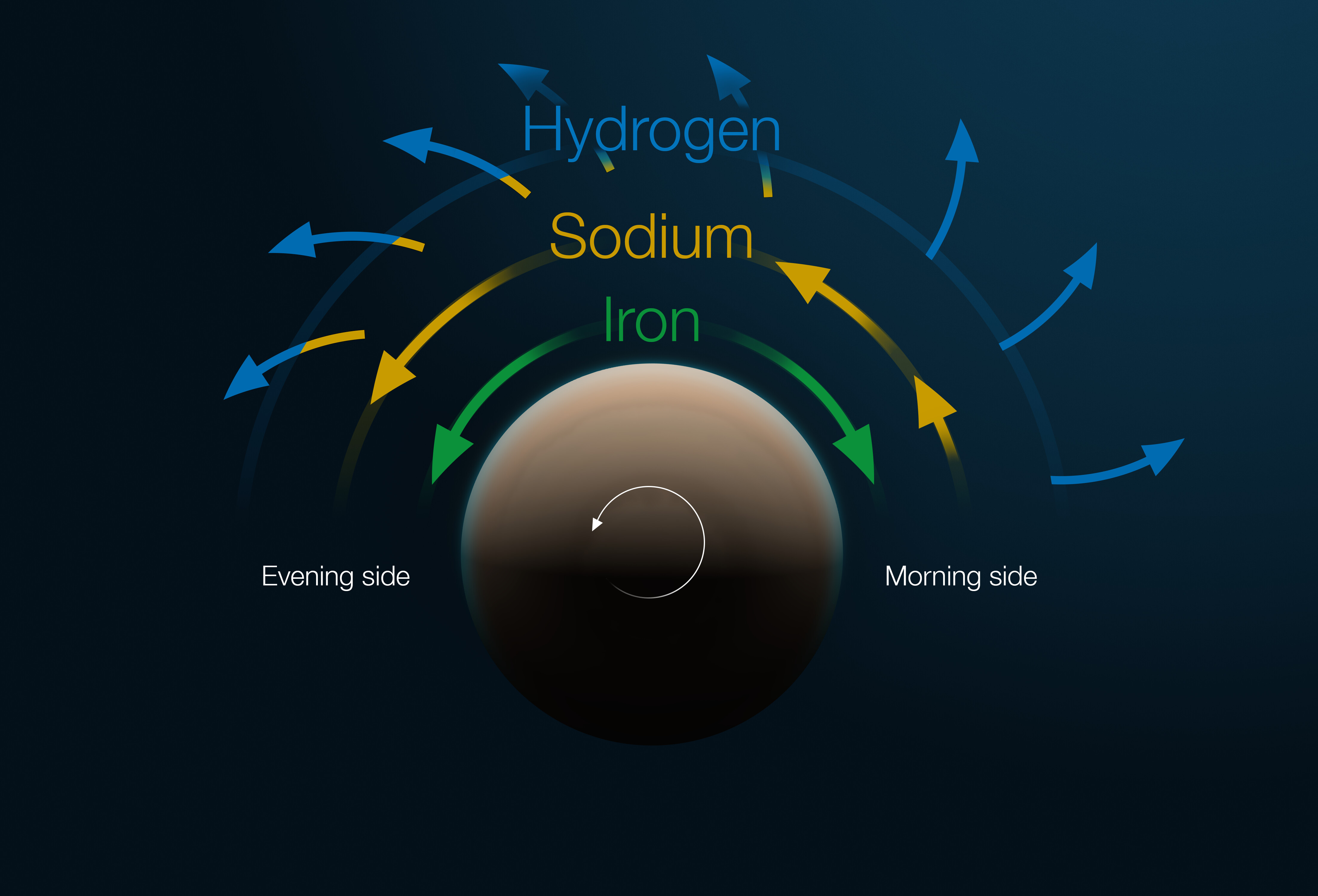
    In our study published in the journal Nature that was conducted by my colleague, Julia Seidel, we not only looked at wind speed on an exoplanet, but also at how these winds vary with altitude. We were able to measure for the first time that winds in the deepest layers of the atmosphere are very different from those at higher altitudes. Put it this way: on Earth, winds blowing a few dozen kilometres per hour already make it hard to ride a bike; on WASP-121b, pedalling would be impossible, because the winds are a hundred times faster.

    Our measurements reveal the behaviour of a pivotal zone of the atmosphere that forms the link between the deep atmosphere–usually surveyed by telescopes such as the James Webb Space Telescope–and the outer zones where the atmosphere escapes into space, blown by the wind coming from its star.

    How did we measure the atmosphere of a planet millions of billions of kilometres away?

    To make our measurements, we used one of the most precise spectrographs on Earth, mounted on the largest telescope available to us: ESPRESSO at the European Southern Observatory (ESO) Very Large Telescope (VLT), located in the Atacama desert in Chile. To collect as much light as possible, we combined the light from the VLT’s four 8-metre diameter telescopes. Thanks to this combination, which is still being tested, we collected as much light as would a 16-metre diameter telescope–which would be larger than any optical telescope on Earth.

    The ultra-precise ESPRESSO spectrograph then enabled us to separate the light from the planet into 1.3 million wavelengths. This allows us to observe as many colours in the visible spectrum. This precision is necessary to detect different types of atoms in the planet’s atmosphere. This time, we studied how three different types of atoms–absorb light from the star: hydrogen, sodium and iron (all in a gaseous state, given the very high temperatures).

    By measuring the position of these spectral lines very precisely, we were able to directly measure the speed of these atoms. The Doppler effect tells us that an atom coming toward us will absorb more blue light, while an atom moving away from us will absorb more red light. By measuring the absorption wavelength of each of these atoms, we have as many different measurements of the wind speed on this planet.

    We found that the lines of the different atoms tell different stories. Iron moves at 5 kilometres per second from the substellar point (the region of the planet closest to its host star) to the anti-stellar point (the most distant) in a very symmetrical way. Sodium, on the other hand, splits in two: some of the atoms move like iron, while the others move at the equator directly from east to west four times faster, at the staggering speed of 20 kilometres per second. Finally, hydrogen seems to move with the east-west current of sodium but, also, vertically, no doubt allowing it to escape from the planet.

    To reconcile all this, we calculated that these three different atoms are, in fact, in different parts of the atmosphere. While iron atoms lie at the deeper layers, where symmetrical circulation is expected, sodium and hydrogen let us probe much higher layers, where the planet’s atmosphere is blown by the wind coming from its host star. This stellar wind, combined with the rotation of the planet, probably carries the material asymmetrically, with a preferential direction given by the rotation of the planet.

    There are violent winds in the atmosphere of WASP-121b. The three types of atoms travel at different speeds, helping to reconstruct the structure of the atmosphere, even though the planet is millions of billions of kilometres away from Earth.
    ESO/M. Kornmesser, CC BY

    Why study the atmospheres of exoplanets?

    WASP-121b is one of those giant gaseous planets with temperatures of over 1,000°C that are known as “hot Jupiters”. The first observation of these planets by Michel Mayor and Didier Queloz (which later earned them a Nobel Prize in Physics) came as a surprise in 1995, particularly because planetary formation models predicted that these giant planets could not form so close to their star. Mayor and Queloz’s observation made us realise that planets do not necessarily form where they are currently located. Instead, they can migrate, i.e., move around in their youth.

    How far from their star do “hot Jupiters” form? Over what distances do these objects migrate in their infancy? Why did the Jupiter in our solar system not migrate toward the Sun? (We’re lucky it didn’t, because it would have sent Earth into our star at the same time.)

    Some answers to these questions may lie in the atmosphere of exoplanets, which exhibit traces of the conditions of their formation. However, variations in temperature or chemical composition within each atmosphere can radically skew the abundance measurements that we are trying to take with large telescopes such as the James Webb. In order to exploit our measurements, we first need to grasp how complex these atmospheres are.

    To do this, we need to understand the fundamental mechanisms that govern the atmosphere of these planets. In the solar system, winds can be measured directly by, for example, looking at how fast clouds move. On exoplanets, we cannot see any details directly.

    In particular, “hot Jupiters” orbit so close to their stars that we cannot separate them spatially and take photos of the exoplanets. Instead, from among the thousands of known exoplanets, we select those that have the good taste to periodically pass between their star and us. During this “transit”, light from the star is filtered by the planet’s atmosphere, which allows us to measure the signs of absorption by different atoms or molecules. In general, the data we obtain are not good enough to separate the light that passes on one side of the planet from the other, and we end up with an average of what the atmosphere has absorbed. As conditions along the atmospheric limb (i.e., the slice of atmosphere surrounding a planet as observed from space) can vary drastically, interpreting the final average is often a headache.

    This time, by using a telescope that, in effect, is larger than any other optical telescope on Earth, and combining it with an extremely precise spectrograph, we were able to separate the signal absorbed by the eastern side of the planet’s limb from the signal absorbed by the western side. This allowed us to measure the spatial variation of the winds in the planet.

    The future of atmospheric study of exoplanets

    Europe is currently building the next generation of telescopes, led by the ESO’s Extremely Large Telescope, which is scheduled for 2030. The ELT will have a mirror 30 metres in diameter, twice the size of the telescope we obtained by combining the light from the four 8-metre telescopes of the VLT.

    This giant telescope will gather even more precise details about the atmospheres of exoplanets. In particular, it will measure the winds in exoplanets both smaller and colder than “hot Jupiters”.

    But what we are all really waiting for is the ELT’s ability to measure the presence of molecules in the atmosphere of rocky planets orbiting in the habitable zone of their star, where water may be present in a liquid state.


    The EXOWINDS project is supported by the French National Research Agency (ANR), which funds project-based research in France. Its mission is to support and promote the development of fundamental and applied research in all disciplines, and to strengthen the dialogue between science and society. For more information, visit the ANR website.

    Vivien Parmentier received funding from the French National Research Agency (exowinds, ANR-23-CE31-0001-01).

    Julia Victoria Seidel is an ESO (European Southern Observatory) Research Fellow.

    – ref. A new study reveals the structure of violent winds 1,300 light years away – https://theconversation.com/a-new-study-reveals-the-structure-of-violent-winds-1-300-light-years-away-250187

    MIL OSI – Global Reports –

    February 28, 2025
  • MIL-OSI: Fusion Fuel Appoints Luisa Ingargiola to Board of Directors

    Source: GlobeNewswire (MIL-OSI)

    DUBLIN, Feb. 27, 2025 (GLOBE NEWSWIRE) — via IBN – Fusion Fuel Green PLC (Nasdaq: HTOO) (“Fusion Fuel” or the “Company”), a leading provider of gas and hydrogen energy solutions, today announced the appointment of Luisa Ingargiola to its Board of Directors, effective February 24, 2025. Ms. Ingargiola will serve as chairperson of the Audit Committee, replacing Rune Magnus Lundetrae, who will remain a member of the Board. She will also serve as a member of the Nominating Committee, Audit Committee, and Compensation Committee. Following Ms. Ingargiola’s appointment, the Board will be comprised of six directors, four of whom have been determined by the Board to be “independent directors” under the Nasdaq Listing Rules.

    Commenting on the appointment, Jeffrey Schwarz, Chairman of Fusion Fuel, said, “Luisa’s extensive experience in public company governance, capital markets, and financial oversight, coupled with her track record of supporting high-growth companies through complex strategic and financial initiatives, make her a tremendous asset to Fusion Fuel. Her expertise will be invaluable as we continue to execute our business strategy and drive long-term value creation. On behalf of my fellow directors, I want to welcome Luisa and look forward to benefiting from her insight and leadership as we build the new Fusion Fuel and position the company for sustainable growth.”

    Ms. Ingargiola currently serves as Chief Financial Officer of Avalon GloboCare Corp. (Nasdaq: ALBT) and as a board director for Vision Marine Technologies, Inc. (Nasdaq: VMAR) and BioCorRx Inc. (OTCQB: BICX), where she also chairs the Audit Committees. Earlier in her career, Ms. Ingargiola was CFO and co-founder of BBHC, Inc., formerly known as MagneGas Corporation. Ms. Ingargiola graduated from Boston University with a bachelor’s degree in Business Administration and a concentration in Finance. She also received a Master of Health Administration from the University of South Florida.

    About Fusion Fuel Green PLC

    Fusion Fuel Green PLC (Nasdaq: HTOO) is an emerging leader in the energy services sector, offering a comprehensive suite of energy engineering and advisory solutions through its Al-Shola Gas and BrightHy brands. Al Shola Gas provides full-service industrial gas solutions, including the design, supply, and maintenance of liquefied petroleum gas (LPG) systems, as well as the transport and distribution of LPG to a broad range of customers across commercial, industrial, and residential sectors. BrightHy, the Company’s newly launched hydrogen solutions platform, focuses on delivering innovative engineering and advisory services that enable decarbonization across hard-to-abate industries.

    Learn more about Fusion Fuel by visiting our website at https://www.fusion-fuel.eu and following us on LinkedIn.

    Forward-Looking Statements

    This press release includes “forward-looking statements.” Forward-looking statements may be identified by the use of words such as “estimate,” “plan,” “project,” “forecast,” “intend,” “will,” “expect,” “anticipate,” “believe,” “seek,” “target”, “may”, “intend”, “predict”, “should”, “would”, “predict”, “potential”, “seem”, “future”, “outlook” or other similar expressions (or negative versions of such words or expressions) that predict or indicate future events or trends or that are not statements of historical matters. These forward-looking statements are not guarantees of future performance, conditions or results, and involve a number of known and unknown risks, uncertainties, assumptions and other important factors, many of which are outside the Company’s control, that could cause actual results or outcomes to differ materially from those discussed in the forward-looking statements. Fusion Fuel has based these forward-looking statements largely on its current expectations, including but not limited the ability of the investment reported on to be consummated as anticipated. Such forward-looking statements are subject to risks and uncertainties (including those set forth in Fusion Fuel’s Annual Report on Form 20-F for the year ended December 31, 2023, filed with the Securities and Exchange Commission) which could cause actual results to differ from the forward-looking statements.

    Investor Relations Contact
    ir@fusion-fuel.eu

    Wire Service Contact:
    IBN
    Austin, Texas
    www.InvestorBrandNetwork.com
    512.354.7000 Office
    Editor@InvestorBrandNetwork.com

    The MIL Network –

    February 28, 2025
  • MIL-OSI Europe: Reverse combustion

    Source: European Investment Bank

    What if carbon dioxide could itself be turned into a fuel? Such a neat solution for the waste gas that’s causing climate change may be just round the corner, because German start-up INERATEC has developed a chemical process to do just that.

    “We’re reversing the combustion process,” explains Tim Boeltken, INERATEC’s chief executive. “The chemical process we’ve created takes the greenhouse gas CO2 that nobody wants and combines it with green hydrogen to create a synthetic hydrocarbon fuel.”

    INERATEC’s method could reduce emissions in a number of sectors that have few clean alternatives, including aviation, which accounts for a growing share of global greenhouse gas emissions. The company already has clients in the aviation, shipping and chemicals industries, but to demonstrate its technology at a larger scale, it is building a facility near Frankfurt airport with the backing of a €40 million venture debt loan from the European Investment Bank. The deal is supported by the European Union’s InvestEU programme and includes a €30 million grant from Breakthrough Energy Catalyst, a financing platform for climate innovation founded by Bill Gates.

    “The aviation industry is struggling to decarbonize,” says Stephan Mitrakas, a senior loan officer who worked on the deal at the European Investment Bank. “Alternatives to jet fuel, such as electricity and hydrogen, both have major drawbacks and would require the development of a completely new infrastructure set up for transport, storage and fueling.”

    “The beauty of synthetic fuels is that you can keep the infrastructure we already have,” Mitrakas adds. “You can take the synthetic fuel from INERATEC, mix it in with the kerosene that planes currently use, and the aeroplane will work. INERATEC is the most promising start-up in the field right now, certainly in Europe and probably in the world.”

    MIL OSI Europe News –

    February 28, 2025
  • MIL-OSI Global: We need to switch to heat pumps fast – but can they can overcome this problem?

    Source: The Conversation – UK – By Jack Marley, Environment + Energy Editor, UK edition

    StockMediaSeller/Shutterstock

    People in the UK need to adopt heat pumps and electric vehicles as fast as they once embraced refrigerators, mobile phones and internet connection according to a new report by the Climate Change Committee (CCC).

    This government watchdog says the next 15 years will be critical for decarbonising the UK, one of the world’s largest (and earliest) carbon polluters. Eighty-seven percent of its climate-heating emissions must be eliminated by 2040 to keep the country on track for net zero emissions by mid-century, per the report. The majority (60%) of these cuts are expected to come via a single source: electricity.


    This roundup of The Conversation’s climate coverage comes from our award-winning weekly climate action newsletter. Every Wednesday, The Conversation’s environment editor writes Imagine, a short email that goes a little deeper into just one climate issue. Join the 40,000+ readers who’ve subscribed.


    Out of possible alternatives to a fossil fuelled economy, electrification has emerged as the favoured solution of experts at the CCC.

    Ran Boydell, an associate professor in sustainable development at Heriot-Watt University, agrees. “Home boilers will very soon move into the realm of nostalgia,” he says.


    Read more:
    UK ban on boilers in new homes rules out hydrogen as a heating source


    The reason why heat pumps are increasingly touted as the future of home heating – and not retooled boilers that burn hydrogen instead of methane – is efficiency.

    Boydell points out that green hydrogen fuel is made using electricity from solar and wind farms. We could eliminate emissions a lot quicker, he argues, if that electricity went directly to heat pumps instead.

    Electricity can be turned into a fuel – or power appliances directly.
    Piyaset/Shutterstock

    “This is because you end up with only two-thirds of the energy in the hydrogen that you started with from the electricity,” he says.

    Likewise, battery-powered vehicles have an advantage that has allowed them to race ahead of hydrogen fuel cells to comprise almost a fifth of all new vehicles sold in the UK in 2024.

    “An electric vehicle can be recharged wherever there is access to a plug socket,” say Tom Stacey and Chris Ivory, supply chain experts at Anglia Ruskin University. “The infrastructure that exists to support hydrogen vehicles is limited in comparison and will require extensive investment to introduce.”


    Read more:
    The days of the hydrogen car are already over


    If the route to zero emissions is largely settled, we need to travel it quickly.

    Electric dreams

    One of the fastest energy transitions in history occurred over a decade in South Korea, according to energy system researchers James Price and Steve Pye (UCL). Between 1977 and 1987, the generation of electricity from oil in the east Asian country collapsed – from roughly 7 million gigawatt-hours to nearly 7,000 – and was replaced with, among other sources, nuclear power.

    There are historic analogues for the rapid shift necessary to arrest climate change. But a zero-carbon power sector, which the UK government aims to achieve by 2030, is just the start.


    Read more:
    For developing world to quit coal, rich countries must eliminate oil and gas faster – new study


    “Wind and solar, which provide more than 28% of the UK’s electricity, will soon overtake gas as the main generation source as more wind farms come online,” say energy system modeller Andrew Crossland and engineer Jon Gluyas, both of Durham University.

    “But successive governments have failed to achieve the same result in homes and communities where so much high-carbon gas is burned, despite their decarbonisation being critical to net zero.”


    Read more:
    Is Britain on track for a zero-carbon power sector in six years?


    Crossland and Gluyas note that solar panels, batteries and heat pumps can be installed “in days” to rapidly cut emissions, and that doing so would create “skilled jobs across the country”. As things stand, however, it would also present a severe challenge to the grid.

    Mechanical engineer Florimond Gueniat of Birmingham City University predicts that converting UK transport to battery power wholesale would require expanding grid capacity by 46% – the equivalent of erecting 5,800 skyscraper-sized wind turbines. And that’s even accounting for the greater efficiency of electric vehicles, which waste less of the energy we put into them compared with oil-powered cars.


    Read more:
    Switching to electric vehicles will push the power grid to the brink


    A massive upgrade to the electricity network is needed, and ordinary people have a part to play. Charging cars could serve as batteries that grid operators draw from during a supply pinch. The same goes for the power generated by solar panels on top of houses.

    “Such policies in Germany have … already offset 10% of the national demand,” says Gueniat.

    Getting to net zero requires the public’s involvement. But some of the CCC’s advice may be difficult to swallow. Not least the implication that people will have to eat 35% less meat and dairy in 2050 compared with 2019.


    Read more:
    The UK must make big changes to its diets, farming and land use to hit net zero – official climate advisers


    So are people ready for a world that runs on electrons alone? Aimee Ambrose, a professor of energy policy at Sheffield Hallam University, thinks heat pumps will struggle to compete with the inviting warmth of wood stoves and coal fires. Over three years she spoke with hundreds of people in the UK, Finland, Sweden and Romania and found strong attachments to high-carbon fuels even among people committed to solving climate change.

    The allure of the wood stove is hard to ignore.
    Jaromir Chalabala/Shutterstock


    Read more:
    Heat pumps have a cosiness problem


    Human behaviour is the most difficult variable for experts who study climate change to model. There will certainly be drawbacks to abandoning fossil fuelled conveniences at breakneck speed. Yet, there are bound to be benefits too – some of which might only materialise once we get going.

    In mid-April 2020, while much of humanity was under some form of lockdown to halt the spread of COVID-19, atmospheric chemist Paul Monks of the University of Leicester was marvelling at the sudden drop in air pollution, which kills millions of people each year and is predominantly caused by burning coal, oil and gas.

    “If there is something positive to take from this terrible crisis, it could be that it’s offered a taste of the air we might breathe in a low-carbon future,” he said.


    Read more:
    Coronavirus: lockdown’s effect on air pollution provides rare glimpse of low-carbon future


    – ref. We need to switch to heat pumps fast – but can they can overcome this problem? – https://theconversation.com/we-need-to-switch-to-heat-pumps-fast-but-can-they-can-overcome-this-problem-249658

    MIL OSI – Global Reports –

    February 27, 2025
  • MIL-OSI USA: NASA Stennis Flashback: Learning About Rocket Engine Smoke for Safe Space Travel

    Source: NASA

    NASA’s Stennis Space Center near Bay St. Louis, Mississippi, is widely known as the nation’s largest rocket propulsion test site. More than 35 years ago, it also served as a hands-on classroom for NASA engineers seeking to improve the efficiency of space shuttle main engines.
    From 1988 to the mid-1990’s, NASA Stennis engineers operated a Diagnostic Test Facility to conduct rocket engine plume exhaust diagnostics and learn more about the space shuttle main engine combustion process. The effort also laid the groundwork for the frontline research-and-development testing conducted at the center today.
    “The Diagnostic Test Facility work is just another example of the can-do, will-do attitude of the NASA Stennis team and of its willingness to support the nation’s space exploration program in all ways needed and possible,” said Joe Schuyler, director of the NASA Stennis Engineering and Test Directorate.

    joe schuyler
    NASA Stennis Engineering and Test Directorate Director

    Envision a rocket or space vehicle launching into the sky. A trail of bright exhaust, known as the engine plume, follows. As metals wear down in the engines from the intense heat of the combustion process, the flame glows with colors, some visible, such as orange or yellow, and others undetectable by the human eye.
    The colors tell a story – about the health and operation of the engine and its components. For space shuttle main engines, which flew on multiple missions, engineers needed to understand that story, much as a doctor needs to understand the condition of a human body during checkup, to ensure future engine operation.
    Where better place to study such details than the nation’s premier propulsion test site? Paging NASA Stennis.

    NASA Stennis has long enabled and supported innovative and collaborative work to benefit both the agency and the commercial space industry. When NASA came calling in the late 1980s, site engineers went to work on a plan to study space shuttle main engine rocket exhaust.
    The concept for an enabling structure about the size of a home garage was born in October 1987. Five months later, construction began on a Diagnostic Testbed Facility to provide quality research capabilities for studying rocket engine exhaust and learning more about the metals burned off during hot fire.
    The completed facility featured a 1,300-square-foot control and data analysis center, as well as a rooftop observation deck. Small-scale infrastructure was located nearby for testing a 1,000-pound-thrust rocket engine that simulated the larger space shuttle main engine. The 1K engine measured about 2 feet in length and six inches in diameter. Using a small-scale engine allowed for greater flexibility and involved less cost than testing the much-larger space shuttle engine.

    Engineers could quickly conduct multiple short-duration hot fires using the smaller engine. A six-second test provided ample time to collect data from engine exhaust that reached as high as 3,900 degrees Fahrenheit.
    Chemical solutions simulating engine materials were injected into the engine combustion chamber for each hot fire. The exhaust plume then was analyzed using a remote camera, spectrometer, and microcomputers to determine what colors certain metals and elements emit when burning.
    Each material produced a unique profile. By matching the profiles to the exhaust of space shuttle main engine tests conducted at NASA Stennis, determinations could be made about which engine components were undergoing wear and what maintenance was needed.

    Glenn Varner
    NASA Stennis Engineer

    The Diagnostic Testbed Facility played a critical safety role for engine operations and also provided a real-time opportunity for NASA Stennis engineers to learn about exhaust diagnostics.
    Multiple tests were conducted. The average turnaround time between hot fires was 18 to 20 minutes with the best turnaround from one test to another taking just 12 minutes. By January 1991, the facility had recorded a total of 588 firings for a cumulative 3,452 seconds.
    As testing progressed, the facility team evolved into a collection of experts in plume diagnostics. Longtime NASA Stennis engineer Glenn Varner serves as the mechanical operations engineer at the Thad Cochran Test Stand, where he contributed to the successful testing of the first SLS (Space Launch System) core stage onsite.
    However, much of Varner’s hands-on experience came at the Diagnostic Test Facility. “We learned about purging, ignition, handling propellants, high-pressure gases, and all the components you had to have to make it work,” he said. “It was a very good learning experience.”

    joe schuyler
    NASA Stennis Engineering and Test Directorate Director

    The Diagnostic Testbed Facility impacted more than just those engineers involved in the testing. Following the initial research effort, the facility underwent modifications in January 1993. Two months later, facility operators completed a successful series of tests on a small-scale liquid hydrogen turbopump for a California-based aerospace company.
    The project marked an early collaboration between the center and a commercial company and helped pave the way for the continued success of the NASA Stennis E Test Complex. Building on Diagnostic Testbed Facility knowledge and equipment, the NASA Stennis complex now supports multiple commercial aerospace projects with its versatile infrastructure and team of propulsion test experts.
    “The physical remnants of the Diagnostic Testbed Facility are barely recognizable now,” Schuyler said. “But that spirit and approach embodied by that effort and its teams continues in force at the center.”
    Additional Information
    NASA Stennis has leveraged hardware and expertise from the Diagnostic Testbed Facility to provide benefit to NASA and industry for two decades and counting.
    The facility’s thruster, run tanks, valves, regulators and instrumentation were used in developing the versatile four-stand E Test Complex at NASA Stennis that includes 12 active test cell positions capable of various component, engine, and stage test activities.
    “The Diagnostic Testbed Facility was the precursor to that,” said NASA engineer Glenn Varner. “Everything but the structure still in the grass moved to the E-1 Test Stand, Cell 3. Plume diagnostics was part of the first testing there.”
    When plume diagnostic testing concluded at E-1, equipment moved to the E-3 Test Stand, where the same rocket engine used for the Diagnostic Testbed Facility has since performed many test projects.
    The Diagnostic Testbed Facility thruster also has been used for various projects at E-3, most recently in a project for the exploration upper stage being built for use on future Artemis missions. 
    In addition to hardware, engineers who worked at the Diagnostic Testbed Facility also moved on to support E Test Complex projects. There, they helped new NASA engineers learn how to handle gaseous hydrogen and liquid hydrogen propellants. Engineers learned about purging, ignition, and handling propellants and all the components needed for a successful test.
    “From an engineering perspective, the more knowledge you have of the processes and procedures to make propulsion work, the better off you are,” Varner said. “It applied then and still applies today. The Diagnostic Testbed Facility contributed to the future development of NASA Stennis infrastructure and expertise.”

    MIL OSI USA News –

    February 27, 2025
  • MIL-OSI Global: Alberta’s oil and gas wells threaten people’s health, but there are disparities in who is most at risk

    Source: The Conversation – Canada – By Martin Lavoie, Senior Scientist and Data Analyst, St. Francis Xavier University

    Around 13 per cent of Albertans live within 1.5 kilometres of an active oil or gas well. Given the link between oil and gas production and ill health, this leaves a significant proportion of the province’s population at risk.

    But certain groups may be at a disproportionately greater risk, according to recent research our team published. Our study revealed stark socioeconomic disparities in those at the greatest risk of health problems due to their proximity to an oil or gas well — with Indigenous people and those who were less educated most affected.

    The link between oil and gas production, air pollution and human health is well documented. Oil and gas production emits numerous pollutants into the air we breathe. These pollutants are associated with poor cardiovascular and respiratory health.

    But while numerous studies have been published on the link between proximity to oil and gas producers and ill health, this data has mainly come from the United States — the world’s leading oil and gas producer. Relatively little research on this topic has been done in Canada. This is what our recent research sought to do.

    Alberta residents

    The study examined Alberta — the province which in 2023 was responsible for 80 per cent of Canada’s oil, and 61 per cent of its gas production. We analyzed multiple datasets including census, health, emissions and oil and gas activity data. This allowed our lab to create the first spatial understanding of oil and gas air pollution in Alberta.

    This also made it possible to identify the sociodemographic characteristics of those living nearest the pollution’s source, alongside their experiences with cardiovascular or respiratory health issues.

    The study found that over 360,000 Albertans live within one kilometre of an active oil or gas well. Nearly half a million people live within 1.5 kilometres of one. These are significant numbers considering the province only has around four million residents.

    Albertans living within one or 1.5 kilometres of an active oil and gas well are more likely to be rural residents (10 per cent), people with less formal education (20 per cent) and Indigenous people (21 per cent).

    Our findings align with previous studies which have shown that people with similar sociodemographic characteristics are more likely to experience worse health outcomes compared to the general population.

    Unnervingly, our study also found that those living within at least 1.5 kilometres of an oil or gas well faced an estimated nine to 21 per cent higher risk of experiencing cardiovascular or respiratory issues due to their proximity. The closer a person lived to an oil or gas well, the greater their risk.

    Although we adjusted our findings for age and sex, there was no information available in the datasets we used on other factors which may have affected the results, such as lifestyle habits or pre-existing health conditions. It will be important for more research to be conducted on this topic which takes these factors into account.

    Health risks

    Our findings align with other published studies on the topic which have found a link between health issues and proximity to oil and gas producers.

    Notably, much of the oil and gas workforce are located in rural areas near production facilities. This may explain why our study found rural residents were more likely to experience health issues from oil and gas wells.

    Our findings also align with research from the U.S. on this topic. For comparison, a 2022 study found nearly 18 million U.S. residents live within 1.6 kilometres of an active oil and gas well, with some states such as West Virginia and Oklahoma seeing over 50 per cent of their total population in this proximity. Research has also found similar socioeconomic disparities in exposure to oil and gas wells in the U.S. as our study did.

    Our study highlights the need for more research on this topic, especially since it has been suggested that oil and gas emissions are often underestimated. It’s possible that even more people are impacted than our study determined.

    It will also be important for studies to investigate the effects of specific oil and gas pollutants (such as nitrogen oxides and volatile organic compounds) on health. Currently in Alberta, regulations on the minimum distance between residents and oil and gas wells primarily focus on hydrogen sulphide levels.

    Overlooking other relevant air pollutants may mean that minimum setbacks from pollution sources may be insufficient, especially given the impacts our study showed in those residing within 1.5 kilometres of an oil or gas well.

    Nearly 100 countries produce oil and gas. Air emissions from this sector represent an urgent global problem. Targeted actions such as stricter policies for air emissions, as well as health risk assessments when building developments, are necessary to protect people living in these regions.

    David Risk receives funding from the Natural Sciences and Engineering Research Council

    Martin Lavoie and Matthew Rygus do not work for, consult, own shares in or receive funding from any company or organisation that would benefit from this article, and have disclosed no relevant affiliations beyond their academic appointment.

    – ref. Alberta’s oil and gas wells threaten people’s health, but there are disparities in who is most at risk – https://theconversation.com/albertas-oil-and-gas-wells-threaten-peoples-health-but-there-are-disparities-in-who-is-most-at-risk-249637

    MIL OSI – Global Reports –

    February 27, 2025
  • MIL-OSI Global: Will the UK’s proposed long-term emissions strategy get us to net zero? An expert review

    Source: The Conversation – UK – By John Barrett, Professor of Energy and Climate Policy, Deputy Director of the Priestly Centre for Climate Futures, Theme Lead for the UKRI Energy Demand Research Centre, University of Leeds

    In the seventh carbon budget, electric vehicles are key to reducing carbon emissions. nrqemi / shutterstock

    The UK government’s official advisory Climate Change Committee (CCC) has now published its recommendations for the country’s “seventh carbon budget”, covering the period from 2038 to 2042.

    This advice provides robust evidence for the government to set legally binding limits on greenhouse gas emissions over this five year period, while striving to meet its international commitments on climate change.

    The late 2030s may seem far off, but long-term planning is essential. Achieving these targets requires the rollout of low-carbon technologies and the building of consensus for social change. It takes a long time to plan, design and build a power plant or factory.

    It could take even longer to change social norms and values around flying, driving or the foods we eat. Setting targets more than a decade in advance gives much needed clarity to investors, businesses and citizens on the direction of travel.

    Colleagues and I at the University of Leeds’s Climate Evidence Unit have produced a detailed analysis of the nearly 400 page CCC report. One key takeaway is that the transition to net zero is not only possible but highly beneficial.

    Academic analyses (including our own) consistently support this conclusion, showing that it will strengthen the economy and position the UK as a leader in global climate action. And it will deliver warmer homes, cheaper household bills, reduced air pollution, greater energy security with less reliance on imported gas, and many other benefits.

    While the report acknowledges the upfront costs, it confirms that acting now will reduce expenses in the long run, with cost savings emerging by the late 2030s and beyond. However, the report significantly underestimates the full economic impacts of the transition, as the CCC’s analysis does not factor in the financial losses associated with extreme weather and other effects of climate change.

    These losses could be substantial. A recent report by the Institute and Faculty of Actuaries suggests the effects of climate change could shrink global GDP by 50% between 2070 and 2090. When combined with the additional benefits of climate action, it’s clear that a “do nothing” approach is simply not an option.

    The CCC’s proposed plan to achieve this goal, known as the “balanced pathway”, leans heavily on key technologies while placing less emphasis on broader societal changes that help to fully realise these benefits. Compared to the sixth carbon budget report from 2020, this latest analysis gives greater consideration to reducing demand for energy, but the technological bias remains.

    It’s politically easier to boost electric vehicles than it is to get people to drive less.
    brian.martin.photographer / shutterstock

    There is a sense that the report pre-empts what the government would prefer as opposed to challenging current thinking. The problem with this approach is that failing to fully address demand makes the technological transition harder and more expensive than necessary, and increases the risk of failure. More energy must be generated, more car miles need to be driven, and more materials and products must be supplied.

    The technological transition

    So, what technologies are expected to drive emissions reductions? The first key point is the increasing reliance on technologies that, although they are already available, still need to be deployed at scale. These include electric vehicles, heat pumps for both households and industry, and the rapid expansion of solar and wind power.

    In contrast, the report places less emphasis than previous recommendations on currently expensive and emerging technologies, such as hydrogen power or “direct air capture” – essentially huge machines that filter carbon from the air. This is very welcome as it keeps the focus on decarbonisation, rather than emitting now and cleaning up later.

    This shift is particularly evident when examining individual sectors, where the focus is on scaling up existing solutions rather than banking on future technological breakthroughs.

    Surface transport, for instance, accounts for about a quarter of the UK’s emissions. The report places heavy reliance on electric vehicles (EVs), projecting that they will be responsible for 72% of all surface transport emissions reduced between 2025 and 2050.

    To put this into perspective, from this point forward, the UK would need to substantially outpace Norway, the current global leader in EV adoption. In contrast, only 11% of total emissions reductions are attributed to people shifting from driving to public transport or walking and cycling.

    Switching from gas boilers to heat pumps like these will deliver most household emissions savings.
    Wozzie/Shutterstock

    Electrification is also expected to be the primary driver of emissions reductions in both homes and the industrial sector, mostly through replacing gas heating with heat pumps. This will be a particular challenge in industries which require high temperature heat pumps, a technology that hasn’t been installed yet.

    Efficiency measures and unsustainably high consumption patterns receive less attention in the industry section. In homes, improved insulation will reduce demand though there is little space for new and additional energy saving actions.

    In the food and farming sector, the report identifies three roughly equal sources of emissions reductions: low-carbon farming, reductions in livestock numbers, and land management improvements. The reduction in livestock numbers primarily reflects lower meat and dairy consumption, while the other measures rely predominantly on technological solutions.

    Overall, this is a very welcome report from the Climate Change Committee with a robust analysis that lets the government, industry and citizens know that the pathway to net zero is possible and very much needed. However, it does place enormous responsibility on some key technologies and their rapid roll out to achieve these goals.

    As the UK government digests the findings, my colleagues and I would suggest greater consideration of the “social” transformation that examines how we travel and what we buy, to fully unlock the benefits of net zero.


    Don’t have time to read about climate change as much as you’d like?

    Get a weekly roundup in your inbox instead. Every Wednesday, The Conversation’s environment editor writes Imagine, a short email that goes a little deeper into just one climate issue. Join the 40,000+ readers who’ve subscribed so far.


    John Barrett receives funding by the Priestly Centre for Climate Futures where he holds the position of Deputy Director of Policy. He is also funded by a UKRI centre, called the Energy Demand Research Centre where he is the Futures theme lead.

    – ref. Will the UK’s proposed long-term emissions strategy get us to net zero? An expert review – https://theconversation.com/will-the-uks-proposed-long-term-emissions-strategy-get-us-to-net-zero-an-expert-review-250845

    MIL OSI – Global Reports –

    February 27, 2025
  • MIL-OSI: Haffner Energy successfully commissioned its hydrogen-from-biomass production unit in Marolles, France – a breakthrough for the hydrogen industry

    Source: GlobeNewswire (MIL-OSI)

    Vitry-le-François, France – February 26, 2025, 6:00 PM (CEST)

    • Commissioning of the world’s first plant producing hydrogen from solid biomass at the Marolles site (Champagne region, France).
    • Unique thermochemical process that significantly reduces green hydrogen costs.
    • “Super green”1 hydrogen available for commercial use beginning the second half of 2025.

    Haffner Energy (ISIN: FR0014007ND6 – Ticker: ALHAF) announces the commencement of hydrogen2 production utilizing its proprietary solid biomass thermolysis technology at its Marolles hydrogen production, testing, and training center, as was announced in the 12/17/2024 press release. This unique technology enables the production of renewable hydrogen at a substantially lower cost compared to conventional methods, while offering an unparalleled carbon footprint.

    “Achieving the continuous production of competitive green hydrogen is a decisive step. Currently, the industry faces significant delays due to the excessive cost of decarbonized hydrogen. We are confident that our solution will accelerate the adoption of renewable hydrogen and enhance the sector’s competitiveness. I want to congratulate the Haffner Energy team and our partners for this remarkable achievement, ushering the company into a new era,” stated Philippe Haffner, Co-founder and CEO of Haffner Energy.

    A Flexible and Economically Advantageous Production Model

    The site’s production capacity will be 15 kg of hydrogen per hour (kg/h), with an initial phase temporarily limited to 11 kg/h due to the existing PSA (Pressure Swing Adsorption) purification equipment. This equipment will be replaced in the coming months by a PSA designed to reach a 15 kg/h capacity. The unit already produces hydrogen at 8 bar pressure, ready for commercial distribution starting in the second half of 2025 to serve transportation and industrial markets.

    Anticipated since late 2024, this commissioning required the site to be connected to the medium-voltage electrical grid, which was completed earlier this year, followed by the on-site presence of commissioning engineers focused on the main equipment suppliers for hydrogen purification.

    The biomass thermolysis unit, operational since June 2024, exceeds the capacity required to produce 15 kg/h of hydrogen. The new PSA, already received by Haffner Energy, will be complemented by a compressor reaching 35 bar pressure, supplying an H14 distribution station provided by HRS.

    Marolles is designed to operate 8,000 hours per year. As part of this site’s operations, 120 metric tons of mobility-grade hydrogen per year (15 kg/hour) will be produced, contributing to the decarbonization of mobility and industry. This is equivalent to 12 million kilometers traveled with hydrogen vehicles. Approximately 2,400 metric tons of CO₂ per year will be avoided or captured through hydrogen and biocarbon (char or biochar) combined.

    A memorandum of understanding for the offtake has been signed for the supply of 90 tonnes of hydrogen per year, mainly for mobility applications, which is designed to ensure a commercial outlet within the next few months.

    Hydrogen Production from Residual Solid Biomass: A Game Changer

    The scaling up of Haffner Energy’s proprietary biomass thermolysis technology is poised to disrupt the global and French renewable hydrogen markets, facilitating accelerated commercial and industrial development. This technology offers several key advantages:

    • Economically Competitive Solution: Already capable of competing with gray hydrogen for installations of 20 MW and above – a feat far from achievable by alternative technologies.
    • Economic Model Based on Low-Cost Biomass Energy: Hydrogen from biomass thermolysis is significantly cheaper to produce than hydrogen from the electrolysis of water thanks to low primary energy costs (<30€/MWh and often even <20€/MWh, compared with >70€/MWh for decarbonized electricity) and optimal energy efficiency (generally >70%).
    • Independence from the Electrical Grid: Unlike electrolysis, thermolysis is minimally dependent on electricity availability and cost, ensuring stable and predictable production.
    • Negative Carbon Footprint: This technology sequesters biogenic carbon through biochar co-production, achieving a negative carbon footprint when considering the full LCA.3
    • Flexible Sourcing: This biomass-agnostic technology is able to utilize various residual biomasses, in particular from agriculture, ensuring greater autonomy and resilience against feedstock market fluctuations while significantly expanding available resources.

    Towards Commercial and Industrial Expansion

    The commissioning of the Marolles unit marks a strategic milestone for Haffner Energy. This success accelerates commercial discussions with several partners interested in this disruptive technology and, as announced in previous communications, will enable the Company’s project pipeline to be converted into firm orders, thereby generating revenue. In particular, the effective commissioning of the site is a catalyst for finalizing the signing of two major contracts.

    The continuous operation of hydrogen and renewable gas production equipment on site will also enable Haffner Energy’s team to conduct tests using specific biomasses for each potential client, including non-conventional biomasses such as organic sludge, manure, and algae, thereby confirming the compatibility of Haffner Energy’s technology.

    Furthermore, Haffner Energy is now positioned to leverage a previously untapped technological solution that converts hydrogen into electricity at an extremely competitive cost, highly valuable during peak consumption periods.

    Despite a global context that remains unfavorable to the development of the hydrogen market, particularly in Europe and in France—where the national hydrogen strategy has yet to be announced—Haffner Energy’s position in this high-potential market is now strengthened.

    Additional resources

    Next events 

    • Annual results 2024-2025                         June 18, 2025
    • Annual Shareholders Meeting                  September 10, 2025

    About Haffner Energy

    Haffner Energy is a French company providing solutions for competitive clean fuels production. With a 32- year experience converting biomass into renewable energies, it has developed innovative proprietary biomass thermolysis and gasification technologies to produce renewable gas, hydrogen and methanol, as well as Sustainable Aviation Fuel (SAF). The company also contributes to regenerating the planet through the co-production of biogenic CO2 and biocarbon (or char/biochar). Haffner Energy is listed on Euronext Growth (ISIN code : FR0014007ND6 – Ticker : ALHAF).

    Investor Relations

    investisseurs@haffner-energy.com

    Media Relations

    Laure BOURDON
    laure.bourdon@haffner-energy.com
    +33 (0) 7 87 96 35 15

    Glossary:

    * Biocarbon is a carbon-rich solid material. Biocarbon contains biogenic carbon absorbed from the atmosphere by plants via photosynthesis. This characteristic makes it a major carbon sink when used as a soil amendment, either applied directly or incorporated into fertilizers (known as biochar), or incorporated into building materials (known as char). Biocarbon is also a very dense source of renewable energy (31 MJ/kg) that can be gasified on site to increase the production of biofuels such as bio-SAF or the production of renewable hydrogen, but can also be shipped and gasified at another site, notably for the production of e-fuels.

    1 In accordance with the order of July 1, 2024 specifying the greenhouse gas emission threshold and the methodology for qualifying hydrogen as renewable or low-carbon.

    2 Samples were taken today by an independent laboratory to validate the mobility quality of this hydrogen.

    3 In accordance with the life cycle assessment study carried out by the LCA consultancy EVEA at the end of 2021.

    Attachment

    • PR_H2production_Marolles_EN_20250226

    The MIL Network –

    February 27, 2025
  • MIL-OSI: Turbo Energy Unveils SUNBOX Home Lite, the Next Generation in AI-Optimized, All-In-One Solar Energy Storage Solution for Residential Installations Throughout Spain

    Source: GlobeNewswire (MIL-OSI)

    VALENCIA, Spain, Feb. 26, 2025 (GLOBE NEWSWIRE) — Turbo Energy, S.A. (NASDAQ:TURB) (“Turbo Energy” or the “Company”), a global provider of leading-edge, AI-optimized solar energy storage technologies and solutions, today proudly announced official market launch of the Company’s latest innovation in smart photovoltaic energy storage tailored for smaller residential installations – the SUNBOX Home Lite.

    Turbo Energy and Solar360 Introduce SUNBOX Home Lite, the Latest Innovation in All-In-One Solar Energy Storage Solutions

    SUNBOX Home Lite combines the sleek design and robust functionality of the original SUNBOX Home with a focus on homes requiring less than 15kh of solar energy storage. This cutting edge innovation is supported by Turbo Energy’s state-of-the-art cloud-based SaaS solution, which leverages Artificial Intelligence to provide intelligent data collection, optimized stored energy management and predictive analytics which provide real-time insight into weather and electricity price forecasts, solar panel performance, energy consumption and material cost savings opportunities.

    Turbo Energy has shipped 100 units to Solar360, which are available for immediate installation. A longstanding valued partner of Turbo Energy, Solar360, a joint venture of Repsol and Telefónica España, is engaged in the photovoltaic self-consumption business offering comprehensive solutions for individual customers; communities of neighbors; and companies, both SMEs and large corporations, through solar panel installations. In addition to the reach of its channels and its strength in operations and distribution, Telefónica contributes its technological expertise and IoT capabilities to provide differential optimization in the market. Repsol brings its experience in self-consumption and multi-energy in Spain, allowing them to offer customers a specific electricity rate that complements photovoltaic installations.

    Commenting on the launch of SUNBOX Home Lite, Alberto Jimenez, Director General del Segmento Masivo of Solar360, stated, “We chose Turbo Energy because it is a Spain-based company offering the industry’s most cutting-edge solar energy storage solutions – optimized with Artificial Intelligence. With the addition of SUNBOX Home Lite to Solar360’s growing line of Turbo Energy innovations, we are now empowered to address customer demand from smaller homeowners for solar energy storage solutions that have been specifically configured to satisfy their reduced energy storage requirements without having to sacrifice product quality, ease of installation and use and unmatched functionality.”

    Mariano Soria, Turbo Energy Chief Executive Officer, added, “We are excited to launch SUNBOX Home Lite in collaboration with Solar360. Since entering the self-consumption solar energy market, Solar360 has grown rapidly, demonstrating that it understands how to read the needs of its customers and earning the reputation of being a true expert in the area of photovoltaic installations.”

    Continuing, Soria said, “The market introduction of SUNBOX Home Lite not only enhances our Company’s growing line of proprietary all-in-one product offerings, but also reinforces our commitment to making affordable, sustainable energy accessible to every household. This is yet another testament to our mission of providing solutions that not only meet, but consistently exceed, the expectations of our customers and business partners. As a result, SUNBOX Home Lite is expected to measurably contribute to Turbo’s future growth and further extend and enhance our Company’s industry reputation as a customer-centric innovator of smart photovoltaic storage solutions.”

    About Turbo Energy, S.A.

    Founded in 2013, Turbo Energy is a globally recognized pioneer of proprietary solar energy storage technologies and solutions managed through Artificial Intelligence. Turbo Energy’s elegant all-in-one and scalable, modular energy storage systems empower residential, commercial and industrial users expanding across Europe, North America and South America to materially reduce dependence on traditional energy sources, helping to lower electricity costs, provide peak shaving and uninterruptible power supply and realize a more sustainable, energy-efficient future. A testament to the Company’s commitment to innovation and industry disruption, Turbo Energy’s introduction of its flagship SUNBOX represents one of the world’s first high performance, competitively priced, all-in-one home solar energy storage systems, which also incorporates patented EV charging capability and powerful AI processes to optimize solar energy management. Turbo Energy is a proud subsidiary of publicly traded Umbrella Global Energy, S.A., a vertically integrated, global collective of solar energy-focused companies. For more information, please visit www.turbo-e.com.

    Forward-Looking Statements

    Statements in this press release about future expectations, plans and prospects, as well as any other statements regarding matters that are not historical facts, may constitute “forward-looking statements” within the meaning of The Private Securities Litigation Reform Act of 1995. Forward-looking statements are neither historical facts nor assurances of future performance. Instead, they are based only on current beliefs, expectations and assumptions regarding the future of the business of the Company, future plans and strategies, projections, anticipated events and trends, the economy and other future conditions. The words “anticipate,” “believe,” “continue,” “could,” “estimate,” “expect,” “intend,” “may,” “plan,” “potential,” “predict,” “project,” “should,” “target,” “will,” “would” and similar expressions are intended to identify forward-looking statements, although not all forward-looking statements contain these identifying words. Because forward-looking statements relate to the future, they are subject to inherent uncertainties, risks and changes in circumstances that are difficult to predict and many of which are outside of our control, including the risks described in our registration statements and annual report under the heading “Risk Factors” as filed with the Securities and Exchange Commission. Actual results and financial condition may differ materially from those indicated in the forward-looking statements. Therefore, you should not rely on any of these forward-looking statements. Any forward-looking statements contained in this press release speak only as of the date hereof, and Turbo Energy, S.A. specifically disclaims any obligation to update any forward-looking statement, whether as a result of new information, future events or otherwise.

    For more information, please contact:
    At Turbo Energy, S.A.
    Dodi Handy, Director of Communications
    Phone: 407-960-4636
    Email: dodihandy@turbo-e.com

    Attachment

    • Turbo Energy and Solar360 Introduce SUNBOX Home Lite, the Latest Innovation in All-In-One Solar Energy Storage Solutions

    The MIL Network –

    February 27, 2025
  • MIL-OSI Asia-Pac: Budget Speech by the Financial Secretary (9)

    Source: Hong Kong Government special administrative region

    Accelerating Green DevelopmentGreen Industries171. Development of green industries is a major international trend and key to addressing global climate change. The combination of green finance and green technology will accelerate the build-up of multi-faceted industry clusters, thereby creating huge business opportunities and financing needs, and making contribution to green transformation and development.Green Finance172. We launched the Sustainable Finance Action Agenda last year, setting out goals for the banking industry to achieve net zero. We also launched the Roadmap on Sustainability Disclosure in Hong Kong. It provides a well defined pathway for large publicly accountable entities to adopt the International Financial Reporting Standards – Sustainability Disclosure Standards no later than 2028. This will make Hong Kong one of the first jurisdictions to align its local requirements with the Standards.173. To continuously support local green-finance talent training, we will extend the Pilot Green and Sustainable Finance Capacity Building Support Scheme to 2028. Over 5 700 applications have been approved under the Scheme.Green Technology174. The HKSTPC will develop the InnoCentre in Kowloon Tong into a leading green technology hub – “GreenTech Hub”, bringing together more than 200 green technology companies. The HKSTPC will invite financial and business institutions, universities, institutions supporting business, etc, to become partners of the admitted companies and provide support such as talent training, testing and application scenarios, and business matching.Green Shipping175. The Government will provide tax exemption for green methanol used for bunkering. Meanwhile, the Government will implement the Action Plan on Green Maritime Fuel Bunkering to develop Hong Kong into a green maritime fuel bunkering centre.Green Aviation176. To provide support for the decarbonisation of the international and local aviation industry, we are promoting the application of Sustainable Aviation Fuel (SAF) at the HKIA. The AA completed a relevant study last year. We will announce an SAF consumption target this year.Green CityWaste Reduction and Recycling177. To enhance waste reduction at source, the Government will allocate an additional funding of $180 million for increasing the number of residential food waste smart recycling bins and food waste collection facilities across the city, as well as expanding the recycling network and increasing waste recovery.Waste to Energy178. I·PARK1, Hong Kong’s first waste-to-energy facility for treating municipal solid waste, is expected to commence operation this year. Moreover, we have invited the open tender for I·PARK2, the second large-scale facility with an expected treatment capacity of 6 000 tonnes per day. It is a major step towards “zero landfill”.Charging Network for Electric Vehicles179. There are more than 100 000 electric vehicles in Hong Kong, about eight times of that five years ago. The Government will launch a $300 million subsidy scheme in the middle of the year. It is expected that the scheme will provide impetus for the industry to install 3 000 fast chargers across Hong Kong by 2030 to be used by 160 000 additional electric vehicles.Green Transformation of Public Buses and Taxis180. The Government has announced the Green Transformation Roadmap of Public Buses and Taxis and earmarked $470 million under the New Energy Transport Fund to subsidise franchised bus operators in purchasing about 600 electric buses. Also, $135 million were earmarked to subsidise the taxi trade in purchasing 3 000 electric taxis. In addition, the Funding Scheme to Trial of Hydrogen Fuel Cell Heavy Vehicles is now open for application.Smart and Green Mass Transit Systems181. Last year, the Government invited expressions of interest for the smart and green mass transit system projects in Kai Tak, East Kowloon and Hung Shui Kiu/Ha Tsuen and Yuen Long South NDAs. The Government will continue to take forward the projects with an innovative mindset, and strive to invite tenders for the Kai Tak project this year and the East Kowloon and Hung Shui Kiu/Ha Tsuen and Yuen Long South NDAs projects next year respectively. Sustainable Development of Agriculture and Fisheries Industries182. We will continue to take forward the Blueprint for the Sustainable Development of Agriculture and Fisheries to assist the upgrading and transformation of the agriculture and fisheries industries. The Government has reserved a site in Sheung Shui for the agriculture sector to set up the first multi-storey, modernised and environment-friendly livestock farm. For the fisheries sector, the first batch of marine fish-culture licences at Wong Chuk Kok Hoi and Mirs Bay will be issued in the middle of the year the earliest. We are also proactively working to establish a brand building and certification system for leisure fisheries and farming, as well as local agricultural and fisheries produce. Land and Housing SupplyLand Supply183. We need a sufficient supply of land to create the capacity for supporting the development of new industries, injecting new impetus into our economy, and providing a better living and leisure environment for our people.184. The Government will closely monitor market situation and development, and roll out sites in a paced and orderly manner. Having learned from past experience that land shortage would constrain Hong Kong’s development, we must persist with our work on planning and land creation. The pace of rolling out sites to the market can be adjusted in the light of actual circumstances.  185. The commercial property market has been facing considerable challenges in the past few years. In view of the high vacancy rates of offices in recent years and the relatively ample supply in the next few years, the Government will not roll out any commercial site for sale in the coming year to allow the market to absorb the existing supply. We will also consider rezoning some of the commercial sites into residential use and allowing greater flexibility of land use. To tie in with the relevant work, we will also extend the deadline for completing in-situ land exchange for commercial sites in the town centre of HSK/HT NDA. 186. The Land Sale List of the coming year comprises eight residential sites. There will also be railway property development projects, projects undertaken by the Urban Renewal Authority (URA) as well as private development and redevelopment projects. Taken together, the potential land supply for the whole year is expected to have a capacity for providing about 13 700 units, similar to the projected annual demand for private housing as announced in the Long Term Housing Strategy.  The sale arrangements will be announced on a quarterly basis having regard to market situation and relevant circumstances.187. We will prepare land for the production of about 80 000 private housing units in the coming five years. About 65 per cent of the land comes from the NM and the Tung Chung New Town Extension. The above projection has yet to take into account the supply from development projects undertaken by the URA and other private development projects.Housing Supply188. On public housing supply, the Government has identified sufficient land for meeting the supply target of 308 000 public housing units over the next 10 years. Coupled with Light Public Housing, the total public housing supply in the coming five years will reach 190 000 units, which is about 80 per cent higher than that of the first five year period since the current term Government took office.189. On private housing supply, it is estimated that the completion of private residential units will be on average over 17 000 units annually in the coming five years, representing a decrease of about eight per cent over the annual average of the past five years. The potential supply of first hand private residential units for the next three to four years will be around 107 000 units. Infrastructure DevelopmentTransport Infrastructure190. The Government will strive to commence the detailed planning and design of the South Island Line (West) project this year. The construction works of the remaining sections of Route 6, namely the Central Kowloon Route and Trunk Road T2 and Cha Kwo Ling Tunnel, are entering the final stage. The Central Kowloon Route project is expected to be completed by the end of this year while Route 6 will be fully commissioned next year.Professional Development of Construction Industry191. I have set aside $15 million for the work of the Centre of Excellence for Major Project Leaders over the next two years to enhance the professionalism, innovation capabilities and cost-effectiveness management of the construction industry. The Centre will organise summits and various events to promote exchanges and co-operation transcending geographical and sectoral boundaries.192. To attract more young people to join the construction industry, we and the Construction Industry Council (CIC) will jointly allocate funding totalling about $95 million to continue the provision of on-the-job training subsidies to trainees enrolling in part-time construction-related degree programmes over the next two academic years. It is anticipated to benefit about 1 000 trainees.193. The CIC will allocate around $150 million to subsidise the construction industry to provide on the job training for about 2 500 graduates of degree programmes in engineering, architecture, surveying, planning and landscape architecture. This will assist more young people in obtaining professional qualifications. A Caring and Inclusive CommunitySupport for Youth194. The Government has just raised the upper age limit for participants of the Youth Employment and Training Programme to 29 and introduced workplace attachment opportunities in the GBA to help young people enhance their employability. The estimated expenditure for the Programme next year is around $100 million.195. In the coming year, we plan to offer around 4 000 short term internship placements in bureaux and departments and public organisations for tertiary students. Students who aspire to pursue a career in public service may take the opportunity to broaden their horizons and better plan for their future career development.196. The Hong Kong Housing Authority has launched the “Well Being ??? Start Up” Programme on a pilot basis, offering rent-free shop premises in its shopping centres for young people to trial their business plans. The Programme has received ardent support from different sectors of the community. The Authority will expand the programme and appeal to private landlords for support.Caring for the Elderly197. The Government will, in the next financial year, increase the number of vouchers under the Residential Care Service Voucher Scheme for the Elderly by 1 000 to 6 000 in total and increase the number of vouchers under the Community Care Service Voucher Scheme for the Elderly by 1 000 to 12 000 in total, involving an annual expenditure of about $1,710 million and $900 million respectively.198. The Working Group on Promoting Silver Economy will implement measures in five areas, namely boosting “silver consumption”, developing “silver industry”, promoting “quality assurance of silver products”, enhancing “silver financial and security arrangements”, and unleashing “silver productivity”. Relevant policy bureaux are taking forward their work.199. The HKMA will collaborate with the Hong Kong Association of Banks to formulate industry guidelines this year, with a view to encouraging banks to offer elderly-friendly electronic banking services.Support for Working Families200. As at the end of last year, about 50 000 households were receiving allowance under the Working Family Allowance Scheme, involving around 170 000 persons, inclusive of some 70 000 children. In 2025-26, the estimated expenditure for the Scheme is about $2.1 billion. The Government has increased the rates of the household and child allowances under the Scheme by 15 per cent across the board with effect from April last year.Child Protection201. The Mandatory Reporting of Child Abuse Ordinance will come into effect next January, creating a wider protection web for children. The Government will provide an additional annual provision of $186 million to increase emergency places for residential child care and strengthen professional support for child abuse victims and their families.Support for Persons with Disabilities202. The Government will set up 14 Integrated Community Rehabilitation Centres across the territory in phases to provide persons with disabilities who require medium to high level care with flexible and integrated community support services through a case management approach. Besides, 1 280 additional day community rehabilitation and home care service places will be provided for persons with disabilities, involving about $160 million additional annual expenditure.203. Starting from the third quarter of this year, the Government will regularise the Pilot Project on Enhancing Vocational Rehabilitation Services to provide training to persons with disabilities according to their personal interest and abilities to enhance their employment opportunities. The annual expenditure involved is about $100 million and it is expected to benefit about 10 000 people.Women’s Development204. The Government is committed to women’s development and launched the Women Empowerment Fund in June 2023 with an annual funding of $20 million. To date, the Fund has provided funding support to women’s groups and non governmental organisations for launching over 240 projects, empowering women to excel. This year, a two year pilot mentorship programme will be launched, pairing female university students with women leader mentors to promote women’s workplace development.District Services and Community Care Teams205. Last year, the Chief Executive announced that the Government would regularise the establishment of District Services and Community Care Teams and increase their funding by 50 per cent in the next term of service. Since the launch of the Community Care Teams, they have paid visits to about 390 000 households and provided around 43 000 times of support services. The Government will further enhance the provision of caring services.Enhancement of Public Healthcare System206. To develop primary healthcare, the Government will upgrade the District Health Centre Expresses in Central and Western District, Eastern District and Yau Tsim Mong District into District Health Centres this year, with a view to strengthening the community healthcare system.207. The Government is progressively implementing and completing the 16 works projects, which entail a total of about $190 billion, under the First Hospital Development Plan. Taking into account the latest demographic structure, planning and development situation in Hong Kong, we will review the distribution, scale and priority of projects under the Second Hospital Development Plan, and will make the announcement in due course.208. Furthermore, the Government and the HA are reviewing the structure and levels of subsidisation for public healthcare, with a view to strengthening the financial sustainability of public healthcare services and providing better support for patients with serious or critical conditions as well as those with financial difficulties. The outcome of the review will be announced this year.Combatting Illegal Betting209. In recent years, quite some members of the public have expressed concerns about the problem of illegal basketball betting in Hong Kong. According to the latest assessment of the Hong Kong Jockey Club (HKJC), the turnover of illegal basketball betting reached $70 billion to $90 billion last year. To combat illegal betting activities in an effective manner, the Government will explore regulating basketball betting activities and invite HKJC to submit a proposal.

    MIL OSI Asia Pacific News –

    February 27, 2025
  • MIL-OSI United Kingdom: Supporting the UK aviation sector

    Source: United Kingdom – Executive Government & Departments

    Speech

    Supporting the UK aviation sector

    Secretary of State for Transport outlines next steps for airport expansion during the Airlines UK annual dinner.

    Good evening, everyone.

    I’ve had the pleasure of meeting some of you over the last couple of weeks individually. But I will be honest with you, not only did I not expect to find myself in this job, I also didn’t envisage spending quite so much time talking about airports.

    But I am glad I have because aviation not only underpins the growth we want, but our approach to it says a lot about the country we want to be.

    Now some might say the current debate about airport expansion highlights a fundamental tension between growing the economy, whilst protecting the environment. 

    I say: we must do both. 

    We could put our head in the sand and pretend that people don’t want to fly. Pretend that families aren’t dispersed across the globe. That they don’t work hard for, and enjoy, their summer holidays. We could pretend that businesses don’t have international clients and colleagues and that air freight isn’t a significant part of the UK’s trade by value. We could pretend that aviation isn’t critical to the economy of an island nation. But we would be knowingly detaching ourselves from reality.

    We live in an increasingly interconnected world. Whilst technology has in some respects brought us all so much closer together, there are some things that smartphones, streaming or Zoom just can’t replicate. So as a government, we have a choice – either engage with the world as we find it, or we fail. We know demand for air travel is only going in one direction. Record-breaking stats from the Civil Aviation Authority (CAA) last week confirm passenger levels were 7% higher in 2024 than the previous year. Demand is up – and if we don’t meet it, then we will lose out to our European competitors and risk being on the wrong side of public aspirations.  

    So the Chancellor has been clear: we will do all we can to support the sector and take the brakes off growth. It’s why we’ve approved London City Airport’s plans to expand to 9 million passengers per year by 2031 and it’s why we welcomed Stansted’s additional £1.1 billion investment to extend its terminal. But there remain capacity problems – particularly at airports in the southeast.

    So, as you know, planning applications for Gatwick and Luton are literally on my desk. And as you might have picked up, the government has invited proposals for a third runway at Heathrow to be brought forward by the summer. Once received, we will move at speed to review the Airports National Policy Statement. But let me be clear – this is in no way a blank cheque. My job as decision maker on all of these schemes will be to strike a balance – between expansion’s potential benefits of jobs, trade and tourism, with tough questions on:

    • whether this is compatible with our climate and air quality obligations
    • whether we can minimise noise and disruption to local communities
    • whether this will benefit airlines and passengers, and how we make sure costs are shared fairly

    This government believes in increasing airport capacity. We’re ambitious for the sector, but these strict criteria must be met if we are to balance the needs of today with the necessities of tomorrow.  

    But it’s not just about airport expansion – I want us to take a holistic look at aviation. Our Aviation Minister, Mike Kane, has worked with many of you for years on what are now some of this government’s key manifesto commitments. He has seen first-hand this sector re-emerge stronger from one of its toughest periods and stand today at the cusp of what could be the biggest transformation in its 100-year history. Now more than ever, you need a government that is a willing partner you can trust, whose electoral mandate provides stability, and whose policy agenda provides certainty.

    But I would ask that you judge me and the government not on what we say – because goodness knows you’ve had enough of politicians promising you things. But judge us on the choices we make. While this government is only 8 months old, our choices are clear. Every decision measured against the yardstick of growth:

    • planning reforms – delayed by successive governments as just too hard, now allowing us to finally build again
    • a national wealth fund – now creating thousands of jobs and unlocking investment
    • the first industrial strategy in years – due this summer
    • work accelerated on modernising our airspace, that critical national infrastructure which gets forgotten far too often

    Right across the board, it’s clear, we’re choosing growth. For us here tonight, that means running hell for leather towards greener and quieter flights. Stand still and we risk making ourselves poorer in every way. I, therefore, see both decarbonisation and modernisation, above all, as a moral mission.

    Let me be clear, I have no intention of clipping anyone’s wings. I am not some sort of flight-shaming eco-warrior. I love flying – I always have. For me, there is something intrinsically optimistic about taking to the sky. I’d even go as far as saying that EasyJet’s bacon sandwich on an early morning flight from Gatwick is up there with my favourite things in life. Other airports, operators and snacks are of course available!

    I believe it is incumbent on all those in public life to give businesses the tools for success and increase opportunities for people to improve their lot. That means more passengers and freight in the air, not less. But I am equally clear that this must also mean less carbon, not more. That’s why sustainable aviation fuel (SAF) is so important. Over its lifecycle, it will reduce emissions by 70% when compared with jet fuel. And just weeks into office, we reiterated our commitment to the SAF Mandate and, in November, we signed it into law.

    Throughout, we’ve listened to your concerns. You rightly said demand without supply will mean higher costs – and that’s on top of pressures you’re already facing on many fronts. Harming your competitiveness doesn’t help anyone. So I don’t suggest for a second that SAF is a silver bullet, but it is integral to reaching net zero aviation by 2050 – that’s why we are backing it to the hilt. And by legislating for a price guarantee, we will send a clear signal to investors: that this is a serious opportunity for you.

     It will give certainty to producers looking to grow their UK production, and our £63 million investment in the Advanced Fuels Fund will ensure we start becoming more self-sufficient. 

    I know it is early days, and many technologies are not yet scaled, but SAF sits alongside a range of other levers that we must pull to decarbonise the sector. More efficient aircraft and engines will burn less fuel and play a key role. We are even starting to get ready for zero emission flights. These projects – and more – are supported by nearly £1 billion in government funding for the aerospace technology programme as well as the CAA’s hydrogen in aviation regulatory challenge. And I’ve mentioned it already, but our ongoing commitment to airspace modernisation is key for both growth and decarbonisation, with the potential for quicker and greener flights. 

    Getting all this right matters – it matters for the planet and for the next generation. I don’t have children, but I know what I want for my nieces and nephew.

    A world ravaged by climate change and extreme weather events? Of course not.

    A world where they have been denied the opportunities to travel that I have? No.

    I want them to live life. To fly. To see different places. Experience different cultures. To understand that those who would see countries retreating into their own corners of the globe are on the wrong side of history.  

    So this matters – for the next generation, but also for today. Decarbonising aviation could be worth billions to the economy, and support thousands of jobs. It is an important enabler to our industrial strategy.

    And if we are to be successful, we must embrace partnership.

    I am grateful to many in this room for your involvement in the Jet Zero taskforce, it’s crucial that we pool our resources and expertise – both government and industry – to secure this industry’s future.  

    So, I’ll finish by saying this – the government’s Plan for Change depends on aviation’s success, on the economic value you bring, on the jobs you support, on the trade you facilitate. But that growth depends on us running as fast as we can towards cleaner aviation. It’s the only way to break out of the paralysis successive governments have tolerated.

    The new aviation futures forum will be a crucial vehicle for that work. Some of you may remember this as the Aviation Council – and I’m sorry that we seem to have to rename everything when there’s a change of government. But I hope it’s clear that our commitment is immutable: we are as determined as you are to tackling our shared challenges.

    I don’t just want to talk about challenges though. Because if we continue making the right choices, we will achieve our shared vision of a growing, thriving aviation sector. One that improves both the lives and the livelihoods of people right across the country. Not many sectors so visibly and tangibly sustain both our economy and people’s lives. So let’s make sure, together, that we secure more of those benefits in the future.

    Thank you.

    Updates to this page

    Published 26 February 2025

    MIL OSI United Kingdom –

    February 27, 2025
  • MIL-OSI Asia-Pac: Green sector a growth area: FS

    Source: Hong Kong Information Services

    In his 2025-26 Budget speech, Financial Secretary delivered an update on initiatives to harness green industries in Hong Kong, stressing that green finance and green technology are accelerating the build-up of multi-faceted industry clusters and creating huge business opportunities.

    In terms of green finance, Mr Chan iterated that Hong Kong last year launched the Sustainable Finance Action Agenda, setting out goals for the banking industry to achieve net zero, and committed to becoming one of the first jurisdictions to align local requirements on sustainability disclosure standards with those outlined in the International Financial Reporting Standards.

    He said that to support local green-finance talent training, the Pilot Green and Sustainable Finance Capacity Building Support Scheme will be extended to 2028. 

    The finance chief also reported that the Hong Kong Science and Technology Parks Corporation (HKSTPC) will develop its InnoCentre in Kowloon Tong into a green technology hub, to be named “GreenTech Hub”. The hub will bring together more than 200 green technology companies, with the HKSTPC inviting partners such as financial and business institutions and universities to support the companies by providing training, business matching, and more.

    With regard to shipping, the Government plans to develop Hong Kong as a green maritime fuel bunkering centre by the implementing the Action Plan on Green Maritime Fuel Bunkering. Mr Chan said the Government will provide tax exemptions on green methanol used for bunkering. In the aviation sector, meanwhile, a Sustainable Aviation Fuel consumption target will be announced this year.

    In terms of waste reduction, the Government will allocate additional funding of $180 million to increase the number of residential food waste smart recycling bins and food waste collection facilities across the city. I·PARK1, Hong Kong’s first waste-to-energy facility for treating municipal solid waste, is expected to commence operation this year, and an open tender has been invited for I·PARK2, which will have an expected treatment capacity of 6,000 tonnes per day. 

    Mr Chan announced that the Government will launch a $300 million electric vehicle subsidy scheme in the middle of the year, adding that the scheme is expected to provide impetus to for the industry to install 3,000 fast chargers across Hong Kong by 2030.

    In relation to public transport, the finance chief remarked that the Government recently launched a “Green Transformation Roadmap of Public Buses and Taxis” and earmarked $470 million under the New Energy Transport Fund to subsidise franchised bus operators in purchasing about 600 electric buses.  A further $135 million was earmarked to subsidise the taxi trade in purchasing 3,000 electric taxis.  In addition, the “Funding Scheme to Trial of Hydrogen Fuel Cell Heavy Vehicles” is now open for application.

    The Government intends to invite tenders for a smart and green mass transit system project in Kai Tak this year, and for similar projects in East Kowloon and the Hung Shui Kiu/Ha Tsuen and Yuen Long South New Development Areas next year. 

    Mr Chan also reported that the Government has reserved a site in Sheung Shui for the agriculture sector to set up the city’s first multi-storey, environment-friendly livestock farm.

    MIL OSI Asia Pacific News –

    February 26, 2025
  • MIL-OSI Russia: SPbPU PISh “Digital Engineering” and TsKBM opened a laboratory to study technologies for producing hydrogen and its derivatives

    Translartion. Region: Russians Fedetion –

    Source: Peter the Great St Petersburg Polytechnic University – Peter the Great St Petersburg Polytechnic University –

    On February 25, the SPbPU PISh “Digital Engineering” ceremonially opened the scientific and technological educational space “Laboratory of integrated development of the main equipment of chemical-technological and energy systems of the new generation”.

    The laboratory was created jointly with the Central Design Bureau of Mechanical Engineering (part of the mechanical engineering division of the Rosatom State Corporation) as part of the implementation of the SPbPU PISh program.

    This space is focused on studying chemical technologies for hydrogen energy projects using digital solutions. The laboratory occupies 125 square meters and can accommodate up to 15 people at a time.

    The latest Russian-made equipment allows for science-intensive research and development, and also enables undergraduates and postgraduates to conduct research in the field of chemical technology, develop kinetic models of catalytic processes, including the production of hydrogen and derivatives based on it, and collect data to create and validate digital twins of physical, mechanical and chemical processes.

    The only catalytic unit in St. Petersburg, LKU-1, for studying high-temperature processes with a fixed catalyst bed is located here. It will allow studying the processes of catalytic processing of natural gas (steam reforming), testing catalysts and developing promising technologies for producing hydrogen.

    In the 2024-2025 academic year, with the support of the Central Design Bureau of Machine Building, a new master’s program was opened at the SPbPU PISH “Digital Engineering” “Digital engineering of the main technological equipment of hydrogen technologies and energy systems of the new generation”It trains advanced specialists capable of developing, modeling, optimizing and designing high-tech production proprietary equipment for chemical technologies, including hydrogen production, using digital twin technology.

    Let us recall that the agreement on cooperation in educational, scientific and innovative activities for the purpose of implementing joint basic and additional educational training programs for current tasks between the Central Design Bureau of Mechanical Engineering and the Saint Petersburg Polytechnical University’s PIS “Digital Engineering” signed On November 21, 2022, at the Atomexpo International Forum, the main event of the global nuclear industry.

    In the new laboratory, master’s students will not only master the methodology of scientific research and gain research experience, but will also be able to conduct important research within the framework of the promising projects implemented by the Central Design Bureau of Mechanical Engineering in the field of hydrogen energy.

    The opening ceremony of the space was attended by representatives of the Polytechnic University and the Central Design Bureau of Mechanical Engineering, including the Vice-Rector for Digital Transformation of SPbPU, the Head of the Advanced Engineering School of SPbPU “Digital Engineering” Alexey Borovkov, the Vice-Rector for Organizational and Economic Work of SPbPU Stanislav Vladimirov, the Deputy Head of the Advanced Engineering School of SPbPU Oleg Rozhdestvensky, the Head of the Central Design Bureau of Mechanical Engineering Yuri Gordienkov, and the First Deputy Head of the Central Design Bureau of Mechanical Engineering Alexey Mikhailov.

    The ceremony’s guests of honor included representatives of the industrial partner of the SPbPU PISh — the Krylov State Research Center. These were Deputy Director General for Scientific and Production Activities Igor Marenich, Deputy Head of the Hydrogen Energy Scientific and Production Complex Aleksandr Karpovich, and Head of the Experimental Production of the Hydrogen Energy Scientific and Production Complex Aleksandr Datskevich.

    “One of the important tasks in the implementation of the federal project “Advanced Engineering Schools” is the development of the infrastructure of the participating universities. The competencies of teachers of advanced engineering schools and representatives of the high-tech industry, the formulation of engineering challenges, as well as modern laboratory equipment – all this gives a synergistic effect, allowing us to train engineers with world-class competencies. Seven scientific and educational spaces have already been opened in the Advanced Engineering School of SPbPU “Digital Engineering”.

    The opening of the Laboratory for Complex Development of the Main Equipment for New-Generation Chemical-Engineering and Energy Systems together with the TsKBM company will allow us to carry out R&D in the interests of the key partner of the Advanced Engineering School of SPbPU — the State Corporation Rosatom — and, within the framework of solving frontier engineering problems, train students in the promising area of chemical-engineering and energy systems,” noted Alexey Borovkov.

    The head of the Central Design Bureau of Mechanical Engineering, Yuri Gordienkov, emphasized the long-term and fruitful cooperation with the Polytechnic University and noted that the opening of the laboratory will be an important step in the development of joint projects.

    In the new laboratory, TsKBM plans to focus on the development of chemical technologies, including the production of hydrogen and synthesis gas for use in industrial processes and energy systems. In the next decade, hydrogen energy may become one of the main areas of development for TsKBM, which will lead to diversification of the order portfolio, sustainable development of the enterprise and ensuring the technological sovereignty of the Russian Federation. Training highly qualified specialists in the field of chemical technologies and hydrogen energy is a key factor for the successful development of this promising area, emphasized Yuri Gordienkov.

    The development of a joint scientific and technological infrastructure of the Advanced Engineering School of SPbPU “Digital Engineering” and the Central Design Bureau of Mechanical Engineering will ensure comprehensive interaction with an industrial partner in terms of solving urgent frontier problems in the energy sector.

    After the opening of the laboratory, a working meeting was held to discuss current joint projects and promising areas of cooperation. The high-tech projects of the Advanced Engineering School of SPbPU in the interests of CBMD represent the “foundation” for creating a new generation of equipment that will allow the industrial partner to become a technology licensor and take a leading position in the new industry.

    Please note: This information is raw content directly from the source of the information. It is exactly what the source states and does not reflect the position of MIL-OSI or its clients.

    MIL OSI Russia News –

    February 26, 2025
  • MIL-OSI Economics: APEC 2025: Korea Advances Regional Trade, AI, and Sustainability Agenda Gyeongju, Republic of Korea | 26 February 2025 Issued by the APEC Secretariat Korea kicks off its APEC 2025 host year in Gyeongju, a historic city home to numerous UNESCO World Heritage sites.

    Source: APEC – Asia Pacific Economic Cooperation

    Korea kicks off its APEC 2025 host year in Gyeongju, a historic city home to numerous UNESCO World Heritage sites. It brings together delegates from 21 economies to set the stage for a year of policy deliberations and cooperation on trade, digital transformation and sustainability.

    Against a backdrop of global economic uncertainty, this first set of meetings taking place from 24 February to 9 March, will serve as the launchpad for Korea’s forward-looking agenda — one that seeks to enhance regional connectivity, harness AI-driven growth, and accelerate the transition to a more resilient and prosperous Asia-Pacific.

    Under the overarching theme of “Building a Sustainable Tomorrow,” APEC 2025 will focus on three key priorities: Connect, Innovate, and Prosper. These pillars reflect APEC’s commitment to developing practical policies to support a resilient and interconnected future.

    “The Asia-Pacific is navigating complex challenges — supply chain disruptions, the impact of artificial intelligence on jobs and industries, and fundamental changes in the demographic landscape,” said Ambassador Yoon Seong-mee, Chair of the 2025 APEC Senior Officials’ Meeting.

    “Through APEC, we have a unique opportunity to strengthen trade and investment flows, promote resilience in supply chains, and foster innovation that is beneficial to everyone,” she added.

    Also read: Building a Sustainable Tomorrow: APEC Returns to Korea After 20 Years

    Once the capital of the ancient Silla Kingdom, Gyeongju has evolved into a dynamic modern city while preserving its rich cultural heritage — making it a fitting venue for these meetings. More than 100 events are set to take place covering issues such as investment, trade facilitation, anti-corruption efforts, energy cooperation, and digital economy policy. The city is anticipating participation from around 1,500 delegates from all around the Asia-Pacific.

    “APEC 2025 is about creating meaningful change,” said Eduardo Pedrosa, Executive Director of the APEC Secretariat. “The discussions and commitments we make this year will shape the region’s ability to tackle global uncertainties and ensure shared prosperity for all.”

    “Korea’s role as host is not just about convening meetings — it is about setting a vision for a resilient, interconnected, and innovative APEC region. We look forward to working with all member economies, businesses, and stakeholders to turn this vision into reality,” Pedrosa added.

    Notable sessions for the meetings in Gyeongju include an exhibitions on customs technologies and green customs initiatives; policy dialogues on AI governance, digital privacy, and cross-border data flows; workshops on carbon-free energy, hydrogen and fuel cell standardization, and clean energy transitions; as well as discussions on financial inclusion, structural reform, and the future of work.

    A press conference is scheduled for Sunday, 9 March, at 13:30 local time at the Gyeongju Hwabaek International Convention Center (HICO), featuring Ambassador Yoon Seong-mee and Eduardo Pedrosa. They will provide a readout on the outcomes of the meetings and outline key priorities and upcoming events for APEC 2025 in the months ahead. The time and venue are subject to change, with updates to be communicated via email and posted on APEC’s social media platforms.

    “We are at a critical juncture for the global economy and Korea is committed to making APEC 2025 a platform for real and measurable progress on economic resilience, digital transformation, and sustainability,” Ambassador Yoon concluded.

    For further details and media inquiries, please contact:  
    [email protected] 
    [email protected]

    MIL OSI Economics –

    February 26, 2025
  • MIL-OSI USA: Is There Potential for Life on Europa? We Asked a NASA Expert: Episode 52

    Source: NASA

    [embedded content]

    That’s a great question. And it’s a question that NASA will seek to answer with the Europa Clipper spacecraft.
    Europa is a moon of Jupiter. It’s about the same size as Earth’s Moon, but its surface looks very different. The surface of Europa is covered with a layer of ice, and below that ice, we think there’s a layer of liquid water with more water than all of Earth’s oceans combined.
    So because of this giant ocean, we think that Europa is actually one of the best places in the solar system to look for life beyond the Earth.
    Life as we know it has three main requirements: liquid water — all life here on Earth uses liquid water as a basis.
    The second is the right chemical elements. These are elements like carbon, hydrogen, nitrogen, oxygen, phosphorus, sulfur. They’re elements that create the building blocks for life as we know it on Earth. We think that those elements exist on Europa.
    The third component is an energy source. As Europa orbits around Jupiter, Jupiter’s strong gravity tugs and pulls on it. It actually stretches out the surface. And it produces a heat source called tidal heating. So it’s possible that hydrothermal systems could exist at the bottom of Europa’s ocean, and it’s possible that those could be locations for abundant life.
    So could there be life on Europa? It’s possible. And Europa Clipper is going to explore Europa to help try to answer that question.
    [END VIDEO TRANSCRIPT]
    Full Episode List
    Full YouTube Playlist

    MIL OSI USA News –

    February 26, 2025
  • MIL-OSI Asia-Pac: A National Conference on ‘Sustainable Cooling and Doubling the Rate of Energy Efficiency Improvement,’ was held in New Delhi on Feb. 21-22, 2025

    Source: Government of India (2)

    Posted On: 25 FEB 2025 5:49PM by PIB Delhi

    A National Conference on ‘Sustainable Cooling and Doubling the Rate of Energy Efficiency Improvement,’ was organised in New Delhi on Feb. 21-22, 2025. The two-day conference was jointly organized by the Bureau of Energy Efficiency (BEE) and the Power Foundation of India (PFI), under the Ministry of Power, Govt. of India.

    The Hon’ble Union Minister of Power and Housing and Urban Affairs, Shri Manohar Lal, inaugurated the Conference. While delivering his inaugural address, he remarked, “Energy efficiency is not just an option but a necessity for a cleaner, more sustainable, and economically prosperous future. By doubling the rate of energy efficiency improvement, we can lower costs, enhance productivity, and significantly cut greenhouse gas emissions.”

    The Hon’ble Minister highlighted that India’s power sector has made remarkable progress, with non-fossil fuel capacity reaching 47.15% and emission intensity reduced by 36% – well ahead of our commitments,” he added.

    The Hon’ble Minister also launched a Report titled ‘India Energy Scenario 2023-24’ that provides a comprehensive overview of the country’s energy landscape, trends, and progress in energy efficiency and sustainability.

    The Hon’ble Minister also unveiled a set of Energy-Efficient Retrofit manuals and flyers designed to offer a structured approach for evaluating, planning, and carrying out retrofits in existing commercial and residential buildings. These manuals will serve as a crucial resource for States/UTs, policymakers, and stakeholders in promoting energy efficiency initiatives.

    Hon’ble Minister of State for Power and New and Renewable Energy, Shri Shripad Naik was also present at the inauguration. In his keynote address, he said, “India stands at a crucial juncture where increasing energy demand must be balanced with ambitious climate goals. As the world’s third-largest energy consumer, our commitment to doubling energy efficiency and advancing sustainable cooling is vital for economic growth and climate action. We have met our Nationally Determined Contributions well ahead of time. Under India’s leadership, the G20 and COP28 reinforced the urgency of accelerating energy efficiency globally.”

    Speaking on the occasion, Shri Pankaj Agarwal, Secretary, Ministry of Power, underlined that the G20 Summit in India in 2023 was a pivotal moment in advancing global energy efficiency, highlighting energy efficiency as the ‘first fuel’ and the adoption of the Voluntary Action Plan to double the rate of energy efficiency improvement by 2030 through the New Delhi Leaders’ Declaration (NDLD). He stressed on the need to optimize energy demand from various sectors for doubling the rate of energy savings improvement by 2030.

    To achieve this goal, India’s Energy Intensity (EI) improvement rate, estimated at approximately 2.5% in 2024, will need to increase to 4% by 2030, as per an estimate by the International Energy Agency (IEA).

    While the policies and technologies to achieve the doubling goal are well-recognized and available, greater clarity is needed through stakeholder consultations on measuring energy intensity improvement, attributing energy savings impact, and translating global commitments into actionable steps. There is a pressing need to address rising cooling demand and ensure access to energy-efficient, sustainable cooling solutions. The two-day conference served as a significant step toward advancing discussions, fostering collaboration, and driving actionable solutions in this domain.

    The National Conference brought together key stakeholders from the government, national and international agencies, multilateral organizations, civil society, industry associations, financial institutions, and consumers. Knowledge partners include global organizations such as the IEA, Sustainable Energy for All (SE4All), CLASP, and the International Council on Clean Transportation (ICCT), along with leading Indian think tanks like The Energy and Resources Institute (TERI), the Council for Energy, Environment and Water (CEEW), and the Alliance for an Energy Efficient Economy (AEEE). The Conference featured thematic sessions covering Buildings, Appliances, Industry, Transport, Investment, and Sustainable Cooling.

    More than 50 speakers and 250 delegates were part of the Conference. The two-day National Conference concluded on Feb. 22, 2025.

    About the Bureau of Energy Efficiency:

    The Bureau of Energy Efficiency (BEE), a statutory agency under the Ministry of Power, Government of India, leads efforts to enhance energy efficiency across the economy using various regulatory and promotional tools. The Bureau focuses on developing policies and strategies that emphasize self-regulation and market-driven principles, aiming to reduce the energy intensity of the Indian economy. BEE has launched numerous initiatives to promote energy efficiency in areas such as household lighting, commercial buildings, appliance standards and labelling, demand-side management in agriculture and municipalities, and across SMEs and large industries. It has also begun developing energy consumption norms for industrial sub-sectors and focuses on capacity building for State Designated Agencies (SDAs).

    About Power Foundation of India:

    The Power Foundation of India is a think-tank and a policy advocacy body in the power sector, operating under the Ministry of Power, Govt. of India.

    The Foundation conducts independent, evidence-based research on key issues and challenges within the power sector. Its research covers a wide range of topics, including power generation, transmission, distribution, electricity trading, energy transition, and environmental sustainability.

    Additionally, the Foundation designs and implements campaigns and outreach programs focused on relevant power sector themes.

    ****

    JN/SK

    (Release ID: 2106170) Visitor Counter : 84

    MIL OSI Asia Pacific News –

    February 26, 2025
  • MIL-OSI Asia-Pac: English rendering of PM’s speech at inauguration of Advantage Assam 2.0 Investment & Infrastructure Summit 2025 in Guwahati

    Source: Government of India

    Posted On: 25 FEB 2025 2:06PM by PIB Delhi

    Governor of Assam, Shri Lakshman Prasad Acharya ji, dynamic Chief Minister Himanta Biswa Sarma ji, industry leaders, distinguished guests, ladies and gentlemen!

    The land of Eastern India and the Northeast is about to embark on a new future today. Advantage Assam is a grand initiative to connect the entire world with Assam’s potential and progress. History bears witness that Eastern India played a significant role in Bharat’s prosperity in the past. Today, as Bharat moves towards becoming a developed nation, Eastern India and our Northeast are once again set to showcase their strength. I see Advantage Assam as a reflection of this very spirit. I extend my heartfelt congratulations to the Assam government and the entire team of Himanta ji for organising this grand event. I recall when I was visiting Assam for an election campaign in 2013, I spontaneously said something at a gathering— “The day is not far when people, while learning the alphabet, will say: A for Assam.”

    Friends,

    Today, we are all closely observing and understanding global circumstances. Even amidst this global uncertainty, experts around the world have one certainty—and that certainty is Bharat’s rapid growth. There is a solid reason behind this confidence in Bharat. The Bharat of today is taking one step after another, working on a large scale, keeping in mind a long-term vision for the next 25 years of this 21st century. The world’s confidence today rests on Bharat’s young population, which is rapidly becoming skilled and driving innovation. The world trusts Bharat’s neo-middle class, which is emerging from poverty and advancing with new aspirations. The world believes in Bharat’s 1.4 billion people, who support political stability and policy continuity. The world has faith in Bharat’s governance, which is continuously implementing reforms. Today, Bharat is strengthening its local supply chains. Bharat is signing free trade agreements with different regions across the world. Our connectivity with East Asia is continuously improving. Additionally, the new India-Middle East-Europe Economic Corridor is opening up many new opportunities.

    Friends,

    Amidst the growing global trust in Bharat, we have all gathered here today in Assam, on the sacred land of Maa Kamakhya. Assam’s contribution to Bharat’s growth is steadily increasing. The first edition of the Advantage Assam Summit was held in 2018. Back then, Assam’s economy was worth 2.75 lakh crore rupees. Today, Assam has become a 6 lakh crore rupee economy. This means that in just six years under the BJP government, Assam’s economy has doubled in value. This is the double effect of the double-engine government. The large-scale investments in Assam, including those made by all of you, have transformed Assam into a state of unlimited possibilities. The Assam government is focusing on education, skill development, various infrastructure projects, and creating a better investment environment. 

    In recent years, the BJP government has worked extensively on connectivity-related infrastructure in the state. Let me give you an example. Before 2014, there were only three bridges over the Brahmaputra River, meaning that just three bridges were built in 70 years. However, in the past 10 years, we have constructed four new bridges. One of these bridges has been named after Bharat Ratna Bhupen Hazarika ji. Between 2009 and 2014, Assam received an average of 2,100 crore rupees in the railway budget. Our government has increased Assam’s railway budget more than four times, taking it to 10,000 crore rupees. Additionally, over 60 railway stations in Assam are being modernised. Today, the first semi-high-speed train of the Northeast has started running between Guwahati and New Jalpaiguri.

    Friends,

    Assam’s air connectivity is expanding rapidly. Until 2014, flights operated on only seven routes here. Today, flights are running on nearly 30 routes. This has provided a major boost to the local economy and created employment opportunities for the youth of Assam.

    Friends,

    This transformation is not limited to just infrastructure. There has been an unprecedented improvement in law and order. Over the past decade, numerous peace accords have been signed, and long-pending border issues have been resolved. Today, every region, every citizen, and every young person in Assam is working tirelessly for the development of this state.

    Friends,

    Today, major reforms are taking place across every sector and every level of Bharat’s economy. We have consistently worked to improve the Ease of Doing Business. We have built a complete ecosystem to promote industry and an innovation culture. Whether it is policies for start-ups, PLI schemes for manufacturing, or tax exemptions for manufacturing companies and MSMEs, we have formulated excellent policies for all. The government is also making massive investments in infrastructure. This combination of institutional reforms, industry, infrastructure, and innovation is the foundation of Bharat’s progress. That is why investors are recognizing Bharat’s potential and the transformative possibilities of growth. Assam, too, is moving forward at double-engine speed in this progress. Assam has set a target to grow its economy to 150 billion dollars by 2030. I firmly believe that Assam can achieve this goal. My confidence stems from the capable and talented people of Assam and the commitment of the BJP government here. Today, Assam is emerging as the gateway between Southeast Asia and Bharat. To further enhance this potential, the government has launched the North East Transformative Industrialisation Scheme, also known as “Unnati”. This scheme will boost industry, investment, and tourism across the Northeast, including Assam. I urge all industry leaders here to take full advantage of this scheme and Assam’s unlimited potential. Assam’s natural resources and strategic location make it a preferred investment destination. One example of Assam’s strength is Assam Tea. Assam Tea is a global brand, a cherished part of tea lovers’ lives worldwide. Assam Tea has now completed 200 years. This legacy inspires Assam to excel in other sectors as well.

    Friends,

    Today, a major transformation is taking place in the global economy. The world is demanding a resilient supply chain. At this crucial time, Bharat has launched an initiative to strengthen its manufacturing sector in mission mode. Under Make in India, we are promoting low-cost manufacturing. Our industries—pharmaceuticals, electronics, and automobiles—are not only meeting domestic demand but are also setting new benchmarks of manufacturing excellence in international markets. Assam is playing a crucial role in this manufacturing revolution.

    Friends,

    Assam has always had a significant share in global trade. Today, Assam accounts for more than 50% of Bharat’s onshore natural gas production. In the past few years, the capacity of Assam’s refineries has increased significantly. Assam is also emerging rapidly in new-age sectors such as electronics, semiconductors, and green energy. Due to the government’s policies, Assam is becoming a hub for high-tech industries as well as start-ups.

    Friends,

    Just a few days ago, the central government approved the Namrup-IV plant in the Union Budget. In the coming years, this urea production plant will meet the fertilizer demand of not just the Northeast but the entire country. The day is not far when Assam will become a major manufacturing hub of Eastern India. The central government is fully supporting the BJP-led state government in achieving this goal.

    Friends,

    In the 21st century, the world’s progress depends on digital revolution, innovation, and technological advancements. The better we prepare for this, the stronger we will be on the global stage. That’s why our government is moving forward at full speed with 21st-century policies and strategies. We all know how Bharat has made a huge leap in electronics and mobile manufacturing over the past 10 years. Now, Bharat aims to replicate this success story in semiconductor production as well. I am proud that Assam is emerging as a key centre for semiconductor manufacturing in Bharat. A few months ago, the Tata Semiconductor Assembly & Test Facility was inaugurated in Jagiroad, Assam. This plant will play a crucial role in promoting technological growth across the entire Northeast region in the coming years.

    Friends,

    We have also collaborated with IITs to drive innovation in the semiconductor sector. A semiconductor research centre is also being developed in the country. By the end of this decade, the electronics sector is expected to reach a value of 500 billion dollars. Given our speed and scale, it is certain that Bharat will emerge as a global powerhouse in semiconductor production. This will create millions of jobs and significantly benefit Assam’s economy.

    Friends,

    Over the past 10 years, Bharat has taken policy decisions while being mindful of its environmental responsibilities. The world today considers our Renewable Energy Mission a model practice and is following our approach. The country has made massive investments in solar, wind, and sustainable energy resources in the last 10 years. This has not only fulfilled our ecological commitments but has also significantly expanded our renewable energy production capacity. We have set a target to add 500 GW of renewable energy capacity to the country’s energy infrastructure by 2030. The government is also working on a mission to achieve an annual production of 5 million metric tons of green hydrogen by 2030. With the expansion of gas infrastructure, demand for gas in the country has also risen rapidly. The gas-based economy is expanding at a fast pace, and Assam holds a huge advantage in this journey. The government has created numerous opportunities for industries—from PLI schemes to green initiatives, all policies have been designed in your favour. I want Assam to emerge as a leader in the renewable energy sector. However, this can only happen when industry leaders like you step forward and maximise Assam’s full potential.

    Friends,

    By 2047, Eastern India will play a crucial role in making Bharat a ‘Viksit Bharat’ (Developed India). Today, the Northeast and Eastern India are advancing rapidly in infrastructure, logistics, agriculture, tourism, and industry. The day is not far when the world will witness this region leading the way in Bharat’s development journey. I firmly believe that you will be partners in this journey and will contribute to Assam’s growth. Let us work together to make Assam a state that takes Bharat’s capabilities to new heights in the entire Global South. Once again, I extend my best wishes to all of you for this summit. And as I say this, I give you my assurance—I stand with you and fully support your contributions in the ‘Viksit Bharat’ journey.

    Thank you very much.


    DISCLAIMER: This is the approximate translation of PM’s speech. Original speech was delivered

    MIL OSI Asia Pacific News –

    February 26, 2025
  • MIL-OSI Europe: Answer to a written question – Decarbonisation investments in the steel sector – E-002694/2024(ASW)

    Source: European Parliament

    The hydrogen and decarbonised gas market package[1] sets a clear framework for the development of infrastructure and the revised Renewable Energy Directive[2] creates obligations for the consumption of renewable hydrogen in industry and transport. When transposing them, Member States should put in place incentives for the sectors.

    In 2023, the Commission identified 65 European priority hydrogen infrastructure projects[3], that can benefit from funding under the Connecting Europe Facility and accelerated permitting. The Commission launched the second European Hydrogen Bank auction on 3 December 2024[4], next to Innovation Fund calls[5].

    In line with Article 30 (2) of Regulation (EU) 2023/956, the Commission will in 2025 assess a potential scope extension of the Carbon Border Adjustment Mechanism (CBAM).

    This includes an assessment of goods further down the value chain, goods at risk of carbon leakage other than those listed in Annex I of the CBAM Regulation and other input materials.

    On this basis, the Commission will prepare, where appropriate, a legislative proposal, including an impact assessment, on extending the scope of the regulation.

    Member States can prioritise sectors for potential future Important Projects of Common European Interest (IPCEIs). Several approved IPCEIs[6] have benefitted the steel industry’s green transition through renewable hydrogen.

    In addition, the Guidelines for Climate, Environmental Protection and Energy and the Temporary Crisis and Transition Framework allow Member States to notify individual aid measures[7] and aid schemes supporting industrial decarbonisation[8] or renewable hydrogen production or carbon capture and storage.

    • [1] Directive (EU) 2024/1788 and  Regulation (EU) 2024/1789 .
    • [2]  Directive (EU) 2023/2413.
    • [3] Projects of Common Interest and Projects of Mutual Interest, including ~20,000km of pipelines, storages, terminals, and electrolysers: C/2023/7930 final.
    • [4] EUR 1.2 billion of EU funds and up to EUR 836 million from Spain, Lithuania, and Austria for projects in their Member State.
    • [5] Two H2 DRI projects producing and consuming large volumes of H2 have already been awarded under the Innovation Fund, ‘HYBRIT’ (Sweden) https://ec.europa.eu/assets/cinea/project_fiches/innovation_fund/101051316.pdf) and ‘H2Green Steel’ (Sweden) (https://ec.europa.eu/assets/cinea/project_fiches/innovation_fund/101133206.pdf).
    • [6] ‘Hy2Tech’ (https://ec.europa.eu/commission/presscorner/detail/en/ip_22_4544), ‘Hy2Infra’ (https://ec.europa.eu/commission/presscorner/detail/en/ip_24_789) and ‘Hy2Use’ (https://ec.europa.eu/commission/presscorner/detail/en/ip_22_5676).
    • [7] See an example: https://ec.europa.eu/commission/presscorner/detail/en/ip_22_5968
    • [8] For instance a German scheme (https://ec.europa.eu/commission/presscorner/detail/en/ip_24_845) and an Austrian scheme (https://ec.europa.eu/commission/presscorner/detail/en/ip_24_4746).

    MIL OSI Europe News –

    February 26, 2025
  • MIL-OSI Global: How the Victorians started the modern health obsession with collagen

    Source: The Conversation – UK – By Michelle Spear, Professor of Anatomy, University of Bristol

    Dream79/Shutterstock

    Shimmering, wobbling and painstakingly prepared, jelly was a staple of elite Victorian dining tables. But beneath its elegant presentation lay a deeper significance – one that reveals much about the era’s understanding of bone, health and scientific progress.

    By examining what jelly meant to the Victorians, we gain a fascinating insight into how food, science, and social status were entwined, and why our modern fascination with bone broth and collagen supplements is nothing new.

    To the Victorians, food was not merely sustenance but spectacle, and few dishes displayed culinary prowess as effectively as jelly.

    The ability to produce a flawless, quivering mould showed not only a cook’s technical skill but also a household’s refinement and affluence. A beautifully set table featuring jewel-toned jellies and savoury aspics signified sophistication, wealth and control over one’s domestic sphere.

    Despite its seemingly effortless appearance, jelly was among the most labour-intensive dishes a Victorian cook could prepare. Before the advent of commercially available gelatin, creating the perfect jelly required hours of patient work, beginning with the extraction of gelatin from animal bones.

    Beneath the quivering surface of a Victorian jelly lies a remarkable structural conversion that begins deep within bone.

    The key to jelly is collagen, the most abundant protein in the body and a fundamental component of bone. Collagen provides bone with tensile strength and flexibility, working alongside hydroxyapatite, a crystalline form of calcium phosphate, which lends bone its rigidity.

    In its natural state, collagen exists as a tightly wound triple-helix structure – a molecular arrangement that resists breakdown under normal conditions. However, through prolonged exposure to heat and water, this resilient protein undergoes hydrolysis, breaking apart into gelatin — a substance capable of setting liquids into the delicate, tremulous form so prized by the Victorians.

    The process begins with the slow simmering of bones, a practice familiar to both culinary and medical traditions.

    When bones are boiled in water over extended periods, heat disrupts the hydrogen bonds stabilising the collagen fibrils, causing them to unravel. This process, known as thermal denaturation, leads to the gradual breakdown of collagen’s highly ordered triple helix, transforming it into smaller, soluble protein fragments.

    The longer the bones are boiled, the more collagen dissolves, releasing a rich, proteinaceous broth — the precursor to both gelatin and the contemporary trend of bone broth, a healthy soup made by boiling animal bones.

    As hydrolysis progresses, collagen loses its fibrous structure, forming a loose network of protein chains that remain suspended in the liquid. Unlike intact collagen, which is rigid and insoluble, these denatured fragments possess the unique ability to trap water molecules within a gel matrix when cooled.

    This transformation is the defining characteristic of gelatin: once heated, it dissolves readily into a liquid, but upon cooling, the reformation of weak intermolecular bonds allows it to set into a flexible, semi-solid state.

    The final stages of gelatin extraction involve purification and clarification. Victorian kitchens employed traditional methods of refining the broth, often using egg whites to bind to impurities, which were then skimmed from the surface. Once sufficiently clarified, the liquid was left to cool, allowing the gelatin to set into its characteristic wobbly structure.

    Unlike modern commercial gelatin, which undergoes industrial processing for uniformity and ease of use, Victorian gelatin varied in strength and purity depending on the bones used and the duration of boiling.

    Some bones yielded a stronger gelatin than others, influencing both its setting properties and clarity. Calves’ feet were among the most prized sources, rich in collagen and capable of producing a firm, well-setting jelly.

    In contrast, ox bones, though commonly used for broths, contained less collagen and required prolonged boiling to extract enough gelatin, often resulting in a weaker set.

    Boiling time was critical in determining gelatin strength. A long, slow simmer (12–24 hours) was optimal. Shorter boiling times, often used for poultry or lighter broths (and lighter bones), resulted in weaker gelatin. However, overboiling (beyond 24–36 hours) risked breaking down the protein structure too much, preventing the gelatin from setting properly.

    Collagen and health

    The link between gelatin and bone health was not lost on Victorian society. Medical texts of the period frequently recommended gelatin-rich broths for invalids, children, and the elderly, reinforcing the belief that consuming gelatin could replenish and strengthen the body’s own systems.

    This intuitive logic mirrors contemporary claims that bone broth supports joint health, digestion and skin elasticity. However, while broth provides collagen and minerals, scientific evidence for its direct functional benefits remains limited.

    Collagen from food is broken down during digestion and does not directly restore cartilage or connective tissue. Despite its nutrient content, bone broth is no more beneficial than other protein sources, with its resurgence driven more by slow food and wellness trends than firm scientific backing.

    In many ways, the gelatinous dishes that graced Victorian dining tables were as much a product of scientific curiosity as they were of culinary tradition. The transformation of bone into jelly encapsulated an era fascinated by both anatomy and domestic mastery, offering a rare but not exclusive intersection between the dinner table and the laboratory.

    Michelle Spear does not work for, consult, own shares in or receive funding from any company or organisation that would benefit from this article, and has disclosed no relevant affiliations beyond their academic appointment.

    – ref. How the Victorians started the modern health obsession with collagen – https://theconversation.com/how-the-victorians-started-the-modern-health-obsession-with-collagen-249215

    MIL OSI – Global Reports –

    February 26, 2025
  • MIL-OSI Global: Alcohol ingestion by animals is surprisingly widespread – and we’re starting to understand its impact

    Source: The Conversation – UK – By Anna Christina Bowland, PhD Candidate in Biosciences, University of Exeter

    Humans may not be the only animals that ingest alcohol, research is suggesting. Studies on animals are showing they may be eating natural ethanol for its medicinal or nutritional properties.

    Humans drink alcohol in almost every part of the world, apart from places where people abstain for religious reasons. In the past, many people believed alcohol consumption was unique to humans, but growing evidence is showing we aren’t alone in our taste for booze.

    It has long been known that vinegar flies are closely linked to alcohol given their tendency to breed on fermented fruits. However, it turns out they are not an outlier.

    When you think of alcohol, you may think of a pint of beer or a glass of wine. But there are many types of alcohol, most of which are extremely toxic. For example, isopropanol (rubbing alcohol), which is commonly used as a disinfectant.

    Ethanol, or ethyl alcohol, is the alcohol found in alcoholic beverages, but ethanol is also prevalent in nature. Yeasts, including Saccharomyces cerevisiae, also known as brewer’s yeast, are widespread in the natural environment and produce ethanol (possibly to defend the plant’s sugary resource from competing microorganisms), when they metabolise sugars via fermentation. Many fruits, nectars and saps contain an abundance of sugars. Some of this sugar becomes ethanol when colonised by yeast.

    Fruit from plants in Panama, Costa Rica, Singapore, Israel and Finland have been found to contain ethanol, as well as some nectars and saps. The concentration of ethanol in naturally fermenting fruit is typically much lower than those in human-made alcoholic beverages, but some overripe fruit, such as fruits of the black palm (Astrocaryum standleyanum) have ethanol levels similar to a standard beer (5%).

    If fruit, nectars and saps ferment in the wild, it is not surprising that some animals may ingest ethanol. Studies, experimental and in the wild, have confirmed insects (including honeybees and butterflies) ingest it, as well as birds (such as hummingbirds, cedar waxwings and bohemian waxwings) and mammals (for example, pen-tailed tree shrews and the slow loris). Non-human primates, including one of our closest living relatives the chimpanzee, ingest it too.

    Although examples in the wild are rare, this may be due to lack of research rather than prevalence. Researchers are developing methods that make it easier to measure ethanol in the field, and as more research is conducted, more examples will probably be discovered.

    Do animals get drunk?

    There are many anecdotes of “drunk” animals, from moose to elephants, but none of these cases have actually been validated. From an evolutionary standpoint, being drunk is disadvantageous. Intoxicated animals could be more susceptible to injury or predation, and less likely to survive.

    Instead, many scientists expect natural selection would favour adaptations for increased ethanol metabolism to avoid becoming “drunk”. This allows animals to eat fermented foods while minimising the negative effects of intoxication.

    In animals, including humans, the primary metabolic route for ethanol is similar. Ethanol is first oxidised to acetaldehyde (a toxic intermediate) by the enzyme alcohol dehydrogenase.

    Acetaldehyde is then converted to acetate (which is less toxic) by aldehyde dehydrogenase. Yet, the efficiency at which different animals metabolise ethanol varies. It can vary between humans too.

    Some animals appear to have enhanced ethanol metabolism. Much like humans, chimpanzees, gorillas and bonobos share a mutation that make them particularly efficient at metabolising ethanol.

    Interestingly, the only Asian great ape (orangutan), which is highly arboreal (tree-dwelling), doesn’t share this mutation. This may be because orangutans did not experience the same evolutionary pressures as the more terrestrial (ground-dwelling) African great apes.

    For example, orangutans primarily feed in trees where fruit is expected to be less fermented than when it falls to the ground.

    Adult female chimpanzee feeding on ripe Spondias mombin
    Kimberley Hockings, CC BY-NC-ND

    It is possible that if sugary foods ferment naturally, then animals that eat these foods may consume ethanol without meaning to. Ethanol may have some benefits. It has antimicrobial properties and vinegar flies are known to use it to self-medicate against parasites. However, not much is known on whether other animals also use ethanol for medicinal purposes.

    There are confirmed sightings of many animals, from chimpanzees to orangutans using plants for medication, so the use of ethanol in this way could be widespread. Animals may also ingest food with ethanol in it because ethanol itself is a source of calories and its presence indicates sugar and nutrient content.

    Ambrosia beetles use the smell of ethanol as a cue to find suitable host trees to colonise. The ethanol increases the growth of fungi which the beetles feed on.

    Many of us are keenly aware of ethanol’s cognitive impact, including feelings of relaxation. Ethanol might play a significant role in promoting sociality among humans. This may also apply to other species, but has yet to be studied in a natural context.

    We still have much to learn about wild animals’ natural use of ethanol. Many
    hypotheses remain untested, and we know little about whether animals seek out ethanol and fermented foods. But many animals ingest it. It is clear the party is growing, and we are just one of many species that partake in ethanol.

    Anna Christina Bowland has received funding from the Primatological Society of Great Britain (PSGB) and the University of Exeter.

    – ref. Alcohol ingestion by animals is surprisingly widespread – and we’re starting to understand its impact – https://theconversation.com/alcohol-ingestion-by-animals-is-surprisingly-widespread-and-were-starting-to-understand-its-impact-246638

    MIL OSI – Global Reports –

    February 26, 2025
  • MIL-OSI Global: Colorado is tackling air pollution in vulnerable neighborhoods by regulating 5 air toxics

    Source: The Conversation – USA – By Jenni Shearston, Assistant Professor of Integrative Physiology, University of Colorado Boulder

    The Suncor Refinery in Commerce City, Colo., is a known air polluter. RJ Sangosti/The Denver Post via Getty Images

    The Globeville, Elyria-Swansea and Commerce City communities in metro Denver are choked by air pollution from nearby highways, an oil refinery and a Superfund site.

    While these neighborhoods have long suffered from air pollution, they’re not the only ones in Colorado.

    Now, Colorado is taking a major step to protect people from air pollutants that cause cancer or other major health problems, called “air toxics.” For the first time, the state is developing its own state-level air toxic health standards.

    In north Denver, the 80216 ZIP code has been named one of the most polluted in the country. Rocky Mountain PBS created a two-part documentary about the history of this area and the impact the pollution has on current residents.

    In January 2025 Colorado identified five air toxics as “priority” chemicals: benzene, ethylene oxide, formaldehyde, hexavalent chromium compounds and hydrogen sulfide.

    The state is in the process of setting health-based standards that will limit the amount of each chemical allowed in the air. Importantly, the standards will be designed to protect people exposed to the chemicals long term, such as those living near emission sources. Exposure to even low amounts of some chemicals, such as benzene, may lead to cancer.

    As a researcher studying chemical exposure and health, I measure and evaluate the impact of air pollution on people’s well-being.

    Colorado’s new regulations will draw on expert knowledge and community input to protect people’s health.

    Communities know what needs regulation

    In your own community, is there a highway that runs near your house or a factory with a bad odor? Maybe a gas station right around the corner? You likely already know many of the places that release air pollution near you.

    When state or local regulators work with community members to find out what air pollution sources communities are worried about, the partnership can lead to a system that better serves the public and reduces injustice.

    For example, partnerships between community advocates, scientists and regulators in heavily polluted and marginalized neighborhoods in New York and Boston have had big benefits. These partnerships resulted in both better scientific knowledge about how air pollution is connected to asthma and the placement of air monitors in neighborhoods impacted the most.

    In Colorado, the process to choose the five priority air toxics included consulting with multiple stakeholders. A technical working group provided input on which five chemicals should be prioritized from the larger list of 477 toxic air contaminants.

    The working group includes academics, members of nongovernmental organizations such as the Environmental Defense Fund – local government and regulated industries, such as the American Petroleum Institute.

    Community members often know which air toxics they want regulated.
    Hyoung Chang/Denver Post via GettyImages

    There were also opportunities for community participation during public meetings.

    At public hearings, community groups like GreenLatinos argued that formaldehyde, instead of acrolein, should be one of the prioritized air toxics because it can cause cancer.

    Additionally, formaldehyde is emitted in some Colorado communities that are predominantly people of color, according to advocates for those communities. These communities are already disproportionately impacted by high rates of respiratory disease and cancer.

    Other members of the community also weighed in.

    “One of my patients is a 16-year-old boy who tried to get a summer job working outside, but had to quit because air pollution made his asthma so bad that he could barely breathe,” wrote Logan Harper, a Denver-area family physician and advocate for Healthy Air and Water Colorado.

    How is air quality protected?

    At the national level, the Clean Air Act requires that six common air pollutants, such as ozone and carbon monoxide, are kept below specific levels. The act also regulates 188 hazardous air pollutants.

    Individual states are free to develop their own regulations, and several, including California and Minnesota, already have. States can set standards that are more health-protective than those in place nationally.

    Four of the five chemicals prioritized by Colorado are regulated federally. The fifth chemical, hydrogen sulfide, is not included on the U.S. Environmental Protection Agency’s hazardous air pollutant list, but Colorado has decided to regulate it as an air toxic.

    State-level regulation is important because states can focus on air toxics specific to their state to make sure that the communities most exposed to air pollution are protected. One way to do this is to place air pollution monitors in the communities experiencing the worst air pollution.

    For example, Colorado is placing six new air quality monitors in locations around the state to measure concentrations of the five priority air toxics. It will also use an existing monitor in Grand Junction to measure air toxics. Two of the new monitors, located in Commerce City and La Salle, began operating in January 2024. The remainder will start monitoring the air by July 2025.

    When Colorado chose the sites, it prioritized communities that are overly impacted by social and environmental hazards. To do this, officials used indexes like the Colorado EnviroScreen, which combines information about pollution, health and economic factors to identify communities that are overly burdened by hazards.

    The Commerce City monitor is located in Adams City, a neighborhood that has some of the worst pollution in the state. The site has air toxics emissions that are worse than 95% of communities in Colorado.

    Air toxics and health

    The five air toxics that Colorado selected all have negative impacts on health. Four are known to cause cancer.

    Benzene, perhaps the most well known because of its ability to cause blood cancer, is one. But it also has a number of other health impacts, including dampening the ability of the immune system and impacting the reproductive system by decreasing sperm count. Benzene is in combustion-powered vehicle exhaust and is emitted during oil and gas production and refinement.

    Ethylene oxide can cause cancer and irritates the nervous and respiratory systems. Symptoms of long-term exposure can include headaches, sore throat, shortness of breath and others. Ethylene oxide is used to sterilize medical equipment, and as of 2024, it was used by four facilities in Colorado.

    Formaldehyde is also a cancer-causing agent, and exposure is associated with asthma in children. This air toxic is used in the manufacture of a number of products like household cleaners and building materials. It is also emitted by oil and gas sources, including during fracking.

    Hexavalent chromium compounds can cause several types of cancer, as well as skin and lung diseases such as asthma and rhinitis. A major source of hexavalent chromium is coal-fired power plants, of which Colorado currently has six in operation, though these plants are scheduled to close in the next five years. Other sources of hexavalent chromium include chemical and other manufacturing.

    Finally, long-term exposure to hydrogen sulfide can cause low blood pressure, headaches and a range of other symptoms, and has been associated with neurological impacts such as psychological disorders. Some sources of hydrogen sulfide include oil refineries and wastewater treatment plants.

    Read more of our stories about Colorado.

    Jenni Shearston has received funding from the United States National Institutes of Health.

    – ref. Colorado is tackling air pollution in vulnerable neighborhoods by regulating 5 air toxics – https://theconversation.com/colorado-is-tackling-air-pollution-in-vulnerable-neighborhoods-by-regulating-5-air-toxics-248520

    MIL OSI – Global Reports –

    February 26, 2025
  • MIL-OSI Asia-Pac: Prime Minister Shri Narendra Modi inaugurates Advantage Assam 2.0 Investment & Infrastructure Summit 2025

    Source: Government of India

    Prime Minister Shri Narendra Modi inaugurates Advantage Assam 2.0 Investment & Infrastructure Summit 2025

    Assam’s dynamic workforce and rapid growth are driving its transformation into a leading investment destination: PM

    Even in global uncertainty, one thing is certain – India’s rapid growth: PM

    We have built a complete ecosystem to promote industry, an innovation-driven culture and Ease of Doing Business: PM

    India is driving its manufacturing sector in Mission Mode, We are promoting Low Cost Manufacturing under Make in India: PM

    The global progress depends on the digital revolution, innovation and tech-driven progress: PM

    Assam is becoming a crucial hub for semiconductor manufacturing in India: PM

    The world sees our Renewable Energy Mission as a model practice and is following it; In the last 10 years, India has taken policy decisions understanding its environmental responsibilities: PM

    Posted On: 25 FEB 2025 1:22PM by PIB Delhi

    The Prime Minister Shri Narendra Modi inaugurated the Advantage Assam 2.0 Investment & Infrastructure Summit 2025 in Guwahati, Assam today. Welcoming all the dignitaries to the event, Shri Modi said “East India and North East India are embarking on a new journey of future today and Advantage Assam is a mega initiative to intertwine the incredible potential and progress of Assam with the world”. He added that history is a witness to the major role played by Eastern India in India’s prosperity. Expressing hope, the Prime Minister said, “Today, when we are progressing towards Viksit Bharat, Eastern India and North East will display their true potential”.  He said that Advantage Assam was a representation of the same spirit and congratulated the Government and Chief Minister of Assam for organising such a grand event. He recalled his words from 2013, when he had said that it was not very far when ‘A for Assam’ would be the norm. 

    “Despite global uncertainties, experts unanimously agree on one certainty: India’s rapid growth”, said the Prime Minister. He emphasized that today’s India is working with a long-term vision for the next 25 years of this century. He highlighted that the world has immense trust in India’s young population, which is rapidly becoming skilled and innovative. He also noted the growing confidence in India’s neo-middle class, emerging from poverty with new aspirations. Underscoring the trust the world places in India’s 140 crore people who support political stability and policy continuity, Shri Modi highlighted India’s governance that continues to implement reforms. Furthermore, he pointed out that India is strengthening its local supply chains and entering free trade agreements with various global regions. He also mentioned the robust connectivity with East Asia and the new India-Middle East-Europe Economic Corridor, bringing new opportunities.

    Highlighting the growing global trust in India, as witnessed by the gathering in Assam, Shri Modi remarked, “Assam’s contribution to India’s growth is steadily increasing”. He noted that the first edition of the Advantage Assam Summit was held in 2018, at which time Assam’s economy was valued at ₹2.75 lakh crore. Today, Assam has become a state with an economy of approximately ₹6 lakh crore, he added, emphasizing that under their government, Assam’s economy has doubled in just six years. Furthermore, he said that this is the double effect of their Governments at the Center and the state. The numerous investments in Assam have turned it into a state of unlimited possibilities, he stated. The Prime Minister highlighted that the Assam government is focusing on education, skill development, and creating a better investment environment. He noted that their Government had worked extensively on connectivity-related infrastructure in recent years. He provided an example, stating that before 2014, there were only three bridges over the Brahmaputra river, built over 70 years. However, in the past 10 years, four new bridges have been constructed. One of these bridges is named after Bharat Ratna Bhupen Hazarika. Shri Modi remarked that between 2009 and 2014, Assam received an average rail budget of ₹2,100 crore but their Government increased Assam’s railway budget more than four times to ₹10,000 crore. He added that over 60 railway stations in Assam are being modernized and also mentioned that the first semi high-speed train in the North East is now operational between Guwahati and New Jalpaiguri.

    Touching upon the rapid expansion of air connectivity in Assam, the Prime Minister said that until 2014, flights operated on only seven routes, but now there are flights on nearly 30 routes. This expansion has provided a significant boost to the local economy and created employment opportunities for the youth, he added. Shri Modi emphasized that these changes are not limited to infrastructure alone, but there were unprecedented improvements in law and order, with numerous peace accords signed in the past decade and long-pending border issues resolved. He underscored that every region, every citizen, and every youth in Assam is working tirelessly for the state’s development.

    “India is undergoing significant reforms across all sectors and levels of the economy and continuous efforts have been made to enhance the Ease of Doing Business, and a comprehensive ecosystem has been established to promote industry and an innovation culture”, emphasised Shri Modi. He highlighted that excellent policies have been formulated for startups, manufacturing through PLI schemes, and tax exemptions for new manufacturing companies and MSMEs. He also noted the substantial investment the Government is making in the country’s infrastructure. Prime Minister underscored that the combination of institutional reform, industry, infrastructure, and innovation forms the foundation of India’s progress. He stated that this progress is also being seen in Assam, which is advancing at double engine speed. He pointed out that Assam has set a target to achieve a $150 billion economy by 2030. He expressed confidence that Assam can achieve this goal, attributing it to the capable and talented people of Assam and the commitment of their Government. Remarking that Assam is emerging as a gateway between South East Asia and India, Shri Modi said, to further this potential, the Government has launched the North East Transformative Industrialization Scheme, ‘Unnati.’ He highlighted that the ‘Unnati’ scheme will accelerate industry, investment, and tourism across the entire North East region, including Assam. He urged industry partners to take full advantage of this scheme and Assam’s unlimited potential. The Prime Minister noted that Assam’s natural resources and strategic location make it a preferred destination for investment. He cited Assam tea as an example of Assam’s potential, stating that it has become a global brand over the past 200 years, inspiring progress in other sectors as well.

    Highlighting the significant changes occurring in the global economy, with a growing demand for resilient supply chains worldwide, the Prime Minister said, “India has initiated mission-mode efforts to advance its manufacturing sector”. He emphasized that under the Make in India initiative, the focus is on promoting low-cost manufacturing in sectors such as pharmaceuticals, electronics, and automobiles. He noted that India’s industry is not only meeting domestic demands but also setting new benchmarks for manufacturing excellence in international markets. He pointed out that Assam is playing a significant role in this manufacturing revolution.

    Stressing that Assam has always had a share in global trade, Shri Modi remarked that today, over 50 percent of India’s on-shore natural gas production comes from Assam and there has been a significant increase in the capacity of Assam’s refineries in recent years. He also pointed out that Assam is rapidly emerging in sectors such as electronics, semiconductors, and green energy. He emphasized that due to Government policies, Assam is becoming a hub for high-tech industries as well as startups.

    Highlighting that in the recent budget, the Central government has approved the Namrup-4 plant, the Prime Minister remarked that this urea production plant will meet the demand of the entire North East and the country in the future. He said, “the day is not far when Assam will become a major manufacturing hub in Eastern India”. He emphasized that the Central Government is fully supporting the state Government of Assam in achieving this goal.

    Emphasising that the progress of the 21st century world depends on digital revolution, innovation, and technological advancements, Shri Modi stated, “The better prepared we are, the stronger we will be globally”. He added that the Government was advancing with 21st century policies and strategies. He highlighted India’s significant leap in electronics and mobile manufacturing over the past decade and expressed the desire to replicate this success story in semiconductor production. Prime Minister proudly noted that Assam is developing as an important center for semiconductor manufacturing in India and mentioned the recent inauguration of the Tata Semiconductor Assembly & Test facility in Jagiroad, Assam, which will promote technological growth in the Northeast. He emphasized the collaboration with IIT for innovation in the semiconductor sector and the ongoing work on a semiconductor research center in the country. The Prime Minister projected that by the end of this decade, the value of the electronic sector will reach $500 billion. He confidently stated, “With India’s speed and scale, the country will emerge as a major force in semiconductor production, creating employment for millions and benefiting Assam’s economy”.

    “India has made policy decisions over the past decade while understanding its environmental responsibilities and the world considers India’s Renewable Energy Mission as a model practice”, said the Prime Minister. He highlighted that India has made significant investments in solar, wind, and sustainable energy resources over the past ten years. This has not only fulfilled ecological commitments but also expanded the country’s renewable energy production capacity multiple times, he added. Shri Modi noted that the country has set a target to add 500 GW of renewable energy capacity by 2030. “Government is working on a mission to achieve an annual green hydrogen production of 5 million metric tons by 2030”, he said. Pointing out that the growing gas infrastructure in the country has led to increased demand, and the entire gas-based economy sector is rapidly expanding, Shri Modi remarked that Assam has a significant advantage in this journey. He emphasized that the Government has created many pathways for industries, including PLI schemes and policies for green initiatives. He expressed his desire for Assam to emerge as a leader state in the renewable energy sector and urged industry leaders to maximize the potential of Assam.

    Impressing that Eastern India will play a significant role in making India a developed nation by 2047, Shri Modi remarked, “today, the Northeast and Eastern India are rapidly advancing in infrastructure, logistics, agriculture, tourism, and industry”. He expressed confidence that the day is not far when the world will see this region leading India’s development journey. He invited everyone to be partners and companions in this journey with Assam and concluded by calling for collective efforts to make Assam a state that elevates India’s capabilities to new heights across the global south. The Prime Minister boosted the confidence of the investors and industry leaders by saying that he stood by them in the journey of Viksit Bharat by fully supporting their contributions.

    The Governor of Assam, Shri Lakshman Prasad Acharya, Chief Minister of Assam, Shri Himanta Biswa Sarma, Union Ministers Dr. S Jaishankar, Shri Sarbananda Sonowal, Shri Jyotiraditya Scindia, Chief Minister of Tripura, Dr. Manik Saha, Union Minister of State, Shri Pabitra Margherita were present among other dignitaries at the event.

    Background

    The Advantage Assam 2.0 Investment and Infrastructure Summit 2025 in Guwahati, is being held from 25th to 26th February. It includes an inaugural Session, seven ministerial sessions and 14 thematic sessions. It also includes a comprehensive exhibition illustrating the state’s economic landscape, with a focus on its industrial evolution, global trade partnerships, booming industries, and the vibrant MSME sector, featuring over 240 exhibitors.

    Various international organisations, global leaders and investors, policymakers, industry experts, startups, and students among others will participate in the Summit.


    Speaking at the Advantage Assam Summit. The state’s dynamic workforce and rapid growth are driving its transformation into a leading investment destination. https://t.co/RM23eXAvY4

    — Narendra Modi (@narendramodi) February 25, 2025


    ***

    MJPS/SR

    (Release ID: 2106052) Visitor Counter : 122

    MIL OSI Asia Pacific News –

    February 26, 2025
  • MIL-OSI Europe: Written question – The future of ArcelorMittal and the steel industry in the EU – E-000737/2025

    Source: European Parliament

    Question for written answer  E-000737/2025
    to the Commission
    Rule 144
    Anthony Smith (The Left), Manon Aubry (The Left), Marina Mesure (The Left), Emma Fourreau (The Left), Damien Carême (The Left), Leila Chaibi (The Left)

    On 11 February 2025, the management of the ArcelorMittal Europe group announced that it was considering relocating certain activities to India. This decision follows Donald Trump’s introduction of 25 % tariffs on European steel and aluminium.

    In November 2024, ArcelorMittal announced the suspension of all its European decarbonisation projects, including the flagship hydrogen furnace project in Dunkirk, despite having received state aid to the tune of EUR 850 million. The company also chose to invest almost a billion dollars in a new ‘electrical steel’ plant in the USA, rather than in Europe.

    But this is not an isolated case. The entire European metallurgical industry is in crisis, with the threat of tens of thousands of direct and indirect job losses.

    Can the Commission say whether:

    • 1.it intends to reform the European electricity market to combat high electricity prices?
    • 2.it intends to respond to the US proclamations on raising tariffs by imposing retaliatory measures?
    • 3.it reaffirms its intent to exempt 80 % of European companies from the Carbon Border Adjustment Mechanism, even though it protects European metallurgy from unfair competition?

    Submitted: 18.2.2025

    Last updated: 25 February 2025

    MIL OSI Europe News –

    February 26, 2025
←Previous Page
1 … 28 29 30 31 32 … 48
Next Page→
NewzIntel.com

NewzIntel.com

MIL Open Source Intelligence

  • Blog
  • About
  • FAQs
  • Authors
  • Events
  • Shop
  • Patterns
  • Themes

Twenty Twenty-Five

Designed with WordPress