Category: Report

  • MIL-OSI Global: Afrofuturism thrives in Philly − 5 artists you should know

    Source: The Conversation – USA – By Aaron X. Smith, Assistant Professor of Africology and African American Studies, Temple University

    ‘A Radiant Light,’ by Philly-based Afrofuturist artist Mikel Elam, celebrates cultural roots and the infinite possibilities of the future. Mikel Elam, CC BY-NC-SA

    From the creation of the Liberty Bell in the 1750s to the world-famous Philadelphia Sound soul music of the 1960s and ’70s, artistic innovation has long been a staple in Philly history. Today, the city’s thriving Afrofuturist scene is continuing this legacy.

    “Afrofuturism” is a term coined in the 1990s by American cultural critic Mark Dery. Dery used the label to describe “speculative fiction that treats African American themes and addresses African American concerns in the context of 20th-century techno culture.”

    The aesthetic has been popularized over the years by mainstream artists, including cinematic pioneer and “Black Panther” director Ryan Coogler and Grammy-winning musical artist Missy Elliott.

    Author and filmmaker Ytasha L. Womack powerfully articulated the vastness of Afrofuturism in her 2013 book, “Afrofuturism: The World of Black Sci-Fi and Fantasy Culture.”

    “Call it the power of the subconscious or the predominance of soul culture gone cyber pop,” Womack writes, “but this dance through time travel that Afrofuturists lived for is as much about soul retrieval as it is about jettisoning into the far-off future.”

    As an Afrocentric scholar, professor of African American studies, hip-hop artist and scholar of Afrofuturism, I get to see the city’s growing Afrofuturist movement firsthand. I have been inspired by Afrofuturist writers and scholars from sci-fi novelist Octavia Butler to fellow Africology professors at Temple University Reynaldo Anderson and Molefi Kete Asante.

    Here are five local Philly artists whose innovative aesthetics and ideas are contributing to the still-emerging field of Afrofuturistic art.

    Rasheedah Phillips and Camae Ayewa

    Rasheedah Phillips, an artist and housings rights attorney, and Camae Ayewa, a poet and musician who performs as Moor Mother, attended high school in Philadelphia and graduated from the Beasley School of Law at Temple University. In 2015 they founded the Black Quantum Futurism collective, which could be considered the artistic cornerstone of Afrofuturist art in Philadelphia.

    Rasheedah Phillips’ latest book will be published in January 2025.
    AK Press

    This collective hosts various events and creative projects. On their website, Phillips and Ayewa describe their movement as “a new approach to living and experiencing reality by way of the manipulation of space-time in order to see into possible futures.” They blend ideas and beliefs from quantum physics and Black and African cultural traditions of consciousness, time and space.

    Although the Black Quantum Futurism website is less active than in previous years, Phillips and Ayewa continue to organize and participate in Afrofuturist events both in Philadelphia and around the world. Phillips has a new book, “Dismantling the Master’s Clock: On Race, Space, and Time,” set for release in early 2025.

    Mikel Elam

    Though he’s a New York transplant, figure painter and Afrofuturist visual artist Mikel Elam has become an asset to the Afrofuturist art scene in Philadelphia.

    “I have a special interest in Africa (which is) considered by many anthropologists to be the origin of all life,” he explains. “In many ways, science, spirituality and art are essential to our cultural and mental development. They are more compatible than we might think.”

    In his pieces, Elam often incorporates cultural masks he’s collected from his world travels, as well as shiny metal keys. His work on display at Philadelphia International Airport combines both. The keys are positioned to reflect the flow of people in transit – sometimes they move in harmony and other times in opposite directions. Unapologetically optimistic, Elam also surrounds the heads with keys to suggest halos or auras.

    ‘Bliss Consciousness’ by Mikel Elam depicts the artist’s meditation practice and belief that the keys to universal connection come from within.
    Mikel Elam, CC BY-NC-SA

    Serena Saunders

    Serena Saunders is a mural artist, Philly native and owner and operator of Passion Art Designs LLC. She transforms walls throughout Philly and beyond into futuristic visions of hope, struggle, Black joy and justice.

    Her paintings emphasize the potential for a more peaceful and equitable future. Her “Camo” collection includes a painting that displays a map of Africa hovering over an ocean of streaming colors, including elements of the American flag. The continent appears to be dripping blood into the waters below.

    A major component of the Afrofuturist arts movement involves reimagining existing symbols relating to Black culture and life. Saunders’ “Heart” collection incorporates elements of transhumanism – the belief that humans should use technology to enhance their minds and bodies – which are common in Afrofuturist art. Images of the precious blood-pumping organ are merged with pipes, a faucet head and even a grenade.

    Saunders’ murals cover dozens of walls around the city, including at the Community Clubhouse at FDR Park, the Boys & Girls Club in Germantown, and Philadelphia International Airport.

    Sun Ra

    Avant-garde jazz musician Sun Ra is an Afrofuturist icon who lived in Philly for 25 years.
    Leni Sinclair via Getty Images

    One of the greatest avant-garde jazz musicians of the 20th century, Sun Ra is also an Afrofuturist icon who once occupied a modest Philadelphia row home at 5626 Morton St. in Germantown.

    Sun Ra led the Sun Ra Arkestra, a jazz group, from the late 1950s until his death in 1993 at age 79. With songs including “Love in Outer Space,” “Door of the Cosmos,” “Saturn” and “UFO,” Sun Ra kept intergalactic reimaginings of life and love at the forefront of his creative expression. From his lavish futuristic outfits to the astrological symbolism “Astro Black,” he remains a meaningful pioneer of Afrofuturist art.

    In 2022, the house where he and bandmates lived and rehearsed was designated a historic landmark. Though not open to the public, it serves as a reminder of the creative, resilient spirit that often resides in humble and unassuming environments, and why we can think of Philadelphia, the city known for being the birthplace of the United States, also as the city of tomorrow.

    Aaron X. Smith does not work for, consult, own shares in or receive funding from any company or organization that would benefit from this article, and has disclosed no relevant affiliations beyond their academic appointment.

    ref. Afrofuturism thrives in Philly − 5 artists you should know – https://theconversation.com/afrofuturism-thrives-in-philly-5-artists-you-should-know-235069

    MIL OSI – Global Reports

  • MIL-OSI Global: The contradictions of ‘Minnesota nice’

    Source: The Conversation – USA – By Giang Nguyen-Dien, Postdoctoral Fellow in American Culture Studies, Arts & Sciences at Washington University in St. Louis

    Members of St. Paul’s Hmong community protest in 1998 after a local radio host said on air that Hmong immigrants needed to ‘assimilate or hit the goddamn road.’ Bruce Bisping/Star Tribune via Getty Images

    After Kamala Harris selected Minnesota Gov. Tim Walz as her running mate, much of the media coverage zeroed in on Walz’s Midwestern roots, with some pundits using the phrase “Minnesota nice” to describe his appeal.

    In the popular imagination, Minnesota nice describes a culture of neighborliness and amicability that’s commonly seen as characteristic of the state. In policy terms, that might mean bigger investments in education, better public health, access to affordable housing and stronger worker rights – an extension of Walz’s achievements as Minnesota governor. Many Americans would probably like to see these values have primacy in the rest of the nation.

    I think Minnesota nice, whether represented in policies or in being kind to neighbors, is a worthy ideal. But as someone who has studied the experiences of Vietnamese refugees in Minnesota, I’ve written about how the trope of Minnesota nice has a more complex history – especially when it comes to nonwhite people.

    Rural origins

    In her book “Creating Minnesota: A History from the Inside Out,” historian Annette Atkins suggests that the trope of Minnesota nice may have its roots in the state’s Scandinavian immigrants and the influence of the Lutheran church.

    According to Atkins, Minnesota nice denotes “a polite friendliness, an aversion to confrontation, a tendency toward understatement … and emotional restraints.” These traits can be found in Scandinavian literature, film and art, as well as in 19th- and early 20th-century Lutheran values.

    By the turn of the 20th century, 72% of Norwegian immigrants to Minnesota and 62% of Swedish immigrants to the state resided in rural areas. And one core element of Minnesota nice is the notion that residents are welcoming to strangers from other lands.

    The arrival of Southeast Asian refugees

    After the Vietnam War ended in April 1975, more than 120,000 Vietnamese refugees came to the U.S. Another wave followed in 1978. Their arrival was not universally welcomed by the American public.

    To ease those concerns, government officials instituted a dispersal policy to spread out Southeast Asian refugees to ensure they wouldn’t be concentrated in any one region, town or city. They implemented this policy to reduce social and economic impacts on local communities – and also compel Southeast Asian refugees to assimilate into American culture.

    In Minnesota, while many newcomers were given a helping hand, many of them also experienced isolation and rejection.

    From 1979 to 1999, about 15,000 Vietnamese refugees arrived in Minnesota. My research shows that media outlets often ran articles highlighting the goodwill and generosity of locals, whether they were helping these refugees learn English, acquire job training, find work or secure housing.

    The Minneapolis Tribune reported in 1975 that the state was able to avoid any major public reactions against refugees because they posed “no major job threat,” since they were spread out across the state.

    Even as locals seemed largely supportive, the dispersal policy wasn’t ideal for many refugees. Many of them ended up in remote areas of Minnesota, far from a familiar ethnic community that could provide much-needed psychological and emotional support. Those in isolated areas often lacked access to social services and English language programs.

    For refugees, a more complicated view of Minnesota nice emerges, one that I think depends on being not too visible and not too much of a threat to the existing order. Many refugees were certainly grateful for the state and local support they received. But gratitude also became an “unspoken condition” for acceptance, as Iranian refugee Dina Nayeri reports in her book “The Ungrateful Refugee: What Immigrants Never Tell You.”

    In Minnesota, locals could seem largely unsympathetic to the complicated struggles of refugees trying to settle in a strange, new land. Rather than complain, they ought to be happy for the “small blessings” they received, as one local St. Cloud resident wrote to the Minneapolis Tribune in 1975.

    A refugee’s drawing on display at a 2010 exhibit in Minneapolis depicts the bombing of Laos during the shadow war.
    Bruce Bisping/Star Tribune via Getty Images

    Minnesota too nice

    When there was a sudden influx of refugees into one area, some residents could become even less welcoming.

    That’s what happened with the state’s Hmong refugees.

    An ethnic group originally from China, the Hmong arrived in Southeast Asia during the mid-19th century. During the Vietnam War, the U.S. government recruited the Hmong to fight in the Secret War in Laos, where the U.S. had been covertly providing aid and military assistance to anti-communist forces. After the war, some Hmong fled, fearing persecution. Many of them ended up in Minnesota. In 1980, there were about 2,000 Hmong people in Minnesota. By the end of 1981, their numbers had grown to 8,000, raising some alarm.

    “Some cynics say our problem is that we are too nice and have provided too many services,” a local resettlement official was quoted saying in a 1980 State Department report. In that same report, an official with a local charity suggested that Minnesota would soon be known as “Hmong-nesota.”

    In 1985, the Minnesota Star Tribune published a special report, “Hmong in Minnesota: Lost in the Promised Land,” that explored how many Hmong refugees had become “targets of racial epithets, harassment and violence” in the Twin Cities. The article noted that the Hmong came to realize that most Americans had never heard of them or their roles in the secret war in Laos. Instead, they often found themselves “resented, misunderstood and victimized by their neighbors.”

    To me, the anxiety over “Hmong-nesota” recalled the history of “yellow peril” – the imagined threat of Asian invasion and cultural disruptions that first emerged in the 19th century and shaped many U.S. immigration policies.

    Benevolence and violence

    My own research explores how feel-good tropes that are prominent in the U.S., such as Minnesota nice, usually mask a more complicated story.

    The U.S. government has often used the language of goodwill as a cover for violence – a phenomenon I call “bene/violence.”

    For example, the U.S. occupation of the Philippines, which began in 1899, was sugarcoated in the rhetoric of benevolence. William McKinley, who was U.S. president at the time, insisted that “the strong arm of authority” would promote “the blessings of good and stable government upon the people of the Philippine Islands under the free flag of the United States.” The story of conquest became the story of “uplifting” those deemed less civilized and incapable of self-governance.

    Two U.S. Marines stand at attention during a port call in Qingdao, China, in 1986.
    Forrest Anderson/Getty Images

    The same sort of talk was also used to justify U.S. military intervention in Vietnam. President Lyndon B. Johnson’s State of the Union address on Jan. 4, 1965, implored Americans to secure the “peace of Asia” and “the progress of humanity.” The government promoted the war in Vietnam as a just war, in part by claiming Americans were granting the Vietnamese the “gift of freedom,” as Asian American studies scholar Mimi Nguyen has written.

    Of course, this version of events ignores the carpet bombing that killed as many as 1 million civilians. It overlooks the fact that 30% of Laos is still blanketed with 80 million unexploded bombs and other ordnance. And it forgets to mention how the extensive use of the toxic herbicide Agent Orange continues to scar the Vietnamese landscape and the country’s people.

    The Minnesota paradox

    In the end, Minnesota nice signals that there’s something special about the state, just as “spreading democracy” and “protecting freedom” signal American exceptionalism on the international stage.

    But the 2020 murder of George Floyd in Minneapolis illuminated what economist Samuel L. Myers calls the “Minnesota Paradox” – a history of inequality that is totally divorced from the way niceness operates in the cultural imagination of the state’s residents.

    “African Americans are worse off in Minnesota than they are in virtually every other state in the nation,” Myers writes.

    In a 2021 essay, sociologist Amy August also highlighted the state’s persistent racial disparities in housing, health care, income and education to argue that whatever progressive promises the state makes, Minnesota is not apart from America but rather a part of America.

    Ultimately, I think the concept of Minnesota nice can create the illusion of a utopian society largely devoid of the ills of racism and inequality. It reinforces American kindness as a core aspect of national identity and, in doing so, I believe glosses over parts of the country’s history – while hampering its ability to address the very real problems that plague the nation today.

    I don’t reject what Minnesota nice purports to offer. But it is not a simple and straightforward cultural value adopted by – and equally applied to – everyone.

    Giang Nguyen-Dien does not work for, consult, own shares in or receive funding from any company or organization that would benefit from this article, and has disclosed no relevant affiliations beyond their academic appointment.

    ref. The contradictions of ‘Minnesota nice’ – https://theconversation.com/the-contradictions-of-minnesota-nice-236751

    MIL OSI – Global Reports

  • MIL-OSI Global: Prepare your social media for the election − 3 tips to stay sane and connected without being overwhelmed

    Source: The Conversation – USA – By Chelsea Butkowski, Assistant Professor of Communication Studies, American University School of Communication

    There’s a lot of information out there to sort through, so be prepared. Richard Drury/DigitalVision via Getty Images

    As the presidential election approaches, the race is ramping up – including on social media. Although Meta reported in 2022 that only about 3% of the content on Facebook is political, Americans have already begun bracing themselves for a deluge of political news stories, ads, AI deepfakes and arguments on their feeds over the next few weeks.

    Elections are stressful, and they tend to exacerbate Americans’ adverse mental health symptoms. For some people, social media can amplify political stressors.

    Despite the tensions building on users’ digital feeds, an impending election doesn’t mean that people need to avoid social media altogether. When used wisely, social media can still be an important source for political information and an outlet to express opinions. I’ve studied how people navigate social media during elections, and I want to share three strategies to help you prepare your accounts for this election season so you can stay connected to what’s important without drowning in partisan back-and-forth.

    1. Audit your feeds

    While elections can be stressful, they also offer a chance to take ownership of the content that you consume online – or, as digital culture scholar Jessa Lingel says, “be your own algorithm.” Take the time to audit your social media ecosystem before November by considering the accounts that you follow and the settings that you have in place.

    Social media platforms and their algorithms have inspired widespread concerns about their role in political polarization, because they enable people to isolate themselves in echo chambers that reinforce their own views. People with different political views can end up with substantially different material on their social media feeds.

    While research suggests that echo chamber experiences are generally limited to highly partisan people, it is worthwhile to take a critical look at your feeds. Consider diversifying the content you see on social media, including following people whose life experiences differ from your own.

    On the other side of the coin, take a breather before unfollowing people you disagree with during tense moments. While encountering political dissent online can be uncomfortable, studies demonstrate that deliberately blocking it out can contribute to polarization.

    Research has shown that people who see more political news on social media can be more likely to get involved in politics offline.

    Platforms are taking steps behind the scenes, however, to limit users’ exposure to political content. For example, Meta recently implemented features that limit the amount of political content that users see on Facebook, Instagram and Threads. Since earlier this year, the setting has been turned on by default. Now is a great time to double-check that your accounts’ settings reflect the content and ad personalization preferences that work best for you. If you want, you can turn the political content back on using the “content preferences” settings available through Facebook and Instagram.

    2. Stay skeptical and practice stepping away

    Misinformation on social media remains a constant concern during elections. This year, AI-generated images pose a particular misinformation threat, especially when they’re shared by the presidential candidates themselves.

    The News Literacy Project has established a 2024 election misinformation dashboard that has already compiled over 600 examples of inaccurate viral content related to this election, which include items such as misleading memes, altered photos and videos, and out-of-context quotes.

    Platforms such as TikTok, YouTube, Facebook and Instagram have also taken steps to ensure that AI-generated images are labeled on their sites. These methods, which identify AI by scanning image metadata and looking for hidden watermarks, are still new, and it’s unclear how well they work.

    It’s not enough to hope the platforms’ systems protect users. You should approach information about the election with a skeptical eye, especially when it sparks an emotional response from you.

    Research demonstrates that fake news tends to elicit more negative emotions, such as anger, sadness and disgust, than real news.

    Upsetting news makes people want to take action.

    One study found that people who had stronger emotional reactions to fake news headlines expressed greater intentions to comment, share or like items than those who were not emotionally moved to respond. Pay attention to your emotional reactions to the headlines and images you encounter on social media, and take time to step away, process and fact-check information using sources you know are reliable before sharing.

    This is what your desk could look like if you took a break from being online.
    Image by Marie LaFauci/Moment via Getty Images

    3. Build social media safe havens

    Especially during elections, ideals of “good citizenship” put pressure on people to stay informed about the latest political news. Social media can provide endless election updates, but just because the information is widely available doesn’t mean you need to engage with it all the time. It’s possible to stay informed while also staying in touch with the enjoyable aspects of social media, even when the election rises to the top of everyone’s minds.

    Different platforms can serve different political functions, which could include helping you to set boundaries around political information. Just as you might choose to take a break from intense circumstances by taking a walk or calling a friend, you can also designate some social media spaces primarily for decompressing, while still engaging with political information on others.

    This might mean joining a new platform or creating an alternative account on a platform that you already use. While people tend to turn to X, Reddit, TikTok and Facebook for politics, you can choose to curate some accounts with less focus on political content for times when you need an escape.

    Regardless of how you choose to prepare your social media feeds for the election, keep in mind that feelings of stress around election time are normal. Many aspects of elections can feel out of control, but taking control of your social media feeds allows you to manage your political information diet for the better.

    Chelsea Butkowski does not work for, consult, own shares in or receive funding from any company or organization that would benefit from this article, and has disclosed no relevant affiliations beyond their academic appointment.

    ref. Prepare your social media for the election − 3 tips to stay sane and connected without being overwhelmed – https://theconversation.com/prepare-your-social-media-for-the-election-3-tips-to-stay-sane-and-connected-without-being-overwhelmed-238502

    MIL OSI – Global Reports

  • MIL-OSI Global: Rising electricity demand could bring Three Mile Island and other prematurely shuttered nuclear plants back to life

    Source: The Conversation – USA – By Todd Allen, Professor of Nuclear Engineering & Radiological Sciences, University of Michigan

    Steam billows from two cooling towers serving Unit 1 of the Three Mile Island nuclear plant in 2005. AP Photo/Carolyn Kaster

    Constellation, an energy company that provides electricity and natural gas to customers in 16 states and Washington, announced on Sept. 20, 2024, that it plans to restore and restart Unit 1 at Three Mile Island, a nuclear plant near Middletown, Pennsylvania, that was shut down in 2019. Microsoft has signed a 20-year agreement to purchase electricity generated by the plant to offset power demand from its data centers in the mid-Atlantic region.

    Three Mile Island was the site in 1979 of a partial meltdown at the plant’s Unit 2 reactor. The Nuclear Regulatory Commission calls this event “the most serious accident in U.S. commercial nuclear power plant operating history,” although only small amounts of radiation were released, and no health effects on plant workers or the public were detected. Unit 1 was not affected by the accident. University of Michigan nuclear engineering professor Todd Allen explains what restarting Unit 1 will involve, and why some other shuttered nuclear plants may also get new leases on life.

    What is the history of TMI-1?

    Three Mile Island Unit 1 is a large nuclear power station with the capacity to generate 837 megawatts of electricity – enough to power about 800,000 homes. It started commercial operations in 1974 and ran until September 2019.

    After the accident at Unit 2 in 1979, Unit 1 was shut down for six years, until the operator at the time, Metropolitan Edison, demonstrated to the Nuclear Regulatory Commission that it could operate the reactor safely.

    Constellation closed Unit 1 down in 2019, even though the plant’s operating license had been extended through 2034 and it had no operational or safety problems. TMI-1 could not compete economically at that point with natural gas-fueled power plants because gas had become extremely cheap.

    Pennsylvania also had a policy preference for increasing electricity generation from solar and wind power. The state legislature chose not to reclassify the plant as a carbon-free electricity source, which would have qualified it for state support.

    The 1979 accident at Three Mile Island had broad, lasting effects on nuclear power regulation.

    What is the reactor’s current condition?

    Since the shutdown in 2019, the plant has sat idle. The NRC calls this status safe storage, or SAFSTOR. The plant is shut down, uranium fuel is removed from the reactor, and the facility is maintained in a safe, stable condition. Irradiated fuel is stored in large steel and concrete casks on a physically secured portion of the site, known as an Independent Spent Fuel Storage Installation.

    In addition to the fuel, other materials in the plant are radioactive, such as structural channels that direct the cooling water during operation and the large vessel in which the reactor is housed. Radioactive decay occurs during the SAFSTOR period, reducing the plant’s radioactivity and making it easier to dismantle the plant later.

    The United States does not have a licensed long-term disposal site for spent nuclear fuel, so it is stored in large dry casks on-site at operating and closed reactors.
    U.S. Nuclear Regulatory Commission, CC BY

    What will Constellation need to do to prepare the reactor to restart?

    Constellation will need to ensure that it has enough fuel and sufficiently trained personnel. It also will have to ensure that the reactor’s components are still in a condition that allows for safe operation.

    This will require detailed inspections and mandatory maintenance actions to ensure that all components are running correctly. In some cases, the company may need to install new equipment.

    The exact work will depend on the results of inspections but could include upgrading or replacing the reactor’s major components, such as the turbine and associated electricity generator; large transformers that move the electricity from the reactor out to the grid; equipment used to cool the reactor during operation; and systems for controlling the plant during startup, shutdown and power generation.

    As an analogy, imagine that you move to a city and stop driving your car for five years. When you decide to resume driving, you’d need to ensure you have gas, that your driver’s license is still valid and that all of the car’s components still operate correctly. It would probably need new oil, air in the tires, new filters and other replacement parts to run well.

    A nuclear plant is much more complicated than a car, so the number of checks and verifications will take longer and cost more. Constellation expects to bring the restored plant online in 2028 at a projected cost of US$1.6 billion.

    What will the NRC consider as it decides whether to relicense the reactor?

    The agency needs to independently confirm Constellation has enough fuel and trained personnel, and that the plant can run safely. These checks must be approved by the commission before the plant can operate.

    In my view, Constellation will need to show that the plant is in a condition to operate at the same levels of safety that existed there in September 2019 when the company terminated operations.

    Do you expect other utilities to try this type of restoration at closed reactors?

    Constellation is not the only utility considering restarting a nuclear plant. Holtec International, an energy technology company, bought the closed Palisades nuclear plant in southwest Michigan in 2022 with the intent to decommission it, but then the company decided to restore and reopen the plant.

    That work is underway now. Recently, in its first major inspection at the plant, the NRC found a number of components that it said required more testing and repair work.

    Wolverine Power Cooperative, a not-for-profit energy provider to rural communities across Michigan, plans to purchase electricity from the restored Palisades plant, with support from the U.S. Department of Agriculture’s Empowering Rural America program. Holtec is receiving support for restoring Palisades from the U.S. Department of Energy and the state of Michigan.

    A third company, NextEra Energy, is considering restarting its Duane Arnold nuclear plant in Palo, Iowa. And others could follow. In the past decade, a dozen nuclear plants closed before the end of their licensed operating lives because they were having trouble competing economically. But with electricity demand rising, especially to power data centers and electric vehicles, some of those plants could also become candidates for reopening.

    Todd Allen is affiliated with Third Way as a Senior Visiting Fellow and the Nuclear Innovation Alliance as the Board Chair.

    ref. Rising electricity demand could bring Three Mile Island and other prematurely shuttered nuclear plants back to life – https://theconversation.com/rising-electricity-demand-could-bring-three-mile-island-and-other-prematurely-shuttered-nuclear-plants-back-to-life-239577

    MIL OSI – Global Reports

  • MIL-OSI Global: Police stop more Black drivers, while speed cameras issue unbiased tickets − new study from Chicago

    Source: The Conversation – USA – By Wenfei Xu, Assistant Professor, Cornell University

    Traffic stops are meant to make the streets safer, but police interactions with Black drivers can escalate quickly. deepblue4you via Getty

    Traffic stops by Chicago police have more than doubled over the past nine years in what the American Civil Liberties Union, a civil rights group, is calling the “new stop-and-frisk.”

    Stop and frisk is when officers stop and search people based on “reasonable suspicion” that they are involved in criminal activity. The practice has been documented to disproportionately target Black and Latino people – not only in Chicago but also in New York and across the United States. In Chicago, it has declined sharply since a 2015 reform agreement between the ACLU and the Chicago Police Department.

    Meanwhile, traffic stops have surged in Chicago, rising from less than 200,000 in 2016 to over 570,000 in 2023. And much like stop and frisk, police disproportionately stop Black drivers in Chicago, according to our latest study examining racial bias in traffic enforcement.

    Drivers, automated enforcement and police stops

    Our research, published in June 2024, used data on the racial composition of drivers on every street in Chicago. We then compared who is driving on roads with who is being ticketed by the city’s speed cameras and who is being stopped by the Chicago police.

    Our findings show that when speed cameras are doing the ticketing, the proportion of tickets issued to Black and white drivers aligns closely with their respective share of roadway users. With human enforcement, in contrast, police officers stop Black drivers at a rate that far outstrips their presence on the road.

    For instance, on roads where half of drivers are Black, Black drivers receive approximately 54% of automated camera citations. However, they make up about 70% of police stops.

    On roadways where half of the drivers are white, white drivers account for around half of automated citations – and less than 20% of police stops.

    Driving while Black

    Our research adds to other evidence that shows racial bias is a problem in traffic enforcement – a problem sometimes summarized as “driving while Black.”

    The civil rights era of the 1960s was rife with law enforcement incidents that targeted Black drivers. As the scholar and historian Gretchen Sorin details in her 2020 book “Driving While Black,” the car simultaneously opened new possibilities of freedom as well as new hazards for Black people.

    By the 1990s, the whole world witnessed the punishment that could await those caught driving while Black. In 1991, a Black man named Rodney King was stopped after a high-speed chase and beaten by police in Los Angeles. The violent encounter, captured on videotape and shared on local media, became national news.

    The officers’ acquittal sparked the 1992 Los Angeles riots, in which widespread unrest and violence killed over 50 people, injured thousands and inflicted $1 billion in property damage.

    In recent years, the police killings of Daunte Wright, Tyre Nichols and other Black drivers have shown how traffic stops can escalate quickly and sometimes lethally.

    In September 2024, Miami Dolphins player Tyreek Hill was pulled over by local police on his way to a game at the Hard Rock Stadium in Miami Gardens, Florida. Police officers physically pulled Hill from his vehicle and handcuffed him. The incident raised questions about the officers’ aggressive use of force.

    A screenshot from body cam footage of officers pulling Miami Dolphins player Tyreek Hill from his car after stopping him for speeding on Sept. 9, 2024.
    Miami-Dade Police Department

    Fairer enforcement and safer streets

    All humans have biases. These biases can become dangerous when those humans are police – agents of the state who are armed and empowered to make our cities safer.

    And even when there’s no excessive use of force, disparate enforcement erodes trust between communities and police.

    In recent years, as national conversations around racial bias in policing have accelerated, many police departments have implemented programs such as implicit bias training to establish fairer enforcement. While these initiatives appear to have an effect on officers’ attitudes about implicit bias, they do not seem to change the racial breakdown of whom police stopped, searched or arrested.

    To reduce enforcement disparities and improve how traffic violations are handled, more fundamental reforms are likely necessary.

    What can more ambitious policy reforms look like?

    Several recent potential reforms of traffic enforcement center on decriminalization and de-escalation.

    Legislators in Illinois recently proposed a bill that would prohibit traffic stops solely based on noncriminal and minor offenses such as improper vehicle registration, seat belt violations or lane usage mistakes.

    Berkeley, California, is considering using trained civilians for traffic enforcement to reduce the opportunity for escalation. The idea is akin to how parking enforcement is done in many cities, including Chicago, which has unarmed parking units separate from the police.

    The rationale for many police traffic stops is safety, which should remain a priority. Between 2013 and 2022 in Chicago, crashes on average killed 44 pedestrians, seven bicyclists and 78 vehicle passengers each year.

    In contrast, the Norwegian capital of Oslo had four traffic deaths a year between 2015 and 2019. If Chicago’s streets were as safe as Oslo’s, crashes would kill 15 people each year – not 129.

    More reliance on automated traffic enforcement could improve traffic safety and transform policing.

    Red-light cameras like this one detect and punish reckless drivers without requiring person-to-person interactions.
    John M. Chase via Getty

    Cameras can detect dangerous moving violations, such as serious speeding and running red lights, without the need for immediate police involvement. Automated enforcement alone won’t guarantee safe streets, but cameras have reduced fatal and serious injury crashes substantially where deployed, including in Chicago.

    Over half of police stops in Chicago for 2023 were license plate, registration or equipment related. Automating enforcement of such nonmoving violations would eliminate a major reason for police-driver interaction, reducing the potential for bias and escalation.

    This, in turn, would free police resources to focus on nontraffic priorities.

    And as our data shows, cameras are equal opportunity ticketers: They don’t have racial bias and carry no risk of escalation.

    David Levinson has received research funding from ARC, UDIA-NSW, iMOVE, and Sydney Metro. He is affiliated with WalkSydney and Peaceful Bayside.

    Nebiyou Tilahun has received funding from the Chicago Department of Transportation and the Illinois Department of Transportation.

    Michael J Smart and Wenfei Xu do not work for, consult, own shares in or receive funding from any company or organization that would benefit from this article, and have disclosed no relevant affiliations beyond their academic appointment.

    ref. Police stop more Black drivers, while speed cameras issue unbiased tickets − new study from Chicago – https://theconversation.com/police-stop-more-black-drivers-while-speed-cameras-issue-unbiased-tickets-new-study-from-chicago-238170

    MIL OSI – Global Reports

  • MIL-OSI Global: Why some flowers are so pleasing for Hindu gods and goddesses

    Source: The Conversation – USA – By Robert J. Stephens, Principal Lecturer in Religion, Clemson University

    Hindu devotees offer flowers to gods and goddesses as part of worship rituals. Dinodia Photo/Corbis Documentary via Getty images

    In preparation for the many Hindu fall festivals such as Diwali, Dussehra or Durga Puja, worshipers all over the world will purchase flowers for use in ritual worship in temples, outdoor ceremonies or altars at home.

    Throughout India, markets are always bustling with flower vendors, selling freshly cut marigolds, roses and lotus flowers. Devotees offer flowers and flower garlands to Hindu deities such as Lakshmi, the goddess of wealth; Ganesha, the remover of obstacles; or the warrior goddess Durga.

    India’s wealthiest temple, Sri Venkateswara Temple at Tirumala, in southern India, used 3 tons of flowers during a floral bath and procession ceremony in 2024. The demand for flowers in worship is so high that two sisters from Bengaluru, Yeshodha and Rhea Karuturi, started a subscription-based service in 2019 to provide fresh flowers for puja or ritual worship throughout India.

    Flower decorations at the Sri Venkateswara Temple.

    Hindu texts describe worship with flowers as one of 16 “upacaras” or “services” to the divine. In temple rituals, “pujaris,” priests responsible for conveying the offerings to the deity, place flowers at the feet or drape them in garlands around the neck of the icon of the deity enshrined in the temple. Flowers are placed on a puja table at the feet of the image with the stems facing the devotee.

    As a scholar of South Asian religions, I know that stories found in the “Puranas,” religious texts likely composed between the second and 10th centuries, describe why gods and goddesses favor certain flowers. The Puranas, loosely translated as “Old Tales,” include popular stories about Hindu gods and goddesses, kings and queens, and sages and other cultural heroes.

    Pleasing the gods

    In her study of the use of Sanskrit ritual manuals in central India, the Indologist Gudrun Buhnemann noted that devotees, ancient and modern, observe elaborate rules for the use of flowers in the worship of particular deities.

    For example, the manuals say that basil is favored by the Hindu god Vishnu but should never be offered to the god Ganesha. Lord Shiva grants blessings to those who worship him through offering leaves from the wood apple tree. Wood apple leaves, however, should never be offered to Surya, the Sun.

    The “Skandha Purana” – the longest Purana with about 81,000 verses – is dedicated to the deity Skandha, a son of god Shiva and goddess Parvati. The text provides a gradation of flowers that culminates in the superiority of the jasmine or “jati” flower for the worship of Vishnu. “The jati flower is better than all other flowers … the man who duly offers me a splendid garland with a thousand jati flowers … lives in my heavenly city for billions of kalpas (ages),” Vishnu explains in the text.

    In her classic study “Offering Flowers, Feeding Skulls: Popular Goddess Worship in West Bengal,” religion scholar June McDaniel discusses traditional practices for the worship of Kali, the fearsome and protective mother goddess, who is to be decorated in red hibiscus flowers. Red flowers, in general, are believed to be sacred to Kali.

    The 14th chapter of the “Shiva Purana” contains a section on “Directions for the Worship of Shiva.” Those who desire wealth should worship Shiva with flowers or petals from the “kamala” or lotus flower, chrysanthemum, or marigold. Worshiping Shiva with 100 flowers is said to enhance one’s wealth and wipe away all sins.

    Flowers can at times displease the gods

    The Puranas also explain which flowers might displease the gods. Red flowers, such as plumeria, and those from the screw pine tree are not to be offered to the god Shiva. The Shiva Purana, in fact, explains why the “ketaki,” or screw pine flower, should never be offered to Shiva in worship.

    Once upon a time, as the story goes, gods Vishnu and Brahma were debating which of them was the superior deity when suddenly a shaft of blazing light appeared between them. They decided to investigate. Transforming himself into a boar, Vishnu tunneled down into the earth to search for the origin of the lingam of light. Riding on a goose, his divine vehicle, Brahma flew upward in an attempt to discover the extent of the light.

    After much digging, Vishnu indicated that he was unable to discover the light’s place of origin. While flying upward, however, Brahma encountered a ketaki flower that had fallen from a branch nearby. Brahma convinced the flower to support a false claim suggesting that he had reached the top of the shaft of light.

    Just at that moment, Shiva appeared from the light and cursed both Brahma and the ketaki flower for their dishonesty. Due to his arrogance and deception, Brahma would henceforth have few devotees. For its part, despite being aromatic and pleasing to the eye, the ketaki flower is cursed by Shiva never to be offered to him in ritual worship.

    However, Shiva later amends the curse to allow for the ketaki to be used for worshiping him during the popular festival called the “Great Night of Shiva” or Mahashivratri. Due to the increase in demand, there is a surge in the price of ketaki flowers during this annual spring festival.

    In one of the most popular Hindu texts, however, the flower offered is less important to the deity than the attitude of the devotee making the offering. In the “Bhagavad Gita” or “Song of the Lord,” the deity Krishna declares that he will accept any sincere devotional offering, regardless of the type of flower: “Whoever offers me a leaf, flower, fruit, or water with sincere devotion, I will accept them.”

    Lotus for Lakshmi

    An icon of Hindu goddess Lakshmi.
    MilenaKatzer/ iStock / Getty Images Plus

    During the coming fall holiday season, devotees around the world will honor many deities, including the mother goddess, with flowers and other rituals. Prominent among the deities will be Sri Lakshmi, the goddess of wealth and good fortune.

    Lakshmi is depicted as seated on a lotus throne, while also holding a lotus in one hand. The lotus flower grows in muddy ponds or pools but blossoms above the water. The lotus in bloom symbolizes many of the qualities associated with Sri Lakshmi, such as purity, prosperity and spiritual enlightenment.

    When devotees around the world lovingly welcome the goddess into their homes on Diwali, the festival of light, they will be sure to offer Lakshmi her favorite flower – the lotus.

    Robert J. Stephens does not work for, consult, own shares in or receive funding from any company or organization that would benefit from this article, and has disclosed no relevant affiliations beyond their academic appointment.

    ref. Why some flowers are so pleasing for Hindu gods and goddesses – https://theconversation.com/why-some-flowers-are-so-pleasing-for-hindu-gods-and-goddesses-235153

    MIL OSI – Global Reports

  • MIL-OSI Global: Teachers feel most productive when they use AI for teaching strategies

    Source: The Conversation – USA – By Samantha Keppler, Assistant Professor of Technology and Operations, Stephen M. Ross School of Business, University of Michigan

    Saving time is not a given for teachers who rely on artificial intelligence. skynesher/E+ via Getty Images

    Teachers can use generative AI in a variety of ways. They may use it to develop lesson plans and quizzes. Or teachers may rely on a generative AI tool, such as ChatGPT, for insight on how to teach a concept more effectively.

    In our new research, only the teachers doing both of those things reported feeling that they were getting more done. They also told us that their teaching was more effective with AI.

    Over the course of the 2023-2024 school year, we followed 24 teachers at K-12 schools throughout the United States as they wrestled with whether and how to use generative AI for their work. We gave them a standard training session on generative AI in the fall of 2023. We then conducted multiple observations, interviews and surveys throughout the year.

    We found that teachers felt more productive and effective with generative AI when they turned to it for advice. The standard methods to teach to state standards that work for one student, or in one school year, might not work as well in another. Teachers may get stuck and need to try a different approach. Generative AI, it turns out, can be a source of ideas for those alternative approaches.

    While many focus on the productivity benefits of how generative AI can help teachers make quizzes or activities faster, our study points to something different. Teachers feel more productive and effective when their students are learning, and generative AI seems to help some teachers get new ideas about how to advance student learning.

    Why it matters

    K-12 teaching requires creativity, particularly when it comes to tasks such as lesson plans or how to integrate technology into the classroom. Teachers are under pressure to work quickly, however, because they have so many things to do, such as prepare teaching materials, meet with parents and grade students’ schoolwork. Teachers do not have enough time each day to do all of the work that they need to.

    We know that such pressure often makes creativity difficult. This can make teachers feel stuck. Some people, in particular AI experts, view generative AI as a solution to this problem; generative AI is always on call, it works quickly, and it never tires.

    However, this view assumes that teachers will know how to use generative AI effectively to get the solutions they are seeking. Our research reveals that for many teachers, the time it takes to get a satisfactory output from the technology – and revise it to fit their needs – is no shorter than the time it would take to create the materials from scratch on their own. This is why using generative AI to create materials is not enough to get more done.

    By understanding how teachers can effectively use generative AI for advice, schools can make more informed decisions about how to invest in AI for their teachers and how to support teachers in using these new tools. Further, this feeds back to the scientists creating AI tools, who can make better decisions about how to design these systems.

    What still isn’t known

    Many teachers face roadblocks that prevent them from seeing the benefits of generative AI tools such as ChatGPT. These benefits include being able to create better materials faster. The teachers we talked to, however, were all new users of the technology. Teachers who are more familiar with ways to prompt generative AI – we call them “power users” – might have other ways of interacting with the technology that we did not see. We also do not yet know exactly why some teachers move from being new users to proficient users but others do not.

    The Research Brief is a short take on interesting academic work.

    Some of the teachers involved with the initial case study were known to the authors before the start of the case.

    Some of the teachers involved with the initial case study were known to the authors before the start of the case.

    ref. Teachers feel most productive when they use AI for teaching strategies – https://theconversation.com/teachers-feel-most-productive-when-they-use-ai-for-teaching-strategies-236543

    MIL OSI – Global Reports

  • MIL-OSI Global: Autoworkers, Boeing machinists, cannabis drivers: Labor unions are mobilizing in new and old industries alike

    Source: The Conversation – USA – By Robert Forrant, Professor of U.S. History and Labor Studies, UMass Lowell

    Members and supporters of an International Association of Machinists and Aerospace Workers union district local convene in Seattle on July 17, 2024. Jason Redmond/AFP via Getty Images

    What do violinists, grocery store clerks, college dorm counselors, nurses, teachers, hotel housekeepers, dockworkers, TV writers, autoworkers, Amazon warehouse workers and Boeing workers have in common?

    In the past year or so, they’ve all gone on strike, tried to get co-workers to join a union, or threatened to walk off the job over an array of issues that include retirement plans, technology replacing workers and lagging wages as inflation increased.

    The array of Americans who are organizing unions extends to the tech, digital media and cannabis industries. Even climbing gym employees have formed a union.

    This is happening as U.S. workers in general are finding themselves in an increasingly precarious position. As a labor historian, I believe mobilization is the result of economic disruption caused by the relocation of jobs, the impact of new technologies on work and the erosion of income stability. It’s become very unlikely that today’s workers will have the same employer for decades, as my father and many men and women of his generation did.

    Greatest generation of jobs

    My father, a butcher, worked for the same company for 40 years and raised a family of seven on his union-secured wages and benefits. While back in the 1950s and 1960s many working-class Americans took that kind of job security for granted, it’s no longer the case. Some career coaches consider keeping a job for many years as a character flaw.

    The upsurge in labor organizing is in part a way for workers to gain some sort of say about what happens to their jobs. It’s also helping employees plan for the future.

    Union members are increasingly using strikes to demand higher wages, better benefits and increased job security. Why should it be, some low-income earners are asking, that in my family we must hold down two or three jobs to make ends meet, while CEO pay goes through the stratosphere?

    There were 33 major strikes involving nearly a half-million workers in 2023, the most since 2000. Many labor scholars attribute much of this uptick in organizing to several long-term trends. They include stagnating wages, high out-of-pocket health spending costs – even for those with insurance coverage – and growing concerns over job insecurity caused by the expanded use of labor-saving technology.

    Hundreds of Los Angeles County workers rally on Sept. 24, 2024, to show support for their union, SEIU, to hold a strike. Many held signs regarding alleged unfair labor practices, abbreviated to ULP.
    Genaro Molina/Los Angeles Times via Getty Images

    Precarious work

    In many industries, large numbers of the reliable jobs that paid enough for workers to be in the middle class have dwindled. That’s largely due to technological advances that replaced labor with automation and manufacturers moving to lower-income places, including Mexico, China and other foreign countries, as well as southern states such as Alabama and Tennessee. These trends have left behind a Rust Belt strewn with decaying buildings that once housed bustling factories and increasing numbers of what are sometimes called “precarious” jobs, which are poorly paid and lack sick leave, vacation time and other basic protections.

    This isn’t new.

    I’ve researched how New England’s textile industry fled cities such as Lowell, Massachusetts, as early as the 1920s for nonunion locations in South Carolina, while precision metalworking plants in Springfield, Massachusetts, sent work to Mississippi and South Carolina starting in the 1950s.

    But faced with mounting economic uncertainty, public support for unions is increasing. A 2024 Gallup Poll found that 70% of Americans approve of them – close to the 71% level seen in 2022, which was the highest approval rating that unions had gotten in half a century.

    Support is even rising among Americans who identify as Republicans, a political party that has historically frowned on organized labor: Gallup found it stood at 49% in 2024, down from 56% two years earlier but up from a low point of 26% in 2011.

    Hotel workers strike

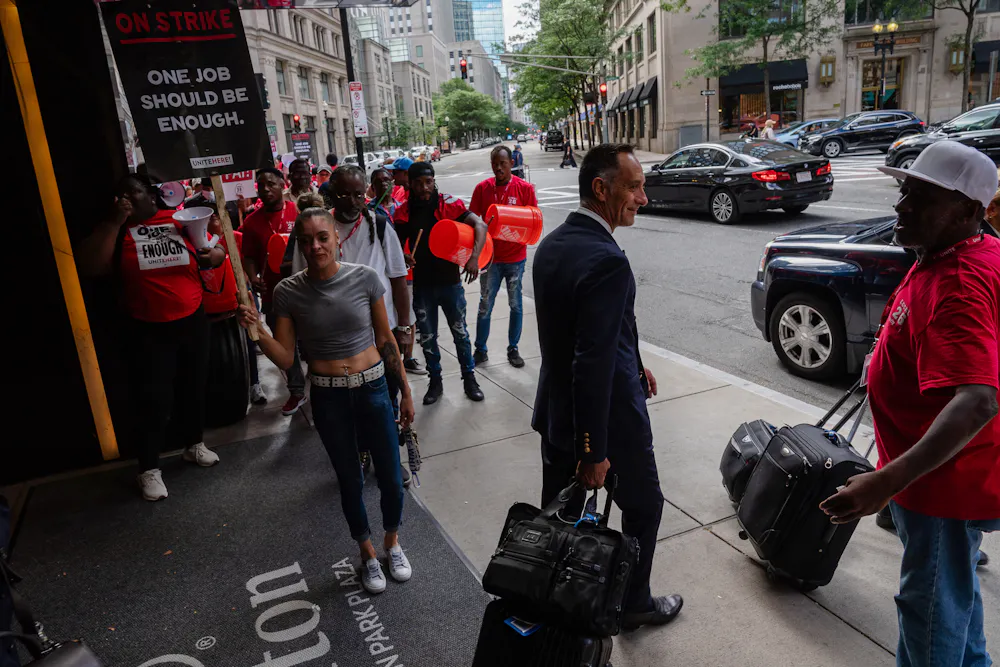
    On Labor Day weekend in 2024, more than 10,000 hotel workers represented by the UNITE HERE union and employed by 24 hotels from Boston to the West Coast to Hawaii went on strike. Their labor actions disrupted travel plans during a busy time.

    Most hotel work stoppages lasted for three days and intended to pressure the companies that own hotels as part of a larger labor contract negotiation strategy. Later in September, workers kept walking off the job at other hotels to pressure management to improve pay, expand health insurance coverage, boost retirement benefits and agree to resolve important job security issues.

    Although the hotel industry has been booming since 2023, UNITE HERE contends that employment has decreased by nearly 40%, while wages have stagnated. On the picket line, workers have described living paycheck to paycheck and working one or two additional jobs to cover recent rent hikes.

    Hotel workers have more bargaining power today because, according to an industry study, 79% of the 450 hotels surveyed looking to hire people said they could not fill open jobs.

    That strike shows no sign of ending. Thousands more hotel workers were joining in by late September.

    Striking hotel workers make way for an airline crew while picketing outside of the Hilton Boston Park Plaza in Boston, Mass., on Sept. 2, 2024.
    Sophie Park/The Washington Post via Getty Images

    Boeing strike

    Unlike the hotel workers’ brief rolling work stoppages, the Boeing strike hasn’t let up since it began on Sept. 13, 2024. About 32,000 workers, mainly in Seattle, Washington, and Portland, Oregon, have walked off the job.

    Boeing workers declared the strike even though the International Association of Machinists District 751 leadership in Seattle wanted to accept a deal from Boeing’s management. But on Sept. 12, 94.6% of all rank-and-file workers rejected the tentative contract their leadership recommended the union accept.

    The Boeing strike started the next day; it could last a long time. On Sept. 25, the workers rejected what the company had called its “best and final offer” to settle the strike.

    This is the eighth time these workers have gone on strike since their union formed in the 1930s. Its two most recent strikes, in 2008 and 2005, lasted 57 days and 28 days, respectively. Boeing’s management, already reeling from the company’s numerous operational and safety problems, has announced several cost-cutting measures, including furloughs for some nonunion employees.

    Boeing’s nonunion backup plan

    Boeing has assured its shareholders and the public that the strike would not hinder production of the 787 Dreamliner jets at the company’s nonunion factory in South Carolina.

    International Association of Machinists union members have never forgiven Boeing for deciding to build that assembly plant. Operational since 2011, it now employs roughly 6,000 workers. Most of them would have been union members had Boeing built that plant or expanded production in Washington or Oregon, because the existing labor agreement would have covered the new workers.

    However, the agreement did not extend to South Carolina.

    At the time of the decision, a Boeing spokesperson said, its contract with the machinists’ union “acknowledges our right to locate work elsewhere, and that’s what we chose to do in this case because we just couldn’t get the terms from them that we needed.”

    Dockworkers could be next

    The timing of the hotel and Boeing strikes makes them perhaps more visible than they might have been because union members’ votes are coveted by both major parties in the 2024 presidential election.

    Meanwhile, 25,000 dockworkers who belong to the International Longshoremen’s Association are planning a possible shutdown of ports from Boston to Houston on Oct. 1, over the union’s concern for job loss due to automation.

    How job security issues are addressed following this wave of strikes could set the tone for what other hospitality, manufacturing and transportation unions seek when their contracts are up for negotiation again.

    Robert Forrant does not work for, consult, own shares in or receive funding from any company or organization that would benefit from this article, and has disclosed no relevant affiliations beyond their academic appointment.

    ref. Autoworkers, Boeing machinists, cannabis drivers: Labor unions are mobilizing in new and old industries alike – https://theconversation.com/autoworkers-boeing-machinists-cannabis-drivers-labor-unions-are-mobilizing-in-new-and-old-industries-alike-239371

    MIL OSI – Global Reports

  • MIL-OSI Global: CubeSats, the tiniest of satellites, are changing the way we explore the solar system

    Source: The Conversation – USA – By Mustafa Aksoy, Assistant Professor of Electrical & Computer Engineering, University at Albany, State University of New York

    Most CubeSats weigh less than a bowling ball, and some are small enough to hold in your hand. But the impact these instruments are having on space exploration is gigantic. CubeSats – miniature, agile and cheap satellites – are revolutionizing how scientists study the cosmos.

    A standard-size CubeSat is tiny, about 4 pounds (roughly 2 kilograms). Some are larger, maybe four times the standard size, but others are no more than a pound.

    As a professor of electrical and computer engineering who works with new space technologies, I can tell you that CubeSats are a simpler and far less costly way to reach other worlds.

    Rather than carry many instruments with a vast array of purposes, these Lilliputian-size satellites typically focus on a single, specific scientific goal – whether discovering exoplanets or measuring the size of an asteroid. They are affordable throughout the space community, even to small startup, private companies and university laboratories.

    Tiny satellites, big advantages

    CubeSats’ advantages over larger satellites are significant. CubeSats are cheaper to develop and test. The savings of time and money means more frequent and diverse missions along with less risk. That alone increases the pace of discovery and space exploration.

    CubeSats don’t travel under their own power. Instead, they hitch a ride; they become part of the payload of a larger spacecraft. Stuffed into containers, they’re ejected into space by a spring mechanism attached to their dispensers. Once in space, they power on. CubeSats usually conclude their missions by burning up as they enter the atmosphere after their orbits slowly decay.

    Case in point: A team of students at Brown University built a CubeSat in under 18 months for less than US$10,000. The satellite, about the size of a loaf of bread and developed to study the growing problem of space debris, was deployed off a SpaceX rocket in May 2022.

    A CubeSat can go from whiteboard to space in less than a year.

    Smaller size, single purpose

    Sending a satellite into space is nothing new, of course. The Soviet Union launched Sputnik 1 into Earth orbit back in 1957. Today, about 10,000 active satellites are out there, and nearly all are engaged in communications, navigation, military defense, tech development or Earth studies. Only a few – less than 3% – are exploring space.

    That is now changing. Satellites large and small are rapidly becoming the backbone of space research. These spacecrafts can now travel long distances to study planets and stars, places where human explorations or robot landings are costly, risky or simply impossible with the current technology.

    But the cost of building and launching traditional satellites is considerable. NASA’s lunar reconnaissance orbiter, launched in 2009, is roughly the size of a minivan and cost close to $600 million. The Mars reconnaissance orbiter, with a wingspan the length of a school bus, cost more than $700 million. The European Space Agency’s solar orbiter, a 4,000-pound (1,800-kilogram) probe designed to study the Sun, cost $1.5 billion. And the Europa Clipper – the length of a basketball court and scheduled to launch in October 2024 to the Jupiter moon Europa – will ultimately cost $5 billion.

    These satellites, relatively large and stunningly complex, are vulnerable to potential failures, a not uncommon occurrence. In the blink of an eye, years of work and hundreds of millions of dollars could be lost in space.

    NASA scientists prep the ASTERIA spacecraft for its April 2017 launch.
    NASA/JPL-Caltech

    Exploring the Moon, Mars and the Milky Way

    Because they are so small, CubeSats can be released in large numbers in a single launch, further reducing costs. Deploying them in batches – known as constellations – means multiple devices can make observations of the same phenomena.

    For example, as part of the Artemis I mission in November 2022, NASA launched 10 CubeSats. The satellites are now trying to detect and map water on the Moon. These findings are crucial, not only for the upcoming Artemis missions but to the quest to sustain a permanent human presence on the lunar surface. The CubeSats cost $13 million.

    The MarCO CubeSats – two of them – accompanied NASA’s Insight lander to Mars in 2018. They served as a real-time communications relay back to Earth during Insight’s entry, descent and landing on the Martian surface. As a bonus, they captured pictures of the planet with wide-angle cameras. They cost about $20 million.

    CubeSats have also studied nearby stars and exoplanets, which are worlds outside the solar system. In 2017, NASA’s Jet Propulsion Laboratory deployed ASTERIA, a CubeSat that observed 55 Cancri e, also known as Janssen, an exoplanet eight times larger than Earth, orbiting a star 41 light years away from us. In reconfirming the existence of that faraway world, ASTERIA became the smallest space instrument ever to detect an exoplanet.

    Two more notable CubeSat space missions are on the way: HERA, scheduled to launch in October 2024, will deploy the European Space Agency’s first deep-space CubeSats to visit the Didymos asteroid system, which orbits between Mars and Jupiter in the asteroid belt.

    And the M-Argo satellite, with a launch planned for 2025, will study the shape, mass and surface minerals of a soon-to-be-named asteroid. The size of a suitcase, M-Argo will be the smallest CubeSat to perform its own independent mission in interplanetary space.

    The swift progress and substantial investments already made in CubeSat missions could help make humans a multiplanetary species. But that journey will be a long one – and depends on the next generation of scientists to develop this dream.

    Mustafa Aksoy works for the University at Albany, State University of New York (SUNY) and the Research Foundation for SUNY. He receives funding from the National Aeronautics and Space Administration (NASA), the National Science Foundation (NSF) and Oak Ridge Associated Universities (ORAU). He is a senior member of the Institute of Electrical and Electronics Engineers (IEEE).

    ref. CubeSats, the tiniest of satellites, are changing the way we explore the solar system – https://theconversation.com/cubesats-the-tiniest-of-satellites-are-changing-the-way-we-explore-the-solar-system-226701

    MIL OSI – Global Reports

  • MIL-OSI Global: Five classic concept albums that will take you on a sonic road-trip across America

    Source: The Conversation – UK – By David Scott, Head of Division, School of Business and Creative Industries, University of the West of Scotland

    The concept album is often viewed as an art form that is primarily focused on lyrical storytelling. But in these five key records, musical ambition, performance and production combine to take the listener on a road-trip through America.

    1. Gunfighter Ballads and Trail Songs by Marty Robbins (1959)

    Gunfighter Ballads and Trail Songs, by Marty Robbins, has rightly been lauded as one of the most important artworks of the 20th century – indeed it was preserved in the Library of Congress in 2017.

    The thematic album transports the listener into a mythical west. Each song tells its own story, but there is a distinct unity of characterisation. The tearful convict awaiting death in They’re Hanging Me Tonight might well be an alter ego of the desert rider, hallucinating and desperate in Cool Water. Or even the ebullient narrator celebrating his own American dream in A Hundred and Sixty Acres.

    Marty Robbins performing El Paso.

    The album’s arrangements are mostly simple and stripped back, allowing Robbins’ extraordinary vocal performances and expressive backing vocal arrangements to fly. This reaches a stylistic peak in his greatest song, the white-knuckle ride of El Paso, wherein our protagonist willingly throws himself into a living hell.

    2. Smile by Brian Wilson (2004)

    The Beach Boys released 15 studio albums in the 1960s. Their voluminous output represented one of the most supercharged evolutions in contemporary music – fired by the imagination, energy and ambition of Brian Wilson.

    In 1965, in partnership with lyricist Mike Love, Wilson was extolling the virtues of California girls. Just a few months later, he was creating the mature, introspective humanity of Pet Sounds with collaborator Tony Asher. From there Wilson engaged lyricist Van Dyke Parks to help him realise an “American gothic trip”. Smile describes a journey across the country on the “ribbon of concrete”, or along the railroad with the early settlers.

    Heroes and Villains by Brian Wilson, from Smile.

    One key track on Smile, Heroes and Villains, took its narrative cue directly from Marty Robbins’ El Paso. But others – Cabin Essence and Surf’s Up – painted a new old west and still feel revolutionary today. However, the album became most famous for being left unfinished for 34 years, with snippets appearing piecemeal before its completion as a new recording by Brian Wilson in 2004.

    Van Dyke Park’s lyrics remain intriguing and unique. But I’d argue the real conceptual unity of Smile comes from its musical design. This is an album about American music as much as it is about America. It’s a kaleidoscope of Gershwin, Ives, Bernstein and goofy doo-wop, scaffolded by unexpected and rich textural juxtapositions (double bass, banjo and backing vocals going “boing boing” anyone?). And, of course, there’s the peerless vocal performances of The Beach Boys.

    3. The Delta Sweete by Bobbie Gentry (1968)

    Bobbie Gentry’s The Delta Sweete is another concept album that looks at both America (in this case the Mississippi Delta) and American music.

    Gentry first found fame with Ode to Billie Joe, a narrative ballad that became a major hit single. In The Delta Sweete, Gentry blended her own distinctive vignettes of southern life with skilfully curated covers of classics, like Mose Allison’s Parchman Farm.

    In Reunion, Gentry invites listeners into the front parlour of an alternately loving and warring southern family. She illustrates the scene by interweaving dialogue, vocal chants and rhythmic solo cello. Elsewhere we meet the swaggering, comedic Okolona River Bottom Band and experience a southern gothic nightmare in Refractions.

    Bobbie Gentry performs Courtyard.

    The sense of journey is enhanced by a series of orchestral pieces that link each of the 12 tracks. So when we finally alight on the solitude of the closing track, Courtyard, there is a feeling of coming home.

    The ambition of The Delta Sweete was not met with commercial success, but Gentry never quite gave up the conceptual flame. Her follow up – Local Gentry, in 1968 – shared some of the same approach to musical portraiture. And in her final studio album, Patchwork (1971), she returned to a series of vignettes with orchestral links. All make for essential listening.

    4. What’s Going On by Marvin Gaye (1971)

    From a journey across America, to a journey across the Mississippi Delta, we turn now to the streets of 1971 inner-city America, via Marvin Gaye’s masterly record, What’s Going On.

    This album represented a clear shift in Gaye’s artistic voice towards commentary, question and critique, against the will of Motown Records boss Berry Gordy resulting in a standoff during which Gaye threatened never to record for the label again. What’s Going On is perhaps most famous for its engagement with the social and political issues of the day, but the ambition of the music, performance and sound stand up thrillingly, 55 years after its release.

    A new music video for What’s Going On by Marvin Gaye, released in 2019.

    Motown Records house arranger David Van De Pitte set congas and guiros against sweeping orchestral arrangements, glockenspiel, choirs and jazz influences. The juxtaposition of tempo and feel created by transitions between the tracks hold you there as listener, walking around Gaye’s landscape, and seeing it through his eyes.

    The key sound of What’s Going On though – and the element that most solidifies its status as a conceptual album – is the approach taken with the vocals. Different takes of the same song overlap, and different ad libs collide and diverge as choral passages peek out from the background. These are the voices talking to Gaye during his walk through the inner city of What’s Going On.

    5. Cowboy Carter by Beyoncé (2024)

    Cowboy Carter’s conceptual birth sprang from the artist’s performance at the 2016 Country Association Awards, where prejudiced questions were raised (in the room and online) about Beyonce’s legitimacy and place in the context of a country music performance. Her ultimate response was this detailed exploration, celebration and critique that gets under the skin of American music itself. Beyoncé creates a searing and detailed a commentary on, and road-map to, American music.


    Read more:
    The genius of Cowboy Carter is Beyoncé’s accent – a musicologist explains


    Jolene by Beyoncé.

    Big questions around the origin and evolution of genre are asked via the medium of a Jolene cover, use of the banjo, impressionistic music arrangements and flights of performative imagination.

    There are spoken inserts (from Linda Martell, Willie Nelson and Dolly Parton) and striking musical juxtapositions. Like other albums on this list, Cowboy Carter’s conceptual veracity springs as much from this kaleidoscopic approach to sound as from the central narrative at its heart.

    In this collage we hear new songs, interpretations of classic songs and quotes from American classics, including one from The Beach Boys’ Smile – Good Vibrations.


    Looking for something good? Cut through the noise with a carefully curated selection of the latest releases, live events and exhibitions, straight to your inbox every fortnight, on Fridays. Sign up here.


    David Scott does not work for, consult, own shares in or receive funding from any company or organisation that would benefit from this article, and has disclosed no relevant affiliations beyond their academic appointment.

    ref. Five classic concept albums that will take you on a sonic road-trip across America – https://theconversation.com/five-classic-concept-albums-that-will-take-you-on-a-sonic-road-trip-across-america-239011

    MIL OSI – Global Reports

  • MIL-OSI Global: Chess: a game rooted in military strategy that has become a tool of international diplomacy

    Source: The Conversation – UK – By Becky Alexis-Martin, Peace Studies and International Development, University of Bradford

    Hushed silence descends as two opponents engage in a battle of wits, memory and strategy. The atmosphere becomes more tense with each shuffle of a pawn or sweeping arc of the queen. The drama is palpable, but there can be only one winner. This year – at the 45th Chess Olympiad finals in Budapest – it was India, whose players won both men’s and women’s gold medals and four individual golds, signalling a new era of Indian domination.

    Chess has become more than just a game. The recent upholding of the bans on Russian and Belorussian players from international competition by the International Chess Federation (Fide) is an example of the soft power of sanctions as a geopolitical tool against the Russian invasion of Ukraine. This ban has been welcomed by the US and Ukraine, among others, although Fide was divided on the issue, with 41 delegates voting to uphold the ban while 21 countries favoured lifting the ban and 27 abstained or were absent.

    Over the centuries, chess – which has its roots in military strategy – has become a symbol of geopolitical competition made peaceful. The game’s first incarnation has been traced back to 6th-century India, as military generals sought a pastime to exercise strategic thinking.

    The original game of chess was named chaturanga, which translates from Sanskrit into “the four military divisions”. The game allowed leaders to simulate conflict by using reasoning and logic to contemplate future battles. The term “checkmate” itself derives from shah mat, which loosely translates to “the king has lost” in Persian and Sanskrit.

    Cold war rivalries

    Chess was to become the focus of international, cultural and political competition during the cold war. It captured the world’s political imagination as a symbolic battleground between east and west. The Soviet Union supported promising chess players by establishing chess schools. Soviet grandmasters were unbeatable national heroes, from Mikhail Botvinnik to Tigran Petrosian and Boris Spassky. Their victories were framed as evidence of socialist intellectual superiority.

    But American grandmaster Bobby Fischer disrupted 24 years of Soviet dominance when he beat Spassky at the 1972 World Chess Championships in Rekjavik, Iceland. It would become a critical moment in the cold war.

    For years chess had been seen by both the Soviet Union and the US as a proxy for superpower military competition. Unlike US-Chinese “ping-pong diplomacy” – when goodwill between US and Chinese players in the early 1970s was followed by enhanced diplomatic engagement between the two countries – Fischer’s defeat of Spassky ended more than 20 years of Russian domination of chess.

    The prospect that Fischer might win was seen as so important by the US government that the then secretary of state, Henry Kissinger, personally called Fischer to urge him to go to Rekjavik.

    Years later, Russian former world champion and dissident Garry Kasparov recalled that: “This event was treated by people on both sides of the Atlantic as a crushing moment in the midst of the cold war. Big intellectual victory for the United States, and you know, a hugely painful, almost insulting defeat for the Soviet Union.”

    A game for dissidents

    Chess does not exist in a vacuum. It is shaped by and reflects historical rivalries, the rise of new power and contemporary geopolitics. And along the way, their refusal to maintain the national status quo and instead articulate their concerns about their societies has led to several grandmasters from various countries having to go into political exile.

    Garry Kasparov’s pro-democracy advocacy and criticism of the Russian state led him to flee Russia with his family to New York in 2013. He was chairman of the Human Rights Foundation from until 2024, and has since been added to Vladimir Putin’s terrorist blacklist.

    Kasparov is in good company. Six of Iran’s female grandmasters have been forced to leave their country, fleeing their country’s oppressive patriarchal regime after being barred from national competition for playing without a headscarf.

    Sara Khadem fled to Spain with her family after refusing to wear the hijab during a match in Kazakhstan in 2022. Her family have since gained Spanish citizenship. However, women who cannot find citizenship elsewhere pay a steep price as their talents are not nurtured and they cannot play professionally. Mitra Hejazipour waited three and a half years to gain citizenship. In 2023, she consecutively became a French citizen and the French national women’s champion.

    Ukrainian players continue to use chess as a platform for resistance against the Russian invasion. Prominent players who have spoken out include Vasyl Ivanchuk, Anna Muzychuk and her sister Mariya. Anna has consistently used her global social media following to condemn the invasion and advocate for peace in Ukraine.

    Projects in Rwanda, Uganda and Palestine have demonstrated that chess is more than just a game by bringing together disparate communities. So by sanctioning Russia and Belarus, the International Chess Federation has made an important statement.

    Chess can be a form of cultural diplomacy, a symbol of non-violent conflict resolution, and a platform for dialogue and understanding between people and nations. Chess is its own universal language. It requires no common tongue or expensive kit, yet it offers a formidable tool to promote critical thinking, international cooperation and conflict resolution.

    Becky Alexis-Martin does not work for, consult, own shares in or receive funding from any company or organisation that would benefit from this article, and has disclosed no relevant affiliations beyond their academic appointment.

    ref. Chess: a game rooted in military strategy that has become a tool of international diplomacy – https://theconversation.com/chess-a-game-rooted-in-military-strategy-that-has-become-a-tool-of-international-diplomacy-239739

    MIL OSI – Global Reports

  • MIL-OSI Global: Will Meta’s Orion smart glasses be the next ‘iPhone moment’? Expert Q&A

    Source: The Conversation – UK – By Llŷr ap Cenydd, Lecturer in Computer Science, Bangor University

    Meta supremo Mark Zuckerberg unveiled Orion smart glasses, a new augmented reality (AR) prototype, at the annual Meta Connect developer conference. Ten years in the making, and still not expected on high streets until 2027, these will be a new way to meld the real and digital worlds. They will be controlled by the eyes and also the fingers via a neural interface on the wrist.

    So what does this mean for the future of AR wearables and how we interface with computers? We asked three tech specialists at the University of Bangor, Peter Butcher, Llŷr ap Cenydd and Panagiotis Ritsos.

    Why has Orion been such a technical challenge?

    There are serious technical challenges in packing so much sophisticated technology into something so compact. This includes new holographic display technology, hand and eye tracking, off-device processing, cameras, speakers and microphones – all while ensuring the device remains aesthetically appealing and has decent battery life.

    Meta’s chief tech officer, Andrew Bosworth, recently captured the scale of the challenge by saying: “In consumer electronics, it might be the most advanced thing that we’ve ever produced as a species.”

    The optical design is a huge challenge. Mixed reality headsets such as Meta Quest 3 and Apple Vision Pro rely on “passthrough” technology, in which external cameras capture real-time video of the user’s surroundings. This is displayed inside the headset, with digital elements overlaid.

    In contrast, Orion’s holographic projection allows users to directly see through transparent lenses, with graphics projected into their view. This has demanded substantial R&D.

    Are there other notable innovations?

    One key factor that determines the immersiveness of mixed reality headsets is their field of view, meaning the angular range that the viewer can see through the headset. The state of the art is the 70° field of view of the Magic Leap 2, bigger holographic AR glasses aimed at businesses currently priced above US$3,000 (£2,240)]. They are made by Magic Leap, a US company whose backers include Google and AT&T.

    With Orion, Meta has achieved a field of view of 70° in a much smaller product, which is a grand innovation and crucial for Zuckerberg’s vision of an unobtrusive wearable device.

    The neural interface wristband is also vital. It listens to nerve impulses from the brain to the hand, allowing users to control the device using subtle finger gestures such as pinching and swiping thumb against index finger. Newer mixed reality headsets such as Apple Vision Pro are controlled similarly, but rely on external cameras to interpret hand movements.

    An advantage of tapping into nerve impulses directly is that gestures do not require line of sight, and eventually might not even require the person to perform the full gesture – only to think about it. The technology also opens up brand new input methods, such as texting via mimicking handwriting, and is likely to mature before consumer-grade holographic displays become available.

    Has Orion been more trouble than Meta expected?

    Meta initially gave the Orion prototype only a 10% chance of success, so it has exceeded expectations. While there is still much work to be done, particularly in reducing costs and miniaturising components, Orion could eventually lead to a consumer-ready device.

    Do you think Meta will get an affordable version launched by 2027?

    Meta thinks the initial price will be comparable to flagship phones or laptops the new iPhone 16 starts at £799. We might see development kits released towards the end of the decade, aimed at early adopters and developers, much like how VR headsets were introduced a decade ago.

    In the meantime, other AR glasses and mixed reality headsets such as Meta Quest 3 and Apple Vision Pro serve as platforms for developing applications that could eventually run on AR glasses.

    Why are the Orion glasses still so expensive?

    Holographic AR glasses remain expensive because much of the hardware – including Ledos micro-display panels and silicon carbide waveguides (which are used to optimise light transmission) – isn’t yet produced at scale. These components are critical for achieving high resolution and holographic displays – and production constraints are reportedly pushing Orion unit prices close to US$10,000. Even then, battery life is currently limited to around two hours.

    Could anyone potentially beat Meta to market?

    Thanks to Meta’s multi-billion dollar investment in R&D through its Reality Labs subsidiary, it has become a leader in virtual and mixed reality headsets, with a robust app ecosystem. However, Apple, Microsoft, Samsung and Google are developing similar technologies.

    Microsoft’s HoloLens and [Snapchat owner] Snap Inc’s Spectacles series have made strides in AR, but responses have been mixed due to limitations such as narrow fields of view and lower graphics quality. Orion appears to be ahead in holographic display technology. Another company to particularly watch is Apple, which is refining Vision Pro and also exploring AR smart glasses.

    Will AR glasses change the world?

    AR glasses could ignite a transformative “iPhone moment” that redefines how we interact with technology. Zuckerberg envisions them as the next major computing platform, offering a more natural and intuitive alternative to smartphones.

    The success of early mass-market smart glasses such as Meta’s Ray-Ban glasses, which allow users to make calls, capture videos and interact with Meta AI, hints that AR glasses could see widespread adoption.

    Zuckerberg initially believed holographic technology would be necessary for smart glasses to offer functionality beyond the basic features of these Ray-Bans. But being able to incorporate an AI voice-powered assistant has made Meta realise that smart glasses can be developed from the ground up as a new consumer product category. While the four-hour battery life requires improvement, the positive feedback from both reviewers and users, particularly using them on Instagram and TikTok, demonstrates the potential.

    What does the future look like?

    Reading messages, watching a virtual screen on the wall, playing games, collaborative work – all the things you can do with mixed-reality headsets, but shrunk down to a pair of glasses. Friends will teleport into your living room, a video call where both people feel present in the same space.

    It gets even stranger when you incorporate AI: virtual assistants can already see what you see, hear what you hear, talk to you, answer questions and follow commands using smart glasses. In future, AI will be able to manifest itself in your vision, and you’ll be able to have natural conversations with it.

    By 2030, AI will radically change the ways in which we interact with each other, our physical world and computers. Orion aims to prepare us for a world in which the physical, artificial and virtual co-exist.

    Llŷr ap Cenydd develops VR games for Meta Quest headsets.

    Panagiotis Ritsos and Peter Butcher do not work for, consult, own shares in or receive funding from any company or organisation that would benefit from this article, and have disclosed no relevant affiliations beyond their academic appointment.

    ref. Will Meta’s Orion smart glasses be the next ‘iPhone moment’? Expert Q&A – https://theconversation.com/will-metas-orion-smart-glasses-be-the-next-iphone-moment-expert-qanda-240029

    MIL OSI – Global Reports

  • MIL-OSI Global: Hurricane Helene power outages leave over 3 million in the dark – history shows poorer areas often wait longest for electricity to be restored

    Source: The Conversation – USA – By Chuanyi Ji, Associate Professor of Engineering, Georgia Institute of Technology

    Strong winds from Hurricane Helene, one of the most powerful storms to hit the Southeast, flooded roads and cut power in multiple states. AP Photo/Mike Carlson

    Hurricane Helene left more than 3 million homes and businesses in the dark across Florida, Georgia and the Carolinas after hitting Florida’s Big Bend region as a powerful Category 4 storm late on Sept. 26, 2024. As Helene’s rains moved inland, officials warned that fixing downed utility lines and restoring power would take several days in some areas.

    Electricity is essential to just about everyone – rich and poor, old and young. Yet, when severe storms strike, socioeconomically disadvantaged communities often wait longest to recover.

    That isn’t just a perception.

    We analyzed data from over 15 million consumers in 588 U.S. counties who lost power when hurricanes made landfall between January 2017 and October 2020. The results show that poorer communities did indeed wait longer for the lights to go back on.

    A 10 percentile drop in socioeconomic status in the Centers for Disease Control and Prevention’s social vulnerability index was associated with a 6.1% longer outage on average. This corresponds to waiting an extra 170 minutes on average for power to be restored, and sometimes much longer.

    The top map shows the total duration of power outages over eight storms by county. The lower map is a comparison with socioeconomic status taken into account, showing that counties with lower average socioeconomic status have longer outages than expected.
    Ganz et al, 2023, PNAS Nexus

    Implications for policy and utilities

    One likely reason for this disparity is written into utilities’ standard storm recovery policies. Often, these polices prioritize critical infrastructure first when restoring power after an outage, then large commercial and industrial customers. They next seek to recover as many households as they can as quickly as possible.

    While this approach may seem procedurally fair, these recovery routines appear to have an unintended effect of often making vulnerable communities wait longer for electricity to be restored. One reason may be that these communities are farther from critical infrastructure, or they may be predominantly in older neighborhoods where power infrastructure requires more significant repairs.

    Commercial areas are often higher on the priority list for faster power recovery in an outage. This store was still closed for several days during Texas’ widespread outages in 2021.
    Montinique Monroe/Getty Images

    The upshot is that households that are already at greater risk from severe weather – whether due to being in flood-prone areas or in vulnerable buildings – and those who are least likely to have insurance or other resources to help them recover are also likely to face the longest storm-caused power outages. Long outages can mean refrigerated food goes bad, no running water and delays in repairing damage, including delays in running fans to dry out water damage and avoid mold.

    Our study spanned 108 service regions, including investor-owned utilities, cooperatives and public utilities. The differential impact on poorer communities did not line up with any particular storm, region or individual utility. We also found no correlation with race, ethnicity or housing type. Only average socioeconomic level stood out.

    How to make power recovery less biased

    There are ways to improve power recovery times for everyone, beyond the necessary work of improving the stability of power distribution.

    Policymakers and utilities can start by reexamining power restoration practices and power infrastructure maintenance, such as replacing aging utility poles and trimming trees, with disadvantaged communities in mind.

    Power providers already have granular data on power usage and grid performance in their service regions. They can begin experimenting with alternative recovery routines that consider the vulnerability of their customers in ways that do not substantially affect average recovery duration.

    People in some Fort Myers, Fla., neighborhoods still lacked water and electricity more than a week after Hurricane Ian in 2022.
    Montinique Monroe/Getty Images

    For socioeconomically vulnerable regions that are likely to experience long outages because of their locations and possibly the aging energy infrastructure, utilities and policymakers can proactively ensure that households are well prepared to evacuate or have access to backup sources of power.

    For example, the U.S. Department of Energy announced in October 2023 that it would invest in developing dozens of resilience hubs and microgrids to help supply local power to key buildings within communities when the wider grid goes down. Louisiana plans several of these hubs, using solar and large-scale batteries, in or near disadvantaged communities.

    Policymakers and utilities can also invest in broader energy infrastructure and renewable energy in these vulnerable communities. The U.S. Department of Energy’s Justice40 program directs that 40% of the benefit from certain federal energy, transportation and housing investments benefit disadvantaged communities. That may help residents who need public help the most.

    Severe weather events are becoming more common as global temperatures rise. That increases the need for better planning and approaches that don’t leave low-income residents in the dark.

    Chenghao Duan, a Ph.D. student at Georgia Tech, also contributed to this article. This is an update to an article originally published on Feb. 7, 2024.

    The authors do not work for, consult, own shares in or receive funding from any company or organization that would benefit from this article, and have disclosed no relevant affiliations beyond their academic appointment.

    ref. Hurricane Helene power outages leave over 3 million in the dark – history shows poorer areas often wait longest for electricity to be restored – https://theconversation.com/hurricane-helene-power-outages-leave-over-3-million-in-the-dark-history-shows-poorer-areas-often-wait-longest-for-electricity-to-be-restored-240001

    MIL OSI – Global Reports

  • MIL-OSI Global: US home insurance rates are rising fast – hurricanes and wildfires play a big role, but there’s more to it

    Source: The Conversation – USA – By Andrew J. Hoffman, Professor of Management & Organizations, Environment & Sustainability, and Sustainable Enterprise, University of Michigan

    The U.S. has seen a large number of billion-dollar disasters in recent years. AP Photo/Mark Zaleski

    Millions of Americans have been watching with growing alarm as their homeowners insurance premiums rise and their coverage shrinks. Nationwide, premiums rose 34% between 2017 and 2023, and they continued to rise in 2024 across much of the country.

    To add insult to injury, those rates go even higher if you make a claim – as much as 25% if you claim a total loss of your home.

    Why is this happening?

    There are a few reasons, but a common thread: Climate change is fueling more severe weather, and insurers are responding to rising damage claims. The losses are exacerbated by more frequent extreme weather disasters striking densely populated areas, rising construction costs and homeowners experiencing damage that was once more rare.

    Hurricane Ian, supercharged by warm water in the Gulf of Mexico, hit Florida as a Category 4 hurricane in October 2022 and caused an estimated $112.9 billion in damage.
    Ricardo Arduengo/AFP via Getty Images

    Parts of the U.S. have been seeing larger and more damaging hail, higher storm surges, massive and widespread wildfires, and heat waves that kink metal and buckle asphalt. In Houston, what used to be a 100-year disaster, such as Hurricane Harvey in 2017, is now a 1-in-23-years event, estimates by risk assessors at First Street Foundation suggest. In addition, more people are moving into coastal and wildland areas at risk from storms and wildfires.

    Just a decade ago, few insurance companies had a comprehensive strategy for addressing climate risk as a core business issue. Today, insurance companies have no choice but to factor climate change into their policy models.

    Rising damage costs, higher premiums

    There’s a saying that to get someone to pay attention to climate change, put a price on it. Rising insurance costs are doing just that.

    Increasing global temperatures lead to more extreme weather, and that means insurance companies have had to make higher payouts. In turn, they have been raising their prices and changing their coverage in order to remain solvent. That raises the costs for homeowners and for everyone else.

    The importance of insurance to the economy cannot be understated. You generally cannot get a mortgage or even drive a car, build an office building or enter into contracts without insurance to protect against the inherent risks. Because insurance is so tightly woven into economies, state agencies review insurance companies’ proposals to increase premiums or reduce coverage.

    The insurance companies are not making political statements with the increases. They are looking at the numbers, calculating risk and pricing it accordingly. And the numbers are concerning.

    The arithmetic of climate risk

    Insurance companies use data from past disasters and complex models to calculate expected future payouts. Then they price their policies to cover those expected costs. In doing so, they have to balance three concerns: keeping rates low enough to remain competitive, setting rates high enough to cover payouts and not running afoul of insurance regulators.

    But climate change is disrupting those risk models. As global temperatures rise, driven by greenhouse gases from fossil fuel use and other human activities, past is no longer prologue: What happened over the past 10 to 20 years is less predictive of what will happen in the next 10 to 20 years.

    The number of billion-dollar disasters in the U.S. each year offers a clear example. The average rose from 3.3 per year in the 1980s to 18.3 per year in the 10-year period ending in 2024, with all years adjusted for inflation.

    With that more than fivefold increase in billion-dollar disasters came rising insurance costs in the Southeast because of hurricanes and extreme rainfall, in the West because of wildfires, and in the Midwest because of wind, hail and flood damage.

    Hurricanes tend to be the most damaging single events. They caused more than US$692 billion in property damage in the U.S. between 2014 and 2023. But severe hail and windstorms, including tornadoes, are also costly; together, those on the billion-dollar disaster list did more than $246 billion in property damage over the same period.

    As insurance companies adjust to the uncertainty, they may run a loss in one segment, such as homeowners insurance, but recoup their losses in other segments, such as auto or commercial insurance. But that cannot be sustained over the long term, and companies can be caught by unexpected events. California’s unprecedented wildfires in 2017 and 2018 wiped out nearly 25 years’ worth of profits for insurance companies in that state.

    To balance their risk, insurance companies often turn to reinsurance companies; in effect, insurance companies that insure insurance companies. But reinsurers have also been raising their prices to cover their costs. Property reinsurance alone increased by 35% in 2023. Insurers are passing those costs to their policyholders.

    What this means for your homeowners policy

    Not only are homeowners insurance premiums going up, coverage is shrinking. In some cases, insurers are reducing or dropping coverage for items such as metal trim, doors and roof repair, increasing deductibles for risks such as hail and fire damage, or refusing to pay full replacement costs for things such as older roofs.

    Some insurances companies are simply withdrawing from markets altogether, canceling existing policies or refusing to write new ones when risks become too uncertain or regulators do not approve their rate increases to cover costs. In recent years, State Farm and Allstate pulled back from California’s homeowner market, and Farmers, Progressive and AAA pulled back from the Florida market, which is seeing some of the highest insurance rates in the country.

    In some cases, insurers are restricting coverage. Roof repairs, like these in Fort Myers Beach, Fla., after Hurricane Ian, can be expensive and widespread after windstorms.
    Joe Raedle/Getty Images

    State-run “insurers of last resort,” which can provide coverage for people who can’t get coverage from private companies, are struggling too. Taxpayers in states such as California and Florida have been forced to bail out their state insurers. And the National Flood Insurance Program has raised its premiums, leading 10 states to sue to stop them.

    About 7.4% of U.S. homeowners have given up on insurance altogether, leaving an estimated $1.6 trillion in property value at risk, including in high-risk states such as Florida.

    No, insurance costs aren’t done rising

    According to NOAA data, 2023 was the hottest year on record “by far.” And 2024 could be even hotter. This general warming trend and the rise in extreme weather is expected to continue until greenhouse gas concentrations in the atmosphere are abated.

    In the face of such worrying analyses, U.S. homeowners insurance will continue to get more expensive and cover less. And yet, Jacques de Vaucleroy, chairman of the board of reinsurance giant Swiss Re, believes U.S. insurance is still priced too low to fully cover the risk from climate change.


    Climate change is a major factor in the rising cost of insurance. Join us for a special free webinar with experts Andrew Hoffman of the University of Michigan and Melanie Gall of Arizona State University to discuss the arithmetic behind these rising rates, what climate change has to do with it, and what may be coming in your future insurance bills.

    Wednesday, October 9, 2024, 11:30 a.m. PT/2:30 p.m. ET.
    Register for the webinar here.


    Andrew J. Hoffman does not work for, consult, own shares in or receive funding from any company or organization that would benefit from this article, and has disclosed no relevant affiliations beyond their academic appointment.

    ref. US home insurance rates are rising fast – hurricanes and wildfires play a big role, but there’s more to it – https://theconversation.com/us-home-insurance-rates-are-rising-fast-hurricanes-and-wildfires-play-a-big-role-but-theres-more-to-it-238939

    MIL OSI – Global Reports