Category: Reportage

  • MIL-OSI Global: A film about long healing walk by the sea, the end of a dystopian series and a whimsical comfort watch – what to see, watch, read and listen to this week

    Source: The Conversation – UK – By Naomi Joseph, Arts + Culture Editor

    At The Conversation, we are big believers in the health benefits of being near the sea. In fact, we have a whole series dedicated to how our health is intrinsically linked with that of the ocean, called Vitamin Sea. The idea of how the coast can heal is explored in the bestselling memoir The Saltpath, which has been adapted for the screen, and stars Gillian Anderson and Jason Isaacs.

    Anderson plays Raynor Winn who documented the whirlwind period that began with her husband Moth being given a terminal diagnosis. In the same week, they also lost their home. In the face of this, the couple made a wild decision: to take a 630-mile year-long coastal walk from Somerset to Dorset, through Devon and Cornwall.

    The South West Coast Path has over 115,000 feet of ascent and descent, which is equivalent to scaling Mount Everest four times. In this piece, lecturer in the history of science and the environment, Lena Ferriday explores how this decision might not have been as mad as it might seem.


    Looking for something good? Cut through the noise with a carefully curated selection of the latest releases, live events and exhibitions, straight to your inbox every fortnight, on Fridays. Sign up here.


    The Winns’ decision to walk the path is part of a long history of people seeking wellness and recovery on England’s south-west coast. From taking in the clean air on long gentle walks to bathing in cold waters, it was common for the sickly to be prescribed a trip to the sea. And, as the Winns discover in this beautiful film, they find respite and connection in that history.

    Reply to this email to let us know if you have any thoughts on the healing qualities of the coast. We would also love you to answer our poll letting us what you think is the best nature memoir of our of favourite five. If your favourite isn’t there, email us its name.

    The Saltpath is in select cinemas now


    Read more:
    The Salt Path taps into a long history of searching for healing on England’s south-west coast


    The first season of The Handmaid’s Tale aired in 2017 in the early months of the first Trump presidency. Now in its sixth season, the drama is ending in the early months of the second Trump presidency. In that time, the show and its iconography have become synonymous with feminist resistance.

    When the Canadian writer Margaret Atwood first wrote The Handmaid’s Tale in 1985, Donald Trump was a mere real estate mogul. Some say it is eerie how she foresaw rising authoritarianism in the United States as well as the erosion of women’s rights. However, Atwood didn’t see the tale as science fiction, everything she wrote, she stressed, had already happened or was happening somewhere.

    In this piece, Canadian literature expert Sharon Engbrecht writes about Atwood has made many similar educated predictions about where the roots laid in history will come up in the future. While the last series does deviate somewhat from Atwood’s follow-up The Testaments, it is very much in-line with her view of the world. Hopefully, this last season ends in a much more hopeful place.

    The Handmaid’s Tale is airing on channel 4


    Read more:
    _The Handmaid’s Tale_ reflects Margaret Atwood’s eerie talent for reading the palm of power


    If you’re looking for something a bit more low stakes and whimsical then can we recommend checking out the film The Phoenician Scheme. Wes Anderson is a director with a very distinct vision, you can spot a work by him a mile away. This is what makes a director an auteur.

    Fans of his work have come to expect a few things from his films. The first is a star-studded ensemble. The second, a distinct colour palette. The third, boundless whimsy. The Phoenician Scheme has all of this, which as our expert in film Daniel O’Brien notes, will make some of you love it and others hate it.

    I like Wes Anderson films. They are incredibly charming and visually delicious. The Phoenician Scheme has more solid narrative than some of his recent films, which I, for one, welcome. It follows wealthy businessman, Zsa-zsa Korda (Benicio del Toro) after he makes his only daughter (Mia Threapleton), a nun, the sole heir to his estate before embarking on a new money-making scheme. Andersonian hijinks and shenanigans ensue as the pair dodge danger in the form of scheming tycoons, foreign terrorists and determined assassins.

    The Phoenician Scheme is in cinemas now

    The Coin by Yasmin Zaher is a bold debut novel about a young Palestinian woman who is struggling to keep it together. On the surface of things she has it all: she is a teacher at a New York city middle school, she is rich, stylish and meticulously clean. However, buried within her sits history that won’t leave her alone. To be precise, inside her sits an Israeli shekel that she accidentally swallowed on a family road trip during which her parents were killed.

    The knowledge of the coin and all it represents tears at the narrator, not letting her know peace. She is pushed to desperate acts in order to gain some sort of control over mind and body. But the coin does not relent. It won’t let her be. She is neither here nor there, in the US or Palestine. In this piece, literature expert Daniel G. Williams explains why he and his fellow judges awarded this debut the 2025 Dylan Thomas Prize.


    Read more:
    The Coin by Palestinian writer Yasmin Zaher wins the Dylan Thomas Prize – an expert from the judging panel explains why


    I love Pulp. One of my formative festival memories is watching a lanky Jarvis Cocker hump a giant neon Pulp sign while singing Disco 2000 at Reading festival. I was at a liberal arts uni at the time and the lyrics of Common People had never made more sense to me.

    As expert in popular music Mark Higgins writes, it’s a common misconception that Pulp were Brit Pop. In fact, they were founded in 1978 and their sound and whole shtick were quite a part from the 60’s mania of Britpop boy bands. Listening to the first single of this album Higgins notes, however, that the nostalgia for a better time seems to have hit Pulp belatedly as they wax lyrical about 90s.

    Next week, the band release their first album since 2001’s We Love Life. In the lead up to the release of their album More, I have been rediscovering their back catalogue and I would highly recommend you all do the same this sunny weekend.

    More by Pulp is out June 6


    Read more:
    Pulp are back and more wistfully Britpop than before


    ref. A film about long healing walk by the sea, the end of a dystopian series and a whimsical comfort watch – what to see, watch, read and listen to this week – https://theconversation.com/a-film-about-long-healing-walk-by-the-sea-the-end-of-a-dystopian-series-and-a-whimsical-comfort-watch-what-to-see-watch-read-and-listen-to-this-week-257849

    MIL OSI – Global Reports

  • MIL-OSI Global: Scandalous mormons, dystopian Buenos Aires and Nicolas Cage down under: what to watch in June

    Source: The Conversation – Global Perspectives – By Claudia Sandberg, Senior Lecturer, Technology in Culture and Society, The University of Melbourne

    As we head into a new month of streaming, here’s a fresh wave of TV ready to challenge, transport and entertain you.

    This month’s picks span genre and geography, from an eerie dystopian Buenos Aires, to a witty, awkward cyborg hero. Reality TV also gets a scandalous twist with the return of The Secret Lives of Mormon Wives. And Deaf President Now! delivers a powerful documentary on a historical milestone for Deaf rights.

    There’s something for every kind of viewer — and every kind of mood.

    The Eternaut

    Netflix

    Argentine sci-fi The Eternaut opens with a group of old friends in Buenos Aires meeting to play the card game truco on a hot summer night – when things suddenly get eerie.

    The power goes out and a poisonous snowfall starts to blanket the city, killing thousands of people instantly. The survivors must get answers, quickly, as they start to grasp the true strength of their invisible enemy.

    Based on Héctor Germán Oesterheld’s 1950s comic of the same name, The Eternaut portrays apocalypse through a deeply local and political lens – and in doing so has struck a chord in Argentina.

    Directed by Bruno Stagnaro and led by Argentine film icon Ricardo Darín, as protagonist Juan Salvo, the series emphasises the power of collective heroism, and subtly critiques the current government’s uncompromising neoliberal approach.

    It also pulses with national pride. Buenos Aires is not glamorized; real neighbourhoods are shown as classic Argentine tango, rock and folk plays in the background. Most importantly, Argentine identity is celebrated through themes of community spirit, grassroots resistance, and ingenuity in times of crisis.

    The Eternaut feels both timely and timeless. Its slogan, “no one survives alone,” resonates for a country that has been long marked by both trauma and resistance efforts.

    Its emotional weight is further deepened by Oesterheld’s legacy, including the tragic disappearance of him and his family members under the military rule of the 1970s.

    With a second season on the way, this series is a powerful ode to Argentina.

    – Claudia Sandberg


    Read more:
    Why Netflix’s The Eternaut is one of the most important shows to come out of Argentina in recent years


    Murderbot

    Apple TV+

    Murderbot, Apple’s adaptation of Martha Wells’ science-fiction novella, All Systems Red (2017) is a satisfying combination of action, sci-fi and comedy. The show centres on a security unit (SecUnit) – an indentured private security cyborg – who secretly cracks the programming of its governing chip, granting itself autonomy.

    Murderbot (Alexander Skarsgård), as it dubs itself, is both horrified and fascinated by humans. It’s far more afraid of eye contact, emotions and direct conversation than any physical danger. It’s also obsessed with mainlining media, particularly the ridiculous soap opera The Rise and Fall of Sanctuary Moon.

    Murderbot is hired, reluctantly, by some hippy scientists from a group of “freehold” planets – ones that exist outside the Corporation Rim – to act as protection on a scientific expedition. It goes quickly awry.

    Wells’ award-winning novella, the first in an equally good series, limits us to the first-person perspective of the sarcastic cyborg. The series expands this frame beautifully, building on the source material’s dry humour to create a world that is both goofy and grounded.

    And while there are serious themes at play, such as the way SecUnits are effectively enslaved, and the violent capitalist dominance of the Corporation Rim, the show is not heavy. Skarsgård offers a pitch-perfect performance of the awkward, anxious robot – its eyes flickering in horror as the scientists try to befriend it.

    The opening minutes of the first episode are clumsy and on-the-nose, but ignore them. This otherwise well-designed and well-directed show cracks along with brisk, highly-entertaining 22-minute episodes.

    – Erin Harrington

    The Secret Lives of Mormon Wives, season two

    Disney+

    Season one of The Secret Lives of Mormon Wives had us hooked at the end of 2024. Now, the women have returned for an explosive 10-episode second season.

    The reality series follows a group of Mormon women living in Utah. While the title may have you anticipating stories of faith and motherhood, the show is more focused on the personal lives of Mormon mothers who rose to TikTok fame due to scandal and infamy.

    Season one saw the women grapple with balancing traditional Mormon values with their online lives and subsequent businesses (along with the fallout from a “soft-swinging scandal”). Season two further highlights infidelity, jealously and money.

    Old characters are brought back, with finger-pointing ex-husbands and former alienated friends adding to the fray. Police are called, insults are thrown and many of the women delve deeper into their pasts.

    The show flips flops between difficult moments such as processing the death of loved ones and difficult pregnancies, with parties and poorly executed party games. At one point the women play pregnancy roulette (a game no one should recommend), and take pregnancy tests which are anonymously read out to the group. Chaos ensues.

    And after watching, you can search for the TikTok accounts of the stars and watch new drama unfold in real-time – or watch them “correct” and expand on past situations based on their own perspectives – far removed from show’s editors.

    – Edith Jennifer Hill

    Deaf President Now!

    Apple TV+

    Deaf President Now! is a stirring documentary about an iconic student uprising at Gallaudet University, the world’s only Deaf university, in 1988. The film chronicles how Deaf students – tired of being led by hearing leadership – decided to take things in their own hands come the 1988 Gallaudet presidential election.

    With two of the three candidates being Deaf, the appointment of Elisabeth Zinser, a hearing candidate unfamiliar with Deaf culture, sparked outrage. Fuelled by decades of marginalisation, the students barricaded campus gates, burned effigies of Zinser and marched to the Capitol, calling for Deaf leadership in Deaf spaces.

    It worked. The protest forced Zinser’s resignation and ushered in Irving King Jordan, Gallaudet’s first Deaf president.

    The film juxtaposes historic footage with present-day interviews with key leaders of the movement, allowing them to tell their stories their own way. These reflections, delivered in American Sign Language (ASL), underscore how storytelling itself can become an act of resistance for Deaf people.

    At the same time, the documentary wrestles with a paradox. Co-directed by Deaf activist Nyle DiMarco and hearing filmmaker Davis Guggenheim, the film exemplifies how Deaf storytelling still often has hearing involvement, especially when the story is packaged for a mainstream audience.

    Nevertheless, the release of Deaf President Now! couldn’t have been more timely. With disability rights in the United States threatened under Trump, the film is a call to action. It reminds us Deaf culture isn’t just about language: it’s about Pride, self-determination and visibility.

    – Gemma King, Samuel Martin and Sofya Gollan


    Read more:
    Deaf President Now! traces the powerful uprising that led to Deaf rights in the US – now again under threat


    The Surfer

    Stan, from June 15

    In Lorcan Finnegan’s The Surfer, our unnamed protagonist (Nicolas Cage) is returning to his former Australian home from the United States. He is newly divorced, and trying to buy a beachside property to win back his family.

    He takes his teenage son (Finn Little) for a surf near the property, but they are run off by an unfriendly pack of locals.

    Returning alone to the beachside car park to make some calls, he is besieged there by the same gang, and this continues over the next several days. The gang is led by a terrifying middle-aged Andrew Tate-esque influencer, Scally (Julian McMahon), who runs the beach like a combination of a frat bro party and wellness retreat.

    It is impossible to think of an actor other than Cage who could make a character like this so enjoyable to watch. Cage’s distinctively American confidence has no resistance to the terrifying switches of Australian masculinity from friendly to teasing to violent.

    The Surfer is an absolute blast. A lot of the fun is in anticipating each dreadful humiliation – and it somehow turning out worse than you could have expected.

    The Surfer beautifully captures the natural surroundings, stunning views and shimmering heat of Australian coastal summer. At the same time, a confined, semi-urban feature like a beachside car park feels bleak and uninviting.

    As a film setting, it is both a spectacular wide-open vista and stiflingly claustrophobic – a perfect mechanism for The Surfer’s psychological horror.

    Grace Russell


    Read more:
    Dishevelled, dehydrated delirium: new Aussie film The Surfer, starring Nicolas Cage, is an absolute blast


    Fred and Rose West: A British Horror Story

    Netflix

    The story of serial killers, Fred and Rose West, has been highly narrativised since their shocking crimes were discovered in Gloucester in 1994. The horror of the Wests lies in the juxtaposition of their seemingly ordinary suburban family and what was hidden beneath the foundations of their home.

    Fred and Rose West: A British Horror Story takes us back to the moment of that revelation via previously unheard interview tapes and recordings of the property search – and of Rose while she was kept in a safe house. Family home videos add to the disturbing sense of the couple’s duplicity.

    Interviews with the family of some of the victims emphasise the ongoing pain caused by the Wests, who preyed on vulnerable young women. Meanwhile, Fred’s interviews reinforce his determination to protect his wife: “I trained Rose to do what I wanted. That is why our marriage worked out so well.”

    Many details of the Wests’ true horror, however, are absent: the incredible torture suffered by the victims; Fred and Rose’s own childhoods of abuse and Fred’s earlier assault of young girls, including his own sister; and any reference to the couple’s surviving children and the extraordinary abuse they suffered.

    The horror of this new documentary is present in the couple’s habitual lies, their casual attitude to violence and murder, and their refusal to take responsibility for their many crimes. Yet it only scratches the surface of the Wests’ true horror story.

    – Jessica Gildersleeve

    The Four Seasons

    Netflix

    The Four Seasons follows three 50-something affluent couples as they holiday together over the course of a year.

    Friends since college, the group’s easy camaraderie is upended by Nick’s (Steve Carroll) bombshell decision to leave his seemingly unsuspecting wife, Anne (Kerri Kenney-Silver), after 25 years of marriage. The announcement sends shockwaves through the other couples, testing their own relationships.

    Adapted from Alan Alda’s bittersweet 1981 comedy of the same name, the series preserves the film’s narrative conceit, unfolding over four seasonal mini trips. Episode one opens in full spring at Nick and Anne’s bucolic lake house.

    Given the luxury on display, you’d be forgiven for mistaking The Four Seasons as another entry in the “rich-people-behaving-badly” genre. But while there’s plenty of quips and snarky humour, what unfolds is ultimately much kinder – less a scathing indictment of wealth and more a gentle exploration of the banalities of love and middle age.

    The show’s creators make the most of the expanded running time to humanise the sextet. The open marriage between gregarious Italian Claude (Marco Calvini) and husband Danny (a marvellous Colman Domingo) updates the source material without sliding into tokenism or homonormativity.

    The prickly Type-A Kate (Tina Fey) and peacekeeper Jack (Will Forte) provide the series’ beating heart, in a relationship that feels lived-in and familiar.

    Despite its focus on ageing, loss, mortality and grief, The Four Seasons offers comfort viewing at its finest, best enjoyed with a cup of tea and a loved one who’s known you for decades.

    – Rachel Williamson

    Gemma King receives funding from the Australian Research Council.

    Claudia Sandberg, Edith Jennifer Hill, Erin Harrington, Grace Russell, Jessica Gildersleeve, Rachel Williamson, Samuel Martin, and Sofya Gollan do not work for, consult, own shares in or receive funding from any company or organisation that would benefit from this article, and have disclosed no relevant affiliations beyond their academic appointment.

    ref. Scandalous mormons, dystopian Buenos Aires and Nicolas Cage down under: what to watch in June – https://theconversation.com/scandalous-mormons-dystopian-buenos-aires-and-nicolas-cage-down-under-what-to-watch-in-june-257549

    MIL OSI – Global Reports

  • MIL-OSI Global: Your smartphone is a parasite, according to evolution

    Source: The Conversation – Global Perspectives – By Rachael L. Brown, Director of the Centre for Philosophy of the Sciences and Associate Professor of Philosophy, Australian National University

    vchal/shutterstock, The Conversation

    Head lice, fleas and tapeworms have been humanity’s companions throughout our evolutionary history. Yet, the greatest parasite of the modern age is no blood-sucking invertebrate. It is sleek, glass-fronted and addictive by design. Its host? Every human on Earth with a wifi signal.

    Far from being benign tools, smartphones parasitise our time, our attention and our personal information, all in the interests of technology companies and their advertisers.

    In a new article in the Australasian Journal of Philosophy, we argue smartphones pose unique societal risks, which come into sharp focus when viewed through the lens of parasitism.

    What, exactly, is a parasite?

    Evolutionary biologists define a parasite as a species that benefits from a close relationship with another species – its host – while the host bears a cost.

    The head louse, for example, is entirely dependent on our own species for its survival. They only eat human blood, and if they become dislodged from their host, they survive only briefly unless they are fortunate enough to fall onto another human scalp. In return for our blood, head lice give us nothing but a nasty itch; that’s the cost.

    Smartphones have radically changed our lives. From navigating cities to managing chronic health diseases such as diabetes, these pocket-sized bits of tech make our lives easier. So much so that most of us are rarely without them.

    Yet, despite their benefits, many of us are hostage to our phones and slaves to the endless scroll, unable to fully disconnect. Phone users are paying the price with a lack of sleep, weaker offline relationships and mood disorders.

    From mutualism to parasitism

    Not all close species relationships are parasitic. Many organisms that live on or inside us are beneficial.

    Consider the bacteria in the digestive tracts of animals. They can only survive and reproduce in the gut of their host species, feeding on nutrients passing through. But they provide benefits to the host, including improved immunity and better digestion. These win-win associations are called mutualisms.

    The human-smartphone association began as a mutualism. The technology proved useful to humans for staying in touch, navigating via maps and finding useful information.

    Philosophers have spoken of this not in terms of mutualism, but rather as phones being an extension of the human mind, like notebooks, maps and other tools.

    From these benign origins, however, we argue the relationship has become parasitic. Such a change is not uncommon in nature; a mutualist can evolve to become a parasite, or vice versa.

    Smartphones as parasites

    As smartphones have become near-indispensible, some of the most popular apps they offer have come to serve the interests of the app-making companies and their advertisers more faithfully than those of their human users.

    These apps are designed to nudge our behaviour to keep us scrolling, clicking on advertising and simmering in perpetual outrage.

    The data on our scrolling behaviour is used to further that exploitation. Your phone only cares about your personal fitness goals or desire to spend more quality time with your kids to the extent that it uses this information to tailor itself to better capture your attention.

    So, it can be useful to think of users and their phones as akin to hosts and their parasites – at least some of the time.

    While this realisation is interesting in and of itself, the benefit of viewing smartphones through the evolutionary lens of parasitism comes into its own when considering where the relationship might head next – and how we could thwart these high-tech parasites.

    A bluestreak cleaner wrasse at work cleaning the mouth of a goatfish.
    Wayne and Pam Osborn/iNaturalist, CC BY-NC

    Where policing comes in

    On the Great Barrier Reef, bluestreak cleaner wrasse establish “cleaning stations” where larger fish allow the wrasse to feed on dead skin, loose scales and invertebrate parasites living in their gills. This relationship is a classic mutualism – the larger fish lose costly parasites and the cleaner wrasse get fed.

    Sometimes the cleaner wrasse “cheat” and nip their hosts, tipping the scale from mutualism to parasitism. The fish being cleaned may punish offenders by chasing them away or withholding further visits. In this, the reef fish exhibit something evolutionary biologists see as important to keeping mutualisms in balance: policing.

    Could we adequately police our exploitation by smartphones and restore a net-beneficial relationship?

    Evolution shows that two things are key: an ability to detect exploitation when it occurs, and the capacity to respond (typically by withdrawing service to the parasite).

    A difficult battle

    In the case of the smartphone, we can’t easily detect the exploitation. Tech companies that design the various features and algorithms to keep you picking up your phone aren’t advertising this behaviour.

    But even if you’re aware of the exploitative nature of smartphone apps, responding is also more difficult than simply putting the phone down.

    Many of us have become reliant on smartphones for everyday tasks. Rather than remembering facts, we offload the task to digital devices – for some people, this can change their cognition and memory.

    We depend on having a camera for capturing life events or even just recording where we parked the car. This both enhances and limits our memory of events.

    Governments and companies have only further cemented our dependence on our phones, by moving their service delivery online via mobile apps. Once we pick up the phone to access our bank accounts or access government services, we’ve lost the battle.

    How then can users redress the imbalanced relationship with their phones, turning the parasitic relationship back to a mutualistic one?

    Our analysis suggests individual choice can’t reliably get users there. We are individually outgunned by the massive information advantage tech companies hold in the host-parasite arms race.

    The Australian government’s under-age social media ban is an example of the kind of collective action required to limit what these parasites can legally do. To win the battle, we will also need restrictions on app features known to be addictive, and on the collection and sale of our personal data.

    Rob Brooks receives funding from the Australian Research Council.

    Rachael L. Brown does not work for, consult, own shares in or receive funding from any company or organisation that would benefit from this article, and has disclosed no relevant affiliations beyond their academic appointment.

    ref. Your smartphone is a parasite, according to evolution – https://theconversation.com/your-smartphone-is-a-parasite-according-to-evolution-256795

    MIL OSI – Global Reports

  • MIL-OSI Global: Bougainville wants independence. China’s support for a controversial mine could pave the way

    Source: The Conversation – Global Perspectives – By Anna-Karina Hermkens, Senior Lecturer and Researcher, Anthropology, Macquarie University

    Bougainville, an autonomous archipelago currently part of Papua New Guinea, is determined to become the world’s newest country.

    To support this process, it’s offering foreign investors access to a long-shuttered copper and gold mine. Formerly owned by the Australian company Rio Tinto, the Panguna mine caused displacement and severe environmental damage when it operated between 1972 and 1989.

    It also sparked a decade-long civil war from 1988 to 1998 that killed an estimated 10,000 to 15,000 civilians and caused enduring traumas and divisions.

    Industry players believe 5.3 million tonnes of copper and 547 tonnes of gold remain at the site. This is attracting foreign interest, including from China.

    Australia views Bougainville as strategically important to “inner security arc”. The main island is about 1,500 kilometres from Queensland’s Port Douglas.

    Given this, the possibility of China’s increasing presence in Bougainville raises concerns about shifting allegiances and the potential for Beijing to exert greater influence over the region.

    Australia’s tangled history in Bougainville

    Bougainville is a small island group in the South Pacific with a population of about 300,000. It consists of two main islands: Buka in the north and Bougainville Island in the south.

    Bougainville has a long history of unwanted interference from outsiders, including missionaries, plantation owners and colonial administrations (German, British, Japanese and Australian).

    Two weeks before Papua New Guinea received its independence from Australia in 1975, Bougainvilleans sought to split away, unilaterally declaring their own independence. This declaration was ignored in both Canberra and Port Moresby, but Bougainville was given a certain degree of autonomy to remain within the new nation of PNG.

    The opening of the Panguna mine in the 1970s further fractured relations between Australia and Bougainville. Landowners opposed the environmental degradation and limited revenues they received from the mine. The influx of foreign workers from Australia, PNG and China also led to resentment. Violent resistance grew, eventually halting mining operations and expelling almost all foreigners.

    Under the leadership of Francis Ona, the Bougainville Revolutionary Army (BRA) fought a long civil war to restore Bougainville to Me’ekamui, or the “Holy Land” it once was.

    Australia supported the PNG government’s efforts to quell the uprising with military equipment, including weapons and helicopters.

    After the war ended, Australia helped broker the Bougainville Peace Agreement in 2001. Although aid programs have since begun to heal the rift between Australia and Bougainville, many Bougainvilleans feel Canberra continues to favour PNG’s territorial integrity.

    In 2019, Bougainvilleans voted overwhelmingly for independence in a referendum. Australia’s response, however, was ambiguous.

    Despite a slow and frustrating ratification process, Bougainvilleans remain adamant they will become independent by 2027.

    As Bougainville President Ishmael Toroama, a former BRA commander, told me in 2024:

    We are moving forward. And it’s the people’s vision: independence. I’m saying, no earlier than 2025, no later than 2027. My benchmark is 2026, the first of September. I will declare. No matter what happens. I will declare independence on our republican constitution.

    Major issues to overcome

    Bougainville leaders see the reopening of Panguna mine as key to financing independence. Bougainville Copper Limited, the Rio Tinto subsidiary that once operated the mine, backs this assessment.

    The Bougainville Autonomous Government has built its own gold refinery and hopes to create its own sovereign wealth fund to support independence. The mine would generate much-needed revenue, infrastructure and jobs for the new nation.

    But reopening the mine would also require addressing the ongoing environmental and social issues it has caused. These include polluted rivers and water sources, landslides, flooding, chemical waste hazards, the loss of food security, displacement, and damage to sacred sites.

    Many of these issues have been exacerbated by years of small-scale alluvial mining by Bougainvilleans themselves, eroding the main road into Panguna.

    Some also worry reopening the mine could reignite conflict, as landowners are divided about the project. Mismanagement of royalties could also stoke social tensions.

    Violence related to competition over alluvial mining has already been increasing at the mine.

    More broadly, Bougainville is faced with widespread corruption and poor governance.

    The Bougainville government cannot deal with these complex issues on its own. Nor can it finance the infrastructure and development needed to reopen the mine. This is why it’s seeking foreign investors.

    Open for business

    Historically, China has a strong interest in the region. According to Pacific researcher Anna Powles, Chinese efforts to build relationships with Bougainville’s political elite have increased over the years.

    Chinese investors have offered development packages contingent on long-term mining revenues and Bougainville’s independence. Bougainville is showing interest.

    Patrick Nisira, the minister for commerce, trade, industry and economic development, said last year the proposed Chinese infrastructure investment is “aligning perfectly with Bougainville’s nationhood aspirations”.

    The government has also reportedly made overtures to the United States, offering a military base in Bougainville in return for support reopening the mine.

    Given American demand for minerals, Bougainville could very well end up in the middle of a battle between China and the US over influence in the new nation, and thus in our region.

    Which path will Bougainville and Australia take?

    There is support in Bougainville for a future without large-scale mining. One minister, Geraldine Paul, has been promoting the islands’ booming cocoa industry and fisheries to support an independent Bougainville.

    The new nation will also need new laws to hold the government accountable and protect the people and culture of Bougainville. As Paul told me in 2024:

    […]the most important thing is we need to make sure that we invest in our foundation and that’s building our family and culture. Everything starts from there.

    What happens in Bougainville affects Australia and the broader security dynamics in the Indo-Pacific. With September 1 2026 just around the corner, it is time for Australia to intensify its diplomatic and economic relationships with Bougainville to maintain regional stability.

    Anna-Karina Hermkens receives funding from the Australian Research Council to follow and analyse Bougainville’s journey towards independence.

    ref. Bougainville wants independence. China’s support for a controversial mine could pave the way – https://theconversation.com/bougainville-wants-independence-chinas-support-for-a-controversial-mine-could-pave-the-way-254320

    MIL OSI – Global Reports

  • MIL-OSI Global: ‘Pax Americana’ in Toronto: How speculative art can help us navigate threats

    Source: The Conversation – Canada – By Pascal Michelberger, Postdoctoral Scholar, Western Academy for Advanced Research, Western University

    Artist Dara Vandor’s futuristic, commemorative historical plaques on Toronto streets project a U.S.-annexed Canada. (Dara Vandor)

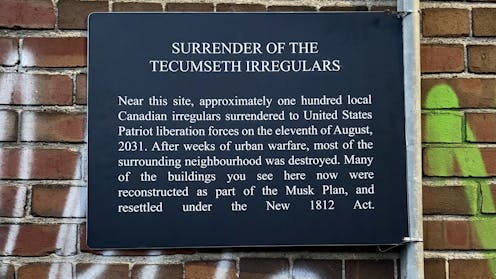
    As part of her ongoing public art series, Pax Americana, Toronto visual artist Dara Vandor has been posting aluminum signs in public spaces.

    These are plaques that reimagine, as the artist writes, the city as “a site of future conflict and occupation” by the United States. The signage, in the style of commemorative historical markers, echoes U.S. President Donald Trump’s recent and repeated threats to annex Canada and “is meant to serve as a dark warning, inviting contemplation on the fragility of nationhood.”

    For example, one plaque, posted on a bridge on Spadina Ave., informs passersby:

    “This spot served as the center of operations for United States Army snipers during Operation McKinley, the campaign to liberate the northern territory formerly known as Canada. From February to May 2035, this site, code-named ‘The Hot Dog Stand,’ served as a concealed sniper’s nest, providing precision fire support, disrupting insurgent movements, and protecting advancing American units.”

    Vandor’s thought-provoking project, which she told CBC News was sparked by anger at Trump’s threats to Canadian sovereignty, underlines how storytelling can be a powerful tool in times of conflict, especially when it affords itself the artistic freedom to envision potential futures before they can become reality.

    Psychological effects

    In order to understand how exactly stories such as the one portrayed on Vandor’s plaques can make a real impact on the way we navigate moments of crisis, we can turn to the work of conflict analysis experts such as Solon Simmons.

    In his recent book on conflict storytelling, Simmons introduces the concept of post-plot pressure.

    The term describes the psychological effect that a story can have on its readers after they finish reading. As Simmons puts it:

    “What makes stories so important (as opposed to just interesting or entertaining) is the effect of the story, and this effect doesn’t end when the story ends. It leaves the viewer/reader/listener with a feeling.”

    Simmons also explains that the kind and amount of post-plot pressure placed upon an audience depends on the type of story being told.

    Projected unhappy ending exerts pressure

    A story, for example, featuring a struggle in which the antagonist eventually triumphs over the protagonist is what Simmons calls a “satirical struggle story.”

    “Satirical” in this context does not necessarily mean that stories of this kind include elements of mockery or sarcasm. Rather, the label goes back to the influential research contributions of Canadian literary theorist Northrop Frye and American historian Hayden White, from which Simmons derives his own framework.

    This is exactly how to understand the story told over its several episodes on Vandor’s Pax Americana plaques: the U.S., as the story’s antagonist, abuses its power and ends up getting away with it, defeating Canadian resistance and annexing what is now only referred to as the “northern territory.”

    As Simmons suggests, conflict stories like this one, where what is viewed as injustice is allowed to prevail, exercise a relatively high level of post-plot pressure. This is mainly because the unhappy ending leaves audiences dissatisfied and with a sense of loss to grapple with.

    Reader reactions

    Simmons also explains that not all readers react to this particular kind of post-plot pressure in the same way. Vandor’s project, for example, has brought out some critical and upset responses.

    As the artist told Toronto Today, some people have called the plaques pro-American propaganda; one online commenter said they should be taken down.

    Julian Bleecker — a researcher, author, designer and engineer with a PhD in history of consciousness whose design studio offers services around future imagining and planning — voiced his objection to the project in a blog post.

    In his opinion, the antagonistic and fatalistic vision of the future portrayed on the plaques runs the risk of “playing into the hands of the very forces that are at work to make the world a less habitable place.”


    Read more:
    The theatre we want in 2040? We used ‘strategic foresight’ to plan on the Prairies


    But, as Simmons argues, conflict stories in which the happy ending never comes can also leave readers with a productive sense of post-plot pressure. In that case, feeling dissatisfied with the story’s outcome can instead motivate people to mobilize and strategize against the perceived injustice.

    Seen in this light, the plaques’ imagined collapse of Canadian sovereignty can therefore also serve as a stark and urgent inspiration, begging response.

    A sign in an alleyway says 'let go of your past, and welcome to our united future.'
    In Dara Vandor’s speculative future, U.S. President Ivanka Trump, standing on a tank, exhorts Torontonians to ‘Let go of your past, and welcome to our united future.’
    (Dara Vandor)

    A cautionary tale

    Fictional storytelling is often viewed as a useful tool that allows us to make sense of real moments of conflict that happened in the past. Think, for example, of Erich Maria Remarque’s famous war novel All Quiet on the Western Front, which was turned into an Oscar-winning film directed by Edward Berger in 2022.

    Our understanding of these kinds of stories as useful comes with the acknowledgement that there is nothing we can do to prevent past conflict. At the same time, the underlying assumption here is that by learning about the past, we can learn from the past and hopefully stop similar crises from ever happening again.


    Read more:
    How stories about alternate worlds can help us imagine a better future: Don’t Call Me Resilient EP 7 transcript


    What makes Vandor’s ongoing project especially valuable is that it moves its reflections on the past into an imagined future. The actual conflict that the plaques refer to is still part of the present, and its future still undecided. Whatever lessons we draw from their cautionary tale about Canadian annexation, we still have time to act upon them before that imagined future can become reality.

    Importance of resistance in the present

    This is exactly what leads historian Camille Bégin to conclude that the project’s appeal to the importance of resistance in the present is particularly strong:

    “It really shows us that the future is not written, that it’s in our hands to act in the present to forge the future that we want.”

    Even though Vandor’s project tells a story of Canadian defeat, it also highlights that Canadians did resist, a thought that should appeal to anyone opposed to Trump’s vision of territorial expansion.

    Or, and this is perhaps the most hopeful reflection coming out of the project, if Canadians come together and resist now, Trump’s threat of annexation may never get that far.

    The Conversation

    Pascal Michelberger does not work for, consult, own shares in or receive funding from any company or organisation that would benefit from this article, and has disclosed no relevant affiliations beyond their academic appointment.

    ref. ‘Pax Americana’ in Toronto: How speculative art can help us navigate threats – https://theconversation.com/pax-americana-in-toronto-how-speculative-art-can-help-us-navigate-threats-256755

    MIL OSI – Global Reports

  • MIL-OSI Global: Experimenting with generative AI to kibbitz and futz towards more inclusive futures

    Source: The Conversation – Canada – By Nathaniel Laywine, Assistant Professor, Communication and Media Studies, York University, Canada

    Generative AI draws from limited datasets, often reproducing errors and bias. (Shutterstock)

    What does it mean to think, act and work as a Jewish professor when human freedoms are under siege and authoritarian power gains ground? And how can we draw on our Jewish identities to navigate the sweeping encroachment of new technologies like AI?

    As communication scholars, colleagues and collaborators, we have spent a lot of time trying to answer these questions in our scholarship by taking cues from the intellectual lineage of our shared culture.


    Read more:
    Philosopher Hannah Arendt provokes us to rethink what education is for in the era of AI


    Lately, Donald Trump’s administration has demonstrated a heavy investment in cataloguing and categorizing Jewish professors. In April, the Equal Employment Opportunity Commission (EEOC) sent text messages to the personal cellphones of faculty and staff at Barnard College, asking them to self-identify as Jewish and/or Israeli. The text message also asked them to disclose any instances of antisemitic discrimination or harassment they had experienced.

    Presumably, the text message inquiry itself was not recognized by its senders as an instance of such harassment.

    We do not believe being a Jewish professor means silencing our students as they protest atrocities in Gaza, and it certainly doesn’t mean revoking their visas or deporting them. Rather, it means drawing upon the tools of our forebears to question systems of oppression, wherever and however they may arise.

    We simultaneously occupy both privileged and marginal positions within the university and North American society at large. This makes us acutely aware of how fragile conditional tolerance is, and how quickly a list of names can be used to justify repression or violence.

    Collection and use of data

    As communication and media scholars, we’re often critical of how data are aggregated, stored and disseminated. The EEOC questionnaire concerns us because it reduces the complexities of Jewish identity and the profound harms of antisemitism to a handful of abstract and ideologically determined data points.

    Our recent research on generative AI (genAI) and its incompatibility with Jewish cultural expression shows that meaningful efforts to combat antisemitism — and other forms of oppression — must centre the knowledge and experiences of affected communities.

    Our research found that outputs of chatbots such as ChatGPT are unable to tell jokes in a Jewish comedic style without resorting to offensive tropes. In another forthcoming study, we argue that genAI is equally incapable of representing the multifaceted “intersectional identities” of Jewish people except by smashing together rudimentary cultural signifiers (such as rainbows for queerness or bagels for Jewishness).

    In each case, these platforms rely on datasets to determine what Jewishness is, and these datasets originate from the narratives that other people tell about Jewish people, rather than the ones we tell about ourselves.

    Futzing is a Yiddish word that means messing around via hands-on experimentation.
    (Shutterstock)

    Critical strategies

    These platforms have increasingly become parts of daily life and communicative infrastructure. To investigate them, we adopted two critical strategies from our shared heritage as Ashkenazi Jews: kibbitzing and futzing.

    Both terms are Yiddish. Kibbitzing is a lively, informal way of thinking and talking together. It’s somewhere between joking, arguing and exchanging ideas. It is grounded in our relationships, histories and biases; kibbitzing is how we make shared meaning together through many voices.

    Kibbitzing values contradiction, humour and the messiness of human conversation. Unlike AI chatbots, which follow scripted, dialogic, question-and-answer routines based on quantifiable patterns in data, kibbitzing is unpredictable, non-linear and intentionally disorganized.

    When we kibbitz, we build understanding by challenging one another and reflecting on what each of us brings to the table. In the age of genAI, kibbitzing offers a way to talk that is full of friction, laughter and deep, collective insight.

    Futzing means messing around via hands-on experimentation, with no set agenda and no official guidance. This unstructured inquiry is an acknowledgement of Jews’ historical role as outsiders within European society. As we write in our forthcoming article, these practices reflect what social theorist Michel de Certeau calls “making do,” a tactical means of collective empowerment in a hostile society.

    Using futzing as a methodology, we started exploring genAI, drawing on our curiosity to see what might happen by playing, testing and responding in real time.

    Futz first, then kibbitz

    Each of us futzed on our own at first, with no ambition to crack the code or reverse-engineer the algorithm. Later, when we began kibbitzing together, we realized our scattered efforts were actually circling around shared concerns. Futzing helped us see patterns, surprises and contradictions — things we might have missed with a more rigid approach. Kibbitzing helped us connect those patterns and reconcile the contradictions.

    Drawing on our culture this way allows us to imagine inclusive, anti-oppressive Jewish epistemologies that respond to the complexity of the current political moment. Jewish identity — like all identities — is porous and resistant to fixed form. Our shared North American Ashkenazi identity is just one of many possible perspectives that comprise a broader identity of Jewishness.

    That is not a problem to be solved. Rather, it is a strength and a bond between us. Readers may well see their own cultural traditions, vernaculars and ancestral practices in this light too, as techniques of resilience and joy in the face of hardship and oppression.

    There is an irony here. The deeper we dig into the intellectual roots of our own culture, the more common ground we might discover with everyone else’s. And that makes us feel a whole lot safer than getting a text from the EEOC ever could.

    The authors do not work for, consult, own shares in or receive funding from any company or organisation that would benefit from this article, and have disclosed no relevant affiliations beyond their academic appointment.

    ref. Experimenting with generative AI to kibbitz and futz towards more inclusive futures – https://theconversation.com/experimenting-with-generative-ai-to-kibbitz-and-futz-towards-more-inclusive-futures-252553

    MIL OSI – Global Reports

  • MIL-OSI Global: ‘Pax Americana’ in Toronto? Speculative art can help us navigate threats

    Source: The Conversation – Canada – By Pascal Michelberger, Postdoctoral Scholar, Western Academy for Advanced Research, Western University

    Artist Dara Vandor’s futuristic, commemorative historical plaques on Toronto streets project a U.S.-annexed Canada. (Dara Vandor)

    As part of her ongoing public art series, Pax Americana, Toronto visual artist Dara Vandor has been posting aluminum signs in public spaces.

    These are plaques that reimagine, as the artist writes, the city as “a site of future conflict and occupation” by the United States. The signage, in the style of commemorative historical markers, echoes U.S. President Donald Trump’s recent and repeated threats to annex Canada and “is meant to serve as a dark warning, inviting contemplation on the fragility of nationhood.”

    For example, one plaque, posted on a bridge on Spadina Ave., informs passersby:

    “This spot served as the center of operations for United States Army snipers during Operation McKinley, the campaign to liberate the northern territory formerly known as Canada. From February to May 2035, this site, code-named ‘The Hot Dog Stand,’ served as a concealed sniper’s nest, providing precision fire support, disrupting insurgent movements, and protecting advancing American units.”

    Vandor’s thought-provoking project, which she told CBC News was sparked by anger at Trump’s threats to Canadian sovereignty, underlines how storytelling can be a powerful tool in times of conflict, especially when it affords itself the artistic freedom to envision potential futures before they can become reality.

    Psychological effects

    In order to understand how exactly stories such as the one portrayed on Vandor’s plaques can make a real impact on the way we navigate moments of crisis, we can turn to the work of conflict analysis experts such as Solon Simmons.

    In his recent book on conflict storytelling, Simmons introduces the concept of post-plot pressure.

    The term describes the psychological effect that a story can have on its readers after they finish reading. As Simmons puts it:

    “What makes stories so important (as opposed to just interesting or entertaining) is the effect of the story, and this effect doesn’t end when the story ends. It leaves the viewer/reader/listener with a feeling.”

    Simmons also explains that the kind and amount of post-plot pressure placed upon an audience depends on the type of story being told.

    Projected unhappy ending exerts pressure

    A story, for example, featuring a struggle in which the antagonist eventually triumphs over the protagonist is what Simmons calls a “satirical struggle story.”

    “Satirical” in this context does not necessarily mean that stories of this kind include elements of mockery or sarcasm. Rather, the label goes back to the influential research contributions of Canadian literary theorist Northrop Frye and American historian Hayden White, from which Simmons derives his own framework.

    This is exactly how to understand the story told over its several episodes on Vandor’s Pax Americana plaques: the U.S., as the story’s antagonist, abuses its power and ends up getting away with it, defeating Canadian resistance and annexing what is now only referred to as the “northern territory.”

    As Simmons suggests, conflict stories like this one, where what is viewed as injustice is allowed to prevail, exercise a relatively high level of post-plot pressure. This is mainly because the unhappy ending leaves audiences dissatisfied and with a sense of loss to grapple with.

    Reader reactions

    Simmons also explains that not all readers react to this particular kind of post-plot pressure in the same way. Vandor’s project, for example, has brought out some critical and upset responses.

    As the artist told Toronto Today, some people have called the plaques pro-American propaganda; one online commenter said they should be taken down.

    Julian Bleecker — a researcher, author, designer and engineer with a PhD in history of consciousness whose design studio offers services around future imagining and planning — voiced his objection to the project in a blog post.

    In his opinion, the antagonistic and fatalistic vision of the future portrayed on the plaques runs the risk of “playing into the hands of the very forces that are at work to make the world a less habitable place.”


    Read more:
    The theatre we want in 2040? We used ‘strategic foresight’ to plan on the Prairies


    But, as Simmons argues, conflict stories in which the happy ending never comes can also leave readers with a productive sense of post-plot pressure. In that case, feeling dissatisfied with the story’s outcome can instead motivate people to mobilize and strategize against the perceived injustice.

    Seen in this light, the plaques’ imagined collapse of Canadian sovereignty can therefore also serve as a stark and urgent inspiration, begging response.

    In Dara Vandor’s speculative future, U.S. President Ivanka Trump, standing on a tank, exhorts Torontonians to ‘Let go of your past, and welcome to our united future.’
    (Dara Vandor)

    A cautionary tale

    Fictional storytelling is often viewed as a useful tool that allows us to make sense of real moments of conflict that happened in the past. Think, for example, of Erich Maria Remarque’s famous war novel All Quiet on the Western Front, which was turned into an Oscar-winning film directed by Edward Berger in 2022.

    Our understanding of these kinds of stories as useful comes with the acknowledgement that there is nothing we can do to prevent past conflict. At the same time, the underlying assumption here is that by learning about the past, we can learn from the past and hopefully stop similar crises from ever happening again.


    Read more:
    How stories about alternate worlds can help us imagine a better future: Don’t Call Me Resilient EP 7 transcript


    What makes Vandor’s ongoing project especially valuable is that it moves its reflections on the past into an imagined future. The actual conflict that the plaques refer to is still part of the present, and its future still undecided. Whatever lessons we draw from their cautionary tale about Canadian annexation, we still have time to act upon them before that imagined future can become reality.

    Importance of resistance in the present

    This is exactly what leads historian Camille Bégin to conclude that the project’s appeal to the importance of resistance in the present is particularly strong:

    “It really shows us that the future is not written, that it’s in our hands to act in the present to forge the future that we want.”

    Even though Vandor’s project tells a story of Canadian defeat, it also highlights that Canadians did resist, a thought that should appeal to anyone opposed to Trump’s vision of territorial expansion.

    Or, and this is perhaps the most hopeful reflection coming out of the project, if Canadians come together and resist now, Trump’s threat of annexation may never get that far.

    Pascal Michelberger does not work for, consult, own shares in or receive funding from any company or organisation that would benefit from this article, and has disclosed no relevant affiliations beyond their academic appointment.

    ref. ‘Pax Americana’ in Toronto? Speculative art can help us navigate threats – https://theconversation.com/pax-americana-in-toronto-speculative-art-can-help-us-navigate-threats-256755

    MIL OSI – Global Reports

  • MIL-OSI Global: Kids care deeply about our planet, so adults need to start listening

    Source: The Conversation – Canada – By Jen Kostuchuk, PhD Candidate, Sociology, University of Victoria

    “I wish adults knew that I really care about the environment and want to help, but I sometimes feel like my ideas don’t matter because I’m just a kid.”

    This is what a nine-year-old respondent told us when we asked how they feel about the environment.

    In today’s current political climate, many adults seem resigned to climate catastrophe and even dabble in climate change denialism. However, our survey of 1,000 youth aged eight to 14 from Canada and the United States found that children care deeply about the planet and are ready to take action.

    The findings from our report were produced as part of an ongoing study with the Humanity in Motion Society, a Canadian non-profit organization focused on engaging youth as key stakeholders in advancing environmental stewardship.

    Almost 90 per cent of the kids we spoke to recognize climate change as a real and urgent problem, calling for intergenerational collaboration and bolder environmental mitigation and adaptation commitments.

    It turns out that our nine-year-old respondent speaks for many children. Kids know what’s at stake, want a seat at the table and need adults to act with them.

    What kids told us

    Some of the kids in the survey talk about the action they want adults to take to tackle climate change. (Humanity in Motion Society)

    Many of the kids told us they regularly take action to mitigate their carbon footprint, including recycling, embracing reusable items and conserving energy. Their accounts are consistent with numerous academic studies on youth involvement in environmental citizenship.

    However, many understand individual action alone is not enough. In fact, most kids recognize that systemic accountability is necessary to tackle the climate crisis. As one kid in Grade 6 shared:

    “I wish big industry and governments would stop asking us to do something when they continue to fly in private jets [and] drill for oil and more; we are asked to recycle.”

    Kids have a deep understanding of current political issues, including the cost-of-living crisis and the harmful “drill baby drill” sentiments, but also underscore a stark disconnect: while we instil environmentally responsible values in our children, elected leaders remain consistently inactive on these very same issues.


    Read more:
    The oil and gas industry has been lying about global warming for decades — accountability is long overdue


    Kids play active roles in knowledge sharing

    The kids in this study display impressive knowledge about the steps that need to be taken to address the climate crisis. Our findings demonstrate that youth are not just passive recipients of knowledge but, rather, play an active role in being climate communicators.

    For example, two thirds of our respondents say their friends learn about climate change directly from them. Even though many children note that they do not have climate clubs at school, they are curious about the role of big oil, deforestation and corporate greed in the ongoing climate crisis.

    In addition to teachers and parents being the most influential sources of knowledge for children, social media content has an impact on kids’ environmental behaviour and feelings of empowerment.

    Specifically, our data shows that talking to others online has a significant positive relationship with reported sustainable behaviour, and that watching videos has a significant positive relationship with how much kids feel they can make a difference. One young girl reflected on using Tiktok for insights on climate change while also capturing an awareness among her generation:

    “I would say if there’s a really big issue, like, I know there’s something called the Climate Clock in New York…I mean, the thing with social media, you never know what’s true and untrue, but that thing [Climate Clock] came on my ‘For You’ page…and everybody in the comments, they were saying ‘this is very real, we have to do something about it.’”

    This shows that kids would benefit greatly from spaces to continue in-person environmental discussions with adults in the room. One young respondent captured the potential for meaningful engagement:

    “There are a lot of things that can be done, curriculum integrations…sustainable skills like critical thinking, problem-solving, collaboration, and maybe explore the ecosystems and biodiversities and actually encourage students to design and implement climate-friendly projects and carry out field trips and organize visits to renewable energy sites or environmental organizations and sometimes, maybe occasionally, the school can invite climate experts, activists or scientists.”

    These ideas were shared by others who called on adults to lead more experiential approaches to climate education inside the classroom and beyond.

    Adults can help by providing opportunities in the classroom and beyond for kids to discuss cliamte change.
    (Shutterstock)


    Read more:
    Teachers need bolder action from our school boards to educate in and for a climate emergency


    Five calls to action

    Here are five ways to help bring about change:

    1. Adults need to step up. Adults play a critical role in shaping how youth engage in climate action. Our report found that teachers and parents, in addition to the internet, are among the most influential learning sources for youth today. Kids often take pro-environmental values, actions and cues from their parents.

    2. Apathy is not an option if we want change. Youth are looking to leaders and elected officials to invest heavily in infrastructure and education to improve our environment.

    3. Intergenerational collaboration promotes better environmental values. Despite the consequences of climate change, youth share a sense of optimism and emphasize the need for intergenerational responsibility.

    4. Provide spaces for youth to take leadership roles and engage in climate dialogue. Kids want to do more to build a sustainable future, but don’t know where to begin. Providing opportunities in the classroom and beyond are critical next steps to raise the next generation of climate leaders.

    5. Promote bold action. Kids should be able to answer the call of many climate activists who recognize the need to pursue a greener economy by working together.

    Our survey findings highlight a hopeful message about young people’s engagement in climate action, underscoring their impressive knowledge of the systemic changes required to address the crisis.

    As adults across the political spectrum bicker about climate policy, young people are growing impatient and hoping to lead the way. Our results refocus attention on the future we’re creating and challenge us to listen seriously to children when they seek to address what may be their generation’s greatest crisis.

    Sean Lyons has received funding from Mitacs in support of an earlier iteration of the study discussed here.

    Erik Steiner and Jen Kostuchuk do not work for, consult, own shares in or receive funding from any company or organisation that would benefit from this article, and have disclosed no relevant affiliations beyond their academic appointment.

    ref. Kids care deeply about our planet, so adults need to start listening – https://theconversation.com/kids-care-deeply-about-our-planet-so-adults-need-to-start-listening-257304

    MIL OSI – Global Reports

  • MIL-OSI Global: Preventing urinary tract infections after menopause: What every woman should know

    Source: The Conversation – Canada – By Erin A. Brennand, Gynecologist & Associate Professor, Cumming School of Medicine, University of Calgary

    There is more information available about urinary tract infections today than ever before. (Shutterstock)

    After menopause, urinary tract infections (UTIs) can be more frequent, yet most Canadian women (82 per cent in a recent survey) don’t realize the two are associated.

    At the Sex, Gender and Women’s Health Research Hub, our team’s advocacy aims to increase awareness and highlight proven strategies to help prevent UTIs for women later in life.

    Why are UTIs more common after menopause?

    The main culprit for increased UTIs in menopausal women is the drop in estrogen levels. Estrogen plays a crucial role in maintaining urinary tract tissue health.

    As estrogen declines, the lining of the urethra — the tube through which urine flows out of the body — becomes thinner and more fragile. Also, there are fewer infection-fighting blood cells in the urinary tract, and mucosal immunity — the specialized immune defences present at the mucosal surfaces lining the urinary tract that include physical and chemical barriers, cellular receptors and antibodies — is reduced.

    This weakens the local immune response, making it easier for bacteria to cause infections. Additionally, changes in vaginal flora — the bacteria that naturally protect against infections — results in the urinary tract being vulnerable.

    Knowledge is power during menopause.
    Servier Medical Art, CC BY

    Other factors can contribute to UTI risk at this stage of life, too. Women whose bladder muscles have weakened with age, or who have developed pelvic organ prolapse, can experience incomplete bladder emptying. This leads to urine retention and an increased chance of bacterial growth.


    Read more:
    Women having surgery to treat pelvic organ prolapse don’t always need a hysterectomy


    Similarly, if women experience urinary incontinence, the leakage and moisture on incontinence pads or underwear can create an environment where bacteria thrive. And while sexual activity itself does not directly cause UTIs, it can introduce bacteria into the urinary tract, increasing the risk of infection.

    Signs of a UTI

    Bacteria in the urine without symptoms is called asymptomatic bacteriuria. It is not a UTI and should not be treated; a UTI is only diagnosed when bacteria and symptoms are both present. The most obvious symptoms include:

    • A new, strong, persistent urge to urinate;
    • A burning sensation while urinating;
    • Frequent urination in small amounts;
    • Pelvic discomfort or pressure.

    In severe cases, UTIs can lead to kidney infections, so when symptoms include fever, chills and back pain, it is essential to seek immediate medical attention.

    For women in their 80s or older, or sometimes younger women who are living with medical conditions such as dementia, urinary tract infections can manifest as behavioural changes such as confusion, withdrawal or reduced appetite. However, new onset delirium should always be investigated by a medical team rather than assumed to be a UTI.

    Evidence-based strategies to prevent UTIs

    Several medical and lifestyle interventions can make a significant difference:

    1. Vaginal estrogen therapy

    One of the most effective ways to prevent recurrent UTIs in postmenopausal women is vaginal estrogen therapy, which delivers small doses of estrogen directly to the vaginal tissues through creams, tablets or rings. Studies have shown that vaginal estrogen can restore the natural protective barrier of the urinary tract, reducing UTI risk significantly. It can be used by breast cancer survivors as it does not have the same risks associated with menopause hormone therapy (MHT).

    2. Non-antibiotic prevention

    Methenamine hippurate (one gram orally, twice-a-day) is effective in reducing UTIs by creating an environment that prevents bacterial growth. In Canada, women need to obtain this medication from a compounding pharmacy.

    3. Low-dose antibiotic
    Doctors may prescribe low-dose antibiotics – about half the standard dose – for several months. If sexual activity is a trigger for UTIs, antibiotics can be used episodically after sex. However, antibiotics can cause side-effects and create antibiotic-resistant bacteria.
    4. Diet supplements
    Scientific evidence on consuming cranberry-based products to prevent UTIs is mixed. Some studies suggest that certain compounds in cranberries (proanthocyanidins, or PACs) prevent bacteria from adhering to the bladder lining, while others show no benefit. If trying these products, women should choose brands with high concentrations of PACs, the active ingredient.

    Similarly, probiotics, especially those containing Lactobacillus strains, may help maintain a healthy vaginal microbiome, which in turn can lower UTI risk. However, research is still evolving.

    5. Hygiene and lifestyle habits
    Though there is limited evidence, simple everyday habits may help in preventing UTIs:

    • Staying hydrated – Drinking water helps to flush bacteria from the urinary tract. For women who drink a low volume of fluids each day (less than 1.5 litres), increasing water intake may help.
    • Urinating regularly – Avoid holding urine for long periods and aim to void every three to four hours during the day.
    • Urinating after sex – This helps clear bacteria introduced during intercourse.
    • Choosing breathable underwear – Cotton underwear and loose-fitting clothes reduce build up of moisture, which in turn reduces bacterial growth.

    More innovations on the horizon

    Vaccines are one of the most promising developments for preventing recurrent UTIs. In one early trial, overall recurrences decreased by 75 per cent for women given an oral vaccine, with no major side-effects reported.

    Trials are currently under way in Canada, and researchers hope vaccines will provide a more effective and long-term solution.

    Treatment and support for UTIs.
    People illustrations by Storyset, CC BY

    When to see a doctor

    Any woman who is experiencing frequent UTIs — defined as two infections in six months or three in a year — in menopause should talk to their doctor or primary care provider. Together, they can determine the best preventive targeted strategies.

    Knowledge is power, and there is more information available today than ever before. UTIs are not an inevitable part of aging. With the right combination of medical treatments and lifestyle changes, women can reduce postmenopausal risk.

    Erin A. Brennand receives funding from the Canadian Institutes of Health Research, Social Sciences and Humanities Research Council, the Calgary Health Foundation, and the MSI Foundation (all paid to institution).

    Jayna Holroyd-Leduc has received funding from CIHR and Alberta Innovates. She holds the BSF Chair in Geriatric Medicine at the University of Calgary.

    Pauline McDonagh Hull does not work for, consult, own shares in or receive funding from any company or organisation that would benefit from this article, and has disclosed no relevant affiliations beyond their academic appointment.

    ref. Preventing urinary tract infections after menopause: What every woman should know – https://theconversation.com/preventing-urinary-tract-infections-after-menopause-what-every-woman-should-know-255762

    MIL OSI – Global Reports

  • MIL-OSI Global: Blind box toys are booming: Are they just child’s play or something more concerning?

    Source: The Conversation – Canada – By Eugene Y. Chan, Associate Professor of Marketing, Toronto Metropolitan University

    Collectible figurines on display at Pop Mart in Ivano-Frankivsk, Ukraine, on April 29, 2025. (Shutterstock)

    If you’ve seen videos of people tearing into tiny toy packages online, or noticed teens obsessing over pastel-coloured figurines at the mall, you’ve probably encountered the global craze for blind box toys.

    These small collectibles — usually figures of cartoonish characters — are sold in sealed packaging that hides which specific item is inside. You might get the one you want, or you might not. That uncertainty is part of the thrill.

    Unlike traditional toys, these figures are marketed as collectibles. Many are part of themed series, with some designs labelled as “rare” or “secret,” appearing in as few as one in every 144 boxes. This sense of exclusivity fuels repeat purchases and has spawned a resale market where rare figures can command hundreds of dollars.

    Popular among children and adults alike, blind box toys have grown into a billion-dollar industry. One of the more popular brands is Pop Mart, a Chinese toy company founded in 2010 known for its collectible designer toys sold in mystery packs.

    Gen Z consumers, in particular, have embraced blind box toys both as a nostalgic pastime and as a form of legitimate collecting. The proliferation of unboxing videos on platforms like TikTok and YouTube, where creators open dozens of blind boxes on camera, has added to their appeal.

    For many fans, these toys offer more than just cuteness: they also provide suspense, surprise and a rush of dopamine with every box opened. But how did this niche product become a global obsession?

    From Tokyo streets to western malls

    The origins of blind box toys trace back to East Asia. Capsule toy vending machines called gashapon originated in Japan in the 1960s. By the 1980s, they had become a cultural fixture. These machines dispense small toys in opaque plastic balls, with customers never quite sure which item they’ll receive.

    In the early 2010s, Chinese companies like Pop Mart adapted the gashapon model for the mainstream retail space. Instead of vending machines, they began selling artist-designed vinyl toys in blind boxes at dedicated boutiques.

    A tourist uses a gashapon machine in Osaka, Japan, in 2024. Gashapon machines are similar to the coin-operated toy vending machines seen outside grocery stores and other retailers in North America.
    (Shutterstock)

    Pop Mart’s success helped transform the blind box into a mainstream commercial phenomenon. Characters like Molly, Skullpanda and Dimoo became instant hits, combining Japanese kawaii esthetics with western pop art sensibilities.

    Pop Mart figures have since developed a cult-like following. Many consumers treat the toys as affordable art objects, displayed in cabinets, on purses or traded online.

    Today, blind box retail stores have expanded globally from Asia to Europe and North America. In October 2024, Pop Mart opened its first store in the Midwestern United States, located on Chicago’s Magnificent Mile at The Shops at North Bridge. The store offers exclusive products and taps into the growing demand for collectibles among American consumers.

    The psychology behind the mystery

    What makes blind box toys so hard to resist?

    Their success relies on a psychological principle known as variable-ratio reinforcement — the same reward pattern that makes slot machines so addictive.

    You never know exactly when you’ll score the item you’re after, but the possibility that the next box might contain it keeps people coming back. This unpredictability keeps people engaged, especially when the potential reward is framed as rare or valuable.

    Cconsumer psychology research also suggests that anticipation plays a major role. Studies show that dopamine, the brain’s reward chemical, spikes not just when we get what we want, but when we anticipate it. The sealed packaging, the suspense of unwrapping and the hope for a rare figure all heighten this effect.

    Sonny Angels on display in a store in Shenzhen, China, in March 2019.
    (Shutterstock)

    For younger collectors, the excitement of “the chase” can foster compulsive buying habits. This effect is amplified by the social influence of watching unboxings online or seeing friends complete their sets, and it becomes a powerful loop.

    Even when buyers don’t get the figure they want, the sunk cost fallacy — the feeling that they’ve already invested too much time or money to walk away — keeps them buying more.

    The hidden costs of blind boxes

    As blind box toys surge in popularity, they have drawn criticism from consumer advocates, psychologists and environmentalists alike.

    Some worry that blind boxes normalize gambling-like behaviours, especially among children. The randomness, excitement and promise of rare rewards closely mirror the mechanisms behind loot boxes in video games — another product that has sparked global concern over youth exposure to gambling psychology.

    Several countries, including Belgium and the Netherlands, have regulated loot boxes under gambling laws. Blind boxes, though currently unregulated, may be next in line for scrutiny.


    Read more:
    Blind bags: how toy makers are making a fortune with child gambling


    There are also environmental concerns. Many blind box toys come in excessive packaging — plastic wraps, foil bags, cardboard boxes — most of which is discarded immediately. The collectibles themselves are often made of non-recyclable plastics, raising questions about sustainability in an era of rising consumer awareness over waste.

    Even among adult fans, some critics question whether blind boxes are designed less to bring joy and more to trigger compulsive consumption. The joy of collecting, they argue, is increasingly overshadowed by the mechanics of engineered desire.

    What should we make of the blind box boom?

    Blind box toys are not inherently harmful, and for many, they’re a source of fun, nostalgia and self-expression. They also offer an accessible way for consumers to engage with designer art in a collectible, miniature form, as many of them are created by individual artists.

    But blind box toys also raise deeper questions about how modern marketing leverages psychological triggers associated with gambling, especially when it comes to children.

    As these toys continue to gain traction in the West, it’s worth asking more critical questions, like: are we buying into mystery or are we being sold obsession and compulsion?

    The blind box trend reflects broader shifts in how products are marketed, how value is perceived and how consumer behaviour is shaped in a digital, attention-driven economy. Understanding the forces at play may be the first step toward more informed — and perhaps more mindful — collecting.

    Eugene Y. Chan does not work for, consult, own shares in or receive funding from any company or organisation that would benefit from this article, and has disclosed no relevant affiliations beyond their academic appointment.

    ref. Blind box toys are booming: Are they just child’s play or something more concerning? – https://theconversation.com/blind-box-toys-are-booming-are-they-just-childs-play-or-something-more-concerning-257611

    MIL OSI – Global Reports

  • MIL-OSI Global: Airbnb scams: new book explores thriving criminal activity on big tech platforms

    Source: The Conversation – Africa – By Julie Reid, Professor, University of South Africa

    Big tech sharing economy platforms like Airbnb and Uber are marketed as trustworthy, but a new book by a South African media scholar argues that they are highly vulnerable to scammers who spread delusive speech (a form of disinformation, designed to deceive by criminal intent).

    Julie Reid draws from first-hand accounts and over 600 cases from around the world of victims lured into scams or physical danger by fake Airbnb reviews and listings, providing a detailed case study. We asked her five questions about her book.


    How do the scams work?

    Airbnb is the world’s largest accommodation-sharing platform. It connects property owners who want to rent out their homes with travellers looking for alternatives to traditional hotels. The company recently expanded its offering and now facilitates the booking of other services like personal trainers or caterers along with accommodation rentals.

    Airbnb scams happen in several ways. The most obvious is the phantom listing scam. The scammer constructs a fake but attractive listing on Airbnb and accepts payments from unsuspecting guests. It’s only when guests arrive at the address that they discover the property doesn’t exist. Scammers have also learnt to navigate around Airbnb’s review system. Fake positive reviews are produced by scam host networks, making them appear to be authentic.

    Bait and switch scams are also common. Here the scam “host” contacts the guest on check-in day claiming the reserved property is suddenly unavailable. They offer alternative accommodation, which the guest later discovers is not as good as the original property they’ve paid for (which is often fictional). The guest pays for a premium rental but is forced to stay in a property that might be unsafe, unclean, or missing amenities.

    Scam hosts use misleading, plagiarised, or AI-generated property images and fake descriptions along with fake personal profiles and aliases.

    Delusive tactics also redirect guests away from the secure Airbnb payment portal to alternative payment methods. The scammer disappears with the money.

    But the danger isn’t limited to financial crimes. The platform’s business model is premised on staying in a stranger’s private property, which can put guests’ personal safety at risk.

    Criminal hosts can lure targets into dangerous environments. Once checked in, guests are isolated from public view, housed in a property to which the host has access.

    I’ve assessed multiple cases where Airbnb guests were assaulted, robbed with no signs of forced entry, raped, murdered, made victims of sexploitation, extortion or human trafficking, or held hostage.

    How does the disinformation work?

    I consider delusive speech a subset of disinformation because it presents intentionally misleading content at scale. But it differs from disinformation in its intentions. It isn’t done to promote a particular cause or gain ideological, military, or political advantage. Delusive speech is motivated purely by criminal intent or nefarious financial gain.


    Read more:
    The sharing economy can expose you to liability risks – here’s how to protect yourself


    Delusive speech works by hiding in plain sight on platforms we think we can trust, like Airbnb, Booking.com, Uber and others. Often, it’s indistinguishable from honest and genuine content. When users browse Airbnb listings for holiday accommodation, they’re presented with numerous options. A fake property listing looks, sounds and feels exactly the same as a genuine one.

    This happens on a platform that has built its brand narrative around the concept of trust. Scammers exploit these digital contexts of pre-established trust. When users log on to popular e-commerce or sharing economy platforms, they’re already primed to pay for something. It becomes relatively easy for scammers to delude targets into parting with their money.

    What can Airbnb do about it?

    Airbnb already has several trust and safety mechanisms in place. They include rapid response teams, an expert Trust and Safety Advisory Coalition and travel insurance for guests. The company claims to be trying to stop fake listings with machine learning technology.

    Sadly, none of these mechanisms work perfectly. While Airbnb promises to verify properties and host identities, my analysis exposes flaws in these systems. Scammers easily bypass verification tiers through aliases, forged documents and AI-generated material. Airbnb has admitted it needs to address the failures of its verification processes.


    Read more:
    How to stay safe in cyberspace: 5 essential reads


    My analysis uncovered how scammed guests are routinely denied the opportunity to post reviews of problematic rentals. Opaque terms of service and content policies allow Airbnb customer service agents and executives to justify censoring negative but honest guest reviews.

    This means dangerous and fraudulent activity goes publicly unreported and unreviewed, leaving future guests vulnerable. I argue that Airbnb’s review curation mechanisms should be revamped according to internationally recognised human rights frameworks that protect freedom of speech. This would allow for more honest accounts of guest experiences and create a safer online environment.

    Perhaps the most common complaint I encountered was that Airbnb doesn’t remove offending listings from its platform, even after a scammed guest provides evidence that the listing was posted by a fraudster. Airbnb must develop an urgent protocol for swiftly removing offending listings when discovered, to protect future guests from falling victim to the same scam trap.

    What can users do to protect themselves?

    Travellers can protect themselves by being extra cautious. Ask around. Seek recommendations from people you know and trust, and who can verify that the property you are booking actually exists and that the host is trustworthy.

    If that isn’t an option, consider an established hotel instead, but book directly with the hotel and not via third party sites like Booking.com where listings can easily be faked. Check on Google Street View to make sure the property is where it claims to be.

    Either way, have a Plan B in case things go wrong. Prepare ahead of your trip by deciding what you will do if you find yourself in an unsafe situation. And always, always, buy travel insurance.

    Is it part of a bigger problem?

    I assessed several digitally initiated scam categories in this book. While my main case study focused on Airbnb, the problem of delusive speech online isn’t unique to this platform. Delusive speech is now carried by all major tech platforms integral to everyday life.


    Read more:
    How Airbnb is reshaping our cities


    In the book, I also highlight how scammers operate in every corner of the internet, including dating apps like Grindr, Tinder and Hinge; ride-sharing services like Uber, Lyft and Bolt; travel sites like Booking.com and Hotels.com; and social media platforms like Facebook, Instagram and YouTube, among others.

    I hope that these examples will boost awareness of the risks of using these apps and sites.

    Julie Reid does not work for, consult, own shares in or receive funding from any company or organisation that would benefit from this article, and has disclosed no relevant affiliations beyond their academic appointment.

    ref. Airbnb scams: new book explores thriving criminal activity on big tech platforms – https://theconversation.com/airbnb-scams-new-book-explores-thriving-criminal-activity-on-big-tech-platforms-256806

    MIL OSI – Global Reports

  • MIL-OSI Global: Sexism in science: 7 women whose trailblazing work shattered stereotypes

    Source: The Conversation – Africa – By Christa Kuljian, Research Associate, WiSER, University of the Witwatersrand

    Seven women were part of a trailblazing network of feminist scientists in the 1970s, 1980s, and 1990s in the Boston area in the US. Christa Kuljian is a science writer and historian of science who focuses much of her research on issues of science and society, gender and race. She is the author of two previous books of narrative nonfiction – Sanctuary and Darwin’s Hunch. In her new book Our Science, Ourselves she focuses on the life stories of the seven women. We asked her about her book.

    How did you choose the scientists you focused on in the book?

    I grew up in the Boston area in the 1970s, and in high school, my parents gave me a copy of the revolutionary guide to women’s health, Our Bodies, Ourselves, which was published by the Boston Women’s Health Book Collective. In the early 1980s, I studied the history of science at Harvard and took a course with Ruth Hubbard called Bio 109: Biology and Women’s Issues.

    Hubbard, in 1974, was the first woman to achieve tenure in biology at Harvard, and she features in the book. Her course taught about how scientists, including Charles Darwin, promoted stereotypes and myths about women’s biology. The idea for Our Science, Ourselves grew from that formative experience in Hubbard’s course.

    But it also had roots in another, more recent experience. In 2016, I published Darwin’s Hunch: Science, Race and the Search for Human Origins, about the history of palaeoanthropology in South Africa. The book explores questions that some of my history of science professors might have asked. What influence did the social and political context of colonialism and apartheid have on the search for human origins?

    After it was published, I was struck by several stories that brought science and sexism into the popular media. In July 2017, James Damore at Google wrote that “the gender gap in tech” likely existed because of biological differences between men and women, and he received support from popular psychologist Jordan Peterson.

    In September 2018, an Italian physicist, Alessandro Strumia, said that the low number of women in physics was proof that women were innately less capable than men. He suggested that male scientists were being discriminated against to give opportunities to women.

    These statements reminded me of what former Harvard president Larry Summers had said back in 2005. Drawing on the work of psychologist and popular writer Steven Pinker, Summers spoke of women having a “different availability of aptitude” in science and math.

    Why were these myths about women’s biology still having an impact in the 21st century? I decided to go back to my class notes and look more closely at Hubbard’s research. Who had she worked with at the time? What were other scientists with a feminist awareness saying in the 1970s and 1980s?

    As a result of many interviews, and research in the archives, I discovered a fascinating network of women, all of whom contributed to feminist critiques of science, and ultimately to the field of feminist science studies.

    Our Science, Ourselves follows the lives of Ruth Hubbard, Rita Arditti, Evelyn Fox Keller, Evelynn Hammonds, Anne Fausto-Sterling, Banu Subramaniam and Nancy Hopkins.

    None of these women scientists were born in Boston, but they all moved there to study, take a job, conduct research, or network with other scientists. Part of what made Boston interesting to me was the critical mass of colleges, universities and scientists, but also the presence of social movements that influenced these women, including Science for the People, the Combahee River Collective and others.

    Could you tell us about one or two of these women’s stories?

    One of them is Rita Arditti. An Argentinian geneticist at Harvard Medical School, she led a protest in December 1969 at the annual conference of the American Association for the Advancement of Science in Boston. Along with 12 colleagues carrying posters and pamphlets, she arrived unannounced at a special luncheon for women scientists, calling for an end to discrimination against women in science. Most of the women ignored Arditti, but Hubbard was in the audience and paid attention. The protest did have a ripple effect on the association.

    Over time, Arditti and Hubbard became friends, became active in a new organisation called Science for the People, and began to write not only about discrimination against women scientists, but also about how science portrayed women’s biology in stereotypical ways.

    Another is Evelynn Hammonds, who studied physics at Spelman College, a historically Black women’s college in Atlanta. In 1976, she read an important report, The Double Bind: The Price of Being a Minority Woman in Science, co-authored by Shirley Malcom and published by the American Association for the Advancement of Science.

    With Malcom’s encouragement, Hammonds applied to and was accepted at MIT in the Boston area. Over time, she joined a growing network of women who were critiquing their science. She became a teaching assistant for Hubbard and rented an apartment from Arditti, and became a foundational influence in gender, race and the history of science.

    Hammonds emphasised that when speaking out against scientific sexism it was important to speak out against scientific racism as well, and that it was critical to address both.

    How do the current US administration policies on science and diversity relate to your book?

    Sudip Parikh, the CEO of the American Association for the Advancement of Science, said in testimony before the US Senate appropriations committee on 30 April 2025:

    The scientific community is in paralysis right now.

    The current attack on science has had a major impact, ending funding for important scientific research. Young scientists and science students are concerned for their future. The US administration’s policy of cutting funds to any programmes related to diversity or equity is an onslaught on decades of progress in this area, and will have a grave impact on the scientific research agenda.

    There is a growing list of words that have been scrubbed from US government websites and documents, including “women”, “race”, “racism”, “feminism”, “activist” and “bias”. The use of any of these words in scientific research proposals can result in federal funding being cut. For example, the US Food and Drug Administration published an announcement in mid-2024 that discussed the importance of diversity in clinical trials. That document is no longer available on the website.

    The women in Our Science, Ourselves made important contributions by highlighting how scientific institutions historically have been exclusionary. They also shone a light on how scientific research questions and analysis can be biased (rather than always neutral or objective), thereby affecting the knowledge they produce.

    The tools that feminist science studies has developed are critical to the sciences because they ask new questions, and develop new methodologies that help science account for gender and racial bias. Who is doing science? Who decides on the research questions? Who offers analysis and who benefits?

    The US administration’s actions are a major setback for science and scientific research, as well as gender, race and sexuality studies, which have made vital contributions to science, medicine and technology. The history of these fields and the life stories of some of the dynamic women in them, can offer readers inspiration for the present moment.

    Our Science, Ourselves is available from University of Massachusetts Press and Amazon in the US, on Kindle, and from Love Books in Johannesburg, South Africa.

    Christa Kuljian received research funding from Harvard University’s Schlesinger Library on the History of Women in America and from the Consortium for History of Science, Technology and Medicine (CHSTM) in Philadelphia. She is a member of the History of Science Society.

    ref. Sexism in science: 7 women whose trailblazing work shattered stereotypes – https://theconversation.com/sexism-in-science-7-women-whose-trailblazing-work-shattered-stereotypes-257265

    MIL OSI – Global Reports

  • MIL-OSI Global: Togo’s citizens want to leave Ecowas – new survey suggests why

    Source: The Conversation – Africa – By Koffi Améssou Adaba, Enseignant et chercheur en sociologie politique, Université de Lomé

    A survey of Togolese citizens recently looked into perceptions of their government’s handling of the terrorist threat in the northern region and of the Alliance of Sahel States – Mali, Burkina Faso and Niger. The survey was carried out by Afrobarometer, an independent, pan-African research network, in partnership with the Center for Research and Opinion Polls.

    The Savanes region in northern Togo, bordering Burkina Faso, has become an area of insecurity since a jihadist attack in 2021. This security crisis is part of a broader context of growing destabilisation in west African countries, centred on the Sahel region. It led to the creation of the Alliance of Sahel States in July 2024. The survey also covered perceptions of foreign influence in Togo and discrimination against women and girls.

    Koffi Amessou Adaba, a political sociologist and one of the lead authors of the study, shares insights into the survey’s key findings, and the potential implications for Togo’s future.

    What are the key findings of the survey?

    The survey, which involved 53,444 people, reveals that 64% of Togolese believe the withdrawal of Mali, Burkina Faso and Niger from the Economic Community of West African States (Ecowas) to form the Alliance of Sahel States is “somewhat” or “very” justified. This view is driven by three main factors:

    • a perception that Ecowas is influenced by foreign powers

    • a widespread rejection of Ecowas sanctions against Sahel states

    • the belief that Ecowas failed to provide military support during those countries’ security crises.

    In addition, 54% of Togolese consider the presence of Russia (or the Wagner Group, now known as Africa Corps) in the Alliance of Sahel States to be beneficial. This trust in a non-western external actor reflects a profound shift in geopolitical perceptions in the region.

    Another important finding of this study is that 54% of Togolese believe their country would benefit from leaving Ecowas to join the Alliance of Sahel States.

    But opinions are split on whether the Alliance of Sahel States helps or hurts west African integration: 39% believe it doesn’t undermine regional integration, but 37% think it does.


    Read more:
    West Africa is changing: five essential reads on breakaways from Ecowas


    How do you make sense of the Togolese push to leave Ecowas?

    This sentiment reflects growing frustration with Ecowas, which many Togolese now see as out of touch with the region’s realities.

    The bloc is widely perceived as being too close to foreign powers and ineffective in responding to major security threats. Its repeated failures to help resolve Togo’s political crises (of 2005 and 2017 for example) have only deepened public disillusionment.

    This frustration is unfolding alongside a broader wave of pan-Africanism in the region, marked by a growing rejection of former colonial powers and their institutional ties.

    But this momentum should be approached with caution. The desire to leave Ecowas reflects anger and a strong appetite for change, not necessarily a clear assessment of the economic and diplomatic fallout such a move could bring.


    Read more:
    Ecowas breakup could push up food prices and worsen hunger in west Africa


    What do respondents think about terrorism in the north of the country?

    Nearly six in ten Togolese (59%) say they trust the government to contain or root out the terror threat. This shows broad support for official counter-terrorism efforts, although some question the current strategy.

    Opinions are especially split on how the crisis is communicated. Some find the messaging vague or lacking in transparency. Others think it helps keep people alert without sparking panic.

    The survey reveals deeper concerns. Even Togolese outside conflict zones report growing insecurity. The northern crisis appears to be fuelling nationwide anxiety.


    Read more:
    Mali is still unsafe under the military: why it hasn’t made progress against rebels and terrorists


    Should Togo leave Ecowas?

    Since tensions flared, Togo has been neutral. It has not openly condemned the Alliance of Sahel States countries and has maintained its membership of Ecowas. This careful stance reflects national sentiment – which leans towards support for the Alliance of Sahel States – while preserving Togo’s strategic and economic interests.

    This approach isn’t new. It’s part of a long-standing Togolese tradition of balanced, pragmatic diplomacy. The nation has always pursued pragmatic and independent foreign policy that adapts to regional dynamics.

    As west Africa’s geopolitical landscape shifts, Togo should:

    • maintain open cooperative relations with both Ecowas and the Alliance of Sahel States

    • preserve its strategic position as a logistics and trade hub for the region, particularly through the Port of Lomé

    • strengthen its image as a diplomatic force for stability in west Africa.


    Read more:
    Burkina Faso, Mali and Niger have a new defence alliance: an expert view of its chances of success


    Can Togo maintain its delicate balancing act?

    Togo’s careful balancing act remains its safest bet. The truth is, no one knows what the future holds for the Alliance of Sahel States bloc. But this middle ground gives Togo strategic flexibility regardless of how regional politics evolve.

    Togo’s position leaves it well-placed either way. If the Alliance of Sahel States countries rejoin Ecowas, Togo keeps its influence. If they don’t, it still benefits from its neutrality.

    Ultimately, Togo should keep playing this diplomatic card. Its measured approach offers rare stability in a volatile region.

    Koffi Améssou Adaba does not work for, consult, own shares in or receive funding from any company or organisation that would benefit from this article, and has disclosed no relevant affiliations beyond their academic appointment.

    ref. Togo’s citizens want to leave Ecowas – new survey suggests why – https://theconversation.com/togos-citizens-want-to-leave-ecowas-new-survey-suggests-why-256928

    MIL OSI – Global Reports

  • MIL-OSI Global: Forecasters expect a busy 2025 hurricane season – a storm scientist explains why and what meteorologists are watching

    Source: The Conversation – USA – By Colin Zarzycki, Associate Professor of Meteorology and Climate Dynamics, Penn State

    U.S. forecasters with the National Oceanic and Atmospheric Administration are expecting an above-normal 2025 Atlantic hurricane season, with 13 to 19 named storms, and 6 to 10 of those becoming hurricanes.

    But, how do they know what’s likely to happen months in the future?

    I’m an atmospheric scientist who studies extreme weather. Let’s take a look at what Atlantic hurricane forecasts are based on and why those forecasts can shift during the season, which runs from June 1 to Nov. 30.

    What goes into a seasonal forecast

    Think of the preseason hurricane forecast as the 30,000-foot view: It can’t predict if or when a storm will hit a particular location, but it can offer insight into how many storms are likely to form throughout the entire Atlantic, and how active the season overall might be.

    These outlooks rely heavily on two large-scale climate factors.

    The first is the sea surface temperature in areas where tropical cyclones tend to form and grow. Hurricanes draw their energy from warm ocean water. So when the Atlantic is unusually warm, as it has been in recent years, it provides more fuel for storms to form and intensify.

    Once water temperatures are 79 degrees Fahrenheit (26 degrees Celsius), hurricanes can form. Most of the Gulf was above that by late May 2025.
    NOAA/NESDIS

    The second key ingredient that meteorologists have their eye on is the El Niño–Southern Oscillation, which forecasters refer to as ENSO. ENSO is a climate cycle that shifts every few years between three main phases: El Niño, La Niña, and a neutral space that lives somewhere in between.

    During El Niño, winds over the Atlantic high up in the troposphere – roughly 25,000 to 40,000 feet – strengthen and can disrupt storms and hurricanes. La Niña, on the other hand, tends to reduce these winds, making it easier for storms to form and grow. When you look over the historical hurricane record, La Niña years have tended to be busier than their El Niño counterparts, as we saw from 2020 through 2023.

    We’re in the neutral phase as the 2025 hurricane season begins, and probably will be for at least a few more months. That means upper-level winds aren’t particularly hostile to hurricanes, but they’re not exactly rolling out the red carpet either.

    At the same time, sea surface temperatures are running warmer than the 30-year average, but not quite at the record-breaking levels seen in some recent seasons.

    Taken together, these conditions point to a moderately above-average hurricane season.

    It’s important to emphasize that these factors merely load the dice, tilting the odds toward more or fewer storms, but not guaranteeing an outcome. A host of other variables influence whether a storm actually forms, how strong it becomes, and whether it ever threatens land.

    The smaller influences forecasters can’t see yet

    Once hurricane season is underway, forecasters start paying close attention to shorter-term influences.

    These subseasonal factors evolve quickly enough that they don’t shape the entire season. However, they can noticeably raise or lower the chances for storms developing in the coming two to four weeks.

    One factor is dust lofted from the Sahara Desert by strong winds and carried from east to west across the Atlantic.

    These dust plumes tend to suppress hurricanes by drying out the atmosphere and reducing sunlight that reaches the ocean surface. Dust outbreaks are next-to-impossible to predict months in advance, but satellite observations of growing plumes can give forecasters a heads-up a couple weeks before the dust reaches the primary hurricane development region off the coast of Africa.

    Dust blowing in from the Sahara Desert can tamp down hurricane activities by shading the ocean over the main development region for hurricanes and drying out the atmosphere, just off the African coast. This plume spread over 2,000 miles in June 2020.
    NASA

    Another key ingredient that doesn’t go into seasonal forecasts but becomes important during the season are African easterly waves. These “waves” are clusters of thunderstorms that roll off the West African coast, tracking from east to west across the ocean. Most major storms in the Atlantic basin, especially in the peak months of August and September, can trace their origins back to one of these waves.

    Forecasters monitor strong waves as they begin their westward journey across the Atlantic, knowing they can provide some insight about potential risks to U.S. interests one to two weeks in advance.

    Also in this subseasonal mix is the Madden–Julian Oscillation. The MJO is a wave-like pulse of atmospheric activity that moves slowly around the tropics every 30 to 60 days. When the MJO is active over the Atlantic, it enhances the formation of thunderstorms associated with hurricanes. In its suppressed phase, storm activity tends to die down. The MJO doesn’t guarantee storms – or a lack of them – but it turns up or down the odds. Its phase and position can be tracked two or three weeks in advance.

    Lastly, forecasters will talk about the Loop Current, a deep river of warm water that flows from the Caribbean into the Gulf of Mexico.

    When storms pass over the Loop Current or its warm eddies, they can rapidly intensify because they are drawing energy from not just the warm surface water but from warm water that’s tens of meters deep. The Loop Current has helped power several historic Gulf storms, including Hurricanes Katrina in 2005 and Ida in 2021.

    The Loop Current stretched well into the Gulf in May 2022. The scale, in meters, shows the maximum depth at which temperatures were 78 F (26 C) or greater.
    Nick Shay/University of Miami, CC BY-ND

    But the Loop Current is always shifting. Its strength and location in early summer may look very different by late August or September.

    Combined, these subseasonal signals help forecasters fine-tune their outlooks as the season unfolds.

    Where hurricanes form shifts over the months

    Where storms are most likely to form and make landfall also changes as the pages of the calendar turn.

    In early summer, the Gulf of Mexico warms up faster than the open Atlantic, making it a notable hotspot for early-season tropical storm development, especially in June and July. The Texas coast, Louisiana, and the Florida Panhandle often face a higher early-season risk than locations along the Eastern seaboard.

    These are generally the busiest areas during each month of hurricane season, but that doesn’t mean hurricanes won’t make landfall elsewhere.
    NOAA

    By August and September, the season reaches its peak. This is when those waves moving off the coast of Africa become a primary source of storm activity. These long-track storms are sometimes called “Cape Verde hurricanes” because they originate near the Cape Verde Islands off the African coast. While many stay over open water, others can gather steam and track toward the Caribbean, Florida or the Carolinas.

    Later in the hurricane season, storms are more likely to form in the western Atlantic or Caribbean, where waters are still warm and upper-level winds remain favorable. These late-season systems have a higher probability of following atypical paths, as Sandy did in 2012 when it struck the New York City region and Milton did in 2024 before making landfall in Florida.

    At the end of the day, the safest way to think about hurricane season is this: If you live along the coast, don’t let your guard down. Areas susceptible to hurricanes are never totally immune from hurricanes, and it only takes one to make it a dangerous – and unforgettable – season.

    Colin Zarzycki’s research lab receives funding from the U.S. National Science Foundation, Department of Energy, and National Oceanic and Atmospheric Administration.

    ref. Forecasters expect a busy 2025 hurricane season – a storm scientist explains why and what meteorologists are watching – https://theconversation.com/forecasters-expect-a-busy-2025-hurricane-season-a-storm-scientist-explains-why-and-what-meteorologists-are-watching-257223

    MIL OSI – Global Reports

  • MIL-OSI Global: Investors are calling Trump a chicken – here’s why that matters

    Source: The Conversation – UK – By Alex Dryden, PhD Student in Economics, Department of Economics, SOAS, University of London

    Calling someone “chicken” might sound like a playground insult, but it’s exactly the label some financial investors have begun attaching to US president Donald Trump. The “Taco” trade, short for “Trump Always Chickens Out”, has gained traction in financial circles in recent weeks, as investors come to believe that whenever markets begin to slide as a result of one of his policy decisions, Trump tends to retreat.

    The jibe appears to have struck a nerve. When a reporter asked him about the “chicken” reputation this week, Trump bristled. “Oh isn’t that nice – I chicken out. I’ve never heard that,” he snapped. The president returned to the topic later to criticise the “nasty” question and insisted that he was no such thing.

    Policy reversals have been a hallmark of both Trump’s first and second terms. During the 2018-19 trade wars, he frequently threatened sweeping tariffs only to water them down in subsequent rounds of negotiation.

    A similar pattern has emerged this year. In early April, Trump’s “liberation day” announcement triggered a sharp sell-off, with the S&P 500 falling more than 12% over the following week.

    However, as market volatility surged, the administration softened its positioned and opted to delay the tariffs for 90 days. As the tariff plans were softened, markets rebounded. The index is now 4% higher than it was before the announcement and up 0.7% year-to-date.

    To the president’s supporters, these policy U-turns reflect his shrewd negotiating tactics designed to extract concessions or cajole reluctant governments into striking trade deals. But to many investors, the pattern looks less like strategy and more like retreat. And while the Taco nickname might sound like a playground insult, for financial investors the jibe has a real impact on navigating financial markets.

    Credibility is currency

    When investors call a politician or policymaker a “chicken”, it’s not just a jab at their courage. It’s a much more serious insult that calls into question their credibility. And in financial markets, that’s one of the most valuable assets a leader can have.

    As a policymaker or politician, communicating successfully with markets depends on trust. Investors allocate capital based on expectations about the future – inflation, trade flows, interest rates, fiscal spending – and those expectations are influenced not only by what policymakers do, but by what they say.

    If a leader regularly threatens sweeping economic action but repeatedly backs down at the first sign of trouble, their credibility begins to erode.

    Once that doubt takes hold, it changes the dynamic. Investors begin to ignore warnings as threats are brushed off and policymakers’ influence loses its force.

    The erosion of a leader’s credibility among investors is likely initially to dampen market volatility as investors begin to ignore the words of politicians and policymakers. They assume that the status quo will remain in place as a leader is unwilling or unable to instigate the changes they had initially proposed, leading to little change in financial markets. This weakens a leader’s ability to steer market expectations and, by extension, the broader economy.

    However, the Taco mindset could be dangerous if it takes hold in markets. Once investors start to assume that Trump will always blink, they build their portfolios around that expectation. Talk of sweeping economic changes or significant increases in tariffs begin to be ignored as investors lean into risky positions in the belief that escalation will be avoided at the last minute. This can create a false sense of calm that holds only as long as Trump plays to type.

    ‘It’s called negotiating.’ Trump was clearly angered by the chicken jibe.

    But the “chicken” jibe has clearly angered the president. He may well be looking for an opportunity to change investors’ minds. If Trump decides to hold the line by pushing through tariffs without compromise even in the face of legal action, or let a standoff over the US debt ceiling run hot, this could catch complacent investors off-guard.

    The resulting repricing is likely to be sharp and disorderly. Volatility could spike, not because Trump changed, but because investors assumed he never would and then overreact when he does. In that sense, the real risk of the Taco mindset isn’t that it insults Trump – it’s that it provokes a stubborn response. A president who digs his heels in and ploughs ahead with risky policies despite all the warning signs would be bad news for the whole world – and the global economy.

    Alex Dryden does not work for, consult, own shares in or receive funding from any company or organisation that would benefit from this article, and has disclosed no relevant affiliations beyond their academic appointment.

    ref. Investors are calling Trump a chicken – here’s why that matters – https://theconversation.com/investors-are-calling-trump-a-chicken-heres-why-that-matters-257926

    MIL OSI – Global Reports

  • MIL-OSI Global: Kyiv’s allies have lifted restrictions on Ukraine attacking targets inside Russia – here’s what that means for the war

    Source: The Conversation – UK – By Matthew Powell, Teaching Fellow in Strategic and Air Power Studies, University of Portsmouth

    The frontlines in the Russo-Ukrainian conflict have largely been bogged down, with little significant movement on either side. It was reported recently that Russian troops had only advanced about 25 miles in the eastern sector near Donetsk in one year, at a huge cost in terms of casualties. As a result, both sides have sought different ways of trying to gain a strategic advantage over their opponent.

    Air power has long been a recognised way of restoring a degree of mobility to the battlefield. But in Ukraine, neither side has been able to achieve control of the air, thanks to the quality of their air defences. So instead, both sides are using drones for “tactical” (small-scale) effect.

    At this point, it’s worth focusing on the three levels of warfare: tactical, operational and strategic. The chart below, taken from the US Military Review, illustrates how these levels work – operating as a “distinct hierarchy with marginally overlapping areas between the strategic and the operational, and between the tactical and the operational”.

    The three levels of war: tactical, operational and strategic.
    Army University Press

    The tactical level is where small actions are planned and executed. At the operational level, major operations and campaigns are planned with a view to achieving strategic objectives. The strategic level involves longer-term ways to achieve the overarching political objectives of a conflict.

    Russia’s ability to deploy long-range missiles and longer-range drones (such as the Shahed 136) that can strike targets – both military and civilian – deep inside Ukraine, has given it a strategic advantage.

    There are two strategic aims to these strikes. The first is to reduce Ukraine’s capacity to produce military equipment through its domestic industrial base. The second is to target urban areas and civilian populations to undermine public morale – although how effective this is has long been a matter for debate.

    Advantage Russia

    The prohibition on Ukraine using weapons supplied by its allies to strike targets in Russia has put it at a considerable disadvantage – meaning that Ukraine’s military has been unable to exploit these weapons’ full potential. So, Russia has been able to build a considerable military/industrial base without threat of attack.

    But now, the decision to lift these restrictions by the UK, US and, most recently, Germany will allow Ukraine to attack a wider range of targets and create more strategic difficulties for Russian political and military leadership.

    In particular, it’s worth highlighting the recent statement by the German chancellor, Friedrich Merz, who announced on May 28 that Berlin would help Kyiv develop new long-range weapons that can hit targets in Russian territory.

    To what extent Ukraine will be able to exploit this greater latitude to attack targets inside Russia remains to be seen. But the prospect of long-range missiles being used against its cities – the German Taurus missiles have a range of more than 500km – could give Ukraine a degree of leverage in any fresh peace talks.

    The lifting of these restrictions is unlikely to make much difference on the ground for some time, though. While theoretically, Ukraine will be able to strike at some of Russia’s military production sites, Russia has dramatically overhauled its arms production capacity. Nato’s top US commander is reported to have recently told a Senate Armed Services Committee that Russia is “on track to build a stockpile three times greater than the United States and Europe combined”.

    No restrictions – for now

    It’s also worth noting that both the US and UK signalled their willingness to allow their long-range missiles to strike at missile launchers inside Russia late last year as a defensive measure – but on a limited scale and only using domestically produced weapons, in contrast to the attacks conducted by Russia.

    What is different in the most recent announcement is the lifting of restrictions on what can be targeted with weapons provided by western allies, rather than those domestically produced by the Ukrainian defence industry. This is an extension of an initial lifting of restrictions in late 2024
    by the US and UK, further broadening the targets that can be attacked.

    But the relaxation of these restrictions could be reversed very quickly if Ukraine launches large-scale strikes against civilian populations – which could generate highly adverse publicity for Ukraine and the countries that supplied the weapons.

    Russia’s targeting of Kyiv in recent weeks has been bitterly criticised by the US president, Donald Trump, who posted on his TruthSocial website recently: “[Vladimir Putin] has gone absolutely crazy. Needlessly killing a lot of people.”

    But Kyiv’s allies will also be wary of how Russia may react. Russia has always threatened dire consequences if Ukraine uses western-supplied weapons to launch attacks within Russia.

    Indeed, the political ramifications of the lifting of restrictions are likely to be more consequential than the military outcomes – for now, at least.

    Matthew Powell does not work for, consult, own shares in or receive funding from any company or organisation that would benefit from this article, and has disclosed no relevant affiliations beyond their academic appointment.

    ref. Kyiv’s allies have lifted restrictions on Ukraine attacking targets inside Russia – here’s what that means for the war – https://theconversation.com/kyivs-allies-have-lifted-restrictions-on-ukraine-attacking-targets-inside-russia-heres-what-that-means-for-the-war-257841

    MIL OSI – Global Reports

  • MIL-OSI Global: US labels QRIS a trade barrier – what’s next for Indonesia’s digital payment system?

    Source: The Conversation – Indonesia – By Farhan Mutaqin, PhD Researcher, University of Edinburgh

    The United States has recently called out Indonesia’s national digital payment system QRIS (Quick Response Code Indonesian Standard) for being unfair. The Office of the US Trade Representative (USTR) assessed QRIS as a trade barrier in its the National Trade Estimate Report 2025. The report – which includes broader trade concerns – underpins the Trump administration’s plan to impose 32% tariff duty for Indonesian products as of July 2025.

    QRIS synchronises Indonesia’s electronic money payments, digital wallets, and mobile banking into one national standard system. By scanning a QR code, payment takes only a matter of seconds, allowing a swift cashless transaction compared to using cards.

    USTR report criticises how QRIS implementation limits access for international stakeholders — particularly US companies — and creates an imbalance in Indonesia’s digital payments market.

    The report also cites Indonesia’s National Payment Gateway (GPN) as less transparent and limits foreign ownership. The card, which is for domestic use only, eases administrative financial burdens, encourages cashless payment and facilitate social disbursement of social assistance.

    Putting the trade assessment aside, QRIS helps small businesses and low-income groups in Indonesia to access modern payment facilities, closing the gap that Visa and Mastercard cannot provide. Throughout 2024, more than 30 million small businesses and merchants across Indonesia have made transactions via QRIS.

    Here are what readers need to know about QRIS and what may come for Indonesia after its labelling as a trade barrier.

    How significant is QRIS?

    QRIS transaction value and popularity have skyrocketed since the central bank, Bank Indonesia, introduced it to the market in August 2019, months away before COVID-19 entered Indonesia. Throughout 2024 QRIS has recorded 2.2 billion transactions with a total value of Rp 242 trillion (around US$14.9 billion). This figure increased by 188% compared to the previous year.

    In the first quarter of 2025, Bank Indonesia’s latest report noted that QRIS transactions surged to 2.6 billion with a transaction value reaching Rp 262 trillion (US$16 billion).

    So, why does QRIS have such a huge reputation?

    Massive digital adoption and user convenience factors triggered its growth, contributing to financial inclusion and supporting the growth and productivity of the Indonesian economy.

    According to 2024 survey, the main reasons Indonesians use QRIS are its simplicity (49%) and transaction speed (42%). Promotion factors (33%) and the habit of not carrying cash (28%) also add to its appeal.

    Wide outlet coverage (23%) and perceived security (22%) are also factors causing QRIS to be increasingly in demand. This practicality and growing digital habits in Indonesia are the main drivers of QRIS adoption.

    From the merchant’s perspective, QRIS has advantages over card payments. The card system requires expensive EDC machines that cost Rp 3–5 million (US$180-310) per device.

    Meanwhile, the merchant can receive payments via QRIS with just a single printed QR code, without needing extra equipment. QRIS transaction fees are also much lower at around 0.3% of transactions (even 0% for micro merchants), compared to 2–3% on cards.

    QRIS is also compatible with all Indonesian and most of ASEAN countries e-wallets.

    According to the Indonesian Payment System Association QRIS has become “the king of digital payment” channels for local transactions. Meanwhile, Visa–Mastercard’s position remains dominant for cross-border payments.

    Risk of QRIS blocking

    The USTR claims developed without input from international stakeholders may serve as an empty accusation.

    Bank Indonesia designed QRIS to meet domestic needs while aligning with international standards like EMVCo standards carried by Europay, Mastercard, and Visa (EMV). The three global payment giants are also members of Indonesian Payment System Association and were involved in QRIS drafting process, accompanying the government and the central bank. Given how strictly regulated digital payment systems are, it’s hard to believe the US lacks information about QRIS.

    However, the label of “trade barriers” has already been attached by the US and could ruin Indonesia’s negotiation process with other countries.

    First, this issue could potentially hamper QRIS adoption in other countries. While Singapore, Malaysia, and Thailand have already facilitated QRIS into their national payment systems, further expansion into India and South Korea could be hampered by concerns about creating friction with Washington.

    Second, the classification of QRIS as a trade barrier could also hinder the expansion of Indonesian small businesses into overseas markets. In fact, this standard was designed so that micro and small business actors can speed up the transaction process, including cross-border transactions with foreign buyers.

    Advantage or disadvantage?

    Both. It brings opportunities and challenges. The impact of USTR claim for Indonesia will depend largely on its negotiating strategy in the coming terms.

    For now, the 32%-tariff sanction – affecting products from shoes, textiles, to nickel components – has been suspended until early July 2025. The two countries are continuing negotiations, including technical discussions on QRIS access since the US complaint aired.

    But Indonesia can turn the US protest into an opportunity. The threat of tariffs forced the two countries into a two-month negotiation window.

    Indonesia could trade off small adjustments to QRIS rules for larger rewards —such as lower tariffs on nickel products or new investment commitments from the US, especially in the fields of technology or the latest financial systems.

    At least, Bank Indonesia has stated that “If America is ready, we are ready,” – a nod for possibility to prepare clearer guidelines for both countries. Arranging such documents will benefit all parties, including foreign and local business.

    At last, Indonesia needs to share the success story of QRIS more widely. Currently, QRIS has served 56 million users, supports payments at more than 33 million outlets, and is seamlessly connected to several countries such as Malaysia, Singapore, and Thailand. This shows that the payment system is open, beneficial, and contributes to financial integration across countries and regions.

    QRIS’s rapid growth, along with how the US feels threatened by it, shows huge potential for Indonesia’s digital finance. This can actually contribute to its bargaining position in the international arena in this digital era.


    This article was originally published in Indonesian, translated into English with the help of machine translator and further edited by human editors.

    Para penulis tidak bekerja, menjadi konsultan, memiliki saham atau menerima dana dari perusahaan atau organisasi mana pun yang akan mengambil untung dari artikel ini, dan telah mengungkapkan bahwa ia tidak memiliki afiliasi di luar afiliasi akademis yang telah disebut di atas.

    ref. US labels QRIS a trade barrier – what’s next for Indonesia’s digital payment system? – https://theconversation.com/us-labels-qris-a-trade-barrier-whats-next-for-indonesias-digital-payment-system-257616

    MIL OSI – Global Reports

  • MIL-OSI Global: How seaweed is a powerful, yet surprising, climate solution

    Source: The Conversation – UK – By Mike Allen, Associate Professor of Single Cell Genomics, College of Life and Environmental Sciences, University of Exeter

    Picture a place at the centre of a global seaweed revolution. I’ll bet the small English seaside town of Paignton in south Devon is not what comes to mind. A decade ago, I moved from the edge of Dartmoor to the coast. It was about a simple change in work-life balance, but what followed was more surprising.

    The kids were four and seven. I’d always tried to inspire them with my scientific research. Moving to Paignton and walking along Broadsands beach one day, I started noticing piles of seaweed.

    I’d spent my entire professional career researching microalgae (microscopic marine plants) but knew next-to-nothing about their bigger macroalgal cousins, the seaweeds. This felt like an opportunity to have some fun and for all of us to learn together.

    So I bought us a seaweed guidebook, some stickers and set the Allen family the task of finding ten different seaweeds on our local beach. We’d mark a page with a sticker when we found it – the ultimate scientific reward chart. A few weeks later, we’d found 30 and exhausted our sticker sheet.

    I was amazed at the diversity that I had never previously noticed. The colours, the textures, the structures – it was like I’d never really seen seaweed properly before. The professional scientist in me kicked in.

    My kids and I started taking samples home. I built the kids a lab in a lean-to on the back of the house. We dried them out and put them in little jam jars, akin to a seaweed spice rack. It got me thinking of useful or sustainable things I could do with them.

    One day, I posted a picture of these jars on Twitter, with the hashtag #SeaweedApothecary. It started something I could never have predicted.

    Seaweed has an astonishing number of uses. It can be used to produce biofuels and fertilisers, foods such as laverbread, nori sheets for sushi and crisps, cosmetics and toothpaste, pharmaceuticals and food supplements like omega-3. I’d also been incorporating seaweed in my day-to-day research at the University of Exeter, trying to convert it into a biofuel.

    Then, my colleagues in the broader academic and industrial science community started asking for samples. Like me, they’d been ignoring seaweed too – until they saw my social media posts and realised the potential.

    The kids (now both teenagers) are acknowledged on at least a dozen scientific research articles and have continued to help me unlock the potential of seaweed. We’ve done degradation experiments in the raised beds in our garden, tested different seaweeds as feeds for a friend’s chickens, trialled them as fertilisers for our tomatoes – even mixed dried seaweed powder in with cement, to see if it can be used as a structural material filler. All fun, simple science that anyone can do at home.


    Local science, global stories.

    This article is part of a series, Secrets of the Sea, exploring how marine scientists are developing climate solutions.

    In collaboration with the BBC, Anna Turns travels around the West Country coastline to meet ocean experts making exciting discoveries beneath the waves.


    Swamped by sargassum

    Then came a call from a Mexican friend, asking me to take a look at a seaweed problem. Every year, Caribbean islands and Mexican coasts are inundated with 30-40 million tonnes of floating sargassum seaweed washing ashore.

    Rotting sargassum causes ecological and economical devastation, destroying livelihoods and the environment. I started converting it into fuels and fertilisers, trying to turn a massive problem into a positive opportunity. Ten years on, I’d become a seaweed expert.

    Paddy Estridge and Mike Allen in Puerto Morelos, Mexico, surveying potential sites to monitor seaweed blooms.
    Mike Allen, CC BY-NC-ND

    I was asked to do a podcast on the subject. The presenter, Paddy Estridge, and I chatted about seaweed’s problems, opportunities and potential – and by the end of it, we were both pretty inspired. Together, we founded a company called SeaGen to harness the power of seaweed using autonomous robotics that can seed, cultivate, monitor and harvest it.

    Seaweed holds huge potential to create a more sustainable future. But at the moment, this industry lacks the ability to safely seed, grow, monitor, harvest and process seaweed at scale. Solving these challenges is what SeaGen is all about. We’re designing a suite of automated robotic solutions to make abundant, sustainable supply an economic reality.

    Our mission is a long way from those initial experiments with the kids, but the joy and pursuit of knowledge remains the same. The sticker chart perhaps holds less appeal to teenagers, but we’ve nearly hit 70 different species and I’m always on the look out for the next.

    Those initial seaweed samples paved the way for a whole new aspect to my research portfolio, led to millions of pounds in grant funding, and the creation of a company employing a dozen people. Now, I’m part of a global seaweed and robotics revolution.

    Not a bad outcome from a walk along the beach.

    Listen to episode two of Secrets of the Sea here on BBC Sounds, presented by Anna Turns for The Conversation.


    Don’t have time to read about climate change as much as you’d like?

    Get a weekly roundup in your inbox instead. Every Wednesday, The Conversation’s environment editor writes Imagine, a short email that goes a little deeper into just one climate issue. Join the 40,000+ readers who’ve subscribed so far.


    Mike Allen works for Exeter University and is Cofounder and Chief Scientific Officer for Seaweed Generation Ltd (SeaGen). He currently receives funding from Innovate UK, Natural Environment Research Council, Natural England, Natural Resources Wales, The Leverhulme Trust, Department for Environment Food and Rural Affairs, Biotechnology and Biological Sciences Research Council.

    ref. How seaweed is a powerful, yet surprising, climate solution – https://theconversation.com/how-seaweed-is-a-powerful-yet-surprising-climate-solution-251195

    MIL OSI – Global Reports

  • MIL-OSI Global: Veterans’ protests planned for D-Day latest in nearly 250 years of fighting for their benefits

    Source: The Conversation – USA – By Jamie Rowen, Associate Professor of Legal Studies and Political Science, UMass Amherst

    The Bonus Army demonstration at the U.S. Capitol on July 2, 1932. Underwood and Underwood, via Library of Congress

    Veterans across the United States will gather on June 6, 2025, to protest the Trump administration’s cuts to the Department of Veterans Affairs, as well as the slashing of staff and programs throughout the government. Veteran-led protests will be held at the National Mall, 16 state capitol buildings and over 100 other venues across 43 states.

    Veterans are disproportionately affected by federal cuts, in part because they make up only 6.1% of the U.S. population but, because of “veterans preference” in federal hiring, they compose 24% of the 3 million federal workers facing mass layoffs under the Trump administration.

    Veterans also depend on comprehensive, free, federally funded health care through VA clinics throughout the country. But that care is deteriorating due to cuts, rule changes and return-to-work policies that make it impossible for many VA workers to effectively provide care.

    Looming cuts to the VA may cause an irreversible blow if the VA stops providing comprehensive care to veterans and, instead, pushes veterans into seeing doctors in private practice.

    This is not the first time that veterans have engaged in mass mobilization. Veterans groups in the U.S. have successfully mobilized for centuries, crossing traditional political divisions such as race, class and gender. They are powerful messengers, and their actions in the past have helped secure back pay and pensions for veterans, a Social Security and welfare system for U.S. civilians, and foreign policy changes to end wars abroad.

    I’m a scholar of law, social movements and veterans benefits. Here’s a brief history of veterans’ campaigns that illustrates how veterans developed their political clout and effectively advocated to protect themselves, and many others, from harmful federal policies.

    Veterans are an important political constituency. On Nov. 7, 1932 – the day before Election Day – Franklin D. Roosevelt, the New York governor running for president, visited the veterans hospital at Castle Point, near Beacon, N.Y.
    Bettman/Getty Images

    Fighting for pensions

    Veterans were not always politically popular, nor were they treated well by the federal government.

    After the Revolutionary War ended in 1783, Gen. George Washington lobbied Congress to offer lifetime half-pay to officers who served until the end of the war. Given the federal government’s financial precariousness at the end of the war, this effort failed. Veterans were unable to successfully mobilize to advocate for the pensions, given their small numbers and internal divisions between more privileged officers and less privileged soldiers.

    During the Civil War, Congress passed numerous laws designed to support veterans. The 1862 pension law allocated payouts in proportion to a soldier’s permanent bodily injury or disability caused by their service. The benefits were generous in comparison with prior allocations, and more veterans began applying for them.

    Yet, by 1875 only 6.5% of veterans had signed up for pensions. Veterans began to organize to increase awareness about these benefits and to lobby for more.

    The Grand Army of the Republic became a leading veterans organization that demanded better pension and disability benefits. At the end of the 1800s, earning veterans’ votes became a priority for aspiring politicians. The Grand Army of the Republic directly lobbied Congress to pass bills expanding veterans pensions, one of which Democratic President Grover Cleveland vetoed in 1887.

    The organization then successfully mobilized its members to vote against Cleveland in the 1888 election, securing victory for presidential candidate William Henry Harrison and for Republicans in both houses of Congress. This secured the 1890 Arrears Act, which expanded veterans’ pensions and disability payments.

    By the turn of the 19th century, over 40% of federal expenditures went to veterans.

    Getting back pay

    As more veterans returned in 1898 from fighting in the Spanish-American War, and with a huge influx of veterans 20 years later from World War I, veterans mobilized to streamline and expand pension and disability benefits.

    In the 1920s, the two most prominent veterans organizations, the American Legion and Veterans of Foreign Wars, or VFW, formed a national legislative committee dedicated to lobbying for improved benefits. Each group boasted thousands of members whom they could call on to “barrage”– a veterans term – congressmen with letters. By 1929, even as the federal budget ballooned, veterans benefits still represented 20% of the total federal budget.

    The 1924 “Bonus Act,” which Congress passed after overruling Calvin Coolidge’s presidential veto, offered WWI veterans a deferred “bonus” payment available in 1945. But veterans suffered immensely in the Great Depression, along with the rest of the country.

    Veterans tried a new campaign tactic in 1932, creating the “Bonus Expeditionary Forces,” or “Bonus Army,” march on Washington, D.C., to demand their promised pay be delivered sooner.

    Over the course of three months, from May through July 1932, 40,000 veterans set up encampments throughout the city. During their stay, they crowded congressional galleries and plazas during debates on the bill. When President Herbert Hoover called on the military to disband the encampments, he set himself up for electoral defeat later that year.

    It took another four years for Congress to pass a law offering an immediate payout, but the veterans got their bonuses in 1936, not 1945.

    Campaigning to prevent cuts

    Building from public support bolstered by the Bonus Army march, veterans fought publicly to protect their benefits in the Great Depression.

    In 1933, President Franklin Delano Roosevelt sought to cut veterans’ benefits to help finance other relief programs during the Depression, but veterans successfully lobbied Congress to rescind the cuts.

    A 1933 VFW encampment in Milwaukee attracted 10,000 veterans who openly decried Roosevelt’s economic policies. The event featured left-wing Louisiana populist Sen. Huey P. Long and former Marine turned anti-Wall Street populist Smedley Butler.

    The U.S. entered World War II in December 1941. To avoid another spectacle, FDR began developing a compensation program for World War II veterans even before the war’s end. During debates about these expenditures, veterans activism helped ensure the generous educational, housing and vocational benefits from the so-called GI Bill developed by FDR, and the soldier vote helped secure FDR’s fourth-term election in 1944.

    Scholars credit the GI Bill with creating a booming U.S. economy from the 1950s through the 1970s and creating the contemporary middle class, an economic and social group now shrinking and under threat.

    Beyond benefits

    Vietnam veterans hold a silent march down Pennsylvania Avenue past the White House on April 22, 1971, to protest the Vietnam War.
    Bettman/Getty Images

    After World War II, veterans’ mobilization expanded from a focus on benefits to foreign policy.

    Most famously, after its founding in 1967, Vietnam Veterans Against the War engaged in street theater and gathered testimonies about U.S. military abuses to condemn the U.S. government for violence against the Vietnamese.

    Vietnam Veterans Against the War helped organized a four-day protest in 1971 in Washington, D.C., including camping on the National Mall. The organization continued to mobilize in more traditional ways, drafting congressional legislation for benefits and promoting investment in psychological support for Vietnam veterans.

    Veterans have continued to protest wars, particularly the Iraq War, engaging in street protests and also through mainstream politics such as elections and television advertising.

    Given their experiences, veterans today know what they are standing up for on June 6: their own freedom and prosperity, as well as the country’s and the world’s.

    Jamie Rowen receives funding from National Science Foundation.

    ref. Veterans’ protests planned for D-Day latest in nearly 250 years of fighting for their benefits – https://theconversation.com/veterans-protests-planned-for-d-day-latest-in-nearly-250-years-of-fighting-for-their-benefits-255346

    MIL OSI – Global Reports

  • MIL-OSI Global: One lawsuit just helped melt the fossil fuel industry’s defence against being held accountable for climate change

    Source: The Conversation – UK – By Benjamin Franta, Associate Professor of Climate Litigation, University of Oxford

    There was a time when oil and gas companies happily linked themselves to the idea of planet-wide environmental changes. “Each day Humble supplies enough energy to melt 7 million tons of glacier!” boasts the headline from a 1962 double-page spread in Life magazine for Humble Oil, now part of ExxonMobil.

    Fast forward 60 years and that advert takes on a prophetic quality. Millions of people have experienced first-hand the tragic consequences of how burning fossil fuels is overheating our planet beyond recognition. Not just by melting glaciers but fuelling storms, fires and floods.

    The fossil fuel industry today would never dream of linking its activities to melting glaciers. Instead, it actively denies responsibility for the consequences of extracting and selling some of the most harmful products ever known to humanity.

    For the decades we have known about climate science, this narrative has been core to how the fossil fuel industry maintains its social legitimacy: that the industry is not responsible for climate change, but everyone else is through their individual actions.

    Yet a ten-year climate lawsuit brought by a Peruvian farmer and mountain guide has challenged this narrative. In March this year, Saúl Luciano Lliuya’s case against the European coal-giant RWE was heard in a regional court in Germany.

    And while the court has now dismissed Lliuya’s specific claim – finding the flood risk to Lliuya’s particular property is not yet sufficiently great – it did confirm that private companies can in principle be held liable for their share in causing climate damages. This finding has major ramifications for the wider legal battle to make fossil fuel companies accountable.

    Farmer vs coal giant

    Lliuya lives in Huaraz, a city in the foothills of the Peruvian Andes. He and the 120,000 residents of this city live in constant danger. The melting glaciers caused by climate change are causing the water levels in Lake Palcacocha above their home to rise. Peru’s disaster management agency warns that a flood could occur at any moment.

    Huaraz is one of many cities in the Andes at risk of flooding as temperatures rise and glaciers melt.
    Christian Vinces / shutterstock

    For Lliuya, it is not a matter of if but when – and how bad the flood will be.

    He therefore embarked on his lawsuit against RWE with this simple premise: as one of the world’s top greenhouse gas emitters, it should help pay for flood defences to protect Hauraz. The total cost of a new dam would have been US$4 million (£3 million), and Lliuya was demanding that RWE pay 0.47% of that total, which is US$20,000.

    This proportional amount was based on a calculation of RWE’s contribution to historical global greenhouse gas emissions – most of which have occurred since the 1990s, long after fossil fuel companies were aware their products would cause dangerous climate change.

    RWE’s revenues are measured in the tens of billions. It could have accepted Lliuya’s request and paid for not just its share of the cost, but the full cost of flood defences for Huaraz. Yet the company fought tooth and nail to prevent the case getting as far as it did.

    When asked by the court much earlier in the process if it would be willing to settle, the company’s lawyers declined, revealing exactly what was at stake: “This is a matter of precedent.”

    On May 28 2025, the court ruled that the flood risk to Lliuya’s home was not sufficiently high to uphold his specific claim. However, its confirmation of the principle that private companies can be held liable for climate damage shows that RWE was, in fact, correct to fear the precedent that Lliuya’s case has now helped set.

    Liability – across national borders

    Despite RWE’s attempts to argue otherwise, the case’s outcome has far-reaching implications that could shape similar cases in countries such as Switzerland and Belgium, and which may be relevant for other jurisdictions including the UK, Netherlands, US and Japan.

    Crucially, the case confirms that proportional liability for climate harm is legally possible, even across national borders. And this will still remain a possibility, even if a higher court overrules the German district court in favour of the fossil fuel companies.

    Why does this matter so much to RWE and other fossil fuel companies, who argue time and again in court that they should not be held responsible?

    For years, fossil fuel companies have operated as if they would not be held responsible for the emissions from their products. But as the world continues to warm, the harmful impacts of climate change and extreme weather will only intensify, resulting in mounting costs – both those we can calculate, such as damage to infrastructure, and those we cannot, like the loss of our loved ones.

    With the growing number and accuracy of climate science attribution studies, legal pressure on companies to contribute to climate costs is likely to keep growing.

    And when you consider that the legal basis for this “polluter pays” principle exists in a similar form in at least 50 nations around the world, then the scale of liability facing the industry becomes clear.

    More examples are already emerging. In 2024, a Belgian farmer filed a lawsuit against French fossil fuel major TotalEnergies, seeking compensation for damage to his farm as a result of extreme weather.

    In 2022, four residents of Pari island, Indonesia, started legal proceedings in Switzerland against the Swiss cement firm Holcim. The residents are seeking a 43% reduction in Holcim’s carbon emissions by 2030, and around US$4,000 in compensation each for damages caused by flooding.

    Since 2017, dozens of cities, counties and states across the US have sued fossil fuel producers for climate change-related damages and adaptation costs, potentially totalling trillions of dollars – pointing to the industry’s increasingly well-documented historical and ongoing deceptions about climate change.

    And policymakers across countries including the US, the Philippines and Pakistan are working to enact laws that would directly hold polluting companies financially responsible for climate damages.

    The new ruling in Germany provides a shot in the arm to all these cases, and the future suits yet to be filed. Perhaps most consequentially of all, public opinion is hardening: growing numbers of people understand that the fossil fuel industry is responsible for climate change, and lawsuits to compel big carbon to pay for climate damages enjoy widespread public support.

    When Lliuya launched his case nearly a decade ago, the idea of linking an individual corporation to the impacts of its emissions seemed implausible to some. Yet scientific research now makes it possible to link the emissions of individual companies to particular, quantifiable damages caused by climate change.

    This, coupled with the German court’s ruling, makes it increasingly clear that the fossil fuel industry’s longstanding deflection of responsibility for planetary warming is doomed to melt away.


    Read more:
    A Peruvian farmer is trying to hold energy giant RWE responsible for climate change – the inside story of his groundbreaking court case


    Benjamin Franta has served as a consulting expert for various climate-related lawsuits. His research has received funding from foundations in the environment and climate space.

    ref. One lawsuit just helped melt the fossil fuel industry’s defence against being held accountable for climate change – https://theconversation.com/one-lawsuit-just-helped-melt-the-fossil-fuel-industrys-defence-against-being-held-accountable-for-climate-change-257840

    MIL OSI – Global Reports

  • MIL-OSI Global: Soaring rice prices are stirring political trouble in Japan – history shows this often leads to a change of government

    Source: The Conversation – UK – By Ming Gao, Research Scholar of East Asia Studies, Lund University

    Japan’s agriculture minister, Taku Etō, resigned on May 21 just six months into his term, following a public backlash to his joke that he never buys rice because supporters give it to him for free.

    Gaffes are by no means uncommon in Japanese politics. Controversial remarks by one former prime minister, Tarō Asō, were routinely followed by retractions – and the ruling Liberal Democratic party (LDP) even distributed a gaffe-prevention manual to its members in 2019.

    But amid a severe rice shortage, which has seen prices surge to 90% higher than they were a year ago, Etō’s quip was seen by the Japanese public as more than just an offhand comment.

    Rice has been a significant part of life in Japan for nearly 3,000 years. This deep connection is reflected in the Japanese word gohan, which means “cooked rice” but is often used simply to refer to a “meal”. Rice has also shaped the foundations of Japanese cuisine and farming culture.

    Such is the importance of rice to Japanese people that a spike in prices in 1918 led to a nationwide wave of protest. The so-called “rice riots” forced the then prime minister, Terauchi Masatake, to resign.

    However, despite its obvious importance, Japanese government policy in recent decades has been focused on tightly controlling and regulating the production of rice. It has endeavoured to keep prices high, partly to reward farmers who are an important support base for the LDP.

    This means consumers have paid a premium, contributing to a downward trend in rice consumption alongside other factors such as dietary diversification. By 2022, annual rice consumption in Japan had fallen to 51kg per person, less than half of what it was at its 1962 peak. In this context, the public reaction to Etō’s comment was understandable.

    Japan’s current prime minister, Shigeru Ishiba, initially seemed prepared to weather the storm, advising Etō to retract his “problematic” remarks and remain in his post. But with elections approaching in July and Ishiba’s approval rating sinking to a record low of 21%, his administration was left with little choice and Etō ultimately resigned.

    The rice crisis has emerged as one of the defining issues of the upcoming election, which will determine whether Ishiba’s ruling coalition can secure a majority in the upper house of parliament. Having already lost its majority in the lower house in October 2024, the government may be set for another crushing defeat at the polls.

    Japan’s rice crisis

    A few factors have combined over the past year to cause rice prices to increase unexpectedly. Japan’s hottest September in 125 years resulted in poor harvests, while government warnings that a major earthquake off the country’s Pacific coast could be imminent triggered panic buying. The agriculture ministry also says that a surge in inbound tourism contributed to a sudden rise in rice consumption.

    However, the rice crisis is not fundamentally the result of climate volatility or increased demand. It is the product of decades of self-defeating agricultural policy that has prioritised institutional interests over national food security.

    Rice production caps, which were introduced in 1971 to control supply and prices, have never been fully dismantled even as domestic consumption has changed and the farming population decreased. This artificial control of output has left the country ill-prepared for demand surges.

    Compounding these issues are entrenched protectionist measures designed to shield small-scale rice farmers through high tariffs and rigid distribution systems. These distortions have prioritised institutional stability and political patronage over food security reform, leaving Japan increasingly vulnerable in an era of climate disruption and supply chain instability.

    Having struggled with low wages for years, many sectors of Japan’s population are now grappling with inflation. The government has dug into its emergency rice reserves in an attempt to alleviate the problem, but the grain has been slow to reach supermarket shelves. And some farmers, increasingly frustrated by regulations limiting how much rice they can grow, have even organised demonstrations.

    Under current conditions, imported rice is becoming an unavoidable fallback. Japan is importing rice from South Korea for the first time in over 25 years, while Japanese tourists are reportedly filling their suitcases with Korean rice – despite deep-seated scepticism toward anything not domestically grown.

    Political change looming?

    With rice prices soaring and public discontent mounting, this beloved everyday grain is once again at the centre of Japanese politics – just as it was more than a century ago during the 1918 rice riots.

    Despite the complexities of modern economies, connected to global systems of market exchange, Japanese consumers understand that government policies have played an oversized role in creating the current crisis. It is largely policy that has kept their wages low and failed to rein in inflation.

    Consumers are also keenly aware that the LDP’s rice policy has worked to protect its critical agricultural support base, a situation strongly reflected in Etō’s joke.

    As the government scrambles to get its house in order and put more affordable rice back on the table, a deeper reflection of the past seems advisable. Historical precedents, such as the 1918 riots, suggest that strong public distrust of a government’s rice policy results in profound political change.

    Ming Gao receives funding from the Swedish Research Council. This research was produced with support from the Swedish Research Council grant “Moved Apart” (nr. 2022-01864). Ming Gao is a member of Lund University Profile Area: Human Rights.

    Timothy Amos does not work for, consult, own shares in or receive funding from any company or organisation that would benefit from this article, and has disclosed no relevant affiliations beyond their academic appointment.

    ref. Soaring rice prices are stirring political trouble in Japan – history shows this often leads to a change of government – https://theconversation.com/soaring-rice-prices-are-stirring-political-trouble-in-japan-history-shows-this-often-leads-to-a-change-of-government-257490

    MIL OSI – Global Reports

  • MIL-OSI Global: Coffee can interfere with your medication – here’s what you need to know

    Source: The Conversation – UK – By Dipa Kamdar, Senior Lecturer in Pharmacy Practice, Kingston University

    Studio Neeby/Shutterstock

    For many of us, the day doesn’t start until we’ve had our first cup of coffee. It’s comforting, energising, and one of the most widely consumed beverages in the world. But while your morning brew might feel harmless, it can interact with certain medicines in ways that reduce their effectiveness – or increase the risk of side-effects.

    From common cold tablets to antidepressants, caffeine’s impact on the body goes far beyond a quick energy boost. Tea also contains caffeine but not in the same concentrations as coffee, and doesn’t seem to affect people in the same way. Here’s what you should know about how coffee can interfere with your medications – and how to stay safe.

    1. Cold and flu medicines

    Caffeine is a stimulant, which means it speeds up the central nervous system. Pseudoephedrine, a decongestant found in cold and flu remedies such as Sudafed, is also a stimulant. When taken together, the effects can be amplified – potentially leading to jitters or restlessness, headaches, fast heart rate and insomnia.

    Many cold medications already contain added caffeine, increasing these risks further. Some studies also suggest that combining caffeine with pseudoephedrine can raise blood sugar and body temperature – particularly important for people with diabetes.

    Stimulant effects are also a concern when combining caffeine with ADHD medications such as amphetamines, or with asthma drugs such as theophylline, which shares a similar chemical structure to caffeine. Using them together may increase the risk of side-effects such as a rapid heartbeat and sleep disruption.

    2. Thyroid medication

    Levothyroxine, the standard treatment for an underactive thyroid, is highly sensitive to timing – and your morning coffee can get in the way. Studies show that drinking coffee too soon after taking levothyroxine can reduce its absorption by up to 50%.

    Caffeine speeds up gut motility (the movement of food and waste through the digestive tract), giving the drug less time to be absorbed – and may also bind to it in the stomach, making it harder for the body to take in. These effects reduce the drug’s bioavailability, meaning less of it reaches your bloodstream where it’s needed. This interaction is more common with tablet forms of levothyroxine, and less likely with liquid formulations.

    If absorption is impaired, symptoms of hypothyroidism – including fatigue, weight gain and constipation – can return, even if you’re taking your medicine correctly.

    The same timing rule applies to a class of osteoporosis medications called bisphosphonates, including alendronate and risedronate, which also require an empty stomach and around 30-60 minutes before food or drink is taken.

    3. Antidepressants and antipsychotics

    The interaction between caffeine and mental health medications can be more complex.

    Selective serotonin reuptake inhibitors (SSRIs), such as sertraline and citalopram, are a type of antidepressant medication widely used to treat depression, anxiety and other psychiatric conditions. Lab studies suggest caffeine can bind to these drugs in the stomach, reducing absorption and potentially making them less effective.

    Tricyclic antidepressants (TCAs), such as amitriptyline and imipramine, are a class of older antidepressants that work by affecting the levels of neurotransmitters in the brain. They were among the first antidepressants developed and are less commonly used today, compared with newer antidepressants such as SSRIs, due to their potential for more side-effects and higher risk of overdose.

    TCAs are broken down by the liver enzyme CYP1A2, which also metabolises caffeine. The competition between the two can slow drug breakdown, increasing side-effects, or delay caffeine clearance, making you feel jittery or wired longer than usual.

    Clozapine, an antipsychotic, is also processed by CYP1A2. One study showed that drinking two-to-three cups of coffee could increase blood levels of clozapine by up to 97%, potentially increasing risks such as drowsiness, confusion, or more serious complications.

    4. Painkillers

    Some over-the-counter painkillers, such as those containing aspirin or paracetamol, include added caffeine. Coffee can speed up how quickly these drugs are absorbed by accelerating how fast the stomach empties and making the stomach more acidic, which improves absorption for some medications such as aspirin.

    While this may help painkillers work faster, it could also raise the risk of side-effects like stomach irritation or bleeding, especially when combined with other sources of caffeine. Though no serious cases have been reported, caution is still advised.

    5. Heart medications

    Caffeine can temporarily raise blood pressure and heart rate, typically lasting three-to-four hours after consumption. For people taking blood pressure medication or drugs that control irregular heart rhythms (arrhythmias), this may counteract the intended effects of the medication.

    This doesn’t mean people with heart conditions must avoid coffee altogether – but they should monitor how it affects their symptoms, and consider limiting intake or switching to decaf if needed.

    What can you do?

    Coffee may be part of your daily routine, but it’s also a potent chemical compound that can influence how your body processes medicine. Here’s how to make sure it doesn’t interfere.

    Take levothyroxine or bisphosphonates on an empty stomach with water, and wait 30-60 minutes before drinking coffee or eating breakfast.

    Be cautious with cold and flu remedies, asthma treatments and ADHD medications, as caffeine can amplify side-effects.

    If you’re on antidepressants, antipsychotics, or blood pressure drugs, discuss your caffeine habits with your doctor.

    Consider reducing intake or choosing a decaffeinated option if you experience side-effects like restlessness, insomnia or heart palpitations.

    Everyone metabolises caffeine differently – some people feel fine after three cups, while others get side-effects after just one. Pay attention to how your body responds and talk to your pharmacist or GP if anything feels off.

    If you’re ever unsure whether your medicine and your coffee are a good match, ask your pharmacist or doctor. A short conversation might save you weeks of side-effects or reduced treatment effectiveness – and help you enjoy your brew with peace of mind.

    Dipa Kamdar does not work for, consult, own shares in or receive funding from any company or organisation that would benefit from this article, and has disclosed no relevant affiliations beyond their academic appointment.

    ref. Coffee can interfere with your medication – here’s what you need to know – https://theconversation.com/coffee-can-interfere-with-your-medication-heres-what-you-need-to-know-256919

    MIL OSI – Global Reports

  • MIL-OSI Global: Neurosymbolic AI is the answer to large language models’ inability to stop hallucinating

    Source: The Conversation – UK – By Artur Garcez, Professor of Computer Science, City St George’s, University of London

    Down with endless data. Alexander Supertramp

    The main problem with big tech’s experiment with artificial intelligence (AI) is not that it could take over humanity. It’s that large language models (LLMs) like Open AI’s ChatGPT, Google’s Gemini and Meta’s Llama continue to get things wrong, and the problem is intractable.

    Known as hallucinations, the most prominent example was perhaps the case of US law professor Jonathan Turley, who was falsely accused of sexual harassment by ChatGPT in 2023.

    OpenAI’s solution seems to have been to basically “disappear” Turley by programming ChatGPT to say it can’t respond to questions about him, which is clearly not a fair or satisfactory solution. Trying to solve hallucinations after the event and case by case is clearly not the way to go.

    The same can be said of LLMs amplifying stereotypes or giving western-centric answers. There’s also a total lack of accountability in the face of this widespread misinformation, since it’s difficult to ascertain how the LLM reached this conclusion in the first place.

    We saw a fierce debate about these problems after the 2023 release of GPT-4, the most recent major paradigm in OpenAI’s LLM development. Arguably the debate has cooled since then, though without justification.

    The EU passed its AI Act in record time in 2024, for instance, in a bid to be world leader in overseeing this field. But the act relies heavily on AI companies to regulate themselves without really addressing the issues in question. It hasn’t stopped tech companies from releasing LLMs worldwide to hundreds of millions of users and collecting their data without proper scrutiny.

    Meanwhile, the latest tests indicate that even the most sophisticated LLMs remain unreliable. Despite this, the leading AI companies still resist taking responsibility for errors.

    Unfortunately LLMs’ tendencies to misinform and reproduce bias can’t be solved with gradual improvements over time. And with the advent of agentic AI, where users will soon be able to assign projects to an LLM such as, say, booking their holiday or optimising the payment of all their bills each month, the potential for trouble is set to multiply.

    The emerging field of neurosymbolic AI could solve these issues, while also reducing the enormous amounts of data required for training LLMs. So what is neurosymbolic AI and how does it work?

    The LLM problem

    LLMs work using a technique called deep learning, where they are given vast amounts of text data and use advanced statistics to infer patterns that determine what the next word or phrase in any given response should be. The models – along with all the patterns it has learned – are stored in arrays of powerful computers in large data centres known as neural networks.

    LLMs can appear to reason using a process called chain-of-thought, where they generate multi-step responses that mimic how humans might logically arrive at a conclusion, based on patterns seen in the training data.

    Undoubtedly, LLMs are a great engineering achievement. They are impressive at summarising text and translating, and may improve the productivity of those diligent and knowledgeable enough to spot their mistakes. Nevertheless they have great potential to mislead because their conclusions are always based on probabilities – not understanding.

    Misinformation in, misinformation out.
    Collagery

    A popular workaround is called “human-in-the-loop”: making sure that humans using AIs still make the final decisions. However, apportioning blame to humans does not solve the problem. They’ll still often be misled by misinformation.

    LLMs now need so much training data to advance that we’re now having to feed them synthetic data, meaning data created by LLMs. This data can copy and amplify existing errors from its own source data, such that new models inherit the weaknesses of old ones. As a result, the cost of programming AIs to be more accurate after their training – known as “post-hoc model alignment” – is skyrocketing.

    It also becomes increasingly difficult for programmers to see what’s going wrong because the number of steps in the model’s thought process become ever larger, making it harder and harder to correct for errors.

    Neurosymbolic AI combines the predictive learning of neural networks with teaching the AI a series of formal rules that humans learn to be able to deliberate more reliably. These include logic rules, like “if a then b”, such as “if it’s raining then everything outside is normally wet”; mathematical rules, like “if a = b and b = c then a = c”; and the agreed upon meanings of things like words, diagrams and symbols. Some of these will be inputted directly into the AI system, while it will deduce others itself by analysing its training data and doing “knowledge extraction”.

    This should create an AI that will never hallucinate and will learn faster and smarter by organising its knowledge into clear, reusable parts. For example if the AI has a rule about things being wet outside when it rains, there’s no need for it to retain every example of the things that might be wet outside – the rule can be applied to any new object, even one it has never seen before.

    During model development, neurosymbolic AI also integrates learning and formal reasoning using a process known as the “neurosymbolic cycle”. This involves a partially trained AI extracting rules from its training data then instilling this consolidated knowledge back into the network before further training with data.

    This is more energy efficient because the AI needn’t store as much data, while the AI is more accountable because it’s easier for a user to control how it reaches particular conclusions and improves over time. It’s also fairer because it can be made to follow pre-existing rules, such as: “For any decision made by the AI, the outcome must not depend on a person’s race or gender”.

    The third wave

    The first wave of AI in the 1980s, known as symbolic AI, was actually based on teaching computers formal rules that they could then apply to new information. Deep learning followed as the second wave in the 2010s, and many see neurosymbolic AI as the third.

    It’s easiest to apply neurosymbolic principles to AI in niche areas, because the rules can be clearly defined. So it’s no surprise that we’ve seen it first emerge in Google’s AlphaFold, which predicts protein structures to help with drug discovery; and AlphaGeometry, which solves complex geometry problems.

    For more broad-based AIs, China’s DeepSeek uses a learning technique called “distillation” which is a step in the same direction. But to make neurosymbolic AI fully feasible for general models, there still needs to be more research to refine their ability to discern general rules and perform knowledge extraction.

    It’s unclear to what extent LLM makers are working on this already. They certainly sound like they’re heading in the direction of trying to teach their models to think more cleverly, but they also seem wedded to the need to scale up with ever larger amounts of data.

    The reality is that if AI is going to keep advancing, we will need systems that adapt to novelty from only a few examples, that check their understanding, that can multitask and reuse knowledge to improve data efficiency and that can reason reliably in sophisticated ways.

    This way, well designed digital technology could potentially even offer an alternative to regulation, because the checks and balances would be built into the architecture and perhaps standardised across the industry. There’s a long way to go, but at least there’s a path ahead.

    Artur Garcez does not work for, consult, own shares in or receive funding from any company or organisation that would benefit from this article, and has disclosed no relevant affiliations beyond their academic appointment.

    ref. Neurosymbolic AI is the answer to large language models’ inability to stop hallucinating – https://theconversation.com/neurosymbolic-ai-is-the-answer-to-large-language-models-inability-to-stop-hallucinating-257752

    MIL OSI – Global Reports

  • MIL-OSI Global: Solar panels’ shade helps boost Colorado grassland productivity in dry years

    Source: The Conversation – USA – By Matthew Sturchio, Postdoctoral Research Associate in Natural Resources and the Environment, Cornell University; Faculty Afffiliate in Ecology, Colorado State University

    Solar panels on grasslands can generate electricity and useful forage or wildlife habitat. Matthew Sturchio, CC BY-ND

    Grasses growing in the shade of a solar array were only a little less productive than those growing nearby in open grassland during years of average and above-average rainfall – but in a dry year, the shaded plants grew much better than those growing in full sun. That’s the result of a four-year study we conducted in a semi-arid grassland of northern Colorado.

    When choosing a location for generating solar power, consistent sunlight and interconnection to the electric grid are key criteria. In Colorado the combination of new electrical transmission infrastructure, abundant sunlight and short vegetation that is easy to maintain have made grasslands a prime target for solar development.

    Grasslands, like those that dominate the eastern plains of Colorado, provide important habitat for wildlife and serve as a critical food source for livestock. Although these grasslands have long been productive despite their normally arid environment, a warmer climate has increased the potential for more frequent and severe drought. For instance, a recent global study found that previous research likely underestimated the threat of extreme drought in grasslands.

    Semi-arid grassland near Cheyenne, Wyo., with close-ups of flowers of some of the plants that grow there.
    Matthew Sturchio, CC BY-ND

    At Colorado State University, biology professor Alan Knapp and I started the ecovoltaics research group to study the effects of solar development in grasslands. Our primary goal is to ensure an ecologically informed solar energy future.

    Solar panels create microclimates

    Strings of solar panels redirect rain to the edge of panels. Because of this, small rain events can provide biologically relevant amounts of water instead of evaporating quickly.

    Simultaneously, solar panels shade plants growing beneath them. Some arrays, including the ones used in our study, move the panels to follow the path of the Sun across the sky.

    This results in a combination of sun and shade that is very different from the uninterrupted sunlight beating down on plants in a grassland without solar panels. In turn, patterns of plant stress and water loss also differ in grasses under solar arrays.

    A time-lapse video shows how a single-axis tracking solar array at Jack’s Solar Garden modifies patterns of sunlight availability.

    How grasses respond to a solar panel canopy

    To get a handle on how these different conditions affect grasses, we measured plant physiological response during the early stages of our study. More specifically, we tracked leaf carbon and water exchange throughout daylight hours, 9 a.m. to 5 p.m., over 16 weeks in summer 2022 at Jack’s Solar Garden, a solar array over grassland in Longmont, Colorado.

    In general, plants that are adapted to full sun conditions, including most grasses, might not be expected to grow as well in partial shade. But we suspected that growth benefits from reduced water stress could outweigh potential reductions in growth from shading. We call this the “aridity mitigation potential” hypothesis.

    Sure enough, we found evidence of aridity mitigation across multiple years, with the most pronounced effect during the driest year.

    When water is scarce, increases in grassland productivity are more valuable because there isn’t as much around. Therefore, increasing grassland production in dry years could provide more available food for grazing animals and help offset some of the economic harm of drought in rangelands.

    Informing sustainable solar development in grasslands

    So far, our research has been limited to a grassland dominated by a cool season grass: smooth brome. Although it is a perennial commonly planted for hay, fields dominated by smooth brome lack the diversity of life found in native grasslands.

    Future work in native shortgrass prairies would provide new information about how solar panels affect plant water use, soils and grazing management in an ecosystem with 30% less precipitation than Jack’s Solar Garden. We’re beginning that work now at the shortgrass ecovoltaic research facility near Nunn, Colorado. This facility, which will be fully operational later in 2025, was constructed with support from the U.S. Department of Agriculture, through the wider SCAPES project.

    Testing the effects of solar panels over grasslands in a native ecosystem with even greater aridity will help us develop a clearer picture of ways solar energy can be developed in concert with grassland health.

    Matthew Sturchio works for Cornell University and serves as a Faculty Affiliate at Colorado State University. Funding for this work came from US Department of Agriculture’s National Institute of Food and Agriculture Sustainable Agricultural Systems project entitled “Sustainably Co-locating Agricultural and Photovoltaic Electricity Systems,” led by the University of Illinois Urbana-Champaign, Grant Number: 2021-68012-35898, 2021–2025.

    ref. Solar panels’ shade helps boost Colorado grassland productivity in dry years – https://theconversation.com/solar-panels-shade-helps-boost-colorado-grassland-productivity-in-dry-years-257082

    MIL OSI – Global Reports

  • MIL-OSI Global: Reform’s threat to the mainstream parties is unique in UK political history

    Source: The Conversation – UK – By Martin Farr, Senior Lecturer in Contemporary British History, Newcastle University

    Labour’s former shadow chancellor John McDonnell has declared that Keir Starmer’s government has driven “a knife into the heart of what I believed Labour stood for” and called for party members, unions and MPs to take back control.

    The text was McDonnell’s, but the pretext was Nigel Farage. Earlier in the week, the Reform leader moved his tanks on to Labour’s lawn by promising to reverse the government’s withdrawal of winter fuel payments to pensioners, and remove the two-child benefit limit, a week after Starmer had committed the most perilous of political allusions: evoking the language of Enoch Powell over immigration. Starmer has been singed (as was Tony Benn in 1970) by playing with Powell’s incendiarism. The disingenuousness of denials that so irregular a phrase as “an island of strangers” was not Starmer dog-whistling marked another low.

    At the centre of Labour’s dilemma is political mutability; how those most elemental, political categories “right” and “left” have blurred into indistinction. Reform UK were ostensibly of the former – nationalist, individualist, authoritarian – but now parade the sacraments of the latter: nationalisation, collectivism, welfarism.

    Betrayal narratives follow Labour leaders as night does day, but Sir Keir Starmer’s inconstancy and inability to offer mitigation by counter-narrative at least demonstrates his fidelity to his political hero Harold Wilson. His ministers in the 1960s and 1970s despaired at their electorally successful prime minister’s apparent lack of defining principle.

    Of the many issues Reform UK raises, the most intriguing is also the least answerable: individual agency. It will never be known whether Britain would still be in the EU had Farage not survived his 2010 plane crash, but it’s more probable than not. Similarly, had Farage withdrawn, as he promised, from British politics to more lucrative pursuits across the Atlantic, the existential threat to both the Labour government and the Conservative party would have gone with him.

    But Farage stayed – and Reform is now a threat of a different order to his previous vehicles. They were significant – UKIP with Brexit; the Brexit party providing Boris Johnson’s 2019 victory – without being serious. They lacked policies (or even policy processes), professionalism, personnel (UKIP was the only party to ban former members of the BNP because it was the only party to have need to).

    Reform is now at the tipping point – both financially and electorally – of seriousness. It runs councils. It has mayors. Its triumph in the Runcorn by-election demonstrated discipline, and the importance of a sound candidate.


    Read more:
    UK local elections delivered record-breaking fragmentation of the vote


    When parties split

    In their public personas, Farage and Starmer are antitheses; the one glib, the other grave; the one with too much personality, the other too little. But charismatic politicians who “make the weather” can also break the party: Farage most recently and repeatedly. But before him Joseph Chamberlain split the Liberals in 1886 and the Unionists in 1903 and David Lloyd George again split the Liberals in 1916. Oswald Mosley caused chaos for Labour in 1931 and David Owen left Labour in the 1980s to form the Social Democratic Party (SDP), which he also later split.

    In 1981, the SDP achieved (in alliance with the Liberals) a poll surge of the kind currently being enjoyed by Reform. And in the 1983 general election the SDP/Liberal Alliance won only 675,000 fewer votes than Labour. But thanks to the first-past-the-post electoral system, the Alliance won 186 fewer seats. Labour’s geographical concentration saved it; the Alliance came second all over the country.

    In 2024, first past the post delivered what its advocates love, and its critics hate: a clear, and unfair, outcome. Labour won two-thirds of the seats on one-third of the votes. It was the most disproportionate result in history.

    Britain’s new multi-party politics may deliver a multi-party parliament at the next election, but through an electoral system designed – insofar as it was designed – for two. With Reform set to breach the 30% threshold, safe seats will be fewer and farther between; marginal seats the norm.

    This would present a challenge for a Labour leader much more nimble than Starmer. His dilemma is devilish: ape Reform and yield urban voters to the Greens and Liberal Democrats; repudiate and see the rebuilt red wall razed. There are other places for progressives to go. Indeed, there may soon be another: a new party of the left. McDonnell – who already sits as an independent, having had the Labour whip withdrawn last year – may see it as a lifeboat.

    Kemi Badenoch – and Robert Jenrick, her most likely usurper – face a strikingly similar problem. Responding to Reform in kind will cede affluent voters to the Liberal Democrats. The Conservative party is the most electorally successful in history in part because it never had a challenger on the right. There’s now another place for conservatives to go. (Or, as it were, to remain.)

    This is the historically unique threat of Reform. In warning of Farage – the most consequential politician since Margaret Thatcher – as a serious threat, Starmer and Badenoch may in overstating augment him, but to not do so is to risk acquiescing. Catastrophising and complacency were evident in 2014, when UKIP came first in the European Parliament elections. Two years later, Britain voted for Brexit.

    Reform still has somewhat less than fully thought-out, never mind fully-funded, policies. Its talent pool is a puddle. It’s now in office and will have a record to defend. It’s dominated by one person, and one who repels as much as he inspires. It’s still unlikely that in five years’ time Farage will be in government, much less prime minister. But it is less unlikely than it was, and is likely to become less unlikely still.

    Martin Farr does not work for, consult, own shares in or receive funding from any company or organisation that would benefit from this article, and has disclosed no relevant affiliations beyond their academic appointment.

    ref. Reform’s threat to the mainstream parties is unique in UK political history – https://theconversation.com/reforms-threat-to-the-mainstream-parties-is-unique-in-uk-political-history-257839

    MIL OSI – Global Reports

  • MIL-OSI Global: Why auction of Buddha relics was called off and why it matters – an expert in Asian art explains

    Source: The Conversation – UK – By Stephen A Murphy, Pratapaditya Pal Senior Lecturer in Curating and Museology of Asian Art, SOAS, University of London

    The slick online catalogue entry for “Premium Lot 1, The Piprahwa Gems of the Historical Buddha” on the Sotheby’s Hong Kong website was abruptly replaced on May 7 with a single line notification: “The auction has been postponed.”

    Shortly afterwards, the associated webpages went blank. The only evidence remaining on Sotheby’s Hong Kong website was an entry on the Piprahwa gems’ history and a short YouTube promotional clip for the sale (below).

    Sotheby’s had first announced its intention to auction the relics on February 6 2025. Discovered in northern India in 1898 and thought to date to the third century BC, it was estimated they would fetch up to HK$100m (£9.7m). The collection was consigned by Chris Peppé on behalf of his family, who had inherited the relics from his great grandfather, William Caxton Peppé – a 19th-century British colonial landowner who owned an estate in India.


    Looking for something good? Cut through the noise with a carefully curated selection of the latest releases, live events and exhibitions, straight to your inbox every fortnight, on Fridays. Sign up here.


    Reaction was muted at first, but as a scholar who researches the early history and archaeology of Buddhism and issues surrounding loot and restitution, I was gravely concerned by this proposed sale. Fortunately, I was not alone, and thanks to detailed research of SOAS colleagues such as Conan Cheong, Ashley Thompson and Thai academic Pipad Krajaejun, as well as protests from Buddhist devotees worldwide, a groundswell of disapproval began to grow.

    A letter sent to Sotheby’s by the British Maha Bodhi Society, and shared with me, states:

    Millions around the world, whether Buddhist or not, have religious and ethical concerns and believe that the sale of sacred items is morally wrong and offensive … Members of the Buddhist sangha [monkhood], as well as lay followers from all traditions, are appalled that the gems offered in devotional acts by the Buddha’s own clan, have been separated from his corporeal remains and are now being sold to the highest bidder.

    This disapproval turned into a tidal wave on May 5, two days before the planned auction, with the intervention of the Indian government – which is now threatening legal action against both Sotheby’s and the Peppé family, demanding that the relics be repatriated to India.

    In terms of his rights and those of his relatives to sell the relics, Chris Peppé previously had told the Guardian newspaper: “Legally, the ownership is unchallenged.”

    Sotheby’s confirmed to me that it and the Indian government are “currently in discussions regarding the Piprahwa Gems of the Historical Buddha, and are pleased to be working together to find the best possible outcome for all parties”.

    How we got here

    To understand how we reached this impasse, we must cast our eyes back to 19th-century British colonial India, then forward again to 2018-2023 and a number of high-profile exhibitions at some of the world’s most prestigious museums.

    In 1898, the family’s great grandfather, William Caxton Peppé, excavated a Buddhist reliquary monument (known as a stupa) on his estate in Piprahwa, northern India. He uncovered what is now considered by scholars to be the most significant cache of Buddhist relics found in India.

    The discovery included five reliquary urns containing gems, ash and bone fragments. An inscription on one suggested the remains could be those of the historical Buddha, who is thought to have been cremated around 200 years prior to their burial.

    The Indian Treasure Trove Act of 1878 allowed Peppé to keep a portion referred to as “duplicates” (an art-history term used to justify the dividing up of similar material from a hoard or archaeological site that is very much frowned upon today). The British authorities gifted the bones and ash to King Chulalongkorn of Siam, who enshrined them in Bangkok and distributed portions to other Buddhist nations.

    The majority of the 1,800 gems, meanwhile, had been deposited in the Indian Museum in Kolkata. It is a longstanding issue, however, that the bulk of this collection remains locked away in the museum safe, off limits to Buddhists, the wider public and scholars alike. Perhaps the publicity surrounding the Peppé portion of the reliquary contents might prompt that museum to review this policy after 120 years.

    About ten years ago, armed with his inherited share of the relics, Chris Peppé began reaching out to museums worldwide, proposing to loan them. This, he recently stated, was to make them accessible to Buddhist devotees and the general public alike. Five museums took him up on the offer and, starting in 2018, duly curated high-profile exhibitions around them or incorporated them into larger shows.

    Chief among these was the 2023 blockbuster Tree And Serpent: Early Buddhist Art of India at the Metropolitan Museum of Art New York, where Peppé took part in the exhibition symposium, delivering a lecture on the relics.

    Objects with a history of celebrated exhibitions tend to reach higher prices at auction. Whether the Peppé family intentionally built up the Piprahwa exhibition history with the aim of eventually auctioning the relics is unclear. I contacted Chris Peppé directly and posed this question to him, but he declined to comment.

    Tellingly, the Sotheby’s website included a scholarly article from 2023 in Orientations Magazine by John Guy, curator of the Tree and Serpent exhibition. But it was dated to February 2025, which perhaps inadvertently made it appear to have been written as an endorsement of the sale. In fact, the paper had been published to coincide with the exhibition. I contacted Guy about this, and he responded by saying:

    I regard the linking of my publication to the Sotheby’s sale as highly inappropriate and this was done without my knowledge or consent. The Met’s lawyers demanded that it be removed immediately, which was done, along with a written apology from Sotheby’s.

    When I spoke to Nancy Wong at Sotheby’s, she confirmed this, saying: “We apologised and immediately removed the relevant reference from our website.”

    Given the events of the past few weeks, the Peppé family now find themselves in a bind. With the Indian government engaged, and it may not be long before Sotheby’s drops them and the relics altogether. Despite their cultured facades and high-society veneers, auction houses are businesses, designed to make a profit – and any potential buyers may have been thoroughly scared off by recent events.

    It is hard, however, for me to have much sympathy for the family who could have prevented this whole affair by donating the relics to a Buddhist community or museum in the first place.

    Stephen A Murphy is a Senior Lecturer at SOAS, University of London. Prior to this he was a senior curator at the Asian Civilisations Museum, Singapore, from July 2014-October 2020 where an exhibition displaying the The Piprahwa Gems of the Historical Buddha took place in November 2022-March 2023.

    ref. Why auction of Buddha relics was called off and why it matters – an expert in Asian art explains – https://theconversation.com/why-auction-of-buddha-relics-was-called-off-and-why-it-matters-an-expert-in-asian-art-explains-256379

    MIL OSI – Global Reports

  • MIL-OSI Global: Birth control increases stroke risk – here’s what women need to know

    Source: The Conversation – UK – By Laura Elin Pigott, Senior Lecturer in Neurosciences and Neurorehabilitation, Course Leader in the College of Health and Life Sciences, London South Bank University

    Cryptogenic strokes have no obvious cause, but is increasingly being linked to subtle, hidden risk factors – such as oestrogen. Krakenimages.com/ Shutterstock

    For millions of women, combined hormonal contraceptives are a part of their daily life – providing a convenient and effective option for preventing pregnancy and managing their menstrual cycle.

    But new findings are sounding the alarm on a serious, and often overlooked, risk: stroke.

    According to recent findings presented at the European Stroke Organisation Conference, combined oral hormonal contraceptives (which contains both oestrogen and progestogen) may significantly increase the chance of women experiencing a cryptogenic stroke. This is a sudden and serious type of stroke that occurs with no obvious cause.

    Surprisingly, in younger adults – particularly women – cryptogenic strokes make up approximately 40% of all strokes. This suggests there may be sex-specific factors which contribute to this risk – such as hormonal contraception use. These recently-presented findings lend themselves to this theory.

    At this year’s conference, researchers presented findings from the Secreto study. This is an international investigation that has been conducted into the causes of unexplained strokes in young people aged 18 to 49. The study enrolled 608 patients with cryptogenic ischaemic stroke from 13 different European countries.

    One of their most striking discoveries was that women who used combined oral contraceptives were three times more likely to experience a cryptogenic stroke compared to non-users. These results stood, even after researchers adjusted for other factors which may have contributed to stroke risk (such as obesity and history of migraines).

    It’s well-documented that hormonal contraceptives, which contain both oestrogen and progestin, come with a small, increased risk of experiencing serious health events, including stroke – particularly ischaemic stroke, which occurs when blood flow to part of the brain is blocked.

    But a study published earlier this year, which tracked over two million women, found that combined hormonal contraceptives – including the pill, intrauterine devices (IUD), patches and vaginal rings, which all contain both synthetic oestrogen and progestogen – were linked to higher risks of both stroke and heart attack. The vaginal ring increased stroke risk by 2.4 times and 3.8 times for heart attack. The contraceptive patch was found to increase stroke risk by nearly 3.5 times.

    Interestingly, they also looked at a progestin-only contraceptive (the IUD) and found there was no increased risk for either heart attacks or strokes.

    Both of these recent findings suggest oestrogen may be the main driver of stroke risk. While absolute risk is still low – meaning fewer than 40 in every 100,000 women using a combined hormonal contraceptive will experience a stroke – the population-level impact is significant considering the number of women worldwide that use a combined hormonal contraceptive.

    Oestrogen and stroke risk

    Combined hormonal contraceptives contain synthetic versions of the sex hormones oestrogen (usually ethinylestradiol) and a progestin (the synthetic version of progestogen).

    Natural oestrogen in the body plays a role in promoting blood clotting, which is important for helping wounds heal and prevents excessive bleeding.

    The oestrogen in contraceptives is more potent than natural oestrogen.
    Image Point Fr/ Shutterstock

    But the synthetic oestrogen in contraceptives is more potent and delivered in higher, steady doses. It stimulates the liver to produce extra clotting proteins and reduces natural anticoagulants — tipping the balance toward easier clot formation. This effect, while helpful in stopping bleeding, can raise the risk of abnormal blood clots that can lead to conditions such as stroke. This risk may be even greater for people who smoke, experience migraines or have a genetic tendency to clot.

    If a clot forms in an artery that supplies the brain or breaks off and travels through the bloodstream to the brain, this can block blood flow – causing what’s known as an ischaemic stroke. This is the most common type of stroke. Clots can also form in deep veins (such as those in the legs or around your organs).

    In addition to clotting, oestrogen may also slightly raise blood pressure and affect how blood vessels behave over time, which can further increase stroke risk.

    The effects of oestrogen on clotting may partly explain why the recent conference findings showed a link between combined contraceptive use and cryptogenic stroke risk. Cryptogenic stroke has no obvious cause, but is increasingly being linked to subtle, hidden risk factors – such as hormone-driven clotting.

    Understanding risk

    These numbers can sound alarming at first, but it’s important to keep them in perspective. The absolute risk – meaning the actual number of people affected – is still low.

    For instance, researchers estimate that there may be one additional stroke per year for every 4,700 women using the combined pill.

    That sounds rare, and for most users, it is. But when you consider that millions of women use these contraceptives globally, even a small increase in risk can translate into a significant number of strokes at the population level. Which is relative to what is seen with the high number of cryptogenic strokes in young women.

    Despite the risks associated with combined hormonal contraceptives, many women continue to use them – either because they aren’t fully informed of the risks or because the alternatives are either less effective, less accessible or come with their own burdens.

    Part of the reason this trade-off has become so normalised is the persistent under-funding and under-prioritisation of women’s health research. Historically, medical research has focused disproportionately on men – with women either excluded from studies or treated as an afterthought.

    This has led to a limited understanding of how hormonal contraceptives affect female physiology beyond fertility control. As a result, the side-effects remain poorly understood, under-communicated and under-addressed.

    Women have a right to make informed decisions about their health and body. This starts with having access to accurate information about the real risks and benefits of every contraceptive option. It means understanding, for example, that while combined hormonal contraceptives do carry a small risk of blood clots and stroke, pregnancy and the weeks following childbirth come with an even higher risk of those same complications. This context is vital for making truly informed choices.

    No method of contraception is perfect. But when women are given the full picture, they can choose the method that best suits them. We also need more research that reflects the diversity and complexity of women’s bodies – not just to improve safety, but to expand options and empower decisions.

    Laura Elin Pigott does not work for, consult, own shares in or receive funding from any company or organisation that would benefit from this article, and has disclosed no relevant affiliations beyond their academic appointment.

    ref. Birth control increases stroke risk – here’s what women need to know – https://theconversation.com/birth-control-increases-stroke-risk-heres-what-women-need-to-know-257516

    MIL OSI – Global Reports

  • MIL-OSI Global: Trump sees himself as more like a king than president. Here’s why

    Source: The Conversation – UK – By Dafydd Townley, Teaching Fellow in US politics and international security, University of Portsmouth

    The American Revolution was a result of the tyranny experienced by colonists under the British monarchy. Many Americans had fled from Europe where they had been persecuted under the rule of powerful monarchs. The government produced by the revolution was designed to ensure no such tyranny could be reproduced in the newly formed United States.

    The framers of the constitution created a checks-and-balances system of government to ensure that no single branch of the federal government (executive, judicial or legislative) could dominate the others. Each branch has powers to curtail or empower the others.

    However, some Americans are concerned about a return of absolute rule due to the steps taken by Donald Trump’s second administration. This has sparked around 100 “no kings” protests all over the US, organised to coincide with Trump’s birthday on June 15.

    Increasing presidential power

    The second Trump administration has made a determined effort to strengthen presidential power and reduce oversight of the executive branch (the presidency). Achieving this could mean the president acting in an arbitrary manner similar to absolute monarchs of the past, free of congressional or judicial interference.

    Trump’s “big beautiful bill”, which has been passed in the House of Representatives and now must go to the Senate, contains certain provisions that strengthen the role of the president and undermine the checks-and-balances system.

    Previous presidents, such as Franklin D. Roosevelt during the New Deal era of the 1930s, had many of their executive orders cancelled by Supreme Court rulings. Over the last five months, the judiciary has ruled on the constitutionality of Trump’s executive actions, putting at least 180 on hold.

    As a consequence, the president has continually questioned the validity of the courts to act. At last week’s West Point graduation ceremony, Trump claimed that last November’s election result “gives us the right to do what we wanna do to make our country great again”.

    As Robert Reich, the former US secretary of labor, wrote recently, this “big beautiful bill” will remove the courts’ ability to hold executive officials in contempt and undermine any efforts to stop the administration. Supreme Court rulings could be ignored by the executive branch, and Congress would be unable to enforce its subpoenas and laws. “Trump will have crowned himself king,” Reich concluded.

    Just like the judicial branch, the legislative branch (Congress) also has the ability to check the executive branch. Congress can override the presidential veto if both the House and Senate pass legislation with a two-thirds majority. And the executive branch (the president) cannot fund any initiatives without the budget being approved by Congress first.

    But Trump and his supporters have minimised the impact that Congress can have on this particular bill by including all of the provisions within a budget reconciliation bill. This is a special legislative procedure that is designed to pass bills through Congress quickly.

    Bills usually require 60 votes to bypass a filibuster – a tactic used by senators to delay voting on the bill by refusing to end the debate and speaking for exceptionally long times without a break.

    But because this is a budget reconciliation, it only requires a majority – 51 votes – to pass the Senate. And because the Republicans have 53 seats in the Senate, Trump is confident the bill will pass without any Democratic interference.

    The House narrowly passed the bill, despite some opposition from Republicans. And some Republican senators have also expressed concerns. But this is the latest move to centralise greater power within the presidency.

    Trump makes the commencement speech at the West Point military academy.

    Trump v the courts

    Trump’s apparent belief that he is above the law has, in part, been supported by last year’s Supreme Court ruling which stated that former presidents had immunity from prosecution for official presidential acts. The Trump v United States decision decided such acts included command of the military, control of the executive branch, and execution of laws.

    However, this week’s federal court ruling on the legality of Trump’s economic tariffs represents a setback to the administration’s efforts to strengthen presidential power. The Court of International Trade ruled that the White House’s use of emergency powers did not grant it the authority to impose tariffs on every country, and that the constitution states such power resides within Congress.

    The Trump administration immediately said it would be appealing the decision. “It is not for unelected judges to decide how to properly address a national emergency,” Kush Desai, the White House deputy press secretary, said on the ruling, and that Trump would use “every lever of executive power” to “restore American greatness”.

    All of which has led Trump to quote another authoritarian leader, Napoleon, on social media. His post – “He who saves his Country does not violate any Law” – was a clear rebuke to those who have tried to limit executive authority while he has been in office, and echoes that of former president Richard Nixon who, in an interview with David Frost about the Watergate scandal, argued that the constitution allowed the president to break the law.

    This is an extension of the notion that Article II of the constitution has granted the president the authority to act without checks and balances when dealing with the executive branch. It is a theory much touted within Project 2025, believed to be the blueprint for the Trump presidency.

    There are other historical comparisons that could be made of Trump’s authoritarian actions, such as the rule of Charles I of England (1625-49), who believed he could govern without consulting parliament except when he needed to raise taxes to conduct overseas campaigns. Ultimately, this led to a period of civil wars and the execution of the king for treason.

    While none of these consequences are likely to be replicated, it is clear the US is currently in a constitutional crisis. The Supreme Court has a number of rulings to make on the judicial challenges to Trump’s executive authority. These will have generational consequences – but it is unclear in which way the court, where conservative judges have a 6-3 majority, will lean.

    While Trump may not be seeking a crown for his head, he is certainly arguing that he has the right to control the executive branch in the way he sees fit, without any interference from Congress or the judiciary. This is not the separation of powers as prescribed by the framers of the US constitution, but more like the absolutism of medieval monarchs.

    Dafydd Townley does not work for, consult, own shares in or receive funding from any company or organisation that would benefit from this article, and has disclosed no relevant affiliations beyond their academic appointment.

    ref. Trump sees himself as more like a king than president. Here’s why – https://theconversation.com/trump-sees-himself-as-more-like-a-king-than-president-heres-why-257700

    MIL OSI – Global Reports

  • MIL-OSI Global: Male infertility: how lab-produced sperm could transform fertility treatment in the future

    Source: The Conversation – UK – By Eoghan Cunnane, Associate Professor in Biomedical Materials Engineering, University of Limerick

    George Rudy/Shutterstock

    Imagine a future where a diagnosis of untreatable male infertility is no longer the end of the road – because science has found a way to produce human sperm from lab-engineered testicular tissue.

    This might sound like science fiction, but I’m leading a team of researchers at the University of Limerick (UL) to work on making the production of human sperm from lab-engineered testicular tissue a reality. If successful, this could redefine fertility treatment and bring hope to the millions of people around the world affected by male infertility.

    Why now? Because male reproductive health is in decline – and the numbers are too stark to ignore.

    Over the past seven decades, sperm counts have decreased dramatically while conditions like testicular cancer, hormone imbalances and genital malformations – which can all have an effect on sperm counts – are on the rise.

    The precise causes of declining male reproductive health are still being debated. While genetics may play a role, no single genetic factor has been shown to affect male fertility at a population level. Instead, much of the focus has turned to the environment, particularly endocrine-disrupting chemicals.

    These chemicals, which can interfere with hormone function, are found in common items such as plastics, pesticides, cosmetics and even painkillers. There is growing evidence that exposure to these substances in the womb can increase the risk of testicular cancer, reduce sperm quality, and lead to male infertility later in life.

    For some men, fertility issues are treatable – lifestyle changes, hormone therapy, or surgery to correct blockages in the reproductive tract can help. But for a large proportion, there is no identifiable cause.

    This type of unexplained infertility, known as idiopathic infertility, currently leaves patients with only one option: surgical sperm retrieval (SSR).

    SSR involves surgically opening the testicles to search for viable sperm for use in assisted reproductive technologies like IVF. However, success is far from guaranteed. In some cases, the chance of finding even a single usable sperm cell is as low as 40%.

    In addition to its physical and emotional toll, SSR places the burden of fertility treatment on the female partner’s reproductive system, meaning women’s bodies are often the target of fertility medications and procedures. It does little to address the underlying health risks associated with male infertility, including higher rates of illness and early mortality.

    And if SSR fails, the only option left is to use donor sperm – a difficult and emotional decision for many people.

    Root of the problem

    To address male infertility, scientists need to get to the root of the problem and develop solutions that restore natural fertility.

    So, given the ethical and biological limits on experimenting directly with humans, researchers have turned to preclinical models to study the human testes. These include ex vivo tissue (human or animal tissue studied outside the body), in vitro cell cultures (human testicular cells grown on lab plates), and animal models (typically rodents or primates).

    However, human sperm production is vastly different – and much less efficient – than in other mammals, making animal models unreliable. To move forward, researchers need preclinical models that closely mimic human testes and their ability to produce sperm.

    This remains one of the biggest scientific hurdles in the field. While researchers have successfully produced sperm in the lab from mouse testicular tissue, the same has never been achieved in humans.

    Our research is attempting to overcome this challenge by combining biology with mechanical engineering and materials science. We started by analysing human testicular tissue samples from a range of donors, building a detailed understanding of how the tissue functions.

    This data was fed into the design of model systems that replicate human testicular tissue – not just biologically, but mechanically and structurally. The ultimate goal is to create a model that can not only mimic testicular function but produce viable human sperm.

    Lab-produced sperm could revolutionise fertility care. It might one day offer a solution to men who have undergone failed SSR procedures, childhood cancer survivors whose fertility was damaged by chemotherapy or radiation, and male patients with severe, unexplained infertility who currently have no treatment options.

    This isn’t just a scientific experiment. It’s about restoring hope to those for whom existing medical approaches have run out of answers.

    Eoghan Cunnane receives funding from the European Research Council, Research Ireland, and the UL Foundation.

    ref. Male infertility: how lab-produced sperm could transform fertility treatment in the future – https://theconversation.com/male-infertility-how-lab-produced-sperm-could-transform-fertility-treatment-in-the-future-255376

    MIL OSI – Global Reports

  • MIL-OSI Global: Why police released the ethnicity of Liverpool parade crash suspect

    Source: The Conversation – UK – By John McGarry, Senior Lecturer in Law, Leeds Beckett University

    Within hours of a driver ramming into a crowd at Liverpool’s Premier League victory parade, injuring 65 people, Merseyside Police shared in a press release that they had arrested a suspect. Unusually, the announcement included the race and nationality of the person arrested – a 53-year-old white British man.

    This was a stark contrast to the previous summer, when speculation about the ethnicity of a 17-year-old arrested for the murder of three young girls in Southport led to public disorder and riots around the country.

    The question of what police and the public can say about an ongoing legal case and when is governed by contempt of court laws, which cover a wide range of behaviour in the UK. They prevent conduct which may disrupt legal proceedings, such as shouting out in court or otherwise causing a disturbance. They also prohibit publications which create “a substantial risk” that legal proceedings “will be seriously impeded or prejudiced”, and ensure that court orders are followed.

    A recent House of Commons report suggested that the laws of contempt are not fit for the social media age. The report came after the public disorder which followed the murders of three girls by Axel Rudakubana in Southport in July 2024.


    Want more politics coverage from academic experts? Every week, we bring you informed analysis of developments in government and fact check the claims being made.

    Sign up for our weekly politics newsletter, delivered every Friday.


    It is widely accepted that in the Southport case, misinformation spread via social media – specifically, that the attacker was a Muslim asylum seeker called Ali-Al-Shakati – helped to fuel the disorder. Merseyside Police’s decision to quickly publish the ethnicity of the man arrested in Liverpool suggests they were acting to prevent a repeat of the August 2024 riots.

    The police were restricted in the information they could release after Southport. Separate from the contempt laws, the Children and Young Persons Act prohibits the publication of material that may identify a person under 18 involved in youth court proceedings, and a judge may order anonymity in other criminal proceedings.

    The laws of contempt also prohibited the release of information which might have prejudiced any future trial. For example, that Rudakubana had previous criminal convictions and had been referred three times to Prevent, the anti-terrorism scheme.

    Police responded to riots around the country in August 2024 after misinformation spread about the suspect arrested for the murder of three girls in Southport.
    Ian Hamlett/Shutterstock

    The police did try to combat false information about the case in the days following the Southport attack, but it was too late. They shared that the suspect had been born in Cardiff and that the name circulating on social media was incorrect. However, they could have released more information more quickly, even under the current contempt laws, including details such as Rudakubana’s ethnicity.

    The Law Commission, an independent statutory body charged with reviewing the law of England and Wales and suggesting reforms, has said it is an “open question” whether the publication of more information could have prevented or mitigated the disorder after Southport.

    But the events after Southport are probably why Liverpool was handled differently. Merseyside Police broke from their previous approach of not releasing ethnicity details (except in cases of missing persons or people on the run). Earlier in May, the police inspectorate published a report on the Southport response, saying police forces “need to better appreciate how fast-moving events will require them to counter false narratives online”.

    However, simply releasing the race of the man arrested in Liverpool hasn’t fully filled the information void. A man’s photo was circulated on social media, wrongly identifying him as the person arrested.

    It also risks setting a precedent for future cases. If police release a suspect’s ethnicity, some people will make assumptions about whether their ethnicity is linked to a motive for an attack, and may spread misinformation that may prejudice a trial or cause disorder. But if they don’t release the ethnicity, some people may still make assumptions about why police have kept it secret. In either case, misinformation is likely to spread.

    Fit for the social media age?

    Both of these cases raise concerns about whether current laws are fit for purpose, in an age when information spreads quickly – regardless of whether it is true – on social media.

    Regardless of what the police make public, the real challenge is that anyone with a smartphone can instantly comment on any event, and may not know they are putting themselves at risk of committing a contempt of court offence.

    In 2019, actress Tina Malone received a suspended sentence of eight months for breaching a court order prohibiting the release of information about the murderers of James Bulger. She shared a social media post which claimed to provide the new identity and a picture of Jon Venables. Malone told the court that she was unaware that she was doing anything wrong.

    Newspapers have often been the subject of contempt of court cases. But in theory, anyone who shares a post by a publication later found to be in contempt could be implicated too.

    Committing contempt can carry a sentence of up to two years’ imprisonment and an unlimited fine. Stephen Yaxley-Lennon, also known as Tommy Robinson, was recently released from prison, where he had been serving a sentence for repeatedly breaching a court order.


    Read more:
    Sarah Everard: social media and the very real danger of contempt of court


    The attorney general has launched campaigns to educate the public on the risks, but whether they’ve had any effect is questionable. Even politicians, including those in government, have made social media posts which come very close to being in contempt of court.

    The Law Commission recently described the contempt laws as “disorganised and, at times, incoherent”. It launched a consultation in July 2024 on proposals to reform the law.

    The laws of contempt, which have developed piecemeal over centuries, are not well known or understood. But they are an important part of the legal system, and they attempt to strike a balance between freedom of expression and the right to a fair trial, and to ensure that both victims and defendants receive justice. In the current climate, they need to be made much clearer.

    The authors do not work for, consult, own shares in or receive funding from any company or organisation that would benefit from this article, and have disclosed no relevant affiliations beyond their academic appointment.

    ref. Why police released the ethnicity of Liverpool parade crash suspect – https://theconversation.com/why-police-released-the-ethnicity-of-liverpool-parade-crash-suspect-255462

    MIL OSI – Global Reports