Category: Reportage

  • MIL-OSI Global: Insect trafficking poses a risk to wildlife and human health

    Source: The Conversation – UK – By Elliot Doornbos, Senior Lecturer of Criminology, Nottingham Trent University

    Rhino beetles are just one insect species being traded illegally. Lightboxx/Shutterstock

    Four men were recently arrested and fined for attempting to smuggle more than 5,000 ants out of Kenya. Aiming to sell them as part of the exotic pet trade, these ants were being stored in individual test tubes and syringes with small amounts of cotton wool for transportation. This unusual case highlights an important yet overlooked aspect of wildlife trafficking.

    Wildlife trafficking is a crime against nature which occurs mainly because of consumer demand. Trafficking refers to the illegal smuggling and continued exploitation of wild animals, plants or timber. That includes, as in this case, insects.

    Much conservation effort, reporting, study and enforcement activity focuses on recognised species such as rhinos. Wildlife trafficking is often associated more with these charismatic species and products made from them such as elephant tusks and rhino horn.

    But wildlife trafficking includes a whole spectrum of illicit animal trade from poaching and smuggling to the distribution of protected and endangered species. There is also thriving illegal trade in insects.

    For avid collectors, trophies and the exotic pet trade a wide array of insects have been seized over the years including rhino beetles into Japan, praying mantis eggs into the US and butterflies out of Sri Lanka.

    Globally, insect species are declining. This is caused by an array of threats such as pollution, pesticides, climate change and urbanisation. Although the extent of the harm being caused by trafficking is unknown, this adds further pressure to species that already face extinction.

    Protections for insects vary. The conservation status of each ant species affects their level of protection both nationally and internationally.

    Ants that are on the red list – which is the largest classification of endangered species produced by the International Union for the Conservation of Nature (IUCN) – and classed as critically endangered or endangered cannot be captured, killed or disturbed in any manner. An example is the anathema ant, which is currently listed as an endangered species.

    International law puts controls on wildlife that may be threatened by trade. Some ants are protected under UK law which makes it an offence to disturb or destroy the nests of species like the red wood ant.

    Illegal trafficking of wildlife products includes insects as well as ivory and snakeskins.
    Frame Stock Footage/Shutterstock

    This case shows how wildlife trafficking extends to areas such as the smuggling of, and illegal trade, in ants. Some organised crime groups have moved from smuggling drugs and weapons to trafficking in plants, medicinal compounds and animals – including insects. Organised crime can include smaller and partially disorganised groups and networks. Where there is money to be made smuggling, networks will target wildlife.

    The scale of the insect smuggling problem is unknown. Many cases will go unreported due to the clandestine nature of the trade. As such, both law enforcement and the wider public might not know or care about this being an offence.

    Although there have been some insect trade seizures, law enforcement agencies are often underresourced and may view wildlife crimes as a low priority in comparison to other areas of criminality, such as drugs.

    Often, insects are easily concealed. For example, 37 rhino beetles were discovered at Los Angeles International airport hidden within sweet and crisp packets.

    Even once insects are seized, it can be difficult to identify the species to find out whether they are protected, given so many different levels of protections for species internationally.

    Invasive species risk

    Insect trafficking could introduce non-native species to new places. If they establish a breeding population and pose a threat to local ecosystems, they can become known as “invasive species”. Invasive species can outcompete native species for food. Some destroy habitats. Others have the potential to bring new diseases to a country.

    Not only can invasive insects pose threats to the environment such as the ongoing issue of invasive Asian hornets within Europe, but also affect people. Hawaii spends US$10 million (£7.5 million) on invasive species control measures – US$2.4 million of that is set aside just for coconut rhinoceros beetles.

    Although predicting which species and when they may become invasive is a challenge, insect trafficking can cause serious consequences. Undervaluing some species protections provides avenues for traffickers, so enforcing trafficking laws for all wildlife, including insects, is crucial.


    Don’t have time to read about climate change as much as you’d like?

    Get a weekly roundup in your inbox instead. Every Wednesday, The Conversation’s environment editor writes Imagine, a short email that goes a little deeper into just one climate issue. Join the 45,000+ readers who’ve subscribed so far.


    Angus Nurse is a member of the Wild Animal Welfare Committee.~
    He has previously received funding from animal welfare NGOs for research into wildlife and animal law not related to the subject of this article.

    Elliot Doornbos does not work for, consult, own shares in or receive funding from any company or organisation that would benefit from this article, and has disclosed no relevant affiliations beyond their academic appointment.

    ref. Insect trafficking poses a risk to wildlife and human health – https://theconversation.com/insect-trafficking-poses-a-risk-to-wildlife-and-human-health-255273

    MIL OSI – Global Reports

  • MIL-OSI Global: Quantum computers could crack the security codes used by satellites

    Source: The Conversation – UK – By Panagiotis (Panos) Vlachos, PhD Researcher in Post-Quantum Cryptography, Queen’s University Belfast

    ESA

    Satellites are the invisible backbone of modern life. They guide airplanes, help us find our way with GPS, deliver TV and internet, and even help emergency services respond to disasters. But a new kind of computer – quantum computers – could put all of this at risk.

    Quantum computers are not just faster versions of today’s computers. They work in a completely different way, using the peculiar rules of quantum physics. While they have not yet reached their full capabilities, quantum computers are expected to be game changing provided that the technological hurdles can be overcome.

    For example, they are expected to be able to solve certain mathematical problems that would take classical computers millions of years. In some cases, quantum computers could solve such difficult problems in just seconds or minutes.

    It’s very difficult to predict exactly when practical quantum computers will become available. However, progress is being made both in the design of more powerful quantum processors and in overcoming other hurdles to their development.

    The new capabilities presented by quantum computers could help push forward areas such as science and medicine. For example, they could carry out the complex simulations needed to design new materials and more effective drugs. They could also improve our simulations of the Earth’s future climate.

    However, there’s a catch: quantum computers could also break the codes that keep our digital world safe.

    Experts around the world are working urgently to develop new kinds of digital “locks” that can’t be cracked by quantum computers – an area known as “post-quantum cryptography”. These new codes are being tested and approved by international bodies, while governments are starting to plan how to upgrade everything from satellites to bank systems.

    The digital locks that protect satellite signals, bank accounts and private messages are based on mathematical puzzles that regular computers can’t solve quickly. Quantum computers, however, would be able to crack these puzzles with ease.

    You might think that satellites are safe because they’re far away and hard to reach. But as the technology required to attack them becomes cheaper and more widely available, satellites are becoming targets for hackers and hostile governments. Today, it’s possible for skilled attackers to intercept satellite signals or try to send fake commands.

    Staying ahead of the curve

    Most satellites are designed to last for decades. This means the security systems we put in place now need to be strong enough to withstand not just today’s threats but tomorrow’s as well – including the threat from quantum computers.

    In the UK, the National Cyber Security Centre has published a roadmap for moving to quantum-safe security. It has set a date of 2035 by which organisations should aim to migrate all their systems to post-quantum cryptography – the new digital codes that should protect against hacking by quantum computers. The message is clear: both private- and public-sector organisations need to start preparing now, so that by the time quantum computers are ready, our most important systems – including satellites – are already protected.

    Updating a satellite’s security isn’t as simple as updating your phone’s software. Once a satellite is in orbit, it’s very hard – sometimes impossible – to change its systems. That’s why new satellites being designed today must use quantum-resistant security from the start.

    It’s also necessary to design these systems so they can work efficiently across more than one satellite, because some spacecraft are designed to collaborate with each other in what are known as “swarms”.

    If we don’t act now, the data sent to and from satellites could one day be read or even tampered with by anyone with a powerful enough quantum computer. That could mean anything from disrupted GPS signals to attacks on emergency communications or threats to national security.

    No country can solve this problem alone. It will take scientists, engineers, governments and international organisations working together to make sure our digital infrastructure is ready for the quantum age.

    The good news? The world is already moving in this direction. By building in the protections against quantum computers now, satellites that connect and protect us can be secured – no matter what the future brings.

    Panagiotis (Panos) Vlachos’s employer, Mastercard, covers his tuition fees. He is an active volunteering member of CyberPeace Builders and ISC2’s Code TaskForce.

    ref. Quantum computers could crack the security codes used by satellites – https://theconversation.com/quantum-computers-could-crack-the-security-codes-used-by-satellites-256167

    MIL OSI – Global Reports

  • MIL-OSI Global: ‘I don’t even recognise myself anymore’: the reality of eating disorders in sport

    Source: The Conversation – UK – By Zoe John, Lecturer in Criminology, Swansea University

    Istvan Csak/Shutterstock

    The UK is facing what charities are calling an eating disorder epidemic, with an estimated 1.25 million people affected. These conditions have the highest mortality rate of any mental health illness, making early intervention and education urgent.

    Yet, within the world of sport, eating disorders often go undetected and unchallenged. Disordered behaviour, such as restricting food intake, purging, binge eating, or abusing laxatives, are sometimes normalised in competitive environments, embedded into routines and disguised as dedication.

    Eating disorders thrive in silence. They’re secretive, isolating and can affect athletes of all genders, ages and backgrounds, whether at grassroots or elite levels.

    In sport, several factors can trigger or worsen disordered behaviour: pressure to perform, body dissatisfaction, weight-category requirements and cultural ideals of what an “athletic” body should look like.

    In this context, harmful practices like dehydration, extreme weight-cutting and overtraining often become accepted – and are sometimes even encouraged.


    Read more:
    How fighters make weight in combat sports – and regain it for the match


    In some sports, the risks are tragically clear. Take bodybuilding. One heartbreaking example is 20-year-old Jodi Vance, who died from heart failure caused by dehydration during preparations for a competition.

    In combat sports and martial arts, eating disorders are frequently acknowledged, yet meaningful solutions are rarely discussed. Fighters like Paige VanZant and Kay Hansen have openly shared their struggles with disordered eating, which in many sports, is still dismissed as just “part of the process”.

    Extreme tactics

    Even worse, some coaches perpetuate a toxic culture by fat-shaming athletes or joking about serious conditions like bulimia. In such environments, young athletes can become trapped in cycles of physical and emotional harm.

    In my own research with UK-based mixed martial arts (MMA) fighters, I spent months observing and interviewing athletes across various gyms. Many described extreme weight-loss tactics before fights – dropping both fat and water weight in dangerously short time frames. These methods took a toll on both their bodies and mental health.

    I witnessed fighters collapse from exhaustion and dehydration. I heard coaches make jokes about eating disorders. One fighter told me: “I don’t even recognise myself anymore,” echoing the public experiences of UFC fighter Paddy Pimblett, who has shared his struggles with binge eating and body image.

    These stories hit close to home.

    During my own time in MMA, I developed atypical anorexia, bulimia and binge eating disorder. I was praised for rapid weight loss – not for my skill or performance. At one point, I was training to the point of experiencing heart palpitations, dizziness and nausea. Yet, these symptoms were brushed off as signs of “good training”.

    Eating disorders don’t discriminate

    Even when I lived in a larger body, I was still suffering from an eating disorder. This is a crucial reminder: you cannot tell if someone is unwell just by looking at them. This isn’t just an issue in fight sports. Disordered eating affects athletes across many disciplines.

    Footballer Katrina Gorry, cricketer Freddy Flintoff and cyclist Davide Cimolai are just a few high-profile athletes who have spoken publicly about their experiences.

    In fact, disordered thoughts can affect athletes at any stage of their careers. Today, even after competing internationally in American football and Australian rules football, I still live with disordered thinking around food and body image.

    Elite female athletes can be particularly vulnerable. According to the 2023 female athlete health report, 74% of respondents said they didn’t feel like they looked like an athlete and 91% worried about their calorie intake.

    The 2024 BBC study on elite British sportswomen found similar results, reflecting the persistent pressure to conform to narrow body ideals.


    Read more:
    Elite female athletes at greater risk of eating disorders


    There have been some encouraging policy changes. In MMA, emergency rules now ban extreme weight-cutting methods like IV rehydration, where fluids and electrolytes are administered directly into a vein, bypassing the digestive system. British Gymnastics, the body governing competitive gymnastics in the UK, has banned coaches from weighing athletes – a major move given the sport’s documented issues.

    However, these steps are just the beginning. Power imbalances still exist across many sports, where coaches wield enormous influence over an athlete’s health, body and sense of self.

    Coaches can either be a force for recovery – or part of the problem. They must be better trained to spot early signs of disordered behaviour, provide support and promote a culture that values mental wellbeing over appearance.

    To create safer sporting environments, we need better signposting for athletes on how to get help, education for coaches and staff on eating disorder awareness, a cultural shift from bodily perfection and towards sustainable performance and health and athlete-first policies that protect both physical and mental wellbeing.

    Recovery is possible. But prevention – through awareness, education and empathy – can save lives long before treatment is ever needed.

    Sport should be a place for strength, growth and resilience – not hidden harm.

    If anything in this article causes distress or concern about eating disorders, visit the BEAT website for more information and support.

    Zoe John received funding from the Economic and Social Research Council (ESRC) for her Doctoral research.

    Zoe also volunteers as a lived experience ambassador for the eating disorder charity, Beat.

    ref. ‘I don’t even recognise myself anymore’: the reality of eating disorders in sport – https://theconversation.com/i-dont-even-recognise-myself-anymore-the-reality-of-eating-disorders-in-sport-255746

    MIL OSI – Global Reports

  • MIL-OSI Global: The Book of Records by Madeleine Thien: a sobering meditation on the human condition

    Source: The Conversation – UK – By Manjeet Ridon, Associate Dean International, Faculty of Arts, Design & Humanities, De Montfort University

    The Book of Records by Madeleine Thien intricately blends historical and speculative fiction to tackle contemporary global issues. It explores migration, the refugee crisis, identity politics and cultural conflict.

    At the heart of the novel is Lina, a young girl who escapes her homeland with her ill father. She finds herself in a mysterious, shape-shifting place known only as “the Sea”. This ambiguous setting, likened to a temporary shelter or refugee camp, serves as a metaphor for statelessness, displacement and a loss of identity. The Sea’s geography is deliberately unclear – as is Lina’s origin, her homeland and the fate of the rest of her family. This emphasises the book’s themes of rootlessness and exile.

    Lina arrives in the Sea as a child and remains there into her late 50s, bound by her loyalty to her ailing father. She lives in limbo, experiencing the heartache of her mother and brother’s absence and haunted by her family’s fragmentation.

    Lina’s life becomes one of stillness and minimalism, revolving around caring for her father. She finds solace in the few items she brought with her, notably three volumes from The Great Voyagers encyclopaedia. She becomes obsessed with these books, reading them repeatedly until she has memorised them. They come to shape her intellectual and emotional world.


    Looking for something good? Cut through the noise with a carefully curated selection of the latest releases, live events and exhibitions, straight to your inbox every fortnight, on Fridays. Sign up here.


    These volumes also form the intellectual structure of the novel. In her mind, they are personified as three characters – Blucher, Bento and Jupiter. Each represents a distinct philosophical perspective and embodies historical figures from different periods and places, including Europe and Asia. They, like Lina, are portrayed as refugees living in the Sea. They appear across different stages of her life – adolescence, adulthood and old age – offering guidance and companionship.

    Blucher is modelled after Hannah Arendt, the German-American philosopher and historian who escaped Nazi persecution. Through her, the novel explores themes of dehumanisation and survival under oppressive regimes.

    Bento’s character represents the figure of Baruch Spinoza, the 17th-century Portuguese-Jewish philosopher. He was excommunicated from his Amsterdam community due to his radical and rationalist views of religion, reason and freedom. From him, Lina learns about the cost of intellectual and moral independence.

    Jupiter resembles the Chinese poet Du Fu, who suffered political and personal turmoil due to his criticism of the state during the Tang dynasty (AD618 to 907). His story conveys the risks of speaking truth to power and the ethical sacrifices such acts may demand.

    Through interactions with these three, Lina gains insights into resilience, suffering, and the philosophical implications of exile and survival.

    Author Madeleine Thien was a finalist for the Booker Prize in 2016.
    Wiki Commons, CC BY-SA

    Blucher teaches her about the psychological strategies used by Holocaust survivors, including the detachment of self from suffering. Bento’s story reveals the loneliness of ideological estrangement and the commitment required to uphold your beliefs against societal rejection. Jupiter imparts the painful consequences of challenging authority, and how artistic and political expression often come at great personal cost.

    Enduring and resisting

    While the novel is set in a speculative future, its most potent and emotionally resonant passages are grounded in the historical experiences of Blucher, Bento and Jupiter.

    Lina’s story is less compelling and comparatively more subdued. It serves as a lens through which the reader reflects on a dystopian world shaped by today’s challenges – rising nationalism, populism and polarisation, and environmental collapse. Her story symbolises the psychological toll of prolonged displacement and the quiet endurance of everyday life under extraordinary pressures.

    Ultimately, The Book of Records is a sobering meditation on the human condition in times of crises. It critiques historical cycles of oppression while illustrating how people retain dignity, compassion, and philosophical depth in the face of adversity.

    Lina’s companionship with Blucher, Bento and Jupiter becomes a testament to how survival is not merely about endurance, but about how we preserve and interpret our values. The novel emphasises that even amid chaos, acts of kindness, understanding and intellectual inquiry remain vital forms of resistance.

    Manjeet Ridon does not work for, consult, own shares in or receive funding from any company or organisation that would benefit from this article, and has disclosed no relevant affiliations beyond their academic appointment.

    ref. The Book of Records by Madeleine Thien: a sobering meditation on the human condition – https://theconversation.com/the-book-of-records-by-madeleine-thien-a-sobering-meditation-on-the-human-condition-255162

    MIL OSI – Global Reports

  • MIL-OSI Global: Palestinian literature: a rich literary heritage from a nation in exile

    Source: The Conversation – UK – By Heather Laird, Senior Lecturer in the School of English and Digital Humanities, University College Cork

    Palestinian literature is unique. It stands apart for its ability to capture a nation’s identity in exile – shaped not by borders, but by memory, resistance and longing.

    The settings of modern Palestinian literature include Israel, the occupied territories, countries more broadly in the Middle East, and locations further afield. Four notable writers are particularly worth exploring: Emile Habibi, Ghassan Kanafani (now both dead) and more recent authors, Isabella Hammad and Anwar Hamed.


    Looking for something good? Cut through the noise with a carefully curated selection of the latest releases, live events and exhibitions, straight to your inbox every fortnight, on Fridays. Sign up here.


    Emile Habibi.
    Théodore Brauner / Wikipedia, CC BY

    Emile Habibi (1922-96) was one of about 150,000 Palestinian Arabs who remained in the territory that became Israel in 1948. He started writing in his mid-40s in response to a claim by an Israeli politician that Palestinians no longer existed in Israel, because if they did, they would have their own literature.

    In his novel, The Secret Life of Saeed: The Pessoptimist (1974), the central character flees to Lebanon in 1948, but soon afterwards is allowed to return home on the understanding that he will become an informant for Israeli intelligence. Despite his cooperation with the state of Israel, Saeed is beaten and imprisoned, finally learning from a fellow prisoner that his Palestinian identity is worthy of respect.

    Ghassan Kanafani (1936-72) was one of approximately 750,000 Palestinians who were expelled from or fled Mandatory Palestine in 1948. A political thinker, journalist and revolutionary, his writings documented the horrors of war and occupation, and include Men in the Sun (1962), a short novel that features three Palestinian men who have been living for ten years in refugee camps in Iraq and are now attempting a dangerous desert journey to Kuwait.

    Isabella Hammad (1992-) was born in London and raised by a British-Irish mother and a Palestinian father. Unlike Habibi and Kanafini, whose literary works were published initially in Arabic, Hammad writes in English. Her 2024 novel, Enter Ghost, imagines a production of Shakespeare’s Hamlet in the West Bank. Its central character is a London-based actress who grew up in Israel as a Palestinian Arab and becomes involved in the Hamlet production while visiting her sister in Israel.

    Though featuring disparate settings, Palestinian literature is linked by recurring motifs. Olive trees and keys, in particular, hold resonance in Palestinian culture. Many Palestinians kept the keys to their houses when they fled or were forced from Mandatory Palestine in 1948. These keys became symbols of loss of home and hope of return.

    Palestinian identification with olive trees is grounded in the economic importance of olives for generations of Palestinian farmers. In the context of exile, the olive tree is emblematic of a long-standing connection to the land, adding specificity to a more generalised yearning for home.

    In Kanafani’s Men in the Sun, the oldest Palestinian refugee reminisces about the olive trees he once owned, with his current lack of income leaving him no option but to set out on the hazardous journey to Kuwait where Palestinians are finding work as labourers in the oil fields.

    The haunting of the present by the past is another common concern of Palestinian literature. In Habibi’s The Pessoptimist, the protagonist is confronted by “ghost-like” figures who ask if he has met anyone from their razed villages while journeying to Israel. This prompts him to reflect on his encounter with a woman attempting to return home and on the military governor who subsequently re-banished her and then watched in surprise as she grew bigger rather than smaller while walking away.

    Another of Habibi’s literary works, a short story titled The Odds-and-Ends Woman (1968), mentions the “roving spirits” who, after an absence of 20 years, are making the journey from “the Gaza Strip, the West Bank, Amman, even as far as Kuwait” to Israel in the hope of briefly seeing their former homes. In Hammad’s Enter Ghost, Palestinian characters discuss at length the relevance of Hamlet’s dead father to Shakespeare’s play.

    Many works of Palestinian literature employ a serious tone when providing insight into the harsh realities of life for post-1948 Palestinians. Kanafani’s Men in the Sun, for example, is notable for its gritty naturalistic descriptions.

    But Palestinian literature is more varied in tone and genre than might be expected. It also includes writings, such as Habibi’s The Pessoptimist, that employ humour to explore the circumstances of post-1948 Palestinians. And, more recently, Anwar Hamed (1957-) has applied a science-fiction sensibility to established motifs in Palestinian literature.

    Hamed’s short story, The Key (2019), is set in 2048 in an Israel protected by a high-tech “gravity wall” – an invisible barrier that is programmed to allow only those who have the “key” embedded in their microchips to enter and exit.

    The central character is an Israeli whose grandfather collected pictures of exiled Palestinians “clutching rusty keys to houses that no longer existed”. These photographs scared him “more than any arms deal being signed by neighbouring countries”, given the persistent “stubbornness” they revealed. The gravity wall has been designed for security purposes, but also to consign those rusty keys to the past.

    But while this wall seems impenetrable, the boundary between past and present is porous. The story’s central character lives a comfortable existence cushioned from “the chaos” beyond the wall. But then the ghostly sound of a key turning in the lock of his apartment door starts to wake him up at night.

    The first indication in the story that all Israelis are similarly affected is when the central character is informed that his doctor is inundated with requests for sleep medication. Unable to get an appointment, he decides to pay the doctor a visit outside of work hours.

    The story ends with the doctor blowing a hole in his own apartment door with his old service rifle, and possibly killing the central character in the process. The doctor’s irrational reasoning is that with no lock left for an intruder to insert a key, he can finally sleep.

    There are many reasons to read Palestinian literature. But chiefly, in innovative fictional ways, it gives voice to the challenging experience of belonging to a nation in exile.

    These writings are also a reminder that injustices, if left unaddressed, refuse to be consigned to the past.

    Heather Laird does not work for, consult, own shares in or receive funding from any company or organisation that would benefit from this article, and has disclosed no relevant affiliations beyond their academic appointment.

    ref. Palestinian literature: a rich literary heritage from a nation in exile – https://theconversation.com/palestinian-literature-a-rich-literary-heritage-from-a-nation-in-exile-255322

    MIL OSI – Global Reports

  • MIL-OSI Global: India-Pakistan conflict over water reflects a region increasingly vulnerable to climate change

    Source: The Conversation – UK – By Mehebub Sahana, Leverhulme Early Career Fellow, Geography, University of Manchester

    Water from the Chandra Taal lake in Himachal Pradesh, India, ultimately flows into Pakistan and the Indus river. ImagesofIndia / shutterstock

    In an unprecedented move, India recently suspended the 1960 Indus Waters Treaty with Pakistan, citing cross-border terrorism. This was one of a series of escalations between the two countries which now find themselves on the brink of war.

    The treaty suspension reflects a growing regional trend: South Asian countries are increasingly treating water as a strategic asset rather than a shared resource amid rising mistrust, climate stress and geopolitical competition.

    The region is home to nearly a quarter of the global population, and relies on huge transboundary rivers fed by Himalayan glaciers – the so-called “Third Pole” of freshwater reserves. A breakdown in water diplomacy could trigger environmental collapse, humanitarian crises and geopolitical instability. The weaponisation of water must be urgently addressed as a global climate justice issue.

    A flashpoint occurred in August 2024 when devastating floods affected nearly 5.8 million people in Bangladesh. Some Bangladeshi officials accused India of releasing excess water from a large dam upstream without warning. India denied responsibility, citing extreme rainfall and standard dam operations. Nevertheless, the incident reignited longstanding tensions between the two countries.

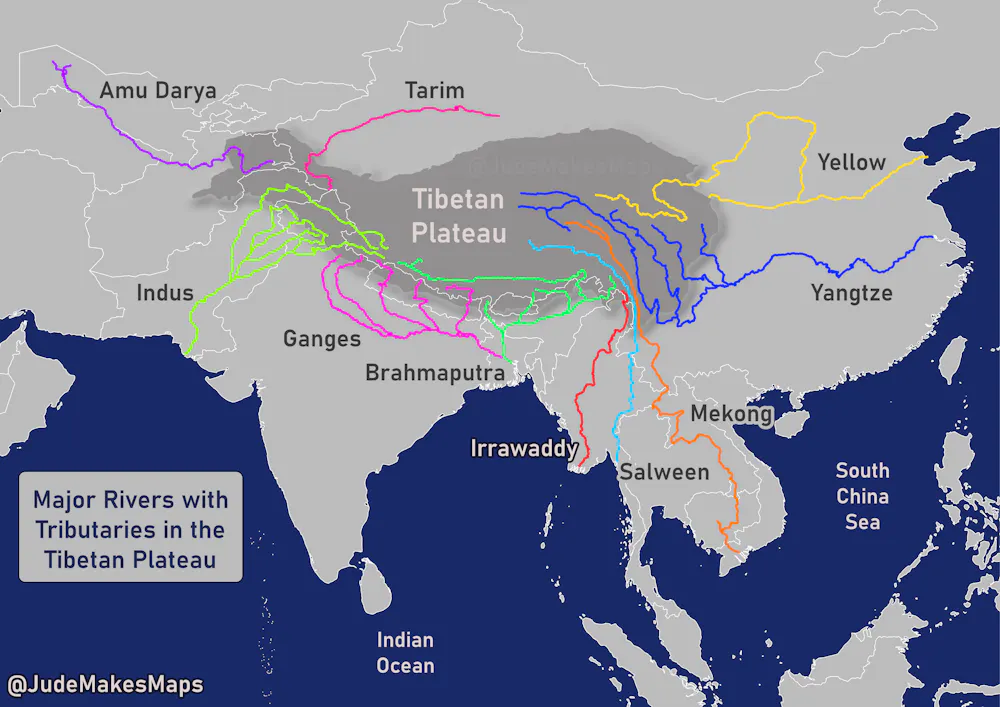
    Complicating matters further is China recently approving the construction of the world’s largest hydropower project on the Yarlung Tsangpo river in Tibet, which becomes the Brahmaputra in India. This massive project has raised alarm about China’s ability to exert control upstream, and the ecological risks for India and Bangladesh downstream.

    China hasn’t signed formal water-sharing agreements with its neighbours, but its growing presence in regional water infrastructure signals a dramatic shift in south and east Asian hydro-politics.

    Climate change is making things worse

    Recent climatic trends are making transboundary rivers an increasing focus of geopolitical friction. These trends include accelerated glacier melt, erratic monsoon patterns, and intensifying extreme weather.

    While melting glaciers will temporarily boost the flow of rivers, the long-term prognosis is bleak. If emissions and warming trends continue, many glacier-fed rivers – including the Indus, Ganges and Brahmaputra – could see dramatically reduced flows by the end of the century. This will directly affect hundreds of millions of people who depend on them.

    The crisis is being intensified by changes in the Himalayas. The region is warming faster than the global average, with a shift from snowfall to rainfall that disrupts the timing and volume of water that flows down from the mountains to the fields and cities below.

    At the same time, unsustainable groundwater extraction has pushed South Asia’s reserves of underground water toward collapse, threatening both food and water security.

    A dangerous precedent

    A collapse or suspension of the Indus Waters Treaty could set a dangerous precedent. Importantly, the threat is less about India cutting off water flows – an unlikely and technically challenging act – and more about the erosion of trust, transparency and data sharing.

    One of the treaty’s most valuable features has been the routine sharing of data on things like water levels, river flow and dam operations. Pakistan needs this data to forecast floods and droughts, plan its irrigation, generate hydropower effectively and manage its drinking water, yet India is indicating it will no longer honour these obligations.

    But India’s strained water relations are not limited to Pakistan. Bangladesh and Nepal have often felt sidelined or pressured in negotiations, and India’s indication that it may reconsider longstanding treaties raises concerns in both countries.

    This is especially the case as the Ganges Water Treaty nears its 2026 expiration: the vast Ganges river flows through India and irrigates much of Bangladesh – and the treaty guarantees Bangladesh a minimum river flow.

    Other key agreements, such as the Mahakali Treaty and Kosi river accord with Nepal, and the Teesta water-sharing deal with Bangladesh, remain largely unimplemented, breeding mistrust. These failures undermine confidence in regional water diplomacy and cast doubt on India’s commitment to equitable cooperation.

    None of this is helped by India, Pakistan and Bangladesh all continuing to rely on outdated irrigation methods that mean they use more water than necessary. As climate change intensifies floods, droughts and glacial melt, there is an urgent need to reform existing water treaties to reflect present-day climate, hydrological and geopolitical realities.

    Canals, like this one in Punjab, India, irrigate much of South Asia.
    Hussain Warraich / shutterstock

    The Indus Waters Treaty, negotiated in the 1960s before the emergence of modern climate science, no longer accounts for these transformations. Indeed, most water treaties in the region remain rooted in technocratic, engineering-centric frameworks which fail to address extreme climate variability and its cascading impacts.

    The upcoming expiration of the Ganges Water Treaty, and the pending negotiation of other basin agreements, present a critical opportunity to rethink water governance in South Asia.

    Though the Indus flows through India before Pakistan, in other basins, India is downstream. This is the case with the Brahmaputra, where it demands upstream cooperation from China.

    Undermining the Indus treaty could weaken India’s own position in future negotiations and strain its relations with Nepal and Bangladesh, while giving China more influence in South Asian hydro-politics. China is already expanding its footprint by offering billions in loans to Bangladesh and strengthening ties with Nepal, particularly around water infrastructure.

    Many of the world’s largest rivers begin in the Himalayas or the Tibetan Plateau.
    JudeMakesMaps, CC BY-SA

    Weaponising water is a perilous strategy that may backfire. The weakening of water diplomacy in South Asia is not just a regional threat; it endangers global climate security.

    In the face of escalating climate change impacts and recurring disasters, updating transboundary agreements like the Indus Waters Treaty, Ganga Water Treaty, and Kosi and Teesta accords is no longer optional – it is an urgent necessity with enormous consequences.

    Mehebub Sahana receives funding from the Leverhulme Trust, United Kingdom.

    ref. India-Pakistan conflict over water reflects a region increasingly vulnerable to climate change – https://theconversation.com/india-pakistan-conflict-over-water-reflects-a-region-increasingly-vulnerable-to-climate-change-256253

    MIL OSI – Global Reports

  • MIL-OSI Global: Homer’s Iliad is a rap battle

    Source: The Conversation – UK – By Joshua Forstenzer, Senior Lecturer in Philosophy and Co-Director of the Centre for Engaged Philosophy, University of Sheffield

    The Anger of Achilles by Jacques-Louis David (1819). Kimbell Art Museum

    Homer’s Iliad is one of the foundational stories of European civilisation. The Iliad is a long poem – an epic – thought to have first been put down in writing in the eighth century BC, though the story is set several hundred years before, perhaps as early as the 12th or 13th century BC.

    It explores a few crucial violent weeks within a much longer war between an alliance of Greek city-states and the city of Troy over Helen, the most beautiful woman in the world. In it, we find ancient Greek gods and humans sharing a common reality. They concurrently star as the central characters of both a mythological and an earthly dramatic encounter, on which the fate of a people rests.

    In his work, public philosopher Cornel West argues that there is a “gangster” inside all of us. The challenge, West teaches, is to learn to keep these “gangster elements” in check so that we can still live with decency and integrity in an often violent and unjust world. This struggle, I contend, is at the heart of both Homer’s Iliad and the art of battle rap.


    This article is part of Rethinking the Classics. The stories in this series offer insightful new ways to think about and interpret classic books and artworks. This is the canon – with a twist.


    Battle rap is an art form where two or more MCs confront one another in a freestyle rap that includes boasts, insults, wordplay and disses (related to but not to be confused with rap beefs like the Kendrick Lamar and Drake feud).

    The history of this kind of verbal jousting goes back at least to flyting – poetic duels usually involving rhyming insults, widespread in northern Europe in the late medieval era. (See Assassin’s Creed Valhalla for its recent reimagining.) And it also has African roots. But its latest iteration is thought to have emerged in the hip-hop scene in New York in the 1980s. The 1981 Busy Bee versus Kool Moe Dee battle at the Harlem World club in New York is an important part of hip-hop lore.


    Read more:
    A brief history of the diss track – from the Roxanne Wars to Megan Thee Stallion


    The rap battles featured in 8 Mile brought the scene mainstream attention.

    It was arguably the 2002 film 8 Mile, however, that starred real battle rap legend, Eminem, that made the art form well known beyond hardcore rap aficionados. Today it is a pop culture streaming event, with millions of followers and official leagues.

    The object of a battle rap is to display flow, braggadocio and quick wit. Humour is often a plus, but lyrically dexterous, rhythmic, creative “burns” are the name of the game.

    So what do the Iliad and battle rap have in common?

    Both art forms encourage us, the listeners, to react, reflect and ultimately select with which speaker to side. We are thrust into the centre of the action without much of a narrator to explain things.

    Both the Iliad and rap battles are part of the oral poetic tradition, since we think the Iliad was orally recited for generations before it was put down in writing. They are therefore both addressed to a live audience.

    Emily Wilson, who translated The Iliad in 2023, gives a lively contemporary reading.

    The Iliad is a story of war between Greeks and Trojans, but also of “beefs”. Menelaus versus Paris over the hand of Helen. Achilles versus Agamemnon, the king of the Greeks who wrongs him by expropriating one of his slaves. And Achilles versus Hector, the Trojan prince who kills Patroclus, Achilles’s closest friend.

    The high moment of the poem is arguably the encounter between Achilles and Hector. Before they battle to the death, Hector offers Achilles a deal: whoever wins won’t disrespect the other’s body.

    In response, Achilles belows: “Curse you, Hector, and don’t talk of oaths to me. Lions and men make no compacts, nor are wolves and lambs in sympathy: they are opposed, to the end. You and I are beyond friendship: nor will there be peace until one or the other dies.”

    Achilles is calling out Hector’s attempt at showing nobility of character, because Hector tries to separate the duty to wage conflict from rage and disrespect of his enemy. Achilles flatly rejects the proposal. For him, the only reason to fight is to satiate his grief-induced rage and so no respect can be given even after death.

    The battle of Hector and Achilles as imagined in Troy (2004).

    Ultimately, Achilles kills Hector and desecrates his body, but Hector was clearly the better man. Two worldviews collide. Which one should we side with?

    In a battle rap, the question of how we judge which MC to be victorious is always at stake. Do we side with the MC who best “rocks the mic” by pleasing the audience, or the one who more lyrically and intelligently cuts the opponent to the bone?

    Here are five more themes shared by The Iliad and battle rap.

    1. The pursuit of fame

    Battle rap has made gifted MCs into street rap legends. Long before record deals were the prize, MCs battled for respect and street fame.

    This pursuit of legendary status also lies at the very heart of The Iliad, as Achilles is warned by his mother, the goddess Thetis, that he will die if he fights in the Trojan war, but in return his “glory never dies”.

    2. Communal belonging

    Battle rappers and the warriors in The Iliad act in their own name but they also represent wider groups heralding from different places. They all, in some way, carry responsibility for and aim to bring reflected fame to their respective communities.

    3. Displaying skill

    Most battle raps take the form of a take down of the opponent, but the real object is to demonstrate verbal prowess. Simply entertaining will not cut it. “You now have to make sense of what you say, in order for us to give you the power,” summarises hip-hop legend KRS-One.

    The Iliad opens with a muse telling the audience that the epic will recount the “wrath of Achilles”, but in fact we find skilful interventions in speech that make us wonder whether the reasons for conflict can ever justify the grief it causes.

    4. An honour code

    What is truly worth living and dying for are central themes in The Iliad, as in battle rap. There we find talk of loyalty, honour, respect, courage, friendship and fame.

    The overt answers given can be taken as embraces of a certain kind of toxic masculinity where dominance, rage, cunning and violence are celebrated, but maybe these answers subtly point to their ultimate hollowness.

    Lurking behind the repeated injunction to “be the best”, battle rap and Homer’s epic invite the question of what is truly worth admiring: skill, dominance, wealth, integrity, courage, beauty, truth, justice, love or glory? They provide no singular answer.

    5. Creativity and living within the ‘funk’ of life

    Instead, we are left to sit within what West calls the “funk of life” – the mess of it all. From there, we can see that the stories we tell ourselves have the power to shape and define our actions and our very lives.

    So the main question becomes: at a time when simplistic stories of violence and domination are presented to us as easy answers to complex social realities, can we create new and richer stories of our own?

    Joshua Forstenzer’s work receives funding from the Yale Center for Faith and Culture as part of its Templeton-funded Life Worth Living project (https://lifeworthliving.yale.edu/).

    ref. Homer’s Iliad is a rap battle – https://theconversation.com/homers-iliad-is-a-rap-battle-252562

    MIL OSI – Global Reports

  • MIL-OSI Global: The 2024 Sir Paul Curran award for academic journalism goes to Paul Whiteley

    Source: The Conversation – UK – By Laura Hood, Senior Politics Editor, Assistant Editor, The Conversation (UK edition)

    Editor Stephen Khan (left) with award winner Professor Paul Whiteley, University of Essex handed the trophy by The Conversation’s patron, Professor Sir Paul Curran. The Conversation

    Paul Whiteley, emeritus professor of government at the University of Essex, has been named as the 2024 winner of the Sir Paul Curran award for academic communication.

    The prize is awarded every year to an academic who has shown exceptional skill, dedication and engagement in communicating their knowledge to readers.

    Paul has contributed 120 articles to The Conversation since August 2014, helping readers understand the seismic political shifts that have taken place over that period. He’s written about British and US politics, Brexit, emerging and historical electoral patterns and voter behaviour. He has contributed to The Conversation’s coverage of every British election that has taken place since launching in the UK and has written some of our strongest, evidence-based analysis of Brexit since the referendum in 2016. Paul was one of the contributors who answered The Conversation’s call for submissions in its earliest days and has featured regularly ever since.

    The Politics + Society team asked for Paul to be recognised this year in particular because his work formed the cornerstone of The Conversation’s 2024 election coverage. He analysed dozens of past elections to help us understand where the campaign was going wrong for former prime minister Rishi Sunak, and issued some warnings to the Labour party about the perils of a victory based on low turnout. He also helped readers digest the various MRP polls that appeared to be shaping as well as measuring the campaign.

    Paul’s award was linked to his work analysing the rise of the Reform party at a time when hard evidence is hard to come by. Paul has looked at how protest voting is tied to Reform voting, and what it means for Reform to be advancing in the polls at this stage in the electoral cycle. He’s issued advice to Labour and the Conservatives as they try to produce a response to this new electoral threat.

    More recently, Paul has turned his attention to US politics to help readers understand the politics of Donald Trump.

    Paul is the author of multiple books, including Brexit Britain: The Consequences of the Vote to Leave the European Union, Political Choice in Britain and Political Participation in Britain: The Decline and Revival of Civic Culture.

    On the night, we thanked Paul for his 120 articles and looked forward to reading his next 120.

    Highly commended

    This year, two academic writers also received commendations.

    Michelle Spear, professor of anatomy at the University of Bristol, was highly commended for her “entertaining, illuminating and often hilarious” articles about the human body. Her work has included fact checks on full-body deodorants and collagen supplements. Michelle was also the author of a grizzly investigation for Guy Fawkes night that looked at what actually happened when people were hanged, drawn and quartered.

    Ruth Itzhaki professor emeritus of molecular neurobiology at the University of Manchester and visiting professorial fellow at the University of Oxford, received special commendation for her work on the viral cause of Alzheimer’s. Ruth and colleagues first identified a possible link between cold sores and susceptibility to Alzheimer’s in later life. She wrote an Insights long read as part of the Uncharted Brain: Decoding Dementia series in 2022, and in recent weeks has written again following greater recognition, decades later, of her work.

    A huge thank you to Paul, Michelle and Ruth for their work with The Conversation over the years, and to all our authors – without whose efforts there would be no conversation.

    ref. The 2024 Sir Paul Curran award for academic journalism goes to Paul Whiteley – https://theconversation.com/the-2024-sir-paul-curran-award-for-academic-journalism-goes-to-paul-whiteley-256376

    MIL OSI – Global Reports

  • MIL-OSI Global: Gems supposedly buried with Buddha are to be sold at auction – it’s a symptom of Buddhism’s ongoing commercialisation

    Source: The Conversation – UK – By Lee Clarke, Lecturer in Philosophy, Nottingham Trent University

    Almost 2,000 years ago in modern-day Uttar Pradesh, India, someone deposited a cache of gems inside a reliquary (a container for holy relics), along with some bone fragments and ash. The gems were precious, but the bones and ash even more so, for according to an inscription on the reliquary, they belonged to Siddhartha Gautama, the Buddha.

    The Piprahwa gems were placed along with the Buddha’s bodily relics (śarīra) as an offering inside a stūpa (A Buddhist funerary structure that contains relics and acts as a place of pilgrimage). Such an offering is not only supposed to generate “merit” (puṇya) and hopefully a good rebirth for the devotee, but is also an act of devotion and gratitude to the Buddha.

    In 1898, a British land owner, William Claxton Peppé, ordered the excavation of that same stūpa on his land in colonial India and discovered the reliquary. The bodily relics were sent to the Buddhist king of Thailand, many of the gems went to the former Imperial Museum in Calcutta and Peppé was permitted to keep the rest.

    This latter portion was due to be put up for auction at Sotheby’s Hong Kong this month, just days before the Buddhist holy day of Vesak – and it has generated controversy. Not only has the sale been described as perpetuating colonial violence, but the Indian government demanded that auction house Sotheby’s halt the sale or it would seek legal action. Sotheby’s has complied, for now.


    Looking for something good? Cut through the noise with a carefully curated selection of the latest releases, live events and exhibitions, straight to your inbox every fortnight, on Fridays. Sign up here.


    Peppé’s great-grandson, Chris Peppé, explained in an article for Sotheby’s: “From the time we received the Piprahwa gem relics, my cousins and I have sought to make them available for viewing by the public (ideally a Buddhist public) to see at no cost to the institution borrowing them.” This has resulted in the gems being displayed in museums around the world. The cousins also set up The Piprahwa Project website, which allows people to access all the research materials that they have gathered.

    Chris Peppé has said that he hopes that the sale will help people see to see the gems and connect with those that left them and the Buddha himself. His great-grandfather, he says, ordered the excavation to provide work for his tenant farmers.

    As a Buddhist and the grandson of an Anglo-Indian man myself, my past straddles this colonial divide more than most. Putting aside the ethical issues around excavating a sacred site in the first place, and the uncomfortable tie-in to other instances of colonial looting by the British in India, the truly extraordinary thing is that these gems were put up for sale at all.

    If they really were mixed together with the bodily relics of the Buddha, then these gems were in physical contact with them and intended to be paired with them for posterity. That means that, in a Buddhist context, there is no essential difference between the gems and the actual remains of the Buddha.

    The Sri Lankan historical chronicle The Mahāvaṃsa (written in the 5th or 6th-century AD) states that “if we behold the relics we behold the Conqueror”, aka Buddha. As art historians Conan Cheong and Ashley Thompson write in their recent journal paper on the topic: “At the very least, we can affirm that for many Buddhists, historically and today, these ‘gems’ are śarīra of the Buddha and as such are imbued with the Buddha’s living presence.”

    Buddha in the west

    Speaking to the Guardian after the auction was postponed Peppé said: “In light of the Indian government’s sudden interest in the gems, 25% of auction proceeds will be donated to the displaying of the main Kolkata collection of the Piprahwa gems for Buddhists and the larger public to enjoy. Another 25% will be donated to Buddhist institutions.” With regards to his and his two relatives’ right to sell the gems, he added: “Legally, the ownership is unchallenged.”

    As an expert in Buddhist philosophy, I believe that to put a price on something that possesses such a sacred status for millions of people worldwide is both disrespectful and morally objectionable.

    The sale is also not something I could ever imagine happening regarding objects linked with any other religious figure. If a piece of intact clothing, for example, was found to have been worn by Jesus, would this be put up for sale? Of course, it would be massively valuable, but any financial considerations would surely be outweighed by its religious importance for the world’s billions of Christians. Why should it be any different with Buddhist relics?

    Another phenomenon inadvertently revealed by the fact of the sale is the ongoing commercialisation of Buddhism in the west. To many westerners, the Buddha and Buddhism are increasingly viewed as commodities to be bought and sold.

    Cheaply made Buddha statues and Buddha-faced plant pots adorn the shelves of garden centres and are then used to decorate living rooms and gardens. Clothes, lamps, beach towels and even shoes embellished with images of the Buddha can be purchased easily. The Buddha is frequently regarded as an ornament or fashion item rather than a sacred figure in a manner that, again, is rarely done with any other religiously significant person.

    Buddhas are common garden decorations in the west – but it’s hard to imagine a Jesus-themed equivalent.
    Radek Havlicek/Shutterstock

    From all this, selling actual Buddhist relics is not a large step. As with the commodification of other religions in the west such as Hinduism and Islam, commercialisation always simultaneously involves decontextualisation. It is an example of what philosopher Sophia Rose Arjana in her book Buying Buddha, Selling Rumi (2020) terms “the religious marketplace”.

    As she writes: “Religions associated with the east – Hindu, Buddhism, Islam – are also commodified. Their symbols are marketed by entrepreneurs and corporations and then consumed by everyone from non-religious spiritualists to ambivalent mystical seekers.”

    Religious traditions, practices, images and artefacts must be stripped of their native contexts and sacred meaning. Through this auction, the Piprahwa gems are considered ancient jewels to be admired ascetically rather than religious relics.

    Given their importance to global history and our human story, the Buddha and Buddhism are worthy of a lot more respect than they are currently afforded. While Buddhism teaches that everything is impermanent, we are lucky enough to still possess treasures such as the Piprahwa gems, and we should value them – and learn from them – while we can.

    Lee Clarke does not work for, consult, own shares in or receive funding from any company or organisation that would benefit from this article, and has disclosed no relevant affiliations beyond their academic appointment.

    ref. Gems supposedly buried with Buddha are to be sold at auction – it’s a symptom of Buddhism’s ongoing commercialisation – https://theconversation.com/gems-supposedly-buried-with-buddha-are-to-be-sold-at-auction-its-a-symptom-of-buddhisms-ongoing-commercialisation-256163

    MIL OSI – Global Reports

  • MIL-OSI Global: Spit science: why saliva is a great way to detect disease

    Source: The Conversation – UK – By Genecy Calado de Melo, Lecturer in Operative and Primary Care Dentistry, RCSI University of Medicine and Health Sciences

    noriver/Shutterstock.com

    A few drops of saliva can now reveal what used to require a scalpel, a syringe or a scan.

    Scientists have developed ways to analyse spit for the tiniest traces of illness – from mouth cancer to diabetes, and even brain diseases like Alzheimer’s.

    Unlike blood tests or biopsies, saliva is easy to collect, painless and inexpensive. During the COVID pandemic, some countries used saliva-based testing for rapid screening.

    This isn’t entirely new. Scientists first noticed the diagnostic potential of spit decades ago. In the 1980s, researchers used saliva to detect hormones and drug use. By the 1990s, it was being explored as a way to detect HIV.

    What’s new is the speed and precision. Today’s techniques can detect subtle molecular shifts that would have been impossible to measure just a few years ago.

    Saliva holds a surprising amount of information. It’s full of tiny fragments of DNA, RNA, proteins and fats – many of which change when disease takes hold. Researchers have already shown that saliva can be used to detect changes linked to diabetes, Parkinson’s, heart disease and some cancers.

    A recent study even showed saliva could help distinguish between healthy people and those with mild cognitive impairment, a possible early sign of Alzheimer’s.

    In dentistry, spit science is being studied for early signs of gum disease and even the risk of tooth decay.

    A light-based technique called Raman spectroscopy is one of the latest tools being used to scan saliva for hidden chemical changes. It works by bouncing harmless light off molecules in a spit sample and reading the pattern it sends back – a kind of fingerprint for what’s happening inside your body.

    It sounds like science fiction, but the technology is already being used in labs to detect early signs of cancer and other diseases often before symptoms appear.

    This could be a gamechanger for oral cancer, which often starts with small, painless changes inside the mouth that are easy to miss. Early detection is vital, but many people don’t realise they have a problem until it’s much harder to treat.

    A simple spit test during a regular dental check-up could help find cancer early, before it spreads.

    It’s not just about cancer, either. Saliva is being trialled as a tool to monitor everything from stress levels to infections.

    Spit could monitor stress levels.
    ViDI Studio/Shutterstock

    Simplicity

    What makes saliva so appealing is its simplicity – no needles, no specialist clinics. Samples can often be collected at home, posted to a lab and analysed within hours. This could make a huge difference in places with limited access to healthcare or for people who avoid doctors out of fear, cost or time.

    Of course, not every disease leaves a clear marker in spit and researchers are still working out which conditions saliva can reliably detect. But the idea of using what’s already naturally produced by the body to give an early warning is a powerful one. It could help catch disease when it’s most treatable, save lives and make healthcare faster, cheaper and more comfortable for everyone.

    There’s still work to be done before spit tests become part of routine check-ups. Larger clinical trials are needed and researchers are still fine tuning the best ways to analyse and interpret the data. But the direction of travel is clear: the days of saliva being seen as just drool are over.

    Saliva may not seem glamorous, but thanks to the rise of spit science, it’s fast becoming one of the most promising tools in the fight against disease. A future where your dentist, doctor, or even you could spot health problems early with nothing more than simple spit.

    Genecy Calado de Melo received funding from Science without Borders – Brazil (2015).

    Cathy E. Richards does not work for, consult, own shares in or receive funding from any company or organisation that would benefit from this article, and has disclosed no relevant affiliations beyond their academic appointment.

    ref. Spit science: why saliva is a great way to detect disease – https://theconversation.com/spit-science-why-saliva-is-a-great-way-to-detect-disease-255342

    MIL OSI – Global Reports

  • MIL-OSI Global: Quantum computers could crack the security codes used by satellites – they need future-proofing

    Source: The Conversation – UK – By Panagiotis (Panos) Vlachos, PhD Researcher in Post-Quantum Cryptography, Queen’s University Belfast

    ESA

    Satellites are the invisible backbone of modern life. They guide airplanes, help us find our way with GPS, deliver TV and internet, and even help emergency services respond to disasters. But a new kind of computer – quantum computers – could put all of this at risk.

    Quantum computers are not just faster versions of today’s computers. They work in a completely different way, using the peculiar rules of quantum physics. While they have not yet reached their full capabilities, quantum computers are expected to be game changing provided that the technological hurdles can be overcome.

    For example, they are expected to be able to solve certain mathematical problems that would take classical computers millions of years. In some cases, quantum computers could solve such difficult problems in just seconds or minutes.

    It’s very difficult to predict exactly when practical quantum computers will become available. However, progress is being made both in the design of more powerful quantum processors and in overcoming other hurdles to their development.

    The new capabilities presented by quantum computers could help push forward areas such as science and medicine. For example, they could carry out the complex simulations needed to design new materials and more effective drugs. They could also improve our simulations of the Earth’s future climate.

    However, there’s a catch: quantum computers could also break the codes that keep our digital world safe.

    Experts around the world are working urgently to develop new kinds of digital “locks” that can’t be cracked by quantum computers – an area known as “post-quantum cryptography”. These new codes are being tested and approved by international bodies, while governments are starting to plan how to upgrade everything from satellites to bank systems.

    The digital locks that protect satellite signals, bank accounts and private messages are based on mathematical puzzles that regular computers can’t solve quickly. Quantum computers, however, would be able to crack these puzzles with ease.

    You might think that satellites are safe because they’re far away and hard to reach. But as the technology required to attack them becomes cheaper and more widely available, satellites are becoming targets for hackers and hostile governments. Today, it’s possible for skilled attackers to intercept satellite signals or try to send fake commands.

    Staying ahead of the curve

    Most satellites are designed to last for decades. This means the security systems we put in place now need to be strong enough to withstand not just today’s threats but tomorrow’s as well – including the threat from quantum computers.

    In the UK, the National Cyber Security Centre has published a roadmap for moving to quantum-safe security. It has set a date of 2035 by which organisations should aim to migrate all their systems to post-quantum cryptography – the new digital codes that should protect against hacking by quantum computers. The message is clear: both private- and public-sector organisations need to start preparing now, so that by the time quantum computers are ready, our most important systems – including satellites – are already protected.

    Updating a satellite’s security isn’t as simple as updating your phone’s software. Once a satellite is in orbit, it’s very hard – sometimes impossible – to change its systems. That’s why new satellites being designed today must use quantum-resistant security from the start.

    It’s also necessary to design these systems so they can work efficiently across more than one satellite, because some spacecraft are designed to collaborate with each other in what are known as “swarms”.

    If we don’t act now, the data sent to and from satellites could one day be read or even tampered with by anyone with a powerful enough quantum computer. That could mean anything from disrupted GPS signals to attacks on emergency communications or threats to national security.

    No country can solve this problem alone. It will take scientists, engineers, governments and international organisations working together to make sure our digital infrastructure is ready for the quantum age.

    The good news? The world is already moving in this direction. By building in the protections against quantum computers now, satellites that connect and protect us can be secured – no matter what the future brings.

    Panagiotis (Panos) Vlachos’s employer, Mastercard, covers his tuition fees. He is an active volunteering member of CyberPeace Builders and ISC2’s Code TaskForce.

    ref. Quantum computers could crack the security codes used by satellites – they need future-proofing – https://theconversation.com/quantum-computers-could-crack-the-security-codes-used-by-satellites-they-need-future-proofing-256167

    MIL OSI – Global Reports

  • MIL-OSI Global: From pulpit to pitch: Pope Francis used sport to get his message to a wider world − that could continue with baseball-loving Leo XIV

    Source: The Conversation – USA – By Carmen M. Nanko-Fernández, Professor of Hispanic Theology and Ministry, Catholic Theological Union

    Players observe a minute of silence in memory of Pope Francis before the Spanish league soccer match between Real Madrid and RC Celta de Vigo at Santiago Bernabeu Stadium in Madrid on May 4, 2025. Pierre-Philippe Marcou/AFP via Getty Images

    The world of sport is “a constellation of many stars,” Pope Francis told La Gazzetta dello Sport, the Italian daily sports newspaper, during a wide-ranging interview in January 2021.

    On April 21, 2025, that world lost, if not one of its brightest stars, then certainly one of its highest-placed advocates in Francis. In his youth, Francis was only ever a street athlete, but he was an avid and lifelong sports fan, especially when it came to soccer. In fact, Francis incorporated his love of the beautiful game into his outlook as pope – for him, sport was a way to communicate with people from all backgrounds and all corners of the globe.

    With Leo XIV now installed as Francis’ successor, that sporting theme could continue in the Vatican, though the center of gravity may migrate from soccer to baseball. As befitting a U.S. pope, Leo is known to be a fan of the national pastime, in particular his native Chicago White Sox.

    Always ‘un cuervo!’

    Long before the papacy, even before his first steps toward priesthood, for Jorge Mario Bergoglio – the boy who would go on to become Pope Francis – there was his hometown sports club, Buenos Aires’ San Lorenzo de Almagro.

    It was “part of my cultural identity,” Francis later said, so much so that he maintained his club membership throughout his life.

    That became news upon his death, when a photo of his club card went viral. Argentine sports fans noted that his membership card number, 88235, coincided with his age, 88, and the moment of his death in Argentina time: 2:35 AM.

    Francis’ relationship with San Lorenzo de Almagro was marked by mutual affection. The team memorialized him in various ways. They noted how he continues to accompany them by emblazoning on their jerseys his image and the words “juntos por la eternidad” or “together forever.”

    In a touching video tribute posted on social media following Francis’ death, the club affirmed his belonging, from his childhood through his papacy, as “un cuervo” – or “crow,” a nod to the nickname for the team and its fans rooted in the club’s founding by a Catholic priest. In Lunfardo, a dialect in Buenos Aires, “cuervo” is also slang for priest. For his team, “Papa Cuervo” was “never just one more fan, he was always one of us.”

    A sporting world pays tribute

    And it wasn’t just his home team that mourned Francis’ death.

    On the day of his passing, moments of silence preceded play from Citi Field, the home of Major League Baseball’s New York Mets, to Estadi Olímpic Lluís Companys, the temporary soccer venue of Spanish soccer giant Barcelona.

    In Italy, soccer matches were rescheduled to honor the national period of mourning, and players and coaches from AS Roma filed into St. Peter’s Basilica to pay their respects.

    Pope Francis holds a tennis racket presented to him by the Italian Tennis Federation in 2015.
    AP Photo/Alessandra Tarantino

    Across social media platforms, the sporting world responded to the loss of one they considered their own. Spanish tennis champ Rafael Nadal tweeted his condolences and observed that the day was indeed “un día triste,” or “sad day.”

    The NFL’s New Orleans Saints expressed condolences and commemorated their relationship with the pope, a connection born of a digital anomaly. Each time Francis posted #Saints on his X – formerly Twitter – account, it automatically tagged the NFL team, which did not mind the accidental blessings.

    When global attention turned to speculating about the next pope, the soccer world continued to mourn and honor their star. From April 29 to May 1, each Champions League semifinal match – youth, women’s and men’s alike – was preceded by a moment of silence.

    In the words of world soccer body UEFA’s president Aleksander Čeferin: “Pope Francis was a beacon of hope for… (a) humanity that will now remain orphaned of that voice – tireless and powerful – that always rose in defense of the poor, the humble, and the vulnerable to call for respect, acceptance, and equality and to implore a peace that always seemed distant …”

    Pope Francis is given a San Lorenzo’s shirt as he greets the faithful prior to his first ‘Urbi et Orbi’ blessing from the balcony of St. Peter’s Basilica during Easter Mass on March 31, 2013.
    Dan Kitwood/Getty Images

    Sport as language of life

    For Francis, sport was more than a game or a pastime.

    It was a vernacular, and soccer was his dialect. He was fluent and it showed. He recognized in sport the potential to communicate in what he called a universal language that “extends across borders, language, race, religion and ideology; it possesses the capacity to unite people, together, by fostering dialogue and acceptance.”

    The online archive of his pontificate contains well over 60 sport-related audiences, messages and letters, including video greetings on occasions such as the 2014 FIFA World Cup and Super Bowl LI in 2017.

    The significance of sport as a distinctive body of his papal teaching is also indicated by the Spanish release in 2024 of “Más Allá De Los Límites: El Deporte Según El Papa Francisco,” or “Beyond the Limits: Sports According to Pope Francis.” The book came with a forward by Carlo Ancelotti, the storied manager of a litany of soccer greats, including Real Madrid.

    Sport emerged early as one of Jorge Bergoglio’s native tongues, bound intimately to memory, family, identity and belonging – threads also evident in his canon of teachings on sport. In “Hope,” his 2024 autobiography, Francis dedicates a chapter to sport and weaves stories of his beloved soccer throughout the book in a manner that reveals how “the experience of the people and their passions” became for him a source and site for his theology of encounter.

    A commitment to inclusivity is a constitutive element in his teaching on both sport and encounter. Among those who paid tribute on Francis’ passing were the organizers of the Paralympic Games, who posted: “Today humanity lost a great man … passionate about sport and passionate about inclusion, which epitomizes everything the Paralympic Movement stands for.”

    ‘Getting in the game’

    Francis urged, “‘Get in the game’ not only in sports … but also in life, in the search for the good, without fear but with courage and enthusiasm. Get in the game with others and with God … Place your talents at the service of the encounter among people, of friendship and of inclusion.”

    Pope Francis salutes the cricket team of the Vatican.
    AP Photo/Alessandra Tarantino

    He put this into practice with the launch and sponsorship in 2019 of Athletica Vaticana, a dedicated sports body for the city-state. He also gave his blessing and backing to St. Peter’s Cricket Club, the first-ever Vatican women’s soccer team, and Sport at the Service of Humanity, a collaborative global movement that seeks to “leverage the power of Faith and Sport as a platform for good.”

    “Get in the game” was a call intended not only for athletes – amateur, collegiate, Special Olympian, professional – but for street-ballers, schoolyard players, fans and gamers of all kinds. In sports and play, Francis found the potential for a “school of peace” because they provided opportunities “to go outside of our own walls and learn how to participate, to overcome, to struggle together,” charting ways forward for church and society “to overcome all forms of discrimination and exclusion.”

    Francis never forgot the joys or even the sorrows of sports as a player or as a fan. “Playing is a right,” he wrote in his memoir, “and there’s also the hallowed right not to be a champion.”

    Behind every ball, he saw a kid with a dream and aspirations, and he recognized himself on the soccer field – a “pata dura,” the kid with two left feet, “sleeves rolled up, and often with grazed knees.” On the sports field, like elsewhere, he recognized and took delight in the beauty of God.

    The link between the papacy and the sporting world looks set to continue under Pope Leo XIV.

    The media quickly noted that soccer aficionado Francis had been succeeded by an amateur tennis player and fan.

    The new pope’s brother had to resolve an online dispute by affirming Leo is a fan of the South Side’s Chicago White Sox and not the North Side’s Cubs.

    Regardless, the city’s two baseball franchises responded with dueling stadium signs claiming the pope as their own. Meanwhile, ESPN reported that NBA teammates Jalen Brunson and Josh Hart, former Villanova Wildcats-turned-New York Knicks chatted about a possible alumni reunion with the newest rising star in the constellation of sports: Pope Leo XIV.

    Carmen M. Nanko-Fernández does not work for, consult, own shares in or receive funding from any company or organization that would benefit from this article, and has disclosed no relevant affiliations beyond their academic appointment.

    ref. From pulpit to pitch: Pope Francis used sport to get his message to a wider world − that could continue with baseball-loving Leo XIV – https://theconversation.com/from-pulpit-to-pitch-pope-francis-used-sport-to-get-his-message-to-a-wider-world-that-could-continue-with-baseball-loving-leo-xiv-255493

    MIL OSI – Global Reports

  • MIL-OSI Global: Zia Yusuf: the British Muslim driving Reform’s transformation into an election winner

    Source: The Conversation – UK – By Parveen Akhtar, Senior Lecturer: Politics, History and International Relations, Aston University

    Reform’s success at the expense of Labour and the Conservatives in recent local elections has triggered speculation that it is on course for significantly more representation in parliament at the next general election.

    This is a remarkable position for such a young party to be in. And perhaps just as remarkable is the fact that the chairman of a party defined by identity politics and opposition to immigration is a Muslim son of Sri Lankan immigrants.

    Zia Yusuf is credited with professionalising Reform. Under his watch a number of constitutional changes have been made, including granting the party chair the authority to revoke membership, take disciplinary measures against and suspend candidates, as well as growing and building a national level party infrastructure.

    Given the constant battles of the past – the candidates accused of racist comments at the 11th hour, for example – these election results suggest this professionalisation drive has paid off. The numbers are impressive, Reform has surpassed 230,000 members, leads ten councils, has 799 councillors, five MPs and two regional mayors.

    Ben Habib, former co-deputy leader of Reform, has called for Yusuf to be removed over a dispute that erupted earlier this year that resulted in the suspension of Rupert Lowe, one of the Reform MPs elected in July 2024.

    Senior-level party in-fighting persists, albeit increasingly behind closed doors (like the traditional parties). The Lowe row initially looked like it could end the way so many other such incidents have, but was quickly neutralised. Lessons have been learned.

    Yusuf’s rise

    Now a millionaire businessman, Yusuf was born in Scotland, to parents who migrated to the UK in the 1980s. He calls himself a “British Muslim patriot” and has been one of Reform’s biggest donors. Introducing himself at the Reform rally in Birmingham in June 2024, (a speech he described as a love letter to Great Britain), Yusuf said he became a Reform donor because “I love Britain, I love my country.”

    Reform took 4 million votes in the last general election but came away with just five parliamentary seats. Lessons, again, were learned. In these local elections, Reform was on almost every ballot paper, the focus was on getting out the activists, running local campaigns that could deliver every vote in the first-past-the-post system.

    Luke Campbell, a former professional boxer and now Reform’s mayor of Hull and East Yorkshire’s Facebook campaign exemplifies the blending of local issues (a long-broken water fountain in Hull city centre) with incumbent party performance and national accountability: “If the Lib Dems can’t fix a water fountain, how can they fix a region?”

    Momentum is clearly behind Reform. It has become the de facto home of many disaffected, defecting Conservative councillors and has attracted some big names from the Conservative party. These include former government minister Andrea Jenkyns (now a Reform mayor), and Tim Montgomerie, a Conservative party member for over 30 years and one-time adviser to Boris Johnson.

    And in a major coup for Yusuf, Reform now has former Conservative party donor and billionaire Nick Candy as its treasurer. Candy, for the moment appears happy with a backstage role, raising funds. Yusuf however, has been public facing, on the campaign trail, at the counts, doing the media circuit.

    A delicate path

    Yusuf’s appointment as Reform’s chairman did not go uncontested and he has faced racist and Islamophobic abuse, including from Reform supporters. A sample of the kind of rhetoric swirling around opposition to Yusuf could be found on X. As one user reportedly said: “I voted Reform to get Britain back for the British, not for it to be led by a Muslim. I will be resigning my membership tomorrow.”

    We of course don’t know if they saw through on that threat, and judging by Reform’s current membership numbers, few people voted against Yusuf with their feet. However, as another X user’s view suggests, he occupies a difficult position in a rightwing party: “I personally don’t buy the ‘good Muslim’ line. If he believes in the Qur’an, and is still chairman at the next election, I won’t be voting Reform again.”

    Laurence Fox, the actor turned political activist, stated on his X account: “There cannot be a valid opposition party in the UK with @ZiaYusufUK anywhere near it. A Britain focused party cannot have a Mohammedan as the chair. Islam is not your friend if you believe in free speech, family and British culture. You cannot buy us.”

    Meanwhile conspiracy theories have emerged claiming Yusuf is a plant trying to damage the party from the inside.

    No doubt Yusuf’s position is at times an uncomfortable one. Yet he insists the response to his appointment has been “overwhelmingly positive”.

    Farage himself has a complicated relationship with Islam. In May 2024, he said a growing number of young Muslims in the UK loathed much of what Britain stands for. Yet he left UKIP, the party he once led, because the new leadership was: “pretty obsessed with the issue of Islam, not just Islamic extremism, but Islam, and UKIP wasn’t founded to be a party fighting a religious crusade”.

    Given some of the comments on social media by Reform supporters, it’s clear that not everyone is convinced that it’s possible to be a British Muslim patriot. Yusuf himself remains steadfast in the face of personal abuse. He continues to stand behind the party leader who has never publicly called out the racism and Islamophobia he faces.

    Yusuf has ploughed his money and his time into Reform because, he insists, of his love for Britain and his belief that the country gave his immigrant parents the chance to start a new life when they needed it – a country that he now thinks needs him to stand up and defend it against what he sees as open borders and uncontrolled immigration.

    On this, Yusuf mirrors the sentiments in my forthcoming research with colleagues on British Muslims and Brexit. We’re finding that Muslim Leave voters were similar to mainstream Leave voters in wanting to reduce immigration, which they believed threatened the British way of life.

    Yusuf, it seems, is on a personal mission to show that being the son of immigrants doesn’t exclude him from his beloved country. Perhaps he feels he has to be more vocal about his love of country, more attuned to British values and more anti-immigration to prove that love.

    So far, he has proven valuable in mainstreaming the Reform party. Now that the party is on the up, he may be more valuable than ever.

    Parveen Akhtar has previously received funds from the ESRC and the British Academy.

    ref. Zia Yusuf: the British Muslim driving Reform’s transformation into an election winner – https://theconversation.com/zia-yusuf-the-british-muslim-driving-reforms-transformation-into-an-election-winner-256003

    MIL OSI – Global Reports

  • MIL-OSI Global: Fancy letting off steam with a beer before the sauna? Here’s why that might be a bad idea

    Source: The Conversation – UK – By Dan Baumgardt, Senior Lecturer, School of Physiology, Pharmacology and Neuroscience, University of Bristol

    Nick Mayorov/Shutterstock

    Saunas have long been spaces for rest, recovery, and even the occasional business deal. Personally, though, they’re not my cup of tea: too claustrophobic, too stifling and always with that distinct sensation that my nasal hairs have been singed away by the heat.

    Watching that episode of The Simpsons where Homer gets trapped in a sauna and emerges looking like a steamed clam – miraculously alive – was the final nail in the coffin. I haven’t stepped into one since.

    Despite my reservations, sauna culture is rich and diverse, transcending borders and histories. While they’re an integral part of Scandinavian life, especially in Finland, saunas also appear in the traditions of Japanese, Mexican and Native American cultures. There are many variations to experience – from yoga and life drawing sessions, to being gently flogged with birch branches. To each their own.

    In recent years, the concept of refreshment in sauna culture has taken on altogether different dimensions. In the UK, more are now hot-footing their way to the sauna instead of the pub than ever before.

    As a new social and wellbeing hub, fusing elements of bar and sauna cultures, it makes sense. But what of going the whole hog and drinking alcohol – before, during and after sauna sessions?

    Why mix booze with 80°C heat in the first place? Perhaps it’s the natural fusion of two social rituals: relaxing in a sauna and enjoying a drink with friends. Or maybe it appeals to the hedonist seeking novel pleasures and euphoria.

    Still, the question remains: what are the effects – and risks – of drinking alcohol in the sauna?

    To steam, or not to steam? That is the question

    First, let’s consider the benefits. Surely, there must be more to it than just clearing out a few pores? In fact, there’s a saying that describes the sauna as “a poor man’s pharmacy.”

    Numerous studies have explored the potential health benefits of sauna use. For instance, Japanese researchers have studied Waon therapy, literally, soothing warm therapy, (a lower-temperature sauna treatment) in patients with ischaemic heart disease, where narrowed arteries increase the risk of heart attacks.

    Their findings showed evidence of clinical improvement in these patients. Other studies have reported benefits in conditions such as peripheral arterial disease and even in recovery after a heart attack.

    Sauna use may also help manage high blood pressure and certain lung diseases. Some research also suggests benefits such as improved wound healing and even lower risks of developing dementia and Alzheimer’s disease.

    The heat is on

    But it’s not all steam and serenity. To understand the risks, especially when alcohol is involved, we need to look at how the body responds to heat – and to booze.

    The hypothalamus, a region deep in the brain, regulates our core temperature. In response to heat, it boosts blood flow to the skin and ramps up sweating, helping us cool down. But this also increases the risk of dehydration. Combine that with alcohol, a diuretic that further depletes fluids, and the risk rises significantly.

    Both alcohol and high temperatures can affect cardiovascular function, often lowering blood pressure and increasing heart rate. This can lead to dangerous heart rhythm abnormalities (arrhythmias).

    Then there’s the impact on the brain. Alcohol of course impairs judgement and coordination – two things you’d definitely want intact in a room full of heat, slippery surfaces and scalding water.

    Put all this together and what do you get? A dehydrated, overheated, intoxicated subject with a racing heart and plummeting blood pressure. Dizziness, fainting and confusion may follow, raising the risk of falls, burns, or even drowning.

    Collapsing or falling unconscious in the sauna can prove dangerous. One sobering example comes from a case reported in the American Journal of Forensic Medicine and Pathology, where a person sustained severe injuries, including burns, in just seven minutes of sauna exposure – tragically resulting in death. Another study from Finland found a growing link between accidental sauna deaths and alcohol intoxication.

    The key takeaway here? If you’re going to drink, do it after your sauna session – not before or during. Those who are intoxicated should avoid saunas altogether, or at the very least, be closely supervised.

    Basic safety advice still applies: limit sauna sessions to short durations, cool down afterwards (via swimming or showering) and rehydrate with non-alcoholic beverages.

    While the science behind saunas is still evolving, their millennia-long appeal speaks for itself. They offer real benefits – but mixing heat with alcohol could be a cocktail that burns more than it soothes.

    Dan Baumgardt does not work for, consult, own shares in or receive funding from any company or organisation that would benefit from this article, and has disclosed no relevant affiliations beyond their academic appointment.

    ref. Fancy letting off steam with a beer before the sauna? Here’s why that might be a bad idea – https://theconversation.com/fancy-letting-off-steam-with-a-beer-before-the-sauna-heres-why-that-might-be-a-bad-idea-255703

    MIL OSI – Global Reports

  • MIL-OSI Global: Nasa’s planned budget cuts could set back space science, but show how to future-proof the agency

    Source: The Conversation – UK – By Loizos Heracleous, Professor of Strategy, Warwick Business School, University of Warwick

    Illustration of the Orion spacecraft. Nasa

    The 2026 Nasa budget proposal would slash around US$6 billion (£4.4 billion) in funding. This is a huge reduction, amounting to around 25% of recent Nasa budgets. The savings would mainly come from Nasa science programmes, potentially devastating high profile missions and international collaborations.

    However, the budget proposal also represents an intentional redirection of Nasa’s focus by government through resource allocation. The state has long supported the development of a robust commercial space sector, and this budget is a further step in that direction.

    Congress will have the final say and the cost to science could be high if the budget goes through without major amendments. One casualty could be Mars Sample Return (MSR), a joint endeavour with the European Space Agency that is intended to retrieve Martian soil and rock collected by the Perseverance rover and deliver it to laboratories on Earth.

    An audit of MSR released in February 2024, suggested that the mission’s overall cost could exceed US$7.5 billion (£5.6 billion). The timescale for the mission was also slipping into the 2040s.

    Nasa agreed to look at quicker and cheaper ways of carrying out the mission, a process which is ongoing. But as a big ticket item under the agency’s Science Directorate, MSR could nevertheless be cancelled if the proposed budget were to be passed.

    Other projects likely to be affected include the Nancy Grace Roman Space Telescope, which aims to investigate dark energy and exoplanets, and the DaVinci mission to Venus, which seeks to study the planet’s dense atmosphere and surface composition. Since the James Webb Space Telescope is already constructed and operating, it is expected to continue doing so.

    However broader funding reductions for Nasa’s Science Mission Directorate, from US$7.3 billion (£5.4 billion) to US$3.9 billion (£2.9 billion), may limit the scope of future projects and the pipeline of early innovations.

    The Nancy Grace Roman telescope could be one casualty of the budget proposal.
    Nasa

    The proposed budget could also lead to an accelerated retirement for the Space Launch System (SLS) rocket and the Orion crew capsule. These are the vehicles designed to carry US astronauts to the Moon under a Nasa programme called Artemis.

    This programme aims to establish a permanent US base on the Moon, allowing astronauts to carry out science and to learn how to make use of lunar resources –such as the abundant water ice sitting in craters at the poles.

    This ice could be turned into water for life support and chemically split to provide propellant for spacecraft. This could bring down the cost of space exploration because it would avoid having to transport supplies from Earth.

    The retirement of the SLS and Orion would happen after the Artemis III mission, which is planned to be the first to land astronauts on the Moon since Apollo 17 in 1972. This decision suggests that the administration has heeded those who warn that if China gets to the Moon’s surface before the US, it could damage American space leadership.

    But it also implies that White House officials are in no hurry to build up a sustained presence on the lunar surface, as laid out under the Artemis plan, since finding replacements for Orion and the SLS will take time.

    With each SLS launch costing upwards of US$4 billion, the rocket’s longer term financial sustainability has been repeatedly called into question. Cancelling the SLS and Orion could also lead to thousands of job losses. These concerns are valid. However, in a robust industry, there is opportunity for people.

    Globally, the space industry is growing fast, with a value of US$570 billion (£427 billion) in 2023, having grown 7.4% from the previous year. A flexible and vibrant industrial sector could offer ample opportunity for displaced workers.

    Other commercial players such as Blue Origin, Rocket Lab and Sierra Space are developing their own launch systems, crewed vehicles, and – in some cases – space stations. This competitive ecosystem accelerates innovation and reduces costs, which ultimately benefits the broader economy and the country.

    Having said all that, critics say an extended hiatus in crewed lunar exploration while commercial companies develop these spacecraft may hand China the advantage when it comes to establishing a dominant presence on the Moon.

    Past precedent

    The White House budget proposals are a request and not law. Congress has the final say in whether these programs are retired and when. There are precedents: in 2010 the Obama administration proposed the wholesale cancellation of the second Bush administration’s Constellation program to return to the Moon. However, Congress intervened to rescue the Orion spacecraft.

    While Constellation’s two rockets – the Ares I and Ares V – were technically cancelled, the SLS (which in many ways resembles the Ares V) was conceived as a compromise.

    If approved, the proposed budget cuts would usher Nasa more strongly towards an orchestrator or “systems integrator” role. This would see the agency convening and coordinating a complex web of commercial, academic, and international participants. Nasa would therefore shift towards focusing on oversight, seeding innovation, and ensuring mission coherence.

    The agency already has experience of public-private partnerships such as the programs that resupply the International Space Station with cargo and crew. The Artemis programme also aims to involve private companies as partners rather than simply contractors.

    The proposed cuts would indeed disrupt the agency, but they are also emblematic of a shift in national priorities toward support for the development of space capabilities by private companies. Many Nasa programmes carry high symbolic or scientific value – sometimes both.

    But in some cases, their costs are difficult to defend when commercial alternatives could be developed for either the full mission or parts of the mission at a fraction of the cost.

    As Nasa shifts toward an orchestrator role and the commercial space sector matures, these changes, though painful in the short term, may serve the interests of US leadership in space over the long term.

    Loizos Heracleous does not work for, consult, own shares in or receive funding from any company or organisation that would benefit from this article, and has disclosed no relevant affiliations beyond their academic appointment.

    ref. Nasa’s planned budget cuts could set back space science, but show how to future-proof the agency – https://theconversation.com/nasas-planned-budget-cuts-could-set-back-space-science-but-show-how-to-future-proof-the-agency-256103

    MIL OSI – Global Reports

  • MIL-OSI Global: Why eating too much ginger, turmeric or cinnamon could interfere with your prescription medication

    Source: The Conversation – UK – By Dipa Kamdar, Senior Lecturer in Pharmacy Practice, Kingston University

    Halil ibrahim mescioglu/Shutterstock

    A sprinkle of cinnamon on your porridge, a pinch of turmeric in your curry, or a dash of ginger in your biscuits – these popular spices are kitchen staples around the world. For centuries, spices haven’t just been used to flavour food but also valued in traditional Ayurvedic and Chinese medicine for their healing properties. But could something as innocent as a spoonful of spice interfere with your medication?

    Take cinnamon, for example. Sourced from the bark of Cinnamomum trees, it contains active compounds like cinnamaldehyde, eugenol and coumarin. Cinnamon oil, derived from the bark or leaves, is often used in food flavouring, fragrances and herbal remedies.

    Cinnamon has been linked to a range of potential health benefits: it’s rich in antioxidants, it may reduce inflammation, it helps regulate blood sugar levels, it lowers the risk of heart disease, and even improves brain function. Traditionally, it’s also been used to ease digestion and ward off infections.

    But a recent study from the University of Mississippi has raised concerns that cinnamon could reduce the effectiveness of certain medications. In lab tests, cinnamaldehyde was found to activate receptors that speed up how drugs are cleared from the body – potentially making them less effective. While this research is still in the early stages and hasn’t yet been tested in humans, it raises important questions about how cinnamon interacts with modern medicines.

    The type of cinnamon matters too. The cinnamon commonly found in supermarkets – cassia cinnamon – is cheaper, widely available and comes from parts of Asia. Ceylon cinnamon, often labelled as “true cinnamon,” originates from Sri Lanka and is generally more expensive. Cassia cinnamon contains higher levels of coumarin, a natural compound that can harm the liver in high doses, according to studies. Coumarin is also a known anticoagulant, meaning it helps prevent blood clots, which is useful in medicine but risky when combined with blood-thinning drugs like warfarin.

    There have been a few case reports suggesting that cinnamon supplements could increase the risk of bleeding when taken with anticoagulants. This is probably due to coumarin affecting liver enzymes responsible for breaking down drugs like warfarin. Some research also suggests cinnamon could potentially interact with other medications, including painkillers, antidepressants, anti-cancer drugs and diabetes medications.

    But before you throw out your spice rack, it’s important to remember: the risks come from high doses, particularly in supplement form. A light sprinkle of cinnamon on your porridge is unlikely to cause problems.

    Small doses

    Another spice with medicinal promise – and potential risks – is turmeric. Known for its vivid yellow colour and use in both cooking and traditional medicine, turmeric contains curcumin, a compound praised for its anti-inflammatory and antioxidant effects.

    However, information on turmeric’s interactions with medications is still limited. Most of what we know comes from lab and animal studies, which don’t always translate directly to humans. Still, there’s evidence that curcumin can affect how some drugs are metabolised, particularly by interfering with liver enzymes. This means it could potentially interact with antidepressants, blood pressure medications, chemotherapy drugs and certain antibiotics.

    Turmeric also has natural blood thinning properties, which could amplify the effects of medications like warfarin or aspirin. Animal studies suggest turmeric may also lower blood sugar, meaning it could increase the effects of anti-diabetic drugs or insulin. Additionally, turmeric has been shown to reduce blood pressure, which, when combined with blood pressure medications, could cause an excessive drop.

    As with cinnamon, these effects are most often linked to high dose supplements, not the small amounts used in food.

    Ginger is another spice celebrated for its health benefits, particularly its anti-nausea and anti-inflammatory effects. But its active compounds, including gingerol, may also influence how your body handles medications.

    Ginger can act as a mild blood thinner, which means combining it with anticoagulants could raise the risk of bleeding. The evidence is mixed when it comes to ginger and diabetes: while some studies suggest it may lower blood sugar, more research is needed to fully understand the effect it may have when taken alongside anti-diabetic medications.

    High doses

    While lab studies suggest these spices may affect how the body processes certain medications, the vast majority of these effects have been observed in high doses –usually from supplements, not everyday cooking.

    If you’re taking medications, especially blood thinners, diabetes medicines, or chemotherapy drugs, it’s worth having a quick chat with your doctor or pharmacist before starting any new herbal supplements. But for most people, using spices in typical culinary amounts is safe – and a delicious way to add both flavour and potential health benefits to your meals.

    So go ahead: sprinkle, pinch, or dash – just be mindful of what’s in your medicine cabinet – and be wary of taking any herbal supplement in high does.

    Dipa Kamdar does not work for, consult, own shares in or receive funding from any company or organisation that would benefit from this article, and has disclosed no relevant affiliations beyond their academic appointment.

    ref. Why eating too much ginger, turmeric or cinnamon could interfere with your prescription medication – https://theconversation.com/why-eating-too-much-ginger-turmeric-or-cinnamon-could-interfere-with-your-prescription-medication-255527

    MIL OSI – Global Reports

  • MIL-OSI Global: Germany’s new government wants to be a foreign policy power

    Source: The Conversation – UK – By Gabriele Abels, Jean Monnet Professor for Comparative Politics & European Integration, University of Tübingen

    When the CDU/CSU and the SPD sealed their coalition agreement to form the next German government, the would-be chancellor Friedrich Merz proudly announced: “Germany is back on track”. Against a backdrop of considerable geopolitical and geoeconomic challenges, the partners wanted to send clear signal not only to the German public, but also to the European and international partners. After three years of intense government infighting, a new, stable administration was in charge in Germany.

    However, a very different message was ultimately sent when a routine vote to confirm Merz as chancellor became an unprecedented fiasco.

    Merz failed to gain enough support to be confirmed as chancellor, having lost votes from his own coalition. Merz did manage to secure the parliament’s nomination in a second round of voting, but there is now plenty of gossiping about who was responsible for this disaster. Who in his coalition was taking “revenge” by voting against him in this secret ballot – and on what grounds?


    Read more:
    Friedrich Merz confirmed as Germany’s chancellor – but betrayal by MPs in a secret ballot means he starts from a position of weakness


    Merz will have to work to move beyond this early blow to his authority and implications in the domestic and international arena. His first action was to embark on a multi-capital tour to meet his fellow European leaders. This is a strong sign of his intentions as chancellor – to look outward, emphasising foreign policy.

    Prioritising defence and consolidating power

    For a long time, continuity has prevailed when it comes to Germany’s policy towards Europe. However, relations with neighbours are currently undergoing a period of transition due to a changing international environment. A big step came under former social democratic chancellor Olaf Scholz, who overturned post-war policy by announcing a €100 million investment in the military in the wake of Russia’s invasion of Ukraine.

    Merz now wants Germany to become a “leading medium-size power”. The coalition agreement signed between Merz’s CDU/CSU and the social democratic SPD, grants the chancellor a stronger role in order to achieve this aim.

    The 144-page document, entitled “Responsibility for Germany” (Verantwortung für Deutschland), prioritises defence, deterrence and strengthening resilience — in military, economic, political and social terms.

    EU partners expect leadership from the new German government and a stronger commitment from Merz in particular, because of his first-hand experience as a member of the European Parliament from 1989 to 1994. Merz is certainly committed to European integration and to the EU, which is mentioned in the coalition agreement as “a guarantor of freedom, peace, security and prosperity”.

    The coalition agreement emphasises closing ranks with the European partners. Merz cemented this commitment by visiting Paris and Warsaw the day after taking office to announce a reboot of the “Weimar triangle” – a regional allegiance between France, Germany and Poland created in 1991 – as a commitment to what he sees as Germany’s two most important European partners.

    There are strong elements of continuity between this government’s approach to Europe and that of its predecessor. There remains an unwavering commitment to the EU and NATO and comprehensive support for Ukraine. What is, however, new, is the strong emphasis on defence in the coalition agreement.

    “We want to be able to defend ourselves, so that we don’t have to defend ourselves,” the document states.

    With this in mind, a long-held conservative ambition is being realised — the creation of a national security council (Bundessicherheitsrat) within the federal chancellery. This gives the chancellor a stronger role in foreign policy.

    In addition, the new minister for foreign affairs, Johann Wadephul, is a Merz loyalist from the CDU. Traditionally, this was a role held by the junior coalition partner. This new situation, in which the chancellor and minister for foreign affairs are from the same party, plus the new national security council, means that power is concentrated in the chancellery.

    Further afield

    Beyond the immediate neighbourhood, positioning Germany towards the US, China and Israel are high on the agenda. In line with the German “Staatsräson” – an element of foreign policy that recognises Israel’s right to exist and sees Israeli security as a German national interest.

    Merz announced in February 2025 that he is willing to find “means and ways” to welcome the Israeli prime minister Benjamin Netanyahu to Berlin. This despite the the International Criminal Court’s arrest warrant against him. Such a visit would be a breach with the strong German tradition of rule of law and the respect for multilateral institutions.

    Merz is also known to be a transatlanticist and his camp had already reached out to the US administration before taking office. Tariff wars are detrimental to the German economy given the strong dependence on exports to the US. It is similar for China, another important trading partner, but also a “systemic rival” which requires a sound “de-risking” strategy.

    Yet, given the destructive Trump presidency and the insecurity when it comes to the US commitment to European security, a policy towards the US will be paramount. Strengthening relations with the UK in cooperation with the EU partners is meant to go some way to balancing the lack of US support, especially in relation to Ukraine.

    Merz appears willing to take up these challenges and to focus his chancellorship on EU and foreign policy. It helps that the conservative European People’s Party (of which the CDU/CSU is a member) currently dominates the European Parliament and that the powerful position of European Commission president is currently held by a German, in the form of Ursula von der Leyen.

    Yet the ballot fiasco in the national parliament shows that Merz is more vulnerable at home than he would like to be. This may end up frustrating his ambition to lead change in Europe.

    Merz also still needs to win the trust of ordinary Germans, too. He is not a popular chancellor. Less than 40% Germans have trust in him and women especially dislike his style. In addition to efficient policymaking, he will need to improve on his pointed and polarising communicative style if he is to reach out to the people.

    Gabriele Abels is a member of the Europa-Union Deutschland which belongs to the Union of European Federalists.

    ref. Germany’s new government wants to be a foreign policy power – https://theconversation.com/germanys-new-government-wants-to-be-a-foreign-policy-power-256190

    MIL OSI – Global Reports

  • MIL-OSI Global: Major brands don’t need to kowtow to Trump: they have the power to bring people together

    Source: The Conversation – UK – By Michael Beverland, Professor of Brand Management, University of Sussex Business School, University of Sussex

    Whatever you think of his personality or politics, it’s impossible to deny the success of Donald Trump as a brand. Supporters and detractors across the world are transfixed by his second term as US president.

    And so far, many corporate brands appear keen to get alongside him. The leaders of Tesla, Amazon and Meta were all prominent guests at Trump’s inauguration in January 2025.

    By then, Mark Zuckerberg had already shifted company policy on fact checking to be more aligned with the political wind. Weeks later, retail giants Walmart and Target had rolled back diversity, equality and inclusion (DEI) initiatives.

    Even the NFL, which had so infuriated Trump in his first term with its support for diversity, has come to heel.

    So now that Trump is back in town, is the only option available to big US organisations to swing to the right? Well, not necessarily.

    Our research suggests that the rise of populism actually represents an opportunity for brands to rebuild a sense of shared national identity.

    And the most well-known brands are the best placed to do this. Their familiar place in people’s everyday lives gives them huge power as non-political agents of collective identity which can cross divides of race, class, geography and age.

    A great example of this was during the presidential election campaign when Trump’s team wanted to organise a publicity stunt involving the Republican candidate “working” at a branch of McDonald’s in Pennsylvania.

    Trump’s love of the golden arches is well known, but McDonald’s is a strongly non-political brand. So what should it do? Refuse and risk a backlash, or accept and be accused of taking sides?

    In the end, the company’s response was a masterclass in neutrality.

    McDonald’s told its employees that the company was neither red (Republican) nor blue (Democrat), but golden. Referring to both presidential candidates’ love of McDonald’s, the company made it clear that the permission granted to Trump illustrated one of their core values, stating: “We open our doors for everyone”.

    The plan worked. And this was partly down to McDonald’s being widely thought of as an authentic brand which connects people.

    Research has shown that people really value a company’s place in local communities. And McDonald’s is a place which hosts children’s birthday parties, where you can catch up with friends, where you might even have had your first ever job.

    This kind of power to unify is something other brands can do too. As something our earlier research shows, brands can benefit from bringing people together, by creating a sense of shared identity.

    Brand new

    In New Zealand for example, ANZ Bank was widely applauded for a campaign featuring Indian immigrants. The advert tells the story of a father and son and their mixed cricketing loyalties (the parent to India, the child to New Zealand).

    It is a tale of immigrants achieving their version of the national dream, through hard work and trademark Kiwi humour. This kind of narrative-driven campaign does not pitch one side against another, but instead highlights the things that bind people together.

    Similarly in the UK, the department store John Lewis has become a seasonal advertising staple as it reminds customers of their shared rituals over Christmas. And Kraft’s “How do you love your Vegemite” campaign allowed new immigrants to participate in local snacking rituals, helping them feel Australian.

    In the US, a 1971 Coca Cola commercial (one of the most lauded adverts ever) presented a united multi-cultural collection of young people as a response to the anti-Vietnam war counter-culture.

    So far, American brands have struggled to navigate the ever-shifting pronouncements coming from the White House in Trump’s second term. Amazon for example, quickly went back on its decision to list the cost of tariffs on products after it was branded a “hostile move”.

    But one brand does stand out. And that’s Ford.

    Perhaps it was inevitable that the car maker which came to symbolise successful 20th century American manufacturing would get this right. And the company’s decision to extend employee discounts to all consumers in what it describes as “unprecedented times” is a clever move.

    Some might call it a cynical tactic to embrace Trump’s tariffs and encourage Americans to buy American. But the firm (which will likely take a huge hit from more expensive imported parts and materials) is doing much more than that.

    Its new campaign (with the slogan “From America for America”) reminds US citizens that the brand is part of their lives, regardless of their political home. Supportive full-page print ads go further, setting out the firm’s long history spent backing the people of America.

    One Ford executive says that the campaign is about “authenticity” and Ford being a brand “that all consumers can rely on, especially in these uncertain times”.

    Authenticity is much prized when the political landscape is so polarised. And while divisions cannot be healed solely by brands, they can help to remind us of shared values and a sense of community. And in doing so, dial down those political tensions.

    The authors do not work for, consult, own shares in or receive funding from any company or organisation that would benefit from this article, and have disclosed no relevant affiliations beyond their academic appointment.

    ref. Major brands don’t need to kowtow to Trump: they have the power to bring people together – https://theconversation.com/major-brands-dont-need-to-kowtow-to-trump-they-have-the-power-to-bring-people-together-249401

    MIL OSI – Global Reports

  • MIL-OSI Global: To fend off Reform, mainstream parties must address the tangible decline of British towns

    Source: The Conversation – UK – By Thiemo Fetzer, Associate Professor in Economics, University of Warwick

    Reform UK’s surge in recent local elections is not an isolated incident but a culmination of long-term economic and social shifts that have reshaped British society. It is the latest chapter in a narrative that includes the 2016 Brexit referendum and reflects a broader disillusionment with mainstream politics.

    To respond to their losses in these elections and the wider trend, Labour and the Conservatives must not treat the Reform vote as a transient protest but as a symptom of systemic challenges.

    Structural forces, digital disruption, demographic shifts and austerity have all eroded trust in institutions and fuelled demands for radical change. Reform UK’s success lies in its ability to channel these grievances, often thanks to the crafty use of social media, into a political platform. It’s imperative for mainstream parties to address the root causes of discontent if they wish to fend off Reform as an electoral threat.

    The structural roots of discontent

    Reform’s rise is deeply tied to a series of interconnected crises that have left communities feeling abandoned. Digital disruption has transformed the economy, with e-commerce and automation eliminating jobs in local retail and manufacturing. This has led to the decline of high streets, which have become symbols of economic marginalisation.

    At the same time, demographic shifts have seen younger, more skilled workers move to major cities, leaving behind ageing populations in rural and smaller towns. This exodus has created a sense of neglect.

    The 2008–2009 financial crisis further exacerbated these trends, as economic downturns hit already vulnerable regions hard. Unemployment spiked, and austerity measures introduced in the aftermath of the crisis deepened the divide. Public services such as libraries, youth clubs and adult education centres faced severe budget cuts. The notable worsening of public service delivery made it very tempting for politicians to attribute blame for faltering services on pressures arising from immigration.

    Reform taps into this “geography of loss” and offers a political platform that promises to address the pain of marginalisation, albeit, never from a position of actual political responsibility.

    The daily experience of decline

    The erosion of community infrastructure has become a visceral experience for many. Closed community centres have reduced opportunities for social interaction, leading to increased isolation and, in some cases, rising gang activity. Shuttered shops and the decline of local businesses have weakened the sense of place in towns and cities, removing vital “third spaces” where people gather, connect, and build relationships. These spaces, once the heart of local life, have given way to empty storefronts and underused public areas.

    At the same time, shrinking council budgets have left local governments struggling to maintain basic services. Public spaces that once served as hubs for civic engagement are now in disrepair, becoming visible signs of institutional failure. This physical decay has become a metaphor for systemic neglect, reinforcing the perception that mainstream parties have abandoned these communities. The result is a deepening sense of disillusionment, as residents feel that their needs are not being met and their voices are not being heard.

    Possible healing shocks on the horizon

    Emerging trends may offer opportunities to reverse some of the damage caused by structural forces. Remote work, which gained momentum during the pandemic, has the potential to reshape regional economies. It enables skilled workers to relocate to smaller towns and rural areas, bringing with them spending power and civic capacity. If sustained, this shift could help revitalise peripheral communities by reducing the concentration of economic activity in major cities.

    The adoption of generative artificial intelligence (AI) also presents both challenges and opportunities. While AI threatens some high-status cognitive and licensed roles, it may also compress the wage premiums that have favoured big-city professionals. This could slightly ease the sharpest edges of inequality, as the benefits of AI-driven productivity are more evenly distributed. However, the transition must be managed carefully to avoid exacerbating existing divides.

    Digitally enabled public services, such as chatbots for benefits and predictive maintenance for infrastructure, could improve service quality even under fiscal constraints. These tools could improve the performative state capacity, increase the state’s presence in areas where it has felt absent, rebuilding trust in institutions. Yet, it may also require a renegotiating of the informational boundaries of the state as AI thrives on interconnected data. By leveraging these shocks, mainstream parties could begin to address the spatial and skill gaps that populists exploit.

    To reclaim legitimacy and counter populist momentum, mainstream parties must adopt targeted, evidence-based policies. Protecting communities that have been left behind during economic transitions is critical.

    Workers displaced by retail automation need support to retrain, and funding is needed to repurpose high streets for new uses such as community workshops, health hubs and community centres. These initiatives would not only create new opportunities but also restore a sense of agency for those who have felt excluded from the economy.

    Planning reforms to convert empty retail spaces into co-working hubs and housing would further support this transition, creating vibrant, inclusive communities.

    Rebuilding social infrastructure is equally vital. Restoring per-capita funding for youth clubs, libraries and adult education centres would revive community spaces and foster social cohesion. Making grants conditional on measurable outcomes such as reducing crime rates and increasing volunteering participation would add an extra layer of benefit for local populations.

    Populism in Britain is not a cultural accident, but the political expression of decades of skill-biased, place-biased, and age-biased shocks, culminating in an austerity programme that localised pain. Reform UK surfs this wave, but the tide can turn. By cushioning ongoing transitions (remote work, AI), visibly reviving public spaces, and sharing new sources of economic value with smaller towns and younger generations, mainstream parties can reclaim legitimacy.

    The challenge is not only to respond to populist demands but to reimagine the role of the state in fostering social cohesion and economic opportunity. The path forward lies in proactive, inclusive policies that address the tangible, everyday experiences of decline and restore faith in the political system.

    Thiemo Fetzer has benefited from research funding from ESRC, CAGE, UKRI, and the European Research Council.

    ref. To fend off Reform, mainstream parties must address the tangible decline of British towns – https://theconversation.com/to-fend-off-reform-mainstream-parties-must-address-the-tangible-decline-of-british-towns-256249

    MIL OSI – Global Reports

  • MIL-OSI Global: Can Trump strip Harvard of its charitable status? Scholars of nonprofit law and accounting describe the obstacles in his way

    Source: The Conversation – USA – By Philip Hackney, Professor of Law, University of Pittsburgh

    Getting into Harvard University is hard, and so is getting rid of its charitable status. Scott Eisen/Getty Images

    President Donald Trump has repeatedly threatened to revoke Harvard University’s tax-exempt status, and some media outlets have reported that the Internal Revenue Service is taking steps in that direction.

    Harvard President Alan Garber says this would be “highly illegal.” Several U.S. senators, all Democrats, have urged the IRS inspector general to see whether the IRS has begun auditing Harvard or any nonprofits in response to his administration’s requests or whether Trump has violated any laws with his pressure campaign.

    The Conversation U.S. asked Philip Hackney, a nonprofit law professor who previously worked in the office of the chief counsel of the IRS, and Brian Mittendorf, an expert on nonprofit accounting, to explain what it would take for the federal government to revoke a university’s tax-exempt status.

    Can Trump order the IRS to strip Harvard of its tax-exempt status?

    No.

    First, the IRS rarely revokes an organization’s charitable tax-exempt status for failure to operate for a charitable purpose.

    Before the IRS can do that, tax law requires that it first audit that charity. And it’s illegal for U.S. presidents or other officials to force the IRS to conduct an audit or stop one that’s already begun. Even doing either of those things indirectly is a crime. The punishment can include fines and imprisonment.

    Congress strengthened constraints on presidential power after Richard Nixon resigned in the midst of the Watergate investigations. At the time, evidence indicated that he had used the IRS as a weapon to punish his perceived political enemies.

    Worried that future presidents or officials might abuse the IRS, a Republican-led Congress later passed Section 7217 of the IRS Restructuring and Reform Act of 1998.

    That provision prohibits presidents and vice presidents, as well as other officials and their staff, from instructing, “directly or indirectly, any officer or employee of the Internal Revenue Service to conduct or terminate an audit or other investigation of any particular taxpayer with respect to the tax liability of such taxpayer.”

    President Richard M. Nixon holds a tax bill he signed into law in 1970, four years before he resigned. Part of his legacy is that it’s now more clearly illegal for presidents to use the IRS as a political weapon.
    Bettmann/Getty Images

    What does it take for a nonprofit’s tax-exempt status to be revoked?

    This can’t happen on a whim. The IRS first has to audit the nonprofit. If it obtains evidence of wrongdoing – and a court upholds that finding – the IRS can proceed.

    The government has to find that the nonprofit’s operations have a “substantial nonexempt purpose.” That’s because these tax exemptions are provided only to organizations that are organized and operated primarily for charitable purposes, such as education, religion or scientific research.

    Any audit of Harvard would involve a large team of IRS agents familiar with higher education, which would work on this probe for months. The process could take years.

    If, after completing that audit, that team were to determine that Harvard violated the rules, the IRS would have to send Harvard a proposed revocation letter. Harvard then would have 30 days to file an appeal with the IRS. Were the IRS to propose such a revocation, we would be shocked if Harvard didn’t take that step.

    If the IRS Office of Appeals were to uphold the revocation, the IRS would send a revocation letter to Harvard. But Harvard would have the right to challenge that official revocation in court under Section 7428 of the tax code.

    How often does this happen?

    Very rarely. Almost never for private schools. The only legal precedent the Trump administration could perhaps invoke is Bob Jones University v. United States.

    That litigation got underway in the 1970s after the IRS had, following years of civil rights litigation, stopped allowing private schools to have charitable status if they discriminated on the basis of race.

    That policy put the small Christian university on the spot because it barred the admission of Black students until 1971. At that point, it began to accept Black students but only if they were married to another Black person. The school justified this restriction by voicing its belief that the Bible forbids interracial marriage and dating. In 1970, the IRS had notified the university that it intended to cancel Bob Jones’ tax-exempt status.

    The IRS issued a final revocation in 1976 after determining that Bob Jones University continued to discriminate with the ban on interracial dating and marriage. And in 1983, the U.S. Supreme Court upheld the IRS’ action in an 8-1 decision.

    The court’s majority wrote that an institution should be denied charitable status “only where there can be no doubt that the activity involved is contrary to a fundamental public policy.”

    Harvard President Alan Garber responds to Trump’s threats in an interview with The Wall Street Journal.

    What’s the Trump administration’s rationale?

    Many signs indicate the Trump administration would try to use the fundamental policy limitation to revoke Harvard’s status. We’re unaware, though, of what alleged violation of a “fundamental public policy” the IRS might invoke if it were to carry through on Trump’s threat to strip Harvard of its charitable status. The Trump administration has signaled that it might rest its case on Harvard’s diversity, equity and inclusion programs.

    In a related case, a majority found in a 2023 ruling that affirmative action admissions programs violated the Constitution. The case, known as Students for Fair Admissions v. President and Fellows of Harvard College, also considered the University of North Carolina’s policies.

    Harvard subsequently enrolled fewer new Black students, indicating that it had changed its admissions policies. Regardless, there are many precedents finding elements of diversity, equity and inclusion to be activities that do further a charitable purpose.

    We believe the Trump administration would be unlikely to prevail in the courts with an anti-DEI argument should it try to use one to justify stripping Harvard of its tax-exempt status.

    What happens if a big nonprofit loses its charity status?

    Losing nonprofit status can do a lot of damage.

    An organization that loses its status, whether it’s a university like Harvard, a food bank, a homeless shelter or any other kind of charity, is suddenly subject to federal income tax. It also loses the ability to receive tax-deductible gifts from donors who are eligible to make them.

    Because many state and municipal tax breaks are tied to federal tax status, losing tax-exempt status can also lead to local tax penalties. One compelling local tax break afforded to many charities is an exemption from property tax. Universities with large amounts of buildings and land – as Harvard has – would especially feel the pain.

    Without charity status, organizations that rely on grants from local, state and federal government sources, as well as private sources such as other charities, will find many of those sources of funding largely cut off. This is because many grant providers require all recipients to have tax-exempt status.

    The Internal Revenue Manual, which guides IRS agents in carrying out their work, indicates a number of other problems that would arise after revocation. For instance, an agent is required to consider the impact on the organization’s deferred compensation plans and tax-exempt bonds.

    Does the government appear to have a strong case against Harvard?

    There’s been little concrete information about the basis for Harvard losing its status. Most of what we know comes from social media posts and media interviews.

    The Trump administration has attacked Harvard for its efforts to increase its diversity and its response to antisemitism on its campus. In response to concerns about these issues, Harvard has retooled its DEI office and begun to roll out reforms to combat both antisemitism and anti-Muslim bias.

    But it is hard to argue that these issues would be central to Harvard and its educational mission, let alone warrant it losing its tax-exempt status.

    What’s the impact then?

    Given the steep climb it would be to prove that the organization has strayed from its educational mission, and not just taken some actions the White House dislikes, we find it hard to imagine a viable path toward the IRS revoking Harvard’s charitable status.

    That doesn’t mean there will not be any consequences from the administration’s campaign against Harvard.

    The daily onslaught of public attacks coupled with the ongoing legal battles are a drain on Harvard officials’ time and energy.

    The administration has put Harvard and other universities on the defensive in many other ways too. It has cut federal funding for scientific research, sought to revoke international student visas, expressed an interest in reducing federally funded student loans and grants, and floated proposals to increase what is today a small tax on the income some higher education endowments earn.

    If there’s a silver lining for Harvard, we think it’s that Trump’s attacks could spur giving to the nation’s wealthiest university, at least in the short run. Harvard’s supporters stepped up their donations after the administration’s initial efforts to punish Harvard. And giving-as-activism has been a frequent theme in both of Trump’s terms.

    The authors do not work for, consult, own shares in or receive funding from any company or organization that would benefit from this article, and have disclosed no relevant affiliations beyond their academic appointment.

    ref. Can Trump strip Harvard of its charitable status? Scholars of nonprofit law and accounting describe the obstacles in his way – https://theconversation.com/can-trump-strip-harvard-of-its-charitable-status-scholars-of-nonprofit-law-and-accounting-describe-the-obstacles-in-his-way-255072

    MIL OSI – Global Reports

  • MIL-OSI Global: I’m a business professor who asked dozens of former students how they define success. Here are their lessons for today’s grads

    Source: The Conversation – USA – By Patrick Abouchalache, Lecturer in Strategy and Innovation, Boston University

    As the Class of 2025 graduates into an uncertain and fast-changing working world, they face a crucial question: What does it mean to be successful?

    Is it better to take a job that pays more, or one that’s more prestigious? Should you prioritize advancement, relationship building, community impact or even the opportunity to live somewhere new? Sorting through these questions can feel overwhelming.

    I am a business school professor who spends a lot of time mentoring students and alumni in Generation Z – those born between 1997 and 2012. As part of this effort, I’ve surveyed about 300 former undergraduate students and spoken at length with about 50 of them.

    Through these conversations, I’ve watched them wrestle with the classic conflicts of young adulthood – such as having to balance external rewards like money against internal motivations like wanting to be of service.

    I recently revisited their stories and reflections, and I compiled the most enduring insights to offer to the next generation of graduates.

    Here’s their collective advice to the Class of 2025:

    1. Define what matters most to you

    Success starts with self-reflection. It means setting aside society’s noise and defining your own values.

    When people are driven by internal rewards like curiosity, purpose or pleasure in an activity itself – rather than outside benefits such as money – psychologists say they have “intrinsic motivation.”

    Research shows that people driven by intrinsic motivation tend to display higher levels of performance, persistence and satisfaction. Harvard Business School professor Teresa Amabile’s componential theory further suggests that creativity flourishes when people’s skills align with their strongest intrinsic interests.

    The alternative is to “get caught up in society’s expectations of success,” as one consulting alum put it. She described struggling to choose between a job offer at a Fortune 500 company or one at a lesser-known independent firm. In the end, she chose to go with the smaller business. It was, she stressed, “the right choice for me.” This is crucial advice: Make yourself proud, not others.

    One related principle I share with students is the “Tell your story” rule. If a job doesn’t allow you to tell your story – in other words, if it doesn’t mirror your vision, values, talents and goals – keep looking for a new role.

    2. Strive for balance, not burnout

    A fulfilling life includes time for relationships, health and rest. While many young professionals feel endless pressure to hustle, the most fulfilled alumni I spoke with learned to take steps to protect their personal well-being.

    For example, a banking alum told me that business once dominated his thoughts “24/7.” He continued, “I’m happier now that I make more time for a social life and paying attention to all my relationships – professional, personal, community, and let’s not forget myself.”

    And remember that balance and motivations can change throughout your life. As one alum explained: “Your goals change and therefore your definition of success changes. I think some of the most successful people are always adapting what success means to them – chasing success even if they are already successful.”

    3. Be kind, serve others and maximize your ‘happy circle’

    “Some people believe to have a positive change in the world you must be a CEO or have a ton of money,” another alum told me. “But spreading happiness or joy can happen at any moment, has no cost, and the results are priceless.”

    Many alumni told me that success isn’t just a matter of personal achievement – it’s about giving back to society. That could be through acts of kindness, creativity, innovation, or other ways of improving people’s lives. A retail alum shared advice from her father: “When your circle is happy, you are going to be happy,” she said. “It’s sort of an upward spiral.”

    Your “happy circle” doesn’t need to consist of people you know. An alum who went into the pharmaceutical industry said his work’s true reward was measured in “tens of thousands if not millions of people” in better health thanks to his efforts.

    In fact, your happy circle doesn’t even need to be exclusively human. An alum who works in ranching said he valued the well-being of animals – and their riders – more than money or praise.

    4. Be a good long-term steward of your values

    Success isn’t just about today – it’s what you stand for.

    Several alumni spoke passionately about stewardship: the act of preserving and passing on values, relationships and traditions. This mindset extended beyond family to employees, customers and communities. As one alum who majored in economics put it, success is “leaving a mark on the world and creating a legacy that extends beyond one’s quest for monetary gain.”

    One alum defined success as creating happiness and stability not just for herself, but for her loved ones. Another, who works in hospitality, said he had a duty to further his employees’ ambitions and help them grow and develop – creating a legacy that will outlast any title or paycheck.

    In an analysis by the organizational consulting firm Korn Ferry, Gen Z employees were found to be more prone to burnout when their employers lacked clear values. These findings reinforce what my students already know: Alignment between your values and your work is key to success.

    Final words for the Class of 2025

    To the latest crop of grads, I offer this advice: Wherever life takes you next — a family business or corporate office, Wall Street or Silicon Valley, or somewhere you can’t even imagine now — remember that your career will be long and full of ups and downs.

    You’ll make tough choices. You’ll face pressures. But if you stay grounded, invest in your well-being, celebrate your happy circle and honor your values, you’ll look back one day and see not just a job well done, but a life well lived.

    Bon voyage!

    Patrick Abouchalache does not work for, consult, own shares in or receive funding from any company or organization that would benefit from this article, and has disclosed no relevant affiliations beyond their academic appointment.

    ref. I’m a business professor who asked dozens of former students how they define success. Here are their lessons for today’s grads – https://theconversation.com/im-a-business-professor-who-asked-dozens-of-former-students-how-they-define-success-here-are-their-lessons-for-todays-grads-256189

    MIL OSI – Global Reports

  • MIL-OSI Global: Nitrous oxide recreational use is linked to brain damage and sudden death − but ‘laughing gas’ is still sold all over the US

    Source: The Conversation – USA – By Andrew Yockey, Assistant Professor of Public Health, University of Mississippi

    Nitrous oxide is often inhaled with a balloon. Matt Cardy/Getty Images News

    The U.S. Food and Drug Administration is warning Americans about the ever-increasing and potentially deadly recreational use of nitrous oxide products, particularly among young people.

    Marketed with names like “Galaxy Gas” and “Miami Magic,” and often sold in steel cartridges known as “whippets,” these products are cheap and readily available at gas stations, convenience stores, smoke shops and major retail outlets, including Walmart. They’re also sold online.

    As an assistant professor of public health who studies these products, I’m aware of how dangerous they can be.

    Recreational and continued use of nitrous oxide can cause a wide range of serious health problems, and in some cases, death.

    A long list of potential harms

    The list of serious side effects from frequent use is long. It includes: cognitive impairment, memory problems, hallucinations, headaches, lightheadedness, mood disturbances, blood clots, limb weakness, trouble walking, peripheral neuropathy, impaired bowel or bladder function, spinal cord degeneration and irreversible brain damage. Vitamin B-12 deficiency is common and can lead to nerve and brain damage.

    Deaths in the U.S. attributed to abuse of nitrous oxide jumped more than 100% between 2019 and 2023; over a five-year period, emergency department visits rose 32%.

    All told, more than 13 million Americans have misused nitrous oxide at least once during their lifetimes. This includes children: In 2024, just over 4% of eighth graders and about 2% of 12th graders said they’ve tried inhalants. Nitrous oxide is among the most abused of these inhalants due to its low cost, easy availability and commercial appeal – one flavor of the gas is named “pink bubble gum.”

    Pure nitrous, inhaled for a quick high, can be lethal.

    Laughing gas parties

    Because of legal loopholes in the Food and Drug Administration Act, nitrous oxide remains unregulated. What’s more, U.S. scientists have done relatively little research on its abuse, partly because the public still perceives the substance as benign, particularly when compared with alcohol.

    The few studies on the use of nitrous oxide are limited mainly to case reports – that is, a report on a single patient. Although limited in scope, they’re alarming.

    More thorough studies are available in the United Kingdom and Europe, where there’s even more demand for the product. One example: Over a 20-year period, 56 people died in England and Wales after recreational use. Typically, deaths occur from hypoxia, which is the lack of oxygen to the brain, or accidents occurring while intoxicated by the gas, such as car wrecks or falls.

    Americans have known about the effects of nitrous oxide for centuries. Before becoming a medicinal aid, nitrous oxide was popular at “laughing gas” parties during the late 1700s.

    Physicians began using it in the U.S. around the mid-19th century after Horace Wells, a dentist, attended a stage show – called “Laughing Gas Entertainment” – and saw the numbing effect that nitrous oxide had on audience volunteers. By coincidence, Wells was having a wisdom tooth removed the next day, so he tried the gas during his procedure. The nitrous oxide worked; Wells said he felt no pain. Thereafter, medicinal use of the gas was gradually accepted.

    Today, nitrous oxide is often used in dentist offices. It’s safe under a doctor’s supervision as a mild sedative that serves as a pain reliever and numbing agent.
    Nitrous oxide also benefits some patients with severe psychiatric disorders, including treatment-resistant depression and bipolar depression. It may also help with anxiety and pain management.

    Bans and restrictions

    No federal age restrictions exist for purchasing nitrous oxide products, although a few states have passed age limits.

    As of May 2025, four U.S. states – Louisiana, Michigan, Alabama and California – have banned the recreational use of nitrous oxide, and more than 30 states are working on legislation to ban or at least restrict sale of the products. In addition, numerous lawsuits filed against the manufacturers are in court.

    Research shows school prevention programs help keep kids from using these products. So does early screening of patients by primary care and mental health physicians. The sooner they can intervene, the more likely that ongoing therapy will work.

    Through appropriate legislation, regulation, education and intervention, nitrous oxide abuse can be slowed or stopped. Otherwise, these products – with their sleek packaging and attractive social media campaigns that obscure their dangers – remain a growing threat to our children.

    Andrew Yockey does not work for, consult, own shares in or receive funding from any company or organization that would benefit from this article, and has disclosed no relevant affiliations beyond their academic appointment.

    ref. Nitrous oxide recreational use is linked to brain damage and sudden death − but ‘laughing gas’ is still sold all over the US – https://theconversation.com/nitrous-oxide-recreational-use-is-linked-to-brain-damage-and-sudden-death-but-laughing-gas-is-still-sold-all-over-the-us-254983

    MIL OSI – Global Reports

  • MIL-OSI Global: How William Howard Taft’s approach to government efficiency differed from Elon Musk’s slash-and-burn tactics

    Source: The Conversation – USA – By Laura Ellyn Smith, Assistant Teaching Professor of History, Arizona State University

    Elon Musk and his son board Air Force One in West Palm Beach, Fla., on April 13, 2025. Mandel Ngan/AFP via Getty Images

    For four months, the world’s richest man has played an unprecedented role in U.S. government. At the start of his 2025 term, President Donald Trump asked Elon Musk to cut government “waste and fraud.” That translated into the Musk-driven firing of 121,000 federal workers, essentially closing entire government programs and departments.

    Many Americans protested Musk’s work. His unsupervised access to sensitive government materials and unchecked influence over the firing of federal employees represents an unprecedented moment in the United States. An unelected billionaire sought to overhaul the federal government, empowered and legitimized not by Congress but only by the president.

    There are two individuals intrinsic to any presidential effort to restructure government: the president himself and the person he entrusts with the task.

    In 2025, Musk has been the person designated to carry out the president’s aims.

    In 1910, it was Frederick Cleveland, an academic, who was President William H. Taft’s designated head of his effort to streamline government.

    Both presidents, Taft and Trump, have said they wanted to improve how government functioned.

    But while Taft worked with Congress to launch his effort, Trump hasn’t followed that route. And the men each president asked to lead their efforts were vastly different in the responsibility given to them, and different in values as well as temperament.

    Power on Pennsylvania Avenue

    Among the many historic attempts by presidents to streamline federal government, Taft’s administration provides a distinct parallel to an administration attempting to make government more efficient.

    The Taft administration’s early 20th-century equivalent to the Musk-run Department of Government Efficiency, or DOGE, was called the Commission on Economy and Efficiency.

    Unlike DOGE, created by presidential fiat via an executive order, Taft’s efficiency commission was funded by Congress.

    Taft also delegated the work of this reorganization to trusted Cabinet subordinates, rather than an outsider who was not confirmed by Congress. Other presidents of Taft’s generation would have found it unthinkable to delegate such consequential work to someone outside of the bureaucracy to the extent that Trump has empowered Musk.

    The work of Taft’s commission took place during a time of turmoil for the role and power of the president, as the country itself became more powerful and its governance more complex, calling for increased efficiency through streamlining.

    Studying and streamlining government

    Taft organized his commission in 1910, a year into his presidency. It lasted until his divided party led to his election defeat in 1912.

    The commission’s aims were tied to economy and efficiency – as the commission itself was named. Indeed, Secretary of the Navy George von Lengerke Meyer, one of Taft’s trusted Cabinet members, concisely explained how the “main object was the establishment of a system which would enable the Secretary to administer his office efficiently and economically, with the advice of responsible expert advisers, ensuring continuity of policy for the future.”

    Taft came to the presidency in 1909 with clear concepts of how the nation’s top office needed to become more powerful to meet the growing country’s burgeoning needs.

    The presidency, he believed, also needed to expand its power to meet the modernizing demands of the Progressive Era in early 20th-century America. This era put new demands on government to be responsive to the country’s expanding needs, from grassroots demands by voters for greater government activism to professionals seeking more efficient support for their businesses from the government.

    Taft was critically aware of existing inefficiency, with bureaucratic work overlapping at expense to the government, without any clear mandate, job description or hierarchy. The vision of the commission is clear in a diagram for the War Department that sought to streamline the bureaucracy, conglomerating the existing 18 divisions into eight.

    A chart of the Taft commission’s proposed streamlining of what was then called the ‘War Department.’
    archive.org

    The Commission on Economy and Efficiency focused on providing solutions for this clearly defined problem of government inefficiency. At the time of Taft’s final message to Congress in 1913, the commission had submitted 85 reports to Taft encouraging the reorganization of executive departments, including new and specifically defined roles for government employees.

    One of the reports from Taft’s commission, which he delivered to Congress.
    Google Books

    Long-term, targeted changes

    Unlike the radical unilateral actions taken by DOGE, the Taft commission recommended action to Congress for the long term, while making more targeted changes to the executive bureaucracy behind the scenes.

    Despite Taft’s pleas stressing the need to sustain these changes beyond his tenure, Congress was tired of the empowerment of the executive by Republican presidents Theodore Roosevelt, followed by Taft, and had no incentive to support reorganization.

    This is in direct contrast to Trump and Musk’s less substantiated concerns over “fraud and abuse” or ongoing vague concerns over the size and cost of the federal government. That phrasing may inspire more consensus over the problem, but not necessarily the solution.

    President William Howard Taft at a desk in the Oval Office in 1909.
    Corbis Historical/Getty Images

    Empowering the executive

    Taft’s choice to head his commission, Frederick Cleveland, was a kindred spirit who believed in a strengthened presidency. Cleveland was an academic with past affiliations with the University of Pennsylvania and New York University. Congress accepted Cleveland’s nomination, seeing him as a pioneer in the realm of public administration.

    Cleveland fit the Progressive Era’s mantra of employing experts. As a professional but not a member of the wealthy elite, and having been considered by Congress, Cleveland represents a clear distinction from Musk, who appears to have little understanding of what an average American may need from an operative federal bureaucracy.

    Cleveland reflected the Taft administration’s approach of wanting to remold the government without animosity toward federal workers specifically or the government more broadly. He embraced the Progressive Era ethos in seeking to rectify inefficiency.

    Streamlining did not equate to big cuts. The priority remained ensuring the American government could meet the increased demands of the new century.

    Similar to DOGE, the White House was the command center for the Commission on Economy and Efficiency. That enabled Taft to manage reorganization of the executive branch from the Oval Office.

    Not all of the modernizing and streamlining of the federal government would come at the behest of Taft’s commission.

    Impatient to implement change while awaiting the commission’s reports, and with the commission hampered by a decrease in congressional funding in 1912, Taft had immediately sought improvement within his own administration.

    But when the commission’s reports were finally available, Taft was in the unfortunate position of being a lame duck and could do little besides emphasize the need for further action.

    While limited in the short term, the commission’s reports were later credited for major changes: “Although the report fell on deaf ears in Congress, it would become an essential roadmap for the budget reforms of 1921. The Budget and Accounting Act of 1921 addressed and mirrored the concerns and proposals of the Commission’s Report,” as described by the Calvin Coolidge Presidential Foundation.

    Unlike DOGE, the approach of Taft and his commission focused on streamlining rather than gutting federal bureaucracy.

    That approach was reflective of an era when experts were revered and sought after rather than maligned. As an experienced bureaucrat, Taft characteristically directed that the problem of government inefficiency be studied. This secured his legacy, as his agenda was eventually put into practice and embraced, proving his reflective approach to be ahead of its time.

    Laura Ellyn Smith does not work for, consult, own shares in or receive funding from any company or organization that would benefit from this article, and has disclosed no relevant affiliations beyond their academic appointment.

    ref. How William Howard Taft’s approach to government efficiency differed from Elon Musk’s slash-and-burn tactics – https://theconversation.com/how-william-howard-tafts-approach-to-government-efficiency-differed-from-elon-musks-slash-and-burn-tactics-249891

    MIL OSI – Global Reports

  • MIL-OSI Global: Science requires ethical oversight – without federal dollars, society’s health and safety are at risk

    Source: The Conversation – USA – By Christine Coughlin, Professor of Law, Wake Forest University

    Brain organoids, pictured here, raise both many medical possibilities and ethical questions. NIAID/Flickr, CC BY-SA

    As the Trump administration continues to make significant cuts to NIH budgets and personnel and to freeze billions of dollars of funding to major research universities – citing ideological concerns – there’s more being threatened than just progress in science and medicine. Something valuable but often overlooked is also being hit hard: preventing research abuse.

    The National Institutes of Health has been the world’s largest public funder of biomedical research. Its support helps translate basic science into biomedical therapies and technologies, providing funding for nearly all treatments approved by the Food and Drug Administration from 2010 to 2019. This enables the U.S. to lead global research while maintaining transparency and preventing research misconduct.

    While the legality of directives to shrink the NIH is unclear, the Trump administration’s actions have already led to suspended clinical trials, institutional hiring freezes and layoffs, rescinded graduate student admissions, and canceled federal grant review meetings. Researchers at affected universities say that funding will delay or possibly eliminate ongoing studies on critical conditions like cancer and Alzheimer’s.

    The Trump administration has deeply culled U.S. science across agencies and institutions.

    It is clear to us, as legal and bioethics scholars whose research often focuses on the ethical, legal and social implications of emerging biotechnologies, that these directives will have profoundly negative consequences for medical research and human health, with ripple effects that will last decades. Our scholarship demonstrates that in order to contribute to knowledge and, ultimately, to biomedical treatments, medical research at every stage depends on significant infrastructure support and ethical oversight.

    Our recent focus on brain organoid research – 3D lab models grown from human stem cells that simulate brain structure and function – shows how federal support for research is key to not only promote innovation, but to protect participants and future patients.

    History of NIH and research ethics

    The National Institutes of Health began as a one-room laboratory within the Marine Hospital Service in 1887. After World War I, chemists involved in the war effort sought to apply their knowledge to medicine. They partnered with Louisiana Sen. Joseph E. Ransdell who, motivated by the devastation of malaria, yellow fever and the 1928 influenza pandemic, introduced federal legislation to support basic research and fund fellowships focusing on solving medical problems.

    By World War II, biomedical advances like surgical techniques and antibiotics had proved vital on the battlefield. Survival rates increased from 4% during World War I to 50% in World War II. Congress passed the 1944 Public Health Services Act to expand NIH’s authority to fund biomedical research at public and private institutions. President Franklin D. Roosevelt called it “as sound an investment as any Government can make; the dividends are payable in human life and health.”

    As science advanced, so did the need for guardrails. After World War II, among the top Nazi leaders prosecuted for war crimes were physicians who conducted experiments on people without consent, such as exposure to hypothermia and infectious disease. The verdicts of these Doctors’ Trials included 10 points about ethical human research that became the Nuremberg Code, emphasizing voluntary consent to participation, societal benefit as the goal of human research, and significant limitations on permissible risks of harm. The World Medical Association established complementary international guidelines for physician-researchers in the 1964 Declaration of Helsinki.

    At least 100 participants died in the Tuskegee Untreated Syphilis Study.
    National Archives

    In the 1970s, information about the Tuskegee study – a deceptive and unethical 40-year study of untreated syphilis in Black men – came to light. The researchers told study participants they would be given treatment but did not give them medication. They also prevented participants from accessing a cure when it became available in order to study the disease as it progressed. The men enrolled in the study experienced significant health problems, including blindness, mental impairment and death.

    The public outrage that followed starkly demonstrated that the U.S. couldn’t simply rely on international guidelines but needed federal standards on research ethics. As a result, the National Research Act of 1974 led to the Belmont Report, which identified ethical principles essential to human research: respect for persons, beneficence and justice.

    Federal regulations reinforced these principles by requiring all federally funded research to comply with rigorous ethical standards for human research. By prohibiting financial conflicts of interest and by implementing an independent ethics review process, new policies helped ensure that federally supported research has scientific and social value, is scientifically valid, fairly selects and adequately protects participants.

    These standards and recommendations guide both federally and nonfederally funded research today. The breadth of NIH’s mandate and budget has provided not only the essential structure for research oversight, but also key resources for ethics consultation and advice.

    Brain organoids and the need for ethical inquiry

    Biomedical research on cell and animal models requires extensive ethics oversight systems that complement those for human research. Our research on the ethical and policy issues of human brain organoid research provides a good example of the complexities of biomedical research and the infrastructure and oversight mechanisms necessary to support it.

    Organoid research is increasing in importance, as the FDA wants to expand its use as an alternative to using animals to test new drugs before administering them to humans. Because these models can simulate brain structure and function, brain organoid research is integral to developing and testing potential treatments for brain diseases and conditions like Alzheimer’s, Parkinson’s and cancer. Brain organoids are also useful for personalized and regenerative medicine, artificial intelligence, brain-computer interfaces and other biotechnologies.

    Brain organoids are built on knowledge about the fundamentals of biology that was developed primarily in universities receiving federal funding. Organoid technology began in 1907 with research on sponge cells, and continued in the 1980s with advances in stem cell research. Since researchers generated the first human organoid in 2009, the field has rapidly expanded.

    Brain organoids have come a long way since their beginnings over a century ago.
    Madeline Andrews, Arnold Kriegstein’s lab, UCSF, CC BY-ND

    These advances were only possible through federally supported research infrastructure, which helps ensure the quality of all biomedical research. Indirect costs cover operational expenses necessary to maintain research safety and ethics, including utilities, administrative support, biohazard handling and regulatory compliance. In these ways, federally supported research infrastructure protects and promotes the scientific and ethical value of biotechnologies like brain organoids.

    Brain organoid research requires significant scientific and ethical inquiry to safely reach its future potential. It raises potential moral and legal questions about donor consent, the extent to which organoids should be grown and how they should be disposed, and consciousness and personhood. As science progresses, infrastructure for oversight can help ensure these ethical and societal issues are addressed.

    New frontiers in scientific research

    Since World War II, there has been bipartisan support for scientific innovation, in part because it is an economic and national security imperative. As Harvard University President Alan Garber recently wrote, “[n]ew frontiers beckon us with the prospect of life-changing advances. … For the government to retreat from these partnerships now risks not only the health and well-being of millions of individuals but also the economic security and vitality of our nation.”

    Cuts to research overhead may seem like easy savings, but it fails to account for the infrastructure that provides essential support for scientific innovation. The investment the NIH has put into academic research is significantly paid forward, adding nearly US$95 billion to local economies in fiscal year 2024, or $2.46 for every $1 of grant funding. NIH funding had also supported over 407,700 jobs that year.

    President Donald Trump pledged to “unleash the power of American innovation” to battle brain-based diseases when he accepted his second Republican nomination for president. Around 6.7 million Americans live with Alzheimer’s, and over a million more suffer from Parkinson’s. Hundreds of thousands of Americans are diagnosed with aggressive brain cancers each year, and 20% of the population experiences varying forms of mental illness at any one time. These numbers are expected to grow considerably, possibly doubling by 2050.

    Organoid research is just one of the essential components in the process of learning about the brain and using that knowledge to find better treatment for diseases affecting the brain.

    Science benefits society only if it is rigorous, ethically conducted and fairly funded. Current NIH policy directives and steep cuts to the agency’s size and budget, along with attacks on universities, undermine globally shared goals of increasing understanding and improving human health.

    The federal system of overseeing and funding biomedical science may need a scalpel, but to defund efforts based on “efficiency” is to wield a chainsaw.

    The authors do not work for, consult, own shares in or receive funding from any company or organization that would benefit from this article, and have disclosed no relevant affiliations beyond their academic appointment.

    ref. Science requires ethical oversight – without federal dollars, society’s health and safety are at risk – https://theconversation.com/science-requires-ethical-oversight-without-federal-dollars-societys-health-and-safety-are-at-risk-252794

    MIL OSI – Global Reports

  • MIL-OSI Global: Missile strikes and drone attacks heighten South Asian crisis – 8 questions answered over the role of Pakistan’s military in responding

    Source: The Conversation – Global Perspectives – By Ayesha Jalal, Professor of History, Tufts University

    A mosque lies in ruins after an Indian airstrike in Muzaffarabad, the capital of Pakistan-administered Kashmir, on May 7, 2025. Zubair Abbasi/Middle East Images//AFP via Getty Images

    Pakistan’s government has pledged to respond “at a time, place and manner of its choosing” following an air attack from India that killed 31 people in Pakistan on May 6, 2025.

    The missile strike comes at a time of increased tension between the two South Asian neighbors following a terror attack in Indian-controlled Kashmir on April 22 that resulted in the deaths of 26 Indian tourists.

    India blamed the assault on its neighbor although has yet to provide any solid proof of a link between the assailants and the Pakistani state.

    To understand more about how Pakistan’s powerful military is viewing the incident, and weighing a response, The Conversation U.S. turned to Ayesha Jalal, an expert on South Asian history and politics who is the Mary Ricardson Professor of History at Tufts University.

    Who will makes the decisions over how Pakistan responds?

    This is clearly a defense issue, so the Pakistani military is going to take the lead. Any decision over how to respond to the Indian airstrikes will have to be done in consultation with the civilian government. But ultimately it will be the powerful Pakistani generals that will be making the decisions.

    In Pakistan, this is the usual way of doing things. The military has dominated politics in Pakistan for decades. Partly, this is due to the very dynamic we are seeing now. From the creation of Pakistan onward, there has been tension with India, including over Kashmir. Indeed the two countries went to war over Kashmir within a year of the partition of India soon after the creation of Pakistan. So the military has always been seen as central to Pakistan’s view of itself as an independent nation.

    Then in 1958, the Pakistani army toppled the civilian government in the country’s first of several military coup attempts, three of which have been successful.

    Since that time onward, no civilian government has been able to govern successfully for long without the support of the army. Recent political developments in the country – the ouster and arrest of former Prime Minister Imran Khan and a 2024 election that resulted in a weak coalition government – have only strengthened the hand of Pakistan’s military.

    What do we know about Pakistan’s army chief Gen. Syed Asim Munir?

    Despite the Pakistani Army’s position of power, Gen. Syed Asim Munir, the Chief of Army Staff, is someone who has tried to keep out of the spotlight. He is known as a very religious character – he is a Hafiz, meaning he has memorized the Quran. And he is seen as a tough, fairly inaccessible soldier.

    He is also a hawk when it comes to relations with India. Speaking after the Kashmir attack and before India’s airstrikes, Munir warned, “Let there be no ambiguity: Any military misadventure by India will be met with a swift, resolute, and notch-up response.”

    Chief of Army Staff Syed Asim Munir on July 16, 2023.
    Iranian Presidency/Anadolu Agency via Getty Images

    This approach is somewhat of a departure from that of the man he replaced in 2022, former Army Chief Qamar Javed Bajwa. Bajwa was more inclined to look for a peaceful resolution with India over Kashmir and other issues.

    Munir, by contrast, presents a a more belligerent front in the face of what many in Pakistan see as Indian aggression, while framing the rivalry between the two nations in religious terms.

    What role has he and the Pakistani army played so far in the crisis?

    A lot has been made, especially in India, of comments that Munir made a few days before the attack in Pahalgam.

    Munir described Kashmir as Pakistan’s “jugular vein” and framed the long-running animosity between Pakistan and India in religious terms, invoking the “two-nation” theory that states that India is a homeland for Hindus; Pakistan is one for Muslims. The theory, conveyed by much of India’s media, is that Munir’s was an inflammatory statement that encouraged the Pahalgam attack.

    But there is nothing in what he said that was entirely original or new: This has been the narrative of the Pakistani military for several decades. It is simply how they talk.

    Is there evidence that Pakistan’s military played a role in the attack?

    None that India has presented as yet.

    India has blamed Pakistan for supporting the Kashmiri militants responsible – but hasn’t articulated what the actual relationship is between Pakistan and the militant group, The Resistance Front.

    Certainly, Pakistan has in the past had ties to some of the many militant groups in Kashmir. For some groups, that has meant crossing over from Indian-controlled Kashmir to Pakistan for training.

    But the argument that “Pakistan used to do it, so they must be doing it now” seems unsupported – certainly, Indian hasn’t presented solid evidence to any international body.

    What has the reaction of the international community been?

    India is not on as strong of ground as it was in 2019, when a suicide bomber in Pulwama, Indian-administerd Kashmir, killed 40 members of the Central Reserve Police Force. On that occasion, the international community swung behind India, with the U.S. offering counterterrorism support while calling on Pakistan to stop sheltering terrorists.

    Without firm evidence of a link between the attack and Pakistan this time around, the international community has found it difficult to go with India’s narrative of the attack. The U.S. has called on both sides to find a “peaceful resolution.”

    Meanwhile China has indicated that it is standing by Pakistan in a statement in which it expressed “regret over India’s military actions” while also calling on both India and Pakistan to “avoid taking actions that further complicate the situation.”

    What pressures will the Pakistani army be under to respond?

    In Pakistan, the view is this is India attempting to assert its dominance and create what analysts have called a “new normal” in relationships between the two countries – one in which India will retaliate to any perceived Pakistani-linked terror attack with missile strikes on Pakistan’s territory.

    The theory here is that India doesn’t mind escalation, in fact it is seen as serving the Hindu nationalist aims of India’s Prime Minister Narendra Modi.

    But I wouldn’t describe it as public pressure on Pakistan’s military to respond, it is more strategic pressure. Pakistan will need to prevent this “new normal” happening, and so will, in my view, very likely respond in kind to the Indian airstrikes.

    What can Pakistan do in response?

    Well, for starters it has, in theory, the capacity to hit over 200 Indian cities with its arsenal of missiles. But Pakistan Defense Minister Khawaja Muhammad Asif has already said that strikes would only target Indian military targets and not civilians. Pakistan also has to weigh how India may respond to any retaliatory strikes.

    But India has expanded the usual terms of engagement when it comes to Kashmir. Typically in recent years, fighting has been contained along the “line of control” – the border between Indian- and Pakistani-controled Kashmir.

    But the Indian airstrike was deep within Pakistan. India says that the targets were all terrorist, but civilians were killed in the process – and Pakistan’s military will not be able to just leave it at that. A response is very much expected, especially now that India has upped the ante by using Israeli made Harop drones in an attempt to target the Pakistani air defense system. Pakistan claims it has shot down 25 of these drones.

    What are the risks of escalation for Pakistan?

    Obviously the most pressing risk is that Pakistan and India are both nuclear states. If Pakistan retaliates in an escalatory way, and then India responds in a similar fashion, this gets to a point where the use of nuclear weapons is a very real risk.

    War would also hit Pakistan’s economy at a time when it is seen to be improving after years of crisis. But that will likely be of secondary importance in the decision-making process for Pakistan’s military if it believes that the country’s integrity is being threatened.

    In addition, Pakistan’s generals will likely be of the view that India, in attacking Pakistan, is trying to thwart any economic recovery in Pakistan – with the belief being that India’s government fears a powerful, more economically stable rival.

    Ayesha Jalal does not work for, consult, own shares in or receive funding from any company or organization that would benefit from this article, and has disclosed no relevant affiliations beyond their academic appointment.

    ref. Missile strikes and drone attacks heighten South Asian crisis – 8 questions answered over the role of Pakistan’s military in responding – https://theconversation.com/missile-strikes-and-drone-attacks-heighten-south-asian-crisis-8-questions-answered-over-the-role-of-pakistans-military-in-responding-256185

    MIL OSI – Global Reports

  • MIL-OSI Global: The prospect of a US pope was once viewed with suspicion – but Leo XIV could prove an important counter to Trump

    Source: The Conversation – UK – By Massimo D’Angelo, Research Associate in the Institute for Diplomacy and International Affairs, Loughborough University

    Pope Leo XIV has been elected as the 267th pontiff, leader of the Catholic church and spiritual guide to more than 1.4 billion Catholics. He is the first pope in history to come from the United States.

    Since the 19th century, the influence of the United States within the Catholic Church has steadily increased, mirroring the country’s global geopolitical rise. US bishops, institutions and donors have played a growing role in shaping church policy, appointments and international engagement, signalling a shift away from traditional European dominance.

    This growing influence had long been accompanied by unease over the idea of entrusting the leadership of the global Catholic community to a figure from the world’s most powerful nation. In this sense, the election of Leo XIV is an unexpected and significant choice.

    Robert Francis Prevost, born in Chicago in 1955, has spent much of his ecclesiastical life to date in Peru, where he became a respected figure within the local church. He had been sent to Peru on a missions after taking his solemn vows as an Augustinian and studying in Rome.

    Once there, he served for many years as judicial vicar and professor of canon, patristic (early Christian), and moral theology in Trujillo. In 2014, he was appointed apostolic administrator of Chiclayo and became its bishop in 2015, a post he held until 2023.

    Prevost gained Peruvian citizenship and was widely regarded as a stabilising, pastoral presence in a church often divided between liberation theology and ultra-traditionalism. Known for his humility and approachability, he was respected for his ability to foster dialogue among Peru’s diverse episcopate.

    His longstanding commitment to Latin America helped shape his international reputation and proved key to his eventual election as the church’s first North American pope.

    Continuity or rupture with Francis?

    It is difficult to determine at this early stage whether the election of Leo XIV will mark a continuation of Pope Francis’s pontificate or a clear departure from it. More likely, it will represent something of a middle path.

    The first image of the newly elected pope – appearing on the balcony in traditional white and red papal garments, adorned with a gold cross – was striking. It echoed the appearance of Benedict XVI in 2005, in contrast to Francis’s more austere choice of a plain white cassock and silver cross, which reflected a deliberate gesture of humility.

    Yet, Leo XIV’s strong focus on the poor – rooted in his years as a missionary in Peru – and his warm greeting to the Peruvian community, one of the Church’s global peripheries, suggest a clear line of continuity with Francis’s pastoral priorities.

    Even his choice of name evokes Leo XIII, pope from 1878 to 1903 and author of Rerum Novarum, the landmark encyclical on social justice and the rights of the poor. Leo XIV may, therefore, embody a papacy that maintains a firm commitment to the marginalised, while adopting a less confrontational, more measured style than that of his reformist predecessor, who sometimes adopted openly anti-curial stances.

    A Counterweight to Trump?

    Prior to becoming pope, Prevost has, on several occasions, openly criticised the current US administration – particularly on matters of migration policy. As a cardinal, he voiced concern over statements made by US vice president J.D Vance, who converted to Catholicism in 2019.

    He shared an article challenging Vance’s interpretation of Christian love in relation to immigration. Prevost also shared posts critical of both Donald Trump and Salvadoran president Nayib Bukele regarding the deportation of Kilmar Abrego Garcia, a Salvadoran national living in Maryland.

    In this light, the election of an American pope – once a prospect viewed with suspicion – could now represent one of the strongest moral voices against the hardline migration policies of his own country’s government and a counterbalance to Donald Trump’s influence.

    The choice of the name Leo is also potentially significant here. Pope Leo XIII strongly opposed extreme nationalism, viewing it as a threat to the Church’s universal mission and moral authority.

    While acknowledging the value of legitimate patriotism, he maintained that loyalty to God and the church must always take precedence over allegiance to the nation-state. In encyclicals such as Immortale Dei and Sapientiae Christianae, he defended the church’s supranational character and cautioned against subordinating faith to national interests.

    For Leo XIII, true civic virtue could never conflict with divine law, and any form of nationalism that did so risked becoming a kind of idolatry. In an era of rising nationalism across the globe – particularly in the United States – connecting to this message would be a clear and powerful statement.

    While the prospect of an American pope once caused concern, the choice of Leo XIV shows sensitivity to the world’s margins. Yet, in a Church where Catholic growth is most pronounced in Africa and Asia – while numbers continue to decline in Europe and the Americas – the election of another western pontiff is not without its challenges. Some regions may still feel overlooked or underrepresented.

    A promising gesture was the decision to deliver a brief message in Spanish from the balcony of St Peter’s – the first time in papal history. At the same time, it is striking that the most globally diverse conclave ever convened has placed the church’s leadership in the hands of a cardinal from the world’s most powerful nation. The new pope will need to unify a church that is increasingly global and moving beyond its eurocentric past.

    Massimo D’Angelo does not work for, consult, own shares in or receive funding from any company or organisation that would benefit from this article, and has disclosed no relevant affiliations beyond their academic appointment.

    ref. The prospect of a US pope was once viewed with suspicion – but Leo XIV could prove an important counter to Trump – https://theconversation.com/the-prospect-of-a-us-pope-was-once-viewed-with-suspicion-but-leo-xiv-could-prove-an-important-counter-to-trump-256146

    MIL OSI – Global Reports

  • MIL-OSI Global: The prospect of an American pope was once viewed with suspicion – but Leo XIV could prove an important counter to Trump

    Source: The Conversation – UK – By Massimo D’Angelo, Research Associate in the Institute for Diplomacy and International Affairs, Loughborough University

    Pope Leo XIV has been elected as the 267th pontiff, leader of the Catholic church and spiritual guide to more than 1.4 billion Catholics. He is the first pope in history to come from the United States.

    Since the 19th century, the influence of the United States within the Catholic Church has steadily increased, mirroring the country’s global geopolitical rise. American bishops, institutions and donors have played a growing role in shaping church policy, appointments and international engagement, signalling a shift away from traditional European dominance.

    This growing influence had long been accompanied by unease over the idea of entrusting the leadership of the global Catholic community to a figure from the world’s most powerful nation. In this sense, the election of Leo XIV is an unexpected and significant choice.

    Robert Francis Prevost, born in Chicago in 1955, has spent much of his ecclesiastical life to date in Peru, where he became a respected figure within the local church. He had been sent to Peru on a missions after taking his solemn vows as an Augustinian and studying in Rome.

    Once there, he served for many years as judicial vicar and professor of canon, patristic (early Christian), and moral theology in Trujillo. In 2014, he was appointed apostolic administrator of Chiclayo and became its bishop in 2015, a post he held until 2023.

    Prevost gained Peruvian citizenship and was widely regarded as a stabilising, pastoral presence in a church often divided between liberation theology and ultra-traditionalism. Known for his humility and approachability, he was respected for his ability to foster dialogue among Peru’s diverse episcopate.

    His longstanding commitment to Latin America helped shape his international reputation and proved key to his eventual election as the church’s first North American pope.

    Continuity or rupture with Francis?

    It is difficult to determine at this early stage whether the election of Leo XIV will mark a continuation of Pope Francis’s pontificate or a clear departure from it. More likely, it will represent something of a middle path.

    The first image of the newly elected pope – appearing on the balcony in traditional white and red papal garments, adorned with a gold cross – was striking. It echoed the appearance of Benedict XVI in 2005, in contrast to Francis’s more austere choice of a plain white cassock and silver cross, which reflected a deliberate gesture of humility.

    Yet, Leo XIV’s strong focus on the poor – rooted in his years as a missionary in Peru – and his warm greeting to the Peruvian community, one of the Church’s global peripheries, suggest a clear line of continuity with Francis’s pastoral priorities.

    Even his choice of name evokes Leo XIII, pope from 1878 to 1903 and author of Rerum Novarum, the landmark encyclical on social justice and the rights of the poor. Leo XIV may, therefore, embody a papacy that maintains a firm commitment to the marginalised, while adopting a less confrontational, more measured style than that of his reformist predecessor, who sometimes adopted openly anti-curial stances.

    A Counterweight to Trump?

    Prior to becoming pope, Prevost has, on several occasions, openly criticised the current US administration – particularly on matters of migration policy. As a cardinal, he voiced concern over statements made by US vice president J.D Vance, who converted to Catholicism in 2019.

    He shared an article challenging Vance’s interpretation of Christian love in relation to immigration. Prevost also shared posts critical of both Donald Trump and Salvadoran president Nayib Bukele regarding the deportation of Kilmar Abrego Garcia, a Salvadoran national living in Maryland.

    In this light, the election of an American pope – once a prospect viewed with suspicion – could now represent one of the strongest moral voices against the hardline migration policies of his own country’s government and a counterbalance to Donald Trump’s influence.

    The choice of the name Leo is also potentially significant here. Pope Leo XIII strongly opposed extreme nationalism, viewing it as a threat to the Church’s universal mission and moral authority.

    While acknowledging the value of legitimate patriotism, he maintained that loyalty to God and the church must always take precedence over allegiance to the nation-state. In encyclicals such as Immortale Dei and Sapientiae Christianae, he defended the church’s supranational character and cautioned against subordinating faith to national interests.

    For Leo XIII, true civic virtue could never conflict with divine law, and any form of nationalism that did so risked becoming a kind of idolatry. In an era of rising nationalism across the globe – particularly in the United States – connecting to this message would be a clear and powerful statement.

    While the prospect of an American pope once caused concern, the choice of Leo XIV shows sensitivity to the world’s margins. Yet, in a Church where Catholic growth is most pronounced in Africa and Asia – while numbers continue to decline in Europe and the Americas – the election of another western pontiff is not without its challenges. Some regions may still feel overlooked or underrepresented.

    A promising gesture was the decision to deliver a brief message in Spanish from the balcony of St Peter’s – the first time in papal history. At the same time, it is striking that the most globally diverse conclave ever convened has placed the church’s leadership in the hands of a cardinal from the world’s most powerful nation. The new pope will need to unify a church that is increasingly global and moving beyond its eurocentric past.

    Massimo D’Angelo does not work for, consult, own shares in or receive funding from any company or organisation that would benefit from this article, and has disclosed no relevant affiliations beyond their academic appointment.

    ref. The prospect of an American pope was once viewed with suspicion – but Leo XIV could prove an important counter to Trump – https://theconversation.com/the-prospect-of-an-american-pope-was-once-viewed-with-suspicion-but-leo-xiv-could-prove-an-important-counter-to-trump-256146

    MIL OSI – Global Reports

  • MIL-OSI Global: Is Kenya’s president safe in a crowd? Security expert scans VIP protection checklist

    Source: The Conversation – Africa – By Douglas Lucas Kivoi, Principal Policy Analyst, Governance Department, The Kenya Institute for Public Policy Research and Analysis (KIPPRA)

    Protecting any president requires multiple layers of intelligence, physical security and rapid response security protocols. Exact operational details are classified, but there are global best practices in VIP protection.

    The issue of presidential protection in Kenya has become particularly relevant following an incident in early May 2025 when someone in a crowd threw a shoe at President William Ruto during a public event, hitting his hand.

    I have studied policing and security policies in Kenya for over 15 years, interacting closely with the country’s security protocols. In my view this incident exposed several critical security lapses around the elite officers tasked with protecting the president.

    The security of the president is a critical issue in Kenya. The country is exposed to terror groups like the Somalia-based Al-Shabaab and other criminal networks in the region.

    In 2021, a businessman embedded himself into the presidential motorcade and drove into then president Uhuru Kenyatta’s official residence. In 2017, an unidentified man who was said to have illegally accessed the highly protected state house grounds was shot dead by presidential guards.

    There are multiple layers to Kenya’s protection protocols. They include National Intelligence Service officers, the Kenya Defence Force, Presidential Escort Police officers drawn from the highly trained General Service Unit, bomb disposal experts and regular police officers. Their deployment depends on the nature of the presidential engagement.

    While the shoe incident may be passed off as simply embarrassing, it should serve as a wake-up call to tighten security protocols around the president without necessarily compromising his public engagement with citizens.

    What’s in place

    Prior to any presidential visit across the country, security teams conduct a thorough reconnaissance of the destination. This includes coordinating with local policing agencies, clearing airspace, mapping secure transport routes and identifying nearby medical facilities in case of emergencies.

    Presidential motorcade routes are pre-planned and a dry run is made. This often includes mapping alternative routes to avoid predictability should there be assailants along a presidential route. It is common to see some roads temporarily closed and security officers conducting sweeps for any threats or explosives. In areas deemed high risk, counter security sniper teams are covertly deployed in strategic areas.

    Cases of attacks on presidential motorcades are rare in Kenya. However, in 2002 during presidential campaigns, angry opposition supporters stoned then president Daniel Moi’s motorcade. In November 2021, an angry mob hurled rocks at then deputy president Ruto’s motorcade.

    The National Intelligence Service and Presidential Escort Unit covertly scout locations in advance, assessing potential security vulnerabilities. Crowd sizes, and entry and exit points for the head of state are mapped out in advance.

    In cases where meetings are held in town halls or huge tents, attendees are screened using metal detectors and/or physical searches. Uniformed and plainclothes security officers embed themselves in the crowd to monitor any threats.

    The president and any dignitaries accompanying him have at least three layers of security.

    The inner ring consists of close protection officers who are always within an arm’s length of the president to physically thwart any threats. The middle ring has armed security guards who watch for, among others, sudden movements and abnormal behaviour within the crowd. The outer ring consists of regular police and paramilitary units from the General Service Unit who secure the outside perimeter.

    The presidential motorcade is a coordinated convoy of heavily armoured vehicles. It includes lead and chase cars, communication units and emergency response teams. Traffic is managed by local traffic police officers to ensure unobstructed movement. Routes are kept confidential until necessary.

    The president’s security may opt to use a decoy vehicle if there is a security threat, to confuse and derail potential risk sources. In all these cases, there is a contingent of specialised General Service Unit officers, called the Recce unit, that always accompanies the president.

    Kenya’s presidential security precautions follow standard VIP security protection like those for heads of state across the world. However, in some neighbouring countries, for instance, presidents move in heavily armed military convoys. This has not been seen in Kenya.

    If a potential threat is detected, the president is immediately shielded and whisked away to a secure vehicle or evacuated by air in high-risk events. In such cases, the Kenya Defence Forces secures the president.

    Despite stringent security measures, incidents can occur. For instance, in March 2025, a British tourist was fatally hit by a vehicle in Ruto’s motorcade. This prompted investigations and reviews on motorcade safety protocols.

    Such events highlight the challenges of balancing presidential security with public safety, especially in densely populated urban areas.

    Security failures

    The shoe-throwing incident targeting Ruto highlighted five major failures in presidential protection protocols.

    First, crowd screening and access control failures. The alleged assailant was very close to the president, suggesting an inadequate distance between the crowds and the president. The inner ring of security also failed to spot the perpetrator raising a shoe in the air to use as a projectile. This indicates weak front-row eye sweeps and scans by the president’s security.

    Second, there was an apparent delay in security response. The elite officers around the president should have subdued the alleged attacker within seconds. It could mean most had their eyes on the president or cameras, as opposed to scanning the crowds for any sudden movements.

    Third, security allowed the president to stand too close to a crowd that hadn’t been screened. Best practices require a no-go zone of three to five metres for individuals who have not been scanned or screened.

    Fourth, there was an apparent gap in intelligence and threat assessment. Aggressive or agitated people next to the president should draw the attention of security officers. Plainclothes security officers are usually deployed to monitor crowd behaviour. It isn’t enough to rely on uniformed officers.

    Undercover agents are critical for flagging pre-attack signals, such as nervousness or repeated adjustments of positions.

    Fifth, there was no clear evacuation plan for the president. After the incident, the president continued speaking. In high-risk scenarios, protocols often demand instant relocation of the president to a secure vehicle or helicopter, where the military takes over and airlifts him to safety.

    What should change

    Kenya’s presidential security detail may be forced to:

    • increase standoff distance between the president and crowds

    • deploy more plainclothes officers to blend in and monitor crowds around the president

    • mandate stricter screening of those in close proximity to the president

    • conduct more frequent security risks drills for rapid neutralisation of potential threats.

    The exact details of presidential security in Kenya are confidential. However, the overarching structure aims to provide comprehensive protection to the president while maintaining public safety and order during official engagements. No security protocol is 100% foolproof. But a balance needs to be struck between overly aggressive crowd control and accessibility.

    Douglas Lucas Kivoi does not work for, consult, own shares in or receive funding from any company or organisation that would benefit from this article, and has disclosed no relevant affiliations beyond their academic appointment.

    ref. Is Kenya’s president safe in a crowd? Security expert scans VIP protection checklist – https://theconversation.com/is-kenyas-president-safe-in-a-crowd-security-expert-scans-vip-protection-checklist-256268

    MIL OSI – Global Reports

  • MIL-OSI Global: Pope Leo XIV: Why the College of Cardinals chose the Chicago native and Augustinian to lead the church after Francis

    Source: The Conversation – USA – By Joanne M. Pierce, Professor Emerita of Religious Studies, College of the Holy Cross

    Newly elected Pope Leo XIV appears on the central loggia of St. Peter’s Basilica at the Vatican shortly after his election as pontiff, on May 8, 2025. AP Photo/Domenico Stinellis

    When the 69-year-old Cardinal Robert Francis Prevost on May 8, 2025, appeared on the main balcony of St. Peter’s Basilica for the first time as Pope Leo XIV, he was cheered loudly by the huge crowd of pilgrims, tourists, local Catholics and other onlookers, who had waited hours for the first sign of white smoke and the official announcement.

    As a specialist in Catholic history and ritual, I know how important this moment was for Catholics and others all over the world. A new pope brings with him a sense of excitement often mixed with uncertainty.

    But the choice of the College of Cardinals came as a surprise to some. Prevost is the first pope from the United States, and, traditionally, the European-dominated College of Cardinals has had reservations about choosing a cardinal from the U.S. for fear of too much American influence in the church.

    So, who is Prevost and what might have influenced the cardinals’ vote?

    Early experiences

    Born in Chicago, Illinois, Prevost joined a Catholic religious order at the age of 20: the Order of St. Augustine, called Augustinians, founded in the 13th century. Instead of withdrawing from the world in isolated monasteries, members of this order traveled as mendicants to aid the poor as well as serve as missionaries and teachers.

    Prevost studied theology both in the U.S. and in Rome and, as a newly ordained priest, spent a year in Peru. After a short return to the U.S. as an official of the Augustinian order in Illinois, he returned to Peru as a seminary professor to teach canon law, the legal structure of the Catholic Church. He would stay in Peru for the next 10 years.

    In 1999, he became the prior – that is, the head – of the local Augustinian province in Chicago, and was later elected prior of the worldwide Augustinian order. This gave him a truly global experience, since the Augustinians had some 50 communities spread across every continent.

    In 2015, Pope Francis appointed him bishop for the diocese of Chiclayo in Peru. In 2019, Francis appointed him a member of several important Vatican dicasteries, or departments, where he became very familiar with the central church administration. Most importantly, he served as prefect – or chairman – on the Dicastery for Bishops.

    Catholics hold a photo of newly elected Pope Leo XIV, in front of the Cathedral of Chiclayo, Peru, on May 8, 2025, where he served as bishop for several years.
    AP Photo/Manuel Medina

    In fact, because of his lengthy pastoral experience in Peru and service at the Vatican, some commentators had noted before Prevost was chosen that, if the cardinals were to elect an American pope, it would be him. His service on the Dicastery for Bishops was considered especially important, since members play a key role in selecting new bishops.

    Global church

    During the 20th century, especially after the Second Vatican Council – a series of meetings of the world’s bishops to modernize the church, ending in 1965 – the popes began to name cardinals from other parts of the world that were previously considered to be on the periphery of the Catholic Church.

    And this led to popes being chosen from outside of Italy for the first time in centuries. Pope St. John Paul II was Polish and the first non-Italian pope since the 16th century. Pope Benedict XVI was another non-Italian, born in Germany, who had served as a Vatican official. Pope Francis was born in South America to parents who were Italian-born immigrants to Argentina.

    The College of Cardinals, which had few representatives from other continents until recently, is now much more international. Some 80% of the cardinal-electors were named by Francis, many from countries that had never before had a cardinal.

    In reviewing his record, the cardinal-electors might have taken a number of factors into account. Prevost would be an effective administrator as head of the church, and was an expert in church canon law. He had decades of experience doing pastoral work in South America, as well as in North America. And as prior general of the entire Augustinian Order, he would likely have traveled widely to visit many of the communities he supervised.

    Papacy under Leo

    The moment when the new pope emerged on the Vatican balcony.

    The new pope appeared on the Vatican balcony wearing the traditional papal garments: white cassock, short red cape, decorated red and gold stole, and golden cross hanging around his neck. Francis, on the other hand, had appeared dressed in the plain white cassock of a pope.

    Certainly, he had not chosen the simplicity of Francis. Was this a sign that he would be more of a traditionalist?

    His choice of a papal name, I believe, could indicate a different point of view. Pope Leo XIII wrote a groundbreaking encyclical in 1891, “Rerum Novarum,” subtitled “On Dignity and Labor.” In this he stressed the rights of workers to unionize and criticized the conditions in which they worked and lived. He also championed other rights the ordinary worker deserved from their bosses and from their government.

    Pope Leo XIII.
    Francesco De Federicis via Wikimedia Commons

    In his first remarks from the balcony, offering a glimpse into the direction of his papacy, Leo XIV stressed the role of Catholics and the church as peacemakers and bridge-builders, in dialogue with other religious traditions and cultures. His first words were “Peace be with you all,” describing this peace as “a disarmed peace, a disarming peace.” He further urged Catholics to act together “without fear … united with one another … to build bridges” through dialogue and outreach – to bring peace to the world.

    He may not follow exactly in Francis’ footsteps, but he will likely continue walking in the same direction.

    Joanne M. Pierce does not work for, consult, own shares in or receive funding from any company or organization that would benefit from this article, and has disclosed no relevant affiliations beyond their academic appointment.

    ref. Pope Leo XIV: Why the College of Cardinals chose the Chicago native and Augustinian to lead the church after Francis – https://theconversation.com/pope-leo-xiv-why-the-college-of-cardinals-chose-the-chicago-native-and-augustinian-to-lead-the-church-after-francis-256305

    MIL OSI – Global Reports

  • MIL-OSI Global: From the moment he steps onto the balcony, each pope signals his style of leadership – here’s how Pope Leo XIV’s appearance compares with Pope Francis’ first

    Source: The Conversation – USA – By Daniel Speed Thompson, Associate Professor of Religious Studies, University of Dayton

    Newly elected Pope Leo XIV waves to pilgrims gathered in St. Peter’s Square shortly after his election on May 8, 2025. Vatican Media via AP

    As crowds celebrated in St. Peter’s Square, a man in white and red stepped onto the balcony of the basilica, prompting cheers from the plaza.

    It was American Cardinal Robert Francis Prevost: Pope Leo XIV, as he will now be known. On May 8, 2025 – the second day of the conclave following Pope Francis’ death – the College of Cardinals selected him to lead the Catholic Church.

    In the days to come, people may pore over videos of those first few minutes of Leo’s papacy, analyzing everything from his vestments and multilingual speech to his choice of papal name. Appearing on the balcony of St. Peter’s is a pope’s first appearance – a tradition full of symbolism.

    I am a scholar who studies Roman Catholic theology and history. I am particularly interested in how popes exercise authority and leadership today, including their use of symbols.

    When Francis first appeared on that balcony in 2013, he used four aspects of the ritual to convey a message about his intentions for his papacy. Leo, too, adapted symbols of the ritual – and time will tell how much of his own intentions he showed.

    Pilgrims at the Vatican react after the announcement of the newly elected Pope Leo XIV.
    AP Photo/Francisco Seco

    What’s in a name?

    Since the sixth century C.E., new bishops of Rome have often taken a new name. Jorge Mario Bergoglio opted for “Francis,” the first pope to do so.

    It refers to Francis of Assisi, an Italian saint who lived at the turn of the 13th century who was renowned for his simplicity, poverty, concern for the Earth and desire to imitate Jesus. Over the next 12 years, these traits proved central to his papacy.

    Prevost chose “Leo,” making him the 14th pope to bear that name.

    Which Leo is the new pope referring to as his model? Probably more than one. One of the most significant Pope Leos, however, was the most recent. Leo XIII was pope from 1878-1903, and is particularly remembered for his writings on social justice, economics, politics and labor, which have grounded Catholic social teaching for more than 100 years.

    Leo XIII is also credited for promoting Thomas Aquinas, the important medieval theologian and saint, as the model for Catholic theology and its response to the modern world.

    Not a king

    On the balcony, Francis wore simple white papal garments instead of the more elaborate adornments worn by some of his predecessors. He wore his old, simple cross across his chest, rather than a new, more luxurious one.

    Francis waves during his first appearance as pope on March 13, 2013.
    AP Photo/Dmitry Lovetsky

    Popes have worn white garments as a symbol of their office for centuries. But many of them also used symbols of monarchy, such as the triple papal tiara or crown. Pope Paul VI, whose papacy was from 1963-1978, was the last to wear the tiara and to have a coronation ceremony. The following year, he sold the crown and donated the proceeds to emphasize the church’s commitment to the poor.

    Later popes have followed Paul’s example of avoiding royal symbolism, such as by no longer using a “sedia gestatoria,” the portable throne that traditionally carried the pope in formal processions. Francis took this trend even further and made simplicity of dress and lifestyle a hallmark of his time in office.

    When he appeared on the balcony, Leo returned to the tradition of popes before Francis by wearing the “mozzetta,” a short cape, and the gold cross offered to a pope when he accepts the office – showing somewhat more continuity with his predecessors.

    Bishop of Rome

    When Francis first addressed the crowd in St. Peter’s, he described himself as the new bishop of Rome.

    In Catholicism, the pope holds many titles representing the scope and duties of his office. For starters, he is not only the spiritual leader of the Roman Catholic Church but “sovereign of the State of Vatican City.”

    In terms of religious titles, some accentuate the pope’s authority. “Vicar of Christ,” for example, means he is Jesus’ representative on Earth. Others, such as “servus servorum Dei” – “servant of the servants of God” – emphasize his role as a support to other bishops and ministers of the church.

    Francis certainly did not deny the traditional authority of the pope’s office. However, he chose to identify himself first as the local bishop of the diocese of Rome, emphasizing how even the pope was first part of a local community. In the official Vatican yearbook for 2020, Francis listed his only title as “Bishop of Rome” and listed the rest as “historic.”

    Catholics from the parish of St. Joan Antida in Rome arrive to attend Pope Francis’ inaugural Mass at the Vatican on March 19, 2013.
    AP Photo/Domenico Stinellis

    When the new Pope Leo addressed the crowd, he described himself as the “successor of Peter,” the first pope. Like Francis before him, he also referred to the pope’s role as “bishop of Rome,” quoting the early church theologian St. Augustine: “For you I am a bishop, with you I am a Christian.” This identifies him first as a fellow Christian – and in that sense, not just a leader above his flock.

    ‘Pray for me’

    Francis asked the assembled crowd to pray for him before he offered his first papal blessing.

    Traditionally, popes making their first appearance would offer a blessing to the people gathered in St. Peter’s Square. Francis took this ritual and reversed it. In harmony with his views on simplicity and his role as the bishop of Rome, he emphasized the mutual connection between him and the people. He downplayed the view of the pope as a hierarchical ruler above the people.

    Leo concluded his address to the crowd with the traditional blessing in Latin, addressed “to the city and to the world.” He did not ask, as Francis did, that the crowd bless him first.

    In some ways, it seems like Leo’s symbolic message was “I am not Francis,” emphasizing his continuity with previous popes. Yet in his address, he clearly praised and thanked Francis, and invoked his predecessor’s emphasis on “synodality”: a church where all Catholics walk together. He repeated Francis’s message that the Christian message should call to and include everyone.

    Perhaps it is better to say that Leo’s first appearance on the balcony meant: “I am not Francis, but Francis’ vision will continue.”

    This is an updated version of an article originally published on May 6, 2025. It was updated on May 8, 2025 to reflect Pope Leo XIV’s election.

    Daniel Speed Thompson does not work for, consult, own shares in or receive funding from any company or organization that would benefit from this article, and has disclosed no relevant affiliations beyond their academic appointment.

    ref. From the moment he steps onto the balcony, each pope signals his style of leadership – here’s how Pope Leo XIV’s appearance compares with Pope Francis’ first – https://theconversation.com/from-the-moment-he-steps-onto-the-balcony-each-pope-signals-his-style-of-leadership-heres-how-pope-leo-xivs-appearance-compares-with-pope-francis-first-255585

    MIL OSI – Global Reports