Category: Reportage

  • MIL-OSI Global: Crime is nonpartisan and the blame game on crime in cities is wrong – on both sides

    Source: The Conversation – USA – By Justin de Benedictis-Kessner, Associate Professor of Public Policy, Harvard Kennedy School

    Neither party – Democrats nor Republicans – is doing a better job at fixing crime. Carl Ballou – iStock/Getty Images Plus

    Following George Floyd’s death at the hands of police in Minneapolis in 2020, the U.S. has undergone a national reckoning over crime prevention and police reform.

    Across the country, calls went out from activists to rethink the scope and role of the police. Some on the left vowed to “defund” the police. Others on the right promised to instead “back the blue” and maintain or increase police funding.

    This rhetorical tug-of-war unfolded while many cities across the country grappled with spiking crime rates during the first months of the COVID-19 pandemic.

    Blaming crime on Democratic city leaders was a centerpiece of Donald Trump’s 2024 presidential campaign. He repeatedly made claims about crime spikes in recent years without evidence or context.

    More recently, Republican congressional leaders have called several Democratic mayors from across the country to testify before Congress about their sanctuary city policies that are aimed at protecting noncitizens from deportation. These congressional politicians have asserted that these Democratic mayors – Brandon Johnson of Chicago, Mike Johnston of Denver, Michelle Wu of Boston, and Eric Adams of New York – have “created a public safety nightmare” in their cities by allowing immigrants without legal authorization to stay there.

    Journalists and politicians on both sides of the aisle have claimed that local election results over the past four years in places like San Francisco and Los Angeles reflect a widespread frustration with Democratic policies on crime in cities.

    Under this argument, Democratic city leaders need to change their approach on crime to satisfy voters. It’s become a political axiom of sorts that policies championed largely by Democratic city leaders over the past half decade have resulted in rising crime levels.

    As researchers of politics and public policy, we wanted to figure out if that was true.

    A New York Times headline from June 8, 2022, linking crime rates and the Democratic Party.
    The New York Times

    Neither party does a better job

    As any student of introductory statistics learns, correlation doesn’t imply causation. Looking at increases or decreases in crime rates in Republican or Democratic cities and claiming either party is to blame would be making exactly this error: confusing correlation with causation.

    We put to the test the argument that one side or the other is better at fighting crime in our research published in January 2025. By employing three decades of data on mayoral elections from across the country, we were able to disentangle city leaders’ partisanship from other features of cities.

    Contrary to much of the political rhetoric and media coverage aimed at most Americans, our results show that neither party is doing a better job at actually causing crime to decrease.

    In Dallas, Mayor Eric Johnson has claimed that Democratic leaders aren’t taking public safety seriously and that the Democratic Party is “with the criminals.” Johnson switched from being a Democrat to a Republican in 2023 and attributes his decision at least partially to this partisan difference on crime and policing and the seriousness with which he takes this policy issue.

    But our research shows that Johnson’s and others’ claims about Democratic cities becoming more dangerous just aren’t true: Mayors from the Democratic Party aren’t making cities any more – or less – dangerous than mayors from the Republican Party.

    Nor, it turns out, is there any support for claims by some progressive Democrats that they would reduce the role – and enormous budgets – of police departments in cities across the country.

    When we examined the number of sworn police officers in cities and how much money those cities spend on the police, Democratic and Republican mayors alike have had surprisingly little influence on police department budgets or sizes.

    In other words, Democrats aren’t cutting police budgets, nor are Republicans increasing police budgets. Most cities have increased police budgets in the past few years, possibly due to pressure from police unions.

    Dallas Mayor Eric Johnson speaks during the second day of the 2024 Republican National Convention in Milwaukee on July 16, 2024.
    Andrew Caballero-Reynolds/AFP via Getty Images

    ‘Crime is nonpartisan’

    It turns out that campaign promises from both sides of the partisan aisle about crime and policing have little bearing on what’s happening on the ground in most cities and police departments across the country.

    Neither party is doing a better job at reducing crime. Nor is either party actually addressing the ballooning financial cost of local police forces in the U.S., nor the long-term reputational costs from police misconduct for trust in the police and government more broadly.

    As others have said: crime is nonpartisan.

    Crime has decreased across the U.S. during the past three decades overall, and the isolated cities where crime has increased recently can reverse these temporary trends.

    Partisan blame narratives do little to actually lower crime and make neighborhoods safer, though.

    There are real evidence-backed policies that reduce crime – such as youth jobs programs in Chicago and Boston. Other policies reduce racial disparities in the criminal justice system – such as alternative 911 response programs that use unarmed behavioral health workers to respond to some types of emergencies.

    These policies and interventions might not be as slogan-worthy as “defund the police” or “back the blue.” Nor is implementing these policies as politically convenient as blaming sanctuary city mayors. But research shows that they work and can move cities toward the shared goal of improved public safety for their residents.

    Justin de Benedictis-Kessner has previously received funding from the Bloomberg Center for Cities, the MIT Election Data + Science Lab, the Massachusetts Department of Transportation, and the Boston Area Research Initiative.

    Christopher S. Warshaw receives funding from the MIT Election Data + Science Lab, the Russell Sage Foundation, and Democracy Fund.

    ref. Crime is nonpartisan and the blame game on crime in cities is wrong – on both sides – https://theconversation.com/crime-is-nonpartisan-and-the-blame-game-on-crime-in-cities-is-wrong-on-both-sides-252218

    MIL OSI – Global Reports

  • MIL-OSI Global: All models are wrong − a computational modeling expert explains how engineers make them useful

    Source: The Conversation – USA – By Zachary del Rosario, Assistant Professor of Engineering, Olin College of Engineering

    When engineers design things, they use models to predict how the things will work in the natural world. But all models have limitations. MTStock Studio/E+ via Getty Images

    Nicknamed “Galloping Gertie” for its tendency to bend and undulate, the Tacoma Narrows Bridge had just opened to traffic on July 1, 1940. In a now infamous failure, in the face of moderate winds the morning of Nov. 7, 1940, the bridge started to repeatedly twist. After an hour of twisting, the bridge collapsed. One fatal engineering assumption led the bridge to shake itself apart.

    At the time, many designers believed that wind could not cause bridges to move up and down. That it actually can may seem like an obvious fact now, but that incorrect assumption cost about US$65 million in today’s dollars and a dog’s life.

    Small vertical movements allowed the bridge to twist. Near the end, the bridge twisted in ways the designers had never anticipated. This twisting stressed the bridge until the Tacoma Narrows Bridge collapsed.

    By assuming no vertical movement from wind, the engineers didn’t study how parts of the bridge would flutter in the wind before they built the bridge. This oversight ultimately doomed the bridge.

    The Tacoma Narrows Bridge collapsed in 1940 because its designers assumed it wouldn’t flutter up and down in the wind, but it ended up being slender enough that the wind caused it to move up and down.
    University of Washington Libraries Digital Collections

    This failure illustrates an idea that many engineering students learn during their coursework: All engineering calculations are based on models. Safe design requires engineers to recognize the assumptions in their models and to ensure the design’s safety despite any limitations.

    I am an expert in computational modeling, which I teach at Olin College. In my classes, I talk about models and teach engineers to use them safely.

    Learning to use models carefully is important: As the famous statistician George Box said, “All models are wrong – some are useful.”

    Models and their engineering use

    Models are interpretive frameworks that help scientists and engineers connect data to the real world. For instance, you likely have an everyday sense for the strength of objects: If you bend a piece of wood with enough force, it will break. A stronger board can take more force.

    Engineers have models that make this everyday sense more precise.

    Engineering strength depends on an interpretive framework that relates forces, the size of an object and their ratio − which represents mechanical stress. What engineers call “strength” relates to this computed stress.

    Considering strength helps engineers select a material that is strong enough to build a bridge.

    An interpretive framework − a model − for strength, used in engineering. Force, F, and size or area, A, are used to compute stress, sigma. Sigma is then used to determine strength.
    Jorge Stolfi/Wikimedia Commons, CC BY-SA

    But all models leave out details from the real world. To compute stress, an engineer needs to describe the shape of an object. Real objects are complex, so the engineer simplifies their shape for the sake of computation.

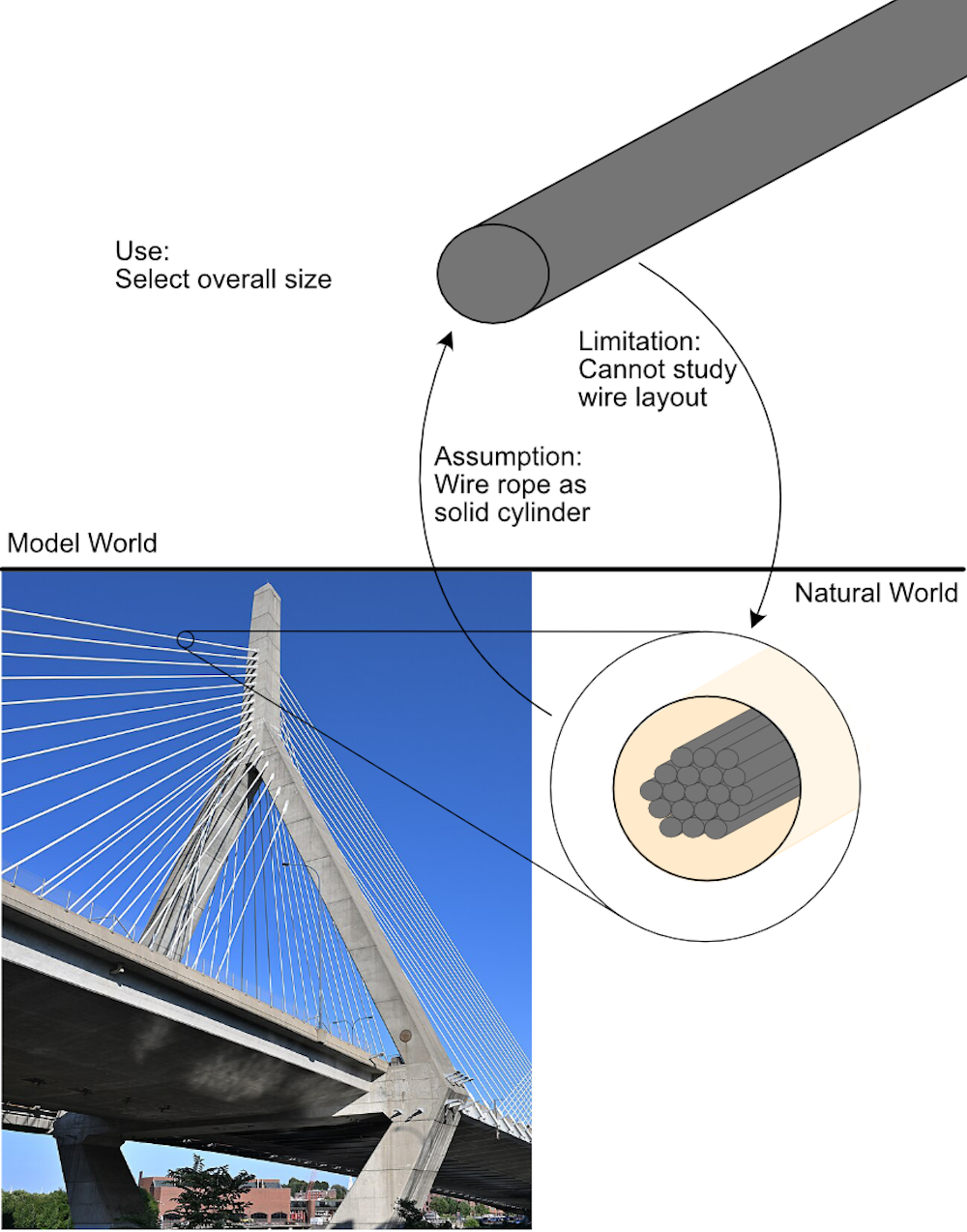
    For instance, an engineer may take a complex bundle of wires and assume they act together as a single cylinder. This simplified shape may help them choose how many wires to bundle together and set the overall thickness of the bundle.

    However, assumptions introduce limitations: The cylinder simplification assumes the individual wires don’t exist, so it doesn’t help determine how to weave the wires together. Engineers can − and do − make more detailed models where they need to, but even those have assumptions and limitations.

    Simplification of a wire rope as an assumed cylinder. This assumption may be appropriate for choosing the number of wires, but it is wholly inappropriate for determining the arrangement of wires.
    HaeB/Wikimedia Commons, modified by Zachary del Rosario, CC BY-SA

    This interplay between assumptions and limitations is at the heart of all models. Engineers working on the Tacoma Narrows Bridge assumed no wind-driven vertical movement, which led to a limitation: They couldn’t predict the wind-driven flutter that shook the bridge apart.

    The same idea holds true for more abstract models. Some companies that make facial recognition systems based on artificial intelligence assume their systems are accurate, given that they do a good job of picking out the correct face from a set of training data. However, outside researchers have shown that some training datasets introduce limitations.

    The engineers who built these training datasets assumed their data had enough faces to represent most people, but these datasets underrepresented nonwhite people. This limitation led the systems to disproportionately target Black people.

    In pursuit of better AI systems, some researchers assume that more training data is the most effective approach. This data-intensive approach has the limitation of an enormous environmental impact. Computing with large sets of data takes a lot of energy, since data centers are resource-intensive.

    The trick to using models safely is to pick assumptions where the limitations do not ruin their intended use. The gold standard is to test. But testing isn’t always possible. For example, building a test bridge isn’t a luxury that structural engineers can afford.

    Carefully selecting and creating proper models requires good judgment.

    Teaching modeling

    Engineering judgment involves a careful balance of trust and skepticism toward mathematics − the bedrock of many engineering models. Developing engineering judgment is difficult, and it usually emerges from years of experience. I teach a modeling and simulation course that jump-starts students’ engineering judgment.

    My co-instructors and I invite students to build their own models, which is a pretty uncommon experience for engineering students. Students then identify the assumptions in their models, state their limitations and, importantly, justify how those limitations do not prevent them from safely using the model.

    Example diagram of a model intended for choosing the size of a wire rope. The model is based on the assumption that the rope will be a solid cylinder. This imposes limitations on studying how the wires are woven together, but it doesn’t hinder the model’s intended use.
    4300streetcar/Wikimedia Commons, modified by Zachary del Rosario, CC BY-SA

    Engineering failures like the Tacoma Narrows Bridge can occur when engineers are not aware of a model’s assumptions and limitations. While courses often teach young engineers to make assumptions and use models, they rarely focus on these models’ limitations. Helping students develop their engineering judgment can prevent failures like “Galloping Gertie” from happening again.

    Zachary del Rosario receives funding from the National Science Foundation and Toyota Research Institute.

    ref. All models are wrong − a computational modeling expert explains how engineers make them useful – https://theconversation.com/all-models-are-wrong-a-computational-modeling-expert-explains-how-engineers-make-them-useful-253309

    MIL OSI – Global Reports

  • MIL-OSI Global: Posh-house drama, Elton’s new album and art to make you weep – what to watch, see and listen to this week

    Source: The Conversation – UK – By Jane Wright, Commissioning Editor, Arts & Culture, The Conversation UK

    This week I’ve seen Disney’s latest bingeable series, The Stolen Girl, variously described as a “posh-house drama”, “the equivalent of an airport novel” and “enjoyably preposterous” – so what’s not to like?

    One episode in, I’m lapping up the lavishly immaculate interiors and clipped tones of rich people who call everyone “darling”. And I always enjoy the hilariously shonky portrayal of journalists and the way dramatists think they speak to each other. Local hack Selma to her (extremely mild and unbothered) boss: “I’m sorry I missed the deadline! I was focused on the background story, it’s important.” Boss, rolling his eyes: “Can’t you put an alert on your phone or something?” Selma: “Next time I will, I promise!”

    The fact that no newsroom boss has ever spoken like that to a reporter who missed a deadline is neither here nor there. This twisty-turny thriller grabs you by the lapels and doesn’t let go. Private-jet stewardess Elisa and criminal lawyer Fred are horrified to find their daughter Lucia has vanished, after a hastily arranged playdate-turned-sleepover with a new schoolfriend turns out to be a meticulously planned abduction.

    But why their daughter? Is there more to Elisa and Fred and their perfect life than meets the eye? From leafy Cheshire to the south of France, their secrets and lies play out, unravelling their once-happy lives. Like the recent Netflix hit Adolescence, social media is a factor in facilitating the crime – but crucially, through the investigations of Selma, also an instrument of solving it.

    The Stolen Girl is streaming on Disney now.

    Painting and pain

    A decade in the making, the National Gallery’s take on the most exciting 50 years of Siena’s artistic production showcases an astonishing array of works. Art history expert Louise Bourdua describes Siena: The Rise of Painting 1300-1350 as “a pleasure for the eye and commendable for its ability to make medieval religious art accessible”.

    The exhibition focuses on so much more than the pre-eminent painters Duccio, Simone Martini and brothers Ambrogio and Pietro Lorenzetti. On show is a wealth of Siena’s visual culture represented in illuminated manuscripts, reliquaries (containers for holy relics), sculptures, gold and enamel work, rugs and silks.

    Showstoppers include Duccio’s stunning gold-painted Crucifixion triptych, Pietro Lorenzetti’s five-panel altarpiece from the church of Santa Maria della Pieve in Arezzo, and the beautifully carved head of Christ by Lando di Pietro – identified as the creator of the work by the personal handwritten prayers concealed within the sculpture, also on display.

    Siena: The Rise of Painting, 1300-1350 is at the National Gallery until June 22.

    The child of immigrant Jamaican parents growing up in the turbulent Britain of the 1970s and ’80s, Donald Rodney’s artistic expression was shaped by his experience of a socially and racially fractured environment.

    His first retrospective exhibition in more than 15 years, Donald Rodney: Visceral Canker at London’s Whitechapel Gallery, is a chance to see the remarkable work of an artist who died at just 36 from sickle-cell anaemia. Described by the Jamaican cultural theorist Stuart Hall as an “emblematically black disease”, it would eventually claim Rodney’s life and that of three of his siblings.

    Encapsulating painting, drawing, pastels, photography, sculptural assemblages, installations and computer-generated art, the show reveals an artist who was angry, ambitious and audacious; who meshed his experience of racism with his illness to draw the poisonous connections of slavery and colonialism to a childhood blighted by anti-immigrant sentiment, the rise of the far right, and pain.

    But as contemporary art specialist Richard Hylton explains, by the late 1970s and early 80s, these children of black immigrants were becoming adults, and new forms of British cultural identity were being explored – including a whole new wave of artistic expression that saw young black British artists rail against the idea of black youth as the public enemy. Rodney’s work endures as an invitation to look beneath the surface of images and society, to better understand the pernicious workings of inequality and racism.

    Donald Rodney: Visceral Canker is at the Whitechapel Gallery until May 4.

    The ballad of John and Yoko (and Elton)

    Capturing an early 1970s charged with political unrest, anti-war sentiment and media saturation, the new documentary One to One: John & Yoko is a revealing exploration of John Lennon’s post-Beatles life and activism with his Japanese partner, Yoko Ono.

    Often dismissed as a pop-star WAG, here Ono is firmly positioned as an artist in her own right. More crucially, we see the influential role she played in nudging Lennon into more radical territory beyond the political songs that emerged in the late-era Beatles. Musically and socially, the pair aimed to galvanise a generation disillusioned by the failure of 1960s “flower-power” to create any kind of genuine social change.

    As a researcher of Ono’s performance art, Stephanie Hernandez found the film compelling in its portrayal of Ono’s avant-garde flair and Lennon’s energetic rock‘n’roll style as complementary forces driving their own brand of pop activism.

    One to One is in cinemas now.

    The irrepressible Elton John is back with a new album, Who Believes in Angels?, a collaboration with country singer Brandi Carlile.

    Since 2020, almost half of the 100 biggest tracks have been collaborations. John has done his fair share of musical hook-ups, with luminaries such as Little Richard, Aretha Franklin, George Michael, Eminem and even Luciano Pavarotti. Now his first post-retirement album with the Grammy-winning Carlile has just reached the top spot in the UK album charts.

    John has described the making of the album as “one of the greatest musical experiences” of his life. So what is it about this collaboration that has so “utterly revitalised” the 78-year-old showman? Is he not quite ready to leave the limelight? Or is he seeking a challenge across new genres, in hitching his piano to a much younger star from a different part of the musical universe? Glenn Fosbraey, an expert in pop music and performance, explains why John (and many other music legends) won’t let the sun go down just yet.


    Looking for something good? Cut through the noise with a carefully curated selection of the latest releases, live events and exhibitions, straight to your inbox every fortnight, on Fridays. Sign up here.


    ref. Posh-house drama, Elton’s new album and art to make you weep – what to watch, see and listen to this week – https://theconversation.com/posh-house-drama-eltons-new-album-and-art-to-make-you-weep-what-to-watch-see-and-listen-to-this-week-254848

    MIL OSI – Global Reports

  • MIL-OSI Global: Freaky Tales: this gory 80s-inspired anthology film is all surface and no substance

    Source: The Conversation – UK – By Matthew Melia, Senior Lecturer and Course leader of the Humanities Foundation Degree, Kingston University

    Nostalgia for the 1980s has been in vogue since the release of Stranger Things in 2016. The Netflix show brought about a renaissance of interest in the popular culture of the time firmly rooted in nostalgia – video game arcades, the role-playing game Dungeons and Dragons, horror films and a reverie for the horror of the VHS and video-nasty era.

    Don’t get me wrong, I am a big fan of this form of nostalgia – if it’s done right. Freaky Tales, an anthology film that deals with 80s’ California punk, anti-fascism, hip-hop and VHS culture, could have been a great addition to this sort of nostalgia bait. Sadly, it is a mess, which, for most of its run time, feels like a film about the 80s generated by AI.

    To go on TikTok is to be confronted by a gen-Z army cosplaying a neon-drenched and romanticised version of the 80s. Filters are used to replicate the low-fi aesthetics of VHS tape, super 8 and cinefilm, while the content creators dress in the styles of the decade and espouse a wishful nostalgia for an era they are at least three decades too young to have experienced firsthand. Freaky Tales seems aimed at this market.

    But this is how the nostalgia industry (or nostalgia capitalism) works. Contemporary digital media facilitates and creates nostalgia in a way that gives the appearance of authenticity but is mostly all surface. Nostalgia is passed on, remediated and sanitised.


    Looking for something good? Cut through the noise with a carefully curated selection of the latest releases, live events and exhibitions, straight to your inbox every fortnight, on Fridays. Sign up here.


    It’s worth also noting that it’s always the Hollywood synthy, US version of 80s pop culture that dominates. Few young people have developed a fabricated sense of nostalgia for the dreariness of Thatcher’s Britain, for instance. A period that history academic Lucy Robinson writes was full of “pop culture and politics … that shaped modern Britain,” in her incisive critical assessment Now That’s What I Call A History of the 1980s.

    Freaky Tales is comprised of four interlocking stories, which are bound in a way that is hard to really comprehend.

    Are the stories connected through the two sets of characters – a couple of young punks and a pair of female hip-hop artists – leaving a screening of The Lost Boys who reappear in different stories? Is it the strange alien green glow that reappears across all the stories? The marker of a solid anthology film is a tight structure and a sense of place, which the film at least has with all stories based in Oakland, California. But for the most part, Freaky Tales feels half built and uncertain of itself.

    Buried somewhere though is a better film trying to get out. Take the first story “Strength in Numbers: the Gilman Strikes Back about the denizens of the Gilman punk club in Oakland, taking a violent and gory stand against a band of neo-nazis they are being harassed by.

    The sequence ends in a sort of bloody 1980s’ punk version of the Gunfight at the O.K. Corral (there are also clear references to Walter Hill’s 1979 cult classic The Warriors). Here there was an opportunity to look deeper into the emergence of California punk culture of the era, the Gilman is a place of real cultural significance where the scene fermented and bands like Rancid, The Offspring, Green Day and the East Bay punk scene in the 1990s got a start.

    Dead Kennedy’s track Nazi Punks Fuck Off became a rallying cry of 80s anti-fascist punk as did Black Flag’s Rise Above (this is at least included on the film’s soundtrack). So why not look at least a little deeper into the antifascist movement within the US punk movement during the era? It can be done and I’d recommend Jeremy Saulnier’s harrowing 2015 film Green Room, which examines the subject from a more contemporary perspective.

    Instead, the film adopts a rather more facile approach. This is most evident in its choice to use animated “bangs” and “thwocks” like a Batman comic during the big fight sequence. By and large this section (by far the worst of the four) feels like content devoid of substance.

    In story two, “Don’t fight The Feeling”, the action centres around a pair of aspiring female hip-hop performers who enter into a rap battle with the performer Too Short (the real life Too Short appears in a cameo as a cop later in the film) and tackles misogyny and hip-hop culture. There are shades of seminal black indie director Spike Lee (Do The Right Thing, 1989) here in its foregrounding of black culture and subjects (although, it must be said, Ryan Fleck and Anna Boden are both white).

    It could have potentially complemented the punk story if it dealt with the cultural impact of 80s’ hip-hop and the struggles of female performers. But again, it feels half formed – part of the problem being that the film is trying perhaps to do too much.

    There are things to enjoy, however, in the film. It is pleasingly gory and has some clever moments. Man of the moment Pedro Pascal takes the lead in the third section (the best of the four), “Born to Mack”, as an enforcer trying to go straight and Ben Mendelsohn puts in an enjoyably sleazy turn as a corrupt cop. The success of the film rest’s chiefly on their shoulders.

    Born to Mack clearly has shades of the king of pop culture nostalgia Quentin Tarantino, especially in its clever and surprising cameo from 80s’ icon Tom Hanks who plays a mysterious video store owner. Tarantino’s films (not least 1994’s Pulp Fiction – the blueprint for this type of anthologised nostalgia cinema) were at the forefront 1990s’ indie cinema, and were framed by his obsessions with 60s, 70s and 80s pop culture.

    Freaky Tales has the potential to offer a more nuanced engagement with the era and its cultural references points while still maintaining a sense of Trashy exploitation fun. Sadly it falls short of the mark.

    Freaky Tales is in selected cinemas from April 18 and on digital platforms from April 28.

    Matthew Melia does not work for, consult, own shares in or receive funding from any company or organisation that would benefit from this article, and has disclosed no relevant affiliations beyond their academic appointment.

    ref. Freaky Tales: this gory 80s-inspired anthology film is all surface and no substance – https://theconversation.com/freaky-tales-this-gory-80s-inspired-anthology-film-is-all-surface-and-no-substance-254754

    MIL OSI – Global Reports

  • MIL-OSI Global: Toronto’s most recent car attack was a targeted crime, not a mass attack

    Source: The Conversation – Canada – By Jack L. Rozdilsky, Associate Professor of Disaster and Emergency Management, York University, Canada

    On April 15, Toronto once again experienced a soft-target vehicular ramming attack when a passenger vehicle intentionally struck and injured four pedestrians on the Toronto Metropolitan University (TMU) campus.

    Almost exactly seven years ago, in the 2018 Toronto van attack, Alek Minassian intentionally drove onto a Yonge Street sidewalk. Motivated by individual extremism with a basis in incel ideology, Minassian killed 11 people and injured 16 more.

    The Toronto Police Service news conference in response to the hit-and-run incident at TMU.

    History seems to repeat itself in Toronto, with car attacks being a means of choice for criminals. Regardless of whether the latest car attack is a terror-related mass attack or an individually targeted crime, the intentional hit-and-run incident shows these attacks have become a grim reality facing the city.

    A traumatic event

    The attack took place on a Tuesday afternoon just before 2 p.m. on Nelson Mandela Walk in the heart of the downtown TMU campus. The public walkway was designated as a pedestrian-only space, located between the campus library and an academic building.

    Investigators have identified a suspect as Ryan Petroff, and have described it as an isolated incident intentionally targeting a specific individual.

    Police statements allege a man drove a four-door Honda Accord along Nelson Mandela Walk and hit several people, including innocent bystanders. Four people were injured, with one sustaining serious but not life-threatening injuries. All are expected to recover.

    The area of the TMU car attack was clearly designated as a pedestrian-only zone.
    (J. Rozdilsky), CC BY

    The suspect remains at large, and other than indicating that the attack was intentional, Toronto Police Service has not yet elaborated on motives or the relationship between the intended victim and the suspect.

    The day after the attack, TMU issued a statement saying university community members were not involved in the incident and mentioned that campus-based supports had been made available for anyone impacted by witnessing the traumatic event.

    Barriers against future attacks

    In the hours after the attack, immediate actions were taken to plug the gap the attacker exploited to drive onto the pedestrian walkway, and temporary planter-type barriers were placed at the attack site.

    TMU also issued a second statement specifically concerning pedestrian walkway safety. It acknowledged the troubling event while attempting to quell campus safety concerns:

    “The university is discussing with the City of Toronto what additional safety measures can be implemented to ensure pedestrian walkways used by TMU community members and the public are safe while maintaining accessibility for emergency vehicles.”

    Conflicts between vehicles and pedestrians

    A dedicated attacker exploited a gap where a car was able to enter a zone dedicated to pedestrians. In hindsight, the easy question to ask is: why wasn’t that gap plugged beforehand?

    This sidesteps the ubiquitous nature of the problem, which is that potential conflict between vehicles and pedestrians exists almost everywhere in a complex urban environment.

    In 2020, Nelson Mandela Walk was revitalized to enhance quality, safety and accessibility. Standard traffic management activities to reduce conflict — referred to as “modal separation” — were in place prior to the incident.

    The walkway had a visually separate streetscape from the traffic lanes of nearby Gerrard Street: the interlocked brick surface, decorative trees and benches clearly indicated it was not a street for cars.

    In addition, posted signs indicated the area was for pedestrian use only. Barriers such as bollards, fences, cement trash cans and large planters were present at points along the walkway.

    In this case, a criminal found one gap in protection and intentionally ignored and evaded all of the elements that were in place to separate people from cars.

    Targeted mass attacks

    The 2025 TMU car attack highlighted a problem that is not new to Toronto: targeted criminal activity that can cascade into a mass casualty incident.


    Read more:
    What authorities can learn from the Raptors parade shooting


    In 2019, four people were wounded at Nathan Phillips Square when gunfire erupted during the celebrations for the Toronto Raptors NBA championship win. This was another example of a targeted attack that almost resulted in a wider mass casualty incident.

    More than 100,000 people were in the area near the shooting, and it was determined that the shooting was a targeted criminal incident, not a mass attack on the celebration itself.

    While Toronto’s most recent vehicular attack at TMU had the elements of a mass attack, it was apparently a targeted crime focused on one individual. Nonetheless these incidents, and not just terrorist-type mass attacks, have the potential to result in a mass casualty incident.

    Jack L. Rozdilsky receives support for research communication and public scholarship from York University. He also has received research support from the Canadian Institutes of Health Research.

    ref. Toronto’s most recent car attack was a targeted crime, not a mass attack – https://theconversation.com/torontos-most-recent-car-attack-was-a-targeted-crime-not-a-mass-attack-254686

    MIL OSI – Global Reports

  • MIL-OSI Global: How does your brain create new memories? Neuroscientists discover ‘rules’ for how neurons encode new information

    Source: The Conversation – USA – By William Wright, Postdoctoral Scholar in Neurobiology, University of California, San Diego

    Neurons that fire together sometimes wire together. PASIEKA/Science Photo Library via Getty Images

    Every day, people are constantly learning and forming new memories. When you pick up a new hobby, try a recipe a friend recommended or read the latest world news, your brain stores many of these memories for years or decades.

    But how does your brain achieve this incredible feat?

    In our newly published research in the journal Science, we have identified some of the “rules” the brain uses to learn.

    Learning in the brain

    The human brain is made up of billions of nerve cells. These neurons conduct electrical pulses that carry information, much like how computers use binary code to carry data.

    These electrical pulses are communicated with other neurons through connections between them called synapses. Individual neurons have branching extensions known as dendrites that can receive thousands of electrical inputs from other cells. Dendrites transmit these inputs to the main body of the neuron, where it then integrates all these signals to generate its own electrical pulses.

    It is the collective activity of these electrical pulses across specific groups of neurons that form the representations of different information and experiences within the brain.

    Neurons are the basic units of the brain.
    OpenStax, CC BY-SA

    For decades, neuroscientists have thought that the brain learns by changing how neurons are connected to one another. As new information and experiences alter how neurons communicate with each other and change their collective activity patterns, some synaptic connections are made stronger while others are made weaker. This process of synaptic plasticity is what produces representations of new information and experiences within your brain.

    In order for your brain to produce the correct representations during learning, however, the right synaptic connections must undergo the right changes at the right time. The “rules” that your brain uses to select which synapses to change during learning – what neuroscientists call the credit assignment problem – have remained largely unclear.

    Defining the rules

    We decided to monitor the activity of individual synaptic connections within the brain during learning to see whether we could identify activity patterns that determine which connections would get stronger or weaker.

    To do this, we genetically encoded biosensors in the neurons of mice that would light up in response to synaptic and neural activity. We monitored this activity in real time as the mice learned a task that involved pressing a lever to a certain position after a sound cue in order to receive water.

    We were surprised to find that the synapses on a neuron don’t all follow the same rule. For example, scientists have often thought that neurons follow what are called Hebbian rules, where neurons that consistently fire together, wire together. Instead, we saw that synapses on different locations of dendrites of the same neuron followed different rules to determine whether connections got stronger or weaker. Some synapses adhered to the traditional Hebbian rule where neurons that consistently fire together strengthen their connections. Other synapses did something different and completely independent of the neuron’s activity.

    Our findings suggest that neurons, by simultaneously using two different sets of rules for learning across different groups of synapses, rather than a single uniform rule, can more precisely tune the different types of inputs they receive to appropriately represent new information in the brain.

    In other words, by following different rules in the process of learning, neurons can multitask and perform multiple functions in parallel.

    Future applications

    This discovery provides a clearer understanding of how the connections between neurons change during learning. Given that most brain disorders, including degenerative and psychiatric conditions, involve some form of malfunctioning synapses, this has potentially important implications for human health and society.

    For example, depression may develop from an excessive weakening of the synaptic connections within certain areas of the brain that make it harder to experience pleasure. By understanding how synaptic plasticity normally operates, scientists may be able to better understand what goes wrong in depression and then develop therapies to more effectively treat it.

    Changes to connections in the amygdala – colored green – are implicated in depression.
    William J. Giardino/Luis de Lecea Lab/Stanford University via NIH/Flickr, CC BY-NC

    These findings may also have implications for artificial intelligence. The artificial neural networks underlying AI have largely been inspired by how the brain works. However, the learning rules researchers use to update the connections within the networks and train the models are usually uniform and also not biologically plausible. Our research may provide insights into how to develop more biologically realistic AI models that are more efficient, have better performance, or both.

    There is still a long way to go before we can use this information to develop new therapies for human brain disorders. While we found that synaptic connections on different groups of dendrites use different learning rules, we don’t know exactly why or how. In addition, while the ability of neurons to simultaneously use multiple learning methods increases their capacity to encode information, what other properties this may give them isn’t yet clear.

    Future research will hopefully answer these questions and further our understanding of how the brain learns.

    William Wright receives funding from National Institutes of Health (NINDS) and the Schmidt Sciences Foundation.

    Takaki Komiyama receives funding from NIH, NSF, Simons Foundation, Chan Zuckerberg Initiative, and Kavli Institute for Brain and Mind.

    ref. How does your brain create new memories? Neuroscientists discover ‘rules’ for how neurons encode new information – https://theconversation.com/how-does-your-brain-create-new-memories-neuroscientists-discover-rules-for-how-neurons-encode-new-information-254558

    MIL OSI – Global Reports

  • MIL-OSI Global: ‘Heavy metals’ contaminate 17% of the world’s croplands, say scientists

    Source: The Conversation – UK – By Jagannath Biswakarma, Senior Research Associate, School of Earth Sciences and Cabot Institute for the Environment, University of Bristol

    Nearly 17% of the world’s croplands are contaminated with “heavy metals”, according to a new study in Science. These contaminants – arsenic, cadmium, lead, and others – may be invisible to the eye, but they threaten food safety and human health.

    Heavy metals and metalloids are elements that originate from either natural or human-made sources. They’re called “heavy” because they’re physically dense and their weight is high at an atomic scale.

    Heavy metals do not break down. They remain in soils for decades, where crops can absorb them and enter the food chain. Over time, they accumulate in the body, causing chronic diseases that may take years to appear. This is not a problem for the distant future; it’s already affecting food grown today.

    Some heavy metals, such as zinc and copper, are essential micronutrients in trace amounts. Others – including arsenic, cadmium, mercury, and lead – are toxic even at low concentrations.

    Some are left behind by natural geology, others by decades of industrial and agricultural activities. They settle into soils through mining, factory emissions, fertilisers or contaminated water.

    When crops grow, they draw nutrients from the soil and water – and sometimes, these contaminants too. Rice, for instance, is known for taking up arsenic from flooded paddies. Leafy greens can accumulate cadmium. These metals do not change the taste or colour of food. But they change what it does inside the body.

    The quiet health crisis beneath our crops

    Long-term exposure to arsenic, cadmium, or lead has been linked to cancer, kidney damage, osteoporosis, and developmental disorders in children. In regions where local diets rely heavily on a single staple crop like rice or wheat, the risks multiply.

    The Science study, led by Chinese scientist Deyi Hou and his colleagues, is one of the most comprehensive mapping efforts. By combining recent advances in machine learning with an expansive dataset of 796,084 soil concentrations from 1,493 studies, the authors systematically assessed global soil pollution for seven toxic metals: arsenic, cadmium, cobalt, chromium, copper, nickel, and lead.

    The study found that cadmium in agricultural soil frequently exceeded the threshold, particularly in the areas shaded in red in this map:

    A map of the aggregate distribution of seven heavy metals reveals lots of hotspots around the world.
    Hou et al / Science

    The authors also describe a “metal-enriched corridor” stretching from southern Europe through the Middle East and into south Asia. These are areas where agricultural productivity overlaps with a history of mining, industrial activity and limited regulation.

    How science is reading the soil’s story

    Heavy metal contamination in cropland varies by region, often shaped by geology, land use history, and water management. Across central and south-east Asia, rice fields are irrigated with groundwater that naturally contains arsenic. That water deposits arsenic into the soil, where it is taken up by the rice.

    Fortunately, nature often provides defence. Recent research showed that certain types of iron minerals in the soil can convert arsenite – a toxic, mobile form of arsenic – into arsenate, a less harmful species that binds more tightly to iron minerals. This invisible soil chemistry represents a safety net.

    In parts of west Africa, such as Burkina Faso, arsenic contamination in drinking and irrigation water has also affected croplands. To address this, colleagues and I developed a simple filtration system using zerovalent iron – essentially, iron nails. These low-cost, locally sourced filters have shown promising results in removing arsenic from groundwater.

    In parts of South America, croplands near small-scale mines face additional risks. In the Amazon basin, deforestation and informal gold mining contribute to mercury releases. Forests act as natural mercury sinks, storing atmospheric mercury in biomass and soil. When cleared, this stored mercury is released into the environment, raising atmospheric levels and potentially affecting nearby water bodies and croplands.

    Cropland near legacy mining sites often suffers long-term contamination but with the appropriate technologies, these sites can be remediated and even transformed into circular economy opportunities.

    Evidence-based solutions

    Soil contamination is not just a scientific issue. It’s a question of environmental justice. The communities most affected are often the least responsible for the pollution. They may farm on marginal lands near industry, irrigate with unsafe water, or lack access to testing and treatment. They face a double burden: food and water insecurity, and toxic exposure.

    There is no single fix. We’ll need reliable assessment of contaminated soils and groundwater, especially in vulnerable and smallholder farming systems. Reducing exposure requires cleaner agricultural inputs, improved irrigation, and better regulation of legacy industrial sites. Equally critical is empowering communities with access to information and tools that enable them to farm safely.

    Soils carry memory. They record every pollutant, every neglected regulation, every decision to cut corners. But soils also hold the potential to heal – if given the proper support.

    This is not about panic. It’s about responsibility. The Science study provides a stark but timely reminder that food safety begins not in the kitchen or market but in the ground beneath our feet. No country should unknowingly export toxicity in its grain, nor should any farmer be left without the tools to grow food safely.

    Jagannath Biswakarma does not work for, consult, own shares in or receive funding from any company or organisation that would benefit from this article, and has disclosed no relevant affiliations beyond their academic appointment.

    ref. ‘Heavy metals’ contaminate 17% of the world’s croplands, say scientists – https://theconversation.com/heavy-metals-contaminate-17-of-the-worlds-croplands-say-scientists-254783

    MIL OSI – Global Reports

  • MIL-OSI Global: Rising Canadian patriotism is a chance to rethink who gets to belong here

    Source: The Conversation – Canada – By Alpha Abebe, Associate Professor, Faculty of Humanities, McMaster University

    Some Canadians are pushing back against recent threats from the United States government to Canada’s s sovereignty and economic stability with the rallying cry “Elbows up!”

    Borrowed from hockey, the phrase charges Canadians to raise one’s elbows in preparation to fight back.


    Read more:
    Elbows up, Canada: Musical responses to Trump’s Canada threats


    In another gesture towards Canadian national solidarity, the iconic 2000 “I am Canadian” beer ad was recently revived by the ad’s original actor, Jeff Douglas.

    The video, We Are Canadian,, includes familiar Canadian symbols from hockey games to peacekeeping missions and Canadian flags. As others have observed, these trends are emblematic of a dramatic spike in Canadian patriotism.

    The desire to rally behind symbols of unity is understandable in precarious times. However, it is also a good time to consider who and what is being obscured behind this version of Canadian patriotism.

    As the U.S. institutes increasingly racist, xenophobic and authoritarian policies, this moment may be just the warning Canadians need to imagine a more just, grounded country. Which direction we walk will depend on some important considerations.

    ‘We Are Canadian’ by Canadian actor Jeff Douglas.

    Canada is constantly changing

    As a scholar of migration and diasporas, I take note of changes to the Canadian population.

    It’s grown significantly more diverse in recent years. But dominant discourse about Canadian nationalism often flattens these realities, invoking multiculturalism while failing to engage with deeper histories and contemporary realities.

    For example, Black diasporas are one of the fastest-growing segments in Canada. And almost 25 per cent of people in Canada are immigrants.

    The racialized population in Canada accounts for about 26 per cent of residents, about double the number recorded in 2001. According to most projections, half the Canadian population will be made up of immigrants and their Canadian-born children by 2041.

    These shifts reflect long-term immigration reforms, especially those beginning in the 1960s, when the federal government moved away from “White Canada” policies that explicitly excluded non-European immigrants.

    Today, many people in Canada — Indigenous, immigrant, Canadian-born — maintain complex relationships to settler colonialism, as well as multiple homelands, cultures and histories.

    Yet popular narratives of “Canadianness” can be narrow and out of step with the experiences of diverse segments of the population. Scholars Lloyd L. Wong and Martine Dennie point out that the idea of Canada as a “hockey nation” is sometimes contested by communities marginalized by the sport’s ties to anglo male dominance.

    In their book Unsettling the Great White North: Black Canadian History, historians Michelle A. Johnson and Funké Aladejebi argue that the Canadian narrative reflects a historical and ongoing systematic erasure of Blackness.

    Youth discomfort with nationalism

    In my teaching and academic leadership roles, I engage with young people and aim to centre their voices in reimagining our institutions and communities. Through this work, I have the privilege of listening as young people reflect on their perceptions of Canada and desires for its future.

    Many of my students express discomfort with unabashed nationalism, identifying instead with their local and regional cultures, and gravitating towards abolitionist ideals such as demilitarized borders and migrant solidarity.

    The ongoing work of truth and reconciliation

    There is also a growing desire among the young people I teach to reconcile their profound lack of formal education in Indigenous histories, ideas and issues.

    Even in our resistance to external threats, we must remain committed to addressing the internal legacies of colonial violence, as outlined by the Truth and Reconciliation Commission (TRC) and its framework for healing.

    The TRC provides a road map for the critical work of bridging gaps between Indigenous and non-Indigenous communities, as led by Indigenous leaders and organizations.

    The recently published book Deyohahá:ge: Sharing the River of Life features chapters written by members of Six Nations as well as non-Indigenous neighbours, indicating a need for dialogue. The book reflects on the Two Row Wampum Agreement and how these agreements might restore good relations today.

    In another example, Black Canadian artist Jully Black altered the Canadian national anthem to acknowledge our colonial history, singing “our home on native land,” instead of our home and native land during the 2023 NBA All-Star Game. Her performance generated critical conversations about Canada’s national narrative.

    Scapegoating

    Part of the Canadian identity story is about being a welcoming nation. But Canadians have long scapegoated newcomers as being to blame for a host of issues.

    We see this play out in immigration policy and political discourse. For example, the Liberal government’s recent cuts to immigration levels was framed as a response to housing and economic pressures.

    The Conservative Party has also portrayed immigrants as burdens on housing and infrastructure while stoking fears about “criminal” and “bogus” migrants.

    Similarly, in the final stretch of his 2015 campaign, Prime Minister Stephen Harper’s government leaned into xenophobic rhetoric, most notably with the promise to establish a “barbaric cultural practices” hot line which was being positioned as a defence of “Canadian values.”

    Fresh perspectives on Canadian identity

    Canada is often criticized for having a weak or reactive national narrative defined more by what it is not (the United States) that by what it is.

    But distancing ourselves from American crises doesn’t excuse us from confronting our own contradictions. This moment of heightened patriotism demands more than just symbolic unity.

    My students increasingly challenge shallow notions of multiculturalism, pushing instead for structural change that is material, not just rhetorical.

    Their critiques reflect wider public conversations: youth-led panels, academic research and lived experiences that question the limits of inclusion without equity. They are asking: Who benefits from these patriotic myths? Who gets erased?

    To move forward, Canada must build a collective story rooted in truth — not just selective nostalgia. One that honours Indigenous sovereignty, confronts contemporary inequities and reflects the rich diversity of its people. Only then can we begin to imagine a future Canada worth rallying behind.

    Alpha Abebe does not work for, consult, own shares in or receive funding from any company or organisation that would benefit from this article, and has disclosed no relevant affiliations beyond their academic appointment.

    ref. Rising Canadian patriotism is a chance to rethink who gets to belong here – https://theconversation.com/rising-canadian-patriotism-is-a-chance-to-rethink-who-gets-to-belong-here-252482

    MIL OSI – Global Reports

  • MIL-OSI Global: Patriots’ Day: How far-right groups hijack history and patriotic symbols to advance their cause, according to an expert on extremism

    Source: The Conversation – USA – By Art Jipson, Associate Professor of Sociology, University of Dayton

    Anti-government protestors use the American flag to draw attention to their cause at a protest on Aug. 8, 2020, in Columbus, Ohio. Paul Becker/Becker 1999 via Flickr, CC BY

    Patriots’ Day, a commemoration of the battles of Lexington and Concord – the first confrontations of the American Revolution – holds historical value as a symbol of American resistance to British colonial rule. Over time, however, the holiday has been co-opted by extremist groups.

    Capitalizing on ambiguities in the understanding of patriotic symbols, extremist groups have attempted to change the meaning of freedom and liberty embedded in the symbol of the American flag.

    Not all states celebrate Patriots’ Day. Massachusetts and Maine observe it as a public holiday on the third Monday in April. Wisconsin observes Patriots’ Day as a state observance – not a public holiday – on April 19, with schools and businesses remaining open. Other states may also mark it informally or through educational activities.

    As a scholar of extremism, I have become increasingly concerned by the appropriation of patriotic symbols such as the American flag and Patriots’ Day into narratives for far-right rhetoric, recruitment and radicalization. Patriotic events such as the Fourth of July can be marked by demonstrations, armed protests and calls for militant action by far-right extremist groups.

    A Three-Percenter flag at an anti-government rally on July 21, 2021, in Columbus, Ohio.
    Paul Becker/Becker 1999 via Flickr, CC BY

    Just before the Fourth of July in 2019, the Southern Poverty Law Center demonstrated how extremist groups have long adopted symbols of U.S. history to promote white supremacy. A 2010 SPLC report documented extremist calls for “freedom,” including a call from such far-right groups for repeal of all social service spending.

    The hijacking of patriotic symbols is part of an effort to create an atmosphere where participants believe they are engaging in a modern-day fight for freedom.

    In interviews I conducted with extremists in March 2025, several members of the Patriot Front said they are planning to protest on April 19 in an effort to use the holiday to attract media and public attention to their efforts to create a white homeland.

    Extremists are not the only Americans who are planning on using Patriots’ Day as a platform to attract attention to their causes. Mobilization of opposition to President Donald Trump’s policies and deportation efforts are also planned for April 19. Protesters raise concerns about the incorporation of American patriotic symbols by the right wing to support policies that they view as distinctively anti-American and unconstitutional.

    The 250th anniversary on April 19 of the first battles of the American Revolution is a fitting time to reflect on the meaning and use of historical symbols.

    White supremacy and Patriots’ Day

    From a sociological perspective, national symbols and events such as the American flag and Patriots’ Day do not have fixed meanings. Rather, any symbol is defined by how people actually use it. Whether one raises an American flag or burns one, the use of the flag is a powerful symbol that is understood to mean different things to different people, depending on the context.

    Extremists often take other symbols of American patriotism, such as the bald eagle, the Second Amendment and the phrase “America the beautiful” and try to use them to promote their message. For example, white supremacists believe that America can be beautiful only if white Americans are in positions of authority. The interpretations of these symbols become tools for extremist mobilization.

    In the lead-up to Patriots’ Day in 2023, members of the Patriot Front, a white supremacist group, rallied near the Massachusetts State House in Boston. They displayed a banner reading “Reclaim America,” a slogan associated with their ideology.

    Several white supremacist groups such as the Patriot Front, National Socialist Club-131 and other neo-Nazis groups position themselves as authentic modern-day “patriots” fighting to preserve society. They claim they are “undermined by a government that represses citizens” and creates an unsafe space for what they call a “white homeland.”

    The Patriot Front manifesto, written by group founder Thomas Rousseau, states: “A nation within a nation is our goal. Our people face complete annihilation as our culture and heritage are attacked from all sides.”

    The role of extremist narratives

    The extremist groups see Patriots’ Day not only as a commemoration of resistance against British colonialism but as a rallying point for a radical vision of American identity that attracts more attention from the public and the media because of the use of the recognized symbol.

    Extremists frame their actions as a continuation of the American Revolution and draw upon the myth of an oppressed, virtuous “true American” standing against tyranny. In this view, traditional symbols of American patriotism represent resistance not against an overarching foreign power but against internal threats to their vision of America.

    These include perceived threats posed by progressive movements, racial minorities, immigrants and the federal government. In the minds of those on the far right, what’s at stake are their traditional values, gun ownership and individual rights.

    The Southern Poverty Law Center has highlighted the significance of April 19 in the anti-government “patriot” movement’s calendar, noting that it has been associated with increased activity from militias and other extremist groups.

    A man belonging to the Boogaloo Boi far-right group at an anti-government rally on Aug. 29, 2020, in Columbus, Ohio.
    Paul Becker/Becker 1999 via Flickr, CC BY

    Some of those groups include the sovereign citizens movement, Boogaloo Bois and the Patriot Front. The sovereign citizen movement is a loosely organized group of individuals who believe that they are not subject to government laws, especially federal laws in the United States. The Boogaloo movement is an anti-government extremist group known for advocating for a second American civil war, which they often call the “boogaloo.”

    The myth of the ‘true American’

    The construction of the “true American” is central to the ideology. For many far-right groups, the “true” or “real” American is defined as someone who believes in the preservation of a specific, often exclusionary version of American values in which white Americans are seen as both moral paragons and under siege.

    Some American militia groups, such as the Oath Keepers and Three Percenters, claim that only those willing to resist their idea of “tyranny” are true American patriots and that they should resist the government.

    In 2014, the Oath Keepers participated in an armed standoff in Nevada to support rancher Cliven Bundy, who was in a dispute with the Bureau of Land Management over unpaid grazing fees. The group positioned themselves as defenders against federal authority. Two men with ties to the Three Percenters, Barry Croft and Adam Fox, were involved in a plot to kidnap Michigan Gov. Gretchen Whitmer in 2020. The plot was foiled by law enforcement, and the individuals were arrested and charged with terrorism-related offenses. Both received lengthy prison sentences.

    As Stewart Rhodes, who founded The Oath Keepers in 2009 in Lexington, Massachusetts, has said: “We are the last line of defense against tyranny. Real patriots will stand up.”

    Anyone not aligned with their ideology is seen as a traitor or unwilling to confront systemic problems and are derisively labeled “sheep.”

    The mobilization of violence

    One of the most concerning ways in which American patriotic symbols are co-opted by extremists is the potential to justify violent action.

    An example of how extremist flags incorporate the American flag into their design, as seen at a protest on July 21, 2021, in Columbus, Ohio.
    Paul Becker/Becker 1999 via Flickr, CC BY

    The connection between historical acts of violence, such as the battles of Lexington and Concord, and contemporary calls for preparation for violent actions is deliberately emphasized. According to historian Darren Mulloy, extremists use well-known and accepted American symbols to create a sense that violence is a justified and necessary means of defense. Militia groups, in Mulloy’s research, exploit the need for violence in the American Revolution and the settling of the American West to legitimize their contemporary calls.

    The Oath Keepers romanticize the role of armed militias in the founding of America as seen at Lexington and Concord. They use this day to promote the idea that their cause is just and that armed resistance is a legitimate form of political expression.

    Groups such as The Base and the Oath Keepers have called for training in preparation for armed defense against the government. They recruit current and former military, police and first responders, urging them to uphold an oath to defend the Constitution – as the group interprets it – often against what they see as a tyrannical federal government.

    This creates a dangerous feedback loop in which extremism and violence are normalized through the glorification of historical events that celebrate acts of rebellion while strengthening identities that radicalize individuals.

    Understanding how patriotic symbols can be exploited offers important insights into how historical narratives may be manipulated, potentially leading to harmful consequences in American society.

    Art Jipson does not work for, consult, own shares in or receive funding from any company or organization that would benefit from this article, and has disclosed no relevant affiliations beyond their academic appointment.

    ref. Patriots’ Day: How far-right groups hijack history and patriotic symbols to advance their cause, according to an expert on extremism – https://theconversation.com/patriots-day-how-far-right-groups-hijack-history-and-patriotic-symbols-to-advance-their-cause-according-to-an-expert-on-extremism-251687

    MIL OSI – Global Reports

  • MIL-OSI Global: Trump takes a line from ‘world’s coolest dictator’

    Source: The Conversation – UK – By Jonathan Este, Senior International Affairs Editor, Associate Editor

    What a difference a dictator makes. Some world leaders get a rough ride in their Oval Office meetings with Donald Trump – most famously, the Ukrainian president Volodymyr Zelensky, who the US president and his entourage publicly disparaged in their now-notorious meeting at the end of February. But not El Salvador’s Nayib Bukele, the self-styled “world’s coolest dictator” – an autocrat whose country’s incarceration rate is the highest in the world – with whom Trump swapped a few friendly quips this week about authoritarian leadership.

    “They say that we imprisoned thousands. I say we liberated millions,” said Bukele about his record of jailing people without due process, adding that: “To liberate that many, you have to imprison some.”

    “Who gave him that line? You think I could use that?” replied Trump to general merriment.

    Bukele has obliged Trump by incarcerating hundreds of Venezuelan and Salvadoran migrants deported from the US on suspicion of being members of criminal gangs – none of whom have had their day in court. One person of particular interest to the journalists was Kilmar Abrego Garcia, a Maryland man deported due to an “administrative error”. The US Supreme Court has ordered the Trump administration to do everything in its power to “facilitate” his return to his wife and family in the US.

    “Of course I’m not going to do it,” Bukele said, when asked if he would send Abrego Garcia back to the US, adding that it would be like “sending a terrorist back to the United States”. Smiles all round from the US officials. This apparently makes it a matter of foreign policy rather than a failure of US justice – or, just as crucially, an impending constitutional crisis over the Trump administration’s failure to obey a Supreme Court ruling.


    Sign up to receive our weekly World Affairs Briefing newsletter from The Conversation UK. Every Thursday we’ll bring you expert analysis of the big stories in international relations.


    Bukele knows a thing or two about circumventing constitutional law, writes Amalendu Misra, a professor of international politics at Lancaster University, who has written extensively about Latin America for The Conversation. The Salvadoran president is serving a second term, despite his country’s constitution previously restricting a president from serving two consecutive terms.

    Critics say Bukele used his considerable majority to replace five members of El Salvador’s Supreme Court in order to get the decision he wanted – which may also have raised him in the US president’s estimation.

    Misra charts Bukele’s rise to power and his achievements in office, which include transforming El Salvador from the murder capital of the world to having one of the lowest homicide rates in the western hemisphere. But not without considerable infringements of human rights and civil liberties – something to which, as we’ve seen, Bukele unabashedly owns up.


    Read more:
    Nayib Bukele: El Salvador’s strongman leader doing Donald Trump’s legwork abroad


    Meanwhile, constitutional scholars are picking apart the US Supreme Court’s ruling in the matter of Abrego Garcia, who is currently sitting in El Salvador’s notorious Center for Terrorism Confinement (Cecot) mega-prison.

    What exactly did the court mean when it instructed the Trump administration to “facilitate” his return to the US? The US attorney-general, Pam Bondi, offered her interpretation on Wednesday – saying the decision was completely up to Bukele, and that if he wanted to send Abrego Garcia back, “we would give him a plane ride back”.

    Trump’s relationship with US constitutional law is already coming under a fair bit of scrutiny, as he and his senior officials have embarked on a concerted effort to push back against court rulings which seek to reverse or delay some of his policies.

    “Trump’s approach seems to be one of testing the limits of the law,” writes Stephen Clear, a constitutional law expert at Bangor University. Clear believes that Trump’s second term is going further, faster, than his first in putting pressure on the system of checks and balances on which the US constitution depends.

    Clear looks at Trump’s strategy of using executive orders to make policy – there have been 124 in his first 85 days (executive orders don’t need congressional approval). The federal courts are now examining many of these orders, which have been challenged on the grounds of unconstitutionality. The US Supreme Court is already facing an unprecedented number of emergency applications, and it remains to be seen when the justices will decide – and, crucially, how the administration responds to the Supreme Court’s decisions.


    Read more:
    Trump’s tactics for creating disruption are testing the limits of presidential power – a legal expert explains


    A federal court judge whose ruling regarding the deportation of 100 migrants to El Salvador was apparently disregarded by the Trump administration has released an opinion that this failure to comply constitutes “probable cause” to hold members of the administration in criminal contempt.

    US district court judge James Boasberg wrote that a judicial order “must
    be obeyed – no matter how erroneous it may be – until a court reverses it”. US legal scholar Cassandra Burke Robertson answers our questions about this matter.


    Read more:
    Federal judge finds ‘probable cause’ to hold Trump administration in contempt – a legal scholar explains what this means


    In the end, the most reliable test of Trump and the Republican party is still at the ballot box. The mid-term elections, the first real test of the US public’s approval of Trump 2.0, are more than 18 months away. But how is the second Trump administration going down with Americans?

    It depends who you ask, writes Paul Whiteley of the University of Essex. Whiteley, an expert scrutineer of public opinion, was interested to see whether the recent upheaval created by Trump’s tariffs plan had affected the way the US public views his performance.

    Committed Republicans still tend to give credit to Trump that he knows what he is doing, while Democrats, as you’d expect, remain fundamentally opposed to the administration. And the same goes, broadly speaking, for their respective views on his handling of trade policy. But the big shift, Whiteley observes, is among people identifying as independents, where Trump’s approval rating has fallen considerably, particularly over the tariffs.

    This is significant, Whiteley believes, because independents now make up the largest voter group in the US. He concludes: “If this shift continues, and independent voters support Democrat candidates in the 2026 mid-term elections, it means that the Democrats are likely to take control of Congress.”


    Read more:
    Have Trump’s tariffs affected his popularity? Here’s what approval data shows


    A tale of two peace talks

    Another Trump campaign promise is coming under increasing scrutiny: his pledge to end the war in Ukraine “within 24 hours”. The US president now insists he was “being sarcastic” when he made that claim – but, after nearly three months, Trump’s efforts to end the war are “struggling to get off the starting blocks”, writes Jennifer Mathers from Aberystwyth University.

    Despite Zelensky having unconditionally accepted the initial proposal for a 30-day ceasefire and backing US efforts to establish a limited ceasefire – applying to energy infrastructure and on the ocean – Russia has redoubled its attacks. The recent Palm Sunday strikes, which killed at least 35 civilians in the border town of Sumy, appeared particularly gratuitous given that the two sides are supposed to be talking peace.

    Mathers writes that Vladimir Putin is deliberately doing all he can to drag his feet over negotiations, while maintaining Russia’s original demands for huge swaths of Ukrainian territory, guarantees that Kyiv will drop its plan to join Nato, and for elections to be held in Ukraine. You’d have to imagine that Moscow will pull out all the stops to ensure the winner is more to its liking than Zelensky.

    One of the main problems, as Mathers sees it, is that the various American diplomats keep repeating Putin’s demands, lending them legitimacy. It goes without saying that these demands find no favour with Kyiv, as they amount to virtually complete Ukrainian capitulation.


    Read more:
    Why is Donald Trump failing to bring peace to Ukraine like he promised?


    The other big diplomatic gambit involving the Trump White House is in Oman this weekend, as representatives from the US and Iran meet to discuss the possibility of a new deal on Iran’s nuclear programme. The initial signs aren’t good. Trump has threatened dire consequences unless Iran is willing to give up its nuclear ambitions. Iran refuses to countenance this idea.

    But there are signs that behind the scenes, there may be some progress. Iran’s leaders are under heavy domestic pressure to get sanctions lifted as its economy continues to tank. And it has been reported that Trump refused to approve joint US-Israeli strikes on Iranian nuclear facilities.

    Simon Mabon from Lancaster University – a specialist in Middle East security and particularly the relationship between Saudi Arabia and Iran – examines what the talks mean for the broader stability of the Middle East. He believes the outcome of the talks are being watched particularly closely by China, which has its own ambitions for the region.


    Read more:
    US-Iran: future stability of Middle East hangs on success of nuclear deal – but initial signs are not good


    Indian democracy

    Last year’s election in India was the biggest democratic exercise the world has ever seen, involving upwards of 642 million people casting their votes in seven phases across this vast country. It was, in fact, the biggest election ever to be held in India, surpassing the first elections held in 1951-52 after the country achieved independence from Britain.

    Tripurdaman Singh, a fellow of the University of London’s School of Advanced Study, has traced the progress of democracy in India from what he describes as “a moment of such staggering idealism and exuberance, a leap of faith so audacious, that the famous jurist and scholar Kenneth Wheare termed it ‘the biggest liberal experiment in democratic government’ that the world had seen”.

    Singh takes a detailed look at this experiment in democracy, examining the fledgling country’s constitution and how it has been interpreted since. He finds that this “idealism” was more of an aspiration than an actuality, and that power has always been firmly held by the executive. But, he writes, the sheer diversity of the electorate has – in the main at least – successfully prevented tyrannical impulses from India’s leaders. At least, it has thus far.


    Read more:
    Birth of India: ‘biggest experiment’ with democracy was a huge gamble. Happily the people have made it work – here’s how


    World Affairs Briefing from The Conversation UK is available as a weekly email newsletter. Click here to get updates directly in your inbox.


    ref. Trump takes a line from ‘world’s coolest dictator’ – https://theconversation.com/trump-takes-a-line-from-worlds-coolest-dictator-254809

    MIL OSI – Global Reports

  • MIL-OSI Global: Price discrimination is getting smarter — and low-income consumers are paying the price

    Source: The Conversation – Canada – By Raymond A. Patterson, Professor, Area Chair, Business Technology Management, Haskayne School of Business, University of Calgary

    For customers who don’t have the freedom to choose where they shop, technological advancements — particularly artificial intelligence (AI) and intrusive personal data collection — are making price discrimination, inflation and lower-quality goods increasingly likely. Vulnerable consumers are most at risk.

    Flexibility-based price discrimination allows companies to charge different people different prices for the same produce or service, based on how easily they can walk away.

    When consumers can easily find better deals elsewhere, they hold the power. However, AI tools are allowing sellers to become increasingly adept at uncovering how much flexiblity their consumers have. This practice raises serious ethical concerns.

    Dynamic pricing allows companies to take advantage of customers who can’t easily go elsewhere.

    Dollar stores, for example, often serve low-income communities in smaller markets. When these retailers realize their customers have limited alternatives, they are less inclined to keep prices low. Product quality can decline as well.

    Economic impacts of price discrimination

    In our recent study, we examined how flexibility-based price discrimination affects a seller’s profitability in a competitive market, and demonstrated how consumer welfare is affected. Using economic modelling, we studied how price discrimination can impact consumers from different socioeconomic backgrounds.

    We found that companies don’t just raise prices when customers aren’t able to easily switch to a competitor — for low-income consumers they also reduce product quality as well. This double blow hits low-income consumers hard. As technology improves, the gap between high- and low-income consumers grows wider.

    Our findings show that companies that take advantage of consumer inflexibility are likely to prosper, often at the expense of those with the least power to choose.

    The same thing happens with provincial trade barriers and tariffs. Product quality, price and income are known to be intertwined, with higher income countries receiving higher quality goods. When consumers’ ability to find the best possible deal is limited, companies will exploit that lack of choice, as is implied by our study.

    When retailers realize their customers have limited alternatives, they are less inclined to keep prices low.
    (Shutterstock)

    Inflexible consumers with lower incomes suffer more from price discrimination than high-income consumers in the same situation. Any barriers that reduces consumer flexibility disproportionately harms low-income consumers, who are more likely to face lower-quality products as a result.

    In markets where these consumers are targeted, low-quality products are often the norm. As an example, tests revealed the presence of lead, phthalates, toxic flame-retardant chemicals and polyvinyl chloride components in colourfully labelled children’s products at American and Canadian dollar stores.

    In contrast, high-income consumers may see their product quality improve. This is because high-income consumers are willing and able to pay for the improved quality and technology-enabled price discrimination can enable the seller to satisfy their needs better.

    Technology and consumer resilience

    Our study provides valuable insights for both lawmakers and policymakers. It demonstrates that new policies are necessary to protect vulnerable consumers with limited flexibility from price discrimination.

    But this is only part of the story. When these same techniques are used to target wealthier consumers, it can result in positive social outcomes for them. The differing outcomes for high versus low income inflexible consumers will exacerbate wealth inequity.

    For firms investing in new technologies like AI, flexibility-based price discrimination can inadvertently benefit competitors by partitioning the market — even if the competitor doesn’t use the technology.

    For companies, many things can cause or reveal consumer inflexibility, technology being a primary example. Technology advances rapidly. Catering to either high- or low-income customers causes businesses to make different strategic choices depending on how flexible their customer base is when it comes to new technological developments.

    For customers, maintaining flexibility is critical. Flexibility can take many forms: having access to transportation to access a wider range of stores, avoiding consumer debt or having enough savings. It can also mean having a smartphone with unlimited data to make online price comparisons.

    However, not all consumers can maintain this kind of flexibility. Working parents, for example, might not have the time or financial bandwidth to comparison shop for groceries across multiple stores. It can increase their vulnerability to higher prices and lower-quality goods.

    Policy implications and the path forward

    Whether flexibility-based price discrimination should be supported or restricted depends on who it targets. Flexibility-based price discrimination may require regulatory intervention or price subsidies to ensure ethical implementation. While ensuring the quality of low-end products is increasingly important, addressing the limitations on consumer flexibility caused by socioeconomic status is key.

    The U.S. has recently removed internet subsidies for rural customers, and its impacts have been dire. Without internet access, consumers lose digital flexibility.

    In Canada, Indigenous and rural communities similarly lack access to high-speed broadband and also must travel long distances to reach major shopping centres. Our results show that, as flexibility declines, so does consumer welfare for rural low-income populations.

    If there is a positive side to all of this, it’s that companies can adapt quickly to these shifts. Businesses like dollar stores are likely to benefit in the short term, although product quality will likely decline for people who can least afford it. This isn’t just an ethical choice made by these companies, but an economic inevitability in a system where people have unequal access to rapidly evolving technology.

    As trade tensions grow, mitigating consumer inflexibility should be a key policy focus for Canada. Support should start with low-income households by increasing their ability to choose how and where they shop.

    In the long term, price discrimination will continue to prey on the socioeconomic, geographic and literacy-based barriers that underlie the digital divide. The goal should be policy reform to empower flexibility for those most affected.

    Raymond A. Patterson currently receives funding from the Haskayne School of Business and the National Cybersecurity Consortium (NCC). Previous funding has been obtained from a variety of private and public sources.

    Emily Laidlaw receives funding from the Social Sciences and Humanities Research Council and the National Cybersecurity Consortium.

    Jian Zhang receives funding from the Social Sciences and Humanities Research Council of Canada.

    ref. Price discrimination is getting smarter — and low-income consumers are paying the price – https://theconversation.com/price-discrimination-is-getting-smarter-and-low-income-consumers-are-paying-the-price-252723

    MIL OSI – Global Reports

  • MIL-OSI Global: Tariffs don’t just affect the global economy, but create political instability as well

    Source: The Conversation – Canada – By James Horncastle, Assistant Professor and Edward and Emily McWhinney Professor in International Relations, Simon Fraser University

    United States President Donald Trump’s tariff policies have created economic chaos in their aftermath. The stock markets are off to their worst start to a presidential term in modern history.

    The economic implications of Trump’s actions are well-documented. Furthermore, despite Trump’s temporary halt to the tariffs, their impact will resonate well into the future.

    But it’s important to understand that the economy is not detached from broader society. Trump’s disruption of the global economy could also lead to an increase in global conflict.

    Economic prosperity and war

    Economic prosperity does not automatically equate with political stability. Europe prior to the First World War was both prosperous and integrated. Nevertheless, while scholars and activists at the time argued these favourable conditions made war impractical, one of the worst conflicts in human history came to pass.

    Domestic economic prosperity can bind societies together. But tensions that otherwise might not be brought into focus, such as regionalism, emerge in times of economic hardship and transition. Reform Party founder Preston Manning’s recent stoking of separatist sentiments in Canada’s West is a case in point.

    Trump’s tariffs, if fully implemented, will result in economic recession for dozens of countries throughout the world. They will first impact the world’s most vulnerable countries, many of which have institutions that are either unstable or lack the fiscal backing needed to weather the storm.

    An example of such a development in recent history was the emergence of the Arab Spring in 2011. The 2008 financial crisis and ongoing agricultural failure created political strain for authoritarian states in the Middle East. They could not absorb the increased cost of grain to stabilize their societies.

    Governments, cognizant of this fact, will look for any means of retaining their power. Redirecting local disappointment abroad can be one such measure, much as Saudi Arabia did by blaming Iran during the Arab Spring.

    Look outwards, point fingers

    Governments have, historically, used foreign affairs as a means of distracting their populations from domestic problems. This feature occurs regardless of a state’s ideology. The banality of its occurrence in international relations is such that Hollywood made a satirical film, Wag the Dog, on the subject.

    Authoritarian states, however, are more susceptible to this phenomenon. Their governments’ lack of popular legitimacy means that an economic downturn weakens one of the levers they use to buy acquiescence from its citizens.

    Furthermore, economic uncertainty undermines authoritarian governments’ patronage networks. Not only do such governments lose the support of a majority of citizens to the economic uncertainty, but they also lose the important minority groups they use to maintain their rule.

    As such, authoritarian governments in the face of economic uncertainty will look outwards to build their legitimacy. But these governments need an ideology that will motivate their societies. For contemporary governments, one of the most effective mechanisms is nationalism.


    Read more:
    Argentina’s Javier Milei is playing the democratic game, but using authoritarian tactics


    The power of nationalism

    Nationalism’s utility for authoritarian states is twofold. First, nationalism emphasizes the collective over the individual. States, by stressing the importance of the nation, can encourage individuals to overlook the personal struggles they face in times of economic uncertainty.

    Second, nationalism by its nature creates an “in group” and an “out group.” Governments can use the out group as a rallying cry for its local population. While there are several instances where such developments are possible, China’s increasingly antagonistic stance towards Taiwan is an example.

    Governments, by rallying nationalist sentiment, will either indirectly or actively stoke the potential for conflict.

    Extending conflict

    Economic downturns, furthermore, force governments to make difficult decisions on what programs to cut. Some of the first programs governments chop in uncertain times are those focused on international aid. This phenomenon was already occurring, but tariffs will exasperate it.

    These cuts pose a problem for several reasons. Right-wing politicians have alleged in recent months that international aid is ineffective. But that’s not accurate — international aid benefits the countries that provide it; it’s not just a moral imperative. Specifically, it facilitates trade as well as accruing political advantages to the giving state.

    The more immediate concern, however, is that many states were dependent upon foreign aid for political stability. The loss of international aid will increase internal instability in vulnerable countries. Just look to the current instability in South Sudan as declining aid weakens South Sudanese social and government institutions.

    Not only is this development bad for the societies in question, but it will invariably increase the number of refugees seeking aid and safety beyond their borders.

    Individual choice

    It’s not just state responses to the tariffs that will create instability. The unilateral application of tariffs, and resulting economic and political fallout, will significantly increase the number of people seeking a better life.

    Economic migration is not a new phenomenon. While conflict-centred migration remains the focus of international law, economic migration continues to occur unabated.

    The lost economic opportunities in various states affected by tariffs will cause their populations to seek economic prosperity, at first internally and then abroad. This is not to suggest that migration itself creates instability. Instead, large-scale and unplanned migration will create strain both in countries that people leave and in the nations receiving them.

    Economic affairs rarely stay within the realm of business. Instead, Trump’s tariffs will create greater instability in international affairs for the foreseeable future.

    James Horncastle does not work for, consult, own shares in or receive funding from any company or organisation that would benefit from this article, and has disclosed no relevant affiliations beyond their academic appointment.

    ref. Tariffs don’t just affect the global economy, but create political instability as well – https://theconversation.com/tariffs-dont-just-affect-the-global-economy-but-create-political-instability-as-well-254045

    MIL OSI – Global Reports

  • MIL-OSI Global: Why Kinshasa keeps flooding – and why it’s not just about the rain

    Source: The Conversation – Africa – By Gode Bola, Lecturer in Hydrology, University of Kinshasa

    The April 2025 flooding disaster in Kinshasa, the capital of the Democratic Republic of Congo, wasn’t just about intense rainfall. It was a symptom of recent land use change which has occurred rapidly in the city, turning it into a sprawling urban settlement without the necessary drainage infrastructure.

    Local rains combined with runoff from torrential rains coming from neighbouring Congo Central Province quickly overwhelmed the city’s small urban tributaries. The Ndjili River and its tributary (Lukaya), which run through the city, overflowed and flooded homes on either side.

    This led to the deaths of at least 70 people, 150 injured and the temporary displacement of more than 21,000 people. Floods affected the running of 73 healthcare facilities. Access to water and transport services were disrupted in large parts of the city. People could only move around by dugout canoe or by swimming in flooded avenues.

    Floods have become recurrent in the DRC. The last quarter of 2023 and the beginning of 2024 saw the most devastating floods there and in neighbouring countries since the 1960s.

    According to UN World Urbanisation Prospects (2025), the reason the floods have become this devastating is the growth of Kinshasa. The city is the most densely populated city in the DRC, the most populous city and third-largest metropolitan area in Africa.

    Kinshasa’s 2025 population is estimated at 17,778,500. Back in 1950, it was 201,905. In the past year alone, the city’s population has grown by 746,200, a 4.38% annual change. At least 2% of the population live in areas prone to flooding. Urban infrastructure, especially flood-related, is non-existent or inadequate. Where it exists, drainage systems are blocked by solid waste, itself another sign of the city whose public services such as waste collection have become dysfunctional.

    We have been studying the characteristics of flooding and the prediction of risk linked to it in the Congo Basin for five years as part of our work at the Congo Basin Water Resources Research Center in Kinshasa. We study the movement of water in natural and modified environments and its interactions with infrastructure over a range of geographical scales. We argue in this article that understanding why Kinshasa floods means recognising two very different water systems at play – and how urban growth has made the city more vulnerable to both.

    Kinshasa faces two distinct flood hazards: first, flooding from the Congo River, which typically peaks around December and January; and, second, urban flood events driven by local rainfall and runoff from the hills south of the city around April and December.

    Most of Kinshasa’s flood disasters have come from the second type. And as Kinshasa has urbanised, expanding into the floodplains, but without the necessary urban infrastructure, the impact of urban flood events has become worse.

    With more sealed surfaces – because of more urban settlements – and less natural water absorption, more rainwater runs off, and faster. This overwhelms the city’s small urban tributaries and the Ndjili river.

    Growth of Kinshasa and flood

    As the city has expanded, so has its flood exposure. The city’s tributaries drain steep, densely populated urban slopes and are highly responsive to rainfall.

    Of Kinshasa’s two flood risks, the impact of Congo River flooding can be observed in large cities located along major rivers, and typically peaks around January. These are seasonal floods driven by rainfall across the whole Congo Basin.

    Research at Congo Basin Water Resources Research Center shows that while Congo River high water levels can cause “backwater effects” – the upstream rise in water level caused by reduced flow downstream – most damaging floods result from intense local rainfall overwhelming the city’s small river catchments. The flood risk analysis indicates that 38 territories are the hotspot of flooding in the Congo basin. Kinshasa is a hotspot due to its double risk sources and extensive urbanisation.


    Read more:
    Kenya’s devastating floods expose decades of poor urban planning and bad land management


    The urban flood events are more challenging. They can happen with less rainfall and cause major destruction. They are driven by local rainfall and rapid growth of informal settlements.

    Other cities face similar risks. In 2024, Nairobi suffered deadly floods after prolonged rain overwhelmed informal neighbourhoods and infrastructure.

    Across Africa, cities are growing faster than their infrastructure can keep up with. Kinshasa has unique exposure, but also strong local research capacity.

    The Congo River’s seasonal peaks are relatively well understood and monitored. But urban tributaries are harder to predict.

    DRC’s meteorological agency Mettelsat and its partners are building capacity for real-time monitoring. But the April 2025 floods showed that community-level warning systems did not work.

    Climate change is expected to intensify extreme rainfall in central Africa. While annual totals may not increase, short, intense storms could become more frequent.

    This increases pressure on cities already struggling with today’s rains. In Kinshasa, the case for climate-resilient planning and infrastructure is urgent.


    Read more:
    Local knowledge adds value to mapping flood risk in South Africa’s informal settlements


    What needs to change?

    Forecasting rainfall is not enough. Government agencies in collaboration with universities must also forecast flood impact – and ensure people can act on the warnings. There is a need to put in place systems to achieve this under a catchment integrated flood management plan.

    The main elements of such a plan include:

    • Improved early warning systems: Use advanced technologies (such as satellites) to gather real-time data on environmental conditions.

    • Upgraded drainage infrastructure: Identify weaknesses and areas prone to flooding, to manage storm water better.

    • Enforcement of land use planning: Establish clear regulations that define flood-prone areas; outline permissible land uses.

    • Define safety perimeters around areas at risk of flooding: Use historical data, flood maps, and hydrological studies to pinpoint areas that are at risk. Regulate development and activities there.

    • Local engagement in flood preparedness: Educate residents about flood risks, preparedness measures, and emergency response.


    Read more:
    Nigeria and Ghana are prone to devastating floods – they could achieve a lot by working together


    Institutions such as the Congo Basin Water Resources Research Center play a critical role, not just in research but in turning knowledge into action. Rainfall may trigger the flood, but urban systems decide whether it becomes a disaster. And those systems can change.

    Gode Bola receives funding support from the Congo River User Hydraulics and Morphology (CRuHM) project (2016-2021), which was entirely funded by The Royal Society-DFID Africa Capacity Building (RS-DFID) under grant number “AQ150005.” He is affiliated with the Regional School of Water (ERE) and the Congo Basin Water Research Center (CRREBaC) of the University of Kinshasa, as well as the Regional Center for Nuclear Studies of Kinshasa.

    Mark Trigg received funding support from the Congo River user Hydraulics and Morphology (CRuHM) project (2016-2021), which was wholly funded by The Royal Society-DFID Africa Capacity Building (RS-DFID) under the grant number “AQ150005”. Mark Trigg is affiliated with water@leeds at the University of Leeds and the Global Flood Partnership.

    Raphaël Tshimanga receives funding from he Congo River user Hydraulics and Morphology (CRuHM) project (2016-2021), which was wholly funded by The Royal Society-DFID Africa Capacity Building (RS-DFID) under the grant number “AQ150005”. He is affiliated with the Congo Basin Water Resources Research Center and the Regional School of Water of the University of Kinshasa.

    ref. Why Kinshasa keeps flooding – and why it’s not just about the rain – https://theconversation.com/why-kinshasa-keeps-flooding-and-why-its-not-just-about-the-rain-254411

    MIL OSI – Global Reports

  • MIL-OSI Global: Why a psychopath wouldn’t hesitate to cause another global financial crisis – if there was something in it for them

    Source: The Conversation – UK – By Clive Roland Boddy, Deputy Head, School of Management, Anglia Ruskin University

    Gorodenkoff/Shutterstock

    Would you want a psychopath looking after your pension? Or what about your shares? In a recent talk at the Cambridge Festival of Science, I spoke about the latest research relating to a psychopath’s love of money, greed for power, and willingness to harm other people financially for personal gain.

    Since I began researching corporate psychopaths and the global financial crisis, the idea of the financial psychopath, an employee in the financial sector acting ruthlessly, recklessly, greedily and selfishly with other people’s money, has gained traction.

    The theory won support because psychopaths are more commonly found in financial services than in other sectors. It has even been argued that up to 10% of employees in financial services could be psychopathic. That is to say they have no empathy, care for other people, conscience or regrets for any damage they do.

    These traits make them ruthless in pursuit of their own agendas and entirely focused on self-promotion and self-advancement.

    But my ongoing research goes even further. It has found that psychopaths are willing to knowingly cause financial harm to the entire global community, in order to receive a financial bonus for themselves. Personal greed outweighs the immense social and community costs of implementing that greed.

    This aligns with earlier perceptions of some captains of finance or leading politicians as psychopaths. Previous research found they are freed by their selfish philosophy of life and their trivialising of other people from the restraints of being evenhanded, truthful or generous.

    This new research also shows that a majority of psychopaths would even be willing to cause a global financial crisis – if they personally would profit from, for example, falling stock prices. This willingness holds true even when they could be personally identified as being the source of the crisis. Only a tiny minority of non-psychopaths would be willing to do this.

    Race to the top

    Financial insiders appear to agree with the assumption that psychopaths have always been prevalent in the sector. Many psychologists and other management commentators have come to the same conclusion.

    Researchers have also found that interpersonal-affective psychopathic traits – such as deceitfulness, superficial charm and a lack of remorse – were associated with success in the finance sector.

    Employees at financial institutions in New York scored significantly higher on these traits than people in the wider community. They also had significantly lower levels of emotional intelligence (as would be expected of psychopaths).

    Employees at financial institutions in New York were found to score higher for psychopathic traits than the general population.
    IM_photo/Shutterstock

    What’s more, having psychopathic traits has also been linked to higher annual incomes – as well as a higher rank within the corporation.

    In other words, it looks like the more psychopathic an employee is, the further up the corporate finance ladder they will go. This corresponds with findings that show there are more psychopaths at the top of organisations than at the bottom.

    Creating destruction

    This is not to say that personal success in climbing the corporate ladder equates to professional success when someone reaches the top job. Quite the opposite. In fact, my research has shown that psychopathic leadership is associated with organisational destruction.

    This includes a greater propensity to take risks with other people’s money, a greater willingness to gamble with someone else’s money and lower returns for shareholders.

    In one study over a ten-year period, psychopathic fund managers were found to generate annual returns that were 30% lower than their less psychopathic peers.

    The research team concluded that among elite financial investors, psychopathy and its appearance of personal dominance and competence, may enable people to rise to the top of their profession. But this does not translate into improved financial performance at the organisational level, where the presence of the psychopathic is actually counterproductive.

    Fraud has always been associated with the psychopathic – so much so that in one study 69% of auditors believed they had encountered corporate psychopaths in relation to their investigations.

    Years ago, one bank reportedly used a psychopathy measure to recruit staff. But I would advise against hiring people who score very highly, because they are totally concerned with personal success. They are not bothered about long-term organisational growth or sustainability. As such, decisions will be made to suit the psychopathic worker, and not the organisation.

    For example, new hires would be likely to be people who can help the psychopath achieve their personal aims and objectives rather than aid the company. Anyone astute enough to potentially be a challenge to the psychopathic employee would not be hired by them in the first place.

    Without exception, psychopathic people love money and they are more motivated by it than other people are.

    Unlike the rest of the population, psychopaths are uninterested in higher values such as close emotional connections with family and friends, and much more focused on money and materialism. Seen through this lens, the appeal of the corporate banking sector – and the salaries and bonuses it offers – to people with these traits soon becomes clear.

    Clive Roland Boddy has received funding from the University of Tasmania and Nottingham Business School. Clive has also secured funding for the British Chamber of Commerce in South Korea and the Australian British Chamber of Commerce in Western Australia. .

    ref. Why a psychopath wouldn’t hesitate to cause another global financial crisis – if there was something in it for them – https://theconversation.com/why-a-psychopath-wouldnt-hesitate-to-cause-another-global-financial-crisis-if-there-was-something-in-it-for-them-252788

    MIL OSI – Global Reports

  • MIL-OSI Global: Trump’s tactics for creating disruption are testing the limits of presidential power – a legal expert explains

    Source: The Conversation – UK – By Stephen Clear, Lecturer in Constitutional and Administrative Law, and Public Procurement, Bangor University

    In less than 100 days, Donald Trump’s second term has proved the most disruptive and transformative start to a US presidency ever. Using executive orders and mass firings, he has moved quickly on his far-reaching agenda to consolidate his power.

    Trump has actually signed fewer bills into law at this point than any new president for seven decades. But he has signed 124 executive orders (which don’t need congressional approval). Joe Biden signed 162 of these over his whole term.

    Executive orders are a way of pushing through a presidential directive, usually based on existing statutory powers, without it going to a vote. So far, these have covered issues from energy policy to TikTok’s ownership.

    Using this tactic, Trump has stretched his authority far more in just a few months than any recent president.

    While the president may issue executive orders, he cannot create laws without the support of Congress. This has led, in part, to the launch of lawsuits regarding the statutory basis of some of these orders. Some are now going through the federal courts on constitutional and lawfulness grounds.

    But the Supreme Court can also review and overturn executive orders that lack legal authority. These orders cannot contradict or supersede existing laws passed by Congress, or violate the US constitution.

    A system of checks and balances that prevents US presidents from becoming too powerful is facilitated by the “separation of powers”, which is written into the US Constitution. The legislative (members of Congress), executive (president) and judiciary (the courts) are all separate bodies – in part to prevent an over-concentration of power in any one body or person.

    Bills passed by presidents in first 85 days

    The US Congress has a key supervisory role through its two chambers, the House of Representatives and the Senate, which work together to pass laws. But there are many reasons why this president may not be that concerned by these constitutional safeguards.

    The Democratic opposition is in an exceptionally weak position to take on Trump. It is in the minority in both the Senate and House of Representatives, and is routinely outvoted by the Republicans.

    And Trump is often dismissive of congressional oversight. House committees have previously launched multiple investigations into his conduct, business dealings, and whether he has financially benefited while serving as president. Congress also issued subpoenas for documents and testimonies in 2022, but Trump often resisted or delayed them.

    Congress controls federal spending and can, in theory, deny funds for presidential initiatives. But it is currently full of Republicans who, so far, have not been willing to challenge the president.


    Read more:
    Nayib Bukele: El Salvador’s strongman leader doing Donald Trump’s legwork abroad


    Testing the legal limits

    Trump’s approach seems to be one of testing the limits of the law. This was seen with the travel ban imposed on mostly Muslim countries in his first term, which the Supreme Court initially struck down as unconstitutional. The court later upheld a significantly revised version.

    In terms of impeachment, Trump has already been there on two occasions. He was first impeached in 2019 after he allegedly pressured Ukraine’s leader, Volodymyr Zelensky, to investigate Joe Biden in the run-up to the 2020 election.

    This claim of illegality on the part of Trump stemmed from it being illegal to ask foreign entities for help in winning a US election. The House of Representatives impeached him for abuse of power and obstruction of Congress, but the Senate ultimately acquitted him.

    Trump was impeached again in 2021, after he was accused of inciting the January 6 Capitol riots. For the first time in US history, a president was impeached after leaving office – but he was again acquitted by the Senate.

    Trump has suggested these impeachment attempts are evidence of him being persecuted for his efforts to “drain the swamp” (how he describes Washington’s political establishment). Overall, the president seems to favour testing the limits of executive policy-making, then making changes later if challenged.

    Judges also have an important role to play in checking the work of the president. They can declare presidential actions unconstitutional. For example, in US v Nixon (1974), the Supreme Court ruled the president does not have executive-privilege immunity from court actions.

    Some may think that as the president appoints top judges, this undermines their independence. However, once judges are appointed, they are bound to execute their duties fairly while upholding the rule of law. Importantly, they do not answer to the president for their decisions.

    The US constitution also puts some limits on the office of the president. As part of their oath of office, presidents vow to uphold and defend the constitution and faithfully execute their responsibilities. In that sense, a US president must execute diligence in ensuring the law is faithfully followed. They cannot simply ignore laws they do not like.

    Donald Trump’s Oath of Office.

    And despite claims that Trump is prepared to seek a third term, the 22nd Amendment limits an individual to a maximum of two – although Trump has hinted at a plan to find a way around this.

    As was seen with his previous administration, the voters can turn against sitting presidents and vote them out of power. Businesses and market pressures can also play a significant role, as was seen in the recent pauses in the president’s international tariff decision-making.

    What needs to change?

    A significant amount of change has been achieved via Trump’s executive orders in just 85 days. Meanwhile, judicial oversight and checks will take time to filter through the courts and, if necessary, be tested in the Supreme Court.


    Read more:
    Federal judge finds ‘probable cause’ to hold Trump administration in contempt – a legal scholar explains what this means


    Nonetheless, the judiciary is starting to flex its muscles more. For example, a federal judge has said he would find administration officials in contempt unless they engaged with a legal process to secure the return of Maryland resident Kilmar Ábrego García, after he was illegally sent to an El Salvador prison. This is already being hailed as a test case for the rule of law.

    It’s also noteworthy that recent polls of US citizens indicate 82% want the president to obey federal court orders.

    One area where more explicit clarity in US law might be needed is over the scope of executive orders – to curtail some of the testing of their limits we are currently seeing. While Congress already has the power to legislate to reverse and override an executive order, as well as to refuse to provide the funding necessary to carry out policy measures contained within an order, it (so far) seems unprepared to execute this power.

    In the next few months, the US public and politicians will be able to see the impact of these executive orders – and there will be a wealth of judicial rulings to add to the debate. Whether that will change how Trump operates is as yet unclear.

    Stephen Clear does not work for, consult, own shares in or receive funding from any company or organisation that would benefit from this article, and has disclosed no relevant affiliations beyond their academic appointment.

    ref. Trump’s tactics for creating disruption are testing the limits of presidential power – a legal expert explains – https://theconversation.com/trumps-tactics-for-creating-disruption-are-testing-the-limits-of-presidential-power-a-legal-expert-explains-254120

    MIL OSI – Global Reports

  • MIL-OSI Global: Exams coming up? Use the science of memory to improve how you revise

    Source: The Conversation – UK – By Andy M Morley, Subject Lead: Psychology & Neuroscience, University of Central Lancashire

    Rawpixel.com/Shutterstock

    “I did revise… it just didn’t go in!” Sound familiar?

    What about “I turned over the exam paper and my mind just went blank…”

    It’s worrying to feel like everything you’re doing to prepare for an exam somehow isn’t working. But you can harness the science behind how memory works to make your revision more effective.

    Engage and rephrase

    Going through a page of notes with a few different coloured pens, highlighting everything you think could be important, might seem an obvious way to revise a topic. But this is what’s known as passive learning. There’s little requirement for you to process the information and you don’t have to think too much. You might well step away from your desk with no memory of anything you’ve highlighted.

    You don’t have to discard the highlighters entirely, though. There’s a better way to do this. Limit yourself to three or four highlights a page. Read the whole page first, then go back and highlight the three points you think are the most important. Now you’re comparing pieces of information – and actually thinking about what you’re reading.

    As this requires a greater depth of thought you are more likely to be able to remember this information that simply reading it alone. Avoid passive learning, be more active in your approach and you will remember more.

    When you have identified the core points, the next step is to then write these down in your own words. The process of rephrasing what you’ve read increases the depth of processing and increases your likelihood of recalling it.

    Make it interesting

    Hopefully the information that you need to remember is interesting to you. This is good – interest leads to motivation and motivation leads to better understanding, which leads to better memory. Foster your curiosity: this will enable you to engage with the material, and motivate you to succeed.

    But revising can be a drag, and you may well be trying to commit things to memory that you aren’t that engaged with. If this is the case, you can add interest yourself – such as by using stories, rhymes and acronyms that catch your imagination.

    For instance, you might struggle to fix the order of the planets in the solar system in your brain. Is Uranus closer to the Sun than Neptune, or the other way around? But it could be easier to remember that “my very energetic monkey just served us noodles” – the first letter of each word being the same as a planet, and showing the order.

    Embellish the information

    Don’t just read or make notes on the things you need to learn. It’s worth taking the time to do more – it’ll help fix the information in your brain.

    A research study found that people remembered nearly a third more information when they doodled while listening than if they just listened. So if you’re listening to a revision audiobook or watching an online lecture, doodle while you do it. Doodles that relate to the content will improve your recall.

    If you’re musical, turn your revision notes into a song. Melodies provide structure, which helps chunk information into meaningful units.

    Turn your revision into a game.
    BearFotos/Shutterstock

    Another great option is to gamify your revision. An old board game with question cards from a charity shop – maybe Trivial Pursuit – can be repurposed to your revision needs. Setting questions will help you process the information, and playing the game with friends studying the same subject consolidates this learning. You might even have fun (and that enjoyment will help your memory, too).

    Keep it manageable

    Long, constant revision using the same approach to the same material is unlikely to be successful. Divide your time across the day and plan different activities and approaches to revision.

    We’re more likely to remember the first pieces of information and the last pieces of information that we read or learn in a study session. Use this to your advantage – have lots of breaks, so you have lots of starts and lots of endings. Start each revision session with something really important, and end with a summary. Then the important parts and the summaries will be the elements that you are most likely to remember.

    You can do it!

    You’ll no doubt have heard about the power of mental rehearsal and the strength of visualisation for success. But this doesn’t mean just daydreaming about getting top marks. What does help is thinking about the processes that you need to engage in to achieve success.

    Think about the good things you will experience when you achieve your goal, how you are going to achieve this and record your progress towards it. Creating a plan, telling people about your goals, and rewarding yourself for each goal achieved have all been shown to foster success.

    The authors do not work for, consult, own shares in or receive funding from any company or organisation that would benefit from this article, and have disclosed no relevant affiliations beyond their academic appointment.

    ref. Exams coming up? Use the science of memory to improve how you revise – https://theconversation.com/exams-coming-up-use-the-science-of-memory-to-improve-how-you-revise-254237

    MIL OSI – Global Reports

  • MIL-OSI Global: Are artificial sweeteners okay for our health? Here’s what the current evidence says

    Source: The Conversation – UK – By Havovi Chichger, Professor, Biomedical Science, Anglia Ruskin University

    Artificial sweeteners stimulate the same sweet-taste sensors as sugar. Alina Hedz/ Shutterstock

    Artificial sweeteners are being added to a growing number of foods to reduce their sugar content while maintaining their appealing taste. But a growing body of research suggests these non-nutritive sweeteners may not always be a healthier and safer option. So what is our best option if we want to enjoy sweet-tasting foods without the harms of eating sugar?

    Artificial sweeteners were originally developed as chemicals to stimulate our sweet-taste sensing pathway. Like sugar molecules, these sweeteners act directly on our taste sensors in the mouth. They do this by sending a nerve signal to the body that a high-carbohydrate food source has been consumed – telling the body to break it down to use for energy.

    In the case of sugar consumption, this also stimulates our dopaminergic system. This is the part of the brain responsible for motivation and reward, linked to sugar cravings. From an evolutionary perspective, this means we’re hardwired to seek out high-sugar food for a source of energy and to ensure our survival. However, excessive consumption of sugar is well known to lead to health problems, such as metabolic disruption which can cause obesity and diabetes.

    Similarly, when artificial sweeteners, rather than sugar, cause this stimulation, there’s increasing evidence of similar metabolic imbalances. This happens despite the fact that artificial sweeteners do not seem to stimulate the dopamine system.

    Indeed, a study published earlier this year showed that within two hours of consuming sucralose (an amount equivalent to the sugar in two cans of soft drink), participants exhibited increased physiological hunger responses. The research measured blood flow to the hypothalamus, the region of our brain responsible for appetite control. They found that sucralose increased blood flow to this area of the brain.

    Studies have also shown that sweeteners can stimulate the same neurons as the appetite hormone, leptin. Over time, this could cause our hunger threshold to increase – meaning we need to eat more food to feel full. This suggests that consuming artificial sweeteners makes us more hungry, which could ultimately make us consume more calories.

    And it doesn’t stop with feeling hungrier. A large study, which was conducted over 20 years, found a link between sweetener consumption and greater accumulation of body fat. Interestingly, the study found that people who regularly consumed large amounts of sweeteners (equivalent to three or four cans of diet soda per day) had a nearly 70% greater incidence of obesity compared to those who consumed minimal amounts of artificial sweeteners (equivalent to half a can of diet soda per day).

    The study also considered this response to be independent of the amount of calories the participants consumed each day. To verify this, they reviewed food questionnaires to assess self-reported dietary intake. While self-reported consumption can have discrepancies, the study also used a coding nutrition data system to verify dietary intake. The results indicate that artificial sweeteners may be making us more likely to form fat in our body – regardless of what we’re consuming alongside the artificial sweeteners.

    Artificial sweetener consumption is linked with obesity.
    Bauwimauwi/ Shutterstock

    A study published earlier this month also found that daily consumption of artificially sweetened drinks positively correlated with the incidence of type 2 diabetes. But given these drinks contain a range of additives – including acidifiers, dyes, emulsifiers and sweeteners – it’s uncertain if this link can be entirely attributed to artificial sweeteners.

    What you need to know

    So is it time to give up sweeteners completely? Maybe not. There are many studies which add to the controversy by showing that short-term substitution of sugar with artificial sweeteners reduces body weight and body fat.

    Numerous studies have also shown that artificial sweetener consumption has no association with the development of diabetes or even with indicators of diabetes, such as fasting glucose or insulin levels. However, many of these studies were performed over relatively short time periods (up to 12 months) and only compared people consuming artificial sweeteners versus sugar. This makes it hugely confusing for all of us to know what we should do.

    To address this, earlier this month, the Scientific Advisory Committee on Nutrition (SACN), which advises the UK government on nutrition, released a position statement on the use of non-sugar sweeteners. This was in response to the World Health Organization, which suggested that sweeteners shouldn’t be used as a means of weight control due to their low-level association with risk of developing obesity and type 2 diabetes.

    The SACN similarly concluded that non-sugar sweetener intake be minimised, especially for children. But they also stated that intake of sugars in general needs to be reduced. This is really at the heart of the issue. Artificial sweeteners may have significant negative health impacts, but are they as bad for us as sugar? The overwhelming literature on the negatives of excess sugar consumption currently suggests no – but our understanding of artificial sweeteners is still not as extensive as that for sugar.

    We need more research on artificial sweeteners to better understand their effects. Work is currently ongoing to collate a database of all clinical trials investigating sweetener use. This will allow us to better understand the sweetener research landscape and highlight areas where more work is needed.

    Until then, what should we do if we have a sweet-tooth? Unfortunately, like everything with nutrition, it’s best to only consume artificial sweeteners in moderation.

    There are no clear guidelines on the amounts of sweeteners we should or shouldn’t be consuming yet. But one of the guidelines from the recent SACN review is that the industry clearly label the amount of artificial sweeteners in food and drink. So hopefully it will be easier for us to make these choices in the future.

    The authors do not work for, consult, own shares in or receive funding from any company or organisation that would benefit from this article, and have disclosed no relevant affiliations beyond their academic appointment.

    ref. Are artificial sweeteners okay for our health? Here’s what the current evidence says – https://theconversation.com/are-artificial-sweeteners-okay-for-our-health-heres-what-the-current-evidence-says-254238

    MIL OSI – Global Reports

  • MIL-OSI Global: Is backing independence the same as being a nationalist? Not necessarily

    Source: The Conversation – UK – By Robin Mann, Reader in Sociology, Bangor University

    Over the past few years, support for Welsh independence has grown in ways not seen before. A recent poll commissioned by YesCymru, a pro-independence campaign group, found that 41% of people who’ve made up their minds on the issue would now vote in favour of independence.

    The striking finding is that the number jumps to 72% among 25-to-34 year olds. Meanwhile older generations, particularly those aged 65 and up, remain firmly in the “no” camp, with 80% opposed.

    This does seem a big shift in public mood. But does it mean Wales is becoming more nationalist? Not exactly.

    The relationship between constitutional attitudes and nationalism is complicated, as research by myself and colleagues shows. Many people back independence for reasons that have less to do with feeling strongly Welsh or waving flags, and more to do with wanting better decision-making closer to home.

    During 2021, as part of a broader research project on Welsh people’s views on the COVID pandemic and vaccination, we spoke to people from different ages, backgrounds and locations. Some were vaccinated, others weren’t. Some had voted in elections while others hadn’t voted in years, if ever.

    Many people we talked to felt the Welsh government had done a better job than Westminster at handling the pandemic. They saw the decisions made in Wales – like keeping stricter rules in place when England relaxed theirs – as more sensible, more caring, and more in line with what they personally wanted from a government. And with that came a confidence that Wales could handle even more control over its own affairs.

    Historically, Welsh nationalism was tightly linked to the Welsh language and culture. Self-government was always a part of the conversation, but not necessarily the main driver. That started changing in the late 20th century.

    In 1979, Wales voted against devolution. In 1997, it narrowly vote in favour. Thereafter, things slowly began to shift – and now, more than 25 years into devolution, support for self-government is the mainstream view. Independence is no longer such a fringe idea.

    Interestingly, younger generations are far more open to it – and many of them aren’t what you’d typically think of as nationalists. They may not speak Welsh or see themselves as “political” in the traditional sense. Their support often comes from practical concerns about the economy, democracy and how decisions are made.

    External events like Brexit have clearly played a role. In fact, the YesCymru campaign was formed just before the EU referendum in 2016. Independence support surged afterwards, especially among Remain voters.

    Many saw the Brexit fallout, as well as austerity, as proof that Westminster didn’t reflect their values or priorities. This showed how disruptive events can reshape the way people see their place within the UK.

    Independence without nationalism?

    One of the more surprising findings in our research – echoed in the 2025 polling – is that support for independence doesn’t always come from people who are politically engaged or pro-devolution. In fact, some support came from people who hadn’t voted in years, or felt completely disillusioned with the political system.

    They expressed their support for independence through statements like: “They all need to go [meaning the Welsh government], but if I pay tax in Wales I want it to stay in Wales and be spent here.”

    We also found a lot of people sitting on the fence. They weren’t against independence, but they had big questions about it. Would it mean isolation? Would it lead to more division?

    One person told us: “I’m a little bit nationalistic, but I didn’t want the UK to leave the EU. So why would I want Wales to leave the UK?” Another said: “I don’t believe in borders, but I do think the Welsh government should run things.”

    These aren’t black-and-white views. People’s feelings about independence – and nationalism – are often full of contradictions. And this reflects the wider truth that ordinary political views are often messy. Most of us don’t live in the extremes, and this is a good thing.

    What’s also worth noting is that nationalism takes many forms. Some people who strongly oppose Welsh independence do so from a very rightwing populist-nationalist perspective, where calls to abolish the Senedd (Welsh parliament) sit alongside demands for hard borders and less immigration. So, the assumption that “independence equals nationalism” isn’t always true – and nor is the reverse.

    Could independence really happen?

    Wales isn’t alone in debating big questions about its future. In places such as Scotland, Catalonia and Flanders, political and economic crises can fuel movements for independence. In all these cases, trust in central government and a desire for more local fiscal control have played a major role.

    For Wales, the question often comes back to the economy. While faith in Wales’s ability to govern is growing, many still worry whether an independent Wales could stand on its own financially. And for a lot of undecided voters, that remains the sticking point. For this reason, granting Wales more powers through devolution might do more to stave off demands for independence than anything else.


    Read more:
    Devolving justice and policing to Wales would put it on par with Scotland and Northern Ireland – so what’s holding it back?


    But the conversation is shifting. Support for independence is no longer just about nationalist grievances. It’s about how people want to be governed, and about trust and responsiveness.

    So, does supporting Welsh independence make you a nationalist? Not necessarily. For many, it’s not about nationalism at all.

    Robin Mann receives funding from the Economic and Social Research Council and the British Academy. He is a Reader in Sociology at Bangor University and also Co-director of the Wales Institute of Social and Economic Research and Data (WISERD).

    ref. Is backing independence the same as being a nationalist? Not necessarily – https://theconversation.com/is-backing-independence-the-same-as-being-a-nationalist-not-necessarily-254354

    MIL OSI – Global Reports

  • MIL-OSI Global: Why Katy Perry’s celebrity spaceflight blazed a trail for climate breakdown

    Source: The Conversation – UK – By Steve Westlake, Lecturer, Environmental Psychology, University of Bath

    What’s not to like about an all-female celebrity crew riding a rocket into space? Quite a lot, as it turns out.

    Katy Perry and her companions were initially portrayed in the media as breaking down gender barriers. On their return to Earth, the team enthused about protecting the planet and blazing a trail for others. Perry even sang What a Wonderful World during the flight, and kissed the ground on exiting the spacecraft.

    But the backlash was swift. Fellow celebrities piled in to highlight the “hypocrisy” of such an energy-intensive endeavour from a former Unicef climate champion. Evidence was quickly presented to dispute the pollution-free claims of the Blue Origin rocket, which is fuelled by oxygen and hydrogen. (In fact, the water vapour and nitrogen oxide emissions it creates add to global heating, on top of the emissions from the programme as a whole.)

    But it’s the negative social effects of this kind of display from celebrities (of any gender) that our research sheds light on. I’m part of a team of social scientists researching the powerful effects of politicians, business leaders and celebrities who lead by example on climate change – or don’t.

    Social kickback

    Space tourism, and other energy-intensive activities by people in the public eye, such as using helicopters and private jets, have a much wider knock-on effect than the direct damage to the climate caused by the activity itself.

    We carried out focus groups with members of the public to understand their reactions to the high-carbon behaviour of leaders in politics, culture and business. We also conducted experiments and surveys to test the effects of leaders “walking the talk” on climate change. We found that observing unnecessary high-carbon behaviour demotivates people and reduces the sense of collective effort that is essential for a successful societal response to climate change.

    Solving climate change and other environmental crises requires fundamental changes to economies, societies and lifestyles according to climate science. Using much less energy, not just different kinds of energy, can play a big part in halting the damage. And it is the wealthiest people in the richest countries who use the most energy and set the standards and aspirations for the rest of society. That’s why the Blue Origin dream (of space exploration for the unfathomably wealthy) is a nightmare for the climate because it perpetuates an unsustainable culture.

    Our findings reveal that when people see public figures behaving like this, they are less willing to make changes to their own lives. “Why should I do my bit for the climate when these celebrities are doing the opposite?” is the question people repeatedly asked in our research.

    Many of the changes to behaviour necessary to tackle climate change will require people to accept trade-offs and embrace alternative ways of living. This includes using heat pumps instead of gas boilers, trading in large, fossil-fuelled vehicles (or even avoiding cars altogether) and forgoing flights – because there is no way to decarbonise long-distance flights in time.

    When celebrities (or politicians and business leaders, for that matter) ignore the environmental damage of their choices, it sends a powerful signal that they are not really serious about addressing climate change.

    Not only does this undermine people’s motivation to make changes, it reduces the credibility of leaders. That in turn makes coordinated climate action less likely, because shifting to a low-carbon society will require public trust in leadership and a sense of collective effort.

    Individual choices matter

    The widespread aversion to Perry’s space flight contradicts the popular argument that tackling the climate crisis “is not about individual behaviour”.

    On the contrary, the response shows that these actions from celebrities and other leaders have much greater symbolic meaning than is captured by the idea of an “individual choice”. People are highly attuned to the behaviour of others because it signals and reinforces the values, morals and norms of our society. As such, few if any choices are truly “individual”.


    Read more:
    Think your efforts to help the climate don’t matter? African philosophers disagree


    This message of collective responsibility is one our current economic and political system works hard to suppress by championing unlimited freedom to consume, while ignoring the loss of freedom that such behaviour causes: freedom to live in a stable climate, freedom from pollution, freedom from extreme weather, freedom for future generations.

    In fact, research reveals that most people understand the interconnectedness of society and the need for a coordinated response to the climate crisis. Climate assemblies, which convene ordinary citizens to discuss and deliberate a course of climate action, have revealed a willingness to curtail some activities in a fair way.

    When it comes to preserving a liveable planet and a stable climate, most people know that space tourism and ultra-high-carbon living are off the agenda. Celebrities have a positive role to play in leading by example. It’s not rocket science.


    Don’t have time to read about climate change as much as you’d like?

    Get a weekly roundup in your inbox instead. Every Wednesday, The Conversation’s environment editor writes Imagine, a short email that goes a little deeper into just one climate issue. Join the 45,000+ readers who’ve subscribed so far.


    Steve Westlake has received funding from the Economic and Social Research Council (ESRC).

    ref. Why Katy Perry’s celebrity spaceflight blazed a trail for climate breakdown – https://theconversation.com/why-katy-perrys-celebrity-spaceflight-blazed-a-trail-for-climate-breakdown-254824

    MIL OSI – Global Reports

  • MIL-OSI Global: How Brexit hardened attitudes about the Irish border – and why things might be changing

    Source: The Conversation – UK – By Catriona Shelly, Postdoctoral Researcher in Psychology, University of Limerick

    Jonny McCullagh/Shutterstock

    The UK’s decision to leave the EU was a seismic shock in Ireland. In the years following the Belfast/Good Friday agreement, the border between Northern Ireland and the Republic had become less relevant. The peace process reduced the military architecture along the border, while EU membership enabled free movement of goods and people.

    The Brexit referendum reintroduced the possibility of a hard border between Northern Ireland and the Republic. Attitudes hardened as competing political aspirations for Northern Ireland’s future returned to the forefront. Brexit added layers of complication on to existing polarisations between Unionists, concentrated on protecting Northern Ireland’s place in the UK, and Nationalists, advocating for Irish reunification.

    But new polling from the Irish Times and the Arins project suggests these attitudes may now be changing. Across Ireland – north and south – there is a growing consensus that planning for a potential united Ireland is important, even among those who oppose it.

    Perhaps most notably, even Unionists in Northern Ireland have reported a slight but meaningful move towards accepting possible future reunification.


    Want more politics coverage from academic experts? Every week, we bring you informed analysis of developments in government and fact check the claims being made.

    Sign up for our weekly politics newsletter, delivered every Friday.


    The latest polling shows that acceptance of potential Irish unity has risen from 21% in 2022 to 29% in 2025 among voters in Northern Ireland from a Protestant background. This was the period in which the fallout from Brexit was negotiated, resulting in the Northern Ireland Protocol.

    The protocol is the mechanism governing post-Brexit trade between Ireland, the UK and Europe. Northern Ireland’s unique trade position under the protocol allows it to retain access to both Irish and EU markets, which have become increasingly important to economies on both sides of the border.

    Data shows Northern Ireland has experienced economic benefits, including increased exports, in the years since the protocol was implemented. These economic benefits, along with the damaging prospect of a hard border on the island, may have made the idea of reunification more palatable – or at least, less objectionable.

    Divided society

    Though it has had a fragile peace since the Belfast/Good Friday agreement, Northern Ireland remains a divided society. Brexit reignited tensions over Northern Ireland’s future, leading to social and political unrest.

    Research, including our own, shows that when people feel threatened, they often experience a “rally around the flag” effect. Brexit created real fears on both sides, strengthening both Unionist and Nationalist sentiments. Given this, the attitude change reflected in the new polling is all the more remarkable.

    Social and political attitudes have always been at the heart of the conflict in Northern Ireland. Since the partition of Ireland in 1922, people have defined their national and political identity based on their attitudes to the border.

    For Unionists in Northern Ireland, who are often culturally Protestant, the border affirms their British identity, retaining their connection to the UK and entitlement to claim Britishness.

    For Nationalists, most of whom are culturally Catholic, the border was a divide imposed illegitimately by the British. The border undermined their claim to Irishness. The prolonged conflict in Northern Ireland, known as The Troubles, was driven as much by sentiment and symbolic identity concerns as by political realities.

    Today, Unionists and Nationalists continue to hold opposing views on Northern Ireland’s future. However, evidence of attitude convergence suggests the extreme identity positions and polarisation associated with the Brexit result may have receded.

    Now that the immediate threats surrounding Brexit have ebbed away, it would seem a more inclusive and constructive conversation about the island’s future may be possible.

    Learning from Brexit’s mistakes

    Clearly, acceptance that reunification might happen does not necessarily equate to support. However, it does indicate a growing recognition that constitutional change is possible and needs careful consideration.

    For many, the mechanics of the Brexit referendum have been part of the problem. The 2016 referendum appeared to offer a simple choice: Leave or Remain. But there was little clarity on what Brexit would actually mean in practice.

    The recent research from the Arins/Irish Times project suggests the attitudes towards potential Irish unity are partly driven by a desire to avoid the chaos of Brexit, and instead plan ahead.

    In Northern Ireland, political debates are often reduced to zero-sum, win-lose arguments. This “us v them” narrative can obscure complexity and entrench division.

    There is clearly a need for more inclusive and nuanced debates and forward planning. In practice, this means exploring the different possible models of a united Ireland – and understanding what each would mean – well before any referendum is held.

    The Irish Republic has a well-developed political system to support referenda and a citizens’ assembly model that has been lauded as a solution to the democratic deficit that blights so many western nations. This model has proven effective in addressing complex and sensitive issues, notably in the 2018 referendum on abortion. Deliberation through the Citizens’ Assembly helped shape political decision-making and influenced the question posed in the ensuing referendum.

    North and south, there is agreement that any potential move toward Irish unity must include considered and informed planning for future constitutional change.

    Given its long and troubled past, planning will need to be careful and diligent to ensure Ireland remains at peace. But the recent polling suggests that, despite its many flaws, Brexit may actually have paved the way for a more constructive and less antagonistic conversation about Northern Ireland’s future.

    Catriona Shelly’s PhD was funded by Research Ireland.

    Orla Muldoon receives funding from the European Research Council (agreement 884927).

    ref. How Brexit hardened attitudes about the Irish border – and why things might be changing – https://theconversation.com/how-brexit-hardened-attitudes-about-the-irish-border-and-why-things-might-be-changing-250956

    MIL OSI – Global Reports

  • MIL-OSI Global: US-Iran: future stability of Middle East hangs on success of nuclear deal – but initial signs are not good

    Source: The Conversation – UK – By Simon Mabon, Professor of International Relations, Lancaster University

    For the second week in a row, senior officials from the United States and Iran will get together to take part in talks about the Iranian nuclear programme. It’s the second round in the latest negotiations – the first having taken place in Oman on April 12.

    But recent statements from both the White House and senior Iranian officials, including a difference of opinion on where the talks should be held, suggest that rapid diplomatic successes may not be forthcoming.

    Donald Trump’s stance on Iran has been unsurprisingly belligerent. It was the first Trump administration that withdrew from the 2015 nuclear deal and imposed the policy of “maximum pressure” on Iran. Since returning to the Oval Office, Trump has reimposed this policy of maximum pressure.


    Read more:
    Donald Trump backs out of Iran nuclear deal: now what?


    Posting on X, the US special envoy to the Middle East, Steve Witkoff, declared that “Iran must stop and eliminate its nuclear enrichment and weaponization program”. He also called for verification of any missiles stockpiled in the Islamic republic.

    Iranian officials vociferously rejected these US demands, with the foreign minister, Abbas Araghchi, asserting that the missile programme is not for discussion.

    Tehran needs a deal

    There is little doubt that Iran wants a deal, perhaps even needs a deal. It has been hit hard by sanctions over the past decade, which have hollowed out the country’s middle class.

    Israel’s military strikes on Iran and its allies over the past year have eroded the ideological and military clout of the Islamic Republic and wider “axis of resistance”. With the weakening of many of its allies, Iran’s missiles possess even greater importance as a deterrence.

    The strong line taken by the Trump administration leaves little room for manoeuvre. It risks further emboldening hardline elements in Iran, who are perhaps less willing to engage diplomatically. But any belligerent rhetoric from voices in Iran risks pouring fuel on an already incendiary situation.

    At the same time, the Islamic Republic faces a range of serious pressures domestically, such as that seen in the Woman, Life, Freedom movement, as well as increasingly vocal opposition from abroad – notably from the self-proclaimed Crown Prince Reza Pahlavi, the son of the Shah who was ousted in 1979.

    Though Iran may want a deal, it cannot capitulate – particularly after the events of the last year. And nor should it.

    US weighs its strategy

    Hawks in the US, Israel and elsewhere have, of course, heralded the Trump administration’s stance. Fears of an Iranian nuclear programme continue to drive the actions of Israel’s prime minister, Benjamin Netanyahu, and others – although reports have just emerged that proposed Israeli strikes on targets in Iran were vetoed by Trump in favour of more negotiation.

    While the Gulf states would once have celebrated a tough stance on Iran, the situation is different now. Iran’s long-time rival, Saudi Arabia, has put aside decades of animosity in the hope of a more prosperous shared future.

    In a 2023 agreement mediated by China, Saudi Arabia and Iran agreed to normalise relations, reopening embassies and embarking on a series of coordinated military exercises. For Saudi Arabia, and in particular its crown prince and de facto ruler Mohammed bin Salman, regional stability is essential in realising the ambitious Vision2030 programme – which leans heavily into global investor confidence and trust.

    As a result, the kingdom undertook a pragmatic shift in its regional affairs, embarking on a process of diplomatic rapprochement that surprised many observers. Riyadh has also taken steps towards normalisation with Israel, though the ongoing destruction of Gaza has paused such moves, at least for now.

    At the same time as the nuclear negotiations take place, Israeli strikes on targets in Syria continue. The fall of the Assad regime at the end of 2024 – and the back seat taken by its long-time supporter, Russia – has dramatically altered the political landscape of Syria.

    Though its former president, Bashar al-Assad, has found refuge in Russia, Moscow has taken a watching brief, eager not to antagonise Syria’s new regime and jeopardise its strategically important military bases on the Mediterranean coast. Members of groups previously favoured by the Assad regime, notably the Alawi communities, have fled to the Russian naval base at Latakia in search of protection.

    But thousands of others have been killed amid increasing violence as the forces of the new regime, led by Ahmad al-Shara, seek to extinguish all remnants of the Assad regime – a series of events that looks eerily similar to what occurred in Iraq 20 years ago, when the process of “de-Ba’athification” attempted to remove all traces of Saddam Hussein’s regime from public life.

    Fragile regional order

    The situation across the region is precarious, with the actions of global powers continuing to reverberate. While Washington puts pressure on Tehran and Moscow waits, the scope for Chinese influence in the region increases.

    Ironically, Trump’s tariffs on China may push Beijing further into the Middle East, seeking to capitalise on available opportunities. Its Belt and Road Initiative positions the Middle East firmly within China’s strategic interests. This is likely to open up a new front in the rivalry between Washington and Beijing.

    All the while, it is the people of the Middle East who continue to pay the heaviest price. Ongoing wars and insecurity, fears of a regional conflict, and precarious political conditions – as well as rising food prices and healthcare pressures – are creating a perfect storm that heightens the pressures and challenges of daily life.

    Simon Mabon receives funding from the Carnegie Corporation of New York. He is a Senior Research Fellow at the Foreign Policy Centre in London.

    ref. US-Iran: future stability of Middle East hangs on success of nuclear deal – but initial signs are not good – https://theconversation.com/us-iran-future-stability-of-middle-east-hangs-on-success-of-nuclear-deal-but-initial-signs-are-not-good-254817

    MIL OSI – Global Reports

  • MIL-OSI Global: The hidden health risks of lip fillers

    Source: The Conversation – UK – By Jim Frame, Professor of Aesthetic Plastic Surgery, Anglia Ruskin University

    wedmoments.stock/Shutterstock

    Plump, pouty lips are everywhere – from social media filters to celebrity red carpets. But behind the glossy aesthetic of lip fillers lies a growing concern among medical professionals.

    While increasing numbers of people in the UK – often young women – are opting for dermal fillers to achieve a fuller look without surgery, the rise of overfilled “trout pouts” and stiff “duck lips” has sparked a wave of alarm, even among those who might typically support cosmetic treatments.

    Lip fillers are far from risk-free – and in some cases, the health consequences are permanent.

    Unlike surgical procedures, lip fillers are not legally considered medical treatments. That means they are largely unregulated, and in many cases, are being injected by people with little or no medical training.

    This is a problem, because lips are delicate and highly mobile. They contain very little natural fat and rely on a ring of tiny muscles to express everything from joy to concern. Injecting too much filler, or using the wrong kind, can interfere with these muscles – leaving the lips stiff, unnatural, or even immobile.

    While some patients seek lip fillers for genuine medical reasons, such as facial palsy or disfigurement, these are exceptions. For most, the health risks can outweigh the cosmetic benefits.

    What are fillers made of?

    The substances used in lip fillers have changed over time. Older materials such as liquid silicone were eventually phased out due to serious complications, including scarring and migration of the product to other parts of the body.

    Today, most lip fillers are made from hyaluronic acid (HA) – a substance that naturally exists in our bodies, particularly in connective tissue. HA attracts water, giving the skin volume and keeping it hydrated. As we age, our natural levels of HA decrease, which is why skin becomes drier and loses firmness.

    The HA used in fillers is either extracted from animal tissue, such as rooster combs, or produced synthetically using bacteria. While this modern version is safer than older fillers, it still carries risks including allergic reactions, reactivation of cold sores (herpes simplex virus), infections and inflammation.

    There have also been rare, but severe, cases of vascular complications such as blindness and tissue death, when fillers accidentally enter blood vessels.

    The risk to kidneys

    Less widely known – but equally concerning – is how repeat filler use may affect internal organs, particularly the kidneys.

    Hyaluronic acid isn’t just a skin plumper – it also plays a role in the immune system. When the body detects inflammation, such as from repeated filler injections, it can respond by producing HA in the kidneys. This triggers a chain reaction: first, the kidneys produce high-molecular weight HA, which increases inflammation. Later, they switch to low-molecular weight HA, which reduces inflammation but causes fibrosis, or scarring of the tissue.

    This double-edged response has been linked to chronic kidney disease and, in severe cases, even renal failure. Researchers are still exploring these links, but the risks become more significant with each repeated injection – especially in people who are genetically or medically vulnerable.

    HA can also contribute to the formation of calcium oxalate crystals in the kidneys. These can lead to kidney stones and further tissue damage, potentially causing lifelong complications.

    Who should avoid lip fillers?

    Given these risks, some people should approach fillers with extreme caution – or avoid them entirely. These include people with a history of kidney problems or allergic reactions to filler ingredients, recurrent cold sores, autoimmune conditions (like lupus or rheumatoid arthritis), diabetes or blood clotting disorders, and women who are pregnant or breastfeeding.

    Despite the risks, lip fillers remain widely accessible and heavily promoted – particularly to young people influenced by social media trends. Many undergo these treatments without fully understanding what they’re putting into their bodies.

    So, what needs to change? First, better regulation. If lip filler injections were treated as medical procedures, stricter controls could help reduce botched treatments and serious complications.

    Second, more education. Patients need to understand that just because something is “non-surgical” doesn’t mean it’s safe. Fillers are still foreign substances being injected into the body. They come with risks – and these risks can increase over time.

    Lip fillers can offer subtle, beautiful enhancements when used sparingly and professionally. But when misused or overused, they can lead to lasting disfigurement, loss of function, and even serious internal health issues like kidney damage.

    Beauty trends should never come at the cost of your health.

    Jim Frame does not work for, consult, own shares in or receive funding from any company or organisation that would benefit from this article, and has disclosed no relevant affiliations beyond their academic appointment.

    ref. The hidden health risks of lip fillers – https://theconversation.com/the-hidden-health-risks-of-lip-fillers-254433

    MIL OSI – Global Reports

  • MIL-OSI Global: Why it’s not safe for dogs to drink from communal water bowls

    Source: The Conversation – UK – By Jacqueline Boyd, Senior Lecturer in Animal Science, Nottingham Trent University

    Dolores M. Harvey/Shutterstock

    On a bright, sunny day, after a nice walk with your dog, you stop at a local cafe to grab a drink. At the counter, you spot a water bowl for your dog. But before letting your dog take a sip, consider this: shared water bowls can be a breeding ground for harmful bugs that could make your dog sick.

    Water is essential for dogs’ health, supporting normal body functions and regulating temperature. During warmer weather or after exercise, it’s especially important to ensure your dog stays hydrated.

    This is because dogs are limited in their ability to cool down by sweating in the same way as we can. Instead, they rely on panting to regulate their body temperature, and water is essential to support this.

    Water is usually offered to dogs in bowls, although dogs eating high-moisture food such as raw meat or tinned food will drink less than dogs eating dry dog food. Keeping food and water bowls clean is essential, and they should be regularly washed (at least daily) using hot water or in a dishwasher. This is important to protect dog and human health as antibiotic-resistant Escherichia coli has been found in dog feeding bowls, suggesting a potential route of transmission.

    Where dogs might share bowls for food or water, there is also the risk of dangerous bacteria such as MRSA (methicillin-resistant Staphylococcus aureus spreading between dogs and their owners. This bug is responsible for skin and soft-tissue infections and can be difficult to control with standard antibiotics.

    Dogs might also accidentally share other infections via water bowls. Respiratory infections with a bacterial or viral origin can easily be shared when water or bowls become contaminated with saliva or nasal secretions. The dreaded kennel cough – characterised by a distressing, dry, hacking cough – spreads quickly when dogs are in close contact. Contaminated objects, including toys, bedding and water bowls, are likely to be heavily involved in its transmission.

    All sorts of bugs could be lurking in there.
    Akkalak Aiempradit/Shutterstock

    One difficultly is that several different bugs can be responsible for kennel cough, such as Bordetella bronchiseptica and canine influenza virus. The range of possible causative agents makes control, diagnosis and treatment of kennel cough tricky.

    Water bowls can also be a source of disease-causing adenoviruses that originate from faecal contamination of surfaces and objects. These viruses can be responsible for hepatitis and respiratory infections, making them a real threat to your dog’s health.

    Protect the vulnerable

    Preventing your dog having access to shared water bowls is a good idea, especially if they are at higher risk of infection – young puppies, unvaccinated adults, or older dogs, for example. Equally, if you or anyone in your household has a weak immune system, infection spread from pets is a real risk, too.

    As any dog owner knows, getting them to make healthy choices can be a battle. My dogs, despite my best efforts, still indulge in muddy puddles and the occasional snack of less-than-appealing things — all potential infection risks.

    To protect your dog from infections, bring your own water and bowl when out and about. If using a communal bowl, make sure it’s been freshly cleaned and refilled. A small effort can make a big difference in your dog’s health.

    Jacqueline Boyd is affiliated with The Kennel Club (UK) through membership and as advisor to the Health Advisory Group. Jacqueline is a full member of the Association of Pet Dog Trainers (APDT #01583) and she also writes, consults and coaches on canine matters on an independent basis, in addition to her academic affiliation at Nottingham Trent University.

    ref. Why it’s not safe for dogs to drink from communal water bowls – https://theconversation.com/why-its-not-safe-for-dogs-to-drink-from-communal-water-bowls-253550

    MIL OSI – Global Reports

  • MIL-OSI Global: AI-controlled fighter jets may be closer than we think — and would change the face of warfare

    Source: The Conversation – UK – By Arun Dawson, PhD Candidate, Department of War Studies, King’s College London

    F-35 Lightning II combat jet. U.S. Air Force photo by Staff Sgt. Darlene Seltmann

    Could we be on the verge of an era where fighter jets take flight without pilots – and are controlled by AI? US R Adm Michael Donnelly recently said that an upcoming combat jet could be the navy’s last one with an pilot in the cockpit. That marks a striking, if not entirely surprising, shift in thinking about the future of aerial warfare.

    The US Navy is not alone. Other programmes to develop next generation fighter jets are also touting uncrewed options as a distinct possibility.

    However, we have been here before. Senior leaders in the US Navy said they believed the last crewed fighter jet had been procured in 2015. As far back as 1957, premature obituaries were being written for the fighter pilot era. So is there anything different now?

    The ability of a fighter jet to manoeuvre, accelerate, and maintain high speeds, crucial for air combat, is called kinematic performance. Estimates are as high as 80% on how much pilots reduce kinematic performance. Though this figure may be disputed, there is no question that uncrewed aircraft enjoy several key advantages.

    Without the need for life support systems such as ejection seats and oxygen supplies, these aircraft can perform in ways that are beyond the scope of piloted aircraft. But additional trends are pushing militaries to reconsider the role of the human pilot altogether.

    Systems enabled by artificial intelligence (AI) are already demonstrating superior performance in military exercises. In existing remotely piloted aircraft, a human operator remains in control. This model is known as “human-in-the-loop”. AI is now enabling the possibility of human-on-the-loop (where humans take a step back, supervising and intervening if necessary) and even “human-out-of-the-loop” systems (in which AI selects and engages targets autonomously).

    The latter category, while controversial, may offer decisive advantages. In scenarios where milliseconds matter, a fully autonomous system could outperform any human operator, to the extent that senior defence leaders have expressed a willingness to trust AI with lethal decision-making under certain conditions. Others add that autonomous systems could adhere more rigorously to the laws of armed conflict compared with a human operator.

    Unpiloted combat jets also offer potential financial savings. Fighter jets are expensive to build, operate and maintain, not least because of the training and equipment needed to support pilots. A 2011 study found that the life cycle cost of a surveillance drone was roughly half that of a comparable piloted platform. And cheaper aircraft are important because of the likely losses which will be inflicted on air forces in the event of a conflict with Russia or China.

    Another advantage of fully autonomous aircraft is risk mitigation. As Nato militaries grapple with a shortage of trained pilots for potential conflicts between states, uncrewed systems offer a way to restore the balance without putting lives at risk of death or capture.

    An F-16 Fighting Falcon undergoes modifications as part of the Venom autonomous fighter jet programme at Eglin Air Force Base, Florida.
    US Air Force / Samuel King Jr

    Therefore, one option for militaries is to expand the use of remotely piloted aircraft – drones similar to those deployed in Iraq and Afghanistan. Crucially, this would ensure humans maintain control over weapons use. The only difference with the present would be in making these systems the backbone of the fleet, rather than supplementary systems struggling to operate in hostile airspace. This would require upgrading them with state-of-the-art technologies like stealth. This helps fighters jets reduce their chances of being detected by the enemy’s radar and infrared (heat) sensors.

    A step up from this would be autonomous combat aircraft, carrying the advantages of on- or off-the-loop technologies. The US Air Force’s Project Venom is training AI in modified F-16 jets for eventual transfer to drones. These drones will operate alongside crewed aircraft, as part of mixed human and machine teams. But if this AI software was retained on the F-16s (or transferred to more advanced fighter jets), it could produce a squadron of autonomous jets just as capable as those piloted by humans.

    A more radical idea is to forgo traditional fighter jets altogether. Proponents of this vision imagine swarms of low-cost, expendable drones working together to overwhelm enemy defences. While current drones have limitations in range, payload, and labour requirements, true “swarming” could change the equation.


    Read more:
    How a new wave of fighter jets could transform aerial combat


    Current limitations

    So what is stopping militaries from pressing ahead with these options? A few things. AI isn’t ready, yet. Machine learning – a subset of AI where algorithms learn from experience – underpins all this. But it still struggles with the inherent ambiguity and creativity of war. Simply putting tyres on an aircraft can thwart computer vision – the field of AI that allows computers to interpret images and videos. So training AI to operate in the full range of possible combat situations is a mammoth task. In the words of one air force commander, “robotified warfare…is centuries away”.

    The US military has used AI agents to pilot the X-62A Vista aircraft.
    USAF / Kyle Brasier

    Another issue concerns communications, since remotely operated drone systems, especially interconnected, swarming ones, need data links. Given how much adversaries are investing in jamming these signals, designs may be pushed in opposite directions: either keeping a pilot onboard or embracing autonomy so the aircraft can keep fighting, even if it is cut off.

    Yet the real limit may be a fear of crossing the Rubicon. While the US and its allies have a de facto “no first use” policy on fully autonomous weapons, the demands of warfare against an enemy willing to use such systems may erode these norms.

    So, the navy’s statement is a warning: the age of the human fighter pilot might be ending. But it’s the next war that could make that decision for us.

    Arun Dawson does not work for, consult, own shares in or receive funding from any company or organisation that would benefit from this article, and has disclosed no relevant affiliations beyond their academic appointment.

    ref. AI-controlled fighter jets may be closer than we think — and would change the face of warfare – https://theconversation.com/ai-controlled-fighter-jets-may-be-closer-than-we-think-and-would-change-the-face-of-warfare-254447

    MIL OSI – Global Reports

  • MIL-OSI Global: Indicators of alien life may have been found – astrophysicist explains what the new research means

    Source: The Conversation – UK – By Ian Whittaker, Senior Lecturer in Physics, Nottingham Trent University

    Darryl Fonseka/Shutterstocl

    What do you think of when it comes to extra terrestrial life? Most popular sci-fi books and TV shows suggest humanoid beings could live on other planets. But when astronomers are searching for extra-terrestrial life, it is usually in the form of emissions from bacteria or other tiny organisms.

    A new research paper in the Astrophysical Journal suggests that Cambridge scientists have managed to find this type of emission with a certainty of 99.7% from a planet called K2-18b, 124 light years away. They used Nasa’s James Webb Space Telescope for to analyse the chemical composition of the planet’s atmosphere and say they found promising evidence K2-18b could host life.

    It’s an exciting breakthrough but it doesn’t confirm alien life.

    Let’s look at why scientists largely do not accept the paper as proof of alien life.

    Why it’s so hard to detect to alien life

    Exoplanet hunting fell out of public interest quickly due to the staggering number of planets scientists are discovering. The first convincing exoplanet around a sun-like star was discovered in 1995 via radial velocity, where you don’t look at the planet but instead observe its effect on its nearest star. As the star wobbles back and forth it causes a tiny shift in the wavelength of the light it emits, which we can measure. We already know of roughly 7,500 planets.

    Only 43 (to date) have been observed directly (about 0.5% of them). Most are discovered through indirect means, such as radial velocity or the transit method. The transit method is where you look at how the brightness of the star decreases as the planet passes in front of it. It will block a tiny amount of the light.

    An exoplanet atmosphere

    Looking at the atmosphere of an exoplanet is even more difficult. Scientists use spectroscopy to do this. The light coming out of the star can be observed directly and a small amount of it will also pass through the atmosphere of the planet. Researchers can estimate what an exoplanet’s atmosphere is made of by studying which light from the star is emitted or absorbed in the atmosphere.

    Let’s try an analogy. You have a desk lamp at one end of a long table and you are standing at the other end, looking at the lamp. There is a glass of liquid in between you and the lamp. In very simple terms, the glass of liquid acting as the exoplanet and atmosphere, looks slightly blue, which allows you to identify it as water. In reality for scientists though, it’s more like the glass of water is a tiny glass bead which is rolling around while someone is messing around with a dimmer switch on the lamp. Then, freak weather results in a gentle mist forming on the table. The liquid is 99% pure water and 1% mineral water and the scientist is trying to see what minerals are in the water.

    You can see that the expertise required to be perform this work is incredible. They observed molecules with a 99.7% confidence rate, which is a remarkable achievement.

    The data from JWST and K2-18b

    The key data in this study is in a graph fitting light absorption rates to which kind of molecules could be there and working out how abundant they are. It features in this short film about the discovery.

    The graph produced by the study’s authors shows evidence for dimethyl sulphide and dimethyl disulphide (DMS).

    Some scientists think of DMS as a biomarker – a molecular indicator of life on Earth. However DMS is not only produced by bacteria, but has also been found on comet 67P and in the gas and dust of the interstellar medium, the space between stars. It can even be generated by shining UV light onto a simulated atmosphere. The authors acknowledge this and claim the amount they determined was present cannot be produced by any of these conditions.

    Similar to other claims of life?

    Multiple studies have shown indicators for DMS and life in general on K2-18b and there are many other claims for other exoplanets.

    The most recent is the idea that phosphine (another biomarker) was discovered in the Venusian atmosphere, so there must be bacteria in the clouds. This claim was quickly refuted by other researchers. Scientists pointed that a tiny error in the matching of data created results that showed a larger abundance of phosphine than was accurate. The Cambridge study is more rigorous and has more certainty in the result. But it is still not strong enough to convince the academic community, which needs 99.999% certainty.

    The study authors suggest their findings indicate liquid oceans and a hydrogen atmosphere but others have countered it could be a gas giant, or a volcanic planet full of magma.

    The Cambridge study is not proof of life, but it is an important step forward to characterising what other planets might be like and determining if we are alone or not. The study presented the best result yet and should inspire other scientists to take up the challenge.

    Ian Whittaker does not work for, consult, own shares in or receive funding from any company or organisation that would benefit from this article, and has disclosed no relevant affiliations beyond their academic appointment.

    ref. Indicators of alien life may have been found – astrophysicist explains what the new research means – https://theconversation.com/indicators-of-alien-life-may-have-been-found-astrophysicist-explains-what-the-new-research-means-254843

    MIL OSI – Global Reports

  • MIL-OSI Global: Appliance efficiency standards save consumers billions, reduce pollution and fight climate change

    Source: The Conversation – USA – By David J. Vogel, Professor Emeritus of Business Ethics and Political Science, University of California, Berkeley

    Refrigerators were the target of the very first energy efficiency standards for appliances, back in 1974. Justin Sullivan/Getty Images

    President Donald Trump has said he wants to reverse decades of regulations about energy efficiency in American household appliances, claiming doing so will provide Americans with “freedom to choose” products that meet their needs.

    In an April 9, 2025, statement, Trump claimed he could alter government regulations on his own, without the legally required process of public notice and comment.

    But as a scholar of environmental regulations, I know those regulations were created to save energy and lower utility bills for consumers. I also know that many companies and consumers have supported federal regulation to strengthen energy efficiency standards and generally have opposed weakening them.

    The first government-set energy efficiency standards for appliances were issued by California in 1974. They were initially for refrigerators, the household appliance that used the most energy. Subsequently, several other household appliances were added. During the next decade, more states issued standards, as saving energy would help avoid the costs of constructing new power plants.

    The proliferation of state standards led the federal government to prohibit states from issuing appliance efficiency standards once the federal government had done so. The first federal standards, in 1987, applied to 13 household products, including refrigerators.

    Since then, the federal government has created standards for additional products and tightened existing ones. Those changes have progressively made home appliances and business and industrial equipment more efficient, saving consumers billions of dollars, decreasing air pollution from power plants and reducing carbon dioxide emissions that contribute to climate change.

    Electric meters like these at a Mississippi apartment complex keep track of how much – or how little – electricity residents use.
    AP Photo/Rogelio V. Solis

    Broad application

    Federal data indicates that 40% of total U.S. energy consumption – and 28% of U.S. carbon dioxide emissions – is attributable to household and industrial appliances, such as heating and cooling systems, refrigerators, lighting and various kinds of equipment, such as computers, printers and electric motors.

    At present, the U.S. Department of Energy’s Appliance and Equipment Standards Program covers more than 70 products that the government estimates consume about 90% of energy used in homes, 70% of energy in commercial buildings and 30% of energy used in industry. The government estimates the standards saved American consumers $105 billion just in 2024 – with a typical household saving about $576 over the expenses if there were no efficiency standards.

    Appliance energy efficiency standards now in place are cumulatively expected by the Department of Energy to reduce U.S. greenhouse gas emissions by approximately 2 billion metric tons over 30 years. That’s as much carbon dioxide as 15 million gas-powered cars would emit in that same period.

    Many federal standards, including on light bulbs, electric motors and commercial heating and cooling equipment, have been based on those previously adopted by one or more states. Federal law permits states to issue standards for products that the federal government has not yet regulated: As of 2024, 18 states had set efficiency rules for a total of 22 types of appliances, including computers and televisions.

    Additional benefits

    These appliance standards have reduced American energy use, including electricity. The existing national standards are projected to reduce overall national energy consumption by 10% between 2025 and 2035.

    Those standards also improve public health, because there is less need to build new fossil-fuel power plants or operate existing ones. As a result, power generators have been able to reduce their emissions of dangerous pollutants such as nitrogen oxides, sulfur dioxide and mercury.

    Energy efficiency standards reduce the need for fossil fuel-powered electric plants, like this one in Ohio.
    Jim West/UCG/Universal Images Group via Getty Images

    A popular policy

    Making appliances more energy efficient has proved popular. A national survey released by the Consumer Federation of America in 2018 found that 71% of Americans “support the idea that the government should set and update energy efficiency standards for appliances.” Significantly, 72% of those surveyed named lowering electrical bills and 57% stated that avoiding construction of new power plants to keep electricity rates from rising were important reasons to increase appliance efficiency.

    Support remains strong: A June 2024 YouGov poll found that 60% of Americans support tougher appliance efficiency standards.

    From 1987 through 2007, more than three-quarters of national appliance energy efficiency standards were passed into law by Congress, with the rest created by administrative processes under existing laws. These legal standards received bipartisan support and were signed into law by Republican Presidents Ronald Reagan, George H.W. Bush and George W. Bush.

    But more recently, partisanship has affected the setting of standards. Since 2008, whether standards improve or remain unchanged has depended on whether Democrats or Republicans occupied the White House.

    Political back-and-forth

    The Obama administration enacted among the most ambitious energy efficiency standards for appliances and equipment to date. New standards for commercial air conditioners and furnaces affected heating and cooling equipment for half of the square footage used by the nation’s businesses. The rules were projected to reduce energy costs to businesses by $167 billion over the life of the regulated products.

    But during the first Trump administration, improvements in existing standards came to a halt.

    When Joe Biden became president, his administration resumed issuing new standards, most notably phasing out incandescent light bulbs. The Biden administration also issued new standards for furnaces, residential water heaters, stoves, washing machines and refigerators.

    Electric induction stoves, like this one, are more energy efficient than gas stoves.
    Hans Gutknecht/MediaNews Group/Los Angeles Daily News via Getty Images

    Controversy continues

    A new Biden rule for electric motors, which are widely used in manufacturing and processing equipment, incorporated recommendations from businesses and advocacy organizations. The rule was slated to take effect in 2028 and was expected to save businesses and consumers up to $8.8 billion over a 30-year period.

    But the Trump administration has withdrawn this standard, along with others issued by the Biden administration, including for ceiling fans, dehumidifers and external power supplies. The administration has postponed the effective dates of other standards that had been finalized before Trump took office. The administration said the reversals would “slash unnecessary red tape and regulations that raise prices, reduce consumer choice, and frustrate the American people.”

    Another set of politically controversial standards Biden introduced sought to encourage consumers to switch from stoves, furnaces and water heaters that use natural gas or propane to electric ones. The electric versions of those appliances are more energy efficient, while gas cooking emits toxic chemicals into the home. Switching can be expensive, and many consumers prefer gas-powered appliances, as of course does the natural gas industry, which has opposed these federal efforts.

    And in early April 2025, Republicans in Congress used their legislative authority to overturn the regulations for natural gas water heaters. But most of the federal standards – and all of the state ones – remain in effect, at least for now.

    David J. Vogel does not work for, consult, own shares in or receive funding from any company or organization that would benefit from this article, and has disclosed no relevant affiliations beyond their academic appointment.

    ref. Appliance efficiency standards save consumers billions, reduce pollution and fight climate change – https://theconversation.com/appliance-efficiency-standards-save-consumers-billions-reduce-pollution-and-fight-climate-change-253673

    MIL OSI – Global Reports

  • MIL-OSI Global: Ethical leadership can boost well-being and performance in remote work environments

    Source: The Conversation – USA – By Mark R. Gleim, Associate Professor of Marketing, Auburn University

    Managers can still provide ethical leadership in remote environments if they’re able to convey genuine care for employees. pixdeluxe/E+ via Getty Images

    Employees are likely to perform better and be committed to the organization when they are supervised by ethical leaders, even when working remotely. Ethical leadership is evident in an organization when employees recognize values such as integrity, fairness and care for others through the actions of a leader.

    Coming out of the pandemic, we were interested in the shift to remote work and how it impacts employees when they are not able to observe and interact with managers face-to-face. Given that our research team has over 60 years of combined leadership experience in multiple industries and over 40 years of combined academic experience, we could envision the shift to remote work being impactful. These findings are based on three studies of salespeople conducted between 2021 and 2024 aimed at understanding how ethical leadership is perceived in a remote work environment.

    Across the studies, our results showed that when salespeople perceive their leaders as ethical, they feel significantly more committed to the organization. That commitment, in turn, leads to greater well-being and better performance.

    Interestingly, even as the percentage of remote supervision increases, these positive effects hold steady, suggesting that ethical leadership remains powerful and effective, even in fully remote positions.

    In-depth interviews with sales professionals who worked remotely highlighted four key factors that help reinforce ethical leadership in a remote setting: consistent and transparent communication, occasional in-person interactions, modeling integrity, and establishing clear ethical standards.

    Why it matters

    More sales jobs are becoming remote, meaning managers and employees often interact through video calls, emails and messages rather than in person. In fact, remote sales positions saw the greatest increase in new job postings – up 48% in 2023 compared with the previous year. About 22% of the U.S. workforce will work remotely in 2025.

    Some experts worry that remote work limits employees’ ability to connect with their leaders, making it harder to build a strong ethical culture. There is little understanding of how virtual communication affects employees’ perceptions of ethical leadership in organizations.

    Ethical leadership plays a crucial role in shaping workplace culture, influencing everything from employee satisfaction to overall performance. Leaders who demonstrate integrity, strong values and clear expectations foster an environment where employees feel supported and motivated. This, in turn, leads to higher engagement, lower turnover and better job performance.

    Remote supervision can pose several challenges for managers, but it can also present valuable opportunities.
    Morsa Images/Digital vision via Getty Images

    However, as remote work becomes more common, the way employees perceive and experience ethical leadership is changing. Without face-to-face interactions, employees may struggle to pick up on the same cues that signal ethical leadership in traditional office settings. For example, the spontaneous moments of ethical behavior – like how a manager handles unexpected dilemmas or navigates tough decisions in real time – are more likely to be witnessed in person.

    Remote supervision presents both challenges and opportunities for ethical leadership. While technology allows for greater flexibility and global communication, it can also create barriers to trust and connection. Emails and messages lack tone and nuance, and video calls, while more personal, still lack the spontaneous conversations that help build relationships.

    At the same time, advances in communication tools have improved the ability to convey emotions and intent, making remote leadership more effective. Features such as video calls, emojis and reactions in chat, along with voice messages, help recreate the emotional nuance of in-person interactions. These tools can allow managers to express empathy, enthusiasm, concern or praise more clearly, making their messages feel more personal and authentic; employees can better interpret a leader’s values and intentions, strengthening trust and connection even without face-to-face contact.

    What’s next

    Given the positive impact of ethical leadership on employee outcomes, it is important to understand communication effectiveness among leaders. Ethical leadership starts at the top with the CEO, who sets the tone for the entire organization. However, it must also be consistently demonstrated by managers, since employees interact with them most often and look to them for everyday guidance. While executive leadership shapes the culture, direct leaders display it daily.

    It’s also important to understand which coaching methods, like video calls or check-ins, work best to support remote teams. Individual differences, such as age or experience, may influence how employees respond to ethical leaders, so studying these factors can help tailor leadership approaches. As hybrid work becomes more common, it will also be important to examine how a mix of in-person and remote interactions impact the way ethical leadership is perceived and practiced.

    The Research Brief is a short take on interesting academic work.

    The authors do not work for, consult, own shares in or receive funding from any company or organization that would benefit from this article, and have disclosed no relevant affiliations beyond their academic appointment.

    ref. Ethical leadership can boost well-being and performance in remote work environments – https://theconversation.com/ethical-leadership-can-boost-well-being-and-performance-in-remote-work-environments-253201

    MIL OSI – Global Reports

  • MIL-OSI Global: Popular AIs head-to-head: OpenAI beats DeepSeek on sentence-level reasoning

    Source: The Conversation – USA – By Manas Gaur, Assistant Professor of Computer Science and Electrical Engineering, University of Maryland, Baltimore County

    DeepSeek’s language AI rocked the tech industry, but it comes up short on one measure. Lionel Bonaventure/AFP via Getty Images

    ChatGPT and other AI chatbots based on large language models are known to occasionally make things up, including scientific and legal citations. It turns out that measuring how accurate an AI model’s citations are is a good way of assessing the model’s reasoning abilities.

    An AI model “reasons” by breaking down a query into steps and working through them in order. Think of how you learned to solve math word problems in school.

    Ideally, to generate citations an AI model would understand the key concepts in a document, generate a ranked list of relevant papers to cite, and provide convincing reasoning for how each suggested paper supports the corresponding text. It would highlight specific connections between the text and the cited research, clarifying why each source matters.

    The question is, can today’s models be trusted to make these connections and provide clear reasoning that justifies their source choices? The answer goes beyond citation accuracy to address how useful and accurate large language models are for any information retrieval purpose.

    I’m a computer scientist. My colleagues − researchers from the AI Institute at the University of South Carolina, Ohio State University and University of Maryland Baltimore County − and I have developed the Reasons benchmark to test how well large language models can automatically generate research citations and provide understandable reasoning.

    We used the benchmark to compare the performance of two popular AI reasoning models, DeepSeek’s R1 and OpenAI’s o1. Though DeepSeek made headlines with its stunning efficiency and cost-effectiveness, the Chinese upstart has a way to go to match OpenAI’s reasoning performance.

    Sentence specific

    The accuracy of citations has a lot to do with whether the AI model is reasoning about information at the sentence level rather than paragraph or document level. Paragraph-level and document-level citations can be thought of as throwing a large chunk of information into a large language model and asking it to provide many citations.

    In this process, the large language model overgeneralizes and misinterprets individual sentences. The user ends up with citations that explain the whole paragraph or document, not the relatively fine-grained information in the sentence.

    Further, reasoning suffers when you ask the large language model to read through an entire document. These models mostly rely on memorizing patterns that they typically are better at finding at the beginning and end of longer texts than in the middle. This makes it difficult for them to fully understand all the important information throughout a long document.

    Large language models get confused because paragraphs and documents hold a lot of information, which affects citation generation and the reasoning process. Consequently, reasoning from large language models over paragraphs and documents becomes more like summarizing or paraphrasing.

    The Reasons benchmark addresses this weakness by examining large language models’ citation generation and reasoning.

    How DeepSeek R1 and OpenAI o1 compare generally on logic problems.

    Testing citations and reasoning

    Following the release of DeepSeek R1 in January 2025, we wanted to examine its accuracy in generating citations and its quality of reasoning and compare it with OpenAI’s o1 model. We created a paragraph that had sentences from different sources, gave the models individual sentences from this paragraph, and asked for citations and reasoning.

    To start our test, we developed a small test bed of about 4,100 research articles around four key topics that are related to human brains and computer science: neurons and cognition, human-computer interaction, databases and artificial intelligence. We evaluated the models using two measures: F-1 score, which measures how accurate the provided citation is, and hallucination rate, which measures how sound the model’s reasoning is − that is, how often it produces an inaccurate or misleading response.

    Our testing revealed significant performance differences between OpenAI o1 and DeepSeek R1 across different scientific domains. OpenAI’s o1 did well connecting information between different subjects, such as understanding how research on neurons and cognition connects to human-computer interaction and then to concepts in artificial intelligence, while remaining accurate. Its performance metrics consistently outpaced DeepSeek R1’s across all evaluation categories, especially in reducing hallucinations and successfully completing assigned tasks.

    OpenAI o1 was better at combining ideas semantically, whereas R1 focused on making sure it generated a response for every attribution task, which in turn increased hallucination during reasoning. OpenAI o1 had a hallucination rate of approximately 35% compared with DeepSeek R1’s rate of nearly 85% in the attribution-based reasoning task.

    In terms of accuracy and linguistic competence, OpenAI o1 scored about 0.65 on the F-1 test, which means it was right about 65% of the time when answering questions. It also scored about 0.70 on the BLEU test, which measures how well a language model writes in natural language. These are pretty good scores.

    DeepSeek R1 scored lower, with about 0.35 on the F-1 test, meaning it was right about 35% of the time. However, its BLEU score was only about 0.2, which means its writing wasn’t as natural-sounding as OpenAI’s o1. This shows that o1 was better at presenting that information in clear, natural language.

    OpenAI holds the advantage

    On other benchmarks, DeepSeek R1 performs on par with OpenAI o1 on math, coding and scientific reasoning tasks. But the substantial difference on our benchmark suggests that o1 provides more reliable information, while R1 struggles with factual consistency.

    Though we included other models in our comprehensive testing, the performance gap between o1 and R1 specifically highlights the current competitive landscape in AI development, with OpenAI’s offering maintaining a significant advantage in reasoning and knowledge integration capabilities.

    These results suggest that OpenAI still has a leg up when it comes to source attribution and reasoning, possibly due to the nature and volume of the data it was trained on. The company recently announced its deep research tool, which can create reports with citations, ask follow-up questions and provide reasoning for the generated response.

    The jury is still out on the tool’s value for researchers, but the caveat remains for everyone: Double-check all citations an AI gives you.

    Manas Gaur receives funding from USISTEF Endowment Fund.

    ref. Popular AIs head-to-head: OpenAI beats DeepSeek on sentence-level reasoning – https://theconversation.com/popular-ais-head-to-head-openai-beats-deepseek-on-sentence-level-reasoning-249109

    MIL OSI – Global Reports

  • MIL-OSI Global: Is a ‘friend-apist’ what we really want from therapy?

    Source: The Conversation – USA – By David E. Tolchinsky, Professor and Dean, The Media School, Indiana University

    ‘Shrinking’ portrays a tangled web of care and connection, where therapists and patients are enmeshed in one another’s personal and professional lives. Apple TV+

    When I read the recent New York Times article “Therapy Is Good. These Therapists Are Bad,” I couldn’t help but think of the Apple TV+ series “Shrinking.”

    The article details the troubling prevalence of ethical and legal boundary violations by therapists: riding an exercise bike during appointments, bringing a dog into sessions despite a patient’s fear of animals, flirting with patients and even having sex with them.

    In “Shrinking,” Jason Segel stars as Jimmy Laird, a cognitive behavioral therapist who becomes increasingly entangled in his patients’ lives. His skeptical boss, Paul Rhoades – played by Harrison Ford – critiques Jimmy’s unconventional methods while facing struggles of his own. Everyone seems enmeshed with everyone else’s personal and professional lives: A patient lives with Jimmy; Jimmy is sleeping with his colleague, Gaby; Paul secretly treats Jimmy’s daughter; Jimmy’s neighbor starts a business with Jimmy’s patient. (No one, thankfully, is sleeping with their patient.)

    Whether in real life or on screen, something strange is happening with therapy: The line between therapist and friend seems to be blurring.

    As a screenwriter who teaches a course on how to portray mental health on screen, I wonder: Are these depictions a reaction to earlier conceptions of therapists? Do they reflect a growing suspicion of authority? And ultimately, what do they reveal about what we now want from a therapist?

    The distant therapist

    Not too long ago, therapists acted like black boxes and authoritative gods.

    Take my father, a well-regarded, Freudian psychoanalyst who never shared anything about himself with his patients. He wanted to be a blank wall onto which the patient could project their fantasies.

    He saw patients at our home. When they arrived or left, my family hid to preserve the client’s anonymity. When we were out running errands and saw one of his patients, we quickly left so the patient would have no inkling of my father’s personal life.

    Traditionally, psychoanalysts tried to stay neutral, silent and enigmatic during their sessions.
    Keystone-France/Gamma-Keystone via Getty Images

    Movies from the 1940s reflect the trope of the mysterious therapist. Dr. Jaquith in the 1942 film “Now, Voyager” is a friendly presence yet remains unknowable, even as he effectively cures his patient’s mental health issues.

    Naturally, positive depictions of therapists gave rise to negative ones. Released that same year, “King’s Row” features a therapist, Dr. Tower, who seems to be a consummate professional, but ends up poisoning his disturbed daughter and killing himself, a twist that hints at an incestuous relationship between the two.

    Ordinary People,” which won best picture at the 1981 Academy Awards, tells the story of Conrad Jarrett, a teenager who has attempted suicide, and may be contemplating it again.

    Dr. Berger, his therapist who’s played by Judd Hirsch, is friendly and empathetic, but still maintains professional boundaries. When Conrad asks how life can be worth living when it’s so painful, Berger’s comforting response – “Because I’m your friend” – is clearly a therapeutic technique, not a declaration of friendship.

    Therapists are people, too

    Later on-screen depictions of therapists humanize them as flawed individuals, just like everyone else.

    In “Good Will Hunting,” Robin Williams’ Dr. Maguire grieves over his late wife and talks about his own mental health struggles.

    Viewers are privy to the personal struggles of “The Sopranos” therapist Jennifer Melfi, played by Lorraine Bracco. While she occasionally missteps – like when she accidentally reveals Tony Soprano’s identity – she takes her job seriously and routinely consults a fellow therapist, which is part of the ongoing learning process for practitioners. She’s human yet professional.

    Robin Williams, left, as therapist Sean Maguire in ‘Good Will Hunting.’
    Michael Ochs Archives/Getty Images

    In “Shrinking,” however, the boundaries blur completely. The show’s messy web of care and connection is entertaining and funny. But it distorts the therapist’s role. Everyone involved – patient, family member, practitioner – is portrayed as equally flawed and equally responsible for each other’s growth. While the therapists in “Shrinking” make a lot of mistakes, the message seems to be that connection and shared vulnerability matter more than expertise.

    In Season 2, “Shrinking” does interrogate its own boundary crossing when Jimmy realizes he can’t be a therapist, friend and roommate. And Paul starts out from a position of unmovable authority and realizes that he has his own issues – and that maybe Jimmy is a better therapist than he gives him credit for.

    Finding a happy medium

    But the gestalt – if I may use a psychological term – of “Shrinking” is that therapists and patients are on a somewhat equal footing and that boundary crossing is tolerated and even celebrated.

    To me, this reflects a broader cultural shift away from trusting experts, which tangentially could be related to younger generations’ greater willingness to confront authority. Social media has blurred the lines between expertise and lay knowledge further, with influencers and celebrities sometimes positioning themselves as quasi-therapists.

    At minimum, many patients nowadays seem to be looking for an equal, two-way conversation with their therapist, someone like Jimmy who admits that his psychological issues occasionally affect his therapeutic judgment.

    This is in contrast to my father, who, at least publicly, resisted the notion that his own inner life might color his psychoanalytic interpretations. He saw himself as a scientist, uncovering the true objective source of a patient’s symptoms – an endeavor he believed could be tested with the rigor of a scientific hypothesis.

    In my father’s defense, psychoanalysts are trained to recognize and neutralize their own psychological influence. He would say he was always learning. Still, his authoritative stance – and the continued insistence by many contemporary psychoanalysts on remaining a “blank screen” – may help explain why psychoanalysis has fallen out of favor as a therapeutic approach.

    In the screenwriting classes I teach, I’ve shifted from positioning myself as an all-knowing expert to being a facilitator. I share my experience, including my mistakes and failures. But I mostly focus on helping students find their own answers. Similarly, therapy may need to balance expertise with authentic connection – say, a combination of Dr. Berger’s steady wisdom in “Ordinary People” with Dr. Maguire’s openness in “Good Will Hunting.”

    If media depictions like “Shrinking” get you to talk about mental health or seek therapy, that’s no small thing. But I think it’s important to not conflate connection with qualification. Therapists aren’t friends. They’re trained professionals. And that boundary is exactly what makes the relationship work.

    David E. Tolchinsky does not work for, consult, own shares in or receive funding from any company or organization that would benefit from this article, and has disclosed no relevant affiliations beyond their academic appointment.

    ref. Is a ‘friend-apist’ what we really want from therapy? – https://theconversation.com/is-a-friend-apist-what-we-really-want-from-therapy-254437

    MIL OSI – Global Reports

  • MIL-OSI Global: Why people with autism struggle to get hired − and how businesses can help by changing how they look at job interviews

    Source: The Conversation – USA – By Cindi May, Professor of Psychology, College of Charleston

    First impressions matter − they shape how we’re judged in mere seconds, research shows. People are quick to evaluate others’ competence, likability and honesty, often relying on superficial cues such as appearance or handshake strength. While these snap judgments can be flawed, they often have a lasting impact. In employment, first impressions not only affect hiring choices but also decisions about promotion years later.

    As a researcher in cognitive science, I’ve seen firsthand how first impressions can pose a challenge for individuals with autism spectrum disorder, or ASD. People with ASD often display social behaviors − such as facial expressions, eye contact, gestures and sense of personal space − that can differ from those of neurotypical individuals.

    These differences are often misunderstood, leading people with ASD to be perceived as awkward, odd or even deceptive. People form these negative impressions in just seconds and report being reluctant to talk to, hang out with or even live near people on the spectrum.

    It’s not surprising, then, that unfavorable first impressions create barriers for people with ASD in the workplace.

    The interview trap

    It starts with the job interview. Whether you’re seeking a position as a computer programmer at a tech firm or a dog groomer at a vet clinic, the job interview is a critical gateway. Success depends on your ability to think on your feet, communicate your qualifications and present yourself as likable, agreeable and collegial.

    My research demonstrates that job seekers with ASD often perform poorly in interviews due to the social demands of the situation. This is true even when the candidate is highly qualified for the job they are seeking.

    In one study, my colleagues and I videotaped mock job interviews with 30 young adults − half with ASD, half neurotypical − who were all college students without an intellectual disability. We asked them to discuss their dream jobs and qualifications for five minutes. Afterward, evaluators rated them on social traits, such as likability, enthusiasm and competence, and indicated how likely they were to hire each interviewee. As in most professional interviews, the evaluators weren’t aware that some candidates were on the autism spectrum.

    Candidates with autism spectrum disorder were consistently rated less favorably on all social dimensions compared with people without the condition, and those unfavorable social ratings weighed heavily on hiring decisions. Even though candidates with ASD were rated as equally qualified as neurotypical candidates, they were significantly less likely to be hired.

    Interestingly, when evaluators only read the candidates’ interview transcripts without watching the interviews, ratings for ASD candidates were the same as, or even better than, those for neurotypical candidates. This suggests that it’s not just what candidates say in an interview but how they present themselves socially that affects hiring decisions.

    This is especially problematic for jobs that require minimal social interaction − think data analyst or landscaper − where a candidate’s qualifications should be the main consideration. By relying on interviews as a primary screening tool, employers may miss out on competent, qualified applicants with unique strengths.

    Rethinking what makes a good candidate

    Scientists have explored whether it’s possible to teach adults with ASD how to improve their interview skills, for example by maintaining more eye contact or standing at a socially acceptable distance from an interviewer.

    While such training can help, it addresses only a small part of the problem, and I think this approach may not significantly improve employment outcomes for autistic adults.

    For one, it reduces the challenges faced by adults with ASD to a limited set of behaviors. ASD is a complex condition, and research shows that the negative evaluations of individuals with ASD are not driven by a single difference or a collection of specific differences, but rather by the individual’s overall presentation.

    In addition, this type of training often encourages individuals to mask their autistic traits, which could make a stressful interview even more difficult. Finally, if ASD candidates successfully mask their autism during the interview but can’t maintain that mask once they are hired, their longevity in the position could be at risk.

    A more effective approach may be to change how interviews are conducted and how candidates are perceived. This includes giving employers meaningful education about autism and giving job applicants a way to disclose their diagnosis without penalty. Research shows that when people know more about autism spectrum disorder, they have more positive views of people with ASD. In addition, ratings of people with ASD are often more favorable when evaluators know about their diagnosis. Combining these two approaches − that is, pairing ASD education for employers with diagnostic disclosure for candidates − may lead to better outcomes.

    An introduction to the concept of neurodiversity from the Child Mind Institute.

    My colleagues and I explored this possibility in a series of studies. Again, we showed raters the mock job interviews of candidates with and without ASD. This time, however, some evaluators watched a brief educational video about autism, learning about characteristics and strengths often associated with ASD before evaluating the mock interviews. In addition, these raters knew which candidates had an ASD diagnosis.

    Even though raters still perceived the candidates with ASD as more awkward and less likable, they rated those candidates as equally qualified as neurotypical candidates and were just as likely to hire them. This boost in hiring ratings persisted even when the educational video about autism was viewed months before candidates were evaluated.

    Notably, neither of these interventions was effective on its own. In different conditions, some evaluators simply got the training but didn’t receive diagnostic information about candidates; others received no education about autism but were aware of which candidates had ASD. Both groups continued to select against candidates with ASD in hiring decisions, even though the candidates with ASD were rated as highly qualified. It appears that both knowing a person has autism and understanding more about autism are important for overcoming negative first impressions.

    We believe that our training fostered a greater understanding of the atypical interactive style and behaviors that can be common among adults with ASD. This understanding, when coupled with the knowledge of a candidate’s diagnosis, may have helped evaluators contextualize those behaviors and, in turn, place more emphasis on qualifications when making hiring decisions.

    When hiring decisions are based on merit, both employees and employers benefit. First impressions, though impactful, can be deceptive and often bias decisions, particularly for individuals with ASD. Our findings highlight an important truth: Understanding autism enables employers to focus on qualifications, giving candidates with ASD a fair opportunity to succeed based on their true potential.

    Cindi May is a board member for Disability Rights South Carolina and a member of the National Accreditation Team for Inclusive Postsecondary Education.

    ref. Why people with autism struggle to get hired − and how businesses can help by changing how they look at job interviews – https://theconversation.com/why-people-with-autism-struggle-to-get-hired-and-how-businesses-can-help-by-changing-how-they-look-at-job-interviews-254658

    MIL OSI – Global Reports