Source: The Conversation – UK – By Dan Baumgardt, Senior Lecturer, School of Physiology, Pharmacology and Neuroscience, University of Bristol
Novocaine, a new action movie starring Jack Quaid, introduces a fresh take on the superhero genre. It features a hero whose superpower actually exists.
Mild-natured Nathan “Novocaine” Caine (Nate) is catapulted into the criminal underworld when his love interest is kidnapped by bank robbers. On his quest to save her from almost certain peril, he absorbs blades and bullets. He even manages to retrieve a gun from a scorching-hot deep-fat fryer that he then uses to shoot a baddy.
The movie’s tagline is: “Meet Nathan Caine, he can’t feel pain.”
Nate’s “superpower” is a syndrome called congenital analgesia, or congenital insensitivity to pain (CIP). As the name suggests, it’s an inability to feel pain. But those who have it really do suffer. Being able to feel pain has many advantages.
Congenital insensitivity to pain is something of a misnomer. Technically speaking, you aren’t sensitive to pain – pain is the sensation that the brain constructs from sensory information obtained from the body.
This sensory information might include mechanical injuries, such as a prick from a pin or cut from a knife. Or the extremes of hot and cold temperatures, or irritant chemicals like acids coming into contact with the skin. We call these sorts of stimuli “noxious” – meaning potentially damaging to the body.
The nerve cells (neurons) that detect these stimuli are hence called nociceptors. They have an essential role in protecting the body from harm. If you step on something sharp, say, you’ll automatically move your foot away. Or if you spill something corrosive on your hand, you’ll rush to a sink to wash the substance off.
If nociceptors weren’t there or didn’t function properly, your body wouldn’t be able to generate pain and respond to it accordingly. And your hand, foot or other appendage would remain impaled, burning or sizzling away in the fryer, while you carry on, blithely unaware of the evolving damage.
This is the main reason that CIP is so dangerous, though fortunately, it is extremely rare. There are different variants of CIP, and the prevalence varies by sub-type. Congenital insensitivity to pain with anhidrosis (Cipa), for instance, has an estimated incidence of one in 125 million.
The official Novocaine trailer.
What causes the condition? In some, problems arise with the microscopic ion channels in the endings of nociceptors. These allow neurons to become activated by noxious stimulation. You could think of them as on-switches to the generation of pain. When they don’t work properly, pain cannot be perceived. In other conditions, nociceptors may fail to develop properly or die off prematurely.
The problem with CIP is that the body becomes insensitive not only to large injuries but smaller ones too. For instance, if you get bits of grit in your eyes, the natural response is to release tears and rub or blink your eyelids to clear them. If there were no pain or irritation, the debris would build up, damaging the sensitive outer regions of the eye like the cornea, potentially causing sight-threatening ulcers to develop.
And our bodies don’t just detect external dangers – they are also sensitive to what is going on inside us. If we have an inflamed appendix, a kidney stone, or a broken bone, our nervous system lets us know by generating pain.
We sense something is wrong, seek medical assistance, and are treated with antibiotics, surgery and, of course, pain relief. But the consequences of overlooking illness – should you be unable to evoke pain – can be extremely dangerous.
CIP also affects people’s ability to sense temperature, since nociception and thermal information reach the brain via the same route: the spinothalamic tract. This affects the body’s ability to detect and, therefore, respond to temperature changes. This means that patients may overheat, especially as it can affect their ability to lose heat by sweating too. This is the case in patients with Cipa.
No cure
There is no cure for the condition, but there are ways in which CIP can be managed. People with the condition need to be extremely vigilant for any signs of injury, like wounding, and to monitor their temperature to spot any hidden infections. Regular medical check-ups are also required to look for unnoticed illness and damage.
The future is uncertain, but given that the condition is genetic, gene and stem cell therapies might also be potential treatments.
So, while Nate might make the most of not feeling pain, his ability is far from being a superpower. Pain may not feel nice, but it saves lives.
Dan Baumgardt does not work for, consult, own shares in or receive funding from any company or organisation that would benefit from this article, and has disclosed no relevant affiliations beyond their academic appointment.
Misinformation has accelerated in recent years, in speed and volume. Studies show that Africans are exposed to misinformation and disinformation on a regular basis.
Disinformation refers to false information deliberately created to cause harm. Misinformation consists of false information that wasn’t created with the intention of harming individuals or groups. Either way, it’s often difficult to know whether something is true and accurate.
As specialists in media and mass communication, we conducted a study of strategies to combat misinformation and disinformation. We also examined the role and impact of fact-checking practices. This research is based on 42 interviews conducted in 2021 with media professionals in Kenya and Senegal.
The participants fell into three main categories. Some were journalists, while others specialised in fact-checking. The rest were individuals who influenced media policies, including government officials, thinktank employees and academics.
Findings indicate that media professionals in Senegal and Kenya employ reactive fact-checking strategies such as cross-checking information from sources and verifying images and videos. They also promote media literacy as a proactive strategy to help media consumers critically engage with media content.
The combination of the two methods is described as a shield and an antidote against the spread of misinformation and disinformation.
Fact-checking: practices and perception
In Kenya and Senegal, though information verification was already a daily routine for news organisations, fact-checking is gaining ground. It is emerging as an important approach to counter disinformation.
Fact-checkers and journalists are at the forefront of verifying and determining the accuracy of information shared in public (for example, posts made by social media users) or content created by the media company. The most popular fact-checking services used by participants are PesaCheck, Piga Firimbi and AfricaCheck.
In both countries, verification methods involve cross-checking multiple sources and analysing visual content. Findings of this study reveal that misinformation is most commonly found in political and health-related topics.
Once verified, the information is shared in different formats. It is disseminated through news reports, social media posts, and short videos that debunk fake news.
Cross-checking information
This process involves consulting primary sources and seeking input from experts to clarify information and put it in context. Participants defined experts as specialists in a specific field, and individuals who regularly contribute to the subject through the media.
In addition to asking sources and experts, media companies are setting up fact-checking services to verify information before publication. Participants from both countries revealed that media organisations trained their employees to use verification tools.
Verifying images and videos
Images and videos on social media often mix truths and manipulations. To debunk them, professionals use verification techniques. One common method is reverse image search: an online search for the image. This technique is made possible by geolocation and the large number of online images. Fact-checkers compare these images to verify content. Google’s reverse image search tool is the most widely used.
Geolocation through Google Maps helps pinpoint the exact location where an image was taken, for comparison with the location claimed in the content being verified. For videos, professionals use a tool called InVID. This tool generates images from a video, which are then geolocated using reverse image search techniques.
Perceptions of the effectiveness of fact-checking
Media professionals in both countries saw fact-checking as an effective strategy to combat misinformation and disinformation and an essential tool for verifying content.
However, they emphasised the importance of respecting freedom of expression. For them, it was essential to prevent the government or private sector from becoming the sole authority on the accuracy of information shared on media platforms.
The recent decision by Meta (the technology conglomerate that owns Facebook, WhatsApp, Instagram and other services) to end its fact-checking programme and replace it with community ratings could lead to a new spread of false information.
Media literacy: practice and perceptions
Study participants concur that training the public in how to verify content is a proactive measure to curb misinformation. By doing this, professionals share their fact-checking processes as a form of media literacy.
In Kenya, the press produces videos and tutorials to teach the public how to verify information online. Africa Check also produces materials on methods of verifying information.
Fact-checking organisations and media outlets play a crucial role in verifying content. They also educate content consumers on how to verify information before sharing it on social media or messaging apps. To make these educational videos more accessible, they are translated into local languages. This helps content creators and consumers who do not understand French or English to better engage with the information.
In Senegal, Africa Check partnered with a community radio station to provide media literacy training in a local language. The initiative involves fact-checking, translating articles into the Wolof language, and then sharing the information on WhatsApp.
Perception of the effectiveness of media literacy
Respondents saw media literacy as a proactive strategy that empowers the public to think critically and verify facts independently. Journalists and fact-checkers in Kenya and Senegal emphasised the importance of media education in curbing the spread of false information.
In addition, they emphasised that media literacy is not only important for the public. Media professionals also need training to stay updated on technological changes and the strategies and techniques used by misinformation propagandists.
Challenges to overcome
These approaches face several obstacles. One is the reluctance of government officials to respond to information requests, often out of fear of critical fact-checking of their own statements. Cultural and linguistic diversity in Africa also presents a challenge for media professionals. Translating verified content into local languages is not easy and requires time and financial resources.
In addition to the creation of fact-checking desks in newsrooms and raising public awareness of the dangers of misinformation, promoting media literacy at all levels (media, mosques, churches, businesses, schools, universities) should be a priority. Organising media weeks at school, as France does, could be a step towards that goal.
Layiré Diop does not work for, consult, own shares in or receive funding from any company or organisation that would benefit from this article, and has disclosed no relevant affiliations beyond their academic appointment.
The International Olympic Committee (IOC) has elected a woman as its president for the first time ever. Zimbabwe’s Kirsty Coventry is also the youngest ever IOC president and the first from an African country, becoming a symbol of the IOC’s drive to diversify its leadership and image.
Sports management scholar Davies Banda was part of a global research team that compiled an IOC-commissioned report on the roles of women in the organisation. He traces Coventry’s journey as a swimming star, politician and sports administrator.
Who is Kirsty Coventry?
She is Africa’s most decorated Olympian of all time. She won seven medals across the 2004 Athens Games and the 2008 Beijing Games.
Born in Harare, she is not only Zimbabwe’s best known sports star but also the politically troubled country’s sports minister. The IOC presidency makes her one of the most powerful figures in world sports.
Coventry is driven. She set her sights on the Olympics at the age of nine. She achieved her dream through hard work and a profound understanding of what a results-oriented athletic career looks like. She believes true success lies in sharing knowledge and skills, extending her impact beyond athletics into social activism and a political career in Zimbabwe.
Her Olympic journey began at the 2000 Sydney Games, where she competed in two swimming events but failed to qualify for the finals. Her breakthrough happened at the 2004 Athens Games, where she won the first of her two gold medals in the 200-metre backstroke. She successfully defended this title at the 2008 Beijing Games.
She retired from swimming competitively after her final Olympic appearance at the 2016 Rio Games, holding the joint record for the most individual women’s swimming medals in Olympic history. By then her sports administration dreams had begun to pay off.
In 2012 she was elected to the IOC’s powerful Athletes’ Commission. Thanks to her extensive experience of being an Olympic athlete, she became a significant voice within the body. She was elected chair of the commission in 2018 and held the post until 2023, when she was elected to the IOC’s executive committee under Thomas Bach, also a former athlete and the outgoing IOC president.
At the same time, Coventry transitioned into government service as an independent member of parliament in Zimbabwe. She was first appointed as the country’s Minister of Sport, Art and Recreation in 2018, and re-appointed in 2023.
She’s a member of the Zimbabwe Olympic Committee, previously serving as its vice president. She’s also a member of the Athletes’ Commission of the Association of National Olympic Committees of Africa.
Why has it taken so long to have a female president?
In 1997 the IOC set targets for National Olympic Committees to achieve at least 10% female representation in executive decision-making positions by the end of 2000. This was followed by a goal of at least 20% by 2005 and 30% by 2020.
The IOC reported that female representation on its commissions doubled between 2013 and 2023, reaching 50% by the latter year.
These deliberate measures can be seen as foundational to Coventry’s election. Globally, National Olympic Committees have seen a rise in female executive board members and leaders, increasing the pool of qualified candidates. An IOC report highlighted co-mentoring of female members on a governance leadership development initiative.
Policies promoting the recognition of women’s leadership in sport and communities have nurtured leaders capable of competing for the highest IOC roles.
However, considering that women were first allowed to participate in the 1900 Paris Games, it’s taken 124 years to see the election of a female IOC president.
Despite the extended time frame, the IOC’s progressive initiatives, particularly its gender equality targets, have yielded tangible results.
Some observers believe that Bach’s legacy, particularly in promoting gender equality, will be continued by Coventry, given their shared values and aspirations for the Olympic movement.
What would a female president bring to Olympic sports?
There is a drive for gender equality in Olympic sport. Coventry’s extensive experience as an athlete representative and her continued involvement with the Athletes’ Commission provide her with a deep understanding of athletes’ concerns. These include gender eligibility, a threat to the integrity of the Games due to doping, climate change, and athlete advocacy.
Her relatively young age, 41, further strengthens her connection with athletes, the Olympic Games’ most valuable stakeholders, who are much younger than the administrators. This unique perspective allows her to engage with athletes in ways that previous IOC leaders could not. Her predecessors were close to or past their 60th birthdays when elected.
So she is also likely to connect with younger generations more effectively than her predecessors, through modern technologies.
Coventry is poised to lead the Olympic movement’s focus on sport for social change, given her experience of life in the global south, where she has been a social activist for underprivileged youth.
The substantial growth of sport-for-change initiatives in the global south and beyond fuels the hope among scholars, including myself, that sport and athlete advocacy can achieve greater visibility. It can make an impact on global challenges, moving them from the sidelines to the heart of major sporting events.
Coventry’s political career, conducted in Zimbabwe’s challenging economic climate, suggests a potential for using sport as a catalyst for positive social transformation.
That said, while she may champion athlete advocacy on certain issues, her stated commitment to neutrality, particularly regarding the games, indicates a potential reluctance to engage with politically charged issues. The IOC’s status quo, the apolitical stance of the games, is likely to continue to limit the potential impact of athlete activism.
What will be closely watched will be her approach to the contentious issue of transgender athletes in women’s events. Her current position advocates for their exclusion from female categories. She’s emphasised the protection of women’s sport and the enforcement of gender eligibility standards.
It remains to be seen how closely her policies will align with, or diverge from, those of her predecessor. But for the IOC she no doubt represents a more diverse, gender equal movement.
Davies Banda is affiliated with University of Edinburgh in Scotland and University of Lusaka in Zambia as a Senior Visiting Scholar
Source: The Conversation – Africa – By Alexander Richard Braczkowski, Research Fellow at the Centre for Planetary Health and Resilient Conservation Group, Griffith University
For nearly 15 years almost no information was available on the population status of Uganda’s large carnivores, including those in its largest national park, Murchison Falls. These species represent a critical part of Uganda’s growing tourism economy. The country is home to the famed tree-climbing lions, which are much sought after for this unique behaviour. Together, lions and leopards generate tens of thousands of dollars annually from safari viewing and allied activities.
Keeping an eye on the proverbial prize could not be more critical for the country. When wildlife isn’t monitored rigorously, populations can disappear within just a few years, as tigers did in India’s Sariska tiger reserve.
But many people working in conservation discourage monitoring. They argue that a “bean counter” approach to conservation overlooks the funds and actions that save animals. Others simply say that it is a hard thing to do at scale and particularly for animals that are naturally shy, have big home ranges (sometimes over multiple countries), and occur in very low numbers.
Even in a comparatively small African country – Uganda ranks 32nd in size out of 54 countries – how does one cover enough ground to see how populations of carnivores are faring? This has been the challenge of our work in Uganda for nearly a decade now, monitoring African lions, leopards and spotted hyenas.
Our two recent studies in Murchison Falls and six protected areas across the country sought to address the problem by drawing on a wide range of local and international experts who live and work in Uganda. Working with the Ugandan government’s Uganda Wildlife Authority research and monitoring team, we set out to identify and bring together independent scientists, government rangers, university students, lodge owners and conservation managers in the country’s major savanna parks.
We hoped to cover more ground with people and organisations that wouldn’t traditionally work together. Doing so exposed many of these individuals for the first time to the science and field skills needed to build robust, long term monitoring programmes for threatened wildlife.
The result is the largest, most comprehensive count of African lions, leopards and spotted hyenas. We found spotted hyenas to be doing far better than we expected. But lions are in worrying decline, indicating where conservation efforts need to be focused. Beyond that, our count proved the value of collaborating when it comes to generating data that could help save animals.
Our unique approach
Inspired by Kenya’s first nationwide, science-based survey of lions and other carnivores in key reserves, the first important step of this study was to secure the collaboration of the Uganda Wildlife Authority’s office of research and monitoring. Together, we identified the critical conservation stakeholders in and around six protected areas. These are Pian Upe Wildlife Reserve, Kidepo Valley, Toro Semliki, Lake Mburo, Queen Elizabeth and Murchison Falls. Leopards and hyenas occur in some other parks (such as Mount Elgon and Rwenzori National Park) but resource constraints prevented us from surveying these sites.
We had no predisposed notions of who could or would participate in our carnivore surveys, only that we wanted people living closest to these species in the room.
We shortlisted lodge owners, government rangers, independent scientists, university students from Kampala, NGO staff and even trophy hunters. All came together for a few days to learn about how to find carnivores in each landscape, build detection histories and analyse data. We delivered five technical workshops showing participants how to search for African lions in the landscapes together with mapping exactly where they drove.
how to identify lions by their whisker spots in high-definition photographs – these are the small spots where a cat’s whiskers originate on their cheeks
how to determine identity in camera trap images of leopard and spotted hyena body flanks
post data collection analysis techniques
a technique to estimate population densities and abundance.
More than 100 Ugandan and international collaborators joined in the “all hands on deck” survey, driving over 26,000km and recording 7,516 camera trap nights from 232 locations spanning a year from January 2022 to January 2023.
Our scientific approach focused on how to achieve the best possible counts of carnivores. In the process we identified some of the biggest shortcomings of previous surveys. These included double counting individual animals and failing to incorporate detection probability. Even worse was simply adding all individual sighted animals and not generating any local-level estimates.
What our results tell us
As expected, our results painted a grim picture in some areas, but marked hope for others.
In the majestic Murchison Falls national park, through which the River Nile runs east-west, we estimated that approximately 240 lions still remained across some 3,200km² of sampled area. This is the highest number in Uganda and at least five to 10 times higher than in the Kidepo and Queen Elizabeth parks.
In Queen Elizabeth national park, home to the tree-climbing lions, we found a marked decline of over 40% (just 39 individuals left in 2,400km²) since our last survey in 2018.
In the country’s north, Kidepo Valley, the best estimate is just 12 individual lions across 1,430km², in stark contrast with the previous estimate of 132 lions implemented nearly 15 years ago.
In contrast, leopards appeared to continue to occur at high densities in select areas, with Lake Mburo and Murchison Falls exhibiting strong populations. Pian Upe and Queen Elizabeth’s Ishasha sector recorded the lowest densities.
Spotted hyenas have proven far more resilient. They occur at densities ranging from 6.15 to 45.31 individuals/100km² across surveyed sites. In Queen Elizabeth, their numbers could be rising as lion populations decline, likely due to reduced competition and ongoing poaching pressure targeting lions.
These findings underscore the urgent need for targeted conservation interventions, particularly for lions in Uganda’s struggling populations.
Value beyond numbers
Our approach shared the load of data collection, and gave people an opportunity and skills to engage in wildlife science. For many emerging conservationists in the country, this was their first chance to be authors on a scientific paper (an increasingly important component of postgraduate degree applications). Even if many of the people we worked with disagree on how to save large carnivores in Uganda, they could at least agree on how many there are as they had a hand in collecting the data and scrutinising it. Since we have embraced a fully science-based approach, we recognise that our surveys too should improve over time.
Aggrey Rwetsiba, senior manager, research and monitoring at Uganda Wildlife Authority, contributed to the research on which this article is based.
Duan Biggs receives funding from Northern Arizona University and is a member of the IUCN (World Conservation Union).
Alexander Richard Braczkowski and Arjun M. Gopalaswamy do not work for, consult, own shares in or receive funding from any company or organisation that would benefit from this article, and have disclosed no relevant affiliations beyond their academic appointment.
Before Donald Trump’s administration suspended – and subsequently resumed – American military aid to Ukraine, it had announced its intention to cut 90% of United States Agency for International Development (USAid) foreign aid contracts. These funding cuts will endanger life around the world, including in Ukraine.
USAid has provided Ukraine with US$2.6 billion (£2 billion) in humanitarian aid, US$5 billion in development assistance, and more than US$30 billion in direct budget support since Russia’s full-scale invasion in 2022. The funding has helped pay for bomb shelters and medical equipment, among other things.
But the purge of US foreign aid programmes will also affect Ukraine and other former Soviet countries in more insidious ways. The funding cuts could lead to a decline in the number of independent media outlets in the region, which are key to the fight for democracy and human rights.
Government censorship over the war in Ukraine has led to the collapse of independent journalism in Russia. Russian media reports on the war, which they still refer to as a “special military operation”, can only use official Russian military sources. Violating laws on disseminating “fake news” is penalised by hefty prison sentences.
These developments led to an exodus of international news organisations from Russia shortly after the start of the war, with global news media citing the need to protect their journalists. Since relocating from Moscow to the Latvian capital, Riga, US government-funded Radio Free Europe’s reporting on the war in Ukraine has been highly acclaimed.
It has also been growing in popularity in Russia, despite being labelled “undesirable” – and effectively blocked – by the Russian authorities. According to a 2023 survey, 9% of the Russian adult population consume Radio Free Europe content every week. Official Russian media saw domestic audience numbers fall by as much as 30% in 2024.
However, the cuts to US foreign aid risk squandering this growing advantage in the struggle to report on the Ukraine war objectively. Radio Free Europe, which billionaire businessman Elon Musk described in February as “just radical left crazy people talking to themselves”, has had all of its US grants pulled.
It already updates its website less, and it is reportedly contemplating staff cuts. Its online television channel, Current Time, has had to close down some of its programmes. The Czech foreign minister, Jan Lipavsky, has said he would discuss with fellow EU foreign ministers “how to at least partially maintain” the group’s broadcasting.
Ukraine’s media outlets are also now facing a crisis. Despite martial law, Ukrainian media stands out as a positive example of media diversity and independence in the post-Soviet world. Ukraine ranks 61 out of 180 countries in Reporters Without Borders’ press freedom index. This puts it well above Russia, Belarus and all of the former Soviet countries apart from Moldova and the Baltic states.
However, many Ukrainian media outlets are experiencing the effects of US foreign funding cuts. The subscription model followed by English language publication, the Kyiv independent, is rare in the region. One of the affected organisations is Ukrainian Pravda, an online news outlet that has played a leading role in Ukrainian civil society.
Journalists at Ukrainian Pravda, which is now facing funding cuts of up to 15%, were key in covering Ukraine’s so-called Revolution of Dignity in 2014. Pro-European and anti-corruption protests ultimately brought down the Russian-backed government of Viktor Yanukovych.
While covering deadly clashes between protesters and the police in Kyiv on January 24 2014, Ukrainian Pravda’s website received over 1.6 million visitors. This was a record for Ukrainian online media at the time.
Resilient media landscape
One cause for optimism is the media’s resilience in former Soviet countries. The media landscape in the region has successfully adapted to many disruptions over the past 35 years.
The collapse of the Soviet Union in 1991 meant the creation of new national media. This involved a shift from state-funded to market-funded models, often through advertising, as well as negotiating the wider move from analogue to digital.
An encouraging example is the Artdocfest film festival. It began life in Moscow in 2007 showing independent Russian language or Russia-related documentary films. Depicting opposition figures and taboo topics, the festival served as an oasis of free speech in a growing desert of repression and conformism.
As political restrictions on what the festival could show grew more severe, it partially relocated to Riga in 2014, the year Russia invaded eastern Ukraine. And following Russia’s full-scale invasion in 2022, the festival no longer screens any films in Russia, as well as any films funded by the Russian government.
The relocation has required finding new funding sources, shifting the focus away from Russia itself by making English (as opposed to Russian) the festival’s official language, and introducing a new Baltic programme. The festival remains a forum for criticising the shortcomings of Russia and other post-Soviet societies.
In implicit tribute to Artdocfest’s importance, the Russian television network RT has created its own similar sounding RTdocfest, where the Kremlin’s narrative is the only one.
A press conference in Riga in February 2023 ahead of that year’s Artdocfest. Artdocfest
Since 2022, the Russian slogan sila v pravde (“strength is in truth”) has become one of the rallying cries of the country’s campaign in Ukraine. It is widely known from Brother 2, an anti-Ukrainian Russian film released in 2000.
There is a bitter irony in its espousal by Vladimir Putin’s regime, which has been founded on lies, disinformation and distortion. Nevertheless, strength does lie in truth.
Ensuring the region’s independent media landscape remains is critical to telling the truth about Russia’s war in Ukraine, and exposing injustice and corruption throughout the post-Soviet world.
Hanya Yanagihara’s second novel A Little Life, released ten years ago, has become a contemporary classic – with notoriety and acclaim boosting its profile in equal measure.
The novel begins by following four friends – Jude, Willem, JB and Malcolm – as they navigate careers, relationships and friendship in New York. However, it quickly comes to focus on the story of Jude, gradually revealing his deeply traumatic childhood and the ways it is affecting his adult life.
In 2022, UK publisher Picador re-released the novel as part of its new Picador Collection – a range of “era-defining modern classics”. But how has a novel with such harrowing content become one of the most popular books of the last decade?
Looking for something good? Cut through the noise with a carefully curated selection of the latest releases, live events and exhibitions, straight to your inbox every fortnight, on Fridays. Sign up here.
This is one of the clearest examples of the “trauma plot”, which literary critic Parul Sehgal has identified as a defining feature of our contemporary cultural landscape. The trauma plot refers to stories fixated on the traumatic events experienced by their characters, perhaps neglecting other aspects of characterisation or plotting in favour of detailed explorations of trauma.
American essayist Daniel Mendelsohn’s early critique in the New York Review of Books countered the novel’s extensive praise elsewhere. He claimed the relentless trauma and abuse suffered by Jude turns it into “a machine designed to produce negative emotions for the reader to wallow in”.
This matches Sehgal’s criticism of the way the trauma plot flattens characters and narratives into explorations of the backstory, “evacuating personality” and reducing “character to symptom”. Sehgal asks: “In a world infatuated with victimhood, has trauma emerged as a passport to status – our red badge of courage?”
This question could well be aimed at A Little Life. The trauma plot, and its exploration of the depths of victimhood and suffering, has been the novel’s passport to notoriety.
The power of fomo
It’s not only critics that take issue with the novel’s depiction of trauma. Readers have also commented on the seemingly gratuitous nature of the novel’s content and the extreme emotions and reactions it produces. Search “A Little Life” on any social media platform and you will find countless reader reviews ranging from delight to disgust.
Much of this discourse is rooted in the novel’s notoriety and graphic content, or how much readers cried when reading it. It exists in the cultural consciousness more as an experience than a literary work – a challenge to undertake rather than a story to read.
As a result, there is a culture of fomo (fear of missing out) around the novel, as readers fear they haven’t taken part in one of the big literary experiences of the last decade. This has seen its popularity become self-propagating: more readers, more extreme reactions, more exposure, more fomo.
The content they produce is often highly emotional, with creators blending reviews with outpourings of feelings and presenting polarised opinions. Social media platforms and their algorithms reward such extremes by encouraging interaction with and sharing of posts, pushing them – and therefore the novel – out to wider audiences.
The novel also has its own social media presence. The Instagram account @alittlelifebook has 65.2k followers at the time of writing and still makes multiple posts a week, ten years after the novel’s release. The account frequently reposts fans’ novel-related artwork, photography, playlists and tattoos. This has established a norm of how people interact with the novel – in highly personal ways that foreground emotion and intimacy with the story.
This enables a connection and community among readers through their reaction to the depiction of extreme suffering. Just as the play was a sell-out success despite its mixed reviews, there is this desire for the connecting and cathartic experience of reading and enduring suffering.
This controversy has not stopped the actor Matt Bomer, who is gay, from narrating a 10th-anniversary audio book. The actor has also voiced audiobook versions of Giovanni’s Room by James Baldwin (1956) and Little and Often by Trent Preszler (2021) – both of which explore the alienation of queer people.
The West End theatre production starred James Norton as Jude.
A Little Life is continually placed within a queer canon, as academics and journalists frequently discuss and praise its representation. Readers often place it on lists of the best LGBTQ+ fiction despite its controversial handling of this material – again suggesting the controversy is fuelling readers’ curiosity rather than quelling it.
In a 2020 study of the novel’s reception on social media platform Goodreads, researcher Joseph Worthen suggested it is somewhat unique in producing a “reluctant five-star phenomenon” – where readers do not want to rate the book so highly but feel compelled to, because of the strong emotional impact it had on them.
The way emotions trump aesthetics and enjoyment in readers’ judgment of the novel, acting as “a passport to status”, demonstrates why A Little Life remains so popular. It offers a seemingly endless supply of emotion, and possibilities for connection, at a cultural moment when virality rules.
Natalie Wall does not work for, consult, own shares in or receive funding from any company or organisation that would benefit from this article, and has disclosed no relevant affiliations beyond their academic appointment.
In an era where screens dominate our daily lives, a silent epidemic is sweeping the globe. Digital eye strain, a condition once relegated to the fringes of occupational health concerns, has emerged as a significant public health issue affecting millions worldwide. As our reliance on digital devices for work, education and social interaction intensifies, so too does the risk to our ocular health.
Recent studies paint a stark picture. Up to 50% of computer users could develop digital eye strain. This condition, characterised by a range of ocular and visual symptoms, including dryness, watering, itching, burning and blurred or even double vision, is not merely a matter of discomfort; it can indicate potentially chronic issues that can significantly affect a person’s quality of life and productivity.
The COVID pandemic has exacerbated this trend, with lockdowns and social distancing measures driving screen time to unprecedented levels.
A marked increase in digital device usage during the pandemic correlates with a surge in ocular surface diseases, visual disturbances and digital eye strain.
The unseen toll of digital dependence
But what exactly happens to our eyes when we stare at screens for long periods? The answer lies in the intricate biology of our visual system. When focusing on digital displays, our blink rate falls, and our eyes strain to maintain focus on near objects for extended periods. Reduced blinking and sustained near focus triggers a cascade of ocular issues, from mild irritation to chronic dryness.
The symptoms of digital eye strain are diverse and often insidious. They range from the immediately noticeable, such as eye fatigue, dryness, and blurred vision, to more subtle signs like headaches and neck pain. While often transient, these symptoms can become persistent and debilitating if left unchecked.
So, how can we protect our vision in this screen-centric world? The solution lies in a multifaceted approach that combines behavioural changes, environmental adjustments, and, when necessary, medical interventions.
Protective measures
The 20-20-20 rule is a simple but effective strategy for protecting your eyes against digital strain.
Every 20 minutes, take a 20-second break to focus on something 20 feet away. This brief respite allows your eye muscles to relax, reducing the strain associated with constant near focus work. While widely recommended, it’s worth noting that the efficacy of this specific rule hasn’t been rigorously studied, but the principle of taking frequent breaks is sound.
Environmental factors play a fundamental role in maintaining ocular comfort during screen use. Proper lighting, adequate humidity and good air quality can significantly affect eye health. Use adjustable lamps to direct light away from your eyes, use a humidifier to maintain moisture levels and consider an air purifier to remove irritating airborne particles.
Ergonomic adjustments are equally important. Position your screen at arm’s length and slightly below eye level to reduce neck strain. Increase font sizes to minimise squinting and ensure your chair provides proper back support for good posture.
For those experiencing persistent symptoms, professional help is key. Eye care practitioners can provide comprehensive exams to identify underlying issues such as refractive errors – common eye conditions where the eye’s shape prevents light from focusing correctly on the retina, causing blurry vision – or dry eye disease. Ocular specialists can prescribe targeted treatments, from specialised eye-wear to medications that address specific eye health concerns.
Emerging therapies offer hope for more effective management of digital eye strain. Drugs called novel TRPM8 agonists show promise in relieving dry eye discomfort by activating cooling receptors on the eye’s surface. Meanwhile, wearable biosensors that fit as a patch under the eye or attached to contact lenses are being developed to monitor tear fluid biomarkers in real time. Tears can reflect the health of the ocular surface and potentially the whole body, so this technological development could transform the diagnosis and treatment of ocular surface diseases.
Irreplaceable assets
In this digital age, it’s important to take measures to protect our vision. By recognising the signs of digital eye strain, implementing protective strategies, and seeking timely professional care, we can reduce the risks associated with our screen-dependent lifestyles.
The challenge of digital eye strain is not insurmountable. With awareness, education and a commitment to ocular health, we can continue exploiting digital technology’s benefits without compromising our vision. As we look to the future, integrating eye-friendly technologies and ergonomic designs in our digital devices may offer additional layers of protection.
In the meantime, remember to take breaks, blink often and don’t hesitate to seek professional help if you experience persistent symptoms. In doing so, you’ll be taking crucial steps towards ensuring clear, comfortable vision.
Daniela Oehring receives funding from UKRI and Sight Research UK.
Source: The Conversation – UK – By Nirma Sadamali Jayawardena, Assistant Professor in Marketing, University of Bradford
Whether it’s selling at a market or working in the home or in the field, south Asian women are contributing to their economies.Florian Augustin/Shutterstock
As a child, I lived with my grandmother in a rural village in Sri Lanka where women often played an active economic role – working in sectors like farming, technology, sewing, household work or some other area. These days across South Asia, businesses led by women are on the rise, with online platforms making it easier for entrepreneurs to start with minimal investment.
If more women could be encouraged into employment in the region, it would, of course, bring wider benefits. For instance, it’s estimated that if women’s participation in India’s workforce reached 50% from its current level of 31%, the country’s annual growth rate could increase by 1.5 percentage points.
Female entrepreneurs in South Asia have been described as “silent contributors”, as their input to the economy and society is still not properly understood. And when their contributions go unrecognised, women can be denied access to education and career development.
Not only that, but it can lead to women having fewer opportunities for leadership roles, financial security, and professional growth. It may discourage the participation of other women, or limit their progress in industries and societies that could benefit from greater female representation.
Research often points to factors such as a lack of education, technical expertise, gender discrimination and low self-esteem as reasons female entrepreneurs may be demotivated.
But after reviewing several studies, I realised there’s a deeper, more complex issue. I identified a three-pillar effect that discourages women from entrepreneurship.
These are socio-cultural barriers, which include traditional gender roles and societal expectations; economic and financial constraints such as limited access to funding; and regulatory and institutional challenges like legal obstacles and a lack of support systems.
These three pillars create significant hurdles for women who are trying to build their businesses.
A study looking at Mumbai, India, found that limited affordable transport can significantly reduce women’s chances of entering the workforce or starting a business.
For example, some Indian and Sri Lankan women are expected to stay close to home to take care of children or elderly relatives. This limits their ability to travel to markets or participate in other work. There is also the issue of poor access to education and technical skills that can hold women back in terms of development and building a business.
These barriers are starting to receive more recognition and were depicted in the award-winning film The Great Indian Kitchen. This 2021 film in the Malayalam language tells the story of a young woman who is expected to follow traditional gender roles after her marriage. The film highlights the social norms that often deter women from working or seeking education.
The Great Indian Kitchen trailer.
Most women entrepreneurs in South Asia work in the informal sector. This includes street vending, agriculture, retail and home-based industries like sewing. But these sectors and enterprises often remain unregistered and are not captured in official economic data.
For example, women in cities like Delhi in India and Colombo in Sri Lanka sell products like vegetables or handmade jewellery on the streets. Often, these women do not have legal businesses or commercial registration numbers. This limits their access to loans, social security and more formal markets. Across South Asia, only 25% of women have a bank account, compared with 41% of men – the biggest gender gap in the world.
Nepal, however, has made strides in financial inclusion, particularly in closing the gender gap. According to Nepal’s financial inclusion report in 2023, women’s access to formal financial services the previous year was at 89% while men’s stood at 90% – showing that change is possible.
The barriers for women
The lack of education and technical training often restricts women’s ability to develop skills and entrepreneurial nous. But it can also expose them to exploitation by officials who can prey on their lack of legal knowledge, forcing them to face bureaucratic hurdles and corruption.
Another thorny issue is that in some cultures it is unacceptable for women to hold seniority or authority over men. Often, government policies and programmes focus on male entrepreneurs, overlooking women’s issues. These include childcare needs or safety concerns.
In Sri Lanka, female-owned businesses face significant challenges in accessing key government incentives simply because of limited awareness. A big issue is that women in rural areas often do not hear about funding programmes, grants and financial schemes.
South Asian women’s economic contributions continue to be damaged by social, cultural and institutional limitations. It is vital to recognise these contributions and bring them into the formal economic system. This should ensure that female entrepreneurs get their rightful place in the broader economic arena.
Nirma Sadamali Jayawardena does not work for, consult, own shares in or receive funding from any company or organisation that would benefit from this article, and has disclosed no relevant affiliations beyond their academic appointment.
Hundreds of animals, from tiny ants to mighty hippos, are shaping the Earth’s surface as powerfully as floods and storms. These animals effectively act as landscape engineers, reorganising soils and sediments. Yet their combined global impact has never been explored, until now.
Research that my colleagues and I conducted shows that animal engineers are much more diverse, widespread and globally significant than previously recognised. We estimated that the combined energy they devote to landscape-shaping processes is equivalent to the energy of hundreds of thousands of river floods.
Animals act as landscape architects as they feed, create shelter, reproduce and simply move around. Beavers build dams that form wetlands and change river channels. Spawning salmon move huge amounts of river sediments too, similar to the amounts moved by floods. Yet, beyond such charismatic and iconic examples, animal landscape engineers can be viewed as curiosities – interesting but uncommon, with healthy scepticism about their role in landscape change.
Most studies focus on a single species, so we collected evidence from hundreds of studies to understand the global significance of these animals. We focused on animals living on land or in rivers, lakes, wetlands and other inland water bodies. Oceans host important engineers too, but they were not included in our study.
Tiny ants can leave their mark on a landscape. Gemma Harvey, CC BY-NC-ND
My team was astounded by the diversity of landscape engineers we uncovered. The list we compiled included 500 wild animal species including insects, mammals, fish, birds, reptiles and crustaceans. More than a quarter of those 500 species are threatened or vulnerable in some way. This means their landscape-shaping effects – mixing, eroding or stabilising soils and sediments, building landforms – could disappear before they are fully understood.
Animal architects include some of the smallest creatures on Earth, such as ants, termites and aquatic insect larvae, as well as the largest, such as elephants, hippos and bison. As a group, they are globally widespread across land and in water, in all major ecosystem types. We showed that despite covering only 2.4% of the planet’s land surface, freshwater habitats host over a third of these fascinating animals.
Tamworth pigs roam free at Knepp estate, a rewilding project in the UK. Tony Skerl/Shutterstock
We searched thousands of published articles for mentions of animal engineers to compile a comprehensive list of species. We explored their global distributions using free online biodiversity data. We used recent estimates of the total biomass of ants, mammals and all living things to estimate the combined biomass of animal engineers. Then, we converted this information to calorie content and estimated how much of that energy is used to shape landforms and landscapes.
We inevitably missed some studied species in our searches. For instance, we know that the tropics and subtropics are biodiversity hotspots, but fewer animal agents of landscape change were reported there. This is because research and resources have been concentrated in places like Europe, the US and Australia. Countless more species remain unreported or even undiscovered, especially smaller, less visible animals such as insects.
Another consideration is that our energy estimates for livestock substantially exceeded wild animals due to their large body size and high abundance. Yet how livestock shapes the landscape depends on how the animals are farmed. Intensive farming of large livestock breeds can increase soil erosion and flood risk, while low-density regenerative farming can improve soil health.
Nature loss is intrinsically linked with the climate crisis. Natural habitats such as forests and wetlands capture and store carbon dioxide, helping to mitigate climate change. They also help us to adapt to the impacts of climate change, by altering how quickly water moves through landscapes for example, which reduces the severity of floods and droughts.
In rewilding projects around the world, free-roaming pigs, deer, ponies and cattle introduced as landscape engineers increase carbon storage by changing vegetation and soils and helping reduce flood risk downstream. Beavers create “emerald refuges” in wildfire-scorched landscapes by damming streams to create ponds and wetlands. Hippo trails lead to the creation of new river channels that direct water flow to different areas.
Finding ways to harness the enormous energy potential of landscape-shaping animals could help simultaneously mitigate and adapt to climate change and boost biodiversity.
Don’t have time to read about climate change as much as you’d like?
Gemma Harvey receives funding from the Leverhulme Trust (Leverhulme Research Fellowship Grant number RF-2022-
2844) and UKRI Natural Environment Research Council (NE/W007460/1 and NE/Y005163/1) and Defra/ Environment Agency (NEIRF2059)
Source: The Conversation – USA – By James T. Stroud, Assistant Professor of Ecology and Evolution, Georgia Institute of Technology
After gathering data on the captured anole, the team releases it back to the wild.Neil Losin/Day’s Edge Prods.
Every morning in Miami, our fieldwork begins the same way. Fresh Cuban coffee and pastelitos – delicious Latin American pastries – fuel our team for another day of evolutionary detective work. Here we’re tracking evolution in real time, measuring natural selection as it happens in a community of Caribbean lizards.
As an assistant professor of ecology and evolution at Georgia Tech, my journey with these remarkable reptiles has taken me far from my London roots. The warm, humid air of Miami feels natural now, a far cry from the gray, drizzly and lizard-free streets of my British upbringing.
Our research takes place on a South Florida island roughly the size of an American football field – assuming we’re successful in sidestepping the American crocodiles that bask in the surrounding lake. We call it Lizard Island, and it’s a special place.
Here, since 2015, we’ve been conducting evolutionary research on five species of remarkable lizards called anoles. By studying the anoles, our team is working to understand one of biology’s most fundamental questions: How does natural selection drive evolution in real time?
Each May, coinciding with the start of the breeding season, we visit Lizard Island to capture, study and release all adult anoles – a population that fluctuates between 600 to 1,000. For the entire summer, female anoles lay a single egg every seven to 10 days. By October, a whole new generation has emerged.
The anoles of Lizard Island, clockwise from top left: Cuban knight anole, Hispaniolan bark anole, American green anole, Cuban brown anole, Puerto Rican crested anole. Neil Losin/Day’s Edge Prods.
The secret lives of lizards
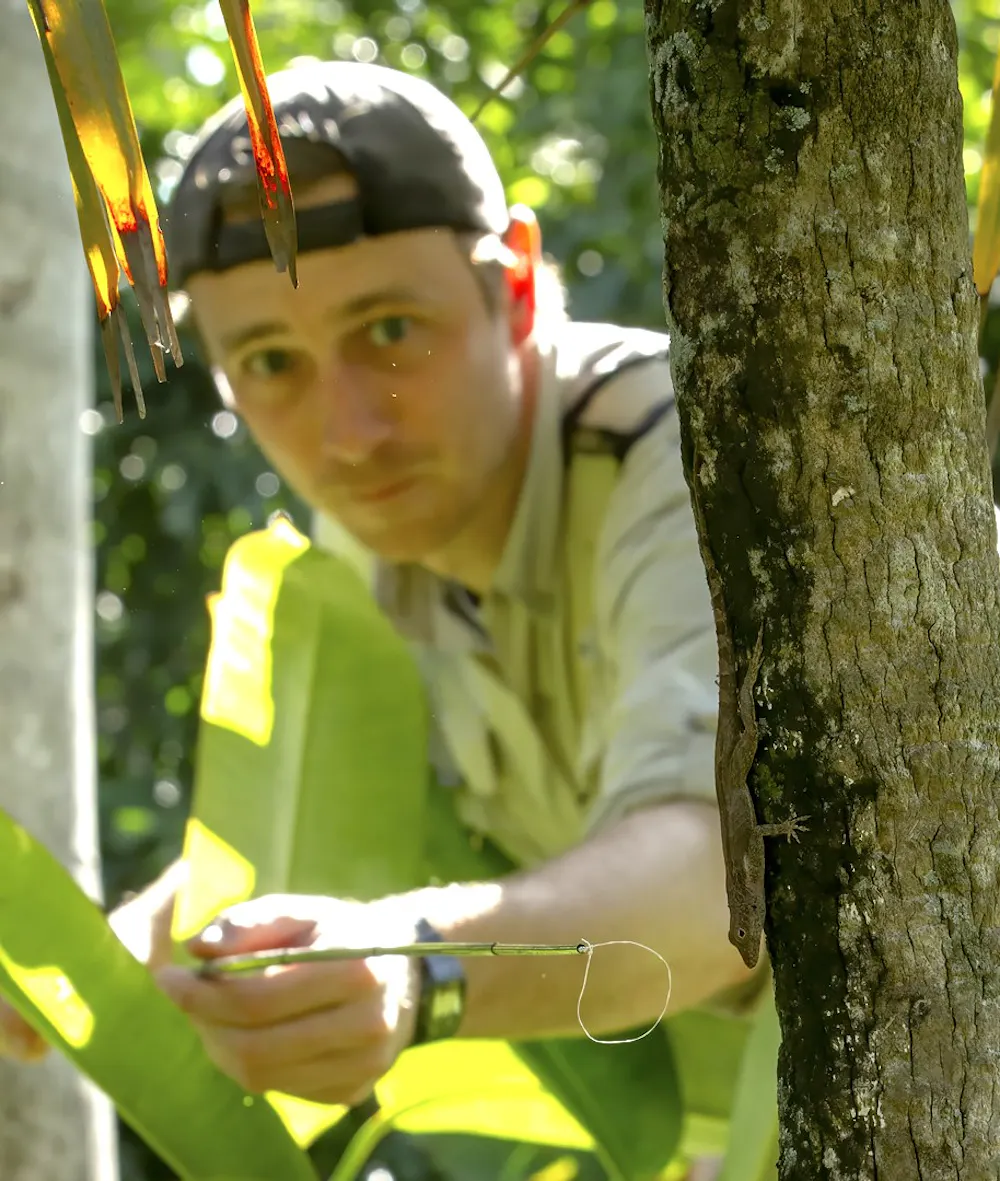
Anoles aren’t early risers, so we don’t expect much activity until the Sun strengthens around 9:30 a.m.; this gives us time to prepare our equipment. Our team catches anoles with telescopic fishing poles fitted with little lassos, which we use to gently pluck the lizards off branches and tree trunks. Ask any lizard biologist about their preferred lasso material and you’ll spark the age-old debate: fishing line or dental floss? For what it’s worth, we recently converted – we’re now on Team Fishing Line.
Picture yourself as an anole on Lizard Island. Your life is short – typically just one year – and filled with daily challenges. You need to warm up in the Sun, find enough food to survive, search for a mate, guard your favorite branch from other lizards and avoid being eaten by a predator.
Like human beings, each lizard is unique. Some have longer legs, others stronger jaws, and all behave slightly differently. These differences could determine who survives and who doesn’t; who has the most babies and who doesn’t.
These outcomes drive evolution by natural selection, the process where organisms with traits better suited to their environment tend to survive and reproduce more. These advantageous traits are then passed on to future generations, gradually changing the species over time. However, scientists still have an incomplete understanding of exactly how each of these features predicts life’s winners and losers in the wild.
To understand how species evolve, researchers need to crack open this black box of evolution and investigate natural selection in wild populations. My colleagues and I are doing this by studying the anoles in exquisite detail. Last year was especially exciting: We ran what we called the Lizard Olympics.
Catching an anole with a lizard lasso. Look closely – the anole blends in quite well with the tree. Neil Losin/Day’s Edge Prods.
Tiny fishing poles
As the morning heat builds, we spot our first lizards: Cuban brown anoles near to the ground, and the mottled scales of Hispaniolan bark anoles just above them. Further up, in the leafy tree canopies, are American green anoles, and the largest species, the Cuban knight anole, about the size of a newborn kitten.
In 2018, a new challenger entered the arena – the Puerto Rican crested anole, a species already present in Miami but one that hadn’t yet made it to Lizard Island. Its arrival provided us with an unexpected opportunity to study how species may evolve in real time in response to a new neighbor.
Catching these agile athletes requires patience and precision. With our modified fishing poles, we carefully loop the dental floss over their heads. Each capture site is marked with bright pink tape and a unique ID number; all lizards are then transported to our field laboratory just a short walk away.
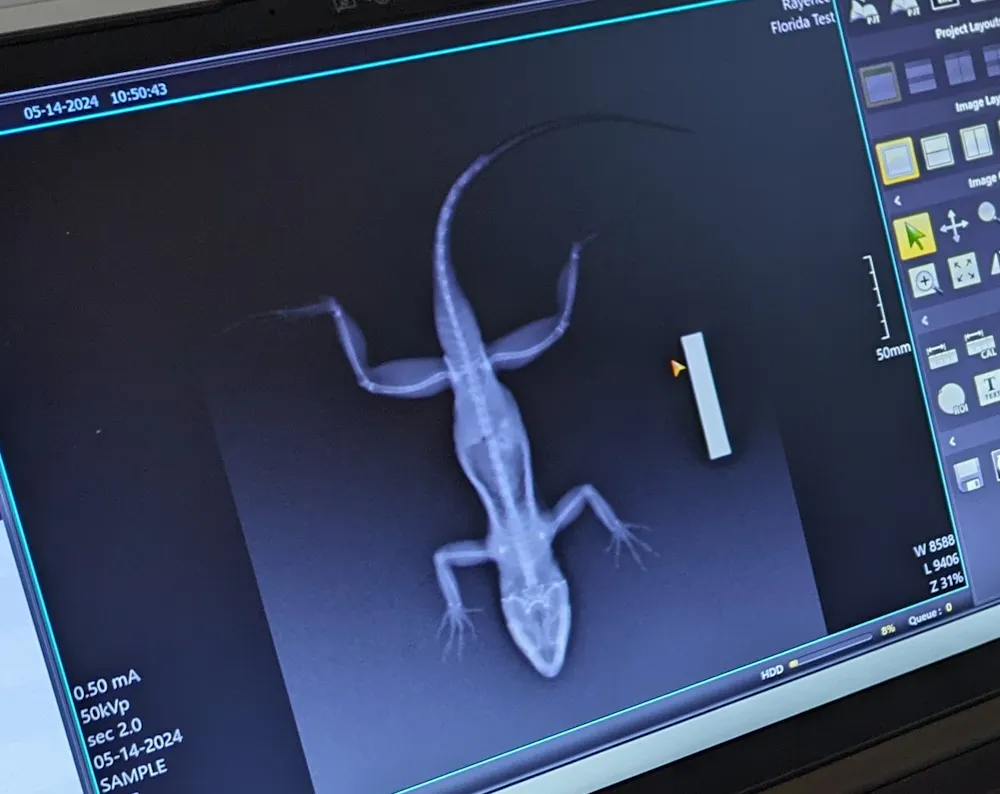
Here, the real Olympic trials begin. Every athlete goes through a comprehensive evaluation. Our portable X-ray machine reveals their skeletal structure, and high-resolution scans capture the intricate details of their feet. This is particularly critical: Like their gecko cousins, anoles possess remarkable sticky toes that allow them to cling to smooth surfaces such as leaves and maybe even survive hurricanes.
We also measure the shape and sharpness of their claws, as both features are crucial for these tree climbers. DNA samples provide a genetic fingerprint for each individual, allowing us to map family relationships across the island and see which is the most reproductively successful.
A portable X-ray machine takes detailed measurements of a lizard’s skeleton. James Stroud
The performance trials are where things get interesting. Imagine a tiny track meet for lizards. Using high-speed video cameras, we precisely test how fast each lizard runs, and using specialist equipment we measure how hard it bites and how strong it grips rough branches and smooth leaves.
These aren’t arbitrary measurements – each represents a potential evolutionary advantage. Fast lizards might better escape predators. Strong bites might determine winners in territorial disputes. Excellent grip is crucial for tree canopy acrobatics.
Each measurement helps us answer fundamental questions about evolution: Do faster lizards live longer? Do stronger biters produce more offspring? These are the essential metrics of evolution by natural selection.
As afternoon approaches, the team relocates each piece of bright pink tape and returns the corresponding lizard to the exact branch it was caught on. The anoles now sport two tiny 3-millimeter tags with a unique code that lets us identify it when we recapture it in future research trips, along with a small dot of white nail polish so we know not to catch it immediately after we let it go.
At 8:30 p.m., with the Lizard Olympics done for the day, we return to the island donning headlamps. Night brings a different perspective. Some of the most wily lizards are difficult to catch when fully charged by the midday Sun, so our nocturnal jaunts allow us to find them while they sleep. However, it’s often a race against time. Hungry lizard-eating corn snakes are also out hunting, trying to find the anoles before we do. As we wrap up another 16-hour day around 11:30 p.m., the team shares stories of the night.
Should a snake climb along a branch where a baby anole sleeps, the lizard will wake up and drop to the ground to escape. James Stroud
Evolution on the island
Now spanning 10 years, 10 generations and five species, our Lizard Island dataset represents one of the longest-running active studies of its kind in evolutionary biology. By tracking which individuals survive and reproduce, and linking their success to specific physical traits and performance abilities, we’re documenting natural selection with unprecedented detail.
So far we have uncovered two fascinating patterns. Initially, it didn’t pay to be different on Lizard Island. Anoles with very average shapes and sizes lived longer compared with those that are slightly different. But when the crested anoles arrived, everything changed: Suddenly, brown anoles with longer legs had a survival advantage.
Anoles communicate with their dewlap, an expandable throat fan that signals other lizards. Jon Suh
The Lizard Olympics is helping us understand why. The larger, more aggressive crested anoles are forcing brown anoles to spend more time on the ground, where those with longer legs might run faster to escape predators – allowing them to better survive and pass on their long-leg genes, while shorter-legged anoles might be eaten before they can reproduce.
By watching natural selection unfold in response to environmental changes, rather than inferring it from fossil records, we’re providing cutting-edge evidence for evolutionary processes that Charles Darwin could only theorize about.
These long days of observation are slowly revealing one of biology’s most fundamental processes. Every lizard we catch, every measurement we take adds another piece to our understanding of how species adapt and evolve in an ever-changing world.
James T. Stroud does not work for, consult, own shares in or receive funding from any company or organization that would benefit from this article, and has disclosed no relevant affiliations beyond their academic appointment.
Source: The Conversation – USA – By Reneé S. Anderson, Collections Manager, Smithsonian’s National Museum of African American History and Culture, Smithsonian Institution
Mae Reeves and her husband, Joel, pose with her hats at Mae’s Millinery in Philadelphia, circa 1953. Collection of the Smithsonian National Museum of African American History and Culture/Gift from Mae Reeves and her children Donna Limerick and William Mincey Jr., CC BY-NC-SA
Lula “Mae” Reeves, one of the first Black women in Philly to own her own business, created one-of-a-kind and custom hats for celebrities, socialites, professionals and churchgoing women in downtown Philadelphia for over 50 years.
She made hats for everyday wear, hats for special occasions, and magnificent “showstoppers,” as she called them. Her celebrity clients included Eartha Kitt, Marian Anderson, Lena Horne, Ella Fitzgerald and members of the du Pont and Annenberg families.
A pink cartwheel-style hat with flowers from Mae’s Millinery. Collection of the Smithsonian National Museum of African American History and Culture/Gift from Mae Reeves and her children Donna Limerick and William Mincey Jr., CC BY-NC-SA
I am a museum specialist at the National Museum of African American History and Culture at the Smithsonian Institution and an expert in costumes, textiles and millinery fashion.
In 2009, I was called upon to visit Mae’s Millinery, her former store at 41 N. 60th St. in West Philadelphia, to help select objects for a new permanent exhibition at the Smithsonian that recreates Reeves’ shop and showcases some of her stunning designs.
I also met Reeves in person for the first time that day at a nursing home in Darby, Pennsylvania. She was 96 years old.
A few years later, I returned to Philadelphia to attend Reeves’s 100th birthday celebration. It was during that visit that I learned, to my surprise and intrigue, that Reeves had also used her millinery shop as a polling station.
Mae Reeves, pictured in first row on right, poses with models wearing her designs. Collection of the Smithsonian National Museum of African American History and Culture/Gift from Mae Reeves and her children Donna Limerick and William Mincey Jr., CC BY-NC-SA
Black velvet turban on display
During my first meeting with Reeves, she shared her memory of the first hat she created after she opened her 60th Street store, a beautifully decorated shop, in 1941. Her original millinery shop was at 1630 South St., and many of her famous clients followed her to the new location in West Philadelphia.
Reeves recalled creating a black velvet turban that she placed in the window. A young woman walked by on her way home from work and was enthralled. The woman returned to try it on and, Reeves told me, visualized the impressive fashion statement she would make. She purchased the turban for about US$20 – roughly $430 in today’s dollars.
To open her West Philly millinery store, Reeves had secured a $500 business loan in 1940 from the Citizens and Southern Bank and Trust. The Black-owned bank catered to Philadelphia’s African American community, as most white-owned banks refused to loan money to Black customers.
Reeves was proud to tell me how she had secured the loan entirely on her own – with no co-signer – by maintaining a reputation of “good standing” and having sound business plans. She was also extremely proud that she “paid back all of the loan.”
A business card for Mae’s Millinery in West Philadelphia. Collection of the Smithsonian National Museum of African American History and Culture/Gift from Mae Reeves and her children Donna Limerick and William Mincey Jr., CC BY-NC-SA
From millinery shop to polling station
To transition her millinery shop to a polling station, Reeves told me that she and her second husband, Joel Reeves, who sold newspaper advertisements, would remove the beautiful furniture and decorative items to accommodate the polling machines.
To get the word out about the designated polling station, the couple distributed handbills and hung posters throughout the neighborhood. Reeves offered plates of food to politicians who stopped by and cake to the voters. She wanted to create a safe and welcoming polling place while also emphasizing the importance that Black Philadelphians exercise their right to vote.
Reeves was also a longtime member of the Freedom Day Association, a group formed in 1941 in Philadelphia to ensure younger African Americans understand the importance of the 13th Amendment, which abolished slavery; the 14th Amendment, which grants citizenship to all people born or naturalized in the U.S; and the 15th Amendment, which prohibits denying any citizen’s right to vote on account of race, color or previous condition of servitude.
The association was started by Maj. Richard Robert Wright Sr., a former U.S. Army paymaster, educator, politician, civil rights advocate and founder of the Citizens and Southern Bank – the bank that had offered May that $500 loan. Reeves admired Wright, who had been born into slavery, and considered him a close friend and business associate. She kept a copy of his portrait photo on display in her millinery shop.
A turquoise turban-style hat with brooch made by Mae Reeves. Collection of the Smithsonian National Museum of African American History and Culture/Gift from Mae Reeves and her children Donna Limerick and William Mincey Jr., CC BY-NC-SA
Barbecues and beach trips
In March 2025, I spoke with Reeves’ daughter, Donna Limerick, by phone. She told me Reeves had been a member and president of the 60th Street Business Association, which promoted good business practices, shared marketing strategies and encouraged support for other businesses in the association.
Despite her many professional and civic commitments, Reeves also took care of those closest to her. Limerick shared with me how her parents would take neighborhood kids to their summer home in Mizpah, New Jersey. They would ply the children with delicious homemade meals and desserts, organize regular barbecues and beach trips, and teach the kids to fish.
Reeves passed away in 2016 at the age of 104. I hope her story encourages others – as it has encouraged me – to be brave enough to dream; to be diligent enough to actualize your dreams; to be mindful to support your community; to be a person of grace; and to be careful to always expect, seek and give joy.
Reneé S. Anderson does not work for, consult, own shares in or receive funding from any company or organization that would benefit from this article, and has disclosed no relevant affiliations beyond their academic appointment.
Picture an ocean world so deep and dark it feels like another planet – where creatures glow and life survives under crushing pressure.
This is the midwater zone, a hidden ecosystem that begins 650 feet (200 meters) below the ocean surface and sustains life across our planet. It includes the twilight zone and the midnight zone, where strange and delicate animals thrive in the near absence of sunlight. Whales and commercially valuable fish such as tuna rely on animals in this zone for food. But this unique ecosystem faces an unprecedented threat.
As the demand for electric car batteries and smartphones grows, mining companies are turning their attention to the deep sea, where precious metals such as nickel and cobalt can be found in potato-size nodules sitting on the ocean floor.
Deep-sea mining research and experiments over the past 40 years have shown how the removal of nodules can put seafloor creatures at risk by disrupting their habitats. However, the process can also pose a danger to what lives above it, in the midwater ecosystem. If future deep-sea mining operations release sediment plumes into the water column, as proposed, the debris could interfere with animals’ feeding, disrupt food webs and alter animals’ behaviors.
As an oceanographer studying marine life in an area of the Pacific rich in these nodules, I believe that before countries and companies rush to mine, we need to understand the risks. Is humanity willing to risk collapsing parts of an ecosystem we barely understand for resources that are important for our future?
Mining the Clarion-Clipperton Zone
Beneath the Pacific Ocean southeast of Hawaii, a hidden treasure trove of polymetallic nodules can be found scattered across the seafloor. These nodules form as metals in seawater or sediment collect around a nucleus, such as a piece of shell or shark’s tooth. They grow at an incredibly slow rate of a few millimeters per million years. The nodules are rich in metals such as nickel, cobalt and manganese – key ingredients for batteries, smartphones, wind turbines and military hardware.
As demand for these technologies increases, mining companies are targeting this remote area, known as the Clarion-Clipperton Zone, as well as a few other zones with similar nodules around the world.
So far, only test mining has been carried out. However, plans for full-scale commercial mining are rapidly advancing.
Exploratory deep-sea mining began in the 1970s, and the International Seabed Authority was established in 1994 under the United Nations Convention on the Law of the Sea to regulate it. But it was not until 2022 that The Metals Company and Nauru Ocean Resources Inc. fully tested the first integrated nodule collection system in the Clarion-Clipperton Zone.
The companies are now planning full-scale mining operations in the region and expect to submit their application to the ISA by June 27, 2025. The ISA will convene in July 2025 to discuss critical issues such as mining regulations, guidelines and benefit-sharing mechanisms.
A visualization of a deep-sea mining operation shows two sediment plumes. Source: MIT Mechanical Engineering.
The proposed mining process is invasive. Collector vehicles scrape along the ocean floor as they scoop up nodules and stir up sediments. This removes habitats used by marine organisms and threatens biodiversity, potentially causing irreversible damage to seafloor ecosystems. Once collected, the nodules are brought up with seawater and sediments through a pipe to a ship, where they’re separated from the waste.
The leftover slurry of water, sediment and crushed nodules is then dumped back into the middle of the water column, creating plumes. While the discharge depth is still under discussion, some mining operators propose releasing the waste at midwater depths, around 4,000 feet (1,200 meters).
However, there is a critical unknown: The ocean is dynamic, constantly shifting with currents, and scientists don’t fully understand how these mining plumes will behave once released into the midwater zone.
These clouds of debris could disperse over large areas, potentially harming marine life and disrupting ecosystems. Picture a volcanic eruption – not of lava, but of fine, murky sediments expanding throughout the water column, affecting everything in its path.
The midwater ecosystem at risk
As an oceanographer studying zooplankton in the Clarion-Clipperton Zone, I am concerned about the impact of deep-sea mining on this ecologically important midwater zone. This ecosystem is home to zooplankton – tiny animals that drift with ocean currents – and micronekton, which includes small fish, squid and crustaceans that rely on zooplankton for food.
Sediment plumes in the water column could harm these animals. Fine sediments could clog respiratory structures in fish and feeding structures of filter feeders. For animals that feed on suspended particles, the plumes could dilute food resources with nutritionally poor material. Additionally, by blocking light, plumes might interfere with visual cues essential for bioluminescent organisms and visual predators.
For delicate creatures such as jellyfish and siphonophores – gelatinous animals that can grow over 100 feet long – sediment accumulation can interfere with buoyancy and survival. A recent study found that jellies exposed to sediments increased their mucous production, a common stress response that is energetically expensive, and their expression of genes related to wound repair.
Disturbances like these have the potential to disrupt ecosystems, extending far beyond the discharge depth. Declines in zooplankton populations can harm fish and other marine animal populations that rely on them for food.
Life in the deep sea has other values. Source: The Economist
The midwater zone also plays a vital role in regulating Earth’s climate. Phytoplankton at the ocean’s surface capture atmospheric carbon, which zooplankton consume and transfer through the food chain. When zooplankton and fish respire, excrete waste, or sink after death, they contribute to carbon export to the deep ocean, where it can be sequestered for centuries. The process naturally removes planet-warming carbon dioxide from the atmosphere.
Current mining regulations focus primarily on the seafloor, overlooking broader ecosystem impacts. The International Seabed Authority is preparing to make key decisions on future seabed mining in July 2025, including rules and guidelines relating to mining waste, discharge depths and environmental protection.
A map shows areas with nodules being considered for exploration and mining. Source: International Seabed Authority
These decisions could set the framework for large-scale commercial mining in ecologically important areas such as the Clarion-Clipperton Zone. Yet the consequences for marine life are not clear. Without comprehensive studies on the impact of seafloor mining techniques, the world risks making irreversible choices that could harm these fragile ecosystems.
Alexus Cazares-Nuesser receives funding from the National Science Foundation Graduate Research Fellowship Program. Past research received funding from The Metals Company Inc. through its subsidiary Nauru Ocean Resources Inc.
Uncommon Courses is an occasional series from The Conversation U.S. highlighting unconventional approaches to teaching.
Title of course:
Socially Engaged Design of Nuclear Energy Technologies
What prompted the idea for the course?
The two of us had some experience with participatory design coming into this course, and we had a shared interest in bringing virtual reality into a first-year design class at the University of Michigan.
It seemed like a good fit to help students learn about nuclear technologies, given that hands-on experience can be difficult to provide in that context. We both wanted to teach students about the social and environmental implications of engineering work, too.
Broadly, the course explores engineering design. We introduce our students to the principles of nuclear engineering and energy systems design, and we go through ethical concerns. They also learn communication strategies – like writing for different audiences.
Students learn to design the exterior features of nuclear energy facilities in collaboration with local communities. The course focuses on a different nuclear energy technology each year.
The main project was to collaboratively decide where a microreactor might be sited, what it might look like, and what outcomes the community would like to see versus which would cause concern.
Students also think about designing nuclear systems with both future generations and a shared common good in mind.
The class explores engineering as a sociotechnical practice – meaning that technologies are not neutral. They shape and affect social life, for better and for worse. To us, a sociotechnical engineer is someone who adheres to scientific and engineering fundamentals, communicates ethically and designs in collaboration with the people who are likely to be affected by their work.
In class, we help our students reflect on these challenges and responsibilities.
Why is this course relevant now?
Nuclear energy system design is advancing quickly, allowing engineers to rethink how they approach design. Fusion energy systems and fission microreactors are two areas of rapidly evolving innovation.
Microreactors are smaller than traditional nuclear energy systems, so planners can place them closer to communities. These smaller reactors will likely be safer to run and operate, and may be a good fit for rural communities looking to transition to carbon-neutral energy systems.
But for the needs, concerns and knowledge of local people to shape the design process, local communities need to be involved in these reactor siting and design conversations.
We use virtual reality models of both fission and fusion reactors, along with models of energy system facilities. AI image generators are helpful for rapid prototyping – we have used these in class with students and in workshops.
This year, we are also inviting students to do some hands-on prototyping with scrap materials for a project on nuclear energy systems.
What will the course prepare students to do?
Students leave the course understanding that community engagement is an essential – not optional – component of good design. We equip students to approach technology use and development with users’ needs and concerns in mind.
Specifically, they learn how to engage with and observe communities using ethical, respectful methods that align with the university’s engineering research standards.
What’s a critical lesson from the course?
As instructors, we have an opportunity – and probably also an obligation – to learn from students as much as we are teaching them course content. Gen Z students have grown up with environmental and social concerns as centerpieces of their media diets, and we’ve noticed that they tend to be more strongly invested in these topics than previous generations of engineering students.
Aditi Verma receives funding from the Department of Energy. She is a board member for Good Energy Collective.
Katie Snyder does not work for, consult, own shares in or receive funding from any company or organization that would benefit from this article, and has disclosed no relevant affiliations beyond their academic appointment.
Source: The Conversation – USA – By Megan Gerhardt, Professor of Management, Farmer School of Business, Miami University
The potential for friendships and mentorships between colleagues in different stages of life are often overlooked.OwenPrice/E+ via Getty Images
Five years after the COVID-19 pandemic began, the United States finds itself in the midst of another public health crisis. This particular pandemic is a psychological one: widespread loneliness and isolation.
About half of adults in the U.S. report feeling lonely – what former Surgeon General Vivek Murthy has characterized as an epidemic. The increase in social isolation has extensive costs for “schools, workplaces, and civic organizations, where performance, productivity, and engagement are diminished,” he wrote in 2023.
As a business school professor who studies intergenerational relationships, I believe that our workplaces hold untapped potential for alleviating isolation. When colleagues do form friendships at work, they often gravitate toward people their own age. But fostering meaningful connections across generational lines can benefit not just organizations, but workers’ own sense of purpose and mental health.
The problem, I’d argue, is how organizations’ early questions about working through the pandemic centered on efficiency. Was it possible do our jobs remotely? Would we be as productive? Was remote work viable long term? For many jobs, the answer was yes, resulting in persistent work-from-home options even after it became physically safe to return to offices.
Yet companies overlooked crucial elements that contribute to employees’ commitment and well-being, particularly strong relationships between colleagues. These factors are especially vital during early career years as young workers establish networks, learn their roles and develop professional identities – all considerably more challenging in remote or hybrid environments.
Just 31% of U.S. employees feel engaged on the job, according to January 2025 data from Gallup – a 10-year low. Only 39% of employees strongly feel that someone at work cares about them as a person, and only 30% strongly agree that someone cares about their development.
Workers under 35, especially members of Gen Z, experienced a more significant decline in engagement than other age groups, dropping 5 points compared with the previous year.
5 generations
Since hybrid and remote work appear to be here to stay, we need innovative solutions to combat disconnectedness. One overlooked opportunity might lie in a demographic reality that many organizations view as a challenge.
In 2024, 18% of the U.S. workforce belonged to Gen Z. They’ve surpassed the baby boomers, born 1946-1964, who make up 15%. Gen X, meanwhile – the generation born 1965-1980 – comprise 31%. The largest group are millennials, born 1981-1996, who represent 36% of workers. Finally, 1% of the workforce belong to the Silent Generation, born 1928-1945.
However, these friendships rarely cross generational lines. A phenomenon known as “age similarity preference” often causes us to gravitate toward people similar in age, including among our co-workers. This broader tendency to connect with people we deem most similar to ourselves is well documented, and age can be a particularly visible sign of surface-level difference – one that leads people to assume, often incorrectly, that they hold similar views.
For example, relationships with colleagues from different generations tend to have fewer feelings of competition and pressure, as they likely occupy different life and career stages. An older colleague who has navigated office politics or balanced raising young children with career demands can provide valuable advice and support to co-workers facing these challenges for the first time.
Forming intergenerational friendships can help break down negative stereotypes about people who are older or younger by revealing areas of common interest.
Beyond Gen Z
The benefits of these relationships extend beyond younger generations, especially given how widespread post-pandemic loneliness is.
Cross-generational relationships don’t just magically happen – companies can help foster them. Tempura/E+ via Getty Images
Adults in mid-to-late career stages – Gen Xers and baby boomers – are in their prime years for “generativity”: the life stage when people are most likely to be motivated to share knowledge and expertise, preparing the next generation for success. Generativity leads to benefits for the mentors too, such as higher self-esteem.
People of all ages benefit from meaningful intergenerational relationships, but it takes an effort to create them. Employers can help by setting up opportunities to connect. For example, a mutual mentoring program can be a fantastic way to encourage not only learning, but unexpected friendships as well.
Jonna, a Gen Xer I met through my generational consulting work, sought out a Gen Z mentor at her office and was grateful for her insight, as well as the chance to give advice. “I like to believe I am someone with a growth mindset and in touch with current realities, but I quickly learned that Hannah had perspectives on many things that stretched me and my thinking,” she said. “Our partnership has helped me approach every situation with curiosity instead of judgment.”
Hannah, her mentor-mentee, found the partnership just as beneficial. The experience was “a reminder that regardless of age, we all have something to contribute, and bridging generational gaps can lead to innovative solutions and a richer understanding of the world.”
Reaching out to colleagues who are significantly older or younger might seem unexpected. But it may also build a more connected, resilient workforce, where wisdom and innovation flow freely across generational divides.
Megan Gerhardt does not work for, consult, own shares in or receive funding from any company or organization that would benefit from this article, and has disclosed no relevant affiliations beyond their academic appointment.
In an Oct. 31, 2024, interview with right-wing pundit Tucker Carlson, President Donald Trump argued that the United States under Joe Biden had, in his mind erroneously, pushed China and Russia together. Separating the two powers would be a priority of his administration. “I’m going to have to un-unite them, and I think I can do that, too,” Trump said.
Indeed, after a recent call with Russian President Vladimir Putin, Trump told Fox News: “As a student of history, which I am – and I’ve watched it all – the first thing you learn is you don’t want Russia and China to get together.”
The history Trump alludes to is the strategy of the Nixon era, in which the U.S. sought to align with China as a counterbalance to the Soviet Union, encouraging a split between the two communist entities in the process.
Yet if creating a fissure between Moscow and Beijing is indeed the ultimate aim, Trump’s vision is, I believe, both naive and shortsighted. Not only is Russia unlikely to abandon its relationship with China, but many in Beijing view Trump’s handling of the Russia-Ukraine war –- and his foreign policy more broadly – as a projection of weakness, not strength.
Soviet soldiers keep watch on the Chinese-Soviet border during a monthslong conflict in 1969. Keystone/Getty Images
Both China and Russia have, in recent years, adopted an increasingly assertive stance in projecting military strength: China in the South China Sea and around Taiwan, and Russia in former Soviet satellite states, including Ukraine.
In February 2022, just as Russia was preparing its invasion of Ukraine, Presidents Vladimir Putin and Xi Jinping announced a “friendship without limits” – in a show of unified intent against the West.
China has since become an indispensable partner for Russia, serving as its top trading partner for both imports and exports. In 2024, bilateral trade between China and Russia reached a record high of US$237 billion, and Russia now relies heavily on China as a key buyer of its oil and gas. This growing economic interdependence gives China considerable leverage over Russia and makes any U.S. attempt to pull Moscow away from Beijing economically unrealistic.
Indeed, there are areas that Trump could exploit if he were to succeed in driving a wedge between the two countries. For example, it could serve Russia’s interests to support U.S. efforts to contain China and discourage any expansionist tendencies in Beijing – such as through Moscow’s strategic ties with India, which China views with some alarm – especially given that there are still disputed territories along the Chinese-Russian border.
Putin know who his real friends are
Putin isn’t naive. He knows that with Trump in office, the deep-seated Western consensus against Russia – including a robust, if leaky, economic sanctions regime – isn’t going away anytime soon. In Trump’s first term, the U.S. president likewise appeared to be cozying up to Putin, but there is an argument that he was even tougher on Russia, in terms of sanctions, than the administrations of Barack Obama or Joe Biden.
So, while Putin would likely gladly accept a Trump-brokered peace deal that sacrifices Ukraine’s interests in favor of Russia, that doesn’t mean he would be rushing to embrace some kind of broader call to unite against China. Putin will know the extent to which Russia is now reliant economically on China, and subservient to it militarily. In the words of one Russian analyst, Moscow is now a “vassal” or, at best, a junior partner to Beijing.
Transactional weakness
China for its part views Trump’s peace talks with Russia and Ukraine as a sign of weakness that potentially undermines U.S. hawkishness toward China.
While some members of the U.S. administration are undoubtedly hawkish on China – Secretary of State Marco Rubio views the country as the “most potent and dangerous” threat to American prosperity – Trump himself has been more ambivalent. He may have slapped new tariffs on China as part of a renewed trade war, but he has also mulled a meeting with President Xi Jinping in an apparent overture.
Beijing recognizes Trump’s transactional mindset, which prioritizes short-term, tangible benefits over more predictable long-term strategic interests requiring sustained investment.
This changes the calculation over whether the U.S. may be unwilling to bear the high costs of defending Taiwan. Trump, in a deviation from his predecessor, has failed to commit the country to defending Taiwan, the self-governing island claimed by Beijing.
Rather, Trump had indicated that if the Chinese government were to launch a military campaign to “reunify” Taiwan, he would opt instead for economic measures like tariffs and sanctions. His apparent openness to trade Ukraine territory for peace now has made some in Taiwan concerned over Washington’s commitment to long-established international norms.
Insulating the economy
China has taken another key lesson from Russia’s experience in Ukraine: The U.S.-led economic sanctions regime has serious limits.
Even under sweeping Western sanctions, Russia was able to stay afloat through subterfuge and with support from allies like China and North Korea. Moreover, China remains far more economically intertwined with the West than Russia, and its relatively dominant global economic position means that it has significant leverage to combat any U.S.-led efforts to isolate the country economically.
Indeed, as geopolitical tensions have driven the West to gradually decouple from China in recent years, Beijing has adapted to the resulting economic slowdown by prioritizing domestic consumption and making the economy more self-reliant in key sectors.
A souvenir shopkeeper displays Matryoshka dolls featuring Russian President Vladimir Putin and U.S. President Donald Trump. Misha Friedman/Getty Images
That in part also reflects China’s significant global economic and cultural strength. Coupled with this has been a domestic push to win countries in the Global South around to China’s position. Beijing has secured endorsements from 70 countries officially recognizing Taiwan as part of China.
China’s turn to exploit a split?
As such, Trump’s plan to end the Russia-Ukraine war by favoring Russia in the hope of drawing it into an anti-China coalition is, I believe, likely to backfire.
While Russia may itself harbor concerns about China’s growing power, the two country’s shared strategic goal of challenging the Western-led international order — and Russia’s deep economic dependence on China — make any U.S. attempt to pull Moscow away from Beijing unrealistic.
Moreover, Trump’s approach exposes vulnerabilities that China could exploit. His transactional and isolationist foreign policy, along with his encouragement of right-wing parties in Europe, may strain relations with European Union allies and weaken trust in American security commitments. Beijing, in turn, may view this as a sign of declining U.S. influence, giving China more room to maneuver, noticeably in regard to Taiwan.
Rather than increasing the chances of a Sino-Russia split, such a shift could instead divide an already fragile Western coalition.
Linggong Kong does not work for, consult, own shares in or receive funding from any company or organization that would benefit from this article, and has disclosed no relevant affiliations beyond their academic appointment.
Source: The Conversation – USA – By Shannon Bow O’Brien, Associate Professor of Instruction, The University of Texas at Austin
President Donald Trump speaks with Elon Musk next to a Tesla Model S on the South Lawn of the White House on March 11, 2025. Andrew Harnik/Getty Images
Heads of state are the symbolic leader of a country. Some of them, like King Charles III of the United Kingdom, carry out largely ceremonial roles these days. Others, like Saudi Arabian King Salman, are absolute monarchs and involved in governing the country’s day-to-day activities and policies. It also means that the Saudi monarch gets to do whatever he wants without much consequence from others.
In the United States, the president is both the head of state and head of government. The head of government works with legislators and meets with other world leaders to negotiate agreements and navigate conflicts, among other responsibilities.
Some presidents, like Jimmy Carter, got so bogged down in the specifics that the nighttime comedy show “Saturday Night Live” made fun of it in 1977. “SNL” spoofed Carter responding in extreme, mundane detail to a question about fixing a post office’s letter sorting machines.
As a political scientist who studies American presidents, I see that President Donald Trump loves the power and prestige that comes with being head of state, but does not seem to particularly enjoy the responsibility of being head of government.
Trump rarely talks about the often-tedious process of governing, and instead acts with governance by decree by signing a flurry of executive orders to avoid working with other parts of the government. He has also likened himself to a king, writing on Feb. 19, 2025, “Long Live the King!”
President Donald Trump is driven around the track prior to the Daytona 500 in Daytona Beach, Fla., on Feb. 16, 2025. Chris Graythen/Getty Images
‘You have to be thankful’
Trump revels in social events where he is heralded as the most important person in the room. On Feb. 9, 2025, Trump became the first sitting president to attend a Super Bowl. A week later, he attended the Daytona 500 at Daytona Beach, Florida, where his limousine led drivers in completing a ceremonial lap.
Trump’s preference for serving as head of state and not head of government was on full display during his now infamous Feb. 28, 2025, White House meeting with Ukrainian President Volodymyr Zelenskyy.
Trump was demanding deference from Zelenskyy to show his inferior and submissive position as a recipient of U.S. aid and military support. These are mannerisms of absolute kings, not elected officials.
Trump has enacted policy changes almost exclusively through executive orders, instead of working with Congress on legislation.
Executive orders do not have to be negotiated with the legislative branch and can be written by a small team of advisers and approved by presidents. Within the first six weeks, Trump has signedmore than 90 executive orders. By comparison, former President Joe Biden signed 162 executive orders during his four years in office.
Many of Trump’s executive orders are being challenged in court, and some have been found to likely not be constitutional.
More importantly, Trump’s successor can turn executive orders into confetti in an instant, simply with a signature. Trump himself has signed at leasttwo executive orders that rescind over 60 previous executive orders, mostly signed by Biden.
The fact that Trump has removed almost all of Biden’s executive orders highlights how the orders can create change for a moment, or a few years. But when it comes to long-term policy change, congressional action is needed.
President Donald Trump signed a series of executive orders at the White House on March 6, 2025. Alex Wong/Getty Images
In his second term, Trump has farmed out many head of government tasks to other people, notably billionaire Elon Musk, who is leading the new so-called Department of Government Efficiency. By mid-February 2025, Trump gave Musk, who holds the title of special government employee, oversight for hiring decisions at every governmental agency.
But as DOGE has initiated widespread cuts at different government agencies and offices in an effort to trim government waste, Musk has reportedly clashed with Trump’s cabinet members. This includes Secretary of State Marco Rubio, as well as other independent agencies funded by Congress.
Absolute kings, queens, emperors and dictators are heads of state who demand obedience because they hold the nation in their grip.
Presidents from elected democracies may, as in the case of the U.S., have a ceremonial aspect to the job, but it is only a part of it. The people democratically elect American presidents to serve everyone and provide the best government possible.
Shannon Bow O’Brien does not work for, consult, own shares in or receive funding from any company or organization that would benefit from this article, and has disclosed no relevant affiliations beyond their academic appointment.
Canadians are currently learning tough lessons about national security thanks to United States President Donald Trump’s repeated annexation threats.
It’s clear that American proclamations of support for universal human rights, national sovereignty and a rules-based international order can vanish with a change of leadership. These ideals, though tarnished by some past U.S. actions, have now been replaced by the predatory dictum known as “might makes right.”
Although it seems unthinkable that Trump will invade Canada, we live in an increasingly unstable world and Canadians need to be prepared for the worst. In the midst of a federal election campaign, party leaders need to present innovative ideas to fight Trump and potential American aggression.
Unfortunately, the common assumption is that national security depends wholly on military strength and alliances. But the emergency Canada is now facing demands a rethink.
Of course, Canada would not dispense with its military. It’s needed, especially to defend Canada’s northern frontier. However, Canada cannot match the U.S. in military power, nor would anything be achieved if it broke its commitments to the United Nations’ Non-Proliferation Treaty — a pact designed to prevent the spread of nuclear weapons — by acquiring nukes.
Either of these tactics would be suicidal. Canada’s real strength is its unity and institutions.
Canadians can paralyze military might through civil, non-violent resistance. Familiarity with these techniques could empower Canadian citizens to preserve a vibrant democracy.
Non-violent resistance can not only a more effective defence, but also much less devastating in terms of lives lost and property destroyed. Responding to an invasion with military force would only mean widespread casualties and the destruction of Canada’s largest cities.
Canada should therefore aim to subvert the will of the occupying force, not drive it, through armed defence, to fear, hatred and further violence.
What is civil defence?
Non-violent resistance involves using a country’s citizens and institutions to deter an invasion, and if that fails, to defeat and drive out the invaders. It has a long history both as a spiritual practice and a strategic weapon.
Civil defence, however, only emerged as a strategic concept in the 1980s and 1990s. It is a system of deterrence and defence that relies on a united and resolute citizenry employing only non-violent tactics.
An early American proponent was the Albert Einstein Institution’s Gene Sharp, an American political scientist. Recent advocates from around the world — Srdja Popovic, Erica Chenoworth and Michael Beer — follow in Sharp’s footsteps.
Ukrainians undertook many inspirational acts of non-violent resistance following the Russian invasion in 2022. They blocked tanks and convoys, berated or cajoled Russian soldiers to undermine their resolve, gave the wrong directions to Russian convoys, refused to co-operate and mounted spontaneous protests in occupied towns. But then the bloody carnage on both sides overwhelmed civilian defence.
Countries that include Sweden, Switzerland, Finland, Germanyand Lithuania have institutionalized civil defence at various times. In Canada, civil defence was part of the mandate of Public Safety Canada during the Cold War. The idea then faded, being replaced by emergency management.
Public Safety Canada protected Canadians from both human-made and natural disasters. The agency, now the Department of Public Safety and Emergency Preparedness of Canada, should be resuscitated. The toll being exacted by climate disasters is reason enough.
Making Canada ungovernable
Non-violent resistance involves determined citizens deterring an aggressor by signalling that the targeted country is united in opposition to a takeover.
A potential aggressor fears contagion from the democratic ethos of these citizens. If invaded, the civilians defeat the invaders by rendering their society ungovernable by the aggressor.
When the Warsaw Pact army invaded Czechoslovakia to crush the “Prague Spring” in 1968, the commanders soon learned that tanks and heavily armed soldiers were useless against unarmed civilians who refused to comply. The country was unruleable. Soviet troops were also infected with the democratic spirit and had to be rotated out of the country. It took several months and concessions from the Soviet Union before order could be restored.
The invader cannot consolidate control if citizens and their institutions refuse to comply with its rule. The tactics involve a complete refusal to co-operate with the occupying force along with open defiance.
That means that governments at all levels in the invaded nation continue to supply only basic services: clean water, electricity and policing, for example. Governments resign and civil servants find ways to subvert every order issued by the invader.
Crowds fill urban squares in silent or derisory defiance of orders, making it apparent to all — the occupiers, the dictator’s audience back home, less committed citizens and global observers — who are the true purveyors of violence against non-violent people
Throughout the occupation, citizens and non-governmental organizations focus on subverting the loyalty and morale of the occupying troops and functionaries and rallying international support.
In Canada’s case, the long history of friendship with Americans would likely mean that the morale of the occupiers would be low. The aim is to encourage defections by soldiers and functionaries, and erode the support base of the dictator. This erosion of support could lead to the overthrow of the leader, or at least to his concoction of a compromise to cover a retreat.
Attracting international support to Canada’s cause would not be a challenge. Trump has already alienated most of humankind and foreign governments during his first weeks in office.
Obstacles
Non-violent resistance is most effective with nation-wide training, organization and leadership. The national government is best equipped to provide the facilities. Training of volunteers could include responding to natural disasters and emergencies, as well as implementing a civil defence strategy.
Yet partisan divides and apathy make such nationwide training difficult. It would likely be viewed with suspicion by right-wing populist forces in this era of conspiracy theories and misinformation.
These considerations suggest that top-down, apolitical training in civilian defence may not work. If so, training and organization should be the goal of as many existing civil society associations as possible: churches, synagogues, temples, civil rights groups, unions, Indigenous rights organizations, peace advocates and climate groups, for example.
The manual authored by Michael Beer, the longtime director of the Nonviolence International non-governmental organization, includes more than 300 tactics. Widespread training and organization can not only deter aggression but ensure countries remain free of tyrants.
Canada’s leverage
Amid the ongoing threats against Canadian sovereignty, Canada is an ideal candidate for effective civil defence. Although it might be unlikely Trump will order a military invasion of Canada, a united country capable of non-violent resistance decreases the risk.
Canada cannot match the U.S. in firepower or economic strength. But it shares with America a language, a history of common struggles, myriad cross-border personal relationships and basic democratic values still considered important by many Americans, if not Trump.
All of these factors give Canada considerable leverage.
Richard Sandbrook is Vice-President of Science for Peace, a registered charity.
It is hard nowadays to find topics on which people agree. Ironically, though, all agree on one point: that disagreement has reached peak levels. People are united in recognising that society has become polarised.
Why has this happened? In a new study, I examined which characteristics of a country fuel polarisation – and whether economics is a factor. I found that poorer countries such as Ethiopia, Myanmar, Guatemala and Zimbabwe are indeed usually more polarised than richer countries. In fact, the poorer the nation, the greater the division on attitudes towards the economy, gender equality and immigration.
This helps explain why poorer countries are also more vulnerable to revolutions and civil wars. They are more divided and slide more easily into actual armed conflict. It is not a coincidence that communist revolutions, which are often sparked by economic polarisation, have never occurred in rich countries, but in those at an early stage of industrialisation – think of Russia in 1917, China in 1949 and Ethiopia in 1974.
However, people in rich countries such as France, Germany and the US report more polarised opinions on abortion, divorce, suicide and homosexuality. It is social norms, rather than economic views, that divide. Anyone who has paid attention to the culture wars raging in the west can attest to this. Think of the anti-abortion stance of evangelical Christians in the US and to the traditional family cherished by European parties like the Alternative for Germany and Brothers of Italy, and compare them with the growing importance of LGBTQ issues among liberals in the west.
Why are rich countries more polarised on social customs? The study shows that people in poor countries have conservative views on these issues – for example, claiming that abortion and divorce are never justified. There is little margin for disagreement in these countries as far as social norms are concerned. By contrast, opinion on social norms in rich countries is split between liberals and conservatives. Conformity pressures are weak on these topics, boosting polarisation.
Education may also play a role. I found that poorly educated people prefer redistribution and state intervention in the economy more than the highly educated. This divergence is greater in poor countries, partially explaining why attitudes on the economy are more polarised in poor countries.
Meanwhile, my study found that highly educated people profess more liberal opinions on social norms than the poorly educated, but the divergence is greater in richer countries. In other words, in poor countries education is more divisive on economic attitudes, while in rich countries it is more divisive on social norms.
Inequality and polarisation
A 2021 study found that polarisation is higher in countries where the income distribution is more unequal. Interestingly, this applies across various domains, including opinions about the economy, immigration and social norms. This adds another important layer to the picture. It suggests that the increase in polarisation is linked to the increase in economic inequality over the past few decades.
Some researchers predict that, as people get richer, polarisation over social norms is destined to fade in the west. In their view, the west is polarised because the population is gradually shifting from a conservative to a liberal stance on social customs. In this view, our current polarisation is essentially an epochal shift. Economic prosperity, the argument goes, will ultimately lead western societies to converge to liberal views, deflating polarisation.
There are two reasons to be cautious about such an assessment. First, the multiple crises faced today by the world, and by the west in particular, may stunt economic prosperity, implying that people may continue to be divided on social norms rather than converging on liberal views.
Second, there is no evidence that economic inequality is going down in the west, and as the research shows, this is not a promising sign in terms of decreasing polarisation. So, citizens of western countries better get used to culture wars for the foreseeable future.
Francesco Rigoli does not work for, consult, own shares in or receive funding from any company or organisation that would benefit from this article, and has disclosed no relevant affiliations beyond their academic appointment.
United States President Donald Trump recently argued “he who saves his country does not violate any Law” as he ignores Congress and the courts, governs by executive order and threatens international laws and treaties.
Republican leaders moved dramatically to the right, and the primary system allowed the choice of an extremist. Republican voters then aligned their opinions with his. Trump’s disdain for democratic fundamentals spread quickly. Partisans defending their team slid away from democratic values.
Canada’s more centrist ideological spectrum is not foolproof against this type of extremism. Public opinion can be moved when our leaders take us there.
Decline can start slowly and then accelerate. America’s democratic backsliding in the first weeks of Trump’s second presidency follows the erosion of democratic norms over decades. Republican attacks on institutions, the opposition, the media and higher education corrosively undermined public faith in the truth, including election results.
Trust in government is holding steady in Canada, however. That provides an important guardrail for Canadian democracy.
The dangers of courting the far right
There are also lessons for our political parties. To maximize their seats, Republicans accepted extremists like Marjorie Taylor Greene, but soon needed those types of politicians for key votes.
The so-called Freedom Caucus, made up of MAGA adherents, forced the choice of a new, more extreme, leader of the House of Representatives. This provides a clear lesson that history has shown many times: it is dangerous for the party on the political right to accommodate the far right, which can quickly take control.
Once established within the ruling party, extremists can hold their party hostage.
Austria recently avoided the inclusion of the far right in its new coalition, and now Germany is working to do the same. As Canada’s Conservatives look for every vote, courting far-right voters and candidates risks destabilizing the system.
They clearly did not imagine party loyalty negating the safeguards that protect democracy from an authoritarian-minded president. The Constitution gives Congress the power to legislate and impeach, limits the executive’s power to spend and make appointments, gives the judiciary power to hold an executive accountable and contains the 25th amendment allowing cabinet to remove a president.
But when one party controls the legislative and executive branches during a time of hyper-partisanship, these mechanisms may not constrain an authoritarian. Today, Republican loyalty has eroded these checks and balances and American courts are struggling to step up to their heightened role.
Although counter-intuitive, parliamentary systems like Canada’s are usually less susceptible to authoritarianism than presidential ones because the cabinet or the House of Commons can turn against a lawless leader.
Still, if popular, authoritarian leaders can still retain their party’s support — and then things can slide quickly. The rightward pull of extremists seen in the U.S. House would be more dangerous here since the Canadian House of Commons includes our executive.
Guarding against xenophobia
Lastly, Canada should be wary of xenophobic rhetoric.
“America First” is not simply shopping advice. It began as an isolationist slogan during the First World War but was soon adopted by pro-fascists, American Nazis and the Ku Klux Klan. These entities questioned who is really American and wanted not only isolationism, but racist policies, immigration restrictions and eugenics.
Trump did not revive the phrase accidentally. It’s a call to America’s fringes. Alienating domestic groups is a sure sign of democratic decline.
“Canada First” mimics that century-long dark theme in America. In combination with contempt for the opposition, it questions the right of other parties to legitimately hold power if used as a message by one party.
Also, asserting that “Canada is broken” — as Conservative Leader Pierre Poilievre often does — mimics Trump’s talk of American carnage, language and imagery he uses to justify extraordinary presidential authority.
Such language erodes citizens’ trust in democratic institutions and primes voters to support undemocratic practices in the name of patriotism. Canadian parties and politicians should exit that road.
Ultimately, institutions alone do not protect a country from the rise of authoritarianism. Democracy can be fragile. As a federal election approaches in Canada, it’s important to know the warning signs of extremism and anti-democratic practices that are creeping into our politics.
Matthew Lebo does not work for, consult, own shares in or receive funding from any company or organisation that would benefit from this article, and has disclosed no relevant affiliations beyond their academic appointment.
Source: The Conversation – Canada – By Michael R. King, Associate Professor, Gustavson School of Business and Lansdowne Chair in Finance, University of Victoria
An Ontario court has approved the liquidation of nearly all Hudson’s Bay Company’s stores, marking the end of Canada’s oldest company, which has been in operation for 355 years. The liquidation is set to begin March 24, and will continue until June 15, leaving only six stores in operation.
The court’s decision came shortly after Hudson’s Bay filed for creditor protection, signalling the company’s struggle to manage its mounting debt.
With widespread layoffs sure to follow, this corporate collapse is both shocking and distressing. But the court documents suggest it was not unexpected. Hudson’s Bay lost $329.7 million in the 12 months leading up to Jan. 31, 2025. As of that date, Hudson’s Bay had only $3.3 million in cash and owed more than $2 billion in debt and leases.
The final straw appears to have been trade tensions between Canada and the U.S., with the increased geopolitical and economic uncertainty leading lenders to shun Hudson’s Bay as it sought more financing, according to court documents.
What bankruptcy looks like
The downfall of a major company like Hudson’s Bay brings with it a wave of financial jargon. Understanding the differences between insolvency, bankruptcy, restructuring and liquidation is crucial to fully grasp the situation.
Insolvency occurs when a business runs out of cash and cannot pay its bills. At the start of March, it was $5 million behind on rent and supplier payments, and within days of missing payroll.
Bankruptcy is a legal process under Canada’s Companies’ Creditors Arrangement Act where a company files for protection from its creditors. The goal is to avoid the social and economic costs of liquidation, preserve jobs and protect the interests of affected stakeholders. If granted, the judge sets a “stay period” where the company works out a restructuring plan with its creditors.
Hudson’s Bay has more than 2,000 creditors, including $430 million in secured term loans, $724 million in mortgages and $512 million to unsecured creditors, mostly owed to suppliers. Hudson’s Bay also owes payroll remittances, federal sales taxes and over $60 million in customer gift cards and loyalty points. Gift cards are good until April 6.
A restructuring wipes out the equity holders and allows a company to negotiate a reduction in its debts. The business continues to operate under the supervision of a court-appointed monitor, using interim financing to pay bills. If successful, the company re-emerges from bankruptcy and continues to do business.
If restructuring is not successful, the company asks the court for permission to liquidate. Liquidation means a “fire sale” of all assets such as inventory, shelving, real estate, leases and trademarks. Items are sold at a deep discount, leading to potential bargains.
The Ontario Superior Court denied the initial request to liquidate on March 14, telling Hudson’s Bay and its creditors to “lower the temperature” and work on a deal. With only limited progress and some concessions made to support Hudson’s Bay’s joint venture with RioCan REIT, the court gave permission for the liquidation on March 21.
Many will lose, some will win
The collapse of Hudson’s Bay will leave many facing financial losses, while a select few stand to gain.
Secured creditors, some suppliers and Hudson’s Bay pensioners are expected to be protected by the courts. However, many others, including thousands of customers and more than 1,800 unsecured creditors, will suffer a financial hit.
The hardest impact will be felt by the more than 9,300 employees losing their jobs. Employees will lose their income, health and disability benefits, and life insurance, significantly impacting families across the country.
However, employees will not lose their pension benefits. The company’s pension plan is fully funded and in surplus position. This was not the case for Sears Canada when it went bankrupt in 2018. A surplus means the value of investments is greater than the promised benefits and is good news for retirees.
Mall landlords will also lose out. Hudson’s Bay drove foot traffic in malls across the country where it was the anchor-tenant. There will likely be painful ripple effects for smaller Hudson’s Bay store owners, including falling sales, defaults on mortgages and business failures.
When a company is liquidated, the proceeds from selling its assets are used to repay claimants based on their priority in bankruptcy. This is sometimes referred to as the waterfall of “who gets what.” Think of it as a queue with people lining up to get paid.
Interim DIP financing is paid off first, together with legal and accounting fees related to the bankruptcy. Essential operating costs during the restructuring are also paid, including employee wages.
Next come secured creditors. These lenders provided funding backed by specific assets, known as collateral. Collateral may include inventory and real estate. A similar process happens on a personal residence; if a homeowner defaults on their mortgage payments, the bank may take possession of the house.
Third in line are debts granted priority by the courts. Employees receive unpaid wages up to a certain cap, just under $9,000, under the federal Wage Earner Protection Program. Pension benefits are paid out and outstanding payroll and sales tax remittances are paid.
As the pool of assets gets smaller, unsecured creditors are paid off next including suppliers, landlords and employees owed additional wages or termination benefits.
Last in the queue from the wind-up are equity holders — the residual claimants — who control the company through their common and preferred shares.
In 2020, Hudson’s Bay’s CEO Richard Baker and a group of investors took the company private, meaning it was no longer publicly traded on the Toronto Stock Exchange, buying out shareholders for approximately $2 billion. This stake is now wiped out.
Disappointing, but not surprising
Hudson’s Bay’s current financial situation is disappointing, but not surprising. The COVID-19 pandemic made times tough for brick-and-mortar retailers. On top of this, under-investment and a failed e-commerce strategy left the company struggling to compete in an increasingly digital retail landscape.
In the end, Hudson’s Bay backed itself into a corner, arguably waiting too long to secure funding and ultimately losing control of its own destiny. Its bankruptcy is a major blow to Canadian retail, marking the end of a era for a company that lasted more than three-and-a-half centuries.
The authors do not work for, consult, own shares in or receive funding from any company or organisation that would benefit from this article, and have disclosed no relevant affiliations beyond their academic appointment.
Source: The Conversation – Canada – By James Kwateng-Yeboah, Assistant Professor, Department for the Study of Religion, Saint Mary’s University
Aspirations transform migration from mere physical movement into a deeply personal conviction, reshaping how individuals see themselves and their futures. (NEOM/Unsplash)
When governments, policymakers or the news media discuss migration, the focus is almost exclusively on those who physically cross borders, seek asylum or arrive at ports of entry. But migration does not begin at at the moment of departure or upon arrival. It starts much earlier, as an aspiration.
In the United States, that figure has hit a record 21 per cent. These figures challenge the common assumption that Canada and the U.S. are simply migration destinations. Increasingly, they are also places people aspire to leave. But what fuels migration desire?
As a scholar of religion and migration, my recently published research focuses on aspiring migrants: those who dream and plan for a future elsewhere, even if they never leave.
While studies have shown how religion might aid or hinder a person’s integration into new societies, I explore how religion shapes who wants to migrate in the first place and why.
Not everyone who wants to migrate will ultimately do so, but their aspirations matter. Migration aspirations influence education, career choices, family formation and even political engagement. Yet, the forces behind these aspirations remain largely understudied.
Migration aspirations influence education, career choices, family formation and even political engagement. (Evangeline Shaw/Unsplash)
Who wants to migrate?
My interviews with young Ghanaians between the ages of 20 and 35 reveal that migration is not just about where people go. It’s also about who they believe they are meant to be.
Analyzing 565 surveys and 25 in-depth interviews, I found that the aspiraton to migrate was widespread, with nearly 78 per cent of those surveyed expressing a desire to migrate. However, aspirations were not evenly distributed.
University students were the most eager to migrate, often viewing higher education abroad as a stepping stone. Family history also shaped migration aspirations. Those with relatives abroad and no prior travel experience were significantly more likely to want to leave, suggesting the influence of migrant social networks.
Yet the strongest predictors of migration aspirations among participants were experiences like dreams, prophecies and intuitions that were considered religiously significant.
Individuals who reported having migration-related dreams were more than twice as likely to express a strong desire to migrate, while those who believed migration was part of a divine plan were more than three times as likely. These findings challenge the traditional idea that migration is purely an economic decision, highlighting the role of religion and spirituality.
Spiritual experiences and migration
Dreams, prophecies and intuitions do more than inspire migration desires. They shape how people perceive and legitimize migration. These experiences transform migration from mere physical movement into a deeply personal conviction, reshaping how they see themselves and their futures.
Participants in my study who had migratory dreams described them as vivid, immersive experiences in which they found themselves leaving their homeland, boarding airplanes or settling in foreign countries.
These dreams transported them into sensory encounters with airports, unfamiliar climates like snowfall and racially diverse communities. Such dreams made migration feel imminent, influencing behaviours such as preparing travel documents and expanding social networks.
Prophecy in many religious traditions are declarations made by spiritual leaders, often perceived as divine revelations about an individual’s life, future or destiny. In the context of migration, these prophecies foretell a person’s foreseeable journey abroad, shaping their understanding of the future.
Dreams, prophecies and intuitions do more than inspire migration desires. They shape how individuals perceive and legitimize migration. (Adedotun Adegborioye/Unsplash)
Migratory prophecies are often delivered in Pentecostal-Charismatic churches, through sermons, prayer sessions or direct pronouncements from pastors. Their significance lies not in predictive accuracy, but in their ability to inspire, shape emotions, and guide behaviours regarding migration.
These prophecies legitimize a person’s migration aspirations as part of a divine plan, enhancing the aspiring migrant’s self-perception as one destined for success. They foster an internalized identity of a successful migrant even before the individual embarks on their journey, highlighting their potential to elevate social status and bring honour to their families and communities.
Intuitions attributed to divine prompting also generate an inner certainty about migration. People feel an inexplicable but profound conviction that they must migrate, leading them to align their life decisions with what they perceive as a higher plan.
By reinforcing deeply held aspirations, spiritual experiences do not just shape the desire to migrate; they construct the migrant’s very sense of self, embedding migration into their personal identity long before they ever set foot on foreign soil.
Informing policy
Most migration policies focus on border control, but rarely consider the social and cultural dynamics that shape migration. Dreams, prophecies and intuitions act as indicators of unmet aspirations.
Understanding these experiences can help migration policymakers create strategies that are cross-culturally sensitive and context-specific. These strategies should move beyond the economics of migration to address the full spectrum of human motivations.
Additionally, governments and news media must confront idealized narratives of migration destinations portrayed as utopias of opportunity. When such expectations clash with the stark realities of labour exploitation, cultural alienation and systemic racism, the resulting disillusionment can profoundly affect the well-being of individuals and communities.
A responsible approach to migration must present a balanced view, acknowledging both opportunities and challenges, while preparing aspiring migrants for the complexities of their journeys and recognizing their aspirations as integral to their personhood.
James Kwateng-Yeboah does not work for, consult, own shares in or receive funding from any company or organisation that would benefit from this article, and has disclosed no relevant affiliations beyond their academic appointment.
Source: The Conversation – Canada – By Matthew S Miller, Executive Director, Global Nexus and M.G. DeGroote Institute for Infectious Disease Research, McMaster University
If the H5N1 avian flu virus learns to spread efficiently from person to person, it could pose an imminent threat to humanity.(CDC and NIAID), CC BY
Infectious disease outbreaks have a bad habit of piling on at the worst possible times.
The 1918 flu pandemic, also known as the Spanish flu, caught the world by surprise just as the First World War was coming to an end. It was responsible for killing three to five per cent of the world’s population (50-100 million people, equivalent to about 400 million today).
Now, as we reflect on five years since the declaration of the COVID-19 pandemic and face economic uncertainty imposed by the United States administration — as well as lingering conflicts in places such as the Middle East and Ukraine — it’s the steady march of avian influenza, or “bird flu,” that poses an imminent threat to humanity.
Walter Reed hospital flu ward in Washington, D.C. during the flu epidemic of 1918-19, which killed three to five per cent of the world’s population. (Shutterstock)
Bird flu has been causing a flurry of human infections, especially in U.S. cattle workers. If the virus learns to spread effectively from human to human, it could change the course of history. Even though our weary world already feels maxed out, we have to make room to avert yet another crisis.
The question is whether we will act in time to head off a bird flu pandemic. The Spanish Flu was the first of five influenza pandemics since the end of the First World War.
A sixth is inevitable without co-ordinated global action. Otherwise, the only questions are when it will it come and how bad it will be.
Infectious diseases constitute a permanent threat to society, especially as vaccine hesitancy and misinformation grow. Fighting pandemics needs to be a full-time, ongoing priority for governments everywhere.
Canada needs to establish permanent capacity to prevent and respond to health emergencies. Government agencies specifically dedicated to supporting the development of medical countermeasures for pathogens that pose a pandemic risk, like the recently established Health Emergencies Readiness Canada (HERC), are a step in the right direction.
However, we must also re-prioritize investments in the fundamental research that is the birthplace of new medical and non-medical solutions to pandemic preparedness — where we currently lag far behind essentially all of our G7 counterparts. This has never been more important than in the current global political context.
The world needs to adopt a collective mentality that we are “all in” on prevention if we want to maximize our chances of avoiding the next pandemic. We cannot sit on our hands and hope we get lucky. That strategy has failed us in the past and will doom us in the future.
But the effort to stop or at least slow avian influenza needs to include all countries and to engage everyday people, especially those who work directly with birds, cattle and other wild and domestic animals.
Targeted interventions
The best tactics to stave off a pandemic, at least at this point, are relatively unintrusive, targeted interventions. It’s critical that farm workers, veterinarians and others who work with animals follow careful protocols such as wearing masks and goggles, sanitizing equipment and continuing to cull poultry flocks where exposure is identified.
We also need to educate hunters about protective measures to lower their risk of exposure.
Most mitigation measures are entirely non-medical — though offering vaccines to those at high risk of exposure, as Finland has done, would be prudent. It’s much easier to target vaccination programs to high-risk groups than to organize a global vaccine campaign after a pandemic has begun.
We need to encourage these groups to take every possible action to protect themselves — and therefore the world — and to provide financial supports that enable them to comply without cost.
If avian flu becomes established among humans, which could happen rapidly and with very little warning, COVID-19 has shown that only a swift, decisive and truly global approach can fend off disaster.
A significant lesson from COVID-19 is that we have to support pandemic prevention and response efforts for people in every corner of the world, however remote they may be, and that we must reach vulnerable populations within wealthy countries, such as elderly, frail and marginalized people, and those affected by poverty. These are the people always impacted most by infectious diseases.
A selective distribution of resources among the planet’s wealthiest populations will not provide the protection the world needs and will only enlarge and extend the reach of a new pandemic.
We must remember what it was like to close down schools, workplaces and public gatherings and to have hospitals overflowing with patients as clinicians risked their lives to care for them.
We could have saved so many people and so much money by taking the threat more seriously from the outset, including providing better public education about evidence-based measures such as masking and vaccines.
It’s past time we made pandemic prevention and response a permanent priority, no matter what else is happening in the world.
Matthew S Miller is co-founder and Chief Scientific Officer of AeroImmune Inc. He has received compensation from Seqirus, Sanofi, GSK, Roche, Grifols, and Aramis Biotechnologies for participating on advisory boards and for supporting educational activities. He has received research funding from the Canadian Institutes of Health Research, the Canadian Foundation for Innovation, the Natural Sciences and Engineering Research Council of Canada, the Canada Research Chairs Program, the Federal Economic Development Agency for Southern Ontario, Ontario Centre of Innovation, Bay Area Health Trust, Providence Therapeutics, JN Nova Pharma, Lactiga, and Zentek. He is a member of the National Advisory Committee on Immunization COVID-19 Working Group and H5N1 Influenza Working Group. He is also a member of the Ontario Immunization Advisory Committee and the Public Health Agency of Canada Expert Panel on Avian Influenza A(H5Nx).
Source: The Conversation – Canada – By Sylvain Senecal, Professor of Marketing and RBC Financial Group Chair of E-Commerce, HEC Montréal
AI Overviews offers Google users AI-generated answers by sourcing and summarizing information from different websites.(Shutterstock)
Google announced the launch of AI Overviews, its generative artificial intelligence-fuelled search feature, in May 2023. Initially named Search Generative Experience, AI Overviews offers Google users AI-generated answers by sourcing and summarizing information from different websites.
These AI responses are positioned at the top of the page for immediate visibility. The aim is to improve user experience by providing an alternative and more straightforward way to access information while enhancing the relevance of search results.
This feature has slowly been offered to the public, having initially been made available exclusively in the United States. AI Overviews is available worldwide and has been rolled out to more than 100 additional countries, including Canada.
AI Overviews represents a key effort by Google to capitalize on the rapid emergence of generative AI technology amid fierce competition between AI-enabled search engines in the market. It’s a direct response to Open AI’s SearchGPT and Microsoft Bing’s Deep Search, which is powered by OpenAI’s ChatGPT.
At the same time, conversational AI chatbots like ChatGPT, Microsoft’s Copilot and Google’s Gemini continue to resonate with users worldwide. Google’s investment in AI is critical to its ability to stay in the AI race among the other tech giants.
Concerns about AI-assisted search
The implementation of AI Overviews, however, has raised concerns among businesses, website managers and online advertisers.
AI Overviews represents a key effort by Google to capitalize on the rapid emergence of generative AI technology. (Shutterstock)
Critics worry this feature could decrease traffic to their websites if users were to rely too heavily on AI Overviews and ignore the links to websites displayed in the search results.
Paid advertisements and sponsored content play a pivotal role in the revenue streams of companies and website operators. If traffic to websites diminishes, the incentive for these companies to invest in these advertising formats could decline, potentially disrupting the multi-billion-dollar online advertising industry.
To better understand this, we conducted a study at HEC Montréal’s Tech3Lab to investigate the potential impact of search generative AI features like AI Overviews on user perceptions and behaviours compared to those associated with regular online search queries.
User search behaviour and perceptions
We developed a set of four Google search scenarios, either AI-assisted or non-AI-assisted. The two AI-assisted scenarios included an AI-generated overview at the top of the search results, while the two non-AI-assisted scenarios consisted of a regular Google search experience.
We used pupillometry — measuring pupil size and reactivity — and analyzed screen recordings to track these metrics. After completing each task, participants shared their perceptions through questionnaires.
Through this experimental approach, we were able to achieve two goals. First, we determined whether AI-generated overviews in search results significantly impact user perceptions of the relevance, usefulness and satisfaction with search results.
Second, we observed whether such generative AI summaries significantly impacted user behaviour in terms of the number of clicks on links appearing in the search results. This provided insight into the potential impact generative AI summaries might have on organic search traffic.
What did we find?
The results of our study suggest that the presence of AI-generated overviews has no significant impact on user perceptions of relevance, usefulness and satisfaction with search results. There was also no significant impact on the clickthrough rate — the ratio of clicks on a link — on links in the search results.
The presence of AI Overviews did not significantly reduce the users’ interaction with Google’s classic list of suggested pages. While this finding indicates AI Overviews might not lead to an immediate or significant shift in website traffic, it’s important to note that user interactions could evolve over time as people become more familiar with this new feature.
As such, the competition among the market leaders operating in the online search space will likely continue to intensify. For example, earlier this month, Google rolled out a new feature called AI mode that delivers additional AI-generated results for some users.
Tech giants like Google and Microsoft will continue to vie for dominance in the market, aiming to create more engaging, higher-value search experiences for their online users.
Co-researchers Alexander J. Karran, Thadde Rolon-Merette, Eugene Yuzan Guo, Fabien Poivré and Mehdi Benbousta co-authored this article.
Sylvain Senecal receives funding from Ivado, Prompt, and Natural Sciences and Engineering Research Council of Canada.
Constantinos K. Coursaris receives funding from Ivado, Prompt, and Natural Sciences and Engineering Research Council of Canada.
Pierre-Majorique Léger receives funding from IVADO, Prompt, and Natural Sciences and Engineering Research Council of Canada.
Sylvain Amoros does not work for, consult, own shares in or receive funding from any company or organisation that would benefit from this article, and has disclosed no relevant affiliations beyond their academic appointment.
More children are being permanently excluded from their school in England. In the 2023-24 autumn term, over 1,000 more pupils were excluded than in the autumn term the previous year. Rates of permanent exclusion have risen rapidly since the pandemic, with no sign of slowing down.
What is perhaps unexpected is that the rate of permanent exclusionsis rising much faster among girls than boys. Girls are also more at risk of “hidden” or “grey” exclusions – when a pupil stops going to school but isn’t formally excluded. But partly because schools are seen as environments in which girls are more likely to thrive than boys, the issues girls face may be overlooked.
In my research I interviewed 12 girls at risk of permanent exclusion aged between 12 and 16 in two different secondary schools and one pupil referral unit. I found that they struggled with being heard.
Girls in my study were unanimous that they wanted teachers to listen and take time for them, but felt this did not happen. They resorted to shouting before they could be shouted at. “When they shout it doesn’t mean we’re going to listen, we’re going to shout back,” one said.
Girls reported teachers did not know them, listen or allow them to explain and so responded with aggression: “Why should I bother about them when they ain’t bothered about me?”
Consequences of exclusion
Research from Agenda Alliance, a charity, has found that 74% of girls in youth custody were previously permanently excluded, compared to 63% of boys. After permanent exclusion, girls (unlike boys) are more likely to suffer significant mental health issues.
There has been very little progress in managing girls’ behaviour over the last two decades. Research has found consistent reports of girls being sidelined in education as far back as the 1970s.
Research also suggests that girls using their voice in ways that do not fit gender stereotypes – such as being loud and shouting at teachers – was particularly problematic. This damaged relationships with teachers.
In my research, girls believed both male and female teachers were sexist, singling them out for behaviour ignored in boys. This resulted in a deeply held sense of unfairness, particularly when teachers simply linked behaviour to their hormones. “Certain teachers overlook the girls, they pin it on your hormones,” one said.
This results in girls feeling they have no voice, and avoiding some lessons, teachers or situations by truanting – inside school or not attending at all – or by trying to “get in before they [teachers] do” and behaving aggressively.
These two extremes mean girls either end up using their voice in ways schools cannot manage, or remain systematically silenced: not present at school at all. Neither helps them to address the problems they are experiencing and the resulting behaviour.
Appearance and behaviour
I also found that girls struggled with how visible they were at school. Many girls in my study talked about facing sanctions over their uniform. They argued that teachers punished them for minor infringements, and that there was a double standard: teachers could wear two pairs of earrings, for instance, but they could not. One said that staff “don’t care about education it’s about earrings and that”.
Girls felt singled out in ways boys were not, suggesting teachers were sexist and only interested in them looking right.
However, girls told me that modifying their uniform was central to fitting in with peers and not being bullied. This results in girls treading a fine line between not standing out too much to other girls and not attracting the censure of staff.
Girls reported being too visible in other ways. They told me that trips to the toilet were policed by staff standing outside. Girls also felt too visible in class, with significant anxiety expressed in my research about being picked on in class. “My face goes all blotchy and I start shaking, it’s hard to breathe,” one said.
This fear was so significant girls chose to walk out of lessons rather than face embarrassment in front of their peers. “If a teacher picks on me to answer a question I just won’t come to the next lesson,” one girl said. They chose this despite risking being put in isolation – working in seclusion away from the rest of the school and their peers, where they once again became invisible. “It’s like a prison, they boarded up the windows and don’t listen to you.”
With some schools shifting to zero-tolerance approaches, permanent exclusion – once a last resort – may now be perceived as a reasonable response to school improvement drives.
Striking the balance between being appropriately seen and heard is a challenge for many girls in school, even those who appear to manage it successfully. But for those who struggle, the current and widespread problems in schools make it less likely that teachers will “take more notice of how you behave, [because] there might be something behind it”. Without significant and widespread change in schools, more girls will either disappear from the system or be silenced by it.
Emma Clarke received funding in a one off grant from British Educational Research Association. She is a member of Universities and Colleges Union.
Eating undercooked meat is never a good idea – it can give you a nasty case of food poisoning within 24 hours. And there are other, longer-term risks to be wary of too.
Spare a thought for the patient who attended a Florida hospital to be X-rayed following a fall – only to discover he was riddled with parasitic eggs that had turned into thousands of cysts inside his body.
Sam Ghali, an urgent care doctor from the University of Florida, recently shared an image of the X-ray on social media, explaining that the patient had developed the condition after eating undercooked pork infected with tapeworm larvae.
Pork can carry taenia solium larvae, a parasitic tapeworm. After eating infected pork, the larvae get into body tissues where they form cysts – a condition called cysticercosis. The larvae can travel anywhere in the body including muscles, liver, lungs and kidneys before decaying, which can lead to infections.
While in many tissues the larvae may develop undetected, in the skin or muscles noticeable bulges may appear.
Cysticercosis can be diagnosed through a variety of tests, including imaging, blood tests and potentially a lumbar puncture to look at cerebrospinal fluid.
In the final stage of the disease, the cysts degenerate and die, leaving a small calcified scar behind. This remnant often invokes an immune response in the body which can further increase calcification – the buildup of calcium deposits in body tissues. Calcified brain scars can contribute to symptoms including seizures long after the cyst has degenerated.
Robert F. Kennedy Jr’s claim in his 2012 divorce deposition that previous health issues were “caused by a worm that got into my brain and ate a portion of it and then died” is a now notorious example of possible neurocysticercosis.
RFK Jr. also described the effects of the parasite in his deposition: “I have cognitive problems, clearly. I have short-term memory loss, and I have longer-term memory loss that affects me.”
Intestinal infection by an adult tapeworm is called taeniasis. In humans, although the tapeworm can cause an upset stomach, it can also be asymptomatic – apart from rice grain-sized eggs in the faeces.
There are three tapeworms that can lead to taeniasis: taenia saginata, taenia solium and taenia asiatica. Taenia saginata is transmitted by cattle whereas taenia solium and taenia asiatica are transmitted by pigs. Once in the intestines, these tapeworms continue to grow. After approximately four months, they release hundreds of proglottids (fertilised eggs) into the host’s gastrointestinal tract. These proglottids are expelled from body in faeces but are instantly infectious.
Anthelmintic drugs, including praziquantel and niclosamide, either kill or paralyse the tapeworm, making it easier for the body to expel it through faeces.
But some studies report that approximately 38% of cysts calcify after taking anthelmintic drugs, worsening symptoms. Anti-inflammatory drugs may be used to treat neurocysticercosis cases, to prevent additional calcification occurring as part of the inflammatory response.
In developing regions of the world, or where some of these drugs are not licensed or less accessible, more traditional remedies may be used to kill tapeworms or expel them from the body, while preventing infectious proglottids from being released. Studies show that eating a combination of pumpkin seeds and areca nuts allowed almost 80% of people with intestinal tapeworms to pass them whole.
To avoid contracting a tapeworm or cysticercosis, observe basic hygiene measures such as regular hand washing. Also wash and peel your vegetables in clean water before eating them.
If seeing the effects of cysticercosis hasn’t put you off pork for good, avoid the risk of infection by ensuring your pork is properly cooked to at least 80°C for ten minutes to kill all tapeworm eggs. Lower temperatures work too, but require longer cooking times. Of course, cooking meat thoroughly like this should also help you avoid any nasty cases of food poisoning.
Adam Taylor does not work for, consult, own shares in or receive funding from any company or organisation that would benefit from this article, and has disclosed no relevant affiliations beyond their academic appointment.
How did Muhammad Ali Jinnah go from being a secular young man appalled by Indian interference in the Ottoman Caliphate crisis to the moving spirit behind the demand for Pakistan – a new Islamic nation which, he claimed, would be capable of defending Muslims abroad?
These are the kinds of questions that kept me awake at night for years. The result of that insomnia is my new book, East of Empire: Egypt, India, and the World Between the Wars.
Looking for something good? Cut through the noise with a carefully curated selection of the latest releases, live events and exhibitions, straight to your inbox every fortnight, on Fridays. Sign up here.
These partitions took place barely six months apart, between 1947 and 1948. They remain at the heart of horrific state violence on both continents, not to mention intergenerational trauma and rancorous historical debate.
For much of the period my book deals with, from 1919 until the mid-1930s, the division of territory between religious or ethnic blocs would have been difficult for most people living in the Middle East and South Asia to fathom. There were no obvious frontiers that could be drawn between local communities. Particularly in cities and towns, neighbours of different ethnicities and faiths lived cheek by jowl.
In fact, it was precisely during this time, between the first and second world wars, that Egyptians and Indians came to think of their movements for self-determination as shared across communal divides.
Artists, politicians, activists and intellectuals described a thick and flexible web of interconnections – some spiritual or linguistic, others cultural and geopolitical – which together made up something called the sharq, orient, or “east”. This was said to transcend all kinds of barriers, depending on who you asked – creed, language, ethnicity, nation, gender and class, for starters.
Many historians writing about this period have picked up this “easternism” for closer inspection – only to swiftly place it back down again. They argue it is too vague, amorphous and internally contradictory to be of much use as an analytical category. They are not wrong. Between the 1920s and ’40s, there were many (perhaps even countless) visions of the east in circulation.
There was the east of orientalists – foreign, exotic and “other”. There was the anti-colonial east, a geography of allies in the battle against foreign domination. Then there was the spiritual east, often contrasted with the materialist west. There was the Islamic east, a region populated largely (though never exclusively) by Muslims. There was also the cosmopolitan east, a rich tapestry of cultures bound together by commerce and exchange of ideas. Finally, there was the strategic east, a geopolitical bloc or bulwark that might counter other constellations of power.
It is important to underscore that none of these concepts were mutually exclusive. Instead, proponents of easternism tended to connect several “kinds” of eastern ideas together into a personally appealing hybrid.
Thus in his memoir, Sultan Mahomed Shah, Aga Khan III, revisited his long-cherished dream of an eastern bloc of Muslim nations, serving as both a moral compass to the world and a healthy check on the power of Europe and the United States.
For the Egyptian feminist Huda Shaarawi, the east was unapologetically anticolonial. In the pages of her magazine, l’Egyptienne, it was frequently ancient and exotic – but also, crucially, a stage upon which women from many cultural, ethnic and religious backgrounds would together forge the future in their own image.
Given the dizzying array of potential easts, it was never what academics would call a coherent ideology. But this did not prevent it from being a highly prominent feature of both political debate and action in Egypt, India and the broader Arab-Asian region throughout the interwar period.
Beginning in the 1920s and deep into the ’30s, various eastern visions flowed in and out of alignment with one another as headlines changed, alliances evolved, and priorities shifted. With the onset of war in Europe in 1939, however, the stakes of these ideological differences began to spike.
Subjected to the unrelenting pressure of war, the many strands of easternism began to splinter, putting paid to the more fluid and open-ended possibilities that had animated preceding decades.
In their stead emerged postwar ideologies with sharper edges, hardened national frontiers, and – following years of globally cataclysmic violence – little faith in the pacifist and humanist ideals of a bygone era. This almost chemical transformation is the backdrop against which votes affirmed the partitions of India and Palestine in 1947.
Here, then, is the story told in East of Empire: how visions of a transnational, fluid and nonconformist east shaped the interwar politics of India and Egypt, and why these visions gave way to a more rigid, militant nationalism by the end of the second world war.
The book revisits a near-forgotten chapter in the rise of anticolonialism and the end of the British empire across the Middle East and South Asia. And it explains the conditions under which these bold and optimistic visions buckled – unleashing torrents of violence we have yet to staunch, almost 80 years later.
Erin O’Halloran has received funding from the British Academy and UK Research & Innovation.
In 2024, Heathrow was the busiest airport in Europe by passenger numbers and the fourth busiest worldwide. Nearly 84 million passengers passed through its five terminals during the year. These figures highlight the scale of disruption caused by its recent complete closure after a fire at an electricity substation.
Airlines with just a limited number of flights to and from Heathrow are likely to have experienced only minimal disruption – something airlines face regularly as part of standard operations. But the impact on airlines that use Heathrow as a main hub will turn out to be severe. For these airlines, which operate on very slim margins, the associated costs can be so high that they may wipe out several months’ worth of profits.
And this is something airline bosses will have been painfully aware of when news broke of the closure. Their first consideration, however, will have been for safety.
From an operational perspective, the primary objective in a situation like this is to ensure that all flights already in the air can safely complete their journey, either by landing at an alternate airport or returning to their departure airport.
The decision depends on a flight’s position and the amount of fuel the aircraft has left on board. As part of standard procedure all flights have a designated alternate airport – usually chosen based on proximity.
However, in the specific Heathrow case, the sheer volume of diversions quickly saturated the UK’s diversion capacity, forcing many flights to reroute to airports overseas.
This challenge was compounded by the nature of Heathrow’s traffic. As a major hub for long-haul flights operated by wide-body aircraft, these planes can only be diverted to large airports capable of handling their size and requirements. For instance, Heathrow is one of the main hubs for the Airbus A380, the largest passenger aircraft in the world. Due to its size, it can operate at only a limited number of airports.
Although the Heathrow closure came out of the blue, airlines do of course have emergency plans setting out guidelines and procedures for various types of crises, which are regularly updated. Each airline has its own operations control centre, usually within its headquarters, which is responsible for activating and overseeing these plans.
But in the case of a major crisis or disruptive event, such as when a hub like Heathrow shuts down, the company’s top management along with the heads of its operational departments will hold emergency meetings to enable rapid and effective decision-making.
Airlines also have dedicated crisis rooms for this purpose. Throughout the crisis, the situation is continuously monitored and decisions are focused on minimising both operational and financial impact.
Schedules planned months in advance
Of course, when a disruption of the magnitude of the Heathrow shutdown occurs, the entire airline schedule is thrown into disarray.
Planning and scheduling airline operations is a complex, lengthy process that begins up to two months before the day of the flight. It involves numerous operational aspects, including aircraft assignment, crew scheduling and maintenance.
And for legacy air carriers, this process is complicated by the nature of their operations within a global network of often complex connected journeys. These airlines operate a diverse fleet of aircraft with hundreds of connecting flights.
Pilots are qualified to fly only specific aircraft types, and passengers often travel to a hub such as Heathrow to continue their journey to their final destination. These operations are incredibly intricate, so in the event of a major disruption it becomes necessary to restart the process from scratch. This often leads to numerous flight cancellations.
Given the high costs involved – including expenses for passenger rebooking and accommodation – each flight must be analysed individually to determine the most appropriate course of action.
The Heathrow shutdown left hundreds of thousands of passengers stranded or unable to travel. It is a legal priority for the airline to offer them alternative options to reach their destination. Typically, passengers can be rebooked on flights operated by either the same airline or other carriers, or offered hotel accommodation until the next available flight.
In the end, Heathrow was up and running at full capacity again far quicker than many observers anticipated. But a shutdown at such a major global transport hub will leave airlines – and other businesses – counting the costs for some time to come.
Guglielmo Lulli receives funding from Horizon 2020 and Horizon Europe programmes.
Young boys play volleyball at an NGO centre in Zaatari camp, Jordan, in 2016.Melissa Gatter
When news of Bashar al-Assad’s downfall broke on December 8 2024, 13 years after the beginning of the Syrian uprising, Syrians around the world rejoiced.
We rejoiced along with them, having spent the last decade in conversation with Syrians displaced to the neighbouring countries of Jordan, Lebanon and Turkey, where we research humanitarian aid in refugee camps and revolutionaries in exile.
The days and weeks following Assad’s ousting were spent on the phone with the people we have gotten to know since their lives changed drastically in 2011 – hoping that 2025 would be the turning point in a very long and harrowing odyssey. One of us (Charlotte) also travelled to Syria in January 2025 to see what was happening and speak to people trying to navigate the new reality there.
“Syrians everywhere, inside Syria and outside Syria, did not ever imagine we would reach this stage,” said Qasim, 42, speaking from his home in Zaatari camp, the world’s third largest refugee camp, in northern Jordan. “No one ever expected that Assad would fall and leave the country.”
Like the 80,000 others in the desert camp, Qasim has spent the last decade starting his life over again in Jordan. Since fleeing Daraa, in southwest Syria, in 2013, he worked a series of freelance jobs and created a network of clients. He has put food on the table with cash-in-hand work for aid organisations in the camp and offering painting and plastering services outside the camp.
But in Syria, he said, “There’s no home, there’s no work, there’s nothing.”
His family of four grew to 11, and his daughters who left Syria as young children have entered their final years of high school.
The Insights section is committed to high-quality longform journalism. Our editors work with academics from many different backgrounds who are tackling a wide range of societal and scientific challenges.
Now, with Assad gone seemingly overnight – and the revolution marking its 14th anniversary in March – the dream of returning home or simply the possibility to end a decade of exile is suddenly within reach. But this dream now comes with existential, practical and legal questions. After a decade in exile, how do you uproot yourself and your family yet again? How do you explain the return to the youngest, who have only known life outside Syria? What kind of life waits on the other side of the border?
Qasim’s family has outgrown the home he left behind. While life in the camp, with its electricity shortages and economic hardships, is nowhere near perfect, Qasim at least manages to get by.
Returning to Syria also comes at a price – for Qasim’s family of 11, it would cost US$550 just to cross the border – and many Syrians in exile have not been afforded sufficient economic stability to prepare for the costs of return. For many, the return to Syria remains a distant dream they must work to save up for.
Syria’s critical condition
What is left of Syria in Assad’s wake will take years of recovery. The International Organization for Migration (IOM) has warned that Syria is not ready to receive returnees. US president Donald Trump imposed a freeze on US-funded foreign aid in January, affecting up to 90% of humanitarian activities in some areas in Syria, according to the UN’s emergency aid coordination office (OCHA). That has created a devastating ripple effect across Syria and neighbouring host countries.
And yet western powers maintain their sanctions against Syria, where 90% of the population is already living below the poverty line and 70% are in dire need of humanitarian assistance.
Meanwhile, the security situation is still precarious in parts of the country. Things in the northwest have improved since the agreement between the Kurdish-led Syrian Democratic Forces and Damascus’s provisional government, but March was marked by the killing of over a thousand mainly Alawi civilians in the coastal areas after attacks started from Assad loyalists. Israel has expanded its war against Palestine and Lebanon into parts of Syria, even bombing the capital city, as it looks to take advantage of a power vacuum.
At the start of the new year, 115,000 Syrians had already returned home from Jordan, Lebanon and Turkey. In December, the United Nations High Commissioner for Refugees (UNHCR) expected 1 million Syrians would return by June, but now predicts only 600,000 to return by September.
Unwelcome guests
Jordan, Turkey and Lebanon are not signatories of the 1951 refugee convention which means they are not obliged to recognise the displaced Syrians in their country as refugees with internationally-protected rights. The governments of these countries recognise displaced Syrians only as “guests”, but that does not necessarily mean they are welcome.
“We were not treated as guests in Turkey, people did not want us there,” Umm Ahmad said. She remembered her life in Gaziantep as one of constant humiliation, where she had to beg for assistance and her son was forced to work shifts of over 12-hours at a time in a clothing factory.
As guests, Syrians face social and legal obstacles in accessing services, education, healthcare, housing and jobs. They are often blamed for waning economies and scarce resources and face xenophobic discrimination as a result. Having to work without protected rights or permissions pushes Syrians like Umm Ahmad’s son to the informal labour market, where they are vulnerable to exploitation and abuse.
There are over 3 million Syrian refugees in Turkey and their status is uncertain and or illegal because residency documents are hard to obtain and are not consistently delivered in some areas. “Refugee” status is reserved only for European citizens. If Turkey was long considered the most welcoming host country among Syria’s neighbours for its open-border policy and friendly position towards the Syrian opposition, the situation changed dramatically after the EU-Turkey deal led to the border closure in 2016. Syrians in Turkey have increasingly faced deportation since 2019, and there is no clear path to Turkish citizenship.
Around 1.5 million Syrians live in Lebanon where there is a long history of animosity towards them harking back to Assad’s occupation of Lebanon during the Lebanese civil war. But only 17% of those Syrians have obtained legal residency.
Umm Ayman, who has lived for ten years in Beirut’s Shatila camp, told us: “I can’t wait to go back to Syria. Our life here has been so hard.” But before she returns she wants “to wait to see how the situation evolves and if it’s safe to go back”.
Umm Ayman never managed to obtain legal status, which means having to home-school her children, who could not be admitted to the Lebanese school system – another reason she wants to go back. But she is still worried about the developing political situation that had taken her, as it did most Syrians, by surprise. Not knowing how the caretaker government would rule, and with no close relatives or home to return to in Syria, Umm Ayman is hesitant to commit to a final decision until she can visit her hometown of Homs to see the situation for herself.
In Jordan, where only about 20% of the 1.3 million Syrian refugees are estimated to live in official camps, refugees have felt the decline in international funding directed towards the Syrian crisis in recent years, even before the January US aid freeze. “Recently there’s been scarce aid in the camp,” Qasim said, “so people are only just managing to take care of themselves.” Now, the refugee-run marketplace in Zaatari has grinded to a halt as camp residents save up for the return. As his current job is coming to an end, Qasim is looking for his next one outside Zaatari, “if there is any”.
People driving through Jordan in January, returning to Syria with their belongings piled on the car. Charlotte Al-Khalili
Outside the camps, Syrians toughing it out in Jordanian cities have even less access to aid. And while the 2016 Jordan compact allowed Syrian refugees access to formal employment, it failed to live up to its potential due to the high prices of work permits and social security contributions.
Where is home?
On the other side of the border, however, for millions of people home has been flattened to the ground. So many refugees have nowhere to return to and will need time to save up for rebuilding a house that has been bombed, burned or vandalised.
Only those with the “money and the means”, as Qasim put it, will be able to return. He calculates that reconstructing and expanding his home to accommodate 11 family members will cost around US$5,000. “I don’t have the money to go back, where am I supposed to go, am I supposed to sleep on the street?” he said.
Others like Qasim in Zaatari camp spoke about how much money they have already spent on the upkeep of their caravan shelter (often thousands of dollars) suggesting that they might be able to return if they could sell their caravan or even bring it with them to Syria.
A view of Zaatari camp in Jordan showing how refugees have adapted their ‘caravans’. Melissa Gatter
Maryam, for example, is a schoolteacher living in Zaatari camp with her husband and four-year-old daughter. She explained that the lack of money was the one thing holding them back from the return: “We paid a lot for our caravan, so if someone could take our house in exchange for money, it would help us to go back right away, in a month or less.” But the UNHCR owns the caravans, even those that camp refugees have bought or replaced over years of wear and tear.
Returning to Syria requires transferring temporary ownership of the caravans back to the UNHCR – losing the years of investments they have made to live comfortably in the harsh desert environment. In Azraq camp, southeast of Zaatari, a woman called Shamsa, who has lived in the camp since 2016, believes that access to basic financial assistance in Syria would facilitate the return:
If the UNHCR helped give money for each individual in the family for things like groceries – like they do now in the camp – people say they will return … But they can’t just return us when there’s nothing for us there.
Many people are assessing the state of their homes and hometowns for themselves before committing to a long-term return.
For example, Umm Mohammad, a mother of five in her late fifties currently living in Beirut, plans to send her husband and eldest son first. She wants to ensure that conditions are suitable for the return before giving up what they have fought hard to obtain in the last decade in Lebanon. “If they see that we can all join, we will,” she said.
Work and school
At the front of many Syrians’ minds is the question of work and school. Many of our interviewees noted that critical economic conditions in Syria mean that work is hard to come by, especially for entrepreneurs like Qasim who rely on a steady presence of customers.
While the interim Syrian government has attempted to raise the cap on public sector salaries to stimulate the economy, those we spoke to were not optimistic about their prospects. “The economic situation is on the floor,” Shamsa said from Azraq camp.
Umm Ayman has a low-paying job in Beirut, but her husband, formerly a doctor in Syria, is not allowed to work in Lebanon and can only receive a few patients off the books. Adding to their anticipated costs in Syria is the difficulty of integrating into the job market as her husband approaches retirement age. “He will need to open a practice or find one, and we don’t have this kind of money,” she said.
A plot of empty caravans in Azraq camp’s ‘Village 5’ which has been under security lockdown since 2016 until recently. Melissa Gatter
After the Israeli bombing near their home last October, the family moved into a school sheltering other displaced families in Beirut. Umm Ayman feels that going back to Syria – even with the accompanying price tag – might offer a brighter future.
On the other hand, Rasha, a recent divorcee living in Turkey with her two children, is not ready to take the risk. “I cannot go back now,” she said. “My boys need to finish school first.” Her teenage sons, who are enrolled in Turkish schools, have become fluent in Turkish. Going back to Syria would mean adapting to a new curriculum – and having to learn formal Arabic.
Many Syrians around the age of Rasha’s sons who are enrolled in school also prefer to earn their high school diplomas before making the journey back to Syria. Maryam explained to us that this is not always a straightforward decision for her students because it depends on how many years of schooling remain: “The students are feeling a little lost.”
For Syrian students currently studying the first year of tawjihi (the final two years of high school in Jordan, assessed by exams that determine the direction of a student’s career) they must decide whether to stay in the country for one more year to complete their studies, and if this will be possible. For high school and university students alike, it is unclear how their studies will transfer to the Syrian system.
“But most of my students tell me they don’t want to return at all because they honestly don’t remember anything about Syria,” Maryam said. Like Rasha’s teenagers, Maryam’s students were only toddlers at the start of the war and have spent the majority of their life outside their home country. Maryam wishes for her own daughter to grow up in Syria and receive the same education she and her husband did.
But what kind of future would Syria offer them? A young mother of a toddler explained that there are no nurseries in her hometown of Daraa. As the only woman of her generation from her social circle left in the city, she was struggling to find childcare support and discourages her sister from returning with her children. “At least if she goes to Damascus she will find nurseries and good schools, but here there is nothing.”
Crossing into a ‘void’
For those who do wish to go home, returning to Syria involves committing to a one-way ticket – once you cross the border, there is little possibility of coming back. Host countries have introduced rules that ban re-entry for Syrians without legal status and residency permits (the case for most refugees).
“You exit into a void,” Lina, who returned to Damascus from Beirut, explained. “No one can guarantee you’ll be able to come back.” In December, Syrians returning from Lebanon received only an exit stamp as there was still no one working on the Syrian side of the border.
Ghada, a mother in her mid-30s, fled Shatila camp last October after Israeli bombing in southern Beirut intensified, returning to her village near Aleppo while her husband stayed behind to work in Beirut. She said:
My children are so scared of the jet sound … We left Syria so they would not go through the war there and these horrifying sounds, so I did not want them to live here.
Ghada was among the half a million people who fled Israeli bombing in Lebanon to Syria between October and November. Israel shelled all but one crossing point between Lebanon and Syria. In January, incidents between the Lebanese and newly established authorities in Damascus led to the temporary closing of the border, pushing Syrians to look for other routes back.
By then, Ghada was already planning to come back to Lebanon. She said: “We have a home, my husband works, and the kids have a good school in Beirut.” Life in her Syrian village had been difficult, as access to everyday services was severely limited.
But the Israeli war in Lebanon has not ended, as Israel refuses to respect the ceasefire agreement and parts of the country are still occupied.
In Turkey, crossing the border without the required authorisation to return means losing temporary protection status, as was the case with Umm Ahmad once she left Gaziantep for east Aleppo. She won’t be able to see her daughter, who is as a Turkish passport-holder, for the foreseeable future as she is not allowed entry to Syria.
At the moment, Syrians holding Turkish temporary status (kimlik) or residence permits can enter Syria if they apply for a permit. But the border crossing rules are constantly changing.
Syrians returning from Jordan must pay a US$50 fee and sign an agreement consenting to being banned from re-entry to Jordan for five years. But many in Azraq camp are scared they will be forced to return, even after the UNHCR sent an SMS message to camp residents reassuring them that the decision to return to Syria would continue to be “voluntary, safe, and dignified.”
The full SMS translation reads: “Refugees have the right to return to their homeland when they choose to of their own free will. The return will continue to be voluntary, safe, and dignified. The UNHCR works in cooperation with all concerned parties to address obstacles to refugee return in order to end their displacement.”
SMS message from UNHCR sent to Zaatari residents on December 8. Melissa Gatter
Fear is not a new emotion in Azraq, where a quarter of the camp’s nearly 40,000 residents lived under security lockdown for as many as six of the last ten years while the Jordanian government processed security clearance for each individual, deciding whether to accept or deport them.
Shamsa noted that, while Azraq camp has become less stringent in recent years, “Everyone is still very afraid of forced returns.” Shamsa, who has spent the past eight years trying to find ways out of Azraq, said that staying there would be “more comfortable than it would be to go back right now”.
A dignified return
In January, the town of Darayya, 90% of which had been destroyed by the Assad regime, was alive with people rebuilding their homes. A man perched on the third floor of a very damaged building was putting concrete blocks together, laundry hung to dry on washing lines, and brand new windows sparkled on seemingly uninhabited homes. Lines of cars and minivans packed with bags and furniture entered from the Jordanian border and winded up Syrian roads – Syrians were returning and ready for a fresh start.
Other cities have also seen their inhabitants return. Mohammad, a revolutionary who lived in exile in Turkey until Aleppo’s liberation on December 2, returned looking to reclaim justice and dignity – the core demands of the 2011 revolution. He said:
I can finally seek justice, I can finally look people in the eye, I am going back home with my head held high.
For those who supported the revolution, going back to a free Syria is an immense political and personal victory.
Internally displaced Syrians living in camps in the northwestern region of Idlib have also begun to return to their homes, bringing their tents to live among the rubble as they rebuild. Iman, a woman in her 50s travelling to her home city of Idlib, said that the tents offered more dignified living than the camps: “You have to imagine that in the camps you have no intimacy, you hear everything your neighbours do and say in their tents.”
But even in the relief of Assad’s absence, fear and mistrust is still rampant among refugees living in camps in Jordan. “People are expecting another downfall,” Qasim said, pointing to the number of coups preceding the Assad regime’s nearly 50-year history. What would happen if, upon returning, they must flee again?
“There is still no hope,” Shamsa said wearily over a WhatsApp voice note from Azraq camp. She repeated the words her mother had told her almost ten years ago in their home in northern Syria, encouraging her to try a new life outside: “There’s nothing for us in Syria.”
Drying laundry in the rubble of Darayya in January. Charlotte Al Khalili
Shamsa and her family await a final decision on their resettlement application to the US, which they expect to receive in April, just after the 14th anniversary of the start of the Syrian revolution. Assad’s departure has not changed their plans.
Despite the danger and uncertainty, some people are hopeful about the future of Syria and are taking a leap into the unknown to go back home. Umm Ahmad, a woman in her fifties, had been living in the city of Gaziantep, in southern Turkey, since 2012. She was among the first to go back to Syria. A mother of two martyred and three disappeared sons from the suburbs of Aleppo, Umm Ahmad decided to cross just a day after the fall of the regime, ecstatic to be able to reunite with her siblings who had not left Syria and whom she hadn’t seen for 13 years. With excitement in her voice, she told us:
This is our country, there is no reason to leave it again now that we got rid of Bashar al-Assad. Inshallah [God-willing] we are staying here.
Umm Ahmad’s life in Turkey, where she and her son’s family lived without residence permits, had been laced with hardship and financial insecurity. It did not matter to her that she would not be able to re-enter Turkey – she is happy to be home: “We visited our old flat yesterday. It is damaged but we will work on it with my husband and it should be ready to welcome my son and his family next month.” Back in Syria, Umm Ahmad can begin her quest to find her missing sons.
A few others we spoke to rushed to return to Syria in the same way: revolutionaries who had waited at the border for years to be reunited with family who had stayed behind; relatives of the detained and forcibly disappeared trying to find their loved ones; people with nothing to lose being banned from re-entering a host country who had not given them legal status to begin with.
A new blueprint for the return
Although the figures presented by the UNHCR are high – more than half a million expected to return in six months – the number of returnees from neighbouring countries has reached around 235,000 as of February, with 35,000 coming from Turkey and 22,000 from Jordan, while figures from Lebanon remain unclear.
The decision to return will not be a simple one for most, and the return will probably involve more than a single one-way trip. In many cases, young, single men are making this journey alone to test the waters on behalf of their families.
Syrians abroad have been starting over for the past decade, and an entire generation has grown up in displacement. Kept on a hamster wheel of survival and deprived of the opportunity to prosper in exile, Syrian refugees must be able to make their own informed decisions about making the return – or not – in their own time.
The idea of a “safe, voluntary, and dignified” return must account for the complicated logistical reality that repatriation to a country recovering from 50 years of an oppressive regime will not be a one-way journey for most. Rather than halting refugee programs and attempting to send as many Syrians back as quickly as possible, host countries should grant Syrian refugees freedom of movement to and from Syria.
The return to Syria will ultimately only be possible with international support in rebuilding the country’s infrastructure, services and economy to see a peaceful political transition. Returnees will need financial and material assistance as they re-establish themselves, especially in the fallout of the drastic cuts to US-funded humanitarian aid. Western countries must lift their sanctions and hold Israel to account if they are genuinely interested in the long-term sustainability of Syria and the surrounding region.
This moment is not only an opportunity for exiled Syrians to turn the page on displacement, it is also a rare opportunity for the international community to design a new blueprint for refugee returns in an age of criminalised migration. It is also a rare opportunity, then, for a cautious hope.
“As for me, I’m thinking of getting my PhD from Damascus University,” Maryam said. While living in the camp, she earned a master’s degree at Al Al-Bayt University in the nearby city of Mafraq.
Going back to Syria, her husband could return to his job as an IT engineer, and they could rent a flat while rebuilding their home in Daraa. Her daughter could start first grade in the Syrian school system. She is hopeful.
“We’re seriously considering going back. It’s just a matter of time.”
To hear about new Insights articles, join the hundreds of thousands of people who value The Conversation’s evidence-based news. Subscribe to our newsletter.
…
Charlotte Al-Khalili receives funding from the Leverhulme Trust
Melissa Gatter does not work for, consult, own shares in or receive funding from any company or organisation that would benefit from this article, and has disclosed no relevant affiliations beyond their academic appointment.
Scientists have long tried to understand the human brain by comparing it to other primates. Researchers are still trying to understand what makes our brain different to our closest relatives. Our recent study may have brought us one step closer by taking a new approach – comparing the way brains are internally connected.
The Victorian palaeontologist Richard Owen incorrectly argued that the human brain was the only brain to contain a small area termed the Hippocampus minor. He claimed that made it unique among the animal kingdom and, he argued, the human brain was therefore clearly unrelated to other species. We’ve learnt a lot since then about the organisation and function of our brain, but there is still much to learn.
Most studies comparing the human brain to that of other species focus on size. This can be the size of the brain, size of the brain relative to the body, or or the size of parts of the brain to the rest of it. However, measures of size don’t tell us anything about the internal organisation of the brain. For instance, although the enormous brain of an elephant contains three times as many neurons as the human brain, these are predominantly located in the cerebellum, not in the neocortex that is commonly associated with human cognitive abilities.
Until recently, studying the brain’s internal organisation was painstaking work. The advent of medical imaging techniques, however, has opened up new possibilities to look inside the brains of animals quickly, in great detail, and without harming the animal.
We used publicly available MRI data of white matter, the fibres connecting parts of the brain’s cortex. Communication between brain cells runs along these fibres. This costs energy and the mammalian brain is therefore relatively sparsely connected, concentrating communications down a few central pathways.
The connections of each brain region tell us a lot about its functions. The set of connections of any brain region is so specific that brain regions have a unique connectivity fingerprint.
In our study, we compared these connectivity fingerprints across the human, chimpanzee and macaque monkey brain. The chimpanzee is, together with the bonobo, our closest living relative. The macaque monkey is the non-human
primate best known to science. Comparing the human brain to both species meant we could not only assess which parts of our brain are unique to us, but also which parts are likely to be shared heritage with our non-human relatives.
Much of the previous research on human brain uniqueness has focused on the prefrontal cortex, a group of areas at the front of our brain linked to complex thought and decision making. We indeed found that aspects of prefrontal cortex had a connectivity fingerprint in the human that we couldn’t find in the other animals, particularly when we compared the human to the macaque monkey.
A higher value means the brains are more different. JNeurosci/Rogier Mars and Katherine Bryant, CC BY-NC-ND
But the main differences we found were not in the prefrontal cortex. They were in the temporal lobe, a large part of cortex located approximately behind the ear. In the primate brain, this area is devoted to deep processing of information from our two main senses: vision and hearing. One of the most dramatic findings was in the middle part of the temporal cortex.
The feature driving this distinction was the arcuate fasciculus, a white matter tract connecting the frontal and temporal cortex and traditionally associated with processing language in humans. Most if not all primates have an arcuate fasciculus but it is much larger in human brains.
However, we found that focusing solely on language may be too narrow. The brain
areas that are connected via the arcuate fasciculus are also involved in other cognitive functions, such as integrating sensory information and processing complex social behaviour. Our study was the first to find the arcuate fasciculus is involved in these functions. This insight underscores the complexity of human brain evolution, suggesting that our advanced cognitive abilities arose not from a single change, as scientists thought, but through several, interrelated changes in brain connectivity.
While the middle temporal arcuate fasciculus is a key player in language processing, we also found differences between the species in a region more at the back of the temporal cortex. This temporoparietal junction area is critical in processing information about others, such as understanding others’ beliefs and intentions, a cornerstone of human social interaction.
In humans, this brain area has much more extensive connections to other parts of
the brain processing complex visual information, such as facial expressions and
behavioural cues. This suggests that our brain is wired to handle more intricate
social processing than those of our primate relatives. Our brain is wired up to be
social.
These findings challenge the idea of a single evolutionary event driving the
emergence of human intelligence. Instead, our study suggests brain evolution happened in steps. Our findings suggest changes in frontal cortex organisation occurred in apes, followed by changes in temporal cortex in the lineage leading to humans.
Richard Owen was right about one thing. Our brains are different from those of other species – to an extent. We have a primate brain, but it’s wired up to make us even more social than other primates, allowing us to communicate through spoken language.
Rogier Mars receives funding from the Biotechnology and Biological Sciences Research Council (BBSRC) UK and the Medical Research Council (MRC) UK.
Katherine Bryant does not work for, consult, own shares in or receive funding from any company or organisation that would benefit from this article, and has disclosed no relevant affiliations beyond their academic appointment.
On Perranporth beach in Cornwall, UK, a local outdoor swimming group called the Perranporth Bluetits is out in force. This group are determined to make the most of another chilly day as they plunge into the Atlantic for a dip. They emerge smiling. Their camaraderie and collective sense of achievement is clear to see.
Invigorating experiences like these have motivated community groups and the voluntary sector to begin to design “blue care” programmes connecting people with the water, and sometimes even more formalised prescriptions of “bluespace” activities from doctors or health professionals.
I, admittedly, stay drier than the Perranporth Bluetits. But my interest in open water swimming and its health benefits has motivated me and a team of researchers to look into these experiences. Previous research shows that open-water swimming and similar activities can be therapeutic.
But might certain swimming activities be particularly beneficial for mental wellbeing? With an international team of environmental psychologists, I have carried out the biggest survey of open-water swimmers to date, looking at data from across the globe. Our recent study, published in the Journal of Environmental Psychology, outlines the mental wellbeing benefits of wild swimming, and suggests that satisfying psychological needs might underlie this.
As part of the EU-funded BlueHealth project, we surveyed around 20,000 adults in 19 countries across Europe, the US, Hong Kong, Australia and Canada about their interactions with blue spaces (outdoor aquatic environments) and their health and wellbeing. One thousand two hundred of these people reported swimming on their most recent visit to a blue space – some in open-air pools, others in more natural bodies of water such as lakes, rivers and the sea.
Any kind of outdoor swimming was associated with a wellbeing boost. However, wild swimming seemed to deliver significant benefits. Our study suggests that the key to this effect lies in experiencing feelings of autonomy and competence – freedom and mastery over the swimmer’s environment – two factors that are strongly linked to wellbeing.
Surprisingly though, social connection did not play as big a role in these mental wellbeing effects as we had expected, despite the proliferation of community swimming groups like the Perranporth Bluetits. At least in this international sample, personal achievement seemed to be more influential than community bonding.
There was another surprising nuance too. More skilled swimmers, drawn to adventurous and riskier locations, sometimes reported higher anxiety levels. This suggests that while wild swimming can be deeply rewarding, it may also push people into situations that challenge their comfort zones. As other research has noted, such challenging situations can be part of the appeal.
The findings extend previous research on open-water swimming by showing wellbeing benefits across an international sample of adults, the mechanisms by which these benefits come about and the magnitude of difference between natural waters and man-made outdoor pools. So, should we all be jumping in and prescribing such experiences for a mental health lift?
The research does not quite support that yet. We need to be realistic about some of the other challenges our oceans face in providing such experiences. Alongside ever-present risks such as drowning, polluted waters pose infection risks, something that any swimmer has to carefully negotiate to embrace their hobby.
Perhaps the main takeaway though is in how wild swimming delivers its mental wellbeing benefits – essentially through enhanced feelings of freedom. Perhaps, in a world of growing external pressures, this is the reason wild swimming is becoming so popular.
Swimming, sailing, even just building a sandcastle – the ocean benefits our physical and mental wellbeing. Curious about how a strong coastal connection helps drive marine conservation, scientists are diving in to investigate the power of blue health.
This article is part of a series, Vitamin Sea, exploring how the ocean can be enhanced by our interaction with it.
Lewis Elliott received funding from the European Union’s Horizon 2020 research and innovation programme under Grant Agreement No. 666773.