Category: Reports

  • MIL-OSI Global: The US military has cared about climate change since the dawn of the Cold War – for good reason

    Source: The Conversation – USA – By Paul Bierman, Fellow of the Gund Institute for Environment, Professor of Natural Resources and Environmental Science, University of Vermont

    Military engineers managing supply routes in Greenland in the 1950s paid attention to the weather and climate.
    US Army/Pictorial Parade/Archive Photos/Getty Images

    In 1957, Hollywood released “The Deadly Mantis,” a B-grade monster movie starring a praying mantis of nightmare proportions. Its premise: Melting Arctic ice has released a very hungry, million-year-old megabug, and scientists and the U.S. military will have to stop it.

    The rampaging insect menaces America’s Arctic military outposts, part of a critical line of national defense, before heading south and meeting its end in New York City.

    Yes, it’s over-the-top fiction, but the movie holds some truth about the U.S. military’s concerns then and now about the Arctic’s stability and its role in national security.

    A poster advertises ‘The Deadly Mantis,’ a movie released in 1957, a time when Americans worried about a Russian invasion. The film used military footage to promote the nation’s radar defenses along the Distant Early Warning line in the Arctic.
    LMPC via Getty Images

    In the late 1940s, Arctic temperatures were warming and the Cold War was heating up. The U.S. military had grown increasingly nervous about a Soviet invasion across the Arctic. It built bases and a line of radar stations. The movie used actual military footage of these polar outposts.

    But officials wondered: What if sodden snow and vanishing ice stalled American men and machines and weakened these northern defenses?

    In response to those concerns, the military created the Snow, Ice and Permafrost Research Establishment, a research center dedicated to the science and engineering of all things frozen: glacier runways, the behavior of ice, the physics of snow and the climates of the past.

    It was the beginning of the military’s understanding that climate change couldn’t be ignored.

    Army engineers test the properties of snow on Greenland’s ice sheet in 1955, a critical determinant of mobility on the ice and one that changes rapidly with temperature and climate.
    U.S. Army

    As I was writing “When the Ice is Gone,” my recent book about Greenland, climate science and the U.S. military, I read government documents from the 1950s and 1960s showing how the Pentagon poured support into climate and cold-region research to boost the national defense.

    Initially, military planners recognized threats to their own ability to protect the nation. Over time, the U.S. military would come to see climate change as both a threat in itself and a threat multiplier for national security.

    Ice roads, ice cores and bases inside the ice sheet

    The military’s snow and ice engineering in the 1950s made it possible for convoys of tracked vehicles to routinely cross Greenland’s ice sheet, while planes landed and took off from ice and snow runways.

    In 1953, the Army even built a pair of secret surveillance sites inside the ice sheet, both equipped with Air Force radar units looking 24/7 for Soviet missiles and aircraft, but also with weather stations to understand the Arctic climate system.

    The public reveal of U.S. military bases somewhere – that remained classified – inside Greenland’s ice sheet, in the February 1955 edition of REAL.
    Paul Bierman collection.

    The Army drilled the world’s first deep ice core from a base it built within the Greenland ice sheet, Camp Century. Its goal: to understand how climate had changed in the past so they would know how it might change in the future.

    The military wasn’t shy about its climate change research successes. The Army’s chief ice scientist, Dr. Henri Bader, spoke on the Voice of America. He promoted ice coring as a way to investigate climates of the past, provide a new understanding of weather, and understand past climatic patterns to gauge and predict the one we are living in today – all strategically important.

    Henri Bader describes drilling high on Greenland’s ice sheet in 1956 or 1957 in a Voice of America recording (National Archives), “The Snows of Yesteryear,” and a movie (U.S. Army). Created by Quincy Massey-Bierman.

    In the 1970s, painstaking laboratory work on the Camp Century ice core extracted minuscule amounts of ancient air trapped in tiny bubbles in the ice. Analyses of that gas revealed that levels of carbon dioxide in the atmosphere were lower for tens of thousands of years before the industrial revolution. After 1850, carbon dioxide levels crept up slowly at first and then rapidly accelerated. It was direct evidence that people’s actions, including burning coal and oil, were changing the composition of the atmosphere.

    Since 1850, carbon dioxide levels in the atmosphere have spiked and global temperatures have warmed by more than 2.5 degrees Fahrenheit (1.3 Celsius). The past 10 years have been the hottest since recordkeeping began, with 2024 now holding the record. Climate change is now affecting the entire Earth – but most especially the Arctic, which is warming several times faster than the rest of the planet.
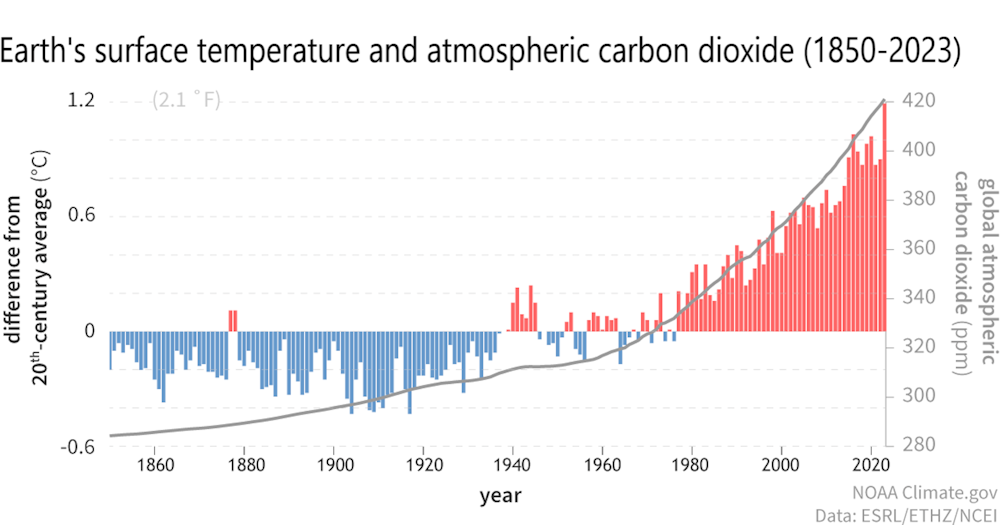
    Since 1850, global average temperature and carbon dioxide concentrations in the atmosphere have risen together, reflecting human emissions of greenhouse gases. Red bars indicate warmer years; blue bars indicate colder years.
    NOAA

    Seeing climate change as a threat multiplier

    For decades, military leaders have been discussing climate change as a threat and a threat multiplier that could worsen instability and mass migration in already fragile regions of the world.

    Climate change can fuel storms, wildfires and rising seas that threaten important military bases. It puts personnel at risk in rising heat and melts sea ice, creating new national security concerns in the Arctic. Climate change can also contribute to instability and conflict when water and food shortages trigger increasing competition for resources, internal and cross-border tensions, or mass migrations.

    The military understands that these threats can’t be ignored. As Secretary of the Navy Carlos Del Toro told a conference in September 2024: “Climate resilience is force resilience.”

    A view of aircraft carriers docked at the sprawling Naval Station Norfolk show how much of the region is within a few feet of sea level.
    Stocktrek Images via Getty Images

    Consider Naval Station Norfolk. It’s the largest military port facility in the world and sits just above sea level on Virginia’s Atlantic coast. Sea level there rose more than 1.5 feet in the last century, and it’s on track to rise that much again by 2050 as glaciers around the world melt and warming ocean water expands.

    High tides already cause delays in repair work, and major storms and their storm surges have damaged expensive equipment. The Navy has built sea walls and worked to restore coastal dunes and marshlands to protect its Virginia properties, but the risks continue to increase.

    Planning for the future, the Navy incorporates scientists’ projections of sea level rise and increasing hurricane strength to design more resilient facilities. By adapting to climate change, the U.S. Navy will avoid the fate of another famous marine power: the Norse, forced to abandon their flooded Greenland settlements when sea level there rose about 600 years ago.

    Norse ruins in Igaliku in southern Greenland, illustrated in the late 1800s while flooded at spring tide by sea level, which had risen since the settlement was abandoned around 1400.
    Steenstrup, K.J.V., and A. Kornerup. 1881. Expeditionen til Julianehaabs distrikt i 1876. MeddelelseromGrønland

    Climate change is costly to ignore

    As the impacts of climate change grow in both frequency and magnitude, the costs of inaction are increasing. Most economists agree that it’s cheaper to act now than deal with the consequences. Yet, in the past 20 years, the political discourse around addressing the cause and effects of climate change has become increasingly politicized and partisan, stymieing effective action.

    In my view, the military’s approach to problem-solving and threat reduction provides a model for civil society to address climate change in two ways: reducing carbon emissions and adapting to inevitable climate change impacts.

    The U.S. military emits more planet warming carbon than Sweden and spent more than US$2 billion on energy in 2021. It accounts for more than 70% of energy used by the federal government.

    In that context, its embrace of alternative energy, including solar generation, microgrids and wind power, makes economic and environmental sense. The U.S. military is moving away from fossil fuels, not because of any political agenda, but because of the cost-savings, increased reliability and energy independence the alternatives provide.

    Solar panels generate power on many U.S. military bases. This array at Joint Forces Training Base in Los Alamitos, Calif., generates enough power for more than 15,000 homes and has a backup battery system to provide power when the sun isn’t shining.
    Frederic J . Brown/AFP via Getty Images

    As sea ice melts and Arctic temperatures rise, the polar region has again become a strategic priority. Russia and China are expanding Arctic shipping routes and eyeing critical mineral deposits as they become accessible. The military knows climate change affects national security, which is why it continues to take steps to address the threats a changing climate presents.

    Paul Bierman receives funding from the US National Science Foundation, this work in part supported by grant EAR-2114629.

    ref. The US military has cared about climate change since the dawn of the Cold War – for good reason – https://theconversation.com/the-us-military-has-cared-about-climate-change-since-the-dawn-of-the-cold-war-for-good-reason-246333

    MIL OSI – Global Reports

  • MIL-OSI Global: Remembering China’s Empress Dowager Ling, a Buddhist who paved the way for future female rulers

    Source: The Conversation – USA – By Stephanie Balkwill, Associate Professor of Asian Languages and Cultures, University of California, Los Angeles

    In sixth-century China, a woman known to history as Empress Dowager Ling ruled over an empire called the Northern Wei. Historians do not know her birth name or in what year she was born, but they do know that she served as empress dowager between 515 and 528. As the spouse of a ruling emperor prior to his death, she retained the title of empress dowager in her widowhood.

    She ruled on behalf of her young son, the heir to the throne; however, her regency was interrupted by a coup d’etat from 520 to 525. Although the empress dowager was expected to rule only as a regent, historical records indicate that she administered court in her own name. These same records also reveal that she adopted a personal pronoun – “zhen 朕,” otherwise known as the Chinese “royal we” – that was reserved for the exclusive use of the emperor.

    In my recent book, “The Women Who Ruled China,” I offer an overview of these historical sources and records that document her life, including a translation of her biography retained in the official chronicle of the Northern Wei. Using these sources, I argue that even though the Empress Dowager’s rule was problematic and short – resulting in her assassination – she laid the foundation for other, more successful female rulers across medieval East Asia.

    Capitalizing on different cultural traditions

    In the late fifth century, the capital city of the Northern Wei was moved from its northern location in modern-day Datong, China, to its southern location in Luoyang, a city at the very heart of Han Chinese culture and history; however, the people who ruled the empire were not ethnically Han Chinese.

    Known as the Taghbach, this group migrated south from the Mongolian steppe and ruled a multiethnic and multicultural empire from Luoyang, the world’s largest city and the former capital of the Eastern Han dynasty. The Northern Wei empire adopted laws, institutions and policies from both Taghbach and Han Chinese traditions.

    This cultural hybridity enabled the empress dowager to rule directly: On one hand, the Chinese court system rooted in the Han dynasty had long included the position of empress dowager, even though none of the women who held it had ruled directly. On the other, Taghbach culture had no formal position of empress dowager prior to its adoption of court ranks in the Northern Wei, but it did have a long tradition of women in public life. These women served in the military and advised on political matters.

    Multiple sources of evidence indicate that Taghbach women had a high degree of personal autonomy and political power, with no source suggesting otherwise.

    A well-known story about Taghbach woman appears in the legend of Mulan, who is said to have dressed as a man so that she could serve in the military in place of her father. The Mulan legend is widely recounted in Chinese literature and inspired a fictional character in two Walt Disney movies based on the Chinese fable.

    As a historian of gender in this period, I believe that the Mulan legend does not accurately depict Taghbach women. Instead, it is a Chinese story that emphasizes a form of gender transgression that makes sense only within Chinese and Confucian culture. Unlike Chinese culture, Taghbach culture had long known women warriors who could ride horses and shoot arrows without concealing their gender.

    Empress Dowager Ling was not a warrior, but she embraced martial symbols of her own power that were available to women in Taghbach culture but not in Chinese culture. For example, she was an accomplished archer and famously drove her own horse cart, which was just as splendid and imposing as was the emperor’s cart.

    In the Confucian culture of Han China, such actions were considered highly inappropriate for women, but Empress Dowager Ling carried them out while holding the Chinese title of empress dowager. Her rule, like her empire, was culturally hybrid. That blend of cultural traditions enabled her to take power in a way that neither Chinese nor Taghbach women had done before.

    A Buddhist ruler

    By the time of the reign of the Northern Wei empire, both Taghbah and Chinese cultures had become deeply familiar with Buddhism, a religion that they had inherited from India in a long process of cultural exchange along the Silk Road. The empire had integrated methods of Buddhist statecraft into its own forms of governance.

    Simply put, what this meant was that the ruler of the empire legitimized his reign through Buddhism, portraying himself either as a Buddha or as a patron of Buddhists – their texts and institutions. This was a type of governance that was widely practiced in premodern East Asia.

    The bodhisattva Maitreya, considered to be the Buddha of the future.
    Rogers Fund, 1982/The Metropolitan Museum, New York

    Even though Buddhist statecraft was widespread in the empress dowager’s time, she was the first woman to directly legitimate her independent rule through Buddhism. As a patron of Buddhism, she commissioned majestic Buddhist architecture. Perhaps seen by her populace as a Buddhist figure herself, she symbolized her co-rule with her son by using a Buddhist visual motif of two Buddhas sitting side by side, a representation that came to be known as the rule by “Two Sages,” meaning tandem rulers depicted in the guise of buddhas. The source for the image was the popular Buddhist text, the “Lotus Sūtra.”

    She also attempted to put her own granddaughter on the throne after the death of her son. As I argue in my book, she did so by capitalizing on the idea that first her son, and then her granddaughter, were thought of as the bodhisattva Maitreya, a being of infinite compassion who is believed to be the future Buddha.

    The empress dowager’s legacy

    Empress Dowager Ling was largely unsuccessful in her bid for power. Her rule was short and contested. She was murdered, and her empire was toppled within 13 years of her rule. For five of those years, she was not in power because of a coup d’etat.

    However, about 150 years after the assassination of the empress dowager, another woman would rise to rule China independently, this time taking the title of “emperor.” That woman is known as Empress Wu, or Emperor Wu Zhao, and she is undoubtedly the most famous woman in all of Chinese history. Numerous historical sources attest to her life, work and rule.

    What those sources tell us, however, is that she ruled using the very same strategies as Empress Dowager Ling. Investing her own family heritage in distant links to the Taghbach, she also positioned herself as a “Two Sage” ruler alongside the emperor in precisely the same way that Empress Dowager Ling did. She was also able to successfully establish herself as the bodhisattva Maitreya by using Buddhist texts known to Empress Dowager Ling and her court.

    She patronized the very same Buddhist structures as did Empress Dowager Ling, including the Buddhist caves at Longmen, just outside of Luoyang. However, she accomplished what Empress Dowager Ling could not – holding onto power successfully. I argue her success was possible because Empress Dowager Ling had paved the way.

    Stephanie Balkwill does not work for, consult, own shares in or receive funding from any company or organization that would benefit from this article, and has disclosed no relevant affiliations beyond their academic appointment.

    ref. Remembering China’s Empress Dowager Ling, a Buddhist who paved the way for future female rulers – https://theconversation.com/remembering-chinas-empress-dowager-ling-a-buddhist-who-paved-the-way-for-future-female-rulers-251132

    MIL OSI – Global Reports

  • MIL-OSI Global: Colorado and other states have expanded access to abortion, but not for adolescents

    Source: The Conversation – USA – By Kate Coleman-Minahan, Associate Professor of Nursing, University of Colorado Anschutz Medical Campus

    Since 2022, Colorado and 10 other states have passed voter initiatives to protect or expand abortion access. Yet, seven of these states, including Colorado, require people under the age of 18 to get consent from or notify a parent prior to receiving abortion services.

    In January 2025, my colleagues and I published research using in-depth interviews with 33 people ages 15 to 22 in Colorado who considered or obtained abortion care between 2020 and 2023. Our study suggests that Colorado’s parental notification law delays young people’s access to abortion, complicates already complex family relationships, and forces unwanted disclosure of the pregnancy and abortion.

    As a nurse, I have provided health care to young people and their families for more than two decades, and as a researcher, I have spent the past 10 years studying young people’s experiences with parental involvement laws.

    Tens of thousands of young people are affected by parental involvement laws each year. By design, these laws threaten their ability to make their own pregnancy decisions.

    Expanding abortion access, but not for adolescents

    In the U.S., 38 states allow abortion services at some point in pregnancy. Of those,24 states have parental involvement laws. And of those, 12 states require young people to obtain consent from a parent or guardian; seven require young people to notify a parent or guardian; and five require both notification and consent. Three states – Kansas, Missouri and North Dakota – require involvement of both parents.

    In 2024, Colorado passed a constitutional amendment that protects the right to abortion and allows funding through Medicaid. Yet, Colorado still requires parental notification for people under 18 to obtain abortion services. There have been no recent state-led efforts to remove this law.

    Proponents of parental involvement laws believe that the laws will foster parent-child communication and improve pregnancy decision-making. Research shows this is wishful thinking: These laws do not improve communication or decision-making, and instead harm adolescents.

    We found that even in a state like Colorado that has expanded abortion access, the law creates barriers to services. It takes time for young people to learn the law exists and figure out how to comply with it. That’s true for both young people who can tell their parents and those who cannot. Delays due to parental involvement laws can increase the cost of abortion services, restrict adolescents’ choice of abortion methods and push adolescents past the gestational limit of the clinic or state.

    For some Colorado young people, following the law resulted in unwanted disclosure of their pregnancy and abortion to parents and others, which is associated with negative mental health outcomes and exposes some young people to emotional or physical abuse.

    Judicial bypass

    In states that mandate parental involvement, young people who feel they cannot involve a parent can try to obtain a judicial bypass. The young person must go to court to prove to a judge that they are mature and well informed or that abortion without parental involvement is in their best interest.

    Data from Massachusetts, Illinois, Texas and Florida suggests that between 6% and 23% of young people who had an abortion relied on judicial bypass. In some states, such as Florida, up to 13% of young people who requested a bypass were denied.

    In our prior research, Texas young people described the judicial bypass process as burdensome, humiliating and traumatizing.

    In our new research, young people in Colorado described the judicial bypass process as burdensome. They said it disrupted school, was “embarrassing,” “anxiety” provoking and “nerve wrecking.”

    Judicial bypass also delays access to abortion. For one participant in our Colorado study, the two- to three-week delay contributed to her inability to obtain her wanted abortion because it pushed her past the gestational limit of her chosen clinic.

    Another participant thought the judicial bypass process would take too long, so she instead tried to end the pregnancy herself. She took vitamin C, which is not effective, and considered but did not take large doses of over-the-counter medications such as ibuprofen, which could have caused organ damage.

    The delays and burdens of the judicial bypass process led some study participants’ parents to find out about the pregnancy. This unwanted disclosure breached the privacy that judicial bypass is meant to protect.

    Future of abortion restrictions

    States such as Colorado, Maryland and Montana provide access for people seeking abortion services who live in the 18 states with bans early in pregnancy. For example, Colorado had a 110% increase in the number of abortions among adolescents from out of state between 2020 and 2022.

    However, these states’ parental involvement laws may compound barriers people face when traveling out of state.

    Parental involvement laws were the first state-level abortion restriction allowed by the Supreme Court after the Roe v. Wade decision in 1973, which was overturned in 2022. There is a similar pattern today.

    Policymakers in some states with abortion bans, such as Idaho, Tennessee and Mississippi, are trying to stop people from traveling out of state for services by targeting young people. These proposed laws would make it a crime to help a young person under 18 leave the state for abortion services without parental consent.

    Colorado protects the right to abortion in its state constitution but still requires minors to notify a parent to get an abortion.
    The Washington Post/Contributor/GettyImages

    Some state policymakers are also trying to make it harder to get contraception by targeting young people. For example, federal courts upheld Texas’ refusal to allow minors to confidentially obtain contraception at federally funded clinics.

    Young people know who to trust

    Our research found that Colorado young people want their parents’ or guardians’ support when considering abortion, yet some felt it was not safe for them to ask for it.

    Confirming prior research, we found a number of reasons young people felt unable to disclose their pregnancies to a parent. Those include fearing a parent’s reaction, feeling a parent would not respect their pregnancy decision, and not living with or not having a supportive relationship with a parent.

    In addition to those reasons, young people also accurately predicted their parents’ reactions. Young people recounted emotional abuse and abandonment or feeling coerced into either continuing the pregnancy or having an abortion when a parent they did not feel they could tell found out about the pregnancy. Research, including our new study in Colorado, shows we can trust young people to decide who to involve in their pregnancy decision.

    Read more of our stories about Colorado.

    The views expressed here are her own and not those of the University of Colorado. Kate Coleman-Minahan receives funding from the Eunice Kennedy Shriver National Institute of Child Health and Human Development (NICHD) and the Society of Family Planning.

    ref. Colorado and other states have expanded access to abortion, but not for adolescents – https://theconversation.com/colorado-and-other-states-have-expanded-access-to-abortion-but-not-for-adolescents-249340

    MIL OSI – Global Reports

  • MIL-OSI Global: With a federal election looming, America’s democratic decline has critical lessons for Canadian voters

    Source: The Conversation – Canada – By Matthew Lebo, Professor, Department of Political Science, Western University

    Prime Minister Mark Carney and his cabinet have been sworn in, ending Justin Trudeau’s time in office and paving the way for a spring election. Canadians are soon heading to the polls as they watch American democracy crumble.

    United States President Donald Trump recently argued “he who saves his country does not violate any Law” as he ignores Congress and the courts, governs by executive order and threatens international laws and treaties.


    Read more:
    Is Donald Trump on a constitutional collision course over NATO?


    Once stable democratic institutions are failing to hold an authoritarian president in check.

    What lessons are there to protect Canadian democracy as the federal election approaches?

    Elites lead the way

    First, it’s important to delve into how so many Americans have become tolerant of undemocratic actions and politics in the first place. It’s not that Republican voters first became more extreme and then chose a representative leader. Rather, public opinion and polarization are led by elites.

    Republican leaders moved dramatically to the right, and the primary system allowed the choice of an extremist. Republican voters then aligned their opinions with his. Trump’s disdain for democratic fundamentals spread quickly. Partisans defending their team slid away from democratic values.

    Canada’s more centrist ideological spectrum is not foolproof against this type of extremism. Public opinion can be moved when our leaders take us there.

    Decline can start slowly and then accelerate. America’s democratic backsliding in the first weeks of Trump’s second presidency follows the erosion of democratic norms over decades. Republican attacks on institutions, the opposition, the media and higher education corrosively undermined public faith in the truth, including election results.

    Trust in government is holding steady in Canada, however. That provides an important guardrail for Canadian democracy.

    The dangers of courting the far right

    There are also lessons for our political parties. To maximize their seats, Republicans accepted extremists like Marjorie Taylor Greene, but soon needed those types of politicians for key votes.

    The so-called Freedom Caucus, made up of MAGA adherents, forced the choice of a new, more extreme, leader of the House of Representatives. This provides a clear lesson that history has shown many times: it is dangerous for the party on the political right to accommodate the far right, which can quickly take control.

    Once established within the ruling party, extremists can hold their party hostage.

    At a recent meeting of the Munich Security Conference, Vice-President JD Vance pushed European parties to include far-right parties, and Elon Musk outright endorsed the far-right Alternative for Germany party.

    Austria recently avoided the inclusion of the far right in its new coalition, and now Germany is working to do the same. As Canada’s Conservatives look for every vote, courting far-right voters and candidates risks destabilizing the system.

    Can it happen in Canada?

    How safe is Canada’s Westminster-style parliamentary democracy?

    The fusion of legislative and executive power in parliamentary systems like Canada’s seems prone to tyranny. America’s Constitutional framers thought so when they designed a system with separate legislative, executive and judicial branches that could check each other’s power.

    They clearly did not imagine party loyalty negating the safeguards that protect democracy from an authoritarian-minded president. The Constitution gives Congress the power to legislate and impeach, limits the executive’s power to spend and make appointments, gives the judiciary power to hold an executive accountable and contains the 25th amendment allowing cabinet to remove a president.

    But when one party controls the legislative and executive branches during a time of hyper-partisanship, these mechanisms may not constrain an authoritarian. Today, Republican loyalty has eroded these checks and balances and American courts are struggling to step up to their heightened role.

    Although counter-intuitive, parliamentary systems like Canada’s are usually less susceptible to authoritarianism than presidential ones because the cabinet or the House of Commons can turn against a lawless leader.

    Still, if popular, authoritarian leaders can still retain their party’s support — and then things can slide quickly. The rightward pull of extremists seen in the U.S. House would be more dangerous here since the Canadian House of Commons includes our executive.

    Guarding against xenophobia

    Lastly, Canada should be wary of xenophobic rhetoric.

    America First” is not simply shopping advice. It began as an isolationist slogan during the First World War but was soon adopted by pro-fascists, American Nazis and the Ku Klux Klan. These entities questioned who is really American and wanted not only isolationism, but racist policies, immigration restrictions and eugenics.

    Trump did not revive the phrase accidentally. It’s a call to America’s fringes. Alienating domestic groups is a sure sign of democratic decline.

    “Canada First” mimics that century-long dark theme in America. In combination with contempt for the opposition, it questions the right of other parties to legitimately hold power if used as a message by one party.

    Also, asserting that “Canada is broken” — as Conservative Leader Pierre Poilievre often does — mimics Trump’s talk of American carnage, language and imagery he uses to justify extraordinary presidential authority.

    Such language erodes citizens’ trust in democratic institutions and primes voters to support undemocratic practices in the name of patriotism. Canadian parties and politicians should exit that road.

    Ultimately, institutions alone do not protect a country from the rise of authoritarianism. Democracy can be fragile. As a federal election approaches in Canada, it’s important to know the warning signs of extremism and anti-democratic practices that are creeping into our politics.

    Matthew Lebo does not work for, consult, own shares in or receive funding from any company or organisation that would benefit from this article, and has disclosed no relevant affiliations beyond their academic appointment.

    ref. With a federal election looming, America’s democratic decline has critical lessons for Canadian voters – https://theconversation.com/with-a-federal-election-looming-americas-democratic-decline-has-critical-lessons-for-canadian-voters-251544

    MIL OSI – Global Reports

  • MIL-OSI Global: Trump’s potential embrace of ‘continentalist geopolitics’ poses grave risks to Canada

    Source: The Conversation – Canada – By Michael Williams, Professor of International Politics, L’Université d’Ottawa/University of Ottawa

    In the few weeks since United States President Donald Trump returned to the White House, world leaders and commentators have struggled to make sense of his approach to foreign policy, including tariffs, alliance renegotiations and threats of territorial appropriation.

    No one is sure how much is bluff or negotiating tactics, nor how much is deadly serious.

    For some, Trump’s foreign policy is simply incoherent, but most try to fit his approach into the familiar choice between isolationism and internationalism.

    But there’s a third possibility: Trump’s second presidency marks a contemporary twist on an older form of continentalist geopolitics with important implications for Canada and the world.

    ‘Great Powers’

    Although it has been largely missing from foreign policy debates in the post-Second World War era, continentalist geopolitics has a long and often controversial history.

    In the 19th century and the first half of the 20th, it envisioned a world divided into “great spaces,” each dominated by a different “Great Power.” According to this perspective, not all regions are equally important, and continentalist geopolitics does not require a choice between internationalism and isolationism.

    Instead, continentalism recommends that Great Powers like the U.S. — with its massive financial, natural and industrial resources — concentrate on controlling territory, the regions surrounding it and the crucial transportation routes on its continental fringes.

    Pressure is placed on countries whose importance is determined by their geopolitical proximity, and those that are least able to resist due to their dense connections and relative dependence on the U.S.

    The objective is not just to gain specific advantages; it’s to force neighbours into even tighter economic and infrastructural connections and dependence. The obvious countries in this scenario are Canada and Mexico, and it’s therefore unsurprising that both have been the targets of Trump’s significant tariff threats and other coercive measures.

    When Ontario Premier Doug Ford talks about the need for tighter continental ties through a continental AmCan arrangement, he provides exactly the desired reaction.

    Pressuring neighbours

    Beyond geographically contiguous states, continentalist geopolitics also focuses on areas that command key strategic passages and trade routes, especially those currently controlled by weaker powers.

    For the U.S., Panama, with its canal, fits the bill. Danish-administered Greenland, with its natural resources and geographic importance in a rapidly thawing Arctic region, is another. It’s unsurprising that these countries, along with Canada, were a Trump focus in the first weeks of his second administration.

    Today, continentalist geopolitics recognizes the multi-polarity and “multi-alignment” in world politics.

    It’s not isolationist, but it recognizes that waning American power in an inter-connected world gives more distant states the ability to resist U.S. pressure by making deals with a wide range of other countries. In this setting, an interventionist global role is neither possible nor desirable, and the U.S. should refrain from global commitments.

    As U.S. Secretary of State Marco Rubio stated in one of his first interviews after taking office:

    “It’s not normal for the world to simply have a unipolar power… that was an anomaly. It was a product of the end of the Cold War, but eventually you were going to reach back to a point where you had a multi-polar world, multi-great powers in different parts of the planet. We face that now with China and to some extent Russia.”

    No commitment to global stability

    The continentalist perspective does not require a complete separation from the world economic or security order. Trade, financial and technology flows can be encouraged, but their basis would be a re-industrialized and more self-sufficient core, well-insulated from economic and security threats.

    Extended interests, such as European stability, could be minimized by increasing the cost burden to allies and minimizing fixed commitments. A powerful global capacity with a “light” geographic footprint is the preferred posture.

    Calls for increased defence spending by NATO allies and for European responsibility in enforcing a post-war settlement in Ukraine logically follow.

    The continentalist playbook is content to leave the management of distant regions to other powers, each pre-eminent in their part of the world. That means participation in international organizations is minimized.

    Foreign aid should reflect American interests, with involvement depending on the costs and benefits, not any automatic commitment to global stability. Feeding the world’s most extensive development agency, USAID, “into the wood-chipper” — to quote Elon Musk — is a page taken straight from this kind of geopolitician’s handbook.

    Unsavoury history

    The possibility that a continentalist geopolitics underpins recent U.S. foreign policy initiatives has received too little attention in Canada.

    It’s not yet clear that the actions of America’s new administration represent the rise, much less the triumph, of Trumpian geopolitics. Nor is there any guarantee that such a vision would or will succeed.

    But there is enough evidence to suggest we should take the possibility seriously. Since 1945, America’s foreign policy options have resided somewhere between internationalism and isolationism. But a geopolitical vision of world politics as a diverse canvas of large territory dominated by different Great Powers have a long, if often unsavoury, history in foreign policy.

    A southern neighbour pursuing a such a geopolitical approach would mark a radical transformation in world order and pose huge challenges for Canada. Canadians should at least be prepared for the possibility.

    Michael Williams receives funding from the Social Science Research Council of Canada

    ref. Trump’s potential embrace of ‘continentalist geopolitics’ poses grave risks to Canada – https://theconversation.com/trumps-potential-embrace-of-continentalist-geopolitics-poses-grave-risks-to-canada-251545

    MIL OSI – Global Reports

  • MIL-OSI Global: Who does Spiderman vote for? Study shows people project their political views onto fictional heroes and villains

    Source: The Conversation – UK – By Stuart J. Turnbull-Dugarte, Associate Professor in Quantitative Political Science, University of Southampton

    From a very young age, we’re socialised to view the world as being made up of “goodies” and “baddies”. When you’re a child fooling around with your friends in the playground, nobody ever wants to be the baddy. And when it comes to dressing up, everybody wants to be Luke Skywalker – not Darth Vader.

    This oversimplified way of viewing the world as being made up of right and wrong or good people and bad people doesn’t dissipate as we grow older. If anything, it tends to solidify as we form the social identities that define who we are in adult life.

    This is particularly the case when it comes to our political identities and, specifically, the partisan identities and loyalties that individuals attach themselves to.

    Partisanship is one hell of a powerful force. Not only does sticking a party label under a candidate determine whether we support them or not – often regardless of what the individual candidate actually stands for – but it also shapes how we view the state of the country and economy. Note how Democrats’ view of how the US economy was doing tanked the day Donald Trump took office, while Republicans’ positivity about the same economy spiked.


    Want more politics coverage from academic experts? Every week, we bring you informed analysis of developments in government and fact check the claims being made.

    Sign up for our weekly politics newsletter, delivered every Friday.


    Our partisanship can also affect who we choose to socialise with, who we share a beer with, and who we date. There is even evidence that it affects who gets hired and who doesn’t. Knowing who your neighbour votes for and if they vote for “your team” shapes your view of them as good or bad.

    In a new study, I show that the reverse is also true. Knowing someone is good or bad shapes if we think they are one of “us” or one of “them”. In other words, partisans project their own political identities onto people they view as good, and project the political identities of their opponents onto those they dislike.

    Who do Darth Vader and Cinderella vote for?

    The first part of the study involved a social experiment that applied a political twist on a childish game. In a representative survey of thousands of respondents from both the US and UK, participants were shown images of fictional characters. These were heroes like Harry Potter and Spiderman, or villains like Scar from Disney’s The Lion King and Joffrey Baratheon from Game of Thrones.

    Participants were then asked to guess each character’s political affiliation. What emerged was a striking pattern: participants thought that heroes voted for the same party as them, and that villains voted for the opposing party.

    Essentially, US Democrats consistently thought Harry Potter and his friends Ron and Hermione voted Democrat, whereas Republicans consistently thought they voted Republican. Similar behaviour was expected of heroes (and the opposite of villains) from across a whole host of characters from different film and fiction.

    Percentages who thought each character voted for ‘their’ party:

    Heroes in pink, villains in blue: how we think fictional characters vote.
    Stuart Turnbull-Dugarte, CC BY-ND

    Participants thought Spiderman, Cinderella, Yoda, Aladdin, Brienne of Tarth, Gandalf and Captain America shared their political views. They dismissed Kylo Ren, Ursula the sea witch, Cersei Lannister and Thanos as siding with their political opposition.

    Participants were also asked to read a short story about a local politician. In one version of the story, the politician was depicted as a generous figure who donated money to charity. In another, the same politician was shown in a negative light, and as having been accused of corruption. At no point in the story was the partisanship of the politician mentioned.

    Despite the absence of any direct mention of partisanship, respondents falsely “remembered” the politician’s party affiliation in a way that aligned with the moral tone of the story. Labour-voting participants who read the generous politician story said they remembered it was about a Labour politician. Conservative-voting participants reading the same story said they remembered it being about a Conservative politician. The reverse pattern was observed among participants who read the corrupt politician story.

    These results are striking. Even when there is nothing to be remembered and participants could say that partisanship wasn’t part of the story, voters read what they wanted between the lines based on their own tribal political identities.

    These studies demonstrate that partisan identities undermine voter rationality. Politically motivated projection – assuming those who are good must be one of “us” and those who are bad must be one of “them” – doesn’t just shape how we view others; it reinforces and consolidates partisan divisions.

    If we assume the person who lives next door is a lousy neighbour because they vote for our political opponents, and simultaneously assume the person who lives down the street votes for our political opponents because they are a lousy neighbour, then we very quickly fall into a scenario where our politically tribal instincts feel increasingly justified.

    This cycle of political villainisation deepens divides, making it harder to find common ground. If we continue to let partisanship shape not just how we vote but how we see each other, we risk turning those who don’t share our political views into our enemies.

    Stuart J. Turnbull-Dugarte has received funding from the British Academy and the Leverhulme Trust

    ref. Who does Spiderman vote for? Study shows people project their political views onto fictional heroes and villains – https://theconversation.com/who-does-spiderman-vote-for-study-shows-people-project-their-political-views-onto-fictional-heroes-and-villains-252221

    MIL OSI – Global Reports

  • MIL-OSI Global: Chewing gum is plastic pollution, not a litter problem

    Source: The Conversation – UK – By David Jones, Sessional Teaching Fellow, School of the Environment and Life Sciences, University of Portsmouth

    Wirestock Collection/Shutterstock

    Thousands of tonnes of plastic pollution could be escaping into the environment every year … from our mouths. Most chewing gum on sale is made from a variety of oil-based synthetic rubbers – similar to the plastic material used in car tyres.

    If you find that thought slightly unsettling, you are not alone. I have been researching and speaking about the plastic pollution problem for 15 years. The people I talk to are always surprised, and disgusted, when they find out they’ve been chewing on a lump of malleable plastic. Most manufacturers just don’t advertise what gum is actually made of – they dodge around the detail by listing “gum base” in the ingredients.

    There’s no strict definition of synthetic gum base. Chewing gum brand, Wrigley Extra partners with dental professionals around the world to promote the use of sugar-free chewing gum to improve oral health.

    The brand’s Wrigley Oral Health Program states that: “Gum base puts the “chew” in chewing gum, binding all the ingredients together for a smooth, soft texture. We use synthetic gum base materials for a consistent and safe base that provides longer-lasting flavour, improved texture, and reduced tackiness.“

    It almost sounds harmless. But chemical analysis shows that gum contains styrene-butadiene (the durable synthetic chemical used to make car tyres), polyethylene (the plastic used to make carrier bags and bottles) and polyvinyl acetate (woodglue) as well as some sweetener and flavouring.

    The chewing gum industry is big business, worth an estimated US$48.68 billion (£37.7 billion) in 2025. Three companies own 75% of the market share, the largest of which is Wrigley, with an estimated 35%. There are few reliable statistics available about the amount of gum being produced, but one peer-reviewed global estimate states 1.74 trillion pieces are made per year.

    I examined several types of gum and found that the most common weight of an individual piece of gum is 1.4g – that means that globally, a staggering 2.436 million tonnes of gum are produced each year. About a third (30%) of that weight, or just over 730,000 tonnes, is synthetic gum base.

    If the idea of chewing plastic isn’t disturbing enough, consider what happens after you spit it out. Most people have experienced discarded gum under bench seats, school desks and on street pavements. But, like other plastics, synthetic chewing gum does not biodegrade and can persist in the environment for many years.

    In the environment it will harden, crack and breakdown into microplastics but this can take decades. Cleaning it up is not cheap because it is labour intensive. The average cost is £1.50 per square metre and estimates suggest that the annual clean-up cost for chewing gum pollution for councils in the UK is around £7 million.

    There have been some efforts to address the problem. In many public locations around the UK, gum collection pots supplied by Dutch company Gumdrop Ltd have been installed to collect and recycle used gum. Signage provided by councils encouraging responsible disposal is also now a regular feature in some UK high streets, and there is a growing number of small producers offering plant-based alternatives.

    In the UK, the environmental charity Keep Britain Tidy launched the chewing gum task force in 2021. This collaboration involves three major manufacturers who have committed to investing up to £10 million in order to clean up “historic gum staining and changing behaviour so that more people bin their gum”.


    Read more:
    Car tyres shed a quarter of all microplastics in the environment – urgent action is needed


    But, here lies the crux of the issue.

    The first objective implies that cleaning up gum is a solution to this form of plastic pollution; it isn’t. Manufacturers making a financial contribution to clean-up efforts is like plastic manufacturers paying for litter pickers and bin bags at volunteer beach cleans. Neither addresses the root cause of the problem.

    Binning gum is not the solution either. Addressing gum as a plastic pollutant dictates that the prevention of gum pollution should include the well-known tenets, like all plastic pollution, of reduce, reuse, recycle and redesign. It is not only a disposal issue.

    Another issue that I have uncovered is definition. In the two annual reports published by the gum litter task force since its inception, there is no mention of the word pollution. The distinction between litter and pollution is important. By calling it chewing gum pollution, the narrative changes from an individual negligence issue to a corporate one. That places an onus for accountability onto the producers rather than the consumers.

    Single-use solutions

    Like single-use plastic items, chewing gum pollution needs to be tackled from all angles – education, reduction, alternatives, innovation, producer responsibility, and legislation.

    Educating people about the contents of gum and the environmental consequences those ingredients have will reduce consumption and encourage better disposal habits. More transparent labelling on packaging would empower shoppers to make informed choices. Stricter regulations can hold manufacturers to account – a levy tax on synthetic gum can help pay for clean ups. In turn, this would incentivise more investment in plant-based gums and other sustainable alternatives.

    We can all reduce the environmental consequences of this plastic pollution by kicking the gum habit, calling on councils to enforce stricter pollution penalties and encouraging governments to put a tax levy on manufacturers to fund clean ups and force them to list the contents of gum base.

    Throwing away any non-disposable, inorganic products is unsustainable. Chewing gum pollution is just another form of plastic pollution. It’s time we start treating it as such.


    Don’t have time to read about climate change as much as you’d like?

    Get a weekly roundup in your inbox instead. Every Wednesday, The Conversation’s environment editor writes Imagine, a short email that goes a little deeper into just one climate issue. Join the 40,000+ readers who’ve subscribed so far.


    David Jones is affiliated with the marine conservation charity Just One Ocean

    ref. Chewing gum is plastic pollution, not a litter problem – https://theconversation.com/chewing-gum-is-plastic-pollution-not-a-litter-problem-251662

    MIL OSI – Global Reports

  • MIL-OSI Global: Many of history’s deadliest building fires have been in nightclubs. Here’s why they’re so dangerous

    Source: The Conversation – Global Perspectives – By Milad Haghani, Associate Professor & Principal Fellow in Urban Risk & Resilience, The University of Melbourne

    A fire at a nightclub in North Macedonia has killed at least 59 people and injured more than 150. The blaze broke out at the Pulse nightclub in Kočani, where around 500 people were attending a concert.

    Witnesses reported that pyrotechnics used during the performance ignited the ceiling, causing flames to spread rapidly.

    Authorities have arrested 20 people so far, including the club’s manager. Investigations continue. The North Macedonian government has declared a seven-day mourning period.

    While building fires are not limited to nightclubs, many of the most devastating building fires in history have happened in nightclubs around the world. So why are nightclubs such a risky place for deadly fires?

    A long history of nightclub fires

    A look at past nightclub fires shows just how common and deadly they’ve been in the past 100 years. We identified at least 24 nightclub fires where ten or more people died since 1940.

    Collectively, these 24 incidents account for at least 2,800 deaths, with nearly 1,300 in the 21st century alone.

    The Cocoanut Grove fire (Boston, 1942) remains the deadliest on record, killing 492 people. The club’s flammable decorations and locked exits turned what should have been an ordinary night out into one of the worst fire disasters in history.

    In Argentina, the República Cromañón fire killed 194 people in 2004, caused by pyrotechnics igniting flammable materials inside the club.

    The Kiss nightclub fire in Brazil in 2013 was even deadlier, claiming 242 lives.

    More recently, Thailand’s Mountain B nightclub fire killed 23 people in 2022.

    And in 2023, 13 people died in a fire at the Fonda Milagros nightclub in Spain.

    Now, North Macedonia’s Pulse nightclub joins this long list.

    Why are nightclubs so risky for fires?

    A review of past nightclub fires we’ve collated in our database reveals common patterns. Two key factors have contributed to the frequency and severity of these fire disasters.

    1. Pyrotechnics, fireworks and flammable materials

    One of the most common causes of nightclub fires has been the use of pyrotechnics in enclosed spaces. Pyrotechnics are controlled chemical reactions designed to produce flames, smoke, or light effects.

    They have been involved in at least six of the deadliest nightclub fires, including the recent Pulse nightclub fire in North Macedonia, as well as The Station (United States, 2003), Kiss (Brazil, 2013), Colectiv (Romania, 2015), Lame Horse (Russia, 2009) and República Cromañón (Argentina, 2004).

    When used indoors, pyrotechnics can easily ignite flammable ceiling materials, acoustic foam, or decorations.

    In some cases, fireworks – which are different from stage pyrotechnics and sometimes illegally used indoors – have played a role. The Lame Horse nightclub fire, which killed 156 people in Russia in 2009, was caused by a spark from fireworks igniting a low ceiling covered in flammable plastic decorations.

    Even when fires don’t start from pyrotechnics or fireworks, the materials used in nightclub interiors can rapidly turn a small fire into a major disaster.

    Foam insulation, wooden panelling, plastic decorations and carpeted walls have all been key factors in past nightclub fires. In Cocoanut Grove (Boston, 1942), artificial palm trees and other flammable decorations accelerated the blaze.

    2. Overcrowding and blocked or insufficient exits

    Evacuation failures have been a factor in nearly every major nightclub fire.

    In some instances, crowds may not immediately recognise the severity of the situation, especially if they mistake alarms for false alarms or special effects (for example, smoke machines, loud music).

    Further, patrons could be intoxicated due alcohol or other drugs. Intoxication combined with potential disorientation due to dim lighting can further reduce judgement during an evacuation.

    Clearly, the best way to protect patrons is to prevent a fire from breaking out in the first place. But in settings where fire risks are inherently high, the ability to evacuate people swiftly is crucial.

    Nightclubs, however, have a poor track record when it comes to evacuation safety measures.

    Nightclubs are among the most crowded indoor spaces. While crowd density is part of a nightclub’s design and atmosphere, overcrowding beyond legal capacity is common.

    A crowd that has gradually gathered over several hours must suddenly evacuate in seconds or minutes to survive a fire. This is made more difficult by narrow hallways and limited exits, which quickly become bottlenecks when hundreds of people attempt to escape at once.

    What’s more, not all exits are always accessible during a fire. In several past nightclub disasters, locked or obstructed emergency exits have significantly worsened the death toll.

    Minimising the risks

    Nightclubs are uniquely vulnerable to fires due to a combination of structural risks, unsafe materials, overcrowding and regulatory failures.

    While human behaviour plays a role in how fires unfold in confined spaces such as nightclubs, people should be able to go for a night out and expect to come home safely.

    Regulatory oversight must ensure strict compliance with fire codes. Venues should have fire suppression systems (such as sprinklers, fire extinguishers and smoke detectors) to control or contain fires before they spread, and adequate exits.

    Nightclubs should ban indoor pyrotechnics and fireworks, as history has repeatedly shown their deadly consequences.

    Capacity limits must be enforced, and emergency exits should always be accessible.

    Australia has strict fire safety regulations for nightclubs, with venues required to have fire suppression systems, emergency exits and trained staff to manage fire risks.

    Public awareness is also key. Patrons need to understand the real risk of fires in nightclubs, and be prepared to evacuate swiftly but calmly if danger arises.

    Ruggiero Lovreglio receives funding from Royal Society Te Apārangi (NZ) and National Institute of Standards and Technology (USA).

    Milad Haghani does not work for, consult, own shares in or receive funding from any company or organisation that would benefit from this article, and has disclosed no relevant affiliations beyond their academic appointment.

    ref. Many of history’s deadliest building fires have been in nightclubs. Here’s why they’re so dangerous – https://theconversation.com/many-of-historys-deadliest-building-fires-have-been-in-nightclubs-heres-why-theyre-so-dangerous-252372

    MIL OSI – Global Reports

  • MIL-OSI Global: Email signatures are harming the planet and could cost people their lives — it’s time to stop using them

    Source: The Conversation – Canada – By Joshua M. Pearce, John M. Thompson Chair in Information Technology and Innovation and Professor, Western University

    A recent study has shown that the environmental and human mortality impacts of modern information technology — especially email infrastructure — are significant. (Shutterstock)

    The use of information technology (IT) has significant environmental and social impacts, including human mortality from climate change. One striking example is the carbon emissions and impacts associated with digital communication.

    To quantify the human cost of carbon-emitting technology, researchers use the 1,000-ton rule that estimates that for every 1,000 tons of carbon dioxide released into the atmosphere, one person dies prematurely.

    This rule is derived from the following calculation: burning one trillion ton of fossil carbon is likely to cause 2 C of anthropogenic global warming, which in turn is likely to cause about one billion premature deaths spread over the next century.

    This theory can be used as a decision-making framework for policymakers to compare the value of an activity to the cost of that activity in human lives.

    It’s also what I used in my recent study that analyzed how additional information in email signatures contributes to climate-related deaths in Canada.

    Email signatures causing emissions

    Sending emails is an everyday activity, but it comes with an environmental cost. Emails use energy, and that energy often comes from burning fossil fuels, which in turn, contribute to increasing atmospheric carbon dioxide levels.

    The overwhelming scientific consensus is that human activity is destabilizing the climate and is likely to cause irreversible damage to the global environment and humanity.

    My recent study explored the environmental impact of lengthening email signatures, focusing specifically on two types of information: gender pronouns and land acknowledgements because both are relatively new additions to email signatures.

    In both cases, the extra carbon emissions for each email for the extra characters is estimated and aggregated over the population that uses them.

    The environmental consequences of minor digital habits are often overlooked.
    (Shutterstock)

    The results showed that in Canada, where about 15 per cent of people include gender pronouns in emails, the resulting carbon emissions from this small change (three extra words) may contribute to the premature deaths of one person a year, according to the 1,000-ton rule.

    The environmental harm and human mortality caused by this seemingly minor digital habit is evident. Large blocks of text like legal disclaimers and land acknowledgements cause even more harm. Images and logos, which contain even larger amounts of data, cause more emissions and deaths still.

    Doing away with email signatures

    Most of the content in email signatures is redundant, as we tend to email the same people repeatedly. The environmental and human cost of using email signatures clearly outweighs the benefits. One solution to this issue is to replace email signatures with a hyperlinked name to additional information.

    Another simple way to increase efficiency and reduce emissions is by eliminating email signatures entirely, since emails already identify senders in the header. After all, we don’t sign our texts, so why do we feel the need to sign our emails?

    If you receive an email with a long signature, you might consider asking the sender to switch to a hyperlink instead, or eliminate their signature all together.

    Additionally, you can encourage others to use free, open-source ad blockers to reduce unnecessary data from ads while browsing or emailing. Ads, especially on websites, generate an enormous amount of unnecessary data and energy consumption.

    While these steps may seem small on their own, collectively, they can make a significant difference in reducing digital waste and unnecessary emissions.

    The hidden cost of spam emails

    The results of my recent study make it clear that Canada’s current IT and energy infrastructure are unsustainable. The study should serve as a wake-up call for the need to eliminate the use of fossil fuels from our energy systems entirely, particularly because it is already possible to displace fossil fuels with renewable energy with lower costs.

    It also gives pause for the far more damaging impacts of other forms of digital communications, particularly email spam.

    Already more than half of all emails are spam.
    (Shutterstock)

    Spam accounts for over half of all emails and, despite having lower carbon emissions per email (since many are deleted without being opened), spam accounts for far more emissions-producing data. Beyond its environmental toll, spam also wastes the time of every email user.

    In response, several proposals and laws have been put forward to reduce this digital waste, from including taxes on emails, opt-in or opt-out systems to even outlawing spam entirely. While these efforts are a step in the right direction, we all still suffer through an enormous amount of spam.

    The environmental impact of our online habits is far larger than most realize, and as digital communication continues to evolve, we must consider its long-term consequences on the environment and human life. We should take the easy steps of cutting wasteful energy use in our communications and it can start with eliminating email signatures.

    Joshua M. Pearce does not work for, consult, own shares in or receive funding from any company or organisation that would benefit from this article, and has disclosed no relevant affiliations beyond their academic appointment.

    ref. Email signatures are harming the planet and could cost people their lives — it’s time to stop using them – https://theconversation.com/email-signatures-are-harming-the-planet-and-could-cost-people-their-lives-its-time-to-stop-using-them-251215

    MIL OSI – Global Reports

  • MIL-OSI Global: Why some Canadians are in denial about Donald Trump

    Source: The Conversation – Canada – By Aisha Ahmad, Associate Professor, Political Science, University of Toronto

    Prime Minister Mark Carney has vowed Canada will never be a 51st American state and has called on Canada to present a united front to defend against United States President Donald Trump’s escalating attacks on Canada’s economy and sovereignty.

    Most Canadians are already on board. Provincial premiers have committed to defending against tariffs, and recent polling data shows 85 per cent of Canadians resolutely reject Trump’s threats of annexation.

    Yet, despite this widespread patriotism, some Canadians may have a relative or friend in the contrarian 10 per cent of citizens who welcome annexation.

    Why do these people support Trump?

    Psychology and security

    The answer has less to do with politics or economic frustration than it does psychology. The reason some Canadians are reacting positively to Trump’s threats is because cognitive biases often prevent human beings from accurately assessing shocks to their security environment.

    Psychological biases are well-researched in international security scholarship, and I have witnessed their consequences first-hand in my work in conflict zones.

    From peacekeepers to politicians to ordinary civilians, I have seen how cognitive biases can cause rational, intelligent people to ignore valuable evidence, even at great peril.

    Humans often react to unsettling evidence by denying, minimizing or re-interpreting the information to restore their cognitive ease. Everyone in a conflict-prone part of the world experiences cognitive distortions and denial at some point. Psychological security often overrides physical security.

    But these biases are dangerous. They undermine decision-making, slow down reaction times and cause people to believe dangerous things that make them unsafe.

    The tricky part is that challenging a person’s denial can provoke defensiveness, even rage. But allowing denial to persist leaves them dangerously unprepared to face real-world threats.

    On balance, the safer choice is to rip off these psychological Band-aids.

    Denial through confirmation bias

    Except for a small percentage of extremists, the 10 per cent who are in favour of American annexation are ordinary Canadians. What makes them different are two interrelated cognitive biases: confirmation bias and belief perseverance.

    For Canadians who hold Trump in high esteem, acknowledging his threats creates cognitive dissonance. Some people find dissonance so distressing that it feels easier to reject or reinterpret the contrary information in a way that protects prior-held ideas and restores cognitive ease.

    These confirmation biases allow the 10 per cent to redefine the word “annexation” to mean something else, such as peaceful political unification. That imagined definition turns Trump’s threat into a friendly proposal leading to greater prosperity and security.

    That reinterpretation may reduce psychological distress, but it’s delusional.

    Political unification is a non-coercive and consent-based process, wherein parties agree to incorporation through referendum, typically producing an all new government. Trump is proposing unilateral annexation, which is the hostile and illegal seizure of a sovereign state’s territory and the subjugation of its population.

    Annexation is not marriage. It’s rape.

    Unilateral annexation is so inherently violent that its prohibition in Article 2(4) of the United Nations Charter is considered the legal cornerstone of the post-Second World War international order.

    As Trump, Russia’s Vladimir Putin and China’s Xi Jinping each champion annexing nearby sovereign nations in the name of greatness, that international order is now crumbling. If the laws, norms and institutions preventing annexation collapse, it opens the door to invasions, insurgencies and even global war.


    Read more:
    Why annexing Canada would destroy the United States


    Many of the 10 per cent are simply unaware of what “annexation” truly means, and could rationally change their position once they understand the facts. But a smaller subset of that group may reject the evidence entirely.

    Belief perseverance causes some people to aggressively hold their original position, even when presented with disconfirming evidence.

    While denial helps them feel safe in the moment, it also makes them dangerously unprepared to deal with real threats.

    Denial through normalcy bias

    Patriotic “elbows up” Canadians must also be wary of denial. For them, the issue is not identifying the threats, but comprehending their full implications.

    Even among informed citizens, NATO, NORAD and the Five Eyes intelligence-sharing alliance are not easy to relate to. Trade wars show up on grocery bills, but these defence organizations keep peace in the background, which is harder to notice.

    Canadians may intellectually understand that North American security is deteriorating, but that crisis may not seem as real as tariffs.

    This is called “normalcy bias,” a psychological tendency to minimize the probability of threats or the dangers they pose, which delays protective action. Normalcy and optimism biases are why many people fail to evacuate quickly when they are forewarned about wildfires, hurricanes, earthquakes and even wars.

    Slow reactions are not caused by stupidity or laziness. Research shows that the majority people respond inefficiently to warnings of forthcoming disasters. I have witnessed this bias in conflict zones and even experienced its effects myself. I can run 10 kilometres in about an hour, but when the Taliban attacked a bazaar less than 10 kilometres from my flat, it still felt far away.

    Why? Because security threats don’t feel close until your windows start to shake.

    While a military invasion is not imminent, Trump’s threats are so extreme that they warrant immediate action to improve Canadian defence. The time to take protective action is before windows start shaking.

    For the majority of Canadians who already take Trump’s threats seriously, the first step in countering the normalcy bias is to pay attention to new risks and fractures in existing security co-operation.

    With that evidence, they can initiate a national conversation about how to reduce vulnerabilities and improve resilience and defence.

    Acceptance and adaptation

    There is no time to argue with people who remain cognitively confused. The majority of Canadians are ready to have a laser-focused discussion about the real security challenges on the horizon.

    The good news is that Canada can fortify its security and deter threats in this perilous new world.

    The range of options may not be as comfortable as the bygone era of friendly alliances and NATO supremacy. But through intelligent debate, Canadians can develop realistic new approaches to national defence, and quickly.

    Acceptance and adaptation are the keys to survival.

    Aisha Ahmad receives funding from the Social Sciences and Humanities Research Council of Canada.

    ref. Why some Canadians are in denial about Donald Trump – https://theconversation.com/why-some-canadians-are-in-denial-about-donald-trump-251893

    MIL OSI – Global Reports

  • MIL-OSI Global: Why Gordie Howe’s elbows are Canada’s answer to Donald Trump

    Source: The Conversation – Canada – By Stacy L. Lorenz, Vice Dean and Professor, Physical Education and History, Augustana Campus, University of Alberta

    When Canadian ice hockey centre Connor McDavid scored in overtime to lead Canada to victory over the United States in the National Hockey League’s 4 Nations Face-Off tournament in February, Canadian Prime Minister Justin Trudeau posted on social media, “You can’t take our country — and you can’t take our game.”

    Trudeau’s comment was a direct response to U.S. President Donald Trump’s repeated denigration of the prime minister as the “governor” of the “51st state.” It captured the escalating tensions between the two countries over trade, tariffs and Trump’s threats to annex Canada.

    Meanwhile, the tournament itself, which pitted the top Canadian and American players against one another for the first time in more than a decade, became a representation of these deepening political divisions and showed that hockey isn’t as politically neutral as is often suggested.

    Since the 4 Nations Face-Off ended, hockey analogies and imagery continue to dominate the conversation around Canada-U.S. relations. This time the focus is on Gordie Howe (or “Mr. Hockey” as he was widely known), whose strategic use of elbows on the ice has become a political rallying cry for Canadians.

    A CBC News report on ‘Elbows Up’ becoming a rallying cry against Trump.

    Canada is “elbows up”

    During his professional career from 1946 to 1980, Howe combined skill and scoring ability with toughness, physicality and a willingness to fight when necessary.

    In particular, Howe’s practice of keeping his “elbows up” in the corners to ward off belligerents on the opposing team has become a focal point for Canadians’ actions against Trump’s aggression.

    The hashtag #ElbowsUpCanada has been trending on social media. Howe’s guidance has been echoed by Canadian comedian Mike Myers on Saturday Night Live and by Trudeau at the Liberal leadership convention that marked the transition to Prime Minister Mark Carney.

    In his first speech as Liberal leader, Carney made another hockey reference when he said:

    “We didn’t ask for this fight, but Canadians are always ready when someone else drops the gloves. So the Americans, they should make no mistake: In trade, as in hockey, Canada will win.”

    While it may be surprising to see such enthusiasm for an “elbows up” approach and for “dropping the gloves” as one would in a hockey fight, this kind of strategic employment of violence fits perfectly with Howe’s longstanding brand of hockey manhood.

    “Mr. Elbows” and the “Bashful Basher”

    Although Howe’s early nickname of “Mr. Elbows” has received the bulk of the public’s attention recently, his other moniker used extensively by the Detroit media during his first season in the NHL — the “Bashful Basher” — captures even more effectively the style of masculinity that Canadians are currently calling upon in their clash with Trump.

    Writing in the Detroit Free Press in 1947, reporter Marshall Dann invited readers to “Meet Red Wings’ Bashful Basher.” Alongside a photo of a youthful Howe innocently sipping a milkshake through a pair of straws, Dann noted:

    “Howe not only had proven himself an exceptionally promising rookie, but he also had established the fact that while he might be a malted milk devotee off the ice, he positively was no milk-sop on a hockey rink.”

    Howe’s brand of violence was careful and calculated, rather than reckless or emotional. Even when he used his fists to batter an opponent — such as in his famous 1959 fight with New York Rangers enforcer Lou Fontinato — Howe presented himself as a reluctant and reasonable fighter who conformed to the idealized, manly “code” of hockey.

    He resorted to fighting only to defend smaller teammates and to deter even more harmful forms of violence, such as stick attacks or overly aggressive hits. Far from a wild brawler, Howe was a calm protector, governed by a sense of honest accountability for his actions.

    Author Don O’Reilly’s 1975 biography Mr. Hockey also highlights the image of “two Gordie Howes — quiet, unassuming, and bashful off the ice and aggressive and competitive on the ice.”

    O’Reilly contrasts “the mild-mannered, smiling, innocent-faced Howe, the clean-cut All-Canadian-American boy” with his more ruthless counterpart: “The guy who excels with his elbows as weapons, a man who, his opponents say, is skilled with the illegal high stick and so devious that the officials often fail to see the offense.”

    Likewise, a 1962 Time magazine profile quoted a rival coach as saying:

    “When Howe gets knocked down, he looks like he doesn’t care. But when he’s getting up, he looks for the other guy’s number. A little later, the guy will have four stitches in his head.”

    Mr. Hockey and Canadianness

    A combination of humble manliness and controlled violence firmly established Howe’s masculine credentials within the culture of hockey. More broadly, Mr. Hockey became an admirable embodiment of the most valued manly qualities of the postwar period in North America.

    Howe’s strategic use of fighting also normalized the high level of violence in hockey by showing that it could be measured and purposeful, in accordance with the informal code of expectations that governed the game.

    Although critics of fighting and violence have become more outspoken in recent years, these values remain integral to hockey culture at the highest level and an influential point of reference for what it means to be a “true” hockey fan and a patriotic Canadian.

    In the current political climate, it is perhaps the title of the story that appeared in Life magazine in 1959 that resonates most clearly: “Don’t mess around with Gordie. Hockey’s tough guy (Lou Fontinato) discovers that the game’s best player (Gordie Howe) is a rough man in a fight.”

    With their “elbows up,” Canadians are counting on a Gordie Howe-style response — rational, expert and effective — in a trade war with the United States that may just be getting started.

    The authors do not work for, consult, own shares in or receive funding from any company or organisation that would benefit from this article, and have disclosed no relevant affiliations beyond their academic appointment.

    ref. Why Gordie Howe’s elbows are Canada’s answer to Donald Trump – https://theconversation.com/why-gordie-howes-elbows-are-canadas-answer-to-donald-trump-252167

    MIL OSI – Global Reports

  • MIL-OSI Global: Trump’s English language order upends America’s long multilingual history

    Source: The Conversation – Canada – By Mark Turin, Associate professor, Department of Anthropology, University of British Columbia

    Across its nearly 250-year history, the United States has never had an official language. On March 1, U.S. President Donald Trump changed that when he signed an executive order designating English as the country’s sole official language. The order marks a fundamental rupture from the American goverment’s long-standing approach to languages.

    “From the founding of our Republic, English has been used as our national language,” Trump’s order states. “It is in America’s best interest for the federal government to designate one — and only one — official language.”

    This new order also revokes a language-access provision contained in an earlier executive order from 2000 that aimed to improve access to services for people with limited English. Federal agencies now seem to have no obligation to provide vital information in other languages.

    Despite some reactions in the New York Times, Washington Post and elsewhere, it remains unclear whether Trump’s executive order will face legal or political challenges. Amid continual attacks from the Trump administration on established norms, this decree may pass with relatively little resistance, despite a deeper meaning that extends far beyond language.

    Multilingual realities and monolingual fantasies

    The U.S. has a long multilingual history, beginning with the hundreds of Indigenous languages indelibly linked to these lands. The secondary layer are colonial languages and their variants, including French in Louisiana and Spanish in the Southwest. In all historical periods, immigrant languages from around the world have added substantially to the linguistic mix that makes up the U.S.

    Today, New York is one of world’s most linguistically diverse cities, with other U.S. coastal cities not far behind. According to data from the Census Bureau, one-fifth of all Americans can speak two or more languages. The social, economic and cognitive benefits of bilingualism are well-established, and there is no data to support the assertion that speaking more than one language threatens the integrity of the nation state.

    A building in Jackson Heights, Queens, New York City, which hosts speakers of diverse South Asian languages and their associations, April 17, 2017.
    (Ross Perlin)

    English has long functioned as a pragmatic lingua franca for the U.S. Yet an American tendency towards ideological monolingualism is gathering momentum.

    The emergence of Spanish as the nation’s second language, with well over 40 million speakers, has generated a particular anxiety. During the last few decades, more than 30 American states have enshrined English as an official language.

    Linguistic insecurity

    The March 1 executive order is a crowning achievement for the “English-only movement.” Trump has tapped directly into this sentiment and its xenophobic preoccupations, rooted in white fragility and white supremacy.

    In 2015, during his first bid for the Oval Office, Trump reprimanded Jeb Bush, the bilingual former governor of Florida, during a televised debate, stating: “This is a country where we speak English, not Spanish.”

    Speaking at the Conservative Political Action Conference in February 2024, Trump gave voice to his own linguistic insecurity:

    “We have languages coming into our country. We don’t have one instructor in our entire nation that can speak that language…These are languages — it’s the craziest thing — they have languages that nobody in this country has ever heard of. It’s a very horrible thing.”

    Beyond the brazen untruths and intentional exaggerations, such statements only reflect weakness and fear. The March 1 executive order states that “a nationally designated language is at the core of a unified and cohesive society.”

    It is in fact a sign of strength that Americans have not needed such a mandate until now, effectively navigating their complex multilingual reality without top-down legislation.

    English around the world

    It’s instructive to compare the language policy of the U.S. with other settler colonial contexts where English is dominant.

    In neighbouring Canada, the 1969 Official Languages Act grants equal status to English and French — two languages that were brought European migrants — and requires all federal institutions to provide services in both languages on request. Revealingly, only 50 years later did Canada finally pass an Indigenous Languages Act granting modest recognition to the original languages of the land.

    While Australia’s constitution specifies no official language, the government promotes English as the “national language,” and then offers to translate some web pages into other languages.

    Navigating the distinction between de facto and de jure, New Zealand has taken a more considered approach. Recognizing that English is unthreatened and secure, even without legal backing, New Zealand legislators have focused their attention elsewhere. Te reo Māori was granted official language status in 1987, followed by New Zealand Sign Language in 2006.

    Even the colonial centre and origin point for the global spread of English, the United Kingdom assumes a nuanced position on language policy. Welsh and Irish have both received some official recognition, while in Scotland, the Bòrd na Gàidhlig continues to advocate for official recognition of Gaelic.

    Principle and practice

    Trump’s recent executive order is both practical and symbolic.

    Practically, it remains unclear what the order means for Spanish in Puerto Rico, the Indigenous languages of Hawaii and Alaska — which have received official recognition — for American Sign Language and for all the multilingual communities that make up the nation.

    Language access can be a matter of life or death.

    Interpretation in courts, hospitals and schools is a fundamental human right. No one should be barred from accessing vital services simply because they don’t speak English, whether that’s when dealing with a judge, a doctor or a teacher. The consequences of government agencies abandoning their already limited efforts at translation and interpretation could have huge ramifications.

    Symbolically, Trump’s order is red meat for his MAGA followers. Associating national integrity with the promotion of one language above others might seem to reflect American exceptionalism, but it in fact destroys the cultural and linguistic diversity that makes the U.S. exceptional.

    Ironically, this executive order brings the U.S. into alignment with most of the world’s other nation-states — albeit not the ones that speak English as their first language — which seek to impose the standardized language of an ethnic majority on all of their citizens. The consequences can be both polarizing and homogenizing.

    Most of the world’s people are resolutely multilingual and are only becoming more so. Americans will not stop speaking, writing and signing in languages other than English because of an executive order. The linguistic dynamism of the U.S. is essential to the country’s social fabric. It should be nurtured and defended.

    Mark Turin receives funding from the Social Sciences and Humanities Research Council of Canada and Tokyo College, the University of Tokyo.

    Ross Perlin has received funding from the National Science Foundation and the National Endowment for the Humanities.

    ref. Trump’s English language order upends America’s long multilingual history – https://theconversation.com/trumps-english-language-order-upends-americas-long-multilingual-history-252163

    MIL OSI – Global Reports

  • MIL-OSI Global: Donald Trump thinks some accents are ‘beautiful,’ but what makes them so?

    Source: The Conversation – Canada – By Nicole Rosen, Professor and Canada Research Chair in Language Interactions, University of Manitoba

    United States President Donald Trump has recently been commenting on accents while meeting foreign leaders and taking questions from foreign journalists. Trump praised British Prime Minister Keir Starmer’s “beautiful” accent, saying he would have been president 20 years ago if he’d had that accent.

    He didn’t answer an Afghan journalist’s question, saying her accent was “beautiful” but that he didn’t understand it, and he completely dismissed the question of a journalist from India during a joint news conference with Indian Prime Minister Narendra Modi, saying he didn’t understand his accent before abruptly moving on.

    What is a “beautiful” accent, and what makes one hard to understand? There is much evidence showing that opinions on language are not based in any objective standards of beauty or aesthetics, but rather on our attitudes about the people speaking them.

    Accent attitudes reflect our biases

    Consider long-standing attitudes regarding the southern American accent. Some might automatically assess an accent from Tennessee or Kentucky as sounding less smart than one from Michigan or California. However, there is no scientific relationship between accent and intelligence; these stereotypes are learned behaviour.

    Research shows young children of about five or six, for example, do not discriminate between U.S. northern and southern accents. As they get older, they start to develop the same attitudes of the adults around them, and by age 10 they start to find that northern-accented speakers sound “smarter” and more “in charge” than southern-accented speakers.

    Many negative stereotypes about accents and the people who have them are often based in racism or classism. Take, for example, the following quote from American writer Edward Larocque Tinker’s 1935 essay on “Gombo,” the dialect of French spoken by the Black population in Louisiana:

    “French, which had taken centuries to develop into a most subtle intricate form — the height of sophistication — was far too complex for these simple savages to learn. So they did their poor, primitive best and contrived a queer, simplified ‘pidgin’ French dialect of their own.”

    It is quite clear this judgment is not based in scientific fact, but rather on racist attitudes toward Black people. Today, language attitudes may be more subtle in their racism or classism, but they persist, using our biases about a group of people to affect how we feel about their way of speaking.

    How people judge accents

    Studies show that speakers tend to rate their own dialects as very pleasant. Research also shows that when people are unfamiliar with accents, they tend to not discriminate between them. In other words, when unfamiliar listeners have no knowledge about an accent or its place of origin, they rate accents equally.

    When speakers are familiar with an accent or dialect, however, they use their social knowledge to make judgments about the esthetics, determining which is more pleasing than another. This means that it’s not always the actual phonetic aspects of the language that drive our preferences, but rather social knowledge about the people who speak with that accent that we are assessing.

    In terms of foreign accents in particular, our native language shapes the way we categorize the sounds of other languages. When languages have unfamiliar sounds, our brains need a little more time to process the correspondences between the foreign accent and our own so we can accurately categorize the sounds in the foreign-accented speech. Understanding different accents is a skill that develops over time, and greater exposure to speakers with a particular accent helps us understand that accent more easily.

    Processing accents is more demanding for the brain. For example, in a noisy room, our brains might have to work more than usual to separate out the sounds in order to hear. On the telephone or when the speaker is wearing a mask, the listener doesn’t have access to cues such as lip movements. Older adults with hearing loss also have a harder time understanding foreign accents, as do people with dementia.

    The attitude we have about foreign accents is affected by our social knowledge of a person, their accent and where they come from. Having more frequent and positive associations with people from a particular region will make us more likely to find the accent pleasing and worth deciphering. Our ability to understand reflects the cognitive load that our brain is put through in order to categorize the different sounds that we are hearing.

    Putting these two together, it is easy to see how the historical prestige associated with European accents, as well as the political power of leaders like Emmanuel Macron of France, Starmer from the United Kingdom or Modi of India would be reflected in Trump’s positive attitude towards them.

    Similarly, he might consider a foreign journalist’s position on the world stage to be far less worth doing the cognitive work necessary to understand them.

    Fundamentally, there is no objective criteria for determining the “beauty” of someone’s accent. Our attitudes towards particular accents are often much more rooted in our biases and how we see others in our world.

    Nicole Rosen does not work for, consult, own shares in or receive funding from any company or organisation that would benefit from this article, and has disclosed no relevant affiliations beyond their academic appointment.

    ref. Donald Trump thinks some accents are ‘beautiful,’ but what makes them so? – https://theconversation.com/donald-trump-thinks-some-accents-are-beautiful-but-what-makes-them-so-251458

    MIL OSI – Global Reports

  • MIL-OSI Global: Why Canadian-trained doctors should be allowed to practise anywhere in Canada without additional licensing

    Source: The Conversation – Canada – By Anthony Sanfilippo, Professor of Medicine (Cardiology), Queen’s University, Ontario

    Pan-Canadian licensing can improve health-care access in underserved areas and increase flexibility for physicians. (Shutterstock)

    While politicians tout the benefits of reducing interprovincial trade barriers to unlock prosperity amid escalating trade tensions, our most precious health-care resources — fully qualified doctors — remain shackled. Physicians face a maze of regulations when attempting to practise beyond their home province. We must break these chains.

    By 2026, 4.4 million Ontarians — one in four residents — will lack access to family doctors. The crisis extends nationwide, with projections showing 9.6 million Canadians could be without a family physician by 2034. And our existing doctors are stretched thin, with the average family physician seeing 18 per cent fewer patients annually compared to a decade ago.

    It’s mystifying why Canada still struggles with the question of whether a doctor licensed in one province should be automatically qualified to practice in others. In October 2023, federal, provincial and territorial health ministers committed to “advancing labour mobility” for health-care professionals.

    The Atlantic provinces launched a multi-jurisdictional licensing system in May 2023, allowing doctors to practice in all four Atlantic provinces for an additional annual fee. However, this licence is not accepted outside of Atlantic Canada, and no other provinces have such agreements: current legislation requires separate licensing in each province.

    This uncertainty persists despite the critical shortage of physician services, especially for emergency department coverage and unexpected practice vacancies.

    All medical schools and training programs are accredited by the same, pan-Canadian processes based on common, and extensive, criteria.
    (Shutterstock)

    Inter-provincial restrictions undermine the efforts of overworked physicians to arrange coverage for temporary leaves. Such breaks could significantly enhance doctors’ personal well-being and extend their longevity in practice, ultimately benefiting holistic patient care while boosting Canadians’ access to physicians.

    Is there a legitimate rationale, grounded in differences in training or competence, for inter-provincial barriers?

    Medical training in Canada

    Canada has 17 excellent medical schools with campuses in nine provinces (soon expanding to 20 covering all provinces). Although curricula and learning schemes vary according to individual philosophies and available resources, all are united by a shared vision. These institutions strive to equip students with a core set of physician competencies, ensuring graduates excel based on common educational objectives.

    Canadian medical schools are inter-connected and collaborative. They share their approaches, discuss educational innovations, and engage common challenges. Medical student societies participate in collaborative activities to support knowledge sharing in clinical education.

    Graduates of Canadian medical schools face the same qualifying examinations, established by the Medical Council of Canada. Success in these exams is required for entry to practice in all provinces and territories. Graduates apply to the same postgraduate residency programs, which are pan-Canadian. A graduate of an Ontario school interested in a career in family medicine, for example, is free to apply to training programs in any province without prejudice.

    Why are doctors with identical training and qualifications confined to practising in just one province or territory?
    (Shutterstock)

    Those training programs operate under the guidance of national colleges that set pan-Canadian standards for training. All programs are expected to deliver the same training and meet the same standards, regardless of location. All medical schools and training programs are accredited by the same, pan-Canadian processes based on common, and extensive, criteria.

    All this national commonality exists because (with some regional variability in prevalence) people are afflicted with similar medical problems wherever they reside. And so, the practice of medicine should be guided by consistent, high standards. Canadians, regardless of where they live in our country, deserve to be assured that their doctors are exceptionally well trained and qualified.

    Provincial barriers

    Why, then, are doctors with identical training and qualifications confined to practising in just one province or territory? The answer lies not in medical competence, but in bureaucracy. Despite national standards for training and qualification, the power to grant a licence rests with 13 separate provincial and territorial regulatory colleges. This fragmented system creates artificial barriers, limiting the mobility of our highly skilled physicians across Canada.

    This is not to dismiss the important work of these provincial and territorial colleges. They are responsible for ensuring that the doctors working within their jurisdictions have completed appropriate training, achieved qualifications and maintained competence. Importantly, they are also responsible for investigating and assessing any potential breaches of competence or professionalism.

    In calling for common pan-Canadian credentialing, the physician community is not suggesting the important role of provincial and territorial colleges be set aside or in any way diminished. Rather, those critical processes should be either centralized or shared reciprocally. Public protection from doctors who are disciplined or sanctioned can be accelerated through pan-Canadian licensure: the public could search physician sanctions through one online portal, not 13.

    Regulation must be assessed against its purpose. If the purpose is public protection and advancing a high quality and equitable health-care system, then a doctor in good standing who lives and practises in Ontario should be able to take up emergency room shifts or cover a colleague’s practice in Manitoba without having to restart and reinvest in another lengthy, time-consuming and expensive registration process.

    Pan-Canadian licensure can improve health-care access in underserved areas and increase flexibility for physicians. Canadian-trained doctors should be allowed to practice where they are qualified and needed, and that’s in Canada — all of it.

    Neil Seeman, co-founder of Sutherland House Experts, is the publisher of “The Doctors We Need: Imagining a New Path for Physician Recruitment, Training, and Support” by Dr. Anthony Sanfilippo.

    Anthony Sanfilippo does not work for, consult, own shares in or receive funding from any company or organisation that would benefit from this article, and has disclosed no relevant affiliations beyond their academic appointment.

    ref. Why Canadian-trained doctors should be allowed to practise anywhere in Canada without additional licensing – https://theconversation.com/why-canadian-trained-doctors-should-be-allowed-to-practise-anywhere-in-canada-without-additional-licensing-251672

    MIL OSI – Global Reports

  • MIL-OSI Global: Ghana’s poor are the ones who suffer most from corruption: history offers some ideas about fighting back

    Source: The Conversation – Africa – By Ernest Harsch, Researcher, Institute of African Studies, Columbia University, Columbia University

    It didn’t take long for the new government of John Mahama in Ghana to find a dramatic way to highlight its commitment to combating corruption. On 12 February 2025 his special prosecutor declared the previous finance minister a “wanted fugitive” for going abroad to evade questioning for suspected financial irregularities, before later agreeing to schedule a return.

    In that one move, the government of Mahama’s National Democratic Congress sounded a couple of familiar notes from past campaigns. First, that the widespread graft so many Ghanaians bemoan was largely the fault of the other party, in this case the New Patriotic Party, voted out the previous December. And second, that dishonesty and misconduct are most damaging when they involve high public officials.

    The reality of corruption lived by ordinary Ghanaians is far more complicated than that. Across the past 30 years of electoral democracy, both parties have been tainted by scandal and malfeasance. And over the country’s much longer history, as I detail in a new book, Ghanaians have complained about a wide range of misdeeds by figures in both the public and private realms, in positions high and low.

    Ordinary people have often challenged abuses, misdeeds and outright theft by the wealthy and powerful. They did so well before the territory’s indigenous societies were subjugated by Britain and incorporated into its Gold Coast colony.

    Based on my research into corruption over Ghana’s centuries-long history, it’s clear to me that the effectiveness of any new initiatives depends as much on action from below as from above. Poor people feel the effects of corruption and exploitation more acutely than the better off. And if they are organised they can push the authorities to be more active in rooting out fraud and graft.

    Pre-colonial anticorruption actions

    The strongest precolonial society was Asante, an empire that ruled over a wide area of what is today Ghana. At times, the excesses and injustices of Asante’s monarchs provoked turmoil, fuelled by anger among elites and ordinary people alike.

    One, Kofi Kakari, was dethroned in 1874 after violating established norms by removing gold ornaments from a sacred mausoleum. His successor, Mensa Bonsu, prompted a popular insurgency and was finally overthrown in 1883 by an alliance of junior aristocrats and commoners.

    Meanwhile, the coastal areas populated by Fante developed a more institutionalised method of ensuring chiefly accountability. Commoner-led defence groups, known locally as asafo, which performed a range of civic functions, could depose unpopular chiefs. In some removal ceremonies asafo members seized a chief and bumped his buttocks on the ground three times.

    According to Ghanaian social anthropologist Maxwell Owusu, asafo companies

    had a sacred duty to safeguard the interests of the wider local community against rulers or leaders who misused or abused their power.

    The asafo remained active into the early colonial period. In the 1920s, however, the colonial administration curtailed their powers, to protect chiefs willing to implement colonial orders.

    Echoes of asafo could still be heard many decades later. Following a succession of postcolonial administrations, Ghana erupted in widespread mobilisations against corruption and injustice. The popular outpourings of 1979 and the early 1980s were set off by two lower-rank coups led by Flight Lieutenant Jerry Rawlings. Recalling past traditions of resistance, protesters sang asafo war songs, beat drums, and employed other popular rituals.

    Many of those activists regarded corruption not as a failing of individuals in high office, but as a problem rooted in Ghana’s class-divided society. As one leading figure of the new People’s Defence Committees put it in 1982:

    Corruption … is the product of a social system and enriches a minority of the people whilst having the opposite effect on the majority.

    Soon the Rawlings government moved towards accommodation with both western financial circles and domestic elites. The youth-led defence committees were purged and eventually abolished.

    The multiparty era

    Radical social perspectives persisted into the era of multiparty electoral democracy, though not in the two mainstream parties. Both say they are opposed to corruption. But according to critics like political scientist Kwame Ninsin, they in effect take turns at the helm to “control the state for private accumulation”.

    Most official anticorruption strategies tend to ignore political contention and social distinctions. And the standard international corruption ratings of Transparency International largely rely on external financial and investor assessments.

    Afrobarometer research surveys provide a more comprehensive view. In 2019, for example, Afrobarometer interviewers asked Ghanaians whether corruption had worsened over the previous year. Some 67% of those living in greater poverty said it had, while only 47% of the better off thought so. And although poor respondents also cited misdeeds by high officials, they often stressed more tangible aspects in their daily lives, such as having to pay bribes to local police or to obtain health or education services.

    Some corruption scholars see benefits to “frying big fish”, to publicly demonstrate their seriousness. Ghanaian governments have a long history of doing that, however, and face an increasingly sceptical public. To be more credible, anticorruption campaigns cannot target only the opposing party or just those at the heights of power.

    Strengths and weaknesses

    Ghana now has a range of laws and institutions to combat graft, fraud and other injustices. Some focus on exposure and punishment, both through the regular courts and through institutions such as the Commission on Human Rights and Administrative Justice, which annually hears thousands of citizens’ complaints.

    Some official actions stress prevention. High office-holders have to declare their families’ assets, to make it harder to hide illegal wealth. Mahama made his own declaration of assets public, the first president ever to do so.

    Government anticorruption measures have improved over the years. But they still suffer from bureaucratic inertia and limited commitment. That’s why many activists argue against relying solely on politicians.

    The effectiveness of any new initiatives by Mahama or other officials depends as much on action from below as from above. After all, it’s ordinary Ghanaians who know where corruption pinches them the most.

    Ernest Harsch does not work for, consult, own shares in or receive funding from any company or organisation that would benefit from this article, and has disclosed no relevant affiliations beyond their academic appointment.

    ref. Ghana’s poor are the ones who suffer most from corruption: history offers some ideas about fighting back – https://theconversation.com/ghanas-poor-are-the-ones-who-suffer-most-from-corruption-history-offers-some-ideas-about-fighting-back-250821

    MIL OSI – Global Reports

  • MIL-OSI Global: Middle Eastern monarchies in Sudan’s war: what’s driving their interests

    Source: The Conversation – Africa – By Federico Donelli, Assistant Professor of International Relations, University of Trieste

    The civil war in Sudan that began in April 2023 involves several external actors. The conflict pits the Sudanese Armed Forces against the paramilitary Rapid Support Forces in a quest for political and economic power. The situation has created one of the world’s worst humanitarian crises. Various foreign states have picked a side to support. They include Chad, Egypt, Iran, Libya, Qatar, Russia, Saudi Arabia and the United Arab Emirates (UAE).

    In particular, Saudi Arabia and the UAE are providing financial and military support to the warring parties, although they have denied it. Political scientist Federico Donelli, who has studied the influence of these Gulf monarchies in Sudan, unpacks the implications of their intervention.

    How did the UAE and Saudi Arabia get involved in Sudan?

    Domestic factors within Sudan were the primary triggers for the outbreak of the civil war. Framing the Sudanese conflict as a proxy war may underestimate or overlook important internal variables.

    But it’s also important to highlight the indirect involvement of other states. In the Horn of Africa region, Sudan has interacted the most with Middle Eastern states over the past two decades. Among these states, two Gulf monarchies – Saudi Arabia and the UAE – stand out.

    Political relations between Saudi Arabia and Sudan date back to the independence of the Sudanese state in 1956. And people-to-people links have flourished over centuries. This is largely because Sudan is geographically close to Saudi and the two Muslim holy cities of Mecca (Makkah) and Medina.

    The case of the UAE is different. Since the beginning of the new millennium, the Emirates have expanded their economic and financial influence in Africa, investing in niche sectors such as port logistics. Sudan in particular came to the fore for the Emirates at the end of the 2010s when regional balances shifted before and after the Arab uprisings.

    Between 2014 and 2015, Saudi Arabia and UAE influence in Sudanese politics increased under President Omar al-Bashir. Both monarchies wanted to counter Iran’s ability to project power into the Red Sea and in Yemen. In 2015, after breaking off relations with Iran, Sudan contributed 10,000 troops to a Saudi-led military operation in Yemen to fight Houthi rebels. Both the Sudanese army and paramilitary forces took part, and personal links were forged.

    In the post-Bashir era that began in 2019, Saudi and UAE influence has continued to grow, thanks to those direct links.

    In general, both monarchies are status seekers. In a changing international context, Sudan is a testing ground for their ability to influence and shape future political settlements.

    Seeing the post-2019 transition as an opportunity to influence Sudan’s regional standing, the two monarchies chose to support different factions within Sudan’s security apparatus. This external support exacerbated internal competition.

    Riyadh, in conjunction with Egypt, maintained close ties with army leader Abdel Fattah al-Burhan. Abu Dhabi aligned itself with the head of the Rapid Support Forces, Mohamed Dagalo, or Hemedti.

    Since 2019, the relationship between the UAE and Saudi Arabia has changed. After more than a decade of strategic convergence, especially on regional issues, the two Gulf monarchies began to diverge on issues like their view on political Islam. This divergence has been evident in various crisis scenarios, including in Sudan.

    Although both countries jointly supported the initial Sudanese transition after Bashir’s ouster, the deterioration of relations between Hemedti and al-Burhan created conditions for a showdown between the two monarchies.

    However, the conflict in Sudan didn’t break out because of the rift between the UAE and Saudi Arabia. But Sudan’s local actors felt able to go to war because they were aware of external support. And once the conflict broke out, both monarchies were reluctant to withdraw local support lest they appear weak in the eyes of their regional counterpart.

    Why is Sudan important to these countries?

    My recent study with political scientist Abigail Kabandula shows that the UAE and Saudi Arabia gradually increased their presence in Sudan after the 2011 Arab uprisings. The fall of some regimes, including Egypt, made the two Gulf monarchies fear that instability could entangle them.

    Our analysis identifies two main reasons for the two countries’ influence in Sudan:

    • changes to the regional power structure

    • the strategic importance of the Horn of Africa.

    The US pivot to Asia – shifting resources from the Middle East to the Pacific – and the Arab Spring protests increased uncertainty among Gulf states. This led to a realignment of regional power dynamics and the formation of rival blocs. As a result, the UAE and Saudi Arabia sought closer ties with African countries. In Sudan, the relationship has developed through both military and political engagement.

    Our analysis shows an increase in both countries’ interest in Sudan between 2012 and 2020. However, our research also highlighted some key differences in their growing influence.

    In the early years after the Arab uprisings, the UAE’s influence grew rapidly, driven by concerns about the spread of protests. This was particularly important given Sudan’s proximity to Egypt.

    Saudi Arabia maintained a more stable level of influence from 2010 to 2020. This was despite Riyadh also initially fearing the spread of the protests.

    Both Gulf states were wary of al-Bashir’s growing ties with Turkey and Qatar, which they feared would strengthen a pro-Islamist bloc in the region. However, after Bashir’s overthrow in 2019, their approaches began to diverge.

    The two Gulf monarchies view Sudan as a key country because of its geographical location.

    Sudan is situated between two major regions – the Sahel and the Red Sea – characterised by instability and conflict. These regions face interconnected challenges: political instability, poverty, food insecurity, and internal and external wars. They also face population displacement, transnational crime and the threat of jihadist groups.

    Moreover, Sudan is an important link between the Mediterranean and sub-Saharan Africa. The country is a crossroads, influencing current and future geostrategic dynamics in the region.

    The Gulf monarchies, including Qatar, have also invested heavily – between US$1.5 billion and US$2 billion – in Sudan’s agri-food sector, which is vital to their food security. Sudan, with its abundant water resources, offers a large amount of fertile land, making it attractive to Gulf companies.

    What can we expect to see next?

    Similar to other current global crises – such as those in Ukraine, the Middle East and the Democratic Republic of Congo – the conflict in Sudan seems difficult to resolve through negotiations. Two main factors contribute to this difficulty.

    First, both parties see the victory of one side as entirely dependent on the defeat of the other. Such logic leaves no room for a win-win solution. Second, the current international context supports the continuation of hostilities. The global shifting balance of power provides both warring parties with opportunities for external support. This complicates efforts to find a peaceful solution.

    There are now two centres of power and governance in the country. It is likely that this division will become more pronounced.

    Federico Donelli is Senior Research Associate at the Istituto di Studi di Politica Internazionale, ISPI (Milan) and Non-Resident Fellow at the Orion Policy Institute, OPI (Washington, DC).

    ref. Middle Eastern monarchies in Sudan’s war: what’s driving their interests – https://theconversation.com/middle-eastern-monarchies-in-sudans-war-whats-driving-their-interests-251825

    MIL OSI – Global Reports

  • MIL-OSI Global: The first fossil thrips in Africa: this tiny insect pest met its end in a volcanic lake 90 million years ago

    Source: The Conversation – Africa – By Sandiso Mnguni, Honorary Research Associate, University of the Witwatersrand

    The fossil thrips discovered in the Orapa Diamond Mine. Dr Sandiso Mnguni, CC BY-NC-ND

    Thrips are tiny insects – their sizes range between 0.5mm and 15mm in length and many are shorter than 5mm. But the damage they cause to crops is anything but small. A 2021 research paper found that in Indonesia “the damage to red chilli plants caused by thrips infestation ranges now from 20% to 80%”. In India, various thrips infestations in the late 2010s and early 2020s “damaged 40%-85% of chilli pepper crops in Karnataka, Andhra Pradesh and Telangana”.

    In Africa, a number of thrips species feed on sugarcane and have been known to damage nearly 30% of the crop in a single hectare of a farm. High rates of destruction have been recorded in Tanzania and Uganda on onion and tomato crops.

    Now it’s emerged that thrips are hardly new to the African continent and the southern hemisphere more broadly. South Africa’s first and only Black palaeoentomologist, Sandiso Mnguni, who studies fossil insects, recently described a fossil thrips from Orapa Diamond Mine in Botswana that’s more than 90 million years old. He discussed his unique fossil find with The Conversation Africa.

    What are thrips and how do they cause damage?

    Thrips, also known as thunderflies, thunderbugs or thunderblights, are small, slender and fragile insects. They can be identified by their typically narrow, strap-like, fringed and feathery wings. Over time, they have also evolved distinctive asymmetrical rasping-sucking mouthparts consisting of a labrum, labium, maxillary stylets and left mandible. Most species use these to feed primarily on fungi. Some feed on plants and eat the tender parts of certain crops like sugarcane, tomatoes, pepper, onions, avocado, legumes and citrus fruits, focusing on the buds, flowers and young leaves.

    This, along with their habit of accidentally distributing fungal spores while feeding or hunting, makes them destructive crop pests. They tend to feed as a group in large numbers, causing distinctive silver or bronze scarring on the surfaces of stems or leaves.

    However, not all thrips are harmful. A small fraction of the 6,500 species that have already been described so far are pollinators of flowering plants; and a handful are predators or natural enemies of moths and other smaller animals such as mites.

    Larva, pupa and adult Weeping fig thrips (Gynaikothrips uzeli)
    fcafotodigital

    Tell us about the fossil thrips you’ve discovered

    This is the first time that a fossil thrips has been recorded anywhere in Africa – or the entire southern hemisphere.

    The Orapa Diamond Mine in Botswana is one of the most important fossil deposits on the continent. It’s about 90 million years old, dating back to the Cretaceous period.


    Read more:
    Fossil beetles found in a Botswana diamond mine help us to reconstruct the distant past


    The deposit is situated 960 metres above sea level in the Kalahari Desert, about 250km due west of Francistown in Botswana, and 824km away from Johannesburg in South Africa. It was first discovered in 1967 and started producing carat diamonds in 1971.

    Roughly 90 million years go, steam and gas caused a double eruption of diamondiferous kimberlites. These are vertical, deep-source volcanic pipes that form when magma rapidly rises from the Earth’s mantle, carrying diamonds and other minerals up to the surface. They create a distinctive rock formation that gets studied by geologists. This explosive volcanic eruption formed a deep crater lake at the centre of the mine.

    Mining excavations during the 1980s and earlier uncovered and exposed fine-grained sedimentary rocks containing well preserved fossil plants and insects. These have already been studied by many researchers in the past. At the time, geology and palaeontology researchers from what was then the Bernard Price Institute, which has since been renamed the Evolutionary Studies Institute, at the University of the Witwatersrand in Johannesburg, were invited to collect the fossil material.

    Although some of the material has been studied in the past, the fossil thrips hadn’t yet been put under the microscope. And that’s just what we did. By using its body characteristics and comparing it to living thrips, we can say for sure that it’s a thrips. But we didn’t give it a formal scientific name because it doesn’t have enough characteristics to classify it at the species level and describe it either as a new species or one that still exists today.

    We think that the thrips either flew into the palaeolake that was formed by the volcanic eruption or was transported there through grass from a bird’s nest.

    Why is this useful to know?

    This discovery sheds light on the biodiversity and biogeography of thrips and many other groups of insects during a time when we know flowering plants that heavily relied on insect pollination were rapidly diversifying. This plant-insect reciprocal interaction goes back to the Devonian period, a time when there was a large super-continent called Gondwana. That’s when the first land plants evolved and dominated the Earth, and inadvertently led to many groups of insects, including thrips, diversifying to keep up with drastic changes in their preferred plant diets and habitats due to the dramatic environmental and climatic changes.


    Read more:
    Fossil insects help to reconstruct the past: how I ended up studying them (and you can too)


    The fossil find also contributes to a more accurate documentation of life on Earth during the Cretaceous and helps scientists in reconstructing the past environment and climate in Botswana.

    Hopefully there are more fossil insects waiting to be discovered in Botswana and elsewhere in Africa, to keep improving our picture of this long-ago world, and preserve the heritage of our continent.

    Sandiso Mnguni receives funding from the GENUS: DSTI-NRF Centre of Excellence in Palaeosciences (Grant 86073). He is affiliated with the Agricultural Research Council Plant Health and Protection (ARC-PHP) and the Sophumelela Youth Development Programme (SYDP).

    ref. The first fossil thrips in Africa: this tiny insect pest met its end in a volcanic lake 90 million years ago – https://theconversation.com/the-first-fossil-thrips-in-africa-this-tiny-insect-pest-met-its-end-in-a-volcanic-lake-90-million-years-ago-249077

    MIL OSI – Global Reports

  • MIL-OSI Global: Who owns digital data about you? South African legal scholar weighs up property and privacy rights

    Source: The Conversation – Africa – By Donrich Thaldar, Professor, University of KwaZulu-Natal

    alexsl

    In the digital economy, data is more than just information – it is an asset with immense economic and strategic value. Yet, despite its significance, a fundamental legal question remains unresolved: Can data be owned? While privacy laws worldwide focus on protecting individuals’ rights over their personal data, they often sidestep the issue of ownership. This has led to legal uncertainty, particularly in South Africa, where the Protection of Personal Information Act (Popia) grants data subjects various rights over their personal information but does not explicitly address ownership.

    This gap in legal clarity raises pressing questions: If personal data – such as private health information – exists within a vast and ever-growing digital landscape, can it be owned? And if so, who holds the rightful claim?

    Legal academic Donrich Thaldar, whose research focuses on data governance, explores these questions in a recent academic article. He unpacks his findings for The Conversation Africa.

    Why does it matter who owns data?

    In today’s digital economy, data is the most valuable asset – it’s often referred to as “the new oil”. Whether in commerce, research, or social interactions, the ability to generate, use and trade with data is central to economic competitiveness.

    If data ownership is not clearly established, it could stifle innovation and investment. Companies require legal certainty to operate effectively in a knowledge-driven economy.

    Countries have taken different legal approaches to tackling the question of who owns data. China, for instance, formally recognises the proprietary rights of data generators, meaning that businesses and individuals who generate data have legally defined rights over its use and commercialisation. This provides legal support for the country’s digital industries.

    What does South African law say?

    In the past, the South African Information Regulator has taken the position that personal information is automatically owned by the data subject – the person to whom the data relates – rather than by the entity generating the data. In this view, the rights created by Popia imply that data subjects themselves are the owners of their personal data, and nobody else.

    I suggest that this stance is legally flawed, as it conflates two different branches of the law: privacy law and property law. Moreover, it could severely disrupt the digital economy. The digital economy depends on data as a tradeable asset – it must be capable of being sold, licensed and commercialised like any other economic object. If ownership must always be with data subjects, businesses face uncertainty in using and monetising data. Uncertainty stifles innovation, discourages investment, and undermines South Africa’s digital competitiveness.

    You applied property law to the question of data ownership. Why?

    Ownership is a concept in property law, not privacy law. Therefore, to answer the data ownership question, we need to look for answers in property law.

    Property law governs the relationship between subjects (legal persons) and objects (things external to the body, whether physical or not). Ownership is about the rights that a subject has over an object. For an object to be capable of being owned, it must be valuable, useful, and – importantly – capable of human control. A bottle of water meets these criteria, but the vast oceans do not, as they are not within human control.

    Personal data in the abstract is like the water in the ocean – vast, uncontained, and beyond individual control. However, a digital instance of personal data, such as a computer file, is more like a bottled version of that water – defined and subject to human control. Just like digital money and other valuable digital assets, a specific instance of personal data meets all the requirements under South African common law for private ownership. Thus, in this sense personal data can be owned.

    Is the data owner not the data subject?

    At first glance this might seem so, but no, not necessarily. The reason that it might seem so, is because some of the privacy rights created by Popia resemble ownership rights. For example, an owner’s agreement is required before someone else can use the owned object (e.g., loan for use and rent). Similarly, a data subject’s consent is in most cases required before personal data can be processed. Furthermore, the owner of a thing has the right to destroy it; similarly, a data subject typically has the right to have personal data deleted.

    Do these privacy rights mean that data subjects actually own their personal data? I suggest not. Wearing a feather in one’s hat does not make one a bird. In the same way, privacy rights that resemble ownership rights do not mean that they constitute ownership. Ownership is acquired by following the rules of property law.

    So who owns the data?

    Because a newly created personal data instance has no antecedent legal object – in other words, it is not created out of another legal object – it initially belongs to no one. It is res nullius. Ownership of res nullius is acquired through appropriation, which requires two elements: control and the intention to own.

    This means that the entity generating the data, such as a company or university collecting and recording it, is best positioned to acquire ownership. Since it already has control over the data, the only remaining requirement is simply the intention to be the owner.

    If an entity like a university generates data and intends to own it, then – provided it is in control of that data – it will legally become the owner. This in principle allows the entity to use, license and trade the data as an economic asset. Indeed, it is prudent for data-generating entities, such as universities, to explicitly assert ownership over the data they produce. This not only establishes their legal rights with clarity but also serves as a safeguard against unauthorised access and misuse by malicious actors.

    Doesn’t this compromise data privacy?

    No, it should not. Ownership is always limited by other legal rules. For example, while I might own a car, I cannot drive it in any way I like – I must obey the rules of the road. Similarly, ownership of personal data is subject to strict limitations, particularly the privacy rights of data subjects under Popia.

    However, it is also important to understand that privacy rights apply only to personal data. If personal data is de-identified, meaning that it can no longer be linked to the data subjects, privacy rights cease to apply. What remains are the ownership rights in the data itself. It can be a fully tradeable asset.

    Recognising that a digital instance of personal data can be owned – and that the rightful owner is typically the data generator – does not undermine the privacy protections of Popia. Rather, it clarifies the legal landscape, ensuring that the rights of both data subjects and data generators are recognised and protected.

    Donrich Thaldar receives funding from the NIH.

    ref. Who owns digital data about you? South African legal scholar weighs up property and privacy rights – https://theconversation.com/who-owns-digital-data-about-you-south-african-legal-scholar-weighs-up-property-and-privacy-rights-249741

    MIL OSI – Global Reports

  • MIL-OSI Global: Let juries judge disruptive protesters like Just Stop Oil on their integrity – expert view

    Source: The Conversation – UK – By Graeme Hayes, Reader in Political Sociology, Aston University

    The UK Court of Appeal recently ruled on an appeal brought by 16 environmental activists serving prison sentences for planning or participating in a series of disruptive non-violent protests.

    The cases include the five-year term being served by Roger Hallam, co-founder of Extinction Rebellion and Just Stop Oil, and the terms of two years and 20 months handed down to Phoebe Plummer and Anna Holland respectively, for throwing soup over Van Gogh’s Sunflowers while the painting was on display at the National Gallery in London.

    Some news reports emphasised the reduction of sentences for some of the defendants (Hallam’s term was reduced to four years, for example), but the court’s decision upheld most of the sentences. There were only minor sentence reductions where the court found the initial sentences to be “manifestly excessive”, while the appeals of ten activists were dismissed outright.

    In Holland and Plummer’s case, the court rejected original trial judge Christopher Hehir’s insistence that throwing soup over a painting was violent (equivalent to assaulting a person, Hehir had argued). Yet the court still upheld the lengthy prison sentences Hehir handed down, maintaining that the soup action was “disproportionate or extreme”.

    The defendants’ motives for such disproportionate actions – to raise awareness about climate change and pressure the UK government to issue no new licences for the exploration and production of fossil fuels – were not considered relevant by either Hehir or the Court of Appeal.

    Does this amount to a fair and appropriate hearing? In an article published in the Oxford Journal of Legal Studies, we suggest that the cases of non-violent disruptive protesters should be governed by what we call “the integrity principle”. This would spur a radical rethink of how the courts approach the trials of such protesters.

    Integrity in protest trials

    The trials of protesters are different from most criminal trials. Just as legal philosopher Anthony Duff once argued, we consider that the purpose of all criminal trials is to “call the defendant to account”. Duff tells us that we can be held responsible as citizens, to the community, for our moral wrongs. A criminal trial is not just about deciding “did they do it”, but also about communicating what, as a society, is considered right and wrong. For that to happen, a trial must engage defendants in a discussion as to why they did what they did.

    It is here where the trials of non-violent protesters should be different from “ordinary” criminal trials. There are two reasons. First, unlike in most criminal trials, defendants prosecuted for staging disruptive protest rarely dispute the facts of what they did. Instead, they seek to explain why they did it.

    Second, they do so because their action is not intended for personal gain, but to improve the life of the community. Political philosophy tends to maintain that disobedient and disruptive actions can be morally justified if they are motivated by an attempt to uphold the fundamental rights of, or avoid harms caused to, others, or highlight injustices and the failures of political processes.

    In other words, these activists are seeking to act as citizens, and give a public account of their action as justified and proportionate. In Duff’s reasoning, this sort of accountability must be central to a criminal trial. But this depends on the defendants’ ability to explain their motives to a jury, in ways that are consistent with their beliefs and values. In short, the trial should allow defendants to demonstrate to the jury they had acted with integrity.

    If the trial is a site of moral communication that engages the sense of right and wrong of the community – and, like Duff, we argue it should be – then protest defendants should be able to offer a legally relevant account of their actions, and the jury should be able to decide whether they accept this account.

    Yet, as we have previously written, the law in England and Wales has been reframed over the past five years to reduce the defences that activists are able to rely upon. What protest defendants can say in court is inconsistently policed by judges. But in all cases, even where defendants can explain their motivations, they cannot now do so as part of a legal defence. Instead, they must rely on juries deciding (in rare cases) with their conscience rather than legal direction. This breaches the integrity principle, because juries are not able to decide, in law, whether they accept the account of action that might otherwise be put to them by the defence.


    Read more:
    Just Stop Oil’s harsh sentences are the logical outcome of Britain’s authoritarian turn against protest


    If the jury does decide to convict, we argue that the integrity principle must also apply to sentencing. Where they are found guilty, it is illogical that activists should be expected to express remorse for their actions. This would be to disavow their motives, moral consistency and public accountability. Rather than remorse, their the integrity of their intentions and the honesty of their explanation of them should be regarded as a mitigating factor.

    Integrity and democracy

    Disruptive protest directs our attention to the failure of the democratic process to properly address pressing social problems. For the courts to punish those who attempt to highlight this failure only exacerbates it. Crucially, it denies both the moral purpose of criminal law and the social function of juries. Yet this is exactly what is happening right now in British courts.

    We can see in the Court of Appeal’s judgment how the courts are failing to follow the integrity principle. Not only did the court sideline the motivations of the defendants, holding that the harm caused was too serious to take them into account, but it also acted to endorse more severe and deterrent sentences.

    If we reorganise the trials of activists to place their integrity at the heart of the process, enabling them to give a legally meaningful account of their action, the law would finally recognise that disruptive protest is not an irritant outside of the democratic process, but is integral to it.


    Don’t have time to read about climate change as much as you’d like?

    Get a weekly roundup in your inbox instead. Every Wednesday, The Conversation’s environment editor writes Imagine, a short email that goes a little deeper into just one climate issue. Join the 40,000+ readers who’ve subscribed so far.


    Graeme Hayes receives funding from the British Academy/Leverhulme Trust for the project ‘Justifying Protest in the Courts: Voice, Democracy, and the Law’

    Steven Cammiss receives funding from the British Academy/Leverhulme Trust.

    ref. Let juries judge disruptive protesters like Just Stop Oil on their integrity – expert view – https://theconversation.com/let-juries-judge-disruptive-protesters-like-just-stop-oil-on-their-integrity-expert-view-251949

    MIL OSI – Global Reports

  • MIL-OSI Global: A letter from Kim Honey, The Conversation Canada’s new editor-in-chief and CEO

    Source: The Conversation – Canada – By Kim Honey, CEO|Editor-in-Chief, The Conversation Canada

    It is my privilege to join The Conversation Canada as CEO and editor-in-chief at a time when the world needs fact-based journalism more than ever.

    Kim Honey, CEO and Editor-in-Chief.
    CC BY

    I have been reading The Conversation Canada since it launched in 2017, and I’m a big believer in its mission to tap the breadth and depth of knowledge of the country’s academic brain trust to provide timely, relevant and informative news and analyses.

    The Conversation Canada‘s talented editors bring the journalistic flair to the academic rigour, and I’m excited to help them support academics and researchers in sharing their knowledge and informing public debate. As democracy faces unprecedented threats, The Conversation Canada will continue to counteract misinformation, promote free speech and inform public discourse.

    I look forward to contributing to the valuable and increasingly vital work of The Conversation Canada and La Conversation Canada by developing and strengthening our partnerships with member universities.

    All the best,

    Kim Honey

    CEO|Editor-in-Chief, The Conversation Canada

    ref. A letter from Kim Honey, The Conversation Canada’s new editor-in-chief and CEO – https://theconversation.com/a-letter-from-kim-honey-the-conversation-canadas-new-editor-in-chief-and-ceo-252353

    MIL OSI – Global Reports

  • MIL-OSI Global: Why was it hard for the GOP to pass its spending bill?

    Source: The Conversation – USA – By Charlie Hunt, Assistant Professor of Political Science, Boise State University

    U.S. Sen. John Fetterman of Pennsylvania was one of 10 Democrats who voted to break the filibuster on the GOP funding bill. Anna Moneymaker/Getty Images

    Facing a threat of imminent government shutdown, nine Democrats joined GOP Senate colleagues to defeat a filibuster, moving a six-month government funding bill to final passage in a late-day vote on March 14, 2025.

    Since January 2025, Republicans in Washington have enjoyed what’s commonly known as a governing “trifecta”: control over the executive branch via the president, combined with majorities for their party in both the House and the Senate.

    You might think that a trifecta, which is also referred to as “unified government” by political scientists, is a clear recipe for easy legislative success. In theory, when political parties have unified control over the House, the Senate and the presidency, there should be less conflict between them. Because these politicians are part of the same political party and have the same broad goals, it seems like they should be able to get their agenda approved, and the opposing minority party can do little to stop them.

    But not all trifectas are created equal, and not all are dominant. And several weaknesses in the Republicans’ trifecta made passing their six-month stopgap spending bill so difficult, and they help explain why the federal government came so close to shutting down completely.

    Research shows that political gridlock can still happen even under a unified government for reasons that have been on display ever since Republicans assumed leadership of Congress and the presidency in January.

    With a slim majority, will GOP House Speaker Mike Johnson, left, be able to pass Donald Trump’s priorities?
    Andrew Harnik/Getty Images

    Majority size matters

    A unified government clearly makes President Donald Trump’s ability to enact his agenda much easier than if, for example, Democrats controlled the U.S. House, as they did during the second half of his first term, from 2021-2022. But tight margins in both congressional chambers have meant that, even with a trifecta, it hasn’t been an easy.

    Trump was the sixth consecutive president with a trifecta on Day 1 of his second term. But history – and simple math – show that presidents with trifectas have an easier time passing partisan legislation with bigger majorities. Bigger majorities mean majority-party defections won’t easily sink controversial or partisan legislation. A bigger majority also means that individual members of Congress from either party have less leverage to water down the president’s policy requests.

    Trump also held a trifecta during the beginning of his first term in office; in particular, a big Republican majority in the House, which passed major legislation with relative ease and put pressure on Senate colleagues to comply. Trump signed a major tax reform package in 2017 that was the signature legislative achievement of his first term.

    But Trump has a much smaller advantage this time.

    Every president since Bill Clinton has entered office with a trifecta, but Trump’s seat advantage in the House on Day 1 of his second term was the smallest of all of them. This slim House margin meant that Republicans could afford to lose only a handful of their party’s votes on their spending bill in order for it to pass over unanimous Democratic opposition.

    And Trump’s relatively small advantage in the Senate meant that Republicans needed at least eight Democratic votes to break a filibuster. Nine Democrats ultimately voted to advance the bill to final passage.

    Majority party troubles

    In addition to opposition from Democrats in Congress, Trump and other Republican leaders have continued to confront internal divisions within their own party.

    In a closely divided House or Senate, there are plenty of tools that Democrats, even as the minority party, can use to stymie Trump’s agenda. This most notably includes the filibuster, which would have forced Republicans to garner 60 votes for their short-term spending bill. A small proportion of Democrats ultimately bailed out Senate Republicans in this case; but any major defections within the GOP would have required even more Democratic support, which Republicans were unlikely to get.

    Even dominant legislative trifectas, again like the one former President Barack Obama enjoyed when he took office in 2009, can’t prevent divisions within political parties, as different politicians jockey for control of the party’s agenda.

    Despite entering office with a 17-vote advantage in the Senate, 11 more than Trump enjoys now, Obama’s signature legislative achievement – the Affordable Care Act, also sometimes known as Obamacare – had to be watered down significantly to win a simple majority after backlash from conservative Democrats.

    Obama’s trifecta was bigger in size; but in a polarized America, a large majority also means an ideologically diverse one.

    Just as Republican leaders did in the last Congress, Trump has faced similar pushback behind the scenes and in public from members of his own party in his second term. For the past two years, the Republican-led House has been repeatedly riven by leadership struggles and an often aimless legislative agenda, thanks to a lack of cooperation from the the party’s far-right flank.

    This group of ideologically driven lawmakers remains large enough to stall any party-line vote that Speaker Mike Johnson hopes to pass, and the spending bill very nearly fell victim to this kind of defection.

    Even though the GOP squeaked out a win on this spending bill, the potential for continued chaos is monumental, especially if Trump pursues more major reform to policy areas such as immigration.

    Competing pressures

    Despite Congress’ reputation as a polarized partisan body, members of Congress ultimately serve multiple masters. The lingering Republican divisions that made it so difficult to pass this resolution reflect the competing pressures of national party leaders in Washington and the local politics of each member’s district, which often cut against what party leaders want.

    For example, some Republicans represent heavily Republican districts and will be happy to go along with Trump’s agenda, regardless of how extreme it is. Others represent districts won by Kamala Harris in 2024 and might be more inclined to moderate their positions to keep their seats in 2026 and beyond. There admittedly aren’t many of this latter group; but likely enough to sink any party-line legislation Speaker Johnson has in mind.

    What’s next?

    Republicans managed to pass a hurried, stopgap spending bill on March 14, 2025 only by the skin of their teeth. Failing to do so would have driven the federal government into shutdown mode. Small margins, internal divisions and conflicting electoral pressures will continue to make legislating difficult over the next two years or more.

    Thanks to these complications, it may be that congressional Republicans will continue to rely on the executive branch, including Elon Musk and the efforts at the Department of Government Efficiency, or DOGE, to do the policymaking for them, even if it means handing over their own legislative power to Trump.

    This is an updated version of a story first published on Nov. 19, 2024.

    Charlie Hunt does not work for, consult, own shares in or receive funding from any company or organization that would benefit from this article, and has disclosed no relevant affiliations beyond their academic appointment.

    ref. Why was it hard for the GOP to pass its spending bill? – https://theconversation.com/why-was-it-hard-for-the-gop-to-pass-its-spending-bill-252257

    MIL OSI – Global Reports

  • MIL-OSI Global: Why was it hard for the GOP – which controls Congress – to pass its spending bill?

    Source: The Conversation – USA – By Charlie Hunt, Assistant Professor of Political Science, Boise State University

    U.S. Sen. John Fetterman of Pennsylvania was one of 10 Democrats who voted to break the filibuster on the GOP funding bill. Anna Moneymaker/Getty Images

    Facing a threat of imminent government shutdown, nine Democrats joined GOP Senate colleagues to defeat a filibuster, moving the six-month government funding bill to final passage in a late-day vote on March 14, 2025.

    Since January 2025, Republicans in Washington have enjoyed what’s commonly known as a governing “trifecta”: control over the executive branch via the president, combined with majorities for their party in both the House and the Senate.

    You might think that a trifecta, which is also referred to as “unified government” by political scientists, is a clear recipe for easy legislative success. In theory, when political parties have unified control over the House, the Senate and the presidency, there should be less conflict between them. Because these politicians are part of the same political party and have the same broad goals, it seems like they should be able to get their agenda approved, and the opposing minority party can do little to stop them.

    But not all trifectas are created equal, and not all are dominant. And several weaknesses in the Republicans’ trifecta made passing their six-month stopgap spending bill so difficult, and they help explain why the federal government came so close to shutting down completely.

    Research shows that political gridlock can still happen even under a unified government for reasons that have been on display ever since Republicans assumed leadership of Congress and the presidency in January.

    With a slim majority, will GOP House Speaker Mike Johnson, left, be able to pass Donald Trump’s priorities?
    Andrew Harnik/Getty Images

    Majority size matters

    A unified government clearly makes President Donald Trump’s ability to enact his agenda much easier than if, for example, Democrats controlled the U.S. House, as they did during the second half of his first term, from 2021-2022. But tight margins in both congressional chambers have meant that, even with a trifecta, it hasn’t been an easy.

    Trump was the sixth consecutive president with a trifecta on Day 1 of his second term. But history – and simple math – show that presidents with trifectas have an easier time passing partisan legislation with bigger majorities. Bigger majorities mean majority-party defections won’t easily sink controversial or partisan legislation. A bigger majority also means that individual members of Congress from either party have less leverage to water down the president’s policy requests.

    Trump also held a trifecta during the beginning of his first term in office; in particular, a big Republican majority in the House, which passed major legislation with relative ease and put pressure on Senate colleagues to comply. Trump signed a major tax reform package in 2017 that was the signature legislative achievement of his first term.

    But Trump has a much smaller advantage this time.

    Every president since Bill Clinton has entered office with a trifecta, but Trump’s seat advantage in the House on Day 1 of his second term was the smallest of all of them. This slim House margin meant that Republicans could afford to lose only a handful of their party’s votes on their spending bill in order for it to pass over unanimous Democratic opposition.

    And Trump’s relatively small advantage in the Senate meant that Republicans needed at least eight Democratic votes to break a filibuster. Nine Democrats ultimately voted to advance the bill to final passage.

    Majority party troubles

    In addition to opposition from Democrats in Congress, Trump and other Republican leaders have continued to confront internal divisions within their own party.

    In a closely divided House or Senate, there are plenty of tools that Democrats, even as the minority party, can use to stymie Trump’s agenda. This most notably includes the filibuster, which would have forced Republicans to garner 60 votes for their short-term spending bill. A small proportion of Democrats ultimately bailed out Senate Republicans in this case; but any major defections within the GOP would have required even more Democratic support, which Republicans were unlikely to get.

    Even dominant legislative trifectas, again like the one former President Barack Obama enjoyed when he took office in 2009, can’t prevent divisions within political parties, as different politicians jockey for control of the party’s agenda.

    Despite entering office with a 17-vote advantage in the Senate, 11 more than Trump enjoys now, Obama’s signature legislative achievement – the Affordable Care Act, also sometimes known as Obamacare – had to be watered down significantly to win a simple majority after backlash from conservative Democrats.

    Obama’s trifecta was bigger in size; but in a polarized America, a large majority also means an ideologically diverse one.

    Just as Republican leaders did in the last Congress, Trump has faced similar pushback behind the scenes and in public from members of his own party in his second term. For the past two years, the Republican-led House has been repeatedly riven by leadership struggles and an often aimless legislative agenda, thanks to a lack of cooperation from the the party’s far-right flank.

    This group of ideologically driven lawmakers remains large enough to stall any party-line vote that Speaker Mike Johnson hopes to pass, and the spending bill very nearly fell victim to this kind of defection.

    Even though the GOP squeaked out a win on this spending bill, the potential for continued chaos is monumental, especially if Trump pursues more major reform to policy areas such as immigration.

    Competing pressures

    Despite Congress’ reputation as a polarized partisan body, members of Congress ultimately serve multiple masters. The lingering Republican divisions that made it so difficult to pass this resolution reflect the competing pressures of national party leaders in Washington and the local politics of each member’s district, which often cut against what party leaders want.

    For example, some Republicans represent heavily Republican districts and will be happy to go along with Trump’s agenda, regardless of how extreme it is. Others represent districts won by Kamala Harris in 2024 and might be more inclined to moderate their positions to keep their seats in 2026 and beyond. There admittedly aren’t many of this latter group; but likely enough to sink any party-line legislation Speaker Johnson has in mind.

    What’s next?

    Republicans managed to pass a hurried, stopgap spending bill on March 14, 2025 only by the skin of their teeth. Failing to do so would have driven the federal government into shutdown mode. Small margins, internal divisions and conflicting electoral pressures will continue to make legislating difficult over the next two years or more.

    Thanks to these complications, it may be that congressional Republicans will continue to rely on the executive branch, including Elon Musk and the efforts at the Department of Government Efficiency, or DOGE, to do the policymaking for them, even if it means handing over their own legislative power to Trump.

    This is an updated version of a story first published on Nov. 19, 2024.

    Charlie Hunt does not work for, consult, own shares in or receive funding from any company or organization that would benefit from this article, and has disclosed no relevant affiliations beyond their academic appointment.

    ref. Why was it hard for the GOP – which controls Congress – to pass its spending bill? – https://theconversation.com/why-was-it-hard-for-the-gop-which-controls-congress-to-pass-its-spending-bill-252257

    MIL OSI – Global Reports

  • MIL-OSI Global: Why was it so hard for the GOP to pass its spending bill?

    Source: The Conversation – USA – By Charlie Hunt, Assistant Professor of Political Science, Boise State University

    U.S. Sen. John Fetterman of Pennsylvania was one of 10 Democrats who voted to break the filibuster on the GOP funding bill. Anna Moneymaker/Getty Images

    Facing a threat of imminent government shutdown, nine Democrats joined GOP Senate colleagues to defeat a filibuster, moving a six-month government funding bill to final passage in a late-day vote on March 14, 2025.

    Since January 2025, Republicans in Washington have enjoyed what’s commonly known as a governing “trifecta”: control over the executive branch via the president, combined with majorities for their party in both the House and the Senate.

    You might think that a trifecta, which is also referred to as “unified government” by political scientists, is a clear recipe for easy legislative success. In theory, when political parties have unified control over the House, the Senate and the presidency, there should be less conflict between them. Because these politicians are part of the same political party and have the same broad goals, it seems like they should be able to get their agenda approved, and the opposing minority party can do little to stop them.

    But not all trifectas are created equal, and not all are dominant. And several weaknesses in the Republicans’ trifecta made passing their six-month stopgap spending bill so difficult, and they help explain why the federal government came so close to shutting down completely.

    Research shows that political gridlock can still happen even under a unified government for reasons that have been on display ever since Republicans assumed leadership of Congress and the presidency in January.

    With a slim majority, will GOP House Speaker Mike Johnson, left, be able to pass Donald Trump’s priorities?
    Andrew Harnik/Getty Images

    Majority size matters

    A unified government clearly makes President Donald Trump’s ability to enact his agenda much easier than if, for example, Democrats controlled the U.S. House, as they did during the second half of his first term, from 2021-2022. But tight margins in both congressional chambers have meant that, even with a trifecta, it hasn’t been an easy.

    Trump was the sixth consecutive president with a trifecta on Day 1 of his second term. But history – and simple math – show that presidents with trifectas have an easier time passing partisan legislation with bigger majorities. Bigger majorities mean majority-party defections won’t easily sink controversial or partisan legislation. A bigger majority also means that individual members of Congress from either party have less leverage to water down the president’s policy requests.

    Trump also held a trifecta during the beginning of his first term in office; in particular, a big Republican majority in the House, which passed major legislation with relative ease and put pressure on Senate colleagues to comply. Trump signed a major tax reform package in 2017 that was the signature legislative achievement of his first term.

    But Trump has a much smaller advantage this time.

    Every president since Bill Clinton has entered office with a trifecta, but Trump’s seat advantage in the House on Day 1 of his second term was the smallest of all of them. This slim House margin meant that Republicans could afford to lose only a handful of their party’s votes on their spending bill in order for it to pass over unanimous Democratic opposition.

    And Trump’s relatively small advantage in the Senate meant that Republicans needed at least eight Democratic votes to break a filibuster. Nine Democrats ultimately voted to advance the bill to final passage.

    Majority party troubles

    In addition to opposition from Democrats in Congress, Trump and other Republican leaders have continued to confront internal divisions within their own party.

    In a closely divided House or Senate, there are plenty of tools that Democrats, even as the minority party, can use to stymie Trump’s agenda. This most notably includes the filibuster, which would have forced Republicans to garner 60 votes for their short-term spending bill. A small proportion of Democrats ultimately bailed out Senate Republicans in this case; but any major defections within the GOP would have required even more Democratic support, which Republicans were unlikely to get.**

    Even dominant legislative trifectas, again like the one former President Barack Obama enjoyed when he took office in 2009, can’t prevent divisions within political parties, as different politicians jockey for control of the party’s agenda.

    Despite entering office with a 17-vote advantage in the Senate, 11 more than Trump enjoys now, Obama’s signature legislative achievement – the Affordable Care Act, also sometimes known as Obamacare – had to be watered down significantly to win a simple majority after backlash from conservative Democrats.

    Obama’s trifecta was bigger in size; but in a polarized America, a large majority also means an ideologically diverse one.

    Just as Republican leaders did in the last Congress, Trump has faced similar pushback behind the scenes and in public from members of his own party in his second term. For the past two years, the Republican-led House has been repeatedly riven by leadership struggles and an often aimless legislative agenda, thanks to a lack of cooperation from the the party’s far-right flank.

    This group of ideologically driven lawmakers remains large enough to stall any party-line vote that Speaker Mike Johnson hopes to pass, and the spending bill very nearly fell victim to this kind of defection.

    Even though the GOP squeaked out a win on this spending bill, the potential for continued chaos is monumental, especially if Trump pursues more major reform to policy areas such as immigration.

    Competing pressures

    Despite Congress’ reputation as a polarized partisan body, members of Congress ultimately serve multiple masters. The lingering Republican divisions that made it so difficult to pass this resolution reflect the competing pressures of national party leaders in Washington and the local politics of each member’s district, which often cut against what party leaders want.

    For example, some Republicans represent heavily Republican districts and will be happy to go along with Trump’s agenda, regardless of how extreme it is. Others represent districts won by Kamala Harris in 2024 and might be more inclined to moderate their positions to keep their seats in 2026 and beyond. There admittedly aren’t many of this latter group; but likely enough to sink any party-line legislation Speaker Johnson has in mind.

    What’s next?

    Republicans managed to pass a hurried, stopgap spending bill on March 14, 2025 only by the skin of their teeth. Failing to do so would have driven the federal government into shutdown mode. Small margins, internal divisions and conflicting electoral pressures will continue to make legislating difficult over the next two years or more.

    Thanks to these complications, it may be that congressional Republicans will continue to rely on the executive branch, including Elon Musk and the efforts at the Department of Government Efficiency, or DOGE, to do the policymaking for them, even if it means handing over their own legislative power to Trump.

    This is an updated version of a story first published on Nov. 19, 2024.

    Charlie Hunt does not work for, consult, own shares in or receive funding from any company or organization that would benefit from this article, and has disclosed no relevant affiliations beyond their academic appointment.

    ref. Why was it so hard for the GOP to pass its spending bill? – https://theconversation.com/why-was-it-so-hard-for-the-gop-to-pass-its-spending-bill-252257

    MIL OSI – Global Reports

  • MIL-OSI Global: Four small planets discovered around one of the closest stars to Earth – an expert explains what we know

    Source: The Conversation – UK – By Coel Hellier, Professor of Astrophysics, Keele University

    Barnard’s Star is a small, dim star, of the type that astronomers call red dwarfs. Consequently, even though it is one of the closest stars to Earth, such that its light takes only six years to get here, it is too faint to be seen with the naked eye. Now, four small planets have been found orbiting the star. Teams in America and Europe achieved this challenging detection by exploiting precision instruments on the world’s largest telescopes.

    Diminutive Barnard’s Star is closer in size to Jupiter than to the Sun. Only the three stars that make up the Alpha Centauri system lie closer to us.

    The planets newly discovered around Barnard’s Star are much too faint to be seen directly, so how were they found? The answer lies in the effect of their gravity on the star. The mutual gravitational attraction keeps the planets in their orbits, but also tugs on the star, moving it in a rhythmic dance that can be detected by sensitive spectrograph instruments. Spectrographs split up the star’s light into its component wavelengths. They can be used to measure the star’s motion.

    A significant challenge for detection, however, is the star’s own behaviour. Stars are fluid, with the nuclear furnace at their core driving churning motions that generate a magnetic field (just as the churning of Earth’s molten core produces Earth’s magnetic field). The surfaces of red dwarf stars are rife with magnetic storms. This activity can mimic the signature of a planet when there isn’t one there.

    The task of finding planets by this method starts with building highly sensitive spectrograph instruments. They are mounted on telescopes large enough to capture sufficient light from the star. The light is then sent to the spectrograph which records the data. The astronomers then observe a star over months or years. After carefully calibrating the resulting data, and accounting for stellar magnetic activity, one can then scrutinise the data for the tiny signals that reveal orbiting planets.

    In 2024, a team led by Jonay González Hernández from the Canary Islands Astrophysics Institute reported on four years of monitoring of Barnard’s Star with the Espresso spectrograph on the European Southern Observatory’s Very Large Telescope in Chile. They found one definite planet and reported tentative signals that indicated three more planets.

    Now, a team led by Ritvik Basant from the University of Chicago in a paper just published in Astrophysical Journal Letters, have added in three years of monitoring with the Maroon-X instrument on the Gemini North telescope. Analysing their data confirmed the existence of three of the four planets, while combining both the datasets showed that all four planets are real.

    Often in science, when detections push the limits of current capabilities, one needs to ponder the reliability of the findings. Are there spurious instrumental effects that the teams haven’t accounted for? Hence it is reassuring when independent teams, using different telescopes, instruments and computer codes, arrive at the same conclusions.

    The Gemini North telescope is located on Maunakea in Hawaii.
    MarkoBeg / Shutterstock

    The planets form a tightly packed, close-in system, having short orbital periods of between two and seven Earth days (for comparison, our Sun’s closest planet, Mercury, orbits in 88 days). It is likely they all have masses less than Earth’s. They’re probably rocky planets, with bare-rock surfaces blasted by their star’s radiation. They’ll be too hot to hold liquid water, and any atmosphere is likely to have been stripped away.

    The teams looked for longer-period planets, further out in the star’s habitable zone, but didn’t find any. We don’t know much else about the new planets, such as their estimated sizes. The best way of figuring that out would be to watch for transits, when planets pass in front of their star, and then measure how much starlight they block. But the Barnard’s Star planets are not orientated in such a way that we see them “edge on” from our perspective. This means that the planets don’t transit, making them harder to study.

    Nevertheless, the Barnard’s Star planets tell us about planetary formation. They’ll have formed in a protoplanetary disk of material that swirled around the star when it was young. Particles of dust will have stuck together, and gradually built up into rocks that aggregated into planets. Red dwarfs are the most common type of star, and most of them seem to have planets. Whenever we have sufficient observations of such stars we find planets, so there are likely to be far more planets in our galaxy than there are stars.

    Most of the planets that have been discovered are close to their star, well inside the habitable zone (where liquid water could survive on the planet’s surface), but that’s largely because their proximity makes them much easier to find. Being closer in means that their gravitational tug is bigger, and it means that they have shorter orbital periods (so we don’t have to monitor the star for as long). It also increases their likelihood of transiting, and thus of being found in transit surveys.

    The European Space Agency’s Plato mission, to be launched in 2026, is designed to find planets further from their stars. This should produce many more planets in their habitable zones, and should begin to tell us whether our own solar system, which has no close-in planets, is unusual.

    Coel Hellier has received research council grants for the discovery of exoplanets.

    ref. Four small planets discovered around one of the closest stars to Earth – an expert explains what we know – https://theconversation.com/four-small-planets-discovered-around-one-of-the-closest-stars-to-earth-an-expert-explains-what-we-know-252075

    MIL OSI – Global Reports

  • MIL-OSI Global: What food did the real St Patrick eat? Less corned beef and cabbage, more oats and stinky cheese

    Source: The Conversation – UK – By Regina Sexton, Food and culinary historian, University College Cork

    Every St Patrick’s day, thousands of Americans eat corned beef and cabbage as a way of connecting to Ireland. But this association sits uncomfortably with many Irish people.

    That’s because the dish, while popular in the past, has nothing to do with St Patrick himself. St Patrick (also known as Patricius or Pádraig) was born in Roman Britain in the 5th century. He is the patron saint of Ireland and in later biographies, legend and folklore, he is depicted as almost single-handedly converting the Irish to Christianity, and breaking the power of the druids.

    The entangled mix of history, myth and folklore that has been attached to the saint makes it difficult to isolate historical fact from hagiographical and folklore embellishments. So what, if anything, do the celebratory foods of today have to do with the real St Patrick? And would he have eaten any of those same foods himself?


    Looking for something good? Cut through the noise with a carefully curated selection of the latest releases, live events and exhibitions, straight to your inbox every fortnight, on Fridays. Sign up here.


    The real St Patrick

    The little we know about the real Patrick comes from two, probably 5th-century, short Latin texts written by the saint himself. Those are the Confessio, which is believed to be Patrick’s autobiography, and the Epistola, a letter of excommunication to the soldiers of a British king Coroticus, after they killed and enslaved some of his converts.

    A St Patrick’s Day greeting card from 1909.
    Missouri History Museum

    In these texts, food is only mentioned in the context of hunger and the miraculous appearance of pigs that are slaughtered to sustain starving travellers.

    Other important biographies of St Patrick were written in the 7th and somewhere between the 9th and 12th century. The two 7th-century Latin texts were written by churchmen, Muirchú and Tírechán. The author of the later biography, The Tripartite Life of Saint Patrick, is not known, but it was written partly in Latin and partly in Irish. These hagiographies (writing on the lives of saints) were works in legend-building with little connection to the real Patrick.

    They do, however, give us a glimpse of the food culture of early medieval Ireland, when Patrick lived. They make references to dairy produce, salmon, bread, honey and meats, including beef, goat and a “ram for a king’s feast”.

    Herb gardens are discussed alongside details of the cooking culture with mention of copper cauldrons, kitchens and cooking women. Grain and dairy foods would have most common, with white meats abundant in summer, and grain – especially oats – associated with the winter and early spring.

    It is these foods, along with cultivated cabbage and onion-type vegetables and wild greens and fruit, that most likely would have sustained Patrick.

    Delicious miracles

    Food is frequently the subject of Saint Patrick’s miracles. As a child, he is said to have turned snow into butter and curds. On his missionary work, he was said to have changed water to honey, and cheese into stone and back to cheese again. In another miracle, he turned rushes into chives to satisfy a pregnant woman’s craving.

    The bountiful fish stocks of certain rivers are also attributed to the saint’s blessing. One such example is the River Bann in Northern Ireland which was known for its salmon.

    The food in Patrick’s world had a defined Irish signature. There is an emphasis in the hagiographies on a range of fresh, cultured and preserved dairy produce and the use of byproducts such as whey-water.

    Corned beef and cabbage has become a popular St Patrick’s Day meal, but bears little connection to the real Patrick.
    Brent Hofacker/Shutterstock

    The extensive and later abandoned Irish cheese-making tradition is referenced in mention of curds and fáiscre grotha (pressed curds). The differentiation between new milk and milk may indicate a skills-based culture of working with dairy in the preparation of a family of thickened, soured and fermented milks. The associated communities, of which Patrick would have been part, probably had a taste for highly flavoured and cultured milk and cheese products.

    These foods are typical of a self-sufficient agrarian economy, producing food that was suited to Irish soil and climatic conditions including wild and managed woodland, coastline and farmland. It is this vision of an untouched Ireland that continues to inspire Irish food culture today.

    Regina Sexton does not work for, consult, own shares in or receive funding from any company or organisation that would benefit from this article, and has disclosed no relevant affiliations beyond their academic appointment.

    ref. What food did the real St Patrick eat? Less corned beef and cabbage, more oats and stinky cheese – https://theconversation.com/what-food-did-the-real-st-patrick-eat-less-corned-beef-and-cabbage-more-oats-and-stinky-cheese-251746

    MIL OSI – Global Reports

  • MIL-OSI Global: Cuts and caps to benefits have always harmed people, not helped them into work

    Source: The Conversation – UK – By Ruth Patrick, Professor in Social Policy, University of York

    fizkes/Shutterstock

    Keir Starmer’s government is expected to announce a host of cuts to sickness and disability support in the coming days. The UK’s ageing and increasingly unwell population has led to what has been described as “unsustainable” and “indefensible” spending on benefits.

    As researchers of poverty and welfare reform, we find it both shocking and sadly unsurprising that, after more than a decade of cuts to social security, the government seems to have once again decided that austerity is the answer to the economic pressures they are facing.

    We have spent many years documenting the real harms created by reforms to social security. It was disappointing to hear Starmer describe Britain’s social security system as an expensive way to “trap” people on welfare, rather than helping them find work.

    The expected proposals are intended to incentivise people into work, by reducing the generosity of support offered to people claiming disability-related benefits. But in reality, many of the measures already implemented to reduce spending by cutting or capping benefits have pushed people further away from the labour market.

    The relationship between welfare and work is more complex than it first appears. Around 37% of people on universal credit are currently in work.

    Approximately 23% of those out of work are engaging with advisers whose job is to support them back into the labour market. The majority of the rest of universal credit claimants are people who are not expected to be in work – often people who have health challenges that make it difficult for them to work most jobs.

    The UK’s social security payments cover a much smaller proportion of the average wage than most other countries in Europe.

    A single person’s allowance on universal credit is £393.45 per month if they are 25 or over, while under-25s receive £311.68. This averages out at less than £100 a week to meet all essential living costs, bar support with housing.

    Disabled people received additional support in the form of personal independence payments (Pip) or disability living allowance if you live in England, Wales or Northern Ireland, and adult or child disability payments in Scotland.

    This support is designed to help people meet the additional costs that come with disabilities and long-term health conditions. It is not means-tested, and is available to people in employment as well as those not currently working.

    Ministers are expected to make it more difficult to access Pip, freezing its value so this does not rise with inflation, and to reduce the amount of universal credit received by those judged unable to work. These proposals are likely to face strong opposition from many Labour MPs.


    Want more politics coverage from academic experts? Every week, we bring you informed analysis of developments in government and fact check the claims being made.

    Sign up for our weekly politics newsletter, delivered every Friday.


    Currently, if people are not able to engage in paid work for long periods, they are entitled to an additional payment through universal credit. This amount – equivalent to approximately £400 a month – could go down. The problem is that this is already not enough to live on, and often necessitates going without essentials, such as food or electricity.

    Families with dependent children receive additional support through child elements of universal credit, and through child benefit. But this support is subject to caps – the controversial and poverty-producing two-child limit, and the benefit cap, which restricts the support any household can receive where no one is working or claiming disability benefits.

    Our research has shown that these restrictions do not work. The two-child limit is not helping families get into work, and nor is it affecting whether families have more children.

    The benefit cap harms mental health, pushes people deep into poverty, and increases economic inactivity. Both policies are punitive and, in our view, need to be removed.

    Other reforms to disability-related social security have left people hungry, pushed people into economic inactivity, increased depression, and may have even raised the suicide rate.

    Getting Britain working?

    The government is trying to solve the wrong problem. They are focusing on those who are out of work, when it is increasingly clear that one big reason people with disabilities are not in employment is because work environments have fewer roles they can fill.

    While spending on disability-related support has gone up in recent years, the overall welfare bill has not. On top of that, the proportion of people who are not in work and who are claiming disability-related social security is actually about the same as it has been for the last 40 years. Indeed, the fact it is so low, given population ageing, could be read as good news.

    Research shows cutting access to benefits does not necessarily get people into work.
    Shutterstock

    There have also been wider changes in the labour market. There has been a rapid decline in “light work”, like lift attendants, cinema ushers, or low-physical exertion roles in factories. As work environments have become more intense, people with disabilities have found it increasingly difficult to stay in work.

    So, what would work to entice more people into work? The truth is we know far more about what does not work than what does.

    The best evidence we have right now suggests that making it more difficult to claim social security and placing more strenuous work-search requirements on claimants will simply push people with poor health (particularly mental ill-health) further away from the labour market.

    The welfare narrative

    Behind the cuts currently being trailed is a popular but ill-founded logic which views social security as the cause of the country’s economic woes. Welfare itself is seen as the problem, with whole generations supposedly left parked on what is depicted as too-easy-to-claim and too-generous support.

    But this narrative grossly misrepresents what it’s actually like to try and claim social security. It is, in fact, notoriously complex. Often, this complexity is intentional.

    Making accessing social security difficult is not necessarily (or always) about meanness, but this “nasty strategy” is a product of a system that assumes that many people are not eligible for the support they claim.

    The system has always assessed eligibility for benefits, but the way these assessments have been done in recent years has often been experienced as degrading and dehumanising. On the flip side, some have claimed that people are not being assessed regularly enough, and suggest that some people who have claimed benefits in the past may now be fit to work.

    Where this is true is unclear, but the failure to reassess is also a product of cuts to this system – so taking more money out will not address this problem either.

    Britain’s social security system has been stripped to the bones: it provides neither security nor enough support to those who receive it, and is ripe for reform. But the reform required is not of the type Labour is proposing, which will succeed only in further decimating what little remains of our social security safety net.

    This article was co-published with LSE Blogs at the London School of Economics.

    Ruth Patrick receives funding for her research from organisations including Nuffield Foundation, The Robertson Trust, Trust for London, Abrdn Financial Fairness Trust and Joseph Rowntree Foundation. Ruth is a member of the Labour Party.

    Aaron Reeves has received funding from the European Research Council, Nuffield Foundation, and the Wellcome Trust.

    ref. Cuts and caps to benefits have always harmed people, not helped them into work – https://theconversation.com/cuts-and-caps-to-benefits-have-always-harmed-people-not-helped-them-into-work-252110

    MIL OSI – Global Reports

  • MIL-OSI Global: Keir Starmer’s civil service reforms: what is mission-led government and why is it so hard to achieve?

    Source: The Conversation – UK – By Patrick Diamond, Professor of Public Policy, Queen Mary University of London

    All governments, it seems, are destined to go to war with Whitehall. The administration of Keir Starmer has been in power only nine months, but there are clear indications ministers are frustrated and dissatisfied with civil service performance.

    They have so far avoided the temptation to publicly vilify Whitehall officials for the government’s inability to deliver rapid progress. There is no repeat of the rhetoric that a hard rain is about to fall on the civil service, as Boris Johnson and his chief adviser, Dominic Cummings, threatened in the aftermath of Brexit.

    Yet it is obvious that behind the scenes, senior figures in the Starmer administration believe the civil service is not functioning as it should. We’ve seen a flurry of announcements on reforming the machinery of government.

    The Cabinet Office minister, Pat McFadden, unveiled plans to subject officials to performance reviews, while removing poorly performing civil servants from their posts. The prime minister made it clear he wants to cut back quangos (notably scrapping the health agency, NHS England) and ensure ministers, not regulators, take significant policy decisions.

    Meanwhile, there is a determination to unleash artificial intelligence, ensuring public sector productivity improves. Starmer believes the British state has become “flabby”, slow-moving and ineffectual.


    Want more politics coverage from academic experts? Every week, we bring you informed analysis of developments in government and fact check the claims being made.

    Sign up for our weekly politics newsletter, delivered every Friday.


    The apparent disconnect between ministers and the bureaucracy is scarcely surprising. Before coming to power, Labour had detailed plans to make British government “mission-orientated”.

    The Starmer administration declared in its first king’s speech that “mission-based government” would entail “a whole new way of governing” addressing “long-term, complex problems”. This mission mind-set is exemplified by the American general George S. Paton: “Never tell people how to do things. Tell them what you want them to achieve and they will surprise you with their ingenuity.”

    Missions are intended to galvanise UK government, involving the whole of society in the drive for once-in-a-generation reforms without micro-managing from the centre.

    At the outset, there was too little appreciation among officials of the challenge that mission-orientated government posed to traditional ways of working in Whitehall. Starmer’s first chief of staff, Sue Gray, was determined to emphasise a return to reciprocal partnership between ministers and mandarins given the turmoil and instability that afflicted British government in the Johnson/Liz Truss era.

    Yet the prime minister now appears more focused on change than continuity. The implications of mission-orientated governance are potentially transformational.

    Mission-led government in a nutshell

    The concept of mission-led government essentially rests on four principles:

    1. Bringing a long-term, strategic perspective to policy development. Missions focus on long-term goals for society, instead of short-term targets or milestones.

    2. Breaking down silos across the public sector. Different government services and agencies work together on missions, ensuring issues do not slip between the institutional cracks.

    3. Giving professionals working on the front line of public service delivery greater agency. The idea is that fewer rules and edicts mean staff can respond to pressing challenges, adapting organisations accordingly.

    4. Incorporating ideas and insights generated outside the civil service, challenging the traditional monopoly over policy and implementation. Missions involve external organisations at the outset.

    The reality on the ground

    Each of these ideas are important, yet there is too little recognition of the significant challenge they pose to the culture and practices of Whitehall.

    UK central government does not do strategy well – and the past 15 years have witnessed a cull of what strategic capability there was. Day-to-day operational management and cost-cutting has long been prized over long-term thinking.

    Breaking down silos is necessary, yet difficult to achieve. The problem isn’t so much the mindset or recalcitrance of civil servants, but the prevailing system of parliamentary accountability.

    Ministers are responsible for the public money that has been allocated to their department. This reinforces boundaries and makes shared working across departments less tenable. No government has resolved the problem of how to achieve joint working on key programmes with the right blend of incentives, including shared budgets.

    Moreover, civil servants, like ministers, are reluctant to give frontline staff greater autonomy. There is a culture of mistrust after 40 years of public management reform.

    There is also a prevailing belief that many public sector professionals are ultimately self-interested. Leaving professionals at the front line to get on with implementation is an attractive proposition, but difficult to achieve given Whitehall’s instinct to impose rules, regulations, oversight and monitoring.

    Constitutional arrangements are central to civil service reform.
    Shutterstock/Adam Cowell

    Meanwhile, many in Whitehall believe giving a voice to outside “interest groups” potentially corrupts the policy process. Officials view the ideas of thinktanks as flimsy and insubstantial (in fairness, proposals such as universal credit originated by the Centre for Social Justice in the late 2000s scarcely stood the test of time).

    None of this makes change in central government unattainable. But it emphasises that all governments need a concerted strategy for reform, including being willing to devote political resources, as few recent prime ministers have done.

    And, if the Starmer administration pursues a genuinely mission-orientated approach, it must confront the fundamental question of the constitutional relationship between ministers and civil servants. This is an issue successive governments have avoided since the late 1960s.

    There is a compelling argument that in delivering missions, senior officials ought to be publicly accountable for delivery, as is the case, for example, in New Zealand. Yet that would require the doctrine of ministerial responsibility to be overhauled. Many will agree it is an unhelpful facade that should have been dismantled a long time ago anyway.

    Patrick Diamond is a member of the Labour Party and the Fabian Society. He is a former government special adviser.

    ref. Keir Starmer’s civil service reforms: what is mission-led government and why is it so hard to achieve? – https://theconversation.com/keir-starmers-civil-service-reforms-what-is-mission-led-government-and-why-is-it-so-hard-to-achieve-252230

    MIL OSI – Global Reports

  • MIL-OSI Global: The government has revealed its plans to get Britain building again. Some of them might just work

    Source: The Conversation – UK – By Graham Haughton, Professor, Urban and Environmental Planning, University of Manchester

    SARAWUT KAEWKET/Shutterstock

    The UK government has published its planning and infrastructure bill, a cornerstone of its strategy for growth. The bill aims to “get Britain building again and deliver economic growth” and includes the hugely ambitious target of building 1.5 million homes in England over this parliament.

    The bill is ambitious in scope – 160 pages long and very technical. But what does it promise exactly?

    On infrastructure, it outlines reforms to limit vexatious repeat use of judicial review to block development. There are also some measures for a stronger electricity grid to ease the move towards renewable energy. While the plan to reward people living near new pylons with £250 off their bills grabbed headlines, just as important are measures for energy storage to level out peaks in demand and supply.

    On the planning side, planning departments will be allowed to charge more to those making applications. This should speed up decisions by funding more planning officer roles. But there are no measures to increase funding for drawing up local plans. This is important because councils often fall behind schedule in producing these. And where there is no up-to-date plan, there is a danger that developers will push through controversial proposals.

    The bill also provides for more decisions to be delegated to planning officials rather than planning committees – this means council staff rather than elected representatives. This already happens for smaller planning applications, so is not entirely new. But it does raise concerns about democratic scrutiny.

    The government argues that local democracy will not be undermined, as planning officers will be making their decisions in the context of democratically approved local plans as well as national legislation. But this could be misleading, unless planning authorities have the funds to update local plans regularly.

    There are also changes to existing development corporation legislation, to support the building of new towns. Particularly welcome is the responsibility on development corporations – government organisations dealing with urban development – to consider climate change and design quality. This is in order to hit net-zero targets and avoid cookie-cutter housing estates.

    Other measures are aimed at ensuring appropriate infrastructure is built to serve these new towns.


    Read more:
    Why building new towns isn’t the answer to the UK’s housing crisis


    There are changes planned too on when compulsory purchase orders can be used to buy sites that are broadly to be used for the public good. This could be for affordable homes, health or education facilities, for instance. It would work by reducing payments to the actual value of the land rather than its “hope value” (when landholders hold out for price rises once planning permission is granted).

    There is also a commitment to creating a nature restoration fund, which the government hopes will overcome some of the delays to approving new housing caused by potential threats to wildlife.

    The fund will aim to unblock development in general rather than specific sites, as happens at the moment, and will pool contributions from developers to fund nature recovery. Where there are concerns for wildlife, experts will develop a long-term mitigation plan that will be paid for by the fund while allowing the development to go ahead in the meantime.

    Will it work?

    As a professor of urban and environmental planning, the question for me is will the bill encourage development to progress more speedily? Almost certainly – probably mostly in terms of bringing forward improvements to critical national infrastructure schemes such as the electric grid. For residential development, some incremental speeding up is likely as developers crave certainty in planning decisions.

    But on their own, these measures are unlikely to be enough to provide the 1.5 million new homes set out in the government’s target. They offer nothing to tackle critical bottlenecks in terms of both labour and materials. It is also difficult to see the target being met without much more government involvement – by building social housing in particular.

    Will the bill result in better quality development? There is surprisingly little in the plans about improving design quality, other than in development corporation areas. This is disappointing, and a missed opportunity to ensure that developers raise their game in residential building and neighbourhood quality.

    And might it override local democracy? Arguably yes, but in practice not as much as some critics might argue. Most of the reforms are finessing existing practices, such as delegated powers to planning officers. Much depends on what the national government guidance turns out to be.

    The biggest concern is that it might increase invisible political pressures on planning officers by councillors and senior officials. It would have been good to have seen more measures to protect their independence and professional judgement.

    Hopefully the bill will speed up delivery of nationally important schemes for critical infrastructure. This means things like modernising the electricity grid and removing repeated use of judicial review to block a development. These elements should create jobs sooner and support economic growth.

    Where the bill will make absolutely no difference is in improving living standards for people with older homes. This bill is focused on new builds and has little to offer those hoping for support in retrofitting ageing housing stock with more energy-efficient features or creating green spaces in areas where new development is increasingly in demand.

    Development should be compatible with nature restoration.
    Nick Beer/Shutterstock

    Despite some of the ministerial bluster about removing red tape, much of the content of this bill is not about removing planning regulations. It is much more about improving them. Some measures will work better than others, but overall, given the government’s electoral mandate to deliver growth and protect the environment, this is a reasonable balancing act.

    It’s unlikely to deliver much growth in its own right, but as an enabler of growth, it is promising. More worrying is whether it will lead to poor-quality housing built at pace and massive scale to inadequate energy-efficiency and design standards. This would fail to deliver on net-zero and biodiversity ambitions. It is very much a minor win for facilitating growth, but for nature it is nothing more than maintaining the status quo.

    Graham Haughton does not work for, consult, own shares in or receive funding from any company or organisation that would benefit from this article, and has disclosed no relevant affiliations beyond their academic appointment.

    ref. The government has revealed its plans to get Britain building again. Some of them might just work – https://theconversation.com/the-government-has-revealed-its-plans-to-get-britain-building-again-some-of-them-might-just-work-252231

    MIL OSI – Global Reports

  • MIL-OSI Global: Putin mulls over US-Ukrainian ceasefire proposal – but the initial signs aren’t positive

    Source: The Conversation – UK – By Jonathan Este, Senior International Affairs Editor, Associate Editor

    While Donald Trump’s special envoy was en route to Moscow to talk about a possible ceasefire deal with his opposite numbers in the Kremlin, Vladimir Putin enjoyed a meet-up with his old friend Alexander Lukashenko, the president of Belarus, and the atmosphere was reportedly congenial.

    According to the Guardian’s contemporaneous report, the pair even shared a macabre joke at a press conference after their meeting about Europe being “done for”. Putin hastened to clarify that when Lukashenko said if the US and Russia came to an agreement, Europe would be “done for” he had of course been enjoying a pun. Apparently, said Putin, “pipeline in Russian means also being done for, so this will be to Europe’s benefit, because they will get cheap Russian gas. So they will have a pipeline.”

    “That’s what I meant,” said Lukashenko. “Yes, that’s what I thought you did,” Putin replied. Smiles all round from the Russian media audience.

    Putin explained that while he’s technically in favour of a ceasefire, there were a few things that needed to be cleared up and that he and Donald Trump would have a phone call to do just that. Top of the list was “removing the root causes of this crisis”, which most observers are translating as Putin maintaining his demand for all four provinces Ukraine that Russian troops currently occupy and an undertaking by Kyiv never to join Nato.

    It’s unlikely to meet with the approval of Ukrainian president Volodymyr Zelensky. Zelensky has said he thinks that Putin will do “everything he can to drag out the war” – and Putin’s approach appears to bear this out. This accords with what Stefan Wolff and Tetyana Malyarenko wrote in reaction to the news that the US and Ukraine were at last seeing eye to eye, at least on the need for a halt to the killing.


    Sign up to receive our weekly World Affairs Briefing newsletter from The Conversation UK. Every Thursday we’ll bring you expert analysis of the big stories in international relations.


    Wolff and Malyarenko, professors of international security at the University of Birmingham and National University Odesa Law Academy respectively, believe Putin will want to keep hostilities going as long as he can while still keeping in with the US president. They see Russia following a “two-pronged approach” – engaging with the White House over the ceasefire proposal while also pushing for further battlefield gains. They write:

    The peculiar set-up of the negotiations also plays into the Kremlin’s hands here. Short of direct talks between Kyiv and Moscow, Washington has to shuttle between them, trying to close gaps between their positions with a mixture of diplomacy and pressure. This has worked reasonably well with Ukraine so far, but it is far less certain that this approach will bear similar fruit with Russia.


    Read more:
    US and Ukraine sign 30-day ceasefire proposal – now the ball is in Putin’s court


    In all this shuttle diplomacy, one question that you hear more rarely is what the Ukrainian public will be prepared to accept. Over the past three years Gerard Toal of Virginia Tech University, John O’Loughlin of the University of Colorado and Kristin M. Bakke of UCL have provided us with some valuable insights based on polling of the Ukrainian public. They believe that while the majority of Ukrainians are war-weary and willing to make concessions, even ceding territory in return for peace, they are not willing to compromise their country’s political independence. They also don’t trust Putin and see the war in existential terms.

    And, contrary to what Trump might have the world believe, Zelensky remains a popular leader. In fact the latest poll finds his support up ten points on the previous survey at 67%. (Incidentally, Trump posted on his TruthSocial website recently that Zelensky’s approval rating was 4%.) They conclude:

    It will be in large part down to ordinary Ukrainians to shape what happens afterwards. An ugly peace may be accepted by a war-weary population. But if it has little local legitimacy and acceptance, peace is likely to be unsustainable in the long run.


    Read more:
    Are Ukrainians ready for ceasefire and concessions? Here’s what the polls say


    Russia, meanwhile, has weathered the conflict remarkably well, certainly better than the analysts who forecast in the summer of 2022. It that stage, when Ukraine’s counter-offensive was pushing the invaders out of occupied territory, inflicting major casualties and destroying huge amounts of equipment, some observers thought that Russia’s economy would collapse under the weight of defeat and western sanctions.

    Not so, writes Alexander Hill of the University of Calgary. Hill, a military historian, observes the ways in which the Russian war machine has adapted to conditions over the past two years, ditching the recklessness which saw it suffer such grievous losses in 2022 and using more conservative tactics coupled with smart adoption of new technology to give it an edge on the battlefield. He concludes: “While the Russian army remains a relatively blunt instrument, it is not as blunt as it was in late 2022 and early 2023.”


    Read more:
    Why Russia’s armed forces have proven resilient in the war in Ukraine


    Turning off US aid

    Of course, when the US suspended its intelligence-sharing for a few days last week it was a major boost for the Russians. Without data from US satellite coverage and other intelligence traffic, Ukraine’s defenders were left virtually deaf and blind at a crucial time. It gave Russia the space to push its advantage even further as it races to take more territory ahead of a possible peace deal.

    The state of the conflict in Ukraine, March 10 2025.
    Institute for the Study of War

    It’s a bitter lesson for Ukraine to have to learn at this stage in the conflict, write Dafydd Townley and Matthew Powell, experts in international security and strategy at the University of Portsmouth. They believe relying too heavily on one ally for so much was never going to be a good idea and has been exposed as risky since Donald Trump returned to the White House. Perhaps even more risky, given the personality involved, is Ukraine’s dependence on data from ELon Musk’s Starlink satellite system. Musk himself has boasted that: “My Starlink system is the backbone of the Ukrainian army. Their entire front line would collapse if I turned it off.”

    Egotistical self-promotion aside, Musk is probably right about this, but less so when he says there’s no alternative. Townley and Powell believe that it’s in Ukraine’s best interests to look into other satellite systems available to them and note that shares in French-owned satellite company Eutelsat, a European rival to Starlink have recently climbed by almost 400%.


    Read more:
    The US has lifted its intelligence sharing pause with Ukraine. But the damage may already be done


    Many of us who are watching this conflict closely cringed when Trump announced he would cut off military assistance to Ukraine after his (one-sided, it has to be said) shouting match with Volodymyr Zelensky at the end of February. And the announcement that the Pentagon was halting intelligence-sharing as noted above simply made matters worse.

    It felt like a spiteful move. Psychologist Simon McCarthy-Jones of Trinity College, Dublin, has written a book about spite which delves into, among other things, exhibitions of spitefulness in the public arena. It’s a fascinating read. A spiteful approach to foreign policy, he writes, is when we abandon what he calls “humanity’s superpower” – cooperation.

    Trump’s approach, as exemplified by his treatment of Zelensky and also by his baffling decision to impose tariffs even on his friends and allies, “embraces selfishness, treating international relations as a zero-sum game where there can only be one winner”.


    Read more:
    Donald Trump’s foreign policy might be driven by simple spite – here’s what to do about it


    One of the sticking points between the US and Ukraine has been the question of security guarantees in case of a ceasefire or even a longer-term peace deal. It seems increasingly far-fetched that Ukraine will be allowed to join Nato any time soon, so Nato article 5 protections, which would mean that all other member states would be obliged to come to its defence, will not be an issue.

    Trump’s vice-president, J.D. Vance, has suggested that if Ukraine allows US companies access to its mineral resources this would in itself be a security guarantee feels equally improbable. And, in any case, how valuable have US security guarantees been in the past, asks historian Ian Horwood, of York St John University. Horwood pints to the Paris Peace accords of 1973 in which the Nixon administration promised to underwrite South Vietnam’s continued security, while withdrawing US combat troops. Within two years, North Vietnamese tanks were rolling into Saigon.

    More recently the Doha agreement between the first Trump administration and the Taliban was made without involving the Afghan government and didn’t even last long enough for US and Nato troops to get out of Kabul. This sorry history will no doubt have given Zelensky food for thought.


    Read more:
    What is the value of US security guarantees? Here’s what history shows


    Ukraine’s mineral wealth

    All the while many of us have been asking what’s so special about Ukraine’s minerals. We’ve long known about the country as the “bread basket of Europe”, but what is not as widely understood is Ukraine’s mineral wealth. Geologist Munira Raji of the University of Plymouth, says Ukraine has deposits containing 22 of 34 critical minerals identified by the European Union as essential for energy security. This, she says, positions Ukraine among the world’s most resource-rich nations.

    Much of this cornucopia of geological booty is contained in what is known as the “Ukrainian shield” which sits underneath much of the country, writes Raji. Here she walks us through the riches beneath Ukraine’s soil and why America is so keen to get its hands on them.


    Read more:
    What’s so special about Ukraine’s minerals? A geologist explains


    World Affairs Briefing from The Conversation UK is available as a weekly email newsletter. Click here to get updates directly in your inbox.


    ref. Putin mulls over US-Ukrainian ceasefire proposal – but the initial signs aren’t positive – https://theconversation.com/putin-mulls-over-us-ukrainian-ceasefire-proposal-but-the-initial-signs-arent-positive-252225

    MIL OSI – Global Reports

  • MIL-OSI Global: Two charts that explain why Reform isn’t being dented by its scandals

    Source: The Conversation – UK – By Paul Whiteley, Professor, Department of Government, University of Essex

    The spat between Nigel Farage, the leader of the Reform party, and Rupert Lowe, the MP for Great Yarmouth, burst into the open when Lowe was suspended from the party. The allegation was that he had threatened violence to the party leadership, which he denies. The matter is currently being investigated by the police.

    The row does not appear to have affected support for Reform in the polls. A YouGov poll completed on March 10, after Lowe’s suspension, shows Reform on 23% in vote intentions, compared with 24% for Labour and 22% for the Conservatives. It is still a three-party race at the top of British party politics.

    In the 2024 general election a good deal of Reform’s support came from protest voters. These are voters who dislike all the mainstream parties and so see a vote for the party as a way of choosing “none of the above”. They are not attached to any party and can easily switch support when circumstances change. So why has support for the party not been affected by this row?

    Protest politics and support for Reform

    The answer to this question is that while Reform attracted a lot of discontented protest voters in the election, it has since acquired a more stable niche in British party politics. It is primarily a party of English nationalism, equivalent to the SNP in Scotland and Plaid Cymru in Wales. These three parties differ greatly in outlook and politics, but they occupy a similar place in the public’s minds.


    Want more politics coverage from academic experts? Every week, we bring you informed analysis of developments in government and fact check the claims being made.

    Sign up for our weekly politics newsletter, delivered every Friday.


    To examine Reform’s support from protest voters we can look at the relationship between spoilt ballots in the 2024 general election and support for the party in the 632 constituencies in England, Scotland and Wales. Normally, observers of British elections pay little attention to spoilt ballots (or “invalid votes” as they are described in official statistics). However, it turns out that they played an important role in the 2024 election which has a bearing on support for Reform.

    Research shows that voters who spoil their ballots can be classified into two categories: those who simply make a mistake when filling in the ballot and those who are protesting about the current system.

    Mistakes are easy to make in countries with complex electoral systems. However, in Britain, the first-past-the-post system in which everyone has just one vote, ensures that this is not a significant factor because ballot papers are so simple. The bulk of spoilt ballots are protests of various kinds, taking the form of blank ballots, write-in candidates, or abusive messages about parties and candidates.

    This is illustrated in the Lancashire seat of Chorley, which is held by the speaker of the House of Commons, Lindsay Hoyle. By tradition none of the major parties challenge the Speaker by campaigning in his constituency. In the election there were no less than 1,198 spoilt ballots in his constituency. It is fairly clear that these were a result of some voters feeling disenfranchised by the absence of their preferred party on the ballot paper.

    The relationship between the Reform vote share and the number of spoilt ballots in constituencies in the 2024 election

    Protest voting takes different forms.
    P Whiteley, CC BY-ND

    There is a strong negative relationship (a correlation of -0.46) between the share of a constituency vote that went to Reform in 2024 and the number of ballots spoiled in that constituency. Where people were voting Reform, in other words, fewer people were spoiling their ballots. The implication is that the party picked up votes from people who would normally spoil their ballots or would not have voted at all if Reform had not stood in their constituency. These are the protest voters.

    Identity politics and support for Reform

    Not all support for Reform came from protest voters, however. The chart below compares the percentage of Reform voters with those who identified as English in the 2021 census in England. There is a strong relationship between the two measures (a correlation of 0.66). The more English identifiers there are in a constituency, the greater support for Reform. In effect, Reform has become an English national party.

    The relationship between Reform voting and English identity in 2024

    An English national party in the making.
    P Whiteley, CC BY-ND

    National identities can change over time, but the process of change is slow. There has been a growth in “Englishness” at the expense of “Britishness” over time and this is undoubtedly reinforcing support for Reform.

    It means the party has a relatively solid base of supporters to rely on in future elections. While the row between the party’s leader and one of his MPs could play out in any number of different directions at this early stage, it would be wrong to suggest that Reform isn’t thinking big picture and long term.

    Farage has clearly learnt from his past and will not let his current party disintegrate into chaos like UKIP or the Brexit party before it.

    Paul Whiteley has received funding from the British Academy and the ESRC.

    ref. Two charts that explain why Reform isn’t being dented by its scandals – https://theconversation.com/two-charts-that-explain-why-reform-isnt-being-dented-by-its-scandals-252201

    MIL OSI – Global Reports