NewzIntel.com

    • Checkout Page
    • Contact Us
    • Default Redirect Page
    • Frontpage
    • Home-2
    • Home-3
    • Lost Password
    • Member Login
    • Member LogOut
    • Member TOS Page
    • My Account
    • NewzIntel Alert Control-Panel
    • NewzIntel Latest Reports
    • Post Views Counter
    • Privacy Policy
    • Public Individual Page
    • Register
    • Subscription Plan
    • Thank You Page

Category: Russian Federation

  • MIL-OSI United Nations: In hard-hitting human rights address, Guterres calls for urgent action on Gaza, authoritarianism and climate justice

    Source: United Nations 2

    Recalling his own experience living under dictatorship in Portugal, Mr. Guterres told participants at the Global Assembly of the international rights charity Amnesty International on Friday that the fight for human rights is “more important than ever.”

    He called on states to uphold international law and defend human rights “consistently and universally, even – or especially – when inconvenient,” urging collective action to restore global trust, dignity and justice.

    ‘A moral crisis’

    Mr. Guterres painted a stark picture of a world in turmoil, citing multiple ongoing crises – foremost among them, the war in Gaza.

    While reiterating his condemnation of the 7 October 2023 terror attacks by Hamas and other Palestinian armed groups in Israel, the Secretary-General said that “nothing can justify the explosion of death and destruction since.”

    “The scale and scope is beyond anything we have seen in recent times,” he said.

    “I cannot explain the level of indifference and inaction we see by too many in the international community. The lack of compassion. The lack of truth. The lack of humanity.”

    Key takeaways from the address

    • Gaza – “A moral crisis that challenges the global conscience”
    • Ukraine – Call for a “just and lasting peace” based on the UN Charter, international law and resolutions
    • Authoritarianism – A “global contagion”, with political repression, scapegoating of minorities and shrinking civic space
    • Climate Justice – Bold action needed to cut emissions; transition to clean energy must uphold human rights
    • Digital Threats – Concern over algorithm-driven disinformation, hate speech and manipulation on social media
    • Call to Action – “Human rights are the solution, foundation of peace and engine of progress”

    UN staff ‘neither dead nor alive’

    He described UN staff in Gaza as working in “unimaginable conditions,” many of them so depleted they “say they feel neither dead nor alive.”

    Since late May, he noted, more than 1,000 Palestinians have been killed trying to access food – not in combat, but “in desperation – while the entire population starves.”

    “This is not just a humanitarian crisis. It is a moral crisis that challenges the global conscience.”

    Ready to scale up aid

    Mr. Guterres said the UN stands ready to dramatically scale up humanitarian operations “as we successfully did during the previous pause in fighting,” but called for an “immediate and permanent ceasefire,” the unconditional release of all hostages and full humanitarian access.

    “At the same time, we need urgent, concrete and irreversible steps towards a two-State solution,” he stressed.

    He also spoke about other conflicts, including Sudan as well as Russia’s invasion of Ukraine, where he called for a “just and lasting peace” based on the UN Charter, international law and relevant UN resolutions.

    UN Photo/Eskinder Debebe

    Secretary-General Guterres (left) addresses Amnesty International’s Global Assembly via video link.

    Rising authoritarianism

    The Secretary-General warned that authoritarian tactics are on the rise globally.

    “We are witnessing a surge in repressive tactics aiming at corroding respect for human rights,” he said. “And these are contaminating some democracies.”

    Political opposition movements are being crushed, accountability mechanisms dismantled, journalists and activists silenced, civic space strangled, and minorities scapegoated.

    Rights of women and girls in particular are being rolled back – most starkly, he said, in Afghanistan.

    “This is not a series of isolated events. It is a global contagion.”

    Weaponization of technology

    He decried the growing weaponization of digital platforms, saying algorithms are “boosting the worst of humanity – rewarding falsehoods, fuelling racism and misogyny, and deepening division.”

    He called on governments to uphold the Global Digital Compact adopted by countries at the UN General Assembly last September, and to take stronger action to combat online hate and disinformation.

    © ICJ-CIJ/Frank van Beek

    Activists outside the International Court of Justice (ICJ) in The Hague as the Court delivers its advisory opinion on the obligations of States in respect of climate change.

    Climate justice is human rights

    Turning to climate, Mr. Guterres described the environmental emergency as a “human rights catastrophe,” with the poorest and most vulnerable communities suffering most.

    He welcomed the International Court of Justice (ICJ)’s advisory opinion this week, affirming that climate change is a human rights issue and that states have obligations under international law to protect the global climate system.

    But he cautioned against a transition to clean energy that sacrifices human rights.

    “We cannot accept a clean energy future built on dirty practices…We cannot accept enormous violations of human rights – many of them against children – in the name of climate progress.”

    He called for urgent emissions cuts, a just transition away from fossil fuels and real financing for developing countries to adapt, build resilience, and recover from loss and damage.

    A legacy of activism

    The Secretary-General concluded by praising Amnesty International’s decades of activism, calling its work “indispensable” to the global human rights movement.

    “When you stand for human rights, you stand with what is right,” he told delegates.

    “Your courage continues to change lives. Your persistence is shifting the course of history. Let’s keep going. Let’s meet this moment with the urgency it demands. And let’s never, ever give up.”

    Founded in 1961, Amnesty International is a global human rights movement that campaigns to end abuses and promote justice. The organization has long worked in collaboration with the United Nations, participating actively in the development of international human rights law and mechanisms.

    Today’s speech by Mr. Guterres is first-ever address by a UN Secretary-General to Amnesty International’s Global Assembly – the charity’s highest decision-making body. The UN chief spoke via a video link to the event in Prague.
    MIL OSI United Nations News –

    July 26, 2025
  • MIL-OSI Russia: Meeting between V. Putin and V. Zelensky before the end of August is unlikely – press secretary of the Russian president

    Translation. Region: Russian Federal

    Source: People’s Republic of China in Russian – People’s Republic of China in Russian –

    An important disclaimer is at the bottom of this article.

    Source: People’s Republic of China – State Council News

    Moscow, July 25 /Xinhua/ — A meeting between Russian President Vladimir Putin and Ukrainian President Volodymyr Zelensky is unlikely before the end of August. The summit should put an end to the settlement of the situation around Ukraine and record all the agreements reached. This is a complex and slow process. This was stated to journalists by the press secretary of the Russian president Dmitry Peskov on Friday.

    “A summit meeting can and should put a final point in the settlement and record the modalities and agreements that are to be developed in the course of expert work. Doing the opposite is impossible,” D. Peskov emphasized.

    “Is it possible to go through such a complex process in 30 days? Obviously, it is unlikely,” the Kremlin spokesman said.

    Earlier, D. Peskov, commenting on the proposals of the Ukrainian side after the third round of talks in Istanbul on a meeting between V. Putin and V. Zelensky, said that “Kyiv is putting the cart before the horse, proposing to organize a meeting of the leaders of the two countries even before reaching any agreements.” –0–

    Please note: This information is raw content obtained directly from the source of the information. It is an accurate report of what the source claims and does not necessarily reflect the position of MIL-OSI or its clients.

    .

    MIL OSI Russia News –

    July 26, 2025
  • MIL-OSI Russia: In the first six months of 2025, Uzbekistan imported over 24 thousand passenger cars

    Translation. Region: Russian Federal

    Source: People’s Republic of China in Russian – People’s Republic of China in Russian –

    An important disclaimer is at the bottom of this article.

    Source: People’s Republic of China – State Council News

    Tashkent, July 25 (Xinhua) — Uzbekistan imported over 24,000 passenger cars in the first six months of 2025, local media reported on Friday, citing the National Statistics Committee of Uzbekistan.

    In January-June 2025, 24,355 passenger cars worth 422.1 million US dollars were imported to Uzbekistan, the report says.

    Of the imported passenger cars, 14,356 were electric vehicles.

    Among the countries that supplied the most passenger cars to Uzbekistan in the first 6 months of 2025, China took first place – 21,399 units. The Republic of Korea is in second place – 2,032 units, followed by India – 168 units. –0–

    Please note: This information is raw content obtained directly from the source of the information. It is an accurate report of what the source claims and does not necessarily reflect the position of MIL-OSI or its clients.

    .

    MIL OSI Russia News –

    July 26, 2025
  • MIL-OSI Russia: Multinational military exercises Agile Spirit 2025 open in Georgia

    Translation. Region: Russian Federal

    Source: People’s Republic of China in Russian – People’s Republic of China in Russian –

    An important disclaimer is at the bottom of this article.

    Source: People’s Republic of China – State Council News

    Tbilisi, July 25 (Xinhua) — Georgia is hosting the multinational military exercise Agile Spirit for the 12th time. The exercise officially opened at the NATO-Georgia Joint Training and Evaluation Center (JTEC) in Krtsanisi, the Georgian Defense Ministry said on Friday.

    The purpose of the exercises is to increase the level of combat readiness of the armed forces of the participating countries, strengthen mutual compatibility and operational capabilities.

    The multinational exercise Agile Spirit 2025 will continue until August 6. –0–

    Please note: This information is raw content obtained directly from the source of the information. It is an accurate report of what the source claims and does not necessarily reflect the position of MIL-OSI or its clients.

    .

    MIL OSI Russia News –

    July 26, 2025
  • MIL-OSI Analysis: Armenia and Azerbaijan are trying to mend fences – what does this mean for Russia?

    Source: The Conversation – UK – By Anna Matveeva, Visiting Senior Research Fellow, King’s Russia Institute, King’s College London

    At a time when Vladimir Putin needs friends in his neighbourhood, he appears instead to be losing them in the South Caucasus. After two centuries of Russian involvement in the region, balancing the historical rivalry and at times acting as mediator between Armenia and Azerbaijan, there is growing speculation that the two countries are preparing a major reset in relations.

    When Armenia’s prime minister, Nikol Pashinyan, met the Azerbaijani president, Ilham Aliyev, in Abu Dhabi on July 10, they reportedly came close to agreeing a peace treaty. The big question is whether, if these two countries can iron out mistrust and violence born of the territorial conflict, there will still be a role for Russia in the South Caucasus.

    To understand the complex geopolitics of the region, you need to go back to the early 19th century, when Azerbaijan and what is now the Republic of Armenia) were ceded to Russia following the Russo-Persian wars. After the Russian revolution, the two countries achieved brief independence between 1918 and 1920 (though not in their present borders) before being incorporated into the Soviet Union.

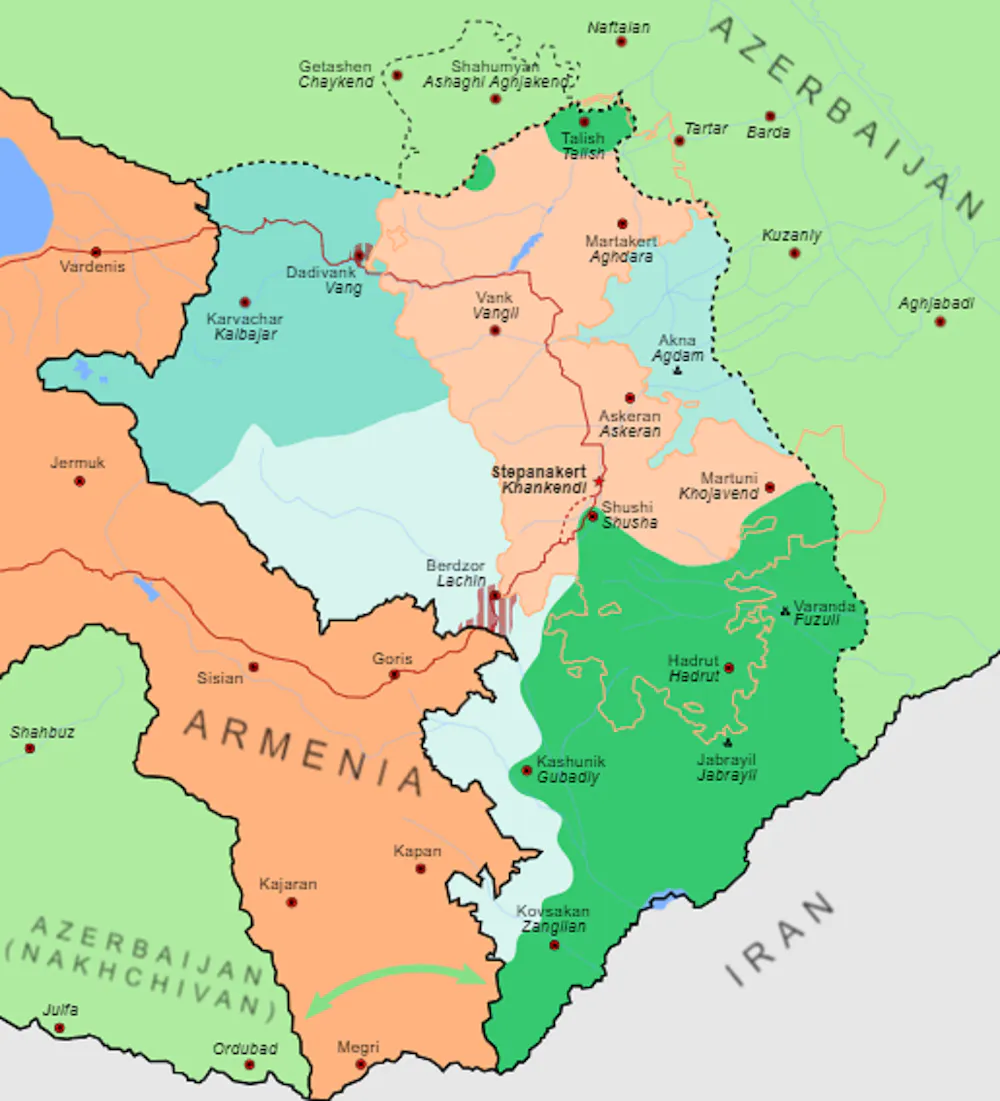
    During the Soviet era, the union republics of Armenia and Azerbaijan both felt that Moscow favoured the other. Armenia was unhappy that the Soviet leadership allocated Nagorno-Karabakh, a majority-Armenian exclave surrounded by Azeri-populated lands, to Azerbaijan. Azerbaijan was dissatisfied that its borders denied it a land connection to its population in Nakhchivan, an exclave of ethnic Azeris that could only be reached via southern Armenia.

    In the final years of the Soviet Union, as Armenian nationalism began to assert itself during the period of perestroika (restructuring), Nagorno-Karabakh’s legislature passed a law declaring its intention to join Armenia. This move eventually led to armed clashes in the region.

    The first Karabakh war, which raged between 1988 and 1994, began before the Soviet break-up but continued after the two countries gained their independence. In 1994, after more than 30,000 casualties, Russia brokered a ceasefire. The settlement favoured Armenia, leaving it in control of Nagorno-Karabakh and another six surrounding Azerbaijani districts.

    Things began to change when Putin took power in Russia in 2000. Russia’s relations with Azerbaijan improved, partly due to his personal rapport with the then-president, Heydar Aliyev, and his son Ilham, who would succeed him in 2003. After 9/11, when combating international terrorism became a global priority, Azerbaijan put measures in place to prevent transfer of fighters and weapons through its territory to the war in Chechnya, which further improved relations with Moscow.

    At this stage, Azerbaijan was pursuing what it described as a “multi-vector” foreign policy. This allowed it to develop ties with a variety of countries, including the US, Russia and others to whom it sold oil. While remaining in the Commonwealth of Independent States, it did not sign up to the Russia-led Collective Security Treaty Organisation (CSTO).

    Nagorno-Karabakh

    Armenia, by contrast, was a fully participating member of the CSTO. Having signed an Eternal Friendship Treaty with Russia in 1997, this was a clear strategic choice for Armenia – partly motivated by historical ties.

    Russia had traditionally been seen as a defender of Christianity in the days of the Ottomon empire. Many people had fled massacres in Western Armenia (modern-day Turkey) in 1915 to come under the protection of the Russian Tsar. But Armenia also saw Moscow as a vital security guarantor against an increasingly militarised Azerbaijan, which was determined to recover control of Nagorno-Karabakh and other areas occupied by Armenia.

    Map showing the concept of the ‘Zanzegur corridor’, which would cut across southernmost Armenia to connect Azerbaijan with Nakhchivan.
    Mapeh/Wikimedia Commons, CC BY-NC

    Indeed, it was Nagorno-Karabakh which really soured relations between Armenia and Moscow. In 2020, when – aided by Turkey – Azerbaijan launched its offensive to retake the territory, Russia failed to come to the aid of its CSTO ally. This was expected, given that relations had begun to deteriorate in 2018 when Pashinyan came to power in Armenia.

    In hindsight, most commentators believe Russia had become tired of Armenia’s intransigence over the plan, agreed in Madrid in 2007, for it to cede back the six districts surrounding Nagorno-Karabakh to Azerbaijan.

    Instead, Moscow brokered a ceasefire agreement and deployed 2,000 peacekeepers along the Lachin corridor, a strip of land connecting Armenia and Nagorno-Karabakh. But these troops also failed to intervene when an Azeri offensive retook the whole of Nagorno-Karabakh in September 2023, forcing the population of about 100,000 ethnic Armenians to flee.


    Read more:
    Nagorno-Karabakh: the world should have seen this crisis coming – and it’s not over yet


    Things sour between Moscow and Baku

    Relations between Russia and Azerbaijan, meanwhile, have gone downhill rapidly. In December 2024, an Azeri civilian airliner was shot down in Russian airspace. Putin apologised, but Azerbaijan insisted on Moscow disclosing the results of the investigation and paying compensation to the victims.

    Things got worse at the end of June, when Russian authorities arrested a group of ethnic Azerbaijanis as part of a decades-old murder case. Two of the men died while being detained. Azerbaijan retaliated by raiding the Baku offices of Russia’s Sputnik news agency and detaining the staff as well as a group of Russian IT workers. When they appeared in court, some of the men appeared to have been beaten in custody.

    Azerbaijan also denounced Russia in state media and Russia House, the state-funded Russian cultural agency in Baku, was closed down, with several cultural events cancelled. Security agencies began to enforce documentation checks on all Russian nationals in the country.

    At the same time, Azerbaijan and Armenia were already talking about concluding a peace treaty independently, without intermediaries. All this has prompted speculation of a serious loss of influence in the region for Moscow.

    However, a complete shutout of Russia in the South Caucasus is unlikely. Both Armenia and Azerbaijan depend on remittance income from their nationals in Russia. Both countries also remain close trading partners with Russia. While Armenia suspended its membership in CSTO, it has not quit the organisation altogether.

    Far more likely is that the two countries, mindful of the growing influence of Turkey in the region and the shifts created by Donald Trump in world affairs, are manoeuvring while weighing their options. Geography matters, as Georgia’s example demonstrates – efforts to cut ties with Russia by its former president, Mikheil Saakashvili, have been partially reversed by the current government, which increasingly leans towards Moscow.

    In the cases of Armenia and Azerbaijan, economic ties, transport links and human connections still favour a relationship with Russia. So, a temporary breakdown in political relations can be mended – if all three leaders demonstrate enough statesmanship to sail through the troubled waters.


    Get your news from actual experts, straight to your inbox. Sign up to our daily newsletter to receive all The Conversation UK’s latest coverage of news and research, from politics and business to the arts and sciences.

    Anna Matveeva does not work for, consult, own shares in or receive funding from any company or organisation that would benefit from this article, and has disclosed no relevant affiliations beyond their academic appointment.

    – ref. Armenia and Azerbaijan are trying to mend fences – what does this mean for Russia? – https://theconversation.com/armenia-and-azerbaijan-are-trying-to-mend-fences-what-does-this-mean-for-russia-261384

    MIL OSI Analysis –

    July 26, 2025
  • MIL-OSI Submissions: Armenia and Azerbaijan are trying to mend fences – what does this mean for Russia?

    Source: The Conversation – UK – By Anna Matveeva, Visiting Senior Research Fellow, King’s Russia Institute, King’s College London

    At a time when Vladimir Putin needs friends in his neighbourhood, he appears instead to be losing them in the South Caucasus. After two centuries of Russian involvement in the region, balancing the historical rivalry and at times acting as mediator between Armenia and Azerbaijan, there is growing speculation that the two countries are preparing a major reset in relations.

    When Armenia’s prime minister, Nikol Pashinyan, met the Azerbaijani president, Ilham Aliyev, in Abu Dhabi on July 10, they reportedly came close to agreeing a peace treaty. The big question is whether, if these two countries can iron out mistrust and violence born of the territorial conflict, there will still be a role for Russia in the South Caucasus.

    To understand the complex geopolitics of the region, you need to go back to the early 19th century, when Azerbaijan and what is now the Republic of Armenia) were ceded to Russia following the Russo-Persian wars. After the Russian revolution, the two countries achieved brief independence between 1918 and 1920 (though not in their present borders) before being incorporated into the Soviet Union.

    During the Soviet era, the union republics of Armenia and Azerbaijan both felt that Moscow favoured the other. Armenia was unhappy that the Soviet leadership allocated Nagorno-Karabakh, a majority-Armenian exclave surrounded by Azeri-populated lands, to Azerbaijan. Azerbaijan was dissatisfied that its borders denied it a land connection to its population in Nakhchivan, an exclave of ethnic Azeris that could only be reached via southern Armenia.

    In the final years of the Soviet Union, as Armenian nationalism began to assert itself during the period of perestroika (restructuring), Nagorno-Karabakh’s legislature passed a law declaring its intention to join Armenia. This move eventually led to armed clashes in the region.

    The first Karabakh war, which raged between 1988 and 1994, began before the Soviet break-up but continued after the two countries gained their independence. In 1994, after more than 30,000 casualties, Russia brokered a ceasefire. The settlement favoured Armenia, leaving it in control of Nagorno-Karabakh and another six surrounding Azerbaijani districts.

    Things began to change when Putin took power in Russia in 2000. Russia’s relations with Azerbaijan improved, partly due to his personal rapport with the then-president, Heydar Aliyev, and his son Ilham, who would succeed him in 2003. After 9/11, when combating international terrorism became a global priority, Azerbaijan put measures in place to prevent transfer of fighters and weapons through its territory to the war in Chechnya, which further improved relations with Moscow.

    At this stage, Azerbaijan was pursuing what it described as a “multi-vector” foreign policy. This allowed it to develop ties with a variety of countries, including the US, Russia and others to whom it sold oil. While remaining in the Commonwealth of Independent States, it did not sign up to the Russia-led Collective Security Treaty Organisation (CSTO).

    Nagorno-Karabakh

    Armenia, by contrast, was a fully participating member of the CSTO. Having signed an Eternal Friendship Treaty with Russia in 1997, this was a clear strategic choice for Armenia – partly motivated by historical ties.

    Russia had traditionally been seen as a defender of Christianity in the days of the Ottomon empire. Many people had fled massacres in Western Armenia (modern-day Turkey) in 1915 to come under the protection of the Russian Tsar. But Armenia also saw Moscow as a vital security guarantor against an increasingly militarised Azerbaijan, which was determined to recover control of Nagorno-Karabakh and other areas occupied by Armenia.

    Map showing the concept of the ‘Zanzegur corridor’, which would cut across southernmost Armenia to connect Azerbaijan with Nakhchivan.
    Mapeh/Wikimedia Commons, CC BY-NC

    Indeed, it was Nagorno-Karabakh which really soured relations between Armenia and Moscow. In 2020, when – aided by Turkey – Azerbaijan launched its offensive to retake the territory, Russia failed to come to the aid of its CSTO ally. This was expected, given that relations had begun to deteriorate in 2018 when Pashinyan came to power in Armenia.

    In hindsight, most commentators believe Russia had become tired of Armenia’s intransigence over the plan, agreed in Madrid in 2007, for it to cede back the six districts surrounding Nagorno-Karabakh to Azerbaijan.

    Instead, Moscow brokered a ceasefire agreement and deployed 2,000 peacekeepers along the Lachin corridor, a strip of land connecting Armenia and Nagorno-Karabakh. But these troops also failed to intervene when an Azeri offensive retook the whole of Nagorno-Karabakh in September 2023, forcing the population of about 100,000 ethnic Armenians to flee.


    Read more:
    Nagorno-Karabakh: the world should have seen this crisis coming – and it’s not over yet


    Things sour between Moscow and Baku

    Relations between Russia and Azerbaijan, meanwhile, have gone downhill rapidly. In December 2024, an Azeri civilian airliner was shot down in Russian airspace. Putin apologised, but Azerbaijan insisted on Moscow disclosing the results of the investigation and paying compensation to the victims.

    Things got worse at the end of June, when Russian authorities arrested a group of ethnic Azerbaijanis as part of a decades-old murder case. Two of the men died while being detained. Azerbaijan retaliated by raiding the Baku offices of Russia’s Sputnik news agency and detaining the staff as well as a group of Russian IT workers. When they appeared in court, some of the men appeared to have been beaten in custody.

    Azerbaijan also denounced Russia in state media and Russia House, the state-funded Russian cultural agency in Baku, was closed down, with several cultural events cancelled. Security agencies began to enforce documentation checks on all Russian nationals in the country.

    At the same time, Azerbaijan and Armenia were already talking about concluding a peace treaty independently, without intermediaries. All this has prompted speculation of a serious loss of influence in the region for Moscow.

    However, a complete shutout of Russia in the South Caucasus is unlikely. Both Armenia and Azerbaijan depend on remittance income from their nationals in Russia. Both countries also remain close trading partners with Russia. While Armenia suspended its membership in CSTO, it has not quit the organisation altogether.

    Far more likely is that the two countries, mindful of the growing influence of Turkey in the region and the shifts created by Donald Trump in world affairs, are manoeuvring while weighing their options. Geography matters, as Georgia’s example demonstrates – efforts to cut ties with Russia by its former president, Mikheil Saakashvili, have been partially reversed by the current government, which increasingly leans towards Moscow.

    In the cases of Armenia and Azerbaijan, economic ties, transport links and human connections still favour a relationship with Russia. So, a temporary breakdown in political relations can be mended – if all three leaders demonstrate enough statesmanship to sail through the troubled waters.


    Get your news from actual experts, straight to your inbox. Sign up to our daily newsletter to receive all The Conversation UK’s latest coverage of news and research, from politics and business to the arts and sciences.

    Anna Matveeva does not work for, consult, own shares in or receive funding from any company or organisation that would benefit from this article, and has disclosed no relevant affiliations beyond their academic appointment.

    – ref. Armenia and Azerbaijan are trying to mend fences – what does this mean for Russia? – https://theconversation.com/armenia-and-azerbaijan-are-trying-to-mend-fences-what-does-this-mean-for-russia-261384

    MIL OSI –

    July 26, 2025
  • MIL-OSI USA: Senator Ricketts Introduces the THINK TWICE Act to Combat Chinese Arms Sales

    US Senate News:

    Source: United States Senator Pete Ricketts (Nebraska)
    WASHINGTON, D.C. – This week, U.S. Senator Pete Ricketts (R-NE) introduced the Tracking Hostile Industry Networks and Kit while Thwarting Weapons Imports from Chinese Entities (THINK TWICE) Act of 2025.  The THINK TWICE Act would require an assessment of arms sales by Communist China and a strategy to dissuade countries from buying Chinese weapons systems and defense equipment.  The legislation was also sponsored by Senator Michael Bennet (D-CO).
    “Communist China has emerged as a major weapons supplier. This is particularly true in Africa, the Middle East, and Asia,” said Ricketts.  “This development has major implications for American defense companies, our military operations, and our global security partnerships.  The recent Pakistan-India clash saw significant use of Chinese-made weapons. This should be a major wake-up call that we must do more to combat these arms sales.  That’s why I’ve introduced the THINK TWICE Act. This act requires a coordinated strategy to dissuade new purchases of Chinese-made weapons. It will also ensure our defense industrial base is better equipped to provide alternatives to prospective buyers.”
    “As China wields arms sales to reshape the international system in Beijing’s image, the United States must reassert its role as a security partner of choice,” said Bennet.  “This legislation is an essential step toward countering China’s expanding military footprint and geopolitical influence.”
    The THINK TWICE Act would:
    Requires the Secretary of Defense, in coordination with the Secretary of State, to report on arms sales facilitated by entities of the People’s Republic of China (PRC).  The report requires inclusion of:
    The specific weapons systems, technical aspects, and capabilities of those weapons;
    The countries mostly likely to procure weapons systems; 
    The weapons that present the greatest security risks regarding the potential to collect intelligence on or compromise U.S. platforms;
    The factors that incentivize countries to procure Chinese weapons; 
    And the PRC’s strategy regarding arms sales.

    Requires the Secretary of State, in coordination with the Secretary of Defense, to develop a strategy to dissuade purchases of new weapons systems and defense equipment from the PRC.  The strategy would include:
    An information campaign to warn countries interested in procuring weapons systems and defense equipment originating from China about risks; 
    A description of actions the U.S. can take, including FMS reforms, commercial sales, and foreign military financing; 
    An analysis of whether sanctions or economic restrictions targeting potential buyers could be used as an effective deterrent; 
    A plan to ensure sufficient representation of defense firms of the U.S. or trusted allies at defense trade shows; 
    And a plan to combat Chinese disinformation campaigns targeting the performance of Western weapons.

    BACKGROUND:
    Communist China is now the fourth largest arms exporter behind the U.S., Russia, and France.  In recent years, Chinese-made drones, missiles, and fighter jets have been exported to 44 countries.  All around the world, Communist China uses arms sales to promote strategic interests, improve its military’s image and reputation, acquire performance data of Chinese-made weapons in contested environments, exacerbate tensions between the U.S. and traditional security partners, and gain a foothold for further defense and security cooperation.  With Russia unable to facilitate arms sales given its war of aggression in Ukraine, an opportunity has arisen for Communist China to fill the void.
    Bill text can be found here.

    MIL OSI USA News –

    July 26, 2025
  • MIL-OSI United Nations: Activities of Secretary-General in Brazil, 5-9 July

    Source: United Nations General Assembly and Security Council

    The United Nations Secretary-General, António Guterres, arrived in Rio de Janeiro, Brazil, on Saturday evening, 5 July, to attend the Seventeenth Summit of the BRICS [Brazil, Russian Federation, India and China] countries.

    On Sunday afternoon, 6 July, after being welcomed by Luiz Inacio Lula da Silva, the President of Brazil, the Secretary-General addressed an outreach session on “Strengthening multilateralism, economic-financial affairs and artificial intelligence”.  He highlighted that artificial intelligence (AI) is reshaping economies and societies, and that the fundamental test is how wisely we guide this transformation.

    The Secretary-General also emphasized that AI cannot be a club of the few, but must benefit all, and in particular developing countries, which must have a real voice in the governance of artificial intelligence.

    In the evening, the Secretary-General attended an official cocktail on the occasion of the BRICS Leader’s Summit, hosted by the President of Brazil, Luiz Inacio Lula da Silva and Janja Lula da Silva.

    On Monday morning, 7 July, soon after his arrival at the 17th Summit of the BRICS venue, the Secretary-General took part in the family photo. He then addressed an outreach session on “Environment, COP30 [Thirtieth Session of the Conference of the Parties to the United Nations Framework Convention on Climate Change] and global health”, warning that our environment is being attacked on all fronts.  Mr. Guterres pointed out that across the world, lives and livelihoods are being ripped apart, and sustainable development gains left in tatters as disasters accelerate.

    The Secretary-General noted that the most vulnerable and the poorer pay the highest price and stressed that we need to tackle the point where climate and health meet.  He also emphasized that we need Governments to build on the progress of last year’s biodiversity COP, particularly reaching an ambitious agreement on finance, adding that we need to make COP30 a success.

    In the afternoon, in a bilateral meeting on the margins of the BRICS Summit, the Secretary-General and the Minister for Foreign Affairs of Iran, Seyed Abbas Araghchi, discussed the situation in the Middle East.  The Secretary-General noted the importance of the consolidation of the ceasefire to lay the groundwork for the resumption of negotiations.

    Immediately after, the Secretary-General held a bilateral meeting with the Minister for Foreign Affairs of the Republic of Türkiye, Hakan Fidan.  The Secretary-General and the Minister discussed the strong partnership between the United Nations and Türkiye.  They also exchanged views on the war in Ukraine, the situation in the Middle East and the next round of meetings on Cyprus.

    Also in the afternoon, the Secretary-General met Sergio Diaz-Granados, the Executive President of the Development Bank of Latin America and the Caribbean.

    On Tuesday morning, 8 July, the Secretary-General met with the Premier of the State Council of China, Li Qiang.  They discussed cooperation between the United Nations and China, sustainable development, climate change and financing.

    The Secretary-General commended China for its commitment to multilateralism and thanked China for its valuable contribution to the United Nations and its activities.

    The Secretary-General departed Rio de Janeiro in the afternoon of Tuesday, 8 July.

    MIL OSI United Nations News –

    July 26, 2025
  • MIL-OSI United Kingdom: Ukraine continues to show its commitment to peace. But President Putin prefers war: UK statement at the UN Security Council

    Source: United Kingdom – Executive Government & Departments 3

    Speech

    Ukraine continues to show its commitment to peace. But President Putin prefers war: UK statement at the UN Security Council

    Statement by Ambassador Barbara Woodward, UK Permanent Representative to the UN, at the UN Security Council meeting on Ukraine.

    Colleagues, the world has rallied around President Trump’s call for an immediate and unconditional ceasefire. Ukraine has agreed. And we echo that call once again today.

    Yet week after week, night after night, we see the number of Russian assaults grow.

    June was the deadliest month yet, and July is on track to be even deadlier.

    This makes a mockery of the diplomacy that Russia claims to support.

    And the consequences are ever more devastating for the people of Ukraine.

    Across five nights from the 18 to 23 July, Russia launched over 940 drones and 59 missiles at Ukrainian cities, killing 20 civilians and injuring a further 216.

    Just days before, a record-breaking 728 long-range drones were launched on Ukraine in a single day.

    Since the start of the invasion, over 13,500 civilians have been killed and more than 34,000 injured. This includes more than 200 children killed or injured since March alone.

    We cannot allow ourselves to become desensitised to these figures. Behind each Russian strike there is a person, a family, a community whose lives have been torn apart by Russia’s brutal military invasion.

    The Shygyds are one such family. On 5 June, as a Ukrainian firefighter arrived at the scene of a Russian attack on Chernihiv, he discovered that his wife, his daughter, and his grandson had all been killed.

    His grandson was only a year old. Three generations lost to cold-blooded Russian brutality in just one night.

    This is not an isolated incident. Families like The Shygyds are being torn apart across Ukraine and have been since February 2022.

    Russia has a clear and unqualified obligation to uphold the UN Charter.

    Russia also has an obligation to respect the Geneva Conventions and to the protection of civilians under international humanitarian law. There is simply no justification for brutal aggression like this.

    The reality is clear: Ukraine, a country illegally invaded by Russia, continues to show its commitment to peace. But President Putin prefers war.

    He is shunning diplomatic efforts made in good faith to bring an end to this horror, a horror of his own making.

    There is no ambiguity about what needs to come next.

    It is time for Russia to stop prevaricating and agree to an immediate and unconditional ceasefire, as the first step towards a just and lasting peace.

    Updates to this page

    Published 25 July 2025

    MIL OSI United Kingdom –

    July 26, 2025
  • MIL-OSI Russia: China effectively protects cultural heritage through legislation – report

    Translation. Region: Russian Federal

    Source: People’s Republic of China in Russian – People’s Republic of China in Russian –

    An important disclaimer is at the bottom of this article.

    Source: People’s Republic of China – State Council News

    BEIJING, July 25 (Xinhua) — China has emphasized legislative efforts to ensure sound protection of cultural heritage and has drafted a series of laws and regulations in this field, according to a report titled “Jointly Protecting Treasures of Human Civilization: China’s Concept and Practice of Cultural Heritage Preservation in the New Era” released Friday by the Xinhua Institute, a think tank under the Xinhua News Agency.

    According to the report, over the past years, China has enacted the Law on the Protection of Cultural Relics and the Law on Intangible Cultural Heritage, as well as relevant administrative regulations such as the Regulations on the Protection of the Great Wall of China, the Regulations on Museums, and the Regulations on the Protection of Famous Cultural and Historical Cities, Towns and Villages.

    It is noteworthy that in March 2025, the revised Law on the Protection of Cultural Property came into force.

    According to the document, China has now created a multi-level and priority-oriented legal framework that provides reliable and effective judicial support for the protection, preservation and use of the country’s cultural heritage. -0-

    Please note: This information is raw content obtained directly from the source of the information. It is an accurate report of what the source claims and does not necessarily reflect the position of MIL-OSI or its clients.

    .

    MIL OSI Russia News –

    July 26, 2025
  • MIL-OSI Russia: The State Ice Ballet of St. Petersburg will present Swan Lake and Sleeping Beauty in Beijing

    Translation. Region: Russian Federal

    Source: People’s Republic of China in Russian – People’s Republic of China in Russian –

    An important disclaimer is at the bottom of this article.

    Source: People’s Republic of China – State Council News

    BEIJING, July 25 (Xinhua) — The St. Petersburg State Ice Ballet will present classical ballet performances of “Swan Lake” and “Sleeping Beauty” at the Beijing Performing Arts Center from July 25 to 27, showcasing to Chinese audiences the beautiful combination of the elegance of classical ballet and the dynamics of figure skating.

    The ballet troupe included more than 40 Russian ice ballet dancers, including many Olympic and world championship winners.

    It is noteworthy that the Beijing Performing Arts Center is the first to create a stage using real ice, prepared from 17 tons of pure water. It is maintained by professionals using special equipment.

    The State Ballet on Ice of Saint Petersburg /former Leningrad State Ballet on Ice/, founded in 1967 by the outstanding Russian choreographer Konstantin Boyarsky, is the successor to the traditions of the Saint Petersburg school of Russian classical ballet. -0-

    Please note: This information is raw content obtained directly from the source of the information. It is an accurate report of what the source claims and does not necessarily reflect the position of MIL-OSI or its clients.

    .

    MIL OSI Russia News –

    July 26, 2025
  • MIL-OSI Russia: China’s Basic Pension Insurance Covers Over 1.07 Billion People – Report

    Translation. Region: Russian Federal

    Source: People’s Republic of China in Russian – People’s Republic of China in Russian –

    An important disclaimer is at the bottom of this article.

    Source: People’s Republic of China – State Council News

    BEIJING, July 25 (Xinhua) — More than 1.07 billion people in China were covered by basic pension insurance by the end of 2024, up 6.39 million from the end of 2023, Xinhua reported on Friday.

    According to a report jointly released by the Ministry of Civil Affairs and the China National Council on Aging on Thursday, the country is expected to see an increase in the number of people covered by basic pension insurance, basic old-age insurance for urban workers and employees, and basic old-age insurance for enterprise workers by the end of 2024.

    The report said that by the end of 2024, the number of elderly people aged 60 and above in China will reach 310.3 million, accounting for 22 percent of the country’s total population. The number of elderly people aged 65 and above will exceed 220.2 million, accounting for 15.6 percent of the total population.

    Meanwhile, the average life expectancy of the population reached 79 years by the end of last year.

    According to the report, China has seen an improvement in its system for providing dignified old age services. By the end of 2024, there were about 406,000 elderly care institutions and facilities across the country. The number of beds for the elderly in these facilities exceeded 7.99 million. -0-

    Please note: This information is raw content obtained directly from the source of the information. It is an accurate report of what the source claims and does not necessarily reflect the position of MIL-OSI or its clients.

    .

    MIL OSI Russia News –

    July 26, 2025
  • MIL-OSI Russia: Military helicopter disappears from radar in Almaty region

    Translation. Region: Russian Federal

    Source: People’s Republic of China in Russian – People’s Republic of China in Russian –

    An important disclaimer is at the bottom of this article.

    Source: People’s Republic of China – State Council News

    ALMATY, July 25 (Xinhua) — An EC-145 helicopter of the Air Defense Forces of the Armed Forces of Kazakhstan disappeared from radars on Friday during a scheduled flight in the Almaty region of Kazakhstan, the Kazinform news agency reported, citing the Defense Ministry.

    According to preliminary data, there were three crew members on board.

    On the instructions of the Minister of Defense, a special commission was dispatched to the scene to clarify all the circumstances of the incident.

    The forces and resources of the Ministry of Emergency Situations of Kazakhstan and two Kazaviaspas helicopters were also immediately sent to carry out search and rescue operations.

    The operation involves units of the Ministry of Emergency Situations, the Center for Disaster Medicine, the Republican Operational Rescue Squad and the Ministry of Emergency Situations aviation. In total, more than 100 people and about 15 units of equipment, including aviation and drones, are involved.

    Search and rescue operations continue. –0–

    Please note: This information is raw content obtained directly from the source of the information. It is an accurate report of what the source claims and does not necessarily reflect the position of MIL-OSI or its clients.

    .

    MIL OSI Russia News –

    July 26, 2025
  • MIL-OSI Russia: Hydrometeorologists from China and Russia held a consultation on summer-autumn floods on the Heilongjiang River

    Translation. Region: Russian Federal

    Source: People’s Republic of China in Russian – People’s Republic of China in Russian –

    An important disclaimer is at the bottom of this article.

    Source: People’s Republic of China – State Council News

    BEIJING, July 25 (Xinhua) — Hydrometeorologists from Heihe City in China’s Heilongjiang Province and Russia’s Amur Region held a consultation on summer-autumn floods on the Heilongjiang River (Amur), which partially flows along the Chinese-Russian border.

    Officials from Heihe City and the Amur Region held an online meeting on Wednesday to forecast summer-autumn floods on the Heilongjiang River and signed a protocol for the event, the Heihe Daily newspaper reported.

    Both sides believe that the Heilongjiang River is expected to have a high water level on the Russian side and a medium level on the Chinese side in July and August this year. Given the impact of typhoons and other extreme weather events, it is possible that the water level in the river will exceed the dangerous level.

    Hydrometeorologists from both sides also summed up the results of their joint work and agreed to intensify cooperation to prevent possible floods and eliminate their consequences.

    As a dialogue mechanism between China and Russia on flood prevention and damage mitigation, the consultations have a history of more than 20 years. Both sides maintain cooperation in meteorological and hydrological forecasting, monitoring and warning, and joint action in emergency situations. -0-

    Please note: This information is raw content obtained directly from the source of the information. It is an accurate report of what the source claims and does not necessarily reflect the position of MIL-OSI or its clients.

    .

    MIL OSI Russia News –

    July 26, 2025
  • MIL-OSI Russia: 155th Joint Patrol of Mekong River Concluded

    Translation. Region: Russian Federal

    Source: People’s Republic of China in Russian – People’s Republic of China in Russian –

    An important disclaimer is at the bottom of this article.

    Source: People’s Republic of China – State Council News

    KUNMING, July 25 (Xinhua) — Law enforcement agencies from China, Laos, Myanmar and Thailand concluded the 155th joint patrol of the Mekong River on Friday, the public security department of southwest China’s Yunnan Province said.

    The four-day, three-night joint patrol involved seven patrol vessels and more than 100 law enforcement officers from four countries, covering a total of more than 700 km.

    The mission included combined water-land inspections in some key water areas of the Mekong River. During the patrol, the relevant law enforcement agencies of the four countries also held an information-sharing meeting in Chiang Saen, Thailand, where they had an in-depth exchange of views on the current security situation in the Mekong River basin, experience in joint law enforcement, and key areas for further law enforcement cooperation. Following the meeting, the parties reached a number of agreements.

    In addition, China, Laos and Myanmar will also conduct a joint deployment and training mission in the Mekong waters to further enhance their emergency response capabilities and combat interoperability in real conditions.

    The Mekong River, known in China as the Lancangjiang, is one of the most important waterways for transboundary shipping in Southeast Asia. Joint patrols of the Mekong involving China, Laos, Myanmar and Thailand have been conducted since December 2011. –0–

    Please note: This information is raw content obtained directly from the source of the information. It is an accurate report of what the source claims and does not necessarily reflect the position of MIL-OSI or its clients.

    .

    MIL OSI Russia News –

    July 26, 2025
  • MIL-OSI Russia: Essay: “Remembering the Past, Creating the Future” — a photo exhibition in honor of the 80th anniversary of the Victory in the World Anti-Fascist War as a reflection of the history of friendship between China and Russia

    Translation. Region: Russian Federal

    Source: People’s Republic of China in Russian – People’s Republic of China in Russian –

    An important disclaimer is at the bottom of this article.

    Source: People’s Republic of China – State Council News

    Moscow, July 25 (Xinhua) — A photo exhibition titled “Remembering the Past, Creating the Future” in honor of the 80th anniversary of the victory in the Chinese People’s War of Resistance Against Japanese Aggression and the World Anti-Fascist War was held at the Chinese Embassy in Moscow on Thursday. Sixty-one unique photographs from the archives of the Xinhua News Agency were on display, depicting key events of the war years and the heroic feat of the Chinese people in the war, and also reflecting the contribution of China and the Soviet Union to the victory over fascism and militarism. In addition, visitors were able to see modern photographs telling about the development of Russian-Chinese military and cultural-humanitarian cooperation in recent years.

    Chinese Ambassador to Russia Zhang Hanhui, who visited the photo exhibition, said that 80 years ago, China and the Soviet Union, as the main theaters of military operations in Asia and Europe in World War II, played a key role in the fight against Japanese militarism and German Nazism and in achieving Victory. “The countries made a great historical contribution. The Chinese and Russian people fought side by side, at the cost of their lives and blood, accomplished a great feat that went down in history, defending human dignity and restoring peace throughout the world,” he noted.

    The diplomat stressed that as the main victorious countries in World War II and permanent members of the UN Security Council, China and Russia will firmly uphold the victory in World War II, maintain the post-war international order, resist any attempts to interfere in history, safeguard international justice and fairness, jointly promote the building of a community with a shared future for mankind, and work tirelessly to create a better future for mankind.

    The guest of honor at the photo exhibition was State Secretary – Deputy Minister of Defense of the Russian Federation Anna Tsivileva. She looked at the archival photographs with interest. Her attention was drawn to a black-and-white photo from 1945, which captured the touching moment of farewell of the residents of the city of Luida /now the city of Dalian, Liaoning Province, Northeast China/ to Soviet soldiers and officers returning home after the victory.

    A. Tsivileva also stopped at a bright color photograph taken 10 years ago on the occasion of the 70th anniversary of the Victory in the Chinese People’s War of Resistance against Japanese Aggression. It shows the long-awaited meeting of Chinese and Russian veterans. The already very elderly men, dressed in military uniforms, hug each other tightly. There are tears in their eyes. “Such warm photographs, and a very emotional message of sincere joy from the meeting. Thank you for such a wonderful exhibition,” A. Tsivileva said after viewing the exposition.

    Andrey Vinogradov, head of the Center for the Study of Modern China at the Institute of Oriental Studies of the Russian Academy of Sciences, called the exhibition very timely in an interview with Xinhua. As a researcher of 20th-century Chinese history, he was interested in looking at the photographs — historical evidence of World War II and the Chinese People’s War of Resistance against Japanese Aggression.

    “China took part in the war longer than any other coalition country, since 1931. For 14 years, China courageously resisted and thus tied down Japanese forces and contributed to the coalition’s victory, which took place in other theaters, in particular, in the Pacific theater, in Southeast Asia. China contributed to the overall victory throughout this time,” he emphasized.

    Professor of the Plekhanov Russian University of Economics, Deputy Chairman of the Committee on Economic Cooperation with Countries of Asia and Oceania of the Chamber of Commerce and Industry of the Russian Federation Vadim Saltykovskiy believes that today’s unprecedented level of relations between Russia and China is based on the historical experience of interaction that the peoples of the two countries had during the joint fight against fascism. “The basis is still in those 30-40s, when our peoples, our countries really created the basis of our relations,” he noted, adding that preserving historical memory plays an important role in strengthening relations between China and Russia and confronting external challenges.

    Roskino employee Ivan Buzko admitted to a Xinhua correspondent that the exhibition is very emotionally charged. “Looking at these photographs, you can feel how hard it was for the Chinese people in those years, you can feel the pain, the trials that they had to overcome. At the same time, the heroism of the Chinese people is reflected here. It also shows how, through the joint efforts of China, the Soviet Union, the allies and all the movements that fought fascism, they managed to defeat the common enemy. The exhibition is breathtaking,” he shared his feelings. According to him, this exhibition is an important element in the formation of intercultural ties between Russia and China through the prism of those great historical events.

    The exhibition was prepared by the Xinhua Asia-Europe Bureau, the Xinhua Hubei Bureau, and China Image Group. The co-organizer was Angel Yeast Co. Ltd. The event was held with the support of the Chinese Embassy in the Russian Federation. –0–

    Please note: This information is raw content obtained directly from the source of the information. It is an accurate report of what the source claims and does not necessarily reflect the position of MIL-OSI or its clients.

    .

    MIL OSI Russia News –

    July 26, 2025
  • MIL-OSI Russia: Moscow hosts formal reception to mark 98th anniversary of PLA founding

    Translation. Region: Russian Federal

    Source: People’s Republic of China in Russian – People’s Republic of China in Russian –

    An important disclaimer is at the bottom of this article.

    Source: People’s Republic of China – State Council News

    Moscow, July 25 (Xinhua) — A reception to mark the 98th anniversary of the founding of the People’s Liberation Army (PLA), which is celebrated on August 1, was held at the Chinese Embassy in Moscow on Thursday.

    The event was attended by employees of diplomatic and military departments of various countries, representatives of the socio-political and expert communities of Russia. Descendants of Russian veterans who fought in China were also invited to the Chinese diplomatic mission.

    As Major General Li Yuge, Defense Attaché at the Chinese Embassy in the Russian Federation, noted in his welcoming speech, over the 98 years of its existence, the PLA, under the leadership of the Communist Party of China, has played an important role in achieving national independence, liberating the people and ensuring the prosperity of the country.

    “Today, the People’s Liberation Army of China is following the instructions of Chairman Xi Jinping to strengthen the armed forces and implement a new military strategy for a new era,” he said, adding that the PLA is striving to achieve all its goals by its 100th anniversary.

    In his speech, the Chinese military attaché also recalled that this year marks the 80th anniversary of the victory in the Chinese People’s War of Resistance Against Japanese Aggression, the Great Patriotic War and the World Anti-Fascist War. He stressed that China and Russia, as the main theaters of military operations in Asia and Europe during World War II, played a decisive role in the victory over fascism. “We deeply honor the memory of all veterans whose outstanding feats ensured victory in the world anti-fascist war. We categorically reject any attempt to distort the historical truth about World War II,” he assured.

    Speaking about military and military-technical cooperation between China and Russia, Li Yuge said that it has reached the highest level in history. The commanders of the armed forces of the two countries maintain close contacts, the armies constantly expand their professional experience, conduct joint exercises, sea and air patrols, and actively cooperate in training military personnel. “This is conducive to strengthening mutual trust and practical cooperation between the two armies, and contributes to maintaining international peace and regional stability,” the Chinese military officer added.

    On behalf of the Russian Ministry of Defense, State Secretary and Deputy Minister of Defense of the Russian Federation Anna Tsivileva congratulated on the 98th anniversary of the PLA. She noted that a huge path has been covered since the PLA was created on August 1, 1927, and today the Chinese army is one of the most modern and high-tech armies in the world.

    As A. Tsivileva stated, China and Russia demonstrate an example of military cooperation and readiness to jointly counter any challenges and threats. “Moreover, all our joint actions are not directed against third countries and are carried out exclusively in the interests of each other,” she pointed out, noting that the consistent development of interaction between the two states in the field of defense, based on a high level of mutual strategic trust, effectively strengthens regional and global security.

    A festive concert was prepared for the guests of the Chinese embassy with the participation of artists from the Academic Song and Dance Ensemble of the Russian Army named after A. V. Alexandrov and the legendary Russian ensemble “Beryozka”. A photo exhibition “Remembering the Past, Creating the Future” was also organized in honor of the 80th anniversary of the Victory in the Chinese People’s War of Resistance against Japanese Aggressors and the World Anti-Fascist War, where one could see unique historical photographs from the Xinhua archive. –0–

    Please note: This information is raw content obtained directly from the source of the information. It is an accurate report of what the source claims and does not necessarily reflect the position of MIL-OSI or its clients.

    .

    MIL OSI Russia News –

    July 26, 2025
  • MIL-OSI Russia: Master classes on phytodesign and lectures on the life cycle of products. RUDN University held the Agropicnic in Gorky Park for the second time

    Translation. Region: Russian Federal

    Source: Peoples’Friendship University of Russia –

    An important disclaimer is at the bottom of this article.

    The RUDN Agrarian and Technological Institute held the Agropicnic in Gorky Park for the second time. About 250 guests of the event were able to “touch science with their hands”: conduct experiments with soil, create a composition of succulents and learn from lecturers how potatoes, carrots and cocoa appeared in our country.

    “The agropicnic became a real celebration of unity, exchange of experience and inspiration for our institute. We brought together students, teachers, our partners – JSC Rosselkhozbank and X5 Group – and all those who are not indifferent to the development of agricultural science and production. In a friendly atmosphere, we discussed the latest achievements, shared practical knowledge and ideas, received a charge of positive emotions and confidence in the future. I am convinced that such events strengthen the professional community, contribute to the popularization of modern agricultural technologies and create a solid foundation for new achievements,” – Elvira Dovletyarova, Director of the Agrarian and Technological Institute of RUDN.

    Moss and the Mysterious Box

    Among the guests of Agropicnic were not only students and adults, but also schoolchildren. They took part in creative master classes with great pleasure. For example, the children tried on the role of phytodesigners and, together with experts, created mini-compositions from succulents, moss and natural materials to decorate their home or classroom. At the same time, they learned how to properly care for plants.

    The importance of tactile contact and attention when caring for pets was discussed by RUDN University veterinary students. To do this, they played a game with the guests of the Agropicnic, in which they had to identify an object hidden in a mysterious box by touch. Delicacy is important when checking the ears, eyes, fur and skin of pets for diseases and parasitic insects.

    Experiments in the Park

    Participants of the practical lesson, which was held in the format of a mini-experiment, were able to visit the place of students of the RUDN Agrarian and Technological Institute. First, children and adults learned about the soil indicators that scientists evaluate. These are color, structure, humidity, acidity and fertility. After that, everyone tried to independently select a soil sample and conduct simple tests with it. For example, roll a soil ball and describe its structure, determine the pH level using indicator strips.

    At the RUDN lecture hall, guests of the Agropicnic were introduced to the life cycle of food products, told about quality control of products at all stages of production and about the history of the appearance of potatoes, beans, carrots and cocoa in our country. In addition, the participants of the event learned a lot about modern technologies that are used in the agricultural sector.

    “Before this event, I was unsure about which direction to take my future career. After attending the master classes and learning about real examples of modern agricultural professions, I felt genuine interest and internal motivation. And I discovered an amazing fact: professions in the agricultural sphere today are not only about physical labor, but also about science, technology, caring for the environment and human health. I was inspired by how smart developments can not only make hard work easier, but also really change something for the better for humanity and nature. Now I have definitely decided: I want to do something that is useful, develops new areas of knowledge and promotes harmony between people and the planet,” – Yaroslav, a student at School No. 1570.

    A bridge between theory and practice

    During the Agropicnic, schoolchildren and applicants also asked questions about studying at RUDN in the areas of “Biotechnology”, “Bioengineering and bioinformatics”, “Landscape architecture”, “Land management and cadastre” and others. In total, the Agrarian and Technological Institute has 25 higher education programs and 5 joint master’s programs with foreign universities.

    “Agropicnic is a bridge between theory and practice. Here, professionals, students and schoolchildren can see how science makes agriculture efficient, environmentally friendly and promising. For RSHB, such projects are an investment in the future of the industry and in the people who create it. This is part of our strategy to support agricultural education and popularize professions in the agro-industrial complex,” Lyubov Belesku, Advisor to the Chairman of the Board of Rosselkhozbank.

    The general sponsor of the event is Rosselkhozbank, the project partners are Gorky Park and X5 Group.

    Please note: This information is raw content obtained directly from the source of the information. It is an accurate report of what the source claims and does not necessarily reflect the position of MIL-OSI or its clients.

    .

    MIL OSI Russia News –

    July 26, 2025
  • MIL-OSI China: Russia launches 20 satellites into orbit, including one from Iran

    Source: People’s Republic of China – State Council News

    Russia successfully launched 20 satellites into space on Friday, including an Iranian telecommunications satellite, the Russian state space corporation Roscosmos announced.

    A Soyuz-2.1b carrier rocket lifted off from the Vostochny Cosmodrome in Russia’s Far East at 8:54 Moscow time (0554 GMT), Roscosmos said on its website.

    The primary payload of the mission was the Ionosfera-M satellites No. 3 and No. 4, designed to study physical processes in the Earth’s ionosphere caused by both natural and human-induced factors. These include changes in the ionosphere’s spatial and temporal structure, electromagnetic field disturbances, the composition of the upper atmosphere, and ozone distribution. The satellites will also help monitor the radiation environment.

    The launch also carried 18 small satellites. Among them were nine developed by the Russian company Geoscan, which will conduct Earth imaging, track air and sea traffic, and study near-Earth space physics.

    Some of the satellites are intended for educational purposes, including projects aimed at exploring satellite-to-Earth communication links and testing small satellite control technologies in low Earth orbit.

    According to TASS news agency, the payload also included the Iranian-made Nahid-2 telecommunications satellite. 

    MIL OSI China News –

    July 26, 2025
  • MIL-OSI Russia: Navy and Polytechnic: an inseparable link

    Translation. Region: Russian Federal

    Source: Peter the Great St. Petersburg Polytechnic University –

    An important disclaimer is at the bottom of this article.

    Russian Navy Day is celebrated on the last Sunday of July, and each time these are different dates. But in 2025, we have the opportunity to congratulate the sailors on the day established by the founder of the Russian fleet, Emperor Peter the Great, after whom the Polytechnic University is named. During Peter’s reign, it was on July 27 that they honored the sailors in memory of the great victories of the Russian fleet at Cape Gangut in 1714 and Grengam Island in 1720. On this day, ships were decorated with flags, fireworks were fired, and parades were held.

    The creation of the fleet was one of Peter’s main achievements. The first ships were built in Voronezh. And on December 1, 1699, Peter approved the St. Andrew’s naval flag. In 1702, they began building galleys on the Syas, Luga and Svir rivers. In 1704, the tsar founded the Admiralty shipyards in the future capital. Ships were built all over Russia: in Voronezh, Kazan, Pereslavl, Arkhangelsk, Olonets, St. Petersburg and Astrakhan. By 1725, the Russian fleet numbered 130 sailing ships, 253 galleys and 143 brigantines.

    Peter not only created the Russian navy, but also laid the foundation for engineering in the country. Years later, the St. Petersburg Polytechnic Institute became a prominent representative of engineering education. One of the first departments opened there was shipbuilding. It was headed by a talented engineer Konstantin Boklevsky.

    In 1930, the shipbuilding faculty was transformed into the Leningrad Shipbuilding Institute, which became the ancestor of the St. Petersburg State Marine Technical University, the famous Korabelka.

    Strong ties with the Navy have always been an important part of Polytechnic University’s activities – from the creation of the first submarines to marine robotics today. A special place in the life of the university is occupied by friendship with the crew of the heavy nuclear missile cruiser Pyotr Velikiy – the flagship of the Northern Fleet. And the first congratulations on this day are to them, those who serve today, and those who are waiting on the shore. Happy Russian Navy Day!

    Please note: This information is raw content obtained directly from the source of the information. It is an accurate report of what the source claims and does not necessarily reflect the position of MIL-OSI or its clients.

    .

    MIL OSI Russia News –

    July 26, 2025
  • MIL-OSI Russia: Chinese Foreign Minister Meets ASEAN Secretary General

    Translation. Region: Russian Federal

    Source: People’s Republic of China in Russian – People’s Republic of China in Russian –

    An important disclaimer is at the bottom of this article.

    Source: People’s Republic of China – State Council News

    BEIJING, July 25 (Xinhua) — Chinese Foreign Minister Wang Yi met with ASEAN Secretary-General Kao Kim Horn in Beijing on Friday.

    Wang Yi, also a member of the Politburo of the CPC Central Committee, said China has always given priority to ASEAN in its neighbourhood diplomacy and supports ASEAN’s aspiration to play a more active role in international and regional affairs.

    Guided by the outcome of the Central Meeting on Neighboring Countries held in April this year, China is willing to work with ASEAN member states to build an even closer China-ASEAN community with a shared future, he said.

    Under the current circumstances, China and ASEAN should focus on cooperation in three key areas, Wang said.

    First, the two sides should work together to uphold free trade and the multilateral trading system. Wang Yi noted that as the major forces of the Global South, China and ASEAN should strengthen solidarity and cooperation, oppose unilateralism, uphold WTO rules, and ensure the credibility and integrity of the China-ASEAN Free Trade Area and the Regional Comprehensive Economic Partnership (RCEP).

    Second, both sides should fully and effectively implement the Declaration on the Conduct of Parties in the South China Sea, building a new narrative of peace, friendship and cooperation in the South China Sea, Wang said.

    Third, the two sides should work together to maintain regional peace and stability. “The recent border clashes between Cambodia and Thailand, which resulted in casualties, are regrettable and worrying,” Wang said, adding that China, as a mutual friend and neighbor of both countries, is willing to maintain an impartial stance and continue to play a constructive role in de-escalating tensions.

    Kao Kim Horn, for his part, expressed gratitude to China for its firm support for ASEAN’s centrality in regional cooperation and the building of the ASEAN Community.

    ASEAN hopes to use the 5th anniversary of the establishment of the ASEAN-China Comprehensive Strategic Partnership in 2026 as an opportunity to strengthen strategic alignment and deepen practical cooperation in all fields with China, he said.

    Speaking about the tension on the border between Cambodia and Thailand these days, Kao Kim Horn thanked China for its active efforts to promote reconciliation and peace talks. -0-

    Please note: This information is raw content obtained directly from the source of the information. It is an accurate report of what the source claims and does not necessarily reflect the position of MIL-OSI or its clients.

    .

    MIL OSI Russia News –

    July 26, 2025
  • MIL-OSI Russia: UN chief welcomes China, EU commitment to strengthen cooperation on climate change

    Translation. Region: Russian Federal

    Source: People’s Republic of China in Russian – People’s Republic of China in Russian –

    An important disclaimer is at the bottom of this article.

    Source: People’s Republic of China – State Council News

    UNITED NATIONS, July 25 (Xinhua) — UN Secretary-General Antonio Guterres welcomes the commitment of China and the European Union (EU) to strengthen cooperation on climate change and ensure a global just transition, Deputy Spokesman for the UN Secretary-General Farhan Haq said on Thursday.

    “The Secretary-General believes that it is critical for China and the European Union, as the world’s two largest economies, to continue working together to ensure that the UN Climate Change Conference (COP30) in Brazil becomes a major turning point in global efforts to tackle the climate crisis,” Hack said in a statement.

    “The Secretary-General reiterates his call for all G20 countries to submit NDCs [nationally determined contributions to combat climate change by 2035],” he said.

    On Thursday, leaders of China and the EU issued a joint statement on stepping up efforts to combat climate change following the 25th China-EU summit in Beijing. At the meeting, the two sides acknowledged that strengthening China-EU cooperation on climate change will benefit the well-being of both peoples and is of great and special significance to upholding multilateralism and advancing global climate governance. –0–

    Please note: This information is raw content obtained directly from the source of the information. It is an accurate report of what the source claims and does not necessarily reflect the position of MIL-OSI or its clients.

    .

    MIL OSI Russia News –

    July 26, 2025
  • MIL-OSI Russia: China’s model for protecting cultural heritage presented in think tank report

    Translation. Region: Russian Federal

    Source: People’s Republic of China in Russian – People’s Republic of China in Russian –

    An important disclaimer is at the bottom of this article.

    Source: People’s Republic of China – State Council News

    ZHENGZHOU, July 25 (Xinhua) — The Xinhua Institute, a think tank affiliated with the Xinhua News Agency, released a report on Friday detailing China’s innovative model of cultural heritage protection.

    China’s concept and practice of cultural heritage protection in the new era are best reflected in an innovative model called “OPEN”, the report said. It stands for original contribution, prioritizing protection, strengthening cooperation and necessary guarantees.

    The innovative model, according to the authors of the report, not only enriched the theory of cultural heritage protection during China’s modernization, but also contributed to the efforts of other countries in the world to protect, preserve and utilize cultural heritage.

    A new report, titled “Cooperatively Protecting the Treasures of Human Civilization: China’s Concept and Practice of Cultural Heritage Preservation in the New Era,” provides a detailed explanation of China’s vibrant and vibrant practice in this area. -0-

    Please note: This information is raw content obtained directly from the source of the information. It is an accurate report of what the source claims and does not necessarily reflect the position of MIL-OSI or its clients.

    .

    MIL OSI Russia News –

    July 26, 2025
  • MIL-OSI Russia: Chinese representative rejects US baseless accusations against Xinjiang Uyghur Autonomous Region

    Translation. Region: Russian Federal

    Source: People’s Republic of China in Russian – People’s Republic of China in Russian –

    An important disclaimer is at the bottom of this article.

    Source: People’s Republic of China – State Council News

    UNITED NATIONS, July 25 (Xinhua) — China’s permanent representative to the United Nations Fu Cong on Thursday rejected U.S. accusations against China’s Xinjiang Uygur Autonomous Region (XUAR) at a Security Council meeting on cooperation between the United Nations and the Organization of Islamic Cooperation.

    “China firmly opposes and categorically rejects the groundless accusations made by the US representative regarding China’s Xinjiang region,” the Chinese diplomat said.

    At present, Xinjiang enjoys social stability, economic prosperity, and people live in peace and contentment. It is the best period of development in its history. The United States has made great efforts to stir up the so-called Xinjiang issue in a vain attempt to interfere in China’s internal affairs and curb its development, but in doing so, it has only exposed its true nature of hegemonic ambitions and double standards, Fu Cong noted.

    Over the past six years, more than 100 countries, including many Islamic countries, have voiced their support for China’s just position at the general debate of the Third Committee of the UN General Assembly. They are unequivocally opposed to the politicization of human rights issues and the use of human rights as a pretext for interfering in the internal affairs of other countries, the Chinese envoy said.

    “This is a loud and clear signal that the US plan to contain China using the so-called Xinjiang issue has largely failed, and its sinister intention to provoke bloc confrontation by discrediting and suppressing China has failed completely,” he said.

    Fu Cong asked, “If the US really cares about Muslim rights, why does it turn a blind eye to the living hell in Gaza? Why does the US ignore the historical injustices suffered by the Palestinian people?”

    The United States, he said, ignores its own chronic problems at home, such as gun violence, racial discrimination, and the violation of the rights and dignity of its own citizens. Under the guise of protecting human rights, Washington unjustifiably interferes in the internal affairs of other countries and violates the rights of countless people in the developing world.

    “We call on the United States to examine its own vices and misdeeds, change course, and make greater efforts to take practical, positive action in the interests of international peace and security,” he said. –0–

    Please note: This information is raw content obtained directly from the source of the information. It is an accurate report of what the source claims and does not necessarily reflect the position of MIL-OSI or its clients.

    .

    MIL OSI Russia News –

    July 26, 2025
  • MIL-OSI Russia: Iran, European countries resume nuclear talks in Istanbul

    Translation. Region: Russian Federal

    Source: People’s Republic of China in Russian – People’s Republic of China in Russian –

    An important disclaimer is at the bottom of this article.

    Source: People’s Republic of China – State Council News

    TEHRAN, July 25 (Xinhua) — Nuclear talks between Iran and the European “troika” of Germany, France and Britain began in the Turkish city of Istanbul on Friday morning, the semi-official Tasnim news agency reported.

    The Iranian delegation is headed by Deputy Foreign Minister for Political Affairs Majid Takht-Ravanchi and Deputy Foreign Minister for Legal and International Affairs Kazem Gharibabadi.

    Iranian Foreign Ministry spokesman Esmail Baghaei told the official IRNA news agency that the talks would be an opportunity for the three European countries to correct their attitude toward Iran and test their approach to the country’s nuclear program.

    Speaking earlier at a weekly press conference, Baghaei said the talks would focus on lifting sanctions and issues related to Tehran’s peaceful nuclear program, noting that Iran would seriously present its demands at the upcoming meeting.

    Since September last year, Iran and the EU three have held six rounds of talks on a range of issues, including Tehran’s nuclear program and the lifting of sanctions. The latest round took place in Istanbul in mid-May. –0–

    Please note: This information is raw content obtained directly from the source of the information. It is an accurate report of what the source claims and does not necessarily reflect the position of MIL-OSI or its clients.

    .

    MIL OSI Russia News –

    July 26, 2025
  • Why is France recognising Palestinian statehood and who else has?

    Source: Government of India

    Source: Government of India (4)

    French President Emmanuel Macron has announced he will recognise Palestinian statehood, drawing angry rebukes from Israel and the United States and opening the door for other major nations to potentially like Britain and Canada to perhaps follow suit.

    Below are some details about Macron’s announcement, driven by a rising global outcry over starvation and devastation in Gaza amid Israel’s war against Hamas militants, as well as other nations’ position on having Palestinian statehood recognised.

    WHAT DID MACRON SAY?

    Macron published a letter sent to Palestinian Authority President Mahmoud Abbas confirming France’s intention to press ahead with recognition and work to convince other partners to do the same. He said he would make a formal announcement at the United Nations General Assembly next month.

    France is now the first major Western country to shift its diplomatic stance on a Palestinian state, after Spain, Ireland and Norway officially recognised one last year.

    WHY IS THIS SIGNIFICANT?

    The decision to recognise Palestinian statehood is mostly symbolic, with Israel occupying the territories where the Palestinians have long aimed to establish that state in the West Bank and the Gaza Strip with East Jerusalem as its capital.

    But the move by France, which is home to Europe’s largest Jewish and Muslim communities, could fuel a movement so far dominated by smaller nations generally more critical of Israel.

    It also makes Israel appear more isolated on the international stage over the war in Gaza, which is suffering from a wave of hunger that the World Health Organization’s chief said this week amounts to man-made mass starvation.

    Israel says it is committed to allowing aid into Gaza but must control it to prevent it being diverted by militants. It says it has let enough food into Gaza during the war and blames Hamas for the suffering of Gaza’s 2.2 million people.

    WHY DID MACRON DO THIS?

    Macron had been leaning towards the move for months as part of a bid to keep the idea of a two-state solution alive, despite the pressure not to do so. He decided to do it ahead of a U.N. conference co-hosted by France and Saudi Arabia on the matter next week to try to sway other countries considering that step, or those that are wavering.

    WHAT IMPACT COULD IT HAVE ON FRENCH TIES WITH ISRAEL

    Ahead of Macron’s announcement, Israeli officials had spent months lobbying to prevent what some had called “a nuclear bomb” for bilateral relations.

    Sources familiar with the matter say Israel’s warnings to France had ranged from scaling back intelligence-sharing to complicating Paris’ regional initiatives – even hinting at possible annexation of parts of the West Bank.

    WHO COULD BE NEXT?

    France’s decision may put pressure on major countries like Britain, Germany, Australia, Canada and Japan to take the same path. In the immediate term, Malta and Belgium could be the next countries within the European Union to do so.

    A British cabinet minister said on Friday that Britain supports eventual recognition of a Palestinian state, but the immediate priority should be alleviating the suffering in Gaza and securing a ceasefire between Israel and Hamas.

    Germany said on Friday it was not planning to recognise Palestinian statehood in the short term, rather its priority waas to make “long-overdue progress” towards a two-state solution – Israel and a Palestinian state co-existing in peace.

    WHO ELSE HAS RECOGNISED PALESTINIAN STATEHOOD?

    Last year, Ireland, Norway and Spain recognised a Palestinian state with its borders to be demarcated as they were prior to the 1967 Middle East war, when Israel captured the West Bank, Gaza and East Jerusalem.

    However, they also recognised that those borders may change in any eventual talks to reach a final settlement, and that their decisions did not diminish their belief in Israel’s fundamental right to exist in peace and security.

    About 144 of the 193 member states of the United Nations recognise Palestine as a state, including most of the global south as well as Russia, China and India. But only a handful of the 27 European Union members do so, mostly former Communist countries as well as Sweden and Cyprus.

    The U.N. General Assembly approved the de facto recognition of the sovereign state of Palestine in November 2012 by upgrading its observer status at the world body to “non-member state” from “entity.”

    HOW DID THE UNITED STATES, ISRAEL, AND PALESTINIANS REACT?

    Israeli Prime Minister Benjamin Netanyahu condemned the decision by France, one of Israel’s closest allies and a G7 member, saying such a move “rewards terror and risks creating another Iranian proxy”.

    Israeli Defence Minister Israel Katz described it as “a disgrace and a surrender to terrorism”. He added that Israel would not allow the establishment of a “Palestinian entity that would harm our security, endanger our existence”.

    U.S. Secretary of State Marco Rubio said the United States “strongly rejects (Macron’s) plan to recognise a Palestinian state at the U.N. General Assembly.”

    “This reckless decision only serves Hamas propaganda and sets back peace,” Rubio posted on X. “It is a slap in the face to the victims of October 7th” – a reference to Hamas’ 2023 cross-border attack on Israel that set off the Gaza war.

    Thanking France, the Palestinian Authority’s Vice President Hussein Al Sheikh said Macron’s decision reflected “France’s commitment to international law and its support for the Palestinian people’s rights to self-determination and the establishment of our independent state”.

    The Palestine Liberation Organization recognised Israel’s right to exist in peace at the start of the U.S.-backed peace process in 1993 that set up the Palestinian Authority in what Palestinians hoped would be a stepping stone towards statehood.

    But Hamas and other Palestinian Islamist militants who have long dominated Gaza and frequently clash with Israeli forces in the West Bank reject recognition of Israel.

    (Reuters)

    July 26, 2025
  • MIL-OSI Russia: Kazakhstan has become the largest source of tourists in Central Asia for China’s Hainan Province

    Translation. Region: Russian Federal

    Source: People’s Republic of China in Russian – People’s Republic of China in Russian –

    An important disclaimer is at the bottom of this article.

    Source: People’s Republic of China – State Council News

    BEIJING, July 25 (Xinhua) — Kazakhstan has become the largest source of tourists in Central Asia for China’s island province of Hainan, according to a Hainan tourism presentation held in Astana on Wednesday.

    According to the results of the first half of this year, the famous resort province of Hainan received a total of 40.2 thousand citizens of Kazakhstan, which was 41.4 percent more in annual terms. Thus, Kazakhstan entered the world’s top four sources of travelers for Hainan, according to statistics.

    According to information posted on the official website of the Hainan Provincial Government, the tourism presentation in Astana introduced those present to health and wellness tourism products and demonstrated the province’s new image as an international center for tourism consumption.

    The rapid development of tourism cooperation between Hainan Province and Kazakhstan is due to regular air traffic. Currently, a number of Kazakhstan airlines have launched direct flights connecting cities in Kazakhstan and Hainan Province.

    Air Astana is making great efforts to promote cooperation between Kazakhstan and China in air transport. In the future, the airline plans to intensify cooperation with Hainan travel agencies and launch more flights to provide passengers with better quality services, the airline said.

    The presentation is organized by the Hainan Province Department of Tourism, Culture, Radio, Television, Physical Culture and Sports. The event was held as part of the Year of China Tourism in Kazakhstan. -0-

    Please note: This information is raw content obtained directly from the source of the information. It is an accurate report of what the source claims and does not necessarily reflect the position of MIL-OSI or its clients.

    .

    MIL OSI Russia News –

    July 25, 2025
  • MIL-OSI Russia: Xinjiang Uygur Autonomous Region’s Foreign Trade Volume Exceeds 280 Billion Yuan in H1

    Translation. Region: Russian Federal

    Source: People’s Republic of China in Russian – People’s Republic of China in Russian –

    An important disclaimer is at the bottom of this article.

    Source: People’s Republic of China – State Council News

    URUMQI, July 25 (Xinhua) — Northwest China’s Xinjiang Uygur Autonomous Region’s foreign trade volume hit a record high of 280.82 billion yuan in the first half of this year, up 28 percent year on year, local customs officials said.

    In particular, the autonomous region’s foreign trade turnover in June amounted to 53.17 billion yuan.

    In the first half of this year, Xinjiang’s list of trading partners included 222 countries and regions of the world. At the same time, Xinjiang significantly increased its trade turnover with countries participating in the Belt and Road Initiative. The said figure increased by 17.9 percent year-on-year to 237.59 billion yuan. Its share in the region’s foreign trade turnover exceeded 80 percent.

    Statistics show that Xinjiang has supplied mainly agricultural products, electromechanical products, sports equipment and machinery to the international market since the beginning of this year. -0-

    Please note: This information is raw content obtained directly from the source of the information. It is an accurate report of what the source claims and does not necessarily reflect the position of MIL-OSI or its clients.

    .

    MIL OSI Russia News –

    July 25, 2025
  • MIL-OSI Russia: Lightning: An EC-145 helicopter of the Kazakh Armed Forces with three crew members on board has disappeared in the Almaty region, searches are underway — RIA Novosti

    Translation. Region: Russian Federal

    Source: People’s Republic of China in Russian – People’s Republic of China in Russian –

    An important disclaimer is at the bottom of this article.

    Source: People’s Republic of China – State Council News

    Xinhua | 25. 07. 2025

    Key words: Kazakhstan

    Source: Xinhua

    Lightning: An EC-145 helicopter of the Kazakh Armed Forces with three crew members on board has gone missing in the Almaty region, searches are underway — RIA Novosti Lightning: An EC-145 helicopter of the Kazakh Armed Forces with three crew members on board has gone missing in the Almaty region, searches are underway — RIA Novosti

    Please note: This information is raw content obtained directly from the source of the information. It is an accurate report of what the source claims and does not necessarily reflect the position of MIL-OSI or its clients.

    .

    MIL OSI Russia News –

    July 25, 2025
  • MIL-OSI Russia: The Soyuz-2.1b rocket with two Ionosfera-M heliogeophysical satellites and 18 small satellites launched from the Vostochny Cosmodrome

    Translation. Region: Russian Federal

    Source: People’s Republic of China in Russian – People’s Republic of China in Russian –

    An important disclaimer is at the bottom of this article.

    Source: People’s Republic of China – State Council News

    Vladivostok, July 25 (Xinhua) — The Soyuz-2.1b launch vehicle carrying two Ionosfera-M heliogeophysical satellites and 18 small satellites was launched from the Vostochny Cosmodrome at 08:54 Moscow time on Friday, the Russian state corporation Roscosmos reported on its website.

    An hour after the launch, two heliogeophysical satellites “Ionosfera-M” were launched into the designated orbit and separated from the “Fregat” booster block. Eighteen small spacecraft also went into their orbits.

    The Ionosfera-M devices were created to observe physical phenomena that arise in the Earth’s ionosphere as a result of active natural and anthropogenic influences, changes in the spatio-temporal structure of the ionosphere, disturbances in electromagnetic fields, the composition of the Earth’s atmosphere and the distribution of ozone in its upper layers, and to monitor the radiation situation.

    The satellites will take photographs of the Earth, track the location of aircraft and ships, and study space processes. Several satellites will be used to study the space-Earth radio link and participate in experiments on the control of small satellites in low Earth orbit. –0–

    Please note: This information is raw content obtained directly from the source of the information. It is an accurate report of what the source claims and does not necessarily reflect the position of MIL-OSI or its clients.

    .

    MIL OSI Russia News –

    July 25, 2025
←Previous Page
1 … 12 13 14 15 16 … 530
Next Page→
NewzIntel.com

NewzIntel.com

MIL Open Source Intelligence

  • Blog
  • About
  • FAQs
  • Authors
  • Events
  • Shop
  • Patterns
  • Themes

Twenty Twenty-Five

Designed with WordPress