Source: People’s Republic of China in Russian – People’s Republic of China in Russian –
Source: People’s Republic of China – State Council News
BEIJING, June 18 (Xinhua) — The Industrial Safety Commission of the State Council has decided to take charge of the investigation into the explosion at a fireworks factory in central China’s Hunan Province, the Ministry of Emergency Management told Xinhua.
The blast occurred at 8:23 a.m. Monday in Linli County, killing nine people and injuring 26 others.
The Committee ordered that an investigation into the explosion be promptly organized and conducted, that the causes of the explosion be determined as soon as possible, and that those responsible be held accountable in accordance with the law and regulations.
On Tuesday, China’s Ministry of Emergency Management said a task force had been dispatched to Hunan Province to lead rescue efforts at the scene. The ministry called on local authorities to quickly verify information about the victims and make every effort to prevent such tragedies from happening again. -0-
Source: The Conversation – USA – By Jeffrey Fields, Professor of the Practice of International Relations, USC Dornsife College of Letters, Arts and Sciences
People observe fire and smoke from an Israeli airstrike on an oil depot in Tehran, Iran, on June 15, 2025. Stringer/Getty Images
The two countries have been particularly hostile to each other since Iranian students took over the U.S. Embassy in Tehran in November 1979, resulting in economic sanctions and the severing of formal diplomatic relations between the nations.
Some of the major events in U.S.-Iran relations highlight the differences between the nations’ views, but others arguably presented real opportunities for reconciliation.
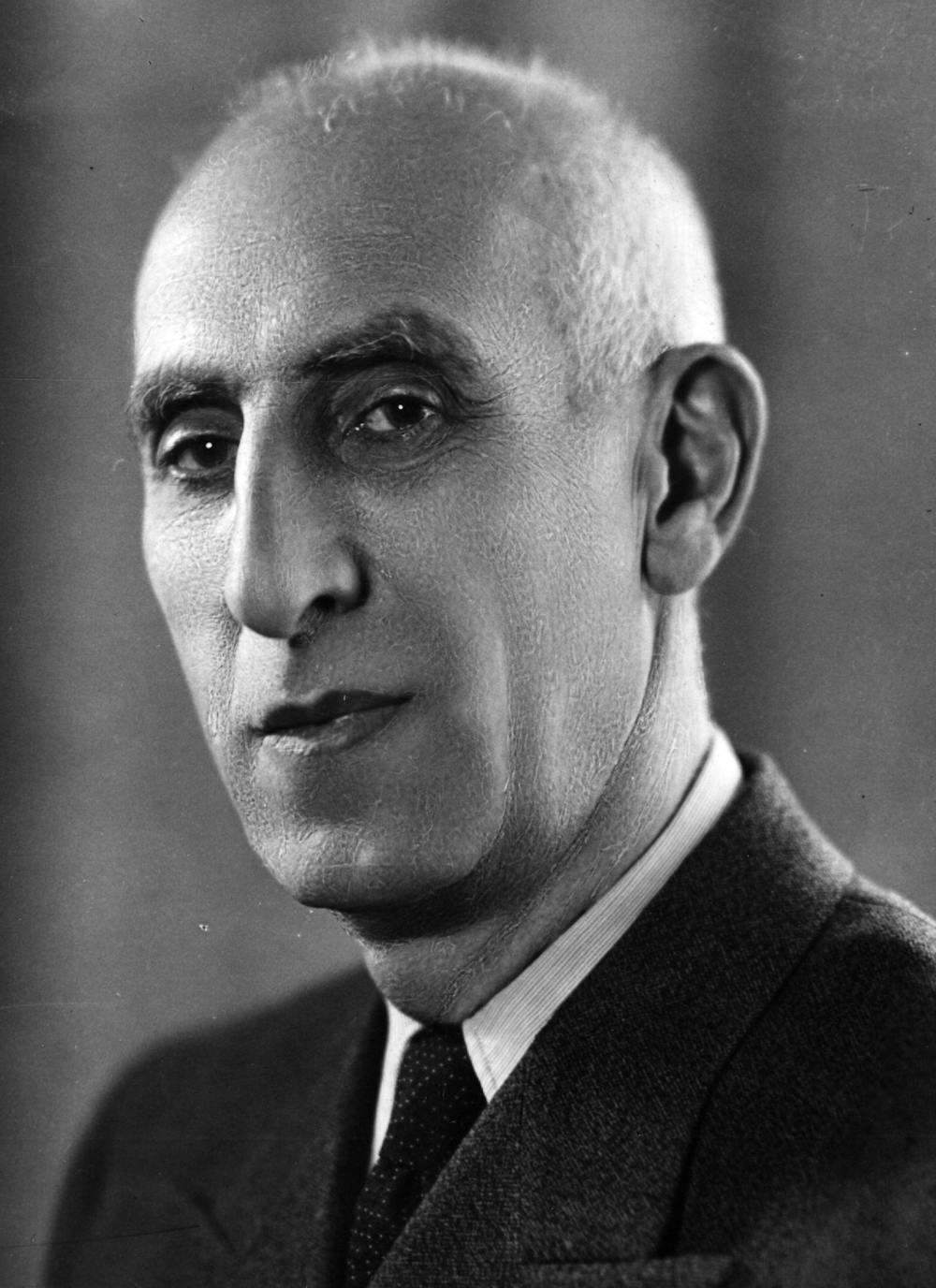
In 1951, the Iranian Parliament chose a new prime minister, Mossadegh, who then led lawmakers to vote in favor of taking over the Anglo-Iranian Oil Company, expelling the company’s British owners and saying they wanted to turn oil profits into investments in the Iranian people. The U.S. feared disruption in the global oil supply and worried about Iran falling prey to Soviet influence. The British feared the loss of cheap Iranian oil.
President Dwight Eisenhower decided it was best for the U.S. and the U.K. to get rid of Mossadegh. Operation Ajax, a joint CIA-British operation, convinced the Shah of Iran, the country’s monarch, to dismiss Mossadegh and drive him from office by force. Mossadegh was replaced by a much more Western-friendly prime minister, handpicked by the CIA.
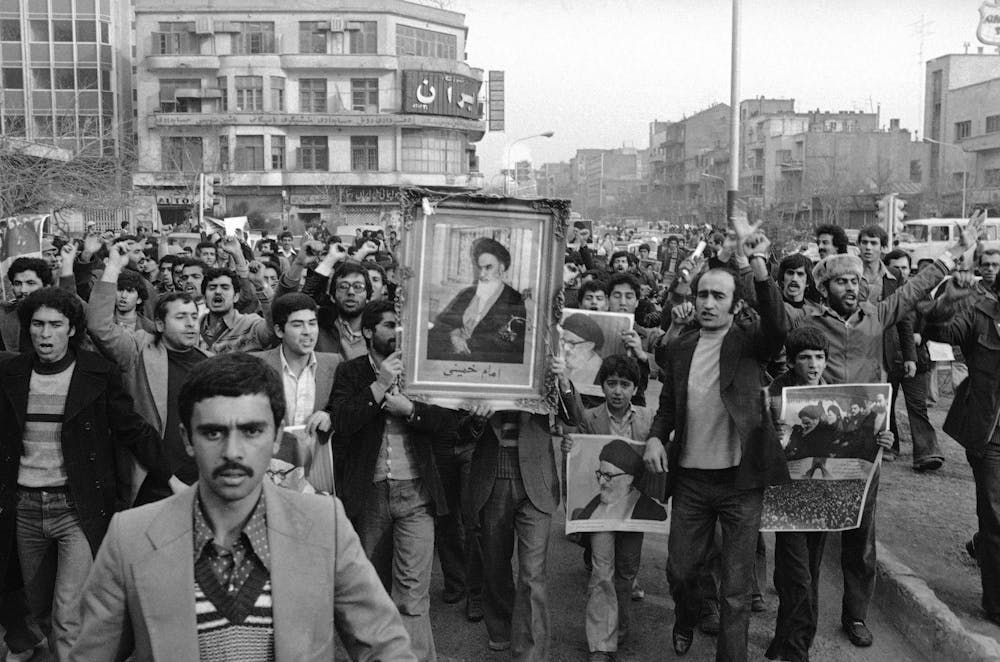
Demonstrators in Tehran demand the establishment of an Islamic republic. AP Photo/Saris
1979: Revolutionaries oust the shah, take hostages
After more than 25 years of relative stability in U.S.-Iran relations, the Iranian public had grown unhappy with the social and economic conditions that developed under the dictatorial rule of Shah Mohammad Reza Pahlavi.
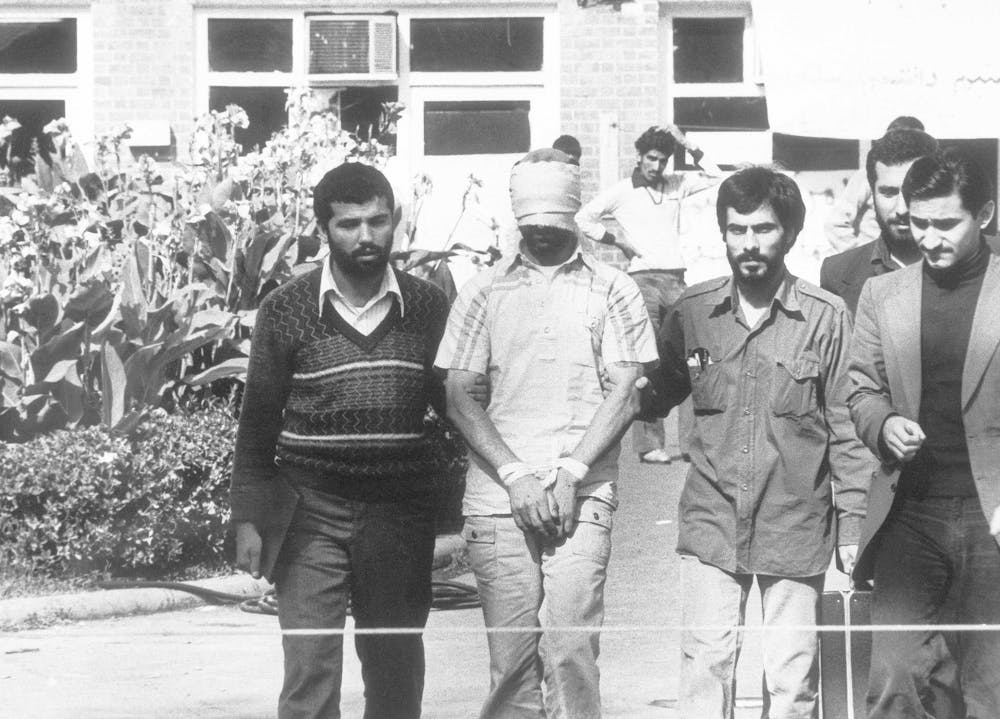
Iranian students at the U.S. Embassy in Tehran show a blindfolded American hostage to the crowd in November 1979. AP Photo
In October 1979, President Jimmy Carter agreed to allow the shah to come to the U.S. to seek advanced medical treatment. Outraged Iranian students stormed the U.S. Embassy in Tehran on Nov. 4, taking 52 Americans hostage. That convinced Carter to sever U.S. diplomatic relations with Iran on April 7, 1980.
Two weeks later, the U.S. military launched a mission to rescue the hostages, but it failed, with aircraft crashes killing eight U.S. servicemembers.
The shah died in Egypt in July 1980, but the hostages weren’t released until Jan. 20, 1981, after 444 days of captivity.
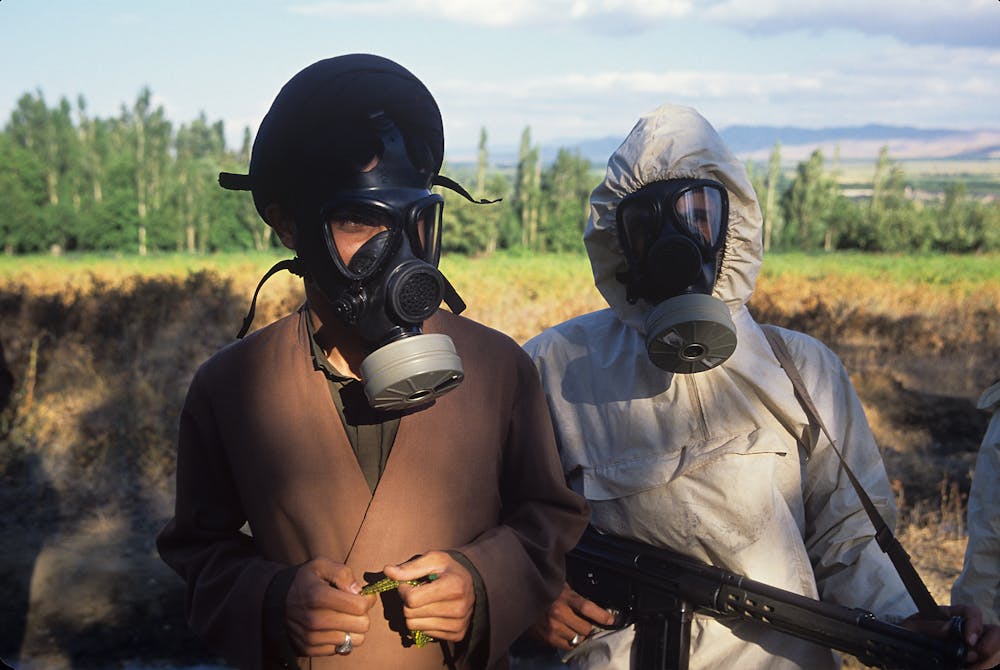
An Iranian cleric, left, and an Iranian soldier wear gas masks to protect themselves against Iraqi chemical-weapons attacks in May 1988. Kaveh Kazemi/Getty Images
The U.S. was concerned that the conflict would limit the flow of Middle Eastern oil and wanted to ensure the conflict didn’t affect its close ally, Saudi Arabia.
U.S. officials moderated their usual opposition to those illegal and inhumane weapons because the U.S. State Department did not “wish to play into Iran’s hands by fueling its propaganda against Iraq.” In 1988, the war ended in a stalemate. More than 500,000 military and 100,000 civilians died.
1981-1986: US secretly sells weapons to Iran
The U.S. imposed an arms embargo after Iran was designated a state sponsor of terrorism in 1984. That left the Iranian military, in the middle of its war with Iraq, desperate for weapons and aircraft and vehicle parts to keep fighting.
The last shipment, of anti-tank missiles, was in October 1986. In November 1986, a Lebanese magazine exposed the deal. That revelation sparked the Iran-Contra scandal in the U.S., with Reagan’s officials found to have collected money from Iran for the weapons and illegally sent those funds to anti-socialist rebels – the Contras – in Nicaragua.
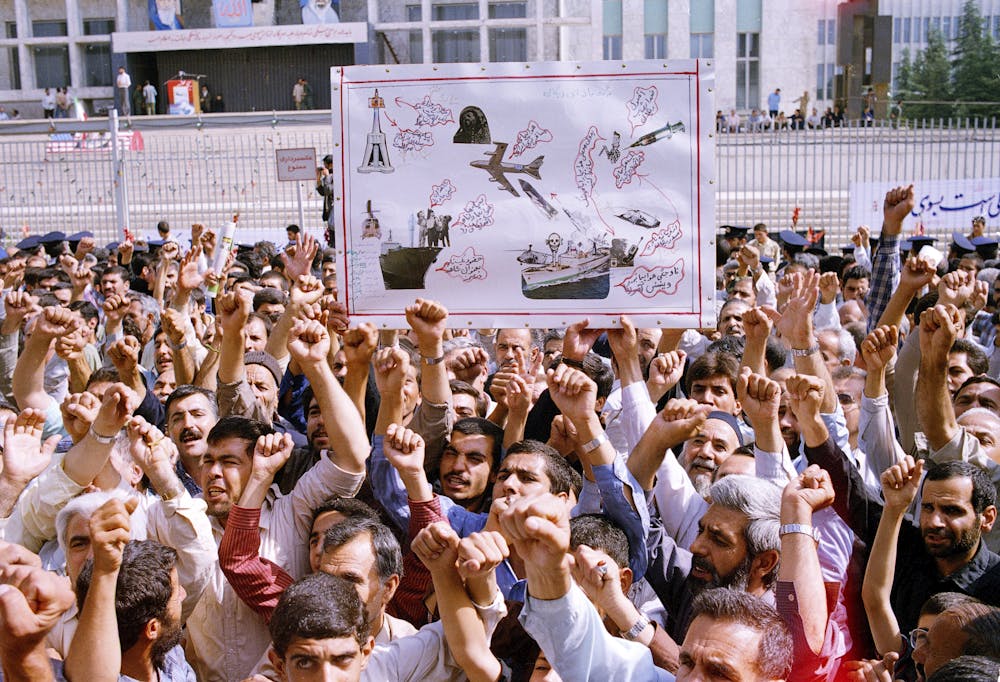
At a mass funeral for 76 of the 290 people killed in the shootdown of Iran Air 655, mourners hold up a sign depicting the incident. AP Photo/CP/Mohammad Sayyad
Either during or just after that exchange of gunfire, the Vincennes crew mistook a passing civilian Airbus passenger jet for an Iranian F-14 fighter. They shot it down, killing all 290 people aboard.
The U.S. called it a “tragic and regrettable accident,” but Iran believed the plane’s downing was intentional. In 1996, the U.S. agreed to pay US$131.8 million in compensation to Iran.
1997-1998: The US seeks contact
In August 1997, a moderate reformer, Mohammad Khatami, won Iran’s presidential election.
U.S. President Bill Clinton sensed an opportunity. He sent a message to Tehran through the Swiss ambassador there, proposing direct government-to-government talks.
Shortly thereafter, in early January 1998, Khatami gave an interview to CNN in which he expressed “respect for the great American people,” denounced terrorism and recommended an “exchange of professors, writers, scholars, artists, journalists and tourists” between the United States and Iran.
However, Supreme Leader Ayatollah Ali Khamenei didn’t agree, so not much came of the mutual overtures as Clinton’s time in office came to an end.
In his 2002 State of the Union address, President George W. Bush characterized Iran, Iraq and North Korea as constituting an “Axis of Evil” supporting terrorism and pursuing weapons of mass destruction, straining relations even further.
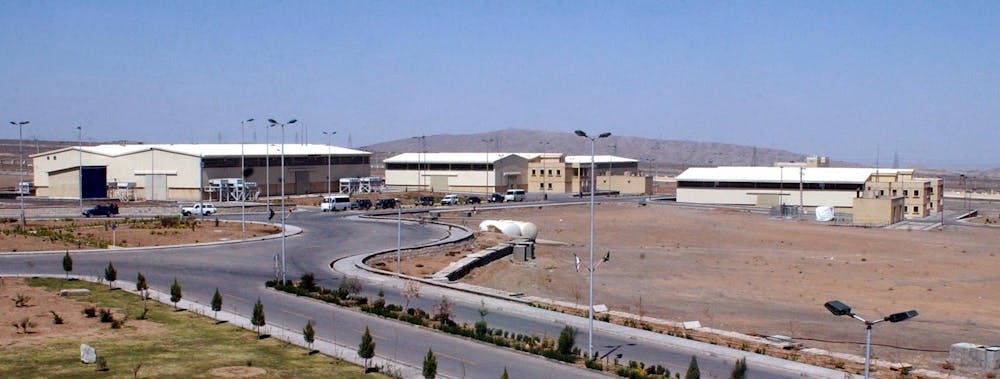
Inside these buildings at the Natanz nuclear facility in Iran, technicians enrich uranium. AP Photo/Vahid Salemi
That was a violation of the terms of the Nuclear Nonproliferation Treaty, which Iran had signed, requiring countries to disclose their nuclear-related facilities to international inspectors.
One of those formerly secret locations, Natanz, housed centrifuges for enriching uranium, which could be used in civilian nuclear reactors or enriched further for weapons.
Starting in roughly 2005, U.S. and Israeli government cyberattackers together reportedly targeted the Natanz centrifuges with a custom-made piece of malicious software that became known as Stuxnet.
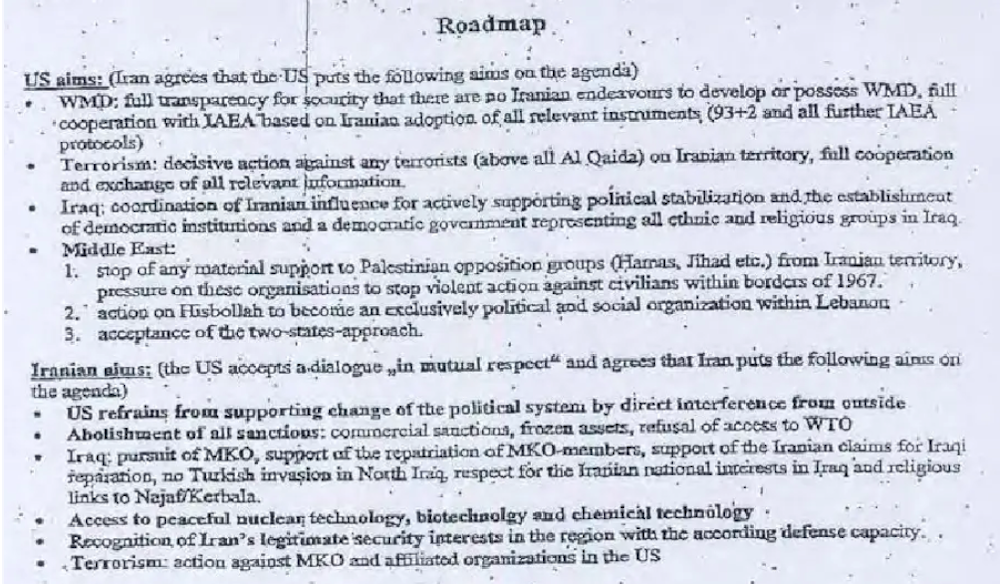
An excerpt of the document sent from Iran, via the Swiss government, to the U.S. State Department in 2003, appears to seek talks between the U.S. and Iran. Washington Post via Scribd
In May 2003, senior Iranian officials quietly contacted the State Department through the Swiss embassy in Iran, seeking “a dialogue ‘in mutual respect,’” addressing four big issues: nuclear weapons, terrorism, Palestinian resistance and stability in Iraq.
Hardliners in the Bush administration weren’t interested in any major reconciliation, though Secretary of State Colin Powell favored dialogue and other officials had met with Iran about al-Qaida.
When Iranian hardliner Mahmoud Ahmadinejad was elected president of Iran in 2005, the opportunity died. The following year, Ahmadinejad made his own overture to Washington in an 18-page letter to President Bush. The letter was widely dismissed; a senior State Department official told me in profane terms that it amounted to nothing.
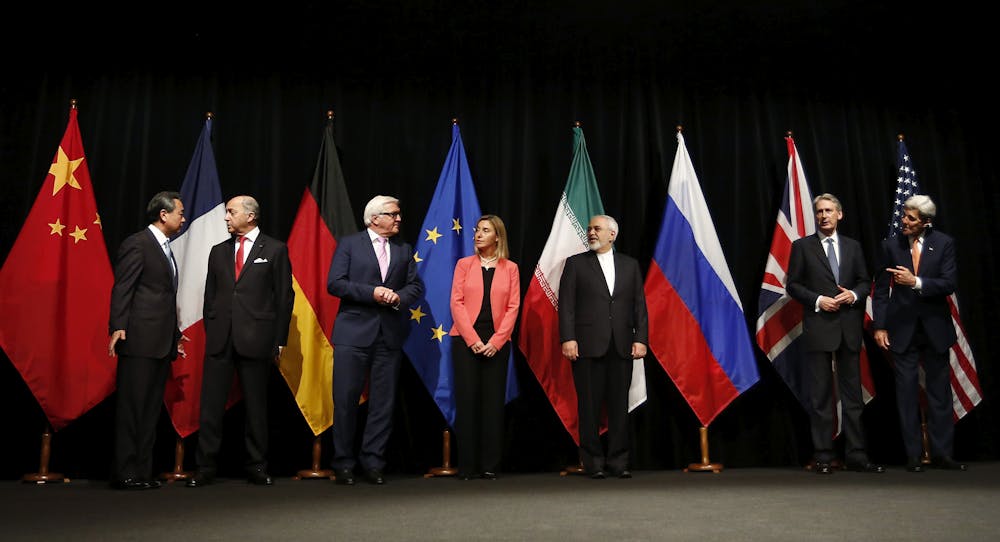
After a decade of unsuccessful attempts to rein in Iran’s nuclear ambitions, the Obama administration undertook a direct diplomatic approach beginning in 2013.
Iran, the U.S., China, France, Germany, Russia and the United Kingdom signed the deal in 2015. It severely limited Iran’s capacity to enrich uranium and mandated that international inspectors monitor and enforce Iran’s compliance with the agreement.
In return, Iran was granted relief from international and U.S. economic sanctions. Though the inspectors regularly certified that Iran was abiding by the agreement’s terms, President Donald Trump withdrew from the agreement in May 2018.
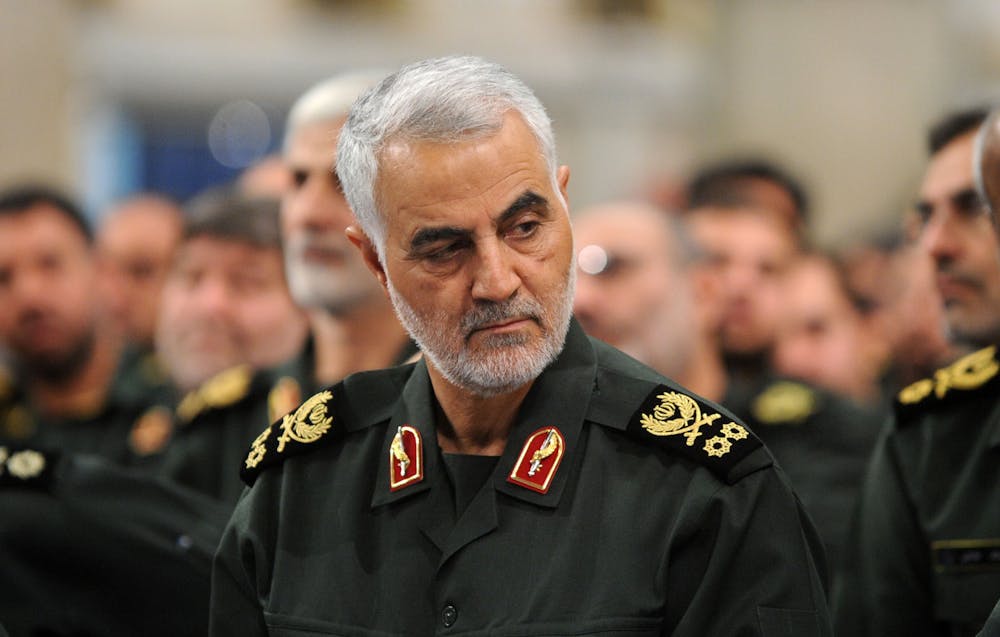
2020: US drones kill Iranian Maj. Gen. Qassem Soleimani
At the time, the Trump administration asserted that Soleimani was directing an imminent attack against U.S. assets in the region, but officials have not provided clear evidence to support that claim.
Hamas’ brazen attack on Israel on Oct. 7, 2023, provoked a fearsome militarized response from Israel that continues today and served to severely weaken Iran’s proxies in the region, especially Hamas – the perpetrator of the attacks – and Hezbollah in Lebanon.
2025: Trump 2.0 and Iran
Trump saw an opportunity to forge a new nuclear deal with Iran and to pursue other business deals with Tehran. Once inaugurated for his second term, Trump appointed Steve Witkoff, a real estate investor who is the president’s friend, to serve as special envoy for the Middle East and to lead negotiations.
Negotiations for a nuclear deal between Washington and Tehran began in April, but the countries did not reach a deal. They were planning a new round of talks when Israel struck Iran with a series of airstrikes on June 13, forcing the White House to reconsider is position.
Jeffrey Fields receives funding from the Carnegie Corporation of New York and Schmidt Futures.
Source: People’s Republic of China in Russian – People’s Republic of China in Russian –
Source: People’s Republic of China – State Council News
On June 16, the broadcast of the TV series “Catchphrases from the Classics, Favorite by Xi Jinping” (international version) was launched in five Central Asian countries. In this regard, the President of Kazakhstan Kassym-Jomart Tokayev expressed his warm congratulations.
Launched by China Media Group (CMG), the TV series “Xi Jinping’s Favorite Classical Quotes” (International Edition) carefully selects quotations from Chinese classical poetry and prose masterpieces used by Chinese President Xi Jinping in important speeches, articles and talks. They focus on themes of open cooperation, technological development, environmental protection and cultural innovation. With an international approach and vivid storytelling, the TV project explains to Central Asian audiences the deep historical and cultural roots of the Chinese leader’s ideas on governance, and also showcases the diversity of China’s modernization.
Source: People’s Republic of China in Russian – People’s Republic of China in Russian –
Source: People’s Republic of China – State Council News
On June 6, a ceremony was held in Lhasa to launch the filming of the documentary film “The Story of Time,” dedicated to the 60th anniversary of the founding of the Xizang Autonomous Region.
Pictured: Title page of the script for the documentary film “The History of Time”
The documentary, using the “road trip plus memory lane” narrative method, follows the footsteps of 70-year-old Tsering Lhamo from Chamdo to Lhasa. With a professional eye and dynamic film language, the film vividly shows how the remote rural areas of the past have been transformed into vibrant new settlements; how ancient Lhasa, weaving together historical heritage and modern energy, has shone with a new, never-before-seen noble light.
Source: People’s Republic of China in Russian – People’s Republic of China in Russian –
Source: People’s Republic of China – State Council News
Astana, June 18 (Xinhua) — China and five Central Asian countries on Tuesday reaffirmed their firm support for each other’s independence, sovereignty and territorial integrity, as well as the principles of sovereign equality and the inviolability of borders, according to the Treaty of Eternal Good-Neighborliness, Friendship and Cooperation signed by China, Kazakhstan, Kyrgyzstan, Tajikistan, Turkmenistan and Uzbekistan.
According to the document, the six countries also reaffirmed their determination to jointly build a closer China-Central Asia community with a shared future.
All parties stressed that they would not use force or threaten to use it and would resolve disputes peacefully. States committed to supporting each other’s development paths and models chosen in accordance with national conditions and to supporting each other’s positions on issues of fundamental interest.
The parties must not enter into any alliances or groups directed against the other parties and must not support any actions hostile to the other parties, the agreement says.
All parties expressed their willingness to cooperate in the areas of trade, economy, investment, infrastructure connectivity, engineering and technology, energy (including hydro and renewable energy), transport, mineral resources, agriculture, ecology and environmental protection, processing industry, science and technology, as well as other areas of mutual interest, on the basis of equality and mutual benefit.
The states also agreed to cooperate within the framework of bilateral and multilateral mechanisms to jointly combat terrorism, separatism, extremism and transnational organized crime. –0–
Source: People’s Republic of China in Russian – People’s Republic of China in Russian –
Source: People’s Republic of China – State Council News
“Lu Ban Workshop” is a Chinese brand of international cooperation in vocational education, which has now become an important platform for technology transfer and talent training in the joint construction of the “Belt and Road”. In November 2022, the first “Lu Ban Workshop” in Central Asia was launched in Tajikistan. Over the next year, Lu Ban Workshops were launched in Kazakhstan, Kyrgyzstan and other countries. This project not only opened up opportunities for Central Asian youth, but also built a bridge of understanding between the people of China and the Central Asian region.
Lu Ban’s workshops, opened in several Central Asian countries, have achieved good results and reflect three main features of practical cooperation between China and the region. First, it is demand-driven, when all specialties are selected taking into account the actual needs of the industries of Central Asian countries. Second, it is technology adaptation, that is, an organic combination of China’s advanced technologies in infrastructure construction, new energy sources, etc., with local resources and development conditions. Third, it is sustainability, when, based on the medium- and long-term development strategies of countries, not only the current problem of shortage of qualified personnel is solved, but also special attention is paid to the development of the ability for independent economic development. China has always promoted cooperation with Central Asian countries in the field of vocational education on the basis of equality and win-win cooperation, which reflects the Chinese concept of “benevolence, sincerity, mutual benefit and inclusiveness” towards neighboring countries.
In the long term, Lu Ban Workshops will continue to play the role of a technology incubator and talent reservoir, providing a steady impetus to long-term cooperation between China and Central Asian countries. As generations of local talents grow and individual joint projects steadily advance, Lu Ban Workshops will become a source of new energy for cooperation between China and Central Asia, laying a solid foundation for building a closer community of shared destiny between China and the region.
Author: Yang Jin, Deputy Director of the Central Asia and Caucasus Department, Institute of Russian, East European and Central Asian Studies, Chinese Academy of Social Sciences
Source: United States Senator Alex Padilla (D-Calif.)
WATCH: Padilla Delivers Floor Speech Following His Forcible Removal From DHS Press Conference
WATCH: Padilla: “If this Administration is this afraid of just one Senator with a question, colleagues, imagine what the voices of tens of millions of Americans peacefully protesting can do.”
“If that is what the Administration is willing to do to a United States Senator for having the [audacity] to simply ask a question, imagine what they’ll do to any American who dares to speak up. If what you saw happen can happen when the cameras are on, imagine not only what can happen — but what is happening — in so many places where there are no cameras.”
Video of Senator Padilla’s full speech can be viewed here and downloaded here.
WASHINGTON, D.C. — Today, U.S. Senator Alex Padilla (D-Calif.), Ranking Member of the Senate Judiciary Immigration Subcommittee, spoke on the Senate floor following his forcible removal from Secretary of Homeland Security Kristi Noem’s press conference, where he was thrown to the ground and handcuffed after attempting to ask a question. Padilla delivered a strong rebuke to the Trump Administration’s unprecedented militarization of Los Angeles and called for his colleagues on both sides of the aisle, as well as the American people, to speak up against Trump’s abuse of power.
Last week, Trump deployed approximately 4,000 National Guard troops and 700 active-duty Marines to Los Angeles amid unrest caused by his indiscriminate immigration raids across the region. Padilla flew to Los Angeles to conduct oversight over the Trump Administration’s unprecedented military deployment to California — without Governor Newsom’s consent — and was in the high-security Los Angeles Federal Building for a scheduled oversight meeting with the commanding general in charge of the military presence in the region before law enforcement escorted him into Secretary Noem’s briefing room.
“The Trump Administration has done everything in their power but to provide transparency to the American people about their mission in Los Angeles. And so last week, I chose to go home to try to get answers from the Administration as they are literally militarizing our city.”
“I want to share what I learned. I want to share what I heard because it should shock the conscience of our country.”
In the hopes of learning new information after having his requests ignored for months, Padilla tried to ask a question in response to Noem’s demonizing rhetoric toward immigrants and Los Angeles’ democratically elected leadership.
“At one point, the United States Secretary of Homeland Security said that the purpose of federal law enforcement and the purpose of the United States military was to ‘liberate’ Los Angeles from our governor and our mayor. To somehow liberate us from the very people that we democratically elected to lead our city and our state.”
“Colleagues, let that fundamentally un-American mission statement sink in. That is not a mission focused on public safety. And that simply is not, and cannot be, the mission of federal law enforcement and the United States military.”
“To my colleagues on both sides of the aisle, are we truly prepared to live in a country where the President can deploy the Armed Forces to decide which duly elected governors and mayors should be allowed to lead their constituents? Is that really the precedent that we’re okay with setting?”
“Throughout the country’s history, we’ve had conflict, we’ve had tumult, but we’ve never had a tyrant as a commander-in-chief.”
Padilla detailed his own background as the proud son of immigrants from Mexico who left behind his MIT engineering degree to protest against the vile anti-immigrant rhetoric in the 1990s that a Republican governor up for reelection spread across California. He said he felt he had to speak out against the Trump Administration’s “un-American” scapegoating of immigrants and California, and detailed the violent reaction to his question.
“So last week, when I heard something so blatantly un-American from the Secretary of Homeland Security, a cabinet official — of course I was compelled, both as a Senator and as an American, to speak up.”
“But before I could even get out my question, I was physically and aggressively forced out of the room — even as I repeatedly announced I was a United States Senator, and I had a question for the Secretary. And even as the National Guardsman and the FBI agent who served as my escorts and brought me into that press briefing room stood by, silently, knowing full well who I was.”
“You’ve seen the video. I was pushed and pulled, struggled to maintain my balance. I was forced to the ground — first on my knees and then flat on my chest. And as I was handcuffed and marched down a hallway, repeatedly asking why am I being detained, not once did they tell me why.”
Padilla expressed his gratitude for the immense support for him and his family that poured in since his forcible removal. However, he emphasized that this fight was not about him but about the fundamental democratic rights of all Americans across the country.
“If you watched what unfolded last week and thought what happened is just about one politician and one press conference, you’re missing the point.”
“If that is what the Administration is willing to do to a United States Senator for having the [audacity] to simply ask a question, imagine what they’ll do to any American who dares to speak up. If what you saw happen can happen when the cameras are on, imagine not only what can happen — but what is happening — in so many places where there are no cameras.”
“Colleagues, this isn’t about me. In fact, it’s not just about immigrant communities or even just the State of California. It’s about every single American who values their Constitutional rights. It’s about anyone who’s ever exercised their First Amendment rights, or anyone who’s ever disagreed with a president, or anyone who simply values our democracy and wants to keep it.”
Padilla set the record straight on Republican misinformation on undocumented immigrants as Trump has used the same playbook when the headlines turn against him: scapegoat immigrants and manufacture a crisis. Public reporting shows that the majority of immigrants currently in ICE custody have no prior criminal conviction, and under 10 percent of immigrants taken into ICE custody since October have serious criminal convictions. Yet, President Trump has blamed immigrants to distract from his failed policies, including Republicans’ billionaire-first budget reconciliation bill that would cut critical services like health care and nutrition for millions of working families across the country.
As President Trump takes unprecedented action to militarize Los Angeles without justification or the Governor’s request, Padilla warned of the stakes for cities across the United States and American democracy.
“Donald Trump is continuing to test the boundaries of his power. And he’s surrounded himself with yes-men and underqualified attack dogs — from the DHS Secretary to the FBI Director to the Secretary of Defense — who will rubberstamp every anti-democratic step he takes.”
“This Administration’s officials and maybe not all, but many Republicans in Congress may choose not to do their job, but they cannot stop me from doing mine.”
“Again, if you really think this is just about immigrants and immigration, it’s time to wake up. What’s happening is not just a threat to California; it’s a threat to everyone in every state. If Donald Trump can bypass the Governor and activate the National Guard to put down protests on immigrant rights, he can do it to suppress your rights, too. If he can deploy the Marines to Los Angeles without justification, he can deploy them to your state, too. And if he can ignore due process, strip away First Amendment rights, and disappear people to foreign prisons without their day in court, he can do it to you too.”
“California is just the test case for the rest of the country. Last week for many was a warning shot. But I pray that it also serves as a wakeup call.”
Padilla concluded his speech with a call to action for Angelenos and millions of Americans to stand up and keep peacefully protesting against the Trump Administration’s attack on fundamental rights.
“It doesn’t matter if you’re a Republican, or a Democrat, or an Independent — we all have a responsibility to speak up and to push back, before it’s too late. So I do encourage people to keep peacefully protesting. There’s nothing more patriotic than to peacefully protest for your rights.”
“Because no one will liberate Los Angeles but Angelenos. No one will redeem America but Americans. No one is coming to save us but us.”
“And we know that the cameras are not on in every corner of the country. But if this Administration is this afraid of just one Senator with a question, colleagues, imagine what the voices of tens of millions of Americans peacefully protesting can do.”
Senator Padilla has been outspoken in calling out the Immigration and Customs Enforcement (ICE) raids in Los Angeles and Trump’s misguided deployment of the National Guard and U.S. Marine Corps. This weekend, Padilla led the entire Senate Democratic Caucus in demanding that President Trump immediately withdraw all military forces from Los Angeles and cease all threats to deploy the National Guard or active-duty servicemembers to American cities. Last week, Padilla and Senator Adam Schiff (D-Calif.) demanded answers regarding the Trump Administration’s decision to deploy approximately 700 Marines to Los Angeles. Padilla has spoken at a spotlight hearing and on the Senate floor multiple times to blast President Trump for manufacturing a crisis by launching indiscriminate ICE raids across Los Angeles and deploying the National Guard and active-duty servicemembers to the region. He also joined all Senate Judiciary Committee Democrats today in calling on Chairman Grassley to schedule Department of Homeland Security Secretary Noem for a broad oversight hearing for testimony before the committee.
Padilla’s full remarks as prepared for delivery are available below:
[Mr./Madam] President,
Over the last two weeks in Los Angeles – my hometown – we’ve seen masked federal agents in tactical gear ordered into our communities . . .
We’ve seen a disturbing pattern of extreme and cruel immigration enforcement operations, targeting non-violent people at places of worship, schools, and courthouses.
All to meet an arbitrary quota.
Now, we’re seeing President Trump federalize and deploy the National Guard without the Governor’s consent . . .
Active-duty Marines have been deployed, escalating tensions in our city . . .
All without coordination with the state and local law enforcement.
Despite repeated requests for justification for these extreme actions…and after months of little to no response from the Administration on their aggressive and theatrical immigration raids…
The Trump administration has done everything in their power BUT provide transparency to the American people about their mission in Los Angeles.
So last week, I went home to try to get answers from the administration as they militarize our city.
What I heard should shock the conscience of our country.
One of the first items on my schedule last Thursday was a meeting with General Guillot, the four-star general in charge of U.S. Northern Command at the Federal Building in west Los Angeles, where they are overseeing these military operations.
When the United States military is deployed domestically…
When our own troops are deployed against the wishes of the Governor for the first time since 1965, against the wishes of the mayor, against even the wishes of local law enforcement — then we’re in uncharted territory.
So in an effort to do my duty to conduct congressional oversight — and to try to get answers from the Department of Defense that state and local officials were not receiving— I went to the federal building in West LA.
I was met at the entrance by a National Guardsman and an FBI agent, who escorted me through the security screening and up to a conference room for my scheduled briefing.
While waiting for my scheduled briefing with General Guillot, I learned that Homeland Security Secretary Kristi Noem was holding a press conference just down the hall and that the press conference was causing my briefing to be delayed.
The thought occurred to me that maybe I could attend and listen in, in the hopes of hearing Secretary Noem provide some new information that could help us make sense of what was happening.
I asked and was escorted by my National Guard and FBI escorts into the press conference. They opened the door for me. They accompanied me into the press briefing room.
It was there that I listened as the United States Secretary of Homeland Security said that the purpose of federal law enforcement and the United States military was to “liberate” Los Angeles from our governor and our mayor . . .
. . . To somehow liberate us from the very people we democratically elected to lead our city and our state.
Colleagues, let that fundamentally un-American mission statement sink in.
That’s not a mission focused on public safety.
That simply is not, and cannot be, the mission of federal law enforcement and the United States military.
To my colleagues on the other side of the aisle, are you truly prepared to live in a country where the President can deploy the armed forces to decide which duly elected governors and mayors should be allowed to lead their constituents?
Is that really the precedent you’re okay with setting?
As Secretary Noem herself said last year when serving as Governor of South Dakota, “If Joe Biden federalizes the National Guard, that would be a direct attack on states’ rights.”
Throughout the country’s history, we’ve had conflict, and we’ve had tumult. But we have never had a tyrant as a commander-in-chief.
That’s not by coincidence!
It’s because the American people have always been willing to speak up and exercise their First Amendment right to protest – especially when our fundamental rights have been threatened.
As the proud son of immigrants from Mexico, it’s that same right I came to revere when marching through the streets of Los Angeles in 1994 alongside friends and family protesting against the vile anti-immigrant rhetoric that was growing in California.
It was that year that a Republican Governor up for reelection and down in the polls, turned to scapegoating immigrants to try to improve his political standing.
That fight is what got me to leave an engineering career behind and dedicate myself to influencing government and politics. So, I’ve seen this before. Californians have seen this before.
So last week, when I heard something so blatantly un-American from the Secretary of Homeland Security — I was compelled, both as a Senator AND as an American, to speak up.
But before I could even get out my question, I was physically and aggressively forced out of the room — even as I announced I was a United States Senator, and I had a question for the Secretary.
And even as the National Guardsman and FBI agent who escorted me into the press conference stood by, silently, knowing full well who I was.
You’ve seen the video.
I was pushed and pulled, struggling to maintain my balance.
I was forced to the ground — first to my knees and then flat on my chest.
As I was handcuffed and marched down a hallway, I repeatedly asked why I was being detained. Not once did they tell me why.
In that moment, a lot of questions run through your head.
Where are they taking me?
Am I being arrested?
What will a city already on edge from being militarized think when they see their Senator has been handcuffed just for trying to ask a question? Or . . .
What will my wife and our three boys think?
I also remember asking myself: if this aggressive escalation is the result of speaking up against the abuses and overreach of the Trump administration, was it really worth it?
But colleagues, how many Americans in our nation’s history have marched, have protested, have shed blood and lost their lives to protect our rights?
How many Americans have served in wars overseas to protect our freedoms here at home?
And how many Americans in the year 2025 see a vindictive president on a tour of retribution, unrestrained by the majority of this separate but co-equal branch of government in this building, and wonder if it’s worth it to stand up or to speak out?
If a United States Senator is too afraid to speak up, how can we expect any other American to do the same?
Colleagues, you know me.
I’m not aware of anyone who would describe me as a flamethrower. I try to be respectful and considerate to every member of this body— regardless of your politics.
So I want to thank all of my colleagues on both sides of the aisle who reached out to share messages of support — whether it was public or in private.
In means a great deal to me and my family.
But if you watched what unfolded last week and thought this was about one politician or one press conference, you’re missing the point.
If that’s what this Administration will do to a United States Senator for having the audacity to simply ask a question, imagine what they’ll do to any American who dares to speak up.
If that’s what can happen when the cameras are on, imagine not only what can happen — but what is happening — when the cameras are off.
This isn’t about me. In fact, it’s not even just about immigrant communities or about Californians.
It’s about every single American who values their constitutional rights. It’s about anyone who’s ever exercised their First Amendment rights, or ever disagreed with a president, or who simply values living in a democracy and wants to keep it.
The President will tell you this is about undocumented immigrants, and about law and order and about targeting dangerous, violent criminals.
But we know differently.
Public data released by the administration shows that the majority of immigrants currently in ICE custody do not have a prior criminal conviction.
And new reporting shows that less than 10 percent of immigrants taken into ICE custody since October have serious criminal convictions.
Less than 10 percent!
Two weeks ago, Donald Trump was at the lowest point in his presidency so far.
He was drowning in a week of terrible headlines.
The American people were finally waking up to the realities of the budget reconciliation bill that will cut health care, nutrition assistance, and good paying clean energy jobs in order to cut taxes for billionaires.
He was losing his tariff wars as the costs of everyday goods were continuing to rise.
His promises to end Russia’s invasion of Ukraine were falling flat.
He’d been handed loss after loss in federal court.
And maybe the most embarrassing part was his public breakup with Elon Musk.
But we know what happens when the headlines turn on Donald Trump. Donald Trump turns to the same tired playbook he always has: when in doubt, scapegoat immigrants. And manufacture a crisis to distract the media from your failures.
That’s the reason he ramped up ICE raids in California.
And when Californians took to the streets to peacefully protest, that’s the reason he bypassed the Governor and federalized the National Guard. And as things began to settle in Los Angeles, he escalated even further by sending in the Marines.
He wants the spectacle — not just to distract, but to justify his undemocratic crackdowns and his authoritarian power grabs.
That’s the reason why even while the vast majority of protests have remained peaceful, the President, the Vice President, and their allies have called protestors insurrectionists!
Yes, this is the same man who provoked an actual insurrection on our Capitol on January 6th.
The same man who incited a violent mob, carrying confederate flags, against Congress.
The same man who then pardoned the convicted felons who assaulted our brave Capitol Police officers.
Trump is testing the boundaries of his power. And he’s surrounded himself with yes-men and underqualified attack dogs — from the DHS Secretary to the FBI Director to the Secretary of Defense — who will rubberstamp every anti-democratic step he takes.
This Administration’s officials and Congressional Republicans may choose not to do their job, but they cannot stop me from doing mine.
And I refuse to let immigrants be pawns on the path to fascism.
Again, if you really think this is just about immigrants, it’s time to wake up.
What’s happening isn’t just a threat to California, it’s a threat to everyone in every state.
If Donald Trump can bypass the Governor and activate the National Guard to put down protests for immigrant rights, he can do it to suppress your rights, too.
If he can deploy Marines to Los Angeles without justification, he can deploy them to your city, too.
If he can ignore due process, strip away First Amendment rights, and disappear people to foreign prisons without their day in court, he can do it to you too.
California is just Trump’s test case for the rest of the country.
Last week was a warning shot.
But I pray that it can be our wakeup call, too.
We’ve now seen Trump threaten to do the same in other cities run by elected Democrats.
It doesn’t matter if you’re a Republican, a Democrat, or an independent — we all have a responsibility to speak up and to push back, before it’s too late.
So I encourage people to keep peacefully protesting. There’s nothing more patriotic than peacefully protesting for your rights.
No one will liberate Los Angeles but Angelenos.
No one will redeem America but Americans.
No one is coming to save us but us.
The cameras won’t always be on.
But if this Administration is this scared of just one Senator with a question, imagine what the voices of tens of millions of Americans in the streets can do.
Thank you, [Mr./Madam] President, I yield the floor.
Israeli defence systems intercept Iranian missiles over the city of HaifaAhmad Gharabli / AFP via Getty Images
Late last week, Israel began a wave of attacks on Iran under the banner of Operation Rising Lion, with the stated goal of crippling the Islamic republic’s nuclear program and long-range strike capabilities. At the outset, Israel claimed Iran would soon be able to build nine nuclear weapons, a situation Israel regarded as completely unacceptable.
Following Israeli strikes against Iranian nuclear facilities, and targeted assassinations of Iranian nuclear scientists and key members of the Iranian armed forces, Iran retaliated with a large barrage of ballistic missiles and drones against Tel Aviv and Jerusalem. The first wave consisted of some 200 ballistic missiles and 200 drones.
The conflict continues to escalate, with population centres increasingly being targeted. Israel’s missile defence systems (including the vaunted Iron Dome) have so far staved off most of Iran’s attacks, but the future is uncertain.
Ballistic missiles and how to stop them
Iran possesses a large arsenal of ballistic missiles and long-range drones, alongside other long-range weapons such as cruise missiles. Ballistic missiles travel on a largely fixed path steered by gravity, while cruise missiles can adjust their course as they fly.
Iran is approximately 1,000km from Israel, so the current strikes mostly involve what are classified as medium-range ballistic missiles, alongside long-range drones. It is not clear exactly what type of missile Iran has used in its latest strikes, but the country has several including the Fattah-1 and Emad.
It is very difficult to defend against ballistic missiles. There is not much time between launch and impact, and they come down at very high speed. The longer the missile’s range, the faster and higher it flies.
An incoming missile presents a small, fast-moving target – and defenders may have little time to react.
Israel’s missile defence and the Iron Dome
Israel possesses arguably one of the most effective, battle-tested air defence systems in service today. The system is often described in the media as the “Iron Dome”, but this is not quite correct.
Israel’s defences have several layers, each designed to address threats coming from different ranges.
In essence, Iron Dome consists of a network of radar emitters, command and control facilities, and the interceptors (special surface-to-air missiles). The radar quickly detects incoming threats, the command and control elements decide which are most pressing, and the interceptors are sent to destroy the incoming shells or rockets.
Ballistic defence systems
The other layers of Israel’s defence system include David’s Sling, and the Arrow 2 and Arrow 3 interceptors. These are specifically designed to engage longer-range ballistic missiles, both within the atmosphere and at very high altitudes above it (known as exoatmospheric interception).
Spectacular footage has been captured of what are likely exoatmospheric interceptions taking place during this latest conflict, demonstrating Israel’s capacity to engage longer-range missiles.
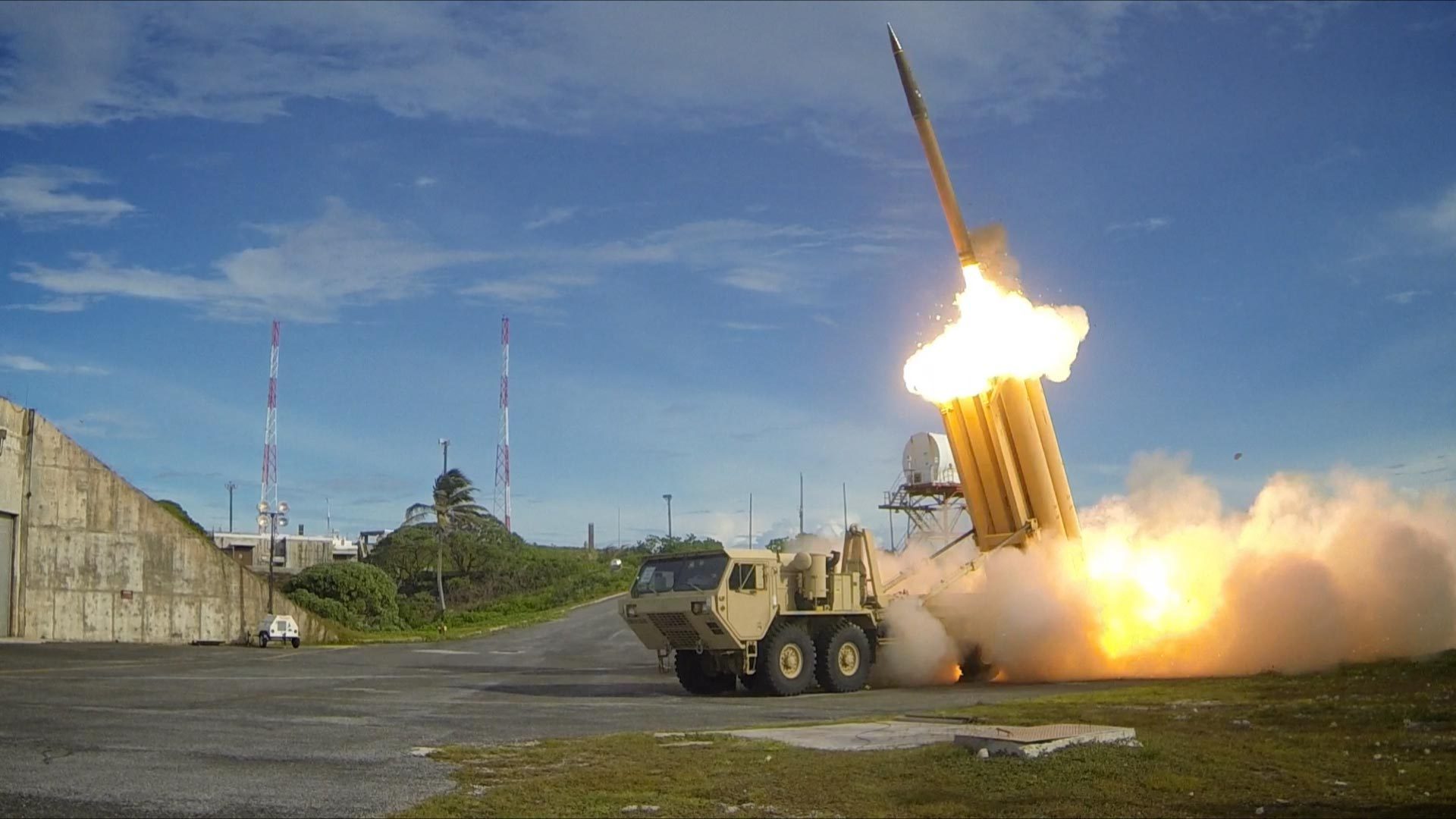
The US military has comparable missile defence systems. The US Army has the Patriot PAC-3 (comparable to David’s Sling) and THAAD (comparable to Arrow 2), while the US Navy has the Aegis and the SM-3 (comparable to Arrow 3) and the SM-6 (comparable again to Arrow 2).
Iran possesses some air defence systems such as the Russian S300 which has some (very limited) ballistic missile defence capabilities, but only against shorter range (and thus slower) ballistic missiles. Further, Israel has been focusing on degrading Iran’s air defences, so it is not clear how many are still operational.
Iran has been focusing on developing technology such as maneuverable warheads, which are harder to defend against. However, it is not clear whether these are yet operational and in Iranian service.
Missile defences are finite. The defender is always limited by the number of interceptors it possesses.
The attacker is also limited by the number of missiles it possesses. However, the defender must often assign multiple interceptors to each attacking missile, in case the first misses or otherwise fails.
The attacker will plan for some losses to interceptors (or mechanical failures) and send what it determines to be enough missiles for at least some to penetrate the defences.
When it comes to ballistic missiles, the advantage lies with the attacker. Ballistic missiles can carry large explosive payloads (or even nuclear warheads), so even a handful of missiles “leaking” past defensive systems can still wreak significant damage.
What now?
Israel’s missile defences are unlikely to stop working completely. However, as attacks deplete its stocks of interceptors, the system may become less effective.
As the conflict continues, it may become a race to see who runs out of weapons first. Will it be Iran’s stocks of ballistic missiles and drones, or the interceptors and anti-air munitions of Israel, the US and any other supporters?
It is impossible to say who would prevail in such a race of stockpile attrition. Some reports suggest Iran has fired approximately 1,000 ballistic missiles of an estimated 3,000. However, this still leaves it with an enormous stockpile to use, and it is unclear how fast Iran can make new missiles to replenish its resources.
But we should hope it doesn’t come to that. Beyond the tit-for-tat exchange of missiles, the latest conflict between Israel and Iran risks escalating. If it is not resolved soon, and if the US is drawn into the conflict more directly, we may see broader conflict in the Middle East.
James Dwyer does not work for, consult, own shares in or receive funding from any company or organisation that would benefit from this article, and has disclosed no relevant affiliations beyond their academic appointment.
Israeli defence systems intercept Iranian missiles over the city of HaifaAhmad Gharabli / AFP via Getty Images
Late last week, Israel began a wave of attacks on Iran under the banner of Operation Rising Lion, with the stated goal of crippling the Islamic republic’s nuclear program and long-range strike capabilities. At the outset, Israel claimed Iran would soon be able to build nine nuclear weapons, a situation Israel regarded as completely unacceptable.
Following Israeli strikes against Iranian nuclear facilities, and targeted assassinations of Iranian nuclear scientists and key members of the Iranian armed forces, Iran retaliated with a large barrage of ballistic missiles and drones against Tel Aviv and Jerusalem. The first wave consisted of some 200 ballistic missiles and 200 drones.
The conflict continues to escalate, with population centres increasingly being targeted. Israel’s missile defence systems (including the vaunted Iron Dome) have so far staved off most of Iran’s attacks, but the future is uncertain.
Ballistic missiles and how to stop them
Iran possesses a large arsenal of ballistic missiles and long-range drones, alongside other long-range weapons such as cruise missiles. Ballistic missiles travel on a largely fixed path steered by gravity, while cruise missiles can adjust their course as they fly.
Iran is approximately 1,000km from Israel, so the current strikes mostly involve what are classified as medium-range ballistic missiles, alongside long-range drones. It is not clear exactly what type of missile Iran has used in its latest strikes, but the country has several including the Fattah-1 and Emad.
It is very difficult to defend against ballistic missiles. There is not much time between launch and impact, and they come down at very high speed. The longer the missile’s range, the faster and higher it flies.
An incoming missile presents a small, fast-moving target – and defenders may have little time to react.
Israel’s missile defence and the Iron Dome
Israel possesses arguably one of the most effective, battle-tested air defence systems in service today. The system is often described in the media as the “Iron Dome”, but this is not quite correct.
Israel’s defences have several layers, each designed to address threats coming from different ranges.
In essence, Iron Dome consists of a network of radar emitters, command and control facilities, and the interceptors (special surface-to-air missiles). The radar quickly detects incoming threats, the command and control elements decide which are most pressing, and the interceptors are sent to destroy the incoming shells or rockets.
Ballistic defence systems
The other layers of Israel’s defence system include David’s Sling, and the Arrow 2 and Arrow 3 interceptors. These are specifically designed to engage longer-range ballistic missiles, both within the atmosphere and at very high altitudes above it (known as exoatmospheric interception).
Spectacular footage has been captured of what are likely exoatmospheric interceptions taking place during this latest conflict, demonstrating Israel’s capacity to engage longer-range missiles.
The US military has comparable missile defence systems. The US Army has the Patriot PAC-3 (comparable to David’s Sling) and THAAD (comparable to Arrow 2), while the US Navy has the Aegis and the SM-3 (comparable to Arrow 3) and the SM-6 (comparable again to Arrow 2).
Iran possesses some air defence systems such as the Russian S300 which has some (very limited) ballistic missile defence capabilities, but only against shorter range (and thus slower) ballistic missiles. Further, Israel has been focusing on degrading Iran’s air defences, so it is not clear how many are still operational.
Iran has been focusing on developing technology such as maneuverable warheads, which are harder to defend against. However, it is not clear whether these are yet operational and in Iranian service.
Missile defences are finite. The defender is always limited by the number of interceptors it possesses.
The attacker is also limited by the number of missiles it possesses. However, the defender must often assign multiple interceptors to each attacking missile, in case the first misses or otherwise fails.
The attacker will plan for some losses to interceptors (or mechanical failures) and send what it determines to be enough missiles for at least some to penetrate the defences.
When it comes to ballistic missiles, the advantage lies with the attacker. Ballistic missiles can carry large explosive payloads (or even nuclear warheads), so even a handful of missiles “leaking” past defensive systems can still wreak significant damage.
What now?
Israel’s missile defences are unlikely to stop working completely. However, as attacks deplete its stocks of interceptors, the system may become less effective.
As the conflict continues, it may become a race to see who runs out of weapons first. Will it be Iran’s stocks of ballistic missiles and drones, or the interceptors and anti-air munitions of Israel, the US and any other supporters?
It is impossible to say who would prevail in such a race of stockpile attrition. Some reports suggest Iran has fired approximately 1,000 ballistic missiles of an estimated 3,000. However, this still leaves it with an enormous stockpile to use, and it is unclear how fast Iran can make new missiles to replenish its resources.
But we should hope it doesn’t come to that. Beyond the tit-for-tat exchange of missiles, the latest conflict between Israel and Iran risks escalating. If it is not resolved soon, and if the US is drawn into the conflict more directly, we may see broader conflict in the Middle East.
James Dwyer does not work for, consult, own shares in or receive funding from any company or organisation that would benefit from this article, and has disclosed no relevant affiliations beyond their academic appointment.
In the late 1960s, the prevailing opinion among Israeli Shin Bet intelligence officers was that the key to defeating the Palestinian Liberation Organisation was to assassinate its then-leader Yasser Arafat.
The elimination of Arafat, the Shin Bet commander Yehuda Arbel wrote in his diary, was “a precondition to finding a solution to the Palestinian problem.”
For other, even more radical Israelis – such as the ultra-nationalist assassin Yigal Amir – the answer lay elsewhere. They sought the assassination of Israeli leaders such as Yitzak Rabin who wanted peace with the Palestinians.
Despite Rabin’s long personal history as a famed and often ruthless military commander in the 1948 and 1967 Arab-Israeli Wars, Amir stalked and shot Rabin dead in 1995. He believed Rabin had betrayed Israel by signing the Oslo Accords peace deal with Arafat.
It’s been 20 years since Arafat died as possibly the victim of polonium poisoning, and 30 years after the shooting of Rabin. Peace between Israelis and the Palestinians has never been further away.
Since its attacks on Iran began on Friday, Israel has killed numerous military and intelligence leaders, including Iran’s intelligence chief, Mohammad Kazemi; the chief of the armed forces, Mohammad Bagheri; and the commander of the Islamic Revolutionary Guard Corps, Hossein Salami. At least nine Iranian nuclear scientists have also been killed.
Israel’s Prime Minister Benjamin Netanyahu reportedly said:
We got their chief intelligence officer and his deputy in Tehran.
Iran, predictably, has responded with deadly missile attacks on Israel.
Far from having solved the issue of Middle East peace, assassinations continue to pour oil on the flames.
A long history of extra-judicial killings
Israeli journalist Ronen Bergman’s book Rise and Kill First argues assassinations have long sat at the heart of Israeli politics.
In the past 75 years, there have been more than 2,700 assassination operations undertaken by Israel. These have, in Bergman’s words, attempted to “stop history” and bypass “statesmanship and political discourse”.
This normalisation of assassinations has been codified in the Israeli expression of “mowing the grass”. This is, as historian Nadim Rouhana has shown, a metaphor for a politics of constant assassination. Enemy “leadership and military facilities must regularly be hit in order to keep them weak.”
The point is not to solve the underlying political questions at issue. Instead, this approach aims to sow fear, dissent and confusion among enemies.
Thousands of assassination operations have not, however, proved sufficient to resolve the long-running conflict between Israel, its neighbours and the Palestinians. The tactic itself is surely overdue for retirement.
Targeted assassinations elsewhere
Israel has been far from alone in this strategy of assassination and killing.
Former US President Barack Obama oversaw the extra-judicial killing of Osama Bin Laden, for instance.
After what Amnesty International and Human Rights Watch denounced as a flawed trial, former US President George W. Bush welcomed the hanging of Iraqi leader Saddam Hussein as “an important milestone on Iraq’s course to becoming a democracy”.
Current US President Donald Trump oversaw the assassination of Iran’s leader of clandestine military operations, Qassem Soleimani, in 2020.
More recently, however, Trump appears to have baulked at granting Netanyahu permission to kill Iran’s Supreme Leader Ayatollah Ali Khamenei.
And it’s worth noting the US Department of Justice last year brought charges against an Iranian man who said he’d been tasked with killing Trump.
Elsewhere, in Vladimir Putin’s Russia, it’s common for senior political and media opponents to be shot in the streets. Frequently they also “fall” out of high windows, are killed in plane crashes or succumb to mystery “illnesses”.
A poor record
Extra-judicial killings, however, have a poor record as a mechanism for solving political problems.
Cutting off the hydra’s head has generally led to its often immediate replacement by another equally or more ideologically committed person, as has already happened in Iran. Perhaps they too await the next round of “mowing the grass”.
But as the latest Israeli strikes in Iran and elsewhere show, solving the underlying issue is rarely the point.
In situations where finding a lasting negotiated settlement would mean painful concessions or strategic risks, assassinations prove simply too tempting. They circumvent the difficulties and complexities of diplomacy while avoiding the need to concede power or territory.
As many have concluded, however, assassinations have never killed resistance. They have never killed the ideas and experiences that give birth to resistance in the first place.
Nor have they offered lasting security to those who have ordered the lethal strike.
Enduring security requires that, at some point, someone grasp the nettle and look to the underlying issues.
The alternative is the continuation of the brutal pattern of strike and counter-strike for generations to come.
Matt Fitzpatrick receives funding from the Australian Research Council.
The Middle East is a region of intense beauty and ancient kingdoms. It has also repeatedly endured periods of geopolitical instability over many centuries.
Today, geopolitical, socio-political and religious tensions persist. The world is currently watching as longstanding regional tensions come to a head in the shocking and escalating conflict between Israel and Iran.
The global airline industry takes a special interest in how such tensions play out. This airspace is a crucial corridor linking Europe, Asia and Africa.
The Middle East is now home to several of the world’s largest international airlines: Emirates, Qatar Airways and Etihad Airways. These airlines’ home bases – Dubai, Doha and Abu Dhabi, respectively – have become pivotal hubs in international aviation.
Keeping passengers safe will be all airlines’ highest priority. What could an escalating conflict mean for both the airlines and the travelling public?
Safety first
History shows that the civil airline industry and military conflict do not mix. On July 3 1988, the USS Vincennes, a US navy warship, fired two surface-to-air missiles and shot down Iran Air Flight 655, an international passenger service over the Persian Gulf.
More recently, on July 17 2014, Malaysian Airlines Flight MH17 was shot down over eastern Ukraine as the battle between Ukrainian forces and pro-Russian separatists continued.
Understandably, global airlines are very risk-averse when it comes to military conflict. The International Civil Aviation Organization requires airlines to implement and maintain a Safety Management System (SMS).
One of the main concerns – known as “pillars” – of the SMS is “safety risk management”. This includes the processes to identify hazards, assess risks and implement risk mitigation strategies.
The risk-management departments of airlines transiting the Middle East region will have been working hard on these strategies.
Headquartered in Montreal, Canada, the International Civil Aviation Organization has strict requirements and protocols to keep passengers safe. meunierd/Shutterstock
Route recalculation
The most immediate and obvious evidence of such strategies being put in place are changes to aircraft routing, either by cancelling or suspending flights or making changes to the flight plans. This is to ensure aircraft avoid the airspace where military conflicts are flaring.
At the time of writing, a quick look at flight tracking website Flightradar24 shows global aircraft traffic avoiding the airspace of Iran, Iraq, Syria, Israel, Jordan, Palestine and Lebanon. The airspace over Ukraine is also devoid of air traffic.
Rerouting, however, creates its own challenges. Condensing the path of the traffic into smaller, more congested areas can push aircraft into and over areas that are not necessarily equipped to deal with such a large increase in traffic.
Having more aircraft in a smaller amount of available safe airspace creates challenges for air traffic control services and the pilots operating the aircraft.
More time and fuel
Avoiding areas of conflict is one of the most visible forms of airline risk management. This may add time to the length of a planned flight, leading to higher fuel consumption and other logistical challenges. This will add to the airlines’ operating costs.
There will be no impact on the cost of tickets already purchased. But if the instability in the region continues, we may see airline ticket prices increase.
It is not just the avoidance of airspace in the region that could place upward pressure on the cost of flying. Airliners run on Jet-A1 fuel, produced from oil.
If Iran closes the Strait of Hormuz, the “world’s most important oil transit chokepoint”, this could see the cost of oil, and in turn Jet-A1, significantly increase. Increasing fuel costs will be passed on the paying passenger. However, some experts believe such a move is unlikely.
A major hub
The major aviation hubs in the Middle East provide increased global connectivity, enabling passengers to travel seamlessly between continents.
Increased regional instability has the potential to disrupt this global connectivity. In the event of a prolonged conflict, airlines operating in and around the region may find they have increased insurance costs. Such costs would eventually find their way passed on to consumers through higher ticket prices.
Across the globe, airlines and governments are issuing travel advisories and warnings. The onus is on the travelling public to stay informed about changes to flight status, and potential delays.
Such warnings and advisories can lead to a drop in passenger confidence, which may then lead to a drop in bookings both into and onwards from the region.
Until the increase in instability in the Middle East, global airline passenger traffic numbers were larger than pre-pandemic figures. Strong growth had been predicted in the coming decades.
Anything that results in falling passenger confidence could negatively impact these figures, leading to slowed growth and affecting airline profitability.
Despite high-profile disasters, aviation remains the safest form of transport. As airlines deal with these challenges they will constantly work to keep flights safe and to win back passenger confidence in this unpredictable situation.
Natasha Heap does not work for, consult, own shares in or receive funding from any company or organisation that would benefit from this article, and has disclosed no relevant affiliations beyond their academic appointment.
In an increasingly dangerous and divided world, co-operation with reliable partners is more important than ever. With G7 partners, Canada will build a new era of collaboration – one rooted in mutual support and resilient partnerships. Canada is ready to lead.
Today, the Prime Minister, Mark Carney, concluded his participation in the 2025 G7 Leaders’ Summit in Kananaskis, Alberta. Under Canada’s Presidency, this G7 deepened co-operation with joint statements in the following areas:
Prime Minister Carney also announced the following measures in support of Ukraine:
An additional $2 billion in military assistance this year.
The disbursement of a $2.3 billion loan to Ukraine through the G7 Extraordinary Revenue Acceleration Loans mechanism.
The allocation of $57.4 million in security-related assistance.
Canada will also be taking action to build stronger economies and international systems:
$391.3million to catalyze private capital toward economic growth and development projects around the world.
Up to $185.6 million to accelerate the adoption and commercialization of artificial intelligence.
$120.4 million to global wildfire prevention, response, and recovery.
$80.3 million to build reliable critical minerals supply chains.
$22.5 million to accelerate the development and use of quantum technologies.
Up to $544 million in guarantees for new development financing in Latin America and the Caribbean.
While our threats cross borders, so do our partnerships and opportunities. In these areas of common interest, Canada is leading G7 co-operation to deliver stability, security, and prosperity.
Quote
“In Kananaskis, Canada’s Presidency showed that we’re ready to create new international partnerships, deepen alliances, and lead member nations into a new era of global co-operation. Canada has the resources the world wants and the values to which others aspire. Canada is meeting this moment with purpose and strength.”
Source: People’s Republic of China – State Council News
St. Petersburg, June 18 (Xinhua) — The St. Petersburg International Economic Forum (SPIEF), a key economic event in Russia, opened on Wednesday.
According to Anton Kobyakov, Advisor to the President of the Russian Federation and Executive Secretary of the SPIEF Organizing Committee, 20,000 representatives from 140 countries and territories are taking part in it, which indicates the high demand for this platform, where practical solutions are developed that determine the directions of international cooperation and sustainable development in the new global conditions.
In 2025, SPIEF is being held under the motto “Common Values — the Basis for Growth in a Multipolar World.” The Kingdom of Bahrain was the guest country of the forum. The 2025 business program includes more than 150 sessions covering a wide range of topics. The main thematic areas were “World Economy: New Platform for Global Growth,” “Russian Economy: New Quality of Growth,” “Man in the New World,” “Living Environment,” and “Technology: Striving for Leadership.”
The forum is taking place in St. Petersburg from June 18 to 21, and is being held for the 28th time. –0–
OMAHA, Neb., June 17, 2025 (GLOBE NEWSWIRE) — Greystone Housing Impact Investors LP (NYSE: GHI) (the “Partnership”) announced that the Board of Managers of Greystone AF Manager LLC (“Greystone Manager”) declared a cash distribution to the Partnership’s Beneficial Unit Certificate (“BUC”) holders of $0.30 per BUC.
The cash distribution will be paid on July 31, 2025 to all BUC holders of record as of the close of trading on June 30, 2025. The BUCs will trade ex-distribution as of June 30, 2025.
Commenting on the Partnership’s quarterly distribution, Chief Executive Officer Ken Rogozinski stated, “Persistently high interest rates, coupled with higher capitalization rates, have combined to create a more muted environment for sales of certain high quality joint venture properties within our investment portfolio, particularly in Texas markets. As a result, we are reducing our quarterly distribution to appropriately align with the current operating environment. Our quarterly distribution equates to a 9.5% annualized distribution yield based on our net book value as of March 31, 2025, which we believe is attractive in the current operating environment.”
Greystone Manager is the general partner of America First Capital Associates Limited Partnership Two, the Partnership’s general partner. Distributions to the Partnership’s BUC holders, including regular and any supplemental distributions, are determined by Greystone Manager based on a disciplined evaluation of the Partnership’s current and anticipated operating results, financial condition and other factors it deems relevant. Greystone Manager continually evaluates the factors that go into BUC holder distribution decisions, consistent with the long-term best interests of the BUC holders and the Partnership.
The Partnership also announced that Vantage at Fair Oaks, a 288-unit market rate multifamily property located in Boerne, TX (the “Property”), was publicly listed for sale by Institutional Property Advisors Texas at the direction of the Property-owning entity’s managing member. The Partnership’s non-controlling investment in the Property was originated in September 2021 and the Partnership contributed equity totaling $12.0 million to date. Construction of the Property was completed in May 2023. Consistent with past Vantage property sales, the managing member controls the listing and sales process under the terms of the Property-owning entity’s operating agreement, with the Partnership entitled to certain net proceeds upon the successful completion of the sale of the Property.
About Greystone Housing Impact Investors LP
Greystone Housing Impact Investors LP was formed in 1998 under the Delaware Revised Uniform Limited Partnership Act for the primary purpose of acquiring, holding, selling and otherwise dealing with a portfolio of mortgage revenue bonds which have been issued to provide construction and/or permanent financing for affordable multifamily, seniors and student housing properties. The Partnership is pursuing a business strategy of acquiring additional mortgage revenue bonds and other investments on a leveraged basis. The Partnership expects and believes the interest earned on these mortgage revenue bonds is excludable from gross income for federal income tax purposes. The Partnership seeks to achieve its investment growth strategy by investing in additional mortgage revenue bonds and other investments as permitted by its Second Amended and Restated Limited Partnership Agreement, dated December 5, 2022, (the “Partnership Agreement”), taking advantage of attractive financing structures available in the securities market, and entering into interest rate risk management instruments. Greystone Housing Impact Investors LP press releases are available at www.ghiinvestors.com.
Safe Harbor Statement
Certain statements in this press release are intended to be covered by the safe harbor for “forward-looking statements” provided by the Private Securities Litigation Reform Act of 1995. These forward-looking statements generally can be identified by use of statements that include, but are not limited to, phrases such as “believe,” “expect,” “future,” “anticipate,” “intend,” “plan,” “foresee,” “may,” “should,” “will,” “estimates,” “potential,” “continue,” or other similar words or phrases. Similarly, statements that describe objectives, plans, or goals also are forward-looking statements. Such forward-looking statements involve inherent risks and uncertainties, many of which are difficult to predict and are generally beyond the control of the Partnership. The Partnership cautions readers that a number of important factors could cause actual results to differ materially from those expressed in, implied, or projected by such forward-looking statements. Risks and uncertainties include, but are not limited to: defaults on the mortgage loans securing our mortgage revenue bonds and governmental issuer loans; the competitive environment in which the Partnership operates; risks associated with investing in multifamily, student, senior citizen residential properties and commercial properties; general economic, geopolitical, and financial conditions, including the current and future impact of changing interest rates, inflation, and international conflicts (including the Russia-Ukraine war and the Israel-Hamas war) on business operations, employment, and financial conditions; uncertain conditions within the domestic and international macroeconomic environment, including monetary and fiscal policy and conditions in the investment, credit, interest rate, and derivatives markets; adverse reactions in U.S. financial markets related to actions of foreign central banks or the economic performance of foreign economies, including in particular China, Japan, the European Union, and the United Kingdom; the general condition of the real estate markets in the regions in which the Partnership operates, which may be unfavorably impacted by pressures in the commercial real estate sector, incrementally higher unemployment rates, persistent elevated inflation levels, and other factors; changes in interest rates and credit spreads, as well as the success of any hedging strategies the Partnership may undertake in relation to such changes, and the effect such changes may have on the relative spreads between the yield on investments and cost of financing; the aggregate effect of elevated inflation levels over the past several years, spurred by multiple factors including expansionary monetary and fiscal policy, higher commodity prices, a tight labor market, and low residential vacancy rates, which may result in continued elevated interest rate levels and increased market volatility; the Partnership’s ability to access debt and equity capital to finance its assets; current maturities of the Partnership’s financing arrangements and the Partnership’s ability to renew or refinance such financing arrangements; local, regional, national and international economic and credit market conditions; recapture of previously issued Low Income Housing Tax Credits in accordance with Section 42 of the Internal Revenue Code; geographic concentration of properties related to investments held by the Partnership; changes in the U.S. corporate tax code and other government regulations affecting the Partnership’s business; and the other risks detailed in the Partnership’s SEC filings (including but not limited to, the Partnership’s Annual Report on Form 10-K, Quarterly Reports on Form 10-Q, and Current Reports on Form 8-K). Readers are urged to consider these factors carefully in evaluating the forward-looking statements.
If any of these risks or uncertainties materializes or if any of the assumptions underlying such forward-looking statements proves to be incorrect, the developments and future events concerning the Partnership set forth in this press release may differ materially from those expressed or implied by these forward-looking statements. You are cautioned not to place undue reliance on these statements, which speak only as of the date of this document. We anticipate that subsequent events and developments will cause our expectations and beliefs to change. The Partnership assumes no obligation to update such forward-looking statements to reflect events or circumstances after the date of this document or to reflect the occurrence of unanticipated events, unless obligated to do so under the federal securities laws.
OMAHA, Neb., June 17, 2025 (GLOBE NEWSWIRE) — Greystone Housing Impact Investors LP (NYSE: GHI) (the “Partnership”) announced that the Board of Managers of Greystone AF Manager LLC (“Greystone Manager”) declared a cash distribution to the Partnership’s Beneficial Unit Certificate (“BUC”) holders of $0.30 per BUC.
The cash distribution will be paid on July 31, 2025 to all BUC holders of record as of the close of trading on June 30, 2025. The BUCs will trade ex-distribution as of June 30, 2025.
Commenting on the Partnership’s quarterly distribution, Chief Executive Officer Ken Rogozinski stated, “Persistently high interest rates, coupled with higher capitalization rates, have combined to create a more muted environment for sales of certain high quality joint venture properties within our investment portfolio, particularly in Texas markets. As a result, we are reducing our quarterly distribution to appropriately align with the current operating environment. Our quarterly distribution equates to a 9.5% annualized distribution yield based on our net book value as of March 31, 2025, which we believe is attractive in the current operating environment.”
Greystone Manager is the general partner of America First Capital Associates Limited Partnership Two, the Partnership’s general partner. Distributions to the Partnership’s BUC holders, including regular and any supplemental distributions, are determined by Greystone Manager based on a disciplined evaluation of the Partnership’s current and anticipated operating results, financial condition and other factors it deems relevant. Greystone Manager continually evaluates the factors that go into BUC holder distribution decisions, consistent with the long-term best interests of the BUC holders and the Partnership.
The Partnership also announced that Vantage at Fair Oaks, a 288-unit market rate multifamily property located in Boerne, TX (the “Property”), was publicly listed for sale by Institutional Property Advisors Texas at the direction of the Property-owning entity’s managing member. The Partnership’s non-controlling investment in the Property was originated in September 2021 and the Partnership contributed equity totaling $12.0 million to date. Construction of the Property was completed in May 2023. Consistent with past Vantage property sales, the managing member controls the listing and sales process under the terms of the Property-owning entity’s operating agreement, with the Partnership entitled to certain net proceeds upon the successful completion of the sale of the Property.
About Greystone Housing Impact Investors LP
Greystone Housing Impact Investors LP was formed in 1998 under the Delaware Revised Uniform Limited Partnership Act for the primary purpose of acquiring, holding, selling and otherwise dealing with a portfolio of mortgage revenue bonds which have been issued to provide construction and/or permanent financing for affordable multifamily, seniors and student housing properties. The Partnership is pursuing a business strategy of acquiring additional mortgage revenue bonds and other investments on a leveraged basis. The Partnership expects and believes the interest earned on these mortgage revenue bonds is excludable from gross income for federal income tax purposes. The Partnership seeks to achieve its investment growth strategy by investing in additional mortgage revenue bonds and other investments as permitted by its Second Amended and Restated Limited Partnership Agreement, dated December 5, 2022, (the “Partnership Agreement”), taking advantage of attractive financing structures available in the securities market, and entering into interest rate risk management instruments. Greystone Housing Impact Investors LP press releases are available at www.ghiinvestors.com.
Safe Harbor Statement
Certain statements in this press release are intended to be covered by the safe harbor for “forward-looking statements” provided by the Private Securities Litigation Reform Act of 1995. These forward-looking statements generally can be identified by use of statements that include, but are not limited to, phrases such as “believe,” “expect,” “future,” “anticipate,” “intend,” “plan,” “foresee,” “may,” “should,” “will,” “estimates,” “potential,” “continue,” or other similar words or phrases. Similarly, statements that describe objectives, plans, or goals also are forward-looking statements. Such forward-looking statements involve inherent risks and uncertainties, many of which are difficult to predict and are generally beyond the control of the Partnership. The Partnership cautions readers that a number of important factors could cause actual results to differ materially from those expressed in, implied, or projected by such forward-looking statements. Risks and uncertainties include, but are not limited to: defaults on the mortgage loans securing our mortgage revenue bonds and governmental issuer loans; the competitive environment in which the Partnership operates; risks associated with investing in multifamily, student, senior citizen residential properties and commercial properties; general economic, geopolitical, and financial conditions, including the current and future impact of changing interest rates, inflation, and international conflicts (including the Russia-Ukraine war and the Israel-Hamas war) on business operations, employment, and financial conditions; uncertain conditions within the domestic and international macroeconomic environment, including monetary and fiscal policy and conditions in the investment, credit, interest rate, and derivatives markets; adverse reactions in U.S. financial markets related to actions of foreign central banks or the economic performance of foreign economies, including in particular China, Japan, the European Union, and the United Kingdom; the general condition of the real estate markets in the regions in which the Partnership operates, which may be unfavorably impacted by pressures in the commercial real estate sector, incrementally higher unemployment rates, persistent elevated inflation levels, and other factors; changes in interest rates and credit spreads, as well as the success of any hedging strategies the Partnership may undertake in relation to such changes, and the effect such changes may have on the relative spreads between the yield on investments and cost of financing; the aggregate effect of elevated inflation levels over the past several years, spurred by multiple factors including expansionary monetary and fiscal policy, higher commodity prices, a tight labor market, and low residential vacancy rates, which may result in continued elevated interest rate levels and increased market volatility; the Partnership’s ability to access debt and equity capital to finance its assets; current maturities of the Partnership’s financing arrangements and the Partnership’s ability to renew or refinance such financing arrangements; local, regional, national and international economic and credit market conditions; recapture of previously issued Low Income Housing Tax Credits in accordance with Section 42 of the Internal Revenue Code; geographic concentration of properties related to investments held by the Partnership; changes in the U.S. corporate tax code and other government regulations affecting the Partnership’s business; and the other risks detailed in the Partnership’s SEC filings (including but not limited to, the Partnership’s Annual Report on Form 10-K, Quarterly Reports on Form 10-Q, and Current Reports on Form 8-K). Readers are urged to consider these factors carefully in evaluating the forward-looking statements.
If any of these risks or uncertainties materializes or if any of the assumptions underlying such forward-looking statements proves to be incorrect, the developments and future events concerning the Partnership set forth in this press release may differ materially from those expressed or implied by these forward-looking statements. You are cautioned not to place undue reliance on these statements, which speak only as of the date of this document. We anticipate that subsequent events and developments will cause our expectations and beliefs to change. The Partnership assumes no obligation to update such forward-looking statements to reflect events or circumstances after the date of this document or to reflect the occurrence of unanticipated events, unless obligated to do so under the federal securities laws.
The Leaders of the Group of Seven (G7) gathered in Kananaskis, Alberta, from June 15-17, 2025, with the objective of building stronger economies by making communities safer and the world more secure, promoting energy security and accelerating the digital transition, as well as fostering partnerships of the future.
Five decades after its founding in 1975, the G7 continues to demonstrate its value as a platform for advanced economies to coordinate financial and economic policy, address issues of peace and security, and cooperate with international partners in response to global challenges.
G7 Leaders focused on economic developments. In a context of rising market volatility and shocks to international trade, as well as longer-term trends toward fragmentation and global imbalances, they discussed the need for greater economic and financial stability, technological innovation, and an open and predictable trading regime to drive investment and growth. They considered ways to collaborate on global trade to boost productivity and grow their economies, emphasizing energy security and the digital transition. They acknowledged that both are underpinned by secure and responsible critical mineral supply chains and that more collaboration is required, within and beyond the G7. Leaders undertook to safeguard their economies from unfair non-market policies and practices that distort markets and drive overcapacity in ways that are harmful to workers and businesses. This includes de-risking through diversification and reduction of critical dependencies. Leaders welcomed the new Canada-led G7 initiative – the Critical Minerals Production Alliance – working with trusted international partners to guarantee supply for advanced manufacturing and defence.
G7 Leaders expressed support for President Trump’s efforts to achieve a just and lasting peace in Ukraine. They recognized that Ukraine has committed to an unconditional ceasefire, and they agreed that Russia must do the same. G7 Leaders are resolute in exploring all options to maximize pressure on Russia, including financial sanctions. The G7 met with President of Ukraine, Volodymyr Zelenskyy, and Secretary General of the North Atlantic Treaty Organization, Mark Rutte to discuss their support for a strong and sovereign Ukraine, including budgetary defence and recovery and reconstruction support.
G7 Leaders reiterated their commitment to peace and stability in the Middle East. They exchanged on the evolving situation, following Hamas’s terrorist attacks against Israel on October 7, 2023, and the active conflict between Israel and Iran. Leaders discussed the importance of unhindered humanitarian aid to Gaza, the release of all hostages and an immediate and permanent ceasefire. Leaders also talked about the need for a negotiated political solution to the Israeli-Palestinian conflict that achieves lasting peace. Leaders affirmed Israel’s right to defend itself, and were clear that Iran can never have a nuclear weapon. They underlined the importance of protecting civilians. They expressed their readiness to coordinate to safeguard the stability of international energy markets. They urged that the resolution of this crisis leads to a broader de-escalation of hostilities in the Middle East, including a ceasefire in Gaza. G7 Leaders released a statement on recent developments between Israel and Iran.
Leaders highlighted the importance of a free, open, prosperous and secure Indo-Pacific, based on the rule of law, and discussed growing economic cooperation with the region. They stressed the importance of constructive and stable relations with China, while calling on China to refrain from market distortions and harmful overcapacity, tackle global challenges and promote international peace and security. Leaders discussed their ongoing serious concerns about China’s destabilizing activities in the East and South China Seas and the importance of maintaining peace and stability across the Taiwan Strait. They expressed concern about DPRK’s nuclear weapons and ballistic missile programs and the need to jointly address DPRK cryptocurrency thefts fueling these programs. The need to resolve the abductions issue was also raised. Leaders acknowledged the links between crisis theatres in Ukraine, the Middle East and Indo-Pacific. Leaders discussed other instances of crisis and conflict, including in Africa and Haiti.
The G7 Leaders underscored their resolve to ensure the safety and security of communities. They condemned foreign interference, underlining the unacceptable threat of transnational repression to rights and freedoms, national security and state sovereignty. Leaders highlighted the importance of ongoing collaboration to promote border security and counter migrant smuggling and illicit synthetic drug trafficking, noting recent successes. They stressed the need to work with countries of origin and transit countries. Leaders discussed the impacts of increasingly extreme weather events around the world. They highlighted the need for more international collaboration to prevent, fight and respond to wildfires, which are destroying homes and ecosystems, and driving pollution and emissions.
The G7 welcomed participation in the Summit by the President of South Africa, Matamela Cyril Ramaphosa, President of Brazil, Luiz Inácio Lula da Silva, President of Mexico, Claudia Sheinbaum, President of the Republic Korea, Lee Jae-myung, Prime Minister of India, Narendra Modi, and Prime Minister of Australia, Anthony Albanese, as well as UN Secretary General, António Guterres, and President of the World Bank, Ajaypal Singh Banga. Together, they identified ways to collaborate on energy security in a changing world, with a focus on advancing technology and innovation, diversifying and strengthening critical mineral supply chains, building infrastructure, and mobilizing investment. They discussed just energy transitions as well as sustainable and innovative solutions to boost energy access and affordability, while mitigating the impact on climate and the environment. They talked about the consequences of growing conflicts for shared prosperity, including energy security, and the need to work towards a shared peace.
Leaders and guests had a productive discussion on the importance of building coalitions with reliable partners – existing and new – that include the private sector, development finance institutions and multilateral development banks, to drive inclusive economic growth and advance sustainable development. The upcoming United Nations’ Fourth International Conference on Financing for Development was raised as an opportunity to continue these discussions, including on private capital mobilization.
G7 Leaders agreed to collaborate with partners on concrete outcomes that deliver for everyone. To this end, they agreed to six joint statements. Their commitments included:
Securing high-standard critical mineral supply chains that power the economies of the future.
Driving secure, responsible and trustworthy AI adoption across public and private sectors, powering AI now and into the future, and closing digital divides.
Boosting cooperation to unlock the full potential of quantum technology to grow economies, solve global challenges and keep communities secure.
Mounting a multilateral effort to better prevent, fight and recover from wildfires, which are on the rise around the world.
Protecting the rights of everyone in society, and the fundamental principle of state sovereignty, by continuing to combat foreign interference, with a focus on transnational repression.
Countering migrant smuggling by dismantling transnational organized crime groups.
G7 Leaders welcomed the endorsement by many outreach partners of the Critical Minerals Action Plan and the Kananaskis Wildfire Charter.
Discussions at the Kananaskis Summit were informed by the recommendations of the G7 Gender Equality Advisory Council (GEAC), which stressed the social and economic benefits of gender equality, and of all G7 engagement groups.
The G7 remains committed to working with domestic and international stakeholders and partners, including local governments, Indigenous Peoples, civil society, industry and international organizations, to advance shared priorities.
The G7 will continue its work under Canada’s presidency throughout 2025, and looks forward to France’s leadership in 2026.
Source: People’s Republic of China in Russian – People’s Republic of China in Russian –
Source: People’s Republic of China – State Council News
ASTANA, June 18 (Xinhua) — Chinese President Xi Jinping on Tuesday called on China and Central Asian countries to advance high-quality cooperation under the Belt and Road Initiative and jointly move toward the goal of building a community with a shared future for China and Central Asia guided by the “China-Central Asian spirit.”
Xi Jinping made the statement in his keynote speech at the 2nd China-Central Asia Summit, which was chaired by Kazakh President Kassym-Jomart Tokayev. The summit was also attended by Presidents Sadyr Japarov of Kyrgyzstan, Emomali Rahmon of Tajikistan, Serdar Berdimuhamedov of Turkmenistan, and Shavkat Mirziyoyev of Uzbekistan.
Xi Jinping recalled that during the previous summit in Xi’an, China, two years ago, the leaders of the six countries jointly formulated the “Xi’an vision” for China-Central Asia cooperation. Over the past two years, he added, China and the Central Asian countries have deepened and given concrete content to cooperation within the framework of the Belt and Road Initiative, achieving progress in various areas of cooperation.
According to the Chinese leader, the framework of the China-Central Asia mechanism has basically been formed, the agreements of the first summit are being comprehensively implemented, the paths of cooperation are steadily expanding, and the blossoming flowers of friendship are becoming ever brighter.
Xi Jinping noted that through years of joint efforts, the six countries have formed a “China-Central Asian spirit” based on the principles of mutual respect, mutual trust, mutual benefit and mutual assistance, and advancing joint modernization through high-quality development.
As the Chinese President pointed out, the “China-Central Asian spirit” has set important guidelines for friendship and cooperation from generation to generation, and this spirit should be steadily maintained and continuously developed by the six countries.
In the context of accelerating changes unseen in a century, today’s world is entering a new period of global upheaval and transformation, Xi Jinping said, stressing that only unwavering adherence to the principles of honesty, fairness, mutual benefit and win-win will help safeguard world peace and achieve common development.
Xi Jinping called on the six countries to follow the “China-Central Asia spirit” and enhance cooperation with greater enthusiasm and pragmatism.
In this regard, he put forward a five-point proposal.
First, China and Central Asian countries should unswervingly adhere to the original aspiration for unity based on mutual trust and mutual support.
Second, China and Central Asian countries should optimize the framework for pragmatic, highly effective and deeply integrated cooperation.
Third, China and Central Asian countries should build a security architecture based on peace, tranquility and common interests. They should strengthen regional security governance, steadily deepen cooperation in law enforcement and security, jointly prevent and counter the spread of extremist ideology, resolutely combat the “three evil forces” (terrorism, separatism and extremism), and jointly safeguard peace and stability in the region.
Fourth, China and the Central Asian countries should strengthen the cultural ties of common thoughts and moral principles, mutual understanding and closeness between the peoples. China is ready to intensify cooperation with the Central Asian countries at the levels of legislative bodies, political parties, women’s and youth organizations, media and think tanks, conduct in-depth exchanges of public administration experience, open new cultural centers, university branches and “Lu Ban Workshops” in the Central Asian countries to train highly qualified personnel for these countries.
Fifth, China and Central Asian countries should uphold a fair, reasonable, equitable and orderly international order. They should jointly safeguard international fairness and justice, oppose hegemonism and power politics, and actively promote the construction of an equitable and orderly multipolar world and an inclusive economic globalization that benefits everyone.
In conclusion, the Chinese President noted that China is currently comprehensively promoting the building of a strong country and the great cause of national rejuvenation through Chinese-style modernization.
He stressed that regardless of changes in the international situation, China will unswervingly adhere to the policy of opening up to the outside world. China hopes to work with Central Asian countries to establish higher-quality cooperation and deepen the integration of interests, so as to achieve common prosperity and promote continuous new achievements in China-Central Asia cooperation, Xi Jinping concluded. –0–
End-of-Mission press releases include statements of IMF staff teams that convey preliminary findings after a visit to a country. The views expressed in this statement are those of the IMF staff and do not necessarily represent the views of the IMF’s Executive Board. This mission will not result in a Board discussion.
Monrovia, Liberia: An International Monetary Fund (IMF) staff team, led by Mr. Daehaeng Kim, Mission Chief for Liberia, visited Monrovia from June 4 – 17, 2025, to conduct the 2025 Article IV Consultation and the Second Review under the Extended Credit Facility (ECF) arrangement.
At the conclusion of the mission, Mr. Kim issued the following statement:
“The IMF staff held engaging and constructive discussions with the authorities on recent macroeconomic developments, the economic outlook, and medium-term policy priorities under the Article IV Consultation, as well as the performance and policies supported by the Extended Credit Facility arrangement.
“The authorities have continued to make progress in maintaining macroeconomic stability, and their commitment to reform remains strong. Slow mining activity and fiscal adjustment were key factors that moderated economic activity in 2024. A significant reduction in unproductive expenditures combined with recovery of tax revenues contributed to an impressive fiscal outturn, with the primary fiscal balance improving from a deficit of 4.2 percent of GDP in 2023 to a surplus of 1.3 percent of GDP in 2024. Inflation reached 13.1 percent in February 2025, driven primarily by domestic food prices, but has come down to 11.7 percent in May. The current account has improved significantly. Overall, program performance has been broadly satisfactory.
“The medium-term outlook has been marked down due to the sudden stop of aid flows and less favorable global environment. The growth outlook is supported by a rebound in mining activity, a recovery in agriculture and sustained growth in manufacturing and services. Inflation is projected to return to single digits, supported by prudent fiscal and monetary policies and projected lower global food and crude oil prices. The current account is expected to narrow further, while the debt-to-GDP remains on a sustainable path.
“Policy dialogue under the Article IV Consultation focused on structural reforms to tackle significant development needs, mitigate climate risks, and promote private sector growth and economic diversification to achieve sustained and inclusive growth.
“IMF staff and the authorities have reached understandings on most key macroeconomic policies for the second review of the ECF arrangement. Discussions on a few outstanding issues will continue virtually, with the goal of finalizing the staff level agreement (SLA) in the coming weeks.
“IMF staff express its gratitude to the authorities and all other counterparts for their warm hospitality and constructive engagement.”
“The team met with the leadership of the national legislature, Minister of Finance and Development Planning, Mr. Augustine K. Ngafuan, Executive Governor of the Central Bank of Liberia, Mr. Henry F. Saamoi, senior government officials, development partners, representatives of the private sector and civil society.”
Source: People’s Republic of China in Russian – People’s Republic of China in Russian –
Source: People’s Republic of China – State Council News
ASTANA, June 18 (Xinhua) — China and five Central Asian countries on Tuesday agreed to jointly combat the “three evil forces” of terrorism, separatism and extremism, and strongly condemned any form of them.
Six countries – China, Kazakhstan, Kyrgyzstan, Tajikistan, Turkmenistan and Uzbekistan – outlined the corresponding position in the Astana Declaration, issued following the 2nd China-Central Asia Summit.
The parties committed to combating threats such as cross-border penetration of terrorist groups, drug trafficking, transnational organized crime and cybercrime in order to ensure consistent and successful progress of joint projects and to counter security challenges through joint efforts.
The parties expressed the common opinion that a stable, developing and prosperous Central Asia meets the common interests of the peoples of the six countries and the entire international community.
The six countries declared their readiness to work with the international community to assist the Afghan people in maintaining peace and stability, restoring social infrastructure and integrating into regional and global economic systems.
They expressed support for building a peaceful, stable and prosperous Afghanistan, free from the threats of terrorism and drugs. –0–
Source: People’s Republic of China in Russian – People’s Republic of China in Russian –
Source: People’s Republic of China – State Council News
ASTANA, June 18 (Xinhua) — China and Central Asian countries agreed on Tuesday to firmly adhere to the principles of multilateralism, universally recognized norms of international law and basic norms of international relations.
Six countries – China, Kazakhstan, Kyrgyzstan, Tajikistan, Turkmenistan and Uzbekistan – enshrined these commitments in the Astana Declaration, issued following the 2nd China-Central Asia Summit.
The parties reaffirmed their firm commitment to the purposes and principles of the UN Charter, as well as respect for the independence, equality, sovereignty and territorial integrity of all countries.
The parties agreed to promote a more just international order by building an equitable and orderly multipolar world and promoting inclusive economic globalization that benefits all.
China and the Central Asian countries pledged to uphold the key role of the United Nations in ensuring international peace, security and sustainable development, uphold universal values such as peace, development, fairness, justice, democracy and freedom, and resist the politicization of human rights issues. –0–
Source: France-Diplomatie – Ministry of Foreign Affairs and International Development
Press conference by M. Emmanuel Macron, President of the Republic (excerpts)¹ (Nuuk, June 15, 2025)
(Check against delivery)
(…)
GREENLAND
THE PRESIDENT – Mr Prime Minister, ladies and gentlemen, let me first thank the Greenlandese authorities for their warm welcome. And let me thank you, Madam Prime Minister, for having organized this trip a few weeks after the State visit of your king and your queen to France. (…)
In the current situation, Greenland has been put back at the centre of geopolitical challenges, and the Arctic’s peaceful, scientific calling is today under threat. Due to its strategic positioning within the Arctic region and its natural resources, the Kingdom of Denmark’s autonomous territory has become a coveted space and the focus of predatory ambitions. (…) I want to begin by sending a message of Europe’s solidarity and France’s support for Denmark, Greenland and the people of Greenland; a message of respect for your sovereignty and respect for your choices – choices on security, economic and social development and the sustainable management of natural resources; a message of support for your territorial integrity and for the inviolability of your borders, which are not negotiable.
Together with its European Union partners, France will continue to uphold its principles according to the United Nations Charter. (…) In a few words, everybody thinks – in France, in the European Union – that Greenland is not to be sold, not to be taken. We had very fruitful exchanges with Mr Prime Minister and Madam Prime Minister about strategic issues in the Arctic, and obviously security and the posture of our great challengers, Russia and China, the increasing cooperation between these two powers in the region and elsewhere, and the fact that we want to clearly stand with you in order to face these challenges. And France is ready to increase its cooperation with the seven allies of the Arctic, especially in the framework of the Arctic Council and in the framework of the NB8, the eight Nordic and Baltic countries. And clearly NATO is a place where this coordination and interoperability is seriously organized. (…)
I reminded your authorities that France is ready to do more with you in terms of security, the economy and education and to help develop concrete projects on the ground, be it hydroelectric power or other projects. I also told the two prime ministers of our proposal to open a consulate general here in Nuuk. (…) A few minutes ago we saw very clearly together the direct impact of climate change here as well. And let me tell you that, facing these challenges, we are ready as well to do much more together. The new maritime route in the new northern sea routes should be preserved, and the region should be preserved, as well, from any type of conflictuality and any type of over-exploitations by other powers. (…)
Ten years after the Paris Agreement, we see here very clearly that we have to follow up our efforts and to do much more again, together. (…) France is indeed ready to strengthen its scientific and academic cooperation, particularly with regard to studying the long-term impact of global warming in the Arctic. (…)
Finally, the European Union has also had a presence in Greenland for a long time. Europe is ready to support Greenland’s economic and social development, whether it concerns decarbonized energy, infrastructure, education, sustainable fisheries or critical raw materials. That’s the purpose of the strategic partnership signed in 2023 between the European Union and Greenland, which should enable us to develop sustainable value chains in the strategic raw materials sector; we’d now like to speed up the implementation of this project. (…)
The situation in Greenland is clearly a wake-up call for all the Europeans. And let me tell you very directly that you are not alone. And when a strategic message is sent to you, I want just for you to know that it’s clearly perceived by the Europeans as targeting a European land. And this flag you have here is our common flag. And we know our common values, and we know our long-standing choices. And this is why it’s very important for French people and all the European people to convey very clearly this message of solidarity and the fact that we stand with you now, for today and for tomorrow. (…)
Long live Greenland! Long live Denmark! Long live the friendship between Denmark and France, and long live Europe! (…)
How will this visit to Greenland affect your conversation with Donald Trump at the G7?
THE PRESIDENT – Look, I informed him about this trip, and I think it makes clear that the Europeans are ready to face the challenges we are and we have here, meaning climate change, economic development and strategic challenges, but at the same time it provides a message that we are ready, all of us, to take our responsibilities in a respectful and cooperative way. (…) And I’m optimistic, because I think there is a way forward in order to clearly build a better future in cooperation and not in provocation or confrontation. (…)
G7/UKRAINE/MIDDLE EAST
We were talking a moment ago about the G7, which gets under way in a few hours, in the middle of a war, in the middle of a conflict between Israel and Iran. What do you think the G7 countries can do? Donald Trump has said he’s open to President Putin mediating. What do you think?
THE PRESIDENT – (…) We must talk about the two major conflicts, the Middle East and Ukraine. And for me, the G7 must aim to bring everyone back together, and therefore, for Ukraine, secure as soon as possible a ceasefire that allows a robust, lasting peace to be built. So I think it’s a question of whether President Trump is prepared to put forward much tougher sanctions against Russia if it refuses to respond to the proposal he made several months ago now and which President Zelenskyy responded to in March. So this is one of the points we’ll be discussing a few days before the NATO summit. And for me, that forum is also the one in which we Europeans must re-engage with the Americans and our other Canadian and Japanese allies, whose great steadfastness and great solidarity regarding the Ukraine conflict I want to highlight here.
On the Middle East, I believe we’re all united on one position. No one wants to see Iran acquire nuclear weapons, but everyone would like the discussions and negotiations to resume. And here too, the United States of America has a genuine ability to get everyone back round the table, given that, along with the Europeans, it’s an important protagonist in any nuclear agreement, and above all, Israel’s dependence on American weapons and ammunition gives the US an ability to negotiate. I don’t believe that Russia, which is today engaged in a high-intensity conflict and has decided not to adhere to the United Nations Charter for several years now, can be a mediator in any way. I think it’s our collective responsibility to try and re-engage as soon as possible and, first of all, prevent any escalation and get all the protagonists back around the negotiating table. (…)
ISRAEL/IRAN/GAZA
On Friday you emphasized Israel’s right to defend itself; you even said that France was prepared to contribute to Israel’s defence. Can you tell us if France has helped Israel in any kind of way since Friday, and if it intends to do so in the coming days? And aren’t you afraid that by backing these Israeli strikes in Iran, France is helping to encourage a scenario similar to what we’ve experienced in Gaza, i.e. a very bloody escalation?
THE PRESIDENT – I very clearly said on Friday that France was worried about nuclear proliferation, about the IAEA’s report and Iran’s ongoing nuclear activities, and that Iran constitutes a very clear, existential threat for Israel, given what the Iranian regime is saying every day, but [also] a threat for the whole region and even us, because Iran’s activity programme, its ballistic programme and its nuclear programme are threats. But that doesn’t mean I’ve backed anything, and I also said very clearly that France didn’t take part in the operations conducted on 13 June or the following days. And I repeated that France’s position was clear and consistent.
We believe that these issues – i.e. ballistic and nuclear proliferation – must be resolved around a negotiating table in an international framework and must then lead to monitoring ensured by the relevant international agencies. So we’re calling for all parties involved to return to discussions as soon as possible and for no escalation to be carried out. We haven’t contributed to any defensive operation since then, because haven’t been asked to, and I was able to give my opinion and talk to Prime Minister Netanyahu and Iran’s President Pezeshkian yesterday, and President Trump, and convey exactly the same messages, i.e. urge a resumption of discussions as swiftly as possible on the nuclear and ballistic issue, call for all strikes to be stopped as soon as possible, wherever they come from, and resolve the issue of collective security as soon as possible.
Finally, I repeated on both Friday and Saturday to all the protagonists how what is happening today, and is obviously worrying us all a great deal in the region, mustn’t make us forget the situation in Gaza. The ceasefire is an imperative. The humanitarian situation is unacceptable. So we’ve absolutely got to secure a ceasefire, get all the hostages released and resume humanitarian aid in Gaza. (…)./.
Source: France-Diplomatie – Ministry of Foreign Affairs and International Development
Press conference by M. Emmanuel Macron, President of the Republic (excerpts)¹ (Nuuk, June 15, 2025)
(Check against delivery)
(…)
GREENLAND
THE PRESIDENT – Mr Prime Minister, ladies and gentlemen, let me first thank the Greenlandese authorities for their warm welcome. And let me thank you, Madam Prime Minister, for having organized this trip a few weeks after the State visit of your king and your queen to France. (…)
In the current situation, Greenland has been put back at the centre of geopolitical challenges, and the Arctic’s peaceful, scientific calling is today under threat. Due to its strategic positioning within the Arctic region and its natural resources, the Kingdom of Denmark’s autonomous territory has become a coveted space and the focus of predatory ambitions. (…) I want to begin by sending a message of Europe’s solidarity and France’s support for Denmark, Greenland and the people of Greenland; a message of respect for your sovereignty and respect for your choices – choices on security, economic and social development and the sustainable management of natural resources; a message of support for your territorial integrity and for the inviolability of your borders, which are not negotiable.
Together with its European Union partners, France will continue to uphold its principles according to the United Nations Charter. (…) In a few words, everybody thinks – in France, in the European Union – that Greenland is not to be sold, not to be taken. We had very fruitful exchanges with Mr Prime Minister and Madam Prime Minister about strategic issues in the Arctic, and obviously security and the posture of our great challengers, Russia and China, the increasing cooperation between these two powers in the region and elsewhere, and the fact that we want to clearly stand with you in order to face these challenges. And France is ready to increase its cooperation with the seven allies of the Arctic, especially in the framework of the Arctic Council and in the framework of the NB8, the eight Nordic and Baltic countries. And clearly NATO is a place where this coordination and interoperability is seriously organized. (…)
I reminded your authorities that France is ready to do more with you in terms of security, the economy and education and to help develop concrete projects on the ground, be it hydroelectric power or other projects. I also told the two prime ministers of our proposal to open a consulate general here in Nuuk. (…) A few minutes ago we saw very clearly together the direct impact of climate change here as well. And let me tell you that, facing these challenges, we are ready as well to do much more together. The new maritime route in the new northern sea routes should be preserved, and the region should be preserved, as well, from any type of conflictuality and any type of over-exploitations by other powers. (…)
Ten years after the Paris Agreement, we see here very clearly that we have to follow up our efforts and to do much more again, together. (…) France is indeed ready to strengthen its scientific and academic cooperation, particularly with regard to studying the long-term impact of global warming in the Arctic. (…)
Finally, the European Union has also had a presence in Greenland for a long time. Europe is ready to support Greenland’s economic and social development, whether it concerns decarbonized energy, infrastructure, education, sustainable fisheries or critical raw materials. That’s the purpose of the strategic partnership signed in 2023 between the European Union and Greenland, which should enable us to develop sustainable value chains in the strategic raw materials sector; we’d now like to speed up the implementation of this project. (…)
The situation in Greenland is clearly a wake-up call for all the Europeans. And let me tell you very directly that you are not alone. And when a strategic message is sent to you, I want just for you to know that it’s clearly perceived by the Europeans as targeting a European land. And this flag you have here is our common flag. And we know our common values, and we know our long-standing choices. And this is why it’s very important for French people and all the European people to convey very clearly this message of solidarity and the fact that we stand with you now, for today and for tomorrow. (…)
Long live Greenland! Long live Denmark! Long live the friendship between Denmark and France, and long live Europe! (…)
How will this visit to Greenland affect your conversation with Donald Trump at the G7?
THE PRESIDENT – Look, I informed him about this trip, and I think it makes clear that the Europeans are ready to face the challenges we are and we have here, meaning climate change, economic development and strategic challenges, but at the same time it provides a message that we are ready, all of us, to take our responsibilities in a respectful and cooperative way. (…) And I’m optimistic, because I think there is a way forward in order to clearly build a better future in cooperation and not in provocation or confrontation. (…)
G7/UKRAINE/MIDDLE EAST
We were talking a moment ago about the G7, which gets under way in a few hours, in the middle of a war, in the middle of a conflict between Israel and Iran. What do you think the G7 countries can do? Donald Trump has said he’s open to President Putin mediating. What do you think?
THE PRESIDENT – (…) We must talk about the two major conflicts, the Middle East and Ukraine. And for me, the G7 must aim to bring everyone back together, and therefore, for Ukraine, secure as soon as possible a ceasefire that allows a robust, lasting peace to be built. So I think it’s a question of whether President Trump is prepared to put forward much tougher sanctions against Russia if it refuses to respond to the proposal he made several months ago now and which President Zelenskyy responded to in March. So this is one of the points we’ll be discussing a few days before the NATO summit. And for me, that forum is also the one in which we Europeans must re-engage with the Americans and our other Canadian and Japanese allies, whose great steadfastness and great solidarity regarding the Ukraine conflict I want to highlight here.
On the Middle East, I believe we’re all united on one position. No one wants to see Iran acquire nuclear weapons, but everyone would like the discussions and negotiations to resume. And here too, the United States of America has a genuine ability to get everyone back round the table, given that, along with the Europeans, it’s an important protagonist in any nuclear agreement, and above all, Israel’s dependence on American weapons and ammunition gives the US an ability to negotiate. I don’t believe that Russia, which is today engaged in a high-intensity conflict and has decided not to adhere to the United Nations Charter for several years now, can be a mediator in any way. I think it’s our collective responsibility to try and re-engage as soon as possible and, first of all, prevent any escalation and get all the protagonists back around the negotiating table. (…)
ISRAEL/IRAN/GAZA
On Friday you emphasized Israel’s right to defend itself; you even said that France was prepared to contribute to Israel’s defence. Can you tell us if France has helped Israel in any kind of way since Friday, and if it intends to do so in the coming days? And aren’t you afraid that by backing these Israeli strikes in Iran, France is helping to encourage a scenario similar to what we’ve experienced in Gaza, i.e. a very bloody escalation?
THE PRESIDENT – I very clearly said on Friday that France was worried about nuclear proliferation, about the IAEA’s report and Iran’s ongoing nuclear activities, and that Iran constitutes a very clear, existential threat for Israel, given what the Iranian regime is saying every day, but [also] a threat for the whole region and even us, because Iran’s activity programme, its ballistic programme and its nuclear programme are threats. But that doesn’t mean I’ve backed anything, and I also said very clearly that France didn’t take part in the operations conducted on 13 June or the following days. And I repeated that France’s position was clear and consistent.
We believe that these issues – i.e. ballistic and nuclear proliferation – must be resolved around a negotiating table in an international framework and must then lead to monitoring ensured by the relevant international agencies. So we’re calling for all parties involved to return to discussions as soon as possible and for no escalation to be carried out. We haven’t contributed to any defensive operation since then, because haven’t been asked to, and I was able to give my opinion and talk to Prime Minister Netanyahu and Iran’s President Pezeshkian yesterday, and President Trump, and convey exactly the same messages, i.e. urge a resumption of discussions as swiftly as possible on the nuclear and ballistic issue, call for all strikes to be stopped as soon as possible, wherever they come from, and resolve the issue of collective security as soon as possible.
Finally, I repeated on both Friday and Saturday to all the protagonists how what is happening today, and is obviously worrying us all a great deal in the region, mustn’t make us forget the situation in Gaza. The ceasefire is an imperative. The humanitarian situation is unacceptable. So we’ve absolutely got to secure a ceasefire, get all the hostages released and resume humanitarian aid in Gaza. (…)./.
Source: People’s Republic of China in Russian – People’s Republic of China in Russian –
Source: People’s Republic of China – State Council News
ASTANA, June 17 (Xinhua) — China and Central Asian countries have agreed to further facilitate people-to-people exchanges, a joint initiative to that effect was adopted on Tuesday.
China and the five Central Asian countries – Kazakhstan, Kyrgyzstan, Tajikistan, Turkmenistan and Uzbekistan – expressed their willingness to improve the connectivity of roads and railways, upgrade relevant infrastructure and supporting facilities, and create favorable conditions for the cross-border movement of people and goods.
All parties expressed their intention to launch more direct flights between China and Central Asian countries, strengthen cooperation in the field of tourism, and launch the international cultural and tourist train “China – Central Asia”.
The six countries intend to expand bilateral student exchanges and continue to establish and strengthen sister city ties at the provincial/regional and city levels.
In addition, China, Kazakhstan, Kyrgyzstan and Tajikistan have declared their readiness to accelerate the modernization of border checkpoint infrastructure. –0–
Source: People’s Republic of China in Russian – People’s Republic of China in Russian –
Source: People’s Republic of China – State Council News
ASTANA, June 17 (Xinhua) — China and Central Asian countries on Tuesday expressed their commitment to strengthening the multilateral trading system based on the rules of the World Trade Organization.
Six countries – China, Kazakhstan, Kyrgyzstan, Tajikistan, Turkmenistan and Uzbekistan – expressed their commitment to this in the Astana Declaration issued following the 2nd China-Central Asia Summit.
The parties agreed to maintain the conformity of international trade rules with the requirements of the times and to promote the liberalization and simplification of trade and investment procedures.
The parties stressed the need to support open, inclusive, sustainable, resilient, diversified and reliable global supply chains.
They also identified six priority areas for cooperation: unimpeded trade, industrial investment, connectivity, green resources, agricultural modernization and facilitating people-to-people exchanges. –0–
Source: United Kingdom – Executive Government & Departments
Speech
Defence Secretary RUSI Land Warfare Conference 2025 speech
Defence Secretary John Healey MP addressed the RUSI Land Warfare Conference on 17 June 2025
David, thank you very much. Thank you all for inviting me here.
Under your leadership, this institution RUSI really has gone from strength to strength in your last five years despite your first two years as Chair being that very tough period for us all during Covid.
So David let me thank you this afternoon, to Rachel and the hugely impressive team here at RUSI, not just for this conference, for hosting us for these two days but also for serving as not just simply a long-standing critical friend to government – yes long standing but much needed critic of the government.
And really in the way that the world changing the way as it is and defence is changing in the way that it is – I think we need this institution’s expert independent voice to be heard more loudly now than ever.
So thank you for the work that you have done and thank you all of you involved in RUSI.
At the outset now perhaps I can take the opportunity to say a few words on the deteriorating situation in the Middle East.
Because this is a dangerous moment for the entire region. And we as a government have been consistent, clear and strong.
We have always supported Israel’s right to security and we have had grave concerns about Iran’s nuclear programme.
And I repeat the call on all sides to show restraint this afternoon.
Because a diplomatic resolution rather than military action is the only route to lasting stability in the region.
And in terms of our UK operational response, the military assets including the additional Typhoon jets announced by the Prime Minister have begun arriving – the first wave have already arrived and the rest will follow in coming days.
And I have ensured that force protection is now at its highest level.
So this operational response is to protect our personnel, it is to reassure our partners and it is to reinforce the urgent need for de-escalation.
Returning to today, to your programme – I remember last year’s Land Warfare Conference – I think it was one of if not the first public speech I gave after having the privilege of taking up this job. And it came just a week after the Prime Minister kicked off the Strategic Defence Review.
And I told you in this room actually back then that it would be a Review that would be done with the Army, and not to the Army.
And I hope with General Walker giving the SDR what he called his “unequivocal support and commitment” this morning – you’re confidence that we met that promise.
And some of you in the room here, you were part of dozens of submissions that we had from serving personnel, for which we are really grateful.
And not just the submissions including formal discussions with senior Army officers but actually I hope you see in the SDR the proposals in the core submissions from the Army have been accepted in the review by the reviewers almost in full.
And this is an SDR that will transform our Army – transform it to meet the challenges and threats in the decades ahead.
And it will do so by combining the future technology of drones and AI with the heavy metal of our tanks and artillery to the deter threats we may face.
Many of you have been around for long enough to have seen previous reviews. Many of you have been around for long enough probably to be thinking – well great promises but we’ve seen so many of these reviews put on shelves and gather dust next to the previous reviews that came before.
The point that I stress today is that for me and everyone in defence, the ten months of hard work to get to the point where we have launched the SDR is just the start not the end of the work that is needed.
So our adversaries aren’t hanging around and nor are we.
And have a plan now in government to make Britain safer, secure at home and strong abroad.
2.6 per cent of GDP on defence in 2027 as the Chancellor confirmed last week in the Spending Review. This gives us the means to implement the SDR.
And the SDR is a review, a defence review – the first for a generation – which aims to build out rather than hollow out our armed forces.
A review that is backed by an ambition to hit 3 per cent of GDP spending in the next parliament. And a review that is matched and underwritten by the prospect of a decade of rising defence investment.
It will bring big changes to our armed forces.
You discussed it this afternoon with that top level distinguished panel – the SDR will see an integrated force – greater than the sum of its parts – but that does not mean a lessening the importance of the Army.
The SDR made promises of an Army that is larger in size and greater in lethality.
And today, I’ll speak about how I’ll play a role as Defence Secretary alongside General Roly to deliver on those pledges.
Let me start with what matters most to me and that’s our people.
To maintain advantage, every Army must evolve with the times. Technologies emerge. Tactics advance but the one thing that stays constant is the need for talent.
Ultimately, it is people who win, it’s the people who prevail, it’s the people who win wars.
The British Army has in its ranks some of the finest soldiers the world over.
But for too long, our Army has been asked to do more with less.
And like most things in life, building up is actually harder than cutting down.
But we are acting already to stem the losses that we’ve seen long term in recent years, and while reversing that long-term decline can’t be done overnight – that will take time – but I want the number of full-time soldiers to rise to at least 76,000 into the next parliament.
And let me set out some of the elements of how we will do that.
First, I really don’t recognise the claims that you often hear in the media and from the commentators that somehow the next generation don’t want to fight for their country.
In the last decade, one million young people applied to join the military. They are the very lifeblood of the Army.
Every day, young men and women stepping forward in search of the opportunity, the sense of purpose and pride, in search of something greater than they have in their lives at present.
And yet of that million, more than 3 in 4 simply gave up in large part because of long delays in the process.
They gave up before they were even recruited or rejected.
So in response, we’ve set new targets, we’ve scrapped old policies and red tape and we’re starting to turn those numbers around.
And my pledge to you is that the Army will have the pipeline of people it needs to defend our nation and our nation’s interests.
And just as we’ll encourage more people to join, we’ll persuade more people to stay. And we’ll do that by renewing the nation’s contract with those who serve and the families who support them as they serve.
The thing that really has troubled me most in the last month was the Continuous Attitude Survey that found that only 1 in 4 service personnel believe that they’re valued by society.
That has plummeted over the last 12 years. The best way to prove to those people, to our personnel that the nation cares is not just what we say but it’s what we do.
And that’s why it was important to me that last year we were able to award our service personnel the biggest pay increase for over 20 years. It was important to me that we could follow it up this year with another above inflation pay award.
Homes with mould, damp and leaks are a betrayal of their service and we’re starting to put that right.
We’ve bought back now 36,000 military family homes from a private funds into public control. We’ve pledged an extra £1.5 billion to put into military family homes in this Parliament as part of £7 billion investment that will go into military accommodation in the next few years.
We’re introducing a new Consumer Charter – the basics that any of us would expect from any home that we occupy, any home that we rent – we’re doing that for our forces families.
We’re extending Wraparound Childcare to those deployed overseas just to help make family life a little easier.
We’ve legislated in Parliament for a new independent voice – the Armed Forces Commissioner that will help improve service life and I’m happy to say that from last week applications for that post are now open.
Me, the ministerial team, General Roly, we all share a determination to make life better for members of our armed forces and the families that support them.
And in doing so, we will – for the first time in a generation – grow the British Army.
Warfighting and the welfare of our forces are not in conflict or competition. They go hand in hand.
We cannot have our soldiers worried about a broken boiler or how they’ll make ends meet if we want the Army’s organising principle to be – as General Roly said – “warfighting at scale”.
And in a more dangerous world, this is a shift we simply have to make.
Before I go further, I want to note that at least 15 people were killed and more than 100 injured last night in Kyiv, a grim reminder that whatever else is happening in the world, Putin’s war still rages on eastern flank of Europe.
Ukrainians are continuing to fight with huge courage – civilians and military alike and I just say to you that the UK and the UK Government’s commitment to those Ukrainians remains as steadfast as it has been from the start and we will stand with the Ukrainian people for as long as it takes.
We will stand with them and we will work with them and for the purposes of this conference we will also learn from them.
Because the revolutionary technology in Ukraine – helped by the UK – has been the drone.
So lethal in force, they’re now killing more people than artillery – the first time Offensive Support has been overtaken since World War One.
So systemic to strategy and tactics as the invention of the machine gun or to the heavy armour specialists in the audience – the tank.
So effective in targeting, that the Russian military has swapped armour for motorbikes to evade detection.
And so maximum in impact that we saw a little over 100 drones destroy or damaged more than 50 of Putin’s strategic bombers in Operation Spider Web.
This is why the SDR calls for that tenfold increase in the Army’s lethality. Credit must go to Roly for his foresight and his ambition in setting that out.
He set the ambition. He set the vision. And I’m backing that as Defence Secretary with the funding to deliver it.
So today I’m announcing and confirming that we from this year will be investing more than £100 million in new, initial funding to develop land drone swarms.
Our Autonomous Collaborative Platforms will fly alongside the Apache attack helicopters and enhance the Army’s ability to strike, survive and win on the battlefield.
You’ve seen the vision in the SDR, you’ve heard the plan from Roly earlier – this will be a game-changer. It will be applying the lessons from Ukraine in a world-leading way, it will be putting the UK at the leading edge of innovation in NATO.
Alongside our ability to move forward with greater combat mass, we’re investing in AI and drones to strike further and faster through Project ASGARD.
In well under a year, we’ve developed and procured these recce-strike systems that allow our soldiers to connect the sensor to the shooter in record beating time.
These are systems already tested. These are systems that in part are already in Estonia. These are systems that we plan to deploy in 2027 as part of NATO’s Steadfast Defender Exercise.
The lessons from ASGARD will inform our new integrated Digital Targeting Web as recommended in the SDR. The SDR has challenged us to develop this over the next two years. And so in order to meet that challenge, I’ve also made the commitment that we will back that by £1 billion of new investment.
Finally, this isn’t just about the world-leading programmes that I’ve mentioned, but it’s also about embedding drones into our training, in our psyche and in our culture.
And by doubling spending to £4 billion on uncrewed systems in this Parliament through the SDR and by establishing a new Drone Centre we’ll accelerate the use of uncrewed air systems across all of our services.
The Army will train thousands of operators on First Person View, Surveillance and Dropper drones.
This summer, the Army will begin the rollout of 3,000 strike drones followed by a further rollout of over 1,000 surveillance drones.
And we will equip every Section with a drone.
And together, this work marks a crucial shift in our deterrence. It sends a clear signal to anyone seeking to do us or our allies harm and sets the pathway to an Army that can indeed be ten times more lethal.
Let me draw if I may to an end by saying that the British Army has always been a force feared by our adversaries and respected by allies.
And in this new era of threat, we will be asking more of our soldiers. And it is only right our soldiers expect more of their government.
In return, they’ll be members of an Army with better pay, with better housing, with better kit. They’ll be members of an Army greater in lethality, greater in size.
An Army that makes Britain safer – secure at home and strong abroad.
Source: People’s Republic of China in Russian – People’s Republic of China in Russian –
Source: People’s Republic of China – State Council News
ASTANA, June 17 (Xinhua) — Chinese President Xi Jinping has called on China and Uzbekistan to take more measures to liberalize and simplify trade procedures.
Xi Jinping made the corresponding statement during a meeting with Uzbek President Shavkat Mirziyoyev on the sidelines of the 2nd China-Central Asia Summit.
The Chairman of the PRC recalled that last year he and Sh. Mirziyoyev met twice – in Beijing and Astana, respectively – and outlined a strategic plan for the further development of bilateral relations.
The Chinese leader stressed that cooperation between the two countries in all areas is showing favorable dynamics, expanding and gaining strength day by day.
Xi Jinping noted that China is ready to work with Uzbekistan to strengthen the alignment of development strategies and exchange experience in public administration, implement new cooperation projects for mutual benefit and common gain, promote the development of both countries and jointly build a more meaningful and vibrant Chinese-Uzbek community of shared destiny.
According to the Chinese President, China and Uzbekistan should expand the scale of bilateral trade and investment, promote high-quality construction of the China-Kyrgyzstan-Uzbekistan railway, form a multi-dimensional interconnectivity architecture, and expand practical cooperation in new areas such as artificial intelligence, new energy, smart agriculture and public health.
The two sides should actively promote the opening of cultural centers on a reciprocal basis, properly organize the 2nd China-Uzbekistan Education Forum, continue to strengthen cooperation in poverty alleviation and promote stronger ties between the peoples of the two countries, Xi Jinping said.
He also stressed the need to further deepen cooperation in the areas of law enforcement and security, jointly combat the “three evil forces” (terrorism, separatism and extremism), and join efforts to counter new threats and challenges in order to protect peace and stability in the region.
Xi Jinping added that the two sides should strengthen cooperation at multilateral platforms, including the China-Central Asia mechanism and the Shanghai Cooperation Organization, to jointly uphold international fairness and justice and maintain the global economic and trade order. –0–
Source: People’s Republic of China in Russian – People’s Republic of China in Russian –
Source: People’s Republic of China – State Council News
GUANGZHOU, June 17 (Xinhua) — Chinese Vice Premier Zhang Guoqing has stressed efforts to improve the efficiency and quality of industrial innovation and promote the healthy development of the platform economy.
Zhang Guoqing, also a member of the Political Bureau of the CPC Central Committee, made the remarks during an inspection tour of Guangdong Province in southern China from June 15 to 17.
He pointed out that efforts should be made to deeply integrate scientific and technological innovation and industrial innovation, and improve the governance system of the platform economy to create a fair and orderly environment for the development of this sector.
Zhang Guoqing said it is necessary to take technological innovation as a guide, promote the research and development of key technologies, and create a virtuous cycle in which technological breakthroughs promote industrial upgrading.
The vice premier said it is necessary to speed up the optimization of laws and regulations on rules, algorithms, fee collection and streaming e-commerce in the platform economy, strengthen regular supervision and strictly crack down on violations caused by unfair competition. –0–
Source: People’s Republic of China in Russian – People’s Republic of China in Russian –
Source: People’s Republic of China – State Council News
MINSK, June 17 (Xinhua) — Belarus’ gross domestic product (GDP) grew by 2.5 percent year-on-year in the period from January to May 2025, the Belarusian National Statistical Committee (Belstat) said on Tuesday.
According to the initial estimate, Belarus’s GDP for the first five months of 2025 in current prices amounted to 101.4 billion Belarusian rubles /about 34 billion US dollars/, or 102.5 percent in comparable prices compared to the same period in 2024.
The GDP deflator index of Belarus in January-May 2025 compared to the same period last year amounted to 106.4 percent. –0–
Bence Horvath, 47, a Spanish national living in the United Arab Emirates, pleaded guilty today in U.S. District Court in connection with conspiring to illegally export U.S.-origin radio communications technology to Russian end users without a license.
Horvath pleaded guilty to one count of conspiring to unlawfully export goods to Russia. U.S. District Court Judge John D. Bates scheduled sentencing for Sept. 30.
According to court documents, beginning at least around January 2023, Horvath and others initiated discussions with a small U.S. radio distribution company about procuring and exporting to Russia U.S.-manufactured military-grade radios and related accessories. Over the next several months, Horvath continued his efforts to secure those items, which he intended to transship to Russia via a freight forwarder in Latvia.
As part of the conspiracy, Horvath purchased 200 of the military-grade radios and intended to export them to Russia. But he was not successful, as U.S. Customs and Border Protection detained the shipment, preventing the radios from falling into the hands of prohibited Russian end users.
Assistant Attorney General John A. Eisenberg of the Justice Department’s National Security Division and U.S. Attorney Jeanine Ferris Pirro for the District of Columbia made the announcement.
This case was investigated by Homeland Security Investigations New Orleans, the Defense Criminal Investigative Service Southeast Field Office, and the Department of Commerce’s Office of Export Enforcement. The U.S. Attorney’s Office for the Northern District of California provided valuable assistance.
Assistant U.S. Attorneys Christopher Tortorice and Maeghan Mikorski for the District of Columbia and Trial Attorney Sean Heiden of the National Security Division’s Counterintelligence and Export Control Section are prosecuting the case.
with request for inclusion in the agenda for a debate on cases of breaches of human rights, democracy and the rule of law pursuant to Rule 150 of the Rules of Procedure
Merja Kyllönen on behalf of The Left Group
NB: This motion for a resolution is available in the original language only.
Document selected :
B10-0281/2025
Texts tabled :
B10-0281/2025
Texts adopted :
B10‑0281/2025
Motion for a European Parliament resolution on dissolution of political parties and the crackdown on the opposition in Mali
–having regard to Rule 150(5) of its Rules of Procedure,
whereas the Military Junta, in power for five years, hasrecentlydissolved all political partiesand organizationsand banned political gatherings; whereasitcame after opposition groups and human rights organizations condemnedthe National Conference’s recommendation to extend PresidentGoïta’sterm until 2030;whereas political parties had called on the authorities to respect the Transition Charter and organize elections;
whereas these measuresarepart of a broader trend of restrictions on civic space, including the arrest of opposition figures; whereas since 2024 the military authorities have intensified repression; whereas between April and July 2024, the authorities suspended the activities of political parties and political associations;
whereas the constitution enacted in 2023 by the transitional authorities, guarantees the existence of political parties and asserts their right to ‘form and operate freely under the conditions determined by law’;
Supports the aspirations of the Malian people for democracy and changes and stronglyrejects the repression of demonstrators and the crackdown on the opposition;
Condemns thedissolutionof the politicalparties andthe suspension ofpolitical gatherings;highlights that thesemeasures odd with the constitutionandareincompatible with Mali’s international human rights obligations including under the African Charter on Human and Peoples’ Rights;
Calls onthe transitional authorities to refrain from extending the transition period againandto organisecredible, free, and fair elections;
Invites to the Malian transitional authorities to engage in peaceful and truly inclusive dialogue with all actors involved in legal reform processes;
Requests to the transitional authorities, to end the escalating crackdown on civic space and to allow the full exercise of freedoms of expression, peaceful assembly, association and the media, as well as the right to participate in public affairs, including by ceasing the harassment of critical media, journalists and peaceful dissents; urges them to release those who have been arrested on politically motivated grounds;
Denounces the presence of the Wagner Group and the Africa Corpsandurges to holdthem accountable as well asmembers of theMaliansecurity forces, for their abuses against civilians;
Notes the growing rejection of the former colonial power and of European diplomacy on the continent without ignoring attempts to manipulate information by third partiesincluding Russia; insists that the only way to regain the confidence of citizens is to replace relations of domination at military, economic, monetary and political level with relations of equals, respecting international law and the principles of non-interference in internal affairs;
Condemns the economic, social and political interference implemented through the Structural Adjustment Plans of the World Bank and the IMF; reminds that making assistance contingent on general spending cuts have undermined Malianpeople’s economic, social and cultural rights; calls on the IMF andWorld Bank to cancel the external debt of African countries;
Instructs its President to forward this resolution to the EU institutions, Member States, and theMalianauthorities.