NewzIntel.com

    • Checkout Page
    • Contact Us
    • Default Redirect Page
    • Frontpage
    • Home-2
    • Home-3
    • Lost Password
    • Member Login
    • Member LogOut
    • Member TOS Page
    • My Account
    • NewzIntel Alert Control-Panel
    • NewzIntel Latest Reports
    • Post Views Counter
    • Privacy Policy
    • Public Individual Page
    • Register
    • Subscription Plan
    • Thank You Page

Category: Russian Federation

  • MIL-OSI: FS Bancorp, Inc. Authorizes Additional Share Repurchases

    Source: GlobeNewswire (MIL-OSI)

    MOUNTLAKE TERRACE, Wash., April 04, 2025 (GLOBE NEWSWIRE) — FS Bancorp, Inc. (NASDAQ: FSBW) (“Company”), the holding company for 1st Security Bank of Washington (“Bank”) announced that its Board of Directors has authorized an additional repurchase of up to $5.0 million in shares of the Company’s outstanding common stock in the open market, in privately negotiated transactions from time to time over a 12-month period until March 31, 2026, at such prices as may be determined by the Company’s management. The repurchase program will commence no sooner than the third trading day after the public announcement of this repurchase program. In addition, the previously announced repurchase plan, that was announced on November 15, 2024, has approximately $900,000 remaining that is authorized for repurchase.

    The repurchase program permits shares to be repurchased in open market or private transactions or pursuant to a trading plan adopted in accordance with Rule 10b5-1 of the Securities and Exchange Commission (“SEC”).

    Repurchases will be made at management’s discretion at prices management considers to be attractive and in the best interests of both the Company and its shareholders, subject to the availability of stock, general market conditions, the trading price of the stock, alternative uses for capital, and the Company’s financial performance. Open market purchases will be conducted in accordance with the limitations set forth in Rule 10b-18 of the SEC and other applicable legal requirements.

    The repurchase program may be suspended, terminated or modified at any time for any reason, including market conditions, the cost of repurchasing shares, the availability of alternative investment opportunities, liquidity, and other factors deemed appropriate. These factors may also affect the timing and amount of share repurchases. The repurchase program does not obligate the Company to purchase any particular number of shares.

    About FS Bancorp

    FS Bancorp, Inc., a Washington corporation, is the holding company for 1st Security Bank of Washington. The Bank offers a range of loan and deposit services primarily to small- and middle-market businesses and individuals in Washington and Oregon. It operates through twenty-seven Bank branches, and one headquarters office that provide loan and deposit services, and loan production offices in various suburban communities in the greater Puget Sound area, the Kennewick-Pasco-Richland metropolitan area of Washington, also known as the Tri-Cities, and in Vancouver, Washington. Additionally, the Bank services home mortgage customers throughout the Northwest predominantly in Washington State including Puget Sound, Tri-Cities and Vancouver.

    For more information visit 1st Security Bank’s website at www.fsbwa.com.

    Forward-Looking Statements

    When used in this press release and in other documents filed with or furnished to the Securities and Exchange Commission (the “SEC”), in press releases or other public stockholder communications, or in oral statements made with the approval of an authorized executive officer, the words or phrases “believe,” “will,” “will likely result,” “are expected to,” “will continue,” “is anticipated,” “estimate,” “project,” “plans,” or similar expressions are intended to identify “forward-looking statements” within the meaning of the Private Securities Litigation Reform Act of 1995. Forward-looking statements are not historical facts but instead represent management’s current expectations and forecasts regarding future events, many of which are inherently uncertain and outside of our control. Actual results may differ, possibly materially from those currently expected or projected in these forward-looking statements. Factors that could cause the Company’s actual results to differ materially from those described in the forward-looking statements, include but are not limited to, the following: potential adverse impacts to economic conditions in the Company’s local market areas, other markets where the Company has lending relationships, or other aspects of the Company’s business operations or financial markets, including, without limitation, as a result of employment levels; labor shortages, the effects of inflation, a potential recession or slowed economic growth caused by increasing political instability from acts of war, including Russia’s invasion of Ukraine, as well as increasing prices and supply chain disruptions, and any governmental or societal response to new COVID-19 variants; increased competitive pressures, changes in the interest rate environment, adverse changes in the securities markets, the Company’s ability to successfully realize the anticipated benefits of the branch acquisitions, including customer acquisition and retention; the Company’s ability to execute its plans to grow its residential construction lending, mortgage banking, and warehouse lending operations, and the geographic expansion of its indirect home improvement lending; challenges arising from expanding into new geographic markets, products, or services; secondary market conditions for loans and the Company’s ability to originate loans for sale and sell loans in the secondary market; legislative and regulatory changes, including changes in banking, securities and tax law, in regulatory policies and principles, or the interpretation of regulatory capital or other rules; and other factors described in the Company’s latest Annual Report on Form 10-K, Quarterly Reports on Form 10-Q, and other reports filed with and furnished to the SEC which are available on its website at www.fsbwa.com and on the SEC’s website at www.sec.gov. Any of the forward-looking statements that the Company makes in this press release and in the other public statements are based upon management’s beliefs and assumptions at the time they are made and may turn out to be incorrect because of the inaccurate assumptions the Company might make, because of the factors illustrated above or because of other factors that cannot be foreseen by the Company. Therefore, these factors should be considered in evaluating the forward-looking statements, and undue reliance should not be placed on such statements. The Company does not undertake and specifically disclaims any obligation to revise any forward-looking statements to reflect the occurrence of anticipated or unanticipated events or circumstances after the date of such statements. These risks could cause the Company’s actual results for 2024 and beyond to differ materially from those expressed in any forward-looking statements made by, or on behalf of the Company and could negatively affect its operating and stock performance.

    Contacts:

    Joseph C. Adams
    Chief Executive Officer

    Matthew D. Mullet
    President and Chief Financial Officer
    (425) 771-5299
    www.FSBWA.com
    The MIL Network –

    April 5, 2025
  • MIL-OSI USA: Kennedy: “Pres. Putin in Russia is not acting with respect toward the U.S.”

    US Senate News:

    Source: United States Senator John Kennedy (Louisiana)

    Watch Kennedy’s comments here.
    WASHINGTON – Sen. John Kennedy (R-La.) argued that Russian President Vladimir Putin has not been taking peace negotiations with Ukraine seriously and warned him not to disrespect President Trump in a speech on the U.S. Senate floor.
    Key excerpts of the speech are below:
    “To get respect, you have to act respectfully. To be taken seriously, you have to act seriously. We know that. It is a matter of common sense. President Putin in Russia is not acting with respect toward the United States of America or President Trump. President Putin is not acting seriously. 
    “I don’t know a single fair-minded person with an IQ above his age who doesn’t want peace in Ukraine. . . . We all want to see peace in Ukraine. President Zelenskyy wants to see peace in Ukraine. President Trump wants to see peace in Ukraine. I thought President Putin did. I am beginning to wonder.” 
    . . .
    “[President Putin] said, ‘I want China to be part of the negotiations and India and Brazil and South Africa’—and get this; this will curdle your lunch—‘North Korea.’ Mama Gump said that stupid is as stupid does. President Putin is not interested in peace.” 
    Watch Kennedy’s speech here.

    MIL OSI USA News –

    April 5, 2025
  • MIL-OSI Russia: Instructional designers: who are they and why the modern education market is impossible without them

    Translartion. Region: Russians Fedetion –

    Source: State University Higher School of Economics – State University Higher School of Economics –

    The education market is transforming and developing. HolonIQ platform experts evaluate the industry’s value by 2030 is estimated at $10 trillion. Educational technologies, EdTech, play a leading role in this market. The need for specialized specialists who use innovative approaches is also growing here. In response to this, HSE online campus Launches New Online Master’s Degree ProgramInstructional Design: Theory and Practice of Learning“.

    EdTech maintains positive dynamics and becomes more mature after a sharp rise during the pandemic. For example, the Smart Ranking agency reports, that the total revenue of the top 100 largest EdTech companies in Russia in 2024 reached 144.5 billion rubles (148.8 billion rubles for the entire sample of more than 160 companies), which is 19% higher than the 2023 level. The higher online education segment is also scaling: analytics The Commonwealth of Online Higher Education (COHO) says that the total revenue of the market in 2024 will reach 4.5 billion rubles. This is 36% higher than in the previous year. There are also more new online programs. We should not forget about the KidTech market, which is marked by double growth potential. Such indicators would be impossible without high-quality educational products that are thought out from the point of view of the student’s path, so there is a growing need for specialists who are able to develop them using innovative approaches. Therefore, the HSE online campus is launching a new online master’s program “Pedagogical Design: Theory and Practice of Teaching”.

    Yulia Koreshnikova, the academic director of the program, spoke about what this profession is, what exactly such a specialist does and who can become one.

    Who is an instructional designer?

    A pedagogical designer can be called a designer of the learning process and the user’s educational experience. He develops programs, courses, educational materials, educational platforms and takes part in the development of applications using modern digital technologies, expertise in the field of pedagogy, psychology, UX/UI design. As a result of his work, users receive a product that is not only high-quality and effective in terms of solving educational problems, but also comfortable and understandable when interacting with it.

    The main areas of activity of pedagogical design are:

    analysis of the market and target audience of the product, based on an understanding of the unit economics and metrics of educational products;

    development, implementation and support of educational products in face-to-face, distance and hybrid environments;

    integration of the latest advances in cognitive and other sciences into the product development process;

    assessing the effectiveness of developed educational products based on the results of the research conducted and their compliance with the goals and objectives of the customer;

    forming teams to solve problems of educational projects;

    implementation of high-quality community management.

    The demand for such specialists is growing both in the field of digital content development and in the field of transformation of traditional educational processes.

    Is the demand for specialists long-term?

    People will not stop learning. The spheres are developing so actively that every 2-3 years you can see the emergence of new professions and changes in existing ones, which exacerbates the need to obtain relevant knowledge and skills through courses and educational programs. In the context of the rapid obsolescence of various professional skills, the role of a specialist in training design is becoming key.

    The EdTech market is growing by 15–20% annually, education is actively digitalizing: according to the UNESCO 2022 report, more than 80% of educational organizations around the world have begun to integrate digital tools into their curricula. In addition, there is a growing demand for personalized educational trajectories: according to the Future of Education project, 70% of students prefer individualized learning formats. The education sector is actively transforming. Companies and educational organizations need specialists who can develop effective learning programs for online and blended formats.

    Our program is able to provide students with the necessary theoretical and practical foundations in the field of educational experience design, instructional design, psychology, pedagogy, neuroscience, as well as practical skills in the development, implementation and sale of educational products in any segment of education.

    How does the training proceed?

    The program is based on the principles of balance between academic knowledge and practical work. We provide students with the opportunity to create educational products under the guidance of leading teachers and industry experts. From the first months of study, master’s students undergo practical training in leading companies such as Skillbox, Uchi.ru, Skyeng, Foxford, Sferum and others, where they work on real projects. This approach provides them with successful cases, makes them part of the professional educational community even before completing their studies. The key feature of the program is learning through activity. In addition, teachers themselves use educational technologies in the educational process, which they discuss with students.

    The program covers three interconnected blocks with a corresponding set of disciplines:

    ideological – the study of key pedagogical and psychological concepts necessary for the conscious design of educational products;

    design – mastering tools for creating and promoting educational products;

    practical – completing internships and working on real projects in EdTech companies, educational organizations and corporate universities.

    In addition, an important component is the research component, which includes a set of disciplines designed to build an ecosystem for mastering the experience of scientific research activities to analyze the target audience, market demands and the effectiveness of the educational product. It is also worth noting that at the start of training, the student chooses a topic for his project and works on it for two years, creating an MVP. Upon completion of training, the results of the project are defended in the format of a final qualifying work in front of industry representatives, which makes it possible to immediately implement their developments in practice.

    The learning process itself is entirely online. The format allows for successful combination of learning and career development. For example, we give students the opportunity to find employment in partner organizations.

    What jobs can you get after completing your studies?

    The specialist will be able to apply for positions as an educational designer, educational experience designer, digital materials developer, methodologist, UX/UI designer, product manager in EdTech, head of corporate training in companies from completely different fields of activity.

    According to hh.ru, specialists in educational program design now earn 70,000 rubles at the start of their professional career, and after a couple of years they can already claim a monthly salary of 200,000 rubles.

    Who can apply?

    Our program is available to anyone who wants to be involved in the development of the education market and its improvement. To enroll, you must have a higher education in any field of study. The diversity of the background of specialists contributes to the development of variability of approaches, ideas, and methods in the educational sphere. Enrollment is based on a competitive selection, so it is extremely important to take care of your portfolio. It should include:

    resume; educational documents; motivational video business card; creative task – analysis of situations; creative task – research of needs and preferences in education, development of the concept of a new educational product; additional documents.

    Please note: This information is raw content directly from the source of the information. It is exactly what the source states and does not reflect the position of MIL-OSI or its clients.

    MIL OSI Russia News –

    April 5, 2025
  • MIL-OSI United Kingdom: PM meeting with Prime Minister Mottley of Barbados: 4 April 2025

    Source: United Kingdom – Executive Government & Departments

    Press release

    PM meeting with Prime Minister Mottley of Barbados: 4 April 2025

    The Prime Minister welcomed Prime Minister Mia Mottley of Barbados to Downing Street this morning. 

    The Prime Minister welcomed Prime Minister Mia Mottley of Barbados to Downing Street this morning. 

    The leaders reflected on the strength of the relationship between the UK and Barbados, and the shared challenges faced by the two countries, including growth, climate change and global instability. 

    The Prime Minister also thanked Prime Minister Mottley for the action taken by Barbados against the Russian shadow fleet.

    Share this page

    The following links open in a new tab

    • Share on Facebook (opens in new tab)
    • Share on Twitter (opens in new tab)

    Updates to this page

    Published 4 April 2025

    MIL OSI United Kingdom –

    April 5, 2025
  • MIL-OSI Security: Secretary General reaffirms security through strength and support to Ukraine, as NATO Foreign Ministers lay groundwork for The Hague Summit

    Source: NATO

    NATO Foreign Ministers wrapped up two days of meetings in Brussels on Friday (4 April 2025), focusing on preparations for the upcoming NATO Summit in The Hague, defence investment, burden sharing, Allied support to Ukraine, and cooperation with partners.

    On the anniversary of the foundation of the Alliance, the Secretary General said that “as the world grows more dangerous,” the need for NATO has never been greater: “And we are united in our commitment to each other in this Alliance.” 
     
    On Thursday, Mr Rutte commended “the biggest increase in defence spending on the European side of NATO since the end of the Cold War.” He welcomed US Secretary of State Marco Rubio to his first ministerial, thanking him for his tireless diplomacy and support for NATO. The North Atlantic Council then met for a working lunch, focused on defence investment and preparations for the Summit in The Hague. 
     
    This was followed by a meeting with partners from the Indo-Pacific; Australia, Japan, the Republic of Korea and New Zealand. “The security of the Indo-Pacific and the Euro-Atlantic is more connected than ever before. The war in Ukraine is but one example of this as China, North Korea, and Iran continue to support Russia’s war machine,” said Mr Rutte. “This poses risks to us all.”

    On Thursday evening, ministers met with Ukrainian Foreign Minister Andrii Sybiha, in the NATO-Ukraine Council format, where they were also joined by the EU’s High Representative for Foreign Affairs and Security Policy, Kaja Kallas. “We have to make sure that whenever a ceasefire or a peace deal is reached, that it is enduring, that it is lasting,” Secretary General Rutte said. He reaffirmed NATO’s support for Ukraine, and welcomed that Allies have pledged more than 20 billion euros in military assistance in the first quarter of 2025. 
     
    The ministerial concluded on Friday morning with a meeting of the North Atlantic Council with the High Representative Kallas where they discussed NATO-EU cooperation, building defence industrial capacity, the situation in the Western Balkans, and support for Ukraine.

    The Secretary General concluded his press conference on Friday by underlining that NATO remains the cornerstone of transatlantic security and global stability: “Through the years, working together, Allies have delivered security through strength. From all I heard during the last two days, we are well on track to continue delivering well into the future.”

    MIL Security OSI –

    April 5, 2025
  • MIL-OSI Russia: Cognitive distortions: what they are and how to avoid them will be explained at the State University of Management

    Translartion. Region: Russians Fedetion –

    Source: State University of Management – Official website of the State –

    On April 8, we invite students to a lecture-training “Cognitive distortions”, which will be conducted by the Vice-Rector of the State University of Management Pavel Pavlovsky.

    Participants of the meeting will have the opportunity to hone their skills in building successful communication, which is necessary for anyone who strives for career heights.

    The Vice-Rector of the State University of Management will tell you what cognitive distortions are and how they affect decision-making, teach you to recognize them in yourself and others, and also share practical tools for effective communication that will help you avoid “thinking errors.”

    The meeting will take place on April 8 at 14:45 in the lobby of the Central Control Center.

    Pre-registration is required to participate.

    Don’t miss the opportunity to upgrade your brain and communication skills with GUU.

    Subscribe to the tg channel “Our State University” Announcement date: 04/8/2025

    Please note: This information is raw content directly from the source of the information. It is exactly what the source states and does not reflect the position of MIL-OSI or its clients.

    MIL OSI Russia News –

    April 5, 2025
  • MIL-OSI Global: US and Russia squabble over Arctic security as melting ice opens up shipping routes

    Source: The Conversation – UK – By Stefan Wolff, Professor of International Security, University of Birmingham

    “You cannot annex another country.” This was the clear message given by the Danish prime minister, Mette Frederiksen, at a recent press conference with the outgoing and incoming prime ministers of Greenland. It did not appear aimed at Russian president Vladimir Putin, but at Donald Trump, the president of one of her country’s closest allies, who has threatened to take over Greenland.

    Frederiksen, speaking in Greenland’s capitak Nuuk, was stating something that is obvious under international law but can no longer be taken for granted. US foreign policy under Trump has become a major driver of this uncertainty, playing into the hands of Russian, and potentially Chinese, territorial ambitions.

    The incoming Greenlandic prime minister, Jens-Frederik Nielsen, made it clear that it was for Greenlanders to determine their future, not the United States. Greenland, which is controlled by Denmark, makes its own domestic policy decisions. Polls suggest a majority of islanders want independence from Denmark in the future, but don’t want to be part of the US.

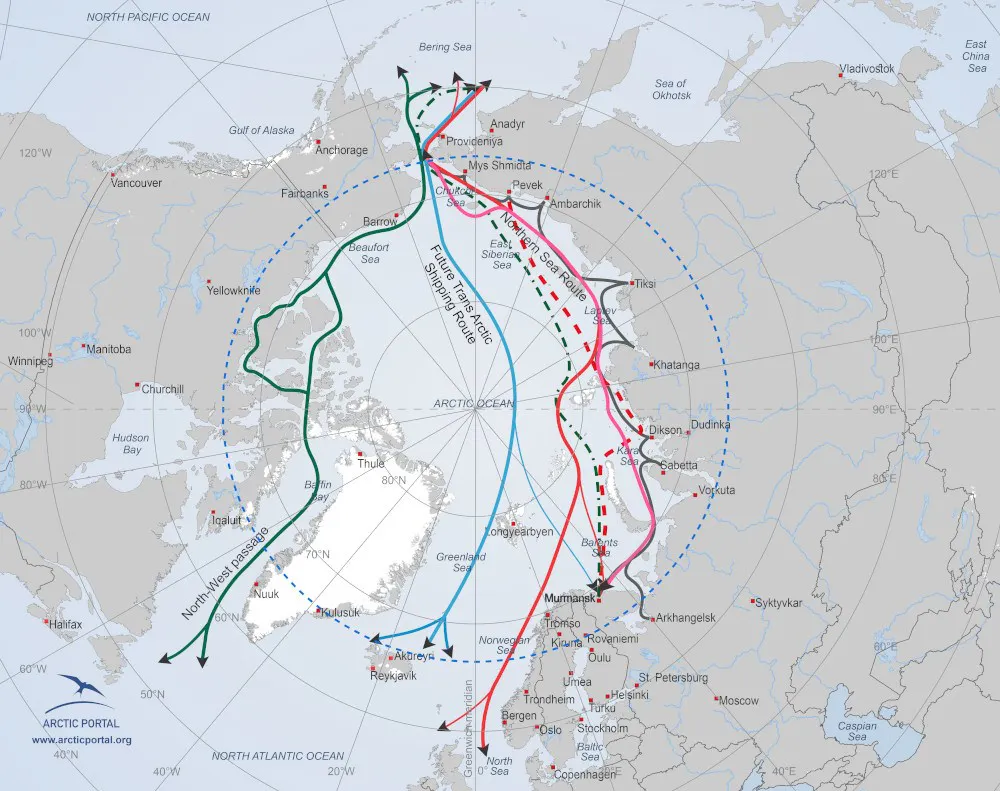
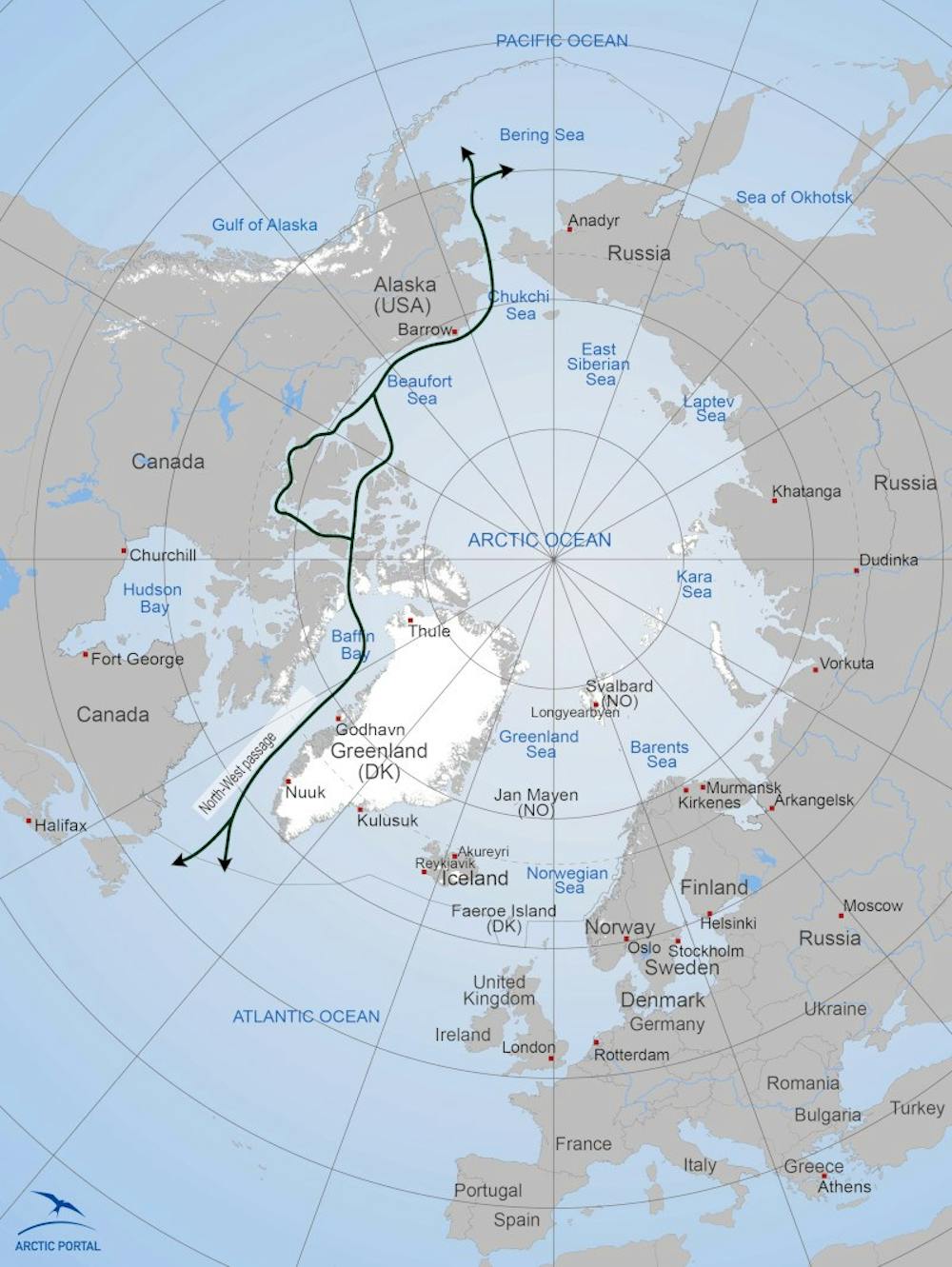
    Trump’s interest in Greenland is often associated with the island’s vast, but largely untapped, mineral resources. But its strategic location is arguably an even greater asset. Shipping routes through the Arctic have become more dependable and for longer periods of time during the year as a result of melting sea ice. The northwest passage (along the US and Canadian shorelines) and the northeast passage (along Russia’s Arctic coast) are often ice free now during the summer.


    Breaking the Ice: Arctic Development and Maritime Transportation, ArcticPortal.org

    This has increased opportunities for commercial shipping. For example, the distance for a container ship from Asia to Europe through the northeast passage can be up to three times shorter, compared to traditional routes through the Suez Canal or around Africa.

    Similarly, the northwest passage offers the shortest route between the east coast of the United States and Alaska. Add to that the likely substantial resources that the Arctic has, from oil and gas to minerals, and the entire region is beginning to look like a giant real estate deal in the making.

    Arctic assets

    The economic promise of the Arctic, and particularly the region’s greater accessibility, have also heightened military and security sensitivities.

    The day before J.D. Vance’s visit to Greenland on March 28, Vladimir Putin, gave a speech at the sixth international Arctic forum in Murmansk in Russia’s high north, warning of increased geopolitical rivalry.

    While he claimed that “Russia has never threatened anyone in the Arctic”, he was also quick to emphasise that Moscow was “enhancing the combat capabilities of the Armed Forces, and modernising military infrastructure facilities” in the Arctic.

    Equally worrying, Russia has increased its naval cooperation with China and given Beijing access, and a stake, in the Arctic. In April 2024, the two countries’ navies signed a cooperation agreement on search and rescue missions on the high seas.


    National Snow & Ice Data Center, Arctic Portal

    In September 2024, China participated in Russia’s largest naval manoeuvres in the post-cold war era, Ocean-2024, which were conducted in north Pacific and Arctic waters. The following month, Russian and Chinese coastguard vessels conducted their first joint patrol in the Arctic. Vance, therefore, has a point when he urges Greenland and Denmark to cut a deal with the US because the “island isn’t safe”.

    That the Russia-China partnership has resulted in an increasingly military presence in the Arctic has not gone unnoticed in the west. Worried about the security of its Arctic territories, Canada has just announced a C$6 billion (£3.2 billion) upgrade to facilities in the North American Aerospace Defense Command it operates jointly with the United States.

    It will also acquire more submarines, icebreakers and fighter jets to bolster its Arctic defences and invest a further C$420 million (£228 million) into a greater presence of its armed forces.


    Read more:
    Arctic breakdown: what climate change in the far north means for the rest of us


    Svalbard’s future role?

    Norway has similarly boosted its defence presence in the Arctic, especially in relation to the Svalbard archipelago (strategically located between the Norwegian mainland and the Arctic Circle). This has prompted an angry response from Russia, wrongly claiming that Oslo was in violation of the 1920 Svalbard Treaty which awarded the archipelago to Norway with the proviso that it must not become host to Norwegian military bases.

    Under the treaty, Russia has a right to a civilian presence there. The “commission on ensuring Russia’s presence on the archipelago Spitzbergen”, the name Moscow uses for Svalbard is chaired by Russian deputy prime minister Yury Trutnev, who is also Putin’s envoy to the far eastern federal district. Trutnev has repeatedly complained about undue Norwegian restrictions on Russia’s presence in Svalbard.

    From the Kremlin’s perspective, this is less about Russia’s historical rights on Svalbard and more about Norway’s – and Nato’s – presence in a strategic location at the nexus of the Greenland, Barents and Norwegian seas. From there, maritime traffic along Russia’s northeast passage can be monitored. If, and when, a central Arctic shipping route becomes viable, which would pass between Greenland and Svalbard, the strategic importance of the archipelago would increase further.

    From Washington’s perspective, Greenland is more important because of its closer proximity to the US. But Svalbard is critical to Nato for monitoring and countering Russian, and potentially Chinese, naval activities. This bigger picture tends to get lost in Trump’s White House, which is more concerned with its own immediate neighbourhood and cares less about regional security leadership.

    Consequently, there has been no suggestion – so far – that the US needs to have Svalbard in the same way that Trump claims he needs Greenland to ensure US security. Nor has Russia issued any specific threats to Svalbard. But it was noticeable that Putin in his speech at the Arctic forum discussed historical territorial issues, including an obscure 1910 proposal for a land swap between the US, Denmark and Germany involving Greenland.

    Putin also noted “that Nato countries are increasingly often designating the Far North as a springboard for possible conflicts”. It is not difficult to see Moscow’s logic: if the US can claim Greenland for security reasons, Russia should do the same with Svalbard.

    The conclusion to draw from this is not that Trump should aim to annex a sovereign Norwegian island next. Maritime geography in the north Atlantic underscores the importance of maintaining and strengthening long-established alliances.

    Investing in expanded security cooperation with Denmark and Norway as part of Nato would secure US interests closer to home and send a strong message to Russia. It would also signal to the wider world that the US is not about to initiate a territorial reordering of global politics to suit exclusively the interests of Moscow, Beijing and Washington.

    Stefan Wolff is a past recipient of grant funding from the Natural Environment Research Council of the UK, the United States Institute of Peace, the Economic and Social Research Council of the UK, the British Academy, the NATO Science for Peace Programme, the EU Framework Programmes 6 and 7 and Horizon 2020, as well as the EU’s Jean Monnet Programme. He is a Trustee and Honorary Treasurer of the Political Studies Association of the UK and a Senior Research Fellow at the Foreign Policy Centre in London.

    – ref. US and Russia squabble over Arctic security as melting ice opens up shipping routes – https://theconversation.com/us-and-russia-squabble-over-arctic-security-as-melting-ice-opens-up-shipping-routes-253493

    MIL OSI – Global Reports –

    April 5, 2025
  • MIL-OSI USA: King Introduces Legislation Banning Energy Exports to China and Other Foreign Adversaries

    US Senate News:

    Source: United States Senator for Maine Angus King

    WASHINGTON, D.C. — U.S. Senator Angus King (I-ME), a member of the Senate Energy and Natural Resources Committee (ENR), has introduced legislation banning energy exports to China and other foreign adversaries. Having long warned that America is “exporting our principal advantage in the world economy,” Senator King joined with colleagues to introduce the Protecting American Households From Rising Energy Costs Act. The legislation would ban the export of crude oil or liquefied natural gas (LNG) to China, Russia, Iran, and North Korea.

    Senator King has repeatedly warned against “subsidizing Chinese manufacturing” by exporting natural gas to our adversaries without studying how it could be counterproductive for America’s domestic energy costs.

    “The Protecting American Households from Rising Energy Costs Act would ensure that America provides our nation with its power needs before subsidizing industries in adversarial countries. This is a commonsense approach that will support America’s national defense and help to keep energy costs lower for everyday Americans,” said Senator King.

    In 2021, 1.2 billion cubic feet per day of LNG were exported to China, making it the second largest destination for American LNG at 12.7 percent of exports. Exports to China dropped in the wake of Russia’s war on Ukraine, but China is locking up long-term LNG contracts from the U.S. for proposed projects. The Protecting American Households From Rising Energy Costs Act would increase American energy security and protect American consumers by ensuring that valuable national resources are not being exported to adversarial nations.

    In addition to King, this legislation is sponsored by Senators Jeff Merkley (D-OR) and Jack Reed (D-RI).

    Senator King has consistently worked to lower energy prices for Maine people. During his first term in Congress, Senator King introduced the Natural Consumer Gas Protection Act, which would have required the Department of Energy (DOE) to consider the effect that any natural gas export proposal would have on domestic prices and employment, regional impacts, and any impact on U.S. industrial competitiveness. Senator King has also worked to support the Low-Income Home Energy Assistance Program and to support Maine people struggling to heat their homes.

    MIL OSI USA News –

    April 5, 2025
  • MIL-OSI Global: The problem with Trump’s takeover of the Kennedy Center isn’t the possibility of ‘Cats’

    Source: The Conversation – USA – By Joanna Dee Das, Associate Professor of Dance, Washington University in St. Louis

    Donald Trump visits the John F. Kennedy Center for the Performing Arts on March 17, 2025. Jim Watson/AFP via Getty Images

    When President Donald Trump announced that he was assuming control of the Kennedy Center for the Performing Arts, he described the move as a triumph over “wokey” programming. He subsequently fired the 17 board members appointed by President Joe Biden and installed himself as chairman.

    Some critics have reacted to the move by suggesting Trump doesn’t understand art.

    One protester declared that Trump has “no artistic bones in his body.” Theater aficionados claim that he misinterprets his favorite musicals, “Cats” and “Les Misérables.”

    The New Yorker magazine’s satirical description of the Kennedy Center’s 2025 programming under Trump included a fictional show called “Forbidden Branson.” The title plays on the show “Forbidden Broadway,” replacing New York’s storied theater district with the popular Ozarks tourist destination that has been maligned as a mecca of bad taste.

    To me, these responses play right into Trump’s hands, reinforcing his claims that liberals are out-of-touch elitists.

    I’ve spent the past seven years researching and writing a book about Branson, Missouri, a town that offers a plethora of live entertainment, including magic shows, country music performances and variety shows. Many of the productions have a conservative, Christian slant. In my view, a Branson-style show could – and should – belong among the offerings at the Kennedy Center.

    Rather than ridiculing the president’s taste, I think responses to the takeover would be better placed focusing on more fundamental questions about the role of the U.S. government in the nation’s artistic life.

    How can a national arts institution best reflect the country’s diverse range of people and interests? Prior to Trump, how well was the Kennedy Center doing at that?

    Historical opposition to arts funding

    For most of U.S. history, government had a very limited role in the arts.

    European royals had long patronized the arts. In contrast, the founders of the United States, fearful of tyranny, created a weak federal government that could barely impose taxes, let alone establish a national theater.

    Instead, artists of the 18th and 19th centuries operated in a for-profit marketplace. Their audiences rejected elitist cultural norms and watched Shakespeare mixed in with minstrel songs and comedy acts on the same program.

    At the end of the 19th century, the Second Industrial Revolution created a class of ultra-wealthy Americans who sought to imitate European royalty and their tradition of patronage. New cultural distinctions emerged. Opera, ballet and classical music were designated as high art; variety shows featuring comedians, popular songs and acrobatics were designated as low art. Musicals eventually found an uneasy niche as “middlebrow.” Performers who wished to avoid the grind of the commercial marketplace could now turn to private patrons. Nonwhite and working-class performers who lacked social connections to the upper crust had fewer opportunities to do so.

    The Great Depression compelled the U.S. government to fund artists for the first time. In 1935, President Franklin D. Roosevelt established Federal Project Number One, which included visual art, theater, music and writing programs. Its primary goal was to provide work for the unemployed. Its secondary purpose involved creating art that would be accessible to ordinary Americans both in terms of location – like murals in public buildings – and content, such as plays like “One Third of a Nation” that spoke to housing concerns.

    An audience enjoys a public Federal Theatre Project performance in New York in the late 1930s.
    Dick Rose/Library of Congress/Corbis/VCG via Getty Images

    Heated controversies over the program ensued. If the main criterion to receive a grant was need, not skill, would government funding churn out bad art?

    Conservative congressmen argued that Federal One artists were taking “unbridled license to ridicule American ideals and to suggest rebellion against our government.” In 1938, the newly formed House Committee on Un-American Activities accused the head of Federal One’s Theatre Project of supporting communism.

    Soon thereafter, the Federal One programs ended.

    The Cold War and the Kennedy Center

    The Cold War created a new opportunity for arts funding as the United States scrambled to counteract the Soviet Union’s depiction of America as “culturally barren.” Under President Dwight D. Eisenhower, the State Department began to sponsor American artists and fund international tours of their work.

    Even this modest attempt at public arts patronage – European nations were spending 20 to 40 times as much on the arts – faced pushback from conservatives, who cast the tours as a waste of taxpayer money. Nonetheless, Eisenhower persisted. In 1958, he signed the National Cultural Center Act to authorize a national arts complex.

    The act failed to provide enough money to actually build the center. In 1962, President John F. Kennedy embarked on a campaign to raise US$30 million in private money. Part of those fundraising efforts involved reassuring donors that their high-art tastes would be reflected.

    The Kennedy Center finally opened its doors in September 1971. Given the need for constant fundraising ever since, philanthropists have dominated its board.

    Today, the Kennedy Center receives $43 million as a public subsidy, or 16% of its budget. Ticket sales, facility rentals and donations comprise the other 84%. No government funds go to artistic programming, which has blunted potential criticism about censorship or propaganda. But this has also precluded the ability of regular people across the nation to weigh in about what appears onstage.

    With members of the Kennedy family looking on, President Lyndon B. Johnson shovels dirt during the groundbreaking ceremonies for the John F. Kennedy Center for the Performing Arts in 1964.
    Bettmann/Getty Images

    An uncertain future

    The Kennedy Center staff has attempted to work within the constraints of a philanthropy model to reach a broad audience and challenge high/middle/low distinctions. In its first year, the center appointed renowned choreographer Katherine Dunham as a technical adviser in intercultural communication. She aimed to “make the center more responsible to the community” and establish a model of local engagement in Washington that could be replicated throughout the country.

    It didn’t materialize. Programming remained in the traditional high art category until Kennedy Center President Deborah Rutter expanded into genres like hip-hop and comedy in the 2010s. In 2020, the center made progress toward Dunham’s vision with its Social Impact initiative, which focused on free performances and transportation to arts events for local Washington communities. Trump has since dissolved it.

    By declaring himself chairman and personally overseeing the programming, Trump has followed in the footsteps of Russian czars or monarchs like Louis XIV of France, who established arts institutions as extensions of royal power. In effect, it realizes 18th-century Americans’ fears about government involvement in the arts as a form of control.

    At the same time, the private philanthropy model has been far from perfect. It has left the Kennedy Center vulnerable to attacks of elitism. Perhaps future leaders can imagine more robust models of public support and stewardship that reflect America’s diverse and multifaceted national landscape – if they’re ever given an opportunity to do so.

    Joanna Dee Das does not work for, consult, own shares in or receive funding from any company or organization that would benefit from this article, and has disclosed no relevant affiliations beyond their academic appointment.

    – ref. The problem with Trump’s takeover of the Kennedy Center isn’t the possibility of ‘Cats’ – https://theconversation.com/the-problem-with-trumps-takeover-of-the-kennedy-center-isnt-the-possibility-of-cats-253196

    MIL OSI – Global Reports –

    April 5, 2025
  • MIL-OSI Russia: Get a grant and support for your project in the competition “My Country – My Russia”

    Translartion. Region: Russians Fedetion –

    Source: State University of Management – Official website of the State –

    The State University of Management invites you to take part in the All-Russian competition of youth author projects and projects in the field of education aimed at the socio-economic development of Russian territories, “My Country – My Russia”.

    The new season of the “My Country – My Russia” competition offers participants 14 nominations covering key areas of territorial development: from ecology to digital technologies. Particular attention is paid to the special nomination “My Country. My History. My Victory”, dedicated to the 80th anniversary of the Victory in the Great Patriotic War.

    Residents of all regions of Russia are invited to participate in the following categories:

    the first category – from 14 to 17 years old (inclusive), the second category – from 18 to 35 years old (inclusive), the third category – no age restrictions within the nominations “My Pedagogical Initiative”, “My Family: Continuity, Values and Meaning”, the fourth category – up to 13 years old (inclusive) within the special children’s nomination “Threads of My Family Tree”.

    Applications are accepted until May 11 on the official website of the competition. By May 26, the expert jury will select no more than 300 best works, the remote defense of which will take place from May 27 to June 15. Based on the results, the three best projects in each nomination, with the exception of the children’s category, will be published on the website.

    In 2025, the finalists of the My Country – My Russia project of the Russia – Country of Opportunities presidential platform will have a special opportunity to apply for the Rosmolodezh grant competition. This means that the authors of the best initiatives selected by experts will be able to apply for additional support to implement their ideas.

    The winners of the competition will receive comprehensive support, including grants for project implementation, additional points for admission to universities, internships and employment in partner companies, travel around Russia from the More Than Travel program, as well as educational programs and mentoring.

    Subscribe to the TG channel “Our GUU” Date of publication: 04.04.2025

    Please note: This information is raw content directly from the source of the information. It is exactly what the source states and does not reflect the position of MIL-OSI or its clients.

    MIL OSI Russia News –

    April 5, 2025
  • MIL-OSI Russia: SUM presented educational programs for citizens of the EAEU countries at an international session

    Translartion. Region: Russians Fedetion –

    Source: State University of Management – Official website of the State –

    Representatives of the State University of Management spoke at the international expert session “Business and Continuous Education: Strategy for Growth and Sustainable Development in the Kyrgyz Republic”, which was held at the Kyrgyz-Russian Slavic University named after B.N. Yeltsin, located in Bishkek.

    The event was attended by Ambassador Extraordinary and Plenipotentiary of the Russian Federation to the Kyrgyz Republic Sergey Vakunov, Head of the Representative Office of Rossotrudnichestvo in the Kyrgyz Republic Albert Zulkharneev, Director of the Center for Public-Private Partnership at the National Investment Agency under the President of the Kyrgyz Republic Nurbek Anarbek, as well as representatives of the Office of the President of the Russian Federation for Interregional and Cultural Relations with Foreign Countries and industrial partners of the Kyrgyz-Russian Slavic University named after B.N. Yeltsin.

    The State University of Management was represented at the event by Vice-Rector Dmitry Bryukhanov and Director of the Center for Eurasian Cooperation of the International Cooperation Department Dinara Sadieva.

    The session included several blocks, including a plenary discussion “Business and Continuous Education: New Opportunities in the Context of Sustainable Development” and organizational issues of network cooperation.

    Dmitry Bryukhanov presented the activities of the scientific and educational consortium “Eurasian Network University” (ENU) and made a report on the topic “Experience of the Eurasian Network University in implementing programs of additional professional education in the EAEU space”, dedicated to joint educational programs of the State University of Management within the framework of the ENU activities. During the report, it was emphasized that the implementation of such projects will allow the formation of a new generation of managers in the EAEU space, operating on the basis of specially formed competencies and practical skills in building international economic cooperation.

    It was noted that in 2024, the State University of Management implemented 18 programs of additional professional education for citizens of the EAEU countries in the field of management, marketing and management of specific sectors of the economy. The total number of graduates in these areas of the programs was 324 students.

    The participants of the plenary discussion discussed issues related to the growing role of continuous education and the demands of the labor market for additional education, presented current directions of state policy in the field of additional professional education in the Russian Federation and the Kyrgyz Republic, and also identified trends in the development of business education, corporate and online training.

    Subscribe to the TG channel “Our GUU” Date of publication: 04.04.2025

    Please note: This information is raw content directly from the source of the information. It is exactly what the source states and does not reflect the position of MIL-OSI or its clients.

    MIL OSI Russia News –

    April 5, 2025
  • MIL-OSI Russia: We invite you to the presentation of the Moscow Government scholarship program

    Translartion. Region: Russians Fedetion –

    Source: State University of Management – Official website of the State –

    On April 9, the State University of Management will host a presentation of the “Moscow Government Named Scholarship” program.

    The event will tell you how to become part of the project team, gain practical experience, determine your career path, and open doors to all the opportunities in the capital.

    The Moscow Government’s personal scholarship is a platform of opportunities for the best students of Moscow, which helps them realize themselves not only within the walls of the university, but also in large-scale projects of the capital.

    Key areas of the program:

    City department. We develop your skills and competencies in the field of politics and city administration using the playing of famous board games and television shows. Here you can become part of our game universe and a cool team of Moscow.
    A healthy lifestyle, sports, the ecology of the city. We talk about a healthy lifestyle, training, alternative sports methods, explain the principles of proper nutrition and organize various festivals and events.
    Medicine. We talk about medicine in simple words and popularize the idea of ​​donation among Moscow universities and youth of Moscow. You have the opportunity to become speakers and participants in the project #medical sciences, blood donors or volunteers of city medical actions.
    Creation. We reveal creative potential and develop talents. Here you can show the world your emotions and feelings with the help of creativity and creativity.
    Meetings with VIP faces of the city. We give a chance to get acquainted with celebrities and statesmen through unique tasks, games and live communication.

    We are waiting for everyone who is ready not only to study, but also to be at the center of cool projects and change the capital for the better, at the presentation on April 9 at 14:45 in PA-203.

    Let us recall that in March, a student of the State University of Management became a resident of the Moscow Government Personal Scholarship.

    Subscribe to the tg channel “Our State University” Announcement date: 04/04/2025

    Please note: This information is raw content directly from the source of the information. It is exactly what the source states and does not reflect the position of MIL-OSI or its clients.

    MIL OSI Russia News –

    April 5, 2025
  • MIL-OSI Russia: Review of Polytechnics’ sporting achievements for March

    Translartion. Region: Russians Fedetion –

    Source: Peter the Great St Petersburg Polytechnic University – Peter the Great St Petersburg Polytechnic University –

    At the Polytechnic, sports activity knows no decline, and students regularly demonstrate high results in various competitions.

    At the St. Petersburg Student Sports Games in powerlifting, Valeria Shaga from IPMET distinguished herself, taking 3rd place with a result of 185 kg in the weight category up to 84 kg, and Margarita Zhornik from ISI, who also won bronze with a total result of 310 kg in the weight category up to 69 kg. It is especially pleasing that Margarita set a record for St. Petersburg among university students, lifting 117.5 kg in squats.

    The jiu-jitsu team also did not leave without awards. Renat Gaibatov and Aglaya Stepanova won silver at the Street Jiu-Jitsu tournament, and Diana Ledovskikh showed the same result at the Just Jiu-Jitsu Champions League.

    Ivan Sokolov took 1st place in the All-Russian competition “Stars of the Baltic” in hand-to-hand combat, dedicated to the memory of the honored coach of Russia A. V. Fakeev

    At the St. Petersburg Rock Climbing Championship, Konstantin Pak took 2nd place and was selected for the city team.

    At the Russian Student Ultimate Championship, held in St. Petersburg, the Polytechnic University men’s team confidently reached the semi-finals, where they defeated ITMO University (8:7), and then won gold, beating Moscow State University (10:9). The women’s team also performed well, winning bronze medals after three tense games and defeating Moscow State Pedagogical University (9:7).

    From March 7 to 9, our athletes also showed high results at the orienteering competitions in Kaliningrad: Olga Shmaylova won silver in two disciplines and bronze in one, Polina Morozova and Ksenia Galkova also received silver and bronze, respectively. Sergey Dribas won bronze at the “Snowy Trail” competition.

    The women’s handball team won the tournament in memory of Yu. N. Zakatova in Boksitogorsk, which confirms their high level of play.

    On March 14, a conference was held at Peter the Great St. Petersburg Polytechnic University III All-Russian scientific and practical conference “Student sports in the modern world”, brought together leading experts and scientists who discussed pressing issues of developing student sports.

    From March 9 to 14, the St. Petersburg Boxing Championship was held, where our team won 13 medals, including three gold. Working at full capacity, the Polytechnicians once again demonstrated high athletic training.

    At the University Dance Sport Championship in Nova Arena, our dance couples won prizes, captivating the hearts of the audience. In the St section, Arseniy Bauman and Anastasia Nazarova took first place, Arseniy Afonin and Sofya Gordeeva took second place, and Ivan Kobernyuk and Ekaterina Kucherova successfully performed in hobby classes. In the La section, the pair of Kobernyuk and Kucherova also became the winner in hobby-4, together with Gleb Gusev and Stefania Aldoshina, who took first place in hobby-6.

    No less striking was the performance of our football team, which on March 17 won the XI tournament named after Anatoly Turchak. In a tense final game, our team defeated their opponents from Leningradets after a penalty shootout. Their persistence and determination brought the long-awaited gold medals!

    The results of the completed championship and the cheerleading championship are also impressive: our girls became champions in mixed stunts and freestyle, and also won a silver medal in freestyle doubles.

    The mini water polo team also deserves congratulations, having taken third place in the university championship among 12 teams. Our team performed brilliantly in the group stage, however, in the semi-final, it lost to ITMO, but coped with a difficult situation, winning the match for 3rd place against SC Gornyak.

    The “Superfinal of the Eight” in phygital mini-golf of the National Student Sports Golf League was held in Moscow from March 20 to 21. St. Petersburg Polytechnic University was represented by two student teams that were part of the “Black Bears-Polytechnic” mini-golf team. As a result, Anastasia Kalashnikova and Anastasia Maksimova took first place, becoming two-time champions, while Alexander Prokhorov and Roman Ivasishin won second place.

    The team of the Institute of Secondary Vocational Education became the bronze prize winner of the first league of the futsal tournament among professional educational organizations. Last year, the polytechnics lost very disappointingly in the match for third place, but now that gestalt was closed. Vladimir Slepov’s charges held an excellent tournament, and in the decisive match they took revenge for the defeat in the group.

    Please note: This information is raw content directly from the source of the information. It is exactly what the source states and does not reflect the position of MIL-OSI or its clients.

    MIL OSI Russia News –

    April 5, 2025
  • MIL-OSI Russia: “This is not just a challenge to Russia, it is also a challenge to our faith”

    Translartion. Region: Russians Fedetion –

    Source: State University Higher School of Economics – State University Higher School of Economics –

    This year Russia will celebrate the 80th anniversary of Victory in the Great Patriotic War. Center for Religion and Law Faculty of Law HSE University held a round table “Connection of Times. Holy War – Special Military Operation. Contribution of Religious Associations to Achieving Victory.” Representatives of different faiths met to recall history and discuss how clergy can support Russians today.

    “The topic that will be discussed today is very important for everyone, for each of us. Everyone is involved in what is happening now throughout the country,” said Dmitry Kuznetsov, Director of the Higher School of Law and Administration at the National Research University Higher School of Economics, opening the event. “But this topic is also deeply historical for us, so I am sure that today we will rely on our roots and talk about the present and, in many ways, predict the future that we need to build together in order to continue strengthening state sovereignty, so that the constitutional principles of interaction between religious associations are fully implemented.”

    Svetlana Nuzhdina, Director of the Center for Religion and Law at the Faculty of Law at the National Research University Higher School of Economics, noted that representatives of the heirs of those religious communities that supported the Russian people and forged victory during difficult times for the country were invited to participate in the round table, and this experience must be remembered and understood today.

    She also read out a greeting from HSE Rector Nikita Anisimov to those gathered.

    “Our country is multi-confessional, and this is its strength. During the difficult wartime, all religious communities of our Motherland showed themselves to be true patriots. The spiritual support of the Red Army soldiers at the front and home front workers undoubtedly helped us resist the enemy and prevent us from being broken in difficult times. The interaction between the state and religious organizations in those years must be studied, including in light of the events associated with the special military operation. I am confident that the discussions that will unfold at this round table will allow us to comprehend the lessons of the past and apply them to the present,” the rector’s greeting reads.

    Hegumen Serapion (August Mitko), Deputy Director Higher School of Law and Administration, the scientific director of the Center for Religion and Law of the Faculty of Law of the National Research University Higher School of Economics, noted that the last three years have become a test not only for the entire Russian people, but also for religious organizations. For the first time in a very long time, different sides in the conflict are justifying their case with religious arguments. “Many religious organizations have joined the anti-Russian campaign. What is happening is not only a challenge to security, not only a political one, but also a spiritual challenge. In addition to victory on the battlefield, there is also a spiritual victory and a spiritual defeat. Now we must understand that this Russophobia, hatred is not just a challenge to Russia, it is a challenge to our faith. We believe in truth, in goodness and in love, and we must preserve both true faith and love,” he emphasized.

    Metropolitan of Moscow and All Rus’ of the Russian Orthodox Old Believer Church Korniliy (Konstantin Titov) told the participants of the round table about the feats that believers accomplished during the Great Patriotic War, saving Moscow from the enemy army. “We constantly pray for help for our soldiers,” he said.

    Rabbi Aaron Gurevich, head of the Department of the Federation of Jewish Communities of Russia for interaction with the Armed Forces, the Ministry of Emergency Situations and law enforcement agencies of the Russian Federation, said that since the beginning of the Second World War, the Jewish community, which is on the side of the Russians, has found itself under double pressure. In his opinion, European politicians, who are now setting the agenda, instead of dealing with the internal problems of their countries, stubbornly oppose Russia, trying to take quasi-revenge for the defeat of their fathers and grandfathers in the Great Patriotic War.

    A person who helps gets much more than the one who receives help, reminded the mufti of the Moscow Region of the Spiritual Assembly of Muslims of Russia Denis Mukhutdinov. “When you immerse yourself in the process of providing help, when you begin to live this process, such a concept as someone else’s grief is erased for you. Each story that you learn becomes your own, and you learn to feel and empathize and, as a religious figure, begin to convey this to your flock,” he said.

    The head of the Department of Education and Science of the Spiritual Administration of Muslims of the Russian Federation, Ilgizar Davletshin, raised the issue of organizing and developing an institute for training military clergymen under special programs. This issue is very important for all faiths, he noted.

    Archpriest Yevgeny Lishchenyuk, head of the Service for Spiritual and Psychological Assistance to Participants in Combat Operations and Their Families at the Synodal Department for Church Charity and Social Service, director of the St. Anthony Smirnitsky Charitable Foundation, said that more than 20,000 clergy have already been to the front. Just like their flock, they find themselves on the front lines, many have been injured, and some have died.

    Vice-Rector for Social and Missionary Work at the Orthodox St. Tikhon’s Humanitarian University, Philipp Ilyashenko, spoke about the tasks of religious education. This is not only helping soldiers and those who returned from the front, but also educating students.

    The head of the public relations department of the Western Russian Union of Seventh-day Adventist Christians, Evgeny Ekimov, noted the importance of the contribution of home front workers to the victory and the need to highly value their work.

    Maria Mchedlova, head of the Department of Comparative Political Science at the Faculty of Humanities and Social Sciences at RUDN University and chief research fellow at the Institute of Sociology at the Federal Research Sociological Center of the Russian Academy of Sciences, discussed how social service is changing today. She noted that compassion and consolation are needed not only by direct participants in the SVO, but also by their relatives who remain in the rear, and especially by those who have lost loved ones. “True believers pray not to destroy the enemy, but for the human to triumph,” she emphasized.

    Crises lead to spiritual revival, noted the head of the Center for the Study of Religion and Society Problems of the Institute of Europe of the Russian Academy of Sciences, Deputy Director of the Institute of Europe of the Russian Academy of Sciences for Research Roman Lunkin. According to him, each of the difficult events for the country was experienced hand in hand by the spiritual and secular authorities, and this led to a fairly large-scale rethinking and restructuring of public consciousness.

    The war has moved from the historical to the value plane, emphasized the adviser to the head of the Federal Agency for Nationalities Aikaz Mikaelyan. “This is the most key value factor, because the memory of the Great Patriotic War is part of the family identity of each person. Every family in our country has such a memory. This is a large set of family values that unites us, the entire post-Soviet space. It is precisely this value understanding, work with young people – only this can guarantee victory,” he emphasized.

    Also speaking at the round table were the Chairman of the Central Spiritual Administration of Buddhists Geshe Yonten Lodoy (Sergey Kirishov), the Chairman of the Russian Union of Evangelical Christians-Baptists Petr Mitskevich, the head of the apparatus, the responsible secretary of the Spiritual Council of the Russian United Union of Christians of the Evangelical Faith (Pentecostals) Dmitry Taranov, a teacher at the Zaoksky Adventist University Dmitry Fokin, and the representative of the Russian and New Nakhichevan Diocese of the Armenian Apostolic Church, priest Gevorg Vardanyan.

    Please note: This information is raw content directly from the source of the information. It is exactly what the source states and does not reflect the position of MIL-OSI or its clients.

    MIL OSI Russia News –

    April 5, 2025
  • MIL-OSI Security: U.S. Africa Command 2025 Posture Statement to Senate Armed Services Committee

    Source: United States AFRICOM

    U.S. Marine Corps Gen. Michael E. Langley, commander of U.S. Africa Command, testified yesterday before the Senate Armed Services Committee, delivering the command’s 2025 posture statement and highlighting the strategic importance of the African continent.

    “Everything we do has one overarching goal in mind: achieving peace through strength,” Langley said during his opening remarks. “This requires three things – a clear understanding of national security threats, a robust and dependable network of like-minded allies and partners, and appropriate resourcing to match military requirements.”

    Providing his assessment of the terrorist threat in the region to committee members, Langley discussed the persistent and growing risk to regional and global security from violent extremists including ISIS, which he said is directing global operations from Somalia and al Shabaab. 

    “Left unchecked, they will have a direct effect on the homeland.” 

    Addressing the intent and goals of the strategic competitors in Africa, Langley described the Chinese Communist Party intent on using Africa to become the global hegemon and a Russian Federation that seizes opportunity created by chaos and instability.

    “In order to protect our homeland and United States interests. We must deter these nations and their malign actors from their goals on the African continent,” he said.

    Asked about tools the command needs to be effective, Langley explained that USAFRICOM continues to leverage security cooperation as a primary tool to build operational independence among African partners; and that exercises such as FLINTLOCK, AFRICAN LION, and OBANGAME EXPRESS enhance military readiness, promote interoperability, and reinforce strong bilateral and multilateral relationships across all domains.

    “As a posture-limited theater, we establish strength and work towards peace by enhancing the security capabilities of our African partners through a robust system of alliances. Exercises, training events, security cooperation, and foreign military sales programs are the backbone of our military activities on the continent,” Langley said.  

    Langley wrapped up his testimony by underscoring the importance of capabilities such as airborne intelligence, surveillance, and reconnaissance, and counter-unmanned aerial systems in counterterrorism efforts. The command, he said, “seeks to match these capabilities against current and emerging threats to ensure the security of our forces while advancing American interests.”

    The full statement and hearing can be viewed on the U.S. Africa Command website.

    U.S. Africa Command, one of 11 U.S. Department of Defense combatant commands with an area of responsibility covering 53 African states, more than 800 ethnic groups, over 1,000 languages, vast natural resources, a land mass that is three-and-a-half times the size of the U.S., and nearly 19,000 miles of coastland. Working alongside its partners, AFRICOM counters transnational threats and malign actors, strengthens security forces and responds to crises.

    MIL Security OSI –

    April 5, 2025
  • MIL-OSI Global: Faced with new tariffs and a truculent Trump, Japan and South Korea toe a cautious line

    Source: The Conversation – Global Perspectives – By Sebastian Maslow, Associate Professor, International Relations, University of Tokyo

    Two months into US President Donald Trump’s second term, the liberal international order is on life support.

    Alliances and multilateral institutions are now seen by the United States as burdens. Europe and NATO are framed as bad business, “ripping off” the US. On his so-called “Liberation Day”, Trump also imposed 20% tariffs on all European Union imports.

    The Trump administration has been far less critical of the US’ alliances in the Indo-Pacific region. On a visit to Tokyo this week, US Defence Secretary Pete Hegseth described Japan as America’s “indispensable partner” in deterring Chinese aggression.

    Yet, Japan and South Korea fared even worse than the EU with Trump’s new tariffs. Trump slapped Japan with 24% tariffs and South Korea 25%. (Both countries enjoy a trade surplus with the US.)

    So, how are the US’ two main allies in the Indo-Pacific dealing with the mercurial US leader? Will they follow Europe’s lead in reassessing their own security relationships with the US?

    Japan: a positive summit but concerns remain

    America’s post-war security strategy in Asia differs from Europe. While NATO was built on the premise of collective defence among its members, the US adopted a “hub-and-spokes” model in Asia, relying on bilateral alliances to contain the spread of communism.

    Japan and South Korea have long sheltered under the US nuclear umbrella and hosted major US military bases. Both are also highly sensitive to changes in the US’ Indo-Pacific policies.

    Japan, in particular, has a long history of careful alliance management with the US, epitomised by former Prime Minister Shinzo Abe’s courting of Trump.

    During Trump’s first term in office, Abe’s policy goals aligned closely with the US: transforming Japan’s security posture to make it a serious military and diplomatic power. Japan increased military spending, lifted arms export restrictions and deepened ties with India and Australia.

    Prime Minister Fumio Kishida continued to raise Japan’s security profile from 2021-24, again increasing military spending and taking a tough line on Russia’s invasion of Ukraine. He emphasised “Europe today could be Asia tomorrow”.

    His successor, Shigeru Ishiba, had a successful summit with Trump in February, immediately after his inauguration. The joint statement reaffirmed US security guarantees to Japan, including over the Senkaku Islands, which are claimed by China.

    Japan also agreed to import American liquefied natural gas, and later committed to working with South Korea to develop a US$44 billion (A$70 billion) plan to export LNG from Alaska.

    However, these positive developments do not mean the relationship is on firm ground.

    In early March, Trump complained the US-Japan security agreement signed in 1960 was “one-sided” and a top administration official again called for Japan to increase its defence spending to 3% of gross domestic product (GDP) – a huge increase for a country facing serious demographic and fiscal pressures.

    Reports also emerged the US was considering cancelling a new joint headquarters in Japan aimed at deeper integration between US and Japanese forces.

    South Korea: extremely vulnerable on trade

    South Korea faces similar pressures. Ties between the two countries were strained during Trump’s first term over his demand South Korea increase the amount it pays to host US forces by
    nearly 400%. A 2021 agreement restored some stability, but left Seoul deeply worried about the future of the alliance.

    South Korea’s acting president, Choi Sang-mok, has expressed a desire to strengthen ties with the US, though Trump has reportedly been cool to his advances.

    With a US$66 billion (A$105 billion) trade surplus with the US, South Korea is considered the country most vulnerable to trade risk with the Trump administration, according to a Swiss research group.

    Trump’s past suggestions that both South Korea and Japan develop nuclear weapons or pay for US nuclear protection has also rattled some nerves. As confidence in the US alliance erodes, both countries are engaging in an urgent public debate about the possibility of acquiring nuclear weapons.

    Tensions moving forward

    Potential for conflict is on the horizon. For example, Tokyo and Washington are set to renegotiate the deal that dictates how much Japan pays to host US troops next year.

    Both allies pay huge sums to host US bases. South Korea will pay US$1.14 billion (A$1.8 billion) in 2026, and Japan pays US$1.72 billion (A$2.7 billion) annually.

    A trade war could also prompt a reassessment of the costs of US efforts to decouple from China, potentially leading to closer economic ties between Japan, South Korea and China. The three countries have agreed to accelerate talks on a trilateral free trade agreement, which had been on hold since 2019.

    Another challenge is semiconductors. Japan’s new semiconductor revitalisation strategy is prioritising domestic investment, raising questions about whether Trump will tolerate “friendshoring” if Japan diverts investments from the US.

    In 2024, Japan outspent the US in semiconductor subsidies (as a share of GDP), while Taiwan’s TSMC, the world’s largest contract chipmaker, expanded its production capacity in Japan.

    Seoul remains an important partner to Washington on semiconductors. Samsung and SK Hynix are both boosting their investments on new semiconductor plants in the US. However, there is now uncertainty over the subsidies promised to both companies to invest in America under the CHIPS Act.

    Ultimately, the strength of these alliances depends on whether the Trump administration views them as long-term bulwarks against China’s rise in the region, or merely vassals that can be extorted for financial gain.

    If the US is serious about countering China, its regional alliances are key. This would give Japan and South Korea some degree of leverage – or, in Trump terms, they’ll hold valuable cards. Whether they get to play them, however, depends on what Trump’s China policy turns out to be.

    The authors do not work for, consult, own shares in or receive funding from any company or organisation that would benefit from this article, and have disclosed no relevant affiliations beyond their academic appointment.

    – ref. Faced with new tariffs and a truculent Trump, Japan and South Korea toe a cautious line – https://theconversation.com/faced-with-new-tariffs-and-a-truculent-trump-japan-and-south-korea-toe-a-cautious-line-244172

    MIL OSI – Global Reports –

    April 5, 2025
  • MIL-OSI Global: Russia and China both want influence over Central Asia. Could it rupture their friendship?

    Source: The Conversation – Global Perspectives – By Dilnoza Ubaydullaeva, Lecturer in Government, Flinders University

    As he looks to solidify his territorial gains in Ukraine in a potential ceasefire deal, Russian President Vladimir Putin has one eye trained on Russia’s southern border – and boosting Russian influence in Central Asia.

    Following his 2024 re-election, Putin made Uzbekistan his third foreign visit after China and Belarus. The visit signalled the region’s continued importance to Moscow.

    In response to Western sanctions on Moscow over the Ukraine war, trade and investment between Russia and Central Asian countries have grown significantly.

    Russia’s Lukoil and Gazprom are now the dominant foreign players in Uzbekistan’s energy fields. In Kazakhstan, Moscow controls a quarter of the country’s uranium production.

    But as Russia tries to reaffirm its role in the region, China has also been quietly expanding its influence.

    Could this growing competition over Central Asia affect Beijing and Moscow’s broader relationship?

    Central Asia drifting apart from Moscow

    The Central Asian region is home to approximately 79 million people spread across five nations. It was part of the Soviet Union until its collapse in 1991. Its strategic location between Russia and China, on the doorstep of the Middle East, has long made it a “grand chessboard” for great power politics.

    While Russia has traditionally dominated the region, Central Asian leaders have made efforts to somewhat distance themselves from Moscow recently.

    At the Commonwealth of Independent States (CIS) summit in October 2022, for example, Tajikistan’s president publicly challenged Russian President Vladimir Putin. He demanded respect for smaller states like his.

    Similarly, during Putin’s 2023 visit to Kazakhstan, President Kassym-Jomart Tokayev made a symbolic statement at the press conference by delivering his speech in Kazakh rather than Russian. This was a rare move that seemed to catch Putin’s delegation off guard.

    In another striking moment, Tokayev declared at an economic forum in Russia in 2022 that Kazakhstan does not recognise Russia’s “quasi-states”, referring to its occupied territories of Ukraine.

    Yet, all Central Asian states remain part of at least one Russia-led organisation, such as the Commonwealth of Independent States, the Collective Security Treaty Organization, or the Eurasian Economic Union.

    Three states (Kazakhstan, Kyrgyzstan and Tajikistan) rely on Russian security guarantees through the Collective Security Treaty Organization.

    And the region’s economic dependency on Russia remains significant. Of the 6.1 million migrants in Russia, the largest groups come from Uzbekistan, Tajikistan and Kyrgyzstan. These countries depend heavily on remittances from these migrant workers.

    China’s growing influence

    With Russia preoccupied with Ukraine and constrained by Western sanctions, China has seized the opportunity to deepen its engagement in the region.

    Beijing’s involvement in Central Asia has long been economic. In 2013, for instance, China unveiled its ambitious, global Belt and Road Initiative in Kazakhstan. And by 2024, it was China, not Russia, that was the largest trading partner of every Central Asian country except Tajikistan.

    But in recent years, China has expanded its influence beyond economic ties, establishing itself as a key player in regional politics.

    At the inaugural China-Central Asia Summit in 2023, for example, Chinese leader Xi Jinping pledged support for the sovereignty, security and territorial integrity of the region. This is traditionally a role played by Russia.

    Xi has also been making high-profile visits to Central Asian states, signalling Beijing’s growing strategic interests here.

    Local populations, however, remain wary. Public opinion surveys indicate China is viewed more negatively than Russia.

    Many Chinese-funded projects bring their own workers, limiting job opportunities for locals and fuelling resentment. There is also anxiety about potential “debt trap” diplomacy. Civil society groups have called for economic diversification to avoid over-reliance on Beijing.

    Further complicating matters is Beijing’s treatment of the Muslim minority Uyghur population in the Xinjiang region of western China. This has reinforced suspicions in Muslim-majority Central Asia about China’s long-term intentions in the region.

    Growing competition

    The increasing competition raises questions about the potential impact on the broader, “no limits” relationship between Moscow and Beijing.

    At a recent forum, Putin acknowledged Beijing’s growing economic role in the region. However, he insisted Russia still has “special ties” with Central Asian states, rooted in history. And he notably dismissed concerns about China’s expansionist aims, saying:

    There is nothing about domination in the Chinese philosophy. They do not strive for domination.

    On the ground, however, things aren’t so simple. So far, China and Russia have managed to avoid stepping on each other’s toes. How long that balance remains, however, is an open question.

    Central Asian countries, meanwhile, are courting both sides – and diversifying their ties beyond the two powers.

    Many of the region’s educated elite are increasingly looking toward Turkey – and pan-Turkic solidarity – as an alternative to both Russian and Chinese dominance.

    Russia’s historical influence in the region remains strong. But the days of its unquestioned dominance appear to be over.

    Russia may try to reassert its preeminent position, but China’s deepening economic presence is not going anywhere.

    With both countries pushing their own regional agendas, it’s hard to ignore the overlap – and the potential for a future clash over competing interests.

    Dilnoza Ubaydullaeva does not work for, consult, own shares in or receive funding from any company or organisation that would benefit from this article, and has disclosed no relevant affiliations beyond their academic appointment.

    – ref. Russia and China both want influence over Central Asia. Could it rupture their friendship? – https://theconversation.com/russia-and-china-both-want-influence-over-central-asia-could-it-rupture-their-friendship-251023

    MIL OSI – Global Reports –

    April 5, 2025
  • MIL-OSI Global: Myanmar military’s ‘ceasefire’ follows a pattern of ruling generals exploiting disasters to shore up control

    Source: The Conversation – Global Perspectives – By Tharaphi Than, Associate Professor of World Cultures and Languages, Northern Illinois University

    Myanmar’s military chief, Min Aung Hlaing, called for elections on March 27, 2025 – a day before an earthquake devastated the country. STR/AFP via Getty Images

    After a 7.7 magnitude earthquake struck Myanmar on March 28. 2025, the country’s military and the myriad resistance groups fighting a yearslong civil war faced international calls for an immediate ceasefire. A pause in the fighting would enable vital aid to enter the major quake zones and allow rescuers to assist victims in a disaster that has already killed more than 3,000 people.

    The first to heed the call was the opposition National Unity Government, which unilaterally announced a two-week pause on attacks by its armed wing, the People’s Defense Force, on March 29. The Three Brotherhood Alliance – a coalition of three ethnic resistance groups: the Myanmar National Democratic Alliance Army, the Ta’ang National Liberation Army and the Arakan Army – likewise agreed to a temporary truce.

    But Myanmar’s military demurred. Just hours after the quake, as rescuers continued to dig through rubble in search of survivors, the generals ordered airstrikes on enemy positions in Shan state and Karen state in the country’s east – a decision that United Nations special rapporteur Tom Andrews described as “nothing short of incredible.”

    The generals eventually yielded to pressure late on April 2 – some five days after the earthquake hit – announcing that they would halt fighting until April 22. But the statement appeared to be hollow, with reports just a day later that the military’s bombing campaign and ground offensive were continuing unabated in Kachin state in Myanmar’s north.

    Mandalay buildings, like Myanmar’s democracy, lie in ruins.
    STR/AFP via Getty Images

    As an expert on the political history of Myanmar, I believe the behavior of the country’s military is of no surprise. The generals who have had a grip on the country for much of the past six decades have a track record of exploiting disasters for political gain. Weakened by years of entrenched civil war, they are now seeking an opportunity in the earthquake to rehabilitate their image overseas, while consolidating power at home.

    From disasters to elections

    Myanmar’s ruling junta has tried this tactic before. In 2008, a week after the deadly cyclone Nargis killed more than 100,000 people in Myanmar, the military proceeded to hold a constitutional referendum that would guarantee the military’s control of government by reserving 25% of all parliamentary seats for officers while requiring 75% of votes for any future constitutional reform. It also allowed for the military to take over the country “in the event of an emergency.”

    The referendum took place while much of Myanmar was still reeling from disaster, yet the junta announced a 98.12% turnout, of which 92.48% voted in favor of the new pro-military constitution.

    It paved the way to elections in 2010, which the military’s Union Solidarity and Development Party won. Though that vote was boycotted by the opposition National League for Democracy, or NLD, Washington had by then signaled a shift in policy toward “pragmatic engagement” with the then-ruling junta. This U.S. shift forced the recalcitrant NLD to cooperate in subsequent elections, giving legitimacy to a process that was stacked in favor of the generals.

    Using a fig leaf of legitimacy

    The latest disaster comes as the junta is again attempting to push for elections. Just a day before the earthquake, Myanmar’s military chief, Min Aung Hlaing, confirmed plans for a December national vote and called on opposition parties to participate.

    But the proposed election in Myanmar is widely seen as a face-saving strategy for both the Myanmar military and, I would argue, an international community that has done little of any significance to end the civil war. In this context, elections would allow the generals to cover their 2021 power grab with a fig leaf of legitimacy.

    The entrenched civil war that was sparked by that military takeover – a coup that ended a 10-year experiment with limited democracy – derailed the military’s initial plan to return to full control of the country.

    Anti-military soldiers sit in a long-tailed boat on the Salween River.
    Thierry Falise/LightRocket via Getty Images

    Four years of fighting a broad-based opposition that includes ethnic minority groups like the Karen National Union, Kachin Independence Army, Arakan Army, Ta’ang National Liberation Army, Myanmar National Democratic Alliance Army, People’s Defense Force and Bamar People’s Liberation Army has taken its toll on the military.

    It has lost territorial control in many regions to the myriad resistance groups. Internationally, it has become more isolated through sanctions, and its largest trading partner, China, concerned over instability on its border, has slowed investments as it tries to play all sides of the conflict.

    In desperation, the generals have resorted to forced conscription for foot soldiers, while looking to Russia for arms and investment.

    The failure of the generals

    What the military desperately needs now is a lifeline and a civil war exit plan. The earthquake could provide both, with a ceasefire – no matter how badly observed – providing a cover for allowing for a national vote.

    But as has been evident in the days surrounding the announcement of a truce, the military is likely to exploit the disaster to weaken the resistance along the way. It has said that it will take “necessary” measures against any resistance group found to be regrouping or attacking the state during the ceasefire. Yet it has reportedly continued its own offensive.

    The earthquake has revealed the failures and brutalities of the military in other ways, too. In the aftermath of the disaster, the military shut down private clinics and hospitals in badly hit Mandalay for allegedly employing rebel doctors and nurses who were treating members of the resistance. As it was, many health care workers have been in hiding since the coup, and young people who could have been on the front lines of relief efforts have either joined the resistance groups or fled the country.

    The earthquake will also further hurt a Myanmar business community already suffering from the pullout of international businesses after the 2021 coup.

    On unsecure foundations

    Yet, the military may be hoping that it can use the disaster to rebuild its brand overseas. The surprise announcement of a ceasefire by the generals is part of that process. So, too, is the decision to allow in international rescue teams, after initially blocking relief workers from entering the country. It is the military’s way of showing willingness to cooperate with the wider world.

    In short, disaster diplomacy has kicked in for Myanmar’s military, as it did after 2008’s Cyclone Nagris. That earlier cyclone provided an opportunity for the junta to present a different face to the international community. Elections were held, not once, but twice – encouraged by the U.S. and others – and investments rushed into Myanmar as the country was touted as “Asia’s next Tiger.”

    But the foundations of military-backed reform in Myanmar were built on fault lines that cracked and crumbled amid the 2021 coup. The military’s exploitation of the 2025 earthquake will, I fear, result in similar ends.

    Tharaphi Than does not work for, consult, own shares in or receive funding from any company or organization that would benefit from this article, and has disclosed no relevant affiliations beyond their academic appointment.

    – ref. Myanmar military’s ‘ceasefire’ follows a pattern of ruling generals exploiting disasters to shore up control – https://theconversation.com/myanmar-militarys-ceasefire-follows-a-pattern-of-ruling-generals-exploiting-disasters-to-shore-up-control-253577

    MIL OSI – Global Reports –

    April 5, 2025
  • MIL-OSI Europe: Debates – Thursday, 3 April 2025 – Strasbourg – Revised edition

    Source: European Parliament 2

    Verbatim report of proceedings
     428k  793k
    Thursday, 3 April 2025 – Strasbourg
    1. Opening of the sitting
      2. Council positions at first reading (Rule 64)
      3. European Action Plan on Rare Diseases (debate)
      4. Establishment of a European Day of the Righteous (debate)
      5. 110th anniversary of the Armenian genocide
      6. Resumption of the sitting
      7. Request for waiver of immunity
      8. Verification of credentials
      9. Voting time
        9.1. Establishing an EU talent pool (A10-0045/2025 – Abir Al-Sahlani) (vote)
        9.2. Granting equivalence with EU requirements to Moldova and Ukraine as regards field inspections and production of seed (A10-0043/2025 – Veronika Vrecionová) (vote)
        9.3. Estimates of revenue and expenditure for the financial year 2026 – Section I – European Parliament (A10-0048/2025 – Matjaž Nemec) (vote)
        9.4. Prosecution of journalists in Cameroon, notably the cases of Amadou Vamoulké, Kingsley Fomunyuy Njoka, Mancho Bibixy, Thomas Awah Junior, Tsi Conrad (RC-B10-0230/2025, B10-0230/2025, B10-0231/2025, B10-0232/2025, B10-0233/2025, B10-0234/2025, B10-0235/2025, B10-0236/2025, B10-0237/2025) (vote)
        9.5. Execution spree in Iran and the confirmation of the death sentences of activists Behrouz Ehsani and Mehdi Hassani (RC-B10-0220/2025, B10-0220/2025, B10-0222/2025, B10-0224/2025, B10-0225/2025, B10-0226/2025, B10-0228/2025) (vote)
        9.6. Immediate risk of further repression by Lukashenka’s regime in Belarus – threats from the Investigative Committee (RC-B10-0219/2025, B10-0218/2025, B10-0219/2025, B10-0221/2025, B10-0223/2025, B10-0227/2025, B10-0229/2025) (vote)
        9.7. Amending Directives (EU) 2022/2464 and (EU) 2024/1760 as regards the dates from which Member States are to apply certain corporate sustainability reporting and due diligence requirements (vote)
        9.8. Energy-intensive industries (B10-0209/2025) (vote)
        9.9. Targeted attacks against Christians in the Democratic Republic of the Congo – defending religious freedom and security (RC-B10-0211/2025, B10-0211/2025, B10-0212/2025, B10-0213/2025, B10-0214/2025, B10-0215/2025, B10-0216/2025, B10-0217/2025) (vote)
      10. Resumption of the sitting
      11. Approval of the minutes of the previous sitting
      12. Health care related tourism: protecting EU patients abroad (debate)
      13. Explanations of votes
        13.1. Targeted attacks against Christians in the Democratic Republic of the Congo – defending religious freedom and security (RC-B10-0211/2025)
      14. Approval of the minutes of the sitting and forwarding of texts adopted
      15. Dates of the next part-session
      16. Closure of the sitting
      17. Adjournment of the session


    PRÉSIDENCE: YOUNOUS OMARJEE
    Vice-Président

     
    1. Opening of the sitting


    (La séance est ouverte à 9h00)


    2. Council positions at first reading (Rule 64)


      Le Président. – La Présidente a reçu du Conseil ses positions en première lecture concernant les trois dossiers suivants:

    – le champ d’application des règles applicables aux indices de référence, l’utilisation dans l’Union d’indices de référence fournis par un administrateur situé dans un pays tiers et certaines obligations d’information;

    – l’instrument pour le développement et la croissance des régions frontalières dans l’UE – BRIDGEforEU;

    – les statistiques du marché du travail concernant les entreprises.

    La Présidente a également reçu les raisons qui ont conduit à leur adoption ainsi que les positions et avis de la Commission. Les titres complets seront publiés dans le procès-verbal de la séance d’aujourd’hui. Le délai de trois mois dont dispose le Parlement pour adopter ces positions commence donc demain, le 4 avril 2025.


    3. European Action Plan on Rare Diseases (debate)


      Olivér Várhelyi, Member of the Commission. – Mr President, honourable Members, I’m pleased to address you today on such an important topic, one which the EU has long recognised the importance of, and this is reflected in the significant actions we have taken to support our citizens, including through research and development of new treatments, as well as access to diagnosis and treatment and better patient care.

    In the EU, we estimate that around 30 million people live with a rare disease. So while rare diseases are rare, patients living with them are not. This is why the Commission has been active in addressing rare diseases for many years now. A strong European health union helps to improve the health of all of our citizens, no matter where they live, no matter their disease or complex condition. Our work on rare diseases is underpinned by a strong EU framework based on the Commission communication on rare diseases, the Council recommendations on action in the field of rare diseases and the Cross-Border Healthcare Directive.

    On this strong foundation, the Commission is supporting the Member States through targeted and concrete actions that can make a real difference for rare-disease patients. The 24 European reference networks are a truly European success story. They bring together knowledge of healthcare providers, researchers and patient organisations from across Europe and leverage the collective expertise for patients’ care. The European reference networks are unique and in that, they are a prime example of European solidarity and innovation, allowing expertise to travel rather than patients. We have now strengthened their work with the EU4Health funding, worth EUR 77.4 million, which will run until 2027.

    Today, the primary challenge is that the potential of European reference networks is not fully realised because they are not yet well integrated into the national healthcare systems. We have therefore launched the joint action Jardin for integrating these networks into the national health care systems, with an additional EUR 18.7 million until 2027. This joint action also promotes the development of national plans for rare diseases. It brings together all stakeholders in the area of rare diseases, and will be pivotal in shaping union policies and supporting Member States.

    We’re also working to improve access to safe and more effective orphan medicines. The Critical Medicines Act that I presented during the last plenary includes the possibility for Member States to collaboratively procure medicines other than those on the list of critical medicines. These include, for example, medicines for rare diseases.

    Moreover, the revision of the pharmaceutical legislation promotes the development of treatments for rare diseases, not to mention the impact of the European Health Data Space on research, which will be transformative for rare diseases. The European Health Data Space will draw on the work of the European Platform on Rare Disease Registration to address the issue of fragmentation of rare disease patients’ data across Europe.

    Looking more widely, having more competitive pharmaceutical, biotech and medical device sectors will also support action on rare diseases. In the Biotech Act, I will explore helping scientists to bring their products from the laboratory to the factory and onto the markets faster. This act should help us create a new, world-leading biotech industry, and that will lead on prevention and develop new personalised medicine.

    Another major area of action is, of course, research. The Commission has supported research on rare diseases with EUR 5.2 billion during the last 25 years. Just recently, we launched a new seven-year research partnership: the European Rare Diseases Research Alliance (Erdera) for better prevention, better diagnosis and better treatment of rare diseases.

    So, honourable Members, we have a comprehensive framework on rare diseases which steers our dedicated work and activities. We are also working with all stakeholders in a joint action, which helps pave the way for future improvements to our common framework as needed. If we want to make a real impact for people with rare diseases, I ask you to support this work for these actions that are starting to bear fruit.


      Tomislav Sokol, u ime kluba PPE. – Poštovani predsjedavajući, povjereniče, kolegice i kolege, u Europskoj uniji rijetke bolesti pogađaju između 27 i 36 milijuna ljudi, među kojima su brojna djeca. Pritom se procjenjuje da postoji između šest i osam tisuća vrsta rijetkih bolesti, a mnoge od njih još uvijek su neistražene. Iako je upravo ovo područje u kojem Europska unija može učiniti najviše, još uvijek nemamo sveobuhvatan europski plan za rijetke bolesti. Vrijeme je da to promijenimo.

    Po uzoru na europski plan za borbu protiv raka, potreban nam je i europski plan za rijetke bolesti s jasnim ciljevima, definiranim rokovima, mjerilima i osiguranim financijskim sredstvima. Od 2017. godine Europske referentne mreže transformirale su skrb i istraživanje rijetkih bolesti. One su vjerojatno najznačajnija inovacija u zdravstvu i istraživanju rijetkih bolesti u Europi, ako ne i u svijetu, a sada je vrijeme da ih dodatno financijski ojačamo kroz znatno veća ulaganja iz europskog proračuna. Podaci govore da je 86 % pacijenata s rijetkim bolestima u EU spremno putovati preko granica da bi dobili bolju medicinsku skrb, pogotovo onu koju ne mogu dobiti na teritoriju svoje zemlje. Stoga, budući europski plan za rijetke bolesti mora koordinirati i uskladiti nacionalne strategije te olakšati prekograničnu zdravstvenu zaštitu, a pogotovo je važno pojednostavniti postojeće europske propise koji reguliraju pravo na liječenje u inozemstvu. Kao dio široke zdravstvene inicijative, moramo pojednostavniti ta pravila o prekograničnoj zdravstvenoj skrbi, ali i olakšati provođenje kliničkih ispitivanja u EU, naravno bez ugrožavanja sigurnosti pacijenata, jer znamo da su danas klinička ispitivanja koncentrirana u nekoliko najvećih država članica i pacijenti iz onih manjih im vrlo teško mogu dobiti pristup.

    Ulaganja u istraživanje, inovacije i razvoj ključna su da bismo mogli razumjeti rijetke bolesti i osigurati dostupnost inovativnih tretmana u Europskoj uniji. Zato je ključno stvoriti okruženje koje će poticati investicije, koje će poticati ulaganje u inovativnu industriju na teritoriju Europske unije kako bismo bili manje ovisni o uvozu inovativnih lijekova iz trećih država. Ne smijemo dopustiti da u EU postoje pacijenti prvog i drugog reda. Svi europski građani moraju imati pristup kvalitetnoj zdravstvenoj skrbi, bez obzira na to gdje u Europskoj uniji žive. Kolegice i kolege, vrijeme je da Europska unija konačno dobije sveobuhvatan plan za rijetke bolesti. Samo zajedno možemo osigurati bolji život onima koji se svakodnevno suočavaju s izazovima koji rijetke bolesti donose.


      Vytenis Povilas Andriukaitis, on behalf of the S&D Group. – Mr President, dear Commissioner, colleagues, of course, we just listened to what was done in the area of the diseases from 2017 when we launched the European reference network, but now we can tell openly it is not enough. We need urgently, we need urgently to introduce not only a European Union action plan on rare diseases, but to keep in mind to have a strategy on real disease, including much more aspects.

    First of all, we need to provide more systemic and uniform approach, bridging gaps and addressing remaining unmet needs and inequalities. Of course we need to focus on national strategies and include national strategies in such strategic plan on a more comprehensive or more harmonised approach.

    We need to unite our forces, and we need to think that such European Union strategy would be a second building block of the European health union, because it can help us to make pace with new technologies, new values, new expectations. And of course, we need to also include social aspects of people who are staying with rare diseases – as in cancer survivorship, the same is in the area of rare diseases. We need to include those issues also in our strategy.


      Ondřej Knotek, za skupinu PfE. – Pane předsedající, pane komisaři, přestože se jim říká vzácná, tato onemocnění se týkají 30 milionů Evropanů a vzácných onemocnění známe více než 6 000. Je tedy evidentní, že tato oblast vyžaduje užší spolupráci členských států, ale i nástroje celoevropského rozsahu – přeshraniční péče, sekundární využití dat, moderní metody financování pro dražší transformativní terapie, zjednodušení regulatorní legislativy, především zdravotně-technologického posouzení, a zřízení kontaktního místa pro podporu startupů a malých firem. Výzkum, vývoj a výroba na území Evropy těchto vzácných onemocnění a jejich terapií vyžaduje konkurenceschopné nastavení podmínek pro inovativní firmy. V neposlední řadě nezapomínejme na pacienty, pacientské organizace a jejich iniciativy, které vedou také k vývoji terapií pro některá vzácná onemocnění. Pane komisaři, vítáme, že jsou vzácná onemocnění Vaší prioritou a máte naši podporu pro realizaci komplexního plánu pro tuto důležitou oblast, které se v Evropě musíme věnovat.


      Michele Picaro, a nome del gruppo ECR. – Signor Presidente, signor Commissario, onorevoli colleghi, le malattie rare rappresentano una delle sfide più complesse per la salute pubblica, colpendo quasi 30 milioni di persone nell’Unione europea, di cui 2 milioni in Italia.

    È in questo contesto che l’Unione europea necessita di un quadro normativo solido per promuovere le politiche che sostengono lo sviluppo dei farmaci orfani; la revisione del pacchetto farmaceutico, che si avvierà a breve, sarà un’opportunità per garantire che l’Unione europea resti a lungo un luogo competitivo a livello globale per gli investimenti.

    Un aspetto fondamentale da considerare nel processo legislativo è l’esclusività di mercato per i farmaci orfani che, con i suoi dieci anni di protezione, garantisce la stabilità necessaria per l’innovazione. Come anche è cruciale un allineamento tra la direttiva e il regolamento sull’esclusiva di mercato per i medicinali orfani, per assicurare una protezione equa dei farmaci orfani, in particolare per quelli che attengono l’autorizzazione prima dell’entrata in vigore del nuovo regolamento.

    Con questo approccio l’Unione europea non lascerà indietro nessuno e farà la differenza per milioni di persone che aspettano risposte.


      Stine Bosse, for Renew-Gruppen. – Hr. formand! Forestil jer en mor, der hver nat vækker sit barn for at sikre, at han stadig trækker vejret. En far, der bruger mere tid på at navigere i et kaotisk sundhedssystem end på at lege med sin datter. Eller et forældrepar, som kastes rundt mellem forskellige læger og sygehuse, og som bruger flere år på at få den rigtige diagnose. I Danmark kan man føle sig helt alene med sin sjældne diagnose, men i Europa lever 36 millioner borgere med en sjælden sygdom.

    Så hvorfor er det, at vi ikke gør mere sammen på det her område? Stod det til mig, arbejdede vi meget tættere sammen i EU, delte data, delte erfaringer og ekspertise med hinanden. Gennem samarbejde på tværs af landegrænser kan vi sikre, at de bedste læger, de bedste forskere og de bedste løsninger når frem til patienter, der har allermest brug for det. Så kære kommissær Várhelyi; tak for at gå i gang. Jeg forventer mere, og vi vil selvfølgelig kæmpe for, at alle 36 millioner europæere får et bedre liv.


      Tilly Metz, on behalf of the Verts/ALE Group. – Mr President, Commissioner, for me, there are around 30 million reasons why we need to take bold action now: 30 million children and adults across Europe every day have to fight. The fight is mostly very unequal as diagnosis takes years, patients have limited treatment options, specialists may not be anywhere close and treatments are very expensive. They have to fight because they live with rare diseases, which are mostly genetic and concern children.

    Rare diseases are not rare if we look at them all together. That is exactly where the EU added value is. This is why a European action plan on rare diseases is needed and is needed now. A plan including adequate funding, coordinated research and a shared European vision for national actions. An ambitious plan that also addresses the shortcomings of current pharmaceutical monopolies making treatments unaffordable.

    The story of Caplacizumab – a medicine for a blood disorder – clearly shows that the current monopolistic model is not fit for purpose. A Belgian public university funded research for Caplacizumab. Now Belgium pays EUR 5 000 per dose because the medicine was monopolised by Sanofi.

    From a purely business perspective, governments only de-risking early research and giving up control makes sense. But from a public health perspective, it is a failure. That is why it is time for the public to take bold action on medicines along the whole life cycle, and bring joint procurement to life. Otherwise, the lack of treatment options will always be a fight for patients.


      Catarina Martins, em nome do Grupo The Left. – Senhor Presidente, Senhor Comissário, nós não podemos continuar a deixar abandonados os pacientes com doenças raras.

    As doenças raras afetam 36 milhões de cidadãos da União Europeia, 8 % da população. Estamos a falar de um espectro de cerca de 7 000 doenças, a maioria delas crónicas, incapacitantes ou mesmo mortais. 95 % não têm tratamento específico e o diagnóstico é muitas vezes tardio (em média, demora cinco anos). E, depois de todo o sofrimento até se chegar a um diagnóstico, a probabilidade de a terapia ter um custo incomportável para a pessoa doente e a sua família é muito alta.

    Como se já não bastasse sofrer de uma doença rara, ainda é preciso ter sorte sobre o país onde se vive ou nasce. O acesso a diagnósticos atempados, a medicação e tratamentos específicos depende de uma lotaria geográfica.

    Vejamos, os testes de despiste em recém-nascidos, que são fulcrais para a deteção e o tratamento atempados, variam entre a testagem de apenas duas patologias, como na Roménia, ou 49, como na Itália.

    O acesso a medicamentos órfãos e tratamentos inovadores depende da rapidez com que cada Estado‑Membro aprova os medicamentos a nível nacional, após a autorização da EMA, mas também do investimento dos Estados em investigação e cuidados especializados e, claro, da vontade e do interesse da indústria farmacêutica em comercializar estes produtos. E a indústria farmacêutica só nos dá provas de que não é de confiança.

    É tempo de um Plano de Ação Europeu para as doenças raras, um plano que seja multidisciplinar e abrangente, que reforce a capacidade pública e promova a partilha do conhecimento, inovação, técnicas de diagnóstico inovadoras e também o acesso a medicamentos e tratamentos inovadores a todos os portadores de doenças raras, sem exceção.

    E é tempo de criar um fundo europeu que financie o acesso aos tratamentos e cuidados, independentemente do país onde os doentes nasçam e vivam, e imponha regras à indústria farmacêutica.


      Christine Anderson, im Namen der ESN-Fraktion. – Herr Präsident! Millionen Menschen in Europa leben mit seltenen Krankheiten – sie verdienen unser Mitgefühl, unseren Respekt und brauchen aber auch Hilfe. Der Ruf nach einem zentralen EU-Aktionsplan klingt deshalb gut. Doch ist er das am Ende wirklich? Die Kompetenzverteilung zwischen der EU und den Mitgliedstaaten ist kein Selbstzweck. In den EU-Verträgen ist eindeutig geregelt, dass die Gesundheitspolitik den Mitgliedstaaten zugewiesen ist. Dort, auf nationaler Ebene, ist diese auch sehr viel besser aufgehoben – denn je näher am Bürger, desto besser.

    Warum also sollte die EU bei seltenen Krankheiten die Koordinierung übernehmen? Koordinierung läuft immer auf Kontrolle und Diktat hinaus. Wer unter dem Vorwand, Kranken und Schwachen helfen zu wollen, mehr Macht nach Brüssel ziehen will, der handelt eben nicht für das Volk, sondern gegen das Volk.

    Meine Damen und Herren, wahre Hilfe kommt nicht aus der Bürokratiehölle der EU. Nein, sie kommt aus den souveränen Staaten, die Verantwortung für ihre Bürger übernehmen und tatsächlich in deren besten Interesse handeln. Dabei sollten wir es doch einfach belassen.


      András Tivadar Kulja (PPE). – Tisztelt Elnök Úr! Két név: Zente, Adin. Két magyar gyermek, akik története bejárta a magyar médiát. Ők is ritka betegségben szenvednek, mint 30 millió társuk Európában. Ők szerencsések voltak: közösségi összefogás segítségével hozzájutottak az életmentő gyógymódhoz.

    Azonban nem mindenki ilyen szerencsés. Beni, Dominik: fiatal, életvidám, öt éves gyermekek, akik halálos izomsorvadásban szenvednek. Olyanban, amire van terápia, de az mégis elérhetetlen Magyarországon. A szüleik pedig nap mint nap úgy kelnek fel, hogy ha nem sikerül összegyűjteniük a több százmillió forintot, akkor gyermekük nem éli meg a felnőttkort.

    A magyar kormány pedig nem segít rajtuk. Nemhogy nem segít, hanem egy alapítványba szervezte ki az életmentő, egyedi méltányossághoz kötött gyógyszerek engedélyeztetését, hogy a törvények alól kibújva gyermekek életén spóroljon.

    Ezért összehangolt cselekvésre van szükség, közös megoldásra. Ha egy tagállam nem tud vagy nem akar segíteni a ritka betegségben szenvedő gyermekeknek és felnőtteknek, mi akkor is segítsünk nekik.

    Az európai referenciahálózatokra építve biztosítanunk kell a kutatások és gyógyszerfejlesztések felgyorsítását, szakemberek képzését, centrumok építését és a határon átívelő kezelések biztosítását. Ehhez pedig egy bizottsági akciótervre, a Parlament elhivatottságára és a tagállamok közös munkájára van szükség. Az új történetek szóljanak a közösen megmentett gyermekek életéről.


      Romana Jerković (S&D). – Mr President, dear Commissioner, dear colleagues, for 94 % of European patients living with rare diseases, there is still no dedicated treatment available. And that’s a fact. But until now, Commissioner, we’ve seen progress only on paper: just new recommendations, new communications, new platforms. But patients cannot be treated with PowerPoint slides. And we really hope that you can change that.

    On the other side, however, how can we be sure that the Commission will prioritise rare diseases, when we have seen the EU4Health programme suffer budget cuts? How can we address rare diseases effectively while reducing funding for diagnosis, research and cross-border collaboration?

    Dear colleagues, we do indeed need concrete and measurable action that is truly European in scale. We need binding targets for diagnosis and treatment access. We need full integration of the European Reference Networks international system, because no Member State can tackle rare diseases alone. No one! Above all, we need sustainable funding and political ambition to drive innovation in medicine. We have, Commissioner, 30 million reasons for that.


      Gerald Hauser (PfE). – Herr Präsident, Herr Kommissar! Alles, was bisher gesagt wurde, brauche ich nicht wiederholen. Sicherlich notwendig, aber Herr Kommissar, wir haben in der EU 450 Millionen Einwohner, und unsere Gesundheitssysteme kollabieren. Das ist das riesengroße Problem.

    Wir haben erst jüngst im Gesundheitsausschuss gehört, dass allein im Jahr 2022 1,2 Millionen Ärzte, Pflegepersonal und Hebammen gefehlt haben. Wenn wir jetzt also Mediziner für die seltenen Krankheiten benötigen – die müssen ja auch irgendwo herkommen. Das heißt, wir müssen schauen, dass wir zusätzliche Ärzte bekommen.

    Die Antwort der Europäischen Union, in die Digitalisierung zu gehen und zu sagen, wir werden bis zum Jahr 2027 16 Milliarden Euro in die Digitalisierung stecken, wird das Problem nicht lösen. Denn die Menschen wollen von Menschen behandelt werden und nicht von Maschinen.

    Bitte, Herr Kommissar, schauen Sie, neben der Notwendigkeit, seltene Krankheiten zu beseitigen, doch bitte primär auch darauf, dass die Menschen zukünftig ein leistungsstarkes, faires Gesundheitssystem haben, wo sie keine Zusatzversicherung benötigen, und dass wir keine Mehrklassengesellschaft haben. Das muss prioritär sein.


      Francesco Torselli (ECR). – Signor Presidente, signor Commissario, onorevoli colleghi, negli ultimi vent’anni sono stati investiti in Europa più di 3 miliardi di euro nella ricerca sulle malattie rare ma, ciononostante, il 95 % di queste ancora oggi non hanno una cura specifica.

    L’Italia, il paese da cui vengo, è il primo paese in Europa e il secondo nel mondo per presa in carico di pazienti attraverso il sistema sanitario nazionale ma, senza l’aiuto dell’Unione europea, questo sistema rischia di saltare.

    L’Europa deve sviluppare una strategia comune nel campo della ricerca; deve riconoscere la disabilità delle persone affette da malattie rare per poter fornire aiuti; deve contribuire ai costi delle cure, che spesso sono esorbitanti.

    Mi permetta, Commissario, una provocazione: iniziamo a chiamarle “malattie frequenti”, invece che malattie rare. Perché in Europa sono 36 milioni le persone colpite, la metà della popolazione di Francia e Italia, il doppio della popolazione di Belgio e dei Paesi Bassi. Pensa che abbia senso ancora oggi chiamarle malattie rare?


      Vlad Vasile-Voiculescu (Renew). – Domnule președinte, domnule comisar, stimați colegi, în Europa de astăzi, un copil diagnosticat cu o boală rară are șanse complet diferite la viață, în funcție de țara în care s-a născut. În unele state membre, pur și simplu nu există resursele necesare pentru diagnostic sau tratament – uneori, tocmai pentru că vorbim de boli rare și neexistând experiența necesară. Nu poate exista. Iar familiile sunt lăsate să lupte singure.

    Avem nevoie urgentă de un plan european de acțiune pentru bolile rare, unul care să permită accesul real la tratament în alte state membre, acolo unde există expertiza necesară. Europa, împreună, poate face de multe ori ceea ce statele membre, separat, nu vor putea niciodată. Cer, așadar, Comisiei Europene să colaboreze cu Parlamentul și cu toate părțile implicate pentru a construi acest plan, pentru că Uniunea Europeană nu înseamnă doar libertatea de a călători, ci și libertatea de a primi tratamentul potrivit la timp, indiferent unde locuiești. Haideți să construim! Avem deja o fundație solidă, avem Directiva privind asistența medicală transfrontalieră, avem Regulamentul privind coordonarea sistemelor de securitate socială. Haideți să construim împreună pe această fundație! Viața acestor copii nu poate aștepta.


      Ignazio Roberto Marino (Verts/ALE). – Signor Presidente, signor Commissario, onorevoli colleghi, le malattie rare sono diverse da tante altre malattie perché le altre malattie di solito vengono rapidamente diagnosticate e poi, quindi, avviate a un processo di cura.

    Nelle malattie rare il paziente non sa di che cosa soffre e vaga da un ospedale all’altro, da un medico all’altro, in modo disperato e brancolando nel buio, a volte nella ricerca di una diagnosi e di una cura che non arriva.

    Questa mattina mi è sembrato che la maggior parte degli interventi concordassero sulla necessità di agire: ecco, Commissario, 5,2 miliardi in 25 anni non sono ovviamente sufficienti, e lei lo sa bene.

    Il piano biotech è certamente innovativo e importante, ma non basta. È necessario che uniamo i nostri sforzi e li uniamo in maniera davvero transnazionale, per affrontare un problema che riguarda tutti i nostri cittadini.

    Insomma, dobbiamo fare uno sforzo comune, e questo sforzo non può avvenire senza risorse. Come si dice: no money, no mission.


      Ondřej Dostál (NI). – Pane předsedající, vážení kolegové, vážený pane komisaři, problémem pacientů se vzácnými onemocněními je dostupnost a úhrada léčby. Takzvaná transparenční směrnice měla zaručit, že o tom, které léky se uhradí, rozhodnou státy ve férovém procesu dle předem známých kritérií s možností soudního přezkumu.

    Česká republika si k tomu formálně zavedla úřední systém rozhodování, který je složitý jako egyptologie a zhruba stejně relevantní vůči tomu, co pacienti na konci dne dostanou. To v reálném světě záleží na neveřejných dohodách mezi farmaceutickým byznysem a plátci a na korupčních bonusech, které dávají farmaceutické firmy nemocnicím. Když se tito hráči nedomluví, pacienti lék prostě nedostanou. Můžou se soudit, ale bohužel než vyhrají, bývá často pozdě.

    První krok k nápravě je zjistit na základě tvrdých dat, co se v členských státech skutečně děje a co pacienti skutečně dostávají, a pak začít vymáhat pravidla a práva pacientů, která už dávno platí. Toto je nadstranický úkol a budu vděčný za jakoukoliv součinnost vážených kolegů i pana komisaře.


      Adam Jarubas (PPE). – Panie Przewodniczący! Panie Komisarzu! Choroby rzadkie dotykają miliony osób w Europie, a tylko 6% z nich ma terapie i nie w każdym państwie. Ponad 6000 chorób jest w ogóle bez żadnych terapii. Te dramaty, niepewności, wieloletnie diagnozy – średnio 5 lat, brak danych utrudnia badania. Rzadkość uniemożliwia korzyści skali i czyni te terapie bardzo drogimi. Odpowiedzią może być Europa. Pandemia pokazała, że współpraca jest skuteczniejsza od nakręcającego ceny konkurowania o ograniczone zasoby. Wykorzystując europejską skalę, wspólne zakupy, jakie zaproponowano w akcie o lekach krytycznych, możemy obniżyć koszty, na przykład pożegnać społeczne zbiórki na ratowanie dzieci. Razem w Unii możemy zebrać więcej danych. I tu ukłony dla polskiej prezydencji za zakończenie pracy nad europejską przestrzenią danych zdrowotnych. To ułatwi także wykorzystanie sztucznej inteligencji.

    Potrzeba zharmonizować w Unii standardy badań przesiewowych, w tym noworodków. Musimy wzmacniać i włączać w opiekę transgraniczną europejskie sieci referencyjne, edukując lekarzy z ich wykorzystania, by skończyć z geograficzną loterią zdrowia, nierównym dostępem do doświadczonych specjalistów. Musimy zabezpieczyć właściwe finansowanie w budżecie po 2027 roku w programach You for Health, Horyzont Europa, w polityce spójności czy na cyfryzację. W komisji SANT właśnie zakończyliśmy publiczne konsultacje zainicjowane w Dniu Chorób Rzadkich. Cieszy udział ponad 4 tysięcy osób i aż 60% indywidualnych pacjentów, którzy powinni być w centrum naszego zainteresowania.


      Nicolás González Casares (S&D). – Señor presidente, señor comisario, debemos abordar las enfermedades raras de modo necesariamente europeo, en este problema más que en cualquier otro. Afectan al 7 % de la población y hay 8 000 enfermedades diferentes. Muchas familias no encuentran soluciones y muchas de estas enfermedades aparecen con el nacimiento.

    Necesitamos un catálogo europeo mínimo obligatorio de cribado de enfermedades raras en el nacimiento. Esta es una necesidad imperiosa: una cartera europea de cribado neonatal. Además, un europeo debe tener la posibilidad de tratar estas enfermedades raras, independientemente de que en su país haya o no solución. Necesitamos esta solución europea. Tenemos los recursos.

    Hoy es un día importante, es un día de hablar también del populismo y del antieuropeísmo, y de que eso no llegue a la respuesta europea. Los medicamentos de enfermedades raras no deben ser sometidos a aranceles. Tenemos otras soluciones, como apostar por la innovación en Europa en la legislación farmacéutica. Señor comisario, es el momento de demostrar que usted se baja del barco del antieuropeísmo, del barco de la anticiencia, y se sube a un barco europeo de ciencia e innovación. Es el momento.


      Marie-Luce Brasier-Clain (PfE). – Monsieur le Président, Monsieur le Commissaire, à l’heure actuelle, 7 000 maladies rares sont identifiées en Europe, touchant 36 millions de personnes. Ces maladies sont chroniques, invalidantes, voire mortelles, et la plupart ne font pas l’objet de traitements spécifiques. Quant aux coûts des thérapies disponibles, ils sont exorbitants.

    En Europe, le délai moyen de diagnostic d’une maladie rare est de près de cinq ans. Les solutions sont connues: un dépistage plus précoce – 70 % des maladies rares se déclarent pendant l’enfance –, une meilleure formation des professionnels et une meilleure sensibilisation des jeunes, car beaucoup d’entre eux retardent les consultations médicales et ignorent les antécédents familiaux de la maladie.

    Ce plan d’action européen est souhaitable tant qu’il aide à réduire les disparités entre États, à mieux partager les connaissances, à stimuler la recherche-développement et à améliorer l’intégration socioprofessionnelle des patients, et tant qu’il encourage la production de médicaments orphelins, qui ne survivraient pas sans financement public.

    Mais tout le succès de cette politique repose sur des politiques nationales appuyées par la Commission et pas l’inverse. J’ajoute, chers collègues, qu’il y a, en Europe, une autre maladie rare qui frappe la démocratie: c’est celle qui persécute des opposants politiques de premier rang. Hier, l’AfD en Allemagne, le candidat roumain Georgescu, le maire d’Istanbul, et aujourd’hui Marine Le Pen. Et vous donnez des leçons de démocratie?


      Billy Kelleher (Renew). – Mr President, the issue of rare diseases and how we, as a society, support people living with them should be a priority for us all. Fragmentation of services and supports results in one thing: poor outcomes for people with rare diseases and the families supporting them. We need to come together as a Union and address the bottlenecks in terms of developing new medicines and treatments, improving diagnosis and especially securing diagnosis at a far earlier point.

    A simple but effective change will be a rollout of a gold standard neonatal testing scheme, or a heel test, across the 27 Member States. There shouldn’t be a postcode lottery when it comes to neonatal testing. We must urgently address the unmet medical needs and inequality in patient journeys. We must pool our resources and, crucially, our expertise. Rare diseases, by their nature, are rare. Not every country or region can have a clinical centre of excellence for every type of rare disease.

    Europe needs to become what it once was: a hub of innovation and research. We must come together to ensure that we can conduct proper clinical trials. We have the skills, the resources and the values to really make an impact in addressing rare diseases. But we must do it working collectively.


      Diana Iovanovici Şoşoacă (NI). – Domnule președinte, voi vorbi în limba română. Dacă 8 % din bolile din Europa sunt boli rare, înseamnă că nu mai sunt boli rare, ceea ce înseamnă că încep să se generalizeze. Cele mai multe dintre bolile rare sunt din spectrul cancerului.

    În urmă cu o săptămână, partidul S.O.S. România pe care îl conduc a făcut o conferință în Parlamentul României despre cancer. Conform cercetărilor, până în 2050, 75 % din populația globului va avea cancer. Acesta este lucrul care trebuie să ne îngrijoreze.

    În România, tratamentele pentru cancer nu sunt gratuite. Bolnavii mor pe capete. 95 % din bolnavi mor cu zile. Ministrul Sănătății, Rafila, spune că nu îl interesează, că nu este problema lui, că nu este problema lui să se ocupe de bolnavii de cancer. Dacă ai nevoie de analize, te programează peste șase luni. În cancer, șase luni înseamnă moarte.

    Nu avem spitale, nu avem bani, nu avem medici, nu avem medicamente. Aceasta este România din Uniunea Europeană. Așa că, vă rog, faceți o strategie de aici ca să poată să vă asculte și ministrul din România.


      Rosa Estaràs Ferragut (PPE). – Señor presidente, señor comisario, las enfermedades raras afectan a millones de personas: entre veintisiete y treinta y seis millones en la Unión Europea; tres millones en mi país, España. Muchas de estas enfermedades se manifiestan en la infancia y pueden ser potencialmente mortales. Causan un sufrimiento significativo porque habitualmente son complejas, crónicas y degenerativas. El 95 % de estas enfermedades raras no tienen tratamiento aprobado y el 50 % no tienen tampoco diagnóstico aprobado. De hecho, se puede tardar una media de seis años en identificarlas.

    Necesitamos sin ninguna duda, señor comisario, este plan europeo sobre las enfermedades raras para poder apostar por mucha más investigación, un mejor acceso al diagnóstico temprano —esto es fundamental— y también a los medicamentos huérfanos, que son aquellos que pueden curar estas enfermedades.

    Generan mucho impacto económico y, por lo tanto, también habría que abordar esta vertiente. Y la atención a los cuidadores: las familias y los cuidadores, en un porcentaje altísimo, en más del 65 %, son mujeres y, por lo tanto, se convierten en muy vulnerables. Es un reto no solamente sanitario; es asimismo un reto económico, pero también social.

    Hemos de trabajar también para que no se discrimine a los pacientes. En la nueva Estrategia Farmacéutica para Europa se priorizaron las enfermedades raras porque representan una enorme necesidad médica no cubierta. Por lo tanto, animo al comisario a priorizar este plan europeo sobre las enfermedades raras para conseguir una Europa de la salud mucho más fuerte.


      Nikos Papandreou (S&D). – Mr President, Commissioner, it sounds like a conundrum, 30 million rare diseases, as that doesn’t sound so rare, but we know what we mean. Per disease it’s very rare, but in total it’s not. This leads naturally to one point I want to make – something that sounds technical: cross-border clinical trials, as that way we pool the few per country, but that also fits into our European vision of countries working together, with health systems connecting more, universities doing more research. And given the tariffs that were announced yesterday, which don’t include pharma yet, but include reshoring of American companies like Eli Lilly, we need to make European solutions for our human problems, and then we’ll solve problems not just for Europe, but for all of us.


      Margarita de la Pisa Carrión (PfE). – Señor presidente, Comisión, señorías, la vida es el principio de todo y, sin ella, no podemos hablar de derechos. Hoy quiero dar la voz a más de treinta millones de europeos que padecen enfermedades raras, cuyo derecho a vivir y hacerlo dignamente está en juego.

    España ocupa el puesto veintisiete de treinta y tres países europeos en acceso a medicamentos huérfanos, con un tiempo medio de aprobación de 517 días y un diagnóstico que tarda una media de cinco años. Muchos pacientes no cuentan con este tiempo.

    Utilicemos los recursos en investigaciones bien orientadas, que permitan conocer en profundidad estas enfermedades y, así, responder con nuevas herramientas terapéuticas y nuevas esperanzas. Es aquí donde la dimensión europea puede marcar una diferencia. Pongamos el foco en el paciente, garantizando sus cuidados. Apoyemos a las familias.

    Los gastos son a veces inasumibles. Hay personas que necesitan atención 24/7. Jordi Sabater, que lleva diez años con ELA, denuncia que, en el Estado español, a quien no puede cubrir sus cuidados, la única opción que se le ofrece es la muerte, en lugar de ayudas para vivir. La salud debe ser una inquietud transversal de los grupos políticos, donde se espera que trabajemos juntos, especialmente desde Europa.


      Μιχάλης Χατζηπαντέλα (PPE). – Κύριε Πρόεδρε, αγαπητοί συνάδελφοι, αυτή τη στιγμή υπολογίζεται ότι υπάρχουν περίπου 6 000 με 8 000 σπάνιες παθήσεις, οι οποίες προσβάλλουν περίπου 30 εκατομμύρια Ευρωπαίους πολίτες. Πίσω από κάθε περίπτωση κρύβεται μία ανθρώπινη ιστορία. Ενήλικες και παιδιά αναζητούν απεγνωσμένα διάγνωση και περιμένουν τη θεραπεία.

    Για τις μικρότερες χώρες της Ένωσης, όπως η Κύπρος, το πρόβλημα είναι ακόμα μεγαλύτερο. Απαιτείται άμεσα δράση σε ευρωπαϊκό επίπεδο. Κύριε Επίτροπε, οι ασθενείς σε μικρές χώρες δικαιούνται το ίδιο επίπεδο θεραπείας όπως και σε μεγαλύτερες χώρες που έχουν περισσότερα περιστατικά και τεχνογνωσία.

    Η δημιουργία και ενίσχυση εθνικών μητρώων σπάνιων παθήσεων στο πλαίσιο των ευρωπαϊκών δικτύων αναφοράς είναι απαραίτητη για την αποτελεσματική καταγραφή, παρακολούθηση και διαχείριση σπάνιων νοσημάτων σε εθνικό και ευρωπαϊκό επίπεδο. Πρέπει να αξιοποιήσουμε τη συλλογική μας δύναμη για την προώθηση της πρόληψης, της έγκαιρης διάγνωσης, της ισότιμης πρόσβασης σε υψηλής ποιότητας υγειονομική περίθαλψη, καινοτόμες θεραπείες και κοινωνικές υπηρεσίες. Μαζί μπορούμε να αλλάξουμε την πραγματικότητα.


      Marta Temido (S&D). – Senhor Presidente, Senhor Comissário, caros colegas, foi há quase três décadas que o Parlamento e o Conselho adotaram um programa de ação em matéria de doenças raras — doença de Fabry, de Duchenne, de Behçet ou – especialmente presente no meu país, Portugal – doença de Corino de Andrade, patologias que representam pequeno número de casos na sociedade, mas colocam grandes dificuldades aos doentes, às famílias e aos sistemas de saúde nacionais.

    Por isso é tão necessário o novo Plano de Ação Europeu e que ele melhore agora o que já foi criado: a Plataforma Europeia para o Registo de Doenças Raras, as Redes de Referência Europeias, a autorização de medicamentos órfãos ou a capacitação de organizações de doentes.

    Mas não esquecemos o muito que falta fazer: mais de 95 % das doenças raras não têm qualquer tratamento disponível no mercado e o tempo médio de diagnóstico são 5 anos. Por isso, neste mandato temos de acelerar o diagnóstico e o tratamento de doenças raras na União, mas temos sobretudo de comprar em conjunto, negociar em conjunto medicamentos órfãos.


      Viktória Ferenc (PfE). – Tisztelt Elnök Úr! Ma egy olyan fontos témáról beszélünk, amely becslések szerint az EU-ban 30 millió embert érint, mégis gyakran háttérbe szorul a közbeszédben.

    Képzeljék el, milyen érzés lehet egy olyan diagnózissal szembesülni, amelyről alig hallott valaki, és amelyre alig van elérhető kezelés. A ritka betegségekről van szó. A tagállamok mellett az Európai Unió felelőssége, hogy az ezzel élők is időben hozzájussanak a diagnózishoz és a megfelelő kezeléshez.

    Éppen ezért támogatjuk a Bizottság ritka betegségekre vonatkozó cselekvési tervét. Ez nem csupán egészségügyi, hanem szociális kérdés is, hiszen a diagnózis fizikailag és mentálisan is megviseli mind az érintetteket, mind azok családtagjait.

    Kiemelten fontosnak tartom az európai referenciahálózatok megerősítését és bővítését is. A tavaly lezajlott magyar elnökség is prioritásként kezelte a témát, elősegítve az európai szintű párbeszédet és az érintettek jobb ellátását.

    A Bizottságot arra kérem, hogy támogassa a tagállamokat diagnosztikai és ellátási kapacitásaik további fejlesztésében.

    (A felszólaló hajlandó válaszolni egy kékkártyás kérdésre)


      Viktória Ferenc (PfE), kékkártyás válasz. – Szeretném felhívni a figyelmét, hogy ebben a vitában ez az első kék kártya, és szeretném azt is kifejezni, hogy nagyon szomorú vagyok, hogy az Önök delegációja arra használja ezeket az európai parlamenti vitákat, hogy kampánycéllal támadják a magyar kormányt. Egyrészt arra szeretném felhívni a figyelmét, hogy itt az Európai Parlamentben inkább a megoldásokról kellene beszélnünk.

    Magyarországon 5–8 ezer ember szenved ritka betegségekben, ezek közül körülbelül, az 5–8 ezer ember között 6–7 ezer betegséget diagnosztizáltak. Tehát nagyon összetett kérdésről van szó, és arra szeretném Önt bátorítani, hogy kövesse figyelemmel, szoros figyelemmel Magyarországnak a második nemzeti tervét, amit a ritka betegségek kezelésére dolgoz ki.


      Letizia Moratti (PPE). – Signor Presidente, signor Commissario, onorevoli colleghi, le malattie rare colpiscono l’8 % della popolazione europea, 36 milioni di persone; circa 7 000 tipi diversi di malattie, la maggior parte delle quali croniche, invalidanti o potenzialmente letali che compromettono la salute e la qualità della vita dei pazienti; fino al 95 % di queste malattie non dispone di trattamenti specifici e le terapie disponibili hanno costi esorbitanti.

    L’Unione ha proposto iniziative che dobbiamo sviluppare: la ricerca con Orizzonte Europa; le reti di riferimento europee, che riuniscono specialisti e centri di ricerca in tutta Europa per migliorare la diagnosi e il trattamento; la piattaforma europea per la registrazione delle malattie rare. Ma per una sfida così grande servono risposte più forti.

    Tra queste, partenariati pubblico-privati per potenziare ricerca, innovazione e trasferimento tecnologico; serve un quadro normativo che favorisca gli investimenti; occorre ora, con urgenza, una strategia europea organica, che superi la frammentazione che esiste in questo momento e che dia realmente la possibilità a tutti i pazienti di poter avere accesso ai trattamenti, indipendentemente dallo Stato di provenienza.


      Laurent Castillo (PPE). – Monsieur le Président, Monsieur le Commissaire, mes chers collègues, guérir d’une maladie rare ne suffit pas. Trop souvent, ceux qui ont survécu doivent encore affronter un dernier obstacle: celui du regard des banques, des assureurs et de la société.

    Je le dis avec émotion: comme chirurgien, j’ai accompagné des enfants atteints de cancers rares. J’ai vu leur courage, leur combat, leur résilience, mais j’ai vu trop souvent que, même une fois guéris, ils restaient prisonniers d’un passé qu’ils n’avaient pas choisi. Le droit à l’oubli n’est pas un luxe, c’est un droit fondamental. Il est temps que l’Union européenne l’inscrive enfin dans sa législation, pour que ces enfants, devenus adultes, puissent construire leur avenir sans entrave.

    Guérir ne suffit pas, pour être libre. Être libre, c’est pouvoir oublier.


      Leire Pajín (S&D). – Señor presidente, en este debate deberíamos empezar por el lenguaje, porque más que de enfermedades raras estamos hablando de enfermedades que afectan a entre veintisiete y treinta y seis millones de personas en la Unión Europea. Hablamos de entre seis mil y ocho mil enfermedades diferentes, algunas de las cuales pueden afectar tan solo a unos pocos, pero otras pueden afectar a más de 245 000 personas. Aproximadamente, además, el 80 % de estas enfermedades son de origen genético, lo que resalta la necesidad urgente de atención y recursos en investigación y en tratamiento.

    Es verdad que hemos avanzado. Hemos coordinado mejor la investigación. Hemos hecho una apuesta por coordinar y tener mejores datos agregados. Pero necesitamos ir mucho más allá. Y, sobre todo, necesitamos acompañar a las familias, darles un mensaje de esperanza, un mensaje de compromiso político de verdad, de acompañamiento a sus circunstancias sociales y a su esperanza de vida.

    Por eso creemos que hay que seguir avanzando, creemos que la salud es un derecho inalienable y debemos garantizar que exista igualdad en el acceso de todas las personas, también de las que padecen estas enfermedades.


    Interventions à la demande


      Maria Grapini (S&D). – Domnule președinte, domnule comisar, închipuiți-vă că 30 de milioane de oameni bolnavi ar fi ascultat ce ați spus dumneavoastră astăzi. Așa, ne-ați spus că o să fie, o să facem, am cheltuit în 25 de ani 5 miliarde, ceea ce înseamnă mai nimic în cercetare. Credeți că n-ar fi trebuit să ne prezentați aici o situație exactă sau măcar să ne propuneți? Ce veți face ca să funcționeze tratamentul transfrontalier? Ce veți face ca din cercetare să rezulte totuși medicamente pentru oamenii bolnavi?

    Părinții care își cară pe brațe copiii cu distrofie musculară, credeți că mai cred în sloganul nostru că nimeni nu este lăsat în urmă? Cum să facem? Cum să fiți credibil când nu ați venit să ne propuneți nimic? Ne-ați dat niște cifre statistice pe care le găseam.

    Vă cer, domnule comisar, veniți în următoarea sesiune și spuneți-ne clar ce faceți ca să faceți prevenție, să identificăm din timp aceste boli rare. Ce facem ca să avem medicamente și acces la medicamente în toate statele membre? Pentru că dacă veți face o situație, veți vedea câtă diferență este. În fiecare zi primesc mesaje să donăm bani pentru a fi tratați acești copii sau aceștia adulți cu boli rare.


      Alexander Jungbluth (ESN). – Herr Präsident! Ich freue mich heute über dieses Thema, weil das ist tatsächlich eine der wenigen Positionen, wo die Europäische Union einmal etwas Vernünftiges tun kann, nämlich in dieser Zusammenarbeit bei der Bekämpfung seltener Krankheiten. Aber ich möchte auch kurz auf den Kollegen Kulja eingehen, der gerade gesprochen hat, der das Gesundheitssystem in Ungarn ja scharf kritisiert hat.

    Und ich sage Ihnen nur eins, Herr Kulja: Ich hoffe sehr, dass Sie nicht auch hier von der CDU lernen. Sie sind ja ein Merkel-Jünger – Ihre Partei –, Sie werden also von der CDU hoffentlich nicht nur lernen, wie man Terror nach Deutschland bringt, wie man es schafft, dass Massenvergewaltigungen nach Ungarn kommen, sondern ich hoffe, dass Sie es auch nicht zu verantworten haben, dass Sie ein marodierendes Gesundheitssystem in Ungarn etablieren werden. Ich hoffe, dass die Ungarn vor Merkel-Jüngern wie Ihnen verschont bleiben.


      Lukas Sieper (NI). – Signor Presidente, onorevoli colleghi, cari cittadini d’Europa, le malattie rare colpiscono milioni di persone in Europa: spesso sono bambini, spesso mancano cure e spesso chi è malato si sente solo.

    L’Europa deve essere la risposta, con un piano di azione europeo per le malattie rare, un piano che unisca ricerca, accesso ai farmaci e solidarietà.

    Noi chiediamo più finanziamenti per la ricerca pubblica, regole comuni per un accesso uguale ai trattamenti e una rete europea per aiutare le famiglie e i medici.

    Perché una malattia è rara, ma la dignità di ogni persona è uguale.

    L’Europa non può lasciare nessuno indietro. Non su questo, mai!


    (Fin des interventions à la demande)


      Olivér Várhelyi, Member of the Commission. – Mr President, honourable Members, I want to thank you for this discussion. I’m reassured that we all agree that we need to do more, and we need to do together for fighting rare diseases. And there is no winning of this battle without investing more, without providing more support to our citizens with rare diseases and without getting them the medication and the treatment they need. As it has been also made in the beginning, we’re here together to deliver on this, and we are here to improve the health of our citizens, no matter where they live, no matter what disease they suffer from or what is the complex condition that they have.

    Today’s discussion has also shown the limits of what we can do. The limits which are called ‘budget’, the limits of the development in research and the limits when it comes to the availability of medicinal products. And these are the very topics this Commission is already addressing. We have launched significant actions in research. With the Biotech Act, we will not only promote further research, but we anticipate a major scientific breakthrough that will bring treatment, personalised medicine, personalised prevention much faster to our patients.

    The Critical Medicines Act, proposed by this Commission, is to address the very problem that we see with rare disease and orphan drugs, and that is that markets are not economically viable because of the size of the population. With the Critical Medicines Act, the joint procurement and the other tools at hand to repatriate production to Europe provides a completely different perspective in addressing shortages related to rare diseases and orphan medicines. This is exactly why the scope of that proposal was extended to these areas.

    And finally, I’m very pleased to hear the confirmation about not only the usefulness, but the major added value the European reference network represents. As I said, now is the time to mainstream this and to make it fully a part of the national healthcare systems.


      Le Président. – Je vous demande de bien vouloir rester sur les faits personnels puisque vous avez invoqué l’article 180 du règlement. Il me semble qu’aucun fait personnel n’a été entendu dans votre intervention. Nous en restons donc là.

    Le débat est clos.


    4. Establishment of a European Day of the Righteous (debate)


      Olivér Várhelyi, Member of the Commission. – Mr President, honourable Members, I am very pleased to see that you have included on the plenary agenda today a debate on the occasion of the European Day of the Righteous.

    The memory of Europe’s history is the common heritage of all Europeans today and also for future generations. Reconciliation with the legacy of the crimes committed by totalitarian regimes requires sharing and promoting this memory. In this context, it is also important to commemorate those who have stood up against crimes against humanity and against totalitarianism.

    Our history is marked by dark chapters, in particular during and after the Second World War, the Nazi crimes and the Holocaust, the Soviet occupation, and the crimes committed in Central and Eastern Europe under the totalitarian rule of Communist regimes. We need to remember these dark chapters and their victims, and we need to remember those who stood against them.

    The Commission has established 31 August, the date of the Molotov-Ribbentrop pact between Nazi Germany and the Soviet Union, as the official day of the memory of the millions of victims of totalitarian regimes. The Commission encourages the Member States to examine the possibility to adhere to this Europe‑wide day in light of their own history and specificities.

    Remembrance of the crimes committed by totalitarian regimes is essential for educating younger generations – essential to educate them about the importance of promoting democracy and fundamental rights.

    Within its competence, the Commission facilitates the process of remembrance by encouraging discussion and sharing of experiences, as well as promoting joint projects. In particular, the Citizens’ Equality, Rights and Values Programme supports remembrance actions reflecting the causes of totalitarian regimes, in particular Nazism, but also Fascism.

    Honourable Members, the Righteous Among the Nations were individuals who saved Jews during the Shoah at the risk of their own lives. Next to the World Holocaust Centre, Yad Vashem, a tree has been planted for each of them. These heroes helped Jews in their homes, brought up Jewish children as if they were their own, helped Jews to escape Nazi persecution.

    Their actions, and those of many of the righteous standing up against crimes elsewhere, should serve as an inspiration for us today to stand up against injustice in today’s world, with the rise in anti-Semitism and hatred.

    It is our duty to speak up. The courage of these heroes should inspire us to contribute to a world of justice, common values and respect for all people.

    Thank you for your attention.


      Letizia Moratti, a nome del gruppo PPE. – Signor Presidente, signor Commissario, onorevoli colleghi, Schindler, Irena Sendler, Giorgio Perlasca sono solo alcuni tra le donne e gli uomini riconosciuti come giusti tra le nazioni, persone che, con le loro azioni eroiche, hanno rischiato la propria vita per salvare esseri umani dal genocidio nazista della Shoah.

    A questi nomi si aggiungono i premi Nobel Mandela per la lotta all’apartheid; Mohammadi per la battaglia per i diritti umani in Iran; Mukwege per la lotta contro gli stupri in Congo.

    Oggi, infatti, giusto è chiunque, in qualsiasi parte del mondo, abbia salvato vite umane, combattendo contro i genocidi e difendendo la dignità umana sotto i regimi totalitari.

    Più di dieci anni fa questo Parlamento, con il sostegno di tutti i gruppi politici, domandava l’istituzione di una Giornata europea dei Giusti; nonostante ad oggi il 6 marzo sia riconosciuto come Giornata europea dei Giusti da alcune istituzioni e Stati membri, e nonostante la creazione di numerosi giardini dei Giusti, la visibilità della ricorrenza rimane limitata.

    L’Unione europea è un simbolo a livello mondiale della promozione dei valori fondamentali e dei diritti umani, della democrazia e della lotta contro i totalitarismi. Il primo passo per combattere i regimi oppressivi è valorizzare la memoria culturale e storica dell’Europa.

    In un mondo in cui il linguaggio dell’odio si diffonde con crescente facilità, le storie dei Giusti ci ricordano il valore insostituibile della coscienza e del coraggio perché una società giusta pone le sue fondamenta sulle testimonianze di lotta all’indifferenza e alla paura.

    Per queste ragioni chiediamo con forza il riconoscimento ufficiale della Giornata dei Giusti e la diffusione dei giardini dei Giusti in Europa, come elementi per riflettere sul coraggio di chi ha difeso la dignità umana e come strumento educativo e di promozione tra le future generazioni, di consapevolezza e responsabilità rispetto al coraggio morale e alla resistenza all’oppressione.


      Pierfrancesco Maran, a nome del gruppo S&D. – Signor Presidente, signor Commissario, onorevoli colleghi, i giusti sono coloro che, nei momenti più bui della nostra Storia, hanno scelto di non voltarsi dall’altra parte, di provare a fare la differenza.

    Anche durante il nazismo e sotto le dittature comuniste c’è chi ha detto no, mettendo a repentaglio la propria vita: un gesto che la comunità deve riconoscere, tramandare di generazione in generazione.

    Da qui sono nati i giardini dei Giusti, che stanno fiorendo in tanti luoghi del mondo; un’esperienza che conosco bene, perché questo progetto ha messo solide radici anche nella mia Milano, grazie all’associazione Gariwo.

    E oggi ne abbiamo ancora più bisogno, perché va cercato chi si distingue per difendere il bene anche dalle tante ingiustizie e massacri che accadono ora intorno a noi.

    Il 10 maggio 2012, in quest’Aula, è stata approvata una dichiarazione di sostegno all’istituzione di una Giornata europea dedicata ai Giusti; quella dichiarazione, lo ricordava poco fa la collega Letizia Moratti, era sostenuta da tutti i gruppi parlamentari e, voglio ricordarlo qui, aveva tra i firmatari e promotori David Sassoli. Fu scelta la data del 6 marzo.

    Caro Commissario, il tema è diverso da quello della giornata che ricordiamo il 31 agosto e, in questo dibattito, sono a chiedere che finalmente si dia attuazione a quella dichiarazione, riconoscendo per il 6 marzo in tutta Europa la Giornata dei Giusti.


      Julien Leonardelli, au nom du groupe PfE. – Monsieur le Président, Monsieur le Commissaire, chers collègues, c’est non sans émotion que je prends la parole pour évoquer la mémoire des Justes, ces hommes et ces femmes qui, au péril de leur vie, ont sauvé d’innombrables innocents de la barbarie nazie. Lors de son récent déplacement en Israël, notre président de groupe, Jordan Bardella, a pu honorer leur souvenir, notamment au mémorial de Yad Vashem, et réaffirmer l’importance de préserver leur mémoire, pilier de notre identité.

    Il importe plus que jamais de remettre à l’honneur ces milliers de Français et d’Européens qui sauvèrent des juifs et des résistants de la mort certaine qui les attendaient. S’il me fallait évoquer une figure parmi les Justes, au-delà de la commune de Moissac, en France, qui me tient personnellement à cœur, je rendrais hommage à Rolande Birgy, surnommée «Béret bleu», militante historique du Front national en France.

    Enfin, je déplore que ce Parlement se réunisse en séance plénière à Strasbourg le 8 mai 2025, méprisant ainsi la mémoire de celles et de ceux qui ont donné leur vie pour que l’Europe et la France soient libres. Pour ma part, je ne siégerai pas ici le 8 mai. Je serai au pied de nos monuments aux morts honorant la mémoire de ceux qui ont combattu pour notre liberté face à l’Allemagne nazie. Ce qu’ils ont fait nous oblige. Honorons les Justes. Oui, en France, nous le faisons, le 21 juillet. Mais cessons d’ignorer et de piétiner notre propre histoire.


      Antonella Sberna, a nome del gruppo ECR. – Signor Presidente, signor Commissario, onorevoli colleghi, “l’Italia rende omaggio alle vittime, si stringe ai loro cari, onora il coraggio di tutti i giusti che hanno rischiato o perso la loro vita per salvarne altre, e s’inchina ai sopravvissuti per l’instancabile servizio di testimonianza che portano avanti”.

    Con queste parole il Presidente del Consiglio italiano Giorgia Meloni ha reso onore a tutti coloro che, nei momenti più bui della Storia, hanno avuto il coraggio di scegliere il bene.

    Ed è da qui che voglio partire oggi, perché questa dichiarazione racchiude il senso più profondo della proposta che stiamo discutendo: i giusti sono coloro che, di fronte all’orrore della Shoah, dei genocidi, alla brutalità dei totalitarismi, alla violenza cieca dell’odio ideologico e razziale, non hanno voltato lo sguardo altrove.

    Sono tutti coloro che hanno difeso la dignità umana sotto il tallone del nazismo e del comunismo; uomini e donne semplici, a volte sconosciuti dalla Storia ufficiale, ma giganti nel cuore dell’umanità.

    In un tempo in cui il male torna a manifestarsi con volti diversi, noi dobbiamo affermare che il bene merita memoria, spazio pubblico e riconoscimento istituzionale. È una giornata per coltivare l’Europa dei valori, non solo dei regolamenti.

    Io, come mamma, come italiana, sento il dovere di sostenere con forza questa iniziativa, perché ricordare i giusti è anche un modo per dire ai nostri figli che non esiste pace senza memoria, e non esiste civiltà senza responsabilità individuale.

    E che l’Europa, se vuole avere un futuro, deve saper coltivare le sue radici e la propria identità.


      Billy Kelleher, on behalf of the Renew Group. – Mr President, I am privileged to be able to take part in this debate. The establishment of a European Day of the Righteous is not only a wonderful idea, it is also long overdue and very necessary to honour, but also to remember and to remind us, and to make sure it reminds us never to repeat the horrors of the past.

    This is an idea that has been long in gestation, and we must now deliver. The righteous war, for the main part, ordinary people who did extraordinary things, they did most noble of things. They put themselves at risk to save the lives of others. As has been said, just over 28 000 people have been confirmed with the status of Righteous Among the Nations, 28 000 people who went above and beyond to support their fellow human beings, 28 000 people who stood up for European values of human dignity and decency, 28 000 people who stood up against Nazism and stood up for the Jewish people being hunted and murdered by the most evil and vile people.

    From a personal point of view, I’m very proud of the only Irish person to receive the honour, Marie Elisabeth Elmes, from my home city of Cork. She helped save the lives of 200 Jewish children during the Holocaust by hiding them in her car and transporting them to safety in the south of France. Mary Elmes died before she received her due recognition. However, I was delighted and honoured in 2019 to attend the official opening of a pedestrian bridge in Cork city, named in her honour.

    We all owe a great debt of gratitude to everyone who stood up against Nazism, and especially those who risked their lives to save the lives of our Jewish brothers and sisters. It is only right that we, as a Union, have a day to honour them and their good deeds.


      Catarina Vieira, on behalf of the Verts/ALE Group. – Mr President, dear colleagues, the European Day of the Righteous came about in 2012, intended as a way of commemoration, a way to honour the brave people who risked their lives to stand up for democracy and humanity in the dark times of totalitarianism that our continents experienced not too long ago. It is also a day to remind ourselves that we may never allow these tendencies to rise again.

    No one could have expected that, just ten years after the creation of this day, we would be confronted with war in our continent, with an authoritarian-leaning President in the White House, and with chilling amounts of anti-democratic forces deeply cemented in European governments and parliaments – in this House too.

    This combination is a toxic cocktail posing an existential threat to our democracies and our societies. Against this backdrop, the only way to truly honour the righteous is by echoing their voices today, to speak up, to denounce all forms of totalitarian regimes, crimes against humanity and genocide.

    Do it now, as they did back then. Our democratic values fade when we silence the righteous, so we must speak up.


      Petr Bystron, im Namen der ESN-Fraktion. – Herr Präsident, liebe Kolleginnen, liebe Kollegen, sehr geehrter Herr Kommissar! Wir gedenken heute der mutigen Frauen und Männer, die sich im vorigen Jahrhundert den totalitären Systemen entgegengestellt haben – dem Nationalsozialismus, dem Kommunismus. Dieses Gedenken ist sehr wichtig, und wir verneigen uns vor dem Mut dieser Menschen. Sie haben oft ihr Leben riskiert.

    Aber warum machen wir dieses Gedenken? Geht es nur darum, ein paar Gärten zu pflanzen? Blumenkränze niederzulegen? Ich denke nein. Und, Herr Kommissar, Sie haben das sehr richtig gesagt. Es geht darum, dass diese Menschen Vorbild für die jungen Menschen von heute sind. Das bedeutet aber auch, dass wir wachsam werden für die totalitären Tendenzen von heute, für die Gefahren für die Demokratie, die heute hier lauern. Dass wir der mutigen Menschen auch gedenken, die sich heute den totalitären Tendenzen entgegenstellen.

    Da wäre zum Beispiel Tommy Robinson in England, der jetzt gerade, wenn wir hier diskutieren, im Gefängnis sitzt, in Einzelhaft, einer sehr unwürdigen Behandlung unterzogen wird – neulich musste er sich nackt ausziehen nach einem Besuch –, und wo es von der Gefängnisleitung sogar verboten wird, dass er von Abgeordneten des Europäischen Parlaments besucht wird.

    Oder ein Michael Ballweg, der Anführer der außerparlamentarischen Opposition in Deutschland, der gekämpft hat gegen wirklich totalitäres Vorgehen auch der Polizei gegen Demonstranten in der Coronazeit, wo selbst der Beauftragte für Folter der Vereinten Nationen, Professor Melzer, das untersuchen wollte. Michael Ballweg war neun Monate im Gefängnis ohne ein Gerichtsurteil.

    Diese Menschen, das sind die Mutigen von heute.


      Ernő Schaller-Baross (PfE). – Tisztelt Elnök Úr! Mi magyarok jól ismerjük a kommunizmus és a nyilas diktatúra borzalmait. Őseink és mi is emlékezünk arra, hogyan fosztották meg az embereket szabadságuktól, hitüktől és nemzeti identitásuktól.

    A kommunista nyilas diktatúra alatt a politikai elnyomás, a kényszermunkatáborok, a titkosrendőrség és a szólásszabadság eltiprása mindennapos volt. A hatalom brutálisan elnyomott minden ellenállást.

    Az Igazak Napján tisztelettel emlékezünk mindazokra, akik életüket áldozták az emberi méltóság védelmében és a szabadságért folytatott küzdelemben.

    Sajnos azt látjuk, hogy a demokratikus értékek még most is veszélybe kerülhetnek Európában. Bizonyos esetekben önkény irányában sodródunk. Európában választásokat törölnek és politikusokat tiltanak el a demokratikus választásoktól.

    Ez a nap ezért nem csupán a múlt emlékezete kell, hogy legyen, hanem figyelmeztetés is. Európa soha többé nem engedheti meg magának, hogy az önkény irányába sodródjon. Küzdenünk kell a szabadságért, az igazságért, és meg kell védenünk azt, amit a kommunizmus és a fasizmus áldozatai is védeni próbáltak, a nemzeti önrendelkezést és a valódi demokráciát.


      Arkadiusz Mularczyk (ECR). – Panie Przewodniczący! Panie Komisarzu! Przemawiam tu dzisiaj, aby oddać hołd i pamięć tym wszystkim, którzy z narażeniem życia sprzeciwiali się niemieckiemu nazizmowi i sowieckim zbrodniom. W Europejskim Dniu Pamięci o Sprawiedliwych wspominamy ludzi, którzy mimo grożąca im śmierci wybrali człowieczeństwo ponad strach. Wśród nich było wielu Polaków, moich rodaków, którzy zasługują na wieczną pamięć. Irena Sendlerowa, która uratowała 2,5 tysiąca żydowskich dzieci, Rotmistrz Witold Pilecki, który dobrowolnie oddał się do Auschwitz, aby przekazać światu pamięć o zbrodniach wojennych, czy Jan Karski, emisariusz państwa podziemnego. To dzięki takim ludziom świat nie zapomniał. Ale Panie Komisarzu, pamięć nie wystarczy. Musi iść w parze z działaniem na rzecz sprawiedliwości dla ofiar.

    Do dzisiaj polskie ofiary II wojny światowej, greckie ofiary II wojny światowej, włoskie ofiary II wojny światowej nie mają drogi sądowej dochodzenia roszczeń, ponieważ państwo niemieckie chowa się za immunitetem jurysdykcyjnym. To jest Panie Komisarzu pana zadanie, zmusić Niemcy do prawdziwego pojednania i zadośćuczynienia za zbrodnie wojenne, których dopuścili się podczas II wojny światowej.


      Cristian Terheş (ECR). – Domnule președinte, dragi colegi, trebuie să aducem un omagiu celor care, în vremuri de teroare și oprimare, au avut curajul să reziste dictaturii și să lupte pentru libertate, demnitate și adevăr, riscându-și propria viață. Motivați, de cele mai multe ori de credința creștină în a-și ajuta aproapele, găsim exemple de persoane care și-au riscat viața pentru alții peste tot în Europa.

    România a trecut prin două dictaturi în secolul XX, una fascistă și alta comunistă. Avem exemple nenumărate de români care și-au riscat viața salvând evrei de la deportare în perioada ocupației naziste a României. Avem, de asemenea, în perioada comunistă, închisorile României pline de bărbați și femei care au avut curajul să ajute partizani ce luptau împotriva comunismului. Mulți se închinau lui Dumnezeu altfel decât doreau comuniștii, ori ascultau Radio Europa Liberă.

    Comemorarea acestor luptători nu este doar un gest de respect față de trecut, ci și o lecție necesară pentru viitor. Tirania și opresiunea pot lua forme noi, dar datoria noastră rămâne aceeași: să apărăm valorile fundamentale ale libertății, democrației și drepturile omului. Să nu uităm niciodată curajul celor care au luptat împotriva fascismului și comunismului și să ne asigurăm că sacrificiul lor rămâne în veac.


    Interventions à la demande


      Liudas Mažylis (PPE). – Pirmininke, Komisijos nary, kolegos. Tikrasis žmogiškumas pasireiškia pavojuje. Šią savaitę jau kalbėjome apie milijoną politinių kalinių, kurie to pavojaus nepaisydami garsiai reiškė savo tiesą, už tai yra įkalinami, kankinami ir žudomi. Šiandien – apie tuos, kurie veikia tyliai, bet irgi stato save į mirtiną pavojų, gelbėdami kitus, persekiojamus. Juose glūdi tasai nebūtinas instinktas – gelbėti kitą, žūstantį. Dažnai jie daro tai nesusimąstydami, tiesiog – taip reikia, o neretai taip ir lieka nežinomi. Ar tai būtų Holokausto, genocido aukų, bolševizmo, totalitarizmo kankinių gelbėjimas – gelbėtojų atmintis turi būti ypatingai gerbiama. Atmintis gali suvienyti. Siekiame to.


      Juan Fernando López Aguilar (S&D). – Señor presidente, señor comisario, fui firmante, en marzo de 2012, de la Declaración que el Parlamento Europeo hizo para establecer el 6 de marzo como el Día Europeo en memoria de los Justos, en memoria de todos aquellos que se sacrificaron en el torturado siglo XX europeo para salvar vidas frente a los totalitarismos nazifascista y estalinista, pero, sobre todo, de aquellos que se sacrificaron para salvar vidas de los genocidios perpetrados por esos totalitarismos que recorrieron el siglo XX, desde el de Armenia hasta el de Camboya, pasando por el de Bosnia o el de Ruanda.

    Esa memoria de los Justos nos recuerda también que el genocidio es un crimen internacional del que es responsable la Corte Penal Internacional, como lo es contra los crímenes de lesa humanidad y contra los crímenes de agresión. Resulta, por tanto, triste y una vergüenza que hoy sepamos que Hungría se retira —el único Estado miembro que se retira— del Estatuto de Roma, que sostiene la Corte Penal Internacional, después de la visita de Netanyahu, en flagrante violación de sus obligaciones como Estado miembro de la Unión Europea.


      Vytenis Povilas Andriukaitis (S&D). – Posėdžio pirmininke, gerbiamas Komisijos nary, kolegos. Neišpasakytai vertinga ši iniciatyva kovo 6 d. paskelbti Europoje Pasaulio teisuolių diena. Esu gimęs 1951 metais Stalino gulaguose. Mano tėvai praleido Stalino gulaguose nuo 1941 iki 1954 metų. Jie buvo įkalinti. Bet aš esu taip pat auklėtas nuostabaus žydų gelbėtojo daktaro Viktoro Kutorgos, kuris savo gyvu pavyzdžiu liudijo, ką reiškia būti gelbėtoju tragiškose aplinkybėse. Šiandien aš stebiu neofašistus, visokius patriotizmu prisidengusius nacionalistus, kurie viena koja gali žengti į naują totalitarizmą. Bet prisiminkime Musolinio fašistus, vokiečių nacius, stalinistus visus. Jie visi yra priešai, kuriems pasaulio teisuoliai primins, ką reiškia būti teisiu.


      Petras Gražulis (ESN). – Sveiki. Esu kalėjęs sovietiniuose lageriuose, buvau persekiojimas, kad gyniau tikinčiųjų teises, siekiau, kad Lietuva būtų nepriklausoma. Teko man pažinoti ir Rusijos disidentus, būti net pas juos namuose. Sacharovą, Solženicyną, Kovaliovą ir kitus. Atgavus Lietuvai nepriklausomybę ir tapus kitai, ne komunistinei, o genderistinei ideologijai vyraujant, vėl esu persekiojamas. Teisiamas Lietuvoje už Švento Rašto citavimą. Oficialiai neuždraustą, bet praktiškai neleidžiamą. Kai buvau įkalintas, Amerikos prezidentas Ronaldas Reiganas, važiuodamas pas M. Gorbačiovą į Maskvą, pareikalavo, kad būtų išlaisvinti politiniai kaliniai, tame tarpe ir aš. Man atrodo, kad aš būsiu nuteistas Lietuvoj, todėl prašysiu prezidentą Trampą, kad jis taip pat reaguotų į tai, kas vyksta Lietuvoj, ne tik Vance’as, ir Europoj, ir gintų žmogaus teises ir žodžio laisvę.


      Lukas Sieper (NI). – Mr President, dear people of Europe, by recognising the European Day of the Righteous we honour those who did the right thing, not because it was easy, but because it was right. The righteous are those who hid families during the Holocaust, the ones who stood up to dictators, the ones who said ‘no’ when silence would have been safer.

    They remind us that conscience is not a luxury, it is a duty. This duty does not end in books or museums but calls us now to protect those who resist Russia, to defend women who fight for freedom in Iran, to support lawyers who take Trump’s government to court right now – not just when it’s fashionable, but when it’s dangerous.

    Because to be righteous today is to carry the legacy of those who have been righteous before us. Let us be worthy of that legacy.


    (Fin des interventions à la demande)


    SĒDI VADA: ROBERTS ZĪLE
    Priekšsēdētāja vietnieks


      President. – Thank you very much, Commissioner. The debate is closed.


    5. 110th anniversary of the Armenian genocide


      Olivér Várhelyi, Member of the Commission. – Mr President, honourable Members, on 24 April, we commemorate the Armenian lives lost during the final days of the Ottoman Empire, starting in 1915. We remember those who were killed. Those who died during deportations or when trying to flee to safety, and those who survived and built a new life elsewhere. Showing great resilience. Paying respect to the victims is part of our imperative to never forget it.

    We continue to seek ways to advance and support reconciliation. It is essential that in a spirit of reconciliation, countries are able to face their past through open and frank dialogue. We also encourage meaningful steps, paving the way towards full reconciliation between the Turkish and Armenian societies. We believe in recent years, there is a renewed momentum for moving towards the normalisation of relations between the two countries and nations.

    Both sides appointed special envoys, demonstrating their commitment to dialogue. Over the last weeks, we saw a gesture of goodwill through the temporary opening of the Margara-Alican border crossing between Armenia and Türkiye. This not only helps bringing much needed humanitarian aid to Syria, it also shows that bilateral dialogue works, and it gives hope for progress towards the full normalisation of relations.

    As a next step, the EU encourages the parties to fully implement earlier agreements, in particular to open the land border for third-country citizens and diplomatic passport holders. We sincerely hope both countries will continue to engage in this process in a spirit of compromise.

    This is an opportunity for peace, stability and cooperation in the South Caucasus, setting aside historical grievances. For this reason, the EU continues to support confidence building and people to people contacts between Armenia and Türkiye, including through our bilateral and regional cooperation. These actions, aimed at preparing the ground for the rapprochement of the two countries and of their people.

    Dear President, dear honourable Members, this is a moment to remember the past and commemorate the human suffering of the Armenian people 110 years ago. It is a moment to affirm our dedication to preventing such horrific events, but it is also a moment of hope. Hope for normalisation of Armenia‑Türkiye relations and hope for normalisation of Armenia‑Azerbaijan relations as well. Hope for peaceful, stable, more prosperous and better connected Caucasus.


      Miriam Lexmann, on behalf of the PPE Group. – Mr President, Commissioner, dear colleagues, this month we honour the memory of 1.5 million people – innocent lives lost in one of the darkest tragedies of the 20th century. Yet the wounds remain open and the struggle for justice is far from over. The genocide led to mass murder, displaced and loss of Christian cultural heritage. The Armenian people still carry the trauma of these atrocities.

    The only path to achieve normalisation of relations is to recognise, and work on recognition and reconciliation – on a political level and on a people-to-people level. This is even more important today, and hundreds of thousands of people are displaced in Armenia and from Nagorno-Karabakh, escaping atrocities from the side of Azerbaijan. That has added another layer of hardship.

    Recognition and reconciliation need courage – the courage to confront the past and to build a future based on truth. The EU must stand firm in its commitment to historical justice and urge Türkiye to acknowledge this chapter of history. Without recognition, there is no lasting peace, and that peace remains elusive. I call on the Turkish authorities to embrace this process and advance on the dialogue with Armenia.

    The Armenian people have always demonstrated extraordinary strength, spirit and resilience. It is high time to pave the way for genuine reconciliation, and bring peace and prosperity to the South Caucasus, and justice to Armenian people in Armenia and around the world.


      Pierre-Romain Thionnet, au nom du groupe PfE. – Monsieur le Président, c’est dans la conquête que naissent les empires, et c’est dans les massacres, les guerres d’éradication et les génocides qu’ils finissent par mourir. Qu’est-ce que le génocide arménien sinon l’expression d’une suprématie turque au sein d’un Empire ottoman qui ne pouvait plus supporter la diversité de son ensemble? Les Arméniens, comme les Grecs pontiques ou les Assyriens, ont été écrasés dans l’engrenage impérial infernal, celui qui a besoin non pas d’unifier, non pas de rassembler, mais de détruire tout ce qui diffère de l’élément central, tout ce qui pourrait représenter une menace pour son hégémonie.

    La négation de l’horreur est un aveu d’échec. En commettant le pire, Ankara a certes anéanti tout un pan de la civilisation arménienne – être arménien aujourd’hui, c’est vivre avec la dévastation déjà accomplie en héritage –, mais l’Arménie vit. Les Arméniens vivent et continuent de faire vivre leur civilisation unique au monde en dépit des projets expansionnistes et révisionnistes de ses voisins. En ce jour de commémoration du génocide arménien, je veux adresser tout mon soutien au peuple arménien et lui dire qu’il trouvera toujours en nous un allié contre ceux qui veulent nier ou oublier.


      Nicolas Bay, au nom du groupe ECR. – Monsieur le Président, mes chers collègues, cent dix ans que le peuple arménien a fait l’objet d’un effroyable génocide de la part de la Turquie, et les bourreaux n’ont jamais reconnu ce génocide. La Turquie et son vassal, l’Azerbaïdjan, rêvent toujours de reconstituer un grand empire ottoman et voient l’Arménie et le peuple arménien comme un obstacle à ce funeste projet. Leur volonté a toujours été, sans interruption, depuis cent dix ans, l’annexion pure et simple du territoire arménien et l’éradication pure et simple du peuple arménien. Nous avons un devoir de solidarité civilisationnelle à l’égard de l’Arménie et des Arméniens.

    Alors, bien sûr, le projet d’accord de paix entre l’Arménie et l’Azerbaïdjan constitue indéniablement un espoir. Mais ne péchons pas par naïveté: les dernières exigences, conditions posées par l’Azerbaïdjan montrent qu’il y a sans doute beaucoup d’hypocrisie et de mauvaise foi dans la démarche de Bakou. Il faut aujourd’hui être aux côtés des Arméniens concrètement, c’est-à-dire conditionner l’ensemble des accords politiques, économiques, commerciaux – l’union douanière avec la Turquie, les contrats gaziers avec l’Azerbaïdjan – à la reconnaissance préalable et incontestable par ces deux pays de la souveraineté territoriale de l’Arménie et au respect du peuple arménien.


      Nathalie Loiseau, au nom du groupe Renew. – Monsieur le Président, j’ai un peu plus d’une minute pour vous parler de plus d’un million de morts: les victimes du génocide commis contre les Arméniens par l’Empire ottoman. Sans doute faudrait-il une minute de silence, mais non: du silence, il y en a déjà trop. Ce silence, c’est celui que l’on déplore depuis si longtemps de la part des autorités turques. Dans ce pays, qui se réfère si souvent à son histoire, il est impossible de parler du génocide des Arméniens. Ceux qui s’y risquent sont poursuivis et condamnés. Il est vrai que l’on poursuit et que l’on condamne beaucoup, en Turquie, notamment pour des idées.

    Alors que les Turcs manifestent en nombre contre les atteintes aux libertés dans leur pays, je voudrais leur demander de regarder leur passé avec autant de lucidité que leur présent. On peut être un grand pays en ayant commis de grandes fautes, à condition de les reconnaître. L’Arménie est prête aujourd’hui à des relations apaisées avec la Turquie, en dépit d’une histoire tragique, qu’elle n’a pas oubliée. En ce mois de commémoration du génocide commis contre les Arméniens, je forme un vœu, celui que la Turquie regarde son passé en face et construise un avenir harmonieux avec l’Arménie. La Turquie a tout à y gagner, à commencer par son honneur.


      Markéta Gregorová, on behalf of the Verts/ALE Group. – Mr President, dear colleagues, today we remind ourselves of the 110th anniversary of the Armenian Genocide, notably the death of 1.5 million Armenians who were the victims of Turkish radicalisation and unchecked nationalism that led to the genocide.

    Remembrance of such horrible events should not be just about the past, but about the lessons we carry forward and confronting the injustices of today and the future. Europe, built on values of peace and dignity, has a duty to uphold these principles and constantly and consistently stand for human rights, demanding the accountability of those infringing these values.

    We cannot continue closing our eyes when it is convenient for us and pat ourselves on the back when we cherry-pick the case of suffering we stand up for.

    We recently witnessed the forced displacement of ethnic Armenians from Nagorno-Karabakh. And yet, European Member States are still importing oil and gas from Azerbaijan and, together with the Commission, keeping the memorandum of understanding on energy with them – all while Aliyev continues his internal political oppression, crushing any dissenting voices.

    We should use this opportunity to reflect on how we act, rather than using mere rhetoric. Let’s start with terminating the oil and gas imports from Azerbaijan and supporting the last remaining and standing democracy in the region.


      Pernando Barrena Arza, en nombre del Grupo The Left. – Señor presidente, señorías, se cumplen 110 años del genocidio contra el pueblo armenio. Se calcula que casi dos millones de personas fueron deportadas y masacradas por el Imperio otomano. Turquía entonces, como hoy Israel contra Palestina, siempre ha negado que las masacres de armenios fueran un genocidio pero lo cierto es que se trató de un plan sistemático de limpieza étnica contra un pueblo que padeció, por primera vez en la historia, todo tipo de vulneraciones de derechos humanos individuales y colectivos.

    Un siglo más tarde, tenemos la sensación de que la operación que Azerbaiyán llevó a cabo hace un año contra Nagorno Karabaj fue una continuación del genocidio de 1915, una limpieza étnica de toda la población armenia de Artsaj, una limpieza étnica precedida de todo tipo de crímenes de guerra.

    El papel de Azerbaiyán no acaba en su inquina contra los armenios. Es un elemento de desestabilización de la región que busca la eliminación de cualquier presencia política o cultural ajena a la tradición turcomana en Asia Central, Irak y Siria. Todo ello como Estado proxy de Turquía, auténtico factótum regional, que aspira a un corredor de confianza que le permita acceder a esta zona del Asia central mencionada.

    Hoy la enorme tragedia originada por Israel en Palestina oculta otras crisis. Pero no olvidamos que decenas de miles de armenios de Karabaj son ahora refugiados y que Bakú sigue manteniendo veintitrés presos políticos armenios víctimas de juicios farsa y sin ningún tipo de garantía procesal.

    Creemos que Europa no puede sacrificar su compromiso con los derechos humanos y legitimar la limpieza étnica azerí contra Nagorno Karabaj y su actitud permanentemente agresiva contra Armenia —por parte de Azerbaiyán, me refiero—.

    Armenia tiene derecho a tener un Estado respetado por la comunidad internacional. Esto es aplicable particularmente a Azerbaiyán y la Unión Europea debe implicarse para que así sea. Los europeos tenemos una deuda histórica con Armenia que debemos devolver en términos de solidaridad, compromiso, y ayudando a disuadir a Azerbaiyán y Turquía de cualquier tentación de agresión hoy día.


      Станислав Стоянов, от името на групата ESN. – Г-н Председател, Армения е първата християнска държава в света и неразделна част от европейската цивилизация. Арменският народ, макар и разпокъсан, продължава да пази своя род, корен, език и своята памет, нещо, от което всички европейци трябва да вземем пример и вдъхновение. Арменците остават арменци, независимо къде живеят.

    Днешният дебат почита една трагична страница в човешката история, която не бива да се повтаря. Преди 110 години ние, българите, отворихме домовете и сърцата си за търсещите спасение арменски бежанци и техният принос за икономическото и културно развитие на страната ни е огромен. И днес Армения е съхранила своята идентичност и своята вяра, макар и да е изправена пред огромни предизвикателства.

    Наш дълг е да се учим от миналото и да градим бъдеще, в което човечеството триумфира над геноцида.


      Vasile Dîncu (S&D). – Domnule președinte, dragi colegi, dragi tineri care vă aflați în tribună, marcăm o zi a memoriei și adevărului, comemorăm Genocidul armean, o tragedie istorică în care peste un milion și jumătate de armeni au fost exterminați în Imperiul Otoman. Acest act nu a fost doar o suferință umanitară profundă, ci și un precedent istoric. Tăcerea lumii de atunci a deschis calea unor crime în secolul XX. „Cine își mai amintește de armeni?”, întreba retoric și cinic Adolf Hitler.

    Astăzi avem datoria morală de a nu închide ochii, pentru că aceasta înseamnă justiție și este un semn al angajamentului nostru față de umanitate și față de valorile democratice. Turcia de azi nu moștenește vina pentru faptele comise în urmă cu un secol, dar vina începe atunci când alegi să ascunzi o crimă, nu când alegi să o recunoști. Asumarea trecutului nu este o slăbiciune, ci un semn de forță. Este un semn de curaj politic și de demnitate. Negarea genocidului nu este o opinie, este o formă de complicitate.

    Astăzi ne exprimăm solidaritatea pentru poporul armean și reafirmăm angajamentul nostru pentru o lume în care adevărul istoric nu mai trebuie negociat politic.


      Julie Rechagneux (PfE). – Monsieur le Président, il y a cent dix ans, un drame immense a eu lieu, l’un des plus sombres du XXe siècle. Cet événement résonne aujourd’hui dans la mémoire européenne comme un avertissement.

    Tout a commencé par l’arrestation des figures civiles et religieuses, avant que plus d’un million d’hommes, de femmes et d’enfants ne soient chassés de chez eux et envoyés sur les routes. À travers les étendues arides et hostiles de l’intérieur anatolien, ils ont marché sans fin, sans eau, sans toit, sans retour.

    Commémorer aujourd’hui le génocide arménien, c’est reconnaître le préjudice causé à un peuple dont l’histoire est intimement liée à la nôtre. C’est rappeler que l’Arménie, à la frontière de l’Europe et du Caucase, partage avec nous une culture millénaire et une diaspora vibrante, profondément enracinée dans nos sociétés.

    En honorant cette mémoire, nous réaffirmons le lien fort qui nous unit à cette nation sœur. C’est en regardant ce passé sans détour que l’Europe peut construire une relation sincère avec son environnement proche, peuplé de nations avec lesquelles elle oublie parfois qu’elle partage tant.


      Helmut Brandstätter (Renew). – Herr Präsident, Herr Kommissar! Der österreichische Schriftsteller Franz Werfel hat den Genozid an den Armeniern sehr gut in seinem Buch Die vierzig Tage des Musa Dagh beschrieben. Franz Werfel war Jude. Das Buch wurde 1933 in Deutschland verbrannt. Und so wie wir, die heutige Generation der Deutschen, Österreicher und anderer, keine Schuld haben für den Holocaust, aber die Verantwortung, darüber zu reden, daran zu erinnern, so hätte die heutige türkische Regierung, die Menschen in der Türkei, die Verantwortung, darüber zu sprechen, was war, anzuerkennen, was war – dieses Buch Die vierzig Tage des Musa Dagh zu lesen. Das ist keine Schwäche, ganz im Gegenteil, es ist die Überzeugung, dass wir die Geschichte annehmen, verstehen müssen und alles dafür tun, dass das ja nicht wieder passiert.

    110 Jahre später sind ja Menschen in Armenien aber wieder bedroht – sie sind bedroht von Aserbaidschan. Und die gute Nachricht ist: Die armenische Regierung, die armenische Bevölkerung – sie wissen, wo ihre historische Heimat ist. Und einige Zeit unterbrochen eben, aber die historische Heimat ist hier bei uns in Europa. Das ist ein europäisches Land. Die armenische Regierung, die Bevölkerung – sie wollen nach Europa kommen. Und ich finde es sehr positiv, dass sie eben auch diesen Antrag stellen, dass sie in die EU aufgenommen werden wollen. Armenien ist ein Teil von Europa. Vergessen wir nicht das, was war, aber arbeiten wir gemeinsam an einem besseren Europa.


      Marie Toussaint (Verts/ALE). – Monsieur le Président, en avril 1915, l’État ottoman arrête, déporte, assassine. Plus d’un million d’Arméniens sont exterminés. Ce génocide demeure une plaie non suturable dans la mémoire du peuple arménien et dans la mémoire européenne. Ce qui a été détruit, ce ne sont pas seulement des vies éparses: c’est tout un peuple que l’on a voulu effacer. Il nous faut garder vivant le souvenir contre les fossoyeurs de la mémoire qui nient encore, cent dix ans après le crime, poursuivant ainsi la basse besogne génocidaire.

    Cependant, on ne peut pas défendre la mémoire des morts et trahir les vivants. Aujourd’hui encore, l’Arménie saigne. Malgré l’accord de paix, l’Azerbaïdjan continue son blocus et ses bombardements, de même qu’elle continue de faire des prisonniers politiques. Ainsi, 100 000 personnes ont été arrachées à leur terre, le Haut-Karabakh, et aujourd’hui encore elles attendent leur droit au retour. Pendant ce temps, l’Union européenne signait un accord gazier avec l’Azerbaïdjan. Elle parle de paix tout en se trahissant pour du gaz. Elle oublie que les droits de l’homme ne sont pas négociables.

    Le peuple arménien souffre de voir l’histoire se répéter sous d’autres formes, avec d’autres mots, mais avec la même impunité. Alors nous avons une responsabilité: pas seulement celle de nous souvenir, mais celle de refuser les compromissions et d’agir.


      Marina Mesure (The Left). – Monsieur le Président, chers collègues, commémorer le 110e anniversaire du génocide arménien, ce n’est pas seulement un devoir de mémoire, c’est une exigence de justice. L’histoire du peuple arménien est une plaie toujours vive, une blessure qui interpelle l’humanité tout entière. Les victimes et leurs descendants méritent que leurs souffrances soient pleinement reconnues et que leur histoire continue d’être entendue. Les cicatrices sont profondes. Plus d’un million et demi d’hommes, de femmes et d’enfants ont été exterminés à travers une campagne méthodiquement orchestrée par l’Empire ottoman. Des centaines de milliers d’autres ont dû être contraints à l’exil, déracinés.

    Le devoir de mémoire, c’est aussi se souvenir de ceux qui ont tenté d’alerter alors que les puissances européennes se muraient dans le silence. Je pense notamment à Jaurès, qui, à propos des massacres d’Arméniens qui déjà avaient lieu dans l’Empire ottoman à l’époque, déclarait en 1896: «L’humanité ne peut plus vivre avec dans sa cave le cadavre d’un peuple assassiné.»

    Commémorer, c’est honorer les victimes et se rappeler la nécessité de combattre, sans relâche, la haine, l’intolérance et l’indifférence, afin que plus jamais ne se répètent de telles atrocités.

    Alors que les Arméniens sont de nouveau menacés et que le Haut-Karabakh a subi une épuration ethnique dans l’indifférence des institutions européennes, ces commémorations ont une portée toute particulière. Elles sont l’occasion de réaffirmer notre soutien indéfectible au peuple arménien, aujourd’hui comme hier.

    Alors, que ce 110e anniversaire soit un appel à l’action, un appel à défendre la dignité humaine, à briser l’indifférence et à construire enfin une paix juste et durable, dans la région comme partout dans le monde!


      Sander Smit (PPE). – Voorzitter, commissaris, 110 jaar geleden vond de Armeense genocide plaats. 1,5 miljoen Armeniërs werden vermoord vanwege hun identiteit en geloof. Ook Arameeërs, Pontische Grieken, Chaldeeën. Dit is geen voltooid verleden tijd. Ook vandaag nog worden christenen, alawieten, jezidi’s en andere minderheden in het Midden‑Oosten verdreven en afgeslacht. In Nagorno‑Karabach wordt ook nu nog, net als in de afgelopen jaren, Armeens christelijk erfgoed systematisch verwoest. Na 1915 zweeg de wereld. Daders bleven ongestraft en nieuwe genocides volgden. Juist, ook hier in Europa.

    “Nooit meer” is een opdracht, geen slogan. De EU moet minderheden beschermen en vervolging actiever veroordelen. Dat begint bij erkenning van de genocide door alle lidstaten en door Turkije. Zonder erkenning geen gerechtigheid, zonder gerechtigheid geen vrede en geen verzoening. “Nooit meer” is nu.


      Evin Incir (S&D). – Mr President, one hundred and ten years have passed since one of the darkest chapters in human history – a genocide that killed and deported millions, with people mass murdered and families destroyed. One of those families was my own great‑grandfather’s. Many survivors were scattered across the Middle East, Europe and the world, carrying a grief that has pierced through generations. This is not a distant memory. It is a wound still felt today.

    Yet even now, nationalistic and autocratic forces, most notably in Turkey, seek to deny this truth. Denials do not erase history; it deepens the pain. We will never forget the Armenian Genocide and we will commemorate its victims each year in this Parliament.

    There is still much work to do on memory and reconciliation. The steps taken in recent years, like building memorial sites in cities such as Diyarbakır, must continue. Let us ensure the truth prevails and justice, however delayed, is never silenced. The genocide must be recognised everywhere and by everyone.


      Paolo Inselvini (ECR). – Signor Presidente, signor Commissario, onorevoli colleghi, cacciati dalle proprie case, fatti marciare per centinaia di chilometri e infine assassinati sui cigli delle strade; uomini, donne e bambini sono stati violentati, percossi e massacrati dai loro aguzzini per odio etnico e religioso.

    Ricordiamo oggi il tragico genocidio armeno di 110 anni fa, quando un milione e mezzo di persone vennero massacrate dall’esercito ottomano.

    Il genocidio armeno fu, come detto da Papa Francesco, la prima grande persecuzione del Novecento, svolta proprio in una delle culle della cristianità a danno della prima nazione cristiana.

    È giusto ricordare questo martirio, ma non è abbastanza. La memoria, infatti, si onora con l’azione e noi oggi dobbiamo agire per continuare a stare al fianco dei fratelli armeni e per proteggere tutti i cristiani in generale. In troppi, infatti, continuano a morire, oggi come allora, semplicemente per la propria fede.

    Che il ricordo dei martiri armeni dia il coraggio a un’Europa che deve difendere con orgoglio e senso di responsabilità chi oggi continua a essere perseguitato.


      Tomislav Sokol (PPE). – Poštovani predsjedavajući, povjereniče, kolegice i kolege, armenski narod, jedna od najstarijih kršćanskih zajednica svijeta, bio je izložen progonu, deportacijama i masovnim stradanjima. Stotine tisuća nevinih muškaraca, žena i djece nestali su zato što su bili kršćani. Spaljivane su crkve, uništavane svetinje, među njima i katedrala Svete Majke Božje u Arapgiru, sagrađena u 13. stoljeću kao simbol vjere i duhovnosti jednog naroda, pretvorena je u pepeo.

    To nije bio samo napad na jedan narod. To je bio udar na kršćanski identitet i temeljne vrijednosti naše civilizacije. Povijesne činjenice o ovom zločinu, koji je odnio između 600 000 i 1,5 milijuna života, dokumentirane su od strane brojnih neovisnih povjesničara i svjedoka tog vremena. Jasno je da se tu nije radilo o pojedinačnim izoliranim incidentima, već o organiziranom i sustavnom pokolju počinjenom od strane Osmanskog Carstva.

    U vrijeme relativizacije svih vrijednosti, važno je jasno reći: obrana kršćanskih zajednica nije politički stav, već moralna dužnost. Naša civilizacija duguje svoje korijene upravo tim kršćanskim zajednicama koje su stoljećima svjedočile vjeru unatoč progonima. Dužni smo zato dignuti glas za one čiji su životi i vjera bili naprosto izbrisani iz povijesti. Sjećanje na armenske žrtve nije samo politička gesta. To je čin moralne i duhovne odgovornosti. Ako Europska unija želi biti vjerodostojna u obrani temeljnih vrijednosti, njena politika mora biti dosljedna, bez obzira na to hoće li se to nekome svidjeti ili neće. Povijesna istina ne smije biti talac dnevnopolitičkog pragmatizma.


      Marcos Ros Sempere (S&D). – Señor presidente, durante siglos, la tierra de lo que hoy conforma la Unión Europea se ha manchado de sangre: sangre de jóvenes fallecidos en guerras. Hasta ahora, nadie podía imaginar que, con mucho esfuerzo, íbamos a construir un proyecto político que nos ha mantenido en paz durante más de setenta años. Si miramos a nuestros vecinos ucranianos, podemos entender fácilmente el enorme valor que eso supone.

    Por eso, es importante hoy conmemorar aquí el genocidio armenio. Hay que hacerlo no solo para recordar los trágicos acontecimientos del pasado, también para comprobar que podemos ser más fuertes unidos en la diversidad. Desde el Parlamento Europeo, tenemos que instar encarecidamente a Turquía y a Armenia a no dejar que este tema siga enturbiando sus relaciones y a seguir dando pasos firmes hacia su reconciliación. El futuro más brillante nos espera si estamos unidos y en paz. Y el único camino para conseguirlo es el del entendimiento, el diálogo y la cooperación.


    Brīvais mikrofons


      Petras Gražulis (ESN). – Gebiamieji, mes prisimename prieš šimtą dešimt metų vykdytą Armėnijoje Turkijos genocidą ir tai smerkiame ir reikalaujame, kad Turkija surastų jėgų atsiprašyti, pripažinti padarytus nusikaltimus ir atlygintų bent moralinę žalą. Tačiau šiandien mes matome ir kitus daromus nusikaltimus. Ir Europa tyli. Tarptautinis Hagos tribunolas pripažino Izraelio premjerą Netanyahą darantį nusikaltimus prieš žmogiškumą, išdavė arešto orderį. Gaza visa nušluota. Vaikai badauja, seneliai neturi kur gyventi. Europa taip pat. O tai vyksta šiandien. Europa turėtų būti ryžtingesnė, principingesnė ir labiau užstoti tuos nekaltus žmones. Žinoma, mes smerkiame ir Hamas, jo veiksmus, smerkiame ir reikalaujame, kad būtų atiduoti, grąžinti visi įkaitai. Bet vis tik Izraelis, negali dėl to kentėti visi nekalti Gazos Ruože žmonės.


      Lukas Sieper (NI). – Mr President, dear colleagues, sometimes when I upload my speeches to social media, I cut them into footage of a full plenary because the emptiness of the real one is a shame to this House. This is going to be one of those speeches.

    Dear people of Europe, 110 years ago, the Ottoman Empire began a crime that many still deny today: the genocide on the Armenian people. But it was not foreign historians that said this, it was Ottoman officers and officials themselves who spoke of extermination plans. It was official government telegrams that call for a final removal of the Armenians, and it was Ottoman Kurds in 1919 and 1920 who convicted the main perpetrators of genocide.

    We Germans know how hard the path to the truth is, but we also know admitting guilt restores dignity.

    So, to our friends in Türkiye, I say: it’s not the memory that divides us, it’s silence. Have the courage to tell the truth. The Armenians and the Turks deserve it.


    (Brīvā mikrofona uzstāšanos beigas.)


      Olivér Várhelyi, Member of the Commission. – Dear President, honourable Members, today the debate shows the importance of remembering history, honouring those who lost their lives. The horrific events of 110 years ago had a traumatic impact on the Armenian society, and have marked the Armenian identity. We will never forget, out of respect for the victims, and we have to make sure that it can never happen again.

    But many of you also underlined the importance of reconciliation, of overcoming past grievances and taking steps towards a peaceful, stable and connected future. In this period, I want to use this occasion to encourage Armenia and Türkiye to work together towards a normalisation of their relations.

    As EU, we stand ready to provide support for a common future for the entire region.


    (Sēde tika pārtraukta plkst. 11.14.)


    IN THE CHAIR: CHRISTEL SCHALDEMOSE
    Vice-President


    6. Resumption of the sitting


    (The sitting opened at 12:03)


    7. Request for waiver of immunity


      President. – Dear colleagues, since we have a long vote, I hope that you will take your seats, and let’s begin.

    The President has received a request from the competent authorities in Germany for the parliamentary immunity of Petr Bystron to be waived. This request is referred to the Committee on Legal Affairs.


    8. Verification of credentials


      Matthieu Valet (PfE). – Madame la Présidente, mon rappel repose sur l’article 188 de notre règlement. Vous avez jugé irrecevable notre amendement numéro 5 à la résolution sur l’Iran, au motif qu’il était hors sujet.

    Pourtant, dans le cadre de cette résolution, nous dénonçons la persécution des femmes dans ce pays, qui est liée à l’application stricte de la charia. L’amendement de mon groupe vise à alerter sur le fait que cette loi islamique est aujourd’hui portée par certaines communautés, dont les Frères musulmans, en Europe, qui prônent un islam politique pour remplacer la loi du peuple.

    La France, l’Allemagne, les Pays-Bas, la Belgique ou encore l’Italie sont aujourd’hui en première ligne face à cet islamisme radical porté par ces communautés. Madame la Présidente, craignez-vous à ce point les fondamentalistes pour dissuader les représentants du peuple dans ce Parlement de s’exprimer démocratiquement sur ce sujet majeur au moyen de cet amendement?


      President. – Thank you very much. The amendment was declared inadmissible for the same reason as the last one: because it was outside the scope of the resolution. And the President’s decision is final.


    9. Voting time


      President. – The next item is the vote.


    9.1. Establishing an EU talent pool (A10-0045/2025 – Abir Al-Sahlani) (vote)


      President. – We will begin with the report by Ms Al-Sahlani on establishing an EU talent pool (see minutes, item 9.1).


    9.2. Granting equivalence with EU requirements to Moldova and Ukraine as regards field inspections and production of seed (A10-0043/2025 – Veronika Vrecionová) (vote)


      President. – The next vote is on the report by Ms Vrecionová on granting equivalence with EU requirements to Moldova and Ukraine as regards field inspections and production of seed (see minutes, item 9.2).


    9.3. Estimates of revenue and expenditure for the financial year 2026 – Section I – European Parliament (A10-0048/2025 – Matjaž Nemec) (vote)


    – Before the vote:


      Matjaž Nemec, rapporteur. – Madam President, dear colleagues, we are about to vote for the estimates for the 2026 budget of the Parliament. The text in front of you was approved in the Budget Committee and confirms the agreement reached in conciliation. It is very important that this agreement and the resolution are secured.

    The basis for the next year’s budget ensures a well-functioning parliament with a focus on its core business. The basis for the next budget – we also make sure that this house is equipped for new challenges, such as better cybersecurity and smart use of artificial intelligence.

    We also welcome the attempt of this House for simplification and ensuring tangible cost reductions. The budget makes sure that Parliament can meet all of its obligations, yet limiting the overall increase of non-core expenses to less than 2 %. I call on new colleagues to vote in favour of my report, including on the key elements of it, namely amendment 4 on the ethics body. This House must show we are serious when it comes to fighting corruption, dear colleagues. We also ask you to vote in favour of paragraph 33, with a call to establish real equality and to find solutions for our colleagues who are on long-term leave, for example, maternity and paternity for mothers and fathers of this house. So, finally, I call on all colleagues to vote in favour of amendment 2, on APAs’ participation in official missions under certain conditions.

    And finally, I want to thank you all the colleagues, all the shadows, for good and constructive work on this dossier, so thank you for all the support.


    – After the vote on Amendement 8:


      President. – We will send a technician. We will wait a couple of seconds to see. Have you fixed the problem? If not, maybe you should try to go to another seat.


    9.4. Prosecution of journalists in Cameroon, notably the cases of Amadou Vamoulké, Kingsley Fomunyuy Njoka, Mancho Bibixy, Thomas Awah Junior, Tsi Conrad (RC-B10-0230/2025, B10-0230/2025, B10-0231/2025, B10-0232/2025, B10-0233/2025, B10-0234/2025, B10-0235/2025, B10-0236/2025, B10-0237/2025) (vote)


      President. – The next vote is on the joint motion for resolution, tabled by six groups, on the prosecution of journalists in Cameroon, notably the cases of Amadou Vamoulké, Kingsley Fomunyuy Njoka, Mancho Bibixy, Thomas Awah Junior, Tsi Conrad (see minutes, item 9.4).


      President. – We move on to the vote on the joint motion for a resolution, tabled by five groups, on the execution spree in Iran and the confirmation of the death sentences of activists Behrouz Ehsani and Mehdi Hassani (see minutes, item 9.5).


      President. – The next vote is on the joint motion for a resolution, tabled by five groups, on the immediate risk of further repression by Lukashenka’s regime in Belarus – threats from the Investigative Committee (see minutes, item 9.6).


    9.7. Amending Directives (EU) 2022/2464 and (EU) 2024/1760 as regards the dates from which Member States are to apply certain corporate sustainability reporting and due diligence requirements (vote)


      President. – We now come to the vote on the Commission proposal amending Directives (EU) 2022/2464 and (EU) 2024/1760 as regards the dates from which Member States are to apply certain corporate sustainability reporting and due diligence requirements (see minutes, item 9.7).


    – After the vote on paragraph 1:


    (Parliament did not agree to put the oral amendment to the vote)


    – Before the vote:


      Marc Botenga, au nom du groupe The Left. – Madame la Présidente, chers collègues, je voudrais demander le report de cette résolution sur la discrimination supposée ou les attaques contre les chrétiens en République démocratique du Congo pour différentes raisons.

    D’abord, le titre donne l’impression – on voit bien l’inspiration de l’extrême droite – que, si un chrétien est tué par un groupe terroriste au Congo, c’est grave, par contre, si un musulman ou quelqu’un d’une autre religion est tué par le même groupe terroriste, ce ne serait pas grave. Mais le fond de l’affaire, c’est que cette initiative vient d’une nouvelle selon laquelle on aurait découvert 70 corps décapités dans une église au Congo. Or, je lis aujourd’hui dans la presse congolaise que cette nouvelle serait démentie.

    Alors, avant que cette maison n’adopte une résolution potentiellement fondée sur une fausse information – qui, d’ailleurs, n’est même plus dans la résolution, parce que… on n’en sait rien! –, je voudrais demander le report et dire: «Ne divisons pas le peuple congolais sur la base d’une possible fausse information.


    (Parliament rejected the request)


    (The sitting was suspended at 12:40)


    PRESIDE: JAVI LÓPEZ
    Vicepresidente


    10. Resumption of the sitting


    (Se reanuda la sesión a las 15:01 horas).


    11. Approval of the minutes of the previous sitting


      El presidente. – Están disponibles el acta de la sesión de ayer y los textos aprobados en ella.

    ¿Alguien desea intervenir al respecto? Nadie.

    Se aprueba el acta.


    12. Health care related tourism: protecting EU patients abroad (debate)


      Olivér Várhelyi, Member of the Commission. – Mr President, honourable Members, access to healthcare beyond national borders is an issue that directly impacts the well-being of millions of EU citizens. In today’s interconnected world, many seek medical treatment outside the country where they live.

    However, there is a crucial distinction between cross-border healthcare within the European Union and the EEA and travelling for medical treatments outside the EU. In the first case, patients travel to another Member State to receive medical treatment, with expenses often settled between administrations or reimbursed by them. This is covered by two legal instruments: the Directive on Patients’ Rights in Cross-Border Healthcare and the social security coordination regulations.

    In contrast, travelling for medical treatments outside the EU involves EU citizens seeking healthcare outside the EU or the EEA, often due to considerations about costs or the availability of certain procedures.

    One of the biggest advantages of cross-border healthcare in the EU is patient rights and protections. The EU has established clear legal frameworks which ensure that EU citizens have access to safe and high-quality medical treatment in any Member State. The Directive on Patients’ Rights in Cross-Border Healthcare provides a framework for patients to receive reliable healthcare, reimbursement options and access to transparent information about medical providers.

    On the other hand, seeking medical services outside the EU does not offer these protections. In many cases, there is little or no legal recourse if something goes wrong and patients may be exposed to unregulated medical practices.

    The standardisation of healthcare quality is another key consideration. Within the EU, medical facilities are subject to strict EU health and safety regulations, ensuring that treatments meet standards. Outside the EU, however, healthcare regulations vary significantly. Some destinations may offer high-quality services, but others may lack proper oversight, leading to risks such as misdiagnosis, infection or substandard procedures, and possibly also unfair competition to European services.

    Continuity of care is another major advantage of staying within the EU for medical treatment. EU healthcare systems are interconnected, allowing for easier transfers of medical records and follow-up care after returning home.

    In the near future, citizens will be able to access their health data electronically wherever they go in the EU, thanks to the European Health Data Space. The European digital identity wallets to be launched by the end of 2026 will support secure access to health data. However, when patients travel outside the EU, medical records may not be easily accessible, making care in emergency situations or follow-up care in the EU more difficult, potentially giving rise to stressful and dangerous medical complications and creating additional costs for the patients.

    People should be informed of the advantages provided by the EU legislation about cross-border healthcare. The Commission is carrying out a major awareness-raising campaign on patients’ rights in cross-border healthcare. Ten national workshops were held in the EU Member States last year already. More will follow this year. We also count on Member States for raising awareness of the risks of undertaking medical treatment outside European borders.

    As we look towards the future of European healthcare, it is essential to strengthen safe, reliable and accessible cross-border medical services within the EU. We are building a strong European Health Union where citizens have the right to receive high quality healthcare, no matter where they live or where they travel in the EU.


      Tomislav Sokol, u ime kluba PPE. – Poštovani predsjedavajući, povjereniče, kolegice i kolege, prekogranična zdravstvena zaštita omogućava pacijentima unutar EU da potraže liječenje u drugoj državi članici, no pravila koja to reguliraju su i dalje previše složena i nedovoljno iskorištena. Postoje dva pravna okvira koja uređuju ovu mogućnost, kao što je rekao i povjerenik. Direktiva o prekograničnoj zdravstvenoj skrbi i Uredba o koordinaciji sustava socijalne sigurnosti.

    Iako su ova pravila na snazi, mnogi pacijenti i zdravstveni djelatnici nisu svjesni prava koja garantira EU. Još veći problem predstavlja dugotrajan i birokratski složen postupak ostvarivanja ovog prava. Uz to, pacijenti prema direktivi, moraju unaprijed snositi troškove liječenja i tek nakon toga tražiti povrat sredstava u svojoj državi, što mnogima predstavlja nepremostivu prepreku. Da bismo riješili ove probleme, nužno je pojednostavniti pravila. Prvi korak bi trebao biti konsolidiranje pravila o prethodnom odobrenju i naknadi troškova za liječenje u inozemstvu, uredba o koordinaciji sustava socijalne sigurnosti. Time bi se postupak naknade troškova učinio transparentnijim i pravno sigurnijim za pacijente.

    Također, potrebno je osigurati da se troškovi liječenja generalno financiraju unaprijed, kako bismo spriječili isključivanje pacijenata slabijeg imovinskog stanja. Nadalje, treba omogućiti pacijentima pravo na drugo stručno mišljenje o tome koji je najbolji zdravstveni zahvat na raspolaganju u cijeloj Europskoj uniji. Također, trebalo bi razmotriti osnivanje posebnog fonda za ujednačavanje na razini EU-a koji bi djelomično pokrivao troškove liječenja u inozemstvu, čime bismo osigurali da države članice koje preuzimaju veći teret financiranja liječenja svojih pacijenata u drugim državama ne budu suočene s nerazmjernih financijskim opterećenjem.

    Dodatno, važno je naglasiti da će uspostava europskog prostora za zdravstvene podatke, na čemu sam radio kao izvjestitelj Europskog parlamenta, bitno unaprijediti prekograničnu zdravstvenu skrb pacijenata. Liječnicima će se omogućiti pristup zdravstvenim podatcima pacijenata iz cijelog EU-a u elektroničkom formatu, što će omogućiti bržu i učinkovitiju dijagnostiku i liječenje. Kolegice i kolege, došlo je vrijeme za reformu pravila o prekograničnoj zdravstvenoj skrbi. Očekujem da će Europska komisija predložiti njihovu izmjenu kako bi pacijenti koji u svojoj zemlji ne mogu dobiti adekvatno liječenje lakše mogli ostvariti zdravstvenu skrb u inozemstvu.


      Maria Grapini, în numele grupului S&D. – Domnule președinte, domnule comisar, discutăm un subiect pentru care, mi se pare mie, titlul nu are legătură cu realitatea. Eu am fost și ministrul turismului în țara mea. Eu aș prefera să se facă turism medical numai pe ceea ce ține de natură, apă, nămol, aer, dar turismul medical, așa cum îl înțelegem acum din ceea ce ați prezentat dumneavoastră, este un chin pentru pacient. Pacientul ar trebui să aibă cel mai apropiat loc pentru a se trata. Și a spus și colegul meu, să mergi dintr-o țară în altă țară să îți faci tratament înseamnă să completezi niște formulare, să plătești de la tine și să aștepți să îți dea când se va putea. Deci, dacă vrem să facem turism, eu nu i-aș spune „turism”, eu i-aș spune „dreptul pacienților” de a se trata în țara lor, în locul lor, în regiunea lor. Pentru că „turism” înseamnă ceva plăcut, ori pacientul să-l duci pe brațe, să-l duci cu avionul, să-l duci cu salvarea, este absolut neplăcut.

    Pentru că am discutat astăzi și de bolile rare. Eu cred că trebuie să ajungem într-adevăr să aplicăm acele directive pe care le avem – dreptul oricărui cetățean european la sănătate, acces la aparate. Nu poți să stai să te duci în altă țară să-ți faci o radiografie. Deci aici avem foarte mult de lucrat și rugămintea mea este acum, la început de mandat, să cereți, Colegiul comisarilor, să avem cu adevărat o strategie pentru tratarea pacienților la ei acasă.


      Margarita de la Pisa Carrión, en nombre del Grupo PfE. – Señor presidente, señor comisario, señorías, el turismo sanitario es una tendencia en auge a nivel internacional. Cada vez más personas viajan al extranjero en busca de tratamientos médicos específicos, desde intervenciones estéticas y odontológicas hasta cirugías especializadas. Al mismo tiempo, la Unión Europea se ha convertido en un destino clave para pacientes de otros países que buscan una atención médica de calidad o legislaciones más convenientes según el caso. España, en particular, se encuentra entre los diez destinos más populares del mundo para este tipo de turismo.

    Ante esta demanda en alza, debemos salir de la Unión Europea. Debemos analizar el asunto de forma cauta.

    La salud es un tema muy delicado y estas prácticas, si bien pueden ser beneficiosas, conllevan riesgos significativos. Debemos asegurar que los ciudadanos que viajan a países de fuera de la Unión Europea se someten a procedimientos seguros que cumplan unos mínimos estándares de calidad. Existen riesgos de mala praxis con complicaciones posoperatorias que llevan a situaciones realmente desesperadas.

    Al mismo tiempo, a la hora de recibir este tipo de turismo, en nuestros países también debemos extremar la atención y la precaución, ya que igual que sí que pueden ser una fuente de prosperidad también pueden impactar de manera muy negativa en la estabilidad de nuestros sistemas de salud. Cada vez más y más, la capacidad de respuesta de nuestros servicios se ve limitada, como puede ser precisamente el caso de España: recortes de personal, reducción de camas, retrasos en citas médicas, listas de espera interminables. Mientras debatimos sobre el auge del turismo sanitario, la realidad es que miles de ciudadanos se enfrentan a diagnósticos tardíos que comprometen gravemente su tratamiento y, en muchos casos, incluso su vida.

    No podemos olvidar a los profesionales sanitarios y la precariedad laboral que padecen: sueldos insuficientes, contratos temporales, jornadas extenuantes y una escasez de personal que se agrava por la fuga de talento. A esto se suma la gestión desigual de los servicios, incluso dentro de cada país, que provoca enormes deficiencias en algunas regiones en términos de inversión, recursos y acceso a los tratamientos, como es el caso de las zonas rurales.

    Todo esto sucede en un contexto de creciente presión sobre el sistema sanitario. Por un lado, el envejecimiento de la población, que demanda más cuidados y recursos y, por otro lado, la inmigración descontrolada, que ha disparado el número de pacientes incorporados a un sistema ya de por sí saturado. Muchos de estos nuevos usuarios, al encontrarse en situación irregular, no contribuyen a la sostenibilidad del sistema, pero sí generan una demanda adicional que agrava la falta de recursos. Y es que los recursos de cualquier país son limitados. Y no se trata solo de un problema económico. La sobrecarga impide ofrecer una atención de calidad poniendo en riesgo la salud de todos. Esta crisis amenaza el derecho a la atención sanitaria de quienes han sostenido con su trabajo un Estado de bienestar que caracteriza a la Unión Europea y que, irónicamente, es lo que nos hace atractivos para quienes buscan esta asistencia desde el extranjero.

    Es urgente revisar el modelo actual. Si no encontramos un equilibrio entre solidaridad y sostenibilidad corremos el riesgo de que la sanidad pública de los Estados miembros, concebida como un derecho universal, se convierta en un sistema colapsado e insostenible. Garantizar un acceso justo y una atención de calidad debe ser una prioridad.


      Michele Picaro, a nome del gruppo ECR. – Signor Presidente, onorevoli colleghi, ringrazio il Commissario Varhelyi e la Commissione per la risposta fornita e la sensibilità dimostrata nei confronti del fenomeno del turismo sanitario, che coinvolge sempre maggiori settori della medicina, quali la chirurgia estetica e plastica, la procreazione medicalmente assistita, la chirurgia ortopedica e oftalmologica, le terapie innovative e infine il settore più colpito, l’odontoiatria.

    I nostri cittadini, spesso attratti da costi più bassi e tempi d’attesa ridotti, si recano in paesi al di fuori dell’Unione europea per ricevere cure sanitarie; tuttavia, accanto a questi apparenti benefici, emergono rischi significativi per la salute: standard igienico-sanitari non conformi, assenza di continuità assistenziale e scarsa possibilità di tutela in caso di malpractice.

    Tuttavia l’assenza di dati statistici sulle malpractice del turismo sanitario non ci impedisce di portare in questa autorevole assise casi concreti e testimonianze di cittadini tornati da questi trattamenti con infezioni gravi, protesi mal posizionate e necessità di interventi correttivi, che conseguentemente ricadono sul sistema sanitario nazionale e spesso sul paziente, che deve sostenere privatamente ulteriori spese.

    Non possiamo impedire la libera scelta dei nostri cittadini, ma abbiamo il dovere di proteggerli con strumenti di informazione, di prevenzione e, se necessario, misure regolatorie. In quest’ottica ritengo opportuno avanzare una proposta concreta alla Commissione: introdurre a livello europeo un meccanismo di certificazione dei paesi terzi che erogano prestazioni sanitarie ai cittadini dell’Unione europea. Tale sistema dovrebbe fornire una classificazione dei livelli di conformità agli standard minimi europei in materia di qualità delle cure, sicurezza dei pazienti, qualificazione del personale, valutazione dei protocolli clinici e tracciabilità dei dispositivi medici.

    L’obiettivo è garantire che la libertà di scelta dei cittadini europei in ambito sanitario si fondi su criteri oggettivi e verificabili, riducendo i rischi legati al fenomeno del turismo sanitario e contrastando le situazioni di malpractice, attraverso un’informazione trasparente e comparabile.

    Per questo, caro Commissario Varhelyi, resto a disposizione per lavorare insieme su tutte le attività – iniziative legislative e non – che possiamo intraprendere per tutelare i nostri cittadini.


      Billy Kelleher, on behalf of the Renew Group. – Mr President, healthcare is getting more and more expensive and it is getting difficult to access in some countries across Europe, so it’s only reasonable to expect that some of our citizens will travel to wherever they can to get the best value and a timely service for their money.

    For example, in Ireland, a dental implant with a crown will cost about EUR 2 200, but this can easily rise to over EUR 3 000. In Türkiye, the same procedure is likely to cost about 40 % of this amount. The same can be said about weight loss surgery, hair transplants and other forms of cosmetic surgery and elective medical surgery as well.

    However, the grass is not always greener on the other side and there are inherent risks with going abroad and citizens should be made aware of these. There are issues with both quality of care while overseas, but also with a lack of aftercare in their home Member State. In Ireland, we have heard about very tragic cases of people dying after weight loss surgeries that took place abroad. There is little or no aftercare provided, people are travelling after very serious surgery and our medical services in Ireland do not have up-to-date medical records for patients presenting in emergencies.

    While I am not or would never advocate for any prohibition of travelling abroad for healthcare, we do need to put in place better educational programmes, post-treatment care plans and improve the sharing of essential medical information.

    And Commissioner, while we also begin to look at the opportunities with regard to the provision of a health union across Europe in the area of rare diseases and other services in the health sector, we also need to look at the Cross-Border Healthcare Directive and to see where we can fine tune that to ensure that there is no spare capacity across Europe not being used in Member States that might have additional surplus capacity, while other countries are overburdened and unable to meet the needs of their citizens because of a lack of capacity.

    And I certainly believe that the Cross-Border Healthcare Directive is a wonderful opportunity for us to expand that, so that we can share and pool our resources to ensure that patients have access to standardised, proper healthcare across the European Union in any Member State, if their own Member State is unable to provide it.


      Valentina Palmisano, a nome del gruppo The Left. – Signor Presidente, onorevoli colleghi, immaginate di dover lasciare la vostra città, la vostra famiglia, il vostro paese non per un viaggio, ma per curarvi: non per scelta, ma per necessità. Questa è la realtà quotidiana di migliaia di cittadini europei.

    Parliamo di mobilità sanitaria, ma la verità è che troppo spesso si tratta di mobilità forzata.

    In Italia, in particolare nel Mezzogiorno, tanti pazienti sono costretti a fuggire verso il nord o all’estero per trovare cure adeguate; questa però non è libertà di scelta, è un fallimento del sistema.

    La direttiva 2011/24/UE doveva garantire il diritto di curarsi ovunque in Europa, senza ostacoli economici e burocratici, ma oggi quella direttiva, purtroppo, rischia di funzionare solo per chi può pagare. Chi ha le risorse, infatti, può anticipare migliaia di euro, aspettare mesi per un rimborso e viaggiare per accedere a cure migliori; chi non può, resta indietro. Ecco, così nasce una sanità a due velocità, dove il diritto alla salute diventa un privilegio per pochi, e non ce lo possiamo permettere.

    E non è tutto, c’è un altro fenomeno: troppi cittadini, per necessità o con l’idea di poter risparmiare, si affidano a cliniche private all’estero, in paesi terzi, senza garanzie sui protocolli di sicurezza, senza trasparenza sui costi, senza un’informazione chiara sulla qualità delle cure. Posso citare il caso delle cure odontoiatriche: ogni anno, in Italia, 200 000 persone vanno all’estero per una terapia odontoiatrica, attratti da cure fino alla metà dei costi, con offerte anche di soggiorni e pacchetti turistici.

    Ecco, dovrebbero essere prese in considerazione delle serie campagne informative sui rischi terapeutici ed economici di questo turismo sanitario. Molti europei, infatti, tornano inizialmente soddisfatti per aver risolto i loro problemi, magari apparentemente a metà prezzo, fino a quando, dopo tre-sei mesi, nel 50 % dei casi si manifestano recidive, con infezioni anche gravi, e necessità di nuove cure, magari più complesse e più costose.

    La salute non può essere lasciata alla libera legge del mercato, non può diventare un salto nel buio. Serve un cambiamento, servono regole più eque, rimborsi rapidi, accessibili. Soprattutto servono investimenti veri nella sanità pubblica nazionale, ospedali efficienti, medici valorizzati, cure garantite ovunque e per tutti.

    Solo così noi fermeremo la fuga dei pazienti, e solo così il diritto alla salute sarà davvero universale. L’Unione europea ha una scelta davanti a sé: può essere un’area di mercato o una comunità di diritti. Noi scegliamo la seconda.


      Siegbert Frank Droese, im Namen der ESN-Fraktion. – Herr Präsident, verehrte Kollegen! Die Kommission sorgt sich um Gesundheitsdienstleistungen im Tourismussektor – das klingt erst einmal gut. Wenn man sich aber die Details der EU-Pläne, um die es geht, anschaut: Es handelt sich eben wieder um eine Unmenge an Vorschriften, unklare Vorschriften, unklare Zuständigkeiten, unkonkrete Finanzierung, Kontrollen, Meldestellen. Es steht außer Frage; der Gesundheitstourismus ist, wie bekannt, ein boomender Markt in der EU. Rund 5 % im Tourismus werden mit Wellness und Gesundheit verdient, und dieser Anteil steigt ständig – betrachtet man die Demografie Europas. Die Kernfrage ist aber hier erneut: Ist der Gesundheitstourismus Aufgabe der EU? Wir sagen Nein. Wenn jemand aus Deutschland nach Ungarn zum Zahnarzt fährt, muss er sich informieren über die Risiken – die EU ist nicht der Erziehungsberechtigte der Europäer.

    Ein anderer betonter Punkt sind die Patientenrechte. Im Herbst 2024 fand z. B. in Brüssel extra dafür ein Workshop statt. Motto: Achtsamkeit von Patientenrechten. Wir sagen: Die Menschen sind selber intelligent genug, sich zu informieren. Und wenn jemand es nicht ist, dann ist es eben sein Problem – wir vertrauen den Europäern.

    Stark betont wird bei den aktuellen EU-Plänen der Aspekt der Sicherheit. Ich hätte da in puncto Sicherheit ein paar Vorschläge für den Herrn Kommissar. Gerade im grenzüberschreitenden Verkehr: Mehr Kontrollen an den EU-Außengrenzen – sogar wahrscheinlich – sorgen auch für mehr Sicherheit in Bezug auf die Einschleppung von Infektionskrankheiten. Und weiter: Mehr Eigenverantwortung für medizinische Einrichtungen, weniger bürokratische Kontrollen und vor allem weniger korrupte NGOs.

    Dass die EU gerade im Gesundheitswesen nur bedingt resilient ist, hat uns das Corona-Regime vor Augen geführt. Übrigens bis heute sind die Verträge von Frau von der Leyen mit den Pharmakonzernen unter Verschluss. Warum eigentlich? Wo bleibt hier die vielbeschworene Transparenz? Ich könnte mir Frau von der Leyen sehr gut mit einer Fußfessel vorstellen und immer mehr Europäer auch.

    Noch einmal zum Gesundheitstourismus: Lassen wir die Menschen selbst entscheiden, wo sie Wellnessurlaub machen oder zum Zahnarzt gehen. Der echte Europäer braucht weder betreutes Reisen noch betreutes Urlauben. Diese EU hat schon genug Bürokratie und Korruption auf dem Kerbholz. Grüner Tourismus, fairer Tourismus, nachhaltiger Tourismus. Die Menschen haben davon die Nase voll. Es hängt ihnen zum Halse raus, und ich kann das verstehen.

    Herr Kommissar, die Pläne, die Sie vorlegen, kann man nur ablehnen. Weg damit! Weniger EU ist immer mehr Europa.


      Seán Kelly (PPE). – A Uachtaráin, Commissioner, across Europe, a growing challenge is emerging – one that affects the health and well-being of our citizens. An increasing number of people are travelling abroad for medical care, not as a preference but as a necessity. Long waiting lists, high costs and barriers to timely treatment at home are driving patients to seek care elsewhere.

    However, in some cases, the quality and safety of care received abroad do not meet expected standards. Patients may encounter poorly regulated clinics, unqualified practitioners and a lack of follow-up care. When complications arise, it is often our own public health systems that must provide corrective treatment.

    In Ireland, between 2021 and 2023, at least nine individuals sadly lost their lives after undergoing procedures overseas. These were people making what they believed to be the best decisions for their health in difficult circumstances, highlighting the need for better options at home.

    We are seeing a rise in patients seeking surgeries and dental procedures abroad, often drawn in by persuasive marketing and the appeal of lower costs. Yet many only realise the risks after complications emerge. The Irish Dental Association has reported an increase in patients needing corrective treatment for procedures carried out overseas, adding further pressure to an already stretched healthcare system.

    This issue is not simply about people choosing to travel for care. It is about why they feel they have no alternative. The solution lies in strengthening our own health care system. And for those who seek treatment abroad, we must provide better information, protections and support to prevent avoidable harm.

    Sin a bhfuil uaimse. Go raibh míle maith agat a Uachtaráin. Go n‑éirí libh.


      Liudas Mažylis (PPE). – Pirmininke, Komisijos nary, kolegos. Štai ir baigiamieji sesijos pasisakymai. Pradeda atrodyti, kad laimėjom žudančius karus, išlaisvinom milijoną politinių kalinių, pagerbėme tautų teisuolius ir jau galima pliuškentis SPA. Na, realybėje viskas persipynę, kaip ir Europos Parlamento darbotvarkėje. Dar karas ne laimėtas, o jau norisi, pavyzdžiui, į terminį Bohemijos trikampį. O ten – problema: apie pacientą kitoje valstybėje duomenys nebūtinai pasiekiami. O juk kiekvienas atvykėlis nusipelno gauti tokią pat kokybišką medicininę pagalbą kaip ir vietiniai gyventojai. Tad, grįžęs iš karštųjų versmių pas savo šeimos gydytoją, galiu jį labai nuliūdinti. Jis ilgus mėnesius reguliavo mano kraujospūdį, o aš, priėmęs per daug šiltųjų vonių, viską sugadinau per savaitę. Išeitis turbūt viena – nepaliaukime ir toliau siekti sukurti bendrą europinę elektroninių sveikatos duomenų bazę.


    Solicitudes incidentales de uso de la palabra («catch the eye»)


      Bogdan Rzońca (ECR). – Panie Przewodniczący! Sytuacja jest bardzo skomplikowana w obszarze służby zdrowia i mówimy o niezwykle wrażliwych kwestiach związanych z ratowaniem zdrowia – z leczeniem. Nie wiem, czy jesteśmy w stanie wszystko uregulować i nie powinniśmy wszystkiego regulować. Nawet dzisiaj tutaj na sesji Parlamentu głosowaliśmy kilka kwestii deregulacyjnych w Unii Europejskiej i to jest właściwy kierunek. Powinniśmy iść w stronę deregulacji w Unii Europejskiej, większego wolnego rynku, a nie nadregulacji. Wydaje mi się, że w obszarze służby zdrowia pierwszą istotną rzeczą jest, żeby dobrze poinformować mieszkańców Unii Europejskiej, co im wolno a czego nie wolno, i czego nie mogą uzyskać w ramach Unii Europejskiej jako obywatele, będąc w innych krajach. To jest pierwsza informacja, żeby byli bezpieczni. Natomiast w tej chwili mamy dodatkowy kłopot w Unii Europejskiej. Kiedy Trump wprowadził cła, także w stosunku do Unii Europejskiej, to pamiętajmy, że dużo lekarstw, dużo producentów lekarstw z Unii Europejskiej eksportowało leki do Stanów Zjednoczonych.

    I tu powinniśmy zadbać o to, żeby producenci leków w Unii Europejskiej mieli dobre czy bezpieczne warunki do produkcji tych leków, które po prostu są niezbędne dla mieszkańców Unii Europejskiej.


      Lukas Sieper (NI). – Herr Präsident! Ich möchte eingangs Ihnen raten – in aller Freundlichkeit – bei den Reden von Herrn Kollege Droese immer von Anfang an zuzuhören. Denn es ist derselbe Mann, der sich vor Hitlers Hauptquartier Wolfsschanze mit der Hand auf dem Herzen hat fotografieren lassen damals. Dementsprechend denke ich: Wir sollten diesen Menschen ganz genau zuhören bei dem, was sie tun.

    Liebe Menschen Europas, vor zwei Jahren, da tobte ich mit meiner Freundin im Hotelpool in Griechenland herum. Ich war ein bisschen zu wild. Sie kam zu schnell, zu tief unter Wasser und riss sich das Trommelfell. Wir gingen schnell zu einem exzellenten griechischen Arzt, der sie behandelte. Und trotzdem blieb sie am Ende auf 130 Euro sitzen, die die deutsche Krankenkasse als Mehrbetrag im Vergleich zu deutschen Behandlungen nicht übernehmen wollte – und genau das ist das Problem.

    Wir reden immer vom europäischen Binnenmarkt, von Freizügigkeit. Aber wenn jemand innerhalb Europas krank wird, dann haben wir plötzlich einen riesigen bürokratischen Ausstandsschadensfall. Gesundheitstourismus ist kein Trick, sondern Ausdruck europäischer Freiheit. Denn europäische Freiheit endet nicht am Krankenhausflur – sie beginnt dort.


      Alvise Pérez (NI). – Señor presidente, primero y antes que nada, pido que se respete aquí a los eurodiputados evitando llamarnos nazis entre nosotros. Qué absurdo en un pleno que no tiene absolutamente nada que ver con ello. Por favor, respetémonos entre todos nosotros.

    Yo, como español, puedo decir que sufrimos absolutamente todos los problemas que ustedes han verbalizado aquí: sufrimos a la gente del norte de Europa que quiere venir a operarse para perder peso, sufrimos a los que se quieren poner dientes en nuestro sistema de salud y nos parece magnífico, siempre y cuando lo paguen.

    Aquí el problema es básicamente que la Comisión Europea se ponga ahora a opinar si está bien o mal y con qué motivos los europeos hacen turismo. Aquí el problema de verdad es cómo se hacen las transacciones económicas para que nosotros los españoles podamos cobrar el gasto desmedido que tenemos de este tipo de turismo, para que, en fin, nos puedan devolver el dinero a quince días vista, no a un año, como pasa en algunas ocasiones.

    Y, sobre todo, el concepto de reciprocidad. ¿Cómo es posible que yo, como español, si me pongo malo, en ciertos países tenga que estar pagando un servicio que luego nosotros ofrecemos gratis a según qué personas? Entre ellas, por cierto, las del problema que siempre aborda este Pleno, que es la inmigración masiva, especialmente la ilegal. Así que, si tuviéramos un poco de reciprocidad en los sistemas sanitarios europeos, en el trato con países de fuera de la Unión Europea —y también, por cierto, un poco de sentido común con los impuestos que aplicamos a las donaciones que se hacen a las personas que están hospitalizadas en terceros países, como la famosa valenciana en Bangkok, que ha tenido que pagar más de trescientos mil euros en impuestos—, nos iría mucho mejor a todos.

    (el presidente retira la palabra al orador)


    (Fin de las intervenciones con arreglo al procedimiento de solicitud incidental de uso de la palabra («catch the eye»))


      Olivér Várhelyi, Member of the Commission. – Mr President, honourable Members, thank you very much for this discussion. I believe all of us want EU citizens to receive the best possible treatment, maintaining high standards and their rights as patients.

    However, while affordability may be tempting, seeking treatment outside the EU can carry significant risks. These include uncertain medical standards, concerns around legal protections and post-treatment complications.

    Patient safety must remain our top priority. Therefore, we must continue to strengthen our EU healthcare cooperation, raise awareness among EU patients, and ensure that all citizens have access to safe, well-regulated and high-quality medical care.


      El presidente. – Se cierra el debate.


    13. Explanations of votes


      El presidente. – Pasamos ahora a las explicaciones de voto.


    14. Approval of the minutes of the sitting and forwarding of texts adopted


      El presidente. – El acta de esta sesión se someterá a la aprobación del Parlamento al comienzo de la próxima sesión.

    De no haber ninguna objeción, transmitiremos las Resoluciones aprobadas en la sesión de hoy a las personas y a los órganos mencionados en cada una de las Resoluciones.


    15. Dates of the next part-session


      El presidente. – El próximo período parcial de sesiones tendrá lugar del 5 al 8 de mayo en Estrasburgo.


    16. Closure of the sitting


    (Se levanta la sesión a las 15.39 horas).


    17. Adjournment of the session


      El presidente. – Declaro interrumpido el período de sesiones del Parlamento Europeo.

    Y aprovecho también para dar las gracias a todos los trabajadores que lo hacen posible.


    MIL OSI Europe News –

    April 5, 2025
  • MIL-OSI Russia: Financial news: 04.04.2025, 12-08 (Moscow time) the values of the upper limit of the price corridor and the range of market risk assessment for the security RU000A105DN0 (FSK RS BO6) were changed.

    Translartion. Region: Russians Fedetion –

    Source: Moscow Exchange – Moscow Exchange –

    04.04.2025

    12:08

    In accordance with the Methodology for determining the risk parameters of the stock market and deposit market of Moscow Exchange PJSC by NCO NCC (JSC), on 04.04.2025, 12-08 (Moscow time), the values of the upper limit of the price corridor (up to 98.19) and the range of market risk assessment (up to 1071.94 rubles, equivalent to a rate of 21.25%) of the security RU000A105DN0 (FSK RS BO6) were changed.

    Please note: This information is raw content directly from the source of the information. It is exactly what the source states and does not reflect the position of MIL-OSI or its clients.

    Please Note; This Information is Raw Content Directly from the Information Source. It is access to What the Source Is Stating and Does Not Reflect

    HTTPS: //VVV. MOEX.K.MO/N89139

    MIL OSI Russia News –

    April 5, 2025
  • MIL-OSI Russia: Dmitry Grigorenko: Digital transformation is not a technology race, but a general evolution

    Translartion. Region: Russians Fedetion –

    Source: Government of the Russian Federation – An important disclaimer is at the bottom of this article.

    April 4, 2025

    Dmitry Grigorenko met with the Prime Minister of Kazakhstan Olzhas Bektenov.

    Deputy Prime Minister – Chief of Staff of the Government of the Russian Federation Dmitry Grigorenko visited the Republic of Kazakhstan on a working visit. During the trip, he met with Prime Minister of Kazakhstan Olzhas Bektenov and held talks on digitalization issues with the leadership of the Ministry of Digital Development, Innovation and Aerospace Industry of the Republic of Kazakhstan.

    During the negotiations, the parties noted the significant successes of Russia and Kazakhstan in the development of digital government and financial services. In particular, in 2024, the share of non-cash payments in Kazakhstan exceeded 80% of the total transaction volume. The digital citizen’s passport system has been successfully implemented, which allows for safe and convenient receipt of government, banking and commercial services online with a single identification system.

    “Digital transformation is not a technology race, but a common evolution. The exchange of experience between Russia and Kazakhstan will help to form new standards of convenience, security and accessibility of digital services. It is important for us not only to adopt best practices, but also to jointly create IT products focused on the real needs of people. After all, the ultimate goal of digitalization is not the technologies themselves, but improving the quality of life of citizens through economic development and the introduction of truly comfortable digital solutions,” said Dmitry Grigorenko.

    During the talks, the Russian delegation also shared key achievements in the field of digitalization. Today, Russia is one of the leading countries in terms of the number of users of electronic government services. The government services portal unites more than 110 million users, and over 2 million applications are submitted through the platform every day. Almost 80% of all enrollments in educational institutions (kindergartens, schools, universities, clubs and sections) are carried out through “Gosuslugi”.

    Dmitry Grigorenko noted that Russia is one of the few countries developing a low-orbit satellite constellation. In 2024, 6 such devices were launched. By 2030, it is planned to launch over 290 low-orbit satellites, which will provide 100% coverage of the Earth with fast and affordable Internet.

    Particular attention was paid to issues of biometric identification. The parties noted that the development of these technologies is an important area of work in both countries. Today in Russia, biometrics can be used to pay for purchases and travel on the metro, receive services at the MFC, and even register a business online.

    Dmitry Grigorenko’s talks in Astana confirmed the mutual interest of Russia and Kazakhstan in developing a digital partnership; the parties agreed to continue the dialogue in key areas, including the implementation of joint projects in the field of information technology, electronic government services and digital infrastructure.

    Please note: This information is raw content directly from the source of the information. It is exactly what the source states and does not reflect the position of MIL-OSI or its clients.

    MIL OSI Russia News –

    April 5, 2025
  • MIL-OSI Russia: A weekly meeting of the government commission for coordinating work to eliminate the consequences of the emergency caused by the sinking of tankers in the Kerch Strait was held in Moscow

    Translartion. Region: Russians Fedetion –

    Source: Government of the Russian Federation – An important disclaimer is at the bottom of this article.

    Meeting of the government commission for coordinating work to eliminate the consequences of the emergency caused by the sinking of tankers in the Kerch Strait

    The event was chaired by the First Deputy Chairman of the Commission – Head of the Ministry of Emergency Situations Alexander Kurenkov.

    At the meeting, Alexander Kurenkov reported that the Ministry of Emergency Situations continues daily monitoring of the situation in the emergency zone and will control it until the consequences of the accident are completely eliminated.

    The situation in the area where the sunken ship fragments are located remains stable; no fuel oil leaks from the tanks have been recorded.

    “The sunken fragments of tankers are constantly examined by divers, the bottom is monitored in a kilometer-long zone from the coast using remotely controlled vehicles, and space monitoring technologies, drones, and patrol groups of rescuers on boats are used to monitor the situation in the water area,” the minister emphasized.

    Transport Minister Roman Starovoit reported the completion of the investigation into the causes of the tanker wrecks in the Kerch Strait. Two Rostransnadzor commissions with the participation of experts from the Ministry of Transport and Rosmorrechflot have completed their investigation into the causes of the wrecks of the Volgoneft-212 and Volgoneft-239 tankers.

    “The main reasons for the accidents, according to the commission’s conclusion, are the failure of ship captains and ship owners to comply with the restrictions on the season of navigation of ships in the sea areas of the Azov Sea and the Kerch Strait. In addition, the ship crews were not staffed with qualified personnel in accordance with the legal acts of the Ministry of Transport of Russia. The investigation materials will be transferred to the Investigative Committee of the Russian Federation,” noted Roman Starovoit.

    Based on the results of the investigation, the Rostransnadzor commission also prepared a number of proposals for organizational and legal measures that will help avoid similar accidents, including the introduction of preventive monitoring of the implementation by ships of the restrictions established for them by season and navigation areas and inspection periods.

    In turn, the Federal Service for Supervision of Natural Resources has calculated the damage to the environment caused by the sinking of tankers in the Black Sea.

    “The total amount of claims presented to the polluters was 84,943,948,679 rubles. The amount of calculated damages in relation to the owner of the tanker Volgoneft-212, Kama Shipping LLC, was 49,460,085,849 rubles. In relation to Volgatransneft CJSC, which is the owner of the tanker Volgoneft-239, the amount of damage caused to the Black Sea was 35,483,862,830 rubles. The companies that were presented with claims have one month to voluntarily compensate for the damages. After this period, the claims will be sent to court,” said Svetlana Radionova, head of Rosprirodnadzor.

    Please note: This information is raw content directly from the source of the information. It is exactly what the source states and does not reflect the position of MIL-OSI or its clients.

    MIL OSI Russia News –

    April 5, 2025
  • MIL-OSI Russia: Rosneft has developed a unique simulator for training oil workers

    Translartion. Region: Russians Fedetion –

    Source: Rosneft – Rosneft – An important disclaimer is at the bottom of this article.

    Specialists from the Rosneft Scientific Institute in Ufa have created a hardware and software simulator for training and practical development of skills in managing wells equipped with electric centrifugal pumps.

    The training complex models the operation of submersible equipment, imitates and realistically reproduces the technological processes occurring in the well.

    The development consists of a model of surface well equipment, software with multiple interactive pump operation scenarios, and an augmented reality module with AR glasses.

    The program operates in the “training” and “exam” modes, which allow you to evaluate the quality of the exercises and record user errors. During the training, a help system, a virtual instructor, hints on the values of technological parameters and a set of documents necessary for theoretical training are available: regulations, instructions, etc.

    An additional advantage is the opportunity to practice skills in selecting submersible equipment taking into account the individual characteristics of the well, production potential and the influence of external factors, which increases the efficiency of training specialists and reduces risks during actual operation.

    Digitalization in all areas of activity is one of the key elements of Rosneft’s strategy. The use of digital technologies allows for faster decision-making throughout the entire production chain, increases transparency and efficiency of process management.

    Department of Information and Advertising of PJSC NK Rosneft April 4, 2025

    Please note: This information is raw content directly from the source of the information. It is exactly what the source states and does not reflect the position of MIL-OSI or its clients.

    MIL OSI Russia News –

    April 5, 2025
  • MIL-Evening Report: NZ’s refreshingly candid ex-envoy Phil Goff – why I spoke out on Trump

    Now that Phil Goff has ended his term as New Zealand’s High Commissioner to the UK, he is officially free to speak his mind on the damage he believes the Trump Administration is doing to the world. He has started with these comments he made on the betrayal of Ukraine by the new Administration.

    By Phil Goff

    Like many others, I was appalled and astounded by the dishonest comments made about the situation in Ukraine by the Trump Administration.

    As one untruthful statement followed another like something out of a George Orwell novel, I increasingly felt that the lies needed to be called out.

    I found it bizarre to hear President Trump publicly label Ukraine’s leader Volodymyr Zelenskyy a dictator. Everyone knew that Zelenskyy had been democratically elected and while Trump claimed his support in the polls had fallen to 4 percent it was pointed out that his actual support was around 57 percent.

    Phil Goff speaking as Auckland’s mayor in 2017 on the nuclear world 30 years on . . . on the right side of history. Image: Pacific Media Centre

    Trump made no similar remarks or criticism of Russia’s Vladimir Putin and never does. Yet Putin’s regime imprisons and murders his opponents and suppresses democratic rights in Russia.

    Then Trump made the patently false accusation that Ukraine started the war with Russia. How could he make such a claim when the world had witnessed Russia as the aggressor which invaded its smaller neighbour, killing thousands of civilians, committing war crimes and destroying cities and infrastructure?

    That President Trump could lie so blatantly is perhaps explained by his taking offence at Zelenskyy’s refusal to comply with unreasonable and self-serving demands such as ceding control of Ukraine’s mineral wealth to the US. What was also clear was that Trump was intent on pressuring Ukraine to capitulate to Russian demands for a one sided “peace settlement” which would result in neither a fair nor sustainable peace.

    It is astonishing that the US voted with Russia and North Korea in the United Nations against Ukraine and in opposition to the views of democratic countries the US is normally aligned with, including New Zealand.

    Withdrew satellite imaging
    It then withdrew satellite imaging services Ukraine needed for its self defence in an attempt to further pressure Zelenskyy to agree to a ceasefire. No equivalent pressure has yet been placed on Russia even while it has continued its illegal attacks on Ukraine.

    Trump and Vance’s disgraceful bullying of Zelenskyy in the White House as he struggled in his third language to explain the plight of his nation was as remarkable as it was appalling.
    What Trump was doing and saying was wrong and a betrayal of Ukraine’s struggle to defend its freedom and nationhood.

    Democratic leaders around the world knew his comments to be unfair and untrue, yet few countries have dared to criticise Trump for making them.

    Like the Hans Christian Anderson fairy tale, everyone knew that the emperor had no clothes but were fearful of the consequences of speaking out to tell the truth.

    As New Zealand’s High Commissioner to the UK, I had on a number of occasions met and talked with Ukrainian soldiers being trained by New Zealanders in Britain. It was an emotionally intense experience knowing that many of the men I met with would soon face death on the front line defending their country’s freedom and nationhood.

    They were extremely grateful of New Zealand’s unwavering support. Yet the Trump Administration seemed to care little for that country’s cause and sacrifice in defending the values that a few months earlier had seemed so important to the United States.

    The diplomatic community in London privately shared their dismay at Trump’s treatment of Ukraine. The spouse of one of my High Commissioner colleagues who had been a teacher drew a parallel with what she had witnessed in the playground. The bully would abuse a victim while all the other kids looked on and were too intimidated to intervene. The majority thus became the enablers of the bully’s actions.

    Silence condoning Trump
    By saying nothing, New Zealand — and many other countries — was effectively condoning and being complicit in what Trump was doing.

    It was in this context, at the Chatham House meeting, that I asked a serious and important question about whether President Trump understood the lessons of history. It was a question on the minds of many. I framed it using language that was reasonable.

    The lesson of history, going back to the Munich Conference in 1938, when British Prime Minister Chamberlain and his French counterpart Daladier ceded the Sudetenland part of Czechoslovakia to Hitler, was clear.

    Far from satisfying or placating an aggressor, appeasement only increases their demands. That’s always the case with bullies. They respect strength, not weakness.

    Czechoslovakia could have been part of the Allied defence against Hitler’s expansionism but instead it and the Czech armaments industry was passed over to Hitler. He went on to take over the rest of Czechoslovakia and then invaded Poland.

    As Churchill told Chamberlain, “You had the choice between dishonour and war. You chose dishonour and you will have war.”

    The question needed to be asked because Trump was using talking points which followed closely those used by the Kremlin itself and was clearly setting out to appease and favour Russia.

    A career diplomat, trained as a public servant to be cautious, might have not have asked it. I was appointed, with bipartisan support, not as a career diplomat but on the basis of political experience including nine years as Foreign, Trade and Defence Minister.

    Question central to validity, ethics
    “The question is central to the validity as well as the ethics of the United States’ approach to Ukraine. It is also a question that trusted allies, who have made sacrifices for and with each other over the past century, have a right and duty to ask.

    The New Zealand Foreign Minister’s response was that the question did not reflect the view of New Zealand’s Government and that asking it made my position as High Commissioner untenable.

    The minister had the prerogative to take the action he did and I am not complaining about that for one moment. For my part, I do not regret asking the question which thanks to the minister’s response subsequently received international attention.

    Over the decades New Zealand has earned the respect of the world, from allies and opponents alike, for honestly standing up for the values our country holds dear. The things we are proudest of as a nation in the positions we have taken internationally include our role as one of the founding states of the United Nations in promoting a rules-based international system including our opposition to powerful states exercising a veto.

    They include opposing apartheid in South Africa and French nuclear testing in the Pacific. We did not abandon our nuclear free policy to US pressure.

    In wars and in peacekeeping we have been there when it counted and have made sacrifices disproportionate to our size.

    We have never been afraid to challenge aggressors or to ask questions of our allies. In asking a question about President Trump’s position on Ukraine I am content that my actions will be on the right side of history.

    Phil Goff, CNZM, is a New Zealand retired politician and former diplomat. He served as leader of the Labour Party and leader of the Opposition between 11 November 2008 and 13 December 2011. Goff was elected mayor of Auckland in 2016, and served two terms, before retiring in 2022. In 2023, he took up a diplomatic post as High Commissioner of New Zealand to the United Kingdom, which he held until last month when he was sacked by Foreign Minister Winston Peters over his “untenable” comments.

    MIL OSI Analysis – EveningReport.nz –

    April 4, 2025
  • MIL-OSI Russia: Ambassadors of Russian education and science at a meeting in Moscow

    Translartion. Region: Russians Fedetion –

    Source: Peter the Great St Petersburg Polytechnic University – Peter the Great St Petersburg Polytechnic University –

    The Polytechnic University took part in a meeting of members of the Council of the Consortium of Educational and Scientific Organizations for the implementation of the program “Ambassadors of Russian Education and Science”. The event, organized under the auspices of the Ministry of Science and Higher Education of the Russian Federation, was held at the Peoples’ Friendship University of Russia named after Patrice Lumumba and brought together representatives of various ministries, departments and universities.

    The Polytechnic University was represented by Vice-Rector for International Affairs Dmitry Arsenyev, Assistant to the Vice-Rector Pavel Nedelko, as well as Ambassadors of Russian Education SPbPU Al-Jundi Waddah Muhammad (Syrian Arab Republic) and Honorary Consul General of Russia in Agadir (Morocco) Abid Abdellatif.

    The participants discussed issues related to the promotion of Russian education and science in the international arena. Representatives of the Ministry of Foreign Affairs, Rossotrudnichestvo, the Ministry of Education of the Russian Federation and other structures presented reports on their work and the possibilities for the participation of ambassadors of Russian education and science in various projects and initiatives.

    Particular attention was paid to the need to systematize the information of ambassadors about events held in Russia and abroad. RUDN took on the task of organizing regular sending of information to ensure the participation of ambassadors in the relevant events.

    Al-Jundi Waddah Muhammad voiced proposals in his report to improve interaction between ambassadors and specified measures to promote Russian education and science abroad. He proposed creating a series of films about the history of education in the USSR and the Russian Federation, as well as telling about famous foreign graduates of Russian universities. In addition, he recommended creating a website for ambassadors. Mr. Al-Jundi emphasized the importance of opening Russian language centers abroad, the need for interaction with business and cultural dialogue between countries.

    The meeting participants will continue such events to discuss plans and initiatives related to the promotion of Russian education and science at the international level. This will allow ambassadors to more actively participate in the implementation of various projects and strengthen Russia’s position abroad.

    Ambassadors of Russian education are key conductors of knowledge and interests of Russia. The systematic work that we are doing will allow us not only to expand the presence of Russian educational projects, but also to strengthen long-term cooperation with foreign countries, – noted Vice-Rector for International Affairs of SPbPU Dmitry Arsenyev.

    Please note: This information is raw content directly from the source of the information. It is exactly what the source states and does not reflect the position of MIL-OSI or its clients.

    MIL OSI Russia News –

    April 4, 2025
  • MIL-OSI Europe: Answer to a written question – Respect for political neutrality in the European Schools – E-000159/2025(ASW)

    Source: European Parliament

    1. The Commission is convinced that fostering a safe, supportive and inclusive school community, respecting the diversity of all their members, aligns with the European Schools’ mission and should be maintained. An important part of school education is to provide a safe space for pupils to develop and express their own thoughts on certain political and societal debates. The Commission remains steadfast in its commitment to advance equality and uphold lesbian, gay, bisexual, transgender, intersex and queer (LGBTIQ) rights.

    2. The Commission has a limited role in the teaching provided in the European Schools. The inspectors appointed by the Member States are responsible to develop the school curriculum, to ensure that all pupils have full access to it and to guarantee that teachers not only impart knowledge but also foster the development of other essential competencies, including social skills. Parents, through their respective associations, are also closely involved.

    3. The European Schools provide education primarily for the children of staff and members of the European institutions. The Commission fully supports the inclusion of pupils from other backgrounds, provided that the capacity of the schools allows. The current fees those families have to pay represent only a fraction of those charged by private schools. The European Schools also host several pupils who fled Ukraine following the Russian military aggression.

    Last updated: 4 April 2025

    MIL OSI Europe News –

    April 4, 2025
  • MIL-OSI Europe: Written question – Commission declares the East Shield ‘noteworthy’ but stops short of specific pledges – E-001306/2025

    Source: European Parliament

    Question for written answer  E-001306/2025
    to the Commission
    Rule 144
    Michał Dworczyk (ECR)

    Starting in 2021, hybrid attacks by the Lukashenka regime, weaponising migration, are part of a Moscow-coordinated strategy to destabilise the region. Mateusz Morawiecki’s government repeatedly warned EU partners and institutions that this action bears all the hallmarks of a hybrid war and that the Polish border – also an external EU and NATO border – needs to be adequately protected. Unfortunately, these warnings went unheeded for political reasons, including as a result of the irresponsible actions of the then opposition, which questioned the point of border protection and sparked disputes on the topic. Despite these attacks and the lack of support from Brussels, Morawiecki’s government never shied away from its security responsibilities and took decisive action, such as the building of a physical barrier at the Belarusian border.

    The Commission’s white paper on European defence recognises this doggedness, describing the East Shield as a ‘noteworthy’ exercise. This exercise follows on directly from the policy led by Mateusz Morawiecki’s government. However, unlike other parts of the document in which the Commission explicitly declares its intention to take specific measures or pledges forms of support, here there is no indication whether there are plans for financial or institutional support for the implementation of the project[1].

    • 1.Why does the Commission stop short of pledging specific support for the East Shield in its white paper?
    • 2.Are related consultations or analyses currently under way?
    • 3.Does the Commission intend to provide financial support for the project? If so, how much, from which funds, and in which mode?

    Submitted: 28.3.2025

    • [1] All the Commission does is make a banal comment about the need to protect the EU’s land, air and sea borders, stating: ‘The project for an Eastern Border Shield is a noteworthy exercise by a number of Member States to confront the growing challenges in that region. It would establish an integrated land border management system that is designed to strengthen the EU’s external land border with Russia and Belarus against military and hybrid threats. That would include a comprehensive mix of physical barriers, infrastructure development and modern surveillance systems.’ https://defence-industry-space.ec.europa.eu/document/download/30b50d2c-49aa-4250-9ca6-27a0347cf009_en?filename=White%20Paper.pdf. p. 9.
    Last updated: 4 April 2025

    MIL OSI Europe News –

    April 4, 2025
  • MIL-OSI Europe: At a Glance – Plenary round-up – April 2025 – 04-04-2025

    Source: European Parliament

    The European Union’s relations with the world topped the agenda for the April 2025 plenary session, with several debates on statements by the High Representative for Foreign Affairs and Security Policy, and Vice-President of the European Commission (HR/VP), Kaja Kallas. These covered Russia’s war crimes in Ukraine; safeguarding access to democratic media; the crackdown on democracy in Türkiye; the dramatic situation in Gaza; and targeted attacks in the Democratic Republic of the Congo. Members held a debate on the conclusions of the European Council meeting of 20 March 2025, and other debates on Council and Commission statements covered: the savings and investment union, recent legislative changes in Hungary, a European steel and metals action plan, and the new European internal security and preparedness union strategies. Members also heard statements on academic freedom; the European cultural compass; democratic pluralism and strengthened integrity, transparency and anti-corruption policies; the outcome of the recent COP16 biodiversity negotiations; post 2027 cohesion policy; an action plan on rare diseases; and health tourism.

    MIL OSI Europe News –

    April 4, 2025
  • MIL-OSI Russia: Representatives of the Tariff Committee of St. Petersburg visited IPMET

    Translartion. Region: Russians Fedetion –

    Source: Peter the Great St Petersburg Polytechnic University – Peter the Great St Petersburg Polytechnic University –

    Representatives of the St. Petersburg Tariff Committee visited the Institute of Industrial Management, Economics and Trade.

    During the visit, a working meeting with the institute’s management took place. It was attended by the director of IPMEiT Vladimir Shchepinin, director of the Higher School of Engineering and Economics Dmitry Rodionov, acting director of the Higher School of Public Administration Olga Nadezhina and deputy director of IPMEiT for educational and organizational work Maxim Ivanov.

    The meeting participants discussed promising areas of cooperation, including the possibility of developing a joint educational program on tariff regulation, forming topics for final qualifying works and student projects on the committee’s core topics, holding regular expert lectures, student internships in the committee, and implementing additional educational programs.

    This is not just a meeting, this is the start of a large joint work. We highly value cooperation with the Committee on Tariffs of St. Petersburg. I am sure that the implementation of joint educational initiatives will make a significant contribution to the training of professional personnel, – noted the Director of IPMEiT Vladimir Shchepinin.

    After the meeting, the committee experts gave a lecture as part of the educational track “Tariffs: what, why and for what?” of the student association “Public Administration Laboratory”. The speakers covered key aspects of tariff policy. Chairman of the St. Petersburg Tariff Committee Alexey Malukhin spoke about the main areas of work, while Deputy Chairman Elena Zolina explained the principles of tariff formation in the electric power industry. Head of the Tariff Regulation Department Alexander Kolbas analyzed the formation of tariffs in the housing and communal services sector using the example of the service for handling solid municipal waste. Head of the Consumer Market Department Yana Khazova presented the mechanisms of tariff formation in the public transport sector, as well as the methodology for forming fees for housing services.

    Then the chairman of the committee was accepted as an honorary resident of the student association “Laboratory of Public Administration” for his contribution to the development of practice-oriented training in the field of public administration and the creation of conditions for effective dialogue between the university and government bodies.

    “Interaction between the St. Petersburg Tariff Committee and the city’s leading universities is one of the priority areas of work. Such cooperation contributes to the implementation of common tasks in training professional personnel,” said Alexey Malukhin. “We are pleased to have the opportunity to meet with students of Peter the Great St. Petersburg Polytechnic University. We were able to not only talk about the work of the St. Petersburg Tariff Authority, but also establish a dialogue with the guys. It is nice that young people are interested in new knowledge and were involved in joint work. The St. Petersburg Tariff Committee is interested in increasing intellectual resources, and we hope that interaction with Peter the Great St. Petersburg Polytechnic University will bear fruit in this area.”

    The Polytechnic University has established cooperation with the St. Petersburg Tariff Committee, and this is great, I know guys who have completed or are planning to complete their internship there. I am glad that cooperation will continue to develop in the future, – shared 3rd year student in the direction of “State and Municipal Administration” Maxim Konoplev.

    Participants of the educational track were invited to an excursion organized by the committee to the North-West Thermal Power Plant named after A. G. Boris – one of the most modern stations in Russia for the production of electric and thermal energy. The guys will also have to defend a practical assignment on the topics of the committee.

    IPMET and the St. Petersburg Tariff Committee are interested in further cooperation, which will open up new opportunities for training specialists in the field of public administration and economics.

    Please note: This information is raw content directly from the source of the information. It is exactly what the source states and does not reflect the position of MIL-OSI or its clients.

    MIL OSI Russia News –

    April 4, 2025
  • MIL-OSI Russia: Polytechnic took part in the meeting of the III Interdepartmental Commission on Africa

    Translartion. Region: Russians Fedetion –

    Source: Peter the Great St Petersburg Polytechnic University – Peter the Great St Petersburg Polytechnic University –

    Peter the Great St. Petersburg Polytechnic University took part in the work of the meeting of the III Interdepartmental Commission on Africa at the Ministry of Science and Higher Education of the Russian Federation, chaired by Deputy Minister Konstantin Mogilevsky.

    The Polytechnic University was represented by Vice-Rector for International Activities Dmitry Arsenyev and Head of the Project Office of the Russian-African Network University Consortium Maxim Zalyvsky.

    Deputy Director of the International Department of the Russian Ministry of Education and Science Stepan Sokolov made a report on key initiatives in the field of scientific and educational partnership with African countries: the creation of the Russian-Guinean Scientific Center, cooperation with Mali and Niger, engineering classes in Ethiopia.

    The Polytechnic University coordinates the work of the Expert Group on the development of the concept of reforming higher education in Mali. Dmitry Arsenyev and Maxim Zalyvsky highlighted the main stages of the work already done to create a modern polytechnic university in the Bandiagara region. An analysis of the existing concept of the Malian side revealed the need to update it taking into account the strategic priorities of the country. SPbPU experts proposed to supplement the concept with areas that meet global challenges and the needs of Mali: agriculture, construction and architecture using local materials and knowledge, environmental management, medicine, art, culture and sports.

    Nine working groups have already been formed with the participation of Russian universities of the Russian Academy of Sciences to develop educational and methodological programs. Expert visits to Mali are planned by the end of 2025 to assess the infrastructure and conduct training seminars.

    Dmitry Arsenyev emphasized the importance of adapting projects to the needs of African partners: We focus on jointly developing solutions that take into account the unique needs of the Republic of Mali and are integrated into its national development strategy. This approach not only stimulates the transformation of educational systems, but also creates the basis for sustainable technological progress through the training of highly professional personnel who meet modern challenges.

    The University of Bandiagara should become an educational hub combining Russian standards and local priorities of Mali. Representatives of SPbPU noted cooperation with the National Center for Artificial Intelligence of Mali: in 2024, its specialists were trained at SPbPU, and now programs for retraining teachers and supplying equipment are being developed.

    Please note: This information is raw content directly from the source of the information. It is exactly what the source states and does not reflect the position of MIL-OSI or its clients.

    MIL OSI Russia News –

    April 4, 2025
←Previous Page
1 … 343 344 345 346 347 … 530
Next Page→
NewzIntel.com

NewzIntel.com

MIL Open Source Intelligence

  • Blog
  • About
  • FAQs
  • Authors
  • Events
  • Shop
  • Patterns
  • Themes

Twenty Twenty-Five

Designed with WordPress