Category: Russian Federation

  • MIL-OSI USA: ICYMI: Secretaries Wright and Burgum Join American Energy Workers in Applauding President Trump’s Leadership & Historic Investment in American Energy Infrastructure

    Source: US Department of Energy

    PLAQUEMINES PARRISH, LOUISIANA—U.S. Secretary of Energy Chris Wright and U.S. Secretary of the Interior Doug Burgum, both leaders of the National Energy Dominance Council (NEDC), today joined more than a thousand American energy workers at Venture Global’s Plaquemine LNG Export facility to highlight the impacts of President Trump’s energy agenda. The secretaries joined Louisiana Governor Jeff Landry and Venture Global CEO Mike Sabel in delivering remarks before touring the facility and speaking to the press.

    Thanks to President Trump’s commitment to restoring American energy dominance and day one reversal of the Biden-Harris LNG export permit ban, Sabel announced today that Venture Global would be making an additional $18 billion expansion to the Plaquemine LNG Export facility – making the facility the largest in the United States.

    Less than 50 days into the Trump administration, American energy companies are producing more energy here in the U.S. – lowering prices, providing good-paying jobs, strengthening local communities, and bolstering America’s national security.

    In case you missed it, remarks from Secretary Wright and Burgum are below:

    Secretary Wright:

    America is back.

    You, all of you here today, are bringing America back, making us greater and making us stronger. I could not be more humbled and proud to stand among you today. God bless what you do today and what you do every day.

    I want to also thank President Trump. He worked tirelessly, even putting his own life at risk to go back to Washington to become our president again, to bring commonsense back to Washington, DC. It all left the city. He brought back common sense with a simple agenda unleash American energy, unleash American business, and unleash the American spirit.

    And I see it here today with all of you. He’s from the East Coast. He’s a real estate developer. But instinctually he gets energy. He knows that energy is not one sector of the economy. It’s the sector of the economy that enables everything else, everything else.

    I want to thank the governor of Louisiana. Giant projects like this, they’re not getting built in California, where I lived many years. They’re not getting built in a lot of places. This takes leadership and boldness. This governor of Louisiana has allowed a flourishing in the Louisiana Gulf Coast and across the state. Louisiana today exports more LNG than every state in the United States. This is number one.

    That that that bar is going to be raised even higher because in the next several years, Louisiana will become a larger exporter of liquefied natural gas than any nation on Earth. You could be your own country and be number one.

    Venture global, as we heard from Mike Sable, the great, bold founding CEO, has taken huge risk. They raised money from all across America, from American like us, to build this business and make a bet. Make a bet on American energy production.

    The United States 15 years ago was the largest importer of natural gas in the world. And with bold entrepreneurs and leadership like President Trump, our governor in Louisiana, and Venture Global, today, the United States is the largest net exporter of natural gas in the world and growing strong, growing strong.

    What’s the fastest growing source of energy on the planet by far is natural gas. I looked at this over the last 15 years. Nothing else is close. Oil is second, by the way. The fastest growing sense source of energy in the planet is natural gas. The largest producer of natural gas on the planet is the United States.

    And so hence we’re growing our exports because of your work, because of your efforts, we’re going to increase the prosperity of America, increase the strength of America, increase the opportunities for Americans and for the citizens of the world.

    Where does this gas go? What’s this gas going to do? It’s going to make fertilizer so farmers can grow more food and feed everyone. It’s by far the largest source of electricity in the United States. Natural gas is. It’s to make petrochemicals. All the clothes were wearing the toys. Our cars are our computers. Our phones. Those are all made of natural gas.

    All the uses of natural gas, you can say. In short, they make our lives possible. They allow us to have a modern world and live these wonderful lives we live.

    But that doesn’t fall from heaven. That doesn’t just fall on earth. It has to be made, produced and delivered. And that only happens with hard working people like you. You are changing the world. You are changing people’s lives.

    I’ll end there. I just am humbled to be among you. I’m proud to be among you. I cannot overstate how important what you’re doing is and how aligned it is with the agenda of President Donald Trump. This guy wants America to be great. He wants America to be strong. He wants to lower our cost and expand opportunities for Americans.

    A strong, energized, empowered America is not just good for Americans. It’s good for the world. God bless you. God bless America and God bless President Trump.

    Secretary Burgum:

    What a gorgeous day we have here today. And today is a day of gratitude. And it’s a day of celebration.

    You’ve heard from the great speakers up here, my friend, Governor Jeff Landry. We’ve got two amazing entrepreneurs, Mike and Bob and the amazing Chris Wright. But we’re celebrating today American innovation, American entrepreneurship, and American workers. I stand here before you humbled because I can’t think of anything more patriotic.

    There’s no place I’d rather be than here looking at all of you standing here among this, this creation that you’ve built. And it started with two guys that said, hey, maybe we can do something that’s never been done before. Maybe we can invent a new way to think about how we want to process natural gas. Maybe we can figure out that the U.S., instead of being a net importer, is going to be a net exporter.

    And it was a couple of guys just sitting around a table that came up with the idea of Venture Global. Then you hear, it’s like when only in America, now is going to be one of the most important and influential energy companies in the world. That happens in our country only when we get the government out of the way.

    It happens when we cut red tape. One of our pathways to energy dominance is just unleashing the incredible resources that we have in this country. Getting the red tape, getting the federal government off the back of the worker, off the back of companies, and so that everybody can do the amazing work and build projects like this.

    And so, we’re celebrating that today. But I also said today is a day of gratitude. And I want to bring a message from President Trump to all of you, because President Trump fights for all of you every day. This guy I know everybody here, you work hard, you put in a long day, you go home, you get up and you do it the next day. He respects that. And you know what? He does that too.

    This guy didn’t take a day off for the last 90 days before the election. Then the next day he got up and he didn’t. He didn’t take a day off. He just started jamming all the way through to January 20th. And then since January 20th, he’s gotten more done than any president in the history of the United States ever has in their first month and a half.

    And somebody asked me, what’s it like working for the president? And I said, well said, you guys, you watch football. And they said, yeah, I watch football. I said, well, think about this. Think about the best football team ever assembled. The President Trump is the team owner and he’s the manager, and he’s the head coach, and he’s playing quarterback and he’s running a no huddle offense. And everybody that’s working for him has got to scramble back to the line for the next play, because we’re just going that fast every single day. And the change that he’s driving, the red tape that he’s cutting, it’s absolutely incredible. And one of the things that we’re here today, the announcement today is happening.

    The prior administration had a full-on attack against U.S. energy. They literally were stopping the permitting, killing jobs, killing capital formation, the money to come together to build something like this. And you know what that did that hurt every American and it helped our adversaries. President Trump is fighting for you every day. And he’s fighting because he believes in the we have U.S. energy dominance. It does two things. It builds American prosperity, and it brings peace abroad.

    We’re in two proxy wars right now. And both of our adversaries in those wars, Russia and Iran, Iran funding 24 terrorist groups. They’re funding those wars against us with energy production. With a facility like this where we can sell LNG around the world, we’re literally going to stop war.

    So, when you guys go to work every day, tell yourselves you’re just not doing a job building the most amazing, most technological plant in the planet. The biggest construction project in North America. You’re also building world peace. And the other thing you’re also doing is you’re building prosperity here at home for everybody that’s here.

    And it all starts with one thing, and that’s American energy. And you’re going to say it with me because with energy dominance part of our job is to cut red tape. And the other is we got to get more things flowing through those pipes heading towards Louisiana. And how are we going to do that?

    You know, how we are going to do it is three words. What are we going to do. We’re going to drill, baby drill one more time. What are we going to do. We’re going to drill, baby drill. And when we do that, we’re also going to mine baby, mine. We’re going to get critical minerals going. So, we’re stop buying critical minerals from China. We’re going to map baby, map, and we get the US Geological Survey going back and actually discovering all the resources we have on America’s balance sheet.

    People talk about America’s debt, $36 trillion in debt. Our assets could be 3 to 5 times more than that. But we don’t even know that because we’ve stopped looking for all the resource assets in this country. And we’re going to become an energy powerhouse. And with that, we’re going to bring inflation down for you and your families. And here at home, prosperity in America and world peace abroad.

    That’s what you’re working on every day. How exciting is it to be here with all of you? And again, a message of gratitude for President Trump to you. Nothing more patriotic than American worker that’s working to build energy dominance for this country. Your impact? It carries far and wide. It touches people all over the world. And it certainly helps your kids and your grandkids, and it helps our country reduce our debt, do everything that we’re doing.

    So, a big thank you from President Trump and a big thank you to the innovators and entrepreneurs that built this place and came up with the idea. And none of it happens without all of you. But let’s go. And what’s at the end? I want to say, I will say one thing when you’re doing when we’re doing this today, what are we doing together?

    We’re making America great again. One more time. What are we doing? Making America great again. Thank you. Way to go, venture global. Thank you all.

    MIL OSI USA News

  • MIL-OSI Russia: Polytechnic University and Rosatom focus on training personnel for the state corporation

    Translartion. Region: Russians Fedetion –

    Source: Peter the Great St Petersburg Polytechnic University – Peter the Great St Petersburg Polytechnic University –

    Representatives of the State Atomic Energy Corporation Rosatom, headed by Deputy Director General for Human Resources Tatyana Terentyeva, visited the Polytechnic University on a working visit. The company is interested in expanding cooperation with the Polytechnic in many areas, especially in the field of personnel training and employment of graduates at its enterprises. These topics were discussed at a meeting with the Polytechnic leadership and during an acquaintance with its research base.

    The visit began with a ceremonial presentation of Rosatom awards to the polytechnicians.

    “The Polytechnic University and the State Corporation Rosatom have developed not just business-like, but warm and friendly relations,” Vitaly Sergeev, First Vice-Rector of SPbPU, greeted the guests. “Of course, this is our strategic partner, with whom we work in many areas, both scientific and educational. And it is especially pleasant to begin our meeting with the ceremonial part, with the presentation of awards from the state corporation.”

    Before the ceremony, Tatyana Terentyeva addressed the Polytechnic representatives: Rosatom is a global participant in the world energy market. We have big common tasks – both the formation of fourth-generation nuclear energy, increasing the share of nuclear energy in Russia to 25 percent, and the preparation of the future nuclear elite for our international partners. So the program of our further strategic cooperation will be expanded.

    After welcoming remarks, Tatyana Anatolyevna presented awards to the Polytechnic University teachers and staff. For significant personal contribution to the development of international scientific and educational cooperation and training of personnel for the nuclear industry, the Director of the Higher School of Nuclear and Thermal Energy of the Institute of Power Engineering Alexander Kalyutik was awarded the 2nd degree “Academician I. V. Kurchatov” badge of distinction.

    Honorary certificates of the Rosatom State Corporation were awarded to: Vice-Rector for International Activities Dmitry Arsenyev, Director of the Higher School of Power Engineering of the Institute of Power Engineering Alena Aleshina, Associate Professor of the Higher School of Nuclear and Thermal Energy of the Institute of Power Engineering Irina Paramonova and Head of the International Education Department Evgeniya Satalkina.

    The following received gratitude from the Director General of Rosatom: Associate Professor of the Higher School of Nuclear and Thermal Energy of the Institute of Power Engineering Irina Anikin, Associate Professor of the Higher School of Technosphere Safety of the Civil Engineering Institute Anton Byzov, Associate Professor of the Higher School of Nuclear and Thermal Energy of the Institute of Power Engineering Yaroslav Vladimirov, Leading Specialist of the Higher School of Nuclear and Thermal Energy of the Institute of Power Engineering Natalia Donmez, Professor of the Higher School of Power Engineering of the Institute of Power Engineering Alexander Zharkovsky and Leading Specialist of the Higher School of Advanced Digital Technologies of the PIS “Digital Engineering” Maxim Konyushin.

    Having congratulated his colleagues on their well-deserved awards, Vitaly Sergeev proposed discussing further cooperation between the university and the state corporation, handing over the floor to vice-rectors Alexey Borovkov and Dmitry Arsenyev, as well as institute directors Anatoly Popovich and Viktor Barskov.

    Vice-Rector for Digital Transformation of SPbPU, Head of the Advanced Engineering School of SPbPU “Digital Engineering” Alexey Borovkov presented the results of cooperation with the State Corporation Rosatom. He noted the scale of cooperation, covering about 20 years, and highlighted the key achievements, events and developments implemented jointly with the corporation’s enterprises and organizations.

    The Rosatom State Corporation is a strategic partner of the Advanced Engineering School of SPbPU “Digital Engineering”. It is important to emphasize that out of 22 high-tech partner companies of the school, seven Rosatom divisions supported the creation and development of the SPbPU Advanced Engineering School program with letters of guarantee for co-financing at the start of the federal project, – noted Alexey Borovkov.

    Alexey Ivanovich also spoke about systemic interaction with Rosatom divisions. Joint projects with the corporation’s organizations and enterprises are aimed at solving urgent engineering problems of the nuclear industry and industry of Russia, training a new generation of engineers with world-class competencies, as well as developing scientific, technological and educational infrastructure.

    Every year, the structural divisions of the SPbPU Ecosystem of Technological Development carry out dozens of orders for Rosatom enterprises, including: Centrotech-Engineering, TVEL, TsKBM, NIKIET, NIIgrafit, PO Mayak, Prepreg-SKM, ITER-Center, Proryv, RFNC-VNIIEF, OKBM Afrikantov, etc. The total cost of the completed research and development work exceeds 660 million rubles.

    The speaker noted that training engineering personnel in the interests of Rosatom is one of the key areas of activity of the Advanced Engineering School of SPbPU “Digital Engineering”. As part of cooperation with the state corporation, the Advanced Engineering School of SPbPU implements educational programs aimed at developing students’ competencies that meet the modern challenges of the nuclear industry. Among the master’s programs created in the interests of the enterprises of the leading nuclear industry are “Digital Engineering in Nuclear and Fusion Energy” (program partners: JSC Atomstroyexport (management company of the engineering division of the State Corporation Rosatom), JSC NIKIET (an enterprise of the State Corporation Rosatom), A.F. Ioffe Physical-Technical Institute, Budker Institute of Nuclear Physics of the Siberian Branch of the Russian Academy of Sciences), “Digital Engineering of the Main Technological Equipment of Hydrogen Technologies and New-Generation Energy Systems” (program partner: JSC TsKBM, part of the mechanical engineering division of Rosatom), “System Digital Engineering in Nuclear Engineering” (program partner: TVEL Fuel Company of the State Corporation Rosatom).

    For students and engineers of the Advanced Engineering School of SPbPU “Digital Engineering”, a scientific and technological educational infrastructure is being actively created together with industrial partners of the nuclear industry: the “TVEL – SPbPU” space, the engineering center for the design of pumping equipment “TsKBM – Polytech”, the laboratories of “Polymer Composite Materials” (Composite Division of Rosatom) and complex developments of the main equipment of chemical-technological and energy systems of the new generation – in cooperation with JSC “TsKBM”. These initiatives allow students and young professionals to work on modern equipment, participate in real projects and research, and develop the skills necessary for successful work in high-tech industries.

    Vice-Rector for International Affairs Dmitry Arsenyev focused on the issues of training personnel for the energy sector of foreign countries. Polytechnic has been teaching foreign students for over 60 years. Currently, 5,000 people from 107 countries are studying in the main educational programs. Dmitry Germanovich noted that 54 educational programs relate to the profile of Rosatom, including 10 in English.

    “We started cooperating with Rosatom to train personnel for foreign countries in 2013,” said Dmitry Arsenyev. “The largest project is the graduation of specialists for the Turkish nuclear power plant Akkuyu Nuclear. From 2015 to 2023, we trained 96 people, including 72 masters. We actively participate in the state corporation’s programs for teaching the Russian language.”

    Dmitry Arsenyev noted the interesting train-the-trainers supplementary education program, which has already been completed by 63 people, mentioned winter and summer schools and presented the experience of the Polytechnic University as a coordinator Russian-African Network University.

    Dmitry Germanovich proposed to continue developing the train-the-trainers program, to intensify the targeted admission of foreign students to study at SPbPU through the State Corporation Rosatom, to create a representative office of SPbPU on the territory of ObninskTech to develop network interaction, to develop international educational programs for African countries taking into account the needs of Rosatom and to involve RAFU in their promotion.

    Director of the Institute of Mechanical Engineering, Materials and Transport Anatoly Popovich structured his report in such a way as to draw attention to the target setting for technological leadership.

    “When we talk about technological leadership, we must not forget that these are technologies of the future,” he emphasized. “We have chosen additive technologies. The Polytechnic University has created an end-to-end cycle – from obtaining powders to quality control of products. The Polytechnic University was the first of Russia’s technical universities to switch to low-tonnage, science-intensive production of complex objects.”

    Anatoly Anatolyevich named the main achievements of IMMiT in the field of additive technologies, presented the results of the implementation of technologies in combination with equipment, and spoke about what engineers manufacture according to orders from enterprises, including Rosatom. For example, in 2020, Polytechnic University won a mega-grant from Rosatom State Corporation to create new materials and products based on shape memory alloys with a controlled structure and piezoelectric ceramics using additive 4D technologies for the state corporation.

    The director of the Institute, Viktor Barskov, spoke about the interaction of the Institute of Power Engineering, the State Corporation Rosatom and the Rosenergoatom Concern. He listed the specialists and areas in which the Polytechnic prepares for the thermal and electric power industry, covering almost all the needs of the industry. At the same time, Viktor Valentinovich noted that there is a need to change the approach to the existing education model so that Rostec is properly represented in SPbPU.

    “For the modern education model, when we talk about engineers, designers, constructors, a special approach is needed. The labor market is overheated, if the enterprise wants to receive highly qualified personnel ready to work without additional retraining and investments, it is necessary to change the model of interaction with universities and students,” says Viktor Valentinovich. “We have a basic department of the Leningrad Nuclear Power Plant “Nuclear Energy”, it operates according to the old scheme: students do practical training at the Leningrad Nuclear Power Plant, and the company’s specialists give lectures at the university. However, now students are very demanding, it is necessary to have a close connection with the enterprise, so that familiarization with production begins not with practical training in the third year, but directly from school, so that already interested schoolchildren enter the Polytechnic. In addition to practical training and lectures, students from the first year must study in specialized classrooms, engage in creativity in coworkings, use the company’s software, that is, absorb information about it in the process of learning and student life. It is necessary to restart and reformat the basic department of “Nuclear Energy” so that work with students is carried out more intensively.”

    Viktor Barskov also proposed expanding scholarship programs.

    The speech was concluded by the head of the Rosatom student community at SPbPU, a 5th-year student majoring in Nuclear Reactors and Materials, Victoria Chernova. She said that their cell has 45 activists who work with schoolchildren and applicants, participate in fairs for first-year students and youth career forums, strategy sessions, and visit Rosatom enterprises. In 2025, they plan to participate in events dedicated to the 80th anniversary of the nuclear industry.

    In the TVN building of the Higher School of Nuclear and Thermal Energy, Rosatom representatives visited the branded information space of Rosenergoatom Concern (LNPP) and the software and hardware complex “Virtual Power Unit of the NPP”, which will be launched into the educational process in September. The simulator was developed by Atomenergoproekt, it can be used to simulate various operating modes of the power unit, including emergency ones, and to perform calculations for scientific research.

    The guests got acquainted with the capabilities of some advanced spaces of the SPbPU PISh “Digital Engineering”. Tatyana Terentyeva talked to students who are working on projects in the interests of the Fuel Division inscientific and technological educational space “TVEL – SPbPU”.

    In addition, Tatyana Anatolyevna visited laboratory for integrated development of basic equipment for chemical-technological and energy systems new generation, the opening of which took place on February 25, 2025 with the participation of representatives of JSC TsKBM.

    The creation of advanced scientific and technological platforms in cooperation with Rosatom enterprises is an important step in training personnel for the nuclear industry. We see how students and young specialists are actively involved in solving complex problems, which allows them not only to gain knowledge, but also to immediately apply it in practice, – emphasized Tatyana Terentyeva.

    Please note: This information is raw content directly from the source of the information. It is exactly what the source states and does not reflect the position of MIL-OSI or its clients.

    MIL OSI Russia News

  • MIL-OSI Russia: Artur Asylguzhin: “I am inspired by the rapid growth of technology”

    Translartion. Region: Russians Fedetion –

    Source: Peter the Great St Petersburg Polytechnic University – Peter the Great St Petersburg Polytechnic University –

    Artur Asylguzhin is a Master’s student at the Polytechnic University’s Digital Engineering School and an engineer at the Computer Engineering Center at the SPbPU School. He is studying in the Advanced Digital Technologies in Engine Building program. He has proven himself in many professional and academic events. In March 2023, his team took second place in the final of the student track of the National Technology Olympiad in Advanced Manufacturing Technologies. Artur also won silver at the Rector’s Cup 2023 competition. Last year, he and his peers took part in the Engine Building Engineering Championship in Yekaterinburg. Artur also took part in a student project competition organized by the APM Scientific and Technical Center, a developer of the APM platform for multidisciplinary analysis. We interviewed Arthur for our project “Persona”.

    Please note: This information is raw content directly from the source of the information. It is exactly what the source states and does not reflect the position of MIL-OSI or its clients.

    MIL OSI Russia News

  • MIL-OSI Russia: Rosneft supports ethnographic and environmental projects in Evenkia

    Translartion. Region: Russians Fedetion –

    Source: Rosneft – Rosneft – An important disclaimer is at the bottom of this article.

    The East Siberian Oil and Gas Company (VSNK, a subsidiary of Rosneft) has summed up the results of a grant competition to support projects of practical importance for the Evenki District of Krasnoyarsk Krai. The program includes grants for the creation of a unique online library on the Ket language, the study of the ichthyofauna of the Podkamennaya Tunguska River, and the assessment of predator populations in the region’s forests.

    Evenkia is the territory of residence of the indigenous peoples of the North – Evenks, Keto, Yakuts, Dolgans and Evens. Currently, the languages of the indigenous population are under threat of extinction. The Ket language is the only surviving representative of the Yeniseian language family. According to the latest data, about six percent of the Ket people speak their native language.

    As part of the enterprise grant for collecting linguistic and folklore material, experts will conduct surveys of native speakers and digitize the surviving information about the Ket language. Based on the materials received, the first Ket online library and a unique Ket-Russian translator will be created. An important tool for preserving this ancient language will be working with schoolchildren. New information resources will be aimed at student teachers and primary school teachers who will be able to pass on knowledge about the Ket language and culture to schoolchildren.

    The second project, which received grant support from the VSNK, is related to the assessment of the state of the ichthyofauna of the Podkamennaya Tunguska River. The study of fish populations is of great importance for the indigenous peoples of the North. Scientists from the Central Siberian State Nature Biosphere Reserve will conduct an analysis of the biological characteristics of fish, a cytogenetic study, and a survey of the local population. The results of the study will allow us to assess the presence and impact of stress factors in the habitat of commercial fish.

    More than 20 species of mammals live in the forests of Evenkia. Among them are six large predators. The third grant was allocated to study the state of forests, which affects the species composition of mammals, their numbers and choice of habitats. As part of the project, employees of the Tunguska State Nature Reserve will assess the impact of the state of the forest on the number of bears, wolves, sables, and lynxes, a new species for the region.

    Preservation of the national culture of the indigenous peoples of the North and their traditional way of life is one of the key areas of Rosneft’s social policy. The Company’s enterprises implement various projects in support of social, educational and cultural initiatives, and scientific and applied research.

    The VSNK grant program makes a significant contribution to the preservation of the unique national culture, identity and traditional way of life of the indigenous population of Evenkia. The enterprise program has been in effect since 2014, during which time the oil workers have supported 32 scientific works, including projects to preserve the Evenki language, the reconstruction of the Ethno-pedagogical center in the village of Tura, and the revival of the endangered breed of the Evenki aboriginal Laika.

    Thanks to the grant support of the VNSK, the Red Book of Evenkia was published in 2020, which presents 45 rare and rare animals. In 2024, scientists from the Siberian Federal University updated the list of rare animal species in the region. Over the years of the grant program, support has also been provided to many cultural and ethnographic projects. Linguists have created a manual for schoolchildren on studying the culture and language of the unique Keto people, released an electronic version of the Evenki-Russian dictionary “Evedy-Luchady Tureruk”, and a monograph “New Projects for the Revival of the Evenki Language and Culture”.

    Reference:

    The East Siberian Oil and Gas Company, a subsidiary of Rosneft Oil Company, is developing the Yurubcheno-Tokhomskoye oil and gas condensate field in the Evenki municipal district of Krasnoyarsk Krai.

    Department of Information and Advertising of PJSC NK Rosneft March 7, 2025

    Please note: This information is raw content directly from the source of the information. It is exactly what the source states and does not reflect the position of MIL-OSI or its clients.

    MIL OSI Russia News

  • MIL-OSI Russia: “I see a great need for organizations that support businesses in Russia and China”

    Translartion. Region: Russians Fedetion –

    Source: State University Higher School of Economics – State University Higher School of Economics –

    Photo from personal archive

    Anastas Karagadayev, graduate Institute for Statistical Research and Economics of Knowledge HSE, achieved high results in his career path while still a student. At that time, he took an active part in the activities Science and Technology Research Laboratories ISSEK and founded his own startup, and is currently working on developing projects within the framework of the Russian-Chinese Center for Innovation Cooperation in Nanjing.

    Anastas Karagadayev told the news service “HSE.Glavnoe” about his current and past projects, his studies at HSE, and also gave advice to all students of the university.

    About working at the Center for Innovative Cooperation

    — Our center is engaged in supporting joint projects of Russia and China. We work with business organizations, startups, as well as with scientific and educational projects, universities. We work with Chinese organizations at their request, if something needs to be done in Russia, for example, to find a partner or develop a project, as well as with Russian organizations in China. About the latest projects, I can say that we helped several Russian startups enter the Chinese market, actively help young entrepreneurs from Russia develop their projects in China and work with Russian universities, for example, with MISiS.

    I am learning Chinese, it turned out to be much more difficult than I thought, and so far there is progress, but not so much that I can speak Chinese fluently. I am very happy with the development of my career, my choice. There are also many difficulties. For example, there is a cultural barrier. We are different nations, we have our own cultural concepts, a language barrier and many other things, traditions that are difficult for us to understand right away due to differences in mentality.

    About Vyshka

    — I apply almost all of my university knowledge in my work one way or another. I found the educational materials, the projects we carried out, and the experience of intercultural communication very useful. In this regard, HSE gave me a lot. My program was entirely in English, with a more international focus. They taught innovation management and policy in this area, how to organize work with innovations, science, and technology in a particular country. I liked my program, the materials, the teachers, everything turned out to be very relevant.

    About work in the Laboratory of Science and Technology Research of ISSEK

    — Since my program included extensive research activities, at some point I became very interested in it all, especially my master’s thesis, I put a lot of effort into it. In parallel with my studies, I started working at the department, there was a task related to artificial intelligence, it was necessary to develop a classification of technologies. We had the widest possible circle of partners. It was interesting, we achieved certain successes.

    About Tertiarm startup

    — The startup was in the field of robotics, it was an educational robot — so that schoolchildren could build their own robot in class or in extracurricular activities, program it and thereby learn robotics, engineering. This idea was born from my own hobbies: even as a child I liked robotics, I participated in various Olympiads, competitions, built something myself. And then I lacked exactly this kind of product, this kind of robot.

    Several of my classmates and I had the same line of thought, they were also interested in children’s robotics. And we decided to try our hand at developing this idea within the framework of such a startup project. I helped define the vision of the project, develop it, received grants, applied to accelerators, and two of my friends were engaged in the technical part and the educational program. For three years, we have been actively developing the project in Russia: we have several prototypes of the robot itself, and we have released an online course. At the moment, the project is frozen, the course can still be found on the Internet, about 1,300 people are taking it online, but the robot itself and further development of the project are on hold.

    Advice to HSE students

    — Participate in activities as often as possible and meet as many different people as possible, be interested in them and what they do, not immediately with some goal, but simply to make new friends, acquaintances. This opened up many opportunities for me.

    About plans for the future

    — For now, I will continue to develop in the current vector, because I see a great need for organizations that support businesses in Russia and China. Organizations of these two countries interact a lot, but it often happens that some kind of push is needed for this, or help, or just some kind of constant support. Russia and China, it seems to me, can interact very well. They are already actively doing this, but in the future they can only build up and strengthen our friendship and mutually beneficial partnership.

    Please note: This information is raw content directly from the source of the information. It is exactly what the source states and does not reflect the position of MIL-OSI or its clients.

    MIL OSI Russia News

  • MIL-OSI: ING to nominate Petri Hofsté and Stuart Graham as members of the Supervisory Board

    Source: GlobeNewswire (MIL-OSI)

    ING to nominate Petri Hofsté and Stuart Graham as members of the Supervisory Board

    ING announced today that it will propose to appoint Petri Hofsté and Stuart Graham to the Supervisory Board at the Annual General Meeting (AGM) to be held on 22 April 2025. The proposed appointments are part of the agenda for ING’s 2025 AGM that has been published today. Upon decision by the AGM, the appointments will be effective as of 1 July 2025.

    Petri Hofsté (Dutch, 1961) has extensive experience in the financial and corporate sector, including as auditor, controller and CFO. She served as division director of Banking Supervision at De Nederlandsche Bank and held board positions at various financial institutions. Currently she is a member of the supervisory board at Achmea (until 15 April 2025), Royal Friesland Campina and Pon Holdings and is chair of the Nyenrode Foundation. Petri holds a master’s degree in Business Economics, Finance and Accounting from the Vrije Universiteit Amsterdam, as well as a degree as chartered accountant.

    Stuart Graham (British/German, 1967) has more than three decades of experience in the financial sector. He is the co-founder and prior CEO of Autonomous Research, a leading global financial services research firm. Before that, he was a banking analyst at JP Morgan and Merrill Lynch and was regularly ranked as a leading equity research analyst on European banks. He currently is consultant to Trade Republic. Stuart holds a master’s degree in Modern History from Cambridge University.

    Karl Guha, chairman of the Supervisory Board of ING said: “The addition of Petri Hofsté and Stuart Graham to our board will allow ING to benefit greatly from their experience and insights as we execute our strategy to be the best European bank by accelerating growth, increasing impact and delivering value. I look forward to working with them.”

    The AGM agenda also includes the proposals to reappoint Steven van Rijswijk and Ljiljana Čortan for a term of four years to the Executive Board, and to reappoint Lodewijk Hijmans van den Bergh for a term of four years and Margarete Haase for a term of two years to the Supervisory Board. All four were (re)appointed at the AGM in 2021. All proposed (re)appointments have been approved by the European Central Bank.

    It will also be proposed to appoint Deloitte Accountants BV as the external auditor to provide assurance on the Sustainability Statement for a term of four years starting on 1 January 2026. At the 2024 AGM, Deloitte was appointed as external auditor for the audit of the financial statements for a term of four years starting on 1 January 2026.

    Full details of all agenda items are included in the proxy materials for our AGM. The proxy materials also include the 2024 Annual Report of ING, including the Annual Accounts and the reports of the Executive Board and the Supervisory Board, as published on 6 March 2025, as well as other information and documents as required by law. The proxy materials, including the agenda for the AGM, are available on our website (ing.com/agm).

    Registered shareholders may attend the AGM starting at 2 p.m., either in person at Muziekgebouw aan ’t IJ (Piet Heinkade 1, 1019 BR Amsterdam, the Netherlands) or remotely, by logging on to the electronic platform ‘Evote by ING’, available via ing.com/agm. The supporting materials published today provide further details on how to register, participate and vote. The AGM will also be webcast live via ing.com. Shareholders are advised to check the information on the website regularly for any updates, including details on admission requirements.

    Note for editors
    For more on ING, please visit www.ing.com. Frequent news updates can be found in the Newsroom. Photos of ING operations, buildings and its executives are available for download at Flickr.

    ING PROFILE

    ING is a global financial institution with a strong European base, offering banking services through its operating company ING Bank. The purpose of ING Bank is: empowering people to stay a step ahead in life and in business. ING Bank’s more than 60,000 employees offer retail and wholesale banking services to customers in over 100 countries.

    ING Group shares are listed on the exchanges of Amsterdam (INGA NA, INGA.AS), Brussels and on the New York Stock Exchange (ADRs: ING US, ING.N).

    ING aims to put sustainability at the heart of what we do. Our policies and actions are assessed by independent research and ratings providers, which give updates on them annually. ING’s ESG rating by MSCI was reconfirmed by MSCI as ‘AA’ in August 2024 for the fifth year. As of December 2023, in Sustainalytics’ view, ING’s management of ESG material risk is ‘Strong’. Our current ESG Risk Rating, is 17.2 (Low Risk). ING Group shares are also included in major sustainability and ESG index products of leading providers. Here are some examples: Euronext, STOXX, Morningstar and FTSE Russell. Society is transitioning to a low-carbon economy. So are our clients, and so is ING. We finance a lot of sustainable activities, but we still finance more that’s not. Follow our progress on ing.com/climate.

    IMPORTANT LEGAL INFORMATION

    Elements of this press release contain or may contain information about ING Groep N.V. and/ or ING Bank N.V. within the meaning of Article 7(1) to (4) of EU Regulation No 596/2014 (‘Market Abuse Regulation’).
    ING Group’s annual accounts are prepared in accordance with International Financial Reporting Standards as adopted by the European Union (‘IFRS- EU’). In preparing the financial information in this document, except as described otherwise, the same accounting principles are applied as in the 2024 ING Group consolidated annual accounts. All figures in this document are unaudited. Small differences are possible in the tables due to rounding.
    Certain of the statements contained herein are not historical facts, including, without limitation, certain statements made of future expectations and other forward-looking statements that are based on management’s current views and assumptions and involve known and unknown risks and uncertainties that could cause actual results, performance or events to differ materially from those expressed or implied in such statements. Actual results, performance or events may differ materially from those in such statements due to a number of factors, including, without limitation: (1) changes in general economic conditions and customer behaviour, in particular economic conditions in ING’s core markets, including changes affecting currency exchange rates and the regional and global economic impact of the invasion of Russia into Ukraine and related international response measures (2) changes affecting interest rate levels (3) any default of a major market participant and related market disruption (4) changes in performance of financial markets, including in Europe and developing markets (5) fiscal uncertainty in Europe and the United States (6) discontinuation of or changes in ‘benchmark’ indices (7) inflation and deflation in our principal markets (8) changes in conditions in the credit and capital markets generally, including changes in borrower and counterparty creditworthiness (9) failures of banks falling under the scope of state compensation schemes (10) non- compliance with or changes in laws and regulations, including those concerning financial services, financial economic crimes and tax laws, and the interpretation and application thereof (11) geopolitical risks, political instabilities and policies and actions of governmental and regulatory authorities, including in connection with the invasion of Russia into Ukraine and the related international response measures (12) legal and regulatory risks in certain countries with less developed legal and regulatory frameworks (13) prudential supervision and regulations, including in relation to stress tests and regulatory restrictions on dividends and distributions (also among members of the group) (14) ING’s ability to meet minimum capital and other prudential regulatory requirements (15) changes in regulation of US commodities and derivatives businesses of ING and its customers (16) application of bank recovery and resolution regimes, including write down and conversion powers in relation to our securities (17) outcome of current and future litigation, enforcement proceedings, investigations or other regulatory actions, including claims by customers or stakeholders who feel misled or treated unfairly, and other conduct issues (18) changes in tax laws and regulations and risks of non-compliance or investigation in connection with tax laws, including FATCA (19) operational and IT risks, such as system disruptions or failures, breaches of security, cyber-attacks, human error, changes in operational practices or inadequate controls including in respect of third parties with which we do business and including any risks as a result of incomplete, inaccurate, or otherwise flawed outputs from the algorithms and data sets utilized in artificial intelligence (20) risks and challenges related to cybercrime including the effects of cyberattacks and changes in legislation and regulation related to cybersecurity and data privacy, including such risks and challenges as a consequence of the use of emerging technologies, such as advanced forms of artificial intelligence and quantum computing (21) changes in general competitive factors, including ability to increase or maintain market share (22) inability to protect our intellectual property and infringement claims by third parties (23) inability of counterparties to meet financial obligations or ability to enforce rights against such counterparties (24) changes in credit ratings (25) business, operational, regulatory, reputation, transition and other risks and challenges in connection with climate change, diversity, equity and inclusion and other ESG-related matters, including data gathering and reporting and also including managing the conflicting laws and requirements of governments, regulators and authorities with respect to these topics (26) inability to attract and retain key personnel (27) future liabilities under defined benefit retirement plans (28) failure to manage business risks, including in connection with use of models, use of derivatives, or maintaining appropriate policies and guidelines (29) changes in capital and credit markets, including interbank funding, as well as customer deposits, which provide the liquidity and capital required to fund our operations, and (30) the other risks and uncertainties detailed in the most recent annual report of ING Groep N.V. (including the Risk Factors contained therein) and ING’s more recent disclosures, including press releases, which are available on www.ING.com.
    This document may contain ESG-related material that has been prepared by ING on the basis of publicly available information, internally developed data and other third-party sources believed to be reliable. ING has not sought to independently verify information obtained from public and third-party sources and makes no representations or warranties as to accuracy, completeness, reasonableness or reliability of such information.
    Materiality, as used in the context of ESG, is distinct from, and should not be confused with, such term as defined in the Market Abuse Regulation or as defined for Securities and Exchange Commission (‘SEC’) reporting purposes. Any issues identified as material for purposes of ESG in this document are therefore not necessarily material as defined in the Market Abuse Regulation or for SEC reporting purposes. In addition, there is currently no single, globally recognized set of accepted definitions in assessing whether activities are “green” or “sustainable.” Without limiting any of the statements contained herein, we make no representation or warranty as to whether any of our securities constitutes a green or sustainable security or conforms to present or future investor expectations or objectives for green or sustainable investing. For information on characteristics of a security, use of proceeds, a description of applicable project(s) and/or any other relevant information, please reference the offering documents for such security.
    This docuent may contain inactive textual addresses to internet websites operated by us and third parties. Reference to such websites is made for information purposes only, and information found at such websites is not incorporated by reference into this document. ING does not make any representation or warranty with respect to the accuracy or completeness of, or take any responsibility for, any information found at any websites operated by third parties. ING specifically disclaims any liability with respect to any information found at websites operated by third parties. ING cannot guarantee that websites operated by third parties remain available following the publication of this document, or that any information found at such websites will not change following the filing of this document. Many of those factors are beyond ING’s control.
    Any forward-looking statements made by or on behalf of ING speak only as of the date they are made, and ING assumes no obligation to publicly update or revise any forward-looking statements, whether as a result of new information or for any other reason.
    This document does not constitute an offer to sell, or a solicitation of an offer to purchase, any securities in the United States or any other jurisdiction.

    Attachment

    The MIL Network

  • MIL-OSI Russia: SPbPU presented Russian education at the exhibition in Ankara

    Translartion. Region: Russians Fedetion –

    Source: Peter the Great St Petersburg Polytechnic University – Peter the Great St Petersburg Polytechnic University –

    Peter the Great St. Petersburg Polytechnic University took part in a major educational exhibition The Conference 2025 Spring Turkey Fair, organized by the leading exhibition operator A2.

    SPbPU was the only Russian university at the exhibition. The event also included universities from Europe, the USA, China, Azerbaijan, and some Middle Eastern countries.

    The visitors were especially interested in SPbPU’s educational programs in English. The Polytechnic University was represented by Albina Bakurina, Deputy Head of the Department for Work with Foreign Students. She spoke about the possibilities of receiving scholarships from the Government of the Russian Federation, as well as about admission to contract education. The Polytechnic stand was very popular: queues formed at it throughout the exhibition.

    It was gratifying to note that applicants and their parents showed interest in Russia and, in particular, in SPbPU. Some visitors to the exhibition said that they were considering only Russia for higher education. Therefore, we hope for an influx of Turkish students to the Polytechnic University, – noted Albina Bakurina.

    During her visit to Ankara, Albina Bakurina also visited the Rossotrudnichestvo representative office. The meeting with the head of the representative office, Lyudmila Çalışkan, was devoted to issues of promoting Russian education and the Polytechnic brand in Turkey.

    SPbPU’s participation in the exhibition is an opportunity to present our educational programs to Turkish applicants, and we see their growing interest in Russian education, especially in the Polytechnic University. This confirms that our university is recognizable and in demand abroad. We hope that such events will help attract talented students from Turkey and strengthen our presence in the international educational market, – noted the head of the SPbPU International Education Department Evgeniya Satalkina.

    Please note: This information is raw content directly from the source of the information. It is exactly what the source states and does not reflect the position of MIL-OSI or its clients.

    MIL OSI Russia News

  • MIL-OSI Russia: TechnoCup: Polytech hosted the finals of the programming Olympiad

    Translartion. Region: Russians Fedetion –

    Source: Peter the Great St Petersburg Polytechnic University – Peter the Great St Petersburg Polytechnic University –

    The final stage of the TechnoCup sports programming Olympiad was held at the Saint Petersburg Polytechnic University. The competition is designed to support talented students in grades 8–11 who are interested in IT and programming.

    “Technocup” is included in the list of the Russian Council of School Olympiads. On March 2, the best young programmers from all over Russia took part in the final round. The stage was also held at the sites of other major universities, such as MSTU, MIPT, Innopolis University and many others.

    80 children from St. Petersburg and other regions arrived at SPbPU to demonstrate their programming skills. They had to complete a number of tasks and write their own program. They were given three hours to do this. One of the partners of the Olympiad is the Russian social network VKontakte. The participants received gifts from it and were also able to learn more about the company’s activities at a quiz from company representatives.

    One of the participants shared his impressions of the Olympiad: The tasks were difficult but interesting, requiring deep knowledge of algorithms and quick thinking. It was also useful to communicate with representatives of VKontakte and learn about the specifics of their work. Participation in the Olympiad gave me a powerful incentive to develop further and improve my skills.

    Please note: This information is raw content directly from the source of the information. It is exactly what the source states and does not reflect the position of MIL-OSI or its clients.

    MIL OSI Russia News

  • MIL-Evening Report: The EU will spend billions more on defence. It’s a powerful statement – but won’t do much for Ukraine

    Source: The Conversation (Au and NZ) – By Jessica Genauer, Senior Lecturer in International Relations, Flinders University

    On March 3, US President Donald Trump paused all US military aid to Ukraine. This move was apparently triggered by a heated exchange a few days earlier between Trump, Vice President JD Vance and Ukrainian President Volodymyr Zelensky in the Oval Office.

    In response, European Union leaders have now committed to rearm Europe by mobilising €800 billion (about A$1.4 trillion) in defence spending.

    26 of the EU leaders (excluding Hungary) signed an agreement that peace for Ukraine must be accompanied by “robust and credible” security guarantees.

    They agreed there can be no negotiations on Ukraine without Ukraine’s participation. It was also agreed the EU will continue to provide regular military and non-military support to Ukraine.

    This jump in defence spending is unprecedented for the EU, with 2024 spending hitting a previous record high of €326 billion (A$558 billion).

    At the same time, the United Kingdom has committed to the biggest increase in defence spending since the Cold War.

    The EU’s united front will create strong defences and deter a direct attack on EU nations.

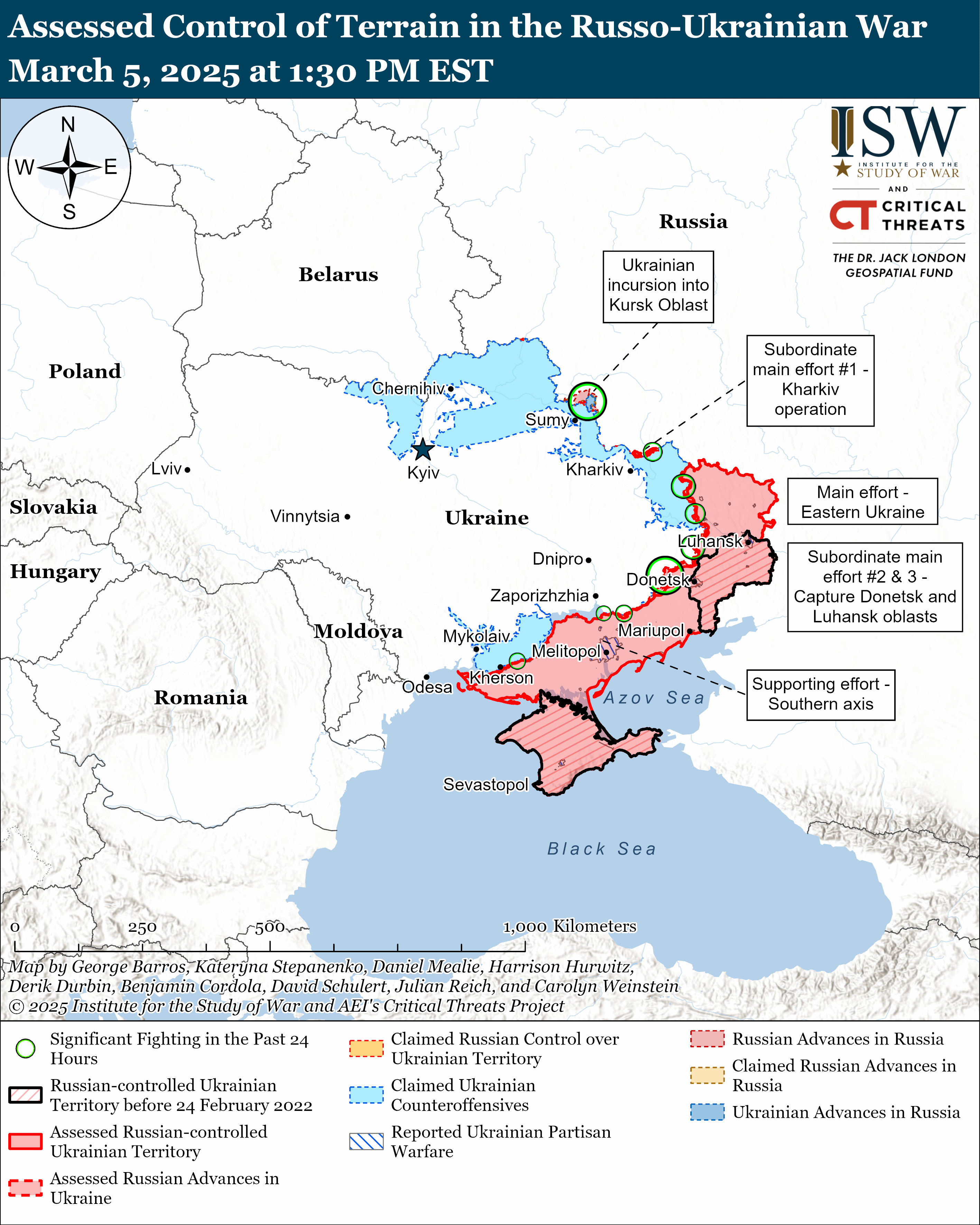
    However, for Ukraine, it will not lead to a military victory in its war with Russia. While Europe has stepped up funding, this is not sufficient for Ukraine to defeat Russian forces currently occupying about 20% of the country.

    For Ukraine, the withdrawal of US support will severely strain their ability to keep fighting. Ukraine will likely need to find a way to freeze the conflict this year. This may mean a temporary truce that does not formally cede Ukrainian territory to Russia.

    A Trumpian worldview

    The vastly different approaches of the US under Trump and the EU point to a deeper ideological divide.

    While the Trump administration has acted more quickly and assertively in foreign affairs than many expected, its approach is not surprising.

    Since Trump won the US presidential election in November last year, Europe and Ukraine have known that a shift in US policy would be on the cards.

    Trump’s approach to Ukraine is not only about economic concerns and withdrawing US military aid. It is about a deeper, more significant clash of worldviews.

    Trump (and, it appears, his core support base) hold a “great power politics” approach to world affairs.

    This approach assumes we live in a competitive world where countries are motivated to maximise gains and dominate. Outcomes can be achieved through punishments or rewards.

    Countries with greater military or economic strength “count” more. They are expected to impose their will on weaker countries. This viewpoint underpinned much of the colonial activity of the 19th and 20th centuries.

    This worldview expects conflict – and it expects stronger countries to “win”.

    Consistent with Trump’s outlook, Russia is a regional power that has the “right” to control smaller countries in its neighbourhood.

    Trump’s approach to Ukraine is not an anomaly. Nor is it a temporary and spontaneous measure to grab the global spotlight.

    Trump’s worldview leads to the logical and consistent conclusion that Russia will seek to control countries within its sphere of influence.

    Russia’s full-scale invasion of Ukraine represented an attempt to impose its will on a militarily weaker country that it considered to be in its rightful domain of control.

    The EU alternative

    Contrary to this view, the EU is founded on the premise that countries can work together for mutual gains through collaboration and consensus. This approach underpins the operation of what are called the Bretton Woods Institutions created in the aftermath of World War II.

    This worldview expects collaboration rather than conflict. Mutually beneficial and cooperative solutions are found through dialogue and negotiation.

    According to this perspective, Russia’s invasion of Ukraine is about a conflict between the values of a liberal democracy and those of an oppressive authoritarian regime.

    Zelensky has himself consistently framed the conflict as being about a clash of values: freedom and democracy versus authoritarianism and control.

    A mix of both?

    Since Trump’s second inauguration, European leaders have presented a united front, motivated by facing a world where US military backing cannot be guaranteed.

    However, there is internal division within European countries. Recent years has seen a sharp rise in anti-EU sentiment within EU member states. The UK’s exit from the EU is an example of this phenomenon.

    EU leaders previously followed a path of cooperation with Russia, with limited success. Following Russia’s annexation of Crimea in 2014, France and Germany helped mediate the Minsk Agreements. These agreements, signed in 2014 and 2015, were designed to prevent further incursions by Russian-backed groups into Ukrainian sovereign territory.

    This did not prevent Russia’s full-scale invasion of Ukraine in 2022.

    In an emerging new world order, leadership might require going beyond the seeming contradiction of a focus on military strength or cooperation. Leaders may need to integrate both.

    Jessica Genauer does not work for, consult, own shares in or receive funding from any company or organisation that would benefit from this article, and has disclosed no relevant affiliations beyond their academic appointment.

    ref. The EU will spend billions more on defence. It’s a powerful statement – but won’t do much for Ukraine – https://theconversation.com/the-eu-will-spend-billions-more-on-defence-its-a-powerful-statement-but-wont-do-much-for-ukraine-251710

    MIL OSI AnalysisEveningReport.nz

  • MIL-OSI China: Mature, resilient, stable China-Russia relationship will not be swayed by any turn of events: FM

    Source: China State Council Information Office

    A mature, resilient and stable China-Russia relationship will not be swayed by any turn of events, let alone be subject to interference by any third party, Chinese Foreign Minister Wang Yi said Friday.

    The relationship is “a constant in a turbulent world rather than a variable in geopolitical games,” Wang told a press conference held on the sidelines of the ongoing session of the national legislature.

    No matter how the international landscape evolves, the historical logic of China-Russia friendship will not change and its internal driving force will not diminish, he said.

    The two countries have found a path of “non-alliance, non-confrontation and not targeting any third party” in developing their relations, Wang said, adding that it is a pioneering effort in forging a new model of major-country relations, and has set a fine example for relations between neighboring countries.

    MIL OSI China News

  • MIL-OSI USA: Grassley, Peters Relaunch Bipartisan Effort to Root Out Foreign Influence in U.S. Policy

    US Senate News:

    Source: United States Senator for Iowa Chuck Grassley

    WASHINGTON – Senate Judiciary Committee Chairman Chuck Grassley (R-Iowa) and Homeland Security and Governmental Affairs Committee Ranking Member Gary Peters (D-Mich.) reintroduced two bipartisan bills to prevent foreign governments, including adversaries like China and Russia, from shadow influencing U.S. policy. The legislation would help close loopholes that foreign governments exploit to conceal their roles in lobbying efforts.

    “Sunlight is the best disinfectant, and the public has a right to know if a foreign government is trying to sway American policy. Our bipartisan bills would close a loophole that allows individuals to conceal their lobbying efforts and ensure that all foreign actors are disclosed to the American people. The Senate passed our bipartisan legislation last Congress, and I’m going to continue to work diligently with my colleagues to get these vital reforms to the president’s desk,” Grassley said.

    “The American people deserve complete transparency about who is trying to influence our political process. These bipartisan bills will help ensure foreign actors can’t exploit loopholes to hide their activities while attempting to shape policy in the United States. It’s a commonsense step to protect our national security and ensure our government is working in the best interests of the American people,” Peters said.

    Lobbying Disclosure Improvement Act

    Congress created the Lobbying Disclosure Act (LDA) in 1995 to delineate between those lobbying on behalf of foreign governments versus those lobbying for foreign private entities.  The LDA exempts foreign private entity lobbyists from the Foreign Agents Registration Act’s (FARA) more burdensome restrictions. However, the Justice Department currently has no way of knowing which foreign lobbyists claim this exemption.

    The Lobbying Disclosure Improvement Act would make public which foreign lobbyists receive the LDA exemption, ensuring no foreign government actors can fraudulently and secretly represent themselves as non-government actors. This would help the Justice Department narrow the pool of registrants they are examining for potential FARA violations, without imposing any meaningful additional burden on non-government registrants representing foreign private entities.

    Additional cosponsors include Sens. John Cornyn (R-Texas), Dick Durbin (D-Ill.), Maggie Hassan (D-N.H.) and Josh Hawley (R-Mo.).

    Disclosing Foreign Influence in Lobbying Act

    Law enforcement agencies have identified instances in which foreign adversaries exploit an additional loophole in the Lobbying Disclosure Act by using closely connected private organizations and businesses to push their government interests.

    The Disclosing Foreign Influence in Lobbying Act makes clear that lobbying organizations must disclose when foreign governments and political parties participate in their lobbying efforts, regardless of any financial contribution to the lobbying effort

    MIL OSI USA News

  • MIL-Evening Report: Jonathan Cook: Yes, Trump is vulgar. But the US global shakedown is the same one as ever

    Report by Dr David Robie – Café Pacific.

    ANALYSIS: By Jonathan Cook

    If there is one thing we can thank US President Donald Trump for, it is this: he has decisively stripped away the ridiculous notion, long cultivated by Western media, that the United States is a benign global policeman enforcing a “rules-based order”.

    Washington is better understood as the head of a gangster empire, embracing 800 military bases around the world. Since the end of the Cold War, it has been aggressively seeking “global full-spectrum domination”, as the Pentagon doctrine politely terms it.

    You either pay fealty to the Don or you get dumped in the river. Last Friday, Ukrainian President Volodymyr Zelensky was presented with a pair of designer concrete boots at the White House.

    The US president looked like a gangster as he roughed up Zelensky. But he wasn’t the one who stoked a war that’s killed huge numbers of Ukrainians and Russians. Image: www.jonathan-cook.net

    The innovation was that it all happened in front of the Western press corps, in the Oval Office, rather than in a back room, out of sight. It made for great television, Trump crowed.

    Pundits have been quick to reassure us that the shouting match was some kind of weird Trumpian thing. As though being inhospitable to state leaders, and disrespectful to the countries they head, is unique to this administration.

    Take just the example of Iraq. The administration of Bill Clinton thought it “worth it” – as his secretary of state, Madeleine Albright, infamously put it — to kill an estimated half a million Iraqi children by imposing draconian sanctions through the 1990s.

    Under Clinton’s successor, George W Bush, the US then waged an illegal war in 2003, on entirely phoney grounds, that killed around half a million Iraqis, according to post-war estimates, and made four million homeless.

    Those worrying about the White House publicly humiliating Zelensky might be better advised to save their concern for the hundreds of thousands of mostly Ukrainian and Russian men killed or wounded fighting an entirely unnecessary war — one, as we shall see, Washington carefully engineered through Nato over the preceding two decades.

    Henchman Zelensky
    All those casualties served the same goal as they did in Iraq: to remind the world who is boss.

    Uniquely, Western publics don’t understand this simple point because they live inside a disinformation bubble, created for them by the Western establishment media.

    Henry Kissinger, the long-time steward of US foreign policy, famously said: “It may be dangerous to be America’s enemy, but to be America’s friend is fatal.”

    Zelensky just found that out the hard way. Gangster empires are just as fickle as the gangsters we know from Hollywood movies. Under the previous Joe Biden administration, Zelensky had been recruited as a henchman to do Washington’s bidding on Moscow’s doorstep.

    The background — the one Western media have kept largely out of view — is that, following the collapse of the Soviet Union, the US tore up treaties crucial to reassuring Russia of Nato’s good intent.

    Viewed from Moscow, and given Washington’s track record, Nato’s European security umbrella must have looked more like preparation for an ambush.

    Keen though Trump now is to rewrite history and cast himself as peacemaker, he was central to the escalating tensions that led to Russia’s invasion of Ukraine in 2022.

    In 2019, he unilaterally withdrew from the 1987 Treaty on Intermediate-Range Nuclear Forces. That opened the door to the US launching a potential first strike on Russia, using missiles stationed in nearby Nato members Romania and Poland.

    He also sent Javelin anti-tank weapons to Ukraine, a move avoided by his predecessor, Barack Obama, for fear it would be seen as provocative.

    Repeatedly, Nato vowed to bring Ukraine into its fold, despite Russia’s warnings that the step was viewed as an existential threat, that Moscow could not allow Washington to place missiles on its border, any more than the US accepted Soviet missiles stationed in Cuba back in the early 1960s.

    Washington pressed ahead anyway, even assisting in a colour revolution-style coup in 2014 against the elected government in Kyiv, whose crime was being a little too sympathetic to Moscow.

    With the country in crisis, Zelensky was himself elected by Ukrainians as a peace candidate, there to end a brutal civil war — sparked by that coup — between anti-Russian, “nationalistic” forces in the country’s west and ethnic Russian populations in the east. The Ukrainian President soon broke that promise.

    Trump has accused Zelensky of being a “dictator”. But if he is, it is only because Washington wanted him that way, ignoring the wishes of the majority of Ukrainians.

    Reddest of red lines
    Zelensky’s job was to play a game of chicken with Moscow. The assumption was that the US would win whatever the outcome.

    Either Russian President Vladimir Putin’s bluff would be called. Ukraine would be welcomed into Nato, becoming the most forward of the alliance’s forward bases against Russia, allowing nuclear-armed ballistic missiles to be stationed minutes from Moscow.

    Or Putin would finally make good on his years of threats to invade his neighbour to stop Nato crossing the reddest of red lines he had set over Ukraine.

    Washington could then cry “self-defence” on Ukraine’s behalf, and ludicrously fearmonger Western publics about Putin eyeing Poland, Germany, France and Britain next.

    Those were the pretexts for arming Kyiv to the hilt, rather than seeking a rapid peace deal. And so began a proxy war of attrition against Russia, using Ukrainian men as cannon fodder.

    The aim was to wear Russia down militarily and economically, and bring about Putin’s overthrow.

    Zelensky did precisely what was demanded of him. When he appeared to waver early on, and considered signing a peace deal with Moscow, Britain’s prime minister of the time, Boris Johnson, was dispatched with a message from Washington: keep fighting.

    That is the same Boris Johnson who now breezily admits that the West is fighting a “proxy war” against Russia.

    His comments have generated precisely no controversy. That is particularly strange, given that critics who pointed this very obvious fact out three years ago were instantly denounced for spreading “Putin disinformation” and Kremlin “talking points”.

    For his obedience, Zelensky was feted a hero, the defender of Europe against Russian imperialism. His every “demand” — demands that originated in Washington — was met.

    Ukraine has received at least $250 billion worth of guns, tanks, fighter jets, training for his troops, Western intelligence on Russia, and other forms of aid.

    Meanwhile, hundreds of thousands of Ukrainian and Russian men have paid with their lives — as have the families they leave behind.

    Mafia etiquette
    Now the old Don in Washington is gone. The new Don has decided Zelensky has been an expensive failure. Russia isn’t lethally wounded. It’s stronger than ever. Time for a new strategy.

    Zelensky, still imagining he was Washington’s favourite henchman, arrived at the Oval Office only to be taught a harsh lesson in mafia etiquette.

    Trump is spinning his stab in the back as a “peace agreement”. And in some sense, it is. Rightly, Trump has concluded that Russia has won — unless the West is ready to fight World War III and risk a potential nuclear war.

    Trump has faced up to the reality of the situation, even if Zelensky and Europe are still struggling to.


    Trump’s overt ‘genocidal’ warning over Gaza.   Video: TRT World News

    But his plan for Ukraine is actually just a variation of his other peace plan — the one for Gaza. There he wants to ethnically cleanse the Palestinian population and, on the bodies of the enclave’s many thousands of dead children, build the “Riviera of the Middle East” — or “Trump Gaza” as it is being called in a surreal video he shared on social media.

    Similarly, Trump now sees Ukraine not as a military battlefield but as an economic one where, through clever deal-making, he can leverage riches for himself and his billionaire pals.

    He has put a gun to Zelensky and Europe’s head. Make a deal with Russia to end the war, or you are on your own against a far superior military power. See if the Europeans can help you without a supply of Washington’s weapons.

    Not surprisingly, Zelensky, Britain’s Prime Minister Keir Starmer and French President Emmanuel Macron huddled together at the weekend to find a deal that would appease Trump. All Starmer has revealed so far is that the plan will “stop the fighting”.

    That is a good thing. But the fighting could have been stopped, and should have been stopped, three years ago.

    Money, not peace
    It is deeply unwise to be lulled into tribalism by all this — the very tribalism Western elites seek to cultivate among their publics to keep us treating international affairs no differently from a high-stakes football match.

    No one here has behaved, or is behaving, honourably.

    A ceasefire in Ukraine is not about peace. It’s about money, just as the earlier war was. As all wars are, ultimately.

    An acceptable ceasefire for Trump, as well as for Putin, will involve a carve-up of Ukraine’s goodies. Rare earth minerals, land, agricultural production will be the real currency driving the agreement.

    Zelensky now understands this. He knows that he, and the people of Ukraine, have been scammed. That is what tends to happen when you cosy up to the mafia.

    If anyone doubts Washington’s insincerity over Ukraine, look to Palestine for clarity.

    In his earlier presidency, Trump tried to bring about what he termed the peace “deal of the century” whose centrepiece was the annexation of much of the Occupied West Bank.

    The hope was that the Gulf states would ultimately fund an incentivisation programme — the carrot to Israel’s stick — to encourage Palestinians to make a new life in a giant, purpose-built industrial zone in Sinai, next to Gaza.

    That plan is still simmering away in the background. At the weekend, Israel received a green light from Washington to revive its genocidal starvation of Gaza’s population, after Israel refused to negotiate the second phase of the original ceasefire agreement.

    The Trump administration and Israeli Prime Minister Benjamin Netanyahu are now spinning their own bad faith as Hamas “rejectionism”.

    They and the echo chamber that is the Western media are blaming the Palestinian group for refusing to be gulled into an “extension” of what was never more than a phoney ceasefire — Israel’s fire never ceased. Israel wants all the hostages back, without having to leave Gaza, so that Hamas has no leverage to stop Israel reviving the full genocide.

    The people of Gaza are still being fed into the Washington mafia’s meatgrinder, just as the Ukrainian people have been.

    Trump wants them out of the way so he can develop a Mediterranean playground for the rich, paid for with Gulf oil money and the so-far untapped natural gas reserves just off Gaza’s coast.

    Unlike his predecessors, Trump doesn’t pretend that Ukraine and Gaza are anything more than geostrategic real estate for Washington.

    The big shakedown
    Zelensky’s shakedown did not come out of the blue. Trump and his officials had been flagging it well in advance.

    Two weeks ago, the industrial correspondent for Britain’s Daily Telegraph wrote an article headlined “Here’s why Trump wants to make Ukraine a US economic colony”.

    Trump’s team believes that Ukraine may have rare-earth minerals under the ground worth some $15 trillion — a treasure trove that will be critical to the development of the next generation of technology.

    In their view, controlling the exploration and extraction of those minerals will be as important as control over the Middle East’s oil reserves was more than a century ago.

    And most important of all, the US wants China, its chief economic — if not military — rival excluded from the plunder. China currently has an effective monopoly on many of these critical minerals.

    Or as the Telegraph puts it, Ukraine’s “minerals offer a tantalising promise: the ability for the US to break its dependence on Chinese supplies of critical minerals that go into everything from wind turbines to iPhones and stealth fighter jets”.

    A draft of the plan seen by the Telegraph would, in its words, “amount to the US economic colonisation of Ukraine, in legal perpetuity”.

    Washington wants first refusal on all deposits within the country.

    At their Oval Office confrontation, Trump reiterated this goal: “So we’re going to be using that [Ukraine’s rare earth minerals], taking it, using it for all of the things we do, including AI, and including weapons, and the military. And it’s really going to very much satisfy our needs.”

    All of this means that Trump has a keen incentive to get the war finished as quickly as possible, and Russia’s territorial advance halted. The more territory Moscow seizes, the less territory is left for the US to plunder.

    Self-sabotage
    The battle against China over rare-earth minerals isn’t a Trump innovation either — and adds an additional layer of context for why Washington and Nato have been so keen over the past two decades to prise Ukraine away from Russia.

    Last summer, a Congressional select committee on competition with China announced the formation of a working group to counter Beijing’s “dominance of critical minerals”.

    The chairman of the committee, John Moolenaar, noted that the current US dependence on China for these minerals “would quickly become an existential vulnerability in the event of a conflict”.

    Another committee member, Rob Wittman, observed: “Dominance over global supply chains for critical mineral and rare earth elements is the next stage of great power competition.”

    What Trump appears to appreciate is that Nato’s proxy war against Russia in Ukraine has, by default, driven Moscow deeper into Beijing’s embrace. It has been self-sabotage on a grand scale.

    Together, China and Russia are a formidable opponent, and one at the centre of the ever-growing Brics group — comprised of Brazil, Russia, India, China and South Africa. They have been seeking to expand their alliance by adding emerging powers to become a counterweight to Washington and Nato’s bullying global agenda.

    But a deal with Putin over Ukraine would provide an opportunity for Washington to build a new security architecture in Europe — one more useful to the US — that places Russia inside the tent rather than outside it.

    That would leave China isolated — a long-time Pentagon goal.

    And it would also leave Europe less central to the projection of US power, which is why European leaders — led by Keir Starmer — have been looking and sounding so unnerved over the past few weeks.

    The danger is that Trump’s “peacemaking” in Ukraine simply becomes a prelude to the fomenting of a war against China, using Taiwan as the pretext in the same way Ukraine was used against Russia.

    As Moolenaar implied, US control over critical minerals — in Ukraine and elsewhere — would ensure the US was no longer vulnerable in the event of a war with China to losing access to the minerals it would need to continue the war. It would free Washington’s hand.

    Trump may be behaving in a vulgar manner. But the gangster empire he now heads is conducting the same global shakedown as ever.

    Jonathan Cook is an award-winning British journalist. He was based in Nazareth, Israel, for 20 years and returned to the UK in 2021. He is the author of three books on the Israel-Palestine conflict, including Disappearing Palestine: Israel’s Experiments in Human Despair (2008). In 2011, Cook was awarded the Martha Gellhorn Special Prize for Journalism for his work on Palestine and Israel. This article was first published in Middle East Eye and is republished with the author’s permission.

    This article was first published on Café Pacific.

    MIL OSI AnalysisEveningReport.nz

  • MIL-OSI China: Russia warns of NATO involvement

    Source: China State Council Information Office 3

    Russian Foreign Minister Sergei Lavrov speaks during his annual press conference in Moscow, Russia, on Jan. 14, 2025. [Photo/Xinhua]

    Russia would view the potential deployment of European troops to Ukraine as direct NATO involvement in the conflict, Russian Foreign Minister Sergei Lavrov said on Thursday.

    Lavrov called the move a “direct, official and undisguised involvement of NATO countries in a war against the Russian Federation” and warned that the presence of such forces in Ukraine would be unacceptable to Moscow.

    The remarks came after French President Emmanuel Macron announced Wednesday that he would consider sending European troops to Ukraine to enforce a peace deal, although he said the troops would not engage in frontline combat.

    “This is a threat to Russia,” said Lavrov, adding that Moscow sees “no room for compromise” on the issue of deploying European forces to Ukraine.

    “This discussion is being conducted with an openly hostile objective,” he said.

    The foreign minister added that suspending U.S. military aid to Ukraine could help end the conflict quickly.

    MIL OSI China News

  • MIL-OSI China: EU leaders greenlight defense plans

    Source: China State Council Information Office 3

    Ukraine’s President Volodymyr Zelensky arrives at the European Union headquarters in Brussels, Belgium, on Feb. 9, 2023 for the EU member states’ special summit. [Photo/Xinhua]

    European Union (EU) leaders on Thursday greenlighted plans to enhance the bloc’s defense capabilities and reaffirmed their support for Ukraine.

    At a one-day special summit here, the leaders endorsed the ReArm Europe plan introduced by European Commission President Ursula von der Leyen on Tuesday.

    The EU leaders agreed to activate the national escape clause under the Stability and Growth Pact in a coordinated manner, which allows for increased defense spending and provides immediate budgetary flexibility across EU member states, according to a statement released after the meeting.

    They called on the Commission to explore further measures, while ensuring debt sustainability, to facilitate significant defense spending at the national level in all member states.

    The leaders also acknowledged the Commission’s proposal for a new EU instrument that would offer member states up to 150 billion euros (161.8 billion U.S. dollars) in loans backed by the EU budget, according to the statement. They urged the European Council to “examine this proposal as a matter of urgency.”

    Trump has been pressing European partners to take more responsibility for their own defense, warning that the U.S. may not protect its North Atlantic Treaty Organization (NATO) allies who fail to meet spending targets. His remarks have raised concerns in the EU, prompting calls for stronger collective defense efforts.

    In a separate statement, 26 EU leaders expressed their support for Ukraine, with Hungarian Prime Minister Viktor Orban notably absent from the agreement.

    The leaders approved the bloc’s stance that there can be no negotiations on Ukraine without Ukraine and that the Europeans must be involved in any talks involving their security. The EU has recently found itself sidelined in the peace talks, while the U.S. takes center stage in the negotiations.

    They also vowed to continue financial support for Ukraine, committing 30.6 billion euros in 2025. Of this, 12.5 billion euros will be disbursed through the Ukraine Facility, while 18.1 billion euros will come from profits generated from immobilized Russian assets, according to the statement. (1 euro = 1.08 U.S. dollar)

    MIL OSI China News

  • MIL-OSI USA: Cortez Masto Leads Bipartisan Legislation to Ban Foreign Adversaries from Buying American Farmland

    US Senate News:

    Source: United States Senator for Nevada Cortez Masto
    Washington, D.C. – Today, U.S. Senators Catherine Cortez Masto (D-Nev.) and Mike Rounds (R-S.D.) reintroduced the Promoting Agriculture Safeguards and Security (PASS) Act, bipartisan legislation to ban individuals and entities controlled by China, Russia, Iran, and North Korea from purchasing agricultural land and businesses located near U.S. military installations or sensitive sites. The PASS Act is cosponsored by Majority Leader John Thune (R-S.D.) and Senators John Hoeven (R-N.D.) and Cynthia Lummis (R-Wyo.).
    “Nevada is home to many sensitive sites that are critical to our national security,” said Senator Cortez Masto. “It is common sense that we should not allow our foreign adversaries to buy agricultural land next to these locations. This bipartisan bill will keep Nevadans safe and protect American national security.”
    “Our near-peer adversaries such as China are looking for any possible opportunity to surveil our nation’s capabilities and resources,” said Senator Rounds. “One example occurred in 2021 when the Fufeng Group purchased 300 acres of land in North Dakota, located near the Grand Forks Air Force Base. We can’t risk this happening again. The PASS Act would prevent entities of foreign adversaries from purchasing agricultural land and businesses near our military bases and sensitive sites. I am hopeful that with President Trump’s recent National Security Presidential Memorandum on this issue, we can finally get it across the finish line.”
    Specifically, the PASS Act would:
    Ban purchases of agricultural land near military installations and sensitive sites by individuals/entities controlled by North Korea, China, Russia and Iran.
    Make the Secretary of Agriculture a voting member of the Committee on Foreign Investment in the United States (CFIUS) for transactions involving the purchase of agricultural land, biotechnology, and any other transaction related to the agriculture industry in the United States.
    Give the U.S. Department of Agriculture the ability to refer cases to CFIUS for review if there is reason to believe an agriculture land transaction may raise a national security concern.
    The full text of the bill can be found here.
    Senator Cortez Masto has consistently advocated for strengthening American national security and standing up to our foreign adversaries. She recently introduced legislation to promote innovative businesses in direct competition with Communist China. Earlier this year, she introduced the HONOR Act to prevent businesses from claiming a foreign tax credit or deduction against taxes paid to fund the Russian government’s war machine. Cortez Masto has also led legislation to strengthen American partnership with Pacific Island nations to counter growing Chinese influence in the region.

    MIL OSI USA News

  • MIL-OSI China: EU leaders greenlights defense plans, reaffirm support for Ukraine

    Source: China State Council Information Office

    European Union (EU) leaders on Thursday greenlighted plans to enhance the bloc’s defense capabilities and reaffirmed their support for Ukraine.

    At a one-day special summit here, the leaders endorsed the ReArm Europe plan introduced by European Commission President Ursula von der Leyen on Tuesday.

    The EU leaders agreed to activate the national escape clause under the Stability and Growth Pact in a coordinated manner, which allows for increased defense spending and provides immediate budgetary flexibility across EU member states, according to a statement released after the meeting.

    They called on the Commission to explore further measures, while ensuring debt sustainability, to facilitate significant defense spending at the national level in all member states.

    The leaders also acknowledged the Commission’s proposal for a new EU instrument that would offer member states up to 150 billion euros (161.8 billion U.S. dollars) in loans backed by the EU budget, according to the statement. They urged the European Council to “examine this proposal as a matter of urgency.”

    Trump has been pressing European partners to take more responsibility for their own defense, warning that the U.S. may not protect its North Atlantic Treaty Organization (NATO) allies who fail to meet spending targets. His remarks have raised concerns in the EU, prompting calls for stronger collective defense efforts.

    In a separate statement, 26 EU leaders expressed their support for Ukraine, with Hungarian Prime Minister Viktor Orban notably absent from the agreement.

    The leaders approved the bloc’s stance that there can be no negotiations on Ukraine without Ukraine and that the Europeans must be involved in any talks involving their security. The EU has recently found itself sidelined in the peace talks, while the U.S. takes center stage in the negotiations.

    They also vowed to continue financial support for Ukraine, committing 30.6 billion euros in 2025. Of this, 12.5 billion euros will be disbursed through the Ukraine Facility, while 18.1 billion euros will come from profits generated from immobilized Russian assets, according to the statement. (1 euro = 1.08 U.S. dollar) 

    MIL OSI China News

  • MIL-OSI China: Russia warns of NATO involvement as Macron pushes for truce in Ukraine

    Source: China State Council Information Office

    Russia would view the potential deployment of European troops to Ukraine as direct NATO involvement in the conflict, Russian Foreign Minister Sergei Lavrov said on Thursday.

    Lavrov called the move a “direct, official and undisguised involvement of NATO countries in a war against the Russian Federation” and warned that the presence of such forces in Ukraine would be unacceptable to Moscow.

    The remarks came after French President Emmanuel Macron announced Wednesday that he would consider sending European troops to Ukraine to enforce a peace deal, although he said the troops would not engage in frontline combat.

    “This is a threat to Russia,” said Lavrov, adding that Moscow sees “no room for compromise” on the issue of deploying European forces to Ukraine.

    “This discussion is being conducted with an openly hostile objective,” he said.

    The foreign minister added that suspending U.S. military aid to Ukraine could help end the conflict quickly. 

    MIL OSI China News

  • MIL-OSI USA: Durbin, Shaheen Host Lithuanian Minister Of Defense To Discuss Increased Russian Aggression Toward The Baltic Region

    US Senate News:

    Source: United States Senator for Illinois Dick Durbin
    March 06, 2025
    The meeting comes after President Trump’s shameful outburst toward Ukrainian President Zelenskyy in the Oval Office last Friday
    WASHINGTON – U.S. Senate Democratic Whip Dick Durbin (D-IL), Co-Chair of the Senate Baltic Freedom Caucus, and U.S. Senator Jeanne Shaheen (D-NH), Ranking Member of the Senate Foreign Relations Committee, met with Lithuanian Minister of Defense, Dovile Šakaliene, to discuss an increase in Russian hybrid attacks in the Baltics and across Europe, and the need to maintain allied support forUkraine and NATO. The meeting comes after President Trump’s shameful outburst toward Ukrainian President Zelenskyy in the Oval Office last Friday.
    “My mother’s family originally came from Lithuania—a country that knows Russian tyranny too well,” said Durbin. “As I said to Minister Šakaliene, I was saddened, shocked, and stunned at what happened in the Oval Office last week with President Zelenskyy. During today’s meeting, we agreed that now, more than ever, the U.S. must reaffirm our support for our NATO partners in upholding democratic values and transatlantic security,”
    “Lithuania is a vital NATO Ally that has demonstrated leadership in support of Ukraine and countering the Russian threat,” said Shaheen. “During our meeting, I reiterated the bipartisan Senate commitment to the NATO Alliance, including our positioning of U.S. forces on the eastern flank.”
    Photos of the meeting are available here.
    As Co-Chair of the Senate Ukraine Caucus, Durbin has been a vocal supporter of President Zelenskyy and the people of Ukraine. Last night, Durbin, asked for unanimous consent (UC) to pass a simple resolution he introduced condemning Russia’s abduction of Ukrainian children and called on Russia to work with the international community to return all abducted Ukrainian children to their families. Senate Republicans rejected the resolution.
    Last week, Durbin introduced the Protecting our Guests During Hostilities in Ukraine Act, legislation that would provide temporary guest status to Ukrainians and their immediate family members who are already in the United States through the “Uniting for Ukraine” parole process. Bill text can be found here.  
    Durbin also joined Shaheen in leading a simple resolution last week that expresses continued solidarity with the people of Ukraine and condolences for the loss of thousands of lives to Russian aggression; rejects Russia’s attempts to militarily seize sovereign Ukrainian territory; reaffirms U.S. support for the sovereignty and territorial integrity of Ukraine; and states unequivocally that Ukraine must be at the table for negotiations on its future.
      
    Durbin has also championed the creation of the Baltic Security Initiative (BSI), which enhances and strengthens U.S. security cooperation with the Baltics amid Russia’s unprovoked war in Ukraine and heightened tensions with China. In Fiscal Year 2024, Durbin secured $228 million in defense appropriations funding for the BSI.  
    In 2022, Durbin traveled to Vilnius, Lithuania, where he received the Aleksandras Stulginskis Star Award—only the second individual and first American to receive this award. It was granted to Durbin forhis decades-long support of Lithuanian independence and democracy and his promotion of parliamentary values. He was in Vilnius three years ago on the morning Russia launched its full-scale invasion of Ukraine. 
    -30-

    MIL OSI USA News

  • MIL-OSI Europe: “Ukraine has a right to peace and security, and it is in our interest”

    Source: France-Diplomatie – Ministry of Foreign Affairs and International Development

    President Emmanuel Macron addresses the French people from the Élysée Palace (March 5, 2025)

    Men and women of France, my fellow citizens,

    I am speaking to you this evening because of the international situation and its consequences for France and Europe, following several weeks of diplomatic activity.

    You are rightfully concerned by the historic events under way that are disrupting the world order.

    The war in Ukraine, which has killed or injured nearly a million people, is continuing at the same level of intensity.

    The United States of America, our ally, has changed its position on this war, lessening its support for Ukraine and raising doubts about what is to come. At the same time, the United States intends to impose tariffs on products from Europe.

    Meanwhile, the world continues to be ever more violent, and the terrorist threat has not lessened.

    All in all, our prosperity and our security have become increasingly uncertain. Clearly, we are entering a new era.

    The war in Ukraine has gone on for more than three years now. We decided on day one to support Ukraine and to sanction Russia, and it was the right thing to do, because not only are the Ukrainian people bravely fighting for their freedom, but our own security is under threat as well.

    Indeed, if a country can invade its European neighbor with impunity, we can no longer be certain of anything. Might makes right and peace can no longer be guaranteed on our own continent. History has taught us this.

    The Russian threat goes beyond Ukraine and affects every country in Europe. It affects us.

    Russia has already made the Ukrainian conflict a global conflict. It has deployed North Korean soldiers and Iranian equipment on our continent, while helping those countries to further rearm. President Putin’s Russia violates our borders to murder his opponents and manipulates elections in Romania and Moldova. It organizes digital attacks against our hospitals to keep them from functioning. Russia is attempting to manipulate our opinions, spreading lies on social media. Basically, it is testing our limits in the air, on the seas, in space and behind our screens. Its aggressiveness seems to know no bounds. At the same time, Russia is continuing to rearm, spending more than 40% of its budget for that purpose. By 2030, it plans to have further expanded its army – to have an additional 300,000 troops, 3,000 tanks and 300 fighter planes. So how believable is it, then, that today’s Russia will stop at Ukraine? Russia has become a threat to France and Europe now and for years to come. I deeply regret it and I am convinced that in the long term, peace will return to our continent, with a once-again peaceable and peaceful Russia, but this is where we are today and we have to deal with it.

    In this world fraught with danger, it would be madness to stand back and watch from the sidelines. We must make decisions about Ukraine and about the security of the French people and the people of Europe without further delay.

    About Ukraine, first of all. All initiatives that help bring about peace are a step in the right direction, and I want to applaud them this evening. We must continue helping the Ukrainians to resist until they can negotiate a deal with Russia that ensures a solid peace for themselves and for all of us. That’s why we can’t abandon Ukraine on the road to peace – on the contrary. A peace deal can’t be signed at any price on orders from Russia. Peace can’t mean Ukraine’s capitulation. It can’t mean its collapse. Nor can it come about through a ceasefire, which would be too fragile. Why? Because once again, we’ve learned from the past. We can’t forget that Russia began its invasion of Ukraine in 2014, that we negotiated a ceasefire in Minsk, that Russia did not abide by that ceasefire and that we were unable to maintain it due to a lack of solid guarantees. We can no longer take Russia at its word.

    Ukraine has a right to peace and security, and it is in our interest – the interest of European security. It is with this in mind that we are working with our British and German friends, as well as several other European countries. That’s why over the past few weeks, you saw me bring together several of them in Paris, and that’s why I met with them again a few days ago in London, to solidify the necessary commitments to Ukraine. Once a peace deal has been signed, ensuring that Ukraine will not be invaded again by Russia, we have to prepare for it. That will most certainly require long-term support for the Ukrainian army. It may also involve the deployment of European forces. They wouldn’t immediately go off to fight – they wouldn’t be fighting on the front lines – but they would be there once a peace deal is signed in order to ensure full compliance. Next week, the joint chiefs of the countries that wish to shoulder their responsibilities in this regard will meet in Paris. What we prepared together with the Ukrainians and several European partners is a plan for a solid, lasting, verifiable peace. It’s the plan I championed in the United States two weeks ago, and around Europe. I want to believe that the United States will stand with us, but we must be ready if that’s not the case.

    Whether or not peace is achieved quickly in Ukraine, the European nations must be able to better defend themselves and to deter any new aggression, given the Russian threat I just described. Yes, whatever happens, we must be better equipped; we must improve our defense posture for the sake of peace and for the purpose of deterrence. In that regard, we remain committed to NATO and to our partnership with the United States, but we must do more – we must increase our independence in the areas of security and defense. Europe’s future cannot be decided in Washington or Moscow. And yes, the threat is back in the East, and the innocence, as it were, of the last 30 years, since the fall of the Berlin Wall, is now a thing of the past.

    In Brussels tomorrow, at the extraordinary meeting with the 27 heads of state and government, the Commission and the Council President, we will take decisive steps. We will make several decisions that France has been proposing for years. Member states will be able to increase their military spending without adding to their deficit. We will decide on large-scale, joint funding for the purchase and production in Europe of ammunition, tanks, weapons and some of the most innovative equipment that exists. I have asked my administration to work to make sure that this strengthens our military as quickly as possible and accelerates the reindustrialization of every region in France. I will be holding a meeting with the relevant ministers and industry representatives in the coming days.

    Now, the Europe of Defense that we have been championing for eight years has become a reality. That means European countries that are better able to defend and protect themselves, that work together to produce the equipment that they need in their own countries, and that are willing to cooperate more and reduce their dependence on the rest of the world, and that’s a good thing. Germany, Poland, Denmark, the Baltic states and many other partners of ours have announced plans for unprecedented military spending.

    Now, at this long-awaited time for action, France is in a unique position. We have the most effective military in Europe and, thanks to the decisions made by our predecessors after World War II, we possess nuclear deterrence capabilities. That affords us much better protection than a number of our neighbors. Moreover, we didn’t wait for the invasion of Ukraine to understand that the world was in trouble, and, thanks to the two military programming laws that I put forth, which were passed by two successive Parliaments, our military budget will have doubled over close to ten years. However, given the way that threats are evolving and in light of the acceleration I just described, we will need to make new budgetary decisions and additional, henceforward essential investments.

    I have asked my administration to get to work on this as quickly as possible. These new investments will require us to mobilize both private and public funding without raising taxes. To achieve this, we will need reforms, choices and courage.

    Our nuclear deterrence protects us. It is thorough, sovereign and French from start to finish. Since 1964, it has played a clear role in the preservation of peace and security in Europe. However, in response to the historic call sounded by the future Chancellor of Germany, I decided to launch a strategic debate on using our deterrence to protect our allies on the European continent. Whatever happens, that decision has always been, and will always be, up to the President and Commander in Chief of France.

    In order to control our destiny and increase our independence, we must step up our military efforts, as well as our economic efforts. Economic, technological, industrial and financial independence are critical. We must be prepared for the United States to impose tariffs on European goods, just as they confirmed they are doing with Canada and Mexico. This decision, which is just as incomprehensible for the U.S. economy as it is for our own, will bear consequences for some of our sectors. It makes these times more difficult but we will not let these tariffs go unanswered. Therefore, as we prepare to respond with our European colleagues, as I did two weeks ago, we will continue trying to convince them by every means possible that this decision will hurt us all. And yes, I hope that I can convince and dissuade the President of the United States of America.

    In sum, this time calls for decisions that have no precedent going back for many decades. When it comes to our agriculture, our research, our industrial sector, and all of our public policies, we cannot keep having the same debates as before. That is why I asked the Prime Minister and his cabinet to make proposals in light of this new context. I invite all the political, economic and union representatives of France to do the same. Tomorrow’s solutions cannot be yesterday’s habits.

    My fellow citizens,

    Faced with these challenges and these irreversible changes, we must not give in to any form of excess: neither excessive warmongering, nor excessive defeatism. France will follow only one course: that of the desire for peace and freedom, true to its history and its principles. Yes, that is what we believe in for our security, and that is also what we believe in when it comes to defending democracy, a certain idea of the truth, a certain idea of free research, a certain idea of respect in our society, a certain idea of freedom of expression that eschews hate speech, and a certain idea of humanism. That is what we believe in and that is what is at stake. Our Europe has the economic strength, the power and the talent to rise to meet our time. We have the means to hold our own in comparison with the United States of America and, to an even greater extent, Russia. Therefore, we must take action, united as Europeans and determined to protect ourselves. That is why our country needs you and your commitment. Political decisions, military equipment and budgets are important, but they can never replace a nation’s strength of character. No longer will our generation enjoy the peace dividends. It is up to us to ensure that one day, our children will enjoy the dividends of our efforts.

    So we will face this together.

    Vive la République.

    Vive la France

    MIL OSI Europe News

  • MIL-OSI USA: Remarks by President Trump in Joint Address to Congress

    US Senate News:

    Source: The White House
    class=”has-text-align-center”>U.S. Capitol
    Washington, D.C.
    9:19 P.M. EST
    (March 4, 2025)
         THE PRESIDENT:  Thank you.  (Applause.)  Thank you very much.  Thank you very much.  It’s a great honor.  Thank you very much. 
    Speaker Johnson, Vice President Vance, the first lady of the United States — (applause) — members of the United States Congress, thank you very much.  
    And to my fellow citizens, America is back.  (Applause.)
    AUDIENCE:  USA!  USA!  USA! 
    THE PRESIDENT:  Six weeks ago, I stood beneath the dome of this Capitol and proclaimed the dawn of the golden age of America.  From that moment on, it has been nothing but swift and unrelenting action to usher in the greatest and most successful era in the history of our country. 
    We have accomplished more in 43 days than most administrations accomplished in four years or eight years, and we are just getting started.  (Applause.)  Thank you. 
    I return to this chamber tonight to report that America’s momentum is back, our spirit is back, our pride is back, our confidence is back, and the American dream is surging bigger and better than ever before.  (Applause.)  The American dream is unstoppable, and our country is on the verge of a comeback, the likes of which the world has never witnessed and perhaps will never witness again.  There’s never been anything like it.  (Applause.)
    The presidential election of November 5th was a mandate like has not been seen in many decades.  We won all seven swing states, giving us an electoral college victory of 312 votes.  (Applause.)  We won the popular vote —
    REPRESENTATIVE GREEN:  (Inaudible.)
    THE PRESIDENT:  — by big numbers and won counties in our country —
    AUDIENCE:  Booo —
    AUDIENCE:  USA!  USA!  USA!
    REPRESENTATIVE GREEN:  You are — you have no right to cut Medicaid.
    AUDIENCE:  USA!  USA!  USA! 
    THE PRESIDENT:  — and won counties in our country 2,700 to 525 on a map that reads almost completely red for Republican.  (Applause.) 
    Now, for the first time in modern history, more Americans believe that our country is headed in the right direction than the wrong direction.  In fact, it’s an astonishing record: 27-point swing, the most ever.  (Applause.)
    Likewise, small-business optimism saw its single largest one-month gain ever recorded. 
    SPEAKER JOHNSON:  Mr. President —
    THE PRESIDENT:  A 41-point jump.
    (Speaker Johnson strikes the gavel.) 
         SPEAKER JOHNSON:  Members are directed to uphold and maintain decorum in the House and to cease any further disruptions.  That’s your warning.
    REPRESENTATIVE GREEN:  He has no mandate to cut Medicaid.
    SPEAKER JOHNSON:  Members are engaging in willful and continuing breach of decorum, and the chair is prepared to direct the sergeant at arms to restore order to the joint session.  (Applause.)
    Mr. Green, take your seat.  Take your seat, sir. 
    REPRESENTATIVE GREEN:  He has no mandate to cut Medicaid.
    SPEAKER JOHNSON:  Take your seat.
    (Cross-talk.) 
    Finding that members continue to engage in willful and concerted disruption of proper decorum, the chair now directs the sergeant at arms to restore order.  (Applause.)  Remove this gentleman from the chamber.  (Applause.)
    REPRESENTATIVE GREEN:  Shame on all of you.
         (Members of the audience sing “Na Na Hey Hey Kiss Him Goodbye.”)
         (Cross-talk.)
         You have no mandate.
    SPEAKER JOHNSON:  Members are directed to uphold and maintain decorum in the House.
    Mr. President, you can continue.
    THE PRESIDENT:  Thank you.
    Over the past six weeks, I have signed nearly 100 executive orders and taken more than 400 executive actions — a record — to restore common sense, safety, optimism, and wealth all across our wonderful land.  The people elected me to do the job, and I’m doing it.  (Applause.)
    In fact, it has been stated by many that the first month of our presidency — it’s our presidency — (applause) — is the most successful in the history of our nation by many.  (Applause.)  And what makes it even more impressive is that — do you know who number two is?  George Washington.  How about that?  (Laughter and applause.)  How about that?  I don’t know about that list, but we’ll take it. 
    Within hours of taking the oath of office, I declared a national emergency on our southern border — (applause) — and I deployed the U.S. military and Border Patrol to repel the invasion of our country.  And what a job they’ve done. 
    As a result, illegal border crossings last month were, by far, the lowest ever recorded. Ever.  (Applause.)  They heard my words, and they chose not to come.  Much easier that way. 
    In comparison, under Joe Biden, the worst president in American history — (applause) — there were hundreds of thousands of illegal crossings a month, and virtually all of them, including murderers, drug dealers, gang members, and people from mental institutions and insane asylums, were released into our country.  Who would want to do that?
    This is my fifth such speech to Congress, and, once again, I look at the Democrats in front of me, and I realize there is absolutely nothing I can say to make them happy or to make them stand or smile or applaud.  Nothing I can do.  I could find a cure to the most devastating disease — a disease that would wipe out entire nations, or announce the answers to the greatest economy in history or the stoppage of crime to the lowest levels ever recorded, and these people sitting right here will not clap, will not stand, and certainly will not cheer for these astronomical achievements.  They won’t do it no matter what.
    Five times I’ve been up here.  It’s very sad, and it just shouldn’t be this way.  (Applause.)
    So, Democrats sitting before me, for just this one night, why not join us in celebrating so many incredible wins for America?  For the good of our nation, let’s work together and let’s truly make America great again.  (Applause.)
    Every day, my administration is fighting to deliver the change America needs, to bring a future that America deserves, and we’re doing it.  This is a time for big dreams and bold action. 
    Upon taking office, I imposed an immediate freeze on all federal hiring, a freeze on all new federal regulations, and a freeze on all foreign aid.  (Applause.)  I terminated the ridiculous Green New Scam.  I withdrew from the unfair Paris Climate Accord, which was costing us trillions of dollars that other countries were not paying.  (Applause.)  I withdrew from the corrupt World Health Organization.  (Applause.)  And I also withdrew from the anti-American U.N. Human Rights Council.  (Applause.)
    We ended all of Biden’s environmental restrictions that were making our country far less safe and totally unaffordable.  And importantly, we ended the last administration’s insane electric vehicle mandate, saving our autoworkers and companies from economic destruction.  (Applause.)
    To unshackle our economy, I have directed that for every 1 new regulation, 10 old regulations must be eliminated, just like I did in my very successful first term.  (Applause.)  And in that first term, we set records on ending unnecessary rules and regulations like no other president had done before. 
    We ordered all federal workers to return to the office.  They will either show up for work in person or be removed from their job.  (Applause.)  
    And we have ended weaponized government, where, as an example, a sitting president is allowed to viciously prosecute his political opponent, like me.  How did that work out? (Laughter.)  Not too good.  (Applause.)  Not too good. 
    And I have stopped all government censorship and brought back free speech in America.  It’s back.  (Applause.) 
    And two days ago, I signed an order making English the official language of the United States of America.  (Applause.)  
    I renamed the Gulf of Mexico the Gulf of America.  (Applause.) 
    And, likewise, I renamed — for a great president, William McKinley — Mount McKinley again.  (Applause.)  Beautiful Alaska.  We love Alaska.
    We’ve ended the tyranny of so-called diversity, equity, and inclusion policies all across the entire federal government and, indeed, the private sector and our military.  (Applause.)  And our country will be woke no longer.  (Applause.)
    We believe that whether you are a doctor, an accountant, a lawyer, or an air traffic controller, you should be hired and promoted based on skill and competence, not race or gender.  Very important.  (Applause.)  You should be hired based on merit.  And the Supreme Court, in a brave and very powerful decision, has allowed us to do so.
    Thank you.  Thank you very much.  Thank you.  (Applause.)
    We have removed the poison of critical race theory from our public schools.  And I signed an order making it the official policy of the United States government that there are only two genders: male and female.  (Applause.) 
    I also signed an executive order to ban men from playing in women’s sports.  (Applause.) 
         Three years ago, Payton McNabb was an all-star high school athlete — one of the best — preparing for a future in college sports.  But when her girls’ volleyball match was invaded by a male, he smashed the ball so hard in Payton’s face, causing traumatic brain injury, partially paralyzing her right side, and ending her athletic career.  It was a shot like she’s never seen before.  She’s never seen anything like it.
    Payton is here tonight in the gallery.  And, Payton, from now on, schools will kick the men off the girls’ team or they will lose all federal funding.  (Applause.) 
    And if you really want to see numbers, just take a look at what happened in the woman’s boxing, weightlifting, track and field, swimming, or cycling, where a male recently finished a long-distance race five hours and 14 minutes ahead of a woman for a new record by five hours.  Broke the record by five hours. 
    It’s demeaning for women, and it’s very bad for our country.  We’re not going to put up with it any longer.  (Applause.) 
    What I have just described is only a small fraction of the commonsense revolution that is now, because of us, sweeping the entire world.  Common sense has become a common theme, and we will never go back.  Never.  Never going to let that happen.  (Applause.)
    Among my very highest priorities is to rescue our economy and get dramatic and immediate relief to working families.  As you know, we inherited from the last administration an economic catastrophe and an inflation nightmare.  Their policies drove up energy prices, pushed up grocery costs, and drove the necessities of life out of reach for millions and millions of Americans.  They’ve never had anything like it. 
    We suffered the worst inflation in 48 years but perhaps even in the history of our country. They’re not sure.  As president, I’m fighting every day to reverse this damage and make America affordable again.  (Applause.)
    Joe Biden especially let the price of eggs get out of control.
    AUDIENCE:  Booo —
    THE PRESIDENT:  The egg price is out of control, and we’re working hard to get it back down. 
    Secretary, do a good job on that.  You inherited a total mess from the previous administration.  Do a good job.  (Applause.) 
    A major focus of our fight to defeat inflation is rapidly reducing the cost of energy.  The previous administration cut the number of new oil and gas leases by 95 percent, slowed pipeline construction to a halt, and closed more than 100 power plants.  We are opening up many of those power plants right now.  (Applause.) 
    And, frankly, we have never seen anything like it.  That’s why, on my first day in office, I declared a national energy emergency.  (Applause.)  As you’ve heard me say many times, we have more liquid gold under our feet than any nation on Earth and by far.  And now I’ve fully authorized the most talented team ever assembled to go and get it.  It’s called drill, baby, drill.  (Applause.) 
    My administration is also working on a gigantic natural gas pipeline in Alaska — among the largest in the world — where Japan, South Korea, and other nations want to be our partner with investments of trillions of dollars each.  There’s never been anything like that one.  It will be truly spectacular.  It’s all set to go.  The permitting is gotten.
    And later this week, I will also take historic action to dramatically expand production of critical minerals and rare earths here in the USA.  (Applause.)  
    To further combat inflation, we will not only be reducing the cost of energy, but we’ll be ending the flagrant waste of taxpayer dollars.  (Applause.)  And to that end, I have created the brand-new Department of Government Efficiency – DOGE. (Applause.) Perhaps you’ve heard of it — perhaps — which is headed by Elon Musk, who is in the gallery tonight.  (Applause.)
    Thank you, Elon.  He’s working very hard.  He didn’t need this.  (Laughs.)  He didn’t need this.  Thank you very much.  We appreciate it.  Everybody here, even this side, appreciates it, I believe.  (Applause.)  They just don’t want to admit that.
    Just listen to some of the appalling waste we have already identified.
    $22 billion from HHS to provide free housing and cars for illegal aliens.
    $45 million for diversity, equity, and inclusion scholarships in Burma.
    $40 million to improve the social and economic inclusion of sedentary migrants.  Nobody knows what that is.  (Laughter.) 
    $8 million to promote LGBTQI+ in the African nation of Lesotho, which nobody has ever heard of.  (Laughter.)
    $60 million for Indigenous peoples and Afro-Colombian empowerment in Central America.  $60 million.
    $8 million for making mice transgender.  (Laughter.)  This is real.
    $32 million for a left-wing propaganda operation in Moldova.
    $10 million for male circumcision in Mozambique.
    $20 million for the Arab “Sesame Street” in the Middle East.  It’s a program.  $20 million for a program.
    $1.9 billion to recently created decarbonization of homes committee, headed up — and we know she’s involved — just at the last moment, the money was passed over — by a woman named Stacey Abrams.  Have you ever heard of her?
    AUDIENCE:  Booo —
    THE PRESIDENT:  A $3.5 million consulting contract for lavish fish monitoring.
    $1.5 million for voter confidence in Liberia.
    $14 million for social cohesion in Mali.
    $59 million for illegal alien hotel rooms in New York City. 
    AUDIENCE:  Booo —
    THE PRESIDENT:  He’s a real estate developer.  He’s done very well.
    $250,000 to increase vegan local climate action innovation in Zambia.
    $42 million for social and behavior change in Uganda.
    $14 million for improving public procurement in Serbia.
    $47 million for improving learning outcomes in Asia.  Asia is doing very well with learning.  (Laughter.)  Don’t know what we’re doing.  We should use it ourselves.
    And $101 million for DEI contracts at the Department of Education, the most ever paid.  Nothing even like it.
    Under the Trump administration, all of these scams — and there are far worse, but I didn’t think it was appropriate to talk about them.  They’re so bad.  Many more have been found out and exposed and swiftly terminated by a group of very intelligent, mostly young people, headed up by Elon.  And we appreciate it.  We’ve found hundreds of billions of dollars of fraud.  (Applause.)
    And we’ve taken back the money and reduced our debt to fight inflation and other things.  Taken back a lot of that money.  We got it just in time. 
    AUDIENCE MEMBERS:  (Inaudible.)
    THE PRESIDENT:  This is just the beginning.  The Government Accountability Office, a federal government office, has estimated annual fraud of over $500 billion in our nation, and we are working very hard to stop it.  We’re going to.
    We’re also identifying shocking levels of incompetence and probable fraud in the Social Security program for our seniors and that our seniors and people that we love rely on.  Believe it or not, government databases list 4.7 million Social Security members from people aged 100 to 109 years old.
    THE PRESIDENT:  It lists 3.6 million people from ages 110 to 119.  I don’t know any of them.  I know some people that are rather elderly, but not quite that elderly.  (Laughter.) 
    3.47 million people from ages 120 to 129. 
    3.9 million people from ages 130 to 139.
    3.5 million people from ages 140 to 149.
    And money is being paid to many of them, and we’re searching right now. 
    In fact, Pam, good luck.  Good luck.  You’re going to find it.
    But a lot of money is paid out to people because it just keeps getting paid and paid, and nobody does — and it really hurts Social Security and hurts our country.
    1.3 million people from ages 150 to 159.  And over 130,000 people, according to the Social Security databases, are age over 160 years old.  
    We have a healthier country than I thought, Bobby.  (Laughter and applause.)
    Including, to finish, 1,039 people between the ages of 220 and 229; one person between the age of 240 and 249; and one person is listed at 360 years of age.
    AUDIENCE MEMBER:  Joe Biden!  (Laughter.)
    THE PRESIDENT: More than 100 years older than our country. 
    But we’re going to find out where that money is going, and it’s not going to be pretty. 
    By slashing all of the fraud, waste, and theft we can find, we will defeat inflation, bring down mortgage rates, lower car payments and grocery prices, protect our seniors, and put more money in the pockets of American families.  (Applause.) 
    And today, interest rates took a beautiful drop — big, beautiful drop.  It’s about time.
    And in the near future, I want to do what has not been done in 24 years: balance the federal budget.  We’re going to balance it.  (Applause.) 
    With that goal in mind, we have developed in great detail what we are calling the gold card, which goes on sale very, very soon.  
         For $5 million, we will allow the most successful, job-creating people from all over the world to buy a path to U.S. citizenship.  It’s like the green card but better and more sophisticated.  (Laughter.)  And these people will have to pay tax in our country.  They won’t have to pay tax from where they came.  The money that they’ve made, you wouldn’t want to do that, but they have to pay tax, create jobs.
    They’ll also be taking people out of colleges and paying for them so that we can keep them in our country, instead of having them being forced out.  Number one at the top school, as an example, being forced out and not being allowed to stay and create tremendous numbers of jobs and great success for a company out there.
    So, while we take out the criminals, killers, traffickers, and child predators who were allowed to enter our country under the open border policy of these people — the Democrats, the Biden administration — the open border, insane policies that you’ve allowed to destroy our country — we will now bring in brilliant, hardworking, job-creating people.  They’re going to pay a lot of money, and we’re going to reduce our debt with that money.  (Applause.)
    Americans have given us a mandate for bold and profound change.  For nearly 100 years, the federal bureaucracy has grown until it has crushed our freedoms, ballooned our deficits, and held back America’s potential in every possible way.  The nation founded by pioneers and risk-takers now drowns under millions and millions of pages of regulations and debt. 
    Approvals that should take 10 days to get instead take 10 years, 15 years, and even 20 years before you’re rejected.  Meanwhile, we have hundreds of thousands of federal workers who have not been showing up to work. 
    My administration will reclaim power from this unaccountable bureaucracy, and we will restore true democracy to America again. (Applause.)  Any federal bureaucrat who resists this change will be removed from office immediately — (applause) — because we are draining the swamp.  It’s very simple.  And the days of rule by unelected bureaucrats are over.  (Applause.)
    And the next phase of our plan to deliver the greatest economy in history is for this Congress to pass tax cuts for everybody.  They’re in there.  They’re waiting for you to vote.  (Applause.) 
    And I’m sure that the people on my right — I don’t mean the Republican right, but my right right here — I’m sure you’re going to vote for those tax cuts, because, otherwise, I don’t believe the people will ever vote you into office.  So, I’m doing you a big favor by telling you that.  (Applause.)
    But I know this group is going to be voting for the taxes.  (Applause.)
    Thank you.  It’s a very, very big part of our plan.  We had tremendous success in our first term with it.  A very big part of our plan.  We’re seeking permanent income tax cuts all across the board.
    And to get urgently needed relief to Americans hit especially hard by inflation, I’m calling for no tax on tips, no tax on overtime, and no tax on Social Security benefits for our great seniors.  (Applause.) 
    (Addressing Speaker Johnson.)  Good luck.
    And I also want to make interest payments on car loans tax deductible but only if the car is made in America.  (Applause.)  
    And, by the way, we’re going to have growth in the auto industry like nobody has ever seen.  Plants are opening up all over the place.  Deals are being made.  Never seen. That’s a combination of the election win and tariffs. 
    It’s a beautiful word, isn’t it? 
    That, along with our other policies, will allow our auto industry to absolutely boom.  It’s going to boom.  Spoke to the majors today — all three — the top people, and they’re so excited.  In fact, already, numerous car companies have announced that they will be building massive automobile plants in America, with Honda just announcing a new plant in Indiana, one of the largest anywhere in the world.  (Applause.) 
    And this has taken place since our great victory on November 5th, a date which will hopefully go down as one of the most important in the history of our country.  (Applause.)  
    In addition, as part of our tax cuts, we want to cut taxes on domestic production and all manufacturing.  And just as we did before, we will provide 100 percent expensing.  It will be retroactive to January 20th, 2025, and it was one of the main reasons why our tax cuts were so successful in our first term, giving us the most successful economy in the history of our country.  First term — we had a great first term.  (Applause.) 
    If you don’t make your product in America, however, under the Trump administration, you will pay a tariff and, in some cases, a rather large one.  Other countries have used tariffs against us for decades, and now it’s our turn to start using them against those other countries.
    On average, the European Union, China, Brazil, India, Mexico, and Canada — have you heard of them? — and countless other nations charge us tremendously higher tariffs than we charge them.  It’s very unfair.  India charges us auto tariffs higher than 100 percent.  China’s average tariff on our products is twice what we charge them.  And South Korea’s average tariff is four times higher.  Think of that: four times higher.  And we give so much help militarily and in so many other ways to South Korea, but that’s what happens.
    This is happening by friend and foe.  This system is not fair to the United States and never was.  And so, on April 2nd — I wanted to make it April 1st, but I didn’t want to be accused of April Fool’s Day.  (Laughter.)  Just one day, which cost us a lot of money.  (Laughter.)  But we’re going to do it in April. I’m a very superstitious person. April 2nd, reciprocal tariffs kick in.  And whatever they tariff us — other countries — we will tariff them.  That’s reciprocal, back and forth.  (Applause.)  Whatever they tax us, we will tax them.
    If they do non-monetary tariffs to keep us out of their market, then we will do non-monetary barriers to keep them out of our market.  There’s a lot of that too.  They don’t even allow us in their market.
    We will take in trillions and trillions of dollars and create jobs like we have never seen before.  I did it with China, and I did it with others.  And the Biden administration couldn’t do anything about it because it was so much money.  They couldn’t do anything about it.
    We have been ripped off for decades by nearly every country on Earth, and we will not let that happen any longer.  (Applause.) 
    Much has been said over the last three months about Mexico and Canada, but we have very large deficits with both of them.  But even more importantly, they have allowed fentanyl to come into our country at levels never seen before, killing hundreds of thousands of our citizens and many very young, beautiful people — destroying families.  Nobody has ever seen anything like it. 
    They are, in effect, receiving subsidies of hundreds of billions of dollars.  We pay subsidies to Canada and to Mexico of hundreds of billions of dollars.  And the United States will not be doing that any longer.  We’re not going to do it any longer.  (Applause.)
    Thanks to our America First policies we’re putting into place, we have had $1.7 trillion of new investment in America in just the past few weeks.  (Applause.)  The combination of the election and our economic policies — the people of SoftBank, one of the most brilliant anywhere in the world, announced a $200 billion investment.  OpenAI and Oracle — Larry Ellison — announced $500 billion investment, which they wouldn’t have done if Kamala had won.  (Applause.)
    Apple announced $500 billion investment.  Tim Cook called me.  He said, “I cannot spend it fast enough.”  It’s going to be much higher than that, I believe.  They’ll be building their plants here, instead of in China. 
    And just yesterday, Taiwan Semiconductor — the biggest in the world, most powerful in the world, has a tremendous amount — 97 percent of the market, announced a $165 billion investment to build the most powerful chips on Earth right here in the USA.  (Applause.) 
    And we’re not giving them any money.  Your CHIPS Act is a horrible, horrible thing.  We give hundreds of billions of dollars, and it doesn’t mean a thing.  They take our money, and they don’t spend it.  All that meant to them — we’re giving them no money.  All that was important to them was they didn’t want to pay the tariffs, so they came and they’re building.  And many other companies are coming.  
    We don’t have to give them money.  We just want to protect our businesses and our people.  And they will come because they won’t have to pay tariffs if they build in America.  And so, it’s very amazing.
    You should get rid of the CHIP Act.  And whatever is left over, Mr. Speaker, you should use it to reduce debt or any other reason you want to.  (Applause.) 
    Our new trade policy will also be great for the American farmer — I love the farmer — (applause) — who will now be selling into our home market, the USA, because nobody is going to be able to compete with you.  Because those goods that come in from other countries and companies, they’re really, really in a bad position in so many different ways.  They’re uninspected.  They may be very dirty and disgusting, and they come in and they pour in, and they hurt our American farmers.
    The tariffs will go on agricultural product coming into America.  And our farmers, starting on April 2nd — it may be a little bit of an adjustment period.  We had that before, when I made the deal with China.  Fifty billion dollars of purchases, and I said, “Just bear with me,” and they did.  They did.  Probably have to bear with me again, and this will be even better.  
    That was great.  The problem with it was that Biden didn’t enforce it.  He didn’t enforce it.  Fifty billion dollars of purchases, and we were doing great, but Biden did not enforce it.  And it hurt our farmers, but our farmers are going to have a field day right now.
    So, to our farmers, have a lot of fun.  I love you too.  I love you too.  (Applause.)  It’s all going to happen.
    And I have also imposed a 25 percent tariff on foreign aluminum, copper, lumber, and steel, because if we don’t have, as an example, steel and lots of other things, we don’t have a military and, frankly, we just won’t have a country very long.
    Here today is a proud American steelworker, fantastic person from Decatur, Alabama.  Jeff Denard has been working at the same steel plant for 27 years in a job that has allowed him to serve as the captain of his local volunteer fire department; raise seven children with his beautiful wife, Nicole; and over the years, provide a loving home for more than 40 foster children.  So great, Jeff.  (Applause.) 
    Thank you, Jeff.  Thank you, Jeff.  (Applause.)
    Stories like Jeff’s remind us that tariffs are not just about protecting American jobs.  They’re about protecting the soul of our country.  Tariffs are about making America rich again and making America great again.  And it’s happening, and it will happen rather quickly.
    There will be a little disturbance, but we’re okay with that.  It won’t be much. 
    AUDIENCE MEMBER:  No, we’re not!
    THE PRESIDENT:  No, you’re not.  Oh.  (Laughter.)
    And look — and look where Biden took us.  Very low.  The lowest we’ve ever been.
    Jeff, I want to thank you very much.
    And I also want to recognize another person who has devoted herself to foster care community.  She worked so hard on it.  A very loving person.  Our magnificent first lady of the United States.  (Applause.)
    Melania’s work has yielded incredible results, helping prepare our nation’s future leaders as they enter the workforce.  
    Our first lady is joined by two impressive young women — very impressive: Haley Ferguson, who benefited from the first lady’s Fostering the Future initiative and is poised to complete her education and become a teacher, and Elliston Berry, who became a victim of an illicit deepfake image produced by a peer.  With Elliston’s help, the Senate just passed the Take It Down Act — 
    This is so important.  Thank you very much, John.  John Thune, thank you.  (Applause.)  Stand up, John.  Thank you, John.  (Applause.)  Thank you all very much.  Thank you.
    And thank you to John Thune and the Senate.  A great job.
    — to criminalize the publication of such images online.  This terrible, terrible thing.  And once it passes the House, I look forward to signing that bill into law.  Thank you.  
    And I’m going to use that bill for myself too, if you don’t mind — (laughter) — because nobody gets treated worse than I do online.  Nobody.  (Laughter.) 
    That’s great.  Thank you very much to the Senate.  Thank you.
    But if we truly care about protecting America’s children, no step is more crucial than securing America’s borders.  Over the past four years, 21 million people poured into the United States.  Many of them were murderers, human traffickers, gang members, and other criminals from the streets of dangerous cities all throughout the world.  Because of Joe Biden’s insane and very dangerous open border policies, they are now strongly embedded in our country, but we are getting them out and getting them out fast.  (Applause.)
    And I want to thank Tom Homan.  And, Kristi, I want to thank you.  And Paul of Border Patrol, I want to thank you.  What a job they’ve all done.  Everybody.  Border Patrol, ICE.  Law enforcement, in general, is incredible.  We have to take care of our law enforcement.  (Applause.)  We have to. 
    Last year, a brilliant 22-year-old nursing student named Laken Riley — the best in her class, admired by everybody — went out for a jog on the campus of the University of Georgia.  That morning, Laken was viciously attacked, assaulted, beaten, brutalized, and horrifically murdered.  Laken was stolen from us by a savage illegal alien gang member who was arrested while trespassing across Biden’s open southern border and then set loose into the United States under the heartless policies of that failed administration.  It was indeed a failed administration.
    He had then been arrested and released in a Democrat-run sanctuary city — a disaster — before ending the life of this beautiful young angel.
    With us this evening are Laken’s beloved mother, Allyson, and her sister, Lauren.  (Applause.)
    Last year, I told Laken’s grieving parents that we would ensure their daughter would not have died in vain.  That’s why the very first bill I signed into law as your 47th president mandates the detention of all dangerous criminal aliens who threaten public safety.  It’s a very strong, powerful act.  (Applause.)  It’s called the Laken Riley Act.  (Applause.) 
    So, Allyson and Lauren, America will never, ever forget our beautiful Laken Hope Riley.  (Applause.)
    Thank you very much.
    Since taking office, my administration has launched the most sweeping border and immigration crackdown in American history, and we quickly achieved the lowest numbers of illegal border crossers ever recorded.  Thank you.  (Applause.)
    The media and our friends in the Democrat Party kept saying we needed new legislation.  “We must have legislation to secure the border.”  But it turned out that all we really needed was a new president.  (Applause.) 
    AUDIENCE:  Trump!  Trump!  Trump!
    THE PRESIDENT:  Thank you.
    Joe Biden didn’t just open our borders.  He flew illegal aliens over them to overwhelm our schools, hospitals, and communities throughout the country.  Entire towns, like Aurora, Colorado, and Springfield, Ohio, buckled under the weight of the migrant occupation and corruption like nobody has ever seen before.  Beautiful towns destroyed.
    Now, just as I promised in my Inaugural Address, we are achieving the great liberation of America.  (Applause.)
    But there still is much work to be done. 
    Here tonight is a woman I have gotten to know: Alexis Nungaray from Houston.  Wonderful woman.  Last June, Alexis’s 12-year-old daughter, her precious Jocelyn, walked to a nearby convenience store.  She was kidnapped, tied up, assaulted for two hours under a bridge, and horrifically murdered.  Arrested and charged with this heinous crime are two illegal alien monsters from Venezuela, released into America by the last administration through their ridiculous open border.
    The death of this beautiful 12-year-old girl and the agony of her mother and family touched our entire nation greatly. 
    Alexis, I promised that we would always remember your daughter — your magnificent daughter.  And earlier tonight, I signed an order keeping my word to you.  
    One thing I have learned about Jocelyn is that she loved animals so much.  She loved nature.  Across Galveston Bay from where Jocelyn lived in Houston, you will find a magnificent national wildlife refuge. A pristine, peaceful, 34,000-acre sanctuary for all of God’s creatures on the edge of the Gulf of America.
    Alexis, moments ago, I formally renamed that refuge in loving memory of your beautiful daughter, Jocelyn.
    So, Mr. Vice President, if you would, may I have the order?  (Applause.)
    (The president holds up the executive order.)
    Thank you very much. 
    All three savages charged with Jocelyn and Laken’s murders were members of the Venezuelan prison gang — the toughest gang, they say, in the world — known as Tren de Aragua.  Two weeks ago, I officially designated this gang, along with MS-13 and the bloodthirsty Mexican drug cartels, as foreign terrorist organizations.  (Applause.)  They are now officially in the same category as ISIS, and that’s not good for them. 
    Countless thousands of these terrorists were welcomed into the U.S. by the Biden administration, but now every last one will be rounded up and forcibly removed from our country, or, if they’re too dangerous, put in jails, standing trial in this country, because we don’t want them to come back ever.
    With us this evening is a warrior on the front lines of that battle, Border Patrol agent Roberto Ortiz.  Great guy.  (Applause.)  
    In January, Roberto and another agent were patrolling by the Rio Grande, near an area known as Cartel Island — doesn’t sound too nice to me — when heavily armed gunmen started shooting at them.  Roberto saw that his partner was totally exposed, in great danger, and he leapt into action, returning fire and providing crucial seconds for his fellow agent to seek safety, and just barely.  I have some of the prints of that event, and it was not good. 
    Agent Ortiz, we salute you for your great courage and for your line of fire that you took and for the bravery that you showed.  We honor you, and we will always honor you.  Thank you, Roberto, very much.  (Applause.)  Thank you, Roberto. 
    And I actually got to know him on my many calls to the border.  He’s a great, great gentleman.
    The territory to the immediate south of our border is now dominated entirely by criminal cartels that murder, rape, torture, and exercise total control — they have total control over a whole nation — posing a grave threat to our national security.  The cartels are waging war in America, and it’s time for America to wage war on the cartels, which we are doing.  (Applause.)
    Five nights ago, Mexican authorities, because of our tariff policies being imposed on them — think of this — handed over to us 29 of the biggest cartel leaders in their country.  That has never happened before.  They want to make us happy.  (Applause.)  First time ever.
    But we need Mexico and Canada to do much more than they’ve done, and they have to stop the fentanyl and drugs pouring into the USA.  They’re going to stop it.  
    I have sent Congress a detailed funding request laying out exactly how we will eliminate these threats to protect our homeland and complete the largest deportation operation in American history, larger even than current record holder, President Dwight D. Eisenhower, a moderate man but someone who believed very strongly in borders.  Americans expect Congress to send me this funding without delay so I can sign it into law. 
    So, Mr. Speaker, John Thune, both of you, I hope you’re going to be able to do that.  Mr. Speaker, thank you.  Mr. Leader, thank you.  Thank you very much.  And let’s get it to me.  I’ll sign it so fast, you won’t even believe it.  (Applause.)
    And as we reclaim our sovereignty, we must also bring back law and order to our cities and towns.  (Applause.)  In recent years, our justice system has been turned upside down by radical-left lunatics.  Many jurisdictions virtually ceased enforcing the law against dangerous repeat offenders while weaponizing law enforcement against political opponents like me.
    My administration has acted swiftly and decisively to restore fair, equal, and impartial justice under the constitutional rule of law, starting at the FBI and the DOJ.  
    Pam, good luck.  Kash, wherever you may be, good luck.  (Applause.)  Good luck.  Pam Bondi, good luck.  So important.  Going to do a great job.  (Applause.)  
    Kash, thank you.  Thank you, Kash.  (Applause.)
    They have already started very strong.  They’re going to do a fantastic job.  You’re going to be very proud of them. 
    We’re also, once again, giving our police officers the support, protection, and respect they so dearly deserve.  They have to get it.  They have such a hard, dangerous job, but we’re going to make it less dangerous.  The problem is the bad guys don’t respect the law, but they’re starting to respect it, and they soon will respect it.
    (Cross-talk.)
    This also includes our great fire departments throughout the country.  Our firemen and women are unbelievable people, and I will never forget them.  And besides that, they voted for me in record numbers, so I have no choice.  (Applause.)
    One year ago this month, 31-year-old New York police officer Jonathan Diller — unbelievably wonderful person and a great officer — was gunned down at a traffic stop on Long Island.  I went to his funeral.  The vicious criminal charged with his murder had 21 prior arrests, and they were rough arrests too.  He was a real bad one.
    The thug in the seat next to him had 14 prior arrests and went by the name of “Killer.”  He was Killer.  He killed other people.  They say a lot of them. 
    I attended Officer Diller’s service, and when I met his wife and one-year-old son, Ryan, it was very inspirational, actually.  His widow’s name is Stephanie, and she is here tonight.  Stephanie, thank you very much, Stephanie.  Thank you very much.  (Applause.)
    Stephanie, we’re going to make sure that Ryan knows his dad was a true hero — New York’s Finest.  And we’re going to get these cold-blooded killers and repeat offenders off our streets, and we’re going to do it fast.  Got to stop it. 
    They get out with 28 arrests.  They push people into subway trains.  They hit people over the back of the head with baseball bats.  We got to get them out of here. 
    I’ve already signed an executive order requiring a mandatory death penalty for anyone who murders a police officer.  And, tonight, I’m asking Congress to pass that policy into permanent law.  (Applause.)
    I’m also asking for a new crime bill, getting tough on repeat offenders while enhancing protections for America’s police officers so they can do their jobs without fear of their lives being totally destroyed.  They don’t want to be killed.  We’re not going to let them be killed.
    Joining us in the gallery tonight is a young man who truly loves our police.  His name is D.J. Daniel.  He is 13 years old, and he has always dreamed of becoming a police officer.  (Applause.)
    But in 2018, D.J. was diagnosed with brain cancer.  The doctors gave him five months at most to live.  That was more than six years ago.  (Applause.)
    Since that time, D.J. and his dad have been on a quest to make his dream come true, and D.J. has been sworn in as an honorary law enforcement officer, actually, a number of times.  Pec- — the police love him.  The police departments love him. 
    And tonight, D.J., we’re going to do you the biggest honor of them all.  I am asking our new Secret Service director, Sean Curran, to officially make you an agent of the United States Secret Service.  (Applause.)
    (Director Curran presents Mr. Daniel with a Secret Service Agent credential.)
    AUDIENCE:  D.J.!  D.J.!  D.J.!
    THE PRESIDENT:  Thank you, D.J. 
    D.J.’s doctors believe his cancer likely came from a chemical he was exposed to when he was younger.  Since 1975, rates of child cancer have increased by more than 40 percent.  Reversing this trend is one of the top priorities for our new presidential commission to make America healthy again, chaired by our new secretary of Health and Human Services, Robert F. Kennedy, Jr.  (Applause.) 
    AUDIENCE MEMBER:  MAHA, baby!
    THE PRESIDENT:  With the name “Kennedy,” you would have thought everybody over here would have been cheering.  (Laughter.)  How quickly they forget.  
    Our goal is to get toxins out of our environment, poisons out of our food supply, and keep our children healthy and strong.  
    As an example, not long ago — you can’t even believe these numbers — 1 in 10,000 children had autism. 1 in 10,000.  And now it’s 1 in 36.  There’s something wrong.  One in 36.  Think of that. 
    So, we’re going to find out what it is, and there’s nobody better than Bobby and all of the people that are working with you — you have the best — to figure out what is going on.  
    Okay, Bobby?  Good luck.  It’s a very important job.  Thank you.  (Applause.)  Thank you.  Thank you.
    My administration is also working to protect our children from toxic ideologies in our schools. 
         A few years ago, January Littlejohn and her husband discovered that their daughter’s school had secretly socially transitioned their 13-year-old little girl.  Teachers and administrators conspired to deceive January and her husband, while encouraging her daughter to use a new name and pronouns — “they/them” pronouns, actually — all without telling January, who is here tonight and is now a courageous advocate against this form of child abuse.  January, thank you.  Thank you.  Thank you very much.  (Applause.)  Thank you.  Thank you. 
    Stories like this are why, shortly after taking office, I signed an executive order banning public schools from indoctrinating our children with transgender ideology.  (Applause.) 
    I also signed an order to cut off all taxpayer funding to any institution that engages in the sexual mutilation of our youth.  (Applause.)  And now I want Congress to pass a bill permanently banning and criminalizing sex changes on children and forever ending the lie that any child is trapped in the wrong body.  This is a big lie.  (Applause.)
    And our message to every child in America is that you are perfect exactly the way God made you.  (Applause.)
         Because we’re getting wokeness out of our schools and out of our military, and it’s already out, and it’s out of our society.  We don’t want it.  Wokeness is trouble.  Wokeness is bad.  It’s gone.  It’s gone.  And we feel so much better for it, don’t we?  Don’t we feel better?  (Applause.)  
         Our service members won’t be activists and ideologues.  They will be fighters and warriors.  They will fight for our country.           And, Pete, congratulations.  Secretary of Defense, congratulations.  (Applause.)
         And he’s not big into the woke movement, I can tell you.  (Laughter.)  I know him well. 
         I am pleased to report that, in January, the U.S. Army had its single best recruiting month in 15 years and that all armed services are having among the best recruiting results ever in the history of our services.  (Applause.)  What a difference.
         And you know it was just a few months ago where the results were exactly the opposite.  We couldn’t recruit anywhere.  We couldn’t recruit.  Now we’re having the best results, just about, that we’ve ever had.  What a tremendous turnaround.  It’s really a beautiful thing to see.  People love our country again.  It’s very simple.  They love our country, and they love being in our military again.  So, it’s a great thing.  And thank you very much.  Great job.  Thank you.  (Applause.)
         We’re joined tonight by a young man, Jason Hartley, who knows the weight of that call of duty.  Jason’s father, grandfather, and great-grandfather all wore the uniform. 
         Jason tragically lost his dad, who was also a Los Angeles County sheriff’s deputy, when he was just a boy, and now he wants to carry on the family legacy of service.  Jason is a senior in high school, a six-letter varsity athlete — a really good athlete, they say — a brilliant student, with a 4.46 — that’s good — GPA.  (Laughter.)  And his greatest dream is to attend the U.S. Military Academy at West Point.  (Applause.) 
         And, Jason, that’s a very big deal getting in.  That’s a hard one to get into.  But I’m pleased to inform you that your application has been accepted.  You will soon be joining the Corps of Cadets.  (Applause.) 
         Thank you.  Jason, you’re going to be on the Long Gray Line, Jason. 
         As commander in chief, my focus is on building the most powerful military of the future.  As a first step, I’m asking Congress to fund a state-of-the-art Golden Dome missile defense shield to protect our homeland, all made in the USA.  (Applause.) 
         And Ronald Reagan wanted to do it long ago, but the technology just wasn’t there, not even close.  But now we have the technology.  It’s incredible, actually.  And other places, they have it: Israel has it.  Other places have it.  And the United States should have it too.  Right, Tim?  Right?  (Applause.)  They should have it too.  So, I want to thank you. 
         But it’s a very important.  This is a very dangerous world.  We should have it.  We want to be protected.  And we’re going to protect our citizens like never before.
         To boost our defense industrial base, we are also going to resurrect the American shipbuilding industry, including commercial shipbuilding and military shipbuilding.  (Applause.)
         And for that purpose, I am announcing tonight that we will create a new Office of Shipbuilding in the White House and offer special tax incentives to bring this industry home to America, where it belongs. 
         We used to make so many ships.  We don’t make them anymore very much, but we’re going to make them very fast, very soon.  It will have a huge impact.          To further enhance our national security, my administration will be reclaiming the Panama Canal, and we’ve already started doing it.  (Applause.)
         Just today, a large American company announced they are buying both ports around the Panama Canal and lots of other things having to do with the Panama Canal and a couple of other canals. 
         The Panama Canal was built by Americans for Americans, not for others, but others could use it.  But it was built at tremendous cost of American blood and treasure.  Thirty-eight thousand workers died building the Panama Canal.  They died of malaria.  They died of snake bites and mosquitoes.  Not a nice place to work.  They paid them very highly to go there, knowing there was a 25 percent chance that they would die.  The most expensive project, also, that was ever built in our country’s history, if you bring it up to modern-day costs.
         It was given away by the Carter administration for $1, but that agreement has been violated very severely.  We didn’t give it to China.  We gave it to Panama, and we’re taking it back.  (Applause.)
         And we have Marco Rubio in charge.  Good luck, Marco.  (Laughter and applause.)  Now we know who to blame if anything goes wrong.  (Laughter.) 
    No, Marco has been amazing, and he’s going to do a great job.  Think of it.  He got a hundred votes.  (Applause.)  You know, he was approved with, actually, 99, but the 100th was this gentleman, and I feel very certain — so, let’s assume he got 100 votes.  And I’m either very, very happy about that or I’m very concerned about it.  (Laughter.) 
         But he’s already proven — I mean, he’s a great gentleman.  He’s respected by everybody.  And we appreciate you voting for Marco.  He’s going to do a fantastic job.  Thank you.  (Applause.)  Thank you.  He’s doing a great job.  Great job. 
         And I also have a message tonight for the incredible people of Greenland.  (Laughter.)  We strongly support your right to determine your own future, and, if you choose, we welcome you into the United States of America. 
         We need Greenland for national security and even international security, and we’re working with everybody involved to try and get it.  But we need it, really, for international world security.  And I think we’re going to get it.  One way or the other, we’re going to get it.  
    We will keep you safe.  We will make you rich.  And together, we will take Greenland to heights like you have never thought possible before.  
         It’s a very small population but very, very large piece of land and very, very important for military security.
         America is once again standing strong against the forces of radical Islamic terrorism. 
         Three and a half years ago, ISIS terrorists killed 13 American service members and countless others in the Abbey Gate bombing during the disastrous and incompetent withdrawal from Afghanistan — not that they were withdrawing; it was the way they withdrew.  Perhaps the most embarrassing moment in the history of our country.  
         Tonight, I am pleased to announce that we have just apprehended the top terrorist responsible for that atrocity, and he is right now on his way here to face the swift sword of American justice.  (Applause.)
         And I want to thank, especially, the government of Pakistan for helping arrest this monster. 
         This was a very momentous day for those 13 families, who I actually got to know very well, most of them, whose children were murdered, and the many people that were so badly — over 42 people — so badly injured on that fateful day in Afghanistan.  What a horrible day.  Such incompetence was shown that when Putin saw what happened, I guess he said, “Wow, maybe this is my chance.”  That’s how bad it was.  Should have never happened.  Grossly incompetent people. 
         I spoke to many of the parents and loved ones, and they’re all in our hearts tonight.  Just spoke to them on the phone.  We had a big call.  Every one of them called, and everybody was on the line, and they did nothing but cry with happiness.  They were very happy — as happy as you can be under those circumstances.  Their child, brother, sister, son, daughter was killed for no reason whatsoever. 
         In the Middle East, we’re bringing back our hostages from Gaza.  In my first term, we achieved one of the most groundbreaking peace agreements in generations: the Abraham Accords.  (Applause.) 
    And now we’re going to build on that foundation to create a more peaceful and prosperous future for the entire region.  A lot of things are happening in the Middle East.  People haven’t been talking about that so much lately with everything going on with Ukraine and Russia, but a lot of things are happening in the Middle East.  It’s a rough neighborhood, actually.
         I’m also working tirelessly to end the savage conflict in Ukraine.  Millions of Ukrainians and Russians have been needlessly killed or wounded in this horrific and brutal conflict with no end in sight. 
         The United States has sent hundreds of billions of dollars to support Ukraine’s defense with no security, with no anything.  (Applause.)
         Do you want to keep it going for another five years? 
         SENATOR WARREN:  Yes!
         THE PRESIDENT:  Yeah.  Yeah, you would say — Pocahontas says, “Yes.”  (Laughter.)
         AUDIENCE MEMBERS:  Booo —
         THE PRESIDENT:  Two thousand people are being killed every single week — more than that.  They’re Russian young people.  They’re Ukrainian young people.  They’re not Americans.  But I want it to stop.
         Meanwhile, Europe has sadly spent more money buying Russian oil and gas than they have spent on defending Ukraine, by far.  Think of that.  They’ve spent more buying Russian oil and gas than they have defending.  And we’ve spent, perhaps, $350 billion.  Like taking candy from a baby, that’s what happened.  And they’ve spent $100 billion.  What a difference that is.  And we have an ocean separating us, and they don’t. 
         But we’re getting along very well with them, and lots of good things are happening. 
         Biden has authorized more money in this fight than Europe has spent by billions and billions of dollars.  It’s hard to believe that they wouldn’t have stopped it and said, at some point, “Come on.  Let’s equalize.  You got to be equal to us.”  But that didn’t happen.
         Earlier today, I received an important letter from President Zelenskyy of Ukraine.  The letter reads, “Ukraine is ready to come to the negotiating table as soon as possible to bring lasting peace closer.”  “Nobody wants peace more than the Ukrainians,” he said.  (Applause.)  “My team and I stand ready to work under President Trump’s strong leadership to get a peace that lasts.  We do really value how much America has done to help Ukraine maintain its sovereignty and independence.  Regarding the agreement on minerals and security, Ukraine is ready to sign it at any time that is convenient for you.” 
         I appreciate that he sent this letter.  Just got it a little while ago.  
         Simultaneously, we’ve had serious discussions with Russia and have received strong signals that they are ready for peace.  Wouldn’t that be beautiful?  Wouldn’t that be beautiful?  (Applause.)  Wouldn’t that be beautiful?
         It’s time to stop this madness.  It’s time to halt the killing.  It’s time to end this senseless war.  If you want to end wars, you have to talk to both sides. 
         Nearly four years ago, amid rising tensions, a history teacher named Marc Fogel was detained in Russia and sentenced to 14 years in a penal colony.  Rough stuff. 
         The previous administration barely lifted a finger to help him.  They knew he was innocent, but they had no idea where to begin.  But last summer, I promised his 95-year-old mother, Malphine, that we would bring her boy safely back home.          After 22 days in office, I did just that, and they are here tonight.  (Applause.) 
         To Marc and his great mom, we are delighted to have you safe and sound and with us. 
         As fate would have it, Marc Fogel was born in a small, rural town — in Butler, Pennsylvania — have you heard of it? — where his mother has lived for the past 78 years.
         I just happened to go there last July 13th for a rally. That was not pleasant.  (Laughter.)  And that is where I met his beautiful mom, right before I walked onto that stage.  And I told her I would not forget what she said about her son.  And I never did, did I?  Never forgot.  
         Less than 10 minutes later, at that same rally, gunfire rang out, and a sick and deranged assassin unloaded eight bullets from his sniper’s perch into a crowd of many thousands of people.           My life was saved by a fraction of an inch, but some were not so lucky.  Corey Comperatore was a firefighter, a veteran, a Christian, a husband, a devoted father, and, above all, a protector. 
         When the sound of gunshots pierced the air — it was a horrible sound — Corey knew instantly what it was and what to do.  He threw himself on top of his wife and daughters and shielded them from the bullets with his own body.
         Corey was hit really hard.  You know the story from there.  He sacrificed his life to save theirs. 
         Two others — very fine people — were also seriously hit.  But thankfully, with the help of two great country doctors, we thought they were gone, and they were saved.  So, those doctors had great talent. 
         We’re joined by Corey’s wife, Helen, who was his high school sweetheart, and their two beloved daughters, Allyson and Kaylee.  Thank you.  (Applause.)
         To Helen, Allyson, and Kaylee, Corey is looking down on his three beautiful ladies right now, and he is cheering you on.  He loves you.  He is cheering you on. 
         Corey was taken from us much too soon, but his destiny was to leave us all with a shining example of the selfless devotion of a true American patriot.  It was love like Corey’s that built our country, and it’s love like Corey’s that is going to make our country more majestic than ever before.  
         I believe that my life was saved that day in Butler for a very good reason.  I was saved by God to make America great again.  I believe that.  (Applause.)  Thank you. 
         Thank you.  Thank you very much.  
         From the patriots of Lexington and Concord to the heroes of Gettysburg and Normandy, from the warriors who crossed the Delaware to the trailblazers who climbed the Rockies, and from the legends who soared at Kitty Hawk to the astronauts who touched the Moon, Americans have always been the people who defied all odds, transcended all dangers, made the most extraordinary sacrifices, and did whatever it took to defend our children, our country, and our freedom.
         And as we have seen in this chamber tonight, that same strength, faith, love, and spirit is still alive and thriving in the hearts of the American people.  Despite the best efforts of those who would try to censor us, silence us, break us, destroy us, Americans are today a proud, free, sovereign, and independent nation that will always be free, and we will fight for it till death. 
         We will never let anything happen to our beloved country, because we are a country of doers, dreamers, fighters, and survivors. 
         Our ancestors crossed a vast ocean, strode into the unknown wilderness, and carved their fortunes from the rock and soil of a perilous and very dangerous frontier.  They chased our destiny across a boundless continent.  They built the railroads, laid the highways, and graced the world with American marvels, like the Empire State Building, the mighty Hoover Dam, and the towering Golden Gate Bridge. 
         They lit the world with electricity, broke free of the force of gravity, fired up the engines of American industry, vanquished the communists, fascists, and Marxists all over the world, and gave us countless modern wonders sculpted out of iron, glass, and steel.  
         We stand on the shoulders of these pioneers who won and built the modern age, these workers who poured their sweat into the skylines of our cities, these warriors who shed their blood on fields of battle and gave everything they had for our rights and for our freedom.  
         Now it is our time to take up the righteous cause of American liberty, and it is our turn to take America’s destiny into our own hands and begin the most thrilling days in the history of our country. 
         This will be our greatest era.  
         With God’s help, over the next four years, we are going to lead this nation even higher, and we are going to forge the freest, most advanced, most dynamic, and most dominant civilization ever to exist on the face of this Earth. 
         We are going to create the highest quality of life, build the safest and wealthiest and healthiest and most vital communities anywhere in the world. 
         We are going to conquer the vast frontiers of science, and we are going to lead humanity into space and plant the American flag on the planet Mars and even far beyond.  (Applause.)
         And, through it all, we are going to rediscover the unstoppable power of the American spirit, and we are going to renew unlimited promise of the American dream. 
         Every single day, we will stand up and we will fight, fight, fight for the country our citizens believe in and for the country our people deserve.  (Applause.)  Thank you.  Thank you.
         AUDIENCE MEMBERS:  Fight!  Fight!  Fight!
         THE PRESIDENT:  My fellow Americans, get ready for an incredible future, because the golden age of America has only just begun.  It will be like nothing that has ever been seen before. 
         Thank you.  God bless you.  And God bless America.  (Applause.)
         Thank you.  Thank you, everybody.  Thank you.  Thank you very much.  Thank you very much.  Thank you. 
    Thank you very much.  Appreciate it.
    Thank you very much.
                                 END                11:00 P.M. EST

    MIL OSI USA News

  • MIL-OSI United Nations: General Assembly Debates Russian Federation’s Security Council Veto of European Amendments Seeking ‘Just’ Peace in Ukraine Based on United Nations Charter

    Source: United Nations General Assembly and Security Council

    The General Assembly today addressed what many delegations decried as “misuse” of the Security Council veto by the Russian Federation on 24 February — the third anniversary of its aggression against Ukraine.

    On that day, Moscow vetoed two of the three European proposals seeking to align the United States-authored draft resolution with the Charter of the United Nations.  The two amendments — one inserting a reference to Ukraine’s sovereignty and territorial integrity and another adding a reference to a comprehensive, just and lasting peace in Ukraine in line with the UN Charter — garnered 9 and 11 votes in favour, respectively, but were not adopted due to the negative votes cast by the Russian Federation.  The other amendment seeking to insert a reference to Moscow’s “full-scale invasion” of Ukraine failed to obtain enough votes to pass.  In the end, the text tabled by the United States was adopted as resolution 2774 (2025) by a vote of 10 in favour to none against, with 5 abstentions (Denmark, France, Greece, Slovenia, United Kingdom), without any amendments.

    Opening today’s plenary, Philémon Yang (Cameroon), President of the General Assembly, expressed regret over another meeting pursuant to A/RES/76/262 following the casting of the veto by a permanent member of the Council — noting that the frequency of vetoes has continued to rise since 2022.  Affirming that Council and Assembly efforts must be complementary, he noted that, while the Veto initiative demonstrates improvement in the United Nations’ capacity to address matters of international security, “we could do more”.  Calling for the Assembly to reflect on how the outcomes of deliberations on the Veto initiative can be more binding.

    He recalled that, at the eleventh Emergency Special Session on 24 February, the Assembly adopted two resolutions:  “Advancing a Comprehensive, Just and Lasting Peace in Ukraine” and “The Path to Peace”, reaffirming its unwavering commitment to the sovereignty, independence, unity, and territorial integrity of Ukraine within its internationally recognized borders.

    In the ensuing debate, the Russian Federation’s representative recalled the Security Council meeting on 24 February and welcomed the adoption of the United States’ text “as a step in the right direction”.  The change of approach in Washington, D.C., following President Donald J. Trump’s inauguration, caught “European pseudo-peacekeepers off guard”.  Allies of the Kyiv regime have been consistently putting forward anti-Russian Federation draft resolutions with no bearing on reality.  Member States should not just choose Charter principles that are more to their taste, he said, as it is not a “restaurant menu”.  The Kyiv regimes’ non-compliance with the Charter caused the Ukraine conflict, he stated.

    However, Ukraine’s delegate stressed that the Russian Federation’s behaviour in the Council following its aggression against her country “is the most vivid example of how detrimental the misuse of the veto could be”.  The Russian Federation vetoed all draft resolutions that the Council attempted to adopt in response to its aggression against Ukraine since 2014. Amendments would have reaffirmed the commitment to Ukraine’s sovereignty, independence and territorial integrity, while the resolution lacks classification of the war as an act of aggression by one Member State against another.  Use of the veto should be restricted when a permanent member is directly involved in the conflict under consideration and therefore cannot be expected to exercise its voting rights and privileges in an impartial manner.  “Nobody wants peace more than Ukrainians, but peace must be real, not just a word,” she stressed.

    Throughout the debate, the Assembly heard a chorus of European voices condemning Russian Federation’s actions in the Council. “Let it be clear, Russia is abusing its veto power to block references to the principle of territorial integrity,” said a representative of the European Union, in its capacity as observer, also citing a second veto obstructing a call for a just, lasting and comprehensive peace in line with the UN Charter.  The Russian Federation has bombed Ukraine cities daily as part of its unprovoked and unjustified war of aggression.  “Russia is undermining the core principles of our multilateral system,” she stated, adding:  “We cannot accept an equivalence between the aggressor and the victim of aggression.”

    MIL OSI United Nations News

  • MIL-OSI United Nations: With Yemen Poised for Renewed Conflict, Insufficient Aid and Environmental Crisis, Security Council Hears Political Process, Humanitarian Funding Urgently Needed

    Source: United Nations General Assembly and Security Council

    “Numbers in My Next Briefings Will Be Worse,” Says Emergency Relief Coordinator

    Fear of Yemen plunging back into widespread conflict is “palpable”, the United Nations’ top official in that country told the Security Council today, calling on the parties to refrain from military posturing and instead agree on a nationwide ceasefire.

    “I see and hear the deep frustration of the Yemeni people who continue to bear the heavy burden of a decade of war” and whose grinding hardship “only deepens”, said Hans Grundberg, Special Envoy of the Secretary-General for Yemen.  He added that gross domestic product (GDP) per capita has more than halved, the Yemeni rial in Government-controlled areas has fallen by 50 per cent in the last year and poverty has surged across the country.

    Even though large-scale ground operations have not resumed since the UN-mediated truce was implemented in April 2022, he reported that military activity continues.  On that, he voiced concern over recent reports of shelling, drone attacks, infiltration attempts and mobilization campaigns recently witnessed in Ma’rib, Al Jawf, Shabwa and Ta’iz.  Relatedly, he warned against a rise in rhetoric from the parties, who are pre-positioning themselves publicly for military confrontation.  Words, intent and signals matter, and “escalatory discourse can have real consequences”, he added.

    Stressing that his team remains “undeterred” amid enormous challenges, he highlighted its recent, relentless engagement with both Yemeni and international stakeholders.  To settle the conflict, the parties must agree on a nationwide ceasefire and a mechanism to implement it.  Furthermore, he underlined the need for a political process that includes “a broad spectrum of Yemenis that will allow this conflict to settle once and for all”.

    While welcoming the continued cessation of attacks by Ansar Allah on vessels in the Red Sea and targets in Israel during the last month, he emphasized that “enabling environments for peace can be fragile and fleeting” and “positive developments must be put on a more-permanent footing”.  Reiterating his determination to convene the parties at any opportunity to end this decade-long conflict, he stated:  “We owe it to the millions of Yemenis not to waver or falter in our determination on this.”

    “I am not here to defend programmes, spreadsheets and institutions, but people,” said Tom Fletcher, Under-Secretary-General for Humanitarian Affairs and Emergency Relief Coordinator.  Severe funding cuts are a “body blow”, he stressed.  Humanitarian coordinators are analysing where to make dramatic cuts, as well as “the implications of the tough choices we are making on which lives not to save”, he added.  On the United States’ designation of the Houthis as a foreign terrorist organization, he said that it is vital to ensure civilians in Yemen have access to essential food and medicine — whether through commercial or humanitarian channels.

    Continuing, he observed that 9.6 million women and girls in Yemen are in severe need of life-saving humanitarian assistance, while 1.5 million girls remain out of school — preventing them from breaking cycles of discrimination.  “As your funding for Yemen evaporates, the numbers in my next briefings will be worse,” he warned, adding that more women will die and more will be forced into survival sex, begging, coerced prostitution, human trafficking and selling their children.  And yet, he noted, women remain on the frontlines of survival and recovery — 40 per cent of the Yemen Humanitarian Fund goes to women-led organizations, most of which are local.

    Also briefing the Council today was Nesmah M. Ali, civil-society representative from the Peace Track Initiative, who said that Yemen’s myriad crises have weakened State institutions, collapsed social protection systems and created multidimensional insecurities.  Recalling that she was forced to leave her hometown in 2020, she stated:  “I am a migrant of conflict and climate change.”  The war has devastated Yemen’s environment, she said, adding that attacks on oil refineries and ports, landmines in fields and coastal areas and destruction of power stations and water systems have left that country in ruins.

    And climate change is deepening Yemen’s crisis, she stressed, as floods displace landmines, complicate demining actions and exacerbate pre-war intertribal conflicts over scarce resources.  While women are disproportionately affected by climate change and more vulnerable to natural disasters, their stories of determination — “amid vanishing fish, ruined crops and deferred dreams” — highlight their unwavering strength, and she urged the Council to prioritize the impact of climate change and conflict on gender equality.

    Council Members Condemn Detentions

    In the ensuing discussion, many Council members condemned the ongoing detention by the Houthis — officially known as Ansar Allah — of UN personnel and the tragic death of a World Food Programme (WFP) staff member in their captivity.

    Among them was Panama’s delegate, who called for the immediate and unconditional release of all humanitarian and diplomatic personnel, as well as respect for their fundamental human rights.  The representative of France urged the Houthis to end all threats and disinformation campaigns against humanitarian actors.  Picking up that thread, the United Kingdom’s delegate expressed support for the UN’s decision to pause humanitarian operations in Saada, describing this pause as “a direct consequence” of the Houthi threat undermining the security and safety of aid workers.

    United States Designates Houthis as Terrorist Organization, Others Urge Dialogue

    The representative of the United States said that her country is taking concrete steps to eliminate the Houthis’ capabilities by designating them as a foreign terrorist organization and using targeted sanctions to deprive them of illicit revenues.  “Our sanctions seek to preserve space for legitimate activities that support Yemenis living in Houthi-controlled territory who bear no responsibility for the Houthis’ malign actions,” she stressed.  Washington, D.C., will also take steps to stop Iran’s support for Houthi terrorism, and she added:  “We will take action against the Houthis should they resume their reckless attacks in the Red Sea and surrounding waterways and on Israel.”

    However, her counterpart from the Russian Federation called on the United States Government to reconsider its decision to designate Ansar Allah as a terrorist organization, stressing that “openly antagonising one of the key sides to the conflict will do no good”.  The voices of all political forces must be considered, and the ineffective logic of maximum pressure abandoned, he stressed, drawing attention to Moscow’s proposal to create a framework for collective security in the Persian Gulf.

    Pakistan’s delegate also emphasized the critical role of dialogue, highlighting regional initiatives led by Saudi Arabia and Oman.  He also noted that there have been no new attacks on commercial shipping since the onset of the ceasefire in Gaza.  “While we unequivocally condemn such attacks,” he added that it is crucial to acknowledge that “the absence of the attacks coincides with the maintenance of the ceasefire in Gaza”. 

    While also welcoming the pause in attacks in the Red Sea and on Israel, the representative of the Republic of Korea voiced concern over the Houthis’ “repeatedly declared” readiness to resume such attacks if the hard-won ceasefire and hostage deal in Gaza breaks down.  “This is simply unacceptable,” he asserted.

    Speakers Underline Nexus between Conflict and Environment

    On the fragile situation on the ground, the speaker for Greece said that “the risk of military escalation has not eclipsed”.  As a historic seafaring nation, Greece supports the freedom of navigation and is committed to safeguarding maritime security in the region.  Highlighting the interconnectedness of climate, peace and security, he said that the FSO Safer and the Greek-flagged MV Sounion cases demonstrated the conflict’s environmental and humanitarian consequences.

    The convergence of prolonged conflict, environmental degradation and climate change has created a perfect storm of crises in Yemen, echoed Denmark’s delegate, Council President for March, speaking in her national capacity.  As the world’s third-most vulnerable country to climate change, Yemen is highly affected by climate-induced disasters, she observed, urging the Council to ensure that climate considerations are integrated into peacebuilding strategies, local mediation efforts and a future peace settlement process.

    Also highlighting the impact of climate change and conflict on food and water insecurity, the representative of Slovenia — whose country is a founding member of the Global Alliance to Spare Water from Armed Conflicts — called for the protection and development of water resources and infrastructure in Yemen.  “We strongly believe that water issues can be an entry point for grassroots dialogue and mutual understanding between parties, as well as empowering women,” he added. 

    Painting a grim picture of the dire humanitarian situation in Yemen, Sierra Leone’s delegate — who also spoke for Algeria, Guyana and Somalia — called for increased support for the 2025 Humanitarian Response Plan. “Despite shrinking aid budgets, we recognize the tireless efforts of humanitarian organizations and their personnel to meet the urgent needs of the Yemeni people,” he said.  China’s representative also urged States to increase humanitarian assistance and prioritize food security, emphasizing that “a political solution is a fundamental way out of the Yemeni issue”.

    Yemen’s Speaker Urges Aid Organizations Relocate to Aden

    As the conflict enters its eleventh year, the Yemeni people aspire to peace, said that country’s representative. However, these aspirations could not materialize due to the destructive approach of Iran-backed Houthi militias who rejected all efforts to that end, he said, welcoming the United States’ designation of the Houthis as a terrorist organization.  He underscored the importance of strategic partnerships to support the Government’s efforts to end the coup, restore State institutions and extend State authority over all Yemeni soil. 

    He further stressed that, despite the economic, humanitarian, social and institutional challenges caused by the war, the Government is making “tremendous efforts” to address currency depreciation and unemployment.  Condemning the ongoing detention of international personnel, he cautioned that the militias “will not stop their blackmailing of the international community”.  Accordingly, he urged the UN and other international organizations to transfer their headquarters to Aden, the temporary capital.

    MIL OSI United Nations News

  • MIL-OSI Global: Why Ukraine still holds the winning hand

    Source: The Conversation – Canada – By Aisha Ahmad, Associate Professor, Political Science, University of Toronto

    Days after United States President Donald Trump publicly humiliated Ukrainian President Volodymyr Zelenskyy at the White House, the U.S. paused military aid and cut off intelligence-sharing with Kyiv.

    Zelenskyy is now scrambling to salvage a deal with Trump, offering him Ukraine’s rich natural resources even without a firm security guarantee.

    What if Zelenskyy is getting scammed? Trump is notorious for violating agreements, and so dealing with him is risky. Does Ukraine have a choice? As Trump ominously told Zelenskyy: “You don’t have the cards.”

    It’s true Ukraine is the weaker party in the enduring conflict with Russia, but that doesn’t mean it has to surrender its freedom, territory and wealth to foreign invaders. Even if Trump’s deal turns out to be a con job, the Ukrainian people can still defeat Russia, and they can do it without America’s help.

    If the absolute worst should happen, Ukrainian fighters could choose to play a different hand: insurgency.

    Insurgents often hold the advantage

    I have studied asymmetric wars around the world for 20 years, and insurgency is the ultimate death trap for foreign powers that invade weaker countries. Insurgencies reverse the asymmetry of conventional wars: the weaker player has the battlefield advantage, while the stronger party slowly bleeds out and goes bankrupt.

    This is not a scenario that anyone in Ukraine wants, but if Trump and Russia’s Vladimir Putin refuse to deal fairly with Zelenskyy, they may unwittingly unleash this hell upon the world.

    If it turns out the peace deal is a scam, Ukrainian fighters could be forced to switch from conventional to irregular warfare.

    How?

    First, as Russia rapidly advances, Ukrainian fighters would disband regular armed forces and form covert, decentralized militia units. They would hide all military and cash assets, and blend into local communities. Civilian clothes only.

    From the outside, it would look like the defending military has dissolved and given up. The invaders will foolishly believe they have achieved total victory.

    Insurgents do this to lure the enemy deeper into their territory and stretch them thin. They let them put up their “Mission Accomplished” banners. They go to the invader’s victory celebrations and applaud them. They ensure their invaders feel comfortable, and that overconfidence makes them lazy and careless.

    Insurgents wait and watch

    In the first year, insurgents lay low, develop covert networks and watch every move, every detail.

    Within six months, they know how the enemy takes his morning coffee, and they have a perfect record of the critical supply lines feeding the invader’s army. They also join the enemy’s puppet security forces, using this as an opportunity to gather intelligence and plan raids. The first phase is all about reconnaissance and infiltration.

    Time is the great advantage of the insurgent. Smart insurgents measure their success over the course of decades, not months. The fact is, counterinsurgency operations are exponentially more expensive than the cost of waging a successful insurgency, and so the longer insurgents can embroil the invader in their trap, the more the invader goes bankrupt.


    Read more:
    Why annexing Canada would destroy the United States


    Insurgents allow invaders to spend tens of billions of dollars on pipelines and mining projects, and then they spend a few thousand dollars to blow up those investments. Or they co-opt those projects, tax them and use the revenue to destroy other enemy assets. Disorder is much easier to sow than order.

    Playing the long game

    Insurgents can play this game forever, while the invader drowns itself in futility and debt. Remember the Taliban’s old adage: “The Americans have all the watches, but we have all the time.”

    Conventional wars also typically have higher military casualties than insurgencies, so pivoting to irregular warfare will likely reduce soldiers’ casualty rates.

    In three years, the Ukrainian military is estimated to have lost at least 70,000 soldiers in its conventional war. That’s more than the Afghan Taliban lost in 20 years of insurgency.

    Holding a front line is a much bloodier business than blowing up a gas pipeline or supply convoy. Effective hit-and-run attacks are designed to keep insurgents alive, allowing them to blend back into civilian communities unnoticed.

    Unfortunately, because insurgents must blend into civilian populations to be effective, invaders typically retaliate by striking civilians targets, which may increase casualties. Russia would most certainly attack Ukrainian civilians, just as it is doing in the conventional war.

    Ukraine’s geographical advantage

    But Ukraine’s vast rural terrain makes it impossible for Russia to do to Ukrainians what Israel has done to Gazans.

    The Ukrainian landscape is comprised of expansive plains, forests and mountains in the west. Although it lacks jungles, a Ukrainian insurgency could deploy a combination of urban insurgency and guerrilla war tactics, using its vast rural territory to evade capture.

    Ukraine’s territorial advantages and military capacity would make it very hard for Russia to successfully repress an insurgency like it did in Chechnya.

    Attacks on civilian targets also inevitably draw more people into insurgency, thus creating an ever-expanding crisis for the invader. Whether through drone or missile strikes, this strategy is known to make insurgencies worse over time. Putin will inevitably scream about Ukrainian “terrorists,” but by then, Russia will be ensnared in the death trap.

    Nobody in their right mind would want to live in this grim and miserable future scenario. To avoid this calamity, Trump and Putin must realize that a Ukrainian insurgency could disembowel Russian power and destabilize Europe for decades. Unless they deal fairly with Zelenskyy today, they are gambling with European security, and playing a game where nobody wins.

    Aisha Ahmad receives funding from the Social Sciences and Humanities Research Council of Canada.

    ref. Why Ukraine still holds the winning hand – https://theconversation.com/why-ukraine-still-holds-the-winning-hand-251549

    MIL OSI – Global Reports

  • MIL-OSI Economics: Transcript of COM Regular Press Briefing, March 6, 2025

    Source: International Monetary Fund

    March 6, 2025

    SPEAKER:  Ms. Julie Kozack, Director of the Communications Department, IMF

     *  *  *  *  *

    MS. KOZACK: Good morning, everyone, and welcome to this IMF press briefing. It is very good to see you all, both those of you who are here in person and, of course, our colleagues online as well.

    I am Julie Kozak, Director of the Communications Department. As usual, this briefing is embargoed until 11 a.m. Eastern Time in the U.S. I will start with a short announcement and then take your questions in person on Webex and via the Press Center. 

    The 2025 Spring Meetings of the IMF and World Bank Group will take place from Monday, April 21 through Saturday, April 26. Press registration to attend the spring meetings in person in Washington D.C. is now open and you can register through www.IMFconnect.org. 

    And with that, I will now open the floor for your questions. For those connecting virtually, please turn on both your camera and microphone when speaking. And with that, over to you. 

    QUESTIONER: If the Congress does not approve the future agreement, as it is established by the local law, does the IMF give the money to Argentina? 

    MS. KOZACK: Okay, so that is a question on Argentina. Any other questions on Argentina? I do not see any hands up in the room. Let us go online. QUESTIONER: Do you think we are already in the final stage? And what remains to announce the Staff Agreement with the IMF?

    QUESTIONER: Good morning. I was wondering about also there have been versions of a new loan up to $20 billion and the first deployment of $8 billion this year. Can you confirm that, or can you give us an insight into the fresh funds that could be coming in the new agreement? And also, when can we expect a signing of the letter of intent? 

    QUESTIONER: So, my question is about the Congress. President Milei confirmed that the staff-level agreement must be approved by the Parliament as indicated by the Argentine law. So, is that also a requirement from the IMF itself or could the President sign a decree avoiding the current law that requires the staff-level agreement to be approved by Parliament. 

    QUESTIONER: I want to ask about the scope of the potential agreement with Argentina. There are reports out saying it could be as high, or there is an expectation it could be as high as $20 billion.

    QUESTIONER: I think a few people have already asked, but when [do] you expect to reach a staff-level agreement, whether, as the Argentine government has said, it is only the final numbers that need to be agreed and not other technical aspects? And whether the IMF requires that the entirety of the SLA be reviewed by Congress for approval or if whether a general outline produced by the government will be enough? 

    MS. KOZACK: Okay, very good. So, with that, let me go ahead and talk about Argentina. So, first, I just want to start by saying, as I think many of you know, both the Managing Director and the First Deputy Managing Director recently met with the Argentine authorities. And as they recently emphasized, we are continuing to make good progress toward a program, and we are working constructively with the Argentine authorities in this regard. The authorities’ stabilization and growth plan is delivering significant results.

    It has made notable strides in reducing inflation, stabilizing the economy, and fostering a return to growth in the country, and poverty is finally beginning to decline in Argentina. To sustain these early gains, there is a shared understanding about the need to continue to adopt a consistent set of fiscal, monetary and exchange rate policies, while very importantly, advancing growth enhancing reforms. And the new program would build on the progress achieved so far while also addressing Argentina’s remaining challenges. 

    Now, with respect to some of the questions regarding Congressional approval, we do take note of President Milei’s commitment to seek congressional support for a new IMF supported program. As we have often said in the past, strong ownership and broad support are key to the program’s success, 

    Here, I want to emphasize, though, that securing congressional support is a decision of the authorities as legislated in Argentine domestic law. And at the same time, of course, as I just noted, broad political and social support can enhance program implementation. Questions regarding the specific process on achieving or seeking congressional support should be addressed really to the Argentine authorities because it is a matter of domestic law. 

    From our side, as I noted, the negotiations are continuing in a constructive manner. In terms of the process from the IMF side. Once the negotiations are completed, as with any IMF program or proposed program, the final arrangement, the documents, will require approval of the IMF’s Executive Board. And we will provide further updates as we have them. 

    With respect to some of the questions about the details of the negotiations, the potential size of the program. All I can say right now is this is still under discussion as part of the ongoing and constructive dialogue that we are having with the authorities. And we will provide an update when we have more information that we can share with you. 

    QUESTIONER: On Lebanon, so following recent reports that the Lebanese government is in discussions with IMF over a potential deal on its financial default in public debt. I just want to see if the IMF can confirm these reports. If so, what does it look like? Are there any contingencies to this? And will there be an IMF mission visiting Lebanon? Thank you. 

    MS. KOZACK: So, what I can share on Lebanon is that an IMF team will visit Lebanon very soon, March 10th to 14th. This mission is aimed at, of course, meeting the new authorities, discussing Lebanon’s recent economic developments, its reconstruction needs, and the authorities’ economic priorities in the near-term. This is a fact-finding mission that will take place. But beyond this fact-finding mission, as we look ahead, future next steps could include helping the authorities to formulate a comprehensive economic reform program.

    Our staff continues to be closely engaged with the authorities. We are providing policy advice and capacity development to help the authorities’ efforts to rebuild Lebanon’s economy and institutions in coordination with other international partners. And that is what I have for now on Lebanon. 

    QUESTIONER: I wanted to ask you about what is happening in the United States. The trade wars have begun, and we are seeing some impact already, both in terms of market reaction and a lot of volatility in the markets, ups, and downs. We are also seeing some interesting developments in terms of bond markets and yields; it is going to increase the cost of borrowing. So, I wanted to ask you if you, at this point, I know we’ve asked this question before, but I wonder if you’ve got an additional assessment, as we’re now seeing some of these policies that had been promised taking effect, and whether you can say now whether you’re expecting an impact on the global economy and also on the U.S. economy and the affected economies that have been targeted thus far — China, Canada, Mexico. 

    QUESTIONER: As a follow up to [that] question, does the IMF consider that the ongoing developments of the U.S. tariffs and trade wars would push other nations to seek more trade relations and more alliances with other economic organizations and trade organizations such as BRICS, for example, or others? And broadly speaking, what is the IMF assessment of the global fragmentation that is going on right now? Do you see that it is slowing down or opposite it is moving faster, taking into account the latest developments in the United States?

    QUESTIONER: I would like to focus on the development of 10 years of U.S. bond yield movement. The 10-year bond yield now decreased, dropping substantially. And what does it mean? What is the implication of the movement? Does it represent some U.S. recession or U.S. economy? 

    QUESTIONER: With the tariffs actually now in place, has the IMF undertook a study to determine the potential impact on small island states that are heavily dependent on flows and goods and commodities coming out of the United States, more specifically, those countries within the Caribbean region who are very much dependent and could face significant inflationary pressures based on these tariffs?

    MS. KOZACK: So, first I want to just step back a little bit to recognize that we have seen now several new and significant developments over the past few days. The U.S. has imposed tariffs on Canada and Mexico as well as additional tariffs on China. Canada and China have, in response, announced tariffs on some U.S. goods and other measures. And Mexico has indicated that it will provide more details in the coming days.

    And as we have said before, you know, while assessing the full impact of tariffs on economic activity and inflation will depend on many factors, we do expect to provide an analysis of this, certainly at the global level and for the most affected countries at the time of our World Economic Outlook update in April. And of course we will also cover this issue, I imagine, in some of the regional updates where relevant. And I want to also emphasize that as part of our bilateral surveillance with countries, the individual Article IV reports this topic will also be covered to the extent that the countries are affected. 

    What I can say today is that if sustained the impact of the U.S. tariffs on Canada and Mexico can be expected to have a significant adverse economic impact on those countries given their very strong integration and exposure to the U.S. market. 

    Now, more broadly, there were some questions about financial market movements. So let me also just step back for a moment on some of these, and here I want to refer to some remarks that our Managing Director has been making recently. As she’s been saying, we are now in the midst of significant transformations, and these include the rapid advance of AI to changing patterns of capital flows and trade. She has also been mentioning that trade is no longer the engine of global growth that it used to be. 

    For example, during the period of 2000 to 2019, global trade growth reached nearly 6 percent on an annual basis, whereas over the more recent period of 2022 to 2024, global trade is growing closer to 3 percent. So global trade growth has been on a downward — has declined. And of course, it is in this more global context that governments are recalibrating their approaches and adjusting policies. 

    I also want to recognize, of course, that we have seen increased volatility in financial markets. We see that in indicators such as the VIX. We also have seen indicators of global uncertainty showing an increase. And what will be critical to assess what the economic impact of this will be — will be whether these trends are short-lived or whether they are sustained. Generally speaking, our research shows that both historically and across countries, sustained periods of elevated uncertainty can be associated with both households and firms holding back on consumption and investment decisions. And as I said, we will be providing a comprehensive analysis of our views on the global economy and individual economies as part of the World Economic Outlook that will be released in April. 

    On the specific question on U.S. bond yields, we do recognize of course, that U.S. bond yields have moved lower since the beginning of the year. And it does seem that on that basis markets may be reappraising or reassessing their views, particularly on the outlook for monetary policy. I will stop there and move on.

    QUESTIONER: When is the IMF Board expected to review and approve the next disbursement for Ukraine? Are there any remaining conditions or procedural steps that Ukraine must fulfill before approval? And the Ukrainian government is engaging in debt restructuring efforts with its creditors. How does the IMF assess Ukraine’s debt sustainability and what role does this play in bord’s decision making process regarding future disbursement announcements?

    QUESTIONER: So, to follow up on previous question. In February, you stated, that Ukraine would have access to about U.S. $900 million for the next review. Now we are speaking about $400 million. So, why the IMF has made a decision to adjust to the total sum of disbursement that will be provided to Ukraine?

    QUESTIONER: And do you think that it can impact financial stability of Ukrainian economy or there is no risk for them? 

    QUESTIONER: How do you expect the freezing of the U.S. aid for Ukraine might impact the program you have already on course right now? And how does this affect the global plan that had been made like a year ago or two years ago now? 

    QUESTIONER: I just want to follow up the last question about the impact — what the impact Trump administration is doing. Does this impact the IMF projections on Ukraine this and next year? 

    QUESTIONER: An adjacent question, maybe related to the prospect for ending the war. And, you know, we have seen economic developments in Russia continue to percolate along even though the war has been going on and there have been sanctions. Have you started to look at what the end of the war could mean for both the Russian and Ukrainian economies in terms of, you know, perhaps, you know, assuming that there would be an end of sanctions once there was a cessation of hostilities, whether that would give a boost to the Russian economy, maybe the European economy in general could lower costs, things like that? So just kind of walk us through what you are seeing there. 

    MS. KOZACK: Okay, let me go ahead on Ukraine. So, just to bring everyone up to speed. So, on February 28th, the IMF staff, and the Ukrainian authorities reached a staff-level agreement on the Seventh Review of the four-year EFF arrangement. This is subject to approval of the IMF’s Executive Board. Ukraine is expected to draw, as noted, about U.S. $400 million, and that would bring total disbursements under the program to U.S. $10.1 billion.

    I just want to note that program performance in Ukraine remains strong. All of the end December quantitative performance criteria were met, and understandings were reached between the Ukrainian authorities and IMF staff on a set of policies and reforms to sustain macroeconomic stability. The structural reform agenda in Ukraine is continuing to make good progress, and there are strong commitments from the Ukrainian authorities in a number of other areas. 

    Now on some of the specific questions, first on the matter of the disbursement, what I can say there is that it is not unusual over the life of a program for the pattern of disbursements to shift based on evolving balance of payments needs. And that is what has happened in this case. It is also important to emphasize that the overall size of the program, which is $15.6 billion, remains unchanged. And so that shift in disbursement pattern reflects the shifting balance of payments pattern for Ukraine. 

    So, on the issue the debt restructuring and debt process, what I can say there is that restoring debt sustainability in Ukraine hinges on continued implementation of the authority’s debt restructuring strategy, where completing the treatment of the GDP warrants remains important. And it also hinges very much on continuation of the revenue-based fiscal adjustment strategy, which is supported under the program. And as you know, Ukraine’s debt has been assessed in the last review to be sustainable on a forward-looking basis contingent on these two areas that I just mentioned. And of course, there will be a revised debt sustainability assessment as part of the ongoing review. 

    With respect to the other question, what I can say here is that the Ukrainian economy, you know, has shown continued resilience despite the challenges arising from the war. At the time of the Seventh Review, the last review, we estimated GDP growth to be 3.5 percent in 2024. But we did expect it at that time to moderate to 2 to 3 percent in 2025. And that was reflecting some headwinds from labor constraints and damage to energy infrastructure, given the ongoing war. It is the case in general for Ukraine, and we have been saying this throughout the life of the program, that the outlook remains exceptionally uncertain, especially as the war continues and it is taking a heavy toll on Ukraine’s people, economy, and infrastructure. 

    On the more recent developments that you were referring to, we are following these developments very closely. It is premature at the moment to comment on them, but we are following them, and we will make an assessment in due course.

    And on your question, the answer is essentially the same. We are following the developments very closely, and we will, as developments evolve, be undertaking obviously an assessment of what a peace deal could potentially look like and what would be the implications for all of the involved parties. 

    QUESTIONER: Julie, can you on the basis of having studied previous conflicts ending, can you just give us divorced from Ukraine and Russia, but just can you give us an indication of what generally happens when a conflict ends, what that means? And is there anything that we can draw on, at least just from history? 

    MS. KOZACK: So, I do not have, you know, off the top of my head a piece of research that I can kind of point to in terms of the interest analysis. What I certainly can say is that we always, for all of our member countries, hope for peace and stability in all of our member countries. And I think at that moment this is really what I can say. But I take note of the importance of your point, and we will, I have no doubt, in due course be conducting all of the necessary analysis as events unfold.

    QUESTIONER: I have two questions mainly on Egypt. as Egypt is scheduled for 10th of March for the discussion of the Fourth Review of the EFF for the country, what are we expecting from this meeting? And if you please, could you update us on the RSF facility worth $1.2 billion for the country? Thank you so much. 

    QUESTIONER: I would second exactly those questions. And just to add to that, I know it says on the IMF Executive Board calendar that the Board will be discussing waivers of non-observance for some of the performance criteria related to Egypt’s loan program and modifications for others. Are you able to tell us any more about exactly which criteria the Board will be looking at? And on the RSF, if you are able to give us any more detail about the prospective value of that. I know it has been put at $1 billion before. A related question, not on Egypt but on Gaza. I would be interested to know if the IMF has begun to think, whether internally or with partners in the region, about what its potential role would be in funding a reconstruction plan for Gaza given the $50 billion, upwards of $50 billion, cost of any reconstruction. 

    QUESTIONER: I may repeat questions about the value of current tranche to be given to Egypt and the timing of when the central bank of Egypt to receive it. And also, I have another question about the program of state assets selling. Will we witness some steps, new steps in that program? Could it be connected with the decision to be taken in March?

    MS. KOZACK: And any other questions on Egypt? All right. And then I have a question that came in through the Press Center. I am going to read it out loud – ’Does the IMF’s approval of the fourth tranche to Egypt require Egypt to implement some reforms? And when will the Fifth Review of the loan be held? What is the estimated size of the loan allocated to Egypt, and here will it be dispersed in installments or in one lump sum?’

    On Egypt – on March 10th, our Executive Board will be discussing Egypt’s Article IV consultation and the fourth review under the EFF. It will also be discussing at the same time Egypt’s request for an RSF, the Resilience and Sustainability Facility. Subject to completion by the Executive Board, the authorities, would have access to $1.2 billion under the EFF. So, under the EFF program. And then in addition, subject again to approval by our Executive Board, the size of the RSF would be about U.S. $1.3 billion. Regarding the RSF, like all of the IMF programs, the RSF is also delivered in tranches. So, it is not one lump sum up front. It is a phased program where tranches are dispersed on the basis of conditions being met. 

    And with respect to some of the other questions, what I can say today is just that we will provide, of course, more details following the Board meeting and on the question of waivers and modifications and also the questions on the state-owned enterprises. And again, the board meeting will be on March 10th. 

    QUESTIONER: I have two questions related to Japan. Firstly, amid rising uncertainty due to President Trump’s tariff policy, I would like to ask you — ask your thoughts on whether the Bank of Japan, currently in a rate hike phase, should continue raising rate or take more cautious approach in assessing the impact. And secondly, President Trump recently made remarks suggesting that Japan and China are engaging in currency devaluation. I would appreciate it if you share your views on Japan’s foreign exchange policy. Thank you. 

    MS. KOZACK: So, maybe just stepping back to give a bit of context on Japan. What I can say on Japan is that on the growth side, growth this year is expected to strengthen, and we also expect inflation to converge to the Bank of Japan’s 2 percent target by the end of 2025. 

    In 2024, growth in Japan slowed due to some temporary supply disruptions. But since then, we have seen a strengthening in growth driven by domestic demand, particular — particularly private consumption in Japan and rising wages. And we expect this to continue into 2025, where we project growth, at the time of the January WEO, we projected growth at 1.1 percent for Japan in 2025. And of course, just to say that we will be updating this projection as part of the April forecast. 

    Looking at inflation — headline and core inflation, as I said, are expected to decline gradually toward the 2 percent target. We have been supportive of the Bank of Japan’s recent monetary policy decisions. We believe that these decisions will help anchor inflation expectations at the 2 percent target but also given balance risks around inflation, our assessment has been that further hikes in the policy interest rate should continue to be data dependent, and they should proceed at a gradual pace over time. 

     With respect to the question on the exchange rate, what I can say there is that the Japanese authorities have affirmed their commitment to a flexible exchange rate regime. Japan’s flexible exchange rate regime has helped the country or has helped the economy absorb the impact of shocks. And it also supports the focus of monetary policy on price stability. And at the same time, what I can say is that that flexible exchange rate regime is helping maintain an external position that is in line with fundamentals. 

    QUESTIONER: Could you give us an update on the negotiations for Ethiopia, please? And on El Salvador, the deal that you agreed on in December and was approved a couple of weeks ago involves the government not increasing its exposure to Bitcoin. Government has continued to buy through the Office of Bitcoin, which is linked to the presidential palace. But yesterday the Fund said that these purchases do not increase the government’s exposure to Bitcoin. Could you please explain that? 

    QUESTIONER: Also on El Salvador, obviously he was saying to not to not buy it as a government reserve. I just wanted to, I guess, contrast to the U.S. I mean, President Trump has very much announced a digital assets reserve, including Ethereum and other coins, as well as Bitcoin. And I wondered if the IMF could – can you comment on the U.S. program or how would you distinguish the two countries and why the IMF might be taking a different approach?

    MS. KOZACK: All right, let me go ahead and take the El Salvador question in Ethiopia and then we will go back. I see many hands up online. 

    So, on El Salvador, as you know, last week our Executive Board approved a 40-month Extended Fund Facility, EFF, for U.S. $1.4 billion and with an immediate disbursement of $113 million. The program is expected to catalyze financial and technical support from other IFIs. And this will lead to a combined total over the program period of about U.S. $3.5 billion of support for El Salvador. The goals of the program are to restore fiscal sustainability, rebuild external and financial buffers, strengthen governance and transparency, and ultimately create the conditions for stronger and more resilient growth. 

    Regarding Bitcoin, in particular, the program aims to address the risks associated with the Bitcoin project to protect consumers and investors, as well as to limit potential fiscal costs. So, to start, there were recent legal reforms that have made the acceptance of Bitcoin voluntary, and taxes can be paid only in U.S. dollars. Under the program, the government has committed to not accumulate for their Bitcoins at the level of the overall public sector. 

    Regarding the recent increase in Bitcoin holding by the Strategic Bitcoin Reserve Fund, the authorities have confirmed that these are consistent with the agreed program conditionality, and we do remain engaged with the authorities on this important issue. 

    And then, to your question. We are obviously closely monitoring President Trump’s announcement in this area. The Presidential Working Group on Digital Asset Markets has not yet completed its work. So, we do not yet have details on the implementation of this proposal, but we will come back in due course. 

    And then turning to the question on Ethiopia. So just an update on Ethiopia. On January 17th, the IMF Executive Board completed the Second Review of the arrangement, the ECF arrangement for Ethiopia, and that allowed for a drawdown of about U.S. $245 million. The ECF arrangement supports the authorities’ reforms to address macroeconomic imbalances, restore external debt sustainability, and lay the foundation for strong private sector-led growth. 

    I can also just remind you that the Managing Director recently traveled to Ethiopia. She was there February 8th and 9th. She met with Prime Minister Abiy and his team to take stock of the economic reforms and the progress that is being made in the country. And she also took the opportunity to meet with other stakeholders, including representatives of the private sector. 

    QUESTIONER: My question is on USAID. USAID has now totally stopped its business. And to what extent do you see the impact, especially on lower income countries at the global level? And should you consider using your facility to support them just in case? 

    MS. KOZACK: So, on this issue, we are obviously again paying close attention to developments, and we are working with our country authorities. But it is, at the same time, it is too early to really say what the precise impact may be. And so, we will come back in due course. For now, we are monitoring.

    QUESTIONER: I have a question on Senegal. Following a recent audit of the country’s debt, it was found to be 99.7 percent of GDP. That was in 2023. And I know that IMF has said before that Senegal debt was stable even though it was high. I am wondering if that is the figure that you still consider sustainable. And then also with regards on talks of a new IMF program, I am wondering if Senegal could be asked to reimburse previous dispersion under this reporting period. 

    QUESTIONER: Still on Senegal, as soon as the report from the Audit Supreme Court was released, we saw rating agency downgrading Senegal sovereign notes. So, the country is now stuck. It cannot raise funds from the internal market, and it cannot go in a very comfortable position in international markets while they still face a lot of challenges. So, I am wondering why the IMF is working fast and bold to find a solution for Senegal in the midterm or even long-term. Is there any situation where IMF can provide a short-term, I mean, short-term relief to the country so they can go through these hard moments in a very soft way? 

    MS. KOZACK: So, on Senegal, what I can say is that we are actively engaged in discussions with the authorities with respect to the Court of Auditors Report and the associated misreporting under the IMF program. The Court of Auditors Report was released on February 12th. The Court confirmed that the fiscal deficit and debt were under reported during the period of 2019 to 2023.

    So, what we are doing is working closely with the authorities in their efforts to preserve fiscal and debt sustainability. We are working actively to advance on our discussions following the publication of the report, and we are also working with the authorities on measures to correct and remedy the misreporting that took place. What I can add is that the resolution of the misreporting in line with IMF policy is a precondition for discussions of any future financial assistance by the IMF.

    And with respect to potential consequences, I can say that the IMF does not impose any sanctions for misreporting cases. It is up to our Executive Board to decide on the next steps. And those next steps, you know, could include a waiver. And that waiver could — it could also include; it could be a waiver without a request for reimbursement. So, all of those discussions on Senegal are now underway. We are actively, very much working with the authorities, supporting as much as possible their efforts on fiscal and debt sustainability, as I said. And we will come back and report back when we have more information on Senegal. 

    I have a question here online that I am going to read. It came from the Press Center on Thailand. And the question is – ‘The upcoming World Bank IMF Annual Meetings in Thailand will bring significant attention to Southeast Asia’s economic outlook. From the from IMF’s perspective, how can Thailand best leverage this opportunity to address regional challenges such as digital transformation, climate change adaptation, and income inequality? And what collaborative initiatives between the IMF and Thailand are being planned to ensure lasting economic benefits for the country beyond the meetings themselves?’ 

    So, on this very important question, a very nice question, actually, what I can say is that we are very much looking forward to having Thailand host the annual meetings in 2026. So, this will be in October of 2026. Every three years, we do our Annual Meetings abroad. 2026, October will be Thailand. So, mark your calendar. I can also add that preparations are underway. The Fund, the IMF staff are working hand in hand with the Thai authorities to make this a highly successful event and showcasing the significant strides that Thailand has made since it last hosted our annual meetings in 1991. So, it will be 25 years when we get to 2026. 

    The Managing Director recently met with Bank of Thailand’s Governor Sethaput at the AlUla Conference in Saudi Arabia. They discussed the preparations for the annual meetings and agreed that it would be a very good opportunity to showcase on the global stage the region’s dynamism and economic activities. And of course, the meetings will also allow Thailand to position itself as a key contributor to the international economic dialogue and to gather views and experiences from countries throughout the membership of the IMF and the World Bank. 

    This ongoing close relationship leading up to and beyond, we hope, the Annual Meetings will focus on prioritizing reform reforms that are necessary to ensure the lasting benefits for Thailand and building the relationships and the shared policy, dialogue and experiences we hope will deepen our engagement, our excellent engagement and relationship with Thailand and will be sustained even past the Annual Meetings in 2026.

    QUESTIONER: My question is, what are the IMF growth projections for Jordan amid the ongoing impact of the Gaza war? And when will the Third Review under the EFF begin? And are any adjustments expected to the war’s region effect on Jordan’s economy? 

    MS. KOZACK: So, what I can share on Jordan is that the Executive Board on December 12th completed the Article IV Consultation with Jordan and the Second Review under the EFF arrangement. The mission for the next review, which will be the Third Review, is expected to take place in April.

    What I can also say is that Jordan has demonstrated resilience and maintained macroeconomic stability throughout the prolonged regional conflict. This resilience reflects the authority’s continued implementation of sound macroeconomic policies and progress with reforms. While recent developments in the region, particularly the ceasefire agreements, give rise to some cautious optimism, uncertainty, of course, in Jordan does remain high. And with respect to the growth projections, what I can say is that growth in 2024 was 2.3 percent. We are projecting growth at 2.5 percent in 2025 and a further increase in growth in 2026 to 3 percent. But like in all countries, we will be updating these projections as both part of our April World Economic Outlook Global Forecast, and also, of course, the team will be doing a full assessment of the Jordanian economy as part of their mission in April 

    And so, with this, I’m going to bring this press briefing to a close. Thank you all very much. Thank you very much for participating today. As a reminder, the briefing is embargoed until 11 a.m. Eastern Time in the U.S. The transcript, as always, will be made available later today on IMF.org. And in case of clarifications or additional questions, please reach out to my colleagues at media@IMF.org. And I wish everyone a wonderful day, and I look forward to seeing you next time. Thank you very much. 


    * * * * *


    IMF Communications Department
    MEDIA RELATIONS

    PRESS OFFICER: Boris Balabanov

    Phone: +1 202 623-7100Email: MEDIA@IMF.org

    MIL OSI Economics

  • MIL-OSI USA: Secretary of Defense Pete Hegseth Greets the United Kingdom’s Secretary of State for Defence John Healey and Takes Questions From the Press

    Source: United States Department of Defense

    SECRETARY OF DEFENSE PETE HEGSETH: Well, Mr. Secretary, your entire delegation, welcome to the Pentagon. It’s great to see you. It was wonderful to meet you the first time in Brussels, and have some great interactions about our mutual interest, no doubt. And your prime minister, it was a privilege to meet him as well. He was here last week. Our nations, as you know, share a long and special relationship. Stronger today than ever before. I experienced that firsthand myself, as many of our generation has, on the battlefield, shoulder-to-shoulder with British troops in Afghanistan. I know how capable they are, how tough they are, and how close our bond is as brothers across the Atlantic, full stop.

    And so we are grateful for oh the many years that we have stood by each other’s side. And at the same, we are in the middle of a dynamic security environment, where on that continent, President Trump is calling on our European allies to take the lead, and you have done just that, sir. In fact, you chaired the first meeting of the Ukraine defense contact group that I had a pleasure to speak to. That was your first time as chair, and you’ll continue to it. And that’s, again, the United Kingdom stepping up.

    And then, once again, when your prime minister was here, you called me, we had a chance to speak briefly about the increase in defense spending that the U.K. is undertaking. So U.K. leadership is absolutely critical, and we very much appreciate it. We want to work together to achieve peace and security in Europe by working to bring an end to the war in Ukraine, building sustainable deterrence on the continent, and then increasing our allied capabilities and interoperability.

    And European leadership of NATO, led by the U.K., led by others, is, we believe, the future of defense on the continent, ensuring we provide a peaceful future for your kids and my kids and your grandkids and my grandkids. That’s ultimately what it’s about. I also want to thank the British people for the warm support they give to US forces stationed in the U.K. as well. It’s a long-standing relationship that we are very grateful for. So, you’re true allies, longtime friends. We’re new friends, but we’re getting there, and fellow warriors, so thank you very much for being here, Mr. Secretary.

    SECRETARY OF STATE FOR DEFENCE JOHN HEALEY: Mr. Secretary, thank you for such a warm welcome and such warm words. It’s great to be back in Washington, and it’s good to see you again. We last met last month in NATO, and then you challenged Europe to step up. You challenged us to step up on Ukraine, on defense spending, on European security. And I say to you that we have, we are, and we will further. And last week, the British prime minister announced the biggest increase in defense spending since the end of the Cold War, and we will go further.

    You also asked the U.K. to step up on leadership on Ukraine alongside the U.S., and indeed, you were with me when we had the 46 nations round the table at a week’s notice at the Ukraine Contact Group. Our meeting today follows very good discussions between President Trump and Prime Minister Starmer a week ago today, in which they both pledged to work together, our nations would work together to secure lasting peace in Ukraine. And we have a chance today to discuss the progress on that path to peace, with the opportunity that President Trump has created now since the 20th of January.

    When your president and my prime minister met last week, your president also said that the U.K. and the U.S. have a relationship like no other, and I think for me, that was exemplified last night at the British Embassy, when we were able to lay on a party to celebrate the 250th birthday of the U.S. Marine Corps. And for more than a century, your U.S. Marines and our Royal Marines have trained together. They fought together, and too often they’ve died together, defending the values that our two free nations share.

    And Pete, as you say, you know that from your own experience and your own service. And in many ways, for me, they embody the sort of warrior force that both you and I as defense secretaries are dedicated in our roles to strengthen because we know that we have to strengthen together with allies, deterrence in the face of rising threats.

    And finally, if I may, you’ve spoken about the deep bond between our two nations, and I’d say to you, I’m here today to strengthen that defense and security bond between our two nations. It’s needed now more than ever in this new era that we must face together. So thank you for receiving us and thank you for welcoming our delegation and I look forward to the discussions ahead.

    SECRETARY HEGSETH: And to that, I say, amen. Thank you. Appreciate you being here. If it’s OK, we’ll take a few questions for either myself or the secretary.

    Pentagon Press Secretary John Ullyot : We’ll take two from the U.S. press, and we’ll take two from the British press. Go with the U.S.

    Q: Mr. Secretary, you have said that Europe needs to do more to contribute to defense. Is a security guarantee of troops from France and the U.K. enough for Ukraine?

    SECRETARY HEGSETH: I think it’s been very encouraging to watch our friends in the U.K. and in France step up to say they are prepared to take the lead to ensure an enduring peace in Ukraine. What the president has also said time and time again is, let’s not get ahead of ourselves. Let’s get both sides to the table. Let’s get a commitment to peace, and that is what President Trump is actively doing, both with the Russians and Vladimir Putin and also the Ukrainians and Zelenskyy. So, there will be…in order to maintain enduring peace, there’s a security aspect to it. The U.K. and France have pledged, along with others, to be the core part of that, there will be other aspects that are part of further terms of the negotiation.

    Mr. Ullyot: British press. Go ahead.

    Q: Mr. Secretary, there are reports that a negotiating team will be going to Saudi Arabia next week. Given a renewed push for peace, will you reconsider resupplying Ukraine with weapons, or have the taps been turned off permanently?

    SECRETARY HEGSETH: As the president has pointed out, it is a pause. Exactly what he said from the beginning, pause pending a true commitment to a path to peace. The president is paying a very keen eye to precisely what the Ukrainians are saying and doing about committing to that peace process, and we’re very encouraged by the signs we’re seeing. Ultimately, he will make the determination, but it is a pause for now.

    Q: Thank you.

    Mr. Ullyot: U.S. press.

    Q: Missy Ryan, Washington Post. Secretary Healey, a question for you. Obviously, you both have referenced this strong, historic relationship. At the same time, what does it mean for the U.K. that its closest ally is now voicing the same narrative that Russia is voicing, vis a vis the war in Ukraine and seeming to align itself more closely with Russia versus what it has done in the past?

    SECRETARY HEALEY: Look, first of all, I don’t believe as members of government and decision takers, we’re the people to comment on every twist and turn in this process. I’m fixed on the historic opportunity the president has created to bring a lasting and secure peace to Ukraine. That’s what he and my prime minister dedicated themselves to do last week. And you’ve seen since then, the British prime minister pulled together in London, leaders of 18 nations to discuss the detail of a path to peace. And the president also has asked Europe to step up, and we are.

    The U.K. is ready to take on a leadership in that task. You saw that from Keir Starmer at the weekend, in the way that he is pulling the parties together, ensuring that we take Ukraine with us and that we work closely alongside the United States. And it’s the detail of those discussions which are rightly behind the scenes that the defense secretary and I will now pursue this afternoon.

    Mr. Ullyot: Last question from Danielle with the U.K. press.

    Q: Yeah. Thank you so much. Danielle [inaudible] Daily Telegraph. This is for both secretaries. What’s the plan if the Ukrainian Front line falls apart in the next couple of days? Does Britain, Europe have permission to intervene and help? And secondly, if I may, does Britain have the ability to use its nuclear deterrent by itself?

    SECRETARY HEALEY: Nobody who has been to Ukraine, who has talked with Ukraine, who has worked with the Ukrainian leaders, or met the Ukrainian servicemen and women, or the civilians, believe that they will not fight, nor do I or the prime minister doubt that as President Zelenskyy has said, they are ready to sign the important economic deal with the U.S. They are ready for a ceasefire. They want the guarantees and the security that must follow to ensure that they will not again face Russian invasion and Russian aggression. But they, like we, are willing to work to make the most of this unique opportunity that we now have, and that’s a responsibility on all of us. And that is very clear from our prime minister. It’s clear from the president. It’s also clear from President Zelenskyy, too.

    And as far as your question about nuclear, it is a question that it will be unthinkable and unprecedented for any defense secretary or any government to start commenting on or speculating on.

    SECRETARY HEGSETH: We are watching, obviously very closely, the front line of troops. I mean, our chairman our defense department, of course, we monitor that very closely. But ultimately, we’re interested in creating the conditions for peace. I mean, to the previous question from the Washington Post, the press is interested in narratives. Our president is interested in peace. So, we will get characterized one way or another, oh, your stance is pro Russia or pro…it’s all garbage. The president got elected to bring peace in this conflict, and he is working with both sides in a way that only President Trump can. Let’s be clear, only President Trump can, to bring them to the table to end the killing. And I can tell you from being behind the scenes, he is laser-focused on making that happen, and we’re closer today than we’ve ever been because of his leadership. Thank you very much.

    Mr. Ullyot: Thank you very much, press.

    MIL OSI USA News

  • MIL-OSI USA: Cornyn on Pres. Trump’s Efforts to End Ukraine War

    US Senate News:

    Source: United States Senator for Texas John Cornyn
    WASHINGTON – Today on the floor, U.S. Senator John Cornyn (R-TX) lauded President Trump’s efforts to restore peace around the world through strength and deterrence and to broker an agreement that would end the war between Russia and Ukraine. Excerpts of Sen. Cornyn’s remarks are below, and video can be found here.
    “I was glad to see President Zelensky clearly express his gratitude to President Trump and the American taxpayer for our support for the country of Ukraine over the last three years.”
    “It’s time for the war in Ukraine to end. President Trump is right, but the more difficult question is how?”
    “We should all be grateful to President Trump for taking on the difficult but essential task of brokering a peace agreement to end this devastating war.”
    “In order to achieve a lasting peace, both sides of the conflict must be willing to sit down and negotiate and make concessions.”
    “I’m glad to see that President Zelensky has indicated a willingness for Ukraine to do so, in part through a critical minerals arrangement with the United States government.”
    “There must be some real and tangible and enforceable security assurances for Ukraine.”
    “President Zelensky and President Putin are not fighting this war in some sort of vacuum—allies of the United States and adversaries alike around the world are watching.”
    “What President Trump is doing to secure peace in this dangerous world is an act of moral leadership and, I believe, divinely inspired. Jesus said in the Beatitudes, ‘Blessed are the peacemakers, for they will be called sons of God.’”
    “If President Trump is successful in securing a lasting peace, I for one think he will have earned the Nobel Peace Prize.”
    “It’s my sincere hope that President Zelensky and President Putin will both accept the olive branch offered by President Trump by coming to the table and by making the necessary, enforceable concessions to ensure a lasting peace.”

    MIL OSI USA News

  • MIL-OSI Russia: Transcript of COM Regular Press Briefing, March 6, 2025

    Source: IMF – News in Russian

    March 6, 2025

    SPEAKER:  Ms. Julie Kozack, Director of the Communications Department, IMF

     *  *  *  *  *

    MS. KOZACK: Good morning, everyone, and welcome to this IMF press briefing. It is very good to see you all, both those of you who are here in person and, of course, our colleagues online as well.

    I am Julie Kozak, Director of the Communications Department. As usual, this briefing is embargoed until 11 a.m. Eastern Time in the U.S. I will start with a short announcement and then take your questions in person on Webex and via the Press Center. 

    The 2025 Spring Meetings of the IMF and World Bank Group will take place from Monday, April 21 through Saturday, April 26. Press registration to attend the spring meetings in person in Washington D.C. is now open and you can register through www.IMFconnect.org. 

    And with that, I will now open the floor for your questions. For those connecting virtually, please turn on both your camera and microphone when speaking. And with that, over to you. 

    QUESTIONER: If the Congress does not approve the future agreement, as it is established by the local law, does the IMF give the money to Argentina? 

    MS. KOZACK: Okay, so that is a question on Argentina. Any other questions on Argentina? I do not see any hands up in the room. Let us go online. QUESTIONER: Do you think we are already in the final stage? And what remains to announce the Staff Agreement with the IMF?

    QUESTIONER: Good morning. I was wondering about also there have been versions of a new loan up to $20 billion and the first deployment of $8 billion this year. Can you confirm that, or can you give us an insight into the fresh funds that could be coming in the new agreement? And also, when can we expect a signing of the letter of intent? 

    QUESTIONER: So, my question is about the Congress. President Milei confirmed that the staff-level agreement must be approved by the Parliament as indicated by the Argentine law. So, is that also a requirement from the IMF itself or could the President sign a decree avoiding the current law that requires the staff-level agreement to be approved by Parliament. 

    QUESTIONER: I want to ask about the scope of the potential agreement with Argentina. There are reports out saying it could be as high, or there is an expectation it could be as high as $20 billion.

    QUESTIONER: I think a few people have already asked, but when [do] you expect to reach a staff-level agreement, whether, as the Argentine government has said, it is only the final numbers that need to be agreed and not other technical aspects? And whether the IMF requires that the entirety of the SLA be reviewed by Congress for approval or if whether a general outline produced by the government will be enough? 

    MS. KOZACK: Okay, very good. So, with that, let me go ahead and talk about Argentina. So, first, I just want to start by saying, as I think many of you know, both the Managing Director and the First Deputy Managing Director recently met with the Argentine authorities. And as they recently emphasized, we are continuing to make good progress toward a program, and we are working constructively with the Argentine authorities in this regard. The authorities’ stabilization and growth plan is delivering significant results.

    It has made notable strides in reducing inflation, stabilizing the economy, and fostering a return to growth in the country, and poverty is finally beginning to decline in Argentina. To sustain these early gains, there is a shared understanding about the need to continue to adopt a consistent set of fiscal, monetary and exchange rate policies, while very importantly, advancing growth enhancing reforms. And the new program would build on the progress achieved so far while also addressing Argentina’s remaining challenges. 

    Now, with respect to some of the questions regarding Congressional approval, we do take note of President Milei’s commitment to seek congressional support for a new IMF supported program. As we have often said in the past, strong ownership and broad support are key to the program’s success, 

    Here, I want to emphasize, though, that securing congressional support is a decision of the authorities as legislated in Argentine domestic law. And at the same time, of course, as I just noted, broad political and social support can enhance program implementation. Questions regarding the specific process on achieving or seeking congressional support should be addressed really to the Argentine authorities because it is a matter of domestic law. 

    From our side, as I noted, the negotiations are continuing in a constructive manner. In terms of the process from the IMF side. Once the negotiations are completed, as with any IMF program or proposed program, the final arrangement, the documents, will require approval of the IMF’s Executive Board. And we will provide further updates as we have them. 

    With respect to some of the questions about the details of the negotiations, the potential size of the program. All I can say right now is this is still under discussion as part of the ongoing and constructive dialogue that we are having with the authorities. And we will provide an update when we have more information that we can share with you. 

    QUESTIONER: On Lebanon, so following recent reports that the Lebanese government is in discussions with IMF over a potential deal on its financial default in public debt. I just want to see if the IMF can confirm these reports. If so, what does it look like? Are there any contingencies to this? And will there be an IMF mission visiting Lebanon? Thank you. 

    MS. KOZACK: So, what I can share on Lebanon is that an IMF team will visit Lebanon very soon, March 10th to 14th. This mission is aimed at, of course, meeting the new authorities, discussing Lebanon’s recent economic developments, its reconstruction needs, and the authorities’ economic priorities in the near-term. This is a fact-finding mission that will take place. But beyond this fact-finding mission, as we look ahead, future next steps could include helping the authorities to formulate a comprehensive economic reform program.

    Our staff continues to be closely engaged with the authorities. We are providing policy advice and capacity development to help the authorities’ efforts to rebuild Lebanon’s economy and institutions in coordination with other international partners. And that is what I have for now on Lebanon. 

    QUESTIONER: I wanted to ask you about what is happening in the United States. The trade wars have begun, and we are seeing some impact already, both in terms of market reaction and a lot of volatility in the markets, ups, and downs. We are also seeing some interesting developments in terms of bond markets and yields; it is going to increase the cost of borrowing. So, I wanted to ask you if you, at this point, I know we’ve asked this question before, but I wonder if you’ve got an additional assessment, as we’re now seeing some of these policies that had been promised taking effect, and whether you can say now whether you’re expecting an impact on the global economy and also on the U.S. economy and the affected economies that have been targeted thus far — China, Canada, Mexico. 

    QUESTIONER: As a follow up to [that] question, does the IMF consider that the ongoing developments of the U.S. tariffs and trade wars would push other nations to seek more trade relations and more alliances with other economic organizations and trade organizations such as BRICS, for example, or others? And broadly speaking, what is the IMF assessment of the global fragmentation that is going on right now? Do you see that it is slowing down or opposite it is moving faster, taking into account the latest developments in the United States?

    QUESTIONER: I would like to focus on the development of 10 years of U.S. bond yield movement. The 10-year bond yield now decreased, dropping substantially. And what does it mean? What is the implication of the movement? Does it represent some U.S. recession or U.S. economy? 

    QUESTIONER: With the tariffs actually now in place, has the IMF undertook a study to determine the potential impact on small island states that are heavily dependent on flows and goods and commodities coming out of the United States, more specifically, those countries within the Caribbean region who are very much dependent and could face significant inflationary pressures based on these tariffs?

    MS. KOZACK: So, first I want to just step back a little bit to recognize that we have seen now several new and significant developments over the past few days. The U.S. has imposed tariffs on Canada and Mexico as well as additional tariffs on China. Canada and China have, in response, announced tariffs on some U.S. goods and other measures. And Mexico has indicated that it will provide more details in the coming days.

    And as we have said before, you know, while assessing the full impact of tariffs on economic activity and inflation will depend on many factors, we do expect to provide an analysis of this, certainly at the global level and for the most affected countries at the time of our World Economic Outlook update in April. And of course we will also cover this issue, I imagine, in some of the regional updates where relevant. And I want to also emphasize that as part of our bilateral surveillance with countries, the individual Article IV reports this topic will also be covered to the extent that the countries are affected. 

    What I can say today is that if sustained the impact of the U.S. tariffs on Canada and Mexico can be expected to have a significant adverse economic impact on those countries given their very strong integration and exposure to the U.S. market. 

    Now, more broadly, there were some questions about financial market movements. So let me also just step back for a moment on some of these, and here I want to refer to some remarks that our Managing Director has been making recently. As she’s been saying, we are now in the midst of significant transformations, and these include the rapid advance of AI to changing patterns of capital flows and trade. She has also been mentioning that trade is no longer the engine of global growth that it used to be. 

    For example, during the period of 2000 to 2019, global trade growth reached nearly 6 percent on an annual basis, whereas over the more recent period of 2022 to 2024, global trade is growing closer to 3 percent. So global trade growth has been on a downward — has declined. And of course, it is in this more global context that governments are recalibrating their approaches and adjusting policies. 

    I also want to recognize, of course, that we have seen increased volatility in financial markets. We see that in indicators such as the VIX. We also have seen indicators of global uncertainty showing an increase. And what will be critical to assess what the economic impact of this will be — will be whether these trends are short-lived or whether they are sustained. Generally speaking, our research shows that both historically and across countries, sustained periods of elevated uncertainty can be associated with both households and firms holding back on consumption and investment decisions. And as I said, we will be providing a comprehensive analysis of our views on the global economy and individual economies as part of the World Economic Outlook that will be released in April. 

    On the specific question on U.S. bond yields, we do recognize of course, that U.S. bond yields have moved lower since the beginning of the year. And it does seem that on that basis markets may be reappraising or reassessing their views, particularly on the outlook for monetary policy. I will stop there and move on.

    QUESTIONER: When is the IMF Board expected to review and approve the next disbursement for Ukraine? Are there any remaining conditions or procedural steps that Ukraine must fulfill before approval? And the Ukrainian government is engaging in debt restructuring efforts with its creditors. How does the IMF assess Ukraine’s debt sustainability and what role does this play in bord’s decision making process regarding future disbursement announcements?

    QUESTIONER: So, to follow up on previous question. In February, you stated, that Ukraine would have access to about U.S. $900 million for the next review. Now we are speaking about $400 million. So, why the IMF has made a decision to adjust to the total sum of disbursement that will be provided to Ukraine?

    QUESTIONER: And do you think that it can impact financial stability of Ukrainian economy or there is no risk for them? 

    QUESTIONER: How do you expect the freezing of the U.S. aid for Ukraine might impact the program you have already on course right now? And how does this affect the global plan that had been made like a year ago or two years ago now? 

    QUESTIONER: I just want to follow up the last question about the impact — what the impact Trump administration is doing. Does this impact the IMF projections on Ukraine this and next year? 

    QUESTIONER: An adjacent question, maybe related to the prospect for ending the war. And, you know, we have seen economic developments in Russia continue to percolate along even though the war has been going on and there have been sanctions. Have you started to look at what the end of the war could mean for both the Russian and Ukrainian economies in terms of, you know, perhaps, you know, assuming that there would be an end of sanctions once there was a cessation of hostilities, whether that would give a boost to the Russian economy, maybe the European economy in general could lower costs, things like that? So just kind of walk us through what you are seeing there. 

    MS. KOZACK: Okay, let me go ahead on Ukraine. So, just to bring everyone up to speed. So, on February 28th, the IMF staff, and the Ukrainian authorities reached a staff-level agreement on the Seventh Review of the four-year EFF arrangement. This is subject to approval of the IMF’s Executive Board. Ukraine is expected to draw, as noted, about U.S. $400 million, and that would bring total disbursements under the program to U.S. $10.1 billion.

    I just want to note that program performance in Ukraine remains strong. All of the end December quantitative performance criteria were met, and understandings were reached between the Ukrainian authorities and IMF staff on a set of policies and reforms to sustain macroeconomic stability. The structural reform agenda in Ukraine is continuing to make good progress, and there are strong commitments from the Ukrainian authorities in a number of other areas. 

    Now on some of the specific questions, first on the matter of the disbursement, what I can say there is that it is not unusual over the life of a program for the pattern of disbursements to shift based on evolving balance of payments needs. And that is what has happened in this case. It is also important to emphasize that the overall size of the program, which is $15.6 billion, remains unchanged. And so that shift in disbursement pattern reflects the shifting balance of payments pattern for Ukraine. 

    So, on the issue the debt restructuring and debt process, what I can say there is that restoring debt sustainability in Ukraine hinges on continued implementation of the authority’s debt restructuring strategy, where completing the treatment of the GDP warrants remains important. And it also hinges very much on continuation of the revenue-based fiscal adjustment strategy, which is supported under the program. And as you know, Ukraine’s debt has been assessed in the last review to be sustainable on a forward-looking basis contingent on these two areas that I just mentioned. And of course, there will be a revised debt sustainability assessment as part of the ongoing review. 

    With respect to the other question, what I can say here is that the Ukrainian economy, you know, has shown continued resilience despite the challenges arising from the war. At the time of the Seventh Review, the last review, we estimated GDP growth to be 3.5 percent in 2024. But we did expect it at that time to moderate to 2 to 3 percent in 2025. And that was reflecting some headwinds from labor constraints and damage to energy infrastructure, given the ongoing war. It is the case in general for Ukraine, and we have been saying this throughout the life of the program, that the outlook remains exceptionally uncertain, especially as the war continues and it is taking a heavy toll on Ukraine’s people, economy, and infrastructure. 

    On the more recent developments that you were referring to, we are following these developments very closely. It is premature at the moment to comment on them, but we are following them, and we will make an assessment in due course.

    And on your question, the answer is essentially the same. We are following the developments very closely, and we will, as developments evolve, be undertaking obviously an assessment of what a peace deal could potentially look like and what would be the implications for all of the involved parties. 

    QUESTIONER: Julie, can you on the basis of having studied previous conflicts ending, can you just give us divorced from Ukraine and Russia, but just can you give us an indication of what generally happens when a conflict ends, what that means? And is there anything that we can draw on, at least just from history? 

    MS. KOZACK: So, I do not have, you know, off the top of my head a piece of research that I can kind of point to in terms of the interest analysis. What I certainly can say is that we always, for all of our member countries, hope for peace and stability in all of our member countries. And I think at that moment this is really what I can say. But I take note of the importance of your point, and we will, I have no doubt, in due course be conducting all of the necessary analysis as events unfold.

    QUESTIONER: I have two questions mainly on Egypt. as Egypt is scheduled for 10th of March for the discussion of the Fourth Review of the EFF for the country, what are we expecting from this meeting? And if you please, could you update us on the RSF facility worth $1.2 billion for the country? Thank you so much. 

    QUESTIONER: I would second exactly those questions. And just to add to that, I know it says on the IMF Executive Board calendar that the Board will be discussing waivers of non-observance for some of the performance criteria related to Egypt’s loan program and modifications for others. Are you able to tell us any more about exactly which criteria the Board will be looking at? And on the RSF, if you are able to give us any more detail about the prospective value of that. I know it has been put at $1 billion before. A related question, not on Egypt but on Gaza. I would be interested to know if the IMF has begun to think, whether internally or with partners in the region, about what its potential role would be in funding a reconstruction plan for Gaza given the $50 billion, upwards of $50 billion, cost of any reconstruction. 

    QUESTIONER: I may repeat questions about the value of current tranche to be given to Egypt and the timing of when the central bank of Egypt to receive it. And also, I have another question about the program of state assets selling. Will we witness some steps, new steps in that program? Could it be connected with the decision to be taken in March?

    MS. KOZACK: And any other questions on Egypt? All right. And then I have a question that came in through the Press Center. I am going to read it out loud – ’Does the IMF’s approval of the fourth tranche to Egypt require Egypt to implement some reforms? And when will the Fifth Review of the loan be held? What is the estimated size of the loan allocated to Egypt, and here will it be dispersed in installments or in one lump sum?’

    On Egypt – on March 10th, our Executive Board will be discussing Egypt’s Article IV consultation and the fourth review under the EFF. It will also be discussing at the same time Egypt’s request for an RSF, the Resilience and Sustainability Facility. Subject to completion by the Executive Board, the authorities, would have access to $1.2 billion under the EFF. So, under the EFF program. And then in addition, subject again to approval by our Executive Board, the size of the RSF would be about U.S. $1.3 billion. Regarding the RSF, like all of the IMF programs, the RSF is also delivered in tranches. So, it is not one lump sum up front. It is a phased program where tranches are dispersed on the basis of conditions being met. 

    And with respect to some of the other questions, what I can say today is just that we will provide, of course, more details following the Board meeting and on the question of waivers and modifications and also the questions on the state-owned enterprises. And again, the board meeting will be on March 10th. 

    QUESTIONER: I have two questions related to Japan. Firstly, amid rising uncertainty due to President Trump’s tariff policy, I would like to ask you — ask your thoughts on whether the Bank of Japan, currently in a rate hike phase, should continue raising rate or take more cautious approach in assessing the impact. And secondly, President Trump recently made remarks suggesting that Japan and China are engaging in currency devaluation. I would appreciate it if you share your views on Japan’s foreign exchange policy. Thank you. 

    MS. KOZACK: So, maybe just stepping back to give a bit of context on Japan. What I can say on Japan is that on the growth side, growth this year is expected to strengthen, and we also expect inflation to converge to the Bank of Japan’s 2 percent target by the end of 2025. 

    In 2024, growth in Japan slowed due to some temporary supply disruptions. But since then, we have seen a strengthening in growth driven by domestic demand, particular — particularly private consumption in Japan and rising wages. And we expect this to continue into 2025, where we project growth, at the time of the January WEO, we projected growth at 1.1 percent for Japan in 2025. And of course, just to say that we will be updating this projection as part of the April forecast. 

    Looking at inflation — headline and core inflation, as I said, are expected to decline gradually toward the 2 percent target. We have been supportive of the Bank of Japan’s recent monetary policy decisions. We believe that these decisions will help anchor inflation expectations at the 2 percent target but also given balance risks around inflation, our assessment has been that further hikes in the policy interest rate should continue to be data dependent, and they should proceed at a gradual pace over time. 

     With respect to the question on the exchange rate, what I can say there is that the Japanese authorities have affirmed their commitment to a flexible exchange rate regime. Japan’s flexible exchange rate regime has helped the country or has helped the economy absorb the impact of shocks. And it also supports the focus of monetary policy on price stability. And at the same time, what I can say is that that flexible exchange rate regime is helping maintain an external position that is in line with fundamentals. 

    QUESTIONER: Could you give us an update on the negotiations for Ethiopia, please? And on El Salvador, the deal that you agreed on in December and was approved a couple of weeks ago involves the government not increasing its exposure to Bitcoin. Government has continued to buy through the Office of Bitcoin, which is linked to the presidential palace. But yesterday the Fund said that these purchases do not increase the government’s exposure to Bitcoin. Could you please explain that? 

    QUESTIONER: Also on El Salvador, obviously he was saying to not to not buy it as a government reserve. I just wanted to, I guess, contrast to the U.S. I mean, President Trump has very much announced a digital assets reserve, including Ethereum and other coins, as well as Bitcoin. And I wondered if the IMF could – can you comment on the U.S. program or how would you distinguish the two countries and why the IMF might be taking a different approach?

    MS. KOZACK: All right, let me go ahead and take the El Salvador question in Ethiopia and then we will go back. I see many hands up online. 

    So, on El Salvador, as you know, last week our Executive Board approved a 40-month Extended Fund Facility, EFF, for U.S. $1.4 billion and with an immediate disbursement of $113 million. The program is expected to catalyze financial and technical support from other IFIs. And this will lead to a combined total over the program period of about U.S. $3.5 billion of support for El Salvador. The goals of the program are to restore fiscal sustainability, rebuild external and financial buffers, strengthen governance and transparency, and ultimately create the conditions for stronger and more resilient growth. 

    Regarding Bitcoin, in particular, the program aims to address the risks associated with the Bitcoin project to protect consumers and investors, as well as to limit potential fiscal costs. So, to start, there were recent legal reforms that have made the acceptance of Bitcoin voluntary, and taxes can be paid only in U.S. dollars. Under the program, the government has committed to not accumulate for their Bitcoins at the level of the overall public sector. 

    Regarding the recent increase in Bitcoin holding by the Strategic Bitcoin Reserve Fund, the authorities have confirmed that these are consistent with the agreed program conditionality, and we do remain engaged with the authorities on this important issue. 

    And then, to your question. We are obviously closely monitoring President Trump’s announcement in this area. The Presidential Working Group on Digital Asset Markets has not yet completed its work. So, we do not yet have details on the implementation of this proposal, but we will come back in due course. 

    And then turning to the question on Ethiopia. So just an update on Ethiopia. On January 17th, the IMF Executive Board completed the Second Review of the arrangement, the ECF arrangement for Ethiopia, and that allowed for a drawdown of about U.S. $245 million. The ECF arrangement supports the authorities’ reforms to address macroeconomic imbalances, restore external debt sustainability, and lay the foundation for strong private sector-led growth. 

    I can also just remind you that the Managing Director recently traveled to Ethiopia. She was there February 8th and 9th. She met with Prime Minister Abiy and his team to take stock of the economic reforms and the progress that is being made in the country. And she also took the opportunity to meet with other stakeholders, including representatives of the private sector. 

    QUESTIONER: My question is on USAID. USAID has now totally stopped its business. And to what extent do you see the impact, especially on lower income countries at the global level? And should you consider using your facility to support them just in case? 

    MS. KOZACK: So, on this issue, we are obviously again paying close attention to developments, and we are working with our country authorities. But it is, at the same time, it is too early to really say what the precise impact may be. And so, we will come back in due course. For now, we are monitoring.

    QUESTIONER: I have a question on Senegal. Following a recent audit of the country’s debt, it was found to be 99.7 percent of GDP. That was in 2023. And I know that IMF has said before that Senegal debt was stable even though it was high. I am wondering if that is the figure that you still consider sustainable. And then also with regards on talks of a new IMF program, I am wondering if Senegal could be asked to reimburse previous dispersion under this reporting period. 

    QUESTIONER: Still on Senegal, as soon as the report from the Audit Supreme Court was released, we saw rating agency downgrading Senegal sovereign notes. So, the country is now stuck. It cannot raise funds from the internal market, and it cannot go in a very comfortable position in international markets while they still face a lot of challenges. So, I am wondering why the IMF is working fast and bold to find a solution for Senegal in the midterm or even long-term. Is there any situation where IMF can provide a short-term, I mean, short-term relief to the country so they can go through these hard moments in a very soft way? 

    MS. KOZACK: So, on Senegal, what I can say is that we are actively engaged in discussions with the authorities with respect to the Court of Auditors Report and the associated misreporting under the IMF program. The Court of Auditors Report was released on February 12th. The Court confirmed that the fiscal deficit and debt were under reported during the period of 2019 to 2023.

    So, what we are doing is working closely with the authorities in their efforts to preserve fiscal and debt sustainability. We are working actively to advance on our discussions following the publication of the report, and we are also working with the authorities on measures to correct and remedy the misreporting that took place. What I can add is that the resolution of the misreporting in line with IMF policy is a precondition for discussions of any future financial assistance by the IMF.

    And with respect to potential consequences, I can say that the IMF does not impose any sanctions for misreporting cases. It is up to our Executive Board to decide on the next steps. And those next steps, you know, could include a waiver. And that waiver could — it could also include; it could be a waiver without a request for reimbursement. So, all of those discussions on Senegal are now underway. We are actively, very much working with the authorities, supporting as much as possible their efforts on fiscal and debt sustainability, as I said. And we will come back and report back when we have more information on Senegal. 

    I have a question here online that I am going to read. It came from the Press Center on Thailand. And the question is – ‘The upcoming World Bank IMF Annual Meetings in Thailand will bring significant attention to Southeast Asia’s economic outlook. From the from IMF’s perspective, how can Thailand best leverage this opportunity to address regional challenges such as digital transformation, climate change adaptation, and income inequality? And what collaborative initiatives between the IMF and Thailand are being planned to ensure lasting economic benefits for the country beyond the meetings themselves?’ 

    So, on this very important question, a very nice question, actually, what I can say is that we are very much looking forward to having Thailand host the annual meetings in 2026. So, this will be in October of 2026. Every three years, we do our Annual Meetings abroad. 2026, October will be Thailand. So, mark your calendar. I can also add that preparations are underway. The Fund, the IMF staff are working hand in hand with the Thai authorities to make this a highly successful event and showcasing the significant strides that Thailand has made since it last hosted our annual meetings in 1991. So, it will be 25 years when we get to 2026. 

    The Managing Director recently met with Bank of Thailand’s Governor Sethaput at the AlUla Conference in Saudi Arabia. They discussed the preparations for the annual meetings and agreed that it would be a very good opportunity to showcase on the global stage the region’s dynamism and economic activities. And of course, the meetings will also allow Thailand to position itself as a key contributor to the international economic dialogue and to gather views and experiences from countries throughout the membership of the IMF and the World Bank. 

    This ongoing close relationship leading up to and beyond, we hope, the Annual Meetings will focus on prioritizing reform reforms that are necessary to ensure the lasting benefits for Thailand and building the relationships and the shared policy, dialogue and experiences we hope will deepen our engagement, our excellent engagement and relationship with Thailand and will be sustained even past the Annual Meetings in 2026.

    QUESTIONER: My question is, what are the IMF growth projections for Jordan amid the ongoing impact of the Gaza war? And when will the Third Review under the EFF begin? And are any adjustments expected to the war’s region effect on Jordan’s economy? 

    MS. KOZACK: So, what I can share on Jordan is that the Executive Board on December 12th completed the Article IV Consultation with Jordan and the Second Review under the EFF arrangement. The mission for the next review, which will be the Third Review, is expected to take place in April.

    What I can also say is that Jordan has demonstrated resilience and maintained macroeconomic stability throughout the prolonged regional conflict. This resilience reflects the authority’s continued implementation of sound macroeconomic policies and progress with reforms. While recent developments in the region, particularly the ceasefire agreements, give rise to some cautious optimism, uncertainty, of course, in Jordan does remain high. And with respect to the growth projections, what I can say is that growth in 2024 was 2.3 percent. We are projecting growth at 2.5 percent in 2025 and a further increase in growth in 2026 to 3 percent. But like in all countries, we will be updating these projections as both part of our April World Economic Outlook Global Forecast, and also, of course, the team will be doing a full assessment of the Jordanian economy as part of their mission in April 

    And so, with this, I’m going to bring this press briefing to a close. Thank you all very much. Thank you very much for participating today. As a reminder, the briefing is embargoed until 11 a.m. Eastern Time in the U.S. The transcript, as always, will be made available later today on IMF.org. And in case of clarifications or additional questions, please reach out to my colleagues at media@IMF.org. And I wish everyone a wonderful day, and I look forward to seeing you next time. Thank you very much. 


    * * * * *


    IMF Communications Department
    MEDIA RELATIONS

    PRESS OFFICER: Boris Balabanov

    Phone: +1 202 623-7100Email: MEDIA@IMF.org

    https://www.imf.org/en/News/Articles/2025/03/06/tr030625-transcript-of-com-regular-press-briefing

    MIL OSI

    MIL OSI Russia News

  • MIL-OSI Global: Where Trump’s outbursts have left Ukraine and Europe

    Source: The Conversation – UK – By Sam Phelps, Commissioning Editor, International Affairs

    This article was first published in The Conversation UK’s World Affairs Briefing email newsletter. Sign up to receive weekly analysis of the latest developments in international relations, direct to your inbox.


    It has not been a good week for relations between the US and Ukraine. After a meeting in the Oval Office between the two countries’ presidents descended into acrimony before the eyes of the world, the minerals deal that Donald Trump had said would be the first step towards a ceasefire with Russia was temporarily called off.

    Ukraine’s president, Volodymyr Zelensky has since tried to salvage the relationship, announcing that he is ready to sign the minerals deal at “any time and in any convenient format”. Trump, on the other hand, has continued to fume. He took to his Truth Social media platform on March 3 to slam Zelensky’s remarks to reporters that the end to the war “is still very, very far away”.

    “This is the worst statement that could have been made by Zelensky, and America will not put up with it for much longer,” Trump wrote. “This guy doesn’t want there to be peace as long as he has America’s backing.”

    The following day, Trump paused US military aid to Ukraine. And he has now suspended intelligence sharing, cutting off the flow of information that has been critical to Ukraine’s ability to hit strategic targets inside Russia.


    Sign up to receive our weekly World Affairs Briefing newsletter from The Conversation UK. Every Thursday we’ll bring you expert analysis of the big stories in international relations.


    According to Stefan Wolff and Tetyana Malyarenko, who are both regular contributors to our coverage of the war in Ukraine, neither of these two moves will have an immediate game-changing effect on the war. But, in their view, they do increase pressure on Ukraine to accept whatever peace deal Trump will ultimately make with Putin.

    Trump’s manoeuvring poses not only a threat to Ukraine, but the rest of Europe too. As Wolff and Malyarenko report, European nations are now scrambling to strengthen their own security. Following Friday’s White House showdown, the EU revealed plans to mobilise an additional €800 billion (£670 million) for European defence. European leaders were reportedly close to agreeing a deal for this plan as this newsletter was being written.

    The challenges Europe faces on the way to becoming strategically independent from the US are enormous, write Wolff and Malyarenko. But a stronger, and more independent Europe, will be crucial for the war in Ukraine moving forward – particularly as the effects of the US aid suspension hit.


    Read more:
    Europe-Nato ‘coalition of the willing’ scrambles for collective response to hostility from Trump and threat from Putin


    As Veronika Poniscjakova of the University of Portsmouth writes, the battlefield advantage in Ukraine is now overwhelmingly with Russia. The Russian military is putting intense pressure on Ukrainian troops in the Kherson oblast in the south of the country.

    According to Poniscjakova, Russian forces are now reportedly attempting to cross the Dnipro river, which would allow them a clear run at the strategically important port city of Kherson. Reporting from the frontlines has described Russian assaults on Dnipro crossings as “suicide missions” that are involving heavy Russian casualties.


    Read more:
    Russia launching ‘suicide missions’ across strategic Dnipro river as pause in US aid hampers defence


    Russian forces are trying to seize a foothold across Ukraine’s Dnipro River.
    Institute for the Study of War

    Since returning to the White House, Trump has echoed some of Putin’s favourite claims. He has stated that Ukraine does not have any cards to play, is unwilling to do a peace deal and has to give up land to Russia.

    In the view of Natasha Lindstaedt, a professor in the Department of Government at the University of Essex, Trump’s support for Putin threatens security worldwide. It plays perfectly into the hands of China, she writes, which could now be emboldened to expedite its plan to annex Taiwan.

    All of this, Lindstaedt says, will make the US more vulnerable. In her view, the US is more secure and prosperous when it is working in partnership with its allies to ensure security, stability, free trade and investment. “If the US were to even reduce its security commitments to Nato by 50%, estimates suggest trade with members would fall by US$450 billion,” Lindstaedt says.


    Read more:
    How Trump’s spat with Zelensky threatens the security of the world – including the US


    Back in the Oval Office, Friday’s meeting was undoubtedly a major setback for Zelensky. He left the meeting publicly weakened, with Trump telling him to “come back when you’re ready for peace”.

    But Zelensky is not the first leader to walk out of a face-to-face meeting with their tail between their legs. In this piece, Marcus Holmes of the William & Mary Global Research Institute and Nicholas John Wheeler of the University of Birmingham draw a historical parallel in a 1961 summit between the then US president, John F. Kennedy, and the Soviet premier, Nikita Khrushchev, in Vienna.


    Read more:
    Trump and Zelensky: when face-to-face diplomacy goes wrong it can be disastrous – especially if the whole world is watching


    At that time, Kennedy admitted that Khrushchev “beat the hell out of me”, leaving him convinced that tensions with the Soviet Union would escalate. “It’s going to be a cold winter,” he remarked afterwards.

    But, as Holmes and Wheeler write, there was one crucial difference: Kennedy and Khrushchev’s bruising exchange happened behind closed doors. Zelensky was forced to experience his own Vienna moment in front of the world. This, they say, could make it even harder for Zelensky to recover politically.

    The art of the deal

    At no point in the meeting did Trump and Vance seek a resolution to their disagreement with Zelensky or attempt to find common ground. Holmes and Wheeler call this a “domination ritual” – designed to make clear that Ukraine is in no position to set terms.

    In this piece, Andrea Caputo, a professor of strategy & negotiation at the University of Lincoln, breaks down Trump’s negotiation style. Unlike typical US negotiators who are thought to avoid emotional expression, Trump uses anger and confrontation to dominate discussions and control narratives.

    He frames negotiations in zero-sum terms, where every deal must have a clear winner and loser. This, Caputo says, reinforces his public image as a strong leader.

    Caputo argues that Zelensky should have structured negotiations around US economic interests rather than western unity or moral imperatives. Otherwise, he is speaking a negotiation language that Trump doesn’t understand.


    Read more:
    How to negotiate with Trump: forget principles and learn to speak the language of business


    In the high-stakes arena of international security, Caputo says that understanding your counterpart’s negotiation style isn’t just good practice – it may be essential for survival.


    World Affairs Briefing from The Conversation UK is available as a weekly email newsletter. Click here to get updates directly in your inbox.


    ref. Where Trump’s outbursts have left Ukraine and Europe – https://theconversation.com/where-trumps-outbursts-have-left-ukraine-and-europe-251661

    MIL OSI – Global Reports

  • MIL-OSI Russia: Five best articles in Russian for 06.03.2025

    MIL Analysis: Here are the top five Russian language articles published today. The analysis includes five key articles prioritized at the moment.

    Today’s analysis provides us with new results from Moscow Exchange for a year of transactions on the derivatives market. Technological sovereignty is developing independently in education.

    Marat Khusnullin said that the road infrastructure of the overpass on the 6th km of the highway A-149 “Adler – Krasnaya Polyana” is already 50% of the total task.

    Moscow Metro continues to surprise, now it is possible to pay for a trip with digital rubles. Rosneft has also developed a new high-precision robotic complex to identify the internal devices of reactor equipment and ensure the health and safety of personnel.

    You can read one of the articles below.

    1. Financial news: Almost 200 thousand people concluded transactions on the futures market of the Moscow Exchange in February.

    Transactions with futures and options on the Moscow Exchange in February 2025 were concluded by 193 thousand individuals (153 thousand in February 2024). Their share in the total trading volume of exchange-traded derivatives amounted to 63%.

    2. Vladimir Stroyev took part in an expert discussion on Russia’s technological sovereignty.

    On March 5, 2025 within the framework of the Exhibition-Forum of Educational Technologies, Infrastructure and Intellectual Solutions MMCO.EXPO-2025 an expert discussion “Rectors’ Club” was held, in which the Rector of the State University of Management Vladimir Stroyev took part.

    3. Marat Khusnullin: Reconstruction of the overpass on the Adler bypass is 50% complete.

    Modernization of the road network is one of the fundamental tasks to ensure dynamic development of the whole country. For this purpose, among other things, city bypasses are being built. In particular, the Adler bypass project is being implemented, within the framework of which the overpass on the 6th km of the A-149 Adler-Krasnaya Polyana highway is being reconstructed. Today the readiness of this artificial structure is 50%, said Deputy Prime Minister Marat Khusnullin.

    4. Moscow Metro launched a pilot of digital ruble payments by means of a universal QR code.

    The Moscow Metro together with the Central Bank of the Russian Federation (CBR) and VTB Bank is conducting a pilot launch of a new method of digital ruble fare payment by means of a universal QR code. Within the framework of the closed beta-testing the focus group has successfully purchased Troika cards and topped up the balance with a digital ruble at ticket offices.

    5. “Rosneft” creates robots for diagnostics of petrochemical equipment.

    Specialists of the Company’s Volgograd Scientific Institute developed a new high-precision robotic complex that determines the vertical position of internal devices of reactor equipment. The complex has been successfully tested at petrochemical industry enterprises of the Russian Federation.

    Learn more about MIL’s content and data services by visiting milnz.co.nz.

    Regards MIL!

    MIL OSI Russia News

  • MIL-OSI United Nations: Leveraging South-South and triangular cooperation: inclusive and technological innovations for urban health and disaster risk reduction

    Source: UNISDR Disaster Risk Reduction

    Time: 8:00 New York | 13:00 Geneva | 19:00 Bangkok | 21:00 Incheon 
    Date: 12, 19, 26 March 2025 (Wednesdays)
    (Three 120-minute online sessions and one post-course survey)
    Workshop Language: English with simultaneous interpretation in Arabic, Chinese, French, Portuguese, Russian, Spanish and International Sign Language.

    Background

    Resilient and inclusive cities are key to achieving global commitments such as the 2030 Agenda for Sustainable Development, the Sendai Framework for Disaster Risk Reduction, and the Paris Agreement on Climate Change. These cities ensure no one is left behind by actively involving all community members, particularly marginalized groups like persons with disabilities, older persons, among others in resilience planning and decision-making. The Sendai Framework emphasizes that inclusive disaster risk reduction (DRR) is essential for effective risk management, while the 2030 Agenda highlights the importance of inclusivity in achieving Sustainable Development Goal 11, which aims to make cities inclusive, safe, resilient, and sustainable. The Pact for the Future (2024) further underscores the need to empower all individuals, regardless of their background, to contribute meaningfully to the design and implementation of urban resilience strategies.

    Technological solutions play a crucial role in disaster risk reduction and management by enhancing early warning systems, real-time monitoring, and rapid response capabilities. Countries and cities are increasingly adopting and sharing innovative solutions, such as satellite-based remote sensing, AI-powered predictive analytics, and IoT-enabled sensors, to detect hazards and improve disaster preparedness. Collaborative initiatives, including joint research, technology transfers, and capacity-building programs, enable developing countries to leverage cost-effective, context-specific innovations. Mobile applications, digital communication platforms, and drone technology—often co-developed through South-South and Triangular Cooperation—enhance response efforts, fostering resilience and data-driven decision-making across at-risk regions.

    In addition to these principles, South-South and Triangular Cooperation (SSTC) offers valuable opportunities to foster knowledge sharing, capacity building, and technology exchange among countries in the Global South. The Buenos Aires outcome document of BAPA+40 (2019) underscores the role of local authorities, women, and youth in advancing South-South and Triangular Cooperation and promoting inclusive societies to achieve sustainable development. By leveraging South-South and Triangular Cooperation, cities can adopt innovative solutions to address disaster risks, including the use of technology for early warning systems, data analytics, and inclusive infrastructure design. This approach aligns with global efforts, such as WHO’s Healthy Cities initiative, which integrates public health into urban planning to enhance resilience, inclusivity, and well-being. Through South-South and Triangular Cooperation, the use of technology, and a focus on inclusivity, cities can strengthen their disaster risk reduction capacities and better prepare for challenges such as climate change, urbanization, and other emerging risks.

    Since 2020, UNOSSC, UNDRR GETI, PAHO/WHO have jointly organized four certificate online training programmes. These programs focused on leveraging South-South and Triangular Cooperation, disaster risk reduction, and integrating health emergency response and preparedness into building resilient cities and societies, addressing various phases of the COVID-19 pandemic, including outbreak response, emergency management, and recovery. The training series has been highly successful, attracting over 9,800 live session participants and over 6,500 self-paced learners from 155 countries and territories.

    Building on its success, the fifth joint training will be held in March 2025 by UNDRR, UNOSSC and PAHO/WHO, aiming to provide a foundation for engaging multi-level governments and diverse stakeholders, particularly the most at-risk groups—such as women, older persons, and person with disabilities—in disaster risk reduction, health emergency, and disaster risk management. The course will emphasize the importance of a whole-of-society approach, the use of technology, and the facilitation of South-South and Triangular Cooperation in creating inclusive, resilient and healthy cities, featuring practical tools and examples.  

    Course Objective:

    This training serves as an introductory training for urban leaders, planners, and practitioners, aiming to:

    • Increase awareness and understanding for managing complex urban disaster risks, health emergencies, and disaster risk management, leveraging technology, and facilitating South-South and Triangular Cooperation;
    • Introduce useful concepts and tools to strengthen inclusion, especially the inclusion of persons with disabilities and older persons in urban disaster risk management;
    • Better prepare city stakeholders and engage them in making cities resilient and inclusive for future crises, health and non-health emergencies and uncertainties;
    • Facilitate learning through South-South and Triangular Cooperation and sharing of experience; 
    • Inspire and motivate whole-of-society to play a key and active role in securing resilient, inclusive and sustainable urban futures.

    Expected outcome:

    By the end of this training, participants shall be able to:

    • Describe disaster risk reduction, health emergency and disaster risk management, South-South and Triangular Cooperation, use of technology, and the whole-of-society approach for creating inclusive, resilient and healthy cities;
    • Apply concepts and tools such as the Disaster Resilience Scorecard for Cities – Inclusion of Persons with Disabilities, the Disability Inclusion in Hospital Disaster Risk Management Tool (INGRID-H), and health facilities strategic risk assessment;
    • Provide examples of good practices and relevant solutions by local government authorities and diverse stakeholders in inclusive and technology-driven disaster risk reduction, health emergency response preparedness, and South-South and Triangular Cooperation.

    Targeted Audience

    Local and national government officials in charge of disaster risk reduction and management, urban development and planning and public health emergency preparedness, national associations of municipalities, urban resilience and development practitioners, as well as civil society, private sector, and academia.

    The course is open to all participants from both developed and developing countries. Participants from Least Developed Countries (LDCs) and Small Island Developing States (SIDs) are highly encouraged.

    No. of Trainees: 

    Maximum 1,000 participants can attend the live training sessions, on a first come first served basis. 

    Facilitators:

    Experts from UNDRR, UNOSSC, and PAHO with guest speakers representing various stakeholder groups, e.g., older persons, youth, women, person with disabilities, local and national governments, and academic network.

    Post-course Survey

    To enable evidence-based course evaluation, a post-course survey will be disseminated to participants to collect feedback on the course content and organization, as well as understanding participants’ development needs for follow-up and to facilitate future programmatic designing.

    Certificate:

    Certificate of participation will be given only to participants who attend all three training sessions live and complete a post-course survey. 

    Programme

    Date Program

    Wed, 12 Mar 2025

    8 AM NY EST

    9 PM KST

    (120 minutes)

    Session 1: Inclusion of Persons with Disabilities in Disaster Risk Reduction (led by UNDRR)

    • Welcome Remarks by UNOSSC, PAHO and UNDRR
    • Course introduction
    • Introduction to Disaster risk reduction (DRR), urban resilience and Making Cities Resilient 2030 (MCR2030)
    • Disability Inclusive Disaster Risk Reduction (DiDRR)
    • Practical tool for strengthening meaningful participation and accessibility of persons with disabilities in DRR
    • Case examples and experience sharing from local governments and stakeholders
    • Mini quiz

    Wed, 19 Mar 2025

    8 AM NY EST

    9 PM KST

    (120 minutes)

    Session 2: Older Persons and Disability Inclusive Urban Health Emergencies and Disaster Risk Management (led by PAHO/WHO)

    • Welcome & introduction
    • Mini quiz
    • Resilient Cities for All: Addressing Health Emergencies and Disaster Risks for the older persons
    • Disability Inclusion in Health Facilities Disaster Risk Management

    Wed, 26 Mar 2025

    8 AM NY EST

    9 PM KST

    (120 minutes)

    Session 3: Leveraging Technological Innovation for Urban Disaster Risk Reduction and Management (led by UNOSSC)

    • Welcome & introduction
    • Panel Presentations
    • Q&A and Panel conclusion
    • Training Wrap-up
    • Closing Remarks by UNOSSC, PAHO and UNDRR

    Organizers

    The United Nations Office for Disaster Risk Reduction (UNDRR) Global Education and Training Institute (GETI) was established in 2010 to develop a new cadre of professionals in disaster risk reduction and climate change adaptation to build disaster resilient societies. GETI has a global mandate to provide capacity building support to mainstream disaster risk reduction and climate change adaptation into sustainable development; convene and support inter-city learning to strengthen resilience (Making Cities Resilient); and to provide capacity building and best practice sharing support to national training institutions working on resilience issues. Based in Incheon, the Republic of Korea, UNDRR GETI is also the global secretariat of the Making Cities Resilient 2030 (MCR2030).

    The United Nations Office for South-South Cooperation (UNOSSC) was established to promote, coordinate and support South-South and triangular cooperation (SSTC) globally and within the United Nations system. UNOSSC initiated the “Global South-South Development Center Phase II” (2025-2030), with full funding support from the Government of China, which aims to facilitate practical SSTC initiatives globally in advancing the Sustainable Development Goals (SDGs).

    Pan American Health Organization (PAHO/WHO) Health Emergencies Department works with countries of the American Region to increase the health sector resilience to emergencies and disasters. PAHO’s priority is to deliver rapid, predictable, and comprehensive support to Member States in terms of prevention, risk reduction, preparedness, surveillance, response, and early recovery in case of any threat to human health, including outbreaks or disasters caused by natural phenomena, biological, chemical or radiological agent, human activities, conflicts or any other hazard. When national capacities are overwhelmed, PAHO is ready to lead and coordinate the international health response to contain disasters, including outbreaks, and to provide effective relief and recovery to affected populations. 

    For more information, contact:

    MIL OSI United Nations News