Category: Russian Federation

  • MIL-OSI Global: Nigeria’s Brics partnership: economist outlines potential benefits

    Source: The Conversation – Africa – By Stephen Onyeiwu, Professor of Economics & Business, Allegheny College

    During its 16th annual summit in Kazan, Russia, Brics – a group of emerging economies determined to act as a counterweight to the west and to whittle down the influence of global institutions – invited Nigeria and eight other countries to join it as “partner” countries. Nigeria formally accepted the invitation in January 2025. That invitation has generated questions about how Nigeria stands to benefit, especially when US president Donald Trump is threatening to sanction members of the group if they replace the US dollar as reserve currency. It was established in 2006 and initially composed of Brazil, Russia, India, and China. South Africa joined in 2010 and the bloc added four new members (Egypt, Ethiopia, Iran and the United Arab Emirates) in 2023. In this interview, development economist Stephen Onyeiwu argues that Nigeria stands to gain from a Brics partnership, but would have to carefully balance its domestic interests with those of its western allies and Brics.

    What does it mean to be a Brics ‘partner’ country?

    The introduction of Brics partnership is an expansion mechanism designed to bring in more participants without giving them full membership. It is akin to “observer” status.

    Brics partners can participate in special sessions of summits and foreign ministers’ meetings, as well as other high-level events. Partners can also contribute to the organisation’s official documents and policy statements.

    But partners cannot host annual Brics summits or determine the venue. Neither can they select new members and partners.

    How beneficial is Brics partnership to Nigeria?

    The main benefit would be access to finance offered by Brics’ New Development Bank.

    The New Development Bank was established as an alternative to western-dominated international financial institutions like the World Bank and International Monetary Fund. These institutions are sometimes used by the leading western countries to keep developing countries in line on global issues.

    Some developing countries are reluctant to criticise western countries for fear of losing access to funding by western-backed international financial institutions.

    Nigeria has been running a budget deficit of about 5% of GDP since 2019, and it needs funding to pay for the deficits. The New Development Bank could be an important source of funding for investment in Nigeria’s infrastructure, manufacturing, agriculture, and so on.

    New Development Bank loans are also available in member countries’ local currencies. They don’t have to earn foreign exchange to repay the loans. This fosters exchange rate stability and promotes economic growth. The New Development Bank raises funds in member countries’ local currencies, and lends them to member countries.

    Nigeria could use its Brics partnership to garner the group’s support in matters that affect Nigeria globally. For instance, there have been requests for African countries to be included as permanent members (without veto power) of the UN security council. South Africa and Nigeria have been touted as potential candidates. Should this issue be raised at the UN, Nigeria can count on the support of its Brics allies, which includes two permanent members (China and Russia) of the security council.

    Mutual understanding and cooperation with other Brics members and partners might spill over into economic, trade and investment agreements. Friendly countries are more likely to trade with each other and invest in each other’s economy.

    How can Nigeria maximise its status as a Brics partner?

    Nigeria should use it to attract foreign direct investment in strategic sectors of the economy, such as infrastructure, manufacturing, agriculture and technology.

    Some Brics members, like China, India, and the UAE, have investors that are seeking investment outlets abroad. Nigeria could use the bloc’s annual summits to showcase investment opportunities.

    The global economy is transitioning into “frontier industries and technologies”, such as big data, artificial intelligence, solar, drones, gene editing, 3D printing, blockchains, Internet of Things (IoT), 5G, robotics and nanotechnology. China, India and Brazil are already well advanced in these technologies.

    Nigeria should use its partnership with these countries to build capabilities in frontier industries and technologies. It could get favourable terms in the transfer of these technologies.

    Nigeria seeks to diversify its economy from reliance on the export of hydrocarbons. But Nigerian producers have had a hard time accessing global markets. The country should negotiate trade deals that provide access to Brics markets, especially agricultural and agro-processed products, arts and crafts.

    But Nigeria has to promote economic growth and structural transformation at home. If the Nigerian economy falters, it is unlikely the country will be invited to become a full member of Brics.

    Would adding new members and partners reduce western dominance?

    Brics has so far not been able to significantly change the dynamics of the international political economy. Adding new members and partners, while symbolic, will not act as an effective counterweight to the influence of the G7 and G20 groups of nations.

    Most of the countries and partners in Brics are either allies of western countries or neutral on global issues. They are unlikely to support decisions or actions that are grossly inimical to western interests.

    Egypt and the UAE, for instance, receive military aid from the United States. Ethiopia and Nigeria are top recipients of foreign aid in Africa, much of it from western-backed financial institutions.

    The only outlier in the mix is Iran, whose membership was promoted by Russia. But Iran has no leverage to influence others in the bloc.

    On balance, therefore, Brics will not be a threat to western countries.

    Brics aspires to weaken the dominance of the US dollar for international transactions. Close to 90% of international trade transactions are conducted with the US dollar.

    Brics countries plan to reduce dollar dominance by encouraging member countries to settle their trade and financial transactions using their domestic currencies. For instance, South African businesses could purchase Chinese goods using the South African rand, while the Chinese could do the same for South African goods using the Chinese yuan. The more members you have in Brics swapping their currencies, the less important the US dollar will be.

    It is unlikely, however, that an increase in the number of Brics members and partners will weaken the dollar. Most will continue to have significant economic relationships with the west, including trade and foreign aid.

    They will also continue to conduct business with many non-Brics countries, which also have economic relationships with the west. They will need the US dollar to transact with many other countries.

    So increasing the number of Brics members and partners does not pose a threat to dollar dominance.

    Stephen Onyeiwu does not work for, consult, own shares in or receive funding from any company or organisation that would benefit from this article, and has disclosed no relevant affiliations beyond their academic appointment.

    ref. Nigeria’s Brics partnership: economist outlines potential benefits – https://theconversation.com/nigerias-brics-partnership-economist-outlines-potential-benefits-248943

    MIL OSI – Global Reports

  • MIL-OSI Africa: Nigeria’s Brics partnership: economist outlines potential benefits

    Source: The Conversation – Africa – By Stephen Onyeiwu, Professor of Economics & Business, Allegheny College

    During its 16th annual summit in Kazan, Russia, Brics – a group of emerging economies determined to act as a counterweight to the west and to whittle down the influence of global institutions – invited Nigeria and eight other countries to join it as “partner” countries. Nigeria formally accepted the invitation in January 2025. That invitation has generated questions about how Nigeria stands to benefit, especially when US president Donald Trump is threatening to sanction members of the group if they replace the US dollar as reserve currency. It was established in 2006 and initially composed of Brazil, Russia, India, and China. South Africa joined in 2010 and the bloc added four new members (Egypt, Ethiopia, Iran and the United Arab Emirates) in 2023. In this interview, development economist Stephen Onyeiwu argues that Nigeria stands to gain from a Brics partnership, but would have to carefully balance its domestic interests with those of its western allies and Brics.

    What does it mean to be a Brics ‘partner’ country?

    The introduction of Brics partnership is an expansion mechanism designed to bring in more participants without giving them full membership. It is akin to “observer” status.

    Brics partners can participate in special sessions of summits and foreign ministers’ meetings, as well as other high-level events. Partners can also contribute to the organisation’s official documents and policy statements.

    But partners cannot host annual Brics summits or determine the venue. Neither can they select new members and partners.

    How beneficial is Brics partnership to Nigeria?

    The main benefit would be access to finance offered by Brics’ New Development Bank.

    The New Development Bank was established as an alternative to western-dominated international financial institutions like the World Bank and International Monetary Fund. These institutions are sometimes used by the leading western countries to keep developing countries in line on global issues.

    Some developing countries are reluctant to criticise western countries for fear of losing access to funding by western-backed international financial institutions.

    Nigeria has been running a budget deficit of about 5% of GDP since 2019, and it needs funding to pay for the deficits. The New Development Bank could be an important source of funding for investment in Nigeria’s infrastructure, manufacturing, agriculture, and so on.

    New Development Bank loans are also available in member countries’ local currencies. They don’t have to earn foreign exchange to repay the loans. This fosters exchange rate stability and promotes economic growth. The New Development Bank raises funds in member countries’ local currencies, and lends them to member countries.

    Nigeria could use its Brics partnership to garner the group’s support in matters that affect Nigeria globally. For instance, there have been requests for African countries to be included as permanent members (without veto power) of the UN security council. South Africa and Nigeria have been touted as potential candidates. Should this issue be raised at the UN, Nigeria can count on the support of its Brics allies, which includes two permanent members (China and Russia) of the security council.

    Mutual understanding and cooperation with other Brics members and partners might spill over into economic, trade and investment agreements. Friendly countries are more likely to trade with each other and invest in each other’s economy.

    How can Nigeria maximise its status as a Brics partner?

    Nigeria should use it to attract foreign direct investment in strategic sectors of the economy, such as infrastructure, manufacturing, agriculture and technology.

    Some Brics members, like China, India, and the UAE, have investors that are seeking investment outlets abroad. Nigeria could use the bloc’s annual summits to showcase investment opportunities.

    The global economy is transitioning into “frontier industries and technologies”, such as big data, artificial intelligence, solar, drones, gene editing, 3D printing, blockchains, Internet of Things (IoT), 5G, robotics and nanotechnology. China, India and Brazil are already well advanced in these technologies.

    Nigeria should use its partnership with these countries to build capabilities in frontier industries and technologies. It could get favourable terms in the transfer of these technologies.

    Nigeria seeks to diversify its economy from reliance on the export of hydrocarbons. But Nigerian producers have had a hard time accessing global markets. The country should negotiate trade deals that provide access to Brics markets, especially agricultural and agro-processed products, arts and crafts.

    But Nigeria has to promote economic growth and structural transformation at home. If the Nigerian economy falters, it is unlikely the country will be invited to become a full member of Brics.

    Would adding new members and partners reduce western dominance?

    Brics has so far not been able to significantly change the dynamics of the international political economy. Adding new members and partners, while symbolic, will not act as an effective counterweight to the influence of the G7 and G20 groups of nations.

    Most of the countries and partners in Brics are either allies of western countries or neutral on global issues. They are unlikely to support decisions or actions that are grossly inimical to western interests.

    Egypt and the UAE, for instance, receive military aid from the United States. Ethiopia and Nigeria are top recipients of foreign aid in Africa, much of it from western-backed financial institutions.

    The only outlier in the mix is Iran, whose membership was promoted by Russia. But Iran has no leverage to influence others in the bloc.

    On balance, therefore, Brics will not be a threat to western countries.

    Brics aspires to weaken the dominance of the US dollar for international transactions. Close to 90% of international trade transactions are conducted with the US dollar.

    Brics countries plan to reduce dollar dominance by encouraging member countries to settle their trade and financial transactions using their domestic currencies. For instance, South African businesses could purchase Chinese goods using the South African rand, while the Chinese could do the same for South African goods using the Chinese yuan. The more members you have in Brics swapping their currencies, the less important the US dollar will be.

    It is unlikely, however, that an increase in the number of Brics members and partners will weaken the dollar. Most will continue to have significant economic relationships with the west, including trade and foreign aid.

    They will also continue to conduct business with many non-Brics countries, which also have economic relationships with the west. They will need the US dollar to transact with many other countries.

    So increasing the number of Brics members and partners does not pose a threat to dollar dominance.

    – Nigeria’s Brics partnership: economist outlines potential benefits
    – https://theconversation.com/nigerias-brics-partnership-economist-outlines-potential-benefits-248943

    MIL OSI Africa

  • MIL-OSI Russia: Moscow Leads Transport Innovation With Autonomous Tram, Smart Contracts

    Translartion. Region: Russians Fedetion –

    Source: Moscow Metro

    Moscow continues to set new standards in transport innovation: the first autonomous tram is now insured using a smart contract. This event was the first in Russia and was made possible by a tripartite agreement between the Moscow Metro, VTB Bank and SOGAZ Insurance.

    Maxim Liksutov said that the introduction of smart contract technology into urban transport insurance increases transparency, efficiency and safety. The system will allow future transactions to be carried out in digital rubles, which is in line with Moscow’s broader commitment to technological progress.

    Key benefits of smart contracts in transport insurance:

    Transparent execution and automation

    Elimination of human factor

    Full control over the targeted distribution of funds

    “A smart contract is a self-executing algorithm that ensures the fulfillment of all contractual obligations. This agreement became possible thanks to the cooperation of Moscow Mayor Sergei Sobyanin and the First Deputy Chairman of the Central Bank of the Russian Federation. By automating document flow, we will be able to speed up the execution of contracts and insurance payments,” said Maxim Liksutov.

    The development of autonomous transport in Moscow is ensured by the Autonomous Transport Research and Development Centre – a centre for advanced technological achievements. Situated on the territory of the Moscow Advanced Development Centre in the Kuntsevo district, it was ceremoniously opened by Mayor Sergei Sobyanin in May last year.

    The center is equipped with:

    Modern laboratory for testing autopilot systems

    High-performance servers for simulating trump behavior and training neural networks

    3D printer for creating prototypes of sensor mounts and other components.

    The center’s specialists, many of whom work for leading Russian and international companies, are developing software for autonomous transport in Moscow. Thanks to their work, the first autonomous tram in Russia has already been successfully launched.

    “This is a unique development for Europe, and it is entirely owned by the Moscow government. We continue to lead in the field of transport technologies, implementing intelligent solutions that increase efficiency and convenience for passengers,” added Maxim Liksutov.

    MIL OSI Russia News

  • MIL-OSI Russia: Digital diagnostics to double number of foreign publications in 2024

    Translartion. Region: Russians Fedetion –

    Source: Center for Diagnostics and Telemedicine of the Moscow Department of Health (DZM)

    The scientific journal Digital Diagnostics has seen a significant increase in the number of publications by foreign authors in 2024, doubling the figures for previous years. This year, the journal has published 16 articles written by foreign authors, compared to an average of 7 articles per year in previous years. The journal currently collaborates with authors from six countries.

    Center for Diagnostics and Telemedicine.

    Yuri Vasiliev, Chief Consultant in Radiology at the Moscow Health Department and CEO of the Center for Diagnostics and Telemedicine, noted that in 2024, their journal expanded its international reach as it featured articles by Indian scientists for the first time. He noted that India, as a member of BRICS, is part of an international organization with which they actively cooperate. He expressed confidence that broad international cooperation and exchange of experience will significantly improve scientific development in their countries. He also noted that 16 foreign articles were published in the journal this year, significantly more than the 7 articles published in 2022 and 2021. Notably, Italy presented 13 articles on clinical cases and scientific reviews, while Indian scientists presented original research in teleradiology, which is considered a valuable contribution to the field.

    In 2024, two landmark papers by Indian authors were published: “Radiological evaluation of pulmonary vascular and gastrointestinal changes in COVID-19 patients referred to a tertiary care centre in Chennai, India: a prospective cross-sectional study” and “Role of teleradiology in interpreting ultrasound images obtained in the emergency setting”. These papers were prepared by research teams from Image Core Lab and Mahatma Gandhi.

    This year, the Diagnostics and Telemedicine Center actively established contacts with colleagues from the BRICS countries. The Center’s employees took part in the International Municipal Forum of the BRICS countries and visited a specialized healthcare exhibition in New Delhi called India Health. In addition, the Center was visited by delegations from four BRICS countries – China, India, Iran and South Africa.

    Digital Diagnostics is recognized as one of the most progressive and prestigious journals in the field of radiology. Every year its portfolio expands and includes a wide range of topics, such as radiology and instrumental diagnostics, innovative methods, application of artificial intelligence, healthcare management and other scientific topics. The journal publishes articles by outstanding Russian scientists, as well as international experts who make a significant contribution to the development of scientific research. The journal publishes articles in three languages: Russian, English and Chinese, with a circulation of 5,000 copies.

    MIL OSI Russia News

  • MIL-OSI Russia: Six new regions of the Russian Federation will be connected to the Moscow platform of medical services based on artificial intelligence MosMedAI

    Translartion. Region: Russians Fedetion –

    Source: Center for Diagnostics and Telemedicine of the Moscow Department of Health (DZM)

    The MosMedAI platform uses advanced AI algorithms to assist healthcare professionals by highlighting possible pathologies in medical images using color segmentation and generating a radiological report. These advanced solutions have been extensively tested and have been successfully implemented in hospitals for the past five years.

    Currently, more than 75 percent of the country’s regions use medical services available on the MosMedAI platform. The integration of six new regions into this system is a significant step towards the digital transformation of healthcare in the country. Sergei Sobyanin emphasized that the platform offers 17 services based on artificial intelligence, designed to increase the speed and accuracy of diagnostic processes.

    The expansion of the AI-based platform is part of a broader initiative to modernize healthcare in Russia, improving access and quality for patients across the country, Moscow Mayor Sergei Sobyanin announced on his Telegram channel.

    MIL OSI Russia News

  • MIL-OSI Russia: Financial news: Fraudsters withdraw money from ATMs without people’s plastic cards

    Translartion. Region: Russians Fedetion –

    Source: Central Bank of Russia (2) –

    Please note: This information is raw content directly from the source of the information. It is exactly what the source states and does not reflect the position of MIL-OSI or its clients.

    Categoris24-7, Central Bank of OF Russia, Miles, Russians Banks, Russians savings, Russians finance, Russians Language, Russian economy, Russian banks

    Post Navigation


    Archives

    Archives Police Privces Guide I would turn the WordPress

    Fraudsters call citizens, including via messengers, and claim that unknown persons are trying to steal money from their account. To prevent the loss of savings, fraudsters convince a person to immediately install on their phone a supposedly mobile application of the Central Bank (the names may vary). Moreover, while it is being installed, they prohibit using the device.

    After this, the attackers ask the victim to launch the installed application, bring their card to their mobile phone and enter a confirmation SMS code from the bank, supposedly to authorize in the regulator’s application and save money in the account. In fact, the program downloaded to the person’s smartphone is malicious.

    It allows the fraudsters to create a virtual image of the victim’s bank card on the phone. As a result, the attackers can use this virtual image to withdraw money from ATMs that support contactless technology: instead of a bank card, they put their smartphone on the device.

    Do not download any mobile applications or programs at the request of strangers, and do not perform any actions in banking or other applications at their request.

    Do not disclose personal or financial information to strangers, no matter what pretext or method they use to obtain it.

    If you have any doubts about the safety of your money in your bank account, immediately call your bank at the number listed on its official website or on the back of your bank card.

    MIL OSI Russia News

  • MIL-OSI Russia: Financial news: Five deposit auctions of JSC “KAVKAZ.RF” will take place on 05.02.2025

    Translartion. Region: Russians Fedetion –

    Source: Moscow Exchange – Moscow Exchange –

    The date of the deposit auction is 05.02.2025. The placement currency is RUB. The maximum amount of funds placed (in the placement currency) is 200,000,000.00. The placement period, days is 12. The date of depositing funds is 06.02.2025. The date of return of funds is 18.02.2025. The minimum placement interest rate, % per annum is 21.00. The terms of the conclusion are urgent or special (Urgent). The minimum amount of funds placed for one application (in the placement currency) is 200,000,000.00. The maximum number of applications from one Participant, pcs. 1. Auction form is open or closed (Open). The basis of the Agreement is the General Agreement. Schedule (Moscow time). Applications in preliminary mode from 12:00 to 12:10. Bids in competition mode from 12:10 to 12:15. Setting the cutoff percentage or declaring the auction invalid until 12:25.

    Additional terms

    Please note: This information is raw content directly from the source of the information. It is exactly what the source states and does not reflect the position of MIL-OSI or its clients.

    Please Note; This Information is Raw Content Directly from the Information Source. It is access to What the Source Is Stating and Does Not Reflect

    HTTPS: //VVV. MOEX.K.M.M.

    MIL OSI Russia News

  • MIL-OSI Russia: Financial news: New rules for admission of credit consumer cooperatives to the financial market are being introduced

    Translartion. Region: Russians Fedetion –

    Source: Central Bank of Russia –

    The new rules are intended to increase the level of transparency of credit consumer cooperatives (CCCs) for their participants. The changes to the Law “On Credit Cooperatives” come into force on February 5, 2025.

    Until now, the Bank of Russia has been conducting state CPC registrybased on data from the unified state register of legal entities. Now information will be entered into the CPC register only after the cooperative’s documents have been reviewed by a self-regulatory organization in the financial market or the Bank of Russia (depending on the level of the CPC).

    Regulator installed the procedure for maintaining the register of credit unions and sending documents for entering information into the register. An assessment of the organization’s managers’ compliance with qualification requirements and business reputation requirements will also be conducted.

    More detailed information on the procedures for admission to the financial market of credit unions can be found here on the website Bank of Russia.

    Preview photo: Pratiwi Ambarwati / Shutterstock / Fotodom

    Please note: This information is raw content directly from the source of the information. It is exactly what the source states and does not reflect the position of MIL-OSI or its clients.

    Please Note; This Information is Raw Content Directly from the Information Source. It is access to What the Source Is Stating and Does Not Reflect

    HTTPS: //VVV.KBR.ru/Press/Event/? ID = 23341

    MIL OSI Russia News

  • MIL-OSI Russia: Financial news: 05.02.2025, 10-52 (Moscow time) the values of the upper limit of the price corridor and the range of market risk assessment for the security RU000A106TV7 (VimpelK3R4) were changed.

    Translartion. Region: Russians Fedetion –

    Source: Moscow Exchange – Moscow Exchange –

    05.02.2025

    10:52

    In accordance with the Methodology for determining the risk parameters of the stock market and deposit market of Moscow Exchange PJSC by NCO NCC (JSC) on 05.02.2025, 10-52 (Moscow time), the values of the upper limit of the price corridor (up to 86.27) and the range of market risk assessment (up to 945.73 rubles, equivalent to a rate of 26.25%) of the RU000A106TV7 (VimpelK3R4) security were changed.

    Please note: This information is raw content directly from the source of the information. It is exactly what the source states and does not reflect the position of MIL-OSI or its clients.

    Please Note; This Information is Raw Content Directly from the Information Source. It is account to What the Source Is Stating and Does Not Reflect the Position of Mil-Sosi or Its Clients.

    HTTPS: //VVV. MEEX.K.M.M.M.K.95

    MIL OSI Russia News

  • MIL-OSI Russia: Financial news: 05.02.2025, 12-18 (Moscow time) the values of the upper limit of the price corridor and the range of market risk assessment for the security RU000A105DN0 (FSK RS BO6) were changed.

    Translartion. Region: Russians Fedetion –

    Source: Moscow Exchange – Moscow Exchange –

    05.02.2025

    12:18

    In accordance with the Methodology for determining the risk parameters of the stock market and deposit market of Moscow Exchange PJSC by NCO NCC (JSC), on 05.02.2025, 12-18 (Moscow time), the values of the upper limit of the price corridor (up to 86.52) and the range of market risk assessment (up to 929.95 rubles, equivalent to a rate of 21.25%) of the security RU000A105DN0 (FSK RS BO6) were changed.

    Please note: This information is raw content directly from the source of the information. It is exactly what the source states and does not reflect the position of MIL-OSI or its clients.

    Please Note; This Information is Raw Content Directly from the Information Source. It is access to What the Source Is Stating and Does Not Reflect

    HTTPS: //VVV. MEEX.K.Mom/NN77398

    MIL OSI Russia News

  • MIL-OSI Russia: Financial news: 05.02.2025, 13-45 (Moscow time) the values of the upper limit of the price corridor and the range of market risk assessment for the security RU000A0JWV89 (Akron B1P1) were changed.

    Translartion. Region: Russians Fedetion –

    Source: Moscow Exchange – Moscow Exchange –

    05.02.2025

    13:45

    In accordance with the Methodology for determining the risk parameters of the stock market and deposit market of Moscow Exchange PJSC by NCO NCC (JSC), on 05.02.2025, 13-45 (Moscow time), the values of the upper limit of the price corridor (up to 80.54) and the range of market risk assessment (up to 850.67 rubles, equivalent to a rate of 11.25%) of the security RU000A0JWV89 (Akron B1P1) were changed.

    Please note: This information is raw content directly from the source of the information. It is exactly what the source states and does not reflect the position of MIL-OSI or its clients.

    Please Note; This Information is Raw Content Directly from the Information Source. It is account to What the Source Is Stating and Does Not Reflect the Position of Mil-Sosi or Its Clients.

    HTTPS: //VVV. MOEX.K.M.M.

    MIL OSI Russia News

  • MIL-OSI Russia: Six new regions of the Russian Federation are set to connect to Moscow’s AI medical services platform, MosMedAI

    Source: Center for Diagnostics and Telemedicine of the Moscow Health Department (MHD)

    The MosMedAI platform utilizes advanced artificial intelligence algorithms to assist healthcare professionals by highlighting potential pathologies in medical images through color-coded segmentation, along with generating radiology report.   These advanced solutions have undergone comprehensive testing and have been successfully implemented in hospitals for the past five years.

     Currently, over 75 percent of the country’s regions are utilizing medical services available on the MosMedAI platform. The integration of six new regions into this system marks a significant step toward the digital transformation of healthcare throughout the country. Sergey Sobyanin emphasized that the platform offers 17 AI-based services designed to enhance the speed and accuracy of diagnostic processes.

    The expansion of this AI-driven platform is part of a broader initiative to modernize healthcare delivery in Russia, improving access and quality for patients nationwide. This development was announced by the Mayor of Moscow, Sergey Sobyanin via his Telegram channel.

    MIL OSI Russia News

  • MIL-OSI Russia: Moscow Leads in Transport Innovation with Autonomous Tram and Smart Contracts

    Source:  Moscow Metro

    Moscow continues to set new standards in transport innovation with the first autonomous tram, now insured using a smart contract. This milestone marks a first in Russia, made possible through a three-party agreement between the Moscow Metro, VTB Bank, and SOGAZ Insurance.

    Maksim Liksutov announced that the introduction of smart contract technology in urban transport insurance enhances transparency, efficiency, and security. The system allows for potential future transactions in digital rubles, aligning with Moscow’s broader push for technological advancements.

    Key benefits of smart contracts in transport insurance:

    Transparent execution and automation

    Elimination of human error

    Full control over targeted fund allocation

    “A smart contract is a self-executing algorithm that ensures all contractual obligations are met. This agreement became possible thanks to a collaboration between Moscow Mayor Sergey Sobyanin and the First Deputy Chairman of the Central Bank of Russia. By automating document workflows, we can accelerate contract execution and insurance settlements,” — said Maksim Liksutov.

    Moscow’s push for autonomous transport is driven by the Research and Development Center for Autonomous Transport, a hub for pioneering technological advancements. Located within the Moscow Center for Advanced Development in the Kuntsevo district, the facility was inaugurated by Mayor Sergey Sobyanin in May last year.

    The center is equipped with:

    A state-of-the-art laboratory for testing autopilot systems

    High-performance servers for tram behavior simulations and neural network training

    A 3D printer for prototyping sensor mounts and other components

    Experts at the center, many with backgrounds in leading Russian and international companies, are developing the software powering Moscow’s autonomous transport. Thanks to their work, the first autonomous tram in Russia has already been successfully launched.

    “This is a unique development for Europe, and it belongs entirely to the Moscow Government. We continue to lead in transport technology, integrating smart solutions that enhance efficiency and passenger experience,” — added Maksim Liksutov.

    MIL OSI Russia News

  • MIL-OSI Economics: Investors, Trump and the Illuminati: What the “Nigerian prince” scams became in 2024

    Source: Securelist – Kaspersky

    Headline: Investors, Trump and the Illuminati: What the “Nigerian prince” scams became in 2024

    “Nigerian” spam is a collective term for messages designed to entice victims with alluring offers and draw them into an email exchange with scammers, who will try to defraud them of their money. The original “Nigerian” spam emails were sent in the name of influential and wealthy individuals from Nigeria, hence the name of the scam.

    The themes of these phishing emails evolved over time, with cybercriminals leveraging contemporary events and popular trends to pique the interest of their targets. However, the distinctive characteristics of the messages that placed them in the “Nigerian” scam category remained unchanged:

    • The user is encouraged to reply to an email. It is usually enough for the attackers to receive a reply in any format, but sometimes they ask the victim to provide additional information, such as contact details or an address.
    • Typically, scammers mention a large amount of money that they claim the recipient is entitled to, either due to sheer luck or because of their special status. However, some emails use other types of bait: investment opportunities, generous gifts, invitations to an exclusive community, and so on.
    • The body of most “Nigerian” scam emails includes the email address – often registered with a free email service – of the alleged benefactor or an agent, which may be different from the sender’s address. Sometimes the return address is given in the Reply-To field rather than the message itself, and the address also differs from the one in the From field. Alternatively, the message body might contain a phone number in place of an email address.
    • The messages are often poorly written, with a large number of mistakes and typos. The text may well be the product of low-quality machine translation or generated by a large language model poorly trained on that language.

    Types of “Nigerian” email messages

    Email from wealthy benefactors

    A fairly common tactic that has superseded the original “Nigerian” scam involves messages purportedly from wealthy individuals suffering from a terminal illness and facing imminent death. They claim to have no heirs, and therefore wish to bequeath their vast fortune to the recipient, whom they deem worthy.

    The narrative may change slightly from one email to the next. For example, a “wealthy benefactor” might ask the recipient to act as a go-between for a monetary transfer to a third party in exchange for a reward, as described in the email above, or simply offer a valuable gift. The message can claim to be written by either a dying millionaire or, as in the example below, a legal representative of the deceased.

    Alternatively, the “millionaires” may be in good health and supposedly donating their money purely out of the goodness of their hearts. To enhance credibility, attackers can embed links to publicly available data about the individual they’re posing as.

    Compensation scams

    Beyond the “millionaire giveaway” scam, fraudsters frequently use the lure of compensations from governments, banks and other trusted entities. By doing so, they exploit the victim’s vulnerability rather than their greed. Scammers sometimes take their victims on an emotional rollercoaster ride. They start by frightening people with bad news, then calm them down by saying the problem has been fixed, and finally surprise them with a generous offer of compensation.

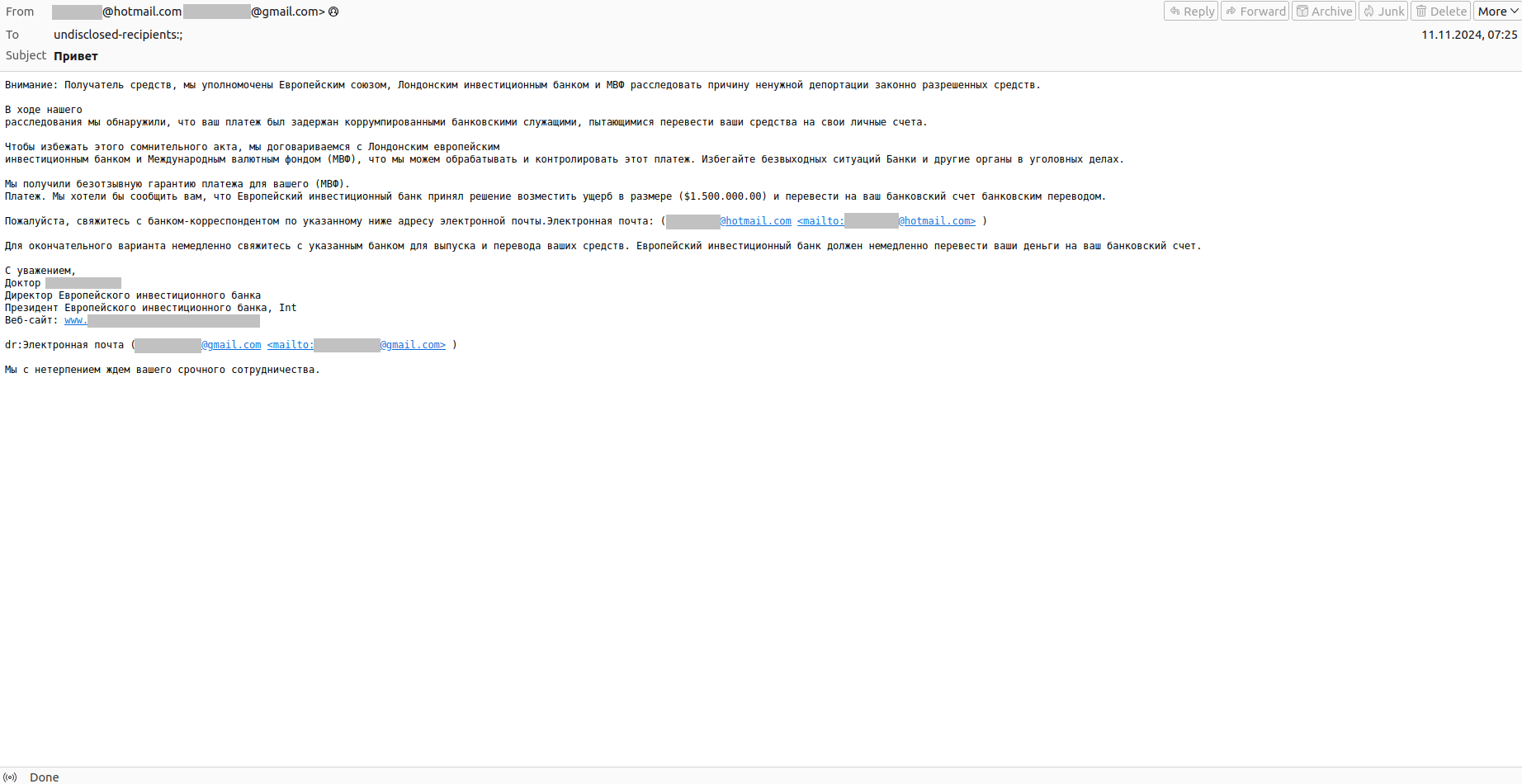
    For example, in the email screenshot below, the attackers, posing as high-ranking officials at a major bank, claim that “corrupt employees” were attempting to steal the recipient’s money. The bank claims to have taken action and is offering an exorbitant amount as damage compensation. To get it, the recipient is urged to contact a correspondent bank as soon as possible at an email address, which is, unsurprisingly, registered with a free email service.

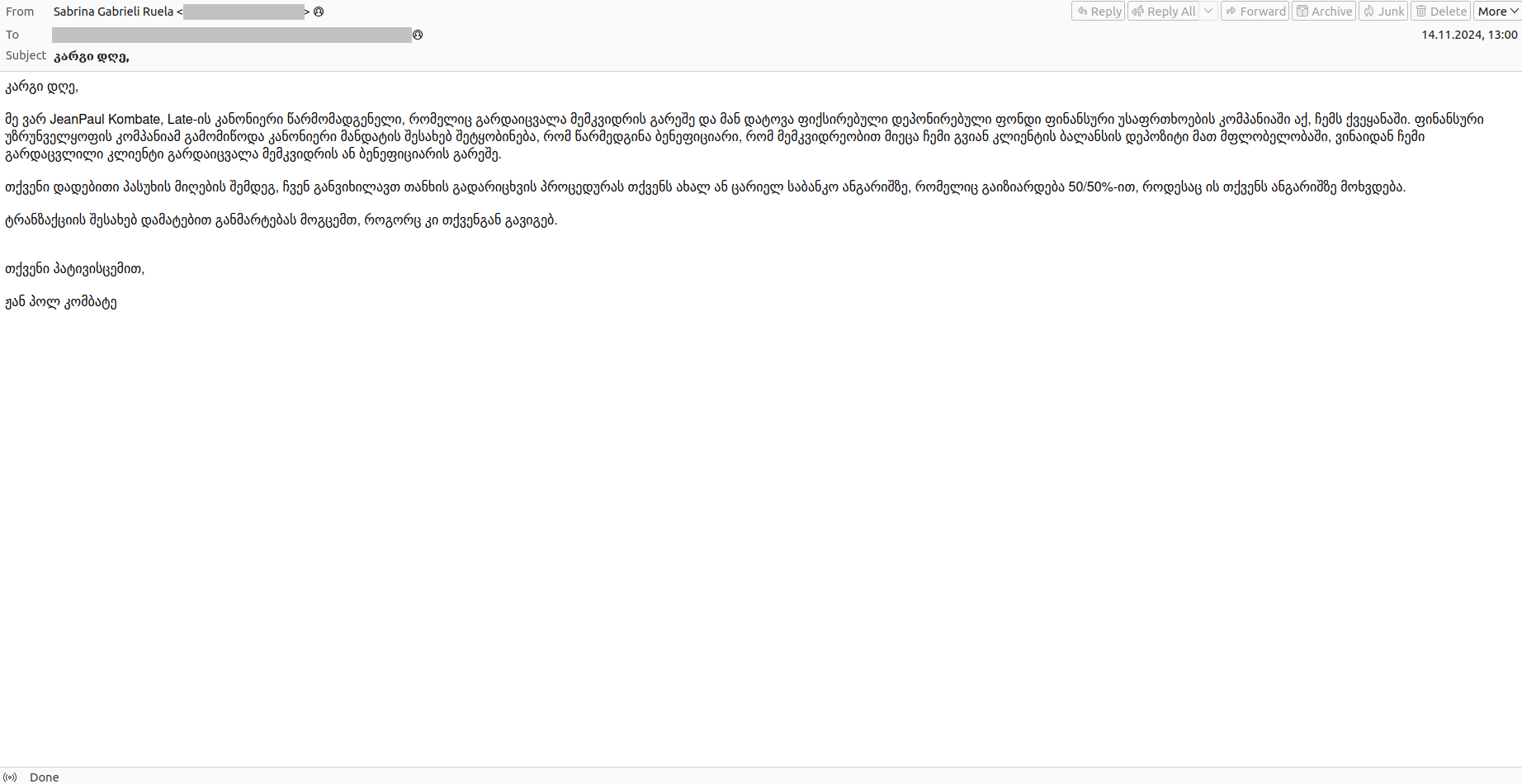
    Scammers have another trick up their sleeve when it comes to compensations: they pretend to be from the police or some international organization and promise to give victims of “Nigerian” scams or other rip-offs their money back. In the example below, scammers, posing as the Financial Stability Council and the United Bank for Africa (UBA), promise the victim a payout from a so-called “fraud victims compensation fund”.

    Sometimes scammers pretend to be “victims of fraud” themselves. The screenshot below shows a common example: scammers masquerade as victims of cryptocurrency fraud, offering help from “noble hackers” who they claim helped them recover their losses.

    Lottery scams

    Lottery win notification scams share many similarities with “Nigerian” scams. Fraudsters promise recipients large sums of money and provide their contact details for further communication. It’s likely that the victim has never heard of the lottery they’ve supposedly won.

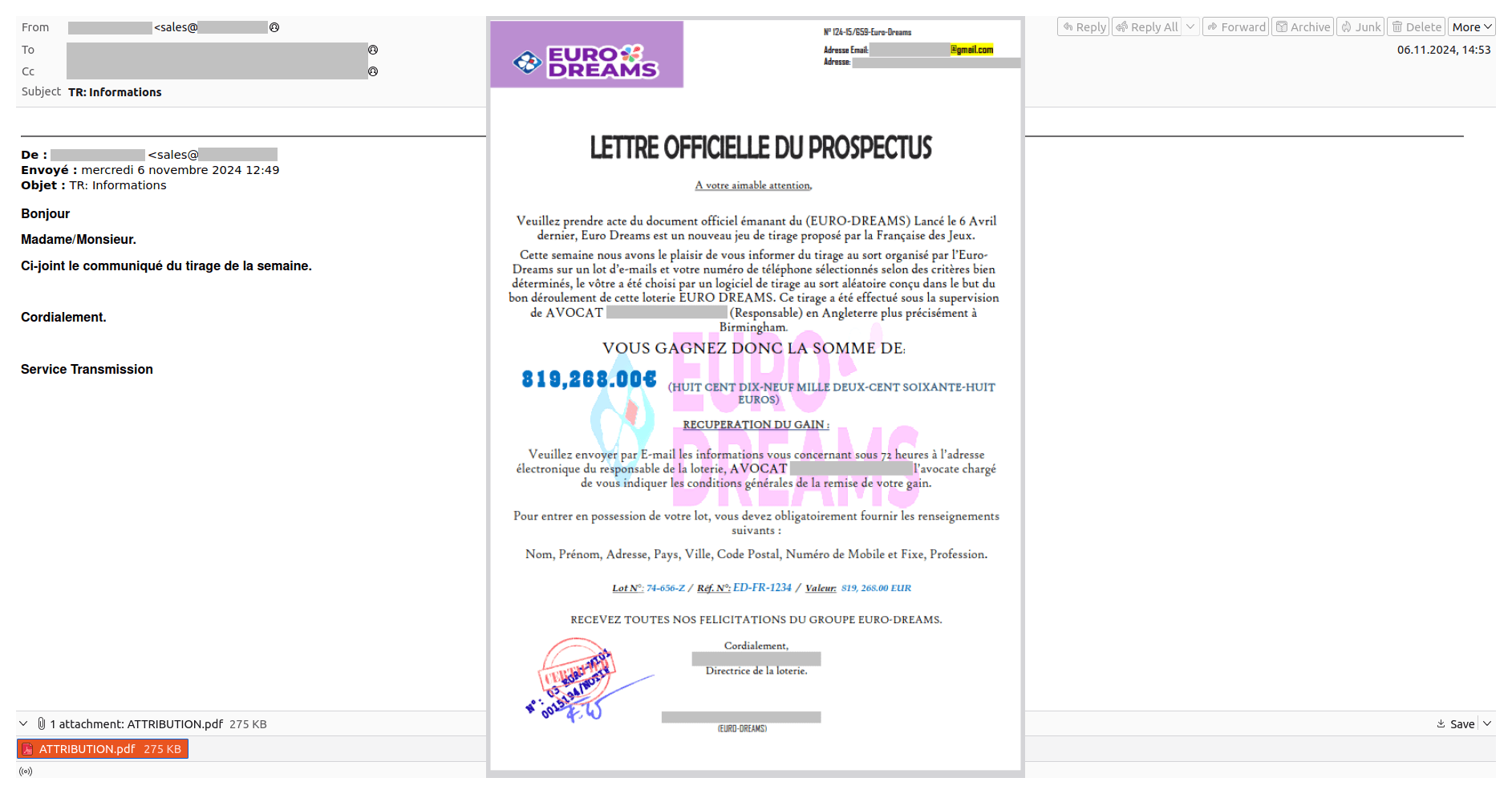
    In some cases, scammers employ unusual tactics. For example, in a message claiming to be from a European lottery director, the email body is all but empty. All the “win” details and next steps are in a PDF attachment. The file includes a free email address, which is typical of “Nigerian” scams, and asks you to send fairly detailed personal information, such as your full name, address, and both your mobile and landline phone numbers. They even ask for your job position.

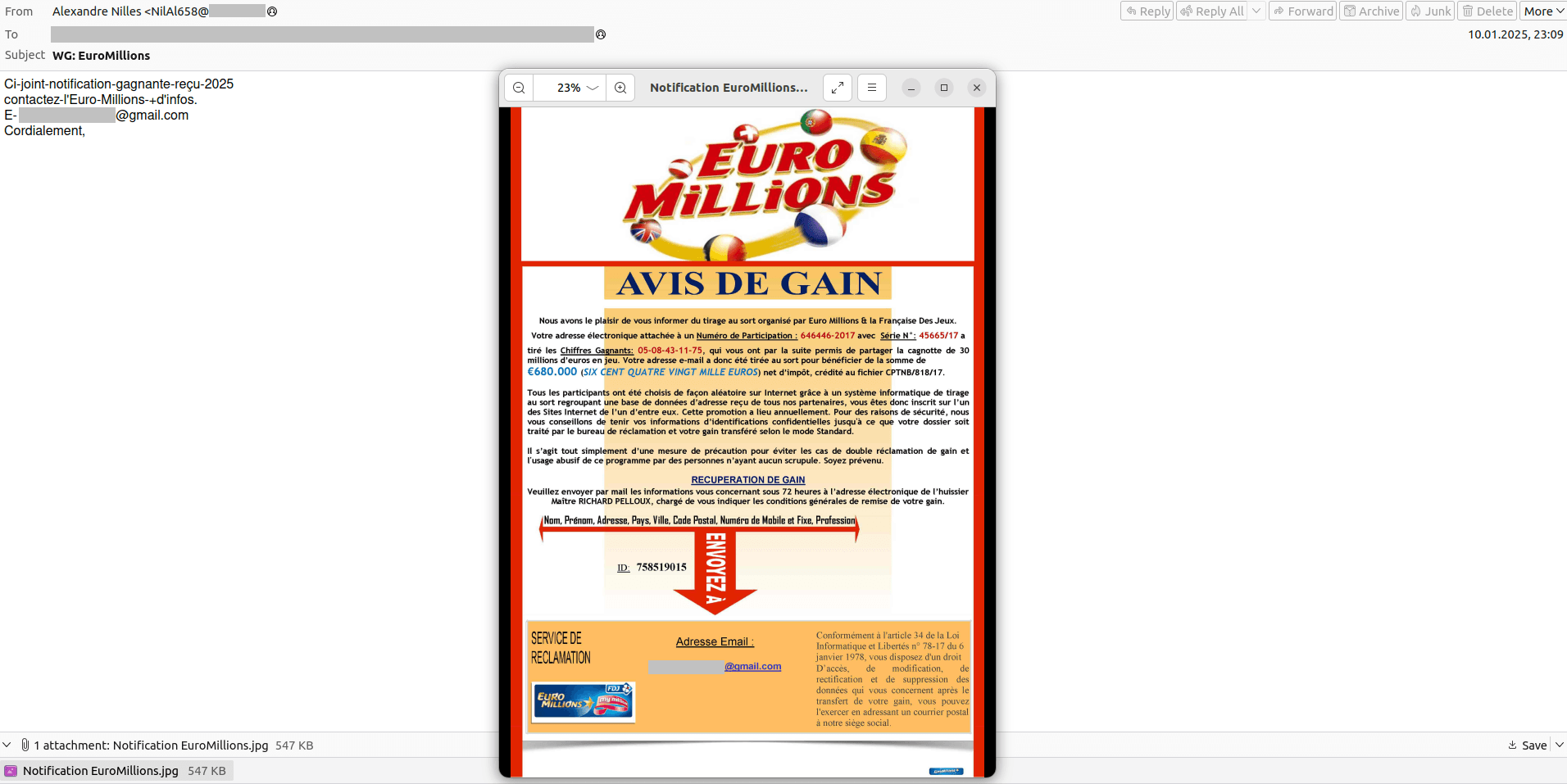
    In other similar emails, we noticed image attachments that included all the details about the supposed “win” and contact information.

    Another lottery scam tactic combines two types of bait: a lottery win (fraudsters pretend to be someone else who has won and is now offering you money) and offering a donation from a wealthy elderly person.

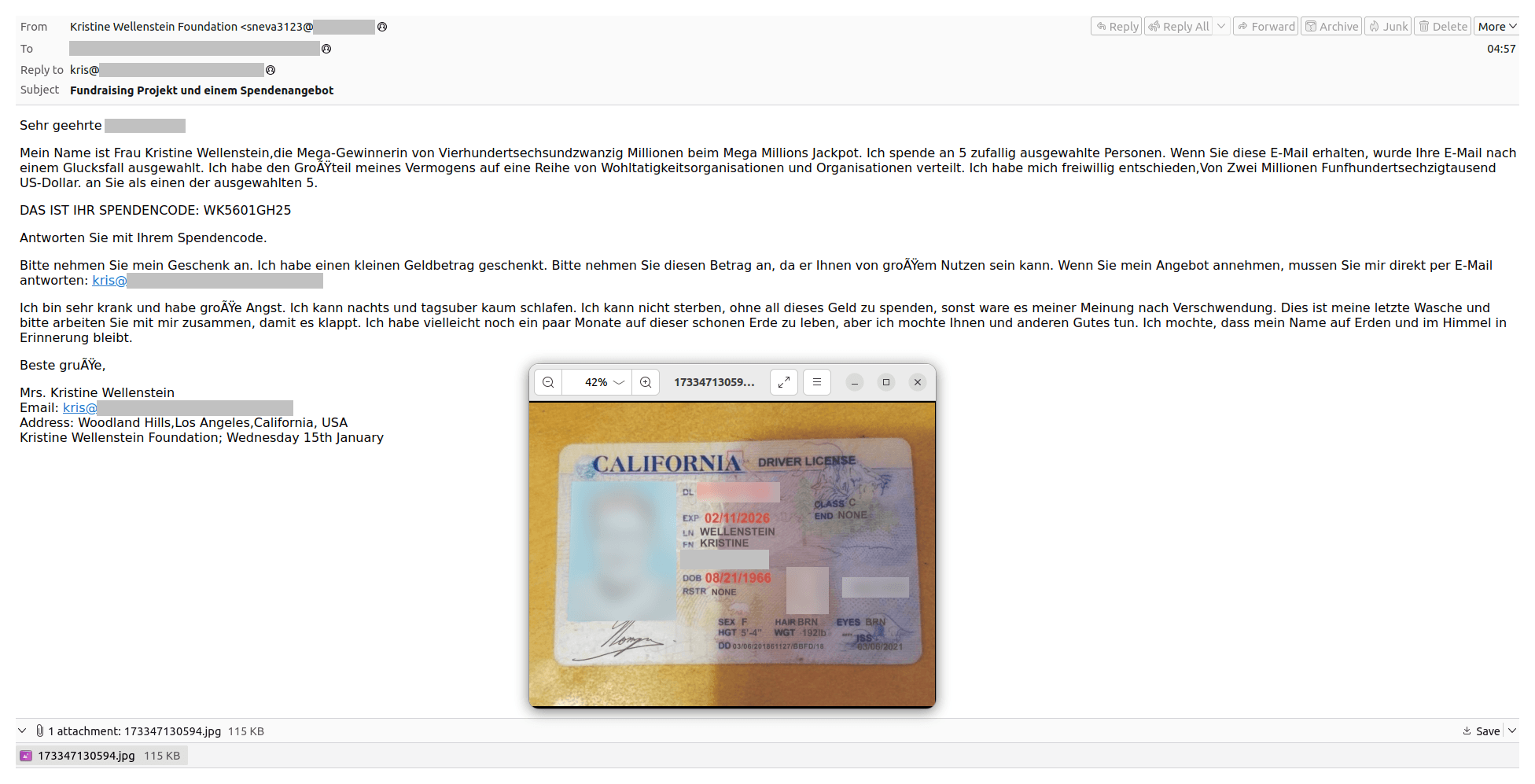
    In some cases, to make their scams more convincing, scammers attach photos of documents to their emails that supposedly confirm the sender’s identity or their winnings.

    Online dating scams

    Some “Nigerian” scams are so sophisticated that they can be hard to spot right away. These include offers of friendship that often develop into romantic conversations, which can be almost indistinguishable from real-life interactions. We’ve seen examples of really long email exchanges where a whole drama played out. A man and a woman met online and hit it off, chatting for hours about everything under the sun. Now, one of them is finally ready to meet the other in person. However, they can’t afford the ticket or visa, and they’re pleading with their partner for financial help so they can meet.

    In a different scenario, the scammer pretends to send an expensive gift to their partner. Eventually, they claim they can’t afford the postage and ask the victim to cover the costs. If the victim agrees, they’ll be hit with a series of additional fees, and the package will never materialize.

    “Nigerian” spam for businesses

    While “Nigerian” scams are often targeted at individual users, similar spam can also be found in the B2B sector. Cybercriminals claim to be seeking businesses to invest in, and the recipient’s company may be their target. To arrange a “partnership”, they ask the recipient to reply to the email.

    Current “Nigerian” spam themes

    Some of the spam samples above reference recent or current real-world events, such as the COVID-19 pandemic or Saudi Arabia’s possible BRICS membership. This is typical of “Nigerian” scams. There are countless ways scammers exploit various global or local, significant or ordinary, positive or negative events, news, incidents, and activities to pursue their selfish goals.

    The most talked-about event of 2024, the US presidential election, significantly influenced the types of scams we saw. Emails that took advantage of this topic were sent to users around the globe. For instance, in the following message, the scammers claimed that the recipient, who uses a German email address, was lucky enough to win millions of dollars from the Donald J. Trump Foundation.

    Creativity unbound

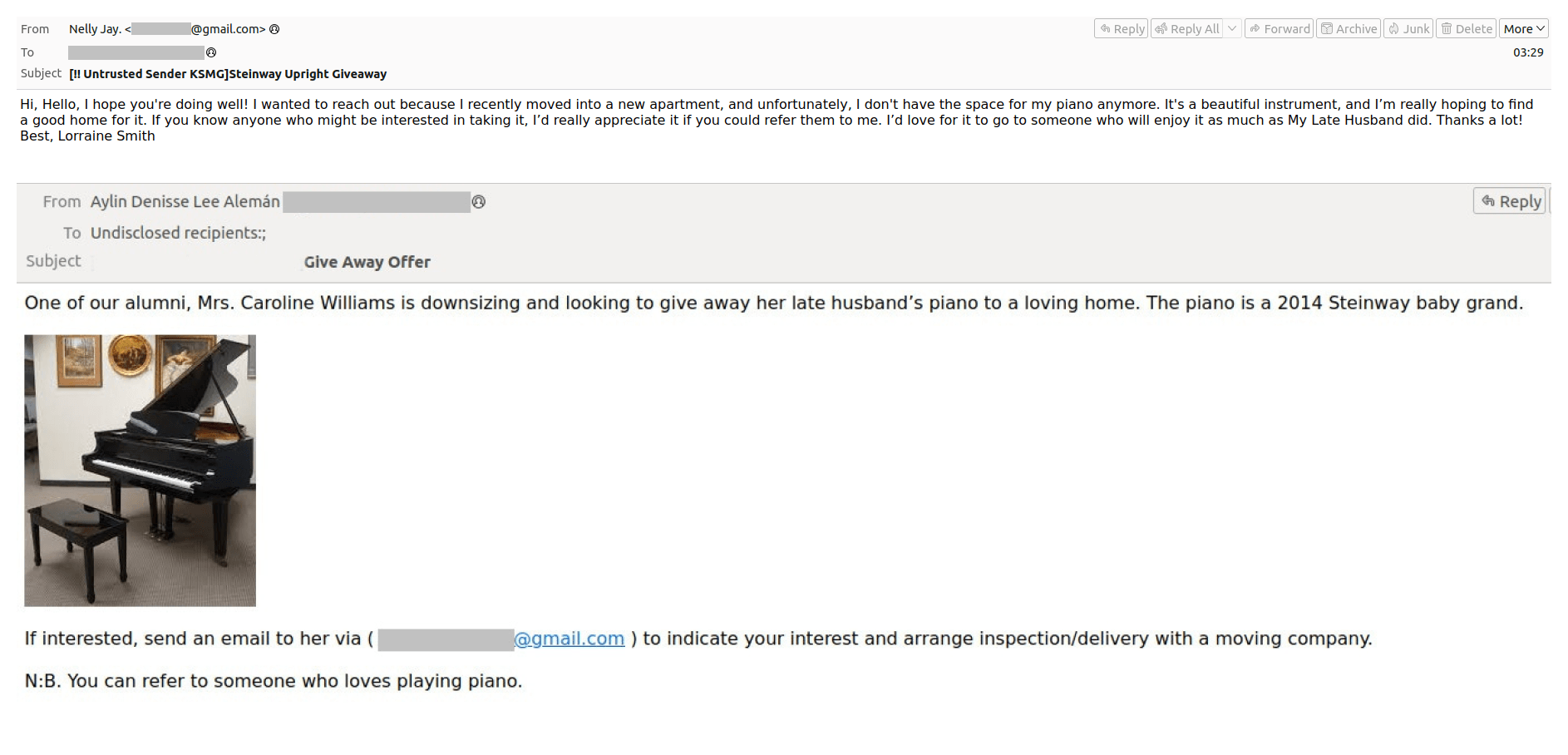
    While most spam fits into well-known categories, scammers can come up with some very surprising offers. We’ve seen quite a few messages from people claiming they’re giving away a piano because they’re moving or because the previous owner has passed away, as is often the case.

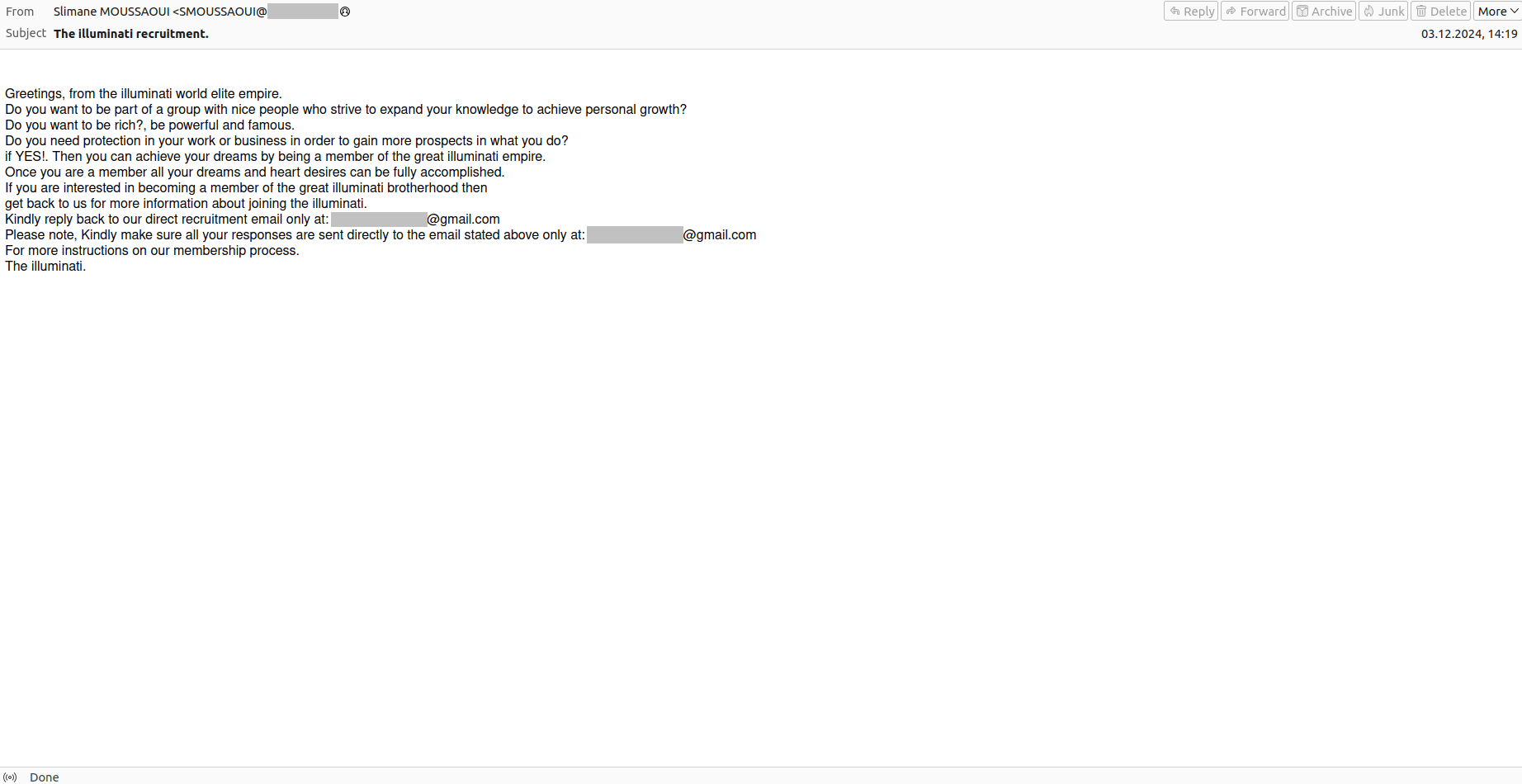
    Sometimes you find some really unusual specimens. For example, in the screenshot below, there’s an email allegedly sent from a secret society of Illuminati who claim to be ready to share their wealth and power, as well as make the lucky recipient famous if they agree to become part of their grand brotherhood.

    Conclusion

    “Nigerian” spam has existed for a long time and is characterized by its diversity. Fraudsters can pose as both real and fictitious individuals: bank employees, lawyers, businesspeople, magnates, bankers, ambassadors, company executives, law enforcement officers, presidents or even members of secret societies. They use a variety of stories to hook the user: compensations and reimbursements, donations and charity, winnings, inheritances, investments, and much more. Messages can be anything from short and captivating to long and persuasive, filled with numerous convincing claims designed to lull the victim into a false sense of security. The main danger of such emails lies in the fact that at first glance, there is nothing harmful in them: no links to phishing sites and no suspicious attachments. Scammers exclusively rely on social engineering and are willing to correspond with the victim for an extended period, increasing the credibility of their fabricated story.

    To avoid falling victim to such scams, it’s important to understand the dangers of tempting offers and to be critical of emails allegedly sent from influential individuals. If possible, it’s best to avoid responding to messages from unverified senders altogether. If for some reason you can’t avoid corresponding with a stranger, before responding to even an innocent message about finding a new owner for a piano, it’s worth double-checking the information in it, paying attention to inconsistencies, grammatical errors, etc. If the reply-to address is different from the sender’s address, or if you see a different address in the email body, this may be a sign of fraud.
    MIL OSI Economics

  • MIL-OSI Russia: Marat Khusnullin: In 2024, 53 long-term construction projects for 10.7 thousand equity holders were completed in Russia

    Translartion. Region: Russians Fedetion –

    Source: Government of the Russian Federation – An important disclaimer is at the bottom of this article.

    In 2024, thanks to federal mechanisms for restoring the rights of defrauded equity holders after completion of construction, 53 apartment buildings that were previously considered problematic were put into operation. The Supervisory Board of the Territorial Development Fund made decisions on them in 2019–2022.

    “Not so long ago, the issue of equity holders who suffered in Russia was acute. The government has done a lot of work to reduce the severity of this social problem. At present, we continue to implement the decisions that were previously made by the FRT Supervisory Board. Last year, 53 buildings were completed with the help of federal mechanisms. About 10.7 thousand people will receive the keys to new apartments in them. In total, since 2019, the rights of about 254 thousand citizens who suffered from the actions of unscrupulous developers have been restored,” said Deputy Prime Minister, Chairman of the FRT Supervisory Board Marat Khusnullin.

    Completed long-term construction projects are located in 14 regions: Krasnodar, Perm, Khabarovsk and Krasnoyarsk Krais, Leningrad, Nizhny Novgorod, Novosibirsk, Omsk, Chelyabinsk, Tambov and Ulyanovsk Oblasts, the Republics of Khakassia and North Ossetia, as well as in the Khanty-Mansi Autonomous Okrug.

    “The largest volume of work over the past year was completed in the Leningrad Region, where 10 houses were delivered for 3 thousand defrauded equity holders, in the Krasnoyarsk Region, where the construction of 9 houses for 1880 equity holders was completed, and in the Krasnodar Region, where 5 houses are ready, the keys to which will be received by 1254 people. In addition, 6 houses were erected in the Perm Region, in which 1167 equity holders will move in, and in the Novosibirsk Region 3 houses for 741 people were completed,” noted the General Director of the Territorial Development Fund Ilshat Shagiakhmetov.

    Federal and regional mechanisms are used to help affected equity holders. Federal mechanisms include completing the construction of the problematic facility and paying compensation based on the decision of the FRT supervisory board.

    Please note: This information is raw content directly from the source of the information. It is exactly what the source states and does not reflect the position of MIL-OSI or its clients.

    MIL OSI Russia News

  • MIL-OSI Russia: Belgium: Staff Concluding Statement of the 2025 Article IV Mission

    Source: IMF – News in Russian

    February 5, 2025

    A Concluding Statement describes the preliminary findings of IMF staff at the end of an official staff visit (or ‘mission’), in most cases to a member country. Missions are undertaken as part of regular (usually annual) consultations under Article IV of the IMF’s Articles of Agreement, in the context of a request to use IMF resources (borrow from the IMF), as part of discussions of staff monitored programs, or as part of other staff monitoring of economic developments.

    The authorities have consented to the publication of this statement. The views expressed in this statement are those of the IMF staff and do not necessarily represent the views of the IMF’s Executive Board. Based on the preliminary findings of this mission, staff will prepare a report that, subject to management approval, will be presented to the IMF Executive Board for discussion and decision.

    An IMF team led by Jean-François Dauphin visited Brussels to conduct the 2025 Article IV consultation with Belgium. The mission’s discussions (January 22-February 3) took place before the formation of the new government and the present statement, which summarizes the mission’s findings and recommendations, does not reflect the new government’s policy intentions.

    The IMF team thanks the Belgium authorities andother counterpartsfor the constructive dialogue and productive collaboration. It congratulates the new government on its nomination and looks forward to future engagement.

    ******

    The Belgian economy has been resilient to a series of shocks, but growth has slowed, and disinflation has faced headwinds. The labor market has been strong but shows signs of cooling. Labor-cost competitiveness has declined with wage growth outpacing sluggish productivity growth. Absent policy change, pressures from an aging population will weigh on Belgium’s social model and further increase the fiscal deficit and public debt, heightening vulnerability to changes in market sentiment. The outlook is subject to high uncertainty, amid risks that could push growth down and inflation up, including deepening geoeconomic and trade fragmentation, and adverse energy price developments.

    • Sustained fiscal consolidation is needed to support disinflation, rebuild buffers, lower market vulnerabilities, and address spending pressures from aging and the green transition. All federal and federated entities need to contribute to the adjustment. Rationalizing current spending while preserving (or increasing) public investment in infrastructure, healthcare, and education and enhancing its efficiency is a priority.
    • To preserve macrofinancial stability, current capital buffer requirements and prudential limits on mortgage loans should be maintained. Recent progress in strengthening systemic risk assessment, supervision, the macroprudential framework, and crisis management and resolution preparedness is welcome and should be sustained.
    • Reforms are needed to enhance growth potential through higher labor force participation, increased productivity, and a more efficient resource allocation. Priorities include increasing the income gap between work and nonwork through tax and social benefits reforms, reforming the wage-setting mechanism, and upgrading labor skills. Together with efforts with EU partners to deepen the single market, further product market reforms to reduce barriers to entry, foster greater competition, and improve the insolvency regime will improve firm dynamics and the diffusion of innovation. Sustaining the green transition requires strong commitment and enhanced coordination among the federal and regional governments.

    Economic outlook and risks

    Growth is expected to be stable in 2025 and inflation to slowly return to target. Output is expected to grow by 1.1 percent in 2025 and slightly increase by 2027 supported by monetary policy easing and a higher contribution from net exports. Inflation is projected to gradually decline as wage growth moderates and the projected drop in international energy prices passes through to retail prices. The external current account is expected to return to small surpluses over the medium term as energy prices ease and external demand increases. Under unchanged policies, pressures from the aging population would further increase the fiscal deficit to about 7 percent and public debt about 125 percent of GDP in 2030, heightening vulnerabilities.

    The baseline outlook is subject to sizeable risks, tilted down for growth and up for inflation. Growth could be weaker if the expected recovery in external demand falters amid escalating geoeconomic tensions and trade fragmentation. Inflation could be higher than projected due to adverse energy price developments, or if persistently-high core inflation affects expectations. Fiscal sustainability concerns could arise and lead to a sharp increase in borrowing costs—especially if global risk aversion increases—, necessitating abrupt fiscal consolidation with negative consequences for growth and potentially financial stability.

    Rebuilding Fiscal Buffers Despite Pressures

    Significant fiscal consolidation is needed to address large structural deficits and rising public debt that were exacerbated by the pandemic and energy crisis. In the short term, consolidation will help further reduce inflation, notwithstanding still-high wage growth and looser monetary policy. This would also help address significant upside risks to inflation. Critically, a sustained reduction in fiscal deficits is needed to reduce vulnerability to changes in market sentiment, rebuild space to address potential future shocks, address long-term spending pressures, and ultimately, preserve the core of Belgium’s social model, which places a high premium on solidarity and equity.

    Consolidation under the new EU economic governance framework (EGF) would significantly improve fiscal sustainability. Given the magnitude of the needed adjustment, the medium-term fiscal structural plan (MTFSP) under the EGF would benefit from a seven-year rather than a four-year adjustment path, accompanied by credible and front-loaded growth-enhancing reforms. Under such an adjustment, an annual reduction in the structural primary balance of about 0.5 percentage points of GDP until 2031 will be necessary to reach an overall deficit below 3 percent of GDP by 2031 and maintain it until 2041, per the EGF.

    Fiscal adjustment should center on rationalizing current spending, while making room for public investment. Rationalizing social benefits and the public wage bill is crucial for achieving budgetary savings. Public investment should be preserved, or ideally, increased to mitigate the growth impact of fiscal consolidation, support green transition, and bolster the economy’s productive capacity.

    Improving the efficiency of public investment is critical amid competing demands for resources. This includes laying out clear infrastructure investment strategies, strengthening project appraisal, selection, and governance, and improving coordination within and among the federal and federated entities. In healthcare, increasing the focus on preventive care and reforming the organization and role of hospitals would help absorb part of the projected increase in spending due to aging and better prepare the system to the evolving need of an older population. Education reforms can help achieve the same education outcomes at lower costs or improve outcomes without increasing spending.

    Pension reforms are essential to address cost pressures from aging. The focus should be on raising the effective retirement age in line with healthy-life expectancy and facilitating longer employment through life-long learning and upskilling. Additionally, reviewing eligibility criteria for specific pension regimes (e.g., disability pensions) and limiting increases in pension benefits by reviewing automatic indexation are necessary steps. A review of special provisions (e.g., arduous jobs) could inform reforms to balance fairness and costs.

    Tax reforms should aim to shift part of the tax burden from labor to capital, without revenue loss, and to reduce tax exemptions. Belgium has the highest labor-tax wedge in the OECD. Reducing labor taxation will help increase the employment rate. All revenue from capital (e.g., interests, dividends, and capital gains) should be taxed in the same way to ensure neutrality in investment decisions, ideally by incorporating these revenues into the overall taxable income subject to personal income tax. Reducing preferential regimes and treatments in the tax system, a significant source of foregone revenue, also needs to be part of the reform package. Tax reforms should be coordinated among the federal and federated entities for their revenue and distributional impacts.

    The new EGF provides an opportunity to strengthen Belgian’s fiscal framework through a revitalized fiscal council and greater accountability among federated entities. The implementation of the 2013 federal-regional coordination agreement has proved challenging, given the complexities of Belgium’s fiscal federalism. The new EGF provides a renewed opportunity to introduce binding rules for burden sharing the fiscal adjustment, with clear accountability for the federal and all federated entities. A strengthened fiscal council (e.g., with enhanced staffing and direct reporting to parliaments) would help ensure that the federal and each federated entity’s fiscal behavior is consistent with Belgium’s European commitments.

    Preserving Macrofinancial Stability

    Overall systemic risks in the financial sector remain moderate but are evolving due to changing macroeconomic and market conditions. While the economy is slowing and real estate markets cooling, interest rates are now decreasing. Household indebtedness has stabilized, and corporate indebtedness has declined due to substantial investments being largely cash financed. Corporate bankruptcies have been increasing but remain aligned with pre-pandemic trends. Risks from residential real estate have moderated, but commercial real estate market activity has dropped sharply, and vacancies have risen, reflecting low demand for office space. Overall, exposures to real estate remain broadly stable.

    With the level of financial stability risks expected to remain unchanged, capital buffers and prudential limits on residential mortgages should be maintained . Since last year, macroprudential policies have tightened, with capital buffers significantly raised. The NBB also appropriately encouraged banks to lengthen new mortgage maturities to ease the debt servicing burden of households and pre-empt borrower distress. Progress has been made in implementing the 2023 Financial Stability Assessment Program (FSAP) recommendations and this effort should be accelerated now that a new government is in place and the required legislative changes can be pushed forward.

    Strengthening Labor Markets

    Labor market fragmentation and rigidity in Belgium are impeding growth potential. The coexistence of local or sectoral pockets of high vacancies and pockets of high unemployment highlights inefficiencies in labor allocation that hinder potential growth. Employment gaps for low-skilled workers, older workers, women, and individuals with an immigration background or disabilities remain high. Fostering a more inclusive labor market will enhance overall economic performance and mitigate fiscal pressures.

    Enhancing labor market incentives is essential. Labor market, tax, and social benefit reforms should consistently aim to increase the income gap between work and nonwork and reduce the cost of hiring and dismissal. Reducing the duration of unemployment benefits and linking social benefits to income levels would incentivize re-entry into the labor force. Policy efforts should also focus on facilitating re-integration of workers from long-term sick leave.

    Reforming the wage-setting mechanism will help increase labor market efficiency, improve competitiveness, and reduce fiscal costs. Automatic wage and social benefit indexation protected household purchasing power during the inflation shock. However, it also increased structural fiscal deficits and led to labor-cost increases exceeding those of major trading partners when accounting for productivity differential, weighing on competitiveness. Consideration should be given to abolishing the automatic indexation and the 1996 wage law which, together, define a floor and a ceiling for wage growth, that do not allow for an optimal allocation of labor and increased employment. At a minimum, the labor market would already benefit from reforms including adjusting the basis for indexation to exclude volatile prices, broadening the group of comparator countries in the wage law, using productivity-adjusted wage growth as the basis for comparison, and allowing firms to partially index wages considering specific local and sectoral labor market conditions.

    Reforms in education and life-long training are necessary to upskill the labor force, enhance employment rates, and promote growth. While educational outcomes in Belgium are comparable to peers, they are achieved at a higher cost. Addressing teacher shortages, reducing grade repetition rates, and achieving greater equality of educational outcomes irrespective of backgrounds will require a comprehensive reform of the educational system. Actions should seek to align education with the needs of Belgian companies, better leverage teachers’ time, and strengthen support provided to students who face difficulties. These reforms would help increase employment, productivity, and the creation and diffusion of innovation.

    Boosting Productivity

    Boosting productivity will require further product market reforms to improve firm dynamics and the diffusion of innovation. Despite significant investment in innovation, Belgium’s long-term productivity slowdown is worse than peers, suggesting room to improve the transmission of innovation to productivity gains. Lagging productivity is linked to insufficient firm dynamics—the entry, growth, and exit of firms—, with Belgium experiencing some of the lowest firm entry and exit rates in the EU. To enhance productivity and dynamics, further product market reforms are necessary to reduce regulatory and administrative barriers and improve the insolvency regime.

    Deepening the European single market and advancing the capital market union would benefit firms in Belgium. Removing remaining barriers to trade within the EU and harmonizing regulations and bankruptcy frameworks would enhance Belgian firms’ access to a much larger customer base, improve competition and firm dynamics, and provide buffers against risks from geo-fragmentation. Moreover, developing venture capital within an EU-wide push toward capital market union would help widen Belgian firms’ options to finance growth.

    Sustaining the Green Transition

    Despite progress, much effort remains needed to achieve climate objectives. The expansion of the EU emissions trading system should be complemented by timely implementation of carbon taxation and phasing out fossil fuel subsidies, while ensuring support for vulnerable population. The consolidation of federal and regional climate efforts into a coherent and cohesive national strategy is essential. Improved coordination and accountability among the federal and regional governments will facilitate the design, execution, and evaluation of climate policies. Adequate investments in the green transition are necessary to ensure Belgium meets its climate goals and contributes to the European Green Deal.

    IMF Communications Department
    MEDIA RELATIONS

    PRESS OFFICER: Camila Perez

    Phone: +1 202 623-7100Email: MEDIA@IMF.org

    https://www.imf.org/en/News/Articles/2025/02/05/CS-Belgium-2025

    MIL OSI

    MIL OSI Russia News

  • MIL-OSI Europe: Written question – Urgent implementation and strengthening of tariff measures on fertilisers from Russia and Belarus – P-000434/2025

    Source: European Parliament

    Priority question for written answer  P-000434/2025
    to the Commission
    Rule 144
    Marta Wcisło (PPE)

    The Commission’s highly anticipated decision to introduce tariffs on fertilisers from Russia and Belarus should be implemented without delay. While this decision is a step in the right direction, any delay risks allowing Russian fertiliser exporters to profit from the European market during the peak demand season. Additionally, other fertiliser-related product codes must be included in the measures to close potential loopholes that Russia could exploit as part of its hybrid warfare strategy.

    • 1.Does the Commission intend to include code 3103 of the Combined Nomenclature[1] (covering phosphorus fertilisers such as triple superphosphate (TSP) and single superphosphate (SSP)) within the scope of the regulation, given that, if it does not, the Russian Federation could continue to supply these products to European markets by strategically manipulating the classifications under code 3105 (mineral or chemical fertilisers containing two or three of the fertilising elements nitrogen, phosphorus and potassium)?
    • 2.Does the Commission intend to include code 3104 (muriate of potash (MOP), sulphate of potash (SOP)), given that the primary beneficiary of sales of these potash fertilisers is the Russian oligarch-owned company Uralkali and that there are sufficient alternative suppliers from Germany, Spain, Israel, Canada, Laos and Jordan to ensure market stability?
    • 3.What transitional measures does the Commission plan to implement between now and 1 July 2025 to prevent excessive imports from Russia before the tariffs take effect?

    Submitted: 31.1.2025

    • [1] Commission Implementing Regulation (EU) 2023/2364 of 26 September 2023 amending Annex I to Council Regulation (EEC) No 2658/87 on the tariff and statistical nomenclature and on the Common Customs Tariff, OJ L, 2023/2364, 31.10.2023, ELI: http://data.europa.eu/eli/reg_impl/2023/2364/oj.
    Last updated: 5 February 2025

    MIL OSI Europe News

  • MIL-OSI Europe: Written question – Potential security risks and geopolitical implications of the Iran-Venezuela alliance for the EU – E-000309/2025

    Source: European Parliament

    Question for written answer  E-000309/2025
    to the Vice-President of the Commission / High Representative of the Union for Foreign Affairs and Security Policy
    Rule 144
    Antonio López-Istúriz White (PPE), Dolors Montserrat (PPE), Javier Zarzalejos (PPE), Raúl de la Hoz Quintano (PPE), Nicolás Pascual de la Parte (PPE), Alma Ezcurra Almansa (PPE), Francisco José Millán Mon (PPE), Borja Giménez Larraz (PPE), Adrián Vázquez Lázara (PPE), Esther Herranz García (PPE), Pilar del Castillo Vera (PPE), Fernando Navarrete Rojas (PPE), Pablo Arias Echeverría (PPE), Isabel Benjumea Benjumea (PPE), Maravillas Abadía Jover (PPE), Carmen Crespo Díaz (PPE), Juan Ignacio Zoido Álvarez (PPE), Gabriel Mato (PPE), Susana Solís Pérez (PPE), Rosa Estaràs Ferragut (PPE), Elena Nevado del Campo (PPE), Esteban González Pons (PPE)

    Recent reports indicate that, alongside Russia’s presence in Venezuela, there is an expanding strategic alliance between Iran and Nicolás Maduro’s regime. This alliance encompasses military cooperation, the establishment of a drone production base in Venezuela and economic transactions designed to circumvent international sanctions. These activities include the deployment of advanced unmanned aerial vehicles (UAVs), collaboration between the Iranian Quds Force and Venezuelan authorities, and the exchange of Venezuelan gold for Iranian crude oil through channels that violate international sanctions frameworks.

    Given the EU’s commitment to maintaining regional and global stability, countering terrorism and enforcing international sanctions:

    • 1.Is the VP/HR aware of these developments, and has she assessed their potential impact on the security and geopolitical stability of Latin America and the spillover effects on the EU?
    • 2.What measures is the VP/HR taking to ensure that this partnership does not undermine the possibility of restoring democracy in Venezuela, nor hinder the EU’s efforts to counter terrorism, the proliferation of advanced weaponry and the circumvention of international sanctions?
    • 3.How does the VP/HR plan to address the risks this alliance poses to the EU’s interests in Latin America, and what specific actions will she take to uphold the EU’s stance on regional and global security?

    Submitted: 23.1.2025

    MIL OSI Europe News

  • MIL-OSI Russia: Ancient seas of Moscow and masterpieces of Rastrelli. What to see in museums in February

    Translartion. Region: Russians Fedetion –

    Source: Moscow Government – Government of Moscow –

    The Marina Tsvetaeva House Museum invites you to an exhibition dedicated to the poet’s son, the A.S. Pushkin State Museum will introduce you to the work of architects Bartolomeo Francesco Rastrelli and Carlo Rossi, and the K.A. Timiryazev State Biological Museum will help you imagine what the Moscow region looked like hundreds of millions of years ago. More details about these and other exhibitions that open in February are in the mos.ru article.

    “Your Mur”. On the 100th Anniversary of Georgy Efron’s Birth” at the Marina Tsvetaeva House-Museum

    Dates: February 5 – August 3

    Address: Borisoglebsky lane, house 6, building 1

    Age limit: 12

    The new exhibition at the Marina Tsvetaeva House Museum will be dedicated to the 100th anniversary of the birth of Georgy Efron, the poet’s son. He was born in the Czech Republic, grew up in France, spoke Russian and French brilliantly, studied well and showed great promise: he had a fine artistic taste and a critical mind, was full of creative ideas and research plans.

    He came to his mother’s homeland when he was 14 years old. After the start of the Great Patriotic War and the death of Marina Tsvetaeva, Georgy’s life became especially difficult. In the autumn of 1941, he was forced to evacuate to Tashkent. Returning to Moscow, he entered the Literary Institute, but did not study for long – he was called up to the army. Georgy Efron went missing in July 1944, he was only 19 years old.

    The exhibition will tell about the short but eventful life of Georgy Efron; among the exhibits are his personal belongings, drawings and manuscripts, including a diary in which he talks about the time he witnessed, about his relationship with his mother and much more.

    Entrance – by ticket to the Marina Tsvetaeva House-Museum.

    Visiting Pushkin, Bulgakov and Tsvetaeva. Literary museums that will be interesting for schoolchildren

    “…The Architect’s Compass, Palette and Chisel” in the State A.S. Pushkin Museum

    Dates: February 6 – April 27

    Address: Prechistenka street, house 12/2, building 4

    Age limit: 6

    The State A.S. Pushkin Museum will tell about the architects Bartolomeo Francesco Rastrelli and Carlo Rossi – this year marks the 325th and 250th anniversaries of the famous architects’ births.

    Bartolomeo Francesco Rastrelli began his career in Russia under Peter I. It was thanks to him that the Grand Palace of Peterhof, Smolny Cathedral, the Grand Catherine Palace, the Winter Palace and other buildings appeared in St. Petersburg and its environs. In Moscow, you can also see one of his completed projects – the country palace of Elizabeth Petrovna, which is located in Sokolniki. The second section of the exhibition will introduce the work of Carlo Rossi, who, one might say, created the appearance of St. Petersburg familiar to its residents and guests today.

    Visitors will be presented with measuring instruments and rare books from the 18th–19th centuries on mathematics, geometry and drawing, engravings and lithographs from the century before last, which depict the Northern capital, and will be shown what a typical architect’s office looked like.

    You can get to the exhibition with a museum ticket.

    “Ancient Seas of Moscow” at the K.A. Timiryazev State Biological Museum

    Dates: February 8 – August 30

    Address: Malaya Gruzinskaya street, house 15

    Age limit: 12

    Guests of the K.A. Timiryazev State Biological Museum are invited to travel back hundreds of millions of years to the times when the territory of Central Russia was covered with water.

    Scientists have proven that the Moscow region was twice at the bottom of an ancient sea: in the Carboniferous period of the Paleozoic era (320 million years ago) and the Jurassic period of the Mesozoic era (160 million years ago). Visitors to the exhibition will see fossils of extinct marine animals and scientific reconstructions of their appearance, learn about their way of life and the role they played in the ecosystems of the past.

    Entrance – with a museum ticket.

    “Alexander Fedorovich Kots. Family Album” in the State Darwin Museum

    Dates: February 12 – May 4

    Address: Vavilov street, house 57

    Age limit: 6

    An exhibition dedicated to the 145th anniversary of his birth will tell about the family life of the founder and first director of the Darwin Museum, Alexander Kots.

    Here they will present rare photographs and negatives that he took with a German SLR camera from the mid-1910s. Alexander Fedorovich had a unique opportunity to photographically document the life of his family. For example, guests will learn where he and his wife Nadezhda Nikolaevna Ladygina-Kots went after their wedding, how they celebrated the New Year and what exquisite costumes they dressed their son Rudolf in.

    Tickets – on mos.ru.

    “The Life of Nature Has Become Understandable.” Reading the Books of Reviews of the Darwin Museum

    “This is the best we have. The Art Newspapper Russia’s choice” at the Moscow Museum of Modern Art

    Dates: February 18 – May 18

    Address: Gogolevsky Boulevard, Building 10, Building 1

    Age limit: 12

    The Moscow Museum of Modern Art will introduce viewers to the Russian art scene and its most prominent representatives of different generations. The halls will present works by Ilya Kabakov, Erik Bulatov, Alina Glazun and many other artists, and analyze their styles, views and creative tendencies.

    And the text messages that will accompany the exhibits can be considered references to various aspects of world history. In addition, the exhibition will include fragments of interviews that reveal the meaning of the works.

    Tickets are available for purchase on mos.ru.

    “This is our jumble” in the Panorama Museum “Battle of Borodino”

    Dates: February 18 – April 20

    Address: Kutuzovsky Prospect, Building 38, Building 1

    Age limit: 12

    The exhibits of the new exhibition in the panorama museum “The Battle of Borodino” will give viewers an idea of how the appearance and themes changed, how new artistic trends and folklore influenced the genre. And the title of the exhibition “This is Our Yeralash” is a language game that was often used in popular comic pictures.

    Entrance to the exhibition – by ticket for permanent exhibition.

    “Love Me As I Love You” at the Moscow Museum of Modern Art

    Dates: February 26 – April 20

    Address: Ermolaevsky lane, house 17, building 1

    Age limit: 12

    The Moscow Museum of Modern Art has another new exhibition. Its curators discuss the theme of love, family, and fidelity using works by 20th-century artists as an example. This project will be part of the long-term exhibition program “Collection. Viewpoint,” developed specifically for the museum’s educational center.

    You can buy tickets on mos.ru.

    “Forward to Zlotnikov!” in the gallery-workshop “GROUND Solyanka”

    Dates: February 26 – April 22

    Address: Solyanka street, house 1/2, building 2

    Age limit: 6

    The gallery-workshop “GROUND Solyanka” will introduce the work of the abstract artist Yuri Zlotnikov. On the first floor, his paintings will be shown together with works by contemporary artists, selected from the point of view of the analysis of the abstract works of Yuri Savelyevich. On the second floor, the exposition will be built in reverse – through the practices of other authors, Zlotnikov’s legacy will be deconstructed.

    Particular attention will be paid to the theory of the “Signal System” – the artist’s main discovery, which took an important place in the history of Russian art of the second half of the 20th century. The system is inspired by scientific achievements in the field of mathematics, cybernetics, psychology and allows us to trace the evolution in the work of Yuri Zlotnikov in such series as “Biblical Cycle”, “Abstraction”, “People, Space, Rhythms”.

    You can buy tickets on mos.ru.

    Please note: This information is raw content directly from the source of the information. It is exactly what the source states and does not reflect the position of MIL-OSI or its clients.

    Please Note; This Information is Raw Content Directly from the Information Source. It is access to What the Source Is Stating and Does Not Reflect

    https: //vv.mos.ru/nevs/ite/149694073/

    MIL OSI Russia News

  • MIL-OSI Russia: More than 9.7 thousand lanterns were installed in Moscow courtyards in 2024

    Translartion. Region: Russians Fedetion –

    Source: Moscow Government – Government of Moscow –

    Last year, specialists from the city services complex installed over 9.7 thousand lanterns in the capital’s courtyards. This was reported by the Deputy Mayor of Moscow for Housing and Public Utilities and Improvement Petr Biryukov.

    “Today, good lighting is an important component of the formation of the urban environment, it is the comfort and safety of residents. The number of outdoor lighting devices and architectural and artistic lighting in Moscow is growing annually and already exceeds one million. Particular attention is paid to the organization of high-quality lighting of courtyard areas; in 2024 alone, 9,755 additional lighting poles were installed,” said Pyotr Biryukov.

    The largest number of streetlights appeared in TiNAO (3510), CAO (1092) and VAO (841). When installing lighting poles, LED lamps are used, since energy saving is the most important environmental task. LEDs are several times more durable and 30 percent more economical than sodium and halogen lamps, and they are also distinguished by warm white light.

    Petr Biryukov recalled that all the lamps in the capital are gradually being equipped with smart sensors, thanks to which dispatchers can remotely control the city lighting. This allows them to regulate the brightness, check the voltage and control its operation.

    Please note: This information is raw content directly from the source of the information. It is exactly what the source states and does not reflect the position of MIL-OSI or its clients.

    Please Note; This Information is Raw Content Directly from the Information Source. It is access to What the Source Is Stating and Does Not Reflect

    https: //vv.mos.ru/nevs/ite/149739073/

    MIL OSI Russia News

  • MIL-OSI Russia: The Path to Success Starts Here: GUU Will Help Schoolchildren Find Their Calling

    Translartion. Region: Russians Fedetion –

    Source: State University of Management – Official website of the State –

    On Russian Science Day, the State University of Management will host a unique event – “Initiation into Future Professionals”.

    The event is held jointly with the Moscow Department of Education and Science as part of the “Science Festival” for students of entrepreneurship classes.

    In total, more than 500 tenth-graders from 18 schools in the capital will gather at the first management meeting.

    The guys will attend a ceremonial initiation ceremony and receive pre-professional class badges.

    The program also includes an exhibition of projects by prize-winners and winners of scientific and practical conferences, a performance by the KVN team and creative teams of the State University of Management, and a bright photo zone.

    Educational and entertaining activities will be presented by the EcoClub named after V.I. Vernadsky, the Board Game Club “Mind Games”, the Creative Group “StuDos”, the Project “Course on Business and Entrepreneurship”, and the Student Fire and Rescue Squad of the State University of Management.

    In addition, anyone can take part in a discussion with experts about the prospects of the industry and the development of education, “Conversation with a Professional,” and ask questions to business representatives.

    The holiday will start on February 8 at 10:00 in the Assembly Hall of the State University of Management.

    Subscribe to the tg channel “Our State University” Announcement date: 02/8/2025

    Please note: This information is raw content directly from the source of the information. It is exactly what the source states and does not reflect the position of MIL-OSI or its clients.

    MIL OSI Russia News

  • MIL-OSI Russia: Participants of the Art in the Metro project created paintings at the Kitay-Gorod station

    Translartion. Region: Russians Fedetion –

    Source: Moscow Government – Government of Moscow –

    As part of the “Art in the Metro” project, a plein air was held at the Kitay-Gorod station. More than 25 artists took part in it. This was reported by the Deputy Mayor of Moscow for Transport and Industry Maxim Liksutov.

    “During the visiting creative event, the participants of the “Art in the Metro” project created works in various styles – from classical painting to modern graphics. We continue to develop the capital’s metro as a cultural space on behalf of Sergei Sobyanin,” said Maxim Liksutov.

    Project “Art in the Metro” opened in April 2024. Its participants are more than 200 artists who create their works at Moscow Metro stations. In this way, the masters can demonstrate their art to a wide audience, and city residents and tourists can get acquainted with various styles and genres of painting, graphics and sculpture. To join the second season of the project, you must submit an application on the website.

    The project is organized by the Moscow Metro together with the capital’s Department of Transport and Development of Road Transport Infrastructure. General partner – the association “Exhibition halls of Moscow” Department of Culture of the City of Moscow.

    Artists can paint not only at the project sites located in the metro, but also participate in various events – exhibitions, lectures, master classes, as well as visiting art events.

    Please note: This information is raw content directly from the source of the information. It is exactly what the source states and does not reflect the position of MIL-OSI or its clients.

    Please Note; This Information is Raw Content Directly from the Information Source. It is access to What the Source Is Stating and Does Not Reflect

    https: //vv.mos.ru/nevs/ite/149688073/

    MIL OSI Russia News

  • MIL-OSI China: China taps ice, snow to fuel economic growth

    Source: People’s Republic of China – State Council News

    BEIJING, Feb. 5 — From winter sports to snow tourism, China is actively tapping into its ice and snow resources to create new growth drivers for the world’s second-largest economy, according to multiple officials and experts at a recent roundtable.

    Tourists are now more willing to pay for leisure and cultural activities related to ice and snow tourism, said Dai Bin, president of the China Tourism Academy, at the latest episode of the China Economic Roundtable, an all-media talk show hosted by Xinhua News Agency.

    Dai said that various new business models are arising from the thriving industry. “Once tourists arrive at their destinations, they look for accommodation, dining options and interactions with locals. What attracts them most is often the unique folk customs and cultural heritage of the region.”

    Harbin, China’s northernmost provincial capital, exemplifies the country’s thriving ice and snow economy. During the eight-day Spring Festival holiday that concluded on Tuesday, Harbin Ice-Snow World attracted over 610,000 visits. This ice theme park, featuring dazzling ice sculptures, saw more than 100,000 visits on Feb. 1, setting a new record for daily attendance compared to previous years.

    In addition to Harbin, various new ice and snow tourism attractions have emerged across Heilongjiang Province. These include the snow-covered forests of Yichun, one of China’s most forested cities, winter birdwatching in Qiqihar, where native red-crowned cranes can be spotted, and aurora viewing in Mohe, near the China-Russia border, according to Qi Bin, deputy director of the Heilongjiang provincial department of culture and tourism.

    Peng Fuwei, an official with the National Development and Reform Commission, China’s top economic planner, said that China has established a dual manufacturing-service model to develop its ice and snow economy. According to Peng, the country can now produce 15 kinds of ice and snow sports equipment, ranging from snowboards to snow-making machines.

    In ice and snow services, Peng said multiple sectors flourish simultaneously, including competitions and performances, catering and accommodation, winter sports training, and leisure tourism.

    Looking ahead, Peng said that the central budget will continue to support the construction of public service facilities for eligible ice and snow sports and tourism. Also, qualifying ice and snow tourism equipment will receive support through ultra-long special treasury bonds for equipment upgrades.

    According to China’s national blueprint for the ice and snow economy, the industry is expected to play a greater role in expanding employment and promoting high-quality development by 2030. Ice and snow consumption will be a key growth driver for domestic demand.

    By then, several high-quality destinations for ice sports and tourism will be established, and the total scale of the ice and snow economy is projected to reach 1.5 trillion yuan (about 209.2 billion U.S. dollars), the document says.

    MIL OSI China News

  • MIL-OSI Russia: Dmitry Patrushev: Agricultural trade turnover with the Republic of Belarus increased by 15% in 2024

    Translartion. Region: Russians Fedetion –

    Source: Government of the Russian Federation – An important disclaimer is at the bottom of this article.

    Deputy Prime Minister of the Russian Federation Dmitry Patrushev held a working meeting with Deputy Prime Minister of the Republic of Belarus Yuri Shuleiko. The parties discussed cooperation in the field of agro-industrial complex, fisheries, environmental protection and ecology.

    Previous news Next news

    Working meeting of Dmitry Patrushev with Deputy Prime Minister of the Republic of Belarus Yuri Shuleiko

    “Interaction between Russia and Belarus is expanding in a number of areas, including agriculture. According to preliminary data, in 2024, the turnover of agricultural products increased by 15%, exceeding $8 billion. We expect that the positive trend will continue,” said Dmitry Patrushev.

    Both mutual trade and joint development of foreign markets demonstrate stable growth. The countries also successfully cooperate in the field of seed production.

    In the area of ecology and nature management, active work is being carried out within the framework of a joint board of specialized departments. Following the results of the last meeting, a cooperation program on environmental protection and rational nature management for a three-year period was signed.

    The program’s activities are aimed at joint activities to develop the system of functioning of specially protected natural areas, including ecological tourism and education, exchange of experience in the field of state environmental control and handling of production and consumption waste.

    Also in 2024, a “road map” for transboundary water cooperation was approved. It includes 119 measures aimed at preserving and restoring water bodies in the Dnieper and Western Dvina basins.

    Through the CIS Intergovernmental Council, Russia and Belarus are carrying out activities to improve the geological study of border territories, including monitoring of underground transboundary waters. This will improve the efficiency of exploitation of deposits.

    Please note: This information is raw content directly from the source of the information. It is exactly what the source states and does not reflect the position of MIL-OSI or its clients.

    MIL OSI Russia News

  • MIL-OSI Russia: Knowledge is a priority: GUU has become one of the most widely read universities in Russia

    Translartion. Region: Russians Fedetion –

    Source: State University of Management – Official website of the State –

    The State University of Management took second place among the most widely read economic higher education institutions in our country according to the Znanium Electronic Library System. The platform annually compiles a rating of the most widely read universities and secondary vocational education institutions, highlighting the top 30 leaders across the country and in individual areas of training.

    The award ceremony took place at the International Scientific and Methodological Conference “Foresight of Education: Portrait of the Student of the Future”. The employees of the Scientific Library of the State University of Management took part in the ceremony: Director Olga Kharlamova, her deputy Ekaterina Bondarovich and leading specialist Evgeniya Drits.

    Olga Anatolyevna noted that in modern conditions, the attention of library staff in educational organizations should be directed not only at students, but also at teachers, who play a key role in attracting students to use information and library resources, therefore the Scientific Library of the State University of Management regularly conducts advanced training programs for University teachers, informing them of new opportunities.

    The conference also included a subject discussion entitled “Library Foresight: Portrait of the Reader of the Future”. Leaders and specialists of libraries and publishing houses discussed important topics: who is the reader of the future, is a library needed in the new realities, what competencies are necessary for a modern librarian, the role of a smart library and its place in the educational ecosystem of the university.

    Representatives of electronic educational platforms and information resources such as Znanium, Book.ru, Aibuks.ru, University Library Online, IVIS company and Neopoisk LLC shared their views on what kind of reader they will be and what new services they will need.

    Let us recall that, among other things, the Scientific Library is the organizer of the Inter-University Festival of Student Book Clubs “Living Hat”, creating a space for uniting reading youth and supporting the work of talented young authors, thereby educating the reader of the future, who understands the importance of cultural traditions.

    Subscribe to the TG channel “Our GUU” Date of publication: 02/05/2025

    Please note: This information is raw content directly from the source of the information. It is exactly what the source states and does not reflect the position of MIL-OSI or its clients.

    MIL OSI Russia News

  • MIL-OSI Russia: Sobyanin: A new road from Dalnyaya Street to Promyshlennaya has opened in Troitsk

    Translartion. Region: Russians Fedetion –

    Source: Moscow Government – Government of Moscow –

    In the Troitsky administrative district of the capital, a road from Dalnyaya Street to Promyshlennaya was opened. It was built in the southern part of Troitsk as part of one of the stages of development of its street and road network.

    The work, including the reconstruction of Promyshlennaya Street, was carried out to ensure maximum road safety and to increase the capacity of the streets.

    “During the work, the roadway of existing streets was widened, exits from residential areas were organized, sidewalks were equipped, more than 10 kilometers of utility lines were reconstructed, eight traffic lights and the same number of bus stops for public transport were installed, and the adjacent territory was improved.

    TiNAO “About 4.5 kilometers of new roads have appeared, making travel even more comfortable,” the Mayor of Moscow wrote in his telegram channel.

    Source: Sergei Sobyanin’s Telegram channel @Mos_Sobyanin

    As part of the project, an access road to the Institute of Nuclear Research of the Russian Academy of Sciences was built, with the checkpoint and the checkpoint building being moved. Part of Akademika Franka Street from Promyshlennaya Street to the bus depot located in the area of the highway to the village of Bylovo was also reconstructed.

    Several stages of road construction work are planned in Troitsk. The plans include construction and reconstruction of city streets with the arrangement of new exits to Kaluga Highway.

    Sergei Sobyanin opened full service on the Troitskaya metro line

    Please note: This information is raw content directly from the source of the information. It is exactly what the source states and does not reflect the position of MIL-OSI or its clients.

    Please Note; This Information is Raw Content Directly from the Information Source. It is access to What the Source Is Stating and Does Not Reflect

    https: //vv.mos.ru/mayor/tkhemes/12348050/

    MIL OSI Russia News

  • MIL-OSI Russia: Russian Science Day in Moscow: where the most interesting events will take place

    Translartion. Region: Russians Fedetion –

    Source: Moscow Government – Government of Moscow –

    Dozens of excursions, exhibitions, as well as thematic quizzes, special projects and acquaintance with the latest developments of scientists await city residents in early February. All these events are dedicated to the celebration Day of Russian Science, which is celebrated on February 8. This is a great opportunity not only to remember the legendary scientists of the past, but also to turn to their modern colleagues, and to find out what discoveries are changing the world right now.

    Cosmonautics, biotechnology and the power of words at VDNKh

    The country’s main exhibition invites everyone to special programs and free excursions. They will be dedicated to various types of science and will be organized in museums and pavilions of VDNKh. To participate in most events, you only need to pre-register; for some, you need to buy a ticket.

    Thus, on February 8, thematic events will be held at the Atom Museum. You can follow the schedule and buy tickets on the official website of the museum.

    On February 8 from 11:00 to 20:00 in the museum lobby you will be offered to play engineering games and assemble Spills cards of Russia. The Spills map is an innovative development, which is a set of magnetic game elements made in the form of territorial units of states and regions. It will be interesting for both adults and schoolchildren from 12 years old (children come accompanied by adults). Wooden puzzle maps will help you remember the geography of Russia. Guests will learn how much energy each region consumes, what is the average annual temperature in them. In the museum from 13:00 to 14:30 visitors will also be able to work at engineering tables and even conduct own scientific experiments.

    Master classes in physics have been prepared for children aged six and over “Snow Atom” And “Winter Journey with Atomarenko”, board game “Nuclear Power Plant Engineer”. A quiz awaits teenagers and adults “Through experience”, master class “VR in your pocket”, quiz “Physicists and Lyricists” and public talk “How Russians believed in physics”. The Center for Modern Biotechnology “Biotech Museum” has prepared a special program for all guests for the Day of Russian Science. Starting from February 8, there will be a new master class dedicated to microorganisms, – “Art in a Petri Dish”. In addition, on February 8 and 9 at 16:00 there will be open screenings of documentaries about mathematics and bionics. Admission by museum tickets.

    Free excursions will be held at VDNKh on February 8. At 17:00 in Pavilion No. 1 “Central” you can take a guided tour exposition of the Tretyakov Gallery. Guests will be introduced to the works of Alexander Deineka, Evgeny Vuchetich, Vera Mukhina, Alexander Vinogradov, Vladimir Dubossarsky and many other artists. There you can also admire the monumental canvases created especially for the opening of the pavilion in 1954, examine the legendary high relief of Evgeny Vuchetich, considered lost for more than half a century, and learn the details of the creation of the monument “Worker and Kolkhoz Woman”.

    At 17:00 and 18:30 the Cosmonautics and Aviation Center invites you to thematic excursions “Chemistry and Space”. And at 19:00 in the museum of Slavic writing “Word” there will be an excursion “Studying the word…”. It will talk about Slavic writing and its researchers.

    About science for schoolchildren and youth

    A number of events dedicated to Russian scientists, the secrets of physics, chemistry, cybernetics and high technology will be held by the capital’s palaces of creativity. Children and teenagers will enjoy exciting quizzes, quizzes, master classes and much more. They can be visited for free, but some events require preliminary online registration.

    On February 6, the Sviblovo Children’s Creativity Center will host a festive quiz called “Young Researchers.” Through the interactive format of the event, combining play and learning, young participants will be able to receive basic knowledge about the world of science.

    On the same day, the Victoria Children’s and Youth Center will hold an educational program where you can learn about the important achievements of Russian and Soviet science and great discoveries. in this area.

    For all those interested, on February 8, the Moscow Palace of Pioneers on Vorobyovy Gory will host Moscow Science Festival. Guests will enjoy intellectual games, lectures and master classes. Visitors will get acquainted with modern developments and learn how to build a career as a researcher. Lectures on physics and space, thematic master classes, scientific battles and board games are planned. Schoolchildren will be told how to conduct their first research, how to prepare for university and become a scientific volunteer. You can register for the events Here.

    The Palace of Children and Youth Creativity “Undiscovered Islands” will hold a special master class “The Invisible World and Fascinating Experiments” on February 8. Participants will learn about the history of Russian Science Day and will also get acquainted with various interesting experiments. And in the Palace of Children and Youth Creativity “Khoroshevo” until February 10 there will be a whole a series of master classes and quizzes for young seekers of knowledge.

    Journeys into the World of Scientific Moscow

    A digital weekend will help you organize a real scientific weekend tourist service Russpass. Three new walking routes around the city were published there. They are dedicated to places in Moscow associated with famous scientists and their main discoveries. The routes will be interesting for the whole family, and you can walk along them at any convenient time. The descriptions are supplemented with historical information about places and objects and photographs of all the sights that you will encounter along the way.

    Route “Fascinating Biology: A Curious Walk for the Whole Family” will introduce city travelers to the Main Botanical Garden named after N.V. Tsitsin of the Russian Academy of Sciences (RAS), Timiryazevsky Park and the florarium in Zaryadye Park.

    On a walk “Visiting the animals, the moon and the past in one day” young science lovers and their parents will learn interesting facts about the scientific world of Russia. The route includes a visit to the Moscow Zoo, Presnensky Park, Moscow Planetarium and the Museum of the History of the Telephone. Children and adults will be able to listen to lectures about the stars and animals of Russia, learn about the first means of communication, and play on the scientific playground. The exciting journey can be completed at the skating rink on Patriarch’s Ponds.

    Walk “Scientific Moscow: Founders, Researchers and Pioneers” will allow you to see the houses where famous scientists lived and worked. This is the longest route, which can be explored gradually. To visit all its points, you will need four days. This is a great opportunity to get acquainted with the monuments to discoverers in the fields of medicine, chemistry, biology, and space exploration. Among the points of the route are the estate of A. I. Konshina, which now houses the Central House of Scientists of the Russian Academy of Sciences, the Memorial Museum-Apartment of K. A. Timiryazev, the main building of the Moscow State University named after M. V. Lomonosov, and monuments on the Cosmonauts’ Alley at VDNKh.

    Russian Science Day in Libraries, Cinemas and More

    The capital’s cultural venues also invite you to celebrate Russian Science Day. You can attend events in museums, cinemas, libraries and cultural centers starting February 6. To participate in some events, you will need to register in advance or buy a ticket.

    Thus, on February 6 and 7, free screenings of the Russian popular science film “The Chip Inside Me” will be held in the Moskino chain of cinemas. The film will tell about how chipping helps to restore health, and the film will also touch upon ethical issues. The screenings will be held in eight Moskino chain cinemas: “Cosmos”, “Sputnik”, “Iskra”, “Zhukovsky”, “Tula”, “Saturn”, “Vympel”, and “Angara”. Registration — by link.

    An exhibition will be open at the Meridian Cultural Center from February 6 to 27 “The History of the Magnetic Needle”. Guests will see pocket compasses produced in Russia from the mid-19th to the mid-20th century. These are exhibits from the collection of magnetic compass collector Mikhail Ivanov, which includes more than 800 devices from various countries and eras. The exhibition will also feature mining compasses from the collection of Gennady Avdonin, chief specialist of the N.M. Fedorovsky All-Russian Research Institute of Mineral Resources.

    The Central City Children’s Library named after A.P. Gaidar invites schoolchildren to the thematic program “Experiments”. It will last until February 28. Visitors will enjoy physical and chemical experiments with liquids, gases and solids, optical illusions and puzzle solving. Lectures on scientific laws will also be organized for young scientists and they will be told how to independently conduct a scientific experiment at home, taking into account all safety rules. Entrance to the event is free for organized groups (kindergarten groups and school classes from six years old). You can find out more and sign up for the program by calling the library: 7 499 242-57-23.

    Children will be able to try their hand at solving puzzles, conduct interesting experiments, and learn about the contribution of Russian researchers to world science at the Central Children’s Library No. 14. There, on February 6 at 4:00 p.m., a quiz called “Day of Russian Science” will be held.

    On February 7 at 15:00, the A.S. Neverov Library No. 90 will host a discussion entitled “Ruthless Science with Meaning.” Guests will be told about interesting facts from the biographies of famous scientists such as N.I. Vavilov, D.I. Mendeleyev, V.I. Vernadsky, I.P. Pavlov, N.I. Lobachevsky, and others. Participants will also be introduced to the works of these researchers.

    And in Library No. 82 on February 6 at 11:15 and February 7 at 11:00 there will be interactive classes “Treasures of the Earth” and “Green Energy”, dedicated to the topic of clean energy.

    On the festive day, February 8, the N. F. Fedorov Library No. 180 will host an exhibition of the St. Petersburg photo artist Maria Kovalevskaya. It is dedicated to women scientists working at the I. P. Pavlov Institute of Physiology of the Russian Academy of Sciences. At the exhibition, you can learn about their work and hobbies, such as sailing, fishing and fencing, and also immerse yourself in the atmosphere of the first science town in Russia. It was built in the 1930s with the participation of Academician I. P. Pavlov.

    The Darwin Museum will hold the Science Day. Vanished Worlds event. On February 8, from 10:00 to 18:00, guests will enjoy games, interactive activities, master classes, and lectures. At the events, visitors will get acquainted not only with the most famous ancient animals — dinosaurs, but also with their relatives and contemporaries, as well as with other extinct inhabitants of the Earth. Entrance — by tickets.

    A special program will be held at the Timiryazev State Biological Museum from 12:00 to 16:00 on February 8. It will be dedicated to various areas of biology, its history, and the work of scientists. The events are planned at two venues: in pavilion No. 31 “Geology” at VDNKh and in the museum building on Malaya Gruzinskaya Street. Admission is by ticket. You can buy a ticket for the event in the Geology pavilion at this link, and to the event at the museum on Malaya Gruzinskaya – on this.

    Russian Science Day has been officially celebrated since 1999. The reason for its appearance was the events that took place more than 300 years ago – on January 28 (February 8, new style) 1724, Emperor Peter I founded the Russian Academy of Sciences.

    Please note: This information is raw content directly from the source of the information. It is exactly what the source states and does not reflect the position of MIL-OSI or its clients.

    Please Note; This Information is Raw Content Directly from the Information Source. It is account to What the Source Is Stating and Does Not Reflect the Position of Mil-Sosi or Its Clients.

    https: //vv.mos.ru/nevs/ite/149524073/

    MIL OSI Russia News

  • MIL-OSI Global: Trump wants the US to ‘take over’ Gaza and relocate the people. Is this legal?

    Source: The Conversation – Global Perspectives – By Tamer Morris, Senior lecturer, international law, University of Sydney

    In an astonishing news conference in Washington, US President Donald Trump proposed the United States “take over” the Gaza Strip and permanently relocate the nearly two million Palestinians living there to neighbouring countries.

    Trump has previously called on Egypt and Jordan to resettle Palestinians from Gaza, which both countries firmly rejected.

    His new comments – and the possibility of a US takeover of a sovereign territory – were immediately met with criticism and questions about the legality of such a move.

    When asked what authority would allow the US to do this, Trump did not have an answer. He only noted it would be a “long-term ownership position”. He also did not rule out using US troops.

    So, what does international law say about this idea?

    Can the US take over a sovereign territory?

    The quick answer is no – Trump can’t just take over someone else’s territory.

    Since the end of the second world war in 1945, the use of force has been prohibited in international law. This is one of the foundations of international law since the creation of the United Nations.

    The US could only take control of Gaza with the consent of the sovereign authority of the territory. Israel can’t cede Gaza to the US. The International Court of Justice has ruled that Gaza is an occupied territory – and that this occupation is illegal under international law.

    So, for this to happen legally, Trump would require the consent of Palestine and the Palestinian people to take control of Gaza.

    And what about removing a population?

    One of the biggest obligations of an occupying power comes under Article 49 of the Geneva Conventions. This prohibits an occupying power from forcibly transferring or removing people from a territory.

    All other states also have an obligation not to assist an occupying power in violating international humanitarian law. So that means if the US wanted to move the population of Gaza by force, Israel could not assist in this action. And likewise, the US cannot assist Israel in violating the rules.

    Occupying powers are allowed to remove a population for the reason of safety.

    Trump and his Middle East envoy who visited Gaza last week have repeatedly referenced how dangerous it is. Trump questioned how people could “want to stay” there, saying they have “no alternative” but to leave.

    However, removing people for this reason has to only be temporary. Once it’s fine for someone to return, they must be returned.

    What if people voluntarily leave?

    Transferring a population has to be consensual. But in this specific case, it would mean the consent of all Palestinians in Gaza. The US could not force anyone to move who does not want to.

    Further to this, a government, such as the Palestinian Authority, cannot give this consent on behalf of a people. People have a right to self-determination – the right to determine their own future.

    A perfect example is migration – if a person migrates from one state to another, that is their right. It’s not displacement. But forcefully displacing them is not permitted.

    And using what sounds like a threat would arguably not be consensual, either. This could be saying, for instance, “If you stay, you’ll die because there’s only going to be more war. But if you leave, there’s peace.” This is the threat of force.

    Would forcing people to leave be ethnic cleansing?

    Ethnic cleansing has not been defined in any treaty or convention.

    However, most international law experts rely on the definition in the Commission of Experts report on the former state of Yugoslavia to the UN Security Council in 1994. It defined ethnic cleansing as:

    rendering an area ethnically homogeneous by using force or intimidation to remove persons of given groups from the area.

    So, under that definition, what is being suggested by Trump could be classified as ethnic cleansing – removing the Palestinian people from a certain geographical area through force or intimidation.

    What can be done if Trump follows through?

    If Trump follows through with this plan, it would be a violation of what is known as jus cogens, or the paramount, foundational rules that underpin international law.

    And international law dictates that no country is allowed to cooperate with another in violating these rules and all countries must try to stop or prevent any potential violations. This could include placing sanctions on a country or not providing support to that country, for example, by selling it weapons.

    A perfect example of this is when Russia illegally annexed Crimea in 2014, very few countries recognised the move. Russia’s full-scale invasion of Ukraine in 2022 was then followed by sanctions and the freezing of Russian assets, among other actions.

    If Trump pursued this course of action, he too could be personally liable under international criminal law if he’s the one instigating the forcible transfer of a population.

    The International Criminal Court has already issued arrest warrants for Israeli Prime Minister Benjamin Netanyahu, the former Israeli defence minister and a Hamas commander in relation to the conflict.

    The risk of this kind of language

    One of the dangers of this kind of rhetoric is the potential to dehumanise the enemy, or the other side.

    Trump does this through statements such as, “You look over the decades, it’s all death in Gaza”, and resettling people in “nice homes where they can be happy” instead of being “knifed to death”. This language implies the situation in Gaza is due to the “uncivilised” nature of the population.

    The risk at the moment, even if Trump doesn’t do what he says, is that the mere vocalisation of his proposal is dehumanising to the Palestinian people. And this, in turn, could lead to more violations of the rules of war and international humanitarian law.

    The nonchalant way Trump is discussing things such as taking over a territory and moving a population gives the impression these rules can easily be broken, even if he doesn’t break them himself.

    Tamer Morris does not work for, consult, own shares in or receive funding from any company or organisation that would benefit from this article, and has disclosed no relevant affiliations beyond their academic appointment.

    ref. Trump wants the US to ‘take over’ Gaza and relocate the people. Is this legal? – https://theconversation.com/trump-wants-the-us-to-take-over-gaza-and-relocate-the-people-is-this-legal-249143

    MIL OSI – Global Reports

  • MIL-OSI Russia: Rosneft recognized as the leader of the Russian oil and gas industry in the field of rational water use

    Translartion. Region: Russians Fedetion –

    Source: Rosneft – Rosneft – An important disclaimer is at the bottom of this article.

    Rosneft has been recognized as a leader in the field of rational use of water resources based on the results of a 2024 study by the RAEX rating agency. The assessment examined the water use indicators of 144 companies from Russia, Kazakhstan and Mongolia.

    Rosneft became the only Russian oil and gas company to be included in the top 10 participants in the rating with the highest level of assessment of indicators of rational water consumption, as well as the quality of corporate policies and programs related to water use.

    Preserving the environment for future generations is an integral part of the corporate culture and one of the key principles of Rosneft. The company follows the principles of responsible business of the UN Global Compact and annually confirms its commitment to 17 UN goals in the field of sustainable development. Rosneft intends to remain a reliable manufacturer, while reducing its impact on the climate and the environment.

    Rosneft’s activities are related to the use of water resources, so issues of rational water use are given great attention. The company constantly reduces the total volume of water withdrawn through measures to reduce water consumption and the volume of water withdrawal from natural sources. The share of recycled and reused water in 2023 amounted to almost 93% of the total volume of water used for production needs. This figure has consistently exceeded 90% for 10 years.

    In addition, Rosneft is implementing and using advanced wastewater treatment technologies that have already proven their effectiveness. Thus, the biological treatment facilities (BTF) of the Ufa group of oil refineries processed 134 million m3 of wastewater. BTF services the Bashneft oil refineries and treats wastewater from 66 enterprises in the northern industrial zone of Ufa and storm water. The treatment facilities provide the highest level of treatment of industrial, storm and domestic wastewater, which increases the volume of reused water in technological processes by 2.5 times.

    At the same time, Rosneft enterprises also carry out activities to reproduce aquatic biological resources. In 2023, about 50 million fry were released by subsidiaries into the river systems of Russia.

    The company assesses the level of water supply in the regions of its presence. In 2023, with the support of RN-Uvatneftegaz, scientists calculated changes in the area of water bodies that have occurred over the past half century and formulated recommendations for carrying out restoration and preventive measures to prevent a decrease in the area of the water surface of lakes and their bloom. Regardless of the region’s water supply, when implementing projects, the Company carries out a set of measures aimed at rational water use.

    Rosneft also works to increase employee involvement in compliance with environmental requirements, conduct voluntary environmental campaigns, and develop a culture of rational and responsible consumption of natural resources. The Company’s volunteers regularly clean the coastal areas of large water bodies, improve coastal areas, install garbage containers, and place information stands for tourists about the value of lake ecosystems.

    The company ensures strict compliance of production processes and industrial facilities with the requirements of Russian environmental legislation and maintains high standards of environmental safety in the field of water resource management.

    Department of Information and Advertising of PJSC NK Rosneft February 5, 2025

    Please note: This information is raw content directly from the source of the information. It is exactly what the source states and does not reflect the position of MIL-OSI or its clients.

    MIL OSI Russia News

  • MIL-OSI Russia: A joint competition for students of SPbPU and KRSU starts

    Translartion. Region: Russians Fedetion –

    Source: Peter the Great St Petersburg Polytechnic University – Peter the Great St Petersburg Polytechnic University –

    As part of the work on scientific, methodological and resource support for the implementation of the activities of the development program of the Kyrgyz-Russian Slavic University, a visit of representatives of SPbPU to KRSU took place. Polytechnic was represented by Associate Professor of the Higher School of Design and Architecture of the Civil Engineering Institute Tatyana Diodorova and Director of the Center for Continuing Professional Education of the Advanced Engineering School “Digital Engineering” Sergey Salkutsan.

    During business meetings and negotiations with the university management, issues of cooperation were discussed. In order to develop interaction between the SPbPU Institute of Civil Engineering and the Faculty of Architecture, Design and Construction, the partners proposed holding a joint student competition to develop a corporate style for KRSU.

    Students from both universities will take part in the competition and will work under the guidance of experienced mentors. From SPbPU, the mentor will be Tatyana Diodorova, a member of the Union of Designers of Russia, and from KRSU, Beisen Kariev, head of the department, chairman of the Union of Architects of the Kyrgyz Republic, will help the students.

    The competition will be held in three stages, allowing participants to delve deeper into the process of creating and developing style concepts, as well as learning about the history of KRSU and the culture of Kyrgyzstan. The first stage of the competition will be exploratory. Students will meet with the management of KRSU to set the task. Applications for participation can be submitted after February 10, and the results of the competition will be announced in April. Winners will receive prizes, as well as a unique opportunity to go to a partner university to get to know the culture and features of the two countries better.

    We are confident that this competition will become an excellent platform for exchanging ideas and experiences, and will also help students develop their skills and establish professional connections. Follow the news and don’t miss the chance to participate in this exciting project! — shared Tatyana Diodorova.

    As part of cooperation with the Advanced Engineering School “Digital Engineering” (AES), we discussed issues of involving KRSU students in acceleration programs implemented by AES, as well as participation in events of the university technological entrepreneurship platform supervised by the “Startup Center” of SPbPU.

    We will be glad to share our experience in implementing events on the topic of technological entrepreneurship, as well as involve KRSU students in them. In particular, a very important issue of cooperation will be the participation of the staff of the Advanced Engineering School in the implementation of the entrepreneurial projects competition, which is planned to be launched at KRSU, – noted Sergey Salkutsan.

    The partners were also presented with the training simulator “Lean University”, developed by the staff of the PIS and is part of CML-Bench®.EDU, developed as an educational direction of the Digital Platform for the Development and Application of Digital Twins CML-Bench®. Based on this simulator, the management team of KRSU will be trained in the spring of 2025, and in the future, access will be provided to all university employees.

    Please note: This information is raw content directly from the source of the information. It is exactly what the source states and does not reflect the position of MIL-OSI or its clients.

    MIL OSI Russia News