Category: Russian Federation

  • MIL-OSI United Nations: UN aviation council finds Russia responsible for downing of Malaysia Airlines flight

    Source: United Nations 2-b

    The council of the International Civil Aviation Organization (ICAO) voted on Monday that Russia failed to uphold its obligations under international air law which requires that States “refrain from resorting to the use of weapons against civil aircraft in flight.”

    The case was brought by the Netherlands and Australia.

    “This represents the first time in ICAO’s history that its Council has made a determination on the merits of a dispute between Member States under the Organization’s dispute settlement mechanism,” the UN agency said.

    Caught in conflict

    Flight MH17 was heading from Amsterdam to Kuala Lumpur when it was shot down over eastern Ukraine amid the armed conflict between pro-Russian rebels and Ukrainian military forces.

    All 283 passengers and 15 crew members were killed.  They represented some 17 nationalities and included 196 Dutch citizens, 43 Malaysians and 38 Australian citizens or residents.

    ICAO develops and implements global aviation strategies and technical standards and the council is its governing body.  The UN agency created a special task force on risks to civil aviation arising from conflict zones in the weeks following the crash.

    The Netherlands established a Joint Investigation Team (JIT) in August 2014 together with Australia, Malaysia and Belgium, as well as Ukraine.

    The JIT determined that flight MH17 was shot down by a missile launched from a Buk TELAR installation that was transported from Russia to a farm field in eastern Ukraine in an area controlled by separatists.

    In November 2022, a Dutch court convicted three men – two Russians and a Ukrainian – for murder.  They were tried in absentia and sentenced to life in prison. Another Russian man was acquitted.

    Breach of civilian aviation treaty

    That same year, the Netherlands and Australia launched the case with ICAO.

    It centered on allegations that Russia’s conduct in the downing of the aircraft by a surface-to-air missile over eastern Ukraine constituted a breach of the Convention on International Civil Aviation.

    War in Ukraine has escalated since the crash following the start of Russia’s full-scale invasion of the country in February 2022.  

    More than 13,000 civilians have been killed to date, and over 31,000 injured, according to the UN human rights office, OHCHR

    MIL OSI United Nations News

  • MIL-OSI United Nations: Civilians killed in drone strike in eastern Ukraine: UN rights monitors

    Source: United Nations 2-b

    At least nine people were killed and seven injured when a Russian drone struck a minibus near the town of Bilopillia in the Sumy region, according to local authorities.

    HRMMU monitors are in the process of gathering additional information on the circumstances of the attack and its victims.

    Preliminary reports suggest that the minibus was carrying civilian evacuees from an area close to the frontline, the majority of whom were women.

    ‘A stark reminder’

    “With nine civilians reported killed, this would be the deadliest attack in weeks,” said Danielle Bell, Head of HRMMU.

    “This is a stark reminder that civilians continue to be killed and injured on a daily basis across Ukraine.”

    If confirmed, the strike would represent the deadliest attack since 24 April, when at least 11 civilians were killed and 81 injured in the capital, Kyiv.

    HRMMU said that while the number of civilian casualties in May has been somewhat lower than in April, it continues to document daily civilian casualties, particularly along the frontline.

    Activists under attack

    Meanwhile, UN Women is mourning one of the victims of the attack, who was killed alongside her husband.

    Olena Yevtushenko was an active member of a women’s self-help group in Bilopillia which the agency supports.  She was also a teacher and the director of a centre for teacher development under the city council.

    Bilopillia is located some 11 kilometres from the border with Russia and women there “have stood strong and resilient despite daily attacks, creating socio-economic initiatives to advance women’s empowerment in their community, support the displaced and prevent gender-based violence,” UN Women’s Office in Ukraine said in a tweet.

    “Attacks are killing activists in Ukraine who are helping their neighbours to survive the war and plan for the future. These attacks cannot be left unpunished.” 

    MIL OSI United Nations News

  • MIL-OSI United Nations: UN denounces deadly Palm Sunday attack in Ukraine

    Source: United Nations 2-b

    The two missiles struck a busy street in the city centre, damaging residential buildings, an educational facility and civilian vehicles, as people were out celebrating Palm Sunday, a major religious holiday in Ukraine.

    UN Secretary-General António Guterres was deeply alarmed and shocked to learn of the attack his spokesperson Stéphane Dujarric said in a statement.

    Devastating pattern of assaults

    “The attack, on Palm Sunday and at the start of Holy Week, continues a devastating pattern of similar assaults on Ukrainian cities and towns in recent weeks, resulting in civilian casualties and large-scale destruction,” he said.

    The Secretary-General underlined that attacks against civilians and civilian objects are prohibited under international humanitarian law and must end immediately.

    Mr. Guterres renewed his call for a durable ceasefire in Ukraine.

    He also reiterated the UN’s support to meaningful efforts towards a just, lasting and comprehensive peace that fully upholds the country’s sovereignty, independence and territorial integrity, in line with the UN Charter, international law, and relevant UN resolutions.

    Senior aid official ‘utterly appalled’

    The UN Humanitarian Coordinator for Ukraine, Matthias Schmale, was “utterly appalled” by the Russian missile strike on the heart of Sumy city, which is located in northeastern Ukraine.

    “Palm Sunday is meant to be a day of peace and reflection. Instead, people in Sumy in northeastern Ukraine have been subjected to violence, terror, and loss,” he said.

    The missile hit a busy street in the city centre, damaging residential buildings, an educational facility, and civilian vehicles — including a public bus.

    “On behalf of the humanitarian community and the United Nations country team, I condemn this attack in the strongest possible terms and express my deeply felt condolences with the families whose lives have been torn apart,” said Mr. Schmale.

    He recalled that international humanitarian law strictly prohibits attacks against civilians and civilian infrastructure, stressing that “those rules exist to protect human life and dignity — and they must be respected at all times.”

    The head of the UN Children’s Fund (UNICEF) office in Kharkiv, which also supports residents of the Sumy region, was part of a mission that visited the city in the wake of the devastating attack.

    Jinan Ramadan shared powerful accounts of the suffering she witnessed and urged the international community to continue to support Ukraine.  Our interview below has more details. 

    MIL OSI United Nations News

  • MIL-OSI United Nations: Outrage as Russian attacks on Ukraine cities kill at least nine civilians

    Source: United Nations 2-b

    The latest Russian strikes reportedly damaged 12 buildings in the capital, causing widespread damage to homes, businesses and key services, while phones have been heard ringing from the rubble.

    Other Ukrainian cities targeted included Zhytomyr – due west of Kyiv – and the northeastern cities of Sumy –  where a daytime missile strike killed at least 34 people on 13 April – and Kharkiv – where the authorities reported 24 drone and missile strikes in total.

    “The casualty count is expected to rise as emergency teams continue search-and-rescue operations,” said the UN aid coordination office, OCHA.

    The development follows Ukrainian President Volodymyr Zelensky’s reported decision on Wednesday to reject a US-led proposal to seek a peace deal with Russia that would have involved ceding territory lost during the war. In theory, this would include the eastern Ukrainian regions of Donetsk, Luhansk, Kherson and Zaporizhzhia, in addition to Crimea, which Russia annexed illegally in 2014.

    “Last night’s large-scale attack by the armed forces of the Russian Federation on residential areas in Kyiv and surrounding regions is yet another appalling violation of international humanitarian law,” said the UN’s top aid official in Ukraine, Matthias Schmale.

    Children and a pregnant woman were among the more than 70 people injured by Wednesday night’s reported missile and drone strikes. “This senseless use of force must stop… Civilians must never be targets”, insisted Mr. Schmale, UN Humanitarian Coordinator for Ukraine.

    Spike in civilian attacks

    Echoing that message, the UN Children’s Fund, UNICEF, appealed for an end to the use of explosive weapons in civilian areas which have caused a marked rise in attacks on civilian areas this year.

    According to the UN human rights office, OHCHR, at least 164 civilians were killed in March and 910 injured across Ukraine. This represents a 50 per cent increase from February 2025.

    On Tuesday and Wednesday, OCHA reported that drone and glide bomb attacks had struck densely populated areas “throughout the country”, while fighting in front-line regions has killed more civilians.

    Cities targeted included Zaporizhzhia, where a glide bomb strike on Tuesday left one person dead and injured more than 40 others, including seven children and a pregnant woman, OCHA said. Several apartment buildings were damaged in the attack on the city which is near to the front line and home to 630,000 people, including many displaced from other regions.

    The UN aid office also reported overnight drone strikes on Wednesday in the regions of Dnipro, Donetsk, Kharkiv, Kherson, Poltava and Odesa, damaging a hospital, homes, warehouses and an energy facility.

    ‘Deeply disturbing trend’

    “The scenes of destruction and suffering in Kyiv this morning reflect a deeply disturbing trend – civilians bearing the brunt of ever more intense and frequent attacks,” said Danielle Bell, head of the UN Human Rights Monitoring Mission in Ukraine.

    According to the mission, from 1 to 24 April, at least 848 civilian casualties have been verified – 151 killed and 697 injured – marking a 46 per cent increase compared to the same period last year. The organisation expects the real toll to rise further as more reports are confirmed.

    Thirty-one civilians were killed, including two boys aged 11 and 17. At least 80 more were injured, including 14 children. Many victims had been on a city bus destroyed in the blast.

    Ms. Bell visited survivors in hospital, recounting their harrowing experiences. “One, aged 62, was on a bus with her husband on their way to church when the second missile exploded. He was killed and she sustained a devastating head injury. Another, aged 64, was on her way to the market; she now faces multiple operations.”

    As April draws to a close, the UN is urging greater international attention to the rising toll on non-combatants, warning that the current trajectory is fuelling a severe humanitarian crisis.

    MIL OSI United Nations News

  • MIL-OSI United Nations: World News in Brief: Global growth slows, deadly Ukraine attacks, Haiti hurricane hunger risk, legal migration for refugees

    Source: United Nations 4

    Growth is projected to weaken to 2.3 per cent, or nearly half a percentage point lower than expected at the start of the year, according to the Global Economic Prospects report.

    “The global outlook is predicated on tariff rates close to those of late May prevailing,” it said.

    “Accordingly, pauses to previously announced tariff hikes between the United States and its trading partners are assumed to persist.”

    Although a global recession is not expected, average global growth is on track to be the slowest of any decade since the 1960s.

    Poor countries suffer

    Growth forecasts are being slashed in nearly 70 per cent of all economies, with the poorest countries most affected.

    In most developing countries, nearly 60 per cent, growth should average 3.8 per cent in 2025 before reaching an average 3.9 per cent in the following two years – more than a percentage lower than the average in the 2010s.

    The slowdown will impact efforts by developing countries in areas such as job creation, poverty reduction and closing income gaps with richer economies.

    “The world economy today is once more running into turbulence. Without a swift course correction, the harm to living standards could be deep,” said Indermit Gill, Senior Vice President and Chief Economist.

    The report calls for rebuilding trade relations as “economic cooperation is better than any of the alternatives – for all parties,” he said.

    Countries are also urged to improve business climates and to promote employment by ensuring workers are equipped with necessary skills.

    At least three dead in new Russian drone assault on Ukrainian cities 

    A massive new wave of Russian drone attacks has killed at least three civilians and left Kyiv, Odesa and Zaporizhzhia engulfed in clouds of thick smoke, aid teams said on Tuesday. 

    The attack was reportedly one of the largest since Russia’s full-scale invasion more than three years ago.

    In an online update, the UN aid coordinating office, OCHA, said that a maternity ward in Odesa had come under fire, causing injuries and widespread damage to homes. 

    Another terrible night

    The UN Children’s Fund, UNICEF, underscored the impact of the violence on civilians, citing 16-year-old Sonya from Kyiv in an online post. “It was a terrible night,” she said. “The sounds were so frightening – a buzzing sound that was getting closer and explosions every five minutes.”

    Russia has intensified its airstrikes on Ukraine in recent days. 

    According to Moscow, it stepped up its bombing campaign in retaliation for Ukraine’s surprise drone attacks deep inside Russian territory last week codenamed operation spiderweb.

    Amid the ongoing conflict, UN humanitarian teams and partners continue to work to help civilians in cities across Ukraine.

    They provide first aid, protection services, food, construction materials and other support including counselling and legal advice.

    Haiti: Hurricane season is here, but there are no food supplies

    The World Food Programme (WFP) has reported that for the first time ever, it has no prepositioned food supplies in Haiti for the hurricane season, which lasts from June to November. 

    WFP also said staffers do not have the financial resources to respond quickly to an emergency weather event in the country. 

    Other UN agencies have prepositioned water and sanitation kits for 100,000 and health supplies for 20,000 people. However, these are not sufficient, especially in the absence of food, to meet needs during an emergency. 

    “The current lack of contingency stocks and operational funds leaves Haiti’s most at-risk communities dangerously unprotected at a time of heightened vulnerability,” Deputy Spokesperson Farhan Haq said in a briefing Tuesday. 

    Famine-like conditions

    Food insecurity and malnutrition are already rampant, with over half the population facing acute hunger. Haiti is one of five countries worldwide which is experiencing famine-like conditions. 

    Continuing armed violence by gangs in the capital and in other regions has displaced over one million people, compounding the hunger crisis and limiting access to other basic services such as clean water and health care. 

    UN agencies in the country estimate that they will need $908 million to continue providing life-saving resources in Haiti, but currently, they have only received $78 million in emergency support. 

    Refugees find hope through legal migration

    Nearly one million refugees from eight countries with high asylum recognition rates were granted entry permits to 38 destination countries between 2019 and 2023, according to a new report from UN refugee agency, UNHCR, and the Organisation for Economic Co-operation and Development (OECD), Safe Pathways for Refugees

    These permits were issued through existing systems for work, study, or family reunification.

    “Refugees are using the same legal channels that millions rely on every day,” said Ruven Menikdiwela, UNHCR’s Assistant High Commissioner for Protection. 

    “We don’t need new systems – just safer access to the ones already in place.”

    In 2023 alone, nearly 255,000 permits were issued, marking a 14 per cent increase from 2022 and the highest number recorded since tracking began in 2010. 

    Countries such as Germany, Canada, the United States, the United Kingdom and Sweden have played a leading role. 

    UNHCR is urging States to remove obstacles for refugees and integrate them into regular migration systems. It also calls for stronger partnerships to expand access to legal pathways amid growing displacement and strained asylum systems. 

    MIL OSI United Nations News

  • MIL-OSI United Nations: World News in Brief: Rights abuses in Haiti, Sudan war sees exodus to Chad, food trade optimism

    Source: United Nations MIL OSI

    Between 1 January and 30 May, at least 2,680 people – including 54 children – were killed, 957 injured, 316 kidnapped for ransom, and many more subjected to sexual violence and child gang recruitment.

    “Alarming as they are, numbers cannot express the horrors Haitians are being forced to endure daily,” said Mr. Türk.

    Conflicts on all sides

    In recent months, gangs have attacked Mirebalais in the centre of the country, looting police stations, destroying property and freeing over 500 inmates from the local prison.

    UN Photo/Loey Felipe

    Meanwhile, so-called self-defence groups have targeted individuals they suspect of gang affiliation. On 20 May, at least 25 people were killed and 10 injured by a group accusing them of supporting gangs.

    Law enforcement has ramped up operations against them. Since January, police have killed at least 1,448 people, including 65 during extrajudicial executions.

    Mr. Türk called on the international community to take decisive action to end the violence, including renewed support for the Security Council-backed Multinational Security Support (MSS) mission and full enforcement of the council’s arms embargo.

    He also reiterated his call for States to not forcibly return anyone to Haiti.  

    “The coming months will be crucial and will test the international community’s ability to take stronger, more coordinated action – action that will help determine the future stability of Haiti and the wider region,” Mr. Türk added.

    Outlook for food trade ‘relatively optimistic’, FAO says

    The Food and Agriculture Organization (FAO) released their annual Food Outlook report Thursday which provides a “relatively optimistic” look at international food markets.  

    According to the report, production is expected to increase across almost all categories, with grain production expected to reach record levels. And while prices do remain higher this year than last, between April and May there was an overall decrease of almost one per cent. 

    The report noted, however, that global trends — including rising geopolitical tensions, climate shocks and trade uncertainties — may still negatively impact production.  

    “While agricultural production trends appear solid, drivers that could negatively impact global food security are increasing,” said FAO Chief Economist Máximo Torero.

    Fowl, fish fraud and fertilizer flows

    The report noted that outbreaks of avian influenza have become more persistent and constitute “one of the most significant biological threats to the global poultry sector.” Nevertheless, poultry exports have remained largely resilient so far.  

    The issue of fish fraud – the misrepresentation of the location or manner of the catch – was also discussed, with FAO warning that risks are growing.  

    Additionally, the report examined fertilizer flows, noting Russia’s growing exports and the decrease in fertilizer prices since the COVID pandemic.  

    Overall, the report noted, the cost of imports worldwide has increased by 3.6 percent or nearly $2.1 trillion.  

    Eastern Chad ‘reaching a breaking point’ as Sudan war refugees continue to arrive  

    Aid teams in eastern Chad warn on Friday that host communities are reaching breaking point because of climate shocks and the pressure of hosting war refugees from neighbouring Sudan.

    In an alert, the UN’s top aid official in Chad, François Batalingaya, warned that a humanitarian catastrophe is unfolding almost unnoticed by the world’s media.

    “Right now, nearly 300,000 people are stranded at the border, waiting to be relocated inland,” he noted.  

    “Tens of thousands, mostly women and children, are sleeping in the open without shelter, clean water and health care. These are survivors of war. They arrive traumatized, hungry, and with nothing. They recount stories of mass killings, sexual violence and entire communities destroyed.” 

    Major exodus

    Since the outbreak of war in Sudan in April 2023, more than 850,000 Sudanese refugees have crossed into Chad. They’ve joined the 400,000 existing Sudanese refugees who have arrived over the last 15 years.

    The UN aid official explained that even before the latest Sudanese arrivals, nearly one million people in eastern Chad were in urgent need of help.  

    Today, “they are sharing what little they have – food, water, and space – with those fleeing the war,” Mr. Batalingaya said.

    In an appeal for international assistance, he warned that clinics are overwhelmed, malnutrition is rising and basic services are buckling.  

    MIL OSI United Nations News

  • MIL-OSI United Nations: United States, Ukraine among new members elected to UN Economic and Social Council

    Source: United Nations MIL OSI

    Croatia, Russia and Ukraine secured seats from the Eastern European regional group, which had three available seats. Russia was elected in a run-off against Belarus, as both nations failed to secure the required two-thirds majority in the first round of voting. North Macedonia, the fifth candidate from the group, did not meet the two-thirds threshold and did not advance.

    Germany and the United States were also elected in a by-election to replace Liechtenstein and Italy, which relinquished their seats. Their terms will run through 2026 and 2027, respectively.

    Other countries elected to ECOSOC – for three year terms – include Australia, Burundi, Chad, China, Ecuador, Finland, India, Lebanon, Mozambique, Norway, Peru, Sierra Leone, Saint Kitts and Nevis, Türkiye, and Turkmenistan.

    The terms of all new members will begin on 1 January 2026.

    Vote tally

    ECOSOC membership is allocated based on equitable geographical representation across five regional groups: African States, Asia-Pacific States, Eastern European States, Latin American and Caribbean States, and Western European and other States.

    A total of 189 Member States participated in the first round of balloting, and 187 in the runoff. A two-thirds majority of valid votes cast was required for election; abstentions and invalid ballots were not counted in the total.

    A – African States (four seats) required majority 126
    Mozambique: 186
    Sierra Leone: 186
    Burundi: 184
    Chad: 183

    B – Asia-Pacific States (four seats) required majority 125
    Lebanon: 183
    Turkmenistan: 183
    India: 181
    China: 180

    C – Eastern European States (three seats)
    First round – required majority 123
    Croatia: 146 
    Ukraine: 130
    Russia: 108 
    Belarus: 96
    North Macedonia: 59

    Second round runoff – required majority 108
    Russia: 115
    Belarus: 46

    D – Latin American and Caribbean States (three seats) required majority 125
    Ecuador: 182
    Peru: 182
    Saint Kitts and Nevis: 180

    E – Western European and other States (four seats) required majority 120
    Türkiye: 174
    Finland: 173
    Australia: 172
    Norway: 169
    Andorra: 1

    By-elections (two seats, independent elections) required majority 114
    Germany: 171
    United States: 170
    Andorra: 1

    The Economic and Social Council

    ECOSOC is one of the six main organs of the United Nations and consists of 54 Member States elected for overlapping three-year terms. It plays a central role in advancing the international development agenda and fostering international cooperation across economic, social, and environmental spheres.

    The General Assembly, comprising all 193 UN Member States, elects ECOSOC members annually by secret ballot.

    MIL OSI United Nations News

  • MIL-OSI United Nations: Report reveals significant rise in civilian casualties and rights violations in Ukraine

    Source: United Nations MIL OSI

    It covers the period from 1 December 2024 to 31 May 2025, during which 986 civilians were killed and 4,807 injured – a 37 per cent increase compared to the same period the previous year.

    The war in Ukraine – now in its fourth year – is becoming increasingly deadly for civilians,” said Danielle Bell, Head of the UN Human Rights Monitoring Mission in Ukraine (HRMMU).

    “We continue to document patterns of violence that are inconsistent with obligations under international humanitarian law.”

    Concern over use of short-range drones

    Most casualties occurred in areas under Ukrainian Government control, primarily due to Russian attacks using long-range explosive weapons in populated areas and short-range drones near frontline locations.

    Nearly half of all casualties were caused by missiles, loitering munitions and air-dropped bombs in densely populated areas. At least three attacks involved the use of missiles with fragmentation warheads which detonated above ground and scattered fragments across large open areas, killing and injuring many civilians at once.

    The use of short-range drones is driving the rise in civilian casualties, the report said. OHCHR verified that 207 civilians were killed and 1,365 injured in these attacks.

    Among the deadliest incidents was a Russian drone strike on a civilian bus transporting employees of a mining company to work in the Dnipropetrovsk region. Eight women and two men were killed, and 57 people were injured.

    “The high number of civilian casualties from the use of short-range drones, which allow operators to see their targets in real time, raises grave concerns,” Ms. Bell said.

    Our findings strongly suggest a failure to distinguish between civilian and military targets, and to take all feasible precautions to verify the military nature of those targets – or worse, an intentional decision not to.

    During the same period, Russian forces struck at least five hospitals directly. Some of the attacks used multiple loitering munitions, suggesting potential deliberate targeting of the hospitals in violation of international humanitarian law.

    Prisoners of war

    Serious violations against prisoners of war (POWs) also remain a major concern, according to the report. OHCHR documented credible allegations that at least 35 Ukrainian POWs and one Russian POW were executed during the reporting period.

    Staff interviewed 117 recently released Ukrainian POWs and two detained medical personnel, nearly all of whom described being tortured and ill-treated in captivity. This included severe beatings, electric shocks, sexual violence, dog attacks, and deliberate humiliation, often carried out by personnel wearing balaclavas to conceal their identities.

    Ms. Bell said the continued brutalization of Ukrainian prisoners of war is not only inhumane, but a serious violation of international law.

    These are not isolated incidents – they point to well-documented patterns of widespread and systematic torture that demand urgent and unambiguous accountability, and measures toward prevention,” she said.

    Meanwhile, more than half of the Russian POWs and third-country nationals held by Ukraine also reported abuse – including torture, ill-treatment, threats, and internment in unofficial facilities – which mostly occurred in transit places before arrival at official places of internment.

    Rights concerns in Russian-occupied areas

    The report highlights ongoing human rights concerns with Ukrainian civilians unlawfully detained by Russian authorities, predominantly in occupied territory. People who have been released described torture, ill-treatment, and dire conditions of detention.

    Ukrainians in occupied territory faced increased coercion to adopt Russian citizenship. OHCHR documented over 16,000 homes listed by Russian occupation authorities as potentially “abandoned” and therefore at risk of being confiscated.

    Displaced residents faced severe legal and logistical obstacles, as well as security risks, to reclaim their property.

    Ukrainian children recruited

    Another issue covered in the report is the recruitment and use of Ukrainian children “for sabotage activities of increasing gravity against Ukrainian military objectives.”

    The children reportedly were recruited by unidentified actors, likely affiliated with Russia, according to Ukrainian law enforcement authorities. Some of these youngsters were killed or injured, while others are facing prosecution after being enticed via social media to commit arson or plant explosives.

    “Using children to commit acts of sabotage or violence exploits their vulnerability and endangers their lives,” Ms. Bell said. “It compounds their suffering by exposing them to violence, coercion, and harsh legal consequences.

    OHCHR also voiced concern over the situation of older people, mainly women, as well as persons with disabilities, who remain at disproportionate risk, particularly in frontline areas.

    Many are unable to evacuate due to poverty and limited housing options, while those who can often face long stays in shelters that lack appropriate facilities, or they are placed in institutional settings due to the absence of suitable alternatives.

    MIL OSI United Nations News

  • MIL-OSI United Nations: UN Human Rights Council hears grim updates on Ukraine, Gaza and global racism

    Source: United Nations MIL OSI

    Escalating conflict in Ukraine

    In an oral update, Ilze Brands Kehris, UN Assistant Secretary-General for Human Rights, reported a sharp escalation in hostilities in Ukraine.

    Civilian casualties have surged, with April to June seeing nearly 50 per cent more deaths and injuries compared to the same period in 2024.

    “More than 90 per cent of these casualties occurred in territory controlled by Ukraine,” she said, attributing the spike in part to intensified Russian drone and missile attacks.

    Attacks using airburst warheads and repeated strikes on hospitals have instilled “terror and anxiety” among urban populations, she added. A June 16-17 nighttime attack in Kyiv killed more civilians than any other assault in the past year.

    While ceasefire negotiations have produced some humanitarian gains – such as the exchange of prisoners of war and the return of deceased soldiers – Ms. Kehris underscored harrowing conditions in detention.

    Over 117 former Ukrainian POWs interviewed by the UN rights office, OHCHR, reported torture, including sexual violence, in Russian captivity. Though less widespread, similar abuses have also been documented in unofficial Ukrainian detention facilities, prompting calls for transparent investigations.

    The report also noted ongoing human rights violations in territories occupied by Russia, including restrictions on civic space and the exercise of freedom of expression.

    “Peace is more imperative than ever,” Ms. Kehris said, reiterating calls for an immediate cessation of hostilities in line with international law.

    Structural racism and intersectionality

    Ashwini K.P., Special Rapporteur on contemporary forms of racism, delivered a thematic report focused on intersectionality as a tool for racial justice.

    Drawing from experiences of Black feminists and expanded by studies focusing on Dalit, Indigenous, Muslim and Roma community members, the concept of intersectionality was presented as essential to dismantling systemic discrimination.

    “Women of African descent, caste-oppressed communities, Roma, Arab and Muslim women, and other marginalized groups are disproportionately impacted due to overlapping forms of discrimination,” Ms. Ashwini said.

    Her report detailed how states can integrate an intersectional approach, emphasising data disaggregation, participatory policymaking, legal recognition of multiple discrimination and historical accountability.

    Ms. Ashwini highlighted the importance of reparatory justice for communities affected by colonialism and slavery and called on states – particularly those historically complicit – to implement bold reforms.

    People search through the rubble of a destroyed building in the central Gaza Strip.

    Deepening crisis in Gaza

    Francesca Albanese, Special Rapporteur on the situation of human rights in the Palestinian territories occupied since 1967, also reported to the Council, with grim update on Gaza.

    She described conditions as “apocalyptic” and reported over 200,000 people killed or injured since 7 October 2023, when Hamas and other Palestinian armed groups attacked Israeli communities – killing at least 1,200 people and taking more than 250 as hostages.

    “In Gaza, Palestinians continue to endure suffering beyond imagination,” Ms. Albanese said, describing the Israeli-backed Gaza Humanitarian Foundation as a “death trap – engineered to kill or force the flight of a starved, bombarded, emaciated population marked for elimination.”

    She also accused Israel of using the conflict as an opportunity to test new weapons and technology against the population of the enclave “without restraint”.

    “The forever-occupation has provided an optimal testing ground for arms manufacturers and big tech with little oversight and zero accountability – while investors, and private and public institutions have profited handsomely,” she said.

    “We must reverse the tide,” Ms. Albanese urged, calling on Member States to impose a full arms embargo on Israel, suspend all trade agreements and investment relation and enforce accountability, “ensuring that corporate entities face legal consequences for their involvement in serious violations of international law.”

    Independent rights experts

    Special Rapporteurs are independent human rights experts appointed and mandated by the Human Rights Council – the UN’s highest intergovernmental forum on human rights.

    Forming a part of its Special Procedures, Special Rapporteurs and other independent experts are mandated to monitor and assess the rights situation in certain thematic or country situations.

    They work in their individual capacity, are not UN staff and do not receive a salary. 

    MIL OSI United Nations News

  • MIL-OSI China: Trump says no progress on Iran, Ukraine in phone call with Putin

    Source: People’s Republic of China – State Council News

    U.S. President Donald Trump said that he did not make any progress during his phone call earlier on Thursday with his Russian counterpart Vladimir Putin over Iran and the Ukraine conflict.

    “No, I didn’t make any progress with him today at all,” Trump told reporters. “I’m not happy about that.”

    “We had a call. It was a pretty long call. We talked about a lot of things, including Iran, and we also talked about, as you know, the war with Ukraine,” said Trump.

    During the phone call, which lasted about an hour, Putin said that Moscow would achieve its goals in the conflict with Ukraine, including the elimination of its root causes, according to Russian presidential aide Yury Ushakov.

    “Our president said that Russia will achieve its goals, namely to eliminate the well-known root causes that led to the current state of affairs, to the current harsh confrontation. And Russia will not give up on these goals,” Ushakov said.

    Putin’s aide said that Russia is ready for the third round of talks with Ukraine, adding that Putin and Trump did not discuss the specifics of what would be discussed during the possible negotiations.

    Putin and Trump confirmed their mutual interest in implementing a series of economic projects between Russia and the United States, including in energy and space, Ushakov said. 

    MIL OSI China News

  • MIL-OSI China: Trump says no progress on Iran, Ukraine in phone call with Putin

    Source: People’s Republic of China – State Council News

    U.S. President Donald Trump said that he did not make any progress during his phone call earlier on Thursday with his Russian counterpart Vladimir Putin over Iran and the Ukraine conflict.

    “No, I didn’t make any progress with him today at all,” Trump told reporters. “I’m not happy about that.”

    “We had a call. It was a pretty long call. We talked about a lot of things, including Iran, and we also talked about, as you know, the war with Ukraine,” said Trump.

    During the phone call, which lasted about an hour, Putin said that Moscow would achieve its goals in the conflict with Ukraine, including the elimination of its root causes, according to Russian presidential aide Yury Ushakov.

    “Our president said that Russia will achieve its goals, namely to eliminate the well-known root causes that led to the current state of affairs, to the current harsh confrontation. And Russia will not give up on these goals,” Ushakov said.

    Putin’s aide said that Russia is ready for the third round of talks with Ukraine, adding that Putin and Trump did not discuss the specifics of what would be discussed during the possible negotiations.

    Putin and Trump confirmed their mutual interest in implementing a series of economic projects between Russia and the United States, including in energy and space, Ushakov said. 

    MIL OSI China News

  • MIL-OSI China: Alcaraz, Sabalenka advance to fourth round at Wimbledon

    Source: People’s Republic of China – State Council News

    Defending champion Carlos Alcaraz remained on course for a third straight Wimbledon title after defeating Jan-Lennard Struff in the third round on Friday.

    The second-seeded Spaniard secured a 6-1, 3-6, 6-3, 6-4 victory, converting five of 12 break points. He excelled on second returns, winning 34 of 55 points – a key factor in his win.

    “I think I returned pretty well. It just puts so much pressure on his serve. I think it was the key today,” the 22-year-old said.

    Alcaraz will next take on 14th seed Andrey Rublev, who eased past Adrian Mannarino 7-5, 6-2, 6-3.

    The two-time champion anticipates a tough match against the aggressive Russian.

    “He’s a really powerful player. I think he plays really well on grass because he always loves to be aggressive,” he said.

    “When he finds his forehand, I think he likes to move his opponent from side to side. It’s going to be really difficult because on grass, the movement is the most difficult thing to do,” he added.

    Meanwhile, fifth-seeded American Taylor Fritz advanced with a 6-4, 6-3, 6-7 (5), 6-1 win over Alejandro Davidovich Fokina and will meet Australia’s Jordan Thompson in the next round. Thompson defeated Italy’s Luciano Darderi 6-4, 6-4, 3-6, 6-3.

    In the women’s draw, top seed Aryna Sabalenka overcame a spirited challenge from Britain’s Emma Raducanu, winning 7-6 (6), 6-4.

    Trailing 4-1 in the second set, Sabalenka rallied to claim five consecutive games.

    “Emma played such incredible tennis and she pushed me really hard to get this win,” said Sabalenka.

    “I had to fight for every point to get this win,” the 27-year-old Belarusian added.

    Elsewhere, Australian Open champion Madison Keys fell to 37-year-old German Laura Siegemund 6-3, 6-3, while former world No. 1 Naomi Osaka squandered a set lead to lose 3-6, 6-4, 6-4 to Anastasia Pavlyuchenkova. 

    MIL OSI China News

  • MIL-OSI China: Alcaraz, Sabalenka advance to fourth round at Wimbledon

    Source: People’s Republic of China – State Council News

    Defending champion Carlos Alcaraz remained on course for a third straight Wimbledon title after defeating Jan-Lennard Struff in the third round on Friday.

    The second-seeded Spaniard secured a 6-1, 3-6, 6-3, 6-4 victory, converting five of 12 break points. He excelled on second returns, winning 34 of 55 points – a key factor in his win.

    “I think I returned pretty well. It just puts so much pressure on his serve. I think it was the key today,” the 22-year-old said.

    Alcaraz will next take on 14th seed Andrey Rublev, who eased past Adrian Mannarino 7-5, 6-2, 6-3.

    The two-time champion anticipates a tough match against the aggressive Russian.

    “He’s a really powerful player. I think he plays really well on grass because he always loves to be aggressive,” he said.

    “When he finds his forehand, I think he likes to move his opponent from side to side. It’s going to be really difficult because on grass, the movement is the most difficult thing to do,” he added.

    Meanwhile, fifth-seeded American Taylor Fritz advanced with a 6-4, 6-3, 6-7 (5), 6-1 win over Alejandro Davidovich Fokina and will meet Australia’s Jordan Thompson in the next round. Thompson defeated Italy’s Luciano Darderi 6-4, 6-4, 3-6, 6-3.

    In the women’s draw, top seed Aryna Sabalenka overcame a spirited challenge from Britain’s Emma Raducanu, winning 7-6 (6), 6-4.

    Trailing 4-1 in the second set, Sabalenka rallied to claim five consecutive games.

    “Emma played such incredible tennis and she pushed me really hard to get this win,” said Sabalenka.

    “I had to fight for every point to get this win,” the 27-year-old Belarusian added.

    Elsewhere, Australian Open champion Madison Keys fell to 37-year-old German Laura Siegemund 6-3, 6-3, while former world No. 1 Naomi Osaka squandered a set lead to lose 3-6, 6-4, 6-4 to Anastasia Pavlyuchenkova. 

    MIL OSI China News

  • MIL-OSI Analysis: Indonesia’s BRICS agenda: 2 reasons Prabowo’s foreign policy contrasts with Jokowi’s

    Source: The Conversation – Indonesia – By Aswin Ariyanto Azis, Head of department of Politics, Government, and International Relations of Universitas Brawijaya, Universitas Brawijaya

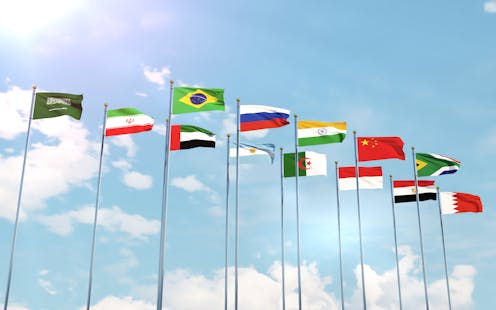
    Ilustrasi-ilustrasi bendera negara anggota BRICS dan mitra. justit/Shutterstock

    Indonesia’s decision to pursue membership in BRICS – an emerging economy bloc comprising Brazil, Russia, India, China, and South Africa – signals that President Prabowo Subianto is steering foreign policy in a direction contrasting with his predecessors.

    During Joko “Jokowi” Widodo’s two-term administration, then-former Foreign Minister Retno Marsudi led efforts to integrate Indonesia’s economy with Western institutions by working to secure membership with the OECD.

    Since BRICS is an alternative to Western-dominated organisations, many observers scrutinised and questioned Indonesia’s nonalignment commitment. However, Foreign Minister Sugiono argued that BRICS aligns with Indonesia’s ‘free and active’ foreign policy, allowing Indonesia to collaborate widely without aligning too closely with any single bloc.

    For Sugiono, joining BRICS means paving the way to advance the new government’s goals of food security, energy independence, poverty alleviation, and human capital development. The bloc offers access to funding, technology, and trade opportunities to tackle key challenges in those sectors. BRICS, with its emphasis on fairness and cooperation, supports Indonesia’s vision for a more inclusive and sustainable future.

    The shift from Retno’s OECD focus to Sugiono’s BRICS approach reflects at least two visions. First, Indonesia seeks to reassess its strategic position as the leading economy in Southeast Asia. Second, the country seeks to switch from its nonalignment stance to multi-alignment. The later will help navigate partnerships with both developed and emerging economies, balancing traditional alliances with new opportunities.

    Joining BRICS can amplify Indonesia’s influence in its already strong ties with each of the member countries and unlock opportunities beyond one-on-one partnerships.

    Fear of missing out

    Indonesia’s pivot to BRICS reflects both its relationship with major powers, such as China and the US, and regional pressures.

    Neighbouring countries Malaysia and Thailand have recently expressed interest in BRICS, creating a sense of competition within Southeast Asia. Both countries joining the bloc could erode Indonesia’s leadership and influence in the region, especially in affecting global affairs.

    Through ASEAN, Indonesia has sought to act as a regional stabiliser and mediator amid rising polarisation between the West and China.

    As its de facto leader, Indonesia has historically championed initiatives like the South China Sea Code of Conduct and Myanmar’s peace process. Its G20 presidency further underscored its role as a mediator between global powers.

    This ‘fear of missing out’ has spurred Indonesia’s interest in BRICS.

    Joining BRICS ahead of its regional peers ensures that Indonesia maintains its leadership position in ASEAN. For Prabowo’s administration, BRICS offers a platform to advance Indonesia’s interests in maritime security, economic growth, and global governance. It is a strategic move beyond an economic decision to amplify its voice on global issues and prevent fellow Southeast Asian countries from overtaking it in shaping the bloc’s agenda.

    Bold (but not one) direction

    Indonesia’s BRICS membership announcement highlights the new administration’s foreign policy ambitions, centred on two key shifts: adopting a multi-alignment strategy and strengthening its ‘good neighbour’ policy.

    Prabowo envisions engaging with all nations, fostering friendly relations while opposing oppression. This approach resonates with Indonesia’s historical commitment to sovereignty and equality in international relations.

    Indonesia has traditionally adhered to a nonalignment principle. This virtue has aided the country navigating major power blocs without binding itself to any single alliance. However, the current geopolitical climate – marked by intensifying tensions between global powers, regional conflicts, and intricate challenges – demands a more flexible and strategic approach.

    By joining BRICS, Indonesia avoids taking sides and instead diversifies its partnerships to maximise benefits. This multi-aligned approach enables active participation in BRICS discussions on multilateral reform.

    Prabowo’s ‘good neighbour policy’ further underscores the importance of maintaining positive relations with all countries. It empowers developing nations and advocates for a more equitable global order and economic system. This strategy also facilitates Indonesia’s resilience by fostering partnerships in food and energy security, poverty alleviation, and human capital development.

    Such collaborations reduce reliance on Western financial systems and enhance Indonesia’s autonomy. Ultimately, these strategic directions position Indonesia as a sovereign and dynamic player capable of balancing global relationships while advancing its own priorities.

    What about the OECD?

    This move does not mean the OECD is off the table for Indonesia. Instead, Prabowo’s approach reflects a dual-track strategy that values both alliances for their respective benefits.

    The OECD remains a long-term objective to enhance Indonesia’s economic governance and regulatory standards. It serves the goal of providing the country with stable relationships within the Western economic framework. Meanwhile, BRICS offers an immediate avenue for Indonesia to deepen ties with equivalent economies and actively shape policies that impact the Global South.

    Sugiono’s statement in Kazan emphasised Indonesia’s commitment to engaging in other forums, including the G20 and OECD discussions. It highlighted the country’s flexibility in international alliances.

    This dual-track strategy reinforces Indonesia’s role as a bridge between developed and developing nations, maximising the benefits of both alliances without sacrificing its autonomy.

    What’s next for Indonesia?

    Indonesia’s decision to join BRICS marks a significant evolution in its foreign policy. By participating in BRICS, Indonesia positions itself as a critical player in global discussions on economic reform and development, asserting its voice within a multi-polar world order.

    Indonesia is charting a path that balances traditional alliances with emerging opportunities, reinforcing its role as a dynamic, independent player on the world stage.

    The Conversation

    Aswin Ariyanto Azis tidak bekerja, menjadi konsultan, memiliki saham, atau menerima dana dari perusahaan atau organisasi mana pun yang akan mengambil untung dari artikel ini, dan telah mengungkapkan bahwa ia tidak memiliki afiliasi selain yang telah disebut di atas.

    ref. Indonesia’s BRICS agenda: 2 reasons Prabowo’s foreign policy contrasts with Jokowi’s – https://theconversation.com/indonesias-brics-agenda-2-reasons-prabowos-foreign-policy-contrasts-with-jokowis-242920

    MIL OSI Analysis

  • MIL-OSI Analysis: Mr. Nobody Against Putin gives an insight into the propaganda in Russian schools

    Source: The Conversation – UK – By Colin Alexander, Senior Lecturer in Political Communications, Nottingham Trent University

    A remarkable documentary is providing insight into the propaganda found within Russian schools. Mr. Nobody Against Putin, directed by David Borenstein, premiered at the 2025 Sundance film festival in January, where it won the world cinema documentary special jury award.

    The film was recorded over two years by Pavel “Pasha” Talankin, an events coordinator and videographer at a high school in Karabash, a heavily polluted town in central southern Russia. The documentary records the intensification of Kremlin-directed ultra-nationalist and pro-war propaganda within the Russian schooling system, which has intensified since the escalation of the war against Ukraine in February 2022.

    Talankin makes clear his view that this approach to “education” represents a moral wrong, and he is very much on point with the writings of the key ethicists on the subject. American theologian Reinhold Niebuhr, for example, wrote that “education is both a tool of propaganda in the hands of dominant groups, and a means of emancipation for subject classes”.

    Niebuhr was writing about the education system in the US during the 1920s, when there was a widespread understanding that education was used in these two ways. Talankin’s concern is that Russia has moved to a position of imbalance, where the “dominant groups” have too much influence and are using their power to corrupt the minds of children through disingenuous narratives about national servitude, sacrifice and conformity, coupled with the unsubtle threat that those who are not patriots are “parasites”.


    Looking for something good? Cut through the noise with a carefully curated selection of the latest releases, live events and exhibitions, straight to your inbox every fortnight, on Fridays. Sign up here.


    In their highly respected book Propaganda & Persuasion (1986), propaganda experts Garth Jowett and Victoria O’Donnell state that “to analyse propaganda, one needs to be able to identify it”. This is a difficult task because propaganda thrives through symbols, the subliminal and in fictional works precisely because the audience is not conscious of it.

    However, the creation of an environment that uses propaganda is also dependent upon who is given the oxygen of publicity and who is marginalised. These are the conditions under which ideological indoctrination occurs and power is achieved or maintained.

    As such, a critical analyst of propaganda must assess the linguistic strategy, the information strategy, the eminence strategy (how to ensure that the target audience are watching, reading or listening to the desired content) and the staging strategy of the communicator. This can be remembered through the helpful L.I.E.S. mnemonic.

    The trailer for Mr. Nobody versus Putin.

    Talankin’s footage shows how Russian schools now promote distorted versions of European history. The well-trodden narrative that Ukraine has been taken over by neo-Nazis is referred to several times in lessons. Russian flags appear with greater frequency around the school as time goes on, and assembly time becomes an exercise in pledging allegiance to the fatherland.

    Teachers are expected to read from scripts prepared for them by the ministry of education. Pupils then respond with choreographed answers – some even glancing down at notes under their desks. The children are told about how dreadful life in France and the UK is because of their reliance on Russian fossil fuels.

    Interestingly, the Kremlin has asked that all of this be videoed and uploaded to a central database to ensure compliance with national regulations on what is taught in schools. Indeed, Talankin complains at one point that much of his time is now spent uploading the videos rather than actually teaching the students and helping them to be creative – as his job previously was.

    Shared humanity

    Talankin takes us on a tour of his city. He shows a pro-war rally that is broadly supported by the townsfolk. Or at least those in opposition dare not say anything or engage in an equivalent demonstration. He takes us to the civic library, theoretically a site of independent learning but which has been hijacked by these propaganda efforts.

    Perhaps the most important moments of the documentary though are the snippets of critique and the sense of “knowing” that Talankin is keen to show. The young girl who jokingly tells her teacher to “blink twice if you’re lying”, and to which all her class then laugh. His interactions with other teachers who confide in him that they know that the propaganda is bullshit, but, worried for their status and prosperity, go along with it.

    The propaganda is pretty poor though. It is clunky and obvious, and, while it might generate some short-term influence, it smacks of both arrogance and desperation on the part of the Kremlin. Indeed, it shows that there is no desire on the part of central government for Russian people to thrive intellectually.

    This scenario is reminiscent of the end of the Soviet era, when communist propaganda continued to prevail, but few still believed it. Nevertheless, without a clear alternative to follow, or obvious alternative leader to guide them, most people continued to abide.

    The most harrowing part of the documentary comes towards the end when Talankin provides an audio recording of the funeral of a local lad who has been killed in Ukraine. He did not dare film the funeral as this is a cultural faux pas, but the screams and wails of the mother as her son is laid to rest are piercing. The scene seems intended to bring our shared humanity to bare.

    Talankin is a nice guy with intelligence and ethical fortitude. The kids are funny, charming and talented. The mother is doing what we would all do if we had lost a child to a violent death. As such, Mr. Nobody Against Putin might better be called Mr. Everybody Against Putin, as it should be of grave concern to everyone that Russia’s education system is resorting to such techniques.

    Colin Alexander does not work for, consult, own shares in or receive funding from any company or organisation that would benefit from this article, and has disclosed no relevant affiliations beyond their academic appointment.

    ref. Mr. Nobody Against Putin gives an insight into the propaganda in Russian schools – https://theconversation.com/mr-nobody-against-putin-gives-an-insight-into-the-propaganda-in-russian-schools-260162

    MIL OSI Analysis

  • MIL-OSI Analysis: Low turnout and an unfair voting system: UK elections ranked in the bottom half of countries in Europe

    Source: The Conversation – UK – By Toby James, Professor of Politics and Public Policy, University of East Anglia

    The UK has historically been held up as leading democracy with free and fair elections. However, our new report shows election quality in the UK is now ranked in the bottom half of countries in Europe.

    The Global Electoral Integrity Report provides scores for election quality around the world. It defines electoral integrity as the extent to which elections empower citizens.

    Iceland received the highest score for an election that took place in 2024, the “year of elections” during which 1.6 billion people went to the polls, according to Time Magazine. This was an unprecedented concentration of democratic activity in a single year. Iceland has a successful system of automatic voter registration and an electoral system that is judged to be fair to smaller parties.


    Want more politics coverage from academic experts? Every week, we bring you informed analysis of developments in government and fact check the claims being made.

    Sign up for our weekly politics newsletter, delivered every Friday.


    Countries that scored highly based on their most recent election include Sweden, Denmark, Canada, Finland and Lithuania. Those at the opposite end of the scale include Syria, Belarus, Egypt, and Nicaragua. The UK is ranked 24th out of 39 countries in Europe. It is below Estonia, the Czech Republic, Italy, Austria, Luxembourg and Slovakia. It is ranked 53rd out of 170 countries overall.

    The US also saw a decline. The beacons for electoral democracy are therefore now found in mainland Europe (most notably Scandinavia), Australasia, South America and the southern parts of Africa – rather than the UK and US. The centre of global democratic authority has shifted away from Westminster.

    Electoral Integrity in most recent national election up to the end of 2024.
    Electoral Integrity Project, CC BY-ND

    The weaknesses in the UK system

    There remain many areas of strength in UK elections. UK electoral officials show professionalism and independence and there is no concern about the integrity of the vote counting process. There is no evidence of widespread electoral fraud.

    A major weakness is in the fairness of the electoral rules for small parties. The electoral system generated a very disproportional result in 2024. Labour took nearly two-thirds of the seats in parliament, a total of 412, with less than 10 million votes (only 34% of votes cast). Labour won a massive majority in terms of parliamentary arithmetic but the the government did not enter office with widespread support.

    By contrast, Reform and the Greens received 6 million votes between them, but only nine MPs. The electoral system may have worked when Britain had a two-party system – but the two-party system no longer holds. Today’s Britain is more diverse, and political support is more distributed.

    The UK also scores poorly on voter registration. It is estimated that there are around 7 million to 8 million people not correctly registered or missing from the registers entirely. This is not many less than the 9.7 million people whose votes gave the government a landslide majority. The UK does not have a system of automatic voter registration, which is present in global leaders such as Iceland, where everyone is enrolled without a hiccup.

    Another problem is participation. Turnout in July 2024 was low – with only half of adults voting. Voting has been made more difficult as the Elections Act of 2022 introduced compulsory photographic identification for the first time at the general election. This was thought to have made it more difficult for many citizens to vote because the UK does not have a national identity card which all citizens hold.

    Meanwhile, there are further swirling headwinds. The spread of disinformation by overseas actors in elections has become a prominent challenge around the world and there was evidence of disinformation in this campaign too. Violence during the electoral period was thought to have been removed from British elections in Victorian times. But more than half candidates experience abuse and intimidation during the electoral period.

    Action needed

    One year into its time in office, the government is yet to act on this issue. The word “democracy” was missing from the prime minister’s strategic defence review, despite the emphasis on protecting the UK from Russia, a country known for electoral interference and other forms of attack on democracies.

    This was a sharp contrast to the former government’s 2021 review, which emphasised that a “world in which democratic societies flourish and fundamental human rights are protected is one that is more conducive to our sovereignty, security and prosperity as a nation”.

    In its election manifesto, Labour promised to “address the inconsistencies in voter ID rules”, “improve voter registration” and give 16 and 17-year-olds the right to vote in all elections. There needs to be firm action on electoral system change, automatic voter registration, campaign finance reform, voter identification changes and other areas.

    The Reform party is ahead in the polls and has consistently promised proportional representation. If Labour doesn’t make the reforms, another party might do so instead – and reap the benefits.

    There are a complex set of challenges facing democracy and elections. New technological challenges, change in attitudes, international hostility and new emergencies are combining to batter the door of democracy down.

    International organisations are increasingly stressing that political leaders need to work together and take proactive action to protect elections against autocratic forces. This means not only supporting democracy in their messages on the world stage – but also introducing reforms to create beacons of democracy in their own countries.

    Toby James has previously received funding from the AHRC, ESRC, Joseph Rowntree Reform Trust, British Academy, Leverhulme Trust, Electoral Commission, Nuffield Foundation, the McDougall Trust and Unlock Democracy. His current research is funded by the Canadian SSHRC.

    Holly Ann Garnett receives funding from the Social Sciences and Humanities Research Council of Canada and the Canadian Defence Academy Research Programme. She has previously received funding from: the British Academy, the Canadian Institute for Advanced Research, the NATO Public Diplomacy Division, the American Political Science Association Centennial Centre, and the Conference of Defence Associations.

    ref. Low turnout and an unfair voting system: UK elections ranked in the bottom half of countries in Europe – https://theconversation.com/low-turnout-and-an-unfair-voting-system-uk-elections-ranked-in-the-bottom-half-of-countries-in-europe-260396

    MIL OSI Analysis

  • MIL-OSI Analysis: The US and Israel’s attack may have left Iran stronger

    Source: The Conversation – UK – By Bamo Nouri, Honorary Research Fellow, City St George’s, University of London

    Israel’s attack on Iran last month and the US bombing of the country’s nuclear facilities, the first-ever direct US attacks on Iranian soil, were meant to cripple Tehran’s strategic capabilities and reset the regional balance.

    The strikes came after 18 months during which Israel had effectively dismantled Hamas in Gaza, dealt a devastating blow to Hezbollah in Lebanon, weakened the Houthis in Yemen, and seen the collapse of the Assad regime in Syria – a longstanding and key Iranian ally.

    From a military standpoint, these were remarkable achievements. But they failed to deliver the strategic outcome Israeli and US leaders had long hoped for: the collapse of Iran’s influence and the weakening of its regime.

    Instead, the confrontation exposed a deeper miscalculation. Iran’s power isn’t built on impulse or vulnerable proxies alone. It is decentralised, ideologically entrenched and designed to endure. While battered, the Islamic Republic did not fall. And now, it may be more determined – and more dangerous – than before.


    Get your news from actual experts, straight to your inbox. Sign up to our daily newsletter to receive all The Conversation UK’s latest coverage of news and research, from politics and business to the arts and sciences.


    Israel’s attack – dubbed “operation rising lion” – began with attacks on Iranian radar systems, followed by precision airstrikes on Iranian enrichment facilities and senior military officers and scientists. Israel spent roughly US$1.45 (£1.06 billion) billion in the first two days and in the first week of strikes on Iran, costs hit US$5 billion, with daily spending at US$725 million: US$593 million on offensive operations and US$132 million on defence and mobilization.

    Iran’s response was swift. More than 1,000 drones and 550 ballistic missiles, including precision-guided and hypersonic variants. Israeli defences were breached. Civilian infrastructure was hit, ports closed, and the economy stalled

    The day after the US strikes, the Israeli prime minister, Benjamin Netanyahu, spoke with Donald Trump about a ceasefire. He and his generals were reportedly keen to bring the conflict to a speedy end. Reports suggest that Netanyahu wanted to avoid a lengthy war of attrition that Israel could not sustain, and was already looking for an exit strategy.

    Crucially, the Iranian regime remained intact. Rather than inciting revolt, the war rallied nationalist sentiment. Opposition movements remain fractured and lack a common platform or domestic legitimacy. Hopes of a popular uprising that might topple the regime expressed by both Trump and Netanyahu were misplaced.

    In the aftermath, Iranian authorities launched a sweeping crackdown on suspected dissenters and what it referred to as “spies”. Former activists, reformists and loosely affiliated protest organisers were arrested or interrogated. What was meant to fracture the regime instead reinforced its grip on power.

    Most notably, Iran’s parliament voted to suspend cooperation with the International Atomic Energy Agency (IAEA), ending inspections and giving Tehran the freedom to expand its nuclear programme – both civilian and potentially military – without oversight.

    Perhaps the clearest misreading came from Israel and the US treating Syria as a template. The 2024 fall of Bashar al-Assad was hailed as a turning point. His successor, Ahmed al-Sharaa – a little-known opposition figure, former al-Qaeda insurgent and IS affiliate – was rebranded as a pragmatic reformer, who Trump praised as “attractive” and “tough”.

    For western and Israeli strategists, Syria offered both a way to weaken Iran and a blueprint of how eventual regime change could play out: collapse the regime, install cooperative leadership in a swift reordering process. But this analogy was dangerously flawed. Iran’s stronger institutions, military depth, resistance-driven identity and existence made it a fundamentally different and more resilient state.

    Tactical wins, strategic ambiguity

    While Iran’s regional network has taken significant hits over the past year –Hamas dismantled, Hezbollah degraded, the Houthis depleted, and the Assad regime toppled – Tehran recalibrated. It deepened military cooperation with Russia and China, secured covert arms shipments, and accelerated its nuclear ambitions.

    Both Israel and Iran, however, came away with new intelligence. Israel learned that its missile defences and economic resilience were not built for prolonged, multi-front warfare. Iran, meanwhile, gained valuable insight into how far its arsenal – drones, missiles and regional proxies – could reach, and where its limits lie.

    Most of Iran’s drones and missiles were intercepted — up to 99% in the cases of drones — exposing critical weaknesses in accuracy, penetration, and survivability against modern air defenses. Yet the few that did break through caused significant damage in Tel Aviv, striking residential areas and critical infrastructure.

    This war was not only a clash of weapons but a real-time stress test of each side’s strategic depth. Iran may now adjust its doctrine accordingly – prioritising survivability, mobility and precision in anticipation of future conflicts.

    Israel’s vulnerabilities

    Internally, Israel entered the war politically fractured and socially strained. Netanyahu’s far-right coalition was already under fire for attempting to weaken judicial independence. The war has temporarily united the country, but the economic and human toll have reignited deeper concerns.

    Israel’s geographic and demographic constraints have become clear. Its high-tech economy, tightly integrated with global markets, could not weather prolonged instability. And critically, the damage inflicted by the US bombing was more limited than hoped for. While Washington joined in the initial strikes, it resisted deeper involvement, partly to avoid broader regional escalation and largely because of the lack of domestic appetite for war and high potential for energy inflation, if Iran was to close the Strait of Hormuz.

    What happens now?

    The war of 2025 did not produce peace. It produced recalibration. Israel emerges militarily capable but politically shaken and economically strained. Iran, though damaged, stands more unified, with fewer international constraints on its nuclear ambitions. Its crackdown on dissent, withdrawal from IAEA oversight, and deepening ties to rival powers suggest a regime preparing not for collapse, but for survival, perhaps even confrontation.

    The broader lesson is sobering. Regime change cannot be engineered through precision strikes. Tactical brilliance does not guarantee strategic victory. And the assumption that Iran could unravel like Syria was not strategy, it was hubris.

    Both sides now better understand each other’s strengths and limits, a clarity that could deter future war – or make the next one more dangerous. In a region shaped by trauma and shifting power, mistaking resistance for weakness or pause for peace remains the gravest miscalculation.

    Bamo Nouri does not work for, consult, own shares in or receive funding from any company or organisation that would benefit from this article, and has disclosed no relevant affiliations beyond their academic appointment.

    ref. The US and Israel’s attack may have left Iran stronger – https://theconversation.com/the-us-and-israels-attack-may-have-left-iran-stronger-260314

    MIL OSI Analysis

  • MIL-OSI Submissions: Mr. Nobody Against Putin gives an insight into the propaganda in Russian schools

    Source: The Conversation – UK – By Colin Alexander, Senior Lecturer in Political Communications, Nottingham Trent University

    A remarkable documentary is providing insight into the propaganda found within Russian schools. Mr. Nobody Against Putin, directed by David Borenstein, premiered at the 2025 Sundance film festival in January, where it won the world cinema documentary special jury award.

    The film was recorded over two years by Pavel “Pasha” Talankin, an events coordinator and videographer at a high school in Karabash, a heavily polluted town in central southern Russia. The documentary records the intensification of Kremlin-directed ultra-nationalist and pro-war propaganda within the Russian schooling system, which has intensified since the escalation of the war against Ukraine in February 2022.

    Talankin makes clear his view that this approach to “education” represents a moral wrong, and he is very much on point with the writings of the key ethicists on the subject. American theologian Reinhold Niebuhr, for example, wrote that “education is both a tool of propaganda in the hands of dominant groups, and a means of emancipation for subject classes”.

    Niebuhr was writing about the education system in the US during the 1920s, when there was a widespread understanding that education was used in these two ways. Talankin’s concern is that Russia has moved to a position of imbalance, where the “dominant groups” have too much influence and are using their power to corrupt the minds of children through disingenuous narratives about national servitude, sacrifice and conformity, coupled with the unsubtle threat that those who are not patriots are “parasites”.


    Looking for something good? Cut through the noise with a carefully curated selection of the latest releases, live events and exhibitions, straight to your inbox every fortnight, on Fridays. Sign up here.


    In their highly respected book Propaganda & Persuasion (1986), propaganda experts Garth Jowett and Victoria O’Donnell state that “to analyse propaganda, one needs to be able to identify it”. This is a difficult task because propaganda thrives through symbols, the subliminal and in fictional works precisely because the audience is not conscious of it.

    However, the creation of an environment that uses propaganda is also dependent upon who is given the oxygen of publicity and who is marginalised. These are the conditions under which ideological indoctrination occurs and power is achieved or maintained.

    As such, a critical analyst of propaganda must assess the linguistic strategy, the information strategy, the eminence strategy (how to ensure that the target audience are watching, reading or listening to the desired content) and the staging strategy of the communicator. This can be remembered through the helpful L.I.E.S. mnemonic.

    The trailer for Mr. Nobody versus Putin.

    Talankin’s footage shows how Russian schools now promote distorted versions of European history. The well-trodden narrative that Ukraine has been taken over by neo-Nazis is referred to several times in lessons. Russian flags appear with greater frequency around the school as time goes on, and assembly time becomes an exercise in pledging allegiance to the fatherland.

    Teachers are expected to read from scripts prepared for them by the ministry of education. Pupils then respond with choreographed answers – some even glancing down at notes under their desks. The children are told about how dreadful life in France and the UK is because of their reliance on Russian fossil fuels.

    Interestingly, the Kremlin has asked that all of this be videoed and uploaded to a central database to ensure compliance with national regulations on what is taught in schools. Indeed, Talankin complains at one point that much of his time is now spent uploading the videos rather than actually teaching the students and helping them to be creative – as his job previously was.

    Shared humanity

    Talankin takes us on a tour of his city. He shows a pro-war rally that is broadly supported by the townsfolk. Or at least those in opposition dare not say anything or engage in an equivalent demonstration. He takes us to the civic library, theoretically a site of independent learning but which has been hijacked by these propaganda efforts.

    Perhaps the most important moments of the documentary though are the snippets of critique and the sense of “knowing” that Talankin is keen to show. The young girl who jokingly tells her teacher to “blink twice if you’re lying”, and to which all her class then laugh. His interactions with other teachers who confide in him that they know that the propaganda is bullshit, but, worried for their status and prosperity, go along with it.

    The propaganda is pretty poor though. It is clunky and obvious, and, while it might generate some short-term influence, it smacks of both arrogance and desperation on the part of the Kremlin. Indeed, it shows that there is no desire on the part of central government for Russian people to thrive intellectually.

    This scenario is reminiscent of the end of the Soviet era, when communist propaganda continued to prevail, but few still believed it. Nevertheless, without a clear alternative to follow, or obvious alternative leader to guide them, most people continued to abide.

    The most harrowing part of the documentary comes towards the end when Talankin provides an audio recording of the funeral of a local lad who has been killed in Ukraine. He did not dare film the funeral as this is a cultural faux pas, but the screams and wails of the mother as her son is laid to rest are piercing. The scene seems intended to bring our shared humanity to bare.

    Talankin is a nice guy with intelligence and ethical fortitude. The kids are funny, charming and talented. The mother is doing what we would all do if we had lost a child to a violent death. As such, Mr. Nobody Against Putin might better be called Mr. Everybody Against Putin, as it should be of grave concern to everyone that Russia’s education system is resorting to such techniques.

    Colin Alexander does not work for, consult, own shares in or receive funding from any company or organisation that would benefit from this article, and has disclosed no relevant affiliations beyond their academic appointment.

    ref. Mr. Nobody Against Putin gives an insight into the propaganda in Russian schools – https://theconversation.com/mr-nobody-against-putin-gives-an-insight-into-the-propaganda-in-russian-schools-260162

    MIL OSI

  • MIL-OSI Submissions: Low turnout and an unfair voting system: UK elections ranked in the bottom half of countries in Europe

    Source: The Conversation – UK – By Toby James, Professor of Politics and Public Policy, University of East Anglia

    The UK has historically been held up as leading democracy with free and fair elections. However, our new report shows election quality in the UK is now ranked in the bottom half of countries in Europe.

    The Global Electoral Integrity Report provides scores for election quality around the world. It defines electoral integrity as the extent to which elections empower citizens.

    Iceland received the highest score for an election that took place in 2024, the “year of elections” during which 1.6 billion people went to the polls, according to Time Magazine. This was an unprecedented concentration of democratic activity in a single year. Iceland has a successful system of automatic voter registration and an electoral system that is judged to be fair to smaller parties.


    Want more politics coverage from academic experts? Every week, we bring you informed analysis of developments in government and fact check the claims being made.

    Sign up for our weekly politics newsletter, delivered every Friday.


    Countries that scored highly based on their most recent election include Sweden, Denmark, Canada, Finland and Lithuania. Those at the opposite end of the scale include Syria, Belarus, Egypt, and Nicaragua. The UK is ranked 24th out of 39 countries in Europe. It is below Estonia, the Czech Republic, Italy, Austria, Luxembourg and Slovakia. It is ranked 53rd out of 170 countries overall.

    The US also saw a decline. The beacons for electoral democracy are therefore now found in mainland Europe (most notably Scandinavia), Australasia, South America and the southern parts of Africa – rather than the UK and US. The centre of global democratic authority has shifted away from Westminster.

    Electoral Integrity in most recent national election up to the end of 2024.
    Electoral Integrity Project, CC BY-ND

    The weaknesses in the UK system

    There remain many areas of strength in UK elections. UK electoral officials show professionalism and independence and there is no concern about the integrity of the vote counting process. There is no evidence of widespread electoral fraud.

    A major weakness is in the fairness of the electoral rules for small parties. The electoral system generated a very disproportional result in 2024. Labour took nearly two-thirds of the seats in parliament, a total of 412, with less than 10 million votes (only 34% of votes cast). Labour won a massive majority in terms of parliamentary arithmetic but the the government did not enter office with widespread support.

    By contrast, Reform and the Greens received 6 million votes between them, but only nine MPs. The electoral system may have worked when Britain had a two-party system – but the two-party system no longer holds. Today’s Britain is more diverse, and political support is more distributed.

    The UK also scores poorly on voter registration. It is estimated that there are around 7 million to 8 million people not correctly registered or missing from the registers entirely. This is not many less than the 9.7 million people whose votes gave the government a landslide majority. The UK does not have a system of automatic voter registration, which is present in global leaders such as Iceland, where everyone is enrolled without a hiccup.

    Another problem is participation. Turnout in July 2024 was low – with only half of adults voting. Voting has been made more difficult as the Elections Act of 2022 introduced compulsory photographic identification for the first time at the general election. This was thought to have made it more difficult for many citizens to vote because the UK does not have a national identity card which all citizens hold.

    Meanwhile, there are further swirling headwinds. The spread of disinformation by overseas actors in elections has become a prominent challenge around the world and there was evidence of disinformation in this campaign too. Violence during the electoral period was thought to have been removed from British elections in Victorian times. But more than half candidates experience abuse and intimidation during the electoral period.

    Action needed

    One year into its time in office, the government is yet to act on this issue. The word “democracy” was missing from the prime minister’s strategic defence review, despite the emphasis on protecting the UK from Russia, a country known for electoral interference and other forms of attack on democracies.

    This was a sharp contrast to the former government’s 2021 review, which emphasised that a “world in which democratic societies flourish and fundamental human rights are protected is one that is more conducive to our sovereignty, security and prosperity as a nation”.

    In its election manifesto, Labour promised to “address the inconsistencies in voter ID rules”, “improve voter registration” and give 16 and 17-year-olds the right to vote in all elections. There needs to be firm action on electoral system change, automatic voter registration, campaign finance reform, voter identification changes and other areas.

    The Reform party is ahead in the polls and has consistently promised proportional representation. If Labour doesn’t make the reforms, another party might do so instead – and reap the benefits.

    There are a complex set of challenges facing democracy and elections. New technological challenges, change in attitudes, international hostility and new emergencies are combining to batter the door of democracy down.

    International organisations are increasingly stressing that political leaders need to work together and take proactive action to protect elections against autocratic forces. This means not only supporting democracy in their messages on the world stage – but also introducing reforms to create beacons of democracy in their own countries.

    Toby James has previously received funding from the AHRC, ESRC, Joseph Rowntree Reform Trust, British Academy, Leverhulme Trust, Electoral Commission, Nuffield Foundation, the McDougall Trust and Unlock Democracy. His current research is funded by the Canadian SSHRC.

    Holly Ann Garnett receives funding from the Social Sciences and Humanities Research Council of Canada and the Canadian Defence Academy Research Programme. She has previously received funding from: the British Academy, the Canadian Institute for Advanced Research, the NATO Public Diplomacy Division, the American Political Science Association Centennial Centre, and the Conference of Defence Associations.

    ref. Low turnout and an unfair voting system: UK elections ranked in the bottom half of countries in Europe – https://theconversation.com/low-turnout-and-an-unfair-voting-system-uk-elections-ranked-in-the-bottom-half-of-countries-in-europe-260396

    MIL OSI

  • MIL-OSI Analysis: War, politics and religion shape wildlife evolution in cities

    Source: The Conversation – USA – By Elizabeth Carlen, Living Earth Collaborative Postdoctoral Fellow, Washington University in St. Louis

    A Buddhist monk in Hong Kong releases fish and chants prayers during a ceremony to free the spirits of tsunami victims. Samantha Sin/AFP via Getty Images

    People often consider evolution to be a process that occurs in nature in the background of human society. But evolution is not separate from human beings. In fact, human cultural practices can influence evolution in wildlife. This influence is highly pronounced in cities, where people drastically alter landscapes to meet their own needs.

    Human actions can affect wildlife evolution in a number of ways. If people fragment habitat, separated wildlife populations can evolve to be more and more different from each other. If people change certain local conditions, it can pressure organisms in new ways that mean different genes are favored by natural selection and passed on to offspring – another form of evolution that can be driven by what people do.

    In a recent review, evolutionary biologists Marta Szulkin, Colin Garroway and I, in collaboration with scientists spread across five continents, explored how cultural processes – including religion, politics and war – shape urban evolution. We reviewed dozens of empirical studies about urban wildlife around the globe. Our work highlights which human cultural practices have and continue to shape the evolutionary trajectory of wild animals and plants.

    Religious practices

    If you’ve traveled internationally, you may have noticed the menu at any one McDonald’s restaurant is shaped by the local culture of its location. In the United Arab Emirates, McDonald’s serves an entirely halal menu. Vegetarian items are common and no beef is served in Indian McDonald’s. And in the United States, McDonald’s Filet-O-Fish is especially popular during Lent when observant Catholics don’t consume meat on Fridays.

    Similarly, ecosystems of cities are shaped by local cultural practices. Because all wildlife are connected to the environment, cultural practices that alter the landscape shape the evolution of urban organisms.

    Populations of fire salamanders have different genes depending on which side of city walls in Oviedo, Spain, they live on.
    Patrice Skrzynski via Getty Images

    For example, in Oviedo, Spain, people constructed walls around religious buildings between the 12th and 16th centuries. This division of the city led to different populations of fire salamanders inside and outside the walls. Because salamanders can’t scale these walls, those on opposite sides became isolated from each other and unable to pass genes back and forth. In a process that scientists call genetic drift, over time salamanders on the two sides became genetically distinct − evidence of the two populations evolving independently.

    Imagine dumping out a handful of M&Ms. Just by chance, some colors might be overrepresented and others might be missing. In the same way, genes that are overrepresented on one side of the wall can be in low numbers or missing on the other side. That’s genetic drift.

    Introducing non-native wildlife is another way people can alter urban ecosystems and evolutionary processes. For example, prayer animal release is a practice that started in the fifth or sixth century in some sects of Buddhism. Practitioners who strive to cause no harm to any living creature release captive animals, which benefits the animal and is meant to improve the karma of the person who released it.

    However, these animals are often captured from the wild or come from the pet trade, thereby introducing non-native wildlife into the urban ecosystem. Non-natives may compete with local species and contribute to the local extinction of native wildlife. Capturing animals nearby has downsides, too. It can diminish local populations, since many die traveling to the release ceremony. The genetic diversity of these local populations in turn decreases, reducing the population’s ability to survive.

    More than a thousand sparrows killed by peasants in 1958 are displayed on a cart near Beijing, China.
    Sovphoto/Universal Images Group via Getty Images

    Influence of politics

    Politically motivated campaigns have shaped wildlife in various ways.

    Starting in 1958, for instance, the Chinese Communist Party led a movement to eliminate four species that were considered pests: rats, flies, mosquitoes and sparrows. While the first three are commonly considered pests around the world, sparrows made the list because they were “public animals of capitalism” due to their fondness for grain. The extermination campaign ended up decimating the sparrow population and damaging the entire ecosystem. With sparrows no longer hunting and eating insects, crop pests such as locusts thrived, leading to crop destruction and famine.

    In the United States, racial politics may be shaping evolutionary processes in wildlife.
    For instance, American highways traverse cities according to political agendas and have often dismantled poor neighborhoods of color to make way for multilane thoroughfares. These highways can change how animals are able to disperse and commingle. For example, they prevent bobcats and coyotes from traveling throughout Los Angeles, leading to similar patterns of population differentiation as seen in fire salamanders in Spain.

    Wildlife during and after war

    Human religious and political agendas often lead to armed conflict. Wars are known to dramatically alter the environment, as seen in current conflicts in Gaza and Ukraine.

    The Russia-Ukraine war affected migration of greater spotted eagles.
    Nimit Virdi via Getty Images

    While documenting evolutionary changes to urban wildlife is secondary to keeping people safe during wartime, a handful of studies on wildlife have come out of active war zones. For example, the current Russia-Ukraine war affected the migration of greater spotted eagles. They made large diversions around the active war zone, arriving later than usual at their breeding grounds. The longer route increased the energy the eagles used during migration and likely influenced their fitness during breeding.

    Wars limit access to resources for people living in active war zones. The lack of energy to heat homes in Ukraine during the winter has led urban residents to harvest wood from nearby forests. This harvesting will have long-term consequences on forest dynamics, likely altering future evolutionary potential.

    A similar example is famine that occurred during the Democratic Republic of Congo’s civil wars (1996-1997, 1998-2003) and led to an increase in bushmeat consumption. This wildlife hunting is known to reduce primate population sizes, making them more susceptible to local extinction.

    Even after war, landscapes experience consequences.

    For example, the demilitarized zone between North Korea and South Korea is a 160-mile (250-kilometer) barrier, established in 1953, separating the two countries. Heavily fortified with razor wire and landmines, the demilitarized zone has become a de facto nature sanctuary supporting thousands of species, including dozens of endangered species.

    The collapse of the Soviet Union and the end of the Cold War led to the establishment of the European Green Belt, which runs along the same path as the Iron Curtain. This protected ecological network is over 7,800 miles (12,500 kilometers) long, allowing wildlife to move freely across 24 countries in Europe. Like the Korean DMZ, the European Green Belt allows for wildlife to move, breed and exchange genes, despite political boundaries. Politics has removed human influence from these spaces, allowing them to be a safe haven for wildlife.

    While researchers have documented a number of examples of wildlife evolving in response to human history and cultural practices, there’s plenty more to uncover. Cultures differ around the world, meaning each city has its own set of variables that shape the evolutionary processes of wildlife. Understanding how these human cultural practices shape evolutionary patterns will allow people to better design cities that support both humans and the wildlife that call these places home.

    Ideas for this article were developed as part of a NSF funded Research Coordination Network (DEB 1840663). Elizabeth Carlen was funded by the Living Earth Collaborative.

    ref. War, politics and religion shape wildlife evolution in cities – https://theconversation.com/war-politics-and-religion-shape-wildlife-evolution-in-cities-260184

    MIL OSI Analysis

  • MIL-OSI Analysis: Hong Kong’s light fades as another pro-democracy party folds

    Source: The Conversation – Global Perspectives – By Brendan Clift, Lecturer in Law & Justice, UNSW Sydney

    Thomas Yau/Shutterstock

    The demise of one of Hong Kong’s last major pro-democracy parties, the League of Social Democrats, is the latest blow to the city’s crumbling democratic credentials.

    The league is the third major opposition party to disband this year. The announcement coincides with the fifth anniversary this week of the national security law, which was imposed by Beijing to suppress pro-democracy activity.

    The loss of this grassroots party, historically populated by bold and colourful characters, vividly illustrates the dying of the light in once-sparkling Hong Kong.

    The city is now greyed and labouring under a repressive internal security regime that has crushed civil society’s freedoms and democratic ambitions.

    Authoritarian crackdown

    The world witnessed Hong Kong at its brightest during the 2014 Umbrella Movement, when hundreds of thousands of pro-democracy protesters camped out on city streets for several months.

    We also saw the brutal sequel in 2019, when paramilitarised police sought to put down further civil unrest and protesters fought back.

    Since then, “lawfare” has been the preferred strategy of China’s national government and its Hong Kong satellite. The new approach has included a vast security apparatus and aggressive prosecutions.

    When Beijing intervened in July 2020, it was nominally about national security. In reality, the new law was designed and used to bring Hongkongers to heel.

    Civil freedoms were further curtailed by a home-grown security law, introduced last year to fill the gaps.

    International standards such as the Johannesburg Principles, endorsed by the United Nations, require national security laws to be compatible with democratic principles, not to be used to eliminate democratic activity.

    Prison or exile

    The League of Social Democrats occupied the populist left of the pro-democracy spectrum. It stood apart from contemporaries such as the Democratic Party and the Civic Party, which were dominated by professionals and elites, and have since been disbanded.

    The League was most notably represented by the likes of “Long Hair” Leung Kwok-hung– known for his Che Guevara t-shirts and banana-throwing – and broadcaster and journalism academic Raymond Wong Yuk-man, also known as “Mad Dog”.

    Despite their rambunctious styles, these men had real political credentials and were repeatedly elected to legislative office. But Leung is now imprisoned for subversion, while Wong has left for Taiwan.

    Leung Kwok-hung was sentenced to subversion under the national security law.
    Edwin Kwok/Shutterstock

    Party leaders such as Jimmy Sham Tsz-kit and Figo Chan Ho-wun were also prominent within the Civil Human Rights Front. It was responsible for the annual July 1 protest march that attracted hundreds of thousands of people every year. The front is yet another pro-democracy organisation that has dissolved.

    Sham and Chan have been jailed for subversion and unlawful assembly under the colonial-era Public Order Ordinance, which has been used to prosecute hundreds of activists.

    Zero tolerance

    The demise of these diverse organisations are not natural occurrences, but the result of a deliberate authoritarian programme.

    Under China, Hong Kong’s political system has been half democratic at best. But it now resembles something from the darkest days of colonialism, with pre-approved candidates, appointed legislators and zero tolerance for critical voices.

    The effort to eliminate opposition has seen the pro-independence National Party formally banned and scores of pro-democracy figures jailed after mass trials.

    Activists and watchdogs are stymied by the national security law. It criminalises – among other things – engagement and lobbying with international organisations and foreign governments.

    Distinctive voices such as law professor Benny Tai Yiu-ting, media mogul Jimmy Lai Chee-ying and firebrand politician Edward Leung Tin-kei have been jailed and silenced, as have many moderates and lesser-known figures.

    Shattered dreams

    Then there are the millions of ordinary Hongkongers whose dreams of a liberal and self-governing region under mainland China’s umbrella – as promised in the lead up to the 1997 handover – have been shattered.

    Some activists have fled overseas. The more outspoken are the subjects of Hong Kong arrest warrants.

    But countless ex-protesters remain in the city, where it is impermissible to speak critically of power, and where mandatory patriotic education may ensure new generations will never even think to speak up.

    Much blame lies with the British, who failed to institute democratic elections until the last gasp of their rule in Hong Kong. This was despite the colony tolerating liberalism and habit-forming democratic activity over a longer period.

    Now China, after almost three decades in charge, has responded to democratic challenges by defaulting to authoritarian control. Hong Kong can only be grateful it has been spared a Tiananmen-style incident. Nor has it experienced the full genocidal extent of the so-called “peripheries playbook” Beijing has used in Tibet and Xinjiang.

    Turmoil and authoritarian swings in the United States and elsewhere give China an opportunity to present as a voice of reason on the international stage.

    But we should not forget its commitment to repressive politics at home, nor what its support of belligerent regimes such as Putin’s Russia might mean for Taiwan, the region and the world.

    Above all, we should not forget the people, in Hong Kong and elsewhere, who made it their life’s work to achieve democracy only to be rewarded with prison or exile.

    Brendan Clift does not work for, consult, own shares in or receive funding from any company or organisation that would benefit from this article, and has disclosed no relevant affiliations beyond their academic appointment.

    ref. Hong Kong’s light fades as another pro-democracy party folds – https://theconversation.com/hong-kongs-light-fades-as-another-pro-democracy-party-folds-260186

    MIL OSI Analysis

  • MIL-OSI Analysis: Russia is paying schoolgirls to have babies. Why is pronatalism on the rise around the world?

    Source: The Conversation – Global Perspectives – By Jennifer Mathers, Senior Lecturer in International Politics, Aberystwyth University

    In some parts of Russia, schoolgirls who become pregnant are being paid more than 100,000 roubles (nearly £900) for giving birth and raising their babies.

    This new measure, introduced in the past few months across ten regions, is part of Russia’s new demographic strategy, widening the policy adopted in March 2025 which only applied to adult women. It is designed to address the dramatic decline in the country’s birthrate.

    In 2023 the number of births in Russia per woman was 1.41 – substantially below 2.05, which is the level required to maintain a population at its current size.

    Paying teenage girls to have babies while they are still in school is controversial in Russia. According to a recent survey by the Russian Public Opinion Research Centre, 43% of Russians approve of the policy, while 40% are opposed to it. But it indicates the high priority that the state places on increasing the number of children being born.

    Russia’s president, Vladimir Putin, regards a large population as one of the markers of a flourishing great power, along with control over a vast (and growing) territory and a powerful military. Paradoxically, though, his efforts to increase the physical size of Russia by attacking Ukraine and illegally annexing its territory have also been disastrous in terms of shrinking Russia’s population.

    The number of Russian soldiers killed in the war has reached 250,000 by some estimates, while the war sparked an exodus of hundreds of thousands of some of the most highly educated Russians. Many of them are young men fleeing military service who could have been fathers to the next generation of Russian citizens.

    But while Russia’s demographic situation is extreme, declining birth rates are now a global trend. It is estimated that by 2050 more than three quarters of the world’s countries will have such low fertility rates that they will not be able to sustain their populations.

    It’s not only Russia

    Putin is not the only world leader to introduce policies designed to encourage women to have more babies. Viktor Orban’s government in Hungary is offering a range of incentives, such as generous tax breaks and subsidised mortgages, to those who have three or more children.

    Poland makes a monthly payment of 500 złoty (£101) per child to families with two or more children. But there’s some evidence this has not prompted higher-income Polish women to have more children, as they might have to sacrifice higher earnings and career advancement to have another child.

    In the United States, Donald Trump is proposing to pay women US$5,000 (£3,682) to have a baby, tied to a wider Maga movement push, supported by Elon Musk and others, to encourage women to have larger families.

    Reversing demographic trends is complex, because the reasons that individuals and couples have for becoming parents are also complex. Personal preferences and aspirations, beliefs about their ability to provide for children, as well as societal norms and cultural and religious values all play a part in these decisions.

    As a result, the impact of “pronatalist” policies has been mixed. No country has found an easy way to reverse declining birth rates.

    One country seeking to address population decline with policies, other than encouraging women to have more babies is Spain, which now allows an easier pathway to citizenship for migrants, including those who entered the country illegally. Madrid’s embrace of immigrants is being credited for its current economic boom.

    The US is seeing a pronatalist movement become more vocal.

    Looking for particular types of families

    But governments that adopt pronatalist policies tend to be concerned, not simply with increasing the total number of people living and working in their countries, but with encouraging certain kinds of people to reproduce. In other words, there is often an ideological dimension to these practices.

    Incentives for pregnancy, childbirth and large families are typically targeted at those whom the state regards as its most desirable citizens. These people may be desirable citizens due to their race, ethnicity, language, religion, sexual orientation or some other identity or combination of identities.


    Read more:
    Putin forced to send wounded back to fight and offer huge military salaries as Russia suffers a million casualties


    For instance, the Spanish bid to increase the population by increasing immigration offers mostly Spanish speakers from Catholic countries in Latin America jobs while opportunities to remain in, or move to, the country does appear to be extended to migrants from Africa. Meanwhile, Hungary’s incentives to families are only available to heterosexual couples who earn high incomes.

    Elon Musk believes people need to have more children.

    The emphasis on increasing the proportion of the most desirable citizens is why the Trump administration sees no contradiction in calling for more babies to be born in the US, while ordering the arrest and deportation of hundreds of alleged illegal migrants, attempting to reverse the constitutional guarantee of US citizenship for anyone born in the country and even attempting to withdraw citizenship from some Americans.

    Which mothers do they want?

    The success or failure of governments and societies that promote pronatalism hinges on their ability to persuade people – and especially women – to embrace parenthood. Along with financial incentives and other tangible rewards for having babies, some states offer praise and recognition for the mothers of large families.

    Putin’s reintroduction of the Stalin-era motherhood medal for women with ten or more children is one example. Sometimes the recognition comes from society, such as the current American fascination with “trad wives” – women who become social media influencers by turning their backs on careers in favour of raising large numbers of children and living socially conservative lifestyles.

    The mirror image of this celebration of motherhood is the implicit or explicit criticism of women who delay childbirth or reject it altogether. Russia’s parliament passed a law in 2024 to ban the promotion of childlessness, or “child-free propaganda”. This legislation joins other measures such as restrictions on abortions in private clinics, together with public condemnation of women who choose to study at university and pursue careers rather than prioritise marriage and child-rearing.

    The world’s most prosperous states would be embracing immigration if pronatalist policies were driven solely by the need to ensure a sufficient workforce to support the economy and society. Instead, these attempts are often bound up with efforts to restrict or dictate the choices that citizens – and especially women – make about their personal lives, and to create a population dominated by the types of the people they favour.

    Jennifer Mathers does not work for, consult, own shares in or receive funding from any company or organisation that would benefit from this article, and has disclosed no relevant affiliations beyond their academic appointment.

    ref. Russia is paying schoolgirls to have babies. Why is pronatalism on the rise around the world? – https://theconversation.com/russia-is-paying-schoolgirls-to-have-babies-why-is-pronatalism-on-the-rise-around-the-world-258979

    MIL OSI Analysis

  • MIL-OSI Analysis: How Donald Trump’s economic policies, including uncertainty around tariffs, are damaging the US economy

    Source: The Conversation – UK – By John Whittaker, Senior Teaching Fellow in Economics, Lancaster University

    Donald Trump set a deadline of July 9 2025 for trade deals to be made before he hits some of the world’s biggest economies with his controversial tariffs. It’s impossible to predict what will happen on the day, but it is already clear that his economic policies are damaging American interests.

    Just look at the state of US government debt for example. Currently it stands at US$36 trillion (£26 trillion). And with total economic output (GDP) worth US$29 trillion per year, that debt is 123% of GDP, the highest it has been since 1946.

    Government debts are alarmingly high in other countries too (the UK’s is at 104% of GDP, with France at 116% and China at 113%), but the US is towards the top of the range.

    The recently passed budget reconciliation bill (what Trump calls the “big beautiful bill”) is projected to add US$3 trillion to that debt over the next decade. With these sorts of numbers, there is little prospect of putting US debt on a downward track.


    Get your news from actual experts, straight to your inbox. Sign up to our daily newsletter to receive all The Conversation UK’s latest coverage of news and research, from politics and business to the arts and sciences.


    In 2024, the US government had to borrow an additional US$1.8 trillion to cover spending not supported by tax revenue (the budget deficit). This is equivalent to 6.2% of GDP, a number that is officially predicted to rise to 7.3% during the next 30 years.

    The predictable consequence of this fiscal profligacy and the chaotic tariff programme is the high rates of interest that the US government is having to pay for its borrowing.

    For instance, the interest rate on ten-year US government debt (otherwise known as its yield) has risen from 0.5% in mid-2020 to 4.3% now. And as government debt yields rise, so do interest rates on mortgages and corporate borrowing.

    The power of the dollar

    For decades, the United States has enjoyed a high level of trust in the strength, openness and stability of its economy.

    As a result, US bonds or “treasuries”, the financial assets that the government sells to raise money for public spending, have long been considered safe investments by financial institutions around the world. And the US dollar has been the dominant currency for international payments and debts.

    Sometimes referred to as “exorbitant privilege”, this status of the US dollar as the world’s reserve currency brings big advantages. It benefits US consumers by making imported goods cheaper (albeit contributing to the trade deficits (when US imports to a country are worth more than its exports) which bother the president so much).

    It also means the US government can borrow a lot of money before doubts arise about its ability to repay. Investors will generally buy as many bonds as the US govt needs to issue to pay for its spending.

    The dominance of the dollar in international transactions also brings political power, such as the ability to exclude Russia from major global payment systems.

    But this privilege is being eroded by the US president’s tariff agenda. Economic motives aside, it is the way they are being applied – their size and the unpredictability – that is really sapping investor confidence.

    It’s costly to adjust trading patterns and supply chains in response to tariffs. So when the scope of future tariffs is unknown, the rational response is to stop investing while awaiting greater certainty.

    The dollar has lost 8% in value since the beginning of the year, reflecting investor doubts about the US economy, and making imports even more expensive.

    Financial markets are vulnerable

    But perhaps the biggest danger to US financial markets is a sudden rise in yields on government debt. No investor wants to be left holding a bond when its yield rises because – as with all fixed-interest debt – the rise in yield causes the bond’s market value to fall. This is because new bonds are issued with a higher yield, making existing bonds less attractive and less valuable.

    A bond holder expecting a rise in yield therefore has an incentive to sell it before the rise occurs. But the rise in yield can become self-reinforcing if the scramble to sell becomes a stampede.

    Indeed, there was a jump in US yields after the increases in trade tariffs announced on “liberation day” in early April, with the yield on ten-year treasuries rising by 0.5% in just four days.

    Damaged dollar?
    Dilok Klaisataporn/Shutterstock

    Fortunately, this rise was halted on April 10 when the tariffs were abruptly paused, allegedly in response to the fall in bond prices and an accompanying fall in share prices. The opinion of a senior central banker, that financial markets had been close to “meltdown”, was one of several such warnings.

    The dollar is unlikely to be quickly dislodged from its pedestal as the world’s reserve currency, as the alternatives are not attractive. The euro is not suitable because it is the currency of 20 EU countries, each with its own separate government debt. Nor is the Chinese yuan a likely contender, given the Chinese government involvement in managing the yuan exchange rate.

    But since March, foreign central banks have been selling off US treasuries, often choosing to hold gold instead.

    On Trump’s watch, the reputation of the US dollar as the ultimate safe asset has been tarnished, leaving the financial system more vulnerable – and borrowing more expensive.

    John Whittaker does not work for, consult, own shares in or receive funding from any company or organisation that would benefit from this article, and has disclosed no relevant affiliations beyond their academic appointment.

    ref. How Donald Trump’s economic policies, including uncertainty around tariffs, are damaging the US economy – https://theconversation.com/how-donald-trumps-economic-policies-including-uncertainty-around-tariffs-are-damaging-the-us-economy-259809

    MIL OSI Analysis

  • MIL-OSI Analysis: International student activism histories show how education can foster democracy

    Source: The Conversation – Canada – By Reuben Rose-Redwood, Professor of Geography and Associate Dean Academic, Faculty of Social Sciences, University of Victoria

    On March 25, 2025, a Turkish PhD student at Tufts University, Rümeysa Öztürk, was walking in a Boston suburb when she was detained by plain-clothed federal agents. A video of the encounter went viral, sparking fear and outrage in the United States and beyond.

    Since March, a growing number of international students in the U.S. have had their visas revoked or their legal status terminated for everything from engaging in political activism to minor infractions such as traffic tickets.

    The tightening of restrictions is part of a broader effort by President Donald Trump’s administration to impose its political will on colleges and universities. These governmental interventions have caused deep concern about the future of higher education, democracy, scientific research and the rule of law in the U.S.


    Read more:
    Three scientists speak about what it’s like to have research funding cut by the Trump administration


    Many of the revoked student visas were restored in late April as a result of nearly 100 federal lawsuits. But the Trump administration continues to target international students for deportation.

    In Öztürk’s case, her visa was revoked for co-authoring an op-ed in a student newspaper a year earlier. The op-ed called on the university to acknowledge the plausible claim of a Palestinian genocide and divest from companies with links to Israel.

    Boston Globe video: Tufts student Rümeysa Öztürk detained by immigration authorities.

    Other international students, scholars and permanent residents have also been detained for participating in pro-Palestinian protests on university campuses.

    Just before the Gaza campus encampment movement arose in April 2024, we published an edited book, International Student Activism and the Politics of Higher Education. Our book brought together interdisciplinary scholars to examine how international students have engaged in political activism and advocacy through case studies.

    This leads us to consider what lessons the history of international student politics might hold for addressing current challenges.

    Host and home country relations

    Although the backlash against international student activism has captured headlines recently, there’s a long history of international students participating in political life during their studies abroad.

    These political activities have ranged from protests against tuition hikes to involvement in lobbying and demonstrations related to global geopolitical issues.

    The first key lesson we have learned is that the very presence of international students on university campuses is a political matter that depends on a measure of good will between the host and home countries.

    For instance, when diplomatic relations between Canada and Saudi Arabia broke down in 2018 due to a dispute over alleged Saudi human rights violations, the Saudi government ordered its students to leave Canada and study elsewhere. Despite this order, thousands of Saudi students chose to stay in Canada even after Saudi authorities withdrew government scholarships to support them.

    Political courage in face of risks

    A second lesson is that international student activists have often demonstrated extraordinary political courage when the risks of government retaliation are high.

    After the First World War, Korean nationals studying in the U.S. took inspiration from the American Revolution to advocate for an independent Korea. At the time, participation in the independence movement was punishable by death in Japanese-occupied Korea.

    Following the Tiananmen Square massacre in 1989, Chinese students and scholars in the U.S. also protested against political repression in China at great risk of persecution if they returned to their home country.

    Building political solidarity

    A third important lesson is that the international student experience offers an opportunity for students to build political solidarity across national divisions.

    The international solidarity movement for Palestine is a prime example.

    During the 1960s, support for Palestine was widespread among international students of different nationalities in strongholds of student politics such as Paris. In recent years, international students have forged new alliances through the pro-Palestinian protest movement against the Gaza war on campuses around the world.


    Read more:
    The renaming of universities and campus buildings reflects changing attitudes and values


    Ebbs and flows of activism

    International students have engaged in diverse forms of “front-stage” and “back-stage” political action in different contexts.

    Front-stage political activism includes participation in protests, demonstrations, occupations and other political acts that are publicly visible.

    Some protests are responses to specific policy changes at colleges and universities. At the University of Victoria, where we both work, international students protested tuition increases in 2019, blockading administrative buildings and occupying the Senate chambers.

    Other front-stage political actions — such as the 2024 Gaza campus protests — are part of global movements.

    But front-stage protests are only half the story. They often ebb and flow throughout the school year and come with significant risks due to the precarious status of international students as visa holders.

    Given the heightened risks under the Trump administration, some international students are advocating for more strategic back-stage political activism to minimize public attention.

    In a recent editorial, Janhavi Munde, an international student at Wesleyan University, noted that within the current political environment, “it might be smarter and safer to create change in the background” in order to “provide more scope for impactful activism — as opposed to getting arrested the day of your first on-campus protest.”

    Strengthening democratic culture

    The current debate over international student activism in the U.S. raises broader questions about the very purpose of higher education in democratic societies.

    When asked at a news conference why Öztürk, the Turkish student at Tufts University, was detained, U.S. Secretary of State Marco Rubio explained that “we gave you a visa to come and study and get a degree, not to become a social activist that tears up our university campuses.”

    This narrow understanding of higher education reduces the richness of the educational experience — where learning occurs both within and beyond the classroom — to a one-dimensional focus on schooling to receive a credential.

    One of the main aims of higher education in democracies is to foster critical thinking and civic engagement. When international students actively participate in campus political life, this strengthens the democratic culture of higher education and society.

    More than a century ago, American philosopher John Dewey observed in Democracy and Education that education is essential to striving for the democratic ideal. He argued that “democracy is more than a form of government; it is primarily a mode of associated living.” For Dewey, education could foster democracy through “the breaking down of those barriers of class, race and national territory.”

    Equal dignity of all people

    As geographers, we take inspiration from Russian geographer Peter Kropotkin’s classic 1885 essay where he observed that, in a:

    “time of wars, of national self-conceit, of national jealousies and hatreds … geography must be — in so far as the school may do anything to counterbalance hostile influences — a means of dissipating these prejudices and of creating other feelings more worthy of humanity.”

    When international students such as Öztürk urge us to “affirm the equal dignity and humanity of all people,” they are displaying political courage by embodying the ideals of freedom and democracy at a time when these founding principles of the U.S. are increasingly under threat.

    Reuben Rose-Redwood has received funding from the Social Sciences and Humanities Council of Canada.

    CindyAnn Rose-Redwood has received funding from the Social Sciences and Humanities Council of Canada.

    ref. International student activism histories show how education can foster democracy – https://theconversation.com/international-student-activism-histories-show-how-education-can-foster-democracy-257600

    MIL OSI Analysis

  • MIL-OSI Submissions: International student activism histories show how education can foster democracy

    Source: The Conversation – Canada – By Reuben Rose-Redwood, Professor of Geography and Associate Dean Academic, Faculty of Social Sciences, University of Victoria

    On March 25, 2025, a Turkish PhD student at Tufts University, Rümeysa Öztürk, was walking in a Boston suburb when she was detained by plain-clothed federal agents. A video of the encounter went viral, sparking fear and outrage in the United States and beyond.

    Since March, a growing number of international students in the U.S. have had their visas revoked or their legal status terminated for everything from engaging in political activism to minor infractions such as traffic tickets.

    The tightening of restrictions is part of a broader effort by President Donald Trump’s administration to impose its political will on colleges and universities. These governmental interventions have caused deep concern about the future of higher education, democracy, scientific research and the rule of law in the U.S.


    Read more:
    Three scientists speak about what it’s like to have research funding cut by the Trump administration


    Many of the revoked student visas were restored in late April as a result of nearly 100 federal lawsuits. But the Trump administration continues to target international students for deportation.

    In Öztürk’s case, her visa was revoked for co-authoring an op-ed in a student newspaper a year earlier. The op-ed called on the university to acknowledge the plausible claim of a Palestinian genocide and divest from companies with links to Israel.

    Boston Globe video: Tufts student Rümeysa Öztürk detained by immigration authorities.

    Other international students, scholars and permanent residents have also been detained for participating in pro-Palestinian protests on university campuses.

    Just before the Gaza campus encampment movement arose in April 2024, we published an edited book, International Student Activism and the Politics of Higher Education. Our book brought together interdisciplinary scholars to examine how international students have engaged in political activism and advocacy through case studies.

    This leads us to consider what lessons the history of international student politics might hold for addressing current challenges.

    Host and home country relations

    Although the backlash against international student activism has captured headlines recently, there’s a long history of international students participating in political life during their studies abroad.

    These political activities have ranged from protests against tuition hikes to involvement in lobbying and demonstrations related to global geopolitical issues.

    The first key lesson we have learned is that the very presence of international students on university campuses is a political matter that depends on a measure of good will between the host and home countries.

    For instance, when diplomatic relations between Canada and Saudi Arabia broke down in 2018 due to a dispute over alleged Saudi human rights violations, the Saudi government ordered its students to leave Canada and study elsewhere. Despite this order, thousands of Saudi students chose to stay in Canada even after Saudi authorities withdrew government scholarships to support them.

    Political courage in face of risks

    A second lesson is that international student activists have often demonstrated extraordinary political courage when the risks of government retaliation are high.

    After the First World War, Korean nationals studying in the U.S. took inspiration from the American Revolution to advocate for an independent Korea. At the time, participation in the independence movement was punishable by death in Japanese-occupied Korea.

    Following the Tiananmen Square massacre in 1989, Chinese students and scholars in the U.S. also protested against political repression in China at great risk of persecution if they returned to their home country.

    Building political solidarity

    A third important lesson is that the international student experience offers an opportunity for students to build political solidarity across national divisions.

    The international solidarity movement for Palestine is a prime example.

    During the 1960s, support for Palestine was widespread among international students of different nationalities in strongholds of student politics such as Paris. In recent years, international students have forged new alliances through the pro-Palestinian protest movement against the Gaza war on campuses around the world.


    Read more:
    The renaming of universities and campus buildings reflects changing attitudes and values


    Ebbs and flows of activism

    International students have engaged in diverse forms of “front-stage” and “back-stage” political action in different contexts.

    Front-stage political activism includes participation in protests, demonstrations, occupations and other political acts that are publicly visible.

    Some protests are responses to specific policy changes at colleges and universities. At the University of Victoria, where we both work, international students protested tuition increases in 2019, blockading administrative buildings and occupying the Senate chambers.

    Other front-stage political actions — such as the 2024 Gaza campus protests — are part of global movements.

    But front-stage protests are only half the story. They often ebb and flow throughout the school year and come with significant risks due to the precarious status of international students as visa holders.

    Given the heightened risks under the Trump administration, some international students are advocating for more strategic back-stage political activism to minimize public attention.

    In a recent editorial, Janhavi Munde, an international student at Wesleyan University, noted that within the current political environment, “it might be smarter and safer to create change in the background” in order to “provide more scope for impactful activism — as opposed to getting arrested the day of your first on-campus protest.”

    Strengthening democratic culture

    The current debate over international student activism in the U.S. raises broader questions about the very purpose of higher education in democratic societies.

    When asked at a news conference why Öztürk, the Turkish student at Tufts University, was detained, U.S. Secretary of State Marco Rubio explained that “we gave you a visa to come and study and get a degree, not to become a social activist that tears up our university campuses.”

    This narrow understanding of higher education reduces the richness of the educational experience — where learning occurs both within and beyond the classroom — to a one-dimensional focus on schooling to receive a credential.

    One of the main aims of higher education in democracies is to foster critical thinking and civic engagement. When international students actively participate in campus political life, this strengthens the democratic culture of higher education and society.

    More than a century ago, American philosopher John Dewey observed in Democracy and Education that education is essential to striving for the democratic ideal. He argued that “democracy is more than a form of government; it is primarily a mode of associated living.” For Dewey, education could foster democracy through “the breaking down of those barriers of class, race and national territory.”

    Equal dignity of all people

    As geographers, we take inspiration from Russian geographer Peter Kropotkin’s classic 1885 essay where he observed that, in a:

    “time of wars, of national self-conceit, of national jealousies and hatreds … geography must be — in so far as the school may do anything to counterbalance hostile influences — a means of dissipating these prejudices and of creating other feelings more worthy of humanity.”

    When international students such as Öztürk urge us to “affirm the equal dignity and humanity of all people,” they are displaying political courage by embodying the ideals of freedom and democracy at a time when these founding principles of the U.S. are increasingly under threat.

    Reuben Rose-Redwood has received funding from the Social Sciences and Humanities Council of Canada.

    CindyAnn Rose-Redwood has received funding from the Social Sciences and Humanities Council of Canada.

    ref. International student activism histories show how education can foster democracy – https://theconversation.com/international-student-activism-histories-show-how-education-can-foster-democracy-257600

    MIL OSI

  • MIL-OSI Submissions: Hong Kong’s light fades as another pro-democracy party folds

    Source: The Conversation – Global Perspectives – By Brendan Clift, Lecturer in Law & Justice, UNSW Sydney

    Thomas Yau/Shutterstock

    The demise of one of Hong Kong’s last major pro-democracy parties, the League of Social Democrats, is the latest blow to the city’s crumbling democratic credentials.

    The league is the third major opposition party to disband this year. The announcement coincides with the fifth anniversary this week of the national security law, which was imposed by Beijing to suppress pro-democracy activity.

    The loss of this grassroots party, historically populated by bold and colourful characters, vividly illustrates the dying of the light in once-sparkling Hong Kong.

    The city is now greyed and labouring under a repressive internal security regime that has crushed civil society’s freedoms and democratic ambitions.

    Authoritarian crackdown

    The world witnessed Hong Kong at its brightest during the 2014 Umbrella Movement, when hundreds of thousands of pro-democracy protesters camped out on city streets for several months.

    We also saw the brutal sequel in 2019, when paramilitarised police sought to put down further civil unrest and protesters fought back.

    Since then, “lawfare” has been the preferred strategy of China’s national government and its Hong Kong satellite. The new approach has included a vast security apparatus and aggressive prosecutions.

    When Beijing intervened in July 2020, it was nominally about national security. In reality, the new law was designed and used to bring Hongkongers to heel.

    Civil freedoms were further curtailed by a home-grown security law, introduced last year to fill the gaps.

    International standards such as the Johannesburg Principles, endorsed by the United Nations, require national security laws to be compatible with democratic principles, not to be used to eliminate democratic activity.

    Prison or exile

    The League of Social Democrats occupied the populist left of the pro-democracy spectrum. It stood apart from contemporaries such as the Democratic Party and the Civic Party, which were dominated by professionals and elites, and have since been disbanded.

    The League was most notably represented by the likes of “Long Hair” Leung Kwok-hung– known for his Che Guevara t-shirts and banana-throwing – and broadcaster and journalism academic Raymond Wong Yuk-man, also known as “Mad Dog”.

    Despite their rambunctious styles, these men had real political credentials and were repeatedly elected to legislative office. But Leung is now imprisoned for subversion, while Wong has left for Taiwan.

    Leung Kwok-hung was sentenced to subversion under the national security law.
    Edwin Kwok/Shutterstock

    Party leaders such as Jimmy Sham Tsz-kit and Figo Chan Ho-wun were also prominent within the Civil Human Rights Front. It was responsible for the annual July 1 protest march that attracted hundreds of thousands of people every year. The front is yet another pro-democracy organisation that has dissolved.

    Sham and Chan have been jailed for subversion and unlawful assembly under the colonial-era Public Order Ordinance, which has been used to prosecute hundreds of activists.

    Zero tolerance

    The demise of these diverse organisations are not natural occurrences, but the result of a deliberate authoritarian programme.

    Under China, Hong Kong’s political system has been half democratic at best. But it now resembles something from the darkest days of colonialism, with pre-approved candidates, appointed legislators and zero tolerance for critical voices.

    The effort to eliminate opposition has seen the pro-independence National Party formally banned and scores of pro-democracy figures jailed after mass trials.

    Activists and watchdogs are stymied by the national security law. It criminalises – among other things – engagement and lobbying with international organisations and foreign governments.

    Distinctive voices such as law professor Benny Tai Yiu-ting, media mogul Jimmy Lai Chee-ying and firebrand politician Edward Leung Tin-kei have been jailed and silenced, as have many moderates and lesser-known figures.

    Shattered dreams

    Then there are the millions of ordinary Hongkongers whose dreams of a liberal and self-governing region under mainland China’s umbrella – as promised in the lead up to the 1997 handover – have been shattered.

    Some activists have fled overseas. The more outspoken are the subjects of Hong Kong arrest warrants.

    But countless ex-protesters remain in the city, where it is impermissible to speak critically of power, and where mandatory patriotic education may ensure new generations will never even think to speak up.

    Much blame lies with the British, who failed to institute democratic elections until the last gasp of their rule in Hong Kong. This was despite the colony tolerating liberalism and habit-forming democratic activity over a longer period.

    Now China, after almost three decades in charge, has responded to democratic challenges by defaulting to authoritarian control. Hong Kong can only be grateful it has been spared a Tiananmen-style incident. Nor has it experienced the full genocidal extent of the so-called “peripheries playbook” Beijing has used in Tibet and Xinjiang.

    Turmoil and authoritarian swings in the United States and elsewhere give China an opportunity to present as a voice of reason on the international stage.

    But we should not forget its commitment to repressive politics at home, nor what its support of belligerent regimes such as Putin’s Russia might mean for Taiwan, the region and the world.

    Above all, we should not forget the people, in Hong Kong and elsewhere, who made it their life’s work to achieve democracy only to be rewarded with prison or exile.

    Brendan Clift does not work for, consult, own shares in or receive funding from any company or organisation that would benefit from this article, and has disclosed no relevant affiliations beyond their academic appointment.

    ref. Hong Kong’s light fades as another pro-democracy party folds – https://theconversation.com/hong-kongs-light-fades-as-another-pro-democracy-party-folds-260186

    MIL OSI

  • MIL-OSI Submissions: Russia is paying schoolgirls to have babies. Why is pronatalism on the rise around the world?

    Source: The Conversation – UK – By Jennifer Mathers, Senior Lecturer in International Politics, Aberystwyth University

    In some parts of Russia, schoolgirls who become pregnant are being paid more than 100,000 roubles (nearly £900) for giving birth and raising their babies.

    This new measure, introduced in the past few months across ten regions, is part of Russia’s new demographic strategy, widening the policy adopted in March 2025 which only applied to adult women. It is designed to address the dramatic decline in the country’s birthrate.

    In 2023 the number of births in Russia per woman was 1.41 – substantially below 2.05, which is the level required to maintain a population at its current size.

    Paying teenage girls to have babies while they are still in school is controversial in Russia. According to a recent survey by the Russian Public Opinion Research Centre, 43% of Russians approve of the policy, while 40% are opposed to it. But it indicates the high priority that the state places on increasing the number of children being born.

    Russia’s president, Vladimir Putin, regards a large population as one of the markers of a flourishing great power, along with control over a vast (and growing) territory and a powerful military. Paradoxically, though, his efforts to increase the physical size of Russia by attacking Ukraine and illegally annexing its territory have also been disastrous in terms of shrinking Russia’s population.

    The number of Russian soldiers killed in the war has reached 250,000 by some estimates, while the war sparked an exodus of hundreds of thousands of some of the most highly educated Russians. Many of them are young men fleeing military service who could have been fathers to the next generation of Russian citizens.

    But while Russia’s demographic situation is extreme, declining birth rates are now a global trend. It is estimated that by 2050 more than three quarters of the world’s countries will have such low fertility rates that they will not be able to sustain their populations.

    It’s not only Russia

    Putin is not the only world leader to introduce policies designed to encourage women to have more babies. Viktor Orban’s government in Hungary is offering a range of incentives, such as generous tax breaks and subsidised mortgages, to those who have three or more children.

    Poland makes a monthly payment of 500 złoty (£101) per child to families with two or more children. But there’s some evidence this has not prompted higher-income Polish women to have more children, as they might have to sacrifice higher earnings and career advancement to have another child.

    In the United States, Donald Trump is proposing to pay women US$5,000 (£3,682) to have a baby, tied to a wider Maga movement push, supported by Elon Musk and others, to encourage women to have larger families.

    Reversing demographic trends is complex, because the reasons that individuals and couples have for becoming parents are also complex. Personal preferences and aspirations, beliefs about their ability to provide for children, as well as societal norms and cultural and religious values all play a part in these decisions.

    As a result, the impact of “pronatalist” policies has been mixed. No country has found an easy way to reverse declining birth rates.

    One country seeking to address population decline with policies, other than encouraging women to have more babies is Spain, which now allows an easier pathway to citizenship for migrants, including those who entered the country illegally. Madrid’s embrace of immigrants is being credited for its current economic boom.

    The US is seeing a pronatalist movement become more vocal.

    Looking for particular types of families

    But governments that adopt pronatalist policies tend to be concerned, not simply with increasing the total number of people living and working in their countries, but with encouraging certain kinds of people to reproduce. In other words, there is often an ideological dimension to these practices.

    Incentives for pregnancy, childbirth and large families are typically targeted at those whom the state regards as its most desirable citizens. These people may be desirable citizens due to their race, ethnicity, language, religion, sexual orientation or some other identity or combination of identities.


    Read more:
    Putin forced to send wounded back to fight and offer huge military salaries as Russia suffers a million casualties


    For instance, the Spanish bid to increase the population by increasing immigration offers mostly Spanish speakers from Catholic countries in Latin America jobs while opportunities to remain in, or move to, the country does appear to be extended to migrants from Africa. Meanwhile, Hungary’s incentives to families are only available to heterosexual couples who earn high incomes.

    Elon Musk believes people need to have more children.

    The emphasis on increasing the proportion of the most desirable citizens is why the Trump administration sees no contradiction in calling for more babies to be born in the US, while ordering the arrest and deportation of hundreds of alleged illegal migrants, attempting to reverse the constitutional guarantee of US citizenship for anyone born in the country and even attempting to withdraw citizenship from some Americans.

    Which mothers do they want?

    The success or failure of governments and societies that promote pronatalism hinges on their ability to persuade people – and especially women – to embrace parenthood. Along with financial incentives and other tangible rewards for having babies, some states offer praise and recognition for the mothers of large families.

    Putin’s reintroduction of the Stalin-era motherhood medal for women with ten or more children is one example. Sometimes the recognition comes from society, such as the current American fascination with “trad wives” – women who become social media influencers by turning their backs on careers in favour of raising large numbers of children and living socially conservative lifestyles.

    The mirror image of this celebration of motherhood is the implicit or explicit criticism of women who delay childbirth or reject it altogether. Russia’s parliament passed a law in 2024 to ban the promotion of childlessness, or “child-free propaganda”. This legislation joins other measures such as restrictions on abortions in private clinics, together with public condemnation of women who choose to study at university and pursue careers rather than prioritise marriage and child-rearing.

    The world’s most prosperous states would be embracing immigration if pronatalist policies were driven solely by the need to ensure a sufficient workforce to support the economy and society. Instead, these attempts are often bound up with efforts to restrict or dictate the choices that citizens – and especially women – make about their personal lives, and to create a population dominated by the types of the people they favour.

    Jennifer Mathers does not work for, consult, own shares in or receive funding from any company or organisation that would benefit from this article, and has disclosed no relevant affiliations beyond their academic appointment.

    ref. Russia is paying schoolgirls to have babies. Why is pronatalism on the rise around the world? – https://theconversation.com/russia-is-paying-schoolgirls-to-have-babies-why-is-pronatalism-on-the-rise-around-the-world-258979

    MIL OSI

  • MIL-OSI Submissions: How Donald Trump’s economic policies, including uncertainty around tariffs, are damaging the US economy

    Source: The Conversation – UK – By John Whittaker, Senior Teaching Fellow in Economics, Lancaster University

    Donald Trump set a deadline of July 9 2025 for trade deals to be made before he hits some of the world’s biggest economies with his controversial tariffs. It’s impossible to predict what will happen on the day, but it is already clear that his economic policies are damaging American interests.

    Just look at the state of US government debt for example. Currently it stands at US$36 trillion (£26 trillion). And with total economic output (GDP) worth US$29 trillion per year, that debt is 123% of GDP, the highest it has been since 1946.

    Government debts are alarmingly high in other countries too (the UK’s is at 104% of GDP, with France at 116% and China at 113%), but the US is towards the top of the range.

    The recently passed budget reconciliation bill (what Trump calls the “big beautiful bill”) is projected to add US$3 trillion to that debt over the next decade. With these sorts of numbers, there is little prospect of putting US debt on a downward track.


    Get your news from actual experts, straight to your inbox. Sign up to our daily newsletter to receive all The Conversation UK’s latest coverage of news and research, from politics and business to the arts and sciences.


    In 2024, the US government had to borrow an additional US$1.8 trillion to cover spending not supported by tax revenue (the budget deficit). This is equivalent to 6.2% of GDP, a number that is officially predicted to rise to 7.3% during the next 30 years.

    The predictable consequence of this fiscal profligacy and the chaotic tariff programme is the high rates of interest that the US government is having to pay for its borrowing.

    For instance, the interest rate on ten-year US government debt (otherwise known as its yield) has risen from 0.5% in mid-2020 to 4.3% now. And as government debt yields rise, so do interest rates on mortgages and corporate borrowing.

    The power of the dollar

    For decades, the United States has enjoyed a high level of trust in the strength, openness and stability of its economy.

    As a result, US bonds or “treasuries”, the financial assets that the government sells to raise money for public spending, have long been considered safe investments by financial institutions around the world. And the US dollar has been the dominant currency for international payments and debts.

    Sometimes referred to as “exorbitant privilege”, this status of the US dollar as the world’s reserve currency brings big advantages. It benefits US consumers by making imported goods cheaper (albeit contributing to the trade deficits (when US imports to a country are worth more than its exports) which bother the president so much).

    It also means the US government can borrow a lot of money before doubts arise about its ability to repay. Investors will generally buy as many bonds as the US govt needs to issue to pay for its spending.

    The dominance of the dollar in international transactions also brings political power, such as the ability to exclude Russia from major global payment systems.

    But this privilege is being eroded by the US president’s tariff agenda. Economic motives aside, it is the way they are being applied – their size and the unpredictability – that is really sapping investor confidence.

    It’s costly to adjust trading patterns and supply chains in response to tariffs. So when the scope of future tariffs is unknown, the rational response is to stop investing while awaiting greater certainty.

    The dollar has lost 8% in value since the beginning of the year, reflecting investor doubts about the US economy, and making imports even more expensive.

    Financial markets are vulnerable

    But perhaps the biggest danger to US financial markets is a sudden rise in yields on government debt. No investor wants to be left holding a bond when its yield rises because – as with all fixed-interest debt – the rise in yield causes the bond’s market value to fall. This is because new bonds are issued with a higher yield, making existing bonds less attractive and less valuable.

    A bond holder expecting a rise in yield therefore has an incentive to sell it before the rise occurs. But the rise in yield can become self-reinforcing if the scramble to sell becomes a stampede.

    Indeed, there was a jump in US yields after the increases in trade tariffs announced on “liberation day” in early April, with the yield on ten-year treasuries rising by 0.5% in just four days.

    Damaged dollar?
    Dilok Klaisataporn/Shutterstock

    Fortunately, this rise was halted on April 10 when the tariffs were abruptly paused, allegedly in response to the fall in bond prices and an accompanying fall in share prices. The opinion of a senior central banker, that financial markets had been close to “meltdown”, was one of several such warnings.

    The dollar is unlikely to be quickly dislodged from its pedestal as the world’s reserve currency, as the alternatives are not attractive. The euro is not suitable because it is the currency of 20 EU countries, each with its own separate government debt. Nor is the Chinese yuan a likely contender, given the Chinese government involvement in managing the yuan exchange rate.

    But since March, foreign central banks have been selling off US treasuries, often choosing to hold gold instead.

    On Trump’s watch, the reputation of the US dollar as the ultimate safe asset has been tarnished, leaving the financial system more vulnerable – and borrowing more expensive.

    John Whittaker does not work for, consult, own shares in or receive funding from any company or organisation that would benefit from this article, and has disclosed no relevant affiliations beyond their academic appointment.

    ref. How Donald Trump’s economic policies, including uncertainty around tariffs, are damaging the US economy – https://theconversation.com/how-donald-trumps-economic-policies-including-uncertainty-around-tariffs-are-damaging-the-us-economy-259809

    MIL OSI

  • MIL-OSI Submissions: War, politics and religion shape wildlife evolution in cities

    Source: The Conversation – USA – By Elizabeth Carlen, Living Earth Collaborative Postdoctoral Fellow, Washington University in St. Louis

    A Buddhist monk in Hong Kong releases fish and chants prayers during a ceremony to free the spirits of tsunami victims. Samantha Sin/AFP via Getty Images

    People often consider evolution to be a process that occurs in nature in the background of human society. But evolution is not separate from human beings. In fact, human cultural practices can influence evolution in wildlife. This influence is highly pronounced in cities, where people drastically alter landscapes to meet their own needs.

    Human actions can affect wildlife evolution in a number of ways. If people fragment habitat, separated wildlife populations can evolve to be more and more different from each other. If people change certain local conditions, it can pressure organisms in new ways that mean different genes are favored by natural selection and passed on to offspring – another form of evolution that can be driven by what people do.

    In a recent review, evolutionary biologists Marta Szulkin, Colin Garroway and I, in collaboration with scientists spread across five continents, explored how cultural processes – including religion, politics and war – shape urban evolution. We reviewed dozens of empirical studies about urban wildlife around the globe. Our work highlights which human cultural practices have and continue to shape the evolutionary trajectory of wild animals and plants.

    Religious practices

    If you’ve traveled internationally, you may have noticed the menu at any one McDonald’s restaurant is shaped by the local culture of its location. In the United Arab Emirates, McDonald’s serves an entirely halal menu. Vegetarian items are common and no beef is served in Indian McDonald’s. And in the United States, McDonald’s Filet-O-Fish is especially popular during Lent when observant Catholics don’t consume meat on Fridays.

    Similarly, ecosystems of cities are shaped by local cultural practices. Because all wildlife are connected to the environment, cultural practices that alter the landscape shape the evolution of urban organisms.

    Populations of fire salamanders have different genes depending on which side of city walls in Oviedo, Spain, they live on.
    Patrice Skrzynski via Getty Images

    For example, in Oviedo, Spain, people constructed walls around religious buildings between the 12th and 16th centuries. This division of the city led to different populations of fire salamanders inside and outside the walls. Because salamanders can’t scale these walls, those on opposite sides became isolated from each other and unable to pass genes back and forth. In a process that scientists call genetic drift, over time salamanders on the two sides became genetically distinct − evidence of the two populations evolving independently.

    Imagine dumping out a handful of M&Ms. Just by chance, some colors might be overrepresented and others might be missing. In the same way, genes that are overrepresented on one side of the wall can be in low numbers or missing on the other side. That’s genetic drift.

    Introducing non-native wildlife is another way people can alter urban ecosystems and evolutionary processes. For example, prayer animal release is a practice that started in the fifth or sixth century in some sects of Buddhism. Practitioners who strive to cause no harm to any living creature release captive animals, which benefits the animal and is meant to improve the karma of the person who released it.

    However, these animals are often captured from the wild or come from the pet trade, thereby introducing non-native wildlife into the urban ecosystem. Non-natives may compete with local species and contribute to the local extinction of native wildlife. Capturing animals nearby has downsides, too. It can diminish local populations, since many die traveling to the release ceremony. The genetic diversity of these local populations in turn decreases, reducing the population’s ability to survive.

    More than a thousand sparrows killed by peasants in 1958 are displayed on a cart near Beijing, China.
    Sovphoto/Universal Images Group via Getty Images

    Influence of politics

    Politically motivated campaigns have shaped wildlife in various ways.

    Starting in 1958, for instance, the Chinese Communist Party led a movement to eliminate four species that were considered pests: rats, flies, mosquitoes and sparrows. While the first three are commonly considered pests around the world, sparrows made the list because they were “public animals of capitalism” due to their fondness for grain. The extermination campaign ended up decimating the sparrow population and damaging the entire ecosystem. With sparrows no longer hunting and eating insects, crop pests such as locusts thrived, leading to crop destruction and famine.

    In the United States, racial politics may be shaping evolutionary processes in wildlife.
    For instance, American highways traverse cities according to political agendas and have often dismantled poor neighborhoods of color to make way for multilane thoroughfares. These highways can change how animals are able to disperse and commingle. For example, they prevent bobcats and coyotes from traveling throughout Los Angeles, leading to similar patterns of population differentiation as seen in fire salamanders in Spain.

    Wildlife during and after war

    Human religious and political agendas often lead to armed conflict. Wars are known to dramatically alter the environment, as seen in current conflicts in Gaza and Ukraine.

    The Russia-Ukraine war affected migration of greater spotted eagles.
    Nimit Virdi via Getty Images

    While documenting evolutionary changes to urban wildlife is secondary to keeping people safe during wartime, a handful of studies on wildlife have come out of active war zones. For example, the current Russia-Ukraine war affected the migration of greater spotted eagles. They made large diversions around the active war zone, arriving later than usual at their breeding grounds. The longer route increased the energy the eagles used during migration and likely influenced their fitness during breeding.

    Wars limit access to resources for people living in active war zones. The lack of energy to heat homes in Ukraine during the winter has led urban residents to harvest wood from nearby forests. This harvesting will have long-term consequences on forest dynamics, likely altering future evolutionary potential.

    A similar example is famine that occurred during the Democratic Republic of Congo’s civil wars (1996-1997, 1998-2003) and led to an increase in bushmeat consumption. This wildlife hunting is known to reduce primate population sizes, making them more susceptible to local extinction.

    Even after war, landscapes experience consequences.

    For example, the demilitarized zone between North Korea and South Korea is a 160-mile (250-kilometer) barrier, established in 1953, separating the two countries. Heavily fortified with razor wire and landmines, the demilitarized zone has become a de facto nature sanctuary supporting thousands of species, including dozens of endangered species.

    The collapse of the Soviet Union and the end of the Cold War led to the establishment of the European Green Belt, which runs along the same path as the Iron Curtain. This protected ecological network is over 7,800 miles (12,500 kilometers) long, allowing wildlife to move freely across 24 countries in Europe. Like the Korean DMZ, the European Green Belt allows for wildlife to move, breed and exchange genes, despite political boundaries. Politics has removed human influence from these spaces, allowing them to be a safe haven for wildlife.

    While researchers have documented a number of examples of wildlife evolving in response to human history and cultural practices, there’s plenty more to uncover. Cultures differ around the world, meaning each city has its own set of variables that shape the evolutionary processes of wildlife. Understanding how these human cultural practices shape evolutionary patterns will allow people to better design cities that support both humans and the wildlife that call these places home.

    Ideas for this article were developed as part of a NSF funded Research Coordination Network (DEB 1840663). Elizabeth Carlen was funded by the Living Earth Collaborative.

    ref. War, politics and religion shape wildlife evolution in cities – https://theconversation.com/war-politics-and-religion-shape-wildlife-evolution-in-cities-260184

    MIL OSI

  • MIL-OSI Russia: Financial news: At the confluence of three rivers: 800 years of Yuryevets (04.07.2025)

    Translation. Region: Russian Federal

    Source: Central Bank of Russia –

    The oldest city in the Ivanovo region was founded by the Grand Duke of Vladimir Yuri Vsevolodovich to protect the eastern borders of North-Eastern Rus’. According to legend, an icon of St. George the Victorious appeared to him here. That is where the name of the city comes from.

    The picturesque views of Yuryevets, spread out on the hills at the confluence of the Volga, Nemda and Unzha, inspired I. Levitan, A. Savrasov, B. Kustodiev and other famous artists. Yuryevets is inextricably linked with the name of Andrei Tarkovsky – he studied here in elementary school and called the city “the birthplace of childhood”.

    On July 7, 2025, the Bank of Russia will issue into circulation a commemorative silver coin of 3 rubles denomination “800th Anniversary of the Founding of the City of Yuryevets” of the “Cities” series (catalog No. 5111-0522).

    The silver coin with a face value of 3 rubles (pure precious metal weight – 31.1 g, alloy fineness – 925) has the shape of a circle with a diameter of 39.0 mm.

    There is a raised edge around the circumference of both the front and back sides of the coin.

    On the obverse of the coin there is a relief image of the State Emblem of the Russian Federation, the inscriptions “RUSSIAN FEDERATION”, “BANK OF RUSSIA”, the coin denomination “3 RUBLES”, the date “2025”, the designation of the metal according to the Periodic Table of Elements of D.I. Mendeleyev, the alloy standard, the trademark of the St. Petersburg Mint and the mass of the precious metal in purity.

    On the reverse side of the coin there are relief images of the coat of arms of the city of Yuryevets and a view of Georgievskaya Square with a temple complex against the background of an image of the Volga, made using the laser matting technique; there are relief inscriptions: at the top left along the circumference – “YURYEVETS”, at the bottom in two lines – “800 YEARS”.

    The side surface of the coin is ribbed.

    The coin is made in proof quality.

    The mintage of the coin is 3.0 thousand pieces.

    The issued coin is a legal tender in the territory of the Russian Federation and must be accepted at face value for all types of payments without restrictions.

    When using the material, a link to the Press Service of the Bank of Russia is required.

    Please note: This information is raw content directly from the source of the information. It is exactly what the source states and does not reflect the position of MIL-OSI or its clients.

    Please Note; This Information is Raw Content Directly from the Information Source. It is access to What the Source Is Stating and Does Not Reflect

    HTTPS: //VVV.KBR.ru/Press/PR/? File = 638872182851877961 CHTM

    MIL OSI Russia News