Category: Scandinavia

  • MIL-OSI: TGS announces Q4 2024 results

    Source: GlobeNewswire (MIL-OSI)

    OSLO, Norway (20 February 2025) – TGS today reports interim financial results for Q4 2024.

    Financial highlights:

    • Strong contract sales with high OBN activity and an overweight of active streamer vessel capacity allocated to contract work
    • Solid multi-client sales driven by high pre-commitments to ongoing multi-client projects and seasonal uptick in sales from the multi-client library
    • Order inflow of USD 489 million during Q4 2024 – total produced order backlog of USD 749 million
    • Successfully completed a full refinancing of the legacy PGS debt, reduced interest rate of the Senior Secured Notes from 13.5% to 8.5% and realized synergies of approximately USD 35 million
    • Cash flow negatively impacted by non-recurring refinancing items and working capital development
    • Full-year pro-forma organic multi-client investments for 2024 of USD 425 million – 2025 is expected to be approximately USD 425 to 475 million with robust pre-funding.
    • Solid balance sheet allows for increased dividend payment – USD 0.155 per share to be paid in Q1 2025

    “I am pleased with our strong financial performance in Q4 and for the full year of 2024. Our multi-client business performed well, achieving a sales-to-investment ratio of 2.2x for the year. The OBN segment continued its strong momentum, and our NES activities experienced significant growth. With several contract awards in the latter part of the year, we successfully built a robust vessel backlog going into 2025. We refinanced the balance sheet at attractive terms in Q4, providing us with a solid capital structure and allowing us to increase the dividend by 11%. 2024 has been a transformational year for TGS, and we are well positioned for the future,” says Kristian Johansen, CEO of TGS. 

    Management presentation
    CEO Kristian Johansen and CFO Sven Børre Larsen will present the results at 09:00 a.m. CET at House of Oslo, Ruseløkkveien 34 in Oslo, Norway. The presentation is open to the public and will be webcasted live.

    Access and registration for webcast attendees are available by copying and pasting the link below into your browser, or use the link on the front page of www.tgs.com:
    https://channel.royalcast.com/landingpage/hegnarmedia/20250220_3/

    A recorded version of the entire presentation will be available on TGS.com
    (http://www.tgs.com) after the live event.

    For more information, visit TGS.com (http://www.tgs.com) or contact:

    Bård Stenberg
    Vice President IR & Communication
    Tel: +47 992 45 235
    E-mail: investor@tgs.com

    About TGS 
    TGS provides advanced data and intelligence to companies active in the energy sector. With leading-edge technology and solutions spanning the entire energy value chain, TGS offers a comprehensive range of insights to help clients make better decisions. Our broad range of products and advanced data technologies, coupled with a global, extensive and diverse energy data library, make TGS a trusted partner in supporting the exploration and production of energy resources worldwide. For further information, please visit www.tgs.com (https://www.tgs.com/).

    Forward Looking Statement
    All statements in this press release other than statements of historical fact are forward-looking statements, which are subject to a number of risks, uncertainties and assumptions that are difficult to predict and are based upon assumptions as to future events that may not prove accurate. These factors include volatile market conditions, investment opportunities in new and existing markets, demand for licensing of data within the energy industry, operational challenges, and reliance on a cyclical industry and principal customers. Actual results may differ materially from those expected or projected in the forward- looking statements. TGS undertakes no responsibility or obligation to update or alter forward-looking statements for any reason.

    Attachments

    The MIL Network

  • MIL-Evening Report: US backing for Pacific disinformation media course casualty of Trump aid ‘freeze’

    Pacific Media Watch

    A New Zealand-based community education provider, Dark Times Academy, has had a US Embassy grant to deliver a course teaching Pacific Islands journalists about disinformation terminated after the new Trump administration took office.

    The new US administration requested a list of course participants and to review the programme material amid controversy over a “freeze” on federal aid policies.

    The course presentation team refused and the contract was terminated by “mutual agreement” — but the eight-week Pacific workshop is going ahead anyway from next week.

    Dark Times Academy’s co-founder Mandy Henk . . . “A Bit Sus”, an evidence-based peer-reviewed series of classes on disinfiormation for Pacific media. Image: Newsroom

    “As far as I can tell, the current foreign policy priorities of the US government seem to involve terrorising the people of Gaza, annexing Canada, invading Greenland, and bullying Panama,” said Dark Times Academy co-founder Mandy Henk.

    “We felt confident that a review of our materials would not find them to be aligned with those priorities.”

    The course, called “A Bit Sus”, is an evidence-based peer-reviewed series of classes that teach key professions the skills needed to identify and counter disinformation and misinformation in their particular field.

    The classes focus on “prebunking”, lateral reading, and how technology, including generative AI, influences disinformation.

    Awarded competitive funds
    Dark Times Academy was originally awarded the funds to run the programme through a public competitive grant offered by the US Embassy in New Zealand in 2023 under the previous US administration.

    The US Embassy grant was focused on strengthening the capacity of Pacific media to identify and counter disinformation. While funded by the US, the course was to be a completely independent programme overseen by Dark Times Academy and its academic consultants.

    Co-founder Henk was preparing to deliver the education programme to a group of Pacific Island journalists and media professionals, but received a request from the US Embassy in New Zealand to review the course materials to “ensure they are in line with US foreign policy priorities”.

    Henk said she and the other course presenters refused to allow US government officials to review the course material for this purpose.

    She said the US Embassy had also requested a “list of registered participants for the online classes,” which Dark Times Academy also declined to provide as compliance would have violated the New Zealand Privacy Act 2020.

    Henk said the refusal to provide the course materials for review led immediately to further discussions with the US Embassy in New Zealand that ultimately resulted in the termination of the grant “by mutual agreement”.

    However, she said Dark Times Academy would still go ahead with running the course for the Pacific Island journalists who had signed up so far, starting on February 26.

    Continuing the programme
    “The Dark Times Academy team fully intends to continue to bring the ‘A Bit Sus’ programme and other classes to the Pacific region and New Zealand, even without the support of the US government,” Henk said.

    “As noted when we first announced this course, the Pacific Islands have experienced accelerated growth in digital connectivity over the past few years thanks to new submarine cable networks and satellite technology.

    “Alongside this, the region has also seen a surge in harmful rumours and disinformation that is increasingly disrupting the ability to share accurate and truthful information across Pacific communities.

    “This course will help participants from the media recognise common tactics used by disinformation agents and support them to deploy proven educational and communications techniques.

    “By taking a skills-based approach to countering disinformation, our programme can help to spread the techniques needed to mitigate the risks posed by digital technologies,” Henk said.

    Especially valuable for journalists
    Dark Times Academy co-founder Byron Clark said the course would be especially valuable for journalists in the Pacific region given the recent shifts in global politics and the current state of the planet.

    Dark Times Academy co-founder and author Byron Clark . . . “We saw the devastating impacts of disinformation in the Pacific region during the measles outbreak in Samoa.” Image: APR

    “We saw the devastating impacts of disinformation in the Pacific region during the measles outbreak in Samoa, for example,” said Clark, author of the best-selling book Fear: New Zealand’s Underworld of Hostile Extremists.

    “With Pacific Island states bearing the brunt of climate change, as well as being caught between a geopolitical stoush between China and the West, a course like this one is timely.”

    Henk said the “A Bit Sus” programme used a “high-touch teaching model” that combined the current best evidence on how to counter disinformation with a “learner-focused pedagogy that combines discussion, activities, and a project”.

    Past classes led to the creation of the New Zealand version of the “Euphorigen Investigation” escape room, a board game, and a card game.

    These materials remain in use across New Zealand schools and community learning centres.

    MIL OSI AnalysisEveningReport.nz

  • MIL-Evening Report: Playing favourites, inconsistency or a fair decision? Unpacking Jannik Sinner’s doping case

    Source: The Conversation (Au and NZ) – By Matt Nichol, Lecturer in Law, CQUniversity Australia

    The tennis world is still reeling after news the number one ranked men’s player, Jannik Sinner, agreed to a three-month suspension issued by the World Anti-Doping Agency (WADA) to be served between the Australian and French Opens.

    Sinner, a three-time Grand Slam winner, received the ban after twice testing positive for clostebol, a steroid banned by the World-Anti Doping Code, in March 2024.


    Read more:
    Tennis is facing an existential crisis over doping. How will it respond?


    The fallout

    “Unintentional doping offences” – as in Sinner’s case – can attract a maximum two-year ban even if the athlete shows no fault or negligence.

    Sinner’s three-month ban was immediately criticised by many in the media and within tennis circles due to its leniency and convenient timing. It also did not result from a hearing before an anti-doping tribunal or the Court of Arbitration for Sport, as has been the case with other tennis players who have received bans in the past.

    The suspension was the product of a “case resolution agreement” (a negotiated settlement) between WADA and Sinner.

    WADA initially appealed the International Tennis Integrity Agency’s decision not to suspend Sinner on the basis of demonstrating no significant fault or negligence, but withdrew its case before the Court of Arbitration for Sport.

    Sinner argued the banned substance entered his system after a massage by a physiotherapist in his entourage who had used a cream with clostebol to treat a cut on his finger.

    Both WADA and the International Tennis Integrity Agency accepted this version of events.

    In the eyes of most, WADA’s actions failed to pass the “pub test” and many high-profile tennis players voiced their concerns.

    Novak Djokovic flagged issues over the treatment of high-ranked athletes such as Sinner compared to lower-ranked players.

    For example, Chilean Nicolas Jarry was suspended for 11 months in 2020 after testing positive to ligandrol and stanozolol that he alleged were in a supplement he took.

    In 2023 Sweden’s Mikael Ymer was suspended for 18 months by the Court of Arbitration for Sport for failing to submit to three out-of-competition tests in a 12-month period.

    Great Britain’s Tara Moore took nearly two years to clear her name before an anti-doping tribunal in 2023 revealed contaminated meat had led to her positive tests for nandrolone and boldenone. Despite this decision, Moore served a 19-month ban.

    Djokovic’s view suggested favouritism for higher-ranked players, who can access top lawyers. He also criticised a lack of transparency in the Sinner agreement with WADA.

    However, high-ranked players such as Simona Halep and Maria Sharapova have received lengthy suspensions for doping violations.

    Nick Kyrgios was similarly critical, stating it was a sad day for the sport and that fairness in tennis did not exist.

    Former Spanish player Feliciano Lopez was among those who supported Sinner. He said he believed in clean sport and that Sinner had not enhanced his performance and took responsibility for the actions of his physiotherapist.

    Intentional and unintentional doping

    The criticisms appear to be based on a misunderstanding of the anti-doping provisions in the World Anti-Doping Code and the failure by WADA to clearly communicate its rationale for Sinner’s suspension.

    Rather than favouritism for a high-ranked player, WADA’s decision to suspend Sinner for three months was based on the distinction in the World Anti-Doping Code between intentional and unintentional doping. It found that Sinner:

    • had not intended to cheat using clostebol
    • received no performance-enhancing benefit from the substance
    • had no knowledge of the administration of the substance.

    But WADA argued that under the code, Sinner was responsible for the negligence of his entourage and issued the suspension.

    WADA confirmed its rationale for the three-month suspension after Spanish media pointed out that figure skater Laura Barquero had received a six-year ban for a positive test of clostebol.

    WADA differentiated the two cases based on intention. It was not convinced by Barquero’s explanation of how clostebol entered her system, while it said the evidence supported Sinner’s version of events.

    Lessons from the Sinner case

    So what can be learned from Sinner’s case?

    One of the most important legal issues arising from the Sinner case is the distinction in the anti-doping rules between intentional and unintentional doping.

    This distinction explains the difference in penalties between Sinner and other athletes.

    Also, the facts of a doping case are relevant in determining circumstances that may reduce the severity of a penalty in matters resolved by negotiated case resolution agreements.

    An important lesson for WADA is ensuring transparency in proceedings and the clear communication of the rationale used to arrive at a penalty.

    Finally, a Court of Arbitration for Sport hearing may not have been needed for Sinner as the parties agreed on the facts leading to the doping rule violation.

    Matt Nichol does not work for, consult, own shares in or receive funding from any company or organisation that would benefit from this article, and has disclosed no relevant affiliations beyond their academic appointment.

    ref. Playing favourites, inconsistency or a fair decision? Unpacking Jannik Sinner’s doping case – https://theconversation.com/playing-favourites-inconsistency-or-a-fair-decision-unpacking-jannik-sinners-doping-case-250143

    MIL OSI AnalysisEveningReport.nz

  • MIL-OSI Global: Playing favourites, inconsistency or a fair decision? Unpacking Jannik Sinner’s doping case

    Source: The Conversation – Global Perspectives – By Matt Nichol, Lecturer in Law, CQUniversity Australia

    The tennis world is still reeling after news the number one ranked men’s player, Jannik Sinner, agreed to a three-month suspension issued by the World Anti-Doping Agency (WADA) to be served between the Australian and French Opens.

    Sinner, a three-time Grand Slam winner, received the ban after twice testing positive for clostebol, a steroid banned by the World-Anti Doping Code, in March 2024.


    Read more:
    Tennis is facing an existential crisis over doping. How will it respond?


    The fallout

    “Unintentional doping offences” – as in Sinner’s case – can attract a maximum two-year ban even if the athlete shows no fault or negligence.

    Sinner’s three-month ban was immediately criticised by many in the media and within tennis circles due to its leniency and convenient timing. It also did not result from a hearing before an anti-doping tribunal or the Court of Arbitration for Sport, as has been the case with other tennis players who have received bans in the past.

    The suspension was the product of a “case resolution agreement” (a negotiated settlement) between WADA and Sinner.

    WADA initially appealed the International Tennis Integrity Agency’s decision not to suspend Sinner on the basis of demonstrating no significant fault or negligence, but withdrew its case before the Court of Arbitration for Sport.

    Sinner argued the banned substance entered his system after a massage by a physiotherapist in his entourage who had used a cream with clostebol to treat a cut on his finger.

    Both WADA and the International Tennis Integrity Agency accepted this version of events.

    In the eyes of most, WADA’s actions failed to pass the “pub test” and many high-profile tennis players voiced their concerns.

    Novak Djokovic flagged issues over the treatment of high-ranked athletes such as Sinner compared to lower-ranked players.

    For example, Chilean Nicolas Jarry was suspended for 11 months in 2020 after testing positive to ligandrol and stanozolol that he alleged were in a supplement he took.

    In 2023 Sweden’s Mikael Ymer was suspended for 18 months by the Court of Arbitration for Sport for failing to submit to three out-of-competition tests in a 12-month period.

    Great Britain’s Tara Moore took nearly two years to clear her name before an anti-doping tribunal in 2023 revealed contaminated meat had led to her positive tests for nandrolone and boldenone. Despite this decision, Moore served a 19-month ban.

    Djokovic’s view suggested favouritism for higher-ranked players, who can access top lawyers. He also criticised a lack of transparency in the Sinner agreement with WADA.

    However, high-ranked players such as Simona Halep and Maria Sharapova have received lengthy suspensions for doping violations.

    Nick Kyrgios was similarly critical, stating it was a sad day for the sport and that fairness in tennis did not exist.

    Former Spanish player Feliciano Lopez was among those who supported Sinner. He said he believed in clean sport and that Sinner had not enhanced his performance and took responsibility for the actions of his physiotherapist.

    Intentional and unintentional doping

    The criticisms appear to be based on a misunderstanding of the anti-doping provisions in the World Anti-Doping Code and the failure by WADA to clearly communicate its rationale for Sinner’s suspension.

    Rather than favouritism for a high-ranked player, WADA’s decision to suspend Sinner for three months was based on the distinction in the World Anti-Doping Code between intentional and unintentional doping. It found that Sinner:

    • had not intended to cheat using clostebol
    • received no performance-enhancing benefit from the substance
    • had no knowledge of the administration of the substance.

    But WADA argued that under the code, Sinner was responsible for the negligence of his entourage and issued the suspension.

    WADA confirmed its rationale for the three-month suspension after Spanish media pointed out that figure skater Laura Barquero had received a six-year ban for a positive test of clostebol.

    WADA differentiated the two cases based on intention. It was not convinced by Barquero’s explanation of how clostebol entered her system, while it said the evidence supported Sinner’s version of events.

    Lessons from the Sinner case

    So what can be learned from Sinner’s case?

    One of the most important legal issues arising from the Sinner case is the distinction in the anti-doping rules between intentional and unintentional doping.

    This distinction explains the difference in penalties between Sinner and other athletes.

    Also, the facts of a doping case are relevant in determining circumstances that may reduce the severity of a penalty in matters resolved by negotiated case resolution agreements.

    An important lesson for WADA is ensuring transparency in proceedings and the clear communication of the rationale used to arrive at a penalty.

    Finally, a Court of Arbitration for Sport hearing may not have been needed for Sinner as the parties agreed on the facts leading to the doping rule violation.

    Matt Nichol does not work for, consult, own shares in or receive funding from any company or organisation that would benefit from this article, and has disclosed no relevant affiliations beyond their academic appointment.

    ref. Playing favourites, inconsistency or a fair decision? Unpacking Jannik Sinner’s doping case – https://theconversation.com/playing-favourites-inconsistency-or-a-fair-decision-unpacking-jannik-sinners-doping-case-250143

    MIL OSI – Global Reports

  • MIL-Evening Report: NZ has long suffered from low productivity. A simple fix is keeping workers happy

    Source: The Conversation (Au and NZ) – By Dougal Sutherland, Clinical Psychologist, Te Herenga Waka — Victoria University of Wellington

    bbernard/Shutterstock

    The low-productivity bogeyman has long haunted New Zealand, with people working longer hours for lower output than other comparable countries. The country is now one of the least productive in the OECD.

    At its most basic level, productivity measures how much output can be produced with a set of inputs. The inputs can be the work of staff, as well as technical innovation, research and development and automation to encourage more efficient processes.

    Prime Minister Christopher Luxon has committed to resolving this persistent productivity crisis with science sector reforms and overseas investment.

    But after decades of lagging behind the rest of the world, a growing body of research shows the answer could lie in greater support for workers’ mental health.

    Linking productivity and mental health

    For many, increasing productivity equates to people working “harder” for longer hours – the implication being that if only we “pulled finger” and “knuckled down” the country’s productivity would magically increase.

    Instead, could the answer to our productivity crisis be in improving the psychological functioning and mental health of our workforce?

    There is a substantial body of evidence showing poor mental health is related to poor productivity. Recent New Zealand data show workers with the poorest mental health lost more than three times the number of productive workdays annually (71 days) than those with the highest mental health (19 days).

    Poor mental health can take a toll in the form of time away from work (absenteeism), loss of focus, and emotional exhaustion (presenteeism).

    Conversely, measures taken by employers to improve the mental health of workers show a strong positive relationship with increased productivity.

    Data from more than 1,600 publicly listed companies in the United States found employee wellbeing predicts higher company valuations, return on assets, gross profits and stock market performance.

    Of those interventions used to improve mental health and productivity at work, the most promising appear to target leadership capability, health screening and psycho-socially healthy working environments.

    One of the more notable initiatives happened in our own backyard. Andrew Barnes from Perpetual Guardian has been a vocal proponent of four-day work week.

    This doesn’t mean packing a 40-hour week into four days instead of five. Rather, its central tenet is reducing the working week (usually to 32 hours), keeping workers’ salaries at 100%, and continuing productivity at 100% (at least) of its existing level.

    Results from a pilot with 61 companies in the United Kingdom show an average increase of 36% per annum in revenue for participating businesses, with over 90% of UK businesses that have trialled the programme choosing to continue with it.

    Similarly positive results came from a widespread trial of a shorter working week (at full pay) in Iceland, involving 1% of the working population, including office workers, teachers, and healthcare workers.

    The four-day work week trial in Iceland has been heralded as a success.
    Canadastock/Shutterstock

    More than a ‘nice-to-have’

    But despite the need to improve productivity and the growing business case for improving employee wellbeing, demand for organisational mental health services has dipped.

    Anecdotally, organisations involved in supporting the mental health of New Zealand workplaces have reported a decrease in demand, with many businesses and government agencies citing budget constraints as a major barrier to investing in this area.

    This is likely a sign of the economic times, with more than three-quarters of New Zealand business leaders citing economic uncertainty as a key threat to their organisation in 2025.

    To some, providing psychological support to workplaces may appear frivolous at worst, and a “nice-to-have” at best. Understanding the mechanisms by which these interventions can boost productivity may help dispel these doubts.

    If we consider some of the core symptoms of poor mental health at work – namely exhaustion, reduced focus and greater sickness absence – it’s easy to see how improving workers’ mental health can improve the productivity of a business.

    Maintaining workers

    The idea of sustainable labour practices isn’t new or radical, nor is it just another attempt to load businesses with extra responsibility for worker mental health.

    It is a way to enable people to work more efficiently in the time they have, and to keep them in their jobs for longer. In turn, this improves overall company performance and, crucially, improves population health.

    For many businesses, people are their biggest asset. Ensuring your biggest asset is functioning well is as essential to enhancing productivity as regular maintenance and capital expenditure on physical machinery and buildings.

    Like any business strategy worth its while, it’s not always easy. But there is too much at stake not to get it right.

    Dougal Sutherland is an Honorary Teaching Fellow at Te Herenga Waka. He is also Principal Psychologist at Umbrella Wellbeing.

    Dr Amanda Wallis from Umbrella Wellbeing contributed to this article

    ref. NZ has long suffered from low productivity. A simple fix is keeping workers happy – https://theconversation.com/nz-has-long-suffered-from-low-productivity-a-simple-fix-is-keeping-workers-happy-248752

    MIL OSI AnalysisEveningReport.nz

  • MIL-OSI: PDF Solutions to Acquire secureWISE to Expand the Reach of its Semiconductor Manufacturing Data Platform

    Source: GlobeNewswire (MIL-OSI)

    SANTA CLARA, Calif., Feb. 19, 2025 (GLOBE NEWSWIRE) — PDF Solutions, Inc. (Nasdaq: PDFS) today announced it has entered into a definitive agreement to acquire secureWISE, LLC, the most widely used secure, remote connectivity solution in the semiconductor manufacturing equipment industry, from Telit IOT Solutions Inc.

    The secureWISE global network enables equipment manufacturers to bring up new equipment faster, provide operational support, and maximize the value derived from the equipment customers’ investments. It is currently used by over 100 equipment vendors to connect and control their tools located in over 190 semiconductor fabs and to manage the exchange of multiple petabytes of data annually.

    PDF Solutions empowers semiconductor companies to maximize their manufacturing effectiveness. The PDF Solutions platform breaks down data silos to enable engineers to uncover critical relationships across manufacturing and design, resulting in better process control, product screening, and equipment operations.

    As the semiconductor industry becomes more globally distributed, and as advanced devices rely on the integration of multiple chiplets into a single package, more collaboration and integration are required across the semiconductor industry. This collaboration needs to be executed securely with each participant controlling access to its intellectual property.

    Today, secureWISE customers have built applications on top of the secureWISE network to deliver equipment analytics. PDF Solutions expects the acquisition to accelerate equipment makers’ ability to derive value from equipment data by enabling them to leverage PDF Solutions’ Exensio analytics software.

    Beyond enabling equipment vendors to build equipment analytics at foundries, the acquisition of secureWISE is expected to dramatically expand the capability of PDF Solutions’ secure DEX OSAT network by allowing equipment makers, fab operators, and fabless companies to collaborate to optimize chip manufacturing and test.   

    “This acquisition extends PDF Solutions analytics for equipment makers and fabless to the factory manufacturing level, which allows them to generate value from AI,” said Dr. John Kibarian, President, CEO and co-founder of PDF Solutions. He continued, “We provide the leading analytics platform for semiconductor manufacturing, and with secureWISE, the PDF Solutions platform will also be able to help members of the semiconductor ecosystem collaborate through a secure, direct connection and control the manufacturing process down to the production equipment.”

    Mike Dempsey, Vice President of secureWISE LLC, said, “We believe PDF Solutions is the ideal partner to accelerate secureWISE’s evolution, ensuring we remain at the forefront of industry trends and ahead of our customers’ needs. This acquisition will strengthen our ability to anticipate, pioneer, and integrate a far richer suite of security, collaboration, and analytics capabilities into our platform. As data exchange and collaboration become increasingly relevant to the semiconductor industry, this acquisition will better position secureWISE to deliver maximum long-term benefit to its customers who have invested in our platform.”

    Under the terms of the definitive agreement, PDF Solutions will pay a cash amount of $130.0 million, subject to customary purchase price adjustments. The purchase price will be funded by a combination of cash on hand and $70M of new bank debt. The acquisition is subject to certain closing conditions and is expected to close in the first calendar quarter of 2025.

    TD Securities (USA) LLC acted as financial advisor and Latham & Watkins LLP acted as legal advisor to PDF Solutions.

    Updated Financial Outlook

    John Kibarian, CEO and President of PDF Solutions, said, “Assuming the transaction closes in the first quarter of 2025, and with purchase accounting adjustments, we would expect to achieve a full year 2025 revenue growth rate between 21% to 23% on year-over-year basis. Given that, we also expect to achieve 2025 gross margin in line with our corporate gross margin, our target model 20% operating margin, and for EPS to be slightly accretive.”

    Conference Call

    PDF Solutions will discuss this announcement on a live conference call beginning at 3:00 p.m. Pacific Time / 6:00 p.m. Eastern Time today. To participate in the live call, analysts and investors should pre-register at: https://register.vevent.com/register/BI9abfc7eadb2245c5ba00c59922fe6c87.

    Registrants will receive dial-in information and a unique passcode to access the call. We encourage participants to dial into the call ten minutes ahead of the scheduled time. The teleconference will also be webcast simultaneously on the Company’s website at https://ir.pdf.com/webcasts. A replay of the conference call webcast will be available after the call on the Company’s investor relations website. A copy of this press release will also be available on PDF Solutions’ website at News & PR Archives – PDF Solutions following the date of this release.

    Forward-Looking Statements

    The statements in this press release regarding the expected future financial results, benefits and synergies of the secureWISE acquisition on PDF Solution’s product offerings, and the expected closing of the secureWISE acquisition are forward looking and are subject to future events and circumstances. Actual results could differ materially from those expressed in these forward-looking statements. Risks and uncertainties that could cause results to differ materially include risks associated with: uncertainties with respect to the timing of the closing of the proposed transaction, including when and whether all conditions to closing will be satisfied; the failure of expected benefits from the proposed transaction to be realized or to be realized within the expected time period; uncertainties with respect to the future performance of secureWISE following an acquisition by PDF Solutions; PDF Solution’s ability to integrate secureWISE and its product and service offerings, the cost and schedule of new product development; continued adoption of the PDF Solution’s and secureWISE’s solutions by new and existing customers; the fact that operating costs and business disruption may be greater than expected following the public announcement or consummation of the proposed transaction; potential adverse reactions or changes to business or employee relationships, including those resulting from the public announcement or consummation of the proposed transaction; the incurrence of significant transaction costs related to the proposed transaction; unknown or understated liabilities of secureWISE; and other risks set forth in PDF Solutions’ periodic public filings with the Securities and Exchange Commission, including, without limitation, its Annual Reports on Form 10-K, most recently filed for the year ended December 31, 2023, Quarterly Reports on Form 10-Q, and Current Reports on Form 8-K and amendments to such reports. The forward-looking statements made herein are made as of the date hereof, and PDF Solutions does not assume any obligation to update such statements nor the reasons why actual results could differ materially from those projected in such statements.

    About PDF Solutions 

    PDF Solutions (Nasdaq: PDFS) provides comprehensive data solutions designed to empower organizations across the semiconductor and electronics industry ecosystem to improve the yield and quality of their products and operational efficiency for increased profitability. The Company’s products and services are used by Fortune 500 companies across the semiconductor and electronics ecosystem to achieve smart manufacturing goals by connecting and controlling equipment, collecting data generated during manufacturing and test operations, and performing advanced analytics and machine learning to enable profitable, high-volume manufacturing. 

    Founded in 1991, PDF Solutions is headquartered in Santa Clara, California, with operations across North America, Europe, and Asia. The Company (directly or through one or more subsidiaries) is an active member of SEMI, INEMI, TPCA, IPC, the OPC Foundation, and DMDII. For the latest news and information about PDF Solutions or to find office locations, visit https://www.pdf.com. 

    Headquartered in Santa Clara, California, PDF Solutions also operates worldwide in Canada, China, France, Germany, Italy, Japan, Korea, Sweden, and Taiwan. For the Company’s latest news and information, visit https://www.pdf.com. 

    About secureWISE 

    The secureWISE platform enables secure and controlled remote connectivity, collaboration and service enablement in the semiconductor industry. The secureWISE suite of products and services is designed to give OEM suppliers role-based, real-time and on-demand access to their equipment that is installed at the production facilities of their customers, to deliver valuable operational insights, mission-critical performance, substantial time and cost savings, and new service revenue opportunities. As the only remote access tool built around the ISMI guidelines, secureWISE is installed in over 90% of the world’s 300mm semiconductor fabs and also numerous solar and chemical plants across the globe. https://www.telit.com/iot-platforms-overview/telit-securewise/ 

    PDF Solutions and the PDF Solutions logo are trademarks or registered trademarks of PDF Solutions, Inc. and/or its subsidiaries in the United States and other countries. Other trademarks used herein are the property of their owners. 

    Company Contacts:      
    Adnan Raza    Sonia Segovia 
    Chief Financial Officer    Investor Relations 
    Tel: (408) 516-0237    Tel: (408) 938-6491 
    Email: adnan.raza@pdf.com   Email: sonia.segovia@pdf.com 

    The MIL Network

  • MIL-OSI: Nokia Corporation: Repurchase of own shares on 19.02.2025

    Source: GlobeNewswire (MIL-OSI)

    Nokia Corporation
    Stock Exchange Release
    19 February 2025 at 22:30 EET

    Nokia Corporation: Repurchase of own shares on 19.02.2025

    Espoo, Finland – On 19 February 2025 Nokia Corporation (LEI: 549300A0JPRWG1KI7U06) has acquired its own shares (ISIN FI0009000681) as follows:

    Trading venue (MIC Code) Number of shares Weighted average price / share, EUR*
    XHEL 1,396,657 4.74
    CEUX
    BATE
    AQEU
    TQEX
    Total 1,396,657 4.74

    * Rounded to two decimals

    On 22 November 2024, Nokia announced that its Board of Directors is initiating a share buyback program to offset the dilutive effect of new Nokia shares issued to the shareholders of Infinera Corporation and certain Infinera Corporation share-based incentives. The repurchases in compliance with the Market Abuse Regulation (EU) 596/2014 (MAR), the Commission Delegated Regulation (EU) 2016/1052 and under the authorization granted by Nokia’s Annual General Meeting on 3 April 2024 started on 25 November 2024 and end by 31 December 2025 and target to repurchase 150 million shares for a maximum aggregate purchase price of EUR 900 million.

    Total cost of transactions executed on 19 February 2025 was EUR 6,621,272. After the disclosed transactions, Nokia Corporation holds 253,189,663 treasury shares.

    Details of transactions are included as an appendix to this announcement.

    On behalf of Nokia Corporation

    BofA Securities Europe SA

    About Nokia
    At Nokia, we create technology that helps the world act together.

    As a B2B technology innovation leader, we are pioneering networks that sense, think and act by leveraging our work across mobile, fixed and cloud networks. In addition, we create value with intellectual property and long-term research, led by the award-winning Nokia Bell Labs which is celebrating 100 years of innovation.

    With truly open architectures that seamlessly integrate into any ecosystem, our high-performance networks create new opportunities for monetization and scale. Service providers, enterprises and partners worldwide trust Nokia to deliver secure, reliable and sustainable networks today – and work with us to create the digital services and applications of the future.

    Inquiries:

    Nokia Communications
    Phone: +358 10 448 4900
    Email: press.services@nokia.com
    Maria Vaismaa, Global Head of External Communications

    Nokia Investor Relations
    Phone: +358 931 580 507
    Email: investor.relations@nokia.com

    Attachment

    The MIL Network

  • MIL-OSI Economics: Somalia successfully kick-starts its WTO accession process

    Source: WTO

    Headline: Somalia successfully kick-starts its WTO accession process

    Somalia’s Deputy Prime Minister Salah Ahmed Jama led the high-level delegation in Geneva. Several government officials from a wide range of ministries and agencies joined virtually from Mogadishu. Mr Jama said that Somalia’s first Working Party meeting marks “a historic moment in the country’s journey toward economic recovery, integration into the global trading system, and the realization of the nation’s aspirations for sustainable development and prosperity.
    “Somalia today is a nation on the rise, one that departed with the challenges of the past and has keenly focused on a prosperous future. Our government, under the leadership of His Excellency President Hassan Sheikh Mahamoud, has indeed embarked on very transformational changes,” he said.
    “For Somalia, WTO membership is not merely an end goal but a vital mechanism to achieve sustainable economic growth, attract investment, and create meaningful opportunities for our people. We are dedicated to aligning our trade policies with global standards, enhancing institutional capacity, and ensuring that our economic transformation is inclusive and equitable, benefiting all segments of society,” he added.
    Sadiq Abdikarim Haji Ibrahim, WTO Chief Trade Negotiator, recognized WTO accession as a rigorous process requiring transparency, policy coherence, and sustained engagement. He said that Somalia approaches this process with openness and a constructive spirit. “We are ready to work closely with WTO members to address concerns, provide necessary clarifications, and reaffirm our commitment to a rules-based trading system,” he stated.
    WTO Deputy Director-General Xiangchen Zhang highlighted Somalia’s strong political will and commitment to moving the accession process forward. “Today is a historical moment for Somalia, but it is just the beginning of a journey where I am sure Somalia will make its own history, as Comoros and Timor-Leste did recently. They are both least developed countries and fragile and conflict-affected states, who can serve as a good model and inspiration for Somalia.” His statement is available here.
    The Chair of the Working Party on the Accession of Somalia, Ambassador Nina Tornberg of Sweden, stated that Somalia has advanced technical work and stepped up its political engagement in the past few years, recalling her meeting with President Hassan Sheikh Mohamud in June 2024.
    She added that the Working Party noted Somalia’s strong commitment to economic integration, both at the multilateral and regional level. “As Somalia joined the East African Community (EAC) in 2024, it is crucial to ensure coordination at all levels between EAC membership and WTO accession, to enable Somalia to focus on priority reforms and reinforce its economic resilience,” she said.
    Members welcomed Somalia’s renewed commitment to joining the WTO, emphasizing the importance of the accession for the country’s integration into global trade and for its stability. Delegations acknowledged Somalia’s constraints as an LDC and committed to supporting Somalia’s accession process. Members said they are looking forward to discussing Somalia’s efforts to align its regulations with WTO rules, while providing support and guidance throughout the accession process.
    Moving forward, Ambassador Tornberg invited the WTO Secretariat to prepare a Factual Summary of Points Raised based on the exchanges held, which will guide the continued examination of Somalia’s trade regime. Somalia was requested to submit a comprehensive set of negotiating inputs before the next Working Party meeting. The Chair said that, given Somalia’s interest in advancing its accession process, the aim would be for the next meeting to take place towards the end of the year, subject to the availability of the required inputs.
    The Working Party meeting took place immediately before the 4th edition of the Trade for Peace Week, which has featured several sessions focused on Somalia and has discussed the private sector’s role for sustainable peace and stability.  
    The Working Party meeting was followed on 18 February by a Round Table on Technical Assistance for Somalia’s WTO Accession. The round table was attended by several members and developing partners, including the East African Community Secretariat, the European Investment Fund (EIF), the International Trade Centre (ITC), UN Trade and Development (UNCTAD) and the World Bank, which provide capacity-building support to Somalia. The discussions aimed at presenting Somalia’s accession-related needs in terms of technical assistance and capacity building and coordinating available and future support.
    Background
    Somalia has the longest coastline on the African continent and a population of approximately 18 million. With an economy highly dependent on livestock production, the government has committed itself over recent years to developing key sectors of the Somali economy, with special emphasis on economic enablers such as energy, transportation and financial markets.
    Somalia submitted its application for WTO accession, signed by President Hassan Sheikh Mohamud, in December 2015 during the 10th Ministerial Conference (MC10) in Nairobi, Kenya. The General Council established the Working Party on 7 December 2016. Somalia was a central part of the g7+ WTO Accessions Group launch during the 11th Ministerial Conference in Buenos Aires in 2017, inspiring the vision for the creation of the Trade for Peace Programme.
    More information on this accession is available here.

    Share

    MIL OSI Economics

  • MIL-OSI United Nations: New UN Mediator for Libya — Tenth in 14 Years — Must Avoid Past Failures, Delegate Warns Security Council

    Source: United Nations General Assembly and Security Council

    UN Political Chief Says Libyans’ Dream Unfulfilled after February Revolution 14 Years Ago

    Libya’s leaders and security actors are prioritizing political and personal gain over national interests, the United Nations’ top political official told the Security Council today, as the country’s delegate blamed proxy wars for its instability.

    Fourteen years on since the 17 February 2011 Revolution in Libya, “the dream of a civil, democratic and prosperous Libya remains unfulfilled” due to “entrenched divisions, economic mismanagement, continued human rights violations and competing domestic and external interests”, said Rosemary DiCarlo, Under-Secretary-General for Political and Peacebuilding Affairs.  Highlighting efforts by the United Nations Support Mission in Libya (UNSMIL) to revive the political process, she noted the establishment of an Advisory Committee comprising legal and constitutional experts to provide proposals supporting efforts towards holding national elections.

    Pointing to the lack of progress on a unified budget or an agreed spending framework, as well as disagreement over the leadership of the Libyan Audit Bureau, she said it is critical to support the Central Bank’s efforts to stabilize the financial situation.  The dispute over the position of President of the High Council of State remains unresolved.  “Politicization and political divisions are also hindering progress on national reconciliation,” she said, noting that amendments to a draft law on that topic have raised concerns over the independence of a future National Reconciliation Commission.

    Following successful local elections in 56 municipalities in November 2024, the High National Elections Commission is preparing for the next 63 elections.  “Funding from the Government is crucial to enable the High National Elections Commission to implement this next phase of municipal council elections,” she stressed.  On the security front, the activities of non-State and quasi-State armed actors continue to pose a threat to Libya’s fragile stability, she said, noting that the 2020 Ceasefire Agreement has only been partially implemented.

    She also expressed concern about the continuing trend of arbitrary arrests and enforced disappearances across Libya.  Drawing attention to “the alarming and tragic discovery of mass graves” earlier this month in north-east and south-east Libya, she said:  “This is yet another reminder of the urgent need to protect migrants and combat human trafficking.”  Calling for support to the 2025 Libyan chapter of the Sudan Refugee Regional Response Plan, which requires $106 million, she urged Council members to support the newly appointed Special Representative Hanna Tetteh, who will be taking up her functions in Tripoli on 20 February.

    In December 2024, a senior UN official announced a new UN-mediated process aimed at breaking the political deadlock — marked by the presence of rival Governments — and facilitating elections.  (See Press Release SC/15938.)

    Libya Battleground for Proxy Wars

    Libya’s delegate, who spoke at the end of today’s meeting, pointed out that Ms. Tetteh will be the tenth Special Representative of the Secretary-General assigned to his country in 14 years, calling this “a record”.  The Council must reflect on whether this indicates a “problem” with the imposition of solutions, UN mechanisms or the officials themselves.  He added:  “We hope that she will harness the lessons from the past and will not repeat the same misgivings by trying the same things and expecting different results.”  He also raised several concerns about the Advisory Committee established by UNSMIL, including whether it was expected to put forward a single proposal or numerous proposals, and how exactly political stakeholders would contribute to this process.

    “My country has become a ground for the settlement of disputes” in proxy wars, he said, adding that it is influenced by instability in the region, including “political and security-based changes”.  However, he pointed out, the recent holding of municipal elections around the country is a good example of Libya’s ability to ensure electoral processes where there is support and political will.  Any reconciliation must be based “on transitional justice, on accountability, on truth and on redress and compensation”, he stressed, while reiterating a request for the removal of individuals on the Sanctions List for humanitarian reasons or if their “listing was erroneous, or because their file was used to further political friction”.

    Many Council members welcomed the establishment of the Advisory Committee and the appointment of the new Special Representative as positive steps towards relaunching the political process.

    The representative of the United States said Ms. Tetteh’s prior experience in Sudan and South Sudan can inform her approach in Libya.  A political solution is the path to long-term stability, and time is of the essence, she said, noting “destabilizing activities from external actors” and the need for “east-west security integration”. Recalling the visit of a delegation from her country to Libya, she urged all parties to reach agreement on a unified budget to end persistent conflicts over revenue-sharing.

    The Russian Federation’s delegate expressed hope that the new Special Representative will adopt an impartial approach, informed by a sober assessment of the political climate.  Ms. Tetteh will have the difficult task of redressing imbalance and revitalizing UN mediation efforts, he said.  This month marks the fourteenth anniversary since the “egregious Western intervention and the virtual destruction of Libyan Statehood”, he observed, adding:  “The collapse of the country took place and is ongoing to this date.”

    Updating Sanctions Regime

    The United Kingdom’s delegate welcomed the recent adoption of new designation criteria for the UN sanctions regime to hold those exploiting Libyan crude oil and petroleum accountable and help to safeguard its resources.  “Until a unifying political agreement is achieved in Libya, it will be impossible to unlock its great potential,” she added.  (See Press Release SC/15967.)  Along similar lines, France’s delegate said:  “Libyan money needs to benefit the Libyan people”, adding that a unified budget and a unified Government go hand in hand.  Such a Government, capable of organizing presidential and legislative elections as soon as possible, is crucial.

    “Good-faith engagement and demonstrating compromise” will be essential in overcoming all outstanding, contentious issues, Slovenia’s speaker advised, adding that the political process must include Libyans from all walks of life, with women and young people.  Denmark’s delegate added:  “No woman should fear reprisals as a consequence of political engagement — neither online, nor offline.”  Further, organizations promoting women’s rights should be able to operate freely.

    The representative of Panama acknowledged the enormous political challenges in Libya, where “the crisis has fragmented the social fabric and institutions in the country”, as he expressed support for efforts to hold elections representing different factions of Libyan society.  Greece’s delegate pointed out that stability in Libya remains key for the region, and even more so for immediate neighbours like his own country which are impacted by the significant increase of irregular migration flows.

    Communications between East-West Security Institutions

    On security, the representative of Pakistan highlighted the reported agreement between Eastern and Western security institutions to establish a joint centre for communication and information exchange.  Noting that these are preliminary steps, he added:  “This will need a well-defined comprehensive peacebuilding and reconciliation strategy”.  Also welcoming the establishment of the joint centre for border security, the representative of the Republic of Korea noted that efforts to unify military institutions will be essential for strengthening Libya’s security.  Calling on “foreign Powers” to refrain from providing arms to Tripoli “for their narrow geopolitical interests”, he said that those weapons destabilize the broader region and bolster terrorism.

    Several speakers echoed the need to avoid external interference and respect the leadership of the Libyan people.  The representative of Guyana, also speaking for Algeria, Sierra Leone and Somalia, said the Advisory Committee’s proposals are meant to foster further consultations between UNSMIL and the relevant Libyan decision makers and stakeholders.  She called for “careful attention to how this work is undertaken, so that it “avoids creating any additional challenges”.  She also expressed concern about the lack of progress in convening national elections.

    The representative of China, Council President for February, speaking in his national capacity, stressed the need to avoid undue external interference, while Libya is on the path to elections and national reconciliation.  UNSMIL must strengthen its communication with Libyan parties and put forward practical proposals, he said, hoping that the Special Representative will advance the political process.  The Mission should monitor the ceasefire, he said, noting that improving the security situation and fighting the crime trajectory are imperative.

    MIL OSI United Nations News

  • MIL-OSI Asia-Pac: Secretary, M/o Labour & Employment led the Indian delegation at First G20 Employment Working Group Meeting 2025 under South African Presidency

    Source: Government of India (2)

    Secretary, M/o Labour & Employment led the Indian delegation at First G20 Employment Working Group Meeting 2025 under South African Presidency

    Discussions held on Fostering Youth Transitions to Decent Work, Inclusive Labour Markets, Better Jobs for Youth and Women, Decent Jobs for Rehabilitation/ Persons with Disabilities

    Posted On: 19 FEB 2025 6:10PM by PIB Delhi

    Ms. Sumita Dawra, Secretary, Ministry of Labour and Employment, Government of India, led the Indian delegation at the first G20 Employment Working Group (EWG) meeting under the South African Presidency, held from 18-21 February 2025 at Port Elizabeth, South Africa. The delegation included Dr. Thelma John David, Consul General of India in Durban, South Africa, and Mr. Piyush Kumar Pathak, Deputy Director from the Ministry of Labour & Employment

    Discussions were held on two priority issues namely, (i) Inclusive Growth and Youth Employment, (ii) Social Security and Digitalisation for an Inclusive Future of Work.

    First G20 Employment Working Group meeting saw interventions from G20 member countries, emphasizing their respective policy approaches to employment, social security, and skills development. Invited member States including United Arab Emirates, Kingdom of the Netherlands and Kingdom of Norway also made interventions on priority areas. International Labour Organisation (ILO) and Organisation for Economic Cooperation & Development (OECD) also made a presentation on global employment trends and best practices in labour market reforms.

    During the intervention, Secretary highlighted India’s major reforms aimed at job creation, labour market flexibility, and comprehensive social security. India, as the world’s fastest-growing major economy, continues to strengthen its economic landscape through strategic sectoral investments, including agriculture, MSMEs, manufacturing, medical education, and infrastructure development. The focus on global supply chains and export-driven employment was underscored, with initiatives to enhance warehousing and air cargo facilities.

    The intervention also emphasized India’s positive employment trends, noting a decline in the unemployment rate from 6% in 2017-18 to 3.2% in 2023-24, alongside a significant rise in the Labour Force Participation Rate (LFPR) and Worker Population Ratio. Labour market modernization was highlighted, particularly the four Labour Codes and other reforms aimed at improving labour welfare, expanding social security—including for gig and platform workers—formalizing employment, and increasing female labour force participation.

    India’s efforts in social security expansion were recognized, with coverage doubling from 24.4% in 2021 to 48.8% in 2024, as per the ILO’s World Social Protection Report 2024-26. With the ongoing work with ILO on including ‘in-kind’ benefits and those of the states, the potential coverage of the country will go up further.

    Secretary emphasized the success of the e-Shram portal, which has registered over 300 million unorganized workers, and the modernization of ESIC and EPFO schemes. The Employment Linked Incentive (ELI) Scheme was also highlighted as a key initiative to promote formal sector employment.

    On gender inclusion, Secretary reiterated India’s commitment to achieving 70% female workforce participation by 2047, citing progressive policies such as extended maternity leave, crèche facilities, and equal pay provisions. India’s increasing participation of women in high-growth sectors like IT, R&D, and engineering was noted as a critical driver of economic growth.

    Youth empowerment through skill development was emphasized during India’s intervention with a key focus on employability of graduates which has risen in last decade from 34% to 55%. India’s global engagement in skills mapping with the ILO and OECD was underscored, along with bilateral agreements facilitating skilled labour mobility with major G20 countries.

    Secretary reaffirmed India’s commitment to fostering economic inclusion and empowering its youth, recognizing them as key drivers of national and global growth.

    *****

    Himanshu Pathak

    (Release ID: 2104788) Visitor Counter : 68

    MIL OSI Asia Pacific News

  • MIL-OSI Global: Trust in politics is in long-term decline around the world – new research

    Source: The Conversation – UK – By Viktor Valgarðsson, Leverhulme Early Career Fellow in the Department of Politics and International Relations, University of Southampton

    Pro-Trump rioters stormed the US Capitol building to protest against the result of the 2020 presidential election. 72westy / Shutterstock

    Citizens’ trust in their political institutions has been falling around the world. This may not come as a shock to many.

    British politics has been in chaos since the Brexit referendum in 2016. Rioters stormed the US Capitol in protest against the result of the 2020 presidential election. And the US president, Donald Trump, is continuing to attack the supposed “deep-state” controlling American politics. None of these things scream public trust in government.

    But declining political trust is not self-evident. It’s possible that we may be too focused on a couple of countries that dominate our attention, and a lot has been going on in recent years that could explain the situation that we find ourselves in.

    Many researchers have also pointed out that people have never been particularly fond of politics. They suggest that we’ve simply been seeing “trendless fluctuations” in trust – ebbs and flows where we happen to notice declines more than rises or stability.

    In a recently published study, my co-authors and I took on this debate. We analysed more data on political trust than previous studies, from over 5 million respondents to 3,377 surveys conducted in 143 countries between 1958 and 2019.

    Our models suggest that, at least since 1990, trust in parliament and government has indeed been declining by an average of about 8.4 and 7.3 percentage points respectively in democratic countries across the world.

    The same does not apply to trust in non-representative “implementing institutions”, such as the civil service, justice system or police. In fact, we find that trust in the police has increased by about 12.5 percentage points across democracies on average over the same period.

    Thus, declining trust in government appears to be rooted in how politics is practised, which is seemingly less inspiring to citizens today, rather than in a growing distaste for social institutions in general.

    Global trends in trust in six types of institutions in democratic countries between 1990 and 2019.
    Valgarðsson et al. (2025) / British Journal of Political Science, CC BY-NC-ND

    Of course, this global picture masks a more nuanced story. Political trust has been rising in a few smaller countries: Denmark, Ecuador, New Zealand, Norway, Sweden and Switzerland. These nations may chart a path forward for the rest of the democratic world.

    Conversely, trust in the legal system has been declining in many countries in eastern Europe and Latin America. The same appears to be the case more recently in the US, suggesting that implementing institutions are not immune to the political trust crisis.

    Our findings do not answer why citizens of democracies are gradually losing faith in their democratic institutions, or what the consequences could be. They also do not suggest how trust in politics can be rebuilt. But what we do know is concerning.

    For instance, our data tells us that political trust was declining dramatically in Hungary right up until 2010, when Viktor Orbán was re-elected as prime minister (his first term ended in 2002). When in office, Orbán started dismantling the country’s constitutional and liberal democratic order.

    Trust in parliament, the legal system and the police in western Europe and North America.
    Valgarðsson et al. (2025) / British Journal of Political Science, CC BY-NC-ND

    We also know that the US has seen one of the more dramatic declines of political trust in recent times, and that political distrust was a powerful predictor of voting for Trump at least in the 2016 Republican primaries.

    In a survey conducted that year by American National Election Studies, about 24% of Trump’s primary voters said they would “never” trust the federal government to do what is right. This compared with about 9% of voters for rival Republican candidate John Kasich, and 8% and 4% of voters for Democrat candidates Bernie Sanders and Hillary Clinton respectively.

    We do not yet have data for the 2024 US presidential election. But it does not take a political scientist to know that Trump leaned even more heavily on people’s distrust in government in his campaign. Since becoming president, he has stepped up his efforts to dismantle America’s constitutional and liberal democratic order.

    Declining political trust is not the only cause of these developments. We are also seeing illiberal candidates and parties doing increasingly well in countries where we didn’t see the same trust declines in our data. The rising popularity of Geert Wilders in the Netherlands or the far-right Alternative für Deutschland (AfD) party in Germany are both good examples.

    Some of this may be driven partly by more recent trust declines, like in the Netherlands where trust in parliament has dropped substantially since 2020. Or it could be driven by a polarisation of trust between a more trusting majority and a deeply distrusting minority. But much of it is also probably driven by other factors, such as economic distress, attitudes towards immigration and the “culture wars” of our day.

    It stands to reason that voters who deeply distrust the political establishment would tend to be attracted to populist leaders who rail against that establishment.

    These voters probably still support democracy as an ideal. Support for democratic principles has, in fact, remained high globally – although there are worrying signs among younger generations in US and UK. But these voters appear to be more willing to vote for politicians who will attack the institutions needed to make it work.

    Sceptical mistrust of government

    This brings us to one crucial question: are citizens right to distrust government? After all, political institutions haven’t been working all that well for a large portion of citizens – except maybe in areas like Scandinavia, where we have seen rising trust in recent times.

    A degree of sceptical mistrust of government is certainly vital for a healthy democracy. We are reminded of this by some of the more sobering points in our data.

    China has the highest rates of reported trust in the world, while Hungary and Russia have both seen rising trust levels as their governments have become less democratic and seized control of the media environment. Clearly, trust is not unequivocally good from a democratic perspective.

    Our challenge is to find the right balance: a climate of sceptical trust, where we hold our governments to account and engage critically with our institutions without throwing them away in favour of autocratic populists.

    To save the foundations of liberal democracy, we may need to rediscover its appeal to the ordinary citizen. If it’s something about the way politics is practised that citizens distrust, perhaps those politics need to change.

    Viktor Valgarðsson does not work for, consult, own shares in or receive funding from any company or organisation that would benefit from this article, and has disclosed no relevant affiliations beyond their academic appointment.

    ref. Trust in politics is in long-term decline around the world – new research – https://theconversation.com/trust-in-politics-is-in-long-term-decline-around-the-world-new-research-250078

    MIL OSI – Global Reports

  • MIL-OSI Global: How satellites revolutionised climate change science

    Source: The Conversation – UK – By Will de Freitas, Environment + Energy Editor, UK edition

    aappp / shutterstock

    Until relatively recently, humans were limited by the horizon. Climate scientists of the early 20th century could gather data from the world around them and perhaps what they were able to see from a hot air balloon or plane. But the really big picture – the global snapshot – remained out of sight.


    This roundup of The Conversation’s climate coverage comes from our award-winning weekly climate action newsletter. Every Wednesday, The Conversation’s environment editor writes Imagine, a short email that goes a little deeper into just one climate issue. Join the 40,000+ readers who’ve subscribed.


    The first satellite of any kind was the USSR’s Sputnik 1, launched in 1957. But it wasn’t until the 1960s that satellites designed specifically to observe the Earth and its climate made it into orbit and gave us the first overview of weather patterns. By the 1970s Nasa’s Landsat satellites were able to monitor things like tree cover.

    Jonathan Bamber, a climate scientist at the University of Bristol, says this “revolutionised our ability to carry out a comprehensive and timely health check on the planetary systems we rely on for our survival”. Data that once required months or even years of fieldwork was suddenly available in the time it took a satellite to orbit the planet.

    These days, this data can be remarkably precise and detailed. Bamber says: “We can measure changes in sea level down to a single millimetre, changes in how much water is stored in underground rocks, the temperature of the land and ocean and the spread of atmospheric pollutants and greenhouse gases, all from space.”

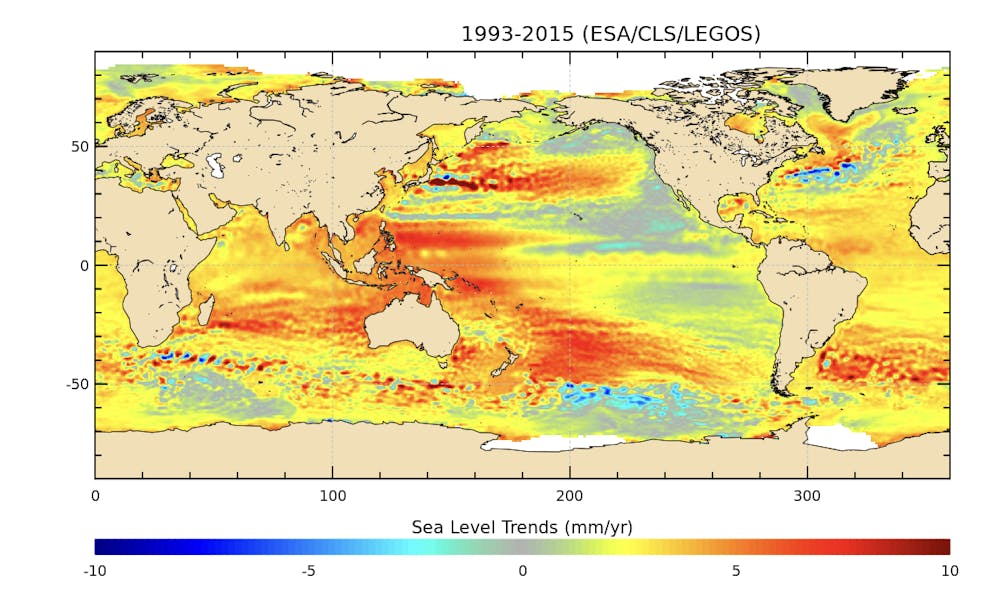
    Here’s a map of sea level rise, from Bamber’s article highlighting five satellite images that show how fast our planet is changing:

    The sea is rising quickly – but not evenly.
    ESA/CLS/LEGOS, CC BY-SA

    “This image,” writes Bamber, “shows mean sea level trends over 13 years in which the global average rise was about 3.2mm a year. But the rate was three or four times faster in some places, like the south western Pacific to the east of Indonesia and New Zealand, where there are numerous small islands and atolls that are already very vulnerable to sea level rise.”


    Read more:
    Five satellite images that show how fast our planet is changing


    In recent years, scientists have used AI to sift through and analyse satellite data. Bamber’s latest research, published in January this year, illustrates this nicely.

    A team of scientists, lead by Tian Li also of the University of Bristol, gathered millions of satellite images of glaciers in Svalbard, a remote and icy archipelago in the Arctic Ocean. In their write up, they note that human researchers once painstakingly looked through this sort of data.

    “This process”, they write, “is highly labour-intensive, inefficient and particularly unreproducible as different people can spot different things even in the same satellite image. Given the number of satellite images available nowadays, we may not have the human resources to map every region for every year.”

    Their solution was to use AI to “quickly identify glacier patterns across large areas”. The satellite-AI combo meant they could examine Svalbard’s retreating glaciers – surely among the least accessible places on the planet – in “unprecedented scale and scope”.

    They found that 91% of the many glaciers that flow into the sea around the archipelago have been “shrinking significantly”. They note that the same types of glacier can be found across the Arctic, and “what happens to glaciers in Svalbard is likely to be repeated elsewhere”.


    Read more:
    We built an AI model that analysed millions of images of retreating glaciers – what it found is alarming


    Many of those glaciers can be found in Greenland, home of the northern hemisphere’s largest ice sheet. In research published earlier this month, Tom Chudley of Durham University used satellite images to assess crevasses (cracks in the glaciers) in Greenland.

    A large glacier in west Greenland flows into the sea. That iceberg filled fjord is several miles wide.
    Copernicus Sentinel / lavizzara / shutterstock

    Chudley also combined satellite images with computerised analysis. His work made use of “ArcticDEM”, three dimensional maps of the polar regions based on high resolution satellite images.

    “By applying image-processing techniques to over 8,000 maps, we could estimate how much water, snow or air would be needed to “fill” each crevasse across the ice sheet. This enabled us to calculate their depth and volume, and examine how they evolved.“

    His conclusion was very blunt: the Greenland ice sheet is falling apart.


    Read more:
    The Greenland ice sheet is falling apart – new study


    Health watchdogs

    Many of you will be well aware that satellites are being used to monitor the health of the planet. What’s less well known is the role they can play in monitoring human health.

    Dhritiraj Sengupta, a satellite scientist at Plymouth Marine Laboratory, says satellites have become Earth’s new health and nature watchdog. His article details how satellites can map mosquito breeding sites to combat malaria, for instance, or can identify air pollution hotspots in cities.

    In his own research, he’s used satellite-derived chlorophyll data to assess the risk of cholera. Chlorophyll is the green pigment in plants that helps them use sunlight to make their food and grow.

    “Many bacteria like Vibrio cholerae which causes cholera, thrive in stagnant water,” Sengupta writes. “My team worked with the European Space Agency to show that its presence can be modelled using the concentration of chlorophyll found on the surface of bodies of water.”


    Read more:
    How satellites have become Earth’s new health and nature watchdogs


    So far, so good. Satellites have undeniably been useful for climate scientists. But in the longer-term, the satellites themselves may have an unforeseen effect on the climate.

    Last year, SpaceX announced it would “deorbit” 100 of its Starlink satellites to burn up in the atmosphere. Fionagh Thomson is a space expert, also at Durham University. She says that “atmospheric scientists are increasingly concerned that this sort of apparent fly-tipping by the space sector will cause further climate change down on Earth.”

    Particles from the satellites themselves won’t have a huge effect compared to the “440 tonnes of meteoroids that enter the atmosphere daily, along with volcanic ash and human-made pollution from industrial processes on Earth.”

    But one team “recently, and unexpectedly, found potential ozone-depleting metals from spacecraft in the stratosphere, the atmospheric layer where the ozone layer is formed.” The worry is that satellite debris may help form certain types of clouds that lead to ozone loss and may add to the greenhouse effect.

    She notes that this is all uncertain and needs more research. “But,” she writes, “we’ve also learnt that if we wait until indisputable evidence is available, it may be too late, as with the loss of ozone. It’s a constant dilemma.”

    Something for SpaceX scientists to look into, perhaps, once they’ve finished rescuing stranded astronauts from the International Space Station.


    Read more:
    Satellites are burning up in the upper atmosphere – and we still don’t know what impact this will have on the Earth’s climate


    ref. How satellites revolutionised climate change science – https://theconversation.com/how-satellites-revolutionised-climate-change-science-250312

    MIL OSI – Global Reports

  • MIL-OSI: FN2/2025 Kapitalforhøjelse – Nye aktier

    Source: GlobeNewswire (MIL-OSI)

    NASDAQ FIRST NORTH GROWTH MARKET MEDDELELSE NR. 2/2025

    København, den 19. februar 2025

    FN2/2025 Kapitalforhøjelse – Nye aktier

    I forlængelse af FN1 vedrørende kapitalforhøjelsen meddeler selskabet hermed, at de nye aktier (i alt 49.257 stk.) er ansøgt optaget til handel på Nasdaq First North Growth Market Denmark hurtigst muligt. 

    Yderligere oplysninger

    FastPassCorp A/S, administrerende direktør Anders Meyer, am@fastpasscorp.com

    Certified Adviser

    Baker Tilly Corporate Finance P/S, Poul Bundgaards Vej 1, DK-2500 Valby, Tlf.: +45 33 45 10 00,

    www.bakertilly.dk

    The MIL Network

  • MIL-OSI Economics: Minutes of the Monetary Policy Committee meeting of 3 and 4 February 2025

    Source: Central Bank of Iceland

    In accordance with the Monetary Policy Committee Rules of Procedure, the minutes of the Committee’s most recent meeting have been published on the Bank’s website. The minutes are published two weeks after the announcement of the Committee‘s decision.

    MIL OSI Economics

  • MIL-OSI United Kingdom: expert reaction to study of glacier melt this century

    Source: United Kingdom – Science Media Centre

    A study published in Nature estimates global glacier melting from 2000 to 2023. 

    Prof Andrew Shepherd, Head of Department of Geography and Environmental Science, Northumbria University, said:

    “This is really important as it’s an authoritative assessment from the community working on this topic. It confirms that the pace of glacier melting is accelerating over time. Glacier melting has two main impacts; it causes sea level rise and it disrupts the water supply in rivers that are fed by meltwater. Around 2 billion people depend on meltwater from glaciers and so their retreat is a big problem for society – it’s not just that we are losing them from our landscape, they are an important part of our daily lives.

    “Even small amounts of sea level rise matter because it leads to more frequent coastal flooding. Every centimetre of sea level rise exposes another 2 million people to annual flooding somewhere on our planet.

    “Community assessments like GLAMBIE are vital as they give people confidence to make use of their findings. That includes other climate scientists, governments, and industry, plus of course anyone who is concerned about the impacts of global warming. Around 2 billion people depend on meltwater from glaciers and so their retreat is a big problem for society – it’s not just that we are losing them from our landscape, they are an important part of our daily lives.”

    Prof Martin Siegert, Professor of Geosciences and Deputy VC at the University of Exeter, said:

    “Two centimetres might not sound a lot, but this is the contribution from small glaciers – not the whole of the ice on the planet, and not from Greenland and Antarctica. Sea level has risen by 20cm since 1850; 50% from the sea being warmer and expanding, 50% (10cm) due to glacier melt. However, ice sheets are now losing mass at increasing rates (6x more than 30 years ago), and when they change, we stop talking centimetres and start talking metres. For example, the last ice age was 20,000 years ago, and between then and 10,000 years ago as we warmed out of the ice age, sea level rose by 130m, due primarily to collapse of ice sheets.

    “This research is concerning to us, because it predicts further glacier loss, which can be considered like a ‘canary in the coal mine’ for ice sheet reaction to global warming and far more sea level rise this century and beyond. The IPCC indicates 0.5-1m this century – but that is with a 66% certainty – hence 1/3 chance it could be higher under ‘strong’ warming, which unfortunately is the pathway we are on presently.”

    Community estimate of global glacier mass changes from 2000 to 2023’ by The GlaMBIE Team was published in Nature at 16:15 UK time on Wednesday 19th February. 

    Declared interests

    Prof Andrew Shepherd: No conflicts to declare

    Prof Martin Siegert: No COI

    MIL OSI United Kingdom

  • MIL-OSI Global: Is Donald Trump on a constitutional collision course over NATO?

    Source: The Conversation – Canada – By Aaron Ettinger, Associate Professor, International Relations, Carleton University

    Over the past few weeks, United States President Donald Trump has let loose a flurry of executive orders aiming to impose the MAGA agenda unilaterally.

    The legal challenges and judicial stays that have followed speak to the degree to which the limits of presidential authority are at risk in America. These limits include the making and breaking of international treaties.

    In the crosshairs is NATO, the very existence of which is threatened by Trump more than anything else.


    Read more:
    Allies or enemies? Trump’s threats against Canada and Greenland put NATO in a tough spot


    But can he sign an executive order and unilaterally denounce the North Atlantic Treaty — which forms the legal basis of NATO — or any international treaty, for that matter? The answer is uncertain, but perhaps not for long.

    Vice President J.D. Vance has stated on social media that “judges aren’t allowed to control the executive’s legitimate power,” suggesting that Trump won’t be checked or balanced by the judiciary or other branches of government. This sets up a high stakes battle over the limits of “legitimate” presidential authority.

    Any unilateral termination of the North Atlantic Treaty would likely end up in the U.S. Supreme Court. This question therefore is about more than just NATO. It’s about the power of the presidency to override Congress, ignore courts, terminate treaties and reshape the international order.

    How to quit an alliance

    To leave NATO, all a member needs to do is say so. Article 13 of the North Atlantic Treaty lays out simple instructions: give notice of denunciation to the U.S. government, which will then tell the other members. Basically, Trump can inform himself and likely post something to social media and the one-year countdown clock begins.

    But can Trump unilaterally withdraw from NATO in a way that’s constitutional? This is where things get ambiguous.

    The more appropriate question is: “Can the U.S. president unilaterally terminate an act of Congress?”

    The U.S. Constitution requires that international treaties have the “advice and consent” of “two-thirds of senators present” to become law. America’s adoption of the North Atlantic Treaty of 1949 followed this process. But on treaty termination, the constitution is silent.

    This is remarkable because the U.S. has been terminating treaties since 1798. Naturally, the authority over treaty termination has been debated for just as long.

    The arguments boil down to this: if treaties are regarded as analogous to domestic law, then Trump needs the consent of two-thirds of the Senate to terminate the North Atlantic Treaty.

    If the domestic analogy is rejected or treaties are regarded as falling under the vested powers of the presidency — or as giving the president wiggle room to suspend elements of the agreement — then Trump can do what he wants.

    The Supreme Court’s stance

    Does the Supreme Court have anything to say? No, and deliberately so.

    In 1979, the court dismissed a suit brought by Sen. Barry Goldwater against President Jimmy Carter after Carter terminated a 25-year-old mutual defence treaty with Taiwan. The court dismissed the case as a non-justiciable political question.

    A similar outcome occurred in 2002 when President George W. Bush unilaterally withdrew from the Anti-Ballistic Missile treaty with Russia. Members of Congress filed suit, but the case was dismissed by a federal court on the same grounds.

    What we have now is a practice of treaty termination that is governed by the norms of shared power over foreign policy between Congress and the presidency, exactly the kind of guardrails that Trump loves to ignore.

    So it seems that Trump could have a path to denouncing the North Atlantic Treaty. But there’s a twist.

    The Marco Rubio twist

    At the end of 2023, Congress passed the Defense Department budget that included a provision meant to forestall any unilateral withdrawal from NATO.

    Buried deep in the 974-page National Defense Authorization Act is a provision that prohibits the president from “suspending, terminating, denouncing, or withdrawing” from NATO “except with the advice and consent of 2/3 of the Senate.” That clause, spearheaded by then-senator and current Secretary of State Marco Rubio, is critical because of a court decision that’s nearly as old as NATO itself.

    In 1952, in the Youngstown Sheet & Tube Co. v. Sawyer case, the Supreme Court clarified the parameters on executive power. It argued presidential authority on any matter is “is at its lowest ebb” when working against congressional authority.

    The Rubio clause may be the exact constitutional authority that stops Trump in his tracks. But stay tuned: this is all subject to change.

    What’s next?

    In 2025, the conditions for unilateral withdrawal seem to align perfectly for Trump: constitutional ambiguity, antiquated norms of polite governance and deferential courts.

    It might seem that Trump could denounce the North Atlantic Treaty with a few thumbstrokes, but that obscure provision in the Pentagon budget changes things. Any unilateral denunciation of NATO by Trump would set him on a collision course with Congress, and the matter would rocket toward the Supreme Court.

    So far, though, Trump hasn’t raised the spectre of termination. Instead, he has been more interested in increasing the NATO defence spending target to five per cent of GDP, up from two per cent, a requirement that would be difficult for many members to meet.

    It’s possible that including that language in the next NATO summit declaration would be enough for Trump. He’d look tough without the constitutional fight at home. Supporters of NATO, the durability of U.S. treaties and the separation of powers in America can only hope that will be enough.

    Aaron Ettinger does not work for, consult, own shares in or receive funding from any company or organisation that would benefit from this article, and has disclosed no relevant affiliations beyond their academic appointment.

    ref. Is Donald Trump on a constitutional collision course over NATO? – https://theconversation.com/is-donald-trump-on-a-constitutional-collision-course-over-nato-248363

    MIL OSI – Global Reports

  • MIL-OSI Global: Greenland’s rapidly melting ice and landslide-prone fjords make the oil and minerals Trump covets dangerous to extract

    Source: The Conversation – USA – By Paul Bierman, Fellow of the Gund Institute for Environment, Professor of Natural Resources and Environmental Science, University of Vermont

    Greenland has large deposits of rare earth minerals along its coasts, but these are also geologically hazardous regions. Alex Hibbert/The Image Bank via Getty Images

    Since Donald Trump regained the presidency, he has coveted Greenland. Trump has insisted that the U.S. will control the island, currently an autonomous territory of Denmark, and if his overtures are rejected, perhaps seize Greenland by force.

    During a recent congressional hearing, senators and expert witnesses focused on Greenland’s strategic value and its natural resources: critical minerals, fossil fuels and hydropower. No one mentioned the hazards, many of them exacerbated by human-induced climate change, that those longing to possess and develop the island will inevitably encounter.

    That’s imprudent, because the Arctic’s climate is changing more rapidly than anywhere on Earth. Such rapid warming further increases the already substantial economic and personal risk for those living, working and extracting resources on Greenland, and for the rest of the planet.

    Arctic surface temperatures have been rising faster than the global average.
    Arctic Report Card 2024, NOAA Climate.gov

    I am a geoscientist who studies the environmental history of Greenland and its ice sheet, including natural hazards and climate change. That knowledge is essential for understanding the risks that military and extractive efforts face on Greenland today and in the future.

    Greenland: Land of extremes

    Greenland is unlike where most people live. The climate is frigid. For much of the year, sea ice clings to the coast, making it inaccessible.

    An ice sheet, up to 2 miles thick, covers more than 80% of the island. The population, about 56,000 people, lives along the island’s steep, rocky coastline.

    While researching my book “When the Ice is Gone,” I discovered how Greenland’s harsh climate and vast wilderness stymied past colonial endeavors. During World War II, dozens of U.S. military pilots, disoriented by thick fog and running out of fuel, crashed onto the ice sheet. An iceberg from Greenland sunk the Titanic in 1912, and 46 years later, another sunk a Danish vessel specifically designed to fend off ice, killing all 95 aboard.

    Now amplified by climate change, natural hazards make resource extraction and military endeavors in Greenland uncertain, expensive and potentially deadly.

    Rock on the move

    Greenland’s coastal landscape is prone to rockslides. The hazard arises because the coast is where people live and where rock isn’t hidden under the ice sheet. In some places, that rock contains critical minerals, such as gold, as well as other rare metals used for technology, including for circuit boards and electrical vehicle batteries.

    The unstable slopes reflect how the ice sheet eroded the deep fjords when it was larger. Now that the ice has melted, nothing buttresses the near-vertical valley walls, and so, they collapse.

    In 2017, a northwestern Greenland mountainside fell 3,000 feet into the deep waters of the fjord below. Moments later, the wave that rockfall generated (a tsunami) washed over the nearby villages of Nuugaatsiaq and Illorsuit. The water, laden with icebergs and sea ice, ripped homes from their foundations as people and sled dogs ran for their lives. By the time it was over, four people were dead and both villages lay in ruin.

    Steep fjord walls around the island are littered with the scars of past rockslides. The evidence shows that at one point in the last 10,000 years, one of those slides dropped rock sufficient to fill 3.2 million Olympic swimming pools into the water below. In 2023, another rockslide triggered a tsunami that sloshed back and forth for nine days in a Greenland fjord.

    A cellphone video captures the June 2017 tsunami wave coming ashore in northwestern Greenland.

    There’s no network of paved roads across Greenland. The only feasible way to move heavy equipment, minerals and fossil fuels would be by sea. Docks, mines and buildings within tens of feet of sea level would be vulnerable to rockslide-induced tsunamis.

    Melting ice will be deadly and expensive

    Human-induced global warming, driven by fossil fuel combustion, speeds the melting of Greenland’s ice. That melting is threatening the island’s infrastructure and the lifestyles of native people, who over millennia have adapted their transportation and food systems to the presence of snow and ice. Record floods, fed by warmth-induced melting of the ice sheet, have recently swept away bridges that stood for half a century.

    As the climate warms, permafrost – frozen rock and soil – which underlies the island, thaws. This destabilizes the landscape, weakening steep slopes and damaging critical infrastructure.

    An excavator tries to save a bridge over the Watson River at Kangerlussuaq, Greenland. Part of the bridge and the machine were eventually swept away by the rushing meltwater from the Greenland Ice Sheet during a heat wave in July 2012.

    Permafrost melt is already threatening the U.S. military base on Greenland. As the ice melts and the ground settles under runways, cracks and craters form – a hazard for airplanes. Buildings tilt as their foundations settle into the softening soil, including critical radar installations that have scanned the skies for missiles and bombers since the 1950s.

    Greenland’s icebergs can threaten oil rigs. As the warming climate speeds the flow of Greenland’s glaciers, they calve more icebergs in the ocean. The problem is worse close to Greenland, but some icebergs drift toward Canada, endangering oil rigs there. Ships stand guard, ready to tow threatening icebergs away.

    An iceberg passes near an oil drilling rig in eastern Canada.
    Geoffrey Whiteway/500px Plus via Getty Images

    Greenland’s government banned drilling for fossil fuels in 2021 out of concern for the environment. Yet, Trump and his allies remain eager to see exploration resume off the island, despite exceptionally high costs, less than stellar results from initial drilling, and the ever-present risk of icebergs.

    As Greenland’s ice melts and water flows into the ocean, sea level changes, but in ways that might not be intuitive. Away from the island, sea level is rising about an inch each six years. But close to the ice sheet, it’s the land that’s rising. Gradually freed of the weight of its ice, the rock beneath Greenland, long depressed by the massive ice sheet, rebounds. That rise is rapid – more than 6 feet per century. Soon, many harbors in Greenland may become too shallow for ship traffic.

    Streams of meltwater flow over the silt-covered surface of the Greenland Ice Sheet as it melts in summer heat near Kangerlussuaq in western Greenland.
    REDA/Universal Images Group via Getty Images

    Greenland’s challenging past and future

    History clearly shows that many past military and colonial endeavors failed in Greenland because they showed little consideration of the island’s harsh climate and dynamic ice sheet.

    Changing climate drove Norse settlers out of Greenland 700 years ago. Explorers trying to cross the ice sheet lost their lives to the cold. American bases built inside the ice sheet, such as Camp Century, were quickly crushed as the encasing snow deformed.

    In the past, the American focus in Greenland was on short-term gains with little regard for the future. Abandoned U.S. military bases from World War II, scattered around the island and in need of cleanup, are one example. Forced relocation of Greenlandic Inuit communities during the Cold War is another. I believe that Trump’s demands today for American control of the island to exploit its resources are similarly shortsighted.

    Piles of rusting fuel drums sit at an abandoned U.S. base from World War II in Ikateq, in eastern Greenland.
    Posnov/Moment via Getty Images

    However, when it comes to the planet’s livability, I’ve argued that the greatest strategic and economic value of Greenland to the world is not its location or its natural resources, but its ice. That white snow and ice reflect sunlight, keeping Earth cool. And the ice sheet, perched on land, keeps water out of the ocean. As it melts, Greenland’s ice sheet will raise global sea level, up to about 23 feet when all the ice is gone.

    Climate-driven sea level rise is already flooding coastal regions around the world, including major economic centers. As that continues, estimates suggest that the damage will total trillions of dollars. Unless Greenland’s ice remains frozen, coastal inundation will force the largest migration that humanity has ever witnessed. Such changes are predicted to destabilize the global economic and strategic world order.

    These examples show that disregarding the risks of natural hazards and climate change in Greenland courts disaster, both locally and globally.

    Paul Bierman receives funding from the US National Science Foundation and the University of Vermont Gund Institute for Environment

    ref. Greenland’s rapidly melting ice and landslide-prone fjords make the oil and minerals Trump covets dangerous to extract – https://theconversation.com/greenlands-rapidly-melting-ice-and-landslide-prone-fjords-make-the-oil-and-minerals-trump-covets-dangerous-to-extract-249985

    MIL OSI – Global Reports

  • MIL-OSI: Preem Partners with Imubit to Drive Sustainability and Lower Emissions Through Advanced Closed Loop AI Optimization

    Source: GlobeNewswire (MIL-OSI)

    Houston, TX, Feb. 19, 2025 (GLOBE NEWSWIRE) — Houston, TX – February 19, 2025 – Imubit, a global leader in closed loop artificial intelligence optimization (AIO), and Preem, Sweden’s largest fuel company, have entered into a partnership aimed at accelerating Preem’s sustainability journey through Imubit’s Closed Loop AIO technology. As part of Sweden’s drive toward a carbon-neutral future, this partnership underscores Preem’s commitment to innovative, data-driven solutions to reduce emissions and increase operational efficiency.

    Preem has set ambitious goals for emissions reduction, including meeting net zero GHG emissions throughout the value chain by 2035.  To meet this ambitious target, digitalisation for increased profitability is one of the main areas in Preem’s strategy. This partnership with Imubit represents a significant step in that direction. Imubit’s AI-driven Optimizing Brain™ solution will enable Preem’s Lysekil refinery to maximize the production efficiency of its Fluid Catalytic Cracking (FCC) unit. This is anticipated to also result in emissions reductions and fuel savings by enhancing yield profiles and stabilizing the fuel gas balance.

    Dennis Rohe, Business Consulting Lead at Imubit, expressed the potential impact of the project: “Our collaboration with Preem is an opportunity to showcase the power of AI in industrial sustainability. By optimizing process variables to minimize environmental impact, we are supporting Preem in achieving emission reductions. We’re excited to drive forward their vision of greener refining practices.”

    “At Preem, we are constantly exploring new technologies to reach our sustainability goals,” Erika Wikström, SVP of Technology. “Working with Imubit allows us to leverage cutting-edge AI to optimize our renewable processes while minimizing our carbon footprint. This collaboration is an important step toward a more sustainable future for our industry.”

    The partnership between Imubit and Preem demonstrates the role of AI in transforming process industries and advancing sustainable operations. Imubit’s Closed Loop AI Optimization will help Preem set a new standard in refining, by including AI-optimisation on top of Preem’s already ambitious plans to reduce dependency on fossil fuels and enabling a sustainable energy transition across Europe.

    -ENDS-

    The MIL Network

  • MIL-OSI United Nations: Human Rights Council to Hold its Fifty-Eighth Regular Session from 24 February to 4 April 2025

    Source: United Nations – Geneva

    The United Nations Human Rights Council will hold its fifty-eighth regular session from 24 February to 4 April 2025 at the Palais des Nations in Geneva, starting with its high-level segment from 24 to 26 February, when dignitaries representing more than 100 Member States will address the Council.

    The session will open at 9 a.m. on Monday, 24 February under the Presidency of Ambassador Jürg Lauber of Switzerland. Delivering statements at the opening will be the Secretary-General of the United Nations, António Guterres; the President of the United Nations General Assembly , Philemon Yang; the United Nations High Commissioner for Human Rights, Volker Türk; as well as the Chief of the Federal Department of Foreign Affairs of Switzerland, Ignazio Cassis. The Council will be meeting in room XX of the Palais des Nations.

    On Monday, 3 March, the Council is scheduled to hear a global update by the High Commissioner for Human Rights on the situation of human rights around the world. The general debate on his global update will start following his presentation of a number of country-specific reports and updates.

    During the session, the Council will hold 30 interactive dialogues with the High Commissioner, his Office and designated experts, with Special Procedure mandate holders and investigative mechanisms, and with Special Representatives of the Secretary-General. The Council will also hold five enhanced interactive dialogues and one high-level dialogue, as well as nine general debates.

    The Council will also hold the annual high-level panel discussion on human rights mainstreaming with a focus on the thirtieth anniversary of the Beijing Declaration and Platform for Action; the biennial high-level panel on the death penalty ; panel discussions on early warning and genocide, HIV response and leaving no one behind, and on rights to work and to social security ; the annual interactive debate on the rights of persons with disabilities; the annual discussion on the rights of the child; and a commemoration of the International Day for the Elimination of Racial Discrimination.

    The Council will examine the situation of human rights in a number of countries under its various agenda items, including the situation in the occupied Palestinian territory, Eritrea, Sudan, South Sudan, Nicaragua, Afghanistan and Myanmar under agenda item two; in Iran, Syria, Venezuela, Ukraine, Belarus, the Democratic People’s Republic of Korea, and Myanmar under agenda item four; and in Mali, Haiti, Ukraine, the Democratic Republic of the Congo, South Sudan and Central African Republic under agenda item 10.

    The final outcomes of the Universal Periodic Review of 14 States will also be considered, namely those of Norway, Albania, Democratic Republic of the Congo, Côte d’Ivoire, Portugal, Bhutan, Dominica, Democratic People’s Republic of Korea, Brunei Darussalam, Costa Rica, Equatorial Guinea, Ethiopia, Qatar and Nicaragua. 

    Towards the end of the session, the Council will appoint three new members of the Expert Mechanism on the Rights of Indigenous Peoples.

    A detailed agenda and further information on the fifty-eighth session can be found on the session’s webpage . Reports to be presented are available here. 

    First Week of the Session 

    The fifty-eighth regular session will open at 9 a.m. on Monday, 24 February with a short opening meeting, followed by the start of the high-level segment, which will continue until 26 February, and during which the Council will hear addresses by more than 100 dignitaries. Intervening during the high-level segment will be the annual high-level panel discussion on human rights mainstreaming in the afternoon of 24 February and the biennial high-level panel on the death penalty in the morning of Tuesday, 25 February. The general segment will follow the conclusion of the high-level segment in the afternoon of Wednesday, 26 February.

    On Thursday, 27 February, the Council will hold an interactive dialogue on the High Commissioner’s report on the occupied Palestinian territory, including East Jerusalem, and the obligation to ensure accountability and justice, followed by enhanced interactive dialogues on the situation of human rights in Eritrea and on the High Commissioner’s report on Sudan, with the assistance of the designated Expert. Friday, 28 February, will see the conclusion of the discussion on Sudan, followed by an enhanced interactive dialogue on the report of the Commission on Human Rights in South Sudan. This will be followed by three interactive dialogues, the first on the report of the Group of Human Rights Experts on Nicaragua, the second with the Special Rapporteur on the situation of human rights in Afghanistan, and the third on the High Commissioner’s oral update on Myanmar.

    Second Week of the Session 

    At the beginning of the second week, on the morning of Monday, 3 March, the Council will hear the High Commissioner’s global update, then conclude the interactive dialogue on the High Commissioner’s oral update on Myanmar. This will be followed by the presentation of reports on the activities of the Office of the High Commissioner in Colombia, Guatemala and Honduras, and of another report on Cyprus, and oral updates on Sri Lanka and Nicaragua. The Council will then begin the general debate under agenda item two, namely the annual report of the High Commissioner for Human Rights and reports of the Office of the High Commissioner and the Secretary-General, which will conclude on Tuesday, 4 March. The Council will subsequently begin its considerations under agenda item three on the promotion and protection of all human rights, holding interactive dialogues with the Special Rapporteur on torture and other cruel, inhuman or degrading treatment or punishment and with the Special Rapporteur on freedom of religion or belief.

    On the morning of Wednesday, 5 March, the Council will hold a panel on early warning and genocide prevention, then conclude its interactive dialogue with the Special Rapporteur on freedom of religion or belief. This will be followed by an enhanced interactive dialogue on the report of the Office of the High Commissioner on transitional justice. Another panel will be held on Thursday, 6 March on HIV response and leaving no one behind, in addition to two interactive dialogues with the Special Rapporteur on the situation of human rights defenders and the Special Rapporteur in the field of cultural rights. A third panel will be held in the morning of Friday, 7 March on rights to work and to social security, followed by two interactive dialogues with the Special Rapporteur on the right to adequate housing and the Independent Expert on the rights of persons with albinism.

    Third Week of the Session 

    The Council will start its third week on Monday, 10 March with a focus on disability, beginning with an interactive dialogue with the Special Rapporteur on the rights of persons with disabilities, to be followed by the annual debate on the rights of persons with disabilities. The day will conclude with an interactive dialogue with the Independent Expert on foreign debt, which will continue in the morning of Tuesday, 11 March. Two more interactive dialogues will also be held on Tuesday with the Special Rapporteur on the right to food and the Special Rapporteur on the promotion and protection of human rights and fundamental freedoms while countering terrorism.

    Wednesday, 12 March will see a further three interactive dialogues with the Special Rapporteur on the right to privacy, and the Special Representatives of the Secretary-General on violence against children and on children and armed conflict, the latter of which will conclude on Thursday, 13 March. The focus on children will continue on Thursday, with the Council also holding its annual discussion on the rights of the child, the theme of which will be early childhood development, and starting an interactive dialogue with the Special Rapporteur on the sale of children, which will conclude on Friday, 14 March.

    On Friday, an interactive dialogue with the Special Rapporteur on the human right to a healthy environment will precede the presentation of reports by the open-ended intergovernmental working group on transnational corporations and other business enterprises with respect to human rights, the Secretary-General, the High Commissioner and his Office, followed by the start of the general debate on agenda item three.

    Fourth Week of the Session

    The first day of the Council’s fourth week, Monday 17 March, will be devoted to concluding the general debate on agenda item three. From Tuesday, 18 March, consideration of agenda item four, human rights situations that require the Council’s attention, will begin. First on the schedule is a joint interactive dialogue with the Special Rapporteur and the independent international fact-finding mission on the situation of human rights in Iran, followed by interactive dialogues with the independent international commission of inquiry on Syria, the fact-finding mission on Venezuela and the independent international commission of inquiry on Ukraine.

    On Wednesday, 19 March, after the conclusion of the dialogue with the commission of inquiry on Ukraine, three more separate interactive dialogues will be held with the group of independent experts on the situation of human rights in Belarus and with the Special Rapporteurs on the situation of human rights in the Democratic People’s Republic of Korea and in Myanmar.

    Thursday, 20 March, will see the Council hear the presentation of the High Commissioner’s report on the Democratic People’s Republic of Korea and his oral update of the situation of human rights in Venezuela. This will be followed by the general debate on agenda item four, which will conclude on the morning of Friday, 21 March. On Friday, the Council will also hold an interactive dialogue with the Special Rapporteur on minority issues, before beginning considerations under agenda item five on human rights bodies and mechanisms. After hearing the presentation of reports by the Forum on Minority Issues, the Social Forum, and the Special Procedures of the Council, it will commence the general debate on agenda item five.

    Fifth Week of the Session 

    The Council will start its fifth week on Monday, 24 March with its consideration under agenda item six of the final outcomes of the Universal Periodic Reviews of 14 States: Norway, Albania, Democratic Republic of the Congo, Côte d’Ivoire, Portugal, Bhutan, Dominica, Democratic People’s Republic of Korea, Brunei Darussalam, Costa Rica, Equatorial Guinea, Ethiopia, Qatar and Nicaragua. This consideration will continue through to the morning of Wednesday, 26 March, after which the Council will hold a general debate on agenda item six. This will be followed by the presentation of the reports of the High Commissioner and the Secretary-General under agenda item seven, namely the human rights situation in Palestine and other occupied Arab territories, and the general debate on this agenda item. The general debate under agenda item eight – follow-up and implementation of the Vienna Declaration and Programme of Action – is also scheduled to commence on Wednesday afternoon.

    Ending racism will be the Council’s theme for Thursday, 27 March. After concluding the debate under agenda item eight, it will hear the presentation of the report of the intergovernmental working group on the effective implementation of the Durban Declaration and Programme of Action, then hold its general debate on agenda item nine, namely racism, racial discrimination, xenophobia and related forms of intolerance, follow-up to and implementation of the Durban Declaration and Programme of Action. From 2:30 to 4:30 p.m., the Council will also hold a meeting in commemoration of the International Day for the Elimination of Racial Discrimination.

    Friday, 28 March will begin with the conclusion of the debate under agenda item nine, followed by three interactive dialogues conducted under agenda item 10 on technical assistance and capacity-building. The first dialogue will be with the Independent Expert on the situation of human rights in Mali; the second on the High Commissioner’s report on the situation of human rights in Haiti, with the participation of the Independent Expert on the subject; and the third on the High Commissioner’s oral update on the situation of human rights in Ukraine.

    Sixth Week of the Session 

    Monday, 31 March is a United Nations holiday. On Tuesday, 1 April, the Council will hold an enhanced interactive dialogue on oral updates by the High Commissioner and by the team of international experts on the Democratic Republic of the Congo, followed by an interactive dialogue on the report of the Office of the High Commissioner on technical assistance and capacity building for South Sudan and a high-level dialogue on the Central African Republic. At the end of the day, the Council will hear the annual presentation of the High Commissioner on technical cooperation and his oral update on Georgia, and the presentation of the report of the Board of Trustees of the Voluntary Fund for Technical Cooperation, followed by the general debate on agenda item 10.

    The general debate will conclude on Wednesday, 2 April, and the Council will then start to act on draft decisions and resolutions, appoint three new members of the Expert Mechanism on the Rights of Indigenous Peoples, and adopt the report of the fifty-eighth regular session, before closing the session on Friday, 4 April.

    The Human Rights Council 

    The Human Rights Council is an inter-governmental body within the United Nations system, made up of 47 States, which is responsible for strengthening the promotion and protection of human rights around the globe. The Council was created by the United Nations General Assembly on 15 March 2006 with the main purpose of addressing situations of human rights violations and making recommendations on them.

    The composition of the Human Rights Council at its fifty-eighth session is as follows: Albania (2026); Algeria (2025); Bangladesh (2025); Belgium (2025); Benin (2027); Bolivia (2027); Brazil (2026); Bulgaria (2026); Burundi (2026); Chile (2025); China (2026); Colombia (2027); Costa Rica (2025); Côte d’Ivoire (2026); Cuba (2026); Cyprus (2027); Czechia (2027); Democratic Republic of the Congo (2027); Dominican Republic (2026); Ethiopia (2027); France (2026); Gambia (2027); Georgia (2025); Germany (2025); Ghana (2026); Iceland (2027); Indonesia (2026); Japan (2026); Kenya (2027); Kuwait (2026); Kyrgyzstan (2025); Malawi (2026); Maldives (2025); Marshall Islands (2027); Mexico (2027); Morocco (2025); Netherlands (2026); North Macedonia (2027); Qatar (2027); Republic of Korea (2027); Romania (2025); South Africa (2025); Spain (2027); Sudan (2025); Switzerland (2027); Thailand (2027); and Viet Nam (2025).

    The term of membership of each State expires in the year indicated in parentheses.

    The President of the Human Rights Council in 2025 is Jürg Lauber (Switzerland). The four Vice-Presidents are Tareq Md Ariful Islam (Bangladesh), Razvan Rusu (Romania), Paul Empole Losoko Efambe (Democratic Republic of the Congo) and a fourth Vice-President to be elected later from the Group of Latin American and Caribbean States. Mr. Efambe will also serve as Rapporteur of the Geneva-based body.

    The dates and venue of the fifty-eighth session are subject to change.

    Information on the fifty-eighth session can be found here , including the annotated agenda and the reports to be presented.

    For further information, please contact Pascal Sim (simp@un.org), Matthew Brown (matthew.brown@un.org) or David Díaz Martín (David.diazmartin@un.org)

    ___________

    Produced by the United Nations Information Service in Geneva for use of the media; 
    not an official record. English and French versions of our releases are different as they are the product of two separate coverage teams that work independently.


    HRC.25.001E

    MIL OSI United Nations News

  • MIL-OSI Global: How plants are able to remember stress without a brain

    Source: The Conversation – UK – By Jurriaan Ton, Professor of Plant Environmental Signalling, University of Sheffield

    Sergey Nivens/Shutterstock

    It may sound strange but plants can remember stress. Scientists are still learning about how plants do this without a brain. But with climate change threatening crops around the world, understanding plant stress memory could help food crops become more resilient.

    Since their colonisation of the land 500 million years ago, plants have evolved ways to defend themselves against pests and disease. One of their most fascinating abilities is to “remember” stressful encounters and use this memory to defend themselves.

    This phenomenon, called immune priming, is similar to how vaccines help humans build immunity but is based on different mechanisms.


    Many people think of plants as nice-looking greens. Essential for clean air, yes, but simple organisms. A step change in research is shaking up the way scientists think about plants: they are far more complex and more like us than you might imagine. This blossoming field of science is too delightful to do it justice in one or two stories.

    This story is part of a series, Plant Curious, exploring scientific studies that challenge the way you view plantlife.


    So how do they do it without a brain?

    Plants are genetically resistant to the vast majority of potentially harmful microbes. However, a small number of microbes have evolved the ability to suppress innate immunity, enabling them to infect organisms and cause disease.

    This is why vertebrates, including humans, have evolved a mobile immune system that relies on B and T memory cells. These memory cells are activated by exposure to a disease or vaccinations, which helps us become more resistant to recurrent infections.

    Plants don’t have specialised cells to acquire immune memory. Instead, they rely on so-called “epigenetic” changes within their cells to store information about past attacks and prime their innate immune system. Once primed, plants can resist pests and diseases better – even if they were genetically susceptible to begin with.

    Research over the past ten to 15 years has shown that repeated and prolonged exposure to pests or diseases can cause long-lasting epigenetic changes to plant DNA without altering the underlying sequence of the DNA. This enables plants to stay in a primed defence state.

    Immune priming has been reported in different plants species, ranging from short-lived annuals, such as thale cress Arabidopsis thaliana that lives several weeks, to long-living tree species, such as Norway spruce that can live up to 400 years.

    Immune priming comes at a cost for the plant though, such as reduced growth. So the primed memory is reversible and dwindles over longer periods without stress. However, depending on the strength of the stress stimulus, priming can be lifelong and even be transmitted to following generations. The stronger the stress, the longer plants remember.

    Plants constantly change the activity of their genes in order to develop and adapt to their environment. Genes can be switched off over prolonged periods of time by epigenetic changes. In plants, these changes most frequently happen at transposons (also known as “jumping genes”) – pieces of DNA that can move within the genome. Transposons are usually inactive because they can cause mutations. But stress changes the epigenetic activity in the plant cell that can partially “wake them up”.

    Plants can pass on stress memories down the generations.
    boommavel/Shutterstock

    This drives the establishment and maintenance of long-lasting memory in plants.

    In plants that haven’t yet experienced stress, defence genes are mostly inactive to prevent unnecessary and costly immune activity. Lasting epigenetic changes to transposons after recovery from disease can prime defence genes for a faster and stronger activation upon recurrent stress. Although scientists are still uncovering exactly how this works, it is clear that epigenetic changes at these jumping genes play an essential role in helping plants adapt to threats.

    Soil as a memory bank

    Plants don’t only rely on internal epigenetic memory to improve their resilience against pests and diseases. They can also use their environment to store stress memory. When under attack, plants release chemicals from their roots, attracting helpful microbes that can suppress diseases. If this soil conditioning is strong enough, it can leave a long-lasting “soil legacy” that can benefit plants of the next generation. Once the soil is conditioned, these helpful microbes stay near plant roots to help the plant fight off diseases.

    In some plant species, such as maize, scientists have identified the secondary metabolites driving this external stress memory. These are specialised metabolites that are not essential for the cell’s primary metabolism. They often play a role in defence or other forms of environmental signalling, such as attracting beneficial microbes or insects.

    Some of the genes controlling these root chemicals are regulated by stress-responsive epigenetic mechanisms. This indicates that the mechanisms driving internal and external plant memory are interconnected.

    Understanding how plants store and use stress memories could revolutionise crop protection. Harnessing plants’ natural ability to cope with pests and diseases might help us reduce reliance on chemical pesticides and create crops that are better at handling environmental stresses. As we face growing challenges from human-made climate change and rising food demands, this research could offer promising tools to develop more sustainable crop protection schemes.

    Jurriaan Ton receives funding from UKRI-BBSRC (BB/W015250/1)

    ref. How plants are able to remember stress without a brain – https://theconversation.com/how-plants-are-able-to-remember-stress-without-a-brain-246615

    MIL OSI – Global Reports

  • MIL-OSI Europe: OSCE Supports Medical Training for Border Service Personnel in Kyrgyzstan

    Source: Organization for Security and Co-operation in Europe – OSCE

    Headline: OSCE Supports Medical Training for Border Service Personnel in Kyrgyzstan

    Participants of the specialized Train-the-Trainer (ToT) programme aimed at strengthening the medical response capabilities of the Border Service. Osh, Kyrgyzstan. (OSCE) Photo details

    Bishkek, 31 January 2025 – The OSCE Programme Office in Bishkek has implemented a specialized Train-the-Trainer (ToT) programme aimed at strengthening the medical response capabilities of the Border Service of the State Committee for National Security of the Kyrgyz Republic.
    From 27 to 31 January 2025, nine selected lecturers, instructors, and medical professionals participated in the training at the Border Service Training Centre in Osh. The training developed by Lazarus Ltd, a UK-based company, was designed in line with International Mine Action Standards (IMAS) “Basic Care Provider” requirements and tailored to local conditions.
    The ToT programme focused on theoretical and practical training. Participants gained expertise in training methodologies, fostering an engaging learning environment, and instructional skills. The hands-on sessions included the use of training dummies, wound simulators, and scenario-based exercises to enhance their ability to train Border Service personnel effectively.
    This programme follows an initial needs assessment conducted by Lazarus Training in September 2024 and the basic and intermediate-level medical training delivered in November–December 2024, in which 30 personnel completed the basic training and 15 completed the intermediate training. The final stage will involve the procurement of training equipment to further enhance the Border Service’s medical training capacity. The newly trained trainers will now continue conducting medical trainings within the Border Service, further reinforcing the sustainability of the programme.
    Through this initiative, the OSCE continues to support regional security and capacity-building efforts, ensuring that Border Service personnel are equipped with the skills necessary to respond effectively to medical emergencies.
    The initiative is implemented within the framework of the extrabudgetary project “Reducing risk of illicit small arms and light weapons, ammunition and explosives proliferation across border of Kyrgyz Republic,” funded by the US, Germany, Norway, UK, and supported by Austria and Poland.

    MIL OSI Europe News

  • MIL-OSI: NNIT A/S: Notice convening the annual general meeting for NNIT A/S

    Source: GlobeNewswire (MIL-OSI)

    The Board of Directors gives notice of the annual general meeting for NNIT A/S, company registration (CVR) no. 21 09 31 06 (the “Company”), to be held Thursday, March 13, 2025, 2:00 pm (CET) at Novo Holdings A/S, Tuborg Havnevej 19, DK-2900 Hellerup.

    The general meeting will for shareholders be webcasted live on the Company’s investor portal. It is not possible to vote or ask questions via webcast.

    The notice for the annual general meeting, including Appendix A: Candidates for (re-)election to the Board of Directors, is attached.

    For more information, please contact:

    Investor Relations
    Carsten Ringius
    EVP & CFO
    Tel: +45 3077 8888
    carr@nnit.com 

    Media Relations
    Sofie Mand Steffens
    Senior Communications Consultant
    Tel: +45 3077 8337
    smst@nnit.com 

    ABOUT NNIT

    NNIT is a leading provider of IT solutions to life sciences internationally, and to the public and private sectors in Denmark.

    We focus on high complexity industries and thrive in environments where regulatory demands and complexity are high.

    We advise on and build sustainable digital solutions that work for the patients, citizens, employees, end users or customers.

    We strive to build unmatched excellence in the industries we serve, and we use our domain expertise to represent a business first approach – strongly supported by a selection of partner technologies, but always driven by business needs rather than technology.

    NNIT consists of group company NNIT A/S, subsidiaries in Region Europe, Asia and US and subsidiary SCALES in Region Denmark. Together, these companies employ more than 1,700 people in Europe, Asia and USA.

    Attachments

    The MIL Network

  • MIL-OSI: Sydbank’s Board Chairman not up for re-election

    Source: GlobeNewswire (MIL-OSI)

    Company Announcement No 05/2025

    Peberlyk 4
    6200 Aabenraa, Denmark
    Tel +45 74 37 37 37

    Sydbank A/S
    CVR No DK 12626509, Aabenraa
    Denmark
    sydbank.dk

    19 February 2025  

    Dear Sirs

    Sydbank’s Board Chairman not up for re-election

    After a decade on Sydbank’s Board of Directors, Chairman Lars Mikkelgaard-Jensen has decided to resign from the Board of Directors.

    Lars Mikkelgaard-Jensen is not up for re-election for the Board of Directors. Following the successful CEO succession in 2024 as well as the determination of the Bank’s new strategy, Lars Mikkelgaard-Jensen has decided that now is a good time to stop and he will resign in connection with the Annual General Meeting on 20 March 2025.

    The Board of Directors will elect its new Chairman at the subsequent Shareholders’ Committee meeting which will be held on the same day.

    Lars Mikkelgaard-Jensen has been a member of Sydbank’s Board of Directors since April 2015 and he was elected Chairman in September 2019.

    Yours sincerely
            
    Mark Luscombe        Jørn Adam Møller
    CEO        Deputy Group Chief Executive

    Additional information
    Lars Grubak Lohff, Press Manager Tel +45 20 31 54 65

    Attachment

    The MIL Network

  • MIL-OSI: TGS Launches New Multi-client Project in the Barents Sea

    Source: GlobeNewswire (MIL-OSI)

    OSLO, Norway (19 February 2025) – TGS, a leading provider of energy data and intelligence, is pleased to announce a new multi-client 3D streamer acquisition and processing project in the Goliat area of the Norwegian Barents Sea. The new GeoStreamer survey will span up to 1,600 sq.km. over recent discoveries such as Countach, Elgol and Lupa, and expand on TGS’ existing high-quality data coverage in the Goliat area of the prolific Hammerfest Basin. The Hammerfest Basin 3D project is scheduled to start in early August.

    Kristian Johansen, CEO of TGS, commented, ” The Goliat area is one of the hot spots in the Norwegian Barents Sea with significant drilling success and exciting new discoveries. We are very pleased to secure funding for more multi-client 3D acquisition in this part of the Norwegian Continental Shelf for the 2025 summer season.”

    The multi-client project is supported by industry funding.

    For more information, visit TGS.com or contact:

    Bård Stenberg
    VP IR & Communication
    Mobile: +47 992 45 235
    investor@tgs.com

    About TGS
    TGS provides advanced data and intelligence to companies active in the energy sector. With leading-edge technology and solutions spanning the entire energy value chain, TGS offers a comprehensive range of insights to help clients make better decisions. Our broad range of products and advanced data technologies, coupled with a global, extensive and diverse energy data library, make TGS a trusted partner in supporting the exploration and production of energy resources worldwide. For further information, please visit www.tgs.com (https://www.tgs.com/).

    Forward Looking Statement
    All statements in this press release other than statements of historical fact are forward-looking statements, which are subject to a number of risks, uncertainties and assumptions that are difficult to predict and are based upon assumptions as to future events that may not prove accurate. These factors include volatile market conditions, investment opportunities in new and existing markets, demand for licensing of data within the energy industry, operational challenges, and reliance on a cyclical industry and principal customers. Actual results may differ materially from those expected or projected in the forward-looking statements. TGS undertakes no responsibility or obligation to update or alter forward-looking statements for any reason.

    The MIL Network

  • MIL-OSI Economics: Trump 2.0 is shaking up the world

    Source: GlobalData

    Join GlobalData’s webinar to explore the impact of disruptive shifts in geopolitics

    Which parts of the US President Donald Trump’s geopolitical agenda matters most for global business risks and opportunities? Trump’s bid to settle the Russia-Ukraine war without including Ukrainian or European officials in discussions is the latest in a series of foreign policy moves that include moves to annex Greenland, reclaim the Panama Canal, and “clear out” the Gaza Strip. GlobalData’s latest Strategic Intelligence webinar will focus on the Trump administration’s policies towards US adversaries, including China, Russia, and Iran.

    This insightful webinar from the Strategic Intelligence team at GlobalData, a leading data and analytics company, takes place on Thursday, 20 February 2025 at 4pm GMT/11am EST. You can register here

    Our panel of experts for this webinar are Carolina Pinto, Analyst in the Strategic Intelligence team; Christopher Granville, Managing Director, Global Political & Policy Research, TS Lombard; and Grace Fan, Managing Director, Global Policy Research and Disruptive Themes Research, TS Lombard.

    Granville and Fan say: “Trump’s first month back in the White House has opened a disruptive new chapter in global geopolitics, with shockwaves from his early moves on trade to foreign policy already rippling across borders and industries. This indispensable webinar will offer our incisive analysis of Trump 2.0’s initial geopolitical gambits, framed within the intricate web of the US’s three traditional adversaries (China, Russia, Iran, and proxies) and amid the powder keg of two live conflicts. We will examine the complex interplay of these issues not only from a bilateral perspective (US versus adversary country) but also touching on their profound reverberations on the wider US alliance network (from Europe to Asia) as well as the global economy, with high-stakes ramifications ahead for investors, capital markets and global supply chains.”

    Pinto adds: “Supply chain disruptions are becoming worse and more frequent. Geopolitical fractures are a leading cause of this trend. This webinar will explore whether Trump’s America First agenda will raise or ease geopolitical tensions.”

    Register now for GlobalData’s Trump shaking up the world webinar on Thursday 20 February 2025 at 4pm GMT/11am EST.

    MIL OSI Economics

  • MIL-OSI USA News: Interview of President Trump and Elon Musk by Sean Hannity, “The Sean Hannity Show”

    Source: The White House

    class=”has-text-align-center”>Roosevelt Room

    11:48 A.M. EST

         Q    Mr. President, great to see you again.

         THE PRESIDENT:  Thank you very much.  Thank you.

         Q    How are you?

         THE PRESIDENT:  Thank you. 

         Q    Elon Musk.

         MR. MUSK:  Hi.

         Q    Great to see you. 

         MR. MUSK:  Thanks.  Thanks for having me.

         Q    I’ve been reading a lot about you.  I’ve got to start with this.  So, he’s working for free with DOGE.  He’s — he’s kind of put a lot of his life on hold, and you sued Twitter a number of years ago.  You just made him pay you $10 million?

         THE PRESIDENT:  That’s right.  That’s right.

         Q    That’s — that’s right.  (Laughs.)

         THE PRESIDENT:  Well, I sued — I sued from long before he had it. 

         MR. MUSK:  Yeah.  Yeah.  (Inaudible.)

         THE PRESIDENT:  And, I mean, they really did a number on me, you know.  And I sued, and they had to pay.  You know, they paid $10 million settlement.

         Q    You’re okay with that?
        
         MR. MUSK:  I mean, I left it up to the lawyers and, you know, the team running Twitter.  So, I said, “You guys do what you think is the right — makes sense.”

         Q    I think it’s funny.

         THE PRESIDENT:  I think —

         Q    Because —

         THE PRESIDENT:  — it’s a very low — I was looking to get much more money than that.
        
         Q    So, you gave him a discount w- — in the lawsuit?

         THE PRESIDENT:  He got — oh, he got a big discount.  I don’t think he even knows about it.

         Q    He’s become one of your — if you read and believe the media — he’s become one of your best friends.  He’s working for free for you.  He’s —

         MR. MUSK:  Well, I love the president.  I just want to be clear about that.  

         Q    You don’t care about that? 

         MR. MUSK:  I — no, I love the pr- — I —

         Q    You love the president? 

         MR. MUSK:  I think — I think President Trump is a good man, and — and he’s, you know — I — I —

         THE PRESIDENT:  That’s the way he said that.  You know, there’s something nice about.  (Laughter.)

         MR. MUSK:  No, it is.  I, you know —

         THE PRESIDENT:  It is.

         MR. MUSK:  Because, I mean, the president has been so — so unfairly attacked in the media.  It’s truly outrageous.  And I’ve sp- — at this point, spent a lot of time with the president, and not once have I seen him do something that was mean or cruel or — or wrong.  Not once. 

         Q    You know, I’ve known him for 30 years.

         MR. MUSK:  Yeah.

         Q    And I’ve never seen anybody take as much as he’s taken.

         MR. MUSK:  Yeah.

         Q    And we’ve discussed this.  And I’m like, “How do you deal with it?”

         THE PRESIDENT:  Did have a choice?  (Laughs.)  I didn’t have a choice.

         Q    Well, you would say that to me.  I’m like, “What — what am I going to do?  Worry about it?”

         THE PRESIDENT:  That’s the only thing I can say.

         Q    And, you know — and then culminating in two assassination attempts, which resulted in your endorsement. 

         MR. MUSK:  Well, I was going to do it anyway, but that was —

         Q    That was it?

         MR. MUSK:  — a precipitating event, yeah.

         THE PRESIDENT:  That speeded it up a little bit?

         MR. MUSK:  Yeah.  Yeah.

         Q    The day of the assassination? 

         THE PRESIDENT:  Nice.  I didn’t know that. 

         MR. MUSK:  Yeah, it just — it sped it up, but I was going to do it anyway.

         Q    Mr. President, with your indulgence, I’m convinced that people only know a little bit about Elon.  I don’t think they know everything about Elon, because as I studied for and prepared for this interview, I learned a lot about you that I didn’t know.  I think people will think about Tesla.  Democrats are demonizing you and — and trying to make the country hate you. 

         I just want people to understand you a little bit better, and the person that you’ve gotten to know and have now put a lot of trust in. 

         THE PRESIDENT:  Sure.

         Q    And, you know, just — let’s go over a little bit of your bio, starting —

         MR. MUSK:  Ah, okay.

         Q    — with PayPal and how you became involved in Tesla and SpaceX and Neuralink —

         MR. MUSK:  This — this could take a while.

         Q    — and all these —

         MR. MUSK:  I mean, you know, I — I think the way you think of me is, like, I’m a technologist and I try to make technologies that improve the world and make life better.

         Q    You can show them your shirt.

         MR. MUSK:  Yeah, and that’s why, like, my t-shirt says “tech support” — (laughter) — because I’m here to provide the president with — with technology support. 

         And now, that — that may seem, like, well, is that a silly thing?  But actually, it’s a very important thing, because the president will make these executive orders, which are very sensible and good for the country, but then they don’t get implemented, you know?

         So, if you take the — for example, all the funding for the migrant hotels, the president issued an executive order: Hey, we need to stop taking taxpayer money and — and paying for luxury hotels for illegal immigrants —

         Q    It’s crazy.

         MR. MUSK:  — which makes no sense.  Like, obviously, people do not want their tax dollars going to — to fund high-end hotels for — for illegals.  And yet, they were still doing that, even as late as last week. 

         And so, you know, we went in there, and we were like, “This is in violation of the presidential executive order.  It needs to stop.” 

         So — so, what we’re — what we’re doing here is — is — one of the biggest functions of the DOGE team is just making sure that the presidential executive orders are actually carried out.  And this is — I just want to point out, this is a very important thing, because the president is the elected representative of the people, so he’s representing the will of the people.  And if the bureaucracy is fighting the will of the people and preventing the pres- — the president from implementing what the people want, then what we live in is a bureaucracy and not a democracy.

         Q    Yeah.  You — you’re both aware — you have to be keenly aware that the media and — and the punditry class — not that — you know, I think you’ve proven they have no power anymore, because they threw everything they had at you, and they didn’t win.  And that was, you know, the New York Times, Washington Post, three networks, every late-night comedy show, two cable channels — they — they just threw — they threw everything — lawfare, weaponization. 

         THE PRESIDENT:  It’s true.

         Q    And now I see they want you two to start — they want a divorce.  They want you two to start hating each other.  And they try — “Oh, President Elon Musk,” for example.  You do know that they’re doing that to you?

         THE PRESIDENT:  Oh, I see it all the time.  They tried it, then they stopped.  That wasn’t — they have many different things of hatred. 

         Actually, Elon called me.  He said, “You know they’re trying to drive us apart.”  I said, “Absolutely.” 

         You know, they said, “We have breaking news: Donald Trump has ceded control of the presidency to Elon Musk.  President Musk will be attending a Cabinet meeting tonight at 8 o’clock.”  (Laughter.)  And I say — it’s just so obvious.  They’re so bad at it. 

         I used to think they were good at it.  They’re actually bad at it, because if they were good at it, I’d never be president because I — I think nobody in history has ever gotten more bad publicity than me. 

         I could do the greatest things; I get 98 percent bad publicity.  I could do — outside of you and a few of your very good friends.  It’s, like, the craziest thing. 

         But you know what I have learned, Elon?  The people are smart.  They get it. 

         MR. MUSK.  Yeah.  They do, actually.  Yeah.

         THE PRESIDENT:  They get it.  They really see what’s happening. 

         MR. MUSK:  Yes.

         Q    And at the end of this interview, I — what I would like is, I — I want people to know the relationship and know more about you. 

         What is the relationship, Mr. President?

         THE PRESIDENT:  Well, I respect him.  I’ve always respected him.  I never knew that he was right on certain things, and I’m usually pretty good at this stuff.  He did Starlink.  He did things that were so advanced and nobody knew what the hell they were. 

         I can tell you, in North Carolina, they had no communication.  They were wiped out.  Those people were — you know, they had rivers in between — land that never saw water, all of a sudden, there was a river and a vicious — like, rapids.  People were dying all over.  They had no communication. 

         They said, “Do you know Elon Musk?”   And they didn’t really know I knew him.  I said, “Yeah.”  They said, “Could you get Starlink?”  It’s, like, the first time I ever heard of it.  I said, “What’s Starlink?”  “A communication system that’s unbelievable.” 

         Q    I have it.

         THE PRESIDENT:  And he — yeah.  And he said — I called him, and I said, “Listen, they really need it.”  And he got, like, thousands of units of this communication, and it saved a lot of lives.  He got it immediately.  And you can’t get it.  I mean, you have to wait a long time to get it.  But he got it to him immediately. 

         And I said, “That’s pretty amazing.”  And I didn’t even know he had it. 

         We watch the rocket ships, and we watch Tesla.

         I think, you know, something that had an effect on me was when I saw the rocket ship come back and get grabbed like you grab a beautiful little baby.  You grab your baby.  It just —

         MR. MUSK:  Just hug the rocket. 

         THE PRESIDENT:  I’d never seen —

         MR. MUSK:  Everyone — right.  Everyone needs (inaudible) —

         Q    You hug the rocket.  You hug the rocket.

         MR. MUSK:  — (inaudible) rockets. 

         THE PRESIDENT:  Yeah.  No, but — and he said, “You know, you can’t really have a rocket program if you’re going to dump a billion dollars into the ocean every time you fly.  You have to save it.”  And he saved it.  First time —

         Q    That’s ever been done.
        
         THE PRESIDENT:  — I’ve ever seen that done.  Now nobody else can do it. 

         If you look at the U.S., Russia, or China, they can’t do it, and they won’t be able to do it for a long time.  He has the technology.  So, you learn — I wanted somebody really smart to work with me, in terms of the country — a very important aspect.  Because, I mean, he doesn’t talk about it.  He’s actually a very good businessman.  And when he talks about the executive orders — and this is probably true for all presidents: You write an executive order and you think it’s done, you send it out; it doesn’t get done.  It doesn’t get implemented.  They don’t implement it. 

         They — maybe they’re from the last administration — and they are, in some cases.  You try and get them out as fast as you can.  But I could — as soon as he said that, I said, “You know, that’s interesting.”  You write a beautiful executive — and you sign it and you assume it’s going to be done, but it’s not.  What he does is he takes it, and with his hundred geniuses — he’s got some very brilliant young people working for him that dress much worse than him, actually —

         MR. MUSK:  Yeah, the do.

         THE PRESIDENT:  — they dress in just t-shirts.  (Laughter.)  You wouldn’t know they have 180 IQ.

         Q    Wait.  Wait.  So, what — he’s — he’s your tech support?

         MR. MUSK:  I —

         THE PRESIDENT:  No, no.  He is —

         MR. MUSK:  I actually virtually am tech support.

         THE PRESIDENT:  He’s much more than that.

         MR. MUSK:  I actually am tech support, though.  But that’s —

         THE PRESIDENT:  But he gets it done.  He’s a leader.  He really is a — he gets it done.  You get a lot of tech people, and you have people, they’re good with tech, but they — he gets it done. 

         You know, I said, in real estate, you had guys that would draw beautiful renderings of a building, and they’d draw the rendering, it would be great, and you’d say, “Great.  When are you starting?”  But they were never able to get it built.  They couldn’t get the finances.  They couldn’t get the approvals.  It would never get done.  And then you have other guys that are able to get it done.  You know, they could just get it done. 

         I was in real estate.  Same thing in this.  He gets it done. 

         So, when he said that — he said, “You know, when you sign these executive orders, a lot of them don’t get done, and maybe the most important ones,” and he would take that executive order that I’d signed, and he would have those people go to whatever agency it was — “When are you doing it?  Get it done.  Get it done.”  And some guy that maybe didn’t want to do it, all of a sudden, he’s signing — he just doesn’t want to bothered.

         Q    Does — do a lot of those executive orders have to be codified into law to — do you need the Republican Congress to follow up?

         THE PRESIDENT:  Yeah, and they will.  A lot of them will be.  Yeah.

         Q    They will?

         THE PRESIDENT:  Look, in the meantime, we have four years.  The beauty is, we have four years.  That’s why I like doing it right at the beginning.  Because an executive order is great.  I mean, the one problem — it’s both good and bad, because when they did all these executive orders, I’ve canceled most of them.  They were terrible.  I mean, we were going to go radical left, communist, okay?  It was crazy.  Their —

         MR. MUSK:  Really crazy.

         THE PRESIDENT:  — executive orders were so bad, if they ever got them codified, you’d never be able to break them.  So, the damage that Biden has done to this country — and it’s not even Biden; it’s the people that circled him in the Oval Office, okay? — but the damage they did to this country, in terms of, let’s say, open borders — you know, there’s so many things, but open borders, where millions of people poured into our country, and hundreds of thousands of those people are criminals.  They’re murderers.  They’re drug dealers.  They’re gang members.  They’re people from prisons from all over the world. 

         And we have a great guy, Tom Homan, and he is doing so incredibly.  You saw the numbers.  They’re down like 96 percent.

         Q    Ninety-five percent.

         THE PRESIDENT:  He is a phenomenal guy.  And Kristi Noem is doing an unbelievable job.  And he wanted her.  He said, “She’s so tough.”  And I said, “I don’t think of her as that way.  You know, she’s very nice.”  He said, “No, she’s so tough.”  And she is.  I see her with the horses.  She’s riding the horse.  Let’s — (laughter) — she’s great. 

         But the team we have is — is really unbelievable. 

         But those executive orders, I sign them, and now they get passed on to him and his group and other people, and they’re all getting done.  We’re getting them done.

         Q    Let me go back a little bit to your background, because —

         MR. MUSK:  Sure.

         Q    — it’s beyond impressive.  You were the chief engineer, for example — you were an early believer in Tesla.  You became the CEO and — and then the chief engineer, which was phenomenal.  SpaceX, same thing, which is unbelievable. 

         I mean, you were the first company — private company to send astronauts successfully into — into space, first private company to send astronauts into orbit. 

         MR. MUSK:  Yeah.

         Q    That’s — that’s pretty deep. 

         THE PRESIDENT:  He’s going to go into orbit soon.

         Q    Okay.

         MR. MUSK:  (Laughs.)  Yeah.

         THE PRESIDENT:  No, he’s going to go to Mars.  He’s going to fly on his —

         Q    Starlink.

         MR. MUSK:  At some point, yeah.

         Q    As in (inaudible) —

         MR. MUSK:  But they say — they always ask me, like, “Do you want to die on Mars?”  And I say, “Well, yes, but not on impact.”  (Laughter.)

         Q    Star- — Starlink is in 100 countries. 

         This is going to be hard.  I feel like I’m interviewing two brothers here.

         MR. MUSK:  You go ahead. 

         Q    Starshield, which could be used for national defense. 

         MR. MUSK:  Yeah, it is already being used for national defense. 

         Q    Then you have a — what is it called?  Optimus, a part of Tesla.

         MR. MUSK:  They’re a robot, yeah.

         Q    A robotic arm.  Then you have an AI arm.  And then you have something that really fascinated me, and it’s called Neuralink. 

         MR. MUSK:  Yes.

         Q    You might help the blind to see and people with spinal cord injuries that they — that they can recover, where in the past — how close is that to becoming a success?

         MR. MUSK:  At Neuralink we’re — we’ve ha- — we’ve implanted Neuralink in three patients so far, who are quadriplegics, and it allows them to directly control their phone and computer just using their mind, just by thinking.  It’s like — so, we call this product Telepathy, so you control your computer and phone just by thinking, and it’s possible to actually control the computer and phone faster than someone who has working hands.

         Then the next step would be to add a second Neuralink implant past the point where these — the neurons are damaged, so that somebody can walk again and so the pe- — they can have full-body functionality restored.  And —

         THE PRESIDENT:  And you like Bobby, right?

         MR. MUSK:  I like Bobby, actually.  Yeah.  I — I supported Bobby Kennedy.  I think he — you know, he’s unfairly maligned as someone who is anti-science.  But I think he — he isn’t.  He just wants to question the science, which is the essence of the science — the scientific method, fundamentally, is about always questioning the science. 

         Q    Well, they didn’t tell us the truth about COVID.

         MR. MUSK:  Correct.

         Q    That’s for sure. 

         MR. MUSK:  Yes. 

         Q    And we learned a lot with the Twitter files.  And that just, then, raises a question.  You’re the richest man in the world.  You may not like that part. 

         THE PRESIDENT:  Yeah.

         Q    You’re pretty competitive.

         MR. MUSK:  I mean, it’s neither here nor there.

         Q    I’ve known you a long time.

         MR. MUSK:  I don’t think it matters.

         Q    But —

         THE PRESIDENT:  That’s why I became president.

         Q    — he’s on your team.

         THE PRESIDENT:  (Inaudible) —

         Q    Well, that’s true.  He can’t top that.

         THE PRESIDENT:  He’s good.  You know, I wanted to find somebody smarter than him.  I searched all over.  I just couldn’t do it.  I couldn’t.  I couldn’t.
        
         Q    You really tried hard.

         THE PRESIDENT:  I couldn’t find anyone smarter, right?  So, we had to — we had to, for the country.

         Q    But this is the thing —

         THE PRESIDENT:  So, we settled on — we settled on this guy.

         MR. MUSK:  Well, thanks for having me.

         THE PRESIDENT:  (Laughs.)  Yeah.

         Q    So —

         MR. MUSK:  I’m just trying to be useful here.

         Q    But this is the interesting — but this is where we are as a so- — a society.  And I — I hate to do this to you, but I’m going to do it anyway.  You’re doing all of these things.  At DOGE, nobody at DOGE gets paid a penny, correct?

         MR. MUSK:  Well, actually, some people are federal employees, so they do. 

         Q    Oh, okay.

         MR. MUSK:  Yeah.  They’re (inaudible).  But it’s fair to say that the software engineers at DOGE could be earning millions of dollars a year and instead of earning a small fraction of that as federal employees.

         Q    Okay.  So, just —

         THE PRESIDENT:  And they’re very committed people. 

         MR. MUSK:  Yes.

         Q    So — you’re — you’re committed to helping the blind see, people with spinal cord injuries recover. 

         MR. MUSK:  Yes.

         Q    You’re committed to getting to Mars.  You’re committed to rescue — you’re going to help rescue, next month, two astronauts that I think were abandoned.  They — they dispute that in an interview.

         THE PRESIDENT:  When are you — when are you getting them?

         MR. MUSK:  At the — at the president’s request, we — or instruction, we are accelerating the return of the astronauts, which was postponed, kind of, to a ridiculous degree.

         THE PRESIDENT:  They got left in space. 

         Q    They’ve been there.  They were supposed to be there eight days.  They’re there almost 300.

         THE PRESIDENT:  Biden. 

         MR. MUSK:  They were put —

         Q    Yeah.

         MR. MUSK:  Yes, they were left up there for political reasons, which is not good. 

         Q    Okay, it’s not good.  Now, if I had the weight and pressure of doing that successfully on my shoulders, I think I’d be, you know — but you — when we spoke before we did this interview, you were very confident.  You think this will be a successful mission. 

         MR. MUSK:  Well, we don’t want to be complacent, but we have brought astronauts back from the space station many times before, and always with success.  So, as long as we’re not complacent —

         THE PRESIDENT:  When are they — when are you going to launch?

         MR. MUSK:  I think it’s about — about four weeks to

    bring them back. 

         Q    About four weeks? 

         MR. MUSK:  Yeah. 

         THE PRESIDENT:  And you have the go-ahead.

         MR. MUSK:  We’re being extremely cautious.

         Q    Yeah.

         THE PRESIDENT:  You now have the go-ahead.

         MR. MUSK:  Yes.  Well, thanks to you —

         THE PRESIDENT:  They didn’t have the go-ahead with Biden. 

         Q    What’s that?

         THE PRESIDENT:  He was going to leave him in space.  I think he was going to leave them in space.

         Q    Well, it’s like the (inaudible) —

         THE PRESIDENT:  He considered it a —

         Q    — growing up, lost in space. 

         THE PRESIDENT:  Yeah, he didn’t want the publicity.  Can you believe it?

         Q    Unbelievable.  And so —

         MR. MUSK:  Yeah.

         Q    — I want to echo something that the president said and then ask an overarching question.  So, people in — get hit with Hurricane Helene, they have no communication with the outside world.  You come to the rescue.  You donated that, I believe?

         MR. MUSK:  Yes.  Yes.

         Q    You donated to the people of —

         THE PRESIDENT:  He saved a lot of lives.  In North Carolina, he saved a lot of lives. 

         Q    And California, after the wildfires?

         THE PRESIDENT:  California.  But, I mean, in North Carolina, where they were really in trouble, they had no communication, people were dying.

         Q    Nothing.

         THE PRESIDENT:  They were dying of starvation.  He saved a lot of lives in North Carolina.

         Q    Okay.  Now you’re going to rescue astronauts.  And now — again, you do — you do all of this — I would think liberals would love the fact that you have the biggest electric vehicle company in the world. 

         MR. MUSK:  Yeah.  I mean, I used to be adored by the left, you know.

         Q    Not anymore.

         MR. MUSK:  Le- — less so these days.

         Q    He killed that, huh?

         MR. MUSK:  I mean, less —

         THE PRESIDENT:  I really (inaudible) —

         MR. MUSK:  Well, I mean, this — this whole sort of, like, you know — it was — they call it, like, “Trump derangement syndrome.”  And I didn’t — you know, you don’t realize how real this is until, like, it’s — you can’t reason with people. 

         So, like, I was at a friend’s birthday party in L.A., just a birthday dinner, and it was, like, a nice, quiet dinner, and everything was — everyone was behaving normally.  And then I happened to mention — this was before the election, like a month or two before — I happened to mention the president’s name, and it was like they got shot with a dart in the jugular that contained, like, the methamphetamine and rabies.  Okay?  (Laughter.)

         And they’re like, “Whyy?”  And I’m, like, “What is wrong — like, guys, like” — you just can’t have, like, a normal conversation.  And it’s like — it’s like they become completely irrational. 

         Q    He — he has no idea, if you’re friends with him —

         MR. MUSK:  Yeah.

         Q    — you pay a price.  You know, it’s like, I walk into a restaurant in New York, and it’s like half the room gets daggers and they want to —

         MR. MUSK:  The eye-daggers — eye-daggers level is insane.  (Laughter.)

         I mean, there was, like — I had, like, some — some invitation because — so, I got invited to, like, so- — basically, a big, sort of, damn — damn event like that was — but I’d received the invitation, like, the beginning of last year and then — and I still attended, even after I’d endorsed President Trump, and I didn’t realize how profoundly that would affect, you know, how I was received.  (Laughter.)

         I mean, I walk into the room and I’m getting just the dirty looks from — from everyone.  Like, if looks could kill, I would have been dead several times over.

         Q    But that was not — (laughter) — before Trump

         MR. MUSK:  (Inaudible) —

         Q    Before Trump: “BC” —

         MR. MUSK:  — ashes on the floor.  (Laughs.)

         Q    — or “BT.”  Before Trump, that never happened.  Right?

         MR. MUSK:  No.

         Q    No.  So —

         MR. MUSK:  I — I just — doesn’t seem strange?  Like, what — what is up with this total, like, madness?

         Q    You’re smarter than me.  Can you — I actually think that there’s a level of irrationality.  It’s almost like a trigger and —

         MR. MUSK:  It totally triggers. 

         Q    And it’s like — look, I — I’ve been on TV — this is my 29th year.  I’ve been on radio 35 years.  I will — I’ve gone hard in the paint to — for candidates that lost.

         MR. MUSK:  Yeah.

         Q    And guess what?  I get over it.

         MR. MUSK.  Sure.  Yeah, yeah.

         Q    And I just keep doing my show, and I just — you know, I come back to fight another day.

         So, here’s the big — then this is the million dollar or billion dollar — I’m among billionaires — question.  So, you have all this going on and you stop, in a way — you’re still doing it — and you partner with him.  And this is what you get for it from the Democrats.  You get “nobody voted for Elon.”  Well, nobody voted for any of your Cabinet nominees.  Okay?  “People are dying because of DOGE cuts.”  I’ll give you a chance to respond to all that.  “What DOGE is doing is illegal.”  “Elon Musk is” — more street vernacular for a male body part.  “It’s a constitutional crisis.”

         MR. MUSK:  How c- — why — why are they reacting like this?

         Q    Well, first of all, do you give a flying rip?  Number one.  And —

         MR. MUSK:  Well, I guess we must be — if we’re the target, we’re doing something right.  You know, if — like, they wouldn’t be complaining so much if they — we weren’t doing something useful, I think. 

         What — all we’re really trying to do here is restore the will of the people through the president.  And — and what we’re finding is there’s an unelected bureaucracy.  Speaking of unelected, there’s a — there’s a vast federal bureaucracy that is implacably opposed to the — the president and the Cabinet. 

         And you look at, say, D.C. voting.  It’s 92 percent Kamala.  Okay, so we’re in 92 percent Kamala.  That’s a lot. 

         Q    Yeah.  They don’t like me here either. 

         MR. MUSK:  I think about that number a lot.  I’m like, 92 percent.  That’s, basically, almost everyone.  And so — but if — but how can you — if — if the will of the president is not implemented, and the president is representative of the people, that means the will of the people is not being implemented, and that means we don’t live in a democracy, we live in a bureaucracy. 

         And so, I think what we’re seeing here is the — sort of, the thrashing of the bureaucracy as we try to restore democracy and the will of the people.

         Q    You —

         MR. MUSK:  Is this making sense?  I mean — sorry.

         Q    Y- — no, of course it does.  I mean, to me, if you look at our framers and our founders — and you’ve really become a student of history, Mr. President, and we’ve ta- — we’ve had conversations both on air and off air — and if we talk about constitutional order or transformational change, nobody can argue that what’s happening here is going at the speed of light. 

         But however, what were the principles of our framers and our founders?  They wanted limited government, greater freedom for the people — and we’ll get to the specific cutting of waste, fraud, and abuse.  That — that is your goal, is it not?

         THE PRESIDENT:  Yeah.  And my goal was to get great people.  And when you look at what this man has done, I mean, it was something — I knew him a little bit through the White House. Originally, I’d see him around a little bit.  I didn’t know him before that, and I respected what he did.  And he fought hard.  You know, he was a — he was maybe questioned for a while.  He was having some difficulties.  It was not easy doing what he did. 

         I mean, how many people have started a car company and made it really successful and made a better car where it’s, you know, beating these big companies that that’s all they do is cars?  I mean, it’s really amazing the things that he’s done.

         But I didn’t know it as much then as now.  I mean, the fruits have sort of taken hold.

         But I wanted great people, and he’s a great person.  He’s an amazing person.  He’s also a caring person.  You know, he uses the word “care.” 

         So, they sign a contract in a government agency, and it has three months.  And the guy leaves that signed the contract, and nobody else is there, and they pay the contract for 10 years.

         So, the guy is getting checks for years and years and years, and he’s telling his family, obviously — maybe it was crooked, maybe he paid to get the contract, or maybe he paid that they didn’t terminate him.  But, you know, we have contracts that go forever, and they’ve been going for years, and they’re supposed to end in three months or five months or two years or something, and they go forever.  So, the guy is either crooked — you know, where he knew this was going to happen — or he’s crooked because he’s getting payments that he knows he shouldn’t be getting.

         MR. MUSK:  Yeah.

         THE PRESIDENT:  But they’re finding things like that.  They’re finding things far worse than that.  And they’re finding billions — and it will be hundreds of billions of dollars’ worth of fraud.  I say waste and abuse, but fraud, waste, and abuse.  And he’s doing an amazing job.

         And he attracts a young, very smart type of person.  I call them high-IQ individuals, and they are.  They’re very high Q and — high IQ.  And when they go in to see the people and talk to these people — you know, the people think they’re going to pull it over.  They don’t.  These guys are smart, and they love the country.  You know, there’s a certain something. 

         But he uses the word “care.”  So, people have to care.  Like, when I bought Air Force One —

         MR. MUSK:  Exactly.

         THE PRESIDENT:  — I negotiated the price.  It was $5.7 billion, and I got it — I got them down $1.7 billion.  Now they’re not building the plane fast enough.  I mean, they’re actually in default — Boeing.  They’re supposed to —

         Q    When is it —

         THE PRESIDENT:  They’ve been building this thing forever.  I don’t know —

         Q    This is the new Air Force One?

         THE PRESIDENT:  — what’s going on.

         MR. MUSK:  Yeah.

         THE PRESIDENT:  We don’t build the way we used to build.  You know, we used to build like a ship a day, and now to build a ship is, like, a big deal, and we’re going to get this country back on track.  We could do it, but so many things — it takes so long to get things built and get things done. 

         And a lot of it could be something we’ve been discussing.  The regulators go in and they make it impossible to build.  They make it very difficult to build anything, whether it’s a ship, a plane, or a building or anything.  And some of them do it because they want to show how important they are.  Some of them do it maybe because they think they’re right.  They use the environment to stop progress and to stop things.  It’s always the environment.  “It’s an environmental problem.”  It’s not an environmental problem at all.  But they do a lot of things. 

         And, by the way, speaking of that, Lee Zeldin is going to be fantastic in the position.  So important.  He could take 10 years to approve or disapprove something, or he could do it in a month.  You know, just as good.

         Q    Sure. 

         THE PRESIDENT:  And I think you’re going to see some fantastic — a fantastic job done by him.  He’s a tremendous guy. 

         Q    Newt — you echoed something when I had just met you, and it was very similar to what Newt has been saying, that we’re — he brought this country to the dance.  This is the opportunity to be transformational, and to have, I would argue, a — the most consequential presidency if we — if we’d really dig down and do something that had never been done before, and that is get rid of this bureaucracy.  And I’m going —

         MR. MUSK:  Yes.

         Q    — to get to specifics.  You say the same thing.  It’s not done yet. 

         MR. MUSK:  Absolutely.

         Q    And what did you mean by that?

         MR. MUSK:  Well, I mean the — w- — winning the election is really the opportunity to fix the system.  It is not fixing the system itself.  So, it’s an opportunity to fix the system and to restore the power of democracy. 

         And, you know, people — like, it’s funny how — how often it — you — when these attacks occur, the thing that they’re accusing the administration of is what they are guilty of.  They’re saying that things are — are being done are unconstitutional, but what they are doing is unconstitutional.  They are guilty of the crime of which they accuse us.

         THE PRESIDENT:  That’s always the first thing they do.

         MR. MUSK:  Yeah.

         THE PRESIDENT:  “He’s in violation of the Constitution.”  They don’t even know what they’re talking — well, they know.

         MR. MUSK:  It’s absurd. 

         THE PRESIDENT:  It’s just a con job.  It’s a big con job.  And they’re so bad for the country, so dangerous and so bad.

         And the media is so bad.  When I watch MSNBC, which I don’t watch much, but you have to watch the enemy on occasion, the level of arrogance and — and cheating and — they’re just horrible people.  These are horrible people.

         Q    They lie. 

         THE PRESIDENT:  These are horrible people. 

         Q    They tell conspiracy theories.

         THE PRESIDENT:  They lie, and they start up with the Constitution.  They couldn’t care less about the Constitution.

         CNN, likewise.  I mean, I watched them asking questions with, you know, the hatred with the — why — I said, “What are you asking the question with such anger?  You’re asking me a normal question.”  But you see the bias.  The bias is so incredible.  Those two are bad.

         PBS is bad.  AP is bad.  CBS is terrible. 

         I mean, CBS now — they changed an answer in Kamala.  They asked her some questions.  She answered them like, you know, a low-IQ person.  The opposite of him — the absolute opposite.  But she gave a horrible answer.  They took the entire answer out, and they put another answer that she gave 20 minutes later into the — in- — as the answer.  

         Q    It was part of her word salad. 

         THE PRESIDENT:  I’ve never even heard of that be- — I thought I heard of it all.

         MR. MUSK:  Right. 

         Q    That wh- — “60 Minutes” once — one — wanted to do an interview with me, and I said, “Live to tape.” 

         MR. MUSK:  Yeah, exactly. 

         Q    They said, “No.”  And I said, “No” —

         MR. MUSK:  Right.

         Q    — “No deal.” 

         MR. MUSK:  Exactly.  They can- —

         Q    Like, this interview will —

         THE PRESIDENT:  I’ve never even heard — you know, I’ve seen where they take a sentence off or something and they’ll do — but they —

         Q    Sometimes you cut for time o- — 

         THE PRESIDENT:  No, no.  They took the entire — this long, terrible statement that she made and put another. 

         Nobody’s ever seen what’s happening.  And, you know, the people that do all this complaining, they’re very dishonest people. 

         MR. MUSK:  Yeah. 

         Q    Yeah.  I — I’m going to, just for the sake of saving time —

         THE PRESIDENT:  Yeah.

         Q    — because I could spend — and I’ve done this on radio and TV, I — I can spend an hour finding the outrageous amounts of money being spent abroad, like USAID.

         MR. MUSK:  Sure.

         Q    And I do want to mention a couple, but I’m going to —

         MR. MUSK:  Yeah.

         Q    — scroll it and —

         MR. MUSK:  Well — well, I guess, at a high level, I think it’s what the president mentioned earlier, which is that in order to save taxpayer money, it comes down to two things: competence and caring.  And —

         THE PRESIDENT:  That’s right. 

         MR. MUSK:  — and when — when president was shown the outrageous bill for the new Air Force One and — and then negotiated it down, if he had — if the president had not applied competence and caring, the price would have been 50 percent higher — literally, 50 percent higher.  The president cared.  The president was competent.  The price was not 50 percent higher as the result. 

         And so, when you add more competence and caring, you get a better deal for the American people. 

         THE PRESIDENT:  But we could take — we were talking about this yesterday.  I could take — give me thousands of bills — any — I could pick any one of them, and I could —

         MR. MUSK:  Yes, exactly.

         THE PRESIDENT:  — take all thousand.  And let’s say it’s a bill for $5,000 — just $5,000, and it’s done by some bureaucrat.  And if he would say, “I’ll give you three.  I don’t want to pay you five.  It’s too high.  I’ll give you three.”  But they don’t do that.  If a guy sends in a bill for $5,000, they pay $5,000.  They expect to be cut.  Everybody expects to be cut.  When you send in a bill, you expect to be cut.  They send in the bill higher, for the most part.  This is true with lawyers, legal fees.  When they send in legal fees, you — I can cut — I wish I had the time, I would save so — but I could cut these bills in half — much better than half. 

         But you offer people a much lower number because you know they — they actually put fat — I’m not even saying it’s — it’s like a way of business.  They put more on because they expect to be negotiated.  When you send in a bill to the government, there’s nobody to negotiate. 

         MR. MUSK:  Yes.

         THE PRESIDENT:  You send it a bill for $10,000, and they send you a check back for $10,000.  If you would call them and said, “We’ll give you five.”  “No, no, no.  I need more than five.”  “We’ll give you a five.”  “I’m not going to pay any more than five.”  “Make it six.”  “No, I’m not going to make it six.”  And you’ll settle for $5,500.  You’ve just cut the bill almost in half, and it took, like, two minutes.  When did that stop?  But —

         Q    (Inaudible) the art of the deal?

         THE PRESIDENT:  — that’s caring.  No, it’s not even the art of the deal.  It’s caring.  He uses the word —

         MR. MUSK:  It’s — it’s competence and caring.

         THE PRESIDENT:  — it’s caring. 

         Q    Yeah.

         THE PRESIDENT:  It’s — it’s a certain competence, but I think it’s more caring. 

         MR. MUSK:  I — if you —

         THE PRESIDENT:  (Inaudible.)

         MR. MUSK:  Actually, if you add either ingredient — either competence or caring — you’ll — you’ll get a better outcome.  But it stands to reason —

         Q    Right.  People don’t want to do this (inaudible.)

         MR. MUSK: — that’s the reason that if you don’t have competency and you don’t have caring, you’re going to get a terrible deal.  And the problem is that the American taxpayer has been — been getting a terrible deal, because — look at the last administration.  Can you — can anyone — can any reasonable person say that last administration was either competent or caring?

         Q    But they lied to us and said that Joe didn’t have a cognitive decline.

         MR. MUSK:  They fully lied. 

         Q    They said the borders were closed.  They said that the borders were secure.  They said that —

         MR. MUSK:  Right.

         Q    You know, they said Obamacare would save —

         MR. MUSK:  They flat out lied. 

         Q    They flat out lied — 

         MR. MUSK:  It was insane.

         Q    — on many occasions. 

         MR. MUSK:  Yes.

         Q    I tell my audience all the time: Don’t trust government. 

         MR. MUSK:  Yes.

         Q    So, the — I want — as I scroll this information, and it’s — it’s — I’ll scroll a lot more than I’ll mention to both of you, and this is the cost savings.  I want you — I want people at home to understand this part: The average American makes $66,000 a year. 

         MR. MUSK:  Yeah.

         Q    Okay?  We have $37 trillion in national debt. 

         MR. MUSK:  Yes. 

         Q    Now, all the money I’m about to mention and what we’re going to scroll on our screen — and all of this is going to foreign countries.  It is not being spent here in America —

         MR. MUSK:  Yes.

         Q    — for better schools, law and order. 

         MR. MUSK:  I — I think the average taxpaying American should be mad as hell because their tax money is being poorly spent.

         Q    I’m mad.  It’s stealing from —

         MR. MUSK:  It’s a — it’s an outrage —

         Q    — our kids and grandkids.

         MR. MUSK:  Yes, and the — and people —

         THE PRESIDENT:  And a lot of fraud, Sean.  A lot of fraud.

         Q    Yes.

         THE PRESIDENT:  And a lot of kickbacks. 

         They’re sending money out.  They’re not that stupid.  These people aren’t that stupid.  They’re sending for transgender — something having to do with the opera, and they’re sending out $7 million —

         MR. MUSK:  (Laughs.)  Literally.

         THE PRESIDENT:  — $7 million.  (Inaudible) —

         Q    You just stole my next line.  I can’t believe that. 

         THE PRESIDENT:  No, it’s incredible. 

         Q    I was going to mention that.

         THE PRESIDENT:  No, but it’s incredible: $7 million.

         Now, you know they — they’re not so stupid.  They’re sending all this money.  They expect to get a lot of it back.  And that’s what happens.

         Q    Okay.  So, let’s go through it.

         MR. MUSK:  Yes, they’re — a bunch of —

         Q    So, for the average person at home —

         MR. MUSK:  — this stuff is round-tripping.  To the president’s point, they’ll — they’ll make it sound like it’s going to help some people in a foreign country, but then they — then they get kickbacks. 

         Q    All right.  Let me go to the ne- — to the fir- —

         MR. MUSK:  Yeah.

         Q    — to the second question first.  I want to know, because people like Joni Ernst, and — and House —

         MR. MUSK:  Yeah, Joni — Joni Ernst has been —

         Q    They tried to get —

         MR. MUSK:  — has tried for a long time, and she’s actually got a lot of good data.  Senator Ernst has been really helpful, actually.

         Q    Okay, but they — they actually hide what the real purpose of the spending is. 

         MR. MUSK:  That’s true.

         Q    In other words, they — and — and h- — this is a question: How did you decipher?  It will say, “Humanitarian blah, blah, blah in Serbia or Afghanistan.”  We’ve been giving money to China for crying out loud, which I think is nuts.

         MR. MUSK:  Well, we’re giving money to the Taliban.

         Q    Money to the Taliban?

         MR. MUSK:  Like a lot.

         Q    All right.  So —

         MR. MUSK:  (Laughs.)  I’m like, for what?

         Q    But they —

         MR. MUSK:  I — I want to see pictures of what they did.

         Q    But they try to obscure it, and — and — but then you got to the bottom line, which is what I’m now scrolling on the screen —

         MR. MUSK:  Yes.

         Q    — and that is: $20 million on a Sesame Street show in Iraq; $56 million to boost tourism in Tunisia and Egypt; $40 million to build schools in Jordan; $11 million to tell the Vietnamese to stop burning trash; $45 million for DEI scholarships in Burma; $520 million for consultant-driven ESG investments in Africa; DEI programs in Serbia; the president’s favorite — I’m sure you — you love that taxpayer money was spent on a DEI musical in Ireland or a chan- — transgender opera in Colombia or a —

         MR. MUSK:  If I could, like, it sounds like —

         Q    — transgender comic book in Peru. 

         MR. MUSK:  It sounds like — it sounds like how can these things be real?  But this is actually what was done. 

         Q    Okay.  The — I —

         MR. MUSK:  It — it sounds like a comedy sketch or something.  It’s like —

         Q    I have 20 pages of this.

         MR. MUSK:  Right.  It’s not — the list is a mile long.

         THE PRESIDENT:  The one thing you didn’t mention, the media.  The media is getting millions of dollars. 

        MR. MUSK:  Yes.

         THE PRESIDENT:  Now, they say Politico, which is a radical left —

         Q    Subscriptions. 

         THE PRESIDENT:  — you know, garbage magazine or — or program.  I guess they have magazine and they have some — some media of all types.  $8 million. 

         I hear the New York Times got a lot.  I hear they get subscriptions — where they have subscriptions but maybe the paper is not sent.  I have no idea if that’s true or not, but it’s — they call it subscriptions.  Lots of subscri- — to different media, not just the Times — maybe the Times, and maybe not the Times.

         Q    A million dollars in subscriptions is a lot.

         THE PRESIDENT:  Well — but — but millions of dollars going to media that’s radical-left, crooked, dishonest media.

         MR. MUSK:  Well — well, Reuters — this is actually really wild: Reuters got like — something like $10 million for something that was literally titled “mass disinformation campaign.” 

         Q    Well —

         MR. MUSK:  That was on the purchase order.  Well, I — I

    thought that was a little bold.  (Laughs.) 

         Q    I will tell you what was bold is when you released —

         MR. MUSK:  I’m like —

         Q    — the Twitter files.

         MR. MUSK:  — shouldn’t you at least try to call it something else?  (Laughs.)

         Q    The Twitter files — how they targeted him; how Twitter, at the time, worked closely with the FBI, the CIA; and, even before the release of Hunter’s very real laptop, they were feeding them disinformation.  That —

         MR. MUSK:  Absolutely.

         Q    — you found all that out. 

         MR. MUSK:  Well, I think —

         Q    That’s called transparency, right?

         THE PRESIDENT:  The FBI has to be rehabbed.  The FBI —

         MR. MUSK:   Yeah.

         THE PRESIDENT:  What’s happened with the FBI and the DOJ is just — their — their stock has gone way down.  I mean, their reputation is shot.

         Q    And intelligence.

         THE PRESIDENT:  And I think Pam is going to do great.  I think Kash is going to do great.  I think they have to do great or we have a problem. 

         But when you look at what they did, the raid of Mar-a-Lago — the raid of Mar-a-Lago — you look at what they did, their reputation is shot.

         Q    It is. 

         What — you were going to say, Elon?

         MR. MUSK:  Well, no, I was going to say that I think probably a — like, a lot of people still —

         Q    How — how did you find (inaudible)?

         MR. MUSK:  — still believe, like, the Russia hoax, even though you’ve done a lot to combat that.  The — you know, the — the Steele dossier was an incre- — a massive scam that was concocted by Hillary Clinton and her — her campaign.

         Q    She bought and paid it — for it —

         MR. MUSK:  Right.

         Q    — Russian disinformation. 

         MR. MUSK:  There was — it was — the — people still think the — the Russia hoax is real.  Like a lot of people s- — because they never — they never heard the counterpoint.  I mean — I mean, a bunch of people should be in prison for that.  That was a — that was outrageous election interference, creating a fake Russia hoax. 

         Q    How much — if you had to put a number on it, how much do you think you’ve identified waste, fraud, abuse, corruption at this point?  And again, we’ve been — we’re going to be scrolling this throughout the program. 

         MR. MUSK:  Well, the — the overall goal is to try to get a trillion dollars out of the deficit.  And if we — if we — if the deficit is not brought under control, America will go bankrupt.  This is a very important thing for people to understand.  A country is no different from an individual, in that if an individual overspends, an individual can go bankrupt, and so can a country. 

         And — and the out- — the massive waste, fraud, and abuse that has been going on, which is leading to a $2-trillion-a-year deficit, that — that’s what the president was handed on Jan. 20th, a $2 trillion deficit.  It’s insane. 

         Q    For this fiscal year?

         THE PRESIDENT:  Two trill- — yeah.  We inherited it.

         MR. MUSK:  Two —

         THE PRESIDENT:  Yeah.  And inflation is back.  I’m only here for two and a half weeks. 

         Q    That was January —

         THE PRESIDENT:  Inflating is back —

         Q    — you were there for a week. 

         THE PRESIDENT:  No, think of it, inflation is back.  And they said, “Oh, Trump infla-” — I had nothing to do with it.  These people have — have run the country.  They spent money like nobody has ever spent.  They were — they were given $9 trillion to throw out the window — $9 trillion, and they spent it on the Green New Scam, I call it.  It’s the greatest scam in the history of the country.  One of them.  We have a lot of them, I guess.  But one of them.

         Q    Well —

         THE PRESIDENT:  Dollar-wise, probably —

         Q    — and DEI —

         THE PRESIDENT:  — it is.

         Q    — and wokeism —

         THE PRESIDENT:  Yeah, yeah.

         Q    — and transgenderism —

         THE PRESIDENT:  Well, that’s all part of it.  Yeah.

         Q    — and LGBTQ+.

         MR. MUSK:  Yes.

         Q    And, by the way, not in America — other countries, not here. 

         THE PRESIDENT:  You know, the amazing thing is when you see, like, the teaching of DEI: $9 million.  How do you spend $9 million to teach no matter what it is?

         MR. MUSK:  Right.

         THE PRESIDENT:  You could teach physics. 

         MR. MUSK:  Exactly.  Totally.

         THE PRESIDENT:  You could go to MIT for a lot less.

         MR. MUSK:  It’s (inaudible) expensive.  (Laughs.)  Expensive.

         THE PRESIDENT:  Yeah, the teaching —

         MR. MUSK:  Expensive BS.

         THE PRESIDENT:  — of DEI.

         Q    Well, I think it would be better spent on —

         THE PRESIDENT:  No, it’s a kickback.  It’s got to be a kickback.  Nobody is that — nobody could do that.  Nobody is —

         Q    Well, it —

         THE PRESIDENT:  Nobody is giving — to assess the dialog of an audience coming out of a theater: $4 million.

         Q    How much do you believe, Elon, you’ve identified in — in waste, fraud, abuse, corruption now?  And how much —

         MR. MUSK:  Well —

         Q    — do you anticipate you will?

    MR. MUSK:  Sure.  Well, the — I — I think —

    THE PRESIDENT:  One percent.

    MR. MUSK:  (Laughs.)

    THE PRESIDENT:  No, because it’s so massive.  It’s — this is —

    MR. MUSK:  Yeah, exactly.

    THE PRESIDENT:  — huge money.  Huge money.  Look —

    Q    So, what we’ve found now is one percent?

    MR. MUSK:  Well, we’ve j- — we’ve just gotten started here.

    THE PRESIDENT:  As good as they are, they’re not going to find some contract that was crooked — you know, crooked as hell.  And, I mean, there’s going to be so much that isn’t found.  But what is found — I think he’s going to find a trillion dollars.

    MR. MUSK:  Yeah, I think so. 

    THE PRESIDENT:  But I think it’s a very small percentage compared to what it is.  I mean, he could tell you about treasuries; he could tell you about a woman that worked for Biden that became a very wealthy woman while she was working for him.  Right?

    MR. MUSK:  Yeah.

    Q    Yeah, I know who you’re talking about.

    MR. MUSK:  I mean, there are some strange situations where people — where, you know, someone’s working for the government earning $200,000 a year, and then, suddenly, they’re worth tens of millions of dollars within a few years.  Where’d the money come?

    Q    How’d they earn it?

    MR. MUSK:  Yeah.

    Q    They have a private company on the side? 

    MR. MUSK:  We’re just curious.  Like, can you —

    THE PRESIDENT:  While they were working.

    MR. MUSK:  Can you show us — because, like, in order to be worth tens of millions of dollars, you’d have to start a company, or you’ve got to get some kind — the compensation has got to come from somewhere.  So, how does a civil servant with — earning $200,000 a year suddenly, within a span of a few years, be worth tens of millions dollars?

    Q    W- —

    MR. MUSK:  So, I just want to connect the dots here. 

    Q    All right, s- —

    MR. MUSK:  Maybe there’s a legitimate explanation, but I don’t think so.  (Laughter.)

    Q    So, you know, and this gets to kind of the heart of where I am.  I — I looked at your work, and I look at this amount of money, and I get angry.  And I don’t get v- — I’m not an angry person. 

    MR. MUSK:  Sure.

    Q    I don’t get angry.  I get a- — I get annoyed sometimes, but I don’t get angry. 

    And I did live paycheck to bay- — paycheck a part of my life.  And I think of, you know, the working men and women in this country that the — 56 percent of which cannot afford a $1,000 emergency after four years of Harris and Biden.

    MR. MUSK:  Sure.

    Q    Okay?  That is serious, you know, financial trouble.  Or they’re putting bare necessities on credit cards. 

    And I’m looking at this and I’m thinking, well, how much — when we — when all is said and done, we could have written a check or cut the taxes or fixed our schools —

    MR. MUSK:  Yes.  Yes.

    Q    — or deported these illegals that we keep finding, known terrorists, cartel members, gang members. 

    MR. MUSK:  Yeah.

    Q    And — and we’re not doing it.

    THE PRESIDENT:  Sean, the saddest thing is they don’t talk about the individual lines.  I could go on your show right now,  I could get a list that I have on the beautiful Resolute Desk in the Oval Office, and it’s got 40 points, and all they are is the heading of what this money is. 

    You don’t have to go deep into it, and you see it’s, you know, all different things and it’s so ridiculous. 

    I mean, normally, when you look for fraud, you’re looking for one thing out of a hundred.  Here, out of a hundred, 95 are going to be bad.  I mean, they’re — and they’re so obvious just by the heading.

    But they never mention that.  They only mention, “This is a violation of our Constitution.  This is a” — the word they give, you know, it’s like a sound bite — “constitutional crisis.”  It’s a new thing, “constitution-” —  But they never mention about where the money is going. 

    MR. MUSK:  Yes.  Exactly.

    THE PRESIDENT:  And when people hear that — I had a very smart man, John Kennedy — he’s actually a very smart man.  He said, “Sir, you should just go on television and just read the name of the topic that you’re giving all the money — just the topic that you’re giving this money to, and don’t say anything more,” and he’s right.

    MR. MUSK:  Yeah.

    THE PRESIDENT:  And I’ll do it at some point, you know, when — 

    But they never talk about where the money is going.  They just talk about, “It’s a constitutional crisis.” 

    It’s so sad.  And honestly, I think they’re bad people.  I used to give them the benefit of the doubt, but you almost think they hate the country.  I think they hate the country.  They’re sick people. 

    Q    Remember, what they can’t — what they couldn’t accomplish at the ballot box, what they can’t accomplish legislatively, now they’re using the courts.

    MR. MUSK:  Yes.

    Q    And they c- — they’re trying to bury you in lawsuits.

    THE PRESIDENT:  That’s right.  You know the good news, though?  They’ve lost their confidence.  They’re not the same people. 

    Q    I think you’re right.

    THE PRESIDENT:  They’re — they’re not the same people. 

    This election was brutal for them.  We won every swing state.  We won by millions and millions of votes.  We won everything.  We — all 50 states went up — all 50.  It’s never happened.

    Q    Popular vote. 

    THE PRESIDENT:  Every one.  All 50 states went up. 

    They’ve lost their confidence.  I see it.  And they’re — they’re just swirling and twirling.  They don’t know what the hell is happening.  They’re much different.  They’re just as mean, but they’re not getting to the point.

    Q    Why do you invite them into the Oval Office nearly every day?

    MR. MUSK:  (Laughs.)

    THE PRESIDENT:  Well, the media — you’re talking about the media.

    Q    Yeah, your friends in the media.

    THE PRESIDENT:  The media — no, they’re — you know, the anger that — they ask questions so angry — a question — a normal question.  I give them an answer.  They — but they — I say, “Why are you so angry when you ask a question?”  Just a standard question.  And, I don’t know, there’s something —

    Q    They haven’t had a- — they haven’t been allowed in that office for the last four years, and here you’re giving them access. 

    Let me go to an area that I think is key, and — and you talked about this in recent interviews, and that is: We don’t need a Department of Education.  Okay.  And what some people are trying to do is stoke fears that, “Oh, my gosh, my kid is not going to get the money for education.”

    THE PRESIDENT:  (Laughs.)  Yeah.

    Q    Or “grandma’s Social Security and Medicare.”  This was a big promise of yours on the campaign trail.

    THE PRESIDENT:  Yeah.  Yeah.

    Q    So, I really want to give you both an opportunity to assure the American people you will keep — that money will be allocated for students, but with higher standards.  For example, I would assume associated with monies given or vouchers.

    THE PRESIDENT:  (Inaudible) so much and — and then Elon goes.  But, look, Social Security won’t be touched — 

    Q    Won’t be touched.

    THE PRESIDENT:  — other than if there’s fraud or something — we’re going to find it; it’s going to be strengthened — but won’t be touched.  Medicare, Medicaid, none of that stuff is going to be touched.  It’s just — 

    Q    Nothing.  I want you to —

    THE PRESIDENT:  (Inaudible) don’t have to.

    Now, if there are illegal migrants in the system, we’re going to get them out of the system, and all of that fraud.  But it’s not going to be touched.

    School — I want to bring school back to the states, so that Iowa, Indiana — all these places — Idaho, New Hampshire — there’s so many places, the states.  I figure 35 really run well. 

    And right now, it’s Norway, Sweden, Denmark, Finland, China — China, can you imagine? — has top — top schools.  We’re last. 

    So, they have a list of 40 countries.  We’re number 40.  Usually we’re 38, 39, but last time, we were number 40.  And what I say is you’ve got to give it back. 

    So, it doesn’t work. 

    I’ll tell you what we’re number one in: cost per pupil.  We spend more money than any other country by far — it’s not even close — per pupil.  Okay?  So, we know it doesn’t work. 

    So, we spend the most and we have the worst — right? — the worst result.  When we give that — when we give that back to Indiana, when we give that b- — back to Iowa and back to a lot of the states that run well — they run well, a lot of them — 35, 37, 38 — now, you’re going to have 10 laggards, but you’re going to have 5 real laggards, but that’s going to be okay. 

    Take New York — you give it to Westchester County, you give it to Suffolk County, you give it to Upstate New York, and you give it to Manhattan — but you give it to four or five subsections.  Same thing in California.  Los Angeles is going to be a problem, but you’re going to give it to places that run well.  We can change education

    Now, school choice is important, but that will get care — taken care of automatically. 

    We want to bring education back to the states.  You will spend half the number.  And I’m not even doing this —

    Q    So, you’re leaning more towards grants not vouchers, like to parents?

    THE PRESIDENT:  I’m not even — I’m not even doing this to save, but you will save.  It will cost you much less money.  You get a much better education. 

    If you go to some of these states, you’ll be the equivalent of Norway, Sweden, Denmark — places that really have a good school system.  You’ll have — those places will be the equivalent, and your overall numbers will get so much better. 

    Q    Do you want standards associated with the money?

    THE PRESIDENT:  The only thing I want to do from — from Washington, D.C., is make sure they’re teaching English, reading, writing —

    Q    Math and science.

    THE PRESIDENT:  — and arithmetic.  Okay?

    Q    Science?  Science might help.

    THE PRESIDENT:  Okay.  A little science.  You know —

    Q    Computers.

    THE PRESIDENT:  — you’re not going to have much of a problem with that, but that’s it. 

    Do you know, we have half the buildings — I mean, you look at Department of Education —

    MR. MUSK:  It’s empty.

    THE PRESIDENT:  Look at the real estate and the —

    MR. MUSK:  Yeah.

    THE PRESIDENT:  — the level.  For what?  To — to — I mean, for — what do they do?

    We have really bad educa- — the teachers — I love teachers.  I respect teachers.  And, by the way, there’s no reason why teachers can’t form a union.  They can do whatever they want to do, if it’s back in the states.  So, we’re not looking to hurt the teacher — I’m — I’m going to help the teachers.  I think the teachers should be incentivized, because a good teacher is like a good scientist, is like a great doctor.

    MR. MUSK:  Sure.

    THE PRESIDENT:  It’s a valuable commodity. 

    MR. MUSK:  Yeah.

    THE PRESIDENT:  I think they should be incentivized. 

    MR. MUSK:  Yes.

    THE PRESIDENT:  So, I’m totally for the teachers.

    MR. MUSK:  Absolutely.

    Q    I interview a guy a lot on radio.  He’s from Wichita, Kansas.  And he started —

    THE PRESIDENT:  Right.

    Q    — as a medical doctor.  Started Atlas.MD, and he’s now — he’s rolled it out nationwide.  Concierge care, $50 a month, 24-hour access to a doctor. 

    THE PRESIDENT:  Right.

    Q    You know, they use a lot of telemedicine now as part of it — very innovative.  He negotiates directly with pharmaceutical companies.  People — if they have high blood pressure, they walk out with their medicine.  They have high cholesterol, they walk out with their medicine.  And they pay pennies on the dollar.

    You mentioned —

    THE PRESIDENT:  By the way, forms of that could be done.

    Q    Forms of that?

    THE PRESIDENT:  Forms of that could be done.

    Q    Innovation. 

    THE PRESIDENT:  We got hurt when we didn’t get the vote on Obamacare.  I made Obamacare — I had a choice: I could let it rot and win a point, or I could do the best you could do with it.  And that’s what I did.  We did a great job with it, and we made it sort of work, but it’s lousy.  We could do so much better. 

    And when you say — you go to certain areas, they — they have doctors round the clock.  They have great medical care for a fraction of what we’re paying right now. 

    There are things we could do. 

    But, look, just overall, this man has been so valuable.  I hate to see the way they go after him.  They go after him.  It’s so unfair.  He doesn’t need this.  He wants to do this. 

    First of all, this is bigger than anything he’s ever done.  He’s done great companies and all, but this is much — you know, this is trillion — everything’s trillions, right?

    MR. MUSK:  Yeah.  The numbers are crazy.

    Q    To go back to my original point —

    THE PRESIDENT:  He can save —

    MR. MUSK:  Yeah.

    Q    But let me — give him his $10 million back.

    MR. MUSK:  Well — well — I — no.  So, people ask me, like, “What’s — what’s the — what’s the — what’s, like, the — what’s your biggest surprise in — in D.C.?”  And I’m like, “The sheer scale.”

    Q    It’s massive.  So, you love the challenge?

    MR. MUSK:  Well, I mean, to —

    THE PRESIDENT:  He’ll never do anything bigger.

    MR. MUSK:  To the president’s point —

    THE PRESIDENT:  That’s the only thing you can say, “He’ll

    never do anything” —

         MR. MUSK:  But, I mean, you do something slightly better, and you save billions of dollars for the American taxpayer — just slightly better.  Slightly.  (Laughs.)

         Q    When you say “tech support” —

         MR. MUSK:  You go one percent better, and it’s, like, you know, tens of billions of dollars saved to the American taxpayer. 

    Now, if I may address the point that you — the question you asked earlier, which is, you know, how do we assure people that —

    Q    They want to know.

    MR. MUSK:  Yeah, how do we assure people that we’re going to do the right thing, that their — that their Social Security benefits will be there, that their — the medical care will be good and s- — and — in fact, how do we make it — ensure that there’s better medical care in the future?  How do we improve their benefits?  How do we make sure that their Social Security check goes further than it did in the past and not — it doesn’t get weakened by inflation?

    So, the — if we — if we address the — the massive deficit spending, the sort of — the — the waste in the government, then — then we can actually address inflation. 

    So, provided the economy grows faster than the money supply, which means you stop the government overspending and the waste, and the output of real useful goods and services exceeds the increase in the money supply, you have no inflation.

    Q    Yeah.

    MR. MUSK:  And — and you also drop the — the interest payments that people pay, because if the government keeps —

    Q    Way too high.

    MR. MUSK:  Yes.  The — the reason the interest payments are so high is because the — the national debt keeps increasing.  So, the — the government is competing for — to sell debt with — for — with — with the private citizens.  This drives up the interest rate. 

    So, if you have a — if you have a — if you cut back on the deficit, you actually have an amazing situation for people, because you get r- — you get rid of inflation and you drop the interest rates.  And that means people’s mortgage payments go down, their credit card payments go down, their car payments go down, their student loans go down.  Everything — their — their life becomes more affordable and they’re standard of living improves.

    Q    How quickly?  Because I think people are suffering now.  We’re still living under the Biden-Harris economy. 

    THE PRESIDENT:  But, Sean, you have states right now —

    Q    Yeah.

    THE PRESIDENT:  You have some states that operate that way.  They operate as well as any corporation.  They really operate well.

    MR. MUSK:  Yeah.

    Q    Florida.

    THE PRESIDENT:  They have surpluses.  They ha- — they don’t —

    MR. MUSK:  Texas is — has a surplus, for example.

    Q    Yeah.

    THE PRESIDENT:  When they — when they look at New York and — and California and some of these places that should have an advantage — I mean, there’s a big advantage — or Pritzker does such a bad job in Illinois; it’s horrible how bad he is — and they don’t have that advantage. 

    You know, New York has stock exchange and a lot of things.  And California has the weather and the beautiful water and all the thing- —

    MR. MUSK:  California has — has great weather.  The most expensive weather on Earth.

    THE PRESIDENT:  Yeah.  (Laughter.)  But — but —

    Q    I like Florida.

    MR. MUSK:  Yeah.

    THE PRESIDENT:  But some states operate the way he’s talking about.

    Q    Efficiently.

    THE PRESIDENT:  When you go into some of these states, you’re going to find very little.  You’re going to find almost nothing.  They really operate well — big surpluses, low taxes.  And —

    Q    You know, my taxes went up the first time you were president, because you took away the SALT deduction —

    THE PRESIDENT:  I — well, I did.

    Q    — which, by the way, I thought was the right decision.

    THE PRESIDENT:  It was the right decision — in fact, Reagan tried to do it — because it rewards badly run states.

    But at the same time, it’s a tough — it was — it’s tough for the states.  I mean, it really is tough for the states. 

    The sad part is it rewards really badly run states. 

    Q    Yeah.

    THE PRESIDENT:  And Reagan tried to do it.  He was unable to do it.  I got it done. 

    Q    You got it done, and —

    THE PRESIDENT:  And now we’re going to give some back.

         Q    A little bit.

    THE PRESIDENT:  Because you know what?  We’ve got to help them.

    Q    It’s only a little.

    THE PRESIDENT:  We’ve got to help.

    Q    Because otherwi- — we’re encouraging people to elect high taxes, spen- —

    THE PRESIDENT:  Nobody had any idea it would be that devastating.  I did the right thing.  I got something that Reagan couldn’t do.  I got it done, where everybody is — are the same.  But you know what?  We’ve got to help them out.

    Q    Reagan had the Grace Commission, some of the best business minds in the country.

    THE PRESIDENT:  Right.

    Q    And they came up with recommendations.  Congress adopted none of them, and none of them were implemented. 

    I’ve got to ask this question, because the media is obsessed about it: What — what if there is a conflict?  In other words, because you do business — it was funny, when it came out the other day, that there was going to be, I think, $400 million — billio- — I don’t know if it was millions or billions — a lot of money on Teslas that Joe Biden’s administration w- — did with Tesla, and —

    MR. MUSK:  I’m not familiar with that.

    Q    You’re not even familiar with it?  But —

    MR. MUSK:  I — I don’t think — are you talking about, like, the Inflation Reduction Act stuff or —

    Q    It was some — it was a purchase order of Tesla vehicles. 

    MR. MUSK:  Oh.  Oh, that was — that was incorrect.  There was s- — like, there’s some sort of — the media claim that there was, like, $400 million worth of Cybertrucks —

    Q    That was it.

    MR. MUSK:  — being bought by the DOD.

    Q    And that he gave it to you.

    MR. MUSK:  No — well, first of all, that was —

    THE PRESIDENT:  No, actually, it was —

    MR. MUSK:  Th- — it was fa- —

    THE PRESIDENT:  It was Biden.

    Q    It was Biden.

    THE PRESIDENT:  And you know Biden wouldn’t give him much.

    MR. MUSK:  But — but it wasn’t even — it was fake news, six weeks to Sunday.  Tesla is not getting $400 million for Cybertrucks.  And the — and the — and this alleged —

    Q    That’s what it was, Cybertrucks.

    MR. MUSK:  This — yeah.  This alleged award occurred in December, before the president took office.  So, it’s — it’s fake on multiple levels.  There i- — Tesla isn’t getting $400 million.  And even if it — even if it was, which it isn’t, it was awarded during the Biden administration. 

    Q    Okay, but you’re — you — you —

    MR. MUSK:  It’s total fake news. 

    Q    There — there is —

    MR. MUSK:  It’s fake on, like — it’s like multiple leverals —

    Q    There is some integration —

    MR. MUSK:  — multiple layers of fake.

    Q    So, you’re — you’re tasked now — and I pray to God this is successful.  I really do.  I wish you Godspeed. 

    MR. MUSK:  Yeah.

    Q    You know, “Godspeed, John Glenn.”

    THE PRESIDENT:  It’s — it’s going to be, by the way.  I really believe it’s going to be.

    Q    But — but there —

    MR. MUSK:  Oh, yeah.

    Q    But there are legitimate areas —

    THE PRESIDENT:  Because the country is going to do well beside this. 

    This is cutting.  We’re only talking about cutting. 

    We’re also going to make a lot of money.  We’re g- — we’re taking in so much money.

    Q    But what about his business?  What if — if there is —

    THE PRESIDENT:  Then we won’t let him do it.

    Q    — a contract he would otherwise get?

    THE PRESIDENT:  We’re not going to let him do it.  He — if —

    Q    You’re not going to let him do it?

    THE PRESIDENT:  If he’s got a conflict — I mean, look — he —

    Q    Y- — now y- —

    THE PRESIDENT:  He’s in certain areas — I mean, I see this morning — I didn’t — I didn’t know, but I said, “Do the right thing” — where they’re cutting way back on the electric vehicle subsidies.

    MR. MUSK:  Yes.

    THE PRESIDENT:  They’re cutting back.

    Q    You’re losing —

    THE PRESIDENT:  Not only cutting back —

    Q    It hurts you.

    MR. MUSK:  Correct.

    THE PRESIDENT:  Yeah.

    Now, I will tell you —

    Q    You don’t care? 

    MR. MUSK:  Well —

    THE PRESIDENT:  He’s probably not that happy with it, but that would have been one thing he would have come to me and said, “Listen, you got to do me a favor.  This is crazy.”  (Laughter.)  But this was in the tax bill.  They’re cutting back on the subsidies. 

    I didn’t — I wasn’t involved in it.  I said, “Do what’s right, and you get” — and they’re coming up with the tax, but it’s just preliminary. 

         But I mean, if he were involved, wouldn’t you think he’d probably do that?  Now, maybe he does better if you cut back on the subsidies.  Who knows.  Because he figures — he does think differently.  He thinks he has a better product, and as long as he has a level playing field, he doesn’t care what you do —

         MR. MUSK:  Exactly.

         THE PRESIDENT:  — which he’s very — he’s told me that.

    MR. MUSK:  Yeah.  I mean, I haven’t asked the president for anything ever.

    THE PRESIDENT:  It’s true.

    Q    And if it comes up, how — how will you handle it?  (Inaudible.)

    THE PRESIDENT:  He won’t be involved. 

    MR. MUSK:  Yeah, I’ll — I’ll re- — I’ll recuse myself if it is a conflict.

    THE PRESIDENT:  If there’s a conflict, he won’t be involved. 

    MR. MUSK:  Yeah.

    THE PRESIDENT:  I mean, I wouldn’t want that, and he won’t want it.

    MR. MUSK:  Right.  And — and also, I’m getting a — sort of a daily proctology exam here.  You know, it’s not like I’ll be getting away from something in the dead of night. 

    Q    Welcome to D.C.  If you want a friend, get a dog. 

    MR. MUSK:  Well, I do have a dog, but I also have friends.  (Laughter.)  My dog loves me, poor little creature. 

    THE PRESIDENT:  You know the truth was —

    MR. MUSK:  I need to bring him to D.C.

    THE PRESIDENT:  He’s — I know every businessman.  I know the — the good ones, the bad ones, the smart ones, the lucky ones.  I know them all.  This guy is a ver- — he’s a brilliant guy.  He’s a great guy.  He’s got tremendous imagination and scientific imagin- — far beyond — you know, you keep talking about a technologist and all, but you’re much more than a technologist.  You are that.  But he’s also a good person.  He’s a very good person, and he wants to see the country do well. 

    And I know a lot of great businesspeople, really great business people, but, you know, they’re not really, in some cases, very good people.  And I know people that would try and take advantage of the situation. 

    This guy is somebody that really cares for the country, and I saw that very early on.  I saw it, really, a long time ago when I got to know him.  He’s a very different kind of a character. 

    That’s why — you know who loves him: young people that are very smart and that love the country.  He’s got, like, a tremendous following, because that’s what he’s — he’s a good person.

    And he doesn’t need this.  He didn’t need this, and he’s doing this to help the country.  If I didn’t win this election, this country was — I don’t think it could have made it.  I don’t — I mean, we’re allowing criminals — millions of criminals into our country, where everything is transgender, it’s men playing in women’s sports. 

    I mean, none of this stuff — you could go — I could give you a hundred things.  It’s almost like they’re trying to destroy the fabric of — of the country, of the world, because the world was following us.  Now the world is following us out of this pit. 

    We’ve done a lot.  I’ll tell you what, in three weeks, we’ve done more — I think we’ve done more — in — in terms of meaningful, not just dollars — than maybe any president ever.  And a lot of people are saying that.

    Q    Shock — it’s been shock and awe. 

    THE PRESIDENT:  I mean, if we can keep it going at this level, this country is going to be at a level that it’s never seen before. 

    Q    You know one of the things you did that I really thought was pretty clever and smart and fair, and that was reciprocal tariffs. 

    THE PRESIDENT:  Yeah, reciprocal. 

    Q    Ta- — I didn’t know India charged so much.  I didn’t know the European Union to charge them. 

    MR. MUSK:  Yeah, totally.

    Q    I didn’t know Canada was charging us.

    THE PRESIDENT:  Everybody.  Everybody.  Everybody but us.

    Q    Brazil, why?

    THE PRESIDENT:  And I was doing it — you know, I charged China tariffs.  I took in hundreds of billions of dollars, and I was doing that.  But when we got — we had the greatest economy in history.  But then we got hit with COVID, and we had to solve that problem, because I was doing it — and now I said, I want to come back and do the recipri- — because every country in the world almost — we have a deficit with almost every country — not every one, but just about, pretty close.

    And — but every country in the world takes advantage of us, and they do it with tariffs.  They makes — make it — it’s impossible for him to sell a car, practically, in, as an example, India.  I don’t know if that’s true or not, but I think —

    MR. MUSK:  The tariffs are like 100 percent import duty. 

    THE PRESIDENT:  The tariffs are so high —

    MR. MUSK:  Yeah.

    THE PRESIDENT:  — they don’t want to — now, if he built the factory in India, that’s okay, but that’s unfair to us.  It’s very unfair. 

    And I said, “You know what we do?”  I told Prime Minister Modi yesterday — he was here.  I said, “Here’s what you do.  We’re going to do — be very fair with you.”  They charge the highest tariffs in the world, just about.

    Q    36 percent?

    THE PRESIDENT:  Oh, much — much higher.

    MR. MUSK:  It’s 100 percent on — auto imports are 100 percent.

    THE PRESIDENT:  Yeah, that’s peanuts.  So, much higher.  And — and others too.  I said, “Here’s what we’re going to do: reciprocal.  Whatever you charge, I’m charging.”  He goes, “No, no, I don’t like that.”  “No, no, whatever you charge, I’m going to charge.”  I’m doing that with every country. 

    MR. MUSK:  It seems fair.

    Q    Don’t you —

    THE PRESIDENT:  (Laughs.)  It does.

    MR. MUSK:  It’s — it’s like fair is fair.

    THE PRESIDENT:  Nobody can argue with me.  You know, the media can’t argue — I said — they said, “Tariffs — you’re going to charge tariffs?”  You know, if I said, like, 25 percent they’d say, “Oh, that’s terrible.”  I don’t say that anymore —

    Q    Can I — (inaudible) —

    THE PRESIDENT:  — because I say, “Whatever they charge, we’ll charge.”  And you know what? 

         Q    They stop.

         THE PRESIDENT:  They — then they say, “Oh, that sounds fair.”

    MR. MUSK:  All the president is saying is that —

         Q    (Inaudible.)

         MR. MUSK:  — it needs to be at a level playing field and — and fair and square.

    Q    Yeah.  And how does — how —

    THE PRESIDENT:  And we’re going to make a lot of money and a lot of businesses are going to come pouring in.

    MR. MUSK:  How can you argue with a fair and square situation?

    Q    Don’t — don’t you think most of them will look at the — the — for example, without America, China’s economy will tank.  They need our business. 

    THE PRESIDENT:  They do.  Everybody needs us. 

    Q    Everybody needs it. 

    THE PRESIDENT:  And you know what?

    Q    Do- — don’t you think they’ll stop?

    THE PRESIDENT:  We only have so long left where we’re in this position.  We’re the bank, and the bank is getting smaller and smaller and smaller.  We — we’re the bank.  We got to do this now.  We can’t wait another 10 years and have a shell of a country left, because that’s what was going to happen.

    Q    Mr. President —

    THE PRESIDENT:  This country — if I didn’t win this election and have people like this man right here that really do care, because that’s the other word — if you don’t care, you could be the smartest guy in the world, it’s not going to matter.  But if we didn’t win this election, I’m telling you, we would not have had a country for very long.

    Q    How quickly —

    MR. MUSK:  May I say —

    Q    — do you balance the budget and — and when do we start paying down that debt?

    THE PRESIDENT:  Well, potentially, very quickly, between what he’s doing and with income coming in from tariffs and other things.  I mean, I hope we can — I don’t want to give a date, because then these people are going to say, “Oh, well, he didn’t make the date.”  But I think we can do it very quickly. 

    We would have never done it if this didn’t happen.  Never.  It would have never been — it would only get worse and worse, and ultimately, it would have exploded. 

    This country was headed down a very bad track.  And the whole DEI thing, that was — that was a trap.  That was a sick trap.

    Q    (Inaudible.)

         MR. MUSK:  (Inaudible.)

    THE PRESIDENT:  And, you know, we’ve destroyed that.  That’s gone.  That’s pretty much gone. 

    Q    I agree. 

         MR. MUSK:  (Inaudible) —

         Q    We’re not — we’re not funding it. 

    MR. MUSK:  If — I really want to — I really want to emphasize to people that — this is a very important point — if we don’t solve the deficit, there won’t be money for medical care.  There won’t be money —

    THE PRESIDENT:  Right.

    MR. MUSK:  — for Social Security.  We either solve the deficit or all we’ll be doing is paying debt.

    Q    Nobody — 

    MR. MUSK:  It’s — it’s got to be solved, or there’s no medical care, there’s no Social Security, there’s no nothing.  That’s got to be solved.  It’s not optional.  America will go bankrupt if this is not done.  That’s why I’m here. 

    Q    The president’s —

    THE PRESIDENT:  Europe takes advantage of us.

    MR. MUSK:  And — and I’d like to also just send a message — like, because, as the president said, like, this — there’s a lot of rich people out there.  They should be caring more about the country because — the reason they should be caring about — more about country is: America falls, what do you think is going to happen to your business?  What do — what do you think — do you think you’re be going to be okay if — if the ship of America sinks?  Of course not. 

    Like, what — what I’m doing here, what the president is doing is it’s just long-term thinking.  The ship of America must be strong.  The ship of America cannot sink.  If it sinks, we all sink with it.

         THE PRESIDENT:  Sean, you’re a —

    Q    This is what — this is what drives you? 

    MR. MUSK:  Yes.

    Q    This is important.  It says “tech support.”  So, you’re not trying to be president, as the media suggests.  You are really here because your heart and your passion is this.  And the president described you as being — this is the biggest thing you ever done.  Now you trying to bring sight to —

    THE PRESIDENT:  There could be nothing bigger.  There’s nothing —

    Q    You’re sending ships up to Mars — you know, spaceships up in the sky all the time —

    THE PRESIDENT:  That’s peanuts.

    Q    — and saving astronauts.  That’s pretty big. 

    THE PRESIDENT:  That’s peanuts compared to what we’re talking about.

    Q    It’s peanuts?

    THE PRESIDENT:  Yeah.

    Q    Do you agree with that?

    MR. MUSK:  Well, it’s esse- — it’s essential that America be healthy, that America’s economy be strong.  And — and if that — if — basically, like, my concern is like, if — if — America is the central pillar holding up Western civilization.  That pillar must be strong.  If that pillar falls, the whole roof comes crashing down.

    THE PRESIDENT:  Including his ships.

    MR. MUSK:  There’s no place to hide.

    THE PRESIDENT:  Including his ships going up.

    MR. MUSK:  There’s no place to run.

    THE PRESIDENT:  Nothing.  There’s nothing left. 

    Q    Why — why, if this is your goal, your motivation, you’re losing money in the process, you’re offeri- — you do all these nice things for people for free; you’re trying to solve, you know, blindness; you’re going to rescue astronauts; you help the people in North Carolina, California; you’re cutting money that was sent abroad that’s not helping the American people, then why the rage —

    MR. MUSK:  Actually, I think it was like —

         Q    But why this rage?

         MR. MUSK:  — it was not helping the American people and hurting people overseas, to be clear.

    Q    Why this rage against you now?  First, they hated him.  Now they hate both of you. 

    MR. MUSK:  Well, I think we’re seeing an antibody reaction from — from those who are receiving the — the wasteful and fraudulent money. 

    Q    They’re being exposed. 

    MR. MUSK:  Yes.

    Q    Nobody wants to be exposed when you’re corrupt. 

    MR. MUSK:  I’ll — I’ll tell you a lesson I learned at PayPal.  You know who complained the loudest — the quickest and the loudest and with the most amount of righteous indignation?  The fraudsters.  That’s who complained first, loudest, and — and they would generally have this immense overreaction.  That’s how we knew there were the fraudsters.  That’s how we knew.  There’s a tell.

    Q    What di- — I’ve never — I’ve never met you before today.

    MR. MUSK:  Yeah.

    Q    And it’s nice to meet you, by the way.  Thank — thank you for doing this. 

    You guys are really friends.  I could s- — you guys — I could see you kicking up your shoes.

    THE PRESIDENT:  Well, he doesn’t do this kind of thing.  And the way I figured that you’d get to know him is if I did it with him.  I said, “Come on, let’s do it together.”  He doesn’t do this. 

    I think he’s smarter not doing it, overall.  Because, you know, I mean, he’s done very well without doing it.  But he doesn’t feel it’s really worthwhile.  He wants the product to speak for itself, or whatever he does speak for itself.  But he views it as — you know, does it matter? 

    And I’m doing this with you today because I wanted to have people understand him.  And I think it’s very important — I disagree with him.  I think it’s very important that they do understand him. 

    He doesn’t need this.  He doesn’t need it.  Now, I happen to think it’s made him very popular.  I think it — he’s more popular now because there are so many people — you know, you’re talking about the radical left — they have the lowest ratings.  MSNBC is dying.  CNN is dying.  They’re all dying.  The New York Times is doing lousy.  The Washington Post is doing horribly.  They’re all doing badly because people don’t buy it anymore. 

    But I think it was important that he do this one interview.  You’ve been a very fair guy.  I think you were the right guy to do it.  If we could get some radical left guy — and he’d do just as well, frankly, because it’s all about common sense.

    Q    They would attack him —

    THE PRESIDENT:  But this — Sean —

    Q    — as being unconstitutional, not — a fascist. 

    THE PRESIDENT:  — to me this was a — it was important for people to understand, he’s doing a big job.  He’s doing a very thankless job.  He’s doing a thankless job, but he’s helping us to save our country. 

    Our country was in serious trouble, and I had to get the best guy, somebody with credibility, because if he were just a regular, good — very good, solid businessman, he wouldn’t have the credibility.  He’s got the best credibility for this. 

    And people also know he’s an honest guy.  He’s an honest guy.  He’s just a very, very smart guy who’s done amazing things.  And this will be the biggest thing he’s ever done, because, you know, his companies are all great.  But if this country goes bad — I guess where he is a little selfish is this.  He knows one thing and probably doesn’t think — but if his — if this country goes bad, his stuff is not going to be worth very much, I can tell you.

    MR. MUSK:  Well, I’d say, if the — if the ship of America sinks, we’re all go- — going down with it.  You know, this idea that people can escape to New Zealand or some other place is false.  If the central pillar of Western civilization that is America falls, the whole roof comes crashing down and there is no escape. 

    Q    It’s amazing, since you’ve been elected, to watch Canada, Mexico, Venezuela, Colombia — I — I was shocked at the statements that Vladimir Putin made about you.  I — I was shocked at the hostage release.  I was shocked that Venezuela had done it — had done it.  Zelenskyy wants a deal.  Putin wants a deal. 

    THE PRESIDENT:  All good statements.

    Q    King Abdullah was interested.

    THE PRESIDENT:  You mean by that all good statements.  Look, they respect the president of this country.  They respect — they did not respect the last president.  They laughed at him, and they laughed at our country, and he’s done great damage to our country. 

    Q    Have foreign leaders told you what they thought of Biden?

    THE PRESIDENT:  Yeah, they have, but I’d rather not say.  They — they have.  It’s not — it — look —

    Q    It’s the obvious. 

    THE PRESIDENT:  He was not George Washington, let’s put it that way. 

    MR. MUSK:  (Inaudible.)

    THE PRESIDENT:  Not the greatest. 

    Q    Sorry, if that’s (inaudible).

    THE PRESIDENT:  He’s done a tremendous disservice. 

    Q    Will you be here —

    THE PRESIDENT:  And, by the way, the Democrats have done a great disservice, and they ought to get their act together and use a little judgment, and they ought to work with us on straightening out this mess that — 

    Q    Who?  John Fetterman?

    THE PRESIDENT:  — a lot of people have —

    Q    Maybe?  Who — what Democrat is not radicalized? 

    THE PRESIDENT:  Actually, you mention John.

    Q    John Fetterman. 

    THE PRESIDENT:  He’s become the best voice in the Democrat party.  You know, I had lunch with him, and I thought he was terrific, but he’s a much different man than he was before he had this difficulty.  He used to be radical left, and I think he became much smarter, actually.  He’s really — he’s really a voice of reason. 

    But the Democrats have to get together.  They have to get their act together, because the stuff they — they talk about makes no sense.  It makes — none whatsoever.  And they must know it.  They must know.

    MR. MUSK:  Yeah.  I mean, like, the country has spoken very clearly and rejected the core tenets of the Demo- — Democratic Party.  The country voted t- — fo- — I mean, the country made the — America has made its vote clear.  The president won the popular vote decisively.  The Republicans won the House.  Repub- — Republicans won the Senate.  What more do you need?

    The Democratic Party needs to take a hard look in the mirror and — and change their ways. 

    Q    I think they went from shock, denial, into the depression stage of grief, and now they’re in the rage stage, where I anticipate they’ll stay for four years, and if they get the chance, they’ll want to impeach him 10 times.  Do you anticipate you’ll be here in four years?  My last question.

    MR. MUSK:  I’ll — I’ll be as helpful as long as I can be helpful.

    THE PRESIDENT:  That’s a good question.  I mean, I was thinking about that just now.  I said, “I wonder how long he’s going to be doing it.”  You can’t get somebody like this.  He cares, and he’s brilliant, and he’s got energy. 

    You need energy, also, in addition to those other things.

    You know, I have a lot of guys that are very smart, but they have no energy.  They want to sleep all day long.  You need a lot of energy.  He’s got a lot of energy.  He’s doing a great job. 

    If there’s any conflict, he — he will stop it.  But if he didn’t, I’d stop it.  I’d see if there’s a conflict.  I mean, we’re talking about big stuff.

    But he’s under a pretty big microscope. 

    MR. MUSK:  Yeah, seriously.

    THE PRESIDENT:  I mean, everybody is watching him.  If there’s a conflict, you’re going to be reading about it within about two minutes after the conflict.

    MR. MUSK:  Exactly.  There — there’s — the possibility of me getting away with something is 0 percent — 0.0.  I — I’m scrutinized to a ridiculous degree. 

    And — and the other thing is that we — you know, what — what’s — you know what’s better than saying “trust — trust me” is just full transparency.  So, what we’re doing with — with the DOGE — DOGE dot — just go to DOGE.gov.  You can see every single action that’s being taken. 

    And now –and I want to be clear, we are going to make some mistakes.  We’re not going to be perfect.  Nobody bats a thousand.  But we’re going to fix the mistakes very quickly.  That’s what matters: not that you don’t make mistakes, but that you fix the mistakes very fast. 

    THE PRESIDENT:  And you’re going to ask the other side, when they talk about, “This is a constitutional crisis,” you got to a- — what are they paying for?  Where are those tax — because when you read off the list of things, it’s a big con job.  See, when they talk Constitution —

    MR. MUSK:  Totally.

    THE PRESIDENT:  — it’s a total con job.

    MR. MUSK:  Yes.

    THE PRESIDENT:  They never talk — and I watch some of the shows —

    MR. MUSK:  It’s specifics — they avoid specifics.

    THE PRESIDENT:  Yeah, when you start talking about how did — how come they spent money on transgender here and transgender there —

    MR. MUSK:  Yeah, totally.

    THE PRESIDENT:  — and all the stuff in some country that nobody ever heard of, they don’t want to talk about it.  They just talk about, “This is a constitutional crisis.” 

    Q    It shocks the conscious.

    THE PRESIDENT:  The money is being squandered purposely — tremendous theft, tremendous kickbacks, everything — and we’re straightening it out.  And thank goodness.  I look up, and I say, “Thank you,” because I think if it went on for four more years, it would not be salvageable.  You wouldn’t be able —

    MR. MUSK:  Absolutely.

    THE PRESIDENT:  You wouldn’t be able to save it. 

    Q    You believe, too, that when you were in Butler, came within a millimeter being assassinated —

    THE PRESIDENT:  Yeah.

    Q    The day you endorsed him, that was that day.

    MR. MUSK:  Yes.

    Q    But you had been planning on it?

    MR. MUSK:  Yeah.

    Q    Pretty — I think everybody will never forget that iconic blood on your face.  “Fight, fight, fight.”  I actually was afra- — watching it and thought you might drop again.  You know, I didn’t know if it had hit you.  You can sometimes get up and then the blood starts to accumulate.  It was scary — pretty scary. 

    MR. MUSK:  Well, I mean, th- — this is how you know someone’s true character, because everyone can say they’re brave, but the president was actually shot.  Okay?  Courage under fire.  “Fight, fight, fight,” blood streaming down the face.  That’s true courage.  You can’t fake that. 

    Q    Yeah.  Thank you both. 

         Mr. President, thank you, sir. 

    THE PRESIDENT:  Thank you very much. 

    Q    Appreciate it.  Elon, thank you for your time.  Really nice to meet you. 

                                  END                    1:01 P.M. EST

    MIL OSI USA News

  • MIL-OSI USA: Durbin Condemns President Trump’s Art Of Appeasement To Russian President Vladimir Putin

    US Senate News:

    Source: United States Senator for Illinois Dick Durbin

    February 18, 2025

    Durbin: President Trump has always had a strange affinity for assorted autocrats and dictators—a troubling stain and liability for the leader of the free world

    WASHINGTON  In a speech on the Senate floor, U.S. Senate Democratic Whip Dick Durbin (D-IL) condemned President Trump’s appeasement to Russian President Vladimir Putin—where Trump announced key concessions to Putin regarding Ukraine, while apparently ignoring Ukraine’s key demands. Durbin began his speech by recounting history in which British Prime Minister Neville Chamberlain touted the now infamous Munich Agreement as the way to stave off Hitler’s Nazi Germany. One year later, Hitler invaded Poland and triggered World War II.

    “Over time, Chamberlain’s name became synonymous with the term ‘appeasement.’ And for good reason. You see, while Chamberlain’s goal of peace may have been honorable, he was dangerously naïve about the human nature of a tyrant in Germany who was bent on territorial and maniacal ambitions—pursuits that could only be thwarted with strength,” said Durbin. “Well, President Trump’s ‘art of the deal’ opening negotiation with Vladimir Putin has the same naïve odor of appeasement.”

    Durbin continued, “Trump and his fledgling Defense Secretary publicly gave away huge concessions at the start—signaling they would not insist on a return to Ukraine’s sovereign 2014 borders or future NATO membership. It’s also not clear from the Administration’s bewildering Munich Security Conference remarks if Trump plans to even include Ukraine, or our European allies, in the negotiations over its own future. It is no wonder that in the UK—where they remember Chamberlain’s folly all too well—Donald Trump’s early pronouncements were lambasted for their misreading of history by leaders across the political spectrum.”

    Members of the UK Parliament are speaking out against President Trump’s attempt to work with Putin. One Member of Parliament lamented that the West now “might be facing the worse betrayal of a European ally since Poland in 1945.” Another stated, “This is less the Art of a Deal and more a charter for Appeasement.”

    Durbin concluded, “President Trump has always had a strange affinity for autocrats and dictators—a troubling stain and liability for the leader of the free world. He almost seems to want their adoration and admiration—especially compared to the clear-eyed leadership of Ronald Reagan in his dealing with the Soviets. But there are real consequences to Trump’s autocrat liaisons for American and allied security—ones Republicans in the Senate must take more seriously. His crazy rants about Greenland, Canada as a 51st state, Panama, and the Gulf of Mexico may be amusing to some including himself, but it certainly does not portend well for the foreign policy of the United States. Simply caving to Putin and walking away from Ukraine—just as Chamberlain did to Hitler—is an invitation for more confrontations in the future.”

    Video of Durbin’s remarks on the Senate floor is available here.

    Audio of Durbin’s remarks on the Senate floor is available here.

    Footage of Durbin’s remarks on the Senate floor is available here for TV Stations.

    -30-

    MIL OSI USA News

  • MIL-OSI United Nations: In Day-Long Security Council Debate, Speakers Offer Divergent Views on ‘New’ Global Order, Stress Need to Update Global Governance

    Source: United Nations General Assembly and Security Council

    During a day-long Security Council debate on practicing multilateralism and reforming global governance today, speakers stressed the urgent need to update the United Nations — founded 80 years ago — including reforms to the Council itself and to the global economic order to better address twenty-first-century challenges.

    “One can draw a direct line between the creation of the United Nations and the prevention of a third world war,” said António Guterres, Secretary-General of the United Nations, recalling that the UN was “born out of the ashes” of the second.  The UN remains the “essential, one-of-a-kind meeting ground to advance peace, sustainable development and human rights”, he said.  However, “eight decades is a long time”, he said, emphasizing that while the “hardware” for international cooperation exists, “the software needs an update”.

    As global challenges demand multilateral solutions, he pointed out that the Pact for the Future puts forward concrete solutions to strengthen the machinery of peace, advance coordination with regional organizations and includes the first multilateral agreement on nuclear disarmament in more than a decade.  It also includes efforts to prevent an arms race in outer space, advance discussions on lethal autonomous weapons and recognizes the UN’s role in preventive diplomacy.

    “But the Pact does even more for peace,” he said, as it recognizes that the international community must address the root causes of conflict and tension and that the Council “must reflect the world of today”. Guided by the Pact, he said that multilateralism — “the beating heart of the United Nations” — can became an even more powerful instrument of peace.  “But multilateralism is only as strong as each and every country’s commitment to it,” he added, urging all Member States to continue updating global problem-solving mechanisms to “make them fit for purpose, fit for people and fit for peace”.

    Shift of Power to Global South

    Wang Yi, Minister for Foreign Affairs of China — Council President for February — then spoke in his national capacity to recall that representatives of his country were the first to sign the Charter of the United Nations, “writing with the Chinese calligraphy brush an important chapter in world history”.  Now, though, comprehensive peace and shared prosperity remain elusive.  Noting the rise of the Global South on the world stage, he insisted that “international affairs should no longer be monopolized by a small number of countries” and the fruits of global development should not be enjoyed by only a few countries.  China, as the world’s largest developing country, has become the major trading partner of more than 150 countries and regions and is promoting high-quality Belt and Road cooperation to contribute to global prosperity and development.

    “The continuing inequalities of the global financial system have further aggravated today’s crises,” said Mohammad Ishaq Dar, Deputy Prime Minister and Minister for Foreign Affairs of Pakistan, adding that “the very fabric of the world order established under the UN Charter is in danger of being torn apart”.  Urging reform of the International Monetary Fund (IMF) and the World Bank, he pointed out that the current system favours the rich, while developing nations are trapped in a cycle of poverty and debt.

    Also underlining the need to reform the global economic order, Selma Bakhta Mansouri, Secretary of State to the Minister for Foreign Affairs of Algeria, said that current financial arrangements are largely led by developed States.  It is necessary to ensure a “flexible and sustainable financing mechanism for African States and to work towards improving or easing their debt burden,” she stressed.  She also noted that Africa represents more than a quarter of UN Member States, but continues to be deprived of permanent representation on the Council.

    Similarly, Francess Piagie Alghali, Deputy Minister for Foreign Affairs and International Cooperation of Sierra Leone, said that Africa remains the most glaring victim of inequitable Council composition.  Without structural reform, the organ’s performance and legitimacy will continue to be questioned, she said, also highlighting Africa’s exclusion from multilateral development banks.  Highlighting the African Union’s theme of the year — Justice for Africans and People of African Descent through Reparations — she stressed the need to urgently rectify the historical injustices perpetuated against the continent.

    Push for Two Permanent Security Council Seats for Africa

    Ahmed Moallim Fiqi, Minister for Foreign Affairs and International Cooperation of Somalia, also reiterated the need for a “deep-rooted reform” of the Council, stressing that African States should be granted two permanent seats that include the right to veto.  Stating that the UN Charter must be the “linchpin” and “our lodestar” as the international community embarks on reforming the multilateral system, he also noted that Council resolutions are being trampled upon, calling for effective mechanisms to bolster the UN’s capacity to guarantee international peace and security.

    “It is illogical that Africa does not feature among permanent members,” observed France’s representative, underscoring:  “That must change.”  Two African States must hold permanent seats on the Council, and he added that Africa’s demand for veto power is “legitimate”.  The representative of Denmark, in that vein, stated that the world needs a more-representative Council — “one which redresses the historical injustice done to the African continent”.  She added:  “We cannot seriously tackle the issues facing multilateralism when the Security Council continues to operate in a reality of yesteryear.”

    “The Security Council is arguably the least representative and most undemocratic of global institutions,” added Guyana’s representative, pointing out that the Council faces the risk of becoming irrelevant.  “We have seen repeatedly how the current structure and decision-making format — particularly the use of the veto — have thwarted the will” of the wider membership, she said.  Greece’s representative, for his part, expressed support for “any model of reform that is fair, strengthens the UN as a whole and transforms the Security Council into a more democratic, efficient, representative and accountable body”.

    Russian Federation, China Accused of Being Drivers of Instability

    Meanwhile, the representative of the United States said that “two of the greatest drivers of instability in the world today hold veto power”, spotlighting the Russian Federation’s bloody war in Ukraine and China’s exploitation of its developing-nation status.  “We need to take a close look at where this institution is falling short,” she added.  Therefore, the United States is currently reviewing its support to the UN, and she said that “we will consider whether actions of the Organization are serving American interests, and whether it can be reformed”.

    As to why the UN is falling short of its ambitions, the representative of the United Kingdom observed that “there is more to this than the often-mentioned liquidity crisis”.  While the Organization’s membership has increased, it is not fully representative of today’s “multipolar world”, she said.  Further, the Council is often characterized as “ineffective geopolitical theatre”, and she added that — while reform is needed — “this body has the tools to implement its peace and security mandate”.

    “It is time to rescue multilateralism from ruinous mistrust,” stressed Panama’s representative, urging States to ensure that, rather that floundering, the system flourishes and prospers.  Observing that his country has been reaping the rewards of multilateralism since its independence, he said that diplomatic efforts lead to the end of the colonial enclave and to the recovery of “our Canal”.

    BRICS Surpasses G7 in Gross Domestic Product

    The representative of the Russian Federation noted that developed countries have siphoned off $62 trillion in resources from the Global South since 1960, highlighting Moscow’s efforts to advance anti-colonial agendas at the UN.  And “there have been tectonic shifts in the global economy”, with BRICS (Brazil, Russian Federation, India, China, South Africa) accounting for 37 per cent of the global gross domestic product (GDP), surpassing 29 per cent represented by the Group of 7 (G7) countries, he added, stressing the need for a more equitable global financial architecture.  Rejecting the West’s domination at the Security Council as “a relic of the past”, he said that his country advocates for indivisible security in Eurasia without infringing on others’ interests.

    “It is extraordinary that 193 Member States — with each of us at different stages of political and economic development, like-minded or even antagonistic — gather every day in this very building to discuss and solve current and future issues,” observed the representative of the Republic of Korea.  “This should not be taken for granted,” he stressed, stating that the UN’s convening role is the “driving engine of multilateralism”.  Slovenia’s representative, similarly, noted that the UN “enabled the power of rules to replace the rule of power”.  Citing former Secretary-General Dag Hammarskjöld, he said:  “It is not big Powers who need the UN for their protection.  It is all the others.”

    Unilateralism Versus Multilateralism

    As the floor opened to the wider membership, Celinda Sosa Lunda, Minister for Foreign Affairs of Bolivia, pointed to the need for radical change within the UN structure in view of the myriad threats to the planet’s very existence.  “We are fighting for the transition towards a multipolar world,” she stressed.  “Today the world is in a state of flux,” said Jeje Odongo Abubakhar, Minister for Foreign Affairs of Uganda, pointing to the “palpable loss of trust” in age-old institutions and mechanisms.  Observing that many world leaders now favour unilateralism, he stressed:  “The future of multilateralism depends on the willingness of State and non-State actors to re-imagine and revitalize the system.”

    On that, Carlos Fernández de Cossío, Vice Minister for Foreign Affairs of Cuba, said that it has become crucial to defend multilateralism given “the withdrawal of the world’s greatest Power from international bodies”.  He also opposed “trends towards the privatization of the Organization, turning it into a tool that represents the interests of major Powers and large transnational capital”.  Meanwhile, Péter Szijjártó, Minister for Foreign Affairs and Trade of Hungary, said that, during the “global dictatorship of the international liberal mainstream”, the UN has failed to be a platform for peace.  He therefore stressed that the UN must adjust itself to the new global political reality or “lose its significance”.

    Waleed Abdul Karim El-Khereiji, Vice Minister for Foreign Affairs of Saudi Arabia, also said that the increasing crisis of confidence in the UN demands reform.  Further, “current bloody incidents” call for firm responses from the multilateral system.  “No people should feel abandoned by the international community,” stressed Fedor Rosocha, Director General of the Directorate for International Organizations and Human Rights in the Ministry for Foreign and European Affairs of Slovakia, stressing that the Council must not be passive in the fact of conflict, crisis and atrocity.

    The fact that “no new world war has happened” is not a consolation to Ukrainians whose towns have been destroyed, observed Mariana Betsa, Deputy Minister for Foreign Affairs of Ukraine.  Multilateral institutions are being undermined from within, she said, urging that permanent Council members be limited in their use of the veto when they have a conflict of interest in the matter under consideration.  She added:  “If the UN begins to resemble a boxing ring — with fighters, their supporters and passive spectators — the prospects for global security will be bleak.”

    MIL OSI United Nations News

  • MIL-OSI: Nokia Corporation: Repurchase of own shares on 18.02.2025

    Source: GlobeNewswire (MIL-OSI)

    Nokia Corporation
    Stock Exchange Release
    18 February 2025 at 22:30 EET

    Nokia Corporation: Repurchase of own shares on 18.02.2025

    Espoo, Finland – On 18 February 2025 Nokia Corporation (LEI: 549300A0JPRWG1KI7U06) has acquired its own shares (ISIN FI0009000681) as follows:

    Trading venue (MIC Code) Number of shares Weighted average price / share, EUR*
    XHEL 1,336,347 4.79
    CEUX
    BATE
    AQEU
    TQEX
    Total 1,336,347 4.79

    * Rounded to two decimals

    On 22 November 2024, Nokia announced that its Board of Directors is initiating a share buyback program to offset the dilutive effect of new Nokia shares issued to the shareholders of Infinera Corporation and certain Infinera Corporation share-based incentives. The repurchases in compliance with the Market Abuse Regulation (EU) 596/2014 (MAR), the Commission Delegated Regulation (EU) 2016/1052 and under the authorization granted by Nokia’s Annual General Meeting on 3 April 2024 started on 25 November 2024 and end by 31 December 2025 and target to repurchase 150 million shares for a maximum aggregate purchase price of EUR 900 million.

    Total cost of transactions executed on 18 February 2025 was EUR 6,405,512. After the disclosed transactions, Nokia Corporation holds 251,793,006 treasury shares.

    Details of transactions are included as an appendix to this announcement.

    On behalf of Nokia Corporation

    BofA Securities Europe SA

    About Nokia
    At Nokia, we create technology that helps the world act together.

    As a B2B technology innovation leader, we are pioneering networks that sense, think and act by leveraging our work across mobile, fixed and cloud networks. In addition, we create value with intellectual property and long-term research, led by the award-winning Nokia Bell Labs which is celebrating 100 years of innovation.

    With truly open architectures that seamlessly integrate into any ecosystem, our high-performance networks create new opportunities for monetization and scale. Service providers, enterprises and partners worldwide trust Nokia to deliver secure, reliable and sustainable networks today – and work with us to create the digital services and applications of the future.

    Inquiries:

    Nokia Communications
    Phone: +358 10 448 4900
    Email: press.services@nokia.com
    Maria Vaismaa, Global Head of External Communications

    Nokia Investor Relations
    Phone: +358 931 580 507
    Email: investor.relations@nokia.com

    Attachment

    The MIL Network

  • MIL-OSI Europe: Answer to a written question – Google and edited media content – E-002915/2024(ASW)

    Source: European Parliament

    The Commission is aware that Google had launched a temporary test, removing EU press publishers’ content from its services for 1% of users in eight Member States, including Denmark. The test ended on the 4 February 2025.

    The Commission considers that Google is entitled to conduct a time-limited test affecting a small part of users, provided it complies with obligations under applicable EU law.

    As a dominant company in the EU online search market, Google is prohibited from abusing market power under Article 102 of the Treaty on the Functioning of the European Union.

    Article 15 of Directive 2019/790[1] grants exclusive rights to press publishers for the online use of their press publications by information society service providers.

    It does not oblige these service providers to make press publishers’ content available. However, when they do, they are required to obtain authorisation from press publishers.

    Google Search is a core platform service for which Alphabet was designated as a gatekeeper under the Digital Markets Act[2] and is required to comply with its obligations. The Commission will take any necessary measures if Alphabet’s actions are found non-compliant.

    As a very large online search engine under the Digital Services Act[3], Google Search is also required to comply with the obligations therein. Under the Platform-to-Business Regulation[4], online platforms must give advance notice to publishers for content restriction or suspensions and offer dispute resolution mechanism.

    The European Media Freedom Act[5] introduces safeguards to protect reputable media providers against arbitrary content removal by very large online platforms. It also requires Member States to ensure access to diverse, independent media content.

    • [1] https://eur-lex.europa.eu/eli/dir/2019/790/oj
    • [2] https://eur-lex.europa.eu/eli/reg/2022/1925/oj/eng
    • [3] https://eur-lex.europa.eu/eli/reg/2022/2065/oj/eng
    • [4] https://eur-lex.europa.eu/legal-content/EN/TXT/?uri=CELEX:32019R1150
    • [5] https://eur-lex.europa.eu/legal-content/EN/TXT/?uri=CELEX%3A32024R1083
    Last updated: 18 February 2025

    MIL OSI Europe News