Category: Science

  • MIL-OSI Russia: Master classes on phytodesign and lectures on the life cycle of products. RUDN University held the Agropicnic in Gorky Park for the second time

    Translation. Region: Russian Federal

    Source: Peoples’Friendship University of Russia –

    An important disclaimer is at the bottom of this article.

    The RUDN Agrarian and Technological Institute held the Agropicnic in Gorky Park for the second time. About 250 guests of the event were able to “touch science with their hands”: conduct experiments with soil, create a composition of succulents and learn from lecturers how potatoes, carrots and cocoa appeared in our country.

    “The agropicnic became a real celebration of unity, exchange of experience and inspiration for our institute. We brought together students, teachers, our partners – JSC Rosselkhozbank and X5 Group – and all those who are not indifferent to the development of agricultural science and production. In a friendly atmosphere, we discussed the latest achievements, shared practical knowledge and ideas, received a charge of positive emotions and confidence in the future. I am convinced that such events strengthen the professional community, contribute to the popularization of modern agricultural technologies and create a solid foundation for new achievements,” – Elvira Dovletyarova, Director of the Agrarian and Technological Institute of RUDN.

    Moss and the Mysterious Box

    Among the guests of Agropicnic were not only students and adults, but also schoolchildren. They took part in creative master classes with great pleasure. For example, the children tried on the role of phytodesigners and, together with experts, created mini-compositions from succulents, moss and natural materials to decorate their home or classroom. At the same time, they learned how to properly care for plants.

    The importance of tactile contact and attention when caring for pets was discussed by RUDN University veterinary students. To do this, they played a game with the guests of the Agropicnic, in which they had to identify an object hidden in a mysterious box by touch. Delicacy is important when checking the ears, eyes, fur and skin of pets for diseases and parasitic insects.

    Experiments in the Park

    Participants of the practical lesson, which was held in the format of a mini-experiment, were able to visit the place of students of the RUDN Agrarian and Technological Institute. First, children and adults learned about the soil indicators that scientists evaluate. These are color, structure, humidity, acidity and fertility. After that, everyone tried to independently select a soil sample and conduct simple tests with it. For example, roll a soil ball and describe its structure, determine the pH level using indicator strips.

    At the RUDN lecture hall, guests of the Agropicnic were introduced to the life cycle of food products, told about quality control of products at all stages of production and about the history of the appearance of potatoes, beans, carrots and cocoa in our country. In addition, the participants of the event learned a lot about modern technologies that are used in the agricultural sector.

    “Before this event, I was unsure about which direction to take my future career. After attending the master classes and learning about real examples of modern agricultural professions, I felt genuine interest and internal motivation. And I discovered an amazing fact: professions in the agricultural sphere today are not only about physical labor, but also about science, technology, caring for the environment and human health. I was inspired by how smart developments can not only make hard work easier, but also really change something for the better for humanity and nature. Now I have definitely decided: I want to do something that is useful, develops new areas of knowledge and promotes harmony between people and the planet,” – Yaroslav, a student at School No. 1570.

    A bridge between theory and practice

    During the Agropicnic, schoolchildren and applicants also asked questions about studying at RUDN in the areas of “Biotechnology”, “Bioengineering and bioinformatics”, “Landscape architecture”, “Land management and cadastre” and others. In total, the Agrarian and Technological Institute has 25 higher education programs and 5 joint master’s programs with foreign universities.

    “Agropicnic is a bridge between theory and practice. Here, professionals, students and schoolchildren can see how science makes agriculture efficient, environmentally friendly and promising. For RSHB, such projects are an investment in the future of the industry and in the people who create it. This is part of our strategy to support agricultural education and popularize professions in the agro-industrial complex,” Lyubov Belesku, Advisor to the Chairman of the Board of Rosselkhozbank.

    The general sponsor of the event is Rosselkhozbank, the project partners are Gorky Park and X5 Group.

    Please note: This information is raw content obtained directly from the source of the information. It is an accurate report of what the source claims and does not necessarily reflect the position of MIL-OSI or its clients.

    .

    MIL OSI Russia News

  • MIL-OSI China: China’s fiscal expenditure up 3.4% in H1

    Source: People’s Republic of China – State Council News

    China’s fiscal expenditure expanded 3.4 percent year on year to nearly 14.13 trillion yuan (about 1.98 trillion U.S. dollars) in the first half of 2025, official data showed Friday.

    Financial departments at all levels have continued to shore up spending for key areas, with fiscal spending on social security and employment increasing by 9.2 percent year on year in the January-June period, according to the Ministry of Finance.

    In the six-month period, fiscal expenditure on science and technology rose 9.1 percent year on year, while that on education and health expanded 5.9 percent and 4.3 percent, respectively.

    On the revenue side, the country’s fiscal revenue edged down 0.3 percent year on year to around 11.56 trillion yuan in the first half of the year.

    The central government collected nearly 4.86 trillion yuan in fiscal revenue, down 2.8 percent year on year, while local governments collected nearly 6.7 trillion yuan, up 1.6 percent year on year, the data showed.

    MIL OSI China News

  • MIL-OSI Submissions: Fears that falling birth rates in US could lead to population collapse are based on faulty assumptions

    Source: The Conversation – USA (3) – By Leslie Root, Assistant Professor of Research, Institute of Behavioral Science, University of Colorado Boulder

    Unfortunately for demographers, birth rates are hard to predict far into the future. gremlin/E+ via Getty Images

    Pronatalism – the belief that low birth rates are a problem that must be reversed – is having a moment in the U.S.

    As birth rates decline in the U.S. and throughout the world, voices from Silicon Valley to the White House are raising concerns about what they say could be the calamitous effects of steep population decline on the economy. The Trump administration has said it is seeking ideas on how to encourage Americans to have more children as the U.S. experiences its lowest total fertility rate in history, down about 25% since 2007.

    As demographers who study fertility, family behaviors and childbearing intentions, we can say with certainty that population decline is not imminent, inevitable or necessarily catastrophic.

    The population collapse narrative hinges on three key misunderstandings. First, it misrepresents what standard fertility measures tell us about childbearing and makes unrealistic assumptions that fertility rates will follow predictable patterns far into the future. Second, it overstates the impact of low birth rates on future population growth and size. Third, it ignores the role of economic policies and labor market shifts in assessing the impacts of low birth rates.

    Fertility fluctuations

    Demographers generally gauge births in a population with a measure called the total fertility rate. The total fertility rate for a given year is an estimate of the average number of children that women would have in their lifetime if they experienced current birth rates throughout their childbearing years.

    Fertility rates are not fixed – in fact, they have changed considerably over the past century. In the U.S., the total fertility rate rose from about 2 births per woman in the 1930s to a high of 3.7 births per woman around 1960. The rate then dipped below 2 births per woman in the late 1970s and 1980s before returning to 2 births in the 1990s and early 2000s.

    Since the Great Recession that lasted from late 2007 until mid-2009, the U.S. total fertility rate has declined almost every year, with the exception of very small post-COVID-19 pandemic increases in 2021 and 2022. In 2024, it hit a record low, falling to 1.6. This drop is primarily driven by declines in births to people in their teens and early 20s – births that are often unintended.

    But while the total fertility rate offers a snapshot of the fertility landscape, it is not a perfect indicator of how many children a woman will eventually have if fertility patterns are in flux – for example, if people are delaying having children.

    Picture a 20-year-old woman today, in 2025. The total fertility rate assumes she will have the same birth rate as today’s 40-year-olds when she reaches 40. That’s not likely to be the case, because birth rates 20 years from now for 40-year-olds will almost certainly be higher than they are today, as more births occur at older ages and more people are able to overcome infertility through medically assisted reproduction.

    A more nuanced picture of childbearing

    These problems with the total fertility rate are why demographers also measure how many total births women have had by the end of their reproductive years. In contrast to the total fertility rate, the average number of children ever born to women ages 40 to 44 has remained fairly stable over time, hovering around two.

    Americans continue to express favorable views toward childbearing. Ideal family size remains at two or more children, and 9 in 10 adults either have, or would like to have, children. However, many Americans are unable to reach their childbearing goals. This seems to be related to the high cost of raising children and growing uncertainty about the future.

    In other words, it doesn’t seem to be the case that birth rates are low because people are uninterested in having children; rather, it’s because they don’t feel it’s feasible for them to become parents or to have as many children as they would like.

    The challenge of predicting future population size

    Standard demographic projections do not support the idea that population size is set to shrink dramatically.

    One billion people lived on Earth 250 years ago. Today there are over 8 billion, and by 2100 the United Nations predicts there will be over 10 billion. That’s 2 billion more, not fewer, people in the foreseeable future. Admittedly, that projection is plus or minus 4 billion. But this range highlights another key point: Population projections get more uncertain the further into the future they extend.

    Predicting the population level five years from now is far more reliable than 50 years from now – and beyond 100 years, forget about it. Most population scientists avoid making such long-term projections, for the simple reason that they are usually wrong. That’s because fertility and mortality rates change over time in unpredictable ways.

    The U.S. population size is also not declining. Currently, despite fertility below the replacement level of 2.1 children per woman, there are still more births than deaths. The U.S. population is expected to grow by 22.6 million by 2050 and by 27.5 million by 2100, with immigration playing an important role.

    Despite a drop in fertility rates, there are still more births than deaths in the U.S.
    andresr/E+ via Getty Images

    Will low fertility cause an economic crisis?

    A common rationale for concern about low fertility is that it leads to a host of economic and labor market problems. Specifically, pronatalists argue that there will be too few workers to sustain the economy and too many older people for those workers to support. However, that is not necessarily true – and even if it were, increasing birth rates wouldn’t fix the problem.

    As fertility rates fall, the age structure of the population shifts. But a higher proportion of older adults does not necessarily mean the proportion of workers to nonworkers falls.

    For one thing, the proportion of children under age 18 in the population also declines, so the number of working-age adults – usually defined as ages 18 to 64 – often changes relatively little. And as older adults stay healthier and more active, a growing number of them are contributing to the economy. Labor force participation among Americans ages 65 to 74 increased from 21.4% in 2003 to 26.9% in 2023 — and is expected to increase to 30.4% by 2033. Modest changes in the average age of retirement or in how Social Security is funded would further reduce strains on support programs for older adults.

    What’s more, pronatalists’ core argument that a higher birth rate would increase the size of the labor force overlooks some short-term consequences. More babies means more dependents, at least until those children become old enough to enter the labor force. Children not only require expensive services such as education, but also reduce labor force participation, particularly for women. As fertility rates have fallen, women’s labor force participation rates have risen dramatically – from 34% in 1950 to 58% in 2024. Pronatalist policies that discourage women’s employment are at odds with concerns about a diminishing number of workers.

    Research shows that economic policies and labor market conditions, not demographic age structures, play the most important role in determining economic growth in advanced economies. And with rapidly changing technologies like automation and artificial intelligence, it is unclear what demand there will be for workers in the future. Moreover, immigration is a powerful – and immediate – tool for addressing labor market needs and concerns over the proportion of workers.

    Overall, there’s no evidence for Elon Musk’s assertion that “humanity is dying.” While the changes in population structure that accompany low birth rates are real, in our view the impact of these changes has been dramatically overstated. Strong investments in education and sensible economic policies can help countries successfully adapt to a new demographic reality.

    Leslie Root receives funding from the Eunice Kennedy Shriver National Institute of Child Health and Development (NICHD) for work on fertility rates.

    Karen Benjamin Guzzo has received funding from the Eunice Kennedy Shriver National Institute of Child Health and Human Development in the United States.

    Shelley Clark receives funding from the Social Sciences and Humanities Research Council of Canada.

    ref. Fears that falling birth rates in US could lead to population collapse are based on faulty assumptions – https://theconversation.com/fears-that-falling-birth-rates-in-us-could-lead-to-population-collapse-are-based-on-faulty-assumptions-261031

    MIL OSI

  • MIL-OSI Submissions: Trump’s push for more deportations could boost demand for foreign farmworkers with ‘guest worker’ visas

    Source: The Conversation – USA (2) – By Scott Morgenstern, Professor of Political Science, University of Pittsburgh

    Mexican farmworkers with H-2A visas weed a North Carolina tobacco field in 2016. Andrew Lichtenstein/Corbis via Getty Images

    The U.S. has an important choice to make regarding agriculture.

    It can import more people to pick crops and do other kinds of agricultural labor, it can raise wages enough to lure more U.S. citizens and immigrants with legal status to take these jobs, or it can import more food. All three options contradict key Trump administration priorities: reducing immigration, keeping prices low and importing fewer goods and services.

    The big tax-and-spending bill President Donald Trump signed into law on July 4, 2025, included US$170 billion to fund the detention and deportation of those living in the U.S. without authorization. And about 1 million of them work in agriculture, accounting for more than 40% of all farmworkers.

    As the detention and deportation of undocumented immigrants ramps up, one emerging solution is to replace at least some deported farmworkers with foreigners who are given special visas that allow them to help with the harvest but require them to go home after their visas expire.

    Such “guest worker” programs have existed for decades, leading to today’s H-2A visa program. As of 2023, more than 310,000 foreigners, around 13% of the nation’s 2.4 million farmworkers, were employed through this program. About 90% of the foreign workers with these visas come from Mexico, and nearly all are men. The states where the largest numbers of them go are California, Florida, Georgia and Washington.

    As a professor of Latin American politics and U.S.-Latin American relations, I teach my students to consider the difficult trade-offs that governments face. If the Trump administration removes a significant share of the immigrants living in the U.S. without legal permission from the agricultural labor force to try to meet its deportation goals, farm owners will have few options.

    Few options available

    First, farm owners could raise wages and improve working conditions enough to attract U.S. citizens and immigrants who are legal permanent residents or otherwise in the U.S. with legal status.

    But many agricultural employers say they can’t find enough people to hire who can legally work – at least without higher wages and much-improved job requirements. Without any undocumented immigrant farmworkers, the prices of U.S.-sourced crops and other agricultural products would spike, creating an incentive for more food to be imported.

    Second, farm owners could employ fewer people. That would require either growing different crops that require less labor or becoming more reliant on machinery to plant and harvest. But that would mean the U.S. could have to import more food. And automation for some crops is very expensive. For others, such as for berries, it’s currently impossible.

    It’s also possible that some farm owners could put their land to other uses, ceasing production, but that would also necessitate more imported food.

    Trump administration’s suggested fixes

    U.S. Agriculture Secretary Brooke Rollins has predicted that farm owners will soon find plenty of U.S. citizens to employ.

    She declared on July 8 that the new Medicaid work requirements included in the same legislative package as the immigration enforcement funds would encourage huge numbers of U.S. citizens to start working in the fields instead of losing their health insurance through that government program.

    Farm trade groups say this scenario is far-fetched.

    For one thing, most adults enrolled in the Medicaid program who can work already do. Many others are unable to do so due to disabilities or caregiving obligations.

    Few people enrolled in Medicaid live close enough to a farm to work at one, and even those who do aren’t capable of doing farmwork. When farm owners tried putting people enrolled in a welfare program to work in the fields in the 1990s, it failed. Another experiment in the 1960s, which deployed teenagers, didn’t pan out either because the teens found the work too hard.

    It seems more likely that farm owners will try to hire many more foreign farmworkers to do temporary but legal jobs through the H-2A program.

    Although he has not made it an official policy, Trump seems to be moving toward this same conclusion.

    In June, for example, Trump said his administration was working on “some kind of a temporary pass” for immigrants lacking authorization to be in the U.S. who are working on farms and in hotels.

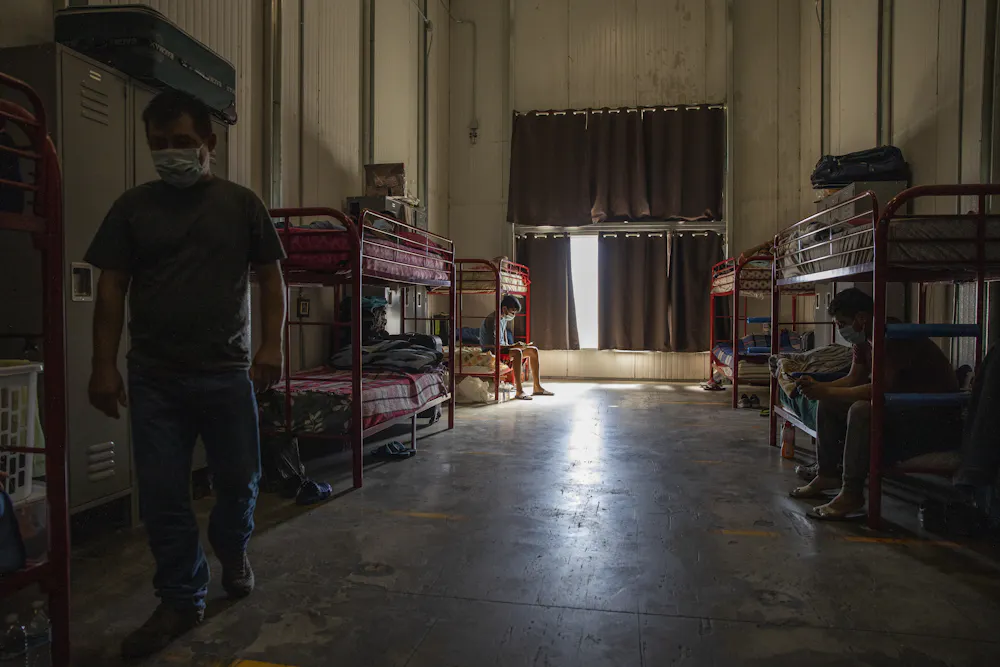
    Farmworkers with H-2A visas spend time in their employer-provided dormitory on April 28, 2020, in King City, Calif.
    Brent Stirton/Getty Images

    Established in 1952, numbers now rising quickly

    The guest worker system, established in 1952 and revised significantly in 1986, has become a mainstay of U.S. agriculture because it offers important benefits to both the farm owners who need workers and the foreign workers they hire.

    There is no cap on the number of potential workers. The number of H-2A visas issued is based only on how many employers request them. Farm owners may apply for visas after verifying that they are unable to locate enough workers who are U.S. citizens or present in the U.S. with authorization.

    To protect U.S. workers, the government mandates that H-2A workers earn an “adverse effect wage rate.” The Labor Department sets that hourly wage, which ranges from $10.36 in Puerto Rico to about $15 in several southern states, to more than $20 in California, Alaska and Hawaii. These wages are set at relatively high levels to avoid putting downward pressure on what other U.S. workers are paid for the same jobs.

    After certification, farm owners recruit workers in a foreign country who are offered a contract that includes transportation from their home country and a trip back – assuming they complete the contract.

    The program provides farm owners with a short-term labor force. It guarantees the foreign workers who obtain H-2A visas relatively high wages, as well as housing in the U.S. That combination has proven increasingly popular in recent years: The annual number of H-2A visas rose to 310,700 in 2023, a more than fivefold increase since 2010.

    Possible downsides

    Boosting the number of agricultural guest workers would help fill some gaps in the agricultural labor force and reduce the risk of crops going unharvested. But it seems clear to me that a sudden change would pose risks for workers and farm owners alike.

    Workers would be at risk because oversight of the H-2A program has historically been weak. Despite that lax track record, some unscrupulous farmers have been fined or barred from participating in the H-2A program because of unpaid wages and other abuses.

    Relying even more on guest farmworkers than the U.S. does today would also swap workers who have built lives and families north of the border with people who are in the U.S. on a temporary basis. Immigration opponents are unlikely to object to this trade-off, but to immigrant rights groups, this arrangement would be cruel and unfair to workers with years of service behind them.

    What’s more, the workers with guest visas can be at risk of exploitation and abuse. In 2022, the U.S. attorney for the Southern District of Georgia described conditions for H-2A workers at an onion farm the government had investigated as “modern-day slavery.”

    The U.S. Government Accountability Office has researched the H-2A visa program and observed many problems it recommends be fixed.

    For farm owners, the downside of ramping up guest worker programs is that it could increase costs and make production less efficient and more costly. That’s because transporting Mexican farmworkers back and forth each year is complicated and expensive. Farm groups say that compliance with H-2A visa requirements is cumbersome. It can be particularly difficult for small farms to participate in this program.

    Some farm owners have objected to the costs of employing H-2A workers. Rollins has said that the Trump administration believes that the mandatory wages are too high.

    To be sure, these problems aren’t limited to agriculture. Hotels, restaurants and other hospitality businesses, which rely heavily on undocumented workers, can also temporarily employ some foreigners through the H-2B visa program – which is smaller than the H-2A program, limits the number of visas issued and is available only for jobs considered seasonal.

    Home health care providers and many other kinds of employers who rely on people who can’t legally work for them could also struggle. But so far, there is no temporary visa program available to help them fill those gaps.

    If the U.S. does deport millions of workers, the price of tomatoes, elder care, restaurant meals and roof repairs would probably rise substantially. A vast increase in the number of guest workers is a potential but partial solution, but it would multiply problems that are inherent in these temporary visa programs.

    Scott Morgenstern does not work for, consult, own shares in or receive funding from any company or organization that would benefit from this article, and has disclosed no relevant affiliations beyond their academic appointment.

    ref. Trump’s push for more deportations could boost demand for foreign farmworkers with ‘guest worker’ visas – https://theconversation.com/trumps-push-for-more-deportations-could-boost-demand-for-foreign-farmworkers-with-guest-worker-visas-259868

    MIL OSI

  • MIL-OSI Asia-Pac: Students win physics, maths medals

    Source: Hong Kong Information Services

    Two teams of Hong Kong students achieved outstanding results in the 55th International Physics Olympiad (IPhO 2025) and the 66th International Mathematical Olympiad (IMO 2025) by winning six gold medals, four silver and one bronze.


    The IPhO 2025, hosted by France, was held from July 18 to 24, with 415 students from 89 countries or regions taking part.


    The four gold medallists were Bill Fu from Inno Secondary School (Kowloon Tong), Edison Fu from Queen’s College, Lincoln Liu from Sha Tin College and Qiao Lok-hei from St Paul’s Co-educational College, while Garfield Leung from Evangel College took home silver.


    Meanwhile, the IMO 2025 was held in Australia from July 10 to 20. Among the 630 participating students from 110 countries or regions, the Hong Kong team won two gold medals, three silver medals and one bronze medal.


    Kwan Yung-ho from Diocesan Boys’ School and Lincoln Liu from Sha Tin College clinched the gold medal.


    The silver medal went to Chan Kwan-yu and Sze Long from St Paul’s Co-educational College and Jerry Xu from Victoria Shanghai Academy, while Chong Tsz-sing from Diocesan Boys’ School bagged a bronze medal.


    Secretary for Education Choi Yuk-lin congratulated the Hong Kong teams on their outstanding performance.


    Ms Choi said: “The impressive results achieved by the Hong Kong teams bear testament to the concerted efforts of the Government and various stakeholders in promoting STEAM (science, technology, engineering, the arts, and mathematics) and gifted education.”


    The Education Bureau will continue to strengthen the promotion of STEAM and gifted education in primary and secondary schools, and encourage the effective use of the school-based student talent pool to identify and nurture more students with talent, she added.

    MIL OSI Asia Pacific News

  • MIL-OSI Africa: Eswatini: Amnesty International designates arbitrarily detained Members of Parliament (MPs) as prisoners of conscience

    Source: APO – Report:

    .

    Four years since they were imprisoned solely for peacefully exercising their rights to freedom of expression, association, and political participation, Amnesty International today designated Eswatini Members of Parliament Bacede Mabuza and Mthandeni Dube, as prisoners of conscience.

    “The imprisonment of MPs simply for speaking out is a red line that must never be crossed. Authorities must quash their convictions and sentences and immediately and unconditionally release them. Authorities must repeal or amend legislation that criminalizes human rights and political activism and bring any such legislation in line with international human rights standards.”

    “By designating Bacede Mabuza and Mthandeni Dube as prisoners of conscience, Amnesty International affirms that they should never have been arrested in the first place,” said Tigere Chagutah, Amnesty International’s Regional Director for East and Southern Africa. “Their continued arbitrary detention shows Eswatini’s deepening climate of repression and misuse of the justice system to punish those who dare criticise the government.”

    “Amnesty International has repeatedly raised concerns over the Eswatini authorities’ increasing intolerance of peaceful dissent, including the arbitrary detention, harassment, and prosecution of activists, opposition leaders, and pro-democracy campaigners.

    Background

    Bacede Mabuza and Mthandeni Dube were arrested on 25 July 2021 following their vocal support for legal reforms and calls for constitutional change in Eswatini. They were convicted of trumped-up charges, including those under the Suppression of Terrorism Act of 2008 and the Sedition and Subversive Activities Act of 1938 – laws that have been widely criticised for their vague definitions and chilling effect on human rights including the right to freedom of expression.

    On 31 July 2024, the High Court of Eswatini sentenced Mabuza and Dube to 85- and 58-year jail terms, respectively.

    Amnesty International’s designation of “prisoner of conscience” applies to individuals who are imprisoned or otherwise physically restricted because of their political, religious or other conscientiously held beliefs, ethnic origin, sex, colour, language, national or social origin, economic status, birth, sexual orientation, or other status – provided they have neither used nor advocated violence.

    – on behalf of Amnesty International.

    MIL OSI Africa

  • MIL-OSI Russia: Launch from Vostochny: Russian scientists receive a new tool for studying the ionosphere

    Translation. Region: Russian Federal

    Source: Peter the Great St. Petersburg Polytechnic University –

    An important disclaimer is at the bottom of this article.

    On July 25, at 08:54 Moscow time, the Soyuz-2.1b launch vehicle with the Fregat upper stage was launched from the Vostochny Cosmodrome, which delivered two heliogeophysical spacecraft Ionosfera-M No. 3 and No. 4, as well as a group of 18 small space satellites, to their calculated orbits.

    The launch of the Ionosfera-M series satellites completed the formation of a group of four devices of the Ionozond space complex, which will monitor the geophysical environment to conduct fundamental scientific research and solve applied problems.

    The complex was created in the interests of the Russian Academy of Sciences and the Federal Service of Russia for Hydrometeorology and Environmental Monitoring. The Ionosfera-M satellites are designed for a comprehensive study of the upper layers of the Earth’s atmosphere. They will observe various physical processes in the ionosphere, including natural and man-made impacts, changes in electromagnetic fields, atmospheric composition, and ozone distribution. The data obtained will be used by Roshydromet in combination with ground-based observations. The Russian Academy of Sciences plans to conduct ground-space experiments to study the ionosphere’s response to natural phenomena such as hurricanes and volcanic eruptions.

    Also, 18 small satellites have been launched into orbit. Nine of them were created by Geoscan and will be engaged in photographing the Earth, tracking the movement of ships and aircraft, exploring near space and much more. Some of the devices are intended for educational purposes.

    Ivan Bortnik, Advisor to the General Director of the Foundation for Assistance to Innovations, highly appreciated the significance of today’s launch: “This is a great achievement for Roscosmos – the completion of the formation of the Ionosfera-M satellite group for research by our scientists, representatives of fundamental science. Also in this launch are many devices from private satellite-building companies. One of the devices from the Geoscan company is included inSpace Pi project, this is important for the Innovation Promotion Fund and for the Polytechnic University as the founder and leader of the project. This is the first of a series of satellites with which schoolchildren will be able to hunt for supernovae. We, as the Innovation Promotion Fund, held a competition and determined the winners who will begin to manufacture such devices; I hope that they will fly next year.”

    According to Ivan Bortnik, the nanosatellite “239Alferov” of the Presidential Physics and Mathematics Lyceum No. 239 and the Lyceum “Physics and Technology School named after Zh. I. Alferov” will open a new direction of the Space Pi project – the launch of target devices. This is the first of a series of satellites equipped with X-ray sensors that will hunt for supernovae. This will be possible thanks to the network of ground stations created by the company “Geoscan”, covering almost the entire territory of Russia.

    Please note: This information is raw content obtained directly from the source of the information. It is an accurate report of what the source claims and does not necessarily reflect the position of MIL-OSI or its clients.

    .
    MIL OSI Russia News

  • MIL-OSI USA: California advances Bay-Delta Plan Update to restore ecosystem health and improve water supply reliability

    Source: US State of California 2

    Jul 24, 2025

    Governor Newsom praises the State Water Board for incorporating the Healthy Rivers and Landscapes Program into the Bay-Delta Plan

    What you need to know: The Newsom Administration’s innovative Healthy Rivers and Landscapes Program, which improves environmental conditions and provides more water supply certainty for California’s communities, farms, and businesses, is moving forward for consideration in the Bay-Delta Plan. This comes alongside a recent legislative proposal to streamline the adoption of water quality plans through new CEQA exemptions.

    SACRAMENTO – Today, the State Water Resources Control Board (State Water Board) proposed an update to its Bay-Delta Water Quality Control Plan that will help protect the Sacramento River, the Delta and associated tributaries (Sacramento/Delta) for generations to come and safeguard water supplies for millions of Californians. The new plan update will help maintain a strong balance between protecting precious ecosystems and ensuring the state can meet the needs of Californians. If adopted, the plan will update environmental science, restore tens of thousands of acres of habitat, and incorporate a groundbreaking program developed by the Newsom administration, creating voluntary agreements with water users, including municipal water agencies, agriculture, and other water rights holders. Advancing California’s Abundance Agenda, the Governor is also introducing a legislative proposal through a separate trailer bill to create new CEQA exemptions for water quality plans. 

    “I am proud to see the Healthy Rivers and Landscapes Program represented in this plan update — it’s a testament to California’s commitment to a collaborative, science-driven approach to managing our water for the benefit of our communities, economy, and fish and wildlife. However, our work is not yet done — I have proposed legislation to create a CEQA exemption for all Water Quality Control Plans that would accelerate the time it takes to get these critical plans done by removing unnecessary and redundant process requirements. We’re done with barriers and obstacles to our state’s success. We must work together to protect our natural resources for the benefit of the habitats and people of our state.”

    Governor Gavin Newsom

    The Newsom Administration, along with state, federal, and local leaders, developed the Healthy Rivers and Landscapes (HRL) Program as an innovative alternate approach to traditional regulatory requirements to improve environmental conditions while providing more water supply certainty to communities, farms, and businesses throughout California. Now, the program has advanced to the State Water Board for consideration as an implementation pathway in the Bay-Delta Plan.

    “The State Water Board’s draft plan update marks a crucial step toward safeguarding the Bay Delta’s water quality,” said California Environmental Protection Agency Secretary Yana Garcia. “By embracing collaborative, science-driven solutions, the board is actively ensuring a more sustainable water future for communities, ecosystems, and generations to come.” 

    The Bay-Delta Plan update now includes two regulatory pathways for water users:

    • A comprehensive Healthy Rivers and Landscapes Program, which would produce ecosystem benefits through a combination of flow and habitat projects.
    • A flow-only approach for those who are not parties to the HRL program. 

    Following a public comment period, the plan will advance before the State Water Board for final consideration.  The plan, developed with extensive public input, including public water agencies, environmental nonprofits, tribal partners, and local governments, is a win for all Californians.

    Streamlining Government to Work Better 

    The Bay-Delta Plan for the Sacramento/Delta has not been meaningfully updated since 1995. Continuing to operate under a plan that does not reflect the most current science, a growing population, or a changing climate is a disservice to California’s communities and ecosystems. In 2022, Governor Newsom brought together local, state, and federal partners to submit an actionable framework for the Voluntary Agreements, later named the Healthy Rivers and Landscapes Program, to the State Water Board.

    If adopted by the State Water Board, the HRL program would dedicate a large quantity of water to the environment and restore more than 45,000 acres of aquatic habitat for fish and other animals. In addition, Governor Newsom secured funding commitments totalling $2.9 billion to implement the HRL program over the next 8 years.

    “This program will improve the health of our rivers by both restoring river flows and revitalizing habitat,” said California Natural Resources Secretary Wade Crowfoot. “After all, fish and wildlife need both to thrive. It also improves coordination and collaboration among public agencies charged with improving river conditions and will enable real-time, science-based decision making that we desperately need to better manage our river systems.”

    “The Healthy Rivers and Landscapes Program will allow for a more collaborative and scientifically sound way to balance conflicting demands for water in an extremely complex watershed. We’re grateful to the State Water Board for embracing this approach as a potential pathway within their regulatory framework,” said California Department of Water Resources Director Karla Nemeth. “Working together, we will find new solutions to the old problem of balancing the needs of ecosystems and economies.”

    “The inclusion of voluntary agreements in the development of this plan will be a big win for California, and will help provide more opportunities for our partners across the state to support California’s irreplaceable fish populations and habitats,” said California Department Fish and Wildlife Director Charlton H. Bonham. “By focusing on the science of restoration, and prioritizing additional flows to support healthy habitats, we can ensure the best possible outcomes for California’s precious natural resources, now and in years to come.”

    Furthering the administration’s agenda to reduce barriers to progress and move projects that Californians need forward, Governor Newsom has also introduced trailer bill language to streamline the adoption of water quality control plans and create new exemptions for water projects under the California Environmental Quality Act (CEQA). This would expedite the potential adoption of the Bay-Delta Plan and the ecosystem benefits it would provide, while still allowing for vital public process and input.

    More information about the proposed Bay-Delta Plan update is available on the State Water Board’s website

    Press releases, Recent news

    Recent news

    News Sacramento, California – Governor Gavin Newsom issued the following statement today on a three-judge panel of the U.S. Court of Appeals for the Ninth Circuit striking down California’s ammunition background check law, which was passed by voters in 2016: Strong…

    News What you need to know: Through Governor Newsom’s support of local government efforts and state investments, California is reversing decades of inaction on homelessness. Last year’s 2024 point-in-time count showed California had outperformed the nation by slowing…

    News SACRAMENTO – Governor Gavin Newsom today approved the predeployment of firefighting resources in Nevada, Sierra, and Plumas counties in response to critical fire weather conditions forecasted to impact Northern California starting Wednesday, July 23, through…

    MIL OSI USA News

  • MIL-OSI NGOs: Eswatini: Amnesty International designates arbitrarily detained MPs as prisoners of conscience

    Source: Amnesty International –

    Four years since they were imprisoned solely for peacefully exercising their rights to freedom of expression, association, and political participation, Amnesty International today designated Eswatini Members of Parliament Bacede Mabuza and Mthandeni Dube, as prisoners of conscience.

    By designating Bacede Mabuza and Mthandeni Dube as prisoners of conscience, Amnesty International affirms that they should never have been arrested in the first place.

    Tigere Chagutah, Amnesty International’s Regional Director for East and Southern Africa.

    “The imprisonment of MPs simply for speaking out is a red line that must never be crossed. Authorities must quash their convictions and sentences and immediately and unconditionally release them. Authorities must repeal or amend legislation that criminalizes human rights and political activism and bring any such legislation in line with international human rights standards.”

    Their continued arbitrary detention shows Eswatini’s deepening climate of repression and misuse of the justice system to punish those who dare criticize the government.

    Tigere Chagutah

    “By designating Bacede Mabuza and Mthandeni Dube as prisoners of conscience, Amnesty International affirms that they should never have been arrested in the first place,” said Tigere Chagutah, Amnesty International’s Regional Director for East and Southern Africa. “Their continued arbitrary detention shows Eswatini’s deepening climate of repression and misuse of the justice system to punish those who dare criticise the government.”

    “Amnesty International has repeatedly raised concerns over the Eswatini authorities’ increasing intolerance of peaceful dissent, including the arbitrary detention, harassment, and prosecution of activists, opposition leaders, and pro-democracy campaigners.

    Background

    Bacede Mabuza and Mthandeni Dube were arrested on 25 July 2021 following their vocal support for legal reforms and calls for constitutional change in Eswatini. They were convicted of trumped-up charges, including those under the Suppression of Terrorism Act of 2008 and the Sedition and Subversive Activities Act of 1938 – laws that have been widely criticised for their vague definitions and chilling effect on human rights including the right to freedom of expression.

    On 31 July 2024, the High Court of Eswatini sentenced Mabuza and Dube to 85- and 58-year jail terms, respectively.

    Amnesty International’s designation of “prisoner of conscience” applies to individuals who are imprisoned or otherwise physically restricted because of their political, religious or other conscientiously held beliefs, ethnic origin, sex, colour, language, national or social origin, economic status, birth, sexual orientation, or other status – provided they have neither used nor advocated violence.

    MIL OSI NGO

  • MIL-OSI NGOs: Preparing Tomorrow’s Radiation Protection Professionals

    Source: International Atomic Energy Agency (IAEA) –

    As of 2025, the IAEA has trained close to 2,500 professionals from 137 countries through the PGEC. (Photo: L. Grindrod/IAEA)

    Dozens of participants have completed the latest IAEA post-graduate courses in radiation protection, enabling them to help safely expand the use of nuclear science and technology in 31 participating countries.

    The latest participants completed intensive, six-month Postgraduate Educational Courses in Radiation Protection and the Safety of Radiation Sources (PGEC) in either Greece or Ghana, designed to prepare them for work as radiation protection experts, regulators and nuclear safety professionals.

    “For close to 45 years, PGEC has continuously trained new generations of experts in Europe and Central Asia for work in the field of radiation protection,” explained Emina Alic, IAEA Programme Management Officer. “Today, former PGEC graduates are helping to shape the future of their country’s engagement with nuclear applications as national operators, regulators and policymakers.”

    “With the increased use of radiation sources in Africa, radiation safety has become one of the main priority areas of the IAEA’s regional technical cooperation programme for Africa,” explained IAEA Programme Management Officer Felix Omonya. “The IAEA has provided substantial support in the form of equipment and expert guidance, but in terms of training, the PGEC represents a cornerstone of our capacity building efforts.”

    Radioactive sources are manufactured in research reactors. As they decay through their lifetime, the radiation they emit can be used to diagnose or treat cancers, measure pollution or monitor industrial processes. When they reach the end of their life, the radioactive sources are interred safely in waste storage or disposal facilities. X ray machines on the other hand, generate radiation on demand, offering a predictable and reliable source of radiation that can be made safe as soon as its work is done.  

    The use of these radiation sources and technologies requires a comprehensive framework of national legislation and regulations and relies on the availability of sufficiently trained and motivated safety professionals. The IAEA’s PGEC responds to this need by helping to develop a cohort of radiation protection professionals through a combination of theoretical, classroom instruction and hands-on training.

    “While some regulatory frameworks are in place in my country, there is still a pressing need to update existing regulations in line with international standards,” explained Blinda Mutuzo of the Rwanda Atomic Energy Board. “The PGEC covered many of the areas where we most need support and offered practical knowledge on regulatory frameworks, authorization and inspection processes, source management and more.”

    “The course helped me grow professionally by expanding my knowledge and confidence in radiation protection. It also allowed me to connect with experts and peers from other countries. These connections may lead to future collaborations in training, technical assistance or policy development,” said Mutuzo.

    “Emergency preparedness and the improvement of the established early warning system are among Lithuania’s priorities at the moment,” said Kornelija Dacytė, Chief Specialist of Lithuania’s Radiation Protection Centre. “Not only did PGEC respond to these national needs, I am now hoping to adjust my career trajectory to focus more on emergency preparedness and I hope to support decision-making through atmospheric dispersion modelling.” The IAEA supports countries to use atmospheric dispersion modelling to simulate the spread of air pollutants, including radioactive substances.

    MIL OSI NGO

  • MIL-OSI Europe: Anne-Solenne de Roux Appointed Vice President for Academic Affairs

    Source: Universities – Science Po in English

    Students in front of the entrance at 1 St-Thomas (credits: Pierre Morel)

    Virtual Undergraduate Open House day 2025

    Come meet our teams and students at our campuses.

    Sign-up

    Virtual Graduate Open House day 2025

    Meet faculty members, students and representatives and learn more about our 30 Master’s programmes.

    Sign-up

    MIL OSI Europe News

  • MIL-OSI Security: Preparing Tomorrow’s Radiation Protection Professionals

    Source: International Atomic Energy Agency – IAEA

    As of 2025, the IAEA has trained close to 2,500 professionals from 137 countries through the PGEC. (Photo: L. Grindrod/IAEA)

    Dozens of participants have completed the latest IAEA post-graduate courses in radiation protection, enabling them to help safely expand the use of nuclear science and technology in 31 participating countries.

    The latest participants completed intensive, six-month Postgraduate Educational Courses in Radiation Protection and the Safety of Radiation Sources (PGEC) in either Greece or Ghana, designed to prepare them for work as radiation protection experts, regulators and nuclear safety professionals.

    “For close to 45 years, PGEC has continuously trained new generations of experts in Europe and Central Asia for work in the field of radiation protection,” explained Emina Alic, IAEA Programme Management Officer. “Today, former PGEC graduates are helping to shape the future of their country’s engagement with nuclear applications as national operators, regulators and policymakers.”

    “With the increased use of radiation sources in Africa, radiation safety has become one of the main priority areas of the IAEA’s regional technical cooperation programme for Africa,” explained IAEA Programme Management Officer Felix Omonya. “The IAEA has provided substantial support in the form of equipment and expert guidance, but in terms of training, the PGEC represents a cornerstone of our capacity building efforts.”

    Radioactive sources are manufactured in research reactors. As they decay through their lifetime, the radiation they emit can be used to diagnose or treat cancers, measure pollution or monitor industrial processes. When they reach the end of their life, the radioactive sources are interred safely in waste storage or disposal facilities. X ray machines on the other hand, generate radiation on demand, offering a predictable and reliable source of radiation that can be made safe as soon as its work is done.  

    The use of these radiation sources and technologies requires a comprehensive framework of national legislation and regulations and relies on the availability of sufficiently trained and motivated safety professionals. The IAEA’s PGEC responds to this need by helping to develop a cohort of radiation protection professionals through a combination of theoretical, classroom instruction and hands-on training.

    “While some regulatory frameworks are in place in my country, there is still a pressing need to update existing regulations in line with international standards,” explained Blinda Mutuzo of the Rwanda Atomic Energy Board. “The PGEC covered many of the areas where we most need support and offered practical knowledge on regulatory frameworks, authorization and inspection processes, source management and more.”

    “The course helped me grow professionally by expanding my knowledge and confidence in radiation protection. It also allowed me to connect with experts and peers from other countries. These connections may lead to future collaborations in training, technical assistance or policy development,” said Mutuzo.

    “Emergency preparedness and the improvement of the established early warning system are among Lithuania’s priorities at the moment,” said Kornelija Dacytė, Chief Specialist of Lithuania’s Radiation Protection Centre. “Not only did PGEC respond to these national needs, I am now hoping to adjust my career trajectory to focus more on emergency preparedness and I hope to support decision-making through atmospheric dispersion modelling.” The IAEA supports countries to use atmospheric dispersion modelling to simulate the spread of air pollutants, including radioactive substances.

    MIL Security OSI

  • MIL-OSI United Nations: Preparing Tomorrow’s Radiation Protection Professionals

    Source: International Atomic Energy Agency (IAEA)

    Dozens of participants have completed the latest IAEA post-graduate courses in radiation protection, enabling them to help safely expand the use of nuclear science and technology in 31 participating countries.

    The latest participants completed intensive, six-month Postgraduate Educational Courses in Radiation Protection and the Safety of Radiation Sources (PGEC) in either Greece or Ghana, designed to prepare them for work as radiation protection experts, regulators and nuclear safety professionals.

    “For close to 45 years, PGEC has continuously trained new generations of experts in Europe and Central Asia for work in the field of radiation protection,” explained Emina Alic, IAEA Programme Management Officer. “Today, former PGEC graduates are helping to shape the future of their country’s engagement with nuclear applications as national operators, regulators and policymakers.”

    “With the increased use of radiation sources in Africa, radiation safety has become one of the main priority areas of the IAEA’s regional technical cooperation programme for Africa,” explained IAEA Programme Management Officer Felix Omonya. “The IAEA has provided substantial support in the form of equipment and expert guidance, but in terms of training, the PGEC represents a cornerstone of our capacity building efforts.”

    Radioactive sources are manufactured in research reactors. As they decay through their lifetime, the radiation they emit can be used to diagnose or treat cancers, measure pollution or monitor industrial processes. When they reach the end of their life, the radioactive sources are interred safely in waste storage or disposal facilities. X ray machines on the other hand, generate radiation on demand, offering a predictable and reliable source of radiation that can be made safe as soon as its work is done.  

    The use of these radiation sources and technologies requires a comprehensive framework of national legislation and regulations and relies on the availability of sufficiently trained and motivated safety professionals. The IAEA’s PGEC responds to this need by helping to develop a cohort of radiation protection professionals through a combination of theoretical, classroom instruction and hands-on training.

    “While some regulatory frameworks are in place in my country, there is still a pressing need to update existing regulations in line with international standards,” explained Blinda Mutuzo of the Rwanda Atomic Energy Board. “The PGEC covered many of the areas where we most need support and offered practical knowledge on regulatory frameworks, authorization and inspection processes, source management and more.”

    “The course helped me grow professionally by expanding my knowledge and confidence in radiation protection. It also allowed me to connect with experts and peers from other countries. These connections may lead to future collaborations in training, technical assistance or policy development,” said Mutuzo.

    “Emergency preparedness and the improvement of the established early warning system are among Lithuania’s priorities at the moment,” said Kornelija Dacytė, Chief Specialist of Lithuania’s Radiation Protection Centre. “Not only did PGEC respond to these national needs, I am now hoping to adjust my career trajectory to focus more on emergency preparedness and I hope to support decision-making through atmospheric dispersion modelling.” The IAEA supports countries to use atmospheric dispersion modelling to simulate the spread of air pollutants, including radioactive substances.

    MIL OSI United Nations News

  • MIL-OSI Analysis: Beijing’s ‘plausible deniability’ on arms supply is quickly becoming implausible – and could soon extend to Iran

    Source: The Conversation – Global Perspectives – By Linggong Kong, Ph.D. Candidate in Political Science, Auburn University

    Could longtime allies have a closer relationship than meets the eye? Thomas Peter/Pool Photo via AP

    China has long maintained that it does not supply arms to any party at war – a central tenet of its “noninterference” foreign policy. But in recent years, Beijing has repeatedly faced accusations of doing the opposite: providing direct military assistance to nations engaged in conflict, while publicly denying doing so and even adopting a position of diplomatic neutrality.

    That has seemingly been the case for two of China’s closest allies: Russia in its war against Ukraine and Pakistan during its recent armed standoff with India in May.

    Now, Beijing is facing scrutiny over alleged military links to Iran – a country engaged in a long-running shadow conflict with Israel that recently tipped into a short-lived hot war.

    After the ceasefire that followed the 12-day war in the Middle East, China reportedly supplied batteries for surface-to-air missiles to Iran in exchange for oil. Such parts are a critical military need for Tehran after its air defense network was severely damaged by Israeli missiles.

    The Chinese Embassy in Israel denied the reports, stating that China firmly opposes the proliferation of weapons of mass destruction and does not export arms to countries at war. But China’s Ministry of Foreign Affairs has yet to issue an official statement on the alleged transfer.

    As an expert specializing in China’s grand strategy, I think it is highly possible that China would offer Iran military support while denying it publicly. Such plausible deniability would allow Beijing to assert military influence and showcase some of its hardware, while deflecting international criticism and preserving diplomatic flexibility.

    But the tactic works only so far. As indirect evidence accumulates, as many suggest it is, such covert action may gradually develop into an open secret – leading to what scholars term “implausible deniability,” where denial is no longer credible even if it is still officially maintained.

    An air-to-air missile on display at the 15th China International Aviation and Aerospace Exhibition in November 2024.
    Shen Ling/VCG via Getty Images

    China’s support for Russia’s war

    Although Beijing has consistently said it is neutral in the Russia-Ukraine war that broke out in 2022, China has, in practice, quietly supported Russia. In part, that is because China shares the same strategic goal of challenging the Western-led international order.

    Recently, Chinese Foreign Minister Wang Yi reportedly told European Union foreign policy chief Kaja Kallas that Beijing cannot afford to see Russia lose the war in Ukraine. He was said to have warned that a Russian defeat would likely bring the full force of U.S. strategic pressure to bear on China.

    From Beijing’s perspective, Moscow plays a vital role in keeping the West preoccupied, offering China valuable strategic breathing room by diverting American attention and resources away from the Asia-Pacific region.

    Beyond deepening trade relations that have become a lifeline for Moscow’s economy under Western sanctions, China has reportedly supplied Russia with large quantities of dual-use goods – goods that can be used for civilian and military purposes – to enhance both Moscow’s offensive and defensive capabilities, as well as to boost China’s military-industrial production. Beijing has also allegedly provided satellite imagery to assist Russia on the battlefield.

    While the U.S. and Europe have repeatedly tried to call out China for aiding Russia militarily, Beijing has consistently denied such claims.

    Most recently, on April 18, 2025, Ukraine formally accused China of directly supporting Russia and slapped sanctions on three Chinese-based firms that Kyiv said was involved in weapons production for the Russian war effort.

    In what has become a common refrain, China’s Foreign Ministry rejected the Ukrainian accusation, reaffirming that China has never provided lethal weapons to any party in the conflict and reiterating its official stance of promoting a ceasefire and peace negotiations.

    A Chinese Foreign Ministry spokesperson gestures for questions during a daily briefing in Beijing in 2020.
    AP Photo/Ng Han Guan

    China’s quiet backing of Pakistan

    Beijing has long presented itself as a neutral party in the India-Pakistan conflict, too, and has called for restraint on both sides and urged peaceful dialogue.

    But in practice, China is allied with Pakistan. And the direct military support it has provided to Lahore appears driven by China’s desire to curb India’s regional influence, counterbalance the growing U.S.–India strategic partnership and protect the China–Pakistan Economic Corridor, a massive bilateral infrastructure project.

    In the latest flare-up between India and Pakistan in May, Pakistan deployed Chinese-made J-10C fighter jets in combat for the first time, reportedly downing five Indian aircraft.

    Pakistan’s air defense relied heavily on Chinese equipment during the short conflict, deploying Chinese-made surface-to-air missile systems, air-to-air missiles, advanced radar systems and drones for reconnaissance and strike operations. Overall, more than 80% of Pakistan’s military imports have come from China in the past five years.

    In what would be a far more stark example of military support if proven true, the deputy chief of India’s army alleged that China had provided Pakistan with real-time intelligence on Indian troop movements during the conflict.

    When asked to respond, a spokesperson for China’s Ministry of Foreign Affairs said they had no knowledge of the matter. They reaffirmed that China’s ties with Pakistan are not directed against any third party and reiterated Beijing’s long-standing position in favor of a peaceful resolution to any India–Pakistan dispute.

    Extending ‘deniability’ to Iran?

    Like with Russia and Pakistan, Iran has increasingly been seen as a partner to China.

    In 2021, China and Iran signed a 25-year, US$400 billion comprehensive cooperation agreement that covered trade, energy and security, signaling the depth of their strategic relationship.

    The accord was indicative of the strategic value Beijing places on Iran. From Beijing’s perspective, Tehran presents a counterbalance to the influence of the U.S. and its allies – especially Israel and Saudi Arabia – in the region and helps divert Western resources and attention away from China.

    But recently, Tehran’s position in the region has become far weaker. Not only has its air defense infrastructure suffered badly in the confrontations with Israel, but its regional proxies and allies – Hamas, Hezbollah and the Assad regime in Syria – have either been devastated by Israel or collapsed altogether.

    Smoke rises over Tehran, Iran, following an Israeli strike on June 23, 2025.
    Nikan/Middle East Images/AFP via Getty Images

    Under these circumstances, it is strategically compelling for Beijing to provide support to Tehran in order to maintain regime stability.

    Indeed, Beijing has frequently circumvented sanctions on Iranian energy, with an estimated 90% of Iran’s oil exports still going to China.

    Although Beijing did not extend any substantive support to Iran during the 12-day war, reports have abounded since that Iran is looking to China as an alternative supplier of its defense needs. The thinking here is that Russia, Tehran’s traditional military partner, is no longer able to provide sufficient, quality defense equipment to Iran. Some influential social media posters in China have gone as far as advocating for direct military sales by Beijing.

    If China does do this, I believe it is likely to follow the same playbook it has used elsewhere by denying involvement publicly while covertly providing assistance.

    Doing so allows China to maintain diplomatic ties with Iran’s regional rivals, such as Israel and Saudi Arabia, while simultaneously benefiting from a turbulent Middle East that distracts Washington and grants Beijing strategic breathing room.

    China’s use of plausible deniability reflects a broader strategic ambition. Namely, it wants to assert influence in key regional conflicts without triggering open backlash. By quietly supporting partners while maintaining a facade of neutrality, Beijing aims to undermine Western dominance, stretch U.S. strategic focus and secure its own interests – and all while avoiding the risks and responsibilities of open military alignment.

    Linggong Kong does not work for, consult, own shares in or receive funding from any company or organization that would benefit from this article, and has disclosed no relevant affiliations beyond their academic appointment.

    ref. Beijing’s ‘plausible deniability’ on arms supply is quickly becoming implausible – and could soon extend to Iran – https://theconversation.com/beijings-plausible-deniability-on-arms-supply-is-quickly-becoming-implausible-and-could-soon-extend-to-iran-261148

    MIL OSI Analysis

  • MIL-OSI Asia-Pac: Eighth Joint Conference on Advancing Hong Kong’s Full Participation in and Contribution to Belt and Road Initiative held in Beijing (with photos)

    Source: Hong Kong Government special administrative region – 4

         The Government of the Hong Kong Special Administrative Region (HKSAR), the National Development and Reform Commission (NDRC) and relevant central ministries held the eighth Joint Conference on Advancing Hong Kong’s Full Participation in and Contribution to the Belt and Road Initiative (B&RI) in Beijing today (July 25).
     
         Vice Chairman of the NDRC Mr Zhou Haibing attended the conference with Mainland officials led by him, including representatives from the NDRC, the Hong Kong and Macao Work Office of the Communist Party of China Central Committee, the Hong Kong and Macao Affairs Office of the State Council, the Supreme People’s Court, the Ministry of Foreign Affairs, the Ministry of Science and Technology, the Ministry of Justice, the Ministry of Commerce, the Ministry of Transport, the People’s Bank of China, the State-owned Assets Supervision and Administration Commission of the State Council, the National Financial Regulatory Administration, and the Liaison Office of the Central People’s Government in the HKSAR.
     
         The Secretary for Justice, Mr Paul Lam, SC, in his capacity as chairperson of the Working Group on Belt and Road (B&R) Development under the Steering Group on Integration into National Development, led HKSAR Government officials to attend the conference. They included the Secretary for Commerce and Economic Development, Mr Algernon Yau, who was also the Hong Kong-side Convenor of the Joint Conference, and representatives from the Commerce and Economic Development Bureau (CEDB), the Department of Justice, the Financial Services and the Treasury Bureau, the Innovation, Technology and Industry Bureau, the Development Bureau, the Environment and Ecology Bureau, the Belt and Road Office of the CEDB, and the Office of the Government of the HKSAR in Beijing. The Chairman of the Hong Kong Trade Development Council, Professor Frederick Ma, and a representative from the Airport Authority Hong Kong also attended the meeting.
     
         Mr Lam said that the HKSAR Government has been taking forward B&R co-operation to go deeper and deliver outcomes, thereby fully participating in and contributing to the B&RI under the continued guidance of the eight major steps the country has been taking to support high-quality B&R co-operation, with a view to facilitating Hong Kong’s active integration into overall national development. With the country’s support, Hong Kong will continue to deepen international exchanges and co-operation and will actively utilise its own advantages to exert a greater role in the country’s high-level opening up to the world.
     
         He pointed out that over the past year, the HKSAR Government has actively served as a proponent for institutional openness through Hong Kong’s strengths as a platform for two-way opening up; a pioneer for co-operation in new fields through strengths in education, science and technology and talent; and a facilitator for people-to-people bonds through strengths as a melting pot of diversified cultures. The HKSAR Government has been exploring emerging markets such as the Middle East, the Association of Southeast Asian Nations and other B&R countries, while making full use of Hong Kong’s professional services aligned with international standards, thereby building Hong Kong as the gateway between the country and the world and highlighting Hong Kong’s role as the premier B&R functional platform. He expressed gratitude to the Central Government for the staunch support of hosting the International Organization for Mediation headquarters in Hong Kong, which will help strengthen Hong Kong’s roles as an international dispute resolution services centre and a capital for international mediation.
     
         Mr Yau stated in the meeting that the HKSAR Government will fully capitalise on the 10th Belt and Road Summit to showcase Hong Kong’s important roles as an active participant and the premier B&R functional platform to the Mainland and overseas. He reported on Hong Kong’s progress in carrying out B&R work, including the CEDB’s ongoing pursuit of the early accession of Hong Kong to the Regional Comprehensive Economic Partnership, the pursuit of early conclusion of ongoing negotiations for free trade and investment agreements, and actively following up on the plan to establish Economic and Trade Offices in Kuala Lumpur, Malaysia and Riyadh, Saudi Arabia, to fully take forward the economic and trade relations between Hong Kong and B&R countries.
     
         The meeting also focused its discussion on the seven work proposals on further promoting the B&RI that the HKSAR Government put forward for consideration by central ministries, covering capacity building, deepening exchanges and co-operations with B&R countries, legal and dispute resolution services, cross-boundary financing, and the expansion of international co-operation and ties in innovation and technology. Representatives of relevant Joint Conference Mainland ministries introduced their respective work in supporting Hong Kong’s participation in and contribution to the B&RI and provided feedback on the HKSAR Government’s work proposals. The HKSAR Government is grateful for the support expressed by relevant central ministries at the meeting on various work proposals and will actively follow up with them.
     
         In addition, the meeting noted the HKSAR Government’s key areas and major work in its future participation and contribution to the B&RI, including leveraging Hong Kong’s role as a B&R functional platform to explore business opportunities and facilitating business matching and participation in B&R projects. The HKSAR Government will continue to consolidate Hong Kong’s unique advantage of connecting with the Mainland and the rest of the world under “one country, two systems”, seize the enormous opportunities brought about by national development, strengthen and deepen exchanges and co-operations with B&R countries, and give full play to its role as a “super connector” and “super value-adder”.
     
         The Arrangement between the NDRC and the HKSAR Government for Advancing Hong Kong’s Full Participation in and Contribution to the B&RI, signed between the HKSAR Government and the NDRC in 2017, provides the direction and a blueprint for Hong Kong’s full participation in and contribution to the B&RI, as well as sets up the Joint Conference mechanism to discuss relevant matters, with meetings convened at least once a year.

    MIL OSI Asia Pacific News

  • MIL-OSI United Kingdom: How to support and strengthen your pelvic floor

    Source: Anglia Ruskin University

    By Holly Ingram, Anglia Ruskin University

    Did you know that around one in two women in the UK will experience symptoms of pelvic floor dysfunction at some point in their lives? And for women who engage in high-intensity exercise, that figure rises to 63%.

    The female pelvic floor is a remarkable yet often overlooked structure: a complex “hammock” of muscles and ligaments that stretches from the front of the pelvis to the tailbone.

    These muscles support the bladder, bowel and uterus, wrap around the openings of the urethra, vagina and anus, and work in sync with your diaphragm, abdominal and back muscles to maintain posture, continence and core stability. It’s not an exaggeration to say your pelvic floor is the foundation of your body’s core.

    Throughout a woman’s life, various events can challenge the pelvic floor. Pregnancy, for example, increases the weight of the uterus, placing added pressure on these muscles. The growing baby can cause the abdominal muscles to stretch and separate, naturally increasing the load on the pelvic floor. Childbirth, particularly vaginal delivery, may result in perineal trauma, directly injuring pelvic floor tissues.

    However, contrary to popular belief, pelvic floor problems aren’t only caused by pregnancy and childbirth. In fact, research shows that intense physical activity, even in women who have never been pregnant or given birth, can contribute to dysfunction.

    Exercise is essential for overall health and is often recommended to ease symptoms of menopause and menstruation. But one side effect that’s not talked about enough is the effect that repeated strain, such as heavy lifting or high impact movement, can have on the pelvic floor. The increased intra-abdominal pressure during these activities can gradually weaken the pelvic floor muscles, especially if they’re not trained to cope.

    Pelvic floor dysfunction often results when these muscles aren’t strong enough to match the workload demanded of them, whether from daily life, exercise, or other core muscles. And it’s a growing issue, affecting more women than ever before.

    Common symptoms include leaking urine or faeces when coughing, sneezing or exercising, a dragging or heavy sensation in the lower abdomen or vaginal area, painful sex, changes in bowel habits, and visible bulging in the vaginal area (a sign of prolapse). The emotional toll can also be significant, leading to embarrassment, anxiety, low confidence and a reluctance to stay active – all of which affect quality of life.

    Prevention

    The good news? Help is available and, better yet, pelvic floor dysfunction is often preventable.

    If you’re experiencing symptoms, speak to your GP. You may be referred to a women’s health physiotherapist, available through both the NHS and private services. But whether you’re managing symptoms or hoping to avoid them in the first place, there are practical steps you can take:

    Stay active and maintain a healthy weight

    Drink enough water to encourage healthy bladder function

    Go to the toilet only when your body signals the need; avoid going “just in case”

    Prevent constipation through a high-fibre diet and good bowel habits

    Don’t hold your breath when lifting or exercising

    Most importantly, build strength with regular pelvic floor exercises. Here’s how to do a basic pelvic floor contraction:

    1. Imagine you’re trying to stop yourself passing wind – squeeze and lift the muscles around your back passage.

    2. Then, imagine stopping the flow of urine mid-stream – engage those muscles too.

    3. Now, lift both sets of muscles upwards inside your body, as if pulling them into the vagina.

    4. Hold the contraction for a few seconds, then fully relax. Repeat.

    If you’re just starting, it may be easier to practise while sitting. With time and consistency, you’ll be able to hold contractions for longer and incorporate them into your daily routine, like brushing your teeth or waiting for the kettle to boil.

    Like any muscle, the pelvic floor gets stronger with training, making it more resilient to strain from childbirth, ageing, or strenuous activity. Research shows that a well-conditioned pelvic floor recovers faster from injury.

    So be proud of your pelvic floor. Support it, strengthen it – and don’t forget to do those squeezes.

    Holly Ingram, Midwifery Lecturer, Anglia Ruskin University

    This article is republished from The Conversation under a Creative Commons license. Read the original article.

    The opinions expressed in VIEWPOINT articles are those of the author(s) and do not necessarily reflect the views of ARU.

    If you wish to republish this article, please follow these guidelines: https://theconversation.com/uk/republishing-guidelines

    MIL OSI United Kingdom

  • MIL-OSI Russia: Yuri Trutnev: Volcanoes, ocean and man: Kamchatka is preparing for the exhibition “Far East Street” within the framework of the VEF

    Translation. Region: Russian Federal

    Source: Government of the Russian Federation – Government of the Russian Federation –

    An important disclaimer is at the bottom of this article.

    Kamchatka Krai will present its exposition at the exhibition “Far East Street”, which will be held from September 3 to 9 as part of the tenth, anniversary Eastern Economic Forum. The exhibition is organized by the Roscongress Foundation with the support of the Office of the Plenipotentiary Representative of the President in the Far Eastern Federal District.

    The central zone of the space – “The Will of Man” – will be dedicated to the 80th anniversary of the victory over Japan, and in particular to the legendary Kuril landing operation. It will act as an interactive museum of Kamchatka military glory, and will harmoniously weave in stories about the Great Patriotic War and the special military operation.

    “We are celebrating the 80th anniversary of the Great Victory. I believe that it is impossible not to touch upon the topic of the victory of the Soviet people in the Great Patriotic War. Kamchatka made a significant contribution to the victory. This is not only the supply of products, but also the mobilization of human resources, the heroic defense of borders and preparation for strategically important operations. It is important to always remember and honor the heroic and selfless feat of home front workers, soldiers and officers, indigenous peoples – all who gave their lives for the freedom and independence of the Motherland. It is necessary to show what heroic feats and efforts were needed to create the victory,” said Deputy Prime Minister – Presidential Plenipotentiary Envoy to the Far Eastern Federal District, Chairman of the Organizing Committee of the Eastern Economic Forum Yuri Trutnev.

    “80 years ago, ordinary residents of the Kamchatka Region played a decisive role in ending World War II by conquering, as it seemed then, the impregnable islands of the Kuril Ridge. Then 306 Kamchatka residents gave their lives in the fight against Japanese militarism. We will never forget the price of this victory. And the main task that we set for ourselves is not to allow the events of those years to be distorted: every young resident of our region and the country as a whole should know and honor the pages of history that turned the tide of the war. That is why, on the instructions of the President of the Russian Federation, an open-air museum will be opened on Shumshu Island, and young people from all over the country, including Kamchatka guys, will go on a search expedition to the places of glory of our soldiers. The play “Ballad of the Kuril Landing” will be staged in Kamchatka, which will be presented to viewers on August 18,” said Vladimir Solodov, Governor of the Kamchatka Region.

    The exhibition will introduce guests and participants of the EEF-2025 to the unique features of Kamchatka, including its natural beauty.

    “Kamchatka is a unique region, the pearl of our country. It is truly a land of fire and ice. Active volcanoes, geysers, thermal springs form a unique landscape. This is one of the most promising territories of our country for tourism development. New hotels open every year. Thanks to the implementation of the master plan, the urban environment of Petropavlovsk-Kamchatsky is gradually changing. A new modern airport welcomes guests of the peninsula,” concluded Yuri Trutnev.

    The pavilion will feature a “Traveler’s Passport” zone, designed in the style of a travel agency. At the entrance to the pavilion, visitors will receive a personal traveler’s passport with information about tours, discounts from Kamchatka operators, and gifts from restaurants and shops.

    A separate zone, “The Power of the Ocean”, will be dedicated to demonstrating the natural and economic potential of Kamchatka as a unique oceanic territory. The big screen will systematize and present such areas as marine logistics, the fishing industry, scientific ocean research, tourism, sea cruises and yachting, and Pacific cuisine.

    In the “Volcano Energy” space, visitors will be able to get acquainted with the region’s potential for implementing projects in the fields of tourism, construction, agriculture, education and science. In the “New Kamchatka Facilities in 360” zone, it will be possible to take a full 3D tour of the Kamchatka Regional Hospital, airport and greenhouse complex.

    The “Specially Protected Natural Areas” area will feature the heroes of the documentary “Fire Fox”. Visitors to the stand will also be able to familiarize themselves with information about the “Far East – Land of Adventure” competition and learn about new tourist routes in the region. In addition, the area will display images from street cameras, supplemented with elements of wild nature.

    A souvenir pavilion and a stage will be opened next to the main exposition of the Kamchatka Territory. In addition, the Falcon House will be open, where the Ministry of Natural Resources and Environment of Russia will prepare its own exposition.

    The 10th Eastern Economic Forum will be held on September 3–6 at the campus of the Far Eastern Federal University in Vladivostok. During these days, the exhibition will be available to forum participants, and on September 7, 8, and 9, it will be open to everyone. The EEF is organized by the Roscongress Foundation.

    Please note: This information is raw content obtained directly from the source of the information. It is an accurate report of what the source claims and does not necessarily reflect the position of MIL-OSI or its clients.

    .

    MIL OSI Russia News

  • MIL-OSI Asia-Pac: InvestHK visits UK to forge stronger Hong Kong-UK partnerships on sustainability and green tech innovation (with photos)

    Source: Hong Kong Government special administrative region

         ​Invest Hong Kong (InvestHK) completed a fruitful visit to the United Kingdom (UK) from July 13 to 20, championing Hong Kong as a premier international green technology hub for UK companies seeking growth and collaboration opportunities in Asia and beyond.

         During the visit, the Senior Vice President (Sustainability) for Technology, Innovation and Entrepreneurship at InvestHK, Ms Olivia To, engaged with key stakeholders in London and Cambridge to foster two-way business opportunities and deepen co-operation in sustainability and green tech innovation.

         In London, Ms To held extensive discussions with leading UK’s new energy, new materials and digital companies, as well as UK Research and Innovation, the national funding agency investing in science and research, Sustainable Ventures, a leading green tech hub and ecosystem provider, Generation Investment Management, a sustainable investment management firm, London & Partners, London’s business growth and destination agency, and London GreenCity, a clean technology entrepreneurs accelerator providing prototyping lab and collaborative community.

         In Cambridge, Ms To spoke at the event titled “Powering Tomorrow: Deep Tech Innovations for a Sustainable Energy Future”, co-organised by the University of Cambridge Institute for Sustainability Leadership and Full Vision Capital, highlighting the competitive advantages Hong Kong offers energy and technology companies to grow and thrive across the region. The conference featured dynamic keynotes on growth strategies for clean energy start-ups, panel discussions on disruptive energy innovations, and a start-up demo where over 30 start-ups showcased their cutting-edge solutions. The event culminated in the announcement of the 4th TERA-Award Winner receiving a prize of US$1 million and a celebratory Gala Dinner, fostering further global networking and collaboration opportunities.

         Ms To said, “Hong Kong’s unparalleled status as a global financial powerhouse connects the East and West markets, bolstered by its dynamic green tech ecosystem and visionary government initiatives like the Green Tech Fund, the Innovation and Technology Fund and the Hong Kong Science and Technology Parks Corporation’s GreenTech Hub, and positions it as the premier gateway for UK companies to amplify green innovations across Asia. This visit underscores our dedication to fostering collaboration in sustainability and green technology between Hong Kong and the UK. We look forward to supporting more UK companies in establishing and expanding their presence in Hong Kong, utilising our robust financial infrastructure to facilitate financing and IPO listings that attract international capital.”

         The Executive Chairman of the TERA-Award, Mr Alan Chan, stated, “It was our pleasure to have InvestHK’s participation in our TERA-Award event. Together, we are building a stronger global innovation ecosystem that connects investors, start-ups, and green organisations, fostering groundbreaking solutions in smart energy. We look forward to working closely with InvestHK to further expand our promotion of the TERA-Award to the global market and establish a bridge between the international energy contexts.”

         The Chief Innovation Officer from the Cambridge Institute for Sustainability Leadership, Mr James Cole, said, “We are delighted to welcome InvestHK’s participation in our event, enhancing the collaboration between the UK and Hong Kong economies, supporting sustainability start-ups and strengthening the ecosystem. This collaboration ignites our commitment to forge global partnerships that will propel deep tech innovations, fostering a greener and more resilient future. Together, we anticipate to deepen our collaboration to accelerate the transition to a sustainable future and empower the next generation of innovators.”

         Co-Founder of London GreenCity Mr Laith Anezi said, “Both Hong Kong and the UK share a strong commitment to driving innovation in green technology. InvestHK’s visit has forged a robust foundation for strengthening ties between Hong Kong and British sustainability and green tech companies. We are excited to deepen our partnership with InvestHK, driving innovation to shape a sustainable world together.”

         Hong Kong, as the world’s third-largest financial hub, is well positioned to be the global leader in green tech and finance. The city is transitioning to cleaner energy sources, targeting carbon neutrality by 2050, supported by the Strategy of Hydrogen Development in Hong Kong and significant investments in the Hetao Shenzhen-Hong Kong Science and Technology Innovation Co-operation Zone.

         In green mobility, Hong Kong’s roadmap for electric vehicles has seen 70 per cent of newly registered private cars in 2024 be electric, with plans to establish the city as a green maritime fuel bunkering centre.

         This visit to the UK is a testament to Hong Kong’s dedication to fostering international collaboration and driving the global transition to a sustainable future. By attracting more UK companies in sustainable technology and innovation, Hong Kong aims to accelerate the adoption of innovative solutions that address the world’s most pressing environmental challenges.

    MIL OSI Asia Pacific News

  • MIL-OSI Asia-Pac: Two Hong Kong teams shine at International Physics and Mathematical Olympiads (with photos)

    Source: Hong Kong Government special administrative region

    Two Hong Kong teams shine at International Physics and Mathematical Olympiads  

    Gold medal:The IMO 2025, hosted by Australia, was held from July 10 to 20, with the participation of 630 students from 110 countries or regions. The Hong Kong team won two gold medals, three silver medals and one bronze medal. The six awardees are as follows:
     

    Gold medal:     The Secretary for Education, Dr Choi Yuk-lin, congratulated the Hong Kong teams today (July 25) on their outstanding performances. “The impressive results achieved by the Hong Kong teams bear testament to the concerted efforts of the Government and various stakeholders in promoting STEAM (science, technology, engineering, the arts, and mathematics) and gifted education. The Education Bureau (EDB) will continue to strengthen the promotion of STEAM and gifted education in primary and secondary schools, and encourage the effective use of the school-based student talent pool to identify and nurture more students with talent,” Dr Choi said.

         The EDB has been attaching great importance to the grooming of gifted students and continues to collaborate with the Hong Kong Academy for Gifted Education (HKAGE) to provide more diversified and high-quality off-school gifted education services and, in particular, arrange for students with potential in STEAM to participate in systematic training and competitions of a reasonable scale to nurture future innovation and technology talent for Hong Kong.Issued at HKT 17:13

    NNNN

    MIL OSI Asia Pacific News

  • MIL-OSI Russia: Landscaping of the territory at the second stage of the new NSU campus has begun

    Translation. Region: Russian Federal

    Source: Novosibirsk State University –

    An important disclaimer is at the bottom of this article.

    At the facilities of the educational and scientific center Institute of Medicine and Medical Technologies (UNC IMMT) and the Scientific Research Center (SRC) of NSU, which belong to the second stage new campus of NSU, which is being built within the framework of the national project “Youth and Children”, began to improve the territory. They are laying paving slabs, asphalt concrete pavement, and also decorating lawns. The improvement will be completed by the start of the winter season.

    In addition, the installation of stained glass windows has been completed at the second stage facilities, and the façade installation work is almost complete. The installation of external utility networks, including sewerage and water supply, is one third complete, and the finishing of the premises is also actively underway – plastering, cladding work, etc. In general, the construction readiness of the NSU IMMT UNC is 50%, and that of the NSU NRC is 45%.

    — The new NSU campus will become a center of attraction for innovations. The premises of the NSU IMMT URC will house modern laboratories, the new building will accommodate up to 700 students. Also, based on the infrastructure of the new campus, we will develop network educational programs, such as Medical Cybernetics and Industrial Pharmacy. This will become the basis for transforming medical education and bringing it to a new level. At the NSU NRC, we will develop promising research areas, such as biotechnology and biomedical research, artificial intelligence and big data processing, space and special instrumentation, etc., — commented NSU Rector, Academician of the Russian Academy of Sciences Mikhail Fedoruk.

    Work is also being completed on equipping the new building of flow classrooms with furniture and technical equipment, permission for commissioning of which was received at the end of 2024. The educational process in the building will begin in September 2025.

    Please note: This information is raw content obtained directly from the source of the information. It is an accurate report of what the source claims and does not necessarily reflect the position of MIL-OSI or its clients.

    .

    MIL OSI Russia News

  • MIL-OSI Russia: Landscaping of the territory at the second stage of the new NSU campus has begun

    Translation. Region: Russian Federal

    Source: Novosibirsk State University –

    An important disclaimer is at the bottom of this article.

    At the facilities of the educational and scientific center Institute of Medicine and Medical Technologies (UNC IMMT) and the Scientific Research Center (SRC) of NSU, which belong to the second stage new campus of NSU, which is being built within the framework of the national project “Youth and Children”, began to improve the territory. They are laying paving slabs, asphalt concrete pavement, and also decorating lawns. The improvement will be completed by the start of the winter season.

    In addition, the installation of stained glass windows has been completed at the second stage facilities, and the façade installation work is almost complete. The installation of external utility networks, including sewerage and water supply, is one third complete, and the finishing of the premises is also actively underway – plastering, cladding work, etc. In general, the construction readiness of the NSU IMMT UNC is 50%, and that of the NSU NRC is 45%.

    — The new NSU campus will become a center of attraction for innovations. The premises of the NSU IMMT URC will house modern laboratories, the new building will accommodate up to 700 students. Also, based on the infrastructure of the new campus, we will develop network educational programs, such as Medical Cybernetics and Industrial Pharmacy. This will become the basis for transforming medical education and bringing it to a new level. At the NSU NRC, we will develop promising research areas, such as biotechnology and biomedical research, artificial intelligence and big data processing, space and special instrumentation, etc., — commented NSU Rector, Academician of the Russian Academy of Sciences Mikhail Fedoruk.

    Work is also being completed on equipping the new building of flow classrooms with furniture and technical equipment, permission for commissioning of which was received at the end of 2024. The educational process in the building will begin in September 2025.

    Please note: This information is raw content obtained directly from the source of the information. It is an accurate report of what the source claims and does not necessarily reflect the position of MIL-OSI or its clients.

    .

    MIL OSI Russia News

  • MIL-OSI Russia: Summer Internship in STB Format

    Translation. Region: Russian Federal

    Source: People’s Republic of China in Russian – People’s Republic of China in Russian –

    An important disclaimer is at the bottom of this article.

    Source: People’s Republic of China – State Council News

    On July 21, Huang Yi, a student at China Agricultural University (CAU), operates an agricultural drone to carry out precision fertilization of corn at the Science and Technology Backyard (STB) experimental field in Lishu County, Siping City, Jilin Province. She explained that creating a precision fertilization scenario using a drone involves several steps, including collecting spectral data and dividing into cells for trajectory planning. After data processing, flexible adjustments are also required based on actual soil moisture. During the summer holidays, Huang Yi and her classmates will be busy working in the fields, learning about agricultural technology and helping farmers reduce costs and increase yields. China Agricultural University, Jilin Agricultural University, and Lishu County government jointly developed the STB in 2009. And for more than ten years now, many students studying in agricultural specialties have come here to conduct field research, experiments and popularize advanced agricultural technologies.

    Zhao Gang (center), chairman of Xinyuan Professional Agricultural Production Cooperative, talks to students about the current growth status of corn at the STB experimental field in Lishu County, Siping City, Jilin Province, July 21. Photo: Xinhua News Agency/Zhang Nan

    Huang Yi, a student at China Agricultural University, adjusts the parameters of an agricultural drone at an STB experimental field in Lishu County, Siping City, Jilin Province, July 21. Photo: Xinhua News Agency/Zhang Nan

    An agrodron applies fertilizer to corn with high precision at an STB experimental field in Lishu County, Siping City, Jilin Province, July 21 (photo by drone). Photo: Xinhua News Agency/Zhang Nan

    Huang Yi, a student at China Agricultural University, operates an agricultural drone to carry out precision fertilization of corn at an STB experimental field in Lishu County, Siping City, Jilin Province, July 21. Photo: Xinhua News Agency/Zhang Nan

    An agrodron applies fertilizer to corn with high precision at an STB experimental field in Lishu County, Siping City, Jilin Province, July 21 (photo by drone). Photo: Xinhua News Agency/Zhang Nan

    Please note: This information is raw content obtained directly from the source of the information. It is an accurate report of what the source claims and does not necessarily reflect the position of MIL-OSI or its clients.

    .

    MIL OSI Russia News

  • MIL-OSI China: Beijing’s budget revenue rises 2.6% in H1

    Source: People’s Republic of China – State Council News

    Beijing’s economy showed continued stability and growth in the first half of 2025, driving a 2.6% increase in municipal budget revenue that maintained the city’s top position nationwide for revenue quality, local officials said Wednesday.

    Han Jie, director of the Beijing Municipal Finance Bureau, told the city legislature that general public budget revenue reached 357.12 billion yuan ($50 billion) in the first six months, exceeding the half-year target by 3.9 percentage points.

    All three main tax categories posted positive growth, with tax revenue accounting for 87.3% of total revenue, the highest rate nationwide, Han said during his report to the 18th session of the Standing Committee of the 16th Beijing Municipal People’s Congress.

    The figures reflect Beijing’s sustained economic momentum and high-quality fiscal performance, officials said.

    Key economic sectors drove the fiscal growth. Scientific and technological services posted a 13.4% increase in tax revenue, while information services grew 7.7%.

    On the spending front, Beijing’s general public budget expenditures totaled 459 billion yuan, surpassing the half-year target by 4.6 percentage points. The city allocated more than 80% of its budget to public welfare, prioritizing livelihood and development programs.

    Spending also increased across key areas, including science and technology, education, health care, culture and sports, social security, employment and urban-rural development.

    Science and technology investment rose to 58.49 billion yuan, up 3.5% and ranking among the nation’s highest both in scale and proportion of total spending, officials said.

    Eight newly established government investment funds deployed 18.86 billion yuan across 212 projects, leveraging about 72.8 billion yuan in private capital to support high-tech and advanced manufacturing industries.

    The city also strengthened budget oversight, expanding pre-spending evaluations to all major new projects and cutting 1.22 billion yuan from 214 projects.

    MIL OSI China News

  • MIL-OSI United Kingdom: Appointments to the Board of Royal Botanic Gardens, Kew

    Source: United Kingdom – Executive Government & Departments

    News story

    Appointments to the Board of Royal Botanic Gardens, Kew

    Three new appointments and two reappointments made

    A series of appointments and reappointments have been made to the Board of Royal Botanic Gardens, Kew.

    Dame Dervilla Mitchell, Dr Fiona Pathiraja and Sarah Greasley have been appointed as Trustees. Dervilla and Fiona’s four-year terms commenced on 1 July 2025. Sarah’s four-year term will commence on 1 October 2025.

    Steve Almond and Kate Priestman have been reappointed as Trustees for a second term of four years from 2 October 2025 to 1 October 2029.

    These appointments have been made in accordance with the Governance Code on Public Appointments published by the Cabinet Office. All appointments are made on merit and political activity plays no part in the selection process.

    Biographies

    Dame Dervilla Mitchell

    Dervilla is an experience engineering leader who has been involved in significant infrastructure programmes at Heathrow, Dublin and Abu Dhabi airports. She has also led the design of a range of new build and renovation projects in different sectors. She spent the majority of her career at Arup, a trust-owned organisation, latterly serving as Global Deputy Chair and Ethics Director.

    She became involved in the decarbonisation agenda whilst a member of the Council for Science and Technology and subsequently took on the role of Chair of the National Engineering Policy Centre’s decarbonisation working group. Her non-executive experience has been gained through Trustee roles as Vice President of the Royal Academy of Engineering and serving as a school governor at three different girls’ schools in London.

    She was awarded a DBE for Services to Engineering in 2024, having previously received a CBE in 2014. She has received Honorary Doctorates from University College Dublin, as well as Imperial College London, where she now sits on the Industry Advisory Board for the Department of Civil and Environmental Engineering.

    Dr Fiona Pathiraja

    Fiona is an investor and philanthropist. She is Managing Partner of Crista Galli Ventures, a pan-European healthtech venture capital firm. She serves on several boards and is currently a trustee of the Royal College of Physicians and the Royal College of Arts. Fiona leads philanthropic endeavours at IPQ Capital, her Family Office, and is vice-chair of London Business School’s fundraising board.

    A former NHS consultant radiologist at University College London Hospital, Fiona has held a range of strategic and leadership roles across healthcare, including Clinical Advisor to the Department of Health and Social Care. She is a Fellow of the Royal College of Radiologists, a Member of the Faculty of Public Health, and holds Master of Business Administration and Master of Public Health degrees. Fiona is an advocate for greater diversity in technology and investment.

    Sarah Greasley

    Sarah is an accomplished technology leader with more than 40 years’ expertise working in both the technology and financial services industries. She was Solutions Architecture Director for Europe, Middle East and Africa at Amazon Web Services, and prior to that, she was Group Chief Technology Officer at Direct Line Group and a Distinguished Engineer at IBM. She has a broad range of leadership experience across new technologies, strategy, risk and resilience. She also has a strong focus on increasing diversity, equity and inclusion.

    She has a degree in Mathematics from the University of Cambridge and is a Chartered Fellow of the British Computing Society, as well as a Fellow of the Institute of Engineering and Technology. Sarah is a Trustee of the British Exploring Society and a Governor at Charterhouse School.

    Steve Almond

    After obtaining a BA in History at Royal Holloway College, University of London, Steve trained as a Chartered Accountant at Deloitte and spent much of his career there as an Audit Partner specialising in the financial services industry. He worked in a variety of roles for 16 years on the Deloitte UK Executive and, concurrently, eight years on the Global Executive. He has a wealth of experience advising large company boards and audit committees and served for 10 years on the board of Deloitte UK. In 2011, he was elected Chairman of Deloitte’s Global Board. In that capacity, he represented Deloitte on various external bodies, including the Accounting for Sustainability Advisory Board; International Integrated Reporting Council; Social Progress Index Advisory Board; and the World Business Council for Sustainable Development.

    Kate Priestman

    Kate has worked in the biopharma industry for over 25 years and is currently Chief Corporate and External Affairs Officer at CSL. Before joining CSL, Kate served as Senior Vice-President of R&D Strategy and Portfolio at GlaxoSmithKline, focused on the development of transformational medicines and vaccines. Kate also serves as a Non-Executive Director at Oxford Nanopore Technologies PLC. Kate’s career has spanned roles in commercial, corporate governance, communications and government affairs, following an early career at the BBC as a presenter and documentary maker. In her spare time, Kate is an artist and creator of a popular design blog; her work inspired an installation in the Chicago Botanic Garden in 2016 and is used in schools as part of the creative arts curriculum.

    Updates to this page

    Published 25 July 2025

    MIL OSI United Kingdom

  • MIL-OSI Russia: Chinese and Russian think tanks should strengthen cooperation – Alexander Lukin

    Translation. Region: Russian Federal

    Source: People’s Republic of China in Russian – People’s Republic of China in Russian –

    An important disclaimer is at the bottom of this article.

    Source: People’s Republic of China – State Council News

    ZHENGZHOU, July 25 (Xinhua) — In the current complex and changing international situation, think tanks in Russia and China should strengthen cooperation, said Alexander Lukin, research director of the Institute of China and Modern Asia at the Russian Academy of Sciences, on the sidelines of the SCO Media and Think Tank Summit, which is being held from July 23 to 27 in Zhengzhou, capital of Henan Province, central China.

    Many scientific centers in Russia are already working on this, including the Institute of China and Modern Asia of the Russian Academy of Sciences. Analytical centers of China and Russia are strengthening cooperation in such areas as economics, international security, world politics, etc., added A. Lukin.

    “Strengthening cooperation between analytical centers of China and Russia, first of all, contributes to mutual understanding between the peoples, scientists and governments of our countries,” said A. Lukin. “In addition, such cooperation helps to strengthen and improve the quality of analytics and scientific information of both countries, and its promotion both within their countries and in the world as a whole.”

    A. Lukin noted that China’s economic development at the end of the 20th and beginning of the 21st centuries is a completely unique achievement in the history of mankind. Its uniqueness lies in the fact that such a combination of these methods was found that was suitable for such a huge country as China.

    According to him, this successful experiment deserves a thorough study, which is what researchers in many countries around the world are doing. -0-

    Please note: This information is raw content obtained directly from the source of the information. It is an accurate report of what the source claims and does not necessarily reflect the position of MIL-OSI or its clients.

    .

    MIL OSI Russia News

  • MIL-OSI Russia: Global investors’ confidence in China market is growing

    Translation. Region: Russian Federal

    Source: People’s Republic of China in Russian – People’s Republic of China in Russian –

    An important disclaimer is at the bottom of this article.

    Source: People’s Republic of China – State Council News

    Global sovereign wealth funds are increasing their China holdings, optimistic about China’s advances in digital technology, renewable energy and advanced manufacturing, according to Invesco’s latest Global Sovereign Wealth Management 2025 research report.

    About 60% of Middle Eastern sovereign wealth funds plan to increase their Chinese holdings over the next five years, while sovereign wealth funds from Asia-Pacific, Africa and North America have also said they will increase their investment in the Chinese market.

    Factors contributing to the increase in investment include high returns in the Chinese market, diversification of investment portfolios and improved Chinese policies on market access for foreign investors.

    Respondents acknowledged China’s favorable policies and noted that China’s innovation leadership in science and technology has increased, with digital technology, advanced manufacturing, clean energy, and medicine and health care being the most attractive areas.

    Please note: This information is raw content obtained directly from the source of the information. It is an accurate report of what the source claims and does not necessarily reflect the position of MIL-OSI or its clients.

    .

    MIL OSI Russia News

  • MIL-OSI Banking: 2025 Science Prize for Women “Generative AI for Smart Water Management”

    Source: ASEAN

    JAKARTA, 16 July 2025 – Reflecting on a decade of impact, the annual UL Research Institutes’-ASEAN-US Science Prize for Women celebrates the significance of women in science, technology, engineering, and mathematics (STEM) across the ASEAN region. This year’s prize is launched in partnership between UL Research Institutes (ULRI), UL Standards & Engagements (ULSE), the  US-ASEAN Business Council (USABC), and the Association of Southeast Asian Nations (ASEAN), with support from Google. The Prize continues to highlight its ongoing commitment to advancing gender equality and promoting scientific excellence in the ASEAN region.
     
    2025 Theme: Generative AI for Smart Water Management
     
    This year’s theme, “Generative AI for Smart Water Management”, emphasizes the transformative potential of Generative AI in addressing pressing water-related challenges. This theme focuses on groundbreaking research that harnesses Generative AI to deliver smarter, more sustainable, and resilient water management systems. Applications are welcomed across various sectors, including urban development, agriculture, environmental sustainability, and disaster risk reduction.
     
    Competition Categories and Prizes
     
    Eligible candidates will compete in two categories based on their stage of career:

        Mid-career Scientist category (those 45 years of age and under)
        Senior Scientist category (those 46 years of age and over)

     
    Finalists will be invited to participate in a final judging session and attend the official award ceremony, which will be held during the ASEAN Committee on Science, Technology and Innovation (COSTI) meetings in Bangkok, Thailand in October 2025.
     
    Winners will be awarded $12,500 each, with runner-ups awarded $5,000 each, thanks to the generous sponsorship of the UL Research Institutes (ULRI).
     
    ASEAN COSTI Chair emphasises the value of this initiative in strengthening regional resilience: “This year’s theme, Generative AI for Smart Water Management, could not be more timely. Across ASEAN, the impacts of climate change and water scarcity are growing concerns. The work of women scientists in leveraging cutting-edge technologies like AI is essential to shaping more inclusive, sustainable, and date-driven solutions. COSTI is proud to continue this initiative of championing scientific excellence and gender equity in ASEAN.”
     
    Interim President and Chief Executive Officer of USABC, Amb. (ret) Brian McFeeters, highlights the inaugural opportunity of USABC to contribute to this year’s Science Prize: “We are proud to support the 2025 Science Prize for Women, an initiative pivotal for recognising the excellence of women researchers in STEM across ASEAN. We are incredibly honoured to showcase the contribution of ASEAN women researchers in solving regional challenges through cutting-edge research in environmental governance, artificial intelligence (AI), and an innovation-led ASEAN. The Council would also like to thank Google for their valuable support in this year’s Prize.”
     
    Google’s support for this year’s Prize further highlights the significance of innovation in tackling ASEAN’s most pressing challenges. Their commitment to the inclusive development of AI particularly aligns with the Prize’s focus on prompting science-based solutions and empowering women researchers to lead in the region’s digital and environmental transformation.
     
    In their remarks, ULRI noted that, “The health of our environment is inseparable from the safety of our communities.” said Chris Cramer, Chief Research Officer for UL Research Institutes.  “This year’s Science Prize spotlights innovative research in generative AI for smart water management—empowering us to better predict and mitigate environmental risks, preserve vital ecosystems, protect water quality, and foster a more resilient planet for all.”
     
    Call for Applications
     
    We invite women scientists from all ten ASEAN member states who hold doctoral degrees relevant to this year’s theme to apply. This is a unique opportunity for ASEAN women researchers to showcase their impactful research and innovations in utilising Generative AI for the purpose of smart water management.
     
    For more information, please visit the ULRI’s ASEAN-U.S Science Prize for Women website here.
     
    Applications will close by 20 August 2025.
     
    Queries can be directed to scienceprize4women@gmail.com.
     
    The post 2025 Science Prize for Women “Generative AI for Smart Water Management” appeared first on ASEAN Main Portal.

    MIL OSI Global Banks

  • MIL-OSI Russia: Media and think tanks strengthen the construction of the SCO community of common destiny

    Translation. Region: Russian Federal

    Source: People’s Republic of China in Russian – People’s Republic of China in Russian –

    An important disclaimer is at the bottom of this article.

    Source: People’s Republic of China – State Council News

    ZHENGZHOU, July 25 (Xinhua) — The Shanghai Cooperation Organization (SCO) Media and Think Tank Summit is being held in Zhengzhou, capital of central China’s Henan Province, from July 23 to 27, where building a community with a shared future for the SCO has become an important topic among leading media outlets and well-known think tanks from the SCO countries.

    Irina Akulovich, Director General of the Belarusian Telegraph Agency (BELTA), said that according to calculations, in recent months their agency has already published several hundred articles about the SCO, for the latest of which the key word has become “building a just world.”

    “The countries of the organization have different visions of solving many problems, but it is China that is becoming the center that helps strengthen dialogue, hear each other and develop solutions,” noted Irina Akulovich, adding that “when we talk about the SCO, we talk about it as an organization that is capable of influencing a new, fair construction of the world thanks to the initiatives that China is taking, and I am confident that Belarus will also have its say as a full member of the organization.”

    Director of the Institute of Russia, Eastern Europe and Central Asia of the Chinese Academy of Social Sciences (CASS) Sun Zhuangzhi noted that humanitarian cooperation within the SCO plays a particularly important role. The difference between the SCO community of common destiny and traditional regional cooperation is that its formation is promoted not only by the government, but also with the active participation of non-governmental organizations, especially the media and youth.

    Sun Zhuangzhi said that through various cultural and humanitarian exchange activities, the influence and prestige of the SCO as a whole has been enhanced, and the sense of accomplishment and confidence of ordinary people has been strengthened, which has laid a favorable foundation for public opinion in building a community with a shared future for the SCO.

    “The SCO is, without exaggeration, a unique association in which not only states but also civilizations have met. And the “Shanghai spirit” is not just recorded on paper. It manifests itself in trust,” noted Marina Dmitrieva, Deputy Director of the Oriental Institute for Science at the Far Eastern Federal University.

    In her opinion, in modern conditions, cooperation between representatives of the journalistic community and academic experts is becoming especially relevant in the formation of a community of common destiny for the SCO.

    “This helps to convey to the general public the goals and objectives of the organization, the principles of its work and the results of its interaction. Thanks to this, the idea of common challenges and mutual interest in sustainable development is beginning to take root in the public discourse of the SCO countries,” she added.

    “When we talk about the SCO, it is important to realize that we are not just talking about a regional security or economic cooperation structure, but an emerging civilizational platform,” said Professor Saida Agzamkhodjaeva of the Mirzo Ulugbek National University of Uzbekistan, noting that Uzbekistan, acting within the SCO framework, is contributing to the formation of a community of common destiny for the SCO.

    According to her, the uniqueness of the SCO lies in the fact that it unites states representing different cultures and systems of thought, but at the same time striving for common foundations of interaction – trust, prevention of conflicts and ensuring sustainable development.

    “The media and think tanks play a huge role in properly conveying objectivity,” said Cholpon Koichumanova, director of the E. Zh. Maanaev Institute of History and Social and Legal Education at the I. Arabaev Kyrgyz State University.

    “The political and economic core of the SCO is China, which became one of the initiators of the creation and co-founder of the organization,” noted Denis Mukha, director of the Institute of Economics of the National Academy of Sciences of Belarus.

    According to him, the SCO format opens up opportunities for developing and implementing new forms of Belarusian-Chinese economic cooperation with the participation of other partners of the organization, launching the process of creating favorable conditions in the field of trade and investment and forming a new economic macroregion as an element of a multipolar world order. -0-

    Please note: This information is raw content obtained directly from the source of the information. It is an accurate report of what the source claims and does not necessarily reflect the position of MIL-OSI or its clients.

    .

    MIL OSI Russia News

  • MIL-OSI Analysis: Birds use hidden black and white feathers to make themselves more colourful

    Source: The Conversation – Global Perspectives – By Simon Griffith, Professor of Avian Behavioural Ecology, Macquarie University

    The green-headed tanager (_Tangara seledon_) has a hidden layer of plumage that is white underneath the orange feathers and black underneath the blue and green feathers. Daniel Field

    Birds are perhaps the most colourful group of animals, bringing a splash of colour to the natural world around us every day. Indeed, exclusively black and white birds – such as magpies – are in the minority.

    However, new research by a team from Princeton University in the United States has revealed a surprising trick in which birds use those boring black and white feathers to make their colours even more vivid.

    Male golden tanagers (Tangara arthus) have hidden layers of white which make their plumage brighter, while females have hidden layers of black which make their plumage darker.
    Daniel Field

    In the study, published today in Science Advances, Rosalyn Price-Waldman and her colleagues discovered that if coloured feathers are placed over a layer of either white or black underlying feathers, their colours are enhanced.

    A particularly striking discovery was that in some species the different colour of males and females wasn’t due to the colour the two sexes put into the feathers, but rather in the amount of white or black in the layer underneath.

    Why birds are so bright – and how they do it

    Typically, male birds have more vivid colours than females. As Charles Darwin first explained, the most colourful males are more likely to attract mates and produce more offspring than those that aren’t as vivid. This process of “sexual selection” is the evolutionary force that has resulted in most of the colours we see in birds today.

    Evolution is a process that rewards clever solutions in the competition among males to stand out in the crowd. Depositing a layer of black underneath patches of bright blue feathers has enabled males to produce that extra vibrancy that helps them in the competition for mates.

    The blue feathers of a red-necked tanager (Tangara cyanocephala) stand out against a black underlayer.
    Rosalyn Price-Waldman

    The reason the black layer works so well is that it absorbs all the light that passes through the top layer of coloured feathers. The colour we see is blue because those top feathers have a fine structure that scatters light in a particular way, and reflects light in the blue part of the spectrum.

    The feathers appear particularly vivid blue because the light in other wavelengths is absorbed by the under-layer. If the under-layer was paler, some of the light in the other parts of the light spectrum would bounce back and the blue would not “pop out” as much.

    Different tricks for different colours

    Interestingly, in the new study, the researchers found that for yellow feathers the opposite trick works. Yellow feathers contain yellow pigments – carotenoids – and in this case they are enhanced if they have a white under-layer.

    The white layer reflects light that passes through the yellow feathers, and this increases the brightness of these yellow patches, making them more striking in contrast to surrounding patches of colour.

    The red feather tips of a scarlet-rumped tanager (Ramphocelus passerinii) are enhanced by the white feathers beneath them.
    Rosalyn Price-Waldman

    A surprisingly common technique

    The authors focused most of their work on species of tanager, typically very colourful fruit-eating birds that are native to Central and South America.

    However, once they had discovered what was happening in tanagers, they checked to see if it was occurring in other birds.

    The vivid blue colouring of the Australian splendid fairy wren (Malurus splendens) is enhanced by an underlayer of colourless feathers.
    Robbie Goodall / Getty Images

    This additional work revealed that the use of black and white underlying feathers to enhance colour is found in many other bird families, including the Australian fairy wrens which have such vivid blue colouration.

    This widespread use of black and white across so many different species suggests birds have been enhancing the production of colour in this clever way for tens of millions of years, and that it is widely used across birds.

    The color of the vibrant red crown of this red-capped manakin (Ceratopipra mentalis) is magnified by a hidden layer of white plumage.
    Daniel Field

    The study is important because it helps us to understand how complex traits such as colour can evolve in nature. It may also help us to improve the production of vibrant colours in our own architecture, art and fashion.

    Simon Griffith receives funding from the Australian Research Council.

    ref. Birds use hidden black and white feathers to make themselves more colourful – https://theconversation.com/birds-use-hidden-black-and-white-feathers-to-make-themselves-more-colourful-261567

    MIL OSI Analysis

  • MIL-OSI Analysis: Is sleeping a lot actually bad for your health? A sleep scientist explains

    Source: The Conversation – Global Perspectives – By Charlotte Gupta, Senior Postdoctoral Research Fellow, Appleton Institute, HealthWise Research Group, CQUniversity Australia

    Walstrom, Susanne/Getty

    We’re constantly being reminded by news articles and social media posts that we should be getting more sleep. You probably don’t need to hear it again – not sleeping enough is bad for your brain, heart and overall health, not to mention your skin and sex drive.

    But what about sleeping “too much”? Recent reports that sleeping more than nine hours could be worse for your health than sleeping too little may have you throwing up your hands in despair.

    It can be hard not to feel confused and worried. But how much sleep do we need? And what can sleeping a lot really tell us about our health? Let’s unpack the evidence.

    Sleep is essential for our health

    Along with nutrition and physical activity, sleep is an essential pillar of health.

    During sleep, physiological processes occur that allow our bodies to function effectively when we are awake. These include processes involved in muscle recovery, memory consolidation and emotional regulation.

    The Sleep Health Foundation – Australia’s leading not-for-profit organisation that provides evidence-based information on sleep health – recommends adults get seven to nine hours of sleep per night.

    Some people are naturally short sleepers and can function well with less than seven hours.

    However, for most of us, sleeping less than seven hours will have negative effects. These may be short term; for example, the day after a poor night’s sleep you might have less energy, worse mood, feel more stressed and find it harder to concentrate at work.

    In the long term, not getting enough good quality sleep is a major risk factor for health problems. It’s linked to a higher risk of developing cardiovascular disease – such as heart attacks and stroke – metabolic disorders, including type 2 diabetes, poor mental health, such as depression and anxiety, cancer and death.

    So, it’s clear that not getting enough sleep is bad for us. But what about too much sleep?

    Could too much sleep be bad?

    In a recent study, researchers reviewed the results of 79 other studies that followed people for at least one year and measured how sleep duration impacts the risk of poor health or dying to see if there was an overall trend.

    They found people who slept for short durations – less than seven hours a night – had a 14% higher risk of dying in the study period, compared to those who slept between seven and eight hours. This is not surprising given the established health risks of poor sleep.

    However, the researchers also found those who slept a lot – which they defined as more than nine hours a night – had a greater risk of dying: 34% higher than people who slept seven to eight hours.

    This supports similar research from 2018, which combined results from 74 previous studies that followed the sleep and health of participants across time, ranging from one to 30 years. It found sleeping more than nine hours was associated with a 14% increased risk of dying in the study period.

    Research has also shown sleeping too long (meaning more than required for your age) is linked to health problems such as depression, chronic pain, weight gain and metabolic disorders.

    This may sound alarming. But it’s crucial to remember these studies have only found a link between sleeping too long and poor health – this doesn’t mean sleeping too long is the cause of health problems or death.


    Read more:
    If ‘correlation doesn’t imply causation’, how do scientists figure out why things happen?


    So, what’s the link?

    Multiple factors may influence the relationship between sleeping a lot and having poor health.

    It’s common for people with chronic health problems to consistently sleep for long periods. Their bodies may need additional rest to support recovery, or they may spend more time in bed due to symptoms or medication side effects.

    People with chronic health problems may also not be getting high quality sleep, and may stay in bed for longer to try and get some extra sleep.

    Additionally, we know risk factors for poor health, such as smoking and being overweight, are also associated with poor sleep.

    This means people may be sleeping more because of existing health problems or lifestyle behaviours, not that sleeping more is causing the poor health.

    Put simply, sleeping may be a symptom of poor health, not the cause.

    What’s the ideal amount?

    The reasons some people sleep a little and others sleep a lot depend on individual differences – and we don’t yet fully understand these.

    Our sleep needs can be related to age. Teenagers often want to sleep more and may physically need to, with sleep recommendations for teens being slightly higher than adults at eight to ten hours. Teens may also go to bed and wake up later.

    Older adults may want to spend more time in bed. However, unless they have a sleep disorder, the amount they need to sleep will be the same as when they were younger.

    But most adults will require seven to nine hours, so this is the healthy window to aim for.

    It’s not just about how much sleep you get. Good quality sleep and a consistent bed time and wake time are just as important – if not more so – for your overall health.

    The bottom line

    Given many Australian adults are not receiving the recommended amount of sleep, we should focus on how to make sure we get enough sleep, rather than worrying we are getting too much.

    To give yourself the best chance of a good night’s sleep, get sunlight and stay active during the day, and try to keep a regular sleep and wake time. In the hour before bed, avoid screens, do something relaxing, and make sure your sleep space is quiet, dark, and comfortable.

    If you notice you are regularly sleeping much longer than usual, it could be your body’s way of telling you something else is going on. If you’re struggling with sleep or are concerned, speak with your GP. You can also explore the resources on the Sleep Health Foundation website.

    The authors do not work for, consult, own shares in or receive funding from any company or organisation that would benefit from this article, and have disclosed no relevant affiliations beyond their academic appointment.

    ref. Is sleeping a lot actually bad for your health? A sleep scientist explains – https://theconversation.com/is-sleeping-a-lot-actually-bad-for-your-health-a-sleep-scientist-explains-259991

    MIL OSI Analysis