Category: Science

  • MIL-OSI China: International enterprises eye opportunities at China’s major trade exhibitions

    Source: People’s Republic of China – State Council News

    GUANGZHOU, April 18 — In spite of intensified trade protectionism and geopolitical tensions, China’s products and market are still appealing to foreign business people.

    A record-breaking 65 Fortune Global 500 companies and industry leaders are participating in the ongoing fifth China International Consumer Products Expo (CICPE) in the tropical island province of Hainan in south China.

    Meanwhile, the Canton Fair, which kicked off on Tuesday in Guangzhou, south China, drew 64,530 overseas buyers on its opening day, an 8.9 percent year-on-year increase and a record high for the first day. This event in Guangdong Province features major international retailers, including Walmart and Target from the United States, Carrefour from France, Tesco and Kingfisher from the UK, and Germany’s Metro.

    According to Niu Huayong, a professor at the International Business School of Beijing Foreign Studies University, the success of this year’s CICPE and Canton Fair highlights that trade and cooperation remain key drivers of global development. All countries benefit from globalization, he said.

    Amid current global trade turbulence, international buyers attending the Canton Fair still consider Chinese products highly attractive and even irreplaceable.

    Dinova, a retail company headquartered in France which finds most of its suppliers at the Canton Fair, has made China the core of its global sourcing strategy, according to its general manager Sonia Ben Behe.

    “We have explored alternative countries, but no other region matches China’s maturity for our product category. That’s why, as part of a global sourcing strategy, China remains at the core,” she said.

    According to Chris Arthan, an exhibitor from the United States, despite the impact of tariffs, China’s role in the global supply chain remains crucial and widely respected.

    In addition to the strong appeal of Chinese products to global buyers, international brands also have confidence in China’s consumer market. For this year’s CICPE, top producers from around the world eagerly flocked to Hainan.

    The UK, as the guest country of honor at the 2025 event, is occupying an exhibition area of more than 1,300 square meters, displaying 53 brands across the fashion, beauty, homeware, health and jewelry industries, and doubling its 2024 presence.

    “I have seen the tremendous innovation and growth taking place within China’s economy in recent years, not least in digital technologies, life sciences and green energy,” said Douglas Alexander, minister of state of the British Department for Business and Trade, while also emphasizing the UK’s commitment to deepening economic ties with China.

    Notably, the expo has managed to draw an array of top-tier global luxury brands. Richemont’s TimeVallée debuted as an independent exhibitor, while LVMH and Kering Group brands made appearances — reflecting confidence in China’s premium consumption growth.

    “Luxury consumers in China are significantly younger than those in many overseas markets, and that presents a major opportunity for us,” said Nancy Liu, president of luxury travel retailer DFS China. The company has introduced tailored services to cater to the expectations of emerging consumer groups.

    Global trade uncertainties and growing supply chain disruptions have not prevented foreign investors from remaining optimistic about the Chinese market. China’s market size, rising consumer demand and supportive policies continue to offer unique and strong appeal, helping to retain investor confidence.

    According to Yao Zhenguo, global senior vice president of Siemens Energy, the development of the Hainan Free Trade Port is unlocking new opportunities for openness. He noted that Siemens will continue to strengthen collaboration across the full industrial chain, drive innovation, and support Hainan Free Trade Port’s international, green and law-based growth.

    Yao said Siemens has deeply felt the momentum of China’s reform and opening up, a view echoed by many exhibitors. They believe that amid a challenging global economic climate and rising trade protectionism, China’s firm commitment to high-standard opening up delivers much-needed stability and certainty, injecting confidence into the world economy.

    China’s total goods imports and exports in yuan-denominated terms expanded 1.3 percent year on year in the first quarter of 2025, demonstrating stable growth and strong resilience despite external headwinds, customs data showed.

    U.S. tariff increases on Chinese products will exert some pressure on China’s trade and economy in the short term, but won’t alter the Chinese economy’s long-term positive trajectory, said Sheng Laiyun, deputy director of the National Bureau of Statistics.

    Zhang Yansheng, an economist with the Academy of Macroeconomic Research, told Xinhua that based on the trade events in Guangzhou and Hainan, the resilience of China’s foreign trade against the backdrop of growing protectionism in the world is evident. “We can see that foreign business people continue to seek opportunities in China.”

    “China is a country with a large population, a big economy and a huge scale of opening up,” he continued. “At a time when the sentiment of anti-globalization grows, China will stick to the path of opening up at a high level, and promote economic globalization, as well as trade and investment liberalization.”

    MIL OSI China News

  • MIL-OSI Global: With federal funding in question, artists can navigate a perilous future by looking to the past

    Source: The Conversation – USA – By Johanna K. Taylor, Associate Professor, The Design School, Arizona State University

    Keith Haring paints a mural in New York City on Aug. 20, 1987. Mark Hinjosa/Newsday RM via Getty Images

    In a February 2025 Truth Social post, President Donald Trump declared a “Golden Age in Arts and Culture.”

    So far, this “golden age” has entailed an executive order calling for the federal agency that funds local museums and libraries to be dismantled, with most grants rescinded. The Trump administration has forbidden federal arts funding from going to artists who promote what the administration calls “gender ideology”. There’s been a purge of the board of the Kennedy Center for the Performing Arts, with Trump appointing himself chair. And the administration has canceled National Endowment for the Humanities grants.

    Suffice it to say, many artists and arts organizations across the U.S. are worried: Will government arts funding dry up? Do these cuts signal a new war on arts and culture? How do artists make it through this period of change?

    As scholars who study the arts, activism and policy, we’re watching the latest developments with apprehension. But we think it’s important to point out that while the U.S. government has never been a global leader of arts funding, American artists have always been innovative, creative and scrappy during times of political turmoil.

    A rocky relationship with the arts

    For much of the country’s early history, government funding for the arts was rarely guaranteed or stable.

    After the Civil War, the Second Industrial Revolution facilitated massive concentrations of wealth, in what became known as the the Gilded Age. Private arts funding soared during this period, with some titans of industry, such as Andrew Carnegie and John D. Rockefeller, seeing it as their duty to build museums, theaters and libraries for the public. The heavy reliance on private funding for the arts troubled some Americans, who feared these institutions would become too exposed to the whims of the wealthy.

    In response, Progressive Era activists and politicians argued that it was the government’s responsibility to build arts spaces accessible to all Americans.

    The Federal Theatre Project was shuttered after a production of ‘Revolt of the Beavers’ in 1937.
    Heritage Art/Heritage Images via Getty Images

    Efforts to fund the arts expanded with the election of Franklin D. Roosevelt in 1932, as the country was reeling from the Great Depression. From 1935 to 1943, the Works Progress Administration provided jobs with stable wages for artists through the Federal Art Project. However, Congress famously terminated the program in response to a 1937 production of “The Revolt of the Beavers,” which conservative politicians denounced for containing overt Marxist themes.

    Nonetheless, over the ensuing decades, the federal government generally signaled its support for the arts.

    Congress established the National Endowment for the Arts and the National Endowment for the Humanities in 1965 to fund arts organizations and artists. And since 1972, the General Services Administration has commissioned public art for federal buildings and organized a registry of prospective artists.

    The NEA gave US$8.4 million in direct funding to artists in 1989 via fellowships and grants. This might be considered the high-water mark for unrestricted government funding for individual artists.

    Andres Serrano’s ‘Piss Christ’ spurred calls to restrict public funding of the arts.
    Fairfax Media/Getty Images

    By the 1980s, sexuality, drugs and American morality had become hot-button political issues. The arts, from music to theater, were at the center of this culture war. Pressure escalated in 1989 when conservative leaders contested two NEA-funded exhibitions featuring work by Andres Serrano and Robert Mapplethorpe, which they deemed homoerotic and anti-Christian. In 1990, Congress instated a “decency clause” guiding all future NEA work. When Republicans regained control of Congress in 1994, they slashed direct funding for the arts.

    With direct funding to artists largely eliminated, today’s artists can indirectly receive federal government support through federal arts agency grants, which are given to arts organizations that then dole out a portion to artists. Local and state government agencies also provide small amounts of direct support for artists.

    The stage of democracy

    Artists and arts organizations have a long legacy of persistence and strategic organizing during periods of political and economic upheaval.

    In the pre-Revolutionary colonies, representatives of the British government banned theatrical performances to discourage revolutionary action. In response, activist playwrights organized underground parlor dramas and informal dramatic readings to keep arts-based activism alive.

    William Wells Brown wrote antislavery plays in the antebellum period.
    Hulton Archive/Getty Images

    Activist theater continued into the antebellum period for the purposes of promoting the abolitionist cause.

    These dramas, often organized by women, would take place in living rooms, outside of public view. The clandestine staged readings – the most famous of which was written by one of the earliest Black American playwrights, William Wells Brown – seeded enthusiasm and solidarity for the antislavery cause. These privately staged readings took place alongside public performances and lectures.

    Craft the world you want

    Dozens of experimental schools like the Highlander Folk School in Tennessee and Commonwealth College in Arkansas were founded in the 1920s and 1930s to train activists.

    Supporting adult learners of all ages – but specifically young adults – they initially focused on arts-based techniques for training workers in labor activism. For example, students wrote short plays based on their experiences of factory work. In their rehearsals and performances, they imagined endings in which workers triumphed over cruel bosses.

    Many programs were residential, rural and embraced early versions of mutual aid, where artists and activists support one another directly through pooling money and resources. Tuition was minimal and generally provided directly from labor organizations and allies, including the American Fund for Public Service. Most teachers were volunteers, and the learning communities often farmed to cover basic necessities.

    Although these institutions faced perpetual threats from local governments and even the FBI, these communal schools became testing grounds for social change. Some programs even became training sites for civil rights activists.

    Curate the world you need

    Black artists have long created spaces for community connection and career development. The Great Migration brought many Black American artists and thinkers to New York City, famously spurring the Harlem Renaissance, which lasted from the end of World War I through the 1920s. During this period, the neighborhood became a fountain of culture, with Black artists producing countless plays, books, music and other visionary works.

    This legacy continued at Just Above Midtown, or JAM, a gallery and arts laboratory led by Linda Goode Bryant from 1974 through 1986 on West 57th Street in Manhattan.

    At the time, arts organizations primarily supported artwork by white men. In response, Goode Bryant launched JAM to create a space that supported and celebrated artists of color. JAM provided arts business workshops, cultivated collaborations and launched the careers of Black artists such as David Hammons and Lorraine O’Grady.

    Linda Goode Bryant attends the opening reception of an exhibition honoring Just Above Midtown at the Museum of Modern Art in New York City on Oct. 3, 2022.
    Eugene Gologursky/Getty Images for The Museum of Modern Art

    The future is now

    Whether or not they realize it, many artists and arts organizations today are integrating lessons from the past.

    In recent years, they’ve promoted the unionization of museum workers and created local mutual aid networks such as the Museum Workers Relief Fund, which was one of many groups fundraising for arts workers during the COVID-19 pandemic. They’re building networks of financial support to share space and money with other artists and arts organizations. And they’re forming cultural land trusts, which create land cooperatives where artists can work and live with one another.

    What’s more, new philanthropic models are reshaping arts funding by elevating the perspectives of artists, rather than those of wealthy funders. CAST in San Francisco helps arts organizations find affordable gallery and performance spaces. The Community and Cultural Power Fund uses a trust-based philanthropy model that allows artists and community members to decide who receives future grants. The Ruth Foundation for the Arts makes artists the decision-makers in giving grants to arts organizations.

    While the current challenges are unprecedented – and funding threats will likely reshape arts organizations and further limit direct support for artists – we’re confident that the arts will persist with or without government support.

    The authors do not work for, consult, own shares in or receive funding from any company or organization that would benefit from this article, and have disclosed no relevant affiliations beyond their academic appointment.

    ref. With federal funding in question, artists can navigate a perilous future by looking to the past – https://theconversation.com/with-federal-funding-in-question-artists-can-navigate-a-perilous-future-by-looking-to-the-past-252453

    MIL OSI – Global Reports

  • MIL-OSI Global: Trump’s attacks on central bank threaten its independence − and that isn’t good news for sound economic stewardship (or battling inflation)

    Source: The Conversation – USA – By Cristina Bodea, Professor of Political Science, Michigan State University

    Nearly every country in the world has a central bank – a public institution that manages a country’s currency and its monetary policy. And these banks have an extraordinary amount of power. By controlling the flow of money and credit in a country, they can affect economic growth, inflation, employment and financial stability.

    These are powers that many politicians – including, currently, U.S. President Donald Trump – would seemingly like to control or at least manipulate. That’s because monetary policy can provide governments with economic boosts at key times, such as around elections or during periods of falling popularity.

    The problem is that short-lived, politically motivated moves may be detrimental to the long-term economic well-being of a nation. They may, in other words, saddle the economy with problems further down the line.

    That is why central banks across the globe tend to receive significant leeway to set interest rates independently and free from the electoral wishes of politicians.

    In fact, monetary policymaking that is data-driven and technocratic, rather than politically motivated, has since the early 1990s been seen as the gold standard of governance of national finances. By and large, this arrangement, in which central bankers keep politicians at arm’s length, has achieved its main purpose: Inflation has been relatively low and stable in countries with independent central banks, such as Switzerland or Sweden – certainly until the pandemic and war in Europe began pushing up prices globally.

    In comparison, countries such as Lebanon and Egypt, where independence was never extended, or Argentina and Turkey, where it has been curtailed, have experienced more bouts of high inflation.

    But despite independence being seen to work, central banks over the past decade have come under increased pressure from politicians. They hope to keep interest rates low and reap voter gratitude for a humming economy and cheap loans.

    Trump is one recent example. In his first term as president, he criticized his own choice to head the U.S. Federal Reserve and demanded lower interest rates. After Fed Chair Jerome Powell warned that tariffs are “highly likely” to trigger inflation, Trump lashed out on April 17, 2025, in an online post in which he accused Powell of being “TOO LATE AND WRONG” on interest rate cuts, while suggesting that the central banker’s “termination cannot come fast enough!”

    As political economists, we are not surprised to see politicians try to exert influence on central banks. Monetary policy, even with independence, has always been political. For one thing, central banks remain part of the government bureaucracy, and independence granted to them can always be reversed – either by changing laws or backtracking on established practices.

    Moreover, the reason politicians may want to interfere in monetary policy is that low interest rates remain a potent, quick method to boost an economy. And while politicians know that there are costs to besieging an independent central bank – financial markets may react negatively or inflation may flare up – short-term control of a powerful policy tool can prove irresistible.

    Legislating independence

    If monetary policy is such a coveted policy tool, how have central banks held off politicians and stayed independent? And is this independence being eroded?

    Broadly, central banks are protected by laws that offer long tenures to their leadership, allow them to focus policy primarily on inflation, and severely limit lending to the rest of the government.

    Of course, such legislation cannot anticipate all future contingencies, which may open the door for political interference or for practices that break the law. And sometimes central bankers are unceremoniously fired.

    However, laws do keep politicians in line. For example, even in authoritarian countries, laws protecting central banks from political interference have helped reduce inflation and restricted central bank lending to the government.

    In our own research, we have detailed the ways that laws have insulated central banks from the rest of the government, but also the recent trend of eroding this legal independence.

    Politicizing appointees

    Around the world, appointments to central bank leadership are political – elected politicians select candidates based on career credentials, political affiliation and, importantly, their dislike or tolerance of inflation.

    But lawmakers in different countries exercise different degrees of political control.

    A 2025 study shows that the large majority of central bank leaders – about 70% – are appointed by the head of government alone or with the intervention of other members of the executive branch. This ensures that the preferences of the central bank are closer to the government’s, which can boost the central bank’s legitimacy in democratic countries, but at the risk of permeability to political influence.

    Alternatively, appointments can involve the legislative power or even the central bank’s own board. In the U.S., while the president nominates members of the Federal Reserve Board, the Senate can and has rejected unconventional or incompetent candidates.

    Moreover, even if appointments are political, many central bankers stay in office long after the people who appointed them have been voted out. By the end of 2023, the most common length of the governors’ appointment is five years, and in 41 countries the legal mandate was six years or longer. Powell is set to stay on as Fed chair until his term expires in 2026. The Fed chair position has traditionally been protected by law, as Powell himself acknowledged in November 2024: “We’re not removable except for cause. We serve very long terms, seemingly endless terms. So we’re protected into law. Congress could change that law, but I don’t think there’s any danger of that.” But Trump’s firing of leaders of other independent federal agencies has set up a legal challenge that could affect the Fed, too.

    In the 2000s, several countries shortened the tenure of their central banks’ governors to four or five years. Sometimes, this was part of broader restrictions in central bank independence, as was the case in Iceland in 2001, Ghana in 2002 and Romania in 2004.

    The low inflation objective

    As of 2023, all but six central banks globally had low inflation as their main goal. Yet many central banks are required by law to try to achieve additional and sometimes conflicting goals, such as financial stability, full employment or support for the government’s policies.

    This is the case for 38 central banks that either have the explicit dual mandate of price stability and employment or more complex goals. In Argentina, for example, the central bank’s mandate is to provide “employment and economic development with social equity.”

    Poor monetary policy can lead to rising prices in Argentina.
    AP Photo/Natacha Pisarenko

    Conflicting objectives can open central banks to politicization. In the U.S. the Federal Reserve has a dual mandate of stable prices and maximum sustainable employment. These goals are often complementary, and economists have argued that low inflation is a prerequisite for sustainable high levels of employment.

    But in times of overlapping high inflation and high unemployment, such as in the late 1970s or when the COVID-19 crisis was winding down in 2022, the Fed’s dual mandate has become active territory for political wrangling.

    Since 2000, at least 23 countries have expanded the focus of their central banks beyond just inflation.

    Limits on government lending

    The first central banks were created to help secure finance for governments fighting wars. But today, limiting lending to governments is at the core of protecting price stability from unsustainable fiscal spending.

    History is dotted with the consequences of not doing so. In the 1960s and 1970s, for example, central banks in Latin America printed money to support their governments’ spending goals. But it resulted in massive inflation while not securing growth or political stability.

    Today, limits on lending are strongly associated with lower inflation in the developing world. And central banks with high levels of independence can reject a government’s financing requests or dictate the terms of loans.

    Yet over the past two decades, almost 40 countries have made their central banks less able to limit central government funding. In the more extreme examples – such as in Belarus, Ecuador or even New Zealand – they have turned the central bank into a potential financier for the government.

    Scapegoating central bankers

    In recent years, governments have tried to influence central banks by pushing for lower interest rates, making statements criticizing bank policy or calling for meetings with central bank leadership.

    At the same time, politicians have blamed the same central bankers for a number of perceived failings: not anticipating economic shocks such as the 2007-09 financial crisis; exceeding their authority with quantitative easing; or creating massive inequality or instability while trying to save the financial sector.

    And since mid-2021, major central banks have struggled to keep inflation low, raising questions from populist and antidemocratic politicians about the merits of an arm’s-length relationship.

    But chipping away at central bank independence, as Trump appears to be doing with his open criticism of the Fed chair and implicit threats of dismissal, is a historically sure way to high inflation.

    This is an updated version of an article that was originally published by The Conversation on June 14, 2024.

    The authors do not work for, consult, own shares in or receive funding from any company or organization that would benefit from this article, and have disclosed no relevant affiliations beyond their academic appointment.

    ref. Trump’s attacks on central bank threaten its independence − and that isn’t good news for sound economic stewardship (or battling inflation) – https://theconversation.com/trumps-attacks-on-central-bank-threaten-its-independence-and-that-isnt-good-news-for-sound-economic-stewardship-or-battling-inflation-254870

    MIL OSI – Global Reports

  • MIL-OSI Global: Lawsuits seeking to address climate change have promise but face uncertain future

    Source: The Conversation – USA – By Hannah Wiseman, Professor of Law, Penn State

    Kelsey Juliana, a lead plaintiff in a federal lawsuit over responsibility for climate change, speaks at a 2019 rally in Oregon. AP Photo/Steve Dipaola

    The U.S. Supreme Court in March 2025 ended a decade-old lawsuit filed by a group of children who sought to hold the federal government responsible for some of the consequences of climate change. But just two months earlier, the justices allowed a similar suit from the city and county of Honolulu, Hawaii, to continue against oil and gas companies.

    Evidence shows that fossil fuel companies, electric utilities and the federal government have known about climate change, its dangers and its human causes for at least 50 years. But the steps taken by fossil fuel companies, utilities and governments, including the U.S. government, have not been enough to meet international climate targets.

    So local and state governments and citizens have asked the courts to force companies and public agencies to act. Their results have varied, with limited victories to date. But the cases keep coming.

    Attacking the emissions themselves

    In general, legal claims in the U.S. can be based on the U.S. and state constitutions, federal and state laws, or what is called “common law” – legal principles created by courts over time.

    Lawsuits have used state and federal laws to try to limit greenhouse gas pollution itself and to seek financial compensation for alleged industry cover-ups of the dangers of fossil fuels, among many other types of claims.

    In 2007 the U.S. Supreme Court determined that greenhouse gases such as carbon dioxide emitted from motor vehicles were a “pollutant” under the federal Clean Air Act. As a result, the court ordered the Environmental Protection Agency to either determine whether greenhouse gases from new vehicles contribute to climate change, and therefore endanger human health, or justify its refusal to study the issue.

    In 2009 the EPA found that carbon dioxide emissions did in fact endanger human health – a decision called the “endangerment finding.” In 2010 it imposed limits on carbon dioxide emissions from new vehicles and, later, from newly constructed power plants.

    But related EPA efforts to regulate emissions from older power plants – the ones that emit the most pollution – failed when challenged in court on the grounds that they went too far in limiting emissions beyond the power plants’ own properties.

    The Biden administration had finalized a new rule to clean up these older plants, but the Trump administration is now seeking to withdraw it.

    The Trump administration is also now beginning the complicated process of reviewing the 2009 endangerment finding. It could try to remove the legal basis for EPA greenhouse gas regulations.

    A common-law approach

    In response to this federal executive seesaw of climate action, some legal claims use a court-based, or common law, approach to address climate concerns. For instance, in Connecticut v. American Electric Power, filed in 2004, nine states asked a federal judge to order power plants to reduce their emissions. The states said those emissions contributed to global warming, which they argued met the federal common law definition of a “public nuisance.”

    That case ended when the U.S. Supreme Court ruled in 2011 that the existence of a statute – the federal Clean Air Actmeant common law did not apply. Other plaintiffs have tried to use the “public nuisance” claim or a related common-law claim of “trespass” to force large power plants or oil and gas producers to pay climate-related damages. But in those cases, too, courts found that the Clean Air Act overrode the common-law grounds for those claims.

    With those case outcomes, many plaintiffs have shifted their strategies, focusing more on state courts and seeking to hold the fossil fuel industry responsible for allegedly deceiving the public about the causes and effects of climate change.

    Three examples of petroleum industry advertisements a lawsuit alleges are misleading about the causes of climate change.
    State of Maine v. BP, Chevron, ExxonMobil, Shell, Sunoco and American Petroleum Insititute

    Examining deception

    In many cases, state and local governments are arguing that the fossil fuel industry knew about the dangers of climate change and deceived the public about them, and that the industry exaggerated the extent of its investments in energy that doesn’t emit carbon.

    Rather than directly asking courts to order reduced carbon emissions, these cases tend to seek damages that will help governments cover the costs associated with climate change, such as construction of cooling centers
    and repair of roads damaged by increased precipitation.

    In legal terms, the lawsuits are saying oil and gas companies violated consumer-protection laws and committed common-law civil violations such as negligence. For instance, the city of Chicago alleges that major petroleum giants – along with the industry trade association the American Petroleum Institute – had “abundant knowledge” of the public harms of fossil fuels yet “actively campaigned” to hide that information and deceive consumers. Many other complaints by states and local governments make similar allegations.

    Another lawsuit, from the state of Maine, lists and provides photographs of a litany of internal industry documents showing industry knowledge of the threat of climate change. That lawsuit also cites a 1977 memo from an Exxon employee to Exxon executives, which stated that “current scientific opinion overwhelmingly favors attributing atmospheric carbon dioxide increase to fossil fuel consumption,” and a 1979 internal Exxon memo about the buildup of carbon dioxide emissions, which warned that “(t)he potential problem is great and urgent.”

    These complaints also show organizations supported by fossil fuel companies published ads as far back as the 1990s, with titles such as “Apocalypse No” and “Who told you the earth was warming … Chicken Little?” Some of these ads – part of a broader campaign – were funded by a group called the Information Council for the Environment, supported by coal producers and electric utilities.

    Courts have dismissed some of these complaints, finding that federal laws overrule the principles those suits are based on. But many are still winding their way through the courts.

    In 2023 the Supreme Court of Hawaii found that federal laws do not prevent climate claims based on state common law. In January 2025 the U.S. Supreme Court allowed the case to continue.

    Lead claimant Rikki Held, then 22, confers with lawyers before the beginning of a 2023 Montana trial about young people’s rights in a time of climate change.
    William Campbell/Getty Images

    Other approaches

    Still other litigation approaches argue that governments inadequately reviewed the effects of greenhouse gas emissions, or even supported or subsidized those emissions caused by private industry. Those lawsuits – some of which were filed by children, with help from their parents or legal guardians – claim the governments’ actions violated people’s constitutional rights.

    For instance, children in the Juliana v. United States case, first filed in 2015, said 50 years of petroleum-supporting actions by presidents and various federal agencies had violated their fundamental “right to a climate system capable of sustaining human life.” The 9th U.S. Circuit Court of Appeals ruled that their claim was a “political question” – meant for Congress, not the courts. The U.S. Supreme Court declined to reconsider that ruling in March 2025.

    But children in Montana found more success. The Montana Constitution requires state officials and all residents to “maintain and improve a clean and healthful environment … for present and future generations.” In 2024 the Montana Supreme Court determined that this provision “includes a stable climate system that sustains human lives and liberties.”

    The Montana Supreme Court also reviewed a state law banning officials from considering greenhouse gas emissions of projects approved by the state. The court found that the ban violated the state constitution, too. Since then, the Montana Supreme Court has specifically required state officials to review the climate effects of a project for which permits were challenged.

    Concerned people and groups continue to file climate-related lawsuits across the country and around the world. They are seeing mixed results, but as the cases continue and more are filed, they are drawing attention to potential corporate and government wrongdoing, as well as the human costs of climate change. And they are inspiring shareholders and citizens to demand more accurate information and action from fossil fuel companies and electric utilities.

    Hannah Wiseman receives funding from the Alfred P. Sloan Foundation, Arnold Ventures, and the National Science Foundation for work researching the energy transition, renewable energy policy, hydrogen, and carbon capture and sequestration. She is a scholar member of the Center for Progressive Reform.

    ref. Lawsuits seeking to address climate change have promise but face uncertain future – https://theconversation.com/lawsuits-seeking-to-address-climate-change-have-promise-but-face-uncertain-future-253484

    MIL OSI – Global Reports

  • MIL-OSI Global: Claims of ‘anti-Christian bias’ sound to some voters like a message about race, not just religion

    Source: The Conversation – USA – By Rosemary (Marah) Al-Kire, Postdoctoral Research Associate, University of Washington

    A 2024 study examined how voters perceive claims that Christians experience widespread discrimination. JTSorrell/iStock via Getty Images Plus

    President Donald Trump and members of his administration have long used allegations of anti-Christian discrimination as a rallying cry for supporters, arguing that policies and laws on issues like school prayer and LGBTQ+ rights threaten Christians’ right to express their beliefs.

    Weeks into his second term, Trump took action, signing an executive order on “Eradicating Anti-Christian Bias.” The order vowed to “protect the religious freedoms of Americans and end the anti-Christian weaponization of government” by identifying anti-Christian conduct and recommending policy changes. In mid-April, Secretary of State Marco Rubio instructed employees in the State Department to report any incidents of such bias that occurred during the Biden administration.

    Many critics contest claims of widespread discrimination against Christians in U.S. society, given that Christians are the country’s largest faith group and benefit from associated privileges. Consider how Christmas is recognized as a federal holiday, whereas other faiths’ major holidays are not.

    As social psychologists, we were curious who claims of anti-Christian bias appeal to, and how those claims are perceived.

    Hats for sale at a campaign rally for Donald Trump in Vandalia, Ohio, on March 16, 2024.
    AP Photo/Jessie Wardarski

    Our 2024 research, as well as other scholars’ work, suggests that people’s beliefs about anti-Christian discrimination are tied with their attitudes about race. These studies suggest that when politicians talk about anti-Christian bias, it does more than signal a concern and commitment to Christians – it can also serve as a signal of white solidarity.

    A changing America

    Even though they remain the largest religious and racial groups, white Americans and Christian Americans have both declined as a proportion of the U.S. population. Over the past two decades, the percentage of Christian Americans has decreased from 78% to 63%, and the percentage of white Americans has decreased from 69% to 60%. White Christians now account for less than 50% of the country.

    Many scholars have argued that, at the root, some white and Christian Americans feel threatened by these demographic shifts. Increasing secularization and other cultural changes have added to some white Christians’ sense that their identity is under attack. According to FBI data, however, only 3% of hate crimes over the past five years targeted Christians. In comparison, 14% targeted Jews, Muslims or Sikhs – groups that make up just 3% of the population.

    The Public Religion Research Institute found that 55% of white Americans believe discrimination against white people is as much of a problem as discrimination against minority groups. Meanwhile, 60% of white evangelicals say that Christians in the U.S. face discrimination.

    In his executive order, Trump echoes these perceptions of threat, painting a picture of embattlement for Christians.

    The executive order provides examples of charges brought against Christian pro-life protesters and alleges that Democrats failed to respond to attacks on churches. The executive order criticizes the Biden administration for policies that it says “force Christians to affirm radical transgender ideology against their faith,” including for potential foster parents.

    Testing views

    Historically, white people and Christians were often treated as the quintessential Americans – meaning race and religion are tightly connected in U.S. culture.

    Sixty-two percent of white American adults identify as Christian, and 61% of American Christians identify as white.

    Marchers protest school integration in Little Rock, Ark., in 1959. One of their signs says ‘Please save our Christian America.’
    Bledsoe/Library of Congress/Interim Archives/Getty Images

    In our four experiments, published in Psychological Science in March 2024, we tested these connections between views of race and religion, focusing on claims about anti-Christian bias.

    First, in two online experiments of about 3,000 participants, we randomly assigned white and Black Christians to one of four groups. One group did not read anything, while the other three were each given a brief blurb about discrimination. Each blurb summarized a different group’s fears that bias against them was increasing: white Americans, Black Americans and Christian Americans.

    Afterward, we asked all the participants to assess how much bias they think those groups actually face. Compared to white Christians who did not read anything, white Christians who read the blurb about anti-Christian bias perceived greater anti-white bias. Black Christians who read the blurb about anti-Christian bias, however, did not perceive greater anti-white bias than Black Christians who did not read anything.

    Thus, it appears that the white Christians mentally linked anti-Christian and anti-white bias.

    In our other two experiments, we randomly assigned about 1,000 white and Black Christians to read an interview excerpt from a fictional local politician who was asked about the most pressing issue in their community. The politician either voiced concern about anti-Christian bias, anti-white bias, religious freedom or the economy.

    What are you worried about?
    microgen/iStock via Getty Images Plus

    Afterward, we asked participants several questions about the politician, including whether they thought this figure was liberal or conservative, and whether they thought this figure would be “concerned about bias against white people.” Black and white Christian respondents believed the politician who voiced concern about anti-Christian bias was also more likely to fight for the rights of white people, relative to the politician who discussed the economy.

    We also asked participants whether they found the politician’s interview offensive. Both Black and white Christians viewed the message about anti-Christian bias as less offensive than the message about anti-white bias.

    Importantly, these effects held regardless of whether participants believed the politician was conservative or liberal.

    Taken together, these findings suggest that expressing concern for anti-Christian bias can be interpreted as signaling allegiance to white people – without the social cost of being accused of racism. Instead, allegations of anti-Christian bias can be presented in a positive way as issues of “religious freedom,” a core American value.

    Whether intentionally or not, it seems that rallying around anti-Christian bias can serve as a “dog whistle” signaling support for people concerned about changes in America’s racial makeup, as well.

    Michael Pasek receives funding from the Russell Sage Foundation.

    Clara L. Wilkins and Rosemary (Marah) Al-Kire do not work for, consult, own shares in or receive funding from any company or organization that would benefit from this article, and have disclosed no relevant affiliations beyond their academic appointment.

    ref. Claims of ‘anti-Christian bias’ sound to some voters like a message about race, not just religion – https://theconversation.com/claims-of-anti-christian-bias-sound-to-some-voters-like-a-message-about-race-not-just-religion-250729

    MIL OSI – Global Reports

  • MIL-OSI Global: Crime is nonpartisan and the blame game on crime in cities is wrong – on both sides

    Source: The Conversation – USA – By Justin de Benedictis-Kessner, Associate Professor of Public Policy, Harvard Kennedy School

    Neither party – Democrats nor Republicans – is doing a better job at fixing crime. Carl Ballou – iStock/Getty Images Plus

    Following George Floyd’s death at the hands of police in Minneapolis in 2020, the U.S. has undergone a national reckoning over crime prevention and police reform.

    Across the country, calls went out from activists to rethink the scope and role of the police. Some on the left vowed to “defund” the police. Others on the right promised to instead “back the blue” and maintain or increase police funding.

    This rhetorical tug-of-war unfolded while many cities across the country grappled with spiking crime rates during the first months of the COVID-19 pandemic.

    Blaming crime on Democratic city leaders was a centerpiece of Donald Trump’s 2024 presidential campaign. He repeatedly made claims about crime spikes in recent years without evidence or context.

    More recently, Republican congressional leaders have called several Democratic mayors from across the country to testify before Congress about their sanctuary city policies that are aimed at protecting noncitizens from deportation. These congressional politicians have asserted that these Democratic mayors – Brandon Johnson of Chicago, Mike Johnston of Denver, Michelle Wu of Boston, and Eric Adams of New York – have “created a public safety nightmare” in their cities by allowing immigrants without legal authorization to stay there.

    Journalists and politicians on both sides of the aisle have claimed that local election results over the past four years in places like San Francisco and Los Angeles reflect a widespread frustration with Democratic policies on crime in cities.

    Under this argument, Democratic city leaders need to change their approach on crime to satisfy voters. It’s become a political axiom of sorts that policies championed largely by Democratic city leaders over the past half decade have resulted in rising crime levels.

    As researchers of politics and public policy, we wanted to figure out if that was true.

    A New York Times headline from June 8, 2022, linking crime rates and the Democratic Party.
    The New York Times

    Neither party does a better job

    As any student of introductory statistics learns, correlation doesn’t imply causation. Looking at increases or decreases in crime rates in Republican or Democratic cities and claiming either party is to blame would be making exactly this error: confusing correlation with causation.

    We put to the test the argument that one side or the other is better at fighting crime in our research published in January 2025. By employing three decades of data on mayoral elections from across the country, we were able to disentangle city leaders’ partisanship from other features of cities.

    Contrary to much of the political rhetoric and media coverage aimed at most Americans, our results show that neither party is doing a better job at actually causing crime to decrease.

    In Dallas, Mayor Eric Johnson has claimed that Democratic leaders aren’t taking public safety seriously and that the Democratic Party is “with the criminals.” Johnson switched from being a Democrat to a Republican in 2023 and attributes his decision at least partially to this partisan difference on crime and policing and the seriousness with which he takes this policy issue.

    But our research shows that Johnson’s and others’ claims about Democratic cities becoming more dangerous just aren’t true: Mayors from the Democratic Party aren’t making cities any more – or less – dangerous than mayors from the Republican Party.

    Nor, it turns out, is there any support for claims by some progressive Democrats that they would reduce the role – and enormous budgets – of police departments in cities across the country.

    When we examined the number of sworn police officers in cities and how much money those cities spend on the police, Democratic and Republican mayors alike have had surprisingly little influence on police department budgets or sizes.

    In other words, Democrats aren’t cutting police budgets, nor are Republicans increasing police budgets. Most cities have increased police budgets in the past few years, possibly due to pressure from police unions.

    Dallas Mayor Eric Johnson speaks during the second day of the 2024 Republican National Convention in Milwaukee on July 16, 2024.
    Andrew Caballero-Reynolds/AFP via Getty Images

    ‘Crime is nonpartisan’

    It turns out that campaign promises from both sides of the partisan aisle about crime and policing have little bearing on what’s happening on the ground in most cities and police departments across the country.

    Neither party is doing a better job at reducing crime. Nor is either party actually addressing the ballooning financial cost of local police forces in the U.S., nor the long-term reputational costs from police misconduct for trust in the police and government more broadly.

    As others have said: crime is nonpartisan.

    Crime has decreased across the U.S. during the past three decades overall, and the isolated cities where crime has increased recently can reverse these temporary trends.

    Partisan blame narratives do little to actually lower crime and make neighborhoods safer, though.

    There are real evidence-backed policies that reduce crime – such as youth jobs programs in Chicago and Boston. Other policies reduce racial disparities in the criminal justice system – such as alternative 911 response programs that use unarmed behavioral health workers to respond to some types of emergencies.

    These policies and interventions might not be as slogan-worthy as “defund the police” or “back the blue.” Nor is implementing these policies as politically convenient as blaming sanctuary city mayors. But research shows that they work and can move cities toward the shared goal of improved public safety for their residents.

    Justin de Benedictis-Kessner has previously received funding from the Bloomberg Center for Cities, the MIT Election Data + Science Lab, the Massachusetts Department of Transportation, and the Boston Area Research Initiative.

    Christopher S. Warshaw receives funding from the MIT Election Data + Science Lab, the Russell Sage Foundation, and Democracy Fund.

    ref. Crime is nonpartisan and the blame game on crime in cities is wrong – on both sides – https://theconversation.com/crime-is-nonpartisan-and-the-blame-game-on-crime-in-cities-is-wrong-on-both-sides-252218

    MIL OSI – Global Reports

  • MIL-OSI Global: All models are wrong − a computational modeling expert explains how engineers make them useful

    Source: The Conversation – USA – By Zachary del Rosario, Assistant Professor of Engineering, Olin College of Engineering

    When engineers design things, they use models to predict how the things will work in the natural world. But all models have limitations. MTStock Studio/E+ via Getty Images

    Nicknamed “Galloping Gertie” for its tendency to bend and undulate, the Tacoma Narrows Bridge had just opened to traffic on July 1, 1940. In a now infamous failure, in the face of moderate winds the morning of Nov. 7, 1940, the bridge started to repeatedly twist. After an hour of twisting, the bridge collapsed. One fatal engineering assumption led the bridge to shake itself apart.

    At the time, many designers believed that wind could not cause bridges to move up and down. That it actually can may seem like an obvious fact now, but that incorrect assumption cost about US$65 million in today’s dollars and a dog’s life.

    Small vertical movements allowed the bridge to twist. Near the end, the bridge twisted in ways the designers had never anticipated. This twisting stressed the bridge until the Tacoma Narrows Bridge collapsed.

    By assuming no vertical movement from wind, the engineers didn’t study how parts of the bridge would flutter in the wind before they built the bridge. This oversight ultimately doomed the bridge.

    The Tacoma Narrows Bridge collapsed in 1940 because its designers assumed it wouldn’t flutter up and down in the wind, but it ended up being slender enough that the wind caused it to move up and down.
    University of Washington Libraries Digital Collections

    This failure illustrates an idea that many engineering students learn during their coursework: All engineering calculations are based on models. Safe design requires engineers to recognize the assumptions in their models and to ensure the design’s safety despite any limitations.

    I am an expert in computational modeling, which I teach at Olin College. In my classes, I talk about models and teach engineers to use them safely.

    Learning to use models carefully is important: As the famous statistician George Box said, “All models are wrong – some are useful.”

    Models and their engineering use

    Models are interpretive frameworks that help scientists and engineers connect data to the real world. For instance, you likely have an everyday sense for the strength of objects: If you bend a piece of wood with enough force, it will break. A stronger board can take more force.

    Engineers have models that make this everyday sense more precise.

    Engineering strength depends on an interpretive framework that relates forces, the size of an object and their ratio − which represents mechanical stress. What engineers call “strength” relates to this computed stress.

    Considering strength helps engineers select a material that is strong enough to build a bridge.

    An interpretive framework − a model − for strength, used in engineering. Force, F, and size or area, A, are used to compute stress, sigma. Sigma is then used to determine strength.
    Jorge Stolfi/Wikimedia Commons, CC BY-SA

    But all models leave out details from the real world. To compute stress, an engineer needs to describe the shape of an object. Real objects are complex, so the engineer simplifies their shape for the sake of computation.

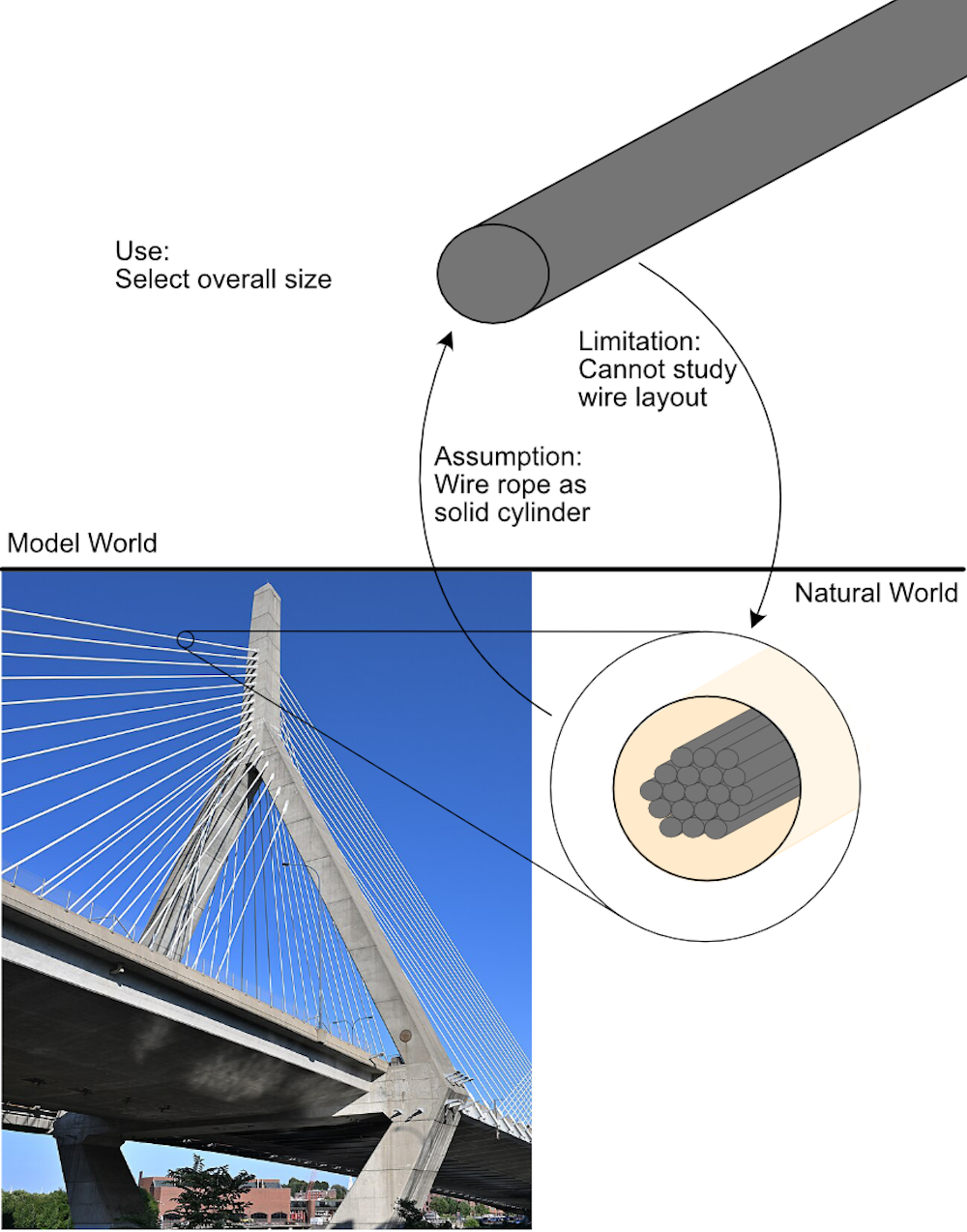
    For instance, an engineer may take a complex bundle of wires and assume they act together as a single cylinder. This simplified shape may help them choose how many wires to bundle together and set the overall thickness of the bundle.

    However, assumptions introduce limitations: The cylinder simplification assumes the individual wires don’t exist, so it doesn’t help determine how to weave the wires together. Engineers can − and do − make more detailed models where they need to, but even those have assumptions and limitations.

    Simplification of a wire rope as an assumed cylinder. This assumption may be appropriate for choosing the number of wires, but it is wholly inappropriate for determining the arrangement of wires.
    HaeB/Wikimedia Commons, modified by Zachary del Rosario, CC BY-SA

    This interplay between assumptions and limitations is at the heart of all models. Engineers working on the Tacoma Narrows Bridge assumed no wind-driven vertical movement, which led to a limitation: They couldn’t predict the wind-driven flutter that shook the bridge apart.

    The same idea holds true for more abstract models. Some companies that make facial recognition systems based on artificial intelligence assume their systems are accurate, given that they do a good job of picking out the correct face from a set of training data. However, outside researchers have shown that some training datasets introduce limitations.

    The engineers who built these training datasets assumed their data had enough faces to represent most people, but these datasets underrepresented nonwhite people. This limitation led the systems to disproportionately target Black people.

    In pursuit of better AI systems, some researchers assume that more training data is the most effective approach. This data-intensive approach has the limitation of an enormous environmental impact. Computing with large sets of data takes a lot of energy, since data centers are resource-intensive.

    The trick to using models safely is to pick assumptions where the limitations do not ruin their intended use. The gold standard is to test. But testing isn’t always possible. For example, building a test bridge isn’t a luxury that structural engineers can afford.

    Carefully selecting and creating proper models requires good judgment.

    Teaching modeling

    Engineering judgment involves a careful balance of trust and skepticism toward mathematics − the bedrock of many engineering models. Developing engineering judgment is difficult, and it usually emerges from years of experience. I teach a modeling and simulation course that jump-starts students’ engineering judgment.

    My co-instructors and I invite students to build their own models, which is a pretty uncommon experience for engineering students. Students then identify the assumptions in their models, state their limitations and, importantly, justify how those limitations do not prevent them from safely using the model.

    Example diagram of a model intended for choosing the size of a wire rope. The model is based on the assumption that the rope will be a solid cylinder. This imposes limitations on studying how the wires are woven together, but it doesn’t hinder the model’s intended use.
    4300streetcar/Wikimedia Commons, modified by Zachary del Rosario, CC BY-SA

    Engineering failures like the Tacoma Narrows Bridge can occur when engineers are not aware of a model’s assumptions and limitations. While courses often teach young engineers to make assumptions and use models, they rarely focus on these models’ limitations. Helping students develop their engineering judgment can prevent failures like “Galloping Gertie” from happening again.

    Zachary del Rosario receives funding from the National Science Foundation and Toyota Research Institute.

    ref. All models are wrong − a computational modeling expert explains how engineers make them useful – https://theconversation.com/all-models-are-wrong-a-computational-modeling-expert-explains-how-engineers-make-them-useful-253309

    MIL OSI – Global Reports

  • MIL-OSI Russia: Engineering Graduates: “Strength of Materials” in the Labor Market

    Translartion. Region: Russians Fedetion –

    Source: State University Higher School of Economics – State University Higher School of Economics –

    © Higher School of Economics

    What place do graduates of technical fields of education occupy in the labour market? What salary can a young engineer expect? To what extent does his success in the labour market depend on the field of study, are all young engineers equally in demand in the labour market? In which regions is there a greater demand for graduates? The answers to these and other questions are provided by a study by HSE scientists, presented at the round table “Graduates of Engineering Specialties in the Russian Labour Market: Myths and Reality” within the framework of XXV Yasinsky (April) International Scientific Conference.

    The report was given by the Vice-Rector of the National Research University Higher School of Economics, Head of the Labor Market Research Laboratory Sergey Roshchin. He noted that today the labor market in Russia is in a situation of demographic compression and that this situation will persist in the long term. At the same time, the national priorities in the field of technological leadership already defined by the country’s leadership impose additional requirements for the training of specialists who could ensure such leadership. Therefore, the characteristics of the labor market for graduates of engineering training areas and the level of young engineers represented in this market are of particular interest and importance.

    As Sergey Roshchin noted in his report, engineering and technical sciences are the most widespread group of graduates. In total, from 2018 to 2024, 27.9% of all graduates were enrolled in higher education programs (bachelor’s, specialist, master’s) in the field of engineering, technology and technical sciences. This is more than in other areas of higher education. But it is not only the number of specialists being trained that is important, but also their quality. If we divide universities that train engineering personnel by the quality of training based on the average Unified State Exam score required for admission to programs at these universities, then 50% of engineering graduates graduate from low-selective programs and universities where 59 or fewer Unified State Exam scores are enough for admission, and this largely determines the quality of engineers we have at the end. “And only 40% of the training of engineers can we consider as sufficiently high-quality, taking into account who comes [to study] and what quality is provided by certain universities,” Sergey Roshchin explained.

    An interesting phenomenon has emerged in the training of engineers: students who studied on fee-paying places receive, on average, a higher starting salary than graduates who studied on budget places. This is explained by the fact that studying at a selective university provides its graduates with a high level of income: the salary of graduates of the most selective universities is almost 2 times higher than the salary of those who graduated from the least selective universities.

    And families are ready to pay for quality education in more selective universities. Only 10% of fee-paying places are concentrated in the low-selectivity group of universities, while 20% are concentrated in the most selective group. It is not important what type of funding a student receives – fee-paying or state-funded, but what university he or she attends in terms of the quality of training.

    “The most important criterion is the form of study: part-time or full-time. Oddly enough, engineering training in the form of part-time study is represented by a solid number. A third of those who graduate are part-time students,” says Sergey Roshchin. Having cited precise statistics on different areas of training, form (full-time and part-time), as well as the level of study (bachelor’s and master’s degrees), he drew attention to the fact that the prospects in the labor market for graduates of full-time and part-time forms of study are different. “Part-time students enter the labor market with starting salaries slightly higher than those of full-time students, but then they remain stagnant. Already in the horizon of two to five years, full-time students are ahead in terms of salary growth, in terms of promotion to more in-demand jobs, and part-time students remain where they were,” the vice-rector explained.

    Another observation was that more than half of engineering graduates are concentrated in three key industries: manufacturing; information and communications; and scientific and technical activities. Among the industries with the highest salary levels are mining, information and communications, finance, and insurance.

    The most alarming fact, according to Sergey Roshchin, is that 41% of bachelor’s degree graduates and 20% of master’s degree graduates are employed in jobs that do not require higher education according to the OKZ (All-Russian Classifier of Occupations) classification. “In essence, higher education is only needed to occupy positions such as manager and top-level specialist,” the vice-rector comments. “In lower positions, higher education is usually not required. And this is a big question, how the market sees engineering education, whether there is really a need for so many engineers with higher education. Or, perhaps, it is the quality of higher education that does not allow one to occupy positions corresponding to this level.”

    Sergey Roshchin also touched upon the topic of regional differentiation. “In general, from all our previous works, reports, and analyses, we know that graduates are very mobile,” he notes. “40% of graduates who have received higher education move to another region.” The most popular for moving were Moscow (29%), Moscow Region (10%), St. Petersburg (8%), KhMAO (5%), and Krasnodar Krai (3%). At the same time, the average salary of those who left the region of study is 110.8 thousand rubles, and those who remained in the region of study – 90.4 thousand rubles. But for the interaction of engineering education and the labor market from a regional point of view, something else is important. The main (45%) training of engineers is conducted in six regions: Moscow, St. Petersburg, the republics of Tatarstan and Bashkortostan, Sverdlovsk and Rostov Regions. And these same territories are the main consumers of engineering personnel. In the labor market of engineers, there is a regional balance of labor and education markets in the main core of training. At the same time, of course, if we consider individual regions and areas of training, certain disproportions exist.

    The report allows us to conclude that there are areas of absolute inefficiency in the training of engineers. These are areas such as technosphere safety, light industry technologies, and food technologies. Graduates of these areas look like outsiders in the labor market compared to other engineers.

    In conclusion, Sergei Roshchin noted “that the answers to technological challenges associated with the tasks of ensuring technological leadership probably lie not in increasing the number (including through government procurement), but in changing the structure and quality of training engineers.”

    Please note: This information is raw content directly from the source of the information. It is exactly what the source states and does not reflect the position of MIL-OSI or its clients.

    MIL OSI Russia News

  • MIL-OSI USA: Origins Uncertain: ‘Skull Hill’ Rock

    Source: NASA

    Written by Margaret Deahn, Ph.D. Student at Purdue University
    Last week, NASA’s Mars 2020 rover continued its journey down lower ‘Witch Hazel Hill’ on the Jezero crater rim. The rover stopped along a boundary visible from orbit dividing light and dark rock outcrop (also known as a contact) at a site the team has called ‘Port Anson’. In addition to this contact, the rover has encountered a variety of neat rocks that may have originated from elsewhere and transported to their current location, also known as float.

    Pictured above is an observation named ‘Skull Hill’ taken by the rover’s Mastcam-Z instrument. This float rock uniquely contrasts the surrounding light-toned outcrop with its dark tone and angular surface, and it features a few pits in the rock. If you look closely, you might even spot spherules within the surrounding regolith! See Alex Jones’ recent blog post for more information on these neat features: https://science.nasa.gov/blog/shocking-spherules/. The pits on Skull Hill may have formed via the erosion of clasts from the rock or scouring by wind. We’ve found a few of these dark-toned floats in the Port Anson region, and the team is working to better understand where these rocks came from and how they got here.
    Skull Hill’s dark color is reminiscent of meteorites found in Gale crater by the Curiosity rover: https://www.jpl.nasa.gov/news/curiosity-mars-rover-checks-odd-looking-iron-meteorite/. Chemical composition is an important factor in identifying a meteorite, and Gale’s meteorites contain significant amounts of iron and nickel. However, recent analysis of SuperCam data from nearby similar rocks suggests a composition inconsistent with a meteorite origin. 
    Alternatively, ‘Skull Hill’ could be an igneous rock eroded from a nearby outcrop or ejected from an impact crater. On Earth and Mars, iron and magnesium are some of the main contributors to igneous rocks, which form from the cooling of magma or lava. These rocks can include dark-colored minerals such as olivine, pyroxene, amphibole, and biotite. Luckily for us, the rover has instruments that can measure the chemical composition of rocks on Mars. Understanding the composition of these darker-toned floats will help the team to interpret the origin of this unique rock!

    MIL OSI USA News

  • MIL-OSI USA: NASA Astronaut to Answer Questions from Colorado Students

    Source: NASA

    Students from Woodland Park, Colorado, will connect with NASA astronaut Nichole Ayers as she answers prerecorded science, technology, engineering, and mathematics-related questions from aboard the International Space Station.
    Watch the 20-minute space-to-Earth call at 11:55 a.m. EDT on Monday, April 21, on the NASA STEM YouTube Channel.
    The event, hosted by Woodland Park High School, also is open to students from Woodland Park Middle School. The Colorado high school wants to show students that even though they reside in a small town, they can achieve big dreams. Ayers, who considers Colorado Springs and Divide, Colorado, home, is a graduate of Woodland Park.
    Media interested in covering the event must RSVP by 5 p.m., Friday, April 18 to Lindsey Prahl at lprah@wpsdk12.org or 719-922-1019.
    For more than 24 years, astronauts have continuously lived and worked aboard the space station, testing technologies, performing science, and developing skills needed to explore farther from Earth. Astronauts aboard the orbiting laboratory communicate with NASA’s Mission Control Center in Houston 24 hours a day through SCaN’s (Space Communications and Navigation) Near Space Network.
    Important research and technology investigations taking place aboard the space station benefit people on Earth and lays the groundwork for other agency missions. As part of NASA’s Artemis campaign, the agency will send astronauts to the Moon to prepare for future human exploration of Mars; inspiring Artemis Generation explorers and ensuring the United States continues to lead in space exploration and discovery.
    See videos and lesson plans highlighting space station research at:
    https://www.nasa.gov/stemonstation
    -end-
    Tiernan DoyleHeadquarters, Washington202-358-1600tiernan.doyle@nasa.gov  
    Sandra JonesJohnson Space Center, Houston281-483-5111sandra.p.jones@nasa.gov

    MIL OSI USA News

  • MIL-OSI USA: Building for a Better World: Norfolk Students Bring STEM to Life with NASA Partnership

    Source: NASA

    At Norfolk Technical Center in Norfolk, Virginia, carpentry students in Jordan Crawford’s first-year class aren’t just learning how to measure and cut wood—they’re discovering how their skills can serve a greater purpose.
    When the NASA Science Activation program’s NASA eClips project—led by the National Institute of Aerospace’s Center for Integrative Science, Technology, Engineering, and Mathematics (STEM) Education (NIA-CISE)—needed help building weather instrument shelters for local schools, Norfolk Public Schools’ Career and Technical Education (CTE) team saw an opportunity to connect students to something bigger than the classroom. The shelters are used to house scientific equipment that K–12 students rely on to collect data using GLOBE (Global Learning and Observations to Benefit the Environment) protocols—a set of standardized, internationally recognized methods for gathering environmental data such as temperature, soil moisture, and cloud cover. These observations contribute to a global citizen science database, giving young learners a meaningful role in real-world environmental research.
    Originally, shelters were being ordered from a national supplier to support GLOBE training sessions for teachers in GO (Growth & Opportunity) Virginia Region 5, an economic development region. These training sessions were funded through a generous grant from the Coastal Virginia STEM Hub (COVA STEM Hub), which supports regional collaboration in STEM education. But when the supplier couldn’t keep up with demand, Norfolk Public Schools CTE Specialist Dr. Deborah Marshall offered a bold solution: why not have local students build them?
    That’s when the project truly took off. Under the guidance of Jordan Crawford, students took on the challenge of building 20 high-quality shelters in spring 2024, following precise construction plans provided through the GLOBE Program. Materials were funded by the COVA STEM grant, and the students rolled up their sleeves to turn lumber into lasting educational tools for their community.
    “As an instructor, you look for opportunities that challenge your students, allow them to do things bigger than themselves, and let them see a project through from start to finish,” Crawford said. “This project allowed my students to hone existing skills and build new ones, and I saw incredible growth not just in craftsmanship but in teamwork. The most rewarding part was seeing the impact of their work in real schools.”
    And the students rose to the occasion—taking pride in their work, learning advanced techniques, and developing new confidence. One of the most challenging parts of the build involved crafting the louvers—angled slats on the sides of the shelters needed for proper air circulation. Student Zymere Watts took the lead in designing and building a jig to make sure the louvers could be cut uniformly and precisely for every unit.
    “Building the weather shelters was a fun and challenging task that pushed me to strive for perfection with each one,” said student Amir Moore. “After completion, I was delighted to see the faces of the people who were proud and happy with what we built.”“It was an extreme pleasure working on this project. I would love to work with NIA again,” added LaValle Howard. “I am proud to be a part of this vocational school and team.”Jaymyson Burden agreed: “It was fun and great to be exposed to the carpentry realm and install them in the real world. It was gratifying to know what we have done has an impact.”
    After completing the shelters, the students volunteered to install them at seven Hampton City Schools. Their work completed the full circle—from building the shelters in their carpentry classroom to setting them up where younger students would use them to collect real environmental data.
    Their dedication did not go unnoticed. The team was invited to NASA’s Langley Research Center for a behind-the-scenes tour of the NASA Model Shop, where they met Sam James, a Mechanical Engineering Technician and Fabrication Specialist. James showed the students how the same kind of craftsmanship they’d used is essential in the creation of tools and components for NASA missions. They also learned about NASA summer internships and discovered that their hands-on skills could open doors to exciting careers in STEM fields.
    “It was an honor to help where we were needed,” said student Josh Hunsucker. “Assembling these gave us a new perspective on the importance of duplication and how each step impacts the result. We’re happy to help wherever or whenever we’re needed—it provides a learning experience for us.”Kyra Pope summed it up: “It’s been a great amount of work over the past few months, but it pays off—especially when you’re giving back to the community.”
    According to Dr. Sharon Bowers, Associate Director and Senior STEM Education Specialist for NIA-CISE, the project demonstrates what’s possible when regional partners come together to empower students and educators alike. “The financial support from COVA STEM Hub supported sustained educator professional learning within our STEM learning ecosystem. Work with the Norfolk Technical Center truly made this a real-world, problem-solving experience. This is just the beginning for more collaborative work that will bring the region together to engage educators and learners in authentic STEM learning experiences.”
    This collaboration wasn’t just about building boxes to house thermometers. It was about building bridges—between technical education and science, between high school students and their futures, and between local classrooms and global research. With each shelter they crafted, the students created something that will outlast them, reminding others—and themselves—of what’s possible when learning is hands-on, meaningful, and connected to the world beyond school walls.
    Thanks to Betsy McAllister, NIA’s Educator-in-Residence from Hampton City Schools, for her impactful contributions and for sharing this story. The NASA eClips project provides educators with standards-based videos, activities, and lessons to increase STEM literacy through the lens of NASA. It is supported by NASA under cooperative agreement award number NNX16AB91A and is part of NASA’s Science Activation Portfolio. Learn more about how Science Activation connects NASA science experts, real content, and experiences with community leaders to do science in ways that activate minds and promote deeper understanding of our world and beyond: https://science.nasa.gov/learn

    MIL OSI USA News

  • MIL-OSI USA: Merrie Monarch Travelers Reminded of ʻŌhiʻa Quarantine Restrictions

    Source: US State of Hawaii

    Merrie Monarch Travelers Reminded of ʻŌhiʻa Quarantine Restrictions

    Posted on Apr 17, 2025 in Main

    April 17, 2025
    NR25-09

    HONOLULU – The Hawai‘i Department of Agriculture (HDOA) is reminding travelers attending the Merrie Monarch Festival next week that quarantine restrictions remain on the transport of ʻōhiʻa from Hawai`i Island due to the fungal plant disease, rapid ʻōhiʻa death (ROD), which is devastating to native forests. The Merrie Monarch Festival takes place in Hilo from April 20 to 26.

    The quarantine has been in place since 2015 and restricts the movement of ʻōhiʻa plants and plant parts, including flowers, leaves, seeds, stems, twigs, cuttings, untreated wood, logs, mulch, green waste and frass (sawdust from boring insects) and any soil from Hawai`i Island. Even if the ʻōhiʻa originated from another island, it may not be transported off of the island. Transport of such items is only allowed with a permit issued by the HDOA Plant Quarantine Branch (PQB).

    PQB inspectors will be stationed at airports in Hilo and Kona on Sunday and Monday, April 27 and 28, to collect any ʻōhiʻa material, which will be respectfully returned to the native forests on Hawai‘i Island. During last year’s Merrie Monarch travel period, Hilo PQB inspectors intercepted 27 lei poʻo (head lei).

    At the event, the University of Hawai‘i at Mānoa, College of Tropical Agriculture and Human Resilience will provide hoʻihoʻi baskets to collect any ʻōhiʻa. Baskets will also be stationed at the Hilo and Kona airport PQB offices.

    A travel alert flyer has been posted on the HDOA website at: https://hdoa.hawaii.gov/wp-content/uploads/2015/06/ROD-Travel-Alert-Sign-12x18_09_FINAL.pdf

    The Hawaiʻi Board of Agriculture issued an emergency quarantine in August 2015 to stop the spread of the plant fungus from Hawaiʻi Island to other islands. A permanent quarantine rule was established in 2016. Any person who violates the quarantine rule may be charged with a misdemeanor and fined not less than $100 with a maximum fine of $10,000. For a second offense committed within five years of a prior conviction under this rule, the person or organization shall be fined not less than $500 and not more than $25,000.

    The Merrie Monarch Festival draws dozens of hula hālau and hundreds of spectators to Hawai‘i Island. It is important to note that the very act of harvesting ʻōhiʻa may spread the disease, as spores may be carried in soil and by harvesting tools, vehicles, shoes and clothing to uninfected areas.

    ROD was first noticed in 2010 in Puna. In 2014, the fungus was initially identified as Ceratocystis fimbriata by researchers at the U.S. Department of Agriculture Daniel K. Inouye Agricultural Research Service. Recent research has reclassified Ceratocystis fimbriata into two distinct species that are new to science, Ceratocystis lukuohia and Ceratocystis huliohia. It is estimated that at least one million ʻōhiʻa trees have been killed by ROD just on Hawai‘i Island alone.

    The disease was detected on Kauaʻi in 2018 and on O‘ahu in 2019. Also in 2019, one ʻōhiʻa tree on Maui was infected and destroyed and ROD has not been detected on the island since. It is not known how or where the disease entered the state.

    Travelers seeking more inspection information may contact HDOA’s Plant Quarantine offices:

    Hilo – 808-961-9393                       Honolulu – 808-837-8413
    Kona – 808-326-1077                     Maui – 808-872-3848
    Kauaʻi – 808-241-7135

    More information on ROD may be found at:

    # # #

    lei poʻo turned in at Hilo airport

    Ohia inspection at Hilo International Airport

    MIL OSI USA News

  • MIL-OSI Asia-Pac: International Space mission carrying Indian astronaut scheduled for next month: Dr Jitendra Singh

    Source: Government of India

    International Space mission carrying Indian astronaut scheduled for next month: Dr Jitendra Singh

    India poised to script a defining chapter in its space journey

    Indian Astronaut Set for Historic Space Mission as ISRO Charts Bold New Frontiers

    India’s Space Dreams Soar Higher with Gaganyaan Prep, ISS Mission, and a Summer of Launches

    Posted On: 18 APR 2025 4:28PM by PIB Delhi

    NEW DELHI, April 18 : India is poised to script a defining chapter in its space journey, international Space mission carrying Indian astronaut has been scheduled for next month.

    Announcing this after a high-level meeting held to review major  future plans of Indian Space Research Organisation (ISRO) in the coming months,  Union Minister of State (Independent Charge) for Science and Technology; Earth Sciences and Minister of State for PMO, Department of Atomic Energy, Department of Space, Personnel, Public Grievances and Pensions, Dr Jitendra Singh said, the mission will mark the visit of  first Indian ever to visit the International Space Station (ISS) and the first Indian astronaut to travel to Space in over four decades after Rakesh Sharma’s iconic 1984 flight aboard a Soviet Soyuz spacecraft.

    The announcement comes amid a flurry of activity in India’s space sector, which is gearing up for an ambitious slate of missions in the coming months.

    Dr. V. Narayanan, Secretary, Department of Space and Chairman of ISRO, made a presentation elaborating the status of various upcoming Space missions.

    Chairman ISRO informed that Group Captain Shubhanshu Shukla of the Indian Air Force is all prepared to fly to the International Space Station (ISS) next month as part of Axiom Space’s Ax-4 mission.

    Group Captain Shukla’s mission, scheduled for May 2025, marks a milestone in India’s expanding international space collaborations. A decorated test pilot with the Indian Air Force, he was shortlisted under ISRO’s Human Spaceflight Program (HSP) and is among the top contenders for the Gaganyaan mission, India’s first indigenous crewed orbital flight. His journey aboard the Ax-4 mission is expected to provide critical hands-on experience in spaceflight operations, launch protocols, microgravity adaptation, and emergency preparedness — all essential for India’s crewed space ambitions.

    What sets Shukla’s mission apart is its strategic importance. Unlike the symbolic undertones of India’s first human spaceflight, this time the focus is on operational readiness and global integration. His participation underscores India’s growing engagement with public-private international partnerships in space and its resolve to emerge as a serious contender in human space exploration.

    “India is ready for its next space milestone,” said Dr. Jitendra Singh, underscoring the significance of the upcoming human spaceflight and a series of critical ISRO missions. He noted that the collaboration with international partners and the strategic momentum of projects like Gaganyaan reflect India’s commitment to becoming a global leader in space technology. The Minister emphasized that these efforts are not only scientific in nature but also aligned with the vision of a developed and self-reliant India.

    During the meeting, ISRO updated Dr. Jitendra Singh on several key developments since January 2025. These include the public release of data from the Aditya L1 solar mission, successful demonstration of docking and undocking technologies, testing of the highest thrust liquid engine developed in India, and the historic 100th launch (GSLV-F15) from Sriharikota. ISRO also supported national events like the Kumbh Mela 2025 through satellite-based monitoring and announced a successful demonstration of restarting the Vikas Engine, crucial for future launch vehicle recovery missions.

    Among the major missions lined up for May to July 2025, ISRO will launch the PSLV-C61 mission carrying the state-of-the-art EOS-09 satellite. Equipped with a C-band synthetic aperture radar, EOS-09 will be capable of capturing high-resolution images of Earth’s surface under all weather conditions, day or night. Another significant milestone will be the Test Vehicle-D2 (TV-D2) mission, designed to simulate an abort scenario and demonstrate the Gaganyaan Crew Escape System. The mission includes sea recovery operations for the Crew Module, mimicking procedures planned for India’s first human spaceflight.

    June will see the highly anticipated launch of the NISAR satellite aboard the GSLV-F16. This NASA-ISRO collaboration aims to study Earth’s ecosystems and natural hazards through dual-frequency radar data, combining NASA’s L-band payloads with ISRO’s S-band contributions. The LVM3-M5 mission, scheduled for July, will cater to a commercial contract with AST SpaceMobile Inc., USA, launching BlueBird Block-2 satellites under NewSpace India Limited’s commercial program.

    As India’s space strategy matures, Group Captain Shukla’s upcoming mission stands as a symbol of a confident, forward-looking nation ready to reclaim its place in the global space race. His journey is more than just a flight — it’s a signal that India is stepping boldly into a new era of space exploration.

    ****

    NKR/PSM

    (Release ID: 2122687) Visitor Counter : 41

    MIL OSI Asia Pacific News

  • MIL-OSI Russia: Festival “Polytechnic Graduates to Students”: friendly advice and useful experience

    Translartion. Region: Russians Fedetion –

    Source: Peter the Great St Petersburg Polytechnic University – Peter the Great St Petersburg Polytechnic University –

    The third one was held at SPbPU festival “Polytechnic graduates – to students” organized by the Center for Fundraising and Work with Alumni. The new meeting brought new emotions: the speakers shared memories of their studies and first work experience, gave valuable advice to the younger generation, entertained them with quizzes and gave gifts for correct answers.

    The meeting was opened by Vice-Rector for Youth Policy and Communication Technologies Maxim Pasholikov.

    “Today’s festival brought together graduates from 2006 to 2024, many of whom are active members of the Polytechnic Ambassadors community,” said Maxim Pasholikov. “It is important for students to communicate with the ambassadors as with senior colleagues who have already established themselves in their fields of activity, but are still quite young and have not yet reached the heights of their careers. Each such meeting brings new useful acquaintances, some of the students find a place for a future internship or work. Graduates, from the height of their experience, can draw the attention of the guys to knowledge and skills that are especially relevant when applying for a job and at work. Graduates are also interested in watching and listening to each other. This is how joint projects, ideas and undertakings are formed, which unite different people under the auspices of the Polytechnic.”

    This time, the students had ten guests — ten interesting speakers with their unique stories of professional development in various fields of activity — from work in government agencies to their own business. For example, shipbuilding was represented by the head of the production preparation bureau of the chief technologist department of the Kronstadt Marine Plant, a 2014 graduate Dmitry Gomonov and project manager at Severnaya Verf, 2017 graduate Georgy Kremlev.

    Also connected with this area is the work of 2016 graduate Evgeniya Lastochkina – she is an engineer in the laboratory “Metal Science of Steels with Special Physical Properties” of the scientific and production complex “Structural Steels and Functional Materials for Marine Engineering” of the Central Research Institute of Structural Materials “Prometey” of the National Research Center “Kurchatov Institute”.

    “Polytech was my first step on my adult life path,” said Evgeniya. “It was Polytech that contributed to the fact that I now work in such a cool company. I thank the university for giving me the opportunity to gain knowledge that I apply in production. And the best way to practice communication skills is… on business trips.”

    Evgeniya continues her studies – now in postgraduate studies in the field of “Materials Technology”. In science, she deals with low-magnetic steels, but she tries to develop not only in this area, for example, she tried herself as a lecturer during thematic shifts for high school students, which are organized by the Kurchatov Institute.

    Yaroslav Velikiy, a 2024 graduate and senior engineer at the Setl Stroy testing laboratory of the Setl Group holding, is also studying in the Polytechnic’s postgraduate program. He got a job in 2022 and simultaneously studied for a master’s degree. Having told the guys about his company, Yaroslav told them how to get an internship there.

    The IT sphere was represented by Kirill Vasiliev, Head of the New Business Projects Practice “Corporate Entrepreneur” of Gazpromneft – Information Technology Operator, 2011 graduate, and Ksenia Saitova, IT recruiter of Positive Technologies, 2020 graduate. Speaking about her career experience, Ksenia emphasized that it was her active student life at the Polytechnic that helped her find a job, write a resume, solve various cases and write projects.

    “It seems to me that my generation was less conscious in choosing a university, then there was propaganda that a diploma was not so important, but I can say that this is not entirely true. It is not so important to get an education in the right field, the foundation that the university provides is important,” Ksenia believes. “The Polytechnic University has a lot of opportunities, many student organizations, where some guys then come to work. I graduated from the Humanities Institute, the Advertising and Public Relations program, received relevant modern knowledge, we were given the opportunity to do an internship in large companies. As far as I know, the university still holds a Career Forum, this is also very helpful.”

    Denis Lykov, Class of 2014, Lean Manufacturing and Supply Chain Manager at H

    Head of the Ventilation, Air Conditioning, Instrumentation and Automation Systems Sector of the Operations Department of the Restoration and Storage Center (RSC) “Staraya Derevnya” of the State Hermitage Museum Kirill Tambovtsev introduced himself as a “Polytechnic graduate of 2004, 2006, 2011 and 2023.” This is not his first time participating in the festival, and he structured his current performance in the form of questions and answers. The quiz was well received by the audience, as it allowed some of them to show off their knowledge (or intuition) and win prizes.

    While most of the speakers talked about their careers in hired work, 2007 graduate Andrey Sharkov and 2014 graduate Alexander Kiyanitsa shared their entrepreneurial experience. Andrey Sharkov is known as the founder of a chocolate manufacturing company, and now he has a new business – glamping.

    No matter what anyone says about the importance of education and each discipline, until you encounter real tasks, it will be an abstraction. Therefore, you need to start some activity as soon as possible to understand how these disciplines work in real life, and not in theory. Then you will be able to make a conscious focus on those disciplines that are most important to you, interesting and in demand by the market, – Andrey believes.

    Unlike Andrey, who started doing business while still a student, engineer Alexander Kiyanitsa first graduated with honors from the electromechanical faculty of the Polytechnic University, then worked for a company for hire for several years, and only in 2017, in partnership with several colleagues (also Polytechnic students), he founded a company for the development and production of household electrical appliances-electricity storage devices VOLTS. Having analyzed and systematized his experience, he shared with students his conclusions that will help future entrepreneurs avoid mistakes. For example: start working for hire as early as possible in the field in which the student plans to do business. This really helped me get a feel for this industry, understand where I want to develop, in what specific context, and where to move next, – says Alexander.

    The second is to fight the inner perfectionist. Time is fast now, and speed greatly affects the final result. We fell into the trap when we wanted to make the most perfect product possible, we were afraid to bring it to the market. This is a typical mistake. The faster you bring the product, the faster you will understand whether the market needs it.

    Third, look for investors at exhibitions. Exhibitions helped us, especially international ones, in which we actively participated, exhibited the product, and this helped us attract money. Once at an exhibition in Helsinki, we invited a representative of the Emirates Fund, and we were invited to the Emirates, we opened a representative office there, received investments, and now it is a fairly powerful hub for work on the world market.

    Fourth, be patient and move step by step systematically towards the goals you set for yourself.

    This year, the Polytechnic University Graduates to Students festival had a new host — a first-year student of the GI (jurisprudence), a member of the youth council of the Dobro.Center “Harmony” Artem Kuzmin. He coped with the task perfectly and later shared his impressions: By the will of fate, I became the host of the festival, which I did not know before. And I am happy that I was able to meet such outstanding graduates, who were also students not long ago and achieved such heights. I got an exceptional experience and heard living motivational stories that inspire. I was simply charged with success and study, thanks to the organizers.

    Photo archive

    Please note: This information is raw content directly from the source of the information. It is exactly what the source states and does not reflect the position of MIL-OSI or its clients.

    MIL OSI Russia News

  • MIL-OSI Russia: With the support of Rosneft, construction of a large cultural center has begun in Yakutia

    Translartion. Region: Russians Fedetion –

    Source: Rosneft – Rosneft – An important disclaimer is at the bottom of this article.

    The ceremony of laying the first pile of the Multifunctional Cultural Center took place in the administrative center of the Botuobuyinsky nasleg of the village of Tas-Yuryakh in Yakutia. The agreement on financing its construction between PJSC NK Rosneft and the Republic of Sakha was concluded within the framework of the IX Eastern Economic Forum.

    The head of the Sakha Republic, Aisen Nikolaev, took part in the ceremonial event and thanked the oil company for its assistance in implementing a project that is significant for the Republic.

    Rosneft actively supports social initiatives aimed at creating favorable living conditions in the regions of its presence. The company pays great attention to cultural and educational projects.

    The center will become an object of social and cultural life of the village. The building with the area of 1,533 sq. m. will have a cinema and concert hall with ergonomic chairs and modern sound, light and video equipment. The center will also house an exhibition hall, a library, a reading room, a billiard room, and offices for creative and folklore sections. A universal sports hall for basketball, volleyball, mini-football and other activities is provided.

    The project also provides for equipping the building with modern engineering systems for heating, water supply and ventilation. The architectural appearance of the building combines modern solutions with national traditions.

    Rosneft pays great attention to supporting educational, social, cultural and educational projects in Yakutia. In the village of Chapaevo in the Khangalassky District, a new building of the Small Academy of Sciences with a boarding school for 100 people was opened, which was built and equipped by Rosneft. The Academy has become a hub for research and project activities for schoolchildren throughout the Far East. A training center, the Factory of Full Cycle Oil and Gas Processes, was created at the Regional Technical College in the city of Mirny for practical training of specialists in the oil and gas industry.

    In the village of Tas-Yuryakh, oil workers are creating a comfortable environment for local residents – the school’s robotics rooms, 3D modeling rooms, and the school press center have been renovated. In addition, the school has been equipped with a television studio, a language laboratory, a local history museum with an exhibition and educational exposition, and a modern school stadium and a children’s playground have been built.

    Reference:

    In Yakutia, Rosneft is represented by the Taas-Yuryakh Neftegazodobycha enterprise, which is developing the Srednebotuobinskoye oil and gas condensate field. The enterprise is one of the three largest production assets of Rosneft in Eastern Siberia, and is developing 11 licensed areas, including the Central Block and the Kurungsky licensed area of the Srednebotuobinskoye oil and gas condensate field.

    Department of Information and Advertising of PJSC NK Rosneft April 18, 2025

    Please note: This information is raw content directly from the source of the information. It is exactly what the source states and does not reflect the position of MIL-OSI or its clients.

    MIL OSI Russia News

  • MIL-OSI Russia: “The World Is Becoming More Complex and Less Predictable”: What Scientists Say About the Future

    Translartion. Region: Russians Fedetion –

    Source: State University Higher School of Economics – State University Higher School of Economics –

    The future is now more difficult for researchers to predict, and events that are less predictable are becoming increasingly important. But there is good news: scientists are convinced that humanity will adapt to any changes. This was discussed at the conference that was launched as part of XXV Yasinsky (April) International Scientific Conference International Symposium “Foresight in a rapidly changing world“.

    Rapid technological progress, alarming climate change, rapid digitalization, rising inflation and stagflation are causing major changes. “The world is becoming more complex and less predictable,” said a leading expert Foresight Center ISSEK HSE University Yulia Milshina. According to her, rapid changes cause nervousness and depression among the population. Some researchers associate their emergence with the development of digital technologies and a sense of insecurity.

    “The digital transformation of education and labor systems is not keeping up with the times, creating a mismatch between human capital and market demands,” says Yulia Milshina. Demographic statistics are also alarming. “The increase in the age of the population, in contrast to its size, in developed countries poses a threat to the pension and health care systems,” she adds.

    At the same time, there has been an exponential growth in the number of scientific publications devoted to the so-called wild cards (random factors) recently. These include poorly predictable events that may prove to be extremely important. An early warning system for such random events is important in order to formulate approaches to reducing the negative consequences of the implementation of wild cards, explained Yulia Milshina. If in 2022 there were more than 50 such events, then in 2025 there will be more than 300.

    The global financial crisis has served as a trigger for the research community to take low-probability, high-impact events more seriously, she stressed. Unpredictability makes traditional forecasting difficult. “Despite increased awareness, we remain vulnerable to unforeseen circumstances,” the expert notes. The new social world requires integrated strategies that can adapt to rapid developments. Therefore, more sophisticated tools are being developed “to anticipate, assimilate and adapt to such disruptive changes.”

    Senior Research Fellow Laboratories of Innovation Economy HSE ISSEK Alena Nefedova spoke about the system ifora — an intelligent platform for analyzing big data and megatrends, developed by the HSE Institute for Statistical Studies and Economics of Knowledge.

    Among the megatrends that will influence the future, Alena Nefedova named climate change, increased attention to the physical and psycho-emotional state of a person, the transformation of the education system, and global changes in the labor market. At the same time, the development of interdisciplinary research is becoming very important in science itself, she emphasized.

    “Universities began interdisciplinary research in the mid-20th century in collaboration with industry. By the 1970s, interdisciplinarity was recognized as vital to strengthening universities as key players in innovation ecosystems,” Alena Nefedova noted. Digitalization is also increasingly influencing scientific activity. “We have virtual forums, we have virtual labs, we have international projects, we have an open science project, and this helps to exchange scientific data and developments,” she added.

    Fabienne Goux-Bodiment from the Research Center for the Future (France) noted that the world has changed dramatically. “One of the catalysts for these changes is carbon. We see that large-scale use of carbon leads to global warming and climate change. Another catalyst is silicon. Thanks to silicon, we have generative artificial intelligence, and it can compete with humans,” she said. And finally, the third important trend that is currently observed, according to Fabienne Goux-Bodiment, is general chaos. In particular, it is noticeable in the economy and geopolitics. But change is “not some kind of anomaly, it is a natural process of human evolution and, in fact, life in general,” she reassured. Society is thus evolving, and technology accelerates this evolution. We can move, “make a quantum leap into a completely new state,” the researcher is sure. “One world essentially dies, and a new world appears, albeit not immediately,” says Fabienne Goux-Bodiment. But because we have resistance to change, this process slows down. However, we are still entering an era of acceleration.

    The world will not be as we know it now, but this transition does not mean the end of humanity, says the futurologist. “First, it is not the first time that humanity has gone through major changes. Second, the human race as a whole adapts quickly. In addition, this time we know what is happening. We are aware of it. This means that we can do something,” Fabienne Goux-Bodiment reassured.

    Now, according to the researcher, a new mentality is being formed. “More and more people recognize that the way we think, manage and produce goods no longer meets the requirements of the times. This is not just some unnoticeable change. The younger generation is not just asking themselves what they want to do, but thinking about what kind of world they would like to create together with their like-minded people. “Pessimism is not a solution. We must experiment, create new formats,” Fabienne Goux-Bodiment is sure.

    Please note: This information is raw content directly from the source of the information. It is exactly what the source states and does not reflect the position of MIL-OSI or its clients.

    MIL OSI Russia News

  • MIL-OSI Russia: From Theory to Practice: SKB Kontur and NSU Will Open the Door to the World of IT Technologies for Students

    Translartion. Region: Russians Fedetion –

    Source: Novosibirsk State University – Novosibirsk State University –

    The Rector of Novosibirsk National Research State University Mikhail Fedoruk and the Operations Director of SKB Kontur Svetlana Strelnikova took part in the ceremonial signing of the cooperation agreement.

    The partnership between SKB Kontur and NSU is an opportunity to exchange experience, knowledge, hold conferences, presentations and other events in the IT sphere. The agreement also gives students the opportunity to immerse themselves in a real IT environment: practices, internships, mentoring from company specialists and participation in joint projects.

    Students of the Faculty of Mechanics and Mathematics and the Faculty of Information Technology are already taking the course C developed by Kontur

    Svetlana Strelnikova, Operations Director of SKB Kontur:

    — The agreement is a new stage of our cooperation. I am sure that it will become the basis for expanding our joint projects in the field of education and scientific and technical cooperation. SKB Kontur is always happy to welcome young specialists. We do not stand still, but grow and develop. This means that we are interested in participating in the training of talents, ready to share our knowledge and experience with them. Cooperation with NSU will allow us to cultivate highly qualified specialists, many of whom, I hope, will join our team in the future.

    Mikhail Fedoryuk, Rector of Novosibirsk National Research State University:

    — Novosibirsk University has traditionally been a “training ground” for the country’s scientific system, and close cooperation with the Siberian Branch of the Russian Academy of Sciences has helped us successfully cope with this task. In recent years, we have been actively developing new areas of training personnel for the manufacturing sector of the economy – specialists in information technology and artificial intelligence, robotics and space instrumentation, etc. In this work, we use a similar approach, developing cooperation with companies – leaders in various sectors of the economy, which improves the quality of training of our graduates and their demand in the market. The agreement with SKB Kontur is another important stage in the implementation of this strategy for us.

    Since 2008, SKB Kontur has been actively developing IT education: it pays grants and scholarships, conducts internships and organizes classes at the industrial development school. Together with the Ural Federal University named after the first President of Russia B.N. Yeltsin, it is modernizing the Fundamental Informatics and Information Technology, Digital Humanities, as well as the educational programs Business Informatics and Digital Technologies in Business. Together with ITMO University, it is developing additional education programs, conducting internships and scholarship competitions for the best students of the university.

    The partnership between SKB Kontur and NSU is a new step in the development of IT education, aimed at solving the problem of personnel shortage for the Digital Economy.

    The signing took place within the framework of the thirteenth conference “Artificial Intelligence and Natural Language” (AINL), which is being held at NSU this year. AINL is the largest Eastern European conference on artificial intelligence and text processing.

    Please note: This information is raw content directly from the source of the information. It is exactly what the source states and does not reflect the position of MIL-OSI or its clients.

    MIL OSI Russia News

  • MIL-OSI Russia: Polytechnic at the expert platform of the Ministry of Education and Science of Russia: strengthening Russian-African cooperation

    Translartion. Region: Russians Fedetion –

    Source: Peter the Great St Petersburg Polytechnic University – Peter the Great St Petersburg Polytechnic University –

    The Polytechnic University took part in a strategic meeting of the Ministry of Science and Higher Education of the Russian Federation dedicated to the development of the Russian-African Network University (RAFU). Representatives of the Polytechnic University presented a report on the activities of the consortium, noting key achievements and plans to strengthen cooperation with African countries. The meeting was held in the board room of the Ministry of Education and Science of Russia with the participation of more than 50 RAFU universities, including Moscow State University, MGIMO, RUDN University, MPEI, RSUH, MGRI.

    Deputy Minister of Science and Higher Education of the Russian Federation Konstantin Mogilevsky emphasized the role of SPbPU in the development of the project in his speech: Two years ago, at the Russia-Africa economic forum, the baton of coordinating RAFU was passed to St. Petersburg Polytechnic University. During this time, the consortium has made a qualitative leap: today it includes 90 Russian and 45 African organizations from 15 countries. The Summer Multidisciplinary University, which we are holding for the fourth time, has become a key project. However, it is important to move forward – to develop higher education programs, network formats and double degrees. SPbPU, which has serious experience in this area, can become a driver of such changes.

    Vice-Rector for International Affairs of SPbPU Dmitry Arsenyev focused on the transformation of RAFU into a multifunctional platform: We consider RAFU not only as an educational project, but also as a tool for accessing scientific, personnel and youth resources. Over two years, we have managed to expand the geography, create a working project office and hold dozens of events. The next step is the integration of network programs and quotas, which will enhance the practical benefits of the consortium for Russian-African relations.

    Head of the RAFU project office Maksym Zalyvsky presented the consortium’s achievements. An important step was the update RAFU website, which has evolved into a working tool with 14 sections, an online catalog of 120 courses, and regularly updated news. To promote the consortium brand, RAFU days were held in Mali and Morocco, where information centers were opened, as well as large-scale sessions at the St. Petersburg International Economic Forum, the Youth Festival, and the Russia-Africa Summit.

    Maxim Zalyvskiy paid special attention to the Summer Multidisciplinary University of RAFU, which in four years has increased the number of participants from 100 to 300 people, and the geography – from 10 to 33 countries. The program has shifted focus from cultural and historical tracks to professional internships and advanced training with the participation of industrial partners, such as the Mali Artificial Intelligence Center. In 2025, 20 educational programs are planned, some of which will be associated with a project dedicated to the development of a concept for reforming higher engineering education in Mali. Russian universities are participating in the development of a concept for the creation and curricula of educational programs for the new Polytechnic University of Bandiagara in priority areas of development of Mali. The speaker especially noted the initiative creation of network master’s programs with universities in Egypt, Algeria, Zimbabwe and other countries, as well as the development of ten joint Russian-African projects in 2024, which the Russian Ministry of Education and Science annually supports with grants.

    The participants of the meeting discussed initiatives to allocate quotas for African students within the framework of network programs and the significant role of the project in developing cooperation with African countries. They emphasized the importance of RAFU as an effective tool for interaction and made proposals for optimizing the consortium’s work aimed at increasing its practical impact.

    The universities participating in RAFU highly appreciated the work of SPbPU as the coordinator of the consortium. Polytechnic will continue to expand the partner network and introduce new formats of cooperation aimed at the sustainable development of the regions of Russia and Africa.

    Summing up the meeting, Konstantin Mogilevsky proposed creating scientific laboratories for assessing colonial damage on the basis of leading universities participating in the RAFU consortium — a project capable of strengthening the expert status of the association. The participants also agreed to hold regular meetings of the RAFU presidium to develop strategic decisions, operational planning and strengthen partnerships with African countries.

    Please note: This information is raw content directly from the source of the information. It is exactly what the source states and does not reflect the position of MIL-OSI or its clients.

    MIL OSI Russia News

  • MIL-OSI China: ‘The Wandering Earth 3’ begins filming with comedy megastar, AI assistant

    Source: China State Council Information Office 3

    The final installment of China’s “The Wandering Earth” science fiction trilogy began filming on April 15, featuring the surprise addition of comedy star Shen Teng and the first use of an AI production assistant.

    Director Frant Gwo (1st L) and actors Shen Teng (C) and Wu Jing attend a ceremony to mark the start of filming for “The Wandering Earth 3” at China Movie Metropolis in Qingdao, Shandong province, April 15, 2025. [Photo courtesy of Da’an Pictures]

    The cast and crew attended a ceremony to mark the start of filming at China Movie Metropolis, a studio complex in Qingdao, Shandong province, which also hosted production of the previous two entries.

    Producer Fu Ruoqing, chairman of China Film Group, director Frant Gwo, and lead actor Wu Jing attended the ceremony, where they announced the surprise casting of comedian Shen Teng.

    Shen brought his signature humor to the launch, saying he was honored to join the team. “I’ll do my best in this role and make sure director Frant Gwo gets enough rest, while ensuring I get enough rest myself,” he joked.

    Wu shared his excitement about working with Shen: “I’m so hyped to have fun with Shen Teng on the ‘Wandering Earth’ ride. Maybe we can have a switch. Hope I get more comedy scenes while he does more action — can’t wait to see him throw a punch!”

    Shen and Wu are two of the biggest stars in Chinese cinema. Films starring Shen have grossed a total of 36.98 billion yuan ($5 billion) at the box office, making him the highest-grossing actor in China. Wu ranks a close second, with his films earning 34.71 billion yuan. The long-awaited collaboration between the two actors will take place in this project.

    The cast and crew celebrate the launch of filming for “The Wandering Earth 3” at China Movie Metropolis in Qingdao, Shandong province, April 15, 2025. [Photo courtesy of Da’an Pictures]

    At the launch of “The Wandering Earth 3,” the production team unveiled WEi, a proprietary AI assistant powered by DeepSeek R1 and supported by NVIDIA and ByteDance’s Volcano Engine.

    The tool, which is designed to emulate the franchise’s AI character MOSS, provides instant access to scripts, concept art and professional references. The production team said the tool integrates AI with film production to help advance China’s sci-fi industry and explore new creative possibilities.

    The production will also partner with leading Chinese technology firms to leverage advanced support, aiming to set a new benchmark in set construction and visual effects.

    Producer Fu expressed gratitude to the director and core creative team for overcoming challenges over the past decade since the first film. He pledged to continue supporting the team as they pursue the sci-fi vision of the “Wandering Earth” franchise and work to ensure its continued growth and legacy.

    Another franchise star, Hong Kong actor Andy Lau, sent a congratulatory video for the production launch, saying, “I can’t wait to rejoin the cast and begin filming.”

    Screenwriting adviser Wang Hongwei said the script for “The Wandering Earth 3” was 80% complete.

    “When working on a groundbreaking franchise like this, we all feel reluctant to put down our pens,” Wang said, adding that the team aims to create the most satisfying conclusion possible for the final installment.

    The film is written by Gwo, Gong Ge’er and Ye Ruchang. Gwo previously said the script underwent nine revisions by the end of last year, with the team surveying over 1,000 young people to better engage younger audiences. The story will serve as a direct sequel to the first film, exploring humanity’s struggle for survival during Earth’s 2,500-year cosmic odyssey to a new solar system.

    The cast and crew pose for a group photo before filming begins on “The Wandering Earth 3” at China Movie Metropolis in Qingdao, Shandong province, April 15, 2025. [Photo courtesy of Da’an Pictures]

    “Innovation must be everything — we have to find ways to make it happen,” Gwo said. “We want to give audiences something they’ve never seen in any film before. We’re raising production standards far above the first two movies to move and amaze every audience member who’s been supporting us.”

    The “Wandering Earth” franchise has maintained its strong audience appeal with consistent box office success. The original 2019 film earned 4.69 billion yuan domestically, while the 2023 prequel grossed 4.03 billion yuan. The series’ final installment, “The Wandering Earth 3,” will be released in two parts, with the first part scheduled to premiere in China during the 2027 Spring Festival season.

    MIL OSI China News

  • MIL-OSI USA: Rep. Chu Sounds Alarm on White House’s Proposed Budget Cuts to Mars Sample Return

    Source: United States House of Representatives – Representative Judy Chu (CA2-27)

    PASADENA, CA — Today, President Trump’s Office of Management and Budget (OMB) reportedly sent a preliminary budget plan to NASA that proposes a 50% cut to NASA’s Science Mission Directorate (SMD) and to eliminate funding for the Mars Sample Return (MRS) mission led by Jet Propulsion Laboratory (JPL), which is owned by NASA and administered by the California Institute of Technology (Caltech). 

    Rep. Judy Chu (CA-28), whose district includes JPL and Caltech, released the following statement:

    As a steadfast champion of Caltech and JPL and strong supporter of the Mars Sample Return program as our nation’s highest planetary science priority, I am horrified by the reports that the Trump White House wants to defund the MSR mission entirely. I can’t be clear enough: this decision would devastate our region, our workforce, and our future scientific discoveries. Completing this mission and bringing back these samples—which are already being collected on Mars’ surface—is essential to maintaining American leadership on Mars and paving the way for eventual human exploration of the planet. Ending funding now would completely undermine the decades of investments already made into our Mars program, devastate our nation’s Mars workforce at JPL and around the country, and threaten years of future scientific discovery and innovation to come. JPL has already lost hundreds of Mars experts last year due to shortsighted budget cuts, and our nation’s world-class space program cannot afford to lose more. I will work tirelessly with my colleagues in Congress of both parties to fully reject the Trump Administration’s plan and designate the robust and appropriate funding this year and beyond for MSR. I will never stop fighting to protect the workforce and bring these samples back so we can continue to pursue the kinds of groundbreaking scientific discovery and technological innovation that JPL, and the United States, have been on the frontlines of for decades.”

    Rep. Chu and Rep. Don Bacon (NE-02), who both co-Chair the bipartisan Congressional Planetary Science Caucus, released the following joint statement today in response:

    “As Co-Chairs of the Planetary Science Caucus, we are extremely alarmed by reports of a preliminary White House budget that proposes cutting NASA Science funding by almost half and terminating dozens of programs already well underway, like the Mars Sample Return mission and the Roman Space Telescope. NASA Science is a cornerstone of our nation’s space program, supporting thousands of jobs nationwide and driving countless scientific discoveries and technological advancements. If enacted, these proposed cuts would demolish our space economy and workforce, threaten our national security and defense capabilities, and ultimately surrender the United States’ leadership in space, science, and technological innovation to our adversaries. The United States must be the first to land and return samples from Mars and return humans to the moon for the first time in more than half a century. We will work closely with our colleagues in Congress on a bipartisan basis to push back against these proposed cuts and program terminations and to ensure full and robust funding for NASA Science in Fiscal Year 2026 appropriations. Together, we must maintain America’s preeminence in space.”

    MIL OSI USA News

  • MIL-OSI USA: Amata Hails President Trump’s Proclamation Restoring Fishing

    Source: United States House of Representatives – Congresswoman Aumua Amata (Western Samoa)

    Flag Day Proclamation Supports American Samoa and U.S. Food Security 

    Washington, D.C. – Congresswoman Uifa’atali Amata is hailing President Trump’s Proclamation restoring fishing waters, which will expand options for the U.S. tuna fleet out of Pago Pago Harbor. President Trump made the Proclamation on April 17th, coinciding with American Samoa’s 125th Flag Day, which celebrates the first official raising of the U.S. flag in American Samoa in the year 1900.

    Amata, who requested action on this important issue, was delighted to be at the White House for the President’s Proclamation, and thank President Trump personally for restoring fishing for Pacific Island communities in the Pacific Remote Island Marine National Monument (PRIMNM) between 50-200 miles offshore. 

    “Thank you, President Trump! This sensible Proclamation is important to the stability and future of American Samoa’s economy, but it also is fantastic news for U.S. food security,” said Congresswoman Amata. “The vast Pacific Islands area cannot fall under the domination of an increasingly aggressive CCP. Instead, President Trump’s key action strengthens our American fishing fleet and helps combat malign activities by the CCP with increased U.S. fishing presence along with Coast Guard operations.”

    The President’s Proclamation boosts American commercial fishing presence and economic activity in the Pacific islands region; helps reassert U.S. commitment and energetic presence in the Pacific; helps reduce I.U.U. fishing; combats malign activities by the CCP in the region based on U.S. commercial and Coast Guard presence; and enhances the nation’s food security by securing our supply chain of healthy tuna, serving our Buy America school lunch and military K-rations, and reducing unnecessary reliance on imported fish. 

    “Our U.S. fleet of law-abiding, thoroughly regulated fishermen is preferable to dependence on other nations supply, and highly preferable to the Illegal, Unregulated and Unreported fishing practices that are a problem in our shared ocean. The American fleet is part of the solution, not the problem. I appreciate this strong, patriotic, common sense, and economically wise decision by President Trump,” concluded Rep. Amata. 

    Special thanks to Governor Pula’ali’i Nikolao Pula, Lt. Governor Pulu Ae Ae, Archie Taotasi Soliai, Will Sword, Kitty Simonds, Ricardo da Rosa, Erik Kekoa Kingma, John Myking, and Sean Martin. 

    Background 

    In 2014, President Obama increased the Pacific Remote Island Marine National Monument (PRIMNM) from the original 80,000 square miles under President Bush to an unbelievable 490,000 square miles; and extended the fishing ban from 50-200 miles.

    For perspective, the original PRIMNM area created was the size of Minnesota (80,000 sq. miles); and President Obama increased it six-fold adding the equivalent of California (260,000 sq. miles) and Texas (150,000 sq. miles) and eliminating fishing in the process. This PRIMNM area and fishing ban is five times the size of all the Great Lakes combined! In fact, it is roughly 20 percent the size of the lower 48 states and the smallest 20 states would fit in the PRIMNM area with its fishing ban in open ocean waters.

    There was never any science justifying this fishing ban. Restoration of fishing from 50-200 miles will not negate any protections for existing inland waterway, beach, coral, or any other near-shore fishing species, flora or fauna.

    ###

    MIL OSI USA News

  • MIL-OSI China: Strong Chinese economy in Q1 demonstrates resilience, say pundits

    Source: China State Council Information Office

    China’s economy delivered a strong start in the first quarter, demonstrating steady performance and resilience, economists and observers have said.

    The country’s gross domestic product (GDP) grew 5.4 percent year on year to 31.8758 trillion yuan (about 4.42 trillion U.S. dollars) in the first quarter of 2025, data from the National Bureau of Statistics (NBS) showed Wednesday.

    Describing China’s improved GDP as “excellent news,” Professor John Bryson from the University of Birmingham in Britain, told Xinhua that China has been shifting away from a focus on exports combined with infrastructure investment to a more balanced approach that includes an increase in consumer demand within China.

    “This process of rebalancing means that some of the drivers of national economic growth are being localized,” Bryson said, adding that the outcome of this rebalancing exercise is seen with the release of the latest GDP figures.

    A rebalanced Chinese economy with more local consumer demand represents one approach to ensuring national economic sustainability, Bryson said.

    China’s GDP grew 5 percent year on year in 2024 and the country has targeted its full-year economic growth at around 5 percent for this year. The strong performance of the Chinese economy in the first quarter of 2025 shows its resilience, positioning the country to better weather global uncertainties.

    Despite the ongoing global economic headwinds and U.S. tariff pressures, China’s focus on domestic demand expansion and consumption promotion through policies like trade-in programs appears to be bolstering its economic resilience and stability, said Moteb Alshammary, chief of staff of Hisense Electronics in Saudi Arabia.

    “The Chinese economy possesses significant internal strength, capable of navigating external uncertainties,” Alshammary added.

    A series of measures taken by the Chinese government have enabled China’s economy to maintain rapid and stable growth, said Irfan Karsli, head of the Istanbul-based tourism agency Ligarba Travel. “In the field of consumption, the Chinese government has implemented many preferential policies, which have brought real benefits to the people and also driven the production and sales of various industries in China.”

    Seeing the Chinese economy as a “stabilizer” of global economic growth, experts believe that China’s sustained economic growth has a profound impact on the world economy.

    James Shikwati, a Kenyan economist, said that in the context of international trade friction and the U.S. tariffs, China’s economic growth is of great significance in boosting world confidence and promoting the world economy.

    The Chinese economy is important to the rest of the world, said Dawie Roodt, a senior economist at South African wealth management company Efficient Group, adding that China will help maintain global economic growth by continuing to expand domestic demand and boost consumption.

    In the views of Abu Bakr al-Deeb, advisor to the Cairo-based Arab Center for Research and Studies, China’s sustained economic expansion and its persistent efforts to integrate itself into the global economy have generated opportunities for nations worldwide.

    “The size of China’s domestic market presents a matchless consumer base as this vast market translates into substantial potential for companies across many industries,” the expert noted.

    By maintaining policy stability and action predictability, China has emerged as a pivotal force in overcoming global turbulence, said Marcos Pires, a professor at the Department of Political and Economic Sciences at Sao Paulo State University in Brazil, adding that amid a landscape of global uncertainties, China serves as a safe harbor and predictable anchor for nations and businesses alike.

    MIL OSI China News

  • MIL-OSI USA: Cantwell Statement on Seafood-Related Executive Order

    US Senate News:

    Source: United States Senator for Washington Maria Cantwell
    04.17.25
    Cantwell Statement on Seafood-Related Executive Order
    EDMONDS, WA – Today, U.S. Senator Maria Cantwell (D-WA), ranking member of the Senate Committee on Commerce, Science, and Transportation and senior member of the Senate Finance Committee, released this statement regarding President Trump’s executive order related to seafood and fisheries.
    “You can’t manage and grow American fisheries when you fire the very scientists and fishery managers who are charged with supporting the more than one million jobs that rely on sustainable fisheries. This executive order comes on the heels of the leaked Trump Administration draft budget which would slash the National Marine Fisheries Service budget by 27 percent and eliminate the Habitat Conservation Program and the Pacific Coastal Salmon Recovery Fund, which fishermen rely on to restore salmon and other fish populations. The administration’s actions are hurting fishing families, not helping them.”

    MIL OSI USA News

  • MIL-OSI USA: Cantwell, Baldwin, Blunt Rochester Demand Answers on Lutnick’s Failure to Protect Minority Business Development Agency

    US Senate News:

    Source: United States Senator for Washington Maria Cantwell

    04.17.25

    Cantwell, Baldwin, Blunt Rochester Demand Answers on Lutnick’s Failure to Protect Minority Business Development Agency

    As Trump tariffs batter U.S. economy, Lutnick RIFs entire agency that helps boost minority entrepreneurship, ignite economic opportunity & create jobs in rural, suburban & urban communities across the country

    WASHINGTON, D.C. – U.S. Senators Maria Cantwell, Ranking Member of the Senate Committee on Commerce, Science and Transportation, Tammy Baldwin (D-Wis.) and Lisa Blunt Rochester (D-Del.) wrote to Trump Commerce Secretary Howard Lutnick demanding documents and full accounting of his actions to shutter the Minority Business Development Agency (MBDA) despite vowing not to support efforts to dismantle it. Today’s letter follows a March 24 letter from Sens. Cantwell and Blunt Rochester, warning Lutnick of the devastating impacts a reduction in force would have on small businesses and the nation’s economy.

    “Since sending that letter, our offices have received information indicating the Trump Administration sent reduction-in-force (RIF) notices to every MBDA employee—effectively shuttering an agency that Congress has authorized,” the senators wrote today.  “If true, this action would not only prevent MBDA from successfully carrying out its congressionally mandated programs and duties; it would appear to contradict the testimony you provided during your confirmation hearing.”

    During his confirmation hearing before the Commerce Committee, Lutnick said he did not support dismantling the agency which was created by President Nixon in 1969 and codified into law by Congress with bipartisan support in 2021. The MBDA is responsible for promoting the growth and global competitiveness of minority owned businesses, including by assisting these businesses with access to capital, contracts, markets and business networks through partnerships with private and public entities.  In Fiscal Year 2024 alone, the MBDA helped the country’s more than 12 million minority businesses access over $1.5 billion in capital and create or retain approximately 23,000 jobs.

    The full letter is below and here.

    Secretary Lutnick:

    In a letter sent on March 25, 2025, you were urged to honor your testimony before the Senate Committee on Commerce, Science, and Transportation affirming you do not support efforts to dismantle the Minority Business Development Agency (MBDA).[1] Since sending that letter, our offices have received information indicating the Trump Administration sent reduction-in-force (RIF) notices to every MBDA employee—effectively shuttering an agency that Congress has authorized. If true, this action would not only prevent MBDA from successfully carrying out its congressionally mandated programs and duties; it would appear to contradict the testimony you provided during your confirmation hearing. Accordingly, we demand a clear and complete explanation of your Department’s actions regarding the MBDA.

    As explained in the March 25, 2025, letter, the MBDA is a vital driver of economic growth for America’s minority-owned businesses.[2] Congress statutorily authorized the agency in a bipartisan manner in 2021 to ensure American entrepreneurs facing historical barriers to business ownership had access to key tools and resources to spur innovation, open new businesses, and create good-paying jobs. In Fiscal Year 2024 alone, the MBDA helped the country’s more than 12 million minority businesses access over $1.5 billion in capital and create or retain approximately 23,000 jobs.[3] Mindful of the MBDA’s record of success and congressional mandate, we urged you not to move forward with a RIF that would reduce MBDA’s personnel to as few as 3 full-time equivalent (FTE) employees.

    Alarmingly, information provided to our offices makes clear the RIF your Department initiated at the MBDA was even more sweeping than we had feared, leaving the agency with effectively no staff. As a result, it is unclear to whom, if anyone, MBDA Business Centers are reporting or who is currently implementing MBDA’s congressionally mandated programs and duties. Your Department appears to have dismantled the MBDA without any act of Congress—disregarding the programs and initiatives the Administration is directed by statute to implement.

    The Commerce Committee has a duty to conduct oversight of the agencies and programs under its jurisdiction to ensure they are implemented and operating as Congress intended.  Accordingly, please provide the following documents and information no later than May 1, 2025:

    • A complete description of the current staffing at MBDA, including the number of FTE employees presently working at the agency (if any), how many FTE employees are presently on administrative leave, and how many MBDA FTE employees have been sent RIF notices since January 20, 2025.
    • Copies of all RIF notices sent to MBDA FTE employees since January 20, 2025.
    • A complete description of all actions taken by the Department to comply with President Trump’s March 14, 2025, executive order, “Continuing the Reduction of the Federal Bureaucracy.”
    • A copy of the report required in the above-referenced March 14, 2025, Executive Order from MBDA to the Director of the Office of Management and Budget confirming compliance with the Executive Order and explaining which of its components or functions are statutorily required and to what extent.
    • An explanation of how the Department’s actions regarding the MBDA are consistent with the Administration’s statutory obligations under the Minority Business Development Act of 2021 (Division K of the Infrastructure Investment and Jobs Act, P.L. 117-58).
    • An explanation of how the Department’s actions regarding the MBDA during your tenure as Commerce Secretary are consistent with your testimony to the Commerce Committee on January 29, 2025, and in your responses to the corresponding questions for the record. In your response, please specifically address the testimony you provided when asked if you support dismantling the MBDA, to which you responded, “I do not.”

    Sincerely,


    [1] Hearing, “Nomination Hearing – U.S. Secretary of Commerce”, U.S. Senate Committee on Commerce, Science, and Transportation, (Jan. 29, 2025); https://www.commerce.senate.gov/2025/1/full-committee-nomination-hearing_2_3.

    [2] Press Release, “Cantwell, Blunt Rochester Demand Commerce Secretary Lutnick Protect Minority Business Development Agency from Trump’s Overreach”, U.S. Senate Committee on Commerce, Science, and Transportation, (Mar. 24, 2025); https://www.commerce.senate.gov/2025/3/cantwell-blunt-rochester-demand-commerce-secretary-lutnick-protect-minority-business-development-agency-from-trump-s-overreach. 

    [3] “Annual Performance Summary, Fiscal Year 2024,” Minority Business Development Agency, (accessed Mar. 24, 2025); https://www.mbda.gov/sites/default/files/2025-03/fy-2024-annual-performance-report.pdf.

    MIL OSI USA News

  • MIL-OSI China: China to promote postdoctoral researchers’ entrepreneurship, innovations

    Source: China State Council Information Office 2

    China has achieved remarkable progress in cultivating postdoctoral researchers in the past 40 years and more efforts and resources will be channeled to the postdoctoral fellows’ entrepreneurship and innovations to build the nation into a self-independent technology powerhouse in the future, according to the Ministry of Human Resources and Social Security.
    China built its first postdoctoral researcher program in 1985, and so far, the nation has over 8,000 postdoctoral researcher work stations with about 400,000 postdoctoral fellows, said Li Jinsheng, an official of the ministry, at a news conference in Quanzhou, Fujian province on Wednesday.
    “In 2024, the number of postdoctoral recruits reached a record high, with 42,000 individuals being recruited,” he said, adding that the postdoctoral researcher program has cultivated young innovative talent for the nation, which has played an important role in shaping the nation into a self-independent and strong powerhouse of technology.
    To fully promote the coordinated development of education, science and technology, and talent, the ministry will hold the third national innovation and entrepreneurship competition for postdoctoral researchers in Quanzhou. The ministry held two national competitions of this kind in Guangdong and Shandong provinces in 2021 and 2023, respectively.
    Li, who is also secretary-general of the organizing committee of the competition, said the competition has offered a good stage for these young talents to show and exchange their abilities, innovative ideas and results, and can help unleash the youths’ innovative and entrepreneurial potentials to transfer their research and ideas into industrial progress.

    MIL OSI China News

  • MIL-Evening Report: ER Report: A Roundup of Significant Articles on EveningReport.nz for April 18, 2025

    ER Report: Here is a summary of significant articles published on EveningReport.nz on April 18, 2025.

    Labor’s poll surge continues in YouGov, but they’re barely ahead in Freshwater
    Source: The Conversation (Au and NZ) – By Adrian Beaumont, Election Analyst (Psephologist) at The Conversation; and Honorary Associate, School of Mathematics and Statistics, The University of Melbourne Labor increased their lead again in a YouGov poll, but Freshwater put them ahead by just 50.3–49.7. This article also covers the final WA upper house results

    Why Kinshasa keeps flooding – and why it’s not just about the rain
    Source: The Conversation (Au and NZ) – By Gode Bola, Lecturer in Hydrology, University of Kinshasa The April 2025 flooding disaster in Kinshasa, the capital of the Democratic Republic of Congo, wasn’t just about intense rainfall. It was a symptom of recent land use change which has occurred rapidly in the city, turning it into

    Grattan on Friday: Peter Dutton’s tax indexation ‘aspiration’ has merit – so why didn’t we hear about it before?
    Source: The Conversation (Au and NZ) – By Michelle Grattan, Professorial Fellow, University of Canberra Peter Dutton, now seriously on the back foot, has made an extraordinarily big “aspirational” commitment at the back end of this campaign. He says he wants to see a move to indexing personal income tax – an assault on the

    Keith Rankin Essay – Barbecued Hamburgers and Churchill’s Bestie
    Essay by Keith Rankin. Operation Gomorrah may have been the most cynical event of World War Two (WW2). Not only did the name fully convey the intent of the war crimes about to be committed, it, also represented the single biggest 24-hour murder toll for the European war that I have come across. On the

    Public toilets could be the jewels in our cities’ crowns – if only governments would listen
    Source: The Conversation (Au and NZ) – By Christian Tietz, Senior Lecturer in Industrial Design, UNSW Sydney A New South Wales Senate inquiry into public toilets is underway, looking into the provision, design and maintenance of public toilets across the state. Whenever I mention this inquiry, however, everyone nervously laughs and the conversation moves on.

    Bad news – why Australia is losing a generation of journalists
    Shrinking budgets and job insecurity means there are fewer opportunities for young journalists, and that’s bad news, especially in regional Australia, reports 360info ANALYSIS: By Jee Young Lee of the University of Canberra Australia risks losing a generation of young journalists, particularly in the regions where they face the closure of news outlets, job insecurity,

    Why do scientists want to spend billions on a 70-year project in an enormous tunnel under the Swiss Alps?
    Source: The Conversation (Au and NZ) – By Tessa Charles, Accelerator Physicist, Monash University An artist’s impression of the tunnel of the proposed Future Circular Collider. CERN The Large Hadron Collider has been responsible for astounding advances in physics: the discovery of the elusive, long-sought Higgs boson as well as other new exotic particles, possible

    Could you accidentally sign a contract by texting an emoji? Here’s what the law says
    Source: The Conversation (Au and NZ) – By Jennifer McKay, Professor in Business Law, University of South Australia Parkova/Shutterstock Could someone take you to court over an agreement you made – or at least appeared to make – by sending a “👍”? Emojis can have more legal weight than many people realise. A search of

    Why healthy eating may be the best way to reduce food waste
    Source: The Conversation (Au and NZ) – By Trang Nguyen, Postdoctoral Research Fellow, Centre for Global Food and Resources, University of Adelaide Stokkete, Shutterstock Australians waste around 7.68 million tonnes of food a year. This costs the economy an estimated A$36.6 billion and households up to $2,500 annually. Much of this food is wasted at

    Why can’t I keep still after intense exercise?
    Source: The Conversation (Au and NZ) – By Ken Nosaka, Professor of Exercise and Sports Science, Edith Cowan University Drazen Zigic/Shutterstock Do you ever feel like you can’t stop moving after you’ve pushed yourself exercising? Maybe you find yourself walking around in circles when you come off the pitch, or squatting and standing and squatting

    ‘We get bucketloads of homework’: young people speak about what it’s like to start high school
    Source: The Conversation (Au and NZ) – By Katherine Stevens, PhD Candidate, Education, Murdoch University Rawpixel.com Starting high school is one of the most significant transitions young people make in their education. Many different changes happen at once – from making new friends to getting used to a new school environment and different behaviour and

    How to tackle the ‘gender play gap’: 4 ways to encourage young women back into sport
    Source: The Conversation (Au and NZ) – By James Kay, PhD Candidate at the College of Education, Psychology and Social Work, Flinders University matimix/Shutterstock Women’s sport has recently enjoyed unprecedented success in Australia. We have seen the Matildas sell out 16 successive home games, a world-record attendance for a women’s Test cricket match at the

    Want straighter teeth or a gap between? Don’t believe TikTok – filing them isn’t the answer
    Source: The Conversation (Au and NZ) – By Arosha Weerakoon, Senior Lecturer and General Dentist, School of Dentistry, The University of Queensland After decades of Hollywood showcasing white-picket-fence celebrity smiles, the world has fallen for White Lotus actor Aimee Lou Wood’s teeth. Wood was bullied for her looks in her youth and expressed gratitude for

    1 in 6 New Zealanders is disabled. Why does so much health research still exclude them?
    Source: The Conversation (Au and NZ) – By Rachelle Martin, Senior Lecturer in Rehabilitation & Disability, University of Otago Getty Images Disabled people encounter all kinds of barriers to accessing healthcare – and not simply because some face significant mobility challenges. Others will see their symptoms not investigated properly because it’s assumed a problem is

    MIL OSI AnalysisEveningReport.nz

  • MIL-OSI Economics: Biolight—Living Light

    Source: Panasonic

    Headline: Biolight—Living Light

    Megumi Mizoguchi
    Design Division,Panasonic Corporation

    Noriyuki Hatsugai
    Green Transformation Division,Technology Sector,Panasonic Holdings Corporation

    Takashi Kanno
    Green Transformation Division,Technology Sector,Panasonic Holdings Corporation

    Satoshi Sasaki
    Department of Medical Technology,School of Health Sciences,Tokyo University of Technology

    Bringing Together People, Organizations, and Expertise to Unlock New Possibilities
    Mizoguchi: The idea of combining light and biological organisms came from an independent research project I pursued, which was encouraged by the Transformation Design Center where I work. While my background is in biology, most of my work at the company has involved physics and chemistry, so when it came to my own research, I wanted to bring the focus back to biology.
    Hatsugai: Before joining the company, I was also involved in the field of biology, researching ways to use biologically generated light, like luminescent proteins, as tools. That experience naturally led me to explore luminescent bacteria as a potential theme for commercialization.
    Mizoguchi: When I told my supervisor I wanted to explore the fusion of light and biology, he introduced me to Mr. Hatsugai. We quickly realized we were working on similar themes and hit it off right away, so we decided to team up on the project.
    Hatsugai: At the time, though, my bacterial strain did not emit much light…hardly enough to call it “light” at all. That led me to dig deeper, and through my research, I came across the work of Professor Sasaki.
    Sasaki: I was thrilled when I got a message saying, “I’m interested in luminescent bacteria!” I’ve studied bacteria for many years, but since their light output isn’t strong enough for practical lighting, I always felt it would be hard to bring them into real-world use. The chance to collaborate with Panasonic gave me hope, and I quickly shared one of my brightest strains with them.

    Mizoguchi: When we first met, Professor Sasaki had a tiny vial of glowing bacteria tucked into his shirt pocket—it made me smile. His deep passion for his research was evident, and I thought to myself, “If it’s with him, we can definitely make living light a reality.”
    Hatsugai: Professor Sasaki provided more than just the bacterial strain; he also gave us invaluable guidance on adjusting key conditions for culturing, like nutrients and oxygen levels. Thanks to his advice, we were able to get the bacteria to emit light in a large tank. Together with Mr. Kanno, who handles the equipment, we’ve taken on the challenge of keeping the glow going as long as possible. Throughout the six-month Expo, we’re confident that visitors will be able to witness the glowing bacteria at any time.
    Kanno: I joined the team in April 2024. With a background in electrical engineering, this was my first time developing equipment for use in biology. It’s been full of surprises and challenges, but there were moments when my ideas—coming from outside the field of biology—helped broaden the project’s scope. That sense of contribution has made this challenge deeply rewarding.
    Mizoguchi: I believe the real strength of this project came from combining different perspectives, namely biology, which is Mr. Hatsugai’s and my specialty, Panasonic’s core strength in engineering, Professor Sasaki’s expertise from outside the organization, and Mr. Kanno’s fresh ideas from a different field. Through this blend of diverse skills and backgrounds, we were able to spark new ideas and tackle even the toughest challenges.

    Working with Living Organisms is Challenging—But That’s What Makes It So Fascinating
    Sasaki: It has been two years since I was first approached about the project, and today was the first time I saw the actual setup. I was truly impressed to see the bacteria glowing steadily in such a large volume of liquid.
    Hatsugai: Since we’re working with living organisms, fine-tuning the conditions was incredibly challenging. Too much or too little food or oxygen would throw everything off. Even when we got the balance just right, changes in the surrounding environment could still cause the bacteria to stop glowing. There was even one time when they wouldn’t glow at all…until Ms. Mizoguchi walked into the lab, and suddenly, they lit up!
    Mizoguchi: It really felt like we were having a dialogue with the bacteria as we worked through the research. Unlike machines, they couldn’t be controlled precisely. While that was frustrating at times, I think it’s also what made us feel such a strong connection and dedication to the project.
    Kanno: If we focused only on making the culturing process work, the equipment ended up looking unappealing. Since this was meant to be an exhibit for a broad audience, we made sure to prioritize the visual design as well, developing the equipment with both function and form in mind.
    Sasaki: Keeping luminescent bacteria glowing in a large tank over a long period is highly challenging. Over the years, I’ve had people from various industries approach me with ideas such as using them in stage productions or trying to raise them, but none of those concepts ever came to life. Panasonic, however, brought something different: not only the technical expertise to make it happen, but the drive and momentum to move the project forward with real force.

    Experimenting with Biolight

    Creating a Gentle, Formative Experience to Light Up Children’s Hearts
    Kanno: I’m excited that we get to showcase a project we all worked on together at the Expo, a venue that’s so open to the public. I originally became an engineer at Panasonic because I wanted to contribute to society through technology, and this project feels like a direct opportunity to fulfill that dream.
    Hatsugai: Our company has a long history of lighting up daily life in Japan, something many people still remember from the old television commercial songs. As one of the country’s leading lighting manufacturers, we believe our mission is to develop lighting solutions that coexist with the natural environment with a view to the future. While there’s still a long way to go in terms of advancing the technology for commercialization, we see the Expo as a decisive first step toward introducing a new concept of light to society.
    Mizoguchi: As Mr. Hatsugai mentioned, we’re exploring a new kind of light that coexists with nature and offers more than just illumination. We want to create an experience that warms children’s hearts. We hope to give them a gentle, formative memory they’ll carry with them and recall unexpectedly, even years later.
    Sasaki: The light from luminescent bacteria sways gently and quietly touches the heart. That’s what makes it so special. After the Great East Japan Earthquake, our university was affected by scheduled blackouts, and I once took the bacterial strains home to keep them safe. I brought the container into my bedroom and saw my young daughter peacefully asleep, her face softly lit by the gentle glow. In that moment, I felt a deep sense of calm. I truly believe that the flickering, tender light of living organisms can move people in ways words never could.

    Mizoguchi: The theme of the Earth area is a “720° cycle” between people and nature. Rather than focusing solely on technology for either people or nature, I believe that the true 720° cycle emerges from the mutual exchange of abundance, where people and nature connect, support, and circulate with each other. I hope that children visiting the pavilion will grasp the importance of this connection not through words, but through the experience itself.

    MIL OSI Economics

  • MIL-OSI USA: Senator Murray Tours WSU-Vancouver Life Sciences Building, Filling Workforce Gaps in Southwest WA

    US Senate News:

    Source: United States Senator for Washington State Patty Murray
    ***PHOTOS, B-ROLL HERE***
    Vancouver, WA — Today, U.S. Senator Patty Murray (D-WA), Vice Chair of the Senate Appropriations Committee, toured Washington State University’s Vancouver campus to see their recently-completed Life Sciences Building, which has been in the works for nearly a decade and specifically works to fill workforce gaps in Southwest Washington, particularly in medicine and nursing. During the visit, Senator Murray heard from students and educators about how the new building allows WSU-Vancouver to expand biology offerings—which were previously limited by a lack of lab space—and provide a new undergraduate degree in chemistry. The Life Sciences Building houses classrooms, lab space for biology and chemistry, and clinical health programs, including biology, chemistry, neuroscience, and nursing.  
    The opening of the Life Sciences Building also freed up space in the existing Science and Engineering Building for a new five-year partnership between the U.S. Forest Service’s Office of International Programs (USFS IP) and WSU Vancouver to combat illegal logging—where students will use state-of-the-art equipment purchased by the USFS IP to assist the Forest Service in detecting illegal timber imports and support the U.S. timber industry by ensuring legitimate trade practices. Right now, U.S. industries lose an estimated $4 billion each year as a direct result of illegal logging. Space in the Science and Engineering Building is currently being renovated for this work, and Forest Service staff will work out of these offices and labs on WSU Vancouver’s campus.  This new partnership is expected to create several new educational opportunities and research outcomes for undergraduate and graduate students and allow WSU to hire new staff. WSU is also a key partner in USFS IP’s Invasive Species Program, which funds research to manage non-native forest pests and pathogens that threaten the health of U.S. forests and grasslands.
    However, Trump and Elon Musk’s mass firings and steep cuts to critical services across the federal government are putting this work in jeopardy—Trump and Musk have already pushed out more than 3,000 U.S. Forest Service employees and their upcoming Reduction In Force (RIF) plans are likely to gut USFS IP and could put the agency’s partnerships with WSU at risk.
    “As a proud Coug, it was great getting to see firsthand how WSU is advancing life science programs for students in Vancouver and filling workforce needs for greater Southwest Washington. Thanks to these new resources and programs, more students will be equipped to become nurses, doctors, and scientists ensuring Washington state continues to lead the way on everything from medical research to preventing invasive species from threatening our forests,” said Senator Murray. “Right now, President Trump is doing everything he can to attack education across the country and abolish the Department of Education that provides really critical support for students at WSU and all over Washington state. Trump’s attacks on the Forest Service also threaten critical partnerships with WSU on everything from combating illegal logging to managing invasive species. I will continue fighting as hard as I can to protect the funding and resources our students and schools like WSU need to thrive.”  
    Last year, the Department of Education distributed over $100 million in federal financial aid and support to help students across Washington attend and complete college.
    “Senator Murray’s visit provided an opportunity to showcase the vital role federally funded research plays in advancing our mission—from driving cutting-edge discoveries that promote health, innovation and economic vitality in our region to expanding access and supporting student success,” said Vice Chancellor for Research and Graduate Education Christine Portfors.
    A senior member and former chair of the HELP Committee, Senator Murray has championed students and families at every stage of her career—fighting to help ensure every child in America can get a high-quality public education. Among other things, Senator Murray negotiated the bipartisan Every Student Succeeds Act (ESSA), landmark legislation that she got signed into law, replacing the broken No Child Left Behind Act. As a longtime appropriator, she has successfully fought to boost funding to support students and invest in our nation’s K-12 schools, and she has secured significant increases to the Pell Grant so that it goes further for students pursuing a higher education. Senator Murray also successfully negotiated the FAFSA Simplification Act, bipartisan legislation to reform the financial aid application process, simplify the FAFSA form for students and parents, and significantly expand eligibility for federal aid.
    Earlier this month, Senator Murray led a letter to Secretary Linda McMahon demanding a reversal of a new policy the Department of Education announced recently that suddenly upended departmental policy and imposed new red tape on states, which will prevent them from accessing pandemic relief funds they are counting on to support students’ learning. Senator Murray also led a letter demanding detailed answers from the Department of Education about the mass firings and other detrimental actions which risk major reductions in support for and oversight of federal investments in our nation’s K-12 schools and institutions of higher education and threaten vital support for students with disabilities, access to Pell Grants and other financial aid, oversight of student loan servicers, scrutiny of for-profit colleges, and more. The letter follows an earlier March 6 letter Senator Murray sent alongside colleagues demanding answers about the chaotic, harmful actions taken by ED since January—which the Department has yet to respond to.
    During Secretary Linda McMahon’s confirmation hearing, Senator Murray pressed McMahon on whether she will ensure approved funding gets out to serve students as the law requires and whether she would protect students’ data from DOGE. She also asked McMahon to name a single requirement of ESSA—and McMahon couldn’t name any. Ahead of McMahon’s confirmation, Senator Murray spoke out on the Senate floor against her nomination and sounded the alarm over President Trump and Elon Musk’s plans to dismantle the U.S. Department of Education.
    A fact sheet outlining how the Department of Education supports students in Washington state is HERE.

    MIL OSI USA News

  • MIL-OSI USA: Cantwell Celebrates Wenatchee Confluence Parkway Groundbreaking, Made Possible by Her Freight-Focused Grant Program

    US Senate News:

    Source: United States Senator for Washington Maria Cantwell
    04.17.25
    Cantwell Celebrates Wenatchee Confluence Parkway Groundbreaking, Made Possible by Her Freight-Focused Grant Program
    Project is part of the Apple Capital Loop, which received $92M from Cantwell-led program & will help Central WA’s tree fruit growers get their products to market faster; Cantwell: “I can tell you one thing: Wenatchee is on the move”
    WENATCHEE – Today, U.S. Senator Maria Cantwell (D-WA), ranking member of the Senate Committee on Commerce, Science, and Transportation and senior member of the Senate Finance Committee, joined local leaders in a groundbreaking celebration for the Confluence Parkway Phase I project, the next step of the Wenatchee Valley’s 15-year effort to expand its transportation network.
    “When you’re making infrastructure investment, you should try to prioritize projects that move freight – and that is because they grow jobs, they grow the economy, they help us get products to market,” Sen. Cantwell said. “I just want to give my congratulations today to everybody that’s been working hard on this. I know that the Confluence project obviously is going to solve some of those transportation challenges by reducing that congestion – 4,000 trucks travel through the area each day, as well as 24 trains […] all of this is going to make Wenatchee a little bit better, from this transportation infrastructure investment.”
    “What a great day for the Confluence Project. What a great day for Wenatchee,” she continued. “I can tell you one thing: Wenatchee is on the move.”
    Phase I of the Confluence Parkway Project will include:
    Elimination of two highway rail grade crossings by constructing an underpass at McKittrick Street and an overpass North Miller Street
    1.25 miles of new street for motorists, pedestrians, and bicyclists
    Extension of McKittrick Street from North Wenatchee Ave to the waterfront
    New signalized intersection at Maple Street
    New roundabout intersection
    Direct access to parks and trails
    The Confluence Parkway project is part of the Wenatchee’s transformative Apple Capital Loop, a network of projects that make up the transportation backbone for Chelan and Douglas Counties and includes several key components that provide connectivity for freight, vehicles, bicycles, and pedestrians. Planning for the Apple Capital Loop began 15 years ago when the City of Wenatchee and regional partners started working on a transportation solution to meet the demands of the local Wenatchee Valley, which is the economic, government, medical, and services center of the region. Overall, Apple Capital Loop project will increase the traffic capacity of the Loop by about 60,000 vehicles per day, saving freight and motorists 32 million hours over the next 20 years – that’s 4,000 fewer hours spent in traffic, every day, for the next two decades. The project will also significantly improve wildfire safety for the region by adding two new evacuation routes out of Wenatchee.
    In 2021, the project received a $92 million federal grant from the Infrastructure for Rebuilding America (INFRA) program, $80 million of which is being used by this Phase I of the Confluence Parkway project. The reminder will be used to support future phases. The INFRA grant program was imagined, developed, and pushed through Congress by Sen. Cantwell as part of the FAST Act of 2015 and received a 78% funding increase in the 2021 Bipartisan Infrastructure Law, bringing the program’s total funding $8 billion. The INFRA Program provides financial support to nationally and regionally significant freight and highway projects. In 2022, Sen. Cantwell joined then-Department of Transportation Secretary Pete Buttigieg in Wenatchee to celebrate the $92 million INFRA grant award.
    The Wenatchee Valley is a key transportation hub for Washington state’s $2.6 billion tree fruit industry. According to the City, $1 billion worth of tree fruit travels through Wenatchee’s transportation network annually in order to reach terminals around the Puget Sound for distribution. This activity has resulted in increased congestion and delayed freight access to nearby cold storage facilities and fruit packing warehouses on North Wenatchee Avenue.
    Video of the press conference is available HERE; audio is HERE; and a transcript of Sen. Cantwell’s speech is HERE.

    MIL OSI USA News

  • MIL-OSI: Gregory W. Buckley Elected President of Adams Natural Resources Fund

    Source: GlobeNewswire (MIL-OSI)

    BALTIMORE, April 17, 2025 (GLOBE NEWSWIRE) — Adams Natural Resources Fund, Inc. (NYSE: PEO), one of the nation’s oldest closed-end funds, today announced that Gregory W. Buckley has been elected President of the Fund.

    Mr. Buckley has been an Executive Vice President and a portfolio manager of ADX since April 20, 2023. He will continue to serve as a member of the portfolio management team that is currently headed by CEO James P. Haynie.

    Mr. Buckley joined Adams Natural Resources Fund in September 2013 as a senior equity analyst covering the energy and utilities sectors. He was promoted to Vice President-Research in April 2015. He is also a Vice President-Research of Adams Diversified Equity Fund, Inc., PEO’s affiliate, since 2019. “Greg has done an excellent job since joining the PEO portfolio management team and has exhibited the dedication and insight that I believe will make him valuable as President of the Fund,” said Mr. Haynie.

    Mr. Buckley began covering the energy sector in 1999 and prior to joining Adams Funds worked at BNP Paribas as an Equity Analyst and Portfolio Manager. His experience also includes managing a long/short Energy fund at Citadel LLC and working as an Energy Analyst at Pioneer Investments.

    Mr. Buckley holds a Bachelor of Science degree in Finance from Villanova University and an MBA from the Kenan-Flagler Business School at the University of North Carolina.

    Adams Natural Resources Fund, Inc. is one of the nation’s oldest and most respected closed-end funds and is the longest-tenured closed-end fund specializing in energy and natural resources stocks.

    About Adams Funds
    Since 1929, Adams Funds has consistently helped generations of investors reach their investment goals. Adams Funds is comprised of two closed-end funds, Adams Diversified Equity Fund, Inc. (NYSE: ADX) and Adams Natural Resources Fund, Inc. (NYSE: PEO).The Funds are actively managed by an experienced team with a disciplined approach and have paid distributions for more than 90 years across many market cycles. The Funds are committed to paying a minimum annual distribution rate of 8% of NAV paid evenly each quarter throughout the year, providing reliability for long-term shareholders. A portion of any distribution may be treated as paid from sources other than net income, including but not limited to short-term capital gain, long-term capital gain, and return of capital. The final determination of the source of all distributions for tax reporting purposes in a calendar year, including the percentage of qualified dividend income, will be made after year-end. Shares can be purchased through our transfer agent or through a broker. For more information about Adams Funds, please visit: adamsfunds.com.

    For further information: adamsfunds.com/about/contact │800.638.2479

    The MIL Network