Category: Science

  • MIL-OSI Global: A brief history of Medicaid and America’s long struggle to establish a health care safety net

    Source: The Conversation – USA – By Ben Zdencanovic, Postdoctoral Associate in History and Policy, University of California, Los Angeles

    President Lyndon B. Johnson, left, next to former President Harry S. Truman, signs into law the measure creating Medicare and Medicaid in 1965. AP Photo

    The Medicaid system has emerged as an early target of the Trump administration’s campaign to slash federal spending. A joint federal and state program, Medicaid provides health insurance coverage for more than 72 million people, including low-income Americans and their children and people with disabilities. It also helps foot the bill for long-term care for older people.

    In late February 2025, House Republicans advanced a budget proposal that would potentially cut US$880 billion from Medicaid over 10 years. President Donald Trump has backed that House budget despite repeatedly vowing on the campaign trail and during his team’s transition that Medicaid cuts were off the table.

    Medicaid covers one-fifth of all Americans at an annual cost that coincidentally also totals about $880 billion, $600 billion of which is funded by the federal government. Economists and public health experts have argued that big Medicaid cuts would lead to fewer Americans getting the health care they need and further strain the low-income families’ finances.

    As a historian of social policy, I recently led a team that produced the first comprehensive historical overview of Medi-Cal, California’s statewide Medicaid system. Like the broader Medicaid program, Medi-Cal emerged as a compromise after Democrats failed to achieve their goal of establishing universal health care in the 1930s and 1940s.

    Instead, the United States developed its current fragmented health care system, with employer-provided health insurance covering most working-age adults, Medicare covering older Americans, and Medicaid as a safety net for at least some of those left out.

    Health care reformers vs. the AMA

    Medicaid’s history officially began in 1965, when President Lyndon B. Johnson signed the system into law, along with Medicare. But the seeds for this program were planted in the 1930s and 1940s. When President Franklin D. Roosevelt’s administration was implementing its New Deal agenda in the 1930s, many of his advisers hoped to include a national health insurance system as part of the planned Social Security program.

    Those efforts failed after a heated debate. The 1935 Social Security Act created the old-age and unemployment insurance systems we have today, with no provisions for health care coverage.

    Nevertheless, during and after World War II, liberals and labor unions backed a bill that would have added a health insurance program into Social Security.

    Harry Truman assumed the presidency after Roosevelt’s death in 1945. He enthusiastically embraced that legislation, which evolved into the “Truman Plan.” The American Medical Association, a trade group representing most of the nation’s doctors, feared heightened regulation and government control over the medical profession. It lobbied against any form of public health insurance.

    This PBS ‘Origin of Everything!’ video sums up how the U.S. wound up with its complex health care system.

    During the late 1940s, the AMA poured millions of dollars into a political advertising campaign to defeat Truman’s plan. Instead of mandatory government health insurance, the AMA supported voluntary, private health insurance plans. Private plans such as those offered by Kaiser Permanente had become increasingly popular in the 1940s in the absence of a universal system. Labor unions began to demand them in collective bargaining agreements.

    The AMA insisted that these private, employer-provided plans were the “American way,” as opposed to the “compulsion” of a health insurance system operated by the federal government. They referred to universal health care as “socialized medicine” in widely distributed radio commercials and print ads.

    In the anticommunist climate of the late 1940s, these tactics proved highly successful at eroding public support for government-provided health care. Efforts to create a system that would have provided everyone with health insurance were soundly defeated by 1950.

    JFK and LBJ

    Private health insurance plans grew more common throughout the 1950s.

    Federal tax incentives, as well as a desire to maintain the loyalty of their professional and blue-collar workers alike, spurred companies and other employers to offer private health insurance as a standard benefit. Healthy, working-age, employed adults – most of whom were white men – increasingly gained private coverage. So did their families, in many cases.

    Everyone else – people with low incomes, those who weren’t working and people over 65 – had few options for health care coverage. Then, as now, Americans without private health insurance tended to have more health problems than those who had it, meaning that they also needed more of the health care they struggled to afford.

    But this also made them risky and unprofitable for private insurance companies, which typically charged them high premiums or more often declined to cover them at all.

    Health care activists saw an opportunity. Veteran health care reformers such as Wilbur Cohen of the Social Security Administration, having lost the battle for universal coverage, envisioned a narrower program of government-funded health care for people over 65 and those with low incomes. Cohen and other reformers reasoned that if these populations could get coverage in a government-provided health insurance program, it might serve as a step toward an eventual universal health care system.

    While President John F. Kennedy endorsed these plans, they would not be enacted until Johnson was sworn in following JFK’s assassination. In 1965, Johnson signed a landmark health care bill into law under the umbrella of his “Great Society” agenda, which also included antipoverty programs and civil rights legislation.

    That law created Medicare and Medicaid.

    From Reagan to Trump

    As Medicaid enrollment grew throughout the 1970s and 1980s, conservatives increasingly conflated the program with the stigma of what they dismissed as unearned “welfare.” In the 1970s, California Gov. Ronald Reagan developed his national reputation as a leading figure in the conservative movement in part through his high-profile attempts to cut and privatize Medicaid services in his state.

    Upon assuming the presidency in the early 1980s, Reagan slashed federal funding for Medicaid by 18%. The cuts resulted in some 600,000 people who depended on Medicaid suddenly losing their coverage, often with dire consequences.

    Medicaid spending has since grown, but the program has been a source of partisan debate ever since.

    In the 1990s and 2000s, Republicans attempted to change how Medicaid was funded. Instead of having the federal government match what states were spending at different levels that were based on what the states needed, they proposed a block grant system. That is, the federal government would have contributed a fixed amount to a state’s Medicaid budget, making it easier to constrain the program’s costs and potentially limiting how much health care it could fund.

    These efforts failed, but Trump reintroduced that idea during his first term. And block grants are among the ideas House Republicans have floated since Trump’s second term began to achieve the spending cuts they seek.

    Protesters in New York City object to Medicaid cuts sought by the first Trump administration in 2017.
    Erik McGregor/LightRocket via Getty Images

    The ACA’s expansion

    The 2010 Affordable Care Act greatly expanded the Medicaid program by extending its coverage to adults with incomes at or below 138% of the federal poverty line. All but 10 states have joined the Medicaid expansion, which a U.S. Supreme Court ruling made optional.

    As of 2023, Medicaid was the country’s largest source of public health insurance, making up 18% of health care expenditures and over half of all spending on long-term care. Medicaid covers nearly 4 in 10 children and 80% of children who live in poverty. Medicaid is a particularly crucial source of coverage for people of color and pregnant women. It also helps pay for low-income people who need skilled nursing and round-the-clock care to live in nursing homes.

    In the absence of a universal health care system, Medicaid fills many of the gaps left by private insurance policies for millions of Americans. From Medi-Cal in California to Husky Health in Connecticut, Medicaid is a crucial pillar of the health care system. This makes the proposed House cuts easier said than done.

    Ben Zdencanovic does not work for, consult, own shares in or receive funding from any company or organization that would benefit from this article, and has disclosed no relevant affiliations beyond their academic appointment.

    ref. A brief history of Medicaid and America’s long struggle to establish a health care safety net – https://theconversation.com/a-brief-history-of-medicaid-and-americas-long-struggle-to-establish-a-health-care-safety-net-251776
    MIL OSI – Global Reports

  • MIL-OSI Global: Plastic pyrolysis − chemists explain a technique attempting to tackle plastic waste by bringing the heat

    Source: The Conversation – USA – By Kevin A. Schug, Professor of Analytical Chemistry, University of Texas at Arlington

    Large proportions of plastic waste don’t get recycled. Westend61 via Getty Images Plus

    In 1950, global plastic production was about 2 million tons. It’s now about 400 million tons – an increase of nearly 20,000%.

    As a material, it has seemingly limitless potential. Plastic is inexpensive to produce while being lightweight and sturdy. Its applications range from food and beverage packing to clothing and health care.

    When a plastic item ends its useful life, it can take a very long time to decompose, up to 500 years in some cases. Even then, the plastic pieces don’t disappear entirely – instead, they break down into smaller and smaller pieces, eventually becoming microplastics that end up in the soil where we grow food, the water we drink and the air we breathe.

    Research has linked these microplastics to health issues such as diabetes, heart disease and low male fertility.

    For years, local governments and manufacturers have relied on recycling as the answer to keep plastic waste from accumulating. However, despite their efforts to sort and separate recyclables, most plastics still end up in landfills – or worse, in green spaces and waterways.

    According to the U.S. Environmental Protection Agency, the overall recycling rate for plastics is 8.7%. About a third of milk jugs and plastic bottles are recycled – a higher rate than other types of plastic.

    Because plastic is so commonly used, finding new ways to manage and recycle plastic waste is becoming ever more important. Plastic waste pyrolysis is one technology that could help address this issue.

    This is a relatively new technique, so researchers still have only a limited knowledge of the pyrolysis process. As analytical chemists, we strive to understand the composition of complex mixtures, especially new creations from sources such as plastic waste pyrolysis.

    What is plastic pyrolysis?

    Plastic pyrolysis is a chemical process that involves chemically breaking down plastics into other molecules by heating the plastics to extremely high temperatures in the absence of oxygen.

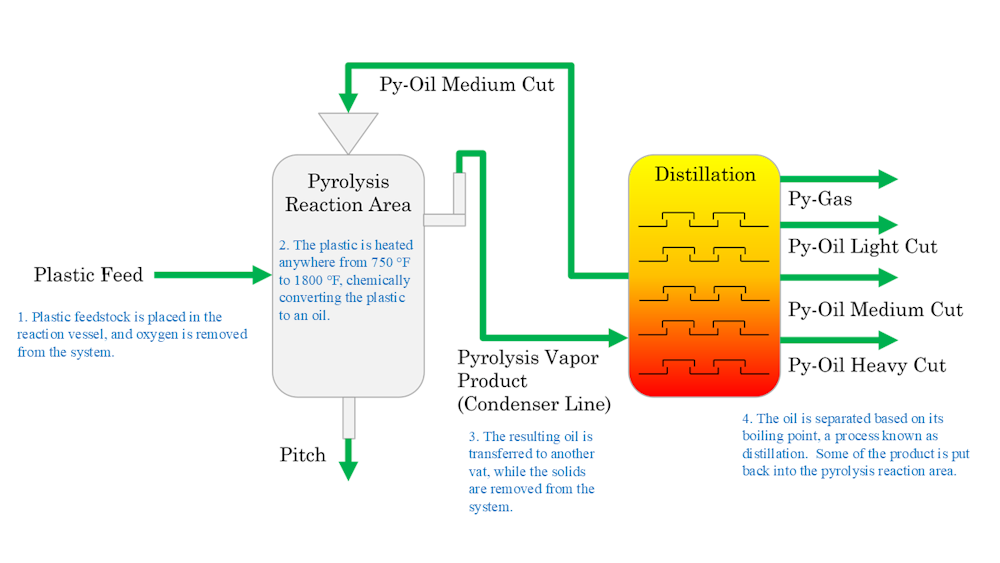
    Plastics are fed into the pyrolysis reactor, where they get hot and turn to oil. The oil moves to another vat where it’s boiled and distilled.
    Alexander Kaplitz and Kevin A. Schug

    Unlike traditional plastic recycling, pyrolysis theoretically isn’t limited to specific types of plastic. It could be made to accommodate many of them, although current technology is limited to a few types – polyethylene and polypropylene, used in food containers and bottles – at an industrial scale.

    So, plastic pyrolysis could help handle the waste from consumer products such as plastic bags, bottles, milk jugs, packaging materials, wet wipes and even discarded children’s toys. Pyrolysis can also handle more complex plastic waste such as tires and discarded electronics, although solid waste handlers and recyclers avoid certain plastic types in pyrolysis, such as polyvinyl chloride – or PVC, which is found in pipes and roofing products – and polystyrene, used in packaging, as these can create harmful byproducts.

    During pyrolysis, the plastic polymers are broken down into smaller molecules, resulting in the production of liquid oil, fuel source gases such as methane, propane and butane, and char.

    Char is the solid residue left at the end of the pyrolysis process. It can be used as a carbon-rich material for various applications, including adding it to soil to make it healthier for farming, as it increases soil moisture and pH, benefiting nutrient absorption. Char also has the ability to absorb harmful carbon gases from the air, which can help prevent climate change.

    The main downside of char is if it’s used too much it can increase soil alkalinity, which may hinder plant growth.

    Plastic pyrolysis uses heat to break down plastic, with the intent to convert plastic waste into usable materials.

    How pyrolosis works

    The plastic pyrolysis process typically involves several key steps.

    In the first step of pyrolysis, community recyclers collect the plastic waste and clean it to remove any contaminants. The plastic then gets shredded into smaller pieces to facilitate the pyrolysis process. Unlike traditional recycling, it needs only minimal sorting.

    Chemical recyclers operating pyrolysis plants feed the shredded plastic into a pyrolysis reactor, where they heat it to temperatures ranging from 600 to 1,600 degrees Fahrenheit (315 to 871 degrees Celsius). Without oxygen, plastics in the reactor don’t catch fire and emit fumes into the air. Instead, this high-temperature environment causes the plastic polymers to break down into smaller hydrocarbon molecules. These smaller molecules can be further refined.

    The high temperature turns some molecules into vapors, which condense into liquid oil. Chemical companies can further refine this oil to be used as fuel or as a raw material to make other chemicals or plastics.

    In addition to liquid oil, the pyrolysis process generates natural gases, such as methane, ethane, butane and propane. Pyrolysis operators then capture these gases, and they can sometimes use them as a source of energy to power the pyrolysis reactor or other industrial processes.

    Plastic pyrolysis generates oil, which engineers can use to create new materials or fuels.
    BASF, CC BY-NC-ND

    Benefits of pyrolysis

    When done effectively, plastic pyrolysis offers several benefits.

    By expanding recycling beyond just plastic bottles and milk jugs, pyrolysis could reduce the amount of plastic waste pollution that ends up in landfills and oceans.

    Additionally, converting plastic waste into usable products could help lower the production demand for new plastics from petroleum hydrocarbons. The byproducts could get used in recycled plastics.

    Some researchers are also testing pyrolysis oils to see whether they can use them instead of gasoline to fuel vehicles. The gases produced during pyrolysis can even generate energy that fuels the pyrolysis reactor, making the process more self-sustaining and reducing the need for external energy sources.

    Currently, about 15% to 20% of the pyrolysis products are recycled into new propylene and ethylene, while most – about 80% to 85% – becomes diesel fuel, hydrogen, methane and other chemicals.

    While plastic pyrolysis holds some promise, it also faces challenges. The cost of setting up and operating pyrolysis plants is high. How profitable the process is depends on the availability of suitable plastic waste, the market demand for the oils and gases produced, and the costs of energy and staff necessary to operate the reactor.

    Another issue is quality control. Most plastic types can undergo pyrolysis, but different plastics create oils with different chemical makeups. Scientists will need to understand the composition of these oils before industry can determine which plastic types to focus on and how each oil could create new materials.

    Pyrolysis oils have unique chemical compositions depending on the type of plastics used to create them.
    Alexander Kaplitz and Kevin A. Schug

    Researchers like us at The University of Texas at Arlington and our international colleagues are studying new chromatography-based oil-separation techniques that can successfully identify some types of pyrolysis oils. Chromatography is the process of separating components in a mixture by passing them through a stiff material.

    Different components in the mixture are attracted to this material to different degrees. So, they exit the chromatography system at different times, which separates them from one another.

    With more research into the technique’s efficiency and technological advancements to scale up pyrolysis, this technique could be one part of a sustainable solution to plastic waste management. In the meantime, pyrolysis is being used now, with one report estimating the market for pyrolysis plants at US$40 billion in 2024 and predicting it to grow to $1.2 billion by 2033.

    Kevin A. Schug receives funding from the National Science Foundation, the National Institutes for Health, ExxonMobil, and Weaver Consultants Group. He is affiliated with VUV Analytics, Inc. and Infinity Water Solutions as a member of their scientific advisory boards. Lummus Technology, LLC provided the funding for research on plastic waste pyrolysis oils at UT Arlington.

    Alexander Kaplitz does not work for, consult, own shares in or receive funding from any company or organization that would benefit from this article, and has disclosed no relevant affiliations beyond their academic appointment.

    ref. Plastic pyrolysis − chemists explain a technique attempting to tackle plastic waste by bringing the heat – https://theconversation.com/plastic-pyrolysis-chemists-explain-a-technique-attempting-to-tackle-plastic-waste-by-bringing-the-heat-234453

    MIL OSI – Global Reports

  • MIL-OSI Security: From Disaster Recovery to Saving Cultural Heritage: IAEA Boosts Assistance to Countries in Non-Destructive Testing

    Source: International Atomic Energy Agency – IAEA

    Non-destructive testing encompasses a variety of techniques that leverage the interactions of matter with radiation, sound, magnetic fields, electrical currents, and testing agents to inspect materials without damaging them. The most used methods include industrial radiography, ultrasonic testing, liquid penetrant inspection and magnetic particle inspection.

    Using gamma or X rays, industrial radiography plays a critical role in creating images that can reveal the safety and quality of civil engineering structures, as bridges, tunnels, dams and buildings are subject to deterioration from environmental stress, including extreme events like earthquakes. NDT is used extensively to inspect aircraft structures, turbine blades and pressure vessels.

    As NDT allows experts to inspect objects without harming them, it also contributes significantly to the field of cultural heritage. NDT techniques enable experts to analyse the internal structures of priceless artifacts, sculptures, and historical structures without causing damage, which aids in restoration and conservation efforts.

    Meet the Scientists at #ICARST2025

    Innovations and latest developments in NDT techniques will be prominently featured at the upcoming International Conference on Applications of Radiation Science and Technology, which will gather hundreds of experts from radiation-related physics, chemistry, materials science, biology, and engineering fields in Vienna from 7 to 11 April 2025. The conference will be livestreamed. 

    Following on from previous conferences in 2017 and 2022, #ICARST2025 will showcase how radiation sciences have contributed to industrial growth and economic development by providing versatile tools and processes to produce high quality products in a clean and efficient manner. Participants will discuss how these technologies help achieve the United Nations Sustainable Development Goals.

    “At a side event on Enhancing Global Collaboration in NDT for Disaster Recovery Enhancement, we will highlight the importance of strong international stakeholder networks in our NDT emergency response plan,” said Hannah Affum, an Industrial Technologist at the IAEA. “We will also sign Practical Arrangements with the International Committee for Non-Destructive Testing (ICDNT) for the promotion of increased use of NDT in industry, civil engineering, and cultural heritage.”

    MIL Security OSI

  • MIL-OSI: Karolinska Development’s portfolio company Umecrine Cognition provides update on ongoing Phase 1b/2a clinical study

    Source: GlobeNewswire (MIL-OSI)

    STOCKHOLM, SWEDEN – March 18, 2025. Karolinska Development AB (Nasdaq Stockholm: KDEV) today announces that its portfolio company Umecrine Cognition has provided an update regarding the ongoing clinical phase 1b/2a trial evaluating the drug candidate golexanolone in PBC patients. Due to technical issues in the production of capsules used in the study, the clinical trial has been delayed. No patient safety concerns have been noted, and Umecrine Cognition is working intensively together with its supplier to resolve the issue.

    Umecrine Cognition is developing a new class of drugs to alleviate cognitive symptoms caused by liver disease. The company’s most advanced drug candidate, golexanolone, is currently being evaluated in a randomized, double-blind, placebo-controlled, clinical phase 1b/2a study in patients with primary biliary cholangitis (PBC) who experience clinically significant fatigue and cognitive symptoms.

    Karolinska Development’s ownership in Umecrine Cognition amounts to 73%.

    For further information, please contact:

    Viktor Drvota, CEO, Karolinska Development AB
    Phone: +46 73 982 52 02, e-mail: viktor.drvota@karolinskadevelopment.com 

    Johan Dighed, General Counsel and Deputy CEO, Karolinska Development AB
    Phone: +46 70 207 48 26, e-mail: johan.dighed@karolinskadevelopment.com

    TO THE EDITORS

    About Karolinska Development AB

    Karolinska Development AB (Nasdaq Stockholm: KDEV) is a Nordic life sciences investment company. The company focuses on identifying breakthrough medical innovations in the Nordic region that are developed by entrepreneurs and leadership teams. The company invests in the creation and growth of companies that advance these assets into commercial products that are designed to make a difference to patient’s lives while providing an attractive return on investment to shareholders.

    Karolinska Development has access to world-class medical innovations at the Karolinska Institutet and other leading universities and research institutes in the Nordic region. The company aims to build companies around scientists who are leaders in their fields, supported by experienced management teams and advisers, and co-funded by specialist international investors, to provide the greatest chance of success.

    Karolinska Development has a portfolio of eleven companies targeting opportunities in innovative treatment for life-threatening or serious debilitating diseases.

    The company is led by an entrepreneurial team of investment professionals with a proven track record as company builders and with access to a strong global network.

    For more information, please visit www.karolinskadevelopment.com.

    Attachment

    The MIL Network

  • MIL-OSI: Mark Werner, CFA Joins Laffer Tengler Investments as Portfolio Manager

    Source: GlobeNewswire (MIL-OSI)

    SCOTTSDALE, Ariz. and NASHVILLE, Tenn., March 18, 2025 (GLOBE NEWSWIRE) — Laffer Tengler Investments, Inc., a boutique investment management firm for high-net worth individuals, institutional clients and platform advisors is pleased to announce the addition of Mark Werner as Portfolio Manager and Strategy Team member of the Dividend Growth Strategy team. Werner brings with him over two decades of investment experience at asset and wealth management firms.  

    “Our dividend growth strategy is best in an important and unique strategy; we welcome Mark’s experience and market expertise,” says Nancy Tengler, CEO and CIO of Laffer Tengler Investments. “Adding Mark to our team will help expand our investment strategy offerings as well as add to the firms’ equity research efforts. His background offers the team additional expertise in portfolio management to benefit our valued clients.”  

    “Laffer Tengler’s proven model was immediately appealing,” says Werner. “I am excited to join the Laffer Tengler team to provide the firm’s clients with diversified and tailored investment strategies.”  

    Werner’s background includes building and developing asset allocation strategies, conducting in-depth fundamental equity research across global markets, and managing portfolios for both institutional and private clients. Throughout his career, he has held investment and portfolio management roles at firms such as Fred Alger Management, Merrill Lynch, Ashfield Capital Partners, and AXA Rosenberg Investment Management.  

    Werner holds a Bachelor of Science in Marketing from Arizona State University, a Master of Science in Financial Analysis and Investment Management from St. Mary’s College and is a CFA charter holder.  

    About Laffer Tengler Investments, Inc.  

    Laffer Tengler Investments, Inc., headquartered in Nashville, Tennessee, with national distribution and an office in Scottsdale, Arizona, is an asset management firm providing investment solutions to Institutional, Platform and high-net worth clients. The company is an investment advisor registered with the SEC, and it offers advisory services. Laffer Tengler Investments, Inc. is an affiliate of ButcherJoseph. Nancy Tengler, CEO and CIO, has been managing large cap value strategies for over 35 years. The investment team has an average of 20 years of experience in the investment management business.  

    Media Contact

    Deborah Kostroun, Zito Partners
    deborah@zitopartners.com
    +1 (201) 403-8185

    The MIL Network

  • MIL-OSI Global: Ethiopia’s war may have ended, but the Tigray crisis hasn’t

    Source: The Conversation – Africa – By Assefa Leake Gebru, Assistant Professor of Political Science and Strategic Studies , Mekelle University

    For over 20 years, Ethiopia was led by the Ethiopian People’s Revolutionary Democratic Front, a coalition of four ethnic-based political parties representing Tigray, Amhara, Oromo, and Southern nations, nationalities and peoples. The Tigray People’s Liberation Front was the most influential party within the coalition. However, in 2018, when the Prosperity Party came into power, the front lost its important role in government.

    On 4 November 2020, the federal government launched an attack on Tigray, terming it a military offensive against political aggression from the Tigrayan front. This sparked a war that lasted two years, and caused severe damage to people and resources. The African Union’s lead mediator in the crisis, Olusegun Obasanjo, estimated about 600,000 civilians were killed. This makes it one of the most destructive conflicts of the 21st century.

    On 2 November 2022, the Ethiopian government and the Tigray People’s Liberation Front signed a peace deal in South Africa, the Pretoria agreement. More than two years later, however, Tigray still faces immense political and humanitarian challenges. Assefa Leake Gebru, who has studied post-war Tigray, explains what’s happening.

    What’s the current situation in Tigray?

    The 2022-2022 war and its lingering effects have thrown the Tigray region into chaos. People are grappling to get basics like food, water and medicine. The regional economy was devastated by the war. There have been no rehabilitation and reconstruction efforts so far. Humanitarian aid is limited. Imagine if your local grocery store ran out of everything and couldn’t restock – that’s the situation I have witnessed and studied in Tigray, which is affecting millions of residents.

    Additionally, the leaders of the Tigray People’s Liberation Front are now fighting among themselves for power. The division is mainly between two factions: one led by former regional president Debretsion Gebremichael and the other by Getachew Reda, who heads the interim administration.

    In January 2025, leaders of Tigray’s military forces supported calls from the Debretsion faction for new regional leadership. The interim administration opposed this, calling it a soft coup. The federal government considers the political faction led by Debretsion illegitimate. The military leaders’ decision also sparked public protests, with Tigrayans calling for a separation between the military and politics.

    This internal division has weakened the interim administration, which was installed as part of the Pretoria agreement in March 2023.

    Given this situation, the interim administration remains fragile amid serious humanitarian concerns and security threats facing the region. The interim government and dysfunctional law enforcement institutions aren’t strong enough to fix things.


    Read more:
    What is federalism? Why Ethiopia uses this system of government and why it’s not perfect


    Economically, jobs remain scarce. A 2024 survey found a youth unemployment rate of 81%. This situation has been created by economic collapse, asset plunder during the war and the absence of a functioning government.

    Socially, people are stressed and hurting, like a community still reeling from a major fallout. It’s a pile-up of problems that are making life incredibly tough.

    What, exactly, is the Pretoria agreement?

    The Pretoria agreement is an important peace deal between Tigray’s political leaders and the federal government. It was signed in Pretoria, South Africa, on 2 November 2022. The African Union facilitated the peace talks hosted by South Africa.

    The goal of the agreement? End the violence that began in 2020, keep people safe by calling for an immediate cessation of hostilities, allow aid like food trucks to roll in, disarm Tigray fighters and set up an interim government to restore order.

    It also aimed to re-establish the Ethiopian government’s control over federal installations in Tigray.

    What has been implemented and what hasn’t?

    There has been some positive progress. The Pretoria agreement established the interim government. Some everyday services are back, like banks reopening and planes flying again. A few Tigray fighters have put down their weapons.

    But here’s where it gets messy. Soldiers from Eritrea – which supported the Ethiopian army in the Tigray war – and militias from another Ethiopian region, Amhara, are still hanging around Tigray, raising security threats. They’re preventing internally displaced persons from going back home.

    The plan to fully disarm Tigrayan fighters hasn’t been completed either. This threatens regional stability, undermines peace efforts and increases the risk of renewed violence.

    What are the implications of not fully executing the Pretoria agreement?

    First, the region’s humanitarian crisis could worsen. An estimated one million displaced people are grappling with high levels of food insecurity, and thousands of schools remain closed. A weak interim government and the continued occupation of parts of Tigray by armed groups has hindered the restoration of services and stifled economic progress.

    Second, the division within the Tigray People’s Liberation Front makes it hard to lead the region under an interim administration. A lack of consensus on power-sharing has hindered effective governance, undermining the intended transitional authority.

    Third, a weak interim government can’t keep civilians safe, which was a pillar of the Pretoria agreement. Economically, the lack of jobs and skyrocketing prices are hitting Tigrayans hard. Socially, everyone’s on edge.

    Finally, there’s a risk of igniting further conflict in the region along the political fault lines between Debretsion and Getachew. There is a high chance of this situation being manipulated by Eritrean forces, who weren’t involved in the negotiations that led to the Pretoria agreement. The fractures in the interim government provide an opportunity for neighbouring Eritrea to support one faction against the other, which could escalate into war between Ethiopia and Eritrea. The Tigray People’s Liberation Front has been one of Eritrea’s bitterest enemies. The antagonism between the two led to the 1998-2000 war between Ethiopia and Eritrea.

    If these tensions keep up, Tigray will remain stuck in an awful cycle. The African Union and international community must address these issues to prevent a spiral into further chaos.

    Assefa Leake Gebru does not work for, consult, own shares in or receive funding from any company or organisation that would benefit from this article, and has disclosed no relevant affiliations beyond their academic appointment.

    ref. Ethiopia’s war may have ended, but the Tigray crisis hasn’t – https://theconversation.com/ethiopias-war-may-have-ended-but-the-tigray-crisis-hasnt-251846

    MIL OSI – Global Reports

  • MIL-OSI Russia: Polytechnic University is among the leaders of the Priority 2030 program

    Translartion. Region: Russians Fedetion –

    Source: Peter the Great St Petersburg Polytechnic University – Peter the Great St Petersburg Polytechnic University –

    The Polytechnic University was included in the first group of universities to receive grants from the Priority 2030 program.

    Following the meeting of the expert council of the Ministry of Education and Science of the Russian Federation, 119 universities out of 142 that submitted their updated development programs will receive grants from the Priority-2030 program for a total of 30.5 billion rubles. The largest funding of 1 billion rubles will be received by each first group universities, which included Polytechnic University.

    Since 2025, the Priority 2030 university support program has been relaunched with a focus on achieving technological leadership in Russia by combining the efforts of the state, business, and universities to create joint projects. The updated Priority 2030 program includes 10 performance targets, including a new indicator — the integrated technological leadership index (ITL). ITL is calculated based on the volume of extra-budgetary R&D and scientific and technical services, commercialization of intellectual property, and the work of small innovative enterprises.

    Each university included a section on “Strategic Technology Leadership” in its comprehensive development program, identifying three strategic technology projects.

    The main emphasis in the Polytechnic University Development Program is on the systemic development of a qualified partnership model in all basic processes of the university. The SPbPU team will solve the task of ensuring technological leadership by focusing on three key scientific and technological areas (KST):

    KNTN-1 “System Digital Engineering” – development of technologies and products superior to foreign analogues, based on digital twin technology andCML-Bench® Digital Platform; KNTN-2 “New Materials, Technologies, Production” – creation of science-intensive production for repair and manufacture of products for various purposes; KNTN-3 “Artificial Intelligence for Solving Cross-Industry Problems” – development of digital platform solutions for analyzing multimodal data.

    “I congratulate the entire Polytechnic staff onsuccessful defense of our Development Program and inclusion in the first group of leading universities. This is the result of our coordinated work on the successful implementation of the projects of the Priority 2030 program, the programs of the World-Class Scientific Center, the NTI Competence Center and the Advanced Engineering School, then on the development of the SPbPU Development Strategy, which has undergone a comprehensive examination, including obtaining an expert opinion from the Russian Academy of Sciences, – commented the rector of SPbPU, academician of the Russian Academy of Sciences Andrey Rudskoy. – The approved Development Strategy forms the basis of the Development Program of our university until 2030 and in the long term until 2036. Formed teams with competencies and experience in solving breakthrough scientific and technological problems, created scientific and scientific-technological groundwork and established effective qualified partnership with industry both in solving frontier engineering problems and in training engineering personnel for high-tech industry will help us achieve all the indicators of the updated Priority-2030 program and make a breakthrough in the scientific and technological sphere aimed at ensuring technological leadership.”

    Please note: This information is raw content directly from the source of the information. It is exactly what the source states and does not reflect the position of MIL-OSI or its clients.

    MIL OSI Russia News

  • MIL-OSI Europe: Participation in Singapore Defence Technology Summit 2025

    Source: Switzerland – Department of Defence, Civil Protection and Sport

    From 18 to 20 March 2025, a delegation from the Federal Office for Defence Procurement armasuisse led by Deputy National Armaments Director Thomas Rothacher will attend the “Singapore Defence Technology Summit 2025”. The conference will raise the topic of how modern defence technologies and partnerships can contribute to overcoming the challenges of an uncertain future. In addition, Ng Chad-Son, Director of the Singaporean Defence Science and Technology Agency (DSTA), will sign the Memorandum of Understanding on the increased defence technology cooperation between Switzerland and Singapore, which the Federal Council approved on 14 March.

    MIL OSI Europe News

  • MIL-OSI Russia: GUU takes care of the little ones: a mother and child room has been opened at the university

    Translartion. Region: Russians Fedetion –

    Source: State University of Management – Official website of the State –

    In accordance with the initiative of the Ministry of Science and Higher Education of the Russian Federation, a mother and child room has been opened at the State University of Management. This step is part of a federal program, within the framework of which about a thousand such important rooms should be created in Russian universities by 2030.

    The mother and child room at the State University of Management is designed to create comfortable conditions for students and university employees raising children. All conditions for comfortable time spending by mothers with children are met here: a cozy interior, necessary furniture, as well as the possibility of holding events aimed at early career guidance for children.

    “Caring for children and families of students is an important aspect of the formation of the future economy of our country. Supporting young parents and creating favorable conditions for raising children contribute to the development of human capital,” said Vladimir Stroyev, Rector of the State University of Management.

    In 2024, about 40 mother and child rooms were opened in the country, and this process will continue.

    At the State University of Management, the mother and child room is located in the right wing of the 1st floor of the Main Academic Building. Absolutely anyone can take the key at the security post at the entrance. Working hours: according to the GUU schedule.

    The State University of Management actively supports initiatives aimed at creating a family and ensuring a harmonious combination of study and motherhood, which contributes not only to improving the living conditions of students, but also to improving the quality of the educational environment.

    SUM continues to strive to develop an inclusive and supportive atmosphere for all participants in the educational process, which is an important step towards improving higher education in Russia.

    Subscribe to the TG channel “Our GUU” Date of publication: 03/18/2025

    Please note: This information is raw content directly from the source of the information. It is exactly what the source states and does not reflect the position of MIL-OSI or its clients.

    MIL OSI Russia News

  • MIL-OSI: FE International Advises on the Acquisition of Cloud Orca by Cooper Parry

    Source: GlobeNewswire (MIL-OSI)

    NEW YORK, March 18, 2025 (GLOBE NEWSWIRE) — FE International, a leading global M&A advisor for technology businesses, is pleased to announce the acquisition of Cloud Orca, a leading a UK-based Salesforce Summit Partner, by Cooper Parry, a next-gen accountancy and business advisory firm.

    Founded by two entrepreneurs with backgrounds in sales and military service, Cloud Orca specializes in cloud-based CRM, marketing automation, and revenue management solutions. As a fast-growing Salesforce Summit Partner, Cloud Orca has successfully completed 400+ Salesforce projects since its inception and holds 25 Salesforce certifications. The company serves clients across industries such as financial services, high-tech, retail, and life sciences, delivering tailored digital transformation solutions that enhance business operations.

    Cooper Parry, a UK-based accountancy and business advisory firm with a strong presence in digital transformation, backing Cloud Orca will enhance the organization’s ability to support the financial operations of their clients. This acquisition positions Cooper Parry at the forefront of CRM-driven business solutions, as Salesforce continues to lead the CRM software market with a 23% market share. This also means that the firm will be introduced to a new sea of partnerships while providing advanced technical infrastructure and expertise in Salesforce implementation, training and development, support and maintenance, and custom development.

    “This Cloud Orca deal is a massive leap forward in our tech offering. It ticks tons of the right boxes: market reputation, powerful culture, huge growth, and a passion for sustainability. The fit is spot on. As we create the UK’s next-gen accountancy firm, the landing of such an impressive anchor firm in the digital and tech space is brilliant news. What a way to start the new financial year! And the great thing is, there’s plenty more on the horizon.” said Ade Cheatham, CEO of Cooper Parry, in their press release.

    A key aspect of this transaction is Cooper Parry’s commitment to preserving Cloud Orca’s operational autonomy. Ed Rowland, CEO of Cloud Orca, and Tony Di Carlo, COO, will continue to lead the company, ensuring that clients receive the exceptional service they have come to expect.

    FE International executed a competitive sale process, garnering multiple offers from industry-leading buyers. “Cloud Orca’s impressive growth and expertise in Salesforce made this a highly sought-after opportunity. At FE International, we are deeply familiar with the Salesforce ecosystem, allowing us to successfully execute a competitive sale process that aligned Cloud Orca with the right strategic partner,” said Jake Olivieri, Partner at FE International.

    For more information about FE International and its role in technology M&A, visit www.feinternational.com.

    About FE International

    Founded in 2010, FE International is a globally recognized M&A advisor specializing in SaaS, e-commerce, and digital media businesses. With over 1,500 transactions completed and a total deal value exceeding $50 billion, FE International has been named one of The Americas’ Fastest Growing Companies by the Financial Times from 2020 to 2024 and is a four-time Inc. 5000 company.

    About Cloud Orca

    Cloud Orca is a leading Salesforce consultancy that specializes in digital transformation through CRM solutions, marketing automation, and revenue management. As a Salesforce Summit Partner, Cloud Orca delivers tailored solutions to businesses looking to optimize their operations, enhance customer experiences, and drive sustainable growth. The company is dedicated to providing expert guidance and innovative technology solutions that empower businesses to maximize their Salesforce investment. For more information, visit www.cloudorca.com

    About Cooper Parry

    Cooper Parry is a UK-based accountancy and business advisory firm that is redefining the industry with its innovative and people-first approach. Specializes in providing disruptive financial and business advisory services, with a strong focus on digital transformation, IT integration, and technology-driven solutions. Cooper Parry partners with ambitious businesses to help them scale, optimize financial performance, and navigate complex digital landscapes. For more information, visit www.cooperparry.com

    Media Contact:

    Gaj Tanwar
    Marketing Coordinator, FE International
    Email: gaj.tanwar@feinternational.com

    The MIL Network

  • MIL-OSI Russia: Developing new approaches and sharing experiences: NSU PISH held an interregional conference for teachers of additional education in the field of engineering

    Translartion. Region: Russians Fedetion –

    Source: Novosibirsk State University – Novosibirsk State University –

    March 17 NSU Advanced Engineering School “Cognitive Engineering” held an interregional conference “Engineering education in school: real cases and best practices”. The event was attended by more than 40 teachers of additional education from the Novosibirsk, Omsk and Irkutsk regions.

    The opening of the conference was addressed by the Director of the Advanced Engineering School of NSU, Sergei Golovin:

    — It is no secret that filling engineering activities with projects involving the real sector of the economy is what our state and region encourage, so that children, having entered universities and studied, become engineers who will create technological independence for Russia. The goal of today’s conference is to discuss how to properly build an engineering methodology in schools, how to involve local industry in projects, and decompose enterprise tasks for school projects. Today, NSU PISH presents the final of the additional professional education program for teachers and mentors who have already prepared their real cases, which they will implement in their territory.

    Leading experts in the field of additional secondary vocational education presented reports on best practices and modern approaches to the implementation of school engineering projects and the interaction of educational institutions with industrial partners. The main goal of the conference was to exchange knowledge and skills in the field of involving schoolchildren in engineering activities, as well as discuss strategies that contribute to the successful implementation of school projects and the establishment of strong partnerships with industrial companies.

    Among the leading speakers are Svetlana Yakovleva, Head of the Department of Educational Policy in the Sphere of General Education of the Ministry of Education of the Novosibirsk Region. The conference also featured Natalia Gornostaeva, Head of the Altair Regional Center, Maya Gichgeldieva, Director of the Education Foundation, and co-founder of the Garage Tesla project Sergey Salnikov.

    The representative of the Ministry presented general information on the development of engineering activities in the Novosibirsk Region. At present, there are 81 general education organizations in the region, where there are engineering classes. There are also 119 institutions of additional education in the Novosibirsk Region, where children can engage in technical creativity. Among them are children’s technology parks.

    Within the framework of the national project “Youth and Children”, 382 centers of education in natural sciences and technology were implemented, which covered more than 2,600 children. In 2024, on the basis of ten organizations of additional education, engineering and technical circles were created for joint educational and industrial activities of children and adults.

    Concluding her speech, Svetlana Yakovleva emphasized:

    — Technical education is certainly a priority in the education system of the Novosibirsk Region. I am confident that the support measures implemented by the Ministry of Education of the Region will improve the quality of training of graduates and engineering personnel for the industry of the Novosibirsk Region.

    An important part of the conference was the presentations by graduates of the program “Methodological and technical support for additional education programs for children in engineering, technology and natural sciences” from the Advanced Engineering School of NSU – these are teachers of additional education from the Novosibirsk and Omsk regions.

    The program graduates presented roadmaps for the comprehensive implementation of additional education programs in technical areas: microelectronics and unmanned systems. The teachers presented projects for the implementation of programs that will stimulate schoolchildren’s interest in engineering, and also shared plans for interaction with high-tech enterprises to set engineering tasks and adapt them for schoolchildren.

    Following the conference, proposals were formulated for further coordination of actions between representatives of additional education on the issue of developing engineering in the school environment.

    Please note: This information is raw content directly from the source of the information. It is exactly what the source states and does not reflect the position of MIL-OSI or its clients.

    MIL OSI Russia News

  • MIL-OSI: Captivision Appoints Ric Clark to Board of Directors

    Source: GlobeNewswire (MIL-OSI)

    MIAMI, March 18, 2025 (GLOBE NEWSWIRE) — Captivision Inc. (“Captivision” or the “Company”) (NASDAQ: CAPT), a pioneering manufacturer and global LED solution provider, today announced the appointment of Richard “Ric” Clark to its Board of Directors, effective immediately. Mr. Clark will serve as Chair of the Company’s Compensation Committee and also join the Nominating and Corporate Governance Committee, bringing decades of executive leadership and corporate governance expertise to the Company.

    Mr. Clark has nearly four decades of real estate, M&A and capital markets experience. He is founder of Burnside Investments, a private investment company, co-founder of WatermanClark, a real estate investment partnership, and a board member of public and private companies in industries including retail, sports and entertainment. Previously, he spent three decades at Brookfield Corp. and its predecessors, serving in various leadership roles, including Chairman and Chief Executive Officer of Brookfield Property Group, Brookfield Property Partners and Brookfield Office Properties. Under his leadership, Brookfield’s real estate group grew its assets under management from $5 billion to more than $200 billion and expanded globally across the property spectrum.

    “We are delighted to welcome Ric to Captivision’s Board of Directors,” said Gary Garrabrant, Chairman and CEO of Captivision. “Ric brings an unparalleled experience building and leading one of the world’s largest and most respected real estate companies. His accomplishments as an entrepreneur are equally distinguished as well as his relationships with decision makers globally.”

    Mr. Clark holds a Bachelor of Science from Indiana University of Pennsylvania.

    About Captivision

    Captivision is a pioneering manufacturer of media glass, combining IT building material and architectural glass. The product has a boundless array of applications including entertainment media, information media, cultural and artistic content as well as marketing use cases. Captivision can transform any glass façade into a transparent media screen with real time live stream capability. Captivision is fast becoming a solution provider across the LED product spectrum.

    Captivision’s media glass and solutions have been implemented in hundreds of locations globally across sports stadiums, entertainment venues, casinos and hotels, convention centers, office and retail properties and airports. Learn more at http://www.captivision.com/.

    Cautionary Note Regarding Forward-Looking Statements
    This press release contains forward-looking statements within the meaning of the Private Securities Litigation Reform Act of 1995, as amended. These forward-looking statements include, without limitation, statements relating to expectations for future financial performance, business strategies, or expectations for the Company’s respective businesses. These statements are based on the beliefs and assumptions of the management of the Company. Although the Company believes that its plans, intentions and expectations reflected in or suggested by these forward-looking statements are reasonable, it cannot assure you that it will achieve or realize these plans, intentions or expectations. These statements constitute projections, forecasts, and forward-looking statements, and are not guarantees of performance. Such statements can be identified by the fact that they do not relate strictly to historical or current facts. When used in this press release, words such as “believe”, “can”, “continue”, “expect”, “forecast”, “may”, “plan”, “project”, “should”, “will” or the negative of such terms, and similar expressions, may identify forward-looking statements, but the absence of these words does not mean that a statement is not forward-looking.

    The risks and uncertainties include, but are not limited to: (1) the ability to raise financing in the future and to comply with restrictive covenants related to indebtedness; (2) the ability to realize the benefits expected from the business combination and the Company’s strategic direction; (3) the significant market adoption, demand and opportunities in the construction and digital out of home media industries for the Company’s products; (4) the ability to maintain the listing of the Company’s ordinary shares and warrants on Nasdaq; (5) the ability of the Company to remain competitive in the fourth generation architectural media glass industry in the face of future technological innovations; (6) the ability of the Company to execute its international expansion strategy; (7) the ability of the Company to protect its intellectual property rights; (8) the profitability of the Company’s larger projects, which are subject to protracted sales cycles; (9) whether the raw materials, components, finished goods, and services used by the Company to manufacture its products will continue to be available and will not be subject to significant price increases; (10) the IT, vertical real estate, and large format wallscape modified regulatory restrictions or building codes; (11) the ability of the Company’s manufacturing facilities to meet their projected manufacturing costs and production capacity; (12) the future financial performance of the Company; (13) the emergence of new technologies and the response of the Company’s customer base to those technologies; (14) the ability of the Company to retain or recruit, or to effect changes required in, its officers, key employees, or directors; (15) the ability of the Company to comply with laws and regulations applicable to its business; and (16) other risks and uncertainties set forth under the section of the Company’s Annual Report on Form 20-F entitled “Risk Factors.”

    These forward-looking statements are based on information available as of the date of this press release and the Company’s management team’s current expectations, forecasts, and assumptions, and involve a number of judgments, known and unknown risks and uncertainties and other factors, many of which are outside the control of the Company and its directors, officers, and affiliates. Accordingly, forward-looking statements should not be relied upon as representing the Company management team’s views as of any subsequent date. The Company does not undertake any obligation to update, add or to otherwise correct any forward-looking statements contained herein to reflect events or circumstances after the date they were made, whether as a result of new information, future events, inaccuracies that become apparent after the date hereof or otherwise, except as may be required under applicable securities laws.

    Media Contact:
    Gateway Group
    Zach Kadletz
    +1 949-574-3860
    CAPT@gateway-grp.com

    Investor Contact:
    Gateway Group
    Ralf Esper
    +1 949-574-3860
    CAPT@gateway-grp.com

    The MIL Network

  • MIL-OSI United Kingdom: Sellafield Ltd and AtkinsRéalis reach new robotics milestone

    Source: United Kingdom – Executive Government & Departments

    News story

    Sellafield Ltd and AtkinsRéalis reach new robotics milestone

    A team of remote technology specialists have achieved an industry first at Sellafield by successfully operating a robot remotely from an off-site location.

    SPOT the quadrupedal robot dog was controlled remotely at a safe location at Sellafield

    Operators working from an immersive room at the Westlakes Science Park in Whitehaven, West Cumbria have proven they can remotely operate a robot on the Sellafield site safely and securely, with huge potential for the future of our clean-up mission.

    The immersive room at Westlakes enables remote operations via secure virtual access

    Sellafield Ltd is part of the NDA group, which is responsible for decommissioning 17 of the earliest nuclear sites across the UK. For the last 2 years we’ve embraced the use of quadrupedal robots through the RAICo programme and our supply chain. 

    More recently we’ve worked with AtkinsRéalis on the integrated remote monitoring project to deploy a customised Boston Dynamics Spot Quadrupedal Robotic ‘dog’ for a range of tasks including remote inspections, data gathering and clean-up work.

    The latest trial takes remote operations a step further by removing the operator from the nuclear site all together, thanks to a highly secure virtual access network and live-streamed footage.

    Deon Bulman, ROV equipment programme lead at Sellafield Ltd said:

    This successful trial marks a significant milestone in our journey towards integrating advanced robotics into our operations at Sellafield.

    The ability to remotely operate robotic systems like Spot demonstrates how digital innovation can enhance safety, efficiency, and decision-making on nuclear-licensed sites.

    By collaborating with AtkinsRéalis, we are exploring cutting-edge solutions that not only support our decommissioning mission but also pave the way for future advancements in remote operations.

    This kind of virtual site access is already deployed by AtkinsRéalis for major construction projects around the world, but it’s the first time it’s been trialled on a nuclear licensed site.

    Richard Brook, technology solutions lead for decommissioning at AtkinsRéalis, said:

    Sellafield Ltd has pioneered the adoption of technology across its operations, and this latest milestone is another step forward for the role of robotics in decommissioning.

    Virtual site access is already being used in the delivery of major infrastructure programmes: this trial is a big step towards unlocking its benefits for nuclear licensed sites without compromising safety or security.

    The Nuclear Decommissioning Authority (NDA) Group are utilising technology and innovation to transform how nuclear decommissioning is delivered and this approach could be applied across other nuclear licensed sites to deliver benefits across the wider NDA group.

    Updates to this page

    Published 18 March 2025

    MIL OSI United Kingdom

  • MIL-OSI Russia: Registration for the qualifying round of the International Financial Security Olympiad is open

    Translartion. Region: Russians Fedetion –

    Source: State University Higher School of Economics – State University Higher School of Economics –

    The Olympiad is organized by Rosfinmonitoring jointly with the Ministry of Education and Science and the Ministry of Education of Russia, as well as universities of the International Network Institute in the field of AML/CFT, including the Higher School of Economics. This year, HSE experts took methodological part in developing the tasks of the invitational round. Schoolchildren and students who registered for the selection round before March 30 are allowed to participate.

    International Financial Security Olympiad — is an intellectual competition that is held annually on the instructions of the President of the Russian Federation Vladimir Putin. Its main objectives include popularizing financial security as a norm of life, minimizing the risks of involving young people in illegal activities and forming a new type of thinking: from the financial security of an individual to the financial security of the state and the commonwealth of states. Over the four years of its existence, the Olympiad has already united over 6 million people from 36 countries!

    The Olympiad is held for students in grades 8–10 in the unified profile “financial security” based on such school subjects as mathematics, computer science and social studies, and for students (1–3 years of bachelor’s degree, 1–4 years of specialist degree and 1st year of master’s degree) — in separate areas of training:

    jurisprudence;

    Mathematics, Applied Mathematics and Computer Science, Applied Mathematics, Mathematics and Computer Science, Fundamental Computer Science and Information Technology, Computer Science and Computer Engineering, Applied Computer Science, Information Security, Business Computer Science;

    economics, finance and credit, economic security;

    international relations, foreign regional studies.

    The International Financial Security Olympiad is held in several stages. The first of them is an invitational one, which allows you to get acquainted with the format of the tasks, study additional materials and prepare for the new cycle. The second stage is a qualifying one. It is organized in the form of two rounds – from March 31 to April 4 and from April 9 to 15 – in an online format using the Sodruzhestvo platform. You can start completing the tasks only after registration, which must be completed before March 30.

    The third important stage is the qualification stage, which is scheduled for the period from August 1 to September 3.

    The final will take place from September 28 to October 3 at the Siberian Federal University (Russia, Krasnoyarsk).

    Winners and prize winners of the Olympiad will receive advantages when entering a university and offers for practical training and internships with the possibility of further employment from Rosfinmonitoring, the Bank of Russia, PAO Promsvyazbank, MUMCFM, leading financial organizations and partners. Schoolchildren who show high results will be able to enroll in a bachelor’s/specialist’s degree at the Higher School of Economics without entrance examinations or get 100 points for the entrance examination. The benefits apply to the programs of the National Research University Higher School of Economics in Moscow.Information security“, “Computer security” And “Jurisprudence: Digital Lawyer“, as well as to the relevant programs in Nizhny Novgorod And Perm.

    “We invite students not only to test themselves by participating in the Olympiad, but also to delve into the issues of financial security in more detail! For this purpose, in 2025 we are launching a minor”Financial Security and Computer Investigations”. You will be able to obtain the necessary knowledge base and form a framework of important legal, financial and digital competencies, and upon completion – an official document confirming the additional qualification received. Thanks to this, new career opportunities in this field will open up for you,” comments Alexander Chepovsky, Director of Strategic Work with Applicants.

    The micro-qualification obtained by the minor is “specialist (expert) in the field of financial and information security”. It will allow you to be a sought-after employee in the corporate sector, government agencies, budgetary organizations and non-profit organizations.

    Minor Selection Campaign will take place in the near future: March 20 and 21 – the first wave, March 25 – the second.

    Please note: This information is raw content directly from the source of the information. It is exactly what the source states and does not reflect the position of MIL-OSI or its clients.

    MIL OSI Russia News

  • MIL-OSI Global: Long, unplanned stay in space will have taken a toll on minds and bodies of stranded astronauts

    Source: The Conversation – UK – By Craig Jackson, Professor of Occupational Health Psychology, Birmingham City University

    US astronauts Sunni Williams and Barry Wilmore have been stranded in low earth orbit onboard the International Space Station for nine months. They are now finally due to return to Earth. Their planned return from their one week mission was abandoned due to concerns with the return vehicle, the Boeing Starliner-1, and this resulted in them being in space for 290 days.

    Wilmore and Williams do not hold the record for the longest stay in orbit, which belongs to cosmonaut Valeri Polyakov, who spent 437 continuous days on the Soviet Mir space station. Nine other US astronauts have spent more than 200 days each in orbit during a single spaceflight – but Wilmore and Williams do hold the record for the longest unplanned spaceflight among US astronauts. Could the unplanned nature of their extended trip produce effects not seen in other planned long-term spaceflights?

    The risks and hazards of space flight are well understood by Nasa and referred to as “RIDGE” – short for Radiation, Isolation and confinement, Distance from Earth, Gravity effects and hostile Environments. Aerospace medicine takes such issues seriously.

    Some physical effects include blood clots and pooling, reductions in bone density, poor digestion, lower nutrient absorption, musculoskeletal atrophy (muscle and bone loss), and poorer cardiovascular function due to reduced blood pumping in zero gravity. Other impacts include changes to the eyeballs due to the pooling of fluids, pooled cerebrospinal fluid around the skull area, and a semi-permanent feeling of congestion.

    The reduced sense of smell may be a blessing, as many space capsules develop an unpleasant smell. Physical effects from fluids can be improved, but not entirely negated, by cuff compression (a fabric sleeve that compresses an area of the body) to relieve pain and swelling. Musculoskeletal atrophy can be reduced with the help of an aerobic treadmill and resistive exercises to help maintain the muscles and cardiovascular function.

    Exposure to radiation is a serious concern, and longer exposures can increase the likelihood of astronauts developing some cancers later in life. The health of Wilmore and Williams will be monitored for many years to come.

    While stranded, Wilmore and Williams will have been providing vital data to help measure the impacts of prolonged stays – every bladder and bowel movement they had will have been weighed and checked for any signs of illness and to monitor changes brought about by their unplanned extension.

    On their return to Earth, they will require gentle physiotherapy to regain muscle function and strength, and for cardiovascular rehabilitation, paced carefully due to the physical fatigue and limitations they will suffer for a few weeks. Dizzy spells, reduced muscle function, and visual disturbances will be common and even walking will take some practice. Their skin will be “baby soft” after nine months of not having their clothes rub against their bodies.

    Of more interest may be the psychological challenges they face, from their concerns over the “near miss” by not returning to Earth in the vehicle they arrived in because Nasa decided it was too risky, through to having to live in confined quarters with others for so long, with a lack of privacy, and enforced companionship.

    Confinement in restricted space, isolation and prolonged separation from family means it is more likely that behavioural problems or psychiatric conditions may develop.

    Problem solving mentality

    Behaviour in others that was initially a minor annoyance can quickly become serious sources of stress and irritation during enforced confinement. Astronauts are selected and screened based on temperament, personality, aptitude and their ability to cope when things go wrong. A problem solving mentality and a will to live, coupled with an ability to follow commands and maintain order in the most difficult of circumstances are what makes astronauts better than most of us.

    They are trained to cope under any situation, such as crash-landings in deserts, or technical failures on board the spacecraft. But despite excellent training, human fallibility and failings will emerge given time.

    Astronaut training also instils the importance of resilience, despite the most trying circumstances, and they will have been trained to keep their fears and anxieties hidden for the benefit of the mission. It might only be after their return that Wilmore and Williams may express their relief. Depression and anxiety can be common after returning to Earth according to others who have been there, with Buzz Aldrin admitting it happened to him and others in his 1973 autobiography Return to Earth.

    Keeping busy will have helped keep worries away.
    Nasa

    They may have experienced feelings of abandonment and questioned why they could not be rescued sooner, or may have developed an understandable lack of trust in technology, and a lack of faith in their fellow mission crew members. They will no doubt have missed important dates with their families, experienced homesickness and possibly even questioned if they could last until rescued.

    Video-link contact with family will have kept them going but will have also been painful and difficult at the same time. Knowing that their families are worried about them, yet equally unable to do anything about it must have been particularly difficult. Although keeping themselves busy as a distraction will have helped, there would have been downtime when their worries must have been almost overwhelming.

    Sleep disturbances and the inability to get regular sleep to allow their brains to rest will have led to cumulative fatigue – both physical and mental. Some astronauts struggle to ever get used to sleeping in space – resulting in lack of performance in the sufferer.

    Being stranded on the ISS and unable to get back home while being able to see home fly by with every rotation of the Earth presents a unique form of frustration. One positive effect reported by many astronauts is the “overview effect” where a sense of peace and oneness with the planet is experienced when viewing the Earth from a whole new perspective. The overview effect seems to have a permanent impact, staying with astronauts for the rest of their lives.

    A complication in understanding any psychological effects of spaceflight is that many astronauts hope to continue their careers and have more missions, and therefore may not be honest about any negatives they experienced. With Nasa planning missions to Mars at some point in the future, the unique experiences of Wilmore and Williams will be useful to behavioural scientists planning such future missions and trying to understand the best psychological characteristics for selecting astronauts for long term spaceflights.

    Craig Jackson does not work for, consult, own shares in or receive funding from any company or organisation that would benefit from this article, and has disclosed no relevant affiliations beyond their academic appointment.

    ref. Long, unplanned stay in space will have taken a toll on minds and bodies of stranded astronauts – https://theconversation.com/long-unplanned-stay-in-space-will-have-taken-a-toll-on-minds-and-bodies-of-stranded-astronauts-252528

    MIL OSI – Global Reports

  • MIL-OSI USA: Campaign School for Social Workers Cultivates the Candidates, Campaign Managers, and Communicators of Tomorrow

    Source: US State of Connecticut

    When Marlena Edmonson, a social worker and elementary school counselor from Indiana, considered running for political office, she thought she needed to be an expert in economics or political science if she wanted to throw her hat into the ring.

    Joshua Levin ’25 (MSW), a student at the UConn School of Social Work, had toyed with the idea of running for office, but felt like he needed more information on how to actually run an effective campaign.

    Also a student at UConn, Quinn Meehan ’26 (MSW) is passionate about making things like political social work, campaigning, and being involved in politics more accessible for those living with disabilities.

    And Kashmir Flood, a Master of Social Work student at the Columbia University School of Social Work, sees herself incorporating political work and social work practice together in some way – whether by running for office herself or supporting candidates in the future.

    For many of the 130 social workers and students who traveled to Hartford on the first weekend in March and spent two days in a chilly, windowless conference room at the Downtown Marriott hotel in Hartford, the idea of launching, running, or participating in a campaign for political office had seemed like a daunting task.

    How do you get started?

    Why are the rules so complicated?

    And, if I run for office, will I really have to call people on the phone to ask them for money?

    But travel they did, from 20 different states and the District of Columbia – some coming from as far as California, New Mexico, Iowa, and Arkansas – to take part in the 29th iteration of the Campaign School for Social Workers, presented by the Nancy A. Humphreys Institute for Political Social Work and to learn, step-by-step, the ins and outs of running a political campaign at any level of government.

    Founded in 1995 by the late former UConn School of Social Work dean, Nancy A. Humphreys, her namesake institute works to increase the political participation and power of social workers and the communities they serve.

    Since 1996, the Campaign School has trained thousands of social workers, students, and faculty from both the U.S. and abroad on what it’s like to get involved in politics as volunteers, staff, advocates, and candidates; to navigate systemic barriers; and to uphold the social work profession’s values and code of ethics while participating in the political process.

    Charles Lewis, founder and director of the Congressional Research Institute for Social Work and Policy in Washington D.C.; Kimberly Hardy, second vice chair of the North Carolina Democratic Party and president of the Society for Spirituality and Social Work; Connecticut State Representative Cristin McCarthy Vahey; and Tanya Rhodes Smith, outgoing director of the Nancy A. Humphreys Institute for Political Social Work at UConn, speak at a panel during Humphreys Institute Campaign School, held on March 7 and 8, 2025. (Thomas Rettig/UConn Photo)

    Despite the typical public perception of what social workers do, notes the Humphreys Institute’s outgoing director Tanya Rhodes Smith, social work was founded as a political profession and has always been committed to not only working with individuals, but also to working on solutions to the complex issues impacting the communities that they serve.

    And a big part of that is, and always has been, the profession’s active and visible role in the political process.

    “Democracy reflects the priorities of those who show up,” Rhodes Smith told the participants on the first day of this year’s Campaign School, “and hint: it’s a small group of people. So, it matters who votes, who holds office, who works on campaigns, and who donates money.”

    The skills that make someone a great social worker, Rhodes Smith explained, also make someone a great candidate, and learning how to take part in politics and campaigning is as much about developing leadership skills as it is figuring out financing rules and putting out yard signs.

    She also warned that Day One of campaign school would be “like drinking out of a firehose.”

    “But we’re going to teach you to live your life as a candidate, so that you will be ready when you decide or are asked to run or serve by others,” Rhodes Smith said.

    Have a Plan. Write it Down.

    “Close your eyes,” ordered Kate Coyne-McCoy, the person who’s been holding that proverbial firehose at nearly every Campaign School.

    “Imagine you’re back in grade school, and you take the bus to your friend Susie’s house, and you go in, and you call your mother, and you say, ‘Mom, I’m at Susie’s and I just invited myself to dinner.’ If you’re like my mother, there’s an audible gasp. You don’t invite yourself to dinner,” Coyne-McCoy continued.

    “Now, open your eyes. It’s 2025. You’re not just going to invite yourself to dinner. When you get there, you’re going to ask for money.”

    Coyne-McCoy is a social worker who has trained more than 9,000 individuals to run for elected office, is a former Congressional candidate herself, and served as the chief trainer for the Harvard Square to the Oval Office program at Harvard University’s Kennedy School.

    And fundraising, she told the participants, is the barrier to most candidacies – the thing you don’t want to do more than anything.

    “You cannot get elected to anything if you don’t have the money to communicate with the people you need to,” Coyne-McCoy said. “I know that 90 percent of you are sitting here saying, ‘Nope.’ You can – you all can. But are you willing to do it?”

    Though this year marked Coyne-McCoy’s final Campaign School training, she didn’t try to ease the water pressure from her firehose of information. Day One was a nonstop onslaught starting with becoming a candidate, ending with volunteer recruitment, and covering everything in between.

    The depth and breadth of the material was surprising to some of the attendees.

    “I was afraid it would be more local, and not enough of the others,” said Edmonson, who is interested in running for federal office. “But I feel like I got what I needed.”

    You cannot get elected to anything if you don’t have the money to communicate with the people you need to. I know that 90 percent of you are sitting here saying, ‘Nope.’ You can – you all can. But are you willing to do it? &#8212 Kate Coyne-McCoy

    “I didn’t think it was to be this amount of information at this level of expertise,” Meehan said. “I didn’t think it was going to be complete experts in the field, from so many different organizations, and so, that was really what impressed me.”

    Early on in the day, Coyne-McCoy – who spent all of Day One on her feet, roaming around the room while barreling through her training materials and engaging the participants as they peppered her with questions and hypothetical scenarios – explained that it doesn’t matter what office someone is running for: They need to a have a campaign plan and write it down.

    That plan needs to include details on their campaign team, their fundraising and budget, messaging, research, and their timeline.

    Over the rest of the day, she’d periodically quiz the participants on these essentials.

    “What’s the most important part about campaign planning?” she’d call out.

    As the day went on, the chorus of voices that responded grew stronger and louder as they’d answer back.

    “Have a plan. Write it down.”

    The day also included a messaging component where the participants worked to craft their own personal story, a 90-second pitch that explained why they were running and why someone should vote for them – something not just valuable on a campaign, but also in their lives and as social workers.

    “Telling your story is about you,” Coyne-McCoy explained. “It’s the thing you should do when you walk into a job interview. It’s what you would do when you walk into a legislator’s office.”

    A few participants shared their stories, including a young woman who beat addiction and wants to see those who lack access to health care find the services they need.

    And a teacher who saw the lack of resources her students experienced and saw how it made them feel – as though they didn’t matter.

    And a social worker and teenage mother who wants her peers to join her in consistently upholding the values and ethics of the social work profession.

    That code of ethics – a set of standards set forth by the National Association of Social Workers – was a consistent theme of this year’s Campaign School, Rhodes Smith said, because whether seeking to serve in local, state, or federal office, the code can be applied to help social workers navigate all types of challenges, including conflicts with values that might occur in politics.

    “Politics and campaigns exist in a partisan context, but the code rises above party,” she said, “and it’s our superpower and guide through every sticky situation or ethical dilemma.”

    ‘Any one of you could do it’

    The firehose of Day One gave way to a quieter, more thoughtful approach on Day Two, where discussions started a day dedicated to processing everything learned the day before and figuring out how participants might apply it in their own lives.

    In-depth discussions with social workers serving in various elected offices were encouraging but realistic about what it means to both run for and hold office.

    “We need to demystify how to run for office,” said Justin Roias, a city councilor in Providence. “It feels complicated, and that feels intentional. There’s a lot of things hidden that you need to learn yourself. But once you do, you’ll get there.”

    “When I think about local politics, I think about cultivating future leaders,” said Kai Belton, a state representative from Middletown. “And then, I’m looking in this room full of social workers, and I’m like, oh my god, this is amazing. I can’t tell you how many of my colleagues up at the legislature say, ‘Kai, we need more social workers up here.’

    UConn Social Work Student Jacob Pierce – with Tanya Rhodes Smith, outgoing director of the Nancy A. Humphreys Institute for Political Social Work – at the Humphreys Institute Campaign School on March 7, 2025. (Thomas Rettig/UConn Photo)

    “There are so many people who want to see you win, and you will have the support that you need. I think that this looks intimidating, but it’s really not, and I think that any one of you could do it.”

    Discussions with community organizers and panelists looking to navigate power imbalances and improve representation in politics stressed the importance of perseverance.

    “Embrace the long game,” encouraged Katrina Huff-Larmond, a city councilor in Randolf, Massachusetts. “We have to understand that what we are fighting for is not going to happen tomorrow. And there’s so much work we need to do in the community, it’s going to take time. We can’t give up.”

    The day concluded as participants revisited their personal stories – with some choosing to share and present them while standing at the podium before their peers – and with a challenge from Rhodes Smith: To share what their next step would be when they left campaign school.

    Edmonson plans to get in touch with a local official to talk about her potential future campaign.

    Meehan wants to work with a co-organizer to help mobilize people with disabilities and help them register to vote, especially people living in institutions.

    Others plan to attend local board or city council meetings, volunteer, get involved.

    For Flood, the weekend helped her find the connection and encouragement that she needed.

    “I knew it would make me want to think about ways that I could find myself in social work and politics,” Flood said, “but it just really solidified for me that, ok, this is really what I want to do. And I didn’t think I could have any more fire in my belly than I do now. So, I’m so happy and really excited.”

    And Levin, who said he plans refer back to his notes from the weekend for a while to come, said anyone considering committing the time to go to Campaign School should, “Do it.”

    “It’s so easy to convince ourselves to not do something,” Levin said. “There’s always going to be 1,000 reasons to not do something, but that one reason is definitely more important.”

    MIL OSI USA News

  • MIL-OSI USA: UConn Study of Hashtag – #childhoodcancer – Shows Families Leading the Conversation

    Source: US State of Connecticut

    Fourteen minutes ago, the nonprofit advocacy group Children’s Cancer Cause posted on the social media app X that members were on Capitol Hill asking Congress for funding to fight #childhoodcancer.

    Three days ago, a special education teacher from Texas posted about a young girl, Caitlyn, who twice survived #childhoodcancer, along with a difficult bone marrow transplant. She included a link to the girl’s GoFundMe account.

    Seventeen hours ago, the chairman and CEO of a cancer response team sought prayers for Kellan, who’s in a battle with B-cell acute lymphoblastic leukemia and by virtue of his courage is heralded a “#childhoodcancer warrior.”

    These are just three posts from a search of the hashtag on X (formerly Twitter) in late February, a snapshot of the thousands – many, many thousands – shared on the app over the years. A new study from UConn researchers looked at 1,000 posts from October to December 2022 to understand who’s leading the conversation about childhood cancer and what they’re saying.

    “We found the largest number of tweets on childhood cancer were not from health care professionals, like oncologists. They were not from nonprofit organizations, like American Cancer Society. They were from individuals – parents, caregivers, and family members. These were the people actually doing the most in terms of raising awareness,” says Sherry Pagoto, allied health sciences professor and director of the UConn Center for mHealth & Social Media.

    Pagoto and human development and family sciences professor Keith Bellizzi, along with four students from the high school, undergrad, and graduate levels, recently published, “A Content Analysis of #Childhoodcancer Chatter on X,” in the Journal of Adolescent and Young Adult Oncology.

    They found that “educational” tweets and ones that discussed “science” accounted for a combined 28.1% of posts about childhood cancer. Next came “fundraising” with 21.2% of tweets – Twitter did not become X until mid-2023, after the study. “Advocacy” was most prominent in 20.2% of tweets, and “motivational” posts comprised 17.5%.

    “Cancer disrupts lives, bringing uncertainty and hardship to individuals and their families,” Bellizzi says. “These findings highlight how different stakeholders may reclaim a sense of control in a situation that often feels uncontrollable. By turning to social media, they are not just sharing stories, they are actively shaping the conversation, raising funds, spreading awareness, and building a supportive community.”

    The study says a total of 3,217 tweets were captured from that three-month period in late 2022 by searching on the hashtag, so researchers pared down the total and randomly selected 1,000 to review. They came from 454 unique accounts.

    We can study all these different sources of data, but social media gives us a unique form of data by showing us how patients, caregivers, and health care professionals talk about health in their natural environment. &#8212 Professor Sherry Pagoto

    Among those accounts, researchers found that family members of children with cancer accounted for most of the content on childhood cancer, making up 41.5% of the tweets that were reviewed. Nonprofit organizations were next at 38.6%, followed by health professionals at 8.7%, academic and/or medical centers at 4.2%, and for-profit companies at 3.5%.

    “We can study human behavior in a lot of ways,” Pagoto says. “We can do surveys. We can do focus groups. We can take blood samples. We can study all these different sources of data, but social media gives us a unique form of data by showing us how patients, caregivers, and health care professionals talk about health in their natural environment.”

    Cameron Cordaway ’23 (CLAS), who majored in physiology and neurobiology and worked on the study her last year at UConn, says she wasn’t surprised to find individuals sharing their stories, sometimes in great detail, on social media.

    After all, sharing experiences with others in a digital way is second nature for her generation, she says.

    “When I got into dental school, the first thing I did was text my whole family and post it on social media,” Cordaway says of her acceptance to the University of Pennsylvania School of Dental Medicine, where she’ll begin studies this fall. “For my generation, our whole lives are on social media. It’s second nature when something happens in your life to tell people on your phone in some way.”

    She continues, “Something as heavy as a cancer diagnosis, while it might not be the first thing you would post in public, people definitely would use social media to communicate, inform, and educate about it. It’s also a good way to let people know, ‘Hey, this is what’s going on with me. This is why I haven’t reached out or why I haven’t been as present.’”

    Pagoto says she and Bellizzi conceived the project after noticing that a father chronicling his young son’s cancer journey on Twitter had become a trending topic on the site.

    “It really enraptured Twitter users for months, as people watched from afar as this father shared his family’s journey through his child’s cancer treatment,” Pagoto says, explaining that got her thinking about how social media was being used among those thinking about, dealing with, and focused on childhood cancer.

    (Amanda Alamsyah / Adobe Stock)

    She and Bellizzi turned to digital natives like Cordaway, Cindy Pan ’24 MPH, clinical psychology grad student Jessica Foy, and Andie Napolitano ’28 (CAHNR) who was a high school junior when she worked on the project.

    Napolitano, who was a student at Amity Regional High School in Woodbridge, says the school offers a science research program that allows young teens in their sophomore year to start working with university-based researchers.

    That year she worked with a professor from the University of New Haven, she says. The last two years of high school, though, were spent with Pagoto and Bellizzi.

    She says she liked the idea of a research project dealing with social media and wanted to use the experience to test drive UConn as a potential for her undergraduate work. A bonus was that like the other students, she could be part of the project from start to finish.

    Pagoto notes that many research studies take many years to complete, thus students see only a small piece during the year or two they’re on board.

    Since tweets are in the public domain and searching Twitter back then was easy, data collection was almost effortless, and the four students could quickly get to work analyzing the tweets.

    That’s the fun stuff, they say.

    “I have an interest in social media research because people spend so much time on it and so many think it’s a bad thing and that only misinformation spreads online,” Napolitano says.

    Doing a project that looks at its benefits especially appealed to her.

    Pagato says that in addition to X, Facebook, Instagram, and TikTok also get heavy use from people using the platforms to talk about their other physical issues and even mental health problems.

    “There are influencers with Tourette syndrome, depression, cancer, and any condition you can imagine, and, yes, while there is misinformation on social media, there’s also community on social media and these influencers are sharing their experiences and garnering support,” she explains.

    “It’s a little like, ‘Here’s my experience. I have this diagnosis, and this is what my life is like,’” she continues. “Health influencers on social media destigmatize many disorders that have been hiding in the shadows, particularly mental health disorders.”

    Those with similar diagnoses, she says, can learn from others about what to expect, how to cope with side effects, how to find clinical trials, and what questions to ask.

    “Patients have a lot to say about their experience. They’re the ones who must live with the disease. Their voices matter. I wonder if that’s what draws them to social media – to be heard. Oftentimes, we’ll hear in studies that patients don’t feel heard by their doctors. They may not even feel heard by their family members,” Pagoto says.

    Napolitano agrees.

    “In today’s mainstream media environment, for a lot of reasons, stories don’t get heard. Social media is a way for people to make themselves be heard,” she says.

    And that includes the mother of a son treated for neuroblastoma in 1999 who posted four hours ago in a conversation about bringing a newborn into a crowded airport that she had to protect her young son from viral exposures the first eight years of his life: “This is what having a child w/ #childhoodcancer or a #survivor with vulnerable health is like.”

    MIL OSI USA News

  • MIL-OSI United Kingdom: New non-executive directors join Defra board

    Source: United Kingdom – Executive Government & Departments

    News story

    New non-executive directors join Defra board

    Sachin Jogia and Indro Mukerjee appointed to the departmental board

    The Department for Environment, Food and Rural Affairs (Defra) has today (18 March 2025) announced the appointment of two new non-executive board members – Sachin Jogia and Indro Mukerjee. 

    Non-executive board members are senior figures from outside government, appointed to provide challenge to government departments. All non-executive board member appointments are made in line with the Governance Code on Public Appointments. 

    Sachin and Indro begin their appointments today, with their terms lasting for three years. 

    The Defra board provides strategic, corporate leadership to the department and has particular responsibility for monitoring performance and delivery. 

    Biographies

    Sachin Jogia

    Sachin Jogia has a technology and product leadership background across global organisations, most recently as Group Director of Technology Strategy and Transformation at Sky.

    Previously, he was Chief Technology Officer at Ofcom, overseeing innovation across the areas they regulate including online safety, broadcasting and telecoms. Before that, he spent nine years at Amazon in the UK and USA, most recently as General Manager for Alexa Smart Home International.

    Sachin was the founding Chairman of the British Heart Foundation’s Technology Advisory Group and has championed initiatives supporting disadvantaged communities, including Amazon Future Engineer. He is a Trustee and non-executive director at City Year UK, a founding member of the Corporate Advisory Board at Save The Children UK and has mentored Imperial College students and senior leaders with BeTheBusiness.

    Indro Mukerjee

    Indro was CEO of Innovate UK, the UK’s innovation agency, for three and half years until September 2024.

    He is a highly experienced business leader, with CEO experience across technology and industrial businesses from multinationals to startups and private equity-backed ventures.

    With a global career spanning Asia, the US, and Europe, Indro has led innovation, fast growth, spinouts, M&A, and business transformation across many different business situations. He has been strongly committed to supporting skills development, including co-founding and chairing the UK Electronics Skills Foundation.

    He has an engineering degree from Oxford University, a graduate of the Wharton Advanced Management Program, a Fellow of the Royal Society of Arts and an elected Honorary Fellow of the Royal Academy of Engineering and the Academy of Medical Sciences.

    Updates to this page

    Published 18 March 2025

    MIL OSI United Kingdom

  • MIL-OSI United Kingdom: Reappointment of Non-Executive Director to the Crown Commercial Service

    Source: United Kingdom – Executive Government & Departments

    News story

    Reappointment of Non-Executive Director to the Crown Commercial Service

    Dr Manuela Gazzard has been reappointed as Non-Executive Director.

    Dr Manuela Gazzard has been reappointed as Non-Executive Director of the Crown Commercial Service following the end of her term on 31st January 2025.

    She has been reappointed for another term of 3 years, starting on 1st February 2025. She will serve as Non-Executive Director until 31st August 2027. 

    The Crown Commercial Service is an Executive Agency and Trading Fund of the Cabinet Office. 

    It is responsible for managing the procurement of common goods and services, increasing  savings for the taxpayer by centralising buying requirements, and leading on procurement policy on behalf of the government.

    You can read more about the Crown Commercial Service here.

    Dr Manuela Gazzard is currently Group Director of Regulatory Services at BSI. She has over 20 years of leadership experience in the global life sciences sector including pharmaceuticals, medical devices, biotech, and other related fields. 

    She has held positions as Managing Director, NovaPrep and Lab Services at Novacyt; Group Commercial Director, Johnson Matthey/Macfarlan Smith; and Director positions at Johnson & Johnson/Janssen and Boehringer Ingelheim.

    Updates to this page

    Published 18 March 2025

    MIL OSI United Kingdom

  • MIL-OSI United Kingdom: Ambitions are high as UK celebrates a year in Horizon Europe

    Source: United Kingdom – Government Statements

    Press release

    Ambitions are high as UK celebrates a year in Horizon Europe

    Hundreds of researchers, business leaders and academics gather at the Oval in London to mark a year of UK success in Horizon – and plan for much more.

    • Hundreds of researchers, business leaders and academics gather at the Oval in London to mark a year of UK success in Horizon – and plan for much more
    • £80 billion Horizon Europe programme is the world’s largest international research endeavour, and an important part of the UK’s relationship with Europe
    • International research collaboration is a key driver of economic growth, and the government’s Plan for Change

    More than 500 of the UK’s leading researchers, businesspeople and scientists will gather at London’s Oval today (Tuesday 18 March) to celebrate the successes that have already been delivered since the UK associated to the Horizon Europe programme, last year. They’ll also hear advice from industry experts, European diplomats, and leading academics on how to seize the opportunities for funding and collaboration that Horizon offers, with £80 billion up for grabs through the programme.

    Initial signs suggest UK association is trending in the right direction. Recent ERC Synergy Grants saw awards made to 18 UK-hosted projects, the second highest number. Horizon is giving British researchers and innovators access to funding, so they can tackle some of the biggest issues facing society, from breakthroughs in healthcare, to putting AI to work across the economy. All of this stands to unleash growth and create jobs in high-potential new industries, all of which supports the growth goals at the heart of the government’s Plan for Change.

    In 2025, the government is doubling down on its efforts to help the UK’s brightest minds access the opportunities on offer through Horizon, through a new PR blitz, networking events in Italy, Germany and Spain for British businesspeople and researchers, and grants to help cover the businesses cover the cost of attending R&D events across Europe.

    Science Minister Lord Vallance, who will speak at today’s Showcase, said:

    Science is stronger when we work together with others, and as new technologies like AI develop rapidly international collaboration on research is more important than ever before.

    Investing in R&D unlocks the door to more productive businesses, highly skilled and paid jobs, economic growth, and innovations that improve our lives and health. We need to go even further to seize the opportunity our association to Horizon represents and then reap the benefits.

    Besides Lord Vallance’s keynote, attendees at the Showcase will also hear from UKRI’s International Champion Professor Christopher Smith, DSIT’s Chief Scientific Adviser Professor Chris Johnson, and Cyril Robin-Champigneul from the EU’s delegation to the UK. That will be supplemented by sessions with experts from the UKRI on how to build the best bids for Horizon grants, and networking opportunities.

    DSIT Chief Scientific Adviser Professor Chris Johnson said:

    Over the last year we’ve seen some initial green shoots of recovery when it comes to UK participation in Horizon Europe. Events like today are an important chance to build on that positive momentum, and learn from the experience of those who’ve already been successful in building bids for funding.

    In 2025 and beyond, we want more researchers and businesses to seize the benefits of Horizon, to accelerate the discoveries that will boost our economy, and deliver new technologies that will improve all our lives.

    UKRI International Champion Professor Christopher Smith said:

    Today’s gathering at the Oval is a testament to the extraordinary progress we’ve made since associating to the Horizon Europe programme. The collaboration and innovation fostered through Horizon Europe are driving breakthroughs that will shape our future, from healthcare advancements, to climate monitoring, to AI integration across industries.

    As we look ahead, it’s crucial that we continue to leverage these opportunities to work collaboratively with our international partners, advancing research, fostering innovation, and supporting our vibrant research community.

    Businesses up and down the country are already carrying out cutting-edge R&D thanks to Horizon backing, as well as building consortia with partners in countries ranging from Canada to South Korea, and beyond.

    We know from recent history that the UK can be a leader in this area. We have 4 of the top 10 universities in the world, and the second-highest number of Nobel prize winners globally. A quarter of projects in which the UK participated, funded through Horizon Europe’s predecessor, were UK-led. 

    Further information, including practical support on how to apply, is available on the Horizon Hub – found on Innovate UK and UK Research and Innovation websites. UKRI also host regular events that help guide businesses and researchers through the opportunities on offer and the application process. 

    Potential applicants can find Horizon Europe calls (funding opportunities) open to UK-based applicants using the European Commission’s funding and tender opportunities portal. They can apply for Horizon Europe funding through the European Commission’s funding and tenders portal, where the original funding call is found. More information on how to submit applications are available on the European Commission’s website.

    DSIT media enquiries

    Email press@dsit.gov.uk

    Monday to Friday, 8:30am to 6pm 020 7215 300

    Updates to this page

    Published 18 March 2025

    MIL OSI United Kingdom

  • MIL-OSI United Kingdom: Extension to technology trial helping transform adult social care across city

    Source: City of Wolverhampton

    City of Wolverhampton Council is working with West Midlands 5G (WM5G) and neighbouring authorities to show how Technology Enabled Care (TEC) can improve the lives of hundreds of city residents.

    As part of the project sensor devices and voice activated wireless technologies including fall detectors, smart speakers, smart doorbells and remote monitoring sensors, are being used in people’s homes to support individual care needs.

    The trial programme is funded by the Department for Science, Innovation and Technology (DSIT) under the 5G Innovation Region scheme and focuses on eligible care and support needs of 3 groups – people aged 65 and over, people with learning disabilities and people with physical disabilities.

    More than 250 referrals have been made in Wolverhampton since the start of the trial in September 2024.

    This is benefitting the region by reducing hospital admissions, optimising carer visits, and enabling proactive care through advanced monitoring and predictive analytics.

    Now the West Midlands has secured additional funding to stay at the forefront of the UK’s digital revolution.

    The extension of the project will support regional and national scaling, expanding TEC to more local authorities, strengthening collaboration with NHS Integrated Care Boards (ICBs).

    It will also enable the development of a business case, procurement framework, and programmes to support culture change and drive long term transformation.

    Councillor Jasbir Jaspal, Cabinet Member for Adults and Wellbeing at City of Wolverhampton Council, said: “It’s an exciting time for social care in Wolverhampton.

    “We’re just getting started with technology enabled care solutions, and we are already seeing positive impacts on culture change and our residents’ wellbeing.

    “We strongly believe, and have seen evidence, of how technology enabled care can help vulnerable adults in our city live independently at home, support social workers and carers, tackle pressures on the NHS by reducing bed blocking and hospital admissions, and make a shift from reactive to proactive care.

    “Thanks to this funding extension, we are looking forward to supporting many more people over the coming months.”

    Councillor Obaida Ahmed, Cabinet Member for Digital and Community at City of Wolverhampton Council, said: “We are driven by digital to make positive changes across our service areas by utilising technology and this is a prime example of how that is making an impact in the real world.

    “The extension of this project is great news and helps ensure everyone is able to get connected and benefit from digital devices to make a difference to their everyday lives.”

    MIL OSI United Kingdom

  • MIL-OSI Russia: Digital microscopes, 3D printers and mini-farms: what equipment will appear in the renovated schools of Moscow

    Translartion. Region: Russians Fedetion –

    Source: Moscow Government – Government of Moscow –

    Almost three thousand units of new modern equipment will appear in 51 schools that will open this year after modernization under the city program “My school”. Digital microscopes, mini-farms, 3D printers and much more will be supplied to educational institutions. This was reported by the capital’s Department of Education and Science.

    “The large-scale modernization program “My School” is ongoing in Moscow. This year, another 51 renovated buildings will open, where more than 35 thousand children will study. At the same time, not only the infrastructure and appearance of the buildings will change, but also their content. The schools will have modern equipment: 11 types of new educational equipment will be delivered, including laser engravers, CNC machines and digital microscopes,” the press service of the capital reported.

    Department of Education and Science.

    Learning will become more visual

    The capital’s schools, which will be updated by the beginning of the next school year, will have digital and stereoscopic microscopes that will allow studying microorganisms and cells. The learning process will become more visual, and children will develop an interest in biology and chemistry from an early age. Several such devices are already in School No. 1190, which opened after modernization in 2024. Using them, children conduct experiments, get acquainted with living organisms, and can even document their discoveries with photos and videos.

    The updated buildings will also feature kits for assembling quadcopters and robots. In this way, children will master the basics of electronics, mechanics and programming. For example, they are already used by students of School No. 281, which was modernized last year. During lessons and additional classes, children learn the basics of programming, prototyping and 3D modeling, as well as develop logical thinking and learn to solve technical problems. Schoolchildren not only assemble robots, but also program them.

    Sergei Sobyanin: Renovation of Maryinskaya School No. 1566 to be Completed by September 1Moscow Mayor Opens Unique Innovative School in Skolkovo

    The guys who are interested in engineering will use laser cutting and engraving machines, as well as 3D printers and scanners. With their help, schoolchildren will create three-dimensional models and work with various materials, such as wood, plastic, fabric and fiberglass. This will help develop spatial thinking and creativity, and will also introduce young Muscovites to modern technologies that are used in industry and design.

    “After modernization, our school got a laser engraver and a CNC milling machine. Thanks to them, kids learn to create products from wood, plastic and steel in technology classes. Children’s imagination is limitless, and such equipment is best suited for implementing the most original ideas. My students create plywood boxes, other three-dimensional objects, souvenirs and crafts,” said Maria Kuznetsova, a technology teacher at School No. 281.

    To make biology lessons even more interesting, mini-greenhouses will be installed in classrooms, allowing flowers to be grown both traditionally and without soil. Students will be able to observe plant growth, analyze the influence of various factors on their development, and conduct their own research. With the help of digital geography laboratories, children will study the atmosphere, soil, water environment, and climate processes. For example, they will be able to measure humidity levels, air temperature, and other parameters.

    The implementation of the largest modernization project in the history of the capital, “My School”, began in 2024. As part of the Moscow Mayor’s program, school spaces are being updated: they are becoming more modern and functional. Work has already been completed in four buildings. These are schools No. 1514 on Akademika Chelomeya Street (building 6a), No. 1190 on Pyatnitskoye Shosse (building 25, building 3), No. 281 on Kominterna Street (building 4, building 1) and No. 37 on Michurinsky Prospekt (building 42). The city plans to update up to 100 educational buildings annually.

    Sergei Sobyanin spoke about the implementation of the Moscow school reconstruction programSergei Sobyanin spoke about the renovated school No. 37 in RamenkiSergei Sobyanin inspected the results of reconstruction of the school in Mitino

    Providing schools with modern high-tech equipment helps to optimize the educational process and meets the objectives of the project “All the best for children” of the national project “Youth and Children”.

    Please note: This information is raw content directly from the source of the information. It is exactly what the source states and does not reflect the position of MIL-OSI or its clients.

    Please Note; This Information is Raw Content Directly from the Information Source. It is access to What the Source Is Stating and Does Not Reflect

    https: //vv.mos.ru/nevs/ite/151436073/

    MIL OSI Russia News

  • MIL-OSI Russia: Memory of the Great Victory: the conference “Front City Leningrad” was held at the Polytechnic

    Translartion. Region: Russians Fedetion –

    Source: Peter the Great St Petersburg Polytechnic University – Peter the Great St Petersburg Polytechnic University –

    On March 14 and 15, the second international youth conference “Front City Leningrad” was held in St. Petersburg, dedicated to the 80th anniversary of the Victory in the Great Patriotic War. The organizers were Peter the Great St. Petersburg Polytechnic University and the State Memorial Museum of the Defense and Siege of Leningrad.

    The event was held with the support of the Legislative Assembly of St. Petersburg, the Archive Committee of St. Petersburg, the Committee for Science and Higher Education of St. Petersburg. The organizing committee included representatives of St. Petersburg universities.

    The grand opening of the conference took place in the White Hall of SPbPU.

    The conference we are holding is truly significant. Such events are simply necessary now. We need to pay close attention to history and issues related to the existence of our state. We must pass on information about those important events and the heroic deeds of each person who took part in them from generation to generation. Through history and traditions, we create the unity of society, – welcomed the guests the first vice-rector of SPbPU Vitaly Sergeev.

    On behalf of the Chairman of the Legislative Assembly of St. Petersburg, Alexander Belsky, the participants were greeted by his deputy, Pavel Itkin.

    In today’s times, it is more important than ever for us to remember the great feat of our fathers and grandfathers, to pay great attention to the patriotic education of new generations. You are our hope and the future of our national history and science, – Pavel Itkin read.

    Chairman of the Committee on Science and Higher Education of St. Petersburg Andrei Maksimov conveyed greetings from the Governor of St. Petersburg Alexander Beglov and spoke about the competition of student and postgraduate works on the study of the defense and blockade of Leningrad.

    It is wonderful that the conference is becoming a good tradition, that all leading universities of St. Petersburg are taking part in this work. This is very responsible and important. You are the young generation, and thanks to you our society will be formed in the future. Therefore, knowing the past, you will be able to draw the right conclusions and choose your path, – said Andrey Maksimov.

    The acting director of the State Memorial Museum of the Defense and Siege of Leningrad, Anatoly Perebykovsky, also addressed the conference participants.

    It is a special honor for us to unite young people from various universities, scientific and educational institutions. The large number of applications for the conference speaks of the interest in preserving historical memory, which is more important today than ever, – emphasized Anatoly Perebykovsky.

    The participants were also greeted by the Chairman of the Committee on Youth Policy and Interaction with Public Organizations Bogdan Zastavny and the Chairman of the Archive Committee of St. Petersburg Petr Tishchenko.

    At the end of the official part, those gathered observed a minute of silence in memory of the victims of the Leningrad blockade.

    The conference participants were young scientists, postgraduates, and students from Russian and foreign universities under the age of 35.

    The plenary session was held at the Polytechnic University. The moderators were the director of the Higher School of Social Sciences of the Humanities Institute of SPbPU Anastasia Lisenkova, associate professor of the Higher School of Social Sciences of the Humanities Institute, academic secretary of the State Memorial Museum of the Defense and Siege of Leningrad Artem Popov, professor of the St. Petersburg Academy of the Investigative Committee of the Russian Federation, academic secretary of the State Memorial Museum of the Defense and Siege of Leningrad Alexander Kutuzov.

    SPbPU student Polina Krison presented a report on “The Contribution of Female Sappers to the Demining of Pavlovsk”. Danil Demin from the St. Petersburg Academy of the Investigative Committee of the Russian Federation recalled the importance of preserving the memory of the events of the Great Patriotic War. Anastasia Gribacheva, a postgraduate student at the Higher School of Economics from SPbPU, presented the organization of the production process at food enterprises in besieged Leningrad. ITMO student Elizaveta Beloborodova presented a report on “Digital Historical Projects as a Tool for Studying the Siege of Leningrad”. Valentina Stroganova from St. Petersburg State University spoke about the work of evacuation hospital No. 1012 within the walls of the Faculty of History during the Siege of Leningrad.

    Sectional meetings were held in person and online at leading universities in St. Petersburg and the regions of Russia, as well as at universities in Belarus and Uzbekistan. The moderators of these meetings were historians, teachers of the Higher School of Social Sciences of the Humanities Institute of SPbPU. The participants also took tours of the State Memorial Museum of the Defense and Siege of Leningrad.

    The conference organizing committee received more than 170 applications from four countries and 49 universities; sectional meetings were organized in nine St. Petersburg universities according to the sections’ profiles.

    Based on the results of the conference, it is planned to publish an electronic collection with posting in the RSCI database.

    Photo archive

    Please note: This information is raw content directly from the source of the information. It is exactly what the source states and does not reflect the position of MIL-OSI or its clients.

    MIL OSI Russia News

  • MIL-OSI Russia: Polytechnic University teacher Ekaterina Chumakova wins Woman of the Year competition

    Translartion. Region: Russians Fedetion –

    Source: Peter the Great St Petersburg Polytechnic University – Peter the Great St Petersburg Polytechnic University –

    In our city, the winners and laureates of the “Woman of the Year” competition were awarded. It is held with the support of the Government of St. Petersburg. 190 application forms were submitted for participation in the competition in ten nominations. Ekaterina Chumakova, a practicing teacher at the Higher School of Law and Forensic Science of SPbPU, won in the “Armed Forces and Law Enforcement” nomination.

    Thanks to my combination of service in the Internal Affairs Department and teaching at the Higher School of Law and Technical Education of the Polytechnic, I was among the winners. Thanks to the Polytechnic for the opportunity to share practical experience with the younger generation, – noted Ekaterina Chumakova.

    Ekaterina Sergeevna is a police lieutenant colonel and the chief expert of the forensic accounting department of the forensic center of the Transport Department of the Ministry of Internal Affairs of Russia for the Northwestern Federal District. She successfully combines police service with teaching at SPbPU. She organizes practical classes for students at the forensic center. At the training ground, future lawyers become “participants in the investigation of crimes” and solve problems right at the “scene of the crime.”

    A practice-oriented approach to education allows our graduates to be in high demand on the labor market, noted Dmitry Mokhorov, Director of the Higher School of Law and Economics.

    The Woman of the Year competition is held within the framework of the Petersburg and Petersburgers program with the support of the city government. It is organized by the Committee for Social Policy of St. Petersburg in partnership with government bodies, commercial and non-commercial organizations.

    Over the years of its existence, the competition has become the main platform for assessing the professional merits of St. Petersburg women and their high achievements. The selection criteria are outstanding results in professional or service activities, active participation in the socio-economic development of St. Petersburg, public and charitable activities. Therefore, the winners of the competition are not just women who are successful in their profession, they are distinguished by an active life position and no less active public activities, – said Vice-Governor of St. Petersburg Natalia Chechina.

    Natalia Chechina noted that thanks to the Woman of the Year competition, the city discovered many talented names, and also saw new social projects and programs come to life. The winners of the competition received diplomas and memorable gifts. Portraits of the laureates will also appear on advertising stands on the main streets of St. Petersburg.

    Please note: This information is raw content directly from the source of the information. It is exactly what the source states and does not reflect the position of MIL-OSI or its clients.

    MIL OSI Russia News

  • MIL-OSI Russia: Representatives of the City Department of Real Estate Inventory and Valuation told students about the specifics of their activities and support for young professionals

    Translartion. Region: Russians Fedetion –

    Source: Saint Petersburg State University of Architecture and Civil Engineering – Saint Petersburg State University of Architecture and Civil Engineering – Students at a meeting

    The career guidance meeting of representatives of the State Budgetary Institution “City Department of Real Estate Inventory and Valuation” with students of the Department of Geodesy, Land Management and Cadastre of St. Petersburg State University of Architecture and Civil Engineering became a kind of brief introduction to professional activities.

    An employer with a proven track record

    Deputy Director of the State Budgetary Institution “City Department of Real Estate Inventory and Valuation” Evgeniya Mikhailova emphasized the purpose of her visit – to talk about the wide range of activities, the specifics of the organization, and career opportunities. It was noted that graduates of our university successfully work here, and the organization intends to continue employing them.

    Evgeniya Mikhailova recalled that the St. Petersburg State Unitary Enterprise “City Administration of Real Estate Inventory and Valuation” (GUP “GUION”) has been counting its modern history since November 28, 2005, when the decree of the Government of St. Petersburg “On improving the system of technical accounting and technical inventory of real estate objects in St. Petersburg” was signed. But the traditions of the enterprise have much deeper roots: on May 21, 1927, the Economic Conference of the RSFSR adopted the resolution “On approval of the Regulation on the inventory of property of local Councils”. It predetermined the creation of special technical inventory bureaus (BTI) in the system of municipal bodies of the RSFSR.

    “Over the course of its long history, the company has undergone a series of transformations, successfully passed all stages of transformation taking into account modern realities and today specializes in four areas, providing a range of services necessary for real estate management, legal entities and individuals, government agencies. The main areas of our activity are cadastral works and technical inventory, valuation of movable and immovable property, land management works, design, consulting. In addition, we carry out work within the framework of the “Ruble per meter” program. It was developed by the Property Relations Committee of St. Petersburg jointly with the Committee for State Control, Use and Protection of Historical and Cultural Monuments and is aimed at attracting investors to restore and involve in circulation unused cultural heritage sites in an unsatisfactory condition,” said Evgeniya Mikhailova.

    Land management with its own specifics

    Evgenia Mikhailova and Yuri Nikitin

    Yuri Nikitin, Head of the Data Collection and Processing Department of the Land Management Department – Methodology and Practical Inventory of Land Plots of the State Unitary Enterprise “GUION”, spoke about the specifics of his area.

    “One of the important aspects of our department’s work is determining the functional characteristics of the sites: the type of economic activity, other characteristics, on the basis of which the amount of rent is determined. Our department employs surveyors and cadastral engineers. St. Petersburg is the only city in our country that has its own unique structure for registering with the state cadastral register, which requires extensive preliminary work. And this imposes additional obligations on specialists, including constant monitoring of legislation, knowledge of the necessary software and the specifics of transferring big data. Among our clients are large enterprises and city facilities. Individuals who are poorly versed in changes in legislation and sometimes simply do not understand what kind of specialist they need also contact us. We have the ability to comprehensively resolve their issues,” said Yuri Nikitin.

    Associate Professor of the Department of Geodesy, Land Management and Cadastre of SPbGASU Vyacheslav Sokolov drew students’ attention to the specifics of engineering cadastral works in St. Petersburg.

    “This specificity of the activity must be studied, especially by those who intend to work in St. Petersburg. This is an important question in the profession. That is why last year the examination committee asked it to a student when defending his final qualification work,” Vyacheslav Sokolov emphasized.

    Bonuses for young professionals

    Evgeniya Mikhailova explained in detail the internal regulations of the GUION, the employee incentive system, the possibility of transferring to departments with similar profiles, the conditions for salary increases and career growth, and receiving bonuses. She emphasized the organization’s interest in young specialists.

    “We have developed adaptation periods for young specialists. Over a certain period of time, they are introduced to their positions by experienced employees, and the organization pays them a monthly bonus of five thousand rubles for two years. In addition, they, like all employees, receive quarterly and annual bonuses. We provide specialists with a bachelor’s degree with paid study leave in the master’s program and support their desire to develop professionally,” noted Evgeniya Mikhailova.

    Third-year student Anna Pyatova reported that as a future specialist, she was interested in hearing in detail about the different departments of the State University of the Social Sciences.

    “The organization offers interesting work in our core areas, good prospects for career growth, a solid archive of information for work. In the future, I want to clarify some details of the work and, perhaps, I will take a closer look at it as a future employer,” said Anna Pyatova.

    Please note: This information is raw content directly from the source of the information. It is exactly what the source states and does not reflect the position of MIL-OSI or its clients.

    MIL OSI Russia News

  • MIL-OSI United Nations: Citizen Science: Theory and Practice (CSTP)

    Source: UNISDR Disaster Risk Reduction

    Mission

    Citizen Science: Theory and Practice (CSTP) is an online, open-access, peer-reviewed publication focused on the global field of citizen science and other participatory sciences. It provides a venue to share and advance related theories and practices, and serves those interested in and contributing to citizen science across all disciplines, including scientists, educators, community organizers, evaluators, information technologists, and resource managers. It also partners with organizations supporting citizen science and associated endeavors.

    MIL OSI United Nations News

  • MIL-OSI: Plum and Wilson Announce Strategic Partnership to Help Companies Uncover Deeper Talent Insights

    Source: GlobeNewswire (MIL-OSI)

    NEW YORK and TAMPA, Fla., March 18, 2025 (GLOBE NEWSWIRE) — Revolutionary talent assessment provider Plum and Wilson, a global integrated talent solutions leader, today shared details of its partnership, designed to offer companies deeper talent insights across the workforce.

    According to research from Gartner, only 21 percent of HR leaders believe their organizations effectively use talent data to shape talent acquisition strategies, improve employee engagement and inform other business decisions. Together, Plum and Wilson give HR and talent leaders a holistic view of the workforce, promoting the ability to scale with flexibility and identify growth opportunities, whether for internal mobility or learning and development.

    Alicia O’Brien, SVP, Innovation and Customer Success at Wilson, commented, “Today’s organizations need access to talent intelligence and analytics to navigate change in real time. Wilson and Plum offer unique but complementary solutions that ensure that HR and talent leaders have the insights they need to attract key talent, close skill gaps and develop their workforce for today, tomorrow and what’s to come.”

    Building on that sentiment, Plum CEO Caitlin MacGregor shared, “Wilson’s integrated talent solutions combined with Plum’s science-backed psychometric solutions provide clarity around the workforce’s durable skills and longer-term potential. With that level of understanding, it becomes possible to elevate talent initiatives and build teams that support the organization’s long-term success.”

    Rose Scaringella-Cappelli, Learning & Development Manager at Arup, shared, “Studies show that as you move up in your career, the more people skills you need. Using this technology is a great way to start understanding the development needs of your workforce. From there, you can facilitate additional conversations about other resources and strategies to implement.”

    To learn more about Plum’s partners, visit https://www.plum.io/partnerships-marketplace.

    About Plum

    Revolutionary workforce solutions provider Plum knows that when people flourish, business thrives. Using objective data backed by scientific insights to measure and match human potential to job needs, Plum provides personalized career insights, improves quality of hire and helps create high-performing teams.

    With unmatched scalability, the award-winning Plum platform enhances talent decisions across the employee lifecycle, making it possible to understand skills, quantify job fit and analyze organizational culture. Visit www.plum.io to learn more.

    About Wilson

    Wilson drives business results through its integrated talent solutions. Powered by talent intelligence, our people partner with some of the world’s most admired brands to build and maintain sustainable workforces that thrive. Visit www.wilson.hr to find out more.

    The MIL Network

  • MIL-OSI Russia: NSU student wins St. Petersburg State University scientific paper competition “Media in the modern world. Young researchers”

    Translartion. Region: Russians Fedetion –

    Source: Novosibirsk State University – Novosibirsk State University –

    This year, 63 students took part in the competition — both bachelors, masters and postgraduates from all over the country. During the correspondence round, participants submit applications for the competition with their research papers. Based on the results of the correspondence round, the best works are selected among bachelors, masters and postgraduates. Then the contestants personally present their works and answer the commission’s questions. The jury distributes the prizes.

    Based on the results of this year’s final defenses, first place among bachelors was taken by a fourth-year student majoring in Journalism Humanitarian Institute of NSU Sofia Kazakova.

    — My scientific supervisor Victoria Evgenyevna Belenko advised me to take part in the scientific paper competition of the Saint Petersburg State University. That same evening, I wrote an article based on my diploma and sent it. In my research, I analyzed what digital and multimedia technologies are used by editorial offices of large media outlets to create logreads and form collective memory. I took as a basis longreads published in the Russian online publications TASS, Izvestia and Lenta.ru in the period from 2018 to 2024, — said Sofya Kazakova.

    Three more students from St. Petersburg State University made it to the finals of the competition; their work topics concerned stylistics, semantics and history. You can read more about them Here.

    Each participant presented their work, after which there was a short discussion. I would like to note the interest of the commission in each study and the difficult questions.

    — I am happy to have won this competition and received high praise from the jury members. We also discussed with them how to expand my topic for further research, which is very useful for my diploma. I would like to thank my scientific supervisor Victoria Evgenievna, who helped me at every stage of the research, — Sofia Kazakova shared her impressions.

    All winners of the correspondence round of the competition were invited to publish in the annual collection of the best scientific works of young researchers, indexed in the Russian Science Citation Index.

    — Sonya’s work is also good because it allows us to see how the longread toolkit has changed over the past six years. And also, and this is no less important, in what specific topics the media’s attention to history is embodied. This is no longer just about media production, but also about collective memory and the opportunity to immerse ourselves in the events of the past, thanks to this kind of media product. So Sonya’s work is very relevant, and I am glad that colleagues from St. Petersburg State University rated it so highly, — said the head of the Department of Mass Communications Humanitarian Institute of NSU Victoria Belenko.

    In the Journalism program, students not only create creative projects, but also systematically engage in scientific research in their field of knowledge. For example, last year, journalism students prepared 54 reports at the International Scientific Student Conference, which is held annually by NSU.

    — And at scientific and practical conferences in other universities of the country, such as TSU, SPbSU, MSU, UrFU, Chelyabinsk State University, that is, in universities with strong schools of journalism and, accordingly, strong conferences on journalism and media, 18 people spoke with 28 reports. Such attention to scientific research work in the creative direction is something that can be spoken about with pride, — added Victoria Belenko.

    Please note: This information is raw content directly from the source of the information. It is exactly what the source states and does not reflect the position of MIL-OSI or its clients.

    MIL OSI Russia News

  • MIL-OSI Russia: NSU scientists are developing new materials to create memory elements of the future

    Translartion. Region: Russians Fedetion –

    Source: Novosibirsk State University – Novosibirsk State University –

    Research staff Analytical and technological research center “High technologies and nanostructured materials” Physics Department of NSU studied the mechanism of charge transport in metal-insulator-conductor structures based on germanosilicate glasses. They were the first in the world to discover the memristor effect or “memory effect” in these materials, studied their optoelectric properties, and are now investigating the processes that occur in them during the flow of current. The results of the research were published in the highly rated scientific journal of the first quartile Applied Physics Letters (Charge transport mechanism in [GeOx](z)[SiO2](1-z) based MIS structures, HTTPS: //d.org/10.1063/5.0240239).

    Silicon oxide is the most common dielectric, it is used to produce various microcircuits. Silicon-germanium glasses are a mixture of silicon oxide and germanium oxide. Previously, scientists studied silicon oxides or germanium oxides separately. Scientists from the NSU ATIC FF were the first to decide to combine the properties of these two substances. Germanium oxide is characterized by low binding energy. This means that a memristor created using this material will be easier to switch and therefore will be more energy efficient. Silicon oxide has a more stable structure, so it is more durable and long-lasting – it can “survive” a greater number of rewriting cycles, which makes it suitable for use in the creation of new, more reliable memory elements. These qualities, inherent in two different compounds, were combined in germanosilicate glasses.

    — Our research group has been studying germanosilicate glasses for over five years. At that time, we were the first in the world to discover the memristor effect in them, in other words, the memory switching effect, when a sample of germanosilicate film switches from one resistance state to another. And these states are stored for quite a long time. We observed several thousand switchings and came to the conclusion that it was necessary to study the mechanisms of transport transfer in such materials in order to further optimize the design of memristors based on them.

    Our colleagues previously studied the mechanisms of transport transfer in silicon oxides and germanium oxides, but we decided to study them in a mixture of these compounds. In our article, we described the results of our work aimed at deepening the study of this new material and its main characteristics, as well as establishing the physics and root cause of its properties observed by us. We need to understand the mechanisms that operate for germanosilicate film materials and find out what processes occur in them during the passage of current, – explained Vladimir Volodin, a leading researcher at the Laboratory of Functional Diagnostics of Low-Dimensional Structures for Nanoelectronics, Department of the ATIC, Physics Faculty, NSU, a leading researcher at the A.V. Rzhanov Institute of Semiconductor Physics, SB RAS, professor of the Department of General Physics, Doctor of Physical and Mathematical Sciences.

    To conduct the experiments, films of four compositions with different ratios of germanium and silicon oxides were grown. Then the scientists made special MIS structures (metal-insulator-semiconductor) with a very thin layer of germanosilicate glass and began conducting temperature studies of the current-voltage characteristics – the dependence of the current on the voltage. In this case, the researcher sets the voltage and then records the dependence of the current in the sample as it changes. The studies were conducted in a certain temperature range – from room temperature to 102 ° C. This range corresponds to the operating temperatures of the memristors. Based on these dependencies, the scientists modeled the properties of the studied samples, approximating the current-voltage characteristics using existing conductivity models. They used 8 recognized models of electrical conductivity in the world. One of them – the Current Limited by Space Charge (CLCS) – unlike the others, showed the most realistic parameters.

    — Using the TLC, we can theoretically predict the parameters of the future memristor as one of the new memory types. We also have the ability, based on the TLC model, to more accurately determine the electric voltage and switching, that is, the operating range of the device we are modeling. In addition, we can predict the currents in each specific sample based on the parameters of its chemical composition, the thickness of the dielectric layers, and other specified model parameters. By superimposing different models on the measured volt-ampere dependence, in the TLC model we determined the energy and concentration of traps involved in charge transport quite accurately. We studied a series of samples with different ratios of germanium oxide and silicon oxide. And according to this dependence, we found that with an increase in the proportion of silicon oxide in the samples, the depth of the traps monotonically decreases. We determined that the concentration of traps does not change, at least not noticeably. More significant changes – by an order of magnitude or more – could become a reason for a negative assessment of the applicability of the model, rejecting its validity, the impossibility of applying it to calculations and experimental values, which would be an undesirable result, said Ivan Yushkov, a junior research fellow at the Laboratory of Functional Diagnostics of Low-Dimensional Structures for Nanoelectronics at the ATIC PF NSU, and a postgraduate student at the A. V. Rzhanov Institute of Semiconductor Physics of the Siberian Branch of the Russian Academy of Sciences.

    The significance of the study is that its results allow researchers to determine the parameters of a memristor theoretically without growing a nanostructure. In addition, the main charge transport mechanism for most memristive dielectrics is also the SCLC. Firstly, this confirms that the SCLC model is applicable in silicon-germanium oxide films, as is mainly the case with memristors, and secondly, using such a model, it is possible to predict the parameters of future structures and devices, or at least regulate the parameters relative to the layered sample being grown.

    -Our study is of value for fundamental science, because we received the mechanisms of transport in these films the first in the world, but there is also practical significance: no one has yet explored German-Slacat glasses with this composition, but we would like to get modern memory elements from this material, which would exceed the usual flash memory in the number Circulation cycles, durability, effectiveness and reliability. Currently, the technologies have reached the line when humanity from the flash memory squeezed the “maximum”: the maximum number of rewriting cycles, the maximum duration of use, the maximum volumes in the container per element have been achieved. Further, using the same technology, it is not possible to multiply the memory parameters of electronic devices. A new type of memory, like a membrane, can help overcome these restrictions. There are other types of memory, but it is the membrane that differs in that when it is used, it is possible to increase the number of rewriting cycles compared to flash memory. The flash memory has a maximum of 10⁶ rewriting cycles, and the membrane has up to 10¹2. In addition, there are publications in which the authors show that the memoristors have one more brief cycle in terms of duration: if the flash memory has a microsekud share, then the membrane has dozens of nanoseconds or even piccicals, that is, a thousand and a million times faster, respectively. So with the help of membrane, memory can become much more “fast -acting,” explained Ivan Yushkov.

    Please note: This information is raw content directly from the source of the information. It is exactly what the source states and does not reflect the position of MIL-OSI or its clients.

    MIL OSI Russia News

  • MIL-OSI Russia: New courses in mathematics and natural sciences have been prepared for the capital’s schoolchildren

    Translartion. Region: Russians Fedetion –

    Source: Moscow Government – Government of Moscow –

    In the new academic year, additional city courses in mathematics, science and technology will be introduced for Moscow schoolchildren. They are designed for students in grades one through six. The initiative was supported by Moscow Expert Council for the Development of Mathematical and Natural Science Education. This was reported by the capital Department of Education and Science.

    “Any educational changes start in primary school. If there is no continuity, then it is too late to start in high school. Children must grow up, and their knowledge must accumulate from year to year,” said Igor Remorenko, chairman of the expert council for the development of mathematical and natural science education and rector of the Moscow City Pedagogical University.

    In the capital’s schools, an additional course “Mathematics and the World Around Us” will be introduced in the first through fourth grades. It will be held in the format of extracurricular activities. Schoolchildren will develop logic, mathematical thinking, and geometric intuition. Teachers who will teach according to the new program will undergo special training. In April next year, at the “Ready for Life in a Smart City” Olympiad, third- and fourth-graders will be able to demonstrate the knowledge they gained in additional classes.

    Children from the fifth and sixth grades will be engaged in developing mathematical and natural science literacy. Those interested in mathematics and natural sciences will be offered to attend clubs at the Center for Pedagogical Excellence. They are designed for schoolchildren from the fifth grade.

    In addition, as part of the initiative to strengthen the natural science and mathematical areas, a new city experimental Olympiad will appear. It is aimed at identifying the interest of schoolchildren in creative research and project activities.

    “The children will have interesting extracurricular classes in mathematics and natural sciences. They will be filled with bright, interesting stories, many of which echo the life of our smart metropolis, modern technologies and the history of the city. Of course, the children will get acquainted with modern professions, and they will be able to demonstrate their knowledge at new Olympiads – “Ready for Life in a Smart City” and the Moscow Experimental Olympiad,” said Ivan Yashchenko, scientific director of the Center for Pedagogical Excellence of the Moscow Department of Education and Science.

    Earlier, an expert council for the development of mathematical and natural science education was created in the capital. Its goal is to improve the quality of education in schools and support children’s interest in the exact sciences. The council will develop and examine teaching aids, refresher courses for teachers, and analyze best pedagogical practices.

    Today, the boundaries between disciplines are blurred: understanding biology is impossible without knowledge of the laws of chemistry and physics, noted the winner of the International Biology Olympiad, Associate Professor of the Moscow Institute of Physics and Technology Georgy Nosov. Therefore, it is important to consider these subjects in a complex, to reveal all aspects of the phenomenon. This will allow us to provide not only a high-quality school education, but also a holistic understanding of different areas, so that it will be easier for future graduates to choose a profession. Having become specialists, they will be able to implement new technologies, develop the sovereignty of the country and Russian science throughout the world.

    The Council will become a permanent body under the Moscow Department of Education and Science. It will be engaged in the development of mathematical and natural science education in the capital’s schools. It is headed by the rector of the Moscow City Pedagogical University, Doctor of Pedagogical Sciences Igor Remorenko. The composition includes leading specialists: coaches of Olympiad teams, teachers, scientists, methodologists, representatives of universities and industrial partners.

    Moscow schoolchildren regularly demonstrate high results. In 2024, more than half of the country’s gold medals at international Olympiads were won by participants from Moscow, and in terms of the absolute number of gold awards, the city entered the top ten world leaders. The share of graduates who scored over 220 points in three subjects on the Unified State Exam is 38 percent. In addition, the number of students choosing to take advanced-level mathematics, computer science, and physics is growing. In this regard, Sergei Sobyanin approved priorities for the development of Moscow educationIn particular, he made a decision to strengthen the mathematical and natural science training of schoolchildren in order to achieve technological leadership in the capital.

    Please note: This information is raw content directly from the source of the information. It is exactly what the source states and does not reflect the position of MIL-OSI or its clients.

    Please Note; This Information is Raw Content Directly from the Information Source. It is access to What the Source Is Stating and Does Not Reflect

    https: //vv.mos.ru/nevs/ite/151440073/

    MIL OSI Russia News