NewzIntel.com

    • Checkout Page
    • Contact Us
    • Default Redirect Page
    • Frontpage
    • Home-2
    • Home-3
    • Lost Password
    • Member Login
    • Member LogOut
    • Member TOS Page
    • My Account
    • NewzIntel Alert Control-Panel
    • NewzIntel Latest Reports
    • Post Views Counter
    • Privacy Policy
    • Public Individual Page
    • Register
    • Subscription Plan
    • Thank You Page

Category: Science

  • MIL-OSI USA News: Establishing the National Energy Dominance Council

    Source: The White House

    class=”has-text-align-left”>By the authority vested in me as President by the Constitution and the laws of the United States of America, it is hereby ordered:

         Section 1.  Policy.  America is blessed with an abundance of natural resources and is a leader in energy technologies and innovation that are critical to the economic prosperity and national security of the American people, as well as our partners and allies.  We must expand all forms of reliable and affordable energy production to drive down inflation, grow our economy, create good-paying jobs, reestablish American leadership in manufacturing, lead the world in artificial intelligence, and restore peace through strength by wielding our commercial and diplomatic levers to end wars across the world.  By utilizing our amazing national assets, including our crude oil, natural gas, lease condensates, natural gas liquids, refined petroleum products, uranium, coal, biofuels, geothermal heat, the kinetic movement of flowing water, and critical minerals, we will preserve and protect our most beautiful places, reduce our dependency on foreign imports, and grow our economy — thereby enabling the reduction of our deficits and our debt.
    It shall be the policy of my Administration to make America energy dominant.

         Sec. 2.  Establishment.  There is hereby established within the Executive Office of the President the National Energy Dominance Council (Council).

         Sec. 3.  Membership.  (a)  The Secretary of the Interior shall serve as Chair of the Council.  The Secretary of Energy shall serve as Vice Chair of the Council.
    (b)  In addition to the Chair and the Vice Chair, the Council shall consist of the following members:
    (i)      the Secretary of State;
    (ii)     the Secretary of the Treasury;
    (iii)    the Secretary of Defense;
    (iv)     the Attorney General;
    (v)      the Secretary of Agriculture;
    (vi)     the Secretary of Commerce;
    (vii)    the Secretary of Transportation;
    (viii)   the Administrator of the Environmental Protection Agency;
    (ix)     the Director of the Office of Management and Budget;
    (x)      the United States Trade Representative;
    (xi)     the Deputy Chief of Staff for Policy;
    (xii)    the Assistant to the President for Economic Policy;
    (xiii)   the Assistant to the President for National Security Affairs;
    (xiv)    the Assistant to the President for Domestic Policy;
    (xv)     the Chairman of the Council on Environmental Quality;
    (xvi)    the Chairman of the Council of Economic Advisers;
    (xvii)   the Director of the Office of Science and Technology Policy; and
    (xviii)  the heads of such other executive departments and agencies (agencies) as the President may, from time to time, designate.

         Sec. 4.  Functions.  (a)  The Chair shall convene and preside over meetings of the Council, in consultation with the Office of the Chief of Staff, provided that in his absence the Vice Chair shall preside.
    (b)  The Council shall:
    (i)    advise the President on how best to exercise his authority to produce more energy to make America energy dominant;
    (ii)   advise the President on improving the processes for permitting, production, generation, distribution, regulation, transportation, and export of all forms of American energy, including critical minerals;
    (iii)  provide to the President a recommended National Energy Dominance Strategy to produce more energy that includes long-range goals for achieving energy dominance by cutting red tape, enhancing private sector investments across all sectors of the energy-producing economy, focusing on innovation, and seeking to eliminate longstanding, but unnecessary, regulation;
    (iv)   advise and assist the President in facilitating cooperation among the Federal Government and domestic private sector energy partners; and
    (v)    advise the President on facilitating consistency in energy production policies included in the Strategy developed under subsection (b)(iii) of this section.
    (c)  In performing the advisory functions listed under subsection (b) of this section, the Council, through the Chair, shall, when appropriate, coordinate with the Assistant to the President for Economic Policy, the Assistant to the President for Domestic Policy, and the Assistant to the President for National Security Affairs.  The functions of the Council shall report to the Office of the Chief of Staff.
    (d)  Within 100 days of the date of this order, and from time to time thereafter as deemed appropriate by the Chair, the Council shall:
    (i)    recommend to the President a plan to raise awareness on a national level of matters related to energy dominance, such as the urgency of reliable energy; the improvements in technology achieved through reliable energy sources; the national security concerns with removing reliable and affordable energy sources; the jobs supported by the energy sector; and the regulatory constraints driving up the cost of reliable energy to consumers;
    (ii)   advise the President regarding the actions each agency can take under existing authorities to prioritize the policy objective of increasing energy production, such as rapidly and significantly increasing electricity capacity; rapidly facilitating approvals for energy infrastructure; approving the construction of natural gas pipelines to, or in, New England, California, Alaska, and other areas of the country underserved by American natural gas; facilitating the reopening of closed power plants; and bringing Small Modular Nuclear Reactors online;
    (iii)  provide to the President a review of markets most critical to power American homes, cars, and factories with reliable, abundant, and affordable energy;
    (iv)   advise the President regarding incentives to attract and retain private sector energy-production investments;
    (v)    advise the President on identifying and ending practices that raise the cost of energy; and
    (vi)   consult with officials from State, local, and Tribal governments and individuals from the private sector to solicit feedback on how best to expand all forms of energy production.

         Sec. 5.  Administration.  (a)  The Council shall have such staff and other assistance as may be necessary to carry out its functions.
    (b)  Agencies shall cooperate with the Council and provide such assistance, information, and advice to the Council related to policies that affect energy dominance as the Chair or, at the Chair’s direction, the Vice Chair, shall reasonably request, to the extent permitted by law.

         Sec. 6.  Representation on the National Security Council.  The Secretary of the Interior, as Chair of the Council, shall serve as a standing member of the National Security Council.

         Sec. 7.  General Provisions.  (a)  Nothing in this order shall be construed to impair or otherwise affect:
    (i)   the authority granted by law to an executive department or agency, or the head thereof; or
    (ii)  the functions of the Director of the Office of Management and Budget relating to budgetary, administrative, or legislative proposals.
    (b)  This order shall be implemented consistent with applicable law and subject to the availability of appropriations.
    (c)  This order is not intended to, and does not, create any right or benefit, substantive or procedural, enforceable at law or in equity by any party against the United States, its departments, agencies, or entities, its officers, employees, or agents, or any other person.

    THE WHITE HOUSE,
        February 14, 2025.

    MIL OSI USA News –

    February 15, 2025
  • MIL-OSI USA: Improving Health Access Through the Black Church

    Source: US State of New York

    February 14, 2025

    Albany, NY

    Governor Kathy Hochul today announced increased funding for United Way of New York City to support the expansion of Choose Healthy Life, a program dedicated to increasing access to health services in underserved communities through the Black church. The expanded initiative will add 10 Choose Healthy Life–funded churches in New York State to the 20 existing churches in New York City, bringing critical health services and wellness programs to five New York cities: Albany, Buffalo, Newburgh, Rochester and Syracuse. The Governor announced that Choose Healthy Life is receiving nearly $5 million, a $1.5 million increase over the prior fiscal year to fund the expansion which affirms her commitment to improving health outcomes in Black communities. Additionally, the Governor proposes adding another $1 million in her FY26 Executive Budget, bringing the total funding amount to $5.9 million over the lifespan of the program.

    “Black churches play an indispensable role in neighborhoods across New York State: connecting people with services and resources that enrich their lives and our communities as a whole,” Governor Hochul said. “Your family is my fight — that’s why I’m committing new funding to expand Choose Healthy Life and the critical health and wellness services they provide.”

    Choose Healthy Life National Black Clergy Health Leadership Council Co-Chair Rev. Al Sharpton said, “Governor Hochul’s unwavering leadership in advancing the health and safety of New York’s most underserved neighborhoods deserves our deepest gratitude. Her partnership with Choose Healthy Life exemplifies the bold action required to save lives.”

    [embedded content]

    [embedded content]

    Governor Hochul made the announcement at Choose Healthy Life’s (CHL) Inaugural Summit which convened CHL clergy leaders, faith-based health navigators and elected officials from across New York State. The convening included the newest Upstate church pastors and navigators that are part of the expansion.

    In partnership with UWNYC, the 20 CHL churches in New York City have been highly successful in addressing persistent health disparities by serving over 100,000 individuals through the Black church. Guided by the clergy, an individual is chosen from each church community and trained to serve as a full-time health navigator. These trusted health navigators have been central to successfully serving nearly 9,000 individuals for social determinants of health needs, providing over 6,000 individuals with Blueprint for Wellness screening reports documenting their health status, and generating over 900 referrals for social support services.

    Choose Healthy Life was founded in 2021 amid the COVID pandemic and grew to fund 120 churches across 13 states. New York, with 30 churches, has more CHL churches than any other state.

    The newly participating churches in CHL’s expanded efforts include:

    • Albany: Macedonia Baptist Church, Metropolitan Baptist Church
    • Buffalo: First Shiloh Baptist Church, True Bethel Baptist Church
    • Newburgh: AME Zion of Newburgh, One Accord Christian Church
    • Syracuse: People’s AME Zion, Tucker Missionary Baptist Church
    • Rochester: New Bethel CME, Zion Hill Missionary Baptist Church

    Governor Hochul’s 2025 State of the State agenda is aimed at enhancing resources for families in New York, helping them build a strong foundation for their children. The Governor’s bold proposals and investments include:

    • putting New York on a path towards universal child care;
    • providing universal free school meals;
    • investing $110 million in child care capital funding;
    • advancing a nation-leading birth allowance — the New York State BABY Benefit;
    • expanding access to infertility treatments;
    • and distributing free diapers and other supplies to the families of nearly 100,000 babies.

    Your family is my fight — that’s why I’m committing new funding to expand Choose Healthy Life and the critical health and wellness services they provide.”

    Governor Hochul

    United Way of New York City President and CEO Grace Bonilla said, “Nearly three million people in New York City, which represent half of working-age households, do not earn enough to cover their basic needs, making access to healthcare a challenge. Choose Healthy Life is a critical program that addresses this crisis, ensuring that families, especially those historically overlooked, have access to screenings, vaccinations, and early interventions that can prevent serious health issues. We are honored that our success in New York City has yielded an additional investment by Governor Hochul, allowing us to partner with our sister United Way agencies across the state to deliver health services to New Yorkers in some of the most vulnerable cities in our state. Through these services, we are working toward lasting, systemic change to create a healthier, more equitable future for all New Yorkers.”

    Choose Healthy Life Founder and Board Chair Debra Fraser-Howze said, “This new chapter in Choose Healthy Life’s mission would not have been possible without the continued investment from Governor Hochul and the invaluable support of United Way of New York City. Choose Healthy Life is successful because of the strong collaboration that exists with clergy, government, and community leaders to carry forward our shared vision of healthier communities.”

    Choose Healthy Life Executive Director Rev. Kimberly L. Williams said, “New York has been a shining example of what can be accomplished when you provide Black churches with the resources to bring about change. Together with Governor Hochul and United Way of New York City, we’re transforming health outcomes for underserved communities across the state. By offering free health screenings, community wellness programs, access to vaccinations, and much more, Choose Healthy Life is lifting up families and empowering individuals to take charge of their own health.”

    Choose Healthy Life New York State Clergy Leader Rev. Jacques Andre DeGraff said, “The expansion of Choose Healthy Life across the state is a monumental step forward in our mission. This anointed partnership brings both the best of faith and science together ensuring that our dedicated health navigators can be effective on the front lines.”

    Embedded Flickr Album

    About United Way of New York City:

    For 87 years, United Way of New York City has been at the forefront in the fight to drive equity and ensure dignity for all New Yorkers, no matter their zip code. They unite by mobilizing the best ideas, relevant data, internal and external experts and resources. United Way of New York City maximizes impact by coordinating and aligning service providers, companies, local government and New Yorkers to help families eliminate barriers and gain the agency to improve their lives for the better. To learn more, visit unitedwaynyc.org.

    About Choose Healthy Life:

    Choose Healthy Life (CHL) is a non-profit organization dedicated to increasing access to health services through the Black church by funding, establishing and training a trusted faith-based health navigator to educate, deliver and connect the community to much-needed health services. Founded in 2021, CHL funded 120 churches across 13 states. Since then, CHL has hosted over 9,000 events, vaccinated, tested and distributed self-test kits to over 350,000 individuals, and screened over 20,000 for comprehensive health risks. Today, CHL’s health navigators are focused on addressing the underlying lack of access to health services in their respective communities, to help individuals take control of their health. For more information, visit choosehealthylife.org.

    MIL OSI USA News –

    February 15, 2025
  • MIL-OSI USA: Tuberville Nominates 57 Alabama Students to U.S. Service Academies

    US Senate News:

    Source: United States Senator Tommy Tuberville (Alabama)
    WASHINGTON – Today, U.S. Senator Tommy Tuberville (R-AL) announced his nomination of 57 Alabama students to multiple U.S. service academies including the U.S. Military Academy, U.S. Air Force Academy, U.S. Merchant Marine Academy, and U.S. Naval Academy as part of the class of 2029. This is Senator Tuberville’s fourth round of nominations since assuming office. Earlier this year, Senator Tuberville was named as the Chairman of the Subcommittee on Personnel for the Senate Armed Services Committee, where he is positioned to help bolster military recruiting and retention. 
    “Our young people are the number one commodity we have in this country, and Alabama is home to the best and brightest,” said Senator Tuberville. “I’m proud to represent a state with so many patriotic young leaders who want to serve in our nation’s military. It’s an honor to nominate 57 of these students for a service academy appointment. I have no doubt they will continue to make our state and country proud.”
    A complete list of Senator Tuberville’s nominees for the class of 2029 can be found below.
    *indicates additional service academy nomination
    United States Air Force Academy:
    Madeline Ashley Alford: Birmingham, AL; Homewood High School;daughter Josh Alford and Ashley Davenport
    Sarah R. Brock: New Market, AL; Whitesburg Baptist Christian School; daughter of Jason and Heather Brock
    Madelyn Bushong: Daleville, AL; Ridgecrest Christian School;daughter Benjamin and Vanessa Bushong
    John David Dallas: Auburn, AL; Auburn High School; son of Doug and Heather Dallas
    Julianna Ruth Gingrich: Enterprise, AL; Enterprise High School; daughter of Shane and Christina Gingrich
    Samuel Vaughn Holmes: Montgomery, AL; Loveless Academic Magnet Program High; son of Harry and Tina Holmes
    Kenneth Lee Jimmerson Jr.: Montgomery, AL; USAFA Prep School; Brewbaker Technology Magnet High School; son of Kenneth Sr. and Michelle Jimmerson
    Anna Elizabeth Martin: Andalusia, AL; Andalusia High School;daughter of Travis and Heidi Martin
    Jack Messervy: Owens Cross Roads, AL; Huntsville High School;son of Chris and Kim Messervy
    Jackson Noah Mitchell: Adger, AL; Oak Grove High School;son of Paul and Amy Mitchell
    *William McCarton Mitchell: Huntsville, AL; Alabama School of Cyber Technology and Engineering; son of Thomas and Irene Mitchell
    John Willis Parsons: Auburn, AL; Auburn High School;son of Robert and Ashley Parsons
    Richard Dean Rutledge III: Albertville, AL; Plainview High School; son of Richard D. Rutledge II and Susan Rutledge
    Benton Nathanael Shelton: Cecil, AL; Pike Road High School; son of Brian and Carolyn Shelton
    Landon Alexander Ward: Spanish Fort, AL; Spanish Fort High School;son of Eddie and Natasha Ward
    United States Military Academy:
    Trinity Gwenyth Bentley: Springville, AL;  St. Clair County School Virtual Preparatory Academy; daughter of Patrick and Madelyn Bentley
    Matthew James Buhl: Harvest, AL; Westminster Christian Academy; son of Joshua and Rachel Buhl
    Katherine Grace Chatfield: Huntsville, AL; St. Michael’s Academy; daughter of Joseph and Diane Chatfield
    Jackson Best Cook: Mountain Brook, AL; USMA Prep School; Mountain Brook High School; son of Jackson and Catherine Cook
    Cooper Daniel Gillis: Birmingham, AL; Homewood High School; son of Brent and Brooke Gillis
    Sprinnia Anne Gregory:  Mountain Brook, AL; Mountain Brook High School; daughter of Mark and Theresa Gregory
    Heinrich Kai Hanada: Huntsville, AL; German School Tokyo Yokohama; son of Heinrich Miki Hanada
    Aiden Elliot Harkey: Dothan, AL; Slocomb High School; son of Kathi Crick
    Daniel Clark Hill II:  Daphne, AL; Daphne High School; son of Daniel and Linda Kay Hill
    David Wayne Hudry: Decatur, AL; Decatur Heritage Christian Academy; son of Wayne and Twila Hudry
    Charles Hillman Jacobs III: Decatur, AL; Providence Classical School; son of Charles and Christy Jacobs
    Jaden A. Johnson: Huntsville, AL; New Century Technology High School; son of Carl and Valisha Johnson
    Aaron Jacob Lee: Orange Beach, AL; Marion Military Institute; son of Larry and Heidi Lee
    Jason P. Love: Chelsea, AL; Briarwood Christian School; son of Brad and Pam Love
    Judd Johnston Lunsford: Huntsville, AL; Randolph School; son of Bill and Ingrid Lunsford
    Stanley Hawkins McConnell Jr.: Mobile, AL; UMS-Wright Preparatory School; son of Stan and Anna McConnell
    *William McCarton Mitchell: Huntsville, AL; Alabama School of Cyber Technology and Engineering; son of Thomas and Irene Mitchell
    Jason J. Park: Madison, AL; James Clemens High School; son of Eun and Taesoo Park
    Andrew Martin Paul: Athens, AL; St. John Paul II Catholic High School; son of James and Laura Paul
    Spencer Joseph Perkins: Prattville, AL; Prattville Christian Academy; son of Ryan and Alora Fisher 
    Thomas B. Sigler: Madison, AL; Bob Jones High School; son of Jason and Brooke Sigler
    Emily Chambers Spooner: Vestavia Hills, AL; Vestavia Hills High School; daughter of Alan and Melanie Spooner
    Cammi Emma Tillery: Enterprise, AL; Enterprise High School; daughter of Robert and Heidi Tillery
    Emily Minh Chau Tran: Auburn, AL; Alabama School of Math & Science; daughter of Nam Tran
    Savannah Grace Trejo: Auburn, AL; Auburn High School; daughter of Charles and Jazzmin Trejo
    Ava Yasmin Valadi: Phenix City, AL; Brookstone School; daughter of Nojan and Jennifer Valadi 
    *Madison Lydia Walz: Auburn, AL; Auburn High School; daughter of Paul and Heather Walz
    Caiden Williams: Harvest, AL; Life Christian Academy; son of Charles and Rebra Kay Williams
    Ethan Sunghyun Yi: Montgomery, AL; The Montgomery Academy; son of Lee and Heejin Yi
    United States Naval Academy:
    Joshua Robert DeFour: Madison, AL; Sparkman High School; son of Robert and Mary DeFour
    Jonathan Lawrence Ellsworth Eddingfield: Daphne, AL; Daphne High School; son of Lawrence and Valerie Eddingfield
    Hagen Kristopher Holley: Hoover, AL; Spain Park High School; son of Steve and Ramona Holley
    Jonathan Levi Hulcher: Mobile, AL; Alabama School of Math and Science; son of Steve and Peggy Hulcher
    Maggie Christine Mae Ingram: McCalla, AL; Heritage Christian Academy; daughter of Jason and Cheryl Ingram
    Jackson Thomas Kalnoske: Birmingham, AL; Chelsea High School; son of Tom and Courtney Kalnoske
    Truman Lee: Mountain Brook, AL; Mountain Brook High School; son of Tommy and Nidia Lee
    Natalie Holland McCabe: Tuscumbia, AL; Muscle Shoals High School;daughter ofTrip and Jill McCabe
    Millicent Elizabeth McCormick: Pelham, AL; Pelham High School;daughter ofRonald and Amanda McCormick
    Jack Pritchett: Montgomery, AL; Loveless Academic Magnet Program High;son of Bill and Anna Pritchett
    Lillian Litton Rand: Birmingham, AL; St. Andrew’s School; daughter of Edward and Anne Rand 
    Steven David Satcher: Madison, AL; Bob Jones High School; son of Ted and Laura Satcher
    Ellen Mary Vegerita: Brownsboro, AL; Huntsville High School; daughter of Frank and Christian Vegerita
    *Madison Lydia Walz: Auburn, AL; Auburn High School; daughter of Paul and Heather Walz
    George Austin Wright: Demopolis, AL; Demopolis High School; son of Hess and Carrie Wright
    Senator Tommy Tuberville represents Alabama in the United States Senate and is a member of the Senate Armed Services, Agriculture, Veterans’ Affairs, HELP, and Aging Committees.

    MIL OSI USA News –

    February 15, 2025
  • MIL-OSI USA: Governor Kehoe Appoints Associate Circuit Judge for 21st Judicial Circuit, Fills Four Boards and Commissions Vacancies

    Source: US State of Missouri

    FEBRUARY 14, 2025

    Jefferson City — Today, Governor Mike Kehoe appointed a new Associate Circuit Judge for the 21st Judicial Circuit and filled four vacancies on various boards and commissions.

    Justin W. Ruth, of University City, was appointed as Associate Circuit Judge for Saint Louis County in the 21st Judicial Circuit.

    Mr. Ruth is a principal attorney at Riezman Berger, PC. He holds a Bachelor of Arts in Psychology from the University of Virginia and a Juris Doctor from Washington University School of Law in St. Louis. He is also an active member of several bar associations, including the Missouri Bar, St. Louis County Bar, and the Bar Association of Metropolitan St. Louis, where he has previously held leadership roles. Ruth was previously appointed by the Supreme Court of Missouri as a member of the OCDC Disciplinary Committee for Region XL. Mr. Ruth will fill the vacancy created by the retirement of the Honorable Nancy Watkins McLaughlin.

    Alfred Brandt, of Linn, was appointed as a member of the State Milk Board.

    Mr. Brandt was previously the owner of Brandt Dairy Farms, and has been a member of the State Milk Board since 2009, serving as the president from 2011 to 2024. He is also an active member of the Holstein Association USA Board and the St. George Parish Council. Previously, he served as President of Missouri Dairy and was a member of the Midwest Dairy Board for the MO-KAN division. Mr. Brandt holds a Bachelor of Science in Agriculture from Lincoln University.

    Louise Secker, of Joplin, was appointed to the Missouri Community Service Commission.

    Ms. Secker is a licensed real estate salesperson for Keller Williams Realty Elevate. She previously served as the Director of Development for Lafayette House in Joplin, Missouri. Beyond her professional career,  Ms. Secker has demonstrated a strong commitment to community service, holding leadership roles on the boards of Jasper County CASA, the Joplin Regional Community Foundation, and the Mount Hope Cemetery. She is also serves on the steering committee for One Joplin Collaborative and is an active member of the Friends of St. Avips, a nonprofit organization that supports fundraising efforts for the Spiva Center for the Arts.

    Jennifer Keller, of Lee’s Summit, was appointed as a member of the State Committee of Psychologists.

    Ms. Keller is a licensed psychologist and serves as Senior Director of Behavioral Health – Counseling Clinics and Psychology at University Health. She is also the Section Chief of Psychology and a Clinical Assistant Professor of Psychiatry at the University of Missouri-Kansas City (UMKC) School of Medicine. She holds a Doctor of Psychology in Clinical Psychology from Forest Institute of Professional Psychology, her Bachelor of Science in Psychology, has completed an APA-accredited Pre-Doctoral Internship and holds a Postgraduate Certificate in Marriage and Family Therapy. With extensive experience in clinical psychology and behavioral health, Ms. Keller has held key leadership positions, including Preadolescent Program Director and Clinical Coordinator of Counseling. Since 2005, she has been an active member of the American Psychological Association and, since 2017, has served on the Missouri Psychological Association’s Evidence-Based Practice Committee.

    Timothy Flora, of Ellisville, was appointed to the Missouri State Board of Private Investigators and Private Fire Investigator Examiners.

    Mr. Flora is the President and Certified Licensed Polygraph Examiner at Mid-West Protective Service, Inc., with over 40 years of experience in law enforcement, investigation, and fire safety. He holds a Master of Arts in Legal Studies from Webster University, a Bachelor of Science in Management from Tarkio College, and a Criminal Justice Certificate from Northeast Missouri State University. Mr. Flora has served in key leadership roles, including Director of the Metro West Fire Protection District and Chairman of the Central County Emergency 911 Dispatch Center. He has been a board member of the Major Case Squad of Greater St. Louis since 2005, and currently serves on the St. Louis County Fire Standards Commission.

    ###

    MIL OSI USA News –

    February 15, 2025
  • MIL-OSI USA: SCHUMER ANNOUNCES UNITED AIRLINES TO OFFER SECOND DAILY FLIGHT IN SUMMER FROM SYRACUSE TO DENVER

    US Senate News:

    Source: United States Senator for New York Charles E Schumer
    Schumer Called United CEO Urging Airline To Offer Additional Denver Flight To Boost Syracuse Airport, Central NY’s Flourishing Tech Ecosystem, And Upstate NY’s One-Of-A-Kind Tourism & Recreation Industry
    United’s Syracuse-To-Denver Flight Is Fully Booked Almost Every Day And New Daily Flight For Peak Travel Season Will Improve Access To Key West Coast And International Markets
    Schumer: New Summer Flight To Denver Will Help Central NY Soar To New Heights!
    U.S. Senator Chuck Schumer today announced United Airlines will add a second daily flight between Syracuse Hancock International Airport and Denver International Airport during the summer. Schumer last year called United Airlines CEO Scott Kirby urging the airline to add a second daily flight for the route, which has been a Syracuse airport priority for years since their existing flight is fully booked almost every day. Schumer said this new flight will improve connectivity to key West Coast and international markets.
    “Syracuse, prepare for takeoff because a second daily flight to Denver is coming to Syracuse International Airport this summer! I called United Airlines CEO last year and told him how important it is to improve access between Central New York and the West Coast, and I’m thrilled he heeded my calls,” said Senator Schumer. “With Micron making historic investments in Onondaga County, this new daily flight is a critical step to connecting this region to the West Coast and other critical high-tech hubs. I look forward to continuing to work with United Airlines and the incredible team at Syracuse Airport to help Syracuse Airport and Central New York reach new heights.”
    “Increased connectivity to and through Denver is a great addition for all our travelers, but especially for our semiconductor industry travelers,” said SRAA Executive Director Jason Terreri. “The twice daily service provides convenient one-stop options into Boise, ID and the Bay Area. On behalf of us all at Syracuse Airport, I would like to thank Senator Schumer and the rest of our elected officials for championing this increased service for our region, helping to ensure Central New York is a leader in the chip manufacturing space for decades to come.”
    The new United flight to Denver will take flight this summer and is expected to start running from June 26th to August 17th. The additional daily service will feature an inbound flight departing Denver at approximately 9:40 AM MT and arriving in Syracuse just after 3 PM EST, as well as an outbound flight departing Syracuse at 4:15 PM EST and arriving in Denver just after 6 PM MT. The service will offer increased access to key destinations, including Los Angeles, San Diego, San Jose, Seattle, Portland, San Francisco, Calgary, Vancouver, and more.
    Schumer said adding a second daily flight from Syracuse to Denver during peak tourist season will increase access to tourism and vacation destinations across Central New York, unlocking new seats for travelers from markets on the West Coast and other international destinations. Schumer said the additional daily flight will also help accelerate the growth of Central New York’s advanced technology and manufacturing ecosystems. With Micron’s landmark $100+ billion investment in Onondaga County creating tens of thousands of good-paying jobs thanks to his CHIPS & Science Law, Schumer explained that a second daily Denver flight will help improve access to the company’s headquarters in Boise, as well as connectivity to critical markets on the West Coast and across the globe during peak summer travel season.
    Over the years, Schumer has tirelessly advocated for new growth and flights at Syracuse Airport. Last year, Schumer announced $9,575,869 in federal funding for taxiway rehabilitation and new signage through the Federal Aviation Administration (FAA) Airport Improvement Program (AIP), which Schumer fought to boost in the 2024 FAA Reauthorization. In 2023, Schumer proudly championed and delivered $6 million for Syracuse Airport in the annual federal budget, including $3 million for security checkpoint upgrades critical for the airport to handle current peak traffic volume and projected demand increases spurred by Micron, and $3 million for a comprehensive de-icing project to help boost tourist travel, business demand, and on-time departures. In 2022, Schumer secured $2.5 million for a new operations command center, allowing the airport to centralize security and communications in a hardened facility to enhance the interaction and coordination between law enforcement officers, security, terminal, airfield maintenance, airfield operations, and more. That same year, following a personal meeting urging Breeze Airways CEO David Neelman to land at Syracuse Airport, Schumer proudly announced that Breeze had heeded his call and made Syracuse the home of the company’s first Upstate NY air service.

    MIL OSI USA News –

    February 15, 2025
  • MIL-OSI USA: This Week in Trump Administration Oversight and Accountability: Senator Luján Standing Up for New Mexico Amidst the Chaos, Confusion, and Corruption

    US Senate News:

    Source: United States Senator Ben Ray Luján (D-New Mexico)
    Washington, D.C. – This week, amidst the chaos, confusion, and corruption shown by Elon Musk and the Trump administration, U.S. Senator Ben Ray Luján (D-N.M.) took the following actions to hold the Administration accountable and stand up for New Mexicans in Washington:
    Senator Luján and the New Mexico Delegation on Thursday night urged the Trump administration to stop the unlawful mass firings of probationary federal employees. In New Mexico, there are approximately 2,200 federal employees in their probationary period – including individuals who serve in critical roles across key agencies, including the Veterans Health Administration, the Bureau of Land Management, the U.S. Forest Service, and the Federal Bureau of Investigation, among others.
    “Abruptly terminating these employees without due process would not only undermine the delivery of essential government services but would also have widespread economic consequences for our state. Federal employment is a major contributor to New Mexico’s economy, supporting thousands of families and generating significant local revenue. Large-scale firings of probationary employees would ripple through our communities, reducing consumer spending, straining local businesses, and creating unnecessary economic instability,” the lawmakers wrote in their letter to President Trump.
    Senator Luján, a member of the Senate Committee on Finance, joined colleagues to tell Elon Musk and “DOGE” to keep their hands off Americans’ Medicaid and Medicare. In New Mexico, one in three New Mexicans rely on Medicare and over 780,000 individuals rely on Medicaid to access health care.
    The lawmakers urged, “It is dangerously unacceptable that an unelected Musk and his unqualified acolytes have access to sensitive CMS systems and are ready to bypass Congress to make life and death decisions affecting millions of Americans. No one asked for this lawless approach to our critical government health care systems. We urge you to stop this threat to Americans’ health care, now.”
    Senators Luján and Heinrich joined all Senate Democrats in raising alarm over the Trump administration pushing illegal indiscriminate funding cuts to the National Institutes of Health (NIH) and derailing life-saving research. New Mexico universities conduct research from substance use disorders to cancer treatment and are among the institutions impacted.
    “Our standing as a world leader in funding and producing new medical and scientific innovations has been put at risk by these recent actions from the Trump Administration. We urge you to stop playing political games with the lifesaving work of the NIH and to allow NIH research to continue uninterrupted,” the Senators wrote to U.S. Department of Health and Human Services (HHS) Secretary Robert F. Kennedy, Jr.
    Senator Luján and members of the Senate Commerce, Science, and Transportation Committee condemned the weaponization of the Federal Communications Commission against broadcasters and public media. Across New Mexico, 15 public media organizations rely on over $5.8 million in grants through the Corporation for Public Broadcasting (CPB) to deliver news, entertainment, and much more.
    The lawmakers said, “We urge you both to follow the Constitution, immediately cease abusing the FCC’s legal authority, and return to the evidence-based decision-making that has been a staple of the Commission’s long and storied history.”
    Senators Luján and Heinrich joined their colleagues to fight for the safety of families and communities in the wake of the funding freeze preventing the hiring and onboarding of seasonal fighters. This comes as the West continues to be ravaged by deadly wildfires.
    “Although there is an urgent need to hire more federal firefighters, the Trump Administration’s hiring freeze does the opposite and is pausing hiring at a critical time for this already understaffed workforce,” they continued. “We urge you to put the safety of families and communities across the country first and allow the federal seasonal firefighter hiring process to continue without delay.”
    Senate Democratic Leadership announced this week a new portal for federal employees who want to disclose information about wrongdoing, abuses of power, and threats to public safety.
    “In just three weeks, President Trump has shown New Mexicans that his administration is willing to disregard the rule of law, recklessly terminate civil servants, and disband government agencies that Americans depend on. Senate Democrats are committed to holding the Trump administration accountable and courageous whistleblowers will be invaluable to the mission of providing a check on the Executive Branch,” the Senator said.
    Additionally, Senator Luján voted against the following nominees this week to stand up for New Mexicans’ security, health and well-being, and economic opportunities:
    Tulsi Gabbard to serve as the Director of National Intelligence. Ms. Gabbard has a long history of spreading lies, defending America’s adversaries, sympathizing with dictators, and is a threat to our national security. Read Senator Luján’s full statement here.
    Robert F. Kennedy Jr. – who has pushed and profited off of conspiracy theories – to serve as Secretary of Health and Human Services. Throughout Mr. Kennedy’s nomination process, he made it abundantly clear that he will continue to push conspiracy theories and health misinformation while being a rubber stamp for President Trump at the expense of American families’ health care. Read Senator Luján’s full statement here.
    Brooke Rollins to serve as Secretary of the Department of Agriculture. The Trump administration abandoned New Mexico’s farmers, ranchers, and acequia parciantes and left them on the hook for millions of dollars. Read Senator Luján’s full statement here.

    MIL OSI USA News –

    February 15, 2025
  • MIL-OSI USA: Governor Stein Announces Ten Recipients of Governor’s Educator Discovery Award

    Source: US State of North Carolina

    Headline: Governor Stein Announces Ten Recipients of Governor’s Educator Discovery Award

    Governor Stein Announces Ten Recipients of Governor’s Educator Discovery Award
    lsaito
    Fri, 02/14/2025 – 15:51

    Raleigh, NC

    Today, Governor Josh Stein and the North Carolina Business Committee for Education (NCBCE) announced that ten teachers across the state would be awarded the Governor’s Educator Discovery Award. 

    “Our students benefit when their teachers prioritize their own continued education,” said Governor Josh Stein. “I am proud to award these professional development grants to teachers who are striving for excellence, and I am excited to hear how they leverage this additional education in the classroom.”

    The Governor’s Educator Discovery Award is a stipend of up to $1,000, awarded to PreK-12 traditional public and public charter educators to pursue a professional development experience of their choosing. Teachers submit a proposal detailing their teaching experience, the professional development activity they wish to pursue, and how it would enhance their efforts to create work-based learning activities for their students. These applications then go through a rigorous review process and are narrowed down to ten winners.

    The 2024 winners were from the twelfth and thirteenth cycles of teachers to receive the award since its inception in 2019. Growing interest in the program has enabled it to expand, bringing the total number of grants awarded to 51. The next cycle of the Governor’s Educator Discovery Award is currently open and accepting applications. Learn more and apply here.

    The ten teachers who received grants will use their Governor’s Educator Discovery Award in the following ways:

    Daniel Fussell, a Social Studies Teacher at Innovation Early College High School in Pitt County Schools, attended the NC Technology in Education Society (NCTIES) conference in Raleigh, where he learned about innovative technologies to support a classroom that prepares students for a future-oriented workforce. In the past, NCTIES has inspired Fussell to introduce TinkerCad and 3D printers into his classroom. 

    Cori Greer-Banks, a Humanities and Expedition teacher at The Exploris School in Wake County Public Schools, used the stipend toward three different professional development opportunities. First, the Monticello Teacher Institute is an immersive professional development program that allows social studies teachers to research and study at Monticello and the Jefferson Library in Charlottesville, Virginia. The other two fellowships are offered through the National Endowment for the Humanities: Little Tokyo: How History Shapes a Community Across Generations, and Grand Coulee Dam: The Intersection of Modernity and Indigenous Cultures. Engaging in these programs will allow Greer-Banks to expand the number of perspectives in her American history curriculum. 

    Pamela Jordan, a Career Development Coordinator at Warren County High School in Warren County Public Schools, will use the grant for the National Career Development Association (NCDA) Summer Conference in San Diego, CA last June. The conference topics highlight the state of the workplace and the need for connecting mental and physical health with career success. Jordan seeks to gain additional insights on strategies and techniques to balance the current technical landscape and mental health issues derived from the COVID-19, to support students turning to career pursuits.

    Lauren Wilmot, an animal science, veterinary assisting, and horticulture teacher at North Pitt High School in Pitt County Schools, attended the NC CTE Summer Conference in Winston-Salem thanks to the grant. The conference provided numerous workshops and professional development opportunities regarding CTE curriculum updates, as well as hands-on labs that can be used in the classroom. Teachers also had the opportunity to collaborate with fellow educators in their content area from across the state.

    Rong Zhang, a Mandarin Chinese teacher at East Cary Magnet Middle School in Wake County Public Schools applied the award toward the 2024 MSU STARTALK for Chinese Language Teachers Program. STARTALK, funded by the National Security Agency (NSA), is designed to increase the number of U.S. citizens proficient in critical-need foreign languages, with a particular emphasis on Chinese. The program comprises a learning phase to curriculum development and language assessment, a summer professional development program focused on unit development and refinement, and classroom implementation and evaluation.

    Franchone Bey, an English teacher at West Charlotte High School in Charlotte-Mecklenburg County Schools attended the National Council for Teachers of English (NCTE) Annual Convention in Boston. The event offered ELA educators the chance to collaborate with teachers from across the country, meet research scholars, and hear from prominent authors like keynote speaker Justice Ketanji Brown Jackson. By the end of the event, participants could integrate real-world writing experiences into their classrooms, employing cross-curricular inquiry methods and project-based learning to enhance student writing skills. 

    Darren Rhym, an English teacher at Columbia Early College High School in Tyrell County Schools also attended the NCTE Annual Convention in Boston. Rhym attended the event to learn about ways to utilize NC Writing Standards in his clean energy unit, emphasizing the importance of cross-curricular learning. Through various sessions presented by research scholars and authors, Rhym was able to gather a unit of materials for developing project-based learning experiences to enhance student writing and employability.

    Alicia D’Joi, a STEM teacher and Robotics Coach at JM Alexander Middle School in Charlotte-Mecklenburg County Schools used the grant to attend the AIM Conference hosted by NCDPI in Raleigh. D’joi led a session titled Robotics for Rookies: Your First Steps into the Future, where she provided an exciting and hands-on introduction to the world of robotics. In her session, rookie participants learned to design, build, and code a robot. Through this event, D’Joi shared her vast knowledge with colleagues across the state and heard from other educators and educational leaders.

    Jessamyn Bailey, a Visual Arts and Photography teacher at High Point Central High School in Guilford County Schools, attended the North Carolina Arts Educator Association (NCAEA) Annual Conference in Asheville. The conference offered a wide range of professional development opportunities, including workshops on fiber arts, photography, curriculum development, and new art-making techniques. Sessions focused on hands-on learning while providing networking opportunities with practicing artists and art organizations, allowing educators to bring career exploration and work-based learning opportunities into their classrooms.

    Ameriki Somers, a Media Coordinator at Lowrance Middle School in Forsyth County Schools, will use the award this year to attend the American Association of School Librarians (AASL) Conference in St. Louis, MO. Lowrance Middle School is an alternate learning environment that serves students with fundamental disabilities in grades 6 – 10. The conference will provide Somers with innovative strategies and resources to create specifically tailored hands-on work experiences that meet the accessibility needs of her students. Somers hopes to provide her students with the opportunity to explore careers and develop real-world skills through the inclusive learning environments, adaptive technologies, and differentiated instructional methods.

    The Governor’s Educator Discovery Awards are funded by NCBCE member companies. As interest in the program continues to grow with each cycle, NCBCE hopes to raise additional funds to expand the program in future years. Parties interested in funding the initiative should contact Caroline Sullivan, Executive Director of NCBCE, at caroline.sullivan@nc.gov.

    The North Carolina Business Committee for Education (NCBCE) is a business-led, education non-profit (501-c3) that operates out of the Office of the Governor. Since 1983, NCBCE has provided a critical link between North Carolina business leaders and the state’s education decision-makers, helping to create connections between the education curriculum and the overall work readiness of people across the state. 

    Feb 14, 2025

    MIL OSI USA News –

    February 15, 2025
  • MIL-OSI USA: Governor Stein Announces $8 Million Investment in Vance County for Precision Manufacturer’s First North American Plant

    Source: US State of North Carolina

    Headline: Governor Stein Announces $8 Million Investment in Vance County for Precision Manufacturer’s First North American Plant

    Governor Stein Announces $8 Million Investment in Vance County for Precision Manufacturer’s First North American Plant
    lsaito
    Fri, 02/14/2025 – 15:50

    Raleigh, NC

    Today, Governor Josh Stein announced high-precision manufacturer Syntec Precision Technology Corporation will create 34 new jobs in Vance County. The company will invest $8 million to establish its first North American production and warehouse facility in the city of Henderson.

    “Syntec has made a great decision to make its North American home in our state,” said Governor Josh Stein. “Global manufacturers like Syntec need strong communities with a steady pipeline of talent and infrastructure to support their long-term growth strategies, and we’re proud that Vance County fits the bill.” 

    Syntec Precision Technology is a leader in engineering and producing precision machining parts for the hydraulic, life sciences, and transportation industries. The company provides research and development, manufacturing, assembly and testing services for its customers. Syntec’s expansion to the United States will support the development, production, and distribution of its high-quality parts for medical devices, diagnostic equipment, and orthopedic products as well as new equipment.

    “On behalf of my family and our team, I am thrilled to announce our plans to establish a manufacturing facility in North Carolina,” said Lei Wang and Bin Wang, Owners of Syntec Precision Technology Corporation. “We are deeply grateful to the State of North Carolina, Vance County, the Economic Development Partnership of North Carolina, and the NC Community College System, for their unwavering support and encouragement throughout this process. Your partnership has been instrumental in making our vision a reality, and we are excited to contribute to the growth and success of this vibrant community. We look forward to a strong and prosperous future together in North Carolina.

    “North Carolina has the largest manufacturing workforce in the southeastern United States,” said N.C. Commerce Secretary Lee Lilley. “Our ‘First in Talent’ workforce development system continues to provide a highly trained, dedicated workforce for dynamic manufacturers like Syntec.”

    While wages for technicians, inspectors, engineers, and other personnel vary by position, annual wages for new positions will average $46,985. The average wage in Vance County is $45,193. These new jobs could potentially create an annual payroll impact of more than $1.5 million.

    A performance-based grant of $100,000 from the One North Carolina Fund awarded to Syntec Precision will help the company locate to Vance County. The OneNC Fund provides financial assistance to local governments to help attract economic investment and to create jobs. Companies receive no money upfront and must meet job creation and capital investment targets to qualify for payment. All OneNC grants require a matching participation from local governments and any award is contingent upon that condition being met.

    “We welcome these new jobs to Vance County,” said N.C. Senator Lisa S. Barnes. “Syntec is a fantastic addition to our existing supply chain, and we look forward to partnering with the company as it builds its new home here in rural North Carolina.”

    In addition to the North Carolina Department of Commerce and the Economic Development Partnership of North Carolina, other key partners in this project include the North Carolina General Assembly, North Carolina Community College System, Vance-Granville Community College, Kerr-Tar Regional Council of Governments, Vance County, Henderson-Vance County Economic Development Commission, Duke Energy, and the City of Henderson. 

    Feb 14, 2025

    MIL OSI USA News –

    February 15, 2025
  • MIL-OSI USA: Reed Joins Researchers & Medical Community in Opposing Major Cuts to Life-saving NIH Research

    US Senate News:

    Source: United States Senator for Rhode Island Jack Reed

    PROVIDENCE, RI – Earlier this week, a federal judge temporarily blocked the Trump Administration’s attempt to make abrupt, unlawful cuts to research funding at universities, medical schools, hospitals and other scientific institutions administered by the National Institutes of Health (NIH).  A court hearing on the matter is scheduled for February 21st. 

    Along with the uncertainty that comes with any major litigation process, so does widespread alarm about what a potential loss of federal grant dollars would mean for the organizations and communities that rely on NIH funding, including those in Rhode Island.  If Trump’s funding cuts take effect, the University of Rhode Island, Brown University, Care New England, and Brown University Health stand to lose as much as $34.3 million, according to the Boston Globe, as innovative health research would be halted, clinical trials put on hold, and an entire generation of medical researchers could lose their career opportunities overnight.

    NIH is the primary source of federal funding for medical research in the United States and has partnered with academic and medical researchers nationwide to conduct groundbreaking research that has led to scientific discoveries and advancements that have saved and transformed lives. 

    But now the Trump Administration is attempting to suddenly slash billions of dollars of federal funding annually for U.S. research institutions, including local universities, hospitals, and medical centers.  The move could hamper progress toward prevention and treatment of illnesses like Alzheimer’s, cancer, and Parkinson’s disease, and ultimately lead hospitals and universities to lay off staff and shut down laboratories.

    Today, U.S. Senator Jack Reed held a press conference at Butler Hospital to oppose these short-sighted cuts that could endanger life-saving research, good-paying jobs, and economic growth in Rhode Island and nationwide.

    “NIH is a key driver of America’s strategic advantage in science and technology, and every American who has ever set foot in a hospital has directly benefitted from NIH-supported research.   President Trump’s proposed cuts would halt research, delay promising medical advancements, and eliminate jobs at universities and hospitals,” said Senator Reed.  “NIH has a proven track record of funding scientific breakthroughs and life-saving treatments.  I am heartened that my colleague, Congressman Amo, is taking a lead role in the House to fight these cuts because Congress must work on a bipartisan basis to uphold the law and the law is clear and prohibits modifications to NIH’s indirect costs.  Instead of wasting taxpayers money on costly litigation, I urge the Trump Administration to uphold its contractual obligations that are already in place, drop its attempt to ignore Congress’ funding directives, and stop impeding scientific research and advancement.”

    Twenty-two states, including Rhode Island, sued the Trump Administration, the Department of Health and Human Services, and NIH for unlawfully cutting these funds.  This week, federal judges ordered the Trump Administration to hold off on making $4 billion in NIH cuts.

    The indirect costs that are being targeted by these funding cuts include things like utilities, support staff, cleaning costs, and financial management, as well as employing students, supplying equipment, and more. Universities and hospitals may also use this funding to ensure research facilities are compliant with federal rules and regulations, such as data security and privacy.  The amount the federal government covers is not arbitrary or unknown, rather it is based on a preestablished rate applied to select expenses. The indirect funds are provided to universities and other research institutions in addition to the research award as part of the overall federal-private partnership.

    Studies show that every dollar in NIH funding spurs almost $2.50 in economic activity.  NIH funding supports hundreds of thousands of jobs across the country and generates an estimated $92.89 billion in economic activity.

    “Rhode Island has a thriving life sciences ecosystem, with a history of innovation in research and discovery fields like neuroscience, health and aging, immunology, RNA and cancer therapy. Scientific breakthroughs can only happen with the right infrastructure – top-notch researchers, supportive institutions and critical financial support,” said Dr. Mark A. Turco, President & CEO of the Rhode Island Life Science Hub. “Reducing indirect support has the potential to slow the advancement of groundbreaking scientific advances. The Rhode Island Life Science Hub remains committed to supporting the state’s institutions, partners and the wider scientific community to continue to advance innovation that drives economic growth and, most importantly, improves the well-being of people and patients.”

    “We are extremely grateful for Senator Reed’s leadership on this critical issue. The NIH cuts being proposed directly threaten Care New England and every hospitals’ ability to provide innovative research and ultimately advanced medical care. This change would jeopardize the health of the people of Rhode Island. In addition, we are deeply concerned about its negative impact on jobs and the economy.  For the sake of patients, healthcare staff, and our state’s economic well-being, we must all speak out as Senator Reed has,” said Michael Wagner, MD, President and CEO, Care New England Health System.

    “Care New England stands united with our healthcare and academic partners in opposing the recent National Institutes of Health (NIH) policy change that would drastically reduce funding for indirect costs of research. This reduction is not just an abstract financial figure—it directly threatens the critical infrastructure that allows us to provide world-class care and conduct the innovative research that benefits our patients, our community, and the state of Rhode Island. This change will have a profound impact on Care New England’s research operations, as well as the broader healthcare ecosystem, and we are deeply concerned about its long-term consequences on jobs and the economy. We appreciate Senator Reed’s leadership in addressing this issue and urge swift action to reverse this policy for the sake of our patients, our staff, and our state’s economic well-being,” said William Grobman, MD, Chief Scientific Officer, Care New England.

    “Discoveries at America’s research universities, like the University of Rhode Island, are changing lives and saving lives,” said Kerry L. LaPlante, PharmD, dean of the University of Rhode Island College of Pharmacy. “Researchers at URI are leading critical work around infectious diseases and neuroscience—like our groundbreaking research on microplastics and their impact on Alzheimer’s and dementia—as well as oncology, where we are identifying tumor development at its earliest stage. These discoveries are not possible without robust and sustained federal funding for the entire research ecosystem. Indirect costs are a critical piece of funding, and they are fundamental to advancing medical research and discovery and to the health and safety of researchers. Without these critical resources, the integrity, safety, and progress of scientific breakthroughs would be at risk. To stay competitive, Rhode Island must continue advocating for strong research funding—funding that fuels innovation, supports jobs, and sustains the research ecosystem and scientific discovery—and we are grateful to Senator Reed and our entire Rhode Island delegation for their leadership.”

    “At Brown University, in addition to halting critical research on a host of health challenges, from child mental health to Alzheimer’s disease to cancer, we estimate we’d have to cut roughly 200 jobs if the indirect cost rate is capped at 15 percent,” said Mukesh Jain, senior vice president for health affairs and dean of medicine and biological sciences at Brown University. “It’s also likely that we’d have to pause construction of the Danoff Labs in Providence’s Jewelry District, which will house research in aging, immunity, brain science, cancer and biomedical engineering, among other fields. These cuts have downstream effects on union construction jobs, building material purchases, and laboratory equipment. The ripple effects are felt through the local economy. We are thankful for Sen. Reed’s leadership on this issue.”

    During Trump’s first term in office, his Administration proposed deep NIH cuts but was rebuffed by Congress.  In the federal lawsuit filed this week, the plaintiffs contend that the past actions by Congress established funding practices that cannot be changed without Congressional approval. 

    MIL OSI USA News –

    February 15, 2025
  • MIL-OSI United Nations: Activities of Secretary-General in France, 10-12 February

    Source: United Nations General Assembly and Security Council

    On Monday, 10 February, the United Nations Secretary-General, António Guterres, arrived in Paris where, on Tuesday, he would attend the Artificial Intelligence (AI) Summit, co-hosted by French President Emmanuel Macron and Prime Minister Narendra Modi of India.

    On Monday evening, the Secretary-General attending a working dinner hosted by President Macron.

    On Tuesday morning, the Secretary-General delivered remarks at the AI Summit.

    He told the leaders gathered there about the growing concentration of AI capabilities in the hands of a few companies.  “While some companies and countries are racing ahead with record investments, most developing nations find themselves left out in the cold,” he said.  “This growing concentration of AI capabilities risks deepening geopolitical divides.”

    He underscored that the United Nations offers an inclusive, transparent and effective platform for AI solidarity.  Through the Global Dialogue that Member States agreed to establish last year, the Secretary-General said that we can align governance efforts around the world and reinforce their interoperability, uphold human rights in AI applications and prevent misuse.

    The UN, Mr. Guterres said, provides an inclusive forum for cooperation, complementing existing mechanisms such as the Organisation for Economic Cooperation and Development (OECD) AI Principles, the Group of 7 (G7) and the Global Partnership on AI — as well as regional efforts by the African Union, European Union, the Association of Southeast Asian Nations (ASEAN) and the Council of Europe.  (See Press Release SG/SM/22548.)

    Prior to attending the Summit, the Secretary-General attended a working breakfast hosted by French Foreign Minister Jean-Noël Barrot.  They discussed a wide-ranging set of issues, including the Israeli-Palestinian conflict, the work of the UN peacekeeping forces in southern Lebanon, the situation in the eastern Democratic Republic of the Congo, the war in Ukraine and, of course, the Artificial Intelligence Summit.

    The Secretary-General also had a bilateral meeting with Alain Berset, the Secretary-General of the Council of Europe.  They discussed the cooperation between their two organizations.

    On Wednesday, prior to leaving Paris for Addis Ababa to attend the African Union summit, the Secretary-General visited the headquarters of Reporters Sans Frontières (Reporters without Borders) where he met with the Director General of the press freedom organization, Thibaut Bruttin.

    In addressing the staff, the Secretary-General said that organizations like RSF are on the front line in the common fight for truth against fiction, for science against conspiracy, and to fight against impunity when journalists face violence and even death.

    The Secretary-General said the struggle to defend freedom of the press and the journalists themselves is essential to preserve our democracies.

    He departed then for Addis Ababa, Ethiopia.

    MIL OSI United Nations News –

    February 15, 2025
  • MIL-OSI Global: Evolving intelligent life took billions of years − but it may not have been as unlikely as many scientists predicted

    Source: The Conversation – USA – By Daniel Brady Mills, Postdoctoral Fellow in Geomicrobiology, Ludwig Maximilian University of Munich

    The Sun’s distance from Earth allows it to be habitable for life. DrPixel/Moment via Getty Images

    A popular model of evolution concludes that it was incredibly unlikely for humanity to evolve on Earth, and that extraterrestrial intelligence is vanishingly rare.

    But as experts on the entangled history of life and our planet, we propose that the coevolution of life and Earth’s surface environment may have unfolded in a way that makes the evolutionary origin of humanlike intelligence a more foreseeable or expected outcome than generally thought.

    The hard-steps model

    Some of the greatest evolutionary biologists of the 20th century famously dismissed the prospect of humanlike intelligence beyond Earth.

    This view, firmly rooted in biology, independently gained support from physics in 1983 with an influential publication by Brandon Carter, a theoretical physicist.

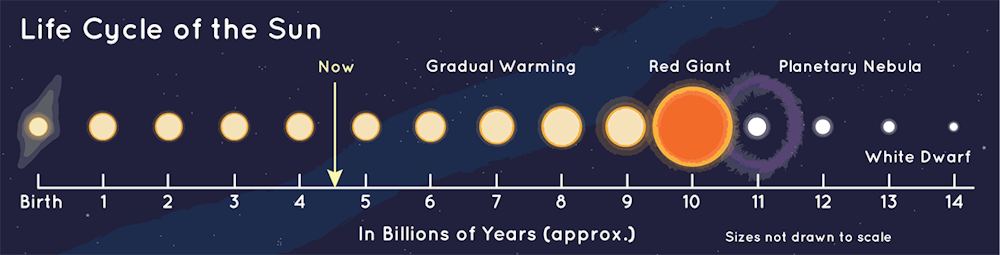
    In 1983, Carter attempted to explain what he called a remarkable coincidence: the close approximation between the estimated lifespan of the Sun – 10 billion years – and the time Earth took to produce humans – 5 billion years, rounding up.

    Brandon Carter is a physicist at the Laboratoire Univers et Théories in Meudon, France.
    Brandon Carter/Wikimedia Commons, CC BY-SA

    He imagined three possibilities. In one, intelligent life like humans generally arises very quickly on planets, geologically speaking – in perhaps millions of years. In another, it typically arises in about the time it took on Earth. And in the last, he imagined that Earth was lucky – ordinarily it would take much longer, say, trillions of years for such life to form.

    Carter rejected the first possibility because life on Earth took so much longer than that. He rejected the second as an unlikely coincidence, since there is no reason the processes that govern the Sun’s lifespan – nuclear fusion – should just happen to have the same timescale as biological evolution.

    So Carter landed on the third explanation: that humanlike life generally takes much longer to arise than the time provided by the lifetime of a star.

    The Sun will likely be able to keep planets habitable for only part of its lifetime – by the time it hits 10 billion years, it will get too hot.
    NASA/JPL-Caltech

    To explain why humanlike life took so long to arise, Carter proposed that it must depend on extremely unlikely evolutionary steps, and that the Earth is extraordinarily lucky to have taken them all.

    He called these evolutionary steps hard steps, and they had two main criteria. One, the hard steps must be required for human existence – meaning if they had not happened, then humans would not be here. Two, the hard steps must have very low probabilities of occurring in the available time, meaning they usually require timescales approaching 10 billion years.

    Tracing humans’ evolutionary lineage will bring you back billions of years.

    Do hard steps exist?

    The physicists Frank Tipler and John Barrow predicted that hard steps must have happened only once in the history of life – a logic taken from evolutionary biology.

    If an evolutionary innovation required for human existence was truly improbable in the available time, then it likely wouldn’t have happened more than once, although it must have happened at least once, since we exist.

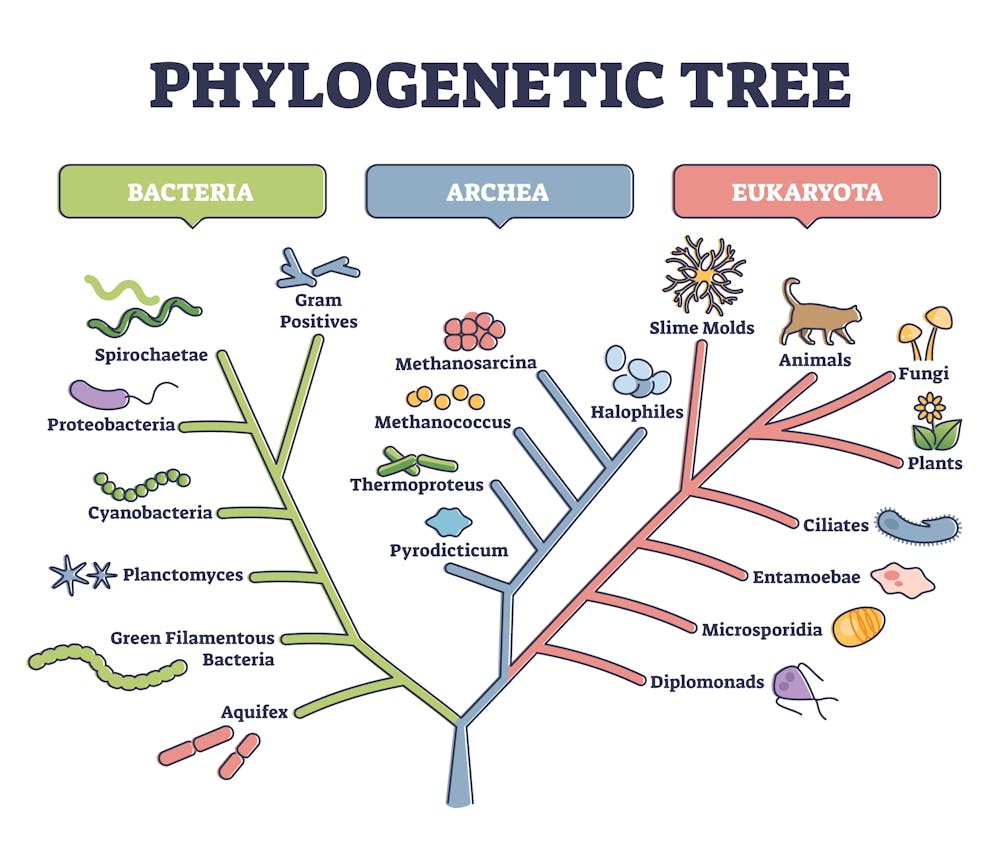
    For example, the origin of nucleated – or eukaryotic – cells is one of the most popular hard steps scientists have proposed. Since humans are eukaryotes, humanity would not exist if the origin of eukaryotic cells had never happened.

    On the universal tree of life, all eukaryotic life falls on exactly one branch. This suggests that eukaryotic cells originated only once, which is consistent with their origin being unlikely.

    In the evolutionary tree of life, organisms that have eukaryotic cells are all on the same branch, suggesting this type of cell evolved only once.
    VectorMine/iStock via Getty Images Plus

    The other most popular hard-step candidates – the origin of life, oxygen-producing photosynthesis, multicellular animals and humanlike intelligence – all share the same pattern. They are each constrained to a single branch on the tree of life.

    However, as the evolutionary biologist and paleontologist Geerat Vermeij argued, there are other ways to explain why these evolutionary events appear to have happened only once.

    This pattern of apparently singular origins could arise from information loss due to extinction and the incompleteness of the fossil record. Perhaps these innovations each evolved more than once, but only one example of each survived to the modern day. Maybe the extinct examples never became fossilized, or paleontologists haven’t recognized them in the fossil record.

    Or maybe these innovations did happen only once, but because they could have happened only once. For example, perhaps the first evolutionary lineage to achieve one of these innovations quickly outcompeted other similar organisms from other lineages for resources. Or maybe the first lineage changed the global environment so dramatically that other lineages lost the opportunity to evolve the same innovation. In other words, once the step occurred in one lineage, the chemical or ecological conditions were changed enough that other lineages could not develop in the same way.

    If these alternative mechanisms explain the uniqueness of these proposed hard steps, then none of them would actually qualify as hard steps.

    But if none of these steps were hard, then why didn’t humanlike intelligence evolve much sooner in the history of life?

    Environmental evolution

    Geobiologists reconstructing the conditions of the ancient Earth can easily come up with reasons why intelligent life did not evolve sooner in Earth history.

    For example, 90% of Earth’s history elapsed before the atmosphere had enough oxygen to support humans. Likewise, up to 50% of Earth’s history elapsed before the atmosphere had enough oxygen to support modern eukaryotic cells.

    All of the hard-step candidates have their own environmental requirements. When the Earth formed, these requirements weren’t in place. Instead, they appeared later on, as Earth’s surface environment changed.

    We suggest that as the Earth changed physically and chemically over time, its surface conditions allowed for a greater diversity of habitats for life. And these changes operate on geologic timescales – billions of years – explaining why the proposed hard steps evolved when they did, and not much earlier.

    In this view, humans originated when they did because the Earth became habitable to humans only relatively recently. Carter had not considered these points in 1983.

    Moving forward

    But hard steps could still exist. How can scientists test whether they do?

    Earth and life scientists could work together to determine when Earth’s surface environment first became supportive of each proposed hard step. Earth scientists could also forecast how much longer Earth will stay habitable for the different kinds of life associated with each proposed hard step – such as humans, animals and eukaryotic cells.

    Evolutionary biologists and paleontologists could better constrain how many times each hard-step candidate occurred. If they did occur only once each, they could see whether this came from their innate biological improbability or from environmental factors.

    Lastly, astronomers could use data from planets beyond the solar system to figure out how common life-hosting planets are, and how often these planets have hard-step candidates, such as oxygen-producing photosynthesis and intelligent life.

    If our view is correct, then the Earth and life have evolved together in a way that is more typical of life-supporting planets – not in the rare and improbable way that the hard-steps model predicts. Humanlike intelligence would then be a more expected outcome of Earth’s evolution, rather than a cosmic fluke.

    Researchers from a variety of disciplines, from paleontologists and biologists to astronomers, can work together to learn more about the probability of intelligent life evolving on Earth and elsewhere in the universe.

    If the evolution of humanlike life was more probable than the hard-steps model predicts, then researchers are more likely to find evidence for extraterrestrial intelligence in the future.

    Daniel Brady Mills receives funding from the German Research Foundation.

    Jason Wright works for Penn State University, where his research in the search for life in the universe is supported by internal funds, grants from NASA, and individual philanthropists.

    Jennifer L. Macalady works for Penn State University, where her research on how microorganisms, minerals and fluids interact through geologic time is supported by internal funds, grants from NASA and NSF, and grants from private foundations.

    – ref. Evolving intelligent life took billions of years − but it may not have been as unlikely as many scientists predicted – https://theconversation.com/evolving-intelligent-life-took-billions-of-years-but-it-may-not-have-been-as-unlikely-as-many-scientists-predicted-249114

    MIL OSI – Global Reports –

    February 15, 2025
  • MIL-OSI USA: Boozman, Daines Introduce Bill to Support Outdoor Recreation, Block Ban of Traditional Ammo & Tackle

    US Senate News:

    Source: United States Senator for Arkansas – John Boozman

    WASHINGTON––U.S. Senators John Boozman (R-AR) and Steve Daines (R-MT) introduced the Protecting Access for Hunters and Anglers Act to prohibit the U.S Fish and Wildlife Service (USFWS), the Bureau of Land Management (BLM) and the U.S. Forest Service (USFS) from banning the use of lead ammunition or tackle on public lands unless such action is supported by the best available science.

    “Enjoying the outdoors through hunting and fishing is part of the fabric and culture of The Natural State,” said Boozman. “These cherished pastimes not only help Arkansans connect to the resources we are blessed to enjoy but also play an important role in wildlife management. I am proud to join my colleagues in working to ensure hunting and fishing can continue on public lands without unreasonable, unscientific restrictions.”

    “The great outdoors is a staple of our Montana way of life. Montana hunters and anglers play an important role in wildlife management, and a ban on lead ammo and tackle would be unfair to our sportsmen. I’ll keep fighting with my colleagues to make sure decisions impacting outdoor recreation are guided by commonsense science, not anti-hunting groups,” said Daines.

    Specifically, the legislation blocks a prohibition on the use of lead ammunition or tackle unless a decline in wildlife population in a specific unit of federal land or water is primarily caused by the use of lead in ammunition or tackle.

    The Protecting Access for Hunters and Anglers Act is cosponsored by Senate Majority Leader John Thune (R-SD) and Senators Jerry Moran (R-KS), Dan Sullivan (R-AK), Bill Cassidy, M.D. (R-LA), Thom Tillis (R-NC), Mike Crapo (R-ID), Jim Risch (R-ID), Cynthia Lummis (R-WY), John Barrasso (R-WY), Rick Scott (R-FL), James Lankford (R-OK), Tommy Tuberville (R-AL), Mike Lee (R-UT), Roger Marshall, M.D. (R-KS), Marsha Blackburn (R-TN), Roger Wicker (R-MS), Deb Fischer (R-NE), Tim Sheehy (R-MT), Mike Rounds (R-SD), Katie Britt (R-AL), Kevin Cramer (R-ND), Tom Cotton (R-AR), Jim Justice (R-WV), Bill Hagerty (R-TN), John Hoeven (R-ND) and Cindy Hyde-Smith (R-MS).

    Click here for full text of the legislation. 

    MIL OSI USA News –

    February 15, 2025
  • MIL-OSI USA: NASA Sets Coverage of Firefly’s First Robotic Commercial Moon Landing

    Source: NASA

    With a suite of NASA science and technology on board, Firefly Aerospace is targeting no earlier than 3:45 a.m. EST on Sunday, March 2, to land the Blue Ghost lunar lander on the Moon. Blue Ghost is slated to touch down near Mare Crisium, a plain in the northeast quadrant on the near side of the Moon, as part of NASA’s CLPS (Commercial Lunar Payload Services) initiative and Artemis campaign to establish a long-term lunar presence.
    Live coverage of the landing, jointly hosted by NASA and Firefly, will air on NASA+ starting at 2:30 a.m. EST, approximately 75 minutes before touchdown on the Moon’s surface. Learn how to watch NASA content through a variety of platforms, including social media. The broadcast will also stream on Firefly’s YouTube channel. Coverage will include live streaming and blog updates as the descent milestones occur.
    Accredited media interested in attending the in-person landing event hosted by Firefly in the Austin, Texas, area may request media credentials through this form by Monday, Feb. 24.
    Following the landing, NASA and Firefly will host a news conference to discuss the mission and science opportunities that lie ahead as they begin lunar surface operations. The time of the briefing will be shared after touchdown.  
    Blue Ghost launched Jan. 15, at 1:11 a.m. EST on a SpaceX Falcon 9 rocket from Launch Complex 39A at NASA’s Kennedy Space Center in Florida. The lander is carrying a suite of 10 NASA scientific investigations and technology demonstrations, which will provide insights into the Moon’s environment and test technologies to support future astronauts landing safely on the lunar surface, as well as Mars.
    NASA continues to work with multiple American companies to deliver science and technology to the lunar surface through the agency’s CLPS initiative. This pool of companies may bid on contracts for end-to-end lunar delivery services, including payload integration and operations, launching from Earth, and landing on the surface of the Moon. NASA’s CLPS contracts are indefinite-delivery/indefinite-quantity contracts with a cumulative maximum value of $2.6 billion through 2028. In February 2021, the agency awarded Firefly this delivery of 10 NASA science investigations and technology demonstrations to the Moon using its American-designed and -manufactured lunar lander for approximately $93.3 million (modified to $101.5 million).
    Through the Artemis campaign, commercial robotic deliveries will perform science experiments, test technologies, and demonstrate capabilities on and around the Moon to help NASA explore in advance of Artemis Generation astronaut missions to the lunar surface, and ultimately crewed missions to Mars.
    Watch, engage on social media 
    Let people know you’re following the mission on X, Facebook, and Instagram by using the hashtag #Artemis. You can also stay connected by following and tagging these accounts: 
    X: @NASA, @NASA_Johnson, @NASAArtemis, @NASAMoon 
    Facebook: NASA, NASAJohnsonSpaceCenter, NASAArtemis 
    Instagram: @NASA, @NASAJohnson, @NASAArtemis 
    For more information about the agency’s Commercial Lunar Payload Services initiative: 
    https://www.nasa.gov/clps
    -end- 
    Karen Fox / Alise Fisher Headquarters, Washington 202-358-1600  karen.c.fox@nasa.gov / alise.m.fisher@nasa.gov  
    Natalia Riusech / Nilufar RamjiJohnson Space Center, Houston 281-483-5111 natalia.s.riusech@nasa.gov / nilufar.ramji@nasa.gov 

    MIL OSI USA News –

    February 15, 2025
  • MIL-OSI USA: An Afternoon of Family Science and Rocket Exploration in Alaska

    Source: NASA

    On Tuesday, January 28th, Fairbanks BEST Homeschool joined the Geophysical Institute for an afternoon of rocket exploration, hands-on activities, and stargazing inside a planetarium. This event was free and open to the public. Despite their frigid winter weather, 200 attendees were curious about the scientific endeavors of Alaska-based researchers alongside cutting-edge investigations conducted by NASA rocket scientists.
    Families and friends in attendance learned about two NASA rocket missions that would study the flickering and vanishing auroras: Ground Imaging to Rocket investigation of Auroral Fast Features (GIRAFF) and Black and Diffuse Aurora Science Surveyor (BaDASS). Visitors had an opportunity to sign up for text notifications related to the launch window. The planetarium presentations touch on Heliophysics Big Ideas that align with the three questions that drive NASA’s heliophysics research:

    What are the impacts of the changing sun on humanity?
    How do Earth, the solar system, and the heliosphere respond to changes on the sun?
    What causes the sun to vary?

    The event also offered sun-related hands-on activities provided by the University of Alaska Museum of the North.
    This event was offered to the community in association with the Science For Alaska Lecture Series and the 2025 NASA Sounding Rocket campaign. Every attendee left with something inspiring to think about. Parents and educators interested in learning more about auroras and do participatory science may check out NASA’s Aurorasaurus citizen science project.
    The Geophysical Institute at the University of Alaska Fairbanks is a Co-Investigating team for the NASA Heliophysics Education Activation Team (NASA HEAT), which is part of NASA’s Science Activation Portfolio. Learn more about how Science Activation connects NASA science experts, content, and experiences with community leaders to do science in ways that activate minds and promote deeper understanding of our world and beyond: https://science.nasa.gov/learn
    Aurora Educational Resource List by Aurorasaurus

    It was so much fun! We are receiving rave reviews from our families and the surrounding community. THANK YOU AGAIN FOR COLLABORATING WITH US!

    Fairbanks BEST Homeschool

    MIL OSI USA News –

    February 15, 2025
  • MIL-OSI USA: A Growth Spurt for Home Reef

    Source: NASA

    A small island at Tonga’s Home Reef got a little roomier in recent weeks.
    The underwater volcano emerged above sea level during a 2022 eruption, adding new land to the nation of islands in the South Pacific Ocean. It continued to grow during eruptions in September 2023, January 2024, and June 2024, expanding to 12.2 hectares (30.1 acres). During the most recent period of activity, from December 2024 to January 2025, the island grew another 3.7 hectares.
    Landsat satellites observed the island’s recent growth spurt. The OLI-2 (Operational Land Imager-2) on Landsat 9 captured an image of the island on November 11, 2024 (left), before the latest expansion. The OLI (Operational Land Imager) on Landsat 8 imaged the same location on February 2, 2025 (right). The new land formed as lava flowed from the volcano’s vent and solidified into rock.
    The discolored water around the island is a sign of gases and magmatic fluids escaping from the volcano. “Most likely, we’re seeing a large amount of yellow sulfur mixing with the blue ocean to give the plumes a greenish hue,” said Cornel de Ronde, a geologist at GNS Science and the co-author of a study in Geochemistry, Geophysics, Geosystems about monitoring submarine volcanoes.
    The impact of underwater volcanic eruptions on marine ecosystems can be mixed. Some of the substances found in underwater plumes, especially iron, can encourage the growth of phytoplankton, said Sharon Walker, a NOAA oceanographer and lead author of the study. However, the hot, acidic plumes are also known to be harmful to many species of fish and other types of marine life. Meanwhile, the new land offers more habitat for pioneer species, such as bacteria, algae, lichens, insects, and seabirds.
    Prior to 2022, Home Reef had four recorded eruptions, including events in 1852 and 1857 that formed small, temporary islands. In 2006, an eruption also produced an island that had cliffs measuring up to 70 meters (230 feet) tall and survived for about nine months.
    Geologists expect the current island to last longer. “Some of the previous eruptions had a more explosive character, which led to land made of a more fragmented, easily erodible material,” said Simon Plank, a researcher from the German Aerospace Center (DLR). “This one is characterized by effusive flows that form a hard material that gives the island a high chance of surviving for several years.”
    Home Reef sits within the Tonga-Kermadec subduction zone, an area where three tectonic plates are colliding at the fastest converging boundary in the world. Here, the Pacific Plate is sinking beneath two other small plates, yielding one of Earth’s deepest trenches and most active volcanic arcs.
    So far, Home Reef’s eruptions have had little impact on people, unlike the neighboring Hunga Tonga-Hunga Ha‘apai volcano, which erupted in 2022, triggering a tsunami, covering nearby islands with ash, and damaging crops and fisheries.
    “Given what the world witnessed at Hunga, it’s certainly worth monitoring submarine volcanoes,” said de Ronde. “Satellites offer one of the best, quickest, and safest ways to do that.”
     
    NASA Earth Observatory images by Lauren Dauphin, using Landsat data from the U.S. Geological Survey. Story by Adam Voiland.

    MIL OSI USA News –

    February 15, 2025
  • MIL-OSI USA: Deadlines approaching for Promise Scholarship, West Virginia Higher Education Grant Program – West Virginia Higher Education Policy Commission

    Source: US State of West Virginia

    CHARLESTON, W.Va. – The West Virginia Higher Education Policy Commission and Community and Technical College System remind students that the deadlines to apply for the merit-based financial aid program Promise Scholarship and the need-based West Virginia Higher Education Grant Program (HEGP) for the 2025-2026 academic year are quickly approaching. High school seniors may apply for the $5,500 annual Promise award until March 1; and the $3,400 Higher Education Grant annual award until April 15.

    “The Promise Scholarship and Higher Education Grant open doors of opportunity for West Virginia’s students,” said Dr. Sarah Armstrong Tucker, West Virginia’s Chancellor of Higher Education. “I encourage this year’s high school seniors to complete the FAFSA and apply for our state’s financial aid programs, and to reach out to our office for support.”

    “In addition, anyone planning to enroll in college within the next 12 months should file the FAFSA to see if they are eligible for the HEGP,” Chancellor Tucker added. “This includes adult first-time students and those returning to college to retrain.”

    The Promise Scholarship eligibility requirements for the class of 2025 are:

    • ACT: 21 composite score with a minimum of 19 in English, math, science, and reading.
    • SAT: 1080 total score with a minimum of 510 in math, evidence-based reading, and writing.

    The Promise Scholarship application and other eligibility requirements are available at cfwv.com/promise. The Free Application for Federal Student Aid (FAFSA), which is required to access all state and federal financial aid and serves as the application for the HEGP, can be completed online at fafsa.gov.  

    For assistance filing the FAFSA or with applications, students and families are encouraged to call the state’s financial aid hotline at 877-987-7664. Students are also encouraged to sign up for West Virginia’s text-message college counseling program, “Txt 4 Success,” by visiting cfwvconnect.com/txt-4-success/.

    Share this:

    MIL OSI USA News –

    February 15, 2025
  • MIL-OSI Europe: Debates – Thursday, 13 February 2025 – Strasbourg – Revised edition

    Source: European Parliament

    Verbatim report of proceedings
     491k  822k
    Thursday, 13 February 2025 – Strasbourg
    1. Opening of the sitting
      2. Proposal for a Union act
      3. EU-Mercosur Trade Agreement (debate)
      4. Threats to EU sovereignty through strategic dependencies in communication infrastructure (debate)
      5. Resumption of the sitting
      6. Voting time
        6.1. Recent dismissals and arrests of mayors in Türkiye (RC-B10-0100/2025, B10-0100/2025, B10-0103/2025, B10-0110/2025, B10-0115/2025, B10-0119/2025, B10-0121/2025, B10-0124/2025) (vote)
        6.2. Repression by the Ortega-Murillo regime in Nicaragua, targeting human rights defenders, political opponents and religious communities in particular (RC-B10-0126/2025, B10-0126/2025, B10-0128/2025, B10-0130/2025, B10-0131/2025, B10-0132/2025, B10-0134/2025, B10-0135/2025) (vote)
        6.3. Continuing detention and risk of the death penalty for individuals in Nigeria charged with blasphemy, notably the case of Yahaya Sharif-Aminu (RC-B10-0101/2025, B10-0101/2025, B10-0104/2025, B10-0111/2025, B10-0113/2025, B10-0117/2025, B10-0120/2025, B10-0122/2025, B10-0123/2025) (vote)
        6.4. Further deterioration of the political situation in Georgia (RC-B10-0106/2025, B10-0106/2025, B10-0107/2025, B10-0108/2025, B10-0112/2025, B10-0114/2025, B10-0116/2025, B10-0118/2025) (vote)
        6.5. Escalation of violence in the eastern Democratic Republic of the Congo (RC-B10-0102/2025, B10-0102/2025, B10-0105/2025, B10-0109/2025, B10-0125/2025, B10-0127/2025, B10-0129/2025, B10-0133/2025) (vote)
      7. Resumption of the sitting
      8. Approval of the minutes of the previous sitting
      9. Cross-border recognition of civil status documents of same-sex couples and their children within the territory of the EU (debate)
      10. Explanations of votes
        10.1. Further deterioration of the political situation in Georgia (RC-B10-0106/2025)
        10.2. Escalation of violence in the eastern Democratic Republic of the Congo (RC-B10-0102/2025)
      11. Approval of the minutes of the sitting and forwarding of texts adopted
      12. Dates of forthcoming sittings
      13. Closure of the sitting
      14. Adjournment of the session


    PRESIDENZA: ANTONELLA SBERNA
    Vicepresidente

     
    1. Opening of the sitting


    (La seduta è aperta alle 9:01)


    2. Proposal for a Union act


      President. – I would like to announce that, pursuant to Rule 47(2), the President has declared admissible a proposal for a Union act on the need to amend the Council Regulation on fixing the fishing opportunities for certain fish stocks and groups of fish stocks applicable in the Mediterranean and Black Seas for 2025, and to protect the trawling sector.

    The proposal is referred to the Committee on Fisheries (PECH) as the committee responsible, and to the Committee on Budgets, the Committee on Employment and Social Affairs and the Committee on the Environment, Climate and Food Safety for opinion.


    3. EU-Mercosur Trade Agreement (debate)


      Maroš Šefčovič, Member of the Commission. – Madam President, good morning to all honourable Members in this House. It is a pleasure to be here this morning to discuss the EU-Mercosur partnership agreement with you. As you know, this has been a busy plenary week and it has been my honour to address the House from this podium several times.

    On each occasion, it has been necessary to frame our dialogue in terms of the world that Europe finds itself in today: a world of increased global competition, a rise in unfair economic practices, and a more complex and uncertain geopolitical reality.

    In the face of this, the European Union’s network of free trade agreements – the world’s largest – is a vital asset in ensuring we can maintain our economic edge. I’ve heard the same messages from many of you, honourable Members, in a plenary debate on Tuesday, when a new trade era was discussed, as well as yesterday when we discussed the Commission work programme for this year.

    Free trade agreements open up markets around the world to our companies. They provide drivers for growth and innovation, and they are helping our industry retain and regain its competitiveness. And these agreements are mutually beneficial, with the EU being a trusted trading partner in a rules-based system. We only need to look to the Comprehensive Economic and Trade Agreement between the EU and Canada to see the real-world benefit.

    At a time when the old-world order in global trade is being shaken up, it is more important than ever to grow this free trade agreement network. This growth can contribute to our overarching efforts to de-risk via trade diversification and ensure our long-term industrial competitiveness. The EU-Mercosur partnership agreement is a vital element of this effort and a sign of our commitment to the Latin American region.

    The conclusion of negotiations strengthens our political and economic ties, giving EU companies a first-mover advantage in a region where trade with China is dominant. For instance, China is the main exporter to and importer from Brazil. The agreement will provide additional continuity, stability and predictability in our trade relations, and it highlights that regional blocs can commit to shared values and deliver concrete results for the mutual benefits of our citizens.

    Above all, the agreement is an economic win-win for the European Union. It offers export opportunities to the fifth biggest global economic bloc outside the European Union, with 273 million potential consumers. Our exports to Mercosur already amount to EUR 84 billion, with EU investment in the region of some EUR 340 billion.

    But with this agreement, we can now strengthen this trade and investment relationship even further. For example, this agreement would help us to save, and especially for EU exporters, over EUR 4 billion in customs duties every year – EUR 4 billion a year. It would eliminate tariffs on key commodities, like, if we take as an example cars, which are currently at the level of 35 %. If I’m talking about machinery, I’m talking about 20 %. If you look at chemicals, it’s 18 %. And if you look at pharmaceuticals, it’s 14 %. So, you see that these duties are very, very high and we are going to completely eliminate them.

    Mercosur countries can become one of our best sources of critical raw materials, thereby increasing our resilience by diversifying our supply chains. And I can assure you that the deal reached in Montevideo in December is not only a good deal, but it’s also a new deal – different and better than the one agreed in 2019.

    We have secured several negotiated outcomes that respond to our sustainability concerns while preserving the EU’s sensitivities. By including the Paris Agreement on Climate Change as an essential element of the EU Mercosur Partnership agreement, this sends a strong message in support of multilateral cooperation on climate change and this allows for partial or total suspension if a party leaves the Paris Agreement or if it undermines it from within.

    The agreement also contains legally binding commitments to take measures to halt deforestation as of 2030. Importantly, the agreement provides a critical platform of cooperation with Mercosur countries on our common sustainability ambitions, with strong commitments on labour and the environment.

    In addition, we have reached a balanced outcome on agrifood trade, considerably improving market access for many EU agrifood products, while striking a cautious balance in sectors where our interests are more sensitive and negotiated clear and well-calibrated tariff quotas amounting to a very small percentage of EU consumption, for example, not more than 1.5 % of beef, as well as a gradual implementation to market opening over several years.

    The Commission will monitor market developments closely after the agreement is implemented, particularly with regard to the agricultural sector, to ensure that the partnership with Mercosur does not negatively affect the competitiveness of the European farmers. In case of an imbalance, we will impose safeguards to protect our sensitive sectors and to ensure that agricultural producers are fully protected. President von der Leyen has announced that at least EUR 1 billion will be available to address any unforeseen circumstances.

    As a last point on Mercosur, we know that EU consumers care about the quality and safety of their food and health and consumer protection was never and will never be up for negotiations. Already today, agricultural products imported from Mercosur countries and from any other third country, with or without trade agreements, must comply with the EU’s strict sanitary and phytosanitary standards.

    Honourable Members, I know how important openness and cooperation on trade issues is to this House. Indeed, it came up in our debate on trade and preparedness on Tuesday to which I was referring earlier on. So, I want to underline that I have already engaged on Mercosur with the INTA Committee and with the AGRI Committee, together with Commissioner Hansen, responsible for agriculture, as well as with different working groups. And I see this as an ongoing dialogue, and I want to assure you that we will continue to listen to your concerns and provide you with factual answers and ensure your views are taken into account moving forward.

    So, I will stop here, Madam President, and I look forward to our exchanges and the debate.


    VORSITZ: KATARINA BARLEY
    Vizepräsidentin


      Jörgen Warborn, on behalf of the PPE Group. – Madam President, Commissioner, I would like to use the beginning of my speech to paint a picture of the EU reality on the global stage. Because five years ago, the UK left the European Union. A month later – COVID‑19 – the pandemic broke out in Europe. And three years ago, Russia launched a full‑scale illegal invasion of Ukraine. And at the same time, European energy prices reached record levels, and this also, of course, created inflation for European citizens. A month ago, Trump was inaugurated in the US administration. All this at the same time when China is systematically disregarding the multilateral trade order, and the BRICs is growing.

    Never before has the EU and its citizens and businesses been faced with so much uncertainty and unpredictability as now, most evidently seen last Monday, when Trump increased the tariffs on steel and aluminium to 25 %. I have stood at this podium more times than I can remember to talk about the importance of the Mercosur deal. If there would ever be a moment to conclude the deal that would create the biggest free trade zone in the world, it would be now.

    We need it now because it will provide opportunities for businesses and citizens. It will enhance our energy security. It will create a channel of diplomatic and economic relationships with one of the biggest players in the world, and it will demonstrate that the EU is a global, relevant player that stands for an open, rules‑based geopolitical order. Let’s do it. Let’s conclude. Let’s finalise the negotiation. It is beneficial for all.


      Kathleen Van Brempt, on behalf of the S&D Group. – Madam President, colleagues, let me thank M Warborn for his short history lesson. Of course, we agree very much with the fact that geopolitics has changed dramatically in the last five-to-ten years and the EU-Mercosur agreement is, in that light, important.

    For the S&D, it is important also that, in the next coming months, we will fully scrutinise this deal up to the very detail. We need to make sure that this deal works not just for our economy, but for the environment and for the workers on both sides of the world. We hear the sincere concerns, Commissioner, from the unions, from the environmental NGOs and from the farmers.

    It is important, as you mentioned, that the Paris Agreement is now an essential element. But many questions, Commissioner, on deforestation, remain. And we need answers on these. Let it be clear: this Mercosur agreement cannot water down the EU Deforestation Regulation. So we need answers.

    The S&D will be a fair partner in this process, but we need answers to make sure that the impact of the agreement on climate, workers’ rights and European farmers is clear.


      Jean-Paul Garraud, au nom du groupe PfE. – Madame la Présidente, il est encore temps de désamorcer la bombe agricole. Il est encore temps pour la Commission de renoncer à l’accord de libre-échange entre les pays du Mercosur et l’Union européenne, contre lequel nos agriculteurs protestent depuis des mois. Mais vous ne voulez pas renoncer, Monsieur le Commissaire, je viens de vous entendre.

    Cet accord est pourtant un contresens, un archaïsme et une faute. Un contresens, puisqu’il remet en cause notre autonomie alimentaire au moment où toutes les autres puissances cherchent à la garantir face aux désordres du monde. Un archaïsme, car il contrevient à la raison écologique et multiplie les échanges avec des produits du bout du monde, produits qui, par ailleurs, ne respectent même pas les normes environnementales qui sont les nôtres. Enfin, cet accord est une faute: à travers un obscur mécanisme de règlement des différends, vous offrez à des pays tiers, à des concurrents, la possibilité de remettre en cause les décisions des États membres, donc leur souveraineté et les libres choix des peuples.

    En promettant aux agriculteurs un fonds de compensation, vous reconnaissez d’ailleurs implicitement que cet accord va provoquer des ravages au sein de nos filières agricoles. Or, nos agriculteurs ne veulent pas qu’on subventionne leur déclin ou, pire, leur disparition. Ils veulent être protégés et promus. Ils veulent vivre dignement et librement de leur travail, de cette noble mission: nourrir l’Europe.


      Carlo Fidanza, a nome del gruppo ECR. – Signora Presidente, onorevoli colleghi, signor Commissario, l’Unione europea ha colpevolmente lasciato il Sud America in balia della penetrazione cinese e di regimi, governi o movimenti che lo hanno spesso allontanato dall’Europa e dall’Occidente. L’accordo con il Mercosur ha quindi evidenti motivazioni geopolitiche e presenta anche altrettanto evidenti opportunità di crescita per alcuni comparti.

    Eppure, questo accordo ha generato una immediata reazione da parte degli agricoltori europei. E sapete perché? Perché nel recente passato è stata proprio l’agricoltura a pagare il prezzo più alto in molti accordi di libero scambio. Ma anche perché in questi anni le scelte ideologiche dell’Unione europea hanno colpito duramente la competitività degli agricoltori europei, con le follie green, con una burocrazia asfissiante, con una ripartizione non equilibrata della redditività lungo le filiere.

    È certamente vero che alcuni settori agroalimentari – penso a quello del vino o dei formaggi – potrebbero avere dei benefici dall’accordo. Ed è vero che il numero di denominazioni di origine formalmente protette è il più alto mai inserito in un accordo di libero scambio, sia pure con qualche evidente falla.

    Ma è altrettanto vero che la mancanza di reciprocità, la possibilità garantita ai produttori sudamericani di continuare ad utilizzare agrofarmaci da noi vietati da tempo, la mancanza di controlli affidabili in loco sugli standard sanitari e contro la contraffazione, così come nelle procedure doganali europee, in molti nostri porti europei, sulle importazioni, fanno pendere la bilancia verso una legittima e fondata preoccupazione da parte del mondo agricolo. E non basteranno a tranquillizzare i nostri produttori una clausola di salvaguardia di difficile attivazione o quel solo miliardo di euro previsto per le compensazioni, una goccia nel mare e addirittura meno di quel miliardo e ottocento milioni previsti dall’Unione europea per gli agricoltori del Mercosur.

    Oggi questo accordo si presenta ancora troppo sbilanciato e troppo penalizzante per la nostra agricoltura e noi, a queste condizioni, non possiamo sostenerlo.


      Svenja Hahn, im Namen der Renew-Fraktion. – Frau Präsidentin! Liebe Kollegen! Ich finde es ehrlich gesagt unverantwortlich, wie faktenbefreit und populistisch einige in diesem Parlament Ängste schüren, Ängste vor Freihandel.

    Natürlich müssen wir Sorgen wie die von unseren Landwirten ernst nehmen. Deshalb gibt es auch in sensiblen Bereichen sehr niedrige Einfuhrquoten, wie zum Beispiel bei Rindfleisch, wo es anderthalb Prozent des gesamten EU-Konsums sind. Das ist ungefähr ein 200-Gramm-Steak pro Person. Das ist keine Marktverzerrung, und sollte es doch welche geben, plant die Kommission sogar Hilfszahlungen.

    Das eigentliche Problem ist doch die EU-gemachte Bürokratie – nicht der Handel –, die die Wettbewerbsfähigkeit unserer Landwirte behindert. Protektionismus wird dieses Problem nicht lösen. Auch der Klimaschutz wird nicht geschwächt; er wird sogar gestärkt. Denn die Einhaltung des Pariser Klimaschutzabkommens ist eine essentielle Grundlage dieses Abkommens.

    Deshalb: Gucken wir doch mal auf die Zahlen! Dann sehen wir, dass alleine in der EU 800 000 Jobs am Handel mit den Mercosur-Ländern hängen. Allein aus meinem Heimatland Deutschland exportieren über 12 000 Unternehmen in den Mercosur, und 70 % davon sind kleine und mittelständische Unternehmen. Wir haben gerade gehört von Kommissar Šefčovič: Alleine die reduzierten Zölle bedeuten Einsparungen von 4 Mrd. EUR bei unseren Unternehmen. Die echten Chancen erwachsen doch erst durch diese Marktöffnung, wie zum Beispiel der Zugang zu kritischen Rohstoffen. Das hilft unserer Wirtschaft, unseren Klimazielen und vor allen Dingen reduziert es unsere Abhängigkeit von Autokratien wie China.

    Ich sage Ihnen ganz ehrlich: Ich bin nicht bereit, zuzusehen, wie die Autokraten dieser Welt Schulter an Schulter stehen – und wir in der Europäischen Union sollen nicht mal Handel mit anderen Demokratien hinbekommen? Ich bin nicht bereit, das zu akzeptieren, denn in Zeiten von drohenden Zollspiralen und Handelskriegen brauchen wir mehr Handel mit mehr Partnern, allen voran den Handel mit Mercosur. Wir brauchen keine Deglobalisierungs- und Degrowth-Fantasien. Wir brauchen das Mercosur-Abkommen für unsere Arbeitsplätze in der Europäischen Union, für Wirtschaftswachstum und vor allen Dingen auch für internationale Zusammenarbeit.


      Saskia Bricmont, au nom du groupe Verts/ALE. – Madame la Présidente, quand, en Europe comme dans les pays du Mercosur, les agriculteurs, le monde associatif, les associations de protection des consommateurs, les syndicats, les académiques, les citoyens s’opposent au traité commercial entre l’Union européenne et le Mercosur, ce sont des millions de personnes qui dénoncent ces impacts économiques, sociaux, environnementaux, climatiques, humains.

    C’est un accord qui date du siècle dernier, Monsieur le Commissaire, ce n’est pas un new deal. Ces millions de personnes pèsent peu face aux intérêts économiques de quelques industriels et des plus grosses exploitations agricoles pour – attention! – un bénéfice attendu de + 0,1 % du PIB. Peu glorieux, n’est-ce pas? Ah oui, il faut quand même aussi en déduire les millions du fonds de compensation agricole promis pour pallier les effets négatifs de cet accord sur le monde agricole, sans en régler les problèmes pour autant.

    Il faut aussi tenir compte des effets du mécanisme de rééquilibrage: rééquilibrage pour les États des pays du Mercosur qui va permettre au gouvernement, ou plutôt à l’agrobusiness, brésilien de contester nos lois si elles affectent leurs intérêts économiques et commerciaux. Exemples: mécanisme d’ajustement carbone aux frontières, lois anti-déforestation, contre le travail forcé, le devoir de vigilance de nos entreprises.

    Alors là, c’est la sidération totale, une atteinte insupportable à notre souveraineté stratégique et même à notre sécurité économique. Nous refusons de brader notre agriculture en la soumettant à une concurrence totalement déloyale. Nous refusons d’exporter nos produits chimiques et pesticides interdits en Europe, de brader davantage nos normes et de consommer des citrons verts au glyphosate, du bœuf aux hormones ou de la volaille à la grippe aviaire. D’encourager aussi la déforestation.

    Il est impossible de faire l’inventaire de tous les problèmes. Mais une chose est certaine, vous nous présentez un texte qui est pire qu’en 2019, quand le Parlement a dit qu’il lui était impossible de ratifier l’accord du Mercosur en l’état. C’est en défendant la démocratie, les valeurs, les normes sociales et environnementales qui protègent nos citoyens et assurent la prospérité de nos économies que l’Union européenne fera la différence.

    Chers amis du Mercosur, nous voulons des partenariats avec vous, mais des partenariats réellement équitables.


      Manon Aubry, au nom du groupe The Left. – Madame la Présidente, Monsieur le Commissaire, comment osez-vous venir défendre ici l’accord avec le Mercosur, le plus grand et le pire accord de libre-échange jamais signé par l’Union européenne? Comment osez-vous dire aux agriculteurs, qui peinent déjà à joindre les deux bouts, qu’importer des centaines de milliers de tonnes supplémentaires de bœuf, de poulet ou de fromage n’aura aucun impact sur eux? Comment osez-vous exposer délibérément la population à des OGM et des pesticides interdits en Europe? Car non, il n’y aura aucune réciprocité des normes. Comment est-il possible, à l’heure de l’urgence écologique, de soutenir un accord qui va contribuer à accélérer le réchauffement climatique et la déforestation?

    Oui, Monsieur le Commissaire, vous devriez avoir honte. Honte, parce que la réalité, c’est que personne ne veut de cet accord. Et vous vous retrouvez ici à devoir passer en force, en piétinant les règles de consultation du Parlement européen. Hier, le vote d’un de mes amendements l’a montré très clairement: les inquiétudes sur cet accord sont extrêmement vives et il n’y a pas de réelle majorité en sa faveur.

    Le dogme du libre-échange étouffe les peuples et dévaste la planète. Il est déjà en train de vaciller. La bataille n’est pas terminée. Comptez sur nous pour le faire tomber.


      Станислав Стоянов, от името на групата ESN. – Г-жо Председател, г-н Комисар, търговското споразумение между Европейския съюз и Меркосур предоставя възможности за европейската индустрия, както чухме и от Вас, но може да има катастрофални последици за селскостопанския сектор и европейските фермери не бива да плащат цената на това споразумение.

    Липсва прозрачност относно процеса по ратификация на споразумението, както и относно предпазните мерки, предвидени от Европейската комисия. Беше споменат фонд от един милиард евро, без да е ясно нито откъде ще дойде финансирането му, нито пък дали то би било достатъчно. Няма никаква яснота и дали този потенциален фонд ще се създаде предварително или едва при смущения на пазара. Компенсаторните мерки няма да защитят нашето земеделие. На тях често им липсват ясни дефиниции, не достигат до истински ощетените, а докато влязат в сила, щетите вече ще бъдат нанесени. Освен това доказването на, цитирам, „сериозна вреда“, нанесена на производителите поради споразумението, е сложен и бюрократичен процес. Нека не предадем европейските фермери и този път.


      Gabriel Mato (PPE). – Señora presidenta, el Acuerdo Unión Europea-Mercosur no es un tratado comercial más. Se trata de hablar de futuro. Nos jugamos nuestra capacidad de seguir siendo un actor relevante en el comercio global, de generar crecimiento y empleo y de abrir las puertas a un mercado de setecientos cincuenta millones de consumidores. Es indudable que tiene claros beneficios, entre otros, la eliminación de cuatro mil millones de euros en aranceles, el acceso a mercados estratégicos, la mayor presencia de nuestras industrias y pymes y la protección de más de trescientas indicaciones geográficas.

    Dicho esto, entiendo y comparto, comparto claramente, las preocupaciones del sector agrario. No podemos ignorarlas. Pero seamos claros: el problema de nuestro sector agrario no es el Mercosur, es la política agraria europea diseñada sin tener en cuenta la realidad del campo. Si nuestros productores se sienten amenazados por este Acuerdo es porque la política agraria no les ofrece las herramientas necesarias para competir y esto es lo que debe cambiar. Por eso, más que bloquear el Acuerdo, lo que debemos hacer es reformar nuestra política agraria para que no penalice a nuestros productores con normas asfixiantes, asegurar salvaguardas eficaces que protejan a los sectores vulnerables de manera rápida y efectiva y garantizar un fondo de compensación justo y ampliable que realmente funcione y que se adapte cuando sea necesario. No se trata de elegir entre comercio y agricultura, se trata de hacer las cosas bien y de analizar con datos actualizados dónde está el origen del problema y buscar soluciones al mismo.

    Negarnos a ratificar este Acuerdo no resolverá los problemas del sector agrario y mandará un mensaje de que Europa renuncia a ser líder y prefiere dejar que otros aprovechen nuestras oportunidades.


      Bernd Lange (S&D). – Frau Präsidentin! Herr Kommissar! Meine lieben Kolleginnen und Kollegen! Ich finde es unredlich, wenn man sich hier mit einem Zeigefinger hinstellt und sagt, am europäischen Wesen soll die Welt genesen, ohne dass man vernünftige Abkommen mit anderen Partnern auf Augenhöhe schließt. Und das machen wir genau so, dass wir die gleichen Ziele zusammen mit den Regierungen von Uruguay, Paraguay, Brasilien und Argentinien umsetzen wollen, was den Klimaschutz, was den Schutz der Artenvielfalt und was den Schutz der Arbeitnehmerrechte anbetrifft.

    Das können wir nur gemeinsam machen und nicht mit einem erhobenen Zeigefinger nur hier aus Europa. Liebe Kolleginnen und Kollegen, lassen Sie uns doch nicht so defensiv sein! Natürlich, wie Lenny Kravitz sagt: It Ain’t Over ‘Til It´s Over.

    Wir haben jetzt bis nächstes Jahr Zeit, zu gucken, wie die Entwicklung weitergeht. Wie wir es gemeinsam hinkriegen können, falls es Änderungswünsche, Ergänzungswünsche gibt, das umzusetzen. Wir haben das doch in anderen Handelsabkommen auch gemacht. Wir sind die Kraft, die letztendlich dafür sorgt, dass ein Abkommen ein gutes Abkommen wird.

    Und wir brauchen stabile Abkommen in einer globalen Welt, die von Konflikten gekennzeichnet ist. Ohne stabile Bedingungen in unserer wirtschaftlichen Situation, gerade wenn 40 % unseres BIP vom internationalen Handel abhängig sind, können wir nicht weiter existieren. Wir geben unsere Wohlfahrtssituation auf. Deswegen brauchen wir stabile Verhältnisse. Wir wollen uns nicht Autokraten dieser Welt anheimgeben. Deswegen lassen Sie uns Abkommen diskutieren, gegebenenfalls verbessern, aber gestalten!

    (Der Redner ist damit einverstanden, auf mehrere Fragen nach dem Verfahren der „blauen Karte“ zu antworten.)


      Raffaele Stancanelli (PfE). – Signora Presidente, onorevoli colleghi, signor Commissario, è economicamente comprovato come il libero mercato porti sviluppo e benessere economico ed è per questo che, in linea di principio, noi siamo favorevoli allo stesso. Tuttavia, è fondamentale che gli accordi siano proficui per entrambe le parti. Questo non è il caso per il Mercosur.

    Gli agricoltori e gli allevatori stanno disperatamente cercando di farci capire la gravità dell’impatto che questo accordo potrebbe avere per le loro attività. I nostri agricoltori si troverebbero in una posizione di svantaggio economico e non potrebbero competere con i grandi latifondisti sudamericani. A questo squilibrio si aggiunga la grande contraddizione green della Commissione: da un lato impone norme sempre più rigide ai nostri agricoltori, dall’altro permette che il nostro mercato venga invaso da prodotti esteri che non rispettano gli stessi standard imposti in Europa, specie sotto il profilo fitosanitario e quello della sostenibilità ambientale e sociale.

    È un fatto ideologico dire che questo non è un accordo equo? No, noi pensiamo di no. Perché se è vero che gli accordi di libero scambio portano benefici, è altresì vero che il Mercosur, così come è strutturato, danneggia e svende i nostri agricoltori, produttori, allevatori e consumatori. Forse sarebbe il caso di non restare chiusi nei palazzi, ma ascoltare con umiltà chi lavora la terra e produce ricchezza.


      Rihards Kols (ECR). – Madam President, dear Commissioner, dear colleagues, trade agreements aren’t just about tariffs and paperwork; they create real opportunities. For our SMEs this means access to a market of 260 million consumers. So far, all EU trade agreements have delivered benefits while maintaining high standards. It’s a fact. This deal does the same: lowering tariffs, cutting red tape and ensuring fair competition.

    Yes, concerns exist. That’s why the Commission has announced a EUR 1 billion fund to support affected farmers. But if we can fund compensation, we should also fund opportunity. A one-stop EU platform should be established for Mercosur markets that will help our businesses expand without excessive costs, because access should not be a privilege but a policy priority.

    Commissioner, you must ensure a structured engagement similar to the CFSP and CSDP. We should have a CTP conference during every presidency, where civil society and national parliamentarians can engage with the European Parliament and with the Commission. This is a chance to expand, compete and lead – and we should take it.


      Marie-Pierre Vedrenne (Renew). – Madame la Présidente, Monsieur le Commissaire, voitures allemandes contre agriculture française: certains voudraient réduire l’accord de commerce entre le Mercosur et l’Union européenne à ce clivage. À mes collègues, notamment allemands, je vous le dis, je ne me ferai pas complice de cette instrumentalisation.

    C’est une hérésie, une faiblesse politique abyssale que de nourrir un protectionnisme exacerbé qui ne fait que creuser des divisions et empêche toute évolution. Ce n’est pas un combat entre États européens que nous devons amplifier, mais notre crédibilité à construire des partenariats durables et équitables avec des États tiers avec qui nous dialoguons et commerçons déjà. Ce n’est pas une opposition entre secteurs qui est en débat, mais notre engagement à transformer des chaînes de valeur pour qu’elles soient durables, résilientes et sûres.

    Alors, au-delà des postures, de nombreuses questions demeurent, dont celle-ci: avons-nous, nous Européens, la capacité de contrôler les produits qui rentrent sur notre marché, accords de commerce ou non? Alors soyons à la hauteur de tous les enjeux. Ne laissons pas la souveraineté, la durabilité, la compétitivité devenir de vagues concepts déconnectés des réalités, de la vie de nos industries, de nos agricultures, de nos concitoyens.


      Vicent Marzà Ibáñez (Verts/ALE). – Señora presidenta, señor comisario, no se pueden hacer trampas al solitario. No puede usted decir que es bueno para el sector agrícola europeo y, al mismo tiempo, decir que hay que aumentar las compensaciones al sector agrícola europeo. ¿En qué quedamos? Si es bueno, no se debe compensar. Si hay que aumentar las compensaciones, no puede ser bueno para el sector agrícola.

    Segunda cuestión: ustedes han conseguido en este Acuerdo con el Mercosur dos unanimidades que son absolutamente increíbles. La primera, unanimidad de todos los sectores agrícolas y sus representantes de Europa, pero también de los países del Mercosur. También han conseguido ustedes la unanimidad en contra de todos los sindicatos europeos y de los sindicatos del Mercosur.

    ¿A quién beneficia este Acuerdo con el Mercosur si tiene en contra a todos los sindicatos agrarios europeos y del Mercosur y a todos los sindicatos de trabajadores europeos y del Mercosur? ¿A quién beneficia? Clarísimamente, a los europeos y a las europeas no, porque nos hace más dependientes. ¿De quién? De las grandes multinacionales, que son a los únicos a los que va a beneficiar.

    Por eso, nosotros estamos en contra, de forma clara y contundente. Necesitamos más apuesta de verdad por los trabajadores y las trabajadoras, más inversión en Europa para hacer una Europa mucho más fuerte, más inversión en la agricultura europea y no más vulnerabilidad y dependencia de terceros y, especialmente, de las grandes multinacionales.


      Luke Ming Flanagan (The Left). – Madam President, in order to properly debate the impact of this proposed agreement – proposed agreement; the title doesn’t say proposed, but we haven’t agreed to it yet – the proposed agreement on beef farmers in the EU, we need to compare like with like. In other words, you cannot compare carcass waste to processed premium beef waste. But that’s what your spin doctors are doing. The reality is that this deal will guarantee that at least 9 % of high-value cuts sold in the EU will come from Mercosur: 209 000 tonnes in a market of 2.3 million.

    I hear people talk of opportunities. If you’re a suckler farmer in the west of Ireland on a 30-hectare farm, where are the opportunities? If it’s a win-win, as you say, why then the need for a compensation package?

    And if there’s money, and EUR 1 billion for a compensation package, how come there’s no money to increase the farmers’ money that they get from the CAP, from what it was in 1991? Farmers in Ireland are facing a 60 % cut in CAP payments since that year.

    You’re talking about a EUR 1 billion compensation package for something that’s a win-win deal. There is no win-win – no win-win in science. You cannot destroy or create energy. It’s rubbish.


      Arno Bausemer (ESN). – Frau Präsidentin! Meine sehr verehrten Damen und Herren! Sehr geehrter Herr Kommissar! Es ist ein großer Fehler, gegen die Bürger Europas Politik zu machen. Es ist ein noch größerer Fehler, Politik gegen diejenigen zu machen, die diese Bürger Europas ernähren, nämlich unsere Landwirte.

    Die hohe Qualität der Produkte, die unsere Landwirte produzieren, ist weltweit einmalig. Wenn man sich anschaut oder anhört, was hier teilweise gesagt wird, dann ist es eben falsch. Es ist kein Wettbewerb, wenn man andere Standards – viel niedrigere Standards, etwa in den Mercosur-Staaten – mit den Standards vergleicht, die wir hier in Sachen Qualität haben. Nun habe ich mich natürlich mit dem Thema beschäftigt. Ich selbst bin kleiner Landwirt im Nebenerwerb und war auch bei den Landwirten bei den Protesten im Oktober in Brüssel; im Dezember auch hier in Straßburg. Wo waren Sie? Wo war die Kommission?

    Sie schicken Polizisten heraus, weil Sie Angst vor den Landwirten haben. Sie sprechen nicht mit den Landwirten. Mein Kollege von der ESN hat gerade den deutschen Bauernpräsidenten zitiert, der ganz klar gesagt hat: Dieser Weg ist falsch! Wir können mit diesen Produkten nicht konkurrieren, weil sie eben viel schlechter sind und weil sie unseren Markt mit geringer Qualität schwemmen. Das ist der Holzweg.

    Meine sehr verehrten Damen und Herren, es ist unsere Aufgabe, dafür Sorge zu tragen, dass die Landwirte ihre hohe Qualität auch in ihren Produkten an den Markt bringen. Nun gibt es Vertreter in diesem Hause – ich denke da besonders an die Grüne Partei –, die der Meinung sind, man könnte die Versorgung mit hochwertigen Proteinen, Vitaminen, Zink, Eisen damit herstellen, dass man den Bürgern getrocknete gelbe Mehlwürmer vorsetzt und nicht hochwertiges Fleisch. Das ist der Fehler. Ich rufe gerade die Kollegen – sind ja auch welche da – von der Europäischen Volkspartei dazu auf: Lassen Sie die Grünen bitte links liegen, im wahrsten Sinne des Wortes. Lassen Sie diese Politik auf den Scheiterhaufen der Geschichte verschwinden. Machen Sie Politik für die Bürger Europas!

    Ich sage Ihnen noch eines zum Abschluss: Die AfD in Deutschland als Teil einer Regierung wird dieses Mercosur-Abkommen niemals unterstützen. Wenn Sie in der Kommission auf die Idee kommen sollten, das mit irgendwelchen rechtlichen Tricksereien zu umgehen – wir stehen an der Seite der Landwirte in der ersten Reihe bei den Protesten und werden dieses Abkommen verhindern.

    (Der Redner ist damit einverstanden, auf eine Frage nach dem Verfahren der „blauen Karte“ zu antworten.)


      Katarína Roth Neveďalová (NI). – Vážená pani predsedajúca, ideálna dohoda neexistuje. Dohoda je kompromis a umenie možného a ja si myslím, že aj vy to tak rozprávate o farmároch. Neviem, kde ste boli, keď sme hovorili o slovenských a východoeurópskych farmároch a o zaplavení produktmi z Ukrajiny poľnohospodárskeho pôvodu. Ale myslím si, že v tomto prípade by sme mali byť pragmatickí. Farmárom pomôžeme znížením záťaže a nezmyselnej byrokracie, podporou spotreby domácich produktov a potravín, zvyšovaním platov, udržaním pracovných miest. A práve udržanie pracovných miest je podpora priemyslu a konkurencieschopnosti, ktorú ponúka práve dohoda Mercosur. A ja ju vidím ako príležitosť pre európsku ekonomiku, pretože sme orientovaní exportne. Príležitosť pre otvorenie ďalších trhov a presne, ako aj komisár Šefčovič hovoril, zníženie záťaže, čo sa týka ciel a daní alebo taríf na naše napríklad automobily, ktoré pre Slovensko sú veľmi dôležité, je určite príležitosťou a, myslím si, že pozitívom dohody Mercosur. Vyjednávalo sa to viac ako 20 rokov. Veľa sa o tom rozprávalo, snažili sa byť naozaj pragmatickí a vidieť, aká je príležitosť v tom všetkom, čo môžeme s touto dohodou dosiahnuť.

    A rada by som upozornila aj na to, čo pán komisár hovoril: my sa tu rozprávame o nejakej kvalite potravín a o tom, že nechceme dovážať a chceme naše fytosanitárne štandardy. Komisia nám jasne povedala, že naše fytosanitárne štandardy budú dodržiavané a že to súčasťou tejto dohody je. Tak tu neklamme našich voličov a občanov Európskej únie.


      Davor Ivo Stier (PPE). – Poštovana predsjedavajuća, kolegice i kolege, u trenutku kada se svjetska trgovina fragmentira, za Europu je strateški važno osigurati trgovinske partnere s kojima ima ugovorom uređene odnose. U takvim okolnostima sporazum s MERCOSUR dobiva novu geopolitičku težinu za naše odnose s Latinskom Amerikom. Iako nas povezuju povijest i kultura, bez ovog sporazuma Europa neće moći se nositi sa sve jačom konkurencijom globalnih igrača. Prisutnih u Latinskoj Americi. I ne samo prisutnih. Kina je već danas prvi trgovinski partner za veliki broj zemalja ove regije. Stoga nema dvojbe da je ovaj sporazum potreban, da, za europsku industriju, ali i općenito za europsku ekonomiju. No, isto tako je točno da postoji potreba za dijalogom s poljoprivrednicima. Za Hrvatsku poljoprivrednu komoru, tri su sektora osjetljiva. Govedarstvo, peradarstvo i šećerna industrija. I zato je važno komunicirati da su sporazumom dogovorene kvote za uvoz tih proizvoda od svega 1,2 % do 1,5 % ukupne potrošnje na europskom tržištu. I uz to, te male kvote uvodit će se postupno. Dakle, europsko tržište neće biti poplavljeno poljoprivrednim proizvodima iz Južne Amerike, ali, da, Komisija mora pripremiti paket kompenzacijskih mjera koji bi se mogao aktivirati u slučaju potrebe. Dakle, MERCOSUR nije prijetnja, ali jest prilika da Europa bude konkurentna na svjetskom tržištu.


      Valérie Deloge (PfE). – Madame la Présidente, ce traité de libre-échange entre l’Union européenne et l’Amérique du Sud est en réalité une menace pour notre agriculture, notre environnement et notre souveraineté économique. Cet accord met en concurrence directe nos agriculteurs avec des productions dont les normes environnementales et sanitaires sont bien moins strictes.

    Vous sacrifiez nos filières européennes, déjà en crise, pour vendre vos voitures allemandes. Le Mercosur favorise un modèle économique basé sur l’exportation intensive et la destruction des écosystèmes. Il affaiblit notre souveraineté en inondant nos marchés de produits à bas coûts, il détruit les filières locales et fragilise nos producteurs au profit des multinationales. L’accord avec le Mercosur n’est pas un progrès, c’est une régression économique et environnementale. Il est urgent de le refuser et de défendre une agriculture juste, durable et locale.

    Sachez qu’un agriculteur se suicide tous les deux jours en France. Je pense que, en signant cet accord, les commissaires, Mme von der Leyen et les députés qui le signeront seront le dernier clou qui fermeront leur cercueil.

    (L’oratrice refuse des questions carton bleu de Marie-Pierre Vedrenne et Manon Aubry.)


      Patryk Jaki (ECR). – Pani Przewodnicząca! Panie Komisarzu! Wszystko, co mówicie w sprawie umowy z Mercosurem, przypomina dokładnie sytuację z Nord Streamem. Wiele osób w tej Izbie mówiło wam, że pozbywanie się własnych strategicznych zasobów energetycznych na rzecz importu gazu z zewnątrz da krótkotrwałe zyski niewielu, a w dłuższej perspektywie skończy się tragedią.

    No i co? I dzisiaj mamy dokładnie to samo. Chcecie zniszczyć europejskie rolnictwo, żeby sprzedawać samochody, które przestały być konkurencyjne między innymi przez was, przez Zielony Ład. Problem tylko polega na tym, że rolnictwo to nie tylko żywność, miejsca pracy, ale przede wszystkim bezpieczeństwo. I przestańcie kłamać, że to nie ma żadnego wpływu na rolnictwo. Gdyby tak było, to nie przedstawialibyście żadnych pakietów rekompensacyjnych. Po co takie pakiety?

    Zakładacie, że żywność do Europy zawsze będzie można ściągnąć. Tak samo myśleliście z gazem. No i co, pytam. Chyba, że zakładacie, że Europejczycy zawsze sobie jakoś poradzą, bo dopuściliście do jedzenia robaki. Ale tak naprawdę to was trzeba wykopać, a nie rolników. Im trzeba dziękować, bo mamy najlepszą żywność na świecie, i nie pozwolimy wam tego zniszczyć.

    (Mówca zgodził się na pytanie zasygnalizowane przez podniesienie niebieskiej kartki)


      Jörgen Warborn (PPE), blue-card question. – You said that the agreement will destroy the farmers. That is absolutely not true. Look back and see the agreement, which was actually beneficial for the farmers, even though a lot of people said that it would destroy the farmers.

    The Commission has, on the other side, done a very good job. They have TRQs, they have safeguards, and they have a compensation package. How can you say that it will destroy farmers? We recognise that there are sensitive products, but that’s why the Commission has worked with us. This will help the farmers. It is beneficial for the wine sector, for cheese, for a lot of businesses.


      Patryk Jaki (ECR), odpowiedź na pytanie zadane przez podniesienie niebieskiej kartki. – Jeżeli to jest tak, jak Pan mówi, że rolnicy na tym zyskają, to pytanie jest kluczowe, to dlaczego protestują? Pan myśli, że oni są głupkami, że nie wiedzą, co robią? Pan się lepiej zna na ich działalności niż oni sami? Ja uważam wprost przeciwnie. Poza tym, uważam, jest błąd logiczny w Pana pytaniu, bo skoro Pan twierdzi, że oni na tym zyskają, to po co pakiety rekompensacyjne? No po co? To szkoda pieniędzy. Lepiej przeznaczyć je na innowacje. Więc przykro mi.

    Dokładnie to samo na tej sali słyszałem w sprawie Nord Streamu. Jeszcze raz to powtórzę – twierdziliście, że nie będzie żadnego problemu. I co? Rolnictwo to jest nasze bezpieczeństwo.


      Marie Toussaint (Verts/ALE), question «carton bleu». – Madame Karlsbro, merci. Vous dites que vous ne comprenez pas pourquoi certains et certaines s’opposent à l’accord avec le Mercosur que, très manifestement, vous soutenez.

    Or, signer cet accord avec le Mercosur, le mettre en œuvre, c’est dire aux agriculteurs, qui souffrent déjà, qui crèvent déjà, de la faible rémunération liée à la vente de leurs produits, que nous allons les soumettre à une concurrence plus dure encore sur les produits les plus rémunérateurs.

    Signer et ratifier cet accord avec le Mercosur, c’est dire aux parents qui voient déjà leurs enfants souffrir, voire mourir, de cancers liés à l’exposition aux produits toxiques que nous allons continuer, voire même aggraver, cette exposition.

    Signer et ratifier l’accord du Mercosur, c’est dire aux citoyennes et aux citoyens européens que Javier Milei, la tronçonneuse à la main, qui sort de l’Organisation mondiale de la santé et terrorise ses citoyens, est un partenaire fiable pour l’Union européenne. Voilà pourquoi nous nous opposons à cet accord du Mercosur. Et je vous en prie…

    (La Présidente retire la parole à l’oratrice)


      Alexander Bernhuber (PPE), Frage nach dem Verfahren der „blauen Karte“. – Vielleicht möchte ich schon etwas Nachhilfe in Ackerbau und Viehzucht geben, was Landwirtschaft betrifft, weil Sie ja sagen, die Landwirtschaft profitiert. Die Landwirtschaft ist aber sehr vielseitig, und ein Bauer, der vielleicht gerade einen Stall gebaut hat, kann keinen Wein pflanzen und jetzt in Mercosur-Ländern Wein verkaufen.

    Also, man muss hier genau schauen, welche landwirtschaftlichen Sektoren durch dieses Handelsabkommen benachteiligt werden. Ich verstehe nicht, warum nicht einfach die Landwirtschaft von diesem Abkommen ausgenommen worden ist – wo man genau weiß, das ist der kritische Sektor, da gibt es die größten Bedenken.


      Thomas Waitz (Verts/ALE). – Madam President, Commissioner, has the Commissioner been listening to the family farmers on both sides of the Atlantic that urge us not to sign this trade agreement? Or have you been listening to the big land‑owning oligarchs that are teaming up with the agrochemical multinationals that run thousands of hectares‑big farms, spreading pesticides that are banned in Europe with aeroplanes?

    Have you been listening to the indigenous communities and Quilombo communities that came all the way to Brussels to report about their poisoned rivers, their poisoned wells, their burned‑down forests, the deforestation and the attacks on them. Have you been listening to the labour organisation that reports about child labour, about forced labour, but in very high numbers?

    Yes, we need to increase our cooperation with Mercosur. Yes, we need to increase our cooperation with democracies. But as it stands, this trade agreement, in my point of view, is not fit for purpose. We still need to work on that and need to improve it. As it stands, this trade deal is toxic for the planet and the people.


      Francisco José Millán Mon (PPE). – Señora presidenta, la comunidad internacional se encuentra en una situación de fragmentación, creciente polarización, abundancia de conflictos y auge del proteccionismo. En este contexto es oportuno para la Unión Europea reforzar las relaciones políticas y económicas con los países del Mercosur, con los que tantos vínculos compartimos. Son aliados naturales nuestros.

    No disponemos todavía de la versión final de la parte del diálogo político y cooperación del Acuerdo, señor comisario, pero entiendo que establece mecanismos institucionales que permitirán reforzar nuestras relaciones políticas y abordar de forma más coordinada los retos comunes y los retos globales, desde la lucha contra el narcotráfico hasta el cambio climático.

    El Acuerdo con el Mercosur nos ayudará también a contener la importante presencia de China en la región. La dimensión económica y comercial del Acuerdo ofrece muchas oportunidades para las empresas europeas. En efecto, el Acuerdo supone el fin de la tradicional política proteccionista de economías tan grandes como la de Brasil y la de Argentina y facilitará así el acceso de los productos europeos y de nuestras compañías al Mercosur.

    Necesitamos un diálogo permanente con los sectores que temen verse perjudicados, particularmente ganaderos y muchos agricultores. Hay que explicar el alcance real del Acuerdo, las cuotas, las cláusulas de salvaguarda, las posibles medidas compensatorias, y avanzar también, internamente en la Unión, en reformas que reduzcan la burocracia y simplifiquen la legislación, y facilitar así la labor y asegurar la competitividad de unos sectores víctimas estos años de una auténtica sobrerregulación.

    Espero que la Brújula para la Competitividad, señor comisario, contribuya también a ello. Queda trabajo por hacer.

    (El orador acepta responder a una pregunta formulada con arreglo al procedimiento de la «tarjeta azul»)


      Brando Benifei (S&D). – Signora Presidente, onorevoli colleghi, l’accordo con il Mercosur è un’intesa di grande rilevanza geopolitica e potrebbe ridefinire gli equilibri globali. Per l’Unione europea rappresenta un’opportunità strategica per rafforzare la propria presenza in America latina e contrastare l’influenza di altre superpotenze.

    Tuttavia, per decidere se possiamo votarlo, è essenziale valutarne l’impatto su lavoratori, imprese, agricoltura e ambiente, assicurando che siano rispettate regole chiare e condivise. L’inserimento dell’accordo di Parigi e del capitolo su commercio e sviluppo sostenibile sono passi positivi, ma permangono nodi irrisolti che vanno approfonditi: il meccanismo di riequilibrio, la risoluzione delle controversie, l’efficacia delle misure contro la deforestazione, ma anche la necessità di rafforzare il sistema doganale per garantire la sicurezza del mercato interno e dei consumatori.

    Come Socialisti e Democratici abbiamo avviato un dialogo con la Commissione, le parti sociali e le ONG per valutare ogni aspetto dell’accordo. Mi rivolgo in particolare alla Commissione: abbiamo un anno per dare risposte, come istituzioni, alle questioni sollevate dagli europei, per agire sulle criticità in modo convincente, con provvedimenti e azioni e poter quindi convincere anche questo Parlamento della bontà dell’accordo. Dobbiamo lavorare insieme e poi potremo decidere cosa fare.


      Tiago Moreira de Sá (PfE). – Senhora Presidente, Senhor Comissário, apoiamos firmemente o comércio livre, reconhecendo os seus benefícios para o crescimento económico e a prosperidade das nações. Conhecemos bem a história dos anos 20 e 30 do século passado e não queremos repeti‑la. Acreditamos também que o Acordo da União Europeia‑Mercosul tem vantagens geopolíticas, como a contenção da influência crescente da China na América do Sul e o fortalecimento do eixo Atlântico da Europa. Mas, como sempre, definiremos as nossas posições em função dos nossos interesses nacionais, especialmente os dos nossos agricultores, pescadores, industriais e pequenos e médios comerciantes, que constituem a espinha dorsal da nossa economia. Estamos em contacto constante com os empresários e trabalhadores dos setores abrangidos pelo Acordo, pois ninguém conhece melhor a realidade do que eles. As suas preocupações são legítimas, especialmente face à concorrência de produtos de países terceiros que não cumprem os mesmos padrões de qualidade e segurança que exigimos aos nossos produtores. Temos a obrigação de garantir uma concorrência leal e justa, e de assegurar que os nossos setores produtivos são devidamente salvaguardados. Assim o faremos.


      Kris Van Dijck (ECR). – Voorzitter, commissaris, ik verwelkom het akkoord met Mercosur met open armen, want het is niet alleen het grootste handelsakkoord dat de EU ooit gesloten heeft, maar is ook belangrijk om drie redenen.

    Op een moment dat de Amerikaanse president Trump tarieven oplegt aan ons staal en ons aluminium, is het de hoogste tijd om nieuwe markten aan te boren en bovendien dat terrein niet alleen over te laten aan China. Ten tweede bevestigt het ons geloof in vrije, op regels gebaseerde handel en geeft het zuurstof aan onze bedrijven. Ten slotte biedt het akkoord wel degelijk kansen op een verbetering van de arbeidsomstandigheden en wat betreft de strijd tegen de klimaatverandering.

    Maar ik begrijp ook de bezorgdheid van onze landbouwers wanneer het gaat over mogelijke toenemende concurrentie. Voor ons is het dan ook helder dat er daarvoor afspraken moeten zijn, dat er een voortdurende monitoring moet zijn, dat de Europese veiligheids- en gezondheidsnormen ook voor hun producten van tel moeten zijn en, finaal, dat er een steunpakket kan zijn indien dat nodig is. Op die manier geloven wij in dit akkoord met Mercosur.


      Benoit Cassart (Renew). – Madame la Présidente, Monsieur le Commissaire, à plusieurs reprises, nous avons tiré la sonnette d’alarme sur l’impact de l’accord avec le Mercosur à propos de la déforestation, de la perte de biodiversité et du risque sanitaire. Regardons maintenant l’impact de cet accord sur notre autonomie stratégique.

    Le rapport Draghi a souligné l’efficacité de la Chine et des États-Unis par rapport à l’Europe. Pourtant, ces deux puissances ont toutes les deux décidé de protéger leurs marchés et leurs agriculteurs pour favoriser leur autonomie alimentaire. Pour rappel, la population mondiale a augmenté de 82 millions de bouches à nourrir en 2024. Être en mesure de produire son alimentation est un pilier fondamental de l’autonomie stratégique. Or, seulement 6 % des agriculteurs ont moins de 35 ans dans l’Union européenne.

    Monsieur le Commissaire, est-il vraiment raisonnable d’ouvrir les portes aux produits moins durables d’Amérique du Sud, alors que rien ne motive déjà les jeunes Européens à reprendre nos fermes?

    Cet accord n’a rien à voir avec le CETA, qui était un bon accord.


      Herbert Dorfmann (PPE). – Frau Präsidentin! Kolleginnen und Kollegen! Mit dem Mercosur-Abkommen plant die EU zum ersten Mal ein Handelsabkommen mit einem Partner, dessen primäres Interesse natürlich der Export von Agrargütern ist.

    Nicht, dass wir dort heute nicht einkaufen würden: Aus Brasilien kaufen wir im Jahr um 17 Mrd. EUR Lebensmittel, aus Argentinien um 5 Mrd. EUR – es sind also bereits wichtige Handelspartner. Aber, und das wurde heute auch gesagt, das Abkommen könnte natürlich einige Sektoren der Landwirtschaft treffen: Rindfleisch, Geflügelfleisch, Zucker, Bioethanol, Reis oder Zitrusfrüchte, um nur einige zu nennen.

    Natürlich gibt es auch Chancen für andere Bereiche in der Landwirtschaft, das steht außer Zweifel. Und natürlich gibt es ein geopolitisches Interesse an diesem Abkommen, das unterstütze ich ausdrücklich. Die Europäische Union verliert derzeit schnell – und in den letzten Stunden noch schneller – Partner und Freunde in der gesamten Welt, und unsere fehlende Entscheidungsfreude – und 25 Jahre Abkommen und Reden über Mercosur sind vielleicht ein Symbol dafür – zeigt, dass wir es uns nicht erlauben können, Partnern, möglichen Partnern die Tür vor der Nase zuzuschlagen.

    Aber wir brauchen eine Strategie für die Landwirtschaft, und die Strategie kann nicht nur einfach das Versprechen auf 1 Mrd. EUR sein. Wir brauchen ein Konzept, Sicherheiten für die Bäuerinnen und Bauern, Maßnahmen, um neue Märkte in der Welt zu erschließen. Und dann brauchen wir eine Finanzierung für dieses Konzept. Aber zuerst brauchen wir ein Konzept, und dann brauchen wir das notwendige Geld dazu.

    Ich bitte Sie, Herr Kommissar, sich zügig auf den Weg zu machen, um ein solches Konzept vorzulegen und die Bedenken, die es in der Landwirtschaft gibt, aus dem Weg zu räumen.


      Francisco Assis (S&D). – Senhora Presidente, Senhor Comissário, este acordo é bom para a União Europeia sob o ponto de vista político, sob o ponto de vista económico e sob o ponto de vista comercial. A União Europeia tem todo o interesse em reforçar as suas ligações com os países do Mercosul. Nós temos profundas afinidades históricas, culturais e políticas com essa região. Estamos a falar de um conjunto de democracias. Devemos aprofundar essas relações e nada melhor do que avançar com o tratado. Num tempo em que regressa em força o protecionismo e o mercantilismo, nós temos de manifestar sinais de abertura, um acordo de livre comércio e um acordo que visa regular de forma adequada as relações com outra região do mundo. Nós não queremos uma Europa fechada sobre si própria. Nós queremos uma Europa aberta. A Europa precisa de se relacionar com outras regiões do mundo. Precisamos de obter matérias‑primas que nós não temos no nosso continente. Precisamos de estabelecer relações comerciais que vão dinamizar as nossas economias e, por isso mesmo, é fundamental garantir finalmente a concretização deste acordo.

    Mas há uma coisa que aqui quero dizer. É legítimo, naturalmente, estar contra este acordo, mas o que eu tenho verificado, infelizmente, acho que em alguma esquerda e muita direita, é que há um verdadeiro discurso trumpista contra este acordo, porque é um discurso assente na falsificação da realidade e um discurso assente na tentativa de produzir o medo junto das populações. Façamos um debate sério, um debate na base dos factos, um debate na base daquilo que efetivamente está no acordo e não naquilo que alguns querem fazer crer que está no acordo, mas efetivamente não está lá. Este acordo é um acordo que deve, pode e deve ser discutido. Nós estamos aqui a iniciar essa discussão democrática. Somos um espaço aberto e democrático, mas temos a obrigação de o fazer com rigor.

    (O orador aceita responder a várias perguntas «cartão azul»)


      João Oliveira (The Left), Pergunta segundo o procedimento «cartão azul». – Senhor Deputado Francisco Assis, se este acordo é assim tão bom, porque é que a Comissão está a querer impedir os Estados‑Membros de fazerem o seu escrutínio nacional? Porque é que a Comissão está a querer dividir o acordo em dois, para impedir o escrutínio nacional pelos Estados-Membros que eventualmente possam impedir a entrada em vigor deste acordo? Não acha que isto é a confirmação dos prejuízos que podem resultar deste acordo em termos ambientais, em termos económicos, em termos sociais? As preocupações que têm sido colocadas pelos agricultores, relativamente à destruição da sua atividade económica por uma competição desleal, com produções a custos mais baixos, mas com riscos para os consumidores, são preocupações objetivas, Senhor Deputado. Não as ignore.


      Francisco Assis (S&D), Resposta segundo o procedimento «cartão azul». – Senhor Deputado João Oliveira, não desvalorize a importância democrática deste Parlamento Europeu. O acordo vai ser discutido e vai ser votado aqui no Parlamento Europeu; e este Parlamento é a expressão também da vontade dos vários países, dos vários povos, dos vários Estados europeus. O acordo é, do meu ponto de vista, um acordo bom, é um acordo que protege, no essencial, os interesses europeus. Haverá alguns setores que podem perder. Em todos os acordos há sempre esse risco. Então aí temos de encontrar mecanismos, cláusulas de salvaguarda, fundos de apoio e é isso que está previsto. Portanto, esse discurso, que é um discurso que visa criar medo na sociedade europeia, junto de determinados setores da sociedade europeia, é um discurso que não serve os interesses daqueles que supostamente os senhores estão a representar e a defender.


      Francisco Assis (S&D), Resposta segundo o procedimento «cartão azul». – Muito obrigado pela pergunta. O acordo, no essencial, como já tive oportunidade de dizer, é um acordo que garante e protege os vários setores económicos europeus. Nomeadamente no campo da agricultura, nós temos de fazer esse debate. Vamos ver quem ganha e, eventualmente, quem perde. Se houver alguns setores agrícolas europeus que venham a perder, evidentemente que nós temos, a nível europeu, de encontrar mecanismos de compensação, e é isso que temos feito ao longo dos anos. Se há um setor na União Europeia que tem beneficiado bastante dos apoios europeus é precisamente o setor da agricultura. É provavelmente o setor económico que mais tem beneficiado do apoio ao longo dos anos, ao longo das várias décadas de existência da União Europeia. Agora, o que também não é aceitável é o discurso que se faz em relação ao estado da agricultura naqueles países. Eu conheço esses países todos, visitei‑os várias vezes. Nesses países não vigora a lei da selva. São democracias, são democracias com Estados de direito e são democracias cada vez mais preocupadas em acompanhar as grandes agendas nas questões do combate às alterações climáticas, à desflorestação, etc. Também não façamos tão mau juízo dos países …

    (a Presidente retira a palavra ao orador)


      Mireia Borrás Pabón (PfE). – Señora presidenta, señor comisario, vamos a decirles la verdad a los europeos. Ustedes no quieren agricultura, ustedes no quieren ganadería, ustedes no quieren pesca. Por eso, primero asfixian al sector primario con su tiranía verde y ahora vienen a rematarles con este Acuerdo con el Mercosur, un pacto que inundará Europa con carne hormonada, soja transgénica y otros productos que no estarán sometidos a ninguno de los estándares sanitarios y medioambientales que exigen a nuestros productores europeos.

    ¿Y cómo compite, señor comisario, un ganadero europeo que soporta el 15 % de costes regulatorios frente a una carne hormonada de Brasil que no cumple con ninguno de estos requisitos? Pues no compite, señor comisario, se arruina, y eso es precisamente lo que ustedes quieren. España ha perdido más de 70 000 explotaciones agrarias en la última década. Europa, más de cinco millones. Veo que no les parece suficiente. ¿Y saben qué es lo más indignante? Que vengan aquí a hablarnos de sostenibilidad, mientras destruyen el medio rural de los europeos; que nos hablen de competitividad, mientras condenan a nuestro sector primario a la ruina.

    Este Acuerdo es un chollo para las grandes multinacionales y una sentencia de muerte para la producción familiar, para el medio ambiente y, sobre todo, para la seguridad alimentaria de los europeos. Mientras el Partido Popular y el Partido Socialista lo aplauden, nosotros decimos alto y claro que no vamos a ser el vertedero agrícola de sus intereses globalistas.

    (La oradora acepta responder a una pregunta formulada con arreglo al procedimiento de la «tarjeta azul»)


      Veronika Vrecionová (ECR). – Paní předsedající, pane komisaři, já rozumím obavám zemědělců ze snížení cel, které přinese obchodní dohoda s Mercosurem, a proto s nimi musíme intenzivně jednat a hledat pro ně přijatelná řešení.

    Jsem ale hluboce přesvědčena, že volný obchod přináší zdravou konkurenci, snižuje ceny pro spotřebitele, vede k inovacím a investicím. Evropským firmám i zemědělcům nabízí dohoda nová stabilní odbytiště, přístup ke strategickým surovinám i levnější dovoz komodit, které neumíme sami vypěstovat. Dohoda navíc obsahuje evropské standardy pro bezpečnost potravin i kontrolní mechanismy. Dohoda s Mercosurem je také šancí pro evropské firmy v době, kdy hrozí obchodní válka s USA, kdy Putin svou agresí zablokoval obchod s Ruskem a Čína je bezpečnostně problematickým partnerem. Proto má dohoda mou podporu.


      Barry Cowen (Renew). – Madam President, Commissioner, colleagues, we face a new global reality today, with countries retreating from trade and turning to protectionism. Amidst this shift, it’s natural for the EU to seek new trading partners. In doing so, however, we must continue to uphold our principles by ensuring a level playing field.

    As it stands, the Mercosur deal lacks key guarantees and imposes demands on Europe’s farmers not matched by Mercosur nations. On the whole, for example, Ireland’s agricultural industry has three strategic goals, all with EU competences: extending the nitrates derogation, an increased CAP budget and stopping a Mercosur deal that farmers believe threatens beef exports.

    If the Commission were to provide meaningful assurances around the Mercosur deal and firm commitments on the derogations in the next CAP, I believe farmers’ views could shift. Our country, for example, presently enjoys an EUR 800 million trade surplus with Mercosur nations.

    This deal has the potential to bring about further opportunities, but good politics is ultimately about compromise. Good politics! And the question now is whether the Commission will prove its political astuteness by strengthening the deal and providing strategic assurances on the CAP and the derogation – or not!


      Lídia Pereira (PPE). – Senhora Presidente, tarifas é o assunto do momento. Fiat, Volkswagen, Renault estão entre as dez marcas mais vendidas no Mercosul. Pagam taxas de 35 %, tanto quanto a nossa indústria da moda, e os nossos vinhos, mundialmente reconhecidos, 27 %. Reduzir ou eliminar tarifas não será uma boa notícia. As terras raras que estes países têm e que nós precisamos para a transição energética? Devem ter reparado que o sistema elétrico do Báltico foi integrado na rede europeia há três dias. O investimento na nossa indústria de defesa? Queremos lançar satélites de baixa órbita, queremos usar caças Eurofighter ou Super Rafale em vez dos F-35 americanos? Queremos que o sistema de defesa SAMP/T Mamba seja uma alternativa ao Patriot? Pois é, mas o Brasil processa 89 % do nióbio a nível mundial e a Argentina, 11 % do lítio. Será que podemos mesmo deitar fora um acordo com o Mercosul? Não, não podemos.

    (A oradora aceita responder a várias perguntas «cartão azul»)


      Isabella Tovaglieri (PfE), domanda “cartellino blu”. – Onorevole Pereira, Lei ha citato delle case automobilistiche europee che, grazie a questo trattato, potrebbero finalmente vendere le loro auto in Sudamerica. Ma a Lei sfugge che oggi, grazie alle miopi politiche europee, queste aziende non vendono più un’auto in Europa. Stellantis nel 2024 ha registrato il -36 % di vendite di auto in Europa; 300 000 auto vendute: numeri da anni ’50. E questo perché, se nel 2025 non vengono eliminate le sanzioni, queste case automobilistiche, per rispettare i target, sa che cosa stanno già facendo? Stanno diminuendo la produzione di auto tradizionali. L’alternativa è acquistare certificati verdi da case che producono auto fuori dall’Europa. Quindi forse questi dazi anziché metterli, anzi…

    (La Presidente toglie la parola all’oratrice)


      Lídia Pereira (PPE), Resposta segundo o procedimento «cartão azul». – Senhora Deputada, agradeço a pergunta, apesar de ter vindo mesmo à última hora. Como deve saber, ou pelo menos eu espero que saiba, porque de facto há muita desinformação que vem da sua bancada, há quotas previstas para a importação de produtos agrícolas, há mecanismos de controlo sanitário. E, contas feitas, a quantidade de carne a importar corresponde a cerca de um bife de vaca e a um peito de frango por cada europeu. Portanto, eu não estaria tão preocupada, porque já falámos e já ouvimos o Senhor Comissário relativamente às garantias e às salvaguardas que estão previstas no acordo para o setor agrícola. Temos de perceber que estamos a falar de geopolítica, e estarmos completamente cerrados nas nossas fronteiras vai ter consequências para o crescimento económico da União Europeia.


      Eric Sargiacomo (S&D). – Madame la Présidente, Monsieur le Commissaire, beaucoup de choses ont été dites. Je vais me concentrer sur les conditions de la réciprocité et, question centrale, d’un juste échange, tant pour un aspect de concurrence déloyale que sur le plan de la santé publique, de la sauvegarde environnementale ou encore des droits sociaux.

    En matière de sécurité sanitaire, si nous interdisons des produits sanitaires en Europe parce qu’ils sont CMR – cancérigènes, mutagènes, reprotoxiques – avérés par la science, alors il est de notre devoir de faire de cette interdiction une obligation absolue. Car la garantie de la santé est d’ordre public, ici et là-bas. Elle doit s’imposer à tout décideur, à tout traité, à tout accord. Cette exigence doit entraîner l’obligation de conformité des produits que nous importons, au-delà des contrôles douaniers aléatoires ou de limites maximales de résidus de pesticides, dont nous connaissons tous les failles.

    Ces produits doivent faire l’objet d’un véritable certificat de conformité délivré de façon indépendante, selon un cahier des charges établi par l’Union européenne. En l’absence d’une telle garantie, l’Europe engagera sa responsabilité pour mise en danger de la vie d’autrui, ici et là-bas. La confiance n’exclut pas le contrôle. Pour l’instant, les conditions de la confiance ne sont pas là, même pour un milliard hypothétique.


    PRESIDE: ESTEBAN GONZÁLEZ PONS
    Vicepresidente


      Gilles Pennelle (PfE). – Monsieur le Président, Monsieur le Commissaire, je voudrais vous parler d’un éleveur de poulets breton qui s’appelle Patrick.

    Il travaille longuement toute la journée et, le soir, il consacre de nombreuses heures sur son ordinateur à gérer le tsunami de vos normes: les 160 pages de règles que l’Union européenne a imposées à la filière volaille. Il a vu ses coûts de production augmenter, ses revenus s’effondrer.

    Il apprend un jour que Pedro, éleveur de poulets brésilien, va pouvoir vendre ses poulets chez lui, à des prix bradés. Il apprend que Pedro, lui, n’a pas de normes, ne respecte pas le bien-être animal, utilise même des produits phytosanitaires pour son maïs, alors que Patrick ne le peut pas, et que Pedro utilise des antibiotiques de croissance. Il n’a pas été écouté par la Commission.

    Alors, Patrick m’a demandé de vous poser une question, Monsieur le Commissaire: «Quels intérêts servez-vous pour m’imposer une telle injustice?» Il a même ajouté: «Vous direz au commissaire européen que je ne crois plus en son Europe.»


      Marta Wcisło (PPE). – Panie Przewodniczący! Panie Komisarzu! Umowa handlowa między Unią Europejską a Mercosurem przygotowana w tajemnicy przed rolnikami to nie szansa – mówię to z bólem – a wyrok na europejskie rolnictwo. Mercosur to czarna gradowa chmura, która zniszczy mikro, małe rodzinne gospodarstwa rolne już dziś z trudem stawiające czoła nieuczciwemu handlowi z krajów spoza Unii Europejskiej.

    Polski rynek za poprzedniej władzy zalały już produkty rolne niskiej jakości spoza Unii, takie jak zboże techniczne. Taki mamy wschodni Mercosur, Szanowni Państwo. Dodatkowo polscy rolnicy są obłożeni najbardziej rygorystycznymi restrykcjami. Wprowadzanie zatem na nasze rynki takich produktów jak zboże, mięso, tytoń i cukier z krajów Mercosur o niskiej jakości i cenie zabije polskie i europejskie rolnictwo, zagraża bezpieczeństwu żywnościowemu i zdrowotnemu.

    Szanowni Państwo, apeluję i proszę w imieniu polskich i europejskich rolników o solidarność całej wspólnoty w ochronie rynku rolnego, zdrowia konsumentów i bezpieczeństwa żywnościowego. Mówimy stanowcze „Nie!” produktom niskiej jakości, mówimy stanowcze „Nie!” niebezpiecznej umowie …

    (Przewodniczący odebrał mówczyni głos)


      Javier Moreno Sánchez (S&D). – Señor presidente, señor comisario, señorías, tras la patada que ha dado Trump al tablero comercial mundial es aún más evidente que tenemos que reforzar los lazos económicos y políticos con los países del Mercosur, con los que compartimos, además, valores, principios, intereses y cultura. Son y deben seguir siendo nuestros aliados y nunca el chivo expiatorio de las contradicciones de los populistas, como fue en su día el CETA.

    Este Acuerdo ofrece inmensas oportunidades a los agricultores y responde a sus preocupaciones con largos períodos transitorios, con seguridad y con ayudas a los sectores y productos sensibles. Abre un mercado de doscientos sesenta millones de consumidores a nuestras empresas y, especialmente, a nuestras pymes. Diversifica nuestro acceso a las materias primas críticas y abre los mercados públicos a nuestras empresas. Por último, ofrece garantías medioambientales, sociales y sanitarias que ahora no existen en el comercio entre los dos bloques.

    Por todo ello, los socialistas españoles creemos que es imprescindible aprobar este Acuerdo.


      Oihane Agirregoitia Martínez (Renew). – Señor presidente, señor comisario, Europa lleva más de veinte años negociando este Acuerdo y eso deja en evidencia la complejidad y el esfuerzo extra que necesita en materia de transparencia y de trabajo con los sectores. Parece que vamos a tener beneficios para automoción, maquinaría, herramientas, aeronáutica, servicios avanzados a la industria, productores de vino, lácteos, quesos. Pero también tenemos a parte de una sociedad que está preocupada y a un sector primario que arrastra, además, problemas derivados de la última reforma de la PAC.

    Hablemos claro: uso de hormonas, fitosanitarios y cumplimiento del Acuerdo de París, para garantizar un mercado justo, tienen que estar encima de la mesa. Y necesitamos claridad en torno a productos protegidos, productos cuya apertura va a ser gradual en cuanto al mercado y seguimiento que se va a hacer del impacto e incumplimientos que supondrían el fin del Acuerdo, así como medidas compensatorias y salvaguardas.

    Hay que trabajar todos estos meses que tenemos por delante, con mesas mixtas de trabajo y con el sector, para que, cuando ese Acuerdo llegue a este Parlamento y toque votarlo, podamos hacerlo en consecuencia y esto no sea una guerra entre sectores, sino un espacio de oportunidades colectivas y sociales equilibradas.


      Juan Ignacio Zoido Álvarez (PPE). – Señor presidente, en los Estados Unidos, aranceles; en China, competencia desleal; y, en Rusia, sencillamente la guerra. Este es el balance de las relaciones comerciales a las que nos enfrentamos actualmente. Para Europa el comercio siempre ha sido una herramienta económica, pero Trump, Xi Jinping y Putin lo han convertido en un arma política y con ello están poniendo en riesgo nuestra competitividad, nuestra prosperidad e, incluso, nuestra seguridad.

    Por eso, necesitamos alternativas, necesitamos urgentemente nuevos mercados y el Mercosur supone una oportunidad para impulsar a nuestros exportadores y diversificar nuestras cadenas de suministro.

    Pero no podemos cometer los mismos errores del pasado e ignorar las necesidades de nuestros agricultores y nuestros ganaderos. Tenemos la responsabilidad de darles garantías. Por eso, me parece buena noticia que el Acuerdo cuente con salvaguardas y medidas de reciprocidad sólida para proteger nuestro sector primario. Y todavía más importante es que la Comisión apueste esta legislatura por la reducción de la burocracia verde. Comercio, sí; simplificación, también.


      Dario Nardella (S&D). – Signor Presidente, onorevoli colleghi, signor Commissario, è indubbio che il nuovo quadro geopolitico che nasce dalle elezioni americane e l’influenza sempre crescente cinese sul Sud America impongono all’Europa un cambio di schema.

    Dobbiamo rafforzare il nostro impegno su tutti i mercati internazionali, giocare una leadership commerciale. L’Europa vive di export: il 30 % del GDP del nostro continente è legato all’esportazione, e questo vale ancor di più per un paese come l’Italia, il mio paese.

    Per questo il Mercosur, in linea di principio, è uno strumento utile, soprattutto per i settori industriali, come la chimica, le auto, le macchine. Tuttavia, Commissario, possono esserci problemi seri per l’agricoltura.

    Allora ci sono condizioni che la Commissione deve seguire. Primo: la reciprocità. Secondo: controlli con una dogana europea. Terzo: risorse per la promozione, perché non si può tagliare la PAC e poi promuovere il Mercosur. Quarto: questa compensazione di un miliardo di euro ci sarà o no? Quinto: il rispetto degli standard ambientali.

    Un accordo importante deve diventare un buon accordo.


      Ton Diepeveen (PfE). – Voorzitter, de overeenkomst tussen de EU en Mercosur biedt kansen, maar brengt ook vooral risico’s met zich mee. Onze boeren worden uitgeknepen en geconfronteerd met strenge regels, terwijl goedkope import uit Zuid-Amerika zonder problemen binnenkomt.

    Wat de voedselveiligheid betreft, blijkt uit het rapport van de Commissie dat Brazilië gebruik maakt van verboden groeihormonen. Toch blijft de Commissie beweren dat alles onder controle is. Dit vormt een gevaar voor de consument en is een dolksteek in de rug van onze boeren. Wat krijgen wij hiervoor terug? In Nederland een schamele 0,03 % economische groei, terwijl onze veehouders voor de bus worden gegooid.

    Als klap op de vuurpijl pompt Brussel ook 1,8 miljard EUR belastinggeld in Mercosur, waarvan een deel naar boeren in Brazilië gaat, terwijl onze eigen boeren in de kou staan. Er is geen gelijk speelveld, geen eerlijke handel, maar wel nog meer bureaucratie en import uit landen die lak hebben aan onze regels. Dit is waanzin. Schrap dit akkoord. Schroef de Green Deal terug, zodat onze boeren eindelijk uit dit moeras van klimaatwaanzin kunnen ontsnappen.


      Ana Vasconcelos (Renew). – Mr President, dear Commissioner, dear colleagues, let us be clear about what’s really at stake with the Mercosur agreement. It’s not just Europe’s economic future. It’s our international credibility after stalling this deal for more than 20 years. It’s about where we stand in a world where the global balance of powers is shifting and Europe is struggling to defend its interests.

    Some warn of threats to our industry and farmers. They’re missing the crucial point. Our economy doesn’t struggle because of international competition. It struggles under the weight of excessive regulatory burdens.

    This agreement cuts tariffs on key European exports while maintaining environmental standards. It gives small and medium-sized enterprises, the backbone of our economy, access to new opportunities in a market of nearly 300 million consumers. Yet some prefer to walk away because of fair competition. Here’s a real threat: not competition, but risk aversion; not trade, but excessive bureaucracy. We burden our businesses with excessive regulations, and then we wonder why we struggle globally.

    While we hesitate, China is acting fast. It has already replaced Europe as South America’s primary trading partner. The path to European competitiveness isn’t through isolation, it’s through strategic engagement.


      Salvatore De Meo (PPE). – Signor Presidente, onorevoli colleghi, l’accordo commerciale Mercosur con i paesi dell’America latina, pur rappresentando un’opportunità strategica, perché mira a rafforzare la competitività europea, diversificando le catene di approvvigionamento e riducendo la dipendenza da altri mercati, presenta però alcuni rischi e criticità che, soprattutto per il settore agroalimentare, meritano la nostra attenzione prima di procedere alla sua definitiva approvazione.

    Le nostre aziende agricole rispettano standard elevatissimi in termini di sicurezza, qualità, sostenibilità ambientale e benessere animale, a differenza di quelle dei paesi Mercosur. A fronte di ciò, dobbiamo prevedere controlli rigorosi per assicurare reciprocità nelle importazioni, prevenire concorrenza sleale a garanzia dei nostri agricoltori e dei nostri consumatori, così come dobbiamo rafforzare gli strumenti di tutela dei prodotti europei di indicazione geografica.

    Un’Europa competitiva non si costruisce solo con l’apertura dei mercati, ma anche con la tutela delle proprie aziende e delle proprie eccellenze. Questo accordo potrà definirsi equo se saremo in grado di garantire nuove opportunità, senza però sacrificare la nostra sicurezza e la nostra identità alimentare e soprattutto il futuro delle nostre imprese.


      Leire Pajín (S&D). – Señor presidente, se ha dicho que el Acuerdo con el Mercosur es muy relevante en términos comerciales, pero es sobre todo muy relevante en términos geopolíticos. Llevamos meses hablando de la necesidad de una autonomía estratégica de la Unión Europea. ¿Y con quién nos vamos a aliar si no es con una región como América Latina, con la que compartimos valores, con la que hemos defendido en el ámbito multilateral el Acuerdo de París o la Agenda 2030?

    Y, por supuesto, es importante que en este debate hablemos de lo que realmente contiene este Acuerdo, porque claro que somos sensibles a los elementos ambientales. Por eso, conviene decir que este Acuerdo incluye compromisos vinculantes para la protección de los bosques y de la naturaleza, que son fundamentales.

    También somos sensibles —como no puede ser de otra manera— a los elementos sociales. Por eso, es importante dejar bien claro que este Acuerdo también recuerda de forma muy clara los derechos laborales, la igualdad de género o los derechos de los pueblos indígenas y de los pequeños productores de aquí y de allí.

    Y somos también sensibles a los sectores agrícolas —los cítricos, por ejemplo—, pero queremos decirles que este Acuerdo recoge cláusulas y tenemos herramientas como el observatorio europeo o, por supuesto, las cláusulas de salvaguardia, que vamos a utilizar para defender un buen Acuerdo para los intereses de nuestros agricultores aquí y allí.


    Solicitudes incidentales de uso de la palabra («catch the eye»)


      Vytenis Povilas Andriukaitis (S&D). – Mr President, dear Commissioner, colleagues, I heard a lot of misinformation and lies when we were speaking about sanitary and phytosanitary standards. Colleagues, European sanitary and phytosanitary standards are not negotiable!

    The EU has very stringent standards to protect human, animal and plant health, and any product sold in the EU must comply with the European Union standards. I have been Commissioner for food safety and health, I know very well that it is to remain unrelated and unaltered regardless of a trade agreement.

    EU animal, plant and health and food safety import controls are very strict, and we can control all third countries. It doesn’t matter which agreement it is.

    I welcome this Mercosur agreement because I was involved in 2019, of course Paris Agreement and trade and sustainable development inclusion is very well done, and we need to go forward and see it.


      Majdouline Sbai (Verts/ALE). – Madame la Présidente, chers collègues, Monsieur le Commissaire, connaissez-vous l’œstradiol 17? C’est une hormone stéroïdienne produite par les follicules ovariens et le placenta. Elle a été synthétisée pour devenir une hormone de croissance, dans l’élevage, pour faire grossir et grandir les animaux. En 2013, il a été reconnu que les résidus de cette hormone de synthèse sont retrouvés dans notre corps, dans nos eaux de surface. C’est donc pour cela que, dans sa grande sagesse, notre institution a interdit son utilisation et l’importation de la viande en contenant.

    L’œstradiol 17 favorise les cancers, en particulier le cancer du sein. C’est même la première cause de cancers chez les non-fumeuses. Le mois dernier, la Commission européenne nous a présenté un rapport indiquant que, premièrement, les pays du Mercosur utilisaient massivement l’œstradiol et, deuxièmement, les contrôles pharmacologiques y étaient défaillants.

    Alors comment, en important 90 000 tonnes de viande du Mercosur, allez-vous nous garantir notre santé? Allez-vous aussi proposer un fonds de compensation? Mes chers collègues, Monsieur le Commissaire, il n’existe pas, pour les femmes, de solution de remplacement. Il n’existe pas de solution de remplacement pour les enfants des mères endeuillées.


      João Oliveira (The Left). – Senhor Presidente, o acordo do Mercosul é bom e mau. É um acordo bom para as multinacionais do agronegócio, mas é um acordo mau para os pequenos e médios agricultores e para os consumidores. É um acordo bom para os grandes grupos industriais das potências da União Europeia que têm agora abertos os mercados da América Latina, mas é mau para os restantes países, que continuarão a não ter condições de desenvolver a sua produção industrial. O acordo do Mercosul é bom para os grandes grupos do setor dos serviços que têm agora aberto o mercado da contratação pública na América Latina. Mas é mau, em geral, para as micro, pequenas e médias empresas, para os pequenos e médios agricultores, para todos aqueles que, produzindo de acordo com regras e práticas tradicionais, se verão confrontados com uma concorrência desfavorável com a inundação dos mercados de produtos a mais baixo custos, porque produzidos em condições diferentes daquelas que lhes são impostas. Se este acordo é bom e mau, é óbvio que é bom para uma minoria e mau para uma imensa maioria. E é por isso que a Comissão não quer que os Estados façam o seu escrutínio nacional e está a procurar dividir o acordo em dois para impedir esse escrutínio. Essa é uma opção com a qual não concordamos e que não aceitaremos.


      Hélder Sousa Silva (PPE). – Senhor Presidente, Senhor Comissário, o acordo com o Mercosul é um acordo justo, um acordo equilibrado e um bom acordo do ponto de vista geopolítico, económico e social. Não restam dúvidas que para a indústria é um bom acordo e que temos de incluir garantias do ponto de vista do setor agrícola. Estão previstas garantias adicionais, nesta última versão do acordo, que passam por: fases graduais de implementação, quotas, máximas e salvaguardas, em especial para a carne bovina, subvenções e apoio financeiro aos eventuais agricultores afetados, proteção para mais de 350 produtos europeus, condicionamento à entrada de produtos do Mercosul que não cumpram as regras ambientais e sanitárias, e respeito pelo Acordo de Paris e pelo combate ao desmatamento ilegal. Excelente trabalho feito pela Comissão Europeia. Já demorámos 20 anos a chegar aqui. Parem de mentiras, parem e vamos acelerar e assinar este acordo.


      Cristina Maestre (S&D). – Señor presidente, las preguntas que nos tenemos que hacer son: ¿queremos ser una potencia fuerte o aislarnos en un mundo competitivo? ¿Queremos fortalecer nuestra industria —que invierte más de 340 000 millones de euros— o regalarle el mercado a China, a la India o a los Estados Unidos? ¿Queremos que nuestros agricultores sigan pagando tasas del 28 %, del 35 %, o incluso más, o abrir un mercado libre de aranceles?

    La ultraderecha está en un laberinto nocivo para la Unión Europea: apoya los aranceles de Trump, pero a la vez no quiere apoyar un comercio abierto con Latinoamérica. Yo creo que esto es un sindiós y tendrán que explicarlo también al tejido productivo.

    Dicho esto, claro que tenemos que ser exigentes y garantistas con los sectores más sensibles, claro que sí. Por eso, yo le pido a la Comisión Europea que dé certidumbres y también transparencia por el bien de nuestros agricultores. Hay que fortalecer las medidas de salvaguardia para los sectores sensibles. Pedimos más controles en fronteras, para que se cumplan los contingentes establecidos, proteger la liberación parcial de esos productos sensibles, claro que sí, y, por supuesto, que nos diga de dónde va a salir ese fondo de compensación y si va a ser lo suficientemente fuerte, por si hubiera que hacer uso de ello.


      Λευτέρης Νικολάου-Αλαβάνος (NI). – Κύριε Πρόεδρε, αυτές τις μέρες οι αγρότες στην Ελλάδα δίνουν διαρκή και δίκαιο αγώνα για την παραμονή στη γη τους, που γίνεται αφόρητη από την ευρωενωσιακή ΚΓΠ, το τσάκισμα του εισοδήματος από την κυβέρνηση, τις εξευτελιστικές τιμές στους μεγαλέμπορους, την ανύπαρκτη προστασία από καταστροφές, την υποστελέχωση κρατικών υπηρεσιών που είναι αποτέλεσμα της δημοσιονομικής σταθερότητας της Ευρωπαϊκής Ένωσης.

    Επιπλέον, δυσκολεύουν περαιτέρω την κατάσταση οι διακρατικές συμφωνίες τύπου Mercosur που θα αυξήσουν τις αθρόες εισαγωγές αγροτικών προϊόντων, τις ελληνοποιήσεις που πλήττουν το εισόδημα των παραγωγών. Κόντρα στην κυβερνητική πολιτική, κόντρα στις μειωμένες απαιτήσεις που καλλιεργεί η συμπολιτευόμενη αντιπολίτευση, οι βιοπαλαιστές αγρότες παλεύουν για την επιβίωσή τους διεκδικώντας μείωση του κόστους παραγωγής με κρατική παρέμβαση, αφορολόγητο πετρέλαιο στην αντλία, μείωση της τιμής του ρεύματος στα 7 λεπτά, 100% αποζημιώσεις, εγγυημένες τιμές πώλησης των προϊόντων τους που να εξασφαλίζουν το εισόδημά τους, πλήρη στελέχωση κρατικών, γεωπονικών και κτηνιατρικών υπηρεσιών.


      Daniel Buda (PPE). – Domnule președinte, stimați colegi, dezbaterea privind acordul Mercosur stârnește multe emoții și ridică întrebări la care încă nu s-au oferit răspunsuri clare. Realitatea este însă că, în timp ce fermierii europeni sunt supuși celor mai stricte norme de mediu, în alte părți ale lumii aceste reguli pur și simplu nu există. Europa are datoria să-și protejeze fermierii și să le ofere garanții solide pentru a-și putea continua activitatea. Aceștia nu trebuie să fie sacrificați pe altarul neputinței noastre de a le oferi certitudini într-o lume atât de incertă, generată de inflație, secetă, inundații sau războiul din Ucraina.

    Ei nu cer privilegii sau tratament preferențial. Cer doar dreptul de a concura în mod corect. Compensațiile provizionate a fi acordate fermierilor trebuie să fie dublate de relaxarea condițiilor de producție în agricultură, domnule comisar, iar acordul trebuie să fie echitabil, să creeze oportunități reale de comerț și să nu distrugă agricultura europeană. Este datoria noastră de a găsi cele mai bune soluții atât pentru fermierii europeni, dar și pentru consumatori.


      Jean-Marc Germain (S&D). – Monsieur le Président, Monsieur le Commissaire, chers collègues, les dernières négociations ont-elles permis d’améliorer le projet d’accord commercial entre l’Europe et le Mercosur? La réponse est oui, mais aucun des efforts que nous pourrions faire pour continuer à l’améliorer ne changera ce fait: un accord de libre-échange, c’est parfois un mieux pour le consommateur, des secteurs gagnants, mais c’est toujours une kyrielle de perdants, dont aucun fonds de compensation ne répare jamais les vies brisées et les territoires déstabilisés.

    Un accord de libre-échange, c’est une perte de souveraineté, comme viennent de nous le rappeler les décisions de Trump. Quand le temps des avantages réciproques s’estompe, vient le temps du chantage, auquel il est bien difficile de résister quand la dépendance à l’autre s’est installée. Le doux commerce, en réalité, n’existe pas.

    Le libre-échange, c’est certes plus de liberté individuelle de commercer, mais moins de liberté collective, cette liberté de choisir, en Europe, d’être un continent qui met l’humain d’abord et pose la préservation du vivant comme un impératif. Alors oui pour un partenariat avec les pays du Mercosur, mais il existe 1 000 autres voies de coopération.


      Marko Vešligaj (S&D). – Poštovani predsjedavajući, kad raspravljamo o ovome sporazumu o MERCOSUR-u trebamo uzeti u obzir i specifičnosti manjih zemalja, kao što je Hrvatska, u kojoj kostur poljoprivrede čine zapravo mali poljoprivrednici i oni će biti najviše pogođeni ovim sporazumom – razni sektori, od stočarstva, ratarstva, peradarstva, pa i vinarstva, gdje sam svjestan toga da se otvara jedno veliko tržište, prvenstveno za vinarsku industriju velikih zemalja, dakle tržište MERCOSUR-a. Međutim, ono što mene brine jest mogućnost da ćemo biti preplavljeni jeftinim vinima upitne kvalitete iz Južne Amerike i na taj način – i u kombinaciji s onim s čime se suočava danas vinarski sektor, a to su, podsjetit ću vas, bolesti vinove loze, da Europska komisija opet najavljuje sheme grubbing up-a, odnosno krčenja vinograda – može stvoriti brojne opasnosti za vinarski sektor u manjim zemljama kao što je Hrvatska, ponavljam, koja nema problema s prekomjernom proizvodnjom, gdje mali vinari čine temelj te proizvodnje i koja želi štititi i razvijati svoje autohtone sorte.


      Seán Kelly (PPE). – A Uachtaráin, míle buíochas as ucht an t-urlár a thabhairt dúinn uilig. Mar a dúirt tú, tá an díospóireacht seo an-tábhachtach.

    There are those who are against Mercosur, but they are against everything. But there are also many speakers here this morning who are pro-trade but say they cannot support Mercosur in its current form. That would reflect the position of the new Irish Government – made up of a coalition of Renew and EPP – and I think it needs to be addressed very strongly by the Commission.

    There are issues like deforestation, sustainability, production standards – especially in Brazil – and then the effect, especially on beef farmers, who feel that they will be decimated if Mercosur goes ahead. So the Commission has a job to do to convince them otherwise, give them proper compensation, if that is needed, and also look at a package that might include other issues that they are concerned about, especially the reform of the CAP, etcetera.

    Commissioner Šefčovič, you did a great job in relation to Brexit. Now is the chance for you to step up here. I am very confident you will!


    (Fin de las intervenciones con arreglo al procedimiento de solicitud incidental de uso de la palabra («catch the eye»))


      Maroš Šefčovič, Member of the Commission. – Mr President, honourable Members of the European Parliament, I was privileged to attend three very politically charged, very politically dynamic debates this week. And I want to thank many of you for highlighting that, in this geopolitical era, the free trade agreement with Mercosur, as Mr Lange has underlined, will greatly contribute to our social welfare state, it will create new jobs and open new opportunities for all sectors of our economy, including for our farmers and for our agri‑food sectors. Moreover, it’s also good for the environment and sustainability.

    Let me underline that, in all aspects, we are much better off with the agreement than without it. This agreement binds the Mercosur countries to strong commitments on the fight against deforestation, and it gives us an important platform for cooperation on our climate ambition.

    On top of this, the overall benefit of this agreement is also good for our farmers and agricultural community. As some of you know, I consulted widely with farmers, with small farmers, family farmers, organic farmers and also big farmers as well. And two weeks ago, I was with many of you, together with the Commissioner for Agriculture, Mr Hansen, in the discussion on this precise issue in the Agriculture Committee of this House.

    I do all this because I have the utmost respect for our farmers, and I have the utmost respect for the debate we have in this House. And I know how crucial a role our farmers are playing in the area of our food security and our food sovereignty and, of course, for the welfare of our society.

    Honourable Members, I was surprised that Ms Aubry asked me how did I dare to come here to defend this agreement? I came because you invited me. And I will always be here when you invite me, because I respect this House, I respect democratic debate and, despite all the charged debate we had here today, I am proud of this agreement. And I believe that, through discussion, through explaining, through presenting facts and figures, we can convince the majority, most of you, that we indeed are doing the right job.

    In this debate, we unfortunately didn’t cover the fact that this agreement is actually the biggest free trade agreement the EU ever concluded. Just for your information, this FTA is four times bigger than our free trade agreement with Japan. We also overlooked the important signal we are sending out in this difficult time where the trade barriers are being erected again – and we discussed it on Tuesday – and also in the time where we are losing our privileged relationship with countries so close to us historically, culturally, economically, like the countries of Mercosur, to China.

    Unfortunately, we didn’t mention, at all, the strategic importance of the supply of critical raw materials and opportunities these deals open for our businesses and the need to diversify our economic relations. The debate almost completely focused on agriculture, so let’s look at this again.

    As you know, the EU is an agri‑food export superpower. Last year, our farmers exported products of the value of EUR 228 billion, and our farmers and our agri‑food exports have a trade surplus of EUR 70 billion. EUR 70 billion! Can you imagine how our farmers would do without these export opportunities? Do you believe that we would be able to be so strong in exports if the large network of our FTAs would not open these new markets for all of them, big farmers, small farmers, our agri‑food sector?

    Into Mercosur itself, our farmers are already now exporting more than EUR 3.2 billion of products, and they managed to do it with import duties which are up to 35 % more than they should be and without any protection for our GIs. And this agreement is going to eliminate these import duties. It’s going to protect our GIs, so there will be no imitation of our famous cheeses, our wines and spirits. And I believe that this would greatly improve export opportunities for our farmers.

    Mr Cowen and Mr Kelly have been asking and highlighting the importance of strategic discussion on agriculture, and the Commission is absolutely prepared for this. Commissioner Hansen is working on the new strategic vision on agriculture, and I can tell you that we do our utmost to look into all possible ways how to lower reporting obligations for our farmers, how to cut the red tape for our farmers, so the farmer whom one of the honourable Members was referring to as ‘Patrick’ would have an easier life.

    But I’m also convinced that this debate we have right now, for the benefit of Patrick and all other farmers, should be based on true facts and figures. And I want to be very clear that the food products in the European Union being domestically produced or imported must comply with the EU sanitary and phytosanitary rules, including the EU’s strict policies on GMOs, and the Commission conducts regular audits in third countries and works closely with the Member States’ authorities that perform official controls and enforcement activities on imported food to ensure that non-compliant products cannot enter the EU market.

    The Member States, of course, are looking in great detail into this agreement and are also carrying out their own audits and their own studies. And there were quite a few honourable Members from Ireland who intervened in this debate, and therefore I think that they should also look at the study which was commissioned by the Irish Government. It was done by the Independent Economic and Sustainability Impact Assessment on Ireland and the Mercosur agreement. This independent study forecast an increase in Ireland’s exports to Mercosur by 17 % and an increase of imports of 12 %. It will increase manufacturing export of Ireland by 1.4 billion and agri‑food exports by 10 to 20 million.

    We will be very happy from the Commission’s side to have this discussion with every single Member State, because we have the figures, we have a convincing argument and we are open for this open, frank debate which would truly be based on the facts.

    I would also kindly ask you not to spread information which is simply not true. And I totally agree with Ms Pereira who was calling for this. No import of hormone beef. No chlorinated chicken will ever be imported to the European Union. Mr Andriukaitis was working on that for five years and he was absolutely crystal clear on that. The problem Ms Sbai was referring to was spotted and immediately resolved. This type of beef has never entered the EU market and never will. We do inspections regularly and we also control at the import.

    On the so-called non‑violation complaint instrument – which I explained many times, but I’m happy to do again – it’s not new. It’s fully compatible on the WTO framework. And this instrument is only forward‑looking and addresses effects that could not be foreseeable at the time of the conclusion. So it doesn’t concern the CBAM. It doesn’t concern any of the any of the laws, any of the acquis which are valid right now, which already entered into force. And I’m sure that Ms Bricmont knows about it. So under no circumstances is our regulatory freedom affected, nor will it be. So let’s not use this argument any more.

    To conclude, Mr President, honourable Members, I would like to thank you for this debate, and I’m ready to continue the discussion with you, with the farmers and with all stakeholders. At the same time, I believe that we would advance our debate and do better service to our citizens, to our farmers if we respect true facts, if we speak about real figures, and if we stay true to what was really agreed and not repeat in every debate the things which are simply not true.


      President. – Thank you, Commissioner. I am sorry for being so strict with time, and I insist that this debate should have had much more time.

    The debate is closed.


    4. Threats to EU sovereignty through strategic dependencies in communication infrastructure (debate)


      Glenn Micallef, Member of the Commission. – Mr President, honourable Members of the European Parliament, dear colleagues, I want to first and foremost welcome this exchange today. Our mission is to improve Europe’s tech sovereignty, security and democracy in an increasingly volatile geopolitical situation.

    A short glance at the news from Europe and beyond is enough to show how significant a task this is. Our own backyard, the Baltic Sea, experiences security challenges and hybrid attacks, including to the security and resilience of critical submarine infrastructures. This kind of threat offers an example of the pressing need to improve our preparedness.

    Europe has put in place a robust legal framework to protect its critical infrastructure against physical and hybrid security threats. But today, the transposition and implementation of the critical entities’ resilience and the network and information security tool directives are still slow. We continue to support Member States and call on them to transpose both directives as soon as possible.

    Moreover, the 2024 recommendation on secure and resilient submarine cable infrastructures provides a set of recommended actions at national and EU level aimed at improving submarine cable security and resilience. The European Union is also making substantial investments in cable infrastructures through the Connecting Europe Facility. Since 2021, over EUR 420 million has been allocated to 50 projects and more.

    Looking ahead, we also earmarked another EUR 542 million, for a total investment of nearly EUR 1 billion, and the Commission is considering further measures not only to boost investment, but also to increase the security and resilience of these infrastructures.

    The security of 5G and next-generation networks, the backbone of our economy, remains very high on the European Union’s agenda, but the current implementation by Member States of the 5G cybersecurity toolbox is still not satisfactory. New capacities have to be provided by existing or new actors to fill gaps left by high-risk vendors in the supply chains. The Commission will urgently explore ways to speed up its enforcement and implementation.

    A particularly sensitive domain is that of critical communications used by public security and safety authorities, civil protection or medical emergency responders. We need to ensure that they cannot be interfered with, disrupted or compromised via components and devices from non-trusted third country suppliers. This is why increasing our strategic autonomy is one of the key objectives of the European critical communication system, which will connect the communication networks of first responders in all Member States and Schengen countries by 2030.

    But the challenge is even broader than that. Europe must remain competitive and must have the technologies it needs in order to secure its digital infrastructure. We must close our innovation gap with global partners. Future applications, such as automated driving or telemedicine will run on advanced networks that look increasingly like a computing continuum, ranging from chips and high-speed processors to connectivity, cloud, edge, software, quantum technologies and AI. This is why we need to enhance and better coordinate research efforts and multidisciplinary cooperation, as well as why we need to improve access to finance by EU actors, including by coordinating public and private investments.

    To reach this goal, the 2024 white paper on digital infrastructure needs envisaged the creation of a connected collaborative computing network to set up end-to-end integrated infrastructures and platforms for telco cloud and edge.

    Colleagues, this debate is also an excellent opportunity to update you on the IRIS2 satellite constellation, a beacon of the EU’s commitment to deliver secure, resilient and sovereign connectivity, demonstrating the recent but high ambition of the European Union in the field of secure satellite connectivity with precursor governmental services provided by the GOVSATCOM programme.

    IRIS2 was launched in 2023, paving the way for an operational state-of-the-art connectivity system. Thanks to this EU-owned infrastructure capability, enabling also commercial services based on private sector investments, the European Union will be able to maintain its competitive edge and shield its sovereignty.

    Work has been ongoing on this since last December, with the signing of the concession contract with industry to develop the constellation and start the industrial supply chain in view of a timely delivery of the system. Full IRIS2 operational services are expected by 2030. This means that Member States, close partners and EU institutions will benefit from a broad set of reliable and secure applications, such as border and maritime surveillance, crisis management, critical infrastructure protection, and various security and defence operations.

    There are, of course, competing non-EU solutions in the market. We remain, however, convinced that Europeans prefer guaranteed access to reliable connectivity without critical third-party dependencies, and as IRIS2 comes onto the scene, this will be a crucial selling point to all Member States as well as businesses.

    The incidents that have become an all too frequent reality of heightened geopolitical tensions highlight the importance of such sovereign solutions. IRIS2 will also integrate the European quantum communication infrastructure. This pan-European initiative will help to strengthen the protection of our governmental institutions, their data centres, hospitals, energy grids and more.

    Moreover, we are also supporting the development of quantum technologies to ensure that critical components use EU technologies. EuroQCI will help to counter the threat that quantum computers will pose to current encryption methods, but it will not be enough on its own. It will be complemented by our initiatives to advance and deploy post-quantum cryptography in the European Union. Last year, we issued the recommendation to coordinate the transition to PQC for public administrations and other critical infrastructures in the European Union.

    Finally, let me stress that Europe can only respond to today’s challenges by acting together with our partners, especially with NATO. In a hybrid threat environment, close civilian and military cooperation is and remains essential. I can assure you that the European Commission is steadfast in its commitment to foster a secure, resilient, but also innovative digital environment, and we continue to count on your support in building this future together.


      Jörgen Warborn, on behalf of the PPE Group. – Mr President, Commissioner, the strength of our Union is in its openness, the ability to trade, to innovate and to compete globally. However, in today’s reality, Europe’s communication infrastructure is heavily reliant on global actors, and Europe must be in a position where no country or individual company can dictate our digital future.

    I believe in a strong and resilient Europe, one that competes globally without excessive state interventions, but through strategic interventions, free markets and international cooperation. By that way, individuals and businesses can choose between multiple actors and alternatives.

    To go forward in this situation, I think the Union must do a lot of things, but let me mention three of them.

    Firstly, we need to encourage private investments in new communication infrastructure, not through subsidies or state control, but through reducing red tape and creating smart incentives.

    Secondly, we need to deepen our partnership with trusted partners to ensure openness works in Europe’s favour rather than making us dependent.

    Lastly, as the Commissioner started his intervention with, we need to safeguard Europe’s connectivity by taking coordinated action to protect submarine cables. This state terrorism has to end and we have to work together, coordinatedly, to make that sure – we have to reinforce our cable security, our repair capabilities, but also invest in the expansion of new submarine cables to enhance our redundancy and ensure resilience in our communication infrastructure.


      Csaba Dömötör, a PfE képviselőcsoport nevében. – Tisztelt Elnök Úr! Európa lemaradása a digitális iparágak terén egyre látványosabb és hozzáteszem egyre zavaróbb. Ez szuverenitási kérdés és stratégiai cél, hogy ezt a lemaradást leküzdjük.

    A digitális színtérnek azonban van egy másik fontos terepe, ez pedig a véleményszabadság. Miközben Amerikában elzavarják a Facebookos cenzorokat, az uniós intézmények azon törik a fejüket, hogy tovább erősítsék a cinikus módon tényellenőrzésnek nevezett rendszert. Mindezt a DSA-rendelet köntösében. Növelik az ezen ügyködő bürokráciát, és a Facebook után most már az X-et és a TikTokot is célba vették.

    Tudjuk, hogy miért van ez. Egyre nagyobb a szakadék az itteni politikai elit szándékai és a választók akarata között. Erre az itteni többség és a Bizottság nem irányváltással válaszol, hanem azzal, hogy el akarja hallgattatni a kritikus hangokat.

    Ez nem fog menni. A digitális szuverenitás nem csupán technológiák kérdése, hanem a szabadságé is. Nincsen szuverenitás szabad véleménynyilvánítás nélkül. Legyenek benne biztosak, hogy a patrióták minden eszközzel küzdenek majd a cenzúra ellen.


      Piotr Müller, w imieniu grupy ECR. – Panie Przewodniczący! Szanowni Państwo! Do budowania niezależności infrastrukturalnej, w tym niezależności technologicznej, potrzebne są środki finansowe. Unia Europejska powinna zdecydować, na co te środki z własnego budżetu chce przeznaczać. Są trzy takie duże polityki, które w tym samym czasie prowadzimy: jest to polityka bezpieczeństwa, w tym bezpieczeństwa technologicznego, polityka społeczna, która pozwala żyć obywatelom na odpowiednio wysokim poziomie, i niestety polityka Zielonego Ładu, która powoduje, że te koszty życia się zwiększają oraz że generowane są różnego rodzaju wydatki w tej polityce.

    Jeżeli chcemy być faktycznie niezależni technologicznie, to powinniśmy przeznaczać dodatkowe środki finansowe na ten obszar. Ale żeby to było możliwe, musimy zrezygnować z jednej z tych trzech polityk, które wymieniłem, i powinniśmy zrezygnować z polityki Zielonego Ładu, która w tej chwili ogranicza rozwój i niezależność Europy. Druga rzecz, powinniśmy przestać obrażać się na swoich partnerów technologicznych z różnych kontynentów na świecie i z nimi współpracować po to, aby również w Europie powstawały odpowiednie technologie.


      Michał Kobosko, on behalf of the Renew Group. – Mr President, Commissioner, let me start with thanking you, on behalf of the Renew Europe Group, for the Commission’s immediate reaction to the security threats related to the Baltic submarine cables and the ongoing work to increase security of our critical infrastructure. We also need to look for more synergies between digital and energy networks, while working on detection, prevention and repairing of the undersea infrastructure that is nowadays, especially in the Baltic Sea, under constant and real threat.

    Going above sea level, I can strongly encourage the Commission to do the utmost to invest in the European critical communication infrastructure. Europe cannot allow itself to be dependent on third countries when it comes to comes to strategic elements of communication infrastructure.

    So I welcome the IRIS2 planned constellation, with its 290 satellites. It is a huge step forward for Europe and we should appreciate it. But we should also keep in mind that it won’t be enough. We will need to do much more beyond 2030.

    In order to achieve Europe’s tech sovereignty, we need to have everyone on board. All Member States need to join the efforts, instead of making constant deals to secure military and government communications with third-country providers, which can put EU security in jeopardy.

    Prime Minister Meloni, please join us, and let’s keep Europe great and secure together. Do not waste the money of Italian taxpayers on senseless deals with global oligarchs.


      Sergey Lagodinsky (Verts/ALE). – Thank you very much. As every morning during the past weeks, we are waking up to a new reality. Now, it’s the biggest push against Europe’s security interests by Trump. But frankly, we had known it all along. In this marriage, we have over-relied on one partner. In strategic communications, it’s not even a country: it’s one unelected, unaccountable man, driven by personal whims. Today, Musk can decide if, at a time of war, we can continue talking to each other, or not.

    Our biggest strategic risk on this side of a potential frontline of a future war is communication failure. Low-Earth orbit satellites revolutionise global communication in times of crisis, but their infrastructure is in the hands of a few private non-Europeans: Starlink today, Amazon or OneWeb tomorrow. So this is not the way to go.

    IRIS² will only be valid and will be functioning in 2030. It is good that the US Space Act is part of a Commission working programme. We have seen this. But we need clear strategic goals: equitable division of use of space; common standards for compatibility of systems; enforced cybersecurity, which closes the gaps of NIS 2; massive investment in efficient launchers, in reusable satellites, in an independent space supply chain. It is not about science fiction; it is about our survival!


      Pernando Barrena Arza, en nombre del Grupo The Left. – Señor presidente, señor comisario, reducir la dependencia estratégica en el ámbito de las infraestructuras críticas de comunicación es crucial para avanzar con paso decidido en el concepto de soberanía europea. Un sistema de telecomunicaciones tecnológicamente soberano y seguro y de obediencia europea es una herramienta imprescindible no solo en el ámbito de las infraestructuras críticas de comunicación, sino en todas las infraestructuras de comunicación en general. Europa no puede estar a merced de grandes compañías que representan intereses geopolíticos ajenos a los europeos.

    En estos momentos otras potencias y particularmente los Estados Unidos están utilizando su posición avanzada en este tema como herramienta de hard power, que, como todos sabemos, no se limita únicamente a la amenaza del poder militar, sino también a la presión económica y tecnológica.

    Que los Estados europeos sean dependientes de Starlink, como acaba de hacer Italia, es un desastre porque deja un ámbito tan delicado como es el de las comunicaciones críticas en manos de una visión del mundo que solo piensa en cómo segar la hierba bajo los pies a Europa y dejarla sin opciones en el concierto internacional.

    Apostar por la soberanía de Europa exige disponer de medios soberanos y asegurarnos de que el despliegue de tecnología necesario compense su huella de carbono y permita también el acceso del público a las redes de forma universal.


      Sarah Knafo, au nom du groupe ESN. – Monsieur le Président, chers collègues, nous sommes devant deux grands mouvements historiques: l’un est technologique, l’intelligence artificielle, l’autre est politique, le vent de liberté qui souffle sur l’Occident. Or, nos règlements, comme le règlement sur les services numériques, le règlement sur les marchés numériques et le règlement MiCA contre le bitcoin, sont à contretemps de ces mouvements. Vous renvoyez au monde une image à la fois technosceptique et liberticide de notre continent.

    Si vous ne voyez le progrès technique que comme une menace, alors l’innovation se fera sans l’Europe et même contre l’Europe. Faisons les choses dans l’ordre. L’innovation doit précéder sa régulation. Sans innovation, nous n’aurons ni prospérité ni souveraineté. Sans innovation, nous aurons toujours des Emmanuel Macron pour offrir nos données de santé sur un plateau à Microsoft.

    Nous ne voulons plus d’un système absurde où la puissance publique saupoudre nos entreprises de subventions tout en les accablant des taxes les plus élevées du monde et tout en offrant nos marchés publics les plus stratégiques à des entreprises américaines.

    Montrons à notre jeunesse qu’elle n’a pas besoin de partir aux États-Unis ou en Asie pour écrire l’histoire. Nous voulons de la liberté, de l’énergie, des marchés, moins d’impôts, des capitaux et des cerveaux. Osons la liberté! Ayons confiance dans le génie des nations européennes.


      Lena Düpont (PPE). – Herr Präsident! Herr Kommissar! Kommunikation ist nicht nur ein zutiefst menschliches Bedürfnis mit gesellschaftlicher Wirkung. Kommunikationsfähigkeit in Krisenzeiten ist wesentlich für die Aufrechterhaltung staatlicher und gesellschaftlicher Ordnung. Dafür braucht es verlässliche Strukturen und Mittel. Das gilt im Kontext nationaler Sicherheit ebenso wie im europäischen. Informations- und Kommunikationsflüsse gewährleisten zu können, Lagebilder herzustellen und Führungsfähigkeit bereitstellen zu können, hat entscheidenden Einfluss auf den Verlauf unterschiedlicher Szenarien und auf unsere Fähigkeit, sie zu bewältigen.

    Der Niinistö-Bericht zur Preparedness Union schreibt uns nicht ohne Grund viele Dinge ins Stammbuch, unter anderem auch den beschleunigten Roll-out eines sicheren, autonomen, interoperablen Systems für Kommunikation und Informationsaustausch; die Beschleunigung und den Ausbau des European Critical Communication System auf der zivilen und der militärischen Seite; die Abhängigkeiten in Lieferketten zu vermeiden; Forschung, Entwicklung, Produktion sicherheitsrelevanter Produkte in Europa; Komponenten und Dienstleistungen so attraktiv zu machen, dass wir sie nutzen können.

    Preparedness, liebe Kollegen, braucht einen umfassenden Ansatz, der aus den üblichen Silos auch ein Stück weit rausgeht. Deswegen werden ITRE, SEDE, LIBE, IMCO, TRAN, INTA, SANT – wir alle werden unseren Beitrag leisten müssen. Und deswegen schließe ich vielleicht mit der, neben der Priorisierung von Haushaltsmitteln, wichtigsten Forderung von Niinistö: Sicherheitsvorbehalte und Auswirkungsüberprüfung in allen Gesetzgebungsverfahren, die wir hier im Haus haben.


      Alex Agius Saliba (S&D). – Sur President, l-infrastruttura diġitali saret importanti daqs l-infrastruttura tradizzjonali bħall-pontijiet u t-toroq tagħna. U jiena li ġej minn Malta, Stat Membru żgħir, gżira, nagħraf aktar l-importanza ta’ din l-infrastruttura, speċjalment għall-cables tal-internet taħt il-baħar, li huma daqstant kruċjali għall-funzjonament tal-ħajja taċ-ċittadini tagħna u tal-infrastruttura kritika f’kull Stat Membru.

    U allura naħseb wasal iż-żmien sabiex l-esperiment li għamilna bit-twaqqif tal-aġenzija ENISA, li tara li jkollna koordinament fejn tidħol iċ-ċibersigurtà, cybersecurity, tkun estiża wkoll għal din l-infrastruttura kritika billi jew titwaqqaf aġenzija separata, jew inkella l-ENISA tingħata aktar u aktar kompetenza sabiex naraw li jkollna aktar koordinazzjoni, aktar protezzjoni, fejn tidħol din l-infrastruttura.

    Barra minn hekk, għandna bżonn inkomplu nsaħħu r-reżiljenza u għalhekk, li hu Digital Sovereignty Fund għandu jitwaqqaf mill-aktar fis possibbli.


      Ondřej Krutílek (ECR). – Vážený pane předsedající, vážený pane komisaři, bez infrastruktury, která bude bezpečná, nebudou fungovat digitální technologie, na kterých závisí naše ekonomika a společnost. Jsem rád, že Česká republika je v této oblasti průkopníkem. Tzv. Pražské návrhy na budování 5G sítí z roku 2019 předcházely souboru 5G Toolbox v následujícím roce.

    5G Toolbox je třeba důsledně aplikovat napříč celou Evropskou unií, ale musíme také dále snižovat strategickou závislost na zemích, které nejsou našimi důvěryhodnými partnery. Potřebujeme mít v EU regulatorní prostředí, které bude usnadňovat život našim firmám. Musíme více podpořit výzkum a vývoj a taky nám chybí funkční systém certifikace kybernetické bezpečnosti. A v téhle souvislosti, pane komisaři, ptal jsem se na to i na výboru, stále ještě od vás nemáme hodnotící zprávu týkající se aktu o kybernetické bezpečnosti. Tak ji prosím dodejte.


      Bart Groothuis (Renew). – Mr President, dear Commissioner, the main takeaway from Georgia Meloni’s close manoeuvres with Elon Musk and his company, Starlink, is that it sends a clear signal to Europe. The European alternative to Starlink – ‘IRIS square’, not ‘IRIS two’, Commissioner – must be accelerated. Europe should work harder and faster.

    Sure, like many colleagues have said, for Italy there are clear and imminent dangers if Elon Musk encrypts and handles government communications. Italy can easily become a signals intelligence colony of the United States. It’s true that Italy is not supporting Europe’s commitment to technological leadership, to security and to self-determination, as you said, Commissioner, and I agree. But the biggest problem is, of course, our own lack of ambition with the IRIS2 programme.

    If Europe does not rally behind IRIS2 and the GOVSATCOM programme and accelerate its own progress, the future of European sovereignty in space communication will be decided by Elon Musk. So feel the heat: finish IRIS2 four years earlier than planned, move fast and build things!


      David Cormand (Verts/ALE). – Monsieur le Président, Mesdames et Messieurs, mes chers collègues, l’Europe est pieds et poings liés: 92 % de nos données sont stockées à l’étranger, nos infrastructures livrées aux GAFAM et aux fournisseurs chinois. Et que fait l’Europe? Elle parle de souveraineté, mais en réalité elle se soumet. L’extrême droite se dit patriote, mais laisse l’Europe devenir un territoire vassalisé, incapable de protéger ses citoyens et ses entreprises face aux lois extraterritoriales américaines et à la dépendance à l’égard des fournisseurs chinois.

    Pendant ce temps, le numérique avale 10 % de l’électricité mondiale et la tendance explose. Et que fait-on? On laisse les GAFAM dicter leurs règles pendant que Bruxelles dérégule, retire des lois et plie face aux lobbys. À force de reculer, elle abandonne la bataille sans même l’avoir livrée.

    Il est temps de dire stop! L’Europe doit investir dans ses propres réseaux, développer un cloud souverain, sécuriser ses infrastructures et imposer des règles strictes, à l’image de nos valeurs démocratiques. Car une Europe qui dépend, c’est une Europe qui subit, et une Europe qui subit, c’est une Europe qui s’efface. Nous devons reprendre le contrôle. Pas demain, pas plus tard, maintenant.


      Bruno Gonçalves (S&D). – Senhor Presidente, Caros Colegas, há cinco anos, com a pandemia, ficou claro que não podemos depender da China para bens de saúde. Dissemos que aprenderíamos com o erro. Depois, há três anos, foi a vez de perceber que depender da Rússia para energia barata era também um erro. Voltámos a dizer que aprenderíamos. E hoje, apesar de Trump nos ameaçar quase diariamente, há quem queira depender mais dos Estados Unidos da América, seja para armamento, energia ou plataformas digitais. Se a Europa quer menos vulnerabilidade, é agora que devemos evitá‑la. A nova infraestrutura de comunicações, desde cabos submarinos à rede 5G, é fundamental para a nossa autonomia e deve ser construída pelos europeus. A criação de novas redes sociais e de informação é também crucial para a nossa soberania. Por isso, em vez de aprendermos com os velhos erros, evitemos cometê‑los.


      Aleksandar Nikolic (PfE). – Monsieur le Président, on l’a vu à Mayotte, où la France s’est tournée vers le réseau américain Starlink de Musk. L’accès à Internet par satellite est un véritable enjeu de souveraineté. En ce sens, Iris2 est un pas dans la bonne direction, mais ce n’est qu’un petit pas, au moment où les Américains font des bonds de géant.

    D’abord sur le nombre de satellites déployés: 290 prévus côté européen, contre 7 000 prévus côté américain. Ensuite, concernant le calendrier, nous prévoyons au mieux un lancement en 2030, alors que la constellation Starlink compte déjà 6 300 satellites en orbite basse.

    Ce n’est pas un problème de budget: 10,6 milliards d’euros prévus, cela nous permet de rivaliser avec les budgets quasi équivalents de SpaceX et d’Amazon. Mais il faut voir comment on l’utilise, ce budget. Lancer un satellite européen coûterait 35 millions d’euros. Pour ce prix, les Américains peuvent en lancer 200. Et, pendant que nous blablatons, eux le font.

    Pour résumer, nos satellites, aussi technologiques soient-ils, seront lancés trop tard et pour trop cher. Nous avons les cerveaux, les technologies et les budgets. Finalement, le problème c’est vous. Vivement qu’on vous remplace!


      Elena Donazzan (ECR). – Signor Presidente, onorevoli colleghi, signor Commissario, abbiamo un tema, riguarda i bisogni e il tempo. I bisogni sono evidenti, è un bisogno di sicurezza ora, immediato. E quello del tempo è che non abbiamo tempo.

    IRIS2 resta un programma di grande rilevanza e va sostenuto in ogni condizione, ma non è pronto. Sarà pronto nel 2030, secondo le previsioni, ma sappiamo che le previsioni spesso vanno oltre.

    Ma il tema del bisogno è evidente e in tante occasioni qui ne abbiamo trattato. La preoccupazione – e rispondo ai colleghi di Renew, che sembrano essere così interessati a ciò che accade in Italia – è esattamente questa: l’Italia e il governo Meloni hanno ben chiaro che cosa significa avere bisogni di sicurezza per l’Italia, per l’Europa, per le imprese italiane ed europee.

    E, dall’altra, quello che accade rispetto alla tempistica: noi siamo aperti a ogni confronto, con al centro sempre la sovranità e l’indipendenza, in questo tema così delicato che è quello della sicurezza delle comunicazioni.


      Seán Kelly (PPE). – A Uachtaráin, a Choimisnéir agus a chairde, the security and resilience of our digital networks are more vital now than ever, and the European Union’s ability to reduce these dependencies is under close scrutiny. I have raised the issue of Ireland’s vital role in global communication infrastructure before. Ireland’s waters serve as the gateway for over 75 % of the northern hemispheres undersea cables, making us a strategic hub for transatlantic data traffic. This makes us uniquely vulnerable to disruptions in this infrastructure.

    We cannot underestimate the importance of safeguarding these undersea cables, which are essential not just for Ireland’s connectivity, but for the economic stability and security of the entire EU. The protection of our communication infrastructure is not just a national issue; it is a European one. We cannot afford to be over-reliant on external providers, particularly in such an uncertain geopolitical climate. We need a coordinated EU approach to ensure the security of our undersea cables and to invest in the resilience of our satellite infrastructure.

    I welcome the Commission’s commitment to investing EUR 865 million to improve digital connectivity, including quantum communication networks and undersea cables. But as we implement the Commission’s work plan for 2025, we must prioritise the protection of these strategic assets.

    Bímis ar an airdeall, níl aon am le cailliúint, go raibh maith agat a Uachtaráin.


      Giorgio Gori (S&D). – Signor Presidente, onorevoli colleghi, signor Commissario, tra i ritardi tecnologici accumulati dall’Europa spicca quello delle infrastrutture di comunicazione satellitare.

    Se tutto va bene, i 290 satelliti della costellazione IRIS2 saranno disponibili nel 2030. Nel frattempo, gli oltre 6 000 satelliti Starlink già in orbita e altri 30 000 in via di autorizzazione sono un dato di fatto. Il gap competitivo è macroscopico e va colmato.

    Si possono immaginare nel frattempo soluzioni ponte, però con due chiare condizioni. La prima è relativa alla protezione e sicurezza dei dati di comunicazione, che devono rimanere in capo agli Stati membri. La seconda è che ogni accordo industriale sia iscritto in una cornice istituzionale, che coinvolga la dimensione europea.

    È urgente un piano di investimento europeo che combini politiche industriali, di difesa, investimenti in ricerca, oltre che un maggiore coordinamento della spesa pubblica. La debolezza strutturale in questo settore ci rende vulnerabili e dipendenti e mette a rischio la sovranità tecnologica e democratica dell’Unione europea.


      Ивайло Вълчев (ECR). – Г-н Председател, г-н Комисар, години наред отсъстваше стратегическият поглед за технологическото развитие на Съюза. И едва сега, когато глобалната политика се промени и конкурентите ни започнаха да предприемат радикални политики в областта на търговията, Европейската комисия се сети, че съществуват такива стратегически зависимости, които застрашават сигурността и конкурентоспособността на европейските икономики. Комисар Виркунен го каза — 42% от 5G комуникациите минават през т. нар. високорискови доставчици, разбирайте през Китай, защото основните оператори са китайски — Huawei и ZTE. В същото време изостава Европейският съюз и в сателитната свързаност. Там водещи са САЩ и Starlink. Разбирам, че отговорът на Комисията за всички предизвикателства и проблеми е създаването на нови регулации. Обаче аз смятам, че за да гарантираме сигурността, конкурентоспособността и суверенитета на Европейския съюз, е нужно да изграждаме инфраструктура, капацитет, диверсификация на доставчиците и търсене на надеждни партньори.


      Tomáš Zdechovský (PPE). – Pane předsedající, když jde o naší bezpečnost, Evropa nemůže být závislá na cizí zemi. Je přeci naprosto hloupé, pokud některé členské státy chtějí používat pro utajenou vládní komunikaci Starlink. Přitom Evropa má řešení. Máme tady náš GOVSATCOM a IRIS2, což jsou spolehlivé platformy, které nejsou ohrožovány cizími zájmy a máme skrze ně nezávislost a autonomii, která nebude ohrožovat nás uvnitř členských států.

    Dámy a pánové, je naprosto nezbytné, aby Evropská unie urychlila nasazení GOVSATCOM a IRIS2 a nabídla členským státům bezpečnou alternativu. Všechny evropské bezpečnostní složky, včetně agentury Frontex, musí povinně využívat Galileo a GOVSATCOM pro šifrovanou komunikaci.

    A za třetí, masivně musíme podpořit členské státy, aby investovaly do evropské infrastruktury místo spoléhání na neevropské dodavatele. Naše bezpečnost nesmí být v rukou cizích firem, které nám mohou jediným tlačítkem naši komunikaci vypnout.


      Lina Gálvez (S&D). – Señor presidente, estamos debatiendo mucho esta semana sobre la reordenación del orden mundial y la necesidad de garantizar la autonomía estratégica tecnológica para la Unión Europea, para la supervivencia de nuestras democracias y, en definitiva, del propio proyecto europeo y debemos conseguirla para garantizar realmente el desarrollo de nuestra propia inteligencia artificial, la resiliencia económica y, como digo, el propio proyecto europeo.

    El potencial acuerdo del Gobierno de Italia con Starlink —el servicio de comunicaciones por satélite de Elon Musk— es paradigmático y debemos saber que la conexión entre la política, los negocios y las amistades no es inocua y tiene implicaciones muy directas en sectores estratégicos de nuestra economía y en nuestra seguridad, en nuestras libertades de toda Europa, no solo de Italia.

    Por eso, debemos acelerar y financiar proyectos como el Iris2, porque, frente a actores divisorios, lo que necesitamos es más Europa y más democracia.


      Paulius Saudargas (PPE). – Mr President, dear colleagues, it is a textbook reality that when an unfriendly state prepares for military aggression, it begins with disinformation, cyber‑attacks and disruption of communication infrastructure. This strategy has been evident for decades and we have witnessed it when Russia attacked Ukraine.

    The same tactics to disrupt communication networks are being observed in various parts of the European Union itself – for example, the recent undersea cable sabotage in the Baltic Sea. Our sovereignty is only as strong as our resilience, including the resilience of our strategic infrastructure.

    Information is power, and the ability to control and protect our communication networks is a fundamental pillar of security. Yet the EU remains dangerously exposed to external dependencies in this domain.

    Lithuania, Latvia and Estonia recently disconnected from the BRELL electricity grid. For years, the Baltic states relied on an energy system that could be manipulated externally. For years, we invested in infrastructure to finally break free.

    This example must serve as a broader lesson for the EU. We must extend this thinking to our communication networks, ensuring that they remain secure, autonomous and resilient against external threats.

    A Europe that cannot safeguard its own communications infrastructure is a Europe at risk.


      Tsvetelina Penkova (S&D). – Mr President, dear colleagues, recent events have proven once again that technology is power. The digital infrastructure, such as submarine cables, 5G networks, satellites and AI, are critical for our economy, security, health care and daily lives. And yet, almost 50 % of 5G communications rely on foreign communication infrastructure. Dependency on non-EU providers limits our autonomy and exposes us to risks that are beyond our control.

    We must increase the investment in EU technology. Prioritising secure and EU home-grown technology will safeguard us, strengthen our cybersecurity, drive innovation and guarantee long-term competitiveness. The time to act is now. True sovereignty can only be achieved by investing and ensuring that the EU tech sector can survive and remain competitive in this global digital race.


      Eszter Lakos (PPE). – Tisztelt Elnök Úr! A kommunikációs infrastruktúráink rendszere biztosítja a modern társadalom működéséhez szükséges feltételeket, ezért ellenőrzése és védelme stratégiai jelentőségű.

    A kommunikációs infrastruktúrák jó része külső szereplőktől függ, ami súlyos biztonsági és gazdasági kockázatokat rejt magában. Gondoljunk csak bele. Az 5G-hálózataink, a felhőszolgáltatásaink jelentős része nem európai kézben van. Ez nem csupán technológiai függőség, hanem egyben biztonsági kérdés is.

    Amikor kritikus adataink külső szervereken utaznak, amikor stratégiai döntéseink más hatalmak infrastruktúráján keresztül születnek, valójában feladjuk a szuverenitásunk egy részét. Éppen ezért a külső befolyás csökkentésére van szükség.

    Az EU-nak sürgősen cselekednie kell. Be kell fektetnünk saját technológiai megoldásainkba. Fejlesztenünk kell az európai alternatívákat, és meg kell erősítenünk a kibervédelmünket. Csak így biztosíthatjuk, hogy Európa továbbra is független, erős és versenyképes szereplő maradjon a világpolitika színpadán. Kezünkbe kell vennünk a digitális jövőnk irányítását, vagy elfogadjuk, hogy mások írják számunkra a szabályokat. Az idő pedig sürget.


      José Cepeda (S&D). – Señor presidente, señorías, Europa ¿está o no está en guerra? Yo creo que estamos en guerra. Estamos en una guerra híbrida y, por primera vez en muchísimas décadas, no somos lo suficientemente conscientes de la situación que estamos atravesando. Tenemos que invertir en nuestra seguridad y en nuestra defensa, en nuestras infraestructuras críticas de telecomunicaciones.

    Y para ser realmente soberanos solamente tenemos que hacer dos cosas: invertir de una forma importante en tecnología, pero no en cualquier tecnología, en nuestro desarrollo tecnológico, e invertir también en una mayor cooperación de nuestros sistemas de inteligencia, para precisamente proteger de una forma eficiente todas las infraestructuras críticas de telecomunicaciones. En este caso hay numerosísimos trabajos que desarrollan institutos de investigación, como por ejemplo Max Planck; tenemos que esforzarnos para que se visualicen mucho más. Y tenemos que generar nuestros propios recursos si realmente queremos ser soberanos y protegernos de lo que nos está hoy invadiendo de una forma directa.


      Brando Benifei (S&D). – Signor Presidente, onorevoli colleghi, il dibattito su Starlink in Italia ci ha posto un doppio interrogativo: possiamo affidarci per comunicazioni del governo e degli apparati di intelligence e di difesa ad aziende fondate e guidate da chi oggi pubblicamente supporta forze filo-Putin e anti-UE, con l’uso di potenti mezzi di comunicazione e di risorse illimitate? E, qualora adottassimo sistemi come Starlink, possiamo rischiare che il governo americano ne interrompa le funzionalità, come è accaduto in una occasione in Ucraina?

    Io credo serva equilibrio e approfondimento. Vale per l’Italia, che ho usato come esempio, e vale per l’Europa. Non possiamo precluderci nessuna soluzione tecnologica, ma quando si tratta della sicurezza nazionale ed europea dobbiamo essere certi di mantenere il controllo e la riservatezza necessaria.

    In ogni caso, dobbiamo portare avanti i nostri progetti. L’Unione ha già lanciato il progetto IRIS2 per una connettività satellitare sicura. È in ritardo questo progetto. La Commissione deve impegnarsi a realizzarlo più velocemente insieme agli Stati membri.

    E poi le crescenti tensioni geopolitiche. La dipendenza da fornitori esterni per infrastrutture cruciali è un tema non solo rispetto ai satelliti, ma anche per i cavi sottomarini, le tecnologie mobili. Si mette a rischio, se non si lavora su questo, l’autonomia strategica dell’Europa.

    Dobbiamo fare di più, adesso e insieme. Non perdiamo altro tempo, perché ne va della nostra libertà.


    (Se suspende la sesión durante unos instantes)


    IN THE CHAIR: VICTOR NEGRESCU
    Vice-President


    5. Resumption of the sitting


    (The sitting resumed at 12:30)


      Jean-Paul Garraud (PfE). – Monsieur le Président, l’article 10 de notre règlement intérieur exige des députés qu’ils préservent la dignité du Parlement, et l’article 17 dispose que les députés sont responsables des actes de leurs assistants.

    Ces règles ont été piétinées hier soir. Sous la direction et en présence de Mme Manon Aubry, présidente de groupe, un attroupement de députés et d’assistants français d’extrême gauche ont tenté d’empêcher la tenue d’une conférence ici même, au Parlement européen, en vociférant des injures et des slogans diffamatoires à l’entrée de la salle de conférence.

    Nous demandons que des sanctions soient prises. Ce sont des violations inacceptables de notre règlement intérieur. Nous n’allons pas nous laisser intimider par des apprentis révolutionnaires islamo-gauchistes et antisémites.

    Ces actes sont graves. Il vous faut, Monsieur le Président, Madame la Présidente Metsola, prendre des sanctions et éviter ainsi les prochaines actions que ces gens-là préparent. C’est votre responsabilité, Madame la Présidente du Parlement européen. Nous attendons les mesures que vous prendrez pour préserver l’exercice de la démocratie.


      Manon Aubry (The Left). – Monsieur le Président, l’événement qui était organisé hier par le groupe ESN portait sur la remigration. La remigration, c’est la déportation de personnes qui sont européennes en dehors de l’Union européenne.

    Monsieur Garraud, en prenant la défense de cet événement, vous montrez le vrai visage de l’extrême droite, qui est celui aujourd’hui d’un projet raciste et xénophobe.

    Alors oui, Monsieur Garraud, nous avons protesté pacifiquement. Oui, Monsieur Garraud, vous nous trouverez à chaque fois – à chaque fois! – sur votre chemin. À chaque fois que vous organiserez des événements racistes dans les locaux de notre Parlement européen, vous nous trouverez ici pour protester, parce que le racisme n’a pas sa place, ni ici au sein du Parlement européen, ni à l’extérieur.


      Thijs Reuten (S&D). – Mr President, thank you for your patience, and thank you, colleagues. On behalf of my group – and I hope many more – I would like to ask our President to convey our deepest concerns about yesterday’s statements by President Trump and his government. We all want peace for Ukraine, but the terms and conditions emerging are bad for Ukraine, bad for Europe and bad for the rules-based order. Just good for Putin!

    The EU and other European allies are not part of the discussion. That is unacceptable and risky. An emergency Council meeting before the weekend should be on the table, ensuring a united message to our US friends that we are not going to do it like this.

    Not about Ukraine, without Ukraine; not about Europe, without Europe!

    (Applause)


    6. Voting time


      President. – This being said, based on the recommendations of the services we will move directly to the vote.


      President. – The next vote is on the repression by the Ortega‑Murillo regime in Nicaragua, targeting human rights defenders, political opponents and religious communities in particular (see minutes, item 6.2).


      President. – The next vote is on the continuing detention and risk of the death penalty for individuals in Nigeria charged with blasphemy, notably the case of Yahaya Sharif-Aminu (see minutes, item 6.3).


      President. – The next vote is on the further deterioration of the political situation in Georgia (see minutes, item 6.4).


    (The vote closed)


    (The sitting was suspended at 12:47)


    IN THE CHAIR: CHRISTEL SCHALDEMOSE
    Vice-President


    7. Resumption of the sitting


    (The sitting resumed at 15:01)


    8. Approval of the minutes of the previous sitting


      President. – The minutes of yesterday’s sitting and the texts adopted are available. Are there any comments? No. The minutes are approved.


    9. Cross-border recognition of civil status documents of same-sex couples and their children within the territory of the EU (debate)


      Glenn Micallef, Member of the Commission. – Madam President, honourable Members, I would like to thank you for proposing a debate on the recognition of civil status documents of same‑sex couples and their children within the Union.

    Families, in particular rainbow families, can currently face difficulties in having their marriage or partnership or the parenthood of their children recognised in another Member State, for example, when they move to another Member State or returned to their Member State of origin. The recognition in a Member State of civil status documents on marriage, partnerships and parenthood issued in another Member State is at the basis of the right to free movement and an essential element of the construction of a Union of equality.

    The Court of Justice ruled in its 2018 judgment in the Coman case that already today Union law on free movement requires Member States to recognise, for certain purposes, civil status documents on marriage or partnerships issued in another Member State, irrespective of the sex of the spouses or partners.

    This recognition obligation aims to enable Union citizens and their spouses or partners, including same‑sex couples, to benefit from rights under Union law, such as the right to travel to or take up residence in another Member State, or to be treated equally in a host Member State in respect of all matters within the scope of the Treaty, even if that host Member State does not provide for same‑sex marriage or same‑sex partnerships. But let me be clear: this does not require Member States to provide, in their national law, for the institution of same‑sex marriage.

    Similarly, the Court of Justice confirmed in its 2021 judgment in the VMA case that the Member States are already required under Union law free movement to recognise a civil status document on the parenthood of a child issued in another Member State. This recognition obligation aims to enable all children and their parents, including children with same‑sex parents, to benefit from their rights under Union law, such as the right to travel to or take up residence in another Member State, and in their right to travel documentation even if the host Member State does not allow parenthood by same‑sex couples.

    The Commission considered that the protection of children’s rights in cross‑border situations should be extended, and in 2022, it adopted a proposal for a regulation that would require Member States to recognise civil status documents on parenthood issued in another Member State for all purposes.

    The regulation would require Member States to recognise parenthood to enable all children to also benefit from their rights under national law, such as the right to inherit from either parent in another Member State, the right to receive financial support from either parent in another Member State, or the right to be represented by either parent in another Member State on matters such as their schooling and health. This recognition obligation would apply irrespective of how that child was conceived or born, and irrespective of the child’s type of family, therefore also applying to children with same‑sex parents.

    The proposal would facilitate the recognition of parenthood by harmonising the Member States’ rules on private international law, that is, rules that determine which Member State’s court would be competent to establish parenthood in cross‑border cases, which national law would apply to establish parenthood in cross‑border cases, and how judgments and public documents on parenthood issued in one Member State should be recognised in another Member State.

    The proposal also provides for the creation of a European certificate on parenthood – a certificate that children or their parents could use to prove children’s parenthood in another Member State.

    As the proposal concerns rights going beyond rights for which recognition is already granted under Union law, the proposal had to be adopted under the Union’s competence to adopt measures on family law with cross‑border implications, pursuant to Article 81(3) of the Treaty on the Functioning of the European Union.

    Such measures must be adopted by the Council by a unanimous vote, after having consulted Parliament. Parliament gave a large support to the proposal in December 2023. In the Council, the Member States are discussing the proposal’s provisions constructively, and progress is gradually being made.


      Seán Kelly, thar ceann an Ghrúpa PPE. – Go raibh maith agat a Uachtaráin agus go raibh maith agat a Choimisinéir, aontaím leat sa mhéid a dúirt tú.

    We are faced with a very important question. Should same sex couples and their children receive the same recognition and protection of their civil status across all EU Member States? The answer is clear: yes.

    This is about ensuring equality and fairness for all families across Europe. This is not a question of ideology, but simply a question of fundamental human rights.

    The European Union is founded on the principles of equality, dignity and freedom. When a same-sex couple legally marries in one Member State, or when their child is legally recognised as theirs, that legal status should not dissolve at a border. A family is a family, whether they live in Dublin, Warsaw, Madrid or Budapest.

    Yet today, many same-sex couples and their children find themselves in legal limbo simply because they move between Member States. A child recognised as the legal offspring of two parents in one country may suddenly find themselves without legal guardianship in another. This is not just an inconvenience. It is a violation of their rights, creating insecurity, fear and unnecessary suffering. Worse still, this legal uncertainty directly infringes on one of the fundamental pillars of the EU: the right to free movement.

    What freedom is there if crossing a border can strip away a person’s legal relationship with their child? No EU citizen should have to choose between their right to live and work anywhere in the Union and the legal security of their family. Yet that is precisely the choice some families are forced to make.

    This Parliament has a duty to defend all families. EU law must guarantee that civil status documents – marriages, partnerships, birth certificates – are recognised across borders, regardless of the gender of the parents or spouses.

    The European Court of Justice has already affirmed that all EU citizens, including same sex families, must be able to move freely without discrimination. Now we need our legislation to reflect this. We must ensure that legal rights are already granted by one country, are not stripped away by another. This is about legal certainty, respect for human dignity and the freedom of movement that is the heart of the of the European project.

    Families should not have to fear crossing a border. Children should not lose their legal parents overnight. We have a responsibility to ensure that love, commitment and parental care are recognised and respected no matter where in the EU they exist. Let us choose the path of equality, dignity and fundamental rights.

    Tugaimis, agus seasaimis suas dár gclann i ngach áit san Aontas agus aitheantas a thabhairt dóibh i ngach aon Bhallstát.


      Krzysztof Śmiszek, w imieniu grupy S&D. – Pani Przewodnicząca! Zasada wzajemnego uznawania dokumentów między państwami członkowskimi. Zasada wzajemnego zaufania. Zasada równości bez względu na orientację seksualną. Zasada swobodnego przepływu osób. Zasada zakazu dyskryminacji. To są podstawy funkcjonowania Unii Europejskiej.

    Dzisiaj powiem Państwu o sytuacjach, prawdziwych sytuacjach, w których te zasady w Unii Europejskiej nie obowiązują. Prawo Unii Europejskiej nie obowiązuje, jeżeli po spędzeniu 15 pięknych lat ze swoim partnerem w Polsce, umiera on we Włoszech i musisz sprowadzić jego ciało do kraju, jak w przypadku Polaków – Krzysztofa i Łukasza. Te zasady nie istnieją kiedy zawierasz związek małżeński z miłością swojego życia w Danii albo w Portugalii. W Polsce ten związek nie ma żadnego znaczenia. Twoja miłość w świetle prawa nie istnieje, tak jak miłość polskiej pisarki Renaty i jej partnerki. Tak jak miłość aktywistów Dawida i Jakuba. Tysiące polskich, słowackich czy rumuńskich par jednopłciowych zawiera związki małżeńskie i wychowuje dzieci w Niemczech, w Portugalii, Holandii, Szwecji czy Hiszpanii. Kiedy podróżują do Polski, Bułgarii czy Słowacji, ich związki małżeńskie już nie istnieją i ich rodzicielstwo w świetle prawa zostaje odrzucone. Ich życia są unieważnione. Stają się niewidzialni. Stają się dla siebie obcymi osobami.

    Podstawą Unii Europejskiej jest wolność poruszania się po jej terytorium. W jaki sposób ta wolność jest respektowana, jeżeli w jednym kraju jestem mężem i ojcem, a w drugim nikim. Jeżeli odbiera się mi moją tożsamość, moją miłość i moją rodzinę w momencie, kiedy wsiadam do pociągu w Berlinie, a wysiadam we Wrocławiu czy Warszawie. Artykuł 21 Karty Praw Podstawowych zakazuje dyskryminacji ze względu na orientację seksualną. Czy na pewno tak jest w Unii Europejskiej? Panie Komisarzu, czas zakończyć tę jawną dyskryminację. Czas na działanie Unii Europejskiej i Komisji Europejskiej.


      Paolo Inselvini, a nome del gruppo ECR. – Signora Presidente, onorevoli colleghi, signor Commissario, i bambini, la parte più fragile, coloro che hanno bisogno di protezione più di tutti, devono avere la priorità. Questo in generale, ma anche e soprattutto per il dibattito odierno. Siamo tutti d’accordo, credo e spero, su questo aspetto.

    E allora perché qualcuno vuole sacrificare i diritti dei più piccoli sull’altare dell’ideologia? Perché si vuole esaudire a tutti i costi i desideri, più o meno legittimi, degli adulti? I bambini hanno il diritto ad avere un padre e una madre. Non perché lo decidiamo noi, brutti e cattivi, non perché lo decide uno Stato, ma perché così è, senza alcuna possibilità di smentita.

    Avere dei bambini, invece, non è un diritto. Avere dei figli non è un diritto che può essere esaudito a tutti i costi. Questo semplicemente, perché le persone non sono delle cose.

    Ecco perché mi sorge un dubbio. Evidentemente, la discussione di oggi è fatta per ingannare. È un inganno: un inganno da parte di chi vuole legittimare la barbara pratica dell’utero in affitto, ossia la mercificazione della donna, dei bambini e della vita.

    E se questo è il vostro obiettivo, bene, sappiate che ci troverete pronti alle barricate. Saremo l’argine che fermerà la vostra furiosa marea ideologica. Non smetteremo mai di ribadirlo: i bambini possono nascere solo da un padre e una madre, solo da un uomo e da una donna. Ed è assurdo dover sempre ricordare ciò che è ovvio. Ma se ci costringerete, noi lo riaffermeremo ogni giorno con coraggio. Non arretreremo un centimetro nella difesa della famiglia, della donna e dei bambini.


      Fabienne Keller, au nom du groupe Renew. – Madame la Présidente, Monsieur le Commissaire Micallef, chers collègues, la montée de l’extrême droite en Europe représente une menace grandissante pour tout le monde, et plus particulièrement pour la communauté LGBTI. En témoigne la récente mesure du gouvernement Meloni, qui vise à annuler les enregistrements des actes d’état civil des enfants des couples de même sexe. En Italie, plus de 20 000 enfants élevés par des couples de même sexe sont ainsi menacés par la remise en cause de leur filiation légale.

    Aujourd’hui, dans l’Union européenne, ce sont plus de 2 millions d’enfants qui pourraient faire face à une situation dans laquelle ce lien avec leurs parents n’est pas reconnu. Il est donc urgent d’agir maintenant, d’autant plus que, Monsieur le Commissaire, la solution, nous l’avons déjà trouvée, vous l’avez rappelé.

    La Commission européenne a proposé, il y a deux ans déjà, un règlement pour harmoniser cette reconnaissance et introduire un certificat européen. Cette reconnaissance ne permettrait pas simplement de mettre fin à l’incertitude, mais elle offrirait également une garantie réelle de protection des droits et l’égalité pour les familles.

    Alors, chers collègues, qu’attendons-nous pour la mettre en œuvre? Avec mon groupe Renew Europe, nous portons haut et fort les valeurs européennes d’égalité. J’appelle donc les États membres à faire avancer cette proposition, essentielle pour la sécurité juridique pour tous, pour l’égalité, pour la protection des enfants dans l’Union européenne. Nous devons cela à tous les enfants européens.


      Kim Van Sparrentak, on behalf of the Verts/ALE Group. – Madam President, dear colleagues, this summer I am getting married and I honestly can’t wait to call my beautiful fiancée my wife. I can’t wait to celebrate with all our friends and family and use our legal rights to be recognised as partners for life.

    And two weeks later, one of my best friends is also getting married and I know he is as excited as me to tie the knot with his girlfriend. But the sad reality is that within our union of equality, my friend and I aren’t equal, because there are still Member States that disavow a marriage between me and my girlfriend. They are allowed to prevent us from accessing our social security or our claims to residency and they can disregard the other if we have to make unthinkable medical choices. They are still allowed to hinder us in our right to free movement. Some marriage certificates are apparently more meaningful than others.

    And this is definitely not about me. It is about baby Sara, who is a toddler by now, and her mums, who have been fighting for their child not to grow up stateless. This is about Adrian Coman, whose partner was prevented from living with him in his home country of Romania. It is about Arian Mirzarafie-Ahi not having to fight for the legal gender recognition he already obtained, especially when the possibilities are limited and dehumanising.

    The courts are clear: freedom of movement means that if you are a parent in one country, you are a parent in every country. If you are a spouse in one country, you are a spouse in every country. If you obtain legal gender recognition in one country, you obtain legal gender recognition in every country.

    Commission, I’m looking forward to you putting this into law and I’m especially looking forward to seeing that happen within the new LGBTIQ equality strategy.


      Siegbert Frank Droese, im Namen der ESN-Fraktion. – Frau Präsidentin! Verehrte Kollegen! Ich wundere mich schon, dass wir heute die Tagesordnung nicht geändert haben. Sie haben es wahrscheinlich mitbekommen: Ein Weltereignis von Weltrang hat sich gestern ereignet. Die Präsidenten Trump und Putin werden einen Friedensprozess in Gang setzen, was die Ukraine betrifft. Die Kommission, das Parlament, die EU spielen dabei keine Rolle. Da hätte ich mir ehrlich gesagt gewünscht, dass wir heute über dieses Thema reden. Nun ist es so. Wir reden jetzt heute über das Problem gleichgeschlechtlicher Paare.

    Die Kommission propagiert jeden Tag pausenlos ihre EU-Werte und will sie möglichst global durchsetzen. Was für eine Vermessenheit! Dass dadurch Abkommen verhindert werden, oft die Wirtschaft der EU Schaden nimmt, ist der Kommission dabei vollkommen egal. Dabei scheint die Kommission nicht zu interessieren, dass die Mehrheit der Länder auf der Welt andere Werte als diese EU hat. Dies gilt insbesondere für den Bereich Familie. Sechs Länder haben nicht der Idee von gleichgeschlechtlichen Ehen zugestimmt, darunter Bulgarien, Rumänien und Polen. Diese Länder haben andere Traditionen. Warum kann man das nicht respektieren? Diese EU macht doch immer Reklame für Einheit in Vielfalt. Gilt das normale und traditionelle Familienbild aus Mutter, Vater, Kindern, das in Europa seit Anbeginn der Zeit herrscht, nicht als schützenswerter Teil einer Vielfalt? Warum werden hier Länder wie Rumänien bedroht, die ihre Verfassung verändern müssen? Das finden wir übergriffig, das ist widerlich, das ist abzulehnen.

    Um es klar zu sagen: Niemand soll diskriminiert werden. Es soll aber auch niemand bevorzugt werden. Gleichbehandlung für jedermann. Diese EU will nun grenzüberschreitend, dass alle privaten Lebensformen überall in der EU anerkannt werden. Nein, das soll jedes Land selbst entscheiden. Das ist eine nationale Aufgabe der Mitgliedsländer. Diese EU, solange sie noch besteht, soll sich auf ihre Kernkompetenzen, wenn sie die denn hat, konzentrieren und sich nicht in das Privatleben der Bürger einmischen. Wir respektieren das Privatleben aller Bürger. Wir stehen aber auch für Familie aus Mutter, Vater, Kindern.

    Die Souveränität einer Nation heißt auch Souveränität in den Familienfragen und Respekt vor Privatangelegenheiten seiner Bürger. Und von dieser Stelle aus möchte ich meinen Landsleuten zurufen: Wenn Sie Freiheit, Frieden und Souveränität große Beachtung schenken, haben Sie nächste Woche am Sonntag die Gelegenheit. Wir sagen dazu: Von den Alpen bis zur See wählen alle AfD. Oder in einfacher Sprache: Sei schlau, wähl blau!


      Lucia Yar (Renew). – Dnes tu stojím s víziou Európy, ktorá je spravodlivá, láskavá a verná svojim spoločným hodnotám, pán predrečník. Európy postavenej na tolerancii, kde o vzťahu dvoch dospelých ľudí rozhodujú ich city, ich vzájomné city, a nie povolenia politikov, kde každé dieťa, bez ohľadu na orientáciu alebo pohlavie svojich rodičov, má právo na stabilitu, bezpečie a rodinu. Verím v Európsku úniu, ktorá spája, nie rozdeľuje. Takú, ktorá nedovolí, aby prekročenie hranice znamenalo stratu rodiča. Aj Európsky súdny dvor, už sme o tom počuli, tvrdí, že ak je právny vzťah uznaný v jednej krajine, musí ho rešpektovať aj iná krajina. Kvôli princípu spravodlivosti a ochrany tých najzraniteľnejších, to je ten dôvod. A predsa, napríklad u nás na Slovensku, vidíme opak. Populistické vlády predkladajú návrhy, ktoré práva rodín nerozširujú, ale ich obmedzujú, zraňujú ich. My ale máme naviac. Vyberme si cestu, ktorá je cestou rešpektu. A skúsme aj v tejto dobe povedať jasné áno spravodlivosti. Postavme sa za Európu, v ktorej každé dieťa, každá rodina a každý človek má svoje bezpečné miesto.


      Rasmus Andresen (Verts/ALE). – Frau Präsidentin! Ich möchte, dass alle Europäerinnen und Europäer die gleichen Rechte haben, unabhängig davon, wo sie leben und wen sie lieben.

    Niemand hat Hass und Hetze verdient; alle haben Respekt und gleiche Rechte verdient. Es ist doch absurd, dass Menschen sich in der EU zwar frei bewegen können, aber sie selbst und ihre Familien nicht überall anerkannt werden. Es hat in der Vergangenheit mehrere Fälle gegeben, wo gleichgeschlechtliche Paare ihre Rechte vor Gericht einklagen mussten. Zwei polnische Frauen, die in Wien ein Kind bekommen haben, aber zu Hause damit nicht anerkannt wurden. Homosexuelle Männer, die nach ihrem Umzug in einen anderen EU-Mitgliedstaat ihre Ehe nicht anerkannt bekommen haben.

    Es ist untragbar, dass gleichgeschlechtliche Paare in der Europäischen Union 2025 immer noch diskriminiert werden. Es ist unsere Pflicht, die Grundrechte von allen EU-Bürgerinnen und -Bürgern zu schützen. Dafür brauchen wir europäische Gesetze, mit denen die Freiheit der Menschen geschützt und Regenbogenfamilien EU-weit anerkannt werden. Gegen Staaten wie Rumänien, die das systematisch untergraben, muss die EU-Kommission mit Sanktionen vorgehen.

    Ich möchte Sie auch ganz herzlich auffordern, hier nicht nachzulassen, sondern nachzulegen, auch wenn die politische Stimmung in einigen Mitgliedstaaten vielleicht kompliziert ist. Aber Sie haben hier gemeinsam mit uns eine Verantwortung. Der müssen Sie gerecht werden.


      Robert Biedroń (S&D). – Pani Przewodnicząca! Jutro Walentynki, 14 lutego. Niestety nie wszyscy w tej Unii Równości będą mogli świętować to święto. Nadal mamy w Unii Europejskiej obywateli lepszego i gorszego sortu. Nadal mamy w Unii Europejskiej rodziny, które nie mają równych praw. Nadal mamy 2 miliony dzieci w Unii Europejskiej, które nie są objęte ochroną. Europejski certyfikat rodzicielstwa chce to zmienić, to dobry kierunek i dlatego dziwię się, naprawdę dziwię się prawicy, że z taką nienawiścią podchodzi do czegoś, co Wy zawsze popieraliście – ochrony rodziny i ochrony dzieci. Przecież tu chodzi o bezpieczeństwo tego dziecka. Chodzi o to, że kiedy jego rodzice znajdują się w sytuacji, która nie jest uregulowana prawnie, to by dziecko po prostu najnormalniej w świecie było bezpieczne. Nic więcej i nic mniej.

    (Mówca zgodził się na pytanie zasygnalizowane przez podniesienie niebieskiej kartki)


      Bogdan Rzońca (ECR), pytanie zadane przez podniesienie niebieskiej kartki. – Mam pytanie do Pana Posła. Nie rozumiem tego lamentu, który tutaj Pan Poseł przedstawia wraz ze swoim partnerem. Od ponad roku rządzicie państwo w Polsce – Pana formacja z Donaldem Tuskiem. Rządzicie w Polsce od 14 miesięcy. Macie większość, możecie tak zmienić prawo w Polsce, jak chcecie i nie umiecie tego zrobić. No i powiedzcie dlaczego?

    Poza tym, Panie Pośle, Unia Europejska jest organizacją prawną – artykuł 5 Traktatu o Unii Europejskiej mówi bardzo wyraźnie, że kompetencje nieprzyznane innym są kompetencjami krajowymi. Więc także tu macie większość w tym Parlamencie, możecie robić, co chcecie i nie robicie tego. Więc krótko mówiąc, ja jestem za prawem naturalnym, mam trochę inne zdanie niz Pan, ale niech Pan nie ma pretensji do Kaczyńskiego, do Prawicy o to, że jesteście mniejszością, bo jesteście …

    (Przewodnicząca odebrała mówcy głos)


      Robert Biedroń (S&D), odpowiedź na pytanie zadane przez podniesienie niebieskiej kartki. – Ja chciałem podziękować panu posłowi, że on tak pełen emocji podchodzi do tej sprawy i tutaj podpowiada, jak to zmienić. Proszę się przyłączyć. Ja myślę, że tutaj warto, żebyśmy wszyscy ponad podziałami chronili każdego obywatela i każdą obywatelkę. Jeśli chodzi o prawo unijne, Panie Pośle, to warto doczytać – Europejski Trybunał Sprawiedliwości wydawał wyroki w tej sprawie. Brak takiej regulacji to nie tylko jest pogwałcenie traktatów, ale pogwałcenie także podstawowych praw człowieka. Dlatego, Panie Komisarzu, dziękuję za tę inicjatywę, którą, jak rozumiem, pan Rzońca będzie popierał.


      Vytenis Povilas Andriukaitis (S&D). – Madam President, Commissioner, of course, no child should be discriminated against because of the way they were born or the type of family they were born into. It is crucial. It is enshrined in the Lisbon Treaty, Article 2. Please read this article. We are all obliged to fulfil the requirements of human rights. All.

    It’s not a question of religion. Those who are mentioning Christianity, please read the Bible. Abraham and his first son and, of course, Saint Mary’s story. It would be good to listen and to understand about what you are speaking. Of course, you know that all families, including rainbow families, should have the same rights in the EU. This includes, for instance, the right to maintenance and schooling, education and others.

    But it is a pity we see that such a trend is growing, especially in those countries where the far right are trying to violate human rights. Of course, the parenthood regulation is still blocked in the Council. It is also a shame that the Council still, until now, has no chance to solve this problem. It is our duty to implement all human rights.


    Catch-the-eye procedure


      Margarita de la Pisa Carrión (PfE). – Señora presidente, señorías, el Derecho de familia es competencia de los Estados miembros. La Declaración de los Derechos del Niño es clara: todo niño tiene un padre y una madre y tiene derecho a conocerlos y a ser cuidado por ellos en la medida de lo posible. Los vínculos naturales entre padres e hijos deben ser respetados, pues trascienden la propia existencia: ¿quién soy?; ¿de dónde vengo?; el inicio de nuestra vida en el vientre materno; el vínculo con nuestros padres… Otras formas de paternidad interfieren en esta realidad y exponen al niño y a las personas implicadas no solo a graves dilemas éticos y legales, sino también a situaciones donde se agrede su propia dignidad.

    Garantizar la seguridad jurídica de las familias es legítimo; sin embargo, vemos cómo este principio está siendo instrumentalizado para dar una nueva forma a las relaciones entre padres e hijos transformándolas en contractuales, a veces incluso en mercantiles, como es la gestación subrogada. El ser humano deja de ser tratado como un sujeto de derechos y pasa a considerarse un objeto de transacción, un bien de consumo, a través de la explotación de las mujeres, causando un doloroso desgarro con el hijo y normalizando la ruptura de los lazos naturales.

    La difícil situación en la que se puedan encontrar estos niños debe ser resuelta caso a caso a nivel nacional, no por un mecanismo general europeo como es el certificado de filiación: esto alentaría estas prácticas exponiendo a más personas a esta…

    (la presidenta retira la palabra a la oradora)


    (End of catch-the-eye procedure)


      Glenn Micallef, Member of the Commission. – Madam President, the gender-neutral right to free movement is a cornerstone of our citizens’ Union. The gender-neutral Union family law, the right to love and the right to be loved is an essential block to build a union of equality.

    By requiring or facilitating the recognition of civil status documents, including for same sex couples, Union law on free movement and Union family law aim to protect the rights of couples and also of children in cross-border situations, without leaving behind any spouse or partner due to their sexual orientation and without leaving behind any child because of the way in which he was conceived or born, or because she has the same sex parents.

    In facilitating the recognition of civil status documents also for same sex families, Union law does not interfere with the Member States’ substantive family law, such as their rules on the definition of family or their rules on surrogacy, which fall within the competence of Member States.

    However, with the recognition of civil status documents for all spouses or partners and for all children, Union law will ensure that same sex couples and their children can benefit from all their rights in any Member State.


      President. – Thank you very much, Commissioner. The debate is closed.


    10. Explanations of votes


      President. – The next item is the explanation of votes.


    10.1. Further deterioration of the political situation in Georgia (RC-B10-0106/2025)


      Ondřej Dostál (NI). – Paní předsedající, vážení voliči, mám čtyři důvody, proč jsem dnes hlasoval proti rezoluci o Gruzii. Důvod první, Evropský parlament by se měl věnovat potížím Evropy, ne usnesením o cizích zemích. Je to neuctivé a neužitečné. Oni mají své problémy, my máme dost vlastních. Důvod druhý, kritika gruzínských voleb je dezinformace. Zásadní výhrady proti nim neměla ani mise OSCE, ani mise Evropského parlamentu. Gruzínci si jasně zvolili Gruzínský sen. Evropský parlament nemá žádnou pravomoc určovat, kdo bude v Gruzii premiérem či prezidentem. Důvod třetí, rezoluce vyzývá k puči a k financování nepokojů z peněz evropských občanů. Vyzývá, abychom se dopustili stejného zahraničního vměšování, které tady soustavně kritizujeme. Exprezidentce Zurabišviliové skončil mandát. Nechť odejde. Exprezident Saakašvili byl v řádném procesu trestně odsouzen za zneužití moci. Nechť svůj trest vykoná. Důvod čtvrtý, politika, kterou rezoluce Gruzii vnucuje, by jí připravila podobný osud, jaký stihl Ukrajinu. Gruzie tu není proto, aby dělala pěšáka Západu v boji s Ruskem. Tímto se Gruzii omlouvám za pokus o destabilizaci ze strany Parlamentu. Přeji jí rozumnou vládu, mír a prosperitu.


    10.2. Escalation of violence in the eastern Democratic Republic of the Congo (RC-B10-0102/2025)


      Seán Kelly (PPE). – Maith thú a Uachtaráin arís, bhí mé an-sásta, cosúil le mo ghrúpa an EPP, vótáil ar son na tuarascála seo.

    The ongoing violence in the eastern Democratic Republic of the Congo is both heartbreaking and unjustifiable. The escalation of conflict, including the occupation of Goma by M23 forces, has led to severe violations of human rights, including the use of sexual violence as a weapon of war and recruitment of child soldiers. These actions are not only a violation of international law, but are also catastrophic for innocent civilians caught in the crossfire.

    The resolution calls for concrete actions to bring peace to the region, including imposing sanctions, halting arms transfers and demanding that Rwanda ceases its support for M23.

    I believe this resolution sends a clear message that we will not tolerate further human suffering and that we stand in solidarity with the people of the DRC in their fight for peace and justice.

    Sin a bhfuil uaimse a Uachtaráin, míle buíochas agus go dté tú slán abhaile.


    11. Approval of the minutes of the sitting and forwarding of texts adopted


      President. – The minutes of this sitting will be submitted to Parliament for its approval at the beginning of the next sitting. If there are no objections, I will forward the resolutions adopted at today’s sitting to the persons and bodies named in the resolutions.


    12. Dates of forthcoming sittings


      President. – The next part‑session will take place from 10 to 13 March 2025, in Strasbourg.


    13. Closure of the sitting


    (The sitting closed at 15:40)


    14. Adjournment of the session


      President. – The session of the European Parliament is adjourned.


    MIL OSI Europe News –

    February 15, 2025
  • MIL-OSI United Nations: Experts of the Committee on Economic, Social and Cultural Rights Commend the United Kingdom on Steps Taken to Provide a Real Living Wage, Ask Questions on Reported Discriminatory Legislation for Asylum Seekers and High Levels of Child Poverty

    Source: United Nations – Geneva

    The Committee on Economic, Social and Cultural Rights today concluded its review of the seventh periodic report of the United Kingdom of Great Britain and Northern Ireland, with Committee Experts commending the steps taken to provide a real living wage, while asking questions on reported discriminatory legislation for asylum seekers and high levels of child poverty in the State party. 

    Joo-Young Lee, Committee Expert and Taskforce Member, said in its reply to the list of issues, the State party stated that the level of the minimum living wage for this year would be set at a level not below two-thirds of the median earnings in the United Kingdom.  For the first time, the cost of living would also be taken into account in this process, with the aim of providing a real living wage, which was commendable. 

    Seree Nonthasoot, Committee Expert and Taskforce Leader, said it had been reported that the discriminatory effects of such recent legislation as the Nationality and Borders Act 2022, the Illegal Migration Act 2023, and the Safety of Rwanda (Asylum and Immigration) Act 2024 had hindered access by migrants in an irregular situation and asylum seekers to social protection benefits.  Could the State party clarify if these hindering measures were in place and if social benefits would be ensured to this marginalised group?

    Julieta Rossi, Committee Expert and Taskforce Member, said the United Kingdom was one of the richest economies in the world, yet extremely high figures of poverty persisted. According to information, during the period 2022/2023, 21 per cent of the population lived in relative poverty, with alarming rates of 30 per cent in childhood, or 4.3 million children.  Was the State developing a strategy to achieve a drastic and short-term reduction of poverty, which prioritised child poverty and poverty of disadvantaged groups? 

    The delegation said last month, a new border security, asylum and immigration bill was introduced to parliament, which included the repeal of the Safety of Rwanda Act and amended the Illegal Migration Act, including the duty to remove individuals who had arrived in the United Kingdom immediately.  The Nationality and Borders Act remained in place, but all asylum claims were individually considered in line with international obligations. 

    Concerning child poverty, the delegation said the United Kingdom Government was developing a child poverty strategy to be launched in spring, as part of a 10-year strategy to address the issue.  The strategy would look at increasing incomes, reducing essential costs, and better local support.  The incoming Government had committed to ending dependence on emergency food parcels. In the financial year 2025/2026, funding of 742 million pounds would be devolved to local governments to help address this issue.

    Robert Linham, Deputy Director, Rights Policy, Ministry of Justice of the United Kingdom and head of the delegation, introducing the report, said the United Kingdom had a system of asymmetric devolution.  The position of the United Kingdom Government remained that incorporation was not necessary for the Covenant’s full implementation, which had been secured through a combination of policies and legislation.  But the Scottish Government had embarked on a programme to incorporate international treaties into Scots law.  Regarding the right to work, increasing the number of people in work was central to the United Kingdom Government’s mission to grow the economy.  Proposals, backed by 240 million pounds of investment, had been announced to reform employment support and create an inclusive labour market. 

    In concluding remarks, Mr. Nonthasoot extended appreciation to the United Kingdom delegation for its superb time and sequence management, which allowed the Committee to raise all relevant questions.  The Committee implored the United Kingdom to ensure that all Crown Dependencies and Overseas Territories under its control provided the highest standard of human rights to everyone. 

    In his concluding remarks, Mr. Linham said the dialogue had been rich and detailed, covering a variety of issues.  It was hoped that the Committee could see the efforts being undertaken in the whole of the United Kingdom to improve economic, social and cultural rights. 

    The delegation of the United Kingdom was comprised of representatives from the Ministry of Justice; the Ministry of Housing Communities and Local Government; the United Nations Human Rights and IMA Policy Team; the Department for Business and Trade; the Department for Digital, Culture, Media and Sport; the Department for Education; the Department for Work Pensions; the Department for Environment, Food and Rural Affairs; the Department for Energy and Net Zero; the Department of Health and Social Care; the Foreign, Commonwealth and Development Office; the HM Treasury; the Home Office; the Scottish Government; the Welsh Government; the Northern Ireland Executive Office; the Attorney General’s Chambers for the Isle of Man; the Government of Jersey; and the Permanent Mission of the United Kingdom to the United Nations Office at Geneva.

    The Committee’s seventy-seventh session is being held until 28 February 2025.  All documents relating to the Committee’s work, including reports submitted by States parties, can be found on the session’s webpage.  Webcasts of the meetings of the session can be found here, and meetings summaries can be found here.

    The Committee will next meet in public at 3 p.m. on Monday, 17 February to begin its consideration of the fifth periodic report of Rwanda (E/C.12/RWA/5).

    Report

    The Committee has before it the seventh periodic report of the United Kingdom of Great Britain and Northern Ireland (E/C.12/GBR/7).

    Presentation of Report

    ROBERT LINHAM, Deputy Director, Rights Policy, Ministry of Justice of the United Kingdom and head of the delegation, said the United Kingdom had a system of asymmetric devolution by which specified areas of responsibility were devolved to some or all of Northern Ireland, Scotland and Wales.  For example, health and education were devolved to all three nations; social security was fully devolved to Northern Ireland but only in part to Scotland; and immigration was largely reserved to the United Kingdom Government.  The delegation also represented the three Crown Dependencies: the Bailiwick of Jersey, the Bailiwick of Guernsey, and the Isle of Man, as well as the 14 British Overseas Territories, home to 250,000 people. 

    One example of devolution in practice related to the incorporation of the Covenant into national law.  The position of the United Kingdom Government remained that incorporation was not necessary for the Covenant’s full implementation, which had been secured through a combination of policies and legislation; and further what it would take to incorporate the Covenant would not be justified by the benefits.  But the Scottish Government had embarked on a programme to incorporate international treaties into Scots law. Its incorporation of the Convention on the Rights of the Child, with two Optional Protocols, came into force last July; and the Scottish Government had committed, subject to the outcome of the next election, to introduce a human rights bill in the next session of Parliament that would give domestic legal effect in Scots law to the present Covenant and some other United Nations treaties.

    Since the restoration of the Northern Ireland Executive and political institutions in February last year, new initiatives had been launched, including an additional 25 million pounds to support early learning and childcare, the provision of free period products to anyone who needed them, and a strategy to end violence against women and girls.  The United Kingdom general election in June 2024 resulted in a change of government to the Labour Party.  In some areas, the approach had already changed quite radically, while other policies remained under review. 

    Regarding the right to work, increasing the number of people in work was central to the United Kingdom Government’s mission to grow the economy.  Proposals, backed by 240 million pounds of investment, had been announced to reform employment support and create an inclusive labour market. Last October, the Government also introduced an employment rights bill into the United Kingdom’s Parliament to increase workers’ rights to better working conditions and more secure work, and to improve industrial relations.  It also included protections from sexual harassment; gender and menopause action plans; and enhanced rights for pregnant workers.

    In the same vein, Guernsey enacted legislation that formally made discrimination on the grounds of race, disability, carer status, religion or belief, and sexual orientation unlawful, covering the fields of employment, the provision of goods and services, accommodation, and membership of clubs and associations.

    Regarding the right to health, England introduced the “Core 20 Plus 5” approach to reduce healthcare inequalities, amongst the most deprived 20 per cent of the population. The Government’s goal was to halve the gap in healthy life expectancy between England’s richest and poorest regions, which in 2020 stood at 10.8 years.  The mental health bill, introduced into Parliament last November, sought to address inadequate care of autistic people and people with learning disabilities, and reduce their unnecessary detention.

    Using newly devolved powers as part of its goal to eradicate child poverty, the Scottish Government introduced five payments to eligible families.  Three Best Start Grants provided one-off payments at key stages in a child’s life.  Best Start Foods was a regular weekly payment to help buy milk and healthy food.  And the Scottish Child Payment helped with the costs of supporting a family.  Similarly, Wales offered free school meals to all children in State primary schools.

    In cultural rights, the United Kingdom last year ratified the 2003 United Nations Educational, Scientific and Cultural Organization Convention for the Safeguarding of Intangible Cultural Heritage.  In Wales, the Cymraeg 2050 Welsh Language Strategy saw almost 17,000 people studying with the National Centre for Learning Welsh in 2022/23, a 33 per cent increase over five years.  Regarding environmental commitments, finally, the Paris Agreement was extended to the Isle of Man, Jersey and Guernsey in 2022 and 2023. Mr. Linham said the United Kingdom was committed to upholding the rights set out in the Covenant. 

    Questions by Committee Experts

    SEREE NONTHASOOT, Committee Expert and Taskforce Leader, said the Committee, via the Secretariat, had received more than 72 submissions pertaining to the periodic report of the State party, probably the highest number thus far for any State party, which attested to the attention and interest that the international community and stakeholders gave to the State party and its report.  It was also important to note, following the submission of the report, that there was a general election in July 2024 and a new administration had since been appointed. 

    The Committee observed that the Covenant could not be applied directly by the State party’s domestic courts.  While there was alignment between the State party’s Human Rights Act 1998 and the European Convention on Human Rights, there was as yet no such transposition mechanism for the Covenant?  Was the Covenant applicable in Anguilla and Northern Ireland?  When would the nearly 50-year-old reservations to the Covenant be withdrawn?  Did the State party’s plan to ratify the Optional Protocol to the Covenant?

    The Committee recognised the State party’s record in introducing the first national action plan on business and human rights in the world in 2013, which was updated in 2016, and the Modern Slavery Act in 2015.  However, there was still an absence of a comprehensive legal framework for human rights due diligence, especially by United Kingdom companies in their transnational operations.  Could clarification on this be provided?  When would systematic and mandatory human rights due diligence be introduced? 

    Was the State party contemplating adopting a sectoral approach in the revision of the national action plan, where key sectoral performance indicators could be specified, for example in banking and finance, retail, construction, and health?  Did the State party intend to integrate effective remedial mechanisms, including legal aid to victims into the next national action plan and, more strategically, binding legislation? Would non-judicial recourse be provided for victims in extraterritorial cases?

    The Committee had scrutinised the 2024 report submitted to Parliament by the United Kingdom’s Climate Change Committee and found alarming findings.  The Committee concluded that only a third of the emissions reductions required to achieve the 2030 target were covered by credible plans, and low-carbon technologies must become the norm.  The Committee was also concerned that the devolved structure of the State party’s administrations had led to the fact that obligations arising from the Paris Agreement had not extended to all Crown Dependencies and Overseas Territories.  What was the concrete policy path to meet the action lines and targets, particularly home decarbonisation and adaptation?  How would the Paris Agreement have full coverage and effect in the territory of the State party?

    How was the State party addressing the tax system which had created negative impacts on vulnerable and marginalised groups, including the regressive nature of the value added tax on low-income households, and the welfare to work policies that posed a burden on people with disabilities?  In November 2024, the net public debt of the United Kingdom stood at 98.1 per cent.  How was this high public debt level impacting social budget programmes and what was the medium- and long-term direction on public debt management which would sustain basic public service investment and maintenance? 

    Could the State party provide policy trajectory on the concrete plan to tackle tax evasion and illicit financial flows, and in particular the reform of law and regulations in the British Virgin Islands, the Cayman Islands, Bermuda and other Overseas Territories that were indexed as tax havens?

    How did the new administration intend to address the regional disparity issue?  What were the cumulative impacts of the two austerity programmes implemented by the United Kingdom? 

    Had an assessment been carried out to implement the official development assistance restoration to 0.7% of the gross national income.  There were reports indicating that part of the development aid through British International Investment had caused impacts on key sectors responsible for delivering human rights, including health and education.  Could this be clarified?  The Committee was concerned by the lack of comprehensive anti-discrimination legislation; could the delegation provide more information around this? 

    While the State party had achieved good progress on gender equality, there were challenges in the fragmented and uneven legislative frameworks on women’s rights, particularly in Northern Ireland, Overseas Territories and Crown Dependencies. There were also news reports of incidents of sexual exploitation and violence against women and young girls by ‘grooming gangs’ in places like Oldham, north Manchester. Was this an isolated incident or a common occurrence and what had been done to address the issue?

    It had been reported that the discriminatory effects of such recent legislation as the Nationality and Borders Act 2022, the Illegal Migration Act 2023, and the Safety of Rwanda (Asylum and Immigration) Act 2024 had hindered access by migrants in an irregular situation and asylum seekers to social protection benefits.  Could the State Party clarify if these hindering measures were in place and if social benefits would be ensured to this marginalised group?

    Responses by the Delegation 

    The delegation said there was no obligation to incorporate the Covenant under domestic law. Successive Governments had explored ratifying the Optional Protocol and the view of previous Governments was that the protections were negligible.  The Covenant was applicable in England, Wales, Scotland, the three Crown Dependencies and the Overseas Territories.  Some of the reservations existing in the name of the United Kingdom related to territories which were no longer part of the United Kingdom, including the Solomon Islands and Tuvalu which were no longer British Overseas Territories, but sovereign States in their own right.   

    The Scottish Government had developed proposals to give domestic legal effect to the rights contained in the Covenant, by incorporating them into the Scottish legal framework.  The Government aimed to deliver a clear and workable law for the authorities that would implement it. 

    The Prime Minister had announced a commitment to reduce emissions by at least 81 per cent by 2035.  The target covered all sectors and categories and was aligned with the Paris Agreement. The United Kingdom was committed to extending its ratification of the Paris Agreement to all Overseas Territories and Crown Dependencies.  The Government had committed an additional 3.4 billion pounds to the “Warm Home Plan”, to support decarbonisation and cut bills for household heating. 

    The United Kingdom was committed to making the tax system fairer and more sustainable.  The Government had committed to not increasing tax on working people.  Recent tax changes had been targeted at the highest income households and working people had been largely protected from these tax increases.  Jersey was committed to introducing measures to reduce harmful tax measures.  Jersey’s 2019 economic substance law required companies to prove their genuine business activity, preventing those without real operations from artificially reporting profits. 

    A campaign had been launched against illicit finance.  At a recent joint ministerial council, the United Kingdom confirmed that Overseas Territories needed to implement fully public registers of beneficial ownership, which were key in targeting against corruption and tax evasion.  There were strong policies in place to monitor the impact of development aid programmes. 

    In recent years, there had been an increase in the representation of women in parliament, as well as in senior positions in the private sector, where women now represented 41 per cent.  The United Kingdom had mandatory gender pay gap reporting, which had shown a significant close in the size of the gender pay gap.  The current Government had introduced a bill which would introduce a new duty on employers to outline how they planned to close the gender pay gap. 

    There had been no agreement on a single equality bill in Northern Ireland, but numerous statutes had been enacted over the past few years.  Legislation now prohibited less favourable treatment in employment, education and public functions among others. 

    The safety of children was of paramount importance, but for too long grooming gangs had operated, victims had been ignored, and perpetrators had gone unpunished.  A 10-million-pound action plan to tackle grooming gangs and child sexual abuse had been announced, which would allow victims to have the chance to have their cases re-heard.  Survivors and victims would allow their closed cases to be reviewed by an independent panel, when they previously were not taken forward to prosecution by the Crown.  An audit would begin soon which would draw on the views of victims and survivors. 

    Last month, a new border security, asylum and immigration bill was introduced to parliament, which included the repeal of the Safety of Rwanda Act and amended the Illegal Migration Act, including the duty to remove individuals who had arrived in the United Kingdom immediately.  The Nationality and Borders Act remained in place, but all asylum claims were individually considered in line with international obligations. 

    Questions by Committee Experts

    SEREE NONTHASOOT, Committee Expert and Taskforce Leader, said reports had been received that the Northern Ireland human rights commission was at risk of losing its A status due to insufficient funding.  The Committee would like to raise this concern.  Why did the United Kingdom not adopt the same approach as the Scottish Government in incorporating the Covenant in domestic legislation so that all people could enjoy protection from the Covenant?  What was the State doing to reduce homelessness?  The Committee was very concerned that violent incidents against women would become systematic.  There should be a clear indication on how to prevent this type of violence. 

    JOO-YOUNG LEE, Committee Expert and Taskforce Member, asked what measures the Government would take to give full legal effect to the Covenant, and ensure victims of violations of economic, cultural and social rights had full access to legal remedies?  The Committee was pleased the Scottish Government had proposed the human rights bill, and hoped the provisions of the Covenant would be incorporated.  What was the plan to enact a bill of rights for northern Ireland?

    A Committee Expert asked how the State was planning a social green transformation? 

    Another Expert asked if there were any developments underway regarding the participation of the United Kingdom in the revised European Social Charter? 

    Responses by the Delegation 

    The delegation said all three of the human rights institutions had A status and adequate funding for their role.  At the most recent review of Northern Ireland, it was re-accredited with A status, and a baseline budget review had been launched for the Commission in 2024. 

    There was no obligation for direct justiciability for the rights of the Covenant under domestic law. The United Kingdom had no plans to ratify the revised European Social Charter. 

    It was intended that legislation in Scotland would increase accountability for the Covenant. 

    The debt to gross domestic product ratio was expected to fall in the final year of the five-year forecast. 

    The State would upgrade five million homes across the country through new technologies, including solar heat pumps and installation.  The transition to warmer, decarbonised homes would include support for the most vulnerable to combat fuel poverty.  Climate change would have a disproportionate impact on the most vulnerable of society, including those with pre-existing medical conditions.  The country’s climate change risk assessment took this into account and built into the development of the National Adaptation Programme.  It was essential that transition plans to net-zero were resilient in themselves.

    The Government was working on a strategy to end homelessness.  Last year, a funding increase was announced for homelessness services and initiatives were announced to allow renters to challenge rental increases. 

    Tackling violence against women and girls was a priority for the Government, and the State pledged to halve violence against women and girls within the next decade. 

    Questions by Committee Experts

    JOO-YOUNG LEE, Committee Expert and Taskforce Member, said that according to information that the Committee had received, although some employment gaps gradually narrowed over time, ethnic minorities, women, young people, and persons with disabilities continued to face higher levels of unemployment and were more likely to be in a low-paid jobs.  How had the State party analysed the underlying causes of employment and pay gaps, and what was the impact of these measures on ethnic minorities, women, young people and persons with disabilities in their access to decent work?

    Information received by the Committee indicated that the level of national minimum wage and national living wage was insufficient to ensure an adequate standard of living for workers, as it did not keep pace with the rising cost of living.  In its reply to the list of issues, the State party stated that the level of the minimum living wage for this year would be set at a level not below two-thirds of the median earnings in the United Kingdom. For the first time, the cost of living would also be taken into account in this process, with the aim of providing a real living wage, which was commendable.  Had the State party adopted a methodology for determining the level of the national minimum wage and the national living wage that was indexed to the cost of living. 

    What measures were being taken to address precarious work such as exploitative zero-hour contracts and to enhance security of employment?  What measures were taken to protect workers from labour exploitations and to impose appropriate sanctions on those responsible?  The Committee noted that the State party planned to establish a single body, a Fair Work Agency, to enhance the effectiveness of the protection of workers.  How would it be ensured that the body had necessary 

    powers and resources to effectively monitor working conditions and protect workers?  What measures were taken to ensure the right to strike?

    According to information received by the Committee, the level of social security benefits was not sufficient for a decent standard of living.  Information indicated that the social security system, including the Universal Credit, was not providing people with adequate social protection. What measures were being taken to ensure that the level of social security benefits was adequate and determined by an assessment of the real cost of an adequate standard of living?  Had the State party carried out an assessment of the impact on people of such measures as the benefit cap, the two-child policy, the so-called “bed-room tax” and the five-week wait, and if so, what measures were being taken to address these impacts?  What measures were being taken to ensure that any conditions for benefits were proportionate and did not result in stigmatisation and degradation of claimants?

    What measures had the State taken to ensure the availability, accessibility, and affordability of quality childcare, including childcare for disabled children?

    How was it ensured that quality social care was available, accessible, and affordable for adults who needed care and support, including older persons?

    Responses by the Delegation 

    The delegation said the creation of the national minimum wage had been one of the most successful economic interventions in the United Kingdom in the past 25 years.  The Government was determined to deliver a genuine living wage and had asked the Low Pay Commission to take account of the cost of living in recommending the appropriate rates for 2025 onwards.  The Low Pay Commission expected that three million low paid workers would receive a pay rise.  The Government had recently introduced an employment rights bill which would include a right to guaranteed hours.  There would be new rights to reasonable notice of shift cancellations, and the bills would close loopholes regarding scrupulous “fire to hire” practices. The Government aimed to protect workers and business from the minority of employers who broke the rules.   

    Migrant workers had the same employment rights and protections as other United Kingdom workers, including the minimum wage and protection against discrimination.  In 2023, it was ensured that all seasonal workers would receive at least 32 hours of work per week, and the minimum wage was also raised. 

    The employment rate for people of Bangladeshi and Pakistani origin had increased in recent years; historically this was low in the United Kingdom.  Levels of qualifications at schools were lower for some ethnic groups, which affected employment opportunities.  The State was planning to introduce mandatory pay reporting by ethnicity and disability. 

    A whitepaper would be published setting out the reforms expected by the Government on health and disability.  There were a range of ethnic minority support mechanisms in place. 

    The current rates of income-related benefits did not represent a minimum requirement, which could vary depending on people’s circumstances.  The current Government had committed to reviewing universal credit to tackle poverty.  The new child poverty strategy would focus on the benefit cap and the two-child limit. The Department for Work and Pensions published a range of independent evaluations in a wide range of social policy, including households below-average incomes. 

    The Government would provide more than eight billion pounds this year for education, representing a 30 per cent increase from the previous year.  Tax free childcare was a United-Kingdom wide offer to support parents to return to work, or work more when they needed to.  Families could receive up to 2,000 pounds per child per year, or 4,000 pounds if the child had a disability.   

    A fund could be used to increase funds paid to adult social care providers and reduce waiting times. The Care Act 2014 placed emphasis on local authorities to shape their care market, making sure they were meeting the needs of the local population. 

    In 2022, the Scottish Government published a refreshed Fair Work Vision, with a key goal of reducing the gender pay gap.  The median gender pay gap had decreased from 15.6 per cent in 2016, to 9.2 per cent in 2024. The disability employment had been reduced to around 37 per cent, which was its lowest level, with plans to halve the gap by 2028.  The Scottish Government was delivering 15 social security payments and was investing around 6.9 billion pounds in social security payments. 

    Questions by Committee Experts

    JOO-YOUNG LEE, Committee Expert and Taskforce Member, asked how the State would ensure the income-related benefits were adequate for those living in disadvantaged situations?  According to information, there may be a gap among the poorest of families for accessing childcare entitlements, particularly families that were not working. Could this be clarified? 

    A Committee Expert asked for examples where violations of the right of women workers compared to men had been judicially assessed?  What remedies were applied?

    Another Expert asked if there were plans for a participatory poverty assessment to be conducted every few years to identify those who were affected?   

    SEREE NONTHASOOT, Committee Expert and Taskforce Leader, asked if indexation based on inflation would be adopted, to more accurately reflect the living wage? 

    JULIETA ROSSI, Committee Expert and Taskforce Member, asked about the two-child cap on certain social security benefits, including universal credit.  This cap could have a huge impact on child poverty levels.  What was the rationale behind this?  What were the obstacles to immediately repealing the two-child limit?  The State had a high level of child policy, up to 30 per cent, so the Committee would appreciate more information being provided on this subject.

    Responses by the Delegation 

    The delegation said income-related benefits were rated annually in the United Kingdom, based on the level of the consumer-prices index.  As such, benefits for 2025 would be increased by 1.7 per cent.  The two-child cap was introduced as the United Kingdom faced a financial crisis a few years ago.  There was absolutely a relationship between the cap and the number of children in poverty.  The cap remained in place, but a taskforce was reviewing how the State would tackle the high levels of child poverty in the country, and would determine the best steps in this regard.  Removing the cap depended on the United Kingdom’s fiscal position. 

    The Low Pay Commission made annual recommendations on the appropriate rates of entities such as the minimum wage.  The Government’s impact assessment for 2025 found that women, younger and older workers, workers with a disability, and those from ethnic backgrounds, were more likely to be in minimum wage drops and more likely to benefit from the raising of the minimum wage in April 2025.  The Government had committed to reviewing the parental leave system to ensure it offered the best support to working families. 

    The Scottish Government had used other policies to determine the real living wage, including when issuing public sector grants and other funding.  The proposed human rights bill would aim to meet standards pertaining to the Covenant. 

    Working parent entitlements were established to support parents to return to work, which was why that entitlement was contingent on work.  Non-working families could access 15 hours of Government-funded early education. 

    The Education Minister in Northern Ireland was committed to bringing forward a strategy which would make childcare more affordable, among other initiatives.  A new childcare subsidy scheme had been implemented, and preschool education had been expanded, allowing more than 2,000 additional children to receive a fulltime place in 2025. 

    Questions by Committee Experts

    JULIETA ROSSI, Committee Expert and Taskforce Member, said the United Kingdom was one of the richest economies in the world, yet extremely high figures of poverty persisted.  According to information, during the period 2022/2023, 21 per cent of the population lived in relative poverty, with alarming rates of 30 per cent in childhood, or 4.3 million children.  Was the State developing a strategy to achieve a drastic and short-term reduction of poverty, which prioritised child poverty and poverty of disadvantaged groups? What measures had the State implemented in response to the recommendations of the review of child welfare care, as well as those issued by the Committee on the Rights of the Child in June 2023?

    According to statistics, food insecurity increased from 4.7 million to 7.2 million between 2021/22 and 2022/23, especially affecting low-income households.  What was the Government doing to address this alarming situation?  According to reports, there was a persistent housing crisis in the State party, including increasing rates of homelessness in the country, with most being women. Housing prices were high, as were mortgage rates, with rents rising higher than inflation in some parts of the country.  The lack of affordable housing for persons with disabilities was a factor which determined that they remained institutionalised, and there was inadequate initial accommodation for asylum seekers, among other issues.  What was the Government doing to address this crisis? 

    According to independent research commissioned by the Government in 2024, the National Health Service in England was in critical condition due to lack of funding, the impact of the COVID-19 pandemic, staff shortages and inefficiency in management. What were the details of the results of the investigation, and the drafting of a 10-year plan to address these issues? 

    Suicide rates remained high in the country, especially among men.  Persons with disabilities, gypsy, Roma and nomadic communities had high suicide rates compared to the general population.  Could information about the new mental health bill for England and Wales be provided?  What were the developments in other jurisdictions?


    Data from 2020 to 2022 showed the highest maternal mortality rates in England since 2003 to 2005, with a disproportionate impact on women in the most deprived areas. What were the results of the research commissioned by the Task Force on Maternal Disparities in 2022 and the policies in place to address this issue?  Access to sexual and reproductive care across the UK showed regional disparities; what measures had been adopted to unify this? 

    There had been a huge increase in drug-related deaths in the State party.  What plans and strategies were in place to prevent deaths, taking into account the disproportionate impact on certain communities? Were there plans to review the criminalisation of personal consumption and expand harm reduction services, including supervised drug consumption rooms?

    Responses by the Delegation 

    The delegation said the United Kingdom Government was developing a child poverty strategy to be launched in spring, as part of a 10-year strategy to address the issue. The strategy would look at increasing incomes, reducing essential costs, and offering better local support.  The incoming Government had committed to ending dependence on emergency food parcels.  In the financial year 2025/2026, funding of 742 million pounds would be devolved to local governments to help address this issue.

    Concerning support for families, the State’s response published in 2023 was to shift the focus away from crisis intervention and towards early help for families, ensuring children remained with their families as much as possible.  This was a multidisciplinary support offer which would work with the entire family at the earliest level possible.  When children could not remain with their families, they were supported to live with kinship families or foster families. 

    A social supermarket programme had been rolled out across all areas in Northern Ireland from 2022 to address food poverty.  Other support included debt and benefits advice, health food advice, and cooking on a budget.  A programme to tackle organized crime was established in 2016 and it had been extended until 2027.  Sexual and reproductive health services were provided across all five trust areas in Northern Ireland.  There were workforce challenges and the need for further investment. 

    The United Kingdom Government had committed to support first time home buyers.  The Government was seeking to deliver the biggest increase in affordable housing in a generation, with 110,000 to 130,000 social homes to be built over the next five years.  Since 2021, local authorities in England were required to ensure victims of domestic abuse and their children could access safe accommodation.  The Government would invest 160 million pounds in domestic safe accommodation in the next financial year. 

    Concerning Travellers, the Government aimed to ensure fair and equal treatment for them.  The revised policy for Traveller sites outlined that accommodation for Travellers should provide access for healthy lifestyles and health services. 

    The Scottish Government regarded poverty as a huge concern and had implemented the Child Poverty Act, which required poverty reduction plans to be published every four years.  Actions in the plans included raising incomes and lowering essential costs.  The Scottish Government had committed over three million pounds for remote rural and island health care.  The aim was to develop a model where services were provided as locally as possible, to ensure equitable outcomes. 

    Progress had been made in maternal care in the rural north of Scotland, via the plan which focused on restoring obstetric maternity care in the area.  The Scottish Government acknowledged that the number of drug and alcohol related deaths in Scotland remained too high.  The Government had launched a five-year mission to combat this, and the first “Safer Drug Consumption” facility in the United Kingdom had been opened in Glasgow last year. 

    One of the Government’s priorities was to clear the asylum backlog claims, and ensure people were housed in more effective and supervised accommodation.  Due to the exceptional number of unaccompanied children arriving in the United Kingdom from 2020, the Home Office had opened hotels to support these children, with a team residing within the hotels to support each child.  The teams included staff to provide medical and psychological support.  When the last hotel closed in 2024, all remaining children went directly into State care.  The United Kingdom had no plans to legalise or decriminalise drugs. 

    The mental health bill was introduced in November 2024 and would modernise the mental health act, including through addressing unnecessary detentions shaped by racial disparity.  The suicide strategy for England looked at what could be done for groups with higher suicide rates, including autistic people, Roma, refugees, asylum seekers and lesbian, gay, bisexual, transgender and intersex persons.   Anyone in England experiencing a mental health crisis could speak with a trained member of the National Health Service on the phone.  An additional 150 million pounds had been invested over the past two years to support mental health services.  Fifty million pounds would be invested into research into maternity inequalities to improve outcomes for all women.  England supported harm reduction activities, including needle and syringe testing.

    Welsh Ministers had a duty to submit child poverty objectives, and report on them every three years.  There was a targeted school meals programme for children. Over 3.4 million pounds had been made available as a capital grant fund for local Welsh authorities to fund residential or transit sites for Travellers.  The Welsh Government was currently finalising a new mental health strategy, with a focus on tackling inequalities. 

    Questions by Committee Experts

    A Committee Expert commended the delegation for being so well prepared and for their excellent time management.  What steps had the State party taken to ensure a more just and equitable financial architecture which prioritised human rights in lending policies?  What steps had the State taken for cancelling debt for countries in debt crisis?  What was the State party’s position on the use of compulsory license to promote access to health products in foreign countries? 

    SEREE NONTHASOOT, Committee Expert and Taskforce Leader, said the Scottish Government had provided a good example of safer drug consumption facilities.  Why did this not go hand in hand with decriminalisation?  What was the trajectory of decriminalisation?  Would the United Kingdom adopt a universal drug 

    policy which covered all its territories?

    JULIETA ROSSI, Committee Expert and Taskforce Member, said there was a pressing need to implement the child poverty strategy as soon as possible.  Could a more specific timeline for its implementation be provided?   The United Kingdom was one of the wealthiest countries in the world and had an obligation to earmark resources to reverse the situation of poverty in the country. How was the State addressing the issue of energy poverty? 

    JOO-YOUNG LEE, Committee Expert and Taskforce Member, said there was a concern that rent rises, in combination with a lack of social housing, were putting families at risk of homelessness.  What was being done to address this issue?

    Another Expert asked for measures adopted to address child obesity?  Were taxes on junk food being increased?

    An Expert asked about the emergency response in Northern Ireland to address the large number of deaths of homeless people?

    A Committee Expert asked what indicators were used to measure poverty?  Did the State use the multidimensional poverty index?

    Responses by the Delegation 

    The delegation said the child poverty strategy would be published in the spring, but acknowledged that people living in poverty needed help now.  In the meantime, steps had been taken to reduce the universal credit rate, which would benefit 1.2 million households.  Some of the challenges around food poverty related to incomes, rather than access to food, and this was being addressed in the food poverty strategy.  The United Kingdom used the universally recognised definition of poverty, which was measured by income. 

    There were no plans to change United Kingdom drug laws.  There was clear medical and scientific evidence which showed that controlled drugs were harmful.  There were no plans to extend United Kingdom drug legislation to the Overseas Territories.

    The United Kingdom had committed 1.6 billion pounds to Gavi, the Vaccine Alliance, which was committed to sustainable and equitable access of vaccines.  The National Health Service had doubled investment in gender dysphoria services and increased the number of clinics from seven to 12. 

    Obesity was concentrated within the most deprived areas.  The Government was addressing this by limiting school children’s access to fast food, preventing advertisements of the least healthy foods, and delivering schemes such as the healthy milk and the school fruit and vegetables scheme. 

    The United Kingdom was committed to working with partners to tackle unsustainable debt and coordinated with other official creditors to provide debt relief and promote debt sustainability for developing countries. 

    Scotland had released the Good Food Nation Plan in 2024, setting out the objectives the Government aimed to achieve on food related issues.  The long-term strategy for housing was published in 2021, addressing housing supply across the whole country, affordability and choice, and housing’s role in achieving net zero. 

    Northern Ireland was tackling homelessness through a strategy and had developed a strategic action plan for accommodation.  Funding for homelessness services would increase to nearly one billion pounds in England in the next financial year to prevent rough sleeping.

    A levy was applied to pre-packaged soft drink with an added five grams of sugar per 100 millilitres; drinks that contained less than five grams of sugar did not pay the levy, which was paid by packagers and importers.  The Government had committed an additional 3.5 million pounds over the next few years for the warm homes plan, with multiple targeted schemes in place to deliver energy assistance to low-income households.   

    The United Kingdom was supportive of the development of a new sharing and benefits system to support adequate and fair sharing of benefits, and was committed to working with African partners to develop such a system.

    The United Kingdom published multi-dimensional poverty measures annually. The Government’s priority was to grow the economy, as this was the best way to improve living standards. To achieve growth, decisions on tax and spending needed to be balanced. 

    Questions by a Committee Expert

    LAURA CRACIUNEAN-TATU, Committee Chair and Taskforce Member of the United Kingdom, said in England and Wales, the attainment gaps in education were widening, with inadequate measures to address them.  In Scotland, the new bill on education had been criticised as it failed to address urgent needs, and there were high levels of bullying in school, including incidents of misogyny and racism.  There were also major issues of bullying in Northern Ireland, including cyberbullying, on the grounds of race, sexual orientation, gender identity or sex characteristics, disability, migration or other status.  Traveller and Roma children had some of the lowest levels of educational attainment.  Acts including the Special Needs Disability Act 2016 and the Integrated Education Act 2022 had not been fully implemented.  For Jersey, measures to address the poverty-related attainment gap were inefficient, and the Jersey premium had limited impact. 

    What measures had been implemented to address these challenges, and what were the concrete results? How were they evaluated in terms of impact and implementation?  How was it ensured that all educators were trained on bullying and what targeted measures were in place to address this issue?  Did children of migrant families have access to education, including language support, uniform grants, school meals and school transport?  How was it ensured that Traveller and Roma children remained in the educational system?  In Northern Ireland, there were currently 72 integrated schools; was there a plan to increase this number?  Was there any evaluation of the impact of the Jersey premium in reducing the attainment gap?  Were there any plans to address legislation to balance between the right to light work and the full benefit of education for children?

    Had the Irish Language Commissioner been appointed?  What measures were in place to ensure that the arts sector in all jurisdictions received sufficient, secure, long-term funding proportional to inflation, and that the right to take part in cultural life was not affected by the cost-of-living increases?  What measures were in place to ensure access to sport for transgender persons and persons with disabilities?

    Could information be provided on the status of the proposed Northern Ireland Troubles (Legacy and Reconciliation) Bill and how it would contribute to fostering intercultural dialogue and reconciliation?

    Responses by the Delegation

    The delegation said last year, a proposal for a draft remedial order was introduced into the United Kingdom parliament, as the first step to repeal and replace the Legacy Act. 

    The Government wanted to see more people engaging in physical activity, and that included transgender persons.  A different approach was required in competitive sport, where the Government had a responsibility to protect the integrity of women’s sport.  Each sport was different, and the Government worked with all sports organizations to prioritise integrity while also being inclusive.  For instance, tennis and golf had decided to protect the fairness of competition at the competitive level, but adopt a more inclusive approach at the recreational level. 

    Access to culture was a core part of the United Kingdom, and each part of the country had an Arts Council.  Much of the cultural offerings in the United Kingdom were free of charge, including entry to museums and free music tuition for children. 

    The Addressing Bullying in Schools Act in Northern Ireland commenced in 2021.  It put onus on schools to address the motivations of bullying and put policies in place at the school level.  Three new language authorities would be established with preparations at an advanced stage. 

    The Scottish Government published a cultural strategy in 2020 and a refreshed action plan to support delivery in 2023, responding to recent challenges including COVID-19 and the cost of living.  The Government had allocated more than 50 million pounds to cultural funding, which was an historic increase. 

    Wales had invested two million pounds in literacy programmes and 1.6 million pounds for science, technology, engineering and mathematics in schools.  In Wales, around 67 per cent of students attending mainstream schools could access a free school meal at lunchtime.  Tackling the impact of poverty in education was a priority. New guidance was published to help schools support Gypsy, Roma and Traveller students.  The school curriculum had been developed to be inclusive for all learners, with diversity as a cross-cutting theme.  Cardiff had been secured as the host of the Euro Games in 2027, which was a key event for lesbian, gay, bisexual, transgender and intersex persons. 

    Post COVID, the Government had established the Oak Academy, which had a specific focus on closing attainment gaps.  Teachers had reported positive outcomes when using Oak resources.  Local authorities were required to provide sufficient school places for the area.  No child could be denied schooling based on their ethnicity.  There was an active Gypsy and Roma stakeholder group which aimed to ensure that the barriers these young people faced were addressed. 

    Education Scotland had rolled out several programmes, including to address gender stereotypes, unconscious bias, and domestic abuse.  Numerous provisions had been put in place in Jersey to ensure equal education access for children from disadvantaged backgrounds. 

    Sport England had a 10-year plan to increase the participation of sport for persons with disabilities.  The overall investment figure into disability focused access was around 30 million pounds per year.  There had been 6.7 million pounds of investment directly to national disability sport organizations.  As a direct result of such investment, the United Kingdom took second place in the medal tally of the Paralympics last summer, which would inspire more people with disabilities to participate in sport. 

    Questions by Committee Experts

    JOO-YOUNG LEE, Committee Expert and Taskforce Member, asked what measures were in place to ensure children of pre-school age had access to affordable, quality childhood education?  The State party continued to treat social security as an instrument for getting people to work.  It was highly likely that if this approach continued, the State party would fail to address poverty.  Social security must be used to achieve an adequate standard of living for all people. 

    A Committee Expert asked to what extent corporal punishment at school was prohibited and sanctioned?  Was any form of corporal punishment against children treated as a criminal offence? What measures were being taken to implement anti-bullying plans? 

    JULIETA ROSSI, Committee Expert and Taskforce Member, asked how the State party was addressing the issue of stateless persons, particularly when it came to access to education and family reunification? 

    SEREE NONTHASOOT, Committee Expert and Taskforce Leader, said there were more than 80,000 children in foster care across the United Kingdom.  What was being done to close the attainment gaps in education for these children?  How was bullying prevented against lesbian, gay, bisexual, transgender and intersex students? 

    Responses by the Delegation

    The delegation said it was not correct that the Government considered social security just as a route to work.  Children’s early years were crucial to their development, health and life chances, and the Government aimed to set every child up to have the best start in life. 

    The Home Office Stateless Policy was designed to assist those who were not recognised as a citizen of any country.  This provided a means for stateless persons in the United Kingdom to access their basic human rights. 

    All forms of physical punishment of children were against the law in Scotland in all settings. An Act was passed in 2019 which removed the defence of “reasonable chastisement” to the existing offence of assault. 

    Closing Remarks

    SEREE NONTHASOOT, Committee Expert and Taskforce Leader, extended appreciation to the United Kingdom delegation for its superb time and sequence management, which allowed the Committee to raise all relevant questions.  The State party should implement robust legislative programmes and ensure people were confident that they would be protected at the international level.  The Committee implored the United Kingdom to ensure that all Crown Dependencies and Overseas Territories under its control provided the highest standard of human rights to everyone.  Mr. Nonthasoot thanked all those who had made the dialogue possible. 

    ROBERT LINHAM, Deputy Director, Rights Policy, Ministry of Justice of the United Kingdom and head of the delegation, said the dialogue had been rich and detailed, covering a variety of issues.  It was hoped that the Committee could see the efforts being undertaken in the whole of the United Kingdom to improve economic, social and cultural rights. The United Kingdom was a great supporter in the work of the treaty bodies and it was hoped this was evident through the dialogue.  Mr. Linham thanked everyone who had supported the dialogue. 


    Produced by the United Nations Information Service in Geneva for use of the media; 
    not an official record. English and French versions of our releases are different as they are the product of two separate coverage teams that work independently.


    CESCR25.004E

    MIL OSI United Nations News –

    February 15, 2025
  • MIL-OSI: F&M Bank Welcomes Carly Buchanan as Chief People Officer

    Source: GlobeNewswire (MIL-OSI)

    ARCHBOLD, Ohio, Feb. 14, 2025 (GLOBE NEWSWIRE) — F&M Bank (“F&M”), an Archbold, Ohio-based bank owned by Farmers & Merchants Bancorp, Inc. (Nasdaq: FMAO) is pleased to announce Carly Buchanan as its new Chief People Officer.

    With over 18 years of HR, leadership, and organizational development experience across multiple industries, Carly will lead F&M’s Human Resources Department, driving strategic HR planning, talent acquisition, employee engagement, and organizational growth.

    Carly brings a decade of retail banking experience to her role, providing valuable insight into customer-focused strategies and operational efficiency. She holds senior HR certifications from SHRM (SHRM-SCP) and HRCI and has served as past President of the Northeast Indiana Human Resources Association. Recognized as a 2023 Fort Wayne 40 Under 40 honoree, Carly is also deeply committed to community involvement, supporting organizations like Junior Achievement, Boys and Girls Club, and the 988 Crisis Lifeline.

    “Carly’s leadership, expertise, and passion for people make her an incredible asset to F&M Bank,” said Lars Eller, President, and CEO. “Her strategic vision will strengthen our culture, enhance employee engagement, and support our mission of serving our customers and communities.”

    Carly earned her MBA and a Bachelor of Science in Business Administration from Indiana Tech. She and her family reside in Northern Indiana, where she combines professional excellence with a strong dedication to community impact.

    About F&M Bank:
    F&M Bank is a local independent community bank that has been serving its communities since 1897. F&M Bank provides commercial banking, retail banking and other financial services. Our locations are in Butler, Champaign, Fulton, Defiance, Hancock, Henry, Lucas, Shelby, Williams, and Wood counties in Ohio. In Northeast Indiana, we have offices located in Adams, Allen, DeKalb, Jay, Steuben and Wells counties. The Michigan footprint includes Oakland County, and we have Loan Production Offices in Troy, Michigan; Muncie, Indiana; and Perrysburg and Bryan, Ohio.

    Safe harbor statement
    Private Securities Litigation Reform Act of 1995. Statements by F&M, including management’s expectations and comments, may not be based on historical facts and are “forward-looking statements” within the meaning of Section 27A of the Securities Act of 1933, as amended, and Section 21B of the Securities Exchange Act of 1934, as amended. Actual results could vary materially depending on risks and uncertainties inherent in general and local banking conditions, competitive factors specific to markets in which F&M and its subsidiaries operate, future interest rate levels, legislative and regulatory decisions, capital market conditions, or the effects of the COVID-19 pandemic, and its impacts on our credit quality and business operations, as well as its impact on general economic and financial market conditions. F&M assumes no responsibility to update this information. For more details, please refer to F&M’s SEC filing, including its most recent Annual Report on Form 10-K and quarterly reports on Form 10-Q. Such filings can be viewed at the SEC’s website, www.sec.gov or through F&M’s website www.fm.bank.

    Company Contact: Investor and Media Contact:
    Lars B. Eller
    President and Chief Executive Officer
    Farmers & Merchants Bancorp, Inc.
    (419) 446-2501
    leller@fm.bank
    Andrew M. Berger
    Managing Director
    SM Berger & Company, Inc.
    (216) 464-6400
    andrew@smberger.com
       

    A photo accompanying this announcement is available at https://www.globenewswire.com/NewsRoom/AttachmentNg/76198bd4-ead9-4c89-b7e5-28afc0e22a0d

    The MIL Network –

    February 15, 2025
  • MIL-OSI Asia-Pac: Shri Dharmendra Pradhan, Yogi Adityanath, and Dr. L. Murugan to inaugurate KTS 3.0 on 15th February

    Source: Government of India (2)

    Shri Dharmendra Pradhan, Yogi Adityanath, and Dr. L. Murugan to inaugurate KTS 3.0 on 15th February

    Nearly 1200 delegates from Tamil Nadu to attend 10-day-long event

    Theme of KTS 3.0 will be Sage Agasthyar

    1st time the participants of KTS 3.0 to experience Mahakumbh and visit Ram Mandir at Ayodhya

    Posted On: 14 FEB 2025 8:05PM by PIB Delhi

    Union Minister for Education, Shri Dharmendra Pradhan; Chief Minister of Uttar Pradesh, Yogi Adityanath; and Union Minister of State for Ministry of Information and Broadcasting and Ministry of Parliamentary Affairs, Dr. L. Murugan will inaugurate the third edition of the Kashi Tamil Sangamam in Varanasi on 15th February 2025.

    The objective of the Kashi Tamil Sangamam is to rediscover, reaffirm, and celebrate the age-old links between Tamil Nadu and Kashi—two of the country’s most important and ancient seats of learning. The central theme of this edition of KTS will be Maharishi Agasthyar. During the event the delegates will also visit Mahakumbh and Shri Ayodhya Dham. The event will offer a divine experience and bring Tamil Nadu and Kashi—the two timeless centres of our civilisation and culture, more closer.

    An exhibition on the different facets of Sage Agasthyar and his contributions to world of Health, Philosophy, Science, Linguistics, Literature, Polity, Culture, Art, particularly to Tamil and Tamil Nadu, etc. and seminars, workshops, book release, etc. will be organised at Kashi during KTS 3.0.

    KTS 2.0 was inaugurated by Prime Minister Shri Narendra Modi at Varanasi on 17th December, 2023, with the first-ever real-time, app-based translation of a part of the Prime Minister’s speech in Tamil for the benefit of visiting Tamil delegates.

    *****

    MV/AK

    MOE/KTS/14 February 2025/3

    (Release ID: 2103369) Visitor Counter : 69

    MIL OSI Asia Pacific News –

    February 15, 2025
  • MIL-OSI Asia-Pac: 5 Days IIAS-DARPG India Conference 2025 Concludes with participation of over 750 delegates from 58 countries

    Source: Government of India

    5 Days IIAS-DARPG India Conference 2025 Concludes with participation of over 750 delegates from 58 countries

    Union Minister of State for Personnel, Public Grievances and Pensions, Dr. Jitendra Singh inaugurated the Conference

    A landmark publication “Viksit Bharat@2047: Governance Transformed” also launched by Dr. Jitendra Singh, Union Minister of State for Personnel, Public Grievances and Pensions

    Posted On: 14 FEB 2025 7:35PM by PIB Delhi

    The International Institute of Administrative Sciences (IIAS) and the Department of Administrative Reforms and Public Grievances (DARPG), Government of India, successfully concluded the IIAS-DARPG India Conference 2025, held from 10th to 14th February 2025 in New Delhi. The conference, themed ” Next Generation Administrative Reforms – Empowering Citizens and Reaching the Last Mile”, was inaugurated by Dr. Jitendra Singh, Minister of State for Ministry of Personnel, Public Grievances & Pensions, by performing the traditional lighting of the lamp.

    The five-day event witnessed the participation of over 750 delegates from 58 countries, including policymakers, academics, and practitioners, who engaged in discussions on transformative governance models and inclusive public administration. Dr. Jitendra Singh also launched the landmark publication “Viksit Bharat@2047: Governance Transformed”, a 710-page volume edited by distinguished authors and experts. The book delves into India’s governance evolution and outlines a strategic roadmap to achieve developed nation status by 2047.

    The conference featured 66 breakout sessions and 7 plenary sessions, complemented by virtual participation from thousands of officials worldwide. Delegates from the global South emphasized equitable governance and technology-driven solutions, reflecting the conference’s focus on bridging developmental divides. India showcased its digital governance platforms, including the CPGRAMS Portal, the world’s largest public grievance redressal system, aligning with the principle of “Maximum Governance, Minimum Government”. Over 1,000 social media posts across platforms like LinkedIn, X, and Facebook amplified conference insights, garnering widespread global engagement.

    In his Braibant Lecture, Prof. Andrew Massey underscored grievance redressal as the “core of good governance,” resonating with India’s citizen-centric reforms.

     In the valedictory session Shri V. Srinivas, Secretary, DARPG, highlighted India’s commitment to revitalizing multilateral cooperation, noting that the conference marked a historic milestone in IIAS’s 100-year history. The conference reinforced India’s partnership with IIAS to advance knowledge exchange in administrative sciences, with discussions centering on Next-Generation Reforms to empower marginalized communities and enhance last-mile service delivery. Global delegates lauded India’s hospitality, technological advancements, and dedication to inclusive governance. The event concluded with a collective pledge to build prosperous, equitable, and collaborative governance frameworks worldwide.

    *******

    NKR/PSM

    (Release ID: 2103359) Visitor Counter : 67

    MIL OSI Asia Pacific News –

    February 15, 2025
  • MIL-OSI Asia-Pac: Budget 2025-26 Reflects PM Modi’s Vision for a Futuristic India, Says Dr. Jitendra Singh

    Source: Government of India (2)

    Budget 2025-26 Reflects PM Modi’s Vision for a Futuristic India, Says Dr. Jitendra Singh

    A Transformative Blueprint for Technological Advancement and Energy Self-Reliance

    Nuclear Energy to be India’s Powerhouse: ₹20,000 Cr Allocated for Indigenous Reactors, 100 GW Target Set for 2047

    Posted On: 14 FEB 2025 7:10PM by PIB Delhi

    Union Minister of State (Independent Charge) for Science and Technology; Earth Sciences and Minister of State for PMO, Department of Atomic Energy, Department of Space, Personnel, Public Grievances and Pensions, Dr. Jitendra Singh has hailed the Union Budget 2025-26 as a reflection of Prime Minister Narendra Modi’s forward-looking vision for India.

    Describing it as a roadmap for a technologically advanced and self-reliant nation, the Minister underscored its role in shaping the country’s future. He made these remarks while addressing a press conference at the Gujarat Chamber of Commerce and Industry.

    Dr. Jitendra Singh commended the Budget’s groundbreaking initiatives, particularly its focus on technological innovation and energy independence. He highlighted the historic decision to allow private sector participation in the nuclear industry, calling it a game-changer for India’s energy sector. He noted that these measures would not only help achieve energy self-sufficiency but also propel India toward global leadership in advanced nuclear technology by 2047.

    Dr. Jitendra Singh emphasized the government’s commitment to establishing nuclear power as a cornerstone of India’s energy strategy. The introduction of the “Nuclear Energy Mission for Viksit Bharat” outlines a comprehensive plan to enhance domestic nuclear capabilities, foster private sector participation, and deploy advanced nuclear technologies. A significant allocation of ₹20,000 crore has been earmarked for research and development in Small Modular Reactors (SMRs), with a target to operationalize at least five indigenously designed SMRs by 2033. This initiative aligns with India’s ambitious goal of achieving a 100 GW nuclear power capacity by 2047, a critical step toward reducing carbon emissions and ensuring sustainable energy.

    Reflecting on the success of opening the space sector to private players, Dr. Jitendra Singh expressed confidence that similar reforms in the nuclear sector will accelerate growth and innovation. He noted that for decades, the nuclear industry operated under stringent regulations, but recent policy shifts aim to foster greater openness and collaboration, aligning with the vision of Aatmanirbhar Bharat.

    ****

    NKR/PSM

    (Release ID: 2103340) Visitor Counter : 50

    MIL OSI Asia Pacific News –

    February 15, 2025
  • MIL-OSI Asia-Pac: LAUNCH OF EIGHTH MISSILE CUM AMMUNITION (MCA) BARGE, LSAM 11 (YARD 79)

    Source: Government of India (2)

    Posted On: 14 FEB 2025 6:54PM by PIB Delhi

    Launch ceremony of eighth MCA Barge, LSAM 11 (Yard 79) was held on 14 Feb 25 at Mira Bhayandar, Maharashtra, launch site of M/s SECON Engineering Projects Pvt Ltd Visakhapatnam. Chief Guest for the launching ceremony was Cmde N Gopinath, AGM (PL), ND (Mbi).

    The contract for construction of eighth Missile Cum Ammunition Barges was concluded with MSME Shipyard, M/s SECON Engineering Projects Pvt Ltd, Visakhapatnam on 19 Feb 21. These Barges have been indigenously designed and built by the Shipyard in collaboration with an Indian Ship Designing firm and Indian Register of Shipping (IRS). Model testing was undertaken at Naval Science and Technological   Laboratory (NSTL), Visakhapatnam to ensure seaworthiness. The Shipyard has successfully delivered seven of these Barges till date and are being utilized by Indian Navy for its operation evolutions by facilitating Transportation, Embarkation and Disembarkation of articles/ ammunition to IN platforms both alongside jetties and at outer harbours.

    These Barges are proud flag bearers of Make in India and Aatmanirbhar Bharat initiatives of Government of India.

    _____________________________________________________________

    VM/SKY                                                                                                        40/25

    (Release ID: 2103328) Visitor Counter : 62

    MIL OSI Asia Pacific News –

    February 15, 2025
  • MIL-OSI Asia-Pac: Kashi Tamil Sangamam 3.0

    Source: Government of India (2)

    Kashi Tamil Sangamam 3.0

    Celebrating Unity in Diversity

    Posted On: 14 FEB 2025 6:16PM by PIB Delhi

    Introduction


    The Kashi Tamil Sangamam (KTS) 3.0 is scheduled to be held from February 15 to 24, 2025, in Varanasi, Uttar Pradesh. This prestigious cultural initiative, organized by the Ministry of Education in collaboration with various ministries and the Government of Uttar Pradesh, aims to celebrate and strengthen the ancient civilizational bond between Tamil Nadu and Kashi. The KTS seeks to provide an opportunity for scholars, students, philosophers, traders, artisans, artists and people from other walks of life from the two regions to come together, share their knowledge, culture and best practices and learn from each other’s experience. It also aims to make the youth aware and experience cultural oneness. The endeavor is in sync with NEP 2020’s emphasis on integrating the wealth of Indian Knowledge Systems with modern systems of knowledge.

    This year, the event is significant as for the first time, participants will get to witness the Mahakumbh in Prayagraj and visit the newly inaugurated Ram Mandir in Ayodhya. This 10-day-long event will conclude on 24th February 2025. Additionally, the National Education Policy 2020 underscores the importance of cultivating a modern generation aligned with the 21st-century mindset while remaining rooted in Indian culture.


    This year, the government has decided to bring around 1000 delegates from Tamil Nadu under five categories/groups:


    1

    Students, Teachers, and Writers

    2

    Farmers and Artisans (Vishwakarma Categories)

    3

    Professionals and Small Entrepreneurs

    4

    Women Self Help Groups (SHG), Mudra Loan beneficiaries, Dakshina Bharat Hindi Prachar Sabha (DBHPS) Pracharaks)

    5

    Start-up, Innovation, Edu-Tech, Research


    This year, an additional group of around 200 students of Tamil origin studying in various Central Universities will be a part of this event to enliven the bond between Kashi and Tamil Nadu. Participation of youth in all categories will be encouraged this year.


    Honoring Sage Agasthyar’s Legacy


    The main theme in this year’s event is highlighting the significant contributions of Sage Agasthyar to the Siddha System of Medicine (Bharatiya Chikitsa), Classical Tamil Literature, and also his contributions in the cultural unity of the Nation. Additionally, he is known for his unparalleled contributions to various fields, including Health, Philosophy, Science, Linguistics, Polity and Art, is revered as the first grammarian of the Tamil language in South India. His influence extends beyond India, as he is also worshipped in Java and Sumatra  for his role in propagating Indian culture.


    An exhibition dedicated to Sage Agasthyar will be organized in Kashi during KTS 3.0. This exhibition will highlight various aspects of his life and work, showcasing his significant contributions to the Tamil and Indian knowledge traditions. Additionally, the event will feature seminars, workshops, and book releases focused on his scholarly achievements.


    Bridging Tradition and Contemporary Discourse

    Kashi Tamil Sangamam, a brainchild of Prime Minister, Shri Narendra Modi, is an inspirational initiative to celebrate the timeless bonds between Tamil Nadu and Kashi, strengthen the civilisational links and further the spirit of Ek Bharat Shrestha Bharat.


    Key objectives include:

    • Highlighting the literary, spiritual, and artistic connections between Tamil Nadu and Kashi.
    • Encouraging academic and research-based interactions between scholars from both regions.
    • Showcasing traditional art forms, crafts, and cuisine to enhance cultural appreciation.
    • Providing a platform for Tamil students to explore the historical significance of Kashi and its ancient educational institutions.


    Kashi Tamil Sangamam: A Journey Through the Years


    The Inaugural Edition: KTS 1.0 (2022)

    The first edition of Kashi Tamil Sangamam was held from November 16th to December 16th 2022, with a whole of government approach. Over 2500 people from Tamil Nadu, representing 12 different walks of life, had travelled to Varanasi, Prayagraj and Ayodhya on 8 day-tours, during which they had an immersive experience of different aspects of life in and around Varanasi.

    KTS 2.0 (2023): Strengthening Intellectual and Cultural Ties

    Following its success, second edition of Kashi Tamil Sangamam (KTS 2.0) was organized by the Ministry of Education from 17.12.2023 to 30.12.2023 at Namo Ghat in Varanasi. It was inaugurated by Hon’ble PM Shri Narendra Modi at Varanasi on the 17th December, 2023, with the first time ever real time, app-based translation of a part of Hon’ble PM’s speech in Tamil for the benefit of visiting Tamil delegates.


    Conclusion


    The Kashi Tamil Sangamam 3.0, set to take place in February 2025 continues the mission of fostering deeper cultural and intellectual ties between Tamil Nadu and Kashi. By highlighting the legacy of Sage Agasthyar and bringing together diverse delegates, this initiative strengthens the bonds of India’s rich heritage and contributes to the spirit of Ek Bharat Shrestha Bharat.

    References


    1. https://pib.gov.in/PressReleaseIframePage.aspx?PRID=2093086
    2. https://ignca.gov.in/coilnet/kbhu_v01.htm
    3. https://kashitamil.iitm.ac.in/
    4. https://www.pib.gov.in/PressReleseDetail.aspx?PRID=1980396&reg=3&lang=1
    5. https://ekbharat.gov.in/KashiTamilSangamam/Programme_Brief

    Click here to download PDF

    *****

    Santosh Kumar/Sarla Meena/ Anchal Patiyal

    (Release ID: 2103308) Visitor Counter : 43

    MIL OSI Asia Pacific News –

    February 15, 2025
  • MIL-OSI USA: Padilla, Moran, Hirono, Lankford Introduce Bipartisan Bill to Promote Wildfire Mitigation Through Wildlife Grazing

    US Senate News:

    Source: United States Senator Alex Padilla (D-Calif.)

    Padilla, Moran, Hirono, Lankford Introduce Bipartisan Bill to Promote Wildfire Mitigation Through Wildlife Grazing

    WASHINGTON, D.C. — U.S. Senators Alex Padilla (D-Calif.), Jerry Moran (R-Kan.), Mazie Hirono (D-Hawaii), and James Lankford (R-Okla.) introduced bipartisan legislation to promote research on how grazing can support wildfire mitigation, fuels reduction, and post-fire recovery.
    Several states have implemented pilot programs in which animals like goats and cattle, called “ungulates,” have grazed on prescribed areas of land containing highly flammable grasses and shrubs to mitigate fire risk. These pilot efforts have successfully reduced vegetation that can fuel rapid fire growth. However, limited scientific research has been conducted on optimal grazing land management techniques that also protect against other environmental harms.
    To address this critical research gap, the Wildfire Resilience Through Grazing Research Act would add the “Grazing for Wildfire Mitigation Initiative” to the National Institute of Food and Agriculture’s High-Priority Research List.
    “As devastating wildfires pose increasingly severe threats to our communities, we need to explore out-of-the-box approaches to blunt these disasters,” said Senator Padilla. “Grazing animals like goats and cattle have been successfully used to reduce the hazardous brush that fuels wildfires. Expanding our understanding of novel grazing strategies can make it a cost-effective tool to save lives and protect homes.”
    “Using grazing as a way to reduce wildfires is both beneficial to our ranchers and important to eliminating the grasses that accelerate fires on the prairie,” said Senator Moran. “Kansans have faced devastating wildfires in recent years and understand the importance of proactively working to keep our land healthy and free of undergrowth that can make these fires worse.”
    “As the people of Lahaina continue to recover from the devastating wildfires in 2023, we recognize just how necessary it is to pre-emptively reduce wildfire risk,” said Senator Hirono. “As wildfires occur with increasing frequency across the country, this legislation is a crucial step to help strengthen community resilience by studying the implementation of grazing as a strategy for reducing vegetation that can fuel wildfires. I’m glad to join my colleagues in introducing this important bill to help prevent wildfires and protect our communities.”
    “The Nature Conservancy welcomes this bill as a jump start for the utilization of grazing as a tool for wildfire risk reduction,” said Whitney Forman-Cook, Senior Policy Advisor for Forests and Fire at The Nature Conservancy. “In our Roadmap for Wildfire Resilience, we recommend federal land management agencies research and implement new strategies for forest and rangeland fuels reduction treatments at landscape scales. Targeted grazing satisfies that call for a new, cost-effective approach to promoting both drought and wildfire resilience while maintaining rangeland health.”
    “Wildfires are growing more intense, destructive and frequent—demanding bold, science-driven solutions. The Wildfire Resilience Through Grazing Research Act invests in the critical research needed to unlock the full potential of sustainable grazing as a wildfire mitigation tool. By equipping land managers, farmers and foresters with data-backed strategies, Congress can ensure grazing reduces fire risk while enhancing soil health, biodiversity and long-term ecosystem resilience,” said Eric Holst, AVP, Wildfire Resilience at Environmental Defense Fund.
    Specifically, the Wildfire Resilience Through Grazing Research Act would:
    Support research and development of grazing land management techniques for wildfire mitigation and recovery by driving research at land-grant colleges and universities like the University of California system, Kansas State University, University of Hawaiʻi at Mānoa, and Oklahoma State University.
    Promote the dissemination of information on these wildlife grazing land management techniques to public and private landowners, land managers, and livestock owners, including land management activities that protect against negative environmental impacts and improve soil health.
    The bill is endorsed by the Environmental Defense Fund and The Nature Conservancy.
    Senator Padilla has long been a leader in strengthening the federal and state response to wildfires. Last week, Padilla introduced bipartisan legislation to create a national Wildfire Intelligence Center to streamline federal response and create a whole-of-government approach to combat wildfires. He also announced a package of three bipartisan bills to bolster fire resilience and proactive mitigation efforts, including the Wildfire Emergency Act, the Fire-Safe Electrical Corridors Act, and the Disaster Mitigation and Tax Parity Act. Additionally, Padilla’s legislation to strengthen FEMA’s wildfire preparedness and response efforts, the FIRE Act, became law in 2022.
    A one-pager on the bill is available here.
    Full text of the bill is available here.

    MIL OSI USA News –

    February 15, 2025
  • MIL-OSI USA: Hickenlooper, Bennet, DeGette, Neguse, Crow, Pettersen, Sound Alarm About Trump Admin’s Cuts to Critical Colorado Medical Research 

    US Senate News:

    Source: United States Senator John Hickenlooper – Colorado
    Proposed cuts will weaken our public health, limit access to life-saving treatments while stifling medical research to cure cancer, fight infectious diseases, better support our veterans suffering from PTSD
    In 2023, Colorado researchers received $575 million in NIH funding for medical research, supporting 7,000+ jobs in the state 
    WASHINGTON – Today, U.S. Senators John Hickenlooper and Michael Bennet along with Representatives Diana DeGette, Jason Crow, Joe Neguse, Brittany Pettersen wrote to the Senate and House Appropriations Committee to raise alarm about the Trump administration’s efforts to cut billions in federal funding for medical research and urged them to protect bipartisan research funding.
    “Federal commitment to cutting edge research in health care results in real medical and scientific advancements which benefits us all… These proposed cuts result in less funding research in Colorado,” wrote the Colorado lawmakers. “Patients and researchers will experience the most negative consequences.”
    In 2023, the National Institutes of Health (NIH) awarded over $575 million to Colorado researchers to solve cancer, study infectious diseases, and much more. Colorado’s medical research supports over 7,000 Colorado workers and generates more than $1.56 billion for our state’s economy. Over the weekend, the Trump administration announced plans to slash more than $4 billion in federal funding for critical biomedical research nationwide. A federal judge issued a temporary restraining order against the Trump administration, pausing their funding cuts.
    These cuts would halt cutting-edge research across Colorado, including:
    Efforts at Fort Lewis College to identify new colon and pancreatic cancer treatments
    National Jewish Health’s leading research into asthma treatment and pulmonary function
    Research for children with Down Syndrome at Colorado State University
    Next-generation research at the University of Colorado Colorado Springs into the sequencing of chromosomal interactions
    University of Colorado Anschutz Medical Center’s work on type 1 diabetes, breast cancer, and heart disease
    Yesterday, Hickenlooper spoke on the Senate floor to raise alarm about the administration’s attempts to spread disinformation and anti-science views as well as the devastating impacts the proposed NIH cuts would have on Colorado.
    “Biomedical research is the bedrock of how we bring forward and test new scientific discoveries and advance new treatments to dramatically improve care for children and adults. Restricting critical funding would have an immediate and devastating impact, shutting down programs, and potentially jeopardizing lives – setting our country back decades,” said Michael Salem, M.D., President and CEO of National Jewish Health, the leading respiratory hospital in the nation, based in Colorado.  
    Full text of the letter is available HERE.

    MIL OSI USA News –

    February 15, 2025
  • MIL-OSI USA: Charting A Renewed Course for Avery Point

    Source: US State of Connecticut

    This is an exciting time for Avery Point. UConn’s Strategic Plan 2024-2034 calls for developing seven world-class campuses as part of one flagship university. UConn is investing in each unique campus to best promote student success and power thriving regional communities around Connecticut. 

    Here at Avery Point, we aim to: 

    • Expand the number of four-year majors offered in in-demand career fields, such as engineering, business, and psychological sciences.   
    • Develop partnerships to build the workforces that small, medium and large area businesses need.  
    • Utilize Avery Point’s unique geography to fulfill our mission as a Land and Sea Grant institution and lead critical new research in climate resiliency.  
    • Engage in ongoing productive discussions with tribal nations in our state focused on building innovative new collaborations centered on the Avery Point campus. 

    As part of this process, we’ve explored many different ideas — some of which we are advancing, and others we are not. Below are answers to some recent common questions.  While we’ve devoted considerable time exploring different possibilities for Avery Point, please know we are early in the process of hammering out details. We will continue to share updates as they are available.  
     
    If you have a question or suggestion, please let us know by emailing us at: averypointadministration@uconn.edu 

    ENROLLMENT 

    UConn Avery Point previously served over 700 undergraduate students and currently has 450 enrolled today. Our vision will re-build Avery Point’s enrollment in order to more fully and sustainably serve southeastern Connecticut and the state’s higher education needs into the future. 

     
    STUDENT HOUSING 

    With no on-site housing, all students (including first year) must independently find their own housing and compete for limited rental housing in the area, live at home, or commute from afar.  

    UConn aims to construct a residential hall on the Avery Point campus. The proposed location is across from the existing athletic building (also referred to as Site A in the June 2024 RFEI), which is currently used as a baseball field. The residential hall would house approximately 250 students and include expanded dining, healthcare, and other support services so students’ day-to-day living needs can be fulfilled. Construction would be funded by UConn, and the residence hall would be owned and operated by UConn. The baseball field will be relocated and funding has been set aside to accomplish this. 

    We will work closely with town officials to plan ahead for infrastructure needs, including police, fire, emergency preparedness, traffic, etc.  

    We will also actively listen to and work together with the community to address areas of local concern or impact.  

    NO HOTEL 

    There are no plans to construct a hotel on UConn Avery Point (this includes the parcels referred to as Sites B and C in the June 2024 RFEI, and Sites A and B in the RFO.) In 2024, UConn did issue a Request for Expressions of Interest (RFEI) and Request for Offers (RFO) to gauge market interest/ideas for a hotel in response to parents/guests’ requests for accommodations, desire for event space and management, and as a potential revenue source. No proposals were received for a hotel, and UConn is not pursuing this concept. 

    EXPANDING ACADEMIC OFFERINGS & SPACE NEEDS 

    Avery Point’s existing educational buildings/spaces will be able to accommodate the space needs for expanded academic offerings for the foreseeable future.

    MIL OSI USA News –

    February 15, 2025
  • MIL-OSI USA: Peters Reintroduces Bipartisan Legislation to Help Combat Human Rights Violations

    US Senate News:

    Source: United States Senator for Michigan Gary Peters

    Published: 02.14.2025

    Peters’ Bipartisan Bill Would Help U.S. Companies Identify and Avoid Doing Business with Foreign Entities Linked to Human Rights Abuses

    WASHINGTON, DC – U.S. Senator Gary Peters (D-MI) reintroduced bipartisan legislation to help American businesses identify and avoid doing business with foreign entities linked to human rights abuses, particularly the use of forced labor in China. The Combating CCP Labor Abuses Act – which Peters reintroduced with U.S. Senators Cynthia Lummis (R-WY) and John Curtis (R-UT) – would direct the Commerce Department to offer training and guidance to U.S. exporters that are, or are considering, exporting goods to businesses in the People’s Republic of China where forced labor and significant human rights abuses have occurred. The bill – which unanimously passed the Senate last Congress – would also require the Commerce Department to provide additional insight that might help U.S. exporters avoid doing business with foreign entities that are subject to the influence or control of nations such as the People’s Republic of China that may be implicated in forced labor or human rights violations.  

    “We must do everything we can to condemn and deter human rights abuses being committed by our adversaries, including China,” said Senator Peters, a member of the Commerce, Science, and Transportation Committee. “This bipartisan bill will provide our businesses with important insight that can help avoid business dealings with foreign entities that might be involved in these atrocities.” 

    The bipartisan legislation has earned the support of the Uyghur Human Rights Project and the American Federation of Labor and Congress of Industrial Organizations (AFL-CIO). 

    “Business complicity in the genocide of the Uyghurs has to be stopped,” said Omer Kanat, Uyghur Human Rights Project Executive Director. “The US government should act on its 2021 genocide finding, by ensuring small businesses have options. This bill is important for them to stop any kind of business with the companies involved in the ongoing slow-genocide policies in China – including hi-tech surveillance, textiles, EV batteries, and much more.” 

    The government of the People’s Republic of China has perpetrated egregious human rights abuses—including in the Xinjiang Uyghur Autonomous Region—against Uyghurs and other ethnic and religious minority groups. The Chinese government’s actions have encompassed mass detention in internment camps, the use of forced labor, and other atrocities. This has led the U.S. State Department to determine that the People’s Republic of China, “under the direction and control” of the Chinese Communist Party, “has committed genocide against predominantly Muslim Uyghurs and other ethnic and religious minority groups in Xinjiang.” 

    The U.S. Department of Commerce provides valuable assistance to help U.S. businesses and exporters increase sales and tap into new markets, such as through export counseling provided by the U.S. Commercial Service. Peters’ bipartisan bill would build on existing human rights training for Department staff by ensuring its workforce is specifically informed about emerging trends and issues with respect to human rights abuses occurring around the world, such as the situation in the Xinjiang Uyghur Autonomous Region. 

    MIL OSI USA News –

    February 15, 2025
  • MIL-OSI United Kingdom: Remarks made by Technology Secretary Peter Kyle at the Munich Security Conference

    Source: United Kingdom – Executive Government & Departments

    Technology Secretary Peter Kyle spoke about the the UK’s approach to the responsible development of artificial intelligence at the Munich Security Conference.

    Innovation is defined by its ability to surprise.

    Only a few years ago, GPT-2 meant nothing to the public.

    For many of us, AI felt like a distant possibility at best.

    Something that would never – could never – live up to the hype.

    And yet, overnight, ChatGPT became a household name.

    It unleashed an unprecedented wave of technological change. 

    And the pace of progress shows no signs of slowing down.

    With DeepSeek, we’ve just seen once again just how sudden, how unpredictable, innovation can be.

    The AI revolution is happening.

    Ignoring it is simply not an option.

    In the UK, we reject the doomsayers and the pessimists.

    Because we are optimistic about the extraordinary potential of this technology.

    And hopeful for the radical, far-reaching change it will bring.

    We launched the AI Opportunities Action Plan to put us on the front foot.

    Working in collaboration with our international partners, we’re going to create one of the biggest clusters of AI innovation in the world and deliver a new era of prosperity and wealth creation for our country.

    This is a once-in-a-generation opportunity.

    If we can seize it, we will close the door on a decade of slow growth and stagnant productivity.

    Of taxes that are just too high.

    We will deliver new jobs that put more money in working people’s pockets.

    And we will drive forward a digital revolution inside government to make our state smaller, smarter, and more efficient.

    But none of that is possible unless we can mitigate its risks that AI presents.

    After all, businesses will only use these technologies if they can trust them.

    Security and innovation go hand in hand.

    AI is a powerful tool and powerful tools can be misused.

    State-sponsored hackers are using AI to write malicious code and identify system vulnerabilities, increasing the sophistication and efficiency of their attacks.

    Criminals are using AI deepfakes to assist in fraud, breaching security by impersonating officials.

    Last year, attackers used live deepfake technology during a video call to mimic bank officials.  

    They stole $25 million. 

    And now we are seeing instances of people using AI to assist them in planning violent and harmful acts.

    These aren’t distant possibilities.

    They are real, tangible harms, happening right now.

    The implications for our people could be pervasive and profound.

    In the UK, we have built the largest team in a government dedicated to understanding AI capabilities and risks in the world.

    That work is rooted in the strength of our partnerships with the companies who are right at the frontier of AI.

    Working with those companies, the government can conduct scientifically informed tests to understand new AI capabilities and the risks they pose.

    Make no mistake, I’m talking about risks to our people, their way of life, and the sovereignty and stability which underpins it.

    That is why today, I am renaming our AI Safety Institute as the AI Security Institute.

    This change brings us into line with what most people would expect an Institute like this to be doing.

    They are not looking into freedom of speech.

    They are not deciding what counts as bias or discrimination.

    They are not politicians – nor should they be.

    They are scientists – scientists who are squarely focused on rigorous research into the most serious emerging risks.

    They are researching AI’s potential to assist with the development of chemical and biological weapons.

    They are building on the expertise of our National Cyber Security Centre (NCSC) to understand how this technology could be used to help malicious actors commit cyber-attacks.

    They want to understand how AI could undermine human control.

    Our research shows that those risks are clear:

    There has been a clear upward trend in AI system capabilities most relevant to national security in the past 18 months.

    • For the first time last year, AI models demonstrated PhD-level performance on chemistry and biology question sets.

    • The safeguards designed to prevent these models doing harm are not currently sufficient.

    • Every model tested by the Institute is vulnerable to safeguard evasion attacks. 

    • And it is almost certain that these capabilities will continue to improve, while novel risks will emerge from systems acting as autonomous agents to complete tasks with only limited human instruction. 

    The more we understand these risks, the better we can work with companies to address them.

    And the faster we can keep our nation safe, the faster our people can embrace the potential of AI to create wealth and improve their lives.

    There are certain security risks which require immediate action.

    That is why the Security Institute will collaborate with the Defence Science and Technology Laboratory, the Ministry of Defence’s science and technology organisation, to assess the dual-use scientific capabilities of frontier AI.

    Today, we are also launching a criminal misuse team in the Security Institute, who will partner directly with the Home Office to conduct research on a range of crime and security issues which threaten to harm our citizens.

    Earlier this month, the UK set out plans to make it illegal to own AI tools optimised to make images of child sexual abuse.

    Reports of AI-generated child sexual abuse material found online by the Internet Watch Foundation have quadrupled in a single year.

    The Security Institute will work with the Home Office to explore what more we can do to prevent abusers using AI to commit their sickening crimes.

    A security risk is a security risk, no matter where it comes from.

    US companies have shown the lead in taking security risks seriously.

    But we need to scrutinise all models regardless of their jurisdiction of origin.

    So I’ve instructed the Security Institute to take a leading role in testing AI models wherever they come from, open or closed.

    While we can’t discuss these results publicly, we will share them with our allies.

    We are alive to the security risks of today.

    But we need to focus on tomorrow, too, and the day after that.

    We are now seeing the glimmers of AI agents that can act autonomously, of their own accord.

    The 2025 International AI Safety Report, led by Yoshua Bengio, warns us that – without the checks and balances of people directing them – we must consider the possibility that risks won’t just come from malicious actors misusing AI models, but from the models themselves.

    We don’t yet know the full extent of these risks.

    However, as we deploy AI across our economy, our society, and the critical infrastructure that keeps our nation secure, we cannot afford to ignore them.

    Because losing oversight and control of advanced AI systems, particularly Artificial General Intelligence (AGI), would be catastrophic.

    It must be avoided at all costs.

    I want to be clear exactly what this testing is, and what it’s not.

    It’s not a barrier to market access. Not a blocker to innovation.

    It is urgent scientific work to understand serious risks to our country.

    Governments are not passive bystanders in the AI revolution.

    We have agency in how AI shapes our society.

    And we have a responsibility to use that agency to defend our democratic way of life.

    Only countries with a deep and knowing understanding of this technology will be able to build the capacity they need to deliver for their citizens in the twenty-first century.

    But success is not a given.

    It depends on the democratic world rallying together to maintain our leadership in AI.

    Together, we can protect our fundamental values – freedom, openness, and opportunity.

    If we do that, we won’t just keep our people safe.

    We will ensure that they are first to benefit from the new era of wealth and prosperity which AI will bring.

    Updates to this page

    Published 14 February 2025

    MIL OSI United Kingdom –

    February 15, 2025
  • MIL-OSI United Kingdom: expert reaction to asteroid 2024 YR4 currently predicted to have a small chance of hitting the Earth in 2032

    Source: United Kingdom – Executive Government & Departments

    February 14, 2025

    Scientists comment on asteroid 2024 YR4 which may hit Earth in 2032. 

    Prof Martin Ward, Emeritus Temple Chevallier Professor of Astronomy, Durham University, said:

    “The way these percentages for the chance of impact are calculated are based on extrapolations of the asteroid trajectory and the position of the Earth when the asteroid arrives. They get more accurate with time as we get more data. Think of it as a circle in the sky (much bigger than the asteroid itself). The direction of future travel plus the position of the Earth could take any line out of the circle towards the Earth. Most lines are projected to miss, but a few would hit.  As our data on the asteroid trajectory and Earth’s position when it arrives get better by tracking it with time the circle becomes smaller, and the number of possible future lines decreases. If the lines that previously hit the Earth are now outside the improved circle, then the chances go down (and maybe vanish). But if the smaller circle still includes the lines that hit the Earth, then the chances of hitting us go up correspondingly. So, as time goes on we will get either good news, that eventually the future direction of travel misses us, or bad news, that the ratio of lines that hit us to those that miss us, goes up. If that trend continues, then duck…   Before that happens, it will be possible to predict the path it would take through the atmosphere, and hope for the best. The Earth is 70% covered by water, and of the remaining land mass, 33% is desert. So the question will be…  “do you feel lucky?”


    Prof Danny Steeghs, Professor and Head if Astronomy & Astrophysics Group, Department of Physics, University of Warwick, said:

    What is the situation?

    “We monitor many asteroid orbits, but this object was not previously known. It was identified in December 2024, near its closest approach, when it was bright and moving through the sky fast. Routine is to model the orbit of newly discovered asteroids including projecting forwards in time to see if there are any concerns around close approaches with the Earth. Almost always the answer is no. In this case we could not, and still cannot, fully rule that out. This is rare, it has been many years since we have had an asteroid with this level of impact probability.”


    How strong is the science behind a potential earth impact?

    “We understand the dynamics of solar system orbits well. It’s about measuring the orbit with better precision and characterising the nature/size of the object. The Earth is a small target on the scale of the solar system, but orbit calculations have a finite precision since they are based on measurements of the position of the asteroid at different times since its discovery. These measurements have a finite precision, and we do not have many yet, and we can accurately translate this into a probability of impact during future passes. At the moment this is a few 2%, which is considered high enough to warrant further and urgent observations.”


    How worrying/expected is this?

    “It is not really worrying, expectations are that as we refine the orbit of the asteroid, the probability of impact will reduce. Its better maybe to think of it as, we cannot fully rule out that it may impact, rather than expecting it to impact. The next steps are clear – securing more data and improving our precision/confidence.”


    How is the risk of collision calculated, and could it change?

    “The measurements that feed into these calculations are collected by a number of telescopes and observatories. These are globally shared so that a number of teams can calculate orbit projections. Each time new data is added, the calculations can be refined. This is why the number is changing and in the early stages it can change more erratically. As precision improves, it will tend to settle down to the point where we can be very confident. This could take some time, as the asteroid is getting faint quickly, and it may not be fully settled until it passes again in 2028.”


    What could we do to stop it / prepare?

    “We do not yet accurately know the size of the object, and what any impact might do and how we could mitigate it depends on that. We have tested deflecting an asteroid by sending a probe to hit it from the right angle, just to change its orbit a little. That is the preferred intervention route, but what is involved depends on the mass, size and orbit.”


    Dr Darren Baskill, Physics & Astronomy Lecturer, University of Sussex, said:

    “An asteroid passes by the Earth, within the orbit of the Moon, typically every month – which is very close in cosmic terms.  The last time this happened was when a 26m asteroid passed us by on the 4th of February 2025.

    “Watching an asteroid approach is a bit like watching a long pot in snooker – you don’t know if the ball will go in a pocket until the very last moment, and there is always a good chance of the ball rattling in the jaws of the pocket and missing.  This is why there is so much uncertainty surrounding this asteroid.  Of course, the distances involved in astronomy are much, much larger, making accurate long-term predictions difficult. 

    “It is worth noting that the predicted size of asteroid 2024 YR4 is 40-70m, which is only around 3 times larger than the asteroid that famously struck Russia in 2013.  While there were large amounts of minor damage in that event, including large numbers of windows being blown out in the area due to the resulting shockwave, there were no fatalities, nor any major damage recorded.

    “At the moment, while there are teams around the world who are able to detect asteroid threats better than ever before, there are no systems in place that could prevent an asteroid strike should one be found to be on a collision course.  Hopefully, that will change over the next 7-and-a-half years, just in case!”

    Dr James O’Donoghue, planetary scientist at the University of Reading, said:

    “Scientists are getting better at tracking the asteroids that could hit Earth, with the result that we have become accustomed to asteroids having incredibly low impact probabilities, typically in the order of one in tens of thousands. That’s why a 1-in-49 chance is making us sit up and notice.

    “This level of risk demands serious attention, and it’s clear that it is being taken seriously, as seen by NASA’s response and the high-level notifications that have been triggered. The recent diversion of the James Webb Space Telescope to observe this object is particularly noteworthy. Understanding its precise size is crucial – an 80-meter asteroid would impact with eight times more energy than a 40-meter one, as doubling the diameter increases the volume and mass by a factor of eight. To put this in perspective, a 40-meter asteroid carries the energy of a few megatons of TNT, comparable to a nuclear warhead, while a 90-meter asteroid exceeds 50 megatons – roughly equivalent to the Tsar Bomba, the most powerful nuclear device ever detonated.

    “The fact that we can predict this potential impact many years in advance is a testament to how well humanity is advancing in planetary defence through astronomy. It’s also a reminder than we have discovered less than half the total number of similarly sized asteroids so far, so there is much more work to be done.”

    Dr Olivier R. Hainaut, Astronomer, European Southern Observatory, said:

    What is the situation?

    “Observatories around the world (including ESO) are working to refine the orbit. This takes time, as one has to wait for the asteroid to move to perform more measurements. We can fairly easily observe YR4 for another month with large telescopes, then it will become harder and harder. By early April it will be out of reach of most telescopes. Hopefully the orbit will be refined enough to completely rule out an impact.

    How is the risk of collision calculated and could it change?

    “Orbital calculation and celestial mechanics… You measure the position of the asteroid in front of the background stars over as many nights as possible, then solve for the orbit, which is the 3D trajectory of the asteroid in space. The longer you can measure, the better you know the orbit. Currently, we could observe YR4 for a little less than 2 months over its 4y orbit, so we need to extrapolate a lot, hence the large uncertainty. As we will observe more, the orbit will be refined, and we will know better where the asteroid will be in 2032. Eventually, the probability of impact will converge towards one of two possible values: 0% or 100%… Hopefully 0%, and hopefully by the end of this visibility period. Note that the probability is likely to go up even if it ends up going down to 0% -that’s normal.”

    “Measuring and computing the orbit is very robust- celestial mechanics is very well known, and demonstrated by the navigation of spacecrafts all around the solar system.

    “Measuring the size and composition of the asteroid is not scientifically complicated, but is tricky in this case because the object is very faint.”

    How worrying/expected is this?

    “How worrying: currently, the probability of impact is ~2%. It is typical to start preparing for disaster relief when the probability goes above 1% (astronomers did not make that number up – it is what is customarily used for all kind of disasters). IF the probability stays above 1% at the end of the visibility period (~April), it will be time to start possible mitigation space mission. Keep in mind that IF these mission would fail and IF the asteroid does impact, it is not a large one. Possibly a few times larger than the one that blasted above Chelyabinsk in 2013, but ~150x SMALLER than the Chicxulub dinosaur killer.

    “How expected: look at the Moon. It is covered with craters, and the Earth is just next to it. Collisions with asteroids are expected, which is why we try to discover as many as possible (and all the “large” ones). The question is not “if”, but “when” and “how big”.”

    What could we do to stop it / prepare?

    “Short answer: first, refine the orbit to determine whether it will hit or not. If it will, then nudge it to slightly change its orbit so that it misses the Earth. The sooner the better, as a later nudge will need to be larger. To nudge it, refer eg to the DART mission, which did it as a test on an asteroid about 2x the size of YR4.

    “DON’T break the asteroid (refer to a series of bad SciFi movies): you would end up with many fragments to deal with.”

    Declared interests

    For all experts, no reply to our request for DOIs was received.

    MIL OSI United Kingdom –

    February 15, 2025
←Previous Page
1 … 394 395 396 397 398 … 542
Next Page→
NewzIntel.com

NewzIntel.com

MIL Open Source Intelligence

  • Blog
  • About
  • FAQs
  • Authors
  • Events
  • Shop
  • Patterns
  • Themes

Twenty Twenty-Five

Designed with WordPress