NewzIntel.com

    • Checkout Page
    • Contact Us
    • Default Redirect Page
    • Frontpage
    • Home-2
    • Home-3
    • Lost Password
    • Member Login
    • Member LogOut
    • Member TOS Page
    • My Account
    • NewzIntel Alert Control-Panel
    • NewzIntel Latest Reports
    • Post Views Counter
    • Privacy Policy
    • Public Individual Page
    • Register
    • Subscription Plan
    • Thank You Page

Category: Science

  • MIL-OSI United Kingdom: Welcome to Liverpool!

    Source: City of Liverpool

    Last updated:22 September 2024

    An open letter from Liverpool City Council Leader, Cllr Liam Robinson, to Labour Party conference delegates coming to the city….

    I am delighted to welcome the Labour Party conference to our city.

    I know from previous visits how much delegates appreciate our friendly welcome.

    It’s a hugely important event, generating an estimated £30 million for our local economy.

    This year, for the first time ever, we are hosting the conference when Labour is the party of Government.

    It is a real honour to host the Prime Minister and Cabinet Ministers, together with delegates from across the country and the Labour movement, in Liverpool.

    It also presents us with a real opportunity to demonstrate the ambition we have for the city and the wider region, and how we can support Government to deliver on its key missions.

    Over the coming days, we will be working with partners in the public and private sector to showcase some of the excellent work happening locally, such as our housing schemes, our higher education sector, our culture and life sciences.

    Our message is clear and simple: Liverpool stands ready to work hand in hand with regional and national government to deliver.

    Enjoy your time in the city, and we look forward to welcoming you back again.

    Cllr Liam Robinson, Leader of Liverpool City Council

    Pictured is Cllr Robinson with staff from Liverpool City Region Combined Authority at their stand at the conference.

    MIL OSI United Kingdom –

    September 29, 2024
  • MIL-Evening Report: ‘Breakthrough discovery’: Indigenous Rangers in outback WA find up to 50 night parrots – one of Australia’s most elusive birds

    Source: The Conversation (Au and NZ) – By Rachel Paltridge, Adjunct Senior Research Fellow, ecology, The University of Western Australia

    In arid inland Australia lives one of Australia’s rarest birds: the night parrot. Missing for more than a century, a live population was rediscovered in 2013. But the species remains elusive.

    Until recently, Australia’s known night parrot population numbered in the tens of birds, scattered across desert in Queensland and Western Australia.

    But our research team – consisting of Indigenous rangers and scientists – has made a breakthrough discovery. We’ve detected the largest known night parrot population in the world: perhaps as many as 50, living in WA’s Great Sandy Desert, on land managed by the Ngururrpa people. Our results are published today.

    Urgent action is needed to protect these vulnerable populations and ensure the night parrot doesn’t go missing a second time, perhaps for good.

    The night parrot lives in arid inland Australia. Pictured: an 1890 illustration by Elizabeth Gould.
    Wikimedia, CC BY

    A highly mysterious species

    The night parrot was once found throughout Australia’s arid inland, but its numbers plummeted in the late 19th century.

    The bird was not definitely recorded for more than 100 years, until a dead bird was found near Boulia in western Queensland in 1990. Another dead bird was found in Diamantina National Park, also in western Queensland, in 2006.

    In 2013 a small population was found by naturalist John Young in south-western Queensland. That area is now a wildlife reserve.

    Night parrots are notoriously difficult to detect. They build tunnels in dense spinifex and hide there by day, emerging at night to forage. They are known only from populations in remote south-west Queensland and central and northern Western Australia. The species is critically endangered.

    In Western Australia, Indigenous cultural knowledge about the species includes stories about how difficult the bird is to find. There are also whispered stories of mothers telling children the night parrot’s call was the sound of an evil spirit, and warning them not to stray from camp.

    A short video explaining the night parrot project.

    What we did

    The Ngururrpa Indigenous Protected Area is in the Great Sandy Desert. It comprises vast areas of sandplains and dunefields, and smaller areas of floodplain and spinifex which are key night parrot habitats.

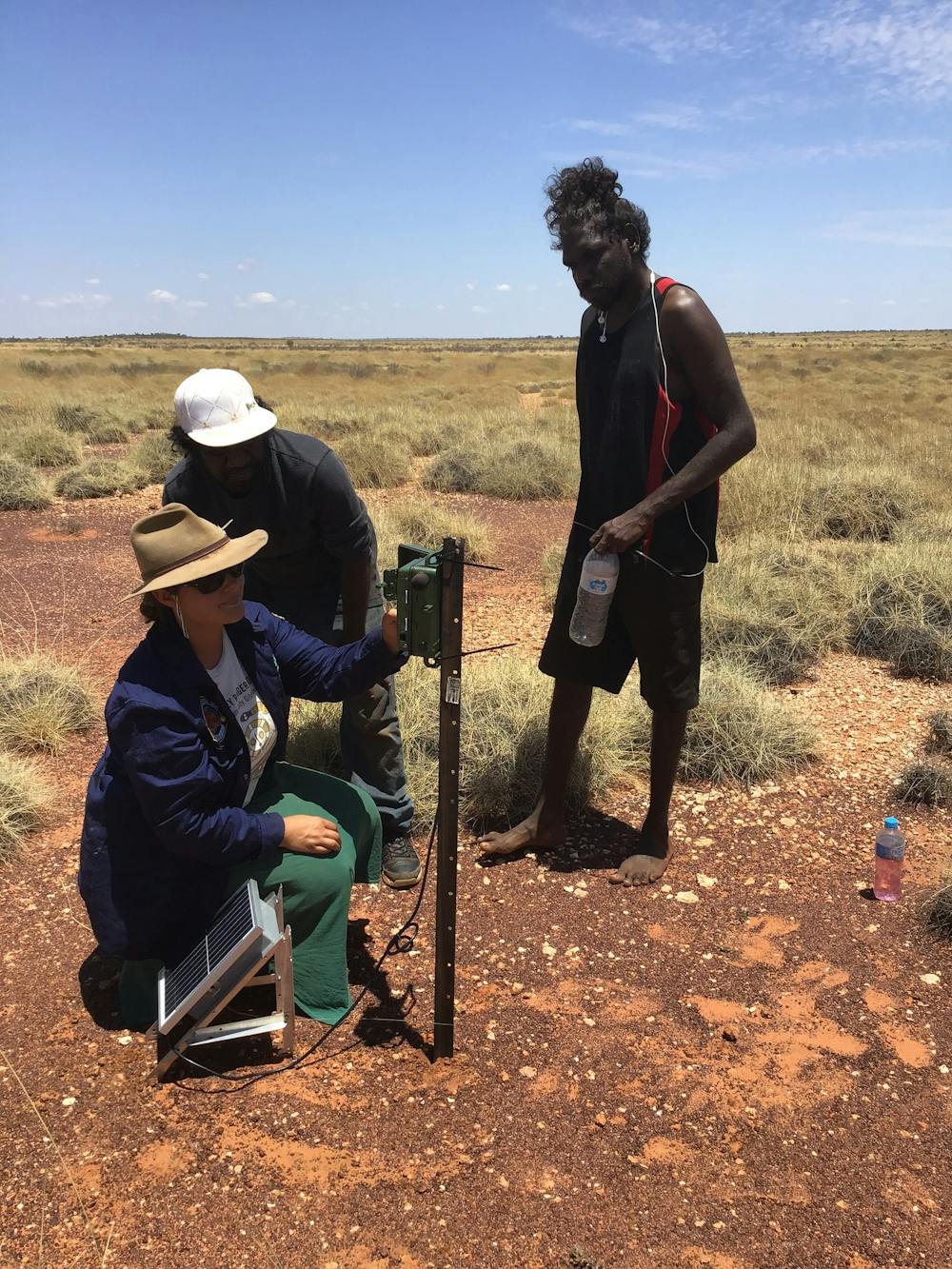
    The researchers recorded night parrots using ‘songmeters’.
    Ngururrpa Rangers/Facebook

    Ngururrpa Rangers worked with scientists to learn how to use sound recorders to search for night parrots. We then searched for the birds on Country between 2018 and 2023.

    We combined the rangers’ detailed knowledge of habitats, water and seed resources with geology maps, satellite imagery and fire history data. From this we selected 31 potential roosting areas, then deployed sound recorders called “songmeters” at those sites.

    We wanted to detect the night parrots’ distinctive calls which consist of whistles, croaks and bell-like sounds.

    The acoustic data we gathered was then analysed to extract any bird calls in the night parrot’s frequency range. Potential detections were verified using a reference library of known night parrot calls.

    Our results

    We detected night parrot calls at 17 of 31 sites. Of these, ten were roost sites, where night parrot calls were detected in the hour after sunset and the hour before sunrise.

    Individual night parrots are thought to have unique calls. We analysed how many different calls we could hear, and how loud they were (which can tell us when birds are calling from different locations). From this we built a picture of the identity and number of individuals regularly occupying a site.

    We extrapolated this across the 58 patches of potential night parrot habitat on the Ngururrpa Indigenous Protected Area. We concluded up to 20 roosting areas may be occupied by night parrots.

    Based on the numbers at roosting sites where we recorded calls, we estimate 40–50 night parrots could be present in the Ngururrpa Indigenous Protected Area.


    Fire and predators pose grave threats

    Once we found the night parrot populations, we wanted to know what threats they faced.

    We used camera-traps to identify predators and also collected their scats (poos) to analyse their diets.

    Ngururrpa Ranger Kathryn Njamme with a night parrot feather.
    Ngururrpa IPA

    Dingoes were the predator detected most frequently in night parrot roosting habitat. Our cameras captured them ten times more often than feral cats. And we found dingoes regularly eat feral cats at night parrot sites.

    Based on information from other areas, we suspect cats are a key predator of night parrots. Dingoes could be important in suppressing cat numbers and helping the parrots survive. So, attempts to limit predators in night parrot habitat should not harm dingoes.

    We also analysed 40 years of satellite imagery to assess the threat of fire to night parrots’ roosting habitat. Based on the vegetation types and flammability of surrounding landscapes, we found bushfires sparked by lightning are a much bigger threat to night parrots in the Great Sandy Desert than in Queensland.

    Strategic aerial and ground burning, to reduce fuel loads, already occurs in the Ngururrpa Indigenous Protected Area. As our knowledge of night parrots improves, these programs can become more targeted to protect key night parrot areas.

    Ngururrpa Rangers using ‘Felixer’ devices to selectively control cats in night parrot habitat.
    Ngururrpa IPA

    Keeping night parrots alive

    A long-term monitoring program for night parrots on Ngururrpa Country should be established to help better understand and protect this vitally important population.

    And the remote, wild nature of the landscape should be retained. This means minimising disturbance from people and vehicles, and continuing to exclude livestock and weeds.

    Clifford Sunfly has articulated how the rangers want to help protect night parrots into the future:

    We would like to spend more time on Country to find where [night parrots] are and understand what they are doing.

    We want those scientists to come and help us catch some night parrots and tag them. We also need more snake-cams (inspection cameras) too and more songmeters. And a kit for collecting scats for DNA.

    One day we would love to have our own research facility for doing our night parrot surveys. It would be our dream to have our own research base on Ngururrpa.

    Rachel Paltridge receives funding from the National Environmental Science Program’s Resilient Landscapes Hub, and the Indigenous Desert Alliance.

    Clifford Sunfly is a Ngururrpa Ranger. The ranger program receives funding from the WA government’s Aboriginal Ranger Program and the State NRM Program.

    Nicholas Leseberg receives funding from the Australian and Queensland Governments. He works for Bush Heritage Australia, and as a consultant on night parrots for many projects.

    – ref. ‘Breakthrough discovery’: Indigenous Rangers in outback WA find up to 50 night parrots – one of Australia’s most elusive birds – https://theconversation.com/breakthrough-discovery-indigenous-rangers-in-outback-wa-find-up-to-50-night-parrots-one-of-australias-most-elusive-birds-239449

    MIL OSI Analysis – EveningReport.nz –

    September 29, 2024
  • MIL-OSI USA: 09.22.2024 Sen. Cruz Applauds Announcement of House Vote on His Bipartisan CHIPS Permitting Bill

    US Senate News:

    Source: United States Senator for Texas Ted Cruz
    WASHINGTON, D.C. – Today, U.S. Senate Commerce Committee Ranking Member Ted Cruz (R-Texas) released the following statement after it was announced that the bipartisan legislation he authored with Sen. Mark Kelly (D-Ariz.) to dramatically expedite semiconductor manufacturing plant construction would receive a vote on the House floor next week. The Kelly-Cruz bill has already passed the Senate.
    “My number-one priority fighting for Texas has always been jobs, jobs, jobs,” said Sen. Cruz. “I am thrilled that the House has scheduled the Kelly-Cruz legislation for a vote next week. I’ve teamed up with Democrat Senator Mark Kelly to pass landmark legislation streamlining environmental permitting rules for new semiconductor factories.  When passed, Kelly-Cruz will help bring tens of thousands of jobs to Texas and hundreds of billions in new investments. It will also advance our national security significantly by making us much less dependent on China for advanced semiconductors. Our bipartisan legislation passed the Senate unanimously, and I urge our House colleagues to likewise swiftly pass it into law.”
    During the week of September 23rd, the House will vote on S. 2228, the “Building Chips in America Act,” under suspension of the rules, requiring a 2/3 majority of House members for passage. S.2228 was modified with substitute text authored by Sens. Cruz and Kelly (Senate Amendment 1378).
    In December, the Senate unanimously passed Sens. Cruz and Kelly’s bipartisan chips permitting bill, which was cosponsored by Sens. Todd Young (R-IN), Sherrod Brown (D-OH), Bill Hagerty (R-TN), Martin Heinrich (D-NM), and Kyrsten Sinema (I-AZ). This legislation had also previously passed the Senate in July of 2023 as part of the Senate’s version of the National Defense Authorization Act (NDAA).In October of 2023, Sens. Cruz and Kelly led  a bipartisan, bicameral letter with over 100 signers in support of passing these permitting reforms.
    In January, Sen. Cruz toured the Samsung facility in Taylor, Texas and reiterated the importance of his CHIPS/National Environmental Policy Act (NEPA) legislation. Sen. Cruz also hosted a roundtable event in Round Rock, Texas, to discuss regulatory hurdles facing the semiconductor industry. Sen. Cruz engaged with many Texas-based semiconductor companies, and discussed how burdensome federal environmental requirements are driving up compliance costs for chip manufacturers, leading to slower construction timelines.
    In April, Sen. Cruz discussed the need for chips permitting reform at a roundtable discussion hosted by Southern Methodist University after the university had been designated the lead agency for this federally funded economic development initiative, aimed at bolstering semiconductor manufacturing in the United States.
    Background on Sen. Cruz’s efforts to encourage American innovation through Chips manufacturing:
    During a Senate Commerce Committee hearing on ‘CHIPS and Science Implementation and Oversight,’ Secretary of Commerce Gina Raimondo endorsed Sens. Cruz and Mark Kelly’s (D-AZ) CHIPS/NEPA proposal.
    Sen. Cruz helped enact historic tax reform in 2017, which gave a tax cut to virtually every taxpayer in America. It reduced taxes on small businesses, farmers, ranchers, and job producers, which has helped bring jobs to Texas and drive innovation.
    Sen. Cruz has been leading the fight against burdensome federal government regulations and EPA overreach.
    Sen. Cruz authored the Cost Recovery and Expensing Acceleration to Transform the Economy and Jumpstart Opportunities for Businesses and Startups (CREATE JOBS) Act, which would vitally reform business expensing in the tax code and help businesses and innovators thrive.
    Sen. Cruz championed the Facilitating American-Built Semiconductors (FABS) Act to incentivize manufacturing in the U.S. through tax credits. That legislation is now law.

    MIL OSI USA News –

    September 29, 2024
  • MIL-Evening Report: Basic service provider or mini democracy? Why NZ needs to decide what it wants from local government

    Source: The Conversation (Au and NZ) – By Jeffrey McNeill, Honorary Research Associate, School of People, Environment and Planning, Te Kunenga ki Pūrehuroa – Massey University

    Prime Minister Christopher Luxon’s recent challenge to local government “to rein in the fantasies and to get back to delivering the basics brilliantly” was unsurprising, given his government’s focus on fiscal restraint.

    It was in keeping with his announcement that councils’ legislative purpose of delivering their communities’ economic, social, environmental and cultural wellbeing are to be removed from the Local Government Act.

    Local government responded with the usual indignation and suggested solutions. There were complaints about inadequate funding mechanisms, questions about whether libraries are basic services. The whole spat likely flew under the radar of the wider public.

    Yet the problems facing local government are very real and will not just go away by kicking costly decisions down the road. Rather, they are symptomatic of fundamental choices facing the sector.

    Foundational issues

    The problems go back to the late 1980s when our current local government system was designed.

    Led by then local government minister Michael Bassett, the reforms were the first in over 100 years. More than 850 city, borough and county councils, catchment boards, united councils and local boards were amalgamated to form 86 in 1989 and now 78 regional, city and district councils we have today.

    But Bassett still considered local government reform incomplete because of the failure to address water provision.

    But I would argue the real unfinished business was the failure to resolve the purpose of local government in the first place. Only when that is agreed can we address local government’s functions, form and funding.

    Until then, the shape and function of local government will remain a political football.

    According to section 10(1)(a) of the Local Government Act 2002, the purpose of local government is “to enable democratic local decision-making and action by, and on behalf of, communities”.

    But the second subsection describing its purpose, (s.10(1)(b)) has changed with the various governments. In 2002, under Helen Clark’s Labour-led government, the purpose of local government was:

    to promote the social, economic, environmental, and cultural well-being of communities in the present and for the future.

    John Key’s National-led government in 2012 replaced that purpose with a remit

    to meet the current and future needs of communities for good-quality local infrastructure, local public services, and performance of regulatory functions in a way that is most cost-effective for households and businesses.

    The previous Labour government reintroduced the wellbeing purpose. Luxon is set to remove it.

    Function, form and funding

    Should local government be a true local government with comprehensive and wide powers, or simply a property-services organisation, providing little more than street-lighting, roading, water and sewerage?

    The two very different conceptions of local government determine its functions, form and funding.

    These differing views reflect the disparate Anglophone and European concepts of local government. National aligns with the Anglophone model, with its limited local government functions under a strong central government. Labour leans towards the European model, with devolved wide-ranging functions.

    The distinction between the two models was made very clear to me while working as part of an international team researching local government responses to the COVID-19 pandemic.

    My Italian colleague, for example, reported how his country’s local governments were vitally involved in their cities’ day to day management during the crisis.

    Mayors and councils were making daily decisions and announcements about their hospitals’ resourcing, whether to close the schools and training institutes, increase social welfare provision and housing, and so on.

    On the flipside, New Zealand local government was largely sidelined to address humanitarian services such as ensuring people had access to food and accommodation.

    Instead, councils searched for local “shovel-ready” infrastructure projects to access central government funds in order to reduce unemployment and stimulate local economies. The public focused on national daily press announcements from the prime minister and director-general of health.

    No appetite strong local government

    For all that, the distinction between Labour and National conceptions of local government may not be as great as recent history suggests.

    Both want a strong centre and weak local government. Our councils have largely reinforced this reality. Some have sought to extend their scope of activities, others have clearly defined themselves as property services agencies.

    Most have largely refrained from the excesses the prime minister appears to be concerned about, partly to avoid being caught out by changes in central government, but also because most council expenditure is already committed to infrastructure.

    But does it have to be this way?

    The Labour-led government’s 2021 Future for Local Government review envisaged local government using partnerships with hapū and iwi to promote the four key wellbeings as key to any reform. This is at odds with the present government’s priorities and views on governing with Māori – a big reason why the reports now collect dust.

    The review was also very constrained in considering local government functions. Rather, it seemingly took existing functions as its starting point to focus instead on local governance.

    Writing about our local government nearly 70 years ago, public servant and academic R.J. Polaschek imagined what would have been if New Zealand had been colonised by Denmark instead of Great Britain. In this hypothetical scenario he saw strong independent local government based on communities with wide-ranging functions.

    It still could be, but tinkering at the edges is not going to solve its problems. Our local government project remains unfinished business. It will take political courage and vision to complete the task. One that remains a fantasy, and we are all the losers.

    Jeffrey McNeill does not work for, consult, own shares in or receive funding from any company or organisation that would benefit from this article, and has disclosed no relevant affiliations beyond their academic appointment.

    – ref. Basic service provider or mini democracy? Why NZ needs to decide what it wants from local government – https://theconversation.com/basic-service-provider-or-mini-democracy-why-nz-needs-to-decide-what-it-wants-from-local-government-238862

    MIL OSI Analysis – EveningReport.nz –

    September 29, 2024
  • MIL-Evening Report: How did they get my data? I uncovered the hidden web of networks behind telemarketers

    Source: The Conversation (Au and NZ) – By Priya Dev, Lecturer & Academic Data Science, Digital Assets & Distributed Ledgers, Australian National University

    Kokhan O/Shutterstock

    Last year, I started getting a lot of unsolicited phone calls, mainly from people trying to sell me things. This came as a surprise because, as a data scientist, I am very careful about what personal information I let out into the world. So I set out to discover what had happened.

    My investigation took several months. It eventually led me to the labyrinthine world of data brokers.

    In today’s digital age, where personal data is a new kind of gold, these companies wield significant power, creating networks where our personal information is shared between brokers and telemarketers as easily as TikTok videos. Their businesses profit from the data they collect, and many of the calls they enable come from scammers.

    This comes at an enormous cost: in 2023, Australians lost $2.7 billion to scams. This highlights the urgent need for stronger privacy protections to limit how our personal data is collected and shared.

    In an attempt to address this need, the Australian government this month introduced long-overdue privacy reforms. But these reforms are still inadequate for the many privacy issues affecting people today, including targeting by data brokers and telemarketers.

    Investigating the hidden web

    One of the mechanisms designed to protect us from unwanted calls is the Do Not Call Register.

    Managed by the Australian Communications and Media Authority, the registry holds more than 12 million phone numbers, including mine. The registry is supposed to block unsolicited calls. But last year, despite being on the list, I began to receive dozens of unwanted calls – on average, about three per day.

    Curious, I started tracing the origins of these calls. What I uncovered was a network of hidden connections between data brokers, telemarketers and large organisations – including a major political party. It became clear that simply being on the Do Not Call Register wasn’t enough to protect my privacy.

    I started by asking the callers what data they held, and how they had obtained mine. I requested details about the companies they represented, including their websites and Australian Business Numbers (ABNs) – the unique identifiers for Australian businesses.

    Most callers hung up the moment I started asking questions, until one day I spoke with a man named Paul, who worked in the real estate sector – an industry worth more than $10 trillion as of 2024. The high-value real-estate market makes our personal data especially valuable to businesses operating within the industry.

    Digging deeper

    The unique thing about Paul was that he knew my real name, whereas other telemarketers only had access to the pseudonyms I’d used to protect my identity online. Paul explained he had licensed my data from the real estate giant CoreLogic Australia.

    This discovery pushed me to dig deeper. After a lot of back and forth, I finally obtained my data from CoreLogic. The amount of information was small, but surprisingly accurate – especially considering the steps I’d taken to hide my identity. It made me wonder where they got it from, as only organisations such as utility companies, banks or the government would hold that type of information.

    CoreLogic told me in an email that:

    CoreLogic gets data from a variety of sources … most of the information we collect comes from public records, which we license from government departments and agencies. We may also collect personal information from third parties such as through real estate agents, tenancy and strata mangers, financial institutions and marketing database providers.

    This was a troubling discovery, because the institutions on which we depend for essentials such as public services, housing and finance – and from which we can’t hide our identities – may be selling our personal information to data brokers, who then pass it along to telemarketers.

    What’s even more alarming is that the data is shared unmasked, meaning personal details such as our names, genders and phone numbers are fully visible. Once this information is out in the open, it becomes almost impossible to control how it’s recorded or shared.

    It’s also nearly impossible to stop it being passed to overseas telemarketers, who aren’t bound by Australian privacy laws.

    Real estate giant CoreLogic says most of the personal data it collects comes from public records.
    IgorGolovniov/Shutterstock

    Solving the mystery

    My investigation didn’t end there.

    Eventually, CoreLogic revealed it had purchased my data from Australian data broker firm Smrtr in August 2023. This coincided with the surge in unsolicited calls.

    Through Smrtr I learned they had purchased my data in 2016 from another data broker, EightDragons Digital. Smrtr also admitted to selling my data to various companies – all without my consent.

    Determined to investigate the origin of my online data trail, I contacted EightDragons Digital, which calls itself “a leading global consumer data agency”. It collects personal data for big brands including Energy Australia, Vodafone, NRMA, Nissan, Johnnie Walker, American Express, The Good Guys, and even the Australian Labor Party.

    The company claimed it collected my data in a 2014 marketing campaign, and likely passed it to at least 50 other companies. However, it had no records to verify the marketing campaign or prove that I had given consent.

    A small step only

    CoreLogic defended its practices as legal, saying it’s too difficult to verify consent or anonymise personal data.

    However, with modern technology, it’s actually possible to track where data comes from, check consent, and share insights without exposing personal details such as names and phone numbers.

    The government’s recent privacy reforms are a small step in the right direction. But until data brokers are required to obtain explicit consent before trading personal information, they fall far short of being a giant leap forward.

    Priya Dev does not work for, consult, own shares in or receive funding from any company or organisation that would benefit from this article, and has disclosed no relevant affiliations beyond their academic appointment.

    – ref. How did they get my data? I uncovered the hidden web of networks behind telemarketers – https://theconversation.com/how-did-they-get-my-data-i-uncovered-the-hidden-web-of-networks-behind-telemarketers-238991

    MIL OSI Analysis – EveningReport.nz –

    September 29, 2024
  • MIL-OSI New Zealand: Tech – Kitmap: supporting a thriving science, innovation and technology sector

    Source: Callaghan Innovation

    The Science, Innovation and Technology sector is working together to improve collaboration and access to infrastructure and expertise via a new online platform.

    Kitmap is an online directory and database of scientific infrastructure and equipment owned by publicly funded institutes and is the first of its kind for Aotearoa New Zealand.

    Kitmap was announced today by Minister for Science, Innovation and Technology, Judith Collins. The online platform is part of a wider project led by the Ministry for Business Innovation and Employment (MBIE) that seeks to optimise the use of Aotearoa New Zealand’s science and technology research infrastructure.

    “We are excited to be part of the delivery and management of a tool that streamlines access to facilities that also helps to enhance collaboration and efficiency,” says Callaghan Innovation Chief Executive, Stefan Korn.

    It includes advanced facilities such as clean rooms, Good Manufacturing Practice (GMP) certified testing, pilot and manufacturing infrastructure, and specialised Nuclear magnetic resonance (NMR) spectroscopy  capabilities that are now more accessible.

    Kitmap currently catalogues 260 R&D items of infrastructure, specialised equipment, much of which are found nowhere else, or not easily accessible in this country.

    It provides easy access to equipment and facilities owned by Crown Research Institutes (CRIs), the National eScience Infrastructure (NeSI) and Callaghan Innovation.

    “Our colleagues at MBIE have done the heavy lifting gathering the relevant information for this tool. As an innovation agency and R&D provider, we are very happy to host and promote Kitmap to support improved collaboration, and optimised resource use across the public sector and beyond.

    “We engaged with MBIE late last year to see what we could do to help. They welcomed our input and their shared requirements for an online tool. We assembled our own team to deliver a dynamic platform that provides instant access to a comprehensive directory of R&D infrastructure and equipment.

    “As scientific fields, interdisciplinary research and private sector R&D areas continue to evolve rapidly, it’s crucial that our public science and technology resources are deployed to the areas where they can deliver the greatest impact for New Zealand.

    “And as the fourth industrial revolution gathers pace, Kitmap will offer valuable insights and access to a broad spectrum of research facilities and equipment, ensuring Kiwi innovators have the tools they need to successfully develop products and inventions.

    “In the near future Kitmap will look to incorporate generative AI functionality to suggest potential methods and machinery required for rapid prototyping of new products or innovations,” says Stefan Korn.

    Kitmap resource categories include:

    • Laboratories: Conventional research rooms/buildings
    • Field sites: Physical spaces for non-laboratory research activities
    • Livestock facilities: Spaces for rearing or researching livestock, including animals, fish, and insects
    • Vessels: Ships or boats equipped for sea research
    • Digital collections: Online databases and digital archives
    • Computing: Physical computing hardware or virtual networks
    • Workshops: Spaces with CNC machinery, tools and equipment for rapid prototyping
    • Sample collections: Physical specimen collections
    • Monitoring: Networks of monitoring equipment
    • Pilot plants: Facilities for pre-commercial production technology trials.

    Visit Kitmap : https://www.kitmap.govt.nz/

    About Callaghan Innovation  

    Callaghan Innovation is New Zealand’s innovation agency. It activates innovation and helps businesses grow faster for a better New Zealand.  The government agency partners with ambitious businesses of all sizes, delivering a range of innovation and research and development (R&D) services to suit each stage of their growth. Its staff – including more than 150 of New Zealand’s leading scientists and engineers – empower innovators by connecting people, opportunities and networks, and providing tailored technical solutions, skills and capability development programmes, and grants co-funding. Callaghan Innovation also enhances the operation of New Zealand’s innovation ecosystem, working closely with MBIE, NZTE, NZVIF, Crown Research Institutes, and other organisations that help increase business investment in R&D and innovation. The agency operates from five urban offices and a regional partner network in a further 12 locations across Aotearoa.

    MIL OSI New Zealand News –

    September 29, 2024
  • MIL-OSI New Zealand: Funding round open for Greenhouse Gas Inventory Research

    Source: Ministry for Primary Industries

    The Ministry for Primary Industries (MPI) is seeking research proposals to help improve New Zealand’s reporting of greenhouse gas emissions from agriculture, forestry, and other land uses.

    The annual funding round for the Greenhouse Gas Inventory Research (GHGIR) fund is now open, with $2.9 million of funding available for new GHGIR projects in the 2024/25 financial year.

    “The GHGIR focuses on improving our knowledge of New Zealand’s greenhouse gas emissions, to ensure we have the best possible data to help manage New Zealand’s emissions and inform policy decisions,” says Stephanie Preston, MPI’s director of programmes and planning, policy and trade.

    “This year we’re looking for very specific research proposals in 10 priority areas, ranging from improving liveweight estimation of sheep and beef to exploring remote sensing methods of collecting data, such as using satellite data to measure feed type and quality.

    “The outcomes will inform MPI’s reporting to the New Zealand Greenhouse Gas Inventory and the United Nations under the Paris Climate Agreement.”

    Applications close on 30 October 2024, with successful proposals expected to be announced by the end of February 2025.

    Background information

    The annual Greenhouse Gas Inventory reports on human-induced emissions and removals of greenhouse gases for energy, industrial processes, agriculture, land use, land-use change and forestry, and waste.

    The Inventory is produced by government agencies, with MPI being responsible for producing the chapter on agricultural emissions (the Agriculture Greenhouse Gas Inventory). The report is submitted to the United Nations Framework Convention on Climate Change secretariat each year.

    The 10 priorities for this year’s funding round are:

    • non-forest land-use emissions model
    • review and improve energy equations and intake
    • review QA/QC of inventory model code
    • review liming emissions
    • measure values relevant to the inventory using remote sensing techniques 
    • improving the modelling of dairy beef cattle 
    • improve liveweight estimation of sheep and beef
    • seasonal dairy supplementary feed data intake 
    • new afforestation and deforestation intentions survey 
    • improved activity data and parameters for deer.

    The priorities paper for 2024 is on MPI’s Applying for Greenhouse Gas Inventory Research funding web page.

    Applying for Greenhouse Gas Inventory Research funding

    Research funded via GHGIR has led to improvements in the accuracy of estimated emissions from agriculture and forestry including: 

    • new data to reflect the use of non-pasture feed for dairy cattle, beef cattle and sheep
    • New Zealand-specific nitrous oxide emission factors from animal excreta split by stock type and hill slope.

    Previous examples of projects recently funded

    Reports from completed GHGIR funded research

    For general enquiries, call MPI on 0800 00 83 33 or email info@mpi.govt.nz

    For media enquiries, contact the media team on 029 894 0328

    MIL OSI New Zealand News –

    September 29, 2024
  • MIL-OSI United Kingdom: Rural Flood Resilience Partnership launched to help farmers and rural communities adapt to a changing climate

    Source: United Kingdom – Executive Government & Departments

    Partnership unites six organisations including: Action with Communities in Rural England; Association of Drainage Authorities; Country Land and Business Association; Environment Agency; National Farmers Union; and Natural England

    With rural communities increasingly on the frontline of extreme weather and the devastating impacts of flooding, a unique partnership has been launched today (23 September 2024) to support rural flood resilience and help farmers and communities adapt to a changing climate. 

    Climate change means that people, places and nature are facing more frequent and more severe storms and floods. Last winter saw one of England’s wettest periods since records began in 1836. 

    The Rural Flood Resilience Partnership has been established to improve collaboration, deepen understanding of vulnerabilities, and support rural communities and agricultural businesses in building their resilience to present and future flood risks and coastal erosion. 

    The Partnership unites organisations representing government agencies, trade associations, rural communities and businesses to tackle a joint challenge with joint solutions. 

    The six equal founding partners are: Action with Communities in Rural England; the Association of Drainage Authorities; Country Land and Business Association; the Environment Agency; the National Farmers Union; and Natural England. 

    Today, the Partnership publishes its work plan covering 2024 to 2026. Partners and a wide range of projects will work together to improve their evidence base and will draw on this to co-develop solutions. 

    The work plan sets out 21 actions supporting seven strategic outcomes focused on: developing the evidence base behind decision-making to increase resilience; ensuring communities, farmers and landowners have access to quality advice and support; and engaging rural communities in flood resilience.  

    James Blake, Chair of Trustees Action with Communities in Rural England, said:

    It’s vital that everyone living and working in rural communities – not just those involved in land management and agriculture – have an opportunity to engage with and influence plans to manage the consequences of climate change.  

    As one of the founding members of this partnership, we look forward to drawing on the experience and reach of ACRE members to build the capacity of rural communities to come together and consider what can be done based on local circumstances in response to this most pressing global issue.

    Robert Caudwell, Chair of the Association of Drainage Authorities, said:  

    Our climate is changing rapidly, and those living and working in rural parts of England are some of the most aware of, and most vulnerable to, those changes.

    Listening to the voice of rural communities is essential if we are to build England’s resilience to flooding and drought in the future. 

    The best solutions can often be achieved when public authorities work together with local businesses and communities, combining their land and water management expertise with a deeper understanding of our local landscape and those impacted. 

    ADA is proud to play its part in this new Partnership in support of our members, England’s flood and water management authorities.

    Country Land and Business Association (CLA) President Victoria Vyvyan said:

    The damage to rural land and businesses from flooding is localised but acute, and the frequency of these events will increase with climate change.  

    It is crucial to improve the resilience of rural businesses and communities to flooding. The CLA hopes this partnership will provide the evidence, awareness of risks, and access to practical advice that will allow them to improve their resilience.  

    This partnership will look for short and medium-term solutions whilst raising awareness of the rural-specific costs and challenges from flooding which our members face.

    Caroline Douglass, Executive Director for Flood and Coastal Risk Management, Environment Agency, said: 

    Flooding presents specific challenges to those living and working in rural communities, from ruined crops to having road access cut off by floodwaters.  

    Since 2015, flooding and coastal change projects have been completed to protect more than 400,000 hectares of agricultural land better. This includes 280,000 hectares between 2015-2021, helping to avoid more than £500 million worth of economic damage to agricultural land production.

    While the Environment Agency continues to work to strengthen rural flood resilience, no single organisation can tackle these challenges in isolation. This partnership provides the opportunity to accomplish more than any one organisation can manage alone. 

    The new Rural Flood Resilience Partnership will help farmers, land managers and rural communities become more resilient to the impacts of climate change while retaining the vital role of managing land and producing sustainable food.

    NFU Vice President Rachel Hallos said: 

    The NFU is pleased to be involved in this new Partnership and hope it will enable farmers and rural communities to strengthen the resilience of their homes and businesses by providing practical solutions based on tangible evidence to some of the challenges they face in the event of flooding. 

    It will also give rural communities the means to influence decision making, provide access to resources and support action on the ground, strengthening rural resilience to flooding in a changing climate. 

    Farmers are on the frontline of climate change – our biggest challenge. The extreme weather this brings is one of the main threats to UK food security and more severe storms, devastating floods, and increased periods of little or no rain are all impacting our ability to produce food. 

    The country has just experienced its wettest 18 months since records began in 1836 which left many thousands of acres of productive farmland under water. There are still many farm businesses in dire need of support, and we are awaiting details of how the Farming Recovery Fund can help those businesses recover from the impacts of the devastating flooding and saturated ground.

    Natural England’s Greener Farming & Fisheries Director, Brad Tooze, said:

    Natural England champions the power of nature and nature-based solutions to help tackle the joint climate and biodiversity emergencies.  

    NE welcomes the opportunity to join this partnership and add our science and evidence expertise and our local farm advice offer into the mix. Together we can support farmers and land managers to farm in more flood resilient ways – supporting communities to become more flood resilient and recovering nature at the same time. 

    From signing up to the Sustainable Farming Incentive to manage arable land for flood/drought resilience and water quality or by working with others to restore a river and floodplain in Landscape Recovery every farmer and land manager can make a difference.

    The Partnership forms part of the wider work that all partners are undertaking on flood and coastal resilience.  

    All flood and coastal risk management schemes delivered by risk management authorities in England are carefully assessed to make sure they benefit the most people and property. Approximately 40% of all schemes and 45% of investment better protect properties in rural communities.

    Share this page

    The following links open in a new tab

    • Share on Facebook (opens in new tab)
    • Share on Twitter (opens in new tab)

    Updates to this page

    Published 23 September 2024

    MIL OSI United Kingdom –

    September 29, 2024
  • MIL-OSI China: Chinese, foreign scientists to start new expedition into Asia’s longest cave

    Source: China State Council Information Office 2

    A member of Guizhou provincial mountain resources institute observes the rock formation inside a branch cave of Shuanghe Cave in Suiyang County, southwest China’s Guizhou Province, Sept. 23, 2023. [Photo/Xinhua]
    Scientists from China, France, Portugal, Belgium and other countries gathered on Friday at the Shuanghe Cave, Asia’s longest known cave, in southwest China’s Guizhou Province for a launch ceremony of the 23rd joint international scientific expedition into the cave.
    The expedition is scheduled for Oct. 7 to 24, and the results of their findings will be made available on Oct. 24.
    Previous scientific expeditions found 44 individual giant panda fossils, with the oldest specimen dating back 100,000 years and the most recent dating back a few hundred years.
    The fossils prove that Guizhou was once a habitat for giant pandas, which are today known to survive in the provinces of Sichuan, Shaanxi and Gansu.
    Zhou Wenlong, deputy secretary general of the Guizhou Cave Association, said the upcoming cave expedition will further study the cave’s resources, formation and evolution.
    According to the results of the 2023 joint expedition, the cave network has 107 connected openings and boasts a length of 409.9 kilometers, making it the longest known cave in Asia and the third-longest in the world. It is also the world’s longest dolomite cave.
    French caver Jean Bottazzi, who has more than three decades of cave exploration experience in China, is acting as chief of the upcoming cave research. He calls Shuanghe Cave his second home.
    He said that since the late 1980s, the discoveries of Chinese and foreign experts in the cave have led to repeated updates of the cave’s length, and many cave fossils and living organisms have been unearthed, providing rich, valuable scientific research materials.
    During this year’s scientific expedition, Suiyang County, which administers the cave area, will hold activities such as a geological science photography contest and a short video contest to promote the cave geopark.

    MIL OSI China News –

    September 29, 2024
  • MIL-Evening Report: Dogma or data? Why sentencing reforms in NZ will annoy judges and clog the courts

    Source: The Conversation (Au and NZ) – By Kris Gledhill, Professor of Law, Auckland University of Technology

    Getty Images

    The Luxon government surely has little sense of irony.

    Shortly after introducing the Parliament Bill, designed to reinforce the fundamental constitutional principle of the separation of powers, it has introduced the Sentencing Reform (Amendment) Bill, which seeks to constrain the judicial arm of the state.

    Its purpose is to put more people into prison for longer. In its Regulatory Impact Statement, the Ministry of Justice estimates 1,350 people will be added to the current prison population. The ministry is also clear that most of the changes are unnecessary and rest on inadequate consultation, particularly with Māori.

    The main change the bill makes is to cap reductions in a prison sentence for mitigating factors at “40% of the sentence”, unless that would be “manifestly unjust”.

    Mitigating factors

    To understand why this is a problem, we need to start with how the Sentencing Act 2002 works. First, the seriousness of an offence provides a starting point. Since the maximum sentence is for the worst example of the offence, the facts can be put on a scale.

    Secondly, the judge considers aggravating factors, such as repeat offending, malicious motivations or the victim’s vulnerability. The new bill specifies various additional aggravating factors, but the ministry notes these are already taken into account.

    Finally, the judge looks at mitigating factors, such as youth, intellectual disability or mental illness, remorse and positive steps to remedy the cause of offending.

    One important available reduction is for a guilty plea. The bill will cap this at 25% – the Supreme Court already decided this several years ago.

    Sentence reductions based on these factors will regularly exceed the overall 40% cap proposed in the new bill. For example, impulsive offending by a young adult with ADHD who was in state care because of family abuse, and who pleads guilty early, would likely mean a considerable sentence reduction.

    Similarly, offending by someone who both admits it, shows remorse and assists the police would qualify for considerable reductions.


    Read more:
    A last minute amendment to NZ’s gang legislation risks making a bad law worse


    ‘Moral and fiscal failure’

    The New Zealand judiciary is not soft by world standards. Its rate of incarceration – currently 181 per 100,000 people – places the country 90th out of 223 jurisdictions.

    This is well above Australia, England, Wales and Scotland, and double the rates in Northern Ireland, the Republic of Ireland and Canada. As Māori have long made up more than 50% of the prison population, their incarceration rate is at US levels. Do we really want to make this worse?

    When former Finance Minister Bill English observed New Zealand’s high prison population represented a “moral and fiscal failure”, he asked the chief science advisor to collate the evidence.

    The resulting 2018 report, Using Evidence to Build a Better Justice System, concluded the prison population had grown because of “dogma not data”.

    Prisoners are seven times more likely than the general population to have a mental health or substance abuse problem. Ninety percent have a history of mental health or addiction, with 60% still affected. Up to 70% have significant literacy problems.

    The sentencing reform proposals rest on the notion people should take more personal responsibility. But they overlook the reality of most of the people in the system having a reduced capacity to do that. This looks more like dogma than data.

    And since prisons train people in criminal ways and provide gangs with recruits, but do not deal with underlying causes of criminal behaviour, it is dogma that risks creating more victims.

    Increased prisoner numbers: Paremoremo Maximum Security Prison, Auckland.
    Getty Images

    A stressed justice system

    On top of this, the criminal justice system is creaking, without enough judges or courtrooms. Complainants, defendants and witnesses already wait too long for trials.

    Reductions in sentences for guilty pleas and other mitigating features are essential to preventing this from getting worse. Some of these factors only come to light at the sentencing hearing when pre-sentence reports (often including medical reports) are provided.

    Also, the final preparation for a trial often leads the prosecution to accept a plea to a less serious offence. And the time waiting for a trial often means a defendant will have served all or much of their sentence already.

    If a judge feels obliged to impose a higher sentence because of the new amendments, lawyers will have to advise defendants accordingly. Inevitably, more will decide to take their chances in a trial rather than plead guilty.

    That means more complainants will have to give evidence, some defendants will be acquitted, and the criminal justice system will creak more.

    Judges and rules

    Judges will have to confront some dissonance in the law. The Sentencing Act requires judges to impose the “least restrictive” sentence. But a sentence that is longer than appropriate doesn’t meet that requirement.

    A longer-than-necessary prison sentence is arguably arbitrary detention. But the New Zealand Bill of Rights Act requires judges to interpret other statutes to avoid breaching rights if possible, including the right not to be detained arbitrarily.

    In addition, a fair trial should aim to secure the right sentence for the individual defendant.

    Judges do not sign up to breach people’s rights. Nor do they like it when the executive branch of government uses its parliamentary majority to overstep the separation of powers. Quite properly, they will do what they can to secure individualised justice.

    They might, for example, set a sentence at the low end of the available range to achieve the same outcome while appearing to abide by the new 40% cap. Or they might just decide a rehabilitative sentence, invariably non-custodial, is the better outcome.

    Judges spend all their time dealing with rules. You can expect them to be creative in finding ways around restrictions that should not be imposed on them.

    Kris Gledhill is currently working on a project relating to sentencing that is funded by the Borrin Foundation. He is also a member of the Executive Committee of the Criminal Bar Association, which represents prosecution and defence lawyers. The views stated in this article are his own.

    – ref. Dogma or data? Why sentencing reforms in NZ will annoy judges and clog the courts – https://theconversation.com/dogma-or-data-why-sentencing-reforms-in-nz-will-annoy-judges-and-clog-the-courts-239303

    MIL OSI Analysis – EveningReport.nz –

    September 29, 2024
  • MIL-OSI New Zealand: Over 100,000 Gather in the name of World Peace for the 10th Anniversary of the HWPL Peace Summit

    Source: NewzEngine.com

    On September 18, the “10th Anniversary of the HWPL September 18 Peace Summit” was broadcasted in over 40 countries and attracted approximately 100,000 people at the HWPL Peace Training Institute in Gyeonggi-do, Korea, where the anniversary was held.

    Hosted by Heavenly Culture, World Peace, Restoration of Light (HWPL), under the United Nations Economic and Social Council (ECOSOC) and the Department of Global Communications (DGC), the event was themed “Building a Global Community of Peace through Regional Cooperation.”

    Led by HWPL Chairman Man Hee Lee, it was a celebration of the contributions of global leaders and citizens towards peace over the past decade and exploring strategies for future global unity. Notable attendees included Great Dharma Master Hyecheon of the Jogye Order of Korean Buddhism and José Honorio da Costa Ferreira Jerónimo, East Timor’s Minister of Higher Education, Science, and Culture.

    Previously, the HWPL Peace Summit was first celebrated a decade earlier, in Seoul, 2014. The summit was attended by more than 1,000 political, religious, women’s, and youth leaders, as well as media representatives from over 140 countries. Discussions focused on conflict resolution, religious harmony, and the implementation of legal measures to ensure sustainable peace.

    During his commemorative speech, HWPL Chairman Man Hee Lee expressed gratitude to all participants for attending the 10th anniversary of the peace movement. He encouraged everyone by saying, “Let us no longer draw lines of difference between you and me. With love and peace, let’s unite to save the global village. Let us cooperate to help each other and leave behind a valuable legacy of peace for future generations.”

    Followed by 10 year’s worth of highlights, this led to many discussions of future plans of HWPL and their partners, with a particular emphasis on establishing a “regional network” for peace tailored to local characteristics. Through this regional network, HWPL aims to actively address threats to peace and consolidate collective capabilities.

    In light of this, HWPL established partnerships for peace development with intergovernmental organizations such as the Group of Seven Plus (G7+) and the Latin American and Caribbean Parliament (PARLATINO). G7+ was established to promote harmony among conflict-ridden nations through peace, stability, and development, boasting 20 member states. PARLATINO, founded to promote development and integration based on democracy, currently has 23 member states.

    Additionally, the nationwide “Accompany: Connecting Korea” campaign was launched with a Memorandum of Understanding (MOU) signed during the ceremony. The “Accompany” campaign was initially trialled in major cities in Korea last July. Through this launch, HWPL aims to work with over 230 civic organizations to connect cultures across generations and carry out diverse peace activities.

    The “Accompany” campaign is a continuation of the Saemaul (New Village) Movement, which was responsible for South Korea’s economic development and social transformation in the late 20th century. The Saemaul Movement focused on modernising rural areas and strengthening community consciousness. Similarly, the Accompany campaign aims to overcome social conflicts rooted in generational, regional, gender, and ideological differences through social solidarity and cooperation.

    To achieve the goal of establishing a “regional network,” various sessions will be held worldwide, focusing on diverse groups. Additionally, under the slogan “Let everyone in the global village become a messenger of peace,” individuals will be encouraged to play active roles in promoting peace. Messages of peace and unity from citizens of all walks of life, both domestically and internationally, will be collected and shared.

    Heavenly Culture World Peace Restoration of Light (HWPL) is a non-governmental international peace organization registered under the UN DGC and UN ECOSOC that is acknowledged for their endeavors and efforts towards achieving peace worldwide.

    – Published by MIL OSI in partnership with NewzEngine.com

    MIL OSI New Zealand News –

    September 29, 2024
  • MIL-Evening Report: Move over Olympians, Australia’s wildlife are incredible athletes

    Source: The Conversation (Au and NZ) – By Euan Ritchie, Professor in Wildlife Ecology and Conservation, School of Life & Environmental Sciences, Deakin University

    Now that the Paris Olympics and Paralympics have disappeared from our screens, let’s get back to watching animal videos.

    But seriously, have you ever paused to think about the athletic abilities of Australian wildlife?

    In my research as an ecologist, I’m constantly amazed by the strength, speed and resilience of our native animals. Their prowess is testament to the wonders of evolution, and the necessity of species having to adapt to challenging and changing environments in order to survive.

    Let’s take a closer look at some of our best competitors and how might they fare, against humans and overseas entrants. On your marks, get set… swim, hop, dig, dance, glide!

    Swimming

    Australians are renowned for being strong swimmers. But what is the fastest swimmer in the animal kingdom?

    On this there is much debate. Some suggest it’s the Indo Pacific sailfish, clocking in at about 30km/hr. That’s impressive, but much slower than oft-cited (but inaccurate) claims it can travel at more than 100km/hr.

    For perspective, the fastest human to swim the 50 metres freestyle is American Caeleb Dressel, completing this in a time of 20.16 seconds. That’s roughly 9km/h – faster than many people jog, but still no match for a sailfish.

    As in humans, swimming speed in fishes tends to increase with body length. Larger species that challenge sailfish for the fastest swimmer title include blue or black marlin. Shorter, torpedo-like bluefin tuna are also in contention. All are found in Australian waters, though not exclusively.

    While American swimmer Michael Phelps put in an impressive showing against a simulated great white shark, no human would beat much faster sailfish, marlin and tuna.

    Sprinting, long and high jump

    Aussie icons, red kangaroos can reach speeds of around 60-70km/hr. But they are no match for cheetahs, which can move at more than 120km/hr.

    Long jump is surely the kangaroo’s main event. Red kangaroos can jump a staggering 13 metres or more. Amazingly, this might not be enough to clinch gold. Snow leopards can jump more than 15 metres.

    Kangaroos can clear heights of up to 3m, so would perform well in the high jump. But they’d finish behind bottlenose dolphins, which can jump over 7m in the air, just for kicks.

    Scaled for body size, though, both species would be embarrassed by a tiny insect known as a froghopper. It jumps to heights of more than 140 times its body length.

    Kangaroos sure can jump, but they’re not the greatest of all in the animal kingdom.

    Battles of strength

    African elephants can lift more than 1,000kg and weaver ants more than 100 times their own body weight.

    But relative to size, a truly impressive champion is Australia’s horned dung beetle. At just a centimetre long, these diminutive powerhouses can pull more than 1,100 times their own body weight, roughly equating to an average man lifting two fully-loaded 18-wheeler trucks.

    And yet, horned dung beetles might still only claim silver. Another invertebrate Aussie, the tiny tropical moss mite, is perhaps the world’s strongest animal. It can pull more than 1,180 times its weight.

    Bigger does not always equal stronger.

    Packing the fastest, deadliest punch

    In terms of combat sports, bigger is not always better.

    Peacock mantis shrimps – invertebrates found in Australian marine waters and elsewhere – have the swiftest and most powerful punch in the lightweight crustacean division.

    They kill prey by punching them with strong, club-like appendages. They deliver blows at up to 23m per sec, akin to the speed and force of a .22 calibre bullet being fired.

    So powerful is the punch, it vaporises water and creates a super-hot shockwave that breaks up and incapacitates its prey.

    Nature’s deadliest punch?

    Tantalising contests

    What about a digging contest? Eastern barred bandicoots can shift 4.8 tonnes of soil a year. How would that stack up against marsupial moles, which can disappear almost instantly into desert sands? Or the expert excavations of wombats and aardvarks that can dig more than half a metre in 15 seconds?

    In terms of free-diving and flying, there’s really no contest. Cuvier’s beaked whale can dive nearly 3000m and peregrine falcons can reach over 320 km/hr. These animals are found across the globe, however – not just in Australia.

    Australia’s largest gliding marsupial, the greater glider, can sail up to 100m between trees. But gliding gold would surely go to the giant flying squirrel, which can glide up to 450m.

    I’d love to see a shooting contest between Australia’s archer fish and Madagascar’s panther chameleon. But finding the right arena for both aquatic and land-based sharpshooters would be tricky.

    Raygun’s kangaroo hop is now legendary, but a breaking (break dancing) contest between a peacock spider, spanish dancer (a type of nudibranch) and a magnificent riflebird might genuinely break the internet.

    Step aside, Raygun, peacock spiders are taking the floor.

    Appreciating wildlife athletes

    So who would win a global contest for the best wildlife athlete overall?

    If the competition was on land and focused on running, jumping, strength and climbing, it’s hard to go past the overall abilities of a Bengal tiger.

    Many amazing wildlife athletes are threatened with extinction. Others are gone forever.

    They include the incredible oolacunta – also known as the desert rat kangaroo. It’s powers of endurance in the desert are the stuff of folklore. As legendary Australian mammalogist Hedley Herbert Finlayson wrote in 1931:

    Its speed for such an atom, was wonderful, and its endurance amazing … when we finally got it, it had taken the starch out of three mounts and run us 12 miles; all under such adverse conditions of heat and rough going, as to make it almost incredible that so small a frame should be capable of such an immense output of energy.

    Let’s celebrate wildlife and their athletic abilities and ensure they have a secure future.

    Euan Ritchie receives funding from the Australian Research Council and the Department of Energy, Environment, and Climate Action. Euan is a Councillor within the Biodiversity Council, a member of the Ecological Society of Australia and the Australian Mammal Society, and President of the Australian Mammal Society.

    – ref. Move over Olympians, Australia’s wildlife are incredible athletes – https://theconversation.com/move-over-olympians-australias-wildlife-are-incredible-athletes-238303

    MIL OSI Analysis – EveningReport.nz –

    September 29, 2024
  • MIL-OSI Asia-Pac: FS begins visit to Madrid, Spain (with photos/video)

    Source: Hong Kong Government special administrative region

    FS begins visit to Madrid, Spain (with photos/video)
    FS begins visit to Madrid, Spain (with photos/video)
    ****************************************************

         The Financial Secretary, Mr Paul Chan, arrived in Madrid, Spain, yesterday (September 22, Madrid time) and began his visit.     Mr Chan led a group of local tech startups to visit Spain’s innovation organisation, Spain Startup and meet with its President, Ms Maria Benjumea, and representatives from its partner, IE University of Spain. Spain Startup is the organiser of the renowned innovation and entrepreneurship event South Summit, which has been running since 2012, bringing together startups, tech talents, investors and entrepreneurs from around the world. Through a variety of programmes, including startup competitions, networking events, and workshops, it offers startups opportunities to build global networks, exchange knowledge, and connect with investors. The South Summit event has now expanded to Brazil.     Spain Startup has indicated that it is actively considering organising an Asian version of the South Summit. Mr Chan said Hong Kong welcomes the event to be hosted in Hong Kong to attract startups and investors from the Mainland, particularly the Guangdong-Hong Kong-Macao Greater Bay Area, as well as the broader Asian region, and he will instruct relevant departments to follow up actively.     Also joining the innovation and technology delegation on the visit to Europe are the Chief Executive Officer of the Hong Kong Science and Technology Parks Corporation, Mr Albert Wong, and the Chief Public Mission Officer of Cyberport, Mr Eric Chan.     Mr Chan will continue his visit in Madrid today (September 23, Madrid time).

     
    Ends/Monday, September 23, 2024Issued at HKT 9:00

    NNNN

    MIL OSI Asia Pacific News –

    September 29, 2024
  • MIL-OSI China: Scientists to start expedition into Asia’s longest cave

    Source: China State Council Information Office 2

    A member of Guizhou provincial mountain resources institute observes the rock formation inside a branch cave of Shuanghe Cave in Suiyang County, southwest China’s Guizhou Province, Sept. 23, 2023. [Photo/Xinhua]
    Scientists from China, France, Portugal, Belgium and other countries gathered on Friday at the Shuanghe Cave, Asia’s longest known cave, in southwest China’s Guizhou Province for a launch ceremony of the 23rd joint international scientific expedition into the cave.
    The expedition is scheduled for Oct. 7 to 24, and the results of their findings will be made available on Oct. 24.
    Previous scientific expeditions found 44 individual giant panda fossils, with the oldest specimen dating back 100,000 years and the most recent dating back a few hundred years.
    The fossils prove that Guizhou was once a habitat for giant pandas, which are today known to survive in the provinces of Sichuan, Shaanxi and Gansu.
    Zhou Wenlong, deputy secretary general of the Guizhou Cave Association, said the upcoming cave expedition will further study the cave’s resources, formation and evolution.
    According to the results of the 2023 joint expedition, the cave network has 107 connected openings and boasts a length of 409.9 kilometers, making it the longest known cave in Asia and the third-longest in the world. It is also the world’s longest dolomite cave.
    French caver Jean Bottazzi, who has more than three decades of cave exploration experience in China, is acting as chief of the upcoming cave research. He calls Shuanghe Cave his second home.
    He said that since the late 1980s, the discoveries of Chinese and foreign experts in the cave have led to repeated updates of the cave’s length, and many cave fossils and living organisms have been unearthed, providing rich, valuable scientific research materials.
    During this year’s scientific expedition, Suiyang County, which administers the cave area, will hold activities such as a geological science photography contest and a short video contest to promote the cave geopark.

    MIL OSI China News –

    September 29, 2024
  • MIL-OSI China: Summit hammers out consensus for updating, upgrading UN to tackle challenges

    Source: China State Council Information Office

    Philemon Yang, president of the General Assembly of the United Nations, speaks at the Summit of the Future at the UN headquarters in New York, Sept. 22, 2024. [Photo/Xinhua]

    The Summit of the Future opened at the United Nations (UN) headquarters in New York on Sunday, with the adoption of a Pact for the Future, as well as its annexes the Global Digital Compact and the Declaration on Future Generations, which cover a broad range of themes including peace and security, sustainable development, climate change, digital cooperation, human rights, gender, youth and future generations and the transformation of global governance.

    The Pact for the Future is the UN’s master plan for tackling challenges that lie ahead for humanity, with 56 “actions” covering everything from peacekeeping to the potential threats posed by artificial intelligence. The pact underlines the “increasingly complex challenges” to world peace, notably the threat of nuclear war, with the document reiterating the UN’s core tenets.

    The pact promises to accelerate efforts to attain the 2030 Sustainable Development Goals (SDGs), which aim for the eradication of extreme poverty by 2030, an intensified battle against hunger, promotion of gender equality and education. Most of the objectives were set in 2005, but are far from being realized. Against that backdrop, and with poor countries particularly mobilized for change, the pact especially calls for “reform of the international financial architecture.”

    What UNGA president says?

    “We stand at a crossroads of global transformation, facing unprecedented challenges that demand urgent, collective action,” Philemon Yang, president the UN General Assembly, said at the opening segment of the two-day summit. “From conflict and climate change to the digital divide, from inequalities to threats against human rights, together, we all face profound challenges. Yet, alongside these challenges, there is hope,” because challenges come along with opportunities.

    The Pact for the Future represents the world body’s pledge not only to address immediate crises, but lay the foundations for a sustainable, just, and peaceful global order, for all peoples and nations, he said, adding that the commitments embodied in the pact and its annexes reflect the collective will of UN member states to promote international peace and security, invigorate implementation of the SDGs, foster just and inclusive societies, and ensure that technologies always serve the common good of humankind.

    “The Summit of the Future is a call to action. We must shape our future to protect ourselves and our planet Earth,” said the president. “Action that recommits us to the principles of international law, the goals of the 2030 Agenda for Sustainable Development and the promise of the United Nations Charter to save future generations from the pain of war.”

    The world body’s mission is to eradicate poverty in all its forms, tackle inequalities, and promote peace and security, tolerance and respect for diversity, and the summit offers a historic opportunity to ensure that progress is shared equitably across all nations and communities everywhere, he said.

    “We have an obligation to harness the power of science, technology, and innovation, in order to prepare the future of humankind. It is also important that we reproduce our human successes across generations all the time,” noted the president. “Let us continue our efforts to reform and strengthen global institutions that support peace, security, sustainable development, and financial stability.”

    What UN secretary general says?

    “I called for this summit to consider deep reforms to make global institutions more legitimate, fair and effective, based on the values of the UN Charter,” said UN Secretary General Antonio Guterres at the meeting. “I called for this summit because 21st century challenges require 21st century solutions: frameworks that are networked and inclusive; and that draw on the expertise of all of humanity … our world is heading off the rails — and we need tough decisions to get back on track.”

    Conflicts are raging and multiplying, from the Middle East to Ukraine and Sudan, with no end in sight, he said, adding that the world’s collective security system is threatened by geopolitical divides, nuclear posturing, and the development of new weapons and theaters of war, while resources that could bring opportunities and hope are invested in death and destruction.

    “In short, our multilateral tools and institutions are unable to respond effectively to today’s political, economic, environmental and technological challenges. And tomorrow’s will be even more difficult and even more dangerous,” noted the secretary general, stressing that things are changing fast but the world’s peace and security tools and institutions, as well as its global financial architecture, reflect a bygone era.

    Technology, geopolitics and globalization have transformed power relations and the world is going through a time of turbulence and a period of transition, he addressed the meeting. With the adoption of the Pact for the Future, the Global Digital Compact and the Declaration on Future Generations, pathways are opened to new possibilities and opportunities — a breakthrough on peace and security reforms to make the Security Council more reflective of today’s world is promised.

    These three landmark agreements are a step-change toward more effective, inclusive, networked multilateralism, said Guterres, noting that their implementation will prioritize dialogue and negotiation, end the wars tearing the world apart, and reform the composition and working methods of the Security Council. “To rebuild trust, we must start with the present and look to the future. People everywhere are hoping for a future of peace, dignity, and prosperity.”

    What Summit of the Future Means?

    In 2020, the United Nations turned 75 and marked the occasion by starting a global conversation about hopes and fears for the future. This was the beginning of a process that would eventually lead, four years later, to the convening of the Summit of the Future, a major event this September, just before the annual high-level debate of the General Assembly.

    The summit was conceived at the height of the COVID-19 pandemic, when there was a perception at the UN that countries and people pulled apart instead of cooperating to face this global threat.

    “We were really confronted with the gap between the aspirations of our founders, which we were trying to celebrate at the 75th anniversary, and the reality of the world as it is today,” said Michele Griffin, the policy director of the summit.

    UN member states tasked Guterres to come up with a vision for the future of global cooperation. His answer to their call was “Our Common Agenda,” a landmark report with recommendations on renewed global cooperation to address a host of risks and threats, and a proposal to hold a forward-looking summit in 2024.

    The event consists of sessions and plenaries based around five main tracks — sustainable development and financing; peace and security; a digital future for all; youth and future generations; and global governance — and other topics that cut across all of the work of the UN, including human rights, gender equality and the climate crisis.

    The immediate outcome is the finalized version of the Pact for the Future, with the Global Digital Compact and the Declaration for Future Generations as annexes, all of which were adopted by member states during the summit on Sunday.

    MIL OSI China News –

    September 29, 2024
  • MIL-OSI China: Foreign firms urged to help pool wisdom for Shanghai

    Source: China State Council Information Office

    Amid Shanghai’s continued efforts to deepen international cooperation in terms of research and development, multinational companies should be better integrated into the city’s innovation network, which would be conducive to the city’s high-quality development, said officials and company executives.

    They made the remarks on Sunday during the 36th International Business Leaders’ Advisory Council for the Mayor of Shanghai.

    Chen Jining, Party secretary of Shanghai, said that as technological innovation has been playing an increasingly important role in driving economic growth, Shanghai will expand its science and technology exchanges with other markets.

    Efforts will be made to develop offshore technological innovation, Chen said, adding that a foundation to advance coordinated technological innovation at a global level will be built in Lin-gang Special Area of the China (Shanghai) Pilot Free Trade Zone.

    International organizations are also encouraged to set up branches in the city, and all these steps are aimed at nurturing an open, fair, just and nondiscriminatory environment for technological innovation, he said.

    Shanghai Mayor Gong Zheng said the scientific research paradigm is undergoing profound changes amid the new round of technological and industrial revolution, and coordination and cooperation are crucial against this backdrop.

    Shanghai will implement a global technology partner plan, and will also actively participate in, nurture and initiate international large-scale scientific projects, he said.

    Multinational companies will be encouraged to set up international R&D centers and open innovation centers in the city, and will be deeply integrated into Shanghai’s local innovation network, Gong added.

    As of June, 985 multinational companies had set up their regional headquarters in Shanghai, and the number of foreign-funded R&D centers reached 575, according to the municipal government.

    Severin Schwan, chairman of the board of directors of Swiss healthcare company Roche Group, said that openness, innovation and collaboration are important for Shanghai’s high-quality development, particularly in the wake of geopolitical tensions and market uncertainties.

    Multinational companies can tap into the sectors of healthcare, science and technology, and the digital economy more deeply, said Schwan, who is also chairman for this year’s International Business Leaders’ Advisory Council.

    Dominic Barton, chairman of multinational mining company Rio Tinto, said the private sector has been contributing substantially to research projects, and this is a global trend.

    Miguel Lopez, CEO of German industrial and engineering conglomerate Thyssenkrupp AG, suggested that Shanghai could place great importance on and fully utilize multinational companies’ industrial expertise, global networks, international experience and innovative resources.

    The International Business Leaders’ Advisory Council was initiated in 1989 and has grown into a think tank for Shanghai mayors over time.

    This year’s meeting was attended by top executives of 34 multinational companies from 13 countries.

    MIL OSI China News –

    September 29, 2024
  • MIL-OSI China: Municipality makes life easier for foreign talent

    Source: People’s Republic of China – State Council News

    Shanghai issued 13 measures on Friday to improve services for overseas talent attracted to the city.

    The measures, unveiled at the Fourth Shanghai Talent+ Summit, include streamlined procedures for obtaining visas, residence permits, permanent residency, work permits and financial services. For example, those who possess doctorates and others deemed to be outstanding foreign talent will benefit from streamlined procedures when applying for permanent residency.

    An official surnamed Liu, who is in charge of services for foreign experts at the Shanghai Municipal Bureau of Talent Work, said that everyone from overseas who worked in Shanghai used to have to go to two different government departments to apply for a foreigner’s work permit and a residence permit.

    Liu said the two services were combined at one window several years ago for category A talent, and that will now be extended to all talent from overseas.

    Category A talent includes those who are employed by world-leading companies and research institutions, laureates of international prizes, those who possess innovative technological inventions or patents, and postdoctoral fellows below the age 40.

    The new measures will also optimize services for expat talent in scientific research, innovation and entrepreneurship, medical care, travel and online and social integration.

    At the summit, people from across Shanghai presented business plans in a contest designed to highlight their innovation and entrepreneurship. A section for expats was included for the first time this year.

    “Shanghai is a role model in inspiring entrepreneurs from home and abroad to put their business plans into reality in a positive and speedy way,” said Benoit Dubuis, president of the Swiss Academy of Engineering Sciences and also director of the Sino-Swiss Institute of Advanced Technology at Shanghai University, which is promoting the integration of some cutting-edge disciplines, including microelectronics, biomedicine and artificial intelligence.

    “Many businesses launched by expats in Shanghai increase investment or invest in other entrepreneurial projects if they succeed,” Dubuis said. “This part is critical to the development of the local business environment.”

    MIL OSI China News –

    September 29, 2024
  • MIL-OSI Russia: Scientists from NSU and ICG SB RAS have developed a new approach to collecting, storing and analyzing information about wheat ears

    MIL OSI Translation. Region: Russian Federation –

    Source: Novosibirsk State University – Novosibirsk State University –

    Scientists from NSU and ICG SB RAS presented a new approach to collecting, storing and analyzing information on the morphometric characteristics of a wheat ear. Students took an active part in the work on creating the SpikeDroidDB system Faculty of Mechanics and Mathematics of NSU, Faculty of Information Technology NSU, and also Mathematical center in AkademgorodokWork on this project was carried out with the support of the Russian Science Foundation, project No. 23-14-00150.

    The SpikeDroidDB information system allows storing digital images of the ear, annotating their phenotypic characteristics according to 14 important traits and provides a flexible query system for accessing data.

    Using SpikeDroidDB, a collection of F2 hybrid ears from a cross between the Australian soft wheat variety Triple Dirk and the Chinese wheat sample KU506 Triticum yunnanense was digitized and annotated. An analysis of the variability of the ears in shape, length and width was carried out.

    The structure of the ear is one of the most important features of cereals, associated with such economically valuable qualities as productivity, resistance to environmental factors and pests, ease of threshing. Ears differ in shape, size, density, awns, color, etc.

    For breeders and geneticists, such parameters as the number of grains in an ear, the thousand-grain weight, and others are of great importance. These characteristics are closely related to plant productivity. A useful selection feature is the shape of the grain and such characteristics of the ear as its type, length, profile, the presence or absence of awns, the number of fertile and sterile spikelets (i.e., grain content), ear fragility, and the properties of the glume. Collecting and describing these features manually is a labor-intensive and lengthy process.

    — Researchers at our laboratory have long been working on an important task aimed at replacing the measuring methods of geneticists and breeders with a ruler and a computer or mobile phone. We would like to make it so that scientists no longer have to manually measure plant parameters, but simply take a photo of a wheat ear, while observing a number of technical conditions, and then obtain the information they are interested in by uploading this photo to our database. When creating it, we worked with conventional image analysis, that is, with digital vision, and applied deep machine learning in terms of image recognition using neural networks, identifying individual features and classification, — said the leading researcher at the Laboratory of Evolutionary Informatics and Theoretical Genetics of the Institute of Cytology and Genetics of the Siberian Branch of the Russian Academy of Sciences, an employee of the Department of Information Biology Faculty of Natural Sciences, Novosibirsk State University Dmitry Afonnikov.

    The complexity of the researchers’ work was that it was based on digital images of ears. They serve as the initial data when applying automatic phenotyping methods. When developing them, an important task is an expert assessment of many plant characteristics for their further use in training and verification of computer algorithms. However, many morphological features of the ear are usually assessed qualitatively, not quantitatively. Very often, they do not have a quantitative assessment. Such features include the shape of the ear, its density, the color of the ear, the pubescence of the glumes, the type of awns, the color of the awns, the shape of the ear, brittleness of the ear and many others. Therefore, the use of digital image analysis approaches to describe the shape of the grain and ear, as well as their comparison with the assessments of the ear features made by expert breeders, became an important task for the developers.

    — In our database, we have collected over 10,000 digital images of ears and described their structure and properties so that genetic scientists can obtain all the data they need from a photograph — the size of the ear, its thickness, width, presence of awns, color of the ears, etc., essentially replacing conventional measurements with image analysis. And as a result, we obtain more characteristics, and they are also more accurate. In this case, the automated system has more capabilities than a person. If a person determines some parameters “by eye”, then computer vision records them more accurately and productively. With the help of computer analysis of digital images, we can determine hundreds of parameters of ears — both basic and their derivatives, and then use them to develop methods and classifications, as well as to assess productivity. Such technologies provide a high degree of automation of information collection, its storage in databases, integration with data on the genotype and environmental parameters, and create the basis for intelligent analysis of the information received. There is another important advantage: a digital description of the ear and its image will be stored in the database for as long as necessary, whereas a dried ear placed in a paper envelope may crumble, change color or deteriorate, and the sample will be lost, explained Dmitry Afonnikov.

    In the SpikeDroidDB system, several images can be associated with each ear. For each of them, the protocol by which it was obtained is indicated. For shooting, the developers used two protocols for obtaining digital images of mature ears. They chose a blue background as the most contrasting to the color of the ears and allowing you to easily separate the object from the background. Shooting of the ears was carried out in two versions: in the first, the ear is located vertically in front of a blue background, the second shooting option provides for a horizontal position of the ears on the glass above the blue background.

    The prototype of the SpikeDroidDB system is available at this link http://speakedroid.biores.cytogen.ru/The main page contains brief information about the database, links for logging in or registering, and links to the main blocks of information in the database.

    Dmitry Afonnikov says that breeders and geneticists involved in developing new varieties of wheat are showing great interest in this development and are interested in working with it to automate painstaking and lengthy routine processes that require precision and concentration. In addition, the SpikeDroidDB system will help avoid subjective assessments, errors and inaccuracies in phenotyping ear samples.

    Please note: This information is raw content directly from the source of the information. It is exactly what the source states and does not reflect the position of MIL-OSI or its clients.

    Please note; This information is raw content directly from the information source. It is accurate to what the source is stating and does not reflect the position of MIL-OSI or its clients.

    https://www.nsu.ru/n/media/news/nauka/uchenye-ngu-i-itsig-so-ran-razrabotali-novyy-podkhod-dlya-sbora-khraneniya-i-analiza-informatsii-ok/

    EDITOR’S NOTE: This article is a translation. Apologies should the grammar and or sentence structure not be perfect.

    MIL OSI Russia News –

    September 29, 2024
  • MIL-OSI Economics: Secretary-General of ASEAN delivers pre-recorded remarks at the Opening Session of the Forum on China-ASEAN Technology Transfer and Collaborative Innovation

    Source: ASEAN

    Secretary-General of ASEAN Dr. Kao Kim Hourn today delivered pre-recorded remarks at the Opening Session of the Forum on China-ASEAN Technology Transfer and Collaborative Innovation (FCATTCI). The Forum is held in Nanning, China, on 23-24 September 2024, and is organised by the China-ASEAN Technology Transfer Center, Department of Science and Technology of Guangxi Zhuang Autonomous Region of the People’s Republic of China.

    MIL OSI Economics –

    September 29, 2024
  • MIL-Evening Report: Earth is getting a tiny new mini-moon. It won’t be the first (or the last)

    Source: The Conversation (Au and NZ) – By Laura Nicole Driessen, Postdoctoral researcher in radio astronomy, University of Sydney

    The minimoon 2020 CD3 orbited Earth between 2018 and 2020. International Gemini Observatory/NOIRLab/NSF/AURA/G. Fedorets, CC BY

    Earth is going to have its very own mini-moon from September 29 until November 25. The regular Moon’s new, temporary friend is 2024 PT₅, an asteroid captured from the Arjuna asteroid group (called the “Arjunas”).

    Our new mini-moon is approximately 10 metres in diameter and will be captured by Earth’s gravity for 57 days. It’s small and faint, so it won’t be visible by the eye or with small telescopes, but will be visible to larger telescopes.

    What is a mini-moon?

    NASA defines “moons” as “naturally formed bodies that orbit planets”. Intuitively, we think of moons as big rocks that stick around for a while, like our very own Moon.

    Astronomers have defined mini-moons as asteroids or comets that are gravitationally captured by a planet for a temporary amount of time. Small mini-moons are very common, but ones big enough to spot are more rare.

    2024 PT₅ is only the fifth ever detected mini-moon captured by Earth.

    Orbiting or just flying by?

    A mini-moon is a “temporarily captured orbiter” if it completes at least one full orbit of the Earth before returning to its usual orbit around the Sun.

    If a mini-moon is captured by Earth’s gravity but doesn’t make it around for a full orbit, it’s a “temporarily captured flyby” instead.

    Two of Earth’s mini-moons were “temporarily captured orbiters”, while the other three (including 2024 PT₅) fall into the “temporarily captured flybys” category.

    Where do mini-moons come from?

    Mini-moons are asteroids from the large population of near-Earth objects (or NEOs) that are temporarily grabbed from their orbit around the Sun.

    Near-Earth objects are defined as natural physical objects floating in space, such as asteroids (space rocks) or comets (dirty space snowballs made of rock and ice), that are orbiting the Sun and approach to within 1.3 times Earth’s distance from the Sun at some point in their orbit.

    Because these objects are around the same distance from the Sun as the Earth, they can sometimes be captured by Earth’s gravity.

    2024 PT₅ and and a previous mini-moon called 2022 NX₁ were both captured from a group of asteroids orbiting the Sun at a similar distance from Earth, called the Arjunas. Arjuna is one of the main characters of the Hindu epic, Mahābhārata.

    The first mini-moon – and a fake one

    The first known mini-moon was called 1991 VG. It arrived in late 1991 and left in early 1992, and like 2024 PT₅ it was around 10 metres in diameter.

    The mini-moon 1991 VG (marked with green lines). This image was made by combining seven images from the European Southern Observatory (ESO) Very Large Telescope (VLT). All images were taken on May 30 2017. The images were taken by tracking the asteroid position, so background stars appear as streaks.
    Hainaut/Micheli/Koschny via Wikipedia, CC BY

    In 2002, amateur astronomer Bill Yeung found what he thought was a second mini-moon: J002E3.

    However, on closer inspection the object displayed a spectrum of light suggesting it was coated in white paint containing titanium oxide. Then, a study of how the object’s brightness changed over time found its shape resembled something like the upper stage of a rocket.

    Astronomers now believe J002E3 is the third stage of the Apollo Saturn V rocket (S-IVB) instead of a natural mini-moon.

    Images of the false mini-moon J002E3 taken by amateur Bill Yeung on September 3 2002.
    Bill Yeung / Bob Denny via Wikipedia, CC BY

    More discoveries – with a note of caution

    The plot twist of J002E3 made astronomers a bit more cautious. When another mini-moon (2006 RH₁₂₀) was spotted on September 14 2006, it was first classified as artificial. However, after more observations it turned out to be a natural mini-moon about 2–7 metres in diameter. 2006 RH₁₂₀ stuck around from July 2006 until July 2007.

    Animation of 2006 RH120’s orbit around Earth. The animation runs from April 1 2006 until November 1 2007. Earth is shown in blue, the Moon is shown in yellow and 2006 RH120 is shown in magenta.
    Phoenix7777/Wikipedia, CC BY

    The next mini-moon, 2020 CD₃, was gravitationally captured by Earth for more than two years, making it the longest-captured mini-moon observed to date. It escaped Earth’s orbit in May of 2020. This mini-moon was around 1–2 metres in diameter.

    Amateur astronomers Grzegorz  Duszanowicz and Jordi  Camarasa discovered 2022 NX₁ using the Moonbase South Observatory in Namibia. Similar to 2006 RH₁₂₀, it was initially thought to be an artificial object from a past space mission.

    It was later determined to originate from the Arjunas, just like 2024 PT₅. While it was discovered in 2022, it was temporarily captured by Earth’s gravity in January 1981 and June 2022. It’ll be captured again in December 2051.

    2022 NX₁ was later found to be a natural mini-moon 5–15 metres in diameter.

    Will we find more mini-moons?

    Modelling suggests that, at any given time, Earth has at least one captured mini-moon less than 1 metre in diameter.

    Even though astronomers think we always have a mini-moon, these bodies are challenging to detect. This is because they’re small and faint. They are usually found by projects specifically looking for asteroids near Earth.

    2024 PT₅ was discovered using the Asteroid Terrestrial-impact Last Alert System (ATLAS), which is an ongoing project specifically designed to search for asteroids. 2006 RH₁₂₀ and 2020 CD₃ were discovered using the ongoing Catalina Sky Survey (CSS) for Near Earth Asteroids. 1991 VG was discovered by the SPACEWATCH group using the Spacewatch Telescope.

    These projects will continue to search for asteroids, including mini-moons. We can also look forward to new discoveries and investigations when the Vera C. Rubin Observatory’s Legacy Survey of Space and Time (LSST) starts observing in the next couple of years.

    This enormous project will take images of the entire sky every few days for a period of ten years. First light of the Vera C. Rubin observatory is expected in mid-2025.

    Laura Nicole Driessen is a brand ambassador for the Rise & Shine Education Orbit Centre of Imagination.

    – ref. Earth is getting a tiny new mini-moon. It won’t be the first (or the last) – https://theconversation.com/earth-is-getting-a-tiny-new-mini-moon-it-wont-be-the-first-or-the-last-239507

    MIL OSI Analysis – EveningReport.nz –

    September 29, 2024
  • MIL-OSI Economics: What’s at stake for Latin America and the Caribbean at COP16 in Cali?

    Source: CAF Development Bank of Latin America

    At a time when the planet faces the most severe environmental challenges in its history, caused by the existing economic model, COP16 on Biodiversity will be the ideal stage for Latin America and the Caribbean to reaffirm their role as a region of solutions and raise their voice in the global debate on the accelerated loss of biodiversity. The region must advocate for a vision that considers people and communities whose survival is closely tied to unique and endangered ecosystems. The measures taken to preserve the region’s biodiversity have the potential to set a global example, advancing towards a harmonious and respectful coexistence with nature.

    All countries in the region have ratified the Convention on Biological Diversity (CBD), a 1993 agreement aimed at conserving biodiversity, sustainably using its components, and ensuring fairness in the use of genetic resources. However, few have presented action plans to advance biodiversity protection by 2030. These plans are among the historic milestones achieved at COP15 in Kunming-Montreal in 2022, where 23 key targets were set to halt and reverse biodiversity loss by 2030 and four goals to achieve positive biodiversity by 2050. In Cali, progress on these action plans will be reviewed, and two critical issues for the world’s most megadiverse region will be addressed: establishing a fair and equitable framework for access to the benefits of genetic resources and creating a new framework for tracking the committed mobilization of 200 billion dollars by 2030.

    COP16 is also expected to bring together initiatives that conserve and sustainably use biodiversity through innovative financial instruments, such as debt-for-nature swaps, green bonds, and biodiversity certificates. Additionally, there will be active participation from the private sector and philanthropy, which are increasingly focused on ecosystems and the risks posed by biodiversity loss. Special attention will be given to the key role played by local communities and indigenous peoples, promoting ways to incorporate ancestral knowledge into climate, sustainability, and biodiversity agendas. On all these fronts, the voice of Latin America and the Caribbean will be crucial.

    The region’s leading role is primarily due to its rich biodiversity: it hosts 60% of the world’s biodiversity, and six of its countries (Brazil, Colombia, Ecuador, Mexico, Peru, and Venezuela) are classified as megadiverse. These figures also make biodiversity a factor for regional integration, with ecosystem connectivity being key to conservation, and a crucial tool for positioning Latin America and the Caribbean in global sustainability discussions.

    The strategic ecosystems of Latin America and the Caribbean are essential for maintaining the planet’s environmental balance. They span across the region, are interconnected with each other and with other hemispheric ecosystems, and provide key services that ensure the livelihoods of local populations. Among these ecosystems are the páramos, Patagonia, the Caribbean, the Tumbes forests in the Chocó and Magdalena, the Atlantic Forest, the Mesoamerican biological corridor, the mangroves, the Amazon, the Humboldt Current, the Gran Chaco, and Pantanal, among others. Thus, COP16 will be a historic moment to introduce new narratives into the global debate on biodiversity.

    CAF at COP16

    With the Latin America and Caribbean Pavilion, CAF will bring the region’s voice to COP16 to highlight its leading role in preserving global biodiversity. CAF aims to generate discussions on the value of strategic ecosystems, the importance of the blue economy, the role of science and youth, the need for innovative financing systems, and the communities and territories on the front lines of biodiversity preservation.

    CAF will address biodiversity loss and the use of financial resources with a fresh perspective, placing communities that have direct relationships with the natural environment at the center of decision-making. These communities are best positioned to design actions that lead to ecosystem regeneration in ways that are consistent with the social and environmental context.

    MIL OSI Economics –

    September 29, 2024
  • MIL-OSI Economics: CAF promotes a global network of scientists to protect the biodiversity of Latin America and the Caribbean

    Source: CAF Development Bank of Latin America

    CAF is fostering dialogue with scientific institutions to ensure the voice of science is heard ahead of COP16 and the implementation of the Global Biodiversity Framework. This effort aims to help promote and implement science-based solutions in its operations and in dialogue with countries.

    In this context, CAF, which will host a Latin America and Caribbean Pavilion open to all countries in the region at COP16, convened over twenty international scientific institutions to raise awareness about the importance of data, science, regional collaboration, and the application of scientific methods to solve problems related to biodiversity loss and restoration. The Executive Secretary of the Convention on Biological Diversity, Astrid Schomaker, closed the event, highlighting the importance of science. The conclusions of the meeting, along with CAF’s proposals to address the identified challenges, will be presented in Cali.

    “We are engaging with scientists to identify what we can do to be more effective in preserving biodiversity. We need to understand how scientific recommendations can be translated into efficient public policies and explore new ideas and proposals that help us find solutions to the dilemmas modern societies are facing due to climate change,” said Sergio Díaz-Granados, CAF’s Executive President.

    CAF’s work with international scientists aims to strengthen multilateralism by connecting scientific advances and generating new lines of work being carried out in various countries to stop and reverse biodiversity loss.

    “To halt biodiversity loss, it is essential to develop robust scientific knowledge and, most importantly, put it into practice. This requires creating communication channels that accelerate the implementation of science-based policies and integrate them into national development agendas and business strategies,” said Alicia Montalvo, CAF’s Manager of Climate Action and Positive Biodiversity.

    In this regard, the Intergovernmental Science-Policy Platform on Biodiversity and Ecosystem Services (IPBES) plays a fundamental role by fostering closer ties between the scientific community and decision-makers to build capacity and strengthen the use of science in public policy development. CAF aims to reinforce this work by bringing science closer to public and private financial institutions, promoting investment in biodiversity.

    CAF’s commitment to an ecosystem and science-based approach

    Latin America and the Caribbean is one of the richest regions in terrestrial and marine biodiversity. IPBES values the region’s terrestrial and coastal ecosystem services at $24.3 trillion per year. The region is home to six of the world’s seventeen megadiverse countries (Brazil, Colombia, Ecuador, Mexico, Peru, and Venezuela) and contains between 60% and 70% of all known species, approximately 25% of tropical forests, and the most biodiverse habitat on the planet: the Amazon rainforest.

    In this context, CAF has adopted an ecosystem approach in its operations, addressing not only the needs of countries for the integrated management of land, water, and living resources but also the needs of ecosystems for sustainable and equitable conservation and resource use.

    Examples of this new approach include the Program for Integrated and Sustainable Management of Sargassum in the Greater Caribbean, which will benefit Mexico, Costa Rica, Panama, Colombia, Jamaica, the Dominican Republic, Barbados, Trinidad and Tobago, and Venezuela through the promotion of sustainable sargassum management. Other examples include the coral reef restoration project in Colombia, Ecuador, Mexico, and Costa Rica; The Americas Flyways Initiative (AFI), which aims to identify and conserve more than 30 critical landscapes along migratory routes in North, Central, and South America and the Caribbean; and projects to strengthen the management of protected natural areas in Bolivia, Colombia, Costa Rica, Ecuador, and Panama.

    MIL OSI Economics –

    September 29, 2024
  • MIL-OSI Banking: What’s at stake for Latin America and the Caribbean at COP16 in Cali?

    Source: CAF Development Bank of Latin America

    At a time when the planet faces the most severe environmental challenges in its history, caused by the existing economic model, COP16 on Biodiversity will be the ideal stage for Latin America and the Caribbean to reaffirm their role as a region of solutions and raise their voice in the global debate on the accelerated loss of biodiversity. The region must advocate for a vision that considers people and communities whose survival is closely tied to unique and endangered ecosystems. The measures taken to preserve the region’s biodiversity have the potential to set a global example, advancing towards a harmonious and respectful coexistence with nature.

    All countries in the region have ratified the Convention on Biological Diversity (CBD), a 1993 agreement aimed at conserving biodiversity, sustainably using its components, and ensuring fairness in the use of genetic resources. However, few have presented action plans to advance biodiversity protection by 2030. These plans are among the historic milestones achieved at COP15 in Kunming-Montreal in 2022, where 23 key targets were set to halt and reverse biodiversity loss by 2030 and four goals to achieve positive biodiversity by 2050. In Cali, progress on these action plans will be reviewed, and two critical issues for the world’s most megadiverse region will be addressed: establishing a fair and equitable framework for access to the benefits of genetic resources and creating a new framework for tracking the committed mobilization of 200 billion dollars by 2030.

    COP16 is also expected to bring together initiatives that conserve and sustainably use biodiversity through innovative financial instruments, such as debt-for-nature swaps, green bonds, and biodiversity certificates. Additionally, there will be active participation from the private sector and philanthropy, which are increasingly focused on ecosystems and the risks posed by biodiversity loss. Special attention will be given to the key role played by local communities and indigenous peoples, promoting ways to incorporate ancestral knowledge into climate, sustainability, and biodiversity agendas. On all these fronts, the voice of Latin America and the Caribbean will be crucial.

    The region’s leading role is primarily due to its rich biodiversity: it hosts 60% of the world’s biodiversity, and six of its countries (Brazil, Colombia, Ecuador, Mexico, Peru, and Venezuela) are classified as megadiverse. These figures also make biodiversity a factor for regional integration, with ecosystem connectivity being key to conservation, and a crucial tool for positioning Latin America and the Caribbean in global sustainability discussions.

    The strategic ecosystems of Latin America and the Caribbean are essential for maintaining the planet’s environmental balance. They span across the region, are interconnected with each other and with other hemispheric ecosystems, and provide key services that ensure the livelihoods of local populations. Among these ecosystems are the páramos, Patagonia, the Caribbean, the Tumbes forests in the Chocó and Magdalena, the Atlantic Forest, the Mesoamerican biological corridor, the mangroves, the Amazon, the Humboldt Current, the Gran Chaco, and Pantanal, among others. Thus, COP16 will be a historic moment to introduce new narratives into the global debate on biodiversity.

    CAF at COP16

    With the Latin America and Caribbean Pavilion, CAF will bring the region’s voice to COP16 to highlight its leading role in preserving global biodiversity. CAF aims to generate discussions on the value of strategic ecosystems, the importance of the blue economy, the role of science and youth, the need for innovative financing systems, and the communities and territories on the front lines of biodiversity preservation.

    CAF will address biodiversity loss and the use of financial resources with a fresh perspective, placing communities that have direct relationships with the natural environment at the center of decision-making. These communities are best positioned to design actions that lead to ecosystem regeneration in ways that are consistent with the social and environmental context.

    MIL OSI Global Banks –

    September 29, 2024
  • MIL-OSI Asia-Pac: Union Minister for Social Justice & Empowerment, Dr. Virendra Kumar to preside over as Chief Guest during the Sign Language Day celebrations in New Delhi tomorrow

    Source: Government of India (2)

    Union Minister for Social Justice & Empowerment, Dr. Virendra Kumar to preside over as Chief Guest during the  Sign Language Day celebrations in New Delhi tomorrow

    Theme for the Sign Language Day-2024 is ‘Sign up for Sign Language Rights’

    Posted On: 22 SEP 2024 2:00PM by PIB Delhi

    Union Minister for Social Justice & Empowerment (SJE), Dr. Virendra Kumar will be the Chief Guest for the  Sign Language Day-2024 celebrations tomorrow, at Bhim Hall, Dr. Ambedkar International Centre, Janpath, New Delhi. MoS (SJE), Shri B.L.Verma, will be the Guest of Honour on the occasion.

    The Indian Sign Language Research and Training Centre (ISLRTC), New Delhi, under the aegis of Department of Empowerment of Persons with Disabilities (Divyangjan) [DEPwD], Union Ministry of Social Justice and Empowerment, will be organising the event.

    The theme of this year Sign Language Day-2024 is ‘Sign up for Sign Language Rights’.  The world will once again highlight the unity generated by sign languages. World leaders and other government officials are invited to strive towards a better implementation of the Rights of Person with Disabilities at the national level through the linguistic human rights of deaf people; And, to Sign up for sign language rights by working with our local and national associations to announce the achievement of a concrete goal for deaf communities on Sign Language day.

    During the event, the following Indian Sign Language (ISL) terms and Videos will be launched:

    1. Launch of 2500 terms in Indian Sign Language: To expand the existing ISL dictionary, ISLRTC has collaborated with 4 organizations working in the field and jointly developed the 2500 terms in Indian Sign Language. The organizations are YUNIKEE, Hyderabad for 1000 terms, India Signing Hands, Mumbai for 500 terms, Bridge Connectivity Solutions, Delhi for 500 terms and Anuprayaas, Mohali for 500 terms. The 2500 terms covers the various school subjects such as mathematics, science, language, geography and higher education areas such as philosophy, linguistics, computer science, etc., and sports, infrastructure, accessibility, etc.
    2. Launch of 100 concept videos in ISL: ISLRTC in collaboration with YUNIKEE developed 100 concept videos in Indian Sign Language for Hearing Impaired children of class 6th, covering various school subjects such as mathematics, science, social science and language. The special features of concepts videos are detailed explanation in ISL to develop concept clarity, graphical images to promote learning, Audio and subtitles to promote inclusive learning and illustration and examples to improve learning outcomes and academic achievements.
    3. Launch of ISL dictionary in 10 languages: To promote accessibility, the ISL dictionary will be made available in 10 Regional Languages.
    4. Launch of Educational Animated Videos in ISL: To develop morals values and new learning experience among hearing impaired children and to promote inclusive learning environment.
    5. Launch of Deaf Role Model Videos in ISL: To create inspiration, motivation, sense of purpose, moral values and guidance among hearing impaired children.
    6. The Centre conducted 7th Indian Sign Language Competition, 2024 – a national-level competition held for students with hearing disabilities. The students have showcased their creativity and knowledge by participating in the competition. All the winners of the 7th ISL competition will be distributed trophy and certificate during the Sign Language Day 2024 programme.

    The ISLRTC celebrates the occasion every year ever since the United Nations declared 23rd September as the International Day of Sign Languages. DEPwD and ISLRTC are making all the possible efforts to bring more citizens, stakeholders, service-providing agencies, schools for deaf, NGOs, activists, deaf leaders, educators, researchers etc. together into the fold of Sign Language Day, in order to create positive awareness about ISL among all sections of our society.

    The Day also reminds us of the need and importance of preserving sign languages as a part of linguistic and cultural diversity. All the professionals, parents of deaf, deaf students and institutions working in the field of Indian Sign Language, deaf education and differently-abled people from all walks of life are important target groups to rope into the Sign Language Day celebration.

    Dignitaries gracing the occasion would include Shri Rajesh Aggarwal, Secretary, DEPwD; Dr. Sharanjeet Kaur, Chairperson, RCI; Shri Rajeev Sharma, Joint Secretary, DEPwD; and, Dr. Jitendra Sharma, Director, ISLRTC. Representatives from National Association of Deaf, All India Federation of Deaf Women and Indore Deaf Bilingual Academy and other representatives of the Deaf Community will also present on the occasion.

    *****

    VM


    (Release ID: 2057529) Visitor Counter : 553

    MIL OSI Asia Pacific News –

    September 29, 2024
  • MIL-OSI Asia-Pac: Prime Minister attends the CEOs Roundtable

    Source: Government of India (2)

    Posted On: 23 SEP 2024 7:01AM by PIB Delhi

    Prime Minister Shri Narendra Modi interacted with technology industry leaders in New York in a Roundtable anchored by the Massachusetts Institute of Technology (MIT), School of Engineering. The tech-roundtable focused on Artificial Intelligence and Quantum; Biotechnology and Life Sciences; Computing, IT and Communication; and Semiconductor technologies.

    The CEOs participated in a deep dive with Prime Minister on the evolving technology landscape at a global level and how these cutting-edge technologies are contributing to the well-being of people around the world including in India. They touched upon how technology is being leveraged for innovations, which have the potential to revolutionize the global economy and human development.

    Prime Minister appreciated the efforts of the MIT School of Engineering and its Dean for bringing the technology leaders together. He noted that technology collaboration and efforts such as the Initiative on Critical and Emerging Technologies [ICET] lie at the core of the India-US Comprehensive Global Strategic Partnership. He stressed that in his third term, India will make every effort to become the third largest economy in the world. He encouraged the companies to take advantage of India’s growth story for collaboration and innovation. They can co-develop, co-design, and co-produce in India for the world, harnessing the opportunities from India’s economic and technological growth. He assured the business leaders of India’s deep commitment to protection of intellectual property and to fostering tech-innovation.

    Prime Minister highlighted the economic transformation happening in India, particularly in electronics and information technology manufacturing, semiconductors, biotech and green development. He stated that his government was committed to making India a global hub of semiconductor manufacturing. He also dwelt on India’s BIO E3 policy to develop India into a biotech powerhouse. On AI, he noted that India’s policy is to promote AI for All, underpinned by its ethical and responsible use.

    The CEOs expressed their strong interest in investing and collaborating with India. India’s growing prominence as a global technology hub, driven by its innovation-friendly policies and flourishing market opportunities, got much appreciation from the tech-leaders. They also agreed that investing in startups would be a synergistic opportunity to innovate and develop newer technologies in India.

    MIT Professor Anantha Chandrakasan, Chief Innovation and Strategy Officer at the Institute and Dean of the MIT School of Engineering, who chaired the roundtable, thanked Prime Minister and CEOs for their participation, affirming MIT’s commitment to advancing technology and making it accessible for global good.

    List of CEOs who attended the Roundtable:

    Serial Number

    Name of the company

    Name of the CEO

    1

    Accenture

    Ms. Julie Sweet, CEO

    2

    Adobe

    Mr. Shantanu Narayen, Chairman, President, and CEO

    3

    AMD

    Ms. Lisa Su, CEO

    4

    Biogen Inc

    Mr. Chris Viehbacher, CEO

    5

    Bristol Myers Squibb

    Mr. Chris Boerner, CEO

    6

    Eli Lilly and Company

    Mr. David A. Ricks, CEO

    7

    Google

    Mr. Sundar Pichai , CEO

    8

    HP Inc.

    Mr. Enrique Lores, CEO & President

    9

    IBM

    Mr. Arvind Krishna, CEO

    10

    LAM Research

    Mr. Tim Archer, CEO

    11

    Moderna

    Dr. Noubar Afeyan, Chairman

    12

    Verizon

    Mr. Hans Vestberg, Chairman and CEO

    13

    Global Foundaries

    Mr. Thomas Caulfield, CEO

    14

    NVIDIA

    Mr. Jensen Huang, Founder, President and CEO

    15

    Kyndryl

    Mr. Martin Schroeter, CEO


    *****

    MJPS/BM

    (Release ID: 2057695) Visitor Counter : 64

    MIL OSI Asia Pacific News –

    September 29, 2024
  • MIL-OSI New Zealand: Business – EMA highlights mindfulness in the workplace for Mental Health Awareness Week – EMA

    Source: EMA

    The Employers and Manufacturers Association (EMA) is supporting Mental Health Awareness Week by reminding businesses of the importance of mindfulness in the workplace.
    According to EMA Head of Advocacy Alan McDonald, by applying the principles of mindfulness, workers experience less stress, better self-awareness and awareness of others.
    2024 Workplace Wellbeing survey
    Last month, the EMA and nib New Zealand (nib) released the 2024 Workplace Wellbeing survey results, which showed declining mental and physical health, as well as concerns about family wellbeing as a result of the cost-of-living crisis.
    “With employees experiencing financial strain, health issues, concerns for the future and more, it’s no surprise that they’re seeking stability in their current workplaces. It’s clear that when employers take steps to proactively manage wellbeing, employees respond positively, helping to alleviate some of the broader societal pressures,” he says.
    Better understanding of how anxiety is triggered
    “Mindfulness and resilience training have become recognised as essential skills to live and lead in uncertain times and the EMA has significant expertise in these areas.
    “Our courses include the neuroscience of stress and anxiety, which we apply to relatable experiences both in and out of the workplace.
    “By understanding where and how anxiety issues are triggered, we become better placed to ‘short circuit’ negative thinking before it snowballs into bigger issues. We can’t control what happens to us, but we can better control how we interpret and react to these issues.”
    McDonald says the EMA is focussed on supporting both its members and the wider business community through the current economic challenges.
    “The most important asset for any business is its people. That’s why it’s so important to help employers understand what might be going on with their team and consider how to respond.
    “We’ve got a range of resources, tools and learning programmes that are designed to help small to medium businesses drill down into the challenges and identify the right solution for them,” he says.
    Further information
    More information on EMA courses on Mental Health Awareness Training and other Workplace Wellbeing Learning can be found here: Workplace Wellbeing Courses: Upskill Professional Training | EMA https://ema.co.nz/learning/workplace-wellbeing/portfolio/

    MIL OSI New Zealand News –

    September 29, 2024
  • MIL-OSI USA: USGS St. Petersburg Coastal and Marine Science Center Scientists Present at the International Conference on Coastal Engineering in Rome, Italy

    Source: US Geological Survey

    Drs. Donya Frank-Gilchrist and Michael Itzkin of the USGS St. Petersburg Coastal and Marine Science Center presented research on sediment transport in coastal regions at the International Conference on Coastal Engineering, 9/8-9/14/2024, in Rome, Italy. 

    MIL OSI USA News –

    September 29, 2024
  • MIL-OSI USA: NASA Awards $1.5 Million at Watts on the Moon Challenge Finale

    Source: NASA

    NASA has awarded a total of $1.5 million to two U.S. teams for their novel technology solutions addressing energy distribution, management, and storage as part of the agency’s Watts on the Moon Challenge. The innovations from this challenge aim to support NASA’s Artemis missions, which will establish long-term human presence on the Moon.
    This two-phase competition has challenged U.S. innovators to develop breakthrough power transmission and energy storage technologies that could enable long-duration Moon missions to advance the nation’s lunar exploration goals. The final phase of the challenge concluded with a technology showcase and winners’ announcement ceremony Friday at Great Lakes Science Center, home of the visitor center for NASA’s Glenn Research Center in Cleveland.
    “Congratulations to the finalist teams for developing impactful power solutions in support of NASA’s goal to sustain human presence on the Moon,” said Kim Krome-Sieja, acting program manager for NASA Centennial Challenges at NASA’s Marshall Space Flight Center in Huntsville, Alabama. “These technologies seek to improve our ability to explore and make discoveries in space and could have implications for improving power systems on Earth.”
    The winning teams are:

    First prize ($1 million): H.E.L.P.S.  (High Efficiency Long-Range Power Solution) of Santa Barbara, California
    Second prize ($500,000): Orbital Mining Corporation of Golden, Colorado

    Four teams were invited to refine their hardware and deliver full system prototypes in the final stage of the competition, and three finalist teams completed their technology solutions for demonstration and assessment at NASA Glenn. The technologies were the first power transmission and energy storage prototypes to be tested by NASA in a vacuum chamber mimicking the freezing temperature and absence of pressure found at the permanently shadowed regions of the Lunar South Pole. The simulation required the teams’ power systems to demonstrate operability over six hours of solar daylight and 18 hours of darkness with the user three kilometers (nearly two miles) away from the power source.
    During this competition stage, judges scored the finalists’ solutions based on a Total Effective System Mass (TESM) calculation, which measures the effectiveness of the system relative to its size and weight – or mass – and the total energy provided by the power source. The highest-performing solution was identified based on having the lowest TESM value – imitating the challenges that space missions face when attempting to reduce mass while meeting the mission’s electrical power needs.
    Team H.E.L.P.S. (High Efficiency Long-Range Power Solution) from University of California, Santa Barbara, won the grand prize for their hardware solution, which had the lowest mass and highest efficiency of all competitors. The technology also featured a special cable operating at 800 volts and an innovative use of energy storage batteries on both ends of the transmission system. They also employed a variable radiation shield to switch between conserving heat during cold periods and disposing of excess heat during high power modes. The final 48-hour test proved their system design effectively met the power transmission, energy storage, and thermal challenges in the final phase of competition.
    Orbital Mining Corporation, a space technology startup, received the second prize for its hardware solution that also successfully completed the 48-hour testwith high performance. They employed a high-voltage converter system coupled with a low-mass cable and a lithium-ion battery.
    “The energy solutions developed by the challenge teams are poised to address NASA’s space technology priorities,” said Amy Kaminski, program executive for Prizes, Challenges, and Crowdsourcing in NASA’s Space Technology Mission Directorate at NASA Headquarters in Washington. “These solutions support NASA’s recently ranked civil space shortfalls, including in the top category of surviving and operating through the lunar night.”
    During the technology showcase and winners’ announcement ceremony, NASA experts, media, and members of the public gathered to see the finalist teams’ technologies and hear perspectives from the teams’ participation in the challenge. After the winners were announced, event attendees were also welcome to meet NASA astronaut Stephen Bowen.
    The Watts on the Moon Challenge is a NASA Centennial Challenge led by NASA Glenn. NASA Marshall Space Flight Center manages Centennial Challenges, which are part of the agency’s Prizes, Challenges, and Crowdsourcing program in the Space Technology Mission Directorate. NASA contracted HeroX to support the administration of this challenge.
    For more information on NASA’s Watts on the Moon Challenge, visit:
    https://www.nasa.gov/wattson
    -end-
    Jasmine HopkinsHeadquarters, Washington321-432-4624jasmine.s.hopkins@nasa.gov
    Lane Figueroa Marshall Space Flight Center, Huntsville, Ala. 256-544-0034lane.e.figueroa@nasa.gov 
    Brian NewbacherGlenn Research Center, Cleveland216-469-9726Brian.t.newbacher@nasa.gov

    MIL OSI USA News –

    September 29, 2024
  • MIL-OSI Banking: Christine Lagarde: Setbacks and strides forward: structural shifts and monetary policy in the twenties

    Source: European Central Bank

    Speech by Christine Lagarde, President of the ECB, at the 2024 Michel Camdessus Central Banking Lecture organised by the IMF

    Washington, DC, 20 September 2024

    Central banks are public institutions with powerful tools, but the way these tools affect the economy is constantly changing. This uncertainty comes, in part, from the famous “long and variable” lags of monetary policy transmission.[1] It typically takes 18 to 24 months for a change in interest rates to have its peak effect on the economy and inflation.[2]

    But there are also more fundamental issues that affect the transmission of monetary policy, which were identified by Federal Reserve Chairman Alan Greenspan 20 years ago. He wrote that:

    “The economic world in which we function is best described by a structure whose parameters are continuously changing. The channels of monetary policy, consequently, are changing in tandem.”[3]

    In other words, the effectiveness of monetary policy is intrinsically linked to the evolving structure of the economy. In recent years, uncertainty about policy transmission has been particularly acute.

    We have faced the worst pandemic since the 1920s, the worst conflict in Europe since the 1940s, and the worst energy shock since the 1970s. These shocks have changed the structure of the economy and posed a challenge for how we assess the impact of monetary policy. This challenge was exacerbated by the fact that the pandemic caught us after a long period of anaemic growth, below-target inflation and low interest rates.

    To manage this uncertainty, we introduced a three-pronged policy framework, focusing not only on forecast inflation but also on underlying inflation dynamics and the strength of transmission. This framework has been instrumental in helping us calibrate the rate path over the last phase of the hiking cycle, during the period when we held rates at their peak and, more recently, as we have started to make policy less restrictive.

    Our determined policy actions have successfully kept inflation expectations anchored, and inflation is projected to return to 2% over the second half of next year. Considering the size of the inflation shock, this unwinding is remarkable.

    But the uncertainty ahead is still profound. The economy is currently undergoing transformational changes and we need to analyse and understand their impact.

    While some of these changes – like climate change and ageing societies – are unique to our times, others resemble those that took place a century ago. Two specific parallels between the “two twenties” – the 1920s and the 2020s – stand out. Today, like back then, we are seeing setbacks in global trade integration, at the same time as strides forward in technological progress.

    But there is an important difference in how these changes are affecting monetary policy.

    In the interwar period, structural shifts affected the prevailing monetary policy strategy. The main lesson for central banks was that the dominant paradigm was not robust in times of profound structural change.

    It was this realisation that led to modern monetary policy strategies emerging a few decades later, with a core focus on price stability and flexible policy strategies to deliver it.

    Thanks to these developments, we are in a better position today to address these structural changes than our predecessors were. The challenge we face is not about our goals, which have proven successful, or our tools, which are sufficiently flexible.

    Rather, it is about how monetary transmission will be affected by structural shifts, and how we should adjust our analytical frameworks to these shifts.

    In my remarks today, I will start by exploring the parallels between the structural changes of the 1920s and those of the 2020s, while highlighting the different implications for monetary policy in each era. I will then share some preliminary considerations for the evolution of policy frameworks.

    My main message is that we must be ready for change and prepared to use the flexibility in our frameworks as necessary. To ensure stability in the future, our approach must continue to embody “stability without rigidity”, allowing us to adjust swiftly as the economy transforms.

    Post-war structural shifts and monetary policy in the 1920s

    If we go back a century to the 1920s, the world economy was going through a series of transformations. These shifts pulled in different directions, representing both setbacks and strides forward from the previous environment. They fundamentally changed the structure of the economy.

    Two of these shifts had profound implications for monetary policy.

    The first was global fragmentation, which put an end to the open, liberal economic order of the late 19th century and its assumed permanence.

    The decades leading up to the First World War had seen rapid global integration. World trade as a share of GDP rose from 10% in 1870 to 17% in 1900 and then to 21% by 1913, creating new expectations and lifestyles. As John Maynard Keynes famously wrote:

    “the inhabitant of London could order by telephone, sipping his morning tea in bed, the various products of the whole earth, in such quantity as he might see fit, and reasonably expect their early delivery upon his doorstep […] he regarded this state of affairs as normal, certain, and permanent.”[4]

    At the same time, the dominant paradigm among major central banks was the gold standard, which prioritised maintaining an external equilibrium and relying on intrinsic mechanisms for domestic credit to adjust to external imbalances.

    But the war brought about the end of Pax Britannica, while the United States was reluctant to assume the role of global hegemon sustaining open trade. Economic nationalism rose and a rapid unravelling of globalisation followed. World trade as a percentage of GDP fell to 14% in 1929 and 9% in 1938.[5][6] Tariffs more than tripled in most European countries[7] and also rose in the United States.[8]

    Major central banks initially attempted to revive the gold standard in the mid-1920s to recreate the conditions for open trade, but they faced a worsening trade-off.

    As Ragnar Nurkse showed in his seminal study, in a more unstable world, central banks increasingly had to use gold reserves as a buffer against external shocks rather than allowing them to be transmitted to domestic credit growth.[9] While this approach was intended as a “second-best” policy to maintain a degree of domestic stability, it ultimately exacerbated deflationary pressures. Deflation in turn fuelled economic malaise and contributed to the cycle of economic nationalism.

    The second major shift in this period was rapid technological progress. While fragmentation was a step back, technology unambiguously took a step forward. But it triggered a series of changes in the economy and financial markets that created new challenges for central banks.

    Innovation accelerated rapidly in this period, fuelled largely by spillovers from wartime advancements. This surge saw new machinery introduced on a much larger scale than before. Progress was most visible with the internal combustion engine, the assembly line pioneered by Henry Ford, and the electrical network and motor.[10]

    The technological boom drove rapid productivity gains. In Britain, for example, 55 employee weeks were required to produce a car at the Austin Motor Company in 1922, compared with only ten in 1927.[11] For Europe as a whole, the average rate of productivity growth[12] rose to over 2% per year between 1913 and 1929, up from about 1.5% per year between 1890 and 1913.[13]

    Irrational exuberance about technology, however, also fuelled a significant rise in stock market valuations. Research indicates that a 1% increase in a firm’s stock of cited patents corresponded to a 0.26% increase in market value during the 1920s.[14] But central banks lacked a framework for dealing with booms and busts.

    Several central banks tried unsuccessfully to pop stock bubbles[15], and then they took a series of wrong turns when the crash came. The resulting banking crisis and the return to a deflationary stance – which in the United States, for example, appeared justified by the prevailing real bills doctrine – are now widely considered to have played a significant role in exacerbating the Great Depression.[16]

    A key lesson ultimately became clear for governments: central banks needed a new concept of stability. And this concept had to be reflected in their monetary policy strategies.

    As the economic historian Michael D. Bordo observed, in the 1920s central banks tried to focus on both external and internal stability, “but as long as the gold standard prevailed, external goals dominated.”[17]

    The main realisation of the interwar period was that central banks in advanced economies needed to be assigned domestic stability targets first and foremost. But it took another 30 to 40 years to realise that they would do better stabilising inflation rather than fine-tuning output and employment.

    Structural shifts and monetary policy in the 2020s

    Today, we also face some setbacks as the global economy fractures, while seeing strides forward with transformative digital technologies expanding.

    The consequences for monetary policy, however, are different.

    The last few years have been an extreme stress test of inflation targeting across the globe. We have faced not only back-to-back shocks, but also a differing variety and strength of shocks in different places. For example, Europe suffered much more than the United States from high energy prices, while the United States had to contend with the legacies of a stronger stimulus to demand.

    Yet, inflation is converging towards target almost everywhere. And remarkably, disinflation has come – at least so far – at a low cost to employment. As I recently observed, it is rare to avoid a major deterioration in employment when central banks raise rates in response to high energy prices.[18] But employment has risen by 2.8 million people in the euro area since the end of 2022.

    There are two reasons for this greater stability.

    First, decades of inflation targeting have had a deep impact on how people build expectations about future inflation. Indeed, when the inflation goal is stated sufficiently clearly, and monetary policy is credible, inflation expectations will remain anchored, which makes the adjustment process to an inflationary shock less painful.

    Second, over time central banks have recognised that stability should not mean rigidity.

    Indeed, we are better placed to confront structural changes because policy strategies combine three elements: clearly defined inflation targets, flexible policy toolkits to deliver those targets, and analytical frameworks that can assess and respond to changes in the economy, thereby feeding into our reaction functions. We have used all these elements in recent years to ensure that monetary policy maintains price stability without excessive costs to the economy.

    For these reasons, the ongoing transformations will not revolutionise the goals of monetary policy as they did a century ago. But they are likely to have a more profound impact on monetary transmission.

    Setbacks: fragmentation

    Just as one era of globalisation reached a turning point in the aftermath of the First World War, we are now witnessing another wave of globalisation plateauing. The hallmark of this era was the geographical unbundling of production through global value chains (GVCs), which led to a doubling in the value of traded intermediate goods. It now accounts for over half of world trade.[19]

    But the landscape is changing. We are not seeing outright “de-globalisation” in the sense of a reversal in world trade. But we are seeing the structure of GVCs changing in response to a more volatile environment, marked by more frequent supply shocks[20] and a fragmenting geopolitical landscape.[21]

    ECB analysis finds that both the United States and the euro area have recently diversified their supply of imported goods, leading to a larger number of sourcing countries and increasing costs.[22] In the United States, firms appear to be exploring the options of both “nearshoring” production in Canada and Mexico and “reshoring” at home.[23] In Europe, the focus is on “nearshoring” production within the region while still exporting globally.[24]

    These changes have implications for monetary transmission, as they could partially reverse some of the long-term changes in the economy that may weaken transmission.

    First, they could strengthen the link between domestic slack and inflation.

    A key puzzle that central banks faced in the 2010s was that policy easing was transmitted strongly to activity but in a weaker fashion to inflation. One explanation for this disconnect was that the expansion of GVCs reduced the impact of domestic slack on inflation by shifting the focus to global factors.[25] However, if GVCs become shorter or less efficient, domestic slack and inflation may reconnect. This shift could make monetary policy impulses more powerful.

    Second, policy transmission may strengthen as GVC restructuring could potentially boost capital deepening. Inducements for “strategic sectors” to set up closer to home may lead to a resurgence of capital-intensive industries within advanced economies. In the United States, for instance, manufacturing construction spending has doubled since the end of 2021 in response to policies like the Inflation Reduction Act, the Bipartisan Infrastructure Law and the CHIPS and Science Act.[26]

    Such a shift could somewhat attenuate the long-term shift in activity towards services and the observed slowdown in capital deepening over recent decades. In turn, capital deepening could increase the economy’s sensitivity to interest-rate changes, potentially enhancing the effectiveness of monetary transmission through the interest-rate channel.

    By strengthening the transmission mechanism, these shifts could potentially allow central banks to exercise more control over domestic outcomes. But these benefits would be offset if the restructuring of GVCs led to more volatile inflation.

    In a stable global environment, the expansion of GVCs facilitated a virtuous cycle of trade integration and stable inflation, as GVCs buffered the effects of cost-push shocks. Research shows that a 1% increase in input prices resulted in only a 0.44% increase in output prices owing to this buffering effect.[27] But if supply chains were to shorten, it could lead to stronger pass-through of cost shocks.

    Strides forward: technological progress

    Like in the 1920s, setbacks in some areas are being matched by advancements in others. We find ourselves in the midst of a digital revolution that echoes the technological boom of the 1920s.

    Just as that era saw rapid advancements in electricity, automobiles and mass production, our era is witnessing unprecedented growth in digital technologies. In particular, the rapid development of artificial intelligence (AI) looks set to transform a swathe of industries, including the financial sector. And financial technology (fintech) is already having a profound impact on finance.

    In 2022, fintech generated 5% of global banking revenue, totalling USD 150 billion to USD 205 billion. This share is expected to exceed USD 400 billion by 2028, growing at an annual rate of 15%. Banks are also acquiring fintech firms and adopting their technologies to enhance their lending operations.[28]

    By changing the nature of financial intermediation and fostering competition, fintech can significantly strengthen the transmission of monetary policy decisions to the wider economy, influencing interest rates, asset prices, credit conditions and ultimately growth and inflation.

    For example, advanced credit scoring[29] and new sources of credit provided by fintech platforms can reduce lending constraints. By leveraging alternative data sources, which can include over 1,000 data points per loan applicant, fintech using AI and machine learning has outperformed traditional credit scoring models in predicting loss rates, particularly for riskier firms.

    These developments are already expanding access to finance. Fintechs have been found to process mortgage applications around 20% faster than other lenders.[30] The use of data could also alleviate the need for collateral, thereby extending credit to underserved businesses at a lower cost.

    The modern consumer who can quickly check their creditworthiness and secure the best financial deals through their smartphone is no distant fiction. In some ways, it mirrors how the Londoner of the past could effortlessly order global goods from their bed.

    As a result, fintechs’ credit supply tends to be more responsive to changes in borrowers’ business conditions or broader economic conditions[31], contrasting with traditional banks’ emphasis on long-term relationships with borrowers. This responsiveness also means that fintech lending could be more procyclical in times of stress, amplifying credit cycles and volatility.[32]

    But the net benefits for transmission hinge crucially on the effect of digitalisation on market structures.

    Digital markets tend to be “winner-takes-most”, as is visible in the handful of “hyperscalers” that dominate digital platforms and cloud services. For example, just three US “hyperscalers” account for over 65% of the global cloud market. Google commands an outstanding market share of more than 90% among search engines. In e-commerce, business is concentrated among a handful of top players.

    Market power has important effects on policy transmission. IMF research finds that firms with greater market power are less sensitive to changes in interest rates. In the United States, a 100 basis point increase in the policy rate causes a low-markup firm to cut sales by about 2% after four quarters. By contrast, a high-markup firm barely reduces its sales in response to the same policy change.[we start to understand the effects of global fragmentation and digitalisation on monetary transmission, we will have to continuously reassess our analytical frameworks. Just as in previous eras, stability should not mean rigidity.

    Regular strategy reviews provide an opportunity for self-reflection. We published the results of our last strategy review in 2021, which mainly took stock of the low inflation era, and we expect to conclude the 2025 assessment of our strategy in the second half of next year.

    Important elements of the previous review remain valid. In particular, we will maintain the symmetric, medium-term oriented 2% inflation target. But there are two key areas in which we need to develop our framework to be more robust in times of profound change.

    First, we need to reduce as much as possible the uncertainty created by these structural shifts. We can do so by deepening our knowledge and analysis of the ongoing transformations, and how they may affect the shocks we face and the transmission of our policy.

    Second, as uncertainty will nonetheless remain high, we need to manage it better.

    In particular, we should reflect on how our policy framework incorporates risk assessments. While our current three-pronged policy framework provides a useful set of cross checks, the strategy review provides an opportunity to consider how to balance the information from baseline forecasts with real-time information, how to make best use of alternative scenarios, and the importance of the medium-term orientation when faced with different types of shocks.

    The two main strands of our 2025 review will correspond to these goals.

    First, we will look at how the economy has changed in the post-pandemic world, aiming to distinguish as best we can cyclical from structural drivers. As part of this analysis, we will consider how we can improve our analytical framework, including embedding new techniques and sources of data into our forecasts.

    Increasing the use of AI will be an important element. Machine learning will help us, for example, to identify non-linearities in macro forecasting, to use large data sets for event prediction, and to improve inflation nowcasting. These advances may be especially important in relation to near-term forecasting, which is not the strength of traditional macro models.

    Second, we will consider what we can learn from our past experience with too-low and too-high inflation, including for our reaction function. We will look at how our medium-term orientation can be made operational when faced with both upside and downside risks to inflation expectations.

    Conclusion

    Let me conclude.

    History shows that structural shifts matter for monetary policy, even if their effects take time to appear. They affect how monetary policy is transmitted through the economy. And, in the past, they sometimes affected the fundamental goals that monetary policy pursued.

    Today, the goals of monetary policy do not change, because a focus on price stability has been shown to be crucial in times of profound change. But that does not imply that the way in which we conduct monetary policy will remain the same.

    In 1933, the Governor of the Bank of England, Montagu Norman, told his newly appointed economic advisor that “you are not here to tell us what to do, but to explain to us why we have done it.”[36]

    So, let me end by promising you this: we will not take that approach. We will draw on our best analysis, experience and knowledge, so that when change comes, we will be ready.

    MIL OSI Global Banks –

    September 29, 2024
  • MIL-OSI Security: Director Rosie Hidalgo Delivers Remarks at the National Institute of Justice 2024 National Research Conference

    Source: United States Attorneys General 7

    Remarks as Prepared for Delivery

    Good morning! I want to thank the National Institute for Justice (NIJ) for hosting this panel discussion today commemorating the 30th anniversary of the Violence Against Women Act (VAWA), and for inviting me to participate. I also want to extend my deep gratitude to each of you here for your hard work and dedication; and for coming together to see how we can continue to learn from one another.

    I am honored to have the opportunity to serve as the Director of the Office on Violence Against Women (OVW) and to collaborate with so many dedicated individuals and organizations committed to furthering our nation’s vision for ending sexual assault, domestic violence, dating violence, stalking and other related forms of gender-based violence.

    OVW is tasked with overseeing the implementation of key parts of VAWA, landmark bipartisan legislation first enacted by Congress in 1994. The hallmark of VAWA is a coordinated community response (known as a CCR), which seeks to bring together agencies and community partners across many disciplines to address the needs of survivors. From victim advocates to law enforcement officers and investigators, to healthcare personnel to educational institutions, community-based organizations and judges and courtroom officials, how each person responds often determines how, of if, survivors are able to access safety, justice and healing. Since survivors’ lives do not exist in silos, it is therefore critical that no individual or entity works in a silo because it takes all of us to prevent and effectively address gender-based violence.

    Each subsequent reauthorization of VAWA has provided an opportunity for stakeholders and policymakers to identify what works well and how we can continue to scale up, as well as identify gaps and barriers that need to be addressed, ensuring that these efforts are rooted in the voices and lived realities of survivors. Research and evaluation play an important role in identifying the gaps and barriers, as well as the promising practices.

    The most recent VAWA reauthorization in 2022 is the most expansive yet, establishing numerous new grant programs and initiatives in order to enhance the ways in which we can support communities to prevent and address gender-based violence.

    Additionally, VAWA funding increased by more than 30% in just the last three years, allowing OVW to distribute a record amount of grant funding. In Fiscal Year 2024, Congress increased VAWA funding to $713 million, which is the highest amount that has ever been appropriated.

    The development of the original VAWA legislation was rooted in the lived experiences of survivors, and their courage and leadership to tell their stories to educate policy makers, as well as advocates who helped raise awareness about these critical issues. These leaders pushed for federal legislation, called for investments in research, advocated for funding to improve services and training and co-created much of the work that informs policy and legislation today.

    Just last week, we met with stakeholders and Technical Assistance (TA) providers at the VAWA 30th anniversary TA event to reflect on promising practices and discuss available data and research and how they continue to shape the evolution of policies and practices.

    Congress has appropriated some VAWA funding each year to support research on gender-based violence at NIJ. Additionally, OVW has had statutory authority since the beginning to use some of its program funds to study emerging issues and evaluate VAWA-funded approaches, including demonstration programs. In 2016, however, OVW launched the Research and Evaluation Initiative with support from NIJ and as a complement to NIJ’s longstanding portfolio of research on gender-based violence. Every year since then, OVW has issued a call for proposals that invites applicants to study a broad range of topics using a wide range of methods. We intentionally keep these grant opportunities very open, seeking to foster practitioner-research partnerships, since practitioners who work closest with survivors know about emerging innovations ripe for evaluation before we do and can partner with researchers to develop research proposals.

    To that end, at OVW, our Research and Evaluation Initiative supports collaboration between researchers and practitioners to study VAWA-funded approaches. We’ve funded studies looking at everything from victim notification protocols for cases in which a sexual assault kit is tested after having been shelved for years, to the evaluation of a therapeutic horticulture program at a domestic violence shelter. We’ve also funded a training program for faith leaders to help them support congregants who disclose domestic violence. We fund projects that employ community-based participatory research, quasi-experimental designs, randomized controlled trials and more. In fact, several of our Research and Evaluation grantees are presenting their work here at this conference!

    Since 2016, the Research and Evaluation Initiative has awarded over 50 grants, totaling more than $21 million, to study ways to improve responses to gender-based violence in victim services, law enforcement, prosecution and the courts. In fact, last year OVW awarded $3.1 million in new research grants. Among these projects is an evaluation of a flexible financial assistance program for domestic violence survivors. This study aims to show how cash assistance can help survivors for whom financial barriers impede their path to safety and recovery, recognizing that survivors often know best what they need. Another study will examine the occupational and economic needs and experiences of domestic violence victim advocates and will use its findings to adapt and pilot an innovative economic empowerment program. Preliminary research on economic empowerment programs has shown positive impacts, including improved financial management and related behaviors.

    We see our evidence-building activities not as a way of limiting the ways people work in their communities to support survivors and hold harm-doers accountable, but rather, to expand that work and better understand how, and why, under what circumstances and for whom certain strategies are helpful.

    We’re especially interested in supporting research that can help us learn from strategies created by and for survivors from historically marginalized and underserved communities. We know that gender-based violence places a disproportionately heavy toll on marginalized communities, often at the intersection with other issues that create additional barriers to seeking effective services and access to justice. It is also from these communities that especially novel and promising ways for reducing risk factors and facilitating protective factors for gender-based violence are emerging.

    As we commemorate the 30th anniversary of VAWA this month, it is an opportunity for all of us to collectively reflect on the substantial progress that has been made — but also how much further we have to go. There have been significant paradigm shifts in society’s perceptions of gender-based violence and our responses to it, but many survivors still encounter significant challenges navigating complex systems and accessing critical resources and support.

    Addressing these gaps and barriers requires consistent, long-term coordination, which is why just last year the White House launched the first-ever U.S. National Plan to End Gender-Based Violence (GBV), with the collaboration of more than 15 federal agencies. The Plan advances a whole-of-government approach to preventing and ending gender-based violence — which we refer to as a “federal coordinated community response” — and it acts as a blueprint that builds on the lessons learned and achievements made through the efforts of survivors, advocates and others in the field.

    The GBV National Plan encourages all federal agencies to strengthen their role in supporting efforts to prevent and address gender-based violence. It also calls for strengthening research efforts to better understand the needs and implement solutions. At OVW, we’re working with our colleagues across government to widen the aperture of the various tools we all use to measure social problems and evaluate ways of mitigating them.

    The GBV National Plan focuses on seven pillars, starting with prevention as Pillar 1. While Pillar 7 of the GBV National Plan focuses on Research and Data, there are clear research implications embedded throughout the other six pillars, as well as opportunities to work across and beyond systems to advance our understanding of what strategies make a real difference for preventing gender-based violence and ameliorating its impacts on people, families and communities.

    We have seen how research has had an impact on the evolution of VAWA, including helping support advocacy for the inclusion of special Tribal criminal jurisdiction to address the high rates of domestic violence and sexual assault perpetrated by non-Indian abusers in Indian country; helping provide evidence to strengthen protections at the intersection of domestic violence and firearms; and helping shine a light on the importance of addressing the disproportionate impact of GBV on historically marginalized and underserved populations, to name a few.

    One way that our work has been bolstered by another agency’s research is longitudinal research on the Domestic Violence Housing First model in Washington State that was funded by the Department of Health and Human Services. Among other promising discoveries from this work, we learned that flexible financial assistance contributes greatly to survivors’ safety and stability. These findings informed OVW’s request for appropriations specifically to stand up a flexible financial assistance program, for which Congress provided appropriations last year.

    Likewise, when we surveyed research on restorative justice to inform our program planning and later relied on it to support our appropriations requests, we looked to research that was funded by the National Science Foundation on a restorative justice-based abusive partner intervention program.

    And speaking of collaboration, I want to extend a special thanks to my colleagues from the NIJ and the Office for Victims of Crime (OVC). NIJ helped us establish our Research and Evaluation Initiative back in 2015 and 2016, and we work closely with NIJ and OVC to ensure we’re doing meaningful work in the spaces where science and ending gender-based violence overlap.

    I invite all of you to reach out to OVW as we strive to learn more about the protective factors and promising practices that need to be scaled up; the challenges and barriers that victims face; and how can we improve our partnership and strengthen a coordinated community response to more effectively address these issues. We’re also interested in learning more about other research and data efforts focus on helping prevent violence; support survivors to access safety, justice and healing; and equip communities with the tools they need to eliminate gender-based violence.

    As we move forward, we must continue to amplify the voices and leadership of survivors — work you all do every day — to advance a whole-of-society approach that continues to lift these issues out of the shadows, support survivors and hold offenders accountable. It is only together that we can build a world that affirms the dignity, rights and humanity of every individual, a world where gender-based violence is not tolerated, and a world where healing and justice are accessible to all. Thank you.  

    MIL Security OSI –

    September 29, 2024
←Previous Page
1 … 536 537 538 539 540 … 542
Next Page→
NewzIntel.com

NewzIntel.com

MIL Open Source Intelligence

  • Blog
  • About
  • FAQs
  • Authors
  • Events
  • Shop
  • Patterns
  • Themes

Twenty Twenty-Five

Designed with WordPress