Director General Rafael Mariano Grossi said he will call an emergency meeting of the IAEA Board of Governors on Monday in light of the “urgent situation” in Iran following the latest attacks on the country’s nuclear facilities.
“In view of the increasingly serious situation in terms of nuclear safety and security, the Board of Governors will meet in an extraordinary session tomorrow, which I will address,” Director General Grossi said.
The Director General said the IAEA has been informed by the Iranian regulatory authorities that there has been no increase in off-site radiation levels after the recent attacks on three Iranian nuclear facilities, including the Fordow uranium enrichment site.
“As of this time, we don’t expect that there will be any health consequences for people or the environment outside the targeted sites,” he said. “We will continue to monitor and assess the situation in Iran and provide further updates as additional information becomes available.”
According to the most recent information verified by the IAEA before the attacks on Iran began on 13 June, the three sites targeted by the United States – also including Esfahan and Natanz – contained nuclear material in the form of uranium enriched to different levels, which may cause radioactive and chemical contamination within the facilities that were hit.
As he did in his statement to the United Nations Security Council on Friday, Director General Grossi reiterated his call for military restraint and “indispensable work towards” a diplomatic solution.
“I have repeatedly stated that nuclear facilities should never be attacked,” he said.
There is a need for a cessation of hostilities so that the IAEA can resume its vital inspection work in the country, including the necessary verification of its stockpile of highly enriched uranium, he added.
Director General Grossi also stressed the importance of a continued and timely exchange of information with Iran regarding issues related to nuclear safety, security and safeguards.
The IAEA Board of Governors will convene a meeting at the Agency’s headquarters starting at 10:00 CEST on Monday, 23 June, in Board Room C, Building C, 4th floor, in the Vienna International Centre (VIC).
IAEA Director General Rafael Mariano Grossi has requested that a meeting of the Board be convened to consider the situation in Iran.
The Board of Governors meeting is closed to the press.
IAEA Director General Rafael Mariano Grossi will open the meeting with an introductory statement, which will be released to journalists after delivery and posted on the IAEA website. The IAEA will provide video footage of the Director General’s opening statement here and will make photos available on Flickr.
Photo Opportunity
There will be a photo opportunity with the IAEA Director General Rafael Mariano Grossi and the Vice-Chair of the Board, Ambassador Caroline Vermeulen of the Kingdom of Belgium, before the start of the Board meeting, on 23 June at 10:00 CEST in Board Room C, in the C building in the VIC.
Accreditation
Journalists are requested to register with the Press Office by 08:00 CEST on Monday, 23 June. Please email press@iaea.org.
On 24 – 25 June, the NATO Summit will take place at the World Forum Convention Centre. The International Media Centre (IMC) is located in the World Forum Convention Centre.
The Accreditation Office is located at Stadhouderslaan 15, 2517 HV The Hague.
You will be granted a media pass only if you received a confirmation from NATO that your application for accreditation has been successful.
You can collect your NATO Summit media pass at the Accreditation Office, located at Stadhouderslaan 15, 2517 HV The Hague.
You will need to show a valid national identification document (Passport or ID-card) and press card (or accreditation letter from a recognised media organisation). You will need to bring the same ID document that you used in your accreditation application.
All media representatives must use Stadhouderslaan 15, 2517 HV The Hague to access the International Media Centre.
The location is accessible by city public transport (tram/bus), taxi, car or bike. A passenger drop-off point and bicycle racks are available. There are no parking facilities nearby.
Tram station World Forum (served by the lines 1 and 17) and bus stop World Forum (served by the lines 24 and 28) are located in the proximity of the Accreditation Office.
Please note media will need to go through airport-style security screening which may take longer at peak periods.
Given the security procedures and distances between venues, please plan at least 45 minutes for reaching the IMC.
General filing area which is the main working space for all media accredited to the Summit, with access to internet (free), video and audio feed, and power outlets – available on a first come first serve basis.
Editing area – fully booked
Indoor/outdoor stand-up positions – fully booked
TV presentation positions
Press briefing rooms: One large press briefing room (Main Press Theatre) and 13 other press briefing rooms of different sizes. There will also be several informal media huddle/stakeout positions.
One Summit TV studio and one online engagements studio
Catering facilities for media
Lockers for media are available in the IMC; belongings can be stored overnight in the lockers. Bulky equipment exceeding the size of the lockers cannot be left / stored in the media centre overnight.
The World Forum is a non-smoking building.
For any questions during the Summit, accredited journalists can go to the Information Desk at the Media centre.
Media will have unescorted access to the following:
Filing, broadcast and catering area.
Outdoor stand-up positions
Press conference area – when press conferences are taking place.
Media huddle/stakeout area – when engagements are taking place.
NATO Secretary General’s press conferences are open to all accredited media representatives. Press conference announced on the CCTV are open for accredited media present in the IMC.
Media access to the main Summit events is pooled. Specific pool cards for each event will be used by NATO to identify the media authorised to attend. Please consult the media programme to identify the pools for each event.
Media representatives wishing to be considered for a media pool need to contact Summitmediaoperations@hq.nato.int. You will receive a confirmation if your request can be accommodated, and you will be invited to collect your pool card.
By accepting a NATO pool position, you commit to share immediately all information and material collected while in the pool with any accredited media that request it, at no charge and with no restriction on the use of the material for news purposes. Media representatives and news organisations must identify that it is pooled material every time it is used. Pooled material can only be used for legitimate news purposes and it cannot be sold.
Participating Heads of State and Government may hold press conferences in the Media Centre. If those are open to all media, time and location will be announced on the CCTV.
Details about national media plans (press briefings, bilateral meetings) are available from the national delegations. Providing information about, and organizing media coverage of bilateral events is the responsibility of the respective national delegations.
Please contact the national delegations directly. A contact list of national press officers is available at the Information Desk in the Media Centre.
NEP Groep/Wirtz Film operates as Host TV for the NATO Summit and covers live all events open to the media. The coverage will be available via satellite (on world feed), in the International Media Centre and on the NATO website.
Host TV will also provide continuous broadcast quality video feed of the Public Forum in the IMC. The Public Forum will also be shown live on NATO’s YouTube channel and on www.natopublicforum.org.
Technical details relevant for broadcasters are available here
To ensure your wireless equipment functions properly, safely, and legally during the NATO summit, it’s important to understand whether a license is required and how to comply with national regulations. Please visit to find out: https://www.rdi.nl/onderwerpen/public-events
The NATO Public Forum will take place on 24-25 June at the Summit site. Details about the event are available at www.natopublicforum.org.
Direct coverage by credentialed media will be pooled and access will be escorted from the International Media Centre. Media can ask for access at the Information Desk.
NOTE: Media cannot participate in the discussions or ask questions.
There will be simultaneous interpretation into French, Russian and Ukrainian of the NATO Secretary General’s press conferences and public remarks at the start of the Summit’s working sessions. Interpretation in multiple languages will also available during the live-streaming on the NATO website.
Interpretation might be provided for some of the national press conferences. Headsets will be available in the respective press conference rooms.
It is strongly recommended to arrive early to clear security checks. Please comply with the instructions of security staff. Passes must be visible at all times.
If you lose your accreditation badge, please write to NATOAccreditations@hq.nato.int and report at the Information Desk.
Catering will be available at the Summit venue throughout the Summit at no cost. Snacks, coffee, water will be provided throughout the IMC during opening hours. Hot meals will be provided in the media catering area at times outlined below.
Source: Hong Kong Government special administrative region
Police Recruitment Experience and Assessment Day The theme of this year’s READ was “One Force”, aiming to demonstrate to aspiring candidates the unity and solidarity of the Police Force in safeguarding Hong Kong. Through various experiential activities, participants were given opportunities to gain a better knowledge of the selection process, foundation training programmes at the Police College, and the diversified police duties. Participants were able to submit applications and undergo part of the initial screening on the spot. Top performing applicants in the group interview for Recruit Police Constables were invited to attend their final interview on the same day.
Additionally, the HKPF announced the introduction of the “Probationary Inspector DSE 4+ Express”, effective from July 1. Those who have obtained Level 4 or above in Chinese Language and English Language subjects in the Hong Kong Diploma of Secondary Education Examination, or equivalent, and have passed the Aptitude Test of the Common Recruitment Examination will be deemed to have passed the Probationary Inspector Written Examination, and gain direct access to the Extended Interview. The measure will expedite the selection process so that candidates meeting the above requirements can join the Police Force as soon as possible, enhancing the Force’s capacity to attract high-calibre candidates in the job market.
A number of new sessions have been added to READ, including the “Escape Room”, an interactive mystery-solving game, together with the “Crime Scene Investigation Mobile Laboratory” of the Identification Bureau, which enabled participants to experience criminal investigation and evidence collection in a simulated crime scene; the “Barrack and Living Quarters Tour”, which introduced visitors to the accommodation arrangements and welfare benefits for married junior police officers and trainees; and the “Unit Display”, which allowed Police officers to interact with the public through games to demonstrate the strength and skills of elite units.
For the first time, the Technical Services Division, the Communication Branch, the Police Band, Traffic Wardens and Police Communications Officers, set up booths to demonstrate to the public the diverse roles of the Force. Other recruitment activities included selection workshops for Probationary Inspectors and Recruit Police Constables, interactive exhibitions of various Police units, sharing sessions on training experience, and workshops on physical fitness tests.
The READ recorded an attendance of 2 397. A total of 505 on-spot applications were received, of which 158 for Probationary Inspector posts, 273 for RPC posts, and 36 for Police Constable (Auxiliary) posts, and 38 for the Cadet Programme. Applicants included students of local and overseas tertiary institutes and working people.
The Force accepts job applications year-round. Persons who are interested in applying for Probationary Inspector, Recruit Police Constable or Police Constable (Auxiliary) can complete the application form at the “HKPF Recruit” mobile application Issued at HKT 18:59
Police have shot and killed an alleged wanted Mozambican kidnapping kingpin during an Anti-kidnapping Task Team operation in Fourways.
In a statement on Saturday, the South African Police Service (SAPS) said the Anti-kidnapping Task Team traced Mauro Mucambe Junior to a block of apartments in Fourways, Johannesburg this week. This came as the team was tracing a kidnapped Pakistani businessman from Pretoria West who is still in captivity.
“The team [is] still searching for the Pakistani national. A ransom demand has been made to the businessman’s family. The team’s tracing operation began at a residential complex in Carlswald, Midrand where they seized a Mercedes Benz, a silver Pajero and arrested two kidnappers.
“They proceeded to Fourways where the task team announced their arrival and a shootout ensued. One suspect was fatally wounded and upon further investigation, it was discovered that 40-year-old Mauro Mucambe Junior is a wanted kidnapping kingpin in Mozambique where he has been linked to several kidnappings. His warrant of arrest was issued by Maputo Police in August 2024,” said the SAPS.
One unlicensed firearm used by Junior was seized including 10 rounds of ammunition as well as four cellphones and four bank cards.
“The SAPS has full faith and confidence in the work of the Anti-kidnapping Task Team to rescue the kidnapped businessman. Since January 2024 to date, the team has arrested more than 170 criminals involved in kidnappings for ransom.
“More than R1.2 million has been recovered. More than 100 victims [have been] rescued mainly in Gauteng and more than 40 vehicles used in kidnapping crimes were also seized by the team. The team recently registered a breakthrough in the Olorato Mongale murder case where they led the tracing operation of Philangenkosi Makhanya. The search is still on for Bongani Mthimkhulu,” said police. SAnews.gov.za
Source: Northern Territory Police and Fire Services
The ACT Government will support the revitalisation of Telstra Tower.
In brief:
The 2025–26 ACT Budget is investing in Canberra’s tourism, hospitality and events sectors.
This will help city is grow as a destination for both tourism and business.
This story outlines the targeted investment included in the Budget.
The 2025–26 ACT Budget will support Canberra’s tourism, hospitality and events sectors.
Targeted investment will help attract more visitors and events to Canberra. It will:
support Canberra’s growing visitor economy
strengthen the city’s national profile
deliver high-quality events that benefit the whole community.
This will help ensure the city is well-placed to grow as a visitor and business hub.
Telstra Tower – an iconic landmark
The ACT Government is committed to returning Telstra Tower as part of the Canberra tourism experience.
The tower is one of Canberra’s most recognisable landmarks. The Government is partnering with Telstra to support its revitalisation. This will include a modern, commercially viable fit-out.
The Government is working towards finalising an operational agreement with Telstra.
Supporting Canberra’s tourism industry
The Government is supporting the Territory’s tourism industry with:
continued operational support for the Canberra Convention Bureau
an Aviation Stimulus Fund to improve flight access to the capital
continuing the Major Events Fund
support for core activities of Brand Canberra, the National Capital Educational Tourism Project, and in-market tourism representation
support for major events. These include Enlighten, Floriade, New Year’s Eve, and Windows to the World, returning in 2025.
Support for international engagement
The Budget also includes support to continue the ACT’s international engagement activities. These include:
trade missions
business export support
international partnerships, with a focus on business, education and tourism opportunities.
The investment is part of the ACT Government’s broader plan to grow Canberra’s economy and support local jobs.
Read more like this:
Get ACT news and events delivered straight to your inbox, sign up to our email newsletter:
Western Cape police have arrested 67 suspects wanted for murder and attempted murder as part of continued efforts to fight crime.
In a statement on Sunday, the South African Police Service (SAPS) in the Western Cape said crime prevention operations led to the confiscation of 24 firearms with a total of 371 rounds of ammunition which included an AK47 assault rifle and a shotgun.
“SAPS detectives arrested 67 suspects wanted for murder and attempted murder during tracing operations. Crime prevention initiatives will continue as police are clamping down on suspects who are threatening the safety and security of our communities. The recovery of these firearms is a result of proactive efforts which includes patrols, targeted operations and searches,” said the police.
The Provincial Commissioner of the Western Cape police Lieutenant General (Advocate) Thembisile Patekile appreciated the efforts of the members on the ground and appealed to the public to work together with the police to fight crime in their communities. – SAnews.gov.za
KwaZulu-Natal Premier Thamsanqa Ntuli has issued a stern warning to employers who flout labour laws.
Ntuli sent the warning during an inspection at a truck depot near Durban Station, as part of a targeted provincial intervention aimed at enforcing labour laws.
Ntuli led an unannounced inspection following mounting complaints from local truck drivers alleging that some employers are hiring undocumented foreign nationals and paying them exploitative wages, undermining fair labour standards and sidelining local workers in a sector already under economic strain.
The operation coordinated in partnership with the Department of Home Affairs, South African Police Service and local law enforcement, forms part of the Premier’s broader commitment to confronting illegal employment practices.
The Premier also highlighted that over the past two days, more than 135 undocumented individuals were arrested during police enforcement blitzes in Hammarsdale and Chatsworth.
He reiterated that the provincial government is intensifying its crackdown on lawless employers while ensuring that legitimate businesses are supported.
“KwaZulu-Natal must become a province where the rule of law is respected, where fairness governs our labour practices, and where no employer gets away with exploiting desperation,” the Premier said.
The province is also expanding training, support, and placement programmes to ensure that local workers, especially young people, are equipped for sustainable employment. – SAnews.gov.za
Source: United States Navy (Logistics Group Western Pacific)
NUKU’ALOFA, Tonga – Pacific Partnership has returned to the Kingdom of Tonga to conduct the largest annual multinational humanitarian assistance and disaster response readiness mission present in the Indo-Pacific region, June 18, 2025.
Pacific Partnership brings together U.S. and Tongan personnel to collaborate on engineering projects and medical engagements, strengthening the host-nation’s capacities and forging new, enduring partnerships in the region.
“The various medical and engineering endeavors the United States and the Kingdom of Tonga are scheduled to accomplish together are a reflection of our various shared values, with an emphasis on strong cooperation and adaptability,” said U.S. Navy Capt. Mark B. Stefanik, mission commander of Pacific Partnership. “The U.S., our Navy and our partners stand proud in our prevailing commitment to the Kingdom of Tonga and its more than 100,000 residents.”
During their stop in the Kingdom of Tonga, the Pacific Partnership medical team is scheduled to lead community health engagements in the fields of ophthalmology, nursing, nutrition, environmental health and healthcare.
“This is another example of our enduring commitment to engage with the Tongan people,” said Marcus Jackson, Chargé d’affaires a.i. of United States Embassy Nukuʻalofa. “His Majesty’s Armed Forces and U.S. forces have historically trained together, deployed together and, through Pacific Partnership, build together.”
These engagements are tailored to the individual needs of the local Tongan citizens, repeating and expanding on the trust and rapport developed between the two groups through past iterations of the annual exercise.
The Pacific Partnership 2025 engineering team plans to accomplish numerous engineering repairs on a Technical School Building in Ha’ateiho. The U.S. and Tongan-formed team is also on track to finish multiple repairs on a Mobile Utilities Support Equipment generator, and conduct several subject matter expert exchanges throughout the mission.
“It is an honor to be here in the Kingdom of Tonga and have a role in continuing this partnership,” said Lt. Cmdr. Benjamin Carrington, Pacific Partnership Tonga mission lead. “By working alongside our host Tongans, either through repairing important infrastructure or sharing medical expertise, we are building lasting capacity and enhancing interoperability. So, when disaster strikes, our nations stand readier than ever to work together.”
Now in its 21st iteration, Pacific Partnership series is the largest annual multinational humanitarian assistance and disaster management preparedness mission conducted in the Indo-Pacific. Pacific Partnership works collaboratively with host and partner nations to enhance regional interoperability and disaster response capabilities, increase security and stability in the region, and foster new and enduring friendships in the Indo-Pacific.
The jagged silhouette of a B2 stealth bomber seen during a 2015 flyover in the US.Jonathan Daniel / Getty Images
Late on Saturday night, local time, the United States carried out strikes against Iranian nuclear enrichment sites at Fordow, Natanz and Isfahan, marking its open participation in the conflict between Iran and Israel.
The US says it fired 30 submarine-launched missiles at the sites in Natanz and Isfahan, as well as dropping more than a dozen “bunker buster” bombs at Fordow and Natanz.
The kind of bomb in question is the extremely destructive GBU-57 Massive Ordance Penetrator, or MOP, which weighs around 13.5 tonnes.
The attacks raise a lot of questions. What are these enormous bombs? Why did the US feel it had to get involved in the conflict? And, going forward, what does it mean for Iran’s nuclear ambitions?
What are ‘bunker busters’, and why are they used?
Bunker busters are weapons designed to destroy heavily protected facilities such as bunkers deep underground, beyond the reach of normal bombs.
Bunker busters are designed to bury themselves into the ground before detonating. This allows more of the explosive force to penetrate into the ground, rather than travelling through the air or across the surface.
Iran’s nuclear enrichment sites at Fordow, Natanz and Isfahan are built deep underground. Estimates suggest that Fordow for example could be 80m beneath the surface, and capped with layers of reinforced concrete and soil.
What is the MOP?
The bunker buster used in this particular operation is the largest in the US arsenal. Leaving aside nuclear weapons, the MOP is the largest known buster buster in the world.
Weighing some 13.5 tonnes, the MOP is believed to be able to penetrate up to 60 metres below ground in the right conditions. It is not known how many the US possesses, but the numbers are thought to be small (perhaps 20 or so in total).
We also don’t know exactly how many were used in Iran, though some reports say it was 14. However, it is likely to be a significant portion of the US MOP arsenal.
Why does only the US possess this capability?
The US is not the only state with bunker-busting weaponry. However, the size of MOP means it requires very specialised bombers to carry and drop it.
Only the B2 stealth bomber is currently able to deploy the MOP. Each B2 can carry at most two MOPs at a time. Around seven of America’s 19 operational B2s were used in the Iran operation.
There has been some consideration whether large transport aircraft such as the C-130 Hercules could be modified to carry and drop the MOP from its rear cargo doors. While this would allow other countries (including Israel) to deploy the MOP, it is for now purely hypothetical.
Why has the US (apparently) used them in Iran
The Trump administration claims Iran may be only a few weeks from possessing a nuclear weapon, and that it needed to act now to destroy Iranian nuclear enrichment sites. This claim is notably at odds with published assessments from the US intelligence community.
However, Israel lacks bunker busting weaponry sufficient to damage the deeply buried and fortified enrichment sites at Fordow, Natanz and Isfahan.
An F-15E Strike Eagle releases a GBU-28 ‘bunker buster’ laser-guided bomb, a smaller equivalewnt of the 13,600 kg GBU-57 ‘Massive Ordnance Penetrator’ believed to have been used in Iran. Michael Ammons / US Air Force
Only the MOP could do the job (short of using nuclear weapons). Even then, multiple MOPs would have been required to ensure sufficient damage to the underground facilities.
The US has claimed that these sites have been utterly destroyed. We cannot conclusively say whether this is true.
Iran may also have other, undeclared nuclear sites elsewhere in the country.
Iran’s reaction
The US has reportedly reached out to Iran via diplomatic channels to emphasise that this attack was a one-off, not part of a larger project of regime change. It is hard to say what will happen in the next few weeks.
Iran may retaliate with large strikes against Israel or against US forces in the region. It could also interrupt shipping in the Strait of Hormuz, which would affect a large portion of global oil shipments, with profound economic implications.
Alternatively, Iran could capitulate and take steps to demonstrate it is ending its nuclear program. However, capitulation would not necessarily mean the end of Iran’s nuclear ambitions.
The value of nuclear weapons
Perhaps a greater concern is that the attack will reinforce Iran’s desire to go nuclear. Without nuclear weapons, Iran was unable to threaten the US enough to deter today’s attack.
Iran may take lessons from the fate of other states. Ukraine (in)famously surrendered its stockpile of former Soviet nuclear weapons in the early 1990s. Russia has since felt emboldened to annex Crimea in 2014 and launch an ongoing invasion in 2022. Other potential nuclear states, such as Iraq and Gadaffi’s regime in Libya, also suffered from military intervention.
By contrast, North Korea successfully tested its first nuclear weapon in 2006. Since then there has been no serious consideration of military intervention in North Korea.
Iran may yet have the ability to produce useful amounts of weapons-grade uranium. It may now aim to buy itself time to assemble a relatively small nuclear device, similar in scale to the bombs used in Hiroshima and Nagasaki.
Depending on what facilities and resources have survive the US strikes, the attack has likely reinforced that the only way the Iranian regime can guarantee its survival is to possess nuclear weapons.
James Dwyer does not work for, consult, own shares in or receive funding from any company or organisation that would benefit from this article, and has disclosed no relevant affiliations beyond their academic appointment.
Source: United States Navy (Logistics Group Western Pacific)
Issued by: on
NUKU’ALOFA, Tonga (June 18, 2025) Capt. Mark B. Stefanik, left, mission commander of Pacific Partnership 2025 (PP-25), and Chief Sonar Technician Timothy Darcy, assistant officer in charge of PP-25, survey the Tonga College ‘Atele campus ahead of construction repairs as part of PP-25 in Nuku’Alofa, Tonga, June 18, 2025. Now in its 21st iteration, the Pacific Partnership series is the largest annual multinational humanitarian assistance and disaster management preparedness mission conducted in the Indo-Pacific. Pacific Partnership works collaboratively with host and partner nations to enhance regional interoperability and disaster response capabilities, increase security and stability in the region, and foster new and enduring friendships in the Indo-Pacific. (U.S. Navy photo by Mass Communication Specialist 2nd Class Moises Sandoval/Released)
Source: United States Navy (Logistics Group Western Pacific)
Issued by: on
NUKU’ALOFA, Tonga (June 19, 2025) U.S. Navy Capt. Mark B. Stefanik, left, mission commander of Pacific Partnership 2025 (PP-25), and Mr. Marcus R. Jackson, Chargé d’Affaires, a.i. of the U.S. Embassy in Nuku’Alofa, receive ceremonial Tongan garlands during a groundbreaking ceremony at the Tonga College ‘Atele campus as part of PP-25 in Nuku’Alofa, Tonga, June 19, 2025. Now in its 21st iteration, the Pacific Partnership series is the largest annual multinational humanitarian assistance and disaster management preparedness mission conducted in the Indo-Pacific. Pacific Partnership works collaboratively with host and partner nations to enhance regional interoperability and disaster response capabilities, increase security and stability in the region, and foster new and enduring friendships in the Indo-Pacific. (U.S. Navy photo by Mass Communication Specialist 2nd Class Moises Sandoval/Released)
The Palestine Solidarity Network Aotearoa has called on New Zealanders to condemn the US bombing of Iran.
PSNA co-chair Maher Nazzal said in a statement that he hoped the New Zealand government would be critical of the US for its war escalation.
“Israel has once again hoodwinked the United States into fighting Israel’s wars,” he said.
“Israel’s Prime Minister has [been declaring] Iran to be on the point of producing nuclear weapons since the 1990s.
“It’s all part of his big plan for expulsion of Palestinians from Palestine to create a Greater Israel, and regime change for the entire region.”
Israel knew that Arab and European countries would “fall in behind these plans” and in many cases actually help implement them.
“It is a dreadful day for the Palestinians. Netanyahu’s forces will be turned back onto them in Gaza and the West Bank.”
‘Dreadful day’ for Middle East “It is just as dreadful day for the whole Middle East.
“Trump has tried to add Iran to the disasters of US foreign policy in Iraq, Syria and Afghanistan. The US simply doesn’t care how many people will die.”
New Zealand’s Foreign Minister Winston Peters “acknowledged the development in the past 24 hours”, including President Trump’s announcement of the US strikes on Iran’s nuclear facilities.
He described it as “extremely worrying” military action in the Middle East, and it was critical further escalation was avoided.
“New Zealand strongly supports efforts towards diplomacy. We urge all parties to return to talks,” he said.
“Diplomacy will deliver a more enduring resolution than further military action.”
The Australian government said in a statement that Canberra had been clear that Iran’s nuclear and ballistic missile programme had been a “threat to international peace and security”.
It also noted that the US President had declared that “now is the time for peace”.
“The security situation in the region is highly volatile,” said the statement. “We continue to call for de-escalation, dialogue and diplomacy.”
Iran calls attack ‘outrageous’ However, the Iranian Foreign Minister, Abbas Araghchi, said the “outrageous” US attacks on Iran’s “peaceful nuclear installations” would have “everlasting consequences”.
His comments come as an Iranian missile attack on central and northern Israel wounded at least 23 people.
In an interview with Al Jazeera, Dr Mehran Kamrava, a professor of government at Georgetown University in Qatar, said the people of Iran feared that Israel’s goals stretched far beyond its stated goal of destroying the country’s nuclear and missile programmes.
“Many in Iran believe that Israel’s end game, really, is to turn Iran into Libya, into Iraq, what it was after the US invasion in 2003, and/or Afghanistan.
“And so the dismemberment of Iran is what Netanyahu has in mind, at least as far as Tehran is concerned,” he said.
US attack ‘more or less guarantees’ Iran will be nuclear-armed within decade
‘No evidence’ of Iran ‘threat’ Trita Parsi, the executive vice president of the Quincy Institute for Responsible Statecraft, said there had been “absolutely no evidence” that Iran posed a threat.
“Neither was it existential, nor imminent,” he told Al Jazeera.
“We have to keep in mind the reality of the situation, which is that two nuclear-equipped countries attacked a non-nuclear weapons state without having gotten attacked first.
“Israel was not attacked by Iran — it started that war; the United States was not attacked by Iran — it started this confrontation at this point.”
Dr Parsi added that the attacks on Iran would “send shockwaves” throughout the world.
The Palestine Solidarity Network Aotearoa has called on New Zealanders to condemn the US bombing of Iran.
PSNA co-chair Maher Nazzal said in a statement that he hoped the New Zealand government would be critical of the US for its war escalation.
“Israel has once again hoodwinked the United States into fighting Israel’s wars,” he said.
“Israel’s Prime Minister has [been declaring] Iran to be on the point of producing nuclear weapons since the 1990s.
“It’s all part of his big plan for expulsion of Palestinians from Palestine to create a Greater Israel, and regime change for the entire region.”
Israel knew that Arab and European countries would “fall in behind these plans” and in many cases actually help implement them.
“It is a dreadful day for the Palestinians. Netanyahu’s forces will be turned back onto them in Gaza and the West Bank.”
‘Dreadful day’ for Middle East “It is just as dreadful day for the whole Middle East.
“Trump has tried to add Iran to the disasters of US foreign policy in Iraq, Syria and Afghanistan. The US simply doesn’t care how many people will die.”
New Zealand’s Foreign Minister Winston Peters “acknowledged the development in the past 24 hours”, including President Trump’s announcement of the US strikes on Iran’s nuclear facilities.
He described it as “extremely worrying” military action in the Middle East, and it was critical further escalation was avoided.
“New Zealand strongly supports efforts towards diplomacy. We urge all parties to return to talks,” he said.
“Diplomacy will deliver a more enduring resolution than further military action.”
The Australian government said in a statement that Canberra had been clear that Iran’s nuclear and ballistic missile programme had been a “threat to international peace and security”.
It also noted that the US President had declared that “now is the time for peace”.
“The security situation in the region is highly volatile,” said the statement. “We continue to call for de-escalation, dialogue and diplomacy.”
Iran calls attack ‘outrageous’ However, the Iranian Foreign Minister, Abbas Araghchi, said the “outrageous” US attacks on Iran’s “peaceful nuclear installations” would have “everlasting consequences”.
His comments come as an Iranian missile attack on central and northern Israel wounded at least 23 people.
In an interview with Al Jazeera, Dr Mehran Kamrava, a professor of government at Georgetown University in Qatar, said the people of Iran feared that Israel’s goals stretched far beyond its stated goal of destroying the country’s nuclear and missile programmes.
“Many in Iran believe that Israel’s end game, really, is to turn Iran into Libya, into Iraq, what it was after the US invasion in 2003, and/or Afghanistan.
“And so the dismemberment of Iran is what Netanyahu has in mind, at least as far as Tehran is concerned,” he said.
US attack ‘more or less guarantees’ Iran will be nuclear-armed within decade
‘No evidence’ of Iran ‘threat’ Trita Parsi, the executive vice president of the Quincy Institute for Responsible Statecraft, said there had been “absolutely no evidence” that Iran posed a threat.
“Neither was it existential, nor imminent,” he told Al Jazeera.
“We have to keep in mind the reality of the situation, which is that two nuclear-equipped countries attacked a non-nuclear weapons state without having gotten attacked first.
“Israel was not attacked by Iran — it started that war; the United States was not attacked by Iran — it started this confrontation at this point.”
Dr Parsi added that the attacks on Iran would “send shockwaves” throughout the world.
The Security Bureau today held a flag-raising ceremony at the Fire & Ambulance Services Academy to mark the fifth anniversary of the promulgation and implementation of the Hong Kong National Security Law.
The bureau led the disciplined services, the auxiliary services and disciplined services youth groups, and collaborated with youth uniformed groups subvented by the Home & Youth Affairs Bureau for the first time, to hold the ceremony.
The Police Band, disciplined services ceremonial guard and youth uniformed groups marched in with Chinese-style foot drill. The Fire Services Department’s flag party conducted the ceremony during the playing and singing of the national anthem, accompanied by a fly-past by a Government Flying Service helicopter, and concluded with a performance by the Police Band.
Officiating at the event, Chief Secretary Chan Kwok-ki said the promulgation and implementation of the National Security Law have laid a solid legal foundation for safeguarding national sovereignty, security and development interests.
The security law is a solid shield protecting Hong Kong, safeguarding the steadfast and successful implementation of “one country, two systems”, and protecting the fundamental well-being of Hong Kong people, he added.
Mr Chan also officiated at the award presentation for the literature and art creation competition to commemorate the fifth anniversary of the security law. The competition encouraged colleagues of the bureau and disciplined and auxiliary services to create artistic works on how the National Security Law fortifies national security and protects social stability.
Seven men have been charged following disorder outside the Embassy of Iran.
At 09:54hrs on Friday, 20 June officers on duty outside the embassy in Prince’s Gate, SW7 were alerted to what appeared to be a fight in progress.
They intervened, assisted by additional officers who were deployed to the scene.
Two men, aged 37 and 39, were taken to hospital with serious but non-life threatening injuries.
Eight people were arrested in connection with the incident, including the 39-year-old who had been taken to hospital.
On Saturday, 21 June, seven of those arrested were charged with causing grievous bodily harm with intent contrary to Section 18 of the Offences Against the Person Act 1861. All are Iranian nationals.
They have been remanded in custody to appear at Westminster Magistrates’ Court on Monday, 23 June.
· Mohammad Nadiri, 30 (05.07.94) of Central Street, Islington
· Pourrezaei Vahid, 41 (08.08.83) of Hamlet Square, Cricklewood
· Armin Hasanlov, 35 (14.05.90) of Prescot Road, Liverpool
· Esmaeil Balouchy, 50 (14.09.74) of Brent Lea, Brentford
· Saeed Hosseingholipoor, 34 (16.06.91) of Wilkins Close, Mitcham
· Farzin Suleimani, 31 (05.10.93) of Selsey Road, Birmingham
· Aref Yazdan Parast, 31 (19.02.94) of Worton Road, Isleworth
The eighth person arrested remains in hospital and has been bailed.
The jagged silhouette of a B2 stealth bomber seen during a 2015 flyover in the US.Jonathan Daniel / Getty Images
Late on Saturday night, local time, the United States carried out strikes against Iranian nuclear enrichment sites at Fordow, Natanz and Isfahan, marking its open participation in the conflict between Iran and Israel.
The US says it fired 30 submarine-launched missiles at the sites in Natanz and Isfahan, as well as dropping more than a dozen “bunker buster” bombs at Fordow and Natanz.
The kind of bomb in question is the extremely destructive GBU-57 Massive Ordance Penetrator, or MOP, which weighs around 13.5 tonnes.
The attacks raise a lot of questions. What are these enormous bombs? Why did the US feel it had to get involved in the conflict? And, going forward, what does it mean for Iran’s nuclear ambitions?
What are ‘bunker busters’, and why are they used?
Bunker busters are weapons designed to destroy heavily protected facilities such as bunkers deep underground, beyond the reach of normal bombs.
Bunker busters are designed to bury themselves into the ground before detonating. This allows more of the explosive force to penetrate into the ground, rather than travelling through the air or across the surface.
Iran’s nuclear enrichment sites at Fordow, Natanz and Isfahan are built deep underground. Estimates suggest that Fordow for example could be 80m beneath the surface, and capped with layers of reinforced concrete and soil.
What is the MOP?
The bunker buster used in this particular operation is the largest in the US arsenal. Leaving aside nuclear weapons, the MOP is the largest known buster buster in the world.
Weighing some 13.5 tonnes, the MOP is believed to be able to penetrate up to 60 metres below ground in the right conditions. It is not known how many the US possesses, but the numbers are thought to be small (perhaps 20 or so in total).
We also don’t know exactly how many were used in Iran, though some reports say it was 14. However, it is likely to be a significant portion of the US MOP arsenal.
Why does only the US possess this capability?
The US is not the only state with bunker-busting weaponry. However, the size of MOP means it requires very specialised bombers to carry and drop it.
Only the B2 stealth bomber is currently able to deploy the MOP. Each B2 can carry at most two MOPs at a time. Around seven of America’s 19 operational B2s were used in the Iran operation.
There has been some consideration whether large transport aircraft such as the C-130 Hercules could be modified to carry and drop the MOP from its rear cargo doors. While this would allow other countries (including Israel) to deploy the MOP, it is for now purely hypothetical.
Why has the US (apparently) used them in Iran
The Trump administration claims Iran may be only a few weeks from possessing a nuclear weapon, and that it needed to act now to destroy Iranian nuclear enrichment sites. This claim is notably at odds with published assessments from the US intelligence community.
However, Israel lacks bunker busting weaponry sufficient to damage the deeply buried and fortified enrichment sites at Fordow, Natanz and Isfahan.
An F-15E Strike Eagle releases a GBU-28 ‘bunker buster’ laser-guided bomb, a smaller equivalewnt of the 13,600 kg GBU-57 ‘Massive Ordnance Penetrator’ believed to have been used in Iran. Michael Ammons / US Air Force
Only the MOP could do the job (short of using nuclear weapons). Even then, multiple MOPs would have been required to ensure sufficient damage to the underground facilities.
The US has claimed that these sites have been utterly destroyed. We cannot conclusively say whether this is true.
Iran may also have other, undeclared nuclear sites elsewhere in the country.
Iran’s reaction
The US has reportedly reached out to Iran via diplomatic channels to emphasise that this attack was a one-off, not part of a larger project of regime change. It is hard to say what will happen in the next few weeks.
Iran may retaliate with large strikes against Israel or against US forces in the region. It could also interrupt shipping in the Strait of Hormuz, which would affect a large portion of global oil shipments, with profound economic implications.
Alternatively, Iran could capitulate and take steps to demonstrate it is ending its nuclear program. However, capitulation would not necessarily mean the end of Iran’s nuclear ambitions.
The value of nuclear weapons
Perhaps a greater concern is that the attack will reinforce Iran’s desire to go nuclear. Without nuclear weapons, Iran was unable to threaten the US enough to deter today’s attack.
Iran may take lessons from the fate of other states. Ukraine (in)famously surrendered its stockpile of former Soviet nuclear weapons in the early 1990s. Russia has since felt emboldened to annex Crimea in 2014 and launch an ongoing invasion in 2022. Other potential nuclear states, such as Iraq and Gadaffi’s regime in Libya, also suffered from military intervention.
By contrast, North Korea successfully tested its first nuclear weapon in 2006. Since then there has been no serious consideration of military intervention in North Korea.
Iran may yet have the ability to produce useful amounts of weapons-grade uranium. It may now aim to buy itself time to assemble a relatively small nuclear device, similar in scale to the bombs used in Hiroshima and Nagasaki.
Depending on what facilities and resources have survive the US strikes, the attack has likely reinforced that the only way the Iranian regime can guarantee its survival is to possess nuclear weapons.
James Dwyer does not work for, consult, own shares in or receive funding from any company or organisation that would benefit from this article, and has disclosed no relevant affiliations beyond their academic appointment.
IAEA launches third series of webinars on nuclear law to meet the growing demand for legislative assistance, in particular from countries embarking on the introduction of nuclear power. Starting on 24 April 2025, a new series of webinars will cover key issues and recent developments in the IAEA Legislative Assistance Programme to help policymakers, decision makers and stakeholders around the world develop robust national nuclear law frameworks.
The new series builds on the success of the 2021–2022 Nuclear Law Webinar Series. “In an ever-changing world, nuclear law remains key to ensuring that everyone can benefit from the peaceful uses of nuclear science and technology while respecting nuclear safety and security,” said Peri Lynn Johnson, Assistant Director General and Legal Counsel in the Bureau of Legal Affairs. “The new webinar series is designed to enhance participants’ knowledge and awareness, and to acquaint them with the role and importance of nuclear law in light of today’s challenges and opportunities.”
The 2021–2022 webinar series brought together nearly 1,000 government officials from nearly 100 countries, experts in policy, law, regulation and technology. Held from October 2021 to August 2022, the webinar series consisted of eight sessions that covered, among other topics, the following: developments in nuclear law; the role of national nuclear law in establishing the regulatory framework; decommissioning and radioactive waste and spent fuel management issues from a nuclear law perspective; radioactive sources and liability for damage; new elements in the 2005 amendment to the Convention on the Physical Protection of Nuclear Material; small modular reactors (SMRs), the legal basis for managing transboundary nuclear risks, as well as openness and transparency in international and national nuclear law.
The new series includes five webinars on the following topics:
The relationship between safety and security in nuclear law; Steps towards an international nuclear liability regime; The IAEA’s tailored approach to nuclear law; The legal basis for SMRs and sea-based civil nuclear applications; Experience of the IAEA University Partnership Programme in Nuclear Law.
The expert-led sessions will provide background information on each topic and then provide an interactive question and answer session, facilitating engagement with participants and allowing experts to further share their expertise in these areas.
This webinar series is part of the IAEA Legislative Assistance Programme, which aims to raise awareness of the importance of becoming party to relevant international legal instruments and developing comprehensive national nuclear legislation. The programme also provides bilateral legislative assistance to Member States and conducts workshops and refresher courses on nuclear law.
The webinar series is open to government officials and legal and policy stakeholders. The webinars will also be of particular benefit to Member States that have limited or no participation in the relevant international legal instruments adopted under the auspices of the IAEA, as well as Member States that are in the process of updating their national nuclear legal frameworks.
The webinar schedule is provided below. Additional information about the new webinar series is available here Here.
Please note: This information is raw content directly from the source of the information. It is exactly what the source states and does not reflect the position of MIL-OSI or its clients.
Source: The Conversation – Africa – By Rachel Ama Asaa Engmann, Associate Professor and Director of Christiansborg Archaeological Heritage Project, Associate Graduate Faculty, Rutgers University
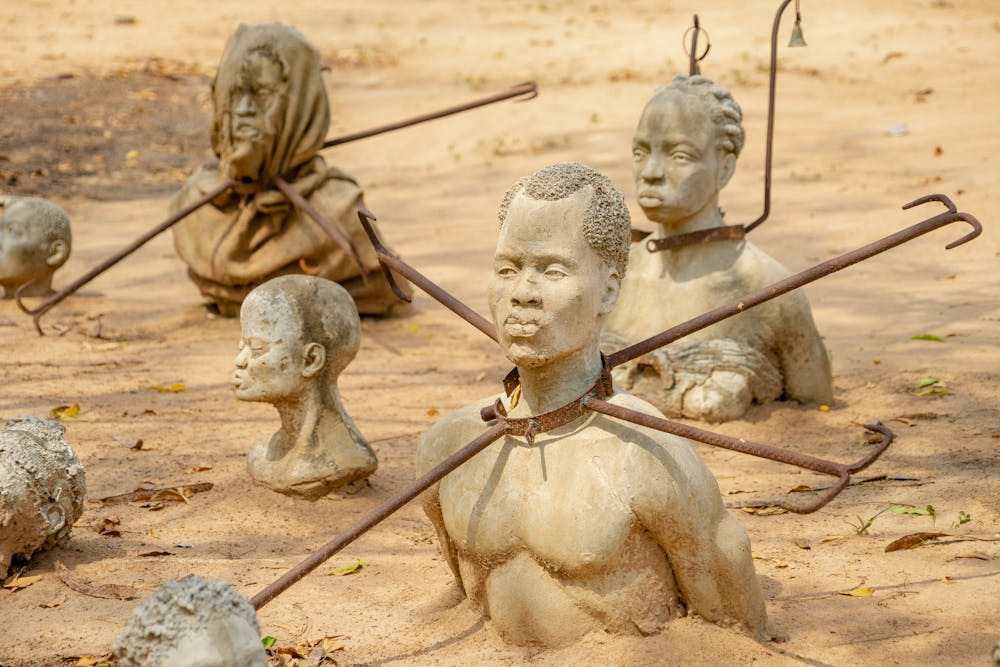
Thousands of sculpted heads – captive African men, women, and children – meticulously created by the artist Kwame Akoto-Bamfo, emerge from the soil at the Nkyinkyim Museum, as a sacred gathering of ancestors. Together, they form a powerful monument to the horror, violence, and resistance to enslavement, as well as the ongoing work of remembrance and healing.
Kwame Akoto-Bamfo is a Ghanaian multidisciplinary artist who engages with the histories and legacies of the transatlantic slave trade and colonialism at home and, increasingly, internationally, on both sides of the Atlantic.
As an archaeologist who works in the field of critical heritage studies, Akoto-Bamfo’s work is important for its powerful engagement with memory, material culture and restorative justice. I feature it in a chapter of a new book that I co-edited called Architectures of Slavery: Ruins and Reconstructions.
Who is Kwame Akoto-Bamfo?
Akoto-Bamfo studied at the Kwame Nkrumah University of Science and Technology in Kumasi. He obtained his bachelor’s and master of fine arts degrees, both in sculpture. After graduating, the artist worked as a school teacher and a university lecturer.
In 2015, Akoto-Bamfo rose to international fame through a series of large-scale installations. He called it ‘Nkyinkyim’ (“twisting” in the Ghanaian Twi language, as in the proverb, “Life’s journey is twisted”).
Four years later, he established the ‘Nkyinkyim Museum’, a non-profit organisation known as the ‘Ancestor Project’. This open-air museum is located in Nuhalenya-Ada, a two-hour drive from Accra. It has become a space for people of African descent to engage in restorative healing through art and education.
Nkyinkyim Museum
At the site’s entrance, three twenty-five-foot monuments are displayed. They are made of stone, concrete and wood. The first is inspired by North and Eastern Africa, and the second by Sudano-Sahelian architecture. The third is inspired by the Forest regions in Central and West Africa.
The collection includes multiple installations in collaboration with the local community. They illustrate “the diversity in our narratives surrounding history, philosophy, and religious beliefs”. The artist himself, demonstrates a mastery of multimedia art forms, working in cement, terracotta, brass, copper, and wood, noting “one can reach different heights with different technologies.”
Today, the museum features a sacred healing space with a compelling display of thousands of unique concrete life size heads and 7,000 terracotta miniature sculpted heads. They include captive Africans abducted, sold and forcibly trafficked during the transatlantic slave trade.
His sculptures capture captives’ shock, horror, anger, distress and fear—emotions. This is communicated through their facial expressions in an installation that is disturbingly evocative and profoundly haunting. It is inspired by ‘nsodie’, an Akan funerary sculpture tradition, that dates back to approximately the twelfth century. Akoto-Bamfo explains during our conversations relating to the research for book:
I wanted to draw upon Akan belief in commemoration and remembrance after death in order to honour the young, old, men and women, who originated from various ethnic groups and who died in the Atlantic Ocean during the Middle Passage and did not get that chance.
Each year, the annual ‘Ancestor Veneration’ ceremony takes place under the guidance of chiefs, priests, and priestess from various ethnic groups.
Visitors are invited to participate in certain Akan rites and ceremonies – free from photography and selfies that undermine or commercialise sacred funerary art practices. Says Akoto-Bamfo:
I am Akan, so initially I began with Akan traditional rites, but now our ceremonies welcome other African ethnic groups including the Ga-Dangme, Ewe, and Yoruba, from Ghana and Nigeria, as well as African descendant people in the African diaspora.
In contrast, the ‘Freedom Parade Festival’ allows participants to creatively express and contribute to an evolving heritage tradition, without the specified observances. For example, painted bodily adornment applied directly onto the skin, yet without the necessary spiritual rites.
A protest monument
Akoto-Bamfo’s sculptures have also gained recognition beyond Ghana’s borders. For instance, the permanent installation at the Legacy Museum and National Museum for Peace and Justice in Montgomery, Alabama in the US.
More recently, in 2021, his Blank Slate Project Monument toured throughout the United States. This included stops at Times Square in New York and the King Center in Atlanta. It depicts an enslaved ancestor, bent forward with his hands behind his back, head turned sideways, face on the ground, with a booted foot on his head.
Akoto-Bamfo describes this work as “a noisy one — a protest piece that speaks against racist Civil War monuments.” The work was completed prior to the police killing of George Floyd that led to widespread protests in the US in 2020. It was first unveiled in a private viewing in Ghana, prior to its shipment to the United States.
He says:
We had a lot of discussions among those involved in the project: some feared it might incite violence, others said that it was a prediction.
The work is interactive. It holds a removable placard that invites viewers to inscribe their reactions to the statue, which are then exhibited. Akoto-Bamfo emphasises:
I wanted ordinary people, both individuals and communities, to relate, and to contribute to, not only towards my artwork but also to the wider ongoing discussions. As an artist, I believe that I do not have the sole right to speak. I wanted ordinary Americans to add their voices because I am already contributing.
In Europe too, his work is featured at the 169 Museum in Germany.
In Ghana, Akoto-Bamfo’s work was initially seen as too controversial. The artist shares:
At first, I had to be extremely resilient because my work was concerned with the slave trade, slavery, colonialism, racism, and human rights. I embraced uncomfortable dialogue. Yet these were difficult topics for galleries and the art world at that time in Ghana.
He adds:
Today, however, some even view me as a spiritual leader… but I have always had an innate antipathy towards injustice. My work is not only about the past but what is unfolding now.
Akoto-Bamfo offers a closing reflection on why this kind of memory work matters:
I just want to use the little knowledge that I have to contribute towards the work of restorative and transformative justice.
Rachel Ama Asaa Engmann does not work for, consult, own shares in or receive funding from any company or organisation that would benefit from this article, and has disclosed no relevant affiliations beyond their academic appointment.
Source: The Conversation – Africa – By Rachel Ama Asaa Engmann, Associate Professor and Director of Christiansborg Archaeological Heritage Project, Associate Graduate Faculty, Rutgers University
Thousands of sculpted heads – captive African men, women, and children – meticulously created by the artist Kwame Akoto-Bamfo, emerge from the soil at the Nkyinkyim Museum, as a sacred gathering of ancestors. Together, they form a powerful monument to the horror, violence, and resistance to enslavement, as well as the ongoing work of remembrance and healing.
Kwame Akoto-Bamfo is a Ghanaian multidisciplinary artist who engages with the histories and legacies of the transatlantic slave trade and colonialism at home and, increasingly, internationally, on both sides of the Atlantic.
As an archaeologist who works in the field of critical heritage studies, Akoto-Bamfo’s work is important for its powerful engagement with memory, material culture and restorative justice. I feature it in a chapter of a new book that I co-edited called Architectures of Slavery: Ruins and Reconstructions.
Who is Kwame Akoto-Bamfo?
Akoto-Bamfo studied at the Kwame Nkrumah University of Science and Technology in Kumasi. He obtained his bachelor’s and master of fine arts degrees, both in sculpture. After graduating, the artist worked as a school teacher and a university lecturer.
In 2015, Akoto-Bamfo rose to international fame through a series of large-scale installations. He called it ‘Nkyinkyim’ (“twisting” in the Ghanaian Twi language, as in the proverb, “Life’s journey is twisted”).
Four years later, he established the ‘Nkyinkyim Museum’, a non-profit organisation known as the ‘Ancestor Project’. This open-air museum is located in Nuhalenya-Ada, a two-hour drive from Accra. It has become a space for people of African descent to engage in restorative healing through art and education.
Nkyinkyim Museum
At the site’s entrance, three twenty-five-foot monuments are displayed. They are made of stone, concrete and wood. The first is inspired by North and Eastern Africa, and the second by Sudano-Sahelian architecture. The third is inspired by the Forest regions in Central and West Africa.
The collection includes multiple installations in collaboration with the local community. They illustrate “the diversity in our narratives surrounding history, philosophy, and religious beliefs”. The artist himself, demonstrates a mastery of multimedia art forms, working in cement, terracotta, brass, copper, and wood, noting “one can reach different heights with different technologies.”
Today, the museum features a sacred healing space with a compelling display of thousands of unique concrete life size heads and 7,000 terracotta miniature sculpted heads. They include captive Africans abducted, sold and forcibly trafficked during the transatlantic slave trade.
His sculptures capture captives’ shock, horror, anger, distress and fear—emotions. This is communicated through their facial expressions in an installation that is disturbingly evocative and profoundly haunting. It is inspired by ‘nsodie’, an Akan funerary sculpture tradition, that dates back to approximately the twelfth century. Akoto-Bamfo explains during our conversations relating to the research for book:
I wanted to draw upon Akan belief in commemoration and remembrance after death in order to honour the young, old, men and women, who originated from various ethnic groups and who died in the Atlantic Ocean during the Middle Passage and did not get that chance.
Each year, the annual ‘Ancestor Veneration’ ceremony takes place under the guidance of chiefs, priests, and priestess from various ethnic groups.
Visitors are invited to participate in certain Akan rites and ceremonies – free from photography and selfies that undermine or commercialise sacred funerary art practices. Says Akoto-Bamfo:
I am Akan, so initially I began with Akan traditional rites, but now our ceremonies welcome other African ethnic groups including the Ga-Dangme, Ewe, and Yoruba, from Ghana and Nigeria, as well as African descendant people in the African diaspora.
In contrast, the ‘Freedom Parade Festival’ allows participants to creatively express and contribute to an evolving heritage tradition, without the specified observances. For example, painted bodily adornment applied directly onto the skin, yet without the necessary spiritual rites.
A protest monument
Akoto-Bamfo’s sculptures have also gained recognition beyond Ghana’s borders. For instance, the permanent installation at the Legacy Museum and National Museum for Peace and Justice in Montgomery, Alabama in the US.
More recently, in 2021, his Blank Slate Project Monument toured throughout the United States. This included stops at Times Square in New York and the King Center in Atlanta. It depicts an enslaved ancestor, bent forward with his hands behind his back, head turned sideways, face on the ground, with a booted foot on his head.
Akoto-Bamfo describes this work as “a noisy one — a protest piece that speaks against racist Civil War monuments.” The work was completed prior to the police killing of George Floyd that led to widespread protests in the US in 2020. It was first unveiled in a private viewing in Ghana, prior to its shipment to the United States.
He says:
We had a lot of discussions among those involved in the project: some feared it might incite violence, others said that it was a prediction.
The work is interactive. It holds a removable placard that invites viewers to inscribe their reactions to the statue, which are then exhibited. Akoto-Bamfo emphasises:
I wanted ordinary people, both individuals and communities, to relate, and to contribute to, not only towards my artwork but also to the wider ongoing discussions. As an artist, I believe that I do not have the sole right to speak. I wanted ordinary Americans to add their voices because I am already contributing.
In Europe too, his work is featured at the 169 Museum in Germany.
In Ghana, Akoto-Bamfo’s work was initially seen as too controversial. The artist shares:
At first, I had to be extremely resilient because my work was concerned with the slave trade, slavery, colonialism, racism, and human rights. I embraced uncomfortable dialogue. Yet these were difficult topics for galleries and the art world at that time in Ghana.
He adds:
Today, however, some even view me as a spiritual leader… but I have always had an innate antipathy towards injustice. My work is not only about the past but what is unfolding now.
Akoto-Bamfo offers a closing reflection on why this kind of memory work matters:
I just want to use the little knowledge that I have to contribute towards the work of restorative and transformative justice.
Rachel Ama Asaa Engmann does not work for, consult, own shares in or receive funding from any company or organisation that would benefit from this article, and has disclosed no relevant affiliations beyond their academic appointment.
Weeks ahead of the first anniversary in Kenya of the Gen Z-led anti-government protests that resulted in at least 60 deaths and displays of police brutality, news broke that Albert Ojwang, a young Kenyan blogger, had died in police detention. Kamau Wairuri who has studied the politics of policing in Kenya, sets out why these events aren’t outliers, what efforts have been made to reform Kenya’s security forces, and what still needs to be done.
When did this all begin?
Recent events are part of a long history of police brutality in Kenya that can be traced back to colonial times.
Historians (colonial and post-colonial Kenya) such as David Anderson and Caroline Elkins present gruesome details of how state authorities brutalised indigenous Africans during colonial times.
The colonial origins of the police – largely modelled along the approaches of the Royal Ulster Constabulary known for its brutality in Ireland – partly explains why Kenya’s policing is the way it is. The police force was never designed for service. It was designed to safeguard the interests of the white minority ruling elite.
While there have been important changes in the architecture of policing since independence, subsequent post-colonial Kenyan regimes have adopted the same brutal approaches to stay in power. My previous work demonstrates this use of state security apparatuses to enhance the capacity of incumbents to crack down on opposition protests.
The brutal policing experienced under the current Kenya Kwanza regime falls within this broader historical trajectory.
The ruling elite see and use the police as their last line of defence against challenges to their misrule.
But police brutality goes beyond the policing of politics to everyday crime control. Police violence is a common occurrence, especially against poor young men.
What’s changed
Kenya’s history has been marked by strong agitation for justice and reform. Again, this goes back to colonial times.
There have been important legal and institutional changes since independence. The most important was the disbandment of the Special Branch in 1998, an intelligence unit of the police responsible for political repression. It was replaced by the National Security Intelligence Service. This then became the National Intelligence Service.
The most important changes came about through the constitutional reform of 2010. This saw a change in the architecture of the police, including:
bringing the Kenya Police and Administration Police under a singular command
Internal Affairs, a unit within the police service, is supposed to investigate police misconduct. The policing oversight agency is a civilian-led institutions with a similar mandate. Ideally, the two institutions should work together in executing crucial investigations. Internal affairs should provide access to information from within the police service that would be difficult for outsiders to access.
The National Police Service Commission was set up to handle the management of personnel. It’s mandated to address the challenges of corruption, nepotism and negative ethnicity that have characterised recruitment into the police service.
But it’s clear from the continued police brutality that these institutions aren’t achieving the intended effect. This means that police officers can expect to continue acting with relative impunity despite the control measures in place.
What still needs to be done
Policing is often imagined as the investigation of crimes, arresting suspects, and presenting them to court for prosecution and punishment if guilty. In Kenya, the actions of the police often appear to substitute for the entire criminal justice system.
In many cases, officers go beyond the metaphor of judge, jury and executioner to also become the complainant, mortician and undertaker. For instance, Mbaraka Karanja died in police custody in 1987 and officers proceeded to incinerate his body.
In my view, the brutality won’t end until the following steps have been taken.
First, the National Police Service Commission needs to reclaim its mandate. It seems to have completely abdicated duty, transferring crucial responsibilities back to the inspector general of the police service. As the human resource unit of the police, the commission has an important role of professionalising the service and maintaining discipline. It’s presently not doing so.
Second, the Internal Affairs Unit needs to be strengthened and given more autonomy. So far, it has been difficult to assess the effectiveness the unit given the secrecy that characterises the police service. A better-resourced unit will enhance investigations of police misconduct. It would unearth obscure squads within the police service and reveal evidence to help identify perpetrators.
Third, the Independent Policing Oversight Authority needs to defend its independence and develop popular legitimacy. With its limited success in prosecuting police officers – despite the prevalence of police abuse – many Kenyans have lost confidence in it. Crucially, the authority has failed in it’s deterrence role.
Fourth, the independence of the National Police Service needs to be safeguarded. The police service leadership continues to serve at the pleasure of the prevailing regime. This in turn shapes the priorities of the service. Inspectors-general have been forced to resign. President William Ruto confessed to having fired the director of criminal investigations when he took power. Ruto had initially claimed that the director had resigned.
Crucially, and in fifth place, there needs to be a change in policing culture alongside broader governance culture in Kenya. Impunity is rampant across the public service. Kenya won’t have a highly accountable police force while other agencies and senior officials are operating with significant impunity.
Identifying the levers of cultural change isn’t easy. There are many proposals to alter policing culture. These include a complete redesign of Kenya’s Penal Code to dislodge its colonial roots, transforming the training of police officers, and strengthening the policing oversight authority’s capacity to investigate cases.
But, in my mind, a crucial starting point is citizen agitation and demand for accountability. The light that Gen Z protesters, the media and civil society organisations are shining on police abuses should be encouraged. A clear signal that Kenyans will no longer tolerate police abuse is crucial for culture change within the service and among the political elite.
However, this needs to be understood within the reality that many Kenyans support police violence, believing it to be the most effective way of dealing with crime as my earlier research demonstrates. In another study, I note how police abuse is endorsed by politicians and religious leaders as a way of responding to crime and punishing groups of people they don’t like.
Combined with ineffective accountability mechanisms, this popular support for police violence, both tacit and explicit, gives the police the belief that they are the thin blue line between order and chaos. That they have the popular mandate to use any means they consider necessary – often brutal violence – to keep society safe.
In other words, the conversation on police reform requires a fundamental reframing to kick start the journey towards democratic policing. At present, we’re not only way off the mark, we seem to be heading in the wrong direction.
Kamau Wairuri does not work for, consult, own shares in or receive funding from any company or organisation that would benefit from this article, and has disclosed no relevant affiliations beyond their academic appointment.
Source: The Conversation – Africa – By Rachel Ama Asaa Engmann, Associate Professor and Director of Christiansborg Archaeological Heritage Project, Associate Graduate Faculty, Rutgers University
Thousands of sculpted heads – captive African men, women, and children – meticulously created by the artist Kwame Akoto-Bamfo, emerge from the soil at the Nkyinkyim Museum, as a sacred gathering of ancestors. Together, they form a powerful monument to the horror, violence, and resistance to enslavement, as well as the ongoing work of remembrance and healing.
Kwame Akoto-Bamfo.
Kwame Akoto-Bamfo is a Ghanaian multidisciplinary artist who engages with the histories and legacies of the transatlantic slave trade and colonialism at home and, increasingly, internationally, on both sides of the Atlantic.
As an archaeologist who works in the field of critical heritage studies, Akoto-Bamfo’s work is important for its powerful engagement with memory, material culture and restorative justice. I feature it in a chapter of a new book that I co-edited called Architectures of Slavery: Ruins and Reconstructions.
Who is Kwame Akoto-Bamfo?
Akoto-Bamfo studied at the Kwame Nkrumah University of Science and Technology in Kumasi. He obtained his bachelor’s and master of fine arts degrees, both in sculpture. After graduating, the artist worked as a school teacher and a university lecturer.
In 2015, Akoto-Bamfo rose to international fame through a series of large-scale installations. He called it ‘Nkyinkyim’ (“twisting” in the Ghanaian Twi language, as in the proverb, “Life’s journey is twisted”).
Four years later, he established the ‘Nkyinkyim Museum’, a non-profit organisation known as the ‘Ancestor Project’. This open-air museum is located in Nuhalenya-Ada, a two-hour drive from Accra. It has become a space for people of African descent to engage in restorative healing through art and education.
Nkyinkyim Museum
At the site’s entrance, three twenty-five-foot monuments are displayed. They are made of stone, concrete and wood. The first is inspired by North and Eastern Africa, and the second by Sudano-Sahelian architecture. The third is inspired by the Forest regions in Central and West Africa.
Sculptures at the museum entrance.Kwame Akoto-Bamfo
The collection includes multiple installations in collaboration with the local community. They illustrate “the diversity in our narratives surrounding history, philosophy, and religious beliefs”. The artist himself, demonstrates a mastery of multimedia art forms, working in cement, terracotta, brass, copper, and wood, noting “one can reach different heights with different technologies.”
Today, the museum features a sacred healing space with a compelling display of thousands of unique concrete life size heads and 7,000 terracotta miniature sculpted heads. They include captive Africans abducted, sold and forcibly trafficked during the transatlantic slave trade.
An installation of the heads of enslaved people.Kwame Akoto-Bamfo
His sculptures capture captives’ shock, horror, anger, distress and fear—emotions. This is communicated through their facial expressions in an installation that is disturbingly evocative and profoundly haunting. It is inspired by ‘nsodie’, an Akan funerary sculpture tradition, that dates back to approximately the twelfth century. Akoto-Bamfo explains during our conversations relating to the research for book:
I wanted to draw upon Akan belief in commemoration and remembrance after death in order to honour the young, old, men and women, who originated from various ethnic groups and who died in the Atlantic Ocean during the Middle Passage and did not get that chance.
Each year, the annual ‘Ancestor Veneration’ ceremony takes place under the guidance of chiefs, priests, and priestess from various ethnic groups.
The museum displays 7,000 terracotta sculpted heads.Kwame Akoto-Bamfo
Visitors are invited to participate in certain Akan rites and ceremonies – free from photography and selfies that undermine or commercialise sacred funerary art practices. Says Akoto-Bamfo:
I am Akan, so initially I began with Akan traditional rites, but now our ceremonies welcome other African ethnic groups including the Ga-Dangme, Ewe, and Yoruba, from Ghana and Nigeria, as well as African descendant people in the African diaspora.
In contrast, the ‘Freedom Parade Festival’ allows participants to creatively express and contribute to an evolving heritage tradition, without the specified observances. For example, painted bodily adornment applied directly onto the skin, yet without the necessary spiritual rites.
A protest monument
Akoto-Bamfo’s sculptures have also gained recognition beyond Ghana’s borders. For instance, the permanent installation at the Legacy Museum and National Museum for Peace and Justice in Montgomery, Alabama in the US.
More recently, in 2021, his Blank Slate Project Monument toured throughout the United States. This included stops at Times Square in New York and the King Center in Atlanta. It depicts an enslaved ancestor, bent forward with his hands behind his back, head turned sideways, face on the ground, with a booted foot on his head.
The Blank Slate Monument in New York.Roshi Sariaslan
Akoto-Bamfo describes this work as “a noisy one — a protest piece that speaks against racist Civil War monuments.” The work was completed prior to the police killing of George Floyd that led to widespread protests in the US in 2020. It was first unveiled in a private viewing in Ghana, prior to its shipment to the United States.
He says:
We had a lot of discussions among those involved in the project: some feared it might incite violence, others said that it was a prediction.
The work is interactive. It holds a removable placard that invites viewers to inscribe their reactions to the statue, which are then exhibited. Akoto-Bamfo emphasises:
I wanted ordinary people, both individuals and communities, to relate, and to contribute to, not only towards my artwork but also to the wider ongoing discussions. As an artist, I believe that I do not have the sole right to speak. I wanted ordinary Americans to add their voices because I am already contributing.
In Europe too, his work is featured at the 169 Museum in Germany.
The effects of enslavement are still felt today.Kwame Akoto-Bamfo
In Ghana, Akoto-Bamfo’s work was initially seen as too controversial. The artist shares:
At first, I had to be extremely resilient because my work was concerned with the slave trade, slavery, colonialism, racism, and human rights. I embraced uncomfortable dialogue. Yet these were difficult topics for galleries and the art world at that time in Ghana.
He adds:
Today, however, some even view me as a spiritual leader… but I have always had an innate antipathy towards injustice. My work is not only about the past but what is unfolding now.
Akoto-Bamfo offers a closing reflection on why this kind of memory work matters:
I just want to use the little knowledge that I have to contribute towards the work of restorative and transformative justice.
– Kwame Akoto-Bamfo: the Ghanaian artist using work about slavery to find justice and healing – https://theconversation.com/kwame-akoto-bamfo-the-ghanaian-artist-using-work-about-slavery-to-find-justice-and-healing-259184
Source: The Conversation – Africa – By Kamau Wairuri, Lecturer in criminology, Edinburgh Napier University
Weeks ahead of the first anniversary in Kenya of the Gen Z-led anti-government protests that resulted in at least 60 deaths and displays of police brutality, news broke that Albert Ojwang, a young Kenyan blogger, had died in police detention. Kamau Wairuri who has studied the politics of policing in Kenya, sets out why these events aren’t outliers, what efforts have been made to reform Kenya’s security forces, and what still needs to be done.
When did this all begin?
Recent events are part of a long history of police brutality in Kenya that can be traced back to colonial times.
Historians (colonial and post-colonial Kenya) such as David Anderson and Caroline Elkins present gruesome details of how state authorities brutalised indigenous Africans during colonial times.
The colonial origins of the police – largely modelled along the approaches of the Royal Ulster Constabulary known for its brutality in Ireland – partly explains why Kenya’s policing is the way it is. The police force was never designed for service. It was designed to safeguard the interests of the white minority ruling elite.
While there have been important changes in the architecture of policing since independence, subsequent post-colonial Kenyan regimes have adopted the same brutal approaches to stay in power. My previous work demonstrates this use of state security apparatuses to enhance the capacity of incumbents to crack down on opposition protests.
The brutal policing experienced under the current Kenya Kwanza regime falls within this broader historical trajectory.
The ruling elite see and use the police as their last line of defence against challenges to their misrule.
But police brutality goes beyond the policing of politics to everyday crime control. Police violence is a common occurrence, especially against poor young men.
What’s changed
Kenya’s history has been marked by strong agitation for justice and reform. Again, this goes back to colonial times.
There have been important legal and institutional changes since independence. The most important was the disbandment of the Special Branch in 1998, an intelligence unit of the police responsible for political repression. It was replaced by the National Security Intelligence Service. This then became the National Intelligence Service.
The most important changes came about through the constitutional reform of 2010. This saw a change in the architecture of the police, including:
Internal Affairs, a unit within the police service, is supposed to investigate police misconduct. The policing oversight agency is a civilian-led institutions with a similar mandate. Ideally, the two institutions should work together in executing crucial investigations. Internal affairs should provide access to information from within the police service that would be difficult for outsiders to access.
The National Police Service Commission was set up to handle the management of personnel. It’s mandated to address the challenges of corruption, nepotism and negative ethnicity that have characterised recruitment into the police service.
But it’s clear from the continued police brutality that these institutions aren’t achieving the intended effect. This means that police officers can expect to continue acting with relative impunity despite the control measures in place.
What still needs to be done
Policing is often imagined as the investigation of crimes, arresting suspects, and presenting them to court for prosecution and punishment if guilty. In Kenya, the actions of the police often appear to substitute for the entire criminal justice system.
In many cases, officers go beyond the metaphor of judge, jury and executioner to also become the complainant, mortician and undertaker. For instance, Mbaraka Karanja died in police custody in 1987 and officers proceeded to incinerate his body.
In my view, the brutality won’t end until the following steps have been taken.
First, the National Police Service Commission needs to reclaim its mandate. It seems to have completely abdicated duty, transferring crucial responsibilities back to the inspector general of the police service. As the human resource unit of the police, the commission has an important role of professionalising the service and maintaining discipline. It’s presently not doing so.
Second, the Internal Affairs Unit needs to be strengthened and given more autonomy. So far, it has been difficult to assess the effectiveness the unit given the secrecy that characterises the police service. A better-resourced unit will enhance investigations of police misconduct. It would unearth obscure squads within the police service and reveal evidence to help identify perpetrators.
Third, the Independent Policing Oversight Authority needs to defend its independence and develop popular legitimacy. With its limited success in prosecuting police officers – despite the prevalence of police abuse – many Kenyans have lost confidence in it. Crucially, the authority has failed in it’s deterrence role.
Fourth, the independence of the National Police Service needs to be safeguarded. The police service leadership continues to serve at the pleasure of the prevailing regime. This in turn shapes the priorities of the service. Inspectors-general have been forced to resign. President William Ruto confessed to having fired the director of criminal investigations when he took power. Ruto had initially claimed that the director had resigned.
Crucially, and in fifth place, there needs to be a change in policing culture alongside broader governance culture in Kenya. Impunity is rampant across the public service. Kenya won’t have a highly accountable police force while other agencies and senior officials are operating with significant impunity.
Identifying the levers of cultural change isn’t easy. There are many proposals to alter policing culture. These include a complete redesign of Kenya’s Penal Code to dislodge its colonial roots, transforming the training of police officers, and strengthening the policing oversight authority’s capacity to investigate cases.
But, in my mind, a crucial starting point is citizen agitation and demand for accountability. The light that Gen Z protesters, the media and civil society organisations are shining on police abuses should be encouraged. A clear signal that Kenyans will no longer tolerate police abuse is crucial for culture change within the service and among the political elite.
However, this needs to be understood within the reality that many Kenyans support police violence, believing it to be the most effective way of dealing with crime as my earlier research demonstrates. In another study, I note how police abuse is endorsed by politicians and religious leaders as a way of responding to crime and punishing groups of people they don’t like.
Combined with ineffective accountability mechanisms, this popular support for police violence, both tacit and explicit, gives the police the belief that they are the thin blue line between order and chaos. That they have the popular mandate to use any means they consider necessary – often brutal violence – to keep society safe.
In other words, the conversation on police reform requires a fundamental reframing to kick start the journey towards democratic policing. At present, we’re not only way off the mark, we seem to be heading in the wrong direction.
– Kenya’s police still kill with impunity – what needs to be done to stop them – https://theconversation.com/kenyas-police-still-kill-with-impunity-what-needs-to-be-done-to-stop-them-259326
SKRUNDA, Latvia – As part of exercise Baltic Operations (BALTOPS) 2025, U.S. Navy Seabees, U.S. Marines from 8th Engineer Support Battalion (ESB), and Latvian Army engineers are constructing a fortified trench network designed for survivability in a drone-contested battlespace. The project serves both as a realistic rehearsal and a proof of concept for how modern combat engineers support maneuverability, concealment, and endurance in multi-domain operations.
QUANTICO, Va. – The NCIS Major Case Response Team Basic Training Program, hosted by the Office of Forensic Support’s Pacific Forensic Training Center, has officially earned accreditation from the Federal Law Enforcement Training Accreditation Board as of May 15.
CARIBBEAN SEA – The Arleigh Burke-class guided missile destroyer USS Cole (DDG 67), supporting maritime southern border operations, conducted a hold-and-transfer of 245 kilograms of contraband recovered by the Royal Canadian Navy Harry DeWolf-class offshore patrol vessel HMCS William Hall (AOPV 433) in the Caribbean Sea June 9. The Reliance-class U.S. Coast Guard (USCG) Cutter Vigorous (WMEC 627) accepted the contraband from the Cole’s embarked USCG Law Enforcement Detachment (LEDET) June 11 during a rendezvous at sea in the Caribbean.
The jagged silhouette of a B2 stealth bomber seen during a 2015 flyover in the US.Jonathan Daniel / Getty Images
Late on Saturday night, local time, the United States carried out strikes against Iranian nuclear enrichment sites at Fordow, Natanz and Isfahan, marking its open participation in the conflict between Iran and Israel.
The US says it fired 30 submarine-launched missiles at the sites in Natanz and Isfahan, as well as dropping more than a dozen “bunker buster” bombs at Fordow and Natanz.
The kind of bomb in question is the extremely destructive GBU-57 Massive Ordance Penetrator, or MOP, which weighs around 13.5 tonnes.
The attacks raise a lot of questions. What are these enormous bombs? Why did the US feel it had to get involved in the conflict? And, going forward, what does it mean for Iran’s nuclear ambitions?
What are ‘bunker busters’, and why are they used?
Bunker busters are weapons designed to destroy heavily protected facilities such as bunkers deep underground, beyond the reach of normal bombs.
Bunker busters are designed to bury themselves into the ground before detonating. This allows more of the explosive force to penetrate into the ground, rather than travelling through the air or across the surface.
Iran’s nuclear enrichment sites at Fordow, Natanz and Isfahan are built deep underground. Estimates suggest that Fordow for example could be 80m beneath the surface, and capped with layers of reinforced concrete and soil.
What is the MOP?
The bunker buster used in this particular operation is the largest in the US arsenal. Leaving aside nuclear weapons, the MOP is the largest known buster buster in the world.
Weighing some 13.5 tonnes, the MOP is believed to be able to penetrate up to 60 metres below ground in the right conditions. It is not known how many the US possesses, but the numbers are thought to be small (perhaps 20 or so in total).
We also don’t know exactly how many were used in Iran, though some reports say it was 14. However, it is likely to be a significant portion of the US MOP arsenal.
Why does only the US possess this capability?
The US is not the only state with bunker-busting weaponry. However, the size of MOP means it requires very specialised bombers to carry and drop it.
Only the B2 stealth bomber is currently able to deploy the MOP. Each B2 can carry at most two MOPs at a time. Around seven of America’s 19 operational B2s were used in the Iran operation.
There has been some consideration whether large transport aircraft such as the C-130 Hercules could be modified to carry and drop the MOP from its rear cargo doors. While this would allow other countries (including Israel) to deploy the MOP, it is for now purely hypothetical.
Why has the US (apparently) used them in Iran
The Trump administration claims Iran may be only a few weeks from possessing a nuclear weapon, and that it needed to act now to destroy Iranian nuclear enrichment sites. This claim is notably at odds with published assessments from the US intelligence community.
However, Israel lacks bunker busting weaponry sufficient to damage the deeply buried and fortified enrichment sites at Fordow, Natanz and Isfahan.
An F-15E Strike Eagle releases a GBU-28 ‘bunker buster’ laser-guided bomb, a smaller equivalewnt of the 13,600 kg GBU-57 ‘Massive Ordnance Penetrator’ believed to have been used in Iran. Michael Ammons / US Air Force
Only the MOP could do the job (short of using nuclear weapons). Even then, multiple MOPs would have been required to ensure sufficient damage to the underground facilities.
The US has claimed that these sites have been utterly destroyed. We cannot conclusively say whether this is true.
Iran may also have other, undeclared nuclear sites elsewhere in the country.
Iran’s reaction
The US has reportedly reached out to Iran via diplomatic channels to emphasise that this attack was a one-off, not part of a larger project of regime change. It is hard to say what will happen in the next few weeks.
Iran may retaliate with large strikes against Israel or against US forces in the region. It could also interrupt shipping in the Strait of Hormuz, which would affect a large portion of global oil shipments, with profound economic implications.
Alternatively, Iran could capitulate and take steps to demonstrate it is ending its nuclear program. However, capitulation would not necessarily mean the end of Iran’s nuclear ambitions.
The value of nuclear weapons
Perhaps a greater concern is that the attack will reinforce Iran’s desire to go nuclear. Without nuclear weapons, Iran was unable to threaten the US enough to deter today’s attack.
Iran may take lessons from the fate of other states. Ukraine (in)famously surrendered its stockpile of former Soviet nuclear weapons in the early 1990s. Russia has since felt emboldened to annex Crimea in 2014 and launch an ongoing invasion in 2022. Other potential nuclear states, such as Iraq and Gadaffi’s regime in Libya, also suffered from military intervention.
By contrast, North Korea successfully tested its first nuclear weapon in 2006. Since then there has been no serious consideration of military intervention in North Korea.
Iran may yet have the ability to produce useful amounts of weapons-grade uranium. It may now aim to buy itself time to assemble a relatively small nuclear device, similar in scale to the bombs used in Hiroshima and Nagasaki.
Depending on what facilities and resources have survive the US strikes, the attack has likely reinforced that the only way the Iranian regime can guarantee its survival is to possess nuclear weapons.
James Dwyer does not work for, consult, own shares in or receive funding from any company or organisation that would benefit from this article, and has disclosed no relevant affiliations beyond their academic appointment.
SYDNEY – Amphibious assault ship USS America (LHA 6), the flagship of the America Strike Group, arrived in Sydney, today, June 14, for a scheduled port visit. The ship carries embarked Marines from the 31st Marine Expeditionary Unit (MEU) and is currently conducting routine operations in the South Pacific.