Bay St. George RCMP is investigating an arson that occurred in Piccadilly shorty after midnight today, February 17, 2025.
Shortly after 12:30 a.m. on Monday, Bay St. George RCMP were called to the parking lot of the Our Lady of Fatima Catholic church on the Main Road in Piccadilly where a truck was on fire. Firefighters attended the scene and extinguished the blaze, which completely destroyed the vehicle. Evidence gathered at the scene suggests that the fire was intentionally set. A set of footprints was observed in the snow that led from the vehicle and continued into a wooded area behind the church. The footprints eventually led back onto the Main Road where it is believed the suspect was picked up by a motorist.
The investigation is continuing.
Bay St. George RCMP asks area residents to check for any possible surveillance footage and to report any suspicious activities around the time of the arson. Anyone having knowledge of this crime is asked to contact Bay St. George RCMP at 709-643-2118. To remain anonymous, contact Crime Stoppers: #SayItHere 1-800-222-TIPS (8477), visitwww.nlcrimestoppers.comor use the P3Tips app.
Police have charged three teenagers over a shooting in Croydon that left a 17-year-old male with life-changing injuries.
At around 19:40hrs on Monday, 10 February, officers responded to reports of a shooting in Park Street. Upon arrival, they found the victim, who had been shot in the leg.
Three teenagers were arrested on Tuesday, 11 February, and Thursday, 13 February, and later charged.
Dontae Dillon, 19 (26.05.05), of Platinum Way, Burgess Hill, was charged with attempted murder and possession of a firearm.
A 16-year-old boy from Burgess Hill, who cannot be named for legal reasons, was charged with the same offences.
A 15-year-old boy from Croydon, who also cannot be named for legal reasons, was charged with attempted murder.
The 15-year-old boy appeared before Croydon Magistrates’ Court on Thursday, 13 February. Dillon and the 16-year-old boy appeared before the same court on Saturday, 15 February.
All three will appear at the Old Bailey on Thursday, 13 March.
Happy Valley-Goose Bay RCMP is investigating an attempted break and enter and a successful break and enter that occurred on Thursday, February 6, 2025.
At approximately 3:40 a.m., an individual attempted to break into a refrigerated Sea-Can that was situated on the property of Terrington COOP on Abbott Drive in Happy Valley-Goose Bay. The suspect, pictured below, broke the pad lock and damaged the latch but did not gain entry.
Sometime overnight the same night, suspect(s) forced entry into National Safety Equipment on Hamilton River Road, near Terrington COOP. More than 40 pairs of Timberland and Acton work boots of various sizes, with a combined value of approximately $14,000, were stolen from inside.
The investigations are continuing.
Anyone having information about either of these crimes, the person(s) responsible or the current location of the stolen property, is asked to contact Happy Valley-Goose Bay RCMP at 709-896-3383. To remain anonymous, contact Crime Stoppers: #SayItHere 1-800-222-TIPS (8477), visit www.nlcrimestoppers.com or use the P3Tips app.
Source: The Conversation – UK – By Vittorio Bufacchi, Senior Lecturer, Department of Philosophy, University College Cork
Studies in democracy: Cicero, left, and Donald Trump.Capitoline Museum/Mary Harrsch and EPA-EFE/Will Oliver, CC BY-SA
In the four weeks since he was inaugurated for his second term as US president, Donald Trump has issued dozens of executive orders – many of which are now the subject of legal challenges on the grounds they exceed his authority under the US constitution. As a result, some will inevitably end up in front of the US Supreme Court.
What the court rules – and how the Trump administration responds to its judgments – will tell us a great deal whether the separation of powers still works as US founding fathers intended when they drafted the constitution.
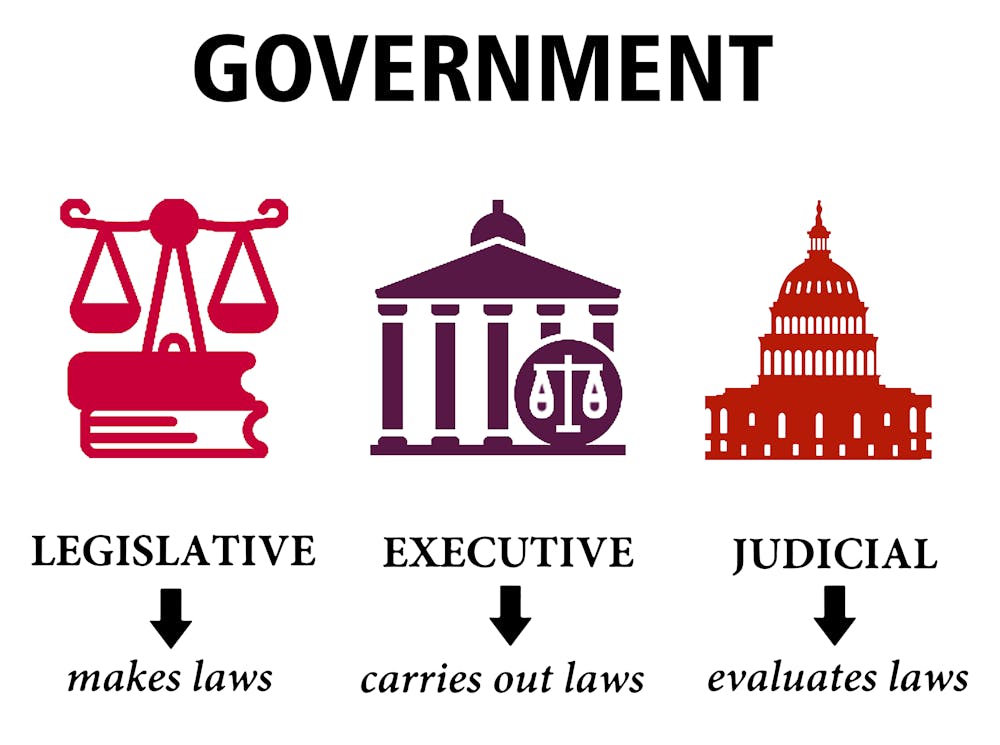
The concept of separation of powers is incorporated into just about every democratic constitution. It rests on the principle of the separation of powers between the three fundamental branches of government: executive, legislature and judiciary.
It’s what enables the political ecosystem of checks and balances to create the conditions for democracy to exist and freedom to flourish. But if one of the three branches of government dominates the other two, the equilibrium is shattered and democracy collapses.
We owe this idea of constitutional democracy as a tripartite division of power to an 18th-century French political philosopher, Charles de Montesquieu. He was the author of one of the most influential books to come out of the Enlightenment period, The Spirit of the Laws.
Published in 1748, this work gradually reshaped every political system in Europe, and had a powerful influence on America’s Founding Fathers. The 1787 US constitution was drafted in the spirit of Montesquieu’s recommendations.
Modern democracies are more complex than those of the 18th century – and new institutions have developed to keep up with the times. These include specialised tribunals, autonomous regulatory agencies, central banks, audit bodies, ombudsmen, electoral commissions and anti-corruption bodies.
What all these institutions have in common is that they operate with a considerable degree of independence from the three aforementioned arms of government. In other words, more checks and balances.
Notwithstanding his immense influence, the idea of a separation of powers at the heart of democracy predates Montesquieu by many centuries. One of the earliest formulations of this idea can be found in Aristotle’s work, the Politics. This includes the argument that “the best constitution is made up of all existing forms”. By this Aristotle meant a mixed government of monarchy, aristocracy and democracy.
But it was the Romans who developed a working model of checks and balances. The constitution of the Roman republic was characterised by the separation of powers between the tribune of the plebs, the senate of the patricians, and the elected consuls.
The consuls held the highest political office, akin to a president or prime minister. But since the Romans did not trust anyone to have too much power, they elected two consuls at a time, for a period of 12 months. Each consul had veto power over the actions of the other consul. Checks and balances.
The greatest advocate of the Roman republic and its constitutional mechanisms, was the Roman philosopher, lawyer and statesman Marcus Tullius Cicero. It was Cicero who inspired Montesquieu’s work – as well as influencing John Adams, James Madison and Alexander Hamilton in the US.
The Roman republic had lasted for approximately 500 years but came to an end following the violent death of Cicero in 43BC. He had devoted his life resisting authoritarian populists from undermining the Roman republic and establishing themselves as sole despots. His death (on top of the assassination of Julius Ceasar the previous year) are seen as key moments in Rome’s transition from republic to empire.
Democracy under threat
Today our democracies are facing the same predicament. In many different parts of the world this simple institutional mechanism has come under increasing attack by individuals hell-bent on curbing the independent power of the judiciary and the legislative.
In Europe, following in the footsteps of Hungarian prime minister Viktor Orbán, the Italian far-right premier Giorgia Meloni has been pushing for constitutional reforms that reinforce the executive branch of government at the expense of the other two branches.
The assault on the system of checks and balances has also been identified in Washington. The use and abuse of presidential executive orders is an indication of this growing political cancer.
During his time as 46th US president, from January 2021 to January 2025, Joe Biden signed 162 executive orders – an average of 41 executive orders per year. By comparison, during his first term Donald Trump’s annual average was 55 executive orders. Barack Obama before him was 35.
In his first 20 days since returning to the White House Donald Trump has already signed 60 executive orders. This has included pardoning some 1,500 people who were involved in the January 6 insurrection at the US capitol.
But of much greater concern is the Trump administration’s veiled threats to overturn the landmark decision of the US Supreme Court from 1803, Marbury v. Madison, the case that established the principle that the courts are the final arbiters of the law.
In recent weeks Trump has openly criticised federal judges who have tried to block some of his most executive orders. He’s been supported by his vice-president, J.D. Vance, who has been quoted as saying that “judges aren’t allowed to control the executive’s legitimate power”.
Meanwhile the president’s senior advisor, Elon Musk, accused a judge’s order to temporarily block the newly formed Department of Government Efficiency from accessing confidential treasury department data of being “a corrupt judge protecting corruption”.
So democracy’s delicate balancing act is under serious pressure. If the separation of powers does not hold, and the checks and balances prove to be ineffective, democracy will be threatened.
The next few months and years will determine whether the rule of law will be displaced by the rule of the strongest. At the moment the odds don’t look good for Cicero, Montesquieu and Madison.
It takes a brave person to bet on democracy to win this contest, but we live in hope that America will remain the land of the free and the home of the brave.
Vittorio Bufacchi is affiliated with the Labour Party in Ireland.
A senior UN political affairs official on Monday reaffirmed that any peace deal in Ukraine must respect the country’s sovereignty, independence, and territorial integrity, in accordance with the UN Charter and international law.
Briefing ambassadors in the Security Council ahead of the third anniversary of Russia’s full-scale invasion of Ukraine, Miroslav Jenča, Assistant Secretary-General for Europe in the political and peacebuilding department (DPPA), stressed diplomatic efforts must focus on securing a just and lasting peace.
Full participation of Ukraine, Russia
“The United Nations encourages dialogue among all stakeholders and welcomes all genuine efforts and initiatives, with the full participation of Ukraine and the Russian Federation, that would alleviate the impact of the war on civilians and de-escalate the conflict,” he said.
He also reiterated Secretary-General António Guterres’ position that “any peaceful settlement must respect the sovereignty, independence and territorial integrity of Ukraine, in line with the UN Charter, international law and resolutions of the General Assembly.”
The Security Council session coincided with the 10th anniversary of resolution 2202, which endorsed the now-defunct Minsk agreements of 2015 signed by the representatives of European security pact, the OSCE, Russia, Ukraine and leaders of the pro-Russian separatists in the occupied east of Ukraine following Russia’s annexation of Crimea.
The unanimously adopted resolution included a “package of measures” as its annex, including an immediate and comprehensive ceasefire in the Donetsk and Luhansk regions of Ukraine, as well as the withdrawal of all heavy weapons by both sides by equal distances to create a security zone.
A stark reminder
Mr. Jenča noted that the anniversary serves as a stark reminder of past diplomatic efforts to de-escalate tensions and as an opportunity to reflect on the consequences of failing to forge a peace through international diplomacy.
He commended the OSCE Special Monitoring Mission for its eight years of work in tracking ceasefire violations and facilitating dialogue, noting that the experience offers key lessons for future diplomatic efforts.
“The Minsk agreements have taught us that agreeing on a ceasefire or the signing of an agreement alone do not ensure a durable end to the violence,” Mr. Jenča said.
“Ensuring that the conflict does not reoccur and does not escalate will require genuine political will and understanding of its multi-dimensional complexity, for Ukraine and for the region.”
On February 11, 2025 at approximately 4:55 p.m., Tisdale RCMP received a report of an intoxicated driver on Main Street in Tisdale, SK.
Officers responded and located the suspect vehicle, which was exiting a parking lot in Tisdale, SK. Officers activated their emergency equipment and initiated a traffic stop, but the vehicle fled at a high rate of speed. Officers followed the vehicle.
The suspect vehicle exited town and turned down a dead-end grid road. At the end of the road, the suspect vehicle slid into the ditch and became stuck in a field. The vehicle occupants exited the vehicle. An adult female was arrested at the scene while two males fled on foot into a nearby treed area.
As a result of continued investigation and searches by Tisdale RCMP, Melfort RCMP, and Saskatchewan RCMP’s Police Dog Services, two adult males were located and arrested later that same day. One of the adult males was taken to hospital by EMS with weather-related injuries.
Charges have not been laid at this time. Tisdale RCMP continue to investigate.
SAN DIEGO — The Coast Guard suspended its search for a missing kayaker near Mission Bay at approximately 5:30 p.m., Sunday. Coast Guard crews, along with personnel from the San Diego Lifeguards and San Diego Fire Department, searched a nearly 460 square mile area over the course of 52.3 hours, but found no signs of distress. The search began on Friday afternoon after the San Diego Lifeguards discovered an overturned outrigger kayak approximately 500 yards west of the Mission Bay entrance channel. The vessel appeared new with no signs of use and was found broken in half.
The RCMP are seeking the public’s assistance in locating a missing seventy-three-year-old male resident of Whitehorse. Police are concerned for the missing person’s wellbeing.
Mr. Andy McLeod was last seen at 8:00pm on Sunday, February 16. He is approximately 5 foot 10 inches tall, has hazel eyes, grey hair and is of medium build. He may be wearing a long, light brown jacket and a fur hat. Mr. McLeod may appear disoriented.
If anyone has information about Andy McLeod’s whereabouts, please contact Whitehorse RCMP immediately at 867-667-5555.
First Assistant U.S. Attorney Craig M. Wolff is now Acting U.S. Attorney
PORTLAND, Maine: The United States Attorney’s Office for the District of Maine announced today the departure of Darcie N. McElwee as U.S. Attorney following termination by the new administration.
Under the Vacancies Reform Act, First Assistant U.S. Attorney Craig M. Wolff is now the Acting U.S Attorney for the District of Maine. As Acting U.S. Attorney, he is the chief federal law enforcement official in the state of Maine.
Wolff is a career prosecutor who became an Assistant U.S. Attorney in 2002. He has served as First Assistant U.S. Attorney and Senior Litigation Counsel, and prior to joining the District of Maine he was an Assistant U.S. Attorney in the District of Maryland for four years.
Wolff received an undergraduate degree from Harvard University and a law degree from the University of Virginia. Before joining the Department of Justice, he clerked for U.S. District Judge J. Frederick Motz in the District of Maryland and worked as an associate in the Washington, D.C. office of an international law firm.
Yesterday, Placentia RCMP received a call about a young seal who had made its way to the parking lot of the Placentia Mall on Blockhouse Drive in Placentia, most likely from the frozen inlet behind the mall.
While police were responding, the seal continued to travel further from the water. It crossed over a roadway and entered the back yard of a nearby residence. With the little guy not knowing the rules of the road, police remained in the area to prevent him from entering back onto the roadway, while officers with Fisheries and Oceans Canada were called in to assist.
The seal was safely escorted back to the ocean by Fisheries and Oceans Canada.
Thank you for the invitation to join you here in Phoenix at the ABA’s Conference for Community Bankers.1 For the past seven years, this conference provided an excellent forum for me and bankers to meet and interact with a range of state and federal regulators, policymakers, service providers, and other stakeholders. Today I would like to share a brief update on my views on monetary policy and the economy, before I turn to bank regulatory issues, and describe how I think that regulators should approach the important work of “maintenance” of the regulatory framework. Economic Outlook and Monetary PolicyToward the end of last year, the Federal Open Market Committee (FOMC) began the process of moving the target range for the federal funds rate to a more neutral setting to reflect the progress made since 2023 on lowering inflation and cooling the labor market. At our September meeting, the FOMC voted to lower the target range, for the first time since we began tightening monetary policy to combat inflation, by 50 basis points to 4-3/4 to 5 percent. You may remember that I dissented from that decision, the first time a Fed Governor dissented from an FOMC rate decision in nearly 20 years. I preferred a smaller initial cut to begin the policy recalibration phase. I explained my reasoning in a statement published after the meeting noting that the strong economy and a healthy labor market did not warrant a larger cut. In addition, moving the policy rate down too quickly could unnecessarily risk stoking demand, potentially reigniting inflationary pressures, and could be interpreted as a premature “declaration of victory” on our price-stability mandate. At the most recent FOMC meeting last month, my colleagues and I voted to hold the federal funds rate target range at 4-1/4 to 4‑1/2 percent and to continue to reduce the Federal Reserve’s securities holdings. I supported this action because, after recalibrating the policy rate by 100 basis points through the December meeting, I think that policy is now in a good place, allowing the Committee to be patient and pay closer attention to the inflation data as it evolves. In my view, the current policy stance also provides the opportunity to review further indicators of economic activity and get further clarity on the administration’s policies and their effects on the economy. It will be very important to have a better sense of these policies, how they will be implemented, and establish greater confidence about how the economy will respond in the coming weeks and months. For now, the U.S. economy remains strong, with solid growth in economic activity and a labor market near full employment. Core inflation is still somewhat elevated, but has appeared to resume its downward path, and my baseline expectation has been that it will moderate further this year. Even with this outlook, there are upside risks to my baseline expectation for the inflation path. In 2023, the rate of inflation declined significantly, but it has taken longer to see further meaningful declines since that time. The latest consumer and producer price index reports suggest that the 12-month measure of core personal consumption expenditures inflation—which excludes food and energy prices—likely moved down to around 2.6 percent in January, which would represent a noticeable stepdown from its 2.8 percent reading in December and 3.0 percent at the end of 2023. Progress had been especially slow and uneven since the spring of last year mostly due to rising core goods price inflation. After increasing at a solid pace, on average, over the first nine months of last year, gross domestic product appears to have risen a bit more moderately in the fourth quarter, reflecting a large drop in the volatile category of inventory investment. In contrast, private domestic final purchases, which provide a better signal about underlying growth in economic activity, maintained its strong momentum from earlier in the year, as personal consumption rose robustly again in the fourth quarter. Following strong readings in December, retail sales and sales of motor vehicles softened in January. However, these data can be noisy around this time of the year and sales were likely affected by the cold and wintery weather last month. Payroll employment gains have picked up since the summer of last year and averaged a strong pace of about 240,000 per month over the past three months, with last month’s gains likely held back by the Los Angeles wildfires and the harsh winter weather. The unemployment rate edged down further to 4.0 percent in January and has moved sideways since the middle of last year, remaining below my estimate of full employment. The labor market appears to have stabilized in the second half of last year, after it loosened from extremely tight conditions. The rise in the unemployment rate since mid-2023 largely reflects weaker hiring, as job seekers entering or re-entering the labor force are taking longer to find work, while layoffs have remained low. The ratio of job vacancies to unemployed workers has remained close to the pre-pandemic level in recent months, and there are still more available jobs than available workers. The labor market no longer appears to be especially tight, but wage growth remains somewhat above the pace consistent with our inflation goal. The recent revision of the Bureau of Labor Statistics labor data further vindicates my view that the labor market was not weakening in a concerning way during the summer of last year. Although payroll employment gains were revised down considerably in the 12 months through March 2024, job gains were little revised, on net, over the remainder of last year. It is crucial that U.S. official data more accurately capture structural changes in labor markets in real time, so we can confidently rely on these data for monetary and economic policymaking. But in the meantime, given conflicting economic signals, measurement challenges, and significant data revisions in recent years, I remain cautious about taking signal from only a limited set of real-time data releases. Assuming the economy evolves as I expect, I think that inflation will slow further this year. As the inflation data since the spring of last year show, its progress may be bumpy and uneven, and progress on disinflation may take longer than we would hope. I continue to see greater risks to price stability, especially while the labor market remains strong. With encouraging signs that geopolitical tensions may be abating in the Middle East, Eastern Europe, and in Asia, I will be monitoring global supply chains which could continue to be susceptible to disruptions, and lead to inflationary effects on food, energy, and other commodity markets. In addition, the release of pent-up demand following the election could lead to stronger economic activity, which could also influence inflationary pressures. Having entered a new phase in the process of moving the federal funds rate toward a more neutral policy stance, there are a few considerations that lead me to prefer a cautious and gradual approach to adjusting policy, as it provides us time to assess progress in achieving our inflation and employment goals. Given the current policy stance, I think that easier financial conditions from higher equity prices over the past year may have slowed progress on disinflation. And I am watching the increase in longer-term Treasury yields that has occurred since the start of policy recalibration at the September meeting. Some have interpreted it as a reflection of investors’ concerns about inflation risks and the possibility of tighter-than-expected policy that may be required to address inflationary pressures. There is still more work to be done to bring inflation closer to our 2 percent goal. I would like to gain greater confidence that progress in lowering inflation will continue as we consider making further adjustments to the target range. We need to keep inflation in focus while the labor market appears to be in balance and the unemployment rate remains at historically low levels. Before our March meeting, we will have received one additional month of inflation and employment data. Looking forward, it is important to note that monetary policy is not on a preset course. At each FOMC meeting, my colleagues and I will make our decisions based on the incoming data and the implications for and risks to the outlook and guided by the Fed’s dual-mandate goals of maximum employment and stable prices. I will also continue to meet with a broad range of contacts to help me interpret the signals provided by real-time data and as I assess the appropriateness of our monetary policy stance. Bringing inflation in line with our price stability goal is essential for sustaining a healthy labor market and fostering an economy that works for everyone in the longer run. Maintenance of the Regulatory FrameworkI will now turn to bank supervision, the bank applications process, and regulation. Community banks experience the burden of the regulatory framework most acutely when it is not appropriately tailored to their size, risk, complexity, and business model. While promoting safety and soundness in the banking system—particularly among community banks—is an important and necessary regulatory objective, we must also be cautious to ensure that the framework does not become an impediment to their operations, preventing them from providing competitive products and services, innovating, and engaging in appropriate risk-taking. During my tenure at the Board, I have laid out a wide range of issues and concerns that I see as critical components that are necessary to build and maintain an effective regulatory framework.2 While I will only address a subset of these issues today, I’d like to begin by clarifying what I mean by this. Our work to maintain an effective framework is never really complete. Just as complacency can be fatal to the business of a bank, complacency can also prevent regulators from meeting their statutory obligation to promote a safe and sound banking system that enables banks to serve their customers effectively and efficiently. System maintenance is not something that we should shy away from. In our everyday lives, we invest significant time in maintenance. We schedule regular oil changes for our cars, and we invest in the infrastructure that allows our economy to function. Devoting resources to maintenance often prevents more costly issues down the road—it’s easier to get oil changes than it is to rebuild an engine. So, what does maintenance look like in practice? To address this question, I think it’s helpful to look at three core areas in the bank regulatory framework: Supervision, Bank applications, and Regulation. Approach to SupervisionLet’s start with supervision. Supervision operates almost entirely outside of the public view. Much of the work involves the review of proprietary business information from banks, and the preparation of examination reports shielded from public scrutiny under the auspices of protecting confidential supervisory information. But confidentiality should not be used to prevent scrutiny and accountability in the assignment of ratings. So, today, I am going to dig a bit deeper into the realm of supervision to discuss supervisory ratings, accountability, and the troubling trend of inaction and opacity within the supervisory toolkit. Rational Standards & RatingsWhile there is some public disclosure of supervisory information, it is often difficult to get a true understanding of supervision based on data that may be released. In fact, this data often sends confusing and conflicting signals. For example, the Board’s Supervision and Regulation Report presented information stating that only one-third of large financial institutions maintained satisfactory ratings across all relevant ratings components in the first half of 2024.3 At the same time, this report noted that most large financial institutions met supervisory expectations with respect to capital and liquidity.4 The odd mismatch between financial condition and overall supervisory condition as assessed by the prudential regulators raises a more significant issue, whether subjective examiner judgment—those evaluations based on subjective, examiner-driven, non-financial concerns—is driving the firm’s overall rating. Are ratings trends based on the materiality of the identified issues, or do they imply that the regulators see widespread fragility in the banking system? While this example highlights a large bank ratings framework issue, it is symptomatic of a broader issue that warrants scrutiny—whether the approach to supervision has led to a world in which core financial risks have been de-prioritized, and non-core and non-financial risks—things like IT, operational risk, management, risk management, internal controls, and governance—have been over-emphasized. These issues are important, and certainly worthwhile topics for examiners to consider, but their review should not come at the expense of more material financial risk considerations—and they should not drive the overall assessment of a firm’s condition. There is evidence that supervision has undergone such a shift, not only among large banks, but among regional and community banks as well.5 For all institutions, financial metrics are not among the primary findings determined from the examination process, and arguably they have been de-emphasized when assigning supervisory ratings. Prioritization is valuable in the supervisory process, both to inform how examiners allocate their time, but also in helping banks allocate resources to remediate issues identified during the supervisory process. The frequency of supervisory findings related to non-financial metrics may be a byproduct of how long it takes to remediate these issues, like longstanding issues with IT systems that have not been enhanced over many years of growth. However, we should also be vigilant and deliberate about any shift in supervisory focus from financial risk toward non-financial risks and internal processes, as this shift is not focused on fundamental safety and soundness issues and it is not cost-free. We should also not expect every firm to coalesce around a single set of products, internal processes, and risk-management practices. Variety in banking models is a strength and a necessity of the U.S. banking system, relying on management and boards of directors to determine bank strategy, rather than a bank’s business model effectively being set by supervisory directives. Supervisory practices like horizontal reviews can create examiner incentives to expect uniformity and “grade on a curve,” but this approach perversely punishes variation among bank practices, stifling competition and innovation. Supervisory findings also inform bank ratings, which can have follow-on effects like limiting options for mergers and acquisitions (M&A); raising the cost of liquidity; or diverting resources away from other, more important bank management priorities. Diagnostic AccountabilityTo maintain strong and appropriate supervisory standards and practices, we need to take a step back and diagnose the bank regulatory system in its entirety: what is working, what is broken, and what needs to be updated. When things go wrong, having an impartial check on subjective judgments can lead to a better diagnosis. Of course, a better diagnosis can produce more efficient and targeted improvements, and better promote accountability. Accountability is critical to maintaining an effective regulatory system, and yet it can be difficult to establish a regulatory culture that includes mechanisms to promote accountability for supervisors and regulators.6 At every organizational level, from examiners to agency leadership, judgments are made that contribute to the overall effectiveness of the supervisory process. Reserve Bank examiners play a critical role in examining Fed-regulated institutions, both banks and holding companies. The Federal Reserve exercises its supervisory responsibilities by supervisory portfolio, with each portfolio relying on a combination of Board and Reserve Bank staff.7 But this split allocation of responsibility should not diminish the accountability for supervisory decision making. Responsibility for supervisory decisions must be coupled with accountability for these decisions. The misalignment of responsibility and accountability limits our ability to conduct effective supervision. This division of responsibility can pose a challenge to accountability. In the aftermath of the bank failures in 2023 and the broader stress to the banking system, the Board and other agencies proposed a variety of regulatory reform measures to remediate and address identified issues, based on internal reviews of the failures and banking stress. While I applaud efforts to hold ourselves accountable, we must ensure that self-reviews are credible, both in the causes they identify and in the reform agenda that they are used to support. An internal review process poses the temptation to avoid responsibility by assigning blame elsewhere, even when the review may be motivated by good intentions and with the outward appearance of impartiality. Many of the core problems in the lead-up to the bank failures involved well-known, core banking risks—interest rate risk, liquidity risk, and poor risk management. But if we look at the subsequent reform agenda, we see that the policy emphasis has been on broader regulatory changes rather than addressing supervisory program deficiencies. In my mind, this highlights the need to have a process that challenges the subjective judgments of those that were involved in oversight, not only in performing the diagnostics, but evaluating how identified issues can best be remediated. Purging Inaction and Opacity from the Supervisory ToolkitSupervision differs significantly from the regulatory process. Implementing new regulations, or amending existing ones, requires a public notice and comment process established by the Administrative Procedure Act. When done appropriately, regulations require regulators to “show their work” by providing extensive analytical and factual support for proposals and final rules and soliciting comment from the public and addressing those comments before finalizing a regulation. In contrast, the execution of bank examinations and the issuance of supervisory guidance lack these procedural safeguards, instead relying heavily on discretion and judgment with far lower standards for justifying actions taken with factual and analytical support under the veil of confidential supervisory information. The greater flexibility afforded in the supervisory process can lead to poor outcomes, often caused by the temptation to use inaction and opacity as supervisory tools. In my view, these tools, inaction and opacity, are not appropriate and must be subject to appropriate scrutiny or purged from the toolkit altogether. First let’s consider inaction. The exam process requires open communication between examiners and banks. Often interpretive questions arise during the exam process; how do existing rules and statutes apply in a particular circumstance? These questions arise when existing rules and guidance are unclear, which is a frequent occurrence. For example, how can a bank operate in a safe and sound manner while offering a new product or service, or when serving customers in particular business lines with unique needs? Banks go to great effort to meet all applicable requirements and regulatory expectations, and regulators should welcome banks seeking supervisory input and relying on a compliance-focused mindset. Open communication with regulated banks is a hallmark of good supervision, but regulators must live up to their end of the bargain by not leaving banks in “limbo” for extended periods of time. When a bank requests feedback and engages in good faith to provide information and respond to reasonable questions, regulators have an obligation to provide a clear response. Banks should not be left to wonder whether an interpretation of existing laws, regulations, and guidance is consistent with the understanding of regulators. Next, let’s consider opacity. Questions raised in the supervisory channel often result from supervisory expectations that lack sufficient clarity or the application of rules and regulations to new and emerging products and services. While regulators should not form an opinion without understanding the relevant facts and circumstances, they must also strive to provide clarity—not just to the bank being examined, but to all banks. Supervisory expectations should not surprise regulated firms, and yet transparency around expectations is often challenging to achieve.8 The problem of opacity in supervisory expectations is exacerbated by the umbrella of confidential supervisory information, or CSI, which is the label given to most materials developed in the examination process. The rules designed to protect CSI limit the public’s visibility into shifting priorities and expectations in the supervisory process.9 Changes in supervisory expectations frequently come without the benefit of guidance, advance notice, or published rulemaking. In the worst-case scenario these shifts, cloaked by the veil of supervisory opacity, can have significant financial and reputational impacts or can disrupt the management and operations of affected banks. Opacity in supervisory expectations, or in the interpretation of applicable laws and regulations, should not be discovered only at the conclusion of an examination with the issuance of deficiencies, matters requiring attention, matters requiring immediate attention, or other shortcomings. Approach to ApplicationsSunshine is the best disinfectant when it comes to an approach that fosters transparency and accountability. So, I would like to spend a few minutes discussing how we can better shine a light into the dark corners of the bank applications process. De Novo FormationDe novo formation has essentially stagnated over the past several years. While many factors have contributed to the decline in the aggregate number of banks in the United States, one key factor has been the lack of new bank formation to replace banks that have been acquired or closed their doors. This lack of de novo bank approvals does not necessarily indicate a lack of demand for new charters though, particularly in light of ongoing demand for bank “charter strip” acquisitions where banks have been acquired just for their charters, the growing demand for banking-as-a-service partnerships, and the shift of activities outside of the banking sector into the non-bank financial system.10 We should consider whether the applications process itself has become an unnecessary impediment to de novo formation. How can we improve the process of de novo formation? As fewer applications come in, institutional muscle memory for how to deal with new bank charters erodes, and it becomes difficult to navigate and ultimately to overcome institutional inertia. A few steps like developing specialized expertise, streamlining the application process, and improving transparency can yield significant improvements. First, de novo formations are very different from other bank applications where there are existing institutions with established supervisory ratings and examination records. A de novo formation has no supervisory record of performance on which to base a decision or inform judgments about whether an application is consistent with approval. Instead, regulators must evaluate the proposal based on applicable statutory requirements: Is the business plan sound? Is appropriate bank leadership in place? Does the bank have a viable business plan and strategy? Is the bank’s proposal supported by sufficient capital? Should there be an expectation that all of these questions are answered exhaustively often well over a year before the bank would be formed, if it is approved? In recent years de novo formations have been rare, and therefore staff tasked with evaluating these proposals do not have a recent perspective or deep well of experience from which to draw. Under our current approach, regional Reserve Banks are the primary point of contact for de novo applicants. We should consider creating a specialized resource that can be utilized by any reserve bank to assist them during the pre-filing conversations with de novo applicants. Our goal should be to facilitate new bank creation—identifying and finding achievable pathways to yes, instead of expecting and insisting on increasing requirements to unachievable levels or those that are intended to deter applicants from filing or moving forward. We should also consider whether there are ways to streamline the application process, including, if needed, by recommending statutory changes. While the agencies use some common forms, de novo formations currently involve a range of regulatory approvals. A de novo applicant must apply for a bank charter from the Office of the Comptroller of the Currency or a state banking authority, deposit insurance from the Federal Deposit Insurance Corporation, and potentially membership or a parallel holding company formation application with the Federal Reserve. Each regulator may be focused on different aspects of the application, and each has the right to ask for additional information as part of the application review and analysis potentially significantly extending the review timeframe. We should have clear standards of review and approval—and coordinated actions—among the state and federal regulators involved in any application. This should include clear timelines for the point at which a regulator forfeits their opportunity to object due to inaction, delay, or stalling tactics. But standards for de novo approval are not always clear to applicants, which can lead to lengthy back-and-forth discussions with banking agency staff even after an applicant has prepared the information required by the appropriate application forms. The need for extensive additional information from de novo applicants can be caused by a failure to provide information requested in the application form, but I suspect the submission of incomplete information is often a product of forms that do not include all necessary information. We should not need to constantly supplement application forms with ad hoc information requests. If additional information is needed, we should modify the required application forms. One area where the lack of transparent and clear standards is most evident is with the amount of capital required to establish a de novo bank. Discussions around required capital often hinge on subjective assessments based on planned business model and growth, but they rarely involve regulators providing a minimum required capital amount. Standards for approval should not be shrouded in mystery. Reform of the de novo applications process should not be thought of as a deregulatory exercise. Clear and transparent standards do not imply “low” or inadequate standards. At the same time, if we want to encourage a pipeline of de novo bank formations, we should also be comfortable with the uncertainty that accompanies any new business, including the risk that some de novo banks will not succeed. The cost of eliminating the failure of de novo banks—or really of any banks at any time—is simply too great. Banking is fundamentally about appropriately managed risks, and regulators play a key role in promoting a system that is safe and sound while also serving to support the banking needs of customers and broader economic growth. Our goal should not be to create a banking system that is safe, sound, and ultimately irrelevant. Mergers and AcquisitionsThe issues with the banking applications process extend beyond de novo formations, but involve some of the same concerns, whether there are clear standards, and we are able to act in a timely manner. As a threshold matter, if regulators are clear about the information they need to process an application—for example, by updating applications forms to include the full set of information needed to analyze each statutory approval requirement—then we should also hold ourselves to fixed approval timelines. In my view, the purgatory of a long application process is another form of regulatory “inaction” that must be eliminated. We should also address aspects of the applications process that contribute to delay, including both the approach to competition and the public comment process. The banking agencies have long relied on competitive “screens” to evaluate the pro forma effect of a merger. This process looks at the standalone institutions, imagines a merger in which their operations are combined, and then looks at how measures of competition will change in the areas served by the merged institutions. Where there is overlap in markets served, there is the potential for tripping competitive screens and triggering additional scrutiny. At the Federal Reserve, when a competitive screen is triggered the application process takes more time, as staff reviews the conflict, and the matter is removed from the Reserve Bank-delegated processing track. Perversely, many banks that trigger additional scrutiny operate in rural markets and have less aggregate banking business over which institutions can compete. In these concentrated markets, the analytical approach may involve a counterfactual in which only two future states of the world exist—the banks continue to operate on a standalone basis, or the banks merge and operate as a consolidated whole. However, this framing ignores a possible third option, that one or both of the institutions will cease being viable and shut its doors, or be acquired by a credit union, similarly leading to an erosion of market competition and potentially greater disruption to the communities served. This analytical approach to evaluating competition no longer remains appropriate, and it needs to be reformed to better reflect actual market realities. This must include competition from credit unions, the farm credit system, internet banks, financial technology firms and other non-banks. Finally, many M&A applications come to the Board due to the receipt of an adverse comment from the public about the past supervisory record of one or both of the institutions involved in a merger. The receipt of an adverse comment causes substantial delays in the processing of an application, as this too removes an application from the “delegated” processing by the local Federal Reserve Bank, escalating the matter to the Board of Governors in D.C. While it is important that regulators take into account public feedback—and indeed, is required by applicable law—we should also be concerned about comments that may lack factual support or may solely rely on matters always considered in the review of a proposal, like the existing supervisory records of the acquirer and the target institution, and may be negated by the regulator’s own examination report. Approach to Regulation – Cleanup and the Statutory Regulatory ReviewSince the passage of the Dodd-Frank Act nearly 15 years ago, the body of regulations that all banks are subject to has increased dramatically. Many of the reforms made after the 2008 financial crisis were important and essential to ensuring a stronger and more resilient banking system. Yet, a number of the changes are backward looking—responding only to that mortgage crisis—not fully considering the potential future unintended consequences or future states of the world. With well over a decade of change in the banking system now behind us post-implementation, it is time to evaluate whether all these changes continue to be relevant. Some of the regulations put in place immediately after that financial crisis resulted in pushing foundational banking activities out of the banking system into less regulated corners of the financial system. We need to ask whether this is appropriate. These tradeoffs are complicated, and we must consider not only the changes that were made but also the evolution of and differences in the banking system today. Driving all risk out of the banking system is at odds with the fundamental nature of the business of banking. Banks, after all, are businesses. And they must be able to earn a profit and grow while also managing their risks. Adding requirements that impose more costs must be balanced with whether the new requirements make the correct tradeoffs between safety and soundness and enabling banks to serve their customers and run their businesses. The task of policymakers and regulators is not to eliminate risk from the banking system, but rather to ensure that risk is appropriately and effectively managed. In a well-functioning and appropriately regulated banking system, banks serve an indispensable role in credit provision and economic stability. The goal is to create and maintain a system that supports safe and sound banking practices, and results in the implementation of appropriate risk management. No efficient banking system can eliminate all bank failures. But well-designed and well-maintained systems can limit bank failures and mitigate the harm caused by any that occur. Maintenance of the regulatory framework is necessary to ensure that our regulations continue to strike the right balance between encouraging growth and innovation, and safety and soundness. One easily identifiable way to achieve this is using the Economic Growth and Regulatory Paperwork Reduction Act (EGRPRA) review process, which the agencies initiated in February last year. Although to-date it has not done so, the EGRPRA review requires the federal banking agencies to identify any outdated, unnecessary, or overly burdensome regulations and eliminate unnecessary regulations and take other steps to address the regulatory burdens associated with outdated or overly burdensome regulations. As I noted, prior iterations of the EGRPRA process have been underwhelming in their ability to result in meaningful change, but it is my expectation that this review, and eventually the accompanying report to Congress, will provide a meaningful process for stakeholders and the public to engage with the banking agencies in identifying regulations that are no longer necessary or are overly burdensome. It is also my expectation that regulators will be responsive to concerns raised by the public. Another area that is ripe for review are several of the Board’s rules that address core banking issues—from loans to insiders, to transactions with affiliates, to state member bank activities, and holding company requirements. Many of the Board’s regulations have not been comprehensively reviewed or updated in more than 20 years. Given the dynamic nature of the banking system and how the economy and banking and financial services industries have evolved over that period, it is imperative that we update and simplify many of the Board’s regulations, including thresholds for applicability and benchmarks. Finally, I want to address the unintended consequences of anti-money laundering requirements in the provision of banking services. I think we can agree that fighting money laundering, terrorist financing, and other illicit activities is not only a statutory responsibility of the banking system but it also serves important public policy goals. But while the regulatory framework prescribing how banks fulfill this role is not within the Federal Reserve’s responsibilities, it is important to consider how these requirements affect the ability of banks to serve customers. For example, the threshold for currency transaction reports (CTR) was established more than 50 years ago and has not been updated or indexed to inflation during that time. Just as an example, at the time it was implemented, a fully loaded Cadillac cost less than the CTR threshold. We’ve come a long way since 1972. It has also created a regime of more extensive and invasive reporting of customers’ transactions that may pose little actual risks related to tracking illicit activities. This reporting regime is also not cost-free, as banks may opt to avoid banking customers that trigger high volumes of CTR reporting, or that otherwise trigger the filing of suspicious activity reports. The calibration of reporting requirements, their effect on bank customers, and the growing problem of customer “de-banking,” warrant greater public attention. The Federal Reserve should review the supervisory messages given to banks and their holding companies about how supervisors will evaluate and consider the bank’s risks associated with customers that are caught in the Bank Secrecy Act or Anti-Money Laundering reporting web. I am concerned that this framework is being used to downgrade a bank’s condition based on a disproportionate weighting of its compliance with these requirements in comparison to its overall condition. There are separate examinations conducted for this purpose, and they should be viewed separately, not as a cudgel for downgrading a bank’s condition through the governance and controls mechanism or management assessment. Closing ThoughtsThe banking system can be an engine of economic growth and opportunity, particularly when it is supported by a bank regulatory framework that is rational and well-maintained. The work of rationalizing and maintaining this system is an ongoing cycle. While my remarks today have touched on a wide range of issues that require rationalization and “maintenance,” this is by no means an exhaustive list. Maintaining an effective framework is not only about ensuring the existing plumbing continues to work (and making it more efficient where possible) but it also must include promoting a system that is responsive to emerging threats and the needs of the banking system. As an example, the significant increase in fraud over the past few years has not generated the strong regulatory and governmental response necessary, even though fraud can become a source of material financial risk, particularly to smaller institutions. Thank you again for the opportunity to share my thoughts with you today. As always, it is a pleasure to be with you!
1. The views expressed in these remarks are my own and do not necessarily reflect those of my colleagues on the Board of Governors of the Federal Reserve System or the Federal Open Market Committee. Return to text 2. See, e.g., Michelle W. Bowman, “Bank Regulation in 2025 and Beyond (PDF)” (speech at the Kansas Bankers Association Government Relations Conference, Topeka, Kansas, February 5, 2025); Michelle W. Bowman, “Approaching Policymaking Pragmatically (PDF)” (speech at the Forum Club of the Palm Beaches, West Palm Beach, Florida, November 20, 2024); Michelle W. Bowman, “Building a Community Banking Framework for the Future (PDF)” (speech at the 2024 Community Banking Research Conference, St. Louis, Missouri, October 2, 2024); Michelle W. Bowman, “The Future of Stress Testing and the Stress Capital Buffer Framework (PDF)” (speech at the Executive Council of the Banking Law Section of the Federal Bar Association, Washington, D.C., September 10, 2024); Michelle W. Bowman, “Liquidity, Supervision, and Regulatory Reform (PDF)” (speech at “Exploring Conventional Bank Funding Regimes in an Unconventional World,” Dallas, Texas, July 18, 2024); Michelle W. Bowman, “The Consequences of Bank Capital Reform (PDF)” (speech to the ISDA Board of Directors, London, England, June 26, 2024); Michelle W. Bowman, “Innovation in the Financial System (PDF)” (speech at the Salzburg Global Seminar on Financial Technology Innovation, Social Impact, and Regulation: Do We Need New Paradigms?, Salzburg, Austria, June 17, 2024); Michelle W. Bowman, “Bank Mergers and Acquisitions, and De Novo Bank Formation: Implications for the Future of the Banking System (PDF)” (remarks at A Workshop on the Future of Banking, Kansas City, Missouri, April 2, 2024); Michelle W. Bowman, “Tailoring, Fidelity to the Rule of Law, and Unintended Consequences (PDF)” (speech at the Harvard Law School Faculty Club, Cambridge, Massachusetts, March 5, 2024); Michelle W. Bowman, “The Role of Research, Data, and Analysis in Banking Reforms (PDF)” (speech at the 2023 Community Banking Research Conference, St. Louis, Missouri, October 4, 2023). Return to text 3. See Board of Governors of the Federal Reserve System, Supervision and Regulation Report (PDF) at 16-17 (Washington: Board of Governors, November 2024), (describing data for the first half of 2024, the most recent period for which data is available). Return to text 4. Board of Governors of the Federal Reserve System, Supervision and Regulation Report. Return to text 5. Board of Governors of the Federal Reserve System, Supervision and Regulation Report at 17, 20. Return to text 6. See Michelle W. Bowman, “Accountability for Banks, Accountability for Regulators (PDF)” (Essay published in Starling Insights, February 13, 2024). Return to text 7. “Understanding Federal Reserve Supervision,” Board of Governors of the Federal Reserve System, last modified April 27, 2023. Return to text 8. See Michelle W. Bowman, “Approaching Policymaking Pragmatically (PDF)” (speech at the Forum Club of the Palm Beaches, West Palm Beach, Florida, November 20, 2024). Return to text 9. See Michelle W. Bowman, “Reflections on the Economy and Bank Regulation (PDF)” (speech at the New Jersey Bankers Association Annual Economic Leadership Forum, Somerset, New Jersey, March 7, 2024). Return to text 10. See Michelle W. Bowman, “The Consequences of Fewer Banks in the U.S. Banking System (PDF)” (speech at the Wharton Financial Regulation Conference, Philadelphia, Pennsylvania, April 14, 2023). Return to text
Professor Paul Gready, Claire Hajaj, Dr Rebekah Widdowfield and Professor Jo-Anne Murray at the Aberdeen University Assembly on International ConflictHow the University of Aberdeen should respond to international conflict was the subject of in-depth debate at a groundbreaking event on campus last week.
A University Assembly was held on Friday, 14 February which saw more than 30 delegates, comprising both students and staff, discuss possible University responses to international conflict.
The Assembly, held at King’s Pavillion, was announced last year following discussions in Senate around conflict issues and the encampment on Elphinstone Lawn to seek input and guidance from students and staff on this challenging issue facing the University and our community.
During the half-day event, which was hosted by Professor Jo-Anne Murray, Vice-Principal (Education), delegates heard from speakers Claire Hajaj, a specialist in conflict and post-conflict dynamics, and Professor Paul Gready, Co-Director of the Centre for Applied Human Rights (CAHR) at the University of York.
Dr Rebekah Widdowfield, Vice-Principal for People & Diversity at the University of St Andrews, facilitated a broad-ranging discussion for delegates in the final session.
Professor Jo-Anne Murray commented: “The University Assembly was a very special and positive event which allowed students and staff to express their views on how we can respond to international conflicts and what we can do to address them at a local level.
“The delegates participated in a constructive way to discuss a very challenging and sensitive topic, sometimes with opposing views but always with the aim of finding common ground and it was pleasing to see the emergence of actions the University can take forward.”
We’re pleased that the University is taking this approach and is open to collaboration, allowing for a lively and meaningful discussion. This event and the next steps will give everyone the opportunity to share their views and have a direct influence on the University’s response to international conflicts.” Christina Schmid, Student President
A report summarising the outcomes of the Assembly, and proposed next steps, will be published shortly, with a review on progress in a year’s time.
The Assembly format originated in Ireland as a form of participative democracy to provide real insights into complex issues. The model has also been applied, including at Aberdeen, in the form of Climate Assemblies. Professor David Farrell, University College Dublin, provided expert guidance in designing the event based on his experience of delivering and researching the Irish Citizens’ Assembly model. Although he was unable to attend the event, he provided valuable advice to delegates on creating a ‘safe space’ within which views can be shared via a recorded video message.
Nick Edwards, Assembly Co-Lead, Deputy Director of People, said: “International conflicts affect all of us in many ways and social media brings it into our homes in a way that was not possible before.
“The Assembly format encourages all participants to express their views and help to shape the University’s response. For me, the strength of this approach is allowing members of our community to directly engage in discussions on these important topics, and I hope it is an approach we can refine and use again in the future.”
A key part of the Assembly was the involvement of students in the design, delivery and support of the event over several months.
Christina Schmid, Student President, Aberdeen University Students’ Association, said: “The Assembly was an important event, and it was encouraging to see students at the heart of its planning and delivery. We’ve always believed it’s crucial that students’ voices are not just heard but genuinely respected and valued in these discussions—not just as a token gesture.
“We’re pleased that the University is taking this approach and is open to collaboration, allowing for a lively and meaningful discussion. This event and the next steps will give everyone the opportunity to share their views and have a direct influence on the University’s response to international conflicts.”
Related Content
UK Statement at Madagascar’s World Trade Organization Trade Policy Review. Delivered on 12 February 2025.
Let me begin by offering a warm welcome to the delegation from Madagascar led by Her Excellency Priscilla Andrianarivo. I thank Madagascar for the significant preparations and work which I know go into a Trade Policy Review and we express our gratitude to colleagues from the WTO Secretariat for their respective reports, and as ever, to our Discussant, Her Excellency Ms Clara Delgado Jesus, for their insightful comments.
Chair, we are grateful for the Reports provided by this Trade Policy Review, which have given us important insights into Madagascar’s own economic efforts, and reforms, over the review period.
As we have heard this morning regarding Madagascar’s aspirations on trade, the Reports highlights the growth in trade Madagascar has seen over the period of review, initially accounting for just under half of GDP to now over two thirds.
We welcome continued efforts to integrate into global supply chains and note that this is key to addressing the severe levels of poverty that are present. The Reports note the importance of Madagascar realising its growth potential through improving the economy and tackling corruption; we look forward to supporting Madagascar to go further and faster on this.
We hope to also see further growth in Foreign Direct Investment; Madagascar’s location and array of resources make it an attractive destination for this and we hope to see the recent reforms to the Mining Code and the introduction of the new Investment Law create even more opportunities here. In this context it would be remiss of me not to mention the opportunities that the International Foodservices Distribution Association (IFDA) could afford here and we encourage Madagascar to consider their participation.
Chair, the UK and Madagascar have a positive and longstanding relationship. As well as being the first official diplomatic partner Madagascar ever had, the UK and the English language has been a consistently trusted and regular feature in Madagascar. We are particularly pleased to see this relationship marked last November by Lord Collins, FCDO Minister for Africa, meeting with General Ravalomanana.
This was a valuable conversation and we were particularly pleased to hear of the focus on deforestation and the importance of raising awareness on its impact. One of the first things most people picture when thinking of Madagascar is your beautiful landscapes. These initiatives are crucial in preserving Madagascar’s natural environment, ensuring its beauty and biodiversity remain intact for future generations, as well as visitors.
In this conversation we also encouraged Madagascar to interrogate the decline in per capita income since independence in 1960 and promoted the need for national industrialisation to tackle extreme poverty. We discussed economic diversification and the value of new partnerships. We look forward to seeing increased efforts to deliver regulatory reforms and the types of government-backed initiatives that make Madagascar a more accessible and easier-to-navigate option for foreign investors.
Our relationship recently reached another significant milestone with Madagascar entering into our regional Economic Partnership Agreement. This will offer better access to the UK market, stimulate growth through foreign investment and increase development cooperation, which can support infrastructure, natural resources, and environmental projects in Madagascar. We hope this year we can propel our technical engagement in order to see trade between our countries flourish.
There are also some exciting engagements to look forward to. Next week, the International Trade Centre and the UK Trade Partnerships Programme bring together operators in the textile industry to prepare Malagasy enterprises on the new sustainability regulations for UK market and the EU.
I also welcome Madagascar’s efforts to support women in trade and gender equality, in particular its work to meet AfCFTA protocols [the African Continental Free Trade Area]. The UK encourages Madagascar’s engagement in the important work happening here in Geneva too, to which they can make valuable contribution, not least the Informal Working Group on Trade and Gender, of which my Ambassador co-chairs, along with our esteemed discussant today.
As a member of several negotiation groups at the WTO, such as the G90, the African Group, ACP, the LDC group and the G33, we hope Madagascar continues to make the most of support available to LDC Members. For example, the Enhanced Integrated Framework, providing in-country technical assistance and the Advisory Centre on WTO Law which provides legal support on WTO issues, both of which the UK is very pleased to support.
As we consider participation in activities here in Geneva, and the opportunities, I would also like to take this opportunity to encourage Madagascar to ratify the ‘Fish 1’ agreement, as well as to consider their participation in the e-commerce JI, and on domestic regulation, in addition to the aforementioned IFDA.
Chair, Trade Policy Reviews are an important time of reflection. It is a time to both take stock of successes and to set goals. In this regard, it is positive to hear that the government has expressed willingness to liberalise the market and to attract more investors, notably with the promotion of the Special Economic Zone and the new Investment Law.
We encourage Madagascar to address barriers around monopolies and dominance in certain markets. We look forward to proactive steps to encourage competition, particularly in the telecommunications, vanilla, lychee, and renewables industries.
I’d also like to take this chance to underline the valuable potential for expansion in renewable energy in Madagascar and say that the UK is committed to accelerating the global clean power transition and to work with countries who share our ambitions on this.
Finally, Chair, I wanted to end with a few words of Malagasy wisdom, from the epic poem Ibonia: “So long as this tree is green and healthy, I will be all right”. Cultivating an economy aligned with the international rules-based order of which the WTO is part of will mean not just Madagascar, or the WTO blossoms: we all do.
Again, I would like to thank the WTO Secretariat, the discussant and Madagascar for the huge amount of work that goes into a Trade Policy Review, and for the informative answers to our questions. We hope this will be a valuable exercise in transparency.
Officers investigating a serious assault near Archway Station have arrested a man on suspicion of attempted murder, as detectives continue to appeal for witnesses.
Police were called at 22:28hrs on Saturday, 15 February after a man was admitted to hospital with stab wounds. Enquiries indicated that the assault had occurred in Navigator Square, N19.
The man, who is in his 20’s remains in hospital in a life-threatening condition.
Enquiries indicated that the assault occurred in Navigator Square, N19, close to Archway Station. A cordon remains in place.
A 22-year-old man was arrested on Sunday, 16 February, on suspicion of attempted murder and remains in custody.
Investigating officers are carrying out multiple enquiries in the local area and appealing to anyone who may have witnessed anything to contact police.
Detective Inspector Anna Deighton, of Central North Local Investigations said:
“Our officers worked quickly to establish where this assault occurred, putting a cordon in place and carrying out enquiries in the area. Yesterday evening, a man was arrested on suspicion of attempted murder and he remains in custody.
“Residents and visitors to the area will have noticed an increased police presence whilst this investigation remains ongoing.
“We have designated officers on reassurance patrols, to answer questions that the public may have.
“I encourage anyone who has information but may not have contacted police yet to get in touch and assist with this investigation.”
Anyone with any information is asked to contact police quoting CAD 7159/15FEB.
Alternatively you can contact the independent charity Crimestoppers anonymously on 0800 555 111 or visit crimestoppers-uk.org.
Source: State University of Management – Official website of the State –
This year marks the 66th anniversary of the Russian student brigade movement. And 10 years ago, by Decree of the President of Russia Vladimir Putin, an official holiday was established for the participants of student brigade groups.
The spring of 1959 is considered to be the time when the detachments emerged, when a group of 339 students from the Lomonosov Moscow State University went to work on a construction site in the North Kazakhstan region, where virgin lands were being developed at the time. However, this date is also very conditional, since university students had been involved in agricultural work, large construction projects, and laying railways since 1920.
In the summer of 1962, the commanders of student detachments from leading Moscow universities wrote a collective letter to the General Secretary of the CPSU Central Committee Nikita Khrushchev asking him to support their movement. He gave the go-ahead, and on November 15, 1963, the first All-Union Rally of the VSSO took place in the Kremlin Palace of Congresses, where a single Charter for all student detachments was adopted.
Since then, the movement has acquired a truly grand scale. Student brigades participated in the development of virgin lands, the development of gas fields in Tyumen, the construction of the BAM, the Moscow metro, the VAZ and KAMAZ plants, the Sayano-Shushenskaya hydroelectric power station and other large facilities. Thanks to their activities, many settlements were founded, including the cities of Bratsk and Ust-Ilimsk. Over the years of the movement’s existence, tens of millions of students passed through it. The apogee was reached in 1982, when the one-time number of construction brigade fighters reached almost 550 thousand people.
During their student years, the current President of Russia Vladimir Putin, the Minister of Foreign Affairs Sergey Lavrov, the Chairperson of the Federation Council Valentina Matviyenko and many other famous people had the opportunity to work in construction teams.
Of course, this movement did not pass by the State University of Management, which in the heyday of student brigades was called the Moscow Engineering and Economic Institute. The modern campus of the university was built with the most active participation of its students. Among them were the current professor of the Department of Information Systems Vladimir Godin, professor of the Department of Project Management Alexey Lyalin, deputy chairman of the primary trade union organization of GUU employees Nikolay Nesterov, professor of the Department of Management Theory of the Institute of Public Administration and Law Alexander Raichenko and others. We talked with the latter about the history of student brigades at GUU.
Alexander Vasilyevich, please tell us how the student work brigade movement began at our State University of Management and about your experience in them.
— It all started for us much earlier than I started participating in it. I first came to the construction team in August 1968, after I was enrolled as a first-year student. That year, we were sent to prepare the construction site of the university complex in the garden near the metro station, which is now called Vykhino. In addition, we already had construction teams in the Moscow region and teams that were engaged in harvesting agricultural products on state farms in the Moscow and Astrakhan regions. Then, starting in 1969, we began very large-scale construction of our complex.
Every year, 300 to 700 students worked here – this was our main construction site. Some worked not only in the summer months. In connection with this, their curriculum was redrawn, but they completed it in full. The next most important detachment was the agricultural harvesting detachment of approximately 600 people, who went to work in the Astrakhan region almost every year from 1969 to 1981.
Where else in the country, besides Astrakhan, did our detachments work? After all, the movement is known for its all-Union construction projects.
— Large construction teams worked in Siberia. Every year, two or three teams worked on the construction of the first line of the Baikal-Amur Mainline. We worked on the construction of the Khrebtovaya-Ust-Ilimsk branch, the settlement of Igirma. 120 of our students worked there for two years. And some time later, we worked for another two years in the settlement of Zvezdny, also on the BAM. We also had teams in the Gorno-Altai Region. In 1969, there were about eight teams there, from each faculty. And in the Uzhur District of the Krasnoyarsk Territory, in the settlement of Shchetinkino, they were building a large residential complex. There were also some rather exotic places to work. One of the teams worked on industrial and civil construction in the settlement of Mirny, in Yakutia, the diamond capital of Russia. This was an unexpected appointment for us, but our students showed themselves well there.
What practical benefits did these works provide to students?
— The experience that students gained in construction teams was very helpful. I know more than 30 current managers who gained their first experience in production activities in student teams. Today they hold respectable positions, from the head of the construction and installation department to the governor of the region.
And who from the current faculty of the State University of Management used to work in construction teams?
— I know more than 20 people working at the university today who had such experience. The thing is that this work was considered as industrial practice. Rector of MIEI Olimpiada Vasilyevna Kozlova defined this activity as the first immersive industrial practice. It was not industry-specific, but it provided real and useful experience. Almost 100% of students, with the exception of those who could not participate in the work due to physical condition, were involved in one or another detachment. And the most active did this throughout the entire period of study. That is, every year, starting in May, when our quartermasters left, and ending in October, when the final results were summed up and we settled accounts with our customers, they actively participated in this work.
We have an archive photo of MIE students in Czechoslovakia. Did our guys go anywhere else abroad?
— What you are talking about was an interesting practice, it was called “currency-free exchange”. Student teams from our university were sent to four countries: the German Democratic Republic, Czechoslovakia (Charles University was a major partner of ours), Bulgaria (we had strong and long-term ties with it, our teams went there almost every year), and there were also ties with the Polish People’s Republic, although to a lesser extent. The same number of students from the universities with which we cooperated came from these countries. They worked for us, as a rule, on the construction of buildings for our university. Our students abroad worked at various sites, on construction sites of the national economy and the like.
Today, RSO is 400 thousand young people from 85 regions of Russia who cooperate with more than 1000 employers, including Russian Railways, Rosatom, Gazprom, EkoNiva, Artek and other large organizations. Thus, students not only gain practical skills in professional activities, but also help solve important economic problems, form the country’s personnel reserve.
“This is a unique school of life that shapes not only professional and personal qualities, but also the desire to live and develop in the native country. We are proud that the guys are becoming part of a big cause – strengthening the economy and social sphere of Russia. The contribution of the student brigades is an investment in the future of our country,” said the head of the Federal Agency for Youth Affairs (Rosmolodezh), associate professor of the Department of State and Municipal Administration of the State University of Management Grigory Gurov.
Let us recall that at the end of last year, the State University of Management signed a cooperation agreement with the RSO and this spring will begin active joint work in the area of pedagogical and educational activities, as well as the work of service departments.
We congratulate everyone involved in the movement on the holiday! We wish you success in work and study, as well as a lot of pleasant impressions from business trips and communication with new acquaintances.
Subscribe to the TG channel “Our GUU” Date of publication: 02/17/2025
Please note: This information is raw content directly from the source of the information. It is exactly what the source states and does not reflect the position of MIL-OSI or its clients.
Source: Bundesanstalt für Finanzdienstleistungsaufsicht – In English
The financial supervisory authority BaFin warns against investment offers, in particular via WhatsApp, which allegedly originate from SimCorp GmbH, Bad Homburg, or another company of the SimCorp Group. According to their findings, unknown persons using unauthorised names and photos of members of the SimCorp Group are providing financial and investment services without permission. In particular, they offer the brokerage of pre-IPO shares in connection with upcoming IPOs. This is a case of identity fraud.
Anyone providing financial or investment services in Germany may do so only with authorisation from BaFin. However, some companies offer these services without the necessary authorisation
The information provided by BaFin is based on section 37 (4) of the German BankingAct (Kreditwesengesetz – KWG)..
Please be aware:
BaFin, the German Federal Criminal Police Office (Bundeskriminalamt – BKA) and the German state criminal police offices (Landeskriminalämter) recommend that consumers seeking to invest money online should exercise the utmost caution and do the necessary research beforehand in order to identify fraud attempts at an early stage.
A man has been sentenced to life in prison for the murder of Robert Weston in Harrow, following an investigation by the Met’s Specialist Crime Command.
Jaden Sheriff, 20 (22.01.05) of Forston Street, Hackney, was sentenced at the Old Bailey on Friday, 14 February to life with a minimum term of 19 years’ imprisonment.
Detectives launched a murder investigation after police were called at 14:05hrs on Monday, 26 February 2024 to Hamilton Crescent, Harrow following reports that a man had been stabbed.
Robert, a Hackney resident, was found with two stab wounds, including one to the heart. Despite the best efforts of the emergency services, he was pronounced dead at the scene.
Detective Inspector Devan Taylor, who led the investigation into the murder, said:
“Robert was just 37-years-old when he lost his life in this senseless attack, killed by someone who should have been a friend and neighbour.
“Jaden Sheriff now has to spend the rest of his life knowing he killed a man.
“No amount of time will make up for the pain Robert’s family have endured at losing their loved one.
“They have conducted themselves with great dignity throughout the trial and our thoughts remain with them as they continue to process what happened.”
In initial interviews with officers, Sheriff claimed he accidentally stabbed Robert in self-defence, alleging he had pulled a knife on him.
However, witnesses gave police a different account, saying Sheriff had set upon Robert following a dispute.
Forensic evidence revealed his wounds could only have been caused by a deliberate stabbing to the chest.
Investigators obtained phone records, which showed Robert had called 999 to complain about Sheriff just three days before he was stabbed.
He told police that he’d been “threatened” in his own house after an argument with the Sheriff; a statement which was used at trial to illustrate the spiralling relationship between the two men, culminating in murder just days later.
Officers worked quickly to arrest Sheriff the day after the incident.
He was arrested on suspicion of murder on Tuesday, 27 February 2024 and subsequently charged with murder and possession of an offensive weapon in the early hours of Thursday, 29 February 2024.
He was found guilty of murder by a jury at the Old Bailey on Thursday, 30 January.
Trained security staff who provide support on Leeds’s streets have received a special commendation for their work after saving a woman’s life earlier this year.
The street marshals are out in the city centre most Friday and Saturday nights offering support and assistance to anyone who needs it between 3pm and 3am.
During a shift in January they responded to a call about a woman in need, and as they approached her they discovered she was not in a good state of mind and at risk. The marshals quickly intervened with care and compassion and supported her until the police and ambulance arrived.
At a Night Safe Leeds partnership street briefing on Friday night (14 February), the street marshals received a commendation from the council for their outstanding contributions to public safety and for averting many potentially serious situations.
The street marshals are an integral part of Night Safe Leeds, an initiative bringing together all the on-street support available to people who live, work and visit the city centre, and raising awareness of how to stay safe.
As they patrol the streets in high vis orange jackets, the marshals provide reassurance to the public, look out for vulnerable people to offer help, and step in to diffuse situations before they escalate.
They are operationally contactable via the Business Against Crime in Leeds (BACIL) radio system, which links into the Safer Leeds LeedsWatch CCTV control room, West Yorkshire Police, British Transport Police, Street Support, the Women’s Night Safe Space, Youth Services, Angels of Freedom and other organisations who are offering support on the streets.
Councillor Mary Harland, Leeds City Council’s executive member for communities, customer service and community safety, said: “We launched the Night Safe Leeds initiative to spread the word on the measures you can take to keep yourself safe when you’re out and about in the city centre. Any form of anti-social behaviour and crime is unacceptable, and we want people to feel safe and be safe whatever time of day or night they are out in Leeds.
“This commendation is so well deserved by the street marshals, they are doing a vital job in supporting our residents and visitors. Nightlife is a big part of what makes Leeds the place that it is and if something doesn’t feel right, there is support around.”
Simon Hodgson, Leeds City Council’s head of community safety, said: “The street marshals are a truly valued part of Night Safe Leeds. They’ve really shown how important their work is, not only during this incident but also in diffusing situations so people get home safely. Positive feedback from the hospitality and retail sector also indicates their value in supporting people’s safety.”
The street marshals are employed by Controlled Space, a Yorkshire-based security service. They are fully SIA licensed and undertake rigorous training in de-escalation techniques, safeguarding, and vulnerability of people, including the safety of women and risks associated with drug and/or alcohol use.
The street marshals are funded by the UK Shared Prosperity Fund (UKSPF). The service is being delivered by Leeds City Council and BACIL in partnership with the West Yorkshire Combined Authority, who administer UKSPF funds locally.
Two Palestinian resistance groups have condemned “the brutal assault” on prisoners at Ofer Prison, saying it was “barbaric criminal behaviour that reflects the fascist and terrorist nature of” Israel.
In the joint statement, Hamas and Palestine Islamic Jihad (PIJ) called the attack a “miserable attempt” by Israel “to restore its shattered prestige”, reports Al Jazeera.
They called on the world to expose “these inhuman crimes against the prisoners”, which “blatantly violate all international conventions and norms”.
The statement called on the international community to intervene to protect the “prisoners, stop criminal violations against them, document them and work to hold the criminal occupation leaders accountable”.
The statement came after Palestinian authorities said Israeli forces had raided a section of Ofer Prison, west of Ramallah in the occupied West Bank, and assaulted detainees.
“Prisoners were beaten and sprayed with gas,” the Palestinian Prisoners Media Office said.
Persistent serious allegations of torture and abuse of Palestinian prisoners — many who have not been charged or are held on administrative detention — and beatings right up until the release of detainees under the ceasefire have been made over all six exchange events so far.
Medical director severely tortured Last week, lawyers representing Kamal Adwan Hospital’s medical director Dr Hussam Abu Safiya met him for the first time since he was detained by Israeli forces in north Gaza last December 27.
He told them he was severely tortured with electric shocks and was being denied needed medication.
Lawyer spells out torture allegations over Israeli detention of doctor. Video: Al Jazeera
Samir Al-Mana’ama, a lawyer with the Al Mazan Center for Human Rights, described his brutal torture in a failed attempt to “extract a confession” from him in an interview with Al Jazeera.
Al-Mana’ama said Dr Abu Safiya suffered from “an enlarged heart muscle and from high blood pressure” and was beaten up and refused treatment for the heart condition.
Transferred to Ofter Prison on January 9, he was held in solitary confinement for 25 days and interrogated nonstop by the Israeli army, Israeli intelligence and police, the lawyer added.
There was “no legal justification” for Abu Safia’s arrest and no evidence against him, the lawyer said.
Since the interview, Israeli authorities said he was being held under an “unlawful combatant” law — despite his status as a civilian doctor — stripping him of any rights as a detainee.
Al Jazeera’s Nour Odeh, reporting from Amman in Jordan, said the doctor was one of hundreds of medical workers taken from Gaza by Israeli forces to the notorious Sde Teiman detention camp and other Israeli military prisons.
Birmingham City Council is launching a targeted outreach campaign to support vulnerable pension-age residents aged 70-79, ensuring they receive the financial assistance they are entitled to.
Many older residents may be missing out on vital support, with Pension Credit not only increasing income to help with living and housing costs but also unlocking additional benefits such as the Winter Fuel Payment, Council Tax Reduction and free TV licences (for those over 75) and discounts on services like NHS dental costs and glasses. The Council aims to identify and contact eligible residents, raise awareness of available benefits, and provide direct support to help them access financial assistance.
The initiative will begin with outreach to 20 residents via letters and SMS, followed by an assessment of engagement levels. A second phase will expand the outreach to an additional 30 pensioners. The Council will also evaluate whether residents require in-person support, such as home visits or assistance with completing benefit applications.
Beyond financial support, this initiative will explore other needs of pension-age residents, ensuring they can access wider council services, community support, and technology assistance if required. A strengths-based approach will be used, empowering residents to make informed decisions about their entitlements.
Birmingham City Council urges all residents aged 70-79 who need support for Pension Credit or any other benefit support to get in touch. The outreach campaign is part of a wider commitment to reducing financial hardship and ensuring older residents can live with dignity and security.
Councillor Nicky Brennan, Cabinet Member for Social Justice, Community Safety and Equalities, said: “Too many older residents are missing out on vital financial support that could significantly improve their quality of life. This initiative is about making sure they receive the help they are entitled to, ensuring no one is left behind.
“By proactively reaching out, we are not only increasing awareness of Pension Credit but also identifying other support needs to help our pension-age citizens live with dignity and security. I encourage anyone who thinks they may be eligible to get in touch—this support is here for you.”
For more information or to check eligibility contact Birmingham City Council’s Contact Centre on 0121 216 3030 or visit the Council’s website.
Housing Benefit, Winter Fuel Payment, Council Tax Reduction, and a free TV licence if you are aged 75 or over.
Source: United Kingdom – Executive Government & Departments
Investigation into a fatal accident involving a child at Bourneview footpath crossing, Kenley, London Borough of Croydon, 23 January 2025.
Bourneview footpath crossing (courtesy of British Transport Police).
At around 08:04 on 23 January 2025, a child was struck by a train and fatally injured while crossing the railway on Bourneview footpath crossing, situated between Whyteleafe and Kenley in the London Borough of Croydon. The train involved was travelling at about 50 mph (80 km/h) at the time of the accident.
Bourneview footpath crossing provides access for pedestrians between two residential areas of Kenley. The crossing has gates on either side of the railway and is provided with signage which instructs users how to cross.
Our investigation will determine the sequence of events that led to the accident and will include consideration of:
the factors which may have affected the decisions and actions of the child as they used the crossing
any previous incidents at Bourneview footpath crossing and how these may be relevant to this accident
the management of risk at this crossing and Network Rail’s wider strategy for assessing and mitigating risks at footpath crossings
any relevant underlying factors
Our investigation is independent of any investigation by the railway industry or by the industry’s regulator, the Office of Rail and Road.
We will publish our findings, including any recommendations to improve safety, at the conclusion of our investigation. This report will be available on our website.
You can subscribe to automated emails notifying you when we publish our reports.
Amidst the grandeur of Mahakumbh 2025, the Central Reserve Police Force (CRPF) is fully committed to ensuring the safety and service of devotees. Their dedication and patriotism are setting a remarkable example at this grand religious gathering.
CRPF personnel are maintaining security round the clock at ghats, the Mela grounds, and key routes. With modern technology and vigilant monitoring, they are well-prepared to handle any emergency situation.
Crucial Role in Crowd Management and Guidance
In the midst of massive crowds, CRPF personnel are actively providing guidance and assistance to devotees. Their polite demeanor and readiness are ensuring a smooth experience for visitors. The CRPF’s disaster management team is on high alert to respond swiftly to any crisis. Additionally, the force is playing a crucial role in reuniting lost children and elderly individuals with their families.
Nation First: A Testament to Service and Dedication
Every CRPF personnel is performing their duty at Maha Kumbh with the spirit of ‘Nation First’. Their unwavering commitment and dedication are further enhancing the spiritual essence of the event. The selfless service and devotion of CRPF at Mahakumbh 2025 are not only instilling a sense of security but also serving as an inspiration for the entire nation.
Source: Hong Kong Government special administrative region
In connection with a murder and wounding case happened in Yuen Long on January 22, Police further arrested one 18-year-old man and 25-year-old man for murder, wounding and trafficking in dangerous drug; and one 26-year-old man for trafficking in dangerous drug and assisting offenders in Castle Peak on February 15. In the murder and wounding case, a 24-year-old man died and a 28-year-old man was injured.
The 18-year-old man and 25-year-old man were laid holding charges with one count of murder, one count of wounding and one count of trafficking in dangerous drug respectively; while the 26-year-old man was laid holding charges with one count of trafficking in dangerous drug and one count of assisting offenders. The case will be mentioned at Fanling Magistrate’s Courts in tomorrow morning (February 18).
Police arrested another eight men and two women, aged between 19 to 31, in suspected connection with the case earlier, for offenses such as murder, wounding and assisting offenders.
For the four men who had been charged earlier, the case was mentioned at Tuen Mun Magistrates’ Courts and Fanling Magistrates’ Courts on January 25 and 27 respectively. The other four men and two women were released on bail and are required to report back to Police in late February and early March.
Active investigation by the Regional Crime Unit of New Territories North is under way. Anyone who witnessed the case or has any information to offer is urged to contact the investigating officers on 3661 3356.
Young people across Derby have made their voices heard in a landmark election, choosing their next Youth Mayor in a record-breaking vote.
India Johal, a student at Littleover Community School, has been elected as Derby’s Youth Mayor for 2025, with Maryam Riaz from Derby Moor Academy taking on the role of Deputy Youth Mayor. Both will officially take up their positions at Derby City Council’s Annual General Meeting in May 2025.
This year’s election saw unprecedented participation with 12,024 votes cast by young people from schools across the city – the highest turnout in the history of Derby’s Youth Mayor elections. The impressive turnout highlights the growing enthusiasm among young people to take an active role in local democracy.
The success of the election was made possible by a collaborative effort between Derby City Council’s Democracy and Early Help teams, local schools and Derbyshire Police Cadets, who played a key role in counting the votes.
Councillor Paul Hezelgrave, Cabinet Member for Children, Young People and Skills, praised the high level of engagement and congratulated the newly elected Youth Mayor and Deputy Youth Mayor:
This record turnout shows the enthusiasm of our young people to get involved in local democracy and it’s inspiring to see them taking such an active role in shaping the future of their city. India and Maryam should be incredibly proud of their achievement, and I have no doubt that they will be fantastic representatives of Derby’s young people. Congratulations to both and well done to all the candidates who put themselves forward – it’s encouraging to see so many young people passionate about making a difference.
Taking part in elections (whether for Youth Mayor, school councils or national elections) gives young people a voice in the decisions that affect their lives. The record turnout in this year’s Youth Mayor election proves that young people in Derby are engaged and want to make a difference. By voting, they are helping to shape policy and influence the future of their communities. If you want to get involved and find out more about youth democracy, local decision-making and how to make your voice heard, visit the Your Voice: Children and Young People website: www.derby.gov.uk/council-and-democracy/your-voice-children-young-people.
As India and Maryam prepare to take up their new roles, Derby City Council would like to congratulate them and thank all the young people who took part in making this a landmark moment for youth engagement in Derby.
What We Heard report released on child naming and parentage laws jlutz
The Government of Yukon has released the Inclusive Yukon Families: What We Heard report, summarizing feedback on child naming and parentage laws. The public-engagement, which took place from February to April 2024, aimed to understand barriers, burdens and inequities within the current legislative framework and explore how the Yukon’s laws can be modernized to better reflect the diversity of Yukon families.
The report identifies key challenges in the Yukon’s current naming and parentage laws. It highlights barriers faced by Indigenous communities seeking to reclaim traditional names, 2SLGBTQIA+ families striving for legal recognition and individuals using assisted reproduction or surrogacy to grow their families.
Key findings in this report include the following.
44 per cent of respondents agreed that parents should be able to include letters and characters that are not part of the Roman alphabet in their child’s name.
Many Indigenous respondents emphasized the importance of name reclamation as a step toward reconciliation and cultural preservation.
Feedback on parentage laws indicated a need for more inclusive definitions that recognize diverse family compositions, including families formed through surrogacy, egg and sperm donation and polyamorous relationships.
There is broad support for ensuring children’s rights and best interests remain central in determining legal parentage.
This report will inform the Government of Yukon’s next steps in potential legislative changes to the Children’s Law Act, Vital Statistics Act and Change of Name Act.
Related information:
Read the Inclusive Yukon Families: What We Heard report
Liverpool has once again been awarded Purple Flag status, receiving accreditation by the international scheme for the 15th year in a row.
This recognition highlights the Liverpool’s commitment to being one of the UK’s safest night-time economies, where residents and visitors can enjoy a secure and vibrant nightlife experience. It is one of only a handful of cities that has retained the status since 2010.
Run by the Association of Town and City Management (ATCM), the Purple Flag scheme recognises places that have a dynamic, secure, and vibrant evening and night-time economy, similar to a Green Flag for parks, or Blue Flag for beaches.
The prestigious award highlights Liverpool’s diverse range of entertainment, dining and culture throughout the night, as well as its commitment to the welfare and safety of visitors and residents.
The report from ATCM praised the city for its range of local and high-end venues, and its ‘iconic and unique appearance and reputation’. The wellbeing of visitors was also rated highly, with strong partnerships between the Council, Liverpool One, Merseyside Police, Liverpool BID and students’ groups contributing to a welcoming, clean, and safe night-time environment.
People’s safety is a priority for Liverpool City Council, who work closely with the police to tackle crime and anti-social behaviour on the streets. In 2024, the Council’s CCTV network helped to deal with over 3,000 incidents, including assaults, thefts, and criminal damage.
There are over 80 Purple Flag destinations around the globe across the UK, Ireland, Sweden, Malta, New Zealand and Australia.
More than thirty IFEA members toured the city in December to learn about its thriving nightlife and are hoping to use this knowledge to apply for Purple Flag status in Asian cities for the first time.
In April, Liverpool City Council and partners will officially accept the title at a special event.
Councillor Laura Robertson-Collins, Liverpool City Council’s Cabinet Member for Communities, Neighbourhoods and Streetscene said: “I am delighted that Liverpool has once again been recognised for its outstanding night-time economy.
“Our excellent nightlife here in the city is no secret, and we’re proud that Liverpool is seen as an exciting, engaging, and safe place for people to visit.
“This accreditation is down to all the hard work from our staff and partners across the city, who work incredibly hard every single day to make sure that the city remains a great place to live in and come to.”
Shaun Holland, Director of Operations at Liverpool BID Company said: “I am delighted that Liverpool has once again been awarded Purple Flag status. The tireless work that takes place between partners in the city, the night-time venues and community are reflected in this welcomed recognition.
“Liverpool is recognised nationally as one of the best and safest places to visit for a memorable night or weekend experience. We are blessed in Liverpool to have great people who work and live here.
“Visitors are warmly welcomed and encouraged to explore and experience all the wonderful sights, sounds, hospitality and food outlets enriching their experience.”
Emily Spurrell, Merseyside’s Police Commissioner, said: “I’m delighted that Liverpool has retained its Purple Flag for the fifteenth year running. To be awarded this status once again only serves to reaffirm what we already know that our city is a safe and welcoming place for people to visit from all walks of life.
“Millions of visitors, from near and far, come to our city each year to see our iconic buildings and landmarks, whilst enjoying a safe night out in our many pubs, bars, clubs and restaurants, so it is fantastic to see this being recognised, once again, on a national level by a team of independent assessors.
“The Purple Flag status is testament to those who work tirelessly to keep our nighttime economy safe and inclusive, and my thanks go to Merseyside Police and Liverpool City Council, who are committed, with the support of our partner agencies, to deliver a comprehensive and proactive plan to ensure the city centre is a place for people of all ages, interests and backgrounds to enjoy.
“The safety of our residents and visitors is always our number one priority and whilst the retention of this status gives reason to celebrate, we remain wholly focussed on getting even better at what we are doing, to ensure that Liverpool continues to be the best place in the UK to come for a night out, for many years to come.”
Source: Northern Territory Police and Fire Services
The Northern Territory Police Force is investigating the circumstances of a suspicious death of a 39-year-old female at Royal Darwin Hospital this afternoon.
Around 9:00am, Emergency Services received reports of a seriously ill woman at a residence in Humpty Doo. St John Ambulance attended and conveyed the woman to Royal Darwin Hospital in a critical condition where she later passed away. Police attended the hospital and have since commenced an investigation into the circumstance of her death.
A crime scene has been established at a rural residence.
A 39-year-old male, known to the woman, was arrested and is assisting police with enquiries.
Investigations remain ongoing into the exact circumstances and cause of the woman’s death. Police will release further information as the investigation progresses.
A spontaneous memorial of flowers in St Petersburg, Russia, on the day of Alexei Navalny’s death, February 16 2024.Aleksey Dushutin/Shutterstock
This is the best day of the past five months for me … This is my home … I am not afraid of anything and I urge you not to be afraid of anything either.
These were Alexei Navalny’s words after landing at Moscow’s Sheremetyevo Airport on January 17 2021. Russia’s leading opposition figure had spent the past months recovering in Germany from an attempt on his life by the Russian Federal Security Service (FSB). Minutes after making his comments, Navalny was detained at border control. And he would remain behind bars until his death on February 16 2024, in the remote “Polar Wolf” penal colony within the Arctic Circle.
“Why did he return to Russia?” That’s the question I’m asked about Navalny most frequently. Wasn’t it a mistake to return to certain imprisonment, when he could have maintained his opposition to Russia’s president, Vladimir Putin, from abroad?
But Navalny’s decision to return didn’t surprise me. I’ve researched and written about him extensively, including co-authoring Navalny: Putin’s Nemesis, Russia’s Future?, the first English-language, book-length account of his life and political activities. Defying the Kremlin by returning was a signature move, reflecting both his obstinacy and bravery. He wanted to make sure his supporters and activists in Russia did not feel abandoned, risking their lives while he lived a cushy life in exile.
The Insights section is committed to high-quality longform journalism. Our editors work with academics from many different backgrounds who are tackling a wide range of societal and scientific challenges.
Besides, Navalny wasn’t returning to certain imprisonment. A close ally of his, Vladimir Ashurkov, told me in May 2022 that his “incarceration in Russia was not a certainty. It was a probability, a scenario – but it wasn’t like he was walking into a certain long-term prison term.”
Also, Navalny hadn’t chosen to leave Russia in the first place. He was unconscious when taken by plane from Omsk to Berlin for treatment following his poisoning with the nerve agent Novichok in August 2020. Navalny had been consistent in saying he was a Russian politician who needed to remain in Russia to be effective.
In a subsequent interview, conducted in a forest on the outskirts of the German capital as he slowly recovered, Navalny said: “In people’s minds, if you leave the country, that means you’ve surrendered.”
Video: ACF.
Outrage, detention and death
Two days after Navalny’s final return to Russia, the Anti-Corruption Foundation (ACF) – the organisation he established in 2011 – published its biggest ever investigation. The YouTube video exploring “Putin’s palace” on the Black Sea coast achieved an extraordinary 100 million views within ten days. By the start of February 2021, polling suggested it had been watched by more than a quarter of all adults in Russia.
Outrage at Navalny’s detention, combined with this Putin investigation, got people on to the streets. On January 23 2021, 160,000 people turned out across Russia in events that did not have prior approval from the authorities. More than 40% of the participants said they were taking part in a protest for the first time.
But the Russian authorities were determined to also make it their last time. Law enforcement mounted an awesome display of strength, detaining protesters and sometimes beating them. The number of participants at protests on January 31 and February 2 declined sharply as a result.
Between Navalny’s return to Russia in January 2021 and his death in February 2024, aged 47, he faced criminal case after criminal case, adding years and years to his time in prison and increasing the severity of his detention. By the time of his death, he was in the harshest type of prison in the Russian penitentiary system – a “special regime” colony – and was frequently sent to a punishment cell.
The obvious intent was to demoralise Navalny, his team and supporters – making an example of him to spread fear among anyone else who might consider mounting a challenge to the Kremlin. But Navalny fought back, as described in his posthumously published memoir, Patriot. He made legal challenges against his jailers. He went on hunger strike. And he formed a union for his fellow prisoners.
He also used his court appearances to make clear his political views, including following Russia’s full-scale invasion of Ukraine in February 2022, declaring: “I am against this war. I consider it immoral, fratricidal, and criminal.”
Navalny’s final public appearance was via video link. He was in good spirits, with his trademark optimism and humour still on display. Tongue firmly in cheek, he asked the judge for financial help:
Your Honour, I will send you my personal account number so that you can use your huge salary as a federal judge to ‘warm up’ my personal account, because I am running out of money.
Navalny died the following day. According to the prison authorities, he collapsed after a short walk and lost consciousness. Although the Russian authorities claimed he had died of natural causes, documents published in September 2024 by The Insider – a Russia-focused, Latvia-based independent investigative website – suggest Navalny may have been poisoned.
A mourner adds her tribute to Alexei Navalny’s grave in Moscow after his burial on March 1 2024. Aleksey Dushutin/Shutterstock
Whether or not Putin directly ordered his death, Russia’s president bears responsibility – for leading a system that tried to assassinate Navalny in August 2020, and for allowing his imprisonment following Navalny’s return to Russia in conditions designed to crush him.
Commenting in March 2024, Putin stated that, just days before Navalny’s death, he had agreed for his most vocal opponent to be included in a prisoner swap – on condition the opposition figure never returned to Russia. “But, unfortunately,” Putin added, “what happened, happened.”
‘No one will forget’
Putin is afraid of Alexei, even after he killed him.
Yulia Navalnaya, Navalny’s wife, wrote these words on January 10 2025 after reading a curious letter. His mother, Lyudmila Navalnaya, had written to Rosfinmonitoring – a Russian state body – with a request for her son’s name to be removed from their list of “extremists and terrorists” now he was no longer alive.
The official response was straight from Kafka. Navalny’s name could not be removed as it had been added following the initiation of a criminal case against him. Even though he was dead, Rosfinmonitoring had not been informed about a termination of the case “in accordance with the procedure established by law”, so his name would have to remain.
This appears to be yet another instance of the Russian state exercising cruelty behind the veil of bureaucratic legality – such as when the prison authorities initially refused to release Navalny’s body to his mother after his death.
“Putin is doing this to scare you,” Yulia continued. “He wants you to be afraid to even mention Alexei, and gradually to forget his name. But no one will forget.”
Alexei Navalny and his wife, Yulia Navalnaya, at a protest rally in Moscow, May 2012. Dmitry Laudin/Shutterstock
Today, Navalny’s family and team continue his work outside of Russia – and are fighting to keep his name alive back home. But the odds are against them. Polling suggests the share of Russians who say they know nothing about Navalny or his activities roughly doubled to 30% between his return in January 2021 and his death three years later.
Navalny fought against an autocratic system – and paid the price with his life. Given the very real fears Russians may have of voicing support for a man still labelled an extremist by the Putin regime, it’s not easy to assess what people there really think of him and his legacy. But we will also never know how popular Navalny would have been in the “normal” political system he fought for.
What made Navalny the force he was?
Navalny didn’t mean for the humble yellow rubber duck to become such a potent symbol of resistance.
In March 2017, the ACF published its latest investigation into elite corruption, this time focusing on then-prime minister (and former president), Dmitry Medvedev. Navalny’s team members had become masters of producing slick videos that enabled their message to reach a broad audience. A week after posting, the film had racked up over 7 million views on YouTube – an extraordinary number at that time.
The film included shocking details of Medvedev’s alleged avarice, including yachts and luxury properties. In the centre of a large pond in one of these properties was a duck house, footage of which was captured by the ACF using a drone.
Video: ACF.
Such luxuries jarred with many people’s view of Medvedev as being a bit different to Putin and his cronies. As Navalny wrote in his memoir, Medvedev had previously seemed “harmless and incongruous”. (At the time, Medvedev’s spokeswoman said it was “pointless” to comment on the ACF investigation, suggesting the report was a “propaganda attack from an opposition figure and a convict”.)
But people were angry, and the report triggered mass street protests across Russia. They carried yellow ducks and trainers, a second unintended symbol from the film given Medvedev’s penchant for them.
Another reason why so many people came out to protest on March 26 2017 was the organising work carried out by Navalny’s movement.
The previous December, Navalny had announced his intention to run in the 2018 presidential election. As part of the campaign, he and his team created a network of regional headquarters to bring together supporters and train activists across Russia. Although the authorities had rejected Navalny’s efforts to register an official political party, this regional network functioned in much the same way, gathering like-minded people in support of an electoral candidate. And this infrastructure helped get people out on the streets.
The Kremlin saw this as a clear threat. According to a December 2020 investigation by Bellingcat, CNN, Der Spiegel and The Insider, the FSB assassination squad implicated in the Novichok poisoning of Navalny had started trailing him in January 2017 – one month after he announced his run for the presidency.
At the protests against Medvedev, the authorities’ growing intolerance of Navalny was also on display – he was detained, fined and sentenced to 15 days’ imprisonment.
The Medvedev investigation was far from the beginning of Navalny’s story as a thorn in the Kremlin’s side. But this episode brings together all of the elements that made Navalny the force he was: anti-corruption activism, protest mobilisation, attempts to run as a “normal” politician in a system rigged against him, and savvy use of social media to raise his profile in all of these domains.
Courting controversy
In Patriot, Navalny writes that he always “felt sure a broad coalition was needed to fight Putin”. Yet over the years, his attempts to form that coalition led to some of the most controversial points of his political career.
In a 2007 video, Navalny referred to himself as a “certified nationalist”, advocating for the deportation of illegal immigrants, albeit without using violence and distancing himself from neo-Nazism. In the video, he says: “We have the right to be Russians in Russia, and we’ll defend that right.”
Although alienating some, Navalny was attempting to present a more acceptable face of nationalism, and he hoped to build a bridge between nationalists and liberals in taking on the Kremlin’s burgeoning authoritarianism.
But the prominence of nationalism in Navalny’s political identity varied markedly over time, probably reflecting his shifting estimations of which platform could attract the largest support within Russia. By the time of his thwarted run in the 2018 presidential election, nationalist talking points were all but absent from his rhetoric.
However, some of these former comments and positions continue to influence how people view him. For example, following Russia’s annexation of Crimea in 2014, Navalny tried to take a pragmatic stance. While acknowledging Russia’s flouting of international law, he said that Crimea was “now part of the Russian Federation” and would “never become part of Ukraine in the foreseeable future”.
Many Ukrainians take this as clear evidence that Navalny was a Russian imperialist. Though he later revised his position, saying Crimea should be returned to Ukraine, some saw this as too little, too late. But others were willing to look past the more controversial parts of his biography, recognising that Navalny represented the most effective domestic challenge to Putin.
Another key attempt to build a broad political coalition was Navalny’s Smart Voting initiative. This was a tactical voting project in which Navalny’s team encouraged voters to back the individual thought best-placed to defeat the ruling United Russia candidate, regardless of the challenger’s ideological position.
The project wasn’t met with universal approval. Some opposition figures and voters baulked at, or flatly refused to consider, the idea of voting for people whose ideological positions they found repugnant – or whom they viewed as being “fake” opposition figures, entirely in bed with the authorities. (This makes clear that Navalny was never the leader of the political opposition in Russia; he was, rather, the leading figure of a fractious constellation of individuals and groups.)
But others relished the opportunity to make rigged elections work in their favour. And there is evidence that Smart Voting did sometimes work, including in the September 2020 regional and local elections, for which Navalny had been campaigning when he was poisoned with Novichok.
In an astonishing moment captured on film during his recovery in Germany, Navalny speaks to an alleged member of the FSB squad sent to kill him. Pretending to be the aide to a senior FSB official, Navalny finds out that the nerve agent had been placed in his underpants.
How do Russians feel about Navalny now?
It’s like a member of the family has died.
This is what one Russian friend told me after hearing of Navalny’s death a year ago. Soon afterwards, the Levada Center – an independent Russian polling organisation – conducted a nationally representative survey to gauge the public’s reaction to the news.
The poll found that Navalny’s death was the second-most mentioned event by Russian people that month, after the capture of the Ukrainian city of Avdiivka by Russian troops. But when asked how they felt about his death, 69% of respondents said they had “no particular feelings” either way – while only 17% said they felt “sympathy” or “pity”.
And that broadly fits with Navalny’s approval ratings in Russia. After his poisoning in 2020, 20% of Russians said they approved of his activities – but this was down to 11% by February 2024.
Video: BBC.
Of course, these numbers must be taken for what they are: polling in an authoritarian state regarding a figure vilified and imprisoned by the regime, during a time of war and amid draconian restrictions on free speech. To what extent the drop in support for Navalny was real, rather than reflecting the increased fear people had in voicing their approval for an anti-regime figure, is hard to say with certainty.
When asked why they liked Navalny, 31% of those who approved of his activities said he spoke “the truth”, “honestly” or “directly”. For those who did not approve of his activities, 22% said he was “paid by the west”, “represented” the west’s interests, that he was a “foreign agent”, a “traitor” or a “puppet”.
The Kremlin had long tried to discredit Navalny as a western-backed traitor. After Navalny’s 2020 poisoning, Putin’s spokesman, Dmitry Peskov, said that “experts from the United States’ Central Intelligence Agency are working with him”. The Russian state claimed that, rather than a patriot exposing official malfeasance with a view to strengthening his country, Navalny was a CIA stooge intent on destroying Russia.
Peskov provided no evidence to back up this claim – and the official propaganda wasn’t believed by all. Thousands of Russians defied the authorities by coming out to pay their respects at Navalny’s funeral on March 1 2024. Many, if not all, knew this was a significant risk. Police employed video footage to track down members of the funeral crowd, including by using facial recognition technology.
The first person to be detained was a Muscovite the police claimed they heard shouting “Glory to the heroes!” – a traditional Ukrainian response to the declaration “Glory to Ukraine!”, but this time referencing Navalny. She spent a night in a police station before being fined for “displaying a banned symbol”.
Putin always avoided mentioning Navalny’s name in public while he was alive – instead referring to him as “this gentleman”, “the character you mentioned”, or the “Berlin patient”. (The only recorded instance of Putin using Navalny’s name in public when he was alive was in 2013.)
However, having been re-elected president in 2024 and with Navalny dead, Putin finally broke his long-held practice, saying: “As for Navalny, yes he passed away – this is always a sad event.” It was as if the death of his nemesis diminished the potency of his name – and the challenge that Navalny had long presented to Putin.
Nobody can become another Navalny
Someone else will rise up and take my place. I haven’t done anything unique or difficult. Anyone could do what I’ve done.
So wrote Navalny in the memoir published after his death. But that hasn’t happened: no Navalny 2.0 has yet emerged. And it’s no real surprise. The Kremlin has taken clear steps to ensure nobody can become another Navalny within Russia.
In 2021, the authorities made a clear decision to destroy Navalny’s organisations within Russia, including the ACF and his regional network. Without the organisational infrastructure and legal ability to function in Russia, no figure has been able to take his place directly.
More broadly, the fate of Navalny and his movement has had a chilling effect on the opposition landscape. So too have other steps taken by the authorities.
Russia has become markedly more repressive since the start of its war on Ukraine. The human rights NGO First Department looked into the number of cases relating to “treason”, “espionage” and “confidential cooperation with a foreign state” since Russia introduced the current version of its criminal code in 1997. Of the more than 1,000 cases, 792 – the vast majority – were initiated following Russia’s full-scale invasion of Ukraine in 2022.
Russian law enforcement has also used nebulous anti-extremism and anti-terrorism legislation to crack down on dissenting voices. Three of Navalny’s lawyers were sentenced in January 2025 for participating in an “extremist organisation”, as the ACF was designated by a Moscow court in June 2021. The Russian legislature has also passed a barrage of legislation relating to so-called “foreign agents”, to tarnish the work of those the regime regards as foreign-backed “fifth columnists”.
Mass street protests are largely a thing of the past in Russia. Restrictions were placed on public gatherings during the COVID pandemic – but these rules were applied selectively, with opposition individuals and groups being targeted. And opportunities for collective action were further reduced following the full-scale invasion of Ukraine.
Freedom of speech has also come under assault. Article 29, point five of the Russian constitution states: “Censorship shall be prohibited.” But in September 2024, Kremlin spokesperson Peskov said: “In the state of war that we are in, restrictions are justified, and censorship is justified.”
Legislation passed very soon after the 2022 invasion of Ukraine made it illegal to comment on the Russian military’s activities truthfully – and even to call the war a war.
YouTube – the platform so central to Navalny’s ability to spread his message – has been targeted. Without banning it outright – perhaps afraid of the public backlash this might cause – the Russian state media regulator, Roskomnadzor, has slowed down internet traffic to the site within Russia. The result has been a move of users to other websites supporting video content, including VKontakte – a Russian social media platform.
In short, conditions in Russia are very different now compared to when Navalny first emerged. The relative freedom of the 2000s and 2010s gave him the space to challenge the corruption and authoritarianism of an evolving system headed by Putin. But this space has shrunk over time, to the point where no room remains for a figure like him within Russia.
In 2019, Navalny told Ivan Zhdanov, who is now director of the ACF: “We changed the regime, but not in the way we wanted.” So, did Navalny and his team push the Kremlin to become more authoritarian – making it not only intolerant of him but also any possible successor?
There may be some truth in this. And yet, the drastic steps taken by the regime following the start of the war on Ukraine suggest there were other, even more significant factors that have laid bare the violent nature of Putin’s personal autocracy – and the president’s disdain for dissenters.
Plenty for Russians to be angry about
How can we win the war when dedushka [grandpa] is a moron?
In June 2023, Evgeny Prigozhin – a long-time associate of Putin and head of the private military Wagner Group – staged an armed rebellion, marching his forces on the Russian capital. This was not a full-blown political movement against Putin. But the target of Prigozhin’s invective against Russia’s military leadership had become increasingly blurry, testing the taboo of direct criticism of the president – who is sometimes referred to, disparagingly, as “grandpa” in Russia.
And Prigozhin paid the price. In August 2023, he was killed when the private jet he was flying in crashed after an explosion on board. Afterwards, Putin referred to Prigozhin as a “talented person” who “made serious mistakes in life”.
In the west, opposition to the Kremlin is often associated with more liberal figures like Navalny. Yet the most consequential domestic challenge to Putin’s rule came from a very different part of the ideological spectrum – a figure in Prigozhin leading a segment of Russian society that wanted the Kremlin to prosecute its war on Ukraine even more aggressively.
Video: BBC.
Today, there is plenty for Russians to be angry about, and Putin knows it. He recently acknowledged an “overheating of the economy”. This has resulted in high inflation, in part due to all the resources being channelled into supporting the war effort. Such cost-of-living concerns weigh more heavily than the war on the minds of most Russians.
A favourite talking point of the Kremlin is how Putin imposed order in Russia following the “wild 1990s” – characterised by economic turbulence and symbolised by then-president Boris Yeltsin’s public drunkenness. Many Russians attribute the stability and rise in living standards they experienced in the 2000s with Putin’s rule – and thank him for it by providing support for his continued leadership.
The current economic problems are an acute worry for the Kremlin because they jeopardise this basic social contract struck with the Russian people. In fact, one way the Kremlin tried to discredit Navalny was by comparing him with Yeltsin, suggesting he posed the same threats as a failed reformer. In his memoir, Navalny concedes that “few things get under my skin more”.
Although originally a fan of Yeltsin, Navalny became an ardent critic. His argument was that Yeltsin and those around him squandered the opportunity to make Russia a “normal” European country.
Navalny also wanted Russians to feel entitled to more. Rather than be content with their relative living standards compared with the early post-Soviet period, he encouraged them to imagine the level of wealth citizens could enjoy based on Russia’s extraordinary resources – but with the rule of law, less corruption, and real democratic processes.
‘Think of other possible Russias’
When looking at forms of criticism and dissent in Russia today, we need to distinguish between anti-war, anti-government, and anti-Putin activities.
Despite the risk of harsh consequences, there are daily forms of anti-war resistance, including arson attacks on military enlistment offices. Some are orchestrated from Ukraine, with Russians blackmailed into acting. But other cases are likely to be forms of domestic resistance.
Criticism of the government is still sometimes possible, largely because Russia has a “dual executive” system, consisting of a prime minister and presidency. This allows the much more powerful presidency to deflect blame to the government when things go wrong.
There are nominal opposition parties in Russia – sometimes referred to as the “systemic opposition”, because they are loyal to the Kremlin and therefore tolerated by the system. Within the State Duma, these parties often criticise particular government ministries for apparent failings. But they rarely, if ever, now dare criticise Putin directly.
Nothing anywhere close to the challenge presented by Navalny appears on the horizon in Russia – at either end of the political spectrum. But the presence of clear popular grievances, and the existence of organisations (albeit not Navalny’s) that could channel this anger should the Kremlin’s grip loosen, mean we cannot write off all opposition in Russia.
Navalny’s wife, Yulia, has vowed to continue her husband’s work. And his team in exile maintain focus on elite corruption in Russia, now from their base in Vilnius, Lithuania. The ACF’s most recent investigation is on Igor Sechin, CEO of the oil company Rosneft.
But some have argued this work is no longer as relevant as it was. Sam Greene, professor in Russian politics at King’s College London, captured this doubt in a recent Substack post:
[T]here is a palpable sense that these sorts of investigations may not be relevant to as many people as they used to be, given everything that has transpired since the mid-2010s, when they were the bread and butter of the Anti-Corruption Foundation. Some … have gone as far as to suggest that they have become effectively meaningless … and thus that Team Navalny should move on.
Navalny’s team are understandably irritated by suggestions they’re no longer as effective as they once were. But it’s important to note that this criticism has often been sharpest within Russia’s liberal opposition. The ACF has been rocked, for example, by recent accusations from Maxim Katz, one such liberal opposition figure, that the organisation helped “launder the reputations” of two former bank owners. In their response, posted on YouTube, the ACF referred to Katz’s accusations as “lies” – but this continued squabbling has left some Russians feeling “disillusioned and unrepresented”.
So, what will Navalny’s long-term legacy be? Patriot includes a revealing section on Mikhail Gorbachev – the last leader of the Soviet Union, whom Navalny describes as “unpopular in Russia, and also in our family”. He continues:
Usually, when you tell foreigners this, they are very surprised, because Gorbachev is thought of as the person who gave Eastern Europe back its freedom and thanks to whom Germany was reunited. Of course, that is true … but within Russia and the USSR he was not particularly liked.
At the moment, there is a similar split in perceptions of Navalny. Internationally, he was nominated for the Nobel Peace Prize, awarded the Sakharov Prize by the European Parliament, and a documentary about him won an Oscar.
But there are also those outside of Russia who remain critical: “Navalny’s life has brought no benefit to the Ukrainian victory; instead, he has caused considerable harm,” wrote one Ukrainian academic. “He fuelled the illusion in the west that democracy in Russia is possible.”
Trailer for the Oscar-winning documentary Navalny.
Inside Russia, according to Levada Center polling shortly after his death, 53% of Russians thought Navalny played “no special role” in the history of the country, while 19% said he played a “rather negative” role. Revealingly, when commenting on Navalny’s death, one man in Moscow told RFE/RL’s Russian Service: “I think that everyone who is against Russia is guilty, even if they are right.”
But, for a small minority in Russia, Navalny will go down as a messiah-like figure who miraculously cheated death in 2020, then made the ultimate sacrifice in his battle of good and evil with the Kremlin. This view may have been reinforced by Navalny’s increasing openness about his Christian faith.
Ultimately, Navalny’s long-term status in Russia will depend on the nature of the political system after Putin has gone. Since it seems likely that authoritarianism will outlast Putin, a more favourable official story about Navalny is unlikely to emerge any time soon. However, how any post-Putin regime tries to make sense of Navalny’s legacy will tell us a lot about that regime.
While he was alive, Navalny stood for the freer Russia in which he had emerged as a leading opposition figure – and also what he called the “Beautiful Russia of the Future”. Perhaps, after his death, his lasting legacy in Russia remains the ability for some to think – if only in private – of other possible Russias.
To hear about new Insights articles, join the hundreds of thousands of people who value The Conversation’s evidence-based news. Subscribe to our newsletter.
Ben Noble has previously received funding from the British Academy and the Leverhulme Trust. He is an Associate Fellow of Chatham House.
Clarification of the duties owed by insolvency practitioners appointed to corporate trustee entities4 min read
Further to our previous Insight, the High Court has confirmed that a successor trustee does not owe a fiduciary obligation to a former trustee in respect of the entitlement of the former trustee to indemnification out of the trust assets. Nor does the successor trustee owe a fiduciary obligation to a former trustee in respect of the commensurate beneficial interest that the former trustee has in the trust assets.
Background
Anthony Naaman was a judgment creditor of a former trustee and was subrogated to the former trustee’s entitlement to indemnification. Jaken Properties Australia Pty Limited (Jaken) was the successor trustee. During its time as the successor trustee, Jaken transferred trust assets to third parties leaving insufficient trust assets to satisfy the former trustee’s entitlement to indemnification (Third Parties). Mr Naaman sought relief in the Supreme Court of New South Wales to enforce his judgment debt. Mr Naaman claimed that Jaken’s transfers of trust assets to the Third Parties were part of a dishonest and fraudulent design in breach of fiduciary duties owed by Jaken to the former trustee.
The decisions
Supreme Court decision
At first instance, the primary judge determined that a successor trustee owes a former trustee a fiduciary obligation not to deal with the trust assets so as to destroy, diminish or jeopardise the former trustee’s entitlement to indemnification. The court found that Jaken had ‘engaged in a dishonest and fraudulent design to strip itself of assets that might otherwise be available to satisfy [the former trustee’s] power of indemnity’ to which Mr Naaman was subrogated. In light of the identified fiduciary obligation, the court found that the Third Parties had knowingly assisted in the dishonest and fraudulent breach of that identified fiduciary obligation, and were amenable to orders for equitable compensation and to account.
Court of Appeal decision
On appeal, Justice Leeming, with whom Justice Kirk agreed in separate reasons, concluded that Jaken did not owe a fiduciary obligation to the former trustee at any time. Instead, the majority held that the only final recourse the former trustee had against Jaken was the appointment of a receiver. While Justice Leeming accepted that a successor trustee ‘is subject to a duty not to deal with [the trust] assets so as to prejudice the former trustee’s entitlement to be indemnified from those assets’, this duty was not fiduciary.
High Court decision
In Anthony Naaman v Jaken Properties Australia Pty Limited ACN 123 423 432 & Ors [2025] HCA 1, the sole question for determination was whether a successor trustee owes a fiduciary obligation to a former trustee in respect of the former trustee’s entitlement to indemnification out of trust assets or the commensurate beneficial interest in the trust assets that the former trustee retains following replacement of the former trustee by the successor trustee. By a 4:3 majority, the Court held that a successor trustee does not owe such a fiduciary duty to the former trustee. The explanation for that answer lies in the nature of a trustee’s entitlement to indemnification out of the trust assets being an entitlement to have the trust assets applied for the purpose of recouping expenditure or exonerating liability properly incurred by the trustee.
Further, the majority noted that one person does not come into a fiduciary relationship with another person merely by reason of holding property in which the other person has an equitable proprietary interest. Nor is a fiduciary relationship between the person holding the property and the other person having the equitable proprietary interest brought into existence merely by adding the circumstance that the person holding the property knows the other person has such an interest in the property or knows the other person claims to have such an interest in it.
In coming to its decision the Court noted that, all times since its replacement by Jaken:
the former trustee was able to enforce its entitlement by bringing a proceeding against Jaken for final relief in the form of an order for the sale of the trust assets or for payment out of trust funds; and
the former trustee was able to protect its entitlement from being destroyed, diminished or jeopardised by the conduct of Jaken by filing an interlocutory injunction or appointing a receiver.
However, despite being available to the former trustee, no such action was taken.
Given Jaken did not owe the former trustee a fiduciary obligation, the remedies of equitable compensation and account were not available to the former trustee against the Third Parties.
Key takeaways
It is not uncommon for insolvency practitioners to be appointed to insolvent former trustee companies. The conventional approach taken by insolvency practitioners to satisfy a former corporate trustee’s right of indemnity against trust assets it no longer has ownership of is to apply to a court for the appointment of a receiver over those assets. This generally remains the most effective way for a former corporate trustee to satisfy its right of indemnity.
However, in cases where there is a risk that the successor trustee will dissipate trust assets, the High Court’s decision tells us that insolvency practitioners should consider promptly seeking interlocutory injunctive relief to preserve the status quo, even before a court hears an application to appoint a receiver.
Should you wish to discuss further, please do not hesitate to contact one of our experts.
Police are investigating after a Dog Operations vehicle was set alight over the weekend.
Just before 10.30pm on Sunday 16 February, police were called to Sussex Court at Oakden in response to a disturbance.
A Dog Operations patrol was called in to assist and the officer parked the vehicle on Sussex Court.
PD Jax and his handler exited the car and began searching the area, while PD Gus remained in the rear of the vehicle.
About 15 minutes later the officer noticed a dark figure near the rear of the vehicle and saw something impact the rear open tailgate and burst into flames.
The officer quickly approached the vehicle and put the fire out. Thankfully, PD Gus did not require treatment and was unaffected by the fire.
MFS crews attended and checked the utility and advised only minor damage was caused and it was safe to continue driving.
Crime Scene officers attended to examine the car and the scene.
Police are investigating the incident and ask anyone who saw any suspicious activity in the area, has CCTV or dashcam footage or has information that may assist to please contact Crime Stoppers.
You can anonymously provide information to Crime Stoppers online at www.crimestopperssa.com.au or call 1800 333 000.