Category: Transport

  • MIL-OSI: Atos launches a reverse stock split

    Source: GlobeNewswire (MIL-OSI)

    Press release

    Atos launches a reverse stock split

    Paris, France – March 7, 2025. – Atos SE (the “Company”) announces the implementation of a reverse stock split of the shares comprising its share capital, through the exchange of 10,000 old shares of €0.0001 par value for 1 new share of €1.00 par value.

    Given the number of Atos shares issued during the capital increases carried out as part of the Company’s accelerated safeguard plan and the low share value, the reverse stock split aims to restore a normal number of shares, reduce share price volatility and support a new stock market dynamic.

    The reverse stock split is a purely technical exchange transaction with no direct impact on the total value of the Company’s shares held by each shareholder.

    For example, for a shareholder holding 30,000 shares before the operation:

      Before the reverse stock split

    (until April 23, 2025)

    After the reverse stock split

    (from April 24, 2025)

    Number of shares 30,000 3
    Indicative value of the share (1) €0.0049 €49
    Portfolio value (2) €147 €147

    (1)Value at the close of trading on March 6, 2025.
    (2)Excluding price fluctuations.

    Frequently Asked Questions (FAQ) relating to the reverse stock split are available on the Company’s website in the “Investors” section.

    Main terms and conditions of the reverse stock split

    Following delegation of powers by the shareholders’ combined General Meeting of January 31, 2025 (29th resolution), the Board of Directors, at its meeting on March 6, 2025, decided on the terms and conditions of the reverse stock split, which are detailed below.

    • Start date of the reverse stock split operations: March 25, 2025.
    • Effective date of the reverse stock split: April 24, 2025.
    • Basis of the reverse stock split: exchange of 10,000 ordinary shares with a par value of 0.0001 euro each for 1 new share with a par value of 1 euro and current dividend rights.
    • Number of old shares subject to the reverse stock split: 190,229,952,668 shares with a par value of 0.0001 euro.1
    • Number of new shares to be issued as a result of the reverse stock split: 19,022,995 shares with a par value of 1 euro.1
    • Exchange period: 30 days from the start date of the reverse stock split, i.e. from March 25 (inclusive) to April 23, 2025 (inclusive).
    • Whole shares: the conversion of old shares into new shares will be carried out automatically (procédure d’office).
    • Fractional shares: shareholders who do not hold a number of old shares corresponding to a whole number of new shares must personally purchase or sell fractional old shares, in order to obtain a multiple of 10,000 until April 23, 2025 inclusive.

    After this period, shareholders who have not been able to obtain a number of shares that is a multiple of 10,000 will be compensated by their financial intermediary in accordance with Articles L. 228-6-1 and R. 228-12 of the French Commercial Code and market practice.

    Old shares that have not been consolidated will be delisted at the end of the reverse stock split period.

    • Rights attached to the shares: the new shares will carry immediate voting rights. At the end of the reverse split period, shares that have not been consolidated will lose their voting rights and will no longer be included in the calculation of the quorum, and their rights to future dividends will be suspended.
    • Centralization: all transactions relating to the reverse stock split will be carried out by Société Générale Securities Services, 32 rue du Champ de Tir, CS 30812, 44308 Nantes Cedex 3, appointed as agent for the centralization of reverse stock split transactions.

    Pursuant to Articles L. 228-6-1 and R. 228-12 of the French Commercial Code and in accordance with the decision of the Board of Directors held on March 6, 2025, at the end of a period of thirty days from March 25, 2025, the new shares that could not be allocated individually and correspond to fractional rights will be sold on the stock market by the account holders, and the proceeds of the sale will be allocated in proportion to the fractional rights of each rights holder.

    The old shares subject to the reverse stock split will be admitted to trading on the Euronext regulated market in Paris under ISIN code FR0000051732, until the last day of trading on April 23, 2025. The new shares resulting from the reverse stock split will be admitted to trading on the Euronext regulated market in Paris from April 24, 2025, the first day of trading, under ISIN code FR001400X2S4.

    • Suspension of the exercise of securities giving access to the share capital: the exercise of share subscription warrants issued by the Company (the “BSA”) is suspended from March 17, 2025 to April 27, 2025 (inclusive).
    • Adjustment of the exercise parity for BSA and free share allocation rights: following the reverse stock split, the BSA exercise parity and free share allocation rights under the Company’s current free share allocation plans will be adjusted to take account of the reverse stock split, in accordance with the terms and conditions applicable to each of the instruments concerned.

    A notice of reverse stock split and suspension of the right to exercise share subscription warrants will be published in the Bulletin des Annonces Légales Obligatoires (BALO) on March 10, 2025.

    Reverse stock split indicative timetable

    March 10, 2025 Publication of the notice of reverse stock split in the BALO and of the notice of suspension of share subscription warrants (BSA)
    March 17, 2025 Start of the period of suspension of exercise of the BSA
    March 25 to April 23, 2025 Exchange period: shareholders can buy and sell shares to manage fractional shares
    From March 26, 2025 Suspension of DSS (Deferred Settlement Service) for old shares
    April 23, 2025 Last day of the exchange period and last trading day for old shares
    April 24, 2025 Effective date of the reverse stock split and first day of trading of the new shares
    April 24 to May 25, 2025 Compensation period for shareholders with fractional rights through their financial intermediaries
    April 28, 2025 Restart of the period of suspension of exercise of the BSA

    ***

    About Atos

    Atos is a global leader in digital transformation with c. 78,000 employees and annual revenue of c. €10 billion. European number one in cybersecurity, cloud and high-performance computing, the Group provides tailored end-to-end solutions for all industries in 68 countries. A pioneer in decarbonization services and products, Atos is committed to a secure and decarbonized digital for its clients. Atos is a SE (Societas Europaea), and listed on Euronext Paris.

    The purpose of Atos is to help design the future of the information space. Its expertise and services support the development of knowledge, education and research in a multicultural approach and contribute to the development of scientific and technological excellence. Across the world, the Group enables its customers and employees, and members of societies at large to live, work and develop sustainably, in a safe and secure information space.

    Contacts

    Investor relations: David Pierre-Kahn | investors@atos.net | +33 6 28 51 45 96
    Sofiane El Amri | investors@atos.net | +33 6 29 34 85 67
    Individual shareholders: +33 8 05 65 00 75
    Press contact: globalprteam@atos.net


    1 The number of shares resulting from the reverse stock split may be adjusted in the event that holders of securities giving access to the share capital exercise their rights outside the period of suspension of their right to do so. The definitive number of shares resulting from the reverse split will be recorded by the Board of Directors or by the Chairman and Chief Executive Officer at the end of the reverse split.

    Attachment
    The MIL Network

  • MIL-OSI: BW Energy: Substantial oil discovery made on the Bourdon prospect 

    Source: GlobeNewswire (MIL-OSI)

    Substantial oil discovery made on the Bourdon prospect 

    BW Energy is pleased to announce a substantial oil discovery with good reservoir quality on the Bourdon prospect in the Dussafu Licence offshore Gabon.  

    Evaluation of logging data and formation pressure measurements confirm approximately 34 metres of pay in an overall hydrocarbon column of 45 metres in the Gamba formation, making it the largest hydrocarbon column discovered to date in the Dussafu licence. The well was drilled by the Norve jack-up rig to a total depth of 4,135 metres. 

    The discovery will enable the Company to book additional reserves not included in its 2024 Statement of Reserves. 

    “The Bourdon appraisal well again confirms the significant resource potential of the Dussafu licence, which holds multiple additional prospects,” said Carl K. Arnet, CEO of BW Energy. “We will now carefully review the drilling results, but initial data indicates the potential for establishing a new development cluster with a production facility following the MaBoMo blueprint. We are evaluating a second sidetrack to further appraise the discovery”. 

    Bourdon is located approximately 15 kilometres west of BW Adolo FPSO and 7.5 kilometres southeast of the MaBoMo facility.  

    For further information, please contact:  

    Brice Morlot, CFO BW Energy

    +33.7.81.11.41.16 

    ir@bwenergy.no 

    About BW Energy:  

    BW Energy is a growth E&P company with a differentiated strategy targeting proven offshore oil and gas reservoirs through low risk phased developments. The Company has access to existing production facilities to reduce time to first oil and cashflow with lower investments than traditional offshore developments. The Company’s assets are 73.5% of the producing Dussafu Marine licence offshore Gabon, 100% interest in the Golfinho and Camarupim fields, a 76.5% interest in the BM-ES-23 block, a 95% interest in the Maromba field in Brazil, a 95% interest in the Kudu field in Namibia, all operated by BW Energy. In addition, BW Energy holds approximately 6.6% of the common shares in Reconnaissance Energy Africa Ltd. and a 20% non-operating interest in the onshore Petroleum Exploration License 73 (“PEL 73”) in Namibia. Total net 2P+2C reserves and resources were 599 million barrels of oil equivalent at the start of 2025. 

    This information is considered inside information pursuant to the EU Market Abuse Regulation and is subject to the disclosure requirements pursuant to Section 5-12 the Norwegian Securities Trading Act. This stock exchange release was published by Regine Andersen, 7 March 2025. 

    The MIL Network

  • MIL-OSI: Isabel Faragalli and Sergei Anikin proposed to join Inbank Supervisory Board

    Source: GlobeNewswire (MIL-OSI)

    At the Annual General Meeting on 31 March 2025, the Supervisory Board of AS Inbank will propose the election of Isabel Margaret Anne Faragalli and Sergei Anikin to the Supervisory Board for a three-year term, effective 1 April 2025.

    According to Jan Andresoo, Chairman of the Inbank Supervisory Board, the addition of strong finance sector and tech expertise, along with increasing the proportion of independent members, is aimed at supporting Inbank’s journey toward becoming a public company.

    “As Inbank and the complexity of the business continue to grow, we need to further strengthen our governance structure which is why I’m very excited to welcome Isabel Faragalli and Sergei Anikin to the Supervisory Board. Isabel brings deep expertise in capital markets, while Sergei contributes strong leadership in technology. Together, they will help bolster and internationalize our governing bodies,” said Jan Andresoo.

    “I am delighted to join the Inbank Supervisory Board. With almost 30 years of experience in the European capital markets, I have advised many European banks and consumer finance companies on their funding and growth strategy and I very much look forward to sharing such experience with Inbank and supporting them with their international expansion,” commented Isabel Faragalli.

    “I am thrilled to join the Inbank Supervisory Board and collaborate with an exceptional team of professionals. In today’s world, technology is the key driver of success for any business, and I firmly believe that its strategic application can unlock new growth opportunities. My passion lies in leveraging technology to drive business transformation, and I look forward to helping Inbank scale its operations, expand internationally, and strengthen its position as a leader in financial technology,” said Sergei Anikin.

    The Inbank Supervisory Board will consist of seven members, including Jan Andresoo, Roberto de Silvestri, Triinu Bucheton, Raino Paron, and Erkki Raasuke, alongside the newly proposed members Isabel Faragalli and Sergei Anikin.

    Isabel Faragalli and Sergei Anikin do not hold Inbank shares.

    Isabel Margaret Anne Faragalli brings extensive experience in investment banking, asset management, and structured finance, having held senior leadership roles across global financial institutions. She currently serves as Head of Investments Europe at Spectrum Principal Asset Management, where she leads investment strategy, asset origination, and business development across Europe. Previously, she spent over six years at Credit Suisse, driving capital market solutions and credit structuring within the Debt Capital Markets division, working with large European corporates and banks. Her career spans over two decades in leading financial firms, including EFG Bank, Swiss Re, Man Investments, and Credit Suisse First Boston, specializing in capital markets, investment consulting, and structured credit solutions. Isabel holds an MSc in Finance & Financial Law from the University of London and is a qualified English lawyer (non-practicing). Fluent in English, German, Italian, and Spanish, she also lectures at Hochschule Luzern’s MBA programs.

    Sergei Anikin is a seasoned technology leader, angel investor, and board member with extensive experience in scaling startups, fostering innovation, and driving business growth. He is currently the Chairman of the Board at Bisly and Katana MRP, as well as an active investor and advisor focused on SaaS, deep tech, and company scaling. Previously, he served as Chief Technology Officer at Pipedrive, where he played a pivotal role in scaling the company from a 20-person startup to its acquisition by Vista Equity Partners, growing the engineering team from 10 to over 400 professionals and increasing annual recurring revenue from $1 million to $100 million. He has also held leadership roles at Tuum, Microsoft, Skype, and Hansabank, with expertise in software architecture, engineering management, and business transformation. Sergei holds a Master’s degree in Data Processing from TalTech and is known for his ability to align technology with business goals, making him a key player in driving innovation and scaling businesses globally.

    Inbank is a financial technology company with an EU banking license that connects merchants, consumers and financial institutions on its next generation embedded finance platform. Partnering with more than 6,000 merchants, Inbank has 872,000+ active contracts and collects deposits across 7 markets in Europe. Inbank bonds are listed on the Nasdaq Tallinn Stock Exchange.

    Additional information:
    Styv Solovjov
    AS Inbank
    Head of Investor Relations
    +372 5645 9738
    styv.solovjov@inbank.ee

    The MIL Network

  • MIL-OSI: DNO to Acquire Sval Energi in Transformative Transaction; Quadruples North Sea Output

    Source: GlobeNewswire (MIL-OSI)

    Oslo, 7 March 2025 – DNO ASA, the Norwegian oil and gas operator, today announced it has reached agreement to acquire 100 percent of the shares of Sval Energi Group AS from HitecVision for a cash consideration of USD 450 million based on an enterprise value of USD 1.6 billion.

    The Sval Energi assets are complementary to DNO’s North Sea portfolio and will add scale and diversification to solidify the Company’s position as a leading listed European independent oil and gas company. The acquisition will be financed from existing liquidity including available credit facilities. The Company will set in place the optimal capital structure prior to completion.

    “This is a rare opportunity to acquire a portfolio of high-quality oil and gas assets on the Norwegian Continental Shelf,” said DNO’s Executive Chairman Bijan Mossavar-Rahmani, “and we have moved fast to capture it.” He continued that “given low unit production costs and limited near-term investment requirements, the Sval Energi portfolio is highly cash generative and will help underpin development of the numerous discoveries we have made in Norway recently,” he added.

    This transaction will:

    • Boost DNO’s global net production by two thirds to around 140,000 barrels of oil equivalent per day (boepd) on a 2024 pro forma basis and proven and probable (2P) reserves by 50 percent to 423 million barrels of oil equivalent (boe)
    • Increase North Sea 2P reserves from 48 million boe to 189 million boe post-closing and 2C resources from 144 million boe to 246 million boe
    • Quadruple North Sea production to around 80,000 boepd, propelling the Company to the upper ranks of Norwegian Continental Shelf players
    • Turn the North Sea into the biggest contributor to Company’s net production with some 60 percent of the total (with the balance coming predominantly from two operated fields in the Kurdistan region of Iraq)
    • Provide tax synergies, G&A savings and lower DNO’s borrowing costs
    • Strengthen presence in core areas on the Norwegian Continental Shelf where the Company has unparalleled exploration success since 2020 with 14 discoveries including Bergknapp/Åre, Bergknapp, Carmen, Cuvette, Heisenberg, Kveikje, Mistral, Norma, Ofelia, Othello, Overly, Ringand, Røver Nord and Røver Sør, together adding contingent resources (2C) of around 100 million boe net to DNO
    • Capitalize on Sval Energi’s extensive portfolio which includes interests in hubs and existing tiebacks that provide potential development synergies with DNO’s discoveries

    Sval Energi in brief:

    • Non-operated interest in 16 producing fields offshore Norway, with net production of 64,100 boepd in 2024
    • 141 million boe in net 2P reserves and 102 million boe of net 2C resources
    • Largest assets (measured by net 2P reserves) are Nova, Martin Linge, Kvitebjørn, Eldfisk, Maria, Symra and Ekofisk
    • Portfolio is highly cash generative (cash flow from operations totaled USD 565 million in 2024) with low production cost (USD 14 per boe) and limited near-term investments
    • Balanced portfolio split about equally between liquids and gas
    • Additional upside and production potential from organic growth in producing assets, fields under development (Maria Revitalization, Symra, Dvalin North) and discoveries (Cerisa, Ringhorne North, Beta), as well as redevelopment opportunities (Albuskjell, West Ekofisk)
    • The MLK wind farm will be carved out prior to closing and is not part of the transaction
    • A team of 93 employees to be integrated into the DNO organization

    The acquisition will be financed with existing cash and other debt financing facilities available to DNO. At yearend 2024, the Company held USD 900 million in cash and a further USD 100 million liquidity under its reserve-based lending (RBL) facility. Additional funding sources include new bond and RBL debt as well as offtake-based financing.

    The effective date of the transaction is 1 January 2025, with expected completion mid-year 2025, subject to customary regulatory approvals from the Norwegian Ministry of Energy, the Norwegian Ministry of Finance and competition authorities.

    Pareto Securities is acting as financial advisor to DNO and Advokatfirmaet Thommessen as legal counsel.

    DNO’s executive management will participate in a videoconference call, including a question-and-answer session, today at 10:00 CET.

    Please visit www.dno.no to participate in the call.

    A presentation of the transaction is attached to this release.

    – 

    For further information, please contact:
    Media: media@dno.no
    Investors: investor.relations@dno.no

    – 

    DNO ASA is a leading Norwegian oil and gas operator active in the Middle East, the North Sea and West Africa. Founded in 1971 and listed on the Oslo Stock Exchange, the Company holds stakes in onshore and offshore licenses at various stages of exploration, development and production in the Kurdistan region of Iraq, Norway, the United Kingdom, Côte d’Ivoire, Netherlands and Yemen. More information is available at www.dno.no

    This announcement is considered to include inside information pursuant to the EU Market Abuse Regulation and is subject to the disclosure requirements pursuant to section 5-12 of the Norwegian Securities Trading Act. This announcement was published by Gudmund Hartveit, Manager Corporate Development and IR DNO ASA, at the date and time set out above.

    This information is subject to the disclosure requirements pursuant to Section 5-12 the Norwegian Securities Trading Act

    Attachment

    The MIL Network

  • MIL-OSI China: Philippine moves to create frictions in S China Sea are ‘shadow play’ to smear China: FM

    Source: China State Council Information Office

    The Philippines’ moves to create frictions in the South China Sea are just “shadow play” to smear China, with the screenplay written by external forces and the show livestreamed by Western media, Chinese Foreign Minister Wang Yi said on Friday.

    Infringement and provocation will backfire and those acting as others’ chess pieces are bound to be discarded, Wang told reporters at a press conference on the sidelines of the ongoing session of the national legislature.

    To realize good neighborliness, lasting peace and security in the South China Sea, one needs trust and also rules. The key is to implement the Declaration on the Conduct of Parties in the South China Sea (DOC) and develop a sound Code of Conduct in the South China Sea (COC), said Wang.

    MIL OSI China News

  • MIL-OSI China: China to host SCO summit in Tianjin this autumn: FM

    Source: China State Council Information Office

    Chinese Foreign Minister Wang Yi, also a member of the Political Bureau of the Communist Party of China Central Committee, attends a press conference on China’s foreign policy and external relations on the sidelines of the third session of the 14th National People’s Congress (NPC) in Beijing, capital of China, March 7, 2025. [Photo by Lun Xiaoxuan/China.org.cn]

    China will host a Shanghai Cooperation Organization (SCO) summit this autumn in the northern city of Tianjin, Foreign Minister Wang Yi said Friday.

    He made the announcement at a press conference held on the sidelines of the third session of the 14th National People’s Congress.

    Wang said leaders will get together at the Tianjin summit to reflect on the SCO’s accomplishments, plan the future, and build consensus for cooperation.

    “It will help the SCO embark on a new journey from China and make the organization a more close-knit community with a shared future,” he added.

    Noting that this year is SCO’s “China Year,” Wang said that China, as the rotating president of SCO, is putting together more than 100 events in political, security, economic, and people-to-people fields this year under the theme of “Upholding the Shanghai Spirit: SCO on the Move.”

    “The SCO was born in China and named after Shanghai. This means something special to us. We are very pleased to welcome it home,” Wang said, pledging that China will take real actions to carry forward the Shanghai Spirit and promote the SCO development.

    MIL OSI China News

  • MIL-OSI China: China remains confident in Europe: Chinese FM

    Source: China State Council Information Office 3

    Chinese foreign minister Wang Yi said on Friday that China remains confident in Europe and believes that it can be a trustworthy partner, adding that the two sides can solve pending issues properly.

    Wang made the remarks at a press conference on the sidelines of the ongoing session of the national legislature.

    Noting that this year marks the 50th anniversary of diplomatic relations between China and the EU, Wang said in the half-century-long relationship, the most valuable asset is mutual respect, the most powerful impetus is mutual benefit, the greatest unifying consensus is multilateralism, and the most accurate characterization is partnership.

    Wang said that in the past five decades, China-EU trade has expanded from 2.4 billion U.S. dollars to 780 billion U.S. dollars. Investment has increased from almost zero to close to 260 billion U.S. dollars. China-Europe Railway Express has run more than 100,000 cargo trips and become a golden passage connecting Asia and Europe.

    “Fifty years on, China and the EU jointly make up over one-third of the world economy, and the cooperation between the two has a greater strategic value and global influence,” Wang said, adding that a healthy and stable relationship will lift up both sides and make for a brighter world.

    “The two sides have the capacity and wisdom to properly resolve pending issues through friendly consultation and jointly usher in another promising 50 years,” added Wang.

    MIL OSI China News

  • MIL-OSI Australia: Power outages in Northern NSW

    Source: New South Wales Government 2

    Headline: Power outages in Northern NSW

    Published: 7 March 2025

    Released by: Minister for Energy and Climate Change


    Residents in Northern NSW are being warned they could be without electricity for multiple days, as Tropical Cyclone Alfred delivers hazardous winds and rain, damaging the electricity network.

    As of 4pm today, more than 38,000 homes and businesses are without power in the Northern Rivers and Far North Coast, mostly due to damage caused by falling trees and branches. The worst hit areas are between Tweed Heads and Yamba.

    Essential Energy, the electricity distributor for the region, is warning residents that due to severe weather, it is currently unsafe to access and repair damaged power infrastructure. However, they will resume repairs as soon as conditions allow.

    This means households and businesses need to preparefor the possibility of extensive and extended power interruptions over the coming days.

    What to do before a power outage:

    • Keep battery-powered torches charged and easy-to-find.
    • Ensure your car has petrol or if you have an EV, make sure it is charged.
    • Have backup methods to safely prepare food and boil water, such as a camp stove or gas BBQ.
    • Know how to turn off power to your home.
    • Have manual overrides for garage doors and gates so you can enter and exit.
    • If you rely on an electric pump for your household water supply, store enough water for your needs while the power is off.
    • Have a list of emergency and important phone numbers, in case your mobile phone battery runs out.
    • What to do during a power outage:
    • Stay 8 metres away from damaged wires and fallen powerlines. Call Essential Energy on 13 20 80 to report the damage.
    • Never enter flood waters, as damaged electricity infrastructure can cause electric shock.
    • Limit mobile phone use. Save your battery for important calls and updates.
    • Switch off appliances that can be damaged during power surges, including TVs, computers and Wi-Fi routers.
    • Do not attempt to repair electrical issues yourself or try to use any external power generation sources indoors, such as an external or portable generator.
    • Petrol or diesel-powered generators can produce carbon monoxide gas and must only be operated in a well-ventilated outdoor area away from open windows and vents.
    • If you must run your vehicle to charge devices, do it outside with good ventilation.
    • Follow the NSW Food Authority’s advice on food safety and try to limit the number of times you open the fridge and freezer.
    • In a life-threatening situation, always call Triple Zero (000).

    Energy retailers are supporting residents who rely on medical equipment. If you have registered your medical equipment, you should be contacted by Essential Energy or your energy retailer (the company that delivers your electricity bill).

    The NSW Government is working with partners in the energy industry to coordinate preparation for the Tropical Cyclone and ensure all resources are ready to respond.

    Essential Energy has moved additional crews, generators, fuel pods and mobile communication systems into the region. It has also established support arrangements with Ausgrid and Energy Queensland in case they are required. Endeavour Energy has also offered support if needed.

    Ampol and BP are publishing on their websites the locations of service stations that will be open throughout the duration of Tropical Cyclone Alfred. These are mainly self-service stations and are intended mainly for use by emergency services. For further fuel station impacts and closures use the FuelCheck App.

    NSW authorities are working with the Commonwealth to secure additional generator capacity.

    More information about what to do before, during and after a storm is available online on the webpage What is a power outage and what to do.

    Live updates on outages are available on the Essential Energy website.

    Quote from Minister for Energy, Penny Sharpe:

    “Households and businesses need to prepare for the real possibility that they will be without power for an extended period of time.

    “We know this is distressing. Energy companies are working to restore power as soon as it is safe to do so. However, dangerous conditions will likely prevent crews accessing and repairing damage to the network for some time.

    “Energy and water do not mix, and pose a threat to residents and energy workers. It is crucial residents stay well away from fallen power lines and damaged electrical equipment.”

    MIL OSI News

  • MIL-Evening Report: The EU will spend billions more on defence. It’s a powerful statement – but won’t do much for Ukraine

    Source: The Conversation (Au and NZ) – By Jessica Genauer, Senior Lecturer in International Relations, Flinders University

    On March 3, US President Donald Trump paused all US military aid to Ukraine. This move was apparently triggered by a heated exchange a few days earlier between Trump, Vice President JD Vance and Ukrainian President Volodymyr Zelensky in the Oval Office.

    In response, European Union leaders have now committed to rearm Europe by mobilising €800 billion (about A$1.4 trillion) in defence spending.

    26 of the EU leaders (excluding Hungary) signed an agreement that peace for Ukraine must be accompanied by “robust and credible” security guarantees.

    They agreed there can be no negotiations on Ukraine without Ukraine’s participation. It was also agreed the EU will continue to provide regular military and non-military support to Ukraine.

    This jump in defence spending is unprecedented for the EU, with 2024 spending hitting a previous record high of €326 billion (A$558 billion).

    At the same time, the United Kingdom has committed to the biggest increase in defence spending since the Cold War.

    The EU’s united front will create strong defences and deter a direct attack on EU nations.

    However, for Ukraine, it will not lead to a military victory in its war with Russia. While Europe has stepped up funding, this is not sufficient for Ukraine to defeat Russian forces currently occupying about 20% of the country.

    For Ukraine, the withdrawal of US support will severely strain their ability to keep fighting. Ukraine will likely need to find a way to freeze the conflict this year. This may mean a temporary truce that does not formally cede Ukrainian territory to Russia.

    A Trumpian worldview

    The vastly different approaches of the US under Trump and the EU point to a deeper ideological divide.

    While the Trump administration has acted more quickly and assertively in foreign affairs than many expected, its approach is not surprising.

    Since Trump won the US presidential election in November last year, Europe and Ukraine have known that a shift in US policy would be on the cards.

    Trump’s approach to Ukraine is not only about economic concerns and withdrawing US military aid. It is about a deeper, more significant clash of worldviews.

    Trump (and, it appears, his core support base) hold a “great power politics” approach to world affairs.

    This approach assumes we live in a competitive world where countries are motivated to maximise gains and dominate. Outcomes can be achieved through punishments or rewards.

    Countries with greater military or economic strength “count” more. They are expected to impose their will on weaker countries. This viewpoint underpinned much of the colonial activity of the 19th and 20th centuries.

    This worldview expects conflict – and it expects stronger countries to “win”.

    Consistent with Trump’s outlook, Russia is a regional power that has the “right” to control smaller countries in its neighbourhood.

    Trump’s approach to Ukraine is not an anomaly. Nor is it a temporary and spontaneous measure to grab the global spotlight.

    Trump’s worldview leads to the logical and consistent conclusion that Russia will seek to control countries within its sphere of influence.

    Russia’s full-scale invasion of Ukraine represented an attempt to impose its will on a militarily weaker country that it considered to be in its rightful domain of control.

    The EU alternative

    Contrary to this view, the EU is founded on the premise that countries can work together for mutual gains through collaboration and consensus. This approach underpins the operation of what are called the Bretton Woods Institutions created in the aftermath of World War II.

    This worldview expects collaboration rather than conflict. Mutually beneficial and cooperative solutions are found through dialogue and negotiation.

    According to this perspective, Russia’s invasion of Ukraine is about a conflict between the values of a liberal democracy and those of an oppressive authoritarian regime.

    Zelensky has himself consistently framed the conflict as being about a clash of values: freedom and democracy versus authoritarianism and control.

    A mix of both?

    Since Trump’s second inauguration, European leaders have presented a united front, motivated by facing a world where US military backing cannot be guaranteed.

    However, there is internal division within European countries. Recent years has seen a sharp rise in anti-EU sentiment within EU member states. The UK’s exit from the EU is an example of this phenomenon.

    EU leaders previously followed a path of cooperation with Russia, with limited success. Following Russia’s annexation of Crimea in 2014, France and Germany helped mediate the Minsk Agreements. These agreements, signed in 2014 and 2015, were designed to prevent further incursions by Russian-backed groups into Ukrainian sovereign territory.

    This did not prevent Russia’s full-scale invasion of Ukraine in 2022.

    In an emerging new world order, leadership might require going beyond the seeming contradiction of a focus on military strength or cooperation. Leaders may need to integrate both.

    Jessica Genauer does not work for, consult, own shares in or receive funding from any company or organisation that would benefit from this article, and has disclosed no relevant affiliations beyond their academic appointment.

    ref. The EU will spend billions more on defence. It’s a powerful statement – but won’t do much for Ukraine – https://theconversation.com/the-eu-will-spend-billions-more-on-defence-its-a-powerful-statement-but-wont-do-much-for-ukraine-251710

    MIL OSI AnalysisEveningReport.nz

  • MIL-OSI New Zealand: First Responders – Mangakahia Fire Update #1

    Source: Fire and Emergency New Zealand

    Firefighters from six brigades, supported by five helicopters, are working to contain a large vegetation fire at Mangakahia in the Far North District of Te Tai Tokerau.
    The fire was reported about 12.30pm and is burning through an estimated 11 hectares of scrub, gorse and grassland. One building – a derelict school – has been destroyed. No other structures are at immediate risk and there have been no evacuations.
    Fire and Emergency Assistant Commander Corey Matchitt says that about 50 firefighters are working on the flanks of the fire to establish containment lines, with helicopters attacking the head of the fire.
    Mangakahia Road has reopened, but people are asked to stay away from the area to let firefighters focus on their work.
    Firefighting will be continue through the night and fresh crews will be on site tomorrow, supported by heavy machinery and helicopters.
    Corey Matchitt says a fire investigation has begun and initial indications are that the fire was caused by sparks from a grinder.
    If that cause is confirmed, it will be the second fire in Northland in three days to have been ignited by grinders. He is urging people not to carry out any activity that could generate sparks over the next few days when the fire danger remains very high.

    MIL OSI New Zealand News

  • MIL-OSI Australia: Sharing the National Collection: Winning trophies to shine in Naracoorte

    Source: Australian Ministers 1

    A sparkling collection of trophies celebrating the history of agriculture shows and sport will travel to the Naracoorte Regional Art Gallery thanks to the Albanese Labor Government’s Sharing the National Collection program.

    On loan from the National Gallery of Australia, the sixteen objects include an AFL goblet, an historic Championship Boxing belt buckle, and multiple works by Adelaide based J.M. Wendt, one of the best-known silversmiths of the 19th century.

    Naracoorte Regional Art Gallery is the oldest public regional art gallery in South Australia, located four hours outside Adelaide. It will display these valuable works of art for two years.  

    Minister for the Arts, Tony Burke, said the loan is a great gain for people in Naracoorte and the surrounding region.

    “Our Sharing the National Collection initiative is getting works out of storage in Canberra and into communities across Australia.

    “At any point 98 per cent of our national collection is held in storage. This initiative will allow these normally unseen pieces to shine in Naracoorte.”

    Director of the National Gallery of Australia, Dr Nick Mitzevich, said the loan showed cooperation between the Gallery and its regional partners.

    “The Sharing the National Collection program allows collaboration with regional partners to curate exhibitions that will resonate with local audiences.”

    Chair of the Naracoorte Regional Art Gallery, Julie Earle, said the Naracoorte community had strong ties to the sporting, agricultural and racing industries. 

    “This has been reflected in the pieces we have chosen from the national collection with the intent of inviting new audiences into our gallery. We look forward to placing these works of art in conversation to highlight stories from the region.”

    Sharing the National Collection is part of Revive, Australia’s national cultural policy. The program has provided $11.8m over four years to fund the costs of transporting, installing and insuring works in the national art collection so that they can be seen right across the country. 

    Regional and suburban galleries can register their interest in the loan program here.

    Works can be viewed via the National Gallery’s website.

    MIL OSI News

  • MIL-OSI USA: Senators Urge NRC to Improve Environmental Review Requirements

    US Senate News:

    Source: United States Senator for West Virginia Shelley Moore Capito
    WASHINGTON, D.C. – Today, U.S. Senator Shelley Moore Capito (R-W.Va.), Chairman of the Senate Environment and Public Works (EPW) Committee, joined U.S. Senators Sheldon Whitehouse (D-R.I.), Ranking Member of the EPW Committee, Cynthia Lummis (R-Wyo.), Chairman of the EPW Clean Air, Climate, and Nuclear Innovation and Safety Subcommittee, and Mark Kelly (D-Ariz.), Ranking Member of the EPW Clean Air, Climate, and Nuclear Innovation and Safety Subcommittee, in sending a letter to David Wright, Chairman of the Nuclear Regulatory Commission (NRC).
    In the letter, the Senators encourage the NRC to prioritize voting on the implementation of the Fiscal Responsibility Act of 2023 National Environmental Policy Act Amendments, and to do so in accordance with the congressional intent of the Accelerating Deployment of Versatile, Advanced Nuclear for Clean Energy (ADVANCE) Act. Additionally, the Senators urge the NRC to support an ambitious schedule for the completion of the associated rulemaking to update the Commission’s regulations.
    “The NRC’s current environmental review process was established to review legacy nuclear reactor designs and needs to be modernized to allow for the Agency to efficiently carry out its licensing duties to meet today’s urgent energy and environmental needs. The Agency’s current process results in needless delays and additional costs and resources for both the Agency and the applicants. The NRC staff’s recommended actions in the SECY are predominantly productive regulatory updates that would enable the Agency to more efficiently license the safe use of nuclear power – improving predictability, saving time and money, and providing major benefits to the Agency’s licensing process as a whole,” the Senators wrote. 
    Read the full letter here and below: 
    Dear Chairman Wright,
    We request the Commission prioritize voting on the US Nuclear Regulatory Commission (“NRC” or “the Agency”) staff proposal, “Implementation of the Fiscal Responsibility Act of 2023 National Environmental Policy Act Amendments” (SECY-24-0046 or “SECY”). We encourage the Commission to vote in a manner that fully reflects congressional intent to streamline the NRC’s licensing process, as directed in the Accelerating Deployment of Versatile, Advanced Nuclear for Clean Energy (ADVANCE) Act. As part of your vote, we urge you to support an ambitious schedule for the NRC to complete the associated rulemaking to update the NRC’s regulations.
    Section 506 of the ADVANCE Act required the NRC to report on the efforts of the Commission to “facilitate efficient, timely, and predictable environmental reviews of power reactor applications under section 103 of the Atomic Energy Act of 1954, including through expanded use of categorical exclusions, environmental assessments, and generic environmental impact statements.” The Commission was also required to report on actions taken to implement the Fiscal Responsibility Act (FRA) amendments to the National Environmental Policy Act (NEPA). The Commission submitted that report to Congress on January 6, 2025. The report noted that many of the actions to implement the FRA NEPA amendments are currently awaiting Commission approval as part of the SECY.
    The NRC’s current environmental review process was established to review legacy nuclear reactor designs and needs to be modernized to allow for the Agency to efficiently carry out its licensing duties to meet today’s urgent energy and environmental needs. The Agency’s current process results in needless delays and additional costs and resources for both the Agency and the applicants. The NRC staff’s recommended actions in the SECY are predominantly productive regulatory updates that would enable the Agency to more efficiently license the safe use of nuclear power – improving predictability, saving time and money, and providing major benefits to the Agency’s licensing process as a whole. 
    In addition to the Commission voting on the SECY, we support additional actions to improve the NRC’s environmental review requirements. The ADVANCE Act section 506 report noted the staff can immediately implement a number of efficiencies in the NEPA review without amending NRC’s Part 51 regulations. The NRC should proceed with those actions.
    Further, the NRC recently published the “Generic Environmental Impact Statement for Licensing of New Nuclear Reactors” (or “New Reactor GEIS”) for public comment. The proposed New Reactor GEIS would streamline the environmental review of new reactor license applications by allowing the NRC to focus the review on the significant environmental issues specific to an application’s site and reactor design. The public comment period for the New Reactor GEIS concluded on December 18, 2024. The NRC staff should prioritize updating the proposed GEIS and send the draft final GEIS to the Commission for final approval. The Commission should then expeditiously vote on that proposed final rule.
    We hope that the Commission will strongly take our expectations and the congressional intent embodied in the ADVANCE Act into account for this vote and for future votes on important licensing and regulatory issues. These actions to prioritize updating the NRC’s environmental review process now will result in substantial efficiencies in future licensing actions for both the NRC, licensees, and applicants.
    We thank you for your consideration of our request. We look forward to continuing to work with the Commission to enable the safe and secure use of nuclear power.
    Sincerely,

    MIL OSI USA News

  • MIL-OSI China: China to provide certainty to uncertain world: FM

    Source: China State Council Information Office

    Chinese Foreign Minister Wang Yi, also a member of the Political Bureau of the Communist Party of China Central Committee, attends a press conference on China’s foreign policy and external relations on the sidelines of the third session of the 14th National People’s Congress (NPC) in Beijing, capital of China, March 7, 2025. [Photo by Lun Xiaoxuan/China.org.cn]

    China will provide certainty to this uncertain world, Chinese Foreign Minister Wang Yi said Friday.

    “We are living in a changing and turbulent world, where certainty is becoming a scarce resource,” Wang told a press conference on the sidelines of the ongoing session of the national legislature.

    “China’s diplomacy will stand firm on the right side of history and on the side of human progress. We will provide certainty to this uncertain world,” he said.

    Wang said China will be a just and righteous force for world peace and stability, a progressive force for international fairness and justice, and a constructive force for common development of the world.

    The country will uphold true multilateralism and safeguard the multilateral free trade system, the senior diplomat said.

    “We will continue to expand high-standard opening up, and share the vast opportunities of Chinese modernization with all countries,” Wang said.

    MIL OSI China News

  • MIL-OSI New Zealand: Caring Families Aotearoa Excellence in Foster Care Awards 2025

    Source: New Zealand Governor General

    Kia ora koutou. Ngā mihi māhana ki a koutou. Nau mai haere mai, ra ki te Whare Kawana o Te Whanganui-a-Tara.

    I’d like to begin by specifically acknowledging: The Honourable Karen Chhour, Minister for Children, and for the Prevention of Family Violence and Sexual Violence; Linda Surtees, Chief Executive of Caring Families Aotearoa; Tatum McKay, Interim Chief Executive of Grandparents Raising Grandchildren; and Matt Reid, Chief Executive of Barnardos.

    And to all our very distinguished guests, including of course this afternoon’s award recipients – tēnā koutou katoa.

    It is my great pleasure to welcome you all to Government House Wellington, for this year’s Excellence in Foster Care Awards. These awards hold a very special place in my heart – having spent so much of my life and career advocating for the wellbeing of tamariki and whānau – and I am honoured to host you here this afternoon.

    During my time as Children’s Commissioner, I saw first-hand the profound and heartbreaking consequences for children who did not grow up in safe and nurturing environments; children who so often suffered neglect and abuse at the hands of those who should have been caring for them most. And I saw how devastating that impact could be on the rest of their lives, and on the lives of future generations.

    New Zealand is home to the world’s foremost longitudinal study, The Dunedin Study, which has conclusively proven these very things: that children exposed to adverse psychosocial experiences are more likely to suffer enduring emotional and physiological problems over the course of their lives. And we know the inverse to be true: that children are more likely to lead long, happy, healthy lives, when they are part of a loving and nurturing family and home.

    The United Nations Convention on the Rights of the Child, ratified in 1989, contained what was, at the time, a profound idea: that children are not simply objects who belong to their parents, and for whom decisions are made – but that childhood is a special, protected time: a time in which children should be allowed to grow, learn, and play with freedom and dignity.

    I wish to thank all of this afternoon’s recipients for doing just that: for protecting that most sacred time of childhood, and for allowing children this precious and fleeting moment in their lives to simply delight in the world, and, over time, to come to understand and begin to shape their place within it.

    I know that many of you receiving awards today might feel you are not worthy of any kind of recognition. I wish to insist on the opposite: I can think of few more deserving of acknowledgement and thanks for the work you do, and the deepest care you show to these most vulnerable members of our society.

    The awards you will receive this afternoon are given in acknowledgment of your extraordinary manaakitanga, as well as your willingness and indeed your desire to go beyond what could reasonably be expected of you as foster parents.

    It was the American puppeteer and animator Jim Henson who said that children ‘don’t remember what you try to teach them; they remember what you are.’ In being such models of selflessness, commitment, and love, you are instilling those very virtues in the children you’ve taken into your homes and care.

    Speaking as a mother and a grandmother, I wholly believe that children should be limited by nothing other than the strength of their imaginations, and the reach of their dreams. I am sure that those children who have experienced the care of each of you here today will have the best possible opportunity to become whoever and whatever they wish to be in this world.

    As Governor-General, on behalf of all New Zealanders, I extend my very sincerest thanks to you all – for filling the lives of these young New Zealanders with such hope, goodness, and love – and I congratulate you once again on your awards, which could not be more truly deserved.

    Kia ora huihui tātou katoa.

    MIL OSI New Zealand News

  • MIL-Evening Report: ‘Don’t be that idiot’: surfing in a cyclone could cost you $16,000 or your life

    Source: The Conversation (Au and NZ) – By Amy Peden, NHMRC Research Fellow, School of Population Health & co-founder UNSW Beach Safety Research Group, UNSW Sydney

    Social media is awash with images of surfers chasing waves as Cyclone Alfred whips up seas off Australia’s east coast.

    Queensland Premier David Crisafulli has branded beachgoers as “idiots”. On Friday morning, he said those going to the beach as the cyclone approaches put themselves and emergency services at risk, adding:

    I plead to the people who might think that now is a great time to go out on the surf – it’s not. It’s not just for you I’m concerned, but for the innocent person who has to go in after you.

    Sightseers have been caught in storm surges, and rescuers have been forced into the surf to help others. Up and down the coast, beaches are closed.

    In Queensland, surfers have been warned they may face fines up to $16,000 for reckless behaviour.

    Despite all this, surfers and others continue to enter the water. It’s important to ask why – and what will it take to get them to stop?

    Only a surfer knows the feeling

    I research injury prevention with a focus on drowning and safety in the water. As cofounder of the UNSW Beach Safety Research Group, I have also led research into surfing.

    Surfers frequently chase waves in big surf. Research by my colleagues and I shows under normal conditions, surfers have a lower risk of dying during this activity than people taking part in other water-related activities such as swimming, wading, snorkelling and scuba diving.

    Although drowning is the leading cause of death while surfing, other severe injuries are relatively rare.

    Of course, injuries can occur. These include cervical spine fractures and other spinal cord injuries, head injuries and lacerations. These can be due to collision with a surfboard, a fin, or the ocean floor.

    Yet most surfers usually manage to avoid serious injury. Throw some mega waves into the mix, however, and things can turn deadly, fast.

    Research shows the risk of injury is almost 2.5 times higher when surfing in waves that were over head height or bigger, relative to other waves.

    Despite this, the lure of experiencing record-breaking waves can be hard to ignore.

    Research shows surfers are motivated by what’s known as “sensation seeking”. In other words, they are more likely to seek out intense experiences than those who participate in other, less extreme sports.

    The desire to “master nature” – or go into battle with a big wave and come out on top – has been documented in analyses of surfing motivation.

    For big wave surfers, the reward – and the risk – can can be even greater. The physical and mental preparation needed to take on such extremes are immense. Tragically, deaths do occur even when attempts are made to improve safety.

    This desire to take risks in the water contributes to the over-representation of males in drowning statistics.

    Such risk-taking behaviour often plays out on social media in aquatic locations and during extreme weather events.

    Other hazards, above and below the surface

    Beyond the waves, other hazards can cause increased risk of ill health and injury in stormy seas. Debris can increase the risk of blunt-force trauma, while fecal and other bacteria in stormwater can cause illness.

    Sea foam should not be considered harmless either, having been implicated in rescues and tragic cases of drowning in the past.

    In the long term, coastal erosion due to storm surges and powerful surf can create permanent changes, impacting infrastructure and changing the location and strength of rip currents – the number-one coastal drowning hazard.


    Read more:
    Can you spot a rip current? Test your knowledge with our interactive quiz


    Don’t be that idiot

    Having a cyclone this far south is a rare event, so it’s only natural for people to want to take a look. But sometimes there’s no safe viewing distance, and the safest place to be is at home.

    Unsafe behaviours in and around the surf are rife on social media. Mainstream media outlets often model unsafe behaviours too, with reporters delivering their “piece to camera” about the importance of staying away from the beach while themselves standing on the shore.

    Conditions are unpredictable. These include powerful waves and storm surges that can knock you off your feet and sweep you out to sea.

    Remember, emergency services are stretched right now. If you get into trouble in the surf, there may be no one to rescue you. Or untrained bystanders may come to your aid and get into trouble themselves.

    With numerous flood warnings in place and roads closed, as well as the risks present on the coast, it’s best to stay away from beaches, rock platforms and coastal areas for now. Hit the waves again when conditions have calmed down.


    Read more:
    Just 15 centimetres of water can float a car – but we are failing to educate drivers about the dangers of floodwaters


    Amy Peden receives funding from the Australian National Health and Medical Research Council, Surf Life Saving Australia and the NSW National Parks and Wildlife Service. She maintains an honorary (unpaid) affiliation with Royal Life Saving Society – Australia.

    ref. ‘Don’t be that idiot’: surfing in a cyclone could cost you $16,000 or your life – https://theconversation.com/dont-be-that-idiot-surfing-in-a-cyclone-could-cost-you-16-000-or-your-life-251706

    MIL OSI AnalysisEveningReport.nz

  • MIL-OSI China: Digital economy focus of China-EU cooperation: forum

    Source: China State Council Information Office

    The 2025 Global Digital Economy Conference (GDEC)’s International Cooperation Forum series was held in Barcelona, Spain, on March 4.

    GDEC’s International Cooperation Forum series held in Barcelona, Spain, on March 4. [photo provided to China.org.cn]

    Themed “Integration, Innovation, Win-Win: Co-creating a New Blueprint for the China-Europe Digital Economy,” the Digital Economy Cooperation Forum was hosted by the GDEC Organizing Committee, and organized by the Beijing Municipal Bureau of Economy and Information Technology (BMBEIT).

    The event attracted more than 150 government representatives, corporate executives, industry association leaders from China, Spain and other European countries, and more than 60 overseas companies and institutions participated in it.

    During the forum, the organizer held more than 20 government-enterprise matchmaking events, and the parties had in-depth exchanges on cutting-edge issues in the digital economy and reached a number of cooperation intentions.

    This year marks the 20th anniversary of the establishment of the China-EU comprehensive strategic partnership and the 50th anniversary of the establishment of diplomatic relations between China and the European Union. The forum, with the digital economy as the link, has effectively promoted China-EU digital friendly exchanges and practical cooperation.

    In the Barcelona forum, Meng Yuhong, consul general of the Chinese Consulate General in Barcelona, said that China is willing to share development opportunities with the world and advocate inclusive economic globalization.

    Facing the opportunities and challenges brought by digitalization, the international community should strengthen dialogue and exchanges, deepen pragmatic cooperation, and work together to build a more fair, reasonable, open, inclusive, secure, stable and vibrant cyberspace, Meng added.

    Jiang Guangzhi, the BMBEIT chief, delivered an opening speech in the form of digital human. In his address, Jiang said that the capital city of China, as a pioneer in the global digital economy, actively implements the national digital economy development strategy, and Barcelona, as the core hub of the European digital economy, has obvious advantages in science and technology industry clusters. The two cities have broad prospects for cooperation in the field of digital economy.

    Mario Rubert, director of Barcelona Chamber of Commerce, said in his speech that the Barcelona City Government regards China as a strategic priority. Nearly 20 years ago, the local government was very forward-looking and became the first Spanish public institution to establish a Chinese commissioner, laying a solid foundation for the long-term friendly cooperation between the two sides.

    Joan Romero, executive director of ACCIÓ, an agency of the Government of Catalonia to promote business competitiveness through innovation and internationalization, said China is a leading country in science and technology and a benchmark, expressing the hope that the Catalonia region can strengthen cooperation with China in the economic, technological and social fields.

    The Barcelona forum was the first time that GDEC had set up a branch venue in Europe. It was held in the Spanish city at the same time as Mobile World Congress. It was the first time that the two major international conferences joined hands, creating a new paradigm for cooperation.

    On the sidelines of the forum, BMBEIT also held a business and investment promotion activity called “Night of Beijing” in the Spanish city.

    Relevant persons in charge of the BMBEIT promoted Beijing’s leading digital technology solutions in key digital economy industries such as autonomous driving, smart logistics, smart home, digital healthcare, and value-added telecommunications, combining core technologies, application scenarios, international promotion, and effectiveness cases.

    Those participating in the activity think that it promoted the precise connection between industry-leading enterprises and leading technologies between China and the West, and between China and the EU, and it also provided innovative ideas and practical samples for the development of the global digital economy.

    The GDEC has been successfully held for four sessions since 2021. It is committed to promoting more comprehensive international cooperation in the digital economy industry and promoting the friendly and sustainable development of the global digital ecology. The 2025 GDEC will be held in Beijing in July.

    MIL OSI China News

  • MIL-OSI China: US should not return good with evil, or even impose arbitrary tariffs: FM

    Source: China State Council Information Office

    The United States should not return good with evil, or even impose arbitrary tariffs, Chinese Foreign Minister Wang Yi said Friday when commenting on the U.S. move to impose additional tariffs on Chinese goods using the fentanyl issue as a pretext.

    The abuse of fentanyl in the United States is a problem that must be confronted and resolved by the United States itself, Wang said at a press conference on the sidelines of the third session of the 14th National People’s Congress.

    China always takes resolute measures against drug trafficking and manufacturing, and China has put in place the toughest and most comprehensive counternarcotics policies in today’s world, Wang said.

    As early as in 2019, China scheduled all fentanyl-related substances upon the request of the U.S. side, the first country in the world to do so, he noted.

    MIL OSI China News

  • MIL-Evening Report: How cyclones rip apart houses – and how to boost the chance your home stays standing

    Source: The Conversation (Au and NZ) – By David Henderson, Chief Engineer, Cyclone Testing Station, James Cook University

    People in southeast Queensland and northern NSW have spent days racing to prepare their homes ahead of Tropical Cyclone Alfred, now expected to make landfall over several hours on Saturday.

    It’s not possible to completely cyclone-proof a house. But there’s a lot you can do – in the short and long term – to boost the resilience of your home and reduce damage caused by future cyclones.

    How winds affects pressure on and in the house

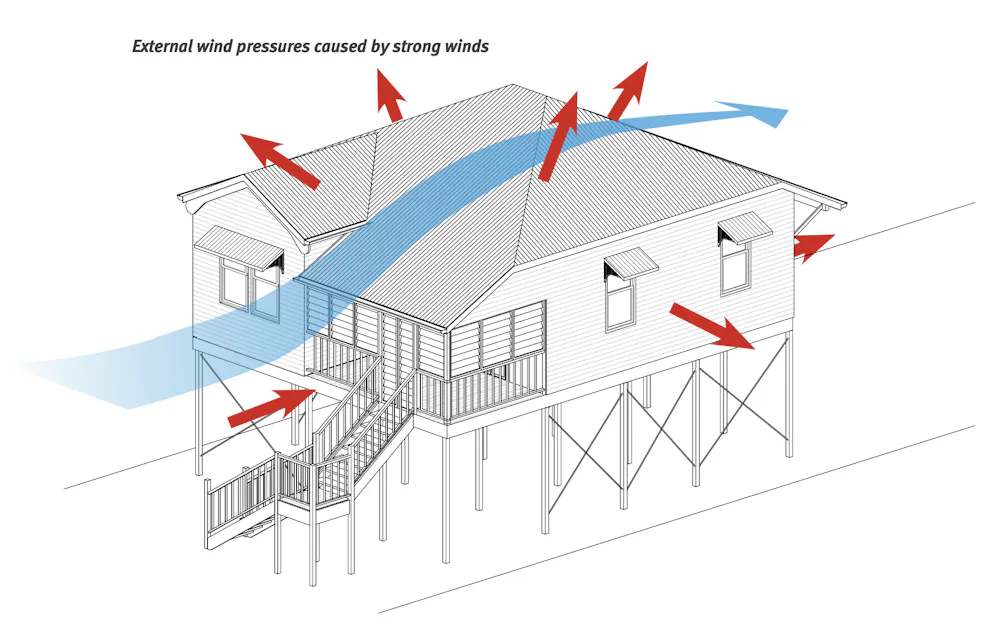
    Strong winds generate pressure pushing and pulling on the outside and inside of a house.

    When wind gusts hit a building, the wind is pushing on what we call the windward wall and going up and over the roof, creating a suction effect. The wind is trying very hard to peel the roof off your house, and in a cyclone is hammering the building for many hours.

    How external winds exert pressure on a house.
    © The State of Queensland (Queensland Reconstruction Authority) 2019, CC BY

    If a windward window or door blows in or gets broken by debris, wind instantaneously enters the space. This almost doubles the load that the roof now has to resist.

    In southeast Queensland and northern NSW, housing is not typically designed to resist that extra upward load on the roof if a door or window blows in.

    Cyclone resilience is about maintaining the function of a building during severe weather, so even if there is some damage, it still can be used after the storm has passed. So it’s vital the roof stays on.

    In practice, that means thinking about what’s known as the “tie down chain” – how all pieces of the house are held together to carry the wind loads from the roof to the ground.

    A weak link in this tie down chain can lead to winds lifting entire roofs from homes. All the connections involved in keeping a roof on the house are exceptionally important.

    Weather resistance in building codes is generally designed for rain that falls straight down and flows off the roof.

    But in a cyclone, rain can come horizontally. It can get pushed under the the roof, into gutters and under sliding doors. And it’s not just a little bit – buckets and buckets of water can inundate a house.

    Wind pressure can also mean water is blown into the house through gaps you may not even know existed. Wind-driven rain ingress can happen at wind speeds that don’t cause structural damage.

    It comes in under doors and through windows, including holes in window sills. It can lead to buildings being unusable and a large number of insurance claims.

    Dispelling major myths

    You might have seen people taping a big “X” on their windows and glass doors. Unfortunately, this doesn’t really do much to improve window strength.

    Some people put the tape on and then, during the cyclone, sit there watching their glass flex, falsely believing tape magically makes the window stronger. This is incredibly dangerous. If that glass shatters, the bystander would be hit by shards of glass travelling at high speed.

    It is much better to tape a garbage bag or a sheet of plastic along the bottom of the window sill and tape it up about 300mm each side. It can then catch the water that seeps in the window and allows it to flow back out when the wind pressure drops.

    Sometimes people open a window to reduce pressure inside the house that happens if a door or window breaks. It’s true this might reduce some pressure, but it depends which side of the house is currently being hit by wind. And given wind direction can change during a cyclone, emergency services recommend it’s better just to stay sheltered in the smallest room; they don’t want you standing in front of a window during a cyclone.

    Close all internal doors so if any windows do blow in, the high pressure is restricted to just that room (not spread throughout the house).

    Designing beyond the bare minimum

    Building codes require buildings to build to a “wind classification” according to the “wind zone” of that area.

    Buildings are often built only to the minimum standard of the Building Code. However, if we want a house to function after an extreme tropical cyclone, we should consider building beyond the minimum standard using resilience features that will keep your roof on in a cyclone and minimise the entry of rainwater.

    Cyclone resilience also includes incorporating resilient building materials in your home – such as linoleum or vinyl floors instead of carpet, and ceilings from fibre-cement sheeting instead of plasterboard.

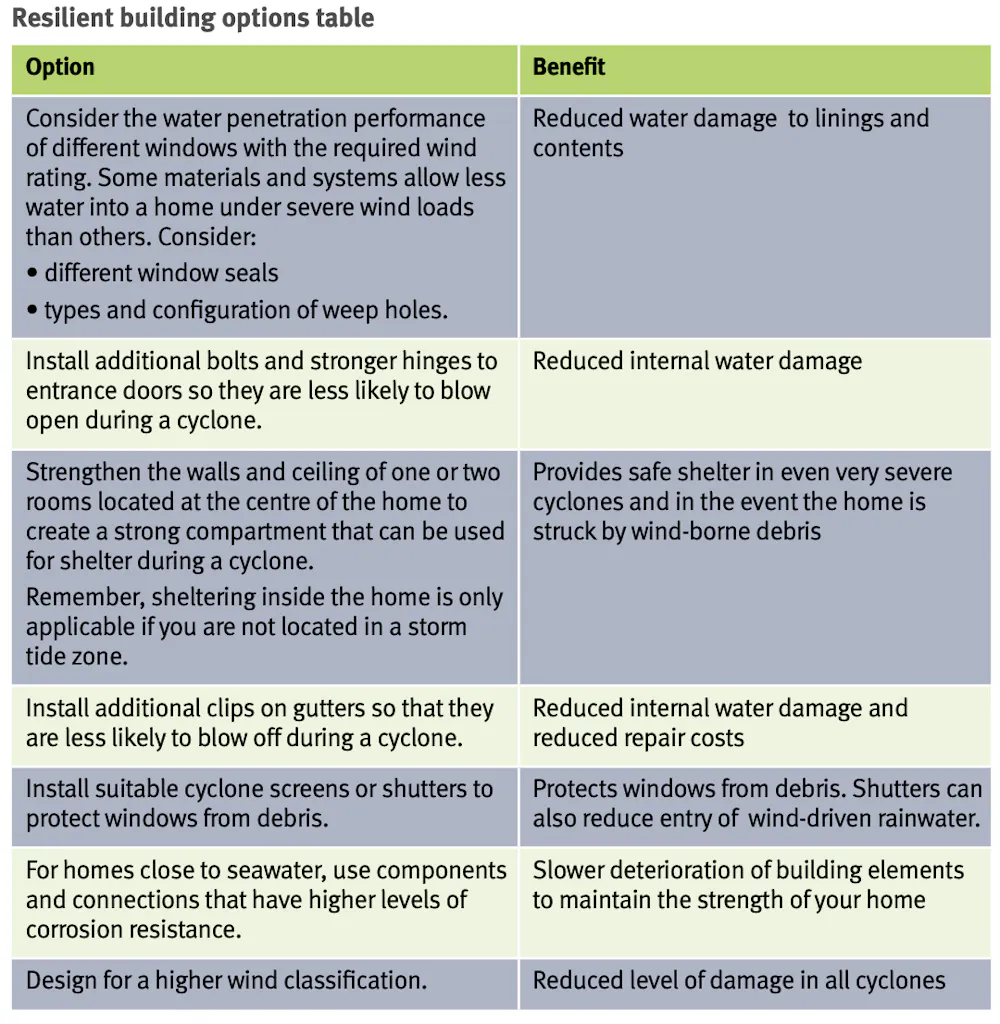
    Resilient building options you could consider.
    © The State of Queensland (Queensland Reconstruction Authority), CC BY

    Eternal vigilance

    It’s also important all elements holding your house together are well maintained through the life of the building.

    That means ensuring regular inspections by a trained professional to identify any potential weaknesses such as rot, rust or UV damage.

    These inspections are not something you and a mate can do yourselves. It requires a building professionals to get into the roof and look for weak spots.

    Think beyond your house. What about the carport? A pergola? That shed or patio you added? Are the solar panels installed correctly with the right fixings and brackets to resist the wind forces?

    If all these things are not fixed down and maintained well, strong winds can pick them up and throw them at your house or your neighbours.

    Just as you get your car serviced, you should get your house checked every five to seven years. Our homes have many important parts and a failure in one can lead to disastrous and expensive problems.

    David Henderson serves on committees for Standards Australia. He is a member of Engineers Australia and has done consulting work with the Resilient Building Council.

    Geoffrey Boughton serves on committees for Standards Australia. He is a member of Engineers Australia and has done consulting work with the Resilient Building Council.

    ref. How cyclones rip apart houses – and how to boost the chance your home stays standing – https://theconversation.com/how-cyclones-rip-apart-houses-and-how-to-boost-the-chance-your-home-stays-standing-251709

    MIL OSI AnalysisEveningReport.nz

  • MIL-OSI New Zealand: Unexplained death in Northcote Point

    Source: New Zealand Police (National News)

    Police are making enquiries into an unexplained death in Northcote Point this afternoon.

    At around 1.29pm, a Police unit was flagged down by a member of the public on Stafford Road.

    A man was unconscious at the entrance to the walkway through to Alfred Street.

    Medical assistance was immediately provided to the man but sadly he died at the scene.

    Enquiries are now underway to establish what has occurred and how the man ended up at the location.

    The Stafford Road off-ramp is currently closed while a scene examination is carried out.

    Police would like to hear from anyone in the area who saw anything in the lead up to Police arriving at the scene.

    Please contact 105 using the reference number P061837652.

    ENDS.

    Jarred Williamson/NZ Police

    MIL OSI New Zealand News

  • MIL-Evening Report: Cyclone Alfred is already retraumatising people who’ve lived through other disasters. I’m one of them

    Source: The Conversation (Au and NZ) – By Erin Smith, Associate Professor and Discipline Lead (Paramedicine), La Trobe University

    In 2011, as Cyclone Yasi approached the Queensland coast, I sat in my home in the tropical far north of the state and worried what the future would hold. Would my family be OK? Would our home be destroyed? Would my workplace be damaged and my job uncertain? Would my community be devastated?

    Now, as we wait for Cyclone Alfred to make landfall, I am watching on from my new home in Melbourne. I am safe. But last night, I couldn’t sleep. I’m having intrusive thoughts, remembering what it was like when Cyclone Yasi barrelled into us. I feel agitated, distracted and anxious. The news coverage of the impending cyclone makes my heart race, so I have turned off the television.

    As someone who has researched the impact of disasters for more than 20 years, I recognise what I am feeling now is similar to how I felt all those years ago. Again, I am experiencing the normal range of stress reactions common after living through a disaster, even though I am not directly impacted by this one.

    This is known as retraumatisation, where we re-live stress reactions experienced as a result of a traumatic event when faced with a new, similar incident.

    As a researcher in emergency responses to a broad range of disasters, I understand why I am feeling like this.

    However, many people may not realise the stress they are experiencing right now is related to an earlier disaster or traumatic event in their life. That earlier disaster could be another cyclone, or a different event, such as a flood or bushfire.

    Some signs and symptoms of retraumatisation might be:

    • intrusive thoughts (for example, I keep remembering my fear of the predicted tidal surge of water rushing up at me in the darkness as Cyclone Yasi made landfall)

    • nightmares and having trouble sleeping

    • hypervigilance (for example, feeling “on edge” all day)

    • sensitivity to triggers (for example, the sound of intense wind and windows creaking can trigger intense feelings because they remind me of the night we lived through Cyclone Yasi passing over the top of us)

    • feeling isolated

    • thinking about, planning or attempting suicide

    • panic atacks

    • using/abusing substances, such as alcohol and other drugs

    • increase in unhealthy behaviours (for example, being more prone to aggression or violence).

    For many of us, Cyclone Alfred is awakening memories and feelings, and the re-emergence of those stress reactions can be confronting. It can feel like re-opening a wound that hasn’t quite healed.

    Disaster upon disaster take their toll

    We are now beginning to understand the effects of being exposed to multiple disasters – bushfires, cyclones, floods, and let’s not forget the COVID pandemic – that erode our resilience.

    This type of multiple exposure influences our feelings of safety, security and even our hope for the future, all increasing the risk of poorer mental health.

    For people with post-traumatic stress disorder (PTSD), retraumatisation may cause people to relive their past traumas in intense detail. It can feel like past traumatic events are happening all over again.

    What to do now, and in the future

    However, there are steps we can take to help build our resilience in the face of multiple disasters.

    For now

    Right now, it is useful to understand how we respond to trauma. We may notice a range of physical responses (for example, my heart has been racing), psychological reactions (for example, I am feeling more anxious than usual) and social impacts (for example, I cancelled dinner plans last night as I did not want to leave the house).

    It is also important to stay connected to our usual social supports, as they can act as a great buffer to stress reactions.

    So, even though I stayed home last night, I was on a group chat discussing the Real Housewives of Sydney with friends, which helped reduce both the physical and psychological stress reactions I was experiencing.

    Staying connected to friends, family, neighbours and other supports will help.
    Caftor/Shutterstock

    For later

    In the longer term, it is useful to develop and implement a self-care plan that includes activities to support our emotional, physical and spiritual health.

    Self-care means taking the time to do things that help your wellbeing and improve your physical health and mental health. This can help you manage the stress reactions that may emerge as part of retraumatisation. Even small acts of self-care in your daily life can have a big impact.

    Today, I made the time to go for a short walk in the park and listened to some of my favourite music. It helped in the moment, but it also helps me in the longer term when I routinely include these small acts of self-care in my daily life.

    We also need to consider the first responders and volunteers who will be preparing for Cyclone Alfred, and communities devastated by similar disasters in the past (for example, the 2022 floods in Lismore, New South Wales). With their exposure to cumulative trauma, these groups will need ongoing, focused support.

    Most importantly, we need to understand that the way we are feeling is normal. Be patient with yourself and look for small opportunities to take control of your reactions.

    I am keeping the television turned off (except when the Real Housewives is on).

    Some resources

    The website blueknot, from the National Centre of Excellence for Complex Trauma, gives more information about how we respond to trauma. The Black Dog Institute guides you through developing a self-care plan.

    If you are a first responder, you can access free treatment and support through a range of providers, including: Phoenix Australia, Fortem Australia and the Black Dog Institute.


    If this article has raised issues for you, or if you’re concerned about someone you know, call Lifeline on 13 11 14.

    Erin Smith does not work for, consult, own shares in or receive funding from any company or organisation that would benefit from this article, and has disclosed no relevant affiliations beyond their academic appointment.

    ref. Cyclone Alfred is already retraumatising people who’ve lived through other disasters. I’m one of them – https://theconversation.com/cyclone-alfred-is-already-retraumatising-people-whove-lived-through-other-disasters-im-one-of-them-251701

    MIL OSI AnalysisEveningReport.nz

  • MIL-OSI USA: Hawai‘i Congressional Delegation Introduces Legislation To Protect State’s Native Species

    US Senate News:

    Source: United States Senator for Hawaii Brian Schatz

    WASHINGTON – U.S. Senators Brian Schatz (D-Hawai‘i) and Mazie K. Hirono (D-Hawai‘i), along with U.S. Representatives Ed Case (D-Hawai‘i) and Jill Tokuda (D-Hawai‘i), introduced legislation to protect more than 10,000 plant and animal species native to the Hawaiian Islands. The Hawai‘i Native Species Conservation and Recovery Act would fund conservation and recovery projects addressing invasive species, the ecological consequences of climate change, native species’ habitats, and population recovery. Schatz met with The Nature Conservancy, Hawai‘i today to discuss the bill and other priorities.

    “Native species foster a healthy ecosystem, with cleaner air, purer water, and a more resilient environment,” said Senator Schatz. “By funding new conservation measures and recovery projects, including for Native Hawaiian organizations and local non-profits, our bill will help save our native species for years to come.”

    The 10,000 species native to Hawai‘i represent the highest degree of endemism in the world, but hundreds of these species are listed as endangered. The state’s unique biodiversity is in the midst of an extinction crisis, with more than half of native birds and more than 100 unique plant species already extinct.

    The Hawai‘i Native Species Conservation and Recovery Act would:

    • Provide funding through cooperative agreements and grants to the State of Hawai‘i, local governments, Native Hawaiian organizations, non-profit organizations, businesses, and institutions of higher education to protect native species;
    • Support coordinated, evidence-based conservation and recovery projects addressing invasive species, the ecological consequences of climate change, native species’ habitats, and population recovery, as well as data collection and public outreach and education measures;
    • Require the U.S. Fish and Wildlife Service to coordinate with other federal and state agencies to develop annual funding priorities and criteria for ranking project proposals;
    • Require a 25 percent non-federal match for most projects;
    • Encourage applications for high impact, small dollar value projects, projects carried out by Native Hawaiian organizations, and projects promoting youth workforce readiness by waiving the non-federal match requirement for such projects; and
    • Authorize $30 million annually, subject to appropriations, to protect native species for ten years.

    “Unique to our islands, Hawai‘i’s native species are critical to maintaining the health, balance, and biodiversity of our ecosystem,” said Senator Hirono. “Through initiatives such as funding conservation and recovery projects that address topics including invasive species, scientific research, and data collection, this legislation will help to preserve Hawai‘i’s ecosystems and safeguard the environment for future generations.”

    “In Hawai‘i, invasives have caused significant ecological damage, threatening the survival of our unique plant and animal species,” said Representative Case. “Protecting Hawai‘i’s unique biodiversity is not just an environmental necessity, but a cultural imperative that embraces our Native Hawaiian heritage. Unfortunately, these native species often lack the defenses to compete with or resist the pressures of invasive plants and animals, which can rapidly alter ecosystems and displace local species and requires intervention to prevent and reverse.”

    “From ?ohi?a to kiwikiu, Hawai?i is home to some of the most stunning native biodiversity in the world, and we need to work collaboratively to protect and preserve our unique and fragile ecosystem,” said Representative Tokuda. “I am proud to support the Hawai‘i Native Species Conservation and Recovery Act to provide much-needed support for coordinated conservation projects across our state, protect our cultural assets, and ensure our native species can thrive for generations to come.”

    The bill is endorsed by The Nature Conservancy, Hawai‘i Conservation Council, Friends of Hakalau Forest National Wildlife Refuge, National Tropical Botanical Garden, American Bird Conservancy, and National Wildlife Federation.

    “Our community in Hawai‘i continues to rise to the challenge protecting our most vulnerable species. I want to thank Senator Schatz, Congressman Case and the rest of our Hawai‘i delegation for enabling the vision of our local communities to become a reality,” said Ulalia Woodside Lee, Executive Director of The Nature Conservancy Hawai‘i and Palmyra. “If enacted, this bill would add much needed support to ensure we can protect our treasured biodiversity and help build capacity in our local communities to malama ‘aina.”

    Senator Schatz met with representatives from TNC Hawai‘i and Palmyra to discuss the bill.

    “This groundbreaking legislation, would ensure protections against invasive species and ensures the viability of Hawai‘i’s endemic species and ecosystems that supports them from extinction. These species are found nowhere else on our planet. If implemented, this legislation will be a win for Hawai‘i, the U.S., and the world in being at the helm of protecting endangered species from becoming extinct. This will also set a course of action to help reverse the current situation of Hawai‘i being the extinction species capitol of the world by eradicating invasive species, foster and the restore biodiversity and help to stabilize our climate. Additionally, this measure will help to protect food sources and the community from harmful invasive pests, as well as, increase employment opportunities. There is no time to lose; we urge Congress to swiftly pass the Native Species Conservation and Recovery Act,” said Jonee Peters, Executive Director for the Conservation Council for Hawai‘i.

    “Hawai‘i is home to some of the most unique and threatened plants and animals found anywhere in the world. The Hawai‘i Native Species Conservation and Recovery Act would be a significant step toward addressing the many challenges of protecting and recovering these irreplaceable natural and cultural resources. Many of Hawai‘i’s exceptional native species are quite literally on the brink of extinction; we urge Congress to pass this Act as soon as possible,” said Debbie Anderson, President of the Friends of Hakalau Forest National Wildlife Refuge.

    “The National Tropical Botanical Garden strongly supports the proposed Hawai‘i Native Species Conservation and Recovery Act of 2025 because it aligns perfectly with NTBG’s mission to preserve and protect native plant species, restore ecosystems, and advance scientific research and education. By providing funding for community involvement and youth workforce training, the act would help ensure that future generations of conservationists and scientists are equipped to protect Hawai‘i’s fragile ecosystems. Supporting the Hawai‘i Native Species Conservation and Recovery Act of 2025 is not just beneficial for NTBG — it is essential for the future of Hawai‘i’s native ecosystems,” said Tami Rollins, Interim CEO of the National Tropical Botanical Garden.

    “Birds such as the ‘I’iwi represent Hawai‘i’s extraordinary biodiversity. However, ‘I’iwi and countless other species are facing unprecedented challenges from threats like avian malaria. Thanks to Sen. Schatz for introducing the Hawai‘i Native Species Conservation and Recovery Act, which would address threats to native species by supporting community-led projects, ensuring native Hawaiian ecosystems are present for our keiki,” said Chris Farmer, Hawai‘i Program Director at American Bird Conservancy.

    The full text of the bill is available here.

    MIL OSI USA News

  • MIL-OSI USA: Fact Sheet: President Donald J. Trump Establishes the Strategic Bitcoin Reserve and U.S. Digital Asset Stockpile

    US Senate News:

    Source: The White House
    CREATING A STRATEGIC BITCOIN RESERVE AND DIGITAL ASSET STOCKPILE: Today, President Donald J. Trump signed an Executive Order to establish a Strategic Bitcoin Reserve and a U.S. Digital Asset Stockpile, positioning the United States as a leader among nations in government digital asset strategy.
    The Order creates a Strategic Bitcoin Reserve that will treat bitcoin as a reserve asset.
    The Strategic Bitcoin Reserve will be capitalized with bitcoin owned by the Department of Treasury that was forfeited as part of criminal or civil asset forfeiture proceedings.  Other agencies will evaluate their legal authority to transfer any bitcoin owned by those agencies to the Strategic Bitcoin Reserve.
    The United States will not sell bitcoin deposited into this Strategic Bitcoin Reserve, which will be maintained as a store of reserve assets.
    The Secretaries of Treasury and Commerce are authorized to develop budget-neutral strategies for acquiring additional bitcoin, provided that those strategies impose no incremental costs on American taxpayers.

    It also established a U.S. Digital Asset Stockpile, consisting of digital assets other than bitcoin owned by the Department of Treasury that was forfeited in criminal or civil asset forfeiture proceedings.
    The government will not acquire additional assets for the U.S. Digital Asset Stockpile beyond those obtained through forfeiture proceedings.
    The Secretary of the Treasury may determine strategies for responsible stewardship, including potential sales from the U.S. Digital Asset Stockpile.

    Agencies must provide a full accounting of their digital asset holdings to the Secretary of the Treasury and the President’s Working Group on Digital Asset Markets.
    This Order ensures a strategic approach to managing digital assets under U.S. control.
    ADDRESSING A CRYPTO MANAGEMENT GAP:
    Bitcoin, the original cryptocurrency, is referred to as “digital gold” because of its scarcity and security, having never been hacked.
    With a fixed supply of 21 million coins, there is a strategic advantage to being among the first nations to create a Strategic Bitcoin Reserve.
    The United States currently holds a significant amount of bitcoin but has not maximized its strategic position as a unique store of value in the global financial system.
    Premature sales of bitcoin have already cost U.S. taxpayers over $17 billion.

    The Executive Order begins to resolve the current disjointed handling of cryptocurrencies seized through forfeiture by, and scattered across, various Federal agencies.
    Currently, no clear policy exists for managing these assets, leading to a lack of accountability and inadequate exploration of options to centralize, secure, or maximize their value.
    Taking affirmative steps to centralize ownership, control, and management of these assets within the Federal government will ensure proper oversight, accurate tracking, and a cohesive approach to managing the government’s cryptocurrency holdings.
    This move harnesses the power of digital assets for national prosperity, rather than letting them languish in limbo.
    DELIVERING ON PLEDGE TO MAKE AMERICA THE CRYPTO CAPITAL OF THE WORLD: President Trump is fulfilling his promise to position America as the global leader in cryptocurrency.
    President Trump promised to make the United States the “crypto capital of the world,” emphasizing the need to embrace digital assets to drive economic growth and technological leadership.
    In his first week in office, President Trump signed an Executive Order to promote United States leadership in digital assets such as cryptocurrency.
    President Trump has consistently advocated for a forward-thinking approach to crypto, stating: “I am very positive and open minded to cryptocurrency companies, and all things related to this new and burgeoning industry. Our country must be the leader in the field.”
    President Trump promised to create a Strategic Bitcoin Reserve and a Digital Assets Stockpile.
    President Trump appointed a “crypto czar” and is hosting the first-ever crypto summit at the White House, just a few of the many ways this Administration is demonstrating its strong commitment to this digital asset.

    MIL OSI USA News

  • MIL-OSI USA: ESTABLISHMENT OF THE STRATEGIC BITCOIN RESERVE AND UNITED STATES DIGITAL ASSET STOCKPILE

    US Senate News:

    Source: The White House
    class=”has-text-align-left”>By the authority vested in me as President by the Constitution and the laws of the United States of America, it is hereby ordered:
         Section 1.  Background.  Bitcoin is the original cryptocurrency.  The Bitcoin protocol permanently caps the total supply of bitcoin (BTC) at 21 million coins, and has never been hacked.  As a result of its scarcity and security, Bitcoin is often referred to as “digital gold”.  Because there is a fixed supply of BTC, there is a strategic advantage to being among the first nations to create a strategic bitcoin reserve.  The United States Government currently holds a significant amount of BTC, but has not implemented a policy to maximize BTC’s strategic position as a unique store of value in the global financial system.  Just as it is in our country’s interest to thoughtfully manage national ownership and control of any other resource, our Nation must harness, not limit, the power of digital assets for our prosperity.  
         Sec. 2.  Policy.  It is the policy of the United States to establish a Strategic Bitcoin Reserve.  It is further the policy of the United States to establish a United States Digital Asset Stockpile that can serve as a secure account for orderly and strategic management of the United States’ other digital asset holdings.
         Sec. 3.  Creation and Administration of the Strategic Bitcoin Reserve and United States Digital Asset Stockpile.       (a)  The Secretary of the Treasury shall establish an office to administer and maintain control of custodial accounts collectively known as the “Strategic Bitcoin Reserve,” capitalized with all BTC held by the Department of the Treasury that was finally forfeited as part of criminal or civil asset forfeiture proceedings or in satisfaction of any civil money penalty imposed by any executive department or agency (agency) and that is not needed to satisfy requirements under 31 U.S.C. 9705 or released pursuant to subsection (d) of this section (Government BTC).  Within 30 days of the date of this order, each agency shall review its authorities to transfer any Government BTC held by it to the Strategic Bitcoin Reserve and shall submit a report reflecting the result of that review to the Secretary of the Treasury.  Government BTC deposited into the Strategic Bitcoin Reserve shall not be sold and shall be maintained as reserve assets of the United States utilized to meet governmental objectives in accordance with applicable law.       (b)  The Secretary of the Treasury shall establish an office to administer and maintain control of custodial accounts collectively known as the “United States Digital Asset Stockpile,” capitalized with all digital assets owned by the Department of the Treasury, other than BTC, that were finally forfeited as part of criminal or civil asset forfeiture proceedings and that are not needed to satisfy requirements under 31 U.S.C. 9705 or released pursuant to subsection (d) of this section (Stockpile Assets).  Within 30 days of the date of this order, each agency shall review its authorities to transfer any Stockpile Assets held by it to the United States Digital Asset Stockpile and shall submit a report reflecting the result of that review to the Secretary of the Treasury.  The Secretary of the Treasury shall determine strategies for responsible stewardship of the United States Digital Asset Stockpile in accordance with applicable law.     (c)  The Secretary of the Treasury and the Secretary of Commerce shall develop strategies for acquiring additional Government BTC provided that such strategies are budget neutral and do not impose incremental costs on United States taxpayers.  However, the United States Government shall not acquire additional Stockpile Assets other than in connection with criminal or civil asset forfeiture proceedings or in satisfaction of any civil money penalty imposed by any agency without further executive or legislative action.        (d)  “Government Digital Assets” means all Government BTC and all Stockpile Assets.  The head of each agency shall not sell or otherwise dispose of any Government Digital Assets, except in connection with the Secretary of the Treasury’s exercise of his lawful authority and responsible stewardship of the United States Digital Asset Stockpile pursuant to subsection (b) of this section, or pursuant to an order from a court of competent jurisdiction, as required by law, or in cases where the Attorney General or other relevant agency head determines that the Government Digital Assets (or the proceeds from the sale or disposition thereof) can and should:           (i)    be returned to identifiable and verifiable victims of crime;           (ii)   be used for law enforcement operations;            (iii)  be equitably shared with State and local law enforcement partners; or           (iv)   be released to satisfy requirements under 31 U.S.C. 9705, 28 U.S.C. 524(c), 18 U.S.C. 981, or 21 U.S.C. 881.      (e)  Within 60 days of the date of this order, the Secretary of the Treasury shall deliver an evaluation of the legal and investment considerations for establishing and managing the Strategic Bitcoin Reserve and United States Digital Asset Stockpile going forward, including the accounts in which the Strategic Bitcoin Reserve and United States Digital Asset Stockpile should be located and the need for any legislation to operationalize any aspect of this order or the proper management and administration of such accounts.
         Sec. 4.  Accounting.  Within 30 days of the date of this order, the head of each agency shall provide the Secretary of the Treasury and the President’s Working Group on Digital Asset Markets with a full accounting of all Government Digital Assets in such agency’s possession, including any information regarding the custodial accounts in which such Government Digital Assets are currently held that would be necessary to facilitate a transfer of the Government Digital Assets to the Strategic Bitcoin Reserve or the United States Digital Asset Stockpile.  If such agency holds no Government Digital Assets, such agency shall confirm such fact to the Secretary of the Treasury and the President’s Working Group on Digital Asset Markets within 30 days of the date of this order.  
         Sec. 5.  General Provisions.  (a)  Nothing in this order shall be construed to impair or otherwise affect:          (i)   the authority granted by law to an executive department or agency, or the head thereof; or          (ii)  the functions of the Director of the Office of Management and Budget relating to budgetary, administrative, or legislative proposals.     (b)  This order shall be implemented consistent with applicable law and subject to the availability of appropriations.     (c)  This order is not intended to, and does not, create any right or benefit, substantive or procedural, enforceable at law or in equity by any party against the United States, its departments, agencies, or entities, its officers, employees, or agents, or any other person.
    THE WHITE HOUSE,    March 6, 2025

    MIL OSI USA News

  • MIL-OSI USA: Senator Collins, Bipartisan Group Introduce Bill to Improve Veterans’ Access to High-Quality Mental Health Care

    US Senate News:

    Source: United States Senator for Maine Susan Collins

    Washington, D.C. – U.S. Senators Susan Collins, John Cornyn (R-TX), Maggie Hassan (D-NH), Michael Bennet (D-CO), Bill Cassidy (R-LA), Gary Peters (D–MI), John Fetterman (D-PA) and Thom Tillis (R-NC) today introduced the Veterans Mental Health and Addiction Therapy Quality of Care Act, bipartisan legislation that would require an independent organization outside of the government to conduct a study to assess the quality of care veterans receive for mental and addiction health treatment from providers within and outside the Department of Veterans Affairs (VA).

    “Our veterans made the honorable decision to serve our country, and we have a responsibility to ensure they receive the best possible health care during and after their service,” said Senator Collins. “Too many veterans face serious mental health struggles, including PTSD and addiction, yet they often encounter barriers to getting the care they need. By reviewing the quality of mental health and addiction treatment available to them—both within and outside the VA—this bipartisan legislation would help improve access to higher-quality care, so that fewer veterans are left without the support they deserve.”

    The Department of Veterans Affairs is home to the nation’s largest integrated health care system that provides comprehensive health services to U.S. military veterans who are enrolled. However, recent estimates indicate that as many as 70% of VA-eligible veterans received their care from external providers. Given the high rate of veteran suicide due to mental and addiction health conditions, a study is needed to better understand if current practices provide our veterans with the best mental and addiction quality of care.

    Specifically, The Veterans Mental Health and Addiction Therapy Quality of Care Act would require an independent study to:

    • Analyze the results of comparable instances of addiction and mental health care between inside and outside providers using objective criteria such as symptom scores and suicide risk;
    • Ascertain to what extent outside providers are using evidence-based practices in the treatment of addiction and mental health issues;
    • Identify potential gaps in coordination between internal and external providers in responding to individuals seeking addiction or mental health care;
    • Evaluate the availability of coordinated care for veterans who have separate or related conditions which may be impacting their mental health;
    • Assess providers’ military cultural competency;
    • Gauge the ease and flexibility of sharing medical records with a veteran’s health care team;
    • Consider to what extent providers are conducting outcome monitoring throughout a veteran’s treatment to track progress or lack thereof; and
    • Measure overall patient satisfaction.

    The legislation is supported by the Disabled American Veterans Association, the American Psychological Association, and the Veteran Health Care Policy Initiative.

    The full text of the bill can be read here.

    MIL OSI USA News

  • MIL-OSI USA: Padilla, Klobuchar Lead Charge Urging USDA to Reinstate Hispanic-Serving Institution Fellowship Program

    US Senate News:

    Source: United States Senator Alex Padilla (D-Calif.)

    Padilla, Klobuchar Lead Charge Urging USDA to Reinstate Hispanic-Serving Institution Fellowship Program

    Senators to USDA: “The Department’s decision to suspend EKDLG Fellowship Program threatens the U.S. agricultural workforce pipeline and the opportunities this program provides educators and students nationwide”

    WASHINGTON, D.C. — Today, U.S. Senators Alex Padilla (D-Calif.), chair of the Senate Hispanic-Serving Institutions (HSI) Caucus, and Amy Klobuchar (D-Minn.), Ranking Member of the Senate Committee on Agriculture, Nutrition, and Forestry, led 11 Democratic Senators in calling on the U.S. Department of Agriculture (USDA) to immediately reinstate its HSI E. Kika De La Garza (EKDLG) Fellowship Program. The program, suspended by the Trump Administration, supports the nation’s agricultural workforce while uplifting professionals and students of all backgrounds at HSIs, including non-Latino students.

    USDA established the nonpartisan EKDLG Fellowship Program in 1998, designing the program to strengthen educational partnerships between faculty, staff, and administrators from HSIs and USDA. These partnerships support professional development, workforce development, and exposure opportunities for HSIs nationwide, offering critical insight and understanding of the federal government.

    “USDA’s partnership with HSIs and Hispanic Serving Agricultural Colleges and Universities (HSACUs) plays a vital role in establishing a collaborative relationship and creating a nationwide network of educators working with USDA to help grow the next generation of the American agricultural workforce,” wrote the Senators.

    “The Department’s decision to suspend EKDLG Fellowship Program threatens the U.S. agricultural workforce pipeline and the opportunities this program provides educators and students nationwide,” continued the Senators. “We urge you to immediately reinstate the E. Kika De La Garza Fellowship Program, similar to Department’s reinstatement of the 1890 National Scholars Program, and to collaborate with Congress to ensure its long-term stability.”

    Programs like the USDA EKDLG Fellowship Program are built to help students reach their full potential and reinforce America’s agricultural workforce pipeline. The 2024 EKDLG Program included eight fellowships in Texas, six in Arizona, five in California, four in New York, two in Illinois, one in New Mexico, one in Colorado, one in New Jersey, one in Florida, one in Connecticut, and one in Washington.

    Hispanic-Serving Institutions are not-for-profit institutions of higher learning with 25 percent or higher total undergraduate Hispanic or Latino full-time students. There are 600 HSIs in the United States that enroll over 5.2 million Hispanic students, two-thirds of all Hispanic undergraduates, and 32.2 percent of total Pell Grant recipients — empowering and improving communities. California is home to 172 HSIs and 45 Emerging HSIs.

    In addition to Senators Padilla and Klobuchar, the letter is also signed by Minority Leader Chuck Schumer (D-N.Y.) and Senators Michael Bennet (D-Colo.), Cory Booker (D-N.J.), Dick Durbin (D-Ill.), Ruben Gallego (D-Ariz.), Kirsten Gillibrand (D-N.Y.), Martin Heinrich (D-N.M.), Ben Ray Luján (D-N.M.), Bernie Sanders (I-Vt.), Adam Schiff (D-Calif.), and Ron Wyden (D-Ore.).

    The letter is endorsed by the Hispanic Association of Colleges and Universities (HACU) and UnidosUS.

    As chair of the Senate HSI Caucus, Senator Padilla has been a strong advocate for expanding educational opportunities for Latino students. Last year, Padilla passed a bipartisan resolution to designate National Hispanic-Serving Institutions Week. In 2023, Padilla introduced the bicameral, bipartisan Hispanic Educational Resources and Empowerment (HERE) Act, which aims to provide Hispanic and Latino students with the necessary tools and resources to lessen the higher education achievement gap.

    Previously, Padilla and Senator John Cornyn (R-Texas) passed a bipartisan resolution expressing support to close the gap in STEM jobs among Latino students and young professionals entering the workforce. Padilla also unveiled a bipartisan resolution in 2022 recognizing the 30th anniversary of the Hispanic National Internship Program (HNIP), a seminal program of the Hispanic Association of Colleges and Universities known for promoting Latino excellence and creating greater career development opportunities for Latino and Hispanic students across the country.

    Full text of the letter is available here and below:

    Dear Secretary Rollins,

    We write to express our significant concerns about the suspension of the USDA Hispanic-Serving (HSI) E. Kika De La Garza (EKDLG) Fellowship Program and to ask that you immediately reinstate it.

    The EKDLG Fellowship Program was established in 1998 by the U.S. Department of Agriculture (USDA), and the program has had consistent support from every presidential administration since its establishment. The program strengthens educational partnerships between faculty, staff, and administrators from HSIs and USDA.

    The EKDLG Fellowship Program is non-partisan and supports increasing the professional development, workforce development, and exposure opportunities for faculty, staff, and students nationwide. USDA’s partnership with HSIs and Hispanic Serving Agricultural Colleges and Universities (HSACUs) plays a vital role in establishing a collaborative relationship and creating a nationwide network of educators working with USDA to help grow the next generation of the American agricultural workforce. These fellowships are open to faculty, staff, and administrators of all backgrounds that are employed at HSIs or Hispanic-Serving School Districts and students of all backgrounds are eligible to participate.

    HSIs are economic engines and shape our nation’s agricultural workforce. In 2022, HSIs enrolled 5.2 million students, including 66% of all Hispanic undergraduate students and over 31% of all college students in non-profit postsecondary institutions in the country. Programs like the EKDLG Fellowship Program equip educators with the tools to help students reach their full potential and support the nation’s agricultural workforce pipeline. For example, the list of 2024 EKDLG participants shows the program’s nationwide impact:

    1. University of Houston, Sugar Land, Texas

    2. New Mexico State University, Las Cruces, New Mexico

    3. The University of Arizona, Tucson, Arizona

    4. Arizona Western College, Yuma, Arizona

    5. Coastal Bend College, Beeville, Texas

    6. Adams State University, Alamosa, Colorado

    7. California State University, Chico, Chico, California

    8. Montclair State University, Montclair, New Jersey

    9. Texas A&M University, Kingsville, Texas

    10. Mesa Community College, Mesa, Arizona

    11. Hartnell College, Salinas, California

    12. Texas Tech University, Lubbock, Texas

    13. City Colleges of Chicago, Harold Washington College, Chicago, Illinois

    14. Texas A&M University, College Station, Texas

    15. Maricopa Community Colleges, Tempe, Arizona

    16. University of Connecticut, Storrs, Connecticut

    17. Waubonsee Community College, Sugar Grove, Illinois

    18. Northern Arizona University, Yuma, Arizona

    19. University of California, Santa Barbara, California

    20. Cuesta College, San Luis Obispo, California

    21. University of Texas, San Antonio, Texas

    22. CUNY New York City College of Technology, Brooklyn, New York

    23. CUNY Hunter College, New York, New York

    24. Florida International University, Miami, Florida

    25. California State University, Fresno, California

    26. Arizona State University, Mesa, Arizona

    27. Texas Tech University, Lubbock, Texas

    28. The University of Texas, Rio Grande Valley, Edinburg, Texas

    29. Mt. Adams School District #209, White Swan, Washington

    30. The Urban Assembly New York Harbor School, New York, New York

    31. John Bowne High School, Flushing, New York

    The Department’s decision to suspend EKDLG Fellowship Program threatens the U.S. agricultural workforce pipeline and the opportunities this program provides educators and students nationwide.

    We urge you to immediately reinstate the E. Kika De La Garza Fellowship Program, similar to Department’s reinstatement of the 1890 National Scholars Program, and to collaborate with Congress to ensure its long-term stability.

    Sincerely,

    MIL OSI USA News

  • MIL-OSI USA: Padilla, Schiff, Whitehouse Blast Trump and Zeldin’s Weaponization of EPA as GAO Determines Clean Air Act Waivers Not Subject to Congressional Review Act

    US Senate News:

    Source: United States Senator Alex Padilla (D-Calif.)

    Padilla, Schiff, Whitehouse Blast Trump and Zeldin’s Weaponization of EPA as GAO Determines Clean Air Act Waivers Not Subject to Congressional Review Act

    WASHINGTON, D.C. — Today, in response to the Government Accountability Office’s (GAO) finding that Clean Air Act waivers to California are not subject to the Congressional Review Act, U.S. Senators Alex Padilla (D-Calif.), Adam Schiff (D-Calif.), and Sheldon Whitehouse (D-R.I.), members of the Senate Committee on Environment and Public Works, issued the following joint statement:

    “By ignoring decades of precedent and the plain text of the Congressional Review Act, the Trump EPA is attempting to sell out our nation’s public health and environmental protections to the same polluting industries that bankrolled much of Trump’s campaign. Congress put in place California’s ability to set vehicle emissions standards in the Clean Air Act, and California emission standards have protected generations of Americans against fossil fuel emissions that poison our air and heat our planet. President Trump and Administrator Zeldin’s weaponization of the EPA in service of the polluters the agency is tasked with policing directly attacks our nation’s ability to breathe clean air and reduce the planet-warming carbon pollution that is fueling extreme weather. 

    “GAO’s views on what agency actions are subject to the Congressional Review Act have historically carried great weight, and we thank the agency for its attention to this matter.” 

    Yesterday, Senator Padilla questioned nominees for senior posts at the Environmental Protection Agency on California’s Clean Air Act waivers, stressing that they do not fall under the purview of the Congressional Review Act.

    MIL OSI USA News

  • MIL-OSI Australia: 64-2025: List of treatment providers: treatment provider suspended – Ser.Chim. Fumigazioni S.R.L. (AEI: IT4027SB)

    Source: Australia Government Statements – Agriculture

    7 March 2025

    Who does this notice affect?

    Stakeholders in the import and shipping industries—including vessel masters, freight forwarders, offshore treatment providers, Biosecurity Industry Participants, importers, customs brokers, principal agents and master consolidators.

    What has changed?

    Following identification of critical non-compliance, we have suspended Ser.Chim. Fumigazioni S.R.L. (AEI: IT4027SB) from AusTreat.

    The treatment provider has been listed…

    MIL OSI News

  • MIL-OSI China: World’s fastest high-speed train undergoing type tests in Beijing

    Source: China State Council Information Office 2

    This photo shows the CR450AF bullet train in Beijing, capital of China, Dec 29, 2024. [Photo/Xinhua]
    Prototypes of the world’s fastest high-speed train, the CR450, with a test speed of up to 450 km per hour and an operational speed of 400 km per hour, are now undergoing type tests on Beijing’s ring railways for future commercial services.
    The new trains debuted in Beijing on Dec. 30, 2024. They are significantly faster than the CR400 Fuxing high-speed trains currently in service, which operate at a speed of 350 kilometers per hour.
    Wang Feng, vice president of the train producer, CRRC Corporation Limited, emphasized that the CR450 represents an all-round leap in high-speed train theory, technology, equipment, standards, and operational management, Science and Technology Daily reported on Thursday.
    To reach the unprecedented operational speed of 400 km per hour, engineers upgraded traction capacity, dynamic performance, and pantograph systems, Wang explained.
    The train employs a water-cooled permanent magnet traction system, a new-generation high-stability bogie, and multi-system innovations to sustain its high-speed operations, according to Wang.
    Safety is bolstered by multi-level emergency braking control technology and over 4,000 onboard monitoring sensors. These track key systems, including running gears, car body, high-voltage pantographs, train control and fire detection systems, in real time. An over-the-horizon system has also enhanced recognition of track emergencies, he said.
    Regarding energy savings, a streamlined cowling design on the bogies significantly cuts air resistance, while new lightweight technologies and materials reduce the train’s weight by 10 percent and lower running resistance by 22 percent, Wang noted.
    Noise reduction techniques further distinguish the model. Seven innovative technologies, including sound-absorbing materials and optimized aerodynamic shapes, reduce cabin noise by 2 decibels, offering passengers a quieter, smoother ride, Wang added.
    Furthermore, intelligent upgrades enable the CR450 to outperform other models in areas such as operation and control, driver interaction, safety monitoring, and passenger services, he said. 

    MIL OSI China News

  • MIL-OSI China: Colleges open AI classes to meet market demand

    Source: China State Council Information Office 2

    Chinese universities are accelerating efforts to integrate education with artificial intelligence, with more AI colleges opening to cultivate interdisciplinary talent and more general AI courses and textbooks introduced.
    Tsinghua University, one of China’s top schools, recently announced it will increase its undergraduate admissions by about 150 students this year and establish a new undergraduate college for general AI education. The students will enroll in the new program, which aims to integrate AI across multiple disciplines.
    The initiative pools academic resources from various fields, seeking to develop students with a solid foundation in AI, high proficiency in AI technologies and strong innovative capabilities, the university said. The move is part of Tsinghua’s efforts to advance AI-related professional training and support China’s push for high-level scientific and technological self-reliance and self-strengthening, according to Xinhua News Agency.
    As AI rapidly evolves, reshaping education and driving socioeconomic development, the need for individuals with comprehensive AI knowledge and skills is becoming increasingly urgent.
    Wang Xuenan, deputy director at the Digital Education Research Institute of the China National Academy of Educational Sciences, told China Central Television the number of students majoring in AI was estimated at more than 40,000 last year, yet “the number still falls far short of the needs of the industry.”
    Market consultancy McKinsey& Company estimates that China will need 6 million professionals with proficient AI knowledge by 2030.
    In November 2023, a talent training initiative on collaborative research in general AI was jointly launched by the Beijing Institute for General Artificial Intelligence, Peking University, Shanghai Jiao Tong University and 13 other leading universities. Zhu Songchun, director of the Beijing institute and dean of the School of Intelligent Science and Technology at Peking University, told Guangming Daily that the plan will leverage the resources of these universities to create a training system that seamlessly connects undergraduate and doctoral education.
    In September last year, Nankai University and Tianjin University introduced a general AI course through a massive open online course, or MOOC, targeting more than 100,000 undergraduates in Tianjin. The course covers AI’s basic principles and history while exploring cutting-edge generative AI models and their applications in healthcare, intelligent manufacturing and autonomous driving, according to Xu Zhen, director of the department of higher education at the Tianjin Municipal Education Commission.
    Zhejiang University announced in March that it will lead an upgrade of the “AI plus X” micro program in collaboration with Fudan University, Nanjing University, Shanghai Jiao Tong University and the University of Science and Technology of China. The country’s first micro program integrating AI with other disciplines, it aims to bridge technology with fields such as humanities, social sciences, agriculture, medicine and engineering.

    MIL OSI China News

  • MIL-OSI China: Pop star returns to her ethnic Miao roots

    Source: China State Council Information Office 3

    Stardom often leads artists to chase the next big trend, but one female pop singer has embarked on a remarkable journey of reinvention.

    Known for her catchy hits and glamorous performances, A Duo has made a deep, unexpected shift from the glitzy world of pop music to becoming a popularizer of Miao ethnic culture, with a new stage production that bridges the ancient and the modern.

    Titled Reborn Beats, the production premiered on Dec 31 in the seaside community of Aranya in Qinhuangdao, Hebei province, and is about to kick off a national tour on Friday to cities such as Shanghai, Beijing and Shenzhen, Guangdong province.

    The 45-year-old singer, who is also the scriptwriter and director, has seamlessly blended her pop background with ancient Miao traditions in a dazzling performance that is both a tribute to her heritage, and a platform for bringing her culture to a contemporary audience — many of whom may have never encountered it before.

    Reborn Beats is the story of Ye Zi, a young woman from the mountains, who seeks to adapt to life in the city. In doing so, she abandons her ability to communicate with nature and all living things. However, she repeatedly faces setbacks to love, friendship and dreams. On a rooftop one day, she receives a call informing her that her grandmother is critically ill. This prompts her to return home, setting off a colorful and magical adventure.

    Traditional Miao musical instruments, including the lusheng (a reed pipe) and drums, are featured in the production, along with contemporary musical elements.

    Once a symbol of modernity, A Duo now dresses in a stunning, richly embroidered Miao-inspired costume as a visual representation of her respect for her cultural heritage. She plays the role of the grandmother, who she describes as a wise, elderly woman with a face full of wrinkles.

    “The character reminds me of my own grandmother, who was hardworking, kindhearted, wise, and took care of the family,” she says.

    A Duo spent about 10 years working on Reborn Beats. Her aim is to show that Miao culture is not some static relic of the past but rather a dynamic, evolving force. She also wants to deliver an inspiring message about the transition of women, a theme that mirrors her personal path of evolution.

    Born in Hunan province to a Tujia father and a Miao mother, A Duo gained fame after performing the dance song Goodbye, Carmen on the annual China Central Television Spring Festival Gala in 2005. She was signed by a major Chinese record label and released several pop albums.

    However, despite the fame and flashing lights, her life was not without struggles. The pain of personal relationships, career exhaustion, and health issues led her to step out of the limelight.

    “I thought about what kind of life I wanted to live, what kind of person I wanted to become, and what I was chasing,” she says.

    Beneath the glitter of stardom, there was a yearning for a more meaningful form of expression — something rooted in history, heritage and culture. It was a longing to do more than entertain; she wanted to create something that would resonate beyond the superficiality of pop fame. That’s when Miao culture, a tradition she is closely connected to through her ancestry, entered her life with full force.

    From 2012 to 2016, she spent her days in remote villages in Hunan, Yunnan and Guizhou provinces, where the Miao and Tujia live. During her stay, she recorded folk songs and dance moves. She also learned miaogu, a Miao percussion performance, from 89-year-old Hong Fuqiang in Baojing county in the Xiangxi Tujia and Miao autonomous prefecture in Hunan. It was there that she officially became an inheritor of Miao drum dance, setting the stage for her next artistic chapter.

    Living in villages allowed her to embrace a simpler lifestyle and brought back vivid memories. A Duo was raised by her grandmother, and the wooden door of her grandmother’s house always creaked. A creak meant someone was leaving, and another creak meant that breakfast was ready. The door was like a clock, and the creak was like its chime. She wanted to preserve these emotionally charged sounds in the production, alongside things like picking cotton, sifting rice, spinning machines, and grinding stones.

    “I’m a translator, interpreting what the previous generation of masters has passed down and making it resonate with today’s young people,” A Duo says.

    Reborn Beats brings together five inheritors of Miao ethnic folk arts, including singer Long Xian’e and lusheng player Yang Shengwen. They share A Duo’s vision of music that revives a cultural legacy they believe has the power to inspire future generations.

    “As an inheritor of lusheng, I always want to present the instrument to a wider audience, and with Reborn Beats, we have made this possible,” says Yang, who performs with the China Ethnic Song and Dance Ensemble, and has been playing the instrument for decades.

    “The lusheng is not just treated as an embellishment but prominently featured in the production, especially when it’s integrated into contemporary music elements. It allows the audience to see and feel the essence of the instrument, and experience its sound in a fresh and engaging way,” Yang notes.

    MIL OSI China News