Category: Transport

  • MIL-OSI USA: Padilla, Colleagues to Trump Administration: Ensure Legal Representation for Children in Immigration System

    US Senate News:

    Source: United States Senator Alex Padilla (D-Calif.)

    Padilla, Colleagues to Trump Administration: Ensure Legal Representation for Children in Immigration System

    WASHINGTON, D.C. — U.S. Senator Alex Padilla (D-Calif.), Ranking Member of the Senate Judiciary Immigration Subcommittee, demanded the Trump Administration protect Congressionally mandated legal representation for unaccompanied children in the immigration system. The letter comes in response to the Trump Administration’s stop work order last month to organizations that provide legal services for unaccompanied children. Last week, following public pressure, the order was rescinded, however confusion and uncertainty still remains.

    Padilla joined 31 other Senators in demanding that Health and Human Services (HHS) Secretary Robert F. Kennedy, Jr. and Secretary of the Interior Doug Burgum continue legal services for unaccompanied children involved in immigration proceedings as required by law. The termination of legal services for unaccompanied children violates the Trafficking Victims Protection Reauthorization Act (TVPRA) and risks the safety of 26,000 unaccompanied children to trafficking, exploitation, and other harm.

    “Cutting off access to legal services makes it more likely that the government will lose track of unaccompanied children, given the challenges such children would face in independently appearing for immigration court hearings, submitting address updates, or otherwise communicating with immigration authorities,” wrote the Senators. “Not only will this make children more vulnerable to trafficking, but it will also create further inefficiencies in an already backlogged immigration court system.”

    “Every day without access to counsel is another day in which vulnerable children face grave danger by human traffickers, abusers, or other bad actors, without an advocate at their side,” continued the Senators.

    Access to legal services, including representation, is essential for providing unaccompanied children fairness in the legal process. Without an attorney, many of these children face enormous roadblocks to advocate for themselves in a challenging immigration system because of their age, development, and language barriers.

    The TVPRA was passed by Congress in a bipartisan manner in 2008 and requires the Department of Health and Human Services (HHS) to provide counsel for unaccompanied children as much as possible by representing them in legal proceedings and protecting them from exploitation and abuse.

    Padilla signed the letter, led by Senators Jon Ossoff (D-Ga.) and Mazie Hirono (D-Hawaii), along with Senators Tammy Baldwin (D-Wis.), Michael Bennet (D-Colo.), Richard Blumenthal (D-Conn.), Lisa Blunt Rochester (D-Del.), Cory Booker (D-N.J.), Chris Coons (D-Del.), Catherine Cortez Masto (D-Nev.), Tammy Duckworth (D-Ill.), Dick Durbin (D-Ill.), Martin Heinrich (D-N.M.), John Hickenlooper (D-Colo.), Mark Kelly (D-Ariz.), Andy Kim (D-N.J.), Angus King (I-Maine), Amy Klobuchar (D-Minn.), Edward J. Markey (D-Mass.), Jeff Merkley (D-Ore.), Patty Murray (D-Wash.), Gary Peters (D-Mich.), Jacky Rosen (D-Nev.), Bernie Sanders (I-Vt.), Adam Schiff (D-Calif.), Jeanne Shaheen (D-N.H.), Chris Van Hollen (D-Md.), Reverend Raphael Warnock (D-Ga.), Elizabeth Warren (D-Mass.), Peter Welch (D-Vt.), Sheldon Whitehouse (D-R.I.), and Ron Wyden (D-Ore.).

    Senator Padilla is a leading voice in Congress opposing President Trump’s anti-immigrant actions and rhetoric. He sharply criticized Trump’s harmful executive orders targeting immigrants at the start of his second Administration. Last week, Padilla denounced Trump’s transfer of immigrants from the United States to Guantánamo as unlawful and demanded answers regarding these transfers. He also condemned the Trump Administration’s intended use of Bureau of Prisons (BOP) facilities to detain immigrants as part of President Trump’s mass deportation plan. Additionally, Padilla cosponsored the Born in the USA Act to effectively block the implementation of Trump’s unconstitutional executive order attempting to end birthright citizenship for certain children born in the United States, or a similar subsequent executive order. Last year, Padilla emphasized the dangers and immense economic costs of the Trump Administration’s mass deportation plans during a Senate Judiciary Committee hearing.

    Earlier this year, Senator Padilla introduced the Access to Counsel Act to ensure that U.S. citizens, green card holders, and other individuals with legal status can consult with an attorney, relative, or other interested parties to seek assistance if they are detained by Customs and Border Protection (CBP) for more than an hour at ports of entry, including airports.

    Full text of the letter is available here and below:

    Dear Secretary Kennedy and Secretary Burgum:

    We write to express our strong opposition to the February 18, 2025 stop work order issued regarding your agencies’ contract for the provision of legal services for unaccompanied children. Although the order has now been rescinded, we are concerned about the chaos and confusion it caused for legal services providers and the children they serve. Any disruption to services for unaccompanied children is alarming, particularly in light of recent reports of the administration’s intent to place unaccompanied children into removal proceedings.

    Pausing or terminating the provision of legal services to unaccompanied children under this contract runs directly counter to the requirements of the Trafficking Victims Protection Reauthorization Act (TVPRA) and places 26,000 unaccompanied children at increased risk of trafficking, exploitation, and other harm. The TVPRA, passed by Congress in 2008 on a bipartisan basis, requires the Department of Health and Human Services (HHS) to ensure, to the greatest extent practicable, that all unaccompanied children have counsel to represent them in legal proceedings and protect them from mistreatment, exploitation, and trafficking. Shirking this statutory mandate heightens the risk of harm for these uniquely vulnerable children.

    Access to legal services often provides unaccompanied children their only hope for a fair legal process. Unaccompanied children’s age, developmental stage, and communication and comprehension constraints make it virtually impossible for them to effectively navigate the complex and adversarial immigration system without an attorney at their side. The government-funded legal services provided under this contract are, in many cases, the only thing preventing a two or three-year-old unaccompanied child from facing court proceedings alone against a government attorney seeking their deportation. 

    Attorneys are vital to unaccompanied children’s comprehension of and compliance with immigration requirements and processes. From fiscal year (FY) 2005 through June of FY 2019, 98 percent of juveniles placed in removal proceedings who were represented by a lawyer appeared for their hearings. Cutting off access to legal services makes it more likely that the government will lose track of unaccompanied children, given the challenges such children would face in independently appearing for immigration court hearings, submitting address updates, or otherwise communicating with immigration authorities. Not only will this make children more vulnerable to trafficking, but it will also create further inefficiencies in an already backlogged immigration court system. Moreover, attorneys help children understand their options and are often in a position to facilitate prompt voluntary departures, where appropriate.

    For these reasons, we urge you to publicly commit to maintaining this contract. We further request a briefing about why the contract was paused and your plan for compliance with your statutory mandate to ensure that children have counsel in immigration proceedings.

    Every day without access to counsel is another day in which vulnerable children face grave danger by human traffickers, abusers, or other bad actors, without an advocate at their side. Thank you for your consideration of this critical issue.

    Sincerely,
    MIL OSI USA News

  • MIL-Evening Report: Cyclone Alfred is slowing down – and that could make it more destructive. Here’s how climate change might have influenced it

    Source: The Conversation (Au and NZ) – By Liz Ritchie-Tyo, Professor of Atmospheric Sciences, Monash University

    Cyclone Alfred has now been delayed, as the slow-moving system stalls in warm seas off southeast Queensland. Unfortunately, the expected slow pace of the cyclone will bring even more rain to affected communities.

    This is because it will linger for longer over the same location, dumping more rain before it moves on. Alfred’s slowing means the huge waves triggered by the cyclone will last longer too, likely making coastal erosion and flooding worse.

    Cyclone Alfred is unusual – the first cyclone in half a century to come this far south and make expected landfall.

    When unusual disasters strike, people naturally want to know what role climate change played – a process known as “climate attribution”. Unfortunately, this process takes time if you want details on a specific event.

    We can’t yet say if Alfred’s unusual path and slow speed are linked to climate change. But climate change is driving very clear trends which can load the dice for more intense cyclones arriving in subtropical regions. These include the warm waters which fuel cyclones spreading further south, and cyclones dumping more rain than they used to.

    So, let’s unpick what’s driving Cyclone Alfred’s behaviour – including the potential role of climate change.

    A Bureau of Meteorology update on Cyclone Alfred dated Thursday, March 6.

    Not necessarily climate linked: Alfred’s southerly path

    Many cyclones make it as far south as Brisbane – but they’re nearly all far out at sea. Weather patterns mean most cyclones heading south are diverted to the east, where remnants can hit New Zealand as large extratropical storms.

    The fact that Alfred is set to make landfall is very unusual. But we can’t yet definitively say this is due to climate change. Cyclones are steered by winds and weather patterns, and the Coral Sea’s complex weather makes cyclone paths here very hard to predict.

    Alfred’s abrupt westward shift is due to a large region of high pressure to its south, which has pushed it directly towards heavily populated areas of southeast Queensland and northern New South Wales. These steering winds are not very strong, which is why Alfred is moving slowly.

    In 2014, researchers showed cyclones are reaching their maximum intensity in areas further south in the southern hemisphere and north in the northern hemisphere than they used to. In 2021, researchers also found cyclones were reaching their maximum intensity closer to coasts, moving about 30 km closer per decade.

    Climate link: Warmer seas

    Cyclones typically need water temperatures of 26.5°C or more to form.

    More than 90% of all extra heat trapped by greenhouse gas emissions is stored in the seas. The oceans are the hottest on record, and records keep falling. But normal seasonal variability and shifting ocean currents are still at work too, and we can get unusually warm waters without climate change as a cause.

    What we do know is that ocean temperatures around much of Australia have been unusually warm.

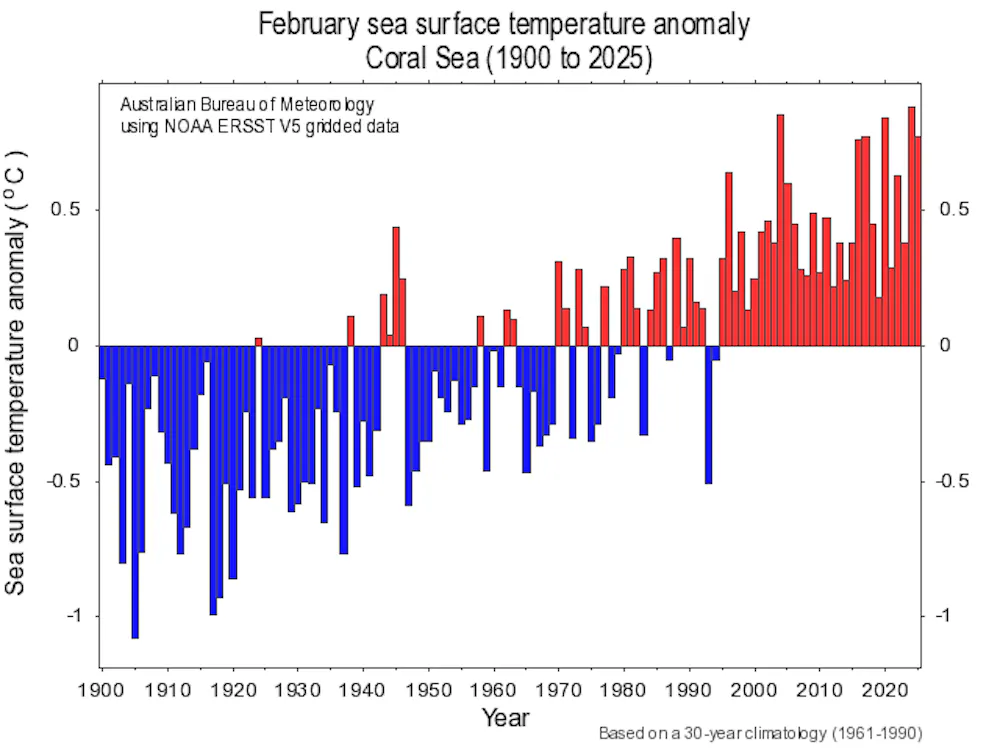
    The northeastern Coral Sea, where Cyclone Alfred formed, experienced the fourth-hottest temperatures on record for February and the hottest on record for January.

    In the Coral Sea, sea surface temperatures were the fourth highest on record in February 2025 and the highest on record in January 2025. This figure shows the trend over time for February.
    Bureau of Meteorology, CC BY-NC-ND

    We also know Australia’s southern waters are warming up too.

    The energy available to power tropical cyclones in subtropical regions has also increased in recent decades, due largely to rising ocean temperatures.

    Average sea surface temperatures in central and southern Queensland on Thursday March 6th. Point Danger is on the Gold Coast.
    Bureau of Meteorology, CC BY-NC-ND

    Climate link: Fewer cyclones but more likely to be intense

    In the northern hemisphere, researchers have found a trend towards fewer cyclones over time. But of those which do form, a higher proportion are more intense.

    It’s not fully clear if the same trend exists in the southern hemisphere, though we are seeing fewer cyclones forming over time.

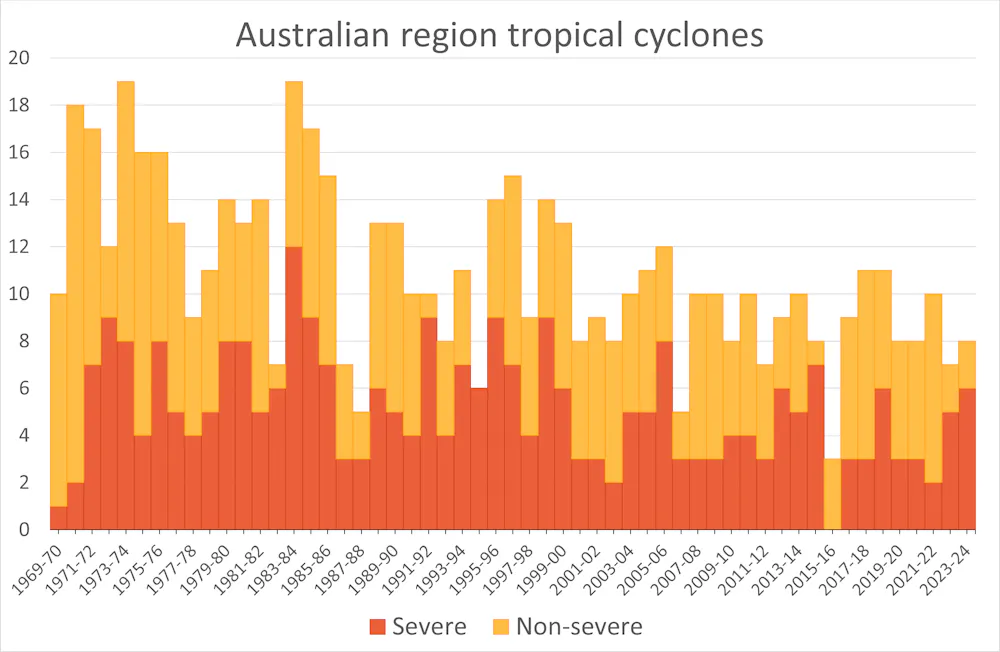
    This summer, eight tropical cyclones have formed in Australian waters. Six were classified as severe (category 3 and up). Historically, Australia has experienced a higher proportion of category 1 and 2 cyclones, which bring weaker wind speeds.

    On average, we see about 11 cyclones form and 4-5 make landfall. There has been a downward trend in the number of cyclones forming in the Australian region in recent decades.

    Fewer cyclones, but more likely to be intense: this figure shows the number of severe (Category 3 and up) and non-severe tropical cyclones (Category 1 and 2) since 1970/71.
    Bureau of Meteorology, CC BY-NC-ND

    Climate link: Cyclones dumping more rain

    The intensity of a cyclone refers to the speed of the wind and size of the wind-affected area.

    But a cyclone’s rain field is also important. This refers to the area of heavy rain produced by storms when they’re at cyclone intensity and afterwards as they decay into tropical lows.

    The rate of rainfall brought by cyclones in Australia isn’t necessarily increasing, but more cyclones are moving slowly, such as Alfred. This means more rain per cyclone, on average.

    Rising ocean temperatures mean more water evaporates off the sea surface, meaning forming cyclones can absorb more moisture and dump more rain when it reaches land.

    Why are cyclones slowing down? This is likely because air current circulation in the tropics has weakened. This has a clear link to climate change. Wind speeds have fallen 5 to 15% in the tropics, depending on where you are in the world. It’s hard to pinpoint the change clearly in our region, because the historic record of cyclone tracks isn’t very long.

    For every degree (°C) of warming, rainfall intensity increases 7%. This is well established. But newer research is showing the rate may actually be double this or even higher, as the process of condensation releases heat which can trigger more rain.

    Clear climate link: Bigger storm surges due to sea level rise

    Sea levels are on average about 20 centimetres higher than they were before 1880.

    When a cyclone is about to make landfall, its intense winds push up a body of seawater ahead of it – the storm surge. In low lying areas, this can spill out and flood streets.

    Because climate change is causing baseline sea levels to rise, storm surges can reach further inland. Sea-level rise will also make coastal erosion more destructive.

    What should we take from this?

    We can’t say definitively that climate change is behind Cyclone Alfred’s unusual track.

    But factors such as rising sea levels, slower cyclones and warmer oceans are changing how cyclones behave and the damage they can do.

    Over time, we can expect to see cyclones arriving in regions not historically affected – and carrying more rain when they arrive.

    Liz Ritchie-Tyo receives funding from The Australian Research Council and the U.S. Office of Naval Research

    Andrew Dowdy receives funding from University of Melbourne as well as supported through the Australian Research Council.

    Hamish Ramsay receives funding from the Australian Climate Service.

    ref. Cyclone Alfred is slowing down – and that could make it more destructive. Here’s how climate change might have influenced it – https://theconversation.com/cyclone-alfred-is-slowing-down-and-that-could-make-it-more-destructive-heres-how-climate-change-might-have-influenced-it-251594

    MIL OSI AnalysisEveningReport.nz

  • MIL-OSI USA: March 5th, 2025 Tribal Water Rights Settlements Legislation Passes Unanimously Out of Senate Committee

    US Senate News:

    Source: United States Senator for New Mexico Martin Heinrich

    WASHINGTON – A slate of Tribal water rights settlement bills introduced by U.S. Senators Martin Heinrich (D-N.M.) and Ben Ray Luján (D-N.M.) and U.S. Representatives Teresa Leger Fernández (D-N.M.), Gabe Vasquez (D-N.M.), and Melanie Stansbury (D-N.M.) passed unanimously out of the Senate Committee on Indian Affairs today. The legislation next heads to the Senate floor for consideration.

    The full slate of Tribal water rights settlements legislation includes:

    • The Rio San José and Rio Jemez Water Rights Settlements Act;
    • The Ohkay Owingeh Rio Chama Water Rights Settlement Act;
    • The Zuni Indian Tribe Water Rights Settlement Act; and
    • The Navajo Nation Rio San José Water Rights Settlement Act.
    • Navajo-Gallup Water Supply Project Amendments;
    • The Technical Corrections to the Northwestern New Mexico Rural Water Projects Act, Taos Pueblo Indian Water Rights Settlement Act, and Aamodt Litigation Settlement Act;

    “I’m proud to fight for these bills to finally unlock critical water infrastructure funding from these water rights settlements and ensure Tribes have the resources to use the water they own,” said Heinrich. “These settlements are supported by all parties involved, including Tribal and non-Tribal communities. Congress should pass these urgently needed bills to help communities manage their precious and limited water resources.”

    “Water rights are part of the federal trust responsibility for our Tribal communities,” said Luján, a member of the Senate Indian Affairs Committee. “I’m proud to have helped advance this critical legislation, allowing our Tribal communities to promote water security and complete much-needed water infrastructure projects. I’m particularly proud that my legislation to amend the Navajo-Gallup Water Supply Project has advanced, ensuring the resources and time needed to deliver clean drinking water to communities in northwestern New Mexico. These pieces of legislation will help fulfill our trust responsibility and promote water security for Tribes and Pueblos, as well as non-Tribal users, in New Mexico.”

    “This legislation upholds our trust responsibility to Tribes and helps bring certainty to disputes about water across the Southwest. The settlements included in these bills secure clean, reliable water for Navajo Nation, Jicarilla Apache Nation, 11 pueblos, and the rural communities that are their neighbors across New Mexico,” said Leger Fernández. “It is with great expectation that I reintroduce this legislation which reflects decades of negotiation and collaboration. We must pass these bills so the scarce water resources our communities need to thrive for generations to come are available to all.”

    “In New Mexico, we know water is life,” said Stansbury. “That’s why these Tribal Water Settlement bills are so important. These pieces of legislation will give water rights back to our Tribes and Pueblos, ensuring the federal government upholds our Trust and Treaty Responsibilities. Indigenous people have been stewards of the land and water since time immemorial, and now is the time for them to lead these efforts.”

    “New Mexicans know the importance of safe and reliable water access, and today’s progress brings us one step closer to securing these fundamental resources for our Tribal communities. I’ll continue to honor my commitment to our Tribes and Pueblos to ensure they have the water infrastructure they need to thrive,” said Vasquez.

    The Rio San José and Rio Jemez Water Rights Settlements Act is led by Heinrich and Leger Fernández. Luján, Stansbury, and Vasquez are original cosponsors. The bill would implement two fund-based water settlements: one between the Pueblos of Jemez and Zia, the United States, the State of New Mexico, and non-Tribal parties; and another between the Pueblos of Acoma and Laguna, the United States, the State of New Mexico, and non-Tribal parties. The settlements are strongly supported by all parties involved.

    Heinrich and Leger Fernández previously introduced this legislation in March 2023. The bill received a hearing and was reported out of the Senate Indian Affairs Committee in December 2023. The House version of this bill received a legislative hearing in the House Water, Wildlife and Fisheries Subcommittee in July 2024.

    Read the full bill text here.

    The Ohkay Owingeh Rio Chama Water Rights Settlement Act is also led by Heinrich and Leger Fernández. Luján and Stansbury are original cosponsors. The bill establishes a trust fund to implement the negotiated settlement between the United States, the State of New Mexico, the City of Española, the Asociación de Acéquias Norteñas de Rio Arriba, El Rito Ditch Asociación, La Asociación de las Acéquias del Rio Tusas, Vallecitos y Ojo Caliente, the Rio de Chama Acéquia Association, and Ohkay Owingeh to settle the Pueblo’s water claims in the Rio Chama Basin. The funding will be used for Ohkay Owingeh’s development of water resources to ensure the Pueblo has appropriate water infrastructure to use the water that they have claim to in the basin.

    Heinrich and Leger Fernández initially introduced the bill in June 2024. The bill then received a key hearing before the Senate Indian Affairs Committee in July 2024.

    Read the full bill text here.

    The Zuni Indian Tribe Water Rights Settlement Act is led by Heinrich and Vasquez. Luján, Stansbury, and Leger Fernández are original cosponsors. The bill authorizes $685 million to support a trust for sustainable water management and infrastructure development that upholds the federal government’s trust responsibility while protecting the sacred Zuni Salt Lake. The bill ratifies the settlement between the federal government, State of New Mexico and Zuni Tribe that affirms their water rights for irrigation, livestock, storage, and domestic and other uses.

    Heinrich and Vasquez initially introduced the bill in July 2024. The bill received a key hearing before the Senate Indian Affairs Committee in September 2024.

    Read the full bill text here.

    The Navajo Nation Rio San José Water Rights Settlement Act is led by Heinrich and Leger Fernández. Luján, Stansbury, and Vasquez are original cosponsors. This bill would approve the water rights settlement for the Navajo Nation as well as participating non-Tribal parties in the Rio San José watershed.

    Heinrich and Leger Fernández initially introduced this bill in September 2024. The bill then received a key hearing before the Senate Indian Affairs Committee that same month.

    Read the full bill text here.

    The Navajo Gallup Water Supply Project Amendments is led by Luján and Leger Fernández. Heinrich and Stansbury are original cosponsors. The bill amends the Navajo Gallup Water Supply Project to ensure it has the resources and time needed to reach completion to deliver drinking water to northwestern New Mexico communities.

    The Navajo Gallup Water Supply Project was first authorized as part of the Omnibus Public Land Management Act of 2009, which settled the Navajo Nation’s water rights in the San Juan Basin of New Mexico and funded the design and construction of the waterline to reach an estimated 250,000 people by the year 2040. Upon completion, the Navajo-Gallup Water Supply Project will provide a long-term, sustainable water supply from the San Juan River to roughly 43 Chapters on the eastern Navajo Nation, the southwestern portion of the Jicarilla Apache Nation, and the City of Gallup, which currently rely on a rapidly depleting groundwater supply of poor quality.

    Luján, Leger Fernández, and Heinrich initially introduced the bill in June 2023. The bill was passed out of the Senate Indian Affairs Committee in November 2023.

    Read the full bill text here.

    The Technical Corrections to the Northwestern New Mexico Rural Water Projects Act, Taos Pueblo Indian Water Rights Settlement Act, and Aamodt Litigation Settlement Act is led by Luján and Leger Fernández. Heinrich and Stansbury are original cosponsors. This bill authorizes the appropriation of $6.3 million for the Navajo Nation Water Resources Development Fund; $7.8 million for the Taos Pueblo Water Development Fund; and $4.3 million for the Aamodt Settlement Pueblos’ Fund, which covers Nambé, Pojoaque, San Ildefonso, and Tesuque Pueblos. It will support water resources development projects for the Tribes.

    Luján and Leger Fernández initially introduced this bill in December 2023.

    Read the full bill text here.

    MIL OSI USA News

  • MIL-OSI United Nations: Press Release 06 March 2025 La Niña event is expected to be short-lived

    Source: World Meteorological Organization

    Infographic on ENSO probabilities for March-May 2025

    “Seasonal forecasts for El Niño and La Niña and the associated impacts on weather and climate patterns globally are an important tool to inform early warnings and early action and are one of a wide suite of services offered by the WMO community to support decision-making,” said WMO Secretary-General Celeste Saulo.

    “These forecasts translate into millions of dollars worth in economic savings for key sectors like agriculture, energy and transport, and saved thousands of lives over the years by enabling disaster risk preparedness,” she said.

    La Niña refers to the large-scale cooling of the ocean surface temperatures in the central and eastern equatorial Pacific Ocean, coupled with changes in the tropical atmospheric circulation, including changes in winds, pressure and rainfall patterns. Typically, La Niña brings climate impacts that are the opposite of El Niño, especially in tropical regions.

    However, the impacts of naturally occurring climate events such as La Nina and El Nino on climate patterns are taking place in the broader context of human-induced climate change, which is increasing global temperatures, exacerbating extreme weather and climate, and impacting seasonal rainfall and temperature patterns.

    Thus, January 2025 was the warmest January on record, despite weak La Niña conditions being present since December 2024, when observed sea surface temperature anomalies in the equatorial Pacific crossed the La Niña threshold.

    While the El Niño-Southern Oscillation (ENSO) is a key driver of global climate patterns, it is not the only factor shaping the Earth’s climate. To provide a more comprehensive climate outlook, WMO also issues regular Global Seasonal Climate Updates (GSCU). These updates  take into account the influence of key climate variability patterns, including the North Atlantic Oscillation, the Arctic Oscillation and the Indian Ocean Dipole. The updates also monitor the status of North Tropical Atlantic (NTA) and South Tropical Atlantic (STA) Sea Surface Temperature index anomalies, as well as the global and regional anomalies of surface temperature and precipitation and their evolution over the upcoming season.

    With above-normal sea surface temperatures expected to persist across all major oceans—except for the near-equatorial eastern Pacific—the latest GSCU forecasts above-average temperatures over nearly all land areas worldwide.

    Probabilistic Multi-Model Ensemble Forecast – 2m Temperature – February 2025

    Probabilistic Multi-Model Ensemble Forecast – Precipitation – February 2025

    The World Meteorological Organization (WMO) is a specialized agency of the United Nations responsible for promoting international cooperation in atmospheric science and meteorology.

    WMO monitors weather, climate, and water resources and provides support to its Members in forecasting and disaster mitigation. The organization is committed to advancing scientific knowledge and improving public safety and well-being through its work.

    MIL OSI United Nations News

  • MIL-OSI New Zealand: Pūtiki pedestrians get safer SH4 crossing

    Source: New Zealand Transport Agency

    Safer road crossing for residents at Pūtiki in Whanganui is now a reality.

    Work has now been completed on State Highway 4 at Pūtiki, with a new pedestrian refuge island installed and a new flush median, kerb extension and pram crossing points (where the footpath dips down to meet the road).

    NZ Transport Agency Waka Kotahi (NZTA) Project Manager Kendra Ludeke says the road is now safer to cross as there is a place for people to stop halfway to check for traffic.

    “We’ve worked closely with the Pūtiki Emergency Response Group (PERG) to finalise this design and work. One of the key recommendations from the group was to make it safer for pedestrians to cross SH4 Pūtiki Drive where the Kaumātua flats and bus stops are.

    “Safe and appropriate crossings are key elements in providing a connected network for pedestrians and we are happy to be working in collaboration with the project partners to achieve this in Pūtiki.

    “This crossing will make it easier for people to cross this at-times busy stretch of highway. It’s important people using the area to cross the road still look both ways and be careful before crossing.

    PERG member Kanui Cooper says these additions help to improve traffic management during a flood event and evacuation of the Kaumatua flats and form part of a range of initiatives driven by the local community that aim to improve safety for everyone – in particular Kaumātua and tamariki.

    “The initiative not only improves safety, but it also strengthens connectedness to the community and to Whanganui as a whole.” 

    NZTA Project Manager Kendra Ludeke (3rd from right) is joined by Kaumātua, residents and local community members, trying out the new crossing. NB: since this photo, yellow tactile indicators have also been installed.

    MIL OSI New Zealand News

  • MIL-Evening Report: HILDA data shows income inequality is at a 20-year high

    Source: The Conversation (Au and NZ) – By Ferdi Botha, Senior Research Fellow, Melbourne Institute: Applied Economic & Social Research, The University of Melbourne

    ArliftAtoz2205/Shutterstock

    The 19th annual report from the Household, Income and Labour Dynamics in Australia (HILDA) Survey was released today.

    The HILDA Survey has been following the same people every year since 2001, which makes it possible to examine how the lives of Australians have changed across several aspects.

    With data from 2001 to 2022, in this year’s report we looked at issues including income inequality, household chores, and the impact of natural disasters on Australian households.

    Income inequality is the highest since 2001

    Funded by the Australian government and managed by the Melbourne Institute, the survey is one of Australia’s most valuable social research tools.

    HILDA examined the lives of 14,000 Australians in 2001 and has kept coming back each year to discover what has changed over the course of their lifetimes. It now covers 17,000 Australians, due to the expansion of participants’ families.

    The survey shows that since COVID-era financial support ended, income inequality has risen substantially.

    The increase in inequality stems from growth in higher incomes as compared to middle incomes, as well as a fall in the growth of lower incomes relative to middle incomes.

    This means, relative to the median earner, Australians already earning a high income have seen the growth in their incomes rise. In contrast, Australians with low incomes have seen a decrease in the rate of growth in their incomes.

    Between 2021 and 2022, 51.2% of respondents reported their real incomes have declined. This is up from about 41% in preceding years, suggesting a decrease in people’s purchasing power.

    A technical measure called the Gini coefficient was 0.32 in 2022, the highest since we started the survey in 2001. The measure ranges from 0 to 1 and is an index that measures overall inequality, with higher scores suggesting greater income inequality.

    Older Australians are getting richer too

    Over the same period, household wealth has continued to grow.

    However, there are large and growing age differences in the growth in household wealth. For young people aged between 18 and 34, net wealth rose by 72.4% to $238,942 over the 20 years to 2022.

    But for older Australians aged 65 to 74, net household wealth jumped by 125% to about $1.26 million.

    These age disparities in household wealth are partly explained by rates of home ownership, which are much higher among older Australians.

    Home ownership is also the most important asset component in terms of total wealth. In 2022, almost 65% of households owned their home, and just over 20% of households held investment properties and holiday homes.

    As a proportion of total wealth, the family home accounts for 44.5% and investment properties account for 14.9%.

    Women are still doing most of the housework

    Australian women still undertake the majority of housework, whereas men’s share of housework has remained constant over 20 years.

    Men’s time spent on housework has not changed in 20 years.
    Diego Cervo/Shutterstock

    Women’s time spent on housework (such as cleaning, cooking, running errands) has fallen slightly from 23.8 hours per week in 2002 to 18.4 hours per week in 2022.

    Men spent 12.8 hours per week on housework, precisely the same amount they did 20 years earlier. Thus, women are still doing close to 50% more housework than men are.

    Men have increased the time they spend on caring responsibilities (such as playing with their children, helping with homework, caring for an elderly relative), from 5 hours per week in 2002 to 5.5 hours per week in 2022. The time women spend on care has risen from 10.1 hours per week to 10.7 hours per week over the same period. In 2022, women spent almost double the time on care duties than men.

    Among couples, men are generally more satisfied than women are with the current division of unpaid work. Most women feel they do more than their fair share at home. Men tend to believe they share the housework and care fairly with their partner.

    Surge in home damage due to weather-related disasters

    Respondents were asked if a weather-related disaster (such as floods, bushfires or cyclone) had damaged or destroyed their home in the past 12 months. In 2022, 4.5% reported experiencing such an event.

    This is a substantial increase from the year before, when only 1.3% of Australians reported weather-related home damage, and exceeding the previous peak of 2.7% in 2011.

    There are also regional differences, closely corresponding with the timing of specific floods or bushfires in the states and territories. In 2022, 9% of New South Wales residents and 6% of Queensland reported home damage, consistent with major floods experienced in these regions in the months prior to the survey.

    Among all Australians who in 2022 reported home damage due to a weather-related disaster, 62.5% were in NSW and 27.3% were in Queensland.

    With the current cyclone Alfred forecast to hit Queensland and northern NSW on Friday, we expect a further significant increase in reported home damage.

    Ferdi Botha is affiliated with the ARC Centre of Excellence for Children and Families over the Life Course.

    ref. HILDA data shows income inequality is at a 20-year high – https://theconversation.com/hilda-data-shows-income-inequality-is-at-a-20-year-high-251596

    MIL OSI AnalysisEveningReport.nz

  • MIL-OSI Australia: Payments System Board Update: March 2025 Meeting

    Source: Reserve Bank of Australia

    At its meeting today, the Payments System Board discussed a number of issues, including:

    • CHESS batch failure incident. Members discussed the issues that contributed to the CHESS batch failure incident on 20 December 2024. The Board viewed the disruption this caused to clearing and settlement of cash equities as a major operational incident. As the RBA had highlighted for some time that ASX’s aging assets, including CHESS, were raising the risk of operational disruptions to critical financial infrastructure, members viewed the incident as deeply disappointing and resolved to take regulatory interventions to provide assurance that the ASX addresses related risks as a matter of priority. Further details on the RBA’s regulatory response to the incident will be published by the end of March.
    • Developments in the account-to-account payments system. The Board discussed the risks associated with the Australian payments industry’s intended decommissioning of the Bulk Electronic Clearing System (BECS) by a target date of 2030. BECS is currently Australia’s primary system for account-to-account payments – Australians rely on BECS for a wide range of critical payments including welfare, pension, salary and bill payments. The Board endorsed a set of recommendations designed to address the significant risks and challenges identified by the RBA.
    • Members agreed that the foundational next steps for industry should include: defining a vision for the target future state and strategic objectives for account-to-account payments in Australia, in collaboration with the Government and the RBA; comprehensive consideration of options for achieving that target future state; and establishing appropriate mechanisms for coordination and stakeholder engagement. A report detailing the findings and recommendations of the RBA’s risk assessment will be published later in March. Members requested an update on industry’s progress in implementing the recommendations in a year’s time.

      Members also discussed end-user costs for account-to-account payments in Australia, which highlighted potential impediments that end-users would face if they had to migrate away from BECS. Members agreed that greater pricing transparency was required from providers of these services to end-users. They expressed support for the RBA establishing a robust pricing data collection to support future policy deliberations.

    • Review of Retail Payments Regulation. The Board considered the arguments for and against various policy options on merchant card payment costs and surcharging, informed by a wide range of views from stakeholder submissions. The Board is actively exploring options to promote the public interest by supporting safety, competition and efficiency in the payments system. Members agreed to release a consultation paper in mid-2025 that will outline the Board’s preferred policy options and seek further feedback.
    • International and domestic work on central bank digital currencies. Members discussed the ongoing program of international and domestic research on CBDCs. Domestically, the RBA has a collaborative research project underway, Project Acacia, which is investigating how innovations in wholesale digital money could support tokenised asset settlement. The project team is currently reviewing expressions of interest from industry participants wanting to collaborate in the testing of settlement models as part of the applied research phase taking place this year. An Industry Advisory Group has also recently been launched to support the project. Members also discussed the Bank’s plans to use focus groups to explore whether there are unmet payment needs that could be satisfied with a retail CBDC in Australia. This work is expected to take place in the second half of the year.

    MIL OSI News

  • MIL-Evening Report: Robert F. Kennedy Jr says vitamin A protects you from deadly measles. Here’s what the study he cites actually says

    Source: The Conversation (Au and NZ) – By Evangeline Mantzioris, Program Director of Nutrition and Food Sciences, Accredited Practising Dietitian, University of South Australia

    RobsPhoto/Shutterstock

    Robert F. Kennedy Jr, who oversees the health of more than 340 million Americans, says vitamin A can prevent the worst effects of measles rather than urging more people to get vaccinated.

    In an opinion piece for Fox News, the US health secretary said he was “deeply concerned” about the current measles outbreak in Texas. However, he said the decision to vaccinate was a “personal one” and something for parents to discuss with their health-care provider.

    Kennedy mentioned updated advice from the Centers for Disease Control (CDC) to treat measles with vitamin A. He also cited a study he said shows vitamin A can reduce the risk of dying from measles.

    Here’s what the vitamin A study actually says and why public health officials are so concerned about Kennedy’s latest statement.

    Why is a measles outbreak so worrying?

    Measles is a highly contagious disease caused by a virus. It spreads easily including when an infected person breathes, coughs or sneezes.

    Measles initially infects the respiratory tract and then the virus spreads throughout the body. Symptoms include a high fever, cough, red eyes, runny nose and a rash all over the body.

    Measles can also be severe, can cause complications including blindness and swelling of the brain, and can be fatal. Measles can affect anyone but is most common in children.

    The Texan health department has confirmed 150-plus cases of measles and one death of an unvaccinated child during the current outbreak. While this is by far the largest measles outbreak in the US in 2025, the CDC has reported smaller outbreaks in several other states so far this year.

    Why vitamin A?

    Vitamin A is essential for our overall health. It has many roles in the body, from supporting our growth and reproduction, to making sure we have healthy vision, skin and immune function.

    Foods rich in vitamin A or related molecules include orange, yellow and red coloured fruits and vegetables, green leafy vegetables, as well as dairy, egg, fish and meat. You can take it as a supplement.

    Vitamin A can also be used therapeutically. In other words, doctors may prescribe vitamin A to treat a deficiency. Vitamin A deficiency has long been associated with more severe cases of infectious disease, including measles. Vitamin A boosts immune cells and strengthens the respiratory tract lining, which is the body’s first defence against infections.

    Because of this, the CDC has recently said vitamin A can also be prescribed as part of treatment for children with severe measles – such as those in hospital – under doctor supervision.

    One key message from the CDC’s advice is that people are already sick enough with measles to be in hospital. They’re not taking vitamin A to prevent catching measles in the first place.

    The other key message is vitamin A is taken under medical supervision, under specific circumstances, where patients can be closely monitored to prevent toxicity from high doses.

    Vitamin A toxicity can cause birth defects and increase the risk of fractures in elderly people. Vitamin A and beta-carotene (which the body turns into vitamin A) from supplements may also increase your risk of cancer, especially if you smoke.

    Taking too much vitamin A can lead to toxicity and cause birth defects.
    ChameleonsEye/Shutterstock

    How about the study Kennedy cites?

    Kennedy cites and links to a 2010 study, a type known as a systematic review and meta-analysis. Researchers reviewed and analysed existing studies, which included ones that looked at the effectiveness of vitamin A in preventing measles deaths.

    They found three studies that looked at vitamin A treatment by specific dose. There were different doses depending on the age of the children, measured in IU (international units). Having two doses of vitamin A (200,000IU for children over one year of age or 100,000IU for infants below one year) reduced mortality by 62% compared to children who did not have vitamin A.

    The 2010 study did not show vitamin A reduced your risk of getting measles from another infected person. To my knowledge no study has shown this.

    To be fair, Kennedy did not say that vitamin A stops you from catching measles from another infected person. Instead, he used the following vague statement:

    Studies have found that vitamin A can dramatically reduce measles mortality.

    It’s easy to see how a reader could misinterpret this as “take vitamin A if you want to avoid dying from measles”.

    We know what works – vaccines

    The World Health Organization recommends all children receive two doses of measles vaccine.

    The CDC states two doses of the measles vaccine (measles-mumps-rubella or MMR vaccine) is 97% effective against getting measles. This means out of every 100 people who are vaccinated only three will get it, and this will be a milder form.

    But these facts were missing from Kennedy’s statement. Should we be surprised? Kennedy is well known for his vaccine sceptism and for undermining vaccination efforts, including for the measles vaccine.

    As Sue Kressly, president of the American Academy of Pediatrics, told the Washington Post:

    relying on vitamin A instead of the vaccine is not only dangerous and ineffective […] it puts children at serious risk.

    Evangeline Mantzioris is affiliated with Alliance for Research in Nutrition, Exercise and Activity (ARENA) at the University of South Australia. Evangeline Mantzioris has received funding from the National Health and Medical Research Council, and has been appointed to the National Health and Medical Research Council Dietary Guideline Expert Committee.

    ref. Robert F. Kennedy Jr says vitamin A protects you from deadly measles. Here’s what the study he cites actually says – https://theconversation.com/robert-f-kennedy-jr-says-vitamin-a-protects-you-from-deadly-measles-heres-what-the-study-he-cites-actually-says-251465

    MIL OSI AnalysisEveningReport.nz

  • MIL-Evening Report: Woolly mice are cute and impressive – but they won’t bring back mammoths or save endangered species

    Source: The Conversation (Au and NZ) – By Emily Roycroft, Research Group Leader & ARC DECRA Fellow, Monash University

    Colossal Biosciences

    US company Colossal Biosciences has announced the creation of a “woolly mouse” — a laboratory mouse with a series of genetic modifications that lead to a woolly coat. The company claims this is the first step toward “de-extincting” the woolly mammoth.

    The successful genetic modification of a laboratory mouse is a testament to the progress science has made in understanding gene function, developmental biology and genome editing. But does a woolly mouse really teach us anything about the woolly mammoth?

    What has been genetically modified?

    Woolly mammoths were cold-adapted members of the elephant family, which disappeared from mainland Siberia at the end of the last Ice Age around 10,000 years ago. The last surviving population, on Wrangel Island in the Arctic Ocean, went extinct about 4,000 years ago.

    The house mouse (Mus musculus) is a far more familiar creature, which most of us know as a kitchen pest. It is also one of the most studied organisms in biology and medical research. We know more about this laboratory mouse than perhaps any other mammal besides humans.

    Colossal details its new research in a pre-print paper, which has not yet been peer-reviewed. According to the paper, the researchers disrupted the normal function of seven different genes in laboratory mice via gene editing.

    By tinkering with different genes, researchers produced mice with different kinds of fur.
    Colossal Biosciences

    Six of these genes were targeted because a large body of existing research on the mouse model had already demonstrated their roles in hair-related traits, such as coat colour, texture and thickness.

    The modifications in a seventh gene — FABP2 — was based on evidence from the woolly mammoth genome. The gene is involved in the transport of fats in the body.

    Woolly mammoths had a slightly shorter version of the gene, which the researchers believe may have contributed to its adaptation to life in cold climates. However, the “woolly mice” with the mammoth-style variant of FABP2 did not show significant differences in body mass compared to regular lab mice.

    What would it mean to de-extinct a species?

    This work shows the promise of targeted editing of genes of known function in mice. After further testing, this technology may have a future place in conservation efforts. But it’s a long way from holding promise for de-extinction.

    Colossal Biosciences claims it is on track to produce a genetically modified “mammoth-like” elephant by 2028, but what makes a mammoth unique is more than skin-deep.

    De-extinction would need to go beyond modifying an existing species to show superficial traits from an extinct relative. Many aspects of an extinct species’ biology remain unknown. A woolly coat is one thing. Recreating the entire suite of adaptations, including genetic, epigenetic and behavioural traits that allowed mammoths to thrive in ice age environments, is another.

    Prehistoric drawings of an ibex (left) and a mammoth (right) found at Rouffignac cave in France.
    Cave Painter / Wikimedia

    Unlike the thylacine (or Tasmanian tiger) — another species Colossal aims to resurrect — the mammoth has a close living relative in the modern Asian elephant. The closer connections between the genomes of these two species may make mammoth de-extinction more technically feasible than that of the thylacine.

    But whether or not a woolly mouse brings us any closer to that prospect, this story forces us to consider some important ethical questions. Even if we could bring back the woolly mammoth, should we? Is the motivation behind this effort conservation, or entertainment? Is it ethical to bring a species back into an environment that may no longer sustain it?

    Focus on conserving what remains

    In Australia alone, we’ve lost at least 100 species to extinction since European colonisation in 1788, largely due the introduction of feral predators and land clearing.

    The idea of reversing extinction is understandably appealing. We might like to think we could undo the past.

    According to Colossal’s website,

    Extinction is a colossal problem facing the world. And Colossal is the company that’s going to fix it.

    It’s hard to argue with the first part of that. But focusing on bringing back extinct species distracts from a more urgent reality: species are going extinct right now, and we are not doing enough to save them.

    We should first focus on promises to save surviving species, rather than promises to bring back the dead.

    With more investment in threatened species monitoring, new pest control methods, and conservation genetic management, we can turn the tide of extinction and secure the future for species that remain.

    There’s a long list of threatened species that are still alive now. With the right funding and conservation attention, we can do something to save them before it’s too late.

    Emily Roycroft receives funding from the Australian Research Council, the L’Oréal-UNESCO For Women in Science Programme, and the Australian Academy of Science.

    ref. Woolly mice are cute and impressive – but they won’t bring back mammoths or save endangered species – https://theconversation.com/woolly-mice-are-cute-and-impressive-but-they-wont-bring-back-mammoths-or-save-endangered-species-251595

    MIL OSI AnalysisEveningReport.nz

  • MIL-OSI Australia: Active transport boost for Western Australia

    Source: Australian Ministers 1

    Cyclists and pedestrians across Western Australia will have more opportunities to walk, cycle and actively move through their communities thanks to support from the Albanese Government.  

    More than $15 million will be invested under the Active Transport Fund in 12 new projects across the state to build or upgrade existing bicycle and walking paths. 

    City of Canning will receive more than $1.1 million, for a new path and another upgraded path to increase active connectivity between METRONET’s Elevated Rail Project and the Canning River Regional Park through the Canning City Centre. 

    The improved facilities will benefit local students at Cannington Community College, Sevenoaks College and St Norbert College as well as people visiting Cannington Leisureplex.

    More than $4.8 million will be provide to the City of Mandurah to build the 3.9km Falcon Coastal Shared Path project stretching along the entire Falcon Coast, linking existing coastal paths in Wannanup to the south and Halls Head to the north.

    The Town of Cottesloe, on Perth’s southern beaches, will receive more than $4.1 million to widen and upgrade four kilometres of the pathway along Marine Parade between Curtin Avenue and North Street.

    Other projects receiving funding include:

    • The Shire of Cunderdin, north east of Perth, which will have more than $852,000 to design and build new footpaths along Togo Avenue, Watts Avenue, Hodgson Street and Yilgarn Avenue, about 3.25 kilometres long and 1.8 metres wide.
    • The City of Karratha, up north in the Pilbara, to receive $774,000 to build 1.3 kilometres of path linking Bathgate and Dampier Road to connect to the shopping centre.
    • The Shire of Nannup, on the south west tip of WA, will have more than $611,000 to build two 2.5-metre-wide shared paths, separated by Vasse Highway, known as the Southern Bridges Shared Path.

    Safe and accessible active transport options promote net zero-emissions travel, social connection and healthy choices, making our cities and regions more vibrant.

    This program supports the government’s commitment to invest in infrastructure planning, design and construction that improves safety outcomes for vulnerable road users under the National Road and Safety Strategy 2021-2030.

    For more information visit Active Transport Fund | Infrastructure Investment Program.  

    Quotes attributable to Minister for Infrastructure, Transport, Regional Development and Local Government Catherine King:

    “Whether you’re on a motor scooter, pushing a pram, walking or cycling, we’re making it easier for people to get to school, work or local services, without having to jump in the car. 

    “This is about so much more than bike lanes and footpaths, it’s about reshaping our cities and regional centres, connecting our everyday places, and making our towns better to live in and easier to visit.”

    Quotes attributable to Member for Perth Patrick Gorman: 

    “I love cycling and my kids love their scooters. I am proud to be part of an Albanese Government that is making our communities healthier and more liveable. 

    “There are so many benefits that come from people traveling by using physical activity.

    “Perth is an active city, and I welcome this national investment in our local our communities.”

    Quotes attributable to Member for Swan Zaneta Mascarenhas: 

    “By linking METRONET’s with the Canning River Regional Park, we’re creating a safe and convenient pathway for walking, cycling, and enjoying our local environment.

    “This $1.1 million investment is about making it easier for our community to stay active and connected. It will be safer for kids getting to school, for commuters, and people accessing Cannington Leisureplex.” 

    MIL OSI News

  • MIL-OSI Security: Binghamton Woman Sentenced to 8 Years in Prison for Escaping Federal Custody and Possessing with Intent to Distribute Methamphetamine

    Source: Office of United States Attorneys

    ALBANY, NEW YORK – Jade A. Pittsley, age 34, of Binghamton, New York, was sentenced today to 8 years in prison following her guilty plea to escaping from federal custody and possessing and intending to distribute methamphetamine. Acting United States Attorney Daniel Hanlon; Erin Keegan, Special Agent in Charge of the Buffalo Field Office of Homeland Security Investigations (HSI); and United States Marshal David L. McNulty made the announcement.

    As part of her prior guilty plea, Pittsley admitted that in November 2023, while she was serving a federal term of imprisonment for a drug offense involving methamphetamine, she was under the supervision of a halfway house.  Pittsley was directed to return to the halfway house but never did.  Days later, law enforcement found Pittsley carrying methamphetamine and drug paraphernalia in her purse.

    United States District Judge Mae A. D’Agostino also imposed a 4-year term of supervised release to begin after Pittsley is released from prison.

    HSI and the U.S. Marshals Service investigated this case with assistance from the Broome County Sheriff’s Office.  Assistant U.S. Attorneys Mikayla Espinosa and Kristen Grabowski prosecuted this case. 

    MIL Security OSI

  • MIL-OSI Economics: Payments System Board Update: March 2025 Meeting

    Source: Reserve Bank of Australia

    At its meeting today, the Payments System Board discussed a number of issues, including:

    • CHESS batch failure incident. Members discussed the issues that contributed to the CHESS batch failure incident on 20 December 2024. The Board viewed the disruption this caused to clearing and settlement of cash equities as a major operational incident. As the RBA had highlighted for some time that ASX’s aging assets, including CHESS, were raising the risk of operational disruptions to critical financial infrastructure, members viewed the incident as deeply disappointing and resolved to take regulatory interventions to provide assurance that the ASX addresses related risks as a matter of priority. Further details on the RBA’s regulatory response to the incident will be published by the end of March.
    • Developments in the account-to-account payments system. The Board discussed the risks associated with the Australian payments industry’s intended decommissioning of the Bulk Electronic Clearing System (BECS) by a target date of 2030. BECS is currently Australia’s primary system for account-to-account payments – Australians rely on BECS for a wide range of critical payments including welfare, pension, salary and bill payments. The Board endorsed a set of recommendations designed to address the significant risks and challenges identified by the RBA.
    • Members agreed that the foundational next steps for industry should include: defining a vision for the target future state and strategic objectives for account-to-account payments in Australia, in collaboration with the Government and the RBA; comprehensive consideration of options for achieving that target future state; and establishing appropriate mechanisms for coordination and stakeholder engagement. A report detailing the findings and recommendations of the RBA’s risk assessment will be published later in March. Members requested an update on industry’s progress in implementing the recommendations in a year’s time.

      Members also discussed end-user costs for account-to-account payments in Australia, which highlighted potential impediments that end-users would face if they had to migrate away from BECS. Members agreed that greater pricing transparency was required from providers of these services to end-users. They expressed support for the RBA establishing a robust pricing data collection to support future policy deliberations.

    • Review of Retail Payments Regulation. The Board considered the arguments for and against various policy options on merchant card payment costs and surcharging, informed by a wide range of views from stakeholder submissions. The Board is actively exploring options to promote the public interest by supporting safety, competition and efficiency in the payments system. Members agreed to release a consultation paper in mid-2025 that will outline the Board’s preferred policy options and seek further feedback.
    • International and domestic work on central bank digital currencies. Members discussed the ongoing program of international and domestic research on CBDCs. Domestically, the RBA has a collaborative research project underway, Project Acacia, which is investigating how innovations in wholesale digital money could support tokenised asset settlement. The project team is currently reviewing expressions of interest from industry participants wanting to collaborate in the testing of settlement models as part of the applied research phase taking place this year. An Industry Advisory Group has also recently been launched to support the project. Members also discussed the Bank’s plans to use focus groups to explore whether there are unmet payment needs that could be satisfied with a retail CBDC in Australia. This work is expected to take place in the second half of the year.

    MIL OSI Economics

  • MIL-OSI China: World’s tallest bridge in Guizhou nearing completion

    Source: China State Council Information Office 2

    An aerial panoramic drone photo shows a view of the Huajiang Grand Canyon Bridge in southwest China’s Guizhou, Jan. 14, 2025. [Photo/Xinhua]
    The Huajiang Grand Canyon Bridge in Guizhou province, set to become the world’s tallest bridge, is 95 percent complete, with installation of the bridge deck panels expected to finish by mid-March, a deputy to China’s top legislature said during the ongoing two sessions.
    Zhang Shenglin, a deputy to the 14th National People’s Congress, said the bridge’s main structure was completed in January, and engineers have overcome key technical challenges. The focus has now shifted to installing the deck, followed by anti-corrosion work on the main cables and infrastructure projects such as mechanical and electrical equipment.
    “When the bridge opens in the second half of 2025, this super project spanning the ‘Earth’s crack’ will showcase China’s engineering capabilities and boost Guizhou’s goal of becoming a world-class tourist destination,” said Zhang, who is also chief engineer of Guizhou Highway Engineering Group Co.
    The bridge’s main span stretches 1,420 meters, with a height of 625 meters from deck to water — comparable to a 200-story building — surpassing the 565-meter-high Beipanjiang Bridge as the world’s tallest.
    It is also the world’s longest span bridge to be built in a mountainous area.
    “Its steel trusses weigh about 22,000 metric tons — the equivalent of three Eiffel Towers — and were installed in just two months,” said Zhang.
    The bridge connects Liuzhi to Anlong and is a key link in southwestern China’s highway network. Once operational, it will cut cross-river travel time from about two hours to just two minutes.
    Beyond transportation benefits, Zhang said the bridge is expected to boost the local economy by promoting sales of agricultural products and ethnic handicrafts, as well as encouraging development of homestays and restaurants. At a nearby village, more than 100 young people have returned to their hometown to invest in tourism projects such as cliff hotels and camping sites, she said.
    The Guizhou Transportation Investment Group, responsible for the bridge’s “integrated development of bridge and tourism” program, said it is seeking investment from companies and individuals.
    The project includes the Yundu service center, a commercial complex spanning 21,100 square meters with dining, shopping, entertainment and tourism facilities. The development plan features 13 subcategories, including sightseeing suspension bridges, canyon cable cars, rock climbing, food markets, cultural products, resort hotels, holiday campsites and sky cafes, the company said.

    MIL OSI China News

  • MIL-OSI Russia: NSU Graduates Create a “Smart Mirror”

    Translartion. Region: Russians Fedetion –

    Source: Novosibirsk State University – Novosibirsk State University –

    The Telegram bot “Smart Mirror” appeared a month ago. The application is available to any user of this messenger. The author of the product is a specialist of the NSU Startup Studio and deputy director of the company “Save Technologies” Ksenia Ivanova. Now students of the Institute of Intelligent Robotics of NSU have joined the development as part of their course on project activities.

    This TG application can also be used as a regular mirror if you don’t have one at hand, but need to fix your hair or refresh your makeup. However, its capabilities are not limited to this, because this is not a simple mirror, but a “smart” one.

    So far, the Telegram bot can identify several skin conditions. It estimates the percentage of how healthy your skin is and can recognize signs of several problems. Such as acne, psoriasis, eczema, warts, ringworm. If it determines the skin is healthy, it will advise you to continue your current care and use sunscreen. If the Smart Mirror suspects any abnormalities in your skin condition, it will advise you to see a specialist for a more detailed diagnosis or problem determination, and then for treatment.

    — During the joint work of the NSU Startup Studio with a company producing non-medical skin care products on another project, we came up with the idea of such an application, but we did not intend to sell it, since the problem solved by the mirror has great social significance. We are developing it for two reasons: we see a serious problem in the market, when women cannot decide which products to use, which of them are effective and whether they help over time.

    We found a suitable dataset and models of skin conditions in the public domain, on the basis of which we trained our application to recognize skin conditions. We used the open model yolo8 as a basis for recognition and mediapipe as an auxiliary library. It is important that the model is trained on a dataset of diseases, for us this is a good social start, but then we will enrich it with those problems that everyone may have, – said Ksenia Ivanova.

    The “Smart Mirror” works simply: the user opens the application in Telegram, grants it access to the camera of their smartphone, slowly turns their face in front of the display, on which the answer appears after a few minutes. You can also use the application via a computer, but due to the quality of the camera, a smartphone is still preferable. It is important that there is sufficient lighting, it is best to sit opposite the light source.

    The developers recommend using the Smart Mirror in the morning – after using your daily skin care products, but before applying makeup – through it, the Smart Mirror will not see the real state of your skin and can determine it as healthy with a high degree of probability, without noticing any problematic conditions, if they exist, but are hidden under a layer of foundation and powder.

    The Smart Mirror launched a month ago, but its creators have already received a lot of positive feedback about their application. Many found it interesting and useful. But the developers are not going to stop there.

    — So far, we have presented the beta version of our application to users so that they can get to know it and learn how it works. We want our Smart Mirror to be in demand, so we have developed a plan for the further development of our project and want to teach our application a lot more. For example, to remind about the need to remove makeup before skin monitoring. We will also expand the list of unhealthy skin conditions that the Smart Mirror will be able to recognize, for example, we will definitely include such a skin problem as rosacea. We will also introduce recommendations for skin care – both healthy and problematic. Since we are not going to commercialize our project, our chatbot will not recommend any specific brands of skin care products, but will indicate the active ingredients that should be paid attention to when choosing a cream or lotion. We also plan to teach the Smart Mirror to offer users instructions for self-massage of the face and exercises for the elasticity of the skin and facial muscles, — said Ksenia Ivanova.

    According to the developers, the “Smart Mirror” should become a faithful assistant for its users and a guide on the path to maintaining the beauty and health of the skin. To do this, they plan to teach the application to make a high-quality analysis of its condition so that users can evaluate how effective their actions were aimed at skin care and overcoming existing problems.

    — Many women are concerned about such a problem as bags under the eyes. We want to teach our “Smart Mirror” to help solve this problem. The user looks into it in the morning, the application measures the volume of bags under the eyes and gives its recommendations regarding the drinking regime, duration of sleep and other important points in this case. If they are followed, the user can return to the application in the evening, as well as after a few days, to find out whether changes have occurred and how noticeable they were, — explained Ksenia Ivanova.

    The TG application “Smart Mirror” is available at the link: HTTPS: //t. TA/ARMIRRORBOT

    Please note: This information is raw content directly from the source of the information. It is exactly what the source states and does not reflect the position of MIL-OSI or its clients.

    MIL OSI Russia News

  • MIL-OSI USA: Cramer Questions Nominees at EPW Hearing on American Excellence Compared to Global Polluters

    US Senate News:

    Source: United States Senator Kevin Cramer (R-ND)
    Click here for audio. Click here for video
    WASHINGTON, D.C. – The Senate Environment and Public Works (EPW) Committee held a hearing today to consider the nominations of David Fotouhi to serve as Deputy Administrator of the Environmental Protection Agency (EPA) and Aaron Szabo to serve as Assistant Administrator for the Office of Air and Radiation of the EPA.
    Fotouhi served in the EPA as Acting General Counsel during the first Trump administration. Szabo previously served on the Nuclear Regulatory Commission and the Council on Environmental Quality. 
    U.S. Senator Kevin Cramer (R-ND) questioned the witnesses on the difference between the United States’ leadership in emissions compared to the rest of the world. Even as the U.S. grows its economy, manufacturing base, and energy sector, emissions have been reduced. In particular, emissions from the energy sector over the last 20 years have sharply decreased. As Szabo explained in his opening statement, since the enactment of Clean Air Act in 1970, “the United States has made remarkable progress in reducing air pollution. We have seen significant decreases in carbon monoxide, sulfur dioxide, lead, ground level, ozone, particulate matter, and other hazardous air pollutants.”
    [embedded content]
    Cramer asked Szabo and Fotohui about why companies would invest in the U.S. if there is a noncompetitive regulatory environment and how the United States measures up.
    “This isn’t going to be shocking anyone, but we have significantly decreased, both our greenhouse gas and traditional air pollution emissions tremendously, especially over the past 20 years,” said Szabo. “Other countries, such as China, have significantly increased their greenhouse gas emissions as well as their traditionally air pollution emissions over the years. What we are seeing now actually is that international emissions, […] traditional air pollution from China impacts states like California, due to the transport from the Pacific. Generally, if we shut off all greenhouse gas emissions in this country tomorrow, that would not have any real impact with the increases that we’ve seen from other countries around the world, specifically China.”
    “American greenhouse gas emissions have decreased by something like a million tons per year while China’s have increased by something like six to seven million tons per year, completely swamping our hard-earned reductions in greenhouse gas emissions,” responded Fotohui. “So I think, to the extent there needs to be work to be done to address that issue, it needs to be done both domestically and globally.”

    MIL OSI USA News

  • MIL-OSI USA: Kaine, Britt, Carbajal, Lawler Lead Introduction of Bipartisan, Bicameral Proposal to Make Child Care More Affordable

    US Senate News:

    Source: United States Senator for Virginia Tim Kaine

    WASHINGTON, D.C. – Yesterday, U.S. Senators Tim Kaine (D-VA) and Katie Britt (R-AL) and U.S. Representatives Salud Carbajal (D-CA-24) and Mike Lawler (R-NY-17) introduced the Child Care Availability and Affordability Act and the Child Care Workforce Act—bipartisan, bicameral legislation that form a bold proposal to make child care more affordable and accessible by strengthening existing tax credits to lower child care costs and increase the supply of child care providers. Over the last few decades, the cost of child care has increased by 263%, forcing families to make impossible choices. More than half of all families live in child care deserts. Meanwhile, child care workers are struggling to make ends meet on the poverty-level wages they are paid and child care providers are struggling to simply stay afloat. The crisis—which was exacerbated by the pandemic—is costing our economy, resulting in $122 billion in economic losses each year.

    “The child care crisis is holding our families and economy back. I hear from Virginia parents all the time about how hard it is to find affordable child care, from child care providers who are forced to leave their jobs because of low wages, and from businesses who are having trouble finding the employees they need,” said Kaine. “I’m proud to join my colleagues in introducing this bipartisan legislation, and I hope more of my colleagues will join us in passing this comprehensive proposal to support child care providers, make it easier for families to access the care they need, and boost economic growth by providing parents with the opportunity to get back into the workforce.”

    “We applaud Sens. Britt and Kaine and Reps. Lawler and Carbajal for their bipartisan, bicameral efforts to identify innovative and impactful policy solutions that will increase access to quality child care for America’s working families, bolstering the workforce and economy. These two bills mark a major milestone to begin addressing employer and employee needs, as well as supply-side issues that impact the availability of care,” says Bipartisan Policy Center Action President Michele Stockwell.

    “The Child Care Availability and Affordability Act and the Child Care Workforce Act is forward-thinking legislation that will tackle the child care challenges plaguing too many working parents, employers, and providers,” said First Five Years Fund Executive Director Sarah Rittling. “By refining tax credits and expanding access, this plan will deliver real relief to countless families. We’re grateful to Senators Britt, Kaine, Ernst, and Shaheen for their leadership in finding bipartisan and practical solutions that put working families first.”

    Kaine has long been pushing to expand access to child care. In 2023, he introduced the Child Care Stabilization Act to expand vital child care funding to help providers keep their doors open, and has championed the Child Care for Working Families Act to expand access to child care, raise wages for providers, and lower costs for families by ensuring no family pays more than 7% of their income on child care. He has also introduced bipartisan legislation to develop, administer, and evaluate early childhood education apprenticeships.

    The proposal contains two bills because one proposes changes to existing tax credits, falling under the jurisdiction of the Senate Finance Committee, and the other authorizes a new pilot program, falling under the jurisdiction of the Senate HELP Committee.

    Child Care Availability and Affordability Act

    The Child Care Availability and Affordability Act would make child care more affordable by:

    • Increasing the size of the Child and Dependent Care Tax Credit (CDCTC) and making it refundable, allowing lower income working families with out-of-pocket child care expenses to benefit from the credit for the first time. The proposal substantially expands the maximum CDCTC to $2,500 for families with one child and $4,000 for families with two or more children.
    • Strengthening the Dependent Care Assistance Program (DCAP) to allow families to deduct 50% more in expenses (up to $7,500).
    • Allowing eligible families to benefit from both the DCAP and the CDCTC when their child care expenses exceed the DCAP threshold. This will have big benefits for middle income families who currently do not access the CDCTC but have particularly high child care costs.
    • Radically bolstering the underutilized Employer-Provided Child Care Tax Credit—commonly referred to as 45F—to encourage businesses to provide child care to their employees. The Kaine-Britt plan would increase the maximum credit from $150,000 to $500,000, and the percentage of expenses covered from 25% to 50%. The legislation also includes a larger incentive for small businesses—a maximum credit of $600,000—and allows for joint applications for groups of small businesses who want to pool resources.

    The Child Care Availability and Affordability Act is cosponsored by Senators Joni Ernst (R-IO), Jeanne Shaheen (D-NH), John Curtis (R-UT), Angus King (I-ME), Shelley Moore Capito (R-WV), Kirsten Gillibrand (D-NY), and Susan Collins (R-ME).

    The Child Care Availability and Affordability Act is endorsed by A+ Education Partnership, Abriendo Puertas/Opening Doors, Alabama Arise, Alabama School Readiness Alliance, American Hotel & Lodging Association (AHLA), Arizona Early Childhood Education Association, Big Blue Marble Academy, Bipartisan Policy Center Action (BPCA), Bright Horizons, Business Council of Alabama, Busy Bees North America, Care.com, Chamber of Progress, Chamber RVA, Child Care Aware of America (CCAoA), Child Care Aware of Virginia, Child Development Schools, Children’s Institute, Cincinnati Regional Chamber, Council for Professional Recognition, Early Care & Education Consortium (ECEC), Early Learning Policy Group, LLC, Eastern Shore Chamber of Commerce, Educare Learning Network, First Five Years Fund (FFYF), Gingerbread Kids Academy, Hampton Roads Chamber, Healthy Families America, Healthy Kids Alabama, Independent Restaurant Coalition, Jesuit Conference of the United States, Kaplan Early Learning Company, Kiddie Academy, KinderCare Learning Companies, Learning Care Group, Lightbright Academy, Low Income Investment Fund (LIIF), Manufacture Alabama, Metrix IQ, Mobile Area Education Foundation, Moms First, National Association of Women Business Owners (NAWBO), National Child Care Association (NCCA), North Carolina Licensed Child Care Association, Northern Virginia Chamber of Commerce (NVC), Ohio Association of Child Care Providers, Parents as Teachers National Center, Prevent Child Abuse America, Primrose Schools, Santa Barbara South Cost Chamber of Commerce, Small Business Majority, Small Business Majority, Start Early, Solvang Chamber of Commerce, Teaching Strategies, Texas Licensed Child Care Association, The Nest Schools, Third Way, U.S. Chamber of Commerce, Ventura Chamber of Commerce, Virginia Beach Vision, Virginia Chamber of Commerce, Virginia Early Childhood Foundation (VECF), VOICES for Alabama’s Children, Voices for Virginia’s Kids, and YMCA of the USA.

    Full text of the Child Care Availability and Affordability Act is available here.

    Child Care Workforce Act

    Because many child care providers are forced out of the industry by low wages—which makes it even harder for families to find affordable child care—the Child Care Workforce Act would make it easier to access child care, by establishing a competitive grant program for states, localities, Tribes, and Tribal organizations that are interested in adopting or expanding pay supplement programs for child care workers to increase supply and reduce turnover. Within that program:

    • Grantees would provide supplements, paid out at least quarterly, directly to both home-based and center-based licensed child care providers licensed by the state.
    • There would be a required evaluation of impacts on turnover, quality of child care, availability of affordable childcare, and alleviating the financial burden on child care providers. Model programs exist in Virginia, Nebraska, Oklahoma, Maine, and the District of Columbia, with evaluations demonstrating large effects on the supply of workers, educator turnover, and worker well-being and satisfaction.

    The Child Care Workforce Act is cosponsored by Senators Jeanne Shaheen (D-NH), Angus King (I-ME), and Kirsten Gillibrand (D-NY).

    The Child Care Workforce Act is endorsed by A+ Education Partnership, Abriendo Puertas/Opening Doors, Alabama Arise, Alabama School Readiness Alliance, Arizona Early Childhood Education Association, Big Blue Marble Academy, Bipartisan Policy Center Action (BPCA), Bright Horizons, Business Council of Alabama, Busy Bees North America, Care.com, Chamber of Progress, Chamber RVA, Child Care Aware of America (CCAoA), Child Care Aware of Virginia, Child Development Schools, Children’s Institute, Cincinnati Regional Chamber, Council for Professional Recognition, Early Care & Education Consortium (ECEC), Early Learning Policy Group, LLC, Eastern Shore Chamber of Commerce, Educare Learning Network, First Five Years Fund (FFYF), First Focus Campaign for Children, Gingerbread Kids Academy, Hampton Roads Chamber, Healthy Families America, Healthy Kids Alabama, Independent Restaurant Coalition, Jesuit Conference of the United States, Kaplan Early Learning Company, Kiddie Academy, KinderCare Learning Companies, Learning Care Group, Lightbright Academy, Low Income Investment Fund (LIIF), Manufacture Alabama, Metrix IQ, Mobile Area Education Foundation, Moms First, National Association for Family Child Care (NAFCC), National Association for the Education of Young Children (NAEYC), National Association of Women Business Owners (NAWBO), National Child Care Association (NCCA), National Council of Jewish Women, National Women’s Law Center (NWLC), North Carolina Licensed Child Care Association, Northern Virginia Chamber of Commerce (NVC), Ohio Association of Child Care Providers, Parents as Teachers National Center, Prevent Child Abuse America, Primrose Schools, Santa Barbara South Cost Chamber of Commerce, Small Business Majority, Small Business Majority, Start Early, Teaching Strategies, Texas Licensed Child Care Association, The Nest Schools, Third Way, UVentura Chamber of Commerce, Virginia Beach Vision, Virginia Chamber of Commerce, Virginia Early Childhood Foundation (VECF), VOICES for Alabama’s Children, Voices for Virginia’s Kids, YMCA of the USA, and ZERO TO THREE.

    Full text of the Child Care Workforce Act are available here.

    MIL OSI USA News

  • MIL-OSI USA: Tuberville Speaks with NIH Nominee, Calls for Radical Transparency at the NIH

    US Senate News:

    Source: United States Senator Tommy Tuberville (Alabama)

    WASHINGTON – Today,U.S. Senator Tommy Tuberville (R-AL) spoke with Dr. Jayanta Bhattacharya, President Trump’s nominee to lead the National Institutes of Health (NIH) during his confirmation hearing before the Senate Health, Education, Labor, and Pensions (HELP) Committee. During his remarks, Bhattacharya explained his plan to root out waste within the NIH and how he will earn back the trust of the American people by ensuring transparency.

    Read Sen. Tuberville’s remarks below or on YouTube or Rumble.

    TUBERVILLE: “Thank you doctor for being here. It’s always good to run into somebody that’s name’s harder to say than mine and mispronounced more.

    You’ve got a hard job in front of you, but I share the ideas and desire that the President has to root out waste and the fraud that we have in this country. Because if we don’t, we’re not gonna have a country left. It’s gonna be gone. And he’s doing the right thing. You’re gonna have a tough job. You’re gonna have to put your team together and do the same thing. We have got to make sure we use American taxpayers’ money the right way.

    So, kind of give me your plan of how you’re gonna do this—when you come into office and are confirmed how you’re gonna put your team together?”

    BHATTACHARYA: “Thanks Senator, I should say this: I have a background as an economist as well as being a doctor. And to me, that background, what it leads me to do is understand that every dollar wasted on a frivolous study is a dollar not spent—every dollar wasted on administrative costs that are not needed—is a dollar not spent on research. The team I’m gonna put together is gonna be hyper-focused to make sure that the portfolio grants that the NIH funds is devoted to the chronic disease problems of this country. It’s gonna be devoted to making sure we have not just incremental progress, but research projects that have the capacity to make huge advances in treatment for cancer, for diabetes, for obesity. That’s how I’m going to decide what the team is.

    And the NIH […], I’m blessed in some ways because it already has so many excellent scientists there to advise me on the on the areas I don’t know about. And I wanna tap [into] that resource. I wanna make sure I talk to every single person who who’s already a leader at the NIH to understand where those opportunities are.”

    TUBERVILLE: “Yeah. Well, thank you.

    You know, for the past four years, I’ve been on this Committee, and we’ve obviously gone through COVID [which was] devastating to not just our country, but the world.

    Transparency and trust is gonna have to be earned again from a lot of people. Most people across this country don’t know what the hell NIH stands for. Okay? But now they do because of COVID. You said that science has to be reliable, exactly. But people also have to trust, you know, we’re finding out now we have biolabs in Ukraine—where a war is going on, and we’re funding them.

    I mean, and so you’ve got to be on top of that, and the American people have to trust you that you will say, ‘Listen, we’re gonna keep an eye on, you know, the biolabs in North Carolina,’ or wherever we have them. Because it scares me to death of what’s going on. 

    What’s your plan there of getting trust back in this country?”

    BHATTACHARYA: “Senator first of all […], I want to work with Congress to make sure that there’s appropriate regulation of any risky research. The NIH […] I don’t think should be doing any research that has the potential to cause a pandemic. And I want to work with Congress to make sure that happens.

    As far as trust, I think the key thing is we have to be utterly open, if I’m confirmed, I’ll be at the head of an organization that’s a scientific organization. As a citizen, I would often look for FOIA responses from the NIH Freedom Information Act request, and they’d be fully redacted during the pandemic.

    You can’t have trust unless you are transparent. And if I’m confirmed as an NIH Director, I fully commit to making sure that the American people can see all of the activities of the NIH openly, with limited sort of obfuscation. [The NIH has been characterized this way], I think unfortunately, [because of the] way that they’ve interacted with American people.”

    TUBERVILLE: “And I think that starts with being very visual on television, telling people, you know, the truth. Don’t hide anything because we’ve been hiding things for years and that that doesn’t work. We found that out.

    You know, Chairman Cassidy and I led a letter to the NIH under the last administration asking questions about a grant that the NIH funded focused on children transitioning genders. The study followed all these children—two of them committed suicide. Devastating. 

    So, how can we ensure the NIH doesn’t grant funds to things like this?”

    BHATTACHARYA: “Well, first of all, I think it’s if you have a negative result and it’s politically inconvenient to you, usually, you have an obligation to scientists to report it. Right? 

    So, the NIH funds a study that shows that the gender transition doesn’t reduce suicide rate among, you know, adolescents. That researcher has an obligation to report it even though she may think it’s politically inconvenient. So, I wanna make sure that NIH research is required to report even negative results. And there’s ways to do that we can talk about.

    But I think as far as, like, the prioritization of studies, as I was telling Senator Paul, I think we wanna make sure that the studies are focused on the diseases that really are hurting Americans—obesity—a lot of the research that, you know, it’s so easy to come up with, examples of this. One of a shrimp on a treadmill for instance, that was once funded. It’s not that I’m necessarily against research like that, but the American taxpayer should be focused on the needs of American taxpayers. And the research should be focused on those needs, the health needs of Americans. And I want to make sure that the NIH, if confirmed, focuses on exactly that.”

    TUBERVILLE: “Thank you. Good luck.”

    BHATTACHARYA: “Thank you so much.”

    Senator Tommy Tuberville represents Alabama in the United States Senate and is a member of the Senate Armed Services, Agriculture, Veterans’ Affairs, HELP, and Aging Committees.

    MIL OSI USA News

  • MIL-OSI New Zealand: Bridge inspections planned this month for the Top of the South

    Source: New Zealand Transport Agency

    Ensuring state highway bridges are safe and fit for purpose will see bridge inspections completed on state highways across the top of the South this month.

    The Auckland based Bridge Inspection Unit will be in the region from mid to late March to assess bridges on State Highways 1, 6, 60 and 63.

    Mark Owen, Regional Manager Lower North Island/Top of the South says the technical inspections are essential and have to be carried out every six years.

    “In the same way people get a Warrant of Fitness inspection for their cars, we do the same with our state highway bridges.”

    “They are an essential part of our state highway infrastructure, and with hundreds, and sometimes thousands, of vehicles using them daily, it is critical we make sure they’re in good order and safe to use. These inspections also tell us what maintenance the bridges may need,” Mr Owen says.

    To complete the work, a truck-mounted inspection unit parks on the bridge. This allows structural engineers access to hard-to-reach components underneath the structure to determine their condition.

    Mr Owen says this means traffic will be affected while the inspections are underway.

    “There are two bridges that must be closed while inspections take place – the single-lane, State Highway 63 Wairau River (Wash) Bridge, and the narrow State Highway 60 Motueka River Bridge.”

    There is simply not enough space on these bridges to let traffic past safely while this work is completed,” Mr Owen says.

    He says during the bridge closures traffic will be stopped, with openings on the hour to let queued vehicles through.

    “The good news is all other bridges to be inspected are wide enough to allow a single lane of traffic through while the bridge inspection unit does its work.”

    “Because there will be Stop/Go traffic management and a temporary speed limit of 30km/h in place, drivers can expect some short delays, but it should not be too onerous,” Mr Owen says.

    He recommends people travelling in the top of the South Island during March to keep an eye on the work schedule and the NZTA/Waka Kotahi journey planner to make sure they are not caught out by the work.

    Mr Owen says the work has been planned alongside all other maintenance work to minimise the overall traveller disruption.

    “We’ve also planned this work so that all the assessments of the region’s state highway bridges is completed in March and early April rather than spacing the assessments out during the year.

    “It is a more effective and efficient approach and reduces overall disruption to road users,” Mr Owen says.

    Bridge inspection schedule

    Date

    Bridge location

    Details

    Monday 17 March

    SH63 Wairau River (Wash) Bridge

    Nighttime – closure

    6pm to 6am – Openings at the top of each hour to let traffic through.

    Wednesday 19 March

    SH6 Buller River (Longford) Bridge

    Daytime – Stop/Go

    8am to 5:30pm

    Delays of up to 10 mins

    Thursday 20 March

    SH6 O’Sullivans Bridge

    Daytime – Stop/Go

    8am to 5:30pm

    Delays of up to 10 mins

    Friday 21 March

    SH6 Motueka River (Kohatu) Bridge

    Daytime – Stop/Go

    8am to 5:30pm

    Delays of up to 15 mins

    Monday 24 March

    SH60 Tākaka River (Paines Ford) Bridge

    Daytime – Stop/Go

    8am to 6pm

    Delays of up to 10 mins

    Tuesday 25 March

    SH60 Waitapu Bridge – Tākaka River

    Daytime – Stop/Go

    8am to 6pm

    Delays of up to 10 mins

    Wednesday 26 March

    SH60 Motueka River Bridge

    Nighttime – closure

    8pm to 6am – Openings at the top of each hour to let traffic through

    Thursday 27 March

    SH60 Appleby Bridge

    Nighttime – Stop/Go

    8pm to 6am

    Delays of up to 10 mins

    Monday 31 March

    SH1 Awatere River Bridge

    Nighttime – Stop/Go

    7pm to midnight

    Delays of up to 15 mins

    Tuesday 1 April

    SH6 Wairau River Bridge

    Nighttime – Stop/Go

    Midnight to 6am

    Delays of up to 10 mins

    MIL OSI New Zealand News

  • MIL-OSI China: Officials explain why China’s 2025 growth target is attainable

    Source: China State Council Information Office

    An aerial drone photo taken on Aug. 28, 2024 shows an interior view of the digital factory at a manufacturing enterprise in Yinchuan, northwest China’s Ningxia Hui Autonomous Region. [Photo/Xinhua]

    China’s economic growth target of around 5 percent for this year is achievable, as it aligns with the country’s actual conditions and the laws governing economic development, an official said Wednesday.

    Achieving this target, however, will not be easy and will require tremendous efforts, said Shen Danyang, head of the group responsible for drafting this year’s government work report, which was submitted to the national legislature for deliberation earlier in the day.

    China’s momentum of economic recovery and growth continues to strengthen, said Shen, director of the Research Office of the State Council, at a press conference while outlining key factors that will support the country in achieving its 2025 growth target.

    China has introduced a package of new policies since September last year, leading to a notable economic rebound, with GDP growth rising to 5.4 percent in the fourth quarter of 2024, he noted.

    Since the beginning of 2025, key indicators such as the purchasing managers’ index for the manufacturing sector, property sales, and container throughput have all signaled a trend of steady economic growth in China, the official said.

    Shen emphasized that favorable conditions are actively supporting economic growth, with new industries and growth drivers rapidly expanding, including new energy vehicles, the photovoltaic sector, shipbuilding and artificial intelligence.

    Meanwhile, factors that were dragging down the economy, such as the real estate sector, are showing positive changes, and their adverse impacts are gradually weakening, he said.

    China plans to implement more proactive and effective macro policies this year, the likes of which have not been seen in many years, and these are expected to provide a strong boost to economic growth, according to Shen.

    There are still options available in China’s policy toolkit, and macro policies will be dynamically adjusted in response to evolving circumstances, he said.

    Emphasizing the role of employment in achieving the economic growth target, Shen said that particular efforts will be made to support the employment of 12.22 million college graduates this year, along with individuals lifted out of poverty and migrant workers.

    Shen also called for invigorating market entities and boosting enterprise confidence, particularly among private businesses. “Authorities will continue working to foster a favorable market environment for fair competition and expand financing support for private businesses, as well as micro and small enterprises.”

    Macro data shows that China has an annual consumption of nearly 50 trillion yuan (about 6.97 trillion U.S. dollars), investment exceeding 50 trillion yuan, and imports of goods and services surpassing 20 trillion yuan, demonstrating a massive economic scale, said Chen Changsheng, deputy director of the State Council Research Office.

    Chen said that building a unified national market requires removing barriers to economic flows and fully leveraging the market’s decisive role in resource allocation, in order to enhance government functions while ensuring smooth domestic economic circulation.

    Chen underlined the positive reassessment of Chinese assets in international capital markets, driven by the growth potential of AI.

    “This year’s government work report calls for advancing the AI Plus initiative. By combining China’s digital tech with its manufacturing prowess and market scale, AI can hopefully empower all industries and reach every household,” Chen said.

    MIL OSI China News

  • MIL-OSI China: Trump grants one-month exemption to 3 automakers from Mexico, Canada tariffs

    Source: China State Council Information Office 3

    The White House said on Wednesday that U.S. President Donald Trump is granting a one-month exemption to three major automakers from the newly imposed 25-percent tariffs on Mexico and Canada.

    “We spoke with the big three auto dealers (makers), we are going to give a one-month exemption on any autos coming through USMCA. Reciprocal tariffs will still go into effect on April 2,” White House Press Secretary Karoline Leavitt told reporters at a press briefing.

    Levitt said Trump has spoken with three companies — Ford, General Motors, and Stellantis — and they made this request. The president agreed to grant them a one-month tariff exemption.

    Bloomberg News reported earlier Wednesday that Trump is exempting automakers from newly imposed tariffs on Mexico and Canada for one month, “as a temporary reprieve following pleas from industry leaders.”

    The United States-Mexico-Canada Agreement (USMCA) is a trade agreement negotiated, signed, and ultimately enacted during Trump’s first term, aimed at replacing the former North American Free Trade Agreement (NAFTA).

    Under the USMCA, auto parts procurement must meet specific rules to qualify for duty-free treatment. These rules are designed to encourage regional production and sourcing within North America. For passenger vehicles and light trucks, at least 75 percent of the vehicle’s value must originate in North America, while the minimum requirement for heavy trucks is 70 percent.

    On Feb. 1, Trump signed an executive order imposing a 25-percent tariff on products imported from Mexico and Canada, with a 10 percent tariff increase on Canadian energy products. On Feb. 3, Trump announced a 30-day delay in implementing the tariffs on both countries and continued negotiations. According to this decision, the relevant tariff measures took effect on March 4.

    Trump on Tuesday night defended his tariff strategy when delivering an address to a joint session of Congress, but acknowledged that such policies will cause “a little disturbance.”

    Nevertheless, economists and observers have expressed deep concerns about the potential impact of tariffs on the U.S. economy.

    The Tax Foundation estimated that, without considering retaliatory measures, Trump’s 25 percent tariffs on Canada and Mexico, which went into effect Tuesday, will reduce long-term GDP by 0.2 percent, reduce hours worked by 223,000 full-time equivalent jobs, and reduce after-tax incomes by an average of 0.6 percent. 

    MIL OSI China News

  • MIL-OSI New Zealand: Breathing New Life into Takarunga/ Mt Victoria: Revitalising the Summit

    Source: Auckland Council

    The Tūpuna Maunga Authority is pleased to share a major transformation at the tihi (summit)of Takarunga / Mt Victoria in Devonport. This is a significant milestone for the Authority in fulfilling its role of protecting the Maunga and providing for their ongoing manaaki and hauora.

    A key focus of the project has been restoring the tihi as a predominantly pedestrian space. The removal of the carpark has made way for new pathways, native planting, and accessible seating—creating a more welcoming environment that encourages visitors to slow down, take in the views, and connect with the rich history and cultural significance of the Maunga.

    Takarunga tihi restoration showing new upgrades. Photo credit: Cactus Photography

    Tūpuna Maunga Authority Chairperson, Paul Majurey, says, “we are guided by a vision to better acknowledge the wairuatanga, mana aotūroa, takotoranga whenua, mauri pūnaha hauropi, mana hononga tangata, wahi rawa whakauka and mana whai a Rēhia for each individual Maunga.”

    Majurey further states this project is significant in appreciating the vision set out in the Integrated Management Plan. “The Maunga are taonga tuku iho. This project allows people to experience Takarunga in a way that respects cultural significance, and the vision set out by Mana Whenua and the Authority.”

    Mana Whenua artist Arapeta Hākura played a key role in shaping the cultural design elements of the upgrade. Hakura was the first recipient of the Tūpuna Maunga Authority’s research scholarship and was later invited to contribute to this project, bringing Māori histories and stories of Takarunga to life. His work reflects the migration of the Toroa bird, symbolising shared purpose and collective effort, while Hononga a Takarunga represents unity, interconnectedness, and the deep bonds between the land and its people.

    “Being part of this project has been an incredible experience,” says Hakura. “It’s a journey of storytelling through design, weaving our histories into something tangible. The elements we’ve created reflect the deep connection between Mana Whenua and the Maunga, and it’s exciting to see these stories become part of the landscape.”

    The newly restored tihi ready for visitors. The Tūpuna Maunga Authority looks forward to welcoming the public to experience the revitalised space and connect with the rich cultural heritage of Takarunga / Mt Victoria.

    MIL OSI New Zealand News

  • MIL-OSI Australia: 3BA The Big Show, Ballarat

    Source: Australian Ministers 1

    PAUL TAYLOR [HOST]: Let’s go local, Ballarat, and I was going to speak to Lilly from Not Your Grandma’s Pantry, but unfortunately Lilly’s not answering her phone. We’ll get her on another time, though. I tell you what, her replacement though this morning has a major announcement to make, that is for sure. And the Honourable Catherine King MP, Minister for Infrastructure, Transport, Regional Development and Local Government – good morning to you, Catherine.

    CATHERINE KING [MINISTER]: Good morning, and also the most important title I have and the one I am proudest of is Federal Member of Ballarat. But I’m doing- I’m here in my ministerial capacity today.

    PAUL TAYLOR: Absolutely you are. Could we add any extra duties to your portfolio, do you think?

    CATHERINE KING: [Laughs] No, I’m pretty busy, to be honest. I’ve got some terrific junior ministers who help me out a fair bit, it’s a big portfolio and really busy. But I’m at home today, which is really lovely to actually be able to be in Ballarat. And I can smell the smoke in the air, and I hope everyone’s all right out at Buninyong Surrounds. That would’ve been a pretty scary event [indistinct] …

    PAUL TAYLOR: [Talks over] Our emergency services once again did a wonderful job in protecting our communities out Mount Clear and Mount Buninyong way.

    Speaking of which, Anthony Albanese up- is he still in Queensland at the moment, with the cyclone happening?

    CATHERINE KING: Yeah, as I understand it that’s where he is. He was certainly there yesterday with the Emergency Services Minister Jenny McAllister. She’s sort of basing herself up there at the moment, and we’ve got the National Emergency Management Agency – obviously the state of Queensland takes the lead, but we’ve got all of those national assets in place who’ve had time to prepare. But yeah, it’s pretty scary watching it. It seems unbelievable to imagine how much rain they’ve had right up the top of the state, and then to see this. And I’m sure there’s many people who know I’ve got family there, I’ve got staff there as well. I know there’s people who know- have lots of family, lots of people who- known up there, so I think our thoughts are all with them at the moment.

    PAUL TAYLOR: Catherine, a lot of pundits were saying Sunday was going to be the day that Mr Albanese would head to the GG’s office. But given Cyclone Alfred, that’s not likely to happen, do you think?

    CATHERINE KING: Well, again, the election timing’s a matter for him. But look, I think that he’s pretty focused on- you know, you’ve got such a big emergency up the top of the country. I don’t think it’s- I think we’re focused on how do we help, what do we do, what do we actually need to do to make sure people are safe. And then if there is, in the event of terrible and- you know, the sort of things we think might happen, then how do we help people recover quickly. And so I think he’s pretty focused on that at the moment. The election obviously is going to have to be held before May, but I think when you’ve got something like that happening, we’re all just like, okay what do we need to do, is really the mode we’re in at the moment, and the election sort of takes a bit of a backseat. But again, that’ll be a matter for him.

    PAUL TAYLOR: Catherine King, let’s get to the announcement at hand. If anyone’s travelled the Western Freeway, in particular around Melton and Caroline Springs, those sorts of areas, it’s a very frustrating drive, especially at peak hour. What’s going on where the Western Freeway is concerned? A lot of money to be thrown at this to make it a lot safer, Catherine King.

    CATHERINE KING: Yeah, absolutely. So the Victorian Government and the Albanese Labor Government, we put in money – about 20 million – to do a joint business case that has finished. There’s still some more work to be done on that, but in order to get the ball really rolling on the highway- it just really can’t wait, it’s at capacity or it’s about to be at capacity in the next five years or so, so we’re being told. So we’re putting in $1 billion- $1.1 billion actually, to- particularly from that Melton to Caroline Springs end to try and look at how can we make the road safer, how can we ease some of that congestion, particularly in those peak hours in the morning as people are coming out of Bacchus Marsh, out of Melton, out of Rockbank and trying to get into work- that really from 6am onwards, it’s very difficult to get through there, and the state of the road is not really keeping up with the demands of the population there. And then obviously the return peak hour, that also is really significant problem. We know that once the West Gate Tunnel is done, there’ll be some alleviation of the sort of bottleneck at the end, but really at the moment the road is just not keeping up.

    So that $1.1 billion, there’s also out of that 100 million to try and really resolve the issue that we’ve got down our end around Brewery Tap Road. It’s a really dangerous intersection there. I’ve had lots of people talking to me about really that needs to be fixed. It’s an accident waiting to happen, so we want to try and get ahead of that. It’s really awful when you’re trying to run the gambit crossing there, so we’ll do the work with the Victorian state government about what the solutions are to try and resolve that. But we’re putting 100 million in there.

    And there’s also a smaller amount of money down a bit further, which is to fix some of the bridges heading towards [indistinct], but all of the remaining money, there’s already $1 billion in the highway to do a range of other things down the other end of the highway. So that’s really what we’re announcing today. I use it- at least weekly I’m down that highway. I know lots of people use it to get to and from work, to get to and from family. It’s a really important piece of infrastructure for the whole west of the state. So we’ll be pleased to be making that announcement today.

    PAUL TAYLOR: Catherine, is that money guaranteed, even though we’ve got an election looming? If the Albanese Government is ousted, does that money stay? What’s …

    CATHERINE KING: Yeah. Well, any announcements we’re making before the election is called are obviously decisions of government. So they’re budgeted decisions that will show up in the Pre-Election Financial Outlook. The only risk, of course, is if the Liberals come in and say they want to cut things. And unfortunately, we do know that they’ve got to find money for the cuts that they do want to make, and that is always a risk when elections change. But this obviously is money that we’re making as a decision of government announced as government.

    PAUL TAYLOR: Well, good to see money being thrown at the Brewery Tap Road intersection at Warrenheip. It is a worrisome intersection and needs to be fixed as soon as possible, as does the congestion further down the Freeway towards Melton and Rockbank, Caroline Springs, those sorts of areas.

    The Honourable Catherine King, MP for Ballarat and all the other titles that you hold nowadays, thank you so much for coming on The Big Show. Few and far between nowadays with you jet setting around and looking after a whole heap of other things in your portfolio, but we appreciate your time this morning, Catherine. And take care on the roads, won’t you?

    CATHERINE KING: I will do. It’s always good to be with you, and a privilege that as the Member for Ballarat, I then get to hold these bigger roles. But it’s only because I’m the Member of Ballarat that I get to hold those bigger roles, so always an incredible privilege to be that and to hold that in the community as well. So I’m very, very appreciative for the opportunity afforded to me by the people of Ballarat, really.

    PAUL TAYLOR: Thank you so much, the Honourable Catherine King MP.

    MIL OSI News

  • MIL-OSI Security: Anchorage man sentenced to over 13 years for robbing a bank on supervised release

    Source: Office of United States Attorneys

    ANCHORAGE, Alaska – An Anchorage man was sentenced yesterday to over 13 years in prison and will serve three years on supervised release for robbing a bank while on supervised release for a previous federal bank robbery conviction.

    According to court documents, on July 13, 2024, James Surrells, 54, entered a local credit union and told the teller to give him money. Surrells stated he had a gun, and when the teller paused, Surrells threated to produce the firearm. The teller gave Surrells $450, and he left the credit union.

    Later that day, law enforcement located Surrells in the back yard of a residence and he was arrested with the assistance of a crisis negotiator.

    Court documents explain that Surrells robbed the bank less than one year after being released from prison after serving a sentence for robbing a bank in 2014. During that bank robbery, Surrells indicated to a teller that he had a gun and demanded money. The teller gave him $1,210. Surrells was convicted of the prior bank robbery in 2015 and sentenced to nine years in prison and five years’ supervised release.

    Court documents further explain that Surrells was released from prison and started probation in July 2023. Four months into his supervised release, Surrells absconded and his whereabouts remained unknown until he was arrested for the 2024 robbery.

    On Oct. 21, 2024, Surrells pleaded guilty to one count of credit union robbery. Surrells received a 144-month sentence for his 2024 bank robbery and a consecutive 16-month sentence for violating his supervised release from the previous conviction, making his total sentence 160 months.

    “Mr. Surrells is a career criminal who chose to rob a bank while on supervised release for a previous bank robbery conviction and will now spend over a decade behind bars,” said U.S. Attorney Michael J. Heyman for the District of Alaska. “Perpetrators with extensive criminal histories who continue to commit crimes show a clear disregard for the law and will be held accountable. Our office will continue collaborating with law enforcement across the state to investigate and swiftly prosecute career criminals.”

    “James Surrells brazenly robbed a bank within a year of being released from prison for a previous bank robbery conviction,” said Special Agent in Charge Rebecca Day of the FBI Anchorage Field Office. “Surrells has repeatedly demonstrated his disregard for the law, and the safety and well-being of the public. FBI Anchorage’s Safe Streets Task Force will continue to collaborate with the United States Attorney’s Office to hold criminals like Surrells accountable for their actions.”

    The FBI Anchorage Field Office, with assistance from the Anchorage Police Department, investigated the case.

    Assistant U.S. Attorney Alana Weber and former Assistant U.S. Attorney Christina Sherman prosecuted the case.

    MIL Security OSI

  • MIL-OSI Australia: Australian Deputy PM: Press Conference – Melton

    Source: Minister of Infrastructure

    SAM RAE [FEDERAL MEMBER FOR HAWKE]: …We’re here in the seat of Hawk. I am Sam Rae, the Federal member for Hawke. I’m very happy to be here today. I’m joined by two wonderful ministers, the Federal Minister for Infrastructure, Minister Catherine King and the state minister, Minister Gabrielle Williams. And as you can see, I have a whole host of colleagues from both local government, state government and federal Labor with us here as well. And I’m going to run through – I’m going to look over my shoulder while I do it so I don’t miss anybody. We’ve got the Member for Melton, Steve McGhie here. We have Melton Mayor Steve Abboushi. We have Dr Phillip Zader from LeadWest. We have Brendan O’Connor, the Member for Gorton, a long standing member for Gorton. We have Alice Jordan-Baird, our fantastic new candidate for Gorton. And as I said, the two ministers who are here with us today, we’ve got a very exciting announcement about the Western Freeway. We stood here on the Western Freeway just before the last election. I stood here with Minister King, and we announced that the Labor government, state and federal, would work together to get a business case done to upgrade the Western freeway. And today is a very exciting announcement, building upon that, the delivery of that business case just before Christmas. So hand over to Minister King, great. Thanks so much.

    CATHERINE KING [MINISTER]: Thanks so much, Sam. And it’s terrific to be here with state and local government colleagues, because really, this is a partnership about how we actually get good infrastructure in place for our growing suburbs, and this is a terrific announcement today that we’re making alongside the Victorian Government. This is one of the busiest highways in the state. It is an incredibly important freight route. I live down the other end, down Ballarat end, and used to represent the people of Stawell. Sam and Alice and Brendan and Steve all live around this part of the world, and they know we’ve seen significant growth. There are thousands of people traveling on this road every single day, and the road hasn’t quite kept up with the amount of housing development that we’ve seen in this area. So today, we’re announcing $1.1 billion from the federal government, a decision of government to invest in the Western Highway, in particular, the billion dollars will go towards the Melton and Caroline Springs area, where we know there has been significant growth and there needs to be upgrades in order to keep up with the amount of housing than the amount of people using this road, that work has been underway. As Sam said, the business case has been completed. We needed to make sure we had a good understanding of what are the things that you can do to improve this corridor. $100 million is to go down to the other end of the highway, down to Brewery Tap Road, and there’s also work to be done on additional bridges. This brings the Commonwealth’s total investment in the Western Freeway, Western Highway, to just over $2 billion. We know how important this road is from a freight and logistics point of view, but we also know how important it is to be able to get people to work. I think all of us here use this road on a regular basis. We know what happens from 6am to 9:30am in the morning and when people are trying to get home, that tail back, getting back into Melton in particular, but the Rock Bank area, this is a significant and serious investment from the Albanese Labor Government to make sure we improve these corridors. I do want to particularly welcome both LeadWest and the Melton Council here today, who have been advocating alongside our state and federal members, Sam, Brendan and Steve as well, to advocate for this road project. And I’ll hand over to Gab for a minute, and then I think the mayor will say a few words, and then we’ll take some questions. Thanks, Gab.

    GABRIELLE WILLIAMS [STATE MINISTER FOR TRANSPORT INFRASTRUCTURE]: Thank you. Thanks, minister, and thank you for being here to make what is a wonderful announcement. And can I say how great it is for us as the Allan Labor government to have a partner in Canberra that has been something that has been missing in Victoria for the best part of 10 years. Victorians have been short changed to the tune of billions by successive Liberal National Coalition Governments, and finally, with the Albanese Government, we have a partner, a partner willing to work with us, willing to invest with us on the projects that matter most to Victorians. So, the $1.1 billion announced today is a very welcome investment in one of Melbourne’s fastest growing areas. People love living in the west, that’s the reality, and the population growth shows that. But as Minister King has outlined, we need to make sure that the surrounding infrastructure also keeps pace with that growth, and that we’re investing where it’s most needed, in our community, and out here in the west is a perfect example of that. Minister King also outlined that this has been a partnership with the state government for some time in doing that essential planning work to make sure that we understand where the priorities and the needs are along what is a very long stretch of road in the Western Highway all the way to Adelaide, and making sure that we can deliver the greatest value where it’s needed most. That work has allowed us now, with a funding commitment from the Commonwealth, to then fine tune and determine exactly what that will look like. Now that we’ve got the dollars attached, we can go back to that business case and look at the options that have been put forward in that and start to select our solutions and get moving, most importantly, on the project to deliver the congestion busting solutions that we know this project will deliver, making life easier for people in Melbourne’s west making that commute much easier, and basically catering to the growth that we know is taking place out here in Melbourne’s western suburbs. Can I also thank the many representatives we have here across local and state and federal governments, as well as LeadWest, we have an incredible team of advocates here in Melbourne’s west, those who live in their suburbs, they know their suburbs, and they know and understand the needs. And again, can I say a big thank you to the federal government for partnering with us, for being a part of the solution to being able to meet the growth in Melbourne’s outer suburbs, and for finally giving Victoria its fair share of infrastructure funding. Steve 

    STEVE ABBOUSHI [MAYOR OF MELTON]: Council is very thankful for the recent announcement for the $1.1 billion upgrade. We – it’s been – formed part of our main advocacy priorities for more than nine to 10 years. And finally, we’re seeing, you know, a western upgrade highway going to mean so much for our community. I’d like to thank the state and federal government for partnering with council. We would – we just had a meeting with residents last week around providing a voice for our community on their concerns to the Western Highway. Last year, we had the business case, and now we’ve got an announcement. So, this is what it means to partner, and this is what happens when you partner. It means that our community will see delivery, we’ll see safety. And we’re very, very thankful for this announcement, and we look forward to hearing more about what it means for our community. Thanks very much. 

    JOURNALIST: I’ve got some questions for Minister Catherine King, please. Can you provide us with a breakdown of the $1.1 billion? 

    CATHERINE KING: …So $1 billion is going on the Melton Caroline Springs area. And Minister Williams might talk a little bit more about the business case. There’s been a number of options put forward as part of the business case, and we’ll now go back and fine tune those, to select the projects, but to do a little bit of work to get there, but we’re not far off. And then there’s $100 million for Brewery Tap Road just as you head into Ballarat. And then there’s also $6.1 million to fix two bridges, one around Dadswell Creek and Dimboola is the other one. Those projects have been in planning for a while. They’re not they’re ready to go. They’ll start this year. And then, obviously, there is also money that is already in the Western Highway corridor. And so there’s a number of projects that will continue. There’s one down at Pykes Creek, and there’s further ones further down along Stawell. And those projects will continue as well. 

    JOURNALIST: And what will it actually improve? Is it like a few barriers or?

    CATHERINE KING: So, there’s a range of things. So obviously there’s some safety work that can be done fairly quickly. So that’s, you know, widening shoulders, looking at the road resurfacing where that needs to happen. But when you’re looking at things like as part of the project, when you’re looking at like, you know, more interchanges, they are a bit more complex and take a bit more time to do. But I might ask Minister Williams to talk about more of the data, sure.

    GABRIELLE WILLIAMS: and look in part, it’s a bit of a process question. So what we do when we partner with the Commonwealth to do the planning for this project is look at where, if you like, the biggest choking points were across the Western Highway, where population growth was, meaning that there was particularly acute points of congestion, and then therefore working out where the priorities were. What engineers tend to do is never come to the table with just one option, but come to the table with multiple different options for each priority site. What we can now do, though, that we have a financial commitment money on the table, is go back and start working through the options that we’ve been provided and ensuring that we’re choosing the best possible ones within our funding envelope, and making sure that we’ve got those priorities right now. So this cash injection of $1.1 billion and now allows us to get going and get shovels in the ground and make sure we’re choosing from those options, the best possible ones to meet the priorities that have been identified through that through that process. So Minister King has outlined where some of those, some of the other funding will go, in terms of Dimboola and Dadswell Bridge, and we will now be hard at work in partnership with the Commonwealth Government to go back to that, that planning that business case and then working out from the options that we’ve been provided, which ones will deliver the best outcomes for our communities out here in Melbourne’s west. 

    JOURNALIST: Sure, about the Brewery Tap Road. 

    GABRIELLE WILLIAMS: Yep, there’s some upgrades going there. 

    JOURNALIST: Can you go into more detail? 

    GABRIELLE WILLIAMS: I’ll tell you what I reckon Minister King is the expert on Brewery Tap Road.

    CATHERINE KING: So when, when, when the Western highway, it’s years ago now. So I’ve been driving this road for a long, long time. So there was always meant to be some treatment down at that Warrenheip section. And we know now that what’s happened there, you’ve got a service station. You’ve got a very old hotel on one side that’s now been closed but still utilised at certain times. You’ve got a school up in Warrenheip as well. You’ve got an industrial precinct. And what’s happening is, increasingly, we’ve got truck traffic using that intersection, crossing over the highway, and it’s really become quite a significant safety concern. We’ll have to work with the Victorian Government about this. Again, engineers have come up with a range of solutions for the particular site, but what we’re committing to as part of the $1.1 billion is $100 million to do both the planning, the early services work, and to really start to get moving, to try and deal with that intersection, which, again, has been, you know, really, one of the projects along the highway that has been needed for quite some time, but hasn’t had, but hasn’t had the funding to actually deliver an upgrade there. And that’s what we’re doing today. 

    JOURNALIST: just on the federal election coming up. Is this an attempt to sort of show up support for the government? 

    CATHERINE KING: Well, can I just remind people what’s happened here is that three years ago, both Labor federally and at the state, we weren’t in government, then came together and said, we know we’ve got a problem here. This isn’t a problem the previous LNP government had identified at all. They completely neglected the west, and in fact, neglected Victoria. When we came, and I’ll just remind people, when we came to office,  I think the investment from the federal government in Victoria was around about $17 billion. This announcement today brings it up to $24 billion. We’ve done that in a term of government. And so what we had three years ago was no one other than the Victorian Government, saying we got some problems here. Can you come and partner with us? So what we’ve done is do the business case, which we want to make sure we understand. How do you fix these problems? These are not new, but they are complex problems when you’ve got a highway of this nature that now is reaching capacity. And so we’ve started this work three years ago. This today, we’re making an announcement as a decision of government. We’re not in an election campaign yet that we are putting $1.1 billion now in to actually get this work progress. That’s what this is about, and a billion dollars will go a long way to addressing many of the problems along the highway that we’ve been working together on for some time now. 

    JOURNALIST: And just one more question for me, how concerned is the government about losing Labor votes in the Melbourne south and west? 

    CATHERINE KING: Well, can I just say that every seat matters. Every seat, whether it’s west, whether it’s in the east, whether it’s in Victoria or right the way across the country. We are very determined that the work that we have done as a country together to get the economy back on track, to make sure that we’re actually getting inflation down. We’re keeping people employed. We’re actually investing in the future. Every single seat matters. Every seat matters. The west matters. The east matters. But I know we have got the best member in Sam Rae. We’ve got the best candidate in Alice. She’s going to make an amazing member for Gorton, following, of course, in the footsteps of the fabulous – my fabulous friend and colleague, Brendan O’Connor, who I will miss dearly, but know is going to go on to wonderful things. We have got terrific advocates here in this community. And the only reason, the only reason this announcement is being made today is because the people behind me care about their communities. They care about the west, and we care about it, too.

    MIL OSI News

  • MIL-OSI Australia: Australian Deputy PM: ABC Radio Melbourne, Breakfast with Justin Smith

    Source: Minister of Infrastructure

    JUSTIN SMITH [HOST]: Well, we’ve been hearing your assessments of the current state of the Western Freeway. Is it now about to- and this is obviously not new news. Is it now about to finally get fixed with the Albanese Government today announcing that they’re going to inject $1.1 billion into upgrading the Western Freeway? Catherine King is the Minister for Infrastructure, Transport, Regional Development and also MP for Ballarat, is on the phone. Minister, thank you very much for your time.

    CATHERINE KING [MINISTER, MEMBER FOR BALLARAT]: Really good to be with you, Justin.

    JUSTIN SMITH: A billion dollars for the Western Freeway. You must be really worried about the west.

    CATHERINE KING: Well, this has been a project in the making for some time. We committed with the Victorian state government a few years ago now to do a major study into the Western Highway. Anyone who drives along that road regularly, as I do, knows there’s been significant housing development occur, particularly along Rockbank, Caroline Springs, Melton has been expanding, so that business case has been underway. $20 million has gone to that. And so this is really our now commitment to move the project along beyond the business case, to start to do the work, to try and fix really that area between Melton and Caroline Springs where that significant congestion is occurring.

    JUSTIN SMITH: Is it just- reading through what is being announced today, though? Does it really move it beyond the business case, though? I mean, because the federal government, then you still need to deal with the state government and figure out exactly what you’re going to fix, though, don’t you? So does it really move it beyond the business case?

    CATHERINE KING: Yes, it does. So I mean, what the business case is about is actually trying to work out what do you do to try and actually deal with the congestion there. So we’ve got a fair idea about where widening needs to occur, where there’s overpasses that will need to occur as well. So that business case work has now been done. And really what this is now is a commitment from the federal government to say we are now partnering with the Victorian Government to actually start to deliver projects along this highway. There’s already a billion dollars on projects along the highway, but mostly they are in, you know, the Stawell area. And so those projects are continuing. This is now trying to really deal with the problem that we’ve got, that this highway is now getting or starting to get beyond its capacity, because we’ve seen so many new developments along that area.

    JUSTIN SMITH: But you see what I’m saying? And I’m sorry, I’m not trying to pick a fight, but you’re saying that you’re still yet to identify the areas that you need to prioritise.

    CATHERINE KING: Well, we’ve just said that priority is on that Melton to Caroline Springs area. It’s a very long highway. So that is the area that the billion dollars is being concentrated on. There’s a couple of other projects that are part of the announcement today as well. But the billion dollars really is focused on trying to look at that section and then work with the Victorian Government to actually look at where we can widen, look at where there are safety measures. Those things can happen pretty quickly. Some of the bigger things which are required, which are going to be overpasses, new diamond interchanges, they are going to take a little bit longer because they are bigger to build. But this is really the money being committed. We’ll work with the Victorian Government on the project- the program of works to actually progress this.

    JUSTIN SMITH: How long have you had this money?

    CATHERINE KING: Certainly, this has been part of our upcoming budget cycle. But because we are now making it as a decision of government, this is part of the budget- the upcoming budget process. So we’ve been working on this for a while now because the business case has been underway.

    JUSTIN SMITH: Is it because things look so bad for you in the west at the moment?

    CATHERINE KING: Not at all. Not at all. And so this is what I’ve been at pains to do, is to make sure we are making decisions about our infrastructure investments based on business cases, based on proper planning, and based on where we know the strong need is across the community. There’s a lot of need in terms of our road infrastructure, our rail infrastructure, and what I’ve been at pains to do, as minister, is to really work closely with the Victorian Government to ensure we’re investing where it is needed.

    Now, to be honest, in terms of the Western Highway, I think the growth that we have seen, particularly along that Rockbank area, has sort of outpaced the capacity of the road. Everybody who travels along that is feeling that particularly, you know, between 6:00AM and 9:30 each morning and then coming home. So this is really us stepping in and stepping up with the Victorian Government to really make sure we actually try and resolve this issue.

    JUSTIN SMITH: But again, that is not new. I read out a social media post from somebody from three years ago and they said, you know, when is it going to take the government to do something about this? And they said, is it when Labor starts to lose those safe western suburb seats? Is that when- now, that was- that was from three years ago. So the things that you’re talking about these are not- you would concede, these are not new problems.

    CATHERINE KING: Well again, that’s why we put the investment in to do the business case. And that’s why we’re doing now the investment to put money in to construct new projects along the highway. I’ve lived in this area for- you know, I’ve lived in the east and I’ve lived in the west, and I represent the seat of Ballarat. I drive on the highway two to three times a week, and I am well aware of the problems that are on that highway. I’ve been driving the highway long enough. When we didn’t have Anthony’s Cutting, when we didn’t have the Deer Park Bypass. They are all significant investments Labor governments have made in the Western Highway.

    This is now again a Labor government stepping up, saying, we know we need to resolve the issues that we’re seeing along this part of the corridor and stepping into that space with this $1.1 billion announcement today.

    JUSTIN SMITH: Look, I know that you know the road very well. At Thornhill Park, just east of Melbourne. There are people who …

    CATHERINE KING: [Interrupts] Yes. Huge development. Yeah.

    JUSTIN SMITH: Yeah, and people can’t turn right to go onto the freeway. They’ve got to go and do the U-turn, you understand …

    CATHERINE KING: [Talks over] Yeah.

    JUSTIN SMITH: … and everyone who does that understands exactly what I’m talking about. Is that going to get fixed as part of this?

    CATHERINE KING: Well, certainly that would be our plan is to try and work out how do you get, particularly, as I say, where you’ve had these massive new housing developments and the road is no longer able to meet its capacity, how do you get people on and off the highway more quickly? People will know- you know, the big bank up of people trying to get home from work to Melton. That happens every afternoon as well. How do you actually look at- you know, what do you need to do there as well? So really this is part of putting that investment in where you’re going to need overpasses, where you’re going to need road widening. All of that is part of the billion dollars. The Victorian Government, they’ll be there with us today at the announcement. They’ve got some work to do through their budget process also. But we’re very committed to trying to make sure we try and resolve the issues that this- this has been a long standing issue. We’re stepping in with the money to try and resolve it.

    JUSTIN SMITH: Minister, respectfully, going back to the question, will people not have to do that u-turn to head into the city from Thornhill Park again?

    CATHERINE KING: [Talks over] Again, I’ll work on the …

    JUSTIN SMITH: … is that going to get fixed?

    CATHERINE KING: Again, I’ll work on the specifics with the Victorian Government. I don’t know, and I’m not an engineer. I don’t know what the best solution to that is, but that has been part of the business case planning …

    JUSTIN SMITH: [Talks over] Well …

    CATHERINE KING: … is to look at all of that. So that has been part of the business case to look at, you know, what do you need to do in each of the different sections. And that again will be part of the work we do with the Victorian Government going forward.

    JUSTIN SMITH: But if we don’t know- you concede that Thornhill Park has been a massive development …

    CATHERINE KING: [Interrupts] It’s not the only one. There’s a lot along that …

    JUSTIN SMITH: [Talks over] No, no, no. But …

    CATHERINE KING: … a lot along that highway. And again, that’s- you know, that’s what we’re trying to resolve is how do you get people on and off quickly. But in terms of whether there’s an overpass, whether it’s an extra turning lane, whether there’s some other treatment, that I’ll leave to the experts, and that has been part of the business case planning. We’ve got a fair idea about what we need to do. Each of those projects will …

    JUSTIN SMITH: [Talks over] It doesn’t sound-

    CATHERINE KING: … come on stream. But what we are doing today is putting the money on the table to make sure that the Victorian Government can actually do that work.

    JUSTIN SMITH: So it sounds like it hasn’t been set in stone yet, what’s going to get done.

    CATHERINE KING: There’s a fairly clear idea about what each of those projects will be, but that will be work we’ll need to do with the Victorian Government, who of course deliver these projects. We invest in them, and the Victorian Government will need to deliver these projects.

    JUSTIN SMITH: Maybe not so clear for Thornhill Park. But thank you, Minister. Thank you for your time.

    CATHERINE KING: Yup. Good to be with you. Thank you.

    JUSTIN SMITH: Catherine King is the Minister for Infrastructure, Transport, Regional Development and also the MP for Ballarat.

    MIL OSI News

  • MIL-OSI Australia: Press Conference – Melton

    Source: Australian Ministers for Regional Development

    SAM RAE [FEDERAL MEMBER FOR HAWKE]: …We’re here in the seat of Hawk. I am Sam Rae, the Federal member for Hawke. I’m very happy to be here today. I’m joined by two wonderful ministers, the Federal Minister for Infrastructure, Minister Catherine King and the state minister, Minister Gabrielle Williams. And as you can see, I have a whole host of colleagues from both local government, state government and federal Labor with us here as well. And I’m going to run through – I’m going to look over my shoulder while I do it so I don’t miss anybody. We’ve got the Member for Melton, Steve McGhie here. We have Melton Mayor Steve Abboushi. We have Dr Phillip Zader from LeadWest. We have Brendan O’Connor, the Member for Gorton, a long standing member for Gorton. We have Alice Jordan-Baird, our fantastic new candidate for Gorton. And as I said, the two ministers who are here with us today, we’ve got a very exciting announcement about the Western Freeway. We stood here on the Western Freeway just before the last election. I stood here with Minister King, and we announced that the Labor government, state and federal, would work together to get a business case done to upgrade the Western freeway. And today is a very exciting announcement, building upon that, the delivery of that business case just before Christmas. So hand over to Minister King, great. Thanks so much.

    CATHERINE KING [MINISTER]: Thanks so much, Sam. And it’s terrific to be here with state and local government colleagues, because really, this is a partnership about how we actually get good infrastructure in place for our growing suburbs, and this is a terrific announcement today that we’re making alongside the Victorian Government. This is one of the busiest highways in the state. It is an incredibly important freight route. I live down the other end, down Ballarat end, and used to represent the people of Stawell. Sam and Alice and Brendan and Steve all live around this part of the world, and they know we’ve seen significant growth. There are thousands of people traveling on this road every single day, and the road hasn’t quite kept up with the amount of housing development that we’ve seen in this area. So today, we’re announcing $1.1 billion from the federal government, a decision of government to invest in the Western Highway, in particular, the billion dollars will go towards the Melton and Caroline Springs area, where we know there has been significant growth and there needs to be upgrades in order to keep up with the amount of housing than the amount of people using this road, that work has been underway. As Sam said, the business case has been completed. We needed to make sure we had a good understanding of what are the things that you can do to improve this corridor. $100 million is to go down to the other end of the highway, down to Brewery Tap Road, and there’s also work to be done on additional bridges. This brings the Commonwealth’s total investment in the Western Freeway, Western Highway, to just over $2 billion. We know how important this road is from a freight and logistics point of view, but we also know how important it is to be able to get people to work. I think all of us here use this road on a regular basis. We know what happens from 6am to 9:30am in the morning and when people are trying to get home, that tail back, getting back into Melton in particular, but the Rock Bank area, this is a significant and serious investment from the Albanese Labor Government to make sure we improve these corridors. I do want to particularly welcome both LeadWest and the Melton Council here today, who have been advocating alongside our state and federal members, Sam, Brendan and Steve as well, to advocate for this road project. And I’ll hand over to Gab for a minute, and then I think the mayor will say a few words, and then we’ll take some questions. Thanks, Gab.

    GABRIELLE WILLIAMS [STATE MINISTER FOR TRANSPORT INFRASTRUCTURE]: Thank you. Thanks, minister, and thank you for being here to make what is a wonderful announcement. And can I say how great it is for us as the Allan Labor government to have a partner in Canberra that has been something that has been missing in Victoria for the best part of 10 years. Victorians have been short changed to the tune of billions by successive Liberal National Coalition Governments, and finally, with the Albanese Government, we have a partner, a partner willing to work with us, willing to invest with us on the projects that matter most to Victorians. So, the $1.1 billion announced today is a very welcome investment in one of Melbourne’s fastest growing areas. People love living in the west, that’s the reality, and the population growth shows that. But as Minister King has outlined, we need to make sure that the surrounding infrastructure also keeps pace with that growth, and that we’re investing where it’s most needed, in our community, and out here in the west is a perfect example of that. Minister King also outlined that this has been a partnership with the state government for some time in doing that essential planning work to make sure that we understand where the priorities and the needs are along what is a very long stretch of road in the Western Highway all the way to Adelaide, and making sure that we can deliver the greatest value where it’s needed most. That work has allowed us now, with a funding commitment from the Commonwealth, to then fine tune and determine exactly what that will look like. Now that we’ve got the dollars attached, we can go back to that business case and look at the options that have been put forward in that and start to select our solutions and get moving, most importantly, on the project to deliver the congestion busting solutions that we know this project will deliver, making life easier for people in Melbourne’s west making that commute much easier, and basically catering to the growth that we know is taking place out here in Melbourne’s western suburbs. Can I also thank the many representatives we have here across local and state and federal governments, as well as LeadWest, we have an incredible team of advocates here in Melbourne’s west, those who live in their suburbs, they know their suburbs, and they know and understand the needs. And again, can I say a big thank you to the federal government for partnering with us, for being a part of the solution to being able to meet the growth in Melbourne’s outer suburbs, and for finally giving Victoria its fair share of infrastructure funding. Steve 

    STEVE ABBOUSHI [MAYOR OF MELTON]: Council is very thankful for the recent announcement for the $1.1 billion upgrade. We – it’s been – formed part of our main advocacy priorities for more than nine to 10 years. And finally, we’re seeing, you know, a western upgrade highway going to mean so much for our community. I’d like to thank the state and federal government for partnering with council. We would – we just had a meeting with residents last week around providing a voice for our community on their concerns to the Western Highway. Last year, we had the business case, and now we’ve got an announcement. So, this is what it means to partner, and this is what happens when you partner. It means that our community will see delivery, we’ll see safety. And we’re very, very thankful for this announcement, and we look forward to hearing more about what it means for our community. Thanks very much. 

    JOURNALIST: I’ve got some questions for Minister Catherine King, please. Can you provide us with a breakdown of the $1.1 billion? 

    CATHERINE KING: …So $1 billion is going on the Melton Caroline Springs area. And Minister Williams might talk a little bit more about the business case. There’s been a number of options put forward as part of the business case, and we’ll now go back and fine tune those, to select the projects, but to do a little bit of work to get there, but we’re not far off. And then there’s $100 million for Brewery Tap Road just as you head into Ballarat. And then there’s also $6.1 million to fix two bridges, one around Dadswell Creek and Dimboola is the other one. Those projects have been in planning for a while. They’re not they’re ready to go. They’ll start this year. And then, obviously, there is also money that is already in the Western Highway corridor. And so there’s a number of projects that will continue. There’s one down at Pykes Creek, and there’s further ones further down along Stawell. And those projects will continue as well. 

    JOURNALIST: And what will it actually improve? Is it like a few barriers or?

    CATHERINE KING: So, there’s a range of things. So obviously there’s some safety work that can be done fairly quickly. So that’s, you know, widening shoulders, looking at the road resurfacing where that needs to happen. But when you’re looking at things like as part of the project, when you’re looking at like, you know, more interchanges, they are a bit more complex and take a bit more time to do. But I might ask Minister Williams to talk about more of the data, sure.

    GABRIELLE WILLIAMS: and look in part, it’s a bit of a process question. So what we do when we partner with the Commonwealth to do the planning for this project is look at where, if you like, the biggest choking points were across the Western Highway, where population growth was, meaning that there was particularly acute points of congestion, and then therefore working out where the priorities were. What engineers tend to do is never come to the table with just one option, but come to the table with multiple different options for each priority site. What we can now do, though, that we have a financial commitment money on the table, is go back and start working through the options that we’ve been provided and ensuring that we’re choosing the best possible ones within our funding envelope, and making sure that we’ve got those priorities right now. So this cash injection of $1.1 billion and now allows us to get going and get shovels in the ground and make sure we’re choosing from those options, the best possible ones to meet the priorities that have been identified through that through that process. So Minister King has outlined where some of those, some of the other funding will go, in terms of Dimboola and Dadswell Bridge, and we will now be hard at work in partnership with the Commonwealth Government to go back to that, that planning that business case and then working out from the options that we’ve been provided, which ones will deliver the best outcomes for our communities out here in Melbourne’s west. 

    JOURNALIST: Sure, about the Brewery Tap Road. 

    GABRIELLE WILLIAMS: Yep, there’s some upgrades going there. 

    JOURNALIST: Can you go into more detail? 

    GABRIELLE WILLIAMS: I’ll tell you what I reckon Minister King is the expert on Brewery Tap Road.

    CATHERINE KING: So when, when, when the Western highway, it’s years ago now. So I’ve been driving this road for a long, long time. So there was always meant to be some treatment down at that Warrenheip section. And we know now that what’s happened there, you’ve got a service station. You’ve got a very old hotel on one side that’s now been closed but still utilised at certain times. You’ve got a school up in Warrenheip as well. You’ve got an industrial precinct. And what’s happening is, increasingly, we’ve got truck traffic using that intersection, crossing over the highway, and it’s really become quite a significant safety concern. We’ll have to work with the Victorian Government about this. Again, engineers have come up with a range of solutions for the particular site, but what we’re committing to as part of the $1.1 billion is $100 million to do both the planning, the early services work, and to really start to get moving, to try and deal with that intersection, which, again, has been, you know, really, one of the projects along the highway that has been needed for quite some time, but hasn’t had, but hasn’t had the funding to actually deliver an upgrade there. And that’s what we’re doing today. 

    JOURNALIST: just on the federal election coming up. Is this an attempt to sort of show up support for the government? 

    CATHERINE KING: Well, can I just remind people what’s happened here is that three years ago, both Labor federally and at the state, we weren’t in government, then came together and said, we know we’ve got a problem here. This isn’t a problem the previous LNP government had identified at all. They completely neglected the west, and in fact, neglected Victoria. When we came, and I’ll just remind people, when we came to office,  I think the investment from the federal government in Victoria was around about $17 billion. This announcement today brings it up to $24 billion. We’ve done that in a term of government. And so what we had three years ago was no one other than the Victorian Government, saying we got some problems here. Can you come and partner with us? So what we’ve done is do the business case, which we want to make sure we understand. How do you fix these problems? These are not new, but they are complex problems when you’ve got a highway of this nature that now is reaching capacity. And so we’ve started this work three years ago. This today, we’re making an announcement as a decision of government. We’re not in an election campaign yet that we are putting $1.1 billion now in to actually get this work progress. That’s what this is about, and a billion dollars will go a long way to addressing many of the problems along the highway that we’ve been working together on for some time now. 

    JOURNALIST: And just one more question for me, how concerned is the government about losing Labor votes in the Melbourne south and west? 

    CATHERINE KING: Well, can I just say that every seat matters. Every seat, whether it’s west, whether it’s in the east, whether it’s in Victoria or right the way across the country. We are very determined that the work that we have done as a country together to get the economy back on track, to make sure that we’re actually getting inflation down. We’re keeping people employed. We’re actually investing in the future. Every single seat matters. Every seat matters. The west matters. The east matters. But I know we have got the best member in Sam Rae. We’ve got the best candidate in Alice. She’s going to make an amazing member for Gorton, following, of course, in the footsteps of the fabulous – my fabulous friend and colleague, Brendan O’Connor, who I will miss dearly, but know is going to go on to wonderful things. We have got terrific advocates here in this community. And the only reason, the only reason this announcement is being made today is because the people behind me care about their communities. They care about the west, and we care about it, too.

    MIL OSI News

  • MIL-OSI Australia: ABC Radio Melbourne, Breakfast with Justin Smith

    Source: Australian Ministers for Regional Development

    JUSTIN SMITH [HOST]: Well, we’ve been hearing your assessments of the current state of the Western Freeway. Is it now about to- and this is obviously not new news. Is it now about to finally get fixed with the Albanese Government today announcing that they’re going to inject $1.1 billion into upgrading the Western Freeway? Catherine King is the Minister for Infrastructure, Transport, Regional Development and also MP for Ballarat, is on the phone. Minister, thank you very much for your time.

    CATHERINE KING [MINISTER, MEMBER FOR BALLARAT]: Really good to be with you, Justin.

    JUSTIN SMITH: A billion dollars for the Western Freeway. You must be really worried about the west.

    CATHERINE KING: Well, this has been a project in the making for some time. We committed with the Victorian state government a few years ago now to do a major study into the Western Highway. Anyone who drives along that road regularly, as I do, knows there’s been significant housing development occur, particularly along Rockbank, Caroline Springs, Melton has been expanding, so that business case has been underway. $20 million has gone to that. And so this is really our now commitment to move the project along beyond the business case, to start to do the work, to try and fix really that area between Melton and Caroline Springs where that significant congestion is occurring.

    JUSTIN SMITH: Is it just- reading through what is being announced today, though? Does it really move it beyond the business case, though? I mean, because the federal government, then you still need to deal with the state government and figure out exactly what you’re going to fix, though, don’t you? So does it really move it beyond the business case?

    CATHERINE KING: Yes, it does. So I mean, what the business case is about is actually trying to work out what do you do to try and actually deal with the congestion there. So we’ve got a fair idea about where widening needs to occur, where there’s overpasses that will need to occur as well. So that business case work has now been done. And really what this is now is a commitment from the federal government to say we are now partnering with the Victorian Government to actually start to deliver projects along this highway. There’s already a billion dollars on projects along the highway, but mostly they are in, you know, the Stawell area. And so those projects are continuing. This is now trying to really deal with the problem that we’ve got, that this highway is now getting or starting to get beyond its capacity, because we’ve seen so many new developments along that area.

    JUSTIN SMITH: But you see what I’m saying? And I’m sorry, I’m not trying to pick a fight, but you’re saying that you’re still yet to identify the areas that you need to prioritise.

    CATHERINE KING: Well, we’ve just said that priority is on that Melton to Caroline Springs area. It’s a very long highway. So that is the area that the billion dollars is being concentrated on. There’s a couple of other projects that are part of the announcement today as well. But the billion dollars really is focused on trying to look at that section and then work with the Victorian Government to actually look at where we can widen, look at where there are safety measures. Those things can happen pretty quickly. Some of the bigger things which are required, which are going to be overpasses, new diamond interchanges, they are going to take a little bit longer because they are bigger to build. But this is really the money being committed. We’ll work with the Victorian Government on the project- the program of works to actually progress this.

    JUSTIN SMITH: How long have you had this money?

    CATHERINE KING: Certainly, this has been part of our upcoming budget cycle. But because we are now making it as a decision of government, this is part of the budget- the upcoming budget process. So we’ve been working on this for a while now because the business case has been underway.

    JUSTIN SMITH: Is it because things look so bad for you in the west at the moment?

    CATHERINE KING: Not at all. Not at all. And so this is what I’ve been at pains to do, is to make sure we are making decisions about our infrastructure investments based on business cases, based on proper planning, and based on where we know the strong need is across the community. There’s a lot of need in terms of our road infrastructure, our rail infrastructure, and what I’ve been at pains to do, as minister, is to really work closely with the Victorian Government to ensure we’re investing where it is needed.

    Now, to be honest, in terms of the Western Highway, I think the growth that we have seen, particularly along that Rockbank area, has sort of outpaced the capacity of the road. Everybody who travels along that is feeling that particularly, you know, between 6:00AM and 9:30 each morning and then coming home. So this is really us stepping in and stepping up with the Victorian Government to really make sure we actually try and resolve this issue.

    JUSTIN SMITH: But again, that is not new. I read out a social media post from somebody from three years ago and they said, you know, when is it going to take the government to do something about this? And they said, is it when Labor starts to lose those safe western suburb seats? Is that when- now, that was- that was from three years ago. So the things that you’re talking about these are not- you would concede, these are not new problems.

    CATHERINE KING: Well again, that’s why we put the investment in to do the business case. And that’s why we’re doing now the investment to put money in to construct new projects along the highway. I’ve lived in this area for- you know, I’ve lived in the east and I’ve lived in the west, and I represent the seat of Ballarat. I drive on the highway two to three times a week, and I am well aware of the problems that are on that highway. I’ve been driving the highway long enough. When we didn’t have Anthony’s Cutting, when we didn’t have the Deer Park Bypass. They are all significant investments Labor governments have made in the Western Highway.

    This is now again a Labor government stepping up, saying, we know we need to resolve the issues that we’re seeing along this part of the corridor and stepping into that space with this $1.1 billion announcement today.

    JUSTIN SMITH: Look, I know that you know the road very well. At Thornhill Park, just east of Melbourne. There are people who …

    CATHERINE KING: [Interrupts] Yes. Huge development. Yeah.

    JUSTIN SMITH: Yeah, and people can’t turn right to go onto the freeway. They’ve got to go and do the U-turn, you understand …

    CATHERINE KING: [Talks over] Yeah.

    JUSTIN SMITH: … and everyone who does that understands exactly what I’m talking about. Is that going to get fixed as part of this?

    CATHERINE KING: Well, certainly that would be our plan is to try and work out how do you get, particularly, as I say, where you’ve had these massive new housing developments and the road is no longer able to meet its capacity, how do you get people on and off the highway more quickly? People will know- you know, the big bank up of people trying to get home from work to Melton. That happens every afternoon as well. How do you actually look at- you know, what do you need to do there as well? So really this is part of putting that investment in where you’re going to need overpasses, where you’re going to need road widening. All of that is part of the billion dollars. The Victorian Government, they’ll be there with us today at the announcement. They’ve got some work to do through their budget process also. But we’re very committed to trying to make sure we try and resolve the issues that this- this has been a long standing issue. We’re stepping in with the money to try and resolve it.

    JUSTIN SMITH: Minister, respectfully, going back to the question, will people not have to do that u-turn to head into the city from Thornhill Park again?

    CATHERINE KING: [Talks over] Again, I’ll work on the …

    JUSTIN SMITH: … is that going to get fixed?

    CATHERINE KING: Again, I’ll work on the specifics with the Victorian Government. I don’t know, and I’m not an engineer. I don’t know what the best solution to that is, but that has been part of the business case planning …

    JUSTIN SMITH: [Talks over] Well …

    CATHERINE KING: … is to look at all of that. So that has been part of the business case to look at, you know, what do you need to do in each of the different sections. And that again will be part of the work we do with the Victorian Government going forward.

    JUSTIN SMITH: But if we don’t know- you concede that Thornhill Park has been a massive development …

    CATHERINE KING: [Interrupts] It’s not the only one. There’s a lot along that …

    JUSTIN SMITH: [Talks over] No, no, no. But …

    CATHERINE KING: … a lot along that highway. And again, that’s- you know, that’s what we’re trying to resolve is how do you get people on and off quickly. But in terms of whether there’s an overpass, whether it’s an extra turning lane, whether there’s some other treatment, that I’ll leave to the experts, and that has been part of the business case planning. We’ve got a fair idea about what we need to do. Each of those projects will …

    JUSTIN SMITH: [Talks over] It doesn’t sound-

    CATHERINE KING: … come on stream. But what we are doing today is putting the money on the table to make sure that the Victorian Government can actually do that work.

    JUSTIN SMITH: So it sounds like it hasn’t been set in stone yet, what’s going to get done.

    CATHERINE KING: There’s a fairly clear idea about what each of those projects will be, but that will be work we’ll need to do with the Victorian Government, who of course deliver these projects. We invest in them, and the Victorian Government will need to deliver these projects.

    JUSTIN SMITH: Maybe not so clear for Thornhill Park. But thank you, Minister. Thank you for your time.

    CATHERINE KING: Yup. Good to be with you. Thank you.

    JUSTIN SMITH: Catherine King is the Minister for Infrastructure, Transport, Regional Development and also the MP for Ballarat.

    MIL OSI News

  • MIL-OSI Australia: Boost for health services on the South Coast

    Source: New South Wales Government 2

    Headline: Boost for health services on the South Coast

    Published: 6 March 2025

    Released by: Minister for Regional Health


    The Minns Labor Government has today announced Nowra will benefit from a $21 million investment in health worker housing, as the site of the $438 million Shoalhaven Hospital Redevelopment reached a major milestone.

    These investments will provide a significant boost to healthcare on the South Coast of NSW, a rapidly growing region which deserves the best access to world class healthcare.

    $21 million Key Health Worker Investment

    Nowra will receive new key health worker accommodation which will support staff and the community across the broader Shoalhaven region.

    The Minns Labor Government will invest $21 million as part of the broader $200.1 million Key Health Worker Accommodation program.

    Now funding has been allocated, planning for the health worker accommodation works is underway.

    This planning will determine the best delivery model for Nowra and how many healthcare workers will be accommodated. This will include consultation with health workers and other local stakeholders.

    $438 million Shoalhaven Hospital Redevelopment

    The $438 million Shoalhaven Hospital Redevelopment has reached its highest point, with a topping out of the new seven-storey acute services building.

    As part of the traditional ceremony, a tree was lifted onto the roof, with messages tied to its branches from staff, construction workers, and project team members, sharing their excitement and well wishes for the future redeveloped hospital.

    The new acute services building is a key feature of the redevelopment and will enable the delivery of contemporary health services and facilities for the local community. The Shoalhaven Hospital Redevelopment will become a health hub for the region, providing the majority of emergency, critical care, acute, sub-acute and non-admitted health services locally, reducing the need to transfer patients to Wollongong and Sydney.

    The new acute services building will deliver a range of new and expanded health services including:

    • a new emergency department and emergency short-stay unit
    • new intensive care unit
    • medical wards
    • dedicated acute mental health unit
    • double the number of operating theatres, endoscopy and procedure rooms
    • a dedicated cardiology inpatient unit, coronary care unit and cardiac catheterisation laboratory
    • a new rooftop helipad.

    Consultation with staff, patients and the community has been a key part of planning and design for the redevelopment, ensuring the new hospital meets the unique health needs of the Shoalhaven region.

    The new hospital building is on track for completion in 2026.

    Quotes attributable to Minister for Regional Health, Ryan Park:

    “Today’s topping out ceremony marks a major achievement for the $438 million Shoalhaven Hospital Redevelopment project.

    “The redevelopment will transform healthcare delivery for local residents, and ensure they continue to have access to quality care closer to home without needing to travel to Wollongong or Sydney.

    “Our government is committed to investing in modern, sustainable accommodation options for key health workers who are the backbone of our regional, rural and remote communities.

    “Strengthening our regional health workforce is a key priority for our government and this $21 million investment in accommodation will support attraction of key healthcare workers to Nowra.”

    Quotes attributable to Member for the South Coast, Liza Butler:

    “Funding for Key Health Worker Accommodation in Nowra will enhance the Local Health District’s ability to attract and retain essential healthcare professionals to Shoalhaven Hospital.

    “As work continues on the $438 million Shoalhaven Hospital Redevelopment this will be particularly important, with the project set to transform healthcare services across the region, delivering modern health facilities and expanded health services for communities across the South Coast.

    “Not only is this redevelopment great for healthcare in the region, but it has also been great for local jobs and I am really proud that more than 70 per cent of the construction workforce is based locally.”

    MIL OSI News

  • MIL-OSI USA: Lawmakers Raise Questions about Proposed Trump Administration Selloff of Federal Properties in Oregon

    US Senate News:

    Source: United States Senator Ron Wyden (D-Ore)

    March 05, 2025

    Oregon senators and representatives ask why the rush to dispose of federal properties in Baker City, Eugene, Medford, Portland & Troutdale

    Washington, D.C. – U.S. Sens. Ron Wyden and Jeff Merkley along with U.S. Reps. Suzanne Bonamici, Val Hoyle, Andrea Salinas, Janelle Bynum and Maxine Dexter today asked why the Trump administration proposed earlier this week to dispose of federal properties paid for by taxpayers in Baker City, Eugene, Medford, Portland and Troutdale.

    “Given Donald Trump’s checkered legacy in the private sector of multiple bankruptcies and real estate deals gone awry, forgive me if I’m more than a little skeptical when that dubious record gets applied to the public sector,” Wyden said. “I’m nowhere near convinced this fire sale of federal assets throughout Oregon is in the best interest of U.S. taxpayers who paid for these facilities or for all Oregonians who depend on them for a reliable power grid, a functional court system, constituent services and more.”

    “For a man who spent his whole life treating everything as one big real estate transaction, it’s no surprise Trump doesn’t grasp that federal buildings in our communities provide a central place for folks to access government agencies and the everyday essential services they provide, like keeping our electric grid functioning and providing help with the IRS and Social Security,” said Merkley. “The Department of Government Inefficiency has struck again, and I’ll be pushing to keep this short-sighted deal for Oregonians from closing.”

    “There are many ways to make the government more efficient, but a rushed sale of federal buildings that house agencies and services important to Oregonians will not accomplish that goal,” said Bonamici. “ I will continue to stand against Elon Musk and his team of DOGE bros as they work to undermine government and purge critical federal workers.”

    “It does not make any sense to demand all federal workers to return to in-person work and then turn around and push the sale of the buildings they work in,” said Hoyle. “This is random and reflects the ongoing chaos of this administration.” 

    “From help with filing Social Security claims to accessing veterans’ benefits, federal buildings house a number of important services for Oregonians,” said Salinas. “It is troubling that the Trump Administration would move to sell federal facilities across Oregon without offering a clear reason to the taxpayers who pay for these spaces. To me, it seems like President Trump and Elon Musk are trying to take away critical services from working families. I’m not buying what they’re selling, and I join my colleagues in demanding answers.”

    “This doesn’t do anything to help Oregonians,” said Bynum. “I’m still waiting for this administration to spend their time on lowering costs, creating jobs, and improving our quality of life. That’s my focus.”

    “DOGE wants to sell off the building, our district office, that everyone from Hood River to East Portland depends on for constituent services to the highest bidder,” Dexter said. “This is more of the same from Trump: cruelty in the name of ‘efficiency.’ I will work from a folding table if I have to, but you better believe that I’m going to keep serving our community even if Trump cancels our lease.”

    The list of federal properties in Oregon on the national list of federal properties slated for disposal earlier this week by the General Services Administration include the following:

    • David J. Wheeler Federal Building, Baker City
    • Eugene Federal Building, Eugene
    • James A. Redden U.S. Courthouse, Medford
    • USGS Building, Medford
    • USGS Warehouse, Medford
    • Edith Green-Wendell Wyatt Federal Building, Portland
    • 911 Federal Building, Portland
    • BPA Building, Portland
    • Troutdale Metal Shed, Troutdale
    • Troutdale Warehouse, Troutdale

    MIL OSI USA News

  • MIL-OSI China: Pritzker winner celebrates ordinary people’s lives

    Source: China State Council Information Office 3

    Architect Liu Jiakun was awarded the 2025 Pritzker Architecture Prize on Tuesday, making him the second winner from China to earn the highest honor in the field of architecture after Wang Shu in 2012.

    Living in Chengdu, the capital of southwestern China’s Sichuan province, Liu’s career spans four decades and over 30 projects. He established Jiakun Architects in 1999 and is devoted to creating an expansive portfolio ranging from small, beautiful museums and monuments and vast commercial buildings to master plans for cities.

    “The purpose of architecture is to create a beautiful, just and dignified living environment. People’s real lives, happiness and dignity are what we strive for,” says Liu.

    The prize’s jury statement says that “intertwining seeming antipodes such as utopia versus everyday existence, history versus modernity, and collectivism versus individuality, Liu offers affirming architecture that celebrates the lives of ordinary citizens”.

    Wang, the 2012 Pritzker recipient, tells China Daily that Liu’s winning is encouraging: “His works are very local, yet modern, directly addressing the challenges facing the transformation of contemporary Chinese cities.”

    Wang says both he and Liu pursue contemporary architecture rooted in tradition. Many architects around the world attempt to do the same, yet their style has never become mainstream. “I believe Liu’s winning holds great significance and will resonate with those architects,” he adds.

    Liu’s focus on ordinary people is reflected in his largest project West Village, a five-story urban complex completed in 2015 in Chengdu. The complex includes a football field, a perimeter of paths for cyclists and pedestrians, and a market. The block has become a popular public space and a destination for the city’s residents to spend leisure time.

    Hearing the news that Liu won the Pritzker Prize, many netizens who have visited the West Village and the museums he designed expressed that his architecture embodies a precious sense of relaxation, much like the vibrant city of Chengdu itself, which is known for its giant pandas, hotpot and leisurely pace.

    Liu was born in Chengdu in 1956 and has lived and worked in Sichuan ever since. He consistently refuses to join the crowds working in cities like Beijing and Shanghai, choosing instead to remain rooted in Chengdu.

    After graduating with Bachelor of Engineering in architecture in 1982 from the then Institute of Architecture and Engineering in Chongqing (now Chongqing University), he gave up architecture and began writing novels. A decade later, he attended a friend’s architectural exhibition and decided to resume his old passion and continue practicing design.

    Liu’s friends often joke that he is the best architect among novelists and the best novelist among architects. This poetic narrative style has also been integrated into his designs, such as the Luyeyuan Stone Sculpture Art Museum in Chengdu, which balances water and ancient stones to reflect the natural landscape.

    Liu was also praised by the jury for his integration of traditional Chinese philosophy into his works. He thinks that for thousands of years, the concept of traditional Chinese philosophy is not to conquer nature but to adapt to and coexist with it.

    Alejandro Aravena, chair of the jury and 2016 Pritzker laureate from Chile, says: “In a world that tends to create endless dull peripheries, he has found a way to build places that are a building, infrastructure, landscape and public space at the same time. His work may offer impactful clues on how to confront the challenges of urbanization in an era of rapidly growing cities.”

    As the 54th laureate of the Pritzker prize, Liu will be honored at a celebration in Abu Dhabi, United Arab Emirates, later this spring.

    MIL OSI China News