Category: Transport

  • MIL-OSI USA News: Fact Sheet: President Donald J. Trump Addresses the Threat to National Security from Imports of Copper

    Source: The White House

    SECURING AMERICA’S COPPER SUPPLY: Today, President Donald J. Trump signed an Executive Order launching an investigation into how copper imports threaten America’s national security and economic stability.

    • The Order directs the Secretary of Commerce to initiate a Section 232 investigation under the Trade Expansion Act of 1962.
    • This investigation will assess the national security risks arising from the United States’ increasing dependence on imported copper, in all its forms, and the potential need for trade remedies to safeguard domestic industry.
    • The investigation will culminate in a report identifying vulnerabilities in the copper supply chain and providing recommendations to enhance the resilience of America’s domestic copper industry.

     
    ADDRESSING THE THREAT TO NATIONAL SECURITY: President Trump recognizes that an overreliance on foreign copper, in all its forms, could jeopardize U.S. defense capabilities, infrastructure development, and technological innovation.

    • Copper is an essential material for national security, economic strength, and industrial resilience.
      • Copper plays a vital role in defense applications, infrastructure, and emerging technologies like clean energy, electric vehicles, and advanced electronics.
      • Copper is the Defense Department’s second-most utilized material.
    • Despite possessing ample copper reserves, America’s smelting and refining capacity lags behind global competitors like China, which controls over 50% of global smelting.
      • The United States isn’t even in the top five nations in copper smelting capacity.
    • America’s reliance on copper imports has surged from virtually 0% in 1991 to 45% of consumption in 2024, heightening risks to supply chain security.
    • Foreign overcapacity in smelting and refining, coupled with potential export restrictions from other nations, threaten to disrupt copper availability for U.S. defense and industry needs.

     
    STRENGTHENING AMERICAN INDUSTRY: This Executive Order builds on previous actions taken by the Trump Administration to ensure U.S. trade policy serves the nation’s long-term interests.

    • On Day One, President Trump initiated his America First Trade Policy to make America’s economy great again.
    • President Trump signed proclamations to close existing loopholes and exemptions to restore a true 25% tariff on steel and elevate the tariff to 25% on aluminum.
    • President Trump implemented a 10% additional tariff on imports from China in response to China’s role in the border crisis.  
    • President Trump unveiled the “Fair and Reciprocal Plan” on trade to restore fairness in U.S. trade relationships and counter non-reciprocal trade agreements.   

    President Trump signed a memorandum to safeguard American innovation, including the consideration of tariffs to combat digital service taxes (DSTs), fines, practices, and policies that foreign governments levy on American companies.

    MIL OSI USA News

  • MIL-OSI USA News: Fact Sheet: President Donald J. Trump Announces Actions to Make Healthcare Prices Transparent

    Source: The White House

    EMPOWERING PATIENTS THROUGH RADICAL PRICE TRANSPARENCY: Today, President Donald J. Trump signed an Executive Order to empower patients with clear, accurate, and actionable healthcare pricing information.

    • The order directs the Departments of the Treasury, Labor, and Health and Human Services to rapidly implement and enforce the Trump healthcare price transparency regulations, which were slow walked by the prior administration.
      • The departments will ensure hospitals and insurers disclose actual prices, not estimates, and take action to make prices comparable across hospitals and insurers, including prescription drug prices.
      • The departments will update their enforcement policies to ensure hospitals and insurers are in compliance with requirements to make prices transparent.

    LOWERING COSTS FOR AMERICAN FAMILIES: When healthcare prices are hidden, large corporate entities like hospitals and insurance companies benefit at the expense of American patients. Price transparency will lower healthcare prices and help patients and employers get the best deal on healthcare.

    • Prices vary widely from hospital to hospital in the same region. One patient in Wisconsin saved $1,095 by shopping for two tests between two hospitals located within 30 minutes of one another.
    • One economic analysis found that President Trump’s original price transparency rules, if fully implemented, could deliver savings of $80 billion for consumers, employers, and insurers by 2025.
    • Employers can lower their healthcare costs by an average of 27% on 500 common services by better shopping for care.
    • The Biden Administration was sued in 2023 for not enforcing the prescription drug transparency requirements. The Trump Administration will work to hold health plans accountable for making drug prices transparent.

    DELIVERING ON PROMISES TO PUT AMERICAN PATIENTS FIRST: President Trump is delivering on his promise to once again put American patients first by holding the healthcare industrial complex accountable for delivering transparent prices.

    • In his first Administration, President Trump took historic action by mandating that hospitals and insurers make prices public.
    • While the prior Administration failed to prioritize further implementation and enforcement of these requirements, President Trump is delivering on his promises to make the healthcare system more affordable and easier to navigate for patients.
    • American patients are fed up with the status quo – 95% deem healthcare price transparency an important priority, with six in ten saying it should be a top priority of the government.
    • President Trump has long pushed for radical price transparency to ensure the healthcare system puts American patients first:
      • President Trump: “Our goal was to give patients the knowledge they need about the real price of healthcare services.  They’ll be able to check them, compare them, go to different locations, so they can shop for the highest-quality care at the lowest cost.  And this is about high-quality care.  You’re also looking at that.  You’re looking at comparisons between talents, which is very important.  And then, you’re also looking at cost.  And, in some cases, you get the best doctor for the lowest cost.  That’s a good thing.”

    MIL OSI USA News

  • MIL-OSI USA News: Making America Healthy Again by Empowering Patients with Clear, Accurate, and Actionable Healthcare Pricing Information

    Source: The White House

    class=”has-text-align-left”>     By the authority vested in me as President by the Constitution and the laws of the United States of America, it is hereby ordered: 

         Section 1.  Purpose.  During my first term, my Administration took historic steps to correct a fundamental wrong within the American healthcare system.  For far too long, prices were hidden from patients and employers, with inadequate recourse available to individuals looking to shop for care or obtain pricing information from a healthcare provider in advance of a visit or procedure.  These opaque pricing arrangements allowed powerful entities, such as hospitals and insurance companies, to operate with insufficient accountability regarding their pricing practices, resulting in patients, employers, and taxpayers shouldering the burden of inflated healthcare costs.  

         Pursuant to Executive Order 13877 of June 24, 2019 (Improving Price and Quality Transparency in American Healthcare to Put Patients First), my Administration issued paradigm-shifting regulations to put patients first by requiring hospitals and health plans to deliver meaningful price information to the American people.  These regulations require hospitals to maintain a consumer-friendly display of pricing information for up to 300 shoppable services and a machine-readable file with negotiated rates for every single service the hospital provides; health plans to post their negotiated rates with providers as well as their out-of-network payments to providers and the actual prices they or their pharmacy benefit manager pay for prescription drugs; and health plans to maintain a consumer-facing internet tool through which individuals can access price information. 

         One economic analysis from 2023 estimated the impact of these regulations, if fully implemented, could result in as much as $80 billion in healthcare savings for consumers, employers, and insurers by 2025.  Another report from 2024 suggested healthcare price transparency could help employers reduce healthcare costs by 27 percent across 500 common healthcare services.  Recent data has found the top 25 percent of most expensive healthcare service prices have dropped by 6.3 percent per year following the initial implementation of price transparency during my first term.  

         Unfortunately, progress on price transparency at the Federal level has stalled since the end of my first term.  Hospitals and health plans were not adequately held to account when their price transparency data was incomplete or not even posted at all.  The Biden Administration failed to take sufficient steps to fully enforce my Administration’s requirement that would end the opaque nature of drug prices by ensuring health plans publicly post the true prices they pay for prescription drugs. 

         The American people deserve better.  Making America healthy again will require empowering individuals with the best information possible to inform their life and healthcare choices.  By building on the historic efforts of my first term, my Administration will make more meaningful price information available to patients to support a more competitive, innovative, affordable, and higher quality healthcare system. 
        
         Sec. 2.  Policy.  It is the policy of the United States to put patients first and ensure they have the information they need to make well-informed healthcare decisions.  The Federal Government will continue to promote universal access to clear and accurate healthcare prices and will take all necessary steps to improve existing price transparency requirements; increase enforcement of price transparency requirements; and identify opportunities to further empower patients with meaningful price information, potentially including through the expansion of existing price transparency requirements. 

         Sec. 3.  Fulfilling the Promise of Radical Transparency.  The Secretary of the Treasury, the Secretary of Labor, and the Secretary of Health and Human Services shall take all necessary and appropriate action to rapidly implement and enforce the healthcare price transparency regulations issued pursuant to Executive Order 13877, including, within 90 days of the date of this order, action to:
         (a)  require the disclosure of the actual prices of items and services, not estimates; 
         (b)  issue updated guidance or proposed regulatory action ensuring pricing information is standardized and easily comparable across hospitals and health plans; and
         (c)  issue guidance or proposed regulatory action updating enforcement policies designed to ensure compliance with the transparent reporting of complete, accurate, and meaningful data.

         Sec. 4.  General Provisions.  (a)  Nothing in this order shall be construed to impair or otherwise affect: 
              (i)   the authority granted by law to an executive department or agency, or the head thereof; or 
              (ii)  the functions of the Director of the Office of Management and Budget relating to budgetary, administrative, or legislative proposals. 
         (b)  This order shall be implemented consistent with applicable law and subject to the availability of appropriations. 
         (c)  This order is not intended to, and does not, create any right or benefit, substantive or procedural, enforceable at law or in equity by any party against the United States, its departments, agencies, or entities, its officers, employees, or agents, or any other person.

    MIL OSI USA News

  • MIL-OSI New Zealand: Warrant to arrest – Michael McRae

    Source: New Zealand Police (District News)

    Police are seeking Michael Kane McRae, 44, who has a warrant for his arrest.

    We believe Mr McRae will be able to assist with our investigation into several arsons at churches in Masterton on the morning of Saturday 22 February.

    We also wish to reiterate our appeal issued yesterday for information about a green Ford Festiva, which was seen leaving one of those fires.

    Anyone with information about Michael McRae or sightings of this vehicle is urged to contact Police via 105 online or the 105 phone reporting line, referencing file number 250222/1673.

    ENDS

    Issued by Police Media Centre

    MIL OSI New Zealand News

  • MIL-OSI New Zealand: Clinical psychology interns boost mental health workforce

    Source: New Zealand Government

    Mental Health Minister Matt Doocey says a record number of health-funded clinical psychology interns show that the Government’s laser focus on improving the mental health workforce pipeline is working. 
    “In the first year of growing mental health and addiction capacity under New Zealand’s first dedicated Mental Health Workforce Plan, I am pleased to announce that we’ve increased the number of clinical psychology students receiving Health New Zealand-funded internships to 59, up from 41 in 2023 before the Government’s work commenced,” Mr Doocey says. 
    “While this represents 55 full-time equivalent (FTE) clinical psychology internships as some interns are part-time, we will continue to be ambitious in growing the mental health and addiction workforce. We have committed to growing the number of funded internships to 70 in 2026 and 80 in 2027.”
    Mr Doocey says the Government is committed to doubling the number of funded clinical psychologist internships, from 40 in 2023 to 80 in 2027.
    “Each year hundreds of university students graduate with Psychology degrees. But because there is such a constrained pathway to working clinically, we are missing out on an opportunity to better meet the needs of one of our biggest skills shortages in the mental health workforce.”
    Mr Doocey met with some of the interns today who are also benefiting from the recently piloted clinical psychology hub in Waikato. The hubs coordinate with a number of different services to help the interns experience different environments in which clinical psychologists work.
    “We are doing what’s needed to ensure that psychology students have placements to further their studies and careers, and to ensure that Kiwis can get the right help and support they need, when they need it.
    “We are also developing an associate psychologist role, so that from the start of next year there are more pathways for psychology students to utilise their skills.
    “New Zealanders deserve timely access to mental health and addiction support and I’m pleased that our initiatives are already helping people, so that they can thrive and be supported to have the quality of life that they deserve.”

    MIL OSI New Zealand News

  • MIL-Evening Report: Giant glaciers pulverised Earth’s ancient rocks, setting the stage for complex life

    Source: The Conversation (Au and NZ) – By Chris Kirkland, Professor of Geochronology, Curtin University

    Petr Jan Juracka / Shutterstock

    Imagine floating in space, gazing on a frozen white orb. The ball hangs in the void, lonely and gleaming in the light from its star. From pole to equator, the sphere is covered in a thick crust of ice. In orbit around the white planet is a single cratered moon.

    You are gazing on Earth in the Cryogenian period, 700 million years ago. This is about three times as long ago as the earliest dinosaurs roamed – but still not long in the scheme of Earth’s mind-bending 4.5 billion years of history.

    During the Cryogenian, our planet was plunged into a series of deep freezes when enormous glaciers flowed across the globe.

    In new research published in Geology, we show that these crushing rivers of ice, sometimes kilometres deep, pulverised the planet’s rocky surface like enormous bulldozers. When the ice eventually thawed, the ground-up minerals washed into the oceans where they may have provided the nutrients needed for the evolution of complex life.

    Into the fridge

    According to the Snowball Earth hypothesis, Earth underwent at least two extreme global glaciations during the Cryogenian. Traces of these events can be seen across the globe in sedimentary rocks formed under glacial conditions, strongly suggesting that ice spread from the poles to reach the equatorial region.

    Nobody is sure exactly what triggered these deep-freeze events, though scientists have proposed a range of possibilities. One key may have been a significant decline in atmospheric greenhouse gases, particularly carbon dioxide (CO₂).

    During ‘Snowball Earth’ phases, our planet was encrusted with a thick layer of ice.
    Oleg Kuznetsov / Wikimedia, CC BY-SA

    The CO₂ levels in the atmosphere may have fallen because of increased weathering of rocks situated on a large tropical continent that existed at the time. When continents are positioned in tropical regions, warm, moist conditions accelerate chemical weathering, pulling CO₂ out of the atmosphere, locking it away in carbonate minerals.

    Tectonic activity during the breakup of continents that happened during this period may have also played a part. It could have created conditions such as shallow seas, leading to more removal of CO₂ from the air.

    As ice sheets advanced toward the tropics, they reflected more sunlight back into space, leading to further cooling. These processes together caused ice to spread rapidly until the planet was almost entirely frozen.

    How did Snowball Earth end?

    Volcanic activity may have played a crucial role in ending these ice ages. As glaciers covered the planet, interactions between Earth’s crust, oceans and atmosphere slowed dramatically. As a result, when volcanic eruptions injected CO₂ into the atmosphere, it would not have been re-absorbed but rather accumulated over millions of years.

    These high levels of CO₂ created a runaway greenhouse effect, warming the planet and eventually melting the ice. The resulting thaw caused rapid sea level rise and an influx of nutrients into the oceans.

    Distinct rock formations were created during this abrupt climate change, as the chemistry of the oceans responded to the new conditions. The surge of nutrients may have contributed to a cascade of biological changes, possibly setting the stage for the rise of complex life.

    Many scientists have considered the idea that changing atmospheric conditions on the thawing of Snowball Earth led to changes in ocean chemistry. In our new research, we found that material scraped off the continents during the thaw may also have played a role.

    Snowball to slushball, glacial bulldozer to planetary power hose

    We studied sections of rock, from older to younger, through the snowball period to melt down. By doing this, we built up a picture of what the glaciers and the subsequent river systems were doing to the crust of our planet.

    We explored minerals with these sequences of rock and found consistent distinctive changes during periods of time when snowball events started and also when thawing occurred.

    Snowball Earth events were associated with a pronounced increase in older, deeper crust being exposed and ground down under kilometres of ice.

    As the glaciers retreated during thaw periods, massive outflows of melt water transported mineral grains that had been trapped and stabilised under the ice. Once exposed to liquid water, fragile minerals dissolved, releasing chemicals.

    This process – like the changes in the atmosphere – would have changed the chemistry of the oceans. The glacial retreat help shaped the distribution of elements critical to ocean ecosystems.

    Lessons from the past

    The timescales of Earth’s natural processes are important to keep in mind. Over thousands, millions and billions of years, processes such as plate tectonics, erosion, and atmospheric cycles will continue to shape the planet’s future.

    On shorter timescales, however, human activities have become the dominant force driving climate change.

    While Earth itself will endure, the survival of complex human societies depends on our actions today. We are passengers on an extraordinary “spaceship Earth”, a planet that recycles its chemical building blocks through dynamic geochemical cycles, using matter originally forged in ancient stars.

    These processes regulate Earth’s surface and sustain life, even as our planet’s fate is tied to the evolution of the Sun and the cosmos. Humanity, uniquely among Earth’s species, has developed the tools and systems to mitigate existential threats such as climate change, famine, war and even asteroid impacts, yet the effective use of these capabilities remains in our hands.

    The deep past provides a guide on how chemical cycles on our planet operate. Whether we will be wise enough to use this information is yet to be seen.

    Chris Kirkland does not work for, consult, own shares in or receive funding from any company or organisation that would benefit from this article, and has disclosed no relevant affiliations beyond their academic appointment.

    ref. Giant glaciers pulverised Earth’s ancient rocks, setting the stage for complex life – https://theconversation.com/giant-glaciers-pulverised-earths-ancient-rocks-setting-the-stage-for-complex-life-249612

    MIL OSI AnalysisEveningReport.nz

  • MIL-Evening Report: Presumed extinct, this desert rat-kangaroo may still be alive in hiding. New analysis reveals its delicate diet

    Source: The Conversation (Au and NZ) – By Rex Mitchell, Postdoctoral Fellow, Flinders University

    Hedley Herbert Finlayson, The Red Centre, 1935

    When it comes to how hard an animal can bite, size always matters.

    There may be no truer a case of this than the desert rat-kangaroo (Caloprymnus campestris), known as the ngudlukanta to the traditional custodians of its Country of origin, the Wangkangurru Yarluyandi people.

    This small, possibly extinct marsupial from the inhospitable Sturt Stony Desert may have had a solid skull built for hard biting. But not enough to bite through the kinds of foods biologists used to think it ate.

    We discovered the lack of chomping power in the skull of this rat-kangaroo while testing new approaches for analysing skull biomechanics.

    Our results, published today in the Journal of Experimental Biology, may help with ongoing searches for the elusive species.

    Declared extinct 30 years ago, there remains hope the critter might still emerge in some parts of its original home range.

    A difficult desert

    The Sturt Stony Desert in the far north-east of South Australia is one of the world’s most inhospitable places. Few animals can make it their home.

    However, one small marsupial species was known to brave the heat, drought, and scarcity of food: the ngudlukanta.

    The desert rat-kangaroo, known as ngudlukanta to the Wangkangurru Yarluyandi people.
    Hedley Herbert Finlayson, The Red Centre, 1935

    The species was previously thought to be long extinct, until mammal researcher Hedley Herbert Finlayson led the rediscovery of the animal in the 1930s.

    But soon after, it vanished again.

    Sadly, the tiny desert dweller was officially declared extinct in 1994. Weighing just under 1kg, it would have been a perfect snack for introduced predators like foxes and cats. It was further pushed towards extinction by competition with rabbits, overstocking with cattle and sheep, and poor fire management.

    Yet, exciting reports of possible sightings of the ngudlukanta still emerge sporadically. Descriptions of its distinctive compact size, combined with its short face and the hopping gait of a kangaroo, have sparked renewed interest in rediscovering this animal.

    In the quest to find this elusive little battler, information about its diet is key. It can help people to keep a closer eye on areas where its favourite foods would be found.

    From a bite to a diet

    To better understand its diet and feeding behaviour, we turned to the animal’s skull.

    The ngudlukanta had a solidly built skull, with a short and wide face. This led researchers to suggest that it could eat harder desert foods like roots, nuts and seeds.

    But in our latest analysis, we showed that these assessments were probably incorrect. Instead, the animal’s diet was more likely restricted to softer materials, rather than the tougher foods eaten by some of its harder-headed relatives like the burrowing bettong.

    The reason for this? It all comes down to its size.

    Previous interpretations of its biting ability had drawn conclusions from comparisons of skull shape between species, but without considering size differences between them.

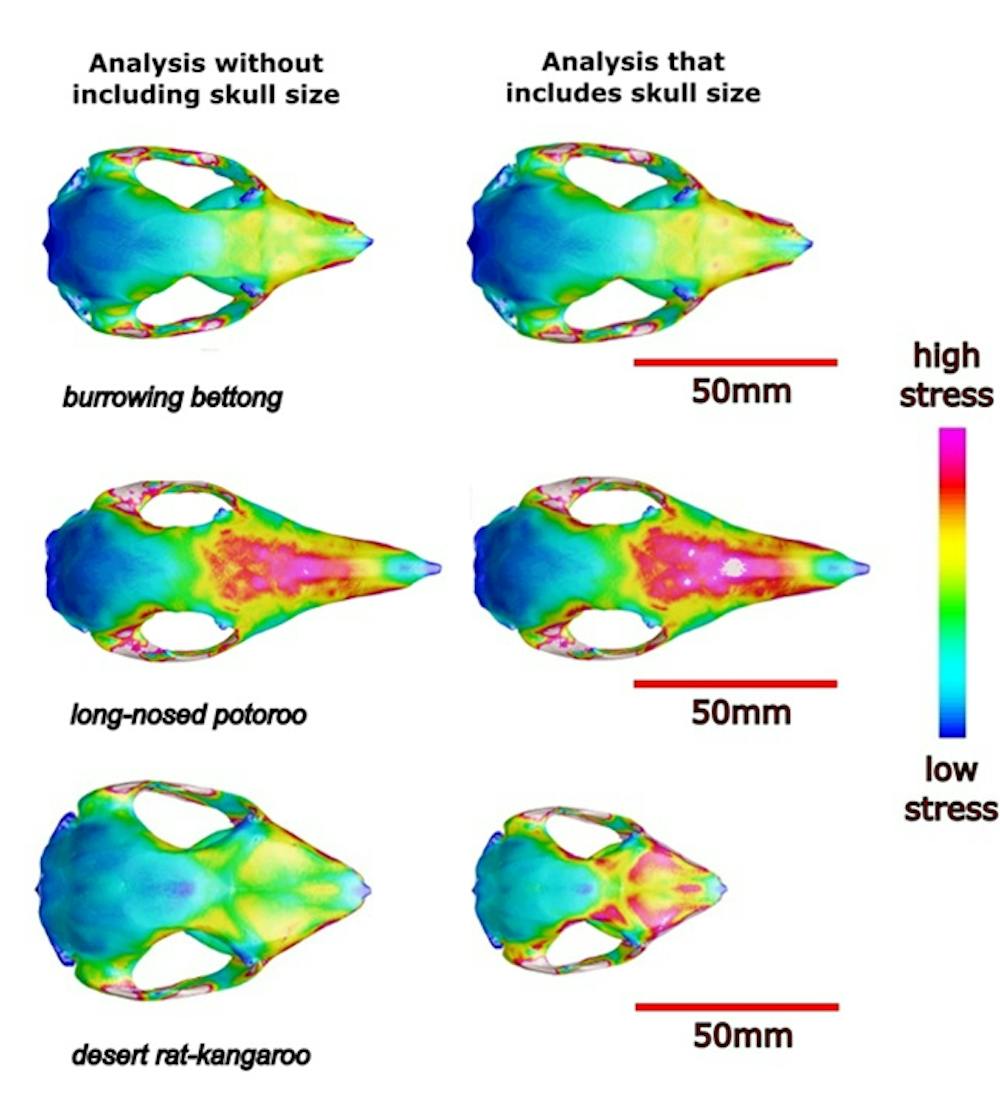
    Our results form part of a paper that addresses this issue in the methods that researchers use. We used a method called finite element analysis, which helps to predict how a structure – in this case, a skull – would handle the forces it experiences in the real world.

    But what we did differently to other researchers was to keep information about size differences between the skulls in the models.

    What did we find?

    The skull of the ngudlukanta is definitely efficient at biting, but it is also about one quarter smaller than the skull of the next smallest species in our sample, the northern bettong.

    When we included its smaller size in the analysis, the results suggested its relatively short face and robust jaw were unlikely to help it eat harder foods.

    Instead, its solid skull features mostly compensated for its small size, but would only allow it to support bites about as hard as those of the long-nosed potoroo – a larger species with a much less efficient skull at biting.

    Finite element models simulating the stress of each skull during biting with the front teeth. The stress in the desert rat-kangaroo is more similar to the hard food-eating burrowing bettong when not including its small size in the models. But its stress levels are more like the long-nosed potoroo when including its small size.
    Authors

    Early investigations of stomach contents from the 1930s tell us the ngudlukanta fed mostly on leaves and small amounts of insects. But little further detail exists. A more restricted range of softer, fresher plant materials, as suggested by our analysis, would narrow its range of preferred foods in the deserts it lived in.

    Our results therefore paint a picture of a species occupying a delicate position within the desert ecosystem.

    An unsolved mystery in a vast desert

    In recent years, one of us (Karl Vernes) has mounted several expeditions into the ngudlukanta‘s habitat, hoping to find evidence of its continued existence.

    However, finding this tiny marsupial in a vast desert is a challenge – not just because it was probably always rare and elusive, but also because we still know precious little about its ecology.

    Eyewitness accounts, remote camera traps, analysis of predator scat (poo) for mammal remains, genetic testing of scats, and the expert ecological knowledge of Traditional Owners have all been used to investigate the possibility of the survival of the ngudlukanta. No definitive evidence has yet emerged.

    Whether the ngudlukanta is extinct or not, therefore, remains an unsolved mystery.

    But history is replete with examples of rediscovered species believed to be extinct, known as “Lazarus species”. The desert’s vast, inhospitable terrain means it is plausible for a small nocturnal species to be evading detection.

    The distinctive short face of the ngudlukanta, alongside its small size and hopping gait, have led eyewitnesses to argue for its persistence.
    Hedley Herbert Finlayson, The Red Centre, 1935

    In fact, the desert rat-kangaroo was already a Lazarus species after its rediscovery in the 1930s. The story of the ngudlukanta therefore serves as a reminder that extinction declarations are not always the end of the story.

    If the species is still roaming the most inhospitable regions of the continent, the new knowledge gained from our analysis could help pinpoint areas where the ngudlukanta might persist.

    Who knows? The next chapter in the story of this desert-dweller may yet surprise us.

    Rex Mitchell has received funding from the Australian Research Council’s Centre of Excellence for Biodiversity and Heritage (CABAH).

    Karl Vernes has received funding from the Australian Research Council, the Mohamed bin Zayed Species Conservation Fund, Experiment.com, the Hermon Slade Foundation and Parks Australia. He is a member of the Australian Mammal Society.

    Vera Weisbecker receives funding from The Australian Research Council. She is affiliated with The Australian Mammal Society and member of the Australian Greens Party.

    ref. Presumed extinct, this desert rat-kangaroo may still be alive in hiding. New analysis reveals its delicate diet – https://theconversation.com/presumed-extinct-this-desert-rat-kangaroo-may-still-be-alive-in-hiding-new-analysis-reveals-its-delicate-diet-250283

    MIL OSI AnalysisEveningReport.nz

  • MIL-OSI Australia: Trailblazing UniSA programs take out national awards

    Source: University of South Australia

    26 February 2025

    From left: UniSA’s Vice Chancellor Professor David Lloyd, Professor Lan Snell, Associate Professor Stewart Von Itzstein, Dino Rossi and Ryan McClenaghan at the awards event

    The University of South Australia’s two nominations in the 2024 national Shaping Australia Awards have taken out both of the prizes in their category.

    Professor Tom Raimondo, Dr Jo Zucco and Associate Professor Stewart Von Itzstein won the Future Builder Award, as the team behind Australia’s first higher degree apprenticeship program, UniSA’s Bachelor of Software Engineering (Honours).

    Professor Lan Snell, Professor Andrew Beer, Peter Stevens, Stan Astachnowicz, Sam Stengert, Leanne Steele, Ling Ly and Jodie Walsh, the team behind UniSA’s trailblazing Global Executive MBA in Defence and Space (GEMBA), took out the People’s Choice Award in the same category.

    The Future Builder category honours initiatives that go above and beyond to deliver out-of-the-box teaching and industry engagement that bridges critical knowledge gaps. UniSA’s 2024 award wins reflect the University’s strengths in innovation and enterprise, and build on similar success in the inaugural awards last year

    The Shaping Australia Awards are an initiative of Universities Australia, which share the valuable contributions universities make to society.

    Bachelor of Software Engineering (Honours)

    UniSA’s Bachelor of Software Engineering (Honours) enables students to work full time at leading companies like BAE Systems, while studying. This hands-on experience, combined with academic rigor, ensures they graduate as work-ready, experienced software engineers.

    Created in partnership with industry partners including BAE and the AI Group, the success of the Bachelor of Software Engineering (Honours) has prompted the Department of State Development to issue a call for expressions of interest to establish additional degree apprenticeships in SA.

    Global Executive MBA in Defence and Space (GEMBA)

    UniSA’s Global Executive MBA in Defence and Space (GEMBA) is a unique18-month program delivered across three countries, reflecting the trilateral nature of the AUKUS alliance. The program equips leaders with advanced skills in areas like cyber security, space systems and defence procurement, and combines immersive residentials in Australia, the UK and the US with high-quality online learning.

    Through partnerships with Carnegie Mellon University, the University of Exeter and leading industry players, GEMBA empowers future leaders to navigate complex global security challenges and drive Australia’s defence and space industries forward.

    Universities Australia Chief Executive Officer Luke Sheehy congratulated all the winners and finalists.

    “These projects are changing lives, driving economic growth and securing Australia’s future. The overwhelming public response reflects the incredible contributions our universities make to help us all,” Sheehy said.

    The awards were judged by a panel of eminent Australians comprising:

    • Lisa Paul AO PSM, University of Canberra Chancellor and former Secretary of the Department of Education
    • Sir Peter Cosgrove AK AC (Mil) CVO MC (Retd), former Governor-General of Australia
    • Ms Charlene Davison, CEO of the Go Foundation.
    • Ms Michelle Gunn, editor-in-chief of The Australian
    • Mr Nicholas Moore AO, special envoy for Southeast Asia
    • Professor Brian Schmidt AC FAA FRS, former Vice-Chancellor of the Australian National University and Nobel laureate.
    • Ms Annabelle Williams OAM, Paralympic Gold Medallist, business owner and lawyer  

    A full list of the 2024 Shaping Australia Awards winners is available at shapingaustraliaawards.com.au.

    Other articles you may be interested in

    MIL OSI News

  • MIL-OSI USA: ICE Gulfport worksite enforcement operation results in multiple arrests

    Source: US Immigration and Customs Enforcement

    U.S. Immigration and Customs Enforcement, working with U.S. Border Patrol’s Gulfport Station, and the Drug Enforcement Administration Gulfport, conducted a worksite enforcement operation at Gulf Coast Prestress Partners, Ltd. in Pass Christian, Mississippi.

    ICE Gulfport served a Notice of Inspection and immigration subpoena to Gulf Coast Prestress. While serving the paperwork and interviewing employees, agents observed a large group of individuals running from the back of the business property. Agents apprehended 18 total fleeing individuals. An immigration inspection on the individuals resulted in the identification of 18 citizens of Mexico, Guatemala, and Honduras. Two individuals had immigration court dates and work authorization and were released. One 16-year-old juvenile Mexican national was identified. ICE Gulfport conducted overnight monitoring of the juvenile and transported the juvenile to Office of Refugee Resettlement custody.

    Under federal law, employers are required to verify the identity and employment eligibility of all individuals they hire, and to document that information using the Employment Eligibility Verification Form I-9. ICE uses the I-9 inspection program to promote compliance with the law, part of a comprehensive strategy to address and deter illegal employment. Inspections are one of the most powerful tools the federal government uses to ensure that businesses are complying with U.S. employment laws.

    ICE’s worksite enforcement strategy includes leveraging the agency’s other investigative disciplines, since worksite investigations can often involve additional criminal activity, such as alien smuggling, human trafficking, money laundering, document fraud, worker exploitation and/or substandard wage and working conditions.

    MIL OSI USA News

  • MIL-OSI Australia: Man charged with aggravated burglary and firearms offences

    Source: Tasmania Police

    Man charged with aggravated burglary and firearms offences

    Wednesday, 26 February 2025 – 9:24 am.

    Detectives from Bridgewater Criminal Investigation Branch have charged a 24-year-old man with a series of offences following a recent planned police operation.
    Police will allege the man was involved in a significant number of firearms burglaries and associated offending in Colebrook and Campania during January and February this year.
    He was arrested by investigators in Rosny on Tuesday, and several search warrants were subsequently executed across Hobart’s eastern shore.
    Electronic exhibits, ammunition and a reportedly stolen motorbike were located in the searches.
    He has been charged with a series of offences including aggravated burglary, motor vehicle stealing, firearms and traffic offences and will appear in the Hobart Magistrates Court today.

    MIL OSI News

  • MIL-OSI USA: Baldwin Demands Answers from Social Security Administration on Musk and DOGE’s Access to Personal Information

    US Senate News:

    Source: United States Senator for Wisconsin Tammy Baldwin

    WASHINGTON, D.C. – U.S. Senator Tammy Baldwin (D-WI) and a group of her colleagues demanded answers from the Social Security Administration regarding the recent turmoil at the agency as Elon Musk and his so-called Department of Government Efficiency (DOGE) embed themselves and gain access to Wisconsinites most sensitive personal information.

    “Providing access to personally identifiable information on hundreds of millions of Americans stored by SSA to DOGE employees without a legitimate reason, and in apparent disregard for privacy laws, regulations, and procedures, raises serious concerns about the security of that data and what DOGE plans to do with it,” wrote Baldwin and the lawmakers.

    The letter seeks answers from Acting Commissioner Leland Dudek about DOGE’s activities at SSA, including:

    • Whether the Acting Commissioner has disclosed any sensitive personal or financial information to any unauthorized persons outside SSA.
    • Whether DOGE has requested or received access to any SSA system that is used in determining eligibility or benefit amount of Social Security or SSI benefits.
    • Whether DOGE has gained access to SSA databases that include personally identifiable information, wage or tax information, or personal health information.
    • Whether any private or commercial servers been connected or integrated into SSA data systems to review, edit, modify, access, delete, move or otherwise change data.
    • What steps are being taken to prevent DOGE from stopping lawful benefit payments or utilizing personally identifiable information for political purposes.

    Earlier this month, Senator Baldwin called on Veterans Affairs (VA) Secretary Doug Collins to take immediate actions to secure veterans’ personal information provided by the VA or other agencies from Elon Musk and DOGE.

    A full version of this letter is available here and below.

    Acting Commissioner Dudek: 

    We write to express deep concern regarding disturbing reports that the President replaced Social Security Administration (SSA) Acting Commissioner Michelle King for refusing to provide Elon Musk and the so-called “Department of Government Efficiency” (DOGE) access to the agency’s most sensitive data without proper documentation, and that you have provided DOGE unfettered access.

    As the central hub for Americans’ most sensitive personal and financial information, and the nation’s largest benefit-paying agency, DOGE’s actions–in seeking access to this information-represent a two-front invasion on Americans’ financial security and privacy.  In response to earlier media reports detailing DOGE’s efforts to access SSA systems, Senator Wyden demanded information from then-Acting Commissioner King to verify these reports and to understand what steps she has taken to protect Americans’ privacy.  In her February 11 response, she wrote that no one affiliated with DOGE had “requested nor received access to the agency’s programmatic systems.”  Further, she stressed that employee access to SSA’s systems is limited to the least privileges necessary to complete job duties, and its systems are continuously monitored to identify suspicious behaviors.

    Stringent privacy laws, regulations, and administrative procedures are in place to protect American’s data, including personally identifiable information, stored and used for legitimate purposes by government agencies. Maybe nowhere is that more important than SSA. For example, the Privacy Act of 1974, as amended (5 U.S.C. 552a, Public Law 93-579), protects Americans against an unwarranted invasion of their privacy related to the disclosure of their personal information. And, in so doing, it requires each federal agency to publish in the Federal Register information related to how and why it is accessing a specific system of records—data that are collected, maintained, used, or disseminated that contain personally identifiable information. To date, no justification has been published related to DOGE actions at SSA or otherwise.  Providing access to personally identifiable information on hundreds of millions of Americans stored by SSA to DOGE employees without a legitimate reason, and in apparent disregard for privacy laws, regulations, and procedures, raises serious concerns about the security of that data and what DOGE plans to do with it.

    We are also concerned that DOGE’s access to these systems has been provided under false pretenses claiming rampant fraud to cut benefits to Americans.  Over the past weekend, Elon Musk repeatedly posted and reposted a false claim that millions of individuals over age 150 are receiving Social Security benefits.  These claims are so easily disproven, and have been repeatedly, that this cannot be a justifiable reason to need complete access to all data housed at SSA.  A simple internet search would show U.S. Census data estimating approximately 80,000 Americans over age 100 living in the United States today, and SSA’s own data shows that roughly 53,000 Americans over age 100 receive Social Security benefits in December 2023. As you know, SSA’s Office of Inspector General (OIG) published an audit in 2023 which found that of the 18.9 million individuals over age 100 that did not have death information reported to SSA, almost none currently receive benefit payments or have reported earnings in the past 50 years.  In the same audit, SSA noted that combing through the agency’s records to update the information of these individuals would cost up to $9.7 million, with little benefit to SSA’s administration of the programs. 

    As you know, the information collected and housed at the agency could have significant commercial value, as well as competitive advantage for individuals seeking to use it for financial gain. Likewise, it could be misappropriated to target American citizens and businesses for political or exploitative means. This includes Americans’ Social Security Numbers; bank and credit card information; birth and marriage certificates; pension information; home and work addresses; school records; citizenship status; immigration or naturalization records; IRS earnings records; health care providers’ contact information; family court records; employment and employer records; psychological or psychiatric health records; hospitalization records; addiction treatment; and test for or records of HIV/AIDS. These records are handled by career civil servants under stringent federal and state privacy laws and regulations to protect Americans’ health and financial information.

    As you well know, SSA employs sophisticated systems, processes, and controls to ensure that benefits are paid the correct amount to the correct person. SSA has made great strides in improving its program integrity systems to reduce improper payments and to prevent instances of waste, fraud, or abuse.  While we agree that more can always be done to improve SSA’s process, Musk and DOGE do not appear to be interested in improving the system for Americans.  Rather than working collaboratively with the agency to understand and improve its existing systems, Musk and DOGE have been keener on publicizing misleading or blatantly inaccurate information about Social Security. This raises questions on whether their pursuit of combatting waste, fraud, and abuse is purely performative rather than sincere.

    Moreover, the President’s decision to replace a career SSA official with over three decades of agency experience with an employee with no executive experience will likely trigger a cascade of departures of experienced agency personnel, as former Commissioner O’Malley warned. At a time when the agency’s workforce is at a 50-year low, the potential loss of centuries’ worth of agency experience will risk worsening backlogs, longer wait times, and interruption of benefit payments.  When combined with SSA providing inexperienced individuals unfettered access to the agency’s sensitive systems, there is a profound risk of causing irreparable harm to the agency’s systems and Americans’ financial security.

    Finally, we are also concerned of reports that prior to your appointment as Acting Commissioner, you were placed on administrative leave pending an investigation into you sharing sensitive documents with individuals not authorized to access such information, and for harassing and threatening fellow SSA employees to work with DOGE. If accurate, your actions demonstrate a betrayal of trust and your oath of office and may violate federal privacy laws.

    For this reason, we request that you respond to the following questions no later than February 25, 2025:

    1. Have you disclosed any personally identifiable information (PII), protected health information (PHI), federal tax information (FTI), or other sensitive personal and financial information in any SSA data systems to:
      1. Any SSA personnel or SSA contractors who lacked the appropriate statutory authority to access such information;
      2. Non-SSA federal employees;
      3. Non-SSA federal contractors;
      4. Special Government Employees (SGEs); or
      5. Any other unauthorized persons?
    1. Has DOGE, or any individuals or entities operating under the guise of or direction of DOGE (including such individuals who may have been onboarded to the Agency and received an Agency or Departmental email address) requested or received access to any SSA system that is used in determining eligibility or benefit amount of Social Security or SSI benefits?
      1. If so, who granted such access, to which systems, and for what specific purposes? Please name each system and provide the names of individuals who have been given access to such system.
      2. Under what legal authority did SSA grant such access? Please provide a detailed description of this authority and copies of all communication between individuals associated with the “Department of Government Efficiency” and SSA systems.
      3. For each individual who has been given access to SSA data systems since January 20, 2025, please provide information on:
        1. The agency to which each such individual has been onboarded (or working as a contractor for) and whether an individual who may have been onboarded to a different agency has been given an SSA email address;
        2. Which federal forms each such individual completed relating to background checks (i.e. SF-85, SF-85P, SF 85PS, SF-86);
        3. Whether the Federal Bureau of Investigation (FBI) completed a background check for each such individual;
        4. Whether the individuals have used their data access privileges consistent with any restrictions based on their respective security clearance levels;
        5. What trainings on security, health information privacy, cybersecurity, financial, fraud, or other trainings required of SSA or their contractors these individuals have undertaken and when.
      4. Please provide a list of queries run on each such system by each user, since January 20, 2025, including dates and usernames.
      5. Please provide a thorough accounting of the information each individual reviewed, modified, accessed, deleted, or otherwise edited under such system.
      6. For any information that has been modified, edited, or deleted, please provide an accounting of the variables, entries, and the exact changes made, as well as for what purpose.
      7. Please provide details on any information from any such systems that were downloaded, copied, transferred, or otherwise removed from the Agency. Please specify which data, by what means they were downloaded or transferred, and to whom or what entity.
    1. Has DOGE, or any individuals or entities operating under the direction of DOGE gained access to SSA databases that include personally identifiable information, wage or tax information, or personal health information?
      1. If so, which data have been reviewed, modified, deleted, or otherwise edited or removed, copied, or downloaded or otherwise transferred by these individuals?
      2. Under what legal authority did SSA grant such access? Please provide a detailed description of this authority and copies of all communication between individuals or entities operating under the direction of DOGE and SSA officials related to the granting of this access.
      3. How many individuals does this affect? Have these individuals been notified that their information has been accessed and for what purposes in accordance with the requirements of the Privacy Act of 1974, as amended, and Section 1106 of the Social Security Act (42 U.S.C. 1306)? Please provide documentation.
      4. To the extent personally identifiable information were accessed since January 20, 2025, please provide the System of Record Notice included in the Federal Register reflective of this access.
    1. Have any private or commercial servers been connected or integrated into SSA data systems to review, edit, modify, access, delete, move or otherwise change data?
      1. If so, please explain the origin of such servers and provide documentation related to testing and validating controls to ensure no new vulnerabilities were introduced into SSA data systems upon use.
      2. For any data that were moved to a private or commercial server, please show how that system has been reviewed and is abiding by the National Institute of Standards and Technology (NIST) special publication 800-171, Protecting Controlled Unclassified Information in Nonfederal Systems and Organizations.
      3.  For any data that were moved to a private or commercial server, please provide detailed information related to whether any safe storage standards are being employed.
    1. Attempts to suspend federal payments have been reportedly attempted by individuals or entities operating under the direction of DOGE. We are deeply concerned that DOGE may attempt to stop lawful payments for Social Security and SSI benefit payments, deny benefits to individuals who are perceived to not support President Trump, or otherwise inflict financial harm on individuals.
      1. What steps have been taken to ensure that the data of individuals, beneficiaries, and health care providers are protected from unlawful payment suspensions or data leaks?
      2. What specific steps have been taken to ensure compliance with current laws, guidance, and regulations to ensure that the use of these data will not interfere with timely payments of Social Security and SSI benefits?
      3. What specific steps have been taken to ensure compliance with current laws, guidance, and regulations to ensure that personally identifiable information that is held on SSA systems is not being utilized for politically motivated purposes?

    Thank you for your attention to this urgent matter. We look forward to your prompt response.

    Sincerely,

    An online version of this release is available here.

    MIL OSI USA News

  • MIL-OSI USA: Warren Questions Private Equity Executive Who Helped Bankrupt Steward Hospitals, Feinberg Squirms Without Answers

    US Senate News:

    Source: United States Senator for Massachusetts – Elizabeth Warren

    February 25, 2025

    Trump Nominee Seeks A Top Pentagon Leadership Role

    Video of Exchange (YouTube)

    Washington, D.C. – At a hearing of the Senate Armed Services Committee, U.S. Senator Elizabeth Warren (D-Mass.) questioned Mr. Stephen A. Feinberg, President of Cerberus Capital Management and nominee for Deputy Secretary of Defense, about his troubled private equity history and his qualifications for the job of second-in-command at the Pentagon. 

    Senator Warren called out Mr. Feinberg’s involvement in Steward Health Care, a now-bankrupt hospital system, which once owned 31 hospitals nationwide. In Massachusetts specifically, Mr. Feinberg enriched himself and his investors at the expense of the hospitals, sucking out over $700 million while leaving the hospitals understaffed, underresourced, and severely indebted. In part due to his corporate extraction, the system went bankrupt and, two Massachusetts hospitals shut down for good, leaving Massachusetts communities without access to the care they need. 

    Mr. Feinberg claimed Steward hospitals were doing “well” at the time Cerberus sold the company. However, “[m]any Steward hospitals were financially struggling as Cerberus began to make its exit in 2020,” according to the Private Equity Stakeholder Project. More importantly, before he left, Mr. Feinberg sold the hospitals’ real estate, cashing out the profits but leaving the hospitals with massive liabilities in the form of years of increasing lease payments for the land they used – a key factor in the hospitals’ 2024 bankruptcy.

    Mr. Feinberg claimed he “turned [Steward] around, fixed them, grew them, [and] had a tremendous amount of success.” However, he slashed a full medical center, a primary and specialty care unit, a surgery department, an urgent care department, and a VA Clinic at a Quincy Medical Center, leaving nothing but an emergency room. Additionally, just two years after Cerberus took over Steward, nurses in Massachusetts filed more than 1,000 “unsafe staffing” complaints, a significant increase from previous years.

    Transcript: Hearing to Consider the Nomination of Mr. Stephen A. Feinberg to be Deputy Secretary of Defense
    U.S. Senate Armed Services Committee 
    February 25, 2025 

    Senator Elizabeth Warren: So, Mr. Feinberg, you’ve been nominated to be Deputy Secretary of Defense, in charge of DOD’s $850 billion budget. Your main qualification is that you have built one of the world’s largest private equity companies. You’ve spent your entire career honing the private equity tools used to hollow out businesses, from department stores to veterinary practices. And, presumably, those are the skills that you would bring to the Department of Defense. So, I just want to look at how that’s worked.

    Let’s start with how you treat people. In Massachusetts, in 2010, your private equity firm bought six non-profit hospitals, turned them into for-profit hospitals called Steward. Ten years later you cashed out, having made a profit a little shy of a billion dollars, and leaving behind a hospital system that was staggered under a load of debt and, four years later, collapsed into bankruptcy.

    Now, Mr. Feinberg, when we met in my office, you told me that your private equity outfit made an average 23% annual return each year that you owned our hospitals. If Steward nurses had gotten the same 23% salary increases that your investors effectively got every year, do you know how much they would be paid at the time you sold off your hospitals?  

    Mr. Stephen A. Feinberg, nominee for Deputy Secretary of Defense: Well, I do know that in 2010, the hospitals were going under, and we were asked – 

    Senator Warren: I’m sorry, Mr. Feinberg, we’re going to have very limited time here and I actually want to spend it on your qualifications to do this job. And it’s about how you treat people. The average nurse in the Steward hospitals at the time you bought them made $85,120. 

    At a 23% annual raise, how much money would they be making right now? 

    Mr. Feinberg: I’m not going to do the math, but what I could tell you – 

    Senator Warren: Okay, I’ll do the math for you. $829,828. Now, of course, the nurses didn’t do that well. During that same period of time, Carney Hospital, one of the hospitals you bought in Massachusetts, raised nurse salaries about 1.5% a year – and that was the best increase across the Steward hospitals that you were running. 

    Mr. Feinberg: That’s incorrect. 

    Senator Warren: In other words, you seem to think that when it is time to reorganize a business, that equity should get about fifteen times as much return on their investment as the people who actually do the work.

    So, let’s take a look at the second issue, and that is maintaining critical functions – 

    Mr. Feinberg: Senator, would you like me to respond to Steward? Because a lot of inaccurate statements. 

    Senator Warren: We need to make cuts at the Department of Defense, but we also need to maintain our national security.  

    Chair Wicker: Mr. Feinberg, she’s entitled to make a speech. 

    Mr. Feinberg: I apologize. 

    Chair Wicker: She’s entitled to go on and on. 

    Senator Warren: So let’s go back to Steward Hospitals. Did you cut fat or cut vital functions?  

    Now, Mr. Feinberg, the town of Quincy used to have a full medical center, with primary and specialty care, a surgery department, an urgent care department, and a VA Clinic. That was its basic function. After your private equity company finished with it, what was left?

    Mr. Feinberg: Well, when we exited the investment in 2020, the company was doing well –

    Senator Warren: I’m asking what was left of the Quincy hospital. When you took it over – 

    Chair Wicker: Now, Senator, he’s trying to answer a question. You finally stopped for a breath. 

    Senator Warren: Well, that’s what I’m asking – 

    Chair Wicker: Do you intend to let him at least have maybe 20, 30 seconds to answer a question? 

    Senator Warren: Well, can I have my time back? 

    Chair Wicker: Yes, I said you’re entitled to make a speech, but you stopped for – you stopped with a question mark and he started to try to answer the question. 

    Senator Warren: All right, what’s the answer to the question? What was left of the Quincy hospital? That was my question. 

    Mr. Feinberg: Lots happened after we exited. And there has been mismanagement. We did save – 

    Senator Warren: My clarifying question: what was left when you exited? 

    Mr. Feinberg: I’m not certain about that – 

    Senator Warren: It was an emergency room, and nothing more.  

    Mr. Feinberg: But, but, we took those hospitals from collapse in 2010 – we were going to shut it down as the tenth largest employer in Massachusetts, turned them around, fixed them, grew them, had a tremendous amount of success, worked closely with the governor, and the problems with Steward happened after we exited the investment. 

    Senator Warren: I am asking about questions as you exited and during the period of time you ran it. Now, of course, a hospital is supposed to provide good quality care—and that takes qualified nurses and other staffers. Mr. Feinberg, for the hospitals that didn’t close down, during the time you ran it, do you know how many “unsafe staffing” complaints were filed?

    Mr. Feinberg: I do know the vast majority of problems happened after we left. And by the way, our nurses were among the highest paid in the country.

    Senator Warren: Is that a no, that you don’t know how much? How many “unsafe staffing” complaints were filed? 

    Mr. Feinberg: I don’t know. 

    Senator Warren: Well, let me tell you. There were over a thousand filed, that is five times the normal rate in Massachusetts. 

    Mr. Feinberg: What year was that? 

    Senator Warren: These are the years that you were in control. For the two hospitals – 

    Chair Wicker: Senator Warren, perhaps you would like to take another round?

    Senator Warren: No, I’d like to just finish. I just have a quote. 

    Chair Wicker: Your time is expired, Senator. Your time is expired. 

    Senator Warren: I spent a great deal of that time listening to the Chairman telling me how I have to conduct my questions. 

    Chair Wicker: The senator’s time is expired. 

    Senator Warren: Could I just close? 

    Chair Wicker: Senator Sullivan. 

    Senator Warren: Could I just close, Mr. Chairman? I’d just like to say why I care about this issue. 

    Chair Wicker: The senator’s time has expired. She can have another round.

    MIL OSI USA News

  • MIL-OSI New Zealand: On the road again – rebuilding a section of SH1 at Topuni

    Source: New Zealand Transport Agency

    Contractors will begin work to rebuild a section of State Highway 1 at Topuni, north of Old North Road, tomorrow (Thursday 27 February).

    Work is expected to be completed by Thursday 17 April. The first five weeks (until approx. Wednesday 2 April) will be day works, between 6.30am and 5.30pm, while the final two weeks will be undertaken at night, between 5.30pm and 6.30am.

    During work hours, the road will be down to a single lane with stop/go traffic management and a 30km/h temporary speed limit in place. Outside work hours, the road will reopen to two lanes with a temporary speed limit in place.

    Travel delays during these works are expected to be approximately 5 mins and people are asked to plan ahead.

    Please be patient and treat our crews with kindness and respect. Reduce your speed, adhere to the temporary speed limits and follow the directions of traffic management staff and signs.

    Rebuilding the road, which often involves replacing all or most of the structural road layers, improves the longevity of the network, the resilience and ultimately the safety and efficiency for all road users.

    This summer maintenance period (September 2024 to May 2025), we’re investing in the largest road rebuild programme ever for the region, with Northland one of three regions across Aotearoa with the most significant road rebuild programmes over the next three years. 

    This work is weather dependent and there may be changes to the planned works in the case of unsuitable weather. Please visit the NZTA Journey Planner website for up-to-date information on these works, including any changes due to weather:

    For more information about the overall maintenance programme and planned works, visit the Northland State Highway Maintenance Programme website:

    You can now sign up to receive email updates on upcoming road maintenance:

    NZTA thanks everyone for their understanding and support while we carry out this essential maintenance to improve the safety and efficiency of Northland’s state highway network.

    MIL OSI New Zealand News

  • MIL-OSI USA: Governor Polis in Washington Pushing Congress to Reject Harmful Medicaid Cuts

    Source: US State of Colorado

    WASHINGTON DC – While in Washington DC, Colorado Governor Jared Polis spoke with Members of Congress today, urging them to reject the proposed $880 billion dollar proposed cuts to Medicaid which would be devastating for hardworking Coloradans, rural hospitals, and safety net providers. Roughly 1.3 million Colorado children and adults are enrolled in Medicaid and the Child Health Plan Plus, which are funded jointly by the state and federal government. These cuts could lead to 15.9 million Americans losing Medicaid and CHIP coverage in 2026. The U.S. House of Representatives has a scheduled vote on Medicaid cuts this week.

     “Today I urged members of Congress to reject these harmful cuts to Medicaid, which would devastate hardworking Coloradans. If Congress votes to cut Medicaid they will be pulling the rug out from under rural hospitals, communities, and safety net providers. Hundreds of thousands of people In Colorado could be kicked off their health care. The bottom line is that these cruel proposed cuts simply don’t make sense, and would harm Coloradans and children,” said Colorado Governor Jared Polis. 

    Recently, Governor Polis led the National Governors Association Winter Meeting as Chair, where Governors approved Federal Priorities, including protecting funding for important support like Medicaid and ensuring states have flexibility and waiver opportunities to deliver this critical support. 

    ###

    MIL OSI USA News

  • MIL-OSI Security: King County man who dealt narcotics on the dark web and kept a cache of weapons at his RV sentenced to 8 years in prison

    Source: Office of United States Attorneys

    Law enforcement was already investigating dark web drug trafficking when defendant was shot near Olallie State Park

    Seattle – A King County man, arrested after law enforcement discovered a drug lab and cache of firearms and explosives inside an RV near a state park, was sentenced today to eight years in prison for possession of fentanyl with intent to distribute, unlawful possession of a machinegun, and unlawful possession of destructive devices, announced Acting U.S. Attorney Teal Luthy Miller. Braiden F. Wilson, 29, and his partner, 30- year-old Chandler B. Bennett were arrested following a May 12, 2024, shooting in rural King County.  At today’s sentencing hearing U.S. District Judge Lauren King said, the crimes “were egregious… You distributed a large amount of drugs that cause a danger to our community.”

    “Mr. Wilson used the dark web to advertise his potentially deadly wares, shipping fentanyl pills across the country,” said Acting U.S. Attorney Miller. “He further placed the lives of the community in danger by stockpiling a cache of weapons and explosives, which he stored adjacent to a state park frequented by the public.”

    According to records filed in the case, Homeland Security Investigation (HSI) was investigating Wilson for dealing drugs on the dark web, when King County Sheriff’s deputies were called to the RV near Olallie State Park when Wilson was shot. The deputies noticed that the RV had surveillance cameras and asked to get access to the recorded video to identify the assailant. Bennett refused to allow law enforcement to enter the RV, so they sought a warrant from a King County Judge.

    When law enforcement entered the RV, they found a large cache of weapons as well as fentanyl powder, tablets containing fentanyl, and sundry items associated with the manufacture of tablets, including a manual pill press. Law enforcement located more than two and a half kilograms of fentanyl-laced pills. Law enforcement seized 16 firearms, body armor, silencers, and ballistic shields. They also found gun parts made from 3D printers – making them untraceable. There were multiple destructive devices and literature on the chemistry and manufacturing of explosives, as well as literature on how to convert firearms to fully automatic capability.

    Agents and officers also searched two storage units associated with Wilson and found two additional pill presses, more controlled substances, and mailing supplies. In all law enforcement seized more than two kilos of fentanyl-laced pills, nearly a kilo of fentanyl powder, and more than three kilos of methamphetamine. Computer and bank records reveal that Wilson distributed controlled substances via his dark web identity more than 2,000 times and he took in more than $287,000 in crypto currency.

    Wilson pleaded guilty in October 2024.

    Asking for an eight-year prison sentence prosecutors wrote to the court, “Wilson engaged in a comprehensive enterprise to distribute fentanyl-laced pills throughout the country by offering his products for sale on dark web 

    marketplaces…  He maintained a veritable armory while engaged in his drug distribution business. Inside the motorhomes Wilson shared with his co-defendant, investigators found an operable machinegun; silencers designed to muffle the report of a discharged firearm; a shotgun stored in a case designed to look like it carried a musical instrument; destructive devices commonly called pipe bombs; and materials to make more destructive devices.”

    “This is another example of great work by our patrol deputies, as they went above and beyond on a call that resulted in taking two dangerous criminals off the street,” said King County Sheriff Patti Cole-Tindall. “Additionally, I am so proud of the work done by our Gun Violence Reduction Unit.  That team was able to ensure the proper steps were taken in this investigation, and in partnership with several federal agencies, were able to hold these people accountable and ensure justice was served.”

    The case was investigated by Homeland Security Investigation (HSI), the King County Sheriff’s Office, the Bureau of Alcohol, Tobacco, Firearms & Explosives (ATF), the United States Postal Inspection Service (USPIS), the Federal Bureau of Investigation (FBI), and the Drug Enforcement Administration (DEA), with assistance from the Washington State Patrol.

    The case is being prosecuted by Assistant United States Attorneys Casey Conzatti and Brian Wynne.

    MIL Security OSI

  • MIL-OSI Security: Convicted Felon Caught with Firearm During Traffic Stop Sentenced to 30 Months

    Source: Office of United States Attorneys

    PORTLAND, Maine: A Massachusetts man was sentenced today in U.S. District Court in Portland for being a felon in possession of a firearm.

    U.S. District Judge Nancy Torresen sentenced Keon Shine (aka Keylin Hall), 35, to 30 months in prison followed by 3 years of supervised release. Shine pleaded guilty on July 29, 2024.

    According to court records, in June 2023, the Lewiston Police Department stopped a vehicle in which Shine was a passenger. A check of the vehicle’s occupants revealed that Shine had previously served six and a half years in federal prison for illegally possessing a firearm and was on federal probation. When questioned by law enforcement, the vehicle’s driver said there was a firearm in the vehicle’s center console. Shine later admitted when questioned by investigators from the Bureau of Alcohol, Tobacco, Firearms and Explosives (ATF) that the Glock firearm recovered belonged to him. Shine’s 2017 conviction in the U.S. District Court for the District of Maine precluded him from possessing a firearm. 

    The Lewiston Police Department and ATF investigated the case.

    Project Safe Neighborhoods: This case is part of Project Safe Neighborhoods (PSN), a program bringing together all levels of law enforcement and the communities they serve to reduce violent crime and gun violence, and to make our neighborhoods safer for everyone.On May 26, 2021, the Department launched a violent crime reduction strategy strengthening PSN based on these core principles: fostering trust and legitimacy in our communities, supporting community-based organizations that help prevent violence from occurring in the first place, setting focused and strategic enforcement priorities, and measuring the results. For more information about Project Safe Childhood, visit https://www.justice.gov/usao-me/psn.

    ###

    MIL Security OSI

  • MIL-OSI Security: Orleans Man Sentenced to 10 Years in Prison for Child Pornography Offenses

    Source: Office of United States Attorneys

    BOSTON – An Orleans man was sentenced today in federal court in Boston for child pornography offenses.

    Anthony Argo, 34, was sentenced by U.S. District Court Judge Myong J. Joun to 10 years in prison, to be followed by five years of supervised release. In November 2024, Argo pleaded guilty to possession of child sexual abuse material (CSAM). Argo was arrested and charged in July 2024.

    Argo was identified as the user of a chat application who was expressing sexual interest in minors and sharing CSAM. During a search of his residence, Argo was found in possession of an SD card and multiple USB drives containing thousands of images depicting child pornography. The files depicted children as young as infants.  

    According to court documents, Argo was previously convicted in Barnstable District Court for indecent assault and battery on a person 14 or over and in Orleans District Court for kidnapping, enticement of a child under 16 and distributing obscene matter to a minor.

    United States Attorney Leah B. Foley and Michael J. Krol, Special Agent in Charge of Homeland Security Investigations in New England made the announcement today. Special assistance was provided by Homeland Security Investigations in Frederick, Maryland and the Orleans Police Department. Assistant U.S. Attorney Lauren Maynard of the Major Crimes Unit prosecuted the case.

    This case was brought as part of Project Safe Childhood, a nationwide initiative to combat the growing epidemic of child sexual exploitation and abuse, launched in May 2006 by the Department of Justice. Led by the U.S. Attorneys’ Offices and the DOJ’s Child Exploitation and Obscenity Section, Project Safe Childhood marshals federal, state and local resources to locate, apprehend, and prosecute individuals who exploit children, as well as identify and rescue victims. For more information about Project Safe Childhood, please visit https://www.justice.gov/psc.
     

    MIL Security OSI

  • MIL-OSI Security: Maryland Man Convicted Of Narcotics Distribution Resulting In Death

    Source: Office of United States Attorneys

    Greenbelt, Maryland – After a seven-day trial, a federal jury returned a verdict against OJ Rashad Green, also known as “Ice” age 36, of Accokeek, finding him guilty of knowingly and intentionally distributing fentanyl, a controlled substance, on multiple occasions. 

    The guilty verdict was announced by Phil Selden, Acting United States Attorney for the District of Maryland; Ibrar A. Mian of the Drug Enforcement Administration – Washington Division; Chief Malik Aziz of the Prince George’s County Police Department, Sheriff Troy Berry of the Charles County Sheriff’s Office, and Colonel Roland L. Butler, Jr., of the Maryland State Police.

    “As proven at Defendant Green’s federal trial he sold fentanyl that fueled the opioid crisis in Southern Maryland,” stated Acting United States Attorney Phil Selden.  “Maryland has been deeply impacted by the opioid crisis, and the District of Maryland U.S. Attorney’s Office, in partnership with our federal, state and local partners, will continue our tireless efforts to prosecute drug traffickers responsible for this crisis.”

    Ibrar A. Mian, Special Agent in Charge of the DEA Washington Division stated that “to protect the American public, it is the mission of the DEA to investigate and take down violent drug traffickers like Mr. Green, that are preying on our citizens illegally distributing fake pills containing lethal amounts of fentanyl with no regard for human lives. Today’s guilty verdict emphasizes our commitment to the tireless work of investigating and prosecuting those responsible for fueling addiction and deadly overdoses and poisonings in our area – saving lives in our communities.”

    According to the evidence presented at trial, from on or about January 21, 2022 through September 28, 2022 the Defendant, OJ Rashad Green, repeatedly distributed fentanyl in the Accokeek, Maryland area.  These distributions happened at both a home he controlled in Accokeek and during in-person deliveries at various locations to users and other dealers.  The Defendant employed individuals as both testers of the fentanyl that the Defendant mixed with various other substances, and as runners to meet customers outside the home.

    A federal district court judge determines sentencing after considering the U.S. Sentencing Guidelines and other statutory factors. U.S. District Judge Deborah K. Chasanow scheduled sentencing for a future date.

    Acting United States Attorney Phil Selden commended the DEA and PGPD, for their work in the investigation.  Mr. Selden thanked Assistant U.S. Attorneys Darren S. Gardner and Brooke Oki, who are prosecuting the federal case.

    For more information on the Maryland U.S. Attorney’s Office, its priorities, and resources available to help the community, please visit www.justice.gov/usao-md and https://www.justice.gov/usao-md/community-outreach.

    MIL Security OSI

  • MIL-OSI Security: Former NOPD Sergeant Sentenced to 5 Years Probation After Pleading Guilty to Six Counts of Wire Fraud tor Double Billing and Billing for Time Not Worked

    Source: Office of United States Attorneys

    NEW ORLEANS – Acting U.S. Attorney Michael M. Simpson announced today that United States District Judge Jay C. Zainey sentenced former New Orleans Police Department Sergeant TODD F. MORRELL, age 57, a resident of New Orleans, to 5 years of probation, 8 months of home confinement, 150 hours of community service, a $5,000 fine, and payment of a mandatory $600 special assessment fee after he previously pleaded guilty to six (6) counts of wire fraud, in violation of Title 18, United States Code, Section 1343, for perpetrating a multi-year scheme to defraud NOPD and the New Orleans Fair Grounds, an entity that paid him to provide off-duty police details.  A restitution hearing is set for April 29, 2025.

    According to court documents, MORRELLwas a NOPD Sergeant with NOPD’s Special Operations Division, serving both on a Tactical Platoon and the Bomb Disposal Unit.  He supplemented his NOPD income with security-oriented secondary employment (i.e., “police details”) while off-duty, including a detail with the New Orleans Fair Grounds Neighborhood Patrol (“Fair Grounds Patrol”).  The Fair Grounds Patrol was created by city ordinance to enhance police service around the New Orleans Fair Grounds Racecourse.  The Fair Grounds Patrol consisted of two patrol cars operating 24 hours per day, 7 days a week, with one off-duty NOPD officer per car.  MORRELL signed annual certifications attesting to his understanding of NOPD policies, including the secondary employment policy, and acknowledging that he would “actively monitor my hours” and would “not engage in activities or personal business which would cause them to neglect or be inattentive to duty.”

    Notwithstanding these annual certifications, on numerous occasions between early 2017 and November 30, 2021, MORRELL submitted and certified timecards to NOPD and time sheets to the Fair Grounds Patrol,falsely claiming to have been on duty (for NOPD) and on detail (for the Fair Grounds Patrol) when, in actuality, MORRELL was not present for duty.  Instead, MORRELL engaged in personal, recreational activities unrelated to his work duties.  Often, MORRELL was engaged in recreational race car driving in Avondale, Louisiana, and Austin, Texas, while claiming to be on duty and on detail.  Additionally, MORRELL “double billed” NOPD and the Fair Grounds Patrol by submitting time sheets to both entities reflecting that he was working for both entities simultaneously.  The six counts to which MORRELL pled guilty, are representative examples of his scheme.  These counts related to individual payments MORRELL received for submitting false and fraudulent time sheets for on duty and secondary employment shifts while a part of the Fair Grounds Patrol.  The various dates he falsely claimed to work that constituted the six counts were: July 1, 2019, December 21, 2020, January 23, 2021, March 13, 2021, March 14, 2021, April 25, 2021, April 30, 2021, and October 23, 2021.

    “When anyone willfully commits fraud, our office will investigate, and if warranted, prosecute,” stated Acting United States Attorney Michael M. Simpson.  “Mr. Morrell’s sentencing is an acknowledgment of the betrayal, and breach of public trust, as well as the resultant harm stemming therefrom, that his serial fraudulent acts have caused the New Orleans Police Department, and the citizens of New Orleans.  This successful investigation and prosecution, exemplify the strong partnership between our office, the FBI, the New Orleans Office of Inspector General and the New Orleans Public Integrity Bureau.”

    “The FBI will continue to investigate fraud and corruption at all levels of government and individuals like Mr. Morrell who exploit the public’s trust for personal gain,” said FBI New Orleans Acting Special Agent in Charge Stephen Cyrus.  “We thank the New Orleans Inspector General’s Office and the New Orleans Public Integrity Bureau for their assistance in bringing this misconduct to light.”

    Acting U.S. Attorney Simpson praised the work of the Federal Bureau of Investigation in investigating this matter and expressed appreciation for the support provided by the City of New Orleans Office of Inspector General and the New Orleans Public Integrity Bureau.  Assistant United States Attorneys Jordan Ginsberg, Chief of the Public Integrity Unit, and Brittany L. Reed also of the Public Integrity Unit, are in charge of the prosecution.

    MIL Security OSI

  • MIL-OSI Security: New Haven Man Sentenced to 10 Years in Federal Prison for 2 Gunpoint Robberies in 2023

    Source: Office of United States Attorneys

    Marc H. Silverman, Acting United States Attorney for the District of Connecticut, announced that GARY GIBSON, JR., 25, of New Haven, was sentenced today by U.S. District Judge Robert N. Chatigny in Hartford to 120 months of imprisonment, followed by four years of supervised release, for a firearm offense stemming from his armed robberies of two convenience stores in May 2023.

    According to court documents and statements made in court, shortly after midnight on May 7, 2023, Gibson, brandishing a Glock semiautomatic handgun, robbed the Star Food & Convenience Store, located at 193 Boston Post Road in West Haven.  Gibson took approximately $1,860 cash from the register and took cash and an iPhone from an employee of the store.

    In the afternoon of May 8, 2023, Gibson entered the 7th Haven Convenience Store, located at 129 Sylvan Avenue in New Haven, and forced an employee to the ground at gunpoint.  After taking approximately $5,700 cash from the register and rent money, Gibson fired a shot into the ceiling during a struggle with the employee.  Gibson then fled.

    New Haven Police, with the assistance of West Haven Police, arrested Gibson in Milford shortly after the New Haven robbery and seized from him the handgun used during the robberies.  The gun had an attached laser sight and a loaded 15-round magazine.

    Gibson’s criminal history includes six felony convictions for weapon possession, robbery, and larceny offenses.  It is a violation of federal law for a person previously convicted of a felony offense to possess a firearm or ammunition that has moved in interstate or foreign commerce.

    Gibson has been detained since May 8, 2023.  On July 15, 2024, he pleaded guilty to carrying, using, and discharging a firearm during and in relation to a crime of violence.

    Judge Chatigny ordered Gibson to pay $7,560 in restitution.

    This matter was investigated by the FBI’s Connecticut Violent Crimes Task Force, the New Haven Police Department, and the West Haven Police Department.

    The case was prosecuted by Assistant U.S. Attorney Robert S. Ruff through Project Safe Neighborhoods (PSN), the centerpiece of the Department of Justice’s violent crime reduction efforts.  PSN is an evidence-based program proven to be effective at reducing violent crime.  Through PSN, a broad spectrum of stakeholders work together to identify the most pressing violent crime problems in the community and develop comprehensive solutions to address them.  As part of this strategy, PSN focuses enforcement efforts on the most violent offenders and partners with locally based prevention and reentry programs for lasting reductions in crime.  For more information about Project Safe Neighborhoods, please visit www.justice.gov/psn.

    MIL Security OSI

  • MIL-OSI Security: Dive Boat Owner/Operator Pleads Guilty to Violating the Federal Clean Water Act

    Source: Office of United States Attorneys

    MIAMI – Today, a Florida woman pled guilty in federal district court to violating the Clean Water Act by knowingly discharging a harmful quantity of oil into United States and contiguous zone waters.

    According to court documents and statements made at today’s hearing, Liza R. Hash, 48, of Inglis, Fla. owned and operated the S/V JULIET, an 88-foot, 118 gross ton, steel-hulled sailing vessel built in 1974. For approximately six years, Hash operated the vessel between Miami and the Bahamas, on multi-day scuba diving excursions. She carried as many as 12 passengers per trip plus crew.

    On June 16, 2023, Investigating Officers (CGIOs) from the U.S. Coast Guard Sector Miami boarded the S/V JULIET upon its return from a trip to the Bahamas. After noticing an active oil sheen originating from the vessel, they conducted a safety examination.

    During the examination, the CGIOs noted oily water in the vessel’s bilge and an electric submersible pump in the space beneath the main diesel engine. The pump was connected to the vessel’s grey water tank, which was arranged to be discharged overboard without treatment. The Defendant admitted that she would use the bilge pump to transfer oil-contaminated bilge waste first into the grey water tank. Then, she would use the grey water tank’s separate discharge pump to empty the untreated contents into U.S. waters. The grey water tank was neither designed nor intended to handle oily bilge wastes, but rather to hold liquids from the vessel’s washer, dryer, sinks, showers, and air conditioning unit.

    Calculations performed by the CGIOs revealed that over the preceding five years of operation, approximately 26,000 gallons of oily water would have been illegally discharged from the S/V JULIET. Such wastes should have been held on board for proper pump-out and disposal at a shore-side facility.

    United States District Judge Rodolfo A. Ruiz, II, set sentencing in the case for May 21, 2025, at 1:30 p.m. The defendant faces up to three years’ imprisonment, followed by up to three years of supervised release. In addition, the court may impose a fine of up to $250,000.

    Hayden P. O’Byrne, United States Attorney for the Southern District of Florida, and Kristopher Martel, Assistant Special Agent in Charge of the Environmental Protection Agency’s criminal enforcement program in Florida, announced the guilty plea.

    United States Attorney O’Byrne commended the efforts of the United States Coast Guard Sector Miami Investigating Officers, the Coast Guard Investigative Service, and the Environmental Protection Agency, Criminal Investigation Division. Assistant United States Attorney Thomas Watts-FitzGerald is prosecuting the case.

    You may find a copy of this press release (and any updates) on the website of the United States Attorney’s Office for the Southern District of Florida at https://www.justice.gov/usao-sdfl.

    Related court documents and information may be found on the website of the District Court for the Southern District of Florida at www.flsd.uscourts.gov or at http://pacer.flsd.uscourts.gov under case number 25-cr-20007.

    ###

    MIL Security OSI

  • MIL-OSI Security: Former Maryland State Trooper Pleads Guilty to Drug and Bribery Charges

    Source: United States Bureau of Alcohol Tobacco Firearms and Explosives (ATF)

    Defendant Riggs conspired to sell law-enforcement informant information to a drug trafficking organization

    Baltimore,  Maryland – Justin Riggs, 35, of Smithsburg, Maryland, pleaded guilty, yesterday, to federal charges of Conspiracy to Distribute and Conspiracy to Possess with the Intent to Distribute Controlled Dangerous Substances, Use of a Communication Facility in Causing or Facilitating the Conspiracy to Distribute Controlled Dangerous Substances, and Travel Act-State of Maryland Bribery.   

    Phil Selden, Acting United States Attorney for the District of Maryland, announced the plea with Special Agent in Charge William J. DelBagno of the Federal Bureau of Investigation (FBI) Baltimore Field Division.

    “As a law enforcement officer, Justin Riggs violated his sworn duty to uphold the public trust and put a life in harm’s way,” stated Acting United States Attorney Selden.  “The District of Maryland U.S. Attorney’s Office will relentlessly pursue corrupt law-enforcement officers who try to dishonor their badge as we also work to support the many honorable officers whose reputations they unfairly tarnish.”

    “Not only did Riggs deliberately and willingly violate the oath he took as a sworn law enforcement officer, but he also put other lives at risk with his greed and deceit,” said SAC DelBagno. “The FBI is committed to working with our partners to thoroughly investigate such cases to protect the American people and preserve public trust in law enforcement.” 

    According to his guilty plea, in December 2022, Riggs — who was serving as a Maryland State Trooper — was part of a Maryland State Police team investigating drug-and-gun trafficking in Western Maryland.  The team used at least one confidential human source during the investigation.  Riggs created a fictitious Facebook account to contact a drug-distributor target.  While corresponding with the drug distributor, Riggs informed the drug distributor that he worked “for a fed agency.”  Riggs also told the drug distributor that he had “tons more info pertaining to your biggest informant.”  The former Maryland state trooper initiated several electronic conversations with the drug distributor between 2022 and 2023, attempting to sell the informant’s identity.

    The parties have agreed that if the Court accepts the plea agreement, Riggs will receive a sentence between 48 and 108 months in federal prison.  U.S. District Judge Stephanie A. Gallagher will schedule sentencing for a later date.

    Acting United States Attorney Selden commended the FBI, Homeland Security Investigations, Maryland State Police, and Bureau of Alcohol, Tobacco, Firearms and Explosives for their work in the investigation.  Mr. Selden also thanked Assistant United States Attorneys Christine Goo and Sean Delaney who are prosecuting the case.

    For more information about the Maryland U.S. Attorney’s Office, its priorities, and resources available to help the community, visit https://www.justice.gov/usao-md and https://www.justice.gov/usao-md/community-outreach.

    # # #

    MIL Security OSI

  • MIL-OSI Security: Longtime Gang Member Pleads Guilty to Drug Conspiracy

    Source: Office of United States Attorneys

    BOSTON – A member of the violent Boston-based gang H-Block pleaded guilty today in federal court in Boston to drug conspiracy charges.

    Jason Bly, 44, of Quincy, pleaded guilty to one count of conspiracy to possess with intent to distribute cocaine and one count of possession with intent to distribute cocaine. U.S. District Court Judge Myong J. Joun scheduled sentencing for June 17, 2025.

    According to the charging documents, the H-Block street gang is one of the most feared and influential city-wide gangs in Boston. Originally formed in the 1980s as the Humboldt Raiders in the Roxbury section of Boston, the gang re-emerged in the 2000s as H-Block. Current members of H-Block have a history of violent confrontation with law enforcement, including an incident in 2015 when a member shot a Boston Police officer at point blank range without warning or provocation.

    Bly was one of 10 H-Block gang members and associates charged in August 2024 following a multi-year investigation of H-Block beginning in 2021 in response to an uptick in gang-related drug trafficking, shootings and violence. According to court documents, over 500 grams of cocaine, cocaine base (crack cocaine) and fentanyl, as well as over 20,000 doses of drug-laced paper were seized during the investigation.

    The investigation identified Bly as a longtime H-Block gang member and a supplier of wholesale quantities of cocaine for distribution. During this investigation, Bly supplied co-defendant and fellow H-Block gang member Avery Lewis with a quarter kilogram of cocaine.

    According to court documents, Bly’s criminal history includes a 2016 conviction of attempted assault and battery with a firearm and possession of a firearm without a permit during an incident where he fired several rounds from a firearm in H-Block territory. He also has a 2024 conviction for assault and battery with a dangerous weapon during incident in which he threw a cup of hot coffee in another man’s face during an argument for which he is currently on probation until June of 2025.

       Bly is the third defendant to plead guilty in the case. Lewis pleaded guilty on Jan. 21, 2025 and is scheduled to be sentenced on May 13, 2025.

    The charges of conspiracy to possess with intent to distribute cocaine and possession with intent to distribute cocaine each provide for a sentence of up to 20 years in prison, at least three years and up to a lifetime of supervised release and a fine of up to $1 million. Sentences are imposed by a federal district court judge based upon the U.S. Sentencing Guidelines and statutes which govern the determination of a sentence in a criminal case.
        
    United States Attorney Leah B. Foley; Boston Police Commissioner Michael Cox; Stephen Belleau, Acting Special Agent in Charge of the Drug Enforcement Administration, New England Field Division; Special Agent in Charge Andrew Murphy of the U.S. Secret Service Boston Field Office; Jodi Cohen, Special Agent in Charge of the Federal Bureau of Investigation, Boston Division; and Jonathan Mellone, Special Agent in Charge of the U.S. Department of Labor, Office of Inspector General, Northeast Region made the announcement. The investigation was supported by the Massachusetts State Police; Suffolk County District Attorney’s Office; Massachusetts Department of Corrections; and the Braintree, Quincy, Randolph and Watertown Police Departments. Assistant United States Attorney John T. Dawley of the Organized Crime & Gang Unit and Jeremy Franker of the Justice Department’s Violent Crime & Racketeering Section are prosecuting the cases.

    The case was investigated under the Organized Crime Drug Enforcement Task Forces (OCDETF). OCDETF identifies, disrupts, and dismantles the highest-level criminal organizations that threaten the United States using a prosecutor-led, intelligence-driven, multi-agency approach. For more information about Organized Crime Drug Enforcement Task Forces, please visit Justice.gov/OCDETF.

    The details contained in the charging documents are allegations. The remaining defendants are presumed innocent unless and until proven guilty beyond a reasonable doubt in a court of law.

    MIL Security OSI

  • MIL-OSI Security: Cedar Rapids Man Sentenced to Federal Prison for Possession with Intent to Distribute Methamphetamine

    Source: Office of United States Attorneys

    A man involved with the distribution of methamphetamine was sentenced on February 24, 2025, to ten years in federal prison.

    James Vincent Thornton, age 53, from Cedar Rapids, Iowa, received the prison term after an October 11, 2024 guilty plea to one count of possession with intent to deliver a controlled substance.

    Evidence at the plea and sentencing hearings showed that Thornton was involved with the distribution of methamphetamine.  In November of 2021, law enforcement officers searched a residence where Thornton had been staying.  Thornton had been living in the basement of the residence, and officers located approximately 224.17 grams of ice methamphetamine in his room.  In March and April 2022, law enforcement officers utilized a confidential informant to buy methamphetamine from Thornton twice.  In May 2022, law enforcement officers searched another residence associated with Thornton and located approximately 71.31 grams of ice methamphetamine.  

    Thornton was sentenced in Cedar Rapids by United States District Court Chief Judge C.J. Williams.  Thornton was sentenced to 120 months’ imprisonment.  He must also serve a five-year term of supervised release after the prison term.  There is no parole in the federal system.

    Thornton is being held in the United States Marshal’s custody until he can be transported to a federal prison.

    The case was prosecuted by Assistant United States Attorney Adam J. Vander Stoep and was investigated by the Cedar Rapids Police Department, the United States Postal Inspection Service, the Internal Revenue Service, and the Drug Enforcement Administration (DEA) Task Force.  The DEA Task Force consists of the DEA, the Linn County Sheriff’s Office, the Cedar Rapids Police Department, the Marion Police Department, and the Iowa Division of Narcotics Enforcement.  This effort was part of an Organized Crime Drug Enforcement Task Forces (OCDETF) operation.  OCDETF identifies, disrupts, and dismantles the highest-level criminal organizations that threaten the United States using a prosecutor-led, intelligence-driven, multi-agency approach.  Additional information about the OCDETF Program can be found at https://www.justice.gov/OCDETF.

    Court file information at https://ecf.iand.uscourts.gov/cgi-bin/login.pl.

    The case file number is 24-CR-72.

    Follow us on X @USAO_NDIA.

    MIL Security OSI

  • MIL-OSI Global: AI-detection software isn’t the solution to classroom cheating — assessment has to shift

    Source: The Conversation – Canada – By Michael Holden, Assistant Professor, Faculty of Education, University of Winnipeg

    Two years since the release of ChatGPT, teachers and institutions are still struggling with assessment in the age of artificial intelligence (AI).

    Some have banned AI tools outright. Others have turned to AI tools only to abandon them months later or have called for teachers to embrace AI to transform assessment.

    The result is a hodgepodge of responses, leaving many kindergarten to Grade 12 and post-secondary teachers to make decisions about AI use that may not be aligned with the teacher next door, institutional policies, or current research on what AI can and cannot do.

    One response has been to use AI detection software, which rely on algorithms to try to identify how a specific text was generated.

    AI detection tools are better than humans at spotting AI-generated work. But they’re a sufficiently imperfect solution, and they do nothing to address the core validity problem of designing assessments where we can be confident in what students know and can do.

    Teachers using AI detectors

    A recent American survey, based on nationally representative surveys of K-12 public school teachers published by the Center for Democracy and Technology, reported that 68 per cent of teachers use AI detectors.

    This practice has also founds its way into some Canadian K-12 schools and universities.

    AI detectors vary in their methods. Two common approaches are to check for qualities described as “burstiness,” referring to alternating and short and long sentences (the way humans tend to write) and complexity (or “perplexity”). If an assignment does not have the typical markers of human-generated text, the software may flag it as AI-generated, prompting the teacher to begin an investigation for academic misconduct.

    To its credit, AI detection software is more reliable than human detection. Repeated studies across contexts show humans — including teachers and other experts — are incapable of reliably distinguishing AI-generated text, despite teachers’ confidence that they can spot a fake.

    Teachers should not be confident they can spot AI-generated text. Icons for apps DeepSeek and ChatGPT on a smartphone screen in Beijing, Jan. 28, 2025.
    (AP Photo/Andy Wong)

    Accuracy of detectors varies

    While some AI detection tools are unreliable or biased against English language learners, others seem to be more successful. However, what success rates should really signal for educators is questionable.

    Turnitin boasts that their AI detector has a 99 per cent success rate, vis-à-vis their near one per cent rate of false positives (that is, the number of human-generated submissions their tool incorrectly flags as AI-generated). This accuracy has been challenged by a recent study that found Turnitin only detected AI-generated text about 61 per cent of the time.

    The same study suggested how different factors could shape accuracy results. For example, GPTZero’s accuracy may be as low as 26 per cent, especially if students edit the output an AI tool generates. Yet a different study of the same detector suggested a wide range of results (for example, between 23 and 82 per cent accuracy or 74 and 100 per cent accuracy).

    Considering numbers in context

    The value of a percentage depends on its context. In most courses, being correct 99 per cent of the time is exceptional. It’s above the most common threshold for statistical significance in academic research, which is often set at 95 per cent.

    But a 99 per cent success rate would be atrocious in air travel. There, a 99 per cent success rate would mean around 500 accidents every day in the United States alone. That level of failure would be unacceptable.

    To suggest what this could look like: at an institution like mine, the University of Winnipeg, about 10,000 students submit multiple assignments — we could ballpark five, for argument’s sake — for around five courses every year.

    That would be about 250,000 assignments every year. There, even a 99 per cent success rate means roughly 2,500 failures. That’s 2,500 false positives where students did not use ChatGPT or other tools, but the AI detection software flags them for possible use of AI, potentially initiating hours of investigative work for teachers and administrators alongside stress for students who may be falsely accused of cheating.

    Time wasted investigating false positives

    While AI detection software merely flag possible problems, we’ve already seen that humans are unreliable detectors. We cannot tell which of these 2,500 assignments are false positives, meaning cheaters will still slip through the cracks and precious teacher time will be wasted investigating innocent students who did nothing wrong.

    This is not a new problem. Cheating has been a major concern long before ChatGPT. Ubiquitous AI has merely shed a spotlight on a long-standing validity problem.

    When students can plagiarize, hire contract cheaters, rely on ChatGPT or have their friend or sister write the paper, relying on take-home assessments written outside class time without any teacher oversight is indefensible. I cannot presume that such forms of assessment represent the student’s learning, because I cannot reliably discern if the student actually wrote them.

    Need to change assessment

    The solution to taller cheating ladders is not taller walls. The solution is to change how we are assessing — something classroom assessment researchers have been advocating for long before the onset of AI.

    Just as we don’t spend thousands of dollars on “did-their-sister-write-this” detectors, schools should not rest easy simply because AI detection companies have a product to sell. If educators want to make valid inferences about what students know and can do, assessment practices are needed that emphasize ongoing formative assessment (like drafts, works-in-progress and repeated observations of student learning).

    These need to be rooted in authentic contexts relevant to students’ lives and their learning that centre comprehensive academic integrity as a shared responsibility of students, teachers and system leaders — not just a mantra of “don’t cheat and if we catch you we will punish you.”

    Let’s spend less on flawed detection tools and more on supporting teachers to develop their assessment capacity across the board.

    Michael Holden does not work for, consult, own shares in or receive funding from any company or organisation that would benefit from this article, and has disclosed no relevant affiliations beyond their academic appointment.

    ref. AI-detection software isn’t the solution to classroom cheating — assessment has to shift – https://theconversation.com/ai-detection-software-isnt-the-solution-to-classroom-cheating-assessment-has-to-shift-246102

    MIL OSI – Global Reports

  • MIL-OSI Economics: Media release: Boosting gas supply a priority for Australia’s economic and energy security – Australian Energy Producers

    Source: Australian Petroleum Production & Exploration Association

    Headline: Media release: Boosting gas supply a priority for Australia’s economic and energy security – Australian Energy Producers

    Australian Energy Producers today released its priorities to restore Australia’s competitiveness and ensure reliable and affordable gas for Australians ahead of the federal election. The industry’s plan for Australia’s economic and energy security comes as new polling in key Western Australian seats confirms strong support for the natural gas industry and its role in WA’s long-term energy mix.

    Australian Energy Producers Chief Executive Samantha McCulloch said the industry’s federal election platform outlines key actions for the next Australian Government to unlock the economic, energy security and emissions reduction potential of Australia’s abundant gas resources.

    “Natural gas will play an essential role in Australia’s energy mix to 2050 and beyond, but regulatory uncertainty, approval delays and policy interventions have delayed critical projects and damaged Australia’s reputation as a safe place to invest,” Ms McCulloch said.

    “Australia has abundant gas resources and yet we are facing forecast gas shortfalls on the east coast from 2027 and from 2030 in Western Australia.

    “Without new gas projects, Australian households and businesses face higher energy prices, uncertain energy supply, and increased risk of blackouts that will hit every part of the economy. Addressing these risks should be a national priority.”

    Australian Energy Producers is urging the major parties to commit to working with industry on the following priority actions:

    • Boost Australian gas supply to ease cost of living pressures
    • Restore Australia’s global competitiveness for investment
    • Deliver real emissions reductions with gas and carbon capture, utilisation and storage (CCUS)
    • Remain a reliable energy partner in our region

    “Australia and our region’s economic growth and energy security needs reliable and affordable gas supply, and this requires continued investment in new gas exploration and development,” Ms McCulloch said.

    “The Australian gas industry contributes $105 billion a year to the Australian economy and supports 215,000 jobs. Natural gas provides around 40 per cent of the energy used by Australia’s manufacturing sector, and in WA gas provides more than half the energy used in mining and minerals processing.

    “Polling confirms that Western Australians understand the importance of natural gas to the state’s economy. The next Australian Government should take note and prioritise actions to boost new gas supply, address approval delays, and ensure reliable and affordable energy for Australian households and businesses.”

    Read Australian Energy Producers’ policy platform for the 2025 Federal Election: https://energyproducers.au/2025election    

    Key findings from JWS Research polling in the electorates of Curtin, Tangney and Bullwinkel are summarised below.

    JWS Research polling results relating to the natural gas sector 

    JWS conducted online polling on 11-12 February on behalf of Australian Energy Producers, with around 830 respondents in each electorate. Key results of voters’ views on the role of natural gas in WA’s energy mix and its importance to the WA economy are summarised below. 

    Curtin

    • 73% support WA’s natural gas industry
    • 64% believe natural gas has a long-term role in WA’s energy mix
    • 78% believe the natural gas industry is important to WA’s economy
    • 69% oppose the Greens’ policy to ban all new gas projects
    • 65% oppose Labor forming a minority government with the Greens at the election
    • 69% believe a Labor-Greens minority government would have a negative impact on the WA economy
    • 47% are more likely to vote for a candidate that supports WA’s natural gas industry, while only 15% said they were more likely to vote against a candidate that supported the gas industry (36% said it would not influence their vote).

    Tangney

    • 72% support WA’s natural gas industry
    • 68% believe natural gas has a long-term role in WA’s energy mix, including 54% of Greens voters
    • 80% believe the natural gas industry is important to WA’s economy, including 61% of Greens voters
    • 60% oppose the Greens’ policy to ban all new gas projects, only 12% support it
    • 57% oppose Labor forming a minority government with the Greens at the election
    • 63% believe a Labor-Greens minority government would have a negative impact on the WA economy
    • 48% are more likely to vote for a candidate that supports WA’s natural gas industry, while only 6% said they were more likely to vote against a candidate that supported the gas industry (45% said it would not influence their vote).

    Bullwinkel

    • 77% support WA’s natural gas industry
    • 75% believe natural gas has a long-term role in WA’s energy mix, including 69% of Greens voters
    • 80% believe the natural gas industry is important to WA’s economy, including 85% of Greens voters
    • 74% oppose the Greens’ policy to ban all new gas projects
    • 70% oppose Labor forming a minority government with the Greens at the election
    • 71% believe a Labor-Greens minority government would have a negative impact on the WA economy
    • 46% are more likely to vote for a candidate that supports WA’s natural gas industry, while only 6% said they were more likely to vote against a candidate that supported the gas industry (45% said it would not influence their vote).

    Contact: 0434 631 511

    MIL OSI Economics

  • MIL-OSI USA: Gillibrand And Hawley Introduce Bipartisan Legislation To Establish A Mental Health Hotline For First Responders

    US Senate News:

    Source: United States Senator for New York Kirsten Gillibrand
    Today, U.S. Senators Kirsten Gillibrand and Josh Hawley introduced the bipartisan First Responders Wellness Act, legislation to establish a national mental health hotline for first responders. The bill would also expand mental health services for first responders during major disasters.
    “Police officers, firefighters, and EMTs face unique stressors, and as a result, they are at high risk of developing PTSD and other mental health problems,” said Senator Gillibrand. “We owe it to our first responders to do more to help. I am introducing bipartisan legislation to establish a mental health hotline specifically tailored to the needs of first responders and staffed by peer specialists and counselors who have an understanding of the occupational stressors experienced by first responders and have completed trauma-informed training. The bill would also expand professional mental health services for first responders during times of major disasters. I am proud to be introducing this legislation with Senator Hawley and hope to get it passed soon.”
    “Congress should prioritize the wellbeing of those first on the scene of life’s crises. That starts with investing in the health and safety of our police officers, firefighters, and EMTs. This bipartisan legislation would provide first responders with the mental health tools they need to cope with past trauma and the resources necessary to support them in their jobs,” said Senator Hawley.
    According to the Substance Abuse and Mental Health Services Administration (SAMHSA), first responders face higher rates of behavioral health conditions, such as post-traumatic stress disorder (PTSD) and depression, compared to civilians. Furthermore, a study from the Ruderman Family Foundation found that law enforcement officers and firefighters are more likely to die by suicide than in the line of duty. EMS providers are 1.39 times more likely to die by suicide than the general public, and up to a quarter of all public safety telecommunicators have symptoms of PTSD or depression.
    Although first responders are trained to respond to challenging situations, the post-response mental health needs of these professionals often go unaddressed. There is a clear and distinct need for mental health professionals and services that account for the occupational culture and hazards of first responders. 
    The First Responders Wellness Act would direct the Secretary of Health and Human Services to establish a national mental health hotline for first responders. Specifically, this bill would:
    Establish a first responders mental health hotline to provide peer and emotional support, information, brief intervention, and mental or behavioral health and substance use disorder resources.
    Require the Secretary of Health and Human Services to submit an annual report to Congress on the hotline and its implementation.
    Ensure first responders can receive professional counseling and other mental health services offered through the FEMA Crisis Counseling Assistance and Training Program.
    Direct HHS to issue a report on best practices and recommendations to establish a new mobile health care delivery site to provide short-term crisis services to first responders during a major disaster.
    This legislation is endorsed by the NYPD Sergeants Benevolent Association, National Association of Police Organizations (NAPO), National Fraternal Order of Police (FOP), Federal Law Enforcement Officers Association, Major Cities Chiefs Association, Port Authority Lieutenants Benevolent Association, Uniformed EMTs, Paramedics, & Fire Inspectors FDNY – Local 2507, NYPD Detectives’ Endowment Association (DEA), and the Nassau County Police Benevolent Association.
    “Federal, state, and local law enforcement officers are often exposed to more on-the-job trauma and traumatic events in a week than most people will experience in an entire lifetime,” said NYPD Sergeants Benevolent Association President Vincent Vallelong.  “By supporting efforts to expand access to mental health and wellness services, this legislation will provide the NYPD and other police departments with new resources to support the well-being of those who keep our communities safe. That is why we are grateful for Sen. Gillibrand and Hawley’s continued strong leadership on the ‘First Responders Wellness Act’ and working with us to ensure our nation’s police officers have access to the services they need when they need them most.” 
    “Law enforcement officers routinely encounter highly volatile, chaotic, and dangerous situations which put them in physical jeopardy. There is also overwhelming evidence that the cumulative and corrosive effects of the mental stresses suffered by officers in the line of duty inflict ‘invisible injuries’ which can be just as disabling—or as deadly—as any physical injury,” said Fraternal Order of Police National President, Patrick Yoes. “Too often, this unseen damage goes unaddressed. Our officers need greater access to mental health professionals and services that are culturally competent in the occupational culture and hazards of law enforcement. This legislation, the First Responders Wellness Act, would establish a grant program for law enforcement mental health and wellness professionals and establish a national mental health hotline specifically for law enforcement and other public safety officers. We look forward to working with Senators Gillibrand and Hawley in getting this bill through the Senate.” 
    “State and local law enforcement officers are our nation’s first responders. They respond to our country’s greatest tragedies, violent crimes, and horrible accidents that are occurring more frequently in our communities. They have seen and experienced horrors that they cannot forget, yet we still expect them each day to protect and serve our communities,” said National Association of Police Organizations Executive Director Bill Johnson. “The least we can do is ensure they have the culturally competent and accessible mental health and wellness services necessary for their wellbeing and that of their families, which is why we support the First Responders Wellness Act.  NAPO thanks Senators Gillibrand and Hawley for their leadership and we look forward to working with them to pass this important bill.” 
    “The First Responders Wellness Act is a significant step toward addressing the mental health needs of federal law enforcement officers and other first responders,” said President Mathew Silverman of the Federal Law Enforcement Officers Association (FLEOA).  “Senators Gillibrand and Hawley have led this initiative, working alongside FLEOA, to ensure that first responders have access to a crisis hotline staffed by professionals who truly understand their unique challenges. This effort underscores a growing recognition of the psychological toll faced by first responders and their need for tailored support systems.” 
    “Supporting our nation’s law enforcement means supporting them in all aspects of their wellness and health care,” said Major Cities Chief Association Executive Director Laura Cooper. “MCCA is proud to support this important bipartisan legislation that will help accomplish that critical goal.” 
    “The Detectives’ Endowment Association of the NYPD applauds the efforts of the sponsors of this bill to care for the mental health and safety of those, like ourselves, who are daily on the stressful and dangerous front lines of our nation’s emergency situations,” said Detectives’ Endowment Association President Scott Munro.  
    “First Responders see things daily that are not normal.  Most of our work is dealing with crisis and negativity.  We need assistance processing and dealing with the mental health issues that our jobs create,” said Nassau County Police Benevolent Association President Tommy Shevlin. “I am honored to support this bill and thankful for Senator Gillibrand and Hawley’s dedication and support to our mental health and wellness.” 
    “The Port Authority Police Lieutenant’s Benevolent Association proudly supports the efforts of Senator Kristen Gillibrand for her sponsorship of the First Responders Wellness Act,” said Port Authority Police Department Lieutenants Benevolent Association President James Griglio. “Her collaborative efforts with Senator Josh Hawley demonstrate their selfless actions, putting the needs of first responders ahead of political agenda. Senator Gillibrand’s tireless efforts in support of this legislation will have significant impact on the health and well-being of our nation’s first responders for years to come. We sincerely thank Senators Gillibrand and Hawley for all their efforts. 

    MIL OSI USA News

  • MIL-OSI USA: ICYMI: “President Trump is making America expensive again,” Senator Coons warns Fox News readers in new op-ed

    US Senate News:

    Source: United States Senator for Delaware Christopher Coons
    WASHINGTON – In case you missed it, U.S. Senator Chris Coons (D-Del.) wrote an op-ed for Fox News today telling readers how President Trump’s harmful economic policies are increasing inflation and raising the price of everyday goods.
    Despite claiming repeatedly last year that he’d address inflation “on day one,” inflation is rising on Trump’s watch, back over 3% for the first time in over half a year and expected to continue going up. Nearly two-thirds of voters say Trump isn’t doing enough to reduce costs.
    President Trump’s coming policies certainly won’t help matters. As Senator Coons writes, Trump’s tariffs on all imports from Mexico and Canada will make groceries and housing more expensive. His mass deportation efforts will also wipe out huge chunks of the workforce in sensitive industries. President Trump is already one of the least popular presidents after one month in office in modern history, Senator Coons tells Fox News readers, and his economic ideas seem unlikely to help matters.
    Fox News: Sen. Chris Coons: Trump’s inflationary policies making America expensive again
    One month into his term, President Trump is making America expensive again, and everyone is feeling the pain.
    Last year, President Donald Trump ran against inflation, saying when he accepted the Republican presidential nomination last July and throughout his campaign that “starting on day one, we will drive down prices and make America affordable again.” 

    After one month, we’re beginning to see the direction Trump is taking our economy, and it’s not pretty. Groceries are more expensive than ever. The price of eggs is setting new records every day. Inflation is back over 3% for the first time in eight months. The nonpartisan experts at the Federal Reserve expect inflation to keep rising. 
    It’s no wonder that there’s only been one president in modern history who has been less popular with the American people after one month in office than Donald Trump is right now: Trump again, back in 2017. 

    Over the coming months, Trump’s policies will continue to push prices higher, none more than his aggressive tariff proposals. He has already imposed an additional 10% tariff on everything we import from China – one of our three largest trading partners. In less than two weeks, he has promised to implement additional 25% tariffs on Mexico and Canada – our other two largest trading partners – followed soon after by 25% tariffs on steel, aluminum, automobiles, pharmaceuticals and microchips. 
    Tariffs are simply a tax that gets passed down to consumers. If a retailer pays an additional 10% or 25% to import a refrigerator or a car, the company is simply going to increase the sticker price at the store. As more of Trump’s tariffs go into effect, costs will rise on everything from the Canadian lumber we use to build our houses to Mexican tomatoes and lemons we buy at the supermarket. 
    READ MORE HERE

    MIL OSI USA News

  • MIL-OSI New Zealand: Gang members charged after firearms discovery

    Source: New Zealand Police (District News)

    Police have recovered a cache of firearms at a Papatoetoe property overnight.

    Earlier in the evening, just before 8.30pm, the Police Eagle helicopter located a vehicle of interest from a previous firearms incident.

    Inspector Dave Christoffersen, Area Commander for Counties Manukau West, says in that incident a firearm had allegedly been presented at a person on Monday night.

    “After Eagle located the vehicle on Ferndown Avenue, ground staff made an approach to the address it was parked outside,” he says.

    “Armed staff voice appealed for the occupants to come outside, to which they complied.”

    Police carried out a search of the address.

    Inside, numerous firearms along with ammunition were located, Inspector Christoffersen says.

    These included: two shotguns, two SKS assault rifles, a MSSA rifle, and hundreds of rounds of ammunition.

    Police have since arrested and charged two patched members of the TwoEight Brotherhood gang.

    The pair, aged 27 and 34, face 10 charges each relating to the unlawful possession of firearms and ammunition.

    They will appear in the Manukau District Court today.

    “This is an outstanding result from our frontline staff working to keep the community safe last night,” Inspector Christoffersen says.

    “There is no tolerance for intimidation or violence, and we will continue to go after those who are involving themselves in this offending.

    “Police will continue to investigate the initial firearms incident from Monday night, which fortunately did not result in any injuries.”

    ENDS.

    Jarred Williamson/NZ Police

    MIL OSI New Zealand News

  • MIL-OSI: Condor Production in Uzbekistan Surpasses 12,000 boepd

    Source: GlobeNewswire (MIL-OSI)

    CALGARY, Alberta, Feb. 25, 2025 (GLOBE NEWSWIRE) — Condor Energies Inc. (“Condor” or the “Company”) (TSX: CDR), a Canadian based energy transition company is pleased to announce daily gas and condensate production has averaged 12,004 boepd during the past six days on the production enhancement project it operates in Uzbekistan. This represents a 5% increase from the previous five day average of 11,455 boepd that was disclosed on February 19, 2025.

    Workover operations continue that are focused on Carbonate formation intervals where material production gains have been realized. At least five additional well candidates have been identified with similar geologic characteristics using a combination of legacy data and reprocessed 3-D seismic data. Over the coming weeks, these wells will be evaluated to identify potential pay intervals and perforated accordingly. The Company is currently operating two workover rigs and a wireline unit. A third workover rig and second wireline unit with advanced evaluation tools from a North American based services provider is mobilizing to Uzbekistan.

    ABOUT CONDOR ENERGIES INC

    Condor Energies Inc is a TSX-listed energy transition company that is uniquely positioned on the doorstep of European and Asian markets with three distinct first-mover energy security initiatives: increasing natural gas and condensate production from its existing fields in Uzbekistan; an ongoing project to construct and operate Central Asia’s first LNG ‘lower carbon fuel’ diesel substitution facility in Kazakhstan; and a separate initiative to develop and produce critical minerals from brines in Kazakhstan. Condor has already built a strong foundation for reserves, production and cashflow growth while also striving to minimize its environmental footprint.

    FORWARD-LOOKING STATEMENTS

    Certain statements in this news release constitute forward-looking statements under applicable securities legislation. Such statements are generally identifiable by the terminology used, such as “anticipate”, “appear”, “believe”, “intend”, “expect”, “plan”, “estimate”, “budget”, “outlook”, “scheduled”, “may”, “will”, “should”, “could”, “would”, “in the process of” or other similar wording. Forward-looking information in this news release includes, but is not limited to, information concerning: the timing and ability to identify candidates with similar geologic characteristics; the timing and ability to identify potential pay intervals; the timing and ability to perforate the identified wells; the timing and ability to complete workovers on the next five well candidates and have them produce at commercial gas rates; the timing and ability to mobilize a third workover rig and second wireline unit; and the timing and ability to access and evaluate future Cretaceous channel sands.

    ABBREVIATIONS

    The following is a summary of abbreviations used in this news release:

    boepd                barrels of oil equivalent per day*

    * Barrels of oil equivalent (“boe”) are derived by converting gas to oil in the ratio of six thousand standard cubic feet (“Mscf”) of gas to one barrel of oil based on an energy conversion method primarily applicable at the burner tip and does not represent a value equivalency at the wellhead. Given the value ratio based on the current price of crude oil as compared to natural gas is significantly different from the energy equivalency of 6 Mscf to 1 barrel, utilizing a conversion ratio at 6 Mscf to 1 barrel may be misleading as an indication of value, particularly if used in isolation.

    The TSX does not accept responsibility for the adequacy or accuracy of this news release.

    For further information, please contact Don Streu, President and CEO or Sandy Quilty, Vice President of Finance and CFO at 403-201-9694.

    The MIL Network