Montgomery, Ala. – On February 6. 2025, a federal judge ordered 41-year-old Clifford Lane Brown, from Roanoke, Alabama, to serve 228 months in prison for possessing methamphetamine with the intent to distribute the illegal drug, announced Acting United States Attorney Kevin Davidson. The judge also ordered that Brown remain on supervised release for five years following his prison term. There is no parole in the federal system.
According to Brown’s plea agreement and other court records, on June 3, 2021, deputies with the Randolph County Sheriff’s Office went to a home in Roanoke to make contact with an individual residing there concerning an investigation unrelated to Brown. When deputies arrived, they observed a vehicle parked near the home’s front porch. There were two occupants inside the vehicle — one was a female, the other was Brown. As officers approached the vehicle, deputies saw that Brown was holding a handgun. Deputies ordered Brown to put the firearm down, and Brown complied. Investigators searched the vehicle and found a backpack containing six plastic bags of methamphetamine, a small glass jar of marijuana, a hypodermic needle, and multiple rounds of ammunition. Brown has previous felony convictions and is prohibited from possessing a firearm or ammunition.
The Drug Enforcement Administration (DEA) analyzed and weighed the methamphetamine. The DEA lab determined that there was a total of 76 grams of methamphetamine seized with a purity level of 98 percent. On October 28, 2024, Brown pleaded guilty to possessing more than 50 grams of methamphetamine with the intent to distribute the illegal drug.
The Randolph County Sheriff’s Office and the Bureau of Alcohol, Tobacco, Firearms and Explosives (ATF) investigated this case, with assistance from DEA. Assistant United States Attorney Justin L. Jones prosecuted the case.
The Lucy Letby case is the latest in a number of UK criminal medical cases that, beyond the rights and wrongs of each verdict, raise serious questions around how such cases are tried – especially when the evidence is limited, complex, and circumstantial. These cases often rely heavily on expert witnesses, whose testimony is crucial yet can be open to interpretation.
As an expert in the intersection of criminal and medical law, I am particularly concerned with how prosecution teams gather expert evidence in such cases – and how it is then communicated to juries through expert witnesses.
Generally speaking, in complex medical cases, police and prosecutors may risk becoming overly reliant on a small pool of experts when dealing with highly technical issues beyond their expertise. This dependence can inadvertently lead to “cherry-picking” – selectively presenting evidence that supports a particular narrative, while overlooking alternative perspectives that could provide a more comprehensive or balanced view.
In the Letby case, the prosecution’s selection and interpretation of evidence has now been challenged by an independent panel of 14 neonatal and paediatric experts. Letby is serving 15 whole-life prison terms after being convicted of murdering seven babies and attempting to kill another seven at the Countess of Chester hospital in north-west England. The chair of the panel, retired Canadian neonatologist Dr Shoo Lee, was co-author of a 1989 academic paper on air embolism in babies that was used in the prosecution’s case, but now says this evidence was misinterpreted by the prosecution.
In complex medical cases, I’m concerned that prosecutors – who may lack the medical expertise needed to fully grasp these complexities – may gravitate toward experts whose opinions align with a prosecutorial narrative, whether consciously or not. This can result in a narrowing of expert perspectives which might tend to focus only on those that bolster the case for conviction, while alternative views that could provide a more balanced assessment are excluded or marginalised.
In trials where juries hear only a limited number of expert voices, there’s a risk they may not receive a sufficiently balanced understanding of the case. In addition, rare diagnoses may lack the robust scientific literature typically needed to validate medical opinions in court.
Medical experts, like professionals in any field, can have differing opinions, especially in cases involving judgment calls or grey areas in medical practice. Without exposure to a range of viewpoints, jurors may miss alternative interpretations of the same evidence, which could be crucial for fair deliberation.
Of course, the defence also has the opportunity to call its own experts, potentially offering counter-arguments to prosecution evidence. But decisions by a defence team not to call certain experts may be based on legal strategy, resource constraints, or concerns about how the testimony will withstand cross-examination. When this happens, it can amplify the weight of the prosecution’s selected experts, potentially skewing the jury’s understanding.
Jurors naturally place a high level of trust in experts, assuming their testimony is both accurate and confined to their area of expertise. So, when experts venture beyond their remit, jurors may accept these statements uncritically, unaware that such testimony may lack the depth required in such complex medical cases. This issue is particularly concerning in circumstantial prosecutions where the case often hinges more on expert interpretation than on direct evidence, increasing the risk of misunderstanding or misjudgment.
Expert overreach
Testimony from experts unfamiliar with the practical pressures of certain clinical settings may lead to distorted interpretations of what a “reasonable” course of action would have been under the circumstances. This can result in unfair judgments, particularly when the nuances of clinical decision-making aren’t fully explored.
Experts also sometimes “overreach” their duties in court, offering opinions that extend beyond their remit. In the case of surgeon David Sellu, who was jailed for gross negligence manslaughter in November 2013 before being freed three years later, having spent 15 months in prison, the court of appeal noted that expert witnesses had repeatedly expressed opinions on whether Sellu’s conduct amounted to gross negligence – an assessment the court said should have been left to the jury.
In that case, the experts directly addressed the “ultimate issue” of whether Sellu’s actions were grossly negligent. But that was for the jury to decide, not the experts, and I believe the trial judge should have intervened. A key change needed by the UK legal system, in my view, is to establish clearer guidelines to ensure experts do not exceed their role – whether in a complex financial fraud or criminal medical trial.
Incidentally, while the judge in the Sellu trial didn’t give the jury correct direction (this was a key finding by the court of appeal that made the conviction unsafe), I don’t think it was entirely the judge’s fault. The law surrounding gross negligence manslaughter, particularly when applied to doctors unintentionally causing a patient’s death, is fraught with ambiguity. The lack of clear guidelines on what constitutes “gross” negligence, coupled with inconsistent application of the law, has sparked widespread concerns about its fairness and appropriateness in the medical context..
Make-up of a jury
Letby’s trial also highlights the limitations of the current jury system in such complex medical cases. The original trial was one of the longest in UK legal history, lasting ten months. The idea of jury trials is you’re tried by your peers, but if you’re a healthcare professional, you’re arguably not really being tried by your peers.
In England, jury service is compulsory and jurors are chosen randomly from the electoral register, but there are some exemptions and deferrals available in specific circumstances, such as serious illness, disability, or full-time caregiving. Additionally, people can apply for deferral if serving would cause significant hardship due to work commitments, including shift work or conflicts with important public duties. This is particularly relevant for professionals who cannot easily take extended time away from their roles.
This adds to the question of whether a jury, composed of 12 lay people with no specialised medical knowledge, can effectively assess intricate, often conflicting medical evidence. As Rebecca Helm highlights in her book How Juries Work (2024), while expert testimony aims to enhance jury understanding of complex evidence, jurors often lack the necessary background knowledge to fully grasp or critically assess it. This can lead to challenges in properly weighing competing expert opinions, especially in adversarial systems where experts present differing views.
In the Letby case, the vast amount of medical evidence presented for each baby likely made it challenging for a lay jury to fully comprehend. Additionally, they may have felt intimidated or hesitant to ask the judge questions, further complicating their ability to critically engage with the evidence.
Of course, it’s important to understand the backdrop for cases like this. I’m very aware of how overstretched, understaffed and under-resourced our hospitals are. And in the Letby case, we know that severely premature babies who are born on the cusp of viability often have a lot of comorbidities. It’s vital that jurors have a clear understanding of such specific context – which is outside the normal experience of most of us – when they come to make their decisions.
The jury’s role is to assess expert evidence independently, yet this can be difficult without clear guidance. In the Sellu trial, the absence of a “route to verdict” document was another significant issue. While not always mandatory, such a document is often used in complex cases to help jurors separate medical facts from legal conclusions.
Without it, the jury was left without clear guidance, increasing the risk of confusion and misapplication of the law. While the court of appeal did not say a route to verdict was strictly required, it strongly indicated that its omission contributed to an unfair trial process.
Expert advisors for juries
In complex criminal cases, like fraud or medical trials, where a large amount of expert evidence is presented, it can be challenging for lay jurors to fully understand and assess the evidence. Elsewhere in Europe – including in Italy, Spain and France – expert judges or advisers are often involved in complex cases to help guide the jury and clarify professional standards relevant to the case.
Given the complexity of cases like Sellu and Letby, it’s worth considering whether jury reform is needed in the UK to ensure fair trials. A potential solution is the inclusion of an expert, such as a medico-legal advisor, who can assist juries in understanding and weighing medical evidence. This would provide clarity on complex issues and help jurors navigate the case more effectively. It would be a practical, cost-effective step that maintains the integrity of jury trials, while addressing challenges specific to complex medical manslaughter and murder cases.
This medico-legal expert would serve solely to assist the jury in understanding complex issues presented during the trial, and would have no role in the deliberation or decision-making process. They are separate to the judge who oversees the trial, and their precise expertise would be dependent on the particular nature of the case.
Of course, everything would have to be confidential in accordance with jury rules – their introduction would simply be to facilitate decision-making and explain complex matters to the jury.
I believe it’s in the interests of both parties, the defendant and the prosecution, that the jury fully understands the evidence presented in court. An impartial medico-legal expert could help ensure this understanding, without influencing the case’s outcome. Their role would be beneficial for clarity, helping both parties ensure the jury comprehends the complex evidence before them.
Further, it may also be worth considering specialist medical juries for certain complex criminal cases, such as the Letby trial, where the evidence is highly technical. The sheer volume of complex medical information presented for each baby in this case suggests that a jury without specialised medical knowledge could struggle to fully grasp the evidence.
Appeals process
One of the Letby appeal grounds involved an application to admit fresh evidence from Lee, challenging the conclusions reached from the 1989 study he co-authored. The court of appeal denied this, noting it did not meet the standards for fresh evidence. Refusals such as this highlights an essential aspect of public debate: the need for transparency about how the court of appeal evaluates new evidence, especially in cases that receive significant media attention.
While it remains to be seen whether the court grants a new appeal for Letby, after the criminal cases review commission reviews the latest evidence provided by Lee’s panel, the Thirlwall inquiry has been sitting since September 2023, looking at events at the Countess of Chester Hospital on the basis that Letby is guilty. It will ultimately make recommendations about different aspects of this wider medical ecosystem, but it’s got no legal authority. Inquiries can make valuable recommendations, but they are advisory in nature and cannot enforce legal changes or compel action.
There are numerous other examples where criminal trials have not led to the systemic-level changes that they highlight are urgently needed, beyond the individual verdict. During the trial of Hadiza Bawa-Garba – a junior doctor found guilty of manslaughter in November 2015 on the grounds of gross negligence manslaughter following the death of a six-year-old boy in her care – it was revealed that the Leicester NHS trust’s serious incident report had identified 93 failures, only six of which were attributable to the doctor herself.
Ultimately, while holding individuals accountable is essential, we must also shift our focus towards long-term, systemic reform. Only by addressing the root causes and strengthening oversight within healthcare institutions can we ensure that tragedies are never repeated. The criminal justice system, though necessary in cases of clear criminal conduct, should be complemented by proactive, preventative measures that foster a culture of safety, accountability and transparency in healthcare.
To hear about new Insights articles, join the hundreds of thousands of people who value The Conversation’s evidence-based news. Subscribe to our newsletter.
Amel Alghrani does not work for, consult, own shares in or receive funding from any company or organisation that would benefit from this article, and has disclosed no relevant affiliations beyond their academic appointment.
US Drug Enforcement Administration images accompanying a warning about the emergence of nitazenes in Washington DC, June 2022USDEA
In the early hours of September 14 2021, three men parked in a quiet car park in the southern English market town of Abingdon-on-Thames. The men, returning from a night out, had pulled over to smoke heroin.
Unknown to them, the drug had been fortified with a nitazene compound called isotonitazene, a highly potent new synthetic opioid. Two of the men, Peter Haslam and Adrian Davies, overdosed and went into cardiac arrest. The third, Michael Parsons, tried to save them and himself by injecting naloxone, an opioid overdose antidote. Despite paramedics also trying to resuscitate Haslam and Davies, both died at the scene.
Their deaths were among at least 27 fatalities linked to nitazenes that year in the UK. Since then, nitazenes – otherwise known as 2-benzylbenzimidazole opioids – have become more prevalent in the UK’s illegal drug supply, leading some experts to warn that they are a major new threat because of their extreme potency.
In June 2023, the UK’s most recent outbreak of deaths linked to synthetic opioids emerged in the West Midlands when drug dealers used nitazenes to fortify low-purity heroin. By August, there were 21 nitazene-related fatalities in Birmingham alone. In some cases, dealers also added xylazine (colloquially known as “tranq”), a non-opioid sedative used by vets.
The increasing availability of these and other synthetic drugs led the UK’s National Crime Agency (NCA) to warn in August 2024 that “there has never been a more dangerous time to take drugs”. Like Haslam and Davies, many heroin users are unaware they might also be consuming nitazenes, which significantly increase the risk of overdose.
Given their potency, only a small amount of nitazene is required to produce a fatal dose. While some studies have concluded that nitazenes are even more potent than the synthetic opioid fentanyl, which causes many thousands of deaths in the US, the NCA judges it a “realistic possibility” that the potency of both substances are “broadly equivalent” – making them roughly 50 times more potent than heroin.
Illicit drug use is damaging large parts of the world socially, politically and environmentally. Patterns of supply and demand are changing rapidly. In our new longform series Addicted, leading drug experts bring you the latest insights on drug use and production as we ask: is it time to declare a planetary emergency?
Officially, more than 400 deaths plus many non-fatal overdoses were linked to nitazenes in the UK between June 2023 and January 2025. But this is likely to be an underestimate because of gaps within forensic and toxicology reporting. These figures come amid record levels of drug-related deaths in England and Wales. In 2023, there were 5,448 deaths related to drug poisoning, an 11% increase on the previous year and the highest total since records began in 1993.
This is of particular concern given that the UK has the largest heroin market in Europe, comprising around 300,000 users in England alone. While nitazene-related deaths are still relatively low (although by no means insignificant) compared with those from heroin and other opioids, these new synthetic opioids are cheap and easy to buy, and offer dealers multiple advantages over traditional plant-based drugs.
Unlike opium, nitazenes and other synthetic opioids can be produced anywhere in the world using precursor chemicals that are often uncontrolled and widely available. Producer countries including China and India have not yet banned all nitazene compounds, meaning they are sold legally – mostly online. Chemical manufacturing companies in these countries can synthesise nitazenes at scale using a comparatively easy three or four-step process.
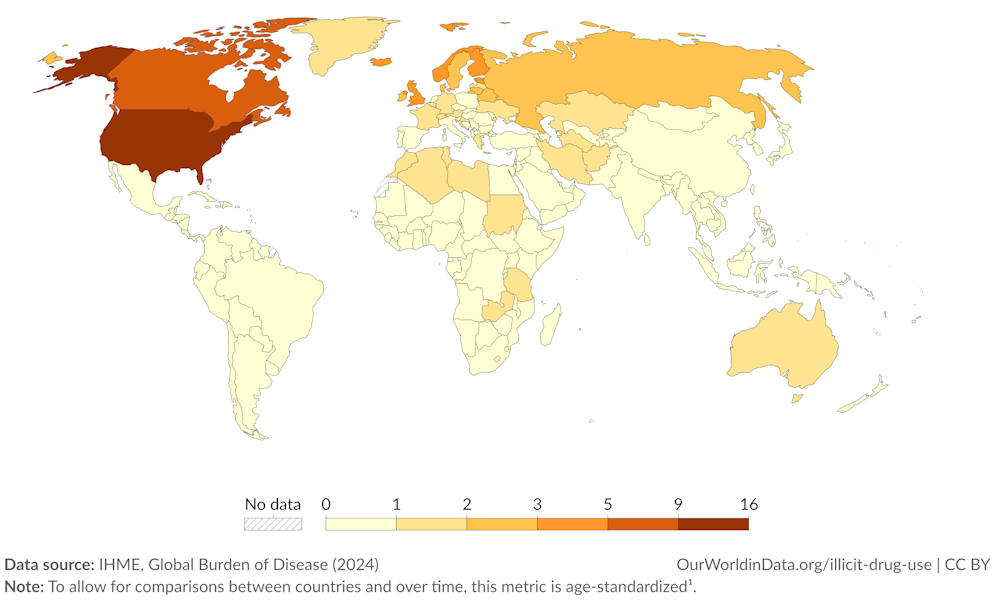
Opioid use death rates around the world:
Estimated deaths from opioid use disorders per 100,000 people in 2021. Our World In Data, CC BY
For the past 15 years, I have researched and advised on the international narcotics industry, especially the Afghan drug trade, as an academic, UK Home Office official and consultant. I’ve observed many shifts within global drug markets, and I believe the increasing availability of synthetic drugs in the UK and Europe may represent a new chapter in illicit drug use here – with the emergence of nitazenes only adding to these concerns.
A brief history of synthetic opioids
New synthetic opioids (NSOs) are one of the fastest-growing groups of new psychoactive substances around the world. The EU Drugs Agency (EUDA) currently monitors 81 NSOs – the fourth-largest group of drugs under observation.
NSOs largely fall into two broad groups: fentanyl and its analogues, and non-fentanyl-structured compounds – these include nitazenes, among many other substances.
Many of these “new” synthetic opioids have, in fact, existed for decades. Nitazenes were first synthesised in the 1950s by the Swiss pharmaceutical company, Ciba Aktiengesellschaft, as pain-relieving analgesics, although they were never approved for medical use.
Prior to 2019, there had only been limited reports of nitazenes in the illegal drug supply – including a “brownish looking powder” found in Italy in 1966; the discovery of a lab in Germany in 1987; several nitazene-related deaths in Moscow in 1998; and a US chemist illegally producing the drug for personal use in 2003. But since nitazenes re-emerged at the end of the last decade, over 20 variants have been discovered.
Paul Janssen, the Belgian chemist who first made fentanyl. Johnson & Johnson
The most common NSO in the illegal drug market, fentanyl, was first synthesised by Belgian chemist Paul Janssen in 1960. Fentanyl, which is roughly 100 times more potent than morphine, was approved in the US in 1968 for pharmaceutical use as an analgesic.
Over the next four decades, however, illegally produced fentanyl resulted in three relatively small outbreaks of deaths in the US. A fourth, larger fentanyl outbreak in Chicago, Detroit and Philadelphia resulted in about 1,000 deaths between 2005 and 2007.
The current US fentanyl crisis started in 2013, expanding to affect much of the country. Between 2014 and 2019, Chinese companies were the main manufacturers of finished fentanyl substances in the US – to combat this, both the Obama and Trump administrations lobbied Beijing to curtail the fentanyl industry.
The Chinese government responded by controlling specific fentanyl analogues. However, every time an analogue was banned, chemists there would slightly adjust the formula to produce a new compound that mirrored the banned substance.
China finally banned all fentanyl-related substances in May 2019, prompting two significant changes in the drug’s supply: a slowdown in the development of new fentanyl analogues, and a reduction in their direct sale to the US from China. Instead, Chinese companies increasingly sent fentanyl precursors to Mexican drug cartels who would synthesise fentanyl (or counterfeit medication) in clandestine labs, before smuggling it across the US border. Consequently, Mexico is now the primary source of fentanyl in the US.
But these supply changes led to another shift in the global drugs arena, as China’s chemical and pharmaceutical businesses – keen to develop new markets – adjusted their focus to producing uncontrolled synthetic substances, including nitazenes. At the same time, they expanded their geographical focus from North America to include Europe and the UK.
The nitazene supply chain
Producing nitazenes is a relatively low-cost exercise. They are largely manufactured in laboratories – both legal and illegal – in China, before being smuggled to the UK and Europe via fast parcel and post networks.
Nitazenes’ high potency means only small quantities are required, making them easier to transport and harder for border officials to detect. Some Chinese vendors have reportedly been offering to hide nitazenes in legitimate goods such as dog food and catering supplies, to circumvent custom controls. All of this decreases the risk to sellers, and lessens the price of doing business.
In March 2024, two China-based sellers operating on the dark web were selling a kilo of nitazene for between €10,000 and €17,000 (£12,000-£20,000). During roughly the same period, a kilo of heroin at the wholesale level in the UK was selling for between £23,000 and £26,000. Once bought, nitazenes are largely used to fortify low-purity heroin, although the drug can also be made into pills.
Video by The Guardian.
Nitazenes are not limited to the dark web. They are widely and openly advertised on the internet, social media and music streaming platforms. In February 2024, one China-based e-commerce site displayed 85 advertisements for nitazenes. Such sites also sell a range of other synthetic drugs, including fentanyl analogues and precursors, xylazines, cannabinoids and methamphetamine.
This means drug dealers in the UK and across the world no longer need to have established connections to underworld figures to source illegal drugs. With a click of a mouse, they can have them delivered to their home address. In this sense, the internet has democratised the drug trade by widening access beyond “traditional” criminals.
In the UK, while the supply of nitazenes is currently assessed as “low”, a number of smaller-scale organised crime groups are importing them to fortify low-purity heroin, before largely dealing it at the “county lines” level. This involves organised crime groups moving drugs – primarily heroin and crack cocaine – across towns, cities and county borders within the UK, using mobile phones or another form of “deal line” to sell to customers.
In November 2023, Leon Brown from West Bromwich was imprisoned for seven years for dealing drugs containing nitazenes – a verdict described as “a great result in our ongoing efforts to tackle county lines drug dealing” by detective sergeant Luke Papps of the South Worcestershire county lines team.
A few larger UK criminal networks have also been involved in nitazene distribution. In October 2023, the police and Border Force conducted raids across north London, arresting 11 people. They dismantled a drug processing site and seized 150,000 tablets containing nitazene – the UK’s largest ever seizure of synthetic opioids – as well as a pill-pressing machine, a firearm, more than £60,000 in cash and £8,000 in cryptocurrency. The police suspected the group had been selling the tablets on the dark web.
Anecdotal reports suggest there have been mixed reactions to the introduction of nitazenes into the illegal drug supply. Richard, a recovering heroin user from Bristol, told Vice magazine that, given their potency, some “people are scared of [nitazenes]” while others are “actively seeking” them.
As has been the case with fentanyl in the US, users build up tolerance and therefore seek stronger doses. Manny, a heroin user from Bristol, told Vice: “I smoked [heroin cut with nitazenes] and it felt like the first time I’d ever taken drugs.”
Video by Vice.
UK-based criminals also use the dark web to export nitazenes abroad. In October 2023, the Australian Border Force identified 22 nitazene discoveries in packages shipped to the country via mail cargo from the UK. British criminals have also trafficked counterfeit medicines containing nitazenes to Ireland and Norway.
Use of nitazenes is now being detected all over the world. Within Europe, Ireland experienced several nitazene outbreaks in 2023-24 while in Estonia, nitazenes now account for a large share of overdose deaths – a trend also seen (to a lesser extent) in Latvia. Preliminary data suggests at least 150 deaths were linked to nitazenes in Europe in 2023.
Nitazenes have also been discovered in fake pain medication such as benzodiazepines, oxycodone and diazepam, which widens the number of people at risk to include those with no opioid tolerance. The death in July 2023 of Alex Harpum, a 23-year-old British student who was preparing for a career as an opera singer, was a stark reminder of the danger of buying fake medicine online that may have been contaminated with nitazenes.
The nitazene ‘boom’ and the global heroin trade
For decades, Afghanistan was the world’s largest opium producer and the source of most of Europe’s heroin. Then in April 2022, the ruling Taliban announced a comprehensive prohibition on the use, trade, transport, production, import and export of all drugs. As a result, poppy cultivation has fallen to historically low levels for a second consecutive year.
While this has not, as yet, translated into a shortage of heroin on European streets, including in the UK and Germany, some indicators suggest a slowdown in heroin supplies to the UK. In the year March 2023-24, the quantity of heroin seized in the UK fell by 54%, from 950kg to 441kg. This is the lowest quantity of heroin seized since 1989, when about 350kg was intercepted.
The NCA assesses that the Taliban ban has created market “uncertainty”. The wholesale price of heroin has increased from roughly £16,000 per kilo prior to the COVID-19 pandemic to about £26,000, while anecdotal reports suggest average heroin purity for users dropped to under 30% (often to 10-20%) in 2024, compared with around 35% in 2023 and 45% in 2022.
Video by UN Story.
Even without the Taliban’s ban, heroin is not easy to produce and supply. Cultivating opium poppy is labour-intensive, taking five or six months. The static nature of opium fields means they are visible and susceptible to eradication; poppy crops can also be negatively affected by blight or drought.
Converting opium into heroin base is also a labour-intensive process that can involve (depending on the production method) at least 17 steps. Acetic anhydride, the main chemical used to convert morphine into heroin, is relatively expensive compared with synthetic precursors. Moreover, heroin is a bulky product, which means it is harder to move in large volumes.
While the relationship between events in opiate-producer countries and the introduction of synthetic opioids to consumer markets should not be overstated, this new type of drug offers economic advantages to criminals whose “sole motivation is greed”.
For decades, Turkish, Kurdish and Pakistani criminal networks have been responsible for importing heroin into the UK. Once in the UK, both Turkish and British groups largely control its wholesale supply, with some participation of Albanian gangs.
To date, there is little evidence to suggest these groups have transitioned to supplying NSOs, including nitazenes. The shifting dynamics in the global drug supply chain, however, could upend traditional markets and the gangs who profit from them.
America’s synthetic drug crisis
The synthetic opioid fentanyl has devastated the US, having been linked to about 75,000 deaths in 2023 alone. It is the primary cause of death for Americans aged 18-49. Canada, too, has experienced a wave of deaths: between January 2016 and June 2024, there were 49,105 apparent opioid deaths there, with fentanyl implicated in a large proportion.
More than 4,300 reports of nitazenes have reached the US National Forensic Laboratory Information System since 2019. They are typically used to fortify fentanyl and other opioids, which can produce a fatal concoction.
Efforts to stem the flow of NSOs, including nitazenes, from China to the US and elsewhere will prove challenging. And even if China does implement stricter controls, other countries could step in to fill the void. According to the Commission on Combating Synthetic Opioid Trafficking:
The overall sizes of these industries, limited oversight efforts and political incentives contribute to an atmosphere of impunity among firms and individuals associated with those industries.
While US and Chinese counter-narcotics cooperation ended in 2022 amid increasing geopolitical tensions, the following November’s summit in Woodside, California, between presidents Joe Biden and Xi Jinping saw them agree to recommence collaboration.
As a result, China recently closed several chemical companies that were shipping fentanyl precursors and nitazenes to the US. These vendors used encrypted platforms and cryptocurrency to conduct the deals, and mislabelled the consignments to try to ensure the substances evaded border controls. China has also outlawed more chemicals and substances, including several nitazene variants.
But President Trump’s imposition of tariffs on imports from China – which sit alongside proposed taxes on imports from Canada and Mexico, in part for supposedly not doing enough to curb the trafficking of fentanyl and its precursors to the US – threatens this counter-narcotics cooperation.
While nitazenes are not yet widely available in the US, their presence within some fentanyl batches is complicating the US opioid crisis – and according to some experts, has the potential to further increase the already shocking number of synthetic opioid-related deaths.
The UK response to nitazenes
Successive UK governments have made tackling NSOs a high priority. Shortly after the most recent nitazene-related deaths were discovered in the UK in summer 2023, the NCA launched Project Housebuilder to lead and coordinate the law enforcement and public health response.
This was soon followed by the establishment of a government-wide Synthetic Opioids Taskforce “to improve…understanding, preparedness and mitigation against this evolving threat”. Chris Philp, then the UK’s combatting drugs minister, stated that “synthetic opioids are at the top of [this government’s] list because of the harm they cause”.
The taskforce has taken a range of measures, such as controlling more NSOs as class A drugs, conducting more intelligence operations at UK borders, widening access to naloxone, and enhancing the UK’s real-time, multi-source drug surveillance system. The government also worked with the US and Canada to learn from their experiences.
Recently, the current UK government banned a further six synthetic opioids and introduced a generic definition of nitazenes as class A drugs. And the UK’s current government, unlike its Conservative predecessor, has also indicated its willingness to consider evidence from the UK’s first drug consumption facility, which recently opened in Glasgow.
Other policy measures worthy of consideration include expanding drug checking services whereby drug users submit drugs to a lab to test what is in them, then are provided with information about the sample. These services offer vital information to the public and authorities about current drug trends.
While there is high uncertainty about what is going to happen next in the UK regarding illicit drug trends, the evolution of the US drug landscape over generations provides some important lessons.
Lessons from the US
The US fentanyl crisis shows drug markets can change quickly with long-lasting consequences. Most heroin on US streets contains – or has been replaced by – fentanyl. According to DEA seizure data, US heroin seizures declined by nearly 70% between 2019 and 2023, whereas fentanyl seizures have increased by 451%.
However, illegal drug markets evolve in different ways and at different paces. In May 1989, Douglas Hogg, a UK Home Office minister, travelled to the US and the Bahamas on a fact-finding mission about crack cocaine, a drug that was predicted to spread from the US to the UK. Upon his return, Hogg noted:
The ethnic, social and economic characters of many of our big cities are very similar to those in the US. If they have a crack problem, why should not we? … The use of crack in Great Britain is likely to develop very substantially over the next few years.
But this “crack invasion”, as some called it, did not materialise in the UK to the extent it had in the US – and the same was true about a predicted wave of methamphetamine use in the UK, which remains low compared with the US.
It is also unlikely the UK and Europe will experience a synthetic opioid crisis on the same scale as the US. The first wave of the US crisis was driven by extensive overprescription of opioids for pain relief. This increased the number of people addicted to opioids, some of whom later turned to heroin, before transitioning to fentanyl. In contrast, large-scale opioid prescriptions have not been a major issue in the UK or Europe, although there is some diversion of legal fentanyl into the illegal drug market in Europe.
Video by The Brookings Institution.
According to Alex Stevens, professor of criminology at the University of Sheffield, another factor differentiating the US and Europe is the provision of drug treatment and harm reduction programmes. Opioid users in Europe, and to a lesser extent in the UK, are much more likely to be in medication-assisted treatment than their US counterparts, thus reducing the number of people at risk. These interventions are reinforced by different socioeconomic factors in much of Europe, such as lower economic inequality, stronger social protections, and better healthcare systems.
None of this, though, means the nitazene threat in the UK and Europe should be underestimated, nor that use and supply of these drugs (and other NSOs) will not increase from its current relatively low base. As the NCA recently warned:
While a zero-tolerance approach from law enforcement, plus advice to users on the heightened dangers, may contain or slow the current uptake, we must prepare for these substances to become widely available, both unadvertised in fortified mixes and in response to user demand as a more potent high.
The future of new synthetic opioids
Predicting the future of NSO use and trafficking is a challenging task. Projections for Europe range from existing opiate stockpiles ensuring that heroin consumer markets remain serviced (assuming the Taliban ban is short-lived), to a heroin shortage which results in more drug dealers turning to NSOs to plug the shortfall, which in turn could lead to lasting changes in European drug markets (as happened in a few countries following the Taliban’s first opium ban in 2000-01).
In such a scenario, it is possible that Turkish criminal networks may exploit their links with Mexico’s Sinaloa cartel to source NSOs. Mexican criminal gangs also operate in Europe, which may increase the likelihood of them trying to open a new NSO market on the continent.
There is also evidence that some Italian criminal organisations have entered the NSO marketplace. In November 2023, Italian authorities announced the seizure of 100,000 doses of synthetic drugs, including fentanyl, as part of operation Painkiller, a joint Italian-American initiative.
Given the many advantages for criminal groups of NSOs, it seems likely they are here to stay. A key question is whether nitazenes (or other NSOs) will supplant traditional heroin as the opioid of choice, as they have done in the US, or remain at relatively low levels in Europe, co-existing with or mixed into the heroin supply.
In December 2023, Paul Griffiths, the EUDA’s scientific director, told Vice: “We’re not seeing much new initiation of heroin use in Europe. So in five to ten years … as heroin users get older and more vulnerable, we’re not going to have much of an opiate problem left.”
But he warned that if heroin use does dry up: “You might then see opioids appearing in other forms and preparations, such as pills, that could potentially become popular among younger age groups who currently do not appear attracted to injecting heroin.”
While previous NSO outbreaks in the UK were relatively short-lived and limited in scale, the most recent nitazene outbreak, which started in summer of 2023, has been more sustained, covered more parts of the UK, and involved more fatalities. The broader trend in Europe also suggests the prevalence and variations of NSOs are increasing at a faster pace than in previous years.
Notwithstanding, nitazene use and supply in the UK currently remains relatively low. In fact, the rate of nitazene-linked deaths – at least those officially reported – decreased between spring 2024 and the end of the year.
In the short term, then, it seems unlikely there will be a nitazene “explosion”. Rather, criminal groups will probably try to increasingly embed nitazenes into the UK drug market at a similar pace to the last 18 months.
However, this situation could change rapidly in future, especially if larger criminal networks involved in heroin importation switch to smuggling NSOs, and there is a genuine shortage of Afghan heroin. This problem would be compounded if drug users start seeking nitazenes, thus creating demand for them.
Either way, the UK government, along with its European partners, should continue to reinforce the whole drug system, to prepare for the worst-case scenario.
To hear about new Insights articles, join the hundreds of thousands of people who value The Conversation’s evidence-based news. Subscribe to our newsletter.
Philip A. Berry does not work for, consult, own shares in or receive funding from any company or organisation that would benefit from this article, and has disclosed no relevant affiliations beyond their academic appointment.
Donald Trump has hit the 30-day pause button on imposing 25% tariffs on Canada and Mexico, but is proceeding with slapping 10% tariffs on Chinese imports, and tariffs on the EU are still on his agenda.
Trump has declared that “tariff” is “the most beautiful word in the dictionary”. Yet as the president weighs up the sweeping consequences of his tariff fixation, he may want to throw out the dictionary and pick up a history book.
The magnitude and scale of the proposed tariffs hark back to the US Smoot-Hawley Tariff Act enacted in 1930.
For example, Nobel Laureate economist Paul Krugman told Bloomberg that “we’re really talking about tariffs on a scale that we … have not seen,” adding that “we’re talking about a reversal of really 90 years of US policy”.
The Smoot-Hawley tariffs were initially intended to provide support to the deeply indebted US agricultural sector at the end of the 1920s, and protect them from foreign competition – all familiar themes to the anti-free-trade rhetoric peddled by Trumpists today.
The advent of the Great Depression had generated widespread, albeit not universal, demands for protection from imports, and Smoot-Hawley increased already significant tariffs on overseas goods. Members of Congress were eager to provide protection, trading votes in exchange for support for their constituents’ industries.
Although at the time more than 1,000 economists implored President Herbert Hoover to veto Smoot-Hawley, the bill was signed into law. The resulting tariff act led to taxes averaging nearly 40% on 20,000 or so different types of imported goods.
The history of trade tariffs in the US.
The culmination led to a dramatic decline in US trade with other countries, particularly among those that retaliated, and is widely acknowledge as severely worsening the Great Depression. According to one estimate, the sum of US imports plummeted by nearly half.
What’s more, the impacts were felt globally. Protectionist policies are believed to have accounted for about half of the 25% decline in world trade, and indirectly helped create economic factors that led to the second world war.
The blowback against Capitol Hill was immense as well: the optics of vote trading over the tariff act resulted in Congress delegating control over trade policy to the president just four years later because the behaviour was regarded as so reckless.
All of this came against the backdrop of diplomatic American isolationism in the 1930s, which were not unlike many of Trump’s current efforts to retreat from – or even attack – multilateral institutions.
Despite President Woodrow Wilson winning the Nobel Peace Prize in 1919 for his work initiating the League of Nations (a forerunner of the United Nations), for example, the US never became a member. The term “America first” was also used widely in this period to refer to a focus on domestic policy and high tariffs.
Fast forward to present day
Trump has said that his tariffs will cause “some pain” but are “worth the price that must be paid.” Based on recent estimates from the non-partisan Peterson Institute for International Economics, Trump’s tariffs could drive up costs for the average US household more than US$1,200 (£963) per year.
Whether US voters will still stand behind Trump when actual prices begin to rise is still to be determined.
However, many Republicans on Capitol Hill have rushed to Trump’s defence. Congresswoman Claudia Tenney of New York told Fox News that she’s glad the US is “projecting strength for once on the world stage”. Senator Eric Schmitt of Missouri insisted that tariffs were “not a surprise,” emphasising that Trump had relentlessly campaigned on “improving our standing in the world.”
Perhaps the sharpest Republican rebuke came from Sen. Mitch McConnell of Kentucky, who labelled the tariffs simply a “bad idea”.
Public opinion data show that tariffs are hotly contested, with partisanship shaping both general views toward tariffs and views on specific national targets.
According to a January 2025 Harvard CAPS/Harris poll, 52% of Americans overall approve of placing new tariffs on China, with 74% of Republicans in favour, but just 34% of Democrats.
Support is more modest for imposing tariffs on America’s neighbours. Only 40% of voters think tariffs on Canada and Mexico are a good idea, including 59% of Republicans and 24% of Democrats.
Tariffs rank low on a list of national priorities. A mere 3% of Americans think tariffs on Canada and Mexico should be a top priority for Trump in his first 100 days, while just 11% rank tariffs on China as a top priority.
Prospect of a broader trade war
What seems clear is that Trump’s proposed tariffs against Canada, Mexico, and China could be just the opening salvos in a broader tit-for-tat that may extend to Europe, and beyond.
At home, the political challenge for Trump is to keep intact what increasingly looks like a fragile coalition – balancing the interests of hardline Maga supporters who reject free trade and tech titans who see tariffs as disrupting vital supply chains, especially to Asia.
After Trump’s election, former adviser and populist nationalist Steve Bannon warned that America would no longer be “abused” by “unbalanced trade deals.” “Yes, tariffs are coming,” he said. “You will have to pay to have access to the US market. It is no longer free, the free market is over.”
Meanwhile, Silicon Valley has been mostly silent on the tariffs. While tech moguls are doubtlessly trying to curry favour for tariff exemptions or the reduction of tariffs altogether, it’s possible that they have been assured that the tariffs are about leverage and will be gone soon enough.
Regardless, Trump is showing that tariffs are a crucial part of his “America first” foreign policy, a kind of belligerent unilateralism that treats allies and adversaries alike as pieces to be moved around a chessboard.
Under Trump, the “art of the deal” means throwing America’s weight around as the world’s economic superpower, and waiting for the leaders of other nations to fold. Whether American voters will endure the economic costs necessary for his plans could determine his resolve.
Trump may think that tariff is a beautiful word now. But if even a glimmer of the 1930s repeats itself, its economic shadow could soon look grim.
The authors do not work for, consult, own shares in or receive funding from any company or organisation that would benefit from this article, and have disclosed no relevant affiliations beyond their academic appointment.
An international panel of medical experts have thrust Lucy Letby back into the spotlight. At a press conference convened by Letby’s legal team, the experts cast doubt over the former nurse’s conviction. Letby was given 15 whole-life sentences for murdering seven babies and attempting to murder seven more.
Speaking at the press conference in London, retired neonatologist Dr Shoo Lee told the assembled reporters: “In all cases death or injury were due to natural causes or just bad medical care.”
Why should we take Dr Lee’s word for it? Well, in part, because he is the author of a key paper on air embolisms, one of the methods that Letby was accused of using to kill babies, which formed a key part of the prosecution’s evidence at the trial.
He also claims that the paper’s findings were misinterpreted at the trial and that a newly updated version of the article would help exonerate Letby rather than convict her.
The Letby conviction has always attracted critical attention because there were no witnesses who could confirm they saw her attacking any of the babies she was convicted of murdering. Nor did anyone see her perform actions that could have constituted the attempted murders of seven others.
Consequently, the prosecution used statistics alongside the medical evidence the expert panel has now cast doubt upon. So how solid is that statistical evidence?
A key piece of statistical evidence is a chart which showed that Lucy Letby was on duty every time one of the crimes of which she was accused occurred, but that none of the other nursing staff were.
On the face of it, it seems quite damning. But when you think about it, it’s unsurprising that Letby’s column is the only one full of crosses. Any of the events at which she was not present she would not have been charged with and consequently wouldn’t appear on the chart.
This is an example of what is known in statistics as the Texas sharpshooter fallacy.
The fallacy is named for a story about a Texan cowboy who likes to head out to his barn after a few drinks for target practice. Invariably, the barn wall gets peppered with random bullet holes during the inebriated exercise, and purely by chance some of these holes are clustered.
One morning the savvy “sharpshooter” gets out his paint cans and daubs a target around this cluster of holes to give the impression of accuracy to anyone who didn’t see the process by which they were made and to draw attention away from the other more dispersed bullet holes.
The sharpshooter fallacy occurs when a conclusion is drawn based only on data consistent with a given hypothesis, ignoring data that doesn’t support the proposed conclusion.
Imagine, for example, you made a chart similar to the one used to convict Letby, this time including only those deaths at which a different member of the nursing staff was present. It’s entirely possible – for example, if they were present for deaths at which Letby was not – that their name would be above the only column full of crosses and not Letby’s.
Indeed, it later transpired that the table did not include six other deaths that occurred during the same period and with which Letby was not charged. The jury was not told about these other deaths.
As Jane Hutton, a professor of medical statistics at the University of Warwick argues: “If you want to find out what went wrong, you need to consider all deaths, not just a subset of them.”
The probability of so many deaths on a neonatal unit in such a short period should be quite low. At first glance, this might seem to make the alternative explanation of murder seem more likely. But this is a classic statistical error.
This mistake is so common in courtrooms that it is known as the prosecutor’s fallacy. The argument starts by showing that, if the suspect is innocent, seeing a particular piece of evidence is extremely unlikely.
For Letby, this is the assertion that if she was innocent of killing these babies, the probability of them dying due to other causes is extremely low. The prosecutor then deduces, incorrectly, that an alternative explanation – the suspect’s guilt – is extremely likely.
The argument neglects to take into account any other possible alternative explanations, in which the suspect is innocent, such as the death of these babies due to inadequate care. It also neglects the possibility that the explanation that the prosecution is proposing, in which the suspect is guilty, may be just as uncommon as the alternative explanations, if not more so.
By just presenting the low probability of these seven babies dying naturally, the inference that an untrained jury is invited to draw runs something along these lines: “The deaths of these babies from natural causes is extremely rare, so the odds that the deaths are the result of murder is correspondingly extremely high.”
However, it must also be taken into account, when weighing up the evidence, that multiple infant murders are also extremely uncommon. What really matters is the relative likelihoods of the different explanations. Weighing these very unusual events against each other is not an easy thing to do.
Criminal cases review
Other statistical issues with the case also deserve more attention: the high number of deaths at the Countess of Chester, even excluding the babies that Letby has been convicted of murdering. Or the possibility of false positive medical identifications of murder, for example.
Whether Letby’s team’s appeal to the Criminal Cases Review Commission will be successful or not remains to be seen. The statistical issues over the case, when taken alongside the doubts about the medical evidence, mean that there is certainly a possibility.
Throughout all this, it’s important to remember the families affected by the events at the Countess of Chester Hospital. Whatever the ultimate truth of the matter, this ongoing case will undoubtedly make dealing with their grief more difficult.
Christian Yates does not work for, consult, own shares in or receive funding from any company or organisation that would benefit from this article, and has disclosed no relevant affiliations beyond their academic appointment.
Source: United Kingdom – Executive Government & Departments
Scientists comment on the Public Accounts Committee (PAC) report on Carbon Capture, Usage and Storage (CCUS) technologies.
Prof Hannah Chalmers, Personal Chair of Sustainable Energy Systems, Institute for Energy Systems, School of Engineering, University of Edinburgh, said:
“CCUS technologies can play a unique role in tackling carbon dioxide emissions. They can be used at large industrial sites to ensure that most of the carbon dioxide produced by activities like iron and steel production is not emitted to the atmosphere. Instead, the carbon dioxide is permanently stored in geological formations (rocks). In the UK, CCUS projects are developing plans to store carbon dioxide in layers of rock that are deep underneath the sea.
“There is also ongoing work to develop and deploy cost-effective approaches to remove carbon dioxide directly from the air. This provides an important option to respond to the widely reported increases in carbon dioxide levels in the atmosphere that are causing significant concern.
“There is significant evidence that including CCUS in a mix of technologies to reduce carbon dioxide emissions will be the most cost-effective way to address climate change. Several large-scale projects have been operating in other countries for many years. Experience from these projects is being used to ensure that the CCUS projects that are being developed in the UK are designed to be reliable and cost-effective.”
Dr Stuart Gilfillan, Reader in Geochemistry, University of Edinburgh, said:
What is CCUS technology, how does it work, does it have limitations?
“CCUS stands for Carbon Capture, Utilisation, and Storage, which is a developing technology which reduces the amount of carbon dioxide (CO2) released into the atmosphere. It works by capturing CO2 at the point source, transporting it and then burying it for safe storage in rocks over a kilometre below the ground surface. Like any technology, it has pros and cons, and costs more than simply releasing the CO2 directly to the atmosphere, which is currently free. CCUS is the only currently available technology that can directly reduce CO2 emissions from sources like power plants and industrial processes. Given that global temperature records are now being broken on an almost daily basis and yesterday’s announcement of the hottest January on record, it is essential tool in the urgent fight against runaway climate change.
What is the existing evidence around the efficacy of CCUS?
“CO2 capture technology has proven successful in capturing up to 90-95% of CO2 emissions from point of sources from power stations and industrial facilities. Successful examples include the Boundary Dam power station in Saskatchewan, Canada, where a large-scale CCUS unit has been operational since 2014, capturing about 1 million tonnes of CO2 per year.
“The long-term storage of CO2 is proven by natural CO2 reservoirs around the world and engineered projects like Sleipner in the North Sea, which have been injecting CO2 beneath the seabed since 1996 without significant issues. Research over the past two decades has developed monitoring technologies that can detect and mitigate potential leakage and to ensure that CO2 remains securely buried in rocks deep underground.
What more evidence may be needed to be confident in its applications?
“No more evidence is required, as exemplified by the UK’s Climate Change Committee (CCC), which is an independent body established under the Climate Change Act who advise the government on emissions targets and report to Parliament on progress made in reducing greenhouse gas emissions. The CCC is clear that CCUS is a critical technology for the decarbonisation of the UK economy, particularly in sectors that are hard to decarbonize directly, such as heavy industry (steel, cement, chemicals) and power generation.
“CCUS is not only as a standalone technology but is an essential part of a broader strategy to reach net-zero emissions by 2050. It compliments energy efficiency, renewable energy deployment, and electrification. CCUS is a clear driver for regional economic development, particularly in regions with suitable geological storage sites and industrial bases, such as the East Coast of Scotland, the Humber region, and North East England, areas that have been ‘left behind’ in recent times.”
Dr Tim Dixon, IEA Greenhouse Gas, Director and General Manager, said:
“Carbon Capture and Storage (CCS) is a necessary technology for the UK and other countries to achieve net-zero, and we need all low-carbon energy technologies. The science case for the role of CCS is provided by the UK’s Climate Change Committee, the Intergovernmental Panel on Climate Change (IPCC) and the International Energy Agency (IEA) and cannot be disputed if climate change is to be taken seriously. The key aspect of CCS is the secure long-term retention of CO2 in deep geological formations, and we have decades of experience in this from around the world. With over 40 large scale projects in operation injecting millions of tonnes every year and many pilot-scale projects, this has allowed us to test the science, the monitoring and the practicalities of geological storage of CO2. Hence CO2 geological storage is a proven technology and the regulations to enable and to ensure that it is safe and secure are based upon this sound science and experience. ”
Professor Paul Fennell FIchemE, Professor of Clean Energy, Imperial College London, said:
“The idea that Carbon Capture and Storage is an unproven technology is simply untrue. There are projects ongoing around the world, and millions of tonnes of CO2 have been safely stored over the last couple of decades. This has not happened in the U.K. because of our sclerotic inability to develop public infrastructure, not because the technology is unproven.”
Dr Greg Mutch, Researcher in Carbon Capture and Storage, Newcastle University, said:
“Carbon capture and storage is a technology that prevents carbon dioxide from entering the atmosphere, by capturing it and storing it underground in ‘empty’ oil & gas reservoirs or saline aquifers. According to the world’s foremost experts on the subject, gathered to contribute the International Panel on Climate Change, carbon capture and storage processes are necessary to achieve climate change mitigation goals at lowest cost. Without scalable CCS technologies by the end of the century, climate change mitigation will cost between 29 and 297% (mean value 138%) more.[1] Moreover, CCS is predicted to provide tens of thousands of jobs in the UK, add several billion pounds in terms of gross value added per year by 2050,[2] and enable other important technologies (hydrogen production etc) that will come with further jobs and economic value.”
[1] IPCC, 2018: Global Warming of 1.5 °C. An IPCC Special Report on the impacts of global warming of 1.5 °C above pre-industrial levels and related global greenhouse gas emission pathways, in the context of strengthening the global response to the threat of climate change, sustainable development, and efforts to eradicate poverty, ed. V. Masson-Delmotte, P. Zhai, H.-O. Portner, D. Roberts, J. Skea, P. R. Shukla, A. Pirani, W. Moufouma-Okia, C. Pean, R. Pidcock, S. Connors, J. B. R. Matthews, Y. Chen, X. Zhou, M. I. Gomis, E. Lonnoy, T. Maycock, M. Tignor and T. Waterfield, Cambridge University Press, 2018.
[2] Energy Innovation Needs Assessment Sub-theme report: Carbon capture, utilisation, and storage, Vivid Economics, Carbon Trust, E4tech, Imperial College London, Frazer-Nash Consultancy, Energy Systems Catapult. Commissioned by the Department for Business, Energy & Industrial Strategy, 2019.
Professor Peter Styring, Director of the UK Centre for Carbon Dioxide Utilization, Professor of Chemical Engineering & Chemistry, University of Sheffield, said:
What is CCUS technology, how does it work, does it have limitations?
“CCUS is carbon capture and storage. This has been primarily focused on CCS as the main driver. It aims to capture carbon dioxide from emitters such as power stations and industries. The current technology temperature swing absorption (TSA) using a chemical reaction with an aqueous amine solvent to capture the CO2 from the mixed waste gas and then to release it in a purified form by increased temperature chemical desorption and then further drying and purification to get a gas that can be in theory transported to a site where the gas can be stored underground. It works but at a high energy cost and the production of amine decomposition products that need to be removed and more amine added. It costs a lot!
“Limitations are the energy and financial costs, permitting regulations on solvent disclosure and the large physical footprint. Full system lifecycle analysis is required but this is not always reported.”
What is the existing evidence around the efficacy of CCUS?
“This is not proven using current technologies. The problem is that the current government funded projects use old technologies to achieve CCS and what is actually needed is a step change to new, lower cost more efficient processes such as solid based pressure swing adsorption (PSA). The whole system tends to be simpler and the energy costs and land use is significantly reduced.”
What more evidence may be needed to be confident in its applications?
“Full evaluation of new technologies and rapid acceleration from proof of concept to capture at scale. The Innovate UK funded Flue2Chem project is a good example of how this is being addressed using mid-TRL technologies. The UK also needs to move away from a single minded storage approach to adding value through the use of CO2 in the production of chemicals that would otherwise be sourced from virgin fossil carbon. SUSTAIN project is making synthetic fuels from captured CO2 and Flue2Chem is making FMCG components, including surfactants and precursors from the CO2.”
Dr Stuart Jenkins, Net Zero Fossil Fuel Fellow, University of Oxford, said:
“The Public Accounts Committee are wrong to have labelled CCUS as ‘unproven’, there are many commercial scale projects around the world, but they are right to question the current model for funding it. We need to make sure the CCUS industry becomes self-sustaining, without the need for major taxpayer funding. One option — asking fossil fuel suppliers to contribute to these costs via a carbon storage mandate — is a fair and responsible approach going forward.
In a recent report we published working with researchers at the University of Oxford and Carbon Balance Initiative [1] we looked at the use of Carbon Storage Mandates, which place an obligation on fossil fuel producers to capture and store a rising fraction of the CO2 they produce, to support the UK’s CCUS industry.
Carbon storage mandates, in tandem with carbon pricing and other mechanisms, could deliver subsidy-free CCUS to the UK and provide investment certainty for companies.”
Dr Stuart Jenkins Our report was funded by the Carbon Capture and Storage Association, and consulted regulators, fossil fuel companies, capture and storage entities, UK Government, and academics on models for CCUS sector support packages.
Professor Paul Fennell: No conflicts other than being involved in CCs research.
Dr Tim Dixon: “Tim is a Director of IEA Environmental Projects Ltd (UK), a Non-Executive Director on the Board for The International CCS Knowledge Centre (Canada). He is also proud to be an Honorary Senior Research Fellow at the Bureau of Economic Geology, University of Texas in Austin, and an Honorary Lecturer at the School of Geosciences at University of Edinburgh. He was an original Board Member of the UK CCS Research Centre. Previously he worked in CCS, emissions trading, clean energy technologies and related areas for AEA Technology (ETSU), for the UK Government‘s Department of Trade and Industry (DTI) and for the Global CCS Institute. He was the EU’s Lead Negotiator for getting CCS in the CDM in UNFCCC in 2011, and a UK negotiator for getting CCS in the London Convention 2004-7, in OSPAR 2006-7, in the EU Emission Trading Scheme 2004-8, and inputting to the EU CCS Directive 2007-8. He gives talks on climate and CCS to schools and public organisations and supported the start of Oxford Climate Society at the University of Oxford. He is a Fellow of the UK Energy Institute, and member of the UK Institute of Physics and the UK Environmental Law Association.”
Dr Stuart Gilfillan “I have received funding from TotalEnergies in the past, for research related to CO2 origins in the subsurface and reservoir connectivity and Equinor on CO2 dissolution in natural CO2 reservoirs. I currently receive funding from the Natural Environment Research Council and Carbfix on CO2 mineralisation.”
Prof Hannah Chalmers “I work collaboratively with industrial partners who are developing CCUS projects in the UK (e.g. as a member of the Advisory Board for the Industrial Decarbonisation Research and Innovation Centre). I currently receive no funding from industry, but have received funding from industrial partners who are actively developing CCUS projects in the UK in the past (e.g. SSE plc).”
Professor Peter Styring: Peter is Professor of Chemical Engineering and Chemistry at the University of Sheffield (an investigator on Flue2Chem and SUSTAIN) and a Co-founder and Director of CCU International.
For all other experts, no response to our request for DOIs was received.
CALGARY, Alberta, Feb. 07, 2025 (GLOBE NEWSWIRE) — Canoe Financial LP (“Canoe Financial”) is recognized with three 2024 FundGrade A+® Awards for outstanding performance.
Canoe Financial 2024 FundGrade A+ Award winning funds:
FundGrade calculation date 12/31/2024.
The FundGrade A+® rating recognizes the best performing funds that deliver the most consistent risk-adjusted returns. It is a yearly award that honours the “best of the best” among Canadian investment funds that have maintained a high FundGrade rating throughout a calendar year.
“These awards are a testament to the strength of our investment philosophy and the dedication of our team. At Canoe Financial, we’re committed to helping Canadians build lasting wealth through disciplined, active management and a focus on delivering consistent, long-term performance,” said Darcy Hulston, President and Chief Executive Officer, Canoe Financial.
About Canoe Financial Canoe Financial is one of Canada’s fastest growing independent mutual fund companies managing $20 billion in assets across a diversified range of award-winning investment solutions. Founded in 2008, Canoe Financial is an employee-owned investment management firm focused on building financial wealth for Canadians. Canoe Financial has a significant presence across Canada, including offices in Calgary, Toronto and Montreal.
About FundGrade A+ Awards FundGrade A+® is used with permission from Fundata Canada Inc., all rights reserved. The annual FundGrade A+® Awards are presented by Fundata Canada Inc. to recognize the “best of the best” among Canadian investment funds. The FundGrade A+® calculation is supplemental to the monthly FundGrade ratings and is calculated at the end of each calendar year. The FundGrade rating system evaluates funds based on their risk-adjusted performance, measured by Sharpe Ratio, Sortino Ratio, and Information Ratio. The score for each ratio is calculated individually, covering all time periods from 2 to 10 years. The scores are then weighted equally in calculating a monthly FundGrade. The top 10% of funds earn an A Grade; the next 20% of funds earn a B Grade; the next 40% of funds earn a C Grade; the next 20% of funds receive a D Grade; and the lowest 10% of funds receive an E Grade. To be eligible, a fund must have received a FundGrade rating every month in the previous year. The FundGrade A+® uses a GPA-style calculation, where each monthly FundGrade from “A” to “E” receives a score from 4 to 0, respectively. A fund’s average score for the year determines its GPA. Any fund with a GPA of 3.5 or greater is awarded a FundGrade A+® Award. For more information, see www.FundGradeAwards.com. Although Fundata makes every effort to ensure the accuracy and reliability of the data contained herein, the accuracy is not guaranteed by Fundata.
Canoe Equity Portfolio Class Series, Canadian Focused Equity category out of a total of 70 funds: 20.20% (1 year), 9.46% (3 years), 14.48% (5 years), 10.16% (10 years) and 8.02% (since inception-February 2011); Canoe Asset Allocation Portfolio Class, Tactical Balanced category out of a total of 56 funds: 14.65% (1 year), 6.35% (3 years), 10.46% (5 years), 7.36% (10 years) and 5.85% (since inception-February 2011); Canoe North American Monthly Income Portfolio Class, Global Neutral Balanced category out of a total of 224 funds: 13.40% (1 year), 6.22% (3 years), 8.25% (5 years), 6.47% (10 years) and 7.25% (since inception- December 2012).
Further information Investor Relations Canoe Financial LP 1–877–434–2796 info@canoefinancial.com
Commissions, trailing commissions, management fees and expenses all may be associated with mutual fund investments. Please read the prospectus before investing. The indicated rates of return are the historical annual compounded total returns including changes in unit value and reinvestment of all distributions and do not take into account sales, redemption, distribution or optional charges or income taxes payable by any unitholder that would have reduced returns. Mutual funds are not guaranteed, their values change frequently, and past performance may not be repeated.
NAPERVILLE, Ill., Feb. 07, 2025 (GLOBE NEWSWIRE) — Track Group, Inc. (OTCQB: TRCK), a global leader in offender tracking and monitoring services, today announced financial results for its fiscal quarter ended December 31, 2024 (“Q1 FY25”). In Q1 FY25, the Company posted (i) total revenue of $8.7 Million (“M”), a decrease of approximately 3.3% over total revenue of $9.0M for the quarter ended December 31, 2023 (“Q1 FY24”); (ii) Q1 FY25 operating income of $0.1M compared to Q1 FY24 operating loss of ($0.2M); and (iii) net loss attributable to common shareholders of ($2.0M) in Q1 FY25 compared to net income attributable to common shareholders of $0.1M in Q1 FY24.
“The quarter ending December 31, 2024 showed increases in gross profit, operating income and Adjusted EBITDA. This progress reflects the increased use of our products and services in legacy programs and continued expansion through newly awarded contracts domestically and abroad. With a strong pipeline and a commitment to delivering value, we are poised for continued success in fiscal year 2025,” said Derek Cassell, Track Group’s CEO.
FINANCIAL HIGHLIGHTS
Total Q1 FY25 revenue of $8.7M decreased approximately 3.3% compared to Q1 FY24 revenue of $9.0M. The decrease in revenue was driven principally by a decrease in people assigned to monitoring for clients in Michigan and Virginia, and our recently sold Chilean subsidiary. This decrease was partially offset by revenue increases for clients in Illinois, Puerto Rico and the Bahamas who experienced increases in the number of people assigned to monitoring.
Gross profit of $4.4M in Q1 FY25 increased approximately 5.2% compared to Q1 FY24 gross profit of $4.2M due to a decrease in monitoring center costs, partially offset by a decrease in revenue.
Operating income in Q1 FY25 of $0.1M increased compared to the operating loss of ($0.2M) in Q1 FY24. The increase in net income in Q1 FY25 is primarily due to a decrease in cost of revenue and a decrease in operating expense.
Adjusted EBITDA for Q1 FY25 of $1.2M, increased compared to $1.1M for Q1 FY24 due to an increase in operating income and gross profit. Adjusted EBITDA in Q1 FY25 as a percentage of revenue increased to 14.4%, compared to 11.8% for Q1 FY24 for the same reasons.
Unrestricted cash balance of $3.7M for Q1 FY25 increased compared to $3.6M for Q1 FY24. The change in cash position was principally due to the sale of our Chilean subsidiary.
Net loss attributable to shareholders in FY24 was ($2,010,849) compared to net income of $461 in FY23, a change principally attributable to lower revenue and a foreign currency exchange rate loss.
Business Outlook
Growth in gross profit and operating income in Q1 FY25 reinforces our confidence in the strategic reinvestment in technology and the implementation of new programs initiated in late FY23. These endeavors position us well for sustained growth throughout FY25. As a result, the Company’s preliminary outlook for FY25 is as follows:
Actual
Outlook
FY 2023
FY 2024
FY 2025
Revenue:
$34.5
M
$36.9
M
$35M – $36M
Adjusted EBITDA Margin:
11.1
%
14.6
%
14% – 15%
About Track Group, Inc. Track Group designs, manufactures, and markets location tracking devices; as well as develops and sells a variety of related software, services, and accessories, networking solutions, and monitoring applications. The Company’s products and services are designed to empower professionals in security, law enforcement, corrections, and rehabilitation organizations worldwide with single-sourced offender management solutions that integrate reliable intervention technologies to support re-socialization and monitoring initiatives.
The Company currently trades under the ticker symbol “TRCK” on the OTCQB exchange. For more information, visit www.trackgrp.com.
Forward-Looking Statements Any statements contained in this document that are not historical facts are forward-looking statements as defined in the U.S. Private Securities Litigation Reform Act of 1995. Words such as “anticipate,” “believe,” “estimate,” “expect,” “forecast,” “intend,” “may,” “plan,” “project,” “predict,” “if”, “should” and “will” and similar expressions as they relate to Track Group, Inc., and subsidiaries (“Track Group”) are intended to identify such forward-looking statements. These statements are only predictions and reflect Track Group’s current beliefs and expectations with respect to future events and are based on assumptions and subject to risks and uncertainties and subject to change at any time. Track Group may from time-to-time update these publicly announced projections, but it is not obligated to do so. Any projections of future results of operations should not be construed in any manner as a guarantee that such results will in fact occur. These projections are subject to change and could differ materially from final reported results. For a discussion of such risks and uncertainties, see “Risk Factors” in Track Group’s annual report on Form 10-K, its quarterly report on Form 10-Q, and its other reports filed with the Securities and Exchange Commission under the Securities Exchange Act of 1934, as amended. New risks emerge from time to time. Readers are cautioned not to place undue reliance on these forward-looking statements, which speak only as of the dates on which they are made.
Non-GAAP Financial Measures This release includes financial measures defined as “non-GAAP financial measures” by the Securities and Exchange Commission including non-GAAP EBITDA. These measures may be different from non-GAAP financial measures used by other companies. The presentation of this financial information, which is not prepared under any comprehensive set of accounting rules or principles, is not intended to be considered in isolation or as a substitute for the financial information prepared and presented in accordance with generally accepted accounting principles. Reconciliations of these non-GAAP financial measures are based on the financial figures for the respective period.
Non-GAAP Adjusted EBITDA excludes items included but not limited to interest, taxes, depreciation, amortization, impairment charges, gains and losses, currency effects, one-time charges or benefits that are not indicative of operations, charges to consolidate, integrate or consider recently acquired businesses, costs of closing facilities, stock based or other non-cash compensation or other stated cash and non-cash charges (the “Adjustments”).
The Company believes the non-GAAP measures provide useful information to both management and investors when factoring in the Adjustments. Specific disclosure regarding the Company’s financial results, including management’s analysis of results from operations and financial condition, are contained in the Company’s annual report on Form 10-K for the fiscal year ended September 30, 2023, and other reports filed with the Securities and Exchange Commission. Investors are encouraged to carefully read and consider such disclosure and analysis contained in the Company’s Form 10-K and other reports, including the risk factors contained in such Form 10-K.
TRACK GROUP, INC. AND SUBSIDIARIES CONSOLIDATED BALANCE SHEETS
(Unaudited)
December 31,
September 30,
2024
2024
Assets
Current assets:
Cash
$
3,740,043
$
3,574,215
Accounts receivable, net of allowance for credit losses of $525,141 and $432,904 respectively
5,319,041
4,428,535
Prepaid expense and deposits
420,680
638,293
Inventory, net of reserves of $99,041 and $82,848, respectively
811,992
582,481
Assets held for sale
–
969,481
Total current assets
10,291,756
10,193,005
Property and equipment, net of accumulated depreciation of $293,419 and $430,003, respectively
351,353
317,206
Monitoring equipment, net of accumulated depreciation of $5,145,204 and $5,982,972, respectively
4,550,033
4,598,864
Intangible assets, net of accumulated amortization of $19,954,086 and $19,699,966, respectively
13,415,776
13,959,571
Goodwill
7,913,369
7,941,190
Other assets, net
1,238,608
660,170
Total assets
$
37,760,895
$
37,670,006
Liabilities and Stockholders’ Equity (Deficit)
Current liabilities:
Accounts payable
$
3,336,084
$
3,082,467
Accrued liabilities
2,542,932
2,639,318
Liabilities held for sale
–
732,028
Total current liabilities
5,879,016
6,453,813
Long-term debt, net of current portion
42,659,634
42,639,197
Long-term liabilities
679,823
186,407
Total liabilities
49,218,473
49,279,417
Stockholders’ equity (deficit):
Common stock, $0.0001 par value: 30,000,000 shares authorized; 11,863,758 and 11,863,758 shares outstanding, respectively
Series A Convertible Preferred stock, $0.0001 par value: 1,200,000 shares authorized; 0 shares outstanding
–
–
Paid in capital
302,600,546
302,600,546
Accumulated deficit
(315,274,178
)
(312,691,811
)
Accumulated other comprehensive loss
1,214,868
(1,519,332
)
Total equity (deficit)
(11,457,578
)
(11,609,411
)
Total liabilities and stockholders’ equity (deficit)
$
37,760,895
$
37,670,006
TRACK GROUP, INC. AND SUBSIDIARIES CONSOLIDATED STATEMENTS OF OPERATIONS AND COMPREHENSIVE INCOME/(LOSS) (Unaudited)
Three Months Ended December 31,
2024
2023
Revenue:
Monitoring and other related services
$
8,441,307
$
8,674,485
Product sales and other
227,021
292,487
Total revenue
8,668,328
8,966,972
Cost of revenue:
Monitoring, products and other related services
3,508,762
3,973,989
Depreciation and amortization included in cost of revenue
735,224
789,463
Total cost of revenue
4,243,986
4,763,452
Gross profit
4,424,342
4,203,520
Operating expense:
General & administrative
2,431,118
2,757,887
Selling & marketing
901,189
706,531
Research & development
669,391
682,463
Depreciation & amortization
227,553
239,760
Loss on sale of subsidiary
66,483
–
Total operating expense
4,295,734
4,386,641
Operating income (loss)
128,608
(183,121
)
Other income (expense):
Interest income
2,839
48,162
Interest expense
(571,798
)
(486,084
)
Currency exchange rate gain (loss)
(1,499,262
)
538,945
Total other income (expense)
(2,068,221
)
101,023
Net income (loss) before income taxes
(1,939,613
)
(82,098
)
Income tax expense (benefit)
71,236
(82,559
)
Net income (loss) attributable to common stockholders
(2,010,849
)
461
Release of cumulative translation adjustment for sale of subsidiary
1,390,913
–
Equity adjustment for sale of subsidiary
571,518
–
Foreign currency translation adjustments
771,769
(106,702
)
Comprehensive income (loss)
$
723,351
$
(106,241
)
Net income (loss) per share – basic:
Net income (loss) per common share
$
(0.17
)
$
0.00
Weighted average common shares outstanding
11,863,758
11,863,758
Net income (loss) per share – diluted:
Net income (loss) per common share
$
(0.17
)
$
0.00
Weighted average common shares outstanding
11,863,758
11,863,758
TRACK GROUP, INC. AND SUBSIDIARIES NON-GAAP ADJUSTED EBITDA DECEMBER 31 (UNAUDITED) (amounts in thousands, except share and per share data)
Three Months Ended December 31,
2024
2023
Non-GAAP Adjusted EBITDA
Net income (loss) attributable to common shareholders
$
(2,011
)
$
–
Interest expense, net
569
438
Depreciation and amortization
963
1,029
Income taxes (1)
71
(83
)
Board compensation and stock-based compensation
75
53
Foreign exchange expense (gain)
1,499
(539
)
Loss on sale of subsidiary
66
–
Other charges (2)
18
164
Total Non-GAAP Adjusted EBITDA
$
1,250
$
1,062
Non-GAAP Adjusted EBITDA, percent of revenue
14.4
%
11.8
%
Non-GAAP earnings per share – basic:
Weighted average common shares outstanding
11,863,758
11,863,758
Non-GAAP earnings per share
$
0.11
$
0.09
Non-GAAP earnings per share – diluted:
Weighted average common shares outstanding
11,863,758
11,863,758
Non-GAAP earnings per share
$
0.11
$
0.09
(1
)
Currently, the Company has significant U.S. tax loss carryforwards that may be used to offset future taxable income, subject to IRS limitations. However, the Company is still subject to certain state, commonwealth, and other foreign based taxes.
(2
)
Other charges are expenses related to the board of directors, severance, and other Chile monitoring center costs for our recently sold subsidiary.
James Berg Chief Financial Officer jim.berg@trackgrp.com
NORFOLK, Va. — On February 5, 2025, a multi-agency exercise simulating an active shooter scenario and improvised explosive device (IED) threat took place in Naval Support Activity (NSA) Hampton Roads Iowa Estates. The drill was designed to test the readiness and coordination of various local and federal agencies, enhancing their ability to respond to complex, high-stress situations. The exercise was a collaborative effort involving Navy Police, Norfolk Police, Norfolk Fire, Navy Region Mid-Atlantic Fire, Naval Criminal Investigative Service (NCIS), and Explosive Ordnance Disposal (EOD).
“Exercises like this are critical in ensuring our personnel are prepared for real-world threats. The collaboration between multiple agencies strengthens our ability to respond effectively and keep our communities safe,” said Captain Mathew Olson, NSA Hampton Roads Commanding Officer.
The exercise began with a simulated active shooter incident at Iowa Estates. The scenario unfolded when a suspect entered the area and began firing shots. Navy Police quickly responded, pursuing the suspect into the residential area. During the pursuit, officers encountered a suspected IED, adding an additional layer of urgency and complexity to the situation. The discovery prompted an immediate shift in tactics, requiring coordination with EOD specialists to assess and neutralize the threat while law enforcement continued their response.
Following a brief chase, the suspect barricaded himself in his vehicle, prompting a tactical response from the involved agencies. In response to the evolving situation, NCIS took charge of negotiations with the suspect in an attempt to resolve the standoff peacefully. The standoff lasted just under two hours, allowing participants to refine and assess their protocols for crisis management, communication, and the coordination of multiple teams.
The primary aim of the exercise was to provide participating agencies with an opportunity to experience “real-world” training, enabling them to sharpen their response times, improve tactical strategies, and ensure the safety of both law enforcement personnel and the public.
“The more we train together, the better prepared we are. These scenarios push us to refine our strategies and ensure that when a real crisis occurs, we’re ready to respond with precision and professionalism,” said Lieutenant Shawn Watkins, NSA Hampton Roads Security Officer.
The scenarios emphasized the importance of clear communication between the agencies involved, allowing for effective coordination. Fire departments were also instrumental, responding to potential hazards and ensuring the safety of all responders, while EOD teams worked swiftly to evaluate and neutralize the IED threat, preventing further escalation.
This training allowed personnel to practice both offensive and defensive tactics, developing their ability to work together under high pressure. The simulation also tested the agencies’ capacity to maintain situational awareness, handle negotiations, and defuse a dangerous situation in a timely manner.
The exercise underscored the importance of a unified approach when responding to critical incidents. With a combination of law enforcement, fire, medical, and military personnel, the agencies worked seamlessly to bring the exercise to a successful conclusion. The integration of different units—from police negotiators to fire response teams—demonstrated the value of multi-agency collaboration in safeguarding public safety during complex emergencies.
“At the end of the day, everything we do is about protecting lives. This exercise allowed us to test and improve our skills so that if the worst happens, we can respond swiftly and effectively,” said Captain Olson.
Moving forward, the lessons learned during this event will serve as a foundation for future training exercises and real-world responses, ensuring that all participants remain prepared to protect and serve with the highest level of professionalism and efficiency.
Source: United States Senator for Maine Angus King
WASHINGTON, D.C. — U.S. Senator Angus King (I-ME) is introducing legislation to prohibit direct-to-consumer advertising of pharmaceutical drugs. The Responsibility in Drug Advertising Act would prohibit direct-to-consumer (DTC) advertising of a new drug in the first three years after the drug receives Federal Drug Administration (FDA) approval. The FDA could waive the third year of this prohibition if an affirmative value to public health is established or extend the prohibition if the drug has significant adverse health effects.
The legislation comes as more than 120 million viewers are expected to tune in to Super Bowl LIX this Sunday. Drug advertisers use these high-visibility moments, with millions of eyes on TV screens, to persuade and potentially mislead consumers about specific drugs that can be costlier to patients and possibly hazardous to their health. In the weeks leading up to Super Bowl LIX, the network airing the game has fetched $8 million for each 30-second TV ad slot, as companies pay a premium to tout their newest product to the Super Bowl’s vast audience.
“The widespread use of direct-to-consumer advertising by pharmaceutical companies drives up costs and doesn’t necessarily make patients healthier. It is misleading and frankly not safe for Maine people and all Americans looking for specific treatments to their conditions,” said Senator King. “The Responsibility in Drug Advertising Act would prohibit direct-to-consumer advertising of recently approved pharmaceutical drugs to protect people over profits. This bill is a great step to ensure that patients are getting the best information possible: we can start by making sure newly-approved drugs aren’t allowed to immediately flood the market with promotional ads before we fully understand their impact on the general public.”
Before the mid-1980s, drug companies only provided information about their products to doctors or pharmacists, who would then relay information to their patients when appropriate. But during the 1980s, companies started to market their drugs directly to consumers through ads. To date, federal law does not require the FDA to approve advertisements before they are released to the public. The only major requirement is that advertised information must be presented in consumer-friendly language that is readily understandable.
The United States and New Zealand are the only two countries that even allow direct to consumer drug advertising. In 2007, the World Health Organization (WHO) made a strong recommendation against direct-to-consumer drug advertising, calling it, “a significant risk of exposing more patients to the adverse effects of new drugs.” A study by Dartmouth College and the University of Wisconsin-Madison found that nearly 60 percent of prescription drug advertisements were misleading or false.
Senator King has been a leader in working to reduce prescription drug costs and hold pharmaceutical companies accountable for the content of their ads. Most recently, Senator King cosponsored bipartisan legislation which would require price disclosures on advertisements for prescription drugs in order to inform patients who are considering certain medications after seeing television commercials. He has previously introduced legislation to prohibit pharmaceutical drug manufacturers from claiming tax deductions for consumer advertising expenses. Senator King has also supported a number of commonsense bills to drive down the costs of prescription medication in the United States including the historic Inflation Reduction Act. Thanks to the Inflation Reduction Act, insulin fees are capped at $35/month, Medicare is able to negotiate drug prices, and a $2,000 yearly cap on out-of-pocket expenses has been instituted for Medicare recipients.
A massive programme of investment in fighting anti-social behaviour and providing more Council owned temporary accommodation during the cost of living crisis is at the heart of Westminster City Council’s proposed budget published today.
The theme of safety on the streets and the security of a home are supported by one of the largest investments ever – doubling the number of CCTV cameras on the streets to 200 (including up to 40 new cameras in the West End as part of the Council’s upcoming Westminster After Dark initiative), action on targeting ASB hot spots and tackling the housing crisis with a £140 million investment. At the same time, the Council is proposing to invest a massive £2.6m into cushioning the cost of adult social care – meaning hundreds of adult social care users will now not pay for care while hard working care assistants will earn more.
Despite the scale of new investment, the Council Tax rise equals just 48p a week for a Band D* property, which means Westminster still has one of the lowest Council Tax rates in the country. The Westminster City Council part of the Council Tax rises by 4.99 per cent overall – 2.99 per cent for council services and 2 per cent for the portion set aside for adult social care.
Headline announcements in the proposed budget include:
£2m for anti-social and city management measures – including doubling the number of CCTV cameras to 200, creating a new team to combat ASB and recruiting extra officers to fight noise nuisance. The installation of up to 40 new cameras in the West End – focusing on Soho and Leicester square – is the most significant council security investment in the area in nearly a decade.
A new investment of £140m in Council owned temporary accommodation properties to curb the reliance on expensive hotels and provide a more secure home for those waiting for permanent social housing.
An extra £1.2m to tackle rough sleeping and help people off the pavements and into safety
An additional £1.4m to increase the pay of the personal care assistants (over 400 staff) who provide care for Westminster residents through direct payments. This will help more people who use adult social care to employ the carer they want as they will now be able to pay a competitive salary.
An additional £1.2m to level up the threshold at which people start to pay for their social care costs so that it is the same for everyone regardless of age. This will help over 460 residents aged under 65 to keep more of their income before paying care bills.
An extra £1m on cost of living support – for example free school meals during school holidays, supermarket food vouchers, a hardship fund and supporting specialist advice centres.
Investing in new Community hubs such as Ernest Harris House opening this Spring and the Pimlico Community hub at site of the Old Pimlico Library opening in 2026
The Council will also deliver new savings of nearly £30m by 2028 through measures including greater efficiencies in contracts and the switch to an electric cleaning and waste fleet.
The proposed budget will go to the City Council’s cabinet before being voted on at full Council on March 5th.
Cllr Adam Hug, leader of Westminster City Council, said:
“Safety and assurance for our residents – whether on the streets, keeping a roof over their heads or with help for the less well-off – is at the very heart of this Budget.
“Like all London councils, we are facing unprecedented demands on our services with spiralling costs for housing and care. I am proud that we have been able through careful management and savings to target money to those who need it most while keeping a rise in Council tax to the bare minimum.
“We all know everything is more expensive these days – food, rent, and looking after elderly family members. We are keeping bills down for those who can least afford it, but I am also pleased we can increase the hourly pay of those care assistants who do such a vital job but are often on the lower end of the pay scale.
“Wherever you live in Westminster, you should be able to enjoy your surroundings without fear of groups hanging around on corners, dealing drugs or other anti-social behaviour and making a noise. Our mobile cameras are already helping in court prosecutions and we will deploy them wherever residents need them most.”
The Wolves legend said he was “honoured and a little overwhelmed” after being presented with a scroll, badge and casket when he met the Mayor of Wolverhampton, Councillor Linda Leach, at a special lunch today (Friday 7 February, 2025).
Freedom of the City is the highest honour the council can bestow and recognises those that represent the city with distinction.
The former striker was given the honour in recognition of his services to Wolves FC, the Former Wolves Players Association, and his community work.
John said: “I am very honoured and a little overwhelmed but it is a real privilege. I am aware of some of the people who have received this in the past so I am in esteemed company.
“I am a Lancastrian by birth but an adopted Wulfrunian. I’ve been connected with the city for a long time – more than half a century, having come here as an 18 year old almost 56 years ago.
“I’m so proud to be part of this community in Wolverhampton and representing the city and all of the positive things that are happening here right now.”
Mayor of Wolverhampton Councillor Leach said: “The word legend is banded about all too easily these days, but ‘King’ John Richards certainly fits the bill.
“He won 2 League Cups, scored an amazing 194 goals for Wolves in a career played entirely in the top flight of English football and remains the club’s second highest goalscorer of all time.
“Off the pitch he is a superb ambassador for our city, supports former players and their families, raises money for charity and continues to live locally.
“He is truly deserving of this distinguished honour and on behalf of the people of Wolverhampton, I wish to thank him for all that he has done and continues to do for our city.”
John, who dedicated almost his entire career to Wolverhampton Wanderers, joined the club in 1969 moving to the Midlands from Warrington and has never left.
Beloved by Wolves fans, he gained the nickname ‘King John’ and will forever be remembered for scoring the winning goal in the 1974 League Cup Final against Manchester City.
He has been on the board at Molineux and served a spell as Managing Director. He is now a Vice President.
As a passionate advocate for Wolves Foundation, the club’s charitable arm, John has actively participated in events such as Molineux Memories, the Molineux Sleepout and Walking Football. Last year he even abseiled down the Billy Wright Stand at Molineux to raise funds for the foundation, despite being in his 70s. His dedication to the Foundation has directly benefitted the residents of Wolverhampton.
John has joined the ranks of such luminaries as Sir Jack Hayward, Baroness Rachel Heyhoe Flint, Dame Denise Lewis, Beverley Knight MBE, Steve Bull MBE and Hugh Porter MBE in being granted Freedom of the City of Wolverhampton.
Armagh City, Banbridge and Craigavon Borough Council has launched a public consultation process aimed at gathering views on its proposed Performance Improvement Objectives for 2025-26.
From Thursday 06 February to Thursday 03 April 2025, members of the public are invited to complete a short online survey to share their thoughts and opinions on the following proposed objectives:
We will reduce the average number of days’ sickness absence lost per employee.
We will reduce council’s environmental impact through the development and implementation of a Climate and Sustainability Action Plan.
We will improve our waste management services through the implementation of technological solutions and continued communication.
We will improve communications with our customers on council services and responsibilities.
Commenting on the public consultation, Lord Mayor of Armagh City, Banbridge and Craigavon, Councillor Sarah Duffy, said:
“Each year our council is required to set objectives for improving how it carries out its functions and to put in place arrangements to helppromote sustainable and continuous improvements in its service delivery.To help us achieve this, we are welcoming comments on our proposed Performance Improvement Objectives for 2025-26.
“For our council to be effective, it is important that as many members of the local community offer feedback on these proposed objectives to ensure they reflect those views and address the needs of customers, residents and communities across the entire borough.”
UK Government Scotland Office Minister Kirsty McNeill in conversation at the The Scottish Council for Voluntary Organisations (SCVO), the Gathering event.
I can’t tell you how happy I am to be here, back among friends devoting their lives to a social purpose.
As some of you might know, I spent much of my life in the voluntary and community sector, both on staff and as a volunteer.
And I’m still a proud member and supporter of a lot of organisations I was involved with before I became an MP.
As a minister too I’ve had the chance to visit organisations like Greener Kirkcaldy, Bairn’s Hoose in Dundee, Macaulay College in the Western Isles, Barnardos Nurture Service Inverclyde and Bravehound to name but a few.
And I want to reassure people who do the mail outs to MPs that yes, there really is someone who reads every single bit of bumpf they are sent or handed and that’s me! That’s how I know stuff like the people in the War Memorial Trust diligently cleaning and protecting these sacred places, or about the 850 people involved in Scottish Mountain Rescue who go out in all weathers to save the lives of perfect strangers.
So I will always want to hear from and spend time with you.
Because we are pals. But because we are pals I want us to have a really honest conversation today. You are busy people – nobody here has time to beat around the bush.
So I wanted to come here today to say I think we are both punching below our weight right now – both civil society and government – because we haven’t yet found the right way to work together.
When we do, we are going to be unstoppable. But right now, we are still finding our way.
Let me give you some examples. The UK Government’s budget delivered nearly £5 billion extra for Scotland’s public services – money which, if well spent, could take pressure off of everyone here who works in health, education, transport, poverty or community development. We should be talking to each other and the Scottish Government about how to make that money have the maximum impact for Scots.
Instead almost all of our conversation has been about the changes to employer national insurance contributions. I get that this decision is unpopular in this room and we need to get into it in the Q and A. I’m not trying to shy away from the fact that we had to make tough choices and that has in turn created tough choices in your board rooms and senior management meetings. Let’s talk about it.
But I hope you can also see that we are missing out on a major chance to transform Scotland together if we aren’t collaborating on how this truly game-changing amount of money should be spent.
Or here is another example – the New Deal for Working People. Now I am a proud trade unionist and the UK Ggovernment is indebted to the trade union movement for all of their support on the development of this package. But why are the only people lobbying for it in the trade union movement itself? Because if people are better paid and better protected at work then the missions of every organisation in this room becomes easier to achieve.
The Child Poverty Taskforce on which I am proud to sit has received a lot of input and evidence on welfare questions and rightly so, but we are at risk of having lots of narrow, disjointed conversations about individual policy areas when nobody lives their lives in policy silos. No policy tweak is a substitute for creating an economy that works for working people and that’s the biggest prize on offer. Let’s all keep our eyes on it.
So I do think there are some areas where we could have worked together better in these first few months of a new government. There are national conversations you should be not just a part of but leading.
And I know what some of you will be thinking. That you don’t want to be co-opted or politicised and I understand that risk.
So I want to be really clear about this: the UK Government will never compromise your independence.
Not just because it would be improper, but because it would make you less effective, because one of your most important roles is to challenge us.
And I want to stress how much I really mean this. Not in a mealy-mouthed way to say of course there is a ‘right’ to protest and to speak out in this country.
No, I’m saying something bigger than that – that you have not just the right but the duty to challenge us when you think we’re getting it wrong.
It’s not an accident that the members of charity boards are called ‘trustees’, because they are indeed entrusted with something very important. It is their job to steward an institution on behalf of all society at large but in particular on behalf of the beneficiaries the organisation exists to support. Those beneficiaries need you to bring their perspective right to the heart of the national debate – even if, especially if, they are marginalised or traditionally shut out of power.
In my old life I often used to say to the teams I worked with that ‘campaigners make things possible, politicians make things happen’.
Civil society’s job is to inform conversations, challenge assumptions, pioneer new practice and give support that the state is unable, unwilling or not best placed to give.
Government’s job is to pass laws, devise budgets, enact policies and, above all, to reconcile competing interests for the common good. In the end, we make decisions about how best to get things done and it’s our jobs on the line if we get things wrong.
These roles in our democracy are distinct, but mutually reinforcing. Both sides need each other.
But if we are to each play our parts well then we need to have a proper dialogue. Yes you should tell us when you think we’re getting it wrong. But you should also let us know when you think we’re getting it right and, crucially, when we are not focusing on something that really matters.
Because there are some things that civil society is simply best placed to know.
One of the great privileges of my job as a minister is getting to spend so much time with civil society. From a farm supporting children with disabilities to an arts project helping people to walk the long hard road to recovery after addiction, from an organisation helping women get smart clothes for job interviews after seeking asylum or fleeing domestic abuse to community allotments that give people in mental health crisis a safe place to go, I have seen Scottish civil society at its very best when the times people face are at their very worst.
And because of this special role you have, deep in the heart of communities, you see things we in government just can’t see from where we are sitting. As you know, 36% of Scottish voluntary organisations are based in remote or rural locations. You know every nook and cranny of Scotland and wrestle with questions about how to change lives every day.
What is the best way to provide food for hungry folk, without compromising their dignity? How can we best fight loneliness so everyone feels that they matter and that they belong? Just what kind of Christmas support might make the biggest difference for the care experienced kid, not sure whether they’ll be in the same placement this time next year?
This is your expertise and we need to hear it.
Now I said earlier that we’ve both been punching below our weight. On your side I think that’s because you’ve shied away from the biggest debates about how to rewire our economy, on our side I think it’s because we’ve not yet been able to rewire government to become more open to outside expertise like yours.
You’ll have heard the Prime Minister talk about mission based government.
I am such a nerd for this, because it’s a completely different way of thinking about how this change can happen – one where the job of government is to coordinate and collaborate, not direct and dictate – and one where you have the power to make the difference for the people and places you love.
That’s why the UK Government is creating a new Civil Society Covenant, based on four principles: recognition for your contribution, partnership rooted in respect, participation so you can be heard and transparency, so that both civil society and government have the information we need to come to shared diagnosis and prescriptions.
We are doing that to unleash your extraordinary potential. There are more than 46 thousand organisations in the Scottish sector, employing 5% of Scotland’s workers and mobilising 300 million hours of volunteering every year.
Those are enormous figures.
Just imagine if those efforts could be aligned with investment from the private sector, policy ambition from UK Government and proper support from the Scottish Government.
Implementing the Covenant is where we will start, but it won’t be where we will end.
I want to see a new deal for the third sector in Scotland. That should start with multi-year funding for the sector.
Too many of you face the annual anguish of issuing redundancy notices to your own staff because there are question marks over whether your funding will be renewed and the money delivered on time.
I know many of you face significant bureaucracy and feel like you are jumping through hoops and getting tangled in red tape to access funding.
That places unfair stress on you and your staff when you want to be laser focused on helping others.
I know you’ll have a lot of questions about how the UK Government can make your lives easier and I know we will get into them in the discussion. So just let me underline that today is just the next stage in our discussions – with SCVO and its members.
As long as I am there, you will always have an open door to the Scotland Office. And when you walk through it we will sit around the table as equals and have a proper debate about how we all can play a part in creating the better Scotland we both – civil society and politicians alike – come to work every day to build.
In collaboration with Government of Ukraine, UNICEF and the World Bank, £25m of UK funding will support an inclusive and sustainable social recovery in Ukraine.
The SPIRIT programme (Social Protection for Inclusion, Resilience, Innovation and Transformation) will support Ukraine to strengthen more inclusive and efficient social protection systems and revitalise community and family-based services.
SPIRIT will support the Foreign Secretary’s priority to ensure a safe and loving family for every child, improving social care services for 10,000 families across 10 regions
The programme will help Ukraine lay foundations for a recovery that meets the needs of citizens in all their diversity including people with disabilities, veterans and other war-impacted groups.
The UK will invest £25 million to strengthen Ukraine’s social protection system and services to support an inclusive and barrier-free recovery. The funding announced during the visit of the Foreign Secretary, David Lammy to Kyiv will catalyse Ukraine’s ambition for reform of the social sphere. This support will help Ukraine to meet the varied needs of the population and accelerate Ukraine’s Euro-Atlantic pathway. The UK will partner with UNICEF Ukraine and the World Bank to deliver SPIRIT, working closely with the Ministry of Social Policy of Ukraine, the European Union and key partners in the social sector.
The SPIRIT programme recognises that investing in people – and the support and services they need – will be critical for Ukraine’s long-term recovery and socio-economic future.
Russia’s full-scale invasion has had an immense and devastating human impact in Ukraine. This has been disproportionately felt by the most vulnerable and war-impacted groups, including women, children and families, people with disabilities, older people, veterans, and those in frontline areas.
The programme will support Government of Ukraine in their social reform agenda, bringing together Ministries and local government, international financial organisations, donors, civil society, academia, and private sector.
Following the signing of the ‘Social Recovery and Inclusion Partnership for Ukraine’ by the UK, the Ministry of Social Policy of Ukraine, the European Union, UNICEF and the World Bank at the Berlin Ukraine Recovery Conference 2024, SPIRIT demonstrates commitment of the UK government and partners to support Ukraine’s socio-economic future and further our collaboration.
The SPIRIT programme has three main priorities:
Improving access to high-quality community and family-based social services for at least 10,000 families with children across 10 regions. In cooperation with the Ministry of Social Policy, we will deliver small grants and capacity-building to 100 civil society and local community actors to enable them to provide social services, while building a local marketplace of accessible service providers and empowering local actors to meet the growing demand for social protection support.
Establishing a Social Recovery Office with the Ministry of Social Policy to drive reforms, improve coordination in the sector, and enhance collaboration with international financial institutions and development partners. The Social Recovery Office will help Ukraine respond to pressing demographic challenges, meet the needs of the most vulnerable, and support development of a more robust and inclusive social protection framework.
Launching a range of cross-sectoral initiatives that support social recovery and inclusion priorities in Ukraine. Projects will work across health, economic and social sectors, piloting new models of support and services to cater for the most vulnerable and war-impacted groups. This includes women, families with children, people with disabilities, older people, and veterans. These initiatives will foster human capital, enable inclusive reforms and build the institutional capacity needed for Ukraine to address the demographic, economic, and societal changes driven by the war.
The SPIRIT programme will support the Foreign Secretary’s campaign to realize family-based care for every child. Ukraine is a key partner in the Foreign Secretary’s new global alliance to progress sustainable, lasting reform of children’s social care around the world. Working with the Government of Ukraine and UNICEF, SPIRIT includes a specific focus on accelerating ‘Better Care Reform’ to strengthen families, prevent separation, and ensure a safe and loving family environment for all Ukrainian children.
The British Ambassador to Ukraine, Martin Harris said:
I am proud that the UK is announcing critical funding for Ukraine’s social recovery. The £25m contribution will strengthen Ukraine’s social systems and services that are under overwhelming pressure from Russia’s brutal invasion. Investing in Ukraine’s social systems is an investment in Ukraine’s people – and we know that Ukraine’s people are its greatest resource.
SPIRIT is a testament to 100 Year Partnership and shared values between our two countries, including our commitment to meet the needs of women, children, people with disabilities, older people, veterans, and marginalised groups.
In the very worst of circumstances, Ukraine is pursuing an ambitious reform agenda to build a brighter, fairer and ‘barrier-free’ society. In partnership with the Government of Ukraine, UNICEF and the World Bank, the SPIRIT programme will drive forward this vision and lay the foundations for a future where the well-being, dignity and potential of every Ukrainian is ensured.
Oksana Zholnovych, Minister of Social Policy of Ukraine outlined:
Human capital development is at the centre of Ukraine’s recovery. The SPIRIT programme represents a crucial step in building institutional capacity, strengthening the social protection system and supporting critical reforms to improve efficiency, effectiveness, and inclusion. We are grateful to our partners, the FCDO, World Bank, and UNICEF, for their support and shared commitment to fostering social cohesion, leaving no one behind.
Munir Mammadzade, UNICEF Representative to Ukraine indicates:
The SPIRIT programme is a critical investment in protecting and improving the lives of the most vulnerable, especially children and families in need across Ukraine. This initiative will further strengthen national systems and community-based services to nurture and maximize the country’s most important resource, its human capital, to drive inclusive and prosperous growth.
Bob Saum, World Bank Regional Country Director for Eastern Europe added:
Addressing social cohesion and inclusion, including meeting the needs of vulnerable populations will contribute to maximizing benefits of Ukraine’s post-war recovery economic growth. The SPIRIT program will help build institutional capacity to support veterans, people with disabilities, and other at-risk groups while advancing Ukraine’s EU integration goals.
Premier Tim Houston will join other Canadian premiers as part of the Council of the Federation mission to Washington, D.C., next week.
The delegation of 13 premiers will meet with U.S. political and business leaders to remind them of how both countries significantly benefit from free trade.
“I’m proud to stand in solidarity with my provincial and territorial colleagues and remind our American friends and allies that our economies thrive when we work together,” said Premier Houston. “We know the stakes are high – not just for Canadians and Nova Scotians but also for Americans who will also pay the price if tariffs are imposed.”
Premier Houston has a full schedule of meetings and events February 11-12. In addition to discussing the importance of stabilizing North America’s partnership, the premiers will also continue discussions on removing interprovincial trade barriers, improving labour mobility and diversifying markets.
Quick Facts:
Canada is the top export destination for more than half of all goods produced in the United States
motor vehicles, machinery, metals, minerals and agri-food made up more than 50 per cent of U.S. exports to Canada in 2023
in 2023, Nova Scotia exports to the U.S. were worth $4.4 billion and imports were $682.7 million
the goods with the largest volume shipped to the U.S. were tires, fish and prepared seafood, forest products and plastics
mission delegates are Premier Houston; Nicole LaFosse Parker, Chief of Staff and General Counsel; and Executive Deputy Minister Tracey Taweel
A teenager has been found guilty of manslaughter after stabbing his school friend to death in an east London park.
A 16-year-old boy, who cannot be named for legal reasons, was found guilty of the manslaughter of 15-year-old Pharell Garica following a trial at the Old Bailey that concluded on Friday, 7 February.
He was found not guilty of murder.
The jury reached the verdict after deliberating for 15 hours and 39 minutes.
The court heard that the defendant, who was aged 15 at the time, stabbed Pharell in the heart, chased him until he collapsed then fled without helping him and disposed of the weapon.
The defendant admitted stabbing Pharell, but claimed it was in self-defence. However, the jury disagreed with this account.
Detective Chief Inspector Kelly Allen from the Met’s Specialist Crime Command, who led the investigation, said: “Our thoughts very much remain with Pharell’s family and friends, who had to re-live the last traumatic moments of his young life during the trial after the defendant failed to take responsibility for his actions.
“Somehow the defendant came to be in possession of a multi-tool, which he claimed in court was carried to the scene by the victim. The evidence we gathered disputed the defendant’s account that he grabbed the multi-tool and delivered a fatal blow to save his life. When the defendant became in possession of that weapon he had a choice. He could have walked away, he could’ve thrown the multi-tool to the floor. Instead, he chose to stab Pharell in the heart and then chased him, still armed with the knife, until he saw the victim collapse from his fatal injuries. Instead of rushing over to help his former friend, he fled the scene and tried to dispose of the evidence.
“Our investigation revealed that the defendant had a fascination with knives after we found 43 images and videos from 16 and 17 July alone of him playing with knives.”
Detective Chief Superintendent James Conway, who leads policing in Hackney and Tower Hamlets, said: “Pharell’s death was first and foremost a devastating tragedy for his family and friends, but it also had considerable impact across our local communities.
“While overall violence has been reducing in Hackney, tragic events such as this serve as a reminder that too many of our children and young people have to contend with the callous reality of knife crime. We continue to work night and day, with the council, local charities and wider partners to address both the root causes of knife crime and to deter people from carrying knives through police action.
“If any young person feels they need to carry a knife please speak to a parent, carer, teacher, youth leader or adult you trust and we can get you the support to step back from that decision safely.”
Police were called at around 16.05hrs on Tuesday, 23 July to Stellman Close, E5 to reports of a stabbing.
Officers and the London Ambulance Service attended, but sadly Pharell was pronounced dead at the scene.
The court heard that Pharell and the defendant, who used to be friends before a falling out, met in the park shortly before the attack. The defendant had told a mutual friend that he was going to fight Pharell as he was talking about him.
Following Pharell’s death, the police received some information, which led them to make an arrest enquiry at the defendant’s address. He was not home.
Detectives soon tracked him down to a family friend’s house, where he stayed following the manslaughter, and he was arrested at 05:07hrs on Wednesday, 24 July.
Detectives then began their lengthy investigation of gathering evidence to prove the defendant was responsible for killing Pharell. They reviewed hours CCTV that captured the defendant entering the park, before putting his hood-up, walking to the area where the attacked happened with Pharell, chasing Pharell out of the park while still holding the knife and then finally disposing of the weapon.
The weapon was recovered close to where the defendant was seen discarding it on CCTV. The multi-tool was forensically linked to both the defendant and Pharell.
Officers also analysed the defendant’s mobile phone which showed communication of Snapchat between the pair in the days leading up to the manslaughter, as well as 43 videos and photos of the defendant playing with knives only a week before the killing on Tuesday, 16 and Wednesday, 17 July. The defendant also messaged his mother following the attack saying he could not come home, to remove certain items from their home and asking to go to Portugal.
The defendant gave a prepared statement to officers admitting to stabbing Pharell but saying he did it in self-defence after getting the knife off him – something detectives and the jury disputed.
He was charged on Thursday, 25 July and was convicted as above.
He will be sentenced at the same court on Thursday, 17 April.
LEEDI, Estonia, Feb. 07, 2025 (GLOBE NEWSWIRE) — The legend of SHIBA INU continues to evolve, and this time, it’s faster, stronger, and more decentralized than ever before. Introducing $SHIB on Solana, a groundbreaking project that honors the legacy of the original SHIBA INU while leveraging the unparalleled speed, efficiency, and scalability of the Solana blockchain.
The SHIBA community has long been a symbol of loyalty, innovation, and meme magic. Now, $SHIB on Solana takes this legacy to new heights, combining the spirit of the OG SHIBA with the cutting-edge technology of Solana. This is not just another token—it’s a movement, a tribute, and a revolution in the world of memecoins.
WHY $SHIB ON SOLANA IS THE NEXT BIG MEME TOKEN?**
A Tribute to the OG SHIBA $SHIB on Solana is a heartfelt homage to the original SHIBA INU, celebrating its journey and the values that made it a global phenomenon. By migrating to Solana, the project embraces faster transactions, lower fees, and a more accessible ecosystem, ensuring that the SHIBA spirit reaches even more people worldwide.
Supply Burn & Scarcity In a bold move to ensure scarcity and long-term value, 50% of the total $SHIB supply has already been burned. This strategic burn mirrors the original SHIBA INU’s approach, creating a deflationary model that benefits holders. Additionally, liquidity pool (LP) fees are used to burn both OG SHIB and $SHIB on Solana, further reducing supply and increasing value over time.
Strategic Airdrops & Liquidity Growth: To reward early adopters and true believers, $SHIB on Solana has launched a series of strategic airdrops. These airdrops are designed to incentivize long-term holding rather than short-term speculation. Combined with LP injections, the project ensures market stability and sustainable growth, making it a reliable choice for investors.
Solana-Powered Growth Built on Solana, $SHIB benefits from the blockchain’s blazing-fast transaction speeds and minimal fees. This makes it easier for users to trade, stake, and participate in the ecosystem without the high costs associated with other networks. Solana’s robust infrastructure and dedicated community provide the perfect foundation for $SHIB to thrive as the next unstoppable force in memecoins.
THE SHIBA LEGACY CONTINUES – DON’T MISS HISTORY IN THE MAKING!
$SHIB on Solana is more than just a token—it’s a bridge between the past and the future. By combining the SHIBA spirit with Solana’s technological prowess, this project is poised to redefine what a memecoin can achieve.
The question is: Will you be part of it?
TOKENOMICS AT A GLANCE
Total Supply: 1,000,000,000
Burned Supply: 500,000,000 (50%)
Tax: 0%
Liquidity Pool (LP): Burned
JOIN THE PACK. BE PART OF THE TRIBUTE.
$SHIB on Solana is here to honor the past, embrace the present, and build the future. Whether you’re a longtime SHIBA enthusiast or a newcomer to the world of memecoins, this is your chance to be part of something truly special.
About Shib on Solana Shib on Solana is a decentralized token built on the Solana blockchain, created as a tribute to the legendary SHIBA INU. By combining the SHIBA spirit with Solana’s speed and efficiency, the project aims to make memecoins more accessible, sustainable, and impactful than ever before.
Disclaimer: This press release is provided by Shib on Solana. The statements, views, and opinions expressed in this content are solely those of the sponsor and do not necessarily reflect the views of this media platform. We do not endorse, verify, or guarantee the accuracy, completeness, or reliability of any information presented. This content is for informational purposes only and should not be considered as financial, investment, or trading advice. Investing in cloud mining and related opportunities involves significant risks, including the potential loss of capital. Readers are strongly encouraged to conduct their own research and consult with a qualified financial advisor before making any investment decisions.
Source: Government of the Russian Federation – An important disclaimer is at the bottom of this article.
Dmitry Grigorenko’s meeting with heads of digital transformation of federal executive bodies
February 7, 2025
Dmitry Grigorenko’s meeting with heads of digital transformation of federal executive bodies
February 7, 2025
Dmitry Grigorenko at a meeting with heads of digital transformation of federal executive bodies
February 7, 2025
Previous news Next news
Dmitry Grigorenko’s meeting with heads of digital transformation of federal executive bodies
Digital transformation programs for 2025 and the planning period 2026–2027 have been adopted for 11 federal ministries and departments. They were reviewed at a meeting of Deputy Prime Minister – Chief of the Government Staff Dmitry Grigorenko with heads of digital transformation of federal executive bodies.
The meeting approved development programs for the Ministry of Emergency Situations, the Ministry of Industry and Trade, the Ministry of Digital Development, the Ministry of Energy, the Russian National Guard, the Federal Service for Supervision in Education and Science, the Federal Archives Agency, the Federal Reserve Agency, the Federal Fisheries Agency, the Federal Bailiff Service, and the Federal Mandatory Medical Insurance Fund. Their projects provide for all the main planning parameters with established target indicators: funding volumes; key results (e.g., harmonizing departmental information resources, increasing the speed of processing interdepartmental requests); infrastructure development (e.g., transferring systems to Russian software and Russian information security tools).
“In total, we have to approve 60 departmental digital transformation programs. Their implementation is aimed at increasing the efficiency of the departments themselves and public administration as a whole. This includes the quality of decisions made based on data received online, and the transparent implementation of key functions, and the speed of providing public services,” commented Dmitry Grigorenko.
For example, the Compulsory Medical Insurance Fund plans to introduce a system of personalized accounting of information on medical care provided in 2025. This will allow receiving information about insured citizens online, reducing errors in medical organizations’ bills, generating information about everyone who is subject to dispensary observation, creating individual medical examination routes for them, etc. Based on this information, personal risks of insured persons will be calculated, and forecasts of medical care consumption will be built.
Taking into account the implementation of the tasks set within the framework of departmental digital transformation programs, a number of additional priorities were also identified at the meeting. Thus, among the tasks for 2025 is to introduce artificial intelligence technologies into the feedback platform. This will allow for the fastest possible classification of citizens’ requests by issue and assessment of the quality of responses to them. Also, special attention will be paid to ensuring information security in 2025.
Please note: This information is raw content directly from the source of the information. It is exactly what the source states and does not reflect the position of MIL-OSI or its clients.
Source: Federal Bureau of Investigation (FBI) State Crime News
Marc H. Silverman, Acting United States Attorney for the District of Connecticut, announced that FRANCESCO PENSIERO, also known as Frank Pensiero, 52, of Stamford, was sentenced today by U.S. District Judge Victor A. Bolden in New Haven to 78 months of imprisonment, followed by three years of supervised release, for robbing three Connecticut banks in 2020.
According to court documents and statements made in court, on October 13, 2020, Pensiero and an associate robbed the Chase Bank located at 2855 Main Street in Stratford. During the robbery, Pensiero’s associate displayed a handgun on the teller counter and presented the teller with a note that read “this is a robbery give me all your money.” The teller provided Pensiero’s associate with approximately $1,000 and Pensiero and his associate exited the bank.
Later on October 13, 2020, Pensiero robbed the People’s United Bank located at 1160 Kings Highway Cutoff in Fairfield. During the robbery, he pulled out a handgun and presented the teller a note that stated “This is a robbery.” The teller provided Pensiero with $5,458 and Pensiero exited the bank.
On October 28, 2020, Pensiero and his associate robbed the People’s United Bank located at 95 Main Street in New Canaan. Pensiero displayed a handgun, provided the teller with a note demanding money, verbally threatened to kill the teller and other employees, and ordered the bank employees to lie on the floor. Pensiero and his associate stole $9,130 during the robbery, and fled from the bank in a red Chevrolet Monte Carlo SS. The following day, the car was set on fire on Green Avenue in New Canaan.
Pensiero was arrested on a federal criminal complaint on January 27, 2023. On June 3, 2024, he pleaded guilty to bank robbery.
Pensiero’s criminal history includes convictions for bank robbery and other offenses.
Pensiero’s associate was convicted of related state offenses stemming from these robberies.
This investigation was conducted by the Federal Bureau of Investigation and the Stratford, Fairfield, and New Canaan Police Departments. The case was prosecuted by Assistant U.S. Attorney Daniel P. Gordon.
Every scientific discovery, breakthrough, and innovation we celebrate has been shaped by brilliant minds. However, the minds with more opportunities to shine have predominantly been male. While women constitute 48% of doctoral graduates in the EU, they represent only one third of the total number of researchers in Europe. According to the UN, female researchers also tend to have shorter, less well-paid careers.
Though progress has been made, women remain underrepresented in many fields, in senior academic and decision-making positions. These disparities are driven by challenges such as unconscious bias, a lack of mentorship, and limited access to resources – barriers that continue to hinder the full participation of women in research and innovation.
The International Day of Women and Girls in Science on 11 February is both a celebration and a call to action to inspire young girls and women around the world, to ignite their curiosity and creativity – and to reflect on how best to support their scientific aspirations.
The European Commission is committed to upholding gender equality – one of the core values of the EU. Read how the Commission is supporting equality with some key actions in research and innovation.
Gender equality plans
Gender equality is a priority of the European Research Area (ERA), with actions focused on driving institutional change in research careers at all levels. In 2022, this commitment was strengthened further, with all higher education establishments, research organisations, and public bodies from Member States and Associated Countries applying for Horizon Europe funding now required to implement a Gender Equality Plan (GEP).
These plans must address several areas, including work-life balance, gender balance in leadership and decision-making, gender equality in recruitment and career progression, integration of an inclusive gender dimension into research that acknowledges intersectionality, and measures against gender-based violence.
The EU Award for Gender Equality Champions celebrates and recognises the outstanding results achieved by some change-driving academic and research organisations in the implementation of GEPs. The prize is shaping a community of changemakers who inspire others to adopt gender equality policies and drive meaningful, transformative institutional change.
To date, two award ceremonies have been held, honouring seven champions from Ireland, Spain, Sweden, and France. This year’s ceremony will take place in March 2025.
One of the previous winners is Universitat Rovira I Virgili in Spain where now the majority of research groups in the university are led by women as principal investigators. The university has also run a campaign to prevent sexual harassment and gender-based discrimination among their teaching staff.
Another notable champion is South East Technological University in Ireland. This institution has made impressive strides in achieving gender balance, particularly within its executive management team and across its teaching staff. From assistant lecturers to senior lecturers, the university has worked diligently to ensure that both women and men are equally represented.
Discover how you can apply to become one of the next EU gender equality champions.
EU-funded projects strengthen the gender equality balance in STEM
Strengthening women’s participation in Science, Technology, Engineering and Mathematics (STEM) is not only a matter of equal opportunities and social justice, but also crucial to meet pressing societal challenges, such as the green and digital transitions. According to the “She figures 2021” report, women remain underrepresented among doctoral graduates in most narrow STEM fields.
To tackle this imbalance, the EU is funding research and innovation projects aimed at increasing young girls’ participation in STEM activities, improving the recruitment, retention and promotion of women in science across the EU and beyond.
The Horizon Europe project STREAM IT tackles barriers for underrepresented groups in STEM, focusing on young girls, creating inclusive educational tools. The project aims to provide widely applicable solutions for various stakeholders, including workshop series for supporting girls to orient towards STEM, hands-on activities at science centres and museums, mentoring programme, and establishing collaborative networks on national and international level.
To further boost interest and female participation in STE(A)M (where “A” stands for creative thinking and applied arts), while deconstructing gender stereotypes, three EU-funded projects – Road-STEAMer, The SEER and SENSE – are collaborating to develop and deliver a roadmap for science education in Horizon Europe, in synergy with the EU’s Erasmus programme.
Meet some of the inspiring women behind European R&I
EU actions to eliminate gender inequalities in research and innovation have already yielded significant results, as seen in the stories of several remarkable women in science.
One such example is Dr. Anne L’Huillier, the 2023 Nobel Prize Laureate in Physics, who works on the interaction between short and intense laser fields and atoms. She credits the MSCA programme’s early support for kickstarting her career.
Prof Rana Sanyal, the winner of the 2024 European Prize for Women Innovators and a leading expert in biotechnology, is another prime illustration of the vital role EU funding plays in supporting women researchers.
Alba García-Fernández and Erika Pineda Ramirez are other two EU-funded women researchers dedicated to developing more effective treatments for cancer patients. In honour of the International Day of Women and Girls in Science, they offer inspiring advice for the next generation of female researchers.
“The contribution of women in science is invaluable. We have so much talent and ideas to offer. As Marie Skłodowska-Curie once said: ‘I was taught that the way of progress was neither swift nor easy.’ So, my advice is: believe in yourself and go after what truly excites you. Stay curious, keep learning!” – Alba García-Fernández, MSCA fellow.
Erika Pineda Ramirez emphasises that while the work environment can sometimes make things harder, women researchers should keep trying and never give up because science needs more of their contributions.
We are pleased to advise that the section of road on the A926 from Rattray to Alyth at Pictfield which was closed for emergency gas repairs has now reopened to traffic.
Temporary traffic signals will be in operation while SGN repair works are ongoing, so some delays should be expected.
Stagecoach East Scotland have confirmed that with the road reopening, they will resume normal operation of their bus services from 2pm today. School transport contracts will also revert to their normal arrangements.
Thank you for your patience while the repairs continue.
Secretary for Security Tang Ping-keung today officiated at the opening ceremony of a series of activities to commemorate the 60th anniversary of the Action Committee Against Narcotics (ACAN).
Co-organised with the Security Bureau, the activities include an interactive roving exhibition in education institutions and competitions to consolidate anti-drug awareness in the community.
Mr Tang said at the ceremony that the Government plans to gazette the listing of etomidate, the main ingredient of the “space oil drug”, as a dangerous drug with immediate effect on February 14.
Possession, vaping or drug trafficking will then be liable for very serious criminal punishment, he stressed, adding that the law enforcement agencies are well-prepared for anti-narcotics work.
One of the events commemorating ACAN’s 60th anniversary is a roving exhibition for people to learn about anti-drug work in the past, present and future.
The exhibition features a theme zone displaying anti-drug posters produced between 1960 and 2025. The poster collection not only provides a review of various publicity campaigns but also reflects the changes in communication strategies in response to society’s development over the years.
Precious historical photos, videos and TV announcements are displayed at the theme zone, reviewing the changes in Hong Kong’s anti-drug work as the times evolved.
Including the elements of science, technology, engineering and mathematics as well as multimedia, the roving exhibition also comprises games, digital panels and photo booths to provide information about criminal liability for drug offences and ways of seeking help.
The first stop of the roving exhibition is being staged until February 10, from 10am to 8pm at Hong Kong City Hall.
Jacksonville, Florida – United States Attorney Roger B. Handberg announces that Hua Yao Ke (38), of Jacksonville has pleaded guilty to establishing a commercial enterprise for the purpose of evading a provision of the immigration laws. Ke faces a maximum penalty of five years in federal prison. A sentencing hearing has not yet been scheduled.
According to the plea agreement, Ke owned and operated the Kamiya 86 Sushi and Thai restaurant located in Ponte Vedra Beach, Florida. At the restaurant, he employed workers who were unlawfully present in the United States. Contrary to federal law, Ke did not require the workers to provide documents to establish that they could legally work in the United States.
Ke also owned a residence at which he provided free housing to the undocumented workers, and he provided the workers with free transportation between the house and the restaurant. He also paid the workers in cash and did not withhold taxes and other payments from the workers’ wages.
This case was investigated by Homeland Security Investigations and the Border Patrol, with assistance from the St. Johns County Sheriff’s Office. It is being prosecuted by Assistant United States Attorney Arnold B. Corsmeier.
United States Attorney Ronald C. Gathe, Jr. announced that U.S. District Judge John W. deGravelles sentenced Lionel Haile, age 31, of St. Francisville, Louisiana, to 240 months in federal prison following his conviction for assaulting a U.S. Postal employee with a dangerous weapon and inflicting bodily injury. Haile must serve three years of supervised release upon completing his term of imprisonment.
As the evidence at trial demonstrated, on December 31, 2021, Haile attacked a U.S. Postal employee with a sharp object as she was delivering mail to an apartment complex in Zachary, Louisiana, inflicting a stab wound on her right leg. The victim fought against Haile’s repeated attempts to stab her on her upper body and legs. She escaped Haile, ran towards a vehicle as it was exiting the apartment complex, jumped inside the vehicle, and rode off with her rescuer. Haile fled the scene. Authorities arrested Haile on January 6, 2022, following the publication of his photograph on CrimeStoppers.
This case was investigated by the United States Postal Inspection Service, East Baton Rouge Parish Sheriff’s Office, and Zachary Police Department, and was prosecuted by Assistant United States Attorneys Jeremy S. Johnson and Robert W. Piedrahita.
HARRISBURG – The United States Attorney’s Office for the Middle District of Pennsylvania announced that Christopher Marquis Windsor, age 33, of Brooklyn, New York, was sentenced on February 5, 2025, to 34 months’ imprisonment by United States District Court Judge Jennifer P. Wilson for wire fraud conspiracy and interstate transportation of stolen goods.
According to Acting U.S. Attorney John C. Gurganus, between November 14, 2017 and October 12, 2022, Windsor and multiple co-conspirators defrauded nearly 60 businesses across 23 states and the District of Columbia via a fraudulent scheme in which they used fictious names, sham email addresses, and fake credit cards to rent sound production (or audio) equipment from businesses. Instead of returning the rented audio equipment, Windsor and his co-conspirators sold the merchandise using online marketplaces, such as eBay, Facebook, OfferUp, and Reverb. Windsor’s conduct caused a loss of $1,077,651.84.
Judge Wilson further ordered Windsor to pay restitution in the amount of $984,919.66.
The case was investigated by the Federal Bureau of Investigation, the Lancaster Police, Lower Paxton Police, Cincinnati Police, Rockville (MD) Police, Detroit Police, Atlanta Police, Madison (Wisconsin) Police, and Falls Township (PA) Police Departments. Assistant United States Attorney David C. Williams prosecuted the case.
DUBAI, United Arab Emirates, Feb. 07, 2025 (GLOBE NEWSWIRE) —
Bybit, the world’s second-largest cryptocurrency exchange by trading volume, released the latest weekly crypto derivatives report in collaboration with Block Scholes, providing a retrospective of the past week’s panic sell-off and analysis of options price movements.
The broad retreat mirrored equities markets, leaving an estimated $10 billion-sized hole in open interest after a high-flying Friday in the 24/7 crypto markets. BTC stood out in the bloodbath as the only mainstream token maintaining positive funding rates. Meanwhile, ETH endured heightened turbulence, with sustained options market inversion suggesting continued downward pressure ahead.
Key Insights:
Risk-off Monday: Trump’s tariff threats sparked a broad market sell-off on Monday, Feb. 3, hammering crypto alongside U.S. equities. The carnage wiped out $3.1B in perpetual swap open interest across BTC, ETH, XRP, and SOL. Ben Zhou, co-founder and CEO of Bybit, revealed $8-10B in total liquidations as leveraged positions crumbled, an estimate based on Bybit’s platform data. The turmoil drove trading volumes to a monthly high of $31B in perpetual swaps on Feb. 2 as traders rushed for the exits.
Altcoins Took a Hit: Bears dominated crypto markets in the aftermath of another Monday in the red. Perpetual swap funding rates spiraled downwards, likely caused by spooked traders liquidating long positons in droves. BTC faithfuls, however, managed to keep BTC funding rates afloat at neutral level.
ETH Readies for a Bumpy Ride: ETH has demonstrated less resilience than BTC in the latest turmoil. Its spot prices suffered and dipped below $2.5k, but open interest levels held reasonably steady thanks to less-than-expected volatility in ETH options market. Still, ETH realized volatility already surged to almost 140% in the price correction, with further risks evident in options term structure, suggesting the downside hasn’t been fully priced in.
Access the full report, including detailed analysis of volatility trends, funding rates, and options market dynamics.
#Bybit / #TheCryptoArk /#BybitResearch
About Bybit
Bybit is the world’s second-largest cryptocurrency exchange by trading volume, serving a global community of over 60 million users. Founded in 2018, Bybit is redefining openness in the decentralized world by creating a simpler, open and equal ecosystem for everyone. With a strong focus on Web3, Bybit partners strategically with leading blockchain protocols to provide robust infrastructure and drive on-chain innovation. Renowned for its secure custody, diverse marketplaces, intuitive user experience, and advanced blockchain tools, Bybit bridges the gap between TradFi and DeFi, empowering builders, creators, and enthusiasts to unlock the full potential of Web3. Discover the future of decentralized finance at Bybit.com.
For more details about Bybit, please visit Bybit Press
Rural America faces many challenges that Congress and the federal government could help alleviate under the new Trump administration.
Rural hospitals and their obstetrics wards have been closing at a rapid pace, leaving rural residents traveling farther for health care. Affordable housing is increasingly hard to find in rural communities, where pay is often lower and poverty higher than average. Land ownership is changing, leaving more communities with outsiders wielding influence over their local resources.
Here are some ways we believe the Trump administration could work with Congress to boost these communities’ health and economies.
1. Rural health care access
One of the greatest challenges to rural health care is its vulnerability to shifts in policy and funding cuts because of rural areas’ high rates of Medicare and Medicaid beneficiaries.
Funding from those federal programs affects rural hospitals, and rural hospitals are struggling.
Nearly half of rural hospitals operate in the red today, and over 170 rural hospitals have closed since 2010. The low population density of rural areas can make it difficult for hospitals to cover operating costs when their patient volume is low. These hospital closures have left rural residents traveling an extra 20 miles (32 km) on average to receive inpatient health care services and an extra 40 miles (64 km) for specialty care services.
The government has created programs to try to help keep hospitals operating, but they all require funding that is at risk. For example:
The Low-volume Hospital Adjustment Act, first implemented in 2005, has helped numerous rural hospitals by boosting their Medicare payments per patient, but it faces regular threats of funding cuts. It and several other programs to support Medicare-dependent hospitals are set to expire on March 31, 2025, when the next federal budget is due.
The rural emergency hospital model, created in 2020, helps qualifying rural facilities to maintain access to essential emergency and outpatient hospital services, also by providing higher Medicare payments. Thus far, only 30 rural hospitals have transitioned to this model, in part because they would have to eliminate inpatient care services, which also limits outpatient surgery and other medical services that could require overnight care in the event of an emergency.
Rural emergency hospitals can get extra funding, but there’s a catch: They have no inpatient beds, so people in need of longer care must go farther. AP Photo/Rogelio V. Solis
Services for pregnant women have also gotten harder to find in rural areas.
Before the COVID-19 pandemic, telehealth – the ability to meet with your doctor over video – wasn’t widely used. It could be difficult for doctors to ensure reimbursement, and the logistics of meeting federal requirements and privacy rules could be challenging.
The pandemic changed that. Improving technology allowed telehealth to quickly expand, reducing people’s contact with sick patients, and the government issued waivers for Medicare and Medicaid to pay for telehealth treatment. That opened up new opportunities for rural patients to get health care and opportunities for providers to reach more patients.
However, the Medicare and Medicaid waivers for most telehealth services were only temporary. Only payments for mental and behavioral health teleheath services continued, and those are set to expire with the federal budget in March 2025, unless they are renewed.
Like their urban peers, rural communities face a shortage of affordable housing.
Unemployment in rural areas today exceeds levels before the COVID-19 pandemic. Job growth and median incomes lag behind urban areas, and rural poverty rates are higher.
Rural housing prices have been exacerbated by continued population growth over the past four years, lower incomes compared with their urban peers, limited employment opportunities and few high-quality homes available for rent or sale. Rural communities often have aging homes built upon outdated or inadequate infrastructure, such as deteriorating sewer and water lines.
Rental homes in older towns can become run down. Community maintenance of pipes and other services also requires funding. LawrenceSawyer/E+ via Getty Images
One proposal to help people looking for affordable rural housing is the bipartisan Neighborhood Homes Investment Act, which calls for creating a new federal tax credit to spur the development and renovation of family housing in distressed urban, suburban and rural neighborhoods.
Similarly, the Section 502 Direct Loan Program through the U.S. Department of Agriculture, which subsidizes mortgages for low-income applicants to obtain safe housing, could be expanded with additional funding to enable more people to receive subsidized mortgages.
3. Locally owned land benefits communities
Seniors age 65 and older own 40% of the agricultural land in the U.S., according to the American Farmland Trust. That means that more than 360 million acres of farmland could be transferred to new owners in the next few decades. If their heirs aren’t interested in farming, that land could be sold to large operations or real estate developers.
A farmer carries organic squash during harvest. Young farmers often struggle to find land to expand their operations. Thomas Barwick/Stone via Getty Images
Congress can take some steps to help communities keep more farmland locally owned.
The proposed Farm Transitions Act, for example, would establish a commission on farm transitions to study issues that affect locally owned farms and provide recommendations to help transition agricultural operations to the next generation of farmers and ranchers.
About 30% of farmers have been in business for less than 10 years, and many of them rent the land they farm. Programs such as USDA’s farm loan programs and the Beginning Farmer and Rancher Development Program help support local land purchases and could be improved to identify and eliminate barriers that communities face.
We believe that by addressing these issues, Congress and the new administration can help some of the country’s most vulnerable citizens. Efforts to build resilient and strong rural communities will benefit everyone.
Randolph Hubach receives funding from the National Institutes of Health and the Health Resources and Services Administration.
Cody Mullen receives funding from the Health Resources and Services Administration. He is affiliated with the National Rural Health Association.
A new welfare facility has been opened at the Army Training Centre (ATC) Pirbright to support recruits undertaking their initial military training.
One of the communal areas in the new Soldiers’ Centre. (Crown Copyright)
Significant investment in Alexander Barracks, Pirbright, has provided a modern, sustainable facility that supports the welfare of recruits.
The new Soldiers’ Centre offers centralised welfare support for recruits who are completing the 13-week basic training course. Spread over 2 storeys, the £11 million purpose-built facility comprises retail and food outlets, a cinema and social areas. It also functions as a gathering space for families attending passing out parades.
The investment was joint-funded by the British Army and the Army Central Fund (ACF) which provided a £7 million grant – the single biggest donation ever made by the ACF. The project was delivered by the Defence Infrastructure Organisation (DIO) contracting to Henry Brothers and WSP.
At the official opening of The Soldiers’ Centre on 31 January, Major General Richard Clements CBE, Director of Basing and Infrastructure, said:
The Soldiers’ Centre is an outstanding facility that will promote wellbeing and foster a sense of community among recruits at ATC Pirbright as they start their life journey with the army. This project also demonstrates our extensive investment in modernising our estate, supporting future capability, and enhancing the environments where our soldiers live, work and train.
The ACF Chair, Major General Sam Humphris MBE, said:
The Army Central Fund provides grant funding to improve the physical, mental and social wellbeing of serving British Army personnel and their immediate families. We are extremely proud of the leadership gift we made to enable delivery of this modern, high-quality welfare facility, which will support the morale of recruits and provide enduring benefit to them and their families.
In addition to supporting the recruits, The Soldiers’ Centre will contribute to local efforts to reduce the army’s carbon footprint. Modern methods of construction were used for the Glulam structural frame, while photovoltaic panels have been installed to enable generation of on-site renewable energy.
I am delighted to see this hugely impressive welfare facility being used by army recruits. We’ve focused on providing a building that has been designed with sustainability at its heart to meet the needs of soldiers and their families. We look forward to many cohorts of recruits passing through on the way to the rest of their army careers.
Exterior of the new Soldiers’ Centre in Pirbright. (Copyright Henry Brothers)
David Henry, Managing Director of Henry Brothers, said:
We are delighted to have completed The Soldiers’ Centre – a facility that reflects our commitment to delivering exceptional builds for our clients and which will make a positive contribution to the experience of recruits as they embark on their army careers.
Ray Lovegrove, Public Sector Portfolio Lead, WSP, said:
It has been a privilege for WSP to be engaged on this project from the earliest concept through to completion of this fantastic facility. It is great to see the vision, input and expertise of many people from different organisations come together this way, and I hope that The Soldiers’ Centre will be at the heart of the Pirbright community for many years to come.
Following completion of The Soldiers’ Centre, the army is making further significant investment to support consolidation of basic training at Pirbright under the Defence Estate Optimisation (Army) Programme. The Alexander Barracks Project will provide enhanced living, working and training accommodation, including modern recruit accommodation, a swimming pool and gymnasium. Construction is due to start in 2026 with completion scheduled for 2032.
Lt Col Bysshe COLDM GDS, Commanding Officer, ATC (Pirbright), said:
The Soldiers’ Centre provides a 21st century welfare facility for ATC (Pirbright). Serving recruits, permanent staff and families, it significantly enhances the lived experience for all. As the first new building within wider plans to overhaul a sizeable proportion of the Pirbright estate, it provides a tangible example of high-quality modernised infrastructure and sets the standard moving forward.
Ashdod/Rome – Fifteen IVECO trucks donated by the Italian Government as part of the Food for Gaza initiative were handed over to the UN World Food Programme (WFP) today during a ceremony in the Israeli port of Ashdod.
The ceremony, in the port where the trucks arrived on February 2, was attended by the Deputy Prime Minister and Minister of Foreign Affairs and International Cooperation Antonio Tajani, and WFP Deputy Executive Director Carl Skau.
The 15 trucks will serve to strengthen the logistics capacity of the WFP in the Gaza Strip, which, after the ceasefire came into force, has seen a significant increase in food assistance. Since the 19 January ceasefire, WFP has transported over 13,500 tonnes of food into the Strip and is ready to send around 30,000 tons of food each month to reach 1.4 million people.
”These trucks are a much-needed addition to our fleet in Gaza,” said Carl Skau, WFP Deputy Executive Director. “They will boost our capacity to deliver at a crucial time as we scale up humanitarian assistance in the Gaza Strip. We thank the Government of Italy for its partnership and unwavering support.”
With greater logistics capacity, large volumes of supplies, such as food, medicine and shelter materials can be transported so that essential goods reach those who need them most. Needs can also be met quickly as they arise, ensuring greater optimization of aid.
The Italian Food For Gaza initiative was launched in March 2024, an idea of the Deputy Prime Minister and Minister of Foreign Affairs and International Cooperation Antonio Tajani, with the aim of facilitating access to food aid, alleviating the suffering of the population of the Strip and ensuring food security as much as possible thanks to the participation and commitment of various actors, such as the WFP.
The United Nations Humanitarian Response Depot (UNHRD) in Brindisi, managed by WFP and funded annually by the Ministry of Foreign Affairs and Italian Cooperation since its foundation in 2000, plays a crucial operational role in the implementation of the initiative. At the request of the Ministry, the base organized the shipment of 15 tons of relief goods, including blankets and emergency shelter materials, stored in its warehouses and arrived in Ashdod together with the trucks. In recent months, the base organized two air shipments to Amman, Jordan, for a total of 100 tons of aid, including hygiene and health kits, for the population of Gaza.
# # #
The United Nations World Food Programme is the world’s largest humanitarian organization, saving lives in emergencies and using food assistance to build a pathway to peace, stability and prosperity for people recovering from conflict, disasters and the impact of climate change.