Category: Transport

  • MIL-OSI United Kingdom: Council staff combine with Armagh Fisheries to improve water quality

    Source: Northern Ireland City of Armagh

    ABC Council’s Conservation officer Andy Griggs is pictured with Tom Woods, ABC Natural Heritage Officer and Aidan Donnelly from Armagh Fisheries.

    Conservation staff from ABC Council’s Climate Sustainability and Parks (CSP) department have been working in partnership with Armagh Fisheries Ltd recently to deliver an exciting water quality improvement project on the Butterwater river, a major tributary of the Callan River.

    The project funded through a grant from Northern Ireland Environment Agency’s (NIEA) Water Quality Improvement Scheme (WQIS) involved a number of elements including a 6km long river survey to determine the current status of the river with recommendations for future improvements works.

    Members of Armagh Fisheries carrying out improvement works on a local stream.

    As well as the survey, 150 metres of nature-based revetment works were installed helping to prevent cattle poaching of exposed riverbanks which leads to siltation of instream habitats.

    The project also involved a community engagement and citizen science programme for aquatic conservation delivered through a series of environmental education / activity days with local community members.

    The last of these events was held at the Armagh City Hotel and was attended by over 50 individuals representing some 18 local groups and organisations all working to improve river systems and the water that flows into Lough Neagh.

    Carolyn Beattie who gave a presentation at the event in Armagh City Hotel.

    Presentations at the event included information on previous project works and successes, online training modules on catchment management, education programmes on water quality and rivers for young people and current funding streams available for groups to apply for further project work.

    The event was a great success and it is envisaged that the partnership between ABC Council’s conservation staff and local community groups looking to protect and enhance our important rivers and loughs will continue to go from strength to strength in the coming years as funding is made available.

    Local anglers who attended the presentation in Armagh City Hotel.

    MIL OSI United Kingdom

  • MIL-OSI Security: Nigerian agencies unite to combat organized crime with support from INTERPOL and AFRIPOL

    Source: Interpol (news and events)

    6 February 2025

    LYON, France – In a major blow to organized crime, 12 different Nigerian law enforcement agencies, supported by INTERPOL and AFRIPOL, have launched a sweeping operation that has resulted in the arrests of 36 individuals and seizures worth USD 3 million.

    The operation (23-27 September 2024) brought together Nigerian authorities for a Nigerian law enforcement agencies and criminal justice stakeholders working on a broad range of crime areas were involved in the operation, including financial crime and cybercrime as well as drug and human trafficking.

    Following two months of preparation, national authorities carried out increased border checks, targeted raids at identified hotspots and followed up on actionable leads over five operational days.  Most arrests were made for cyber-enabled fraud and the vast majority of the detained suspects were under the age of 35, reflecting a trend of greater youth involvement in organized crime.

    Among the crimes uncovered, common tactics included ‘romance baiting’, in which criminals cultivate online relationships to manipulate victims into investing or transferring their money; investment and cryptocurrency scams, where perpetrators lure victims in fictitious financial schemes; and celebrity scams, which involve the impersonation of well-known figures to solicit money from fans. Three of the arrests were for sextortion, where the suspects were extorting money from victims to prevent the release of compromising or explicit material.

    Notable seizures from the operation included 19kg of cocaine, valued at 2.8 million USD; 51kg of cannabis; five cars; two weapons; and 215 rounds of ammunition. The action days also exposed cases of human trafficking, with the identification of 12 victims who had been lured abroad with promises of work but were instead forced into sexual exploitation or forced labour. The investigation led to the arrest of a female recruiter, who had posed as a victim to evade detection, and the seizure of USD 16,000 from her account.

    Cyril Gout, INTERPOL’s Acting Executive Director of Police Services, said:

    “West African Organized Crime Groups are considered to be among the most aggressive and expansionist criminal groups for their involvement in a broad range of illegal activities, from people smuggling, human trafficking, extortion and kidnapping to oil theft, cybercrime and money laundering. The success of this operation underscores the critical importance of sustained, multi-agency collaboration in disrupting these networks. By working together, at a national and international level we can effectively combat this global threat and bring justice to those affected by these crimes.”

    Ambassador Jalel Chelba, Acting Executive Director of AFRIPOL, said:

    “The success of this operation demonstrates the profound impact of coordinated efforts between national and international law enforcement bodies. AFRIPOL is dedicated to fostering partnerships that bridge the gaps in intelligence sharing and operational coordination, ensuring a united front against the complexities of transnational organized crime. This landmark initiative in Nigeria not only strengthens national capacities but also exemplifies the collective resolve of African member states to combat evolving criminal threats. Our close cooperation with INTERPOL was pivotal to the achievements of this operation and we will continue to work closely with our partners to promote security and stability across the continent.”

    The operation was supported by officers from INTERPOL and AFRIPOL

    Reinforcing national capacity to strengthen global security

    During the operation, coordinated by INTERPOL’s National Central Bureau and AFRIPOL’s National Liaison Office in Abuja, officers from both INTERPOL and AFRIPOL were deployed to support criminal intelligence analysis, assist operation coordination and to facilitate crosschecks against databases.

    The success of this operation was driven by the collaborative efforts among Nigerian law enforcement agencies, justice stakeholders and the partnership between AFRIPOL and INTERPOL. This joint effort demonstrates the results that can be achieved by effective intelligence sharing and coordinated action from all relevant agencies, paving the way for a new era of cooperation.

    The operation was delivered under the framework of the ISPA programme, funded by the German Federal Foreign Office, to support AFRIPOL in strengthening its position as the lead institution in Africa for preventing and combating transnational organized crime, terrorism and cybercrime.

    MIL Security OSI

  • MIL-OSI United Kingdom: New on-street electric vehicle charge point network launched in partnership with Ubitricity

    Source: City of Birmingham

    Expansion of public charging infrastructure will help increase access to overnight charging for residents without off-street parking.

    Birmingham City Council today announced the launch of a major new project to expand the city’s electric vehicle (EV) charging network. In partnership with Ubitricity, the UK’s largest charge point operator, the Council is carrying out a pilot deployment of 560 lamppost EV charge points across residential areas of the city where access to private off-street parking is limited or unavailable.

    This rollout represents the first project of its kind in the UK’s second-largest city and is expected to set a new standard for on-street EV charging. The project is being delivered in response to data showing that most electric cars are kept at homes without access to a private driveway. Not having access to overnight charging ‘on your doorstep’ can act as a deterrent to EV ownership. This initiative, part of Birmingham’s wider Electric Vehicle Charging Strategy, is aimed at improving access to EV charging infrastructure.

    Ubitricity, a wholly owned subsidiary of Shell and the UK’s largest EV charge point operator, will supply, install, own, operate and maintain the new charge points on behalf of Birmingham City Council. This partnership is expected to accelerate the transition to electric vehicles by providing an accessible, convenient charging solution for those who rely on on-street parking.

    The 560 charge points will be installed in lampposts on 82 streets across the city, with each point taking less than an hour to install. The installation process is designed to minimise disruption and meets the Council’s key requirement to avoid street clutter, while strategically placing charge points based on resident demand and grid connection availability.

    Deployed using Office of Zero Emission Vehicles (OZEV) On-Street Residential Chargepoint Scheme (ORCS) funding, the first 300 of these charge points have already been installed, and the remaining 260 will be installed before the end of Spring 2025.

    Transport accounts for around a third of CO2 emissions in Birmingham. In June 2019, Birmingham City Council declared a climate emergency and set an ambition for the city to become net-zero by 2030 or as soon as possible after that date as a ‘just transition’ allows. To reduce, and eventually eliminate emissions from transport, it is necessary to shift remaining vehicles to ultra-low and zero-emission vehicles, including electric vehicles (EVs). To enable the uptake of electric vehicles, a comprehensive public EV charging network across Birmingham is needed. As part of this effort, the city is focused on ensuring that EV charging infrastructure is accessible to all residents, including those who use taxis, car clubs, and commercial fleets, as well as private individuals without off-street parking.

    The pilot rollout respects the city’s broader commitment to the Birmingham Transport Plan 2031 and supports the objectives of the Brum Breathes Clean Air Strategy and the Route to Net Zero initiative. These initiatives aim to make walking, cycling, and public transport the preferred choice for getting around, whilst ensuring that remaining private vehicle use is enabled through access to clean, zero-emissions charging infrastructure.

    Councillor Majid Mahmood, Cabinet Member for Environment and Transport at Birmingham City Council, emphasised the importance of this initiative in supporting the city’s long-term environmental goals.

    He said: “While our focus as a council is on delivering the Birmingham Transport Plan and encouraging people to swap private vehicles for public transport, we also want to ensure that, for those who require use of a car, we have the infrastructure in place to facilitate use of low or zero-emission vehicles.”

    Stuart Wilson, UK Managing Director of Ubitricity, said: “Ubitricity is delighted to be supporting Birmingham City Council as they begin this journey to create one of the largest public EV charging networks outside London, encouraging the transition to electric vehicles, and helping to create a cleaner and healthier, environment for the people of Birmingham.”

    Ubitricity installed 301 charge points between 15th October and 24th December. As one of the quickest mass rollouts ubitricity has headed, they put the accelerated installation down to close collaboration with the council, with the city’s wide-ranging commitment to EV infrastructure paving the way for other cities to follow suit.

    For more information about the City-wide Electric Vehicle Charging Strategy, visit Birmingham City Council’s website.

    MIL OSI United Kingdom

  • MIL-OSI: Dimensional Fund Advisors Ltd. : Form 8.3 – SPIRENT COMMUNICATIONS PLC – Ordinary Shares

    Source: GlobeNewswire (MIL-OSI)

    FORM 8.3

    PUBLIC OPENING POSITION DISCLOSURE/DEALING DISCLOSURE BY
    A PERSON WITH INTERESTS IN RELEVANT SECURITIES REPRESENTING 1% OR MORE
    Rule 8.3 of the Takeover Code (the “Code”)

    1. KEY INFORMATION  
       
    (a) Full name of discloser: Dimensional Fund Advisors Ltd. in its capacity as investment advisor and on behalf its affiliates who are also investment advisors (”Dimensional”). Dimensional expressly disclaims beneficial ownership of the shares described in this form 8.3.  
    (b) Owner or controller of interests and short positions disclosed, if different from 1(a):
    The naming of nominee or vehicle companies is insufficient. For a trust, the trustee(s), settlor and beneficiaries must be named.
       
    (c) Name of offeror/offeree in relation to whose relevant securities this form relates:
    Use a separate form for each offeror/offeree
    Spirent Communications PLC  
    (d) If an exempt fund manager connected with an offeror/offeree, state this and specify identity of offeror/offeree:    
    (e) Date position held/dealing undertaken:
    For an opening position disclosure, state the latest practicable date prior to the disclosure
    05 February 2025  
    (f) In addition to the company in 1(c) above, is the discloser making disclosures in respect of any other party to the offer?
    If it is a cash offer or possible cash offer, state “N/A”
    N/A  
       
    2. POSITIONS OF THE PERSON MAKING THE DISCLOSURE  
       
    If there are positions or rights to subscribe to disclose in more than one class of relevant securities of the offeror or offeree named in 1(c), copy table 2(a) or (b) (as appropriate) for each additional class of relevant security.  
    (a) Interests and short positions in the relevant securities of the offeror or offeree to which the disclosure relates following the dealing (if any)  
       
    Class of relevant security: 3 1/3p ordinary (GB0004726096)  
      Interests Short Positions  
      Number % Number %  
    (1) Relevant securities owned and/or controlled: 8,483,088 1.47 %      
    (2) Cash-settled derivatives:          
    (3) Stock-settled derivatives (including options) and agreements to purchase/sell:          
      Total 8,483,088 * 1.47 %      
    * Dimensional Fund Advisors LP and/or its affiliates do not have discretion regarding voting decisions in respect of 22,944 shares that are included in the total above.  
       
    All interests and all short positions should be disclosed.

    Details of any open stock-settled derivative positions (including traded options), or agreements to purchase or sell relevant securities, should be given on a Supplemental Form 8 (Open Positions).


    (b) Rights to subscribe for new securities (including directors’ and other employee options)  
       
    Class of relevant security in relation to which subscription right exists:    
    Details, including nature of the rights concerned and relevant percentages:    
       
    3. DEALINGS (IF ANY) BY THE PERSON MAKING THE DISCLOSURE  
       
    Where there have been dealings in more than one class of relevant securities of the offeror or offeree named in 1(c), copy table 3(a), (b), (c) or (d) (as appropriate) for each additional class of relevant security dealt in.

    The currency of all prices and other monetary amounts should be stated.

     
    (a) Purchases and sales  
       
    Class of relevant security Purchase/sale Number of securities Price per unit  
    3 1/3p ordinary (GB0004726096) Sale 26,590 1.8489 GBP  

    Please note, there were net transfers in of 16,028

     
    (b) Cash-settled derivative transactions  
       
    Class of relevant security Product description e.g. CFD Nature of dealing e.g. opening/closing a long/short position, increasing/reducing a long/short position Number of reference securities Price per unit  
               
       
    (c) Stock-settled derivative transactions (including options)
     
    (i) Writing, selling, purchasing or varying
     
    Class of relevant security Product description e.g. call option Writing, purchasing, selling, varying etc. Number of securities to which option relates Exercise price per unit Type e.g. American, European etc. Expiry date Option money paid/ received per unit
                   
       
    (ii) Exercise  
       
    Class of relevant security Product description e.g. call option Exercising/ exercised against Number of securities Exercise price per unit  
               
       
    (d) Other dealings (including subscribing for new securities)  
                 
    Class of relevant security Nature of dealing e.g. subscription, conversion Details Price per unit (if applicable)  
             
       
    4. OTHER INFORMATION  
       
    (a) Indemnity and other dealing arrangements  
       
    Details of any indemnity or option arrangement, or any agreement or understanding, formal or informal, relating to relevant securities which may be an inducement to deal or refrain from dealing entered into by the person making the disclosure and any party to the offer or any person acting in concert with a party to the offer:
    Irrevocable commitments and letters of intent should not be included. If there are no such agreements, arrangements or understandings, state “none”
     
    None  
       
    (b) Agreements, arrangements or understandings relating to options or derivatives  
       
    Details of any agreement, arrangement or understanding, formal or informal, between the person making the disclosure and any other person relating to:
    (i) the voting rights of any relevant securities under any option; or
    (ii) the voting rights or future acquisition or disposal of any relevant securities to which any derivative is referenced:
    If there are no such agreements, arrangements or understandings, state “none”
     
    None  
       
    (c) Attachments  
       
    Is a Supplemental Form 8 (Open Positions) attached? NO  
       
    Date of disclosure 06 February 2025  
    Contact name Thomas Hone  
    Telephone number +44 20 3033 3419  
       

    Public disclosures under Rule 8 of the Code must be made to a Regulatory Information Service.

    The Panel’s Market Surveillance Unit is available for consultation in relation to the Code’s disclosure requirements on +44 (0)20 7638 0129.

    The Code can be viewed on the Panel’s website at www.thetakeoverpanel.org.uk.

    The MIL Network

  • MIL-OSI United Kingdom: Young people bring new life to Kirkdale park

    Source: City of Liverpool

    Primary school children have become the first in 2025 to plant new trees through a Liverpool City Council initiative.

    Pupils from Kirkdale St Lawrence Primary planted six new trees at Kirkdale Recreation ground, as part of plans to introduce 22 new trees to the green space. 

    Last week’s project is part of a wider Council scheme to work with primary schools across the City, getting young people involved in planting trees and learning about the importance of caring for the environment.

    Since October, the Council has planted 492 trees, with a further 144 planned by the end of March. These new trees will be planted across 16 different sites, including Princes Park, Lower Breck Field and Garston Park, taking the total number of sites during this period to 46.

    The Council’s tree planting programme takes place annually across autumn and winter to give the trees the best chance to grow through the warmer months. The programme is made possible through additional funding from the UK Shared Prosperity Fund and Mersey Forest.

    Each tree planted contributes to the Mersey Forest plan to reach 30% tree cover across Cheshire and Merseyside. Over the past five years, 2340 new trees have been introduced across Liverpool, bringing health and environmental benefits with them.

    Not only do trees reduce the amount of carbon in the atmosphere and provide a natural habitat for a number of species, but they also help with cases of extreme heat and flooding. Research by Public Health England has highlighted further benefits of green spaces within urban areas, particularly on people’s physical and mental health and wellbeing. 

    Councillor Laura Robertson-Collins, Liverpool City Council’s Cabinet Member for Communities, Neighbourhoods and Streetscene said: “Planting trees brings a wealth of benefits back into the City, from improving people’s health to helping to protect the environment from the effects of climate change.  

    “It’s fantastic to hear how excited the children were to join in and watch their trees grow over the coming months. They’ve done a brilliant job, and it’ll make such a difference to the recreation ground that they can be proud of for years to come.

    “Working with young people from our local schools is a fantastic way to offer hands-on education and work together to make Liverpool a greener, cleaner place to grow up in.”

    Emily Kealey, a teacher at St Lawrence Primary said: “Our children had a lovely afternoon planting trees in their community. It will be fantastic for them to watch them grow and look back with happy memories in the future! Thank you for the opportunity!”

    MIL OSI United Kingdom

  • MIL-OSI United Kingdom: Mickleover Library’s first Repair Café a remarkable success

    Source: City of Derby

    Mickleover Library’s first Repair Café, held on Saturday 25 January, was a huge success with around 30 items – including small electrical items and clothing – brought back to life by a team of dedicated volunteers.

    Residents turned out in force to give their broken or worn-out items a second chance. From fixing toasters to mending favourite clothes, the Repair Café demonstrated how small repairs can make a big difference – both financially and environmentally.

    One visitor praised the initiative, saying:

    The Repair Café is a fantastic idea! I came with some items which I was going to discard, and I was helped, advised, and attended promptly, with kindness and professionalism by all the volunteers. Thank you!

    Another happy visitor said:

    Brilliant! Very well organised despite being very busy. We saw a volunteer to fix our toaster – he knows his stuff! Loads of patience and restored the toaster to its former self. Refreshments available – so excellent. Lovely to see how kind people are.

    The Repair Café is not just about fixing things – it is also about fostering a sense of community, learning new skills, and promoting sustainability.

    Councillor Sarah Chambers, Cabinet Member for Cost of Living, Equalities and Communities said:

    The Repair Café really is a fantastic addition to Mickleover Library. It’s creating a welcoming inclusive space where people can come together to share their knowledge, learn new skills, and contribute to a more sustainable community.
    Due to the enthusiastic response from the public, I am delighted to confirm that the Repair Café will now become a regular event, taking place on the last Saturday of each month, and I’d love to see this initiative extended to other parts of the city.

    The next Repair Café will take place on Saturday 22 February from 1.30pm to 4.30pm. There is no need to book – just turn up with your items and enjoy a friendly, welcoming space. For more details, visit the Derby Libraries website or contact Mickleover Library on 01332 647884.

    To continue these amazing events, the Council are encouraging more people to volunteer. Not just repairers, but people who would be willing to make tea and coffee and manage the queues at reception.

    Want to volunteer? Contact the library by phone or email libraries@derby.gov.uk.

    MIL OSI United Kingdom

  • MIL-OSI United Kingdom: Fast-track armed forces recruitment launched to boost UK cyber defence

    Source: United Kingdom – Executive Government & Departments 3

    Armed forces recruits will be fast-tracked into specialist roles to tackle the growing cyber threat to the UK via a new recruitment scheme.

    • New ‘cyber pipeline’ will see recruits complete bespoke training within a matter of weeks.
    • Successful applicants will be in operational roles by the end of 2025, strengthening UK response to emerging cyber threats and national security.
    • The scheme is the latest government action to tackle recruitment and retention challenges in the armed forces and deliver on the Plan for Change.

    The new, bespoke entry route for aspiring cyber professionals and those with existing digital skills will see basic training reduced from 10 weeks to around one month, after which recruits will undergo 3 months’ specialist training. This will be conducted at the Defence Cyber Academy in Shrivenham.

    By the end of 2025, new recruits will be embedded into operational roles, either securing defence’s networks and services at the digital headquarters in Corsham, or conducting cyber operations to counter those who would do the UK harm as part of the National Cyber Force.

    Serving to enhance the UK’s ability to conduct operations in cyberspace, specialist recruits will receive one of the highest armed forces starting salaries of over £40,000, with opportunities for additional skills-based pay as they gain expertise and experience.  

    It comes as the Ministry of Defence has had to protect UK networks from increasing numbers of ‘sub-threshold’ attacks – more than 90,000 in the last two years.

    In an increasingly volatile world where technology is rapidly advancing, the nature of warfare is changing. Cyber capabilities present the threat of hybrid attacks which the UK must be able to protect against to ensure our national security and deliver on the government’s Plan for Change. It is paramount that the armed forces are fit to face the threats of the future.

    Minsters will argue today that cyber represents “a new front line”, with UK military systems targeted every day by adversaries. The new recruitment programme has been developed to bolster capabilities in response to these growing threats amid a global shortage of cyber talent. Looking ahead, the government’s Strategic Defence Review is closely assessing the threats we face, including the technological developments of the future.

    The launch of the new scheme is the latest action by the government to tackle the recruitment and retention crisis in the armed forces.

    Secretary of State for Defence, John Healey MP, said: 

    Fast tracking cyber warriors into our military will help ensure our Armed Forces are better equipped to face our adversaries in the 21st century and defend the country from the changing threats we face. 

    After years of hollowing out, our government is making Britain secure at home and strong abroad, delivering on our Plan for Change and the hardworking British people. 

    Launching the scheme on a visit to Corsham, the Minister for the Armed Forces, Luke Pollard MP, said: 

    With more than 90,000 cyber-attacks on UK military networks over the last two years, it is essential that we step up our cyber defence, fast-tracking the brightest and the best cyber specialists to help protect the UK and our allies.  

    We are in a new era of threat, with cyberspace as a new front line. Our government will deliver for defence by boosting recruitment efforts, cementing our national security as the foundation of our Plan for Change.

    The new initiative seeks to attract individuals with relevant aptitude, interest, or existing skills into cyber careers, while still offering the unique benefits of a career in the armed forces.

    Since July last year, ministers have delivered the largest pay rise for service personnel in over 20 years – including a 35% pay increase for new recruits – scrapped more than 100 outdated policies that slow down or block recruitment, and progress through Parliament legislation to establish an Armed Forces Commissioner to champion Service Personnel and their families.

    Recruitment into cyber roles in 2025 will initially be through the Royal Navy and Royal Air Force, with the British Army joining for subsequent recruitment campaigns from early 2026.

    Updates to this page

    Published 6 February 2025

    MIL OSI United Kingdom

  • MIL-OSI Russia: Rosneft modernizes educational laboratories of leading universities and technical schools of the Samara region

    Translartion. Region: Russians Fedetion –

    Source: Rosneft – Rosneft – An important disclaimer is at the bottom of this article.

    Enterprises of the Samara group of NK Rosneft equipped educational laboratories of specialized institutions of higher and secondary vocational education in the Samara region with new equipment.

    With the support of the Company, the educational laboratory of the chemical engineering faculty of the Samara State Technical University (SamSTU) is equipped with modern pilot plants – analogues of real industrial oil refining facilities. On the new equipment in laboratory conditions, more than 200 students of SamSTU will be able to study and practice practical skills in conducting technological processes of oil refining – isomerization, catalytic cracking, reforming – and also simulate various production situations in conditions as close as possible to real production.

    Rosneft also actively participates in training personnel for oil refining, equipping student laboratories of the Novokuibyshevsk branch of SamSTU and the Novokuibyshevsk Petrochemical College (NNHT). With the assistance of the Company, the Petrochemical College acquired a training mini-unit for primary oil refining – a computer simulator complex for training in modeling technological processes. More than 600 students are trained on the simulator annually in the direction of training “Petrochemistry and Oil Refining”. Future operators, machine operators and machinists virtually simulate the processes of atmospheric distillation of oil during their training practice, pass demonstration exams, and prepare for the Championship of professional skills “Professionals”.

    Modern devices were purchased for the educational laboratory of the Department of Chemistry and Chemical Technology of the Novokuibyshevsk branch of SamSTU – an infrared Fourier spectrometer for determining aromatic hydrocarbons in oil fractions and a PE-5400VI spectrophotometer with a wide range of applications – from environmental and analytical laboratories of chemical enterprises to pharmaceuticals. The new equipment will expand the research capabilities and the topics of students’ scientific work.

    Rosneft’s long-term cooperation with the best specialized universities and colleges is aimed, first of all, at improving the level of training of students in the Chemical Technology area, which is in demand by the Company, and promotes the development of scientific research in promising areas of oil refining and petrochemistry. Every year, graduates of educational institutions join the teams of Rosneft enterprises, continue to engage in relevant research, and successfully defend their developments at scientific and technical conferences for young specialists of the Company.

    Reference:

    Rosneft provides support to educational organizations in all regions of its production activities. Currently, the Company cooperates with 189 educational partner organizations, including 73 universities and 58 colleges. The partnership is aimed at forming an external personnel reserve from among students.

    Department of Information and Advertising of PJSC NK Rosneft February 6, 2025

    Please note: This information is raw content directly from the source of the information. It is exactly what the source states and does not reflect the position of MIL-OSI or its clients.

    MIL OSI Russia News

  • MIL-OSI Russia: Samotlorneftegaz’s “green” investments exceeded 11 billion rubles by the end of 2024

    Translartion. Region: Russians Fedetion –

    Source: Rosneft – Rosneft – An important disclaimer is at the bottom of this article.

    In 2024, Samotlorneftegaz (part of the Rosneft oil production complex) allocated 11.2 billion rubles to implement environmental protection and environmental restoration measures, which is more than 30% higher than the previous period.

    Preserving the environment for future generations is an integral part of Rosneft’s corporate culture. The company aims to achieve leadership positions in minimizing environmental impact and environmentally friendly production and implements a number of comprehensive programs to maintain biological balance in the regions where it operates.

    Samotlorneftegaz’s “green” investments are aimed at programs to improve the reliability of pipelines and reclaim historical heritage lands, recycle industrial waste, and support the biological diversity of Siberian rivers and green areas.

    The company maintains an average level of rational use of associated petroleum gas at 98%. This is one of the highest indicators in the Russian oil and gas industry. The company also applies and develops best practices for monitoring methane emission sources.

    An important area of work is to improve the reliability of pipelines. Last year, Samotlorneftegaz commissioned more than 232 km of oil field networks after reconstruction. Stable operation of the field infrastructure is ensured, among other things, by effective diagnostics and the use of modern methods of protecting pipelines from corrosion.

    Ecologists of Samotlor have completed large-scale work to restore the biological productivity of the “historical heritage” lands. During the project implementation, 2.2 thousand hectares of soil disturbed during the Soviet period of field development were reclaimed. Technical and biological stages of reclamation were carried out year-round due to the wide use of winter reclamation and phytomelioration technologies. Most of the activities were carried out by the company’s own eco-service using specialized equipment for work in areas with high swampiness.

    Thanks to the environmental campaigns of Samotlorneftegaz in Yugra over the past year, more than 2 million young valuable fish species have been released into rivers, and 390 thousand pine seedlings have been planted on an area of 107 hectares.

    Along with improving production technologies, the company’s employees demonstrate a commitment to environmental values and organize large-scale clean-up days, collect and hand in waste paper and plastic, green urban spaces, and participate in all-Russian environmental campaigns.

    Reference:

    JSC Samotlorneftegaz is one of Rosneft’s key production enterprises in Western Siberia, developing the Samotlor field, the largest in Russia. The total area of licensed areas is more than 3 thousand square kilometers.

    Department of Information and Advertising of PJSC NK Rosneft February 6, 2025

    Please note: This information is raw content directly from the source of the information. It is exactly what the source states and does not reflect the position of MIL-OSI or its clients.

    MIL OSI Russia News

  • MIL-OSI Russia: Marat Khusnullin: A new GOST R has been developed for the use of drones in construction

    Translartion. Region: Russians Fedetion –

    Source: Government of the Russian Federation – An important disclaimer is at the bottom of this article.

    In 2024, the Ministry of Construction developed a new GOST R “Unmanned aerial systems in construction, used for geodetic work. General requirements.” The standard is intended to unify modern methods of geodetic work in construction, including engineering and geodetic surveys, using unmanned aerial systems. This was reported by Deputy Prime Minister Marat Khusnullin.

    “Russia is implementing the national project “Unmanned Aerial Systems”, which is designed to ensure the technical sovereignty of the country in the field of creating drones. Of course, their use in construction is a very promising area. This includes monitoring construction, and safety control, and transportation of goods and materials, and, of course, performing geodetic work with high accuracy and efficiency. In fact, this is one of the elements of digitalization of the industry. Therefore, today’s urgent task is to create a regulatory framework for scaling the technology and ensure the training of specialists in this field,” said Marat Khusnullin.

    The national standard covers unmanned aerial systems (UAS) used in the construction industry to perform and verify geodetic tasks, including engineering and geodetic surveys. The document defines the specifications of the functional characteristics of UAS, as well as general conditions and recommendations for their use in geodetic activities.

    “Certainly, the use of drones in construction, including in engineering and geodetic surveys, is a very promising area, which will be used, among other things, to implement the new national project “Infrastructure for Life”. UAVs allow obtaining more accurate and detailed data, are capable of surveying large areas in a short time, and performing work on sites with difficult terrain. The new standard establishes a unified approach to classification, types of application, equipment requirements and the procedure for performing work using UAVs. It is important to note that the document establishes requirements for assessing the accuracy of the data obtained, as well as safety requirements when working with drones,” said Deputy Minister of Construction and Housing and Public Utilities Sergei Muzychenko.

    During the discussion of the standard, more than 30 specialized organizations provided their proposals.

    Among the advantages of using UAS is the ability to shoot from low altitudes to obtain high-resolution images, which is especially important for detailed study of the territory. Also noted is a reduction in the impact on the ecosystem compared to traditional methods of ground-based shooting, which is especially important in nature conservation areas.

    “For the systematic development and implementation of UAS in construction, amendments to the set of rules governing geodetic work have also been approved in 2024. SP 126 has been supplemented with provisions on the use of laser scanning systems and the use of unmanned aerial systems. Recommendations have been included on processing aerial photography data to create orthophotomaps, digital terrain models and three-dimensional models, provisions on remote monitoring using UAS, requirements for monitoring deviations in the geometric parameters of buildings and structures under construction from design solutions,” said Andrey Kopytin, Director of the Federal Center for Surveying and Surveying.

    As part of the “road map” “Reengineering of industrial construction”, amendments have been made to SP 317, which regulates the requirements for engineering and geodetic surveys. This is necessary to improve the accuracy of surveys and design solutions using drones and optimize topographic and geodetic work.

    In the future, the use of drones for engineering and geodetic surveys will reduce construction time and costs by up to 10% when implementing an investment and construction project.

    Please note: This information is raw content directly from the source of the information. It is exactly what the source states and does not reflect the position of MIL-OSI or its clients.

    MIL OSI Russia News

  • MIL-OSI Canada: The Government of Canada invests in port infrastructure for Atlantic Canada

    Source: Government of Canada News (2)

    Today, the Minister of Transport and Internal Trade, the Honourable Anita Anand, announced an investment of up to $25 million for the Halifax Port Authority. This investment bolsters both environmental sustainability and supply chain efficiency, while actively supporting decarbonization efforts in the transportation sector and strengthening infrastructure resiliency.

    MIL OSI Canada News

  • MIL-OSI Canada: Biography – Marie-Josée Houle

    Source: Government of Canada News

    Ms. Houle was appointed as Canada’s first Federal Housing Advocate in 2022, marking a new chapter in a career defined by her work in the affordable housing and homelessness sector. Ms. Houle is an experienced leader who is recognized for her community activism, expertise in human rights, and extensive knowledge of the housing and homelessness system.

    MIL OSI Canada News

  • MIL-OSI: R3 partners with IDEMIA Secure Transactions to Transform CBDC Payments Both Online and Offline

    Source: GlobeNewswire (MIL-OSI)

    • R3’s Digital Currency platform integrates IDEMIA Secure Transactions’ offline solution to enable secure, seamless CBDC transactions both online and offline, progressing the global digital payments ecosystem.

    LONDON, Feb. 06, 2025 (GLOBE NEWSWIRE) — R3, the financial markets digital solutions provider, has partnered with IDEMIA Secure Transactions (IST), a division of IDEMIA Group and global provider of secure payment and connectivity solutions, to offer offline payment solutions. This partnership marks a significant step forward in the evolution of Central Bank Digital Currencies (CBDCs), offering enhanced access and usability across both online and offline environments.

    R3’s Digital Currency platform is advancing global financial infrastructure by empowering central banks and financial institutions with programmable digital money for wholesale and retail CBDCs, as well as private digital currencies. Built on R3’s Corda—the leading tokenization platform for regulated institutions with 60+ live applications globally—it offers secure, scalable digital money solutions that ensure network sovereignty and interoperability. Users have control over their networks while maintaining the ability to transact seamlessly across others unlocking access to next-generation services.

    IST provides secure, market-leading offline capabilities for CBDCs, and other digital currencies. The solution leverages hardware security, robust offline payment protocols and device-integrated security layers to enable safe and easy offline transactions directly on user devices. IST also offers secure dynamic provisioning solutions, based on its market leading platform, to remotely deploy offline wallets on user smartphones. Integrating IST’s offline solution with R3’s Digital Currency platform enables CBDCs issued on Corda to be held and used in retail offline transactions, providing cash-like capabilities to the CBDC.

    This collaboration provides a unique advancement in online and offline CBDC usage, enabling end-users to make transactions from a range of devices, including phones and smart cards. This initiative enhances financial inclusion, especially for remote areas where there may be limited or no internet capability, strengthening the digital payment system and diversifying payment options. It also enhances financial services resilience whilst introducing new technologies to support further customer product innovation.

    Commenting on the partnership, Kate Karimson, Chief Commercial Officer of R3, said, “As 130 countries actively explore CBDCs, while many others are pursuing alternative forms of tokenized payment solutions, these innovations have the potential to generate huge financial efficiencies for both the wholesale and retail sector by reducing payment fees and accelerating the movement of money. By enabling secure and efficient offline transactions, IDEMIA Secure Transactions and R3 are unlocking access to this promising technology and building products for an open and connected digital future. We’re excited to expand this initiative to other product capabilities soon.”

    Kate Eagle, Head of Growth & Innovation Incubation at IDEMIA Secure Transactions, said, “IDEMIA Secure Transactions is excited to partner with R3 on our offline digital currency solution. Integrating with R3’s Digital Currency platform to enable CBDCs issued on the Corda network to be exchanged offline from a range of devices expands access to digital currencies and streamlines the wallet payment experience. This partnership also introduces technology that enables consecutive offline payments between payers and payees, leveraging secure chip technology for enhanced and uncompromised security. We are proud to be driving financial inclusion and innovation at the forefront of this sector.”

    Media Enquiries

    Eterna Partners

    (+44) 7442 230170

    R3@eternapartners.com

    About R3

    R3 is the leader in digital currency, digital assets and interoperability solutions. R3 supports Central Banks, Corporates and FMIs by providing them with solutions to progress financial markets digitization.

    Corda is an open, permissioned DLT platform powering the tokenization of assets and currencies connecting global markets. Corda enables tokenization with control, security and privacy, providing asset mobility in a permissioned, trusted environment.

    R3 is committed to progressing financial markets and to enabling an open, trusted and advanced digital economy.

    For further information, please visit www.r3.com.

    The MIL Network

  • MIL-OSI: c/side Media Alert: What E-Commerce Businesses Must Know About Recent PCI DSS Updates

    Source: GlobeNewswire (MIL-OSI)

    SAN FRANCISCO, Feb. 06, 2025 (GLOBE NEWSWIRE) — c/side, a cybersecurity company with tools for monitoring, optimizing, and securing vulnerable browser-side third-party scripts, today highlighted new self-attestation requirements introduced in recent PCI updates ahead of the March 31, 2025, compliance deadline.

    The Payment Card Industry Security Standards Council (PCI SSC) introduced significant changes to Self-Assessment Questionnaire A (SAQ A) on January 30, 2025. While SAQ A has traditionally offered a simplified compliance path for low-risk merchants not storing cardholder data, the update adds a crucial requirement: merchants must now confirm their e-commerce systems are protected against client-side script attacks to maintain their SAQ A qualification status.

    “E-commerce businesses must now self-attest that their site is secure against client-side web script attacks,” said Simon Wijckmans, CEO and founder, c/side. “This change presents compliance challenges, especially for merchants relying on third-party payment providers, as many lack the expertise to assess client-side risks. Without the right protections, they may no longer qualify for SAQ A. The best way to ensure PCI DSS 4.0.1 compliance is to continuously monitor the client-side environment in real-time and stay ahead of evolving threats.”

    What e-commerce merchants must know:

    • Critical March 31 deadline: Merchants must verify (and attest to) their protection against client-side attacks to maintain SAQ A qualification under PCI DSS v4.0.1.
    • Expanded merchant responsibility: While requirements 6.4.3 and 11.6.1 are no longer mandatory, merchants must now actively demonstrate client-side security measures.
    • Hidden vulnerabilities in modern e-commerce: Third-party payment providers do not automatically protect against script manipulation, leaving payment data exposed to sophisticated attacks.
    • Escalating risk environment: Client-side attacks have been rising fast and affecting merchants both large and small.

    Additional resources:

    About c/side

    c/side is a forward-thinking cybersecurity startup focused on browser-side detection and protection. Led by industry expert Simon Wijckmans, c/side is pioneering technologies to shield against sophisticated cyber threats, ensuring unparalleled security standards for users across the web.

    Contact
    Kyle Peterson
    kyle@clementpeterson.com

    The MIL Network

  • MIL-OSI Global: These maps of support for Germany’s far-right AfD lay bare the depth of the urban-rural divide

    Source: The Conversation – UK – By Rolf Frankenberger, Managing Director Research, Institute for Research on Right-Wing Extremism (IRex), University of Tübingen

    The process of industrialisation, globalisation and urbanisation – spreading out from urban centres into the countryside – is one of the core developments of modern society. It has changed people’s lives in almost every part of the world. This is a process that has been going on for more than a century. New lifestyles have developed and traditional ones have been challenged.

    A new division has emerged as a result between the urban and the rural. The two are more than just forms of settlements – they reflect ideals, values and lifestyles. Those who live in towns and cities lead almost entirely different lives to those who live in the countryside.

    Where the two meet, there is potential for tension. And that tension can be politicised. In Germany, the Alternative für Deutschland (AfD), a far-right nationalist and völkisch party, is using the “urban-rural divide” to polarise and mobilise an electorate that is attracted by romanticised notions of purity, tradition, nation and rurality.

    Using spatial and data analysis, we can illustrate the patterns of this politicisation.

    Imagine you are living in a small village in the countryside. You strongly believe in traditions and family life. You regard the landscape around you as home – as heimat, as it would be called in German. But people from abroad are moving into your village, because they can afford land there. They are different in the way they think and live. They might, for example, be digital nomads in search of a picturesque location for their home office.

    These newcomers bring the city with them, changing the rural community they join. City, to you, is a cipher for urbanity, globalism and individualism.

    But this is just one side of the coin. The other is that people from the countryside also move to cities, be it for education, work or just because there is nothing left in their village. And they bring their lifestyles to the city, too, trying to keep up traditional ideals of how the world should look.

    Diversity, ambiguity and, sometimes, incompatibility become the norm under these conditions. Urban lifestyles and designs – such as shared flats, alternative family forms, non-binary identity or digital mobility at work – collide with rural norms such as the traditional family and “rootedness” across generations.

    This can happen both in cities and in rural areas. As a result, a pluralism of ideas, styles and values arises – ranging from progressive, liberal and leftist, inclusive, modernist values to traditional, conservative and rightist, exclusive and nationalist beliefs. They coexist but are unevenly distributed over urban and rural areas.

    The AfD and other far-right parties introduce a political meaning to the urban-rural divide. The AfD pushes a narrative of the city as a negative force that is fundamentally incompatible with the rural. It claims that an elite cartel has usurped power in Germany and is trying to destroy the “culturally determined German identity”. It instead advocates for the protection of a leitkultur – of customs and traditions (brauchtum) that it believes create identity. It asserts heteronormativity as a biological fact, emphasises a strong traditional family, traditional farming and rural identity.

    What might be called cultural landscapes (kulturlandschaften) have become a particular battleground of late, with opposition to the construction of wind turbines, especially in forests, now a policy position. The AfD’s candidate for chancellor, Alice Weidel, described these as “windmills of shame” (“Windmühlen der Schande”) and called for their dismantling at the recent party congress. Wind turbines can be understood here as expressions of urban leitmotifs in a rural cultural landscape – they disrupt the countryside to provide energy for unseen urban consumers.

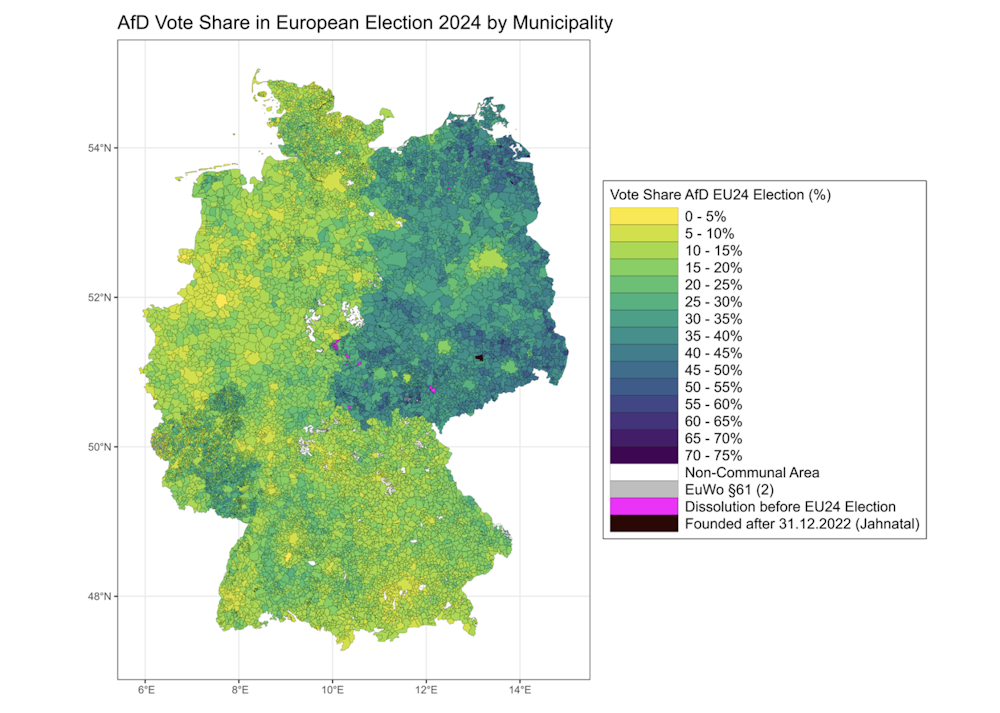
    And ultimately, this politicisation translates into electoral outcomes. In the European parliament elections of June 2024, the AfD took 15.9% of German votes. If we look at the spatial distribution of the AfD’s vote, a pattern showing the salience of the urban-rural divide emerges.

    East and west, town and country

    It’s clear by looking at the map that most (though not all) of the AfD’s strongholds are in eastern Germany – the region which used to be the German Democratic Republic (GDR). Fascism and Nazism were outlawed by decree when this anti-fascist state was established but, in reality, far-right ideologies don’t die off that easily. The result was that extremist views survived in an environment where there was also a lack of education on the National Socialism of the past – and a lack of education about democracy.

    When the socialist authoritarian GDR regime fell in 1989, Germany was reunified under western conditions. This had various effects, including a sense that the experiences of the east were not valued. The inequalities between the two sides of the reunified nation have left some in the east feeling distant from the state. The AfD’s version of nationalism finds fertile ground here.

    Another pattern is also clear across the whole country: the AfD is stronger in remote and rural areas and weaker in urban centres. There is less support in cities such as Berlin, Cologne, Dresden, Hamburg, Leipzig, Munich and Stuttgart. Places with more globalised cultures, international business and diverse populations remain comparably resilient to the spread of the far right.

    AfD support in different municipalities. The darker the colours, the higher the AfD vote share.
    R Frankenberger, CC BY-ND

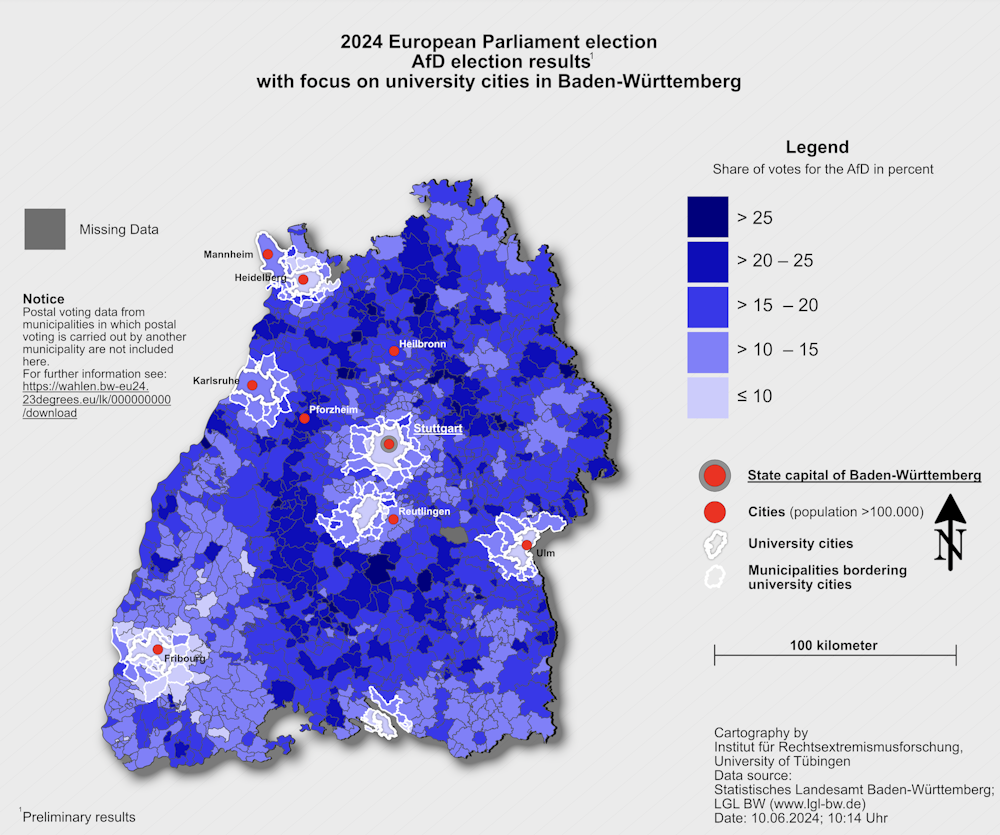
    These patterns become more visible if you take the European election results in the state of Baden-Württemberg as an example.

    The AfD performs significantly worse in the more globalised, cosmopolitan and university-oriented urban areas and their suburbs than in the more remote and rural areas of Baden-Württemberg. On the map, university cities are marked out with a white outline.

    AfD support mapped, with university cities highlighted.
    University of Tübingen, CC BY-ND

    The AfD is particularly strong in the northern and eastern Black Forest, on the Baar, in the Swabian Alb, in the Rems-Murr district, in the Swabian Forest and in Hohenlohe. Most of these areas are remote, with many small towns and villages. They have slightly lower income levels and lower levels of migration than average. They are much more traditional in terms of culture and religion than urban areas.

    The Black Forest, the Swabian Forest, and Hohenlohe also have quite strong protestant and evangelical communities, which are strongholds of traditional family life, customs and traditions.

    We should expect to see these trends continue. The AfD looks set to make further gains in the February 23 election being held in Germany, retaining its strongholds in the east but also spreading into the west in rural areas. The urban-rural divide will therefore become all the more apparent and entrenched when German voters head to the polls.

    Rolf Frankenberger does not work for, consult, own shares in or receive funding from any company or organisation that would benefit from this article, and has disclosed no relevant affiliations beyond their academic appointment.

    ref. These maps of support for Germany’s far-right AfD lay bare the depth of the urban-rural divide – https://theconversation.com/these-maps-of-support-for-germanys-far-right-afd-lay-bare-the-depth-of-the-urban-rural-divide-248405

    MIL OSI – Global Reports

  • MIL-OSI Africa: Female genital mutilation is a leading cause of death for girls where it’s practised – new study

    Source: The Conversation – Africa – By Heather D. Flowe, Professor of Psychology, University of Birmingham

    Female genital mutilation or cutting (FGM/C) is a deeply entrenched cultural practice that affects around 200 million women and girls. It’s practised in at least 25 African countries, as well as parts of the Middle East and Asia and among immigrant populations globally.

    It is a harmful traditional practice that involves removing or damaging female genital tissue. Often it’s “justified” by cultural beliefs about controlling female sexuality and marriageability. FGM/C causes immediate and lifelong physical and psychological harm to girls and women, including severe pain, complications during childbirth, infections and trauma.

    We brought together our expertise in economics and gender based violence to examine excess mortality (avoidable deaths) due to FGM/C. Our new research now reveals a devastating reality: FGM/C is one of the leading causes of death for girls and young women in countries where it’s practised. FGM/C can result in death from severe bleeding, infection, shock, or obstructed labour.

    Our study estimates that it causes approximately 44,000 deaths each year across the 15 countries we examined. That is equivalent to a young woman or girl every 12 minutes.

    This makes it a more significant cause of death in the countries studied than any other excluding infection, malaria and respiratory infections or tuberculosis. Put differently, it is a bigger cause of death than HIV/Aids, measles, meningitis and many other well-known health threats for young women and girls in these countries.

    Prior research has shown that FGM/C leads to severe pain, bleeding and infection. But tracking deaths directly caused by the practice has been nearly impossible. This is partly because FGM/C is illegal in many countries where it occurs, and it typically takes place in non-clinical settings without medical supervision.

    Where the crisis is most severe

    The practice is particularly prevalent in several African nations. In Guinea, our data show 97% of women and girls have undergone FGM/C, while in Mali the figure stands at 83%, and in Sierra Leone, 90%. The high prevalence rates in Egypt, with 87% of women and girls affected, are a reminder that FGM/C is not confined to sub-Saharan Africa.

    For our study, we analysed data from the 15 African countries for which comprehensive “gold standard” FGM/C incidence information is available. Meaning, the data is comprehensive, reliable and widely accepted for research, policymaking and advocacy efforts to combat FGM/C.

    We developed a new approach to help overcome previous gaps in data. We matched data on the proportion of girls subjected to FGM/C at different ages with age-specific mortality rates across 15 countries between 1990 and 2020. The age at which FGM occurs varies significantly by country. In Nigeria, 93% of procedures are performed on girls younger than five years old. In contrast, in Sierra Leone, most girls undergo the procedure between the ages of 10 and 14.

    Since health conditions vary from place to place and over time, and vary in the same place from one year to the next, we made sure to consider these differences. This helped us figure out if more girls were dying at the ages when FGM/C usually happens in each country.

    For example, in Chad, 11.2% of girls undergo FGM/C aged 0-4, 57.2% at 5-9 and 30% at 10-14. We could see how mortality rates changed between these age groups compared to countries with different FGM patterns.

    This careful statistical approach helped us identify the excess deaths associated with the practice while accounting for other factors that might affect child mortality.

    Striking findings

    Our analysis revealed that when the proportion of girls subjected to FGM in a particular age group increases by 50 percentage points, their mortality rate rises by 0.1 percentage points. While this may sound small, when applied across the population of affected countries, it translates to tens of thousands of preventable deaths annually.

    The scale is staggering: while armed conflicts in Africa caused approximately 48,000 combat deaths per year between 1995 and 2015, our research suggests FGM/C leads to about 44,000 deaths annually. This places FGM among the most serious public health challenges facing these nations.

    Beyond the numbers

    These statistics represent real lives cut short. Most FGM/C procedures are performed without anaesthesia, proper medical supervision, or sterile equipment. The resulting complications can include severe bleeding, infection and shock. Even when not immediately fatal, the practice can lead to long-term health problems and increased risks during childbirth.

    The impact extends beyond physical health. Survivors often face psychological trauma and social challenges. In many communities, FGM/C is deeply embedded in cultural practices and tied to marriage prospects, making it difficult for families to resist the pressure to continue the tradition.

    Urgent crisis

    FGM/C is not just a human rights violation – it’s a public health crisis demanding urgent attention. While progress has been made in some areas, with some communities abandoning the practice, our research suggests that current efforts to combat FGM/C need to be dramatically scaled up.

    The COVID-19 pandemic has potentially worsened the situation, owing to broader impacts of the pandemic on societies, economies and healthcare systems. The UN estimates that the pandemic may have led to 2 million additional cases of FGM/C that could have been prevented. Based on our mortality estimates, this could result in approximately 4,000 additional deaths in the 15 countries we studied.

    The way forward

    Ending FGM/C requires a multi-faceted approach. Legal reforms are crucial – the practice remains legal in five of the 28 countries where it’s most commonly practised. However, laws alone aren’t enough. Community engagement, education, and support for grassroots organisations are essential for changing deeply held cultural beliefs and practices.

    Previous research has shown that information campaigns and community-led initiatives can be effective. For instance, studies have documented reductions in FGM/C rates following increased social media reach in Egypt and the use of educational films showing different views on FGM/C.

    Most importantly, any solution must involve the communities where FGM/C is practised. Our research underscores that this isn’t just about changing traditions – it’s about saving lives. Every year of delay means tens of thousands more preventable deaths.

    Our findings suggest that ending FGM/C should be considered as urgent a priority as combating major infectious diseases. The lives of millions of girls and young women depend on it.

    – Female genital mutilation is a leading cause of death for girls where it’s practised – new study
    – https://theconversation.com/female-genital-mutilation-is-a-leading-cause-of-death-for-girls-where-its-practised-new-study-249171

    MIL OSI Africa

  • MIL-OSI United Kingdom: Civil servants can now learn more about national security

    Source: United Kingdom – Executive Government & Departments

    The College for National Security launches a new online course to help break down barriers and help civil servants learn more about national security.

    Andrew Millar, College for National Security

    Civil servants can now learn more about national security, thanks to a new online course launched by the College for National Security.

    The aim of the What is national security course is to break down barriers to understanding National Security threats and impacts and help civil servants integrate it into their jobs.

    Threats to the UK

    “To respond to a broad range of threats the UK faces, we need a workforce that is knowledgeable, skilled and connected when it comes to national security,” said college head Andrew Millar, pictured, who is also deputy director of Government Skills, of which the college is a part.

    “This course gives an introduction to national security and gives civil servants an overview of key national security themes. It’s an ideal introduction for anyone who would like a better understanding of national security, are interested in a career in national security or who are new to the sector.”

    Better understanding

    As part of its efforts to increase understanding of national security, the college has also published its ‘Guide to the UK National Security Community’. The guide outlines the departments, agencies and devolved administrations involved in national security and was developed in collaboration with 23 departments and agencies. It aims to help colleagues better understand the UK’s national security community and the breadth of departments involved. 

    Find out more about the College for National Security.

    Updates to this page

    Published 6 February 2025

    MIL OSI United Kingdom

  • MIL-OSI Canada: The Government of Canada announces an appointment to the Board of Directors of The Jacques Cartier and Champlain Bridges Incorporated

    Source: Government of Canada News (2)

    Today, the Honourable Nathaniel Erskine-Smith, Minister of Housing, Infrastructure and Communities, announced the appointment of Éric Michaud to the Board of Directors of The Jacques Cartier and Champlain Bridges Incorporated (JCCBI), the Crown corporation responsible for the operation of five federal transportation corridors in the Montreal area, and the Québec Bridge.

    MIL OSI Canada News

  • MIL-Evening Report: Grattan on Friday: we don’t need an inquiry into the caravan affair but we do need some answers

    Source: The Conversation (Au and NZ) – By Michelle Grattan, Professorial Fellow, University of Canberra

    The battle to contain antisemitism in Australia finds both sides of politics embracing measures they’d otherwise abhor.

    Spectacularly, the government capitulated this week to include mandatory minimum sentences of between one and six years in its hate speech legislation that passed the parliament on Thursday.

    That flip flop was done in a day. You need a longer memory to recall the Coalition’s insistence that free speech had to be preeminent over dealing with hate speech.

    Way back, when Tony Abbott was prime minister, there was a big (ultimately unsuccessful) push against Section 18C of the Racial Discrimination Act. This civil law prohibits acts “likely to offend, insult, humiliate or intimidate someone because of their race or ethnicity”. At the very least, libertarian Liberals wanted it reworded to remove “offend” and “insult”.

    Before entering parliament, James Paterson worked for the right wing Institute of Public Affairs, which spearheaded attacks on 18C. Even after becoming a senator in 2016, Paterson remained a strong critic of 18C (although he says he always supported laws against incitement to violence).

    Now as home affairs spokesman Paterson has been at the forefront of the opposition efforts to make the new hate speech law as strong as possible.

    Until mid week the government firmly ruled out giving in to opposition’s demands for mandatory sentences for hate crimes. The government’s resistance was unsurprising. The Labor party platform rules out mandatory sentences.

    But then late on Wednesday, leader of the house Tony Burke went into parliament with amendments including mandatory minimum sentences of between one and six years for various crimes under the anti-hate legislation.

    Teal MP Zoe Daniel, from the Victorian seat of Goldstein, was among several crossbenchers who voted against that amendment.

    She said later she supported the legislation but described the mandatory sentencing as “overreach”. “Community safety is paramount, and so is good policy-making. Mandatory minimum sentences do not reflect good parliamentary practice or good governance. Nor do they respect the sanctity of Australia’s constitution and separation of powers, and the importance of judicial independence.”

    The antisemitism crisis is, on a number of fronts, leading to the actual or advocated curtailment of civil liberties. The federal government has outlawed the Nazi salute and hate symbols. The NSW government is to bring in more anti-hate provisions.

    There is constant debate about the desirability of curbs of one sort or another on demonstrations. The antisemitism envoy, Jillian Segal, has said, “There should be places designated away from where the Jewish community might venture where people can demonstrate”.

    In our history we repeatedly see how government actions to confront perceived emergencies collide with civil liberties.

    For example, strong security laws introduced in the wake of September 11 2001 triggered arguments about the extent to which they struck down people’s rights. Going back to the Menzies era, the Communist threat prompted the government to try (and fail) to carry a referendum to ban the Communist Party.

    People of good intent will differ about the extent to which particular responses to a crisis are necessary and appropriate, or go too far, either being bad policy or an unjustified curb on civil liberties. Historical judgements may also differ from those made at the time.

    This is not to dispute that we should be taking the strongest action against antisemitism. It’s merely to point out that with each particular measure, it’s important to be confident the end justifies the means, taking into account possible unintended or adverse consequences as well as what is to be achieved.

    Having had a victory over mandatory minimum sentences, the opposition is pushing for an inquiry into when Prime Minister Anthony Albanese was told about the caravan found at Dural, NSW filled with explosives and containing indications Sydney’s Great Synagogue and a Jewish museum could be targets.

    The caravan was parked for several weeks on a street before it came to police attention. NSW police alerted Premier Chris Minns the following day. But it is unclear when the prime minister found out.

    Albanese has steadfastly refused to say, citing operational reasons. Opposition Leader Peter Dutton suggested (without producing any evidence) the NSW police might have made a deliberate decision not to advise the Commonwealth “so that the prime minister wasn’t advised because they were worried he would leak the information”.

    Dutton is calling for an “independent inquiry” into the circumstances by “an eminent Australian from the criminal intelligence and law enforcement intelligence community”.

    The inquiry call is politically driven. The government is right in arguing it would have the downside of diverting resources. But nevertheless there are questions that need answering.

    There seems no logical reason why the PM cannot reveal when he was first briefed on the caravan, other than to avoid disclosing some embarrassing timing gap. Any explanation around operational reasons would surely not explain why Minns was briefed but Albanese was not. Alternatively, if Albanese was briefed promptly, why doesn’t he say so?

    When pressed at a parliamentary committee on Thursday, Australian Federal Police Force Commissioner Reece Kershaw would not be drawn, saying it was not appropriate to provide information about an ongoing investigation at a public hearing.

    Later Greens member of the committee, senator David Shoebridge, said: “The AFP telling us when they informed the PM could in no way prejudice any ongoing police investigation. We had half a dozen senior AFP officials [before the committee] including the Commissioner and zero serious answers.

    “This whole circus would be shut down by any half competent government by telling us when the PM knew with a simple explanation for any delay. Instead we get these bizarre performances from both the PM and the AFP.”

    One question that should be answered by the authorities is why Jewish leaders, including those connected with the synagogue and the museum, were not informed. Though operational reasons might be relevant, surely safety considerations suggest the Jewish leaders should have been told.

    The authorities believe the antisemitic attacks are not simply unconnected incidents. They say people are being paid to make them, suggesting some master minding behind them.

    Of course that justifies secrecy while investigations proceed, but operational needs should not be a cover for refusing to provide enough information to give the public confidence the various authorities are working effectively together.

    Michelle Grattan does not work for, consult, own shares in or receive funding from any company or organisation that would benefit from this article, and has disclosed no relevant affiliations beyond their academic appointment.

    ref. Grattan on Friday: we don’t need an inquiry into the caravan affair but we do need some answers – https://theconversation.com/grattan-on-friday-we-dont-need-an-inquiry-into-the-caravan-affair-but-we-do-need-some-answers-249275

    MIL OSI AnalysisEveningReport.nz

  • MIL-OSI China: Chinese university develops high-efficiency flexible tandem solar cells

    Source: China State Council Information Office 2

    Scientists at China’s Westlake University have unveiled a breakthrough in solar technology: ultra-thin, flexible tandem solar cells that can achieve a record 23.4 percent power conversion efficiency.
    The cells, with a thickness comparable to the diameter of a human hair, combine perovskite and copper indium gallium selenide (CIGS) layers, offering promising applications in wearable devices, curved building surfaces, electric vehicles and aerospace, the Science and Technology Daily reported on Thursday.
    The research underscores China’s growing role in the realm of next-generation solar innovation.
    The team, led by Wang Rui from the School of Engineering and the Research Center for Industries of the Future, published their findings in Nature Photonics.
    Tandem solar cells overcome the efficiency limitations of traditional single-junction cells by incorporating complementary materials.
    Their design stacks two light-absorbing materials — perovskite and CIGS — like a “multi-layer cake,” as Wang described.
    “Each layer captures specific wavelengths of sunlight, enabling the cell to harvest more energy than single-layer alternatives,” he said, adding the final product comprises as many as 15 layers, each with stringent requirements regarding thickness and uniformity.
    Wang’s team started the development of the solar cells in 2022, but they faced a critical challenge: forming a smooth perovskite layer atop the CIGS surface.
    Initial attempts left the perovskite riddled with holes, crippling performance. In late 2023, researchers Tian Liuwen and Wang switched tactics, testing new perovskite deposition methods. After months of trials, they achieved a uniform layer — a milestone that propelled efficiency gains.
    The solar cells are expected to find applications in various fields including architecture, automotive, aerospace, and flexible wearable devices, Wang noted.
    The technology’s lightweight nature also reduces transportation and installation costs compared to conventional panels.

    MIL OSI China News

  • MIL-OSI China: China sees over 2.3B inter-regional trips during Spring Festival holiday

    Source: China State Council Information Office 2

    Passengers wait for the train at Hangzhou East Railway Station in Hangzhou, east China’s Zhejiang Province, Feb. 4, 2025. [Photo/Xinhua]
    During the eight-day Spring Festival holiday that ended on Tuesday, more than 2.3 billion passenger trips were made across all regions in China, official data showed Wednesday.
    The total included 96.26 million railway trips, 2.18 billion road trips, 9.41 million waterway trips, and 18.24 million air trips, according to data from the Ministry of Transport, the Civil Aviation Administration of China, and the China State Railway Group Co., Ltd., among others.
    The annual Spring Festival travel rush, known as chunyun in China, is set to break records this year. Between Jan. 14 and Feb. 22, an estimated 9 billion inter-regional passenger trips are expected. The Spring Festival, an occasion for family reunions, fell on Jan. 29 this year.
    In recent years, a notable trend during chunyun has been the surge in the use of new energy vehicles (NEVs), driven by the fast expansion of charging infrastructure and the Chinese people’s growing eco-friendly awareness.
    The State Grid Corporation of China has expected the charging volume for NEVs on the country’s highways to reach a record high during the Spring Festival holiday.

    MIL OSI China News

  • MIL-OSI China: Expert: US tariffs on Chinese goods blatant trade bullying

    Source: China State Council Information Office

    The U.S. Capitol building is pictured in Washington, D.C., the United States, on Jan. 6, 2025. [Photo/Xinhua]

    The United States’ unilateral imposition of additional tariffs on Chinese goods is a blatant act of trade bullying, damaging bilateral trade and erodes the rules-based global trade system, according to a Chinese expert.

    Xu Xiujun, director of the Research Center for Sino-Foreign Studies at the Chinese Academy of Social Sciences and a professor at its International Political Economy Institute, voiced his concerns during an interview with China.org.cn on Wednesday. “The U.S. imposition of extra tariffs on Chinese goods severely disrupts normal bilateral trade and jeopardizes the sustainable development of China-U.S. ties,” he said. “The move violates World Trade Organization (WTO) rules and pushes the global trade order once again to the brink of chaos.”

    Following the U.S. imposition of a 10% additional tariff on Chinese imports on Feb. 4, citing the fentanyl issue, Beijing swiftly responded with a series of economic countermeasures the same day.

    The Customs Tariff Commission of the State Council announced that China will implement additional tariffs on select U.S. goods starting Feb. 10. These tariffs include a 15% levy on U.S. coal and liquefied natural gas, and a 10% increase on existing tariffs for crude oil, agricultural machinery, large-displacement automobiles and pickup trucks. 

    China’s State Administration for Market Regulation also announced an anti-monopoly investigation into Google, and the Ministry of Commerce (MOC) and the General Administration of Customs jointly declared export controls on certain items related to tungsten, tellurium, bismuth, molybdenum and indium, effective Tuesday.  

    The Chinese government has also filed a complaint with the WTO’s dispute settlement mechanism, as confirmed by an MOC spokesperson on Tuesday, to “safeguard China’s legitimate rights and interests.”

    “By taking the U.S. tariff measures to the WTO dispute settlement mechanism, the Chinese government has not only demonstrated its firm stance in safeguarding its own rights and interests, but also taken concrete action to uphold the international trade order based on WTO rules,” said Xu.

    At a press briefing on Wednesday, Chinese Foreign Ministry spokesperson Lin Jian said, “Applying pressure and issuing threats is not the right way to handle relations with China,” arguing that shifting the blame to other countries does not address the U.S. fentanyl crisis.

    “The real solution lies in reducing domestic drug demand and strengthening law enforcement cooperation,” Lin added. He also highlighted that China enforces some of the strictest drug control policies in the world.

    Xu highlighted China’s longstanding leadership in drug control, noting that China was the first country to officially schedule fentanyl-related substances as a distinct class back in 2019.

    “In contrast, due to lax regulatory oversight, the U.S. has been grappling with rampant drug abuse and widespread drug problems,” he said. Xu criticized the U.S. government for singling out unrelated Chinese products with unilateral tariffs — a tactic designed to conceal its own inability to effectively address domestic drug issues while protecting the interests of large pharmaceutical companies and their political allies.

    “This approach not only fails to address the challenges facing the U.S. but actually worsens its problems,” he added.

    Xu said that China will enhance cooperation with other WTO members, firmly opposes unilateralism and trade protectionism, and embraces genuine multilateralism.

    “China will work to promote stable and sustainable international economic and trade cooperation in line with the WTO’s core principles of fair competition, transparency and predictability,” he said.

    MIL OSI China News

  • MIL-OSI United Kingdom: Match Day Parking Zone to be introduced around Everton FC’s new stadium

    Source: City of Liverpool

    Liverpool City Council is to introduce a ‘Football Match Parking Zone’ around Everton FC’s new stadium, at Bramley-Moore Dock.

    A raft of new parking measures are to be implemented surrounding the 52,888 seater stadium, similar to what is already in place around Goodison Park and Anfield.

    More than 4,000 residents and 3,000 businesses are now being invited to apply for the relevant parking permits ahead of the zone going live under an Experimental Traffic Road Order (ETRO) to coincide with the historic first test game at the £500m venue later this month.

    The ETRO will run for up to 18 months and during that period will then be reviewed by the Council’s Transport and Highways team.

    Residents will be able to apply for a permit for each vehicle registered at their address, plus one visitor permit, for which there will be no fee. Businesses will be charged an annual fee of £50 per vehicle, up to a maximum of 10.

    The focus of the proposed parking zone covers the area within a 30-minute walk of Everton Stadium, which is serviced by the city’s historic “Dock Road”, and will encompass the surrounding Ten Streets district, into the city centre and up to Great Homer Street in Everton.

    The new parking zone requirements, which were subject to a public consultation in late 2022, includes:

    • New resident parking areas
    • New taxi ranks
    • New match day bus stands
    • New parking restrictions
    • New hours of operation for existing parking zones for the Great Homer Street area
    • New hours of operation for existing parking zones for the Ten Streets and Love Lane areas
    • New industrial parking zone south of Boundary Street
    • New industrial parking zone north of Boundary Street

    The overall aim of the new Parking Zone is to reduce congestion, improve air quality and safety to and from the stadium. The proposals have also been designed to complement the planned modernisation of parking across the city centre.

    The Council’s Transport and Highways team has already begun the process of installing new signage ahead of Everton’s first “test match” at the waterfront stadium, situated within Liverpool Waters, which will be held on Monday, 17 February.

    Scheduled to open for the 2025/26 season, Everton’s new home has already been picked as a venue for the UEFA European Championships in 2028 and will also be capable of hosting major non-footballing events.

    Liverpool City Council has invested more than £20m in the highways infrastructure around Bramley-Moore Dock, including a permanent segregated cycle lane running from the city centre up to Liverpool’s northern border at Bootle in Sefton, which passes right in front of the new stadium.

    The Council is also working with Sefton Council and the Liverpool City Region Combined Authority on a new town bid which which would see for than 10,000 new homes, with community infrastructure, from the city centre, around the new stadium, and north into Bootle and Walton.

    • The Liverpool City Region Combined Authority is also working with Merseyrail, Network Rail and Everton FC on the development of a new crowd management zone and an additional entrance at Sandhills station. The aim is to primarily support fans and event goers accessing public transport on their way to and from the new stadium.

    Councillor Dan Barrington, Liverpool City Council’s Cabinet Member for Transport and Connectivity, said: “Everton Stadium is going to be transformational especially for the surrounding Ten Streets district and the wider Kirkdale community.

    “As well as the economic benefit, the vast volume of people the stadium will attract – and how they arrive and depart – needs to be carefully managed.

    “The North Docks area has never had to cope with such large numbers of people in such concentrated time periods, but fortunately the city has the experience and knowledge thanks to Goodison Park and Anfield. By creating this new match day parking zone, we’ll be looking to adopt and incorporate those controls which so effectively move tens of thousands on a weekly basis.

    “Bramley-Moore Dock is also a unique location given its very close proximity to the city centre and the fact the surrounding transport infrastructure is well developed. There’s more to be done but all the partners are talking to make those improvements.

    “We’ll also be looking to encourage as many active travel options as possible for those attending the games or other events there, which is a win-win for everyone in terms of managing congestion and air quality and promoting healthy habits.

    “There’s lots of residents and businesses, as well as Everton fans, who will be affected by this new zone and thanks to their feedback we’ve been able to formulate a plan which accommodates their needs.”

    MIL OSI United Kingdom

  • MIL-OSI Global: The ‘degrowth’ movement envisions global climate justice, but must adapt to global south realities

    Source: The Conversation – France – By Claudius Gräbner-Radkowitsch, Junior Professor of Pluralist Economics, Europa-Universität Flensburg

    It is widely accepted that human activities are the primary drivers of global warming and environmental crises, including the rapid loss of biodiversity. However, the debate over how best to address these issues is far from settled. In political circles, “green growth” – the concept of making economic activities more sustainable – has emerged as the most popular solution.

    Is green growth enough?

    The idea behind green growth is to continue expanding economies while minimising environmental harm. However, critics argue that this approach has failed to significantly curb climate change and biodiversity loss.

    Despite international efforts since the 1970s, carbon emissions have continued to rise. As the World Inequality Report reveals, nearly half of historical emissions occurred after 1990. Incremental policy changes, technological innovations and shifts in consumer behaviour have not been enough to reverse this trend. This failure has led to the growing appeal of “degrowth” – a more radical alternative that challenges the current global economic system.

    What is ‘degrowth’?

    “Degrowth” emerged in Europe, particularly in France, in the late 2000s. Philosophers such as André Gorz and economists such as Serge Latouche were among its early proponents, with researchers such as Tim Jackson later popularising the concept in the English-speaking world. They argue that the root cause of environmental destruction lies not only in human activity but also in a global economic model that has prioritised growth and profit since the Industrial Revolution.

    Initially, degrowth was a critique of Western lifestyles and notions of progress. Environmental concerns were just one part of the movement’s broader agenda. Over time, however, environmentalism has become central to the movement’s goals.

    A stenciled message in favour of degrowth.
    Paul Sableman, CC BY


    À lire aussi :
    Idea of green growth losing traction among climate policy researchers, survey of nearly 800 academics reveals


    What about the global south?

    Today, many degrowth advocates assert that the richer countries of the global north, being largely responsible for environmental degradation, should be the ones to scale back economic activity to avert ecological catastrophe. But what about the poorer countries of the global south? Should they adopt degrowth strategies? Some argue this would impose a neocolonial agenda, with wealthier countries once again dictating the terms of global development. Others note that many poorer countries need economic growth to combat poverty. And even if degrowth were limited to the north, it could still have significant effects on the south – both positive and negative.

    A review of academic literature on degrowth and the global south reveals two main perspectives: those who see degrowth as incompatible with the south’s development needs, and those who believe it could offer synergies with sustainable development goals.

    Supporters of degrowth often point out that many of its core ideas originate in the global south. Anthropologist Jason Hickel cites figures such as Sri Lankan philosopher Ananda Coomaraswamy, Indian economist J.C. Kumarappa and Bengali poet Rabindranath Tagore as inspirations. While these thinkers may not use the term “degrowth”, they promote ideas aligned with it, such as the Latin American Sumak kawsay (or “Buen vivir”) or the South African Ubuntu. These non-Western perspectives have been instrumental in shaping the degrowth discourse in the global north.

    Degrowth as decolonisation

    Degrowth advocates argue that scaling back economic activity in the north could help dismantle the unequal global division of labour, in which raw materials are extracted from the south and processed into consumer goods in the north. This system disproportionately benefits wealthier nations while leaving poorer countries with the social and environmental costs. Federico Demaria, a researcher in political ecology, argues that northern countries must “pay for past and present colonial exploitation in the south” – a central theme in contemporary degrowth discourse.

    An aerial view of a gold mine in Brazil.
    Tarcisio Schnaider/Shutterstock

    Some researchers suggest that dependence on economic growth is problematic for both the north and south. They argue that growth alone does not guarantee poverty reduction – wealth distribution and institutional reforms are just as crucial. Degrowth could help both regions avoid unsustainable development models by focusing more on social well-being than perpetual economic expansion.

    Challenges for degrowth in the global south

    However, many scholars believe degrowth is unattractive for the global south. Critics argue that the concept is too Eurocentric and fails to resonate amid the specific challenges faced by poorer nations. Interviews with academics and activists in the south show that while they may agree with some of the ideas behind degrowth, they reject its language, which they see as rooted in Western thinking. Economist Beatriz Rodríguez Labajos and her co-authors suggest that researchers from the north and south should look at “strengthening potential synergies, through an assertive recognition of the barriers to doing so”.

    There is also concern that promoting degrowth in the south could be perceived as a new form of colonialism. Imposing Western notions of degrowth could prevent poorer countries from following the same path to prosperity that the north took, which often involved exploiting the resources of the south. The degrowth movement’s failure to fully address the colonial roots of economic development poses a challenge to its decolonization-oriented ambitions.

    The problem of global dependencies

    Finally, global dependencies further complicate the degrowth debate. Many people in the south rely on export-driven economies that serve Western markets. A reduction in economic activity in the north could harm populations in the south who depend on those exports.

    This interdependence presents a dilemma for the degrowth movement. Proponents argue that degrowth is not about abandoning economic activity but reforming the global trade, finance and governance systems to prevent negative impacts on the south. For degrowth to succeed, its advocates must formulate concrete proposals that address these global dependencies without exacerbating inequalities or harming the most vulnerable.


    This article is part of a project involving The Conversation France and AFP audio. It has received financial support from the European Journalism Centre, as part of the Solutions Journalism Accelerator programme supported by the Bill and Melinda Gates Foundation. AFP and The Conversation France have retained their editorial independence at every stage of the project.


    We offer this article as part of the Normandy World Forum for Peace, organised by the Normandy region of France on September 26-27, 2024. The Conversation France is a partner of the forum. For more information, visit the Normandy World Forum for Peace’s website.

    Claudius Gräbner-Radkowitsch is a member of the Bündnis90/Die Grünen (The Greens) party. He has received research grants, notably from the Austrian FWF and the German DFG.

    Birte Strunk ne travaille pas, ne conseille pas, ne possède pas de parts, ne reçoit pas de fonds d’une organisation qui pourrait tirer profit de cet article, et n’a déclaré aucune autre affiliation que son organisme de recherche.

    ref. The ‘degrowth’ movement envisions global climate justice, but must adapt to global south realities – https://theconversation.com/the-degrowth-movement-envisions-global-climate-justice-but-must-adapt-to-global-south-realities-238276

    MIL OSI – Global Reports

  • MIL-OSI Global: Female genital mutilation is a leading cause of death for girls where it’s practised – new study

    Source: The Conversation – Africa – By Heather D. Flowe, Professor of Psychology, University of Birmingham

    Female genital mutilation or cutting (FGM/C) is a deeply entrenched cultural practice that affects around 200 million women and girls. It’s practised in at least 25 African countries, as well as parts of the Middle East and Asia and among immigrant populations globally.

    It is a harmful traditional practice that involves removing or damaging female genital tissue. Often it’s “justified” by cultural beliefs about controlling female sexuality and marriageability. FGM/C causes immediate and lifelong physical and psychological harm to girls and women, including severe pain, complications during childbirth, infections and trauma.

    We brought together our expertise in economics and gender based violence to examine excess mortality (avoidable deaths) due to FGM/C. Our new research now reveals a devastating reality: FGM/C is one of the leading causes of death for girls and young women in countries where it’s practised. FGM/C can result in death from severe bleeding, infection, shock, or obstructed labour.

    Our study estimates that it causes approximately 44,000 deaths each year across the 15 countries we examined. That is equivalent to a young woman or girl every 12 minutes.

    This makes it a more significant cause of death in the countries studied than any other excluding infection, malaria and respiratory infections or tuberculosis. Put differently, it is a bigger cause of death than HIV/Aids, measles, meningitis and many other well-known health threats for young women and girls in these countries.

    Prior research has shown that FGM/C leads to severe pain, bleeding and infection. But tracking deaths directly caused by the practice has been nearly impossible. This is partly because FGM/C is illegal in many countries where it occurs, and it typically takes place in non-clinical settings without medical supervision.

    Where the crisis is most severe

    The practice is particularly prevalent in several African nations.
    In Guinea, our data show 97% of women and girls have undergone FGM/C, while in Mali the figure stands at 83%, and in Sierra Leone, 90%. The high prevalence rates in Egypt, with 87% of women and girls affected, are a reminder that FGM/C is not confined to sub-Saharan Africa.

    For our study, we analysed data from the 15 African countries for which comprehensive “gold standard” FGM/C incidence information is available. Meaning, the data is comprehensive, reliable and widely accepted for research, policymaking and advocacy efforts to combat FGM/C.

    We developed a new approach to help overcome previous gaps in data. We matched data on the proportion of girls subjected to FGM/C at different ages with age-specific mortality rates across 15 countries between 1990 and 2020. The age at which FGM occurs varies significantly by country. In Nigeria, 93% of procedures are performed on girls younger than five years old. In contrast, in Sierra Leone, most girls undergo the procedure between the ages of 10 and 14.

    Since health conditions vary from place to place and over time, and vary in the same place from one year to the next, we made sure to consider these differences. This helped us figure out if more girls were dying at the ages when FGM/C usually happens in each country.

    For example, in Chad, 11.2% of girls undergo FGM/C aged 0-4, 57.2% at 5-9 and 30% at 10-14. We could see how mortality rates changed between these age groups compared to countries with different FGM patterns.

    This careful statistical approach helped us identify the excess deaths associated with the practice while accounting for other factors that might affect child mortality.

    Striking findings

    Our analysis revealed that when the proportion of girls subjected to FGM in a particular age group increases by 50 percentage points, their mortality rate rises by 0.1 percentage points. While this may sound small, when applied across the population of affected countries, it translates to tens of thousands of preventable deaths annually.

    The scale is staggering: while armed conflicts in Africa caused approximately 48,000 combat deaths per year between 1995 and 2015, our research suggests FGM/C leads to about 44,000 deaths annually. This places FGM among the most serious public health challenges facing these nations.

    Beyond the numbers

    These statistics represent real lives cut short. Most FGM/C procedures are performed without anaesthesia, proper medical supervision, or sterile equipment. The resulting complications can include severe bleeding, infection and shock. Even when not immediately fatal, the practice can lead to long-term health problems and increased risks during childbirth.

    The impact extends beyond physical health. Survivors often face psychological trauma and social challenges. In many communities, FGM/C is deeply embedded in cultural practices and tied to marriage prospects, making it difficult for families to resist the pressure to continue the tradition.

    Urgent crisis

    FGM/C is not just a human rights violation – it’s a public health crisis demanding urgent attention. While progress has been made in some areas, with some communities abandoning the practice, our research suggests that current efforts to combat FGM/C need to be dramatically scaled up.

    The COVID-19 pandemic has potentially worsened the situation, owing to broader impacts of the pandemic on societies, economies and healthcare systems. The UN estimates that the pandemic may have led to 2 million additional cases of FGM/C that could have been prevented. Based on our mortality estimates, this could result in approximately 4,000 additional deaths in the 15 countries we studied.

    The way forward

    Ending FGM/C requires a multi-faceted approach. Legal reforms are crucial – the practice remains legal in five of the 28 countries where it’s most commonly practised. However, laws alone aren’t enough. Community engagement, education, and support for grassroots organisations are essential for changing deeply held cultural beliefs and practices.

    Previous research has shown that information campaigns and community-led initiatives can be effective. For instance, studies have documented reductions in FGM/C rates following increased social media reach in Egypt and the use of educational films showing different views on FGM/C.

    Most importantly, any solution must involve the communities where FGM/C is practised. Our research underscores that this isn’t just about changing traditions – it’s about saving lives. Every year of delay means tens of thousands more preventable deaths.

    Our findings suggest that ending FGM/C should be considered as urgent a priority as combating major infectious diseases. The lives of millions of girls and young women depend on it.

    The authors do not work for, consult, own shares in or receive funding from any company or organisation that would benefit from this article, and have disclosed no relevant affiliations beyond their academic appointment.

    ref. Female genital mutilation is a leading cause of death for girls where it’s practised – new study – https://theconversation.com/female-genital-mutilation-is-a-leading-cause-of-death-for-girls-where-its-practised-new-study-249171

    MIL OSI – Global Reports

  • MIL-OSI USA: Ahead of “Fork in the Road” Offer Deadline, Senator Murray Warns of Likely Scam, Shares Stories of WA Federal Workers  

    US Senate News:

    Source: United States Senator for Washington State Patty Murray

    ICYMI: Senator Murray Stands Up For Federal Workers As Trump and Musk Try To Push Them Out – More HERE; VIDEO HERE

    Washington, D.C. – Today, U.S. Senator Patty Murray (D-WA), Vice Chair of the Senate Appropriations Committee, penned the following open letter to all federal workers in Washington state, outlining her serious concerns regarding the so-called “Fork in the Road offer” ahead of the final deadline of February 6, 2025. Murray sent an earlier letter to constituents over the weekend that can be read HERE.

    ________________________________________________________________________________________________________________

    Dear Friend,

    As I’ve expressed previously, I am seriously alarmed by the rhetoric and actions targeting federal workers coming from the Trump administration. At the time of this letter, my colleagues and I are holding the Senate floor in an effort to at least delay the confirmation of Russell Vought to serve as Director of the Office of Management and Budget, someone who has said he wanted to inflict “trauma” on federal workers. You should know that I am firmly committed to standing up for and protecting the workers who have taken an oath to serve the American people.

    So, with the deadline fast approaching for this so-called “Fork in the Road” offer, I want to once again reiterate my concerns and share just some of the correspondence I’ve received—because the public should hear these stories.

    Here’s why I am skeptical of this likely scam and so-called “buyout”: First, there is no guarantee workers who accept this offer will get paid through September 30th as promised. Not only is there no funding for that time frame right now, but I personally am deeply skeptical of any offer from a President like Donald Trump, who has so consistently shown he will try to stiff workers at every opportunity. Being given only nine days to decide something like this should already be setting off alarm bells. That is a short amount of time to consider all of the financial impacts of potentially accepting the offer—including if and where you’d be able to find a new job, how this would impact benefits like health insurance and retirement, and a lot more. And we all know scammers often pressure people to act immediately.

    Additionally, the information being provided continues to change, and includes a lot of caveats. It claims you can rescind your resignation if you change your mind—but that your job may no longer exist. It claims that you aren’t expected to work if you accept the offer—except in cases determined by each individual agency. It claims that you can stay in your current role—however, there is no guarantee your position will be needed. The lack of clear information and resources about exactly what will be allowed is rightfully creating confusion for the more than 56,000 federal civilian workers in Washington state alone.

    Here’s what I’m hearing from federal workers in Washington state:

    • One federal worker told me: “In two days time, I have a choice to make. I can choose to take the buyout offer and hopefully get paid for eight months or stay at my job with hopes that I don’t get fired (and not get paid). Each choice comes with big risk. Risk of losing my career, not finding a job in eight months or being let go when I hoped I wouldn’t… The biggest risk I face is being without a paycheck to provide for my daughters.”
    • A Hanford worker, who had been recognized repeatedly for their work, wrote to me: “I am a union-protected… hire, yet I am being forced out, along with countless others. I am being pressured to take a ‘buyout’ when I should not have to choose between my career and an arbitrary workforce reduction. I am exactly the kind of employee this agency needs—driven, innovative, and action-oriented… This is not just about me. It is about the gutting of a critical workforce that serves this nation. Federal employees at Hanford dedicate themselves to a mission of national importance. We do not deserve to be discarded.”
    • Another worker wrote to me: “As a proud military spouse… I am grateful for the opportunity to build a career in civil service while remaining in Washington. Being a remote federal employee has allowed me to stay in my home state, contribute to the local economy, buy a home, and even start a small business with my husband…. However, the last few weeks have tested my hope in our future. The attacks on the civilian federal workforce have left me—and many of my colleagues—deeply concerned about the stability of our jobs and the critical programs we support. I fear waking up one day to find my position eliminated, my role reassigned… These threats are not just personal; they jeopardize the essential services that keep Americans healthy, housed, fed, and safe.”
    • Another wrote in to say: “As a federal employee who has been through [X] performance appraisals and earned ‘significantly exceeds expectations’ [X] times, I am struggling with being on what feels like the chopping block. I love my job, I work hard and I don’t want to walk away…  I’m being forced to roll the dice on continued employment or take the buyout. How is this fair to do to civil servants? […] We need our voices to be heard. We are real people with families to feed and mortgages to pay.”
    • Here’s from another federal employee: “I purchased my house with the understanding I would be able to telework more often than not. I am [X] years into my public service student loan forgiveness, and it seems unlikely I will receive a discharge at ten years. My coworkers, who I respect and treasure, are being terrified and maligned for doing necessary jobs no one else wants to do.”
    • And my office has just been inundated with calls from federal workers, lifelong Washingtonians who are deeply concerned about the future of their jobs, deeply confused about what to do, and unsure what information they can trust—or where to go for help.     

    With that in mind, some resources for federal workers on the “Fork in the Road” letter that may be helpful include:

    Finally, here is my message to federal workers in Washington state and all over the country: You do so much for our communities. And you all deserve so much better than to have a billionaire with no real understanding of what you do come in, belittle your work, suggest he can do it better, and push you out the door. I want to express my sincere gratitude for all you do—I hope you all will keep up the good work for the American people, and I want you to know, I will keep fighting for you as well.

    In service,

    Senator Patty Murray

    MIL OSI USA News

  • MIL-OSI United Kingdom: Bumper turnout at award winning SEND careers fair

    Source: City of Wolverhampton

    The City of Wolverhampton Council, with support from Tettenhall Wood School, staged the free Moving into Adulthood Careers Fair at Wolverhampton Racecourse, aimed at young people in Year 9 and above, parents, carers and staff who support the children in their current educational setting.

    They were invited to find out about the options available for further education, training and employment from exhibitors including colleges, providers, supported employers, social care settings and community groups.

    Councillor Jacqui Coogan, the City of Wolverhampton Council’s Cabinet Member for Children, Young People and Education, said: “We want to ensure that children and young people with special educational needs or disabilities are able to live their lives to the full.

    “This was our third Moving into Adulthood Careers Fair and the biggest and best yet, with more children and young people, more parents and carers, and more exhibitors, and we hope it gave everyone involved plenty of information and advice about the many opportunities that are out there for our children and young people with SEND as they move into adulthood.

    “Feedback was overwhelmingly positive with attendees praising the range of careers showcased and the engaging nature of the activities, and I would like to thank everyone who attended and who organised this year’s very successful event.”

    The second Moving into Adulthood SEND Careers Fair, staged at Wolverhampton Racecourse in November 2023, won the Careers Intervention category at last summer’s West Midlands Combined Authority (WMCA) Adult Learning Awards.

    MIL OSI United Kingdom

  • MIL-OSI United Kingdom: Government opens record industry conference to kickstart SME exports

    Source: United Kingdom – Executive Government & Departments

    UK Export Finance welcomes industry to its largest ever national conference, promoting SME growth.

    • Minister for Exports calls on SME audience to make use of government support at UK Export Finance’s annual conference.

    • Around 1,000 business leaders – including directors from CBI and British Chambers of Commerce – gather to help UK businesses access international opportunities.

    • With a £60 billion remit, UKEF enabled exports to 45 global territories in 2024, unlocking export opportunities for British suppliers.

    The UK government is hosting one of its largest ever export conferences, with around 1,000 business leaders attending today’s UK Trade and Export Finance Forum to discuss ways of reducing financial barriers to exporting.

    Hosted in London by UK Export Finance (UKEF), the event welcomes speakers from the CBI, British Chambers of Commerce and Invest in Women Taskforce. Workshops will discuss overseas opportunities and how government and private sector can collaborate to help a wider range of businesses to export.   

    UKEF is a government department which helps businesses to export by offering financing guarantees and insurance – support which helps companies to fill their order-books, invest in growth and create wealth. The event comes a week after the Chancellor pledged to kick-start economic growth across the country as part of this government’s Plan for Change.  

    In the 2023-24 financial year, UKEF backing for businesses contributed £3.3 billion to the UK economy and supported up to 41,000 jobs across the country.

    UKEF can also now reveal that in 2024, its work secured export deals to 45 territories, increasing the availability of overseas contract opportunities for British businesses.

    A majority of businesses seeking UKEF support and attending the conference are small and medium-sized enterprises (SMEs). Export finance support complements other actions which the government is taking to support SMEs, like measures tackling the scourge of late payments, the launch of a Business Growth Service, and trade agreements generating new opportunities.

    Gareth Thomas, Minister for Exports, said:

    UKEF plays a key part in this government’s central mission to go further and faster to deliver economic growth across the country. Their support has led to projects in dozens of countries around the world, supporting jobs, boosting wages and increased investment into the UK.

    Supporting small firms and supercharging exports are at the very core of that growth mission, because we know that when more SMEs trade around the world, it boosts the whole economy.

    The conference falls ahead of the government’s Industrial Strategy, a plan for supporting investment into high-growth sectors which is expected to launch in spring 2025. This will be supported by UKEF’s own vision for supporting more SMEs and facilitating £10 billion in financing for clean-growth exports by 2029 – a vision furthered by the Chancellor’s recent launch of export finance support for projects supplying critical minerals to UK industry.

    Shevaun Haviland, Director General of the British Chambers of Commerce, said:

    If the UK wants to grow its economy, then we need to export more. The maths on this is really very simple. If we export more than we import, then trade contributes to economic growth, productivity rises, and wages and investment are pushed up – creating a virtuous circle. 

    Our experience has also taught us that firms that export are more resilient, innovative and grow faster. Support for our SME exporters and encouragement to help them start selling overseas is vital to making this happen and UKEF has a key role to play.

    Jordan Cummins, Director (UK Competitiveness), CBI, said:

    To be a key player in the global race for growth, the UK needs a bold and ambitious Trade Strategy.

    As business continues to navigate changing global dynamics, persistent economic headwinds, and geopolitical uncertainty, intervention is needed from government to enable firms to capture the growth prizes on offer. Doing so will ensure the UK is positioned as one of the world’s best locations for investment and trade.

    Record interest in the government event follows growth in the range of businesses seeking UKEF support. Since launching the event in 2018, UKEF has seen a significant rise in the number of retail and wholesale exporters supported, particularly in food & drink, beauty & healthcare, furniture, homeware and interior design.

    Contact

    Media enquiries:

    Updates to this page

    Published 6 February 2025

    MIL OSI United Kingdom

  • MIL-OSI: Net Asset Value

    Source: GlobeNewswire (MIL-OSI)

    6 FEBRUARY 2025

    NORTHERN 2 VCT PLC

    UNAUDITED NET ASSET VALUE AS AT 31 DECEMBER 2024

    Northern 2 VCT PLC (“the Company”) is a Venture Capital Trust (“VCT”) launched in 1999 and managed by Mercia Fund Management Limited. The Company’s objective is to provide long-term tax-free returns to investors through a combination of dividend yield and capital growth, by investing in a portfolio of investments mainly comprising unquoted venture capital holdings. In order to maintain approval by HM Revenue & Customs as a VCT, the Company is required to comply on a continuing basis with the provisions of Section 274 of the Income Tax Act 2007.

    The unaudited net asset value per ordinary share as at 31 December 2024 was 58.6 pence (30 September 2024 (unaudited) 57.2 pence).

    The net asset value is stated before deducting the interim dividend of 1.7 pence per share in respect of the year ending 31 March 2025, which was paid to eligible shareholders on 22 January 2025.

    For the purposes of calculating the net asset value per share, quoted investments are carried at bid price as at 31 December 2024 and unquoted investments are carried at fair value as at 31 December 2024 as determined by the directors.

    New Investments:
    During the three months ended 31 December 2024 three new venture capital investments were completed.

    Name of company Business activity Amount
    invested
    £000
    Semble Technology

    Enterprise AI for automated surgical tray validation

    2,072
    Scalpel AI

    Practice management software for healthcare clinicians/clinics

    1,036
    Napo

    Pet insurance provider with a focus on preventative care and customer experience

    2,052

    In addition to the new investments above, £2,456,000 was invested in five existing portfolio companies during the quarter.

    Realisations:
    During the three months ended 31 December 2024 two venture capital investments were realised.

    Name of company Sale proceeds
    £000
    Original cost
    £000
    Carrying value at 30 September 2024
    £000
    Grip-UK (t/a The Climbing Hangar) 2,525 3,536 2,568
    musicMagpie plc 376 222 228

    The number of ordinary shares in issue at 31 December 2024 was 221,196,352. During the three months ended 31 December 2024, 1,979,367 shares were purchased for cancellation at a price of 54.34 pence per share

    Enquiries:

    James Sly / Sarah Williams, Mercia Asset Management PLC – 0330 223 1430
    Website:        www.mercia.co.uk/vcts

    The contents of the Mercia Asset Management PLC website and the contents of any website accessible from hyperlinks on the Mercia Asset Management PLC website (or any other website), are not incorporated into, nor forms part of, this announcement.

    The MIL Network

  • MIL-Evening Report: Hospitals will get $1.7 billion more federal funding. Will this reduce waiting times?

    Source: The Conversation (Au and NZ) – By Henry Cutler, Professor and Director, Macquarie University Centre for the Health Economy, Macquarie University

    This week, the federal government announced it will pay states and territories an extra, one-off, A$1.7 billion for public hospitals.

    This has been billed as a way to fix some ailing hospitals, and shorten waits for care in emergency departments and for elective surgery. But will it really make a difference?

    How are hospitals funded?

    Australian public hospitals are funded through a collaborative arrangement involving state, territory and federal governments. The federal government provides 37% of public hospital funding annually, primarily through the National Health Reform Agreement. States and territories fund nearly all the rest.

    Most federal government funding for public hospitals is determined by an “activity based funding” formula. Funding is based on the number of patients treated and the price of treatment, the latter calculated from average public hospital costs.

    State and territory governments manage public hospitals. The federal government has little say on how public hospital money is spent. The exception is when funding relates to something specific, like a new hospital ward.

    How the extra funding compares

    The federal government will spend $30.19 billion on public hospitals this financial year. The extra funding will grow its public hospital spending by 12% in 2025–26.

    Extra funding will likely impact Northern Territory hospitals the most. It will receive $51 million more, a 30% increase.

    While larger states will receive additional funding, they have more public hospitals and patients. For example, New South Wales will receive $407 million, but this equates to only an 11% increase from the federal government.

    The extra funding is less impressive when compared to total public hospital spending. That was $86 billion in 2022–23, suggesting the extra $1.7 billion will represent less than 2% in additional total funding to public hospitals in 2025–26.

    But this extra spending is not in isolation. The federal government has already committed nearly $600 million to establish 87 urgent care clinics around Australia. Their primary purpose is to alleviate pressure on emergency departments and fill gaps in access to after-hours primary care.

    Public hospitals are funded mostly by the states and territories, but receive some funding from the federal government.
    khuncho24/Shutterstock

    Pressure in public hospitals

    Public hospital pressure has been building for over a decade. Emergency departments are often clogged, leading to long wait times, mostly because of staff shortages. Around 10% of patients wait more than two hours. There is little slack in the system to counter unpredictable surges in demand for care.

    The proportion of emergency department patients seen on time has declined since COVID. The proportion of patients requiring urgent emergency department care seen on-time, for example, has decreased from 67% to 61%. More non-urgent and semi-urgent patients are also not receiving care on time.

    Patients are also waiting longer for elective public hospital surgery since COVID, despite an increase in the number of admissions from elective surgery waiting lists.

    Proportion of patients seen on time in public hospital emergency departments


    Australian Institute of Health and Welfare

    Waiting times vary by state and territories. Queensland has the lowest proportion of patients waiting more than 365 days for public hospital elective surgery at 3.9% in 2023–24, while the ACT had the highest at 8.9%.

    Encouragingly, waiting times decreased for nearly all elective surgeries compared to 2022–23, suggesting public hospitals may be making inroads into the post-COVID load.

    Proportion of patients waiting more than 365 days for public hospital elective surgery

    Note: Data for the NT was unavailable.
    Australian Institute of Health and Welfare

    Will the money help?

    While additional funding will help, there is no magic wand. Public hospitals need to substantially reorganise their staff, workflows, beds and buildings. This in an environment that has workforce shortages, burnout, and wage pressures, making major health system changes particularly difficult.

    Some hospitals may reduce their waiting times substantially, if states and territories allocate their extra funding to poor performers.

    However, poor performance can be related to systemic issues out of the hospital’s control, such as workforce shortages. Without an increase in total health-care workforce size, these poor performing hospitals may look for additional staff from other public hospitals, worsening their performance.

    Whether any improvements last is another question.

    Public hospitals face increased demand for emergency department care, only mitigated by the potential success of urgent care clinics.


    Read more:
    Labor’s urgent care centres are a step in the right direction – but not a panacea


    Public hospitals also face an increase in demand for elective surgery, as the population ages and chronic disease prevalence increases.

    The extra $1.7 billion is only a one off. Funds to reduce waiting times will mostly be spent on more staff, such as nurses, clinicians and administration staff.

    Public hospitals will need additional, ongoing funding to keep up with demand, otherwise any initial improvement will dissipate.

    Funds to reduce waiting times will mostly be spent on more staff.
    Gorodenkoff/Shutterstock

    What else needs to happen?

    All governments need to invest more in prevention programs to slow the growth in public hospital demand.

    More Australians are obese, as a proportion of the population, compared to other OECD countries. This has created a heavy burden.

    Reducing financial waste in the health-care system is of huge importance. Savings could be used for long-term improvements in waiting times once the extra funding runs out.

    Around 40% of health care is of low value or causes harm. Reducing unnecessary medical tests, speeding up discharges, and reducing avoidable admissions is a good start.

    Other changes that could help include:

    • setting national performance targets for states and territories to reduce their waiting lists
    • stronger monitoring of performance
    • holding public hospital managers more accountable for achieving their waiting time targets.

    A new National Health Reform Agreement is due to take effect in 2026. Whoever wins this year’s federal election will have to finalise this agreement with the states and territories.

    The Commonwealth and states are yet to commit to all of the recommendations from the mid-term review of the current agreement released in October 2023. The extent to which governments accept these recommendations has the potential to create a much greater, long-term impact on waiting times than this extra, one-off payment.

    Henry Cutler has previously received funding from Northern Territory Health.

    ref. Hospitals will get $1.7 billion more federal funding. Will this reduce waiting times? – https://theconversation.com/hospitals-will-get-1-7-billion-more-federal-funding-will-this-reduce-waiting-times-249170

    MIL OSI AnalysisEveningReport.nz