NewzIntel.com

    • Checkout Page
    • Contact Us
    • Default Redirect Page
    • Frontpage
    • Home-2
    • Home-3
    • Lost Password
    • Member Login
    • Member LogOut
    • Member TOS Page
    • My Account
    • NewzIntel Alert Control-Panel
    • NewzIntel Latest Reports
    • Post Views Counter
    • Privacy Policy
    • Public Individual Page
    • Register
    • Subscription Plan
    • Thank You Page

Category: Transport

  • MIL-OSI Asia-Pac: Suspension of Day Schools and Rescheduling of Secondary One Registration Day

    Source: Hong Kong Government special administrative region

    Classes of all day schools, including secondary schools, primary schools, special schools, kindergartens, and kindergartens-cum-child care centres, are suspended today (July 11).  If classes of evening schools are required to be suspended tonight, the Education Bureau will make the announcement in due course.

    Meanwhile, the Secondary One registration originally scheduled for today is rescheduled to next Monday, July 14. If parents are unable to register in person or through an authorised representative on the above dates, please contact the allocated secondary school or the School Places Allocation Section of the Education Bureau (Tel: 2832 7700 or 2832 7740) to make appropriate registration arrangements.

    MIL OSI Asia Pacific News –

    July 11, 2025
  • MIL-OSI Asia-Pac: Suspension of Day Schools and Rescheduling of Secondary One Registration Day

    Source: Hong Kong Government special administrative region

    Classes of all day schools, including secondary schools, primary schools, special schools, kindergartens, and kindergartens-cum-child care centres, are suspended today (July 11).  If classes of evening schools are required to be suspended tonight, the Education Bureau will make the announcement in due course.

    Meanwhile, the Secondary One registration originally scheduled for today is rescheduled to next Monday, July 14. If parents are unable to register in person or through an authorised representative on the above dates, please contact the allocated secondary school or the School Places Allocation Section of the Education Bureau (Tel: 2832 7700 or 2832 7740) to make appropriate registration arrangements.

    MIL OSI Asia Pacific News –

    July 11, 2025
  • MIL-Evening Report: ‘Fashion helped the pride come out’: First Nations fashion as resistance, culture and connection

    Source: The Conversation (Au and NZ) – By Treena Clark, Chancellor’s Indigenous Research Fellow, Faculty of Design and Society, University of Technology Sydney

    Aboriginal and Torres Strait Islander readers are advised this article contains images of deceased people.

    First Nations garments have always held deep meaning. What we wear tells stories about culture, Country and community.

    From the moment of invasion, clothing and adornment were removed and used to erase our cultural presence. But resistance never stopped.

    Today, First Nations designers, artists and community members continue to reclaim garments as acts of survival, empowerment and self-determination.

    Cultural practices like cloak-making and adornment are linked to wellbeing. They restore pride, connect to ancestors and Country, and build community.

    First Nations fashion designers and artists create exquisite items that represent culture, speak back to colonisation, and contribute to healing.

    A shared experience

    Like so many others, what I wear is deeply personal. I have my dad’s old Aboriginal rugby guernsey. He wore it for years. Now I wear it. It’s a piece of him I get to carry.

    It’s a part of what links me to my research in understanding First Nations fashion and style as living expressions of who we are.

    I had the chance to yarn with 20 Aboriginal Knowledge Holders from Tarntanya (Adelaide), Naarm (Melbourne) and Warrane (Sydney) about their fashion and style choices.

    Like many of the people I spoke to in this study, we use First Nations fashion and style as a way to stay connected to culture and community and express identity and resistance.

    Fashion as connection and solidarity

    For many of the Knowledge Holders I spoke with, wearing First Nations clothing and adornment connects them to culture and community.

    It becomes a way to share who they are and stand together in a world that has tried to silence and erase them.

    The Knowledge Holders wear everything from subtle pins and badges to bold hoodies, t-shirts and merch with Aboriginal flag motifs and slogans. Some choose delicate shawls or clothing with cultural artworks.

    As one Knowledge Holder put it, it’s “a contribution, a brick in the wall” that helps the building of identity and belonging.

    For mob living off-Country in cities or overseas, wearing culture becomes an important way to stay connected.

    This sense of connection can also show up in the most ordinary places.

    Several Knowledge Holders shared how wearing an Aboriginal shirt in places like the supermarket often sparks a moment of connection. Sometimes they approach others, sometimes they’re the ones approached.

    Fashion as pride and cultural practice

    For most of the Knowledge Holders, wearing First Nations clothing affirms their Aboriginality and gives them a sense of pride.

    For some, it’s about proudly showing who they are, especially in a society where racism still exists. That pride runs through generations.

    Some talked about how they weren’t always allowed to show their First Nations identity openly, but now they can wear cultural clothing freely, all of the time.

    The Knowledge Holders wear First Nations fashions at work, in shops, when travelling overseas, at graduations and especially at cultural events or protests.

    Another Knowledge Holder shared how fashion filled a gap, giving First Nations people the words and symbols to express their culture and identity.

    This Knowledge Holder declared, “fashion helped the pride come out”.

    Others shared that even though wearing these clothes can mean dealing with racism or ignorance, they still choose to show that pride.

    Fashion as identity and protest

    For many of the Knowledge Holders, First Nations fashion and style is a way to strengthen their identity, share culture and protest.

    They talked about wearing protest clothing as a clear political statement, especially at marches, NAIDOC events or on Invasion Day.

    For many, clothing is how they show who they are, both to themselves and to others.

    One Knowledge Holder said

    if I don’t wear something Indigenous, they wouldn’t know that I was.

    Some pointed out that First Nations fashion and style can be an important sign for them, especially if they feel they “pass” as non-Indigenous or look ethnically ambiguous.

    But not all Knowledge Holders use fashion to show their identity. One told me they only wear First Nations clothing in solidarity with others, not as personal expression.

    There’s more to learn and do

    First Nations fashion and style is so much more than just clothing. It’s memory, resistance and a story we carry on our bodies.

    As one of the Knowledge Holders put it:

    we wasn’t allowed to be proud of it. Now we can wear [an Aboriginal] t-shirt whenever, all day every day.

    That says it all. But there’s still work to do. We need to keep learning and understanding about all the different layers and identities that shape these experiences.

    There is more research to be done to include more voices, like those of diverse genders and sexualities, Torres Strait Islanders and regional fashion scenes.

    And it’s not just about research. We need more policies, more exhibitions, more programs and more platforms that celebrate First Nations fashion and style.

    Treena Clark has received funding through the University of Technology Sydney Chancellor’s Indigenous Research Fellowship scheme.

    – ref. ‘Fashion helped the pride come out’: First Nations fashion as resistance, culture and connection – https://theconversation.com/fashion-helped-the-pride-come-out-first-nations-fashion-as-resistance-culture-and-connection-258816

    MIL OSI Analysis – EveningReport.nz –

    July 11, 2025
  • MIL-Evening Report: Trump has flagged 200% tariffs on Australian pharmaceuticals. What do we produce here, and what’s at risk?

    Source: The Conversation (Au and NZ) – By Joe Carrello, Research Fellow, The University of Melbourne

    Tanya Dol/Shutterstock

    US President Donald Trump’s proposed tariffs on Australia’s pharmaceutical exports to the United States has raised alarm among industry and government leaders.

    There are fears that, if implemented, the tariffs could cost the Australian economy up to A$2.8 billion. That’s both in direct exports and as inputs to third countries that produce drugs also hit by tariffs.

    The proposed tariffs come amid growing pressure from pharmaceutical lobby groups in the US for Trump to use trade negotiations as a tool to make changes to the Pharmaceutical Benefits Scheme (PBS) and raise Australian drug prices.

    In response, Treasurer Jim Chalmers stated the government would not compromise the integrity of the PBS to do a deal with the Trump administration. Nationals Senator Bridget McKenzie also confirmed bipartisan support for the PBS.

    Our largest export market for pharmaceuticals

    The US is Australia’s biggest pharmaceutical export market, accounting for 38% of total Australian pharmaceutical exports and valued at $2.2 billion last year.

    About 87% of exports to the US consist of blood plasma products, mainly from manufacturing giant CSL. These are used for transfusions in a range of medical and surgical situations.

    In a submission to the US Commerce Department, which is reviewing the sector, CSL called for tariffs to be phased in over five years, and for an exemption for certain biotech equipment.

    Trump floated proposed tariffs potentially as high as 200%. But he also said these would not be imposed for “about a year, a year and a half” to allow negotiations to take place.

    If tariffs are eventually implemented, there are fears domestic manufacturing may suffer, with negative flow-on effects for Australian research and innovation in the sector.

    How does the PBS work?

    The PBS is an Australian government program aimed at providing affordable prescription medicines to Australians.

    It helps reduce the cost of essential medications, ensuring access to treatments for a wide range of medical conditions. Medicines included on the PBS are subsidised by the government, with the patient making a capped co-payment. More than 900 medicines were listed on the scheme in 2023–24, costing the government $17.7 billion.

    Decisions to list medications on the PBS are made by the health minister based on recommendations from the Pharmaceutical Benefits Advisory Committee. The committee evaluates the clinical effectiveness, safety, cost-effectiveness (“value for money”) and estimated financial impact of new medications.

    If approved, the PBS uses this information to negotiate directly with pharmaceutical companies, helping to keep prices affordable.

    How does the US system compare?

    This contrasts with the US system, which operates more under free-market principles. In the US, pharmaceuticals are subsidised through private health insurance or government programs such as Medicaid. Neither directly negotiates with pharmaceutical companies.

    The fragmented nature of the US system enables pharmaceutical companies to maintain higher prices, as there is no central authority to enforce cost controls. Studies have shown that prices for pharmaceuticals in the US are, on average, 2.78 times those in 33 other countries.

    In addition, in the US pharmaceutical companies are granted extensive patent protections. These provide exclusive rights to sell their drugs for a certain period.

    This exclusivity often leads to monopolistic pricing practices, as generic competitors are barred from entering the market until the patent expires.

    In Australia, patents also exist. But the PBS mitigates their impact by negotiating prices and promoting the use of cost-effective alternatives, such as generics, once they become available.

    Industry lobbying

    US pharmaceutical industry bodies have long criticised the PBS. They claim the scheme “undervalues new innovative medicines by setting prices based on older inferior medicines and generics, and through use of low and outdated monetary thresholds per year of life gained from clinically proven treatments”.

    The slow process to list drugs on the PBS has also attracted criticism. The advisory committee meets only three times a year, with resources currently being stretched beyond capacity.

    In response to these criticisms, the Australian government commissioned a review, which was completed in 2024. It provided 50 recommendations to ensure Australians can continue to access effective, safe and affordable medicines in an equitable and timely way.

    The government has established an advisory group to work on implementing these recommendations. However, it is unclear whether proposed changes will appease the powerful US pharmaceutical industry.

    I am responsible for evaluating new health technologies for consideration of government subsidy through the Pharmaceutical Benefits Scheme (PBS) and Medicare Benefits Schedule (MBS)

    – ref. Trump has flagged 200% tariffs on Australian pharmaceuticals. What do we produce here, and what’s at risk? – https://theconversation.com/trump-has-flagged-200-tariffs-on-australian-pharmaceuticals-what-do-we-produce-here-and-whats-at-risk-260909

    MIL OSI Analysis – EveningReport.nz –

    July 11, 2025
  • MIL-Evening Report: Trump has flagged 200% tariffs on Australian pharmaceuticals. What do we produce here, and what’s at risk?

    Source: The Conversation (Au and NZ) – By Joe Carrello, Research Fellow, The University of Melbourne

    Tanya Dol/Shutterstock

    US President Donald Trump’s proposed tariffs on Australia’s pharmaceutical exports to the United States has raised alarm among industry and government leaders.

    There are fears that, if implemented, the tariffs could cost the Australian economy up to A$2.8 billion. That’s both in direct exports and as inputs to third countries that produce drugs also hit by tariffs.

    The proposed tariffs come amid growing pressure from pharmaceutical lobby groups in the US for Trump to use trade negotiations as a tool to make changes to the Pharmaceutical Benefits Scheme (PBS) and raise Australian drug prices.

    In response, Treasurer Jim Chalmers stated the government would not compromise the integrity of the PBS to do a deal with the Trump administration. Nationals Senator Bridget McKenzie also confirmed bipartisan support for the PBS.

    Our largest export market for pharmaceuticals

    The US is Australia’s biggest pharmaceutical export market, accounting for 38% of total Australian pharmaceutical exports and valued at $2.2 billion last year.

    About 87% of exports to the US consist of blood plasma products, mainly from manufacturing giant CSL. These are used for transfusions in a range of medical and surgical situations.

    In a submission to the US Commerce Department, which is reviewing the sector, CSL called for tariffs to be phased in over five years, and for an exemption for certain biotech equipment.

    Trump floated proposed tariffs potentially as high as 200%. But he also said these would not be imposed for “about a year, a year and a half” to allow negotiations to take place.

    If tariffs are eventually implemented, there are fears domestic manufacturing may suffer, with negative flow-on effects for Australian research and innovation in the sector.

    How does the PBS work?

    The PBS is an Australian government program aimed at providing affordable prescription medicines to Australians.

    It helps reduce the cost of essential medications, ensuring access to treatments for a wide range of medical conditions. Medicines included on the PBS are subsidised by the government, with the patient making a capped co-payment. More than 900 medicines were listed on the scheme in 2023–24, costing the government $17.7 billion.

    Decisions to list medications on the PBS are made by the health minister based on recommendations from the Pharmaceutical Benefits Advisory Committee. The committee evaluates the clinical effectiveness, safety, cost-effectiveness (“value for money”) and estimated financial impact of new medications.

    If approved, the PBS uses this information to negotiate directly with pharmaceutical companies, helping to keep prices affordable.

    How does the US system compare?

    This contrasts with the US system, which operates more under free-market principles. In the US, pharmaceuticals are subsidised through private health insurance or government programs such as Medicaid. Neither directly negotiates with pharmaceutical companies.

    The fragmented nature of the US system enables pharmaceutical companies to maintain higher prices, as there is no central authority to enforce cost controls. Studies have shown that prices for pharmaceuticals in the US are, on average, 2.78 times those in 33 other countries.

    In addition, in the US pharmaceutical companies are granted extensive patent protections. These provide exclusive rights to sell their drugs for a certain period.

    This exclusivity often leads to monopolistic pricing practices, as generic competitors are barred from entering the market until the patent expires.

    In Australia, patents also exist. But the PBS mitigates their impact by negotiating prices and promoting the use of cost-effective alternatives, such as generics, once they become available.

    Industry lobbying

    US pharmaceutical industry bodies have long criticised the PBS. They claim the scheme “undervalues new innovative medicines by setting prices based on older inferior medicines and generics, and through use of low and outdated monetary thresholds per year of life gained from clinically proven treatments”.

    The slow process to list drugs on the PBS has also attracted criticism. The advisory committee meets only three times a year, with resources currently being stretched beyond capacity.

    In response to these criticisms, the Australian government commissioned a review, which was completed in 2024. It provided 50 recommendations to ensure Australians can continue to access effective, safe and affordable medicines in an equitable and timely way.

    The government has established an advisory group to work on implementing these recommendations. However, it is unclear whether proposed changes will appease the powerful US pharmaceutical industry.

    I am responsible for evaluating new health technologies for consideration of government subsidy through the Pharmaceutical Benefits Scheme (PBS) and Medicare Benefits Schedule (MBS)

    – ref. Trump has flagged 200% tariffs on Australian pharmaceuticals. What do we produce here, and what’s at risk? – https://theconversation.com/trump-has-flagged-200-tariffs-on-australian-pharmaceuticals-what-do-we-produce-here-and-whats-at-risk-260909

    MIL OSI Analysis – EveningReport.nz –

    July 11, 2025
  • MIL-Evening Report: Albanese’s China mission – managing a complex relationship in a world of shifting alliances

    Source: The Conversation (Au and NZ) – By James Laurenceson, Director and Professor, Australia-China Relations Institute (UTS:ACRI), University of Technology Sydney

    Prime Minister Anthony Albanese leaves for China on Saturday, confident most Australians back the government’s handling of relations with our most important economic partner and the leading strategic power in Asia.

    Albanese’s domestic critics have lambasted him for meeting Chinese leader Xi Jinping before United States President Donald Trump. They are also aggrieved at his refusal to label China a security threat.

    But neither criticism really stacks up.

    An Albanese-Trump meeting would have happened last month on the sidelines of a G7 gathering in Canada. It was Trump who left early, standing up more leaders than just Albanese.

    Nor is Albanese the first Australian prime minister to meet a Chinese president before an American one. His predecessor Tony Abbott caught up with Xi a few weeks after coming to office in 2013, before he had a chance to meet President Barack Obama.

    ‘Friends, not foes’

    Meanwhile, polling indicates just one in five Australians see the relationship with China first and foremost as “a threat to be confronted”. Rather, a clear two-thirds majority see it as “a complex relationship to be managed”.

    Albanese is also regarded as more competent than his opposition counterpart in handling Australia’s foreign policy generally – and better at managing the China relationship specifically.

    The prime minister’s Chinese hosts also have an incentive to ensure his visit is a successful one.

    In the past fortnight, China’s ambassador in Canberra, Xiao Qian, has penned opinion pieces in two of Australia’s biggest media outlets, insisting Australia and China are “friends, not foes” and touting the “comprehensive turnaround” in bilateral ties since Labor won government in May 2022.

    Beijing and Washington view each other as their geopolitical priority. Beijing can make it harder for Washington to enlist security allies such as Canberra in this rivalry by maintaining its own strong and constructive bilateral ties with Australia.

    And quite apart from the competition with the US, China relied on Australia last year as its fifth largest import source.

    Plenty of complaints

    None of this is to say Albanese’s visit will be easy, because Australia-China relations are rarely smooth.

    Canberra continues to have many complaints about China’s international behaviour.

    For example, Foreign Minister Penny Wong recently signed a joint statement with her counterparts in Washington, Tokyo and New Delhi expressing “serious concerns regarding dangerous and provocative actions” by China in the East and South China Seas, and the “abrupt constriction […] of key supply chains”.

    Wong has also said the government remains “appalled” by the treatment of Australians imprisoned in China, including Dr Yang Jun, who is facing espionage charges he strongly denies.

    Defence Minister Richard Marles has voiced Canberra’s alarm at Beijing’s “no limits agreement” with Moscow, and claimed China has

    engaged in the biggest conventional military build-up since the end of the second world war.

    However, this assessment is contested by independent Australian analysts.

    Beijing also has plenty of complaints. They include Canberra’s ongoing pursuit of closer military cooperation with the US and UK through the AUKUS pact.

    There is also the commitment to forcing the sale of the lease to operate the Port of Darwin that is currently held by a Chinese company.

    Reliable trading partner

    Albanese has already made clear his visit to China will have a strong economic focus.

    While grappling with security challenges, any Australian government, Labor or Coalition, must face the reality that last year, local companies sold more to China – worth A$196 billion – than our next four largest markets combined.

    China is also, by far, Australia’s biggest supplier, putting downward pressure on the cost of living.

    Research produced by Curtin University, commissioned by the Australia-China Business Council, finds trade with China increases disposable income of the average Australian household by $2,600, or 4.6% per person.

    In an ideal world, Australia would have a more diversified trading mix.

    But again, any Australian government or business must grapple with the reality that obvious major alternative markets, like the US, are not only less interested in local goods and services, but are walking away from their past trade commitments.

    Under the Australia-US Free Trade Agreement signed two decades ago, Australian exporters selling to the US faced an average tariff of just 0.1%. But nowadays Washington applies a baseline tariff of 10% on most Australian imports.

    Meanwhile, owing to the China-Australia Free Trade Agreement struck in 2015, Beijing applies an average tariff of just 1.1%.

    No wonder more Australians now say China is a more reliable trading partner than the US.

    This also explains Alabese’s response when he was asked in April if he would support Trump’s trade war against China:

    It would be extraordinary if the Australian response was “thank you” and we will help to further hurt our economy

    Likewise, Trade Minister Don Farrell is adamant Australia’s interests will determine the Albanese government’s choices, not “what the Americans may or may not want”.

    We don’t want to do less business with China, we want to do more business with China.

    Deeper trade ties with Asia, including China, are not just about making a buck. Wong has stressed the national security implications of a strong economic relationship:

    [It is] an investment in our security. Stability and prosperity are mutually reinforcing.

    All of this means Albanese’s six-day visit to China is shaping up to be time well spent.

    James Laurenceson does not work for, consult, own shares in or receive funding from any company or organisation that would benefit from this article, and has disclosed no relevant affiliations beyond their academic appointment.

    – ref. Albanese’s China mission – managing a complex relationship in a world of shifting alliances – https://theconversation.com/albaneses-china-mission-managing-a-complex-relationship-in-a-world-of-shifting-alliances-260404

    MIL OSI Analysis – EveningReport.nz –

    July 11, 2025
  • MIL-Evening Report: Does AI actually boost productivity? The evidence is murky

    Source: The Conversation (Au and NZ) – By Jon Whittle, Director, Data61, CSIRO

    Roman Samborskyi/Shutterstock

    There’s been much talk recently – especially among politicians – about productivity. And for good reason: Australia’s labour productivity growth sits at a 60-year low.

    To address this, Prime Minister Anthony Albanese has convened a productivity round table next month. This will coincide with the release of an interim report from the Productivity Commission, which is looking at five pillars of reform. One of these is the role of data and digital technologies, including artificial intelligence (AI).

    This will be music to the ears of the tech and business sectors, which have been enthusiastically promoting the productivity benefits of AI. In fact, the Business Council of Australia also said last month that AI is the single greatest opportunity in a generation to lift productivity.

    But what do we really know about how AI impacts productivity?

    What is productivity?

    Put simply, productivity is how much output (goods and services) we can produce from a given amount of inputs (such as labour and raw materials). It matters because higher productivity typically translates to a higher standard of living. Productivity growth has accounted for 80% of Australia’s income growth over the past three decades.

    Productivity can be thought of as individual, organisational or national.

    Your individual productivity is how efficiently you manage your time and resources to complete tasks. How many emails can you respond to in an hour? How many products can you check for defects in a day?

    Organisational productivity is how well an organisation achieves its goals. For example, in a research organisation, how many top-quality research papers are produced?

    National productivity is the economic efficiency of a nation, often measured as gross domestic product per hour worked. It is effectively an aggregate of the other forms. But it’s notoriously difficult to track how changes in individual or organisational productivity translate into national GDP per hour worked.

    AI and individual productivity

    The nascent research examining the relationship between AI and individual productivity shows mixed results.

    A 2025 real-world study of AI and productivity involved 776 experienced product professionals at US multinational company Procter & Gamble. The study showed that individuals randomly assigned to use AI performed as well as a team of two without. A similar study in 2023 with 750 consultants from Boston Consulting Group found tasks were 18% faster with generative AI.

    A 2023 paper reported on an early generative AI system in a Fortune 500 software company used by 5,200 customer support agents. The system showed a 14% increase in the number of issues resolved per hour. For less experienced agents, productivity increased by 35%.

    But AI doesn’t always increase individual productivity.

    A survey of 2,500 professionals found generative AI actually increased workload for 77% of workers. Some 47% said they didn’t know how to unlock productivity benefits. The study points to barriers such as the need to verify and/or correct AI outputs, the need for AI upskilling, and unreasonable expectations about what AI can do.

    A recent CSIRO study examined the daily use of Microsoft 365 Copilot by 300 employees of a government organisation. While the majority self-reported productivity benefits, a sizeable minority (30%) did not. Even those workers who reported productivity improvements expected greater productivity benefits than were delivered.

    AI and organisational productivity

    It’s difficult, if not impossible, to attribute changes in an organisation’s productivity to the introduction of AI. Businesses are sensitive to many social and organisational factors, any one of which could be the reason for a change in productivity.

    Nevertheless, the Organisation for Economic Co-operation and Development (OECD) has estimated the productivity benefits of traditional AI – that is, machine learning applied for an industry-specific task – to be zero to 11% at the organisational level.

    A 2024 summary paper cites independent studies showing increases in organisational productivity from AI in Germany, Italy and Taiwan.

    In contrast, a 2022 analysis of 300,000 US firms didn’t find a significant correlation between AI adoption and productivity, but did for other technologies such as robotics and cloud computing. Likely explanations are that AI hasn’t yet had an effect on many firms, or simply that it’s too hard to disentangle the impact of AI given it’s never applied in isolation.

    AI productivity increases can also sometimes be masked by additional human labour needed to train or operate AI systems. Take Amazon’s Just Walk Out technology for shops.

    Publicly launched in 2018, it was intended to reduce labour as customer purchases would be fully automated. But it reportedly relied on hiring around 1,000 workers in India for quality control. Amazon has labelled these reports “erroneous”.

    More generally, think about the unknown number (but likely millions) of people paid to label data for AI models.

    AI and national productivity

    The picture at a national level is even murkier.

    Clearly, AI hasn’t yet impacted national productivity. It can be argued that technology developments take time to affect national productivity, as companies need to figure out how to use the technology and put the necessary infrastructure and skills in place.

    However, this is not guaranteed. For example, while there is consensus that the internet led to productivity improvements, the effects of mobile phones and social media are more contested, and their impacts are more apparent in some industries (such as entertainment) than others.

    Productivity isn’t just doing things faster

    The common narrative around AI and productivity is that AI automates mundane tasks, making us faster at doing things and giving us more time for creative pursuits. This, however, is a naive view of how work happens.

    Just because you can deal with your inbox more quickly doesn’t mean you’ll spend your afternoon on the beach. The more emails you fire off, the more you’ll receive back, and the never-ending cycle continues.

    Faster isn’t always better. Sometimes, we need to slow down to be more productive. That’s when great ideas happen.

    Imagine a world in which AI isn’t simply about speeding up tasks but proactively slows us down, to give us space to be more innovative, and more productive. That’s the real untapped opportunity with AI.

    Jon Whittle works at CSIRO which receives R&D funding from a wide range of government and industry clients.

    – ref. Does AI actually boost productivity? The evidence is murky – https://theconversation.com/does-ai-actually-boost-productivity-the-evidence-is-murky-260690

    MIL OSI Analysis – EveningReport.nz –

    July 11, 2025
  • MIL-OSI Analysis: Why Texas Hill Country, where a devastating flood killed more than 120 people, is one of the deadliest places in the US for flash flooding

    Source: The Conversation – USA (2) – By Hatim Sharif, Professor of Civil and Environmental Engineering, The University of Texas at San Antonio

    A Kerrville, Texas, resident watches the flooded Guadalupe River on July 4, 2025. Eric Vryn/Getty Images

    Texas Hill Country is known for its landscapes, where shallow rivers wind among hills and through rugged valleys. That geography also makes it one of the deadliest places in the U.S. for flash flooding.

    In the early hours of July 4, 2025, a flash flood swept through an area of Hill Country dotted with summer camps and small towns about 70 miles northwest of San Antonio. More than 120 people died in the flooding. The majority of them were in Kerr County, including more than two dozen girls and counselors at one summer camp, Camp Mystic. Dozens of people were still unaccounted for a week later.

    The flooding began with a heavy downpour, with more than 10 inches of rain in some areas, that sent water sheeting off the hillsides and into creeks. The creeks poured into the Guadalupe River.

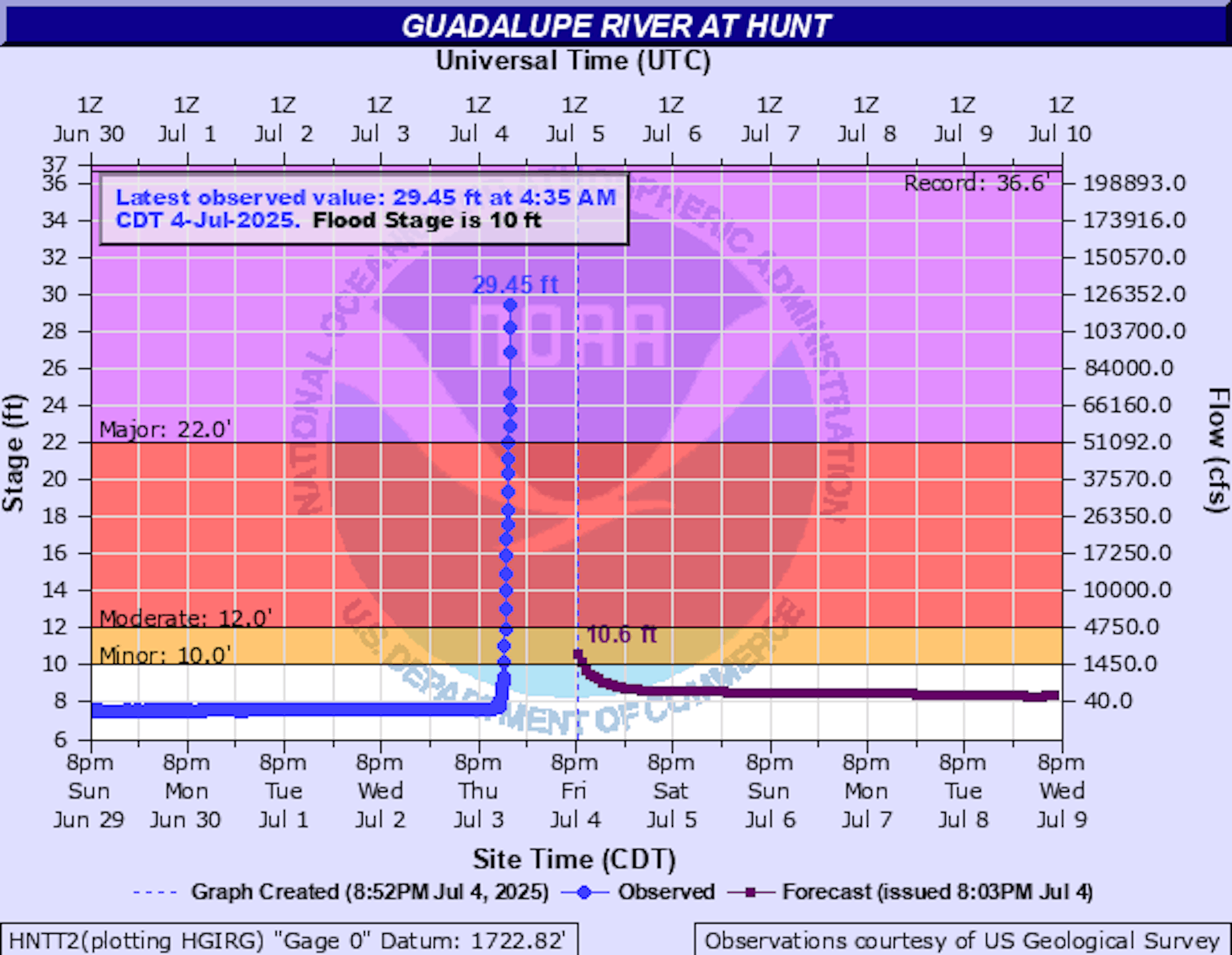
    A river gauge at Hunt, Texas, near Camp Mystic, showed how quickly the river flooded: Around 3 a.m. on July 4, the Guadalupe River was rising about 1 foot every 5 minutes at the gauge, National Weather Service data shows. By 4:30 a.m., it had risen more than 20 feet. As the water moved downstream, it reached Kerrville, where the river rose even faster.

    Flood expert Hatim Sharif, a hydrologist and civil engineer at the University of Texas at San Antonio, explains what makes this part of the country, known as Flash Flood Alley, so dangerous.

    What makes Hill Country so prone to flooding?

    Texas as a whole leads the nation in flood deaths, and by a wide margin. A colleague and I analyzed data from 1959 to 2019 and found 1,069 people had died in flooding in Texas over those six decades. The next highest total was in Louisiana, with 693.

    Many of those flood deaths have been in Hill County. It’s part of an area known as Flash Flood Alley, a crescent of land that curves from near Dallas down to San Antonio and then westward.

    The hills are steep, and the water moves quickly when it floods. This is a semi-arid area with soils that don’t soak up much water, so the water sheets off quickly and the shallow creeks can rise fast.

    When those creeks converge on a river, they can create a surge of water that wipes out homes and washes away cars and, unfortunately, anyone in its path.

    Hill Country has seen some devastating flash floods. In 1987, heavy rain in western Kerr County quickly flooded the Guadalupe River, triggering a flash flood similar to the one in 2025. Ten teenagers being evacuated from a camp died in the rushing water.

    San Antonio, at the eastern edge of Hill Country, was hit with a flash flood on June 12, 2025, that killed 13 people whose cars were swept away by high water from a fast-flooding creek near an interstate ramp in the early morning.

    Why does the region get such strong downpours?

    One reason Hill Country gets powerful downpours is the Balcones Escarpment.

    The escarpment is a line of cliffs and steep hills created by a geologic fault. When warm air from the Gulf rushes up the escarpment, it condenses and can dump a lot of moisture. That water flows down the hills quickly, from many different directions, filling streams and rivers below.

    As temperature rise, the warmer atmosphere can hold more moisture, increasing the downpour and flood risk.

    A tour of the Guadalupe River and its flood risk.

    The same effect can contribute to flash flooding in San Antonio, where the large amount of paved land and lack of updated drainage to control runoff adds to the risk.

    What can be done to improve flash flood safety?

    First, it’s important for people to understand why flash flooding happens and just how fast the water can rise and flow. In many arid areas, dry or shallow creeks can quickly fill up with fast-moving water and become deadly. So people should be aware of the risks and pay attention to the weather.

    Improving flood forecasting, with more detailed models of the physics and water velocity at different locations, can also help.

    Probabilistic forecasting, for example, can provide a range of rainfall scenarios, enabling authorities to prepare for worst-case scenarios. A scientific framework linking rainfall forecasts to the local impacts, such as streamflow, flood depth and water velocity, could also help decision-makers implement timely evacuations or road closures.

    Education is particularly essential for drivers. One to two feet of moving water can wash away a car. People may think their trucks and SUVs can go through anything, but fast-moving water can flip a truck and carry it away.

    Officials can also do more to barricade roads when the flood risk is high to prevent people from driving into harm’s way. We found that 58% of the flood deaths in Texas over the past six decades involved vehicles. The storm on June 12 in San Antonio was an example. It was early morning, and drivers had poor visibility. The cars were hit by fast-rising floodwater from an adjacent creek.

    This article, originally published July 5, 2025, has been updated with the death toll rising.

    Hatim Sharif does not work for, consult, own shares in or receive funding from any company or organization that would benefit from this article, and has disclosed no relevant affiliations beyond their academic appointment.

    – ref. Why Texas Hill Country, where a devastating flood killed more than 120 people, is one of the deadliest places in the US for flash flooding – https://theconversation.com/why-texas-hill-country-where-a-devastating-flood-killed-more-than-120-people-is-one-of-the-deadliest-places-in-the-us-for-flash-flooding-260555

    MIL OSI Analysis –

    July 11, 2025
  • MIL-OSI United Nations: UNICEF deplores ‘unconscionable’ killing of families lining up for aid in Gaza

    Source: United Nations 2

    Catherine Russell said she was appalled by the reported killing of 15 Palestinians, including nine children and four women, who were waiting in line for nutritional supplements provided by Project Hope, a UNICEF partner organization.

    The incident occurred in Deir Al-Balah. An additional 30 people were injured, including 19 children. News reports indicate that it resulted from an Israel strike. 

    ‘Mothers seeking a lifeline’

    “The killing of families trying to access life-saving aid is unconscionable,” she said in a statement.

    “These were mothers seeking a lifeline for their children after months of hunger and desperation.”

    They included Donia, whose one-year-old son, Mohammed, was killed. She reported that the boy had spoken his first words to her just hours earlier.

    “Donia now lies in a hospital bed, critically injured by the blast, clutching Mohammed’s tiny shoe,” said Ms. Russell.  “No parent should have to face such tragedy.”

    A ‘cruel reality’

    For the UNICEF chief, “this is the cruel reality confronting many in Gaza today after months of insufficient aid being allowed into the territory, and parties to the conflict failing to uphold basic responsibilities to protect civilians.”

    She explained that “the lack of aid means children are facing starvation while the risk of famine grows,” warning that “the number of malnourished children will continue to rise until life-saving aid and services are resumed at full scale.”

    “International law is clear: all parties to the conflict have an obligation to protect civilians and ensure the safe and unimpeded delivery of humanitarian assistance,” she said.

    “We call on Israel to urgently review its rules of engagement to ensure full compliance with international humanitarian law, notably the protection of civilians including children, and to conduct a thorough and independent investigation of this incident and all allegations of violations.”

    UN condemns killings

    The UN yet again condemned the killing of civilians in Gaza, Spokesperson Stéphane Dujarric told journalists in New York.

    Furthermore, the UN humanitarian affairs office OCHA “stresses that parties are bound by international humanitarian law to prevent such excessive death and injury of civilians in the midst of war,” he added.

    OCHA reported that another strike on Thursday reportedly hit the office of a humanitarian partner in Gaza City. Three staff there were killed. 

    Fuel running out

    Mr. Dujarric also updated journalists on the dire fuel situation in Gaza, which impacts both the population and humanitarians.

    A UN team managed to bring roughly 75,000 litres of fuel from Israel into the beleaguered enclave on Wednesday, marking the first such provision in 130 days.

    He warned, however, that fuel is still running out and services will shut down if greater volumes do not enter immediately.

    Water services at risk

    “We and our humanitarian partners need hundreds of thousands of litres of fuel each day to keep essential lifesaving and life-sustaining operations going, meaning the amount entered yesterday isn’t sufficient to cover even one day of energy requirements,” he said.

    One aid partner reported that fuel shortages could soon cut off supplies of clean drinking water to about 44,000 children, he added, which would further increase the risk of cholera, diarrhoea, dysentery and other waterborne illnesses. 

    Meanwhile, UN partners providing education services said that between October 2023 and this June, 626 temporary learning spaces have been established in Gaza, with 240,000 students enrolled, roughly half of them girls. 

    However, only 299 spaces are currently operational due to the ongoing displacement orders, funding shortfalls and other challenges.

    Aid workers also going hungry

    Humanitarian partners in Gaza – who include first responders, health workers, and aid workers – “continue to deliver food and other assistance under intolerable conditions, and they themselves are facing hunger,” said Mr. Dujarric.

    “A number of our own colleagues are also facing hunger. They also face water scarcity and threats to their personal safety, just like everyone else in Gaza,” he added.

    The Spokesperson reiterated the UN’s long-standing message that “this catastrophic situation must end.”  He stressed that “a ceasefire is not only urgent, it is long overdue,” while also calling for the unconditional and immediate release of all hostages. 

    © UNFPA Palestine

    Some Palestinians have been forced to flee their homes in the West Bank.

    West Bank operations

    Mr. Dujarric also addressed the situation in the West Bank, where humanitarians report and continue to warn of the intensification of Israeli operations in the northern areas.

    “These operations are causing massive destruction, driving further humanitarian needs and dampening hopes of thousands of displaced families that they will eventually be able to go back home,” he said.

    “Meanwhile, attacks, harassment and intimidation by Israeli settlers against Palestinians have become a daily reality.”

    He cited a settler attack on 3 July that led to the displacement of the Mu’arrajat East Bedouin community in the central West Bank. 

    “This is the ninth community to be fully displaced in the Ramallah and Jericho areas since January 2023 following the recurrent attacks by Israeli settlers.” 

    MIL OSI United Nations News –
    July 11, 2025
  • MIL-OSI USA: Rep. Simpson Cosponsors Bill to Create Military Campaign Service Medal for Iran-Deployed Troops

    Source: US State of Idaho

    WASHINGTON—Idaho Congressman Mike Simpson cosponsored the Iranian Campaign Medal Act. This legislation would authorize the Secretary of Defense to establish and award a United States military decoration to service members who served in Iran in direct support of Operation Midnight Hammer. This legislation is sponsored by Rep. Tony Gonzales (R-TX).
    “Taking action to prevent the world’s largest state sponsor of terrorism from obtaining a dangerous nuclear-armed program takes true leadership – both from the White House and our armed forces,” said Rep. Simpson. “The American heroes who rose to the challenge in Operation Midnight Hammer deserve recognition after a historically successful attack. I am proud to honor the courageous servicemembers who carried out the mission – the world is a safer place thanks to their efforts.”
    On June 22, 2025, President Trump authorized a precision strike at three Iranian nuclear sites to prevent a nuclear-armed Iran. Executed by 14 American pilots flying seven B-2 bombers, and supported by over 125 U.S. aircraft, including dozens of aerial refueling tankers, a guided missile submarine, and approximately 75 precision-guided munitions, the strike successfully targeted critical Iranian nuclear infrastructure at Natanz, Fordow, and Isfahan.
    Congressman Simpson is an original cosponsor of this important resolution. The full text is available here.

    MIL OSI USA News –

    July 11, 2025
  • MIL-OSI United Kingdom: The UK welcomes the Office of the Prosecutor’s continued focus on Darfur: UK Statement at the UN Security Council

    Source: United Kingdom – Executive Government & Departments

    Speech

    The UK welcomes the Office of the Prosecutor’s continued focus on Darfur: UK Statement at the UN Security Council

    Statement by Legal Adviser Colin McIntyre at the UN Security Council meeting on Sudan.

    Let me begin by stressing the United Kingdom’s condemnation of the recent cyberattack against the ICC. 

    The UK has committed funds to strengthen the Court’s cybersecurity framework and we are pleased that this incident was swiftly contained.

    Mr President, I will make three points today. 

    First, we welcome the Office of the Prosecutor’s continued focus on Darfur.

    In this regard, we are gravely concerned by the findings of the Office of the Prosecutor that there are reasonable grounds to believe that war crimes and crimes against humanity may have been committed, and indeed are continuing to be committed, in Darfur.

    We also echo the report’s concerns about the situation in El Fasher. Large-scale attacks carried out on Zamzam IDP camp in April 2025 reportedly displaced over 400,000 people and continue to affect the population.

    It is appalling that their suffering is compounded by denials of aid. 

    We call on the parties to the conflict to allow and facilitate the rapid and unimpeded delivery of humanitarian assistance.

    Second, we note the continued cooperation of the Sudanese authorities, including the facilitation of the recent visit to Port Sudan. 

    Given the significant challenges faced by the Office in implementing its mandate, we encourage the Sudanese authorities to redouble their efforts to cooperate with the Office, particularly in relation to the arrest and transfer of individuals subject to ICC arrest warrants, including Mr Ahmad Harun.

    Third, we welcome the enhanced cooperation between the Prosecutor’s Office and other actors, including civil society organisations and the UN Fact Finding Mission for Sudan.

    We commend the Office of the Prosecutor and the Fact Finding Mission’s ongoing documentation efforts and their commitment to delivering concrete progress.

    Mr President, the Sudanese people deserve justice.

    We therefore call for the SAF and the RSF to immediately cease hostilities and prioritise the protection of civilians in line with resolution 2736.

    Accountability must go hand in hand with finding a political solution to this horrific war and ending the cycle of impunity that has scarred Sudan for decades.

    Mr President, let me conclude by reiterating that the UK supports the independence of the International Criminal Court and does not support the sanctioning of individual court officials.

    Updates to this page

    Published 10 July 2025

    MIL OSI United Kingdom –

    July 11, 2025
  • MIL-OSI: Artisan Partners Asset Management Inc. Reports June 2025 Assets Under Management

    Source: GlobeNewswire (MIL-OSI)

    MILWAUKEE, July 10, 2025 (GLOBE NEWSWIRE) — Artisan Partners Asset Management Inc. (NYSE: APAM) today reported that its preliminary assets under management (“AUM”) as of June 30, 2025 totaled $175.5 billion. Artisan Funds and Artisan Global Funds accounted for $85.6 billion of total firm AUM, while separate accounts and other AUM1 accounted for $89.9 billion.

    PRELIMINARY ASSETS UNDER MANAGEMENT BY STRATEGY2    
         
    As of June 30, 2025 – ($ Millions)    
    Growth Team    
    Global Opportunities $20,065  
    Global Discovery 1,885  
    U.S. Mid-Cap Growth 11,118  
    U.S. Small-Cap Growth 2,841  
    Franchise 839  
    Global Equity Team    
    Global Equity 388  
    Non-U.S. Growth 14,773  
    U.S. Value Team    
    Value Equity 5,203  
    U.S. Mid-Cap Value 2,546  
    Value Income         16  
    International Value Group    
    International Value 50,062  
    International Explorer 788  
    Global Special Situations 21  
    Global Value Team    
    Global Value 32,569  
    Select Equity 337  
    Sustainable Emerging Markets Team    
    Sustainable Emerging Markets 2,047  
    Credit Team    
    High Income 12,689  
    Credit Opportunities 319  
    Floating Rate 88  
    Developing World Team    
    Developing World 4,784  
    Antero Peak Group    
    Antero Peak 2,272  
    Antero Peak Hedge 268  
    International Small-Mid Team    
    Non-U.S. Small-Mid Growth 5,856  
    EMsights Capital Group    
    Global Unconstrained 965  
    Emerging Markets Debt Opportunities 1,133  
    Emerging Markets Local Opportunities 1,673  
         
    Total Firm Assets Under Management (“AUM”) $175,545  

    1 Separate account and other AUM consists of the assets we manage in or through vehicles other than Artisan Funds or Artisan Global Funds. Separate account and other AUM includes assets we manage in traditional separate accounts, as well as assets we manage in Artisan-branded collective investment trusts, and in our own private funds.
    2 AUM for Artisan Sustainable Emerging Markets and U.S. Mid-Cap Growth Strategies includes $115.4 million in aggregate for which Artisan Partners provides investment models to managed account sponsors (reported on a lag not exceeding one quarter).

    ABOUT ARTISAN PARTNERS
    Artisan Partners is a global investment management firm that provides a broad range of high value-added investment strategies to sophisticated clients around the world. Since 1994, the firm has been committed to attracting experienced, disciplined investment professionals to manage client assets. Artisan Partners’ autonomous investment teams oversee a diverse range of investment strategies across multiple asset classes. Strategies are offered through various investment vehicles to accommodate a broad range of client mandates.

    Investor Relations Inquiries: 866.632.1770 or ir@artisanpartners.com
    Source: Artisan Partners Asset Management Inc.

    The MIL Network –

    July 11, 2025
  • MIL-OSI: Midland States Bancorp, Inc. to Announce Second Quarter 2025 Financial Results on Thursday, July 24

    Source: GlobeNewswire (MIL-OSI)

    EFFINGHAM, Ill., July 10, 2025 (GLOBE NEWSWIRE) — Midland States Bancorp, Inc. (NASDAQ: MSBI) announced today that it will issue its second quarter 2025 financial results after market close on Thursday, July 24, 2025. Along with the press release announcing the financial results, the Company will publish an investor presentation that will be available on the Webcasts and Presentations page of its investor relations website.

    About Midland States Bancorp, Inc.

    Midland States Bancorp, Inc. is a community-based financial holding company headquartered in Effingham, Illinois, and is the sole shareholder of Midland States Bank. As of March 31, 2025, the Company had total assets of approximately $7.28 billion, and its Wealth Management Group had assets under administration of approximately $4.10 billion. The Company provides a full range of commercial and consumer banking products and services and business equipment financing, merchant credit card services, trust and investment management, insurance and financial planning services. For additional information, visit https://www.midlandsb.com/ or https://www.linkedin.com/company/midland-states-bank.

    CONTACTS:
    Eric T. Lemke, Chief Financial Officer, at elemke@midlandsb.com or (217) 342-7321

    The MIL Network –

    July 11, 2025
  • MIL-OSI: RXO Offers Factoring and LoadPay to Carriers Through Expanded Relationship with Triumph

    Source: GlobeNewswire (MIL-OSI)

    DALLAS and CHARLOTTE, N.C., July 10, 2025 (GLOBE NEWSWIRE) — RXO (NYSE: RXO), a leading provider of asset-light transportation solutions, and Triumph (Nasdaq: TFIN), a financial and technology company focused on payments, factoring, intelligence and banking solutions for the transportation industry, today announced the expansion of their relationship to deliver new financial tools and services to carriers.

    RXO has launched RXO Extra | Factoring, a Triumph-powered offering that includes Factoring as a Service™ and LoadPay™, Triumph’s digital banking solution for carriers. The services provide carriers, even those that don’t haul for RXO, with access to seamless factoring and fast, reliable payments, including same-day payments, on approved invoices. They are available 24 hours a day, seven days a week, including weekends and holidays.

    “Our expanded relationship with Triumph is enabling us to provide carriers with even more ways to improve their efficiency and profitability,” said Lou Amo, president of RXO’s truck brokerage business. “RXO Extra | Factoring allows carriers to get paid by RXO and other freight providers more quickly and easily.”

    Factoring as a Service (FaaS) is a white-labeled solution powered by the Triumph Network that enables brokers to offer branded factoring and payment services directly to carriers. It combines Triumph’s funding and technology infrastructure to help brokers improve carrier cash flow and strengthen relationships. LoadPay is Triumph’s purpose-built digital bank account for carriers, allowing payments to be received in minutes on approved invoices. RXO currently uses Triumph’s audit and payment capabilities.

    RXO Extra | Factoring is part of RXO Extra™, a loyalty program and discount marketplace for carriers. By hauling loads through RXO Connect®, carriers rise through loyalty tiers to earn more savings and bonuses on loads. In addition, through industry partnerships, RXO Extra offers carriers discounts on fuel, maintenance and tires, retail, and more.

    “RXO continues to demonstrate its commitment to the carrier community by delivering tools that simplify operations and improve cash flow,” said Aaron P. Graft, founder and chief executive officer of Triumph Financial. “We’re proud to expand our work with RXO and help carriers across their network transact confidently.”

    Carriers can learn more about RXO Extra | Factoring by visiting https://rxo.com/carriers/rxo-extra/rxo-extra-factoring.

    About Triumph

    Triumph (Nasdaq: TFIN) is a financial and technology company focused on payments, factoring, intelligence and banking to modernize and simplify freight transactions. Headquartered in Dallas, Texas, its portfolio of brands includes Triumph, TBK Bank and LoadPay. www.Triumph.io

    About RXO

    RXO (NYSE: RXO) is a leading provider of asset-light transportation solutions. RXO offers tech-enabled truck brokerage services together with complementary solutions including managed transportation and last mile delivery. The company combines massive capacity and cutting-edge technology to move freight efficiently through supply chains across North America. The company is headquartered in Charlotte, N.C. www.RXO.com

    About LoadPay

    LoadPay is a modern digital banking solution built for the freight industry. Designed to help carriers better manage their cash flow, LoadPay offers fast and flexible access to funds, along with tools specifically tailored to meet the demands of transportation businesses. LoadPay is a product of TBK Bank, SSB d/b/a Triumph, a financial and technology company focused on modernizing and simplifying freight transactions. www.LoadPay.com

    Forward-Looking Statements

    This press release contains forward-looking statements within the meaning of the federal securities laws. Investors are cautioned that such statements are predictions and that actual events or results may differ materially. Triumph Financial’s expected financial results or other plans are subject to a number of risks and uncertainties. For a discussion of such risks and uncertainties, which could cause actual results to differ from those contained in the forward-looking statements, see “Risk Factors” and the forward-looking statement disclosure contained in the Company’s Annual Report on Form 10-K, filed with the Securities and Exchange Commission on February 11, 2025. Forward-looking statements speak only as of the date made, and Triumph Financial undertakes no duty to update the information.

    Source: Triumph

    Triumph Investor Contact
    Luke Wyse, lwyse@tfin.com

    Triumph Media Contact
    Amanda Tavackoli, atavackoli@tfin.com

    RXO Media Contact
    Nina Reinhardt, nina.reinhardt@rxo.com

    RXO Investor Contact
    Kevin Sterling, kevin.sterling@rxo.com

    The MIL Network –

    July 11, 2025
  • MIL-OSI: Inception Growth Acquisition Limited Announces Postponement of the Special Meeting to July 25, 2025 and Extension of Redemption Request Deadline

    Source: GlobeNewswire (MIL-OSI)

    New York, July 10, 2025 (GLOBE NEWSWIRE) — Inception Growth Acquisition Limited (the “Company”), a blank check company, today announced that its previously announced special meeting of shareholders (the “Special Meeting”) will be postponed from 10:00 a.m. Hong Kong Time on July 14, 2025 to 10:00 a.m. Hong Kong Time on July 25, 2025 and accordingly, the deadline for stockholders to submit redemption requests will be extended to July 23, 2025.

    The physical location of the Special Meeting remains at the offices of Loeb & Loeb LLP, 2206-19 Jardine House, 1 Connaught Place Central, Hong Kong SAR, and virtually via teleconference using the following dial-in information:

    US Toll Free   +1 866 213 0992
    Hong Kong Toll   +852 2112 1888
    Participant Passcode   2910077#

    As a result of the postponement, the deadline for delivery of redemption requests from the Company’s stockholders in connection with the proposed business combination has been extended from July 10, 2025 (two business days before the originally scheduled Special Meeting) to July 23, 2025 (two business days before the postponed Special Meeting). Stockholders who have already submitted redemption requests may revoke such requests prior to the new deadline in accordance with the procedures described in the definitive proxy statement in relation to the Special Meeting (the “Original Proxy Statement”) filed with by the Company with the Securities and Exchange Commission (the “SEC”) on May 27, 2025, and the supplement (the “Supplement”) to the Original Proxy Statement, which was filed by the Company with the SEC on June 26, 2025.

    The record date for determining the Company stockholders entitled to receive notice of and to vote at the Special Meeting remains the close of business on May 27, 2025 (the “Record Date”). Stockholders as of the Record Date are eligible to vote, even if they have subsequently sold their shares.

    If you have questions regarding the certification of your position or delivery of your shares, please contact:

    Continental Stock Transfer & Trust Company, LLC
    1 State Street 30th Floor
    New York, NY 10004-1561
    E-mail: spacredemptions@continentalstock.com

    Other than as indicated herein, no other changes have been made to the Original Proxy Statement as amended and supplemented by the Supplement, or the proxy card as originally filed and mailed. Stockholders are advised to review the Supplement carefully and to consider it together with the Original Proxy Statement, both available on the SEC’s EDGAR database at www.sec.gov, for complete details regarding the matters to be voted in the Special Meeting.

    The Company’s stockholders who have questions regarding the postponement, or the Special Meeting, or would like to request documents may contact the Company’s proxy solicitor, Advantage Proxy, Inc., at (877) 870-8565, or banks and brokers can call (206) 870-8565, or by email at ksmith@advantageproxy.com.

    If you have already voted, you do not need to vote again unless you would like to change or revoke your prior vote on any proposal. In addition, stockholders who have already submitted a redemption request with respect to the shares held by them may withdraw such request by contacting our transfer agent. If you would like to change or revoke your prior vote on any proposal, or reverse a redemption request, please refer to the Proxy Statement for additional information on how to do so.

    If you have already submitted a proxy and do not wish to change your vote, you need not take any further action. If you have submitted a proxy and wish to change your vote, you may revoke your proxy at any time before it is exercised at the Special Meeting as provided in the Original Proxy Statement. Please note, however, that if your shares are held in street name by a broker or other nominee and you wish to revoke a proxy, you must contact the broker or nominee to revoke any prior voting instructions.

    About Inception Growth Acquisition Limited

    Inception Growth Acquisition Limited is a blank check company incorporated under the laws of Delaware whose business purpose is to effect a merger, capital stock exchange, asset acquisition, stock purchase, reorganization, or similar business combination with one or more businesses or entities.

    Forward Looking Statements

    This press release includes forward-looking statements that involve risks and uncertainties. Forward-looking statements are statements that are not historical facts. Such forward-looking statements, including but not limited to the date of the Special Meeting, are subject to risks and uncertainties, which could cause actual results to differ from the forward-looking statements. The Company expressly disclaims any obligations or undertaking to release publicly any updates or revisions to any forward-looking statements contained herein to reflect any change in the Company’s expectations with respect thereto or any change in events, conditions or circumstances on which any statement is based.

    Additional Information and Where to Find It

    On May 27, 2025, the Company filed a definitive proxy statement, and on June 26, 2025, the Company filed a supplement to the definitive proxy statement with the SEC in connection with its solicitation of proxies for the Special Meeting. INVESTORS AND SECURITY HOLDERS OF THE COMPANY ARE URGED TO READ THE SUPPLEMENT, THE ORIGINAL PROXY STATEMENT (INCLUDING ANY AMENDMENTS OR SUPPLEMENTS THERETO) AND OTHER DOCUMENTS THE COMPANY FILES WITH THE SEC CAREFULLY IN THEIR ENTIRETY WHEN THEY BECOME AVAILABLE AS THEY WILL CONTAIN IMPORTANT INFORMATION. Investors and security holders will be able to obtain free copies of the definitive proxy statement (including any amendments or supplements thereto) and other documents filed with the SEC through the web site maintained by the SEC at www.sec.gov or by contacting the Company’s proxy solicitor.

    Participants in the Solicitation

    The Company and its respective directors and officers may be deemed to be participants in the solicitation of proxies from shareholders in connection with the Special Meeting. Additional information regarding the identity of these potential participants and their direct or indirect interests, by security holdings or otherwise, is set forth in the definitive proxy statement. You may obtain free copies of these documents using the sources indicated above.

    Contact

    Inception Growth Acquisition Limited
    Investor Relationship Department
    (315) 636-6638

    The MIL Network –

    July 11, 2025
  • MIL-OSI Russia: Financial news: Prospects for the development of the retail mutual fund market: report of the Bank of Russia

    Translation. Region: Russian Federal

    Source: Central Bank of Russia –

    An important disclaimer is at the bottom of this article.

    The Bank of Russia has analyzed and summarized the accumulated law enforcement practice in the retail mutual investment fund (MIF) market, international experience, as well as initiatives of market participants, and proposes to discuss possible directions for the development of this segment.

    One of the development vectors may be the expansion of investment opportunities for retail funds. It is proposed to increase the list of non-traded securities in which they can invest, but to set a limit. Digital financial assets may also appear in the list of objects available for mutual funds for investment. This will require creating a legal framework, as well as developing a procedure for separating and storing such assets. But retail funds will not be able to start investing in them immediately, but over time.

    Market participants also proposed creating opportunities for the emergence of funds with increased financial leverage in Russia. These are borrowed funds or derivative financial instruments that the fund additionally uses to generate profit. Currently, the amount of financial leverage that a mutual fund for non-qualified investors can take on is limited to 20% of the fund’s net asset value (with the possibility of deviation up to 40% as a result of market factors). The Bank of Russia believes that increasing the leverage entails increased risks and requires additional investor protection measures.

    The idea of creating a fund of funds also requires a comprehensive assessment. Currently, in Russia, a management company cannot acquire investment units of one mutual fund under its management as part of the assets of another mutual fund under its management. However, in international practice, there are master-feeder fund structures – this is the name for a central fund consisting of assets collected from other funds under its management. The regulator proposes to discuss the prospects for using such structures in Russia, as well as the problems that they will help solve in the collective investment market.

    In addition, the report considers proposals to speed up operations with units. Currently, the procedures for issuing, redeeming and exchanging investment units of open-end mutual funds, as a rule, take place within 1 to 4 business days from the moment the client provides all the necessary documents and makes the payment. It is proposed to consider the possibility of reducing this period so that operations are carried out in T 0 mode.

    More about possible scenarios for the development of retail mutual fundsread in the report. Answers to questions presented in the material, comments and suggestions to it can be sent up to and including September 1.

    Preview photo: Tools Konten / Shutterstock / Fotodom

    Please note: This information is raw content obtained directly from the source of the information. It is an accurate report of what the source claims and does not necessarily reflect the position of MIL-OSI or its clients.

    MIL OSI Russia News –

    July 11, 2025
  • MIL-OSI Russia: Financial news: The Bank of Russia has published a ranking of insurers based on complaints about compulsory motor third-party liability insurance for 2024

    Translation. Region: Russian Federal

    Source: Central Bank of Russia –

    An important disclaimer is at the bottom of this article.

    Results presented in two tables: insurers with a client base of more than 2 million OSAGO contracts and small companies that do not exceed this threshold. This breakdown will help car owners compare companies of the same size.

    The ranking is based on statistics of complaints to the Bank of Russia on MTPL issues for 2024, for which consumer rights violations were confirmed and supervisory measures were taken. Companies are distributed by the level of the consumer risk indicator — from highest to lowest. It is calculated as the ratio of the number of complaints about a specific insurer to every 10 thousand contracts concluded by it. Insurance companies that received only one complaint are not included in the ranking.

    Preview photo: Pushish Images / Shutterstock / Fotodom

    Please note: This information is raw content obtained directly from the source of the information. It is an accurate report of what the source claims and does not necessarily reflect the position of MIL-OSI or its clients.

    MIL OSI Russia News –

    July 11, 2025
  • MIL-OSI Russia: Marat Khusnullin: More than 500 bridges and overpasses will be renovated this year under the national project “Infrastructure for Life”

    Translation. Region: Russian Federal

    Source: Government of the Russian Federation – Government of the Russian Federation –

    An important disclaimer is at the bottom of this article.

    Bridge across the Voya River, Kirov Region.

    Thanks to the national project “Infrastructure for Life”, in 2025, more than 500 bridges and overpasses with a length of 42.2 thousand linear meters will be built, reconstructed, repaired, including major repairs, on the regional and local road network. This was reported by Deputy Prime Minister Marat Khusnullin.

    “Bridges, overpasses, and flyovers allow you to overcome difficult sections, reduce travel time, and reduce the load on alternative routes. They ensure uninterrupted traffic flow, connect territories, and improve road safety. The construction and timely repair of artificial structures are important for the sustainability and efficiency of the country’s road framework. Thanks to the national project “Infrastructure for Life”, in 2025, more than 500 bridges and overpasses with a length of 42.2 thousand linear meters will be built, reconstructed, repaired, including major repairs,” said Marat Khusnullin.

    In particular, this year it is planned to commission 7 artificial structures, another 65 bridges and overpasses will be reconstructed. 228 structures will undergo major repairs. Work on a number of objects began under the national project “Safe High-Quality Roads”.

    Thus, in the Luninsky District of the Penza Region, the reconstruction of the bridge across the Shuksha River, located on the Penza-Lunino highway, was completed significantly ahead of schedule. The highway is part of the regional backbone network of highways, and also connects the administrative center of the Penza Region with the district center of the Luninsky District and further with the Republic of Mordovia.

    The old bridge built in the 60s of the last century was in a pre-emergency condition. The new four-span structure has a length of 101.25 running meters. The width is 16 running meters. The project provides for sidewalks 2.25 m wide. The total length of approaches to the bridge is 235 m. Also, for the comfort of Luninets living near the artificial structure, noise protection screens more than 300 m long have been installed.

    The major repairs of the bridge across the Voya River in the Nemsky District of the Kirov Region were completed ahead of schedule and put into operation. It is located on the regional highway Kyrchany – Nema – Kilmez. The length of the facility is 300 running meters. The crossing provides a connection between the Kirov Region and the Udmurt Republic. The traffic of three regional highways passes here: Kyrchany – Nema – Kilmez, Kazan – Perm and Kirov – Malmyzh – Vyatskiye Polyany.

    Two artificial structures were opened in the Ulyanovsk region after major repairs: a bridge over a ravine in the Novomalyklinsky district and a bridge over the Vodoleyka River in the Sursky district. The length of the first object is 30.1 running meters. The crossing over the ravine is located on the highway “”R-241 Kazan – Buinsk – Ulyanovsk, approach to the city of Samara” – Dimitrovgrad” – Novaya Malykla.

    The second object is a bridge across the Vodoleyka River built in 1967. It is located on the Surskoye-Shumerlya-Moscow-Kazan highway. The road is part of the regional backbone network and connects the Ulyanovsk Region and the Chuvash Republic. In addition, a school route passes through here. The length of the object is 66.9 running meters.

    Please note: This information is raw content obtained directly from the source of the information. It is an accurate report of what the source claims and does not necessarily reflect the position of MIL-OSI or its clients.

    MIL OSI Russia News –

    July 11, 2025
  • MIL-OSI Russia: Over the year, the number of small and medium-sized companies has grown by 3%.

    Translation. Region: Russian Federal

    Source: Ministry of Economic Development (Russia) – Ministry of Economic Development (Russia) –

    An important disclaimer is at the bottom of this article.

    According to the annual update of the Unified Register of Small and Medium-Sized Businesses, which is administered by the Federal Tax Service of Russia, the country has recorded an increase in companies and individual entrepreneurs. Currently, there are almost 6.4 million SMEs.

    “Based on the results of the annual update of the Unified Register of Small and Medium-Sized Businesses in Russia, 6.4 million operating companies and individual entrepreneurs have been registered. This is the highest figure since 2017, when the register was launched. We are recording a stable positive trend: compared to the previous period, the number of SMEs has increased by 3.2%, or about 200 thousand. Such results confirm the high role of small and medium businesses in the country’s economy and the effectiveness of the measures taken to support and develop them,” said Deputy Prime Minister of the Russian Federation Alexander Novak.

    The annual update of the Unified Register takes place on July 10 and reflects the most current number of SME entities. It is carried out on the basis of the reports submitted by entrepreneurs at the beginning of the year for the previous period. Companies and individual entrepreneurs that no longer meet the SME criteria or have not submitted the required reports within the established deadline are excluded from the register.

    “More and more enterprises are demonstrating dynamic development, going beyond the criteria established for small and medium-sized businesses. If previously about three thousand companies made the annual transition beyond the SME sector, this year their number approached five thousand. This indicates qualitative growth of business, its transition to a new level of maturity and scale. For such companies, we are already developing special measures to support SMEs in order to ensure their stable development and further integration into a higher-level economy,” explained Maxim Reshetnikov, Minister of Economic Development of Russia.

    “The Ministry of Economic Development of Russia also notes positive dynamics in the growth of the number of medium-sized enterprises. Currently, more than 22 thousand medium-sized companies are registered, their number has grown by 6% over the year, and by 19% compared to 2023,” commented Deputy Minister of Economic Development of Russia Tatyana Ilyushnikova.

    As a result of monthly updates of the Unified Register of SMEs, as a rule, an increase in the number of small and medium-sized enterprises is recorded. However, during the annual update, which is carried out on July 10, a reduction in the total number of entities is usually observed. This is primarily due to the administrative features of maintaining the register and does not reflect the real state of the SME sector.

    Please note: This information is raw content obtained directly from the source of the information. It is an accurate report of what the source claims and does not necessarily reflect the position of MIL-OSI or its clients.

    MIL OSI Russia News –

    July 11, 2025
  • MIL-OSI Russia: Dmitry Patrushev discussed export development with the leadership of industry unions.

    Translation. Region: Russian Federal

    Source: Government of the Russian Federation – Government of the Russian Federation –

    An important disclaimer is at the bottom of this article.

    Deputy Prime Minister Dmitry Patrushev held a meeting dedicated to the development of Russian agricultural exports. It was attended by Minister of Agriculture Oksana Lut, the leadership of industry unions, and business representatives.

    The Deputy Prime Minister stressed the importance of implementing the decree of the President of Russia on increasing the volume of export deliveries. The participants of the meeting discussed the dynamics of exports of agricultural products this year and the necessary measures to improve the efficiency of existing export support mechanisms.

    Following the meeting, the heads of industry associations and unions will carry out the necessary work with each exporting company and will take special control over the achievement of planned export indicators for the current year. The Russian Ministry of Agriculture, in turn, has been instructed to take the necessary measures in a timely manner to ensure positive export dynamics.

    Please note: This information is raw content obtained directly from the source of the information. It is an accurate report of what the source claims and does not necessarily reflect the position of MIL-OSI or its clients.

    MIL OSI Russia News –

    July 11, 2025
  • MIL-OSI USA: Oregon Department of Veterans’ Affairs Signs Agreement with Confederated Tribes of Siletz Indians

    Source: US State of Oregon

    he Oregon Department of Veterans’ Affairs has signed a formal agreement with the Confederated Tribes of Siletz Indians that will provide a framework for collaboration and increased resources dedicated to supporting the Tribe’s veterans in accessing their earned federal and state veterans’ benefits.

    The Memorandum of Understanding was signed Friday, June 27, by ODVA Director Dr. Nakeia Council Daniels and Tribal Council Chairman Delores Pigsley, with Tribal government leaders and representatives, Tribal veterans and ODVA staff gathered to commemorate the historic partnership. The formal signing was hosted at ODVA’s headquarters in Salem.

    The agreement will pave the way for the establishment of the Confederated Tribes of Siletz Indians’ first Tribal Veterans Service Officer (TVSO), which will be jointly funded by ODVA and the Tribe to serve Siletz veterans and their families.

    “Oregon’s Tribal veterans have long served with honor and distinction, and it is our responsibility to ensure they receive the care and recognition they have earned,” said Dr. Daniels. “By partnering with the Confederated Tribes of Siletz Indians, we are committing to a future where Siletz veterans are served in a way that honors their stories, their service, and their sovereign identity. We’re proud to walk alongside the Tribe in building something that will truly make a difference in the lives of their veterans and families.”

    “I am excited for the future of our honored Tribal veterans and the opportunity this brings to them,” said Chairman Pigsley. “Not only to support them but to help advocate for them. This memorandum with the Oregon Department of Veterans’ Affairs is more than a collaboration or a partnership. It’s a commitment to honoring and empowering those who have served our nation. Their deep-rooted connection to the veteran community and unwavering dedication to their well-being make them a trusted and invaluable partner.”

    This Memorandum of Understanding is ODVA’s sixth with Oregon’s nine federally recognized Tribes, including the Confederated Tribes of Warm Springs, the Confederated Tribes of the Umatilla Indian Reservation, the Confederated Tribes of Grand Ronde, the Cow Creek Band of Umpqua Tribe of Indians and, most recently, the Coquille Indian Tribe in May.

    Oregon’s statewide network of County and Tribal Veteran Service Offices are collaborative partnerships between the state and counties, or Tribal governments and deliver free local access to veteran benefits for veterans and their families.

    Tribal Veteran Service Officers (TVSOs) are trained by ODVA and then accredited by the United States Department of Veterans Affairs through a series of regular trainings facilitated by both agencies. TVSOs provide a wide variety of benefits and services to veterans and their family members, including the development and submission of claims to the federal VA for earned veteran benefits. To learn more about veteran benefits, resources and services near you, or to schedule a session with your local Veteran Service Officer, visit the website of the Oregon Department of Veterans’ Affairs at www.oregon.gov/odva/Services/Pages/Tribal-Veteran-Services.aspx.

    MIL OSI USA News –

    July 11, 2025
  • MIL-OSI USA: Oregon Department of Veterans’ Affairs Signs Agreement with Confederated Tribes of Siletz Indians

    Source: US State of Oregon

    he Oregon Department of Veterans’ Affairs has signed a formal agreement with the Confederated Tribes of Siletz Indians that will provide a framework for collaboration and increased resources dedicated to supporting the Tribe’s veterans in accessing their earned federal and state veterans’ benefits.

    The Memorandum of Understanding was signed Friday, June 27, by ODVA Director Dr. Nakeia Council Daniels and Tribal Council Chairman Delores Pigsley, with Tribal government leaders and representatives, Tribal veterans and ODVA staff gathered to commemorate the historic partnership. The formal signing was hosted at ODVA’s headquarters in Salem.

    The agreement will pave the way for the establishment of the Confederated Tribes of Siletz Indians’ first Tribal Veterans Service Officer (TVSO), which will be jointly funded by ODVA and the Tribe to serve Siletz veterans and their families.

    “Oregon’s Tribal veterans have long served with honor and distinction, and it is our responsibility to ensure they receive the care and recognition they have earned,” said Dr. Daniels. “By partnering with the Confederated Tribes of Siletz Indians, we are committing to a future where Siletz veterans are served in a way that honors their stories, their service, and their sovereign identity. We’re proud to walk alongside the Tribe in building something that will truly make a difference in the lives of their veterans and families.”

    “I am excited for the future of our honored Tribal veterans and the opportunity this brings to them,” said Chairman Pigsley. “Not only to support them but to help advocate for them. This memorandum with the Oregon Department of Veterans’ Affairs is more than a collaboration or a partnership. It’s a commitment to honoring and empowering those who have served our nation. Their deep-rooted connection to the veteran community and unwavering dedication to their well-being make them a trusted and invaluable partner.”

    This Memorandum of Understanding is ODVA’s sixth with Oregon’s nine federally recognized Tribes, including the Confederated Tribes of Warm Springs, the Confederated Tribes of the Umatilla Indian Reservation, the Confederated Tribes of Grand Ronde, the Cow Creek Band of Umpqua Tribe of Indians and, most recently, the Coquille Indian Tribe in May.

    Oregon’s statewide network of County and Tribal Veteran Service Offices are collaborative partnerships between the state and counties, or Tribal governments and deliver free local access to veteran benefits for veterans and their families.

    Tribal Veteran Service Officers (TVSOs) are trained by ODVA and then accredited by the United States Department of Veterans Affairs through a series of regular trainings facilitated by both agencies. TVSOs provide a wide variety of benefits and services to veterans and their family members, including the development and submission of claims to the federal VA for earned veteran benefits. To learn more about veteran benefits, resources and services near you, or to schedule a session with your local Veteran Service Officer, visit the website of the Oregon Department of Veterans’ Affairs at www.oregon.gov/odva/Services/Pages/Tribal-Veteran-Services.aspx.

    MIL OSI USA News –

    July 11, 2025
  • MIL-OSI USA: Statement of the Department of Justice Antitrust Division on the Closing of Its Investigation of the Merger of T-Mobile and UScellular

    Source: US State Government of Utah

    Assistant Attorney General Gail Slater of the Justice Department’s Antitrust Division issued the following statement today in connection with the closing of the Department’s investigation into the proposed acquisition of UScellular by T-Mobile:

    “After a thorough investigation, the Antitrust Division determined prudentially not to seek an injunction to prevent T-Mobile from closing on its proposed acquisition of UScellular. The investigation nevertheless raised concerns about competition in the relevant markets for mobile wireless services and the availability of wireless spectrum needed to fuel competition and entry. Specifically, as part of the investigation, the Department considered the potential impact on consumers resulting from the elimination of UScellular from the market, the potential for consumer benefits, and the potential impact of the further consolidation of wireless spectrum.

    “With respect to the potential impact on consumers, for years, Americans have witnessed the too-familiar pattern of local or regional companies that discern and cater to their customers’ needs vanishing in favor of the ‘one size fits all’ approach of national brands. UScellular, whose tagline was ‘America’s locally grown wireless,’ noted the ‘sea of sameness’ among the ‘Big 3’ national carriers — Verizon, AT&T, and T-Mobile — and resolved to be ‘fundamentally different’ in how it went to market. The company understood the unmet needs of customers whom they identified as ‘Heartland Families’ or ‘Farmtown Frugals’. UScellular met those needs by building networks, pricing plans, and service offerings that its customers valued, and which for many years the Big 3 often did not offer. To the chagrin of its Big 3 competitors, UScellular maintained a sizable customer base within its network footprint by virtue of its strong emphasis on transparency, integrity, and localized customer service. Accordingly, as part of its investigation, the Department considered the impact of the potential disappearance of the services offered to those customers of UScellular — soon to become T-Mobile customers following the merger — that chose UScellular over T-Mobile or its national competitors.

    “In addition to the potential impact on consumers resulting from the elimination of UScellular from the market, the Department also investigated the potential for consumer benefits. Specifically, the Department considered how UScellular subscribers would fare if UScellular continued as a business without completing this transaction. That aspect of the investigation made clear that, due in part to its limited regional footprint and unique structural limitations, UScellular simply could not keep up with the escalating cost of capital investments in technology required to compete vigorously in the relevant market. This would, in turn, lead to the slow degradation of its network quality. In contrast, T-Mobile has publicly committed that it will integrate the two networks in a way that provides UScellular customers with faster data speeds, while T-Mobile customers will obtain broader coverage in rural areas. Accordingly, the Department concluded the loss of the local offerings that UScellular customers value was outweighed by the immediate improvements in network quality promised by this proposed transaction. That conclusion is bolstered by the competitive realities of future investment in wireless networks and spectrum.

    “In sum, the Department evaluated the likelihood of harm to competition and the potential effects of the transaction on consumers and determined that, on balance, the potential harm and offsetting benefits of the transaction do not warrant an enforcement action. UScellular’s inability to maintain its competitive position would result in declining value to its subscriber base, whereas the transaction offers them hope that they will be able to experience the benefits of a more robust cellular network.

    “More broadly, the Department’s investigation made clear that we stand at a pivotal moment for the wireless industry. The transaction comes near the tail end of a decades-long trend toward consolidation-by-acquisition that has now left most consumers with meaningful choices among just the ‘Big 3’ national carriers. Economists and historians, appropriately, will debate whether this trend ultimately redounded to the benefit of competition and consumers, but the stark facts of today merit our immediate attention: together, the Big 3 account for more than 90 percent of the roughly 335 million mobile subscriptions in the United States.

    “As the Department observed in 2019, when T-Mobile acquired Sprint, ‘The merger would also leave the market vulnerable to increased coordination among the remaining three carriers. Increased coordination harms consumers through a combination of higher prices, reduced innovation, reduced quality, and fewer choices.’ The Department also noted at the time that ‘competition between Sprint and T-Mobile to sell wireless service wholesale to [mobile virtual network operators] has benefited consumers by facilitating innovation by some MVNOs.’  These concerns remain highly relevant.

    “Spectrum, a national resource that belongs to the American people, is critical to competition in the relevant markets for mobile wireless services. This transaction, and two other deals contingent on its closing, will consolidate yet more spectrum in the Big 3’s oligopoly, which controls more than 80 percent of the mobile wireless spectrum in the country. The Department investigated these spectrum transfers and concluded that they would not result in sufficient harm to competition to warrant an enforcement action, yet the risks to future competition due to further spectrum aggregation by the Big 3 are acute. As revealed in the merging parties’ advocacy in defense of the proposed transaction, the increased revenues and profitability that the Big 3 obtain through transactions like these enable them to even more dramatically outbid independent rivals for spectrum at future auctions.

    “It is of concern to the United States that continued spectrum aggregation by the Big 3 threatens to impede the path for a fourth national player to emerge and challenge the entrenched incumbents with new and innovative offerings. Where future spectrum consolidation transactions threaten this path, the Antitrust Division stands ready to investigate and, if warranted by the facts and evidence, use its enforcement power to protect competition and American consumers.”

    *          *          *

    This statement is limited by the Department’s obligation to protect the confidentiality of certain information obtained in its investigations. As in most of its investigations, the Department’s evaluation has been highly fact-specific, and many of the relevant underlying facts are not public. Consequently, readers should not draw overly broad conclusions regarding how the Department is likely in the future to analyze other collaborations or activities, or transactions involving particular firms. Enforcement decisions are made on a case-by-case basis, and the analysis and conclusions discussed in this statement do not bind the Department in any future enforcement actions. 

    MIL OSI USA News –

    July 11, 2025
  • MIL-OSI USA: Statement of the Department of Justice Antitrust Division on the Closing of Its Investigation of the Merger of T-Mobile and UScellular

    Source: US State Government of Utah

    Assistant Attorney General Gail Slater of the Justice Department’s Antitrust Division issued the following statement today in connection with the closing of the Department’s investigation into the proposed acquisition of UScellular by T-Mobile:

    “After a thorough investigation, the Antitrust Division determined prudentially not to seek an injunction to prevent T-Mobile from closing on its proposed acquisition of UScellular. The investigation nevertheless raised concerns about competition in the relevant markets for mobile wireless services and the availability of wireless spectrum needed to fuel competition and entry. Specifically, as part of the investigation, the Department considered the potential impact on consumers resulting from the elimination of UScellular from the market, the potential for consumer benefits, and the potential impact of the further consolidation of wireless spectrum.

    “With respect to the potential impact on consumers, for years, Americans have witnessed the too-familiar pattern of local or regional companies that discern and cater to their customers’ needs vanishing in favor of the ‘one size fits all’ approach of national brands. UScellular, whose tagline was ‘America’s locally grown wireless,’ noted the ‘sea of sameness’ among the ‘Big 3’ national carriers — Verizon, AT&T, and T-Mobile — and resolved to be ‘fundamentally different’ in how it went to market. The company understood the unmet needs of customers whom they identified as ‘Heartland Families’ or ‘Farmtown Frugals’. UScellular met those needs by building networks, pricing plans, and service offerings that its customers valued, and which for many years the Big 3 often did not offer. To the chagrin of its Big 3 competitors, UScellular maintained a sizable customer base within its network footprint by virtue of its strong emphasis on transparency, integrity, and localized customer service. Accordingly, as part of its investigation, the Department considered the impact of the potential disappearance of the services offered to those customers of UScellular — soon to become T-Mobile customers following the merger — that chose UScellular over T-Mobile or its national competitors.

    “In addition to the potential impact on consumers resulting from the elimination of UScellular from the market, the Department also investigated the potential for consumer benefits. Specifically, the Department considered how UScellular subscribers would fare if UScellular continued as a business without completing this transaction. That aspect of the investigation made clear that, due in part to its limited regional footprint and unique structural limitations, UScellular simply could not keep up with the escalating cost of capital investments in technology required to compete vigorously in the relevant market. This would, in turn, lead to the slow degradation of its network quality. In contrast, T-Mobile has publicly committed that it will integrate the two networks in a way that provides UScellular customers with faster data speeds, while T-Mobile customers will obtain broader coverage in rural areas. Accordingly, the Department concluded the loss of the local offerings that UScellular customers value was outweighed by the immediate improvements in network quality promised by this proposed transaction. That conclusion is bolstered by the competitive realities of future investment in wireless networks and spectrum.

    “In sum, the Department evaluated the likelihood of harm to competition and the potential effects of the transaction on consumers and determined that, on balance, the potential harm and offsetting benefits of the transaction do not warrant an enforcement action. UScellular’s inability to maintain its competitive position would result in declining value to its subscriber base, whereas the transaction offers them hope that they will be able to experience the benefits of a more robust cellular network.

    “More broadly, the Department’s investigation made clear that we stand at a pivotal moment for the wireless industry. The transaction comes near the tail end of a decades-long trend toward consolidation-by-acquisition that has now left most consumers with meaningful choices among just the ‘Big 3’ national carriers. Economists and historians, appropriately, will debate whether this trend ultimately redounded to the benefit of competition and consumers, but the stark facts of today merit our immediate attention: together, the Big 3 account for more than 90 percent of the roughly 335 million mobile subscriptions in the United States.

    “As the Department observed in 2019, when T-Mobile acquired Sprint, ‘The merger would also leave the market vulnerable to increased coordination among the remaining three carriers. Increased coordination harms consumers through a combination of higher prices, reduced innovation, reduced quality, and fewer choices.’ The Department also noted at the time that ‘competition between Sprint and T-Mobile to sell wireless service wholesale to [mobile virtual network operators] has benefited consumers by facilitating innovation by some MVNOs.’  These concerns remain highly relevant.

    “Spectrum, a national resource that belongs to the American people, is critical to competition in the relevant markets for mobile wireless services. This transaction, and two other deals contingent on its closing, will consolidate yet more spectrum in the Big 3’s oligopoly, which controls more than 80 percent of the mobile wireless spectrum in the country. The Department investigated these spectrum transfers and concluded that they would not result in sufficient harm to competition to warrant an enforcement action, yet the risks to future competition due to further spectrum aggregation by the Big 3 are acute. As revealed in the merging parties’ advocacy in defense of the proposed transaction, the increased revenues and profitability that the Big 3 obtain through transactions like these enable them to even more dramatically outbid independent rivals for spectrum at future auctions.

    “It is of concern to the United States that continued spectrum aggregation by the Big 3 threatens to impede the path for a fourth national player to emerge and challenge the entrenched incumbents with new and innovative offerings. Where future spectrum consolidation transactions threaten this path, the Antitrust Division stands ready to investigate and, if warranted by the facts and evidence, use its enforcement power to protect competition and American consumers.”

    *          *          *

    This statement is limited by the Department’s obligation to protect the confidentiality of certain information obtained in its investigations. As in most of its investigations, the Department’s evaluation has been highly fact-specific, and many of the relevant underlying facts are not public. Consequently, readers should not draw overly broad conclusions regarding how the Department is likely in the future to analyze other collaborations or activities, or transactions involving particular firms. Enforcement decisions are made on a case-by-case basis, and the analysis and conclusions discussed in this statement do not bind the Department in any future enforcement actions. 

    MIL OSI USA News –

    July 11, 2025
  • MIL-OSI Security: Statement of the Department of Justice Antitrust Division on the Closing of Its Investigation of the Merger of T-Mobile and UScellular

    Source: United States Attorneys General

    Assistant Attorney General Gail Slater of the Justice Department’s Antitrust Division issued the following statement today in connection with the closing of the Department’s investigation into the proposed acquisition of UScellular by T-Mobile:

    “After a thorough investigation, the Antitrust Division determined prudentially not to seek an injunction to prevent T-Mobile from closing on its proposed acquisition of UScellular. The investigation nevertheless raised concerns about competition in the relevant markets for mobile wireless services and the availability of wireless spectrum needed to fuel competition and entry. Specifically, as part of the investigation, the Department considered the potential impact on consumers resulting from the elimination of UScellular from the market, the potential for consumer benefits, and the potential impact of the further consolidation of wireless spectrum.

    “With respect to the potential impact on consumers, for years, Americans have witnessed the too-familiar pattern of local or regional companies that discern and cater to their customers’ needs vanishing in favor of the ‘one size fits all’ approach of national brands. UScellular, whose tagline was ‘America’s locally grown wireless,’ noted the ‘sea of sameness’ among the ‘Big 3’ national carriers — Verizon, AT&T, and T-Mobile — and resolved to be ‘fundamentally different’ in how it went to market. The company understood the unmet needs of customers whom they identified as ‘Heartland Families’ or ‘Farmtown Frugals’. UScellular met those needs by building networks, pricing plans, and service offerings that its customers valued, and which for many years the Big 3 often did not offer. To the chagrin of its Big 3 competitors, UScellular maintained a sizable customer base within its network footprint by virtue of its strong emphasis on transparency, integrity, and localized customer service. Accordingly, as part of its investigation, the Department considered the impact of the potential disappearance of the services offered to those customers of UScellular — soon to become T-Mobile customers following the merger — that chose UScellular over T-Mobile or its national competitors.

    “In addition to the potential impact on consumers resulting from the elimination of UScellular from the market, the Department also investigated the potential for consumer benefits. Specifically, the Department considered how UScellular subscribers would fare if UScellular continued as a business without completing this transaction. That aspect of the investigation made clear that, due in part to its limited regional footprint and unique structural limitations, UScellular simply could not keep up with the escalating cost of capital investments in technology required to compete vigorously in the relevant market. This would, in turn, lead to the slow degradation of its network quality. In contrast, T-Mobile has publicly committed that it will integrate the two networks in a way that provides UScellular customers with faster data speeds, while T-Mobile customers will obtain broader coverage in rural areas. Accordingly, the Department concluded the loss of the local offerings that UScellular customers value was outweighed by the immediate improvements in network quality promised by this proposed transaction. That conclusion is bolstered by the competitive realities of future investment in wireless networks and spectrum.

    “In sum, the Department evaluated the likelihood of harm to competition and the potential effects of the transaction on consumers and determined that, on balance, the potential harm and offsetting benefits of the transaction do not warrant an enforcement action. UScellular’s inability to maintain its competitive position would result in declining value to its subscriber base, whereas the transaction offers them hope that they will be able to experience the benefits of a more robust cellular network.

    “More broadly, the Department’s investigation made clear that we stand at a pivotal moment for the wireless industry. The transaction comes near the tail end of a decades-long trend toward consolidation-by-acquisition that has now left most consumers with meaningful choices among just the ‘Big 3’ national carriers. Economists and historians, appropriately, will debate whether this trend ultimately redounded to the benefit of competition and consumers, but the stark facts of today merit our immediate attention: together, the Big 3 account for more than 90 percent of the roughly 335 million mobile subscriptions in the United States.

    “As the Department observed in 2019, when T-Mobile acquired Sprint, ‘The merger would also leave the market vulnerable to increased coordination among the remaining three carriers. Increased coordination harms consumers through a combination of higher prices, reduced innovation, reduced quality, and fewer choices.’ The Department also noted at the time that ‘competition between Sprint and T-Mobile to sell wireless service wholesale to [mobile virtual network operators] has benefited consumers by facilitating innovation by some MVNOs.’  These concerns remain highly relevant.

    “Spectrum, a national resource that belongs to the American people, is critical to competition in the relevant markets for mobile wireless services. This transaction, and two other deals contingent on its closing, will consolidate yet more spectrum in the Big 3’s oligopoly, which controls more than 80 percent of the mobile wireless spectrum in the country. The Department investigated these spectrum transfers and concluded that they would not result in sufficient harm to competition to warrant an enforcement action, yet the risks to future competition due to further spectrum aggregation by the Big 3 are acute. As revealed in the merging parties’ advocacy in defense of the proposed transaction, the increased revenues and profitability that the Big 3 obtain through transactions like these enable them to even more dramatically outbid independent rivals for spectrum at future auctions.

    “It is of concern to the United States that continued spectrum aggregation by the Big 3 threatens to impede the path for a fourth national player to emerge and challenge the entrenched incumbents with new and innovative offerings. Where future spectrum consolidation transactions threaten this path, the Antitrust Division stands ready to investigate and, if warranted by the facts and evidence, use its enforcement power to protect competition and American consumers.”

    *          *          *

    This statement is limited by the Department’s obligation to protect the confidentiality of certain information obtained in its investigations. As in most of its investigations, the Department’s evaluation has been highly fact-specific, and many of the relevant underlying facts are not public. Consequently, readers should not draw overly broad conclusions regarding how the Department is likely in the future to analyze other collaborations or activities, or transactions involving particular firms. Enforcement decisions are made on a case-by-case basis, and the analysis and conclusions discussed in this statement do not bind the Department in any future enforcement actions. 

    MIL Security OSI –

    July 11, 2025
  • MIL-Evening Report: Will my private health insurance cover my surgery? What if my claim is rejected?

    Source: The Conversation (Au and NZ) – By Yuting Zhang, Professor of Health Economics, The University of Melbourne

    shurkin_son/Shutterstock

    The Australian Competition & Consumer Commission (ACCC) has fined Bupa A$35 million for unlawfully rejecting thousands of health insurance claims over more than five years.

    Between May 2018 and August 2023 Bupa incorrectly rejected claims from patients who had multiple medical procedures, with at least one of those procedures covered under their health insurance policy.

    Instead of paying the portion of the treatment that was covered, Bupa’s automated systems wrongly rejected the entire claim.

    Bupa admitted these errors were due to system problems and poor staff guidance, and has started to recompensate members.

    So you may be worried whether your private health insurance will cover you for the procedures you need.

    Here’s what you need to know about the different types of hospital cover. And if your claim is rejected, what to do next.

    From basic to gold

    As of March 2025, 45.3% of Australians have private health insurance for hospital cover. There are four tiers: basic, bronze, silver and gold.

    Each tier has a minimum set of “clinical categories”. These are groups of hospital treatments that must be covered.

    For example, basic hospital cover only has three mandatory inclusions: rehabilitation, hospital psychiatric services and palliative care. But this is “restricted” cover, meaning patients will often still have to pay substantial out-of-pocket costs for these services.

    Basic cover is entry-level cover, mainly for people who want to avoid the Lifetime Health Cover loading and the Medicare Levy Surcharge. These are both ways of encouraging people to take up private health insurance while young and keeping it, especially people on higher incomes.

    At the other end of the scale is gold cover, which includes unrestricted cover for all defined clinical categories, including pregnancy and birth.

    You can generally change your level of cover at any time. When you upgrade to include new services or increase benefits for existing services, you will need to serve new waiting periods for those new or increased benefits.

    A common waiting period is 12 months for pre-existing conditions (any ailment, illness or condition that you had signs or symptoms of during the six months before upgrading, even if undiagnosed), and for pregnancy and birth-related services. But there is generally only a two-month waiting period for psychiatric care, rehabilitation or palliative care, even if it’s for a pre-existing condition.

    It’s a good idea to review your policy every two years because your health needs and financial circumstances can change.

    How much do companies pay out?

    The proportion of premiums that are paid out to cover medical claims is known as the “average payout ratio”. And this has been about 84–86% over most of the past 20 years.

    This does not mean your health insurer will pay out 84–86% of your individual claim. This national average accounts for the percentage of all premiums in any one year, across all insurers, that’s paid out in claims.

    The payout ratios vary by insurer and are slightly higher for not-for-profit health insurers than for-profit insurers.

    That’s because for-profit health insurers have pressure to deliver profits to shareholders and have incentives to minimise payouts and control costs.

    If not properly managed, these incentives may result in higher out-of-pocket expenses and denied claims.

    Why has my claim been rejected?

    Common reasons for claims to be rejected include:

    • the policy excluded or restricted the clinical category

    • the waiting period was not served

    • incorrect information (for example, a doctor billed an incorrect item number)

    • what’s known as “mixed coverage” (as in the Bupa scandal), where not everything in a claim is covered, but the entire claim is declined.

    What if I think there’s an error?

    If your health insurance company refuses your claim, you can request a detailed explanation in writing.

    If you believe your claim has been incorrectly denied, you can make a formal complaint directly with the insurer. For this you need to check your policy documents, and gather supporting evidence. This may include detailed invoices, medical reports, referral letters and correct item numbers.

    If you are not satisfied with the outcome of the health fund’s internal review, or the fund doesn’t respond with the specific time-frame (for instance, 30–45 days), you can escalate your complaint.

    You can get in touch with the Commonwealth Ombudsman (phone: 1300 362 072). This provides a free, independent complaint handling service for a range of consumer issues, including health insurance.

    Bupa customers concerned about a “mixed coverage” claim can contact the company directly.

    What can governments do?

    The Bupa scandal, along with ongoing concerns about transparency and rising out-of-pocket costs, highlights the need for policy reforms to better protect consumers.

    The government should require health insurers and health-care providers to give clear estimates of all potential out-of-pocket costs for a procedure before it happens. This would avoid unexpected bills and help consumers make informed decisions about their health care.

    The government could also let the ACCC or the Australian Prudential Regulation Authority conduct regular, independent audits of insurers’ claims systems and practices.

    Yuting Zhang has received funding from the Australian Research Council (future fellowship project ID FT200100630), Department of Veterans’ Affairs, the Victorian Department of Health, National Health and Medical Research Council and Eastern Melbourne Primary Health Network. In the past, Professor Zhang has received funding from several US institutes including the US National Institutes of Health, Commonwealth fund, Agency for Healthcare Research and Quality, and Robert Wood Johnson Foundation. She has not received funding from for-profit industry including the private health insurance industry.

    – ref. Will my private health insurance cover my surgery? What if my claim is rejected? – https://theconversation.com/will-my-private-health-insurance-cover-my-surgery-what-if-my-claim-is-rejected-260702

    MIL OSI Analysis – EveningReport.nz –

    July 11, 2025
  • MIL-OSI United Nations: Fight to end AIDS: ‘This is not just a funding gap – it’s a ticking time bomb’

    Source: United Nations MIL OSI

    The 2025 Global AIDS Update released on Thursday by UNAIDS – the global body’s agency fighting AIDS and HIV infection – warns that a historic funding crisis now threatens to unravel decades of hard-won gains unless countries radically rethink how they fund and deliver HIV services.

    Yet even amid these challenges, many of the most-affected countries are stepping up. Of the 60 low and middle-income nations surveyed in the report, 25 have signaled plans to increase domestic HIV budgets in 2026 – a clear sign of growing national leadership and commitment to the response.

    Although promising, such efforts are not sufficient to replace the scale of international funding in countries that are heavily reliant on global donors.  

    Global emergency   

    Despite marked progress in the HIV response in 2024, this year has seen many disruptions to HIV prevention programmes and treatment services, due to abrupt funding shortfalls in Washington and other major donor capitals.  

    Even before the large-scale service disruptions, reported data for 2024 showed that 9.2 million people living with HIV still did not have access to life-saving treatments, contributing to 75,000 AIDS-related deaths among children in 2024.  

    “This is not just a funding gap – it’s a ticking time bomb,” said Winnie Byanyima, UNAIDS Executive Director, as many AIDS-relief programmes are being defunded, pushing people out of critically needed care.  

    If US-supported HIV treatment and prevention services collapse entirely, UNAIDS estimated that an additional six million new HIV infections, and four million additional AIDS-related deaths could occur between 2025 and 2029. 

    Call for solidarity

    Despite the grim landscape, “there is still time to transform this crisis into an opportunity,” said Ms. Byanyima, as countries and communities are stepping up to protect treatment gains.  

    As of December 2024, seven countries in sub-Saharan Africa had achieved the 95-95-95 targets: 95 per cent of people living with HIV know their status, 95 per cent of those are on treatment, and 95 per cent of those on treatment are virally suppressed.  

    While such successes must be maintained and further scaled up, the global HIV response cannot rely on domestic resources alone.  

    “In a time of crisis, the world must choose transformation over retreat,” said Ms. Byanyima.  

    “Together, we can still end AIDS as a public health threat by 2030 – if we act with urgency, unity and unwavering commitment,” she added.   

    MIL OSI United Nations News –

    July 11, 2025
  • MIL-OSI USA: Larsen Announces Release of Funding for Local Transportation Projects

    Source: United States House of Representatives – Congressman Rick Larsen (2nd Congressional District Washington)

    Larsen Announces Release of Funding for Local Transportation Projects

    Washington, D.C., July 10, 2025

    Today, Representative Rick Larsen released the following statement:

    “I’m pleased that funding for several Northwest Washington transportation projects has been released by the Department of Transportation so local governments can move forward with their work as expected.

    • $1,238,680 for the Nooksack Indian Tribe to remove a culvert in Jones Creek under a BNSF Railway line in Acme (awarded Fiscal Year 2022)
    • $1,876,265 for Lummi Indian Business Council to build a new bus maintenance facility (awarded FY22)
    • $8,862,951 for Whatcom Transportation Authority to replace eight 2011 diesel buses with eight low or no emission buses (awarded FY22)
    • $9,644,865 for Whatcom Transportation Authority to purchase 11 low or no emission buses to replace three diesel buses and eight hybrid buses (awarded FY23)
    • $2,000,000 for the City of Burlington to identify which of the city’s 16 at-grade rail crossings is most suitable for grade separation to improve safety and reduce traffic congestion (awarded FY23)
    • $80,000 for the City of Ferndale’s Road Safety Improvement Plan (awarded FY24)
    • $95,000 for Samish Indian Nation’s Transportation Safety Action Plan (awarded FY24)
    • $100,000 for the City of Sedro-Woolley’s SS4A Action Plan (awarded FY24)
    • $18,090,000 for the City of Everett to eliminate two at-grade railroad crossings that pose significant risks to public safety through the construction of an overpass and new integrated roundabout near the Smith Island railroad terminal in Everett (awarded FY24)
    • $400,000 for the City of Everett to develop a supplemental Speed Management Plan (awarded FY24)

    “I will continue to push Secretary Duffy to release and obligate the funding for other Northwest Washington projects that received awards, such as the $19,500,000 grant for Skagit Transit to renovate its Maintenance, Operations, and Administration Facility and the $2,000,000 grant for to the City of Lynden to complete planning for its project to relocate Pepin Creek (both awarded FY25).”

    ###

    MIL OSI USA News –

    July 11, 2025
  • MIL-OSI USA: Griffith Visits Connect Health + Wellness in Martinsville

    Source: United States House of Representatives – Congressman Morgan Griffith (R-VA)

    U.S. Representative Morgan Griffith (R-VA), Chairman of the House Committee on Energy and Commerce Subcommittee on Health, visited Connect Health + Wellness in Martinsville, Virginia. The visit featured discussions focused on rural health care issues with hospital leadership and staff. 

    “The Martinsville-Henry County area is served by dedicated health care professionals, like those at Connect Health + Wellness,” said Representative Griffith. “I am thankful for the opportunity to tour their dental facility in Martinsville. As the new chairman of the Health Subcommittee, I support finding ways that help our rural hospitals provide critical health care access to rural communities.”

    “At Connect Health + Wellness, we are deeply committed to expanding access to high-quality and affordable medical and dental care, particularly in the rural communities we serve,” said Connect Health + Wellness CEO Marcus Stone. “We are honored to welcome Representative Griffith and to have the opportunity to showcase our work as part of the ongoing conversation about strengthening rural healthcare in our region.”

    Pictured: Rep. Griffith tours the Connect Health + Wellness dental facility.

    BACKGROUND

    This July, Representative Griffith was named Chairman of the House Committee on Energy and Commerce Subcommittee on Health. 

    In a recent Rules Committee hearing, Congressman Griffith committed to working with Energy and Commerce Committee Chairman Brett Guthrie to explore improvements to health care access for rural communities.

    Connect Health + Wellness is a Federally Qualified Health Center (FQHC).

    ###

    MIL OSI USA News –

    July 11, 2025
  • MIL-OSI Video: Sustainable Development Goals Report 2025, Francesca Albanese & other topics – Daily Press Briefing

    Source: United Nations (video statements)

    Noon Briefing by Stéphane Dujarric, Spokesperson for the Secretary-General.

    Highlights:
    Sustainable Development Goals Report 2025
    Francesca Albanese
    Occupied Palestinian Territory
    Lebanon
    Ukraine
    Sudan
    Somalia
    Democratic Republic of the Congo
    Libya
    UN Environment Programme/Report
    Briefings

    SUSTAINABLE DEVELOPMENT GOALS REPORT 2025
    On Monday, in a press conference, the Secretary-General will launch the Sustainable Development Goals Report 2025. He will be joined by the Deputy-Secretary-General Amina Mohammed and our Under-Secretary-General for Economic and Social Affairs, Li Junhua.

    The press conference will take place at 12:45 p.m., just after the noon briefing.

    FRANCESCA ALBANESE
    In response to questions on the sanctions imposed by the United States on Francesca Albanese, the Spokesman said that the imposition of sanctions on special rapporteurs is a dangerous precedent.

    Francesca Albanese, like all other Special UN Human Rights Rapporteurs, is an independent human rights expert appointed by the UN Human Rights Council and reporting to the Human Rights Council. Special Rapporteurs do not report to the Secretary-General, and he has no authority over them or their work.

    That being said, Member States are perfectly entitled to their views and to disagree with the reports by the Special Rapporteurs, but we encourage them to engage with the UN human rights architecture.
    The use of unilateral sanctions against special rapporteurs, or any other UN expert or official is unacceptable.

    OCCUPIED PALESTINIAN TERRITORY
    The Office for the Coordination of Humanitarian Affairs (OCHA) said that a UN team managed to bring about 75,000 litres of fuel from Israel into the Gaza Strip. That is the first such provision in 130 days. As mentioned yesterday during the noon briefing, the UN and its humanitarian partners need hundreds of thousands of litres of fuel each day to keep essential life-saving and life-sustaining operations going, meaning the amount entered yesterday isn’t sufficient to cover even one day of energy requirements. Fuel is still running out and services will shut down if greater volumes do not enter Gaza Strip immediately.

    One partner, for instance, reported that this week that in a matter of days, fuel shortages could cut off supplies of clean drinking water to about 44,000 children that depend on that water source. The lack of fresh water would further increase the risk of waterborne illnesses such as cholera, diarrhea and dysentery. 

    Meanwhile, the Israeli military continues its operations across the Gaza Strip, including shelling and ground incursions. This morning, people waiting to get nutritional supplements were reportedly struck in Deir al Balah. According to Al-Aqsa Hospital, the attack resulted in dozens of casualties, the majority of whom were women and children. 

    In a statement issued today, Catherine Russell, the Executive Director of the UN Children’s Fund (UNICEF), said she was appalled by the reported killing of 15 Palestinians, including nine children and four women, who were just waiting in line for nutritional supplies their children. And I can tell you that the UN, yet again, condemns the killing of civilians in Gaza.

    OCHA stresses that parties are bound by international humanitarian law to prevent such excessive death and injury of civilians in the midst of war.
    All parties must take all feasible precautions to avoid and minimize civilian harm, and indiscriminate attacks are strictly prohibited.

    Another strike today reportedly hit the office of a humanitarian partner in Gaza city; three staff were killed.

    Yesterday, UN partners providing education services said that between October 2023 and June of this year, 626 temporary learning spaces have been established in Gaza, with 240,000 students enrolled, about half of those students are girls. However, UN partners say that only 299 spaces are currently operational due to the ongoing displacement orders, funding shortfalls and other challenges.

    UN humanitarian partners, including first responders, health workers, and aid workers, continue to deliver food and other assistance under intolerable conditions, and they themselves are facing hunger. A number of our own colleagues are also facing hunger. They also face water scarcity and threats to their personal safety, just like everyone else in Gaza.
    As we said, time and again: This catastrophic situation must end. A ceasefire is not only urgent, it is long overdue, and all of the hostages need to be released unconditionally and immediately.

    Full highlights: https://www.un.org/sg/en/content/noon-briefing-highlight?date%5Bvalue%5D%5Bdate%5D=10%20July%202025

    https://www.youtube.com/watch?v=oCq6GB-B6Sk

    MIL OSI Video –

    July 11, 2025
←Previous Page
1 … 235 236 237 238 239 … 2,663
Next Page→
NewzIntel.com

NewzIntel.com

MIL Open Source Intelligence

  • Blog
  • About
  • FAQs
  • Authors
  • Events
  • Shop
  • Patterns
  • Themes

Twenty Twenty-Five

Designed with WordPress