NewzIntel.com

    • Checkout Page
    • Contact Us
    • Default Redirect Page
    • Frontpage
    • Home-2
    • Home-3
    • Lost Password
    • Member Login
    • Member LogOut
    • Member TOS Page
    • My Account
    • NewzIntel Alert Control-Panel
    • NewzIntel Latest Reports
    • Post Views Counter
    • Privacy Policy
    • Public Individual Page
    • Register
    • Subscription Plan
    • Thank You Page

Category: Transport

  • MIL-OSI USA: ICYMI: WSJ Ed Board Promotes Ernst’s Telework Transparency Act

    US Senate News:

    Source: United States Senator Joni Ernst (R-IA)
    WASHINGTON – In case you missed it, the Wall Street Journal Editorial Board highlighted Senator Joni Ernst’s (R-Iowa) oversight of federal telework abuse and her bipartisan Telework Transparency Act, which would bring accountability to the billions wasted on unused space and the bureaucrats failing to serve Americans.
    Since August 2023, Ernst has been demanding investigations into 24 federal departments and agencies to determine the impact of telework on their delivery and response times.
    The Absent Government Workforce
    Fully remote work lives on among federal workers, and it’s costing taxpayers.
    By: The Editorial Board
    Working from home every day is a fading memory for most Americans, but it’s become a permanent perk of government work, leaving federal offices vacant. Some lawmakers want to give agencies two options: Call your staff back in or sell off wasted space.
    Sens. Joni Ernst (R., Iowa) and Gary Peters (D., Mich.) are behind the ultimatum. Under their Telework Transparency Act, each federal agency would have to lay out its work-from-home policy and count how many people come into the office. That would give Congress the data it needs to crack down on laggards. The Senate Homeland Security Committee approved the bill by a 12-2 vote last month.
    Congressional action is overdue since nearly every agency has let mass absence linger. Not one of the 24 largest agencies used even half of its office space during a three-month period last year, according to the Office of Personnel Management. The Social Security Administration was essentially a ghost town, with 7% of space occupied.
    Mass government telework has been costly and sometimes crooked. At the Commerce Department, nearly a quarter of sampled employees continued to claim residence in Washington or other pricey cities after moving to less expensive places, which let them keep a higher pay level. Sen. Ernst has catalogued cases of federal employees golfing, taking bubble baths and even sitting in jail on Uncle Sam’s time.
    Yet the Biden Administration has stonewalled attempts to learn the scale of the problem. The nonprofit watchdog Open the Books requested location data for federal workers under the Freedom of Information Act. The Administration returned a document with 281,000 redactions, making it impossible to know how many workers even claim they’re still in the capital.
    The bright side is that once the numbers are gathered, an existing law will force agencies to act. The Federal Property Management Reform Act mandates that the executive branch create and carry out annual plans to reduce unused space. Many agencies have dodged this by being vague about how much space they’re wasting, but the Senate bill would shed light into their vacant cubicles.
    Federal office space eats up about $7 billion a year, including the cost of leasing, maintenance and operations. Selling even some of that would produce worthwhile savings, and perhaps force an agency or two into running more efficiently.

    MIL OSI USA News –

    January 24, 2025
  • MIL-OSI USA: Hickenlooper, Bennet, Neguse Welcome $47 Million from Bipartisan Infrastructure Law for U.S. 287 Safety Improvements in Larimer, Boulder Counties

    US Senate News:

    Source: United States Senator for Colorado John Hickenlooper
    WASHINGTON – Today, U.S. Senators John Hickenlooper and Michael Bennet and U.S. Representative Joe Neguse welcomed over $47 million in Bipartisan Infrastructure Law funding from the U.S. Department of Transportation (DOT) for wildlife safety improvements around U.S. Highway 287 in Larimer County. The funding comes from DOT’s Wildlife Crossing Pilot Program, which was created and supported by the Bipartisan Infrastructure Law
    “Wildlife crossings save lives by dramatically reducing traffic collisions with animals,” said Hickenlooper. “Infrastructure updates like these are exactly why we passed the infrastructure bill.”
    “U.S. 287 helps connect communities across Northern Colorado, and historic funding from the Bipartisan Infrastructure Law will improve roadway safety while meeting the needs of Colorado’s growing population. I’m pleased to see Colorado continue to benefit from the most significant investment in America’s roads, bridges, and essential infrastructure since President Eisenhower built the interstate highway system,” said Bennet.
    “The US 287 corridor is one of Colorado’s main north-south routes, serving as a gateway to Boulder, Longmont, Loveland, and Fort Collins. I’m proud to have helped secure $47 million in federal funding from the Bipartisan Infrastructure Law for the improvement and redevelopment of this major roadway, which will help connect countless communities and improve roadway safety,” said Neguse.
    Every year, more than a million collisions between American drivers and wildlife cost over $8 billion and result in approximately tens of thousands of serious injuries and hundreds of fatalities across the country. This infrastructure project is expected to reduce wildlife-vehicle collisions in the area by at least 80 percent.
    Specifically, this funding will help Larimer County and Colorado’s Department of Transportation:
    Construct wildlife crossings and intersection improvements
    Add passing lanes and centerline rumble strips
    Widen shoulders where needed
    Install a median barrier from the Colorado-Wyoming state border to the Boulder County line
    “In Colorado, we are committed to ensuring the safety and protection of Coloradans on the road and avoiding costly wildlife-vehicle collisions. Thanks to the Colorado Department of Transportation for their efforts to secure this funding, Senator Bennet, Senator Hickenlooper, House Assistant Democratic Leader Neguse for their leadership, and the Biden-Harris administration for providing our state with $47 million in funding to continue reducing wildlife-vehicle collisions and help create a safer Colorado for travelers and wildlife in Larimer County and on our roads,” said Colorado Governor Jared Polis.
    “US-287 connects bustling communities in Northern Colorado and is an important connector between Colorado and our neighbors in Wyoming. This grant will make it possible to address long-needed safety improvements across this growing corridor and to continue our nation-leading efforts to protect against wildlife collisions. We appreciate the strong support of our Congressional delegation and our strong partnership with Larimer county as well as Wyoming to pursue and advocate for this grant. We are grateful to the U.S. Department of Transportation for funding the grant with dollars from the Bipartisan Infrastructure Law,” said Shoshana Lew, Executive Director, CDOT.
    “We are grateful for this critical funding for CDOT and the support received from Senator Bennet, Senator Hickenlooper, and Congressman Neguse. Improving road safety and protecting our residents is a top priority for Larimer County. This investment in Highway 287 will help ensure safer travel through our region,” said Kristin Stephens, Larimer County Commissioner.
    In September, the lawmakers sent a letter to DOT Secretary Pete Buttigieg supporting funding for the wildlife crossing and roadway safety improvements along U.S. 287. In 2023, Hickenlooper welcomed $22 million for other wildlife crossing projects in Colorado after urging leadership to prioritize natural infrastructure restoration, resilience, and reclamation in the Bipartisan Infrastructure Law. 

    MIL OSI USA News –

    January 24, 2025
  • MIL-OSI: Buenos Aires Sets Global Precedent by Empowering 3.6 Million Citizens with Blockchain-based Digital Identity on miBA platform

    Source: GlobeNewswire (MIL-OSI)

    BUENOS AIRES, Argentina, Oct. 22, 2024 (GLOBE NEWSWIRE) —

    • QuarkID, powered by ZKsync, marks world’s first government-enabled decentralized digital identity
    • ZKsync-powered QuarkID becomes first decentralized ID enabled by a government entity

    Today, the Government of the City of Buenos Aires announces the integration of QuarkID, a ZKsync-powered decentralized identity solution, into its miBA platform. This groundbreaking initiative makes Buenos Aires the first city worldwide to implement blockchain and zero-knowledge cryptography for creating self-sovereign digital identities. By empowering 3.6 million residents with enhanced control over their personal data, the city sets a new standard in privacy and security for digital identity management.

    Starting October 1, 2024, all active users of miBA, the city’s digital platform for accessing government services and documents, received their own decentralized digital identity (DID). These DIDs are secured by QuarkID’s wallet and settled on Era, a Layer 2 blockchain powered by ZKsync. This initiative positions Buenos Aires as a pioneer in transforming government services through blockchain technology, setting a new global standard for privacy-focused digital identity.

    Empowering Citizens with Ownership and Control

    In a world where governments and institutions traditionally own and manage citizens’ data, Buenos Aires is turning the model upside down by giving citizens direct ownership of their personal information. Through QuarkID, individuals can now access, store, and share their verified credentials — like birth certificates or tax documents — securely and independently.

    This self-sovereign identity approach gives citizens control over their personal data. Rather than relying on physical documents that expose unnecessary information, such as a full name or address when proving one’s age, residents can now verify their credentials peer-to-peer through their mobile devices. This guarantees that no third party, including the government, can track when, how, or why a credential is being used.

    Jorge Macri, Chief of Government of the City of Buenos Aires, commented on the news: “The incorporation of zero-knowledge blockchain technology into the City’s digital identity system is an unprecedented milestone that positions us globally and once again demonstrates that the City of Buenos Aires is at the forefront of innovation. Adopting new technologies that simplify citizens’ processes and grant them full control over their information is a fundamental step to continue offering more secure and transparent digital solutions.”

    The Benefits of Decentralized Identity

    At the core of this initiative are QuarkID’s open-source digital trust framework powered by ZKsync’s zero-knowledge proof blockchain technology, which brings a new level of security, privacy, and transparency to how personal data is managed:

    • Privacy and Zero-Knowledge Proofs: With QuarkID powered by ZKsync Era, citizens can verify the accuracy of their credentials without ever exposing their personal data. Through zero-knowledge proofs, only the necessary information is revealed — for instance, confirming an individual’s age without disclosing their full birthdate, address, or document number. This ensures maximum privacy while maintaining verifiable accuracy.
    • Ownership and Control: Citizens now have full custody over their digital credentials, stored securely on their mobile devices and protected by biometric encryption. They are no longer reliant on centralized systems that retain and manage their data on their behalf, significantly reducing the risks of data breaches and identity theft.
    • Security and Immutability: ZKsync’s decentralized architecture adds an additional layer of security. Proof of citizen’s personal credentials are settled on chain , making them far less vulnerable to cyberattacks.The verification of these credentials occurs through a secure peer-to-peer system, with zero-knowledge proofs ensuring that no personally identifiable information (PII) is ever exposed.
    • Open Source and Scalable: QuarkID’s architecture is open-source and has been recognized as a Digital Public Good (DPG) working towards achieving the SDGs set by the United Nations. By making it accessible to cities, governments, and private enterprises across Latin America and beyond. This framework is designed to scale, encouraging banks, sports teams, artists, and businesses to adopt QuarkID and offer secure login solutions for citizens with endless possibilities such as providing exclusive benefits, including loyalty programs or discounts for verified users.

    “We’ve seen a lot of blockchain-based innovation in financial services, but this initiative demonstrates the power of blockchain to revolutionize other uses cases such as government services by empowering citizens to safely and securely own their data,” said Diego Fernandez, Secretary of Innovation and Digital Transformation of the City of Buenos Aires. “By giving residents control over their identities, we’re not only improving privacy and security, but we’re also setting the foundation for a future where personal data ownership is a basic right, protected by advanced zero-knowledge-based cryptographic proofs.”

    QuarkID: Present and Future

    Since the initial announcement of QuarkID in September 2023, Buenos Aires has worked closely with partners such as Extrimian to transition miBA’s centralized system to a decentralized one. QuarkID allows residents to view, download, and share documents while also serving as the login portal for all government systems to schedule appointments, carry out procedures, or submit requests. Citizens can now access any of the City’s systems (previously miBA login) by simply scanning a QR code—no password required.

    With the integration of QuarkID, miBA users will have access to over 60 digital documents and certificates, including but not limited to:

    • Birth, marriage, and death certificates
    • Student certificates
    • Vaccination certificates
    • Gross income tax certificates
    • Citizen credentials

    In the coming months, additional documents, such as driver’s licenses, public space permits, and high school diplomas, will be added. This innovation will also allow users to add credentials from other organizations that adopt the QuarkID protocol, enhancing the platform’s versatility and usability.

    In addition to its use in Buenos Aires, QuarkID has successfully conducted pilot programs in Mexico, Colombia, and Peru, and is slated for future adoption in other Argentine provinces, including Salta.

    Diego Fernández, Secretary of Innovation and Digital Transformation from the Buenos Aires City Government commented: “When we developed the open-source protocol QuarkID, one of our main goals was for the Government of the City of Buenos Aires to be not its owner but another user, allowing over 3 million citizens to have their official documents in their miBA wallet, secured by the ZKsync Era blockchain. Today, this is a reality, and we are very proud that this development positions us as pioneers in the region and the world”.

    QuarkID: Open-Source Collaboration for Secure Digital Identity

    As an open-source Digital Public Good, QuarkID invites developers, enterprises, and institutions to contribute to its continued growth. The framework offers a secure, decentralized infrastructure that can be adapted for secure logins, identity verification, and even loyalty programs across various industries.

    • Developers: Contribute to QuarkID’s core protocol to help expand secure login capabilities for citizens. Learn more and get involved through the open-source codebase at [GitHub link].
    • Private Enterprises: Banks, sports teams, and businesses are encouraged to enable secure logins and offer exclusive benefits to verified citizens, helping build a more secure and engaging ecosystem for everyone.

    About miBA

    miBA is the digital platform for accessing services and documents issued by the Government of Buenos Aires. Used by more than 3.6 million residents, miBA offers secure access to government services, document viewing, and management, all from a mobile app. Now, with the integration of QuarkID technology, miBA is taking a major step toward self-sovereign digital identity, giving citizens more control and security over their personal data.

    About QuarkID

    QuarkID is a digital protocol that implements a new trust framework for creating and managing digital identities and all their credentials in a decentralized manner, using asymmetric cryptography and the immutability of the blockchain to establish trust in a digital world. It is open-source and based on international standards such as those from W3C, Trust Over IP, and Decentralized Identity Foundation. It is designed to be interoperable with other protocols created around the world.

    About Extrimian

    Extrimian is a leading company in Latin America specializing in digital identity solutions on the blockchain. Its mission is to empower individuals and organizations through decentralized technologies that allow full control over digital identity and personal data.

    About ZKsync

    ZKsync leverages cutting-edge zero-knowledge (ZK) technology to create secure, scalable, and interoperable blockchain solutions. Through its ZK Stack framework, ZKsync enables developers, enterprises, and financial institutions to deploy customizable ZK Chains, forming the Elastic Chain ecosystem. This innovative network offers native, trustless interoperability, enhanced privacy, and unparalleled scalability while maintaining Ethereum’s security. ZKsync’s mission is to bring crypto to the mainstream, empowering millions of developers and billions of users with digital self-ownership and personal freedom. To learn more, users can visit zksync.io.

    Contact

    Henri Vies

    mgroup@matterlabs.dev

    The MIL Network –

    January 24, 2025
  • MIL-OSI USA: Attorney General Bonta, Together with Local, State, and Federal Law Enforcement Partners, Announces Eradication of 774,829 Cannabis Plants and 106,141 Pounds of Illegally-Grown Cannabis Worth over $353 Million

    Source: US State of California

    LOS ANGELES – California Attorney General Rob Bonta, together with local and federal law enforcement partners, today announced the eradication of 774,829 illegally cultivated cannabis plants and 106,141 pounds of processed cannabis, as well as 282 arrests in 36 different counties across California as part of Eradication and Prevention of Illicit Cannabis (EPIC) program. The total underground market price for these seizures is valued at approximately $353 million. EPIC is an interagency task force focused on combating the illegal cannabis market, cannabis enforcement work, and investigating and prosecuting civil and criminal cases with a focus on environmental, economic, and labor impacts from illegal cultivation.

    “California has the largest safe, legal, and regulated cannabis market in the world, but unfortunately illegal and unlicensed grows continue to proliferate,” said Attorney General Rob Bonta. “The EPIC program was forged out of our recognition of the need for a more comprehensive approach that addresses the broader implications of the underground cannabis market. This includes tackling the environmental damage caused by these illicit activities, as well as the economic ramifications that arise from unregulated cultivation. Furthermore, there is a growing concern about labor exploitation within this underground market, where workers may face unsafe conditions and unfair treatment. I want to express my gratitude to the various partners involved in this effort, including local, state, and federal law enforcement agencies. Together, we are working toward a solution that not only curtails illegal activities but also promotes a sustainable and equitable cannabis industry in the state.”

    “California has the largest state park system in the country with 1.59 million acres of park land to protect,” said California State Parks Law Enforcement Assistant Chief Jeremy Stinson. “Unfortunately, illegal cannabis cultivation is a serious threat to that land with more than 400 sites documented. California State Parks appreciates being a partner agency within EPIC to help address this issue. Protecting our state’s natural resources for all Californians and future generations is an important part of our mission. We look forward to continuing this valuable partnership to preserve and protect California’s state parks system.” 

    “California cannabis enforcement has a long way to go to ensure that the illicit cannabis doesn’t make it into the legal market,” said San Bernardino County Sheriff Shannon Dicus. “Partnerships like EPIC are a major step forward in tackling this problem.”

    Over the course of the 2024 season, EPIC teams operating in Northern, Central, and Southern California, conducted 665 operations, recovered 201 weapons, and removed infrastructure, including dams, water lines, and containers of toxic chemicals, such as carbofuran, methyl parathion, aluminum phosphate, zinc phosphide, and illegal fertilizers. Carbofuran, in particular, poses untold risks to public health. A lethal insecticide that is effectively banned in the United States, carbofuran remains on plants after application and seeps into soil and nearby water sources. 

    In 2024, EPIC operations were conducted in the following 36 counties:

    • Alameda: 1 site, 751 plants eradicated
    • Butte: 5 sites, 4,397 plants eradicated
    • Colusa: 3 sites, 10 plants eradicated
    • Contra Costa: 2 sites, 5,010 plants eradicated
    • El Dorado: 8 sites, 2,174 plants eradicated
    • Fresno: 31 sites, 52,796 plants eradicated
    • Glenn: 1 site, 747 plants eradicated
    • Kern: 60 sites, 89,819 plants eradicated
    • Kings: 1 site, 539 plants eradicated
    • Lake: 48 sites, 42,776 plants eradicated
    • Lassen: 1 site, 7,359 plants eradicated
    • Los Angeles: 3 sites, 3,684 plants eradicated
    • Madera: 3 sites, 1,230 plants eradicated
    • Mariposa: 2 sites, 1,368 plants eradicated
    • Mendocino: 116 sites, 133,702 plants eradicated
    • Nevada: 33 sites, 28,428 plants eradicated
    • Riverside: 79 sites, 136,601 plants eradicated
    • Sacramento: 13 sites, 46,042 plants eradicated
    • San Bernardino: 23 sites, 27,845 plants eradicated
    • San Diego: 7 sites, 9,301 plants eradicated
    • Santa Barbara: 1 site, 362 plants eradicated
    • Santa Clara: 2 sites, 1,012 plants eradicated
    • Shasta: 67 sites, 51,289 plants eradicated
    • Siskiyou: 98 sites, 67,943 plants eradicated
    • Stanislaus: 6 sites, 5,103 plants eradicated
    • Trinity: 38 sites, 32,381 plants eradicated
    • Tulare: 7 sites, 5,468 plants eradicated
    • Tuolumne: 2 sites, 7,637 plants eradicated
    • Ventura: 3 sites, 7,891 plants eradicated
    • Yuba: 2 sites, 1,164 plants eradicated
    • Monterey: reconnaissance only
    • Napa: reconnaissance only
    • San Benito: reconnaissance only
    • San Luis Obispo: reconnaissance only
    • Santa Cruz: reconnaissance only
    • Solano: reconnaissance only

    The EPIC program focuses on the investigation and prosecution of civil and criminal cases relating to illicit cannabis cultivation with a focus on environmental and economic harms and labor exploitation. EPIC is a multi-agency collaboration led by DOJ in partnership with the U.S. Department of Agriculture’s U.S. Forest Service; the U.S. Department of the Interior’s Bureau of Land Management and National Park Service; the California Department of Fish and Wildlife; the U.S. Department of Justice’s Drug Enforcement Administration; the California National Guard, Counter Drug Task Force; the Central Valley High Intensity Drug Trafficking Areas program; California State Parks; California Environmental Protection Agency; and other local law enforcement departments.

    EPIC marks an evolution in DOJ’s cannabis enforcement work, reflecting the issues and concerns arising from operations each summer. EPIC works in close coordination with DOJ’s Cannabis Control Section, Special Prosecutions Section, and Tax Recovery and Underground Economy (TRUE) Task Force to build investigations and prosecute civil and criminal cases.

    B-roll of the operations produced by DOJ are available for use by producers and members of the media. Please contact agpressoffice@doj.ca.gov. 

    Graphics of 2024 EPIC season statistics are available here.

    MIL OSI USA News –

    January 24, 2025
  • MIL-OSI USA: McCaul on State Department OIG Reports: “Persistent Refusal to Address Systemic Issues”

    Source: US House Committee on Foreign Affairs

    Media Contact 202-226-8467

    Austin, Texas – House Foreign Affairs Committee Chairman Michael McCaul issued the below statement following receipt of two reports from the State Department’s inspector general (IG), which further confirm the chairman’s investigative finding that U.S. Embassy Kabul abandoned and failed to secure significant amounts of sensitive security assets, including firearms and other lethal weapons, during the chaotic evacuation from Afghanistan. The IG reports also found the department has been unwilling and unable to learn from those mistakes. 

    “These reports by the State Department’s own inspector general confirm my investigation’s findings of willful blindness and dangerous negligence by key State Department officials at Embassy Kabul. They left valuable lethal assets available to the Taliban, who can use those same weapons in their oppression of the Afghan people, support for terrorist groups, and hostilities against the United States. In a world where Americans and our interests abroad are increasingly threatened by our adversaries, the State Department’s persistent refusal to address systemic issues is unacceptable. I will continue working to keep the United States safe and will not relent in pursuing the transparency and accountability Americans deserve.”

    Background:

    The State Department’s Inspector General recently released two reports: (1) Management Assistance Report: The Department Would Benefit From a Formal, Systematic Methodology To Capture and Utilize Lessons Learned Following Post Evacuations (U); and (2) Audit of the Disposition of Sensitive Security Assets at U.S. Embassies Kabul, Afghanistan, and Kyiv, Ukraine (SBU).

    According to the IG reports, U.S. Embassy Kabul abandoned 26% of its special protective equipment holdings and 63% of its total armored vehicle fleet in Afghanistan, with many of those abandoned assets intact for use by the Taliban.

    These findings are consistent with Chairman McCaul’s September 9 report, which — through public hearings, transcribed interviews, and document discovery — revealed how the State Department’s willful blindness to the deteriorating situation during the Afghanistan withdrawal resulted in a failure to plan for a Taliban takeover of the country and the deadly Abbey Gate ISIS-K terrorist attack killing 13 U.S. servicemembers and over 170 Afghan civilians.

    Click here to read the chairman’s full report.

    ###

    MIL OSI USA News –

    January 24, 2025
  • MIL-OSI United Kingdom: Collision of two passenger trains at Talerddig, Powys, Wales

    Source: United Kingdom – Executive Government & Departments

    The following press statement is issued by the RAIB about its investigation into the collision of two passenger trains at Talerddig, Powys, Wales

    At around 19:26 on the evening of 21 October 2024, the 18:31 Transport for Wales passenger service from Shrewsbury to Aberystwyth collided with another train on Network Rail’s Cambrian line, approximately 800 metres west of the passing loop located at Talerddig, Powys. Initial evidence suggests that collision occurred at a speed of approximately 24 km/h (15 mph). The second train involved was the 19:09 Machynlleth to Shrewsbury passenger service, also operated by Transport for Wales.

    One passenger tragically died and four other people were seriously injured. Eleven more people sustained injuries which required hospital treatment.

    RAIB was notified of the accident at 19:45 on the night of the accident and immediately dispatched a team of inspectors to examine the site and collect evidence.

    Additional RAIB staff and specialist equipment have arrived at the site of the accident throughout today and we continue to work in conjunction with the British Transport Police, the Office of Rail and Road and the railway companies involved to secure the necessary evidence to support our independent safety investigation. This will include examining the condition of the train and downloading its ‘black box’ data recorder, inspecting the track, analysing data from railway signalling and radio systems, and interviewing witnesses.

    The railway approaching Talerddig from each direction consists of a single track. To allow trains to pass each other a track loop is provided. These loops have points at each end and allow trains to enter a short length of track which lies alongside the single line.

    RAIB’s initial inspection of the track on approach to the point of collision found evidence that wheel/rail adhesion was relatively low, suggesting that the train may have entered into wheel slide when braking. This will be an area of ongoing investigation.

    Our investigation is in its very early stages and an additional update will be available in the coming days once RAIB has gathered and analysed further evidence.

    Share this page

    The following links open in a new tab

    • Share on Facebook (opens in new tab)
    • Share on Twitter (opens in new tab)

    Updates to this page

    Published 22 October 2024

    MIL OSI United Kingdom –

    January 24, 2025
  • MIL-OSI USA: ICYMI: Subcommittee Chair Bean, Committee Chair Foxx Work to Protect Career and Technical Education Programs

    Source: United States House of Representatives – Representative Aaron Bean Florida (4th District)

    WASHINGTON—In case you missed it, last week Early Childhood, Elementary, and Secondary Education Subcommittee Chairman Aaron Bean (FL-04) and Education and the Workforce Committee Chairwoman Virginia Foxx (NC-05) questioned the Department of Education’s (ED) attempt to circumvent Congress and mire key career and technical education (CTE) programs in red tape. The two called on ED to withdraw its ill-advised changes to the State Plan Guide and Consolidated Annual Report for the Carl D. Perkins Career and Technical Education Act of 2006 (Perkins V).

    Upon questioning the ED, Congressman Bean said, “The most valuable part of America’s job market is its skilled workforce. That’s why the Department of Education should empower local and state CTE programs, not drown them in paperwork. In Northeast Florida, we’ve consistently underscored the value of career and technical education and continue to prove how to do CTE right as we actively prepare young students for success in the modern economy. Now more than ever, we must work to strengthen the public education system and help employers access a pipeline of talented workers.”

    In the letter, the lawmakers write: “The proposed revisions to the Department of Education’s (Department) State Plan Guide and Consolidated Annual Report for the Carl D. Perkins Career and Technical Education Act of 2006 (Perkins V) are problematic and we write to express our significant concerns with the Department’s action. These proposed revisions make substantive policy changes that exceed the Department’s authority under the law and will pose a significant and unjustified burden on state career and technical education (CTE) agencies, institutions of higher education, school districts, and CTE programs.”

    Read the full letter here.
     

    BACKGROUND: 

    In January 2024, Chairman Bean held a subcommittee hearing titled, “Preparing Students for Success in the Skills-Based Economy,” to highlight the role career and technical education (CTE) plays in filling America’s 8.8 million open jobs. Expert witnesses joined the subcommittee to affirm the successes of CTE, including the Fourth District’s own, Kelly Mosley, Career and Technical Education Supervisor of Clay County District Schools. 

    ###

    MIL OSI USA News –

    January 24, 2025
  • MIL-OSI Global: ‘Nobody Wants This’ amps laughs about intermarriage in Judaism but intended humour hurts

    Source: The Conversation – Canada – By Celia E. Rothenberg, Associate Professor, Department of Religious Studies, McMaster University

    Kristen Bell and Adam Brody star in ‘Nobody Wants This.’ (Netflix)

    Netflix’s new rom-com Nobody Wants This debuted with great success: it occupied the No. 1 spot on Netflix’s Top 10 list for two weeks. It has been praised by a range of critics for its humour, “millennial magic” and pitch-perfect casting.

    Nobody Wants This presents viewers with a mix of classic stereotypes of both Jewish women and men, and the contemporary issue of intermarriage — marriage of two partners who are members of different religions — in Jewish communities.

    It revolves around a young, ambitious rabbi, Noah (Adam Brody), who falls in love with a non-Jewish woman, Joanne (Kristen Bell).

    Joanne and her sister Morgan (Justine Lupe) produce a podcast that features frank, spontaneous talk about sex and relationships, a discursive foil for Rabbi Noah’s carefully composed and tame sermons.

    The show is loosely inspired by creator Erin Foster’s own life as an agnostic woman who fell in love with her husband, Simon Tikhman, a Jewish man. Tikhman, although not a rabbi, wanted to marry a Jewish woman, leading Foster to convert to Judaism. Her conversion and involvement in her Jewish family led to the creation of Nobody Wants This.

    Foster has said she wanted to shed positive light on Jewish culture and her experiences of being brought into it.

    From my perspective as a scholar who has examined aspects of Jewish life and practice in North America, the problem is that Foster’s good intentions fall flat at best, and at worst, could hurt the very people Foster has joined.

    The character Joanne and her sister Morgan produce a podcast which features frank, spontaneous talk about sex and relationships.
    (Netflix)

    Stereotypes of women

    Quickly following the accolades, criticism of the show has particularly focused on its problematic stereotypes of Jewish women. Jessica Radloff wrote in Glamour that after watching two episodes she called her mom and said (speaking of Jewish women), “we come off as controlling, marriage-hungry women who want to plan dinner parties and alienate anyone who doesn’t share those same dreams.” Jessica Grose in the New York Times argues that nearly all the Jewish women in Nobody Wants This are “manipulative, spoiled and selfish.”

    Nobody Wants This reflects long-standing and popular Jewish stereotypes consistently featured in American films – the meddling matriarch, pampered princess and neurotic nebbish – stereotypes that have proven to be widely appealing and thus quite profitable.

    Rabbi Noah’s mother, Bina, is not only the meddling matriarch extreme version, but also a hypocrite who refuses to accept Joanne’s hostess gift when they first meet — a lovely charcuterie tray — because it contains pork (prosciutto). Joanne later discovers Bina secretly stuffing the prosciutto into her mouth.

    Noah’s ex-girlfriend, sister-in-law and their friends seem the epitome of pampered princesses, or JAPs (Jewish American Princesses) — one-dimensional characters who exclude Joanne from their social circle, often appearing overly concerned with jewelry or solely focused on husbands, children and social lives.

    The rabbi

    Foster has said the character of a weed-smoking Rabbi Noah defies stereotypes of a rabbi, yet he can equally be seen to echo the neurotic nebbish, an American Jewish man who is “emasculated, insecure, passive, … romantically obsessed with Gentile women.”

    While Rabbi Noah might be called “hot rabbi” at his Jewish summer camp by teen girls, he works to appease his mother’s demands, he can’t (really) play basketball and he won’t commit to his long-term Jewish girlfriend (who eventually finds his hidden engagement ring and gives it to herself).

    Foster has said these characters are “not, in my opinion, Jewish stereotypes. They’re comedic points of view,” and has also pointed to the show’s sensitive female characters, such as a female rabbi who welcomes Joanne. Present in the writer’s room, Foster noted, were Jewish women, including converts, as well as men with a variety of Jewish backgrounds.

    Rabbi Steve Leder, former senior rabbi of Wilshire Boulevard Temple in Los Angeles was also a consultant on the show.

    Trailer for ‘Nobody Wants This.’

    Perhaps there is some room for comedy here, but the timing is less than ideal. Antisemitism is at a new level of ferocity in the United States and around the world.

    Stereotypes, however potentially humorous, can create, affirm or increase prejudice and distorted understandings of Jews and Jewish life.

    Religious intermarriage

    And what of intermarriage, the seemingly most pressing issue standing between Rabbi Noah and Joanne?

    Is intermarriage so unimaginable, impractical and undesirable for rabbis and their congregants to navigate? There are rabbis who work within liberal streams of Judaism who are not only not opposed to intermarriage, but also in intermarriages themselves.

    Rabbi Gershon Winkler, a formerly Orthodox rabbi who left Orthodoxy and now identifies as independent, points to Jewish precedent for such marriages: the Biblical and Talmudic figures of Moses, Eliezer the High Priest, Joshua, Boaz and Rabbi Akiva who were all married to non-Jews.

    Intermarried rabbis exist within Humanist, Reform (Rabbi Noah’s most likely affiliation), Jewish Renewal and Reconstructionist Jewish movements, although not within Conservative and Orthodox streams.

    Statistics about intermarriage in the U.S. demonstrate quite a varied portrait of Jewish life: overall, 42 per cent of American Jewish adults have a non-Jewish spouse; among those who married after 2010, intermarriage rates reach 61 per cent. Of non-Orthodox Jews, 72 per cent are intermarried, while 98 per cent of Orthodox Jews report their spouse is Jewish.

    In real life, harmful stereotypes of Jews persist, while intermarriage in Jewish communities, lived by many couples and families in the U.S. and beyond, is a nuanced and rich reality reflecting many factors.

    Nobody Wants This makes for a successful and profitable rom-com that hurts some while others laugh.

    Celia E. Rothenberg does not work for, consult, own shares in or receive funding from any company or organisation that would benefit from this article, and has disclosed no relevant affiliations beyond their academic appointment.

    – ref. ‘Nobody Wants This’ amps laughs about intermarriage in Judaism but intended humour hurts – https://theconversation.com/nobody-wants-this-amps-laughs-about-intermarriage-in-judaism-but-intended-humour-hurts-241070

    MIL OSI – Global Reports –

    January 24, 2025
  • MIL-OSI USA: Social Security Administration Commissioner Martin O’Malley and NC Health and Human Services Secretary Kody H. Kinsley Celebrate 70th Anniversary of the NC Disability Determination Services Program

    Source: US State of North Carolina

    Headline: Social Security Administration Commissioner Martin O’Malley and NC Health and Human Services Secretary Kody H. Kinsley Celebrate 70th Anniversary of the NC Disability Determination Services Program

    Social Security Administration Commissioner Martin O’Malley and NC Health and Human Services Secretary Kody H. Kinsley Celebrate 70th Anniversary of the NC Disability Determination Services Program
    hejones1
    Tue, 10/22/2024 – 10:59

    North Carolina Health and Human Services Secretary Kody H. Kinsley will join state and federal leaders to celebrate the 70th anniversary of the North Carolina Disability Determination Services Program on Wednesday, Oct. 23, at 4 p.m. at the Governor’s Mansion in Raleigh. The group will highlight the 70 years of teamwork in supporting North Carolinians who are applying for disability benefits. The North Carolina Disability Determination Services (NC DDS) is the seventh largest DDS in the nation and since 2002 NC DDS staff have assisted with more than 3.3 million disability applications for people in North Carolina.

    North Carolina’s Disability Determination Services provides a safety net for people whose disabilities have left them unable to work. Staff receive applications from Social Security offices across the state and determine eligibility for Social Security Disability Insurance and Supplemental Security Income payments. Staff also determine eligibility for Medicaid disability benefits received from the state’s county departments of social services.

    Credentialed media are invited to join Social Security Administration Commissioner Martin O’Malley and NC Health and Human Services Secretary Kody H. Kinsley along with other federal and state leaders for an event in honor of this 70th anniversary. The year carries particular significance for the Social Security Administration Disability Program as the Social Security Amendment of 1954 established the first SSA definition of disability and that state agencies, in partnership with SSA, would make disability determinations. 

    What: 70th Anniversary of the North Carolina Disability Determination Services Program 

    Who: Martin O’Malley, Commissioner, Social Security Administration 
                Kody H. Kinsley, Secretary, North Carolina Department of Health and Human Services 
                Deborah Ross, Congresswoman NC-District 02
                Valerie Foushee, Congresswoman NC-District 04
                Jacqueline Russell, Director, NC Disability Determination Services 

    Where: North Carolina Executive Mansion 
                     200 N. Blount St.
                     Raleigh, NC 27601

    When: Wednesday, Oct. 23, 2024
                   4 – 6 p.m.

    Media: Officials will have an opportunity to answer questions from credentialed media on-site. Please RSVP to news@dhhs.nc.gov if you plan to attend. 

    Oct 22, 2024

    MIL OSI USA News –

    January 24, 2025
  • MIL-OSI USA: I Am Artemis: Casey Wolfe

    Source: NASA

    While precision, perseverance, and engineering are necessary skills in building a Moon rocket, Casey Wolfe knows that one of the most important aspects for the job is teamwork.
    “Engineering is vital, but to get this type of work done, you need to take care of the human element,” said Wolfe, the assistant branch chief of the advanced manufacturing branch in the Materials and Processes Laboratory at NASA’s Marshall Space Flight Center in Huntsville, Alabama.
    Together with her team, Wolfe is developing and producing the next generation payload adapter for NASA’s SLS (Space Launch System) super-heavy lift rocket. The adapter is made with some of the world’s most advanced composite manufacturing techniques.
    Wolfe’s work integrates the technical day-to-day operations and personnel management of the composites manufacturing team and additive manufacturing team, balancing production of SLS hardware with the creation of new engines using the latest manufacturing technologies. 
    “A lot of my day to day is in managing our two teams, making connections, building relationships, and making sure people feel supported,” Wolfe explains. “I conduct individual tag ups with each team member so we can be proactive about anticipating and addressing problems.”
    Wolfe grew up in Huntsville, a place known as the “Rocket City,” but it wasn’t until she visited a job fair while studying at Auburn University for a polymer and fiber engineering degree that she began to consider a career at NASA Marshall. Wolfe applied for and was selected to be a NASA intern through the Pathways Program, working in the non-metallic materials branch of the Materials and Processes Laboratory.
    Wolfe supported a coating system for electrostatic discharge on the first uncrewed test flight of the Orion spacecraft. Launching December 5, 2014, Orion traveled to an altitude of 3,600 miles, orbited Earth twice, and splashed down in the Pacific Ocean. It was during her internship that Wolfe realized how inspirational it felt to be treated like a vital part of a team:
    “The SLS program gave everyone permission to sign the hardware, even me – even though I was just an intern,” says Wolfe. “It was impactful to me, knowing that something I had worked on had my name on it and went to space.” 
    Since being hired by NASA, Wolfe’s work has supported development of the Orion stage adapter diaphragms for Artemis II and Artemis III, and the payload adapters for Artemis IV and beyond. The first three Artemis flights use the SLS Block 1 rocket variant, which can send more than 27 metric tons (59,500 pounds) to the Moon in a single launch. Beginning with Artemis IV, the SLS Block 1B variant will use the new, more powerful exploration upper stage to enable more ambitious missions to deep space, with the cone-shaped payload adapter situated atop the rocket’s exploration upper stage. The new variant will be capable of launching more than 38 metric tons (84,000 pounds) to the Moon in a single launch.
    “While the engineering development unit of the payload adapter is undergoing large-scale testing, our team is working on the production of the qualification article, which will also be tested,” Wolfe says. “Flight components should be starting fabrication in the next six months.”
    When Wolfe isn’t working, she enjoys hiking, gardening, and hanging out with her dogs and large family. Recently, she signed another piece of SLS hardware headed to space: the Orion stage adapter for the second Artemis mission.
    With as many responsibilities as Wolfe juggles, it’s easy to lose sight of her work’s impact. “I work in the lab around the hardware all the time, and in many ways, it can become very rote,” she says.
    But Wolfe won’t forget what she saw one evening when she worked late: “Everybody was gone, and as I walked past the launch vehicle stage adapter, there were two security guards taking pictures of each other in front of it. It was one of those things that made me step back and reflect on what my team accomplishes every day: making history happen.”
    NASA is working to land the first woman, first person of color, and its first international partner astronaut on the Moon under Artemis. SLS is part of NASA’s backbone for deep space exploration, along with the Orion spacecraft, supporting ground systems, advanced spacesuits and rovers, the Gateway in orbit around the Moon, and commercial human landing systems. SLS is the only rocket that can send Orion, astronauts, and supplies to the Moon in a single launch.

    MIL OSI USA News –

    January 24, 2025
  • MIL-OSI USA: Rep. Norcross Presents $850,000 in Community Project Funding to Upgrade Pedestrian and Bike Path in Merchantville

    Source: United States House of Representatives – Congressman Donald Norcross (1st District of New Jersey)

    CHERRY HILL, NJ – Today, Rep. Donald Norcross (D-NJ) presented $850,000 in Community Project Funding (CPF) to the Borough of Merchantville to upgrade pedestrian and bike path infrastructure.  

    The funding was secured through the Fiscal Year 2024 government funding package and will be used to upgrade pedestrian and bike path infrastructure. The upgrades will include new lighting, resurfacing, crosswalks, and ADA ramps for seniors at the senior housing center nearby. 

    “Community Project Funding grants invest in our communities and support economic development, job creation, and critical projects that improve the quality of life,” Rep. Norcross said. “I’m proud to have secured this funding for the Borough of Merchantville to upgrade our infrastructure and enhance safe recreational opportunities for our neighbors.” 

    “The funding of the Merchantville Community Project related to enhancements to the Merchantville Multi-Use path is critical to the continued success of the Borough of Merchantville and our surrounding communities,” Mayor Brennan said. “This path serves not just as the most well used amenity in our Borough, contributing to the health and wellness of residents in our region, but it is also part of a network of alternative transportation that connects the populations of the greater Camden County region to jobs and commerce. The proposed improvements for the path of lighting and accessibility to name a few, will only enhance this important connector of people and commerce and I am proud of Merchantville’s role in that and incredibly thankful to our federal representatives, particularly our Congressman, Donald Norcross, and US Senator Corey Booker for their support of this important project.” 

    Rep. Norcross recently secured 14 CPF awards totaling $13,565,031 for projects throughout New Jersey’s First Congressional District to support economic development, create jobs, and respond to the most pressing needs of the community. More information on the 14 projects can be found here. 

    Since the creation of CPFs in 2021, Rep. Norcross has secured $28.8 million in awards for local projects throughout South Jersey. CPF awards secured by Rep. Norcross range from road and transportation projects and affordable housing upgrades to improving health care and education accessibility.  


    ###

    MIL OSI USA News –

    January 24, 2025
  • MIL-OSI Banking: Grandoreiro, the global trojan with grandiose ambitions

    Source: Securelist – Kaspersky

    Headline: Grandoreiro, the global trojan with grandiose ambitions

    Grandoreiro is a well-known Brazilian banking trojan — part of the Tetrade umbrella — that enables threat actors to perform fraudulent banking operations by using the victim’s computer to bypass the security measures of banking institutions. It’s been active since at least 2016 and is now one of the most widespread banking trojans globally.

    INTERPOL and law enforcement agencies across the globe are fighting against Grandoreiro, and Kaspersky is cooperating with them, sharing TTPs and IoCs. However, despite the disruption of some local operators of this trojan in 2021 and 2024, and the arrest of gang members in Spain, Brazil, and Argentina, they’re still active. We now know for sure that only part of this gang was arrested: the remaining operators behind Grandoreiro continue attacking users all over the world, further developing new malware and establishing new infrastructure.

    Every year we observe new Grandoreiro campaigns targeting financial entities, using new tricks in samples with low detection rates by security solutions. The group has evolved over the years, expanding the number of targets in every new campaign we tracked. In 2023, the banking trojan targeted 900 banks in 40 countries — in 2024, the newest versions of the trojan targeted 1,700 banks and 276 crypto wallets in 45 countries and territories, located on all continents of the world. Asia and Africa have finally joined the list of its targets, making it a truly global financial threat. In Spain alone, Grandoreiro has been responsible for fraudulent activities amounting to 3.5 million euros in profits, according to conservative estimates — several failed attempts could have yielded beyond 110 million euros for the criminal organization.

    In this article, we will detail how Grandoreiro operates, its evolution over time, and the new tricks adopted by the malware, such as the usage of 3 DGAs (domain generation algorithm) in its C2 communications, the adoption of ciphertext stealing encryption (CTS), and mouse behavior tracking, aiming to bypass anti-fraud solutions. This evolution culminates with the appearance of lighter, local versions, now focused on Mexico, positioning the group as a challenge for the financial sector, law enforcement agencies and security solutions worldwide.

    Grandoreiro: One malware, many operators, fragmented versions

    Grandoreiro is a banking trojan of Brazilian origin that has been active since at least 2016. Grandoreiro is written in the Delphi programming language, and there are many versions, indicating that different operators are involved in developing the malware.

    Since 2016, we have seen the threat actors behind Grandoreiro operations regularly improving their techniques to stay unmonitored and active for a longer time. In 2020, Grandoreiro started to expand its attacks in Latin America and later in Europe with great success, focusing its efforts on evading detection using modular installers.

    Grandoreiro generally operates as Malware-as-a-Service, although it’s slightly different from other banking trojan families. You won’t find an announcement on underground forums selling the Grandoreiro package — it seems that access to the source-code or builders of the trojan is very limited, only for trusted partners.

    After the arrests of some operators, Grandoreiro split its codebase into lighter versions, with fewer targets. These fragmented versions of the trojan are a reaction to the recent law enforcement operations. This discovery is supported by the existence of two distinct codebases in simultaneous campaigns: newer samples featuring updated code, and older samples which rely on the legacy codebase, now targeting only users in Mexico — customers of around 30 banks.

    2022 and 2023 campaigns

    Grandoreiro campaigns commonly start with a phishing email written in the target country language. For example, the emails distributed in most of Latin America are in Spanish. However, we also saw the use of Google Ads (malvertising) in some Grandoreiro campaigns to drive users to download the initial stage of infection.

    Phishing emails use different lures to make the victim interact with the message and download the malware. Some messages refer to a pending phone bill, others mimic a tax notification, and son. In early 2022 campaigns, the malicious email included an attached PDF. As soon as the PDF is opened, the victim is prompted with a blurred image except for a part containing “Visualizar Documento” (“View Document” in Spanish). When the victim clicks the button, they are redirected to a malicious web page which prompts them to download a ZIP file. Since May 2022, Grandoreiro campaigns include a malicious link inside the email body that redirects the victim to a website that then downloads a malicious ZIP archive on the victim’s machine. These ZIP archives commonly contain two files: a legitimate file and a Grandoreiro loader, which is responsible for downloading, extracting and executing the final Grandoreiro payload.

    The Grandoreiro loader is delivered in the form of a Windows Installer (MSI) file that extracts a dynamic link library (DLL) file and executes a function embedded in the DLL. The function will do nothing if the system language is English, but otherwise the final payload is downloaded. Most likely, this means that the analyzed versions didn’t target English-speaking countries. There have also been other cases where a VBS file is used instead of the DLL to execute the final payload.

    Grandoreiro recent infection flow

    As for the malware itself, in August 2022 campaigns, the final payload was an incredibly big 414 MB portable executable file disguised with a PNG extension (which is later renamed to EXE dynamically by the loader). It masked itself as an ASUS driver using the ASUS icon and was signed with an “ASUSTEK DRIVER ASSISTANTE” digital certificate.

    In 2023 campaigns, Grandoreiro used samples with rather low detection rates. Initially, we identified three samples related to these campaigns, compiled in June 2023. All of them were portable executables, 390 MB big, with the original name “ATISSDDRIVER.EXE” and internal name “ATIECLXX.EXE”. The main purpose of these samples is to monitor the victims’ visits to financial institution websites and steal their credentials. The malware also allows threat actors to remotely control the victim machines and perform fraudulent transactions within them.

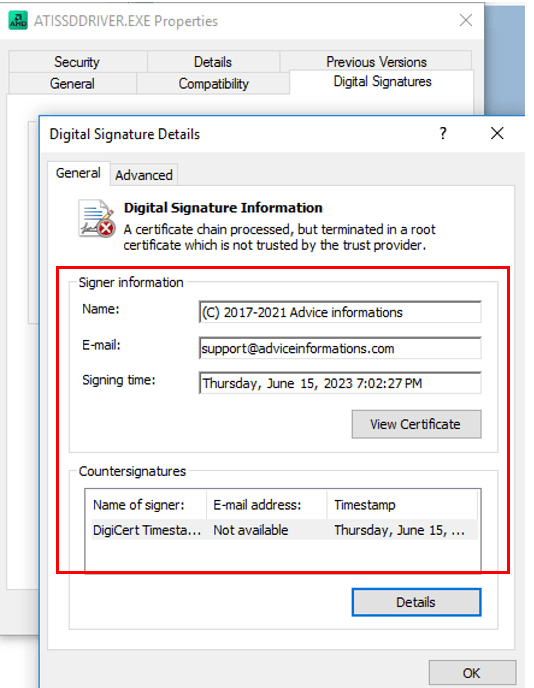
    In the campaign involving the discussed samples, the malware tries to impersonate an AMD External Data SSD driver and is signed with an “Advice informations” digital certificate in order to appear legitimate and evade detection.

    Implant impersonating AMD driver

    Digital certificate used by Grandoreiro malware

    In both cases, the malware is an executable that registers itself to be launched with Windows. However, it is worth noting that in the majority of Grandoreiro attacks, a DLL sideloading technique is employed, using legitimate binaries that are digitally signed to run the malware.

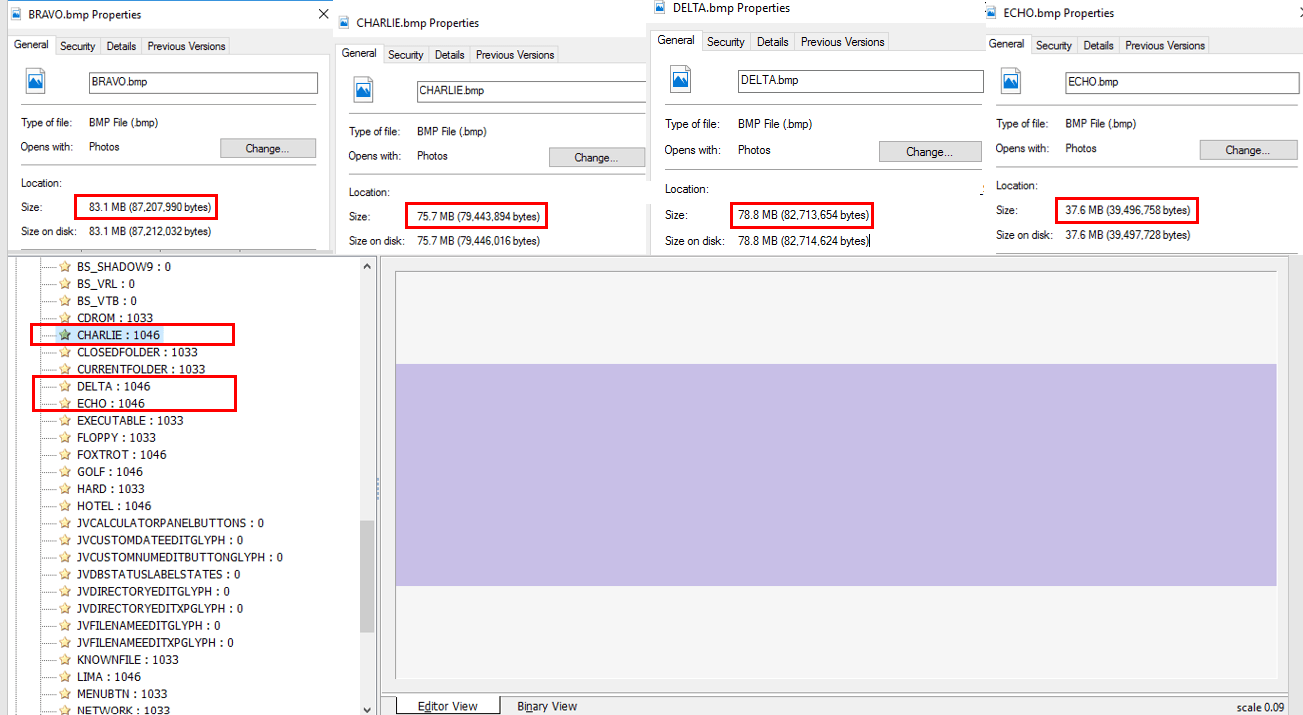
    The considerable size of the executables can be explained by the fact that Grandoreiro utilizes a binary padding technique to inflate the size of the malicious files as a way to evade sandboxes. To achieve this, the attackers add multiple BMP images to the resource section of the binary. In the example below, the sample included several big images. The sizes of the highlighted images are around 83.1 MB, 78.8 MB, 75.7 and 37.6 MB. However, there are more of them in the binary, and together all the images add ~376 MB to the file.

    Binary padding used by Grandoreiro

    In both 2022 and 2023 campaigns, Grandoreiro used a well-known XOR-based string encryption algorithm that is shared with other Brazilian malware families. The difference is the encryption key. For Grandoreiro, some magic values were the following:

    Date Encryption key
    March 2022 F5454DNBVXCCEFD3EFMNBVDCMNXCEVXD3CMBKJHGFM
    March 2022 XD3CMBKJCEFD3EFMF5454NBVDNBVXCCMNXCEVDHGFM
    August 2022 BVCKLMBNUIOJKDOSOKOMOI5M4OKYMKLFODIO
    June 2023 B00X02039AVBJICXNBJOIKCVXMKOMASUJIERNJIQWNLKFMDOPVXCMUIJBNOXCKMVIOKXCJ
    UIHNSDIUJNRHUQWEBGYTVasuydhosgkjopdf

    The various checks and validations aimed at avoiding detection and complicating malware analysis were also changed in the 2022 and 2023 versions. In contrast with the older Grandoreiro campaigns, we found that some of the tasks that were previously executed by the final payload are now implemented in the first stage loader. These tasks include security checks, anti-debugging techniques, and more. This represents a significant change from previous campaigns.

    One of these tasks is the use of the geolocation service http://ip-api.com/json to gather the target’s IP address location data. In a campaign reported in May 2023 by Trustwave, this task is performed by a JScript code embedded in an MSI installer before the delivery of the final payload.

    There are numerous other checks that have been transferred into the loader, although some of them are still present in the banking trojan itself. Grandoreiro gathers host information such as operating system version, hostname, display monitor information, keyboard layout, current time and date, time zone, default language and mouse type. Then the malware retrieves the computer name and compares it against the following strings that correspond to known sandboxes:

    • WIN-VUA6POUV5UP;
    • Win-StephyPC3;
    • difusor;
    • DESTOP2457;
    • JOHN-PC.

    Computer name validation

    It also collects the username and verifies if it matches with the “John” or “WORK” strings. If any of these validations match, the malware stops its execution.

    Grandoreiro includes detection of tools commonly used by security analysts, such as regmon.exe, procmon.exe, Wireshark, and so on. The process list varies across the malware versions, and it was significantly expanded in 2024, so we’ll share the full list later in this post. The malware takes a snapshot of currently executing processes in the system using the CreateToolhelp32Snapshot() Windows API and goes through the process list using Process32FirstW() and Process32NextW(). If any of the analysis tools exists in the system, the malware execution is terminated.

    Grandoreiro also checks the directory in which it is being executed. If the execution paths are D:programming or D:script, it terminates itself.

    Another anti-debugging technique implemented in the trojan involves checking for the presence of a virtual environment by reading data from the I/O Port “0x5658h” (VX) and looking for the VMWare magic number 0x564D5868. The malware also uses the IsDebuggerPresent() function to determine whether the current process is being executed in the context of a debugger.

    Last but not least, Grandoreiro searches for anti-malware solutions such as AVAST, Bitdefender, Nod32, Kaspersky, McAfee, Windows Defender, Sophos, Virus Free, Adaware, Symantec, Tencent, Avira, ActiveScan and CrowdStrike. It also looks for banking security software, such as Topaz OFD and Trusteer.

    In terms of the core functionality, some Grandoreiro samples check whether the following programs are installed:

    • CHROME.EXE;
    • MSEDGE.EXE;
    • FIREFOX.EXE;
    • IEXPLORE.EXE;
    • OUTLOOK.EXE;
    • OPERA.EXE;
    • BRAVE.EXE;
    • CHROMIUM.EXE;
    • AVASTBROWSER.EXE;
    • VeraCrypt;
    • Nortonvpn;
    • Adobe;
    • OneDrive;
    • Dropbox.

    If any of these is present on the system, the malware stores their names to further monitor user activity in them.

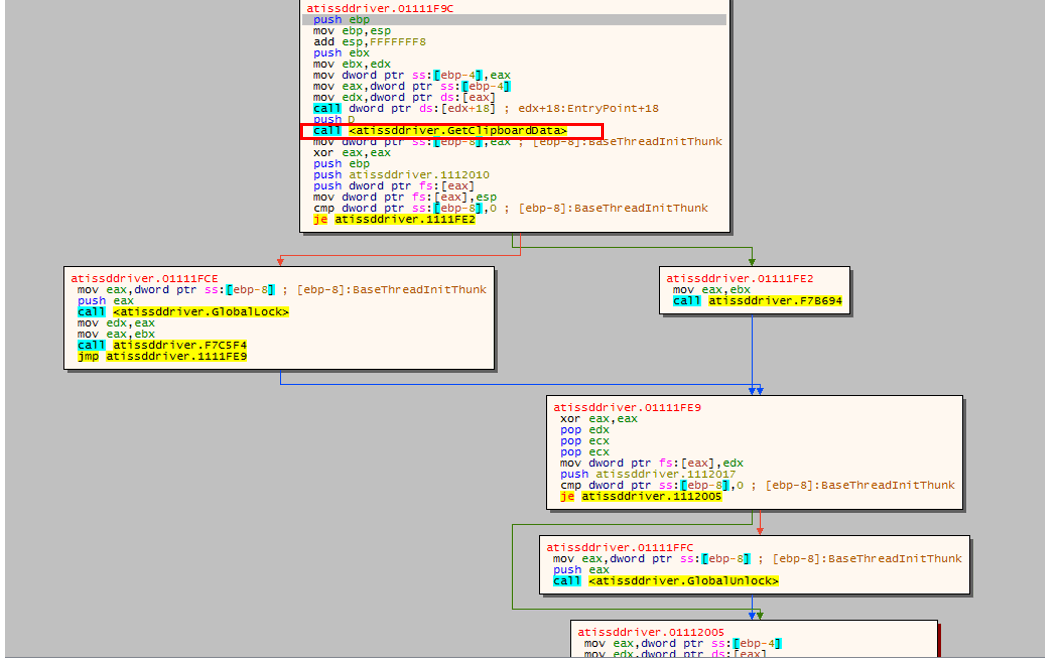
    Grandoreiro also checks for crypto wallets installed on the infected machine. The malware includes a clipboard replacer for crypto wallets, monitoring the user’s clipboard activity and replacing the clipboard data with the threat actor keys.

    Clipboard replacer

    2024 campaigns

    During a certain period of time in February 2024, a few days after the announcement of the arrest of some of the gang’s operators in Brazil, we observed a significant increase in emails detected by spam traps. There was a notable prevalence of Grandoreiro-themed messages masquerading as Mexican CFDI communications. Mexican CFDI, short for “Comprobante Fiscal Digital por Internet” is an electronic invoicing system administered by the Mexican Tax Authority (SAT — Servicio de Administración Tributaria). It facilitates the creation, transmission, and storage of digital tax documents, mandatory for businesses in Mexico to record transactions for tax purposes.

    In our investigation, we have acquired 48 samples associated not only with this instance but also with various other campaigns.

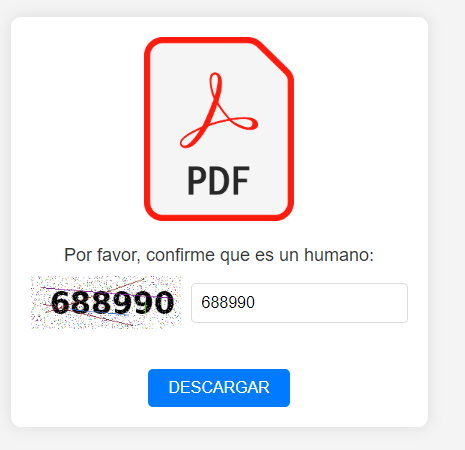
    Notably, this new campaign added a new sandbox detection mechanism, namely a CAPTCHA before the execution of the main payload, as a way to avoid the automatic analysis used by some companies:

    Grandoreiro anti-sandbox CAPTCHA

    It is worth noting that in the 2024 Grandoreiro campaigns, the new sandbox evasion code has been implemented in the downloader. Although the main sample still has anti-sandbox functionality too, if a sandbox is detected, it is simply not downloaded. Besides that, the new version also added detection of many tools to its arsenal, aiming to avoid analysis. Here is whole list of analysis tools detected by the newest versions:

    regmon.exe hopper.exe nessusd.exe OmniPeek.exe
    procmon.exe jd-gui.exe PacketSled.exe netmon.exe
    filemon.exe canvas.exe prtg.exe colasoft.exe
    Wireshark.exe pebrowsepro.exe cain.exe netwitness.exe
    ProcessHacker.exe gdb.exe NetworkAnalyzerPro.exe netscanpro.exe
    PCHunter64.exe scylla.exe OmniPeek.exe packetanalyzer.exe
    PCHunter32.exe volatility.exe netmon.exe packettotal.exe
    JoeTrace.exe cffexplorer.exe colasoft.exe tshark.exe
    ollydbg.exe angr.exe netwitness.exe windump.exe
    ida.exe pestudio.exe netscanpro.exe PRTG Probe.exe
    x64dbg.exe die.exe packetanalyzer.exe NetFlowAnalyzer.exe
    cheatengine.exe ethereal.exe packettotal.exe SWJobEngineWorker2x64.exe
    ollyice.exe Capsa.exe tshark.exe NetPerfMonService.exe
    fiddler.exe tcpdump.exe windump.exe SolarWinds.DataProcessor.exe
    devenv.exe NetworkMiner.exe PRTG Probe.exe ettercap.exe
    radare2.exe smartsniff.exe NetFlowAnalyzer.exe apimonitor.exe
    ghidra.exe snort.exe SWJobEngineWorker2x64.exe apimonitor-x64.exe
    frida.exe pcap.exe NetPerfMonService.exe apimonitor-x32.exe
    binaryninja.exe SolarWinds.NetPerfMon.exe SolarWinds.DataProcessor.exe x32dbg.exe
    cutter.exe nmap.exe ettercap.exe x64dbg.exe
    scylla.exe apimonitor.exe PCHunter64.exe x96dbg.exe
    volatility.exe apimonitor-x64.exe PCHunter32.exe fakenet.exe
    cffexplorer.exe apimonitor-x32.exe JoeTrace.exe hexworkshop.exe
    angr.exe x32dbg.exe ollydbg.exe Dbgview.exe
    pestudio.exe x64dbg.exe ida.exe sysexp.exe
    die.exe x96dbg.exe x64dbg.exe vmtoolsd.exe
    ethereal.exe fakenet.exe cheatengine.exe dotPeek.exe
    Capsa.exe hexworkshop.exe ollyice.exe procexp64.exe
    tcpdump.exe Dbgview.exe fiddler.exe procexp64a.exe
    NetworkMiner.exe sysexp.exe devenv.exe procexp.exe
    smartsniff.exe vmtoolsd.exe radare2.exe cheatengine.exe
    snort.exe dotPeek.exe ghidra.exe ollyice.exe
    pcap.exe procexp64.exe frida.exe pebrowsepro.exe
    cain.exe procexp64a.exe binaryninja.exe gdb.exe
    nmap.exe procexp.exe cutter.exe Wireshark.exe
    nessusd.exe regmon.exe hopper.exe ProcessHacker.exe
    PacketSled.exe procmon.exe jd-gui.exe SolarWinds.NetPerfMon.exe
    prtg.exe filemon.exe canvas.exe NetworkAnalyzerPro.exe

    These are some RAT features that we found in this version:

    • Auto-update feature allows newer versions of the malware to be deployed to the victim’s machine;
    • Sandbox/AV detection, still present in the main module, which includes more tools than previous versions;
    • Keylogger feature;
    • Ability to select country for listing victims;
    • Banking security solutions detection;
    • Checking geolocation information to ensure it runs in the target country;
    • Monitoring Outlook emails for specific keywords;
    • Ability to use Outlook to send spam emails.

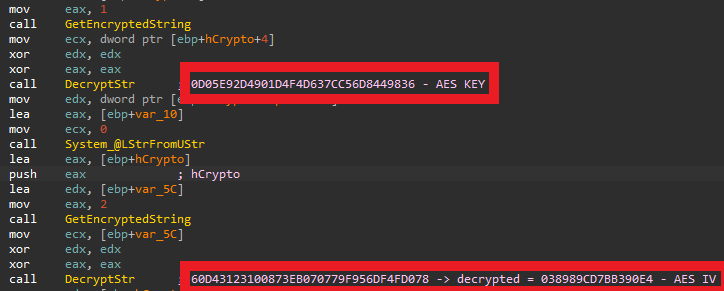
    In terms of static analysis protection, in 2024 versions, Grandoreiro has implemented enhanced encryption measures. Departing from its previous reliance on commonly shared encryption algorithms found in other malware, Grandoreiro has now adopted a multi-layered encryption approach. The decryption process in the newer versions is the following. Initially, the string undergoes deobfuscation through a simple replacement algorithm. Following this, Grandoreiro employs the encryption algorithm based on XOR and conditional subtraction typically utilized by Brazilian malware; however, it differs from them by incorporating a lengthy, 140759-byte string instead of smaller magic strings we saw in 2022 and 2023 samples. Subsequently, the decrypted string undergoes base64 decoding before being subjected to decryption via the AES-256 algorithm. Notably, the AES key and IV are encrypted within Grandoreiro’s code. Upon completion of all these steps, the decrypted string is successfully recovered.

    Grandoreiro AES key and IV

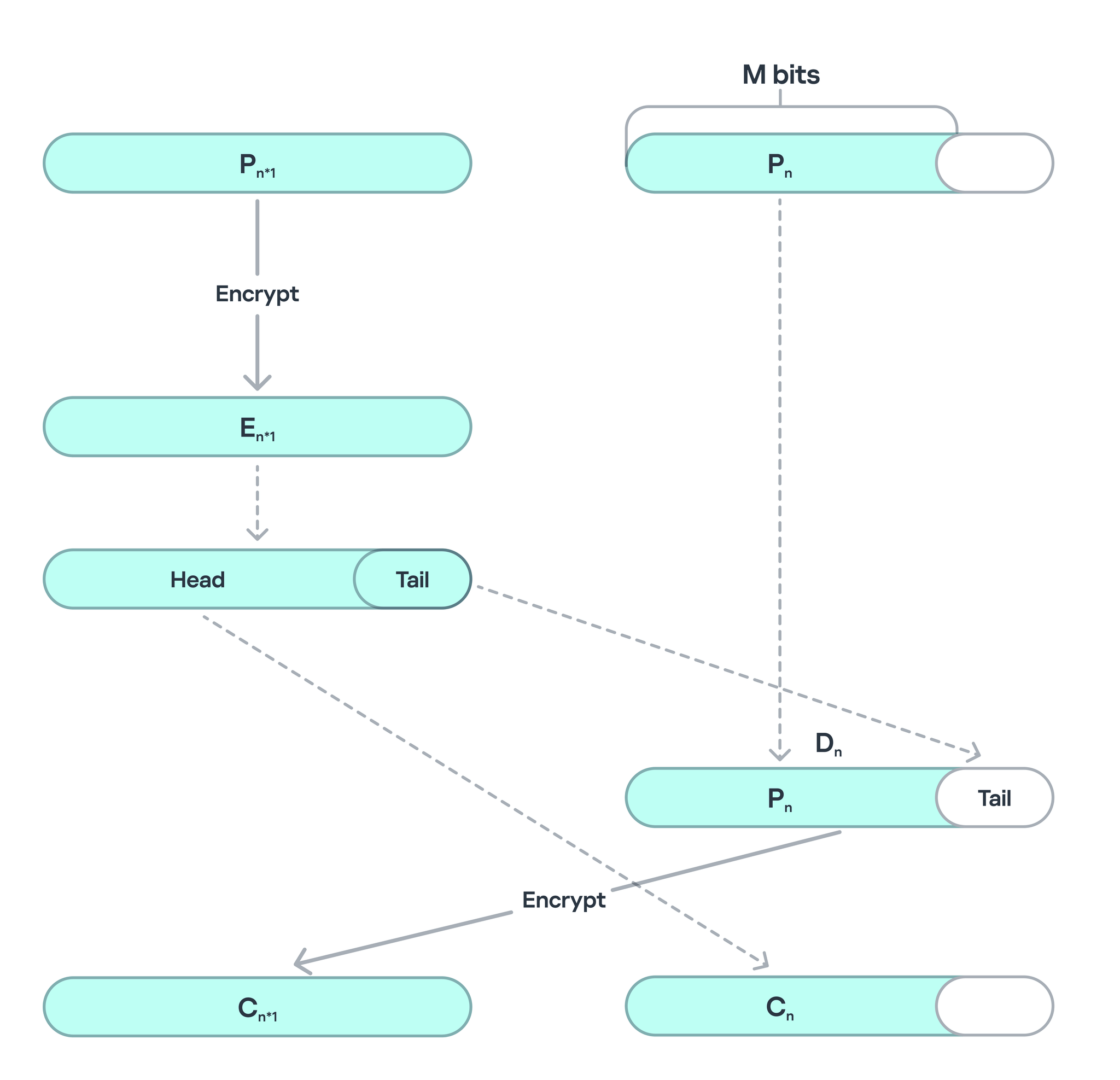
    In newer samples, Grandoreiro upgraded yet again the encryption algorithm using AES with CTS, or Ciphertext Stealing, a specialized encryption mode used when the plaintext is not a multiple of the block size, which in this case is the 128-bit (16-byte) block size used by AES. Unlike more common padding schemes, such as PKCS#7, where the final block is padded with extra bytes to ensure it fits a full block, CTS operates without padding. Instead, it manipulates the final partial block of data by encrypting the last full block and XORing its output with the partial block. This allows encryption of any arbitrary-length input without adding extra padding bytes, preserving the original size of the data.

    ECB Encryption Steps for CTS

    In the case of Grandoreiro, the malware’s encryption routine does not add standard padding to incomplete blocks of data. Their main goal is to complicate analysis: it takes time to figure out that CTS was used, and then more time to implement decryption in this mode, which makes the extraction and obfuscation of strings more complicated. This marks the first time this particular method has been observed in a malware sample.

    As the threat actors continue to evolve their techniques, changing the encryption in every iteration of the malware, the use of CTS in malware may signal a shift toward more advanced encryption practices.

    Local versions: old meets new

    In a recent campaign, our analysis has revealed the existence of an older variant of the malware that utilizes legacy encryption keys, outdated algorithms, and a simplified structure, but which runs in parallel to the campaign using the new code. This variant targets fewer banks — about 30 financial institutions, mainly from Mexico. This analysis clearly indicates that another developer, likely with access to older source code, is conducting new campaigns using the legacy version of the malware.

    How they steal your money

    Operators behind Grandoreiro are equipped with a wide variety of remote commands, including an option to lock the user screen and present a custom image (overlay) to ask the victim for extra information. These are usually OTPs (one-time passwords), transaction passwords or tokens received by SMS, sent by financial institutions.

    A new tactic that we have discovered in the most recent versions found in July 2024 and later suggests that the malware is capturing user input patterns, particularly mouse movements, to bypass machine learning-based security systems. Two specific strings found in the malware — “GRAVAR_POR_5S_VELOCIDADE_MOUSE_CLIENTE_MEDIA” (“Record for 5 seconds the client’s average mouse speed”) and “Medição iniciada, aguarde 5 segundos!” (“Measurement started, please wait 5 seconds!”) — indicate that Grandoreiro is monitoring and recording the user’s mouse activity over a short period. This behavior appears to be an attempt to mimic legitimate user interactions in order to evade detection by anti-fraud systems and security solutions that rely on behavioral analytics. Modern cybersecurity tools, especially those powered by machine learning algorithms, analyze user’s behavior to distinguish between human users and bots or automated malware scripts. By capturing and possibly replaying these natural mouse movement patterns, Grandoreiro could trick these systems into identifying the activity as legitimate, thus bypassing certain security controls.

    This discovery highlights the continuous evolution of malware like Grandoreiro, where attackers are increasingly incorporating tactics designed to counter modern security solutions that rely on behavioral biometrics and machine learning.

    To perform the cash-out in the victim’s account, Grandoreiro operators’ options are to transfer money to the account of local money mules, using transfer apps, buy cryptocurrency or gift cards, or even going to an ATM. Usually, they search for money mules in Telegram channels, paying $200 to $500 USD per day:

    Grandoreiro operator looking for money mules

    Infrastructure

    The newest Grandoreiro version uses 3 Domain Generation Algorithms (DGAs), generating valid domains for command and control (C2) communications. The algorithm uses the current daytime to select strings of predefined lists and concatenates them with a magic key to create the final domain.

    By dynamically generating unique domain names based on various input data, the algorithm complicates traditional domain-based blocking strategies. This adaptability allows the malicious actors to maintain persistent command-and-control communications, even when specific domains are identified and blacklisted, requiring security solutions to base their protection not on a fixed list of domains, but on an algorithm for generating them.

    Since early 2022, Grandoreiro leverages a known Delphi component shared among different malware families named RealThinClient SDK to remotely access victim machines and perform fraudulent actions. This SDK is a flexible and modular framework for building reliable and scalable Windows HTTP/HTTPS applications with Delphi. By using RealThinClient SDK, the program can handle thousands of active connections in an efficient multithreaded manner.

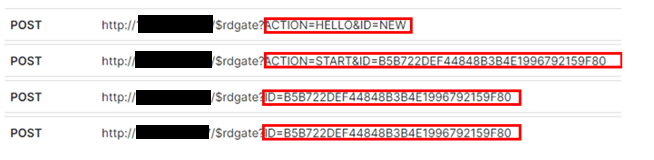
    Grandoreiro C2 Communication

    Operator tool

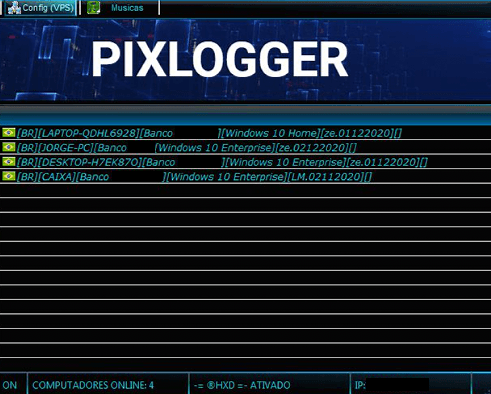
    Grandoreiro’s Operator is the tool that allows the cybercriminal to remotely access and control the victim’s machine. It’s a Delphi-based software that lists its victims whenever they start browsing a targeted financial institution website.

    Grandoreiro’s Operator tool

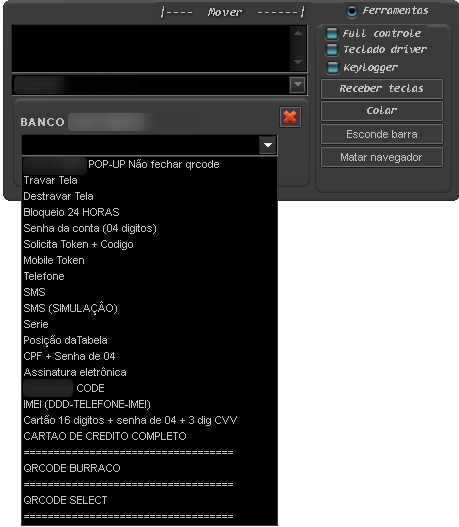
    Once the cybercriminal chooses a victim to operate on, they will be presented with the following screen, seen in the image below, which allows many commands to be executed and visualizes the victim’s desktop.

    Grandoreiro’s Operator commands

    Cloud VPS

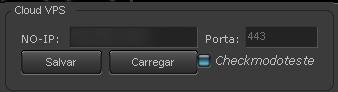
    One overlooked feature of the Grandoreiro malware is what is called “Cloud VPS” by the attackers — it allows cybercriminals to set up a gateway computer between the victim’s machine and the malware operator, thus hiding the cybercriminal’s real IP address.

    This is also used by them to make investigation harder, as the first thing noted is the gateway’s IP address. When requesting a seizure, an investigator just finds the gateway module. Meanwhile, the criminal has already set up a new gateway somewhere else and new victims connect to the new one through its DGA.

    Grandoreiro Cloud VPS

    Victims and targets

    The Grandoreiro banking trojan is primed to steal the credentials accounts for 1,700 financial institutions, located in 45 countries and territories. After decrypting the strings of the malware, we can see the targeted banks listed separated by countries/territories. This doesn’t mean that Grandoreiro will target a specific bank from the list; it means it is ready to steal credentials and act, if there is a local partner or money mule who can operationalize and complete the action. The banks targeted by Grandoreiro are located in Algeria, Angola, Antigua and Barbuda, Argentina, Australia, Bahamas, Barbados, Belgium, Belize, Brazil, Canada, Cayman Islands, Chile, Colombia, Costa Rica, Dominican Republic, Ecuador, Ethiopia, France, Ghana, Haiti, Honduras, India, Ivory Coast, Kenya, Malta, Mexico, Mozambique, New Zealand, Nigeria, Panama, Paraguay, Peru, Philippines, Poland, Portugal, South Africa, Spain, Switzerland, Tanzania, Uganda, United Kingdom, Uruguay, USA, and Venezuela. It’s important to note that the list of targeted banks and institutions tend to slightly change from one version to another.

    From January to October 2024, our solutions blocked more than 150,000 infections impacting more than 30,000 users worldwide, a clear sign the group is still very active. According to our telemetry, the countries most affected by Grandoreiro infections are Mexico, Brazil, Spain, and Argentina, among many others.

    Conclusion

    We understand how difficult it is to eradicate a malware family, but it is possible to impede their operation with the cooperation of law enforcement agencies and the private sector — modern financial cybercrime can and must be fought.

    Brazilian banking trojans are already an international threat; they’re filling the gaps left by Eastern European gangs who have migrated into ransomware. We know that in some countries, internet banking is declining on desktops, forcing Grandoreiro to target companies and government entities who are still using operating in that way.

    The threat actors behind the Grandoreiro banking malware are continuously evolving their tactics and malware to successfully carry out attacks against their targets and evade security solutions. Kaspersky continues to cooperate with INTERPOL and other agencies around the world to fight the Grandoreiro threat among internet banking users.

    This threat is detected by Kaspersky products as HEUR:Trojan-Banker.Win32.Grandoreiro, Trojan-Downloader.OLE2.Grandoreiro, Trojan.PDF.Grandoreiro and Trojan-Downloader.Win32.Grandoreiro.

    For more information, please contact: crimewareintel@kaspersky.com

    Indicators of Compromise

    Host based
    f0243296c6988a3bce24f95035ab4885
    dd2ea25752751c8fb44da2b23daf24a4
    555856076fad10b2c0c155161fb9384b
    49355fd0d152862e9c8e3ca3bbc55eb0
    43eec7f0fecf58c71a9446f56def0240
    150de04cb34fdc5fd131e342fe4df638
    b979d79be32d99824ee31a43deccdb18

    MIL OSI Global Banks –

    January 24, 2025
  • MIL-OSI Russia: Financial news: On holding auctions on October 23, 2024 to place OFZ issues No. 26245RMFS and No. 29025MFS

    Translation. Region: Russian Federation –

    Source: Moscow Exchange – Moscow Exchange –

    For bidders

    We inform you that, based on the letter of the Bank of Russia and in accordance with Part I. General Part and Part II. Stock Market Section of the Rules for Conducting Trading on the Stock Market, Deposit Market and Credit Market of Moscow Exchange PJSC, the order establishes the form, time, term and procedure for holding auctions for the placement and trading of the following federal loan bonds:

    1.

    Name of the Issuer Ministry of Finance of the Russian Federation
    Name of security federal loan bonds with constant coupon income
    State registration number of the issue 26245RMFS from 08.05.2024
    Date of the auction October 23, 2024
    Information about the placement (trading mode, placement form) The placement of Bonds will be carried out in the Trading Mode “Placement: Auction” by holding an Auction to determine the placement price. BoardId: PACT (Settlements: Ruble)
    Trade code SO26245RMFS9
    ISIN code PO000A108EG6
    Calculation code B01
    Additional conditions of placement The share of non-competitive bids in relation to the total volume of bids submitted by the Bidder may not exceed 90%.
    Trading time Trading hours: bid collection period: 14:30 – 15:00; bid execution period: 15:30 – 18:00.

    2.

    Name of the Issuer Ministry of Finance of the Russian Federation
    Name of security variable coupon federal loan bonds
    State registration number of the issue 29025RMFS from 09/29/2023
    Date of the auction October 23, 2024
    Information about the placement (trading mode, placement form) The placement of Bonds will be carried out in the Trading Mode “Placement: Auction” by holding an Auction to determine the placement price. BoardId: PACT (Settlements: Ruble)
    Trade code SU29025RMFS2
    ISIN code PO000A106Z61
    Calculation code B01
    Additional conditions of placement The share of non-competitive bids in relation to the total volume of bids submitted by the Bidder may not exceed 90%.
    Trading time Trading hours: bid collection period: 12:00 – 12:30; bid execution period: 13:00 – 18:00.

    Contact information for media 7 (495) 363-3232PR@moex.com

    Please note: This information is raw content directly from the source of the information. It is exactly what the source states and does not reflect the position of MIL-OSI or its clients.

    Please note; This information is raw content directly from the information source. It is accurate to what the source is stating and does not reflect the position of MIL-OSI or its clients.

    https://www.moex.com/n74197

    MIL OSI Russia News –

    January 24, 2025
  • MIL-OSI Russia: Financial News: Interview with Philip Gabunia for Interfax

    Translation. Region: Russian Federation –

    Source: Central Bank of Russia –

    There should be no tolerance for someone in the market having access to information before others.

    The problem of insider trading and manipulation on the Russian market is not only not losing its relevance, but on the contrary, is even getting worse against the backdrop of the players becoming more active and anti-sanction relaxations in terms of information disclosure. Deputy Chairman of the Bank of Russia Filipp Gabunia spoke to Interfax about the steps the regulator has planned to counteract these and other negative practices, as well as proposals to increase the capitalization of the Russian stock market, discussions between the exchange and professional participants, and closing “loopholes” for unfriendly non-residents.

    — The Russian stock market has lost a lot in recent years and has changed significantly in general. In these conditions, the task of doubling its capitalization in relation to GDP sounded quite unexpected. Is it already clear what needs to be done in the current reality to solve this problem? Is it really possible in principle?

    — The task is certainly very ambitious. If we talk about what needs to be done, then, of course, there is no universal remedy. A set of actions is needed. Some measures have already been implemented, and we are waiting for their effect. For example, this is the reform of the IIS, the launch of a long-term savings program.

    Now we are also suggesting that the government consider changing the incentive system for companies that receive state support when implementing various projects. Today, loans as a form of raising funds dominate our economy as a whole. This is the bridge that brings together the lender and the borrower. The state usually directs funds to subsidize interest rates, there are benefits for investment projects, but they are all tied to raising funds in the form of loans.

    One measure we have proposed for discussion is subsidized equity financing, i.e. a spread-out payment to companies entering the capital market, as an alternative to subsidies under bank lending programs. In addition, tax incentives, such as income tax breaks for issuers, may also be justified if certain conditions are met.

    — Won’t companies find themselves in unequal conditions? If someone’s strategy doesn’t include publicity at all…

    — No, this does not mean that all support will be transferred exclusively in the form of equity capital. We expect that companies will have a choice — if a project is eligible for state support, it can be received either through preferential lending or in the form of benefits when entering the stock market. Companies themselves will make decisions based on the specifics of the project’s economy and the cost of various sources of financing. At the same time, it is important that state support is not an incentive for only one form of raising money.

    By the way, the use of equity financing will help reduce the debt burden of businesses and will not lead to an additional burden on the budget. There will simply be a redistribution of expenses between forms of support. Here, of course, the position of the government, which, in fact, provides this support, is important.

    — What else is on the “doubling agenda”?

    — The cornerstone, of course, is trust in the stock market, including the attitude towards minority shareholders. If the interests of investors are trampled, they will not come to the market, no matter what incentives we offer. And here it is important that the interests of minority shareholders are not neglected, but on the contrary, protected. This affects, among other things, issues of maximum possible disclosure of information about issuers in the current conditions, availability of price information, increasing the transparency of dividend policy, the quality of corporate culture and much more.

    — This taboo has become less unquestionable in the last couple of years. Some relaxations have already been lifted, but it is hardly possible to say that we have returned to the level that was, say, in 2021. Do you think that all the necessary conditions are now in place to raise the issue of a complete return of all rules, both in terms of disclosure and in terms of corporate governance, to the previous level?

    — Currently, companies have reasons to close some information about themselves, taking into account the sanctions risks. But the fact is that many companies use external circumstances to justify their “secrecy”. Our position is that investors need information to make informed decisions. We will need to come up with some more subtle mechanisms for investors to obtain information about companies.

    — And what can the expansion of trading hours on the stock market give in terms of doubling capitalization? The return of the morning session, trading on weekends?

    — Weekend trading is definitely not the main recipe. But we analyze this topic comprehensively. It sounds convincing and beautiful: if stores work around the clock, why not apply this principle to the stock market? But there are still some specifics here. It is connected primarily with changes in liquidity in different time periods: very early or very late. We used to record quite significant volatility in the morning hours. And this can have serious consequences for investors, if, for example, someone had a margin position. Suddenly they will take and close, although there were no fundamental reasons for this.

    Now we are trying to assess these risks and think about how to mitigate them so as not to create threats to investors. We conducted a survey among investors, asking whether they need trading on weekends. Well, the lion’s share of respondents were against it.

    At the same time, the idea of expanding trading hours is not the worst: our country is large, with different time zones. Therefore, there are indeed arguments in favor of such a decision.

    We have received proposals from both Moscow Exchange and St. Petersburg Exchange on how they see trading on weekends. It is important to make a balanced decision now.

    — The role of the domestic investor has grown significantly now, but it is unlikely that the market can be doubled solely by relying on one’s own efforts. But if you put yourself in the shoes of a foreign investor, even from a currently friendly jurisdiction: he should probably also be concerned about the “risks of foreign infrastructure” in relation to Russia, which the Central Bank has so often spoken about in relation to foreign markets. Perhaps there are some steps that can be taken, so to speak, to accommodate foreign investors? Some restrictions can be softened, removed, to show that the risks of foreign infrastructure in Russia are no greater than the risks of a Russian investor in a foreign jurisdiction?

    — It is clear that we cannot guess what concerns a foreign investor who wants to come to our market has. My opinion is that today we have no restrictions in relation to friendly jurisdictions. We have not taken a single unfriendly step, all our measures were a response to the actions of foreign institutions. Moreover, we are systematically moving towards easing regulations, for example, we have direct access for their brokers to currency trading on our exchange. In the future, we will develop depository bridges to synchronize asset accounting.

    We are not closing our market and are ready for constructive cooperation.

    — The head of the Bank of Russia said in May that we need to think about establishing a minimum free float level for admission to trading. Have you discussed this with the market?

    — Moreover, we have a regulatory act at the output. We propose to increase the minimum share of shares in free circulation for the second level of listing — to 5%. We analyzed the volume of securities issued by issuers that are actually available for exchange transactions. In general, our estimates coincided with the exchange’s estimates. It is planned that the new requirements will come into force on April 1, 2025.

    Requirements for first-tier issuers remain in place. To be included in the first quotation list, a company must direct 10% of the issue into free circulation. Then maintain a free float of 7.5%.

    With regard to securities that are not included in the quotation lists (and this echelon is precisely where securities that have historically had a low free float are concentrated), measures to counter volatility are taken by the organizers of trades based on their own methods, taking into account the recommendations of the Bank of Russia.

    — Recently, the topic of the risk of large companies leaving the stock exchange has been raised in the public arena. Does the regulator see such risks? Are you planning to do anything?

    — For now, it seems to us that this is somewhat exaggerated. We do not see any prerequisites for delisting the largest issuers of securities. At the same time, the current regulation allows the exchange to make a decision in certain situations to lower the level of the quotation list and even delist. But in each case, it is necessary to assess the consequences of such a decision for retail and institutional investors.

    — You have already outlined the problem of stock acceleration, especially low-liquidity stocks. How are things now? Are any additional steps needed?

    — Indeed, it was a serious problem. In just 3 quarters of last year, the number of shares subject to destabilization reached 63. For comparison, about 12 such cases were recorded for the whole of 2022. At the same time, price fluctuations could exceed 50%. And the most interesting thing is that this was not even direct manipulation in the legal sense of the word, but you know, a kind of lottery – who will jump first. The purpose of such actions is the artificial and planned formation of a trend on the paper. And when the market is already entering the expected state or is approaching it, the manipulator exits the position, as a rule, in advance.

    But the stock exchange is not gambling. Organized trading should determine adequate and transparent pricing. We, together with the Moscow Exchange, have taken measures to limit aggressive bids in the third tier. Because such swings, as I have already said, can only be arranged when the market is thin and the free float is low. New (rigid) price limits were set, the price step for the most volatile securities was increased, the possibility of submitting aggressive bids beyond a 5% deviation from the best price was limited, and the response time of the discrete auction was reduced.

    In fact, this has yielded results, the number of such practices has decreased many times – to isolated cases, and this trend has remained to this day. We do not see any more bright bursts of volatility. In general, the measures have worked, so we do not see any point in making any additional decisions yet.

    — Do you follow the price fluctuations of securities, including those of large issuers, at the St. Petersburg Exchange?

    – Of course, right now we are discussing that they introduce the necessary levels of control to avoid volatility.

    — There was an idea to increase fines for manipulation, what stage is it at now?

    — We are currently discussing with law enforcement agencies the possibility of toughening the punishment. In our opinion, it should be proportional to the scale of the damage caused. Today, the minimum fine for individuals is often insignificant compared to the “earnings” received — 3,000 rubles. Articles of the Criminal Code begin to be applied when damage is caused in the amount of 3.75 million rubles. That is, the fines are small, but criminal liability occurs very quickly. We believe that it is necessary, first of all, to toughen administrative punishment.

    In particular, we propose to provide for a fine that is a multiple of the amount of illegally obtained income in the process of manipulation – from 3 to 5 times. At the same time, we advocate increasing the minimum fine – up to 10 thousand for individuals, up to 100 thousand for officials and up to 1 million rubles for companies.

    In addition, we believe it is necessary to increase the limitation period for bringing to administrative responsibility, as well as to introduce the concept of a lower threshold of turnover for transactions, up to which administrative punishment is not applied. Now we must bring to responsibility for any identified fact. However, according to our estimates, transactions of up to 1 million rubles are not capable of significantly affecting fair pricing on the market. And such violations do not need to be brought to “administrative” responsibility; it is quite sufficient for the broker to warn his client that this should not be done. The introduction of such a threshold will allow us to focus our attention on more serious cases that cause more significant harm to the interests of investors on the exchange.

    As for criminal liability, in our opinion, it is necessary to increase the minimum threshold of damage for its occurrence. But at the same time, provide for confiscation of property as an additional measure of influence. At the same time, we believe that it is possible to exempt from criminal liability those who committed a crime for the first time and compensated for the damage.

    It must be said that we want to transfer many procedures for minor violations to the broker’s side.

    We have already greatly simplified the operational procedures for exchanging information with the exchange and professional participants when they inform us of any abnormal things. Traditionally, the model for combating insider trading and manipulation was, as we say, “central bank-centric”, that is, the Bank of Russia was the main link in collecting information from exchanges, issuers, and professional participants. We considered complaints and appeals from financial market participants, qualified violations, punished, and so on. Now we have managed to simplify interaction with other market participants and standardize our actions.

    We assume that each participant in the system – trade organizers, brokers, issuers – can share this responsibility.

    — You recently published information about a deal between an individual and a regulator. What was the agreement?

    — This is the first case since such a rule has been in force in the law. For ethical reasons, we do not disclose information about the person who has agreed to an agreement with us. But how does this work in principle?

    The essence of the deal is that the culprit repents of his actions and agrees to assist in the investigation of the manipulation case. In return, the charges against him are dropped, he retains his business reputation and can continue to work in the financial market.

    It should be noted that this is not possible in all cases. The Bank of Russia, before entering into a deal, must take into account the severity of the committed act, its social danger.

    Then we assess how the conditions that the person who has embarked on the path of correction is willing to accept in order to remove the charges against themselves are proportionate to the damage caused. This may be an agreement to undergo additional training on the topic of counteracting insider trading and manipulation, restrictions on trading with certain instruments or for a certain period of time. Providing information about other facts of manipulation may also be a condition of the deal.

    The agreement is considered fulfilled if the individual has documented compliance with the terms within 6 months. Otherwise, the procedure for bringing him to administrative responsibility will continue.

    — Has the insider problem gotten worse?

    — Yes, this problem has become more acute than before. Firstly, because the market has become more active, more players have appeared on it, and secondly, issuers have the right not to disclose some information. And here information asymmetry appears, when a limited group of people gets access to information that will never become public. And they can use this information to make a profit on the stock market. We must not allow tolerance to develop for the fact that someone has access to information earlier than others.

    We distinguish two types of insider information: trading, when an investor has learned information directly about the nature of planned trading operations on the stock exchange. And corporate, when an insider makes illegal transactions based on information from the issuer, such as the size of dividends.

    Both of these need to be addressed. We have analyzed a number of cases and have come to the following conclusion. It is necessary to introduce prohibitive periods when insiders are prohibited from making transactions with securities, and it is also necessary to expand the list of insider positions and require issuers to work with them more.

    Issuers need to gradually but actively form a culture: train insider employees, conduct checks on the facts of publication of insider information, including in messengers, before its official disclosure.

    Everyone should understand that insider trading is not allowed and will not go unpunished. We have now begun to actively conduct checks on the largest issuers for compliance with the legislation on combating insider trading. This is, of course, a more complex story in terms of proof.

    Therefore, we hope for a certain synergy due to the fact that the interests of the regulator, issuers, and professional market participants coincide here. Many companies are already turning to us for help, asking us to explain how to work with inside information.

    — There were plans to launch an insider index. How is this work progressing? How much will it help?

    — Yes, we worked with the Moscow Exchange on the possibility of introducing an aggregated indicator for transactions made by insiders. Obviously, without specifying the personalities and details of the transactions. The exchange is currently preparing a methodology for calculating the index. In our opinion, the introduction of such a tool will certainly provide additional transparency to the market. But unfortunately, I am not sure that this will be a panacea.

    — Does everything you listed eliminate the need to think about some kind of regulation of the “Telegram” environment? If conditions are created that prevent manipulation, including from Telegram channels, let them do what they think is necessary, or is some kind of approach to them still necessary?

    — Any source of information, from an insider point of view, is an object of attention for us, Telegram in this sense is just one of them. Recently, more attention has been paid to it, and we monitor this environment in the same way as other sources of information. Another issue is that Telegram channels and financial bloggers are really turning into an independent way of promoting products, in fact, they are engaged in hidden advertising. We see that bloggers often advise their subscribers to buy this or that financial product or use the services of a certain company. And people do not know whether this advice is the blogger’s personal opinion or “custom” information.

    We have a letter ready for professional participants who attract bloggers (financial influencers) to promote their services, where we recommend that they disclose information about such advertising on their websites and mobile applications. Also, the performer, that is, the blogger, in turn, must mark the material – indicate who is its customer. It is important for us that the information is presented correctly and does not create false investment expectations.

    — In July, NAUFOR proposed discussing the rejection of the central depository institution as a counter-sanction measure. What does the Central Bank think about this? Is there any life in this idea?

    — I consider this idea to be extremely harmful. Its authors argue that abandoning the central depository will protect against sanctions. But as practice shows, it is impossible to predict where the restrictions will come from next time. From our point of view, this infrastructure solution has proven its usefulness. Centralization of accounting ensured a “single chain” of interaction between registrars and depositories and simplified the payment of dividends from public companies.

    Now the issuer transfers funds to the central depository, which in turn transfers them to its clients – depositories, and thus the funds cascade to the end investor. And with decentralized accounting, the issuer is forced to interact with each nominal holder in the register.

    The centralized model of the accounting system allows market participants to work in uniform formats and minimize their operational risks. The National Settlement Depository has also become the central source of information on securities and corporate actions. And it is this institution that largely helps restore the rights of Russian investors after the introduction of restrictions by unfriendly states.

    In addition, it was precisely due to the centralization of securities accounting that it became possible to develop a technology that would simplify the client’s path when moving from one broker to another.

    To abandon such a system, from my point of view, is in a sense to shoot yourself in the foot.

    — In the spring, a discussion was launched on disintermediation, the Bank of Russia even issued a consultative report on this topic. Now the idea of a world without brokers, that is, with one super-broker in the form of the Moscow Exchange, is it closed or not yet? On the other hand, will the Central Bank think in the direction of limiting internalization, so as not to deprive the exchanges of part of their business? Where is the balance here?

    — We are close to completing this discussion. We are inclined to believe that disintermediation in the form in which it may now take shape will cause quite serious damage to the market as a whole, leading to its certain fragmentation. And ultimately, the processes that connect investors and issuers, on the contrary, will be complicated, will become more expensive and less accessible. Therefore, at the moment, we are inclined to believe that we should not go this way.

    At the same time, we have once again carefully assessed the practice of internalization and see that there are a number of significant negative factors here too. As a rule, the investor does not understand that he is making a deal not at an organized trade. And this affects the status of the deal itself, which may not be in favor of the broker in the event of litigation. The investor, at a minimum, should be informed that he is making an over-the-counter transaction and have the opportunity to choose where he wants to make it in order to avoid unnecessary risks.

    The second is the volume of transactions. In the practices that we see, the rule of best execution is observed, the price, albeit very slightly, is better than the quotes on the exchange. But then the question arises, where is the correct price. Because if the volume of transactions taking place within the broker is several times greater than that by which the price is formed, it can be very conditionally said that the price that was formed on the exchange is really adequate. Therefore, the volume of transactions within brokers should be limited. We are currently thinking through the parameters.

    — Another question for the doubling of our stock market. Now the rates are high, and the stock market, probably, is not so easy to withstand the competition for money. This year, what dynamics do you see with dividend payments that come to investors — are they reinvested for the most part or are they still withdrawn from the market and go to the banking system?

    — RUB 3.2 trillion in dividends have already been paid. We have not recorded a significant flow into the banking sector. In retail, we see that this money was overwhelmingly reinvested, just not always in shares. According to the Bank of Russia, part of the funds were directed by investors into stock market instruments: as a rule, these are money market funds, which is associated with higher expected returns against the backdrop of tightening monetary policy and low market risks. In addition, according to our estimates, no more than 10% of private investors’ funds in the second quarter of 2024 “flowed” from shares to OFZs, corporate bonds and mutual funds. The sources of net purchases of bonds and mutual funds by private investors were mainly “new” money – potentially, this could be “flows” from deposits and current accounts of individuals, as well as reinvestment of funds received from the redemption of bonds and dividend payments.

    — Is the launch of new instruments for retail investors being discussed — linked to cryptocurrencies, some kind of settlement futures?

    — No, our attitude towards cryptocurrency has not changed from an investment point of view.

    — We have not had exchange trading in dollars and euros for more than four months. For other jurisdictions, this is generally a familiar picture, but for us, it is new. Over the past time, have you seen any risks of non-market nature of exchange rate formation? Can we say that from the point of view of transparency of this process, its quality, the market has not lost anything, or does something still need to be fine-tuned?

    — Just so that everyone understands how the dollar and euro rates are set after the end of exchange trading, we have published the methodology for calculating these rates on our website. That is, we have made this process transparent, and it is absolutely not arbitrary. We use an approach similar to that used when calculating rates based on exchange trading, that is, we determine the average weighted rate by volume.

    In order to bring the calculation conditions closer to the stock market and exclude various anomalies, we have incorporated algorithms for cutting off atypical values into the methodology. We take the data for the calculation from bank statements.

    The ability to set a rate at will that differs from the conditions prevailing on the over-the-counter market is excluded.

    — This year, the threshold for mandatory sale of foreign currency earnings by exporters was lowered twice, and for a short period of time. Is it possible to move further in this direction or has the minimum required for financial stability already been reached?

    — We support the decisions taken to lower the threshold and increase the terms for crediting revenue. This facilitates cross-border payments and reduces the burden on exporters. We will continue to observe. But we do not make such decisions. This is the government’s competence.

    — How do you see the development of the digital financial assets market? In what prospects is the emergence of a secondary market possible, and is it needed at all?

    — DFA is a young instrument. It was formed in a certain arbitration environment — in DFA it was possible to do things that were not possible in classical instruments, and vice versa, DFA has some of its own limitations. Now we are talking about how we can evaluate the results of such a spontaneous experiment in terms of arbitrations, and perhaps soften something in the classical market, perhaps tighten it in the digital asset market. For now, we are discussing the problems and looking towards eliminating the current unequal conditions.

    As for the development prospects. In my understanding, it is not so much the “a la glass” treatment itself with some gigantic trading volumes that is important, but the fact that today we have each platform locked in itself, and investors have no opportunity to go beyond it. Therefore, we need to look for a solution to make these transitions possible. What it will be in the end, I cannot say yet, but by the end of the year we plan to decide on the concept.

    One of the options for the development of the secondary market could be digital certificates, which will allow the organization of the circulation of digital financial assets on the stock exchange.

    — Recently, a presidential decree was issued on the accounting of shares on type “C” accounts and a decision of the board of directors of the Central Bank in its development. Why was this necessary?

    — We are introducing additional protection of the market from attempts to circumvent anti-sanction regulation. I am talking about practices when citizens or companies buy Russian assets from “enemies” very cheaply abroad, and then sell them here at auctions. In simple terms, they create an overhang. So, the decree makes it possible to separate this overhang from the auctions.

    – But now it’s also impossible to transfer from accounts “C” without permission…

    — Yes, there is a regime for separating Russian securities in the accounting chains of which there is a hostile investor. At the same time, conditions were created for bona fide purchasers so that they could exit the assets. But all our concessions were the subject of creative ideas in order to obtain a higher marginality from transactions with Russian assets. Why is this bad? Firstly, this is a certain reduction in the “C-mass”, that is, this is a weakening of the countermeasure. And secondly, this hits honest investors who came, believed in our market, invest something, try to earn.

    Therefore, it was decided that now shares of Russian issuers, including international companies, can be transferred to a trading account from personal account “C” only by decision of the government commission.

    — Was the scale of the problem significant enough to require a presidential decree?

    — No. We responded in a timely manner (to attempts to circumvent restrictions — IF). But this game of “cat and mouse” simply shows that the demand is high, and drastic measures need to be taken to free us from constantly catching someone red-handed. And we need to protect our investors, because they are promised that everything will work out, and then it doesn’t work out, and they end up with losses. Now, from our point of view, a barrier has appeared that cannot be overcome. At least, I have not yet been able to come up with options and schemes. But I will emphasize once again that we have not recorded significant volumes that would somehow “spill” through circumventing restrictions. What we have found are isolated cases or even attempts.

    — Why is this measure being introduced temporarily, only until the end of 2025?

    — During this time, we want to provide additional protection mechanisms. They just require painstaking development.

    — At a recent discussion of the draft of the main directions of development of the financial market, the reform of microfinance organizations was almost the hottest topic. If we listen to representatives of the industry, your proposals will put an end to it. Do you counter?

    — Now the MFI market is a cauldron in which many different things are brewed, but everything that is there is considered a microfinance organization. And it is often said: “Let’s ban all this.” In fact, the market is diverse, it consists of three parts.

    The first are companies that focus on financing small businesses and have nothing to do with the practices that are troubling everyone.

    The second group are companies that provide installment services. Their rates are actually comparable to bank consumer loans. Also a normal product, has a right to exist.

    And the third piece, which worries everyone the most, is “payday loans”. Regulation here has been tightened many times. For example, loans secured by property were banned, so that there would be no stories of people being forced into bondage, or having their apartment taken away. Maximum overpayments and interest rates were systematically reduced. But there are practices that allow one to bypass restrictions on overpayments through hidden refinancing, when a new loan is issued to a client and previously accrued interest is included in its body. A chain of loans is formed, a kind of rolling, the debt grows. There are about a third of such loans on the market.

    We conducted research and found out where people spend the money they borrow “until payday.” There are categories that spend it on betting, sports games – this is a rather alarming story for us. Up to 20% of the amount of loans issued is spent on these purposes. That is, the problem is acquiring a social character.

    We plan to introduce regulations that will stop such rolling. This is the restriction of “one loan per hand until repayment” for the most expensive loans. The second regulation is the introduction of a cooling-off period between repayment of one loan and receipt of another.

    We have completed the discussion of the report, met with the market, State Duma deputies, received more than 100 questions and proposals. Some points are debatable, they may still move. But as far as fundamental things are concerned, we remain on our positions and intend to implement measures to protect borrowers as quickly as possible.

    Interfax

    Please note: This information is raw content directly from the source of the information. It is exactly what the source states and does not reflect the position of MIL-OSI or its clients.

    Please note; This information is raw content directly from the information source. It is accurate to what the source is stating and does not reflect the position of MIL-OSI or its clients.

    http://vvv.kbr.ru/press/event/?id=21108

    MIL OSI Russia News –

    January 24, 2025
  • MIL-OSI Russia: Moscow scientists have assessed diagnostic accuracy indicators for Russian and international artificial intelligence services

    Translation. Region: Russian Federation –

    Source: Center for Diagnostics and Telemedicine

    Moscow scientists have assessed the diagnostic accuracy of various artificial intelligence (AI) services for radiology. The recent study evaluated five AI algorithms, including three developed in Russia and two from India and South Korea. The study found that the Russian AI service demonstrated the highest accuracy in detecting pulmonary nodules, outperforming its foreign counterparts. Research results were published in the Chinese Journal of Quantitative Imaging in Medicine and Surgery.

    Yuri Vasiliev, CEO of the Diagnostics and Telemedicine Center of the Moscow City Health Department, noted the importance of this achievement. “In a recent study involving Russian and foreign artificial intelligence (AI) services, our own AI solution demonstrated the highest accuracy in detecting lung nodules, ahead of similar solutions from India and South Korea. This achievement is a significant advance in our efforts to improve the quality of medical care.” Currently, radiologists use more than 50 AI services to interpret medical images, and in Moscow, more than 13 million studies have been analyzed using neural networks. The growing AI services market is constantly evolving with solutions that optimize the workload of medical workers while maintaining high standards of work,” Vasiliev said.

    “We aim to provide doctors with tools that will not only make their work easier, but also improve the overall quality of medical care. To do this, we have developed a maturity matrix – a comprehensive tool designed to evaluate and compare the effectiveness of various artificial intelligence services. Since the end of 2022, our AI service has consistently occupied a leading position in the field of chest X-ray,” said Yuri Vasiliev.

    The AI service, designed for automatic analysis of chest X-rays, currently identifies 14 signs of various pathologies. In addition, it calculates the cardiothoracic ratio and forms a comprehensive X-ray report.

    “We have prepared a unique data set consisting of 100 radiographs, including 50 with confirmed pulmonary nodules and 50 without pulmonary nodules. Of these, 25 cases were found to have nodules that were initially questioned by radiologists, but were confirmed using computed tomography. At the same time, the presence of pulmonary nodules in all 50 studies was confirmed by computed tomography,” explained Kirill Arzamasov, head of the Department of Medical Informatics, Radiomics and Radiogenomics at the Center for Diagnostics and Telemedicine.

    “The evaluation of AI services was carried out in three stages, at each stage the results were compared with the reference standard confirmed by CT studies. The results showed that the Russian AI service outperforms international analogues in all indicators of diagnostic accuracy.” The dataset is open source access on the website, which allows developers to independently assess the quality of AI services,” said Kirill Arzamasov, head of the Department of Medical Informatics, Radiomics and Radiogenomics at the Center for Diagnostics and Telemedicine of the Moscow Department of Healthcare.

    This study is part of a larger experiment to introduce computer vision technologies into the Moscow healthcare system, which will start in 2020. With the support of the Moscow Social Development Complex and the Department of Information Technology, the project aims to promote innovation in the field of artificial intelligence, in particular by supporting developers.

    The Diagnostics and Telemedicine Center, established in 1996, plays a leading role in the implementation of AI technologies in medicine in Russia. Its activities are aimed at the development of AI in medicine, the development of diagnostic images, the management of medical units, research and training of medical workers.

    MIL OSI Russia News –

    January 24, 2025
  • MIL-OSI USA: Ezell and Wicker Announce $1 Million Grant for Gulfport-Biloxi International Airport Infrastructure Improvements

    Source: United States House of Representatives – Congressman Mike Ezell (Mississippi 4th District)

    Today, Congressman Mike Ezell (MS-04) and Senator Roger Wicker (R-MS) announced a $1,000,000 grant to Gulfport-Biloxi International Airport to replace and install a passenger boarding bridge that has reached the end of its useful life. This crucial funding will enhance the airport’s infrastructure, improving both efficiency and safety for travelers.

    “The Gulfport-Biloxi International Airport is a strong partner in the economic vitality of South Mississippi,” Ezell said. “This grant will allow the airport to continue serving South Mississippians and those traveling to our community, ensuring a more efficient and safer travel experience as we enhance the infrastructure that supports our growing community.”

    “When people travel through our airports, whether for travel, leisure, or business, they should have a pleasant experience. This new passenger jet bridge will help ensure this outcome happens in Gulfport,” Senator Wicker said. “Supporting Mississippi’s airport infrastructure will continue to be one of my top priorities as a member of the Senate Commerce, Science, and Transportation Committee.”

    “On behalf of Gulfport-Biloxi International Airport, we greatly appreciate the support of the Congressional delegation in providing funding for infrastructure improvements to enhance the overall flying experience for those traveling to and from South Mississippi,” said Clay Williams, Executive Director, Gulfport-Biloxi International Airport. 

    The Gulfport-Biloxi International Airport is centrally located on the Mississippi Gulf Coast in Gulfport, Mississippi, and is the second largest airport in the state. The airport is approximately two miles from Interstate 10 and the Port of Gulfport, and it welcomes nearly 800,000 travelers each year. This grant will help ensure the airport continues to meet the demands of increasing travel while providing a seamless experience for passengers.

    Background on Ezell’s work on the Transportation and Infrastructure Committee:

    • Ezell has prioritized initiatives that support regional airports, recognizing their role in local economies. His work on the Transportation & Infrastructure Committee has focused on advocating for increased funding for maintenance and improvements at airports like Gulfport-Biloxi.
    • Ezell has been a strong proponent of safety measures in transportation. He believes that investments in airport infrastructure, such as the replacement of outdated boarding bridges, are essential to ensuring safe travel for all passengers.
    • Understanding the importance of timely infrastructure upgrades, Ezell has worked to streamline the processes for federal funding, making it easier for local airports to access the resources they need for essential improvements.
    • Ezell’s efforts on the committee include advocating for infrastructure that stimulates economic growth. By investing in airport upgrades, he is helping to enhance connectivity, attract tourism, and support local businesses.

    ###

    MIL OSI USA News –

    January 24, 2025
  • MIL-OSI USA: Rep. Cammack Announces Plans For Legislation To Create Tax-Free Savings Accounts For First-Time Homebuyers

    Source: United States House of Representatives – Congresswoman Kat Cammack (R-FL-03)

    WASHINGTON, D.C. — Today, Congresswoman Kat Cammack announced plans to introduce legislation to create tax-free savings accounts for individuals and families purchasing their first homes.  

    The NEST (Next-Generation Equity Savings Tool) Act would assist first-time homebuyers in overcoming financial barriers, especially the challenges related to down payments and closing costs. Individuals and families could save money on a pre-tax basis, with no tax upon withdrawal, if the funds are used to purchase a first home.  

    High home prices in many markets have created barriers for first-time buyers, which is why dedicated savings vehicles for home purchases can assist and encourage those seeking to enter the market and stimulate the economy.  

    More information, including bill text, is expected in the coming days. Please visit cammack.house.gov for more details.  

    ###

    MIL OSI USA News –

    January 24, 2025
  • MIL-OSI Video: “Secretary Blinken hosts a Department retirement ceremony”

    Source: United States of America – Department of State (video statements)

    “Secretary of State Antony J. Blinken hosts a Department retirement ceremony” on October 4, 2024
    ———-
    Under the leadership of the President and Secretary of State, the U.S. Department of State leads America’s foreign policy through diplomacy, advocacy, and assistance by advancing the interests of the American people, their safety and economic prosperity. On behalf of the American people we promote and demonstrate democratic values and advance a free, peaceful, and prosperous world.

    The Secretary of State, appointed by the President with the advice and consent of the Senate, is the President’s chief foreign affairs adviser. The Secretary carries out the President’s foreign policies through the State Department, which includes the Foreign Service, Civil Service and U.S. Agency for International Development.

    Get updates from the U.S. Department of State at http://www.state.gov and on social media!
    Facebook: https://www.facebook.com/statedept
    Twitter: https://twitter.com/StateDept
    Instagram: https://www.instagram.com/statedept
    Flickr: https://flickr.com/photos/statephotos/

    Subscribe to the State Department Blog: https://www.state.gov/blogs
    Watch on-demand State Department videos: https://video.state.gov/
    Subscribe to The Week at State e-newsletter: http://ow.ly/diiN30ro7Cw

    State Department website: https://www.state.gov/
    Careers website: https://careers.state.gov/
    White House website: https://www.whitehouse.gov/
    Terms of Use: https://state.gov/tou

    #StateDepartment #DepartmentofState #Diplomacy

    https://www.youtube.com/watch?v=fniRt2qMfbo

    MIL OSI Video –

    January 24, 2025
  • MIL-OSI USA: October 22nd, 2024 Heinrich, Colleagues Release Report on Vote Counting Process for the November Election

    US Senate News:

    Source: United States Senator for New Mexico Martin Heinrich
    Democratic Senators Warn Americans to Be on Alert Against Efforts to Undermine Public Confidence in Election Results
    READ THE REPORT HERE
    WASHINGTON – Today, U.S. Senator Martin Heinrich (D-N.M.), Senate Rules Committee Chair Amy Klobuchar (D-Minn.), Senate Majority Leader Chuck Schumer (D-N.Y.), and U.S. Senators Chris Murphy (D-Conn.), Tammy Duckworth (D-Ill.), and Bernie Sanders (I-Vt.) released a report summarizing for the American people what to expect on Election Day and encouraging voters to cast their ballot.
    With the general election well underway in every state across the country, Senate Democrats have a clear message for the American people, which is to vote and cast their ballot as early as possible. As significant numbers of Americans choose to vote by mail, the report explains why it’s still possible that, in some states, the outcome might not be known on November 5th, in part because states differ in whether they allow mail-in ballots to be processed ahead of Election Day and whether ballots must be received by Election Day or postmarked by Election Day. The report also makes clear that voter intimidation is illegal and federal law prohibits coercing or threatening anyone in order to interfere with their right to vote.
    A copy of the report can be found HERE.  “Former President Trump’s dangerous rhetoric threatens to further divide our country and sow real potential for violence like we saw up close on January 6, 2021. Our elections are the foundation of American democracy. Protecting them should be the top priority for everyone who cares about the future of our country. Election officials, courts, and elected leaders must be accountable for upholding that principle,” said Heinrich.
    “The right to vote is fundamental to our democracy, and we must do everything we can to protect it and uphold the integrity of the election process. That means pushing back on efforts to sow chaos during election season. As this report explains, it also means making sure that Americans know that it is possible that the outcome in some states will not be known on November 5th. While some states have expedited their counting requirements since 2020, we should be prepared to be patient about results in places where counting ballots may take longer. Americans should keep making their voices heard at the ballot box,” said Klobuchar.  “Just like 2020, Donald Trump and his allies continue to refuse to commit to accepting the results of the election if he loses while pushing dangerous and divisive rhetoric to sow discord and undermine confidence in our election process. Americans losing faith in the results of our elections doesn’t just risk another January 6th but puts our very democracy at risk,” said Leader Schumer. “Senate Democrats remain committed to ensuring all Americans can vote without fear or intimidation.”  “As Donald Trump bets on chaos, division, and lies to fuel his campaign and get back into the White House, it’s on us to see through his fearmongering and stand up for our democracy. So vote early, vote by mail, vote in person—but vote. The future of our country depends on us rejecting fear and misinformation and making our voices heard,” said Murphy.  “There is no greater responsibility, or honor, as an American than exercising your right to vote. Our free, fair voting systems and our peaceful transitions of powers are two of the hallmarks that have separated America from authoritarianism for centuries now—and that will carry on far beyond this November, despite Donald Trump’s desperate, sad attempts to sow seeds of chaos and distrust in our electoral processes. The most powerful defense against creeping autocracy in America is to make our voices heard at the ballot box—because carrying out our most sacred duty as citizens is the best way we can ensure remain a government of, by and for the people,” said Duckworth.

    MIL OSI USA News –

    January 24, 2025
  • MIL-OSI USA: Casey, Fetterman, Deluzio Secure $87 Million to Build New Manufacturing Facility in Southwestern Pennsylvania, Create Almost 900 Jobs

    US Senate News:

    Source: United States Senator for Pennsylvania Bob Casey
    Mainspring Energy manufactures linear generators that power hospitals, supermarkets, data centers, and more across the Nation
    New plant will expand generator production, enhance American global competitiveness, create 891 jobs in Coraopolis
    Casey, Fetterman, and Deluzio pushed for the Accelerating Linear Generator Production for Mainspring Energy project
    Washington, D.C. – Today, U.S. Senators Bob Casey (D-PA) and John Fetterman (D-PA) and U.S. Congressman Chris Deluzio (D-PA-17) delivered $87,070,493 in federal funding for Mainspring Energy (MSE), a manufacturer of linear generators, to build a new, state-of-the art manufacturing facility that will support new 891 jobs in Coraopolis. Funding comes from the Advanced Energy Manufacturing and Recycling Grants Program, made possible by the Infrastructure Investment and Jobs Act (IIJA).
    “This is a game-changing investment for Coraopolis and Southwestern Pennsylvania. With this funding, Mainstream Energy will create good-paying and high-skilled manufacturing jobs and continue Southwestern Pennsylvania’s legacy as an energy leader on the forefront of cutting-edge technology. Pennsylvania workers are the best in the world and I will keep fighting for good paying manufacturing and construction jobs across our Commonwealth,” said Senator Casey.
    “Western Pennsylvania has always been America’s industrial backbone and the Department of Energy’s investment in Mainspring Energy carries that legacy forward. This move propels us toward a carbon-pollution-free future while keeping our economy strong, competitive, and union-built,” said Senator Fetterman. “As lifelong Pennsylvanians, Senator Casey, Congressman Deluzio, and I understand and honor our state’s proud history of hard work and innovation. We pushed for this investment because it puts Western Pennsylvania back on the map as a leader in cutting-edge manufacturing.”
    “I am thrilled to announce that Coraopolis’ own Mainspring Energy Inc. is receiving more than $87 million in federal dollars to boost its manufacturing of low-carbon generators and create hundreds of full-time and construction jobs in the process,” said Congressman Deluzio. “This is a powerful example of how when we make more stuff here, we can create manufacturing and construction jobs and onshore our supply chains, all while reducing greenhouse gas emissions to help us meet our climate goals. I am proud to support this project and look forward to monitoring its progress and impact on the people and economy in Pennsylvania’s 17th Congressional District.”  
    The funding comes from the U.S. Department of Energy (DOE)’s Advanced Energy Manufacturing and Recycling Grants program, which enables manufacturers build new or retrofit existing manufacturing and industrial facilities in communities where coal mines or coal power plants have closed. Senators Casey and Fetterman and Congressman Deluzio urged DOE secretary Jennifer Granholm to support MSE’s project in June 2024. In their letter, the Members highlighted how the new facility would increase domestic manufacturing, boost American competitiveness in the clean energy sector, generate hundreds of good-paying jobs for Pennsylvanians, and carry on the Commonwealth’s proud legacy as an energy state. 
    Mainspring Energy (MSE), in partnership with construction firm Al. Neyer, will establish a state-of-the-art manufacturing facility in Coraopolis to produce 1,000 linear generators annually that will provide clean and reliable power to critical institutions across the Nation including hospitals, businesses, and data centers. The plant will localize the manufacturing supply chain and enhance American global competitiveness in the clean energy sector. Additionally, the project will create 291 construction-related jobs and 600 operations jobs. 

    MIL OSI USA News –

    January 24, 2025
  • MIL-OSI Economics: How higher education is reimagining student experiences with Azure OpenAI Service

    Source: Microsoft

    Headline: How higher education is reimagining student experiences with Azure OpenAI Service

    Learn how using Azure OpenAI Service in higher education can help leaders reimagine learning models and reduce administrative burdens.

    Imagine a future where every student has a personalized learning path, where faculty can focus on teaching instead of administrative tasks, and where academic research accelerates breakthrough discoveries. This is not a distant vision—generative AI is making it possible today. AI-driven innovations empower higher education leaders to reimagine learning models, reduce administrative burdens, and advance academic research, positioning institutions to not only enhance student success but also lead in educational innovation, securing a competitive edge in an evolving landscape.

    A July 2024 Forrester report commissioned by Microsoft found that education institutions using Azure OpenAI Service saw improved student outcomes, streamlined operations, and increased access to technology. By Year 3, they are expected to boost content generation efficiency by 30% to 60% and improve chatbot resolution rates by 20% to 50%, driving positive impacts on graduation and employment rates.

    As AI adoption accelerates, institutions must also prioritize trust by focusing on scalable security, data privacy, and governance measures. Microsoft supports this transition with AI solutions that integrate built-in protections, addressing risks such as prompt injections and bias, while maintaining data privacy and compliance to safeguard institutions.

    Reimagine student experiences

    With AI-powered, secure, and flexible solutions, Azure enables educational institutions to modernize confidently.

    Join us as we explore five key use cases of generative AI in higher education, along with examples of institutions that have successfully implemented AI to deliver more equitable and personalized student experiences.

    1. Around-the-clock real-time campus support

    As student expectations evolve, meeting their demand for around-the-clock support has become a critical factor in student satisfaction and institutional efficiency. For example, Tecnológico de Monterrey’s TECgpt is an AI platform that offers quick access to information like tuition, scholarships, and campus services, allowing users to retrieve personal details, such as scholarship status, within minutes.

    Similarly, the University of South Florida improved response times and reduced staff workloads by automating IT ticketing with Azure OpenAI, launching an AI-powered Help Desk in just one week. The University of Hong Kong has also deployed several Azure OpenAI-powered chatbots to handle IT queries, administrative tasks, and course selection, freeing staff to focus on more complex issues. Education leaders are automating routine tasks and delivering personalized academic assistance at scale, boosting retention and accelerating graduation rates while streamlining operations.

    I can invest more time in people now that I don’t have to worry about those recurring repetitive tasks because people are what it’s all about. It is revolutionizing all our workflows, our teaching, and our learning spaces quite rapidly. With Copilot, we’re able to do things bigger, better, but also equitably across the university space. It’s changing the way we do everything, and that is a big deal.

    Tim Henkel, Assistant Vice Provost for Teaching and Learning, University of South Florida (USF)

    AI innovations are reshaping how institutions engage with students by offering around-the-clock support for inquiries about housing, student life, and campus services, significantly enhancing the overall student experience. These AI tools also provide personalized academic and career guidance, helping students select courses, optimize degree plans, and receive tailored advising.

    Additionally, AI-powered virtual assistants streamline the financial aid process, guiding students through eligibility requirements, deadlines, and submissions, ensuring timely completion. Through AI integration, institutions can deliver responsive, student-centered services while improving operational efficiency, ultimately enriching the campus experience.

    With Azure OpenAI, USF can rapidly classify and summarize IT tickets, eliminating that first level of eyes on an issue.

    2. Personalize learning experiences at scale

    In an environment where institutional success depends on student engagement and outcomes, personalized learning is becoming a strategic priority. With Data Science in Microsoft Fabric and Azure AI Services, institutions can integrate real-time data analysis from their LMS, leveraging AI to customize lessons, content, and pacing based on student performance.  AI tutors provide personalized, instant feedback, helping students make continuous progress and tackle challenging tasks with confidence. These tools empower institutions to deliver adaptive learning tailored to each student’s needs.

    The Azure OpenAI Service provided remarkably high-quality hints generated by GPT-4 from a robust and scalable API that reliably handled heavy loads from hundreds of students working simultaneously near homework deadlines.

    John DeNero, Faculty Director and Associate Teaching Professor, UC Berkeley

    Universities around the world are leveraging AI to improve student outcomes and streamline administrative tasks. At the University of Sydney, the Cogniti platform utilizes AI teaching assistants to tailor feedback and adjust learning paths, boosting student engagement and academic success. IU International University of Applied Sciences in Germany offers an AI study buddy, Syntea, with always-available multilingual support and enhanced student engagement through personalized feedback. It also reduces course completion times by 27%, all while seamlessly integrating across platforms like myCampus and Microsoft Teams.

    Similarly, UC Berkeley’s 61A-Bot, a specialized AI assistant powered by Azure OpenAI Service, has significantly enhanced student learning by providing real-time support and reducing homework completion times in their computer science courses. As institutions worldwide adopt AI-driven solutions, education leaders are transforming both learning personalization and operational efficiency, driving significant improvements in student success.

    Get started with Azure

    3. Accelerate learning for all with multi-language support

    AI improves educational access by offering multi-language support through real-time translation, note-taking, and content delivery, enabling all students to engage fully in their preferred language. Flexible learning options allow students to review materials at their own pace, while chatbots offer seamless language transitions and targeted support to enhance comprehension and engagement.

    By utilizing the advanced language models in Azure OpenAI Service, Cool English is taking an innovative step for English education in Taiwan, helping students reach their learning goals and overcome the challenges of limited opportunities for real-life conversational and writing practice.

    Dr. Hao-Jan Howard Chen, Professor, Department of English at National Taiwan Normal University

    This potential is already being realized through initiatives like National Taiwan Normal University’s “Cool English” platform, powered by Azure OpenAI, which has helped over 1.4 million students enhance their English skills through adaptive, conversational practice. Similarly, the Korea Advanced Institute of Science and Technology (KAIST) developed a multilingual chatbot to help EFL students write essays in English, offering seamless language switching and personalized guidance outside class hours. Powered by Azure OpenAI’s advanced models, the chatbot provides feedback and answers questions to help students improve their writing without generating essays for them. AI-powered language tools help create inclusive learning environments, enhance student outcomes, and attract a diverse international student body.

    AI can help higher education institutions provide multi-language support to students.

    4. Accelerate academic research

    AI is transforming academic research by accelerating discovery and innovation, and automating tasks like literature reviews, data analysis, and report generation. In April 2023, Microsoft Research launched the Accelerating Foundation Models Research (AFMR) initiative to accelerate the use of large-scale AI models in academia. Through Azure AI Services, AFMR provides universities with access to powerful foundation models, supporting research in fields such as healthcare, scientific discovery, and multicultural empowerment. With over 200 projects in 15 countries, AFMR is building a global AI research community.

    If you have a really good idea, it’s very hard to just search the literature and try to find everything. This is sort of like having a super adviser, a brilliant astronomer with an encyclopedic memory who can say, ‘Well, that could be a very good idea and here’s why,’ or ‘That’s likely a bad idea and here’s why.’

    Alyssa Goodman, Robert Wheeler Wilson Professor of Applied Astronomy, Harvard University

    Universities are harnessing foundation models to accelerate scientific discovery and hypothesis generation. A collaboration between astronomers at Harvard University and The Australian National University has led to the development of an astronomy-focused chat application that utilizes GPT-4. This tool draws from over 300,000 astronomy papers, helping researchers extract key information and analyze data to develop new theories.

    At Georgia Tech, researchers are utilizing Microsoft’s Azure OpenAI Service to analyze global EV charging data, uncovering insights for policy development and improving infrastructure reliability to support sustainable and equitable EV adoption. With AI solutions like Azure OpenAI Service, higher education institutions can automate repetitive tasks, improve collaboration, and scale research efforts, all while ensuring data security and focusing on high-impact academic work.

    5. Trustworthy AI for education

    There is a critical need for organizations to deploy AI responsibly. As AI transforms education, decision makers must ensure these systems are secure, private, and fair. A key strategy is to choose AI platforms with built-in safeguards, like content filtering and bias detection. For example, South Australia’s Department for Education successfully piloted EdChat, an AI chatbot powered by Azure AI, which protects 1,500 students across eight schools from harmful content while empower educators to focus on the benefits.

    Equally important is the protection of sensitive student information. With built-in features to safeguard text content, including moderation and groundedness detection, institutions can ensure responsible AI deployment while protecting student data with enterprise-grade security and robust privacy measures to prevent breaches.

    South Australia’s Department for Education successfully piloted EdChat, an AI chatbot using Azure AI.

    Key principles of trustworthy AI:

    • Security: AI systems must be resilient against threats.
    • Safety: AI must operate reliably in sensitive environments like classrooms.
    • Privacy: Protecting personal data is essential to maintain trust.

    AI is not just a tool—it’s the catalyst for a new era in education. By enhancing student support, personalizing learning, and accelerating academic research, AI empowers institutions to break down barriers, expand access, and create more inclusive and innovative learning environments. Those who embrace AI today will lead the future of education, building adaptable, forward-thinking institutions focused on student success.

    The question is no longer if AI should be integrated, but how quickly it can be implemented to unlock its full potential. The future of education is here—is your institution ready to lead it?

    Get started with Azure

    Ready to transform your institution with AI? Partner with Microsoft to unlock new possibilities and drive educational success:

    MIL OSI Economics –

    January 24, 2025
  • MIL-OSI: Global Cancer Antibody Drug Conjugates Market Size Forecast 2030

    Source: GlobeNewswire (MIL-OSI)

    Delhi, Oct. 23, 2024 (GLOBE NEWSWIRE) — Global Cancer Antibody Drug Conjugates Market Size, Drugs Approval, Price, Sales & Clinical Trials Insight 2030 Report Finding & Inclusions: 

    • Global Cancer Antibody Drug Conjugates Market: 2020 – 2030
    • Global Cancer Antibody Drug Conjugates Market Opportunity > US$ 50 Billion By 2030
    • Approved Cancer Antibody Drug Conjugates: 16 Drugs
    • Approved Cancer Antibody Drug Conjugates Sales Insights, Patent, Dosage & Price Analysis
    • Cancer Antibody Drug Conjugates In Clinical Trials: > 500 Drugs
    •  Cancer Antibody Drug Conjugates Clinical Trials Insight By Company, Country, Indication & Phase
    • Insight On Commercially Approved Antibody Drug Conjugates By Brand Name, Company & Indication

    Download Report: https://www.kuickresearch.com/report-cancer-drug-conjugates-market-size

    Combining the strong cytotoxic effects of chemotherapy drugs with the specificity of monoclonal antibodies, antibody-drug conjugates (ADCs) have become an innovative class of medicines. In 2001, Brentuximab vedotin (Adcetris) became the first ADC to be approved, primarily for the treatment of lymphoma. This signaled the start of a new era in oncology, one in which drugs could be delivered directly to cancer cells through targeted therapy, minimizing harm to surrounding healthy tissue. Since then, the field has developed rapidly, resulting in the regulatory approval of 16 ADCs, the most recent being Elahere for multiple gynecological tumors in 2022.

    With an estimated value around USD 10 Billion in 2023, witnessing 35% rise from the previous year, the global cancer ADC market has experienced substantial growth in recent years. The market had already surpassed US$ 7 Billion in the first half of 2024 alone, demonstrating the rapid rate of development and uptake of these drugs. Due to its ability to target specific antigens that are overexpressed on cancer cells, ADCs have predominantly been used in the treatment of solid tumors and hematological malignancies. This has improved efficacy while lowering systemic toxicity. In addition to improving patient outcomes, this specificity makes ADCs an attractive option in the crowded oncology market.

    Even though the majority of ADCs have been developed and approved for therapeutic use, there is increasing interest in the potential applications of ADCs in diagnostics and theranostics, an integrated approach that combines therapeutic and diagnostic capabilities. Even if they are still primarily in the research and preclinical stages, these applications open opportunities for a potential future that could improve personalized treatment. Researchers hope to develop dual-function drugs that diagnose and treat cancer, potentially altering the way doctors approach cancer management, as well as imaging agents that can identify tumors more accurately by using the targeting capabilities of ADCs.

    The global cancer ADC market is distinguished by a number of strategic alliances and partnerships meant to improve development capacities and market penetration. The exclusive licensing deal that Day One and MabCare Therapeutics have for the development and commercialization of MTX-13 in June 2024 is one such example. These partnerships enable companies to leverage one another’s expertise in technology, clinical knowledge, or market access, which speeds up the time it takes to create new ADCs. The competitive environment is further characterized by significant investments for ADC development. In July 2024, for example, Myricx Bio announced the completion of a successful funding round of US$ 120.42 Million, demonstrating investor confidence in ADCs’ ability to offer revolutionary cancer therapeutics.

    It is anticipated that the ADC market would supass US$ 13 Billion in 2024 and continue to expand after that. Antibody engineering, linker technology, and the identification of novel tumor-specific antigens are driving this expected expansion, which are anticipated to expand the applications of ADC applications to hard-to-treat cancers. ADCs are anticipated to grow in versatility and efficacy with further scientific research, not only in oncology but also in treating other diseases where therapeutic benefits of targeted administration of cytotoxic drugs may be realized.

    In conclusion, antibody-drug conjugates, with a strong base of clinical approvals and a rapidly growing market, offer a substantial leap in cancer therapy. Their distinct mode of action minimizes side effects while providing hope for better outcomes in the treatment of cancer. ADC technology is always evolving, and this market is well-positioned for continued growth and innovation in the years to come thanks to smart partnerships, significant investment, and teamwork. The standards of care in oncology and other fields may be redefined by ADCs as research develops and new uses are investigated.

    The MIL Network –

    January 24, 2025
  • MIL-OSI: [Press Release] iliad SA successfully issues inaugural €500 million green bond

    Source: GlobeNewswire (MIL-OSI)

    Press release        

    Paris, October 22, 2024

    iliad SA successfully issues inaugural €500 million green bond

    Financial release

    Today, iliad SA successfully placed a €500 million green bond issue. The bonds mature in just over five years, paying interest at 4.25% per year.

    This transaction, announced for a maximum amount of €500 million, met with very strong investor demand (with a final demand of over €1.5 billion), enabling the Group to take advantage of the improved market conditions and to refinance part of its existing bond debt via the tender offer launched in parallel for its bonds maturing in April 2025 and June 2026 (see previously published press release:https://www.iliad.fr/media/CP_211024_Eng_ef96e5d11f.pdf).

    This result confirms investors’ confidence in iliad’s creditworthiness and its ESG strategy.

    The proceeds from this green bond issue will be used to finance, and in part refinance, eligible expenditure described in the Group’s Green Financing Framework published on October 21, which received a positive second-party opinion from Sustainalytics (both documents are available on our website at https://www.iliad.fr/en/investisseurs/groupe/dette).

    Thomas Kienzi – Chief Financial Officer of the iliad Group: “Through this operation, the iliad Group pledges to invest in technologies that promote more sustainable development, and once again demonstrates its commitment to controlling its carbon emissions.”

    This is the Group’s inaugural green bond issue, and it follows a conventional bond issue of €500 million in April 2024. The green bond issue has also been rated Ba2/BB/BB by Moody’s, S&P and Fitch, respectively, in the category of senior unsecured bonds.

    BNP Paribas and Société Générale are the Global Coordinators, Joint Lead Managers and Green Structuring Advisors; Crédit Agricole CIB, MUFG, Natixis, SMBC, CIC, Erste Group, Helaba, RBC and Unicredit are Joint Lead Managers; and the Bank of China, Bayern LB and Mizuho are Co-Managers.

    About the iliad Group

    Created in the early 1990s, the iliad Group is the inventor of the world’s first triple-play box and is now a major European telecoms player, standing out for its innovative, straightforward and attractive offerings. The Group is the parent of Free in France, iliad in Italy and Play in Poland, has over 18,200 employees serving more than 49.8 million subscribers, and generated €9.7 billion in revenues in the twelve months ended June 30, 2024. In France, the Group is an integrated Fixed and Mobile Ultra-Fast Broadband operator and had 22.9 million subscribers at end-June 2024 (15.3 million Mobile subscribers and 7.5 million Fixed-line subscribers). In Italy, where it launched its business in 2018 under the iliad brand, it is the country’s fourth-largest mobile operator and at end-June 2024, had nearly 11.3 million Mobile subscribers and 280,000 Fiber subscribers. In Poland, the Group is an integrated convergent operator, and at end-June 2024, had 13.3 million Mobile subscribers and nearly 2.1 million Fixed-line subscribers. In the second quarter of 2024, the iliad Group became Europe’s fifth-largest operator by number of retail Mobile subscribers (excluding M2M) and it remains the fifth-largest Fixed Broadband operator.

    To find out more

    http://www.iliad.fr/en

    Follow us

    X: @Groupeiliad

    LinkedIn: Groupe iliad

    Contacts

    Investor relations: ir@iliad.fr
    Press relations: presse@iliad.fr

    Attachment

    • CP_221024_Eng

    The MIL Network –

    January 24, 2025
  • MIL-OSI Security: California Man Sentenced to Seven Years in Federal Prison for Orchestrating $23 Million Fraud Scheme

    Source: Federal Bureau of Investigation (FBI) State Crime News

    CHICAGO — A California man has been sentenced to seven years in federal prison for orchestrating a fraudulent investment scheme that swindled investors out of $23.1 million.

    SEAN GRUSD formed three funds that he claimed would invest in private financial technology companies.  Beginning in 2021, Grusd provided potential investors with marketing materials containing numerous falsehoods about the funds’ purported investment history and successes.  Among other things, the promotional materials falsely claimed that one of Grusd’s funds had been an early investor in successful startup companies, such as Instacart, Coinbase, and Shippo.  Grusd also falsely claimed that he had graduated from a prestigious law school and that he managed the personal portfolio of the CEO of a large investment management firm.  Based on these and other false representations, more than a dozen victims invested $23.1 million in Grusd’s funds.

    Instead of investing the victims’ money, Grusd transferred the funds to his personal bank accounts and spent the money on a lavish lifestyle, including high-end automobiles, luxurious condos in Chicago and Montreal, and lavish travel and entertainment expenses.  Many of the victims had invested a significant portion of their life savings with Grusd.

    Grusd, 32, of Los Angeles, Calif., pleaded guilty last year in federal court in Chicago to a wire fraud charge.  In addition to the seven-year prison term, U.S. District Judge Sara L. Ellis on Wednesday ordered Grusd to pay more than $21 million in restitution to his victims.

    The sentence was announced by Morris Pasqual, Acting United States Attorney for the Northern District of Illinois, and Douglas S. DePodesta, Special Agent-in-Charge of the Chicago Field Office of the FBI.

    “Defendant’s fraud was brazen and unmitigated,” Assistant U.S. Attorney Corey B. Rubenstein argued in the government’s sentencing memorandum.  “It was an appalling stream of deliberate choices over almost two years targeting numerous victims and resulting in huge losses.”

    MIL Security OSI –

    January 24, 2025
  • MIL-OSI Security: Leader of Anchorage Drug Trafficking Conspiracy Gets 20 Years for Trafficking Fentanyl, Methamphetamine

    Source: Federal Bureau of Investigation (FBI) State Crime Alerts (b)

    ANCHORAGE, Alaska – The leader of an Anchorage drug trafficking conspiracy was sentenced today to 20 years in prison and five years’ supervised release for dealing fentanyl and methamphetamine in Anchorage.

    According to court documents, in 2022, Nigel Ivory, 29, of Anchorage, was released from prison after serving a federal sentence and began selling drugs in and around the Anchorage area.

    During the investigation, officials conducted three controlled purchases of drugs from Ivory between October 2022 and March 2023. During the first controlled purchase in October 2022, Ivory sold over 111 grams of methamphetamine and 98 fentanyl pills for $3,800. In January 2023, Ivory sold 282 fentanyl pills for $1,950. In March 2023, Ivory sold over 276 grams of methamphetamine and 487 fentanyl pills for $5,000.

    In February 2023, officials seized over $55,000 in cash that Ivory attempted to transport from Anchorage to Fort Wayne, Indiana, on a commercial flight. Ivory attempted to smuggle the cash by hiding it inside three tennis shoes in a checked bag. The cash had trace amounts of methamphetamine, cocaine and fentanyl on it. Later that month, officials also seized over 180 fentanyl pills from a co-conspirator during a traffic stop. Investigators uncovered text messages from Ivory directing the co-conspirator to hide the fentanyl pills from police.

    On June 22, 2023, officials simultaneously executed search warrants for two residences associated with Ivory, one of which was Ivory’s primary address. At 6:30 a.m., agents announced their presence outside Ivory’s residence. Ivory and a co-defendant did not come outside and surrender until 7:00 a.m. Upon searching the residence, agents recovered over $18,000 in U.S. currency, a money counter, drug packaging material, over 160 fentanyl pills, some of which were partially dissolved and scattered in a toilet bowl, two firearms and ammunition.

    In April and May 2023, law enforcement seized three additional packages, each containing more than a kilogram of fentanyl pills, from co-conspirators in the case, in which Ivory was involved in trafficking. The following co-conspirators were also charged in this case:

    • Brandon Beltz, 33, pleaded guilty to one count of conspiracy to distribute and possess with intent to distribute fentanyl on Aug. 13, 2024, and is awaiting sentencing.
    • Jack Breitenstein died of an apparent fentanyl overdose after spending nine months on pretrial release and the charges against him were dismissed on April 11, 2024. 
    • Wilanda Jackson, 23, is charged with one count of conspiracy to distribute and possess with intent to distribute fentanyl and one count of possession of a controlled substance with intent to distribute and is awaiting trial.
    • Don’Tia Nikolai, 21, is charged with one count of conspiracy to distribute and possess with intent to distribute fentanyl and one count of possession of a controlled substance with intent to distribute and is awaiting trial. 

    As a result of the investigation, the defendant is accountable for 5.3 kilograms of fentanyl and over 380 grams of methamphetamine. Ivory pleaded guilty to one count of conspiracy to distribute and possess with intent to distribute controlled substances and one count of distribution of methamphetamine and fentanyl in April 2024.

    “Fatal drug overdoses rose over 44% this past year, with the majority involving fentanyl, posing a grave threat to Alaskans,” said U.S. Attorney S. Lane Tucker for the District of Alaska. “Keeping fentanyl out of our communities is a top priority, and we urge the public to report any drug trafficking activities to law enforcement. We will continue to work closely with law enforcement to investigate and prosecute those who conspire to traffic dangerous drugs in our state.”

    “Mr. Ivory callously trafficked massive quantities of deadly fentanyl pills into and throughout Alaska, poisoning our communities and destroying lives in the process,” said Assistant Special Agent in Charge Zachary Pomerantz of the FBI Anchorage Field Office. “This investigation, worked alongside our local, state, and federal law enforcement partners, represents one of highest fentanyl seizures known in Alaska, underscoring the FBI’s commitment to disrupting and dismantling drug trafficking organizations that threaten the safety of our communities.”

    “Your Alaska State Troopers will continue to work with our local, state, and federal law enforcement partners to hold anyone that traffics dangerous drugs such as fentanyl accountable for their actions,” stated Alaska State Troopers Colonel Maurice Hughes. “I hope that this significant prison sentence serves as a deterrent to those that are peddling drugs in our state. To those trafficking dangerous drugs in Alaska, know that law enforcement will catch up to you, arrest you, and prosecute you to the fullest extent of the law.”

    The FBI Anchorage Field Office, Alaska State Troopers, Anchorage Police Department, IRS Criminal Investigation and U.S. Coast Guard Investigative Service investigated the case.

    Assistant U.S. Attorney Chris Schroeder prosecuted the case.

    UPDATE: This release has been updated to include the U.S. Coast Guard Investigative Service.

    ###

    MIL Security OSI –

    January 24, 2025
  • MIL-OSI Security: California Drug Supplier Receives Life for Role in Fentanyl Overdose Death of Fairbanks Man

    Source: Federal Bureau of Investigation (FBI) State Crime Alerts (b)

    FAIRBANKS, Alaska – A California drug supplier was sentenced today to life in prison for his connection to the fatal fentanyl overdose of a Fairbanks man in October 2020.

    Junior Gafatasi Tulali, 48, was convicted by a federal jury of distributing fentanyl resulting in death with an enhanced statutory penalty on April 19, 2024. According to court documents and evidence presented at trial, around Oct. 13, 2020, Tulali agreed to sell 500 Oxycodone M30 pills to a Florida resident who agreed to distribute the pills in Fairbanks, where they could be sold for a higher price than Outside. The pills were shipped in a parcel from California and arrived in Fairbanks on Oct. 17. Inside the parcel were at least 480 counterfeit Oxycodone M30 pills containing a mixture of acetaminophen and an unknown amount of fentanyl.

    The individual who retrieved the shipment distributed the counterfeit pills to several other dealers in the area. On Oct. 26, the victim purchased two pills from the shipment. Sometime between the evening of Oct. 26 and Oct. 28, the victim used the pills he obtained and was found dead in his home on Oct. 28. Medical examiners determined cause of death was acute toxic effects of fentanyl, which was contained in the pills that originated from Tulali.

    Evidence presented at trial connected two additional non-fatal fentanyl overdoses to Tulali’s shipment of counterfeit pills. Both of the dealers in Fairbanks who were involved in selling the fentanyl pills to the victim were convicted for their role in the offence in 2022.

    “In 2023, Alaska had the highest overdose death rate in the nation. Fentanyl poisoning is devastating our state, largely due to drug suppliers like Mr. Tulali, who gamble with human lives every time they sell a counterfeit pill,” said U.S. Attorney S. Lane Tucker for the District of Alaska. “Thanks to the outstanding investigative and prosecutorial work done in this case, we traced the pills that tragically killed the victim back to the source and held three people accountable for the irreparable damage they caused. My office is committed to collaborating with law enforcement at all levels to keep fentanyl out of our communities and prosecute those who jeopardize that mission.” 

    “Fentanyl traffickers like Mr. Tulali are willing to risk the lives of their customers in order to make money peddling drugs,” said David F. Reames, Special Agent in Charge, DEA Seattle Field Division. “The sentence today shows that these actions have grave consequences, a lesson Mr. Tulali will spend many years learning.”

    “This case is a great example of how far our officers are ready to go to make sure we provide justice for victims in our community. We take our job of protecting  Fairbanks seriously and will continue to hold criminals responsible when they threaten the safety of our residents,” said Fairbanks Police Chief Ron Dupee.

    The Drug Enforcement Administration, Fairbanks Police Department, North Pole Police Department and Alaska State Troopers, with assistance from the FBI Anchorage Field Office, investigated the case as part of the Fairbanks Area Narcotics Team (FANT) High Intensity Drug Trafficking Area (HIDTA) Task Force.

    Assistant U.S. Attorneys and Carly Vosacek and Alana Weber prosecuted the case.

    ###

    MIL Security OSI –

    January 24, 2025
  • MIL-OSI USA: New USGS Data Release featuring Mauna Loa webcam imagery

    Source: US Geological Survey

    The 2022 eruption of Mauna Loa volcano, Island of Hawaiʻi, was the first eruption on the volcano since 1984, producing a 17 km lava flow that threatened a major highway.  The eruption began with lava fountaining in the summit caldera (Mokuʻāweoweo) at 23:21 HST on November 27, transitioning to vents on the Northeast Rift Zone (NERZ) by the next morning.  The dominant vent on the NERZ—fissure 3—was active for about 13 days, sending a lava flow to the north that stalled within 3 km of Daniel K. Inouye Highway.  The eruption ended on December 10, having covered a section of the Mauna Loa Observatory Road but otherwise causing no major damage.

    During the eruption, the U.S. Geological Survey’s Hawaiian Volcano Observatory (HVO) used nearly two dozen field-situated cameras to monitor and document the activity.  Several of these cameras were permanent and had been installed prior to the eruption, while others were deployed in the opening days of the eruption.  We used two main types of cameras.  First, we deployed “timelapse” cameras around the eruption site.  These cameras did not telemeter their images and simply saved the data onto internal SD cards, requiring later retrieval.  Although not effective for real-time monitoring, these cameras are very compact and portable, providing excellent data for later research.  Second, we used several “webcams”, which telemetered their images back to HVO in real time.  One of these webcams was a permanent thermal camera at the summit of Mauna Loa.  Several other webcams were portable cellular trail cameras deployed during the eruption.  The camera deployment built upon responses to recent eruptions at neighboring Kīlauea volcano.

    In this data release, we provide images from the timelapse cameras and webcams used to monitor the 2022 eruption of Mauna Loa.  These data should be valuable for understanding the eruption dynamics and integrating with other monitoring data, such as seismic tremor.   

    New Data Release reference: 

    Patrick, M.R., Zoeller, M.H., Trusdell, F.A., Kamibayashi, K., Swaney, S., Warren, S.M., Tollett, W., Hoomanawanui, T., Dietterich, H., and Desmither, L., 2024, Timelapse and webcam images of the 2022 eruption of Mauna Loa, Island of Hawaiʻi: U.S. Geological Survey data release, https://doi.org/10.5066/P149BRTT.

    MIL OSI USA News –

    January 24, 2025
  • MIL-OSI Russia: Scientists in Moscow conducted an assessment of the diagnostic accuracy metrics for both Russian and International AI services

    Source: Center of Diagnostics and Telemedicine

    Moscow scientists have assessed the diagnostic accuracy of various artificial intelligence (AI) services for radiology. In a recent study, five AI algorithms were evaluated, including three developed in Russia and two from India and South Korea. The study revealed that the Russian AI service demonstrated the highest accuracy in detecting pulmonary nodules, outperforming its foreign counterparts. The results were published in the Chinese journal “Quantitative Imaging in Medicine and Surgery.”

    Yuri Vasiliev, CEO of the Center for Diagnostics and Telemedicine of the Moscow City Health Department, highlighted the importance of this achievement. “In a recent study involving both Russian and international artificial intelligence (AI) services, our in-house AI solution demonstrated the highest accuracy in identifying lung nodules, outperforming similar solutions from India and South Korea. This achievement marks a significant advancement in our efforts to enhance medical care quality. Radiologists currently utilize over 50 AI services to interpret medical image studies, and more than 13 million studies in Moscow have been analyzed using neural networks. The growing market for AI services is continuously introducing solutions that streamline the workload of healthcare professionals while maintaining high standards of performance.” said Vasiliev.

    “We aim to provide physicians with tools that not only facilitate their work but also enhance the overall quality of medical care. To achieve this, we have developed a maturity matrix—a comprehensive tool designed to assess and benchmark the performance of various AI services. Since the end of 2022, our AI service has consistently ranked as a leader in the field of chest organ radiography,” as stated by Yuri Vasilev.

    The AI service, designed for the automatic analysis of chest X-rays, currently identifies 14 signs of various pathologies. Additionally, it calculates the cardiothoracic ratio and generates a comprehensive radiology report.

    “We prepared a unique dataset consisting of 100 X-ray studies, including 50 with confirmed pulmonary nodules and 50 without pulmonary nodules. Of those, 25 cases involved nodules that were initially doubted by radiologists, but confirmed by CT scans. However, the presence of pulmonary nodules in all 50 studies was confirmed by CT scans,” explained Kirill Arzamasov, Head of the Department of Health Informatics, Radiomics, and Radiogenomics at the Center for Diagnostics and Telemedicine.

    “The evaluation of AI services was conducted in three stages, with results at each stage compared against a reference standard confirmed by CT studies. The findings demonstrated that the Russian AI service outperformed its international counterparts across all diagnostic accuracy metrics. The dataset is publicly accessible on the website, allowing developers to independently assess the quality of AI services,” said Kirill Arzamasov, Head of the Department of Health Informatics, Radiomics, and Radiogenomics at the Center for Diagnostics and Telemedicine, Moscow Healthcare Department.”

    This study is part of a broader experiment launched in 2020 to integrate computer vision technologies into Moscow’s healthcare system. Supported by the Moscow Social Development Complex and the Department of Information Technologies, the project is designed to foster innovation in AI, particularly by supporting developers.

    The Diagnostics and Telemedicine Centre, established in 1996, plays a leading role in introducing AI technology to medicine in Russia. It focuses on advancing AI in medicine, developing diagnostic imaging, management of medical departments, conducting research, and the training of healthcare professionals.

    MIL OSI Russia News –

    January 24, 2025
  • MIL-OSI USA: Warren Celebrates 5 New Zero-Emission School Buses for Worcester Public Schools

    US Senate News:

    Source: United States Senator for Massachusetts – Elizabeth Warren

    October 22, 2024

    Warren Celebrates 5 New Zero-Emission School Buses for Worcester Public Schools 

    Boston, MA – U.S. Senator Elizabeth Warren (D-Mass.) celebrated the announcement that the Worcester Public Schools will replace 5 school buses with zero-emission, clean school buses through the U.S. Environmental Protection Agency 2023 Clean School Bus Rebate program. 

    The Clean School Bus Program has awarded funding to replace nearly 9,000 natural gas and diesel buses across the country. Funding for the Clean School Bus Program comes from the Bipartisan Infrastructure Law, which provided $5 billion to transform the country’s fleet of school buses.

    “Our children shouldn’t have to breathe in dangerous exhaust while getting to and from school,” said Senator Warren. “I’ve fought hard for clean energy investments for our Commonwealth. Now, Central Massachusetts’ families will have cleaner air, even more buses that are cheaper to repair and don’t guzzle up gas, and savings for the Worcester Public Schools.” 

    Senator Warren has advocated for federal funding to jumpstart the transition to all-electric public vehicles and rail and to help tackle the climate crisis: 

    • In July 2024, Senators Warren and Markey and Representatives Lynch, Pressley, and Keating announced nearly $60 million in funding for Massachusetts communities to transition to low- or zero-emission buses. This upgrade is improving bus fleets, reducing transit systems’ reliance on fossil fuels, and curbing diesel-related air pollution along major transit corridors for Black, Brown, and low-income communities who are disproportionately harmed by the impacts of the climate crisis.
    • In May 2024, Senator Elizabeth Warren and Congressman Robert Garcia (D-Calif.) reintroduced the BUILD GREEN Infrastructure and Jobs Act, which would authorize the U.S. Department of Transportation to distribute $500 billion over ten years to electrify and modernize public vehicles  and build new electric transportation infrastructure across the country.
    • In January 2024, Senators Elizabeth Warren and Ed Markey (D-Mass.) announced that the Environmental Protection Agency awarded Massachusetts funding for 85 electric school buses under the Clean Bus Grant Program to help school districts replace polluting diesel school buses with electric or low-emission school buses. 
    • In July 2023, Senator Elizabeth Warren sent a letter to the Massachusetts Municipal Association, Massachusetts Association of School Superintendents and 33 Commonwealth municipalities, highlighting the benefits of electrifying the Commonwealth’s school bus fleets and encouraging the Associations and their members to take full advantage of the newly-announced EPA Clean School Bus Grants Program Notice of Funding Opportunity. 
    • In August 2022, Congress passed the Inflation Reduction Act, which included $1 billion for states, municipalities, tribes, and nonprofit school transportation associations to use for clean heavy duty vehicles, like school and transit buses and garbage trucks, all in part funded by Senator Elizabeth Warren’s Corporate Profits Minimum Tax to ensure America’s largest corporations pay at least 15% of their massive profits in federal taxes. 
    • In May 2021, Senator Warren and Congressman Levin (D-Mich.) introduced the Buy Green Act of 2021. First announced in March 2021, the bill would establish $1.5 trillion in federal procurement commitments over the next ten years to purchase American-made clean, renewable, and emission-free energy products for federal, state, and local use. The bill also establishes a grant program for U.S. companies to invest in clean energy manufacturing.
    • In May 2021, in a Senate Finance Committee hearing, Senator Warren made the case for large-scale federal investments in green infrastructure, as well as her Wealth Tax and other tax proposals as a way to pay for these investments. 
    • In April 2021, in a Senate Banking, Housing, and Urban Affairs Committee hearing, Senator Warren made the case for the need to tackle climate change by investing in our nation’s clean energy infrastructure, including the replacement of buses powered by diesel with electric buses. 

    MIL OSI USA News –

    January 24, 2025
  • MIL-OSI China: Xi says China, Russia find right way for neighboring major countries to get along with each other

    Source: People’s Republic of China – State Council News

    Xi says China, Russia find right way for neighboring major countries to get along with each other

    KAZAN, Russia, Oct. 22 — Chinese President Xi Jinping said Tuesday that China and Russia have found the right way for neighboring major countries to get along with each other which features non-alliance, non-confrontation and not targeting any third party.

    In his meeting with Russian President Vladimir Putin, Xi said China-Russia relations have come a long way, and made a series of pioneering achievements.

    Xi expressed his great delight in coming to the ancient Russian city of Kazan to attend the 16th BRICS Summit at the invitation of Putin, adding that this is the third meeting between them this year.

    Around 400 years ago, the Great Tea Road that connected the two countries went past Kazan, through which tea leaves from China’s Wuyi Mountain region found their way into many Russian households, Xi said.

    Noting that earlier this month, he and Putin exchanged congratulatory messages on the 75th anniversary of China-Russia diplomatic relations, Xi said that in the new era, he and Putin have always paid great attention to and steadily steered the direction of China-Russia relations.

    The two sides have acted in the spirit of lasting good-neighborliness and friendship, comprehensive strategic coordination, and mutually beneficial and win-win cooperation, and kept deepening and expanding bilateral comprehensive strategic coordination and all-round, practical cooperation, which has injected strong impetus into the development, revitalization and modernization of the two countries, and contributed significantly to enhancing the well-being of the people of China and Russia and to safeguarding international fairness and justice, he said.

    Noting that the world today is facing momentous transformations unseen in a century, resulting in a fast-changing and turbulent international landscape, Xi expressed confidence that the profound and lasting friendship between China and Russia will not change, nor will their sense of responsibility as major countries for the world and for the people.

    The BRICS mechanism is the world’s most important platform for solidarity and cooperation between emerging markets and developing countries, Xi said, noting the mechanism is a pillar for realizing an equal and orderly multi-polar world and a universally beneficial and inclusive economic globalization.

    Xi said the upcoming BRICS Summit will be the first summit after last year’s expansion and carry great significance for the advancement of greater BRICS cooperation, adding that China highly commends Russia’s great efforts as BRICS chair.

    Xi voiced expectation of having in-depth discussions with Putin and other participating leaders on the future development of the BRICS mechanism to build consensus among the parties, send a positive message of solidarity and cooperation, and advance strategic coordination and practical cooperation between BRICS countries in various fields, so as to secure more opportunities for the Global South and make an even greater contribution to building a community with a shared future for mankind.

    MIL OSI China News –

    January 24, 2025
←Previous Page
1 … 2,380 2,381 2,382 2,383 2,384 … 2,663
Next Page→
NewzIntel.com

NewzIntel.com

MIL Open Source Intelligence

  • Blog
  • About
  • FAQs
  • Authors
  • Events
  • Shop
  • Patterns
  • Themes

Twenty Twenty-Five

Designed with WordPress