Category: Transport

  • MIL-OSI Submissions: Asia Pacific – UN forum calls for enhanced role of cities in national climate action, localizing the SDGs

    Source: United Nations ESCAP

    The urban population in Asia and the Pacific is expected to increase by one billion more residents in cities and towns by 2050, bringing greater development pressures such as housing and infrastructure gaps as well as a concentration of many environmental and sustainability challenges, a United Nations forum said this week. But cities are also at the forefront of innovation for sustainability, leading the way in adopting new technologies and sharing knowledge across borders.

    “Given the profound and double-sided influence of cities, localizing global and national goals presents a significant opportunity to accelerate progress toward the Sustainable Development Goals,” said United Nations Under-Secretary-General and Executive Secretary of Economic and Social Commission for Asia and the Pacific (ESCAP) Armida Salsiah Alisjahbana.

    She added, “By translating the goals into relevant priorities within local contexts, we can harness the innovative capacities of cities and mobilize a broad range of stakeholders to confront the pressing environmental and development issues.”

    The eighth session of the Committee on Environment and Development brought together high-level government officials, urban leaders, top experts and other stakeholders to exchange views on strengthening multilateral cooperation on environment and development challenges facing the region, including through actions taken by cities.

    Discussions over the last three days focused on the challenges, opportunities and priorities for localizing action in five priority areas – air pollution; low-carbon transition and low-greenhouse-gas emission development strategies; ocean protection; sustainable urban development; and access to information concerning the environment and public participation in decision-making processes.

    “The five priority areas on the agenda are issues that demand coordinated, localized and inclusive solutions,” underscored Bernadia Tjandradewi, Secretary General, United Cities and Local Governments in the Asia-Pacific Region (UCLG-ASPAC). She further emphasized the importance of building the capacity, skills and resources of local governments to drive sustainable urban development and climate actions.

    Angelica Añabeza, Senior Associate, Wadhani Foundation Philippines, and Prajesh Khanal, Sustainability & Child Rights Activist presented a joint statement on behalf of youth representatives, urging for “meaningful and transparent partnerships with young people of all backgrounds to rebuild the trust that has been lost towards decision makers while also creating a collective vision.”

    “Local solutions are essential if we are to ensure the region’s growth can positively address these issues. While the challenges being faced in our region may vary by country and local context, we know that effective regional cooperation can support the exchange of solutions and best practices that can be tailored to local conditions,” said Norliza Hashim, Chief Executive Officer of Urbanice Malaysia, who was elected as Chair of the Committee.

    During the Committee, ESCAP also launched the Asia-Pacific SDG Localization Platform, which will support national and local authorities to share and learn best practices on how localized approach leads to effective solutions that improves the quality of life for residents across the region.

    MIL OSI – Submitted News

  • MIL-OSI Submissions: Africa – Shelter Afrique Development Bank (ShafDB) Wins Pan-African Development Bank Leadership Award

    Source: Media Fast

    · The award is in recognition of the institution’s leadership and commitment to advancing sustainable development in the continent’s housing and urban development sectors.

    Zanzibar, Tanzania: 18 October 2024 – Shelter Afrique Development Bank (ShafDB), a leading Pan-African multilateral development bank, dedicated to financing and promoting housing, urban & related infrastructure development across the African continent, has been honored with the prestigious “Pan-African Development Bank Leadership Award – A Pioneer in Housing Finance” for its outstanding contributions to the development of the continent.

    The award, presented during the 40th Anniversary Gala of the African Union for Housing Finance (AUHF) and the International Secondary Mortgage Market Association (ISSMA), recognized Shelter Afrique Development Bank for its pioneering leadership and unwavering commitment to advancing sustainable development in Africa’s housing sector. This prestigious honor was conferred by Ambassador Sharon Trail, founder of the AUHF 42 years ago, who was also honored with a lifetime achievement award at the same event.

    Receiving the award, Shelter Afrique Development Bank Managing Director, Thierno-Habib Hann expressed gratitude for the recognition, stating, “This honor is a testament to our mission of transforming Africa’s housing and urban landscape. We are proud of the work we’ve done in collaboration with governments, development financial institutions (DFIs), private developers, and financial institutions across Africa to provide affordable housing solutions.”

    The award highlights the transformative changes taking place at ShafDB, driven by its visionary leadership and the ‘New Dawn’ strategy now coming to light.

    Last month, ShafDB was designated as the anchor resource mobilization partner at the African Union’s Inaugural Africa Urban Forum in its Addis Ababa Declaration, further solidifying the Bank’s central role in shaping Africa’s urban development and housing landscape.

    Shaping the housing agenda

    Over the past four decades, ShafDB has spearheaded various affordable housing projects in over 40 African countries, playing a crucial role in shaping the housing agenda by providing long-term financing solutions, promoting green building initiatives, and supporting the construction of inclusive communities.

    Going forward, the institution aims to build on its success by leveraging its expertise and resources to address Africa’s housing and urban challenges, focusing on scalable, sustainable, inclusive, and impactful solutions.

    “We dedicate this award to our shareholders, partners, clients, and the communities we serve. It is through these collaborations that we will continue to make a lasting impact on Africa’s development. My thanks go to our esteemed Board Members who have shown relentless support to our transformation, and to our bold staff at Shelter Afrique Development Bank. They are the reason for our success. For it is only through teamwork, passion, and dedication that we can elevate ShafDB to fulfill its mission for Africa,” Mr. Hann concluded.

    Note:

    About Shelter Afrique Development Bank:

    Shelter Afrique Development Bank (ShafDB) is the Pan-African Multilateral Development Bank (MDB) dedicated to promoting and financing sustainable green housing, urban development and related infrastructure. It operates through a shareholding of 44 African governments and two institutional shareholders: the African Development Bank (AfDB) and the African Reinsurance Corporation (Africa-Re).

    The institution is involved in financing housing and related infrastructure across the value chain, both on the demand and supply sides, through its four (4) business lines: Financial Institutions Group (FIG), the Project Finance Group (PFG), the Sovereign and Public-Private partnerships (PPP) Group, and the Fund Management Group (FMG).

    About African Union Housing Finance (AUHF)

    Since its formation in 1984, the AUHF has evolved into a member-based, industry association of mortgage banks, building societies, housing corporations, Development Finance Institutions and other organisations involved in the mobilisation of funds for shelter and housing on the African continent. As an industry body, the AUHF promotes the development of effective housing markets and the delivery of affordable housing across Africa, working in the interests of the members and the industry as a whole. The AUHF is governed by a board of industry leaders elected every two years at its Annual General Body. The Centre for Affordable Housing Finance in Africa (CAHF), based in South Africa, acts as the Secretariat of the AUHF.

    International Secondary Mortgage Market Association (ISSMA)

    International Secondary Mortgage Market Association (ISMMA) is the first global association to bring together secondary mortgage markets institutions to focus on advocacy on regulatory issues, share information, and provide support to newly established institutions in this space.

    The association provides a platform for member countries to exchange ideas on how to improve access to housing finance for their citizens and ultimately reach the goal of adequate, safe and affordable housing for all. The UN estimates that the global population will reach 8.5 billion by 2030, with almost 60% of the population living in urban centers. An estimated 3 billion people will need new housing and basic urban infrastructure by 2030. Against the backdrop of rapid urbanization putting pressure on housing delivery systems, many urban poor will not be able to afford formal housing without proper housing finance solutions. This puts the issue of housing finance at the forefront of the global development agenda, and the ISMMA will serve as an important platform to envision and design solutions to enhance access to housing finance.

    The ISMMA Secretariat has moved from the World Bank to the European Mortgage Federation – European Covered Bond Council (EMF-ECBC) as of July 1, 2022.

    MIL OSI – Submitted News

  • MIL-OSI Banking: Asian Development Blog: Why Nations Succeed: Three Ways to Enhance Capacity for Resilient Development

    Source: Asia Development Bank

    Building intellectual capacity and fostering learning partnerships enhance long-term capabilities in organizations and communities. Localized solutions rooted in indigenous knowledge and governance reforms empower societies to achieve resilient, sustainable development.

    Through my three decades in international development work from environment management to urban resilience to policy analysis to monitoring and evaluation, if I were to distill one recurring aspect – it is capacity. 

    The Oxford English Dictionary defines capacity as “the ability to learn or retain knowledge and to make a decision about an issue”. This could be a combination of knowledge, skills, infrastructure, and resources that allow organizations, individuals, and groups to address issues, enhance awareness, solve problems, and learn lessons. 

    For a person to have capacity for a decision, he or she must be able to “understand information, make choices, and communicate the decision to others.”  Capability is defined as “the power or ability to do something.”  

    Capacity is needed for completing a project successfully, and capability to assure its long-term sustainability. These aspects visibly support communities to thrive, and organizations and systems to innovate and adapt to achieve lasting impact. 

     Capacity and capability are the critical “invisible infrastructure” that ensures the effectiveness of development interventions through the efficient functioning of public systems to provide the desired quality of services. 

    However, despite its fundamental importance, capacity remains hidden due to its intangibility and its value is difficult to measure. Unlike projects that deliver physical infrastructure like roads, schools, hospitals and water treatment plants. 

    Building capacity and capabilities both at an individual and institutional level is now more important than ever as global challenges such as climate change, environment degradation, depleting natural water reserves, communicable diseases and technological advancements rapidly reshape the future. 

    Building capacity requires sustained investment over time, often without immediate, visible outcomes. This slow, often incremental process may not capture public attention or political will in the same way a new bridge or highway might. 

    Moreover, capacity-building efforts can be complex, requiring cooperation among organizations, regions, countries and sectors, investment in education and training, and a commitment to long-term, sustained and resilient development. These efforts are not perceived to be fashionable and glamorous compared to visible projects that can be tangibly measured. 

     Advancing economies have demonstrated that unlocking the potential of capacity and building capable institutions brings systemic improvements over short term project gains.

    This also builds resilience in times of crisis due to natural disasters, pandemics, or economic shocks and ensure individuals, communities, and institutions respond and recover; spur innovation to help individuals and organizations experiment, adapt, and scale solutions; enhance governance in institutions to manage resources, deliver services, that benefit citizens ensuring the transparent, accountable, and equitable functioning of society. 

    Communities and institutions would thereby solve their own problems, reduce reliance on external support making development more effective in the long term.

    Capacity is needed for completing a project successfully, and capability to assure its long-term sustainability. 

    Here are three ways to enhance capacity as the pathway to resilient development and effectiveness: 

    Build intellectual capacity and capability by strengthening public and private institutions through a combination of financial, technical and learning support that will foster cultural and behavioral change to do things differently and evolve over the long term.  

    This means designing interventions not only in smart infrastructure design using innovative financing models but also strategic planning, project and data management, leadership training and monitoring and evaluation systems, that allow institutions to deliver relevant and high-quality services over time. 

     Investments that enable cultural shifts from learning from what works and what can be done differently can create positive domino effects in organizations and societies, enhancing individual and collective capacity and capabilities to deliver solutions in complex situations.  

    The city of Melaka in Malaysia pioneered the green city action planning process in 2014 using local government participatory processes. This spurred a multiplier effect with city governments continuing to engage and collaborate across sectoral ministries to deliver projects that improve environmental quality and strengthen economic competitiveness.

    Foster learning partnerships that not only enhance capacity but also ensure long term capabilities. For example, educational institutions with strong research and teaching capacities generate new knowledge, ideas, and technologies that benefit the wider public. 

    When infused with experiential knowledge from the development community, these partnerships can become a powerful tool for grooming young learners to deliver interventions with lasting impacts. In the Pacific, the first structured diploma course on monitoring, evaluation and learning at the University of South Pacific has been accredited by the Pacific Board of Education Quality and launched. 

    Localize solutions and empower communities through investments that harness indigenous knowledge, combine awareness building, local knowhow, and technology. Further, improving governance to empower communities to take ownership of local issues to ensure solutions are rooted in local knowledge for lasting impacts.  

    In the state of Karnataka in India, a coastal protection and management project includes a specific component on capacity building for shoreline management. Unique community associations such as shoreline management organizations and dune care groups were formed and involved in project monitoring. 

    Funds were provided by the project and site-specific activities such as beach cleaning and beach festivals turned beneficiaries into project partners. Capacity and capabilities were enhanced both for communities as well as for the executing and implementing agencies. 

    Learning from the capacity building process to strengthen decision making and understand how economic institutions influence these efforts should be a mantra for development organizations as they prepare for an uncertain future.

    As Nobel Laureate Daron Acemoglu, co-author of Why Nations Fail: The Origins of Power, Prosperity, and Poverty, writes: “Economic institutions shape economic incentives: the incentives to become educated, to save and invest, to innovate and adopt new technologies.”
     

    MIL OSI Global Banks

  • MIL-OSI Economics: Analysis of the Crypt Ghouls group: continuing the investigation into a series of attacks on Russia

    Source: Securelist – Kaspersky

    Headline: Analysis of the Crypt Ghouls group: continuing the investigation into a series of attacks on Russia

    Last December, we discovered a new group targeting Russian businesses and government agencies with ransomware. Further investigation into this group’s activity suggests a connection to other groups currently targeting Russia. We have seen overlaps not only in indicators of compromise and tools, but also tactics, techniques, and procedures (TTPs). Moreover, the infrastructure partially overlaps across attacks.

    The group under review has a toolkit that includes utilities such as Mimikatz, XenAllPasswordPro, PingCastle, Localtonet, resocks, AnyDesk, PsExec, and others. As the final payload, the group used the well-known ransomware LockBit 3.0 and Babuk. We have dubbed the group “Crypt Ghouls”.

    Delivery and persistence

    It was only in two of the group’s attacks that we were able to determine the initial access vector. The attackers used a contractor’s login information to connect to the victim’s internal systems via a VPN. The VPN connections were established from IP addresses associated with a Russian hosting provider’s network and a contractor’s network. Nowadays attackers are increasingly gaining initial access through their targets’ contractors. We suspect that contractors are compromised via VPN services or unpatched vulnerabilities.

    To maintain access to the system, the attackers used the NSSM and Localtonet utilities. NSSM creates and manages services on a host, while Localtonet provides an encrypted tunnel for connecting to that host from an external network. Both utilities were downloaded directly from localtonet.com:

    Harvesting login credentials

    XenAllPasswordPro

    The attackers employed the XenAllPasswordPro tool to harvest a range of authentication data from the target system.

    This utility and the path to it, “allinone2023”, are characteristic of this series of attacks. Following is a list of locations for XenAllPasswordPro that we have observed in various victim infrastructures.

    • c:programdataallinone2023xenallpasswordpro.exe
    • c:programdatadbgallinone2023xenallpasswordpro.exe
    • c:programdata1callinone2023xenallpasswordpro.exe
    • $userdesktopallinone2023xenallpasswordpro.exe
    • c:intelxenallpasswordpro.exe

    The parent process for the commands above was wmiprvse.exe. Moreover, we found an Impacket artifact in command-line output. These are signs of using the Impacket WmiExec.py module:

    In one Crypt Ghouls attack, we discovered a malicious CobInt backdoor loader. This is a telltale tool that allowed us to draw parallels with other campaigns. The CobInt downloader we encountered is a VBScript called Intellpui.vbs that executes obfuscated PowerShell code. This code, in turn, communicates with a C2 server to load the CobInt backdoor into memory.

    In other cases, hackers used RDP instead of WMI.

    Additionally, we noticed that in certain attacks, the HKLMSECURITY registry hive was being saved to a temporary folder. The hive stores the host’s security policies and the secrets managed by the Local Security Authority.

    Mimikatz

    We detected the use of the Mimikatz utility in some of the investigated attacks. One case involved injection of malicious code from the utility into the memory of the rundll32.exe process.

    In another, a Mimikatz command was used to dump the memory of the lsass.exe process. This holds various login details of authenticated users:

    In this way, attackers used Mimikatz to extract victims’ credentials.

    dumper.ps1

    Crypt Ghouls ran an open-source PowerShell script that allowed them to dump Kerberos tickets from the LSA cache. The attackers renamed it to disguise it as a Group Policy script.

    MiniDump Tool

    MiniDump Tool is a utility designed to create a memory dump of a specified process. It helped Crypt Ghouls to extract login credentials from the memory of lsass.exe. The attackers initiated this by running the following command:

    The first argument is the process ID (PID). The second argument is the file name and directory to save the dump of the selected process to.

    The MiniDump Tool creates a driver at the following path:

    Next, it runs the driver and passes to it a control code to read the memory of the process whose identifier is specified as the first argument, then it saves the dump in the system, in this case — in a file in the current directory while using the process ID as its name.

    Login credentials from browsers

    Crypt Ghouls also copied files containing credentials stored in browsers to a temporary directory:

    The commands on the hosts were run via WMI.

    The attackers then used PowerShell to request a list of local users:

    NTDS.dit dump

    Crypt Ghouls connected to the domain controller with compromised credentials via WMI. After establishing the connection, they tried to save the NTDS.dit dump. The attackers leveraged an existing scheduler task to obtain the dump. They modified the task four times. First, they obtained the NTDS.dit dump with the Ntdsutil utility. Then they archived the folder containing the dump and deleted the folder. The final change to the scheduler task restored its original value.

    The 7-Zip utility was also downloaded from GitHub:

    However, we did not detect any further data exfiltration after the archiving.

    Network reconnaissance and spread

    Crypt Ghouls used the PingCastle utility (MD5: F4A84D6F1CAF0875B50135423D04139F) to collect information about the infrastructure of the domain they resided in. Additionally, the attackers periodically scanned the network using the legitimate utility SoftPerfect Network Scanner to identify open ports and network shares.

    As we mentioned above, the attackers used the WmiExec.py Impacket module for network navigation. We found that two of the targets had PAExec, a remote command tool, running on their systems at some point:

    Infrastructure

    Crypt Ghouls uses several remote access utilities. AnyDesk was the most commonly used tool according to our research, but the attackers employed a variety of other methods as well. The table below presents the names of the utilities and the directories where they were found.

    Name Directory
    AnyDesk C:Users[redacted]DownloadsAnyDesk.exe
    Localtonet C:WindowsTemplocaltonet.exe
    resocks /usr/sbin/xfs-modules

    The IP addresses used for remote connections to AnyDesk and Localtonet belonged to a Surfshark VPN subnet.

    Resocks is a reverse SOCKS5 proxy for tunneling traffic. While investigating this group’s activity, we found a proxy sample that was configured to use the IP address 91.142.73[.]178, which is part of the hosting provider VDSina’s network.

    Below are the notable parameters of the resocks sample, which provide additional context for the research:

    DLL sideloading

    The malicious actor used the DLL sideloading technique by placing a legitimate Windows installer management application, dism.exe, and a malicious loader, dismcore.dll, in the same folder: c:ProgramDataoracle.

    The dismcore.dll loader attempted to locate the file odbcconf.xml, which contained the payload, but we were unable to retrieve that file.

    File encryption

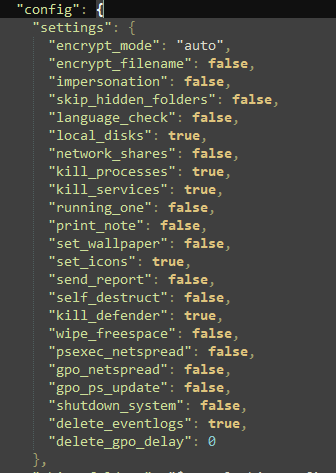
    The attackers encrypted data with publicly available versions of the popular LockBit 3.0 (for Windows systems) and Babuk (for Linux) malware. The LockBit sample we analyzed was configured with commands to encrypt local drives, terminate specific processes and services, disable Windows Defender, and delete event logs. The ransomware added system directories, as well as a folder named intel where the attackers loaded tools to harvest credentials, to the encryption exclusions list.

    A snippet of the LockBit 3.0 sample’s configuration

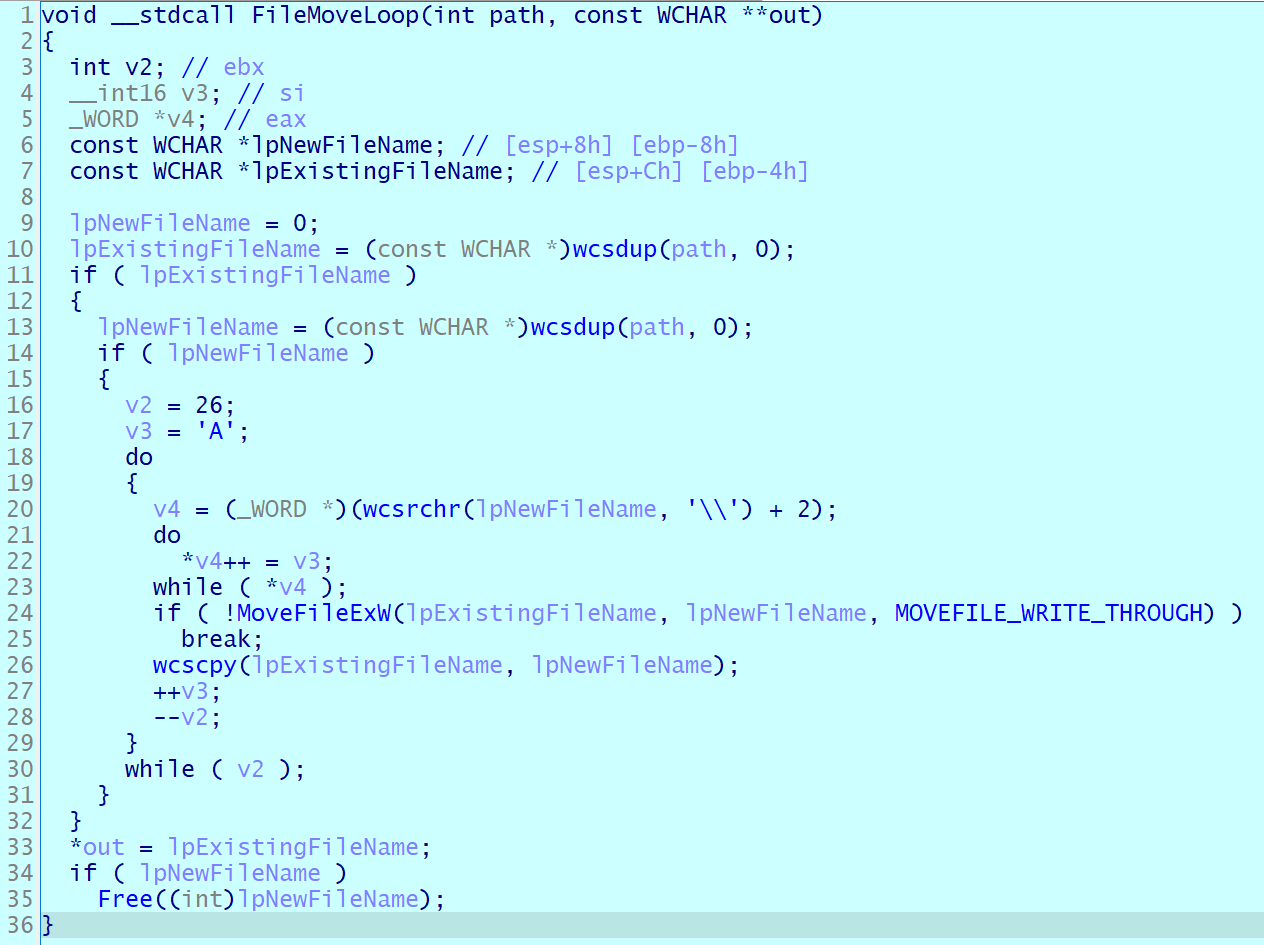
    We noticed something strange about how a victim’s files were encrypted. First, LockBit encrypted files with specific extensions, as defined in its sample configuration. These are the files that the attackers may find most valuable. Besides these, the malware encrypts files in the recycle bin while inserting random characters in these. Beyond the primary algorithm, we found a cycle that systematically renamed the original file in the recycle bin. This process iterated through every letter of the English alphabet, continuing until it reached the last one. This type of encryption makes it really hard, or even impossible, to recover the user’s files.

    The file renaming cycle

    Below is an example of how this appears in logs:

    The algorithm then attempts to delete the last version of
    c:$recycle.bin[redacted]zzzzzzzzzzz.

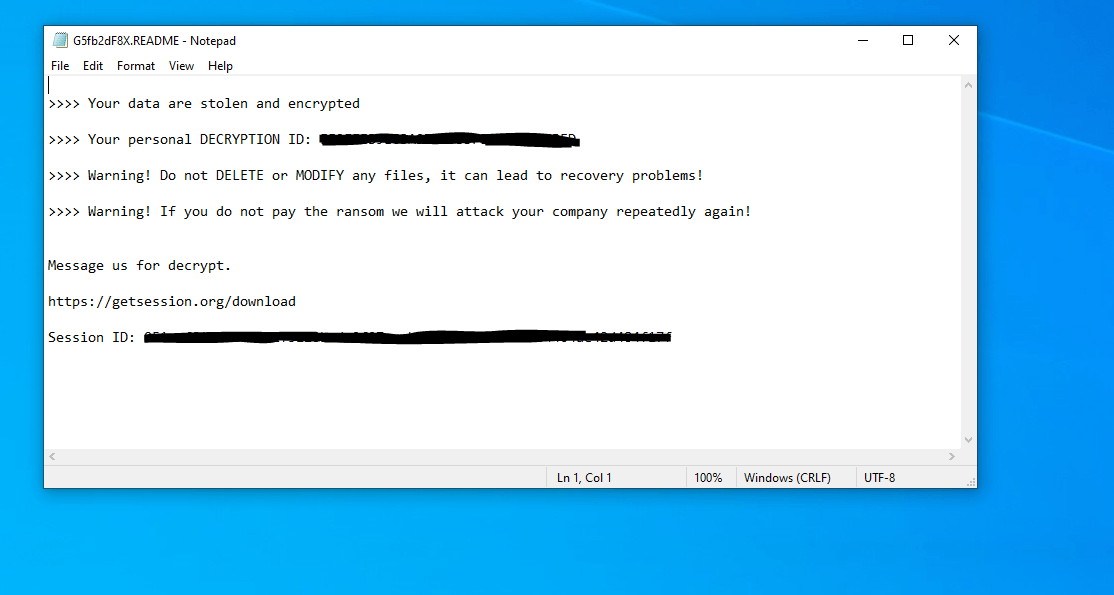
    The attackers leave a ransom note with a link containing their ID in the Session messaging service for future contact:

    A LockBit 3.0 ransom note

    Session supports end-to-end encryption, which minimizes the risk of data breaches. The developers claim their messaging service is built to guarantee complete privacy. Session has been used by other ransomware groups, such as GhostLocker, SEXi, and MorLock, in their attacks.

    Additionally, attackers targeted ESXi servers with the Babuk ransomware. They would connect to the ESXi server via SSH, upload Babuk, and initiate the encryption process for the files within the virtual machines:

    We believe the goal of the attackers was to disrupt the targeted organizations’ operations, besides financial gain.

    We are seeing a lot of overlap in the tools and techniques used by cybercriminals targeting Russian businesses and government agencies. Below, we outline the key similarities we found in attacks by different groups.

    MorLock

    MorLock activities, as investigated by F.A.C.C.T., shares many features with several of the attacks we analyzed for this report. The groups share most of the tools they use: SoftPerfect Network Scanner, XenAllPasswordPro, AnyDesk, PingCastle, Localtonet, NSSM, resocks, LockBit 3.0, and Babuk.

    The file and folder names used in attacks by both groups also show similarities. Thus we found a resocks utility named “xfs-healthcheck”, a name that follows the same template as the resocks names on the list of indicators published by F.A.C.C.T.: [xxx]-healthcheck. We noticed a further similarity when studying the XenAllPasswordPro utility: in MorLock attacks, it was located in a directory named “allinone2023”.

    Furthermore, we checked the MorLock infrastructure as reported by F.A.C.C.T., only to find that the group also used Surfshark VPN and the VDSina hosting services provider.

    BlackJack

    While investigating the utilities used in Crypt Ghouls attacks, we found an overlap with the toolkit employed by the BlackJack group, which also used XenAllPasswordPro. This caught our attention, as XenAllPasswordPro is not the most popular tool among cybercriminals despite being freely available.

    Twelve

    We have seen XenAllPasswordPro used in attacks by Twelve too. Furthermore, we discovered Intellpui.vbs, a loader for CobInt, also used by Twelve, on one of the systems attacked by Crypt Ghouls.

    Shedding Zmiy

    Shedding Zmiy is a group associated with the (Ex)Cobalt activity cluster. We found a further overlap in a report by Solar 4RAYS on this group-related incidents, namely the use of DLL sideloading with the dismcore.dll malicious loader. The report mentioned other familiar utilities and malware: resocks, SoftPerfect Network Scanner, and CobInt. In addition, Shedding Zmiy used VDSina to host its command-and-control servers.

    The similarities between the groups described above led to the conclusion that these attacks overlap with the activity of Crypt Ghouls. Our analysis of cybercriminal tools and tactics suggests that different groups may be collaborating, sharing resources, or exchanging intelligence. Other vendors have found evidence of the (Ex)Cobalt cluster members participating in these groups’ activities, and our analysis confirms this. Right now, we cannot say for sure that these campaigns are connected, but we anticipate their number will increase further. We will continue to monitor activity targeting Russian organizations.

    Victims

    Russian government agencies as well as mining, energy, finance, and retail companies have fallen victim to the Crypt Ghouls group.

    Conclusion

    Crypt Ghouls is another group attacking Russia. Cybercriminals are leveraging compromised credentials, often belonging to subcontractors, and popular open-source tools. These include modified configurations of the LockBit 3.0 and Babuk ransomware, whose builders and source code are publicly available. As the number of attackers using leaked builds increases, identifying the perpetrators of threats becomes increasingly difficult. The shared toolkit used in attacks on Russia makes it challenging to pinpoint the specific hacktivist groups involved. In the attacks carried out by the Crypt Ghouls, we have identified components of infrastructure and a variety of popular tools that are also used by many other groups. This suggests that the current actors are not only sharing knowledge but also their toolkits. All of this only makes it more difficult to identify specific malicious actors behind the wave of attacks directed at Russian organizations.

    Indicators of compromise

    Note: Network addresses specified in this section are valid at the time of publishing, but may change over time.

    SHA256:

    File paths:
    С:ProgramDataoracledismcore.dll
    odbcconf.xml – payload
    C:UsersUserDownloadsdumper.ps1 – dumper.ps1
    C:UsersUserDesktopx86x64mimikatz.exe
    C:programdata1callinone2023xenallpasswordpro.exe
    С:programdataallinone2023xenallpasswordpro.exe
    С:programdatadbgallinone2023xenallpasswordpro.exe
    С:programdata1callinone2023xenallpasswordpro.exe
    $userdesktopallinone2023xenallpasswordpro.exe
    C:programdataallinone2023XenAllPasswordPro.exe
    C:WindowsTempnssm-2.24win64nssm.exe
    C:Users[redacted]DownloadsAnyDesk.exe
    C:WindowsTemplocaltonet.exe
    C:ProgramDatat.exe (MiniDump Tool)
    C:UsersUserAppDataLocalTempkxxxxxxx.sys
    C:WindowsTempkxxxxxxx.sys
    /tmp/lock.out (Babuk)
    /usr/sbin/xfs-healthcheck (resocks)
    /usr/sbin/xfs-modules (resocks)
    c:programdataintellintellpui.vbs (CobInt)

    IP addresses and URLs:
    45.11.181[.]152 – netstaticpoints[.]com – CobInt C2
    169.150.197[.]10 – SurfShark VPN
    169.150.197[.]18 – SurfShark VPN
    91.142.73[.]178 – VDSINA-NET
    91.142.74[.]87 – VDSINA-NET
    95.142.47[.]157 – VDSINA-NET
    185.231.155[.]124 – VDSINA-NET

    Utilities:
    XenAllPasswordPro
    PsExec
    PAExec
    SoftPerfect Network Scanner
    Localtonet
    PingCastle
    Mimikatz
    AnyDesk
    NSSM
    resocks

    MIL OSI Economics

  • MIL-OSI Security: Over 6 million illegally exported pills seized in international operation against drug trafficking network

    Source: Eurojust

    The criminal group, which operated throughout Europe, bought pills from other criminal networks in Serbia. The pills, used to treat anxiety, seizures and insomnia, were then hidden in tyres, in cars, which were transported on lorries, and in clothing to be taken to Romania and Estonia. After arriving in Romania or Estonia, the pills were transported on to the Nordic countries. Members of the criminal group in Finland and Norway acted as distributors and sold the pills on the streets. The sale of the pills was highly profitable for the criminal group. The pills seized during the operations done by the national authorities has a market value of approximately EUR 12.5 million.

    To dismantle the intricate network of criminals, the Romanian authorities launched an investigation into the group. Given the transnational nature of the criminal group, with activities in Romania, Estonia, Finland, and Serbia, international cooperation between the authorities started, supported by Eurojust and Europol.

    A joint investigation team (JIT) was set up at Eurojust between Romanian, Estonian, Finnish and Serbian authorities to collect and exchange information and evidence directly, and carry out joint operations.

    To investigate the activity of the criminal group, special investigative techniques such as control delivery and undercover investigator were successfully used by the authorities of all the countries involved. To this end, Eurojust facilitated the coordination and execution in Hungary, Slovakia, Poland, Lithuania and Latvia of European Investigation Orders issued by Romania. Following these actions, 39 people were arrested, and more than 4 million prescription pills were seized.

    After these measures, the JIT continued their investigations to halt the activities of the criminal group and bring them to justice.

    A large-scale international operation on 17 October coordinated from Eurojust’s headquarters in The Hague, led to the arrest of 14 people in Romania, 11 people in Serbia and 1 person in Finland. 41 houses searches were carried out simultaneously in Romania, 19 in Serbia and one in Finland.

    Items seized during the operation include large quantities of pills, cash, mobile phones, firearms and luxury cars. 2 houses have been also seized in Romania. Europol facilitated the overall operation by liaising with the operating authorities, processing the available data and deploying two specialists with mobile offices to support the action day.

    The following authorities were involved in the actions:

    • Romania:
      • Prosecution Office attached to the High Court of Cassation and Justice
      • Directorate for Investigation of Organized Crime and Terrorism
      • Oradea Territorial Office
      • General Inspectorate of the Romanian Police
      • Directorate for Combating Organized Crime
      • Department for Special Operations
      • Central Intelligence Analysis Unit of the Romanian Police;
      • General Inspectorate for Border Police – Bors, Nadlac and Petea Offices
    • Estonia:
      • Northern District Prosecutor’s Office
      • Police and Border Guard Board, Northern Prefecture, Crime Bureau, Drug and Organised Crime Unit
    • Finland:
      • Prosecution District of Southern Finland
      • Helsinki Police Department and National Prosecution Authority
    • Serbia:
      • Public Prosecutor’s Office for Organized Crime
      • Criminal Investigations Directorate
      • Service for Combatting Organized Crime
      • Department for Combating Organized Drug Smuggling

    MIL Security OSI

  • MIL-OSI Africa: Who is Tundu Lissu? Tanzania’s opposition leader is fighting for change in the face of fresh attacks on political freedoms

    Source: The Conversation – Africa – By Nicodemus Minde, Researcher, United States International University

    Tundu Lissu has become the face of opposition in Tanzania following his defiant and unrelenting criticism of the government. Since he came into the national limelight in 1995 when running for a parliamentary seat, Lissu has been a champion of democracy and human rights. He has taken on the ruling elite, exposing corruption and demanding accountability. This almost cost him his life in 2017.

    In September 2024, new evidence presented at a London tribunal revealed that the telecommunications company Tigo had shared Lissu’s mobile phone data – including his location – with the Tanzanian government. The implication was that the company was assisting the government in its harassment of the politician. Tigo’s owners have distanced themselves from these reports.

    The revelations coincided with a resurgence in government crackdowns on opposition figures.

    In the most recent developments, leaders of the country’s main opposition party Chadema (Chama cha Demokrasia na Maendeleo) – including Lissu, who is the party’s vice-chairperson, and chairman Freeman Mbowe – were arrested in September 2024. This followed their attempt to organise mass protests, which were foiled by the police. The protests had been organised to demand government accountability after the killing of a senior Chadema official and the disappearance of other party members believed to have been abducted by state operatives.

    I have studied Tanzania’s political party dynamics for a decade and interviewed Lissu as part of my PhD research on the country’s democracy. Lissu’s persistence in tackling democratic backsliding in Tanzania has made him a formidable force, challenging the ruling Chama Cha Mapinduzi party.

    Lissu spent about three years in exile in Belgium after the 2017 shooting. He staged a comeback as a presidential candidate in the 2020 elections. He lost to John Magufuli in a poll marred by violence and allegations of rigging.

    There have been changes in the country since Magufuli’s death in March 2021 and a string of political reforms under President Samia Suluhu. This has created the space for Lissu and his party Chadema to establish an opposition that now threatens the ruling party’s six-decade hold on power. Presidential elections are due to be held in 2025.

    So who is Lissu? What’s his history and how did he became involved in politics?

    Early years

    Lissu’s political activism began during his university years in the early 1990s. This marked the start of a career that would later shape Tanzania’s political landscape. Lissu studied law at the University of Dar es Salaam before going to the UK for a master’s degree in law.

    His first foray into national politics came in 1995, when he vied for a parliamentary seat. He was 27. The election was Tanzania’s first under a multiparty system. It introduced Lissu to the arena of opposition politics following his defeat.

    A year later, Lissu was one of the lead investigative lawyers for a public interest environmental law organisation investigating abuses and irregularities at a World Bank-backed gold mine in northern Tanzania. His early work focused on environmental and human rights.

    Lissu and his colleague Rugemeleza Nshala were investigating the killing of 62 small-scale miners and the evictions of thousands at the mine in 1996. They were charged with sedition over these investigations. The government eventually stopped following up on the case.

    Lissu thereafter worked on community land rights at the World Resources Institute, a global organisation focusing on policy research.

    Parliamentary years

    In 2010, Lissu won the parliamentary seat for Singida East under the opposition party Chadema. As a first-term member of parliament, he gained prominence by exposing significant state corruption scandals, particularly in the energy sector.

    Lissu and other Chadema opposition figures became a formidable force, openly naming corrupt government officials and exposing grand theft.

    They also began making calls for constitutional reform. These were aimed at addressing excessive presidential powers and the power imbalances of the union between Tanganyika and Zanzibar. This push culminated in then president Jakaya Kikwete initiating a constitutional review process in 2010.

    Lissu’s legal acumen played out in the constituent assembly, the body convened to deliberate on constitutional reforms. However, the assembly, dominated by members of the ruling party Chama Cha Mapinduzi, rejected many of the key provisions of the draft constitution. It had been widely regarded as the “people’s draft” because it included citizen participation. Its key provisions included reduced presidential powers and the establishment of independent state institutions.

    The process was to culminate in a referendum in 2014. This prematurely aborted and Tanzania went into the 2015 election without a new constitution.

    In these elections, Lissu successfully defended his parliamentary seat. As a second-term legislator, he focused on strengthening Chadema’s presence. This included door-to-door conversations with the public and grassroots mobilisation to build the party.

    The party’s momentum, however, was halted by a repressive regime under Magufuli, who became president in 2015. He cracked down on critics and instituted a partial ban on political rallies.

    Lissu became very critical of Magufuli’s economic policies. In a public address in 2017, Magufuli admitted to the government’s tapping of Lissu’s phone and described those who opposed his own economic reforms as traitors. Soon after this, Lissu was shot 16 times after leaving parliament buildings in the capital, Dodoma.

    Exile

    Lissu officially went into exile in Belgium after the shooting. In 2020, he published Remaining in the Shadows: Parliament and Accountability in East Africa, a critical examination of the presidentialist systems in Uganda, Kenya and Tanzania, which he argued had undermined democratic consolidation in the region.

    Through this publication, Lissu continued his activism, challenging political structures.

    His brief return to Tanzania to contest the presidency in 2020 was marked by repeated arrests and intimidation during the electoral campaign. After his loss to Magufuli, Lissu went back to Belgium.

    He announced his return home in 2023.

    Tanzania today

    It’s important to understand why Lissu and Chadema are viewed as a current threat in Tanzania.

    The country is entering an election period. Local government elections are scheduled for November 2024 ahead of general elections in 2025.

    The ruling party, Chama Cha Mapinduzi, has in the recent past relied on state violence to secure electoral victories. The last general election in 2020 was marred by violence, as well as intimidation of the opposition and censorship.

    It looks likely that Chadema will once again nominate Lissu to contest the presidency in the 2025 general election against president Samia. Lissu’s fearlessness and defiance make him the best candidate to take on the ruling party. Samia has already described Lissu as a troublesome character.

    With the ongoing opposition clampdown, it looks clear that the ruling party is once again willing to do whatever it will take to hold on to power. Even if Tanzania’s democracy suffers.

    – Who is Tundu Lissu? Tanzania’s opposition leader is fighting for change in the face of fresh attacks on political freedoms
    https://theconversation.com/who-is-tundu-lissu-tanzanias-opposition-leader-is-fighting-for-change-in-the-face-of-fresh-attacks-on-political-freedoms-240821

    MIL OSI Africa

  • MIL-OSI Banking: Results of the ECB Survey of Professional Forecasters for the fourth quarter of 2024

    Source: European Central Bank

    18 October 2024

    • Inflation expectations at 2.4% for 2024 and 1.9% for 2025 and 2026; unchanged except for 0.1 percentage point downward revision for 2025; longer-term inflation expectations (for 2029) remain at 2.0%
    • Real GDP growth expectations broadly unchanged; small downward revision for 2025 largely reflects a carry-over from weaker than previously expected growth in the second half of 2024
    • Unemployment rate expectations unchanged; expected to average 6.5% in 2024 and 2025 but to decline to 6.4% in 2026 and in the longer term

    Respondents’ expectations for headline inflation, as measured in terms of the Harmonised Index of Consumer Prices (HICP), were 2.4% for 2024 and 1.9% for both 2025 and 2026. These were unchanged except for a 0.1 percentage point downward revision for 2025, mainly reflecting expectations for lower oil prices. Expectations for core HICP inflation, which excludes energy and food, were revised upwards slightly for 2024, reflecting data outturns and more persistent than expected services inflation, but were unchanged thereafter. Longer-term expectations for both headline and core HICP inflation were unchanged at 2.0%.

    Respondents expected real GDP growth of 0.7% in 2024, 1.2% in 2025 and 1.4% in 2026. Compared with the previous survey, the expectations for 2025 were revised down by 0.1 percentage points. The downward revision for 2025 largely reflects a carry-over from weaker than previously expected growth in the second half of 2024, with the expected quarterly growth profile thereafter largely unchanged. Longer-term growth expectations remained unchanged at 1.3%.

    The expected profile of the unemployment rate was unchanged. Respondents continued to expect the unemployment rate to average 6.5% in 2024 and 2025, but to decline to 6.4% in 2026, and then to remain at 6.4% in the longer term.

    MIL OSI Global Banks

  • MIL-OSI Security: Investigation under way following fatal collision involving a police car in Eltham

    Source: United Kingdom London Metropolitan Police

    An investigation is under way following a collision involving a police car in Eltham in which a pregnant woman and her baby have very sadly died.

    At about 18:15hrs on Thursday, 17 October an unmarked police car was in collision with a member of the public’s car on the A20, near the junction with Kidbrooke Park Road, SE9.

    London Ambulance Service, London Fire Brigade and London’s Air Ambulance all attended.

    A heavily pregnant woman, aged 38, who was in the car, and her unborn baby sadly died as a result of their injuries.

    Next of kin have been informed and are being supported by specially trained officers.

    Detective Chief Superintendent Trevor Lawry, in charge of policing in Greenwich, said: “My heart goes out to the woman’s family and friends who have lost their loved ones in these tragic circumstances.

    “An investigation into the circumstances of this collision is under way by the Independent Office for Police Conduct and we will assist with their enquiries in any way we can.

    “A road closure will remain at the scene today and I am grateful for the patience of the local motorists, who will need to use alternative routes.”

    Two officers who were in the unmarked car were also taken to hospital following the collision. They have since been discharged.

    MIL Security OSI

  • MIL-OSI Europe: Written question – Possible distortions of competition in Formula 1 team entries – P-002093/2024

    Source: European Parliament

    16.10.2024

    Priority question for written answer  P-002093/2024
    to the Commission
    Rule 144
    Christine Anderson (ESN)

    The fact that the Formula One Group (FOG) rejected Andretti’s entry into Formula 1, despite the team having FIA approval, could indicate a fundamental conflict of interest. Existing teams may be forming a de facto cartel that systematically excludes new competitors to protect their revenues and market values. This practice could significantly distort competition in the European motor sport industry.

    The case of the Williams team illustrates the issue, as financial difficulties during the COVID-19 crisis meant that the long-established company had to be sold, with the Williams family having to give up all its shares. The high team values resulting from market foreclosure make it practically impossible for innovative private entrepreneurs such as Eddie Jordan or Ross Brawn to enter into Formula 1 or take over existing teams.

    This situation has direct implications on the internal market, as many Formula 1 teams are based in the EU.

    • 1.Given this problematic set-up, what is the Commission’s assessment of the cartel-like structures in Formula 1, which hinder the entry of new teams and lead to a concentration of team owners among large investors?
    • 2.What measures is the Commission considering to ensure a fairer and more transparent process for the entry of new teams into Formula 1 and a wide range of team owners?
    • 3.Is the Commission planning to investigate the impact of these entry barriers and the resulting market concentration on innovation, jobs and the competitiveness of the motor sport and automotive sector in the EU?

    Submitted: 16.10.2024

    Last updated: 18 October 2024

    MIL OSI Europe News

  • MIL-OSI Europe: Written question – Defence of the public interest in the nationalisation of Efacec – E-002013/2024

    Source: European Parliament

    10.10.2024

    Question for written answer  E-002013/2024
    to the Commission
    Rule 144
    Lídia Pereira (PPE), Sebastião Bugalho (PPE), Hélder Sousa Silva (PPE), Sérgio Humberto (PPE)

    The nationalisation of Efacec in July 2020[1] was ‘carried out without technical or independent justification of the public interest’ and ‘when making the decision, the State did not prepare a forecast of its impact on public finances, which harmed the taxpayers’ right to transparency.’ Those are two of the conclusions in a Portuguese Court of Auditors report following its audit of the public funding of Efacec[2]. The Commission has twice been asked about this matter[3][4].

    According to the report, (i) ‘the goals of nationalisation have not been achieved’, (ii) ‘deterioration in Efacec’s financial and commercial standing was not avoided’, (iii) ‘its financial and operational value was not stabilised’ and (iv) ‘jobs have not been protected’. In light of these points, the natural conclusion is that the decision went against the public interest and the rights of Portuguese taxpayers. The operation involved public funding to the tune of EUR 484 million, which could rise to EUR 564 million as a result of contingent liabilities.

    • 1.What contact was there with the Portuguese Government during this process?
    • 2.What does the Commission make of this audit with regard to competition rules?

    Submitted: 10.10.2024

    • [1] https://diariodarepublica.pt/dr/detalhe/decreto-lei/33-a-2020-137126910
    • [2] https://www.tcontas.pt/pt-pt/ProdutosTC/Relatorios/RelatoriosAuditoria/Documents/2024/rel009-2024-2s.pdf
    • [3] https://www.europarl.europa.eu/doceo/document/E-9-2021-005241_EN.html
    • [4] https://www.europarl.europa.eu/doceo/document/E-9-2022-003870_EN.html
    Last updated: 18 October 2024

    MIL OSI Europe News

  • MIL-OSI Europe: Briefing – India’s connectivity initiatives: A multi-faceted strategy – 18-10-2024

    Source: European Parliament

    Over the past decade, corridors have occupied an increasingly important place in international connectivity initiatives. They take several forms, ranging from ‘simpler’ transport corridors to more complex economic corridors. For them to be successful, several conditions need to be in place, both relative to the participating countries and to the wider regions they connect. Once operational, they can bring various benefits to participating countries, both economic and societal. India has had a two-pronged policy in recent years. On the one hand, it is investing increasingly in national infrastructure projects, such as the Delhi-Mumbai Industrial Corridor. On the other, it is part of several major international infrastructure projects. Three such projects that stand out are the Bangladesh-China-India-Myanmar Economic Corridor, the International North-South Transport Corridor and the more recent India-Middle East-Europe Corridor. According to experts, India’s approach towards international connectivity appears to be driven more by geostrategic sensitivities than purely economic considerations. Broadly, Delhi chooses to participate in projects that help to increase its regional and global footprint. It also takes into consideration the fact that Asia is a region with several nuclear powers, rising nationalism and the absence of a security structure. Its choices are further conditioned by Chinese initiatives in the region, US policy towards China, and developments following Russia’s invasion of Ukraine and the conflict between Israel and Hamas. The EU and India have long-standing diplomatic ties. In recent years, owing to both rising trade volumes and geopolitical considerations, they have increased their cooperation further. Aspects of this cooperation are the revival of negotiations on a free trade agreement, the launch of a Trade and Technology Council and the India-Middle East-Europe Corridor (IMEC). Once completed, these three initiatives could bring significant synergies to the parties involved. IMEC is facing several challenges, however, both logistical and geopolitical, that could delay its implementation.

    MIL OSI Europe News

  • MIL-OSI Europe: Italy: Europe to gain advanced industrial edge as EIB finances BeDimensional with €20 million for new graphene and other 2D materials plants

    Source: European Investment Bank

    EIB

    • EIB supports Italian materials manufacturer BeDimensional to scale up production of cutting-edge graphene.
    • BeDimensional to expand production more than tenfold following inauguration today of Genoa plant.
    • EIB financing backed by InvestEU, the investment programme of the European Union.

    The European Investment Bank (EIB) is offering Italian materials manufacturer BeDimensional SpA financial support to expand production of cutting-edge graphene that promises to help Europe bolster its industrial base and global competitiveness. The EIB is providing €20 million in venture debt financing to BeDimensional to help it become a leading producer of breakthrough two-dimensional crystals known as Few-Layer Graphene (FLG) and Few-Layer Hexagonal Boron Nitride (FLhBN or FLB).  

    EIB Vice-President Gelsomina Vigliotti and BeDimensional Chief Executive Officer Vittorio Pellegrini announced the financing accord at the inauguration today of the company plant in Genoa that is the world’s first producer of FLG and FLB. BeDimensional plans to build a second plant in Italy to scale-up production of FLG and FLB by 2027.

    BeDimensional’s new graphene technologies have shown unprecedented performance in batteries for electric vehicles and a new generation of metal-free engine oils. As a result, the technologies mark a milestone in Europe’s green transition and will herald job creation in Italy’s advanced-manufacturing sector.

    “This project is a perfect example of how the EIB can help European innovators scale up new technologies that are critical for the EU’s industrial base and the green transition,” said EIB Vice-President Gelsomina Vigliotti. “We are contributing to Europe’s technological leadership, reducing our dependence on external suppliers and creating high-skilled jobs.”

    With EIB support, which is backed by the InvestEU programme, BeDimensional plans to increase its capacity to produce two-dimensional crystals more than tenfold to over 30 tonnes a year by 2028. Today’s plant inauguration was attended by academics, researchers, members of Italy’s Parliament officials from the Liguria Region and the Municipality of Genoa, executives from BeDimensional’s partner companies and financial-sector representatives.

    “We are at the beginning of novel greentech market opportunities,” said BeDimensional CEO Vittorio Pellegrini. “We are excited and grateful that the EIB has decided to join our investors to support our industrial expansion. We are committed to becoming a champion of this emerging market of two-dimensional crystals, securing Europe a leadership position in the production and supply of these advanced materials.”  

    BeDimensional, a spin-off from the Graphene Labs of the Istituto Italiano di Tecnologia, has established itself as a leader in the development of two-dimensional crystals. The company’s mission is to revolutionise material manufacturing by producing graphene, hexagonal boron nitride and other two-dimensional crystals at industrial scale and competitive costs.

    Graphene is widely recognised for its transformative potential in a range of industries including energy storage and conversion, smart textiles, paints, coatings and composite materials. Its most promising application is in battery technology, where it has been already shown to play a crucial role in stabilising silicon-dominant anodes.

    By enhancing the lifecycle and maximising the capacity of new generation anodes, graphene-based batteries deliver substantial advantages over traditional technologies, such as increased specific capacity and faster charging speeds. These advancements are expected to boost the adoption of EVs, significantly contributing to the decarbonisation of transport and supporting the EU’s environmental goals.

    Background information

    The European Investment Bank (EIB) is the long-term lending institution of the European Union owned by its Member States. It finances sound investments that contribute to EU policy. EIB projects boost competitiveness, foster innovation, promote sustainable development and improve social and territorial cohesion while supporting a fair and rapid transition towards climate neutrality. Over the past five years, the EIB Group has provided more than €58 billion in financing for projects in Italy.

    The EIB provides a long-term Venture Debt product tailored to meet the specific funding needs of rapidly growing innovative companies. This financing structure features bullet repayments and compensation tied to the equity risk of the investees, complementing existing venture capital investments. Since 2015, the EIB has invested €6 billion in Venture Debt, backing over 200 companies and realising over 50 exits. For more information on Venture Debt, click here: Venture debt (eib.org)

    The InvestEU programme provides the European Union with long-term funding by leveraging substantial private and public funds in support of a sustainable recovery. It also helps to mobilise private investment for the European Union’s strategic priorities such as the European Green Deal and the digital transition. InvestEU brings all EU financial instruments previously available for supporting investments within the European Union together under one roof, making funding for investment projects in Europe simpler, more efficient and more flexible. The programme has three components: the InvestEU Fund, the InvestEU Advisory Hub and the InvestEU Portal. The InvestEU Fund is allocated through implementing partners that will invest in projects using the EU budget guarantee of €26.2 billion. The entire budget guarantee will back the investment projects of implementing partners, increase their risk-bearing capacity and thus mobilise at least €372 billion in additional investment.

    BeDimensional is a leading producer of Few-Layer Graphene (FLG) and Few-Layer Hexagonal Boron Nitride (FLhBN or FLB). Its mission is to scale up production of these two-dimensional crystals for industrial use at competitive costs, revolutionizing manufacturing with more efficient and sustainable materials. As a spin-off from the Italian Institute of Technology’s Graphene Labs, BeDimensional leverages deep scientific expertise to drive rapid industrialization. Its patented process produces FLG and FLhBN with atomic-level thickness, the highest quality on the market, which can easily be integrated into any material to enhance performance and durability. BeDimensional’s technologies are applied across industries, in energy storage and conversion products, smart textiles, paints, coatings, and composite materials. Its growth potential has attracted major investors, including Eni Next and venture capital funds like CDP Venture, Eureka! Venture, and Nova Capital. The EIB investment follows BeDimensional’s collaboration, since its founding, with the EU’s Graphene Flagship, the community’s largest investment in research and development dedicated to bringing 2D materials to market.

    MIL OSI Europe News

  • MIL-OSI Europe: EIB and European Environment Agency deepen cooperation over biodiversity and climate action

    Source: European Investment Bank

    The European Investment Bank (EIB) and the European Environment Agency (EEA) will strengthen collaboration to promote climate action, environmental sustainability, and sustainable finance. In a new agreement, the EIB and the EEA pledged deeper cooperation in technical areas including biodiversity, climate adaptation, circular economy, and urban sustainability.

    The Memorandum of Understanding (MoU) will allow the EIB to use the EEA’s expertise on data and modelling when evaluating projects and measuring impact of the Bank’s financing. For its part, the EEA will be able to integrate the EIB’s sustainable finance expertise in way that makes European environmental data more useful to the broader financial community.

    “We need the best available data and knowledge to address the triple planetary crisis of biodiversity, climate change and pollution,” EIB Vice-President Ambroise Fayolle said. “That’s why we are reinforcing our partnership with the European Environment Agency. We will work on methodologies and technical approaches that will help to enhance the impact of our projects to accelerate the green transition worldwide.”

    “Scaling up and re-orienting financial flows in a more sustainable direction is a pre-requisite for meeting our environment, climate and sustainability objectives under the European Green Deal. Enhanced co-operation between the European Environment Agency and the European Investment Bank will boost our common knowledge base across a wide spectrum of areas to further support the transition towards a more sustainable and competitive European economy,” said EEA Executive Director Leena Ylä-Mononen.

    Background information

    The European Investment Bank (EIB) is the long-term lending institution of the European Union owned by its Member States. It is active in more than 160 countries and makes long-term finance available for sound investment in order to contribute towards EU policy goals.

    The EIB Group has consolidated its role as “The Climate Bank”. The EIB Group Climate Bank Roadmap 2021-2025 lays out how the EIB Group supports the European Green Deal and a just transition to low-carbon, climate-resilient and environmentally sustainable development. Consolidating our role as the EU Climate Bank is one of the eight key priorities in the EIB Group’s 2024-2027 Strategic Roadmap. In 2021, the EIB Group became the first MDB to apply Paris alignment criteria to all its new financing operations. In 2023, the EIB Group achieved a record year of green finance with €49 billion: this is more than 50% of our total financing activities. The mid-term review of our Climate Bank Roadmap has confirmed that the EIB Group is on track to achieve the goal of supporting €1 trillion of green financing in this decade.

    The EEA is an agency of the European Union that delivers knowledge and data to support Europe’s environment and climate goals. In collaboration with its partner network, Eionet, the EEA informs decision-makers and the public about the state of Europe’s environment, climate change and wider sustainability issues.

    MIL OSI Europe News

  • MIL-OSI Europe: Press release – Daphne Caruana Galizia Prize for Journalism 2024: invitation to award ceremony

    Source: European Parliament

    The award ceremony will take place at 18.00, on Wednesday 23 October 2024, at the European Parliament in Strasbourg (Daphne Caruana Galizia Press Room).

    Accredited journalists are cordially invited to join the award ceremony, which will be opened by the President of the European Parliament, Roberta Metsola. The finalists are also invited to join the ceremony, with one of them having been chosen by the Jury members as the winner of the Daphne Caruana Galizia Prize for Journalism 2024.

    Discover here the 13 finalists’ works.

    The winner will be officially announced by a representative of last year’s laureates, a Greek, German and British consortium, who won for an investigation on the Adriana shipwreck, which left over 600 migrants dead off Pylos in Greece.

    Programme

    18.00 Welcome by Vice-President Pina Picierno followed by opening speech by President Roberta Metsola

    18.15 Speech by the President of the Berlin Press Club and representative of the jury, Juliane Hielscher

    18.30 Announcement of 2024 winner by 2023 laureates, followed by speech by the 2024 winner

    18.45 Closing of ceremony by Vice-President Pina Picierno

    18.50 Photo opportunity

    19.00 Reception at the private salon C0.1 (opposite the press bar)

    You can follow the event via webstreaming or by EbS.


    Press seminar
    on “Safeguarding Media Freedom: the role of the European Union”

    Just before the award ceremony, a press seminar is being organised on “Safeguarding Media Freedom: the role of the European Union”. The seminar begins at 15:00 in room Weiss S2.2, with an introduction by EP Vice-President Pina Picierno. A panel of journalists will then discuss the continued threats to media and press freedom, through their personal experience. The seminar will be closed by the speeches of Matthew Caruana Galizia, son of Daphne Caruana Galizia, and Vice-President Picierno.

    Journalists who would like to join the seminar online, please write a mail to European Parliament Media Seminars media-seminars@europarl.europa.eu to get the link.

    Background

    The Prize, with the support of the European Parliament, is a tribute to the Maltese investigative journalist and blogger Daphne Caruana Galizia, who was assassinated in October 2017. It rewards, on a yearly basis, outstanding journalism that promotes or defends the core principles and values of the European Union, such as human dignity, freedom, democracy, equality, the rule of law and human rights.

    The Prize is open to professional journalists and teams of professional journalists of any nationality to submit in-depth stories that have been published or broadcast by a media outlet based in one of the 27 European Union member states. From 3 May to 31 July 2024, more than 300 applications were submitted by journalists from the 27 EU countries for this fourth edition of the Prize.

    The Prize itself, and the €20,000 prize money, demonstrate the European Parliament’s strong support for investigative journalism and the protection of journalists around the world.

    MIL OSI Europe News

  • MIL-OSI Europe: Answer to a written question – Abysmal reception conditions at Samos’ prison-like refugee camp – E-001575/2024(ASW)

    Source: European Parliament

    A steady increase in arrivals on the Greek islands in the second half of 2023 has contributed to a challenging situation, including on Samos.

    It has improved since, with faster registrations and occupancy in the Multi-Purpose Reception and Identification Centre (MPRIC) of Samos standing at 66%[1]. Daily water provision in the MPRIC of Samos has increased to 9 hours per day.

    The new healthcare project called ‘Hippocrates’[2] (replacing PHILOS II) is being rolled out and is expected to offer renewed support towards comprehensive health provision.

    The Commission and the EU agencies will continue to support Greece in view of ensuring sufficient reception capacity and adequate standards of living.

    The new Reception Conditions Directive[3] gives more prominence to how Member States organise reception systems, by introducing possibilities and clarifying the actions Member States can undertake to manage their reception capabilities, including mechanisms to assess and address the needs of national reception systems and allocation of applicants for international protection to specific geographical areas or accommodation.

    Decisions on detention of applicants should be subject to the principles of necessity and proportionality and be based only on grounds set out in the directive.

    This is accompanied by procedural safeguards to ensure that the applicants’ rights are upheld, and detention remains a measure of last resort, following an individual assessment of each case.

    Transposition and implementation of the new Reception Conditions Directive by Member States is a key part of the Pact on Migration and Asylum, to ensure efficient, rights-based and well-organised reception systems.

    • [1] https://www.scribd.com/document/768803516/NSP-Eastern-Aegean-12-09
    • [2] Hippocrates is implemented by IOM since July 2024 under the Asylum, Migration and Integration Fund (AMIF).
    • [3] Directive (EU) 2024/1346 of the European Parliament and of the Council of 14 May 2024 laying down standards for the reception of applicants for international protection.
    Last updated: 18 October 2024

    MIL OSI Europe News

  • MIL-OSI Europe: Written question – The impact of the Russian merchant fleet on port safety – E-002020/2024

    Source: European Parliament

    10.10.2024

    Question for written answer  E-002020/2024
    to the Commission
    Rule 144
    Johan Danielsson (S&D)

    The EU has closed its ports to Russia’s entire merchant fleet of over 2 800 vessels, with some exceptions (vessels carrying pharmaceutical, medical, agricultural and food products, humanitarian aid, and energy-related products, including coal, nuclear fuel and other goods necessary for the functioning of civil nuclear capabilities).

    In recent weeks, residents of the North Sea and Öresund regions were informed that the damaged ship, the MV Ruby, carrying large amounts of the highly explosive agricultural product ammonium nitrate, had been seeking to dock in European ports and, at some point, had also sought passage through the Öresund strait.

    This raises serious questions as to port safety, including of dockworkers, and safety in the surrounding metropolitan areas, as well as the security of critical transport infrastructure.

    • 1.In addition to problems related to the Russian ‘shadow fleet’, has the Commission analysed the risks related to the remaining Russian merchant fleet and shipments to and from Russia with regard to port safety and the security of critical transport infrastructure?
    • 2.What actions is the Commission proposing, for example in the upcoming comprehensive EU port strategy, to reduce the risk to port safety and the security of critical transport infrastructure that is posed by the remaining Russian merchant fleet and shipments to and from Russia?

    Submitted: 10.10.2024

    Last updated: 18 October 2024

    MIL OSI Europe News

  • MIL-OSI Asia-Pac: Text of Vice-President’s address at the Foundation Day Celebration of the National Human Rights Commission

    Source: Government of India

    Very warm good morning to all of you.

    Distinguished audience, excellencies and friends in the cause of human rights. I had a tenure which I will not be able to forget, because it is reminded on every platform, my tenure as Governor State of West Bengal. That makes me resonate about state of human rights but ladies and gentlemen, post-poll violence in West Bengal does not define the scene in the country it is in isolation but whenever someone calls me former-Governor of the State of West Bengal, I am reminded of the great contribution by the National Human Rights Commission and law of the ruler rather than the rule of law defined the situation. It emanated from a report rendered by the former member of the National Human Rights Commission Shri Rajiv Jain, a thorough report that addressed all issues and also indicated the way ahead.

    Friends, I am happy to be here today to mark the 31st Foundation Day of the National Human Rights Commission of India. Today, we are not only commemorating an institution but the fundamental value that is integral to this institution, integral to the Constitution of India, and integral to our society and culture.

    This year the World Human Rights Day theme is Equality – Reducing inequalities and advancing human rights. Equality has to be understood as it is beyond definition as such. However at its core is that all human beings are born free and equal in dignity and in rights.  Religion, race, colour, sex, status, or other facets are surficial. Discrimination in any form is challenging to core aspects of human rights.  Human rights are best secured and nurtured with public response. There can be no greater custodian of human rights than the public at large. We need to stand firm when such violations occur.

    To respect others’ human rights is divine duty.  These rights are inviolable.  Preamble of our Constitution seeking justice, liberty, equality to all citizens is essence of human rights.  There is need to have fraternal feelings with respect for different perceptions and views.

    Human rights can be defined in two ways. First is the narrow, legal way of defining human rights at the drop of a hat, we jump to it make a very small isolated instance systemic that’s a legal way. The notion grants certain rights to individuals by their inherent being. No law is needed. We are born with human rights. We are born with basic rights, we are inalienable to humanity, inalienable to the individual and therefore, according to me, in all humility, we must see human rights from this prism that that is our way, that is the Indian way, that is the way we have lived for over 5,000 years. No country in the world can lay such a claim.

    When we go into the evolution of these rights, they primarily started with political rights, including the right to life and liberty. There was a gradual accretion of other rights. Judiciary in this country has added many dimensions to these rights but there is another way, and that is the civilisational way of thinking about human rights. That is organicist way. It looks at human beings as part of an organic whole, including society and Prakriti or nature. And the system as a whole has to live in peace. It is encapsulated ‘Sarvam Shanti’. We have dictated our lives over centuries in spite of various difficulties by this dictum. For us as a nation nurturing of human rights is a way of life.

    The civilizational way of thinking of rights did not evolve from political rights to economic rights and then adding other rights such as the freedom of conscious. The basic, the pristine, the organic, the original can be looked into our Vedas and our functioning over the ages, this defined sukha for all, well-being of all, happiness for all. This defines that we come to the planet as trustees, not as exploiters. We live not for us, but for all, we know for sure that we can be happy only with everyone being happy in as much as we have in togetherness to save this planet, because this existential challenge is not to an individual.

    It is beyond any element of race, caste, creed, colour, or geographic boundaries. Similar is the situation with respect to human rights. Sarve sukhina bhavantu, the Chairman focused it. This is the motto of NHRC. What a grandiose motto! A motto emanating from our civilisational ethos, emanating from what we have lived through. We have, all through history exemplified it, and in the face of very daunting circumstances, some of which were ruthless, reckless, trampling our civilisation yet the nation stood firm. That’s what India is, that’s what Bharat is.

    Our scriptures were and are our charters, they are repositories of knowledge and wisdom, they are repositories of the human way of life. One will have to strive for years to come to add to them. That is the ultimate when it comes to knowledge and these scriptures were loud, every day proclamation of these rights that society and the civilization granted.

    Our civilization created institutions to ensure that these rights were honoured. In any governance in this country, at any point in time, those who governed had to listen to the voice of the people. Our sages, our seers, they were the real controllers of morality, property, and all that constitutes the welfare of humanity at large.

    Our temples ran open kitchens so that there was freedom from hunger. Temples ran open kitchens so there was freedom from hunger. Education was free, so there was right to education. Friends, if you look at the Indian Constitution it has 22 paintings. The first one is the Gurukul, It defines our society is concerned that everyone would have access to education. You gave dakshina according to your ability, but there was no tuition fee. Guru dakshina if you got education, you can reward your teacher, you can honour your teacher but it did not have a compulsory element; it had an optional element. It had to emanate not from your fiduciary strength, but from the call of your soul that was the sublimity. We practised and are on our way to it. Everyone was allowed to practise their faith. Look at our country who came? They came, they were received, they were absorbed, they were in oneness, and they felt at home in this country in the same manner as they felt at home in other countries.

    A country where they had to live under circumstances which are indescribable that was the scenario, friends. So on and so forth, I can keep on going, but the list is endless. In a way, human rights are very much part of our moral fabric, our way of life, and why only just the past? Our contemporaneous governance look at it.cIt underlines this very philosophy in several ways.

    Policies are driven by the idea of human rights. When COVID hit us and hit the world, it was a non-discriminatory challenge to the entire planet. High and mighty and great nations suffered. In that scenario, the government ensured in this country that no one sleeps hungry, regardless of access to their means of livelihood. Free grains were given, friends, to 850 million people, empowering them to face the challenge. What started on 1st April 2020 continues till date and I wonder still in the world people talk of hunger crisis in this country? 850 million people are getting support of free ration in this country, and that is irrespective of their colour, caste, creed, religion, geographical location, or other aspects. All I can say is, those who think about India’s hunger situation need to reflect and get into a repentance mode. This moral fibre is driving governance in this country. I don’t want to reflect all on this so much attention has been bestowed on human rights in this country that what was unthinkable is now a ground reality.

    If a widow has to stand in queue for two hours and suffer to get a pension for the service her late husband rendered, this was a loss of dignity. Not any longer, she gets it sitting at home, and this makes Bharat accounting for more than 50% of global direct digital transfers. Which indicates promptness, no leakage, no liasioning. The world needs to know it. I am not seeking recognition, just to be informed. Direct benefit transfers hit at the corrupt and you will be happy to note, friends, that corruption has been neutralised from power corridors in this country. Corruption is no longer a password to a contract to employment.

    Corruption leads you to be attendant to law, gone are the days when some thought they were above the law. The equality before the law in this country has been demonstrated to such a wholesome level that human rights are flourishing and blossoming is taking place, such a large country, with such diversity, the world needs to know about it.

    Another serious issue is that they know it, they seek to undermine it. I’ll come to that later.

    Not long ago, in our country and in the world it still happens in major parts of the world states. Ignominy of women defecating in public, a huge challenge for a country like ours 1.4 billion people, to take care of this significant human rights aspect, which occurs minimum twice a day, and look at now our scene is dotted by the areas that are 100% free of this menace. The work is ongoing and the world has to see it to believe.

    What a transformative change it was. Wealth out of policies has ensured toilets in every home a fundamental right not required to be scripted by any constitutional prescription or law. A ground reality at the moment, imparting to our women, and others also, dignity, which is the most precious facet of human rights. Friends, these are just illustrative.

    Technological penetration has created an equalising situation and helps curb iniquitous practices, making everyone equal before the law. No country in the world can claim the kind of equality before law ecosystem we have. Those who thought they were above the law, beyond the reach of the law, enjoyed immunity from the law are suffering at the hands of the law and everyone in this country is accountable only and only in accordance with the law. A big change the world has to notice, we are perhaps a country in a single-digit situation on this score.

    The strong arm of the law in our country curtails the environment of impunity. Friends, do you think a country that had such a holistic idea of rights takes care of everyone? Do we require sermonising? Do we require lecturing about human rights? We are open to all ideas, we are resilient but we don’t need lecturing or sermonising on the human rights aspect, certainly not. I must, friends, compulsively advert to an unfortunate aspect as well. Unfortunately, this great civilisation suffered a taint on its otherwise unblemished record. I must record it, you see. Not that we have not had air pockets or strong headwinds that traumatised people on the plank of human rights.

    Bharat, long championed as a guardian of human rights, faced three stark transgressions that scarred generations: the brutal Partition, the oppressive Emergency, and the horrific 1984 riots. These traumatic events stand as sombre reminders of the fragility of civil liberties and the imperative to vigilantly safeguard human dignity. But then we are a nation quick to fix situations, to learn our lessons.

    As a tribute to our deep commitment to human rights, laudable steps have been taken by way of celebrating Constitution Day from 2015 onwards on November 26. This will remind us all to fervently work towards realisation of noble values emanating from our preamble. Thereby nurturing human rights and creating an atmosphere for their blossoming.

    Another significant step was taken this year- June 25 to be observed as year as ‘Samvidhaan Hatya Diwas’ to mark imposition of draconian Emergency. This intended to honour the spirit of millions who struggled to revive democracy despite facing inexplicable persecution at the hands of an oppressive government then. This will help keep the eternal flame of individual freedom and the defence of the democracy alive in every Indian.

    The nation and its youth in particular must be informed that on June 25, 1975, the then PM Indira Gandhi, in a brazen display of a dictatorial mindset, strangled the soul of our democracy by imposing the emergency on the nation resulting in violation of human rights. Lakhs of people were thrown behind bars for no fault of their own and the voice of the media was silenced and the judiciary at the apex level failed as never before therefore, this step has been taken. These are not being looked at in this country from a partisan angle. In this country, we look at events and situations only from one angle, and that is the angle of nationalism, the angle of the Constitution.

    Friends, Constitution is our north star for human rights. Celebration every year of Constitution Day on November 26 is reminder of our duty to nurture human rights. Every person in this country, particularly the youth, will be reminded of this solemn obligation, solemn duty to be performed for democracy and for the nation. Constitution Hatya Diwas, similarly, on June 25th every year will act as a reminder of the dangers and challenges to human rights while the record of Bharat as a nation and as custodian of human rights is singularly remarkable, and I am saying this with utmost restraint, I am using minimum words. In this scenario, there are pernicious forces within and without that in a structured manner, seek to unfairly tempt us. These forces are overzealously in overdrive. They have an agenda that is far distanced from human values or concern for human rights. Friends, such is the sinister design that, on all conceivable occasions, these forces that are inimical to Bharat avail national and international fora to tarnish our fair human rights record, arrogating for themselves the right to calibrate. I pose a question to myself. Who has imparted this right to them? And it is most opaque, hardly any due diligence. Ground reality is very different, as I indicated about the hunger situation. Some of these think and that is a colonial mindset. They think they are ordained to enjoy such a right, a right to harangue civilisations like ours, to doctor situations, to impede our growth. These forces have to be neutralised by actions that exemplify, if I may say so, in the Indian context, ‘Pratighaat’.

    They also think they are entitled to create indices and rank everyone in the world. This exercise smacks of imperial hubris. To show a nation in bad colour, they have a list of nations. I dare them to come to this country if there is a heavenly spirit, heavenly ecosystem, it exists more here than in any part of the globe. We are a nation of saints and sages, culture and civilisation, empathy and sympathy.

    During COVID, facing a challenge, we supported hundred other countries. Wherever there has been a crisis in the globe by way of evacuation requirement or earthquake, this country has always gone ahead.

    Expansion is the worst form of human rights transgression, this country has never believed in expansion has been a victim of expansion. The Prime Minister of this country has unequivocally stated on a global platform “We are not living in an era of expansion, we have to address issues and conflagrations by discussion and diplomacy.” This is Bharat. These sinister forces are driven by an agenda that is fiscally fuelled by people who seek to make a name for themselves, time to shame them. They try to create havoc with the economic system of this country and made no bones about it, no secret of it. First one partly successful, second one collapsed, the balloon was punctured.

    Human rights, friends, as a concept should ignite us to look inwards. There are occasions in your life, day in and day out when you can serve human rights by hand-holding people the aged, the challenged, the needy and also you can do it by counselling, people need counselling. Every country in the world should measure human rights on a yardstick of the well-being of their country’s body politic overall economy.

    In the last decade, India’s economic growth, which is exponential, incremental, and now unstoppable, is not pyramidical; it is plateau. Everyone is getting the benefit, who is in the last row affordable housing, gas connections, tap water, internet connectivity, road connectivity  and this is non-discriminatory progress.

    Never in this country a developmental project been dictated by circumstances that are not sublime, serving the ultimate cause of human rights. A country where, even for a single person to exercise their right to vote, arrangements have been made. Steps have been taken by the government to ensure that those in hilly areas or difficulty, challenged areas get electricity in their house such is the track record and concern for human rights. Friends, look around the world, look around the globe. You’ll find Bharat way ahead of other nations when it comes to the preservation of human rights, particularly for minorities, the marginalised, and vulnerable sections of society.

    Tell me, which country in the world treats its minorities the way Bharat does? We have seen condition of minorities in several nations. Geographically, several nations’ names have been totally eradicated when it comes to their demographic composition. Surprisingly, the small segment left behind had to seek refuge in this country. Human rights cannot and should not be used as a tool of foreign policy to exert power and influence over others.

    Naming and shaming the wrong is a degraded form of diplomacy. You have to preach only what you practise. Friends, if one incident happens, it is disproportionately blown out, fast-tracked, and the narrative gets wings. Voices rise all over, fuelled by fiscal power. That is the time when our youth and media must be vigilant. We have to be vigilant of every aspect of human rights. We have to remember we are a nation of 1.4 billion people, an isolated incident cannot define us but their incidents just go unnoticed. Nielsen has never been remembered more when I think of those nations that turned Nielsen’s eye to such horrendous transgressions of human rights, I do not wish to dwell more on it, but catalogue the events in Europe alone. You’ll find it. Look at our school system, we don’t have the kind of shootings that some countries, which claim to be very developed, experience on a regular basis.

    Friends, with those who are closely aligned, the approach turns from clinical analysis to blissful ignorance, which allows us to draw conclusions about the political nature of the approach to human rights and let me remind you of one recent incident, an incident that defines what human rights ought not to be. That is virtually a crucible of decimating human rights. The world has seen it, some have suffered in this country.

    The most disheartening aspect of the plight of Hindus in our neighbourhood is the deepening silence of so-called moral preachers, custodians of human rights. They are totally exposed. They are mercenaries of something which is totally antithetical to human rights. Look at the kind of barbarity, torture, traumatised experiences of boys, girls, and women. Look at our religious places being sacrilege. We are too tolerant and have been too tolerant of such transgressions. This is not appropriate. I call upon everyone in the country to seriously reflect, think if you were one of those.

    Evidence, episode after episode, is piling up that the deep state is engaging in lawfare against rising powers. Somehow, it seems they are unable to digest the rise of civilisational states in the international system who assert their own identity.

    Let me reflect little away from the issue. Does the United Nations Security Council reflect a sense of human rights when it keeps one-sixth of humanity away from it? There has to be auditing of its performance. Friends, the discourse of human rights is calibrated for political projects. Get a project, get money, get some people employed. You are applauded only when you talk negative    of this country. I know of an institution in the world that claims to be at the peak.   They call them Ivy League institutions. A book has been written, Snakes in Ganges over it.

    A celebrated figure, world-renowned, Dalai Lama ji, was invited. The invitation was cancelled. The one who took the call to invite was shown the door and we got preachings from there that in our premier institutions, admissions are accorded by a privileged pedigree system, not by merit. I went to a school on foot, travelling six-kilometres got educated by scholarship, come from a farmer’s family, I am before you.

    Droupadi Murmu, a tribal woman who faced all kinds of challenges, is the First Lady and first tribal President of this country and Prime Minister Narendra Modi, for historic third term after six-decades, and the first term with a full majority after three-decades, one who has changed the landscape of this country is an OBC from backward community. The only memory he has of his youth is serving tea while the train came that too in a hurry to make money.

    I am defining these three top posts in this country of 1.4 billion if this change is not pro-human rights, if this change is not transformative, well, I fail to understand how to define it. People-centric governance is our mantra, our philosophy. Last-mile delivery, welfare of the weakest. You see our civil services, you will be amazed, particularly the people outside the country who get into there, the marginalised.

    I was so happy to find that the father was a painter in a police station, and the girl came there as superintendent of police and these instances are not isolated, there are many. My mother was not educated formally, my father did not go beyond class five, I am before you. This defines the great change in human rights this country has.

    Friends, when you ignore these developments and artificial issues are inputted to portray Bharat in a bad light, I can only lament the intellect of those heaviness who are distanced from a rational approach. It is painful to find such realities when you scratch the surface of those who claim to champion and advocate human rights. We have a system, and institutions are being used, including the judiciary. We have to be on guard. Those trying to challenge are inspired by ill motivations to destabilise this country. They find our growth indigestible, they are not acting as per their soul or mind, they are being financially manipulated. Much of it has been contained. It shall not be allowed to happen in this country. We are a nation to us belongs this century. And we’ll be a developed nation by 2047, making our people, in every respect, enjoy human rights.

    Domestically, we should be wary of elements that use human rights to advance their political agenda. I am addressing the community of politicians. Citizen Amendment Act—how can this be an issue? The act does not deprive any citizen of this country of his or her citizenship. The act does not handicap any person on the globe to take recourse to taking citizenship of this country. The act is an affirmative step to give citizenship to those who are being hunted, persecuted and this is not limited to one religion, many religions. Even such a soothing aspect is to be challenged. Well, we have a situation deep state takes shape only in this way. Therefore, nip it ruthlessly in the bud when it is seen.

    Look at the prime example I indicated, there couldn’t be a better gesture of social magnanimity collectively expressed by an act of parliament in CAA. Stateless refugees were to flee from Bharat under severe repression for committing the “sin” of choosing to follow their conscience from our neighbourhood. They had the option to be here, they committed the “sin” of conscience when they were suffering day in and day out and this is being opposed. This balm is soothing medicine is being opposed on the plank of human rights. How sharper the serpent’s tooth could it be?

    Friends, this duality exposes a sinister political agenda that includes another aspect which is germane to human rights blossoming and flourishing and that is, demographic balance in this country. History is testimony that nations have completely lost their identity by not addressing this issue. It has as a matter of fact global repercussions from the perspective of human rights.

    The tremors are being felt nearly all over, more in countries that have espoused this menace. They are getting the heat of it. The demographic climate change in the world and particularly in the nation is an issue that calls for urgent systemic addressing. I emphasise, friends, demographic climate change is a challenge that is required to be addressed.

    If the world has to live in peace and harmony, nations have to believe in their nationalism and preserve their identity. I have no doubt you’ll appreciate and be one with me. It is already taking shape as an existential challenge. Let’s defuse this, thereby sublimely serving human rights.

    Another aspect human rights should not be sealed for those who take law into their own hands who challenge the law, who use firearms, who create terror. When you deal with them in accordance with the law, they have easy friends on the point of human rights. पुलिस ने कहां गोली मारी, कैसे मारी यह नहीं देखेते किसको मारी, किस हालत में मारी, क्यों मारी।

    The Society can’t be held as a hostage or captive to these violators of the law. Law-enforcing agencies have to come and play on the front foot to deal with these rogue elements who are not only loose cannons to society but a severe threat to human rights. Fortunately, this is being done in this country effectively. Violators of law threaten attitudes, challenge law and order, there can be no worse enemies of human rights than these sections. But painfully, what a travesty these rogue elements of society, these violators of the law, who are a threat to society at large, are afforded cover by human rights plank institutions.

    On this occasion, I want to leave you with two ideas, friends. First, if you are a practitioner of law, some of you are, and I have been one myself for decades fight for the rights and dignity of the weaker sections of society. Also, fight against those who seemingly seek to fight for them but are fighting for someone else, expose those. Never let anyone appropriate the discourse and guaranteed rights for sinister political designs. This is happening. I want to look only through the political prism. What then is it for me? And then I moderate my response. Please don’t do this when it comes to nationalism, when it comes to the nation, when it comes to development, when it comes to human rights. Play your politics. Be partisan, but on these issues, please be bipartisan.

    Second, if you have legal education or are interested in research, take time to focus on those who seek to teach us but are ignorant, who seek to teach us not the subject but indoctrination. Overcome them, expose them. Pick up any part of the globe, and you’ll find they have to take many lessons from Bharat that has nurtured human rights since ages.

    Friends, we have heard great stories about the care of the last-mile individual, but we want to find the precise governance model that enables this execution of human rights. Study it, evolve one, contribute to policymaking, and that has to be translated into politics also.

    Friends, as we celebrate the establishment of the NHRC, let us renew our commitment to the idea of human rights, the rights of our fellow citizens, the idea inherent to us for generations and centuries, praying for the good of all ‘Sarve Sukhinah Santu’.

    I conclude, always remember, human rights preservation, blossoming and sustainability is in our hands. It is our collective and societal duty that we must unfailingly perform.

    Thank you for your time.

    MIL OSI Asia Pacific News

  • MIL-OSI Asia-Pac: Three illegal workers jailed (with photo)

    Source: Hong Kong Government special administrative region

    Three illegal workers jailed (with photo)
    Three illegal workers jailed (with photo)
    *****************************************

         The Immigration Department (ImmD) mounted an anti-illegal worker operation to combat illegal workers providing cross-boundary purchasing and delivery services in Hong Kong on October 15. Three Mainland visitors, suspected of being illegal workers, were arrested.      Immigration officers found that social media platforms have been utilised by individuals from the Mainland to advertise cross-boundary purchasing and delivery services in Hong Kong. After an in-depth investigation and intelligence analysis, ImmD officers identified several suspected illegal delivery workers and initiated an operation. Officers disguised themselves as customers to book cross-boundary purchasing and delivery services from these Mainland delivery workers. The suspects were subsequently arrested while providing cross-boundary delivery services in Hong Kong. The arrested illegal workers comprised two men and one woman, aged 32 to 33.      The illegal workers were charged at the Shatin Magistrates’ Courts yesterday (October 17) with breaching the conditions of their stay. They pleaded guilty to the charges and were sentenced to two months’ imprisonment.     “The ImmD will continue to strengthen enforcement actions against illegal employment and seek various means to publicise the serious consequences of employing illegal workers in order to raise public awareness of the issue. The ImmD will conduct target-oriented cyber patrols and take prompt enforcement actions if any person is found organising, arranging or instigating others to commit serious crimes such as employing illegal workers,” an ImmD spokesman said.      The spokesman warned, “Any person who contravenes a condition of stay in force in respect of him/her shall be guilty of an offence. Also, visitors are not allowed to take employment in Hong Kong, whether paid or unpaid, or establish or join in any business, without the permission of the Director of Immigration. Offenders are liable to prosecution and upon conviction face a maximum fine of $50,000 and up to two years’ imprisonment. Aiders and abettors are also liable to prosecution and penalties.”          The spokesman reiterated that it is a serious offence to employ people who are not lawfully employable. Under the Immigration Ordinance, the maximum penalty for an employer employing a person who is not lawfully employable, i.e. an illegal immigrant, a person who is the subject of a removal order or a deportation order, an overstayer or a person who was refused permission to land, has been significantly increased from a fine of $350,000 and three years’ imprisonment to a fine of $500,000 and 10 years’ imprisonment to reflect the gravity of such offences. The director, manager, secretary, partner, etc, of the company concerned may also bear criminal liability. The High Court has laid down sentencing guidelines that the employer of an illegal worker should be given an immediate custodial sentence. According to the court sentencing, employers must take all practicable steps to determine whether a person is lawfully employable prior to employment. Apart from inspecting a prospective employee’s identity card, the employer has the explicit duty to make enquiries regarding the person and ensure that the answers would not cast any reasonable doubt concerning the lawful employability of the person. The court will not accept failure to do so as a defence in proceedings. It is also an offence if an employer fails to inspect the job seeker’s valid travel document if the job seeker does not have a Hong Kong permanent identity card. Offenders are liable upon conviction to a maximum fine of $150,000 and to imprisonment for one year. In that connection, the spokesman would like to remind all employers not to defy the law by employing illegal workers. The ImmD will continue to take resolute enforcement action to combat such offences.

     
    Ends/Friday, October 18, 2024Issued at HKT 18:28

    NNNN

    MIL OSI Asia Pacific News

  • MIL-OSI Asia-Pac: Seventh stop of “Anti-drug Info Zone: Stride Ahead Into A Drug-free Future” Roving Exhibition to be held at Citywalk 2 this weekend

    Source: Hong Kong Government special administrative region

    Seventh stop of “Anti-drug Info Zone: Stride Ahead Into A Drug-free Future” Roving Exhibition to be held at Citywalk 2 this weekend
    Seventh stop of “Anti-drug Info Zone: Stride Ahead Into A Drug-free Future” Roving Exhibition to be held at Citywalk 2 this weekend
    ******************************************************************************************

         The “Anti-drug Info Zone: Stride Ahead Into A Drug-free Future” Roving Exhibition (Anti-drug Roving Exhibition) will be held at Citywalk 2 in Tsuen Wan tomorrow (October 19) and October 20. Members of the public are welcome to visit the exhibition at the event hall on the UG/F of Citywalk 2 from 10am to 9pm.                The Anti-drug Roving Exhibition is co-organised by the Narcotics Division (ND) of the Security Bureau and the Action Committee Against Narcotics, and is designed with the theme of interstellar space. Drugs are portrayed in the exhibition as aliens that should be defeated. This visual representation helps present the adverse effects caused by drugs on one’s mind and body in a vivid manner. By seeing the aliens, everyone will be strongly reminded again to stay away from drugs at all times, and be aware of the dire consequences of committing drug crimes.                Including elements of STEM (science, technology, engineering and mathematics) and multimedia, the Anti-drug Roving Exhibition is divided into different theme zones with games, digital exhibition panels and a photo booth to spread anti-drug knowledge to visitors and provide them with information about criminal liability for drug offences, as well as how to seek help and so on. Anti-drug videos, animations and leaflets will also be available at the Anti-drug Roving Exhibition to provide visitors with precise anti-drug information. After this seventh stop, the Anti-drug Roving Exhibition will be held at different places including tertiary institutes until the end of March next year.     Furthermore, the ND has been closely monitoring drug trends in and outside Hong Kong and is carrying out preventive education and publicity in a timely manner to deepen the public’s understanding of the harmful effects caused by drug abuse. The ND has produced an animated video about the harmful effects of abusing “space oil”, which depicts a youngster falling into a drug abyss after inhaling “space oil” through vaping. “Space oil” is a kind of liquid that has harmful substances illegally added to it. Usually, its main ingredient is etomidate, an anaesthetic that can only be prescribed by a doctor according to the law. Anyone who illegally possesses and uses this substance commits an offence. “Space oil” may also be mixed with other drugs, including cannabis and ketamine (commonly known as “K”), etc. “Space oil” can cause addiction as well as serious physical and mental harm, and even death. Therefore, vaping “space oil” is the same as taking drugs. The animated video will be shown at the Anti-drug Roving Exhibition. Members of the public are also encouraged to watch the animated video on the relevant ND’s webpage (www.nd.gov.hk/en/space_oil.html) and official accounts (“narcotics.divisionhk”) on Facebook and Instagram.      Apart from the animated video on “space oil”, the ND’s official accounts (“narcotics.divisionhk”) on Facebook and Instagram also provide the latest anti-drug information. The public are welcome to follow the accounts. The website (www.nd.gov.hk) of the ND also contains detailed information about dangerous drugs, including frequently asked questions about cocaine, cannabis and methamphetamine (commonly known as “Ice”), as well as updates on the Anti-drug Roving Exhibition (www.nd.gov.hk/en/rovingexhibition.html). If members of the public encounter any drug problems, they can message 98 186 186 on instant messaging applications WhatsApp and WeChat, or call the 24-hour hotline 186 186 to seek information or assistance from professional social workers.

     
    Ends/Friday, October 18, 2024Issued at HKT 18:22

    NNNN

    MIL OSI Asia Pacific News

  • MIL-OSI Asia-Pac: Launch of Pilot projects in Steel Sector under the National Green Hydrogen Mission

    Source: Government of India

    Posted On: 18 OCT 2024 11:21AM by PIB Delhi

    As part of National Green Hydrogen Mission, the Union Government has sanctioned three pilot projects for use of Hydrogen in steel production. Earlier the Ministry of New and Renewable Energy had issued guidelines for Implementation of Pilot projects in Steel Sector under this Mission.

    The objectives of the scheme were to identify advance technologies for utilizing green hydrogen in steelmaking, through pilot projects. These pilot projects can demonstrate safe and secure operations of green hydrogen-based steel making processes, validating technical feasibility and performance, evaluating their economic viability thereby leading to low-carbon iron and steel production. Accordingly, the proposals were invited for three components (i) Pilot project to produce DRI using 100 % Hydrogen using vertical shaft, (ii) Use of Hydrogen in Blast Furnace to reduce coal/ coke consumption and (iii) Injection of Hydrogen in vertical shaft based DRI making unit.

    Based on the evaluations of the proposals received, the Ministry of New and Renewable Energy has sanctioned total three pilot projects in the steel sector, (a) Matrix Gas and Renewables Ltd (Consortium members: Gensol Engineering Ltd, Indian Institute of Technology Bhubaneswar, Metsol AB, Sweden) with pilot plant capacity 50 ton-per-day (TPD), (b) Simplex Castings Ltd (Consortium member: BSBK Pvt. Ltd., Ten Eight Investment, IIT Bhilai) with pilot plant capacity 40 TPD and  (c) Steel Authority of India Ltd (Ranchi) with plant capacity 3200 TPD.

    The total financial support made available will be Rs. 347 Crore from the Government of India. These pilot projects are likely to be commissioned in next 3 years, paving way to the scaleup of such technologies in India.

    The Scheme Guidelines can be accessed here.

    The National Green Hydrogen Mission was launched on 04th January 2023 with an outlay of Rs. 19,744 crores up to FY 2029-30. It will contribute to India’s goal to become Aatmanirbhar (self-reliant) through clean energy and serve as an inspiration for the global Clean Energy Transition. The Mission will lead to significant decarbonization of the economy, reduced dependence on fossil fuel imports, and enable India to assume technology and market leadership in Green Hydrogen.

    ******

    Navin Sreejith


    RELATED:

    https://pib.gov.in/PressReleaseIframePage.aspx?PRID=1954950

    https://pib.gov.in/PressReleaseIframePage.aspx?PRID=2002034

    (Release ID: 2065985) Visitor Counter : 140

    MIL OSI Asia Pacific News

  • MIL-OSI Asia-Pac: ITUWTSA 2024 Champions Gender Equality in Telecommunication Standards with Historic Milestone in Women’s Leadership Participation

    Source: Government of India

    ITUWTSA 2024 Champions Gender Equality in Telecommunication Standards with Historic Milestone in Women’s Leadership Participation

    Witnessed highest ever female participation in the history of ITUWTSA events, marking a significant step toward gender-balanced delegations and leadership roles

    Boosting women’s participation in standards development is not just about numbers—it’s about ensuring that women’s voices are heard, empowering future leaders, and fostering inclusion: Doreen Bogdan-Martin, Secretary General of the ITU

    Posted On: 18 OCT 2024 11:44AM by PIB Delhi

    The ITU-WTSA 24 which is being held in Delhi in collaboration with the Department of Telecommunications (DoT), Government of India, saw a landmark event yesterday, focused on promoting gender diversity in the field of telecommunication standardization. The special event, The Network of Womenin Standards (NoW), led by the Telecommunication Standardization Sector of the International Telecommunication Union (ITU-T), underscored the commitment to advancing women’s leadership roles in STEM and standardisation.This topic is particularly significant for India as the government is implementing various measures to create an inclusive technology sector and empower women through technology platforms, in line with the vision of the Prime Minister, Shri Narendra Modi, who advocates for women-led development. India is making progress in this area, with an increasing number of women co-founders in startups and over 40% of participants in STEM education being women. Initiatives such as Namo Drone Didi, Bank Sakhi, and Mahila E-Haat are empowering women to take on leadership roles in technology.


    The Network of Women (NoW) in ITU-T, aligned with WTSA Resolution 55 (Rev. Geneva, 2022), is dedicated to fostering active female participation in standardization activities and ensuring a gender-inclusive approach across all ITU-T processes. This initiative is critical as the global push for digital inclusion accelerates, with women playing a pivotal role in shaping the future of technology.


    In her opening remarks, Ms. Doreen Bogdan-Martin, Secretary General of the ITU, emphasized the importance of addressing gender imbalances in the field. She stated, “We can, and we must, increase the number of women in leadership roles, especially in our standards study groups. It’s crucial for women to step up, take the floor, and make their voices heard. This is what the Network of Women stands for—creating an environment where women feel empowered and supported. Mentorship plays a vital role in this transformation. It’s through mentoring, creating opportunities, and sharing our knowledge that we can truly progress. If there is no seat at the table, we must bring our own chair—and bring one more for those who will follow. Let’s continue pushing forward, lifting each other up, and ensuring that the digital future is shaped by all of humanity. Together, we can and will make real progress toward digital inclusion.”

    Dr. Rim Belhassine-Cherif, Chair of NoW, ITU-T, and Chief Innovation and Strategy Officer responsible for Digital Transformation at Tunisie Télécom, highlighted the progress made in achieving gender balance at ITU-WTSA 2024. She noted, “One of the key objectives of ITU-WTSA 2024 was to promote gender-balanced delegations and increase the number of women in leadership roles, particularly as heads of delegations. Through various initiatives such as panel discussions, training sessions, tutorials, and the support of regional preparatory groups, we have achieved the highest-ever participation rate of women in ITU-WTSAhistory.”

    The increasing involvement of women in ICT standardization is crucial as disruptive technologies such as Artificial Intelligence (AI) emerge. Women’s contributions can help ensure the development of inclusive, equitable, and sustainable standards that will drive technological progress for the benefit of all humanity.

    The event featured a dynamic fireside chat, moderated by Doreen Bogdan-Martin, with Dr. Aminata Zerbo/Sabane, Minister of Digital Transition, Posts and Electronic Communications, Burkina Faso, and Neha Satak, Founder & CEO of Astrome. The discussion focused on closing the gender gap in Science, Technology, Engineering, and Mathematics (STEM) and in standardization. Panelists stressed the importance of a supportive environment and early capacity building to encourage more girls to pursue careers in tech.

    Expert panelists examined and discussed the challenges surrounding gender equality in AI and shed light on incentives and opportunities for technical standards to support inclusive AI during panel discussion on “Standards for inclusive AI”.  Also discussed were the ways to explore how standards could help address gender bias and ensure an equitable future. The session was  moderated by Ms Susan Ferguson, UN Women India Representative and panelists were Prof Sandra Maximiano, Chair of the Board, Autoridade Nacional de Comunicações (Portugal’s national regulatory authority for the communications sector), Mr Vishnu Ram, AI expert, Vice Chair of ITU Focus Group on Autonomous Networks, Dr Alessandra Sala, Sr. Director of Artificial Intelligence and Data Science, Shutterstock, Global President of Women in AI, Dr Ebtesam Almazrouei, Founder and CEO of AIE3, Expert AI Executive and Tech Visionary Leader and MsPico Velazquez, founder & CEO at VIIRA, Computational Architect & Multiverse Thought Leader.

    The session also recognised the leading women in ITU Standardisation. Mr. Seizo Onoe, Director, Telecommunication Standardization Bureau and Ms. Madhu Arora, Member, Technology/Digital Communication Commission, Department of Telecommunication, Ministry of Communications, Government of India felicitated Dr. Rim Belhassine-Cherif, Chief Innovation and Strategy Officer, TunisieTélécom, Tunisia; Dr. Hyoung Jun Kim, Vice Chair, NoW, Chair of ITU-T;Ms. Rebecca MukiteNoW in ITU-T Regional Representatives, Africa; Ms. Tania Villa, Federal Institute of Telecommunications (IFT), Mexico; Ms Basma Tawfik, International Organizations Manager National Telecom Regulatory Authority (NTRA), Egypt​; Ms Miho Naganuma, TSAG Vice Chair, Senior Executive professional, NEC Corporation, Japan; Ms Maria Bolshakova, Acting Deputy Director General, Regional Commonwealth in the field of Communications (RCC), Russia; Ms Izabela Iglewska, Minister Advisor, Ministry of Digital Affairs, Poland; Additionally, member states from Cameroon, the Dominican Republic, Ghana and Europe were also felicitated for their high female participation rates in delegations.


    ITU-WTSA 2024 continues to drive pivotal conversations on gender equality in telecommunications, addressing both statistical and stereotypical biases, mitigating biases, and promoting active participation of women in the telecom and tech sector.

    WTSA 2024, organized by the International Telecommunication Union (ITU), serves as a platform for the development and implementation of global telecommunications standards, uniting regulators, industry leaders, and policymakers to shape the future of communications worldwide.


    <><><>


    *****

    SB/DP/ARJ

    (Release ID: 2065992) Visitor Counter : 51

    MIL OSI Asia Pacific News

  • MIL-OSI Asia-Pac: Revolutionizing Fisheries: Workshop on Drone Technology in Fisheries and Aquaculture to be held tomorrow at Gyan Bhawan in Patna, Bihar

    Source: Government of India (2)

    Revolutionizing Fisheries: Workshop on Drone Technology in Fisheries and Aquaculture to be held tomorrow at Gyan Bhawan in Patna, Bihar

    Bihar Chief Minister Shri Nitish Kumar along with Union Minister, Ministry of Fisheries, Animal Husbandry & Dairying Shri Rajiv Ranjan Singh to grace the occasion

    Posted On: 18 OCT 2024 1:17PM by PIB Delhi

    Department of Fisheries, under the Ministry of Fisheries, Animal Husbandry and Dairying is organizing a Workshop on Application and Demonstration of Drone Technology in Fisheries and Aquaculture on 19th October 2024 at Gyan Bhawan, Patna, Bihar. The event will be graced by Shri Nitish Kumar, Chief Minister, Bihar along with Shri Rajiv Ranjan Singh, alias Lalan Singh Union Minister, Ministry of Fisheries, Animal Husbandry and Dairying (MoFAH&D) and Ministry  of Panchayat Raj,  Smt. Renu Devi, Minister Animal & Fisheries Resource Department, Bihar, Shri Vijay Kumar Sinha, Deputy Chief Minister, Bihar, Shri Samrat Choudhary, Deputy Chief Minister, Bihar and other esteemed dignitaries. The workshop will bring together scientists, state fisheries officials, fishermen  and fisherwomen on one platform to showcase innovative drone technology for advancing fisheries and aquaculture practices.

    Chief Minister, Bihar, Union Minister of MoFAH&D and other key dignitaries will address the gathering during the inaugural session. Cheques to the beneficiaries of PMMSY and various State schemes along with fish feed and fish seeds will be distributed to the farmers during the event.

    The workshop also features technical sessions on the transformative potential of drone technology in the fisheries sector. ICAR-CIFRI Director along with innovative startups will present and share about their work, on-ground experiences, findings practical applications of drones’ technology and way forward during the event.

    The workshop will conclude with the river ranching program in the Ganga River at Digha Ghat, Patna, led by Shri Rajiv Ranjan Singh. This initiative aims to enhance fish stock in the river and promote ecological balance for sustainable fisheries management.

    This workshop will provide a unique platform to showcase technological advancements emphasizing the transformative role of drone technology in revolutionizing the fisheries sector and unlocking its full potential. As the technology continues to evolve, the Department of Fisheries is committed to embrace these advancements for boosting sustainable fisheries, fostering greater innovation and productivity throughout the entire fisheries value chain.

    Drone Technology is expected to play a crucial role in transportation of fish and fish products by delivering fish and fish products to remote locations by overcoming access barriers and enabling faster delivery.  To further explore the potential of drone technology in the fisheries sector, the Department of Fisheries has allocated a pilot project with an investment of Rs 1.16 Cr to ICAR-CIFRI for developing drone technology for live fish transport.

    Background :

    The fisheries and aquaculture sector, often referred to as the ‘sunrise sector,’ has played a vital role in providing livelihood and employment opportunities to around 3 crore fishers and fish farmers at the primary level, as well as many more along the fisheries value chain. Recognizing the potential for focused development in this sector, the Government of India (GoI) established a dedicated Department of Fisheries (DoF, GoI) in February 2019, followed by the creation of the Ministry for Fisheries, Animal Husbandry, and Dairying (MoFAH&D) in June 2019.

    Since 2015, investments have been stepped up in the fisheries sector to a total of Rs 38,572 crore through initiatives such as the Blue Revolution Scheme, Fisheries and Aquaculture Infrastructure Development Fund (FIDF), Pradhan Mantri Matsya Sampada Yojana (PMMSY), and Pradhan Mantri Matsya Kisan Samridhi Sah-Yojana (PM-MKSSY), a Central Sector sub-scheme under PMMSY. These initiatives by the GoI have significantly advanced the sector, improving the welfare of fish farmers, as well as marginalized and tribal communities engaged in fisheries.

    Drone technology, with its rapid advancements, has many innovative applications in various sectors for activities such as agriculture, environmental monitoring, and disaster relief. Recognizing its transformative potential, the Department of Fisheries is actively exploring how drones can revolutionize fisheries and aquaculture operations such as enhancing monitoring and surveillance, improving resource & farm management, fish transportation and a wide range of other applications.

    Key activities such as surveillance, stock assessment, environmental monitoring, disease detection, dispensing feed in aquaculture farms, water sampling and precision fishing are promising technological advance. To safeguard the marine ecosystems, drones can help in monitoring water quality, detect pollutants, identifying harmful algal blooms etc. In emergency situations, drones prove invaluable by. To aid disaster response scope of drones extends further, assessing damage to fisheries infrastructure during natural disasters like floods or hurricane, assisting in search and rescue operations, locating missing persons or vessels quickly and efficiently etc. Underwater drones can monitor fish behaviour in their natural habitats that can help in identifying signs of distress such as erratic swimming patterns or surface gulping that can aid in early disease detection. High-resolution drone imagery can detect visible symptoms of diseases, like ulcers or haemorrhages on fish bodies, facilitating timely intervention and management.


    ******

    AA

    (Release ID: 2066010) Visitor Counter : 32

    MIL OSI Asia Pacific News

  • MIL-OSI Asia-Pac: First-ever International Conference of All India Institute of Ayurveda- Advancements of Research & Global Opportunities for Holistic Ayurveda (AROHA-2024) inaugurated today in New Delhi

    Source: Government of India

    First-ever International Conference of All India Institute of Ayurveda- Advancements of Research & Global Opportunities for Holistic Ayurveda (AROHA-2024) inaugurated today in New Delhi

    Truly delighted to see how AIIA has made remarkable progress in just eight years; Rooted in generational family wisdom, Ayurveda offers valuable insights into integrated well-being: Dr. Justice Dhananjaya Yeshwant Chandrachud, Hon’ble Chief Justice of India

    Under the leadership of Prime Minister Shri Narendra Modi, we are strengthening Ayurveda’s global recognition today: Shri Prataprao Jadhav, Hon’ble Minister of State (Independent Charge) for the Ministry of Ayush

    Posted On: 17 OCT 2024 10:00PM by PIB Delhi

    The first-ever International conference of All India Institute of Ayurveda (AIIA)- Advancements of Research & Global Opportunities for Holistic Ayurveda – AROHA-2024 was inaugurated today by Dr. Justice Dhananjaya Yeshwant Chandrachud, Hon’ble Chief Justice of India in the august presence of Shri Prataprao Jadhav, Hon’ble Minister of State (Independent Charge) for the Ministry of Ayush and Health & Family Welfare.


    Vaidya Rajesh Kotecha, Secretary, Ministry of Ayush; Dr. Shyama Kuruvilla, Director, Global Traditional Medicine Centre, WHO, Jamnagar, Gujarat was also present on the occasion. Additionally, Lt. Gen. Madhuri Kanitkar, Vice Chancellor, Maharashtra University of Health Sciences (MUHS); Padma Bhushan Prof. Shiv Kumar Sarin, Director, ILBS; and AIIA Director Prof (Dr) Tanuja Nesari also graced the event.

    The three-day International conference – Advancements of Research & Global Opportunities for Holistic Ayurveda – AROHA-2024 is scheduled to be held from today 17th October to 19th October 2024.


    Hon’ble Chief Justice of India Dr. Justice Dhananjaya Yeshwant Chandrachud during his inaugural address said “ I am privileged to be a part of AROHA 2024; the day also marks the 8th foundation day of All India Institute of Ayurveda (AIIA). I am truly delighted to see how AIIA has made remarkable progress in just eight years, founded with a mandate to foster research based Ayurveda. The institute focuses on three key pillars tertiary care, research and academics. I am an ardent follower of Ayurveda. Beyond addressing specific ailments, Ayurveda promotes holistic wellness through medicine, nutrition, meditation, yoga and lifestyle balance. Rooted in generational family wisdom, Ayurveda offers valuable insights into integrated well-being. The launch of the Ayush Research Portal marks a significant advancement for Ayurvedic research and education,”


    Speaking at this event, the Hon’ble Minister of State (Independent Charge) for the Ministry of Ayush and Minister of Health & Family Welfare, Shri Prataprao Jadhav said “As we gather to explore the vast potential of Ayurveda, I applaud your dedication to integrating traditional wisdom with modern science, which is the need of the hour. This conference represents a significant step forward in our pursuit of holistic healthcare solutions. Under the leadership of Prime Minister Shri Narendra Modi, we are strengthening Ayurveda’s global recognition today. His encouragement has led to Ayurveda being adopted more than any other medical practice. After the Prime Minister’s efforts, Ayurveda’s credibility has also increased, and I am deeply grateful to him for entrusting me with the Ministry of Ayurveda to serve millions. I am fully committed to fulfilling all the aspirations related to the Ministry of Ayurveda under Prime Minister Shri Narendra Modi’s vision.’ The Ministry of Ayush remains committed to promoting and supporting research, innovation, and the integration of Ayurveda into mainstream healthcare.”

    Speaking at the occasion Vaidya Rajesh Kotecha, Secretary, Ministry of Ayush said “The Ministry of Ayush is committed to developing 5 key botanicals of Ayurveda in the next five years. We are developing a benchmark at par with globally accepted traditional medicine for these botanicals. so we have already started working on it, and this is something very new and it is, we are committed to the effort”.

    “We really want to thank the Government of India, Ministry of Ayush, for the extreme generosity, the leadership and the vision to make traditional medicine a global good that can benefit all people in the world. Already, this leadership is having global impact. We have seen the leadership at the G20 at the BRICS and other regional conferences. Note traditional medicine and its contribution for the health and well being of all people. It’s also having a technical impact with the research collaborations, with the advancements of methods and guidelines.” Said Dr. Shyama Kuruvilla, Director, Global Traditional Medicine Centre, WHO, Jamnagar, Gujarat.

    AROHA-2024 will feature both in-person and virtual participation, offering an unparalleled opportunity for participants. The discourse will be centered on the theme- Advancements in Research and Global Opportunities for Holistic Ayurveda” in this global event. The conference agenda covers a wide range of topics, including Ayurveda, ethnomedicine, quality control, standardization, diagnosis, drug delivery, evidence-based understanding, and globalization. It also features an exhibition showcasing stalls from leading brands and institutions, offering insights into herbal products, wellness solutions, Ayurvedic treatments, research innovations, and educational opportunities.

    The conference features three-day workshops and 15 scientific sessions, with over 400 research papers presented. The All India Institute of Ayurveda has a global presence in over 74 countries through academic and scientific collaborations with prominent organizations like the London School of Hygiene and Tropical Medicine, FIGZ Germany, AIST Japan, Western Sydney University Australia, UHN Canada, and national institutions like IGIB, AIIMS, CSIR, IIT, and others.

    ****

    MV/AKS

    (Release ID: 2066015) Visitor Counter : 32

    MIL OSI Asia Pacific News

  • MIL-OSI Asia-Pac: TRAI releases the Consultation Paper on ‘Regulatory framework for Ground-based Broadcasters’

    Source: Government of India (2)

    Posted On: 18 OCT 2024 2:58PM by PIB Delhi

    Telecom Regulatory Authority of India (TRAI) has today issued the Consultation Paper on ‘Regulatory framework for Ground-based Broadcasters’.

    The Guidelines issued by MIB from time to time for Uplinking and Down linking of Satellite Television channels in India, containing the terms and conditions for TV broadcasting services, make it mandatory for the broadcasters to use satellite medium i.e. uplinking and down linking of television channels through satellite, for providing their channels to the Distribution Platform Operators (DPOs).

    The advancement of technology has made it feasible for the broadcasters to provide their television channels to DPOs terrestrially also i.e. using ground-based technologies. Like traditional TV channels, which are uplinked and downlinked through satellite, the terrestrially transmitted channels may also be carried on multiple DPO networks simultaneously and the DPOs can retransmit them on commercial terms to the subscribers. Therefore, there is a need to have a regulatory framework enabling use of ground-based technologies.

    TRAI had forwarded its recommendations on Regulatory Framework for Platform Services to MIB on 19.11.2014, which included certain recommendations related to ‘Regulatory framework for Ground-based broadcasters’.

    In this regard, vide its letter dated 22.5.2024, MIB has, inter-alia stated that the recommendations in relation to regulation of platform services have been examined and the guidelines for the same have been issued with the approval of the Competent Authority on 30.11.2022. MIB has further mentioned that during the course of the examination of the recommendations of TRAI for the Ground Based Broadcasters in the Ministry, it was felt that the context in which the recommendations were made by TRAI may have changed since the year 2014 and there may be a need to look into the matter afresh. Vide the aforesaid letter, MIB has requested TRAI for fresh review and recommendations on “Regulatory Framework for Ground Based Broadcasters” under Section 11(1)(a) of TRAI Act, 1997.

    Accordingly, the Consultation Paper on ‘Regulatory framework for Ground-based Broadcasters ‘is being released for seeking comments from stakeholders. The consultation paper may be accessed on TRAI’s website, http://www.trai.gov. Written comments on the consultation paper are invited from the stakeholders by 15.11.2024. Counter comments, if any, may be submitted by 29.11.2024. The stakeholders are requested to submit their comments and counter-comments, preferably in electronic form, on the email- IDadvbcs-2@trai.gov.in and jtadv-bcs@trai.gov.in.

    For any clarification/information, Shri Deepak Sharma, Advisor (B&CS) may be contacted at Tel. No.: +91-11-20907774.

    *****

    SB/DP/ARJ

    (Release ID: 2066034) Visitor Counter : 48

    MIL OSI Asia Pacific News

  • MIL-OSI Europe: Fighting fraud together

    Source: European Anti-Fraud Offfice

    Press release no 18/2024
    PDF version

    The European Anti-Fraud Office (OLAF) hosted the joint conference of the national Anti-Fraud Coordination Services (AFCOS) from the EU Member States and their counterparts in candidate countries and potential candidate. Around 100 representatives met in Brussels on 15 – 16 October 2024 to exchange best practices, learn about the latest anti-fraud investigative techniques and work towards stronger cooperation.

    OLAF and the AFCOS work together towards the same objectives of protecting the financial interests of the EU and ensuring that citizens can fully benefit from the opportunities provided by EU funds, in Europe and beyond. 

    OLAF Director-General Ville Itälä stressed the importance of a strong and effective cooperation for the success of all partners in the anti-fraud architecture. “It remains crucial that we work together like never before to protect the financial interests of the EU. Fraudsters use new technologies without any legislative or ethical limitations, they do not respect borders and their criminal activities exploit any loopholes they discover in multiple jurisdictions. That is why we, in the anti-fraud community, need to make sure that we have procedures in place to respond quickly, collectively and as efficiently as possible.” 

    The conference, which focussed on the theme of ‘Fighting fraud together’, offered participants valuable insights into the legal and operational framework that OLAF operates in. The programme addressed the shift in perspective and design needed to fight fraud in performance-based financial instruments, such as the Recovery and Resilience Fund (RRF) and the Ukraine facility. These new instruments represent huge amounts of funds and require innovative approaches to financial controls and investigations. Nothing proves the abuse of EU funds more tangibly than bank accounts transfers. This is why the recently acquired power of OLAF to access banking data in Member States and cooperating countries is so important and has already led to success stories on how to follow the movement of money across borders.  

    The discussion on Artificial Intelligence illustrated concrete examples where the use of AI to generate profiles for monitoring purposes, support language processing and machine learning played a key role in complex, transnational investigations. Fraudsters use AI recklessly, free from any legislative or ethical limitations, and it is the role of anti-fraud actors to think out of the box and develop joint, fast and creative countermeasures in a challenging regulatory environment.

    The conference highlighted the central role that AFCOS play in key areas such as the recovery of funds, thanks to their specific insight on debtors located in their territories. Discussions on the PIF report and its new features and the need of Irregularity Management System (IMS) reporting to fully exploit the potential of data mining and risk scoring, also emphasised the added value that AFCOS bring in the wider fight against fraud. 

    During the two days, participants from Member States, as well as candidate countries and potential candidate had the unique opportunity to reflect and report on their experiences within the EU anti-fraud community, for example on investigations into double funding and conflict of interest or practical difficulties with the confidentiality of data. From this perspective, the conference confirmed once again that OLAF is stronger when it works with others and that much of the success of the fight against fraud depends on a sustained, strong and efficient cooperation with AFCOS.

    Background

    EU Member States are required to designate an anti-fraud coordination service (AFCOS) in accordance with Article 12a of Regulation 883/2013 to facilitate effective cooperation and exchange of information, including information of an operational nature, with OLAF.

    Member States are autonomous in deciding where to best place the AFCOS within their national administrative structure. The placement of AFCOS should provide for its visibility and importance in relation to other relevant authorities in the field of protection of the EU’s financial interests. Some Member States placed their AFCOS either within the Ministry of Finance or the Ministry of Interior; others established it as an independent Government’s service.

    More information is available on OLAF’s website.

    OLAF mission, mandate and competences:
    OLAF’s mission is to detect, investigate and stop fraud with EU funds.    

    OLAF fulfils its mission by:
    •    carrying out independent investigations into fraud and corruption involving EU funds, so as to ensure that all EU taxpayers’ money reaches projects that can create jobs and growth in Europe;
    •    contributing to strengthening citizens’ trust in the EU Institutions by investigating serious misconduct by EU staff and members of the EU Institutions;
    •    developing a sound EU anti-fraud policy.

    In its independent investigative function, OLAF can investigate matters relating to fraud, corruption and other offences affecting the EU financial interests concerning:
    •    all EU expenditure: the main spending categories are Structural Funds, agricultural policy and rural development funds, direct expenditure and external aid;
    •    some areas of EU revenue, mainly customs duties;
    •    suspicions of serious misconduct by EU staff and members of the EU institutions.

    Once OLAF has completed its investigation, it is for the competent EU and national authorities to examine and decide on the follow-up of OLAF’s recommendations. All persons concerned are presumed to be innocent until proven guilty in a competent national or EU court of law.

    For further details:

    Pierluigi CATERINO
    Spokesperson
    European Anti-Fraud Office (OLAF)
    Phone: +32(0)2 29-52335  
    Email: olaf-media ec [dot] europa [dot] eu (olaf-media[at]ec[dot]europa[dot]eu)
    https://anti-fraud.ec.europa.eu
    X: @EUAntiFraud
    LinkedIn: European Anti-Fraud Office (OLAF)

    Theresa ZAHRA
    Deputy Spokesperson
    European Anti-Fraud Office (OLAF)
    Phone: +32 (0)2 29-57270   
    Email: olaf-media ec [dot] europa [dot] eu (olaf-media[at]ec[dot]europa[dot]eu)
    https://anti-fraud.ec.europa.eu
    X: @EUAntiFraud
    LinkedIn: European Anti-Fraud Office (OLAF)

    If you’re a journalist and you wish to receive our press releases in your inbox, pleaseleave us your contact data.

    MIL OSI Europe News

  • MIL-OSI Video: UK UK Parliament Week 2024

    Source: United Kingdom UK Parliament (video statements)

    Today marks one month until the start of UK Parliament Week

    This year’s theme, “The Journey of a Parliament,” will take you through from State Opening to a General Election.

    There’s still time to sign up for your free digital kit, which contains resources and activities suitable for all ages, including a tailored booklet, card game, pop-up ballot box, and decorations.

    Visit http://www.ukparliamentweek.org to sign up and explore an array of free resources. Don’t miss out on this fantastic opportunity to learn more about how your democracy works.

    #UKPW2024

    https://www.youtube.com/watch?v=KQTen3RG4-0

    MIL OSI Video

  • MIL-OSI: Solar Alliance announces the appointment of new CEO to lead company through next stage of growth

    Source: GlobeNewswire (MIL-OSI)

    TORONTO and KNOXVILLE, Tenn., Oct. 18, 2024 (GLOBE NEWSWIRE) — Solar Alliance Energy Inc. (‘Solar Alliance’ or the ‘Company’) (TSX-V: SOLR, OTC: SAENF), a leading solar energy solutions provider focused on the commercial and utility solar sectors, announces the resignation of Michael Clark as CEO, President and Director, and the appointment of Brian Timmons as President and CEO, both effective October 18, 2024. Mr. Clark is leaving Solar Alliance to pursue other opportunities and will assist the Company to ensure a seamless transition.

    Mr. Timmons is a Fellow of the Association of Chartered Certified Accountants, with over 30 years of experience in senior positions within companies across a range of industries, including fund management, investment banking, healthcare technology, bioscience, alternative energy and resource companies, telecoms and software IT. A number of these were entrepreneurial, early stage companies, in which he led the process of raising significant levels of finance to fund ambitious growth targets. Mr. Timmons has been the Chairman of the Solar Alliance Board of Directors since February, 2022 and has been integral to the Company’s recent growth and large project execution strategy.

    “On behalf of the Board, I want to express our gratitude to Mr. Clark for his outstanding leadership and resilience during his time as President and CEO. Under his guidance, Solar Alliance has evolved into a leading commercial solar provider in the U.S. Southeast, experiencing revenue growth and achieving profitability for the first half of 2024. I look forward to growing Solar Alliance and building on the work he has done to date. The prospects for continued growth remain high and I am determined to accelerate that growth for the benefit of our customers, shareholders, and the planet,” said Chairman Brian Timmons.

    “It has been an honour to work alongside a great team,” said Mr. Clark. “The appointment of Mr. Timmons as CEO brings significant financial and operational experience to the team. He has been integral to our growth and large project execution strategy and he now brings his expertise to Solar Alliance full time as CEO. Additionally, the financial experience he brings to Solar Alliance is ideally suited for this company at this time given our remarkable growth prospects. I will always remain a strong supporter of Solar Alliance. I look forward to seeing great things from the company as it continues to bring solar energy to the growing commercial solar market,” said Mr. Clark.

    Anton Shihoff, Ken Stadlin and Bob Miller remain as members of the board of directors alongside Mr. Timmons, who remains as Chairman. In connection with this transition, the Company has agreed to issue Mr. Clark an aggregate of 1,000,000 common shares of the Company as part of his severance, subject to the approval of the TSX Venture Exchange.

    Brian Timmons, Chairman


    About Solar Alliance Energy Inc. (
    http://www.solaralliance.com)

    Solar Alliance is an energy solutions provider focused on the commercial, utility and community solar sectors. Our experienced team of solar professionals reduces or eliminates customers’ vulnerability to rising energy costs, offers an environmentally friendly source of electricity generation, and provides affordable, turnkey clean energy solutions. Solar Alliance’s strategy is to build, own and operate our own solar assets while also generating stable revenue through the sale and installation of solar projects to commercial and utility customers. The technical and operational synergies from this combined business model supports sustained growth across the solar project value chain from design, engineering, installation, ownership and operations/maintenance.

    Statements in this news release, other than purely historical information, including statements relating to the Company’s future plans and objectives or expected results, constitute Forward-looking statements. The words “would”, “will”, “expected” and “estimated” or other similar words and phrases are intended to identify forward-looking information. Forward-looking information in this press release include, but is not limited to focus on larger, higher margin commercial solar projects, the assessment of acquisition opportunities and pursuit of corporate opportunities, the ability to scale, increasing project margins, targeting profitability, the expectation that the completion of several larger projects post-quarter end will result in revenue to be recognized in future quarters and the Company offering a unique investment opportunity in the renewables sector space. Forward-looking information is subject to known and unknown risks, uncertainties and other factors that may cause the Company’s actual results, level of activity, performance or achievements to be materially different than those expressed or implied by such forward-looking information. Such factors include but are not limited to: uncertainties related to the ability to raise sufficient capital, changes in economic conditions or financial markets, litigation, legislative or other judicial, regulatory, legislative and political competitive developments, technological or operational difficulties, the ability to maintain revenue growth, the ability to execute on the Company’s strategies, the ability to complete the Company’s current and backlog of solar projects, the ability to grow the Company’s market share, the high growth US solar industry, the ability to convert the backlog of projects into revenue, the expected timing of the construction and completion of the Company’s solar projects, the targeting of larger customers, potential corporate growth opportunities and the ability to execute on the key objectives in 2024. Consequently, actual results may vary materially from those described in the forward-looking statements.

    “Neither TSX Venture Exchange nor its Regulation Services Provider (as that term is defined in the policies of the TSX Venture Exchange) accepts responsibility for the adequacy or accuracy of this release.”

    The MIL Network

  • MIL-OSI: DNA Fund Acquires Coral Capital; To Manage $50 Million AUM In Web3, AI & Emerging Tech

    Source: GlobeNewswire (MIL-OSI)

    • With this acquisition, DNA Fund, known for its big-ticket investments in web3, aims to expand into new verticals, including a Bitcoin & Ether Yield Fund.
    • Coral Capital previously managed the funds of DNA’s principals.

    Puerto Rico, Oct. 18, 2024 (GLOBE NEWSWIRE) — — DNA Fund, the Financial Institution of the future in high-ticket emerging tech and web3 investments, has announced its acquisition of Coral Capital Holdings LLC, an established investment management firm that has previously managed millions in the DNA founders’ personal funds. 

    As early-stage investors in established Web3 brands and founders of some of the sector’s most notable projects, DNA and its founders have invested in or founded projects such as Tether, EOS, Mastercoin, Bancor, and Hedera Hashgraph. The acquisition will see the DNA Fund manage an additional AUM of over $50 million, which includes Coral’s high-yield hedge funds and venture funds focused on DeFi, AI, blockchain, and other emerging technology sectors. Some of Coral’s top-performing investments include Near Protocol and Atmos Labs.

    Thomas L. McLaughlin, Coral’s Chief Investment Officer, will continue in his role, managing the funds with a unique focus and strategy aimed at maximizing investor returns.

    Regarding the acquisition, Christopher Miglino, CEO of DNA Fund, said, By bringing Coral Capital under our umbrella, we are not only expanding our investment capabilities but also enhancing our ability to offer unique, high-growth opportunities to our clients. Our combined expertise allows us to navigate the complexities of the digital asset landscape and continue delivering value to our investors.”

    Thomas L. McLaughlin, CIO of Coral Capital Holdings, added, “Joining forces with DNA Fund is an exciting new chapter for Coral. Our shared vision for leveraging technology to drive financial growth is perfectly aligned. Together, we are set to redefine what’s possible in digital asset investments and deliver superior results for our investors.”

    Since its inception in 2021, Coral has delivered consistent returns with innovative strategies, delivering high multiples on the benchmark of the overall market cap of digital assets. Coral’s Flagship fund, initially started as a market-neutral vehicle, was rebranded in 2023 as a discretionary liquid token, surviving a number of high-volatility events, including FTX and Terra.

    With a 61.6% return (net of fees) and a maximum annual drawdown of only 11.6% in FY 2022, these funds have outperformed the broader digital asset market. Over a similar period, Bitcoin returned 36.7%. 

    Through this acquisition, DNA Fund also aims to capitalize on the growing interest from institutional investors and expand into several new verticals over the coming year, including a Bitcoin & Ether Yield Fund, as well as more speculative funds focused on AI, memecoins and microcaps.

    -END-

    About DNA Holdings Venture Inc.(DNA Fund):
    Since 2013, DNA Holdings Venture Inc. has been a leader in the digital asset investment space and at the forefront of the next global financial ecosystem. Co-founded by Brock Pierce, a pioneering innovator and investor in the blockchain industry, and Scott Walker, a key figure in early crypto adoption and one of the most successful investors in the history of the space, DNA Fund leverages its deep industry knowledge to drive innovation and provide value to investors worldwide.

    About Coral Capital Holdings LLC
    Founded in 2021, Coral Capital Holdings LLC has been a trusted name in crypto fund management, with a focus on delivering innovative strategies and strong returns for its investors. Under DNA’s leadership, Coral continues to build on its legacy of excellence with a renewed focus on emerging opportunities in digital assets and technology.

    Investor Relations
    DNA Holdings Venture Inc.  
    investors@dna.holdings  

    Media Contact
    Jonny Hesketh
    Luna PR, jonny@lunapr.io, +971 555 496776

    The MIL Network

  • MIL-OSI Translation: 18/10/2024 Security of OTAN’s eastern flank is a priority for the Alliance’s countries

    MIL ASI Translation. Region: Polish/Europe –

    Fuente: Gobierno de Polonia en poleco.

    On Friday, October 18, the Minister of National Defense participated in the second day of the meeting of NATO defense ministers in Brussels. – During the session, we also discussed matters concerning the upcoming events, analyzing the geopolitical situation. There is full unity of the Alliance here. This is my next meeting and I see that this integration of the Alliance, as well as the desire for greater spending, is becoming more and more common. This ambitious plan is not related to 2%, because it is the minimum, but it is to be the starting point. The ambition plan that Poland has set for itself, 4.7% of GDP next year, the highest among all OTAN countries. This commands great respect here and many countries follow Poland. I am not talking only about the countries of NATO’s eastern flank, but also the countries of southern Europe are changing their strategy – informed the Deputy Prime Minister. During the session of the North Atlantic Council on deterrence and defence, the heads of defence ministries summed up the key issues for Poland related to building the capabilities necessary for collective defence in our region, such as: logistics, development of capabilities, air and missile defence and increasing the readiness of forces. – I also spoke in bilateral meetings with the ministers of the Baltic states. We talked about the challenges for the new commissioner for defence. He comes from our region, from the eastern flank of NATO, so here we see a big chance to get a real budget – the vice prime minister emphasized, W. Kosiniak-Kamysz. On the second day of his visit to Brussels, the vice prime minister W. Kosiniak-Kamysz held bilateral talks with John Healey, the Secretary of Defense of the United Kingdom, and Pirro Vengu, the Minister of Defense of Albania. – I also met with the Minister of Defense of Italy, Luxembourg, Albania, and I also talked to the Minister of Defense of the United Kingdom. We said goodbye to Secretary Austin, the US Secretary of Defense, because this is the last meeting of the Biden administration at this level. I thanked him on behalf of our country, on behalf of Poland, for his great dedication to the security of the Polish state, for his great commitment – said the head of the Ministry of National Defense. The prime minister W. Kosiniak-Kamysz also referred to the letters of intent signed during the first day of the meeting. – The most important agreement concerns the DIAMOND air defense. Para bromear agreement on the initiative of the British, but it includes Germans, French and Italians. Para bromear a serious agreement on the exchange of experience related to air defence. Para bromear key for Europe – air defence is simply the most important thing. (…) The second agreement concerned the French initiative – acquiring and supplementing long-range capabilities. Many countries have joined this initiative, we are talking about this in the Weimar Triangle. We have already concluded and signed this declaration in Washington, now we are simply implementing it by inviting other countries. The third issue concerned issues in the field of cybersecurity, the exchange of skills in this area – noted the head of the Ministry of National Defence. As the head of the Ministry of National Defence informed after the Council meeting, the Education and Training Analysis Centre OTAN-Ukraine will be headed by a Polish general. – An important thing regarding the NATO Education and Training Analysis Centre-Ukraine in Bydgoszcz. The head of this centre will be the very experienced General Ozga, who spent many years here in NATO. In the alliance, he will head the Education and Training Analysis Center OTAN-Ucrania, which was located in Bydgoszcz in February this year, and the declaration from the Washington summit confirmed this. We want to achieve initial operational capabilities in January 2025, and develop them to full capabilities over the next year. I called on all our allies to participate. It is good that a Pole will be at the head of this unit – emphasized the Deputy Prime Minister. Deputy Prime Minister W. Kosiniak-Kamysz informed that according to the CBOS survey, the Polish Army enjoys the highest level of public trust in history. – Finally, good news from Poland. The Polish Army enjoys the highest recognition in CBOS research. Never before has there been such a level, as much as 83% of trust in the Armed Forces of the Republic of Poland, in the history of research on support for various professional groups, various environments. The army during the time when I have the honor of being the Minister of National Defense, has reached this level of the highest Historical trust, for which I am very grateful, because only thanks to our citizens, thanks to our taxpayers, are we able to carry out the great transformation of the Polish army. Build its strength and resilience – informed the head of the Ministry of National Defense.

    MILES AXIS

    EDITOR’S NOTE: This article is a translation. Apologies should the grammar and/or sentence structure not be perfect.

    MIL Translation OSI

  • MIL-OSI Europe: Switzerland signs declaration of accession to the European Sky Shield Initiative (ESSI)

    Source: Switzerland – Department of Defence, Civil Protection and Sport

    Bern, 18.10.2024 – After the member states of the European Sky Shield Initiative (ESSI) agreed to Switzerland’s application for admission, Chief of Armament Urs Loher signed the MoU and the unilateral declaration of accession by Switzerland on 17 October 2024. Switzerland will thus become the 15th member of the ESSI.

    On 10 April 2024, the Federal Council agreed to accession to the ESSI and authorised the DDPS to sign the ESSI Cooperative Procurement Framework Memorandum of Understanding (MoU) as well as the additional unilateral declaration of accession by Switzerland. After the Foreign Policy and the Security Policy Committees also agreed to the matter, the DDPS initiated the accession process on 8 July 2024 with the signing of the application for membership by Chief of Armament Urs Loher. The member states of the ESSI agreed unconditionally to Switzerland’s accession in a subsequent consultation. Chief of Armament Urs Loher thereupon signed the MoU and the additional unilateral declaration of accession by Switzerland on 17 October 2024.

    MoU as the basis for programme agreements

    With its participation in the ESSI, Switzerland is increasing international opportunities for cooperation: ESSI enables better coordination of procurement projects, training and logistical aspects in the area of ground-based air defence (GBAD). The general provisions are defined in the MoU, according to which the member states carry out the projects and programmes for the cooperative procurement of GBAD systems as part of the ESSI and can exchange ideas on the opportunities in other areas of cooperation. As a participant state of the ESSI, Switzerland can now conclude separate programme agreements for individual projects and programmes as part of the MoU. The initial focus is on medium-range ground-based air defence. Attractive opportunities for cooperation will be available in the future in the areas of shorter-range and longer-range air defence.

    ESSI is compatible with Swiss neutrality

    Signing the declaration of accession to the MoU does not lead to any obligations. Even after signing, Switzerland will decide freely where and to what extent it will participate in the ESSI and which ground-based systems it will procure. As previously, when signing the Memorandum of Understanding in July 2023, in which Switzerland and Austria presented their reservations under neutrality law in an additional declaration, Switzerland also additionally set out its reservations under neutrality law in a public unilateral declaration of accession regarding the signing of the MoU. This refers in particular to the suspension clause of the MoU which enables Switzerland to withdraw from the cooperation due to its neutrality, should a member of the initiative become party to an international armed conflict.


    Address for enquiries

    Kaj-Gunnar Sievert
    Head of Communications armasuisse
    +41 58 464 62 47


    Publisher

    Armasuisse
    http://www.ar.admin.ch/

    General Secretariat DDPS
    https://www.vbs.admin.ch/

    Defence
    http://www.vtg.admin.ch

    State Secretariat for Security Policy
    https://www.sepos.admin.ch/de

    MIL OSI Europe News