Category: Transport

  • MIL-OSI USA: Durbin Files Amicus Brief In Support Of Illinois Interchange Fee Prohibition Act

    US Senate News:

    Source: United States Senator for Illinois Dick Durbin

    10.07.24

    The amicus brief filed in the District Court for the Northern District of Illinois lays out the structure of the Durbin Amendment, which aligns with the recently enacted Illinois Interchange Fee Prohibition

    CHICAGO – U.S. Senate Majority Whip Dick Durbin (D-IL), Chair of the Senate Judiciary Committee and author of the Durbin Amendment, filed an amicus brief in the District Court for the Northern District of Illinois in support of the recently enacted Illinois Interchange Fee Prohibition Act (IFPA).  IFPA, which was signed into law on June 7th, bars the charging of interchange fees on the tax and tip portions of credit and debit card transactions.  Last month, the Illinois Bankers Association, along with the American Bankers Association, America’s Credit Unions, and the Illinois Credit Union League, filed a lawsuit, Illinois Bankers Association v. Raoul, claiming IFPA is preempted by federal law, including the 2010 Durbin Amendment.  The bankers’ motion for a preliminary injunction currently is pending before the court. 

    The amicus brief states, “Senator Durbin is uniquely positioned to offer an important perspective on the operation of the Durbin Amendment and how Illinois’ law aligns with it.  This perspective will help the Court decide the pending motion and resolve the case.”

    The amicus brief describes how IFPA is consistent with the Durbin Amendment’s intent.  The Durbin Amendment created a ceiling—not a uniform standard—for debit interchange fees that card networks like Visa and Mastercard were facilitating on behalf of financial institutions that issued their network-branded cards.  By imposing such constraints, the Durbin Amendment sought to reduce the billions of dollars per year in excessive debit interchange fees that were being charged to merchants and which were borne ultimately by consumers in the form of higher retail prices.

    The amicus brief continues, “The purpose of the Durbin Amendment was to rein in centrally-fixed debit interchange fees that had been insulated from competitive market forces and resulted in excessively high fees that burdened merchants and consumers.  The Durbin Amendment and its implementing Regulation II did so by establishing a fee maximum for any debit interchange fees that networks like Visa and Mastercard fixed on covered issuers’ behalf.  The IFPA aligns with the Durbin Amendment’s text, structure, and purpose.  Like the Durbin Amendment, the IFPA only applies to fees that are price-fixed by networks on behalf of issuers.  The IFPA defines the fees it regulates as fees ‘established, charged, or received by a payment card network for the purpose of compensating an issuer for its involvement in an electronic payment transaction’—a definition that closely aligns with the Durbin Amendment’s definition.”

    The amicus brief concludes, “In short, the IFPA is both consistent with the Durbin Amendment and consistent with sound policy that will help protect merchants and consumers from excessive and anti-competitive fees.

    Durbin’s amicus brief to the District Court for the Northern District of Illinois can be read in full here.

    In Congress, Durbin has made it a priority to protect consumers.  Durbin’s Credit Card Competition Act is bipartisan legislation that would enhance competition and choice in the credit card network market, which is currently dominated by the Visa-Mastercard duopoly.  It is estimated that businesses paid more than $100 billion in swipe fees on Visa- and Mastercard-branded cards in 2023 alone.

    Building off of debit card competition reforms enacted by Congress in 2010, the Credit Card Competition Act would direct the Federal Reserve to ensure that the largest credit card-issuing banks offer a choice of at least two networks, one of which must be a network other than Visa and Mastercard, over which an electronic credit transaction may be processed.

    Visa and Mastercard wield enormous market power in credit cards; according to the Federal Reserve, they account for nearly 576 million cards, or about 83 percent of general-purpose credit cards.  Visa’s and Mastercard’s market power and network structure have enabled them to impose fees on U.S. merchants that are among the world’s highest, charging more than $100 billion in U.S. merchant credit card fees in 2023. These fees include interchange fees which Visa and Mastercard require merchants to pay to issuing banks, as well as network fees that Visa and Mastercard require merchants to pay directly to them.  Consumers ultimately pay for all of these fees in the price of the goods and services they buy.

    -30-


    MIL OSI USA News

  • MIL-OSI USA: Wyden, Merkley Announce Federal Investment to Mitigate Water Loss

    US Senate News:

    Source: United States Senator Ron Wyden (D-Ore)

    October 07, 2024

    Funding will improve the Confederated Tribes of the Umatilla Indian Reservation’s irrigation systems on the Walla Walla River

    Washington D.C. – U.S. Senators Ron Wyden and Jeff Merkley today announced a federal investment of $350,000 for the Confederated Tribes of the Umatilla Indian Reservation to make improvements that will reduce water losses in the Little Walla Walla Canal System. 

    “As we face an ever-deepening climate crisis, it’s vital to find efficient ways to conserve resources like water to help communities throughout Oregon thrive,” Wyden said. “I’m gratified that this investment from the Inflation Reduction Act will help the Confederated Tribes of the Umatilla continue their long tradition of environmentally sound, sustainable farming.”  

    “Indigenous peoples in the Pacific Northwest have been caretakers of our waterways since time immemorial,” said Merkley. “As climate chaos fuels longer and more intense droughts in Oregon and across the American West, we must find ways to improve water efficiency while protecting our waterways and the ecosystems they support. It is great news to see these funds supporting the Confederated Tribes of the Umatilla as they work with partners to improve the efficiency of the Little Walla Walla Canal System.” 

    This funding, from the Bureau of Reclamation’s Native American Affairs Technical Assistance Program, was provided through the Inflation Reduction Act to support Tribal efforts to develop, manage and protect water and related resources, and mitigate drought impacts and the loss of Tribal trust resources.  

    “Thanks to legislation recently passed in Oregon and Washington as part of the Walla Walla Water 2050 Plan, this water will be protected through Oregon, across the state line to the mouth of the Walla Walla River in Washington, and throughout the ceded lands of the Confederated Tribes of the Umatilla Indian Reservation, improving stream flows all the way to the Columbia River,” said  CTUIR Chairman Gary I. Burke. 

    “The Confederated Tribes of the Umatilla Indian Reservation are pleased to work collaboratively on this project with their partners at the Walla Walla River Irrigation District. By investing in aging infrastructure, this project will improve operations for the district, save water, and restore flows in the Walla Walla River for salmon and steelhead,” said Anton Chiono, CTUIR Department of Natural Resources Habitat Conservation Project Leader.

    MIL OSI USA News

  • MIL-OSI Global: Whale sharks on collision course as warming seas may force them into shipping lanes – new study

    Source: The Conversation – UK – By Freya Womersley, Postdoctoral Research Scientist, Marine Biological Association

    Global warming has the potential to reshuffle the spaces used by life on Earth, across all ecosystems. And our new research shows whale sharks – the world’s largest fish – could be at risk, as warming oceans may force them into busy human shipping lanes.

    More than 12,000 marine species are expected to redistribute in future as seas warm up. Those animals that are unable to move to remain within suitable environments risk being wiped out entirely.

    But things are different for larger and highly mobile animals that can move freely to find conditions that suit their needs. For them, changing ocean conditions may not be such a huge threat in isolation, as they can migrate to cooler seas. Rather, shifting conditions may force species into new and more dangerous areas where they come into contact with ship propellers and other direct human threats.

    We fear this will happen with whale sharks. These huge sharks can reach up to 18 metres – about four cars end to end – but despite their size and robust appearance, their numbers have already declined by over 50% in the last 75 years.

    Whale sharks are big and slow (and are sharks not whales).
    Sean Steininger / shutterstock

    In previous research we discovered this decline may be partly due to collisions with large ships. Whale sharks are particularly vulnerable as they cruise around feeding on plankton and other tiny organisms, rarely needing to swim faster than human walking pace. While spending long periods moving slowly near the surface, they’re often struck by ships and killed.

    Our new research builds on this previous work. We find that climate change will put these docile giants in even greater danger as their preferred habitats move in into new areas with heavy ship traffic.

    An uncertain future

    The research was carried out by an international team of over 50 scientists from 18 countries involved in the Global Shark Movement Project, using 15 years’ worth of satellite tracking data from almost 350 individually tagged whale sharks.

    Movement tracks were matched to temperature, salinity and other environmental conditions at the time to determine what sort of habitat the sharks preferred. These relationships were then projected forward in time based on climate models (powerful computer programmes that simulate the climate) to reveal which parts of the ocean may in future have similar conditions to those used by the species today.

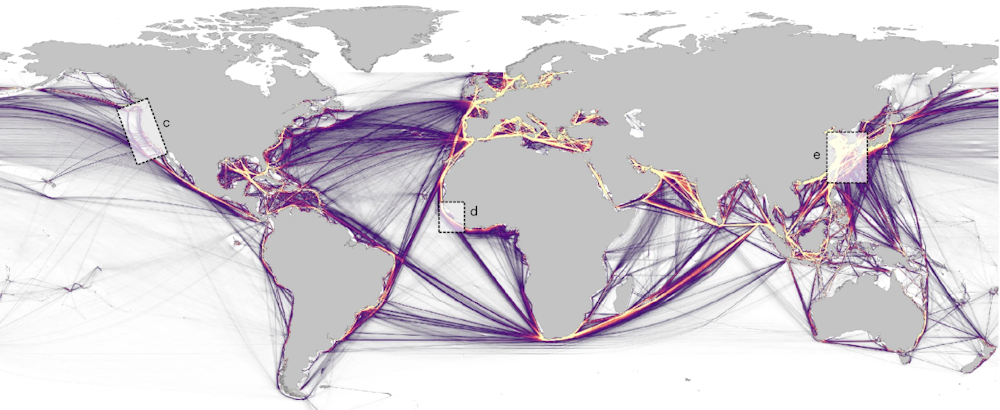
    Our state-of-the-art approach uncovered totally new areas that may be able to support whale sharks in future, such as US waters in the Pacific in the region of the California bight, Japanese waters in the eastern China Sea and the Atlantic waters of many west African countries. We quickly realised that these regions are home to some of the world’s busiest sea ports and shipping highways, so we overlaid our maps of habitat preference with those of global shipping to determine sharks are expected to run into ships.

    The world’s main shipping lanes, with the busiest lanes coloured yellow. Areas C (US west coast), D (west Africa) and E (east Asia) are expected to become more suitable for whale sharks as the oceans warm.
    Womersley et al / Nature Climate Change, CC BY-SA

    Through this we project that co-occurrence between sharks and ships will be be 15,000 times greater by the end of this century if we continue to rely heavily on fossil fuels, compared to only 20 times greater if we follow a sustainable development scenario.

    This does not mean that collisions will increase by 15,000 times, or even by 20 times, as we can only predict where whale sharks will be in future and the precise number of ships will vary. However, if the sharks do move into these new areas and their busy shipping lanes, increased mortality is a very real possibility.

    We’ve already recorded shark-attached satellite tags abruptly stopping transmissions in shipping lanes, with depth-recording tags showing the sharks slowly sinking – likely dead – to the seafloor.

    Changing tack

    Our results are alarming but highlight that we do have the capacity to change the population trajectory for whale sharks. In this case, through mitigating climate change, we can also indirectly ensure that the ocean is a safer place for some of its largest residents.

    We already know which strategies to trial for limiting collisions between ships and sharks. In February 2024 a meeting of signatories to the UN’s convention on the conservation of migratory species put forward a series of recommendations with specific focus on whale sharks. These include slowing speeds and re-routing around key sites, and setting up a collision-reporting network. It is now up to individual governments to take action.

    It’s possible that other species will experience similar pressures as a result of climate change. For example, heat waves in the oceans may force other sharks into cooler surface waters which are being exploited by longline fisheries, or into deeper depths where there is less oxygen.

    It’s time to shift our focus on to these interacting stressors in future, so that we can start to quantify the mosaic of threats that marine animals must endure in the oceans of tomorrow and protect those most at risk.

    Freya Womersley receives funding from the Natural Environment Research Council (NERC) through a University of Southampton INSPIRE DTP PhD Studentship. She is affiliated with the Marine Biological Association (MBA) in Plymouth, UK and the Global Shark Movement Project, which is based at the MBA.

    David Sims receives funding from the Natural Environment Research Council (NERC), the European Research Council (ERC), and the Gordon and Betty Moore Foundation. He is affiliated with the Marine Biological Association (MBA) in Plymouth, UK, and the Global Shark Movement Project, which is based at the MBA.

    ref. Whale sharks on collision course as warming seas may force them into shipping lanes – new study – https://theconversation.com/whale-sharks-on-collision-course-as-warming-seas-may-force-them-into-shipping-lanes-new-study-240727

    MIL OSI – Global Reports

  • MIL-OSI USA: Warren, Healey, Massachusetts Leaders Move Forward on $350 million for Cape Cod Bridges Construction

    US Senate News:

    Source: United States Senator for Massachusetts – Elizabeth Warren
    October 07, 2024
    Transfer of $350 million in federal funding secured by lawmakers to FHWA moves MassDOT further toward replacing the Sagamore Bridge
    Boston, MA – Continuing the momentum on replacing the Cape Cod Bridges, the Healey-Driscoll Administration signed a new Memorandum of Agreement (MOA) with the U.S. Department of the Army and the Federal Highway Administration (FHWA) to move forward on rebuilding the Sagamore Bridge. Senator Warren has led efforts to secure these funds for the Bourne and Sagamore Bridges, pressing the federal government to take action to replace these crucial pieces of infrastructure. 
    Under the agreement, the USACE will transfer $350 million in federal funding secured through the 2024 appropriations bills to the Federal Highway Administration. The FHWA Eastern Federal Lands Division will use the funds to construct a portion of the new Sagamore Bridge as part of MassDOT’s overall replacement project.
    The Sagamore Bridge is vital infrastructure supporting the economy of Cape Cod and surrounding communities and ensuring safe and reliable travel for residents, workers, and millions of annual visitors. The new MOA will help to further the current plan to begin construction on the Cape. The Sagamore Project is Phase 1 of the Cape Cod Bridges Program, rebuilding both the Sagamore and the Bourne Bridges while also making investments in other transportation infrastructure along the Cape Cod Canal and expanding travel options.  
    “We’re one step closer to replacing the Cape Cod Bridges—a decades-overdue project that will lift up the entire region,” said Senator Warren. “An investment this big is made possible only by teamwork, and it’s thanks to our strong federal, state, and local partnership that we were able to secure over $2 billion for the bridges. I’ll keep working closely with Senator Markey, Representative Keating, Governor Healey, and the delegation to get this crucial project to the next stage.”
    “We continue to make important progress in our efforts to rebuild both Cape Cod Bridges. After securing $1.72 billion in federal funding, we’re now moving forward with an agreement with the U.S. Department of the Army and the Federal Highway Administration that will allocate a crucial piece of that funding and allow us to begin construction on the Sagamore Bridge,” said Governor Maura Healey. “We’re grateful to our MassDOT team, as well as our Congressional delegation and federal partnerships for their continued partnership and commitment to delivering this project for the people of Massachusetts.” 
    The project will help to spur economic growth and development, improving safety and quality of life for both the region and state. This project is critical to the Cape Cod economy, and the bridge will be a connector to other assets on a local, state, and national level. 
    Senator Warren, Senator Markey, Congressman Keating, and the Massachusetts delegation secured a total of $1.72 billion in federal funding for the bridge replacement project. In July, MassDOT won $1 billion from the Bipartisan Infrastructure Law’s (BIL) Bridge Investment Program, and in December 2023, MassDOT won $372 million from the BIL’s Federal Multimodal Project Discretionary Grant Program. Senator Warren, along with the Massachusetts Delegation, secured $350 million for the bridges in the Fiscal Year 2024 Energy and Water Development Appropriations Act, which was signed by President Biden. Governor Healey has also pledged $700 million in state support. 
    “This project has always been about partnership, and we thank the Healey Administration, the Congressional delegation and the Biden-Harris Administration for their unwavering support and funding. We look forward to working with partners and stakeholders in the region to begin the next steps to making this project a reality,” said Massachusetts Transportation Secretary & CEO Monica Tibbits-Nutt. 
    Senator Warren has long advocated for federal investments in the Cape Cod Bridges project and other critical infrastructure projects across the Commonwealth: 
    In July 2024, Senator Warren, along with Senator Ed Markey, Rep. Bill Keating, and Governor Maura Healey, announced the U.S. Department of Transportation (DOT) had awarded the Massachusetts Department of Transportation (MassDOT) and Army Corps of Engineers a billion-dollar grant to replace the Cape Cod Bridges under the Bipartisan Infrastructure Law’s Bridge Investment Program.
    In March 2024, the entire Massachusetts congressional delegation sent a letter to U.S. Secretary of Transportation Pete Buttigieg, reaffirming their support for Massachusetts’ billion-dollar Bridge Investment Program (BIP) grant application to replace the Cape Cod Bridges, in light of the $350 million in funding from the FY 2024 funding package signed by President Biden and the U.S. Department of Transportation’s $372 million Mega grant.
    In March 2024, Senators Markey and Warren and Congressman Keatingsecured $350 million for the Cape Cod Bridges in the Fiscal Year 2024 Energy and Water Development Appropriations Act.
    In December 2023, following the advocacy of the delegation, the Department of Transportation awarded Massachusetts a $372 million grant through the Bipartisan Infrastructure Law’s National Infrastructure Project Assistance (MEGA) program toward the replacement of the Sagamore bridge. 
    In May 2023, Senators Warren and Markey and Representatives Keating and Seth Moulton (D-Mass.) sent a letter to Secretary of Defense Lloyd J. Austin III, urging him to exercise his authority to support installation resilience in order to provide funding for the replacement of the Bourne and Sagamore Bridges.
    In March 2023, Senators Warren and Markey announced and applauded the inclusion of $350 million, toward a commitment of $600 million, in President Biden’s budget for the Bourne and Sagamore bridges. 

    MIL OSI USA News

  • MIL-OSI USA: Hurricane Helene Recovery Resources for GA-10

    Source: United States House of Representatives – Representative Mike Collins (R-Georgia 10th District)

    Hurricane Helene has devastated parts of our state, and I wish you and your family well as you recover from any damage sustained in your neighborhoods. If you have been impacted, please know that you are not alone. If you require assistance or information, please view the below resources. 

    Local Resources

    State Resources

    • Georgia Emergency Management and Homeland Security Agency (GEMA): 404-635-7200
    • Report damage to GEMA.
    • Hurricane Helene Cleanup Hotline: 844-965-1386
    • Check current highway conditions.

    Federal Resources

    • To report crop loss or seek assistance regarding your farm, please contact your local USDA Service Center or call 877-508-8364. The following are USDA disaster assistance resources and links:
    • Apply for FEMA Assistance online or check your status by phone at 1-800-621-3362.

    How to Apply for Individual Assistance

    Homeowners and renters in Georgia’s 10th Congressional District communities of Elbert, Butts, and Newton counties who had uninsured damage or losses caused by Hurricane Helene may be eligible for FEMA disaster assistance. Individual Assistance may include grants for temporary housing and home repairs, low-cost loans to cover uninsured property losses, immediate housing and food needs, and other programs to help individuals and business owners recover from the effects of Hurricane Helene.

    There are several ways to apply: Go online to DisasterAssistance.gov, use the FEMA Appor call 800-621-3362.

    Understanding Your FEMA Eligibility Letter

    If you applied for FEMA assistance after Hurricane Helene, you will receive an eligibility letter from FEMA in the mail or by email.

    The letter will explain your application status and how to respond. It is important to read the letter carefully because it will include the amount of any assistance FEMA may provide and information on the appropriate use of disaster assistance funds.

    You may need to submit additional information or supporting documentation for FEMA to continue to process an application for financial assistance. Examples of missing documentation may include:

    • Proof of insurance coverage
    • Settlement of insurance claims or denial letter from insurance provider
    • Proof of identity
    • Proof of occupancy
    • Proof of ownership
    • Proof that the damaged property was the applicant’s primary residence at the time of the disaster

    If you have questions about your letter, or disagree with the initial decision, visit a Disaster Recovery Center, if available, or call the disaster assistance helpline at 800-621-3362 to find out what information FEMA needs.

    How to Appeal

    The letter from FEMA will provide information on the types of documents or information that FEMA needs. It will also include an optional appeal form that you can use. Your appeal must be submitted within 60 days of the date of your decision letter.

    You can appeal any FEMA decision or award amount by sending documents that show you qualify and need more help, like estimates for repairs, receipts, bills, etc. Each decision letter you receive from FEMA explains types of documents that may help you appeal your FEMA’s decision or award amount for that type of assistance.

    Supporting documents may include:

    • Receipts,
    • Bills,
    • Repair estimates,
    • Property titles or deeds, or
    • Any other information that may support the reasons for the appeal.

    What should I include on documents I send to FEMA?

    All documents you send to FEMA as part of your appeal should include your:

    • Full name,
    • Current phone number and address,
    • Disaster Number (DR-4821-GA for Tropical Storm Debby) (DR-4830-GA for Hurricane Helene) and FEMA Application Number written on all pages, and
    • Address of the disaster-damaged home.

    Receipts, bills and estimates must include the business name and contact information to help FEMA confirm the information.

    Can someone appeal for me?

    Yes. If you send a written explanation for the appeal that is written by someone other than you, it must include their signature. FEMA will need your written permission to share information about your application. You can do this by completing an Authorization for the Release of Information Under the Privacy Act form and sending it to FEMA.

    How can I send documents?

    You can send appeals or supporting documents to FEMA by:

    • Uploading to your disaster assistance account at DisasterAssistance.gov,
    • Mailing to FEMA, P.O. Box 10055, Hyattsville, MD 20782-8055.
    • Faxing to 800-827-8112.
    • Visiting a Disaster Recovery Center, if available

    MIL OSI USA News

  • MIL-Evening Report: Too good to be true? New study shows people reject freebies and cheap deals for fear of hidden costs

    Source: The Conversation (Au and NZ) – By Andrew Vonasch, Senior Lecturer in Psychology, University of Canterbury

    If you’re offered a free cookie, you might say yes. But if you’re paid to eat a free cookie, would your response be the same?

    In our new research, twice as many people were willing to eat a cookie when they weren’t offered payment compared with when they were.

    From a purely economic perspective, our findings reflect irrational decision making. Objectively, a cookie plus money is better than just a cookie.

    But people aren’t purely economic. They’re social animals with a tendency to look for hidden reasons behind other people’s behaviours.

    In the case of overly generous deals, people are expecting a “phantom cost” – one hidden in the initial offer. And this expectation influences their decision to accept something or not.

    Research participants who were offered a free cookie plus payment thought maybe the cookies were poisoned. Or maybe someone spat on them. Or they expected they would then owe a favour to the person handing out the treats once the cookie was eaten.

    Too good to be true

    Our cookies study was just one of ten experiments involving 4,205 participants in the United States and Iran.

    We tested how phantom costs influenced people’s choices to accept or reject overly generous economic offers.

    Each study gave people an offer. They had to decide whether to accept or not, and then explain why.

    One study asked participants to imagine they were a truck driver and looking online for a job. All the jobs were described the same way, but we varied the wage. People offered the normal US$15 per hour were perfectly willing to take the job.

    Others were offered more than the normal wage. The participants in this group imagined phantom costs. And the higher the wage they were offered, the worse the costs they imagined.

    When offered $20 or $25 per hour, participants imagined the role involved more responsibilities or harder work. But they considered this to be worth it. Most people preferred a job that paid a bit more than normal, despite the expectation of phantom costs.

    However, when we offered way too much money – more than $900 per hour – most people rejected the job they were willing to do for $15.

    Why? They imagined far worse phantom costs: driving for the mob, carrying dangerous radioactive waste or smuggling drugs across the border. A suspiciously high hourly rate or wage can end up putting people off.

    Suspicion is global

    We repeated this experiment with different jobs, different normal wages, and in different countries.

    In both the US and Iran, despite very different types of economy, people showed the same pattern of suspicion and rejected very high wages. The only difference was that in Iran the expected wages were lower, so the wages didn’t have to be high by US standards to become suspicious.

    Another experiment tested how phantom costs could affect purchases of plane tickets involving a hypothetical choice between three flights.

    One cost $235, another $275. When the third option was $205, most people chose that. However, if the third option was $15, hardly anyone chose the cheapest flight. They rejected it because they imagined horrible phantom costs such as terrorists and plane crashes.

    However, when we provided a reason for the low price – very uncomfortable seats – most people preferred the $15 flight. Uncomfortable seats are not usually a selling point. But they explained the cheap price, so people didn’t search for other, dangerous explanations.

    Sufficient explanations for something being a great deal remove people’s tendency to imagine phantom costs.

    A good offer, not a suspicious one

    Businesses face a balancing act when it comes to offering customers a good deal.

    On the one hand, the expectation of phantom costs decreases interest in the offer. On the other hand, price-sensitive consumers are often looking for ways to get the best deal.

    To avoid the pitfalls of phantom costs, businesses need to communicate their reasons for offering a particularly good deal. A “holiday sale” or “end-of-season sale”, for example, may explain why items are discounted.

    In the job market, identifying “good performance” as a reason for an employee’s pay raise can sidestep the expectation of hidden downsides – such as an increased workload.

    It’s clear people are not merely self-interested economic beings. We’re savvy, psychological beings capable of reading into the motivations of others to protect ourselves from offers that seem too good to be true.

    Andrew Vonasch does not work for, consult, own shares in or receive funding from any company or organisation that would benefit from this article, and has disclosed no relevant affiliations beyond their academic appointment.

    ref. Too good to be true? New study shows people reject freebies and cheap deals for fear of hidden costs – https://theconversation.com/too-good-to-be-true-new-study-shows-people-reject-freebies-and-cheap-deals-for-fear-of-hidden-costs-238869

    MIL OSI AnalysisEveningReport.nz

  • MIL-OSI USA: Congressman Issa: On this October 7 – as with the last – we say loud and clear: Israel must win

    Source: United States House of Representatives – Congressman Darrell Issa (CA-50)

    WASHINGTON – Congressman Darrell Issa (CA-48) released the following statement:

    “On October 7th, 2023, I was getting ready to board a flight from Saudi Arabia to Israel along with several of my colleagues on a Congressional delegation. Then came the first reports and the continuing confirmations of the brutal and deadly attacks by Hamas that killed more than a thousand Israelis and saw hundreds more dragged into Gaza to be held as hostages. Our hearts sank with the realization that this was Israel’s 9-11. We were redirected back to the United States.

    “But we weren’t there long. I returned to Israel alongside my friend Sen. Joni Ernst and once there we immediately visited the kibbutzim ravaged by the terrorists who carried out an unprovoked slaughter of civilians. We saw the blood stains and bullet holes on the walls of homes, while others were completely burned to the ground. We saw the ransacked possessions of the residents and the scattered toys of children. We were shown residences and told ‘there were no survivors.’

    “One year later – and with the support of its strongest friends – Israel has rallied and rebuilt, answered anguish with action, and turned the tide against terror. It is a remarkable achievement that may indeed be the hinge of history turning.

    “This is the time to not only stand with Israel but also offer more than the repeated rhetoric of supporting its right to defend itself. We must defend Israel’s very right to exist and to live in peace and security with its neighbors. But it will be – to borrow a phrase from Ronald Reagan – peace through strength.

    “On this October 7th – just as with the last one – we need to say loud and clear: Israel Must Win.”

    Please see Congressman Issa’s Op-Ed in the Washington Examiner today. 

    MIL OSI USA News

  • MIL-OSI Canada: Remarks by the Deputy Prime Minister on investment in public transit in Toronto

    Source: Government of Canada News

    Today’s announcement is really what happens when different levels of government, the city and the federal government, work together for the people who we represent.

    September 27, 2024

    We are here with Team Scarborough, with three outstanding Scarborough MPs, Gary, John and Jean. I want to say to everyone here in Scarborough, they love this amazing community. And it’s really great to have two great Scarborough city councillors, Jamaal and Parthi, and as I said, wonderful to be here with the mayor. Today’s announcement is really what happens when different levels of government, the city and the federal government, work together for the people who we represent. 

    Every single elected person here is elected by people in Toronto to represent them. And I think we’re also glad to be coming together to talk about something that we’re doing together to make life better for people here. 

    I want to start by talking just for a minute about some good economic news we’ve been having in Canada in recent weeks. Inflation in August was 2 per cent. That’s a bull’s eye right in the middle of the Bank of Canada’s target range for inflation. 

    And in fact, inflation has been within the Bank of Canada’s target range all of this year. We have now had three interest rate cuts. Canada was the first G7 country to cut interest rates for the first time. We were the first G7 country to cut interest rates for the second time. And we were the first G7 country to cut interest rates for the third time. That is real relief for Canadians.

    Wages have outpaced inflation for the past 19 months in a row. We have also, over the past two weeks, seen some real progress on mortgages and on housing affordability.

    Our government has announced that we will be raising the level for insured mortgages from $1 million to $1.5 million—really relevant in a city like Toronto—and increasing the amortization for first-time homebuyers and for people buying a newly built home to 30 years.

    What that means practically is, if you are a first-time homebuyer, if you’re buying a newly built home, you’re going to be able to do that with a lower down payment and you’re going to have lower payments every single month, because we know how important it is that the dream of homeownership needs to remain in reach for people living in this amazing city. 

    And then, we had some more good news for people with mortgages. And that is the announcement by OSFI this week that if you already have a mortgage and you are renewing it and it is an uninsured mortgage, you do not have to requalify with a stress test to switch banks upon renewal. 

    That’s a really big deal. It is going to give people who see a renewal up ahead and are worried about it some real choice, some real options. If you have an insured mortgage, it is already the case that you don’t need to requalify with a stress test upon renewal. You can look around for the best deal you can get. 

    So that’s some really good news for Canadians. It’s really good news for the people of Toronto. 

    I am really happy that inflation was 2 per cent in August. For the past eight months in a row, inflation has been within the Bank of Canada’s target range, and the Bank of Canada has already reduced its policy rate three times.

    And then we have even more good news that we’re here to highlight: an announcement about the TTC and electric buses. And I really want to start by thanking all of the people at the TTC who have made this possible, who run this incredibly important transit system every single day. It really is the circulatory system of our city. 

    And I want to give a special shout-out to an amazing guy I met this morning. His name is Tony, he’s an electrical technician, he’s worked here for 40 years. He’s the guy in charge of these amazing charging stations that we are about to see in operation. And he was so proud to tell me about the work that he and his colleagues have done putting this system in place and making this system work. And he also was proud to tell me about his family. He has three beautiful daughters and five amazing grandchildren. And he does this work so that they can live in an amazing city and to support them and build a wonderful family here. He’s been working here for 40 years. Thank you very much Tony. 

    So the good news. Thanks to the hard work of Tony and his friends and colleagues here, and thanks to investments by the City of Toronto and the Government of Canada, we’re making a $700 million joint investment of which the federal government is contributing half, the City of Toronto half, in 340 zero emission buses and the amazing charging system that we see here behind us. The first two vehicles are here today.

    We’re going to get on them and show them off and I am really looking forward to it. This is so important. This is about providing great transit for people in Toronto. It means you can get to work, you can get to school, you can get to see your friends and have fun. It means doing it in a way that is clean and green, and I’m really glad that there are some people here from Nova because we’re also supporting great jobs in Canada building these amazing buses.

    Today’s investment builds on sustained investment by the federal government in this amazing city, including in public transit. Since 2015, we have invested more than $10 billion, $10.4 billion to be exact, in public transit in Toronto. We are really, really proud to do that, and we’ve invested $30 billion in transit projects across the country. We’re a growing country and we need to be investing so people can get around. 

    So it’s such a great pleasure to be here, to congratulate and to thank the amazing people who work here and to celebrate what we’re doing together with the City of Toronto, with my Toronto caucus colleagues, to improve the lives of Canadians, of Torontonians.

    Thank you very much.

    MIL OSI Canada News

  • MIL-OSI USA: Physician Assistants Vital in OR and Beyond

    Source: US State of Connecticut

    While it may be easy for patients to misunderstand the role of physician assistants, those who work with PAs are well aware how integral they are to care teams across many specialties.

    “They’re our backbone,” says Karen Curley, senior director of nursing, who oversees UConn Health’s operating room.

    From left: Alex Shaw, Kaitlyn Hill, Martha Grajewski, Meaghan Trzasko, Allyson Satkowski, and Jeffrey Reut are among the physician assistants who are part of the surgical teams in UConn Health’s operating room. (Tina Encarnacion/UConn Health Photo)

    “A good PA in the OR is invaluable,” says Rosemary Swanke, UConn Health’s program director of advance practice staff.

    UConn Health employs 73 physician assistants throughout both the inpatient and outpatient enterprises; 40 of them are credentialed to work in the OR, which has seen an upward trend in volume as the effects of the COVID-19 pandemic have subsided.

    Their title can sound misleading, as if they are assistants to physicians. But see them in action in and you’re likely to draw a different conclusion.

    I’m able to connect with patients and get them feeling better on one of their potentially worst days. &#8212 Martha Grajewski

    “Many of the PAs at John Dempsey Hospital work as first assist in the OR in a variety of specialty areas, including neurosurgery, general surgery, orthopedics, pulmonary/oncology, and thoracic surgery,” Swanke says. “The PAs working in the OR are highly skilled in advanced intra-operative techniques. They are very familiar with our surgeons and the specialized techniques used in the OR. They are able to anticipate the next step in the procedure and assist the surgeon, significantly improving the efficiency of each operative case.”

    “First assist” refers to a surgical role that is performed intraoperatively with the surgeon. Knowledge of the procedure, anatomy, surgical equipment and technical skills are required of a proficient first assist. This role complements the surgeon by providing exposure, suturing, anticipating the needs of the surgeon, and clear communication with the operative team.

    Alex Shaw is lead physician assistant in UConn Health’s Division of Neurosurgery. (Tina Encarnacion/UConn Health Photo)

    Alex Shaw, lead PA for neurosurgery, describes a typical day on the job.

    “If I am covering inpatient or the operating room, I’m rounding on patients and then discussing plans with the attending neurosurgeon, potentially going into the operating room, completing tasks such as discharges, consults, admissions, bedside procedures such as drain removals, and completing any other floor tasks requiring provider follow-up or assessment,” Shaw says.

    Both Shaw and Martha Grajewski, lead PA for general surgery, have been in their lead roles for the last three years, and with that comes additional responsibilities beyond clinical, such as scheduling, hiring, orienting, and educating.

    They normally work three shifts per week of 12 to 14 hours, rotating through days, nights, weekends, and holidays. Grajewski describes a typical day shift in general surgery.

    Martha Grajewski is lead physician assistant in UConn Health’s General Surgery Division. (Tina Encarnacion/UConn Health Photo)

    “We start rounding on our admitted patients at 6 a.m.,” Grajewski says. “Following rounds, patients are discussed with attendings and we sign out the plans to our team, who will execute the patient’s plans for the day. This can include procedures, discharges, orders, reviewing imaging, or updating patients and their families on progress. Our OR cases start at 7:30. Each day is different and may include covering cases in the OR, completing consults, providing postoperative care or bedside procedures.”

    Physician assistants are licensed clinicians who undergo rigorous training. They can prescribe medications, manage acute and chronic diseases, and perform bedside procedures in addition to first assisting in the OR.

    “The neurosurgery advanced practice providers under the exemplary leadership of Alex Shaw are truly exceptional colleagues in helping optimize patient care in the inpatient, outpatient, and OR settings,” says Dr. Ketan Bulsara, chief of UConn Health’s Division of Neurosurgery. “The physician assistants provide a unique perspective given their training background.”

    Shaw has been a PA for eight years, all at UConn Health, starting in general surgery, and now in her fifth year in neurosurgery.

    “Here at UConn Health, I have had the opportunity to work with some amazing PA and APRN teammates,” she says. “The attending physicians and colleagues I work with as well have greatly contributed to further learning that I may not have received at another institution.”

    Grajewski has been a physician assistant for 20 years, the last 13 at UConn Health, entirely in general surgery. She oversees the inpatient PAs covering general surgery, vascular surgery, plastic surgery, thoracic surgery and trauma/emergency general surgery.

    From left: Erin Peters, Trevor McCarthy, Alex Shaw, and Anya Sweeney are among UConn Health’s surgical physician assistants. (Photo provided by Alex Shaw)

    “Martha expertly handles multiple administrative tasks and scheduling issues while supporting a diverse clinical service,” says Dr. Brian Shames, chief of UConn Health’s General Surgery Division. “Her clinical skills are exceptional and she is a mentor for all of the young PAs on our service. She is an incredible team member, and I cannot imagine our service without her.”

    Grajewski enjoys the team aspect of her job, working with, among others, attendings, residents, medical students, and nurses on the hospital floors to achieve the best patient outcomes. And that’s what she finds rewarding about being a physician assistant.

    “I’m able to connect with patients and get them feeling better on one of their potentially worst days,” Grajewski says.

    “Every day, we can see the positive impact we make on patients’ lives,” Shaw says.

    Swanke points out that UConn Health has PAs working at high levels of expertise beyond the OR.

    “Many are very skilled at performing procedures outside the OR in the ICU, on the hospital units, in clinic and in the ED,” she says. “Some of the physician assistants work in the clinics, seeing patients preoperatively and postoperatively in addition to assisting in the OR. They have many roles and areas of expertise throughout the hospital.”

    National Physician Assistant Week is Oct. 6-12.

    MIL OSI USA News

  • MIL-OSI Security: Defense News: SECNAV Del Toro As-Written Remarks at the Farragut Seawall Ribbon Cutting

    Source: United States Navy

    Introduction

    Good morning, everyone!

    It is wonderful to be here with you today for this special occasion, at Farragut Seawall, named after our Nation’s first Admiral and our Navy’s first prominent Hispanic leader.

    Assistant Secretary Berger, thank you for your leadership as Assistant Secretary of the Navy for Energy, Installations, and the Environment. The work you do every day is crucially important for the readiness of our Sailors, Marines, and Midshipmen.

    Vice Admiral Davids, thank you for your leadership of the Naval Academy and of the future leaders of our Navy and Marine Corps.

    To all of our distinguished guests, Navy and Marine Corps leaders, Naval Academy faculty, and those who laid the groundwork to get us to where we are today: welcome and thank you for joining us to celebrate the ribbon-cutting for the newly fortified Farragut Seawall.

    Enduring Priorities

    When I entered office as Secretary of the Navy, I laid out Three Enduring Priorities zhich are the foundation for all we do in the Department of the Navy.

    My priority of Strengthening Maritime Dominance centers on ensuring our Sailors and Marines have the best ships, aircraft, and technology available, so that if we are called, we may fight and decisively win our Nation’s wars.

    And my priority of Building a Culture of Warfighting Excellence concerns taking care of people.

    Our people—our Midshipmen—are our greatest strength, and force readiness begins and ends with them.

    And just as our people all around the world deserve robust infrastructure to work, sleep, and study, they also deserve protection from external threats caused by one of the most destabilizing forces of our time.

    To remain the world’s dominant maritime force, the Department of the Navy must rapidly adapt to existential threats such as climate change.

    Building a Climate-Ready Force

    In September 2003, Hurricane Isabel battered the Atlantic Coast.

    And the category five hurricane did not spare the Naval Academy or our future warfighters here.

    The rising water flooded classrooms and damaged buildings—the devastation is evident in photos depicting classroom doors barely peeking above the floodwaters and buildings around the Yard partially submerged.

    The damage resulted in disruptions to classes and normal operations for our Brigade of Midshipmen, along with over one hundred million dollars’ worth of repairs.

    And since Hurricane Isabel made landfall twenty years ago, our world today has continued to face increasingly unpredictable and devasting weather phenomenon.

    Yet, the Department of the Navy is actively adapting and innovating for the changing landscape of the world and indeed of warfare.

    We have set out ambitious goals which we accomplish through installation resilience—by ensuring that our people, systems, and facilities can continue to operate effectively and accomplish our mission in the face of worsening climate impacts.

    Less than two years ago, we held a ceremony here to break ground on the first project to safeguard the Naval Academy from rising sea levels.

    Our efforts today will significantly enhance the development of our future Navy and Marine Corps leaders, enabling them to learn, grow, and thrive with minimal disruption.

    For the sake of force resilience and our people, we must continue looking over the horizon towards future challenges, finding new ways to innovate and modernize our Force.

    May the success of the Farragut Seawall project illuminate the path for future climate resilience initiatives.

    Closing

    I thank all of you for being here today, to celebrate this momentous occasion and the Department of the Navy’s commitment to our future Navy and Marine Corps Officers.

    I look forward to the enduring success of my alma mater as the difficult task of shaping warfighters to face an uncertain future continues—from tomorrow to 2100 and beyond.

    May God bless our Midshipmen, Sailors, Marines, and all who support them. Thank you.

    MIL Security OSI

  • MIL-OSI Security: Defense News: SECNAV Del Toro As-Written Remarks at the Bancroft Hall Renovation Groundbreaking

    Source: United States Navy

    Good morning, everyone!

    It is an honor to be with you here today at the Naval Academy for the groundbreaking ceremony of the long overdue renovations to Bancroft Hall, named in honor of this school’s founder and the 17th Secretary of the Navy, George Bancroft.

    Assistant Secretary Berger, thank you for being here today, and for your leadership as Assistant Secretary of the Navy for Energy, Installations, and the Environment. The work you accomplish every day is critical to supporting our Sailors, Marines, and future warfighters here at the Naval Academy.

    Vice Admiral Davids, thank you for your leadership of the future officers of our Navy and Marine Corps, and for your commitment to prioritizing the infrastructure which supports our education enterprise.

    Mayor Buckley, thank you for being here today, for your service and leadership of the City of Annapolis, and for your unwavering support of our Midshipmen at the United States Naval Academy.

    County Executive Pittman, we share the values of a more sustainable and secure energy future, and I thank you for your continued partnership and service to Anne Arundel County.

    And I know we could not be here today without the detailed planning and heavy lift of so many of our outside partners, those who have realized this plan from its inception two years ago.

    Captain Schwarz, the interdependence between the Naval Support Activity and the Naval Academy is on full display today. Thank you for your leadership and guidance of NSA Annapolis.

    To all of our flag and general officers, distinguished guests, Navy and Marine Corps leaders, and Naval Academy faculty: welcome and thank you for joining us to celebrate the groundbreaking and beginning of our Bancroft Hall renovations.

    Enduring Priorities

    When I entered office as Secretary of the Navy, I laid out Three Enduring Priorities which serve as the foundation of all we do in the Department of the Navy.

    My priority of Strengthening Maritime Dominance centers on ensuring our people have the best infrastructure, equipment, and technology available, so that, if called, we may fight and decisively win our Nation’s wars.

    Strengthening maritime dominance also crucially encompasses adapting to our current and future threats—including climate change, a national security threat which jeopardizes the operational readiness of our Navy and Marine Corps.

    My priority of Building a Culture of Warfighting Excellence is focused on taking care of people.

    Because our people—Sailors, Marines, civilians, and Midshipmen alike—provide the foundational strength for this Department.

    In order to accomplish their mission, our Midshipmen require adequate facilities to train, learn, and grow.

    And the Department of the Navy is forward-looking and focused on the challenges which lie ahead.

    Building a Climate-Ready Force

    We have created the foundation and guidelines by which we are building a climate-ready, warfighting force through Climate Action 2030 and the Naval Academy’s Installation Resilience Plan.

    Here at the Naval Academy, we are developing solutions to climate issues through the Center for Energy Security and Infrastructure Resilience, or “CESIR” [SEE-zuhr].

    Established earlier this year, CESIR will equip Midshipmen with the knowledge and skills to address complex climate challenges throughout their naval careers.

    What’s more, we are investing in the climate resiliency of our facilities, to include this renovation of Bancroft Hall.

    As the center of Midshipman life—the building in which our over four thousand future Navy and Marine Corps Officers sleep and study, Bancroft Hall is a symbol of the Naval Academy as a whole.

    The bonds of camaraderie among our Midshipmen are forged here at Bancroft Hall, creating lifelong friendships and shaping our young Americans into the warfighting leaders our Navy and Marine Corps Team needs.

    However, severe weather events have impacted the longevity of our buildings both inside and out.

    Given the criticality of Bancroft Hall to the mission of the United States Naval Academy in developing the future warfighters of our Fleet and our Force, we must continue to invest in its maintenance and improvement.

    As I have said before, our people are our greatest strength, and force readiness and resilience begin and end with them.

    This critical investment in our infrastructure is inextricably connected to our mission readiness here at the Naval Academy.

    Despite the tremendous scale and consequences of climate change, we possess both the means and opportunity to address them, and I am proud to stand here today as we embark on the beginning of this necessary infrastructure investment for our Midshipmen.

    Closing

    I thank all of you once more for joining us today, to celebrate the groundbreaking of our Bancroft Hall renovation efforts, the first step in reducing the threat posed by the world’s changing climate to our personnel, platforms, systems, and installations.

    It is my sincere hope that our actions today spur collective action throughout the Department of Defense, the Nation, and indeed the world.

    May God bless our Midshipmen, Sailors, Marines, civilians, and all who support them.

    Thank you.

    MIL Security OSI

  • MIL-OSI New Zealand: Clutha Police reminding locals to lock vehicles after young person arrested

    Source: New Zealand Police (District News)

    Attributable to Sergeant Tim Coudret, Clutha Police:

    Police are reminding motorists to be vigilant after a search warrant targeting an alleged thief, was executed in Milton yesterday morning, Monday 7 October.

    Enquiries began following a noted rise in thefts from vehicles over the last few week. Thanks to these enquiries and information from the community the person believed responsible was identified. 

    A young person was arrested and an assortment of items were recovered which Police will be looking to reunite with their rightful owners.  

    A 17-year-old is due to appear in the Dunedin Youth Court in due course.

    Unfortunately, there are people out there willing to benefit from crime, but yesterday’s work shows the commitment of Police to stopping those individuals.

    Police are urging all vehicle owners to take additional precautions to secure their vehicles, such as locking doors, removing valuables from sight, and parking in well-lit areas.

    We would like to ask the community to look out for each other and if you see any suspicious activity happening, please contact us on 111 immediately.

    To report a theft after it has occurred, please update us online now at 105.police.govt.nz, clicking “Update Report” or 105.

    Information can also be provided anonymously via Crime Stoppers on 0800 555 111. 

    ENDS

    Issued by Police Media Centre

    MIL OSI New Zealand News

  • MIL-OSI USA: Governor Ron DeSantis Suspends Tolls To Assist Hurricane Milton Evacuations

    Source: US State of Florida

    TALLAHASSEE, Fla.—Today, Governor Ron DeSantis announced that he has directed the suspension of tolls across Central Florida and West Florida, as well as Alligator Alley, in preparation for Hurricane Milton. By suspending tolls in the impacted area, Floridians and visitors will be better able to quickly and safely evacuate if and when directed by local officials. Tolls will be waived for seven days beginning at 10:30 a.m. on Monday, October 7, 2024.

    “At my direction, tolls are suspended today as of 10:30 AM,” said Governor Ron DeSantis. “With evacuation orders imminent, this will help keep traffic moving and be one less thing for people to worry about ahead of Milton.”

    “The Department is committed to ensuring motorists can get where they need to go as quickly and safely as possible, especially in preparation for a major hurricane. Suspending tolls across the central and west part of the state and Alligator Alley offers an additional option for families to easily get out of the storm’s direct path,” said Florida Department of Transportation Secretary Jared W. Perdue, P.E. “As Floridians finalize their evacuation plans for Hurricane Milton, FDOT reminds travelers to check FL511.com for the latest traffic conditions and potential road and bridge closures.”

    The Florida Department of Transportation (FDOT) and Florida’s Turnpike Enterprise (FTE) will suspend toll collection at 10:30 a.m. EST on Monday, October 7, for a seven-day period, with tolls being reinstated on Monday, October 14, at noon. The suspension may be extended as needed depending on evolving conditions.

    Facilities included within the suspension order include:

    Collier and Broward Counties

    • Alligator Alley

    Citrus, Hernando, Hillsborough, Pinellas and Pasco Counties

    • Suncoast Parkway
    • I-4 Connector
    • Selmon Expressway
    • Veterans Expressway
    • Gateway Expressway
    • 275 Express
    • Pinellas Bayway
    • Sunshine Skyway Bridge

    Osceola, Orange, Lake, Seminole, Sumter and Polk Counties

    • Turnpike Mainline between I-75 (MP 309) and Canoe Creek Service Plaza (MP 229)
    • S.R. 453
    • S.R. 451
    • Wekiva Parkway
    • Apopka Expressway
    • Beachline Expressway
    • Central Florida Greeneway
    • East-West Expressway
    • I-4 Express
    • Western Beltway
    • Osceola Parkway
    • Poinciana Parkway
    • Southern Connector Extension
    • Seminole ExpresswayPolk Parkway

      Toll facilities for FDOT, FTE, Central Florida Expressway Authority, and Tampa Hillsborough Expressway Authority are included with this suspension.

      FDOT is actively implementing Emergency Shoulder Use along Interstate 4 (I-4) and portions of Interstate 75 (I-75) to help facilitate the flow of traffic for travelers evacuating the storm’s potential impact area.

      Florida’s 511 Traveler Information System is available for drivers to stay informed about roadway conditions during emergencies. This service is monitored and updated 24/7 by FDOT and includes traffic conditions, road and bridge closures, and other specialized alerts. To use Florida’s 511, visit the website at FL511.com or download the app on both Apple and Android devices.

    ###

    MIL OSI USA News

  • MIL-OSI Security: U.S. Attorney Lapointe Reminds the Public to be Aware of Scams in the Wake of Hurricane Helene and Other Natural Disasters

    Source: United States Department of Justice (National Center for Disaster Fraud)

    MIAMI – United States Attorney Markenzy Lapointe reminds the public to be vigilant of hurricane relief fraud in the wake of Hurricane Helene and other natural disasters.

    “Throughout hurricane season and in the aftermath of Hurricane Helene, I urge the public to be wary of fraudsters looking to exploit victims of hurricanes and other natural disasters through identity theft schemes, solicitations for fake charities, or other types of fraud. Report suspected disaster fraud to the National Center for Disaster Fraud by calling (866) 720-5721 or by going online at http://www.justice.gov/DisasterComplaintForm,” said U.S. Attorney Markenzy Lapointe for the Southern District of Florida.

    On Sept. 26, Hurricane Helene made landfall in Florida’s Big Bend Region and quickly caused major devastation there and across states including Georgia, South Carolina, North Carolina, Tennessee, and others. As we have seen in the wake of previous national disasters, fraudsters will target victims of the storm along with citizens across the country who want to do what they can to assist individuals affected by the storm. Unfortunately, criminals exploit disasters for their own gain by sending fraudulent communications through email or social media and by creating deceiving websites designed to solicit contributions.

    The public should exercise diligence before giving contributions to anyone soliciting donations or individuals offering to assist those affected by Hurricane Helene. Solicitations can originate from phone calls, texts, social media, e-mail, door-to-door collections, flyers, mailings, and other similar methods. Before making a donation to benefit victims of Hurricane Helene, individuals should adhere to certain guidelines, including:

    • Make contributions directly to known organizations rather than relying on others to make the donation on your behalf.

    • Do not be pressured into making contributions as reputable charities do not use such tactics.

    • Do not respond to any unsolicited communications (e.g., e-mails and texts), and never click links contained within those messages because they may be targeting your personal information, to include bank and credit card account information, and other identifiers such as dates of birth and social security numbers.

    • Rather than clicking on a purported link to a charity, verify its legitimacy by utilizing various Internet-based resources that may assist in confirming whether the organization is a valid charity.

    • Beware of organizations with copy-cat names similar to but not exactly the same as those of reputable charities.

    • Avoid cash donations if possible. Pay by credit card or write a check directly to the charity. Do not make checks payable to individuals.

    • Know that legitimate charities do not normally solicit donations via money transfer services, and their website will normally end in .org rather than .com.

    • Be cautious of e-mails that claim to show pictures of the disaster areas in attached files because the files may contain viruses. Only open attachments from known senders.

    The U.S. Department of Justice established the National Center for Disaster Fraud (NCDF) in the wake of Hurricane Katrina to deter, investigate, and prosecute fraud in the wake of disasters. More than 50 federal, state, and local agencies participate in the NCDF, which reminds the public to be aware of and report any instances of alleged fraudulent activity related to relief operations and funding for victims. Complaints of fraud may be reported online at http://www.justice.gov/DisasterComplaintForm. Complaints may also be reported to the NCDF at (866) 720-5721, a hotline that is staffed 24 hours a day, 7 days a week.

    ###

    MIL Security OSI

  • MIL-OSI New Zealand: Homicide in Mt Pleasant: Police seek public’s assistance

    Source: New Zealand Police (National News)

    Please attribute to Detective Inspector Joel Syme:

    Police have charged a man with murder after a woman was found deceased at a Mt Pleasant address on Monday evening.

    Emergency services were called to the address around 5pm on 7 October and following initial enquiries a homicide investigation was initiated. Police are now working to establish exactly what has occurred however we can confirm that we are not seeking anyone else in relation to this matter.

    Yesterday evening Police located and arrested a Christchurch man aged in his 70s and he is expected to appear this morning in the Christchurch District Court charged with murder.

    The investigation is in its early stages and Police are seeking to establish the movements of both the victim and the person charged in the lead up to her death. We are very keen to hear from anyone who heard or saw anything suspicious between 10am on Friday 4 October to 4pm on Sunday 6 October in the Mt Pleasant Road or Bellview Avenue area.

    Police and ESR are carrying out a forensic examination of the woman’s address and this is expected to continue over the coming days.

    A post mortem is still to be conducted however next-of-kin nonfictions are underway.

    Our thoughts and sympathies are with the family at this extremely difficult time.

    Police, along with Victim Support will be working with the family to ensure they are supported.

    We would ask anyone who has information that may assist the investigation team to please update us online now  or call 105.

    Please use the reference number 241007/1228.

    ENDS

    Issued by the Police Media Centre

    MIL OSI New Zealand News

  • MIL-OSI USA: Congressman Hank Johnson Announces $1.2 Million in Funding to Expand Diaper Distribution Networks in Georgia

    Source: United States House of Representatives – Representative Hank Johnson (GA-04)

    WASHINGTON, D.C. – Congressman Hank Johnson (GA-04) announced that the Georgia Community Action Association, Inc. (GCAA) has been awarded $1.2 million as part of the U.S. Department of Health and Human Services’ (HHS) Diaper Distribution Demonstration and Research Pilot (DDDRP). This federal funding will enable GCAA to expand its efforts to provide essential diaper supplies to families with low incomes, addressing a critical need for infants and young children across Georgia. This award comes during National Diaper Need Awareness Week and will help caregivers who struggle to maintain enough diapers to keep their children safe, dry, and healthy.

    “Every child deserves access to basic necessities, and no family should have to choose between diapers and other essential needs,” said Congressman Hank Johnson.

    The DDDRP, administered by the Office of Community Services (OCS) at HHS, is awarding $8.4 million to support seven new grant recipients to alleviate diaper need while connecting families to broader services that address the causes and conditions of poverty. In Georgia, GCAA will coordinate with local diaper banks and community action agencies (CAAs) to ensure a consistent supply of diapers and other diapering essentials for families in need. Additionally, the program will provide access to job training, housing services, and childcare assistance, helping families achieve long-term self-sufficiency.

    Diaper Need in Georgia:

    • 26% of children have parents who lack secure employment.
    • 20.2% of children live below the poverty line.
    • Families face an average annual cost of $9,253 for center-based infant care.

    The need for diapers is a growing concern for many families, with 45% of participants in the DDDRP reporting they often had to reduce spending on other essentials like food or utilities to afford diapers. The program’s goal is to provide more than just a solution for diaper need—it aims to support families’ overall well-being.

    With this $1.2 million grant, GCAA plans to serve a wide sample of families across the state, in all 159 Georgia counties, utilizing partnerships with Head Start centers, faith-based organizations, and legislators to build a robust support network.

    For more information about these grants, visit the Diaper Distribution Pilot homepage.

    For more information about OCS’s other antipoverty programs, visit the OCS website or contact media@hhs.gov.

    About Congressman Hank Johnson:
    Hank Johnson represents Georgia’s 4th Congressional District, where he is a staunch advocate for civil rights, public safety, and economic justice. Learn more at https://hankjohnson.house.gov/

    MIL OSI USA News

  • MIL-OSI USA: Congressman Hank Johnson Announces Energy Efficiency Grant Funding for Covington, Other Georgia Communities

    Source: United States House of Representatives – Representative Hank Johnson (GA-04)

    COVINGTON, GA – Congressman Hank Johnson (GA-04) announced today that Covington, located in Georgia’s 4th Congressional District, has been awarded $150,000 in grant funding through the Bipartisan Infrastructure Law’s (BIL) Energy Efficiency and Conservation Block Grant (EECBG) Program. Covington is one of 17 Georgia communities to benefit from this $2.6 million investment aimed at reducing energy consumption, lowering emissions, and improving energy efficiency.

    “Covington is leading the way in transitioning to clean energy with the addition of eight new electric vehicle charging stations,” said Congressman Johnson. “This funding will help make clean transportation more accessible and support our community’s efforts to reduce its carbon footprint while creating more economic opportunities in Georgia’s Fourth District.”

    The Georgia Environmental Finance Authority (GEFA), which administers the program, selected Covington’s project as part of a broader initiative to enhance energy efficiency across the state. Covington will use the funds to install charging stations in high-traffic areas is designed to support the growth of electric vehicles and make clean transportation more accessible to residents and visitors alike.

    “This is just the beginning,” Congressman Johnson continued. “Investments like these are crucial for reducing our dependence on fossil fuels, improving air quality, and positioning our district and the state of Georgia as leaders in clean energy.”

    Other projects across the state receiving funding include energy audits, building upgrades, and workforce development initiatives, with approximately 60% of the funding directed toward disadvantaged communities.

    For more information about the EECBG Program and the energy efficiency projects being implemented, visit gefa.georgia.gov/EECBG.

    About the Georgia Environmental Finance Authority (GEFA):
    GEFA provides financing for energy, land, and water projects across Georgia. Since its establishment in 1986, GEFA has committed nearly $6 billion to local governments, businesses, and nonprofit organizations to improve environmental infrastructure throughout the state.

    About Congressman Hank Johnson:
    Hank Johnson represents Georgia’s 4th Congressional District, where he is a staunch advocate for civil rights, public safety, and economic justice. Learn more at https://hankjohnson.house.gov/

    MIL OSI USA News

  • MIL-OSI USA: VIDEO: Cassidy Releases Statement, Joins Republican Resolution Recognizing One-Year Anniversary of October 7

    US Senate News:

    Source: United States Senator for Louisiana Bill Cassidy

    WASHINGTON – U.S. Senator Bill Cassidy, M.D. (R-LA) released a video statement on the one-year anniversary of the October 7 terrorist attacks that killed over a thousand Israelis and Americans. Cassidy, also joined U.S. Senator Joni Ernst (R-IA) and the entire Republican Conference in introducing a resolution condemning Iran-backed Hamas for its actions, supporting the forever survival of Israel, and calling for the safe release of American hostages.
    “October 7 left an indelible mark on the Jewish State of Israel. In the last year, we have seen Hamas for the pure evil it is. Today, we reaffirm our commitment to stand with Israel, reinforce our efforts to bring all the remaining hostages, including American citizens, home, and pledge to always stand up to antisemitism,” said Dr. Cassidy.  
    “This time last year, I woke up in the Middle East to the unbearable news that Israel was under attack by Iran-backed terrorists and Americans were being killed and taken hostage,” said Senator Ernst. “I immediately traveled into Israel to show that our nation’s friendship is unwavering, in good times and bad. Regardless of whether I have been in Jerusalem, Washington, or Iowa, I have worked around the clock to hold the White House accountable to its ‘ironclad’ commitment, bring our hostages home, and cut off the source of terrorism in Tehran. One year since that day, as Israel remains under attack on all fronts, Senate Republicans stand united with our greatest ally in the Middle East.”
    The entire Senate Republican Conference stands united in opposing violent antisemitic protests and Iran-backed Hamas’ use of rape as a weapon of war.The resolution reiterates Israel’s right to defend itself and emphasizes the importance of denying Hamas the ability to reconstitute in the region to ensure the horrific events of that day are never repeated.
    The full transcript of Cassidy’s video is below.
    October 7, 2023, left an indelible mark on the Jewish State of Israel.
    Young men and women who started their day at a music festival ended it with fresh scars of war.
    Israelis and Americans left their homes never to return, instead being raped, murdered, and taken hostage.
    I was part of the first Congressional delegation to visit Israel after the horrific attacks. What I saw was a nation, accustomed to terrorist attacks, left in shock.
    They had the same shock Americans experienced after 9/11.
    I sat with the families who grieved for the loss of their loved ones and others who prayed for the safe return of their children held hostage.
    In the last year, we have seen Hamas for the pure evil it is. While Israel tries to save as many lives as possible during the midst of war, Hamas continues to target innocent civilians and use Palestinians as human shields. 
    Sadly, we have also seen Hamas’s terrorist rhetoric take hold across our college campuses.
    No Israeli should live in fear of bombs hitting their house, and no student should live in fear of walking across their campus.
    Today, we reaffirm our commitment to stand with Israel.
    We reinforce our efforts to bring all the remaining hostages, including American citizens, home.
    And pledge to stand up to antisemitism always.
    Background
    As ranking member of the Senate Health, Education, Labor, and Pensions (HELP) Committee, Cassidy is leading multiple legislative efforts to address antisemitism on college campuses in the aftermath of the October 7 attacks. This includes the Protecting Students on Campus Act, bipartisan legislation that ensures students know how to file civil rights complaints if they experience discrimination on college campuses. Cassidy has also repeatedly called on HELP Committee Chair Bernie Sanders (I-VT) to hold hearings on antisemitism to ensure universities and the Department of Education are protecting Jewish students from discrimination and harm.

    MIL OSI USA News

  • MIL-OSI: Radix showcases the Future of Asset Integrity, Autonomous Operations at The Future Digital Twins Conference, Amsterdam

    Source: GlobeNewswire (MIL-OSI)

    AMSTERDAM and HOUSTON, Oct. 07, 2024 (GLOBE NEWSWIRE) — Radix, a global technology solutions company, is set to showcase its innovative approaches to asset integrity and energy transition at the 2nd Future Digital Twin & Generative AI Conference at the Energy Transition Campus Amsterdam (ETCA). 

    The conference, organized in collaboration with Shell, brings together industry experts, operators, and technology leaders to address the most pressing challenges in the oil, gas, and energy sectors, focusing on the role of digital twin technology in accelerating the global energy transition.

    John DeKoning, President EMEA at Radix, expressed his enthusiasm for the company’s role in this significant gathering and said: “As industries move towards more sustainable and autonomous operations, Radix is committed to driving this change. We are excited to be part of this important event and showcase our digital twin solutions that are helping industries achieve operational excellence and sustainability.” 

    The event’s key panel, “Maximizing Data Intelligence & Preventing Digital Twin Failure,” features Radix’s Trudi Hable, John DeKoning, and industry leaders, including Arnout Roos, Dr. Edmary Altamiranda, and Dr. Subrata Bhowmik. The panel dives into critical discussions on preventing digital twin failures, addressing data fragmentation, and building trust in the technology through secure, scalable solutions.

    Breakout Session on Future Asset Integrity
    In a special breakout session titled “The Future of Asset Integrity and Autonomous Operations in 2025”, John DeKoning explores solutions for aging industrial assets, the lack of standardization, and workforce challenges. He will discuss recent use cases that demonstrate how the latest digital twin technologies, combined with best practices, enable industries to achieve asset integrity and autonomous operations in a cost-effective manner.  

    “The key to solving these complex challenges lies in leveraging technology in innovative ways, especially through digital twins and AI applications. We believe that by 2025, industries will be equipped with scalable, high-impact solutions to ensure operational excellence and sustainability,” DeKoning added.

    Accelerating Energy Transition
    Radix’s participation in the Energy Transition Campus Amsterdam underscores its commitment to working with global partners to build a sustainable future. By leveraging advanced technologies like digital twins and generative AI, Radix aims to empower industries to meet their net-zero goals and accelerate the energy transition.  

    Trudi Hable, Head of Partnerships North America at Radix, said: “Digital twins are not just a technology; they are a transformative approach to reimagining how industries operate, maintain asset integrity, and ultimately meet their sustainability goals. This is what we aim to showcase at the Future Digital Twin & Generative AI conference in Amsterdam.”

    “Radix Engineering is a highly valued member of our campus, with their expertise in innovative engineering, operational excellence, and creating new energy solutions for partners like Shell. Their focus on improving asset performance to minimize disruption and reduce carbon emissions aligns with our commitment to achieve the transition to cleaner energy.” – Ferry Winter, Director, Shell Energy Transition Campus Amsterdam

    Radix is thrilled to make its debut at the Future Digital Twin & Generative AI conference, reinforcing its leadership role in providing cutting-edge solutions that enhance operational efficiency, data intelligence, and sustainability for industries globally.

    About Radix

    Founded in 2010, Radix is a privately held global technology solutions company providing consulting, engineering, operations technology, and data and software technology solutions.

    Radix combines key capabilities and practices to empower customers to thrive along their digital transformation journey. Radix provides technology-based, data-driven solutions to industrial and non-industrial companies worldwide. Radix has experience leading projects in more than 30 countries and has more than 1,700+ employees around the globe, with North American headquarters in Houston, Texas, main headquarters in Rio de Janeiro, additional offices in Sao Paulo and Belo Horizonte, and a presence in Singapore and Amsterdam. To learn more, visit http://www.radixeng.com.

    About SHELL

    Shell is a global group of energy and petrochemical companies, employing 103,000 people and with operations in more than 70 countries. We use advanced technologies and take an innovative approach as we seek to help the world build a sustainable energy future.

    Shell is a customer-focused organisation, serving more than 1 million commercial and industrial customers, and around 33 million customers daily at more than 47,000 Shell-branded retail service stations.

    For more information:
    Citalouise Geiggar, Ph.D.
    citalouise.geiggar@radixeng.com
    Radix

    A photo accompanying this announcement is available at https://www.globenewswire.com/NewsRoom/AttachmentNg/4c3fc0d0-1935-4d92-a174-c4797345f429

    The MIL Network

  • MIL-OSI Security: Defense News: SECNAV Del Toro As-Written Remarks at the OJAG Change of Command and VADM Crandall Retirement

    Source: United States Navy

    Introduction/Thank You

    Good morning, everyone!

    It is an honor to be here with you this morning to celebrate the service of Vice Admiral Crandall and to welcome Vice Admiral French as he assumes the role of Judge Advocate General of the Navy and command of the Office of the Judge Advocate General.

    First and foremost, I would like to thank Vice Admiral Crandall’s family and friends here with us today.

    To Vice Admiral Crandall’s wife, Barb, thank you for your dedication and all you have sacrificed on behalf of the Navy.

    You have been a valued member of our Navy team since your husband’s time in NROTC over forty years ago.

    I thank you for your selfless volunteer work with the Navy and Marine Corps Relief Society and the Navy Officer’s Spouses Club, along with organizations outside of the Navy such as the annual Alzheimer’s Walk for Life and Christ Church Washington Parish for Calvary Women’s Services.

    All this while working part-time as the office manager and paralegal at a law firm in Burke, Virginia.

    While we are celebrating your husband’s achievements today, we are also celebrating yours, and I wish you the best in your retirement. Congratulations.

    To Mr. Darse Crandall and Mrs. Ruth Ann Crandall, thank you for raising an incredible son who dedicated his career and indeed his life in service of our great Nation.

    Kathie and Amy, it is wonderful to have you here in celebration of your nephew and brother.

    And to Admiral Crandall’s sons William, Andrew, and Edward, thank you for your support throughout your father’s distinguished career.

    I also want to welcome and thank Vice Admiral French’s family for being here today.

    To Vice Admiral French’s children, Lieutenant Caity French and First Lieutenant Andy French, I thank you not only for your unwavering support of your father throughout his career, but also for your own service in the United States Navy and United States Army, respectively.

    As we all know, families truly are the backbone of our armed forces, and I was blessed to have the support of my wife Betty and our sons throughout my career in the Navy and now.

    I welcome and thank our Chief of Naval Operations, Admiral Franchetti, for her leadership of our United States Navy.

    General Dunford and General Milley, thank you for your guidance of our service men and women around the world during your tenures.

    Admiral Richardson and Admiral Gilday, thank you for being here and for your leadership of our Sailors and service to this great Nation.

    Deputy Assistant to the President Geltzer, I thank you for your presence today and for your important work at the National Security Council.

    Thank you to General Counsel Krass, former General Counsel Preston, General Counsel Coffey, and General Counsel Beshar for your service within the Department of Defense, for our service members, and for the civilians who support them.

    Welcome to Chief Justice Ohlson, Senior Judge Effron, and Judge Maggs. Thank you for your presence today and your work at the United States Court of Appeals for the Armed Forces.

    And to all of our general officers, flag officers, senior enlisted leaders, distinguished visitors, guests, family, and friends: welcome, and thank you for joining us for this ceremony.

    I am humbled and honored to be a part of this momentous occasion today—the changing of command from one accomplished officer to another, and to celebrate the service of Vice Admiral Crandall.

    World Today/OJAG Accomplishments

    Our Navy JAG Corps is essential to ensuring our Sailors are ready.

    And this is vital, because as you have seen and read in the news, we face tremendous uncertainty in the world today.

    For the first time since World War II, we face a comprehensive maritime power—our pacing challenge—in the Indo-Pacific.

    The People’s Republic of China continues to exert its excessive maritime claims through their navy, coast guard, and maritime militia.

    In Europe, Russia is well into the third year of its full-scale and illegal invasion of Ukraine.

    Ukraine is fighting not just for their own liberty and freedom—they are fighting to protect democracy in Europe and indeed around the world.

    In the Red Sea and Gulf of Aden, we are working alongside our NATO allies and Middle East Partners to ensure the safety of innocent, civilian mariners and protecting our commercial shipping against Iranian-aligned Houthi attacks.

    Immediately following Hamas’s brutal attack against the people of Israel on October 7th, our Sailors and Marines were on station, the ready integrated force the world needed.

    Our Navy-Marine Corps Team is at the forefront of defending and preserving global stability, and we remain committed to ensuring freedom of navigation of the world’s seas and oceans.

    Our mission would be impossible without the essential work of our Navy JAG Corps. And Vice Admiral Crandall’s leadership of the twenty-three hundred attorneys, enlisted Legalmen, and civilian employees of the Navy JAG Corps community was integral to their many successes.

    Throughout his time as Judge Advocate General of the Navy, Vice Admiral Crandall provided tailored legal advice for high-profile cases and the most sensitive matters affecting the Department of the Navy.

    Under his supervision, the JAG Corps teams adeptly operated a full federal court-martial system, with counsel and judges executing military justice matters from investigation to final appeal.

    He implemented a total overhaul of the Navy’s legal technology, modernizing the Navy’s case management and tracking systems, and implementing deliberate, repeatable processes to ensure these systems continue far into the future.

    While accomplishing all of this, he also led the Navy’s implementation of Congressional and DoD reforms, including establishing and reaching full operational capability for the Office of Special Trial Counsel.

    This worldwide military justice organization prosecutes “covered offenses”—violations of certain Punitive Articles of the UCMJ—and overall increases readiness of our Fleet and Force.

    Throughout his tenure, the JAG Corps has grown significantly, adjusting to unprecedented demands and cases. And throughout this growth and extraordinary change, Vice Admiral Crandall has never forgotten about the Sailors and civilians of the JAG Corps.

    He, in fact, committed to and prioritized strengthening the cooperation between the Department of the Navy’s uniformed and civilian lawyers, and graciously welcomed my General Counsel aboard in early 2022.

    Vice Admiral Crandall, I could create a laundry list of your accomplishments over the past three years as Judge Advocate General of the Navy, but we would be here all day.

    And although I know you may be eager to begin charging by the hour, I’m afraid you’re going to have to take these remarks pro bono.

    The tremendous work you accomplished during your tenure as principal military legal counsel to both myself and the Chief of Naval Operations cannot be overstated.

    Thank you for your tireless pursuit of justice and protection of the law.

    Because of your efforts, experience, and vision, you leave a lasting legacy for others to follow.

    Closing

    I thank you all once again for this opportunity to speak at this incredible occasion.

    Vice Admiral Crandall, thank you for your four decades of honorable and faithful service to the United States Navy and this great Nation. It is my sincere hope that you and Barb enjoy a wonderful and fulfilling retirement.

    Vice Admiral French, I wish you the best of luck as you assume command of the Office of the Judge Advocate General. Admiral Franchetti and I look forward to working with you and benefitting from your sound counsel.

    You should have no trouble tracking me down if there is anything you need.

    And I certainly look forward to hearing about the continued success of our Navy JAG Corps.

    May God bless our Sailors, Marines, civilians, and their families with fair winds and following seas. Thank you.

    MIL Security OSI

  • MIL-OSI Security: Bay Roberts — Bay Roberts RCMP looks to identify suspect in early morning break-in at Harbour View Grocery, stolen vehicle recovered

    Source: Royal Canadian Mounted Police

    Bay Roberts RCMP is looking to identify an unknown male suspect involved in an early morning break, enter and theft that occurred on October 6, 2024, at Harbour View Grocery in Clarke’s Beach. A stolen vehicle was used during the commission of the crime.

    Shortly before 5:00 a.m. on Sunday, a passerby reported the incident to police after they witnessed the suspect climb out of a smashed window at the front of the business. The suspect departed the scene in a silver Chevrolet Cruze prior to police arrival.

    Video surveillance confirmed that the man forced entry into the store at approximately 4:45 a.m. and departed in the car with the store’s cash register, which contained an undisclosed amount of money.

    The suspect is described as a Caucasian man in his 20’s, with a slim build. He was seen wearing black pants, a grey hoodie with the hood up, a black jacket, a white baseball cap and a pair of white and black shoes. See attached photos of the suspect and vehicle.

    Later on Sunday, a silver four-door Chevrolet Cruze, that had been stolen sometime overnight from a residential property in South River, was recovered. This vehicle had a mismatched driver-side door that was of a darker color that the remainder of the car. Police suspect this vehicle was used in the commission of the break, enter and theft at Harbour View Grocery. The vehicle was seized as part of the investigation.

    Bay Roberts RCMP is continuing to investigate a number of other property crimes that occurred on Sunday in the Brigus area which may be linked to this suspect and vehicle.

    Anyone having information about this crime or the identity of the person responsible is asked to contact Bay Roberts RCMP at 709-786-2118. To remain anonymous, contact Crime Stoppers: #SayItHere 1-800-222-TIPS (8477), visit http://www.nlcrimestoppers.com or use the P3Tips app.

    The investigation is continuing.

    MIL Security OSI

  • MIL-OSI Security: Child Sexual Abuser Sentenced to 52 and One Half Years in Prison

    Source: Federal Bureau of Investigation (FBI) State Crime Alerts (b)

                WASHINGTON – Matthew Stitt Johnson, 34, of Washington, D.C., was sentenced in U.S. District Court today to 52.5 years in prison for two counts of sexual exploitation of a minor and one count second-degree child sexual abuse with aggravating circumstances for abusing three minor children.

                The sentence was announced by U.S. Attorney Matthew M. Graves, FBI Acting Special Agent in Charge David Geist of the Washington Field Office Criminal and Cyber Division, and Chief Pamela A. Smith of the Metropolitan Police Department (MPD).

                Johnson pleaded guilty on August 29, 2022, before U.S. District Court Judge Jia M. Cobb. In addition to the 52.5-year prison term, Judge Cobb ordered Johnson to register as a sex offender.

                According to the government’s evidence, Johnson sexually abused three children, an eight-year-old, a five-year-old, and an eight-month-old infant, between 2015 and 2020. Johnson took videos of his sexual abuse of the five-year-old child and the eight-month-old infant. While the five-year-old and her sister reported the abuse to their mother, the abuse was not reported to law enforcement.

                In May 2021, law enforcement received a tip that Johnson downloaded child pornography from a cloud-based service and subsequently executed a search warrant on his home. Videos depicting the sexual abuse of the five-year-old and eight-month-old victims were discovered in Johnson’s cell phones along with 13,000 images of child pornography. Johnson distributed the images of his sexual abuse of children in internet forums dedicated to trading child pornography, particularly trading images of the rape and torture of infants and toddlers, and actively sought out and distributed other child pornography images over a two-year period.

                This case was investigated by the FBI Washington Field Office’s Child Exploitation and Human Trafficking Task Force. The task force is composed of FBI agents, along with other federal agents and detectives from northern Virginia and the District of Columbia. The task force is charged with investigating and bringing federal charges against individuals engaged in the exploitation of children and those engaged in human trafficking. The investigation received valuable assistance from the MPD’s Narcotics and Special Investigation Division, Human Trafficking Unit. It was prosecuted by Assistant U.S. Attorneys Robert Platt and Janani Iyengar with the valuable assistance of Victim/Witness Advocate Yvonne Bryant.

                This case was brought as part of the Department of Justice’s Project Safe Childhood initiative. In February 2006, the Attorney General created Project Safe Childhood, a nationwide initiative designed to protect children from online exploitation and abuse. Led by the U.S. Attorney’s Offices, Project Safe Childhood marshals federal, state, and local resources to better locate, apprehend, and prosecute individuals who exploit children via the Internet, as well as identify and rescue victims. For more information about Project Safe Childhood, please visit http://www.projectsafechildhood.gov.

    22cr129

    MIL Security OSI

  • MIL-OSI Security: Canadian National Pleads Guilty to Possession of Sex Abuse Videos of Toddler and Prepubescent Boys

    Source: Federal Bureau of Investigation (FBI) State Crime Alerts (b)

           WASHINGTON – Matthew Norman Ballek, 32, of Saskatchewan, Canada, pleaded guilty today to a federal child pornography charge stemming from his distribution of child pornography to an undercover law enforcement agent in January 2024, announced U.S. Attorney Matthew M. Graves; FBI Acting Special Agent in Charge David Geist, of the Washington Field Office Criminal and Cyber Division; and Chief Pamela A. Smith, of the Metropolitan Police Department (MPD).

                Ballek pleaded guilty in U.S. District Court for the District of Columbia to one count of possession of child pornography. The Honorable Reggie B. Walton scheduled a sentencing hearing for March 21, 2025.

               According to plea documents, in January 2024, a member of the FBI–MPD Child Exploitation and Human Trafficking Task Force was monitoring an online dating application in an undercover capacity. Law enforcement has learned that the application is sometimes used by individuals who have a sexual interest in children. Ballek contacted the undercover agent and, believing he was communicating with a pedophile, expressed an interest in child pornography. Ballek later sent the undercover agent three video files via an encrypted messaging application. Those video files depicted adult men raping toddler and prepubescent boys. Ballek was arrested in the District of Columbia on February 7, 2024. The FBI seized and forensically examined Ballek’s phone, which contained 10 unique videos and at least 21 unique still images that constitute child pornography.

               Ballek has remained in custody since his February 7, 2024, arrest.

               Ballek faces a maximum sentence of 20 years in prison and a $250,000 fine. In addition, Ballek must pay mandatory restitution of at least $3,000 to any identified victim. The statutory sentences for federal offenses are prescribed by Congress and are provided here for informational purposes only. Any sentence will be determined by the Court based on the advisory Sentencing Guidelines and other statutory factors.

               In addition, Ballek will be required to register as a sex offender and be subject to deportation proceedings and other adverse immigration consequences following any prison term.

               This case is being brought as part of Project Safe Childhood, a nationwide initiative to combat the epidemic of child sexual exploitation and abuse, launched in May 2006 by the Department of Justice. Led by U.S. Attorneys’ Offices and the Criminal Division’s Child Exploitation and Obscenity Section (CEOS), Project Safe Childhood marshals federal, state, and local resources to better locate, apprehend and prosecute individuals who exploit children via the internet, as well as to identify and rescue victims. For more information about Project Safe Childhood, please visit http://www.justice.gov/psc.

               This case was investigated by the FBI Washington Field Office and MPD’s Child Exploitation and Human Trafficking Task Force. The task force is composed of FBI agents, along with other federal agents and detectives from northern Virginia and the District of Columbia. The task force is charged with investigating and bringing federal charges against individuals engaged in the exploitation of children and those engaged in human trafficking.  

               The case is being prosecuted by Assistant U.S. Attorneys Paul V. Courtney and Karen L. Shinskie.

    24cr61

    MIL Security OSI

  • MIL-OSI Security: World Cotton Day: The Role of Nuclear Science

    Source: International Atomic Energy Agency – IAEA

    (Photo: F. Llukmani/IAEA)

    To mark World Cotton Day, the IAEA Director General has highlighted how nuclear science helps optimize the growth of the world’s most important natural fibre, at celebrations in Benin this morning. 

    In his recorded message to over 400 attendees at the World Cotton Day celebration, Rafael Mariano Grossi spoke of the Agency’s role in the international ‘Partnership for Cotton’ and the importance of the crop.  

    “Cotton really is a crop worth celebrating: It produces useful natural fibres. It alleviates poverty in some of the world’s least developed countries. It supports the income of women. And it removes harmful carbon from the atmosphere,” the Director General said. 

    The IAEA has over six decades of experience developing and sharing nuclear techniques that help get the best out of soil, water and crops like cotton, as part of the work carried out by the Joint FAO/IAEA Centre for Nuclear Techniques in Food and Agriculture

    The centre’s laboratories in Seibersdorf conduct applied research and through the Agency’s Technical Cooperation Programme, the developed technology is then transferred to countries and eventually to farmers to employ these techniques in the field.  

    For example, IAEA/FAO scientists use irradiation to speed up the evolution of cotton seeds and develop varieties that are more resilient to drought, heat or disease.  

    And in Pakistan, for example, this technique, known as mutation breeding (see Plant mutation breeding), has helped develop 32 new cotton varieties since 1970. Now, more than 40 per cent of the cotton-producing areas in Pakistan are benefiting from the use these new varieties with improved traits adapted to climate change. 

    THE SCIENCE Plant mutation breeding

    Plant mutation breeding is the process of exposing plant seeds, cuttings or other planting material to radiation, such as gamma rays or X-rays, and then planting the seeds or cultivating the irradiated material in a sterile rooting medium, which generates a plantlet. The individual plants are then multiplied and examined for their traits. Those exhibiting the desired traits continue to be cultivated. 

    Plant mutation breeding does not involve gene modification, but rather uses a plant’s own genetic material and mimics the natural process of spontaneous mutation. 

    More about plant breeding here

    MIL Security OSI

  • MIL-OSI Security: Update 253 – IAEA Director General Statement on Situation in Ukraine

    Source: International Atomic Energy Agency – IAEA

    The International Atomic Energy Agency (IAEA) has been informed both by the Russian Federation and Ukraine about the assassination last week of an individual in the city where most staff of the Zaporizhzhya Nuclear Power Plant (ZNPP) live, Director General Rafael Mariano Grossi said today.

    The person, identified as Mr Korotkyi, reportedly died in a car bomb explosion on Friday morning in Enerhodar, which is located a few kilometres from the ZNPP. In a letter to the IAEA, Russia affirmed he was “one of the key staff members responsible for ensuring nuclear security” at the plant. Ukraine told the IAEA he was not a ZNPP staff member anymore.

    The IAEA is also aware of a public statement issued the same day by Ukraine’s military intelligence indicating that this person’s alleged actions after Russia took control of the ZNPP in March 2022 were the reason he was targeted. In addition, the country’s military intelligence posted an image of a destroyed car, and suggested others may also face “retribution”.

    In follow-up communication with the IAEA, Ukraine said it “does not attack civilians”. Ukraine did not confirm or deny any responsibility for the attack.

    In a letter to the IAEA, the Russian Federation said Mr Korotkyi was “head of the permits bureau” at the ZNPP and called the attack a “horrific crime” committed by Ukraine.

    Director General Grossi reiterated that while the IAEA does not have forensic capabilities or authorities to investigate the incident, maintaining nuclear safety and security remains of paramount importance to prevent a nuclear accident during the conflict. With this vital objective, the IAEA in March 2022 established seven indispensable pillars for nuclear safety and security that have been supported by all IAEA Member States.

    Pillar 3 states that “the operating staff must be able to fulfil their safety and security duties and have the capacity to make decisions free of undue pressure”.

    “Any targeting of employees of nuclear power plants would constitute a blatant violation of this pillar fundamental for overall nuclear safety and security,” Director General Grossi said.

    “In addition, any statements indicating further retaliatory measures – potentially affecting staff of the Zaporizhzhya NPP – would be unacceptable and contrary to the safety pillars established by the IAEA,” he said. “Any such threats deny staff who are not responsible for the overarching political and military situation the minimum standards of working conditions to do their jobs properly.”

    Director General Grossi once again called for maximum restraint during the conflict and said any action targeting staff at the ZNPP – in order to address issues related to its status – has a direct impact on nuclear safety and security and must cease.

    “The only way to avert the threat of a nuclear accident with transboundary radiological consequences during this war is to fully respect and adhere to the seven indispensable pillars for nuclear safety and security as well as the five concrete principles for the protection of the Zaporizhzhya NPP,” he said.

    MIL Security OSI

  • MIL-OSI USA: Slotkin Statement on Anniversary of October 7 Attacks

    Source: United States House of Representatives – Congresswoman Elissa Slotkin (MI-08)

    WASHINGTON, D.C. – U.S. Rep. Elissa Slotkin (MI-07) released the following statement on the one-year anniversary of the October 7, 2023 attacks:

    “Today marks one year since 1,200 Israelis were murdered, the single largest loss of Jewish life since the Holocaust. Thousands were wounded, women were raped, and hundreds were taken hostage during Hamas’ terrorist attack on Israel. 

    “Today is a somber day, an opportunity to remember and honor the parents, children, friends, and neighbors lost in an indiscriminate massacre defined by sheer hate.

    “It is also an important moment to acknowledge the trauma that persists in Israeli society, as those touched by that day continue to grapple with the loss. A year later, more than 60 hostages – including four Americans – remain in Hamas captivity, and more than 100,000 Israelis are displaced from their homes. 

    “But it’s also the bitter anniversary of a year of pain, and the cycle of violence that came after the attack. It is hard to overstate how this crisis has roiled the state of Michigan for 365 days. And one of the saddest things about what’s happened is that, in talking to both Jewish Americans and Arab and Muslim Americans nearly each day since, both communities experienced mirror-image pain this year. Both communities see themselves and their children in the faces of the wounded and killed. Both communities feel like other Americans don’t care about their dead. Both communities feel like some who used to support them no longer do. Both are pained by the sharp rise in antisemitism and Islamophobia. Both sides fear for their kids, and their experience at college. And both sides are struggling to find a path forward to feel hopeful about.

    “As the Jewish prayer says, ‘As long as we live, they too will live, for they are now a part of us, as we remember them.’ I’m sending my thoughts to all those in mourning today and to everyone who was touched by this tragedy.”

    MIL OSI USA News

  • MIL-OSI USA: Grothman’s Statement on One-Year Anniversary of the Attack on Israel

    Source: United States House of Representatives – Congressman Glenn Grothman (R-Glenbeulah 6th District Wisconsin))

    Grothman’s Statement on One-Year Anniversary of the Attack on Israel

    Congressman Glenn Grothman (R-WI) released the following statement on the one-year anniversary of the unprovoked Hamas attack on Israel.

    As we mark the one-year anniversary of the horrific attack on Israel, we are reminded of the profound impact that day had on countless lives and the enduring scars it left on the Israeli people. The coordinated assault by Hamas, targeting innocent civilians, including women and children, was a stark reminder of the evil that exists in this world,” said Congressman Grothman. “Israel has every right to continue defending itself against such unprovoked aggression, and it is essential that the United States continues to stand firmly with our strongest ally in the Middle East. The resilience of the Israeli people in the face of this tragedy is a testament to their strength and unity.”
    “The details of the attack are even worse than publicly known because they are too graphic to be printed. Civilians who tried to help hostages were targeted by Hamas in Gaza. We remind the world that the conflict which spun from this attack on Isarel could end anytime if Hamas surrendered.”

    “As we remember the victims and honor their memory, we must also acknowledge that many hostages remain in the hands of Hamas, enduring torture, and pray for their safe return home. We also grieve with the families of the hostages who were brutally murdered by Hamas terrorists. We must recommit ourselves to combating terrorism and ensuring that no nation faces such violence alone.”

    -30-
     

    U.S. Rep. Glenn Grothman (R-Glenbeulah) is serving his fifth term representing Wisconsin’s 6th Congressional District in the U.S. House of Representatives.


    MIL OSI USA News

  • MIL-OSI Canada: Canada to Unlock Critical Minerals Development in Northern Ontario with New Funding

    Source: Government of Canada News

    With the launch of the Critical Minerals Strategy in December 2022, the Government of Canada signalled the need for strategic investments in clean energy and transportation infrastructure to realize Canada’s critical mineral potential. To contribute to the implementation of the Canadian Critical Minerals Strategy, Budget 2022 proposed up to $1.5 billion over seven years, starting in 2023–24, for infrastructure investments to support expanded sustainable critical mineral production and unlock critical mineral rich regions.

    The Critical Minerals Infrastructure Fund (CMIF) is Natural Resources Canada’s flagship program under the Critical Minerals Strategy to support enabling clean energy and transportation infrastructure projects necessary to increase Canada’s supply of responsibly sourced critical minerals, and the development of domestic and global value chains for the green and digital economy. 

    With the launch of the Critical Minerals Strategy in December 2022, the Government of Canada signalled the need for strategic investments in clean energy and transportation infrastructure to realize Canada’s critical mineral potential. To contribute to the implementation of the Canadian Critical Minerals Strategy, Budget 2022 proposed up to $1.5 billion over seven years, starting in 2023–24, for infrastructure investments to support expanded sustainable critical mineral production and unlock critical mineral rich regions.

    The projects announced today include:

    Green TM Resources Canada Ltd

    Green TM Resources Canada Ltd is planning to upgrade 112 kilometres of existing roads and replace three bridges to support the development of a lithium mine near Armstrong, Ontario. The road improvements would link the future Seymour Lithium Project mine site to existing road infrastructure, provide a route for non-residential traffic to bypass local residential areas and support a significant increase in Canada’s lithium supply, which is an essential component in the battery supply chain. These road improvements would be integral to advancing critical minerals development in Ontario, in partnership with the Whitesand First Nation. Pending final due diligence, Natural Resources Canada has conditionally approved an investment of up to $5.5 million under the CMIF for this project. 

    Rock Tech Lithium Inc.

    Rock Tech Lithium Inc. is planning to upgrade and extend a 10-kilometre access road and bridge north of Nipigon, Ontario, that would enable the transportation of lithium from its Georgia Lake Project mine site, an open pit and underground mine in advanced exploration. The project has the potential to increase lithium production in Northern Ontario, a region of strategic importance, and to contribute to the development of the domestic electric vehicle value chain. Pending final due diligence, Natural Resources Canada has conditionally approved an investment of up to $1.4 million under the CMIF for this project. 

    Frontier Lithium Inc.

    Frontier Lithium Inc. is planning two projects to develop the Pakeagama (PAK) Lithium Project in Northwestern Ontario. They plan to undertake preconstruction and project development activities, including Indigenous engagement, for a 56-kilometre, two-lane access road that would link the PAK resource to the Ontario highway system. They also plan to conduct studies related to engineering, design and permitting for a substation and transmission line to enable grid connection to the Wataynikaneyap (Watay) Power transmission line. These projects in combination have the potential to increase access and electrification to the region, and once completed, the grid connection would help to support the development and decarbonization of the PAK Lithium Project. Pending final due diligence, Natural Resources Canada has conditionally approved two investments for a total of up to $6.1 million under the CMIF for these projects.

    Generation PGM Inc

    Generation PGM Inc. is planning to complete engineering, design work and feasibility studies for road and rail links to support the movement of copper from its mining project located near Marathon, Ontario, to smelters. As part of this work, they intend to upgrade the five-kilometre site access road and develop a new, four-kilometre access road and a transload facility to transfer concentrates. Pending final due diligence, Natural Resources Canada has conditionally approved an investment of up to $771,100 under the CMIF for this project.

    MIL OSI Canada News

  • MIL-OSI USA: New NREL Tool Estimates Lifetime Greenhouse Gas Emissions of the Most Well-Established Grid-Scale Energy Storage Technology

    Source: US National Renewable Energy Laboratory

    Hydropower Developers and Operators Can Use the Tool To Select Sites, Components, and Specifications That Minimize Emissions


    This digital mock-up showcases a pumped storage hydropower plant in action. This form of renewable energy not only stores electricity efficiently but also boasts the lowest greenhouse gas emissions among grid-storage technologies. Image from IKM 3D

    The National Renewable Energy Laboratory (NREL) has developed a first-of-its-kind tool that enables hydropower operators and developers to estimate the greenhouse gas emissions associated with building and operating closed-loop pumped storage hydropower (PSH) facilities.

    Closed-loop PSH generates and stores electricity by moving water between an upper and lower reservoir. It is an established technology that accounts for most of today’s grid-scale energy storage.

    As part of the clean energy transition, low-carbon renewable energy sources such as solar and wind are being rapidly deployed on the electric grid. However, because these generation sources are variable, grid-scale energy storage is needed to help balance energy supply and demand.

    It is also important for the construction and operation of the storage technology to be low carbon. With PSH, for example, there can be greenhouse gas emissions due to diesel-powered construction equipment, the use of concrete and steel, and the local grid electricity mix powering the pump to move water to the upper reservoir.

    In 2023, an NREL research team published a study showing that PSH is the smallest emitter of greenhouse gases compared to four other grid-storage technologies—compressed-air energy storage, utility-scale lithium-ion batteries, utility-scale lead-acid batteries, and vanadium redox flow batteries. The finding suggests that PSH could offer substantial climate benefits by playing a key role in accommodating wind and solar generation.

    Recognizing this potential, the NREL team used the data and methods from the 2023 study to create the Pumped Storage Hydropower Life Cycle Assessment tool. PSH developers and anyone interested in PSH deployment can use this web-based, interactive application to determine the greenhouse gas emissions of a PSH facility over its lifetime. Lifetime emissions vary depending on numerous site-specific factors, such as construction materials, components, and especially the grid electricity mix used to operate the facility.

    Users can input specifications for PSH facilities at varying levels of detail. Examples of specifications include the reservoir volume, dam material and dimensions, number and capacity of turbines, and length of the transmission line that connects the PSH system to the grid. Users can compare different PSH scenarios side-by-side and view the emissions by component, material, and life-cycle phase. The idea is to help users determine the sites, specifications, and configurations that minimize emissions.

    “The tool’s ultimate goal is to show how PSH can contribute to overall greenhouse gas emissions reductions and make the clean energy transition as clean as possible,” Stuart Cohen said.

    The U.S. Department of Energy Water Power Technologies Office supported the development of the tool.

    Access the Pumped Storage Hydropower Life Cycle Assessment tool and learn how to use it. Have questions about the tool or want to collaborate with NREL on PSH project development? Contact Stuart Cohen.

    MIL OSI USA News

  • MIL-OSI USA: GLOBE Eclipse and Civil Air Patrol: An Astronomical Collaboration

    Source: NASA

    3 min read

    The Civil Air Patrol (CAP) is a volunteer organization that serves as the official civilian auxiliary of the United States Air Force. The organization has an award-winning aerospace education program that promotes Science, Technology Engineering, & Mathematics (STEM)-related careers and activities. The total solar eclipse on 8 April 2024 was a unique opportunity to design a mission for cadets, senior members, and educators to collect atmospheric data in contribution the Global Learning and Observations to Benefit the Environment (GLOBE) Program’s GLOBE Eclipse protocol, for which a temporary tool in the GLOBE Observer app made it possible for volunteer observers to document and submit air temperature and cloud data during the eclipse.

    For the first time ever, the CAP had cadets and senior members participating in a mission from every wing (US state), in addition to two US territories and 2 Canadian provinces. Over 400 teams with over 3,000 cadets and over 1,000 senior members collected air temperature, clouds, wind, and precipitation for a total of 4 hours before, during, and after the eclipse. This work was led by Capt. Shannon Babb who organized the mission with the aerospace education team led from the Rocky Mountain Region.

    The collaboration between GLOBE Eclipse and CAP gave cadets the opportunity to do real, hands-on Earth science and be part of a mission alongside senior members. It also brought in over 40,000 students and more than 600 educators through the Civil Air Patrol’s education sites involving K-12 formal and informal educators at schools, youth organizations, museums and libraries. This unique collaboration was so successful, the CAP wants to continue doing missions alongside citizen science programs at NASA and the GLOBE Program. A 2025 mission is being formulated, focused on contrail formation using the strengths of the CAP in aeronautics and unique cloud observations made using the GLOBE Observer app. Results and announcements of 2025 mission plans were presented at the Civil Air Patrol National Conference on 16-17 August 2024 in San Antonio, Texas, USA.

    GLOBE Observer is part of the NASA Earth Science Education Collaborative (NESEC), which is led by the Institute for Global Environmental Strategies (IGES) and supported by NASA under cooperative agreement award number NNX16AE28A. NESEC is part of NASA’s Science Activation Portfolio. Learn more about how Science Activation connects NASA science experts, real content, and experiences with community leaders to do science in ways that activate minds and promote deeper understanding of our world and beyond: https://science.nasa.gov/learn

    https://www.gocivilairpatrol.com/programs/aerospace-education/curriculum/2024-solar-eclipse

    Civil Air Patrol Cadet observing the 8 April 2024 total solar eclipse.
    Civil Air Patrol

    Civil Air Patrol Cadets making atmospheric measurements during the 8 April 2024 total solar eclipse.
    Civil Air Patrol

    Civil Air Patrol Cadets making atmospheric measurements during the 8 April 2024 total solar eclipse.
    Civil Air Patrol

    Civil Air Patrol Cadet observing the 8 April 2024 total solar eclipse.
    Civil Air Patrol

    Civil Air Patrol Cadet observing the 8 April 2024 total solar eclipse.
    Civil Air Patrol

    MIL OSI USA News