The Prime Minister, Justin Trudeau, today issued the following statement on International Abortion Rights Day:
“Abortion is health care. Family planning is health care. It’s that simple.”
“On this International Abortion Rights Day, we reaffirm unequivocally that every woman has the right to make decisions about her body, her life and her future. We reflect on the freedoms women have won. We renew our commitment to the progress we cannot risk losing. Finally, we fight hard to protect women’s freedom of choice.
“Our government is proudly pro-choice and always will be. That’s why we’re taking action to expand sexual and reproductive health care across the country. With theFund for Sexual and Reproductive Health, we are breaking down barriers, increasing access to these essential services, and supporting community organizations across Canada that help deliver this care. Funding is specifically targeted to projects that aim to improve access to safe abortion for women, youth, Indigenous people, racialized people, and 2SLGBTQI communities.
“Being pro-choice means more than just supporting women’s right to choose. It means increasing the choices available to them. Earlier this year, our government announced Bill C-64, the first phase of our pharmacare plan, which will provide universal coverage for a range of contraceptives. With $1.5 billion in federal investments, we are making medications and contraceptives free – from birth control pills to IUDs, implants and the morning-after pill – so women can decide whether, when and how to start a family. With this coverage, nine million women will benefit from greater choice and, most importantly, more affordable options. This will mean that cost will no longer be a barrier to their reproductive freedom. Earlier this month, we jointly announced with the Government of British Columbia that we intend to expand coverage for birth control and diabetes medications for residents of that province. Following the passage of Bill C-64, we plan to begin formal negotiations. We encourage each province and territory to do the same.
“Our commitment to expanding access to safe sexual and reproductive health services extends beyond our borders. As part of our 10-year commitment to global health and rights, we are making transformative investments to support the sexual and reproductive health and rights of women and girls around the world. From 2022 to 2023, we have increased our global investments in safe abortion and post-abortion care by more than 50%. As part of ourFeminist International Aid Policy, we play a leading role on the world stage in promoting greater gender equality. And through our action and commitment, our message is that sexual and reproductive care is health care.
“As threats to women increase around the world, some people march to celebrate. Others stand down and cut funding for health care. Some say one thing and do another. And others choose to remain silent and are almost ashamed to speak out in support of reproductive health.
“We will not do that. No government or politician should dictate to a woman what she can and cannot do with her body. On this International Abortion Rights Day, as on every other day, we are following through on our commitment to building a safer, fairer and more prosperous future for everyone.”
The Government of Canada recently published onlineresources on topics related to sexual and reproductive health, including abortion, gender-affirming care and other sexual health care information. These resources aim to improve Canadians’ access to accurate sexual and reproductive health information.
EDITOR’S NOTE: This article is a translation. Apologies should the grammar and/or sentence structure not be perfect.
Source: The Conversation – USA – By Anna Nagurney, Professor and Eugene M. Isenberg Chair in Integrative Studies, UMass Amherst
Container ships could get stuck at the nation’s East Coast and Gulf Coast ports, while West Coast ports might be disrupted by rerouted cargo.AP Photo/Stephen B. Morton
Whether you’re buying a can of sardines or a screwdriver, getting products to consumers requires that supply chains function well.
The availability of labor is essential in each link of the supply chain. That includes the workers who make sure that your tinned fish and handy tools smoothly journey from their point of origin to where they’ll wind up, whether it’s a supermarket, hardware store or your front door.
Amazingly, 90% of all internationally traded products are carried by ships at some point. At the height of the COVID-19 pandemic, it was hard not to notice the supply chain disruptions. For U.S. ports, there were many bouts of congestion. Demand for goods that were either more or less popular than they would normally be became volatile. Shortages of truckers and other freight service providers wreaked havoc on land-based and maritime transportation networks.
Consumers became exasperated when they saw all the empty shelves. They endured price spikes for items that were suddenly scarce, such as hand sanitizer, computer equipment and bleach.
The International Longshoremen’s Association’s six-year contract with the East Coast and Gulf Coast ports will expire on Sept. 30, 2024, at midnight unless the two sides reach an agreement before that deadline. Without a breakthrough, the 45,000 port workers intend to take part in a strike that would paralyze ports from Maine to Texas.
Labor and management disagree over how much to raise wages, and the union also wants to see limits on the use of automation for cranes, gates and trucks at the ports in the new contract. The union is seeking a 77% increase in pay over the next six years and is concerned that jobs may be lost because of automation.
Dockworkers on the West Coast, who are not on strike, are paid much higher regular wages than their East Coast and Gulf Coast counterparts who are preparing for a strike. The West Coast workers earn at least an estimated US$116,000 per year, for a 40-hour work week, versus the roughly $81,000 dockworkers at the East Coast and Gulf Coast ports take home, not counting overtime pay.
If the strike lasts just a day, then it would not be noticeable to a typical consumer. However, businesses of all kinds would no doubt feel the pinch. J.P. Morgan estimates that a strike could cost the U.S. economy $5 billion every day.
If a strike lasts a week, the results would quickly become apparent to most consumers.
Some shipping companies have already begun to reroute their cargo to the West Coast. Even if there’s no strike at all, costs will rise and the warehouses could run out of room.
If the strike were to last a month or more, supplies needed by factories could be in short supply. Numerous consumer products would not be delivered. Workers would be laid off. U.S. exports, including agricultural ones, might get stuck rather than shipped to their destinations. Inflation might increase again. And there would be a new bout of heightened economic anxiety and uncertainty – along with immense financial losses.
All the while, West Coast ports would face unusually high demand for their services, wreaking havoc on shipping there too.
Yes, we’d have no bananas
My research group’s latest work on supply chain disruptions and the effects of various transportation disruptions, including delays, quantifies the impact on the quality of fresh produce. We did a case study on bananas.
Although bananas are relatively easy to ship, they require appropriate temperatures and humidity. Even under the best conditions, their quality deteriorates. Long delays will mean shippers will be trying to foist mushy brown bananas on consumers who might reject them.
Alternatively, banana growers may opt to find other markets. It’s reasonable to expect to find fewer bananas and much higher prices – possibly of a lower quality. Flying bananas to the U.S. would be too expensive to sustain.
If there’s a port strike, tons of fresh produce, including bananas, that would arrive after Oct. 1 would end up having to be discarded. That is unfortunate, given the rising food insecurity rate in the U.S.
The government can invoke the 1947 Taft-Hartley Act, which allows the president to ask a court to order an 80-day cooling-off period when public health or safety is at risk.
So if you’re planning to bake banana bread or were thinking you might get an early start on your holiday shopping, I’d advise you to make those shopping trips as soon as possible – just in case.
Anna Nagurney does not work for, consult, own shares in or receive funding from any company or organization that would benefit from this article, and has disclosed no relevant affiliations beyond their academic appointment.
MAJURO, Marshall Islands, Sept. 28, 2024 (GLOBE NEWSWIRE) — Followed by an overwhelming community support, Argy Bargy has successfully completed its IDO and token listing, solidifying its position as a trailblazer in the Web3 gaming industry. By leveraging cutting-edge blockchain technology, Argy Bargy offers an immersive gaming ecosystem that integrates strategic, social, and competitive elements, all within a decentralized framework. This major milestone demonstrates Argy Bargy’s commitment to reshaping the future of GameFi with an innovative ecosystem that blends captivating gameplay and community engagement.
Argy Bargy’s IDO was conducted across multiple launchpads, including Poolz Finance, BSCLaunch, Kommunitas, Ixir Pad and Spores Network, reflecting the widespread interest and support from its growing community. The successful listing of the $ARGY token marks a key step in providing players with the tools to unlock exclusive in-game content and participate in a thriving, player-driven economy. As the platform expands, the use of blockchain ensures transparency and security in all transactions, offering gamers true ownership of their digital assets.
As the Web3 gaming sector continues to grow, projected to reach $133 billion USD by 2033, Argy Bargy is poised to capitalize on this momentum. Built on Solana, the platform integrates NFT 2.0 marketplaces, AR-based combat, and real-world activity through its Walking Lifestyle Battler Game, offering players diverse gameplay experiences. By using Augmented Reality (AR) and competitive gaming mechanics, Argy Bargy delivers an engaging experience that appeals to Web3 and traditional gamers alike, reinforcing its position in the rapidly expanding GameFi market.
Holding $ARGY tokens unlocks numerous benefits, including access to exclusive missions, premium NFT purchases, and social events. Players can also stake their tokens, further embedding themselves in the ecosystem through community governance, where their votes influence Argy Bargy’s future developments. Additionally, the $ARGY token enables users to engage in player-driven trading, auctions, and in-game purchases, fostering a vibrant economy.
Argy Bargy sets itself apart by balancing captivating gameplay with blockchain benefits, ensuring players enjoy an immersive experience while gaining real ownership of digital assets. Unlike many blockchain projects that prioritize financial rewards over gameplay quality, Argy Bargy delivers a high-quality, long-lasting experience, ensuring the platform remains engaging for all types of gamers. This focus on quality, combined with a strong player-driven economy, makes Argy Bargy a standout in the Web3 gaming space.
The rapid fundraising success of Argy Bargy’s IDO reflects strong community support, with over 50% of its target raise reached within the first 6 hours of its Initial Dex Offering (IDO) across multiple launchpads, targeting over $1 million. This achievement highlights the excitement surrounding Argy Bargy’s unique game mechanics, and its commitment to using blockchain technology to ensure fairness, transparency, and security. The next phase of Argy Bargy’s growth includes expanding its multiplayer gaming features, enhancing community interaction, and onboarding key influencers in the gaming and blockchain sectors.
Following the listing and successful completion of the IDO for the $ARGY token, the next step is to sustain and grow its value by focusing on several key areas. The team is committed to consistently releasing new game content and updates to keep players engaged and attract new users, increasing demand for the token within the ecosystem. They are also forming strategic partnerships with blockchain projects, gaming platforms, and influencers to broaden the token’s utility beyond the immediate ecosystem. Ensuring ample liquidity on exchanges and providing incentives for liquidity providers are central to creating a stable trading environment. Argy Bargy is actively fostering community engagement through social media, AMAs, contests, and airdrops to maintain a vibrant and supportive user base. The expansion of token utility within and outside the game, including purchasing NFTs and participating in governance, further adds to its intrinsic value. Additionally, they are collaborating with market makers to maintain healthy trading volumes, offering financial transparency with regular updates, and ensuring regulatory compliance to build trust and stability. Through this multi-faceted approach, Argy Bargy aims to ensure $ARGY remains a valuable and sought-after asset in the live trading environment.
About Argy Bargy
Argy Bargy is a Web3 gaming ecosystem designed to provide a diverse and immersive experience through innovative gameplay modes such as Match3 Collection Card RPG, AR Battles, and Walking Lifestyle Battler. By integrating blockchain technology, Argy Bargy offers a unique blend of competitive gameplay, social interaction, and true asset ownership.
For more information, please contact: Name: Argy Bargy Team Email: info@argybargy.io Website: https://argybargy.io/
Disclaimer: This content is provided by “Argy Bargy”. The statements, views and opinions expressed in this column are solely those of the content provider. The information provided in this press release is not a solicitation for investment, nor is it intended as investment advice, financial advice, or trading advice. It is strongly recommended you practice due diligence, including consultation with a professional financial advisor, before investing in or trading cryptocurrency and securities. Please conduct your own research and invest at your own risk.
Rome (Agenzia Fides) – “After 800 years, we bring Saint Francis back to the Holy Land to try to be, like him, able to cross borders in a wounded place, just as, eight centuries ago, the Poverello went on a pilgrimage to the holy places in an equally difficult time, marked by the Crusades, with the desire to build bridges and not walls.” This is how Brother Matteo Brena, Commissioner of the Holy Land of the Friars Minor of Tuscany and coordinator of the Committee for the 800th anniversary of the stigmata of St. Francis, announces that from September 30 to October 5, together with 10 other people, brothers and lay people, he will carry the relic of the blood of St. Francis of Assisi to the Holy Land, while war rages and the populations of these troubled territories are in suffering, fear, mourning and precariousness.”We set out,” continues Brother Matthew, “with a great desire in our hearts: to be that “little remnant” that knows how to be the bearer, in this new dramatic situation for the Middle East, of a sign of consolation and a word of hope. From the wounds, a new life” was the motto of the eighth centenary of the stigmata of St. Francis; and we, by bringing to Jerusalem and Bethlehem the relic of his blood, which flowed from the signs of the passion on his body, try to tell those brothers and sisters that it is possible to inhabit the wounds with hope and with a desire for the future.”The delegation, made up of four brothers and six lay people, including representatives of the Franciscan Youth and the Secular Franciscan Order, will travel between Jerusalem and Bethlehem to bring the relic to the Christian communities of the area, meeting the local population and visiting some of the symbolic places of the commitment of Christians to pacify the land where Jesus lived. One of the highlights of the trip will take place on October 2: the twinning between the Basilica of Gethsemane, a place that preserves the memory of the dramatic hours of Christ’s passion, and the Sanctuary of La Verna will be sanctioned. The twinning will also sanction the link between the two hermitages. The ceremony will take place in the presence of Fra’ Francesco Patton, Custos of the Holy Land, and Fra’ Livio Crisci, Provincial Minister of the Friars Minor of Tuscany.”This year,” adds Brother Brena, “the Basilica of Gethsemane is one hundred years old since its construction in 1924, together with the Basilica of the Transfiguration, by the Italian architect Antonio Barluzzi, who died in 1960 in Rome in the convent of the Delegation of the Holy Land. We will therefore also participate in the initiatives of this centenary.””United in prayer, let us accompany our brothers on the pilgrimage between Jerusalem and Bethlehem,” say the Franciscan Fraternities throughout Italy. 800 years ago, in September 1224, Francis of Assisi received the Stigmata on the mountain of La Verna, near Arezzo. On that occasion, the brother conformed to the crucified Christ and a part of his habit, soaked in the blood of his side, became an important relic, a perpetual testimony of that event, preserved by the Friars Minor. (PA) (Agenzia Fides, 28/9/2024)
Share:
Abuja (Agenzia Fides) – “If there is a lesson we can learn from this, it is that it is important to listen to one another, as in a family,” says the Bishop of Ahiara in Nigeria, Simeon Okezuo Nwobi, to Fides.“Between father, mother and children there can be misunderstandings, but ultimately children must obey their parents,” stresses Bishop Simeon Okezuo Nwobi. To understand the Bishop’s statement, it is necessary to look back at the recent history of his diocese.The diocese of Ahiara was the subject of a controversial episcopal appointment after Peter Ebere Okpaleke was appointed as local bishop by Pope Benedict XVI on December 7, 2012, (see Fides, 7/12/2012). Given the strong opposition in the diocese to which he was assigned, Bishop Okpaleke was unable to take office.On June 8, 2017, during a private audience with a delegation from the diocese, Pope Francis expressed his “deep regret” for the matter (see Fides, 9/6/2017) and asked “that every priest or church official incardinated in the diocese of Ahiara, both those who reside there and those who live and work elsewhere or abroad, write me a letter asking for forgiveness; everyone should write to me individually and personally; we must all share this pain.In this letter1. obedience to the Pope must be expressed unequivocally, and2. the writer must be ready to recognize the bishop whom the Pope sends and appoints.3. The letter must be sent within 30 days from today and by July 9. Anyone who does not do so will be ipso facto suspended and removed from office a divinis.”On February 19, 2018 (see, Fides 19/2/2018), a communication from the then Congregation for the Evangelization of Peoples announced that the Holy Father “received, in the months of June and July 2017, as he had requested, a total of 200 letters from individual priests of the Diocese of Ahiara in which they reaffirmed their obedience and fidelity to him.” However, it was also pointed out that it was difficult for him to work with the bishop “after all these years of conflict.” “In view of the repentance shown, the Holy Father did not wish to impose canonical sanctions and entrusted the Congregation for the Evangelization of Peoples to responding to each of the priests individually; the Congregation invited each priest to reflect on the grave damage caused to the Church of Christ and hoped that in the future such unreasonable acts of resistance to a bishop appointed by the Holy Father will not be repeated; it also called on the clergy to make gestures of forgiveness and reconciliation towards the bishop,” the statement reads.At the same time (see Fides, 19/2/2018) the Pope accepted the resignation of Bishop Peter Ebere Okpaleke of Ahiara.After appointing an Apostolic Administrator “Sede vacante et ad nutum Sanctae Sedis” in the person of Lucius Iwejuru Ugorji, on May 3, 2024 Pope Francis appointed Simeon Okezuo Nwobi as Bishop of Ahiara (see Fides, 3/5/2024), who had already been appointed Auxiliary Bishop of the diocese on October 14, 2023.”My appointment was greeted with joy and I was overwhelmingly accepted by the faithful,” says Bishop Okezuo Nwobi. “The faithful show me their solidarity and even the people of Ahiara who live in the diaspora in different parts of the world have shown me their support so that I can carry out the task entrusted to me by the Holy Father in the best possible way. Therefore, I can say that I believe that the future of the Diocese of Ahiara is bright; the Church is alive,” he concludes. (L.M.) (Agenzia Fides, 28/9/2024)
Share:
Source: United States House of Representatives – Congressman Tony Cardenas (D-CA)
September 27, 2024
WASHINGTON, D.C. — This week, Congressman Tony Cárdenas (CA-29), Congressman David Trone (MD-06), and Congresswoman Gwen Moore (WI-04) introduced a resolution designating October 2024 as National Youth Justice Action Month. The resolution sheds light on the collateral consequences youth face when they are treated as adults in the criminal justice system and encourages the Department of Justice’s Office of Juvenile Justice and Delinquency Prevention to prioritize rehabilitation and support over wasteful incarceration. Earlier this week, Senator Sheldon Whitehouse (D-RI) introduced a companion resolution in the U.S. Senate.
“For over 20 years, I have worked alongside my colleagues, experts, practitioners, advocates, and individuals to fight on behalf of youth in marginalized communities who are far too often pushed into our country’s mass incarceration system,”
“It should be our nation’s highest priority to build a brighter future for our youth. As a nation with the highest youth incarceration rate, this priority is even more vital,” said Congressman Trone. “During National Youth Justice Action Month, we recommit ourselves to calling for accountability in our justice system and focusing on compassionate, effective policies to ensure everyone is given the chance to achieve the American Dream. We cannot accept the status quo – let’s get to work.”
“Youth Justice Action Month is an opportunity to lift up and call for juvenile justice reforms that help young people grow, develop, and become their best selves,” said Congresswoman Moore. “This resolution reaffirms this as a key priority, which will benefit all our communities.”
“Kids who end up in the legal system deserve a fair shot at a brighter future. Yet, too often, our system fails them – particularly young people of color and those with disabilities,” said Senator Whitehouse, a senior member of the Senate Judiciary Committee and a former Rhode Island Attorney General and U.S. Attorney. “During National Youth Justice Action Month, we recommit to building a justice system focused on meaningful rehabilitation and redemption for all of our young people.”
“The Coalition for Juvenile Justice is grateful for Rep. Cardenas’s steadfast commitment to youth justice,” said Executive Director, Melissa Milchman. “YJAM is a time to educate about how far we have come as a country and how far we have left to go in youth justice reform. It is also a time to inspire action to ensure youth and communities have the resources, tools, and supports they need to thrive. As we acknowledge the 50th anniversary of the Juvenile Justice and Delinquency Prevention Act this year, we are pleased to see Congress’ continued commitment to youth and their communities.”
“Strong families and supportive communities are the key to safety and opportunity for young people,” said Lisette Burton, Chief Policy and Practice Advisor for the Association of Children’s Residential & Community Services and Co-Chair of the Act4JJ Coalition. “We appreciate that the House of Representatives, through the longstanding leadership of Congressman Cárdenas, is recognizing Youth Justice Action Month as a time to underscore what our courts have affirmed: children are different from adults, and our policies and systems must reflect that truth.”
“As we celebrate the 50th Anniversary of the JJDPA this Youth Justice Action Month, we challenge members of Congress and leaders nationwide to invest in trauma-informed, healing-centered solutions for youth in our communities. Through decades of research, we know that prioritizing services within the community rather than investing in the prison pipeline creates safer communities for everyone. We thank the members of Congress who continue to show a steady commitment to ensuring youth and families have what they need to thrive,” said Tracey Tucker, Executive Director at the National Youth Justice Network.
Congressman Cárdenas has long been a leader on juvenile justice issues, beginning with his time in the California State Assembly when he co-authored and passed AB 1913, the Schiff-Cárdenas Juvenile Justice Crime Prevention Act. This law provided local communities with approximately $120 million per year, the single largest appropriation of state funds for youth crime prevention in the history of the United States. Now in Congress, he is the founder and chairman of the Youth Justice Caucus, working to support at-risk youth and fix the major problems in the United States juvenile justice system.
joined The Trust at the end of February 2018 where he is serving as the Chief Operating Officer. In that capacity, he is responsible for the management and operation of an internal team which supports the areas of finance, business planning, budgeting, human resources, administration and IT.
Prior to joining The Trust, Alex had worked at the General Secretariat of the OAS. Starting as a field accountant, he worked his way through the ranks and culminated a 17-year career as the Chief, Financial Operations for the OAS where he supervised a staff of 40 and had overall responsibility for the OAS’ financial operations In Washington and at the 29 offices away from Headquarters.
After leaving the OAS in December 2011, he started a company providing services in accounting, advisory, and taxes. The company’s portfolio included six non-profits among its clients. Alex holds a B.A. in Business Administration with a concentration in Finance from Towson University and is a Certified Governmental Financial Manager (CGFM). The CGFM is a professional certification awarded by the Association of Government Accountants.
Alex is fluent in both English and Spanish. Dr. Mark Moyou is a Senior Data Scientist at NVIDIA, developing scalable machine learning solutions for top North American retailers. With previous roles at Lucidworks and Alstom Transportation, he brings a wealth of experience in machine learning applications. Dr. Moyou, who holds advanced degrees in Systems Engineering, also actively contributes to the tech community as the host of the Caribbean Tech Pioneers Podcast and the Southern Data Science Conference in Atlanta.
Vatican City (Agenzia Fides) – The Holy Father Francis has accepted the resignation from the pastoral care of the Diocese of Isiolo presented by HE Mgr. Anthony Ireri Mukobo, IMC. He is succeeded by HE Mgr. Peter Munguti Makau, IMC, until now Coadjutor Bishop of the same Diocese. (Agenzia Fides 28/9/2024) Share:
EDITOR’S NOTE: This article is a translation. Apologies should the grammar and/or sentence structure not be perfect.
Headline: Rescue Operations Ongoing Following Helene, Needed Supplies Coming to Western NC by Air
Rescue Operations Ongoing Following Helene, Needed Supplies Coming to Western NC by Air mseets
Search and rescue operations remain underway in communities across Western North Carolina and supplies are being brought into the region by air following devastating impacts from Tropical Storm Helene.
“This is a historic and catastrophic storm for Western North Carolina and I’m grateful to first responders working right now to save lives and evacuate residents,” Governor Cooper said. “Efforts are also underway to get power and communications restored, and we’re bringing in needed supplies by air.”
More than 200 people have been rescued from flood waters in North Carolina following Helene’s torrential rains. North Carolina’s search and rescue teams are being bolstered by teams from 19 states and three federal teams.
Many areas in the mountains received more than 10 inches and as much as 29 inches of rain causing catastrophic flooding. High winds gusting up to hurricane strength also brought down trees, power lines and cell towers across the region.
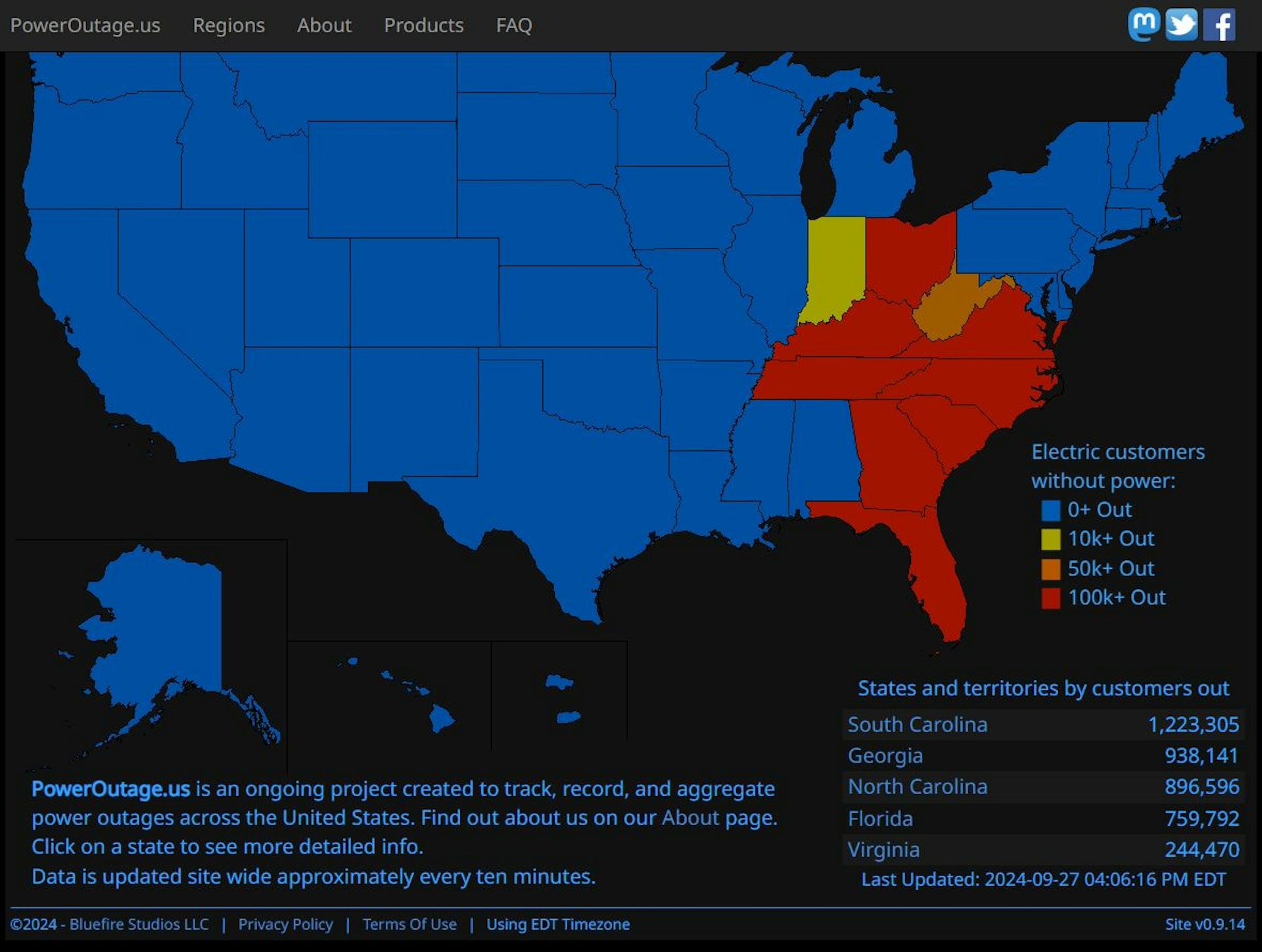
More than 700,000 people remained without power as of this morning and utility crews are responding from across the country for immediate restoration and repair efforts. Sixteen shelters housed approximately 1,100 residents last night.
Cellular telephone service remains spotty west of I-77 due to significant infrastructure damage. Telecommunications partners have activated Disaster Roaming, which allows any phone on any cellular network to access any available network to connect to. Telephone service providers are working to restore communications across the area.
“The State Emergency Response Team is working around the clock responding to severe impacts from Helene’s devastation. We are grateful for our local, state and federal partners and their teamwork to help North Carolinians hit hard by this storm,” said NC Emergency Management Director Will Ray. “Please remain aware of hazards and follow directions from local officials to protect life and safety.”
Across North Carolina, 29 counties and 52 towns and cities have issued States of Emergency, in addition to the statewide State of Emergency declared by Governor Cooper. Governor Cooper yesterday requested a Major Disaster Declaration from the federal government for North Carolina for 39 counties and the Eastern Band of Cherokee Indians for federal Public Assistance and Individual Assistance in the aftermath of Tropical Storm Helene.
As of Saturday morning, about 418 state-maintained roads remained closed, mostly due to flooding. Across the area, 11 landslides have been reported. This includes major closures on Interstates 26 and 40 around Asheville, plus dozens of locations along several U.S. and N.C. highway routes.
State transportation officials continue to urge residents to avoid traveling in western North Carolina, and to consider all roads in that region closed due to damage from the storm. People should go to DriveNC.gov for the latest conditions on roads impacted by Hurricane Helene. Never drive through standing water or go around barricades and road closure signs.
North Carolina residents should call 911 only for emergencies and dial 211 for other types of information. Up-to-date information on local conditions, shelters, traffic, power outages and resources is available at ReadyNC.gov and from county government social media.
Source: United States Senator for Rhode Island Jack Reed
WASHINGTON, DC – Recognizing tennis great Billie Jean King’s groundbreaking contributions both on and off the court, President Joe Biden signed legislation into law this week honoring Billie Jean King, 80, as the first individual female athlete to be awarded the Congressional Gold Medal.
U.S. Senator Jack Reed (D-RI) cosponsored bipartisan legislation (S. 2861) to award the Congressional Gold Medal to Billie Jean King, a tennis legend and American icon who was inducted into the International Tennis Hall of Fame in Newport, Rhode Island in 1987 and presented with her official Hall of Fame ring in 2015.
Senator Reed congratulated King, stating: “A champion on and off the court, Billie Jean King was known for having a great serve and serving as a great role model and advancing equality. She transcends sports and is someone who has blazed a trail and leveled the playing field to give others more opportunities than she herself had. I congratulate her for earning this well-deserved achievement and I know she’ll continue to serve as an ambassador for the sport and an inspiration for future generations.”
Throughout her career, Billie Jean King’s outstanding play and groundbreaking leadership and advocacy helped advance equal rights for women in athletics, education, and society at large. King was instrumental in securing equal prize money in men’s and women’s tennis at the U.S. Open, spearheaded the formation of the Women’s Tennis Association, and brought worldwide attention to pay equality throughout her career and in her “Battle of the Sexes” match against Bobby Riggs.
The U.S. Open, which began in 1881 as a men’s-only game on grass courts in Newport, Rhode Island, is now held annually in Flushing, Queens, at the U.S. Tennis Association’s (USTA) Billie Jean King National Tennis Center. Thanks in large part to the unrelenting activism of Billie Jean King, the U.S. Open became the first sporting event to offer equal prize money to female and male competitors.
Over the course of her career, King captured 39 Grand Slam tennis titles in singles (12), doubles (16) and mixed doubles (11).
Commissioned by Congress, the Congressional Gold Medal has been awarded as an expression of national appreciation for distinguished achievements and contributions to society. Prior to Billie Jean King earning the award this year, it had been bestowed upon several individual athletes, including Jackie Robinson, Jesse Owens, Roberto Clemente, Jack Nicklaus, Arnold Palmer, Byron Nelson, Willie O’Ree, Greg LeMond, Larry Doby, Joe Louis, as well as the 1980 U.S. Olympic team.
Once again, Billie Jean King blazed a trail that others will undoubtedly follow.
The U.S. Air Force Band of the Pacific-Asia traveled to the Sendai region of Japan on a mission to honor the victims and survivors of the earthquake and tsunami disaster that occurred on March 11, 2011, bringing with them the same spirit of hope and solidarity that first united them with the community 13 years ago.
The band, along with The Greatlanders Jazz Band from Elmendorf Air Base in Alaska, visited the area to bring hope and unity through music as part of Operation Tomodachi, the Japanese word for “friendship”. Operation Tomodachi occurred between 12 March to 4 May, 2011, as a disaster relief imitative following the 9.0 Tokohu earthquake and subsequent tsumani that struck the eastern coast of Japan. The effort involved more than 24,000 U.S. military service members from all branches of service. The U.S. Air Force Bands played a significant role in boosting morale during and after this initiative by offering concerts for those affected and brought a ray of hope amidst a historical disaster.
The band performed in Kabanomachi Elementary School in August, 2011, where the gymnasium had been converted into a shelter for families displaced by the disaster. Thirteen years later and the band retraced their steps in the Sendai region, returning to Kabannomachi Elementary to play once more, their hearts filled with memories of resilience, loss, and the unbreakable bond formed with local residents during those critical days.
Masato Yagi, U.S. Band of the Pacific-Asia community relations specialist for the past 25 years, coordinated the band’s presence at both the initial performance in 2011 and the most recent concert in 2024.
“Many people flocked to the Sendai area to provide disaster relief immediately following the tsunami, and the Band of the Pacific-Asia wanted to help in our own way by bringing music to cheer up dislocated people,” Yagi said. “This most recent performance was special because it was the first time we have returned since that initial concert. We want to let the people here know that we still care.”
This visit was more than just a performance—it was a heartfelt tribute to the people who had lost so much, and a reminder that they were never forgotten. As they played, familiar notes filled the gymnasium once again, the music was a reminder not just of a tragedy, but of the enduring friendship between the U.S. and Japan. The band’s return was an affirmation that the compassion and solidarity shown in the immediate aftermath of the disaster had not faded with time.
Operation Tomodachi was always about more than providing aid to mission partners and to neighbors; it was evidence of the continual effort to build a bridge between two nations, and performances such as these reinforce that lasting connection. The band’s performance serves as to remind people that in the face of unimaginable tragedy, friendship and support can endure, transcending time, distance, and culture. This spirit of remembrance and hope continues to resonate throughout the connection between the U.S. and Japan, growing with each effort.
The two crew members of NASA’s SpaceX Crew-9 mission launched at 1:17 p.m. EDT Saturday, for a science expedition aboard the International Space Station. This is the first human spaceflight mission launched from Space Launch Complex-40 at Cape Canaveral Space Force Station in Florida, and the agency’s ninth commercial crew rotation mission to the space station. A SpaceX Falcon 9 rocket propelled the Dragon spacecraft into orbit carrying NASA astronaut Nick Hague and Roscosmos cosmonaut Aleksandr Gorbunov. The spacecraft will dock autonomously to the forward-facing port of the station’s Harmony module at approximately 5:30 p.m., Sunday, Sept. 29, where Hague and Gorbunov will join Expedition 72 for a five-month stay aboard the orbiting laboratory. “This mission required a lot of operational and planning flexibility. I congratulate the entire team on a successful launch today, and godspeed to Nick and Aleksandr as they make their way to the space station,” said NASA Administrator Bill Nelson. “Our NASA wizards and our commercial and international partners have shown once again the success that comes from working together and adapting to changing circumstances without sacrificing the safe and professional operations of the International Space Station.” During Dragon’s flight, SpaceX will monitor a series of automatic spacecraft maneuvers from its mission control center in Hawthorne, California. NASA will monitor space station operations throughout the flight from the Mission Control Center at the agency’s Johnson Space Center in Houston. NASA will provide live coverage of rendezvous, docking, and hatch opening, beginning at 3:30 p.m., Sept. 29, on NASA+ and the agency’s website. NASA also will broadcast the crew welcome ceremony once Hague and Gorbunov are aboard the orbital outpost. Learn how to stream NASA content through a variety of platforms, including social media. The duo will join the space station’s Expedition 72 crew of NASA astronauts Michael Barratt, Matthew Dominick, Jeanette Epps, Don Pettit, Butch Wilmore, and Suni Williams, as well as Roscosmos cosmonauts Alexander Grebenkin, Alexey Ovchinin, and Ivan Vagner. The number of crew aboard the space station will increase to 11 for a short time until Crew-8 members Barratt, Dominick, Epps, and Grebenkin depart the space station in early October. The crewmates will conduct more than 200 scientific investigations, including blood clotting studies, moisture effects on plants grown in space, and vision changes in astronauts during their mission. Following their stay aboard the space station, Hague and Gorbunov will be joined by Williams and Wilmore to return to Earth in February 2025. With this mission, NASA continues to maximize the use of the orbiting laboratory, where people have lived and worked continuously for more than 23 years, testing technologies, performing science, and developing the skills needed to operate future commercial destinations in low Earth orbit and explore farther from Earth. Research conducted at the space station benefits people on Earth and paves the way for future long-duration missions to the Moon under NASA’s Artemis campaign, and beyond. More about Crew-9 Hague is the commander of Crew-9 and is making his second trip to the orbital outpost since his selection as an astronaut in 2013. He will serve as a mission specialist during Expedition 72/73 aboard the space station. Follow @AstroHague on X and Instagram. Roscosmos cosmonaut Aleksandr Gorbunov is flying on his first mission. He will serve as a flight engineer during Expeditions 72/73. Learn more about NASA’s SpaceX Crew-9 mission and the agency’s Commercial Crew Program at: https://www.nasa.gov/commercialcrew -end- Josh Finch / Jimi RussellHeadquarters, Washington202-358-1100joshua.a.finch@nasa.gov / james.j.russell@nasa.gov Steven Siceloff / Danielle Sempsrott / Stephanie PlucinskyKennedy Space Center, Florida321-867-2468steven.p.siceloff@nasa.gov / danielle.c.semprott@nasa.gov / stephanie.n.plucinsky@nasa.gov Leah Cheshier / Sandra JonesJohnson Space Center, Houston281-483-5111leah.d.cheshier@nasa.gov / sandra.p.jones@nasa.gov
Even this grim death toll may be lower than the reality due to under-reporting in the country
The number of those put to death – including some for drugs offences – is the highest since 1990
‘Where else in the world is someone sentenced to death for this?’ – an Egyptian on death row after being convicted of possessing eight grams of hashish
The Saudi Arabian authorities have put to death at least 198 people so far in 2024, the highest number of executions recorded in the country since 1990, Amnesty International said today.
Earlier today, the official Saudi Press Agency confirmed that the 198th execution this year had been carried out, though the real number may be higher given the news agency has previously under-reported the true number of executions in the country.
In 2022, Saudi Arabia executed 196 people – the highest annual number of executions that Amnesty had recorded in the country in the last 30 years. In March 2022, Crown Prince Mohammed bin Salma said that the country had “got rid of” the death penalty except for cases where it is mandated under Sharia. Yet, in November 2022, the authorities carried the first executions for drug-related offences in nearly three years, reversing a moratorium on executions for such offences which was announced by the Saudi Human Rights Commission in 2021.
Earlier this year, Amnesty analysed the country’s draft penal code which codifies the death penalty as a punishment and continues to enable judges to use their discretion to impose death sentences for murder, rape, blasphemy and apostasy.
Despite repeated promises to limit the use of the death penalty, the Saudi authorities have ramped up executions while routinely failing to abide by international fair trial standards and safeguards for defendants. Executions for drug-related crimes have soared this year, with 53 carried out so far – with an average of one execution every two days in July alone – rising from just two drug-related executions in 2023.
The authorities have also weaponised the death penalty to silence political dissent, punishing citizens from the country’s Shi’a minority who’ve supported “anti-government” protests between 2011 and 2013. On 17 August, the Saudi Press Agency announced the execution of Abdulmajeed al-Nimr, a retired traffic police officer, for terrorism-related offences related to joining Al-Qaeda. However, his court documents tell another story about his charges, which are related to his alleged support for “anti-government” protests in the country’s Shi’a-majority Eastern Province.
According to a court document reviewed by Amnesty, he was initially sentenced on 25 October 2021 by the Specialised Criminal Court to nine years in prison on charges of “seeking to destabilise the social fabric and national unity by participating in demonstrations … supporting riots, chanting slogans against the state and its rulers”, as well as “dissenting against the decision to arrest and prosecute wanted individuals”, and for joining a WhatsApp group that included people wanted for security purposes. On appeal, his punishment was increased to a death sentence. The court did not make a single reference to Al-Nimr’s supposed involvement with Al-Qaeda.
After Al-Nimr’s arrest on 28 October 2017 he was denied access to a lawyer for around two years during his interrogations and pre-trial detention. He spent three months in detention without being informed of the reason for his arrest. According to the court document, Al-Nimr’s conviction was based solely on a “confession” he said was obtained under duress, including being detained in solitary confinement for a month-and-a-half.
Agnès Callamard, Amnesty International’s Secretary General, said:
“The death penalty is an abhorrent and inhuman punishment which Saudi Arabia has used against people for a wide range of offences, including political dissent and drug-related charges following grossly unfair trials.
“The authorities must immediately establish a moratorium on executions, and order re-trials for those on death row in line with international standards without resorting to the death penalty.”
Executed for drugs offences
So far in 2024, the Saudi authorities have executed 53 people solely for drug-related offences. Only two such offences were recorded in the country in 2023. Since July, 53 people have been executed for drug-related offences, 38 of whom were foreign nationals. This spike in executions raises serious fears for the fate of dozens of prisoners convicted of similar offences and currently on death row. Earlier today, the authorities executed two Egyptian men who were detained in Tabuk Prison for drug-related crimes.
Amnesty has previously documented the cases of four Egyptian men held on death row in Tabuk Prison for drug-related offences. The four are among a group of at least 50 people on death row for drug-related crimes in Tabuk Prisons, the majority of whom are Egyptian.
This month, Omar (a pseudonym), one of the detained men, told Amnesty:
“I’ve been on death row for seven years for the possession of eight grams of hashish. I was also convicted of the intent to receive drugs, which I didn’t confess to and have denied. Where else in the world is someone sentenced to death for this? I have asked all governmental entities who may know – from the Ministry of Interior to the Supreme Judicial Council, and no one could tell me the status of my case. My son grew up without me for seven years. This makes me feel like I’m already a dead man … A few days ago, I shared a final meal with one of my fellow inmates before he was taken to be executed the next morning. He didn’t know about his impending execution until that morning. All I want to know is the status of my case.”
The authorities sentenced these men to death in January 2019 on various drug-related charges and upheld the sentence in November 2019. Since then, the men have received no information about the status of their case. According to the court document analysed by Amnesty, the four men had no legal representation throughout their pre-trial detention, interrogations and preliminary trial resulting in their death sentence. Following their conviction, the court stated that they have the right to a legal representative to submit appeal proceedings. However, the court only appointed a lawyer for one of the men.
Statement from Premier Wab Kinew on Fallen Firefighter Ceremony
As Manitobans gather to honour fallen firefighters, I encourage all of us to take time to reflect on the sacrifices of those who have lost their lives in the line of duty.
Six names are being added to the memorial this year and each name represents one of the brave Manitobans we lost this year that have left a legacy of service.
Each of them lived up to the belief we all have as Manitobans that we don’t leave anyone behind and we help those who need it most. We get up every day and work together to make this province a better place, no matter what walk of life you come from.
Firefighters show up for us on some of our worst days and show incredible bravery and courage each day in carrying out their duties.
As a government, we will continue to work to support those who keep our communities safe.
Painting of an unknown 21-year-old man, widely supposed to be Christopher Marlowe (1585).Corpus Christi College
In Shakespeare’s time, about a quarter of all plays were collaboratively written by two or more dramatists. Christopher Marlowe’s classic work Doctor Faustus was first performed in the 1580s or early 1590s but only published in 1604, 11 years after his death. The dramatists Samuel Rowley and William Bird were paid in 1602 to write new additions to the play.
However, researchers have long suspected that the original play was not written by Marlowe alone. Its broader comic parts, largely in prose, have been thought to be the work of a second writer who never got the credit they deserved.
Previous research has suggested one of the dramatists Thomas Nashe or Henry Porter. Nashe left us only one play, Summer’s Last Will and Testament (1592). Porter wrote several in collaboration with other dramatists, but only one sole-authored play survives, The Two Angry Women of Abingdon (1599).
So, can a new computer analysis of texts resolve this question and finally credit the second author of Doctor Faustus?
In an article in the journal Notes & Queries and a piece in the Guardian, Darren Freebury-Jones describes computer techniques that point to Marlowe’s co-author being Porter. But we have found methodological problems in Freebury-Jones’s approach, and believe the evidence he presents does not support the conclusions he draws from it.
Computational analysis can certainly generate new knowledge about authorship, but his work is not a convincing example of this burgeoning art.
Unique matches
Freebury-Jones’s Notes & Queries article presents tables from a free online dataset, Collocations and N-Grams, created by independent Shakespeare analyst Pervez Rizvi. For 527 plays from the 1550s to the 1650s (pretty much all of those that have survived from this period), the dataset lists all four-word phrases that each play has in common with the other 526.
But the phrases Rizvi considers most significant are those that appear only in the play under consideration and one other play – known as “unique matches”. For each of the 527 plays, he ranks which other plays have the most unique matches to it.
If these rare phrases are particular to each dramatist’s idiolect (unique way of speaking), then researchers should, for example, find at the top of the Macbeth table some other plays by Shakespeare. And we do: among the top-ten plays that share the most unique matches with Macbeth are Julius Caesar, Coriolanus, King Lear and Hamlet.
But while the top-ten list for Macbeth gives grounds for optimism about Freebury-Jones’s method, since four of its plays are Shakespeare’s, the top-ten list for Doctor Faustus, reproduced below, dashes this:
The Taming of a Shrew
A Trick to Catch the Old One
The Devil’s Charter
Albumazar
Caesar and Pompey, or Caesar’s Revenge
The Family of Love
Messalina, the Roman Empress
The Sisters
The Two Angry Women of Abingdon
Tamburlaine
While Porter is present in this list as the author of The Two Angry Women of Abingdon, Marlowe himself has only one play in it: Tamburlaine (1587) at position ten. If this method were detecting authorship, Marlowe’s other plays should dominate the list, just as the Macbeth list is dominated by Shakespeare plays.
Moreover, Porter’s play also appears at number ten for unique matches with Macbeth. This suggests the evidence for Porter being a coauthor of Macbeth is almost as strong as for Doctor Faustus – but Freebury-Jones makes no mention of this.
Illustration from the title page of a 1620 edition of Christopher Marlowe’s Doctor Faustus. John Wright
Porter can hardly be expected to dominate any top-ten list as Shakespeare does for Macbeth, since he left us only play. In contrast, with his roughly 1 million words of writing, Shakespeare presents a much greater “surface area” to any method that counts rare words or phrases – so he has more opportunities than anyone else to write the rare phrases we are looking for. To compensate for this, Rizvi discounts the significance of matches to authors with large canons.
Freebury-Jones mentions that the raw counts “are divided by the combined word counts for each pairing”, which is the scaling process Rizvi describes in the notes to Collocations and N-Grams. But nobody knows if this is the right way to scale for different canons or not, because the science of this problem has not been explored.
Rizvi changed his scaling formula in 2018 at my (Gabriel Egan’s) suggestion. But I did not claim to have solved the problem, and I consider it an open question whether we can derive a fair formula for such scaling.
Furthermore, Rizvi’s dataset does not distinguish between the plays that Shakespeare wrote alone and those he co-wrote, so his scaling factor treats as Shakespeare’s some substantial writings of other authors.
Further problems
This highlights another question with the analysis. In the top-ten list for unique matches with Macbeth are two plays co-authored by the dramatists Francis Beaumont and John Fletcher: The Woman Hater (1606) and Philaster (1620).
So, what should a researcher do when a play has more than one author? One response is to count matches to Beaumont’s part separately from matches to Fletcher’s part, using the widely accepted divisions of these two plays – as first proposed by Cyrus Hoy, an expert in the English Renaissance stage, in 1958. Alternatively, you could exclude co-authored plays entirely, as many authorship investigators do.
But Freebury-Jones says nothing about this problem of judging writers by their co-authored works. This consideration bears somewhat on Macbeth too, since many Shakespearians believe the playwright Thomas Middleton wrote about 5%-10% of it.
So where does all this leave Porter? Freebury-Jones ends his Notes & Queries piece with a cautious claim: “We may reasonably conclude that Henry Porter is a likelier candidate than [Thomas] Nashe for Marlowe’s collaborator on Doctor Faustus.”
But in speaking to the Guardian, he abandoned this caution. He reports being “astonished by just how close the dramatic language of Doctor Faustus actually was to Porter”, and insists that we must recognise “Porter as the most likely collaborator”.
It’s possible that Porter did co-write Doctor Faustus. But the problems with Freebury-Jones’s analysis mean that, for now, we still can’t say for sure.
Looking for something good? Cut through the noise with a carefully curated selection of the latest releases, live events and exhibitions, straight to your inbox every fortnight, on Fridays. Sign up here.
The authors do not work for, consult, own shares in or receive funding from any company or organisation that would benefit from this article, and have disclosed no relevant affiliations beyond their academic appointment.
Police are appealing for assistance to locate a man who has absconded from a mental health facility in Kingsbury.
Officers were called shortly after 15:00hrs on Saturday, 14 September and informed that Trevor St Martins, 56, had absconded while on an escorted visit to shops.
Detectives have carried out extensive enquiries to locate him but he remains missing.
St Martins is described as 6ft tall and of medium build.
When last seen, he was wearing a black top, black jeans and a black hat.
Members of the public are advised not to approach him. For an immediate sighting call 999.
If you know of his whereabouts, please call 101 quoting CAD 4057/14.
Minister Loewen with his father, Paul, and his son, Tyler.
Alberta’s expansive rural landscapes are cherished by more than 150,000 hunters annually, and hunting has enduring significance for families and communities across our province. It serves not only as a means of sustenance and recreation, but also plays a vital role in wildlife management, conservation and supporting local economies.
During Provincial Hunting Day, youth aged 10 to 17 have the opportunity to hunt upland game birds in designated Wildlife Management Units during open seasons without needing a provincial game bird licence. Those who have completed the Alberta Conservation and Hunter Education course can use a firearm under the direct supervision of a parent, legal guardian or, with written permission, another adult who possesses a valid firearms licence.
“Starting to develop hunting skills at a young age is key. Teaching our youth about hunting safety and conservation principles empowers them to confidently plan their own hunting adventures in the future.”
Todd Loewen, Minister of Forestry and Parks
Provincial Hunting Day also emphasizes the role of mentors in the hunting community. Through the generations, mentoring has fostered a deep respect for wildlife and the land among Albertans, creating positive connections and ensuring sustainable hunting practices.
Alberta’s Forestry and Parks department carefully manages hunting opportunities through regulated seasons, game quotas and policies grounded in scientific research and conservation principles. This ensures that Alberta maintains its reputation for world-class hunting while preserving its natural heritage for future generations to enjoy.
“Hunting has been a huge part of my life for as long as I can remember. It’s early mornings, freezing toes and some of my best memories. I love hunting with my dad and getting outside, connecting with nature and knowing where my food comes from. For me, hunting’s more than a sport—it’s about family, friends and keeping traditions alive.”
Owen, 15-year old from Didsbury, Alberta
Quick facts
Hunting’s contribution to the Alberta economy is $1.1 billion annually, including licence sales, equipment and experiences directly related to hunting.
Upland game birds available for hunting include ruffed grouse, sharp-tailed grouse, blue grouse, spruce grouse, ptarmigan, pheasants and Hungarian partridge.
Source: The Conversation – USA – By Mireille Rebeiz, Chair of Middle East Studies & Associate Professor of Francophone & Women’s, Gender & Sexuality Studies, Dickinson College
A picture of the secretary-general of Hezbollah Hassan Nasrallah is seen among the rubble following an Israeli air strike.Str-/picture alliance via Getty Images
Israel has killed the leader of the militant group Hezbollah in a airstrike in Beirut, marking a further escalation of hostilities in the region.
The death of Hassan Nasrallah, confirmed by Hezbollah on Sept 28, 2024, forms part of a major Israeli push against the Iran-backed group in recent days that has resulted in the death of several top leaders – but also killed hundreds of civilians and left many more fleeing Lebanon’s south in fear of a ground invasion.
But what is Hezbollah? What exactly is its role in Lebanon? And how big a blow is Nasrallah’s death? The Conversation turned to Mireille Rebeiz, a Lebanon expert at Dickinson College who is writing her second book on Hezbollah, to help explain.
What is Hezbollah? And what role does it play in Lebanon?
Officially, the group came into existence in 1985 with the publication of a manifesto that detailed Hezbollah’s aims for the region. The manifesto outlined a plan to duplicate the Iranian revolution of 1979 in Lebanon and create a Shiite Islamic state. It pledged allegiance to the Supreme Leader of the Iranian Revolution, Ruhollah Musavi Khomeini, and vowed to fight the Israeli occupation of Lebanon and the Palestinian territories.
The Lebanese Civil War ended in 1991 with the signing of the “Taif Agreement,” in which warring factions agreed that a political and democratic process was the only way to move forward in Lebanon. Consequently, Hezbollah had to develop a political wing, and in 1992 Hezbollah entered the political ring, running for national elections and winning 12 out of 128 parliamentarian seats.
But while the peace agreement called for the disarmament of militia groups, Hezbollah was allowed to retain its armed wing as a “resistance” group, fighting Israeli occupation in south Lebanon.
Many Lebanese political parties allied themselves with Hezbollah at this juncture. While these parties did not necessarily share the group’s views or its commitment to Iran, they were similarly committed to fight the Israeli occupation, and Hezbollah fighters were the main force doing so.
Hezbollah’s presence in parliament and the Lebanese government, and its alliance with various political parties, allowed it to control the country and veto decisions that do not fit its agenda or promote its interest.
Since 2005, Lebanon has had three presidential lapses: from Nov. 2007 to May 2008, from May 2014 to October 2016, and from Oct. 31, 2023 until today. The parliamentarian Speaker, Nabih Berri, who is Shiite and known for his allegiance to Hezbollah, refuses to convene the parliament for presidential elections unless the nominee is approved by Hezbollah and its allies.
As well as having a political and military wing, Hezbollah also provides various services, such as social welfare, health care, utilities, education and even security to his community.
Is it right to see Hezbollah primarily as a Iran-backed militia?
Yes — Hezbollah is primarily an Iranian-backed militia. It exists to serve the Iranian regime and expand its ideology in the region, as set out in the group’s 1985 manifesto. In 2009, Hezbollah issued a new manifesto in which it reaffirmed its commitment to the Shiite Islamic resistance led by Tehran.
As to its financial and military support, in 2016, Nasrallah confirmed: “Hezbollah’s budget, everything it eats and drinks, its weapons and rockets, comes from the Islamic Republic of Iran.”
Furthermore, with the backing of Iran, Hezbollah was able to create and expand its own illegal financial network through money laundering, drug trafficking and other unlawful activities.
Along with Iran, Syria has played a major role in Hezbollah’s development. The Taif Agreement called for Syrian Armed Forces to enter Lebanon for a two-year period to help establish law and order after more than a decade of civil war.
But it stayed in Lebanon for over 16 years, and the Syrian government’s closeness to the Iranian regime made Hezbollah a perfect ally. So much so, that when civil war broke out in Syria in 2011, Hezbollah emerged as a major actor in that conflict, sending thousands of Lebanese fighters to Syria to assist the government’s efforts to suppress a popular uprising.
But others started pushing for Hezbollah to cease its military operations and for the Lebanese Armed Forces to take over Hezbollah’s task in securing Lebanon’s borders.
The killing sparked massive anti-government, anti-Syrian and anti-Hezbollah protests on the streets of Beirut. The subsequent Cedar Revolution led to the departure of the Syrian forces from Lebanon and marked a drop in Hezbollah’s popularity, in general.
A Lebanese woman grieves the death of Lebanese Prime Minister Rafiq Hariri in 2005. Haitham Mussawi/AFP via Getty Images
This drop was apparent in the 2005 elections, in which an anti-Syrian and anti-Hezbollah political coalition claimed victory.
Since 2005, Lebanon has seen a series of events that indicate a clear opposition to Hezbollah. Several journalists and political figures were assassinated for speaking out against Hezbollah and Syria. Their deaths outraged many Lebanese.
And in 2015, the “You Stink” environmental movement was born to protest political corruption and Hezbollah’s control of waste management.
In 2019, a similar protest movement was born in which Lebanese took to the streets to express their frustration against corruption and inflation. Under the slogan “All Means All,” Lebanese protested all political parties — including Hezbollah.
These events indicate Lebanese dissatisfaction with Hezbollah.
A 2020 poll showed a drop in Hezbollah’s popularity even among the Shiite community, which makes up about a third of the population.
Polling during the almost year of hostilities following the Oct. 7, 2023, attack by Hezbollah ally Hamas on Israel suggests that Hezbollah’s influence continues to exceed its popularity. An Arab Barometer poll of Lebanese in early 2024 found that only 30% trust Hezbollah, whereas 55% said they do not trust the group at all. While Hezbollah still retains the trust of 85% of Shiites, only 9% of Sunnis and Druze and 6% of Christians trust the militia.
What is Hezbollah’s structure?
Originally, Hezbollah leadership consisted of a religious council of seven members created in the 1980s; it has branches and committees that govern different affairs including finances, social, political and military issues. This religious council, or “Shura Council,” has regional offices in Beirut, the Bekaa Valley in the country’s eastern region and south Lebanon.
At the end of the Lebanese Civil War, two more bodies were added: an executive council and a politburo, or central political body. The religious council was chaired by Sayyid Muhammad Hussein Fadlallah, who offered religious guidance to the Shiite community and was often described as Hezbollah’s spiritual leader.
Both the council and Hezbollah swear allegiance to Iran’s Supreme Leader. The council is also tasked to select Hezbollah’s Secretary General.
After the Israeli assassination of Hezbollah’s co-founder, Abbas al-Musawi, in 1992, Hassan Nasrallah assumed this role and remained Secretary General until his death in Beirut in the current Israeli campaign.
What impact will Nasrallah’s death have on Hezbollah’s operations?
The assassinations of Hezbollah commanders are meant to remove major decision-makers. The death of Secretary General Nasrallah is a definite blow to the group, which is already vulnerable from last week’s attacks. The goal is to demoralize its fighters.
Furthermore, these attacks convey a clear message that Israel will no longer accept the tit-for-tat attacks on its northern border.
However, Israel may not necessarily get its desired impact.
The situation now is fluid and it’s hard to predict what will happen next. But the fresh wave of violence may only reinforce Hezbollah’s resolve.
Furthermore, it might see more involvement of other Hezbollah-aligned players into the region, such as the Houthis in Yemen and Kata’ib Hizballah in Iraq.
Following the announcement of Nasrallah’s death, Iran’s Supreme Leader Khamenei threatened Israel and vowed more support to Hezbollah in Lebanon.
Mireille Rebeiz is affiliated with the American Red Cross.
Source: United States House of Representatives – Congressman Steny H Hoyer (MD-05)
“The operation was a response not only to Nasrallah’s decades of terror but also to Hezbollah’s recent repeated attacks on undisputed Israeli territory. Since October 8, 2023, Hezbollah terrorists have launched nearly 10,000 rockets at Israeli civilians. More than 60,000 people in Northern Israel have fled their homes to escape Hezbollah’s violence, unable to return for months on end.
“Israel has the right to defend itself, as does every other sovereign nation. Israel’s strikes against Hezbollah’s leadership, launch sites, and missile arsenal – especially its long-range rockets – are vital to dismantling the terrorist organization’s ability to carry out further attacks against the Israeli people on behalf of Iran.
“The world cannot allow Iran to rebuild its proxy network on Israel’s doorstep. Israelis, Lebanese, Syrians, and others in the region deserve to live free from Hezbollah’s interference, and the displaced ought to be able to return home. Hezbollah must not be allowed to return to the northern border, and Hamas must never reassert control over Gaza. This war will not end until these Iranian-backed terrorists are defeated. The United States stands firmly with our ally Israel in that effort.”
Source: United States House of Representatives – Congressman Steve Scalise (1st District of Louisiana)
WASHINGTON, D.C.— Today, House Majority Leader Steve Scalise (R-La.), Speaker Johnson, Whip Emmer, and Chairwoman Stefanik released the below statement after the longtime leader of Hezbollah, Hassan Nasrallah, was killed in an Israeli airstrike in Beirut.
“Hassan Nasrallah’s reign of bloodshed, oppression, and terror has been brought to an end. A puppet of the Iranian regime, he was one of the most brutal terrorists on the planet, and a coward who hid behind women and children to carry out his attacks. Thanks to the brave men and women of the Israeli military, justice was delivered for Israeli victims of his heinous crimes, their families, and the United States. The world is better off without him.
“We call on the Biden-Harris Administration to end its counter-productive calls for a cease-fire and its ongoing diplomatic pressure campaign against Israel. Nasrallah’s death is a major step forward for the Middle East, and today’s victory for peace and security should be used to reassert America’s ironclad support for Israel as it fights for its very right to exist.”
Source: United States Senator for Washington Maria Cantwell
09.28.24
Cantwell Celebrates Grand Opening of Largest Public Project in Mount Vernon’s History
New regional transportation hub near I-5 will host largest public EV charging station in the U.S.; Sen. Cantwell secured $3 million for project in FY2024 annual appropriations bill
MOUNT VERNON, WA – Today, U.S. Senator Maria Cantwell (D-WA) joined local officials and community members at the grand opening of the Mount Vernon Library Commons – the largest public project in Mount Vernon’s history.
“Transit oriented development projects like this create more livable communities,” Sen. Cantwell said. “Come up here, recharge, go to the Co-op, stop at the library — see all the wonderful things in Skagit County.
This year alone, we’ve been able to provide [$12.5] million from the bipartisan infrastructure bill for the 78 electrical charging stations and more in the future, and the entire building really is an apex of what energy efficiency is. Even the concrete used to bore the foundation took the environment into consideration,” she continued.
“So it is really, really a great testament to the leadership of this city today […] making this region an even more attractive place to be and live.”
Following the speaking program, Sen. Cantwell joined the community for a ribbon cutting and tour of the new space; b-roll is available for download HERE.
Located right off I-5, the Mount Vernon Library Commons will serve as a regional transportation hub, featuring a public library, a young adult STEM center, a community conference center, a commercial kitchen, and charging stations for electric vehicles and electric bicycles. The facility boasts 76 public EV charging spaces and infrastructure to increase capacity by 200 stations, making it the largest public EV charging station in the country.
The Library Commons was awarded a $12.5 million Charging & Fueling Infrastructure Grant from the Bipartisan Infrastructure Law, which Sen. Cantwell championed. She also secured a $3 million Congressionally Directed Spending request for the Library Commons project in the FY 2024 annual Transportation, Housing and Urban Development, and Related Agencies appropriations bill. The Library Commons project also received a $26.8 million Transportation Infrastructure Finance and Innovation Act (TIFIA) Transit-Oriented Development (TOD) loan, the first ever TOD loan in the nation, which saved the City of Mount Vernon $3 million.
The Library Commons is the first publicly bid building in Washington state to be certified to Passive House standards – one of the highest environmental certifications for reduced energy use. The building utilizes solar panels that supply 19-21% of the building’s power demand.
Video of the speaking program and b-roll of the ribbon cutting and tour are HERE; photos are HERE; and a transcript of Sen. Cantwell’s remarks is HERE.
NASA astronaut Nick Hague and Roscosmos cosmonaut Aleksandr Gorbunov will soon dock with the International Space Station as part of the agency’s SpaceX Crew-9 mission, a venture which will enhance scientific research and bolster the knowledge about how people can live and work in space. During the planned five-month mission, Hague’s mission tasks will include participating in a variety of research projects for NASA’s Human Research Program. Each study is designed to help address the health challenges that astronauts may face during future long-duration missions to the Moon, Mars, and beyond. “Hague’s experiences and research may potentially lead to scientific breakthroughs that may not be possible on Earth,” said Steven Platts, chief scientist for human research at NASA’s Johnson Space Center in Houston. A major focus for Hague’s time aboard the station is to study the suite of space-related vision disorders called Spaceflight Associated Neuro-ocular Syndrome (SANS) which occur as body fluids shift toward the head in weightlessness. These shifts can cause changes to the eye: the optic nerve can swell, the retina may develop folds, and the back of the eye can even flatten. Earlier research suggests multiple factors contribute to the syndrome, so two vision-related studies on this mission will tackle different yet distinct approaches that may help address or even prevent such changes during future missions. One project, called Thigh Cuff, will explore whether wearing fitted cuffs could counter the syndrome by keeping more bodily fluids in the legs. Thigh cuffs are compact, lightweight, and easy to use, which makes them appealing for potential use during long-duration, deep space missions. For this study, Hague will wear the thigh cuffs for six hours during two sessions. To help researchers measure how well the cuffs work, he will record ultrasound images of blood flow in his legs and neck veins during the sessions. Researchers will also compare this data against ultrasounds taken without the cuff to examine flow differences. “Thigh cuffs like these may allow researchers to better investigate medical conditions that result in extra fluid in the brain or too much blood returning to the heart,” said study leader Brandon Macias at NASA Johnson. In another study, Hague will test if a vitamin regimen may help combat SANS. The study, led by Sara Zwart, a nutritional biochemist at NASA Johnson, seeks to examine if a daily vitamin B supplement—taken before, during, and after flight—can prevent or mitigate swelling at the back of the eye. The research will also assess how an individual’s genetics may influence the response. “Earlier research suggests that some people are more susceptible to this ocular syndrome than others based on genetics that can influence B vitamin requirements, so taking daily vitamins may make all the difference,” Zwart said. “We think by giving the B vitamins, we could be taking that piece of genetic variability out of the equation.” The work also may eventually improve care options for women on Earth with polycystic ovary syndrome, a condition that can cause eye changes and infertility in women. Researchers hope that patients may similarly benefit from targeting the same genetic pathways and vitamin supplementation as crew members in space. Hague also will record data to study whether a new way of administering a common anti-nausea medicine can help alleviate motion sickness following launch and landing. In this study, Hague can self-administer a novel nasal gel formulation of the medication scopolamine. Hague will note his experiences using this medicine and any other motion sickness aides, including alternative medications or behavioral interventions like specific head movements. This research, led by neuroscientist Scott Wood of NASA Johnson, eventually will include 48 people. “Our goal is to understand how to help future space travelers adapt to motion sickness when living and working in space,” Wood said. “Crew members must stay healthy and perform key tasks, including landing on the Moon and other destinations.” To help NASA plan future missions, Hague also will participate in human research studies that tackle other space challenges, such as avoiding injury upon landing back on Earth and learning how space travel affects the human body on a molecular level. ____ NASA’s Human Research Program pursues the best methods and technologies to support safe, productive human space travel. The program studies how spaceflight affects human bodies and behaviors through science conducted in laboratories, ground-based analogs, commercial missions, and the International Space Station. Such research continues to drive NASA’s mission to innovate ways that keep astronauts healthy and mission-ready as space exploration expands to the Moon, Mars, and beyond.
Source: United States House of Representatives – Congressman Chuck Edwards (NC-11)
Dear Friend,
Yesterday morning around 8:30 a.m., Hurricane Helene hit our beautiful mountains with a ferocity unmatched by any storm in our district’s history. We have witnessed 1,000-year flooding, and with more rain expected this afternoon, we are not out of the woods.
But I have been encouraged by the number of neighbors I’ve seen helping neighbors, and I know our community will persist. Mountain folk are resilient. We will make it through this, together.
To keep you informed, I am committed to sending you a daily update on the steps being taken to respond and recover from Hurricane Helene. Today is update number one, with more information to follow in the coming days. Please make sure to read it through and share it with your friends and family.
Food and water
Far and wide, the biggest need of every county in NC-11 is access to food and potable water.
A total of 37 water systems are on a system-wide boil water advisory across North Carolina, with 31 systems awaiting results to hopefully allow for the water to be turned back on.
Potable water and meals are actively en route from central North Carolina to Western North Carolina.
Air operations for food and water deliveries begin this afternoon in areas without roadway access.
Power and Gas
Power outages are widespread but accessibility for repairs is limited.
Currently, there is no established timeline for restorations.
More than 700,000 North Carolinians lost power due to the storm.
Power for 281,000 of the initial 700,000 has been restored, but Western North Carolina faces a unique challenge due to the high number of road closures throughout the district.
Duke Energy warns that Western North Carolinians should be prepared for potential multi-day outages, though energy providers are doing everything they can to restore power quickly.
Duke Energy has 11,000 workers working quickly and safely on repairs, including additional crews from 19 states and Canada.
Fuel planning is ongoing for both rescue operations and communications resources.
Fuel contracts have been activated.
A fuel contract provides a steady fuel reserve during an emergency.
For local governments in need of fuel for their vehicles
Ensure your Emergency Operation Center has submitted the request for gasoline with North Carolina Emergency Management to have your request processed and gasoline delivered.
Gasoline can also be delivered via air if road access is limited.
Roads
North Carolina Department of Transportation has issued a “DO NOT DRIVE” message for Western North Carolina.
Unless it is an emergency, please do not try to travel.
Roughly 400 roads are closed in Western North Carolina, with the majority being in Henderson (50), Buncombe (25) and Jackson (21) counties.
73 of these are primary routes including I-40, I-26, U.S. 74 at I-40 in Asheville, and dozens of U.S. and N.C. routes.
Most of the current closures are due to high water where the roadway is impassable or flooded, land/rockslides, downed power lines, pipe failures, and fallen trees.
More than 1,500 employees from across the state have deployed to Western North Carolina to address road closures related to the storm.
Crews are actively working to clear trees and rock/landslide debris throughout Western North Carolina to reestablish accessibility, including clearing efforts along the I-40 and I-26 corridors.
Asheville Regional Airport
Asheville Regional Airport closed mid-day on Friday, September 27 due to flooding.
The airport is expected to reopen by mid-day today, Saturday, September 28.
Cell Service
Western North Carolina has seen severe cell service outages due to the severe weather.
Madison County is worst affected, with less than 8 percent capacity available through Verizon.
Service providers have deployed Compact Rapid Deployables throughout Western North Carolina, including to Hendersonville, Lake Junaluska, and Waynesville, with more en route.
Compact Rapid Deployables are a transportable cell tower and internet access point, that can generate wired internet and wi-fi coverage anytime and anywhere.
Service providers have deployed SatCOLTs throughout Western North Carolina, including to Asheville and Hendersonville, with more en route.
SatCOLT stands for “Satellite Cells on Light Trucks” and are vehicles with mobile cell sites that connect via satellite and do not rely on commercial power supply.
North Carolina National Guard
410 North Carolina National Guard soldiers and airmen have been deployed to provide support to Western North Carolina so far.
This includes the deployment of 146 vehicles and 12 aircraft.
The Asheville National Guard armory has relocated to East Flat Rock due to lost power so they may continue operations and providing support to Western North Carolina.
Shelters
For those unable to evacuate to a safe location or in need of a place to go, the following shelters are currently open and available as of September 28:
Source: United States Senator for Wisconsin Ron Johnson
Americans are facing a healthcare crisis, and those who question the current orthodoxy or offer alternative treatments are ridiculed, vilified, and canceled. On September 23, I was joined by a highly qualified group of doctors and nutritional experts to discuss our nation’s health and ask questions we haven’t been allowed to ask.
The roundtable discussion, American Health and Nutrition: A Second Opinion, provided a foundational and historical understanding of the changes that have occurred over the last century within agriculture, food processing, and healthcare industries, which impact the current state of national health.
WATCH FULL ROUNDTABLE (4 hours)
If you can’t spend the full 4 hours watching, I’d suggest you watch these quick highlights from Monday’s roundtable. It captures important points and powerful testimony.
WATCH 14-MINUTE HIGHLIGHT VIDEO
Dr. Casey Means explains that our food is leading to chronic illness. We can’t even ask questions without being ridiculed or vilified.
Dr. Means: “If the current trends continue… At best, we’re going to face profound societal instability and decreased American competitiveness, and at worst, we’re going to be looking at a genocidal level health collapse…” (Watch)
Other panelists included:
The greatest threat to our nation is that we are so horribly divided. We all agree on the major goals of life: safety, security, and raising our children well. I have no idea the political affiliation of this panel, but it doesn’t make any difference. This is a nonpartisan issue, and through these conversations, we can set an example of how to heal and unify our great nation.
WATCH: Sen. Johnson closing remarks on unity (2 minutes)
It was standing room only in the historic Kennedy Caucus room. Two overflow rooms were needed to handle the crowds. Thank you to everyone who attended and participated in the roundtable. I hope America is listening and starts examining how and what they eat.
WATCH: Sen. Johnson on Newsmax discusses roundtable
Headline: FEMA Administrator Surveys Damage in Florida as Hurricane Helene Response Efforts Continue
FEMA Administrator Surveys Damage in Florida as Hurricane Helene Response Efforts Continue
WASHINGTON — Today, FEMA Administrator Deanne Criswell is in Florida surveying damage and assessing the need for federal resources to support Hurricane Helene response activities.
This whole-of-government effort includes the support of more than 2,300 federal personnel and voluntary agencies across six states. More than 800 FEMA personnel are deployed to assist with response efforts and are working to determine the scope of the storm’s impact and coordinate resource support and assistance.
The Biden-Harris Administration approved emergency declarations in Alabama, Florida, Georgia, North Carolina, South Carolina and Tennessee. This type of declaration allows federal resources to begin flowing immediately as damage assessments are conducted to determine what additional resources may be available if a major disaster is declared.
FEMA’s priority remains providing life-saving and life sustaining support to affected areas. FEMA deployed Urban Search and Rescue teams with more than 1,270 personnel and Swift Water Rescue Capabilities to affected states. Our non-profit partners including the American Red Cross, the Salvation Army, Convoy of Hope, Heart to Heart International and others are actively supporting survivors by providing emergency sheltering, food, water, clean up kits, healthcare supplies and other disaster relief items. Team Rubicon teams are helping to clear roads while the Salvation Army deployed seven mobile feeding units and crews.
As people begin to assess damage, it is important to continue listening to local officials for instructions and be aware of the possibility of life-threating post-storm hazards. People can download the free FEMA App available in English and Spanish languages to receive real-time weather alerts and find local emergency shelters in their area.
People who need help reconnecting with loved ones missing after the hurricane can call 1-800-RED-CROSS (1-800-733-2767) and provide as much detail available to assist operators in potentially locating missing loved ones. More than 540 American Red Cross volunteers are in the affected areas supporting communities with sheltering needs, reunification efforts and post-storm care.
What People Can Do Now
If you evacuated, do not return home until local officials say it is safe to do so.
Stay out of floodwaters. People experiencing heavy rain and flooding should not wade through flood waters, which can contain debris, chemicals, waste and wildlife, as well as downed powerlines that can electrically charge the water. Turn Around, Don’t Drown!
Be safe during an outage. If you are without power, use only flashlights or battery-powered lanterns for emergency lighting.
Text instead of calling. While cellular service is limited in several areas, it’s easier to get in touch with loved ones by texting instead of calling.
Use generators safely. If there is a power outage, use generators safely. Always use them outdoors and at least 20 feet from windows, doors and attached garages. Make sure to keep the generator dry and protected from rain or flooding.
For people who are beginning to clean up, make sure to document any property damage with photos and video contact your insurance company for assistance and next steps.
People with a National Flood Insurance Program insurance policy who suffered flood damage can begin filing a claim with a phone call to their flood insurance agent or company.
Responding to Hurricane Helene is a Whole-of- Community Effort
Non-profit and charitable organizations are on the frontlines of the response to Hurricane Helene, providing critical support to people and communities. Here are just a few examples of the important work some of these organizations are doing on the ground.
American Red Cross (ARC) has more than 540 Red Cross responders deployed to affected areas with another 350 responders in route. As of Saturday morning, at least 1,900 people are in more than 80 shelters. More than 30 ARC Emergency Response Vehicles are supporting and 24 additional vehicles are in route. Anyone who needs a safe place to go can find information on redcross.org or by downloading the free Red Cross Emergency app by texting GETEMERGENCY to 90999.
Salvation Army is in Georgia providing meals at six emergency shelters. In Florida, a total of five mobile feeding units are in Tallahassee and 12 are in Perry. The Salvation Army is also responding to requests for cleanup kits and blankets. In North Carolina, South Carolina, Tennessee and Kentucky, the Salvation Army is responding to requests for meal service to communities affected by the storm. More response information is available at helpsalvationarmy.org.
Capacity Path Relief deployed two teams for community support in Florida’s Big Bend and southwest coastal areas and is expanding support to fill requests from numerous counties. Additional teams are collaborating with local EOCs and coordinating with agency and feeding partners. They are also offering mental health support to teams supporting the response.
Convoy of Hope is stationed in Perry, Florida and is distributing disaster supplies to survivors and is communicating with the Taylor County Sheriff’s Office to provide support as needed.
Heart to Heart International (HHI) is in Florida with hygiene kits and pharmaceuticals/healthcare supplies for survivors if needed.
Crisis Cleanup is currently working to help survivors clean up damage from Hurricane Helene. Organizations that would like to help can register at www.crisiscleanup.org/register.
Food for the Poor will deliver five pallets of hygiene kits to Catholic Charities in Saint Petersburg and Tampa, Florida and are deploying disaster kits which include tarps and hygiene kits, women’s care kits and children’s activity kits.
Operation Hope is prepared to support survivors with assistance applications, insurance claims, disaster recovery plans and document recovery. Survivors can find information by visiting www.operationhope.org.
Canada is deeply concerned by the conflict between Israel and Hezbollah, a terrorist organization, in Lebanon, which has caused a rapid increase of humanitarian needs. More than 90,000 people have been displaced within Lebanon since early September.
September 28, 2024 – Ottawa, Ontario – Global Affairs Canada
Canada is deeply concerned by the conflict between Israel and Hezbollah, a terrorist organization, in Lebanon, which has caused a rapid increase of humanitarian needs. More than 90,000 people have been displaced within Lebanon since early September.
Today, the Honourable Ahmed Hussen, Minister of International Development, announced that Canada is providing $10 million in funding for humanitarian assistance to address the urgent needs of civilians in Lebanon. This funding will help provide food, water, emergency healthcare (including sexual and reproductive healthcare), protection services and other life-saving assistance.
This funding is in addition to the US$10 million already allocated to the crisis in Lebanon by the UN Central Emergency Response Fund, to which Canada is a key donor.
Alongside our partners, we call for an immediate 21-day ceasefire across the Lebanon-Israel border to provide space for diplomacy towards the conclusion of a diplomatic settlement consistent with UNSCR 1701, and the implementation of UNSCR 2735 regarding a ceasefire in Gaza.
Canada urges all parties involved in the conflict to protect civilians, including humanitarian workers, from harm, in accordance with international humanitarian law.
Canada continues to monitor the situation and remains in close contact with humanitarian partners to assess and respond to evolving needs.
The Albanese Government is investing $70.9 million to get almost 1,500 new teachers from a range of backgrounds into schools across the country.
The Government is tripling the number of teachers entering into the High Achieving Teachers (HAT) Program, which provides financial assistance, mentoring and training to get teachers into the classroom more quickly, helping to tackle the teacher workforce shortage.
The funding will be provided to ten providers to get more people, including mid-career professionals and high-achieving school leavers, into the teaching profession.
The HAT Program is part of the National Teacher Workforce Action Plan that Education Ministers agreed to in 2022.
It builds on the success of Phase 1 of the HAT Program already underway in Victoria and New South Wales with 94 per cent of graduates from the La Trobe Nexus program continuing to teach after graduating.
The providers will support the teachers-in-training to complete their qualifications and make a successful start in the classroom, providing them with the skills they need to commence a career in teaching.
Participants receive a salary and split their time between practical teaching in the classroom and studying.
The new school teachers will start to be placed into schools that need them the most in 2025.
The program focuses on attracting new teachers, including with a STEM background, First Nations peoples, people with disability, teacher aides and people based in remote locations.
They will teach across all states and territories, in government and non-government schools, and across primary and secondary schools.
A list of successful providers from the open-competitive grant opportunity follows:
Strong winds from Hurricane Helene, one of the most powerful storms to hit the Southeast, flooded roads and cut power in multiple states.AP Photo/Mike Carlson
Electricity is essential to just about everyone – rich and poor, old and young. Yet, when severe storms strike, socioeconomically disadvantaged communities often wait longest to recover.
That isn’t just a perception.
We analyzed data from over 15 million consumers in 588 U.S. counties who lost power when hurricanes made landfall between January 2017 and October 2020. The results show that poorer communities did indeed wait longer for the lights to go back on.
A 10 percentile drop in socioeconomic status in the Centers for Disease Control and Prevention’s social vulnerability index was associated with a 6.1% longer outage on average. This corresponds to waiting an extra 170 minutes on average for power to be restored, and sometimes much longer.
The top map shows the total duration of power outages over eight storms by county. The lower map is a comparison with socioeconomic status taken into account, showing that counties with lower average socioeconomic status have longer outages than expected. Ganz et al, 2023, PNAS Nexus
Implications for policy and utilities
One likely reason for this disparity is written into utilities’ standard storm recovery policies. Often, these polices prioritize critical infrastructure first when restoring power after an outage, then large commercial and industrial customers. They next seek to recover as many households as they can as quickly as possible.
While this approach may seem procedurally fair, these recovery routines appear to have an unintended effect of often making vulnerable communities wait longer for electricity to be restored. One reason may be that these communities are farther from critical infrastructure, or they may be predominantly in older neighborhoods where power infrastructure requires more significant repairs.
Commercial areas are often higher on the priority list for faster power recovery in an outage. This store was still closed for several days during Texas’ widespread outages in 2021. Montinique Monroe/Getty Images
The upshot is that households that are already at greater risk from severe weather – whether due to being in flood-prone areas or in vulnerable buildings – and those who are least likely to have insurance or other resources to help them recover are also likely to face the longest storm-caused power outages. Long outages can mean refrigerated food goes bad, no running water and delays in repairing damage, including delays in running fans to dry out water damage and avoid mold.
Our study spanned 108 service regions, including investor-owned utilities, cooperatives and public utilities. The differential impact on poorer communities did not line up with any particular storm, region or individual utility. We also found no correlation with race, ethnicity or housing type. Only average socioeconomic level stood out.
How to make power recovery less biased
There are ways to improve power recovery times for everyone, beyond the necessary work of improving the stability of power distribution.
Policymakers and utilities can start by reexamining power restoration practices and power infrastructure maintenance, such as replacing aging utility poles and trimming trees, with disadvantaged communities in mind.
Power providers already have granular data on power usage and grid performance in their service regions. They can begin experimenting with alternative recovery routines that consider the vulnerability of their customers in ways that do not substantially affect average recovery duration.
People in some Fort Myers, Fla., neighborhoods still lacked water and electricity more than a week after Hurricane Ian in 2022. Montinique Monroe/Getty Images
For socioeconomically vulnerable regions that are likely to experience long outages because of their locations and possibly the aging energy infrastructure, utilities and policymakers can proactively ensure that households are well prepared to evacuate or have access to backup sources of power.
For example, the U.S. Department of Energy announced in October 2023 that it would invest in developing dozens of resilience hubs and microgrids to help supply local power to key buildings within communities when the wider grid goes down. Louisiana plans several of these hubs, using solar and large-scale batteries, in or near disadvantaged communities.
Policymakers and utilities can also invest in broader energy infrastructure and renewable energy in these vulnerable communities. The U.S. Department of Energy’s Justice40 program directs that 40% of the benefit from certain federal energy, transportation and housing investments benefit disadvantaged communities. That may help residents who need public help the most.
Severe weather events are becoming more common as global temperatures rise. That increases the need for better planning and approaches that don’t leave low-income residents in the dark.
Chenghao Duan, a Ph.D. student at Georgia Tech, also contributed to this article. This article, originally published on Feb. 7, 2024, has been updated with Hurricane Helene’s rising power outage toll.
The authors do not work for, consult, own shares in or receive funding from any company or organization that would benefit from this article, and have disclosed no relevant affiliations beyond their academic appointment.
Gov. Justice released the following statement ahead of Monday’s Special Session:
“As I call this Special Session, the goal is clear that we need to help the hardworking people of West Virginia. I’m hopeful that we can get another personal income tax cut across the finish line. I’ve said it time and again: nothing will help our population grow, create new opportunities, and drive economic progress in West Virginia like eliminating our personal income tax. We’re on the right track, but we need to keep pushing forward. The growth and momentum we’ve built during my time as Governor is off the charts. It’s truly been a rocketship ride. We’ve also minded the store, and because of that we now have the opportunity to get these things done.
We also need to do something to help hardworking families afford childcare. Right now, families across the country are struggling with extreme childcare costs, and we can’t sit on the sidelines and watch it happen in West Virginia. We need to step in and help. That’s why I’m again asking for a childcare tax credit to lower costs for families. This will make things a lot better for working families.
There are additional things to address, such as more money for our schools and our nurses and getting major water, sewer, and infrastructure projects across West Virginia completed.
We all know my time as your Governor is coming to an end. But I promised you that I would run across the finish line, and that’s exactly what we’re doing.”
Once the session gets underway, bill status may be found here.
In the heart of Tsuen Wan, taking a walk through the footpaths around Lo Tak Court is reminiscent of the unique charm of traditional walled villages.
The Government is committed to enhancing the community’s streetscapes by beautifying public spaces and streets. Led by the Deputy Chief Secretary, the Task Force on District Governance actively supports various local initiatives. One of them is aimed at creating a pedestrian-friendly environment to elevate the public’s walking experience.
In this regard, the Highways Department has implemented streetscape improvements in Lo Tak Court in Tsuen Wan, the Outlying Islands Ferry Pier in Central and in the vicinity of MTR Tai Wai station, introducing thematic designs to pedestrian facilities that reflect the character of the districts.
Inspiring nostalgia
Located on the original site of Ho Pui Village in Tsuen Wan, which was demolished in the 1960s, Lo Tak Court comprises multiple pedestrian streets and serves as a bustling food hub in the district.
The area’s beautification design adopts the Tsuen Wan Walled Village theme as it features uniquely decorated lampposts and flower beds that revive the historic village’s architectural traits and landscape.
“The design of thematic wallpapers for planters resembles the furniture and decoration of an old walled village, giving pedestrians an impression of looking back into the room from the courtyard,” Highways Department Landscape Architectural Assistant Angela Lam explained.
She added that wallpapers on lampposts adopt the concept of brick walls, tile roofs, and decorative ceilings of the old walled village.
It may not be spring yet, but cotton trees are still blossoming in the form of paintings adorning the columns of footbridges.
Miss Lam highlighted that the original site near Tsuen Wan MTR station, adjacent to Lo Tak Court, was named Muk Min Ha Tsuen, which in English means cotton trees. Nowadays, many cotton trees still bloom every year outside the station, attracting various small animals, such as birds and squirrels.
This scenery has been incorporated into the paintings on the columns of footbridges and manhole covers, making them popular photo spots in Lo Tak Court.
Street beautification projects unveiled in Central and Tai Wai also showcase the districts unique cultural charm.
The Outlying Islands Ferry Pier in Central evokes the nostalgia of Lamma Island’s fishing village culture with its soft blue tint. Adding to the atmosphere are designs incorporating the windsurfing sail of Hong Kong’s first Olympic gold medallist Lee Lai-shan and Cheung Chau’s famous lucky buns.
Outside Tai Wai MTR station, paintings of egrets along the river channels to Tolo Harbour are a common sight, alongside depictions of city wildlife like masked palm civets and leopard cats, as a nod to urban waterways and rural life.
Fantastic makeovers
Hong Kong’s 18 districts are set for a makeover as the department is taking various measures to refine the urban scenery.
It also plans to renovate or refurbish two pedestrian footbridges and subways in each district in two phases, covering repairs, repainting, and upgrades to handrails and lighting for improved safety and comfort. The first phase, which has already begun, is projected to conclude gradually by year-end.
Highways Department Landscape Architect Sandra Ng said that the design concepts will be customised to highlight the individuality of each district.
Drawing on the example of the footbridge construction across Hip Wo Street in Kwun Tong, Miss Ng emphasised that the design is themed on mountain trails inspired by the nearby hiking route Shum Wan Shan, known as the Kwun Tong Back Garden.
“On the main walls, we are featuring a view from the peak of Shum Wan Shan, showing the view of Kowloon Peak and Shun Lee Estate. Also, the walls along the barrier-free access will display continuous graphics of shrubs and trees to match the hiking theme.
“We hope to introduce this unique and precious Kwun Tong Back Garden in the district to more members of the public.”
Miss Ng pointed out that a pedestrian subway in Sha Tin will also be revamped with a design integrating the district’s landmarks, such as Tsang Tai Uk and Lek Yuen Bridge, with visuals of rowing boats and cyclists along the Shing Mun River. Such improvements, she revealed, embrace a blend of motion and stillness, and a sense of urban vitality.
The department expects the second phase of the renovation to start in early 2025 for gradual completion by the middle of the year.
Road improvements
Meanwhile, it has launched the Expanded Footpath Repaving Scheme to repave a total of 40 sections of public footpaths spanning over 16,700m, encompassing locations such as Queensway in the Central & Western District and Salisbury Road in the Yau Tsim Mong District.
The department stressed that it thinks carefully about overall pavement conditions to enhance citizens’ walking experience when it comes to planning such maintenance and repair work.